
It was the height of the FPV versus HSV wars on both road and, with Falcon and Commodore, on racetrack – and Toyota, with its big, boofy, front-drive Aurion, wanted in.
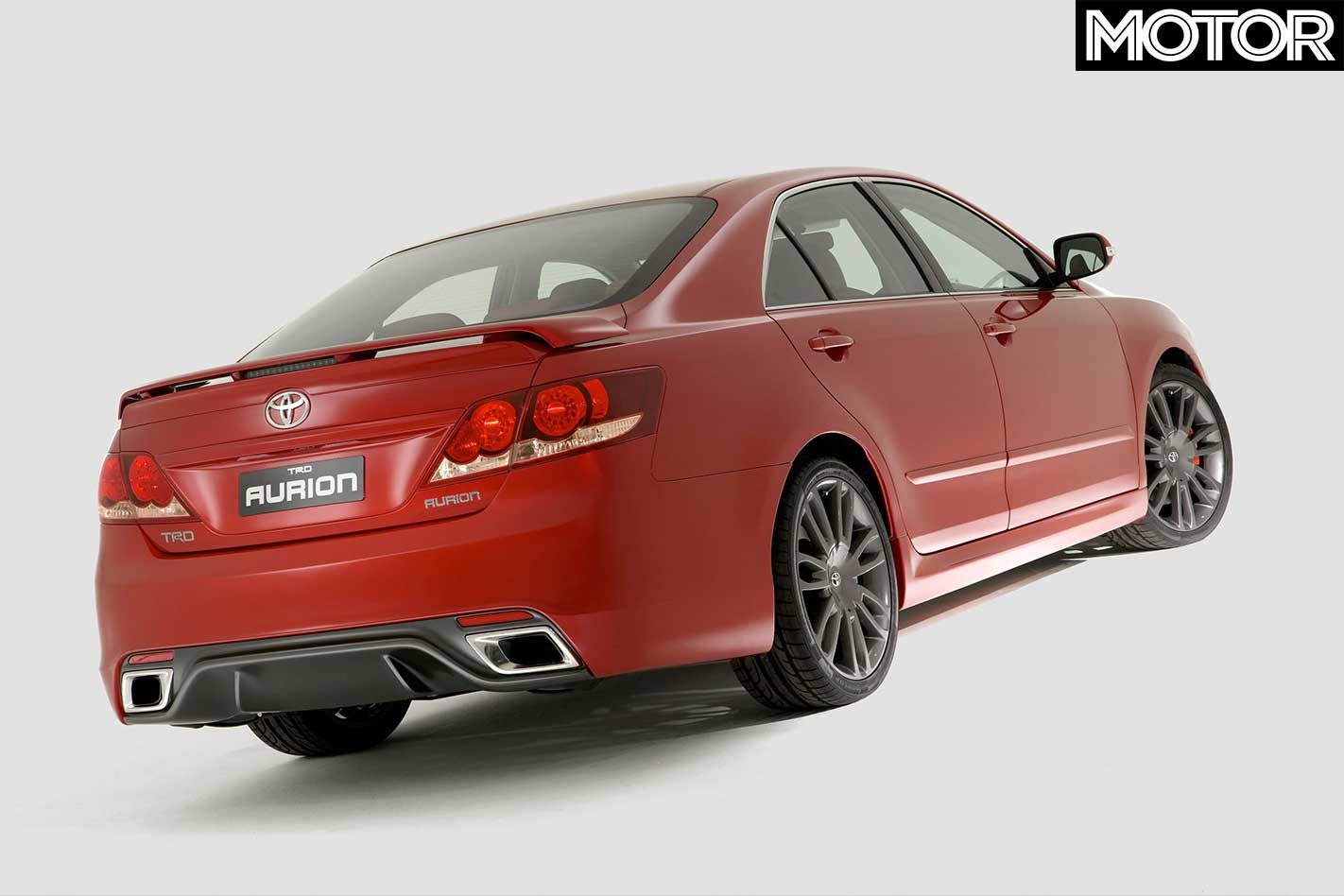
And so, in 2007, it revealed this: the Toyota Racing Development Aurion, or TRD Aurion – one of the world’s most unfortunately named cars if you’re inclined to read your acronyms as words.
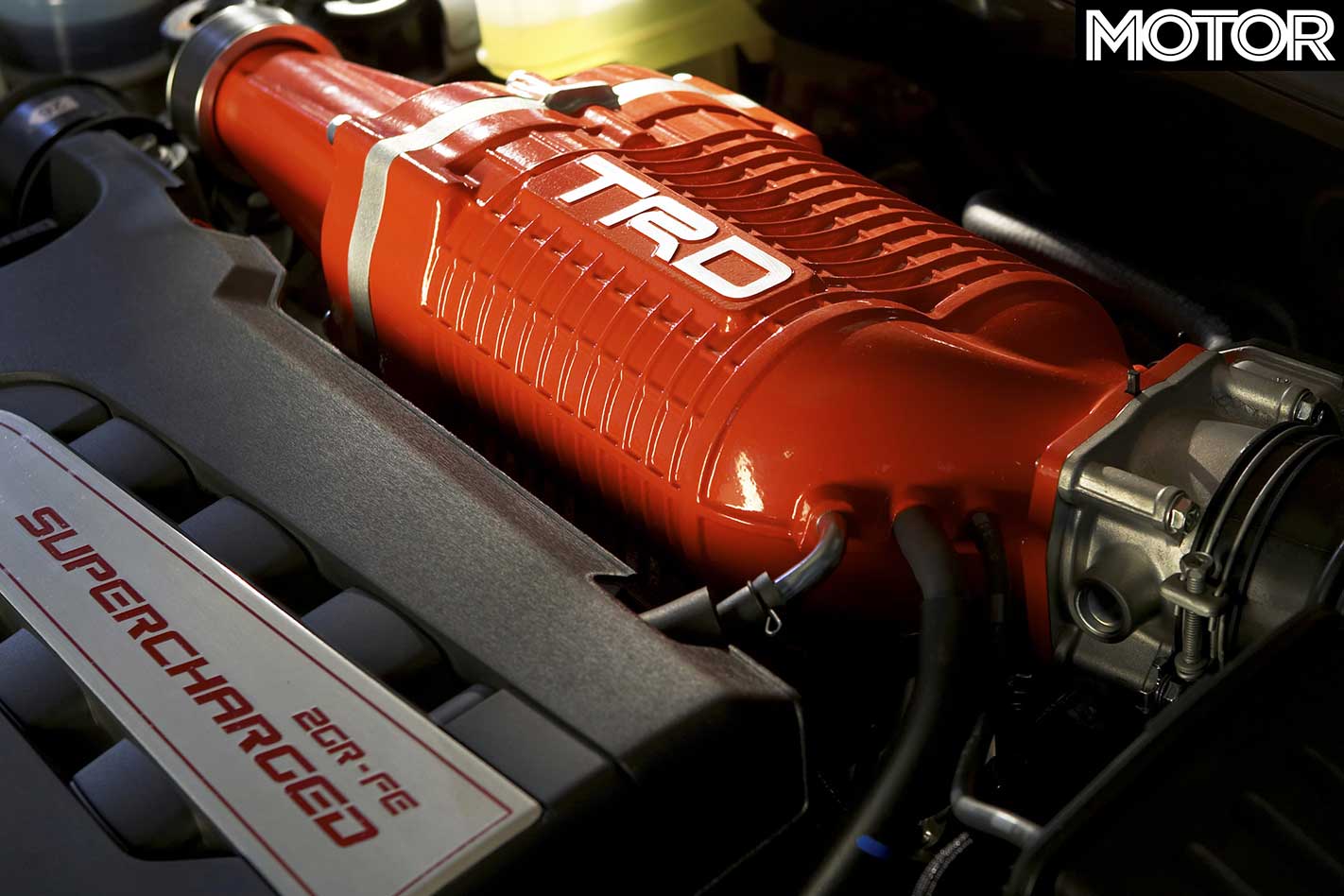
Developed and built in Australia – something that can’t not be celebrated anymore, no matter the car – the TRD Aurion achieved a fairly impressive 241kW and 400Nm courtesy of Toyota bolting a dirty great Eaton supercharger to the top of its 2GR-FE 3.5-litre V6. (Interestingly, this is the same engine still in service, supercharged, in the back of the Lotus Evora.)
Toyota sent the not inconsiderable power through a six-speed auto on its way to two 245-section front Dunlop Sports Maxx tyres, to the point that the TRD Aurion remains one of the most powerful factory front-drive cars ever made.
Zero to 100km/h took around six seconds flat at a time when similarly priced FPVs and HSVs were in the mid- to high-fives. It helped that it weighed ‘just’ 1610kg. In our October 2007 issue, we were surprised by how well it drove, with no torque steer complaints, the TRD Aurion boasting a brisk grand tourer personality, if not as fun as its rear-drive rivals, particularly as you couldn’t wind the then-primitive ESC back, at all. The engine note also wasn’t anything special, but overall, for a first effort, we came away impressed.
If there’s one thing Toyota got half right, it was the styling enhancements. With new front and rear bars incorporating more than a dash of FPV/HSV influence, there was also a lower stance and huge (for the time) 19-inch wheels hiding upgraded PBR-developed brakes. Indeed, the TRD Aurion was as cruel on the eyes as it was easy on its front tyres.
Unfortunately, the TRD Aurion was short lived, axed just the next year. Today, they’re $10K-$15K used.
2007 TRD AURION SPECS Engine: 3456cc V6, DOHC, 24v, s/c Power: 241kW @ 6400rpm Torque: 400Nm @ 4000rpm 0-100km/h: 6.1sec (as-tested, Oct ’07) Price (new): $56,990 (3500S)
South Australia, the great land of strange posh accents, Stobie poles, Farmers’ Union Iced Coffee, a great ocean of dirt and, dare we say, an even greater inferiority complex. Did you know South Australia was the only colony not settled by convicts? If you didn’t, clearly you’ve never met a true blue South Australian before.
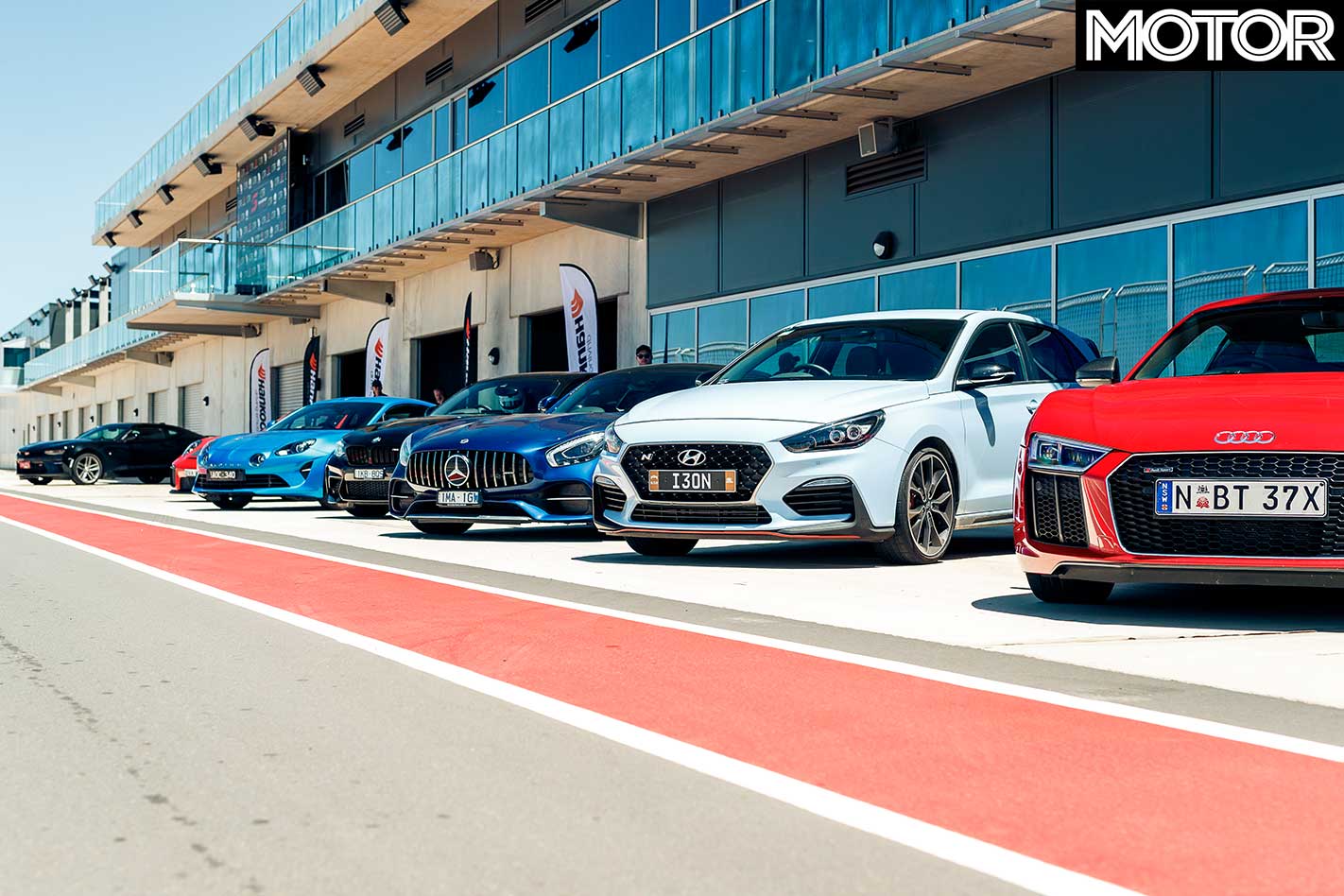
Yet as much as we like poking fun at our South Australian friends – they love to call Adelaide small, but hate it when someone interstate says as much – this great land is quickly becoming a Mecca for car and motorsport enthusiasts. Like a spaceship from Independence Day, the otherworldly Bend Motorsport Park has arrived and landed permanently an hour south-east of Adelaide.
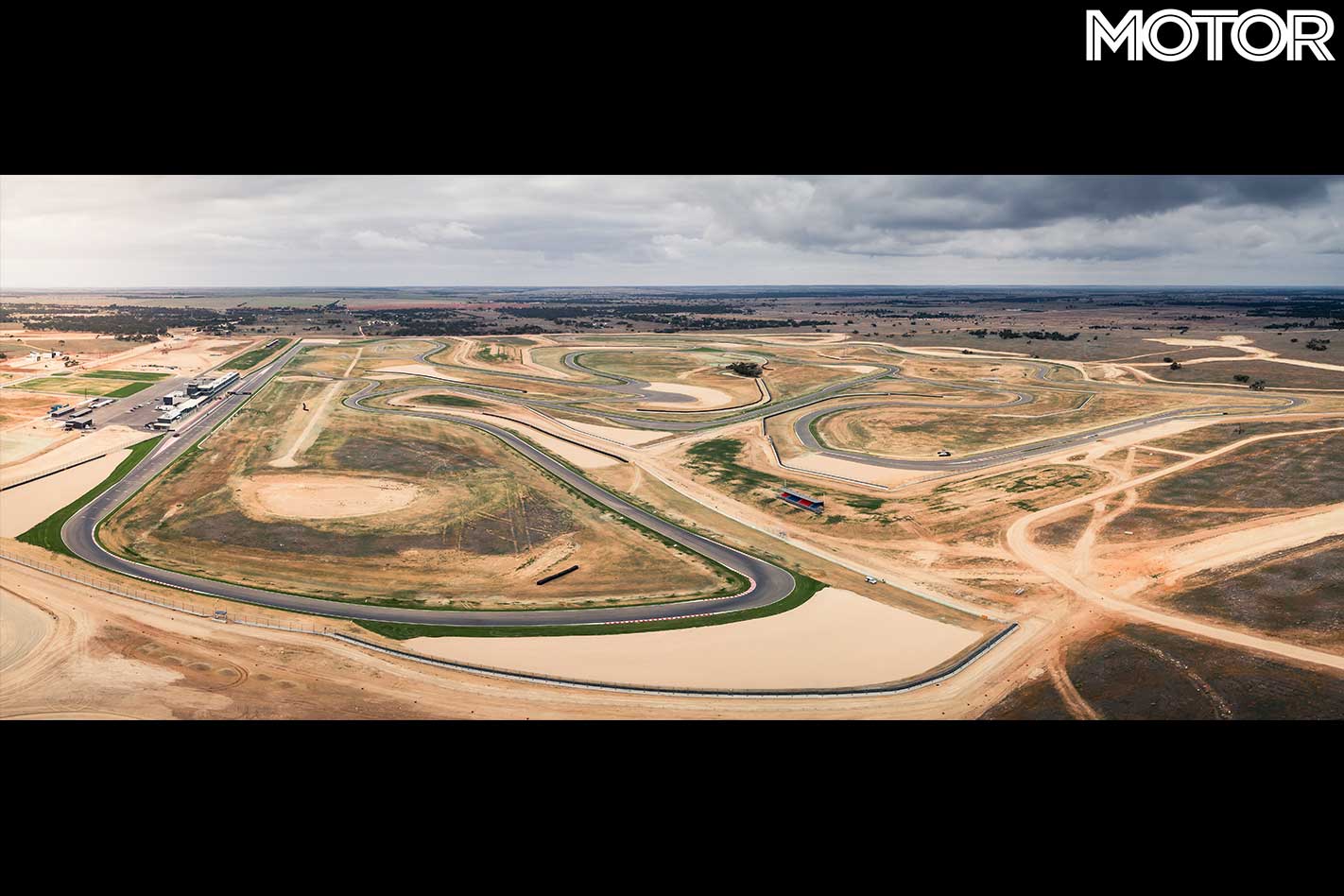
With a proper FIA Grade 2 racetrack, up to 7.77km long, Australia’s only CIK karting track and soon, an ANDRA-spec dragstrip, its creators imagine The Bend as a one-stop “theme park” for motorsport enthusiasts. And also their gift – from a wealthy family of migrants who own an empire of BP service stations – to a state of Australia they owe so much.
Meanwhile, independent of that, and merely 30 minutes from Adelaide’s CBD itself lies a playground of tarmac rally roads known as the Hills, where the locals drive fast and dawdlers driving at what would be normal eastern seaboard speeds are almost ran off the road.
So what better place, we thought, than to aim an 11-strong armada of some of the year’s hottest fast new cars. Engineering over-achievers, the best metal released in Australia in the last 12 months – that we could get our hands on – precisely $2.2m, 3685kW, 72 cylinders and 13 turbochargers. This is the first time in its 23-year history Performance Car of the Year – Australia’s original, best and most-trusted performance car award – has strafed South Australia.
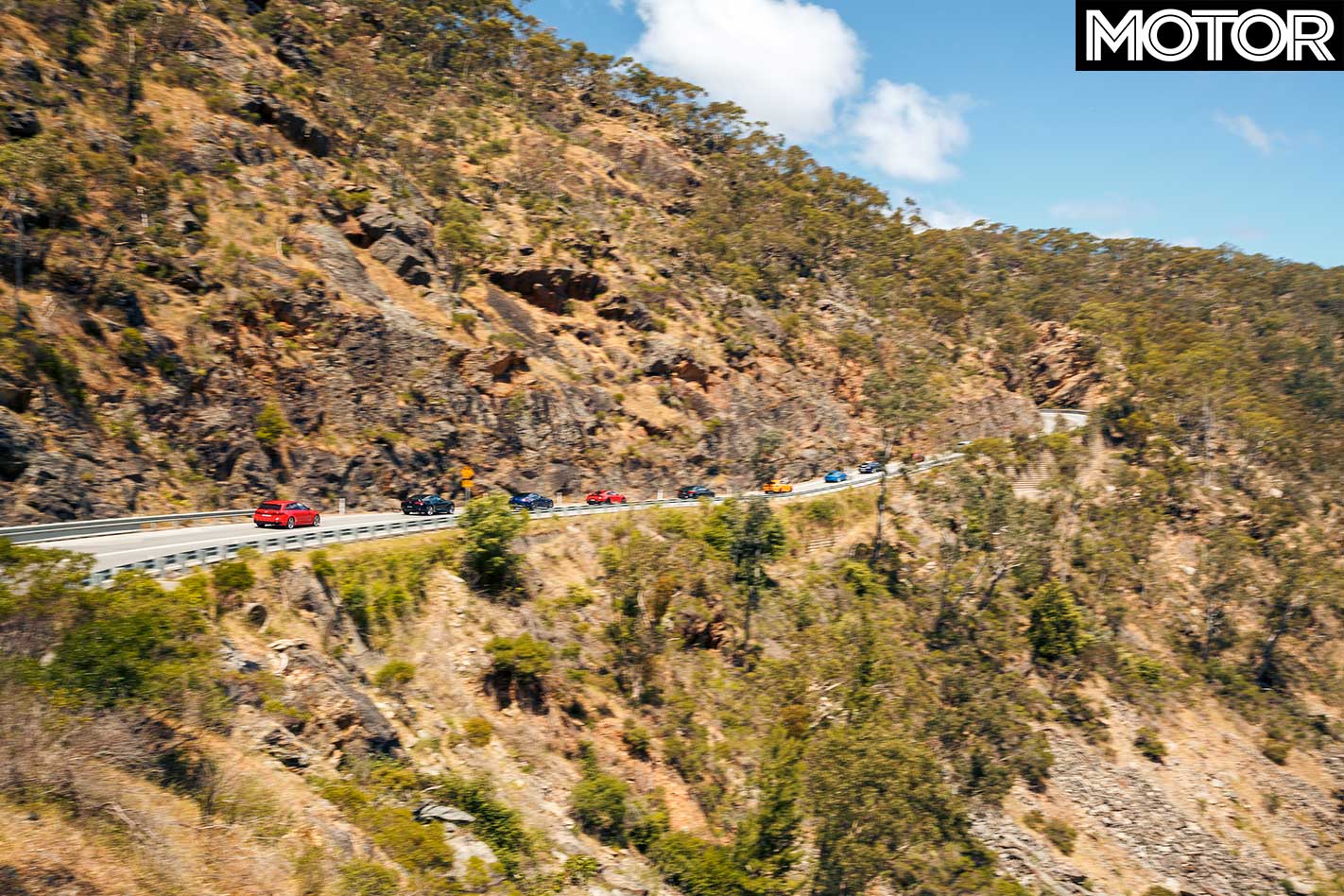
The Plan is thus: Day One, send the troops and weaponry 650km from Melbourne to The Bend Motorsport Park. Day Two and Three, tear off in search of Adelaide’s best roads. Day Four, hit The Bend Motorsport Park’s challenging 3.41km West Circuit (leaving the 7.77km monster configuration to another day as we’d need a week to do our track testing alone…).
This includes drag times, run on The Bend’s flat, 1km front straight. Day Five, collapse in a heap, slash drive all the way back to Melbourne. Test 11 cars between five judges, get essentially a magazine’s worth of notes and photography, two TV show segments for the new WhichCar program on Channel 10, and a whole lotta ones and zeros for the MOTOR website and social media (PCOTY is not confined to a magazine these days, oh no). And all on a budget dwarfed by whatever is tangled in Clive Palmer’s pocket lint on a given day… whose idea was all this again?
With the battleground and the strategy for our high octane offensive outlined, let’s talk weaponry.
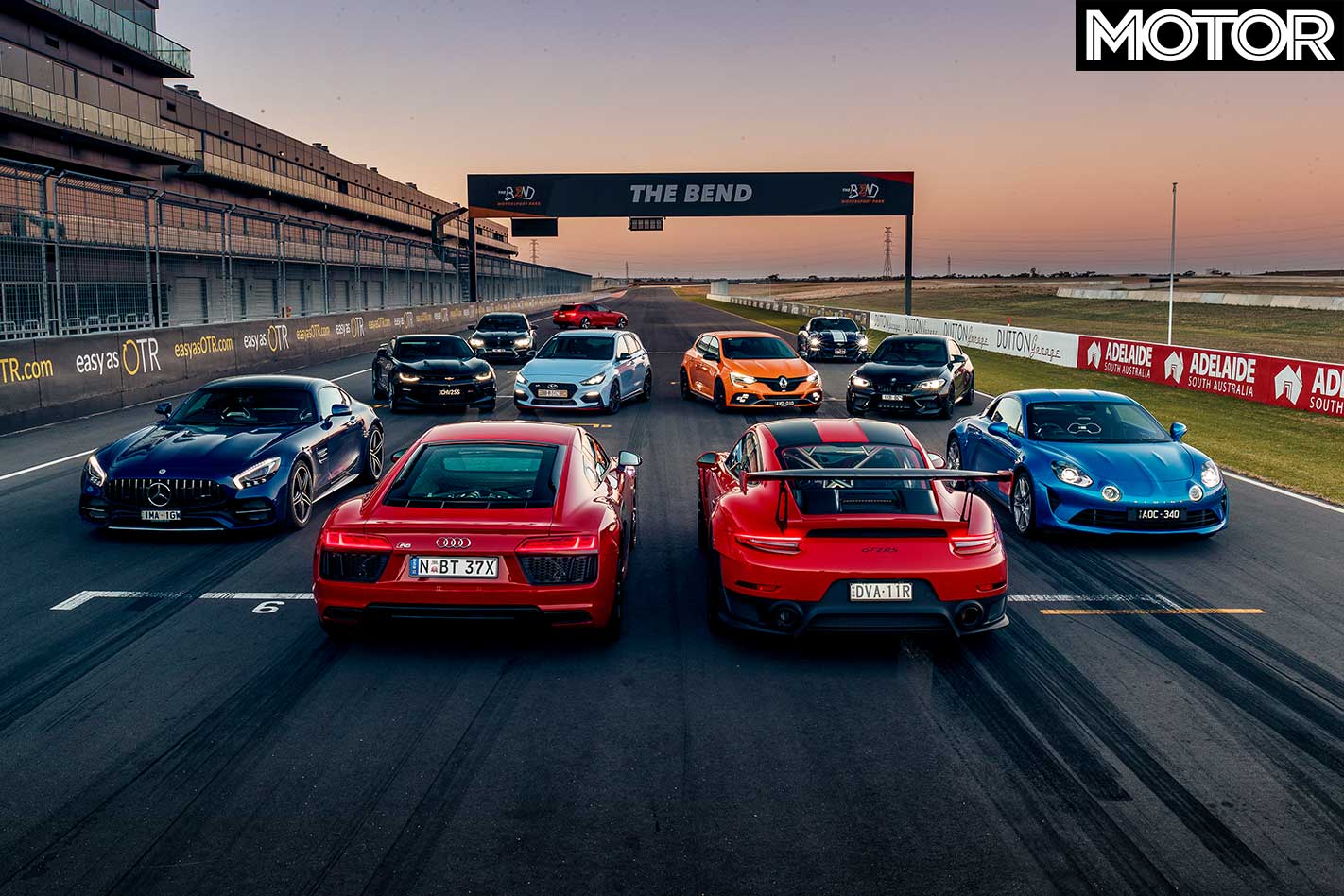
Having spent our childhoods rubbing rabbits’ feet, avoiding mirrors, black cats and ladders and hoping there’s a car god listening to our prayers, now in adulthood we have the very privileged task of testing hundreds of new performance models every year.
We know which cars are good – and which are mutton dressed as lamb. Coalescing in the MOTOR hivemind over 12 months, The PCOTY Shortlist forms throughout the year, approximately 20 of the fastest, finest, hottest and most cutting-edge new machines you can park in your driveway.
Then, we whittle it some more, and then some whittling happens whether we like it or not – Ferrari 812 Superfast? Not available (still licking wounds from a few years ago?) Lamborghini Aventador SVJ, Aston Martin DBS Superleggera, McLaren 600LT and Senna, 992 911? Also not quite here yet, but walk-up starts for PCOTY 2020.
And so we give you our 2019 PCOTY competitors, beginning, we may as well, with the one car that looks like a super-sized red-back spider and copping probably the same amount of up-scaled venom: the Porsche 911 GT2 RS.
Dripping with intimidation, the GT2 RS is a 911 Turbo dipped in a bubbling vat of lunacy in the early stages of production. Power from the 3.8-litre twin-turbo flat-six is upped to an OH&S-incompatible 515kW. And then, in possibly the greatest test for Porsche’s traction control and ESP engineers, the front driveshafts are removed to create a rear-drive only car.
Unlike GT2s past, this RS is seven-speed PDK only – no manual. Which is probably for the best, as with a claimed 0-100km/h time of 2.8 seconds – and a claimed 0-200km/h of 8.3 seconds, only 0.5sec off a 918 Spyder – the GT2 RS keeps you busy enough.
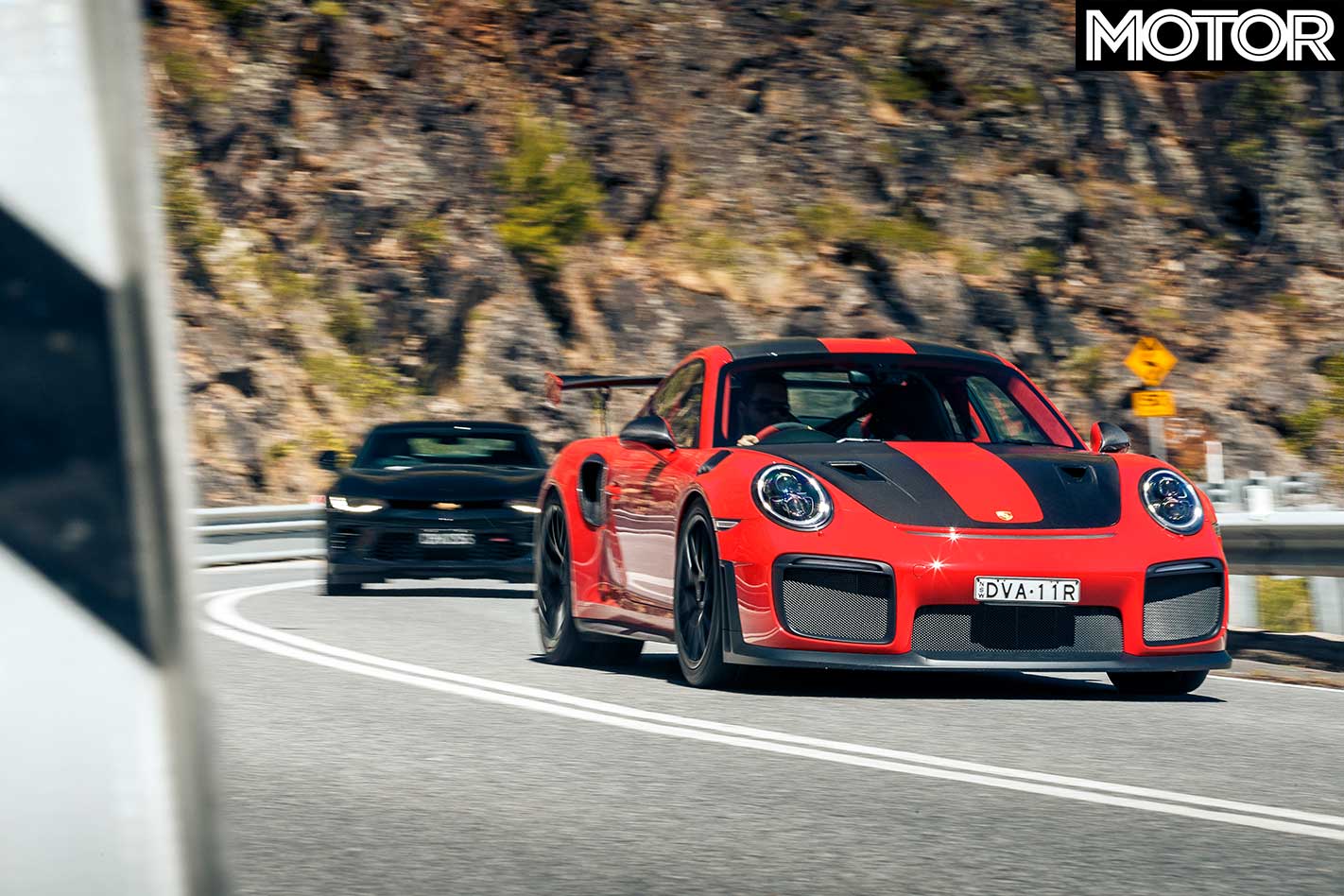
Beast? Yes. Expensive? $729,930 as-tested, a $41K chunk of that the lighter weight Weissach Pack. With a GT3 RS and Touring potentially also available, we invited the GT2 RS as the ultimate of all three released in the last 12 months. But can its epic performance overcome its epic price?
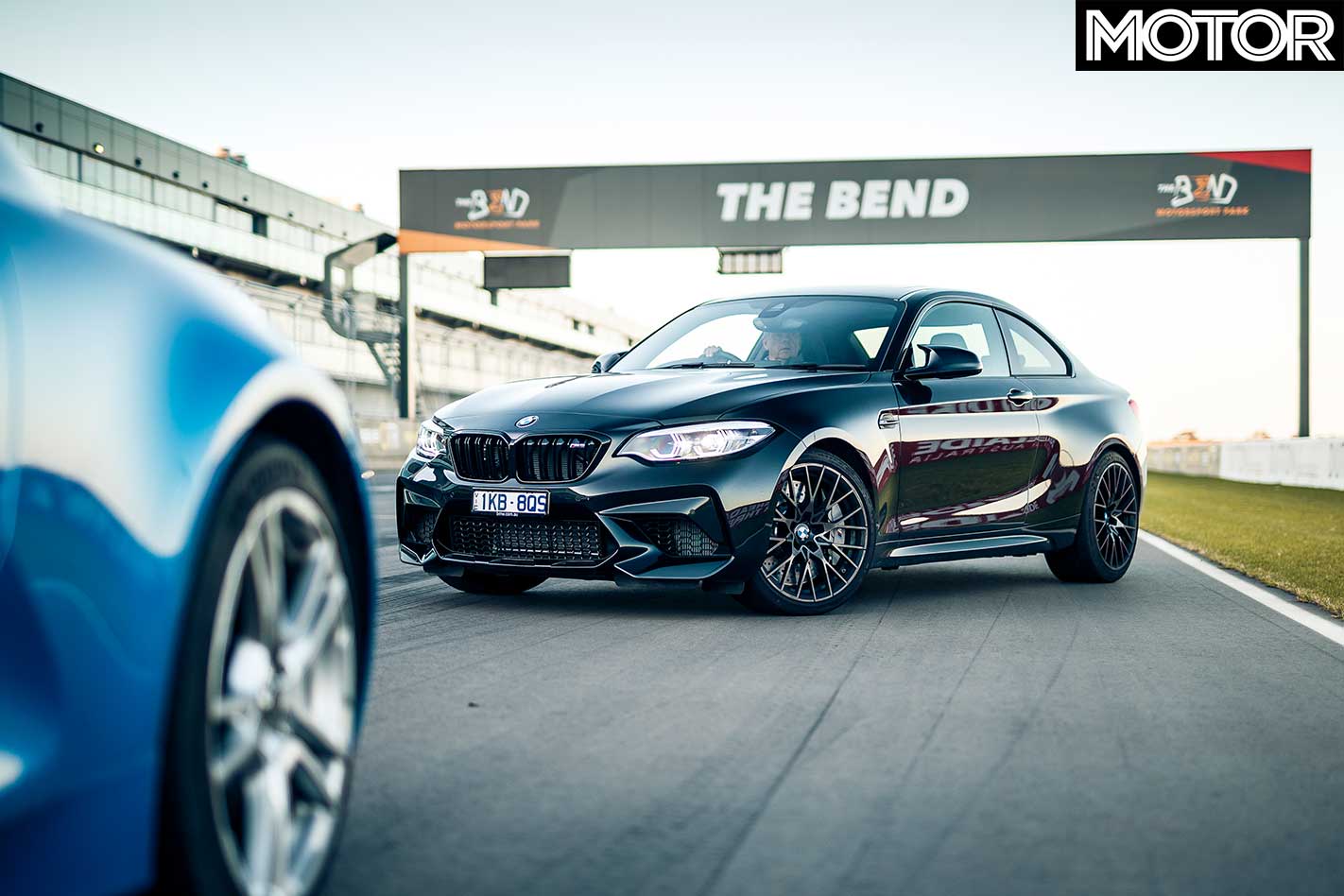
Attempting to prise PCOTY victory from the pincers of the red Nürburgring king, BMW has stumped up two Bavarian bruisers in the M5 and M2 Competitions. The former has had its 4.4-litre twin-turbo V8 wound to an eye-watering 460kW/750Nm – but has all-wheel drive turned the legendary M sedan into something a bit limp? We doubt it, but we’ll find out in what will be the F90 M5’s first PCOTY appearance.
Nobody can expect anything other than tyre-frying rear-drive excitement from the M2 Competition under whose bonnet now nestles the M4’s S55 twin-turbo straight-six – literally nestling in a hoop of structural carbon-fibre. Both these BMWs, thanks in part to things like solid suspension mounts, promise next-level driver connection and track stamina.
Also hailing from the Fatherland is the Mercedes-AMG GT C. With hardware from the big daddy GT R, the potent 410kW twin-turbo V8 GT C hopes to redeem the AMG GT’s somewhat disappointing third place finish at its first PCOTY in 2016. Hell, if this was a competition for hottest-looking car, the brooding, all-hips GT C would be a walk-up start.
Doing away with turbochargers or any kind of forced induction for their V8s, there’s the Ford Mustang GT and Chevrolet Camaro 2SS. Technically rivals, a $10K price gap separates these two American muscle cars. The Mustang is fresh from a facelift, the big news a 10-speed auto with close-packed ratios, but also Ford’s new nag is a bit faster, louder, and generally fitter.
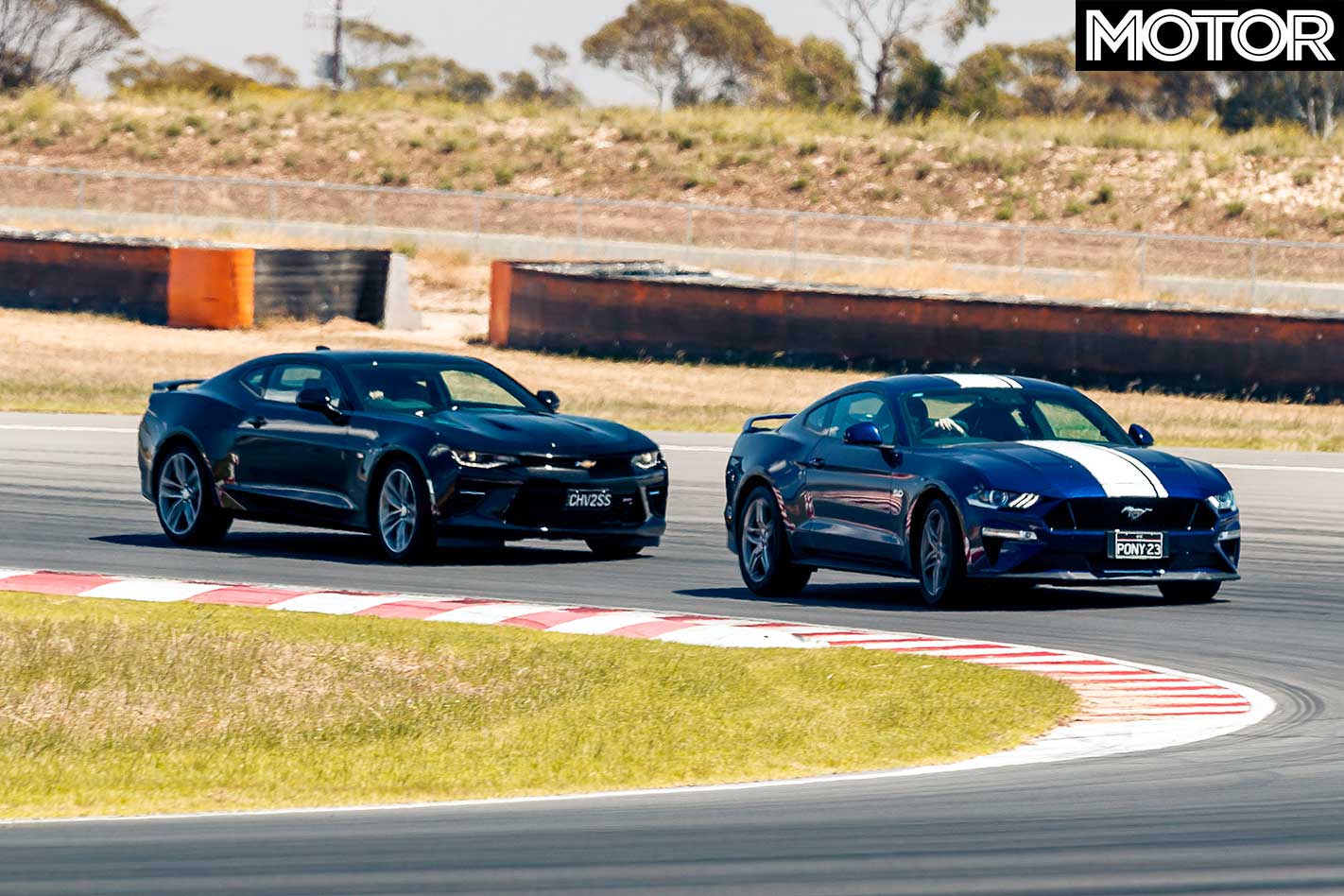
The Camaro boasts a cubic advantage over the 5.0-litre Mustang, and a sinister V8 noise. Holden Special Vehicles converts the Camaro to right-hand drive – so what will this brand new era of V8 rear-drive performance yield at PCOTY 2019? At the very least, it needs to beat Mustang.
Rivalries simmer in the hot hatch ranks. Last year, the Honda Civic Type R took a shock win at Performance Car of the Year, proving you don’t need supercar performance to wow our judges. How did it win? It had as much talent as the best supercars. And so the i30 N, Hyundai’s first crack at a hot hatch, arrives at PCOTY with high hopes – and it should, as it’s fantastic.
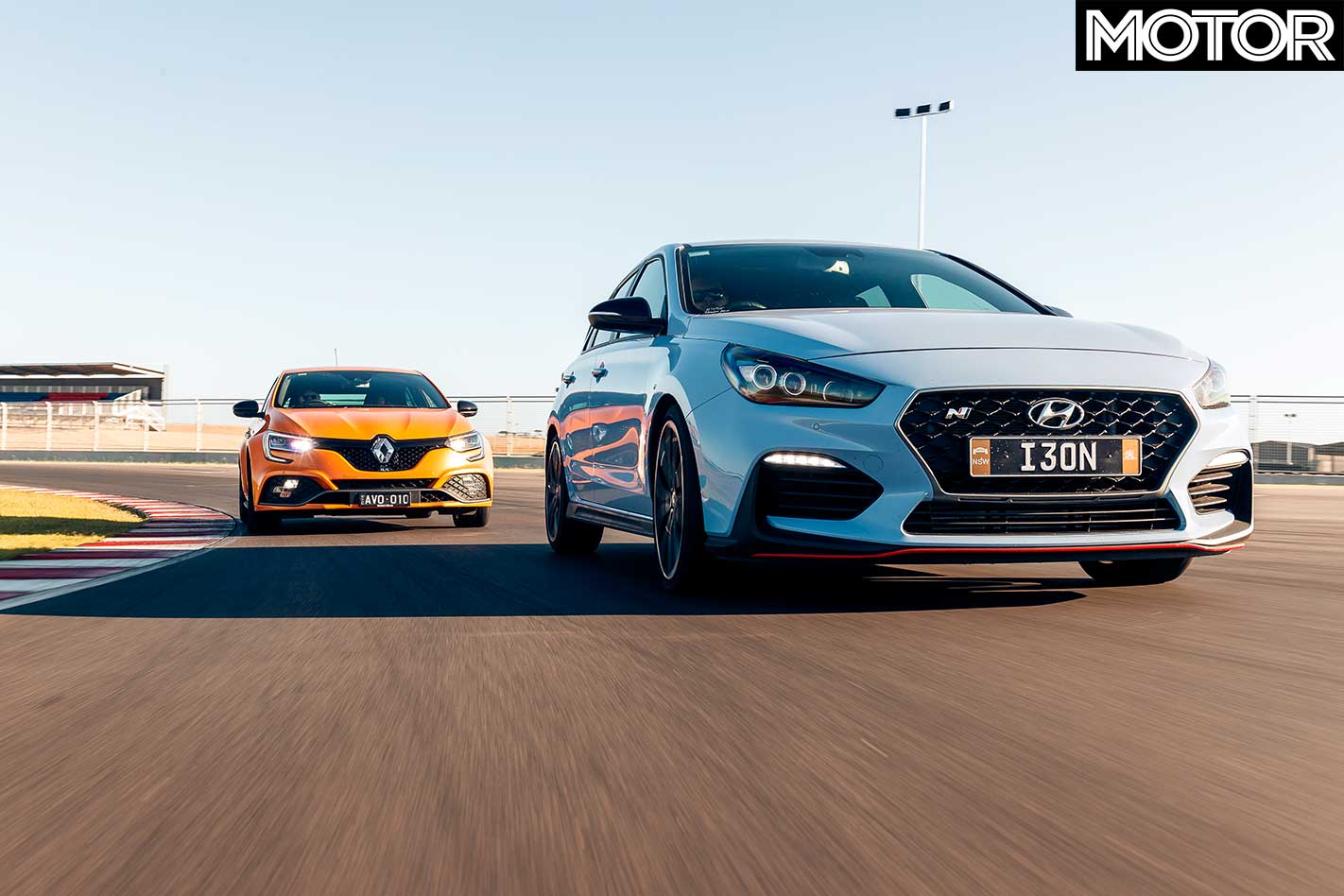
Renault Sport also fronts with its new Megane RS280, and presumably similarly high hopes, however, while Renault has a history of stellar hot hatches, we will have to see how the latest front-drive Frenchie fares as it’s not exactly proven popular with road testers thus far.
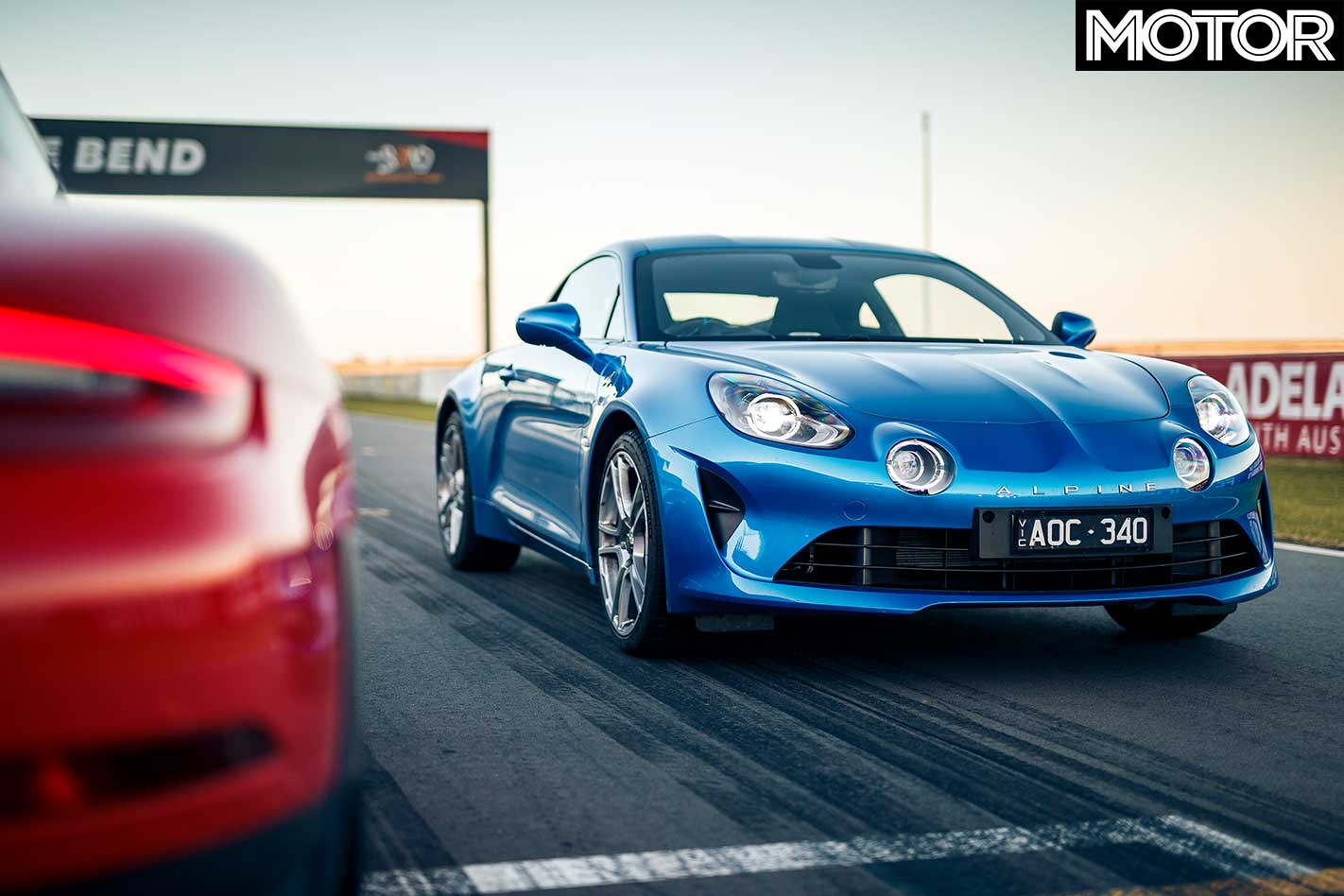
A car that has, however, is also French – the Alpine A110. It has the same engine as the RS280, but in the back, and driving the rear wheels. An aluminium-rich chassis cuts weight to just 1103kg. Could the early hype translate into a PCOTY victory?
Audi’s screaming atmo V10 R8 ‘Rear Wheel Series’ is a dark horse. Having shelved the quattro system for this car – it’s rear drive – and at a relatively sharp $321K as-tested, the R8 RWS is hoping for a repeat of R8 PCOTY victories in 2009 and 2013.
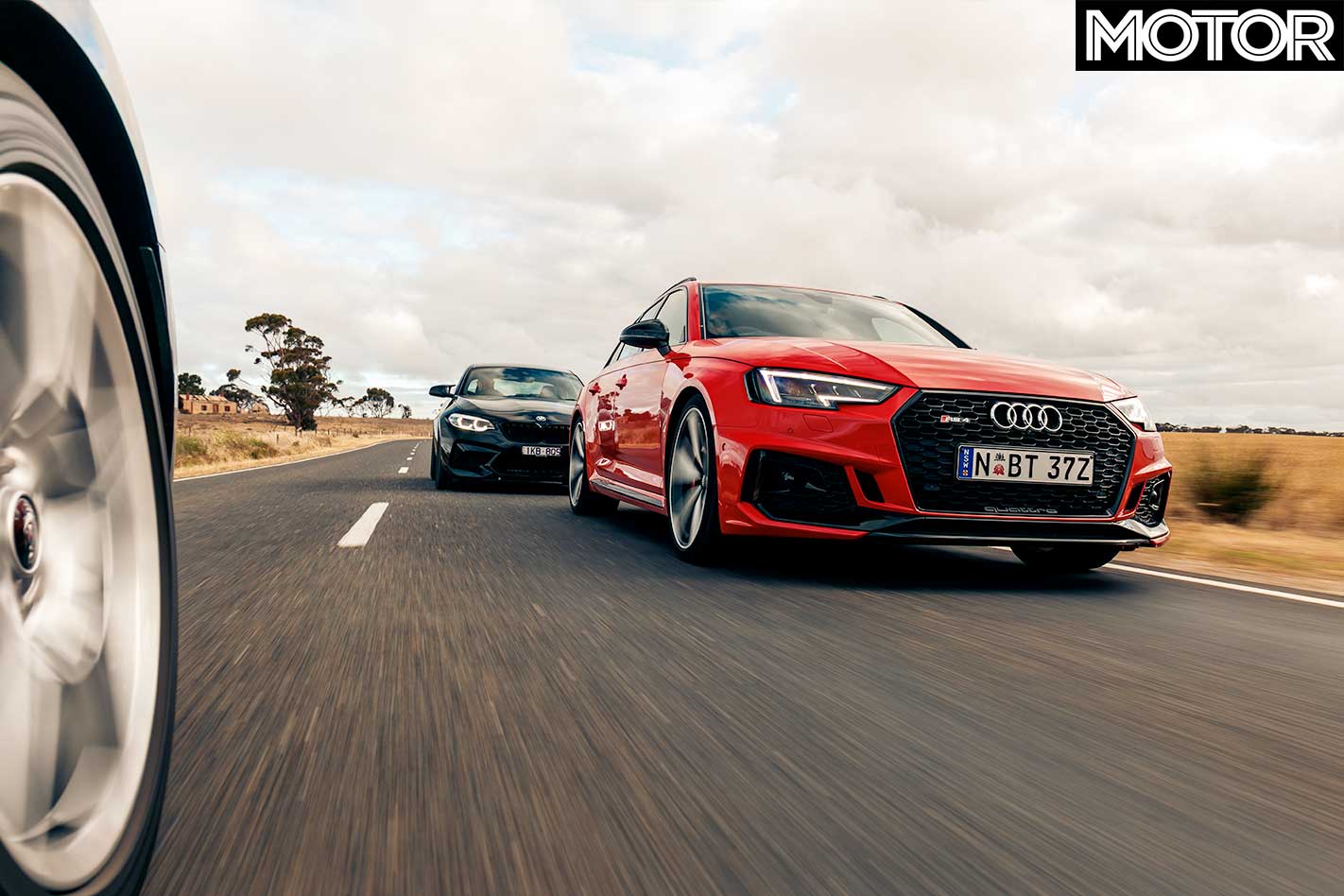
The RS4 Avant is another contender from the Ingolstadt stable. Diehard fans may rue the atmo V8 being replaced with a twin-turbo V6, but trust us, the torque-rich six-potter has taken the RS4 to a new level of acceleration and overall ability.
As ever, this is not a comparison test; we are not directly comparing a $45K Hyundai to an Audi R8. By way of the judging criteria above, each car is measured against its intended purpose and how close the manufacturer got. To simplify further, a lot of it is just how good the car is – according to our very experienced judging panel and their highly calibrated bum-o-meters. (That’s a technical term.)
Speaking of which, it’s time to put those into action, grab the keys, brim the tanks and head for the hills – the Adelaide ones.
The Competitors
Alpine A110
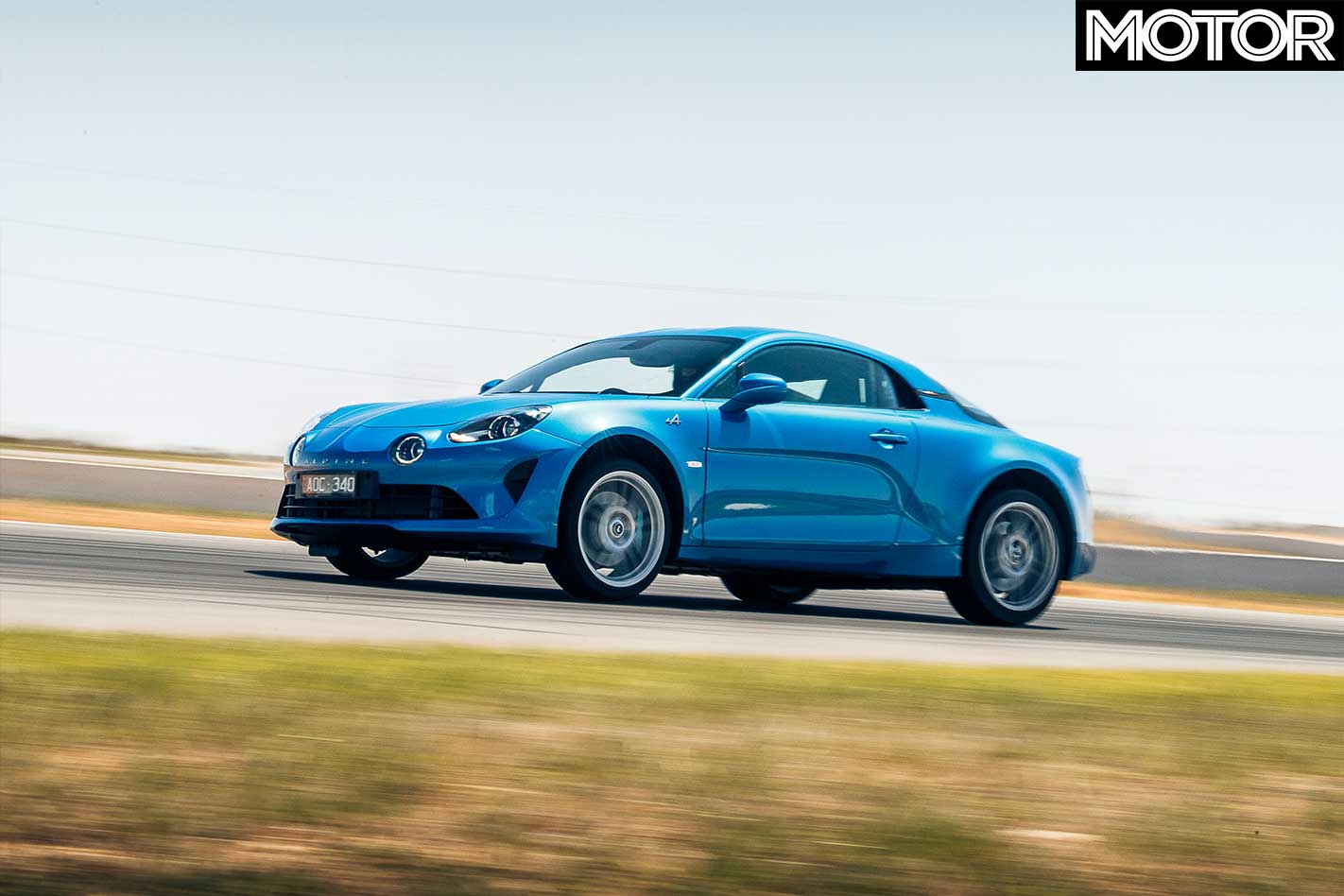
Turbo I4, mid engine, RWD, 185kW/320Nm, 1103kg, $106,500 It’s French, mid-engine, quite bloody fast and promises a classic lightweight driving experience. Dark horse
BMW M2 Competition
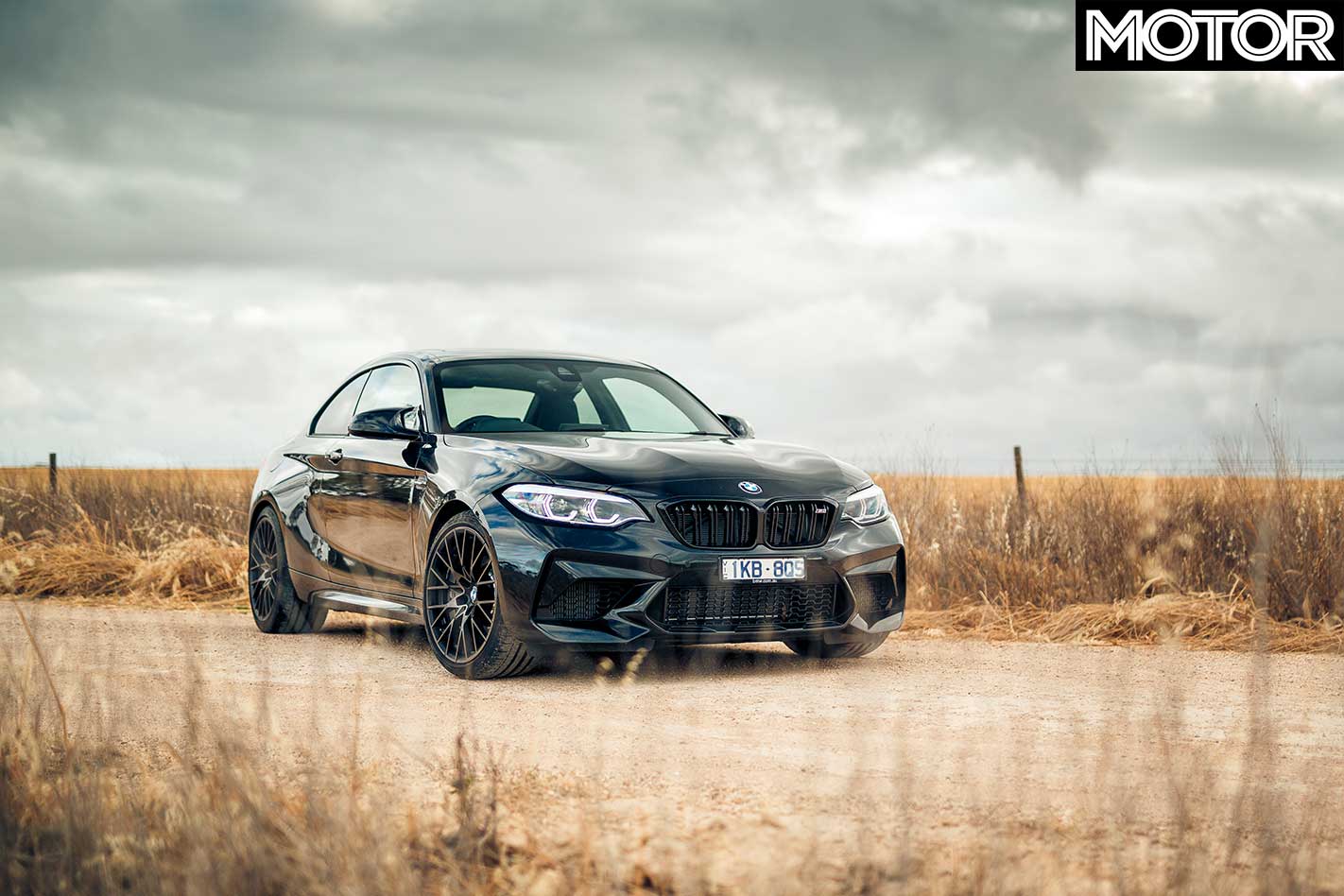
Twin-turbo I6, RWD, 302kW/550Nm, 1575kg, $107,900 Baby M-car scores the M4’s engine and lots of tasty M bits… but don’t call it a parts-bin special. Brings back old 1M night-sweats
Ford Mustang GT
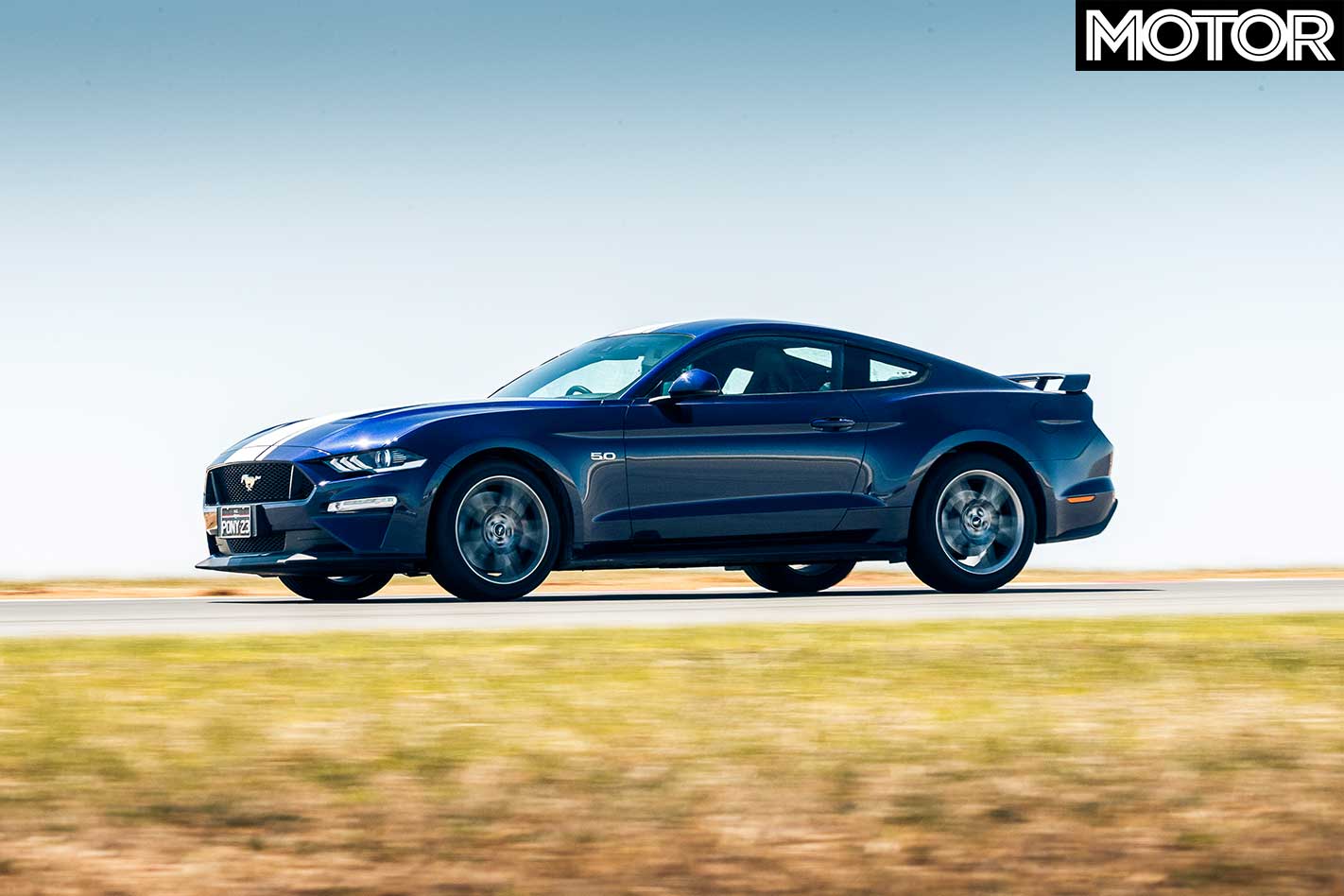
Atmo V8, RWD, 339kW/556Nm, 1742kg, $75,640 Henry’s V8 hay-muncher has had a nip and tuck but is also sharper, faster, louder… and now with a 10-speed auto
Audi R8 RWS
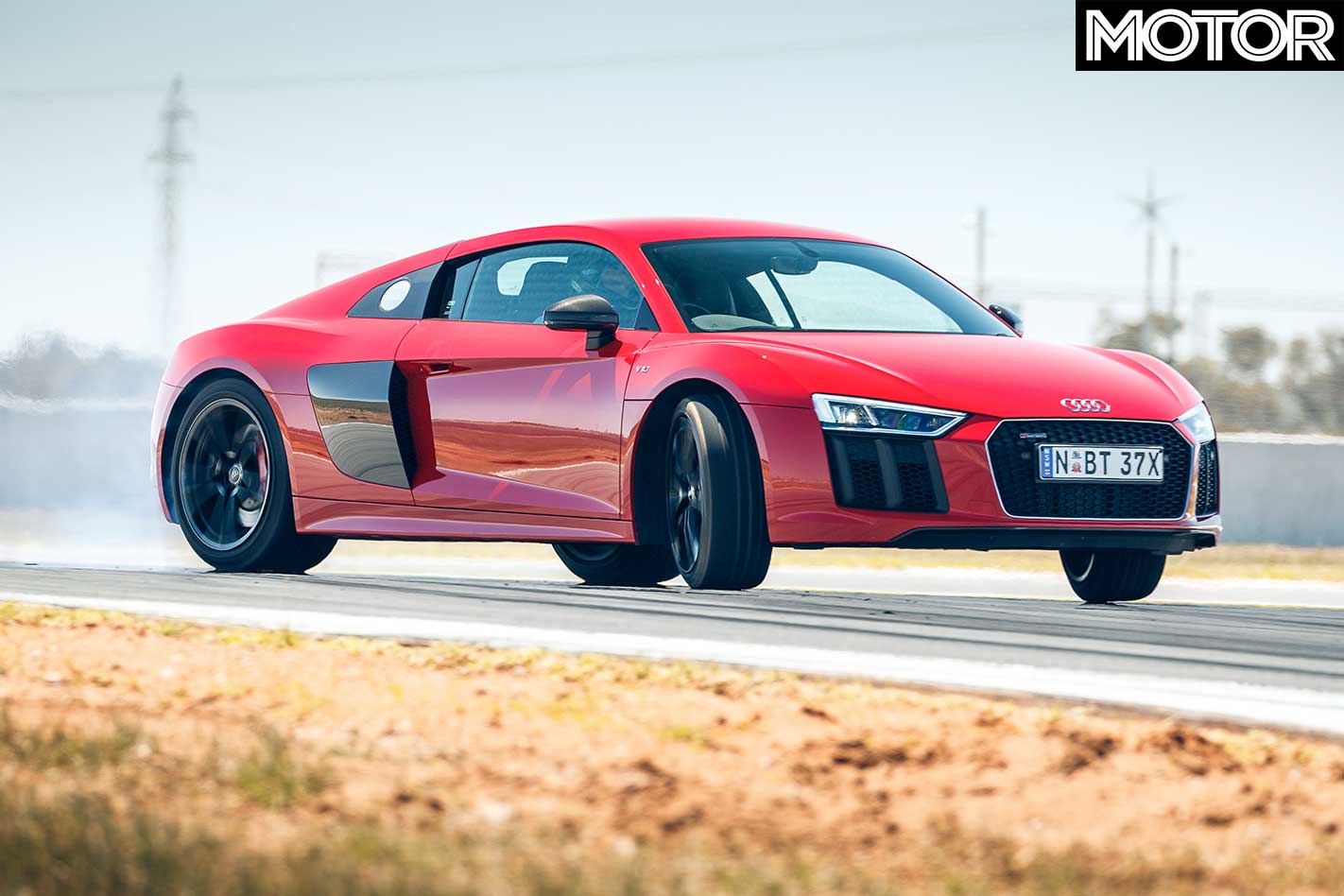
Atmo V10, mid engine, RWD, 397kW/540Nm, 1590kg, $321,100 A rear-drive R8, you say? With an atmo V10 spinning to 8500rpm? Excuse us a moment… the ‘Rear Wheel Series’ is on-paper perfection
BMW M5 Competition
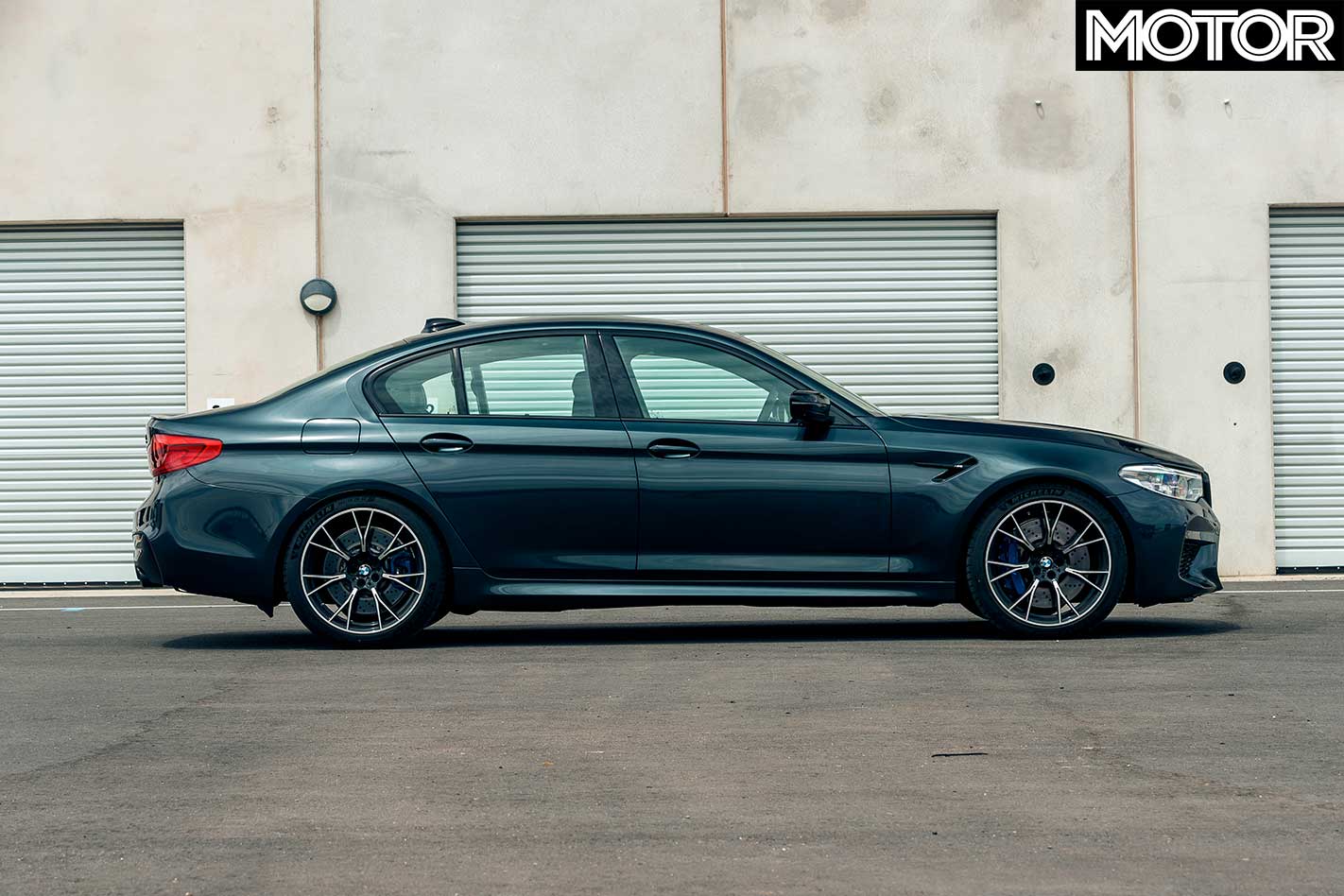
Twin-turbo V8, AWD, 460kW/750Nm, 1865kg, $229,900 Competition treatment promises to turn the big, bad F90 into a proper track monster – if all-wheel drive hasn’t spoiled the M5
Renault Megane RS280
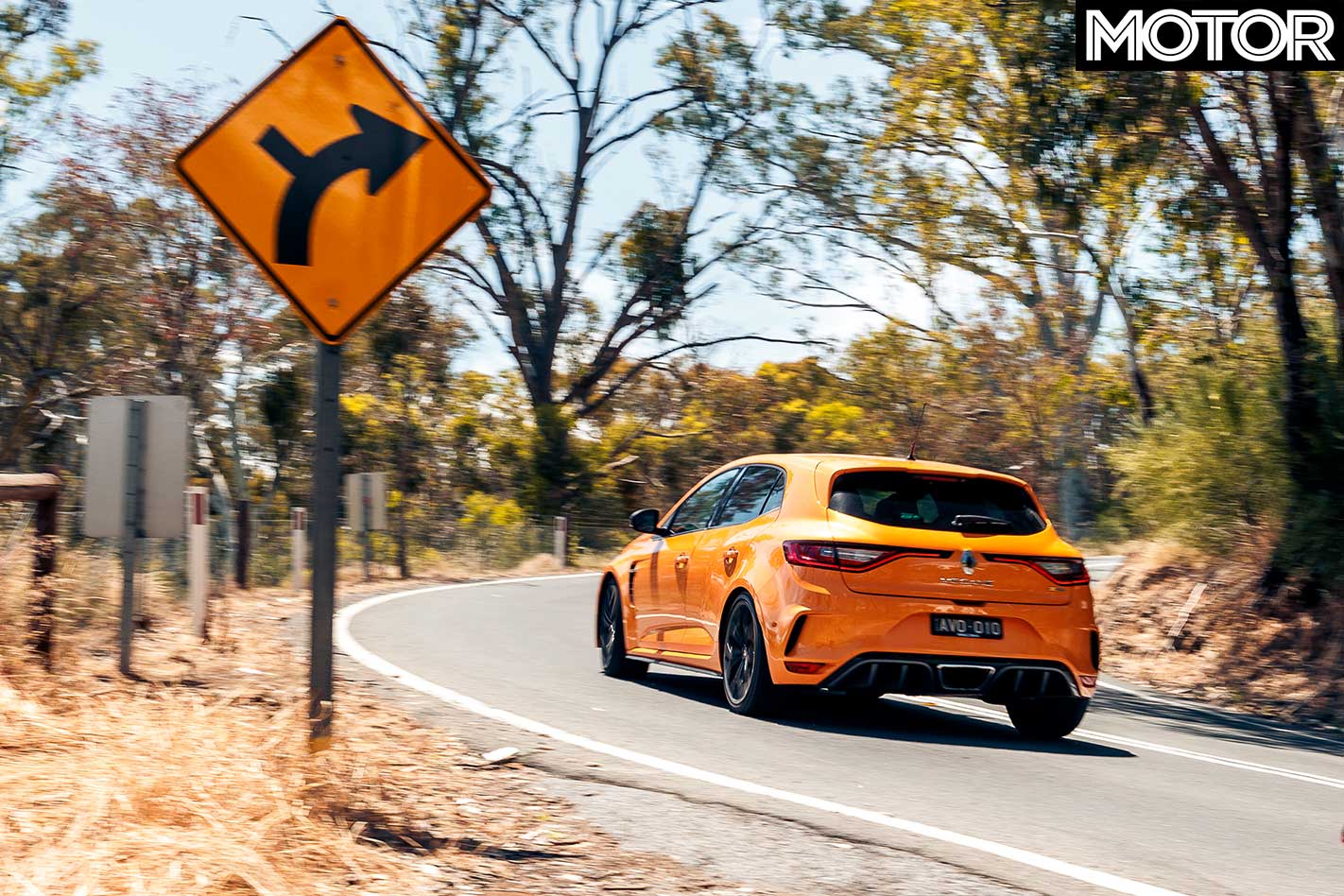
Turbo I4, FWD, 205kW/390Nm, 1407kg, $47,860 Renault Sport are the hot-hatch masters. So can their new Megane RS keep a hot hatch on the PCOTY trophy for another year?
Porsche 911 GT2 RS
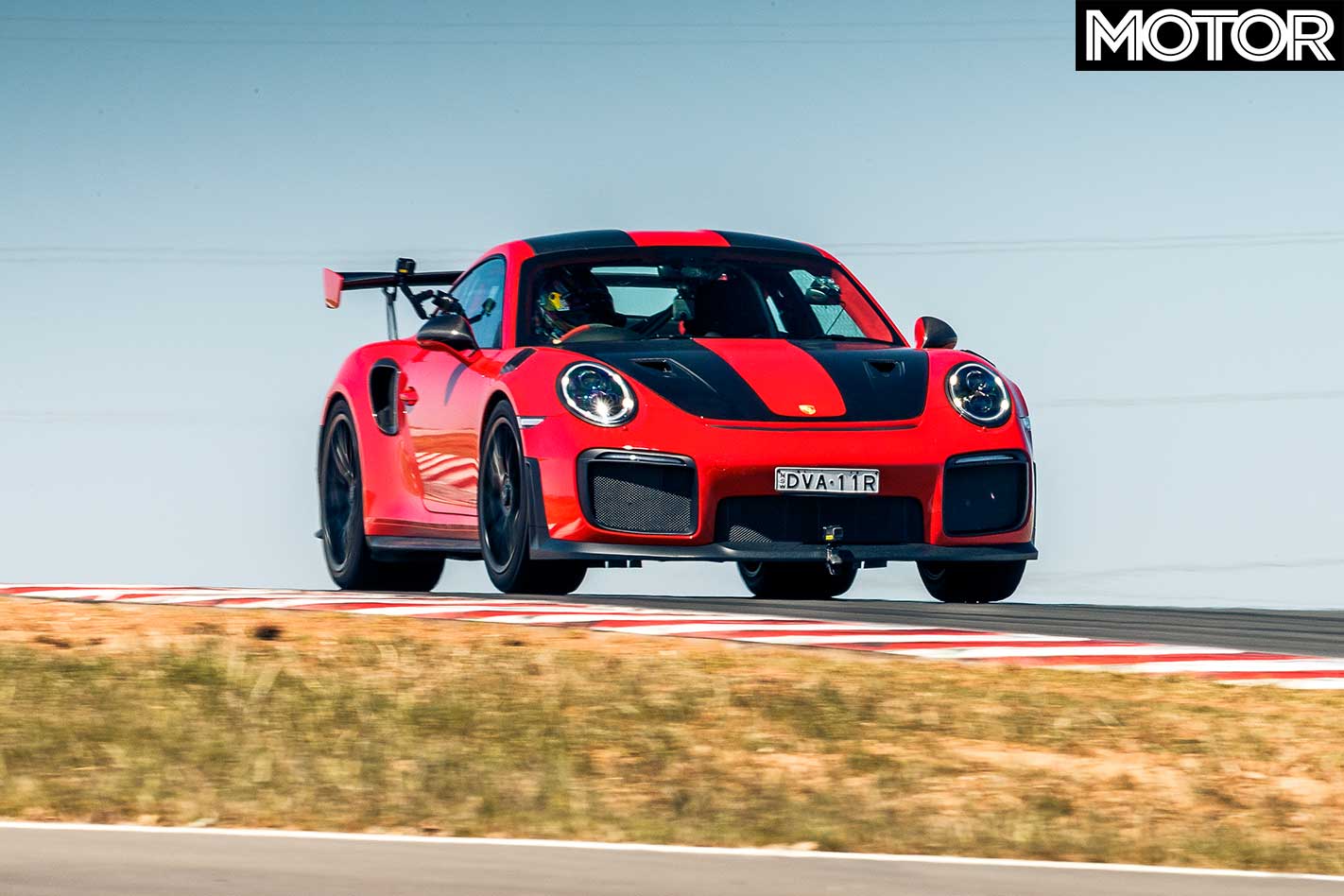
Twin-turbo flat-6, rear-engine, RWD, 515kW/750Nm, 1470kg, $729,930 Gunning for its 14th PCOTY win, Porsche fronts with its most powerful, expensive 911 ever. Gulp
Chevrolet Camaro 2SS
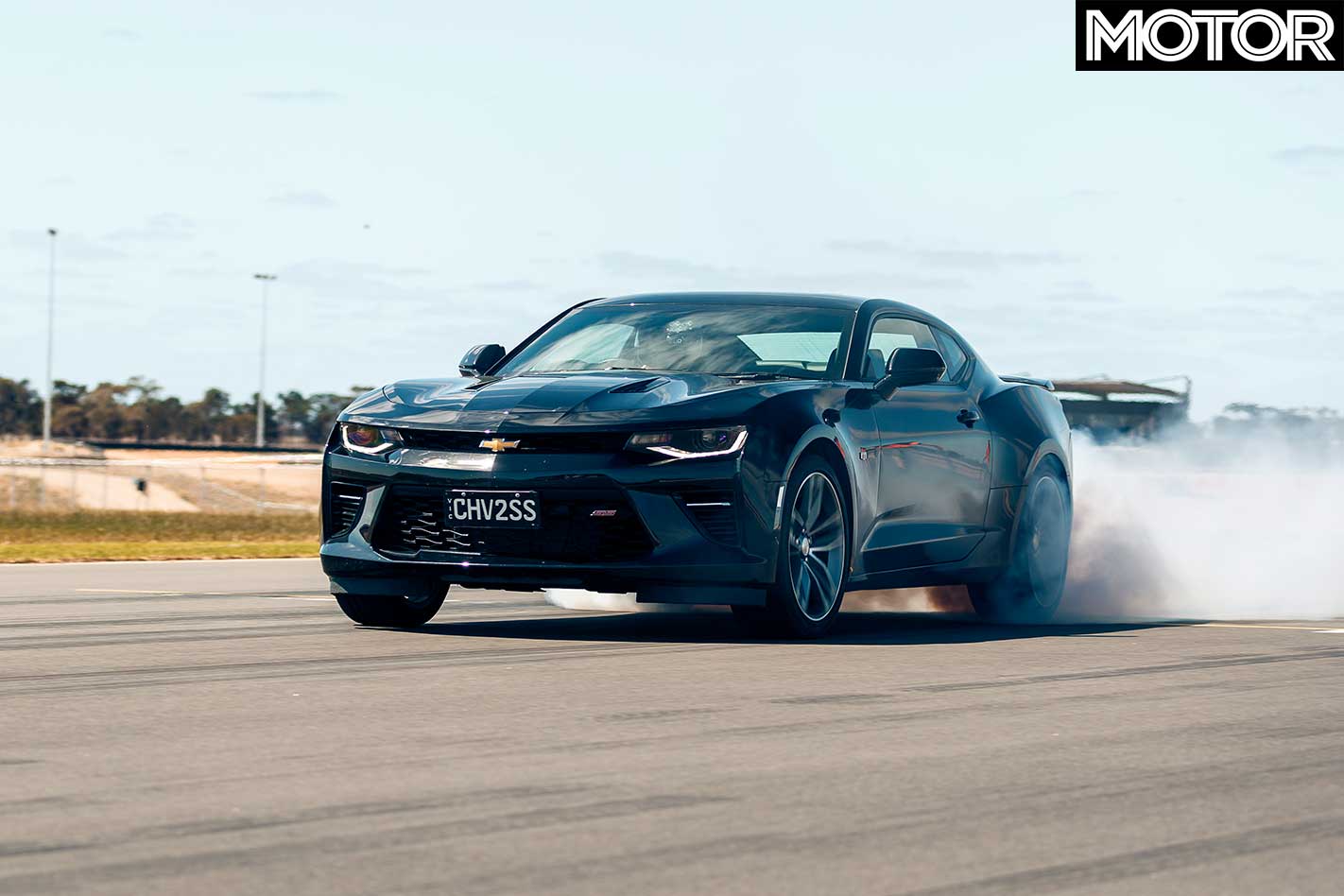
Atmo V8, RWD, 339kW/617Nm, 1710kg, $85,990 HSV-converted Chevy has 1.2 litres more V8 than the Mustang – but it’ll need a few other tricks to justify the extra coin
Hyundai i30 N
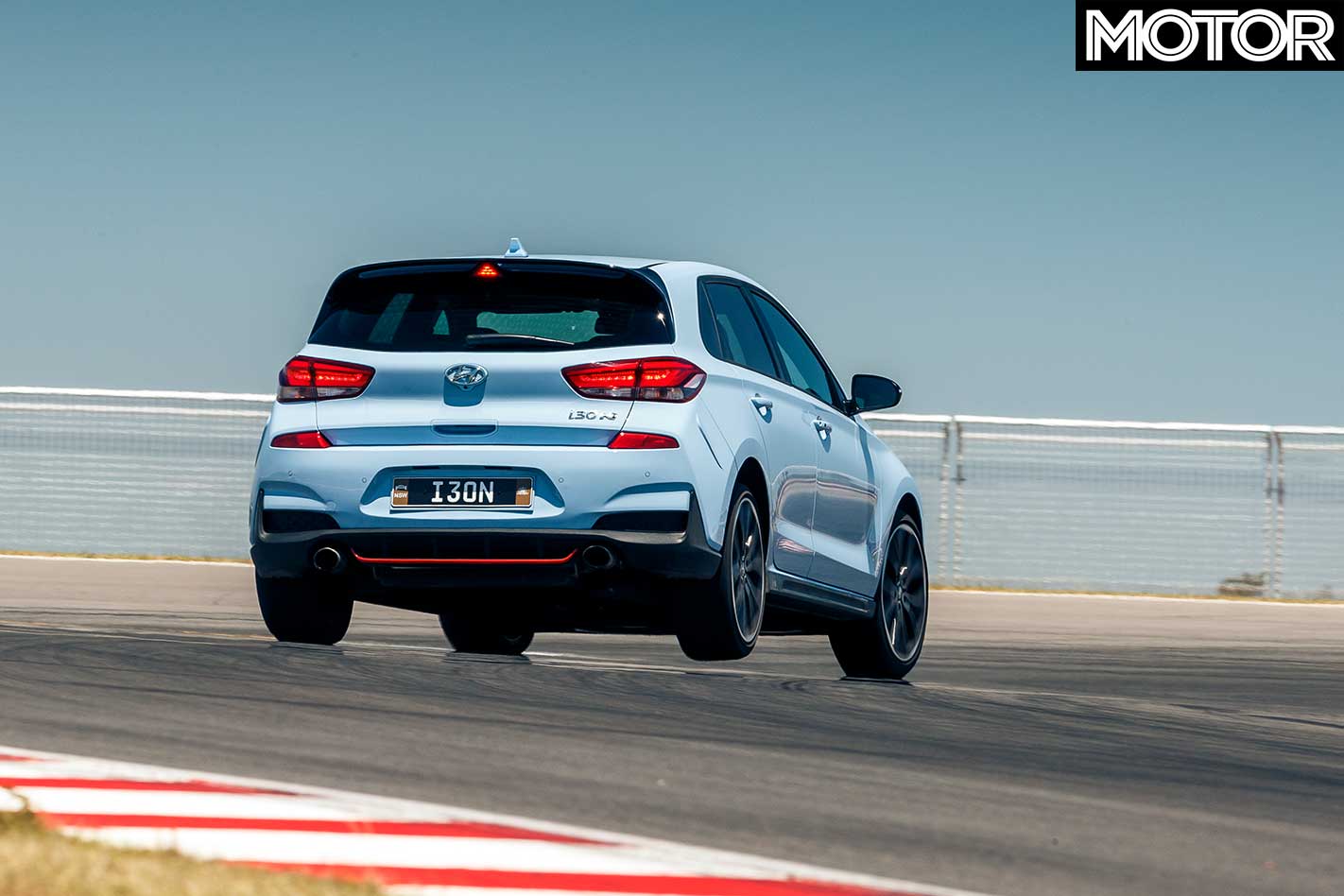
Turbo I4, FWD, 202kW/353Nm, 1429kg, $43,485 It cracks, it pops, it dances – Hyundai has nailed its first ever hot hatch in the i30 N, and enters its first ever PCOTY!
Mercedes-AMG GT C
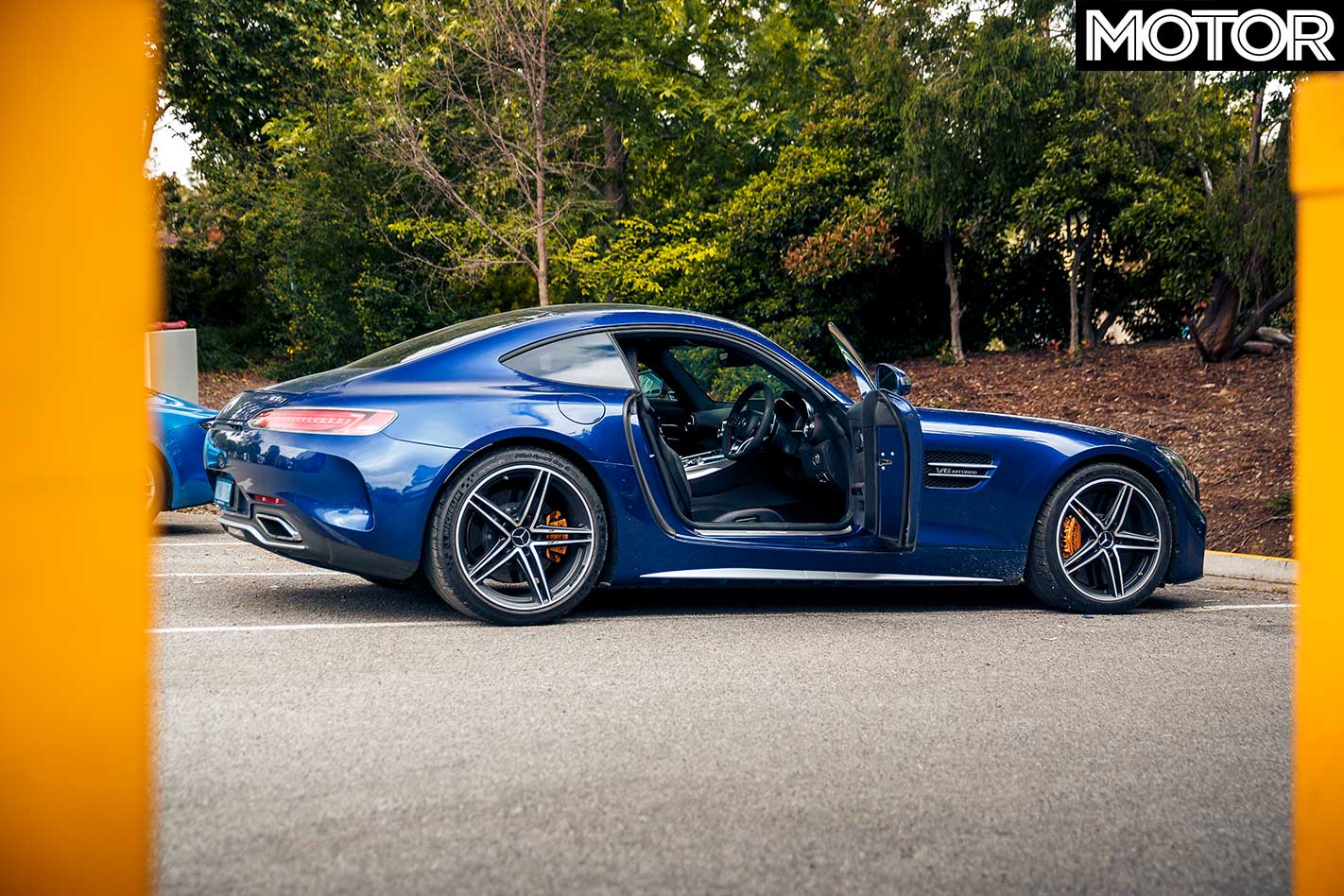
Twin-turbo V8, RWD, 410kW/680Nm, 1625kg, $345,829 AMG’s drop-dead gorgeous V8 supercar finished a lowly 3rd at PCOTY a few years ago. Can it redeem in potent GT C guise?
Audi RS4 Avant
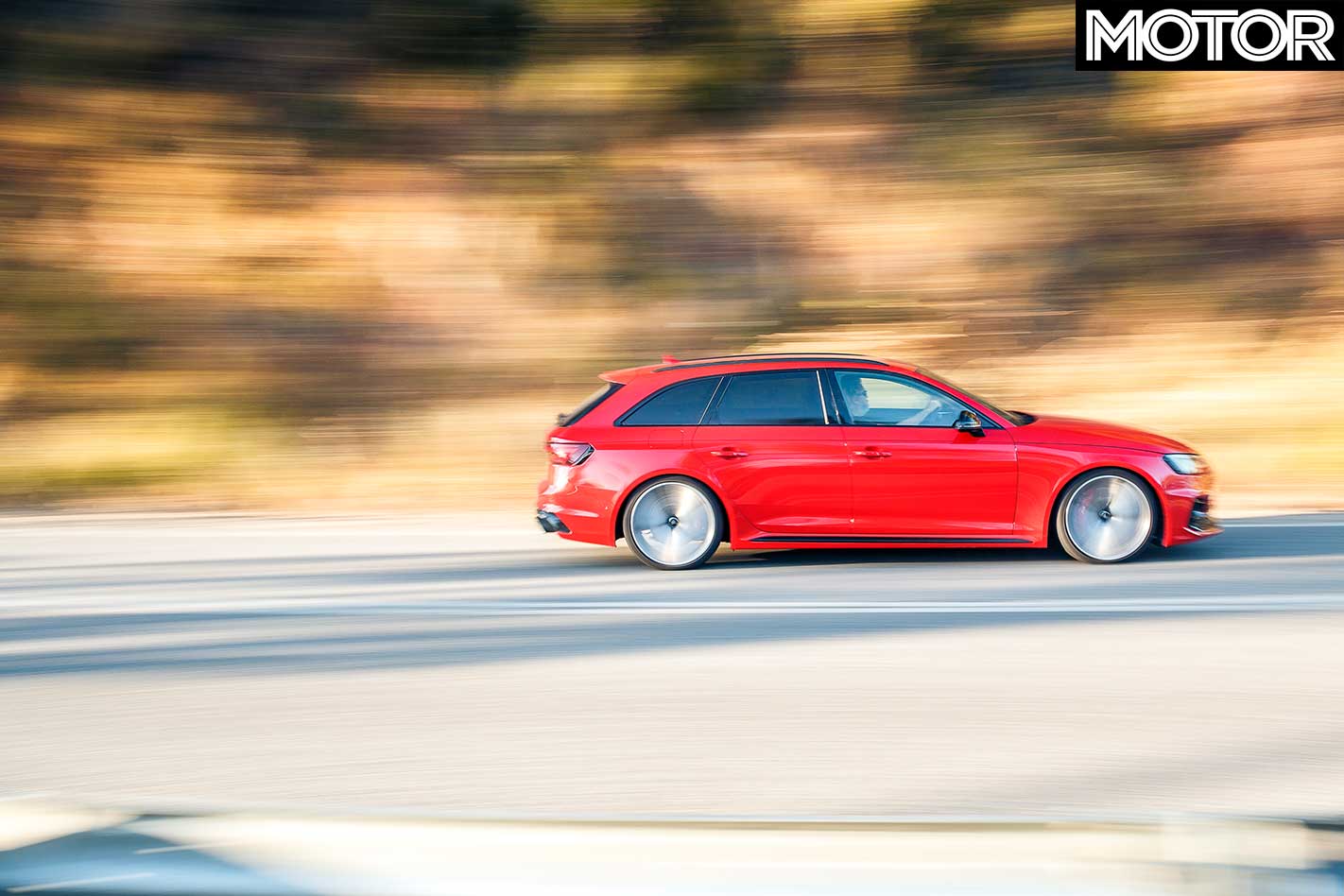
Twin-turbo V6, AWD, 331kW/600Nm, 1715kg, $165,546 The V8 is dead. Long live the V8… but Audi’s supercar-startling war wagon now has a V6 with a twin-turbo tidal wave of torque
The Judges
Dylan Campbell
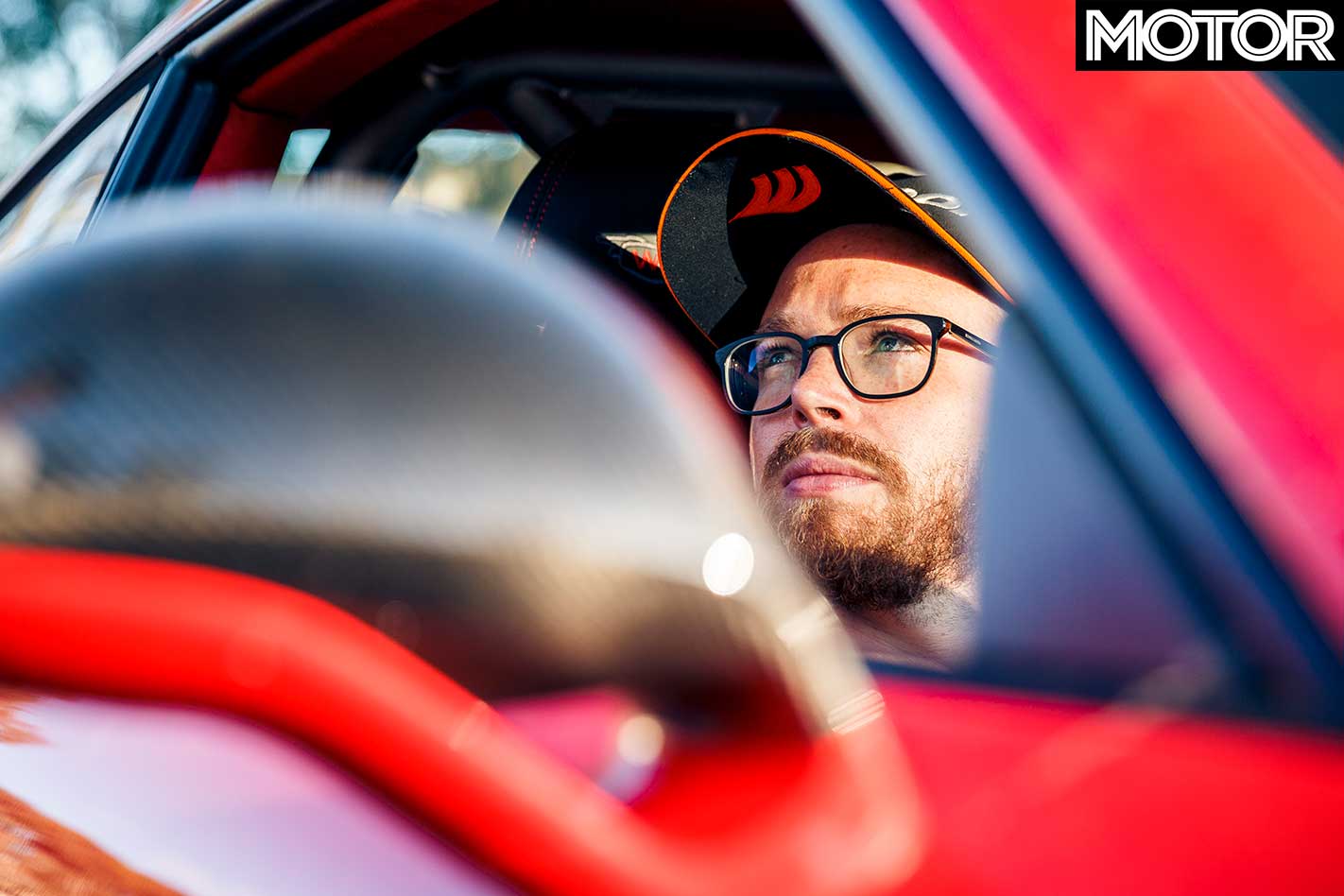
Head honcho, logistical mastermind and creative guru. Fastest driver in all the land. May have threatened the person writing this with a job on DOLLY
Louis Cordony
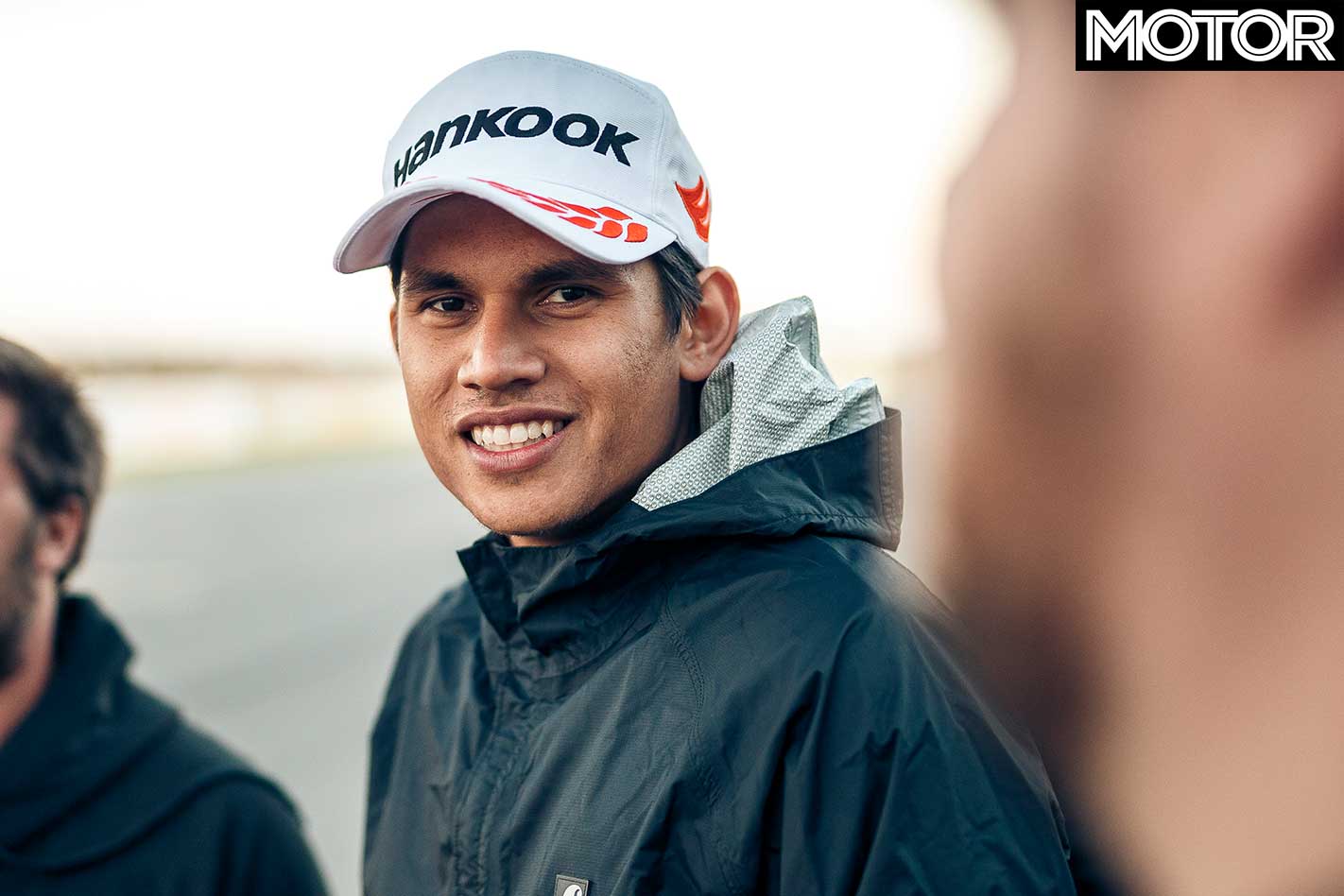
First-time judge, but no road-test newbie. Loves belting around in his Rotax; or his Forester (but is not a lesbian). Has a tapeworm called Gary
David Morley
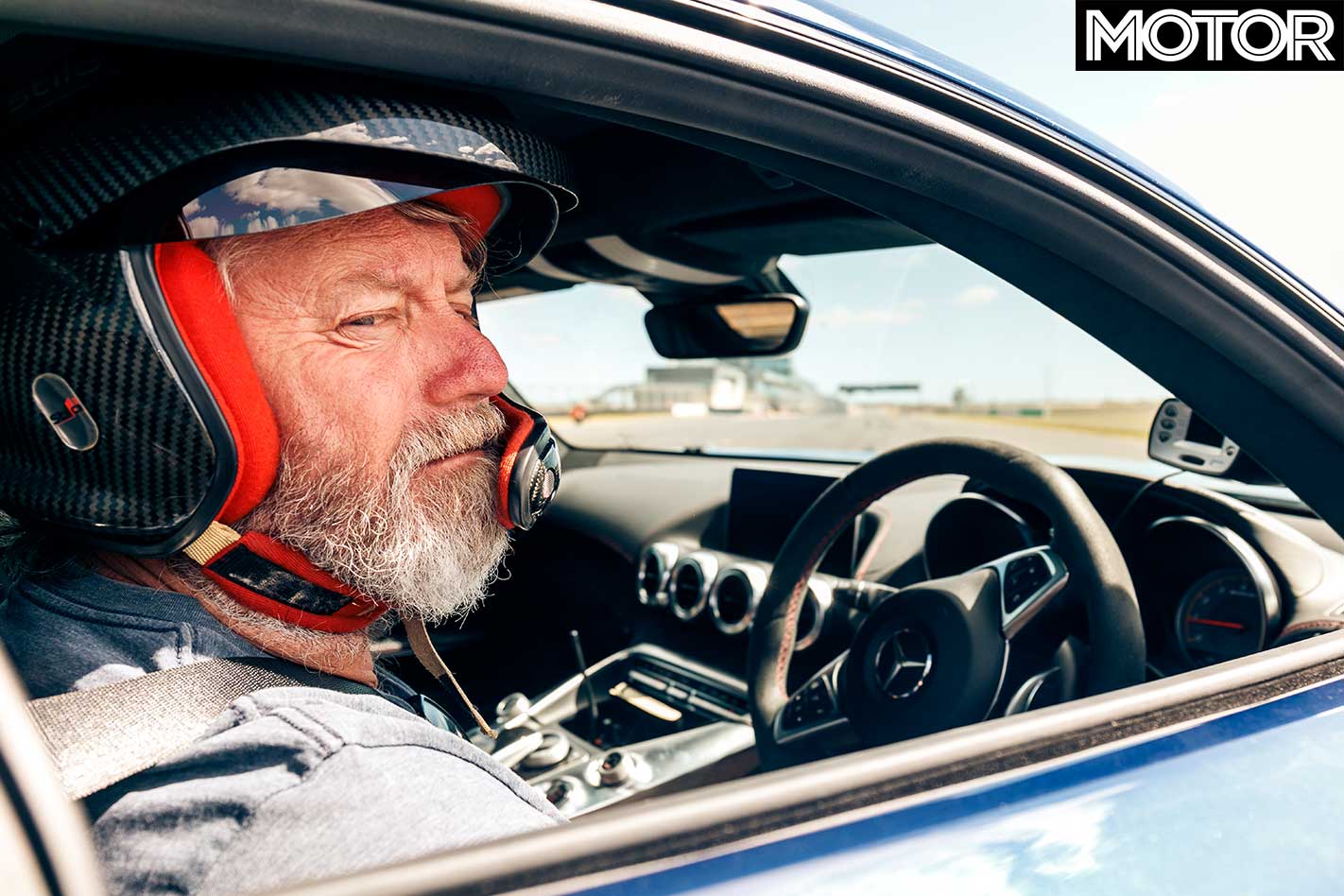
Judged the first PCOTY in 1996. Has forgotten more about cars than the rest of us know. Road-tested the Model T when it was new… probably
Scott Newman
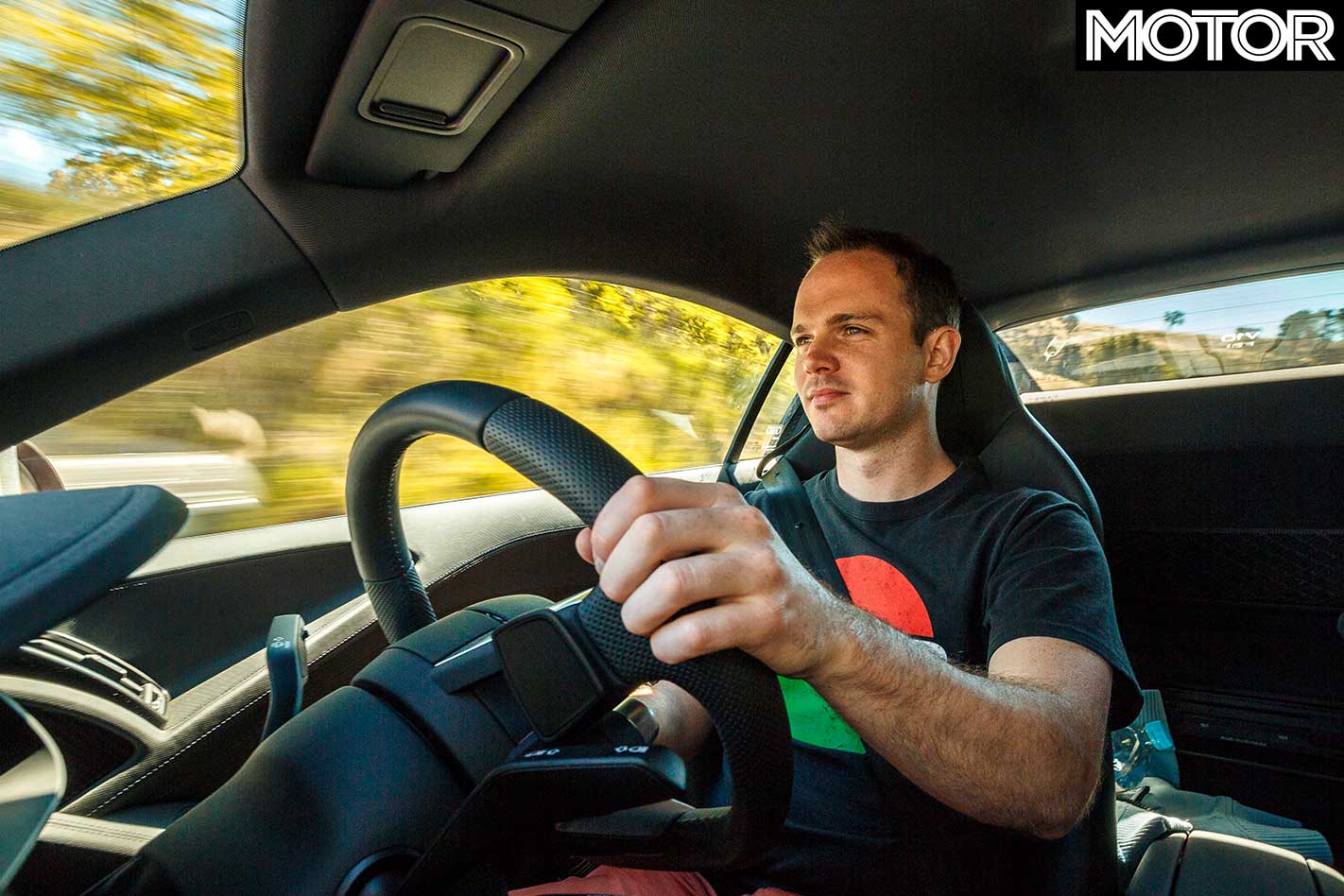
Rally obsessed, allergic to ESP, knows where to put a car in a corner. Feared by tyres. A favourite of photographers when tired
Rick Kelly
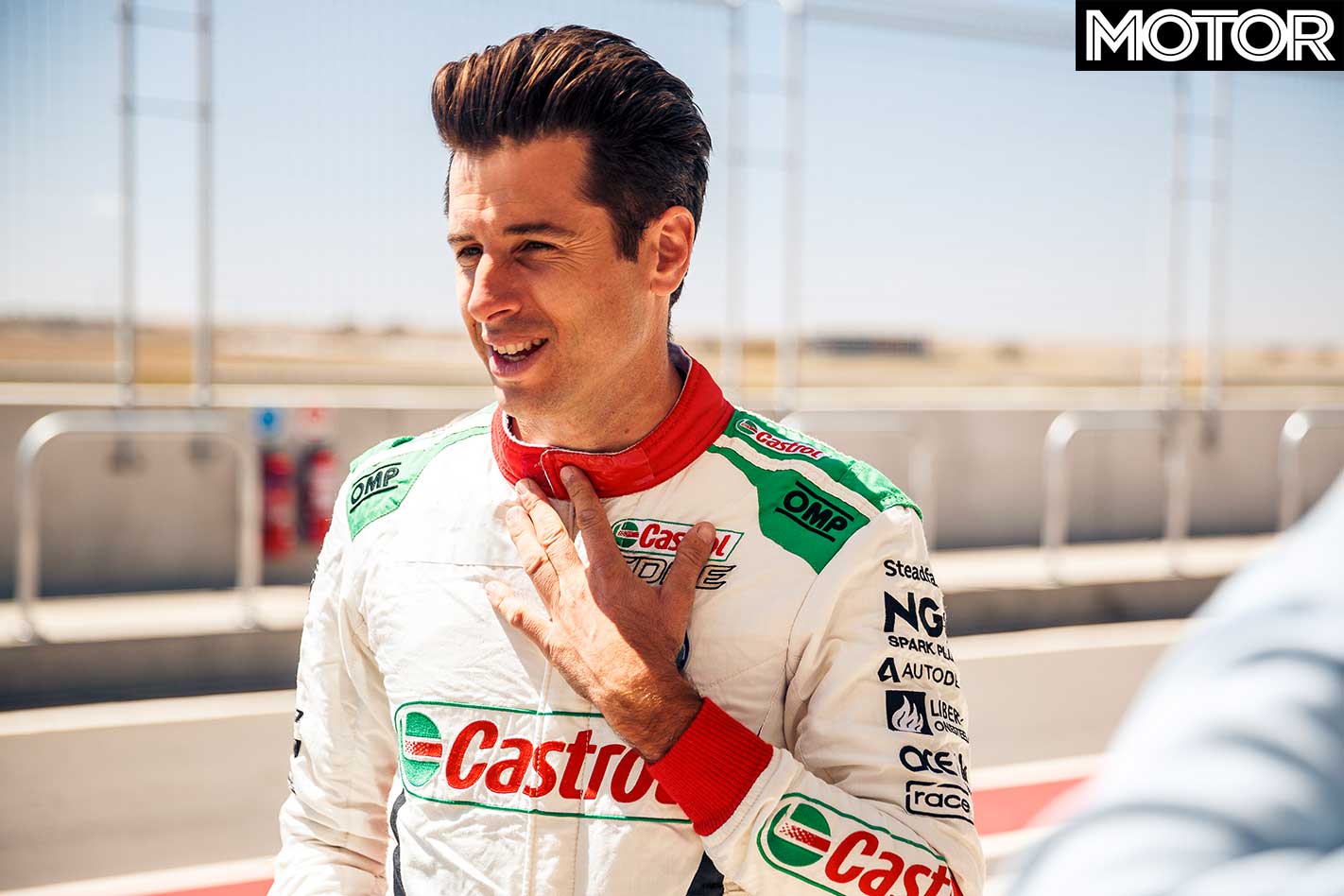
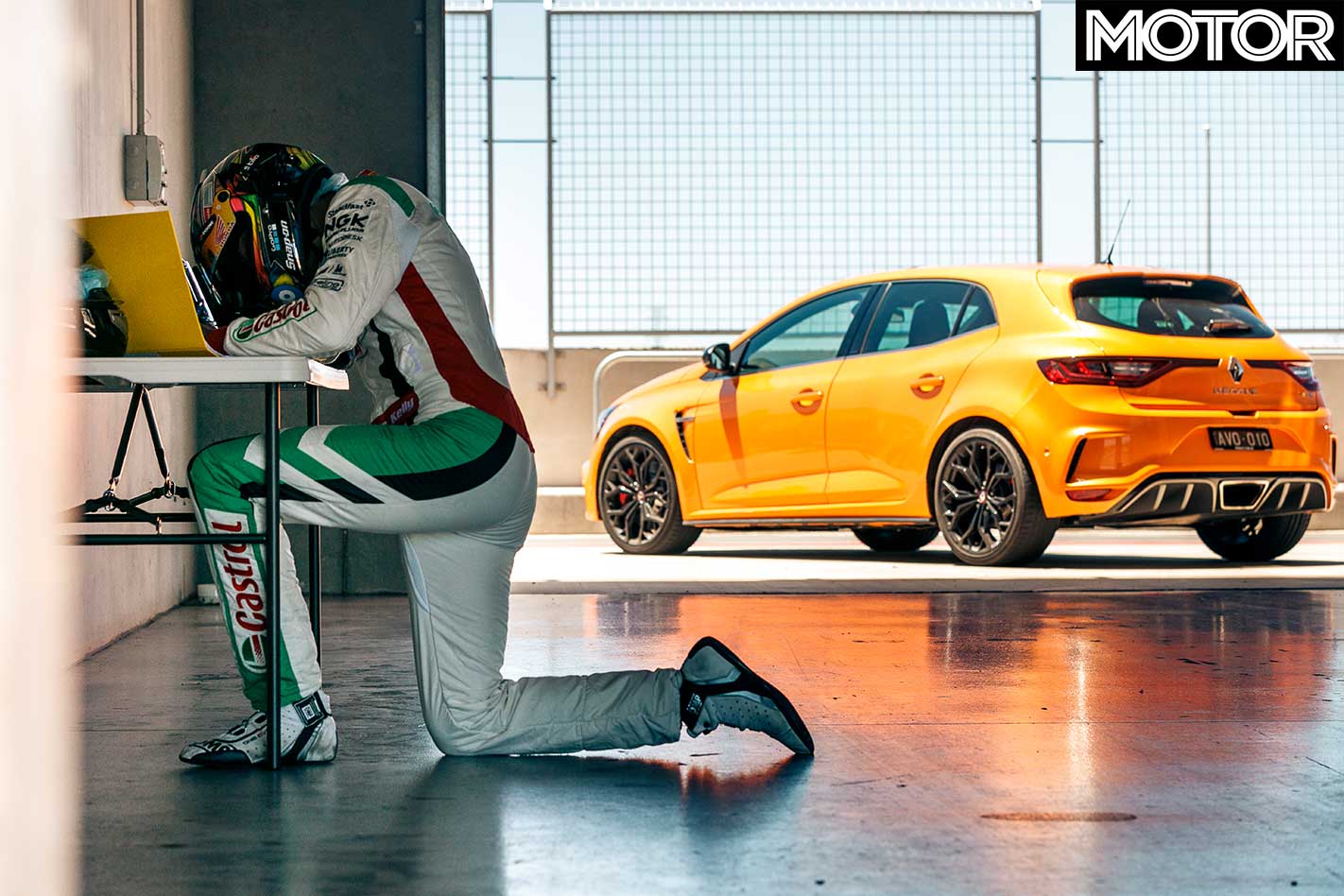
We’re not exactly sure who this is – he kind of just showed up and kept driving things – but we really like his suit. We wish we were sponsored by Minties!
The winning Criteria
01 – Performance Raw speed; powertrain response, feel, and smoothness
02 – Dynamics Grip, chassis balance, steering response, and braking ability
03 – Accessibility Effort versus reward, ESP calibration, feedback levels
04 – Liveability Road noise, ride comfort, ergonomics, visibility, interior
05 – Value Price, cost of options, performance offered
06 – ‘X Factor’ Styling, exhaust note, how badly you want one in your garage
As far as family secrets go, this one is not exactly up there with learning that Jeremy Clarkson is your illegitimate half-brother, or your dad was John DeLorean’s cocaine wholesaler, but I’ll share mine with you anyway: my mother did not teach me to drive.
Whatever; who cares, you scoff. Okay, but the point is, old Peg, now aged 88, still believes she did.
I was reminded of this recently because I’m currently teaching my 16-year-old daughter to drive, and the other day my mother came along with us as my teenage hot-shoe protégé took the wheel for a lunch outing.
“You’re doing so well, sweetie,” mum cooed from the back seat. “And how wonderful your dad is teaching you, just like I taught him…”
A moment of uncomfortable silence followed; one I tried to quickly fill with, “Mumble, yes, those were the days, mumble, look at that tumbleweed, wow, listen to those crickets…”
See, Peg may have overseen my L-plater period, but she sure didn’t teach me to drive. My first driving lessons were far more clandestine, nefarious events that happened nearly two years before she rode shotgun with me, and the only part involving my mother was that it was her car in which they occurred. You and I may term it a series of ‘unauthorised loans’; she would no doubt call it her little ratbag son pinching her beloved Beetle.
The, er, unauthorised loans of her ’66 VW were deeply covert operations that required military-style planning, as well as several key bits of equipment: thick socks, wheel chocks, Space Food sticks (remember those?) and a tin of fuel.
The padded socks were needed when creeping over the creaky floorboards into mum and dad’s bedroom to pluck the keys as they slept; the wheel chocks were essential because of the steep rise of our driveway up onto the street. My folks’ bedroom window was too close to the carport, so firing up the chaffing flat-four was out of the question. Instead, my two buddies and I would combine the collective strength of our barely pubescent bodies and shoulder the thing as far up the drive as we could before exhaustion hit, then the wheel chocks would go in. This operation would continue for 40 minutes or so: push, chock, recuperate with a Space Food stick; repeat, until the old girl finally rolled onto the flat of our cul de sac.
I remember starting to worry that my mate Simon was actually enjoying the theft part of the operation a bit too much when he suggested one night that we use grease paint to black out our faces. This, I told him, was a ridiculous idea, mainly because I was wearing a ski-mask at the time.
I’d loved cars for as long as I could remember, but graduating from polishing them and riding in them to actually driving; it was a leap as profound as the transition from building Lego spaceships to physically strapping into a rocket. Okay, a 22bhp rocket. But you get the point.
That Beetle took us to tennis sheds and secluded bush nooks in neighbouring suburbs on Sydney’s upper north shore where we’d play Kiss and the Clash on my tape player and, as the Beetle pinged in the night air, we’d let our boyhood dreams shoot for the stars. Most-covered topics, apart from girls, were the cars we’d own when we were licensed, the epic global adventures we’d have when we could finally break free of the shackles of school and suburbia, whether the Beetle could whip through a roundabout quicker than Simon’s mum’s Corolla. And of course the fact that we’d be mates for life.
I never did articulate with my buddies a clear vision of what my future could look like: performance cars on tap, incredible driving on some of the world’s best roads and racetracks, epic travel, forged friendships, and, of course, the deep satisfaction of each month bolting together a snapshot of your working life that people pay money to read. Not because I was too timid to express it. No, it was because I had no idea, at age 14, that a job able to provide such a rich life could actually be mine.
I guess you could say things have turned out better than I ever dreamed. As long as mum never reads this, I’m golden.
DURING three days of electric and plug-in hybrid testing we discovered one hard, undeniable kernel of truth. If you want to own an electric vehicle, right now, in Australia, that makes owning one feel relatively easy, there is only one manufacturer that answers the call – Tesla.
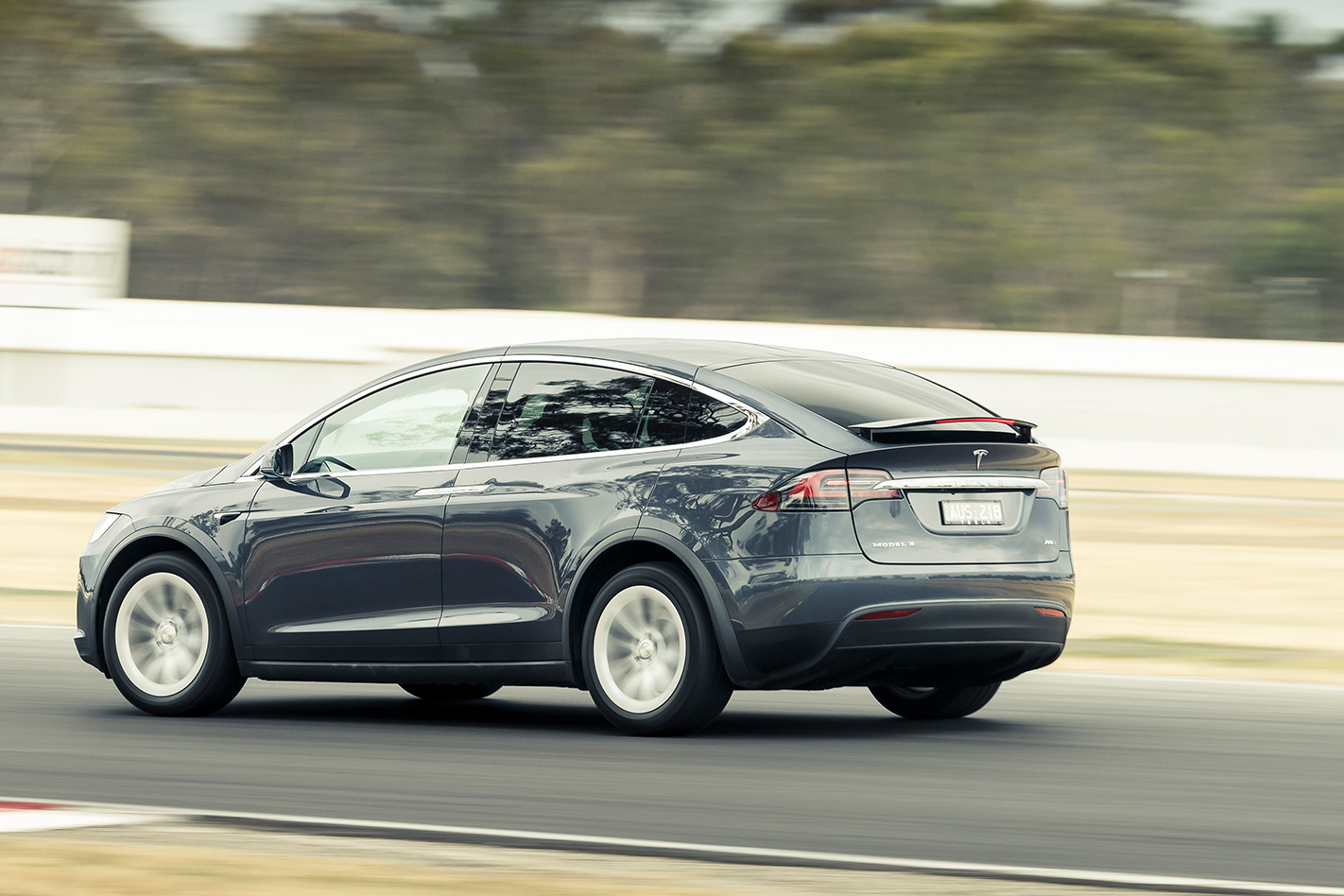
While we fretted and fussed over the available range and closest charger for our other test vehicles, finding chargers inoperable and realising some cars were achieving half the range their gauges claimed, the Tesla was a stress-free experience, with the testing team able to drive the car however we desired, knowing there was a supercharger within striking distance, and a healthy estimated range up our sleeve.
The 100kWh battery provides a class-leading 565km of range according to the official NEDC test. During our testing we saw similar numbers. Ideal for those particularly susceptible to range anxiety, Tesla’s on-board computer and Google-powered navigation will calculate estimated remaining charge following a return trip, and include necessary supercharger stops on longer ventures.
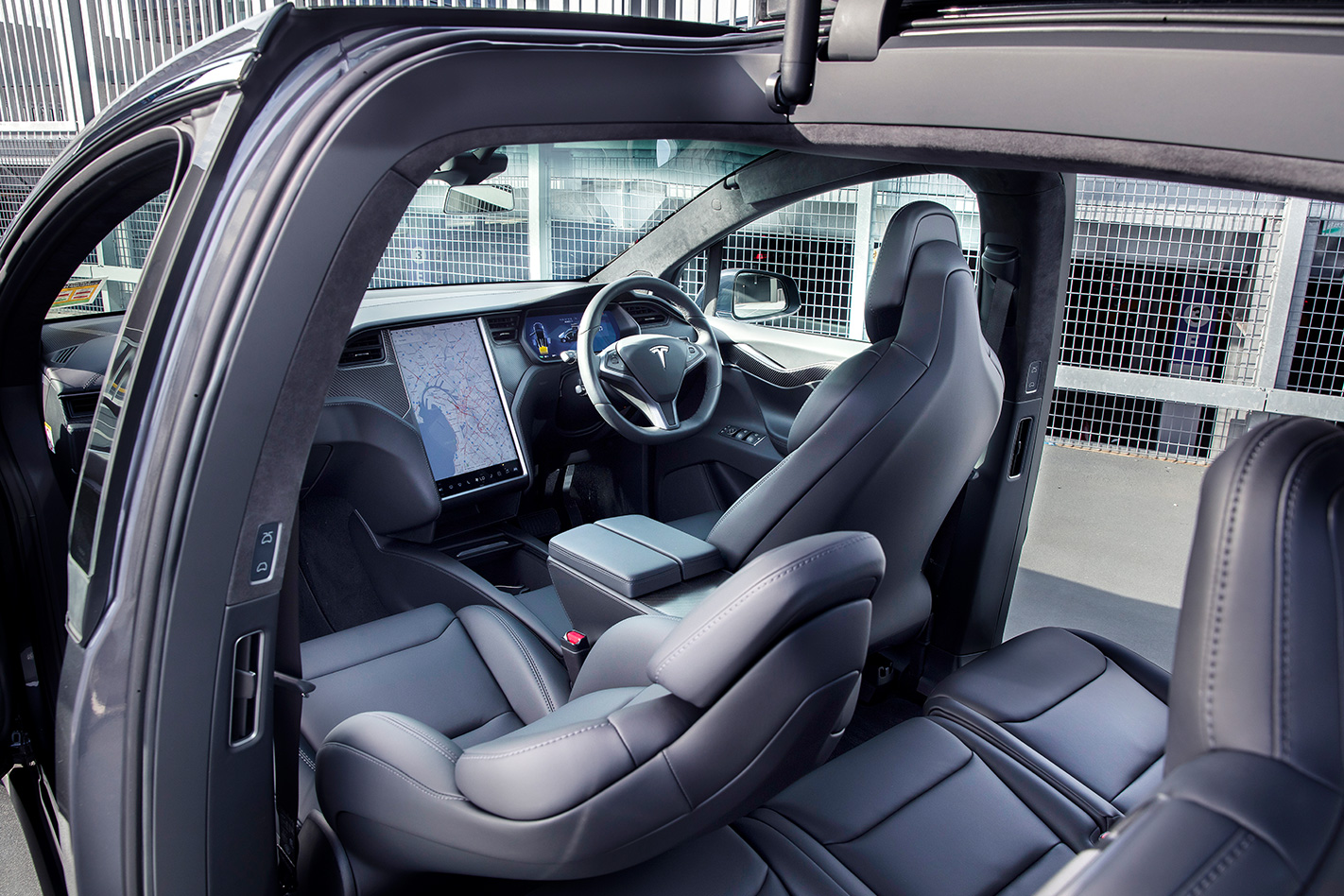
Additionally, Tesla Australia has installed a supercharger network that runs from Adelaide to the Sunshine Coast, which combined with the Queensland Government’s new electric superhighway to Cairns, has a large proportion of Australia’s population covered. You could genuinely live with a Model X without a home charger.
The Model X is a great illustration of what Tesla stands for in many ways. It’s irreverent, confounding, brutal, and unapologetic. Looking like a Model S which has undergone a hall-of-mirrors photoshop makeover, the Model X’s weird, loaf-shaped silhouette has an undeniable on-road presence.
With the batteries placed low between the front and rear axles, the Model X does a reasonable job of hiding its two-tonne-plus weight, though it’s evident in the way the car crashes over bumps. Turn the heat up dynamically, and the Model X initially feels lumbering, but push harder and the clever torque vectoring from the electric motors gives it an agility that belies its weight. As you up the pace, the Michelin Latitude Sport 3 tyres, at 50psi placard, become the dominating soundtrack.
There are three steering modes of varying artificial weighting, with Sport being the sweet spot, and the others offering a light American boulevard cruiser feel.
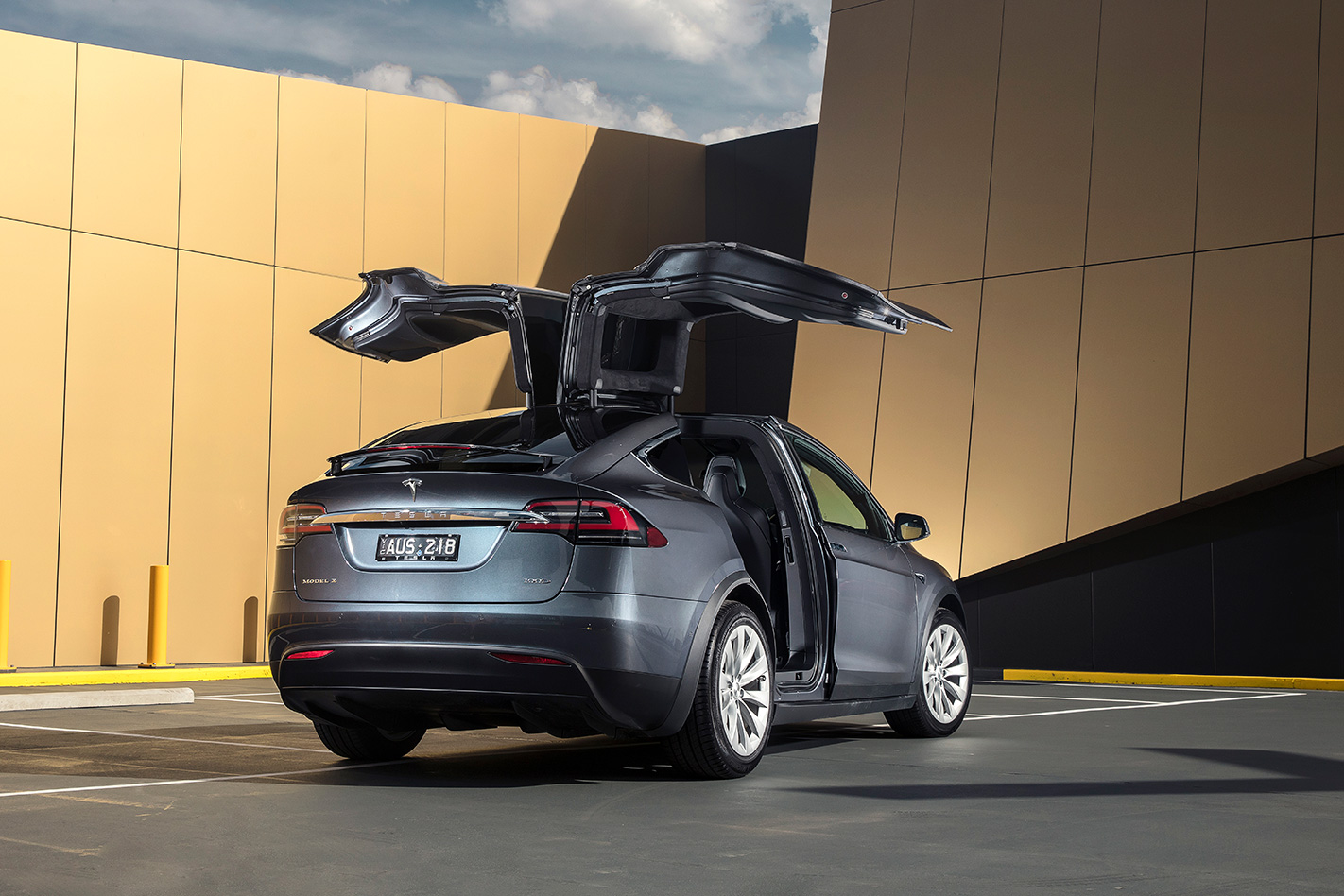
You could get so carried away with the ‘easter egg’ features that are scattered throughout the Tesla Model X’s coding that you forget to drive the thing. There are Christmas-themed dances, old-school Atari video games, and of course those needlessly complex ‘Falcon Wing’ rear doors.
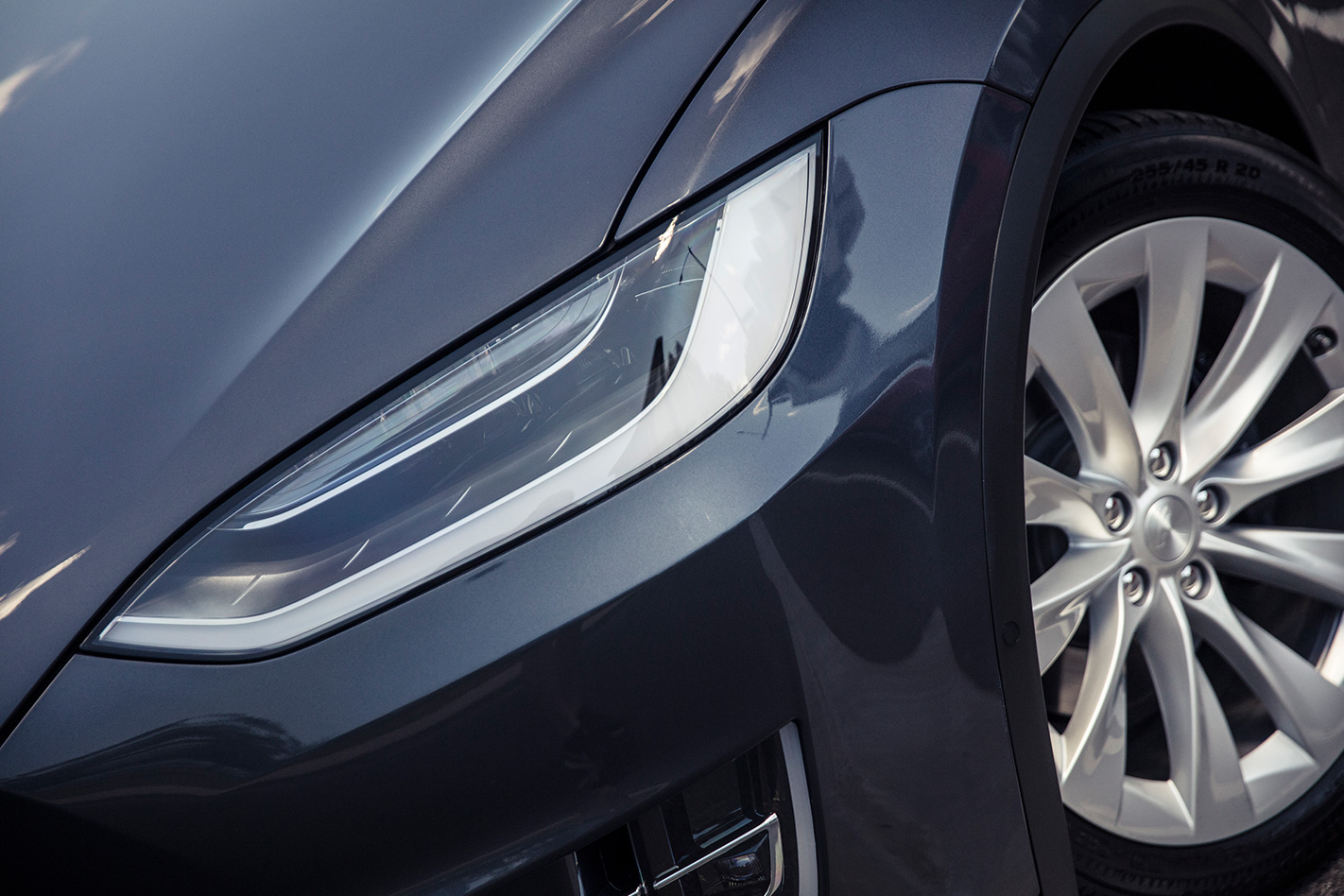
Then there’s the price. The range opens at $142,900 for this non-‘P’ version of the 100D before you even think about options or taxes. The Model S sedan is lighter, more attractive, and cheaper. But if gimmicks are your thing…
8/10
Generally, rival makes aren’t that welcome at new car launches. So when I pulled up at the front gate of Fuji Speedway in a WRX STi, and yelled out: “we’re here for the Mitsubishi test drive,” the approaching security guard seemed reluctant: “You’re not planning to take that thing out on the track with the EVO are you?”
This feature was originally published in MOTOR’s May 2005 issue
“No worries mate, we’ve cleared it with Mitsubishi,” was our instant response. Maybe I’ve got an honest face, or maybe it was the shock of an Aussie speaking his lingo, but he opened the gate straight away.
Once in, we headed down to the new short track behind the fully redesigned $250-million circuit and grandstand. Sitting in the pits, all red and raging, was the new Lancer Evolution IX, the most radical EVO since the brand surfaced just over a dozen years ago. For its new 2005 Lancer, Mitsubishi has fiddled with the engine and replaced the suspension, tweaked the turbo, and given it a more aggressive look.
Checking out the EVO’s re-styled front end, I couldn’t help but notice the tell-tale Boulay nose was gone. The Mitsu spin doctor explained that when ex-design chief Olivier Boulay left the company, Mitsubishi went back to the drawing board for a simpler look (here’s hoping the upcoming Magna will get similar treatment).
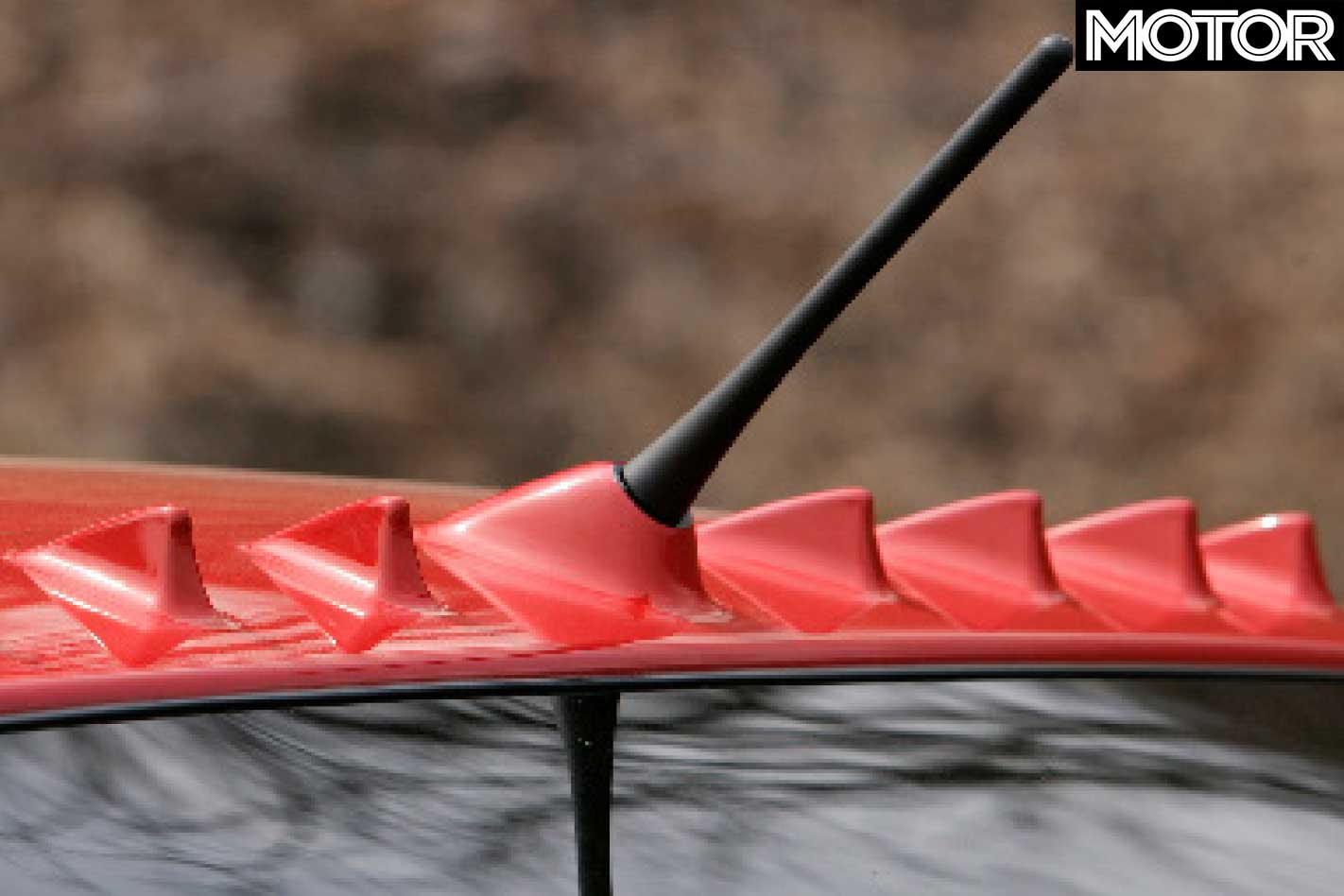
The mesh grille might have been a simple Etch-a-Sketch jobbie but the re-styled front bumper and cooling ducts have clearly taken some thought, as have the rear diffuser and the row of eight shark’s teeth-like protrusions evenly spaced above the rear window. Apparently these roof vanes are a vortex generator that helps reduce drag and optimise the downforce created by the rear wing.
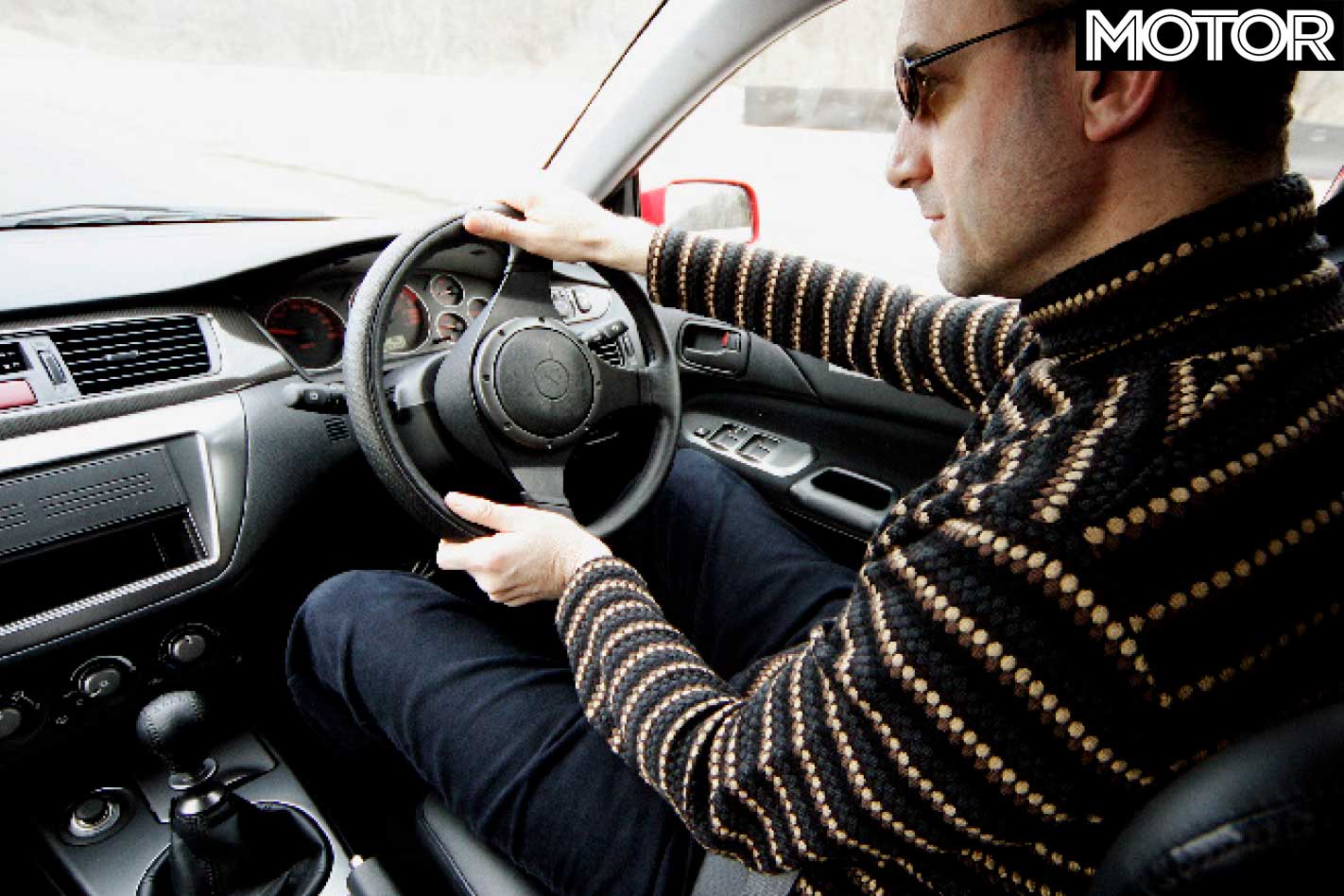
Inside, the EVO IX’s Recaro seats offer even more side and lumbar support than those of it predecessor. The bolsters cop non-slip alcantara that keeps you stuck in place. To that end, the STi’s seats lack sufficient support, especially around the edges, which are too spongy. In contrast to the EVO IX’s poor quality plastics and taxi-like interior, the STi offers acceptable plastics and a user-friendly dash design.
All that aside, the biggest modification to the EVO IX, or indeed any EVO since 1992 is the addition of MIVEC technology to the long-lived 4G63. Short for Mitsubishi Innovative Valve timing and lift Electronic Control, the 2.0-litre turbo now features variable cam timing for increased flexibility.
At engine speeds under 3500rpm it automatically adjusts itself to deliver instant throttle response, while at higher speeds, MIVEC spreads the power delivery throughout the entire power band by allowing more air into the combustion chambers.
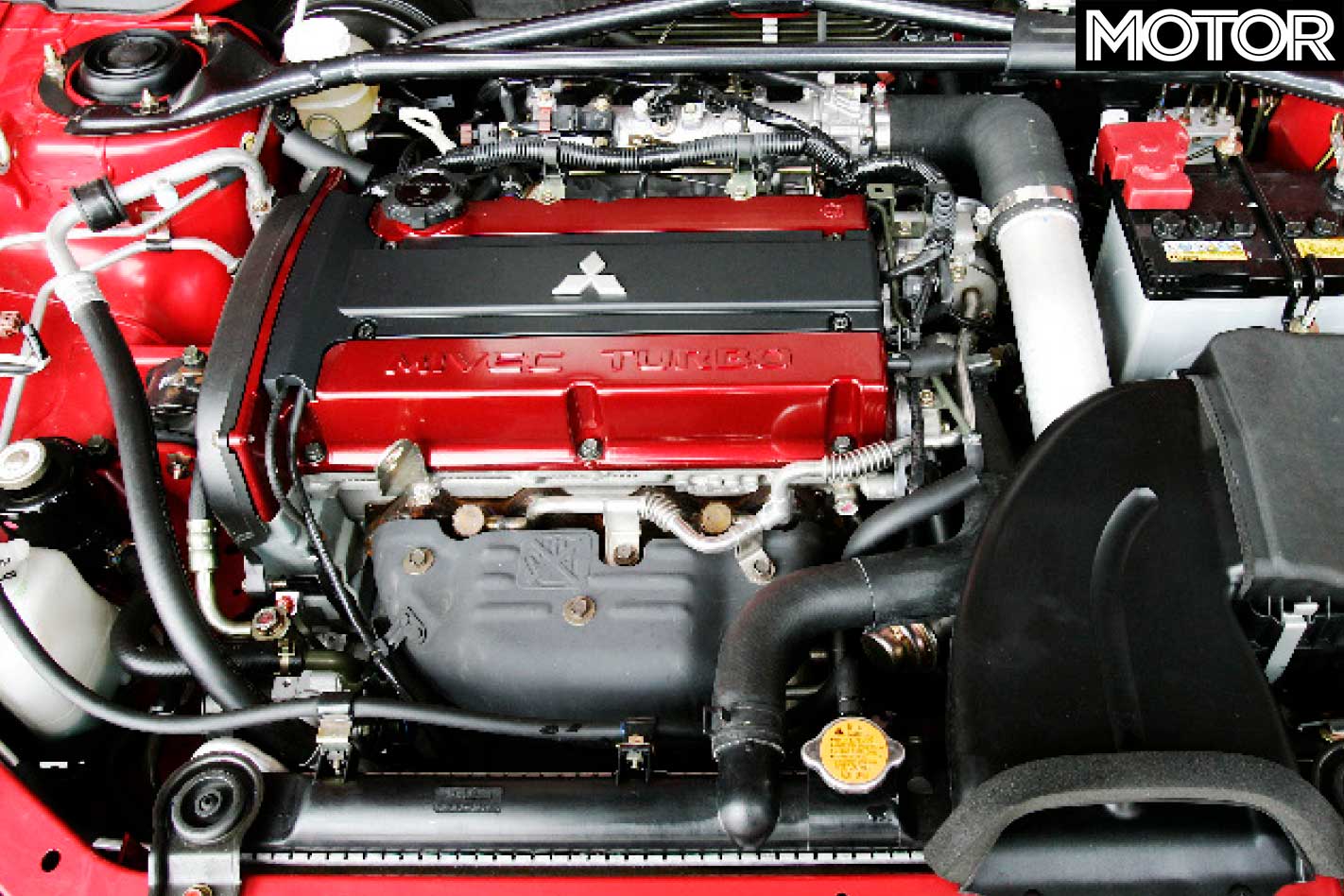
However, ultimate power and torque figures remain the same as the outgoing Japanese-spec EVO VIII, with the 2.0-litre pumping out 206kW at 6500rpm and 400Nm at 3000rpm. That’s what the car makers say. The truth is that both production versions of the EVO and STi are producing upwards of 220kW.
The main difference with the EVO’s new MIVEC is where peak torque is made. With a fair dollop of low-down urge from 2000rpm, the EVO IX delivers maximum torque from a low 3000 through to 4500rpm, and that makes for serious punch out of corners.
The new engine’s power band is also perfectly matched to the notchy six-speed gearbox. Where you might quiz over the right ratio, the extra herbs way down low give you the latitude to stay in third, and still come out of the corner like a raging bull.
Boasting identical power as the EVO IX, the WRX STi’s 2.0-litre four-pot turbo generates a meatier 412Nm at 4400rpm, but in a body that weighs some 50kgs more than the EVO. So the torque advantage is all but cancelled out. Around 90 percent of peak torque is on tap from 2700rpm, hitting its max at 4200rpm.
While the torque curve is not as flat as the EVO’s, if you can keep the STi on the boil between 2700 and 4500rpm you’ll be able to give the EVO a real run for its money.
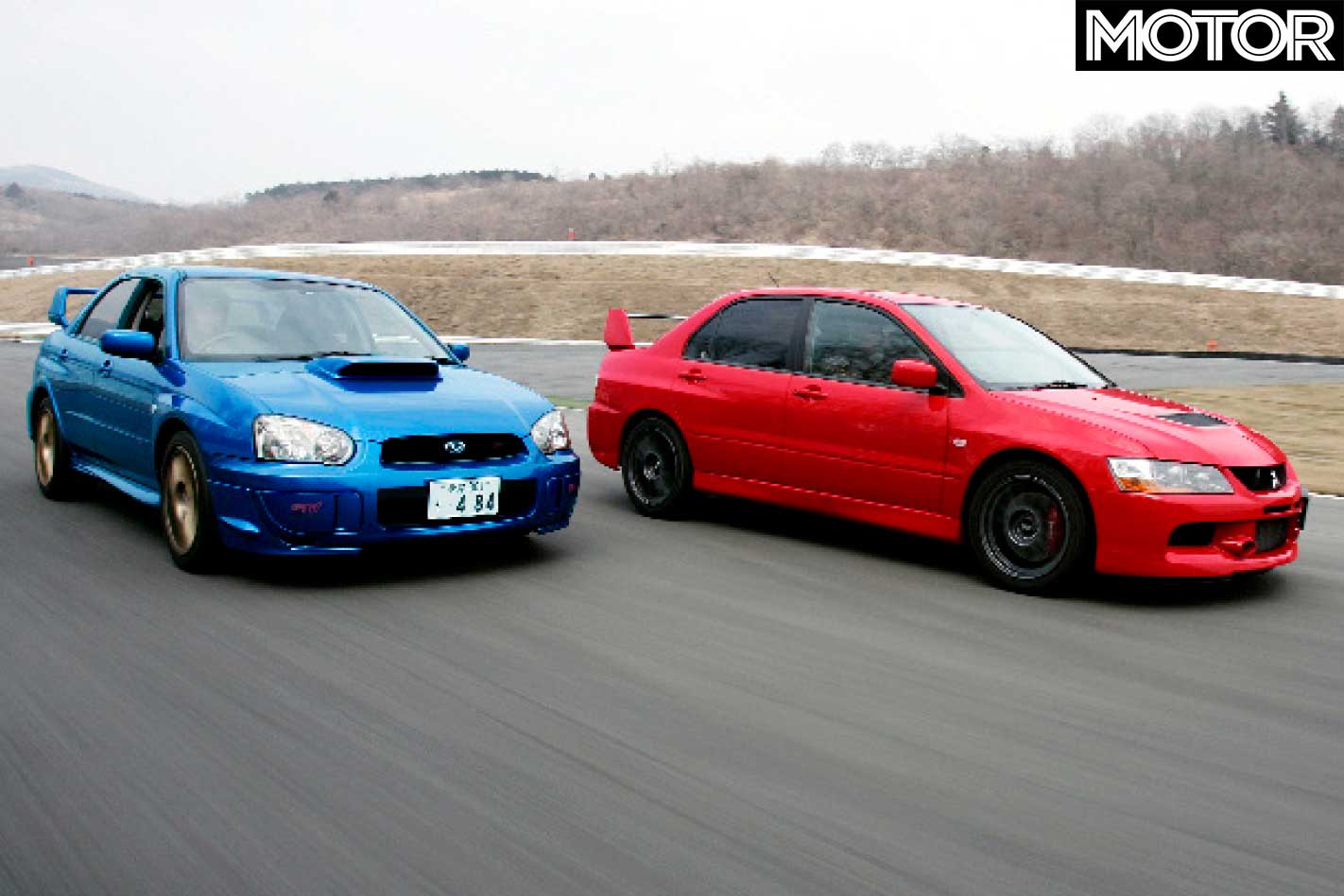
The STi’s six-speed gearbox is also a gem and offers a nice tight gate with relatively short throws. A quick 0-100km/h sprint comparo on my stopwatch had the EVO’s 4.5secs just pipping the STi’s 4.6secs, remembering of course that in Japan, the standard fuel is 100 RON octane.
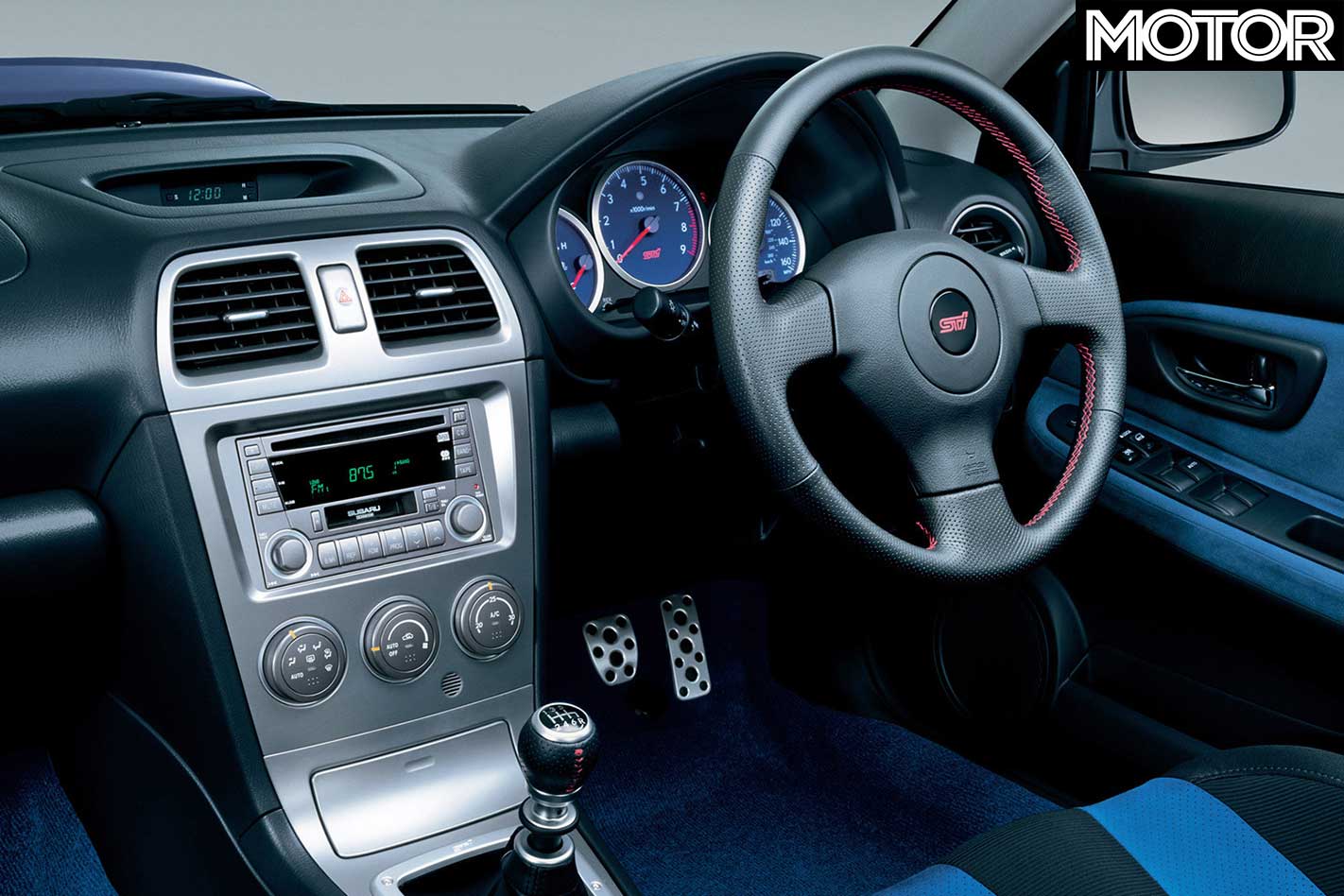
The EVO’s other major modification was to its suspension. Carried over from the EVO VIII MR version of last year, the EVO IX employs Bilstein dampers at each corner with struts at the front and a multi-link set-up at the rear. Fitted as standard to the STi, the Bilsteins fitted to the EVO improve ride quality out of sight. The new setup also aids the EVO’s already considerable cornering prowess.
A further tweak to the suspension is a 5mm drop in the rear ride height, which assists in transferring the EVOs bottom-end urge onto the tarmac, while also enhancing the response of its secret cornering weapon, Super AYC (Active Yaw Control).
Mitsubishi says that they’ve stayed away from fiddling with the EVO VIII MR’s combination of Super AYC, ACD (Active Centre Diff) and ABS for the EVO IX, but that the simple fact of altering the ride height has resulted in a better fit of the puzzle’s pieces.
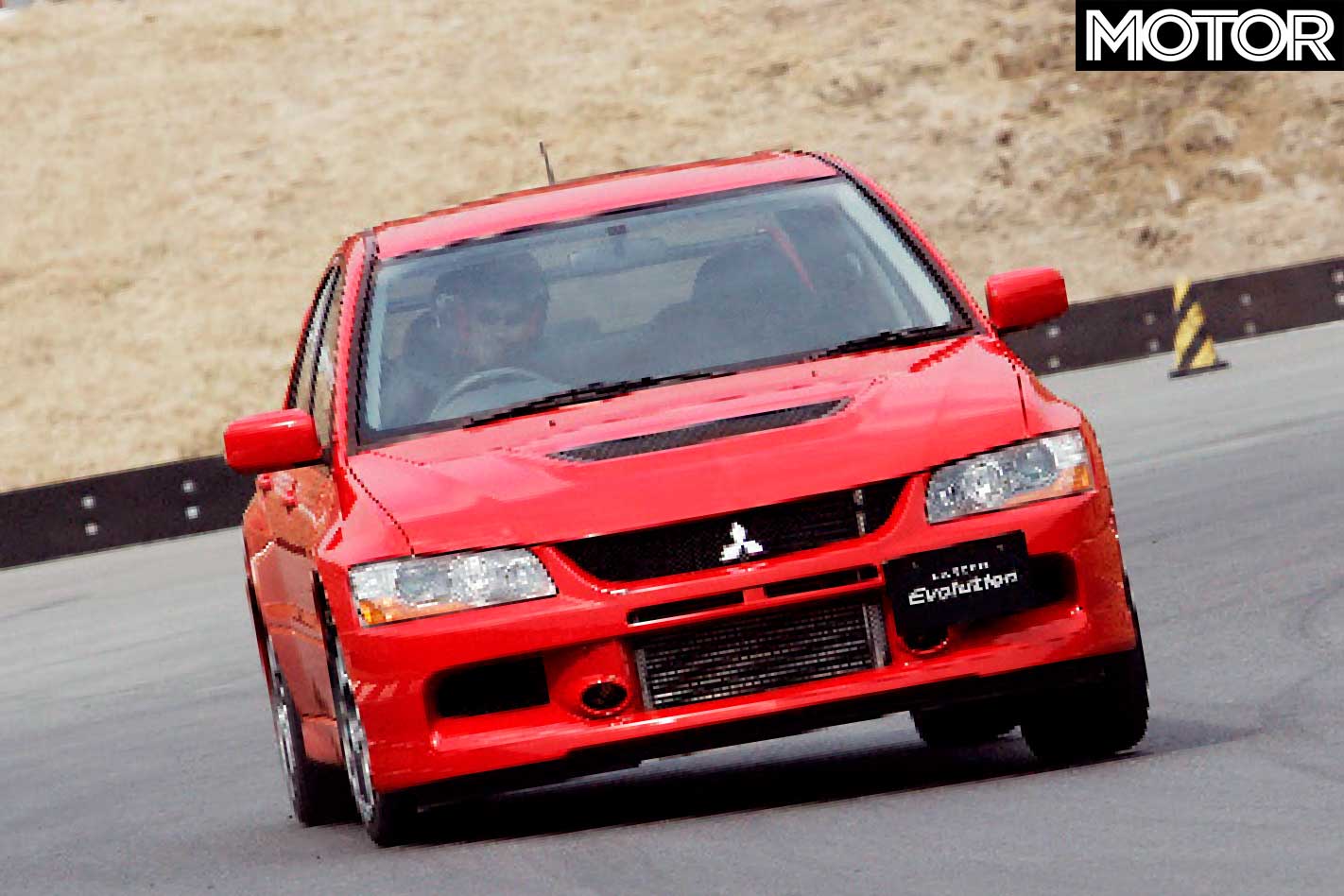
At the limit, the EVO devours corners turning in sharply and holding the line without a sniff of understeer. Wanna get lairy? Jump on the brakes, get the weight forward, turn in, get back on the gas and wait for the techno wizardry to do the rest. Go in extra hot and you’d better be ready for loads of sideways stuff as the traction control works overtime to keep you on the tarmac. And that’s the beauty of this car.
Sitting on sticky Yokohama Advan A046 tyres and employing four-piston Brembo brakes at the front, the EVO is endowed with the sort of grip that only the ham-fisted can overcome. It covers for your overzealousness by transferring torque forward and aft and left and right, in a micro-second, as and when it’s needed to get you around the corner and back.
The STi is a little more challenging. With steering that’s a touch heavier than the EVOs, you have to balance the STi perfectly, wiping off excess speed with the huge four-pot Brembos. Then, after you’ve shed speed, tuck the front-end into the corner allowing the rear to come around. Even though you’re relying on its grippy Potenza RE070 rubber to maintain your desired line, the STi can still languish into understeer when pushed.
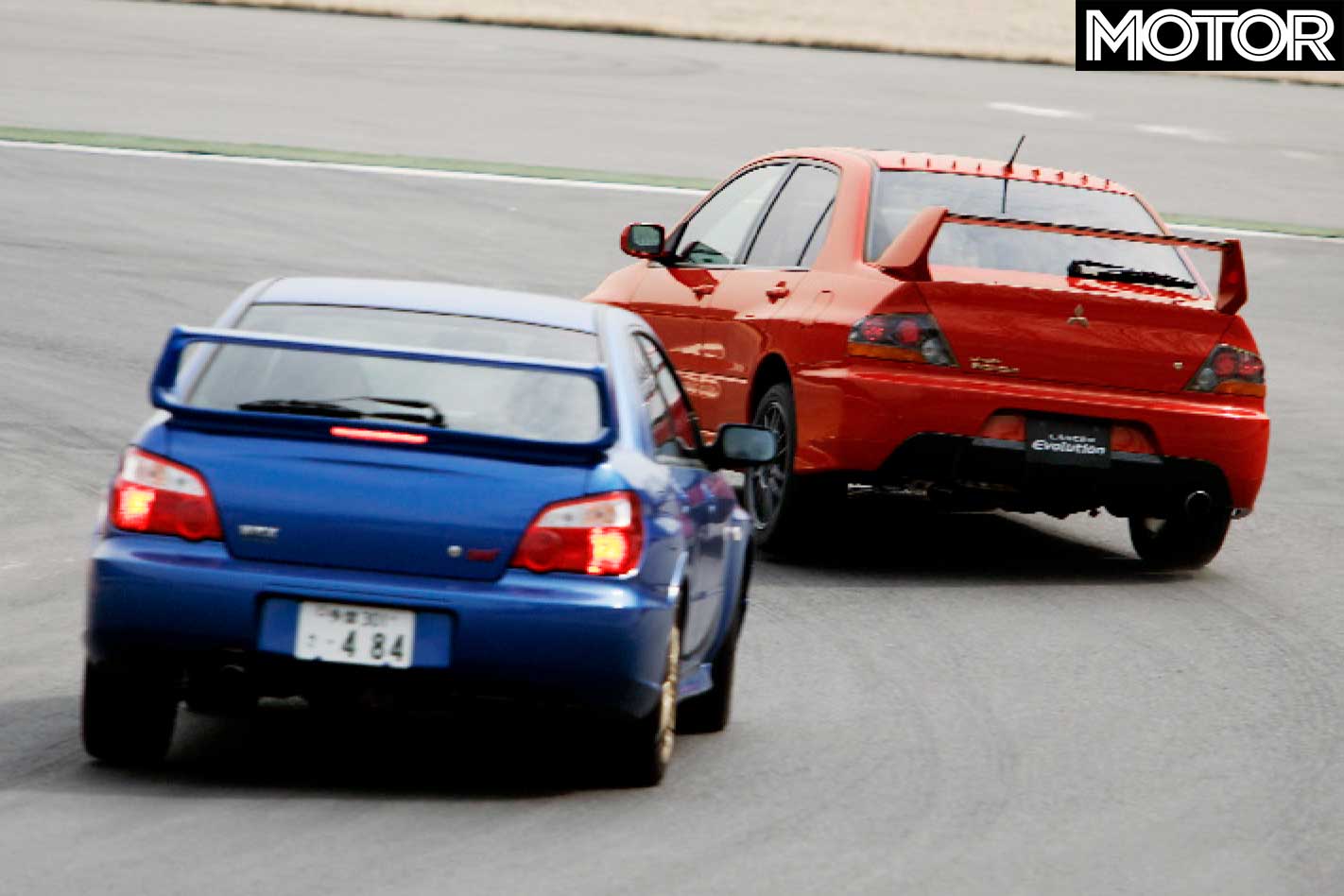
However, switch the DCCD button on the centre console to manual and channel 65 percent of the torque to the rear, and the STi becomes a different beast. It becomes much easier to drive at the limit with more positive tail movement helping you to get through the twisties. At the end of the day, being faster isn’t enough. Around the 1km short track at Fuji, both cars clocked identical times.
On the track, I’d choose the EVO IX for its bag of cornering tricks, that said, the steering feels twitchy and arcade-like. In the real world, though, the STi is more involving and has a better ride quality, making the Subaru our choice, if only by a whisker.
As I left Fuji, the security guard asked what the result on the track was. I replied that the EVO IX had won. He said, “Thought so.” But I didn’t add that I was glad to be taking the Suby home.
Fast Facts
| u00a0 | Subaru Impreza WRX STi | Mitsubishi Lancer Evolution IX |
| Body | 4-door sedan | |
| Drive | all-wheel | |
| Engine | 2.0-litre DOHC 16-valve turbo flat-four | 2.0-litre DOHC MIVEC 16-valve turbo inline four |
| Bore x Stroke | 92.0mm x 75.0mm | 85.0mm x 88.0mm |
| Power | 206kW @ 6400rpm | 206kW @ 6500rpm |
| Torque | 412Nm @ 4400rpm | 400Nm @ 3000-4500rpm |
| Power/Weight | 140kW/tonne | 146kW/tonne |
| Transmission | 6-speed manual | |
| Weight | 1475kg | 1410kg |
| 0-100km/h | 4.60sec | 4.50sec |
| Top speed | 250km/h | 255km/h |
| Suspension (f) | MacPherson struts, coil springs, anti-roll bar | |
| Suspension (r) | multi-link, coil springs, anti-roll bar | |
| L/W/h | 4415/1740/1440mm | 4490/1770/1450mm |
| Wheelbase | 2540mm | 2625mm |
| Tracks | 1490mm (f); 1495mm (r) | 1515mm (f); 1515mm (r) |
| Brakes (f) | 326mm ventilated discs, four-piston calipers | 323mm ventilated discs, four-piston calipers |
| Brakes (r) | 316mm ventilated discs, single-piston calipers | 305mm ventilated discs, two-piston calipers ( |
| Wheels | 17 x 7.5-inch (f & r), allo | 17 x 8.0-inch (f & r), alloy |
| Tyre Sizes | 225/45 R17 (f & r) | 235/45 R17 (f & r) |
| Tyres | Yokohama Advan AO46 | Bridgestone Potenza RE070 |
| Price | $56,630 | $59,990 (est) |
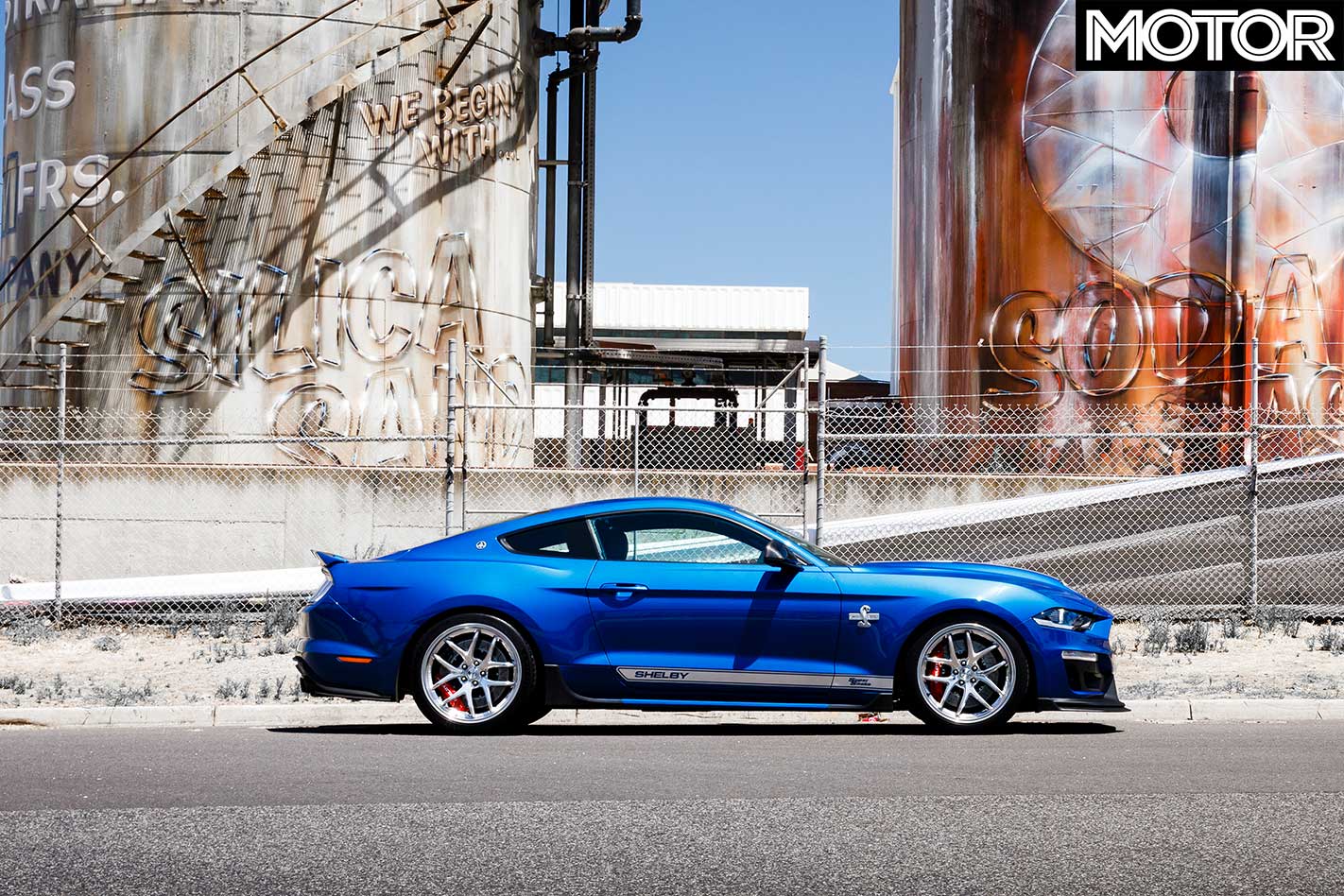
In the world of tuned Mustangs, there are many names to consider. And yet, when most people think of a ’Stang with embiggened cojones, it’s generally one with wide racing stripes over the roof, side-pipes and a Shelby badge on the front quarter panel.
Okay, so the Federales have killed off the side-pipe thing, but even though he has now left the building, the street-savvy, chicken-farmer-cum-race-driver’s legacy continues in the form of the Shelby Mustang.
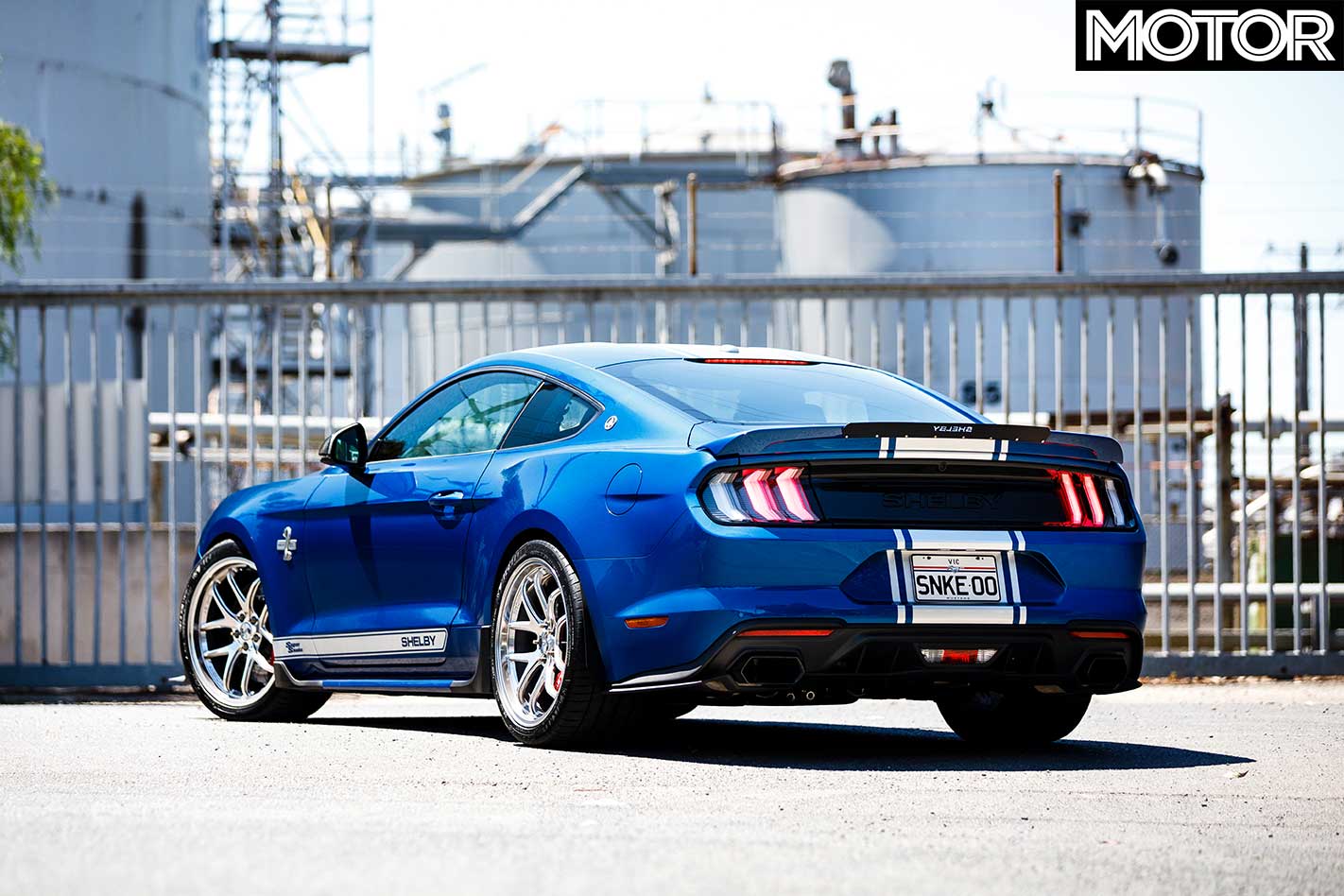
Now within that pantheon of Shelby ponies, there’s one that has a horn growing out of its forehead – the Super Snake. It’s not that the Super Snake was just a pipe-dream, because in 1967 it really did exist. But only in the form of one prototype. Seems Goodyear wanted a test mule that could run its new tyres at high speed for PR purposes, and turned to Carroll Shelby.
Shelby came up with a ’67 Fastback crammed full of Le Mans-spec 427 big-block making an alleged 800 horsepower. It successfully tested the tyres for 500 miles at an average of 142mph with Carroll himself taking the thing up to 170mph just to see what would happen.
The original plan then called for Ford to go into limited production of the Super Snake, but when it was revealed that the price would be double a GT500, the whole deal was shelved. But while it never reached production, the legend was alive and hissing.
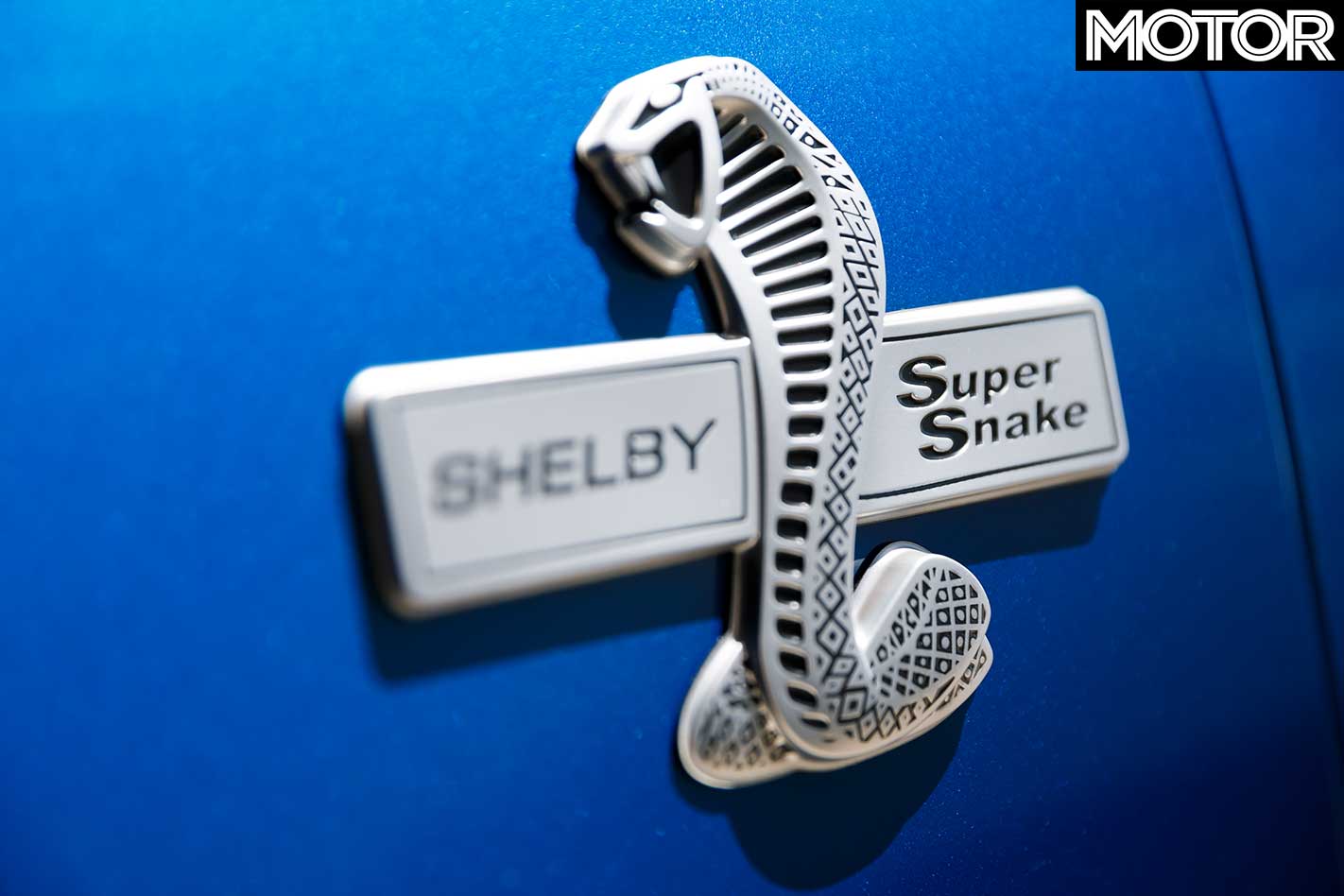
Fast forward to 2007 and Carroll Shelby decides it’s time to take care of some unfinished business, so the Super Snake goes into production for the first time. Now it’s based on the fifth-gen Mustang but, crucially, there’s a supercharger option that takes things to 725 horsepower (540kW). Thing is, if you want one, you need to send a stock Mustang to Shelby’s Las Vegas skunkworks.
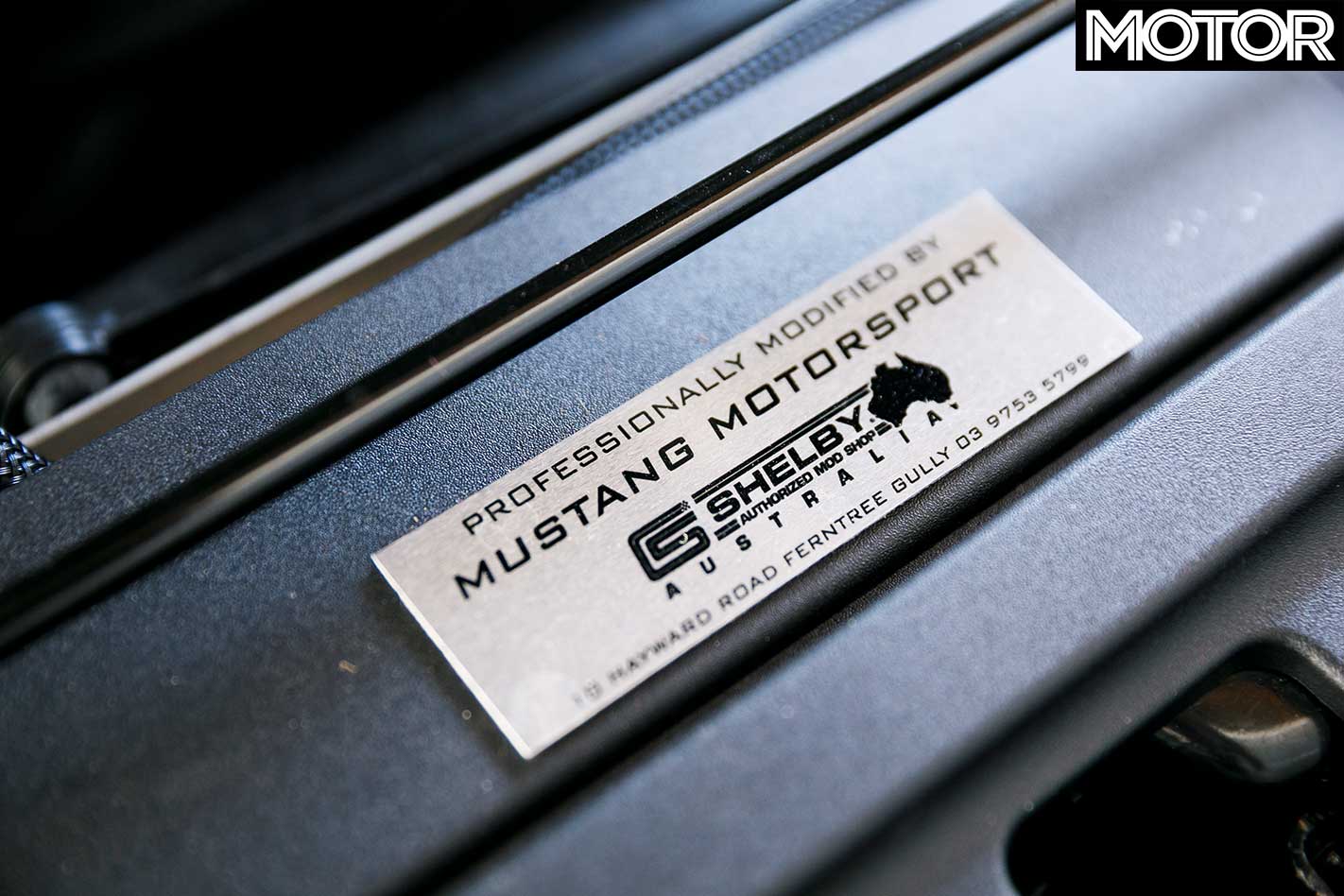
That changed for the Aussie buyers with the sixth-gen ponycar when Melbourne-based Mustang Motorsport was given the royal decree to modify local cars to Super Snake specification, complete with the all-important Shelby build-plate.
In fact, Mustang Motorsport is the biggest Shelby dealer outside North America, so the relationship is rock solid. It also means that your new Super Snake is covered by the three-year/60,000km Shelby factory warranty and is 100 per cent emissions (and everything else) legal. It has the compliance plates to prove it.
Based on the facelifted MY18 Mustang, the Super Snake package starts with a supercharged 700-horse (525kW) package, but if you really want to invoke the ghosts of Snakes past, you up the ante to the 800-horse package. Which is exactly what the owner of this car did.
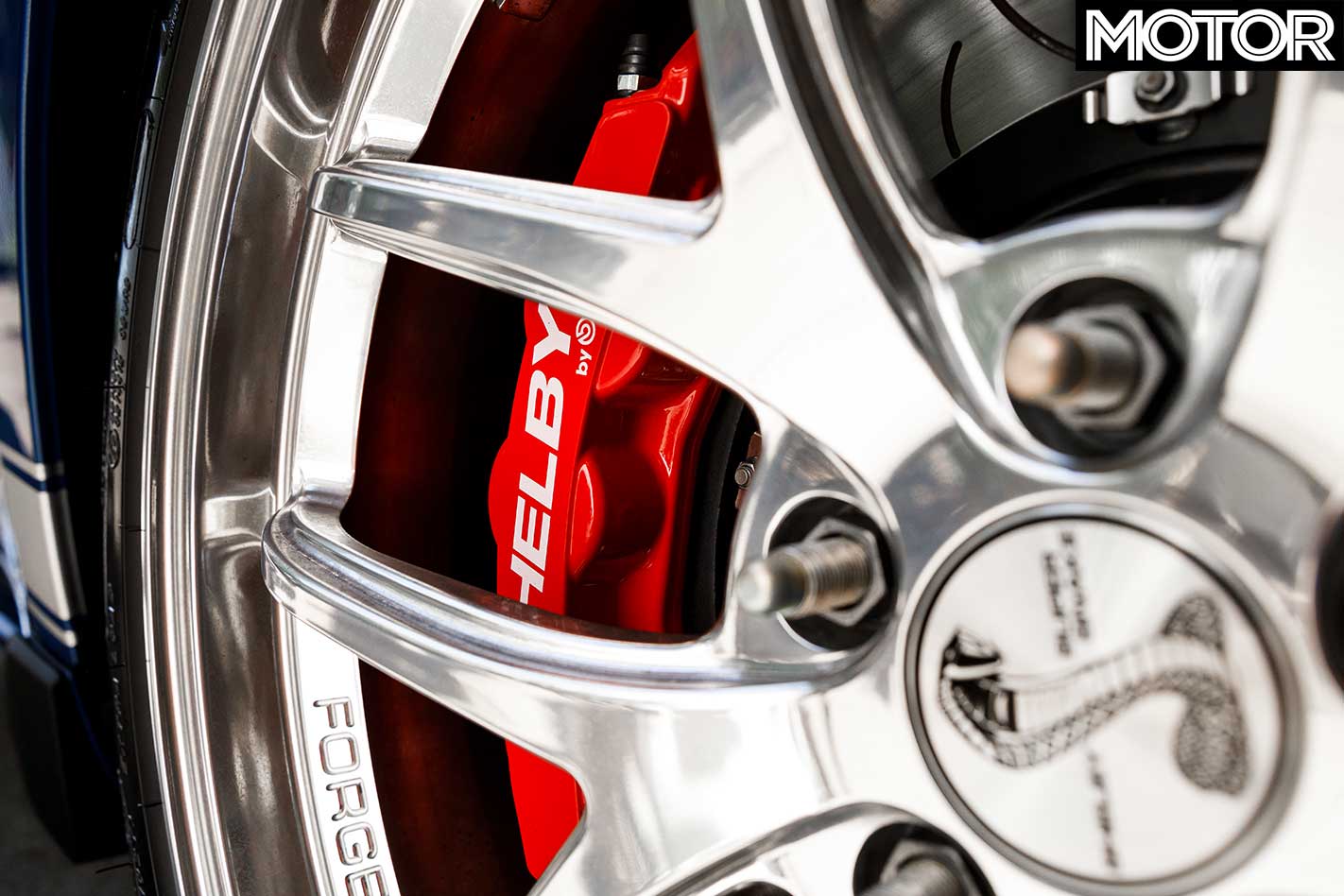
The basic package adds a supercharger to what is essentially a stock Coyote engine as well as an active exhaust system and the relevant ECU upgrades. You can have it in manual or automatic (with a revised trans cooler) and it also adds a Brembo brake upgrade with monster rotors, replacement suspension to ‘Track Handling’ specification and some other suspension tweaks including new camber/caster plates and adjustable toe-rods at the rear. There are some dressy bits like Shelby-branded engine-bay caps and a specific coolant-overflow tank. Wheels are 20-inch fatties with Pilot Sport 4S hoops.
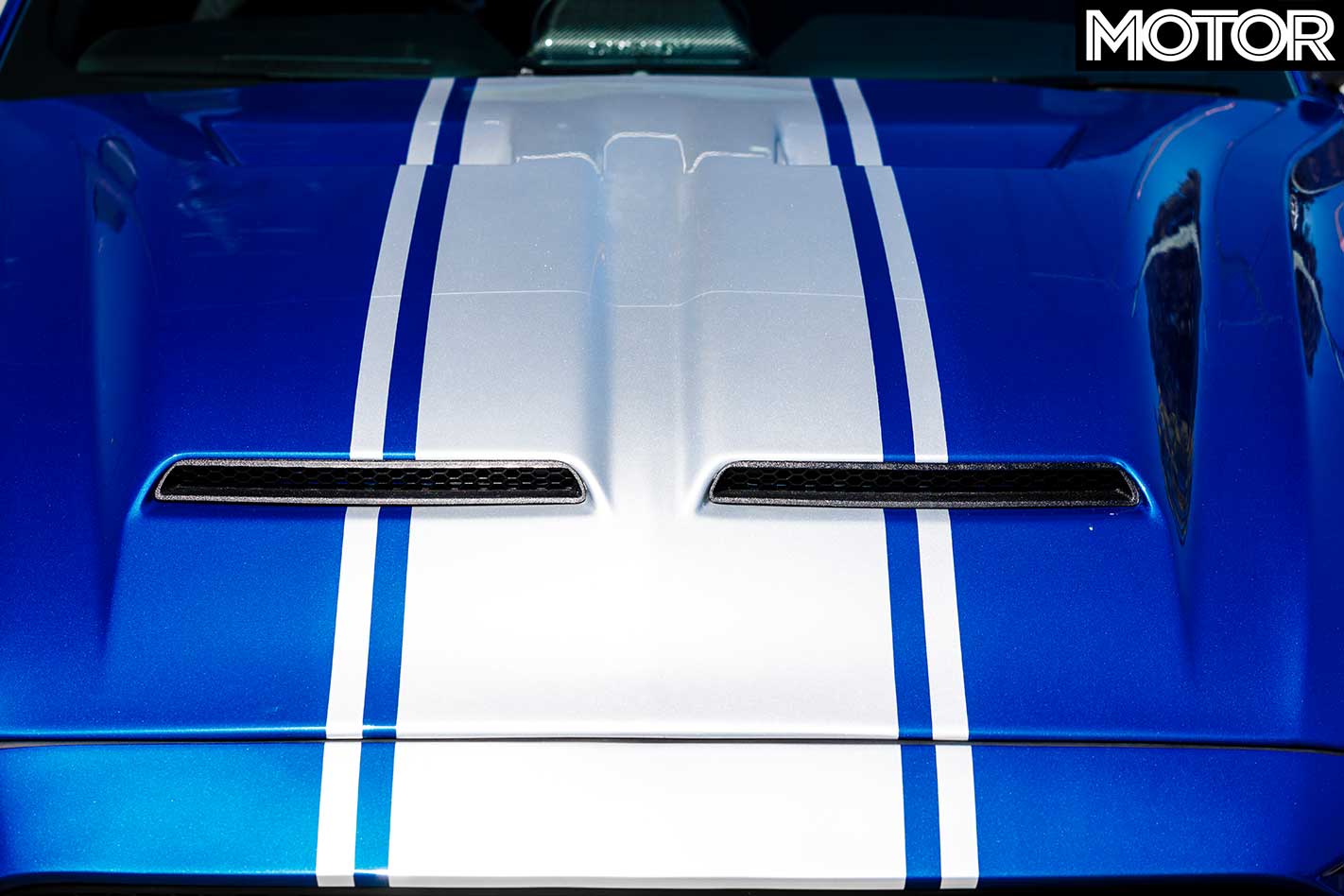
Body mods include a new bonnet to clear the pump that has a distinctly different profile, rocker panels with winglets, a new front fascia with functional brake ducts, upper and lower rear diffuser, a rear spoiler with a Shelby logo cut into a section of it and the relevant badges.
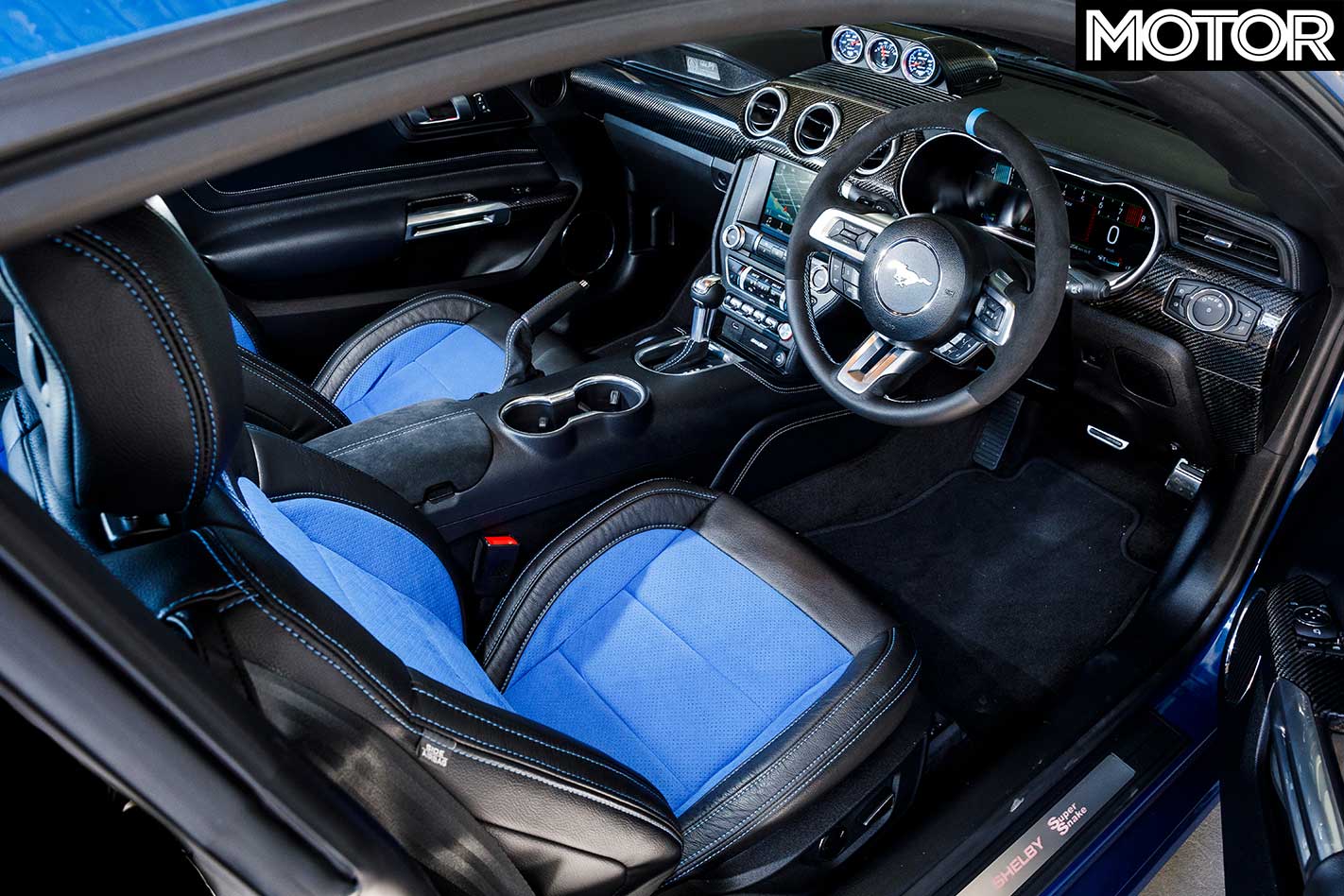
The Super Snake deal also includes over-the-roof stripes, and inside, there are re-trimmed seats, extra gauges, floor mats, light-up sill panels and some carbon bits to make things a bit more special.
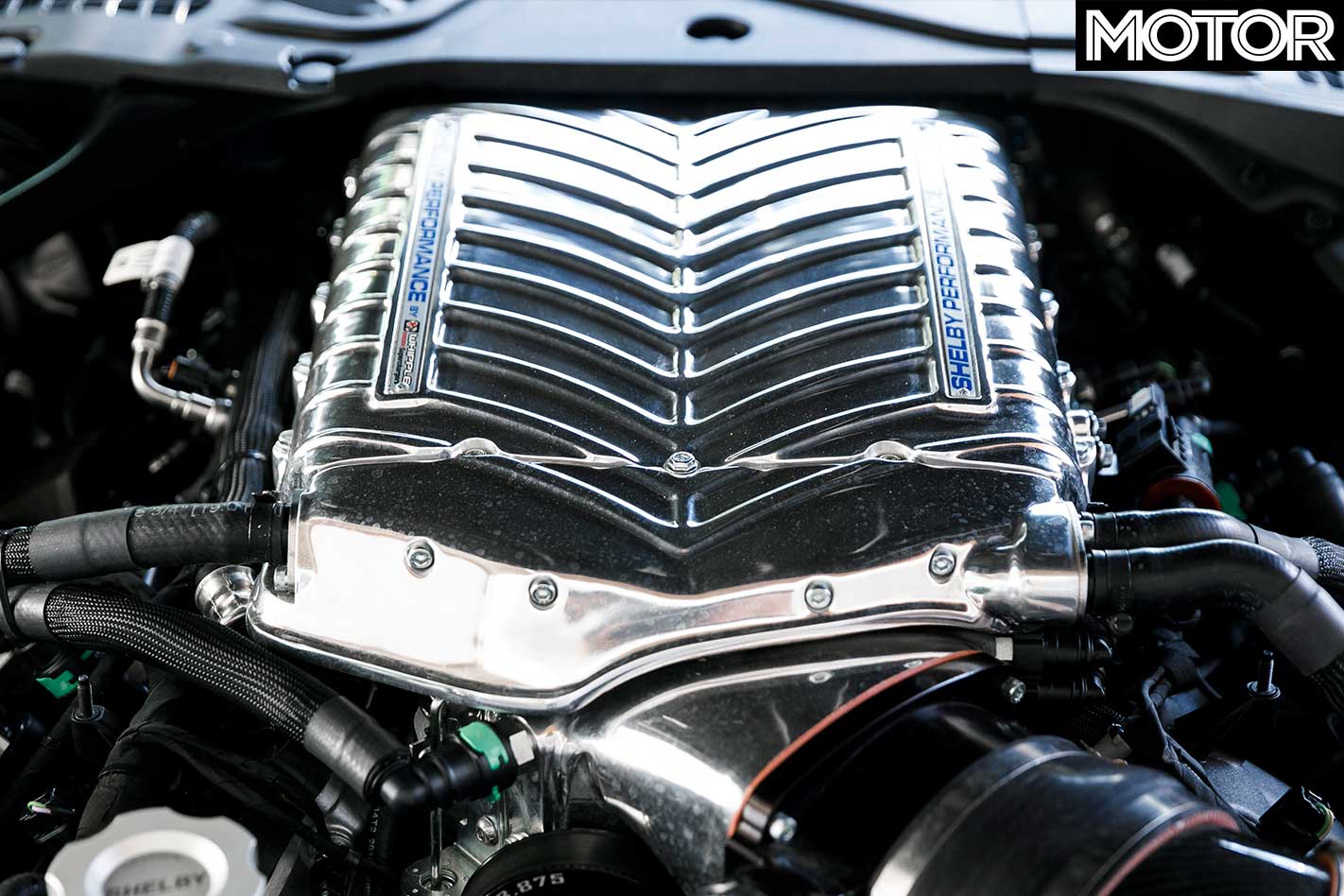
This car, of course, went all the way with the upgrade to the 3.0-litre Whipple blower that, interestingly, mounts the intercooler above the rotors and requires a new one-piece tailshaft, beefier axles, a bigger radiator and the curious looking extra-long wheel studs to cope with 600kW.
This particular owner also wanted the stripes painted on, not stuck on. So he got them.
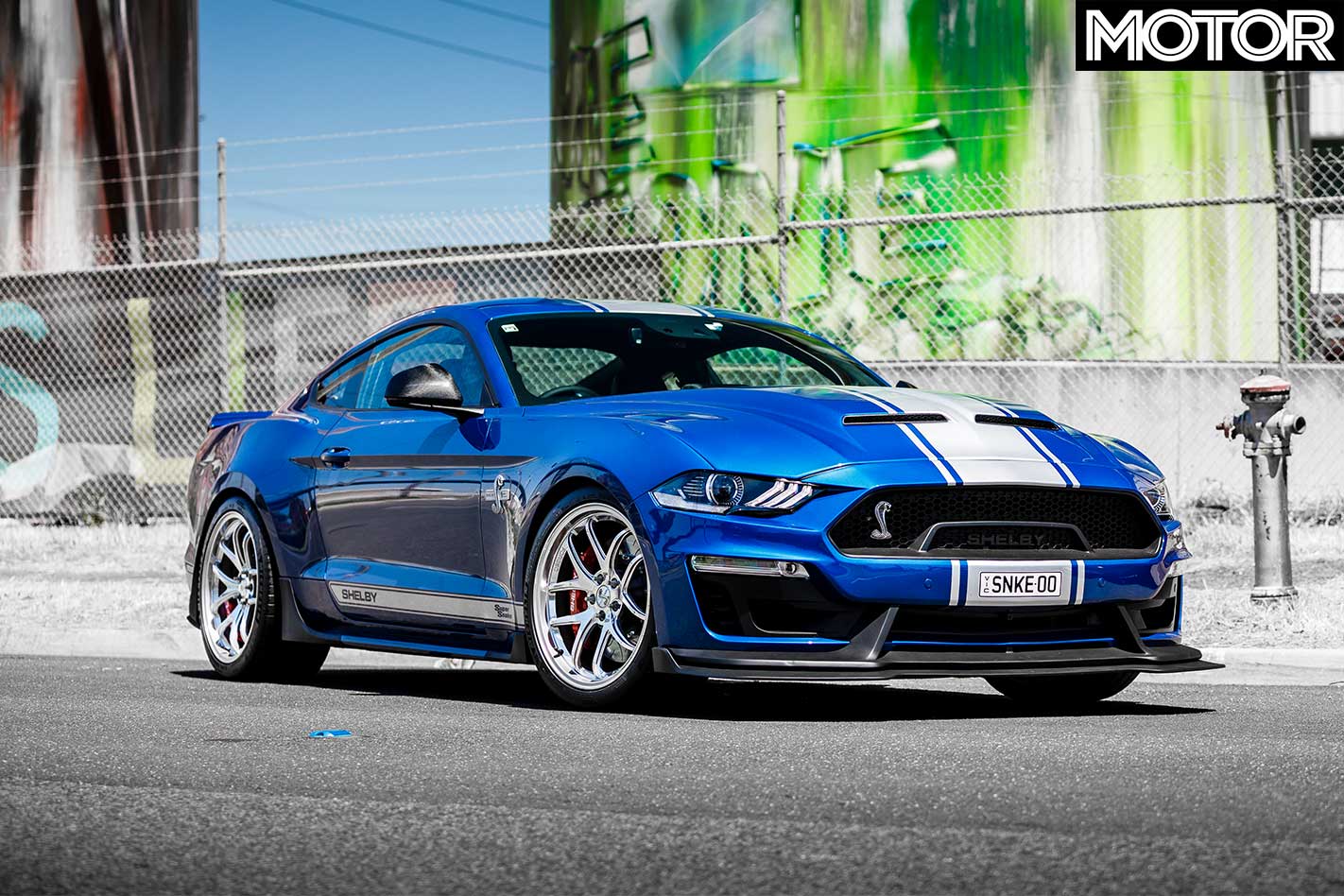
The downside to getting hold of a freshly minted Super Snake like this one is that it’s too new. The owner only picked it up four or five days before we turned up on his doorstep, so the whole shebang only had about 420km on the odo.
Now, I don’t care about the theories of the mechanical terrorist who reckons that engines need to be run in hard to ever be any good, because I’m not that guy. Fact is, this engine was tighter than a scientist’s head in a politician’s hat, and it just wouldn’t have been right to give it a flogging. Not for another few thousand kliks anyway. (Throw in the fact that the owner was sitting beside me…)
Even the couple of wee throttle-squirts I did get away with were enough to dunk me squarely into that lake of torque just shy of 1000 Newtons deep. And if the angry 25 per cent of the rev-range is as good as the lower three-quarters, then we’re talking happy-happy-joy-joy. In fact, there’s a theory that this particular blower makes more top-end grunt than some, so it should be a hoot when it’s loosened up.
It should gel with the revised 5.0-litre’s new-found 7500rpm redline, too. Meanwhile, there’s just enough blower whine to remind you you’re sitting behind a big lump of special.
Bottom line, though, is, no, I don’t know have any idea of how fast it will be across a quarter mile once it’s bedded in. And, no, I can’t give an accurate estimate of its 0-100km/h time. Suffice to say both those numbers will, by any standards, be impressively small.
However, what I can tell you is that there’s an enormous torque wave waiting to be surfed. And that, as a point-to-point car, the Super Snake is going to set new standards for Mustang-based lifeforms.
Part of that is going to be based on the car’s ability to lose speed when necessary. These brakes are stupendous. But more than that, they offer up a high, firm pedal that has just enough squish to give you confidence, but enough stoicism that you know you aren’t gonna make them fade even on a racetrack.
Team them with a suspension that, on first acquaintances, feels like it could be a tad too firm for Aussie conditions, but which soon comes back to you largely thanks to the superbly matched damper rates.
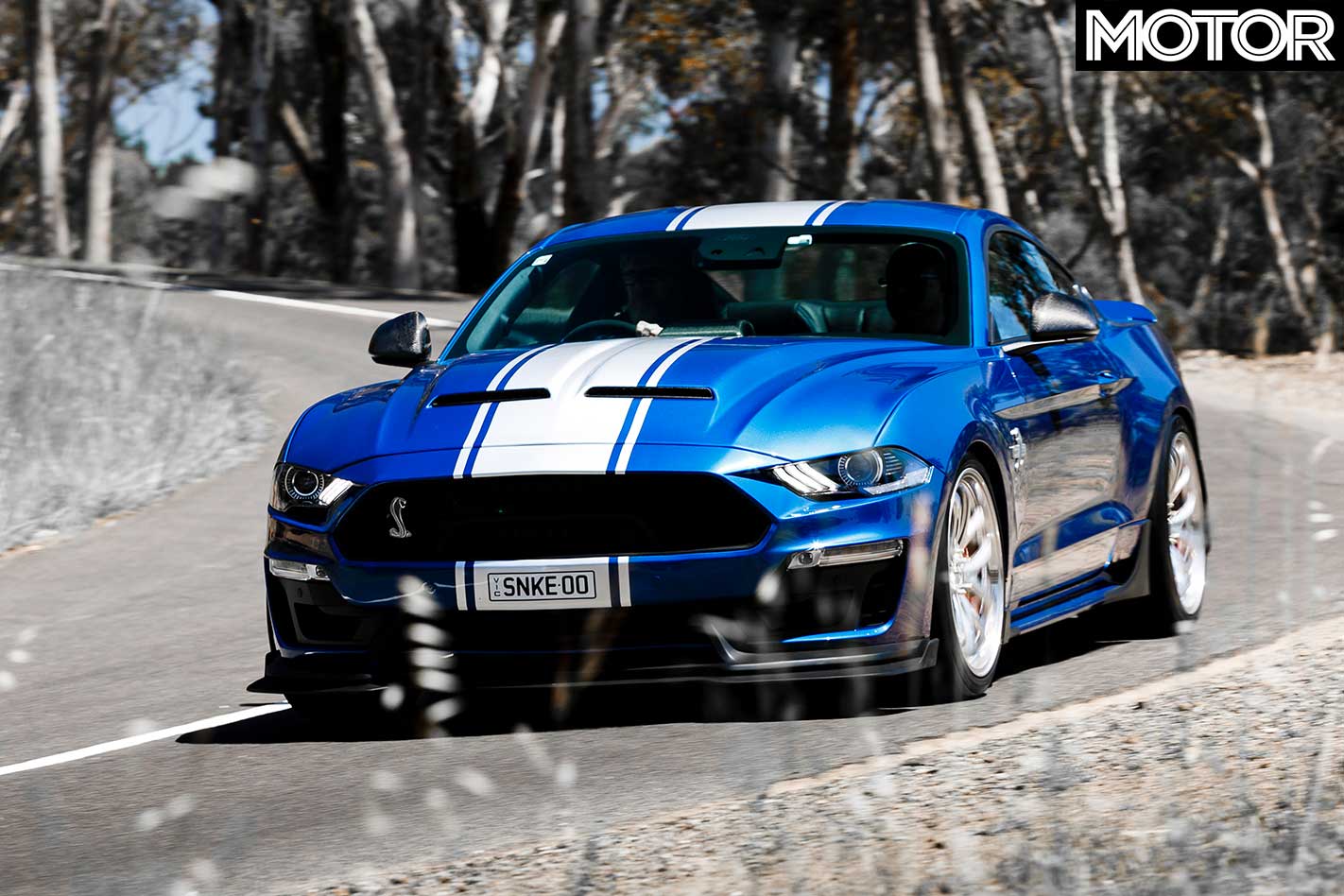
That said, I still get the sense it’s a bit too tied-down for typically bumpy back roads, if only because it’ll be going awful quick if and when it does let go. Oh yeah, there’s a tiny bit of tramlining, which is doubtless a function of the aggressive alignment settings.
Oh, and those meaty 275 front hoops probably have an effect, too. And like any modern Mustang, this one always feels like a big car with a big, long bonnet that sits you over the rear axle. The extra-bulge bonnet only amplifies this impression.
I really only have two bones to pick in the driveline department. This first of these is a fuel-cut that feels a bit overly keen to step in. Bimble around on super-light throttle openings (which is anytime you begin to feel attached to your licence) and the Shelby can start to shunt a fraction as the injection (or so it feels) comes and goes.
It’s only ever on those tiny throttle percentages, but it kind of spoils the otherwise factory feel that Mustang Motorsport routinely builds into its cars. It wouldn’t surprise me to learn that Shelby has a revised throttle or fuel map to fix this, such is the brand’s usual attention to detail.
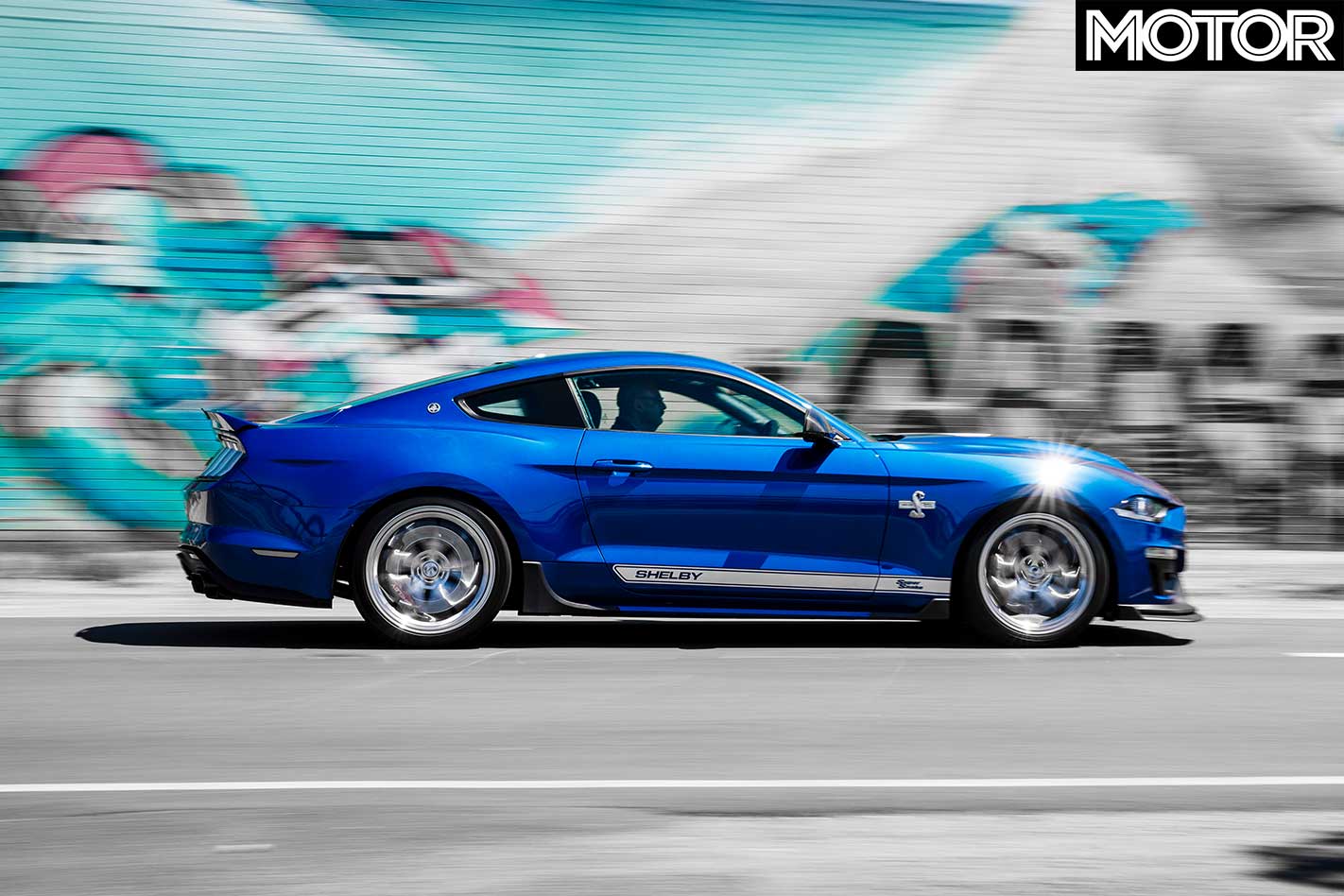
Then again, you need to keep this in perspective. Even a decade ago, a 5.0-litre engine making 800 horsepower would have been a right pig of a thing. That this one can create that sort of thrust and yet suffer only a minor driveability glitch is testament to the powers of the electron. And the clever people who map their journeys around a slice of silicon.
My other gripe is something I’ve noticed in every other MY19 Mustang automatic. And that’s a gearbox that doesn’t always seem to know its own mind (as my grandmother would have put it. And, boy, she would have known). Like I said, this isn’t a Shelby thing, it’s a Mustang thing, but I wonder whether the extra torque – and, therefore, reduced requirement for all those ratios – might not be of much help.
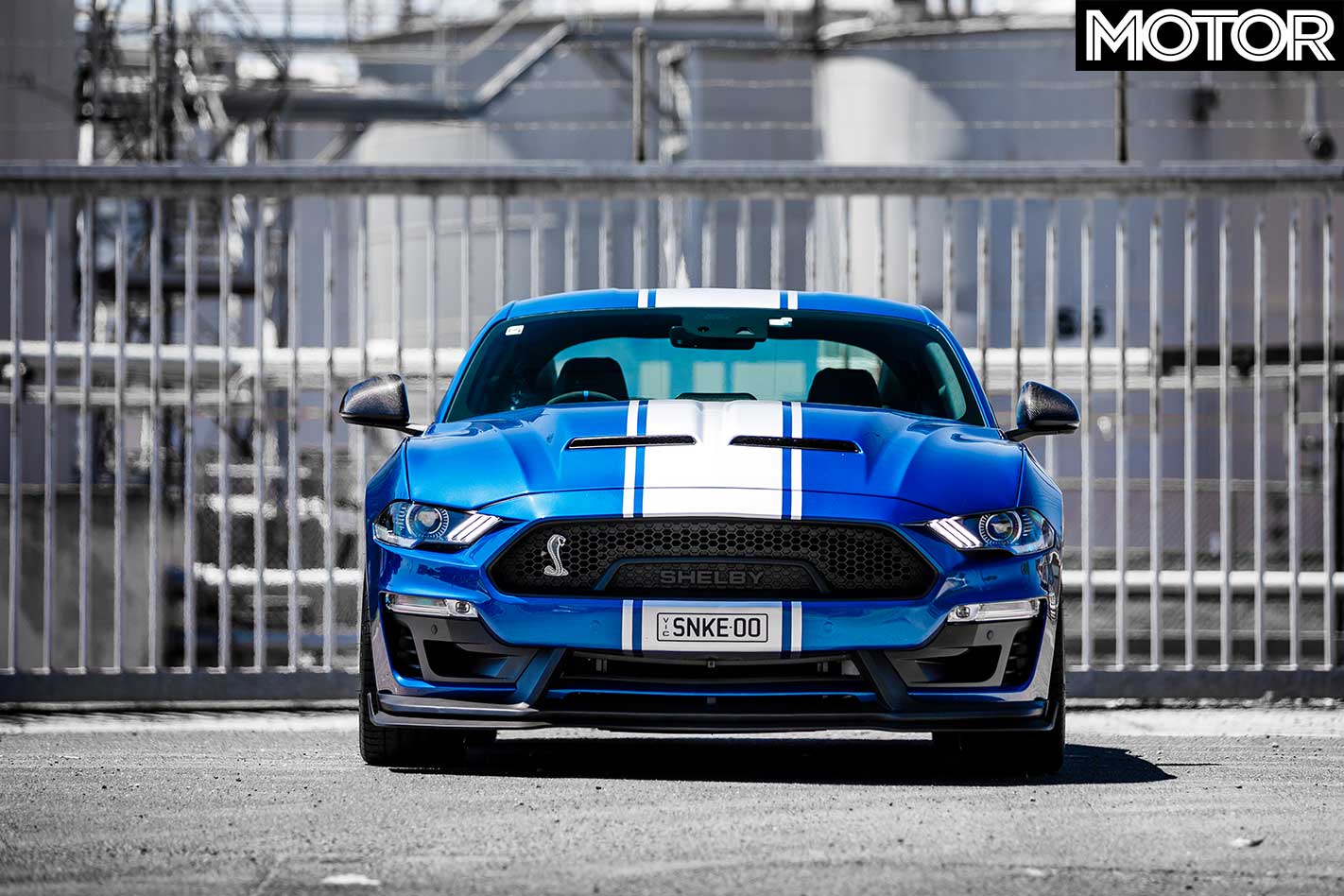
The bottom line is that this car, fast though it is, still won’t replace a Ferrari 488 in the garage. Or an R8 V10 or a 911. It’s still the sort of car that will swing a punch before it sits down to mediate and it’s fair to speculate that Carroll Shelby would absolutely approve.
The Super Snake might have gained a factory build-plate and lost its unicorn status, but it retains the wild-child feel of a concept with a Le Mans-winning heart and a design brief to test tyres to death.
FAST FACTS 2019 Shelby Super Snake
BODY: 2-door, 4-seat coupe DRIVE: rear-wheel ENGINE: 5038cc V8, DOHC, 32v, supercharged BORE/STROKE: 93.0mm x 92.7mm COMPRESSION: 12.0:1 POWER: 600kW @ 7400rpm TORQUE: 980Nm @ 5250rpm WEIGHT: 1681kg POWER-TO-WEIGHT: 357kW/tonne TRANSMISSION: 10-speed automatci SUSPENSION (f): struts, anti-roll bar, coil springs, dampers SUSPENSION (r): multi-link, anti-roll bar, coil springs, dampers L/W/h: 4789/1916/1396mm WHEELBASE: 2720mm STEERING: electrically assisted rack-and-pinion BRAKES: 380mm, slotted, two-piece rotors, 6-piston calipers (f); 380mm, slotted, two-piece rotors, 4-piston calipers (r) WHEELS: 20.0 x 9.5-inch (f); 20 x 11.0-inch (r) TYRES: Michelin Pilot Sport 4S; 275/35 ZR20 (f); 305/30 ZR20 (r) PRICE: $183,649
PROS: Huge poke; legendary back-story; epic soundtrack CONS: Will the trans match the drapes? It isn’t exactly cheap RATING: 4 out of 5 stars
Donk Details
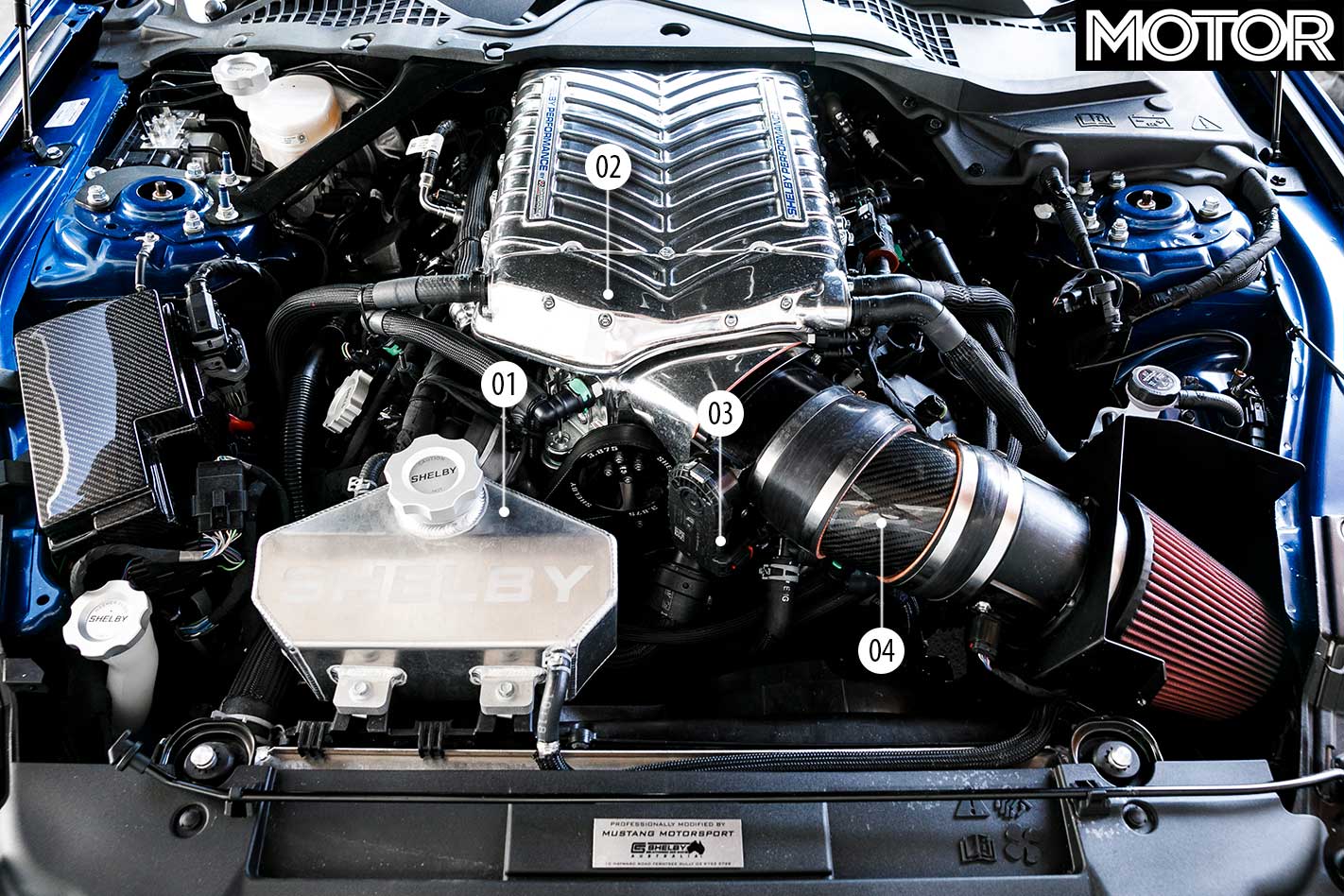
01 – Jazzy bits It’s not just about ‘go’ under the bonnet, with the ‘show’ accounted for with Shelby-branded engine-bay caps, coolant overflow tank and carbon fibre – not forgetting the polished supercharger
02 – Just add boost The 800hp 3.0-litre Whipple Supercharger Pack isn’t fooling around and comes in at $12,290 over the ‘base’ output. The ECU has been upgraded to cope and extra-long wheel studs are required
03 – Power upgrade Both the power and torque of the 5038cc V8 have nearly doubled to 600kW and 980Nm (from 339kW and 556Nm) with the blower. Cold air is fed by the pod filter and expelled via the active exhaust
04 – Keeping cool While the rear end is bolstered by a one-piece tailshaft and beefier axles, an intercooler and a bigger radiator make sure the Super Snake doesn’t run too hot while screaming at 7500rpm
The Price of Fang
When I first looked at the build sheet for this car, I thought the Super Snake list price must have included the basic Mustang as well. I mean, at $93,100 for the basic 700-horse package, that’s not a bad guess right?
Wrong. The car is extra.
But think about it some more. The engine is now supercharged, all the bouncy, stoppy bits are new, the interior is re-trimmed and even the bonnet is a different piece. And what price do you put on the fact that this is an honest-to-god Shelby Mustang?
Well, 93-grand I guess.
And if you’re going to drop that sort of coin, you might as well go all the way and grab the 800-horse option, right? Exactly. Although I’m not so sure about the painted (versus stuck-on) stripes, which added a full $12,000 to the total. That takes the grand total to $117,390 which, when added to the sticker on the screen of a brand-new Mustang GT automatic, takes the final bill to almost $184,000. Call it two-hundred large by the time it’s on the road and insured and you’re getting close.
WELCOME to Australia’s oldest yet cutest electric vehicle, as well as Europe’s EV bestseller, the Renault Zoe.
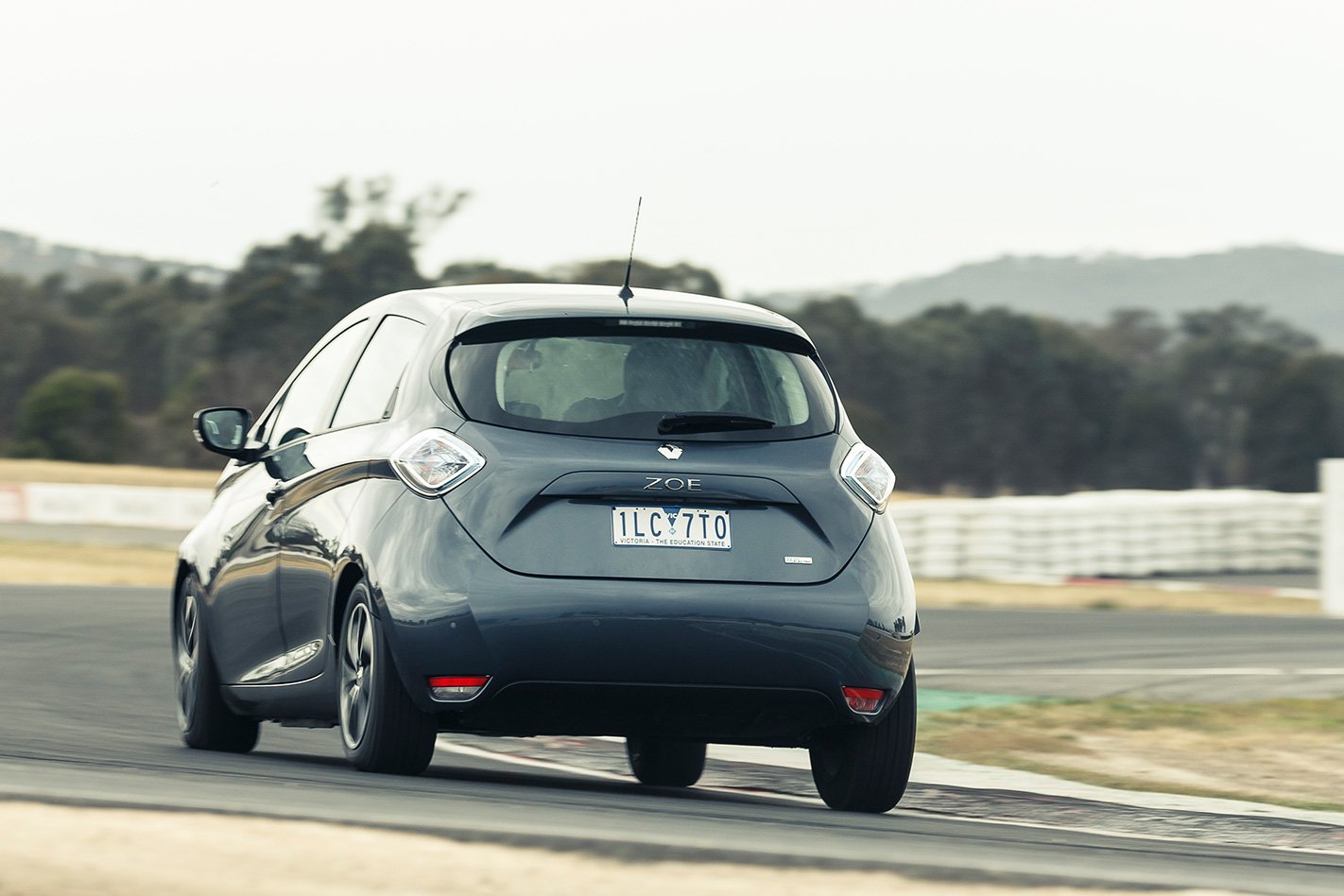
Launched in 2012, and based on the, ahem, current Clio IV supermini, the electric Frenchie five-seater city hatch has been systematically improved since then, so don’t worry; you’ll still manage an easy 200km-plus range, even when driven with gay abandon.
Have no doubt. That’s precisely how things could end up, given those Clio underpinnings and a low centre of gravity provide such a solid and enjoyable dynamic base. Quick, responsive steering, nippy handling, excellent grip and an isolating ride make the Zoe more than just the keen driver’s choice.

With an instantaneous 68kW and 220Nm on tap, the ZE40 (denoting the larger 41kWh battery pack) is also sprightly off the mark in that typical, dodgem-car EV way; there’s also a fairly hefty shove if you mash the throttle out on the open road, though watching your available remaining charge tumble as a consequence isn’t as much fun. We’d love to see even stronger regenerative braking resistance for single-pedal driving, though the anchors aren’t as touchy as some, thankfully.
For a four-metre city car, the Zoe’s pleasingly accommodating, with supportive front seats, sufficient space and comfort out back, and a reasonably sized boot at 338 litres (though note there’s no spare – just a tyre-inflation kit). There’s also a decent wedge of kit, including a reverse camera, sat-nav, EV-specific climate control (to minimise consumption), keyless entry/start, up-spec audio and DAB+ digital radio.
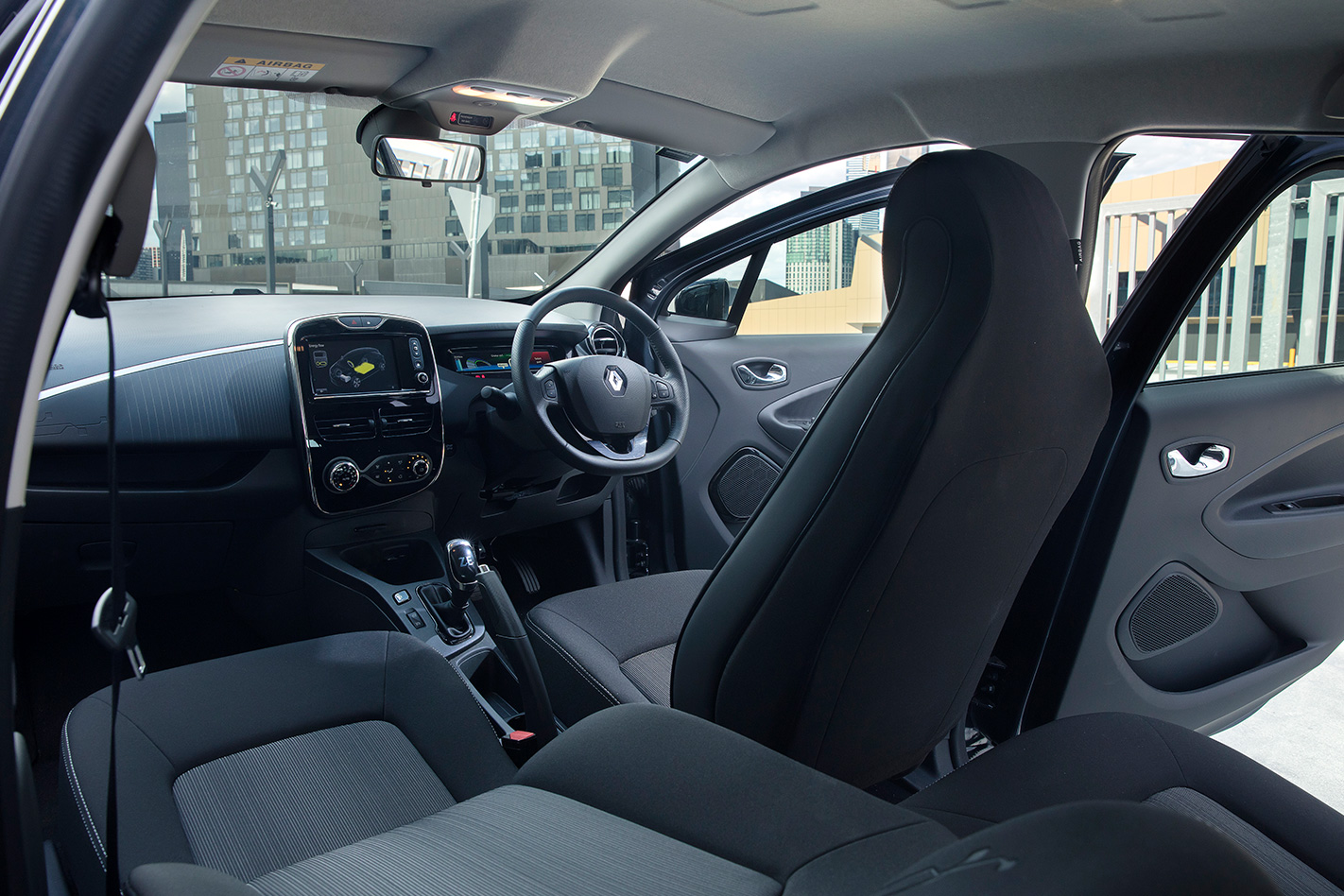
But then you digest the $50K (before on-roads) pricing and realise that the dated dash, hard plastics and missing kit like Apple CarPlay and Android Auto would be an embarrassment in a $25K Clio; dig deeper and AEB and other active driver-assist tech isn’t even available; and why aren’t Renault’s EVs subject to a five-year warranty, instead relegated to just three years’ cover?
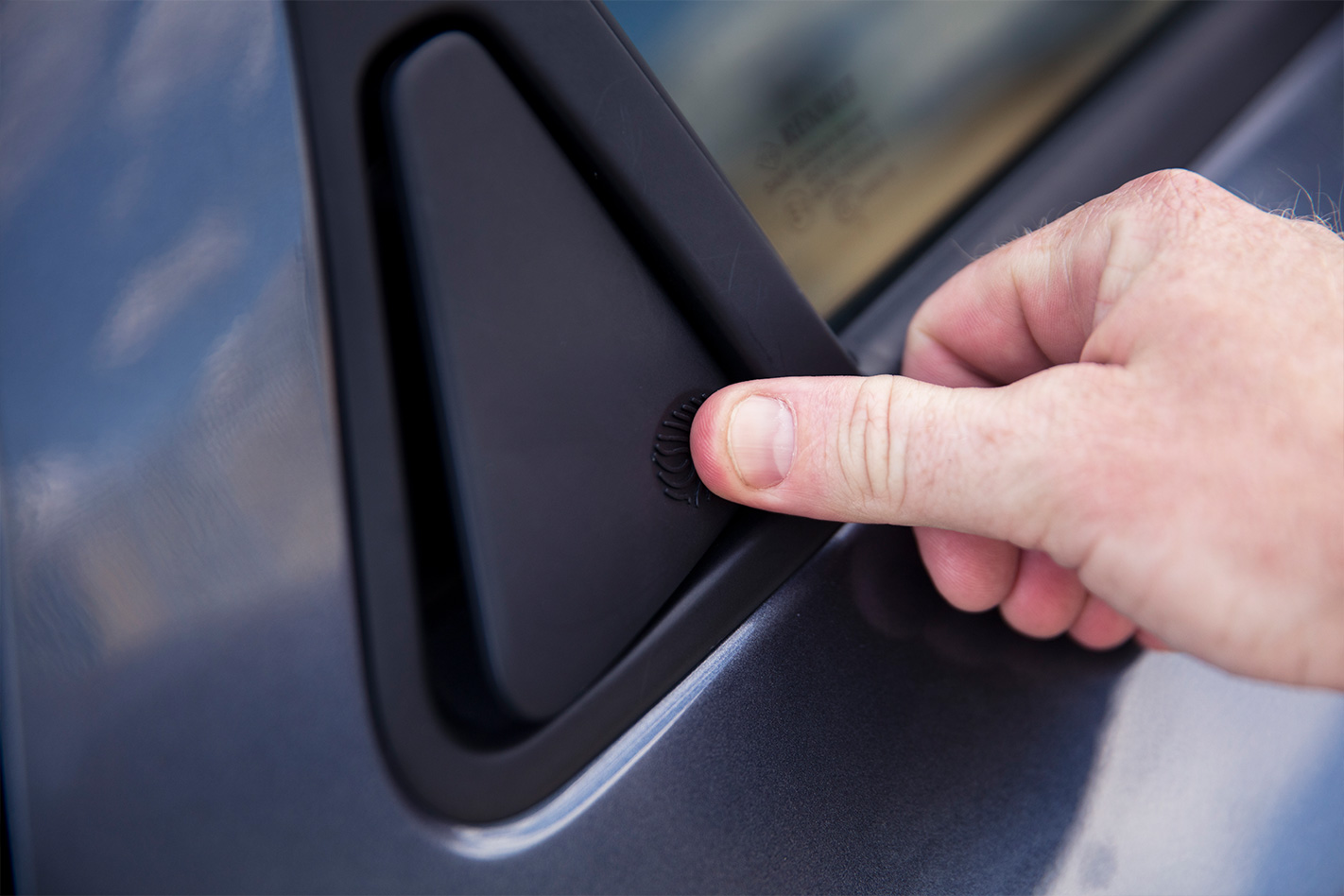
However, value-for-money concerns would soon be eclipsed by the almost total unavailability of fast-charging infrastructure for the plucky Zoe. That’s because it uses an AC rather than the DC system of more modern EVs, which means that while it’s fine to replenish those batteries from a regular 10A 240V household plug (albeit slowly, at over 20 hours!), that’s your lot. The ZE40 is essentially limited to city and ’burbs.

That’s a shame, but then the Renault is getting on for seven years old, and as its diminutive proportions clearly imply, this is an urban commuter EV; the company’s demographic profiling reveals that most owners own two vehicles and drive no more than 40km daily.
If that sounds like you, and you dig its unique, youthful, playful chic, then Zoe may be the one.
6/10
It’s been a wild old week in the WhichCar office, thanks to great scoop journalism from the crew at Wheels, the recalcitrance of Holden and the reveal (finally!) of the new Mazda 3 pricing. Here, in no particular order, is our top five plays of the week.
1. Ford Ranger scooped
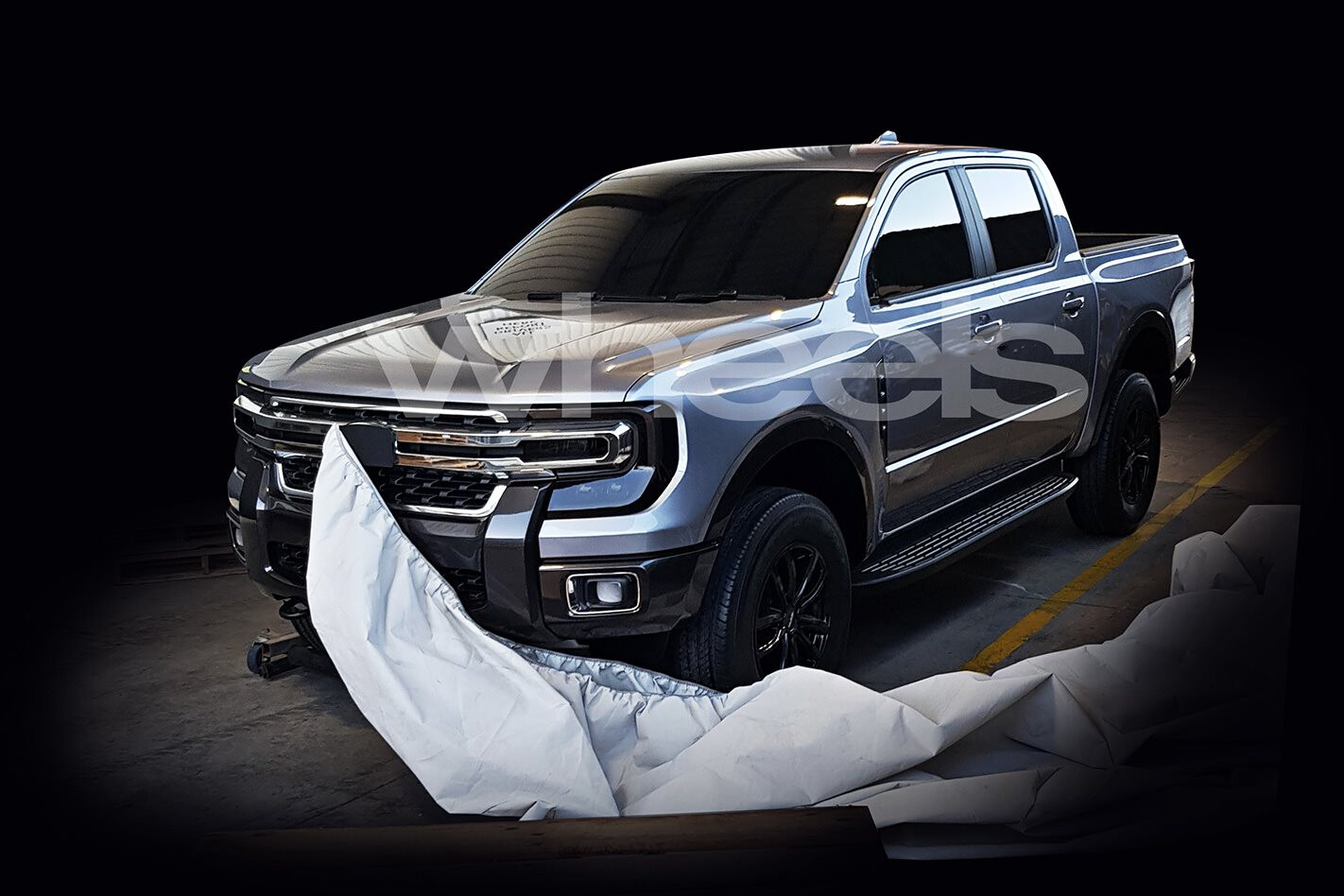
I read a story once about the founders of Modern Motor magazine casually donning dustcoats and overalls and slipping unnoticed into Holden’s Sydney plant in 1956, where they scooped pics of the brand new FE – and even published a shot with GM’s head of security in the frame!
In a lot of ways, this week’s scoop shot of what’s purported to be the 2021 Ford Ranger feels a lot like that. Sure, there are loads of camo-wrapped car photos around, as well as the occasional one-off shot of something like the Toyota Supra… but this set of shots is pretty amazing, and a testament to the crew at Wheels.
Shot somewhere in Melbourne, it’s been picked up and splashed around the world. Ford isn’t saying anything, either, which means where’s there’s smoke…
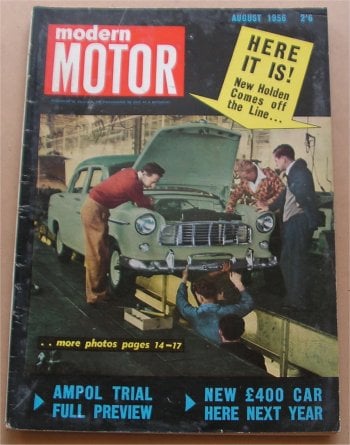
The cover in question… Modern Motor, August 1956
2. Holden in a hump
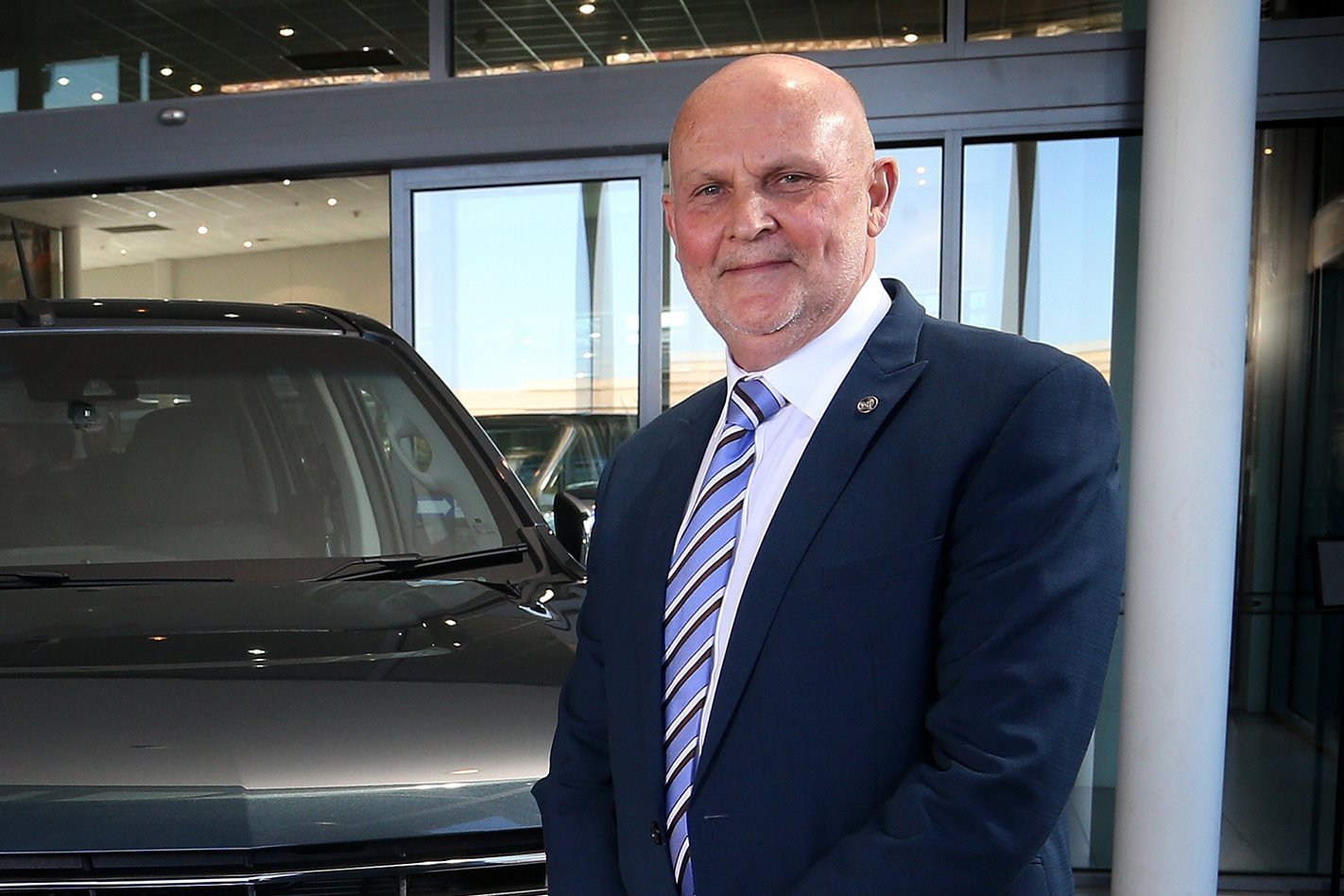
So, when a big story breaks, there are two ways to go about publishing it; regurgitating the press release, or actually getting on the phones and asking some questions. Often those lines of inquiry end in stony silence, but it’s journalism 101 – get both sides of the story.
Holden is, let’s be honest, under the pump on a number of fronts, so when a story about its parent company GM and auto importers Inchcape broke, we hit the phones and tried to get to the bottom of it.
Only… no one was talking.
Sure, there was an unambiguous one-liner from both parties, but no one wanted to front up and talk about the potential of one of Australia’s iconic brands changing hands.
More than two weeks – and 204 pieces of WhichCar content – later, Holden’s well-loved boss Dave Buttner finally batted away the stories… but even that process was delayed by embargo by three days.
In the meantime, tens of thousands of people have read the coverage on WhichCar, as well as the follow-up stories from Holden’s event this week.
3. Falcon’s Holy Grail
When I was a younger man, I did my time in the trenches with magazines like Motor, and I can tell you this: Australian cars sold copies.
If ever I took a potential cover to a publisher that wasn’t replete with a Holden Commodore, HSV ClubSport or Ford Falcon flaying its tyres off, I knew I was in for a long afternoon of trying to justify it.
And even after the end of manufacturing, that fascination remains – hence the popularity of the two stories above.
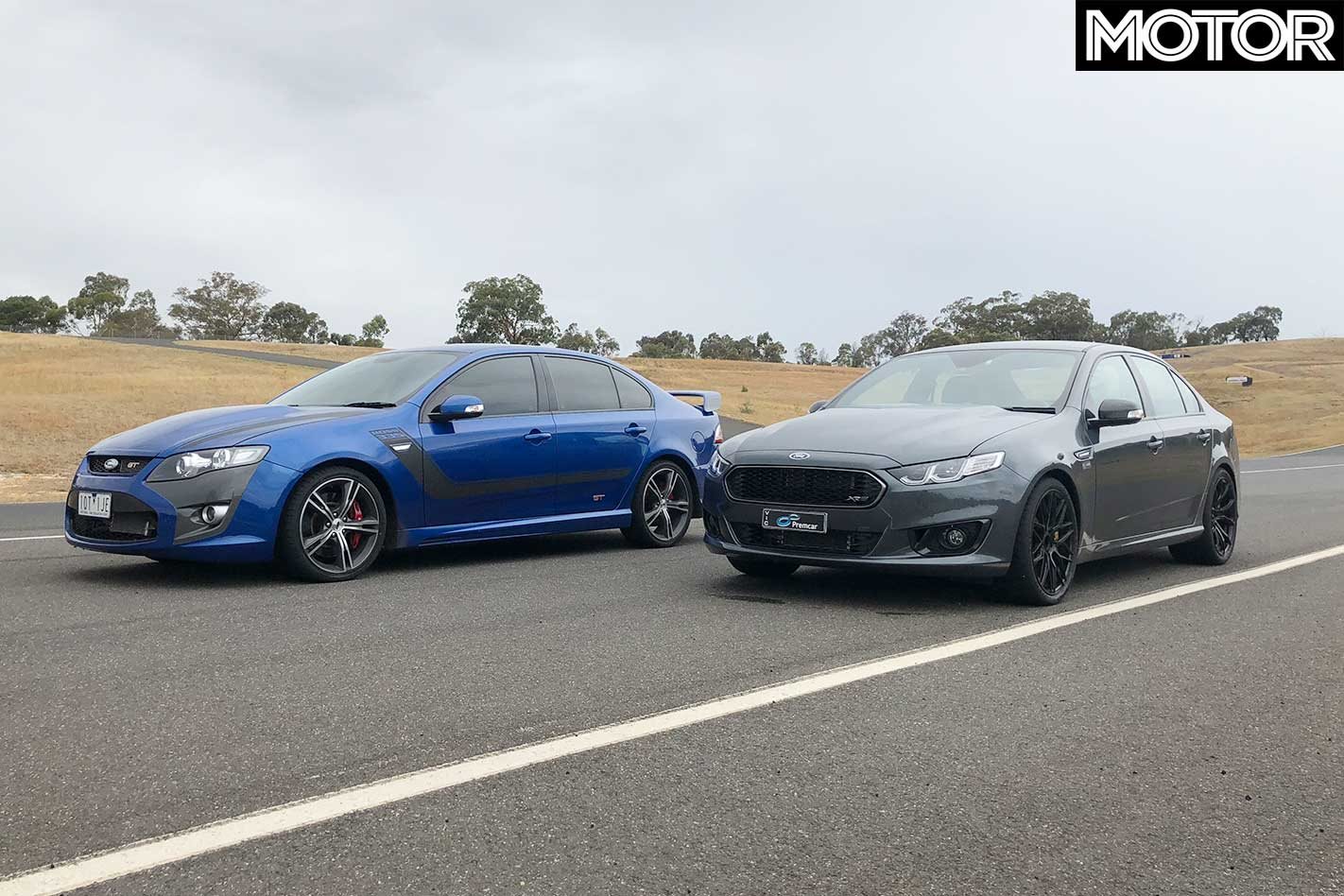
Another piece, though, has brought back a few memories but also has left me scratching my head a bit. The unveiling of a – very good, it has to be said – tuning kit for the long-gone V8-powered Ford Falcon GT has invoked vids of long, languid slides and misty-eyed reminiscing… but this kit feels like it’s a solid year too late.
If you have a GT, would you want to modify it, or keep it as a collector’s item? And aren’t there other ways to make a slidey Falcon from something a lot less precious? Anyway, just my 2c…
4. Mazda time
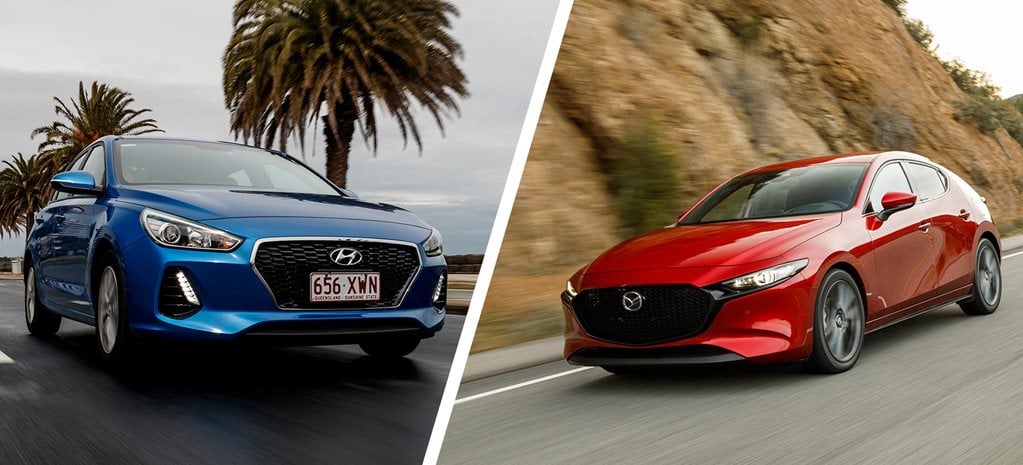
Embargoes are a part of the modern automotive journalism landscape – I’m not a huge fan, but they are put in place to ensure every outlet gets a fair crack at creating content in a measured amount of time.
And, to be fair, it was a VERY late night/early morning writing up the news around VW’s new compact SUVS this week… dinner, product reveal, “oh, and no embargo, folks.” Cue many journos skulking for the bus back to the hotel to get something up online before their colleagues…
Pricing and specs for the new Mazda 3 were subject to quite a lengthy embargo, though, but of course being one of Australia’s most popular small cars meant that interest was instantly high.
What rated higher, though, was a quick but clever comparo of the Mazda and one of its key rivals, the Hyundai i30. As I type, it’s tracking better than the actual pricing piece.
5. And on the lighter side…
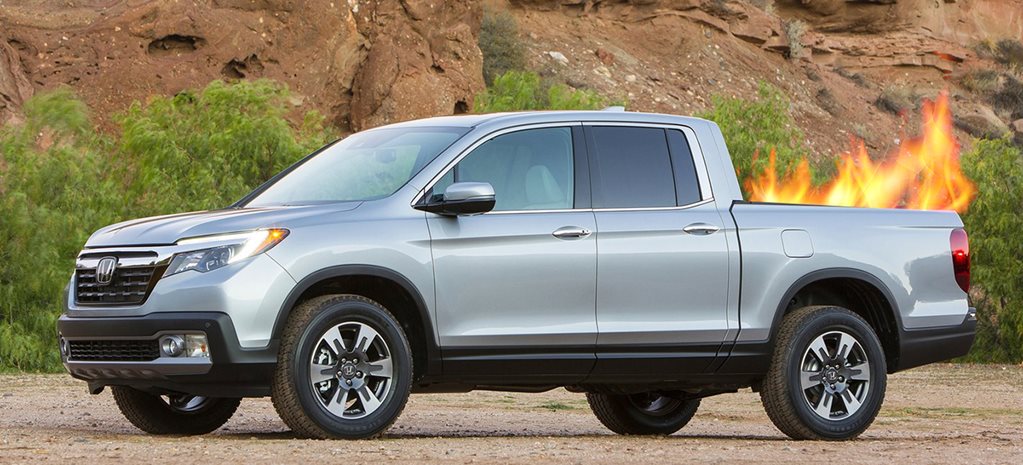
Washing your car… you’d think that a car maker would account for that when it designs and builds new cars, right? Well, in Honda’s case, not quite.
We ran a story earlier this week about its US-based Ridgeline ute which, if washed regularly, might actually catch fire.
I know EXACTLY what I won’t be doing this weekend, then…
The fourth-generation Ford Focus arrived at the end of 2018 and it’s already evident that its closest rival is the Hyundai i30 which goes toe to toe with the Ford’s euro hatch in terms of space, comfor and performance.
We’ve brought together the entry-level Ford Focus Trend and the similarly equipped Hyundai i30 Active auto.
HOW AFFORDABLE ARE THEY?
Ford Focus Trend
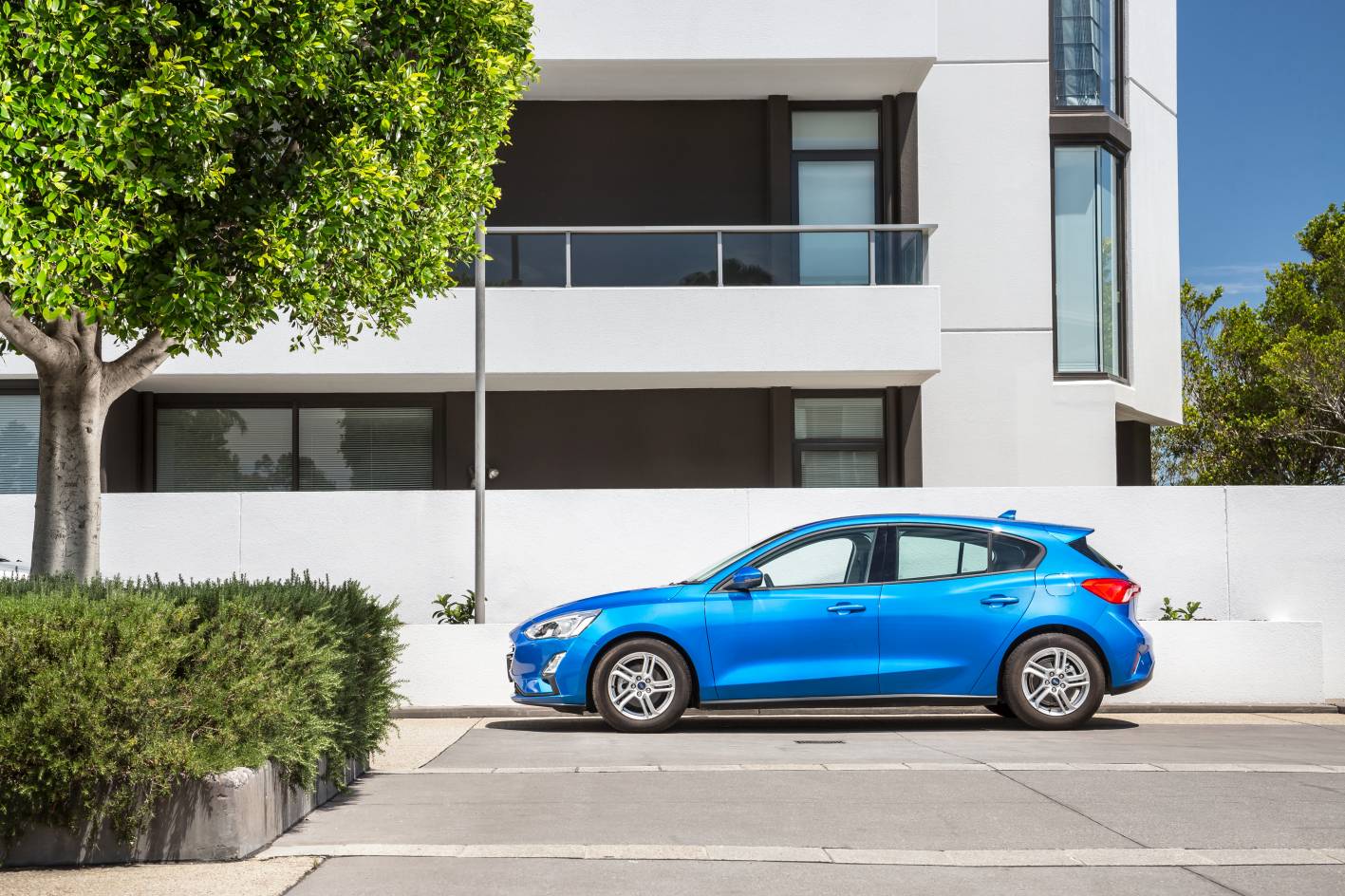
Priced at $25,990 the Ford Focus Trend hatchback is the cheapest Focus in the range.
Our test car featured Desert Island Blue premium paint valued at $650, which took the retail price to $26,640, which is what you’d pay for other similarly-equipped mid-spec hatches, such as the Holden Astra RS ($27,240) and the Toyota Corolla SX ($26,670).
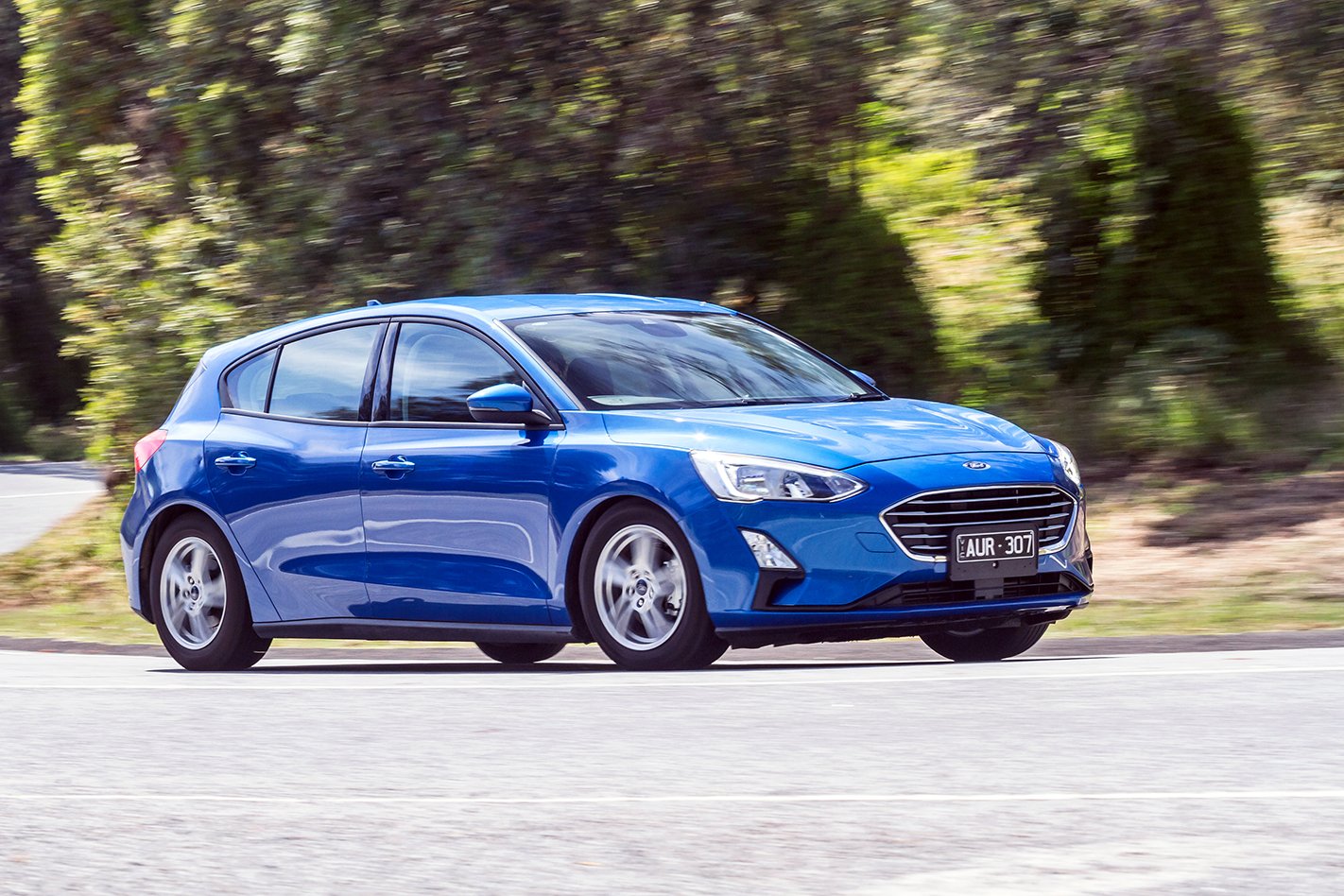
The Focus Trend’s official fuel consumption is 6.4L/100km combined, with our testing taking that up to a still-respectable 7.2L/100km.
The Ford Focus Trend is covered by Ford’s five-year, unlimited kilometre warranty.
Hyundai i30 Active
Priced from $23,390, the Hyundai i30 Active 2.0-litre petrol automatic we’re testing here costs $2300 more than the manual version. The same grade can also be had with a 1.6-litre turbo diesel version in manual or automatic form, for $23,590 and $26,090 respectively, if you’re looking for a more fuel-efficient option.
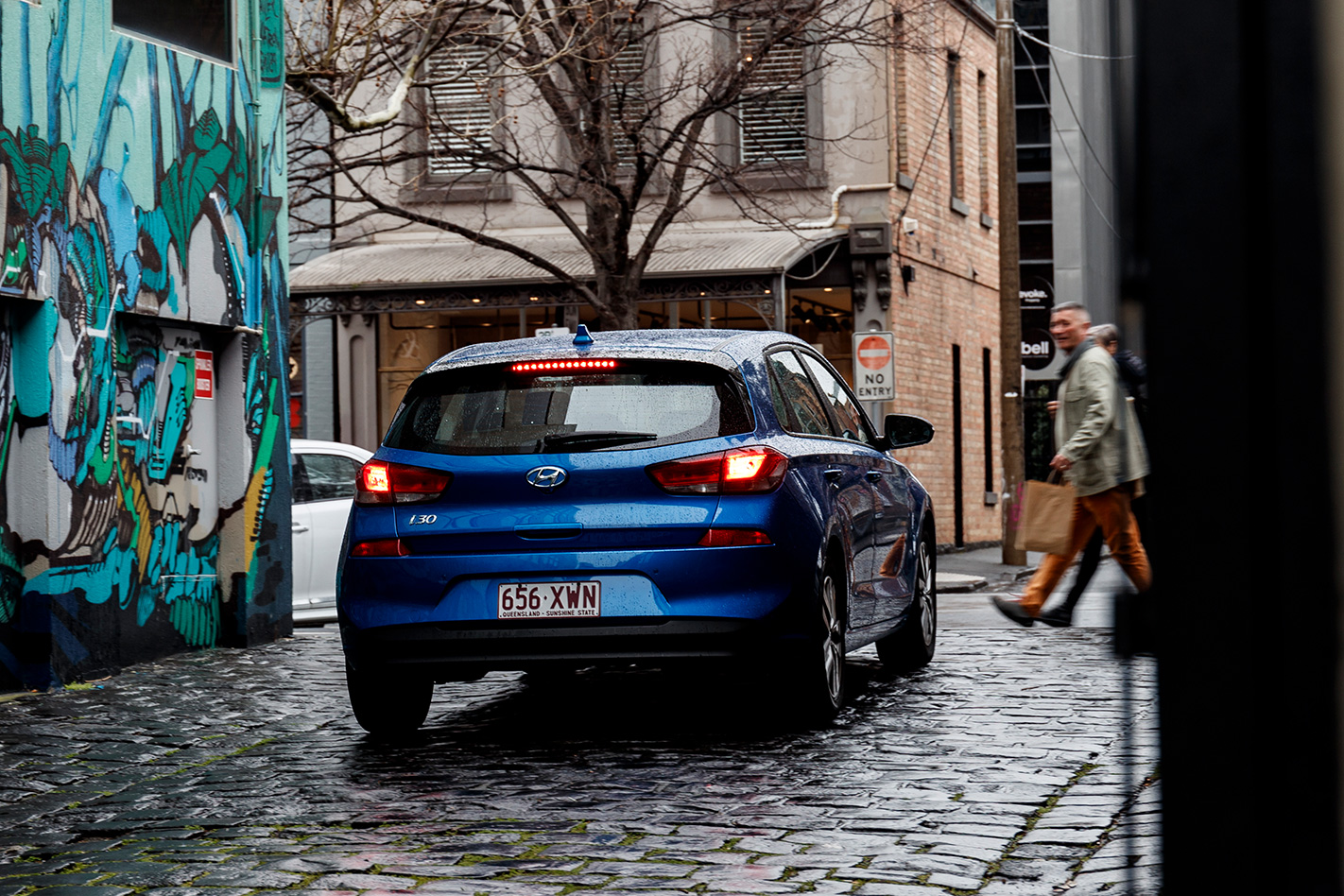
The vehicle we tested was standard, with the only extra on top of the six-speed automatic gearbox being the Marina Blue paintwork for an extra $495 that took the total retail price to $23,885.
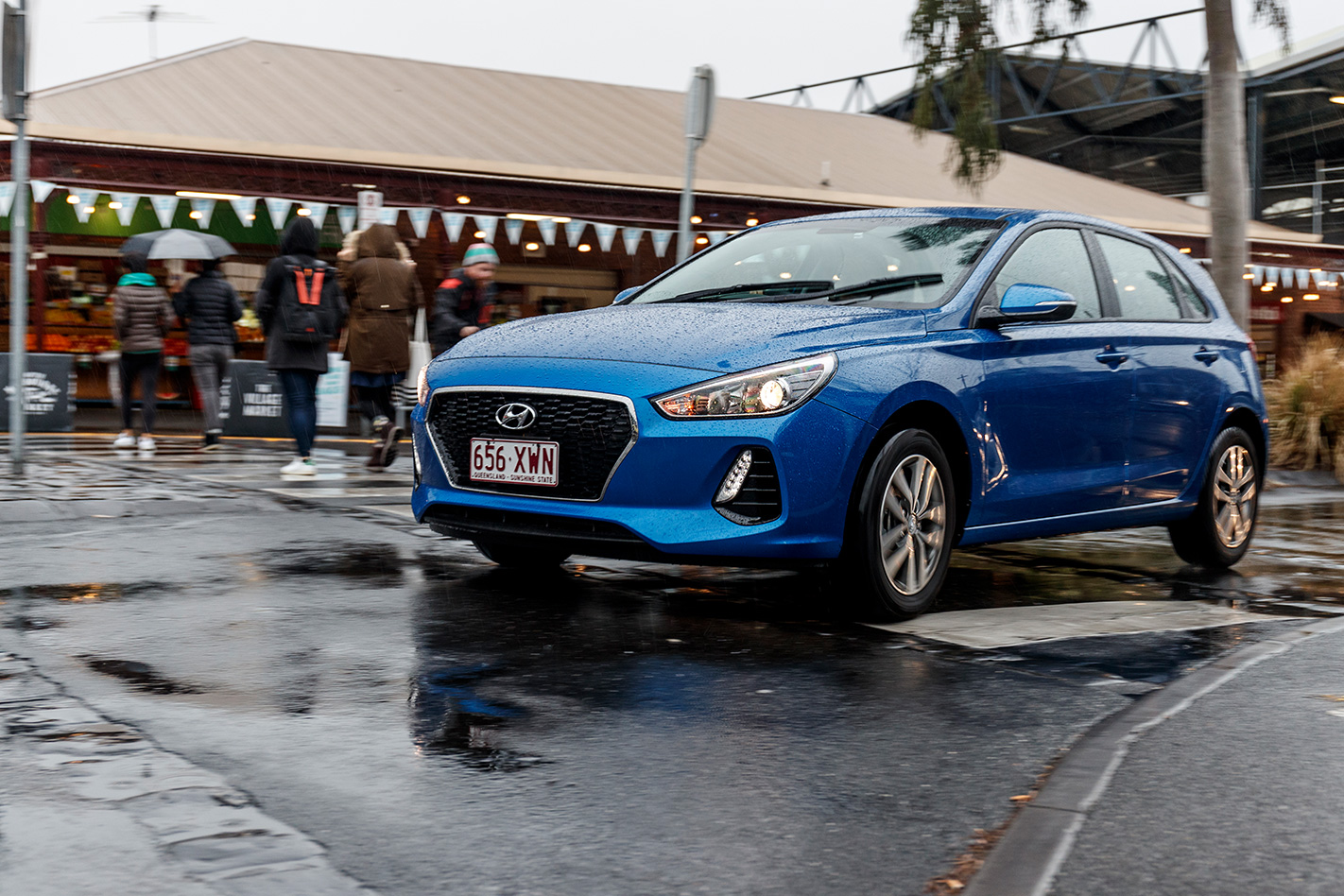
Active safety features including autonomous emergency braking aren’t included on the standard spec sheet, however it’s available as part of Hyundai’s SmartSense package that for around $1700, which takes the price up to $25,585.
The 2.0-litre engine’s claimed average fuel consumption is 7.4L/100km with the automatic, which is a little thirsty for a small hatch – the similarly powered Mazda 3, for example, sips unleaded at a rate of 5.8L/100km.
The i30 is covered by Hyundai’s five-year/unlimited kilometre warranty.
WHAT FEATURES DO THEY HAVE?
Ford Focus Trend
All fourth-generation Focus variants in Australia are powered by a three-cylinder 1.5-litre ‘EcoBoost’ turbo petrol engine coupled with an eight-speed automatic transmission.
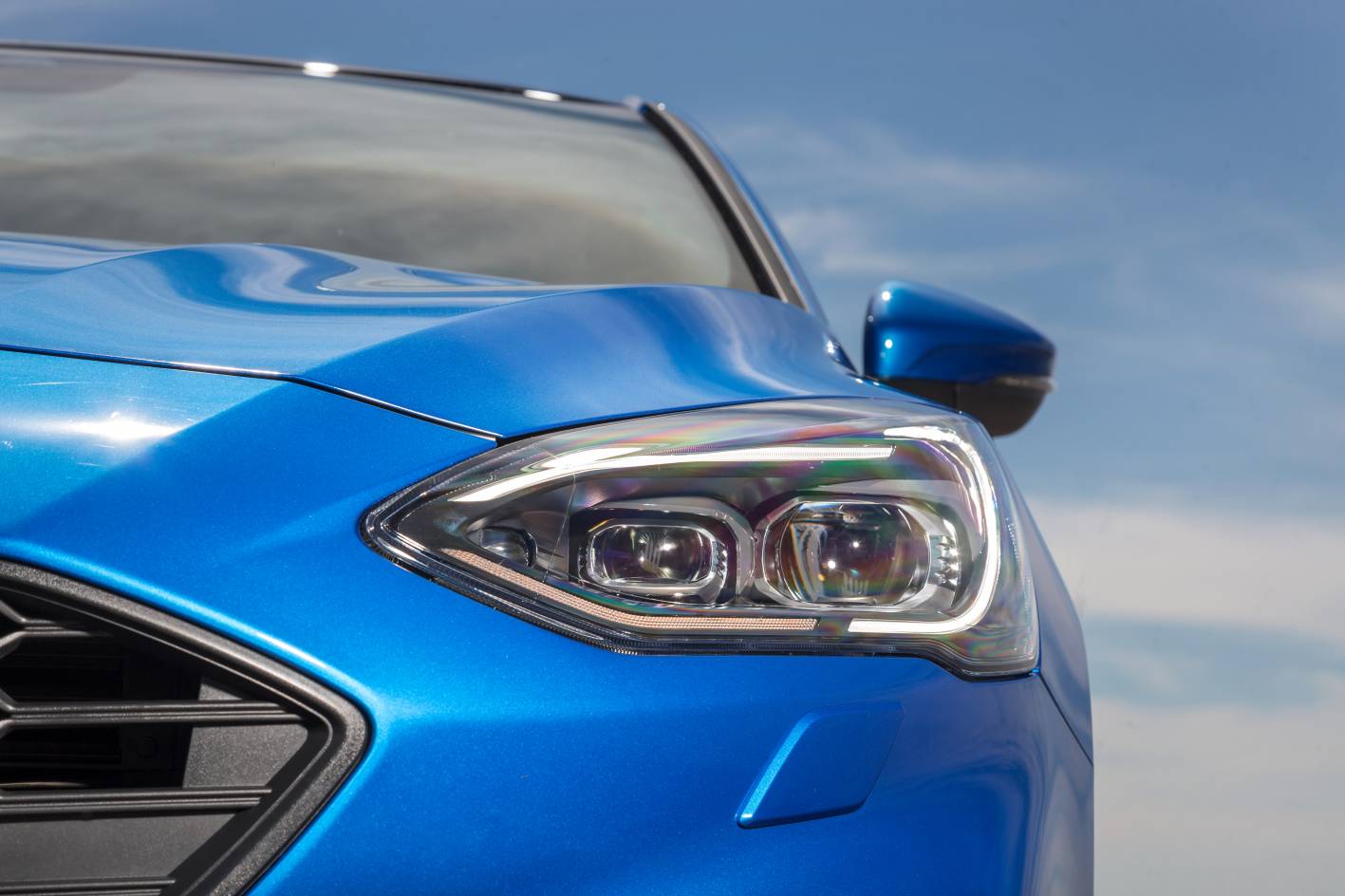
Autonomous emergency braking is standard across the range, as is an eight-inch touchscreen with 180-degree view parking camera, Ford’s Sync3 infotainment system with in-built-satellite navigation, digital radio and Apple CarPlay/Android Auto, phone charging pad, LED daytime running lights, and rain-sensing windscreen wipers.
The Trend rolls on 16-inch alloy wheels and has cloth seats with manual adjustment.
Hyundai i30 Active
You’ll find things in the i30 Active that are options in far more expensive cars, such Apple CarPlay and Android Auto smartphone pairing, satellite navigation and digital radio (DAB+), which are controlled via an 8.0-inch touchscreen.
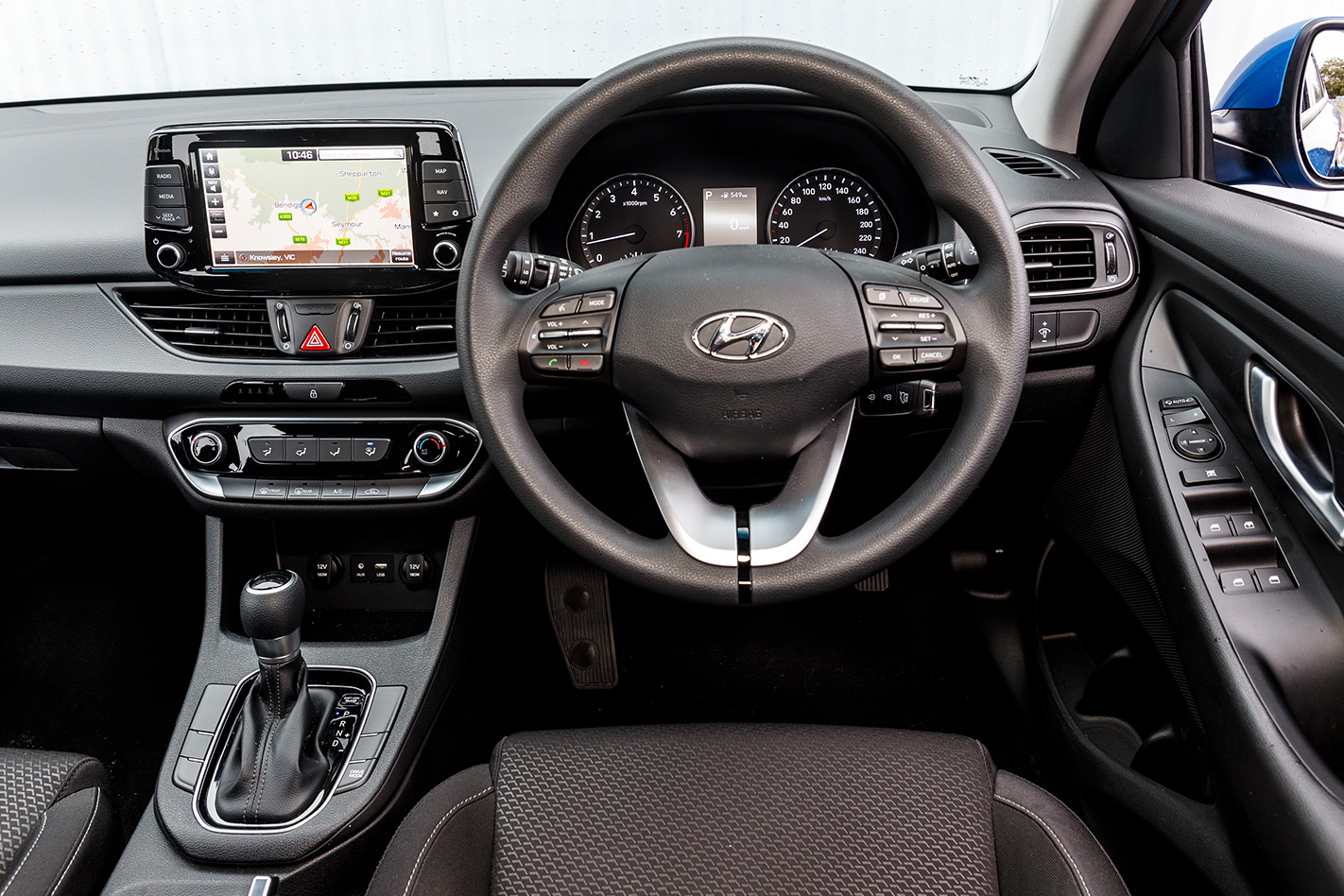
It also comes with LED daytime running lights, power-folding electric mirrors, cloth seats and cruise control. 16-inch alloy wheels are standard, and you get a full-sized spare alloy wheel as well – something that’s often a cost option in this segment, or replaced by a space-saver.
HOW PRACTICAL ARE THEY?
Ford Focus Trend
At 4.38 metres long, the fourth-generation Ford Focus is 18mm longer and has a 53mm lengthier wheelbase (2.70 metres), than its predecessor. This adds to interior space, but trim overhangs at each end give a more compact, svelte appearance.
This, and the fact it’s 88kg lighter than the previous model, makes it feel impressively nimble, making it great for driving around town and parking in tight spots.
A more compact dashboard design adds an additional 100mm to the cabin and results in more rear legroom than before, even with the front seats pushed back to accommodate tall occupants.
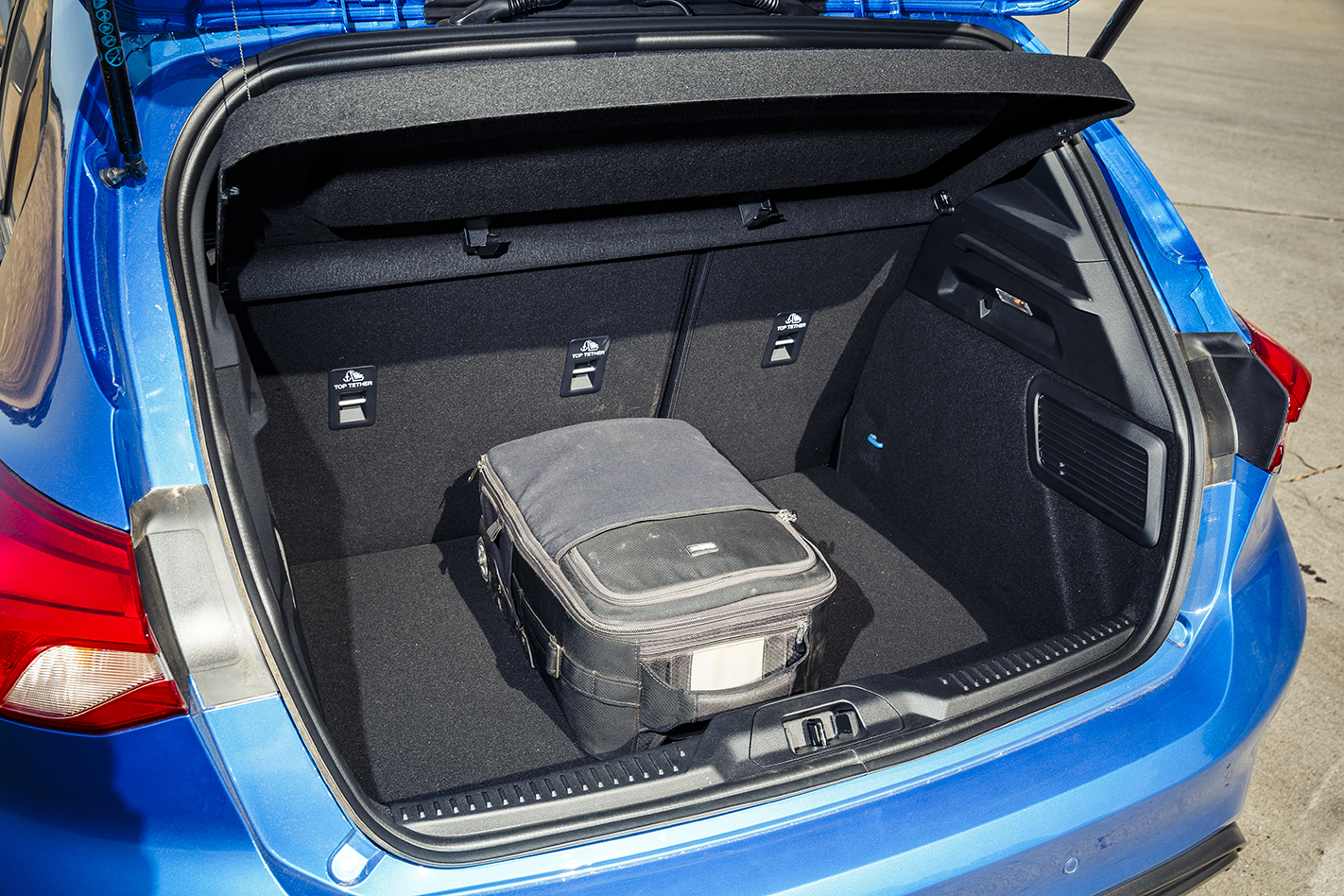
The boot space measures 373 litres, which is about average for the small hatchback class.
Hyundai i30 Active
The Hyundai i30 is a five-door hatchback that seats up to five people.
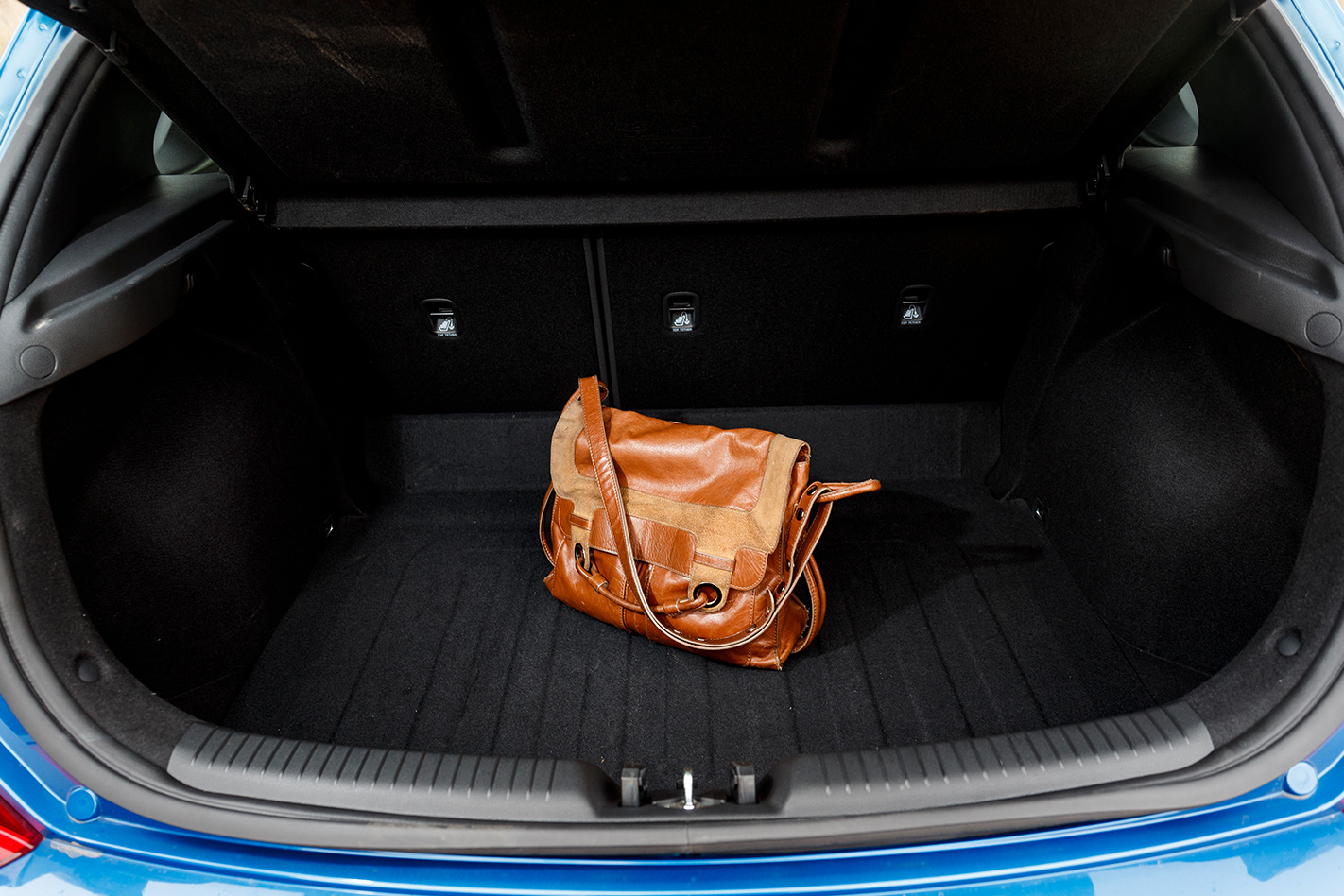
It measures just 4.34m length with a 2650 wheelbase that accommodates a spacious interior and practical 395-litre boot space that expands to 1301 litres with the rear 60:40-split seatbacks folded down.
HOW SAFE ARE THEY?
Ford Focus Trend
The Focus Trend comes standard with autonomous emergency braking with pedestrian and cyclist detection, along with lane-keeping assist. It also has post-impact braking that applies the anchors after impact so the car doesn’t roll away.
An extra $1250 brings a Driver Assistance pack that brings additional safety features such as rear-cross traffic alert, blind-spot monitoring, and adaptive cruise control with ‘Stop & Go’, which is great in traffic jams.
All Focus variants are equipped with six airbags, front and rear side curtains, and ISOFIX child seat anchors in the rear seats. Crash safety is good, with the 2019 Ford Focus range awarded a 5-Star ANCAP rating in December 2018.
Hyundai i30 Active
The Hyundai i30 was awarded a five-star ANCAP rating in April 2017. It’s a safe car in terms of crash protection, with seven airbags including a driver’s knee bag and full-length curtain airbags to protect your head.
Other safety features include a reversing camera, rear parking sensors, auto-on headlights, LED daytime running lights, seatbelt reminders on front and rear seats, and electronic stability control that all cars are required to have.
Active safety features including autonomous emergency braking aren’t included on the standard spec sheet, however it available as part of Hyundai’s SmartSense package that for around $1700 adds active cruise control, auto-braking, lane keeping assist, driver attention alert, blind-spot detection, and rear-cross traffic alert.
HOW COMFORTABLE ARE THEY?
Ford Focus Trend
The Focus Trend’s roomy interior design is clutter free and intuitively designed, but doesn’t exactly boast much in the way of design flair.
The cloth front seats are pretty basic but are comfortable enough with good back support. The rear seats feel good too, but lack a centre armrest and their own air vents or USB sockets (though there is a 12v socket for device charging).
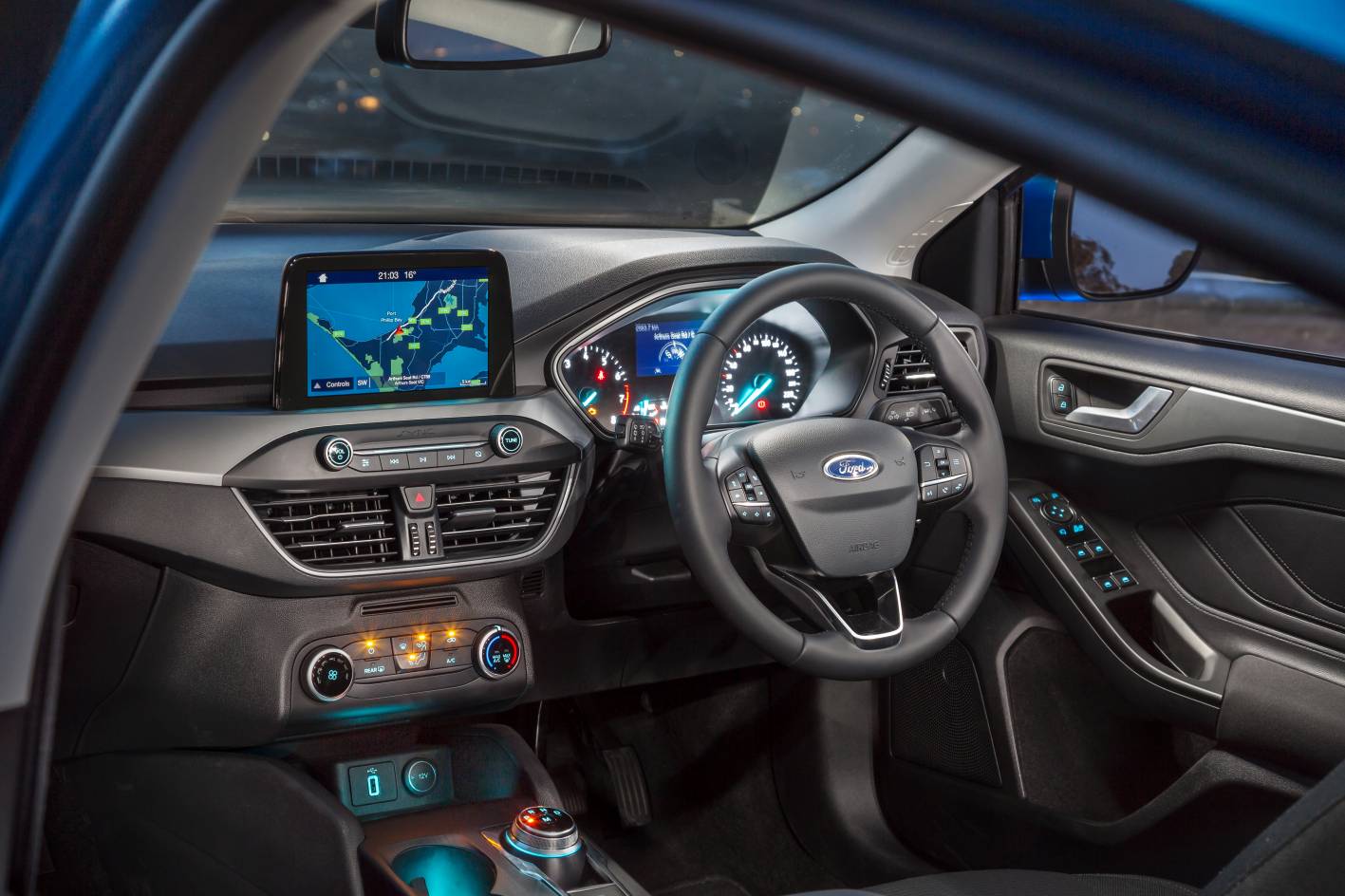
The dashboard design is a big improvement over the previous model, with the bulky central head unit replaced by a floating touchscreen that display’s Ford’s very user friendly Sync3 infotainment system. It’s a bit dull though, unless you like everything black, and the gauge cluster looks like it was borrowed from a truck.
On the plus side it’s very comfortable, with a smooth and quiet ride on the 16-inch wheels and conventional torsion beam suspension that rides over imperfections well.
Hyundai i30 Active
The i30 Active’s cloth seats are comfortable and there’s good leg and headroom throughout, though the rear seat is a little too narrow to comfortably seat three adults – though that’s common for this segment.
The smaller 16-inch wheels provide it with a better ride than the up-spec models that roll on 17s and 18s, and the locally-tuned suspension has a composed ride over bumps.
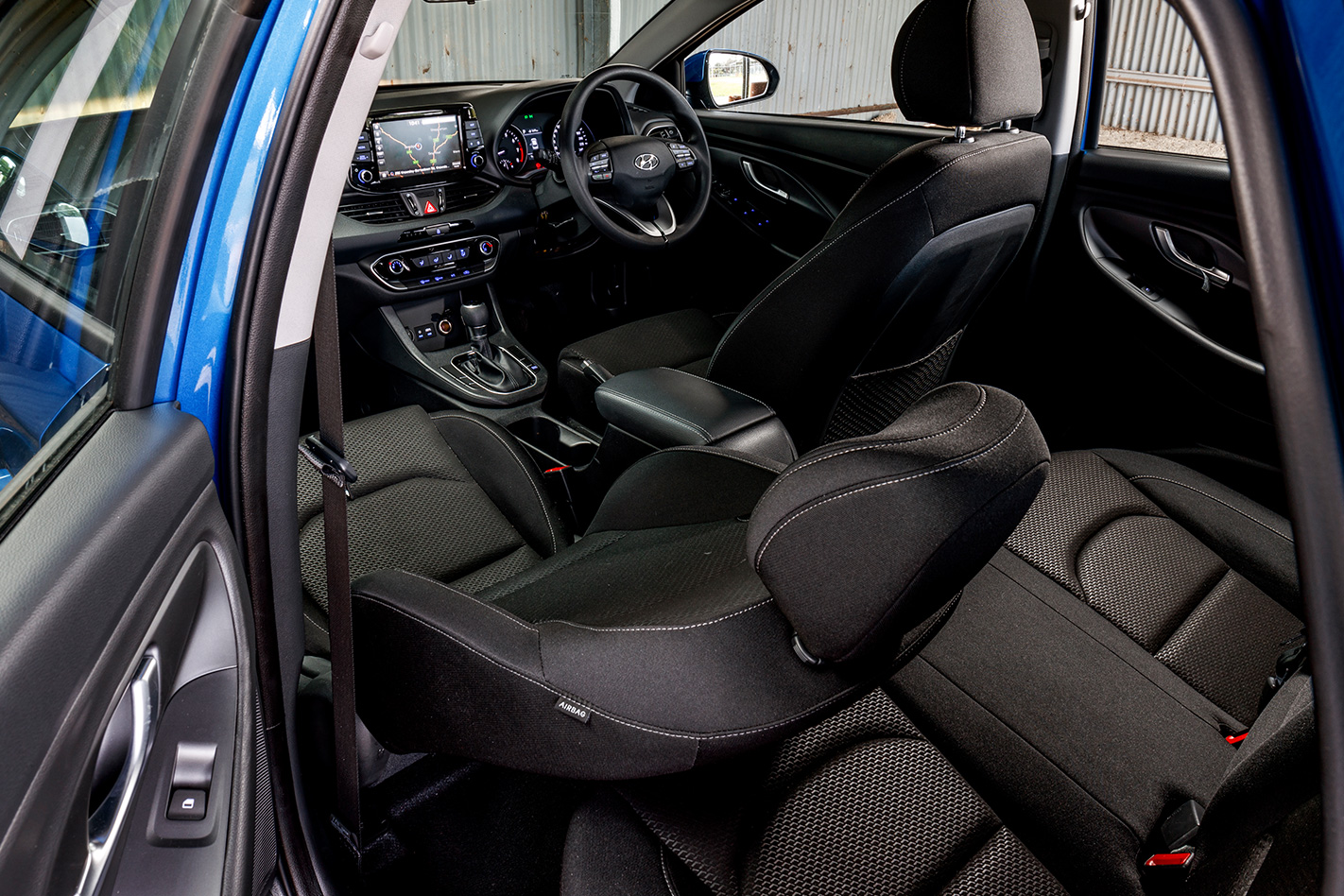
The conservative cabin design is a little bland and hard plastics abound, but the dashboard looks neat and uncluttered and the controls, particularly the switches on the steering wheel, are intuitively laid out.
The 8.0-inch touchscreen, which is a staple across the Hyundai and Kia range, looks good, works well and the infotainment system is very easy to navigate.
Rear-seat passengers miss out on their own air vents or USB/12v charging sockets, but if their phones go flat they can enjoy the view with good side and forward vision through the i30’s generous glasshouse.
WHAT ARE THEY LIKE TO DRIVE?
Ford Focus Trend
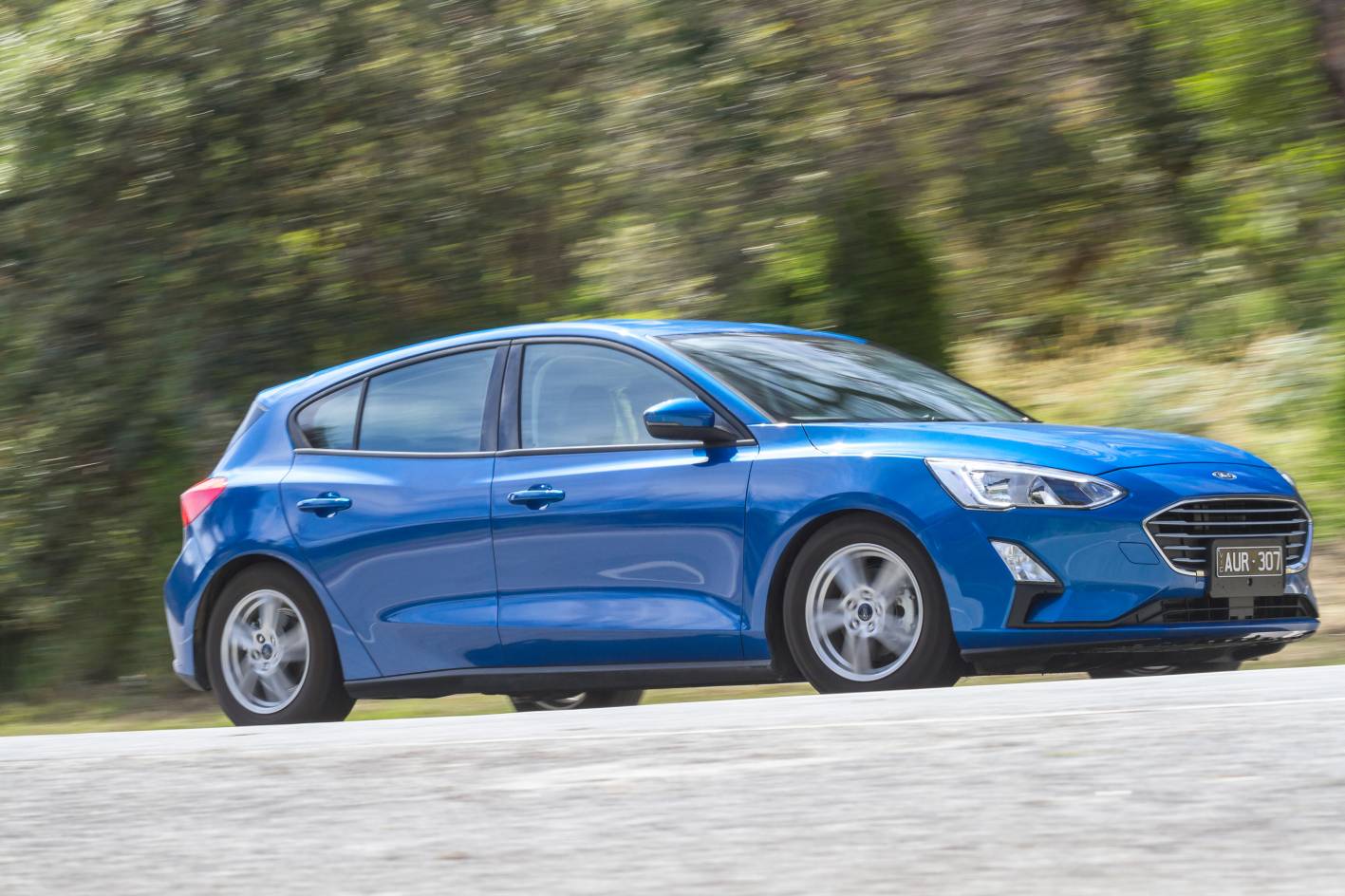
The 2019 Ford Focus’s spirited performance would be evident even during a short test drive.
Its 1.5-litre three-cylinder turbo is an enthusiastic engine and is rarely found wanting. There’s little by way of turbo-lag when you put the foot down and the eight-speed auto does a nice job shifting through the cogs, with Sport mode holding onto gears to deliver sprightlier performance.
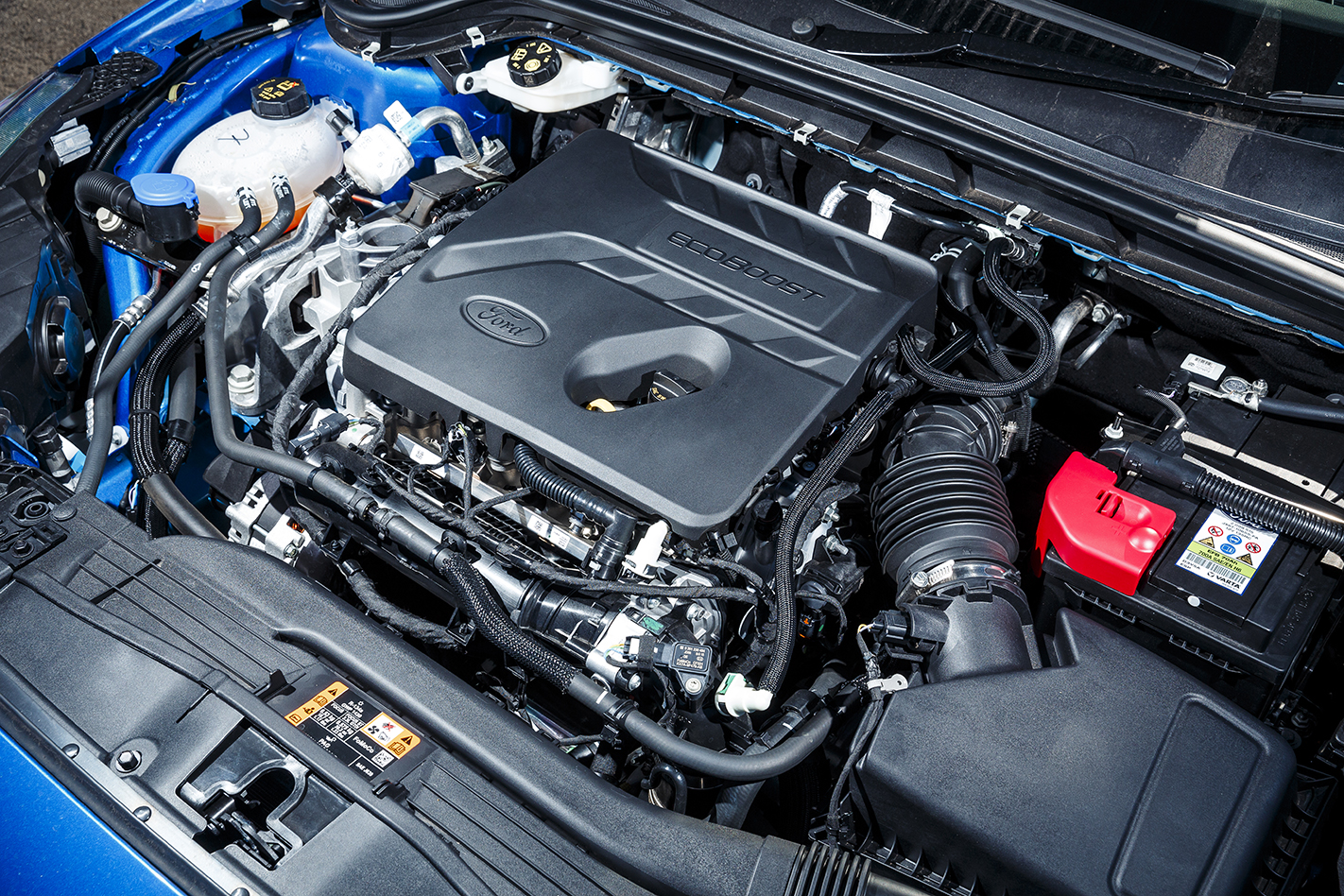
Fuel consumption is also helped by slippery aerodynamics, with the new design featuring underbody panels and an active grille shutter that have significantly reduced drag compared to the previous model.
The steering is light but crisp, so there’s good engagement between your hands and the front wheels, which combines with the well-balanced chassis to inspire confidence when pushing it into corners.
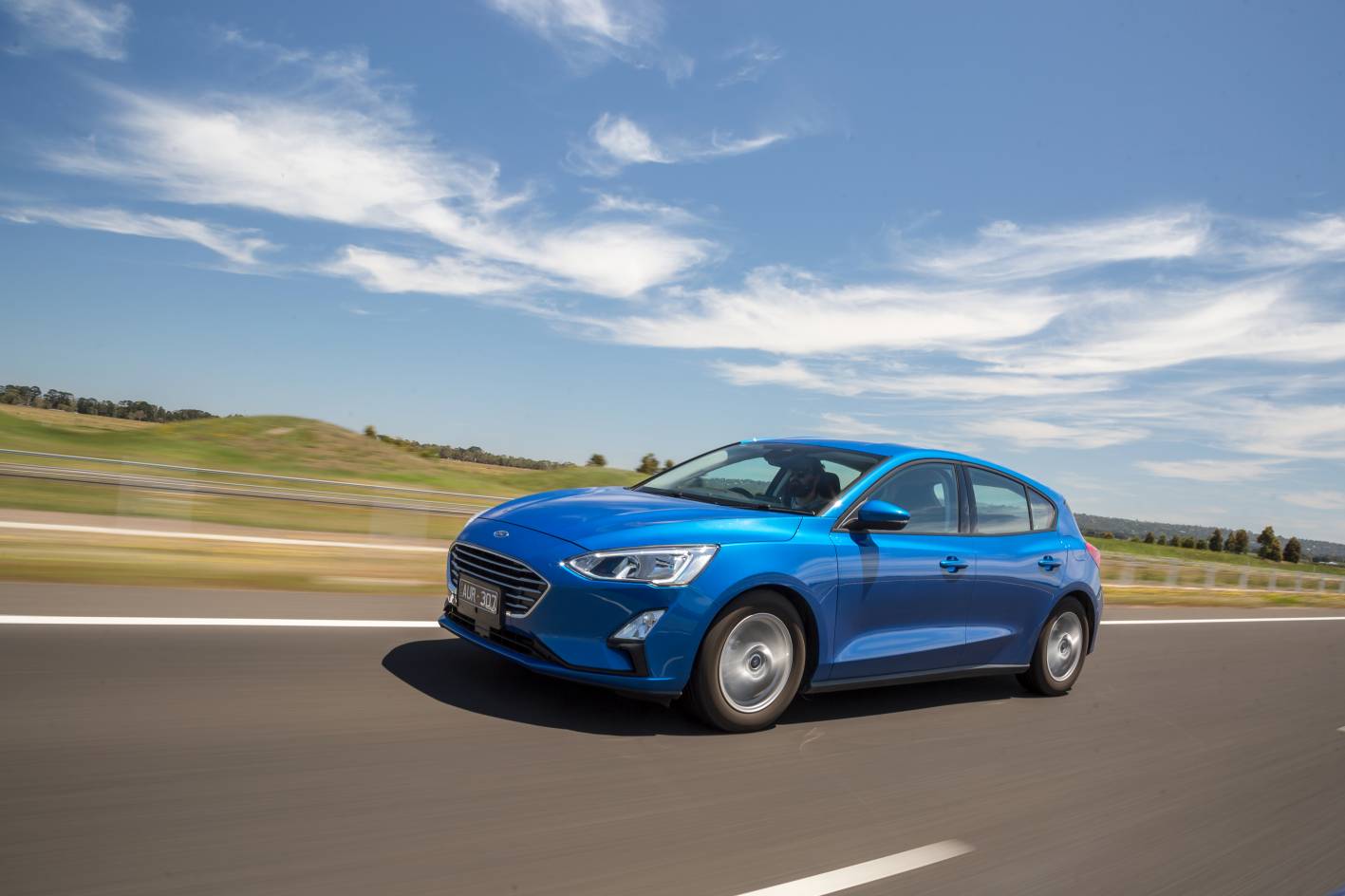
The ride feels controlled but comfortable around town or on the highway, which makes for an enjoyable ride whether it’s a quick trip to the shops or a weekend road trip.
Hyundai i30 Active
While it’s not intended to be as spirited or dynamic as the sportier i30 SR at the upper end of the range, the i30 Active certainly feels nimble enough around town. Hyundai has honed its chassis and suspension for Aussie roads resulting in a great ride and body control on a broad range of road surfaces, which makes it feel like a bigger, more mature car.
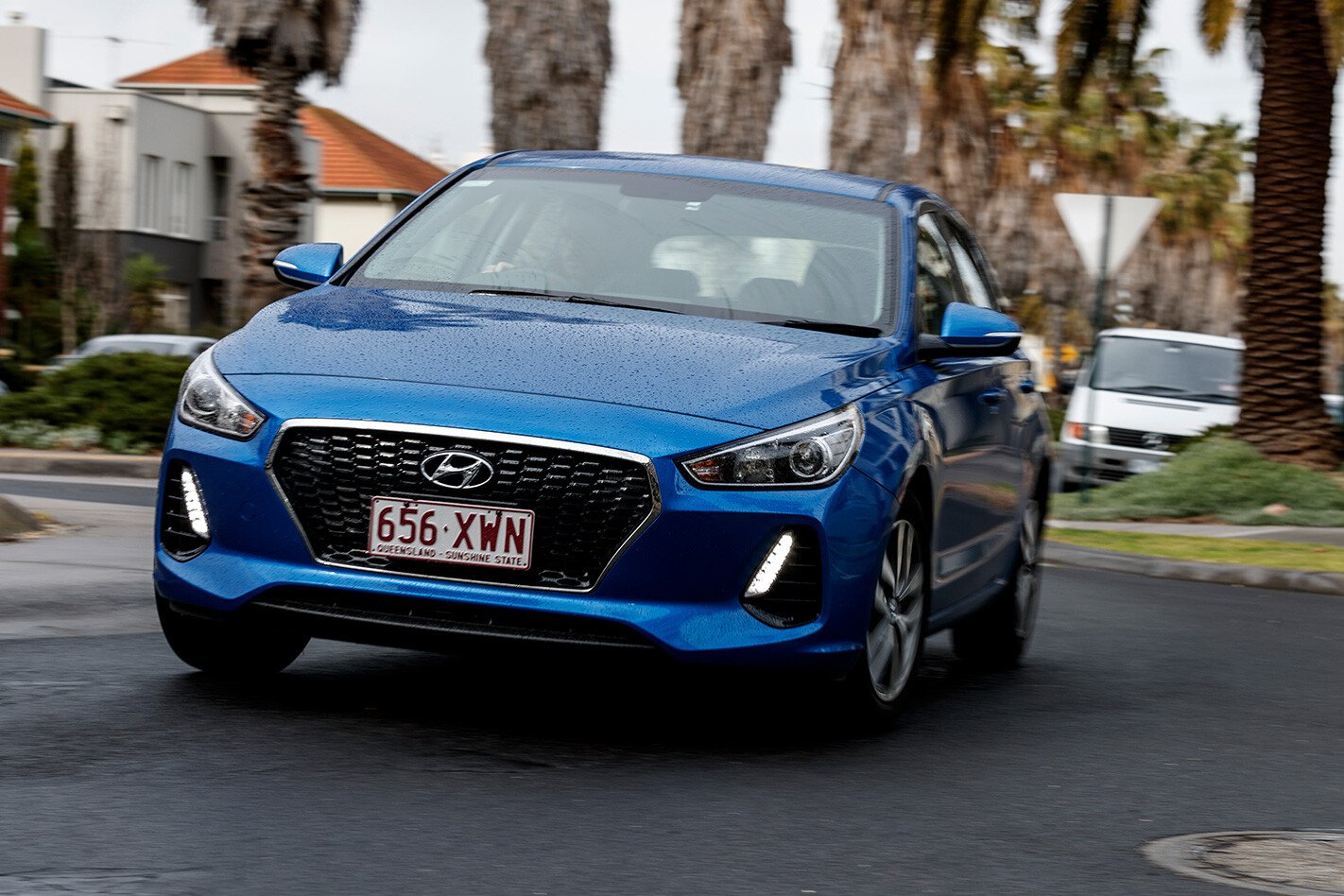
Meanwhile, the 120kW/203Nm 2.0-litre petrol engine responds quickly to throttle inputs and the six-speed torque converter automatic gearbox shuffles smoothly between steps. It may be a comparatively thirsty engine, but it also produces more power than many others at its price point. For those that don’t like to dawdle, that’s worth noting.
OUR OPINION
With the automatic transmission and optional Smartsense active safety, the Hyundai i30 Active is about $1000 cheaper than the Ford Focus Trend. However, not much else separates these two desirable hatchbacks.
They’re both conservatively styled, spacious, safe comfortable and well equipped, but we reckon the Focus has the edge in terms of driver enjoyment with its punchy three-cylinder engine, engaging steering and sharp handling.
MAZDA hasn’t launched the brand-new next-generation Mazda 3 locally yet, but already expects its sales will weaken in 2019.
Speaking to media at the small hatchback’s local reveal, Vinesh Bhindi, Mazda Australia’s Managing Director, confirmed it’s likely the CX-5 mid-size SUV will become the brand’s most popular model within 12-24 months.
Bhindi explained that while fewer customers are predicted to buy the Mazda 3, he expects they will stay within the Mazda family.
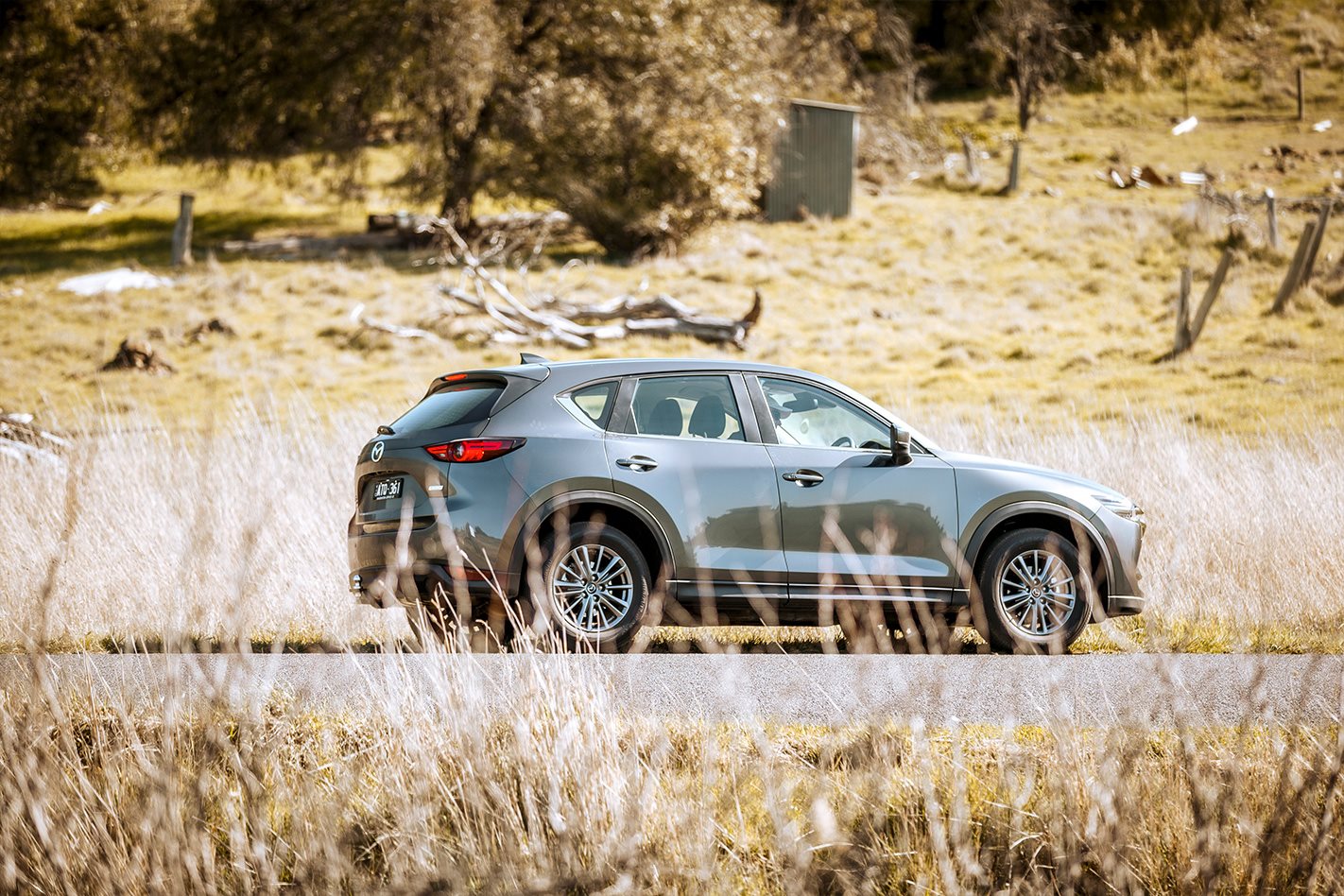
“The volume will redistribute,” he said. “In a full calendar year with the new Mazda 3, our conservative estimate is around 20,000 [units].”
That’s a significant decrease, with over 30,000 examples of the Mazda 3 being registered consistently for several years, with its worst result coming in 2018 with 31,065 annual sales.
“Some of those customers we think will be looking at other options within our portfolio, but naturally a migration towards SUVs will happen,” he added.
When discussing a timeline for the CX-5 becoming Mazda’s most popular model, Bhindi reiterated “things will change”.
The two cars have been en route to intersecting on the sales chart for some time, with Mazda 3 sales gradually shrinking, while CX-5 registrations continue to climb.
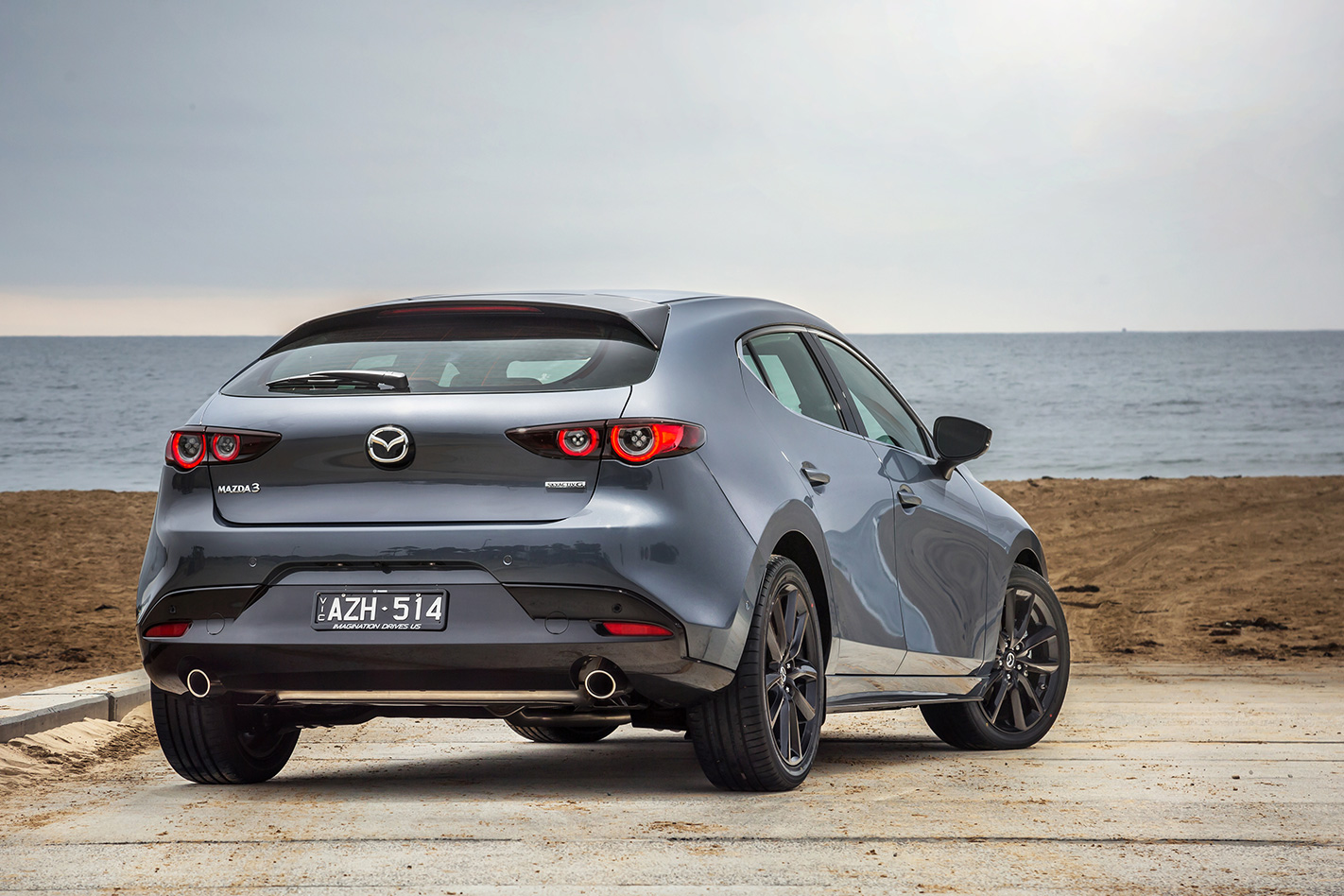
Between 2018 and 2017, the Mazda 3’s sales fell 5 percent, while the CX-5 grew by 1.3 percent, with 26,173 examples registered in the 12 months of 2018.
The first full month of sales for 2019 reinforces this trend, with 2831 Mazda 3s being registered (down 11.6 percent compared to January 2018), while the CX-5 shifted 2347 units (up 9.1 percent on the same time last year).
It should be noted the Mazda 3 figures will be affected by the run-out of the current generation, ahead of the new model arriving in Q2.
Mazda Australia Marketing Director Alastair Doak told Wheels the company was comfortable with the Mazda 3 no longer being its most popular model.
“If one of our customers wants to go and buy an SUV instead, that’s okay,” he explained. “We are not precious about having to protect the Mazda 3.
“Look at the history of car brands that have tried to protect a particular model. It doesn’t work very well in the long term.”
Doak was nonplussed about the changing trends within the market, stating Mazda Australia was confident in its current portfolio – which includes four SUVs and a dual-cab, with a fifth SUV expected to be revealed in Geneva this year.
He explained that the natural progression of life for buyers means they will transition away from a hatchback, but potentially return in later years.
“A customer’s life circumstances change,” he said. “Someone who was single might buy a 3, and then want to start a family and step into a CX-5. Add a kid and a dog and then maybe they think a CX-8 or CX-9 would be better. Then as the kid moves out they downsize to something else.
“A few years ago the biggest inflow of customers to Mazda 3 was from the Holden Commodore. You wouldn’t think that is a natural transition, but it is what it was. That’s the lifecycle of things.”
