
At the Paris Show, Alfa Romeo unwrapped the production version of the 8C coupe. It goes on sale late next year at a price of around 160,000 Euros (AU$265,000), so to limit the run to only 500 units might be a perfectly sensible decision. But what about the Spider?
This feature was originally published in MOTOR’s December 2006 issue
“Obviously, we would like to see the open-air version get approved too,” answers head of design, Wolfgang Egger. “As far as design and engineering are concerned, most of the groundwork has been done. We now know how to package the folding top, we have made room for a 150-litre cargo bay, and have triple-checked the torsional stiffness of the body.
“It is also worth noting that the Spider has a character of its own,” Egger continues. “It is more of a cruiser than the coupe, it is more elegant and less extreme. It’s a style statement as well as a performance car, and we have enough parts to build it! But it remains to be seen whether marketing can find enough customers to justify the considerable extra investment.”
Most Italian concept cars have super-tight cockpits – a real squeeze, unless your father was a jockey and your mother a prima ballerina. The 8C Spider makes an exception to this rule by offering enough cabin space to accommodate even the Pavarottis of this world.
The three-spoke steering wheel with the squared-off bottom adjusts in reach and rake, the power-operated seats whir back a surprisingly long way, the deep footwell benefits from the car’s phallic proportions, and there is plenty of clearance between the slab-sided door panel and the feisty transmission tunnel. The only element which puts the lid on our budding love affair is the manual roof, which when closed makes you duck and crouch in discomfort.
At last I’m in, firmly secured in position by the clamshell carbonfibre seatback, and by the merciless belt. The anti-slip aluminium pedals are well-spaced, but the clutch is almost as heavy as the dreaded Legmaster III in the Golden Gym. How come?
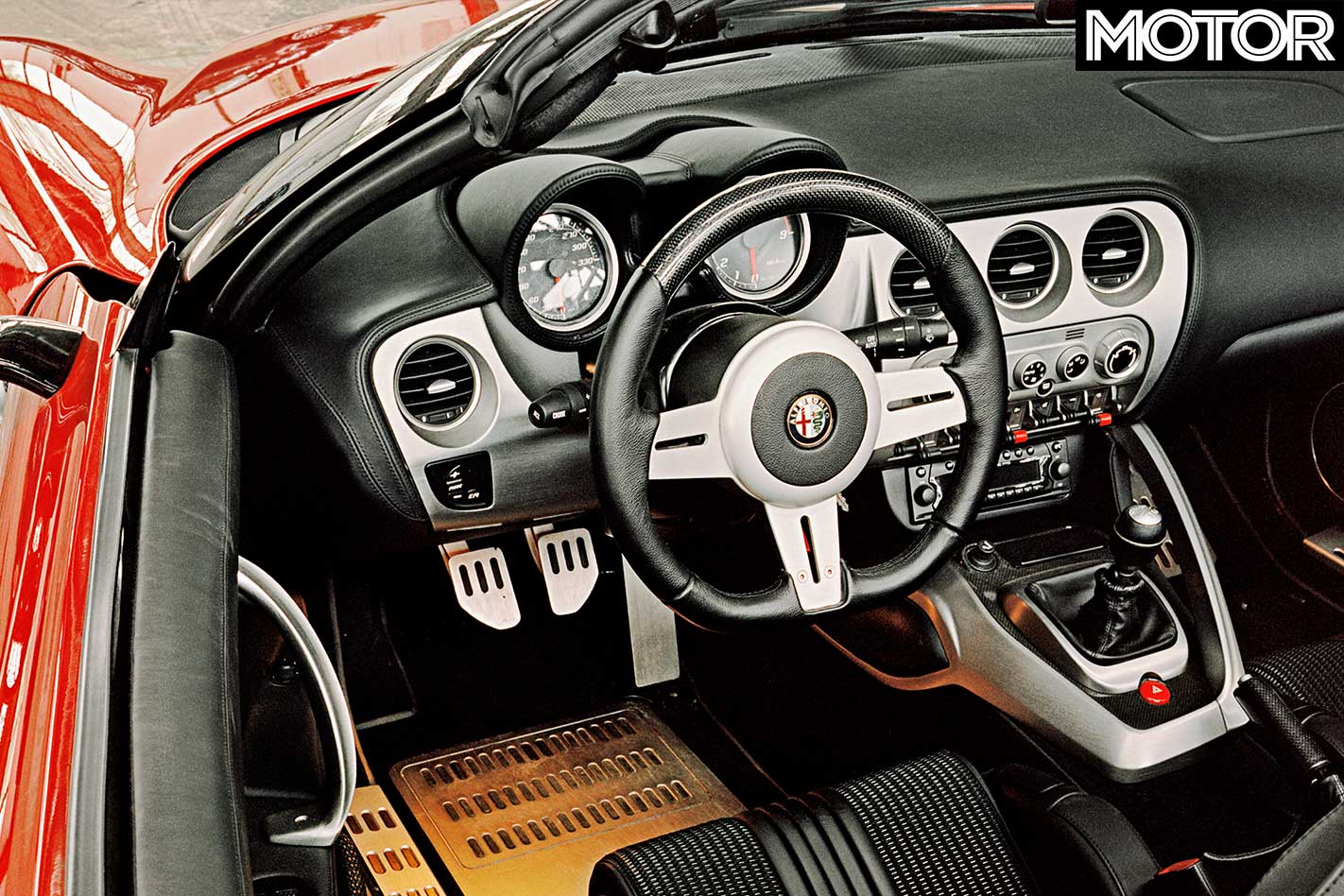
Because the 8C Spider is, unlike the coupe, not fitted with the paddleshift Cambiocorsa transmission we know from various Maseratis. Instead, it features the traditional six-speed manual that is standard on the GranSport.
After a day of hard asymmetrical footwork, these cogworks can only be described as second-best choice. First gear refuses to stick most of the time, reverse would not find its destination even if there was a GPS system attached to it, and the considerable slack in the shift pattern suggests that this particular ’box was filled with grappa, not oil.
Thankfully, the quad cam V8 plays in a different league altogether. Its soundtrack makes your eardrums go numb with emotion, its subtle vibrations tingle your spine, and its take-off performance is impressive enough to briefly make the two Alfa press guys fear for their jobs.
“This thing can accelerate in under four seconds from 0-100km/h,” confirms Egger, grinning from ear to ear. “Which underscore the 8C as a serious driving machine, not a poseur for the boulevarde of vanities. Even with the soft top in place, we are expecting a maximum speed of about 300km/h.
“Theoretically, the car could go faster still, but the drag coefficient currently holds at 0.39. Why? Because we insist on zero lift at the front axle and on negative lift in the back. That’s why the rear spoiler points skywards at a 19-degree angle.”
“By fabricating the entire body and the interior out of carbon fibre,” Egger continues, “even the Spider tips the scales at under 1500 kilos. The weight distribution works out at a perfectly balanced 50:50.”
Despite the brand-new synthetic skin, the 8C Spider is, in essence, still a Maserati in disguise. Compared to the closely related donor car, the GranSport Spyder, the 8C is 80 kilos lighter, 60mm wider, 30mm lower and 40mm longer. The wheelbase grew by 110mm to 2550mm – which happens to exactly equal the footprint of the Maserati coupe. The transaxle layout is a straightforward carryover element from the GranSport. The same applies to the Cambiocorsa gearbox installed in the 8C coupe.
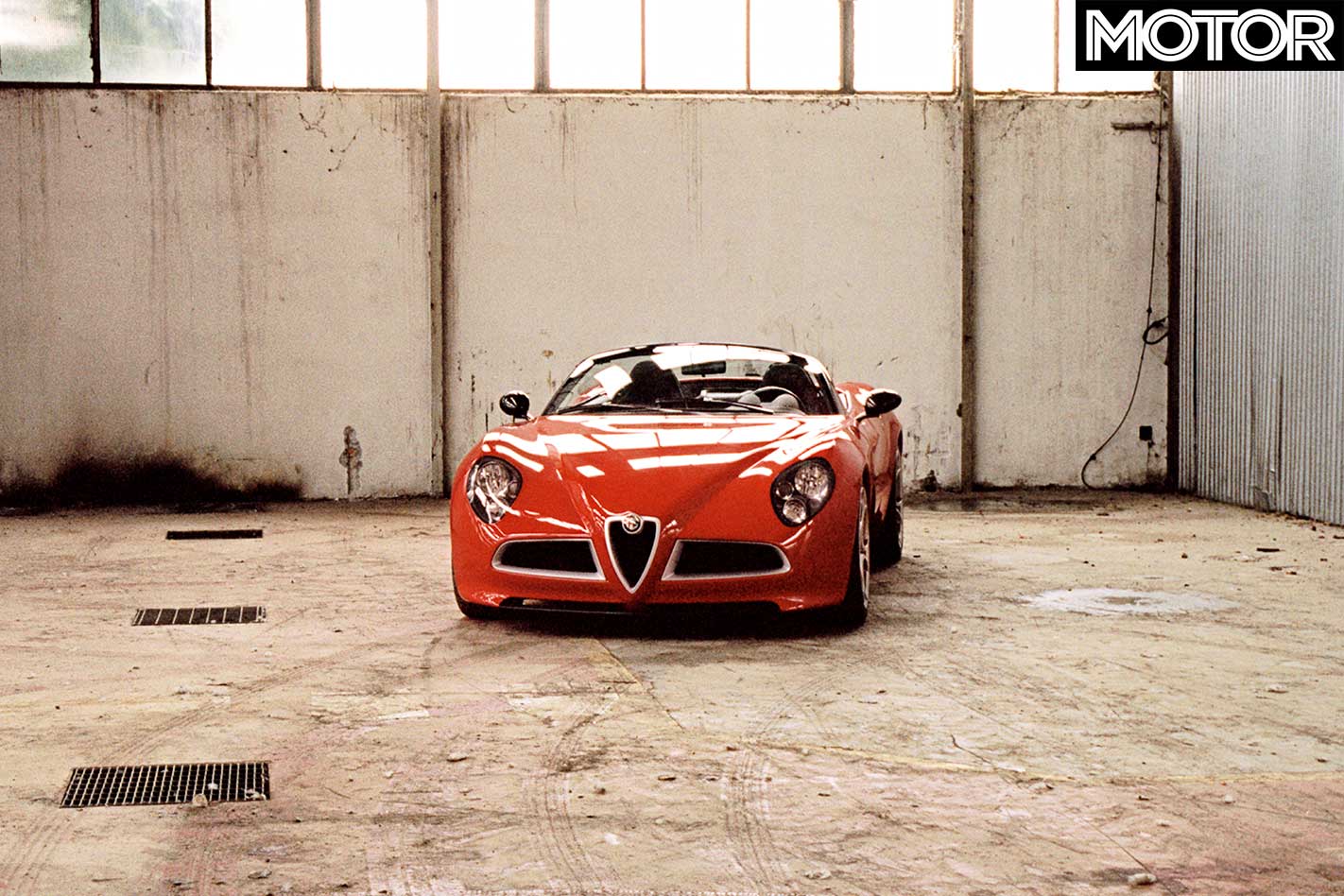
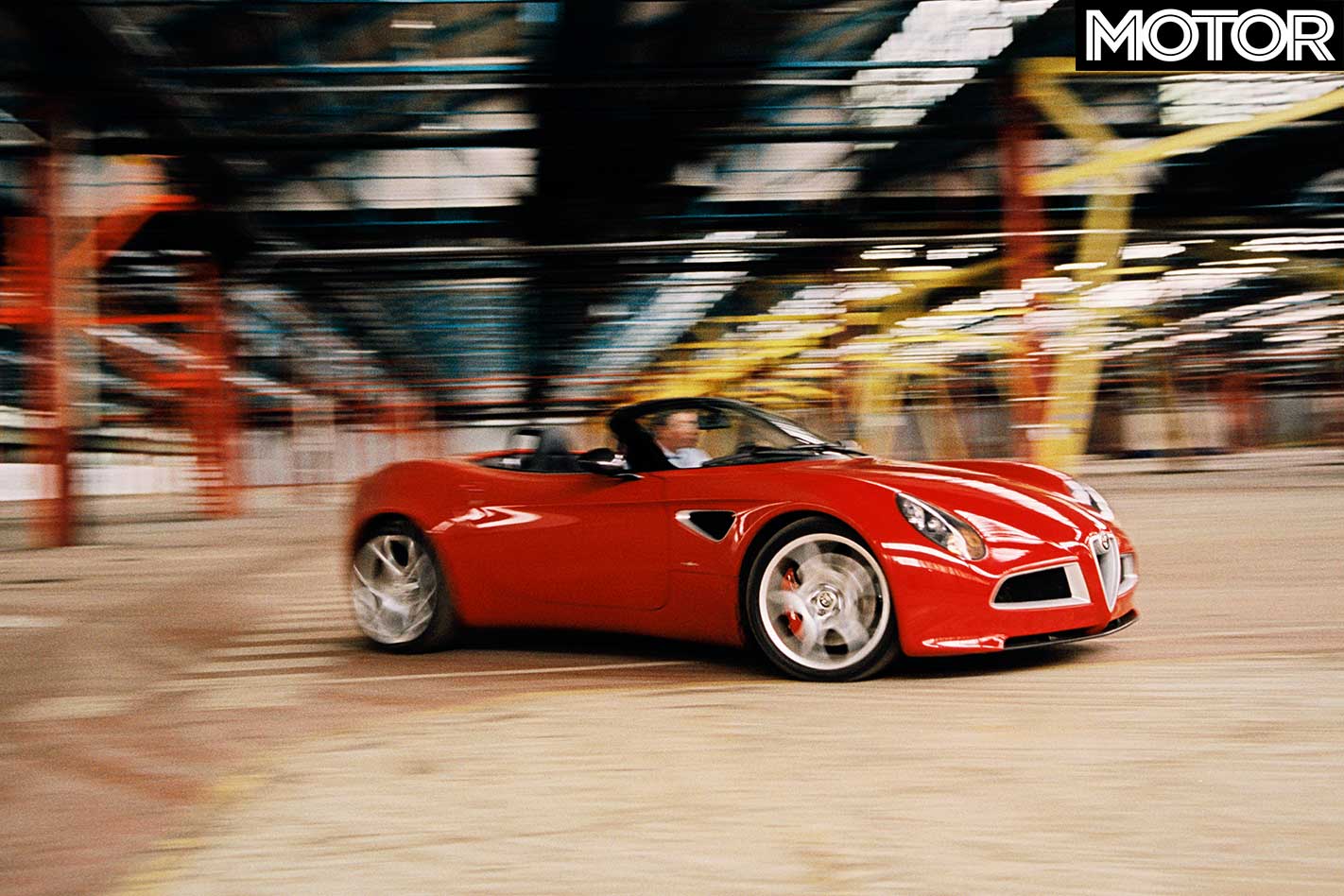
With the exception of the super-heavy clutch and super-vague gearbox, the 8C Spider drives like a dream. Shod with 20-inch Pirelli P Zeros (245/40 front, 275/35 rear), the striking two-seater turns this disused assembly hall at Alfa’s Arese plant into an impromptu slalom course, with zero-tolerance steel pylons and unmarked random excavations thrown in as additional handicaps.
Despite the treacherous dust-over-time-over-concrete surface, the Spider is cornering with such precision and sharpness one could be tempted to believe Pirelli is not only supplying tyres but also blades for speed skaters. The steering is accurate and informative, quick yet progressive.
The brakes – four ventilated discs straddled by fat Brembo calipers – know the full spectrum between fine retardation and instant freeze-frame. The suspension, double wishbones all-round but none of the skyhook trickery they are so fond of in Modena, reads the road with a confidence-inspiring mix of translation and interpretation.
ESP can be switched off completely, but I suspect this is neither the right time nor the right occasion to flash the hooligan alter ego.
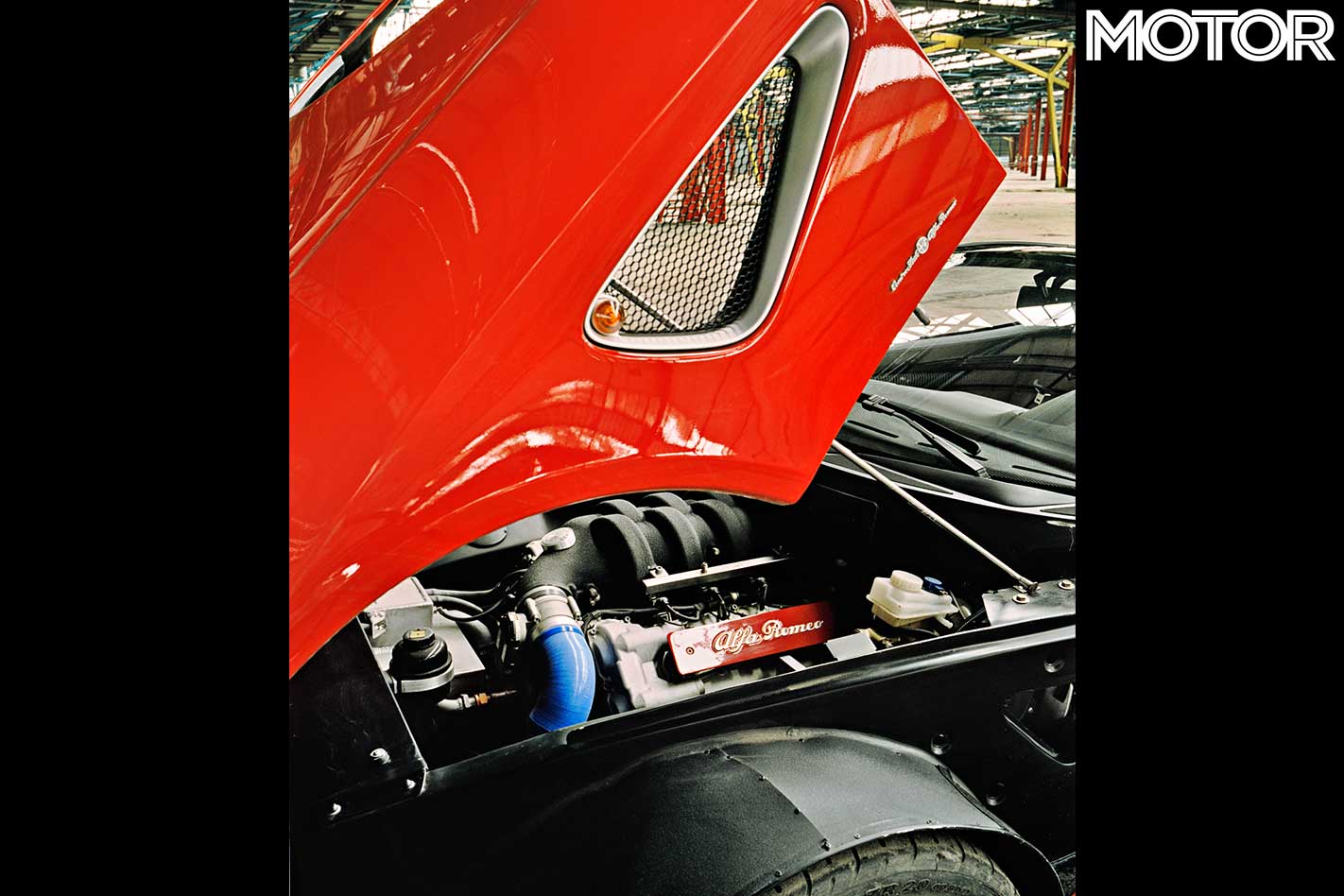
The beautifully detailed V8 engine is a 4.7-litre version of the Ferrari-designed 4.2 we know from the Coupe/Spyder and Quattroporte saloon. Rated at 335kW, it produces 37kW more than the four-door model and 45kW more than the fixed-head two-door sports car.
In terms of displacement, the 8C engine even edges the Ferrari F430 which uses a 4.3-litre derivative of the same matrix. With max torque of 470Nm available at 4750rpm (and 80 percent from 2000rpm), the Alfa motor whips up more twist action than the F430, and it also distances both Maseratis.
Although the 8C Spider is a handbuilt one-off design exercise, it works well enough to keep breaking the lap record inside this industrial complex. The back straight of the building is long enough for a full blast in third gear, so here we go once more, with much more enthusiasm.
With the butterfly throttle valves wide open and the four tailpipes blowing like chrome trumpets, you can virtually watch the plaster crack and hear the skylights rattle in their frames – row after row after row. Redlined at 7800rpm, the 90-degree V8 keeps pushing the driver deep into the Sparco race seat originally developed for the Ferrari Enzo.
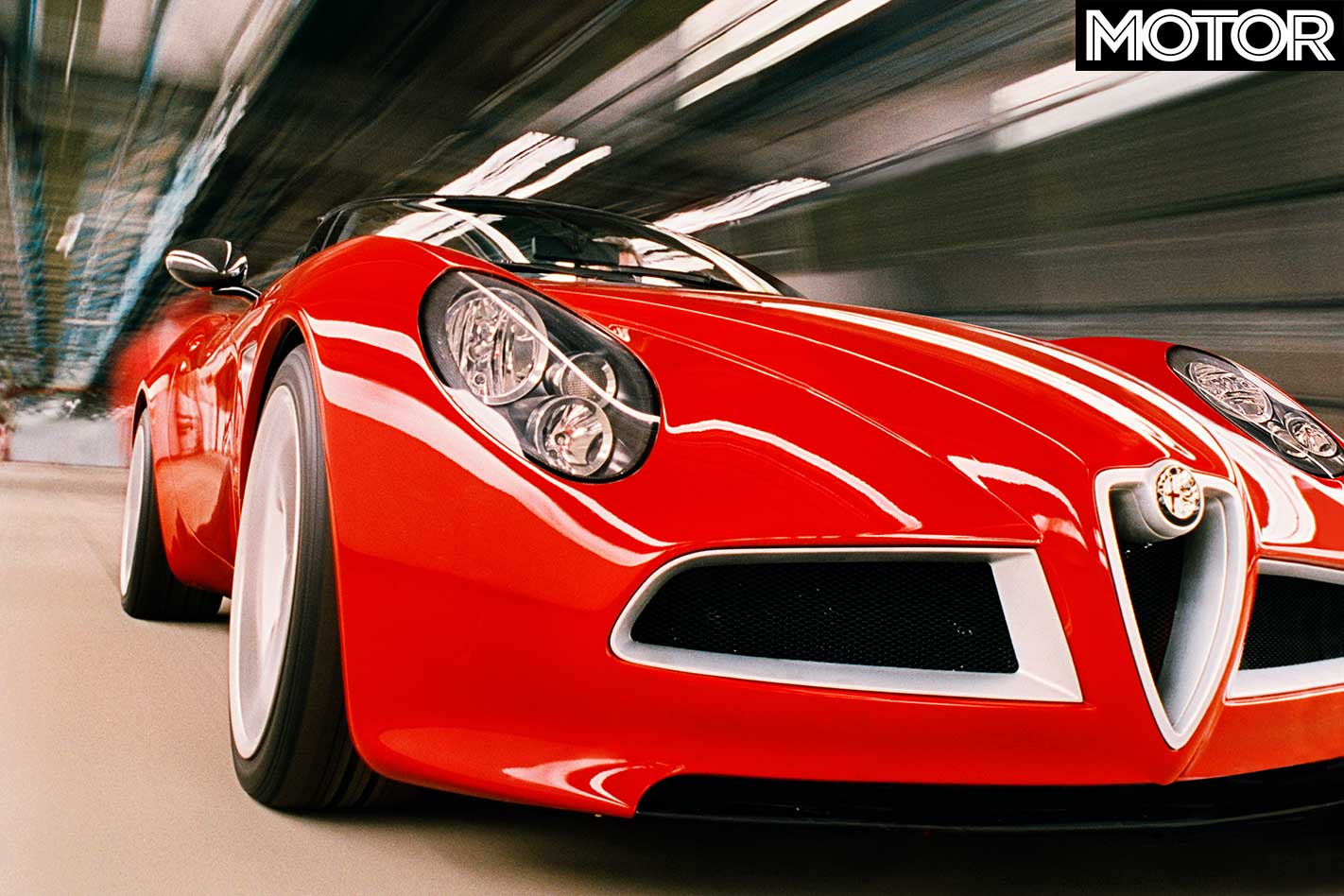
Unlike the 8C coupe, which is all carbon fibre and road racer inside, the cockpit of the Spider is dominated by acres of black leather. Black is also the colour of choice for the steeply raked windscreen frame and for the steel rollover protection elements.
The centre stack, on the other hand, is generic Italian sports car: three round air vents, Ferrari HVAC controls with Alfa graphics followed by a row of aeronautic switchgear, and a Becker radio-and-nav combo down low, in case you get tired of listening to the glorious eight-cylinder bellow.
Unlike the 8C coupe prototype, which is the work of Stola, the Spider was built by Carrozzeria Marazzi of 1960s Autodelta GTA fame.
“It was a wonderful experience to work with these craftsmen, many of whom came back from retirement especially for our project,” recalls a beaming chief designer. “With the help of salami, cheese and plenty of red wine, we usually kept going deep into the night, and if there ever was a need for inspiration, all I had to do was take the cover off of one of the classic Alfas stored in this facility.
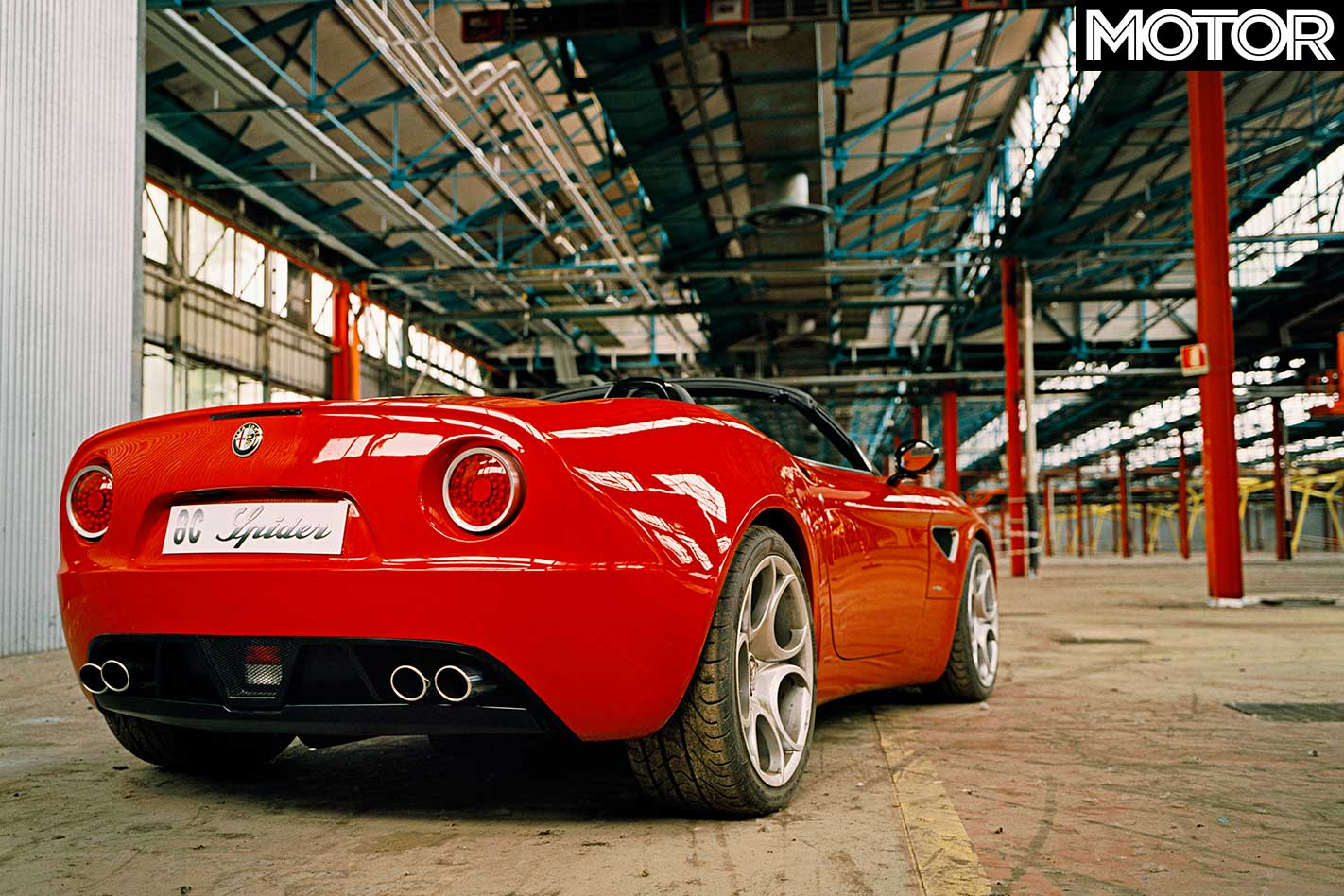
“The folding top was a particularly tough nut to crack. In the end, we assigned this task to two pensioners who had conceived the roof for the Duetto way back when. They completed the job – design, packaging and execution – in only six weeks.”
When folded, the canvas hood stows beneath a leather cover which is fastened to the body via velcro straps. To make sure the part-time roof remains firmly in place even at very high speeds, the R&D team looked for some wind-tunnel assistance, and settled on Dallara, the renowned maker of single-seater racing cars. With their help, they also created a track version with extreme aerodynamics for even more downforce. If at all, the track version will unfortunately only appear in coupe guise.
Quite a few of the 500 8Cs to be built have been pre-ordered by owners of the classic 8C 2300 of which 188 units were built between 1931 and 1934. If there is demand for more of the same, Alfa could add 50 lightweight Dallara-inspired street racers, plus of course the 8C Spider. A right-hand drive version isn’t on the cards, sources say.
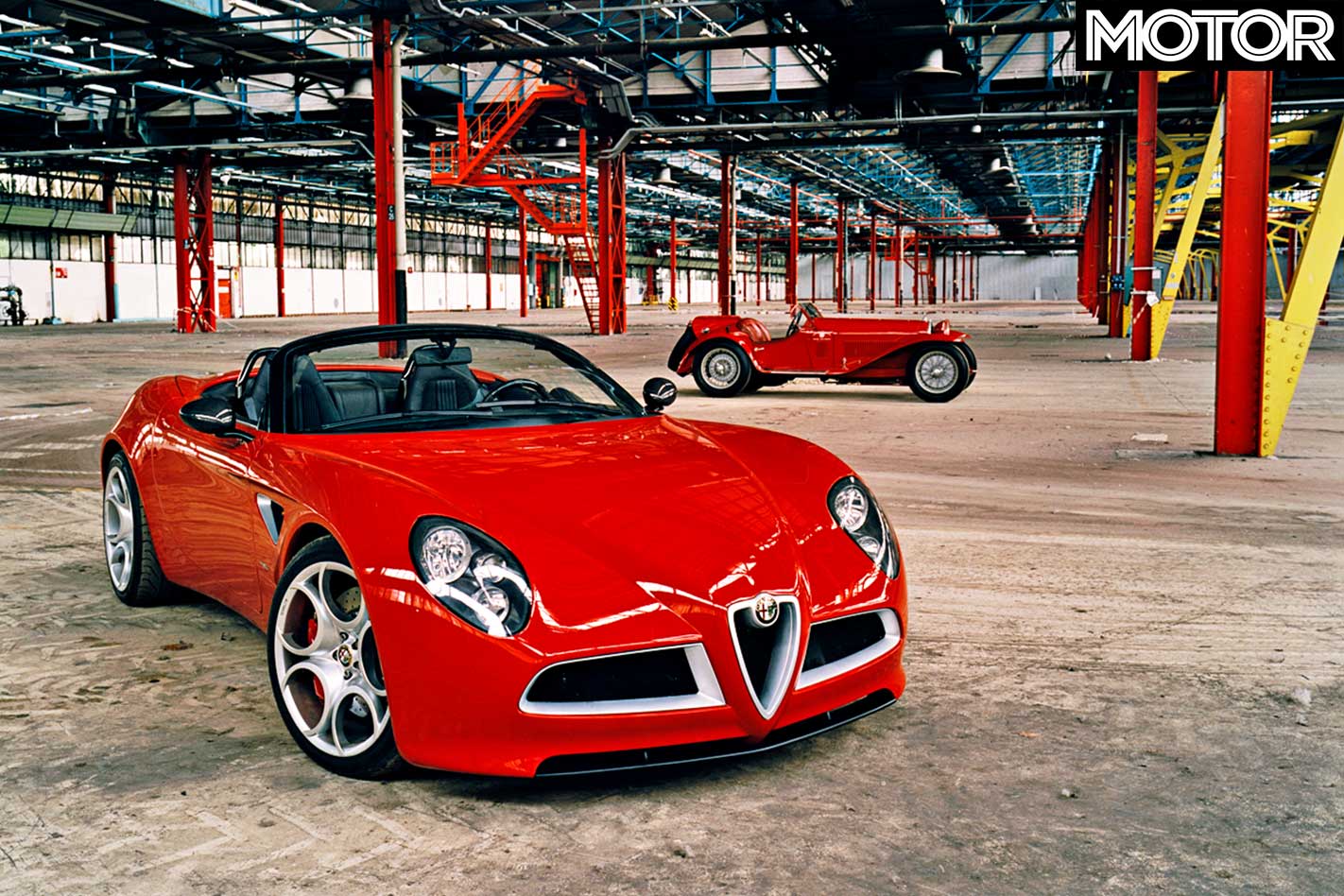
I was ready to celebrate this remarkable car with a dirty big burnout that would have wrapped up the day nicely, despite the weather. But at 4000rpm in first gear, the throttle cable suddenly snapped, and our supermodel slowed to idle speed.
For the last few photos, 30km/h was thus our velocity. No, dynamically not very exciting. But the perfect pace to paste this unforgettable shape onto the hard disk in the back of your mind.
FAST FACTS 2006 Alfa Romeo 8C Spider prototype
BODY: 2-door convertible DRIVE: rear-wheel ENGINE: 4691cc V8, DOHC, 32-valve POWER: 335kW @ 7000rpm TORQUE: 470Nm @ 4750rpm WEIGHT: 1550kg POWER-TO-WEIGHT: 216kW/tonne TRANSMISSION: 6-speed manual SUSPENSION: double A-arms, coil springs, anti-roll bar (f), multi-links, coil springs, anti-roll bar (r) L/W/H: 4303/1882/1275mm WHEELBASE: 2550mm BRAKES: ventilated discs (f), ventilated discs (r); ABS, VDC WHEELS: 20-inch alloys TYRES: Pirelli P Zero 245/35ZR20 (f), 285/35ZR20 (r)
The Coupe
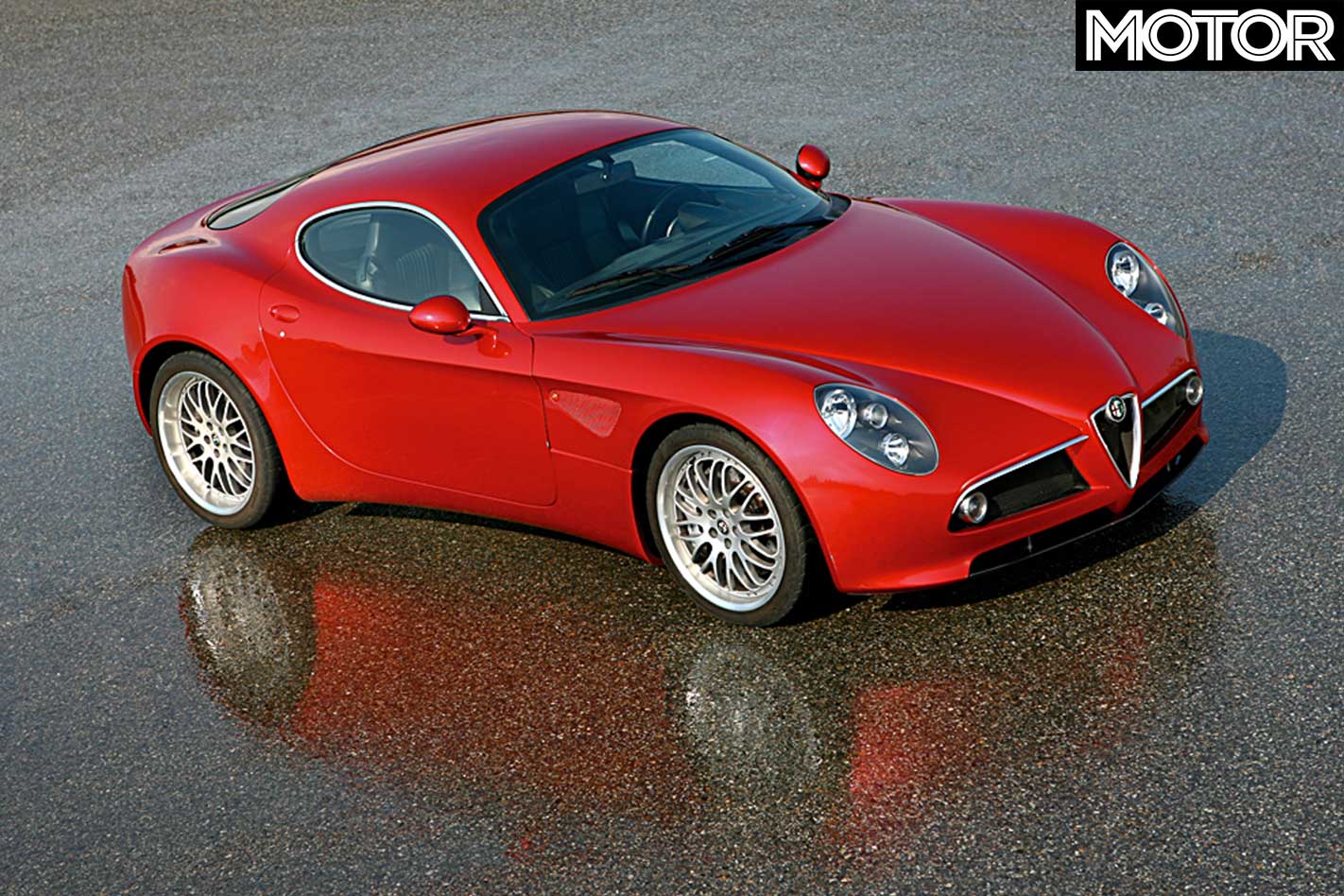
Anyone who attended last month’s Sydney Motor Show may have noticed the stunning 8C Competizione coupe on Alfa Romeo’s stand – fresh from its world debut in Paris the month before.
Officially on sale now, but with deliveries not due until September ’07, the Maserati-based 8C will have its build number limited to just 500. It’s Alfa’s first V8 since the spectacularly unsuccessful Montreal coupe died in 1976, but sadly for Aussie Alfisti, all are left-hand drive.
Dial M for Muscle
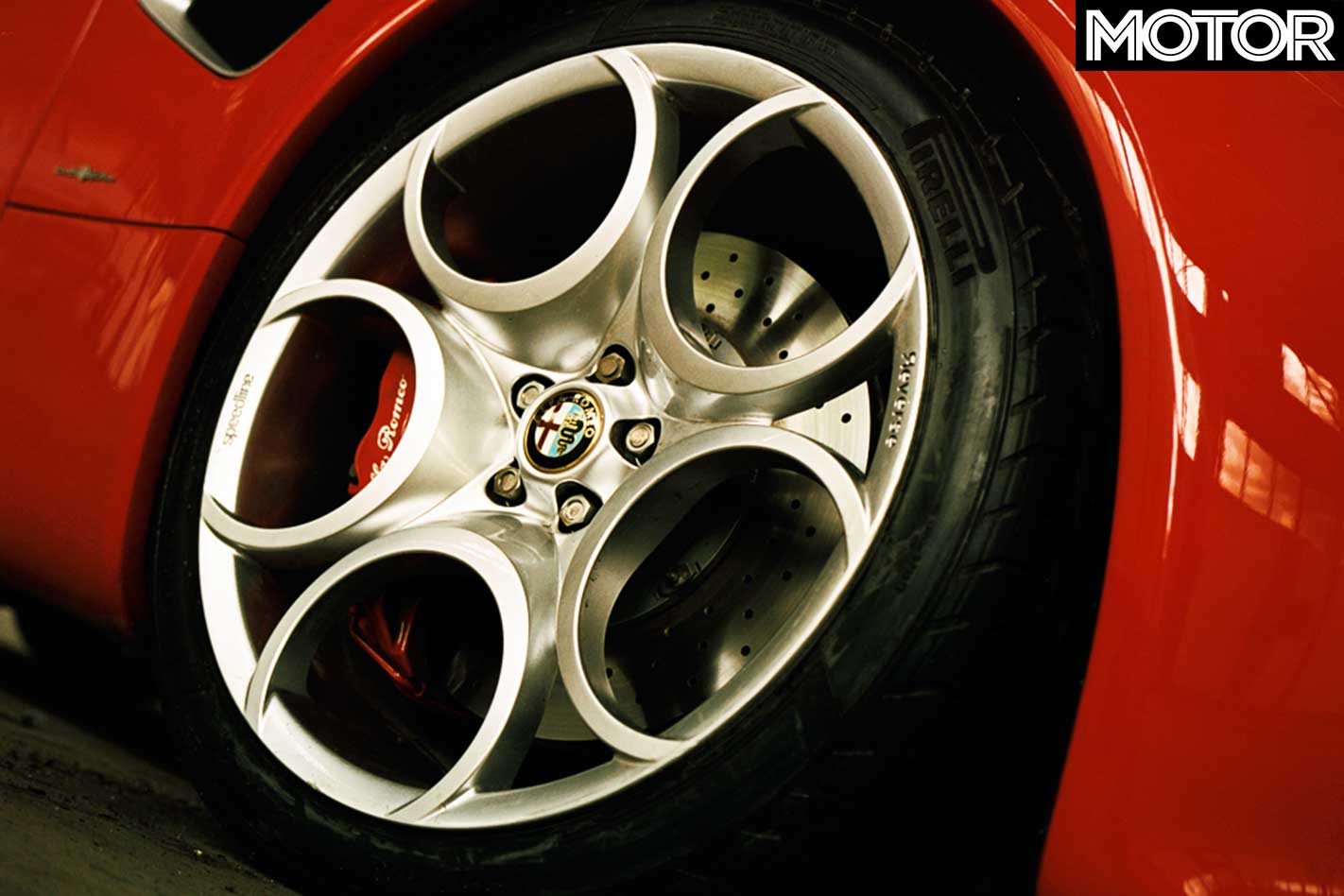
Like the 8C coupe, the Spider is blessed with a sensational set of rims – Alfa-traditional telephone-dial alloys in a rather non-traditional 20-inch size. The rears wear massive, and costly, 285/35ZR20 Pirelli P Zeros, though anyone flash enough to cough up $265,000 for the 8C coupe, let alone the concept-for-now Spider, has no right to complain.
Interestingly, underneath the 8C Spider sits a stretched Maserati GranSport Spyder platform.
WHEELS magazine has won three categories at this year’s Mumbrella Publish Awards.
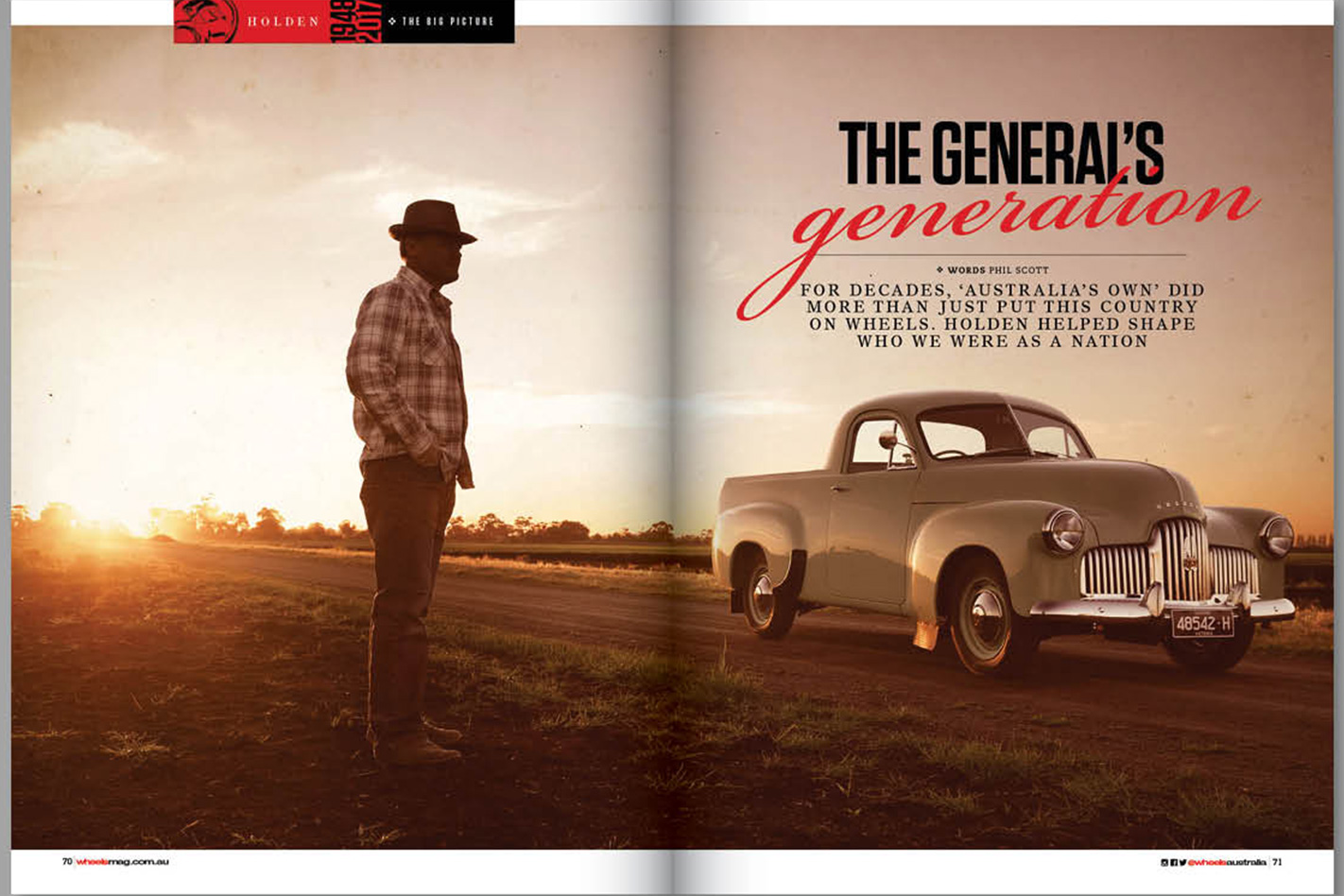
Wheels took out the gongs for ‘magazine cover of the year’, ‘single article of the year’ and ‘special edition of the year’ for its November 2017 issue that marked the closure of Holden’s Australian manufacturing plants.
It was three wins from three nominations for Wheels, which was the only title to take home more than two awards. The awards night spanned 31 categories with Wheels’ parent company, Bauer Media, snaring five trophies.
Fellow Bauer Media motoring titles Street Machine and MOTOR magazine were shortlisted for the ‘event of the year’ and ‘launch/relaunch of the year’ respectively.
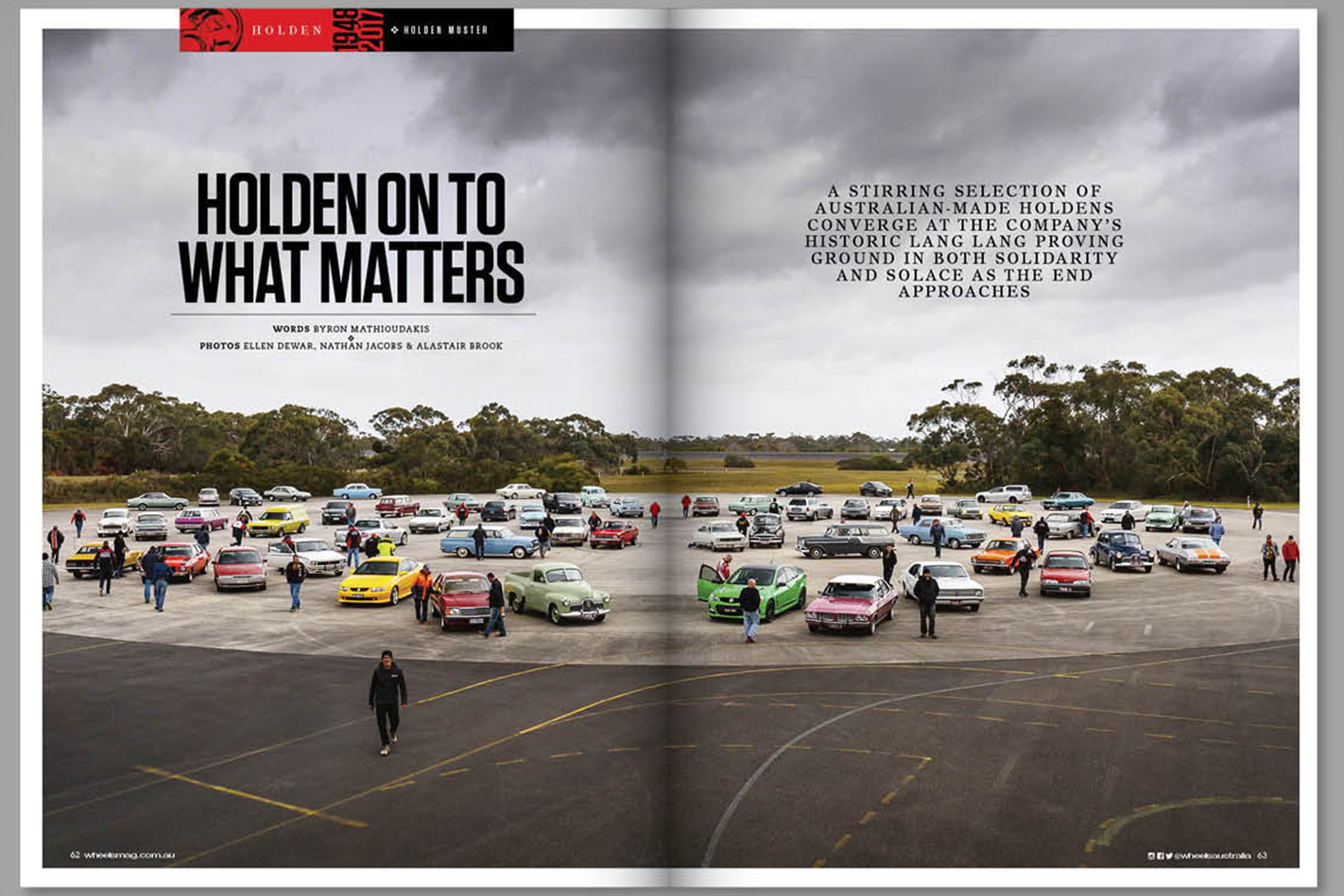
Wheels editor Alex Inwood said the three awards were welcome recognition for the hard work his team poured into its Holden magazine.
“Holden’s closure was a milestone for our industry and the Wheels team toiled for months to mark the occasion with the depth of storytelling and world-class photography it deserved,” he said.
“For the judges to say Wheels was a clear winner in categories that included heavyweights like The Australian Financial Review, Elle, and Nine is very special.”
Inwood added he was especially proud to win the cover of the year gong given its design and execution was such a radical departure for Wheels.
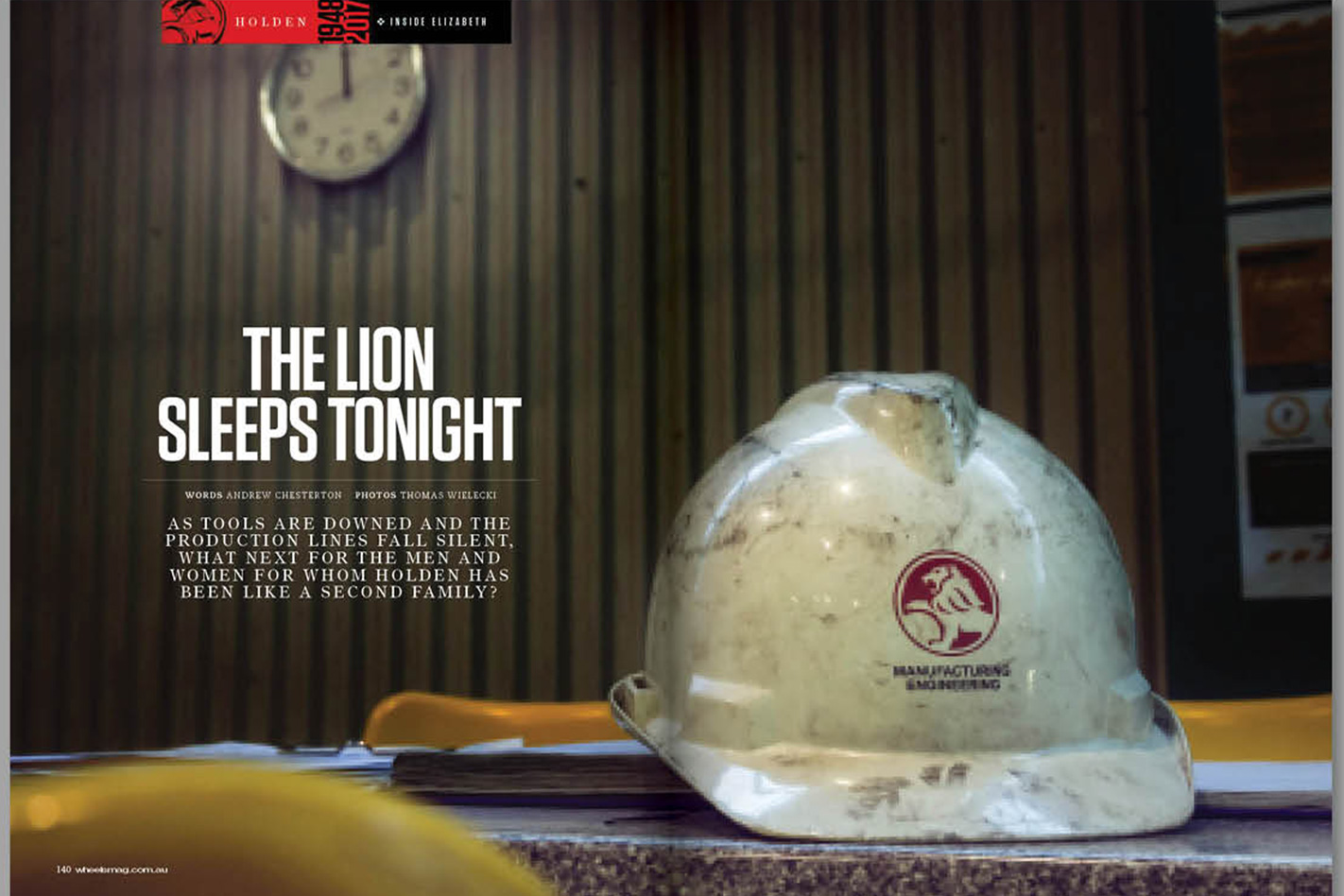
“Kudos has to go to photographer Nathan Jacobs for shooting such an evocative image and to Wheels art director Felipe Ubilla for creating such a clean design,” he said.
“I’d also wager that Phil Scott’s remarkable ‘The General’s Generation’ feature story is one of the best Wheels has ever published.”
The awards night was hosted by British comedian and writer David Baddiel, with hundreds of media representatives attending the gala dinner at Sydney’s Dolton House.
The full list of winners is here: https://mumbrella.com.au/publishawards
Porsche’s 70th birthday sees the marque in ruder health than ever before. Wheels celebrates the company’s seven decades of engineering excellence forged on road and track.
IT FEELS almost sacrilegious to cherrypick just three cars from seven decades of Porsche heritage, none of which are 911s, but this trio naturally elevates itself atop the median. Elitist? We prefer extreme; the cars that stretched the boundaries of what we thought was possible. Not all of them were commercially successful. The 959 retailed for around US$300,000 yet it cost Porsche more than twice that to build each car. Like BMW’s ill-starred M1, it was built by Baur and was also designed to compete in a race series that had been legislated out of existence by the time it was ready to turn a wheel in anger.
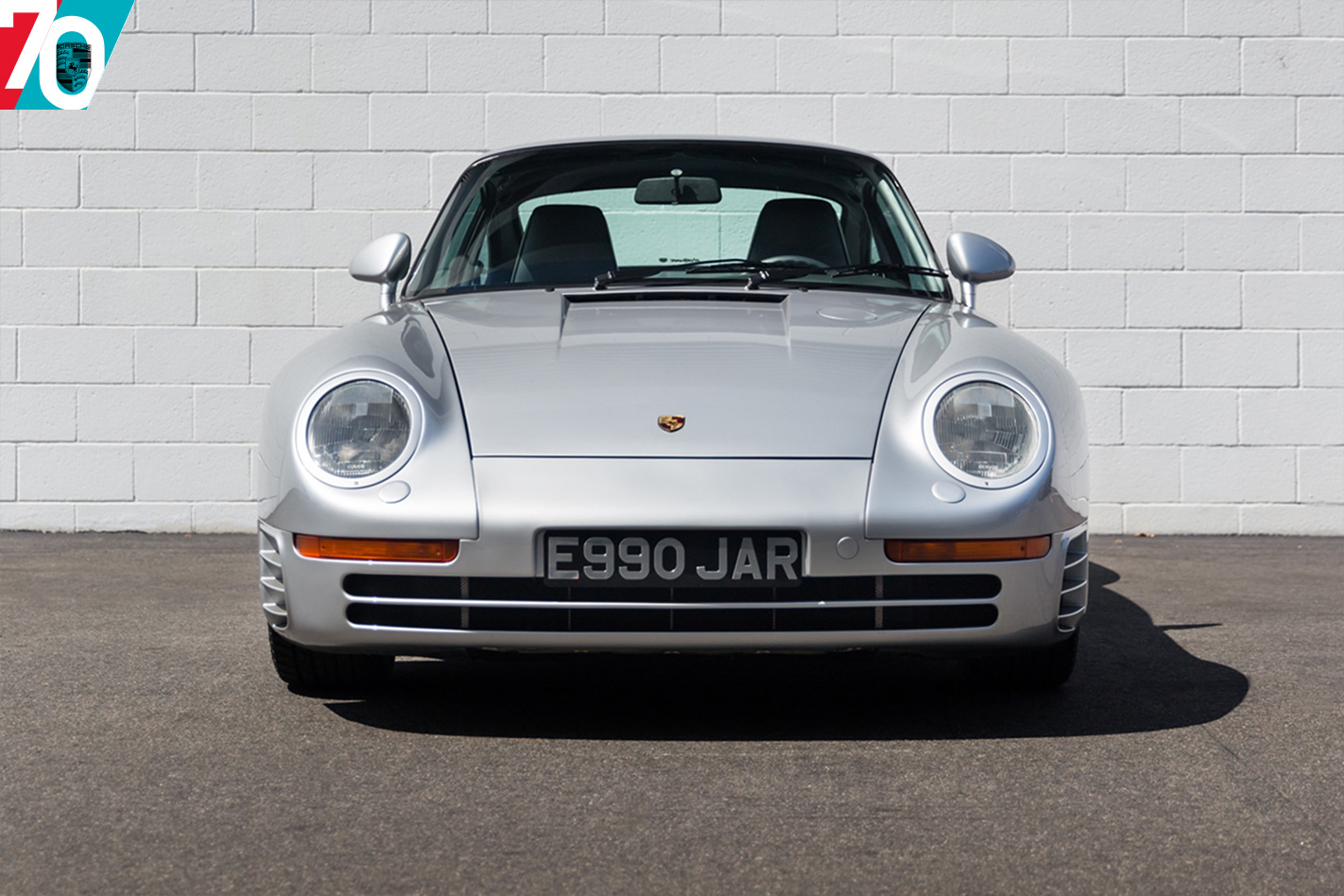
As much as anything, the 959’s story is the story of Helmuth Bott, Porsche’s brilliant head of R&D who aside from developing the 959, designed the Weissach test track and introduced the wind tunnel and crash testing at Porsche. It was Bott’s vision that poured one innovation after another into the 959. Functional active suspension, tyre pressure monitoring, sequential twin turbos, a dedicated off-road gear, water-cooled cylinder heads, composite body, dynamic all-wheel drive – all of this was rocket science for what was briefly the fastest road car in the world back in 1983.
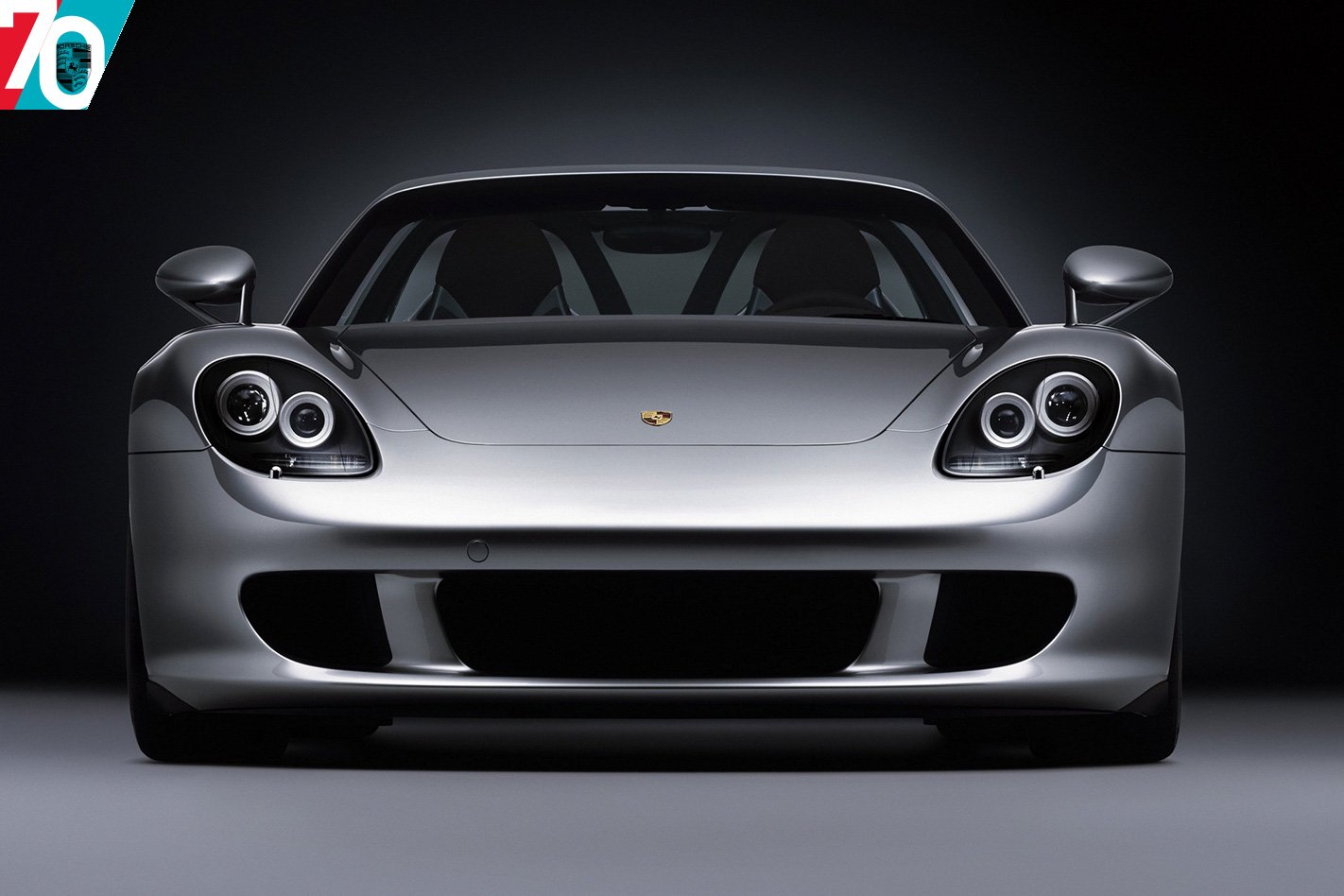
The Carrera GT feels like an analogue throwback in comparison, with its purist manual gearbox and normally aspirated engine but it featured a carbon tub and subframe, ceramic composite brakes, inboard suspension and one heck of an engine. The V10 was originally designed for the Footwork F1 team after Porsche delivered them a stinker of a V12. Footwork ditched Porsche for Ford halfway through the 1991 season so never got to race the V10. The engine was then heavily modified for a Le Mans tilt, but the board rightly decided that the money would be better spent developing the Cayenne SUV, and it ended up in a concept car at the 2000 Paris Show.
Customer interest was sufficient (and capacity at the Leipzig factory available) such that Porsche planned to build 1500 cars, but revised airbag legislation in the US saw that figure capped at 1270. The production version overdelivered in one key criterion, though. Where the concept promised a 5.5-litre V10 with 416kW, customers received a 5.7-litre V10 powerplant good for 450kW and one of the rawest, most thrilling sports cars available at any price. Hindsight now shows that here was a car that represented peak fury; an era of hugely powerful cars developed before stability control technology became a mandatory fit.
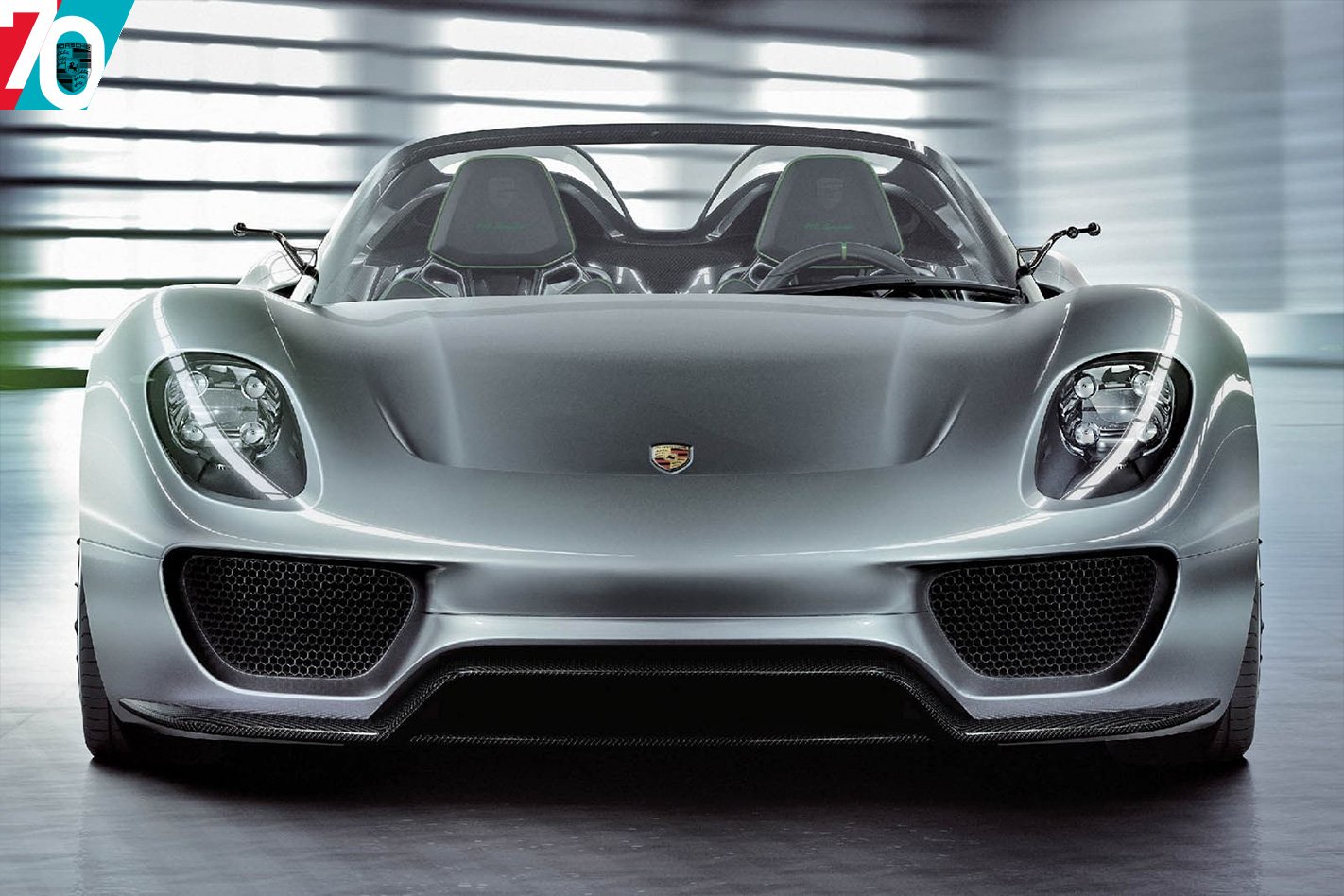
Blend the aggression and focus of the Carrera GT with the technological ambition of the 959 and you naturally arrive at the 918 Spyder hybrid. In terms of power output, it is to the Carrera GT what a Carrera GT is to a modern Boxster S. It’s a pure statement of intent that, like the 959, will see its tech bleed into Porsche’s production sports cars for years to come. It’s also a reminder of how far the company has progressed. When 959 production officially ceased in 1993, Porsche was a basket case; the company’s global sales amounted to little over 14,000 cars per year. Last year it sold nearly a quarter of a million vehicles. That’s thanks in no small part to the vision and engineering genius behind the 959, the Carrera GT and the 918 Spyder.
You wouldn’t need to organise appointments, drive anywhere, or invite strangers to your house who are only interested in bargaining despite you saying ‘price not negotiable’. Wouldn’t it be easier if someone did all the heavy lifting for you?
This feature is advertiser sponsored content
Seeing a gap in the market for a fast and easy way to sell, Pickles – Australia’s leading auctioneer and valuer – prototyped an app that is free, simple, easy-to-use and allows customers to sell their cars quickly without having to do any of the work.
The app, called DIYinspect, was launched in September this year and is already proving to be very popular.
“We designed the app with the customer at the forefront – it’s all about accessibility and making it faster and easier to sell a car. Customers can sell their car to Pickles without ever having to leave home,” says Gavin Smith, Chief Disruption Officer at Pickles Ventures.
How does DIYinspect work?
It’s really simple. Users simply download the app on Google Play or the App Store, create an account, enter their car details and upload photos.
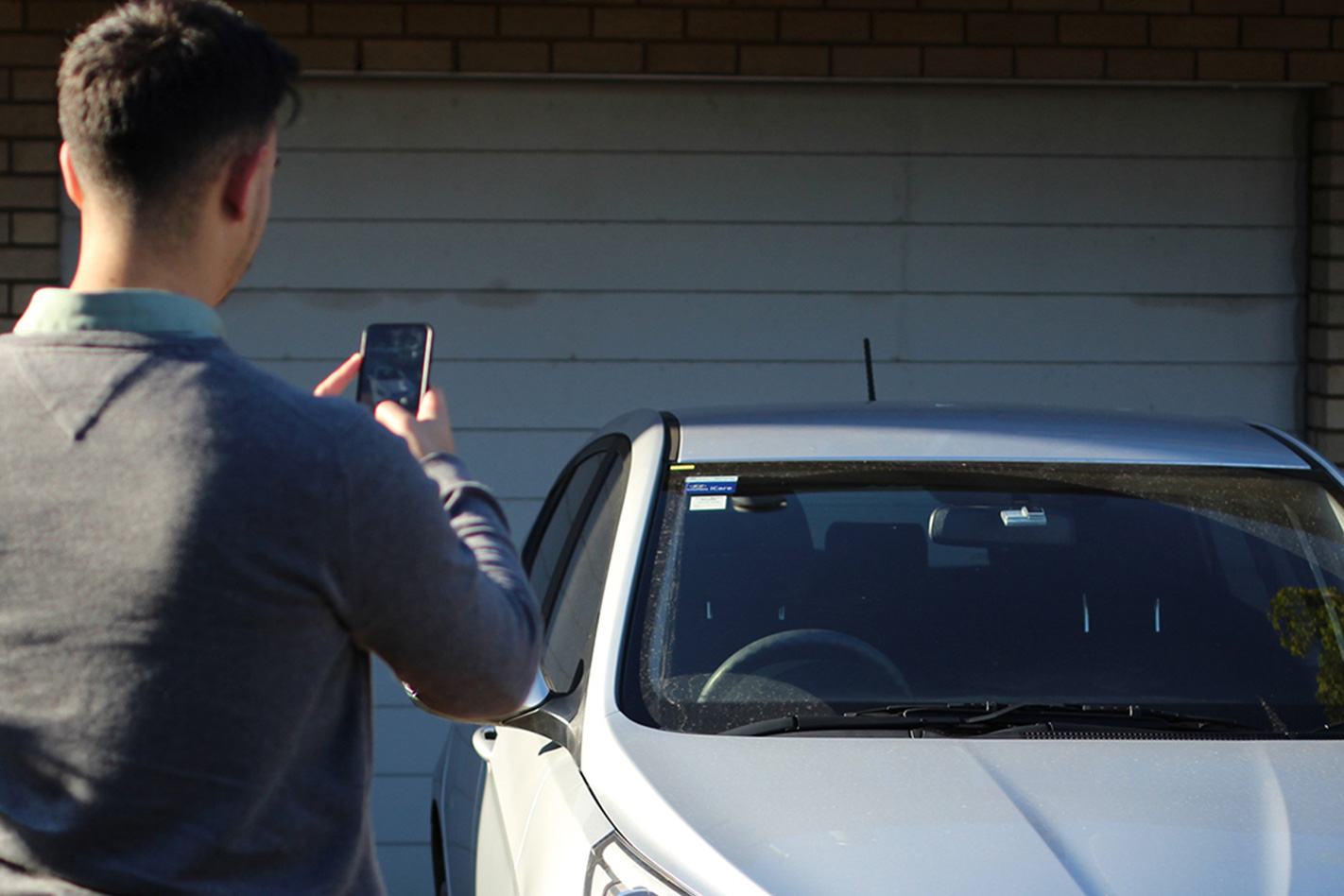
This information is then sent to Pickles who has over 50 years’ experience in valuations. Their expert team will review the details provided and then contact the user with a free valuation and guaranteed buy price.
Once this is accepted, Pickles will pick up the vehicle for free within 30kms of the nearest Pickles branch and pay you within 48 hours of the car being collected.
“It’s different to what’s out there as it really puts the customer first. You can be anywhere – at work, at home, interstate – and still sell your car. It’s ideal for those who want to sell quickly with minimal fuss,” says Gavin.
At the moment, cars must be less than eight years old and have fewer than 160,000kms to use DIYinspect. If a user’s car exceeds the above, Pickles can sell your car quickly through other channels.
“This is the just the start of DIYinspect. We’re looking at ways to expand and are continually testing and evolving the app to ensure the customer has the best experience,” says Gavin.
DIYinspect is available on the App Store and on Google Play. Download it today to get started.
Just when you thought there couldn’t be any more mediums left for the automotive obsession to reach, here are some fine esoteric examples.
From $10k scale models for the connoisseur among collectors to tyre-shaped Bluetooth speakers for the audio junkies and a Raging Bull badged racing suit for the karting diehard, these motoring-related things are the stuff the average enthusiast can only dream of.
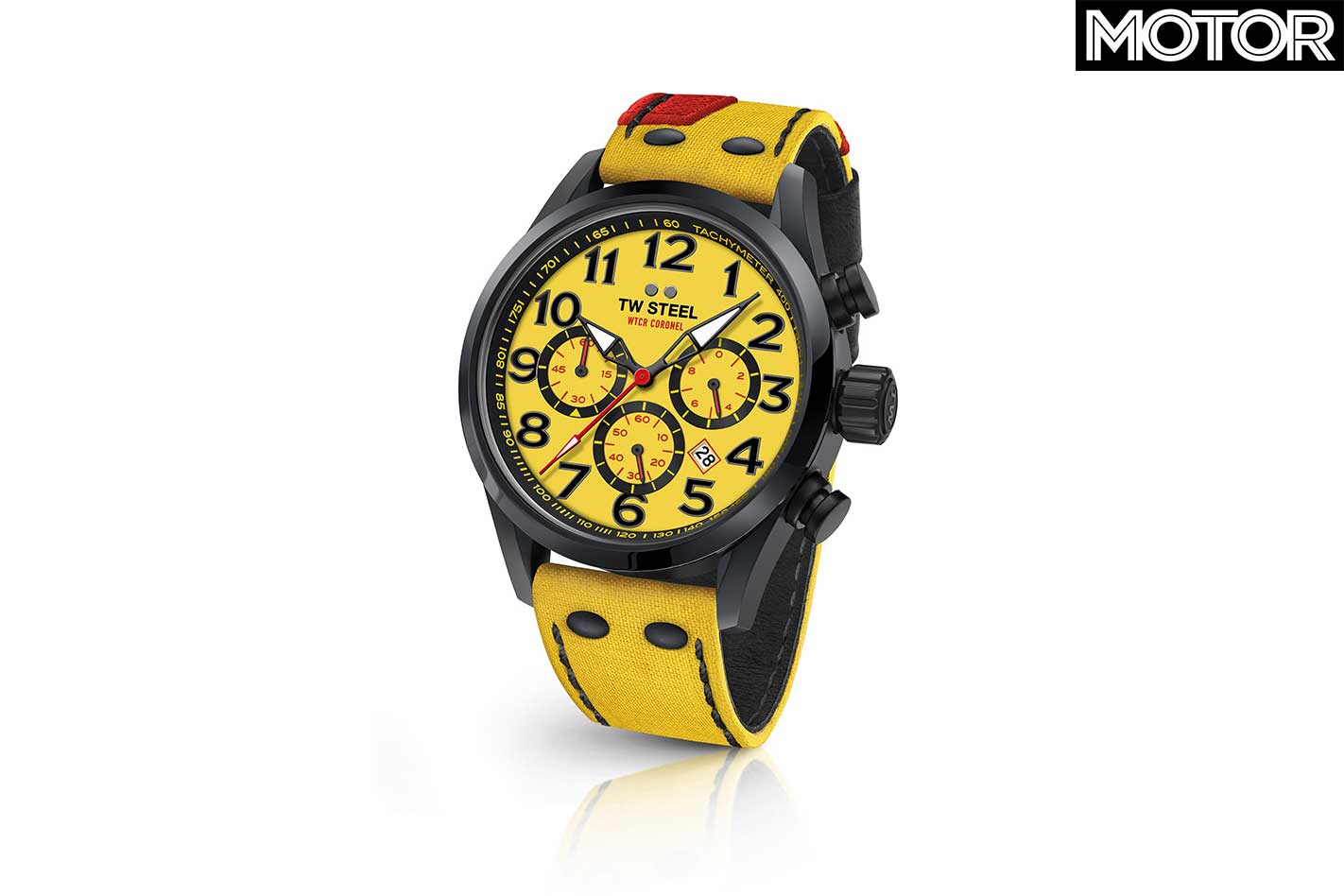
1 – FEATURED “PRODUCT OF THE MONTH”: TW Steel WTCR watch ($699 from twsteel.com/au) Even if you haven’t heard of Tom Coronel, a prolific European touring car driver, you might have seen his iconic yellow racing suit. It’s honoured here with this 48mm oversized TW Steel chronograph, one of 70.
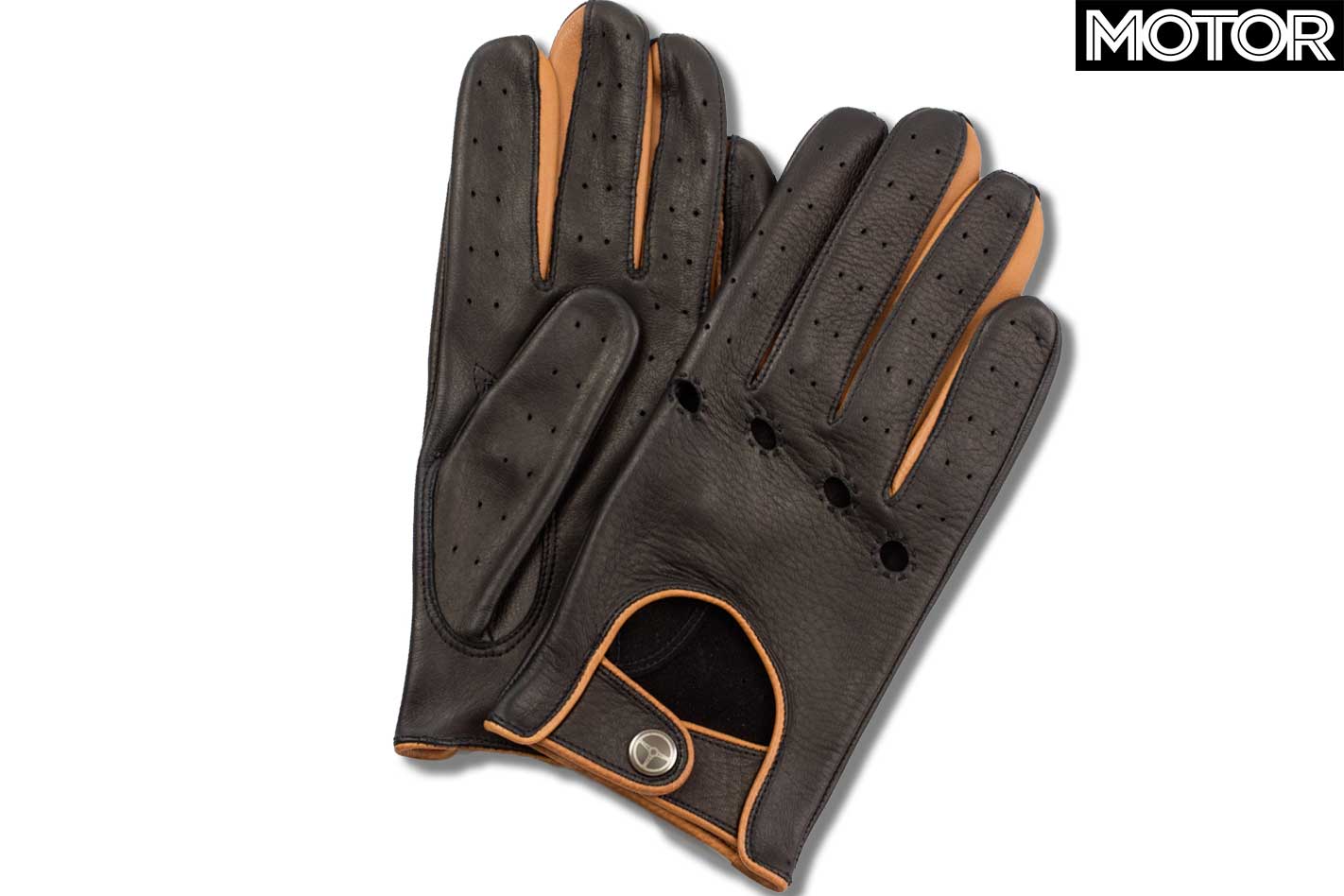
2 – Leather Driving Gloves ($277 from theoutlierman.com) Drive in style with these Italian-made gloves. Fingers or fingerless, 49 styles with colours from classic black to bright green. Just don’t let your mates see you wearing them.
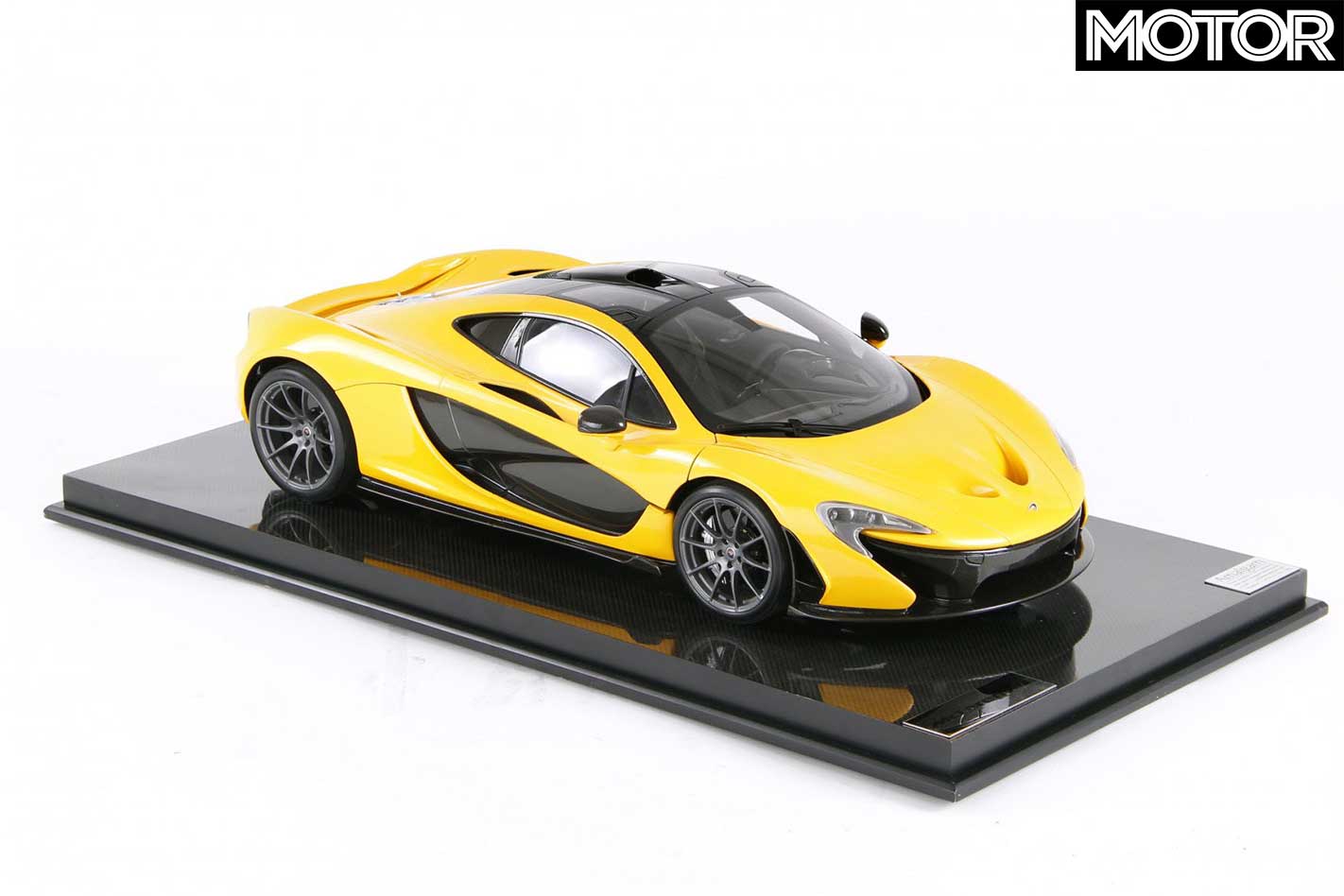
3 – Amalgam McLaren P1 1:8 Scale Model ($10,350 from amalgamcollection.com ) Model company Amalgam used McLaren’s own CAD data to construct this 1:8 scale model and can customise its interior trim to your liking. A piece fit for the fussiest of mantelpieces.
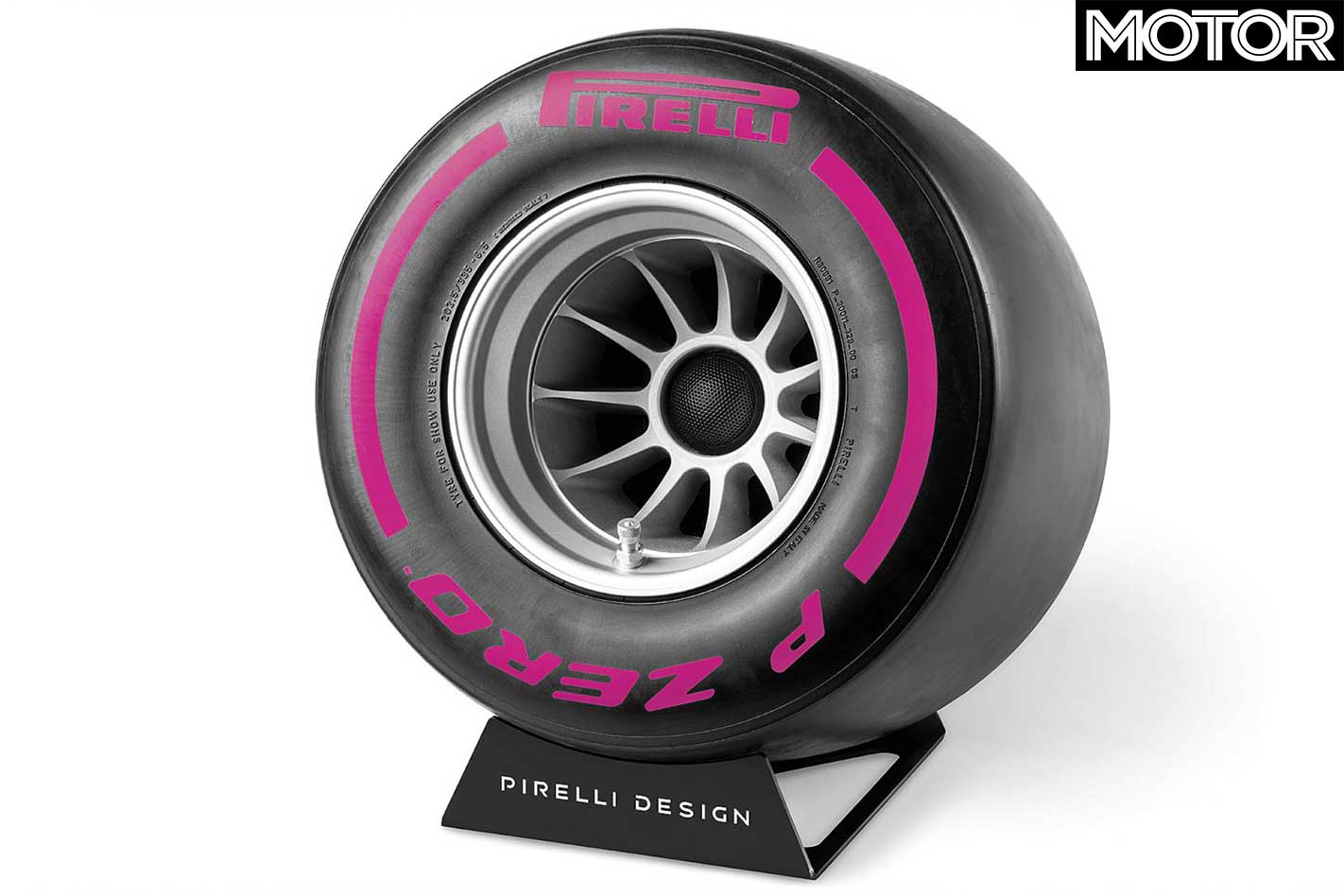
4 – Pirelli P Zero Bluetooth Speaker ($3875 from ixoost.it) A 100W speaker inside the same half-scale tyres F1 teams use for wind-tunnel testing. Tweeter/midwoofer sit inside scaled replica aluminium F1 rims. Made in Italy, in nine colours, using a dry, wet or inter tyre.
5 – Porsche Tee ($34 from dirtynailsbloodyknuckles.com) Pay homage to Porsche’s flatnose 930 series 911 Turbo. Available in Ashpalt/Teal, White/Red, Ash/Grey, sizes S-3XL. Slimfit style, pretty decent quality (as-tested by MOTOR), 100 per cent cotton.

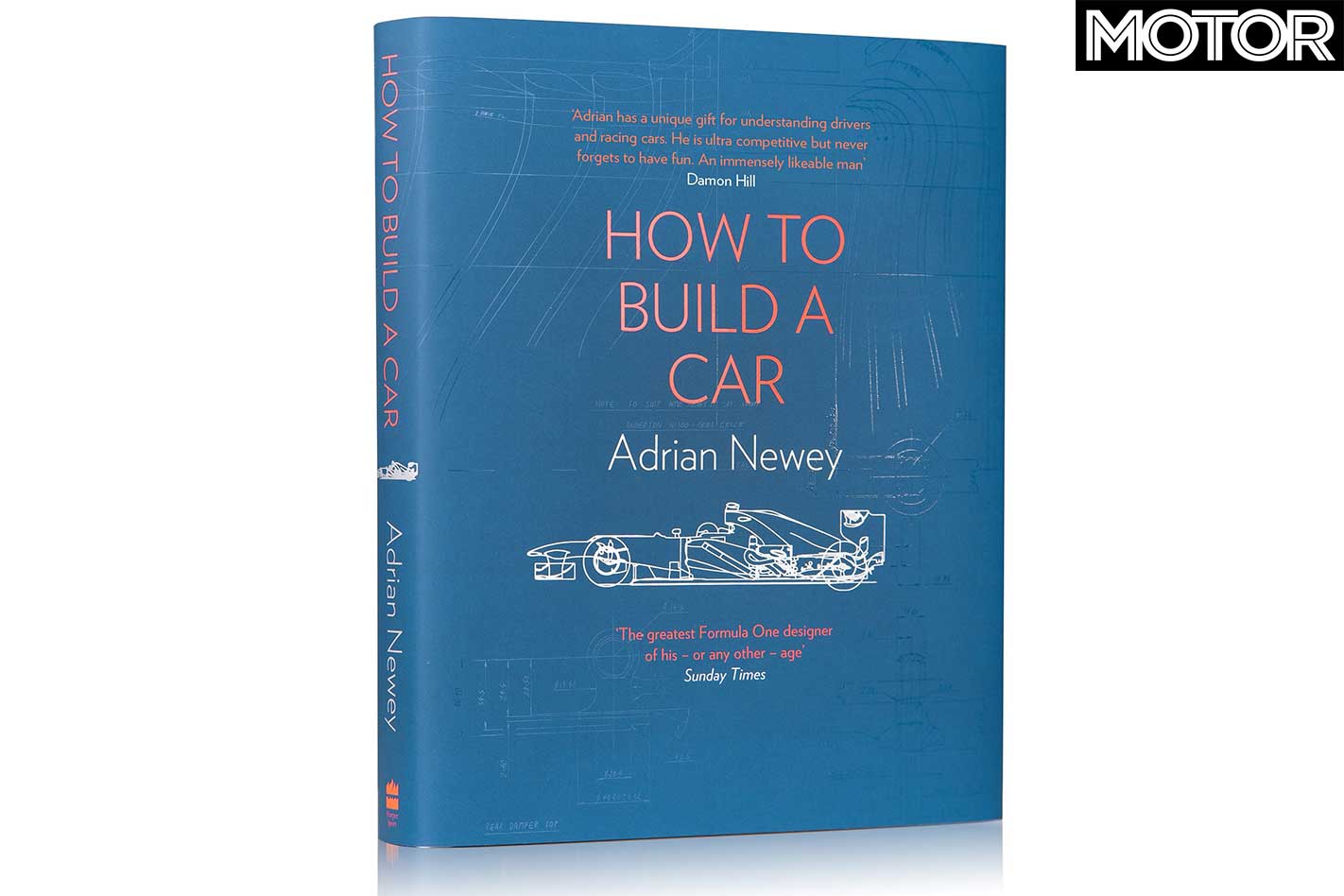
6 – How to Build a Car by Adrian Newey ($28 from pitstop.net.au) Learn the thinking behind one of the automotive world’s most gifted racecar designers in Adrian Newey’s latest book.
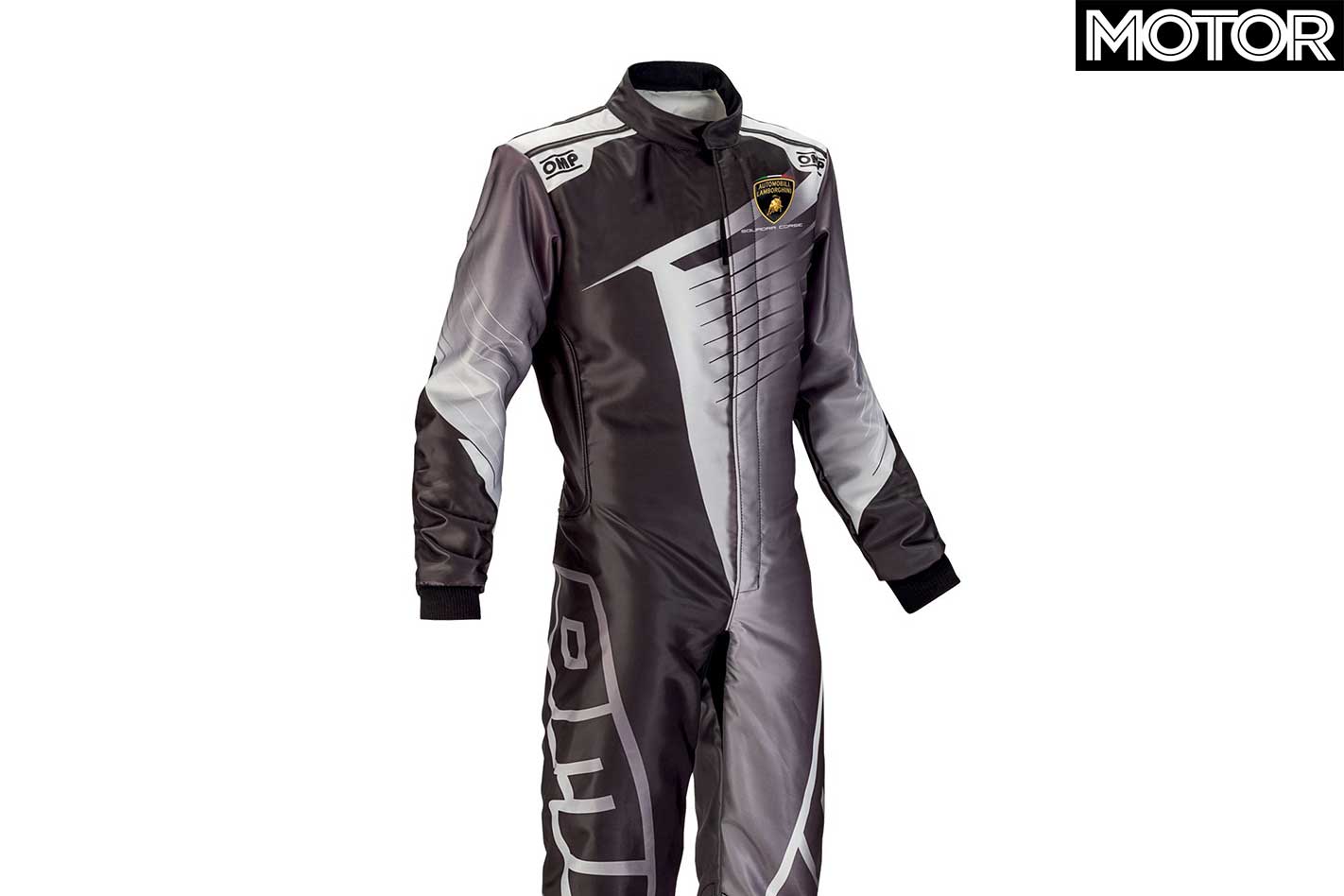
7 – Lamborghini Karting Suit ($988 from lamborghinistore.com) Look like a go karting god in this ‘Squadra Corse’ branded OMP race suit. Sizes 44-56. Homologation CIK-FIA Level 2.
Tried to rent a trailer lately? You might want to change your mind. In fact, here’s my advice – just don’t bother. The whole process is a metaphor for the demoralising, downward spiral that is modern automated customer service (if ever there was an oxymoron…).
But how could something as simple as renting a four-by-six for an afternoon turn so ugly? Beats me, but I’ll bet London to a brick that experts were involved.
So anyway, there I am a few weeks ago, needing to move a mobility scooter. First thought was to just drive it from where it was the handful of kliks to its intended new home (that would have been a sight – Ed).

A trailer it was. So I found a service station with a few well-used looking trailers lurking out the back, went inside and asked the bloke behind the counter how I’d go about renting the little box trailer. But instead of pulling out a triplicate A4 folder, taking my details, swiping my credit card and handing me the carbon copy of the rental agreement, he points me down the back of the shop to an electronic kiosk. And straight away, U-Haul and me are off on the wrong foot.
There was no way to compare prices of all the trailers, you had to select one first and then find out how much it was going to cost. Hmm. Then, once I’d established that a three-hour borrow of a very second-hand six-be-four was going to cost me $43, we got to the ‘your details’ section where I had to supply licence, credit card and personal details including my email address, favourite colour and average rate of intercourse.

Having laboriously entered all this info via an intermittently responsive touchscreen, I then discover that the price has somehow jumped to $55. Game over. I cancel the deal and head for the door. ‘Too hard’ I tell Old Mate as I pass the register. He looks back at me like this stuff happens every day. Probably does.
This user-suffers approach is not, of course, restricted to renting a rusty box trailer. Oh no, you name a service provider, and chances are it’ll have switched from people to take your enquiries and accept your payments, to an automated system that requires you to navigate a flying-blind system designed and arranged by somebody who believes that online gaming is a sport.
But it’s not all bad news. Nope, some of it is even worse than that. And that occurs when the same company that sacked all its front-office staffers and closed its High Street branches in favour of a robo-call centre, then turns around and contracts new people. New people to ring you up just as dinner hits the table to find out whether you want to change your service provider or billing company. Yeah, I know, why not keep the original toilers and keep you, the customer, smiling and less likely to be looking for an alternative in the first place? Again, beats me.
Of course, the next step in all of this is pretty obvious to a sharp fella like me. I’m counting down the days until my phone rings again at a completely inconvenient time and for the half-deaf bloke on the other end of the line to put it to me that I couldn’t possibly be happy with my domestic power and water arrangements.
Not only that, but I’ve miraculously been selected to receive a 10 per cent discount for the first month if I bundle my home loan, car rego, life insurance and Swedish website subscriptions with my gas and electricity. Nope, I’m fine. I’m also half way through mowing the lawn, so rack off and leave me alone.
“Okay then Mr David (how do they know my name and phone number?) but if you’re working in the garden today, can I ask one more question: Can I help you out with discount trailer hire?”
FUN FACT: none of the models here would probably even exist if it wasn’t for Nissan and its obsession with crashing the cliquey European small-car set led by the Volkswagen Golf.
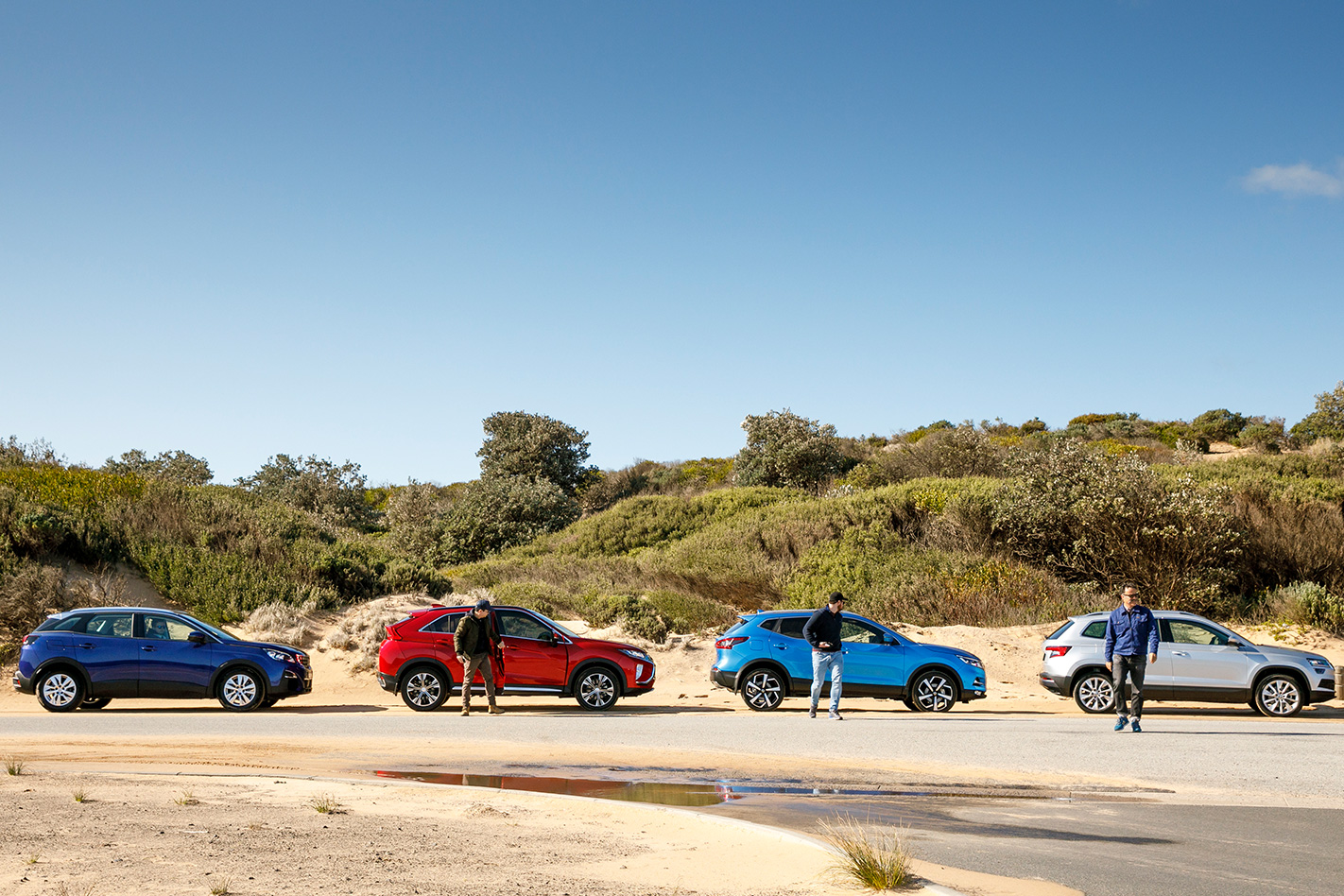
After decades of being left out in the cold with Sunny, Pulsar and Almera Golf-clones, the outta-leftfield Qashqai of 2007 broke through spectacularly by ushering in a slightly raised but still very hatch-like crossover alternative to the Wolfsburg icon. Designed, engineered and built in Britain expressly for Euro tastes, sales instantly went supernova, prompting a stream of copycat rivals, and the birth of a brand new SUV sub-class.
Since then, there’s been a total redesign (2014), while a facelift last year has brought in minor visual, engineering and specification improvements.
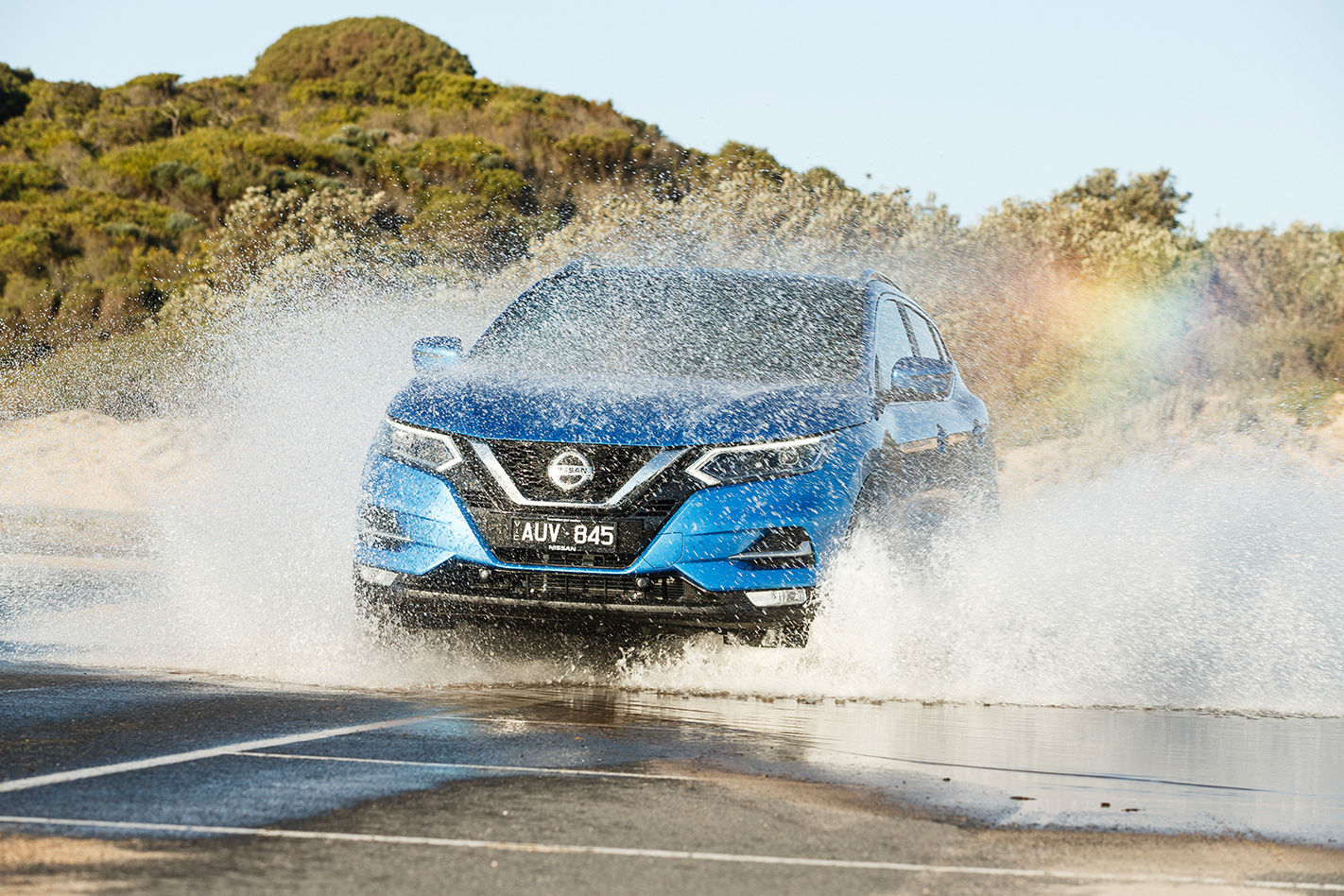
Can the Qashqai still cut it? To find out, we nabbed the $37,990 Ti flagship, bulging with gear exclusive to it in this test, such as Nappa leather, a fixed glass roof and 19-inch alloys, but conversely lacking Apple CarPlay/Android Auto. It’s also minus a turbocharger, relying instead on a 106kW/200Nm 2.0-litre atmo four dating back to the middle of the last decade. Why not the lusty 1.6-litre turbo fitted to Euro variants, Nissan? After all, most rivals feature forced induction, including the trio of petrol-powered front-drivers it faces here.
Freshest is the Skoda Karoq, the umpteenth offshoot from the Volkswagen Group’s MQB modular transverse architecture multiverse, and soberly styled successor to the late and likeable (if slightly loony) Yeti – a 2011 COTY finalist. Surprisingly, the Czech-made newcomer is larger every-which-way, something its crisp Audi-lite looks disguise quite cleverly, though it’s still within inches of the Nissan.
The sole variant for now is the front-drive 110TSI DSG from $32,290. Powered by an all-new 110kW/ 250Nm 1.5-litre four-cylinder turbo, this represents far-from-base-model positioning, bringing with it goodies such as adaptive cruise, driver fatigue detection, dusk-sensing auto high-beam lighting, keyless entry/start, rain-sensing wipers, rear-seat tablet holders and, uniquely, three individually removable rear seats dubbed Varioflex, in a continuation from the Yeti.
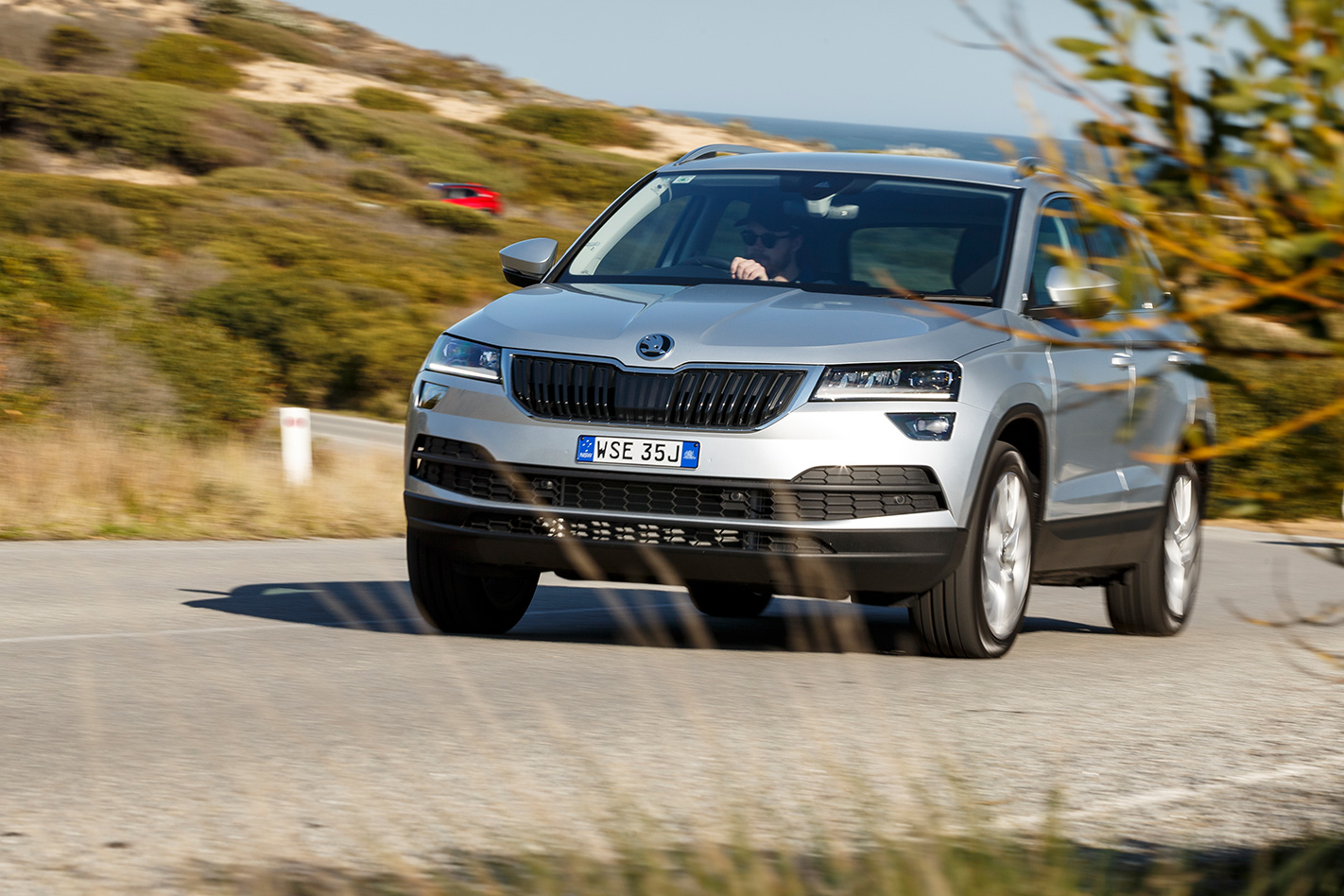
Our test Karoq cost $38,290, thanks to extras including a $1700 Travel Pack (adding lane-keep assist, blind-spot monitoring, rear cross-traffic alert, a powered driver seat with memory, heated front pews and auto folding and dipping mirrors) and $3600 Premium Pack (including adaptive LED headlights, leather, front sensors, this group’s only powered tailgate and 18-inch alloys). What’s missing is sat-nav and digital radio, for which you’ll need to stump up another $3200 for the Tech Pack.
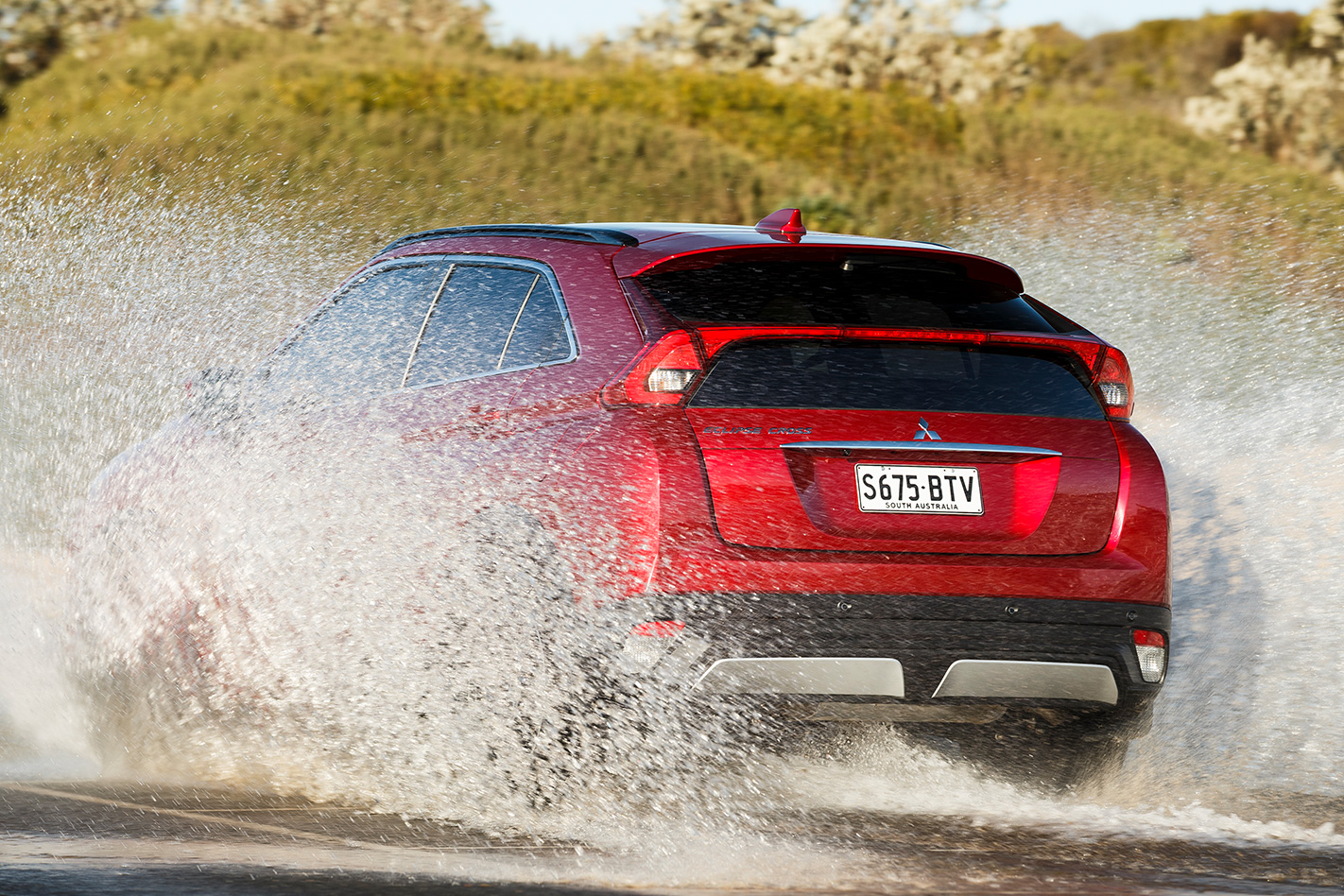
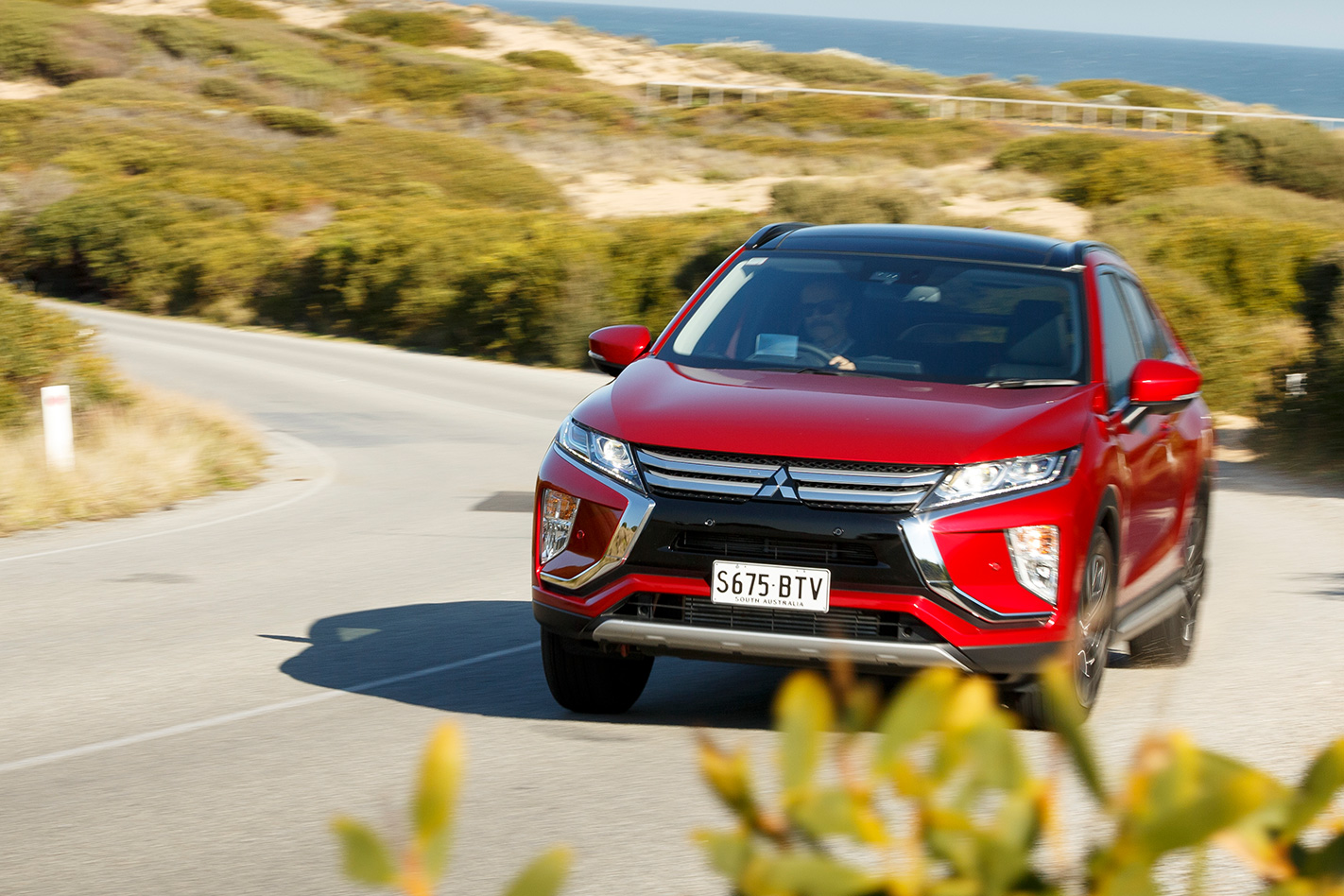
Most of the aforementioned, along with a head-up display and opening sunroof (but again, no nav), makes up the $36,000, front-drive Eclipse Cross Exceed. The Japanese crossover certainly stands out, with bizarre styling suggesting a liaison between a Honda CRX and a Pontiac Aztec. The bigger burn though is the not-much-fun fact that this is probably the last-ever true Mitsubishi, since the company that brought us innovators such as the Lancer Evo, Galant, Starion, Magna and Nimbus is now under Renault-Nissan control. Real end-of-an-era stuff.
Speaking of oldies, the Eclipse Cross employs a modified version of the ancient ASX’s GS platform; at least its 110kW/250Nm 1.5-litre four-pot petrol turbo is box-fresh.
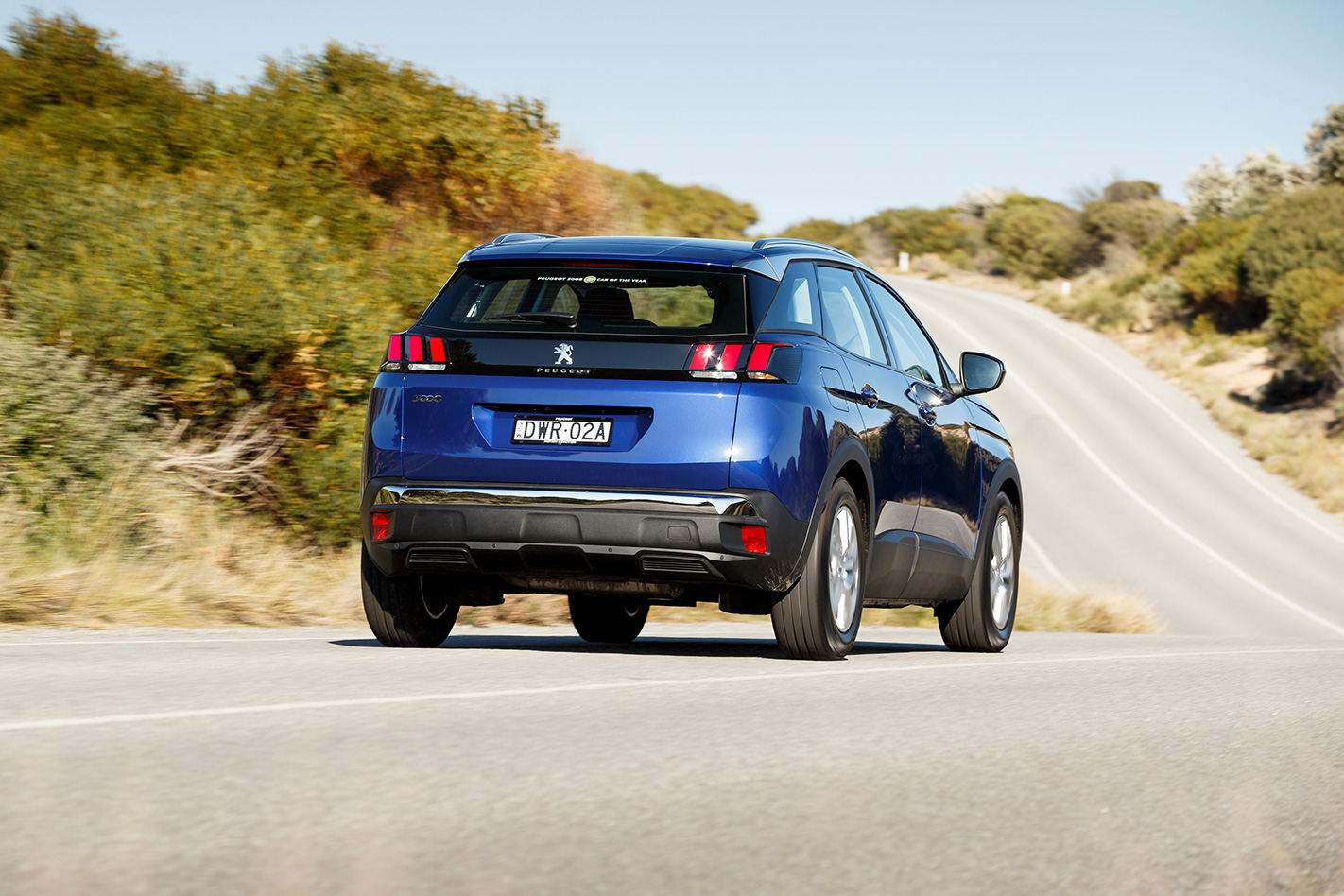
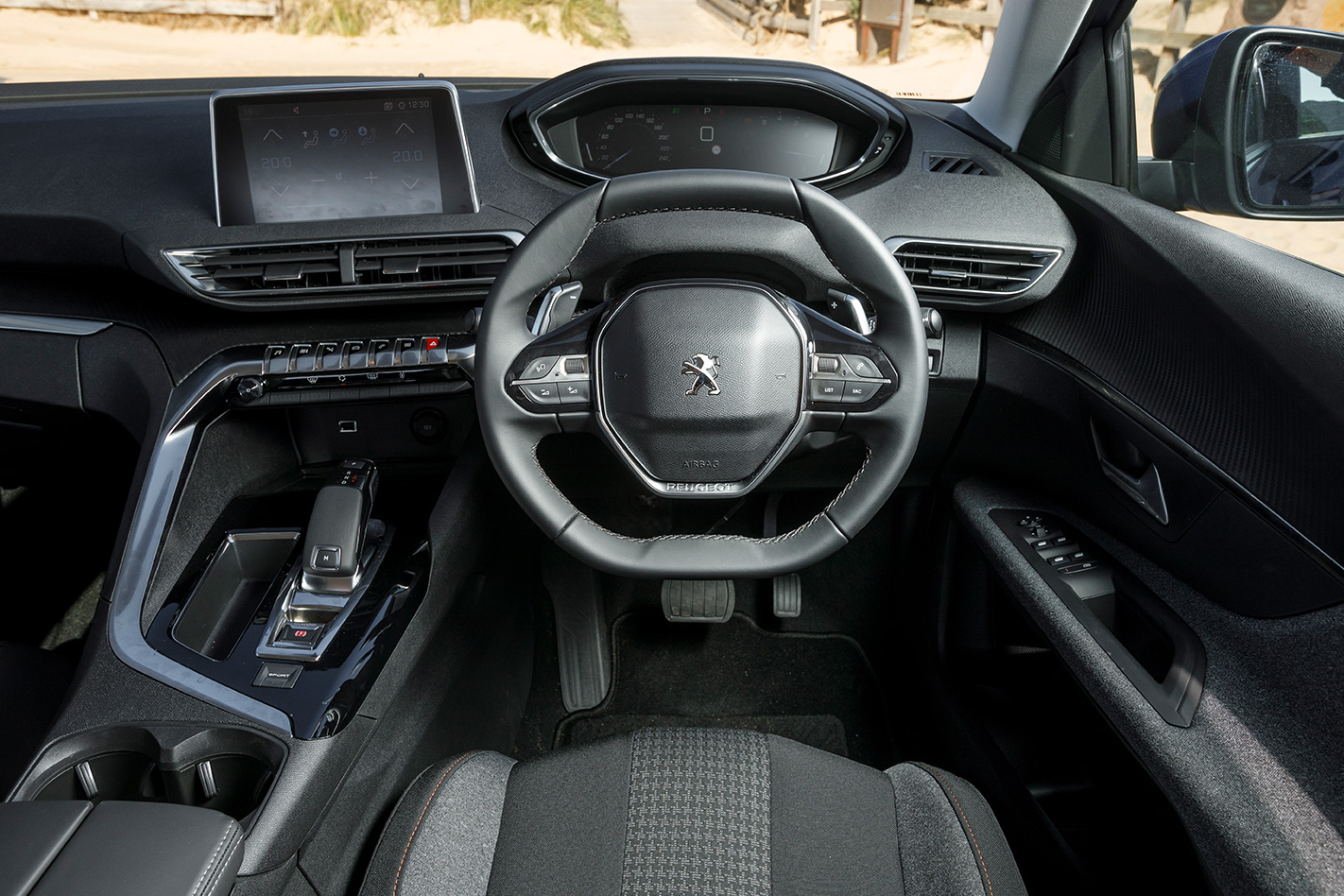
Finally, there’s Peugeot’s second-gen 3008. If ever proof was needed of the Nissan’s far-reaching influence, it’s this model’s 2016 switch from unloved MPV frump to sales-blockbuster crossover. Employing PSA’s lauded EMP2 architecture, the French SUV kicks off from $37,490 as a front-drive Active. While delivering the most power (121kW and 240Nm from a 1.6-litre turbo), it suffers from a few spec anomalies (and nauseating alloys). No adaptive cruise, blind-spot detection, lane-keep assist, auto high-beam, keyless entry/push-button start, leather, heated front seats or electric folding mirrors is a bad start. For these you’ll need the $40,990 Allure, which also nets an electric tailgate, auto parking, acceptable looking wheels and ultra-cool fabric dash inserts.
With dashes in mind, let’s see how the Qashqai’s atmo lump goes against the others’ turbos. With the continuously variable transmission calibrated to keep the engine in its torque band, off-the-line acceleration is pleasingly spirited. Up to about 40km/h there’s hardly anything in it, but beyond that, the Nissan falls away. The 80-120km/h overtaking increment, for instance, takes two seconds longer than the rest. And while CVT-induced rev-drone is mercifully contained, the raucous MR20DE four pot isn’t exactly cultured.
That would be forgivable if there was a sans-turbo fuel economy dividend, but the Qashqai was this test’s dipsomaniac, averaging 11.1L/100km. Double-whammy fail.
The Mitsubishi, too, let us down, returning a poor 10.5L/100km; that’s likely the upshot of being the porkiest here – by more than 125kg compared with the featherweight Frenchie.
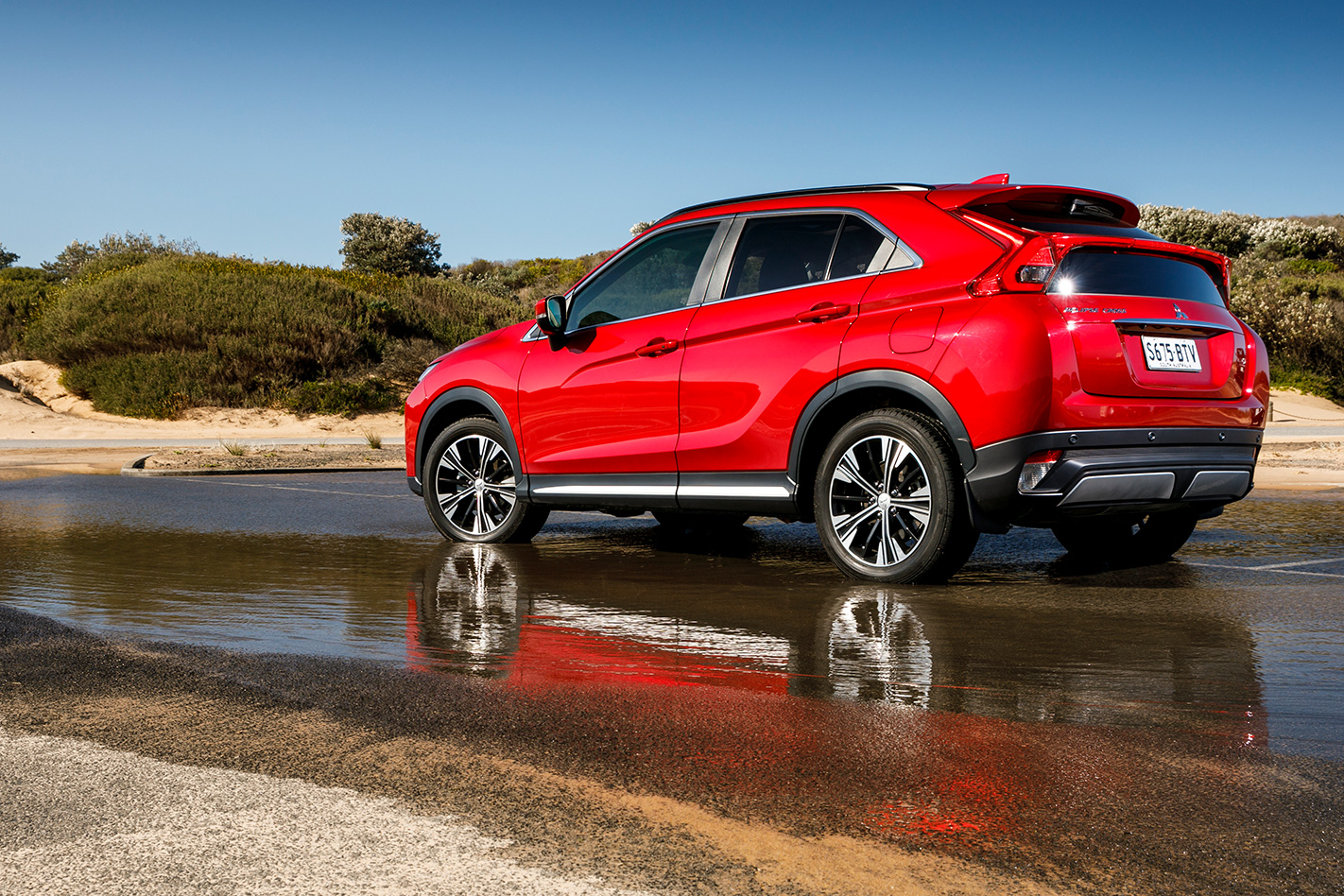
At least the Eclipse Cross is rapid and raring to go, right from the get-go, to the point where it will spin its Toyos even in the dry and scramble for traction in the wet. Anywhere up to 60km/h, the Mitsu’s extra muscle is palpable, aided in no small way by one of the smoothest and most unintrusive CVTs we’ve yet experienced, to streak ahead of both Qashqai and Karoq, while keeping the latter at bay to 100km/h. After that … well, all those extra kilos rear their efficiency-obliterating head again, with the Exceed slipping behind the Skoda.
Everything works better on a sensible diet, as the lithe Karoq demonstrated, being only 0.1s slower than the Eclipse Cross to the tonne, yet teasing out almost a whole litre per 100km more in the process. Like the Exceed, the 110TSI’s sparkling powertrain provides a solid and deep well of oomph to draw upon, at least after the inevitable DSG lag at take-off.
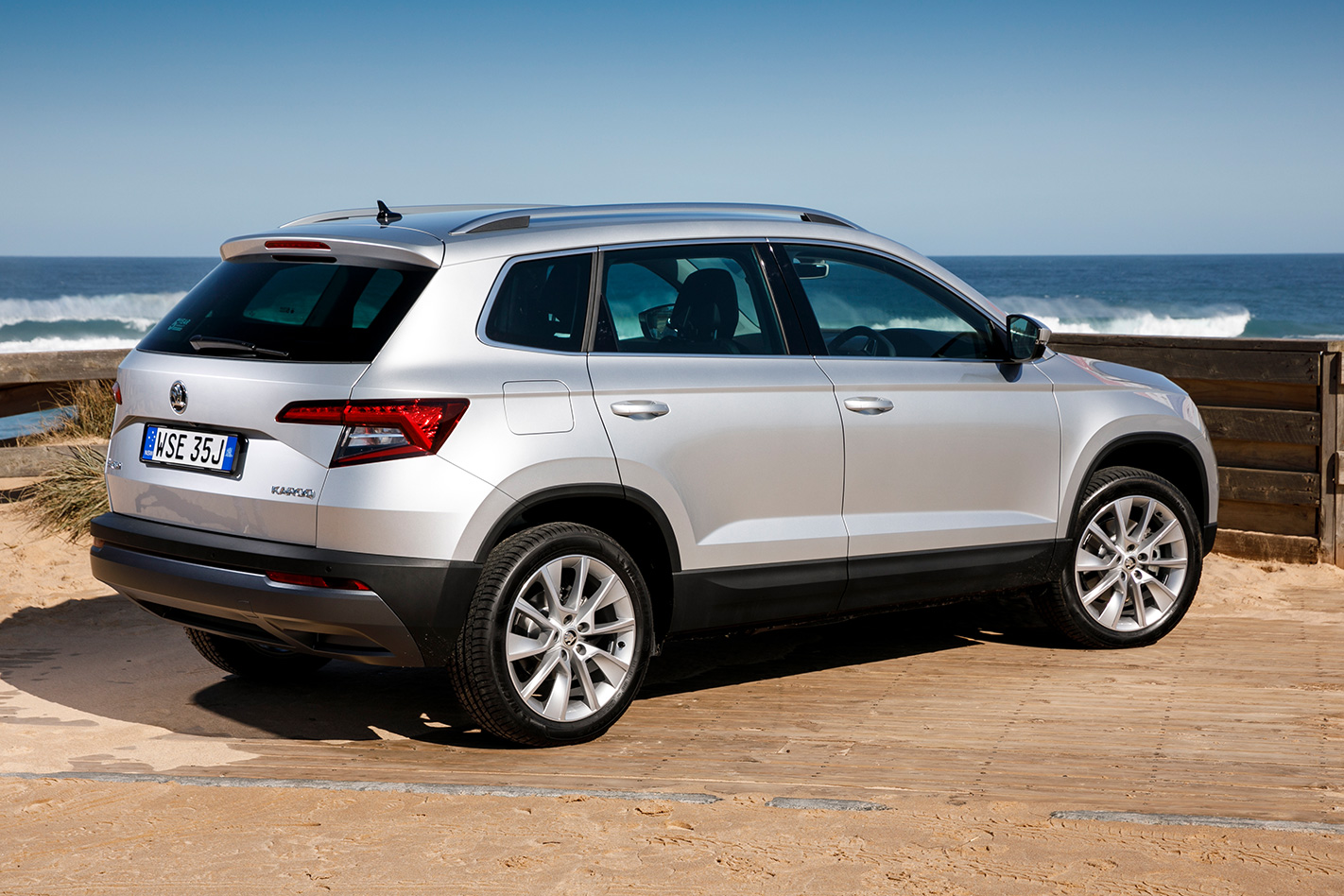
Super-slick gear selection ensures the Skoda is always in the right ratio at the right time which, combined with punchy throttle response across the rev bandwidth, makes it an effortless point-to-point performer. The Czech’s ability to power along at a cracking pace is a sheer joy.
Plus, the Skoda pipped the Pug in the braking stakes, pulling up a metre shorter at 35.4m from 100km/h. The Nissan was within cooee at 37.6m, however the Mitsubishi took an elongated 40.5m which is perhaps also to blame on the extra ballast.
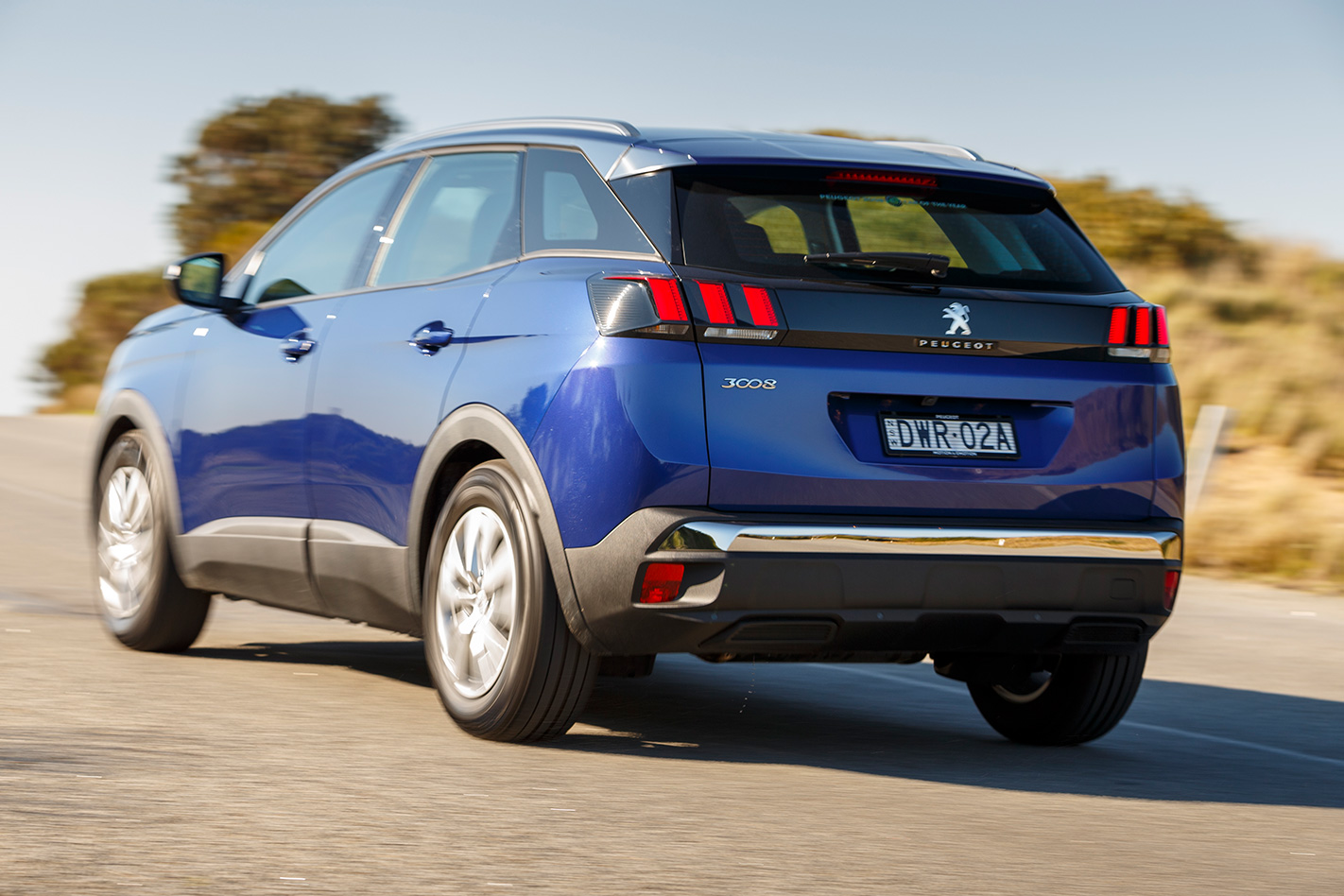
Yet… the Karoq’s numbers told a different truth, for in reality the barely run-in 3008, with the second-oldest engine on test and tres ordinaire Toyota-supplied six-speed torque-converter auto, proved brawniest, especially at the top end. By 130km/h the SUV from Sochaux was streaking ahead of the rapid Skoda by 0.6s, the Mitsu by nearly two seconds and the Nissan by a yawning four-seconds.
The 3008 also set the quartet’s dynamic benchmark, thanks to the sharpest and crispest steering, easily providing the most feedback and bite. It shrinks around the driver, with just enough rear end play for corners to be carved at a considerable clip while still feeling firmly rooted to the road. Are SUVs meant to be this entertaining? They are now.
The Skoda’s front end, too, is a fun yet faithful companion, seemingly magnetised to the driver’s chosen cornering line, backed up by a tautly sprung chassis and what feels like endless grip. That said, though, the steering intimacy and rear end fluidity that set the Pug apart are absent; that’s something we’ve noticed on every MQB model with the torsion beam rear suspension.
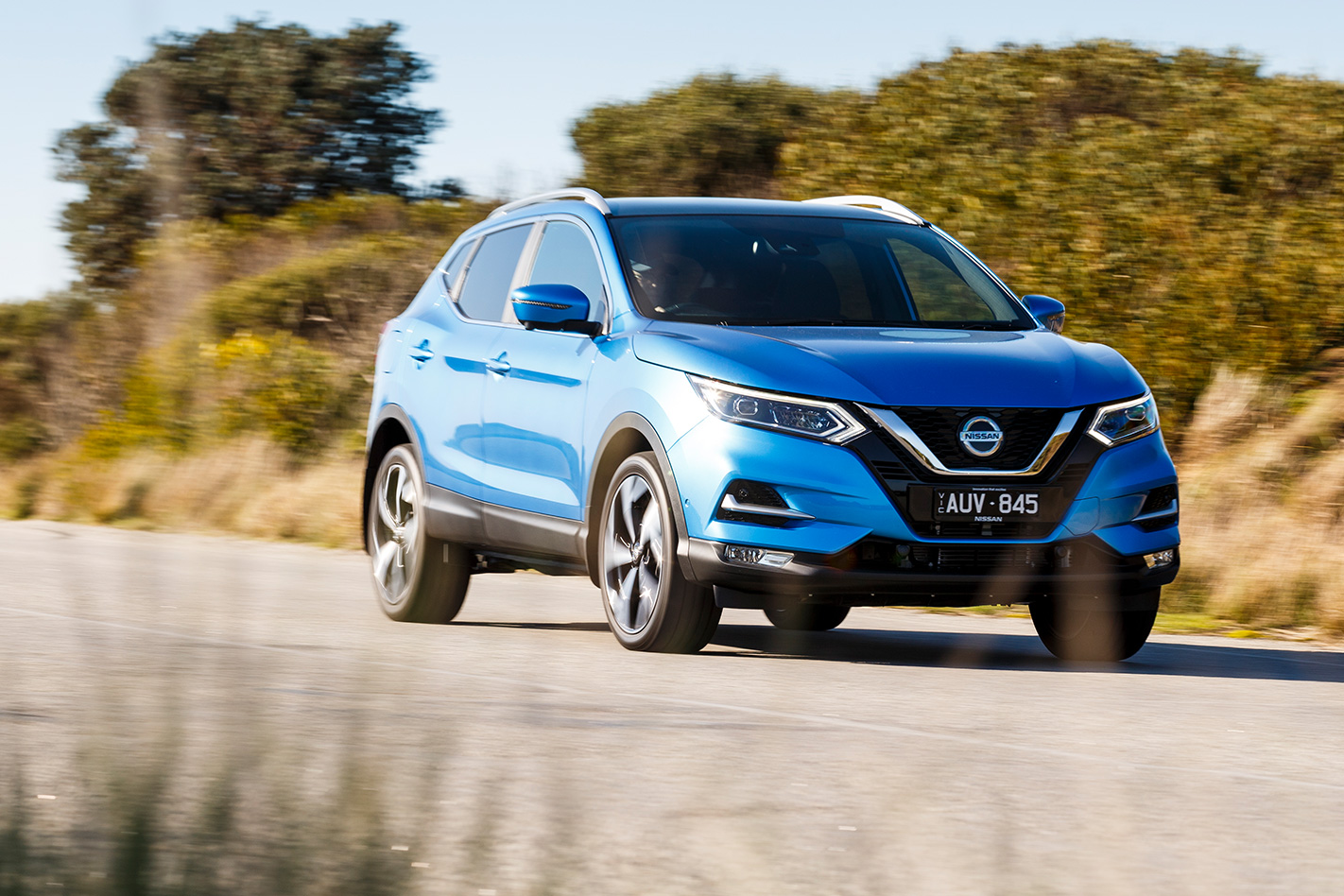
Rounded describes the Qashqai dynamic character, feeling planted and composed while still agile enough to engage a keen helmsman. The Ti’s 19-inch rubber probably helps. And the Eclipse Cross? On paper, it should have the goods to better the ageing Qashqai, with its more modern engineering and pedigree enriched through decades of rallying successes.
The truth, however, is heartbreaking in this last true Mitsubishi, for the Exceed’s steering is oddly numb, so at speed there’s a level of disconnection that can be disconcerting; this is exacerbated by a tippy-toed attitude brought on by tiresome and then quease-inducing amounts of vertical and lateral body roll. Just as frustrating is the endless and noisy suspension bump and thump on anything less than a smooth surface. The lack of a cohesive chassis tune is quite literally a shocker. With no comfort trade-off to compensate for its dreary handling, the Eclipse Cross is out of its depth. An Exceed AWD sampled earlier in the year on the same roads behaved far better, so was there perhaps something awry with our test car?
At the other end of the ride spectrum is the Peugeot, especially around town. No doubt the 3008’s smaller wheels (17s versus the others’ 18s or 19s) play a part here, but the Active’s levels of absorption and suppleness put it on top for refinement. The black art of French suspension isolation lives on!
In contrast, while the Skoda can be equally comfy, it can also struggle with small amplitude bumps at lower speeds, feeling at times too vocal and abrupt. Yet, with four adults on board at speed over our rough, ride-assessment road, the extra weight actually settled the Karoq and eased the edge out of the firmness. Over the same strip, the Peugeot’s body control wasn’t quite as level, but it remained a relaxing proposition. The Qashqai, too, proved remarkably well damped considering its massive wheels and tyres, smothering most road irregularities with agreeable aplomb. Maybe that’s Renault’s influence. All were welcome respites after the Mitsubishi’s dynamic maladies.
All four offer spacious and practical wagon-oid cabins, allowing easy entry/egress, more than sufficient space for four adults and reasonable luggage capacity. Note, though, that only the Euros provide HVAC outlets at the rear of the front centre console.
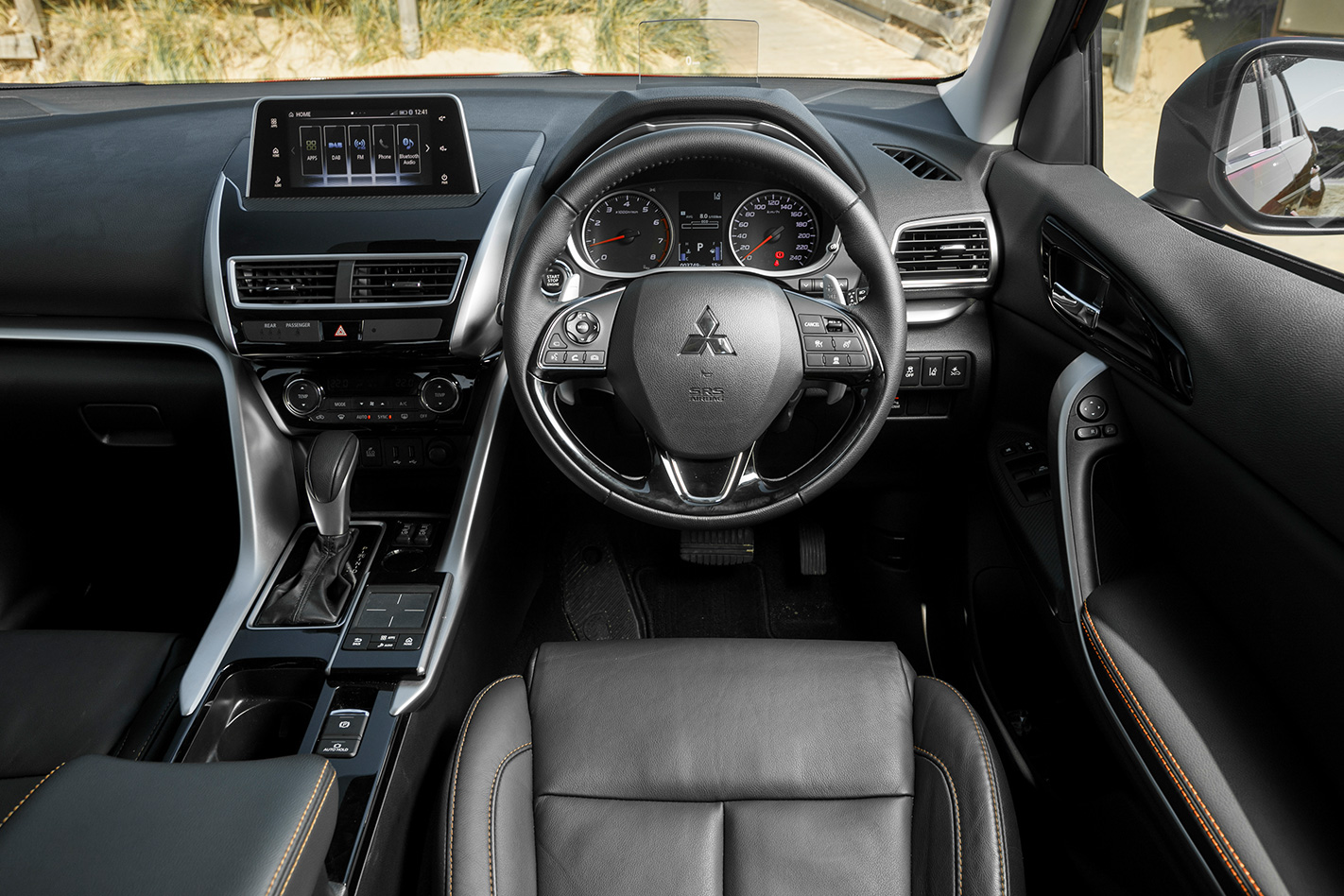
At least the Eclipse Cross recovers a little with an appealing and functional dashboard that is a big stride forward for the marque thanks to its layered design symmetry, easy usability, clear controls, ample storage and quality finish. Kids will most likely appreciate the high rear seating while there’s heaps of leg and foot room for bigger folk out back. But clangy column stalks, inadequate thigh support, a flat rear bench, limited rear headroom and a taillight design that bisects the rear-window view are drawbacks. Additionally, the twin-sunroof blinds and parcel shelf rattle, and the adaptive cruise control’s haphazard operation makes it seem like the driver is intoxicated.
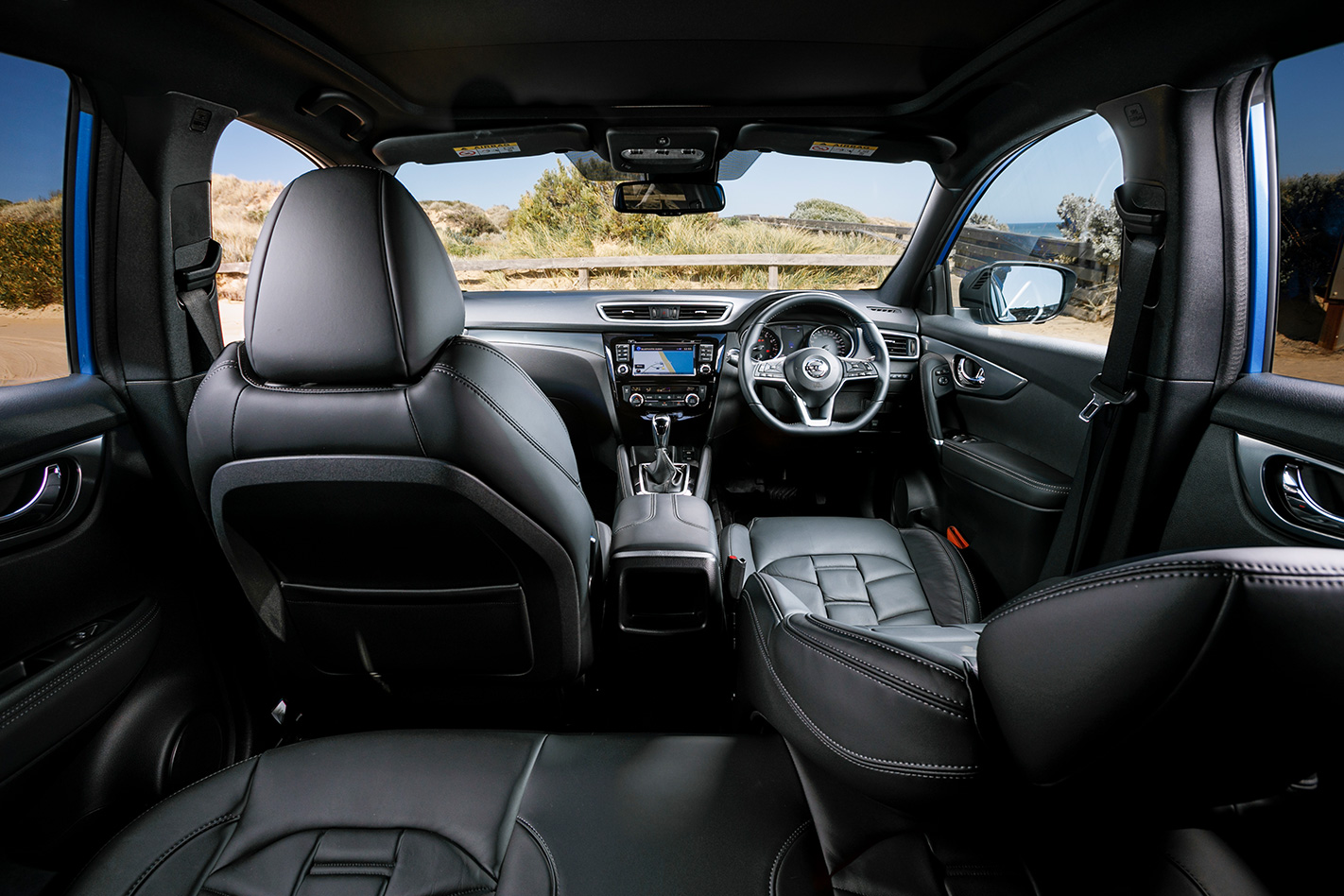
After all that, the Qashqai feels like the Eclipse Cross antidote, with cushy seating, a low-slung dash, ultra-clear dials and what might be the coolest new steering wheel ever. Vision out is a little impeded by fat pillars and window-line up-kick, and the multimedia graphics seem comically outdated, but that glass roof’s ability to let light flood in can raise the lowest spirits on a dull day.
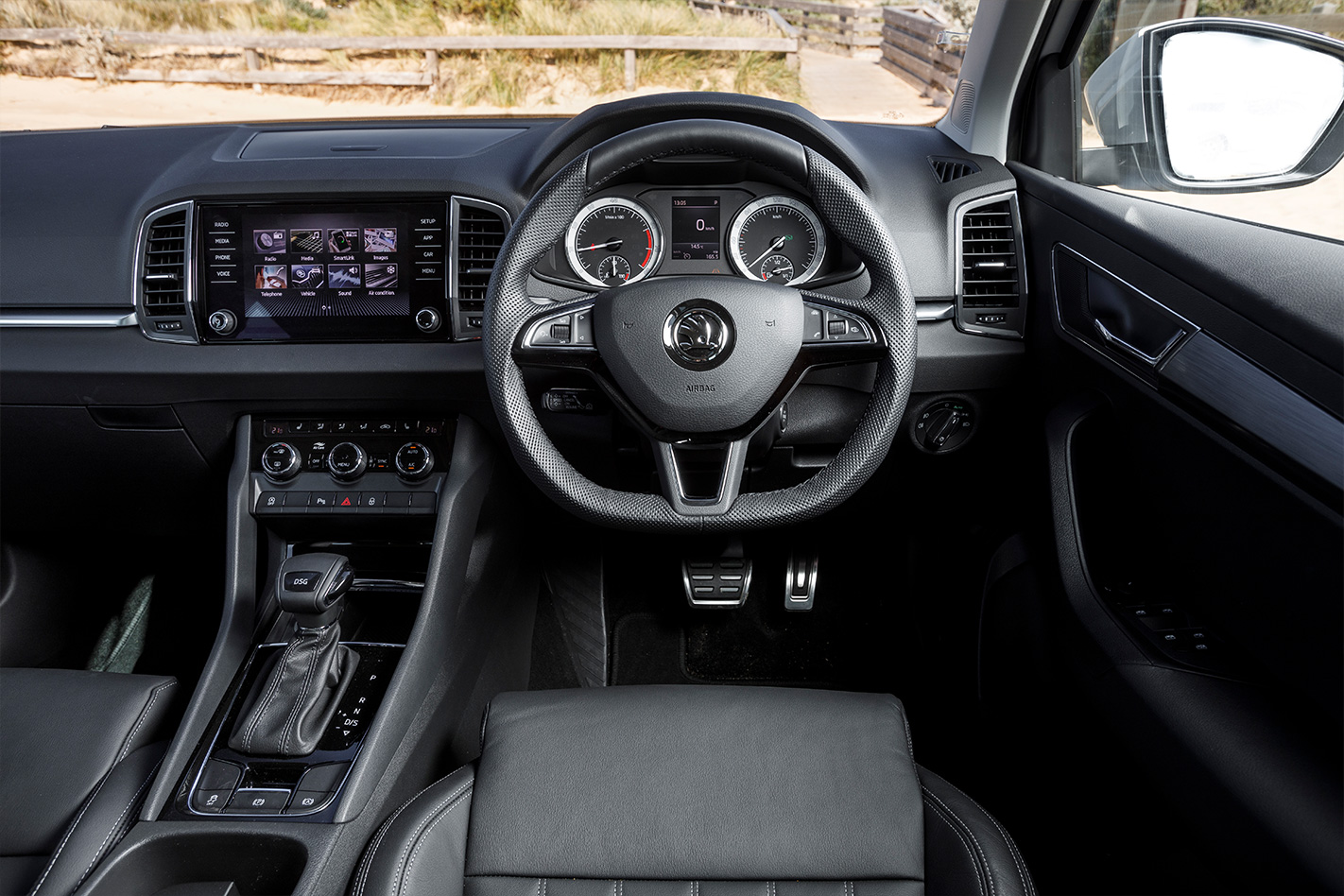
We’ll go out on a limb and declare the Karoq’s dash the best MQB-era effort yet, in terms of design and presentation this side of an Audi. With the Premium Pack, there’s a cohesiveness and elegance that elevates it even above lower-line Tiguans, while firmly supportive seats, deep glass areas and the modular convenience of the removable (if heavy) individual rear chairs is second-to-none. Which all makes the noisy, jittery urban ride all the more disappointing.
Finally, we come to the 3008. Even in basic Active guise, the Peugeot’s trim and design are imaginative, intriguing and yet, after a period of familiarisation, completely user-friendly. Changeable digital instrumentation, superbly supportive seats and muted noise intrusion elevates the experience to a premium level, though some cheap plastics and the odd rattle do let the side down.
By now it should be clear that the Mitsubishi finishes a resounding last, despite its newness, rousing performance and high equipment level. Sub-par handling and an ill-sorted ride means the Eclipse Cross Exceed front-driver feels dynamically half-baked.
On the other hand, we’d happily recommend the Qashqai, and we can see why the 11-year-old formula remains so popular today. But the Nissan deserves a much better powertrain.
The buying public’s high esteem for the Qashqai might translate to market leadership among this SUV clique, but the Skoda and Peugeot are so much more than the left-field alternatives that their sales figures might suggest.
Separating the Karoq and the 3008 is a question of priorities, for the Skoda’s irrefutably longer list of standard features, substantially lower base pricing and rear-seat versatility must be weighed against the roomier Peugeot’s greater performance, economy, handling, ride and refinement. It’s also cheaper in the specification tested.
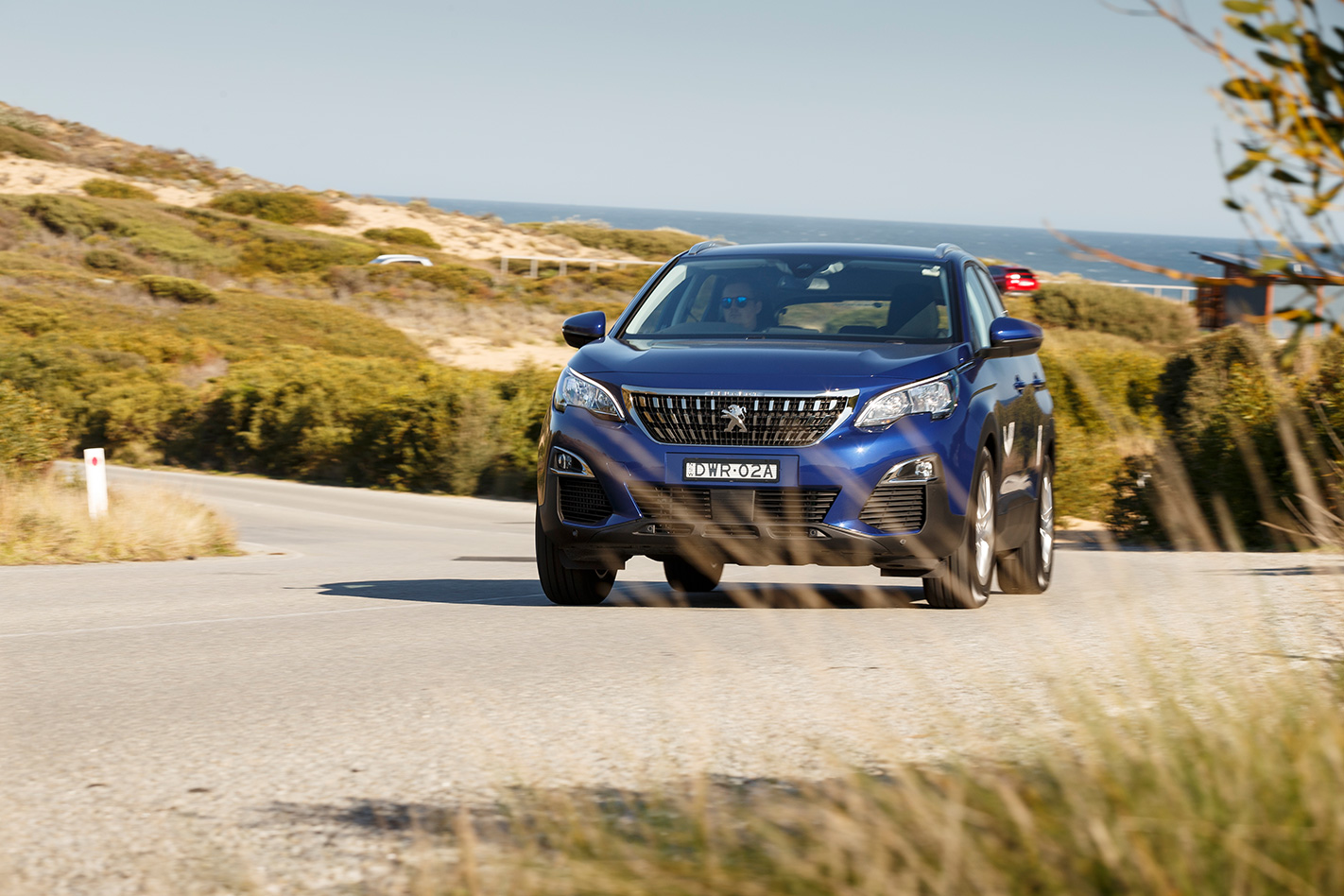
The French SUV ultimately has the edge over the capable Czech. Close as the two Euros are, our comparo revealed one more, final fun fact. The Peugeot 3008 is one of those rare cars that is greater than the sum of its parts.
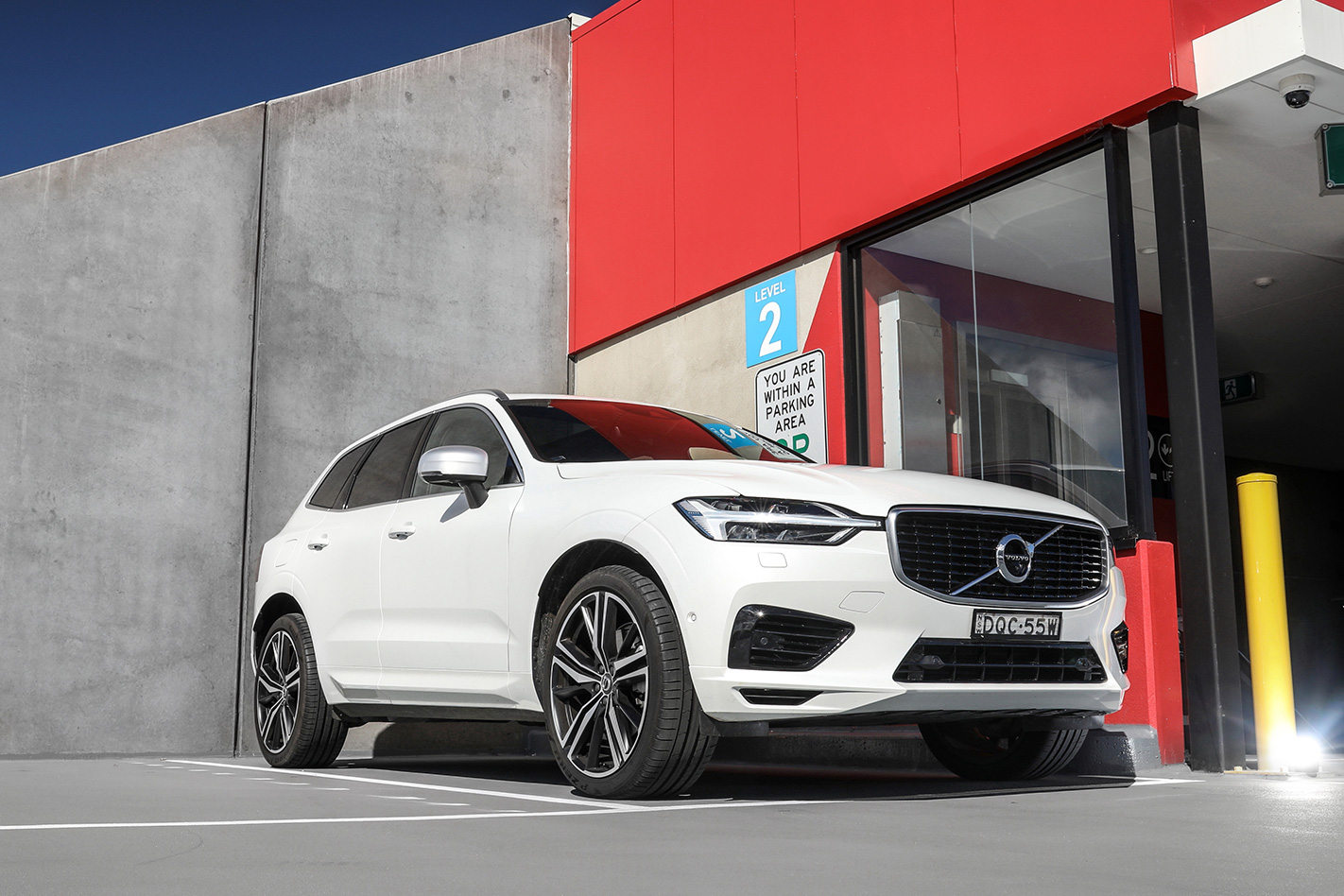
AM I THE ONLY one who thinks my new Volvo XC60 long-termer looks a little smug?As though its handsome grille is somehow twisted into a haughty smirk, and when it drives, it doesn’t so much roll past smoothly as saunter with a superior swagger. It sounds daft, I know, and yet such attitude wouldn’t be entirely without cause.
The Volvo XC60 is our sister magazine, Wheels‘, freshly minted Car of the Year and this particular example, which is the $92,990 hybrid-powered T8 flagship, last month trounced its rivals from Porsche, Audi, Jaguar and Range Rover in our performance mid-size SUV comparison.
Clearly then, DQC55W has already been put through the Wheels wringer and emerged not only unscathed, but manifestly more confident and more convincing. It also means a traditional ‘welcome’ report to the Wheels garage feels a little pointless.
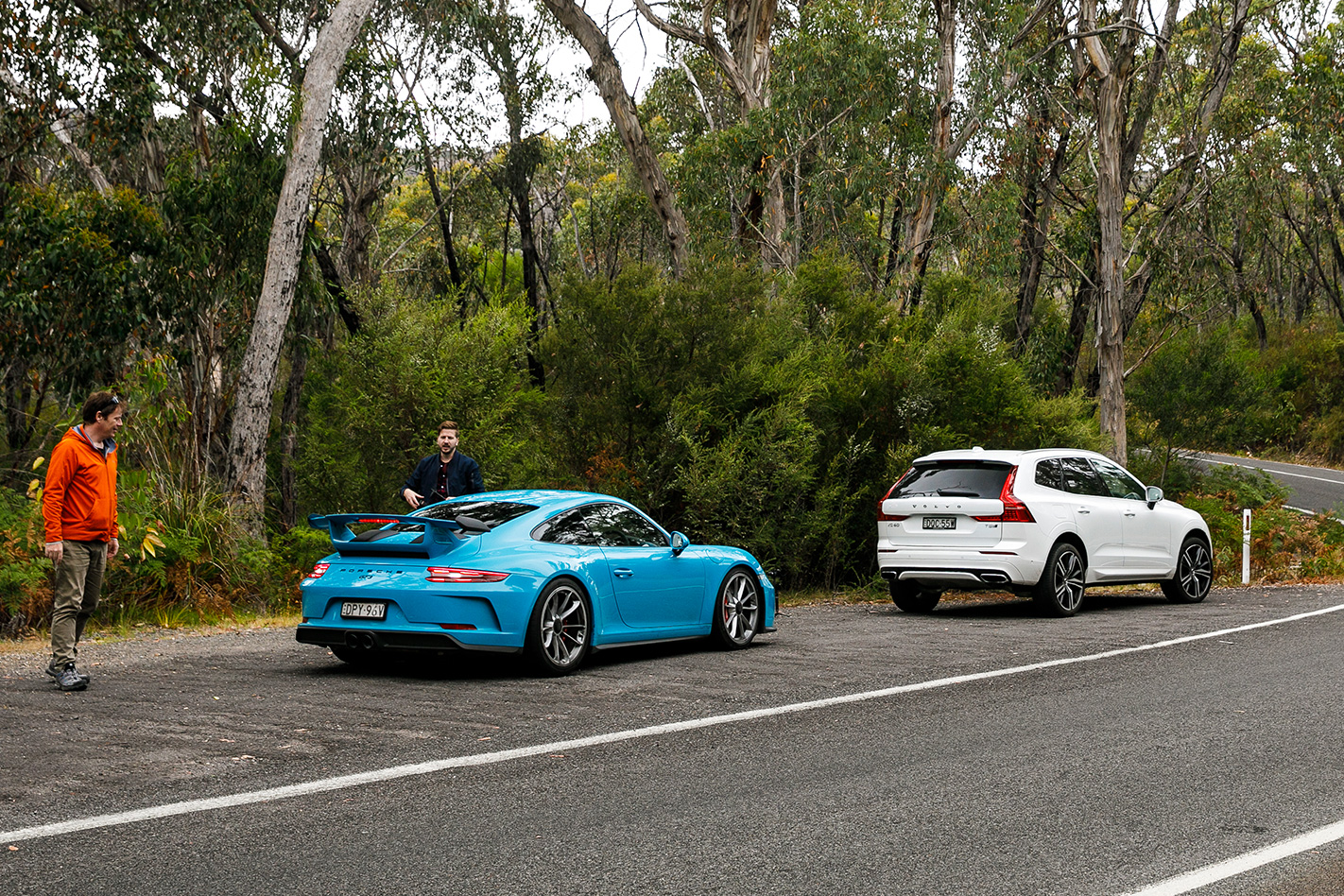
Discussing initial impressions would simply cover old ground so, to avoid that, I’ve thrown the T8 straight in at the deep end. In less than two weeks I’ve added more than 3000km to the odo, with its first adventure being the support car on our Porsche 911 GT3 v Road feature on p106, hence the flash of bright blue wing dominating the foreground opposite.
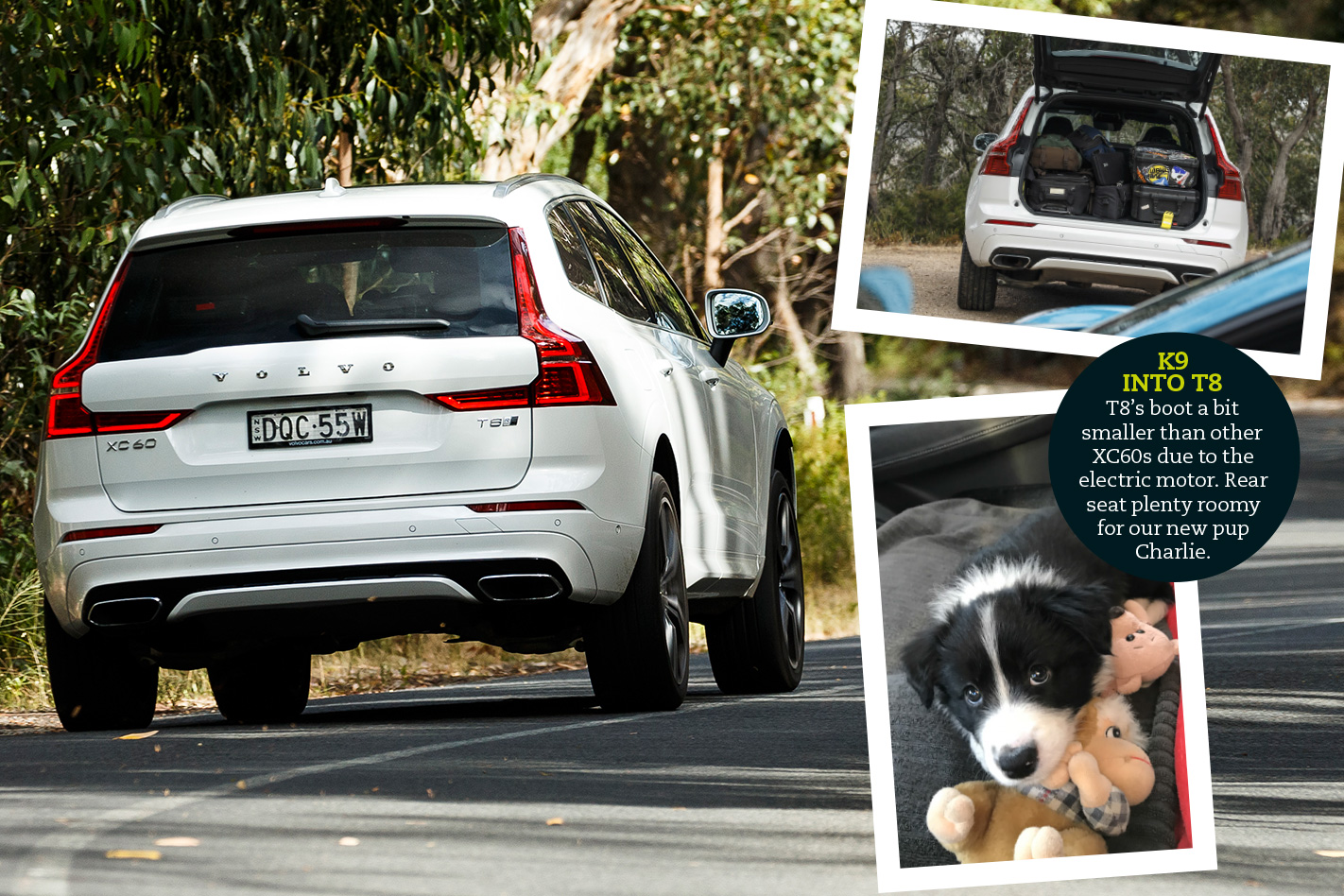
I’d only had the T8 for 24 hours before it was charged with chasing the Porsche, its pristine boot laden with cases of camera gear and its freshly vacuumed carpets quickly sullied by mounds of dirt, grass and twigs as the photography team dragged in clumps of the Grampian scenery as we scouted for locations.
Yet even there, with its snout smattered with bugs, the interior befouled and its already lardy 2174kg kerb weight fattened further by four people’s gear, the T8 shouldered the burden with zero fuss.
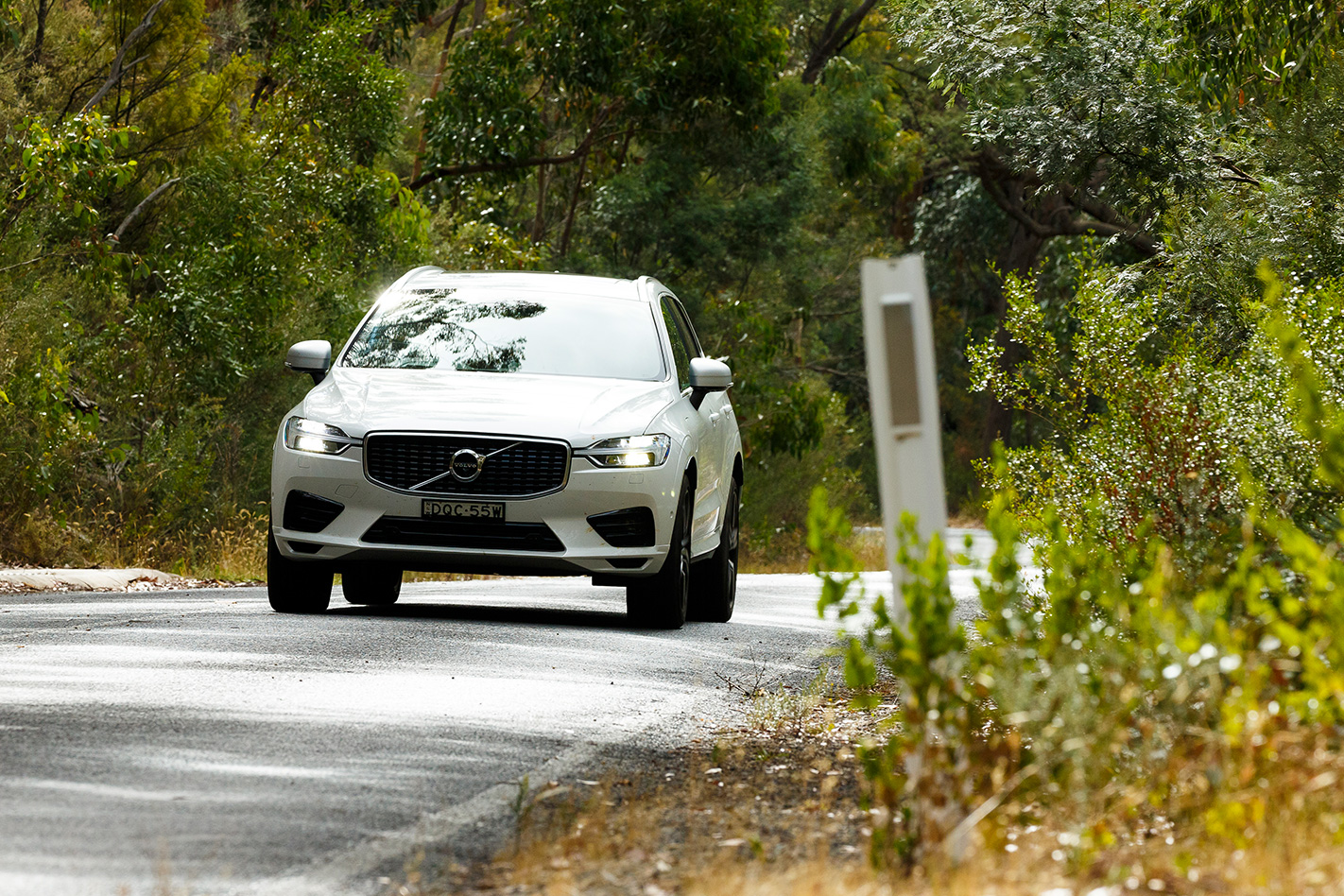
The 505L boot proved more than ample, the deftly designed and beautifully trimmed cabin roomy and comfortable, and the soft and supportive leather seats, which arrive as part of the $7500 Premium Pack were a welcome reprieve from stints in the Porsche’s hard, carbonfibre-shelled racing buckets.
It really is a serene place to cocoon yourself, with road and tyre noise nicely suppressed and a supple, well-controlled ride courtesy of this T8’s optional air suspension, which is also part of the Premium Pack. As COTY testing proved, ticking the air suspension box (which can be selected on its own for $2500) is crucial across the XC60 range if you value ride comfort.
Yet the Volvo wasn’t only used as a calm oasis to recoup in after blats in the howling Miami Blue 911. With the scream of the Porsche’s flat-six bouncing off the towering cliff faces just outside of Dunkeld as Dep Ed Enright chased the 9000rpm redline, I tore off after him in the Volvo to remind myself of its performance credentials.
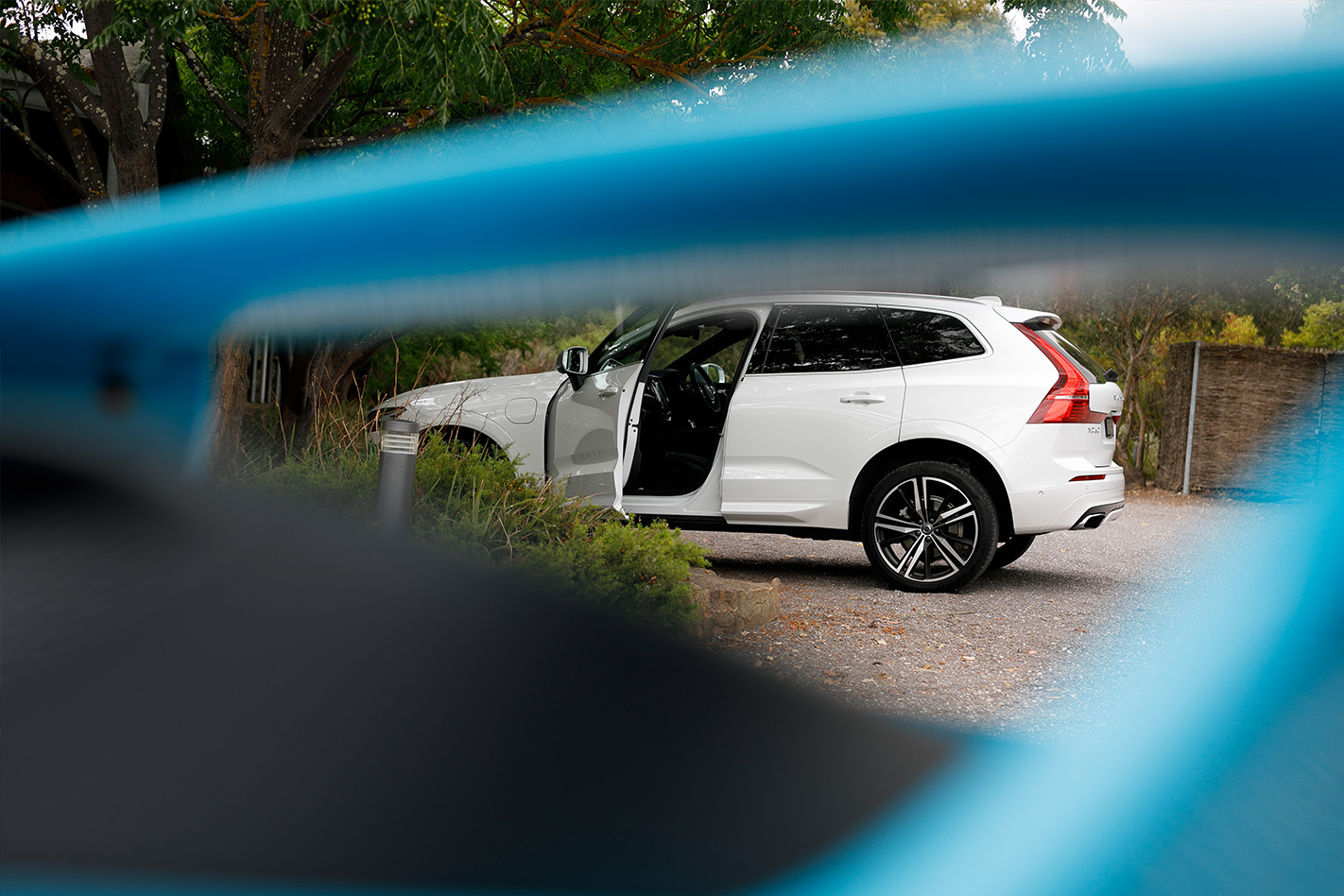
While no match for Stuttgart’s best, the T8 again proved its worth as a driver’s SUV that delivers accurate steering, tight body control, surprisingly high grip levels and a peach of a hybrid powertrain that combines a smooth and responsive 2.0-litre four pot petrol with fat wads of instant torque from a 65kW/240Nm electric motor.
The only dynamic element that requires some adjustment is the brake pedal which, courtesy of the T8’s regenerative braking capability, initially feels difficult to modulate.
Unsurprisingly, chasing the Porsche saw the T8’s fuel consumption jump to 9.3L/100km, yet that figure fell into the sixes the following week during an interstate run to Bathurst to collect our new Border Collie pup.
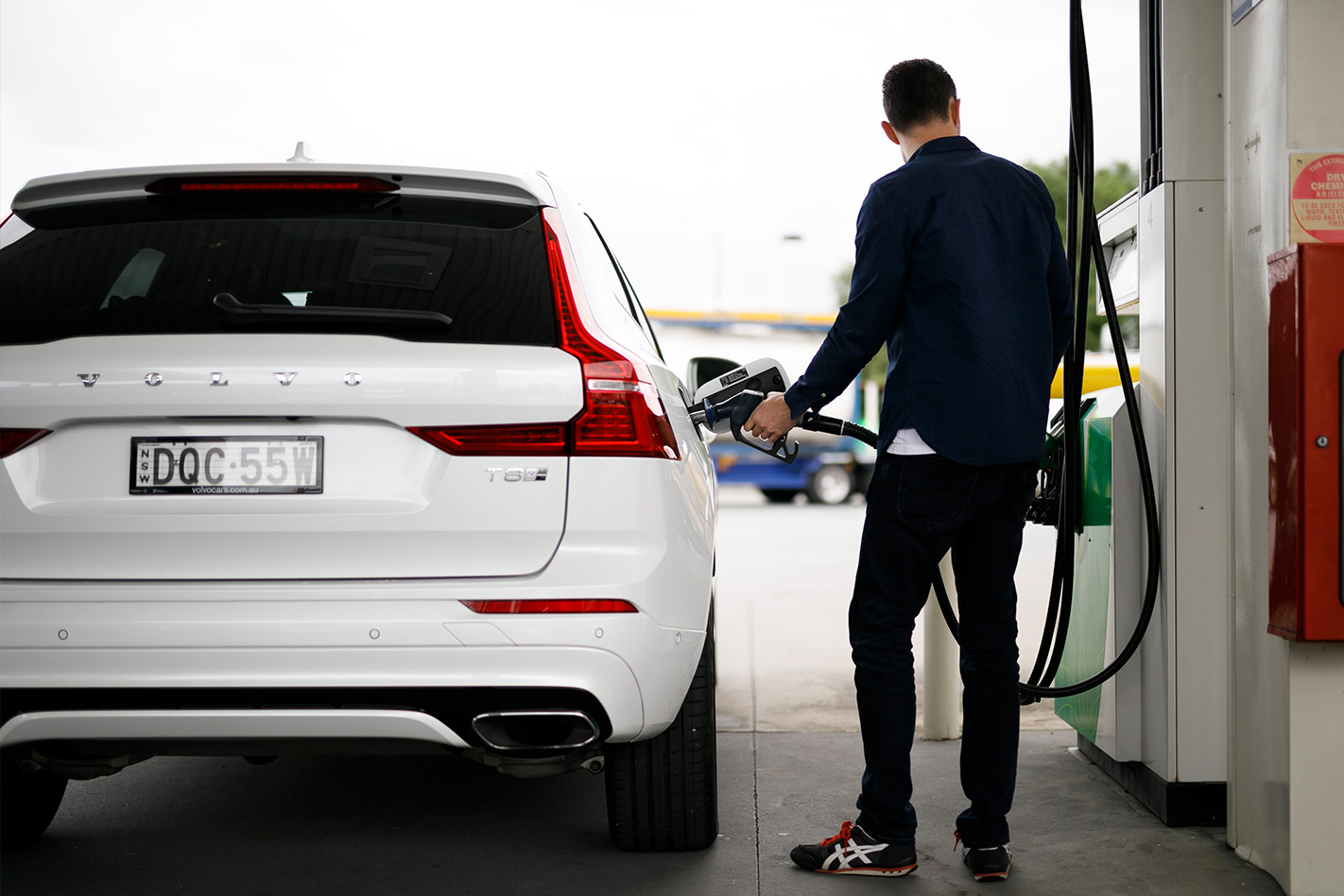
Time pressures meant that the 2000km round trip had to be completed in a day and a half and, with the seven-week-old hound asleep on the back seat as we drove into the night, the T8’s impressive bandwidth came to the fore.
Capable of hustling with surprising composure, it’s also an enjoyable and comfortable place to spend lengthy amounts of time.
Perhaps a little smugness is deserved.
Update 2
IT’S CHANGING me, this Volvo. Having spent last month eroding any lingering cynicism I had towards SUVs as a category (for being too heavy, too thirsty, too cumbersome and thus deserving of unquestioned enthusiast vilification), the sleek Swede has since had a similar effect on my opinion of hybrids.
I’ll admit to being something of an unwilling hybrid sceptic, not because I don’t see the value in the technology, but because all the ones I’ve experienced have been disappointing. Heavier and more expensive than conventional drivetrains, they often have odd-feeling control weights (fizzing brake pedals, for example) and struggle, without exception, to reach their predicted ‘electric only’ ranges in the real world.
These aren’t shortfalls the Volvo sidesteps entirely, in fact it’s still guilty of all of them, yet it’s easily the most impressive hybrid powertrain I’ve driven. The electric motor delivers a surprising performance boost, with instant step-off and, when the road gets twisty, rapid response as you feed in the throttle on corner exit. The Volvo really hustles for a porky SUV, too: combined outputs of 300kW/640Nm propel the 2105kg T8 from 0-100km/h in just over 5.0 seconds.
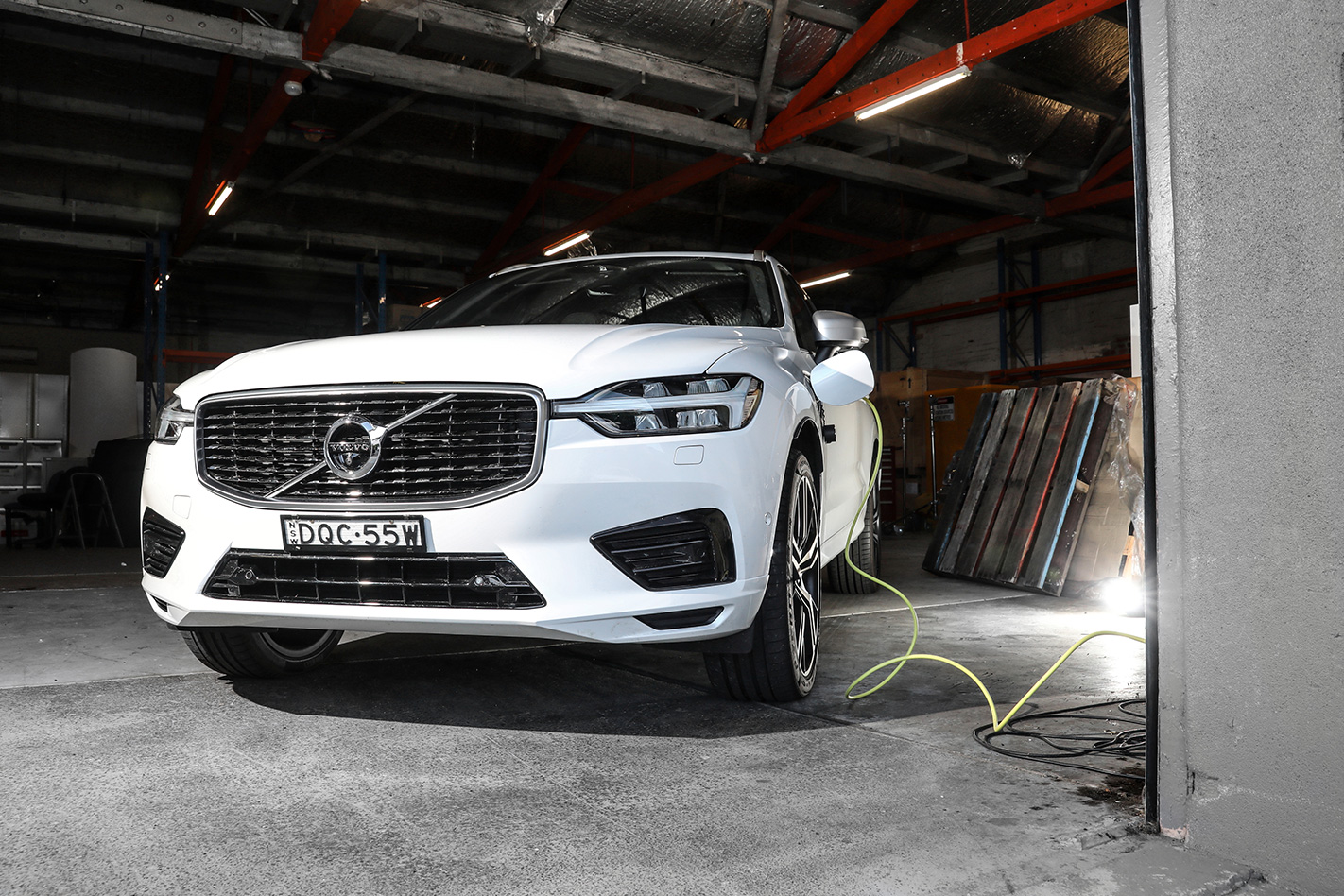
However, it’s the benefits provided by the batteries in mundane city driving that are more useful. I’ve been charging the T8 at work (a full charge takes just over four hours via a conventional socket) and it’s able to get me home and halfway back to the office without using a drop of petrol. That’s just over 30km on electricity alone, which is impressively close to the on-board computer’s claimed EV range of 35km.
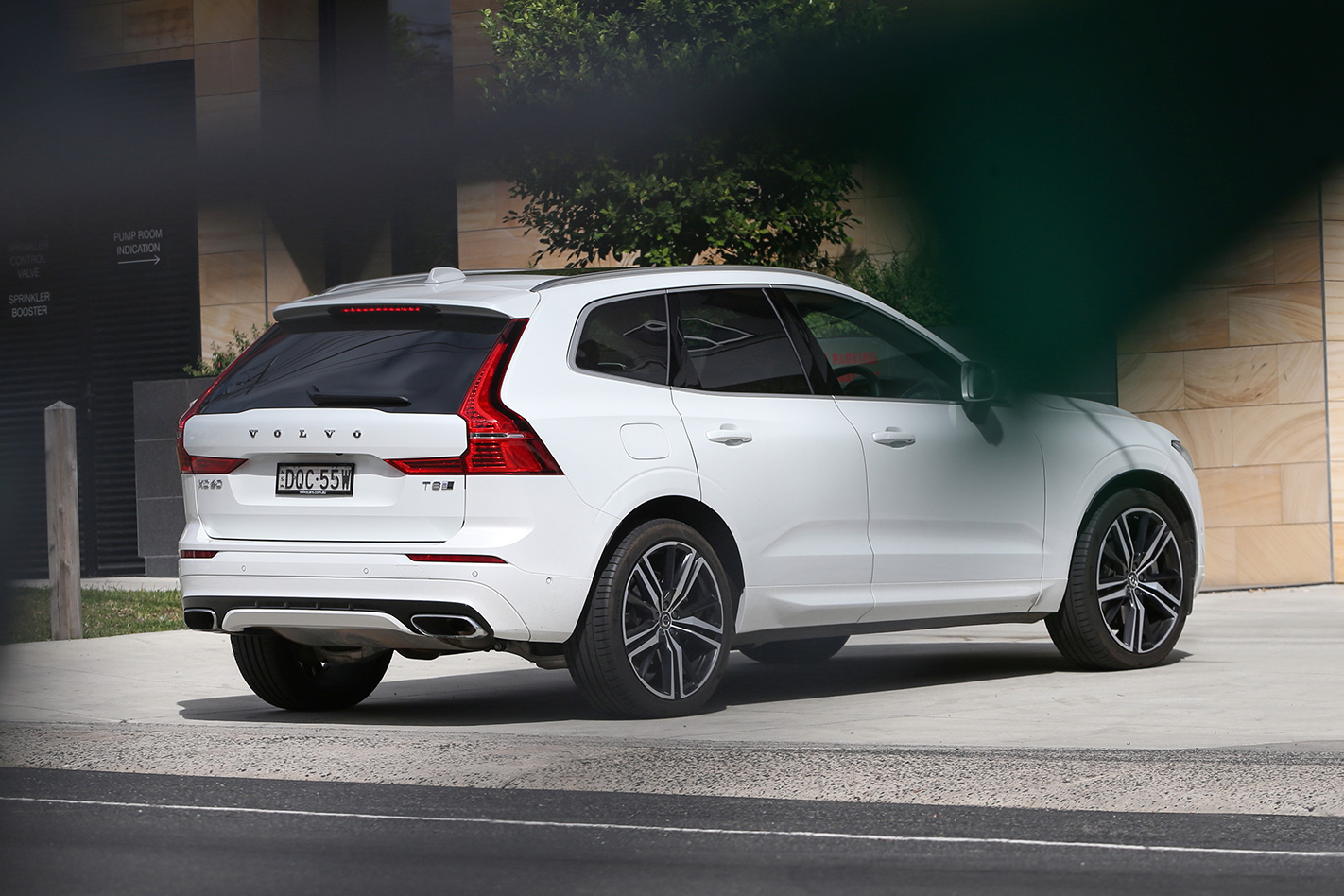
And I haven’t even been trying to be economical; the air-con is always on and my driving style normal. It’s quite satisfying actually, to glide along in near-silence, cocooned in the sumptuous cabin, smug in the knowledge that you’re not burning PULP.
Plugging the T8 in has seen this month’s commuting fuel number drop from 8.0L/100km to 4.8, which is impressive considering I’m not charging it at home, or on the weekends.
Of course, prod the throttle too heavily, or run out of charge, and the combustion engine ignites, which can sound a little gruff initially, though the transition from full EV to hybrid propulsion is fairly smooth.
The integration of the eight-speed automatic gearbox is unobtrusive too, with swift and silky shifts only adding to the drivetrain’s sense of refinement and completeness.
So there you have it, a hybrid that delivers on its on-paper potential, both as a driver’s SUV and a premium, frugal family hauler.
Update 3
AH THE three month itch. Typically this is the time in a car’s journey through the Wheels Garage when the excitement of running a new long-termer begins to wane and some frustrations of familiarity begin to rise. It’s a key reason we run long-term test cars: to unearth the niggles and quirks that only begin to surface after prolonged use – the very same journey you’d experience if you bought the car yourself.
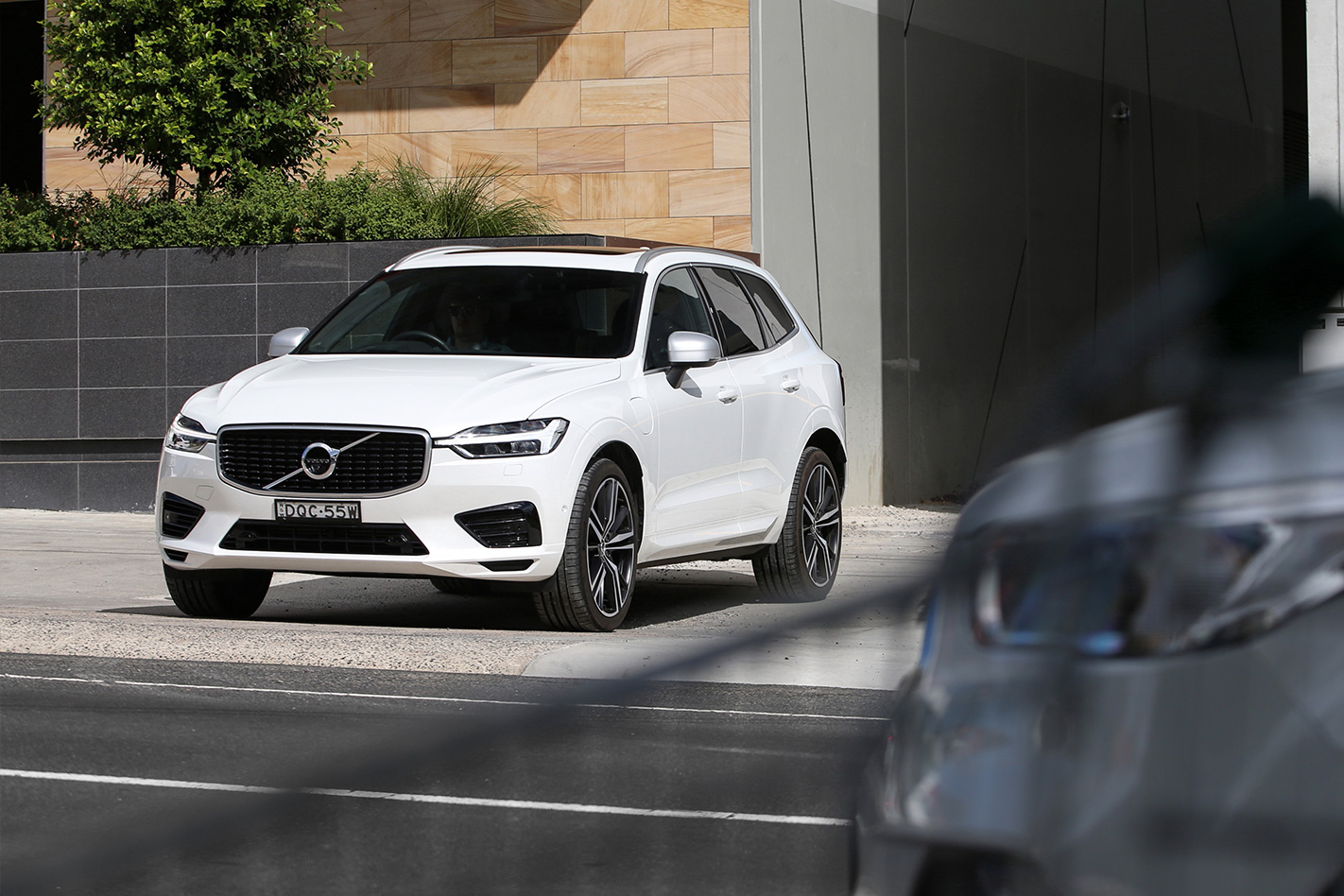
The only problem is that, in this instance, there aren’t any frustrations to report. Not yet anyway. Three months in and the XC60 T8 is proving the near-perfect companion. Quiet, comfortable and fantastically frugal (it sipped just 4.9L/100km this month; an impressive effort for a 2174kg SUV), the T8 has slipped seamlessly into my life.
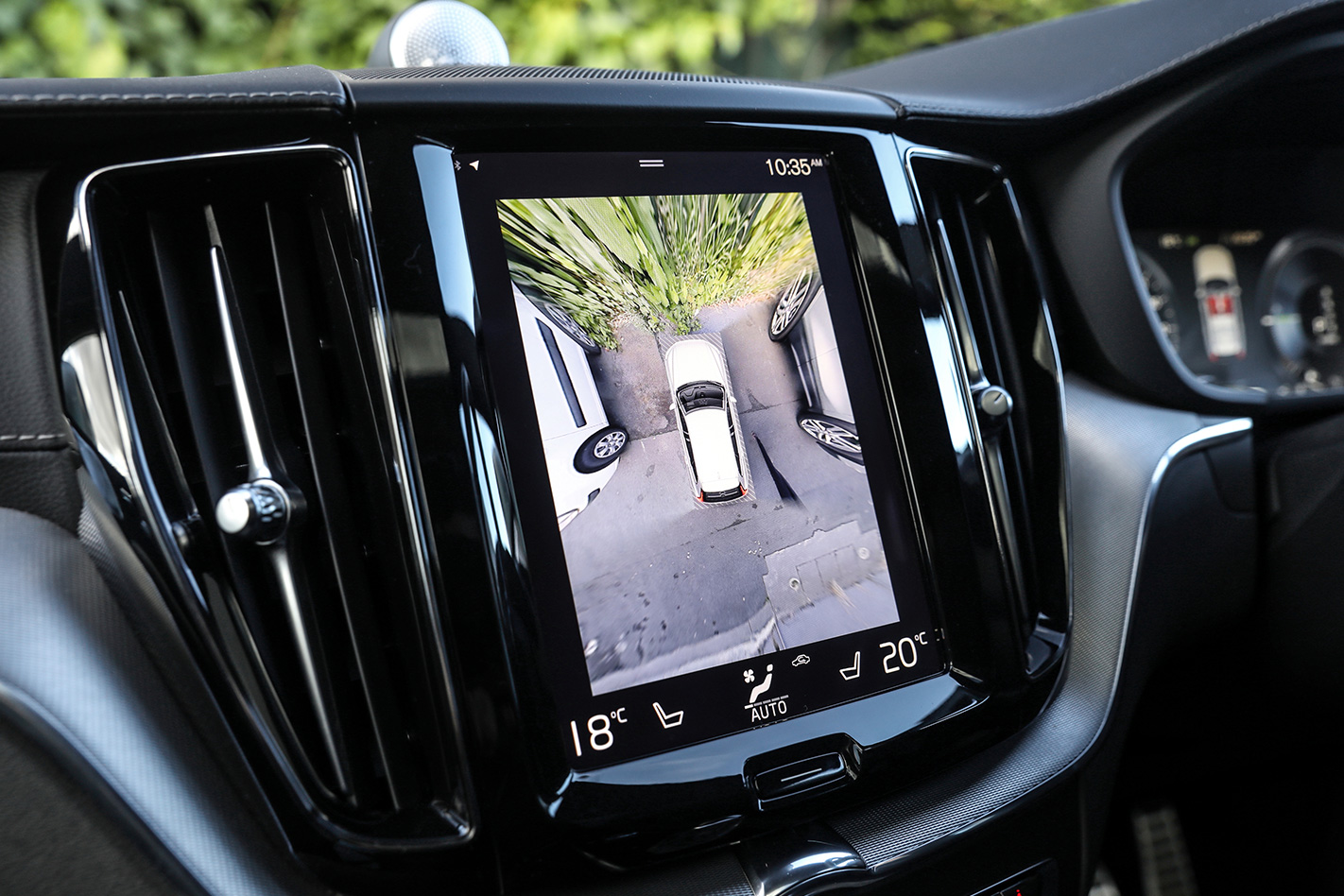
It’s effortless to drive. The steering is light and crisp, which bestows a sense of wieldiness in tight urban spaces. Visibility is excellent courtesy of an airy glasshouse and parking is a painless process, even in cramped underground spots, thanks to three camera views (choose between rear, side or overhead), which are displayed in high resolution on the central screen.
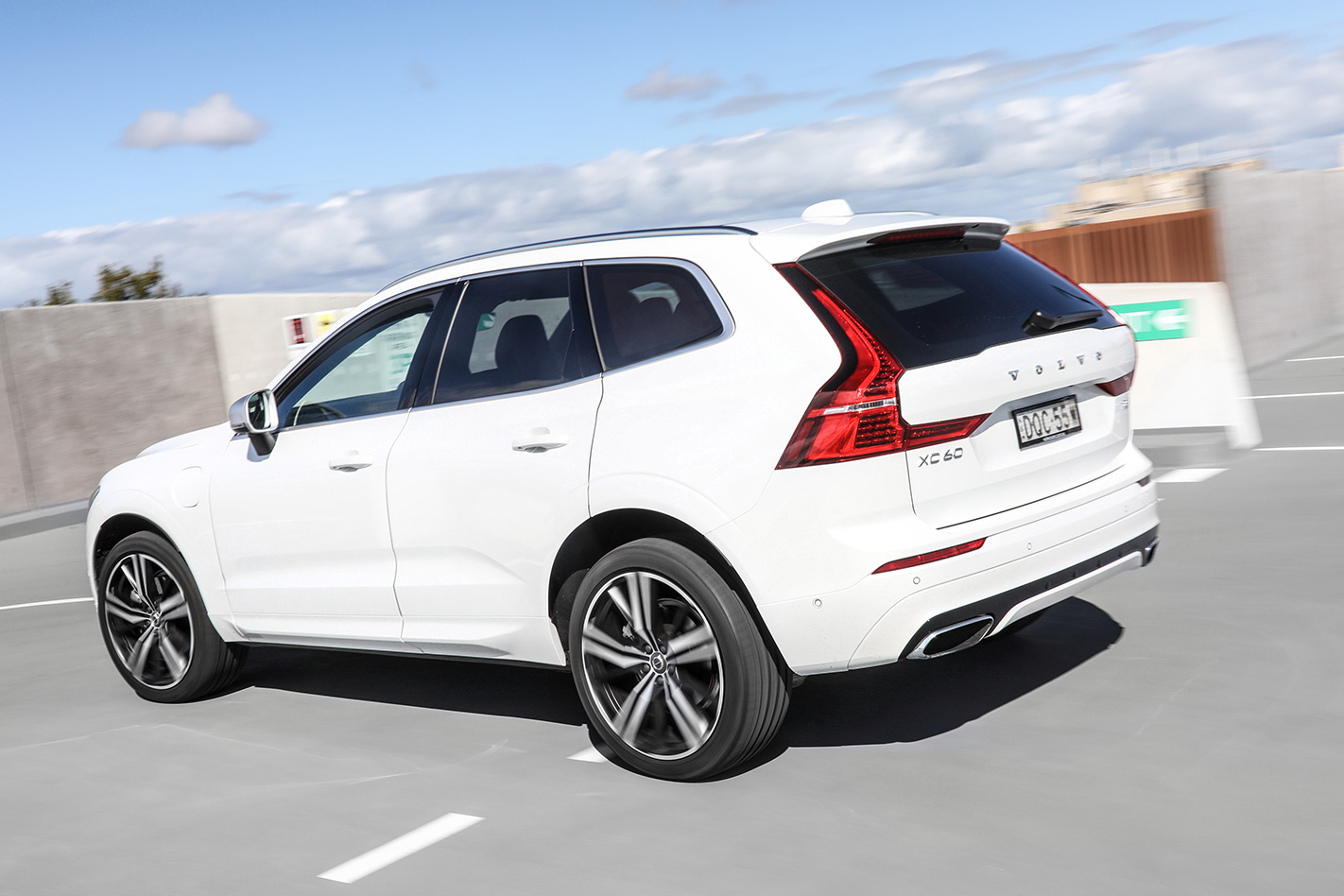
And then there’s the powertrain, which manages to achieve the usually mutually exclusive traits of being efficient while also feeling muscular and responsive. The instant torque of the electric motor helps here, yet even when the battery seems fully depleted, the T8 captures and stores enough energy in general driving to add small bursts of battery-assisted shove as you move away from the lights or gun for a gap in traffic.
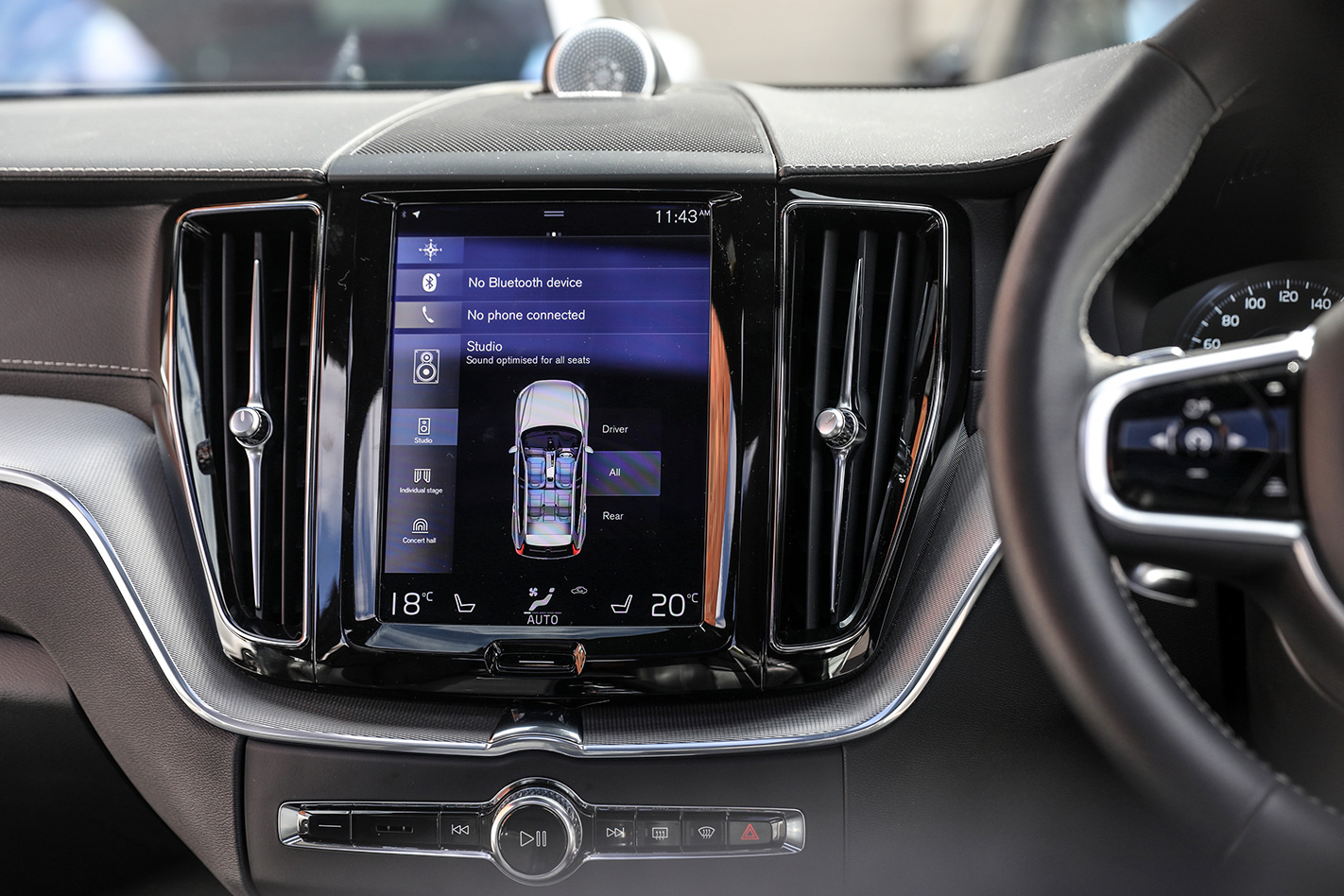
Even annoyance-prone areas like the infotainment system remain bugbear-free. All of the buttons are where you’d expect, the menu structure is logical and detailed (allowing you to navigate between different song playlists without needing to touch your phone), and the portrait-orientated touchscreen swipes like a smartphone.
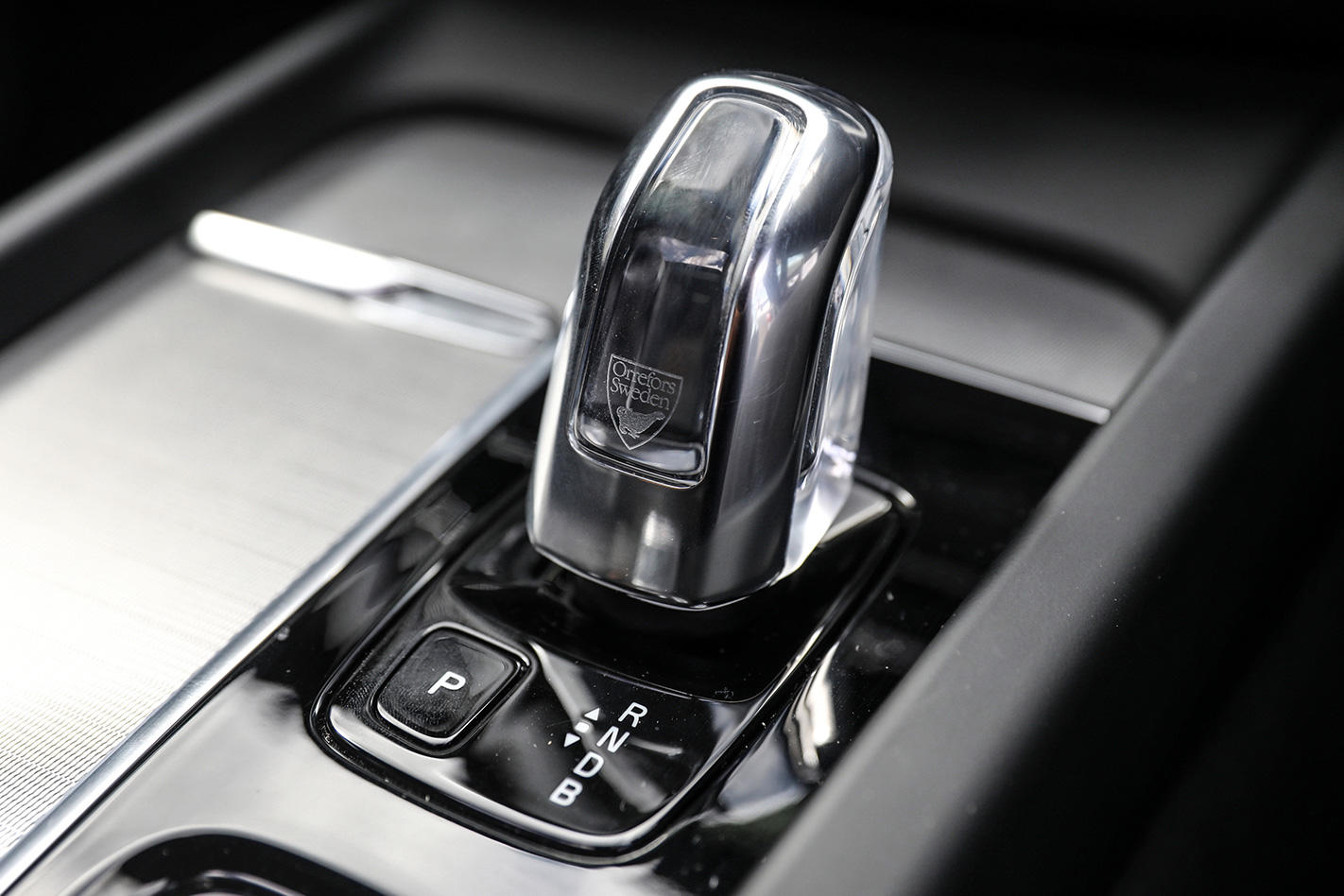
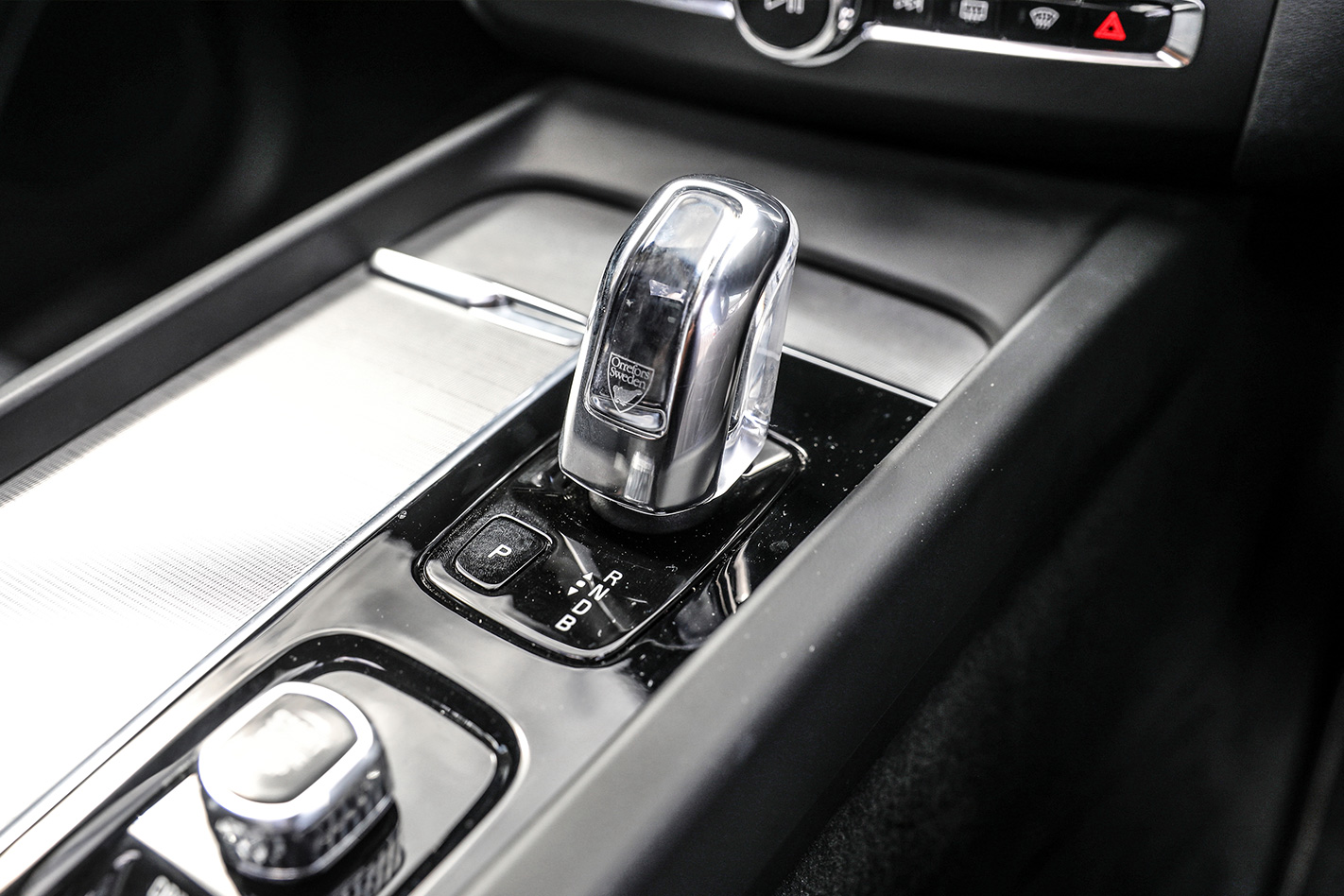
The only niggles are delivered by the stumpy Orrefors gear selector (T8 specific), which requires a double pump to move from drive to reverse. And the infotainment system can lag slightly on start-up if you’re impatiently pressing the screen to ignite the seat heaters on a cold morning. I’ve long since adjusted to the sensitive brake pedal, which I now find easy to modulate.
And that’s it. After 12 weeks of everyday use, they’re the only criticisms I can level at the T8, which further validates its COTY win. Even better is that on top of delivering the ease-of-use and functionality you expect, the T8 does so with just enough Swedish flair and x-factor (through neat design touches and quality materials) to feel interesting and desirable.
Which aren’t words often used to describe medium SUVs.
Update 4
I HAVE a theory that unless you’ve spent an entire day in a car, you don’t truly know it. And I mean an entire day. The kind that starts with a 5am alarm and finishes in the dark, your eyes ruined from searching the roadside for ’roos, your lap covered in chip crumbs and the centre console and door pockets littered with spent coffee cups.
I endure such trips more often than I’d like by virtue of living in Melbourne but having family in Mudgee. In fact, it happens so frequently now that the Inwood clan’s migration north of the border unfolds like a beautifully choreographed dance, with every task honed for speed and precision. Fuel stop duties are neatly divided (refuelling and window washing for me, coffee orders and fixing up the bill for my wife) and even our luggage is packed in a particular way to allow room for the two dogs.
It’s a brilliant test of a car’s all-round ability, with a particular focus on seat comfort, cabin space, refinement and, thanks to a backroads stretch through Muttama and Wombat, ride and handling. After hours on the Hume, the undulating 160km shortcut is a welcome boredom breaker, with fast sweepers that tighten unexpectedly, blind crests and rubbish rural tarmac.
This month saw the Volvo complete its second interstate jaunt and, for those familiar with the T8’s progress thus far, it should come as no surprise that it performed strongly. The seats and seating position are bang on and inflict no hint of back or leg ache, the cabin is hush on smooth surfaces, acceptable on coarse chip, and the optional air-suspension is quiet and comfortable with decent compliance over big compressions while also ironing out most of the small stuff.
It’s an excellent long-distance cruiser and the T8 is fun on the winding shortcut too, thanks to precise steering and near-unflappable road holding that ensures rapid progress without turning the serene cabin into a mess of dog vomit and a disgruntled wife.
It was deep into our return leg, however, that a small hiccup appeared on the digital dash. ‘Regular maintenance overdue’ it read, signalling DQC55W was due for its 15,000km service. No biggie, I thought, I’ll book it in when I get home (handily, you can organise an appointment at the dealer through the XC60’s central touchscreen).
But then, with nothing but hours of road ahead, I began to consider the T8’s battery pack. While efficient and useful for commuting on money-saving electricity, could the batteries and motor become problematic and expensive to maintain? A call to Volvo put my mind at ease.
Turns out the T8’s servicing is no costlier or complicated than a conventionally powered variant (see sidebar, above) and the battery pack itself is guaranteed for the life of the vehicle. With that blip attended to, I was left to crank up the stereo, dive into another chip packet and sink further into the plush leather seat as the glowing city lights of Melbourne grew ever closer through the windscreen.
Spanner and the works
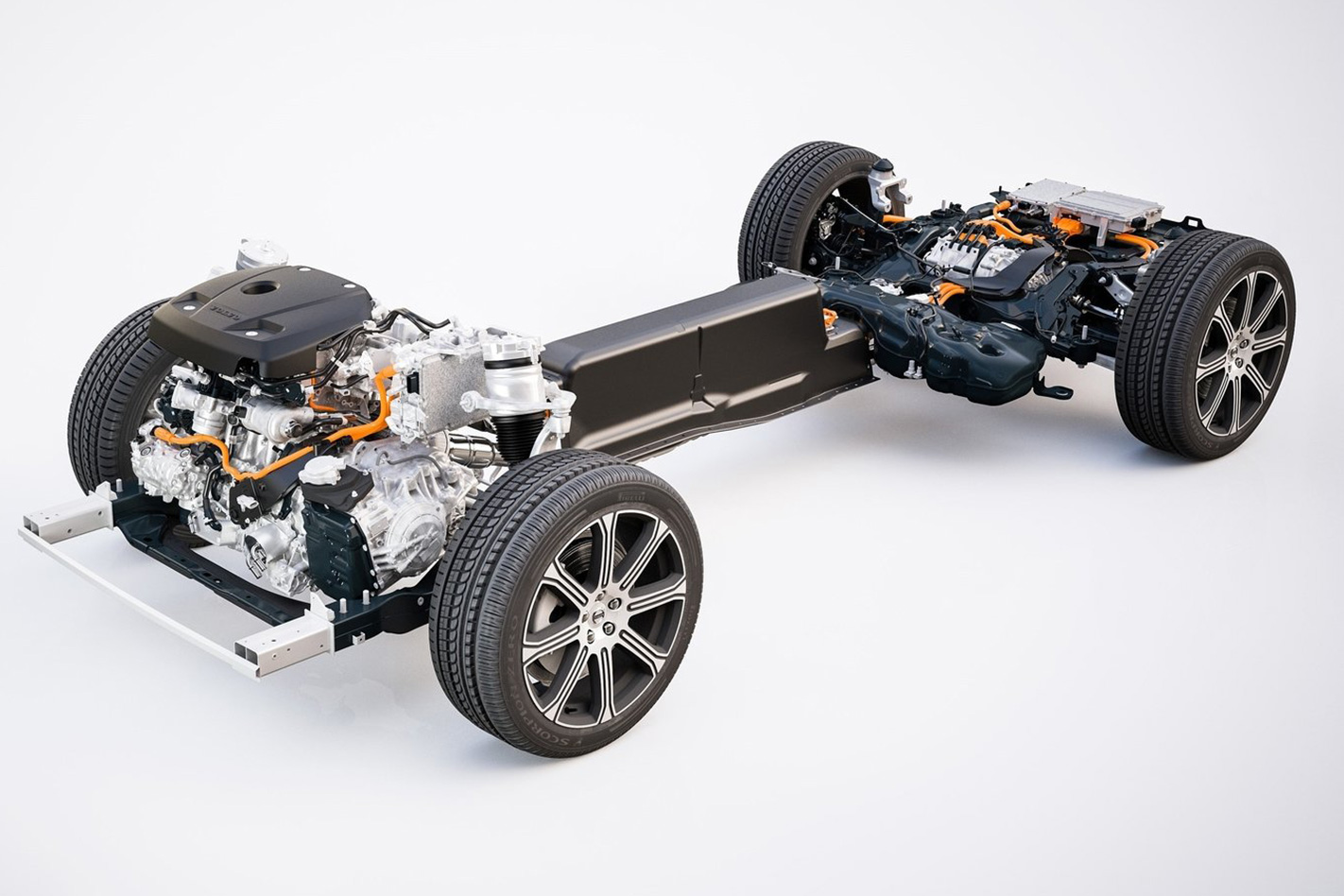
Volvo describes the T8’s battery pack as a serviceable unit, meaning that unlike earlier hybrid batteries, individual cells can be replaced if they fail. Despite its powertrain complexity, servicing costs for the T8 are the same as the rest of the XC60 range, varying from $745-$865 every 15,000km/12 months. As for resale, the T8’s respectable 61 percent retained value after three years is consistent with other XC60s, so no hybrid penalty there.
Update 5
IT’S ONE thing to narrowly avoid a cataclysmic accident on your own. It’s quite another to flirt with disaster when your in-laws are perched in the back seat, their unsuspecting (yet ever-judging) eyes distracted by their smartphones. The wife’s parents were visiting from interstate for a long weekend and happily, things had been going smoothly. Until the blue Hyundai appeared that is, its faded and dinted passenger door doing its best to shoulder-charge the XC60’s handsome nose.
It’s often hard to fathom the stupidity of others, but in this instance, despite the Hyundai’s callous recklessness, I could kind of empathise. He’d probably been sitting at the intersection for a long time, his patience slowly starting to simmer and then boil as he tried to turn right across two lanes of unrelenting traffic. In the end he’d plunged blindly into the fray, his car jumping out of the oncoming traffic and straight into the path of our Volvo, which came as something of a surprise.
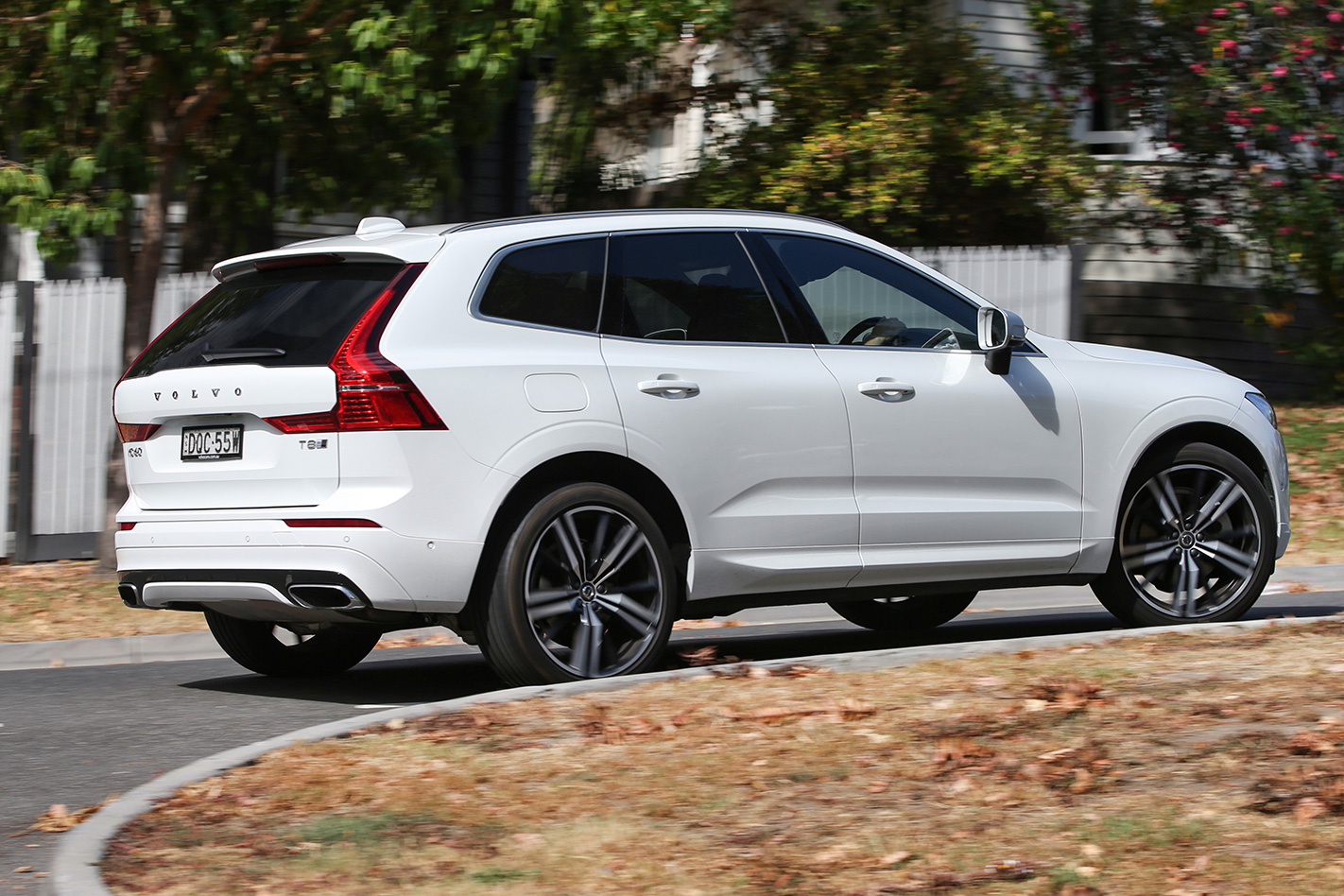
I’ve never really bought into the whole ‘time slows down’ thing during stressful situations and yet, looking back, that’s pretty much what happened. With the Volvo cruising at 60km/h and the left-hand lane partially blocked by parked cars, I hammered the brakes and twisted the steering decisively to the left to avoid the Hyundai. Weirdly, I was totally calm, which is exactly how the Volvo felt, its sensors springing into action to pre-charge the brake pedal and assertively tighten the seatbelts of all four passengers (which is how it must feel to be garotted).
We washed off speed quickly but most impressive were the XC60’s body control and agility as it changed direction. It didn’t lurch or wallow as its weight rushed forward and to the right; it just gripped and turned.No fuss, no squealing tyres, not even an ABS intervention. And while the steering lacks feel, it was crisp and accurate.
In the end we slid through the ever-closing gap between the Hyundai’s nose and the parked cars, the Volvo’s cabin full of gasps and the loud ‘crack!’ of glass on plastic as a phone shot from a hand in the back and hit the centre console.
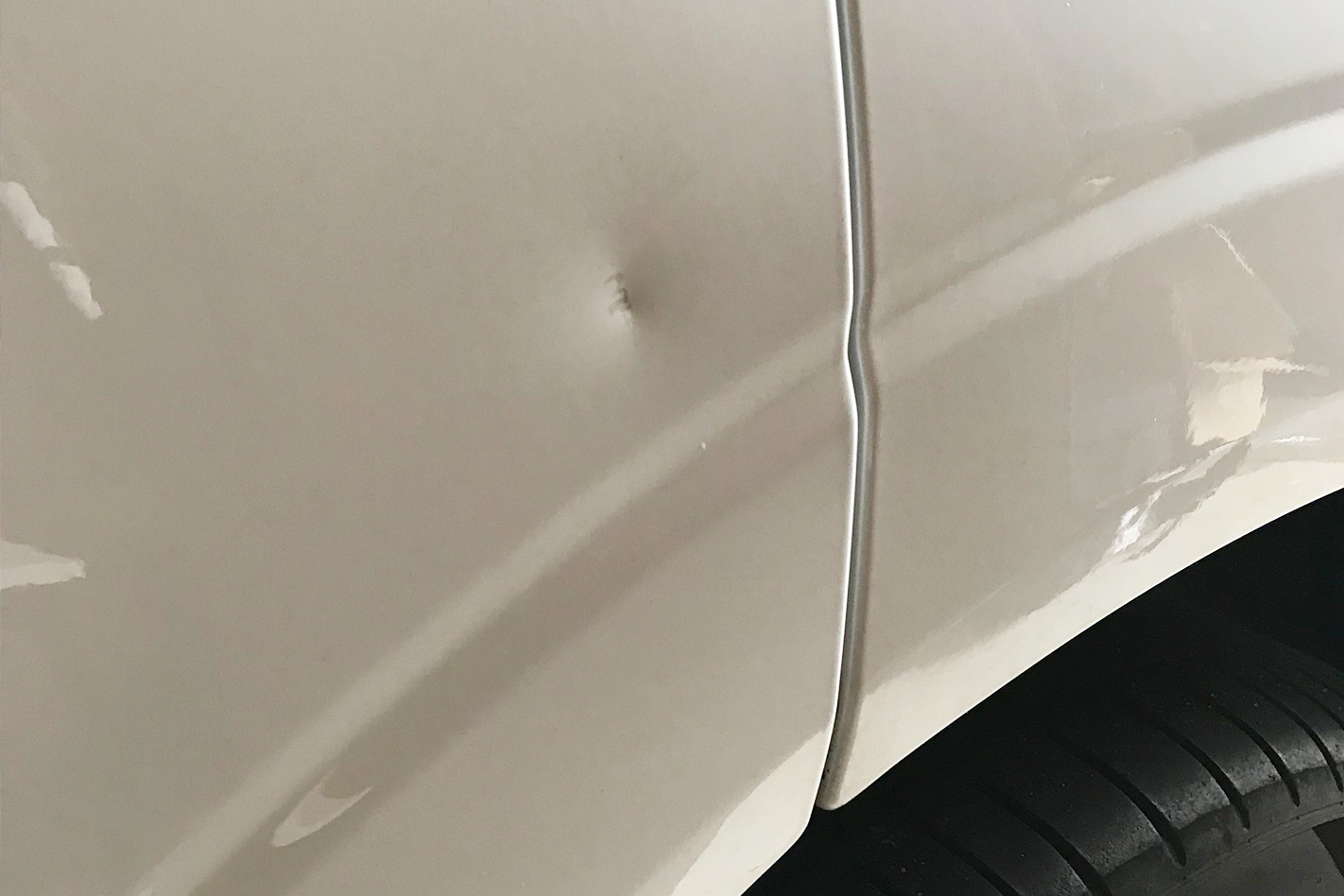
It was a stressful few seconds, which is perhaps why, in her rush to leave the Volvo a few moments later, my mother-in-law didn’t spot the park bench lurking on the footpath. She opened her door onto it, leaving a dint about the size of a five-cent piece, which seemed a bit unfair given what we’d just avoided. Life’s crap like that sometimes.
Update 6
IT STRIKES me that performance, like money and holidays, falls into that category of things you can never really have too much of. It’s true that life is all about balance, and I don’t discount the benefits of fuel efficiency or creature comforts, but nothing tickles my adrenal glands quite like an accelerator pedal that feels as though it’s connected to some kind of military-grade explosive.
Imagine my surprise then when, with the keys to a Mercedes-AMG GLC 63 S clutched in my hand, I began to question just how much performance a mid-size SUV actually needs. With my XC60 relinquished to Volvo for its 15,000km service, and the GLC in the Wheels garage after last month’s feature drive in Tassie, I approached Affalterbach’s brutish SUV full of anticipation.
Two days later, having experienced the animalism of its 375kW/700Nm 4.0-litre V8, the firm intent of its chassis, and its willingness to perform small powerslides on demand, I began to wonder if, as a mode of regular family transport, it was a little too focused.
My ponderings were thrown into sharper relief by Volvo itself, which in the same week, announced performance upgrades for models with T8 powertrains. Fettled by Polestar, the optimised version of the XC60 jumps to 314kW/670Nm (up 14kW/30Nm), adds swankier Ohlins shocks, beefier Brembos, lighter wheels and a revised gearbox calibration that shifts cogs faster and holds onto gears longer if it detects enthusiastic driving.
The thing is, not once in our six months together have I lusted for my XC60 to feel sportier. It’s fast enough to be exciting, collected enough to accurately carve corners, and crucially, as slipping back into its freshly serviced form solidified, comfortable and quiet enough to feel genuinely luxurious. Remember that ‘balance’ thing I mentioned earlier? The regular T8 XC60 feels like the sweet spot.
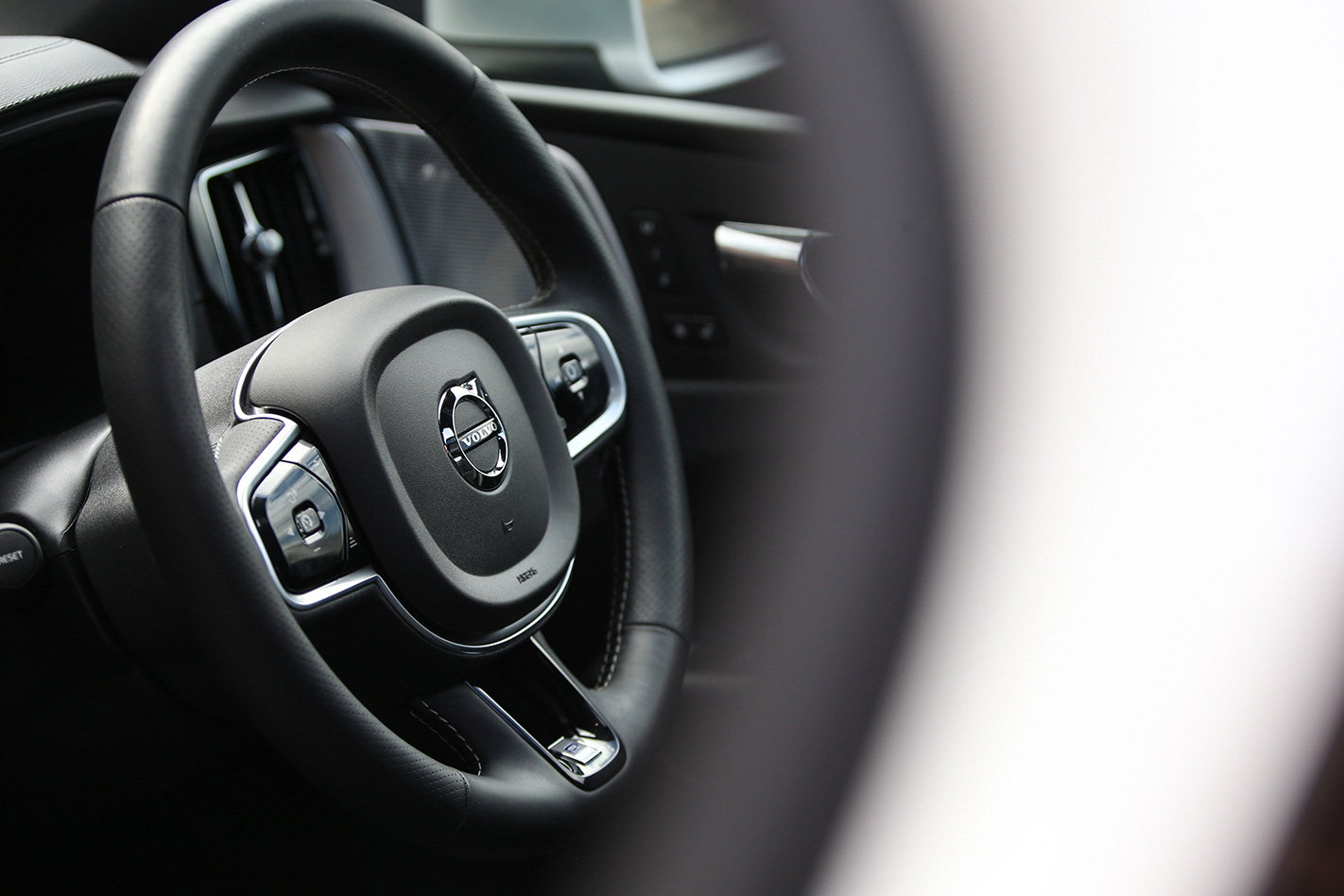
Our time apart did, however, shine a harsher light on a few XC60 weaknesses I’d perhaps grown too familiar with to be bothered by. The four-up ride, for example, wasn’t quite as supple as I recalled, with sharper bumps telegraphed clearly into the cabin. And the steering, which has always been light, suddenly felt numb and detached.
There’s no questioning its accuracy, but in an SUV with a performance bent such as this, a greater sense of connection would go a long way. Perhaps someone should tell Polestar.
Update 7
IT LOOKS, it has to be said, slightly ridiculous, and just a little perilous. The wide white rump of the XC60 hustles left, then right, as Wheels deputy editor Andy Enright hurls it up the twisting mountain road at ten tenths, body roll and squealing Pirellis doing little to slow his rate of progress.
I’m following closely behind in a Ferrari 812 Superfast, watching in amused silence as next to me, photographer Nathan Jacobs asks in a puzzled voice, “That is a family SUV, right?”
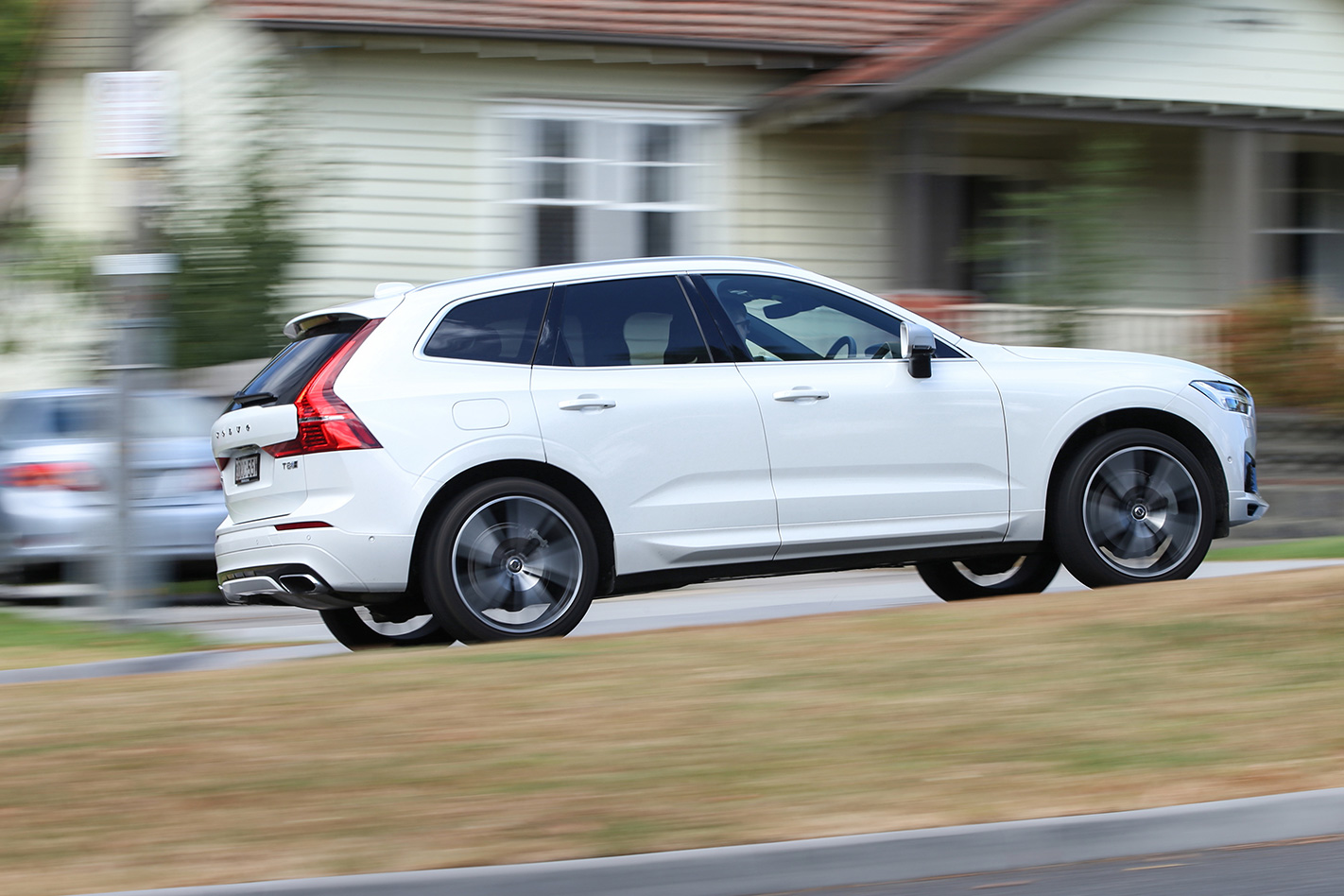
Welcome to the corkscrew-esque piece of tarmac that runs up from the Thomson Dam reservoir in Gippsland, Vic, and to a glimpse into next month’s feature drive of the 812SF.
The Volvo is along as the support car, partly because it has sublimely comfy seats and a big boot to lug camera gear about, but mostly because I wanted to give my trusty long-termer one final drive; a balls-out farewell on some of Victoria’s best driving roads before it heads back to Volvo HQ. That’s right; having occupied these pages for seven serene, incident-free months, this is the last time you’ll read about DQC55W. I’m more than a bit sad about that.
It’s the intangibles that separate the great cars from the merely very good. The fact my XC60 has proven to be a triumph of comfort, packaging and efficiency is no real surprise. It is our reigning COTY after all. What’s set it apart during its stint in the Wheels garage are the things that are harder to measure.
The sense of quality imbued by the cabin, for instance, not just from the materials and how well it’s screwed together, but by the beautiful and uniquely Scandinavian design. It’s also extremely well insulated. Road and tyre noise are nicely suppressed and in EV mode, it verges on tranquil, the silence and comfort rarely troubled by poor road surfaces despite enormous 21-inch wheels (providing you tick the $2500 option for air suspension).
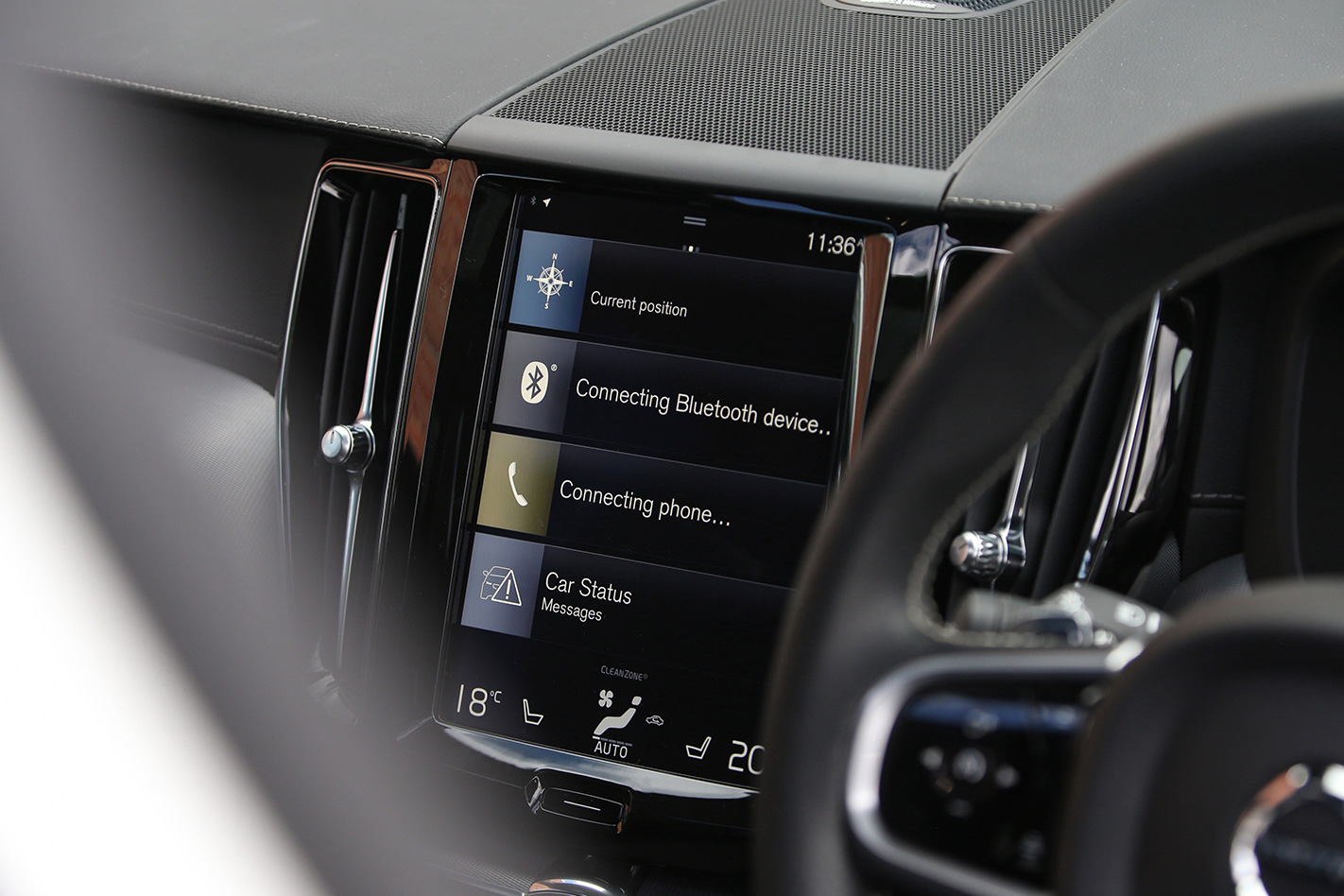
In many ways it feels the antithesis of its German competitor set. Where a BMW or Audi can feel brash or austere, the XC60 is warm, textural and to my eyes, a deeply attractive SUV, inside and out.
And then there’s its ability to surprise. With Enright turfed out, I climb in for a final blast along the jinking test route, the drive mode switched to Power, this month’s fuel number thrown to the wind. It’s brutally proficient when pedalled hard. Push it right to the edge and there’s no escaping its 2174kg heft, or its breath of bodyroll as the weight transfers, but the steering is accurate (if remote), and its roadholding steadfast. The way it obliterates mid-corner bumps is enormously impressive too, the suspension simply pounding them into submission without upsetting the balance or knocking you off line.
There is an underlying sense that it’s a car you admire more than you enjoy at ten-tenths, but what you lose in ultimate dynamic connection you more than make up in everyday usability and comfort.
It’s an imposingly well-rounded package, this XC60, though no car is perfect. At this juncture it’s normal practise for a Wheels journalist to don their product planning hat and to wax lyrical about what they’d change on their long-termer to improve it.
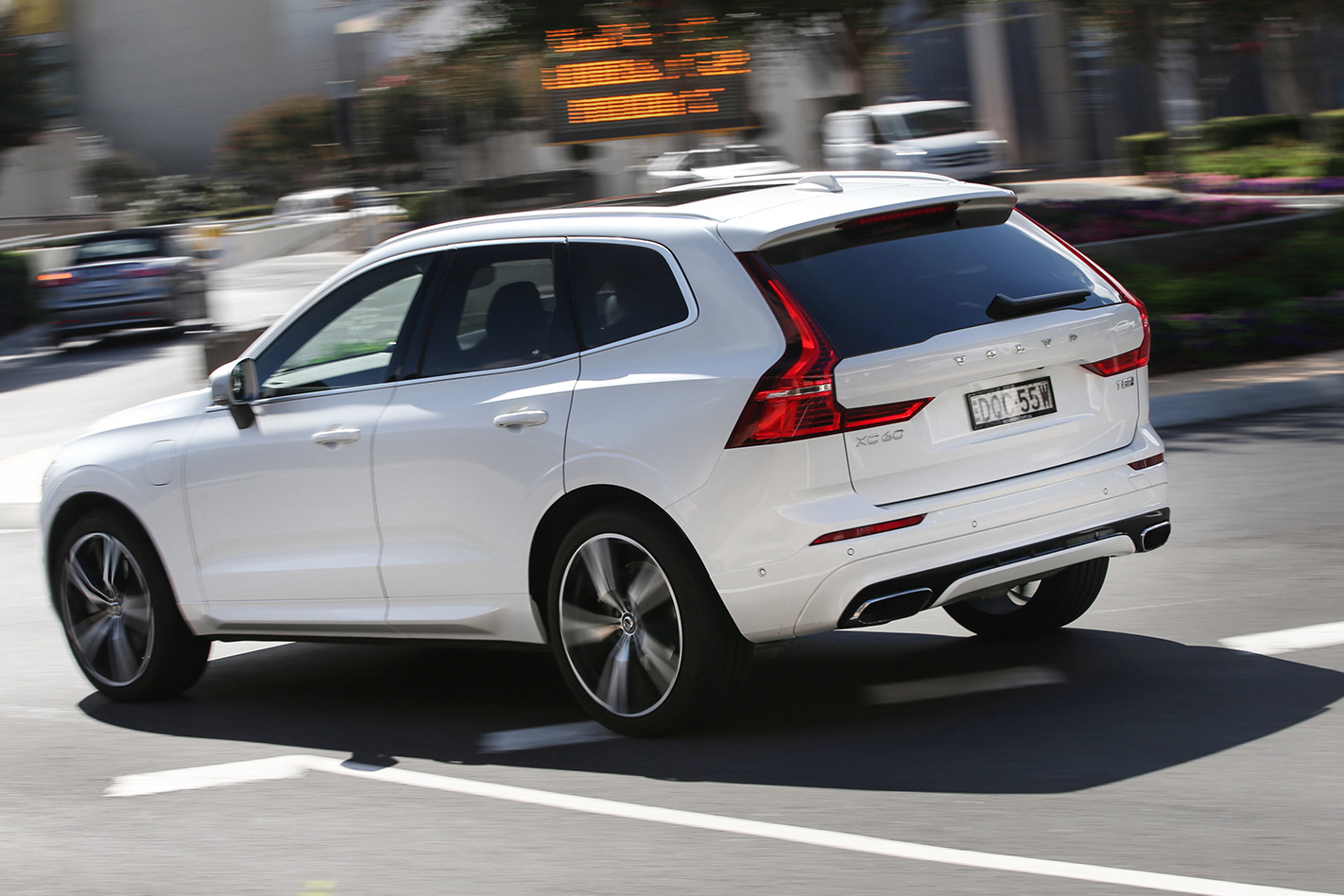
My only question mark surrounds the value proposition of the T8 powertrain. There’s no doubting its efficiency (see breakout, above left), or the ease and intuition with which it combines a turbocharged and supercharged 2.0-litre four with an eight-speed automatic and a 10.4kWh battery-powered motor.
But is it really worth the $16K premium over a similarly specced T6 R-Design, which uses the same high-output four-pot, sans the electric gubbins? Even if the T6 uses twice the fuel, it’d take more than six years to recoup the initial outlay at the bowser. As much as I’ve enjoyed the battery pack’s thriftiness and effortless muscle, if it was my money, I’m not sure I’d spring for the range topper.
Still, seven months with our reigning COTY has done nothing to undermine the argument that Volvo has created the best premium mid-size SUV you can buy. If anything, it’s galvanised it.
At the turn of the century, the automotive trend du jour was retro.
BMW brought back the Mini, Holden revived the Monaro and VW introduced the New Beetle. Unlike the ground-breaking original, Beetle 2.0 was utterly conventional, based on the engines and chassis of a humble Golf.
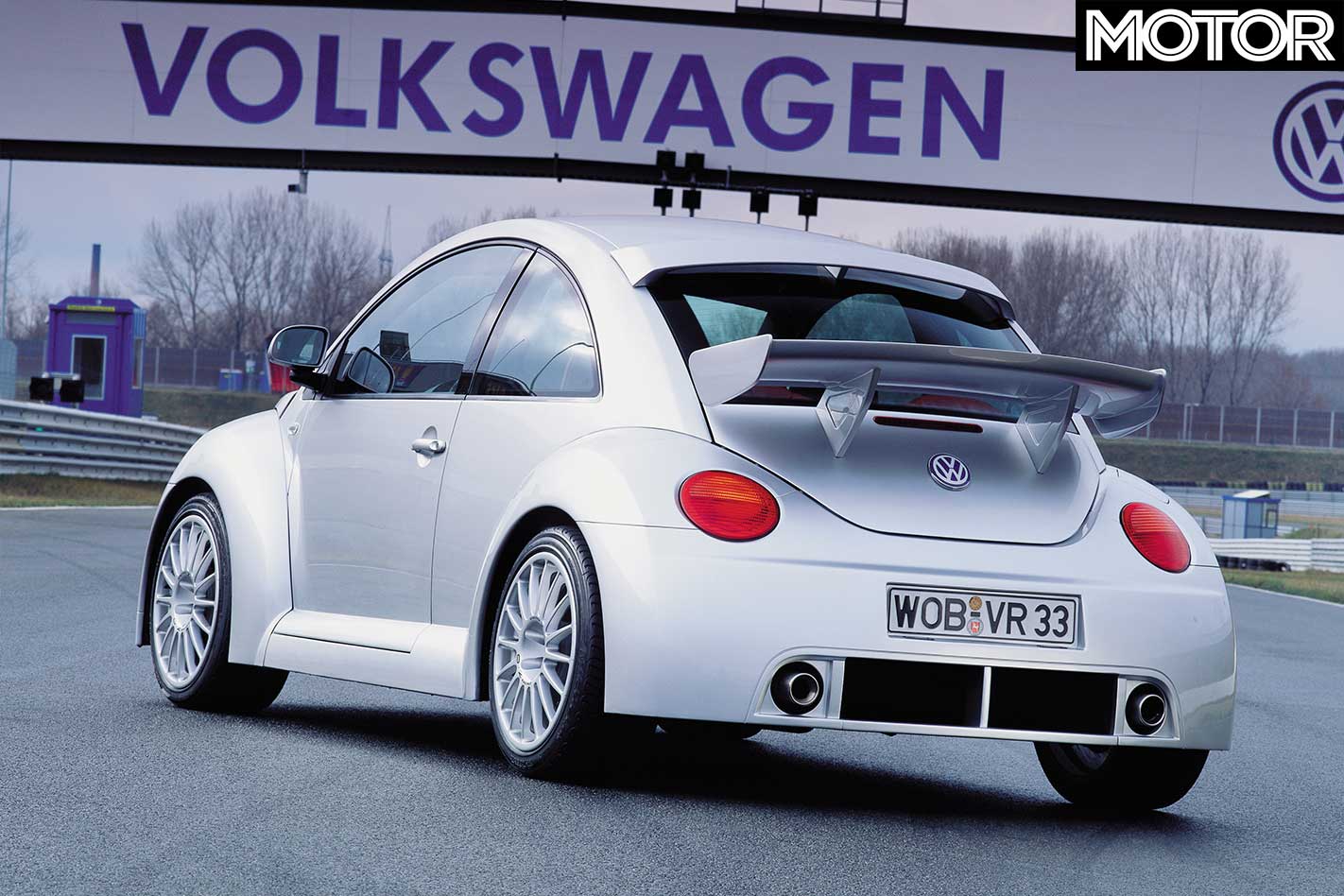
Nonetheless, it worked, buyers lining up for a literal dose of flower power (there was a flower on the dash – yes, really!). Still, with its cutesy, Noddy-like proportions, the New Beetle was about as masculine as a Twilight movie marathon. In an effort to butch up the Bug’s image, VW created the RSi.
Just what RSi stood for is unclear; and despite the whale-tail wing, 18-inch multispoke wheels, flared guards and front air dam, it wasn’t that good looking, the end result being a bit Priscilla: Queen of the Desert. Left-hand drive only, just 251 were built, a 250-unit production run plus the initial concept, all in silver except No. 002 which was blue and built for VW overlord Ferdinand Piech.
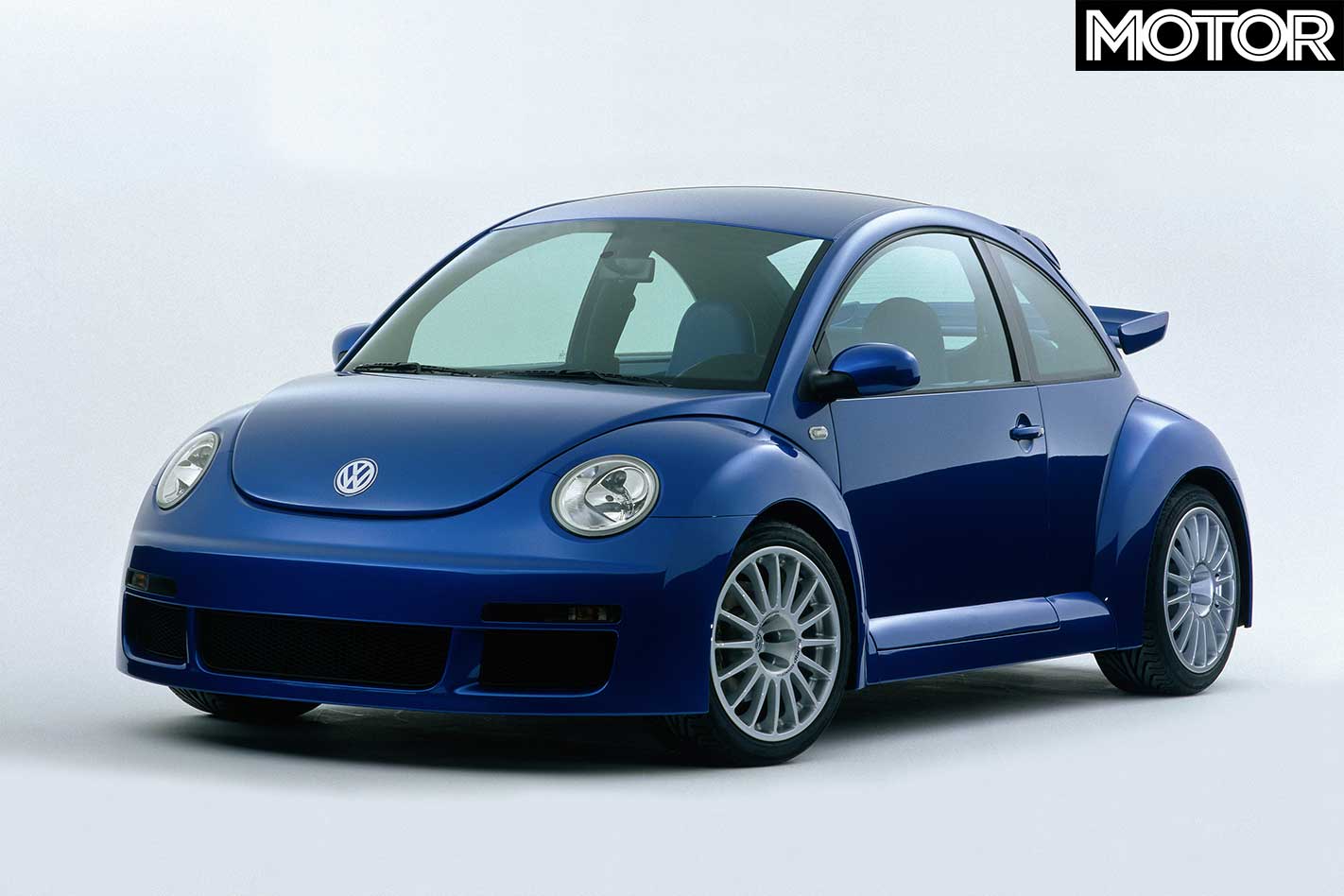
Under the bonnet sat VW’s narrow-angle 3.2-litre V6, feeding 165kW/317Nm to all four wheels through a six-speed manual gearbox. This drivetrain would reappear following the RSi’s demise in the form of the Golf R32. Giving the Bug the bark to match its bite was a Remus exhaust, while the suspension received an overhaul in an effort to sharpen the standard Beetle’s soggy handling.
It worked, to a point. Despite the RSi’s LHD-only status, VW Australia was so smitten it imported two Ultra Bugs for “promotional purposes”. One was entered into Targa Tasmania (and crashed into a bus stop) while the other was converted to RHD, made appearances at motor shows and in various motoring media, including this magazine.
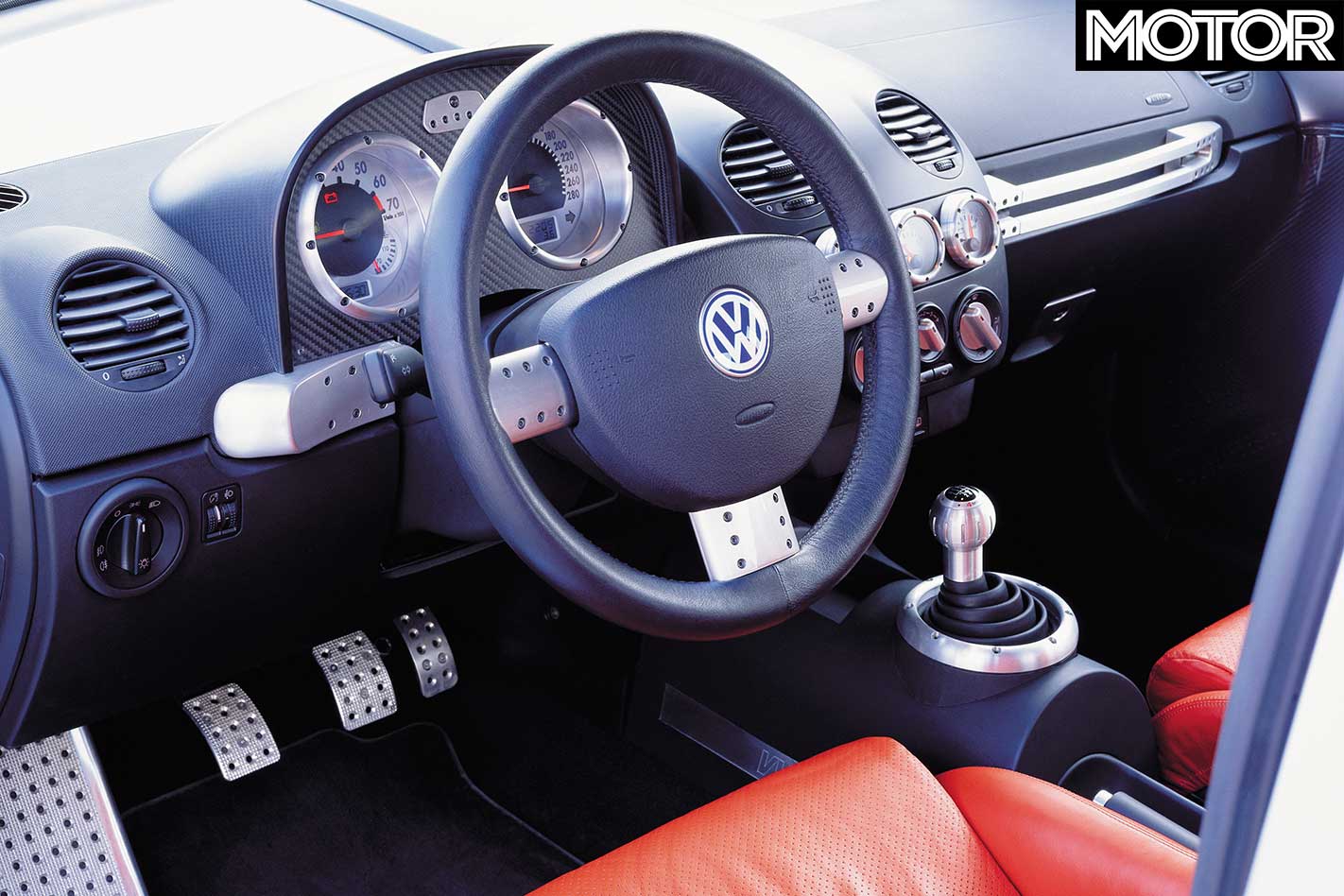
The drivetrain was great, with a torquey, snarling six and sweet manual ’box, while the Recaros cuddled you tighter than a new parent. Shame, then, about the brittle ride and insistent understeer. Oh, and the AUD$125K price tag!
Butch Stylin’
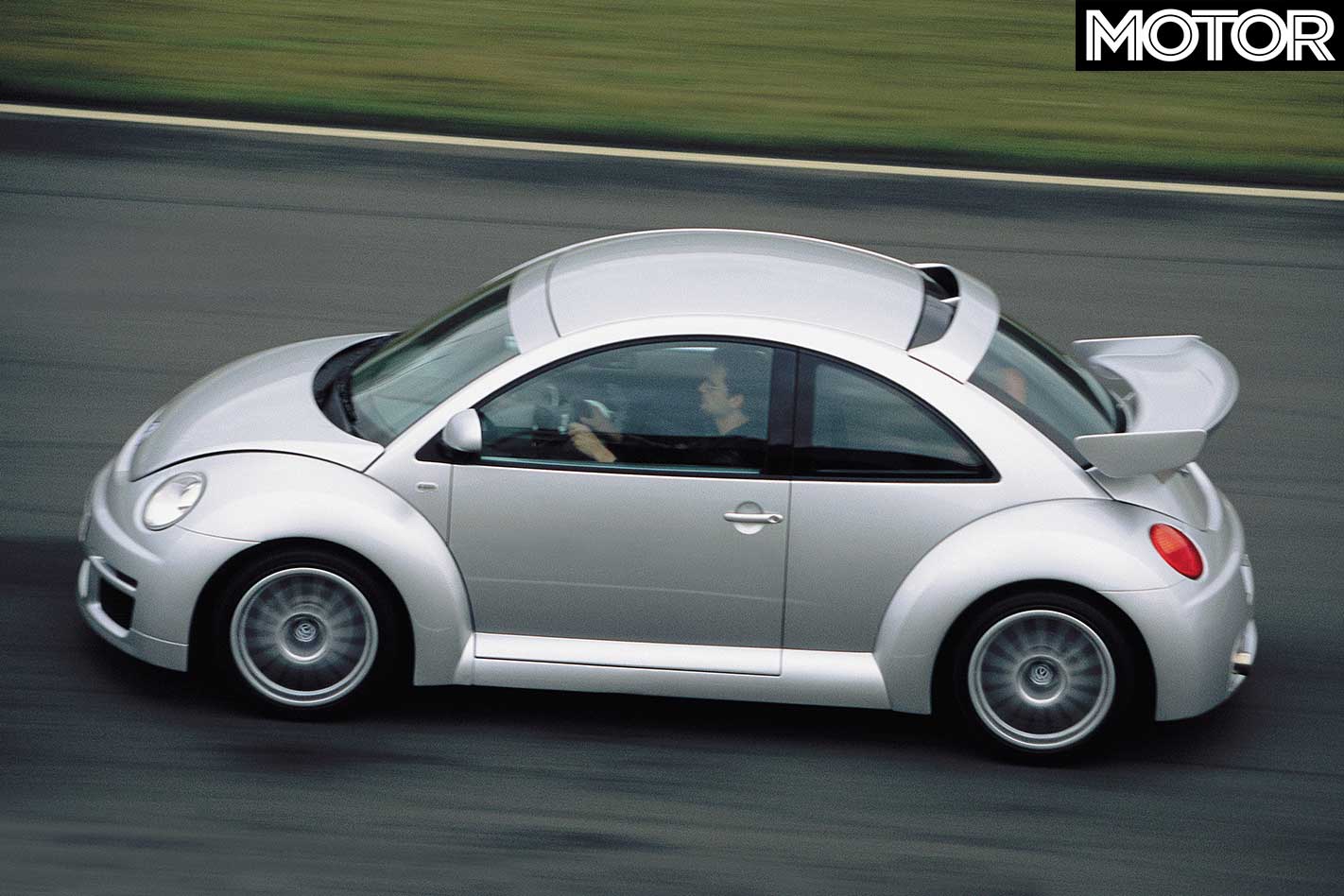
Bodykit was taken from the one-make Beetle Cup racer and thus actually provided functional downforce; as for the fate of the two Aussie RSis, one was bought by a dealer and the other sold into a private collection.
2000 VOLKSWAGEN BEETLE RSi SPECS Engine: 3189cc V6, DOHC, 24v Power: 165kW @ 6200rpm Torque: 317Nm @ 3000rpm 0-100km/h: 7.98sec (tested June 2002) Price: $125,000 (new)
Hallelujah Holden fans! Or should that be, GM fans?
After 11 long months since October 2017, a brand new, rear-drive V8 from The General is nigh – one that already comes with a Chevy bow-tie on the front and back. And despite a wee price discrepancy which HSV will have you not speak of (one that’s not as big as we were expecting, it turns out and explained in our October 2018 issue), it’s ready to give a certain smug ponycar a good kicking. Or at least a good arm-wrestling.
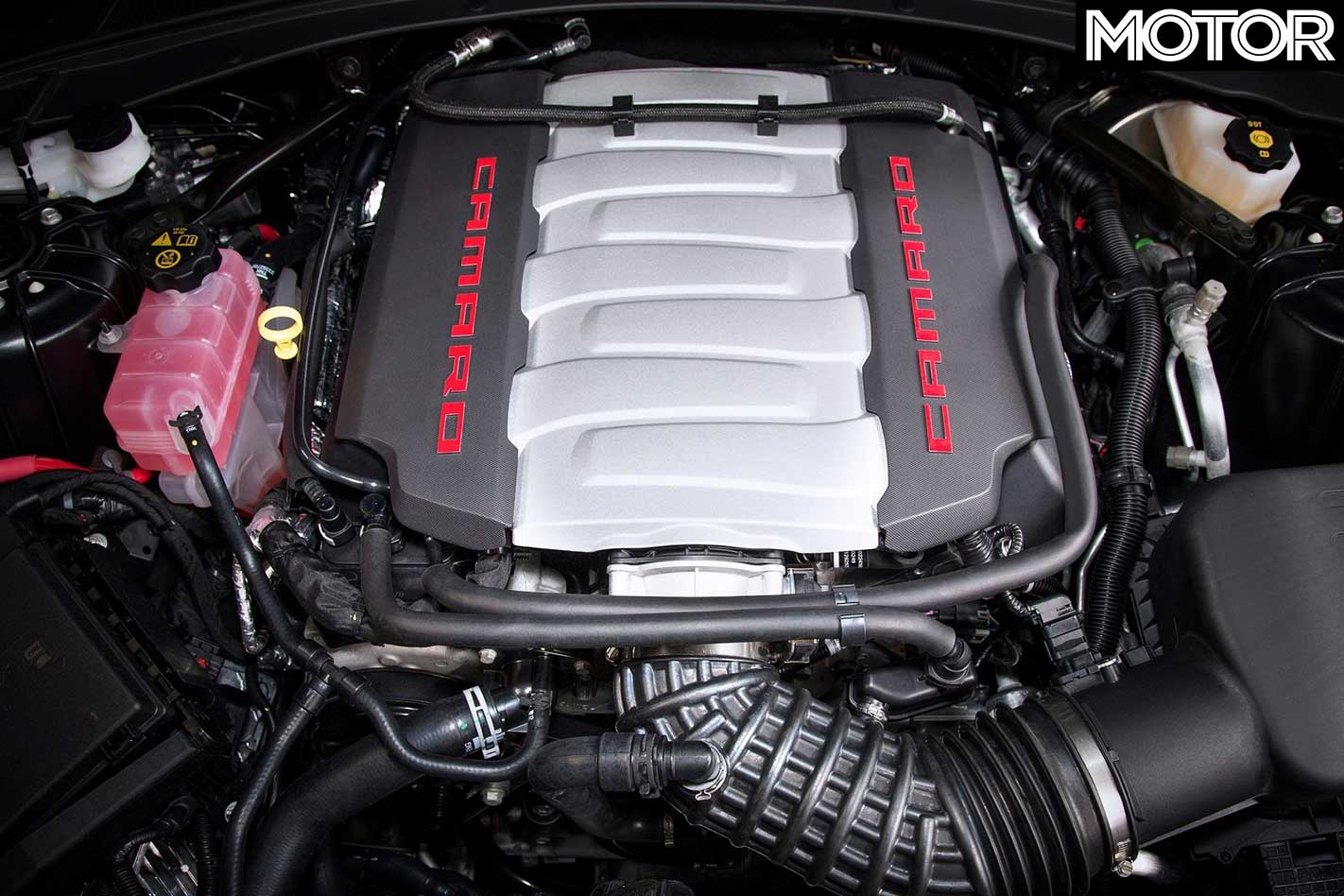
Yes, the Clayton-converted 6.2-litre V8 Chevrolet Camaro SS is upon us. In its final engineering stages, in the coming weeks you will be able to request of your local HSV dealer to have one in the driveway. But word has now gotten out that the GM-focused Aussie aftermarket, sensing a ponycar-sized opportunity, is also rearming at a scale that would have alarms going off at the UN.
As we speak, every Aussie GM tuner worth knowing is figuring out how to pack containers full of superchargers, exhausts, brakes and suspension bits from Uncle Sam in preparation for Camaro’s arrival. This means that while it could be some years before factory supercharged thoroughbreds like the 485kW ZL1 1LE reach our shores, there’ll be no waiting for an equivalent force-fed Camaro with just as much poke.
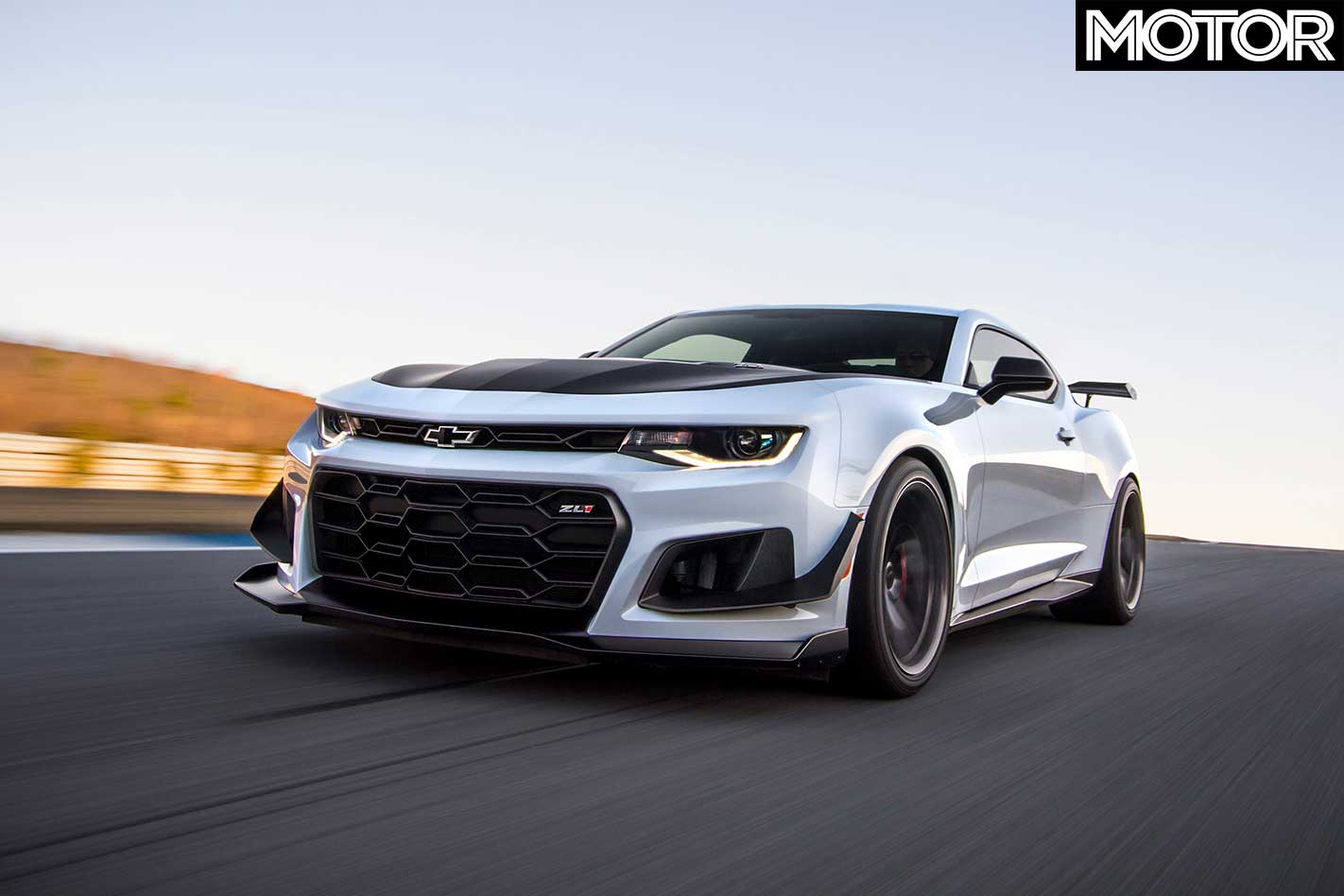
And such is the way in the aftermarket these days, that same car can come with a warranty, built to an OE standard and by someone half adept at customer service, all for a reasonable price. Yes indeedy, the good times are returning for the GM faithful – all we need now is a few right-hook, rear-drive, four-door Cadillacs…
I’m fascinated to see how withered rivalries evolve as we continue to embrace muscled-up imports from ostensibly the same companies that gave us Falcon and Commodore. Of course, we’ve no need to import the legendary GM vs Ford rivalry from the States along with the cars, and as a lot of the homegrown equivalent festered on the racetrack, cheering on the Peter Brocks and Dick Johnsons of the world, I’m eager to see if it will be the racetrack again where old Blue vs Red scores continued to be settled.
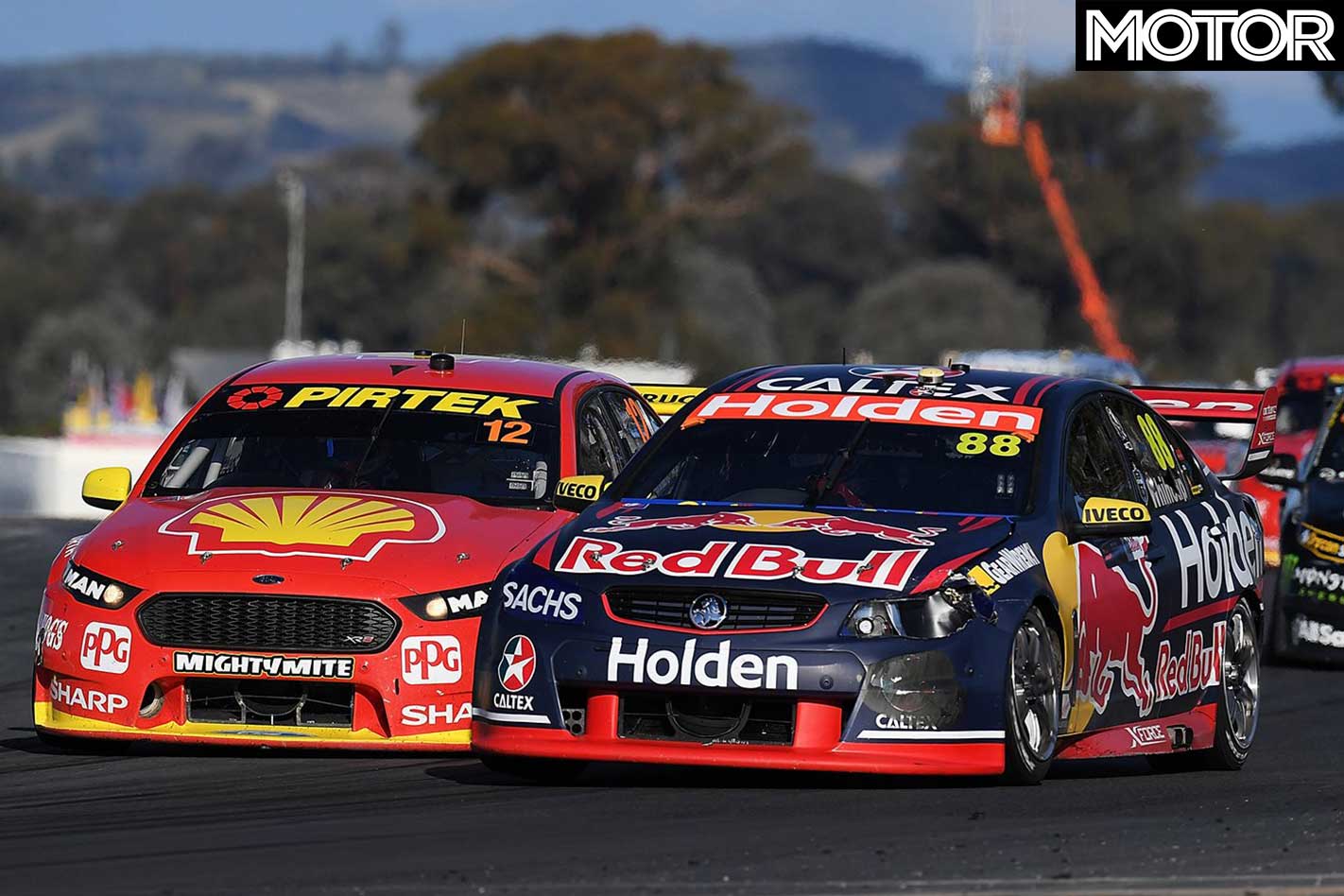
It’s sounding as if Camaro will join Mustang in Supercars at some point, meaning both the US coupes are headed for Mount Panorama. This ain’t new – cast your mind back to Allan Moffat’s thumping Coca-Cola 1969 Trans Am ’Stang which did battle with Bob Jane’s ground-shaking 7.0-litre Chevrolet Camaro ZL1 for the 1971 Australian Touring Car Championship. Cast your mind back further still to the Geoghegan/Beechey era where the Mustang took top ATCC honours five times in a row, ’65 to ’69.
Endearingly, Aussies cheering on Aussie drivers in Mustangs and Camaros at Aussie racetracks will be an old thing becoming new again.
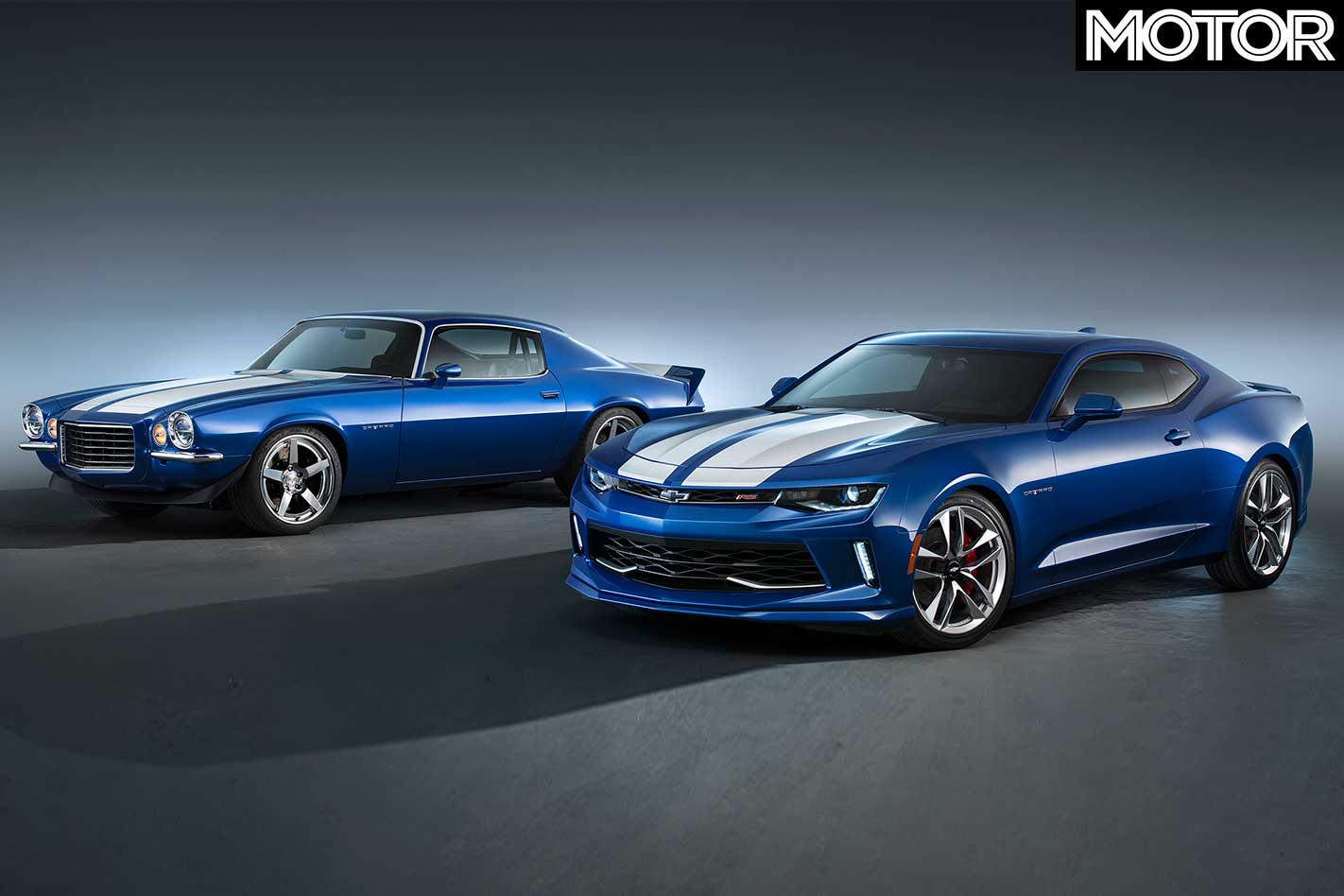
Of course, buying the road cars themselves en masse is very much a new thing for Aussies, but the success of the Mustang has shown our willingness to embrace this new reality. Recall that Mustang was far from a hit when it was more recently sold here between 2001 and 2003.
This all bodes well for Clayton’s Camaro experiment – already we’re hearing they’ve got pre-orders for three times as many cars as they originally intended to build. As this and Mustang show, with meat pie no longer on the menu, Aussies have shown they are more than happy to order the apple variety than go hungry.
