
NOWADAYS, the way we use apps to dine, date, hail a taxi, and even watch TV seems incredibly normal, but did anybody foresee any of this a decade ago?
Same goes for the fledgling subset of premium compact SUVs streaming into buyers’ consciousness the world over. Yes, we’d seen underwheeled frumps like the 2009 BMW X1 but until the Range Rover Evoque swaggered into view during 2011, cashed-up but compact-minded buyers simply didn’t have a seriously stylish SUV option in their sights.
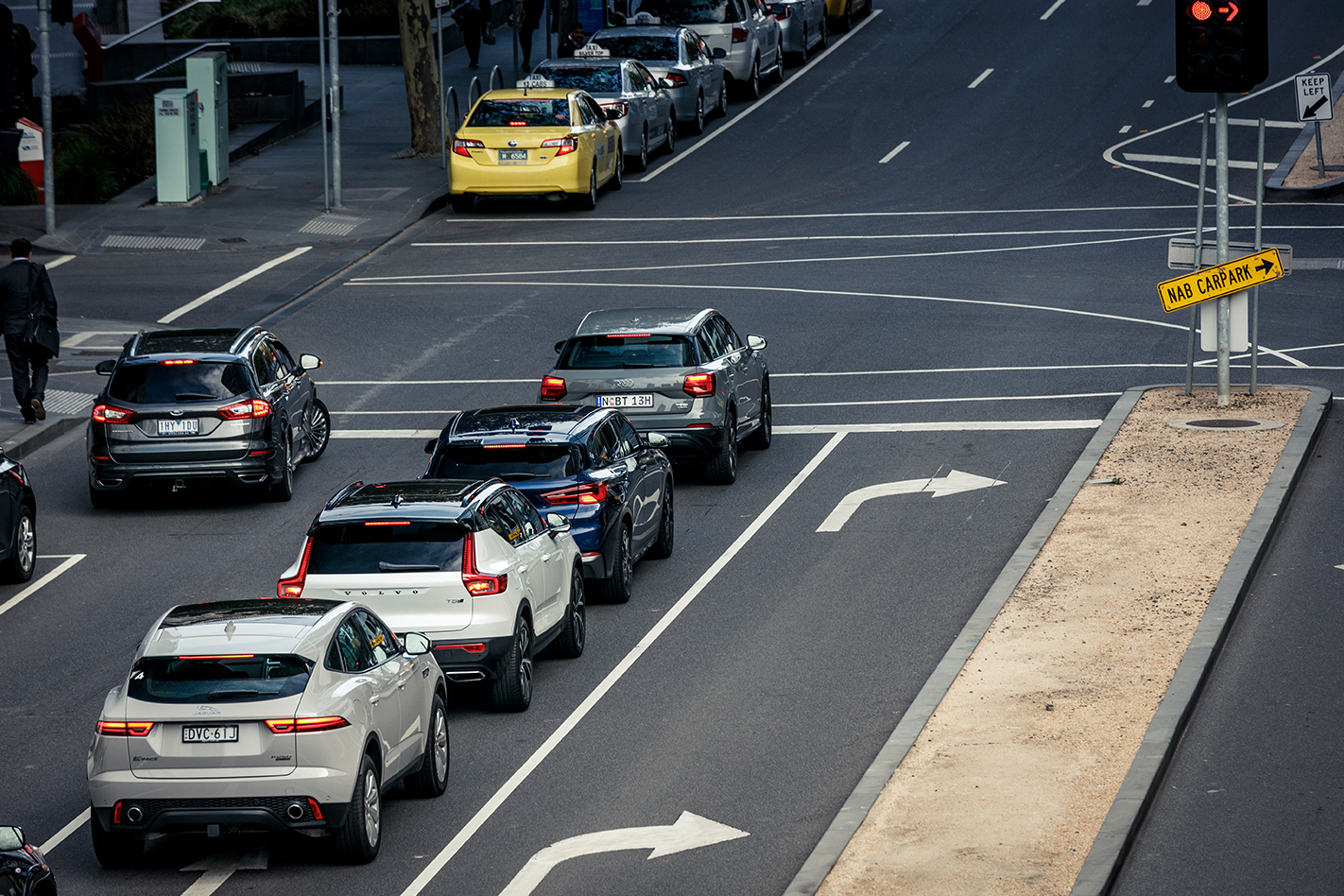
Since then, design-led premium-brand compact SUV contenders have spread like modernist furniture fanciers, driving a class that has jumped 20 percent year-on-year (or roughly the amount the premium medium set has slipped…), with the rather hatch-like (and set for replacement in 2019) Mercedes-Benz GLA currently wearing the small-SUV sales tiara.
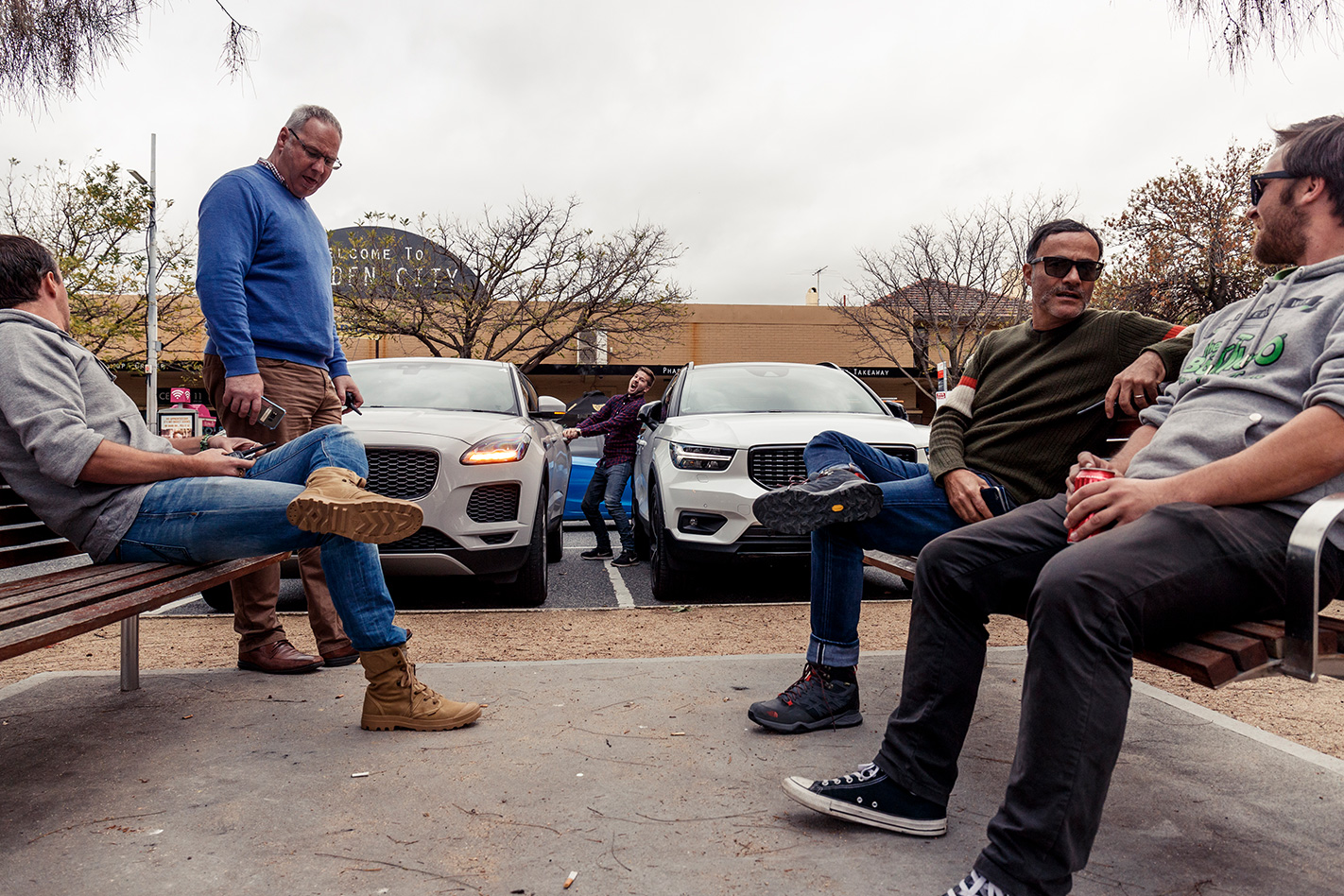
But not for long, if the latest posse of premium petite hopefuls have their way, as witnessed by this quartet of 2.0-litre four-cylinder turbo-petrol Europeans, with the intriguing Volvo XC40 the newest kid on the block.
Described as brandishing ‘Prada trainers’ playfulness against bigger brother XC60’s ‘suede casuals’ and the full-sized XC90’s ‘black dress-shoes’ formality, the suave, distinctive Swede debuts Volvo’s box-fresh Compact Modular Architecture (CMA) co-developed with the brand’s Chinese owner Geely, and destined for a bunch of future ‘40’ series models.
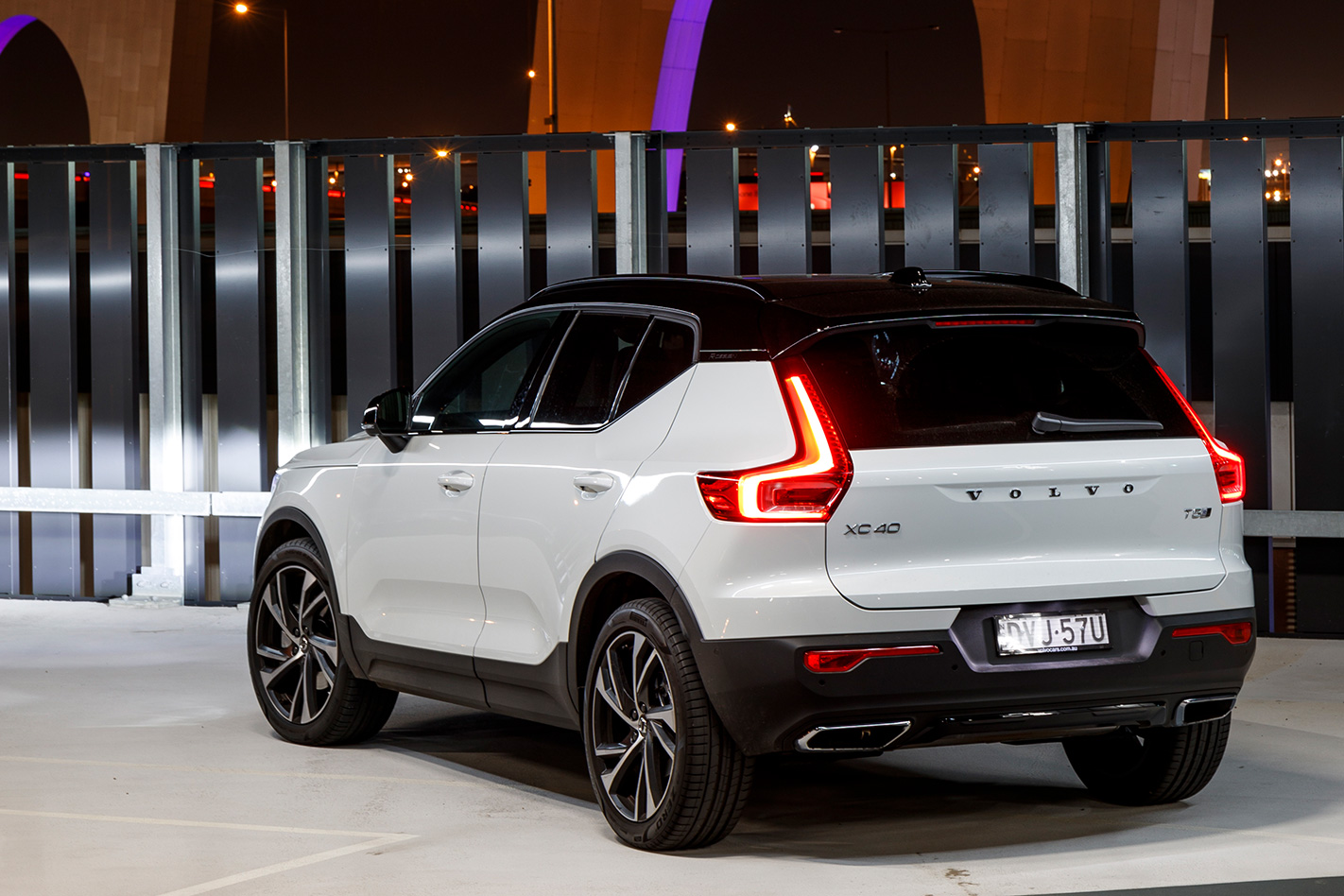
Four variants are available, each with all-wheel drive, starting with the $47,990 XC40 T5 Momentum petrol and – for $3K extra – a D4 Momentum diesel. Ours is a $54,990 T5 R-Design (the racier one that includes 20-inch alloys and a black roof, as well as a powered tailgate, leather, and cornering LEDs) in since sold-out Launch Edition semblance, adding $6670 worth of kit including heated seats, radar cruise, sunroof, park assist and high-end audio, for what is a compelling $56,740. Gothenburg is serious about ruling this nascent niche.
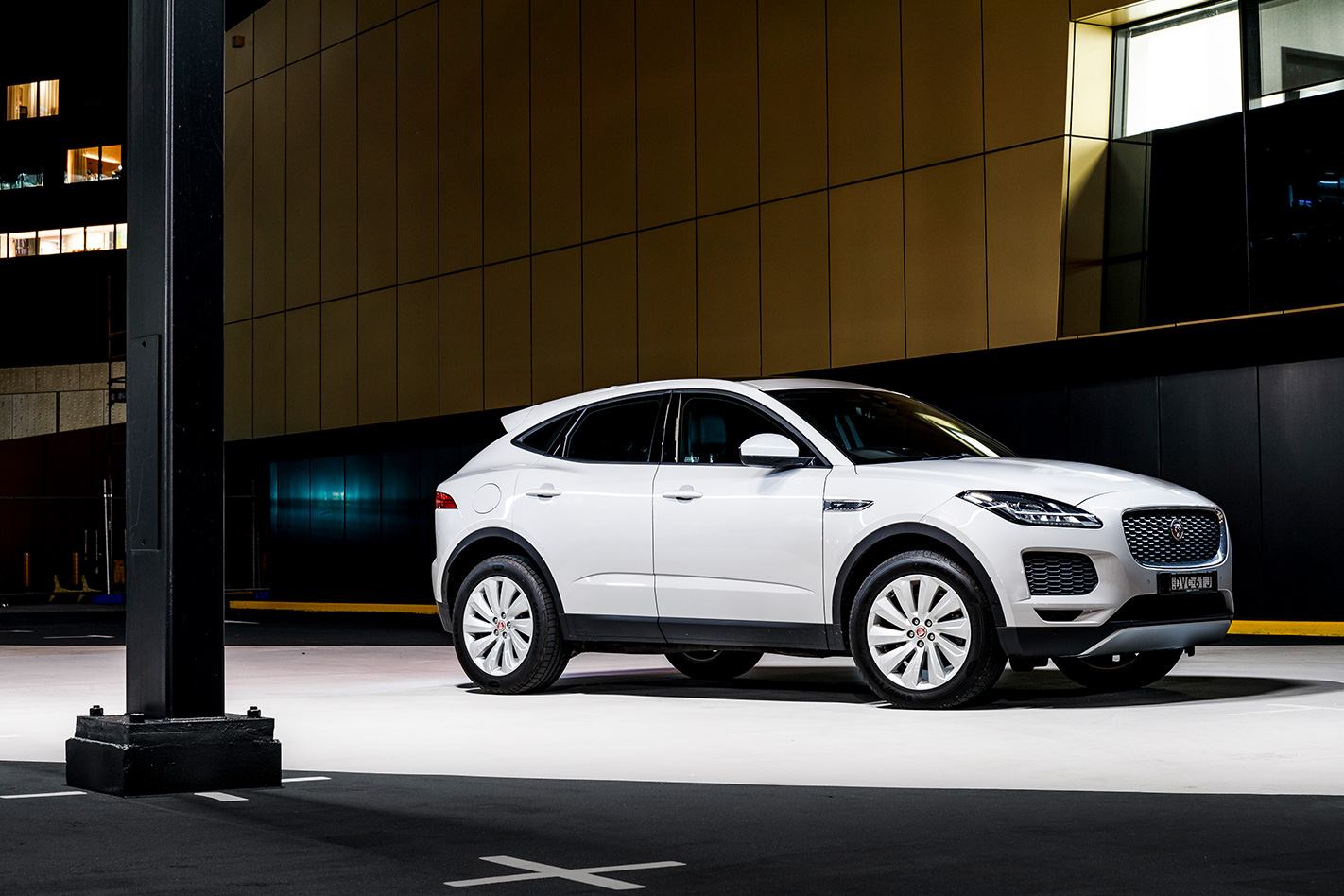
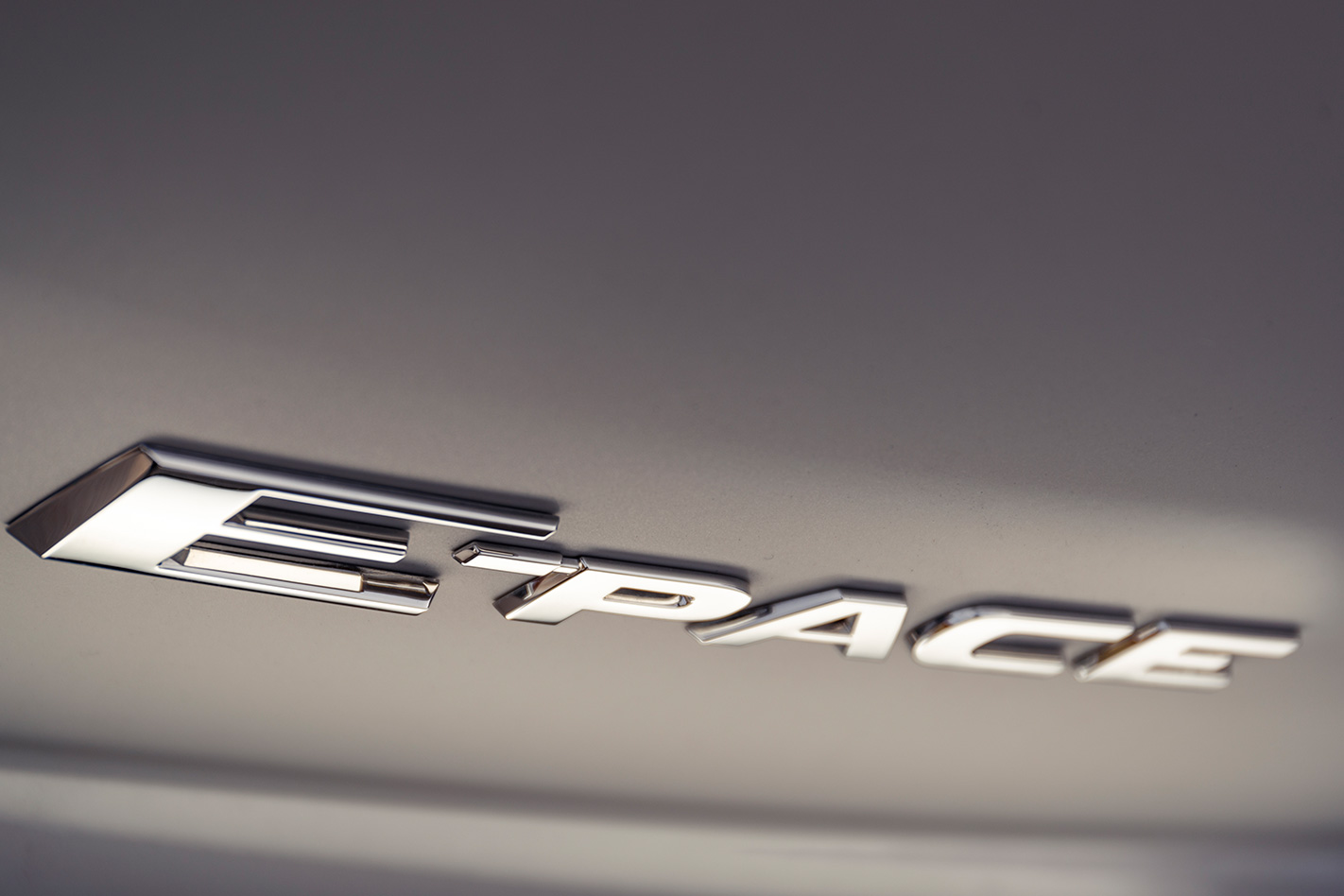
But so is Jaguar with its new E-Pace baby SUV, which makes a mockery of Volvo’s line-up simplicity by bombarding buyers with almost 10 times as much choice, consisting of two petrols and three diesels spanning 38 variants in total. All AWD for now, the humble D180 costs $47,750 – a record low for the marque.
That said, the Brit’s appeal is highly spec dependent. What is menacing in the $85K HSE P300 R-Dynamic looks less wildcat and more Care Bear cutesy in the S P250 at $57,600. Our Borasco Grey E-Pace tester leapt to $70,880, yet still trailed the XC40’s spec, since DAB+ digital radio and adaptive cruise weren’t included.
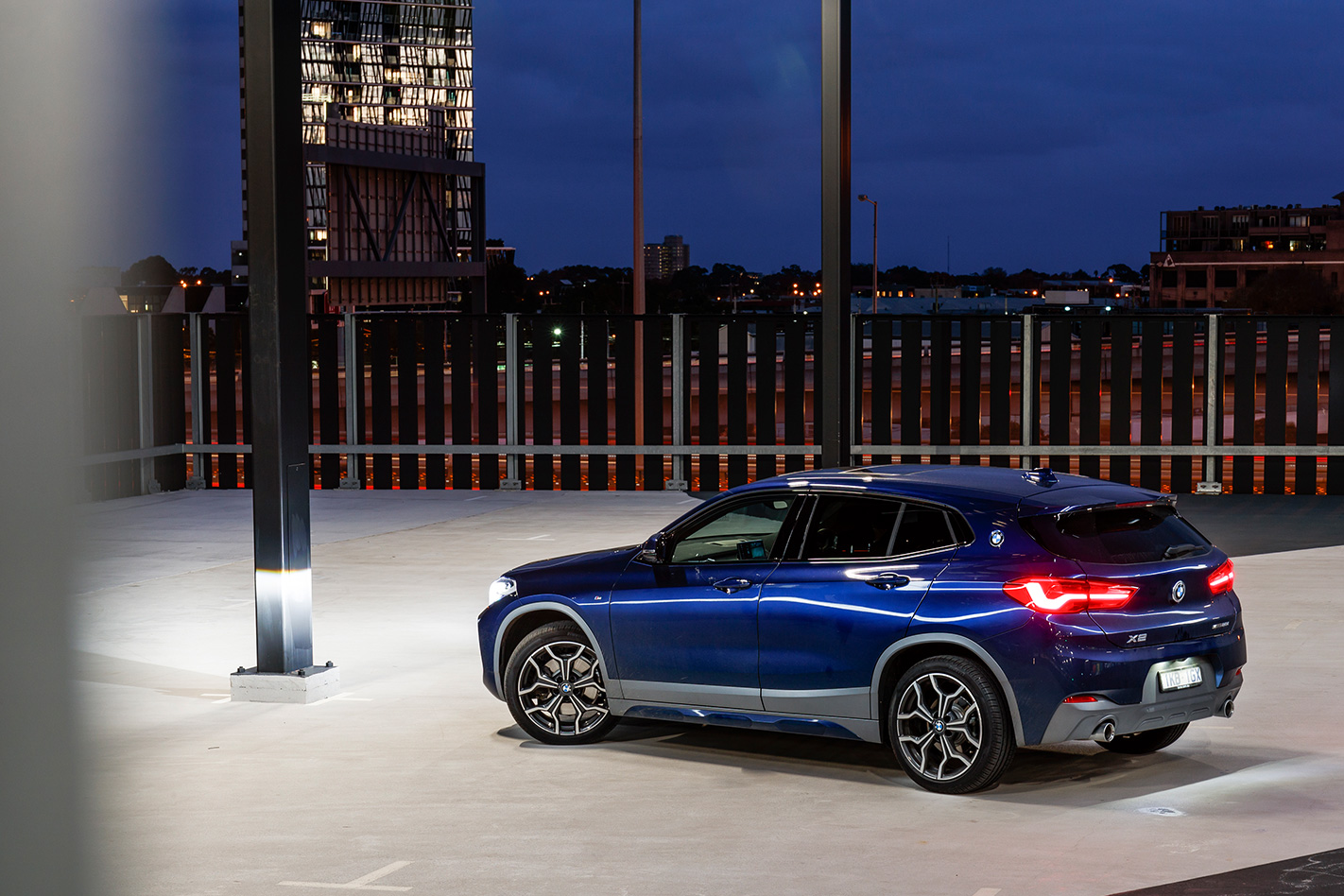
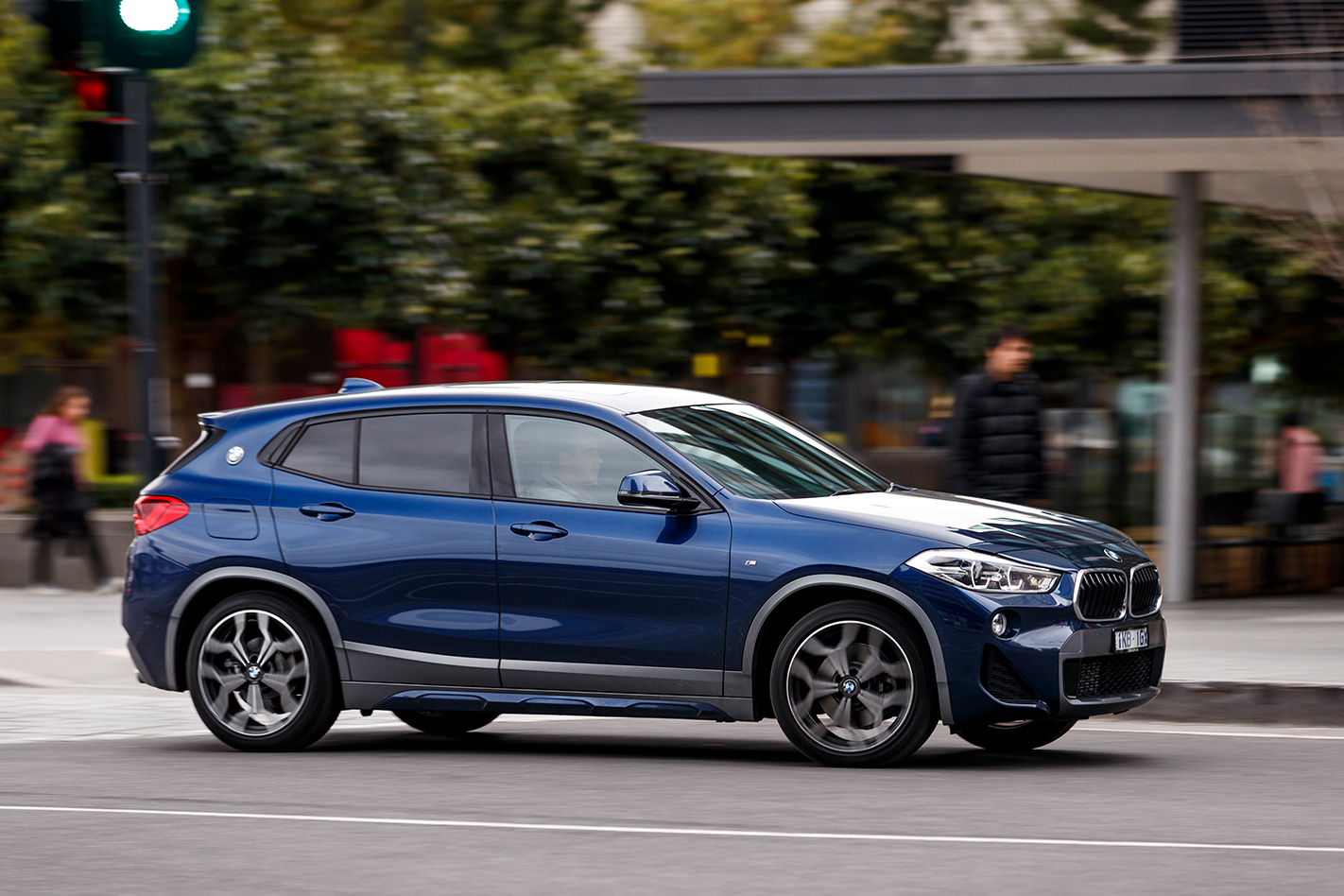
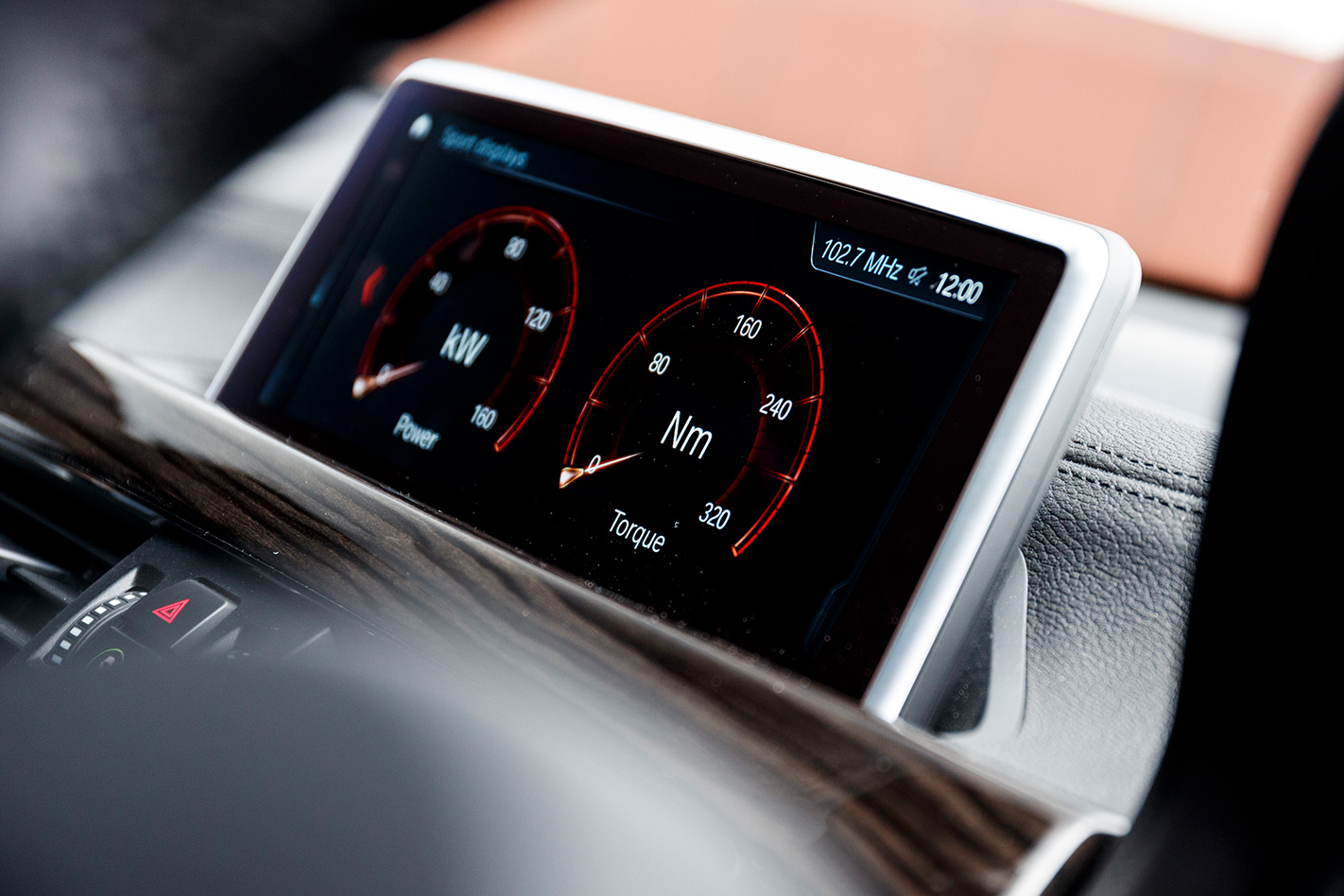
Just behind in terms of arrival and pricing is the BMW X2 from $49,900 for the sDrive18i, or $55,900 for the sDrive2.0i M Sport X Package. Our test X2 cost $66,860 due to a $4000 Launch Pack (enhanced nav, sunroof, head-up display), $2700 Comfort Pack (keyless entry plus better seats with electric lumbar and heating up front) and $400 adaptive dampers. By the way, ‘M Sport X’ translates to subtle Outback-esque body cladding.
Note, however, that ‘sDrive’ denotes front-wheel drive. For on-demand AWD parity with the others, please consult the $59,900 xDrive2.0d diesel (before options). An all-paw X2 petrol variant is not for Oz, for now.
So why not go for an X1 instead? Because, as the cliche goes, it’s the differences that make the X2 better. Sure, both sit on the same wheelbase and tracks, but the X2 is shorter, lower and wider, with slightly more front overhang yet substantially less at the rear to give it a sleeker, spunkier and aerodynamically superior silhouette. The body and platform have been beefed up, with more sophisticated dampers, better bushes and thicker anti-roll bars fitted, and the X2 gets 15:1 fixed-ratio steering (instead of a 16:1 variable-ratio set-up).
However, BMW’s controversial collision-mitigation tech (similar to AEB) still won’t perform a complete stop.
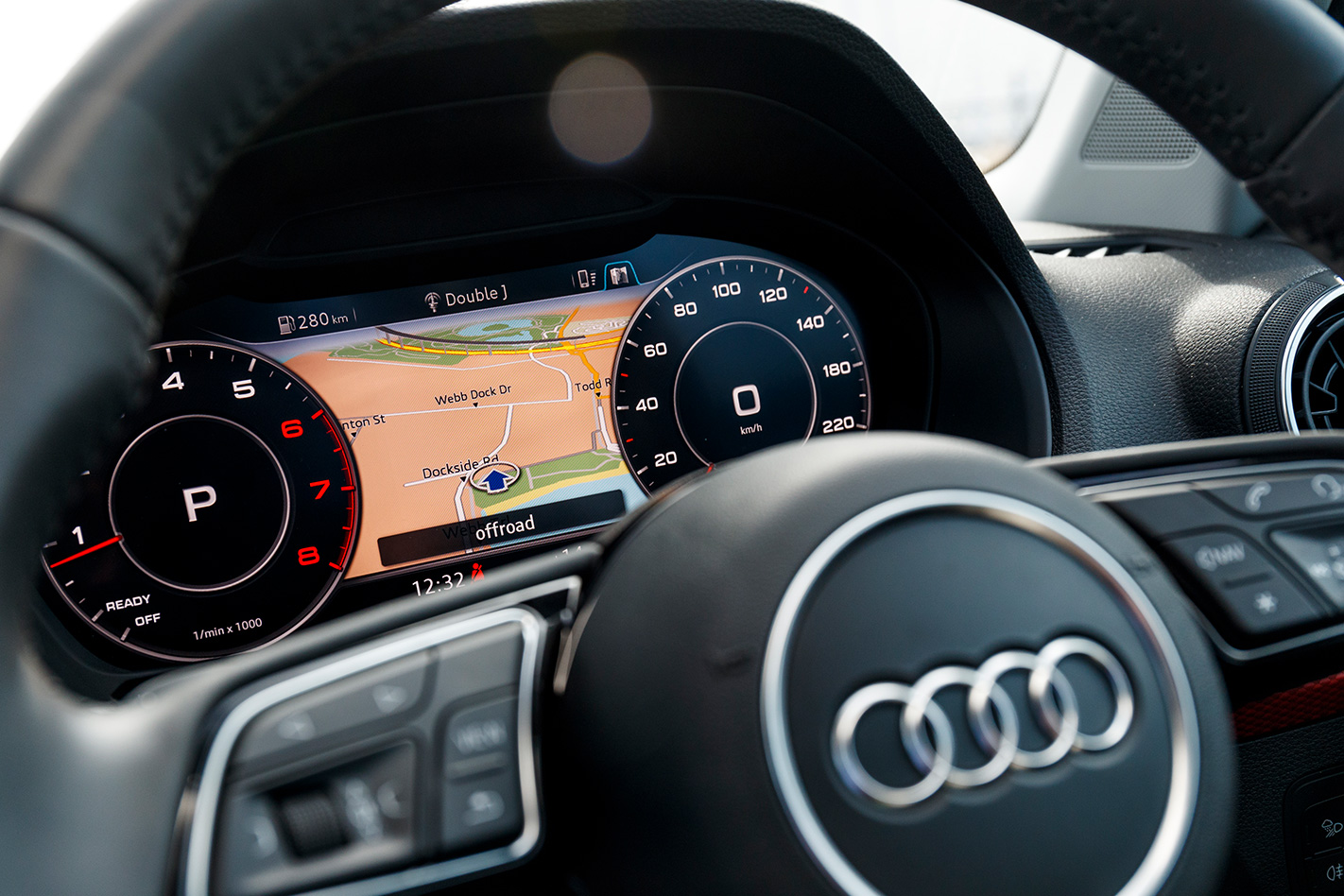
Also originating from the former federal republic is this quartet’s oldest and smallest SUV, the Audi Q2. Sharing the Volkswagen Group’s MQB A0 platform with the big new Polo and next-gen A1 (due next year), the range surfaced early last year in 1.4 TFSI front-drive petrol ($41,800) and 2.0 TDI quattro diesel ($49,100) flavours. However, we’re drawn to the fresher 2.0 TFSI quattro Sport petrol (from $48,500), particularly as it junks the 1.4’s torsion-beam rear for the TDI’s multi-link arrangement (matching the other SUVs here).
Invariably, our Q2 heaved with extras, such as a $990 Assistance package (adaptive cruise, active lane assist, blind-spot monitoring, auto high beam and park assist), $1900 Comfort pack (including keyless entry, folding mirrors, heated/electric front seats, extra compartments), and $2500 Technik pack (larger 8.0-inch screen, Virtual Cockpit instrumentation and flat-bottomed wheel), as well as $500 audio and $550 DAB+ radio upgrades.
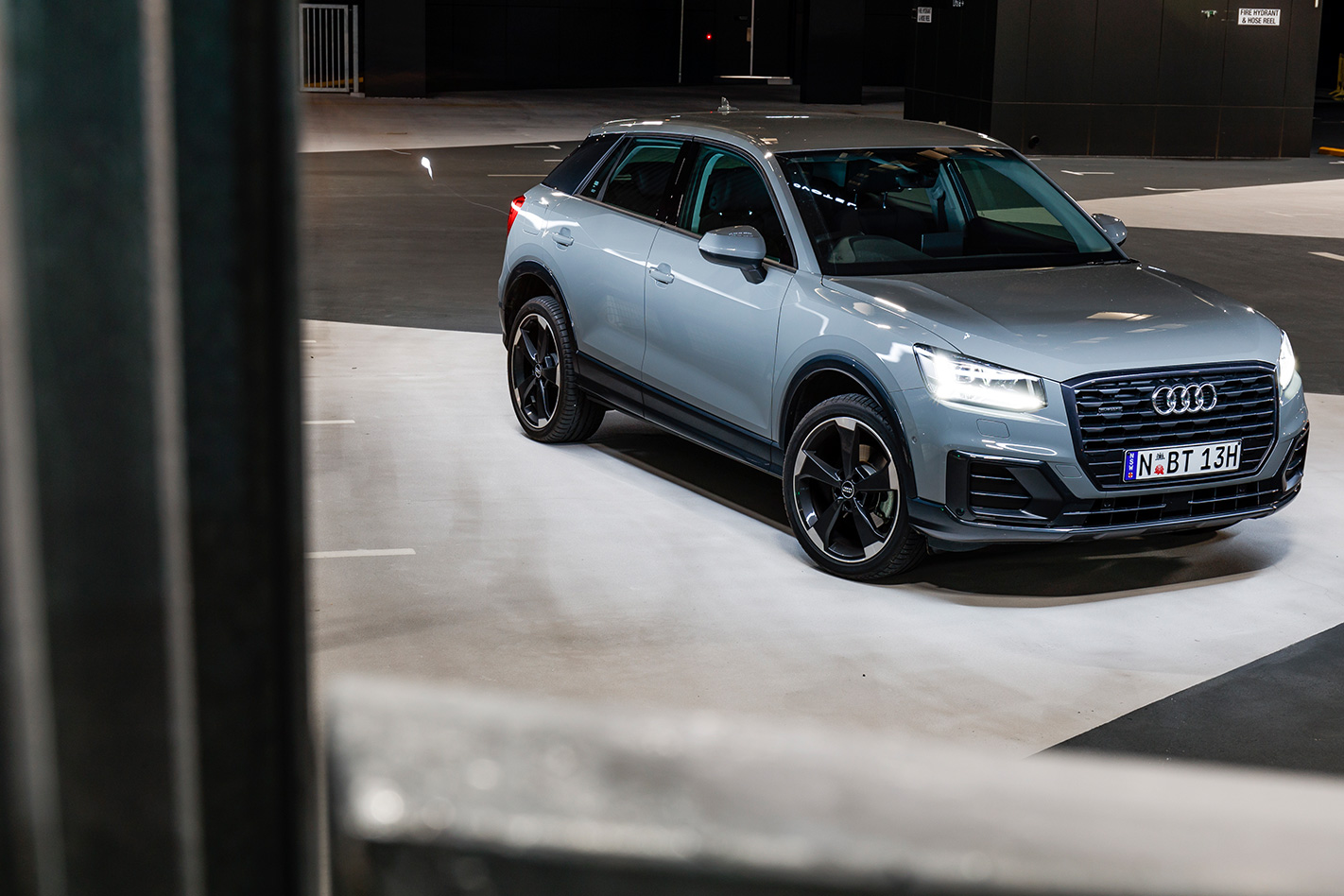
In conjunction with $900 ‘Exclusive’ styling and $500 Contrasting packs, the Audi’s personality lifts from drab to fab. Total? $59,240. That’s without a sunroof, while adaptive dampers cost a further $1500. Ouch.
Still, give or take a few items, seldom has a comparison thrown up such equipment consistency, so the $13K separating cheapest from exxiest is telling. Furthermore, while the Deutsch duo are GLA-style crossover hatches as opposed to the others more upright SUV traditionalists, there’s more – or, in some cases, less – to their packaging than meets the eye.
Take the Q2. In the showroom, its tighter proportions, missing rear air vents and annoyingly absent (but available with a $450 three-way bench option) centre-rear armrest would appear to sink its appeal. But further inspection reveals there’s actually more than sufficient headroom (in our sunroof-less car), as well as comparatively ample space for shoulders, legs, knees and feet. Seat comfort rates highly in both rows, with the rear bench offering strong lower-back and thigh support, okay vision and fairly good noise suppression.
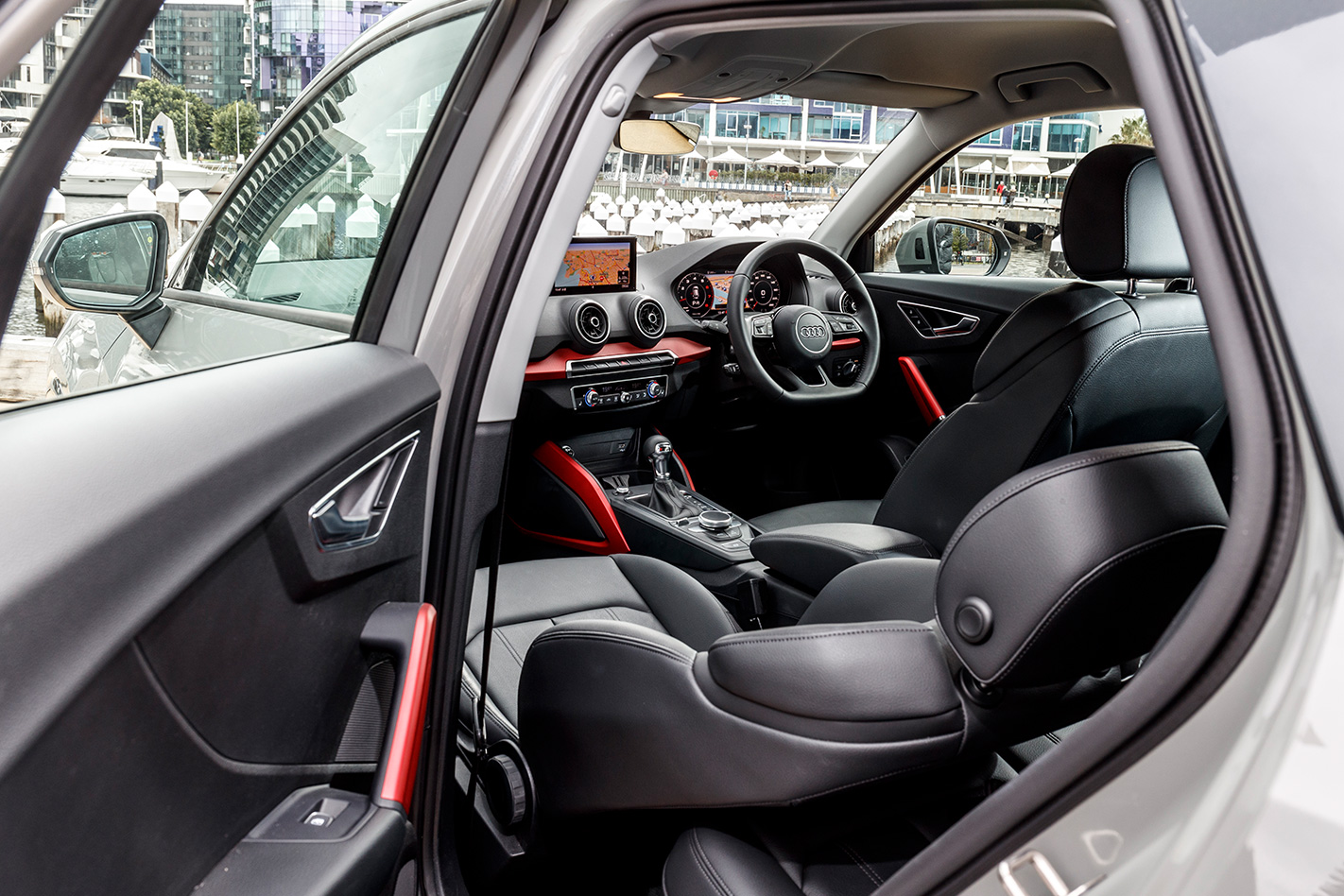
Additionally, the dashboard’s layout feels the richest as presented, with high-quality materials and finish, while the Q2’s basics for comfort, ergonomics and refinement are typically solid. It may be the smallest, but on the move and over time, the Audi’s depth of cabin craftsmanship shines through.
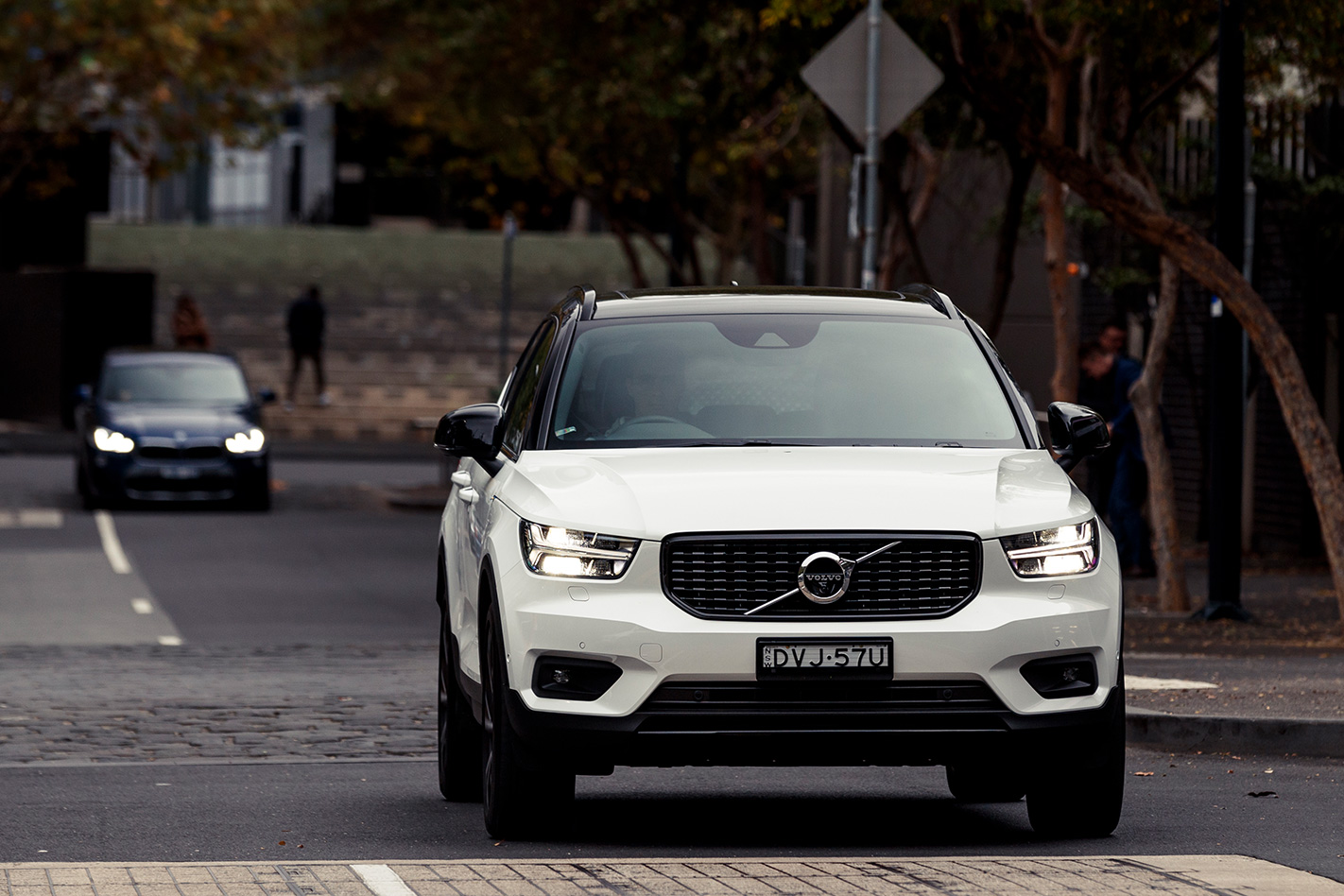
It isn’t quite the same in the Volvo. With the group’s longest wheelbase, highest ceiling and deepest windows, it literally stands out as the likeliest to be packing space, yet it dodges styling dorkiness thanks to deft detailing such as the R-Design’s delectable colour blocking.
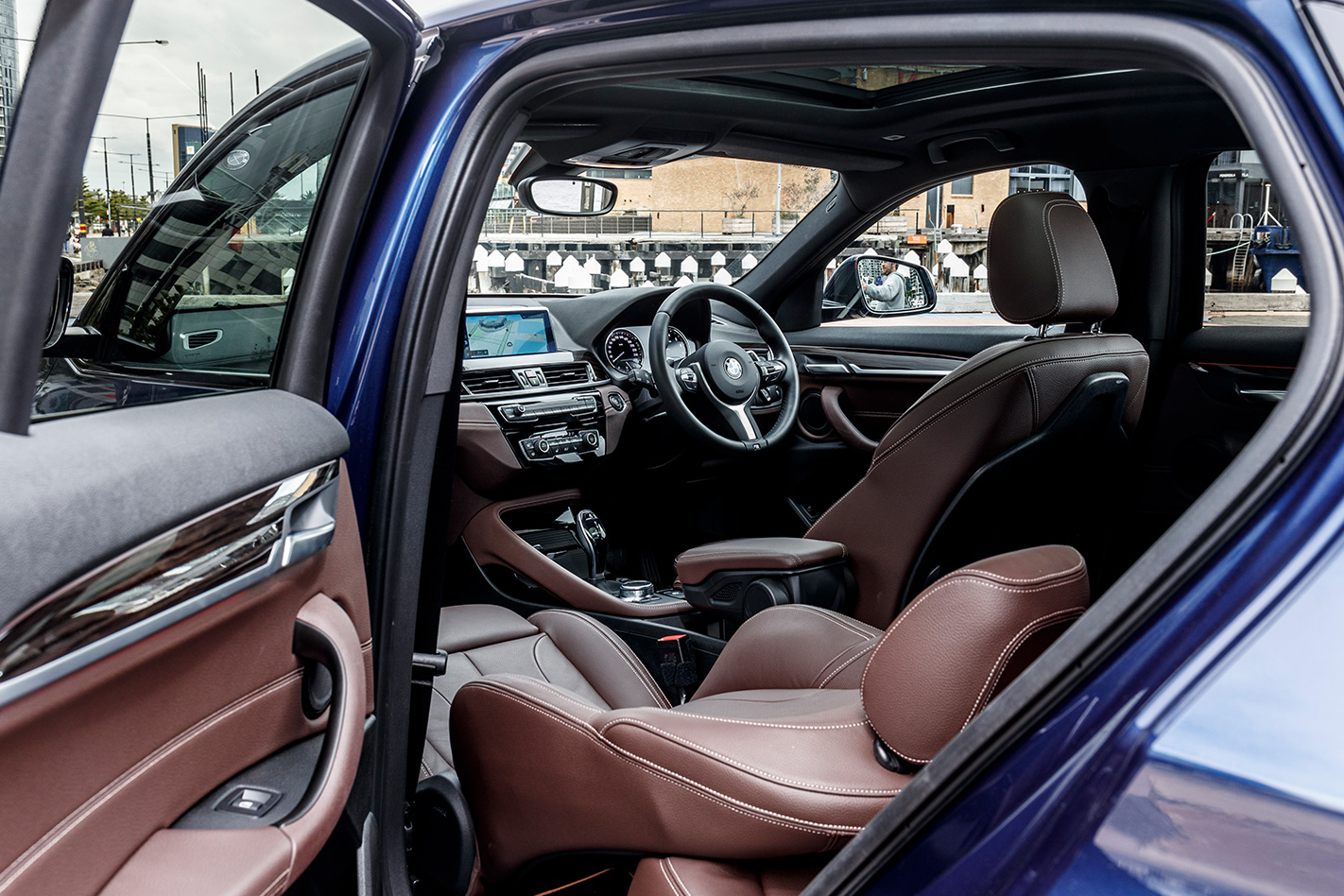
Factor in the lure of sumptuously supportive front seats, Volvo’s signature central tablet screen, gorgeous instruments, classy Art Deco vents and – in this Launch Edition – stitched leather ambience, a vast sunroof and no-cost-option orange carpet and door inserts, and the XC40’s cabin is all but a flirty deed done dirt cheap.
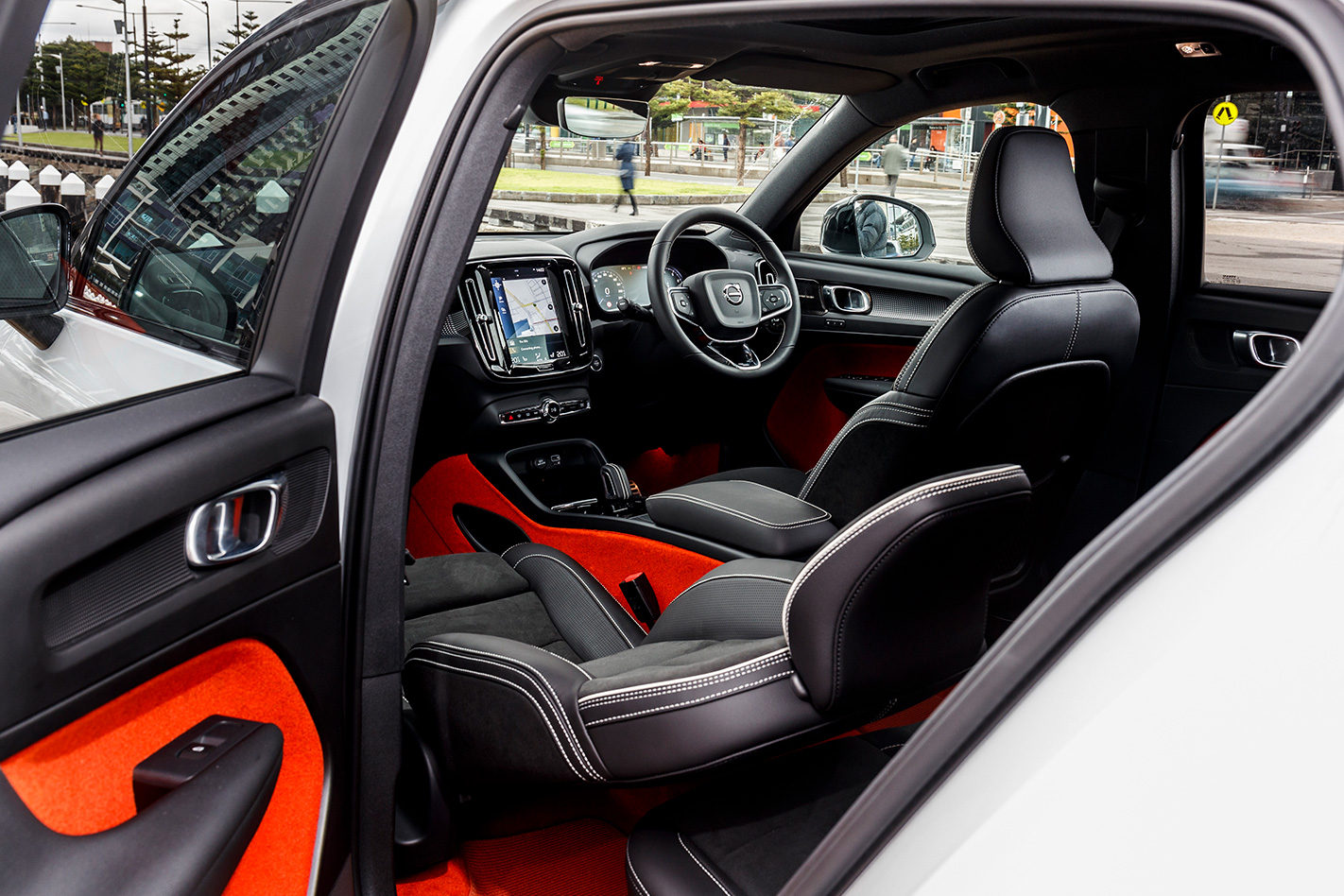
But more isn’t more room-wise (headroom aside), with less rear space than the XC40’s boxy proportions promise. Infuriatingly, each gear lever movement demands two taps; that multimedia screen’s functionality isn’t so intuitive; smallish rear cushions lack sufficient thigh support for adults; there are no proper door grabs or overhead handles to hang on to; and wind noise is a constant companion. And what happened to Volvo’s famed built-in child booster seats? They’re an especially disappointing omission seeing as the XC40’s rear window-line kink limits the view out.
The E-Pace, too, squanders the space bounties that its 1.9m width suggests. Although it appears roomier than the Swede (let alone the slender Audi), it is no more so than the narrower BMW. Just as in the XC40, some of the more out-of-the-way plastics don’t seem as savoury as its lofty pricing would suggest; the front seats are soft but also a tad shapeless and not so supportive on longer journeys; and a high rear floor forces a less-comfy knees-up posture for beanpoles out back.
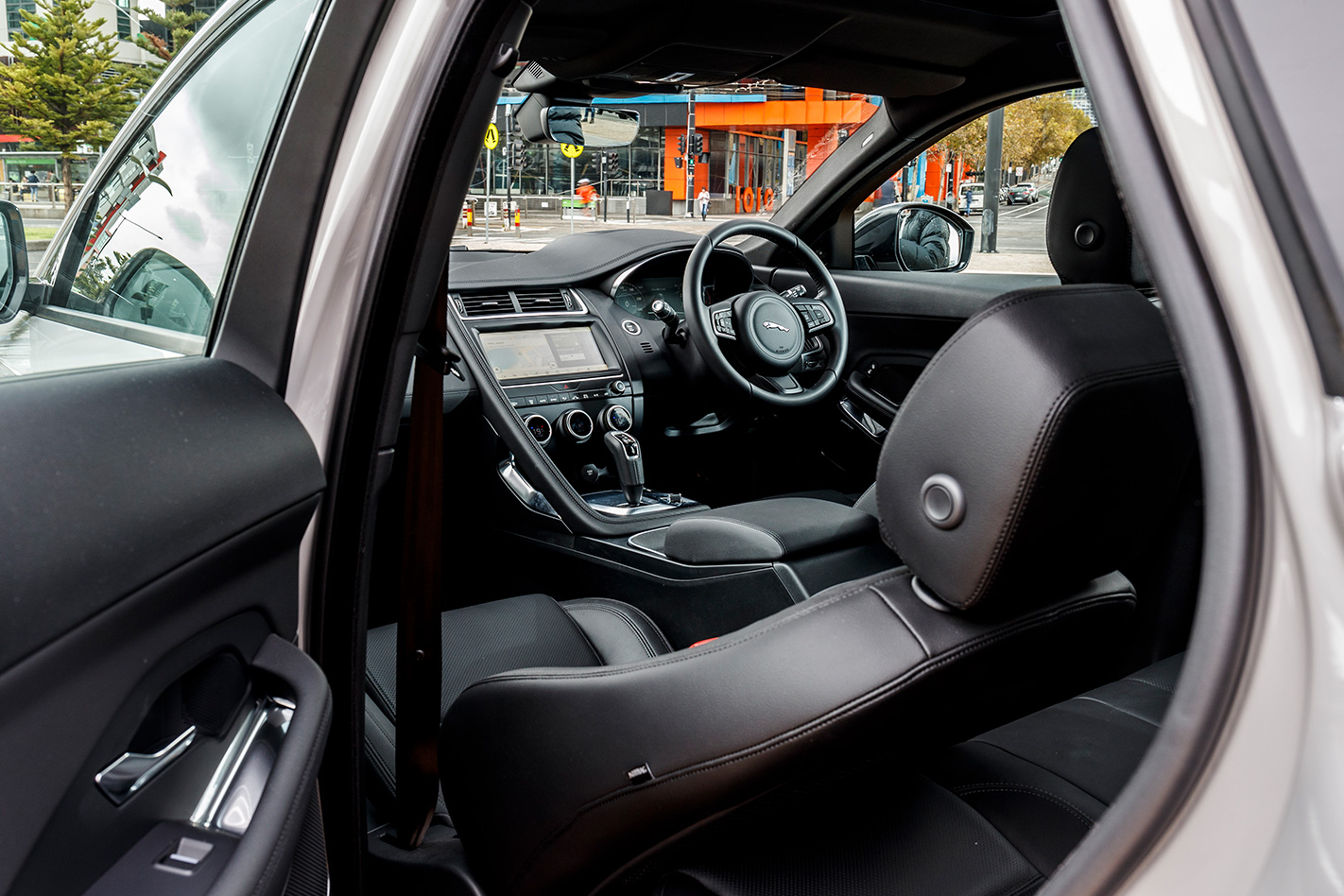
On the flipside, the Jaguar’s entry/egress is the best here, it is quiet inside, with plenty of legroom in the rear, good vision, and no shortage of USB sockets, cupholders or storage options. The dash possesses a congenial simplicity, the 484-litre boot is the biggest here and the Jag’s driving position is appealingly low-slung and enveloping. Maybe it’s the F-Type relation.
Not surprisingly, a similarly sporty atmosphere infuses the BMW, thanks to superb (though optional) seat-support enhancements, thoughtful ergonomics, uncomplicated iDrive multimedia, ample airiness in the rear (due in part to narrow front buckets), with reclining backrests and room to stretch out. The hemmed-in feel the lowered roofline hints at does not materialise.
There’s little to berate the X2 about, aside from some wind rustle around its oversized mirrors, ever-present road noise, a vision-reducing high waistline, and the roof-mounted centre back seatbelt, which is fiddly and makes for awkwardly intimate neck contact on some people.
It’s not just in packaging that the smaller Germans punch above their perceived abilities. Though eager 2.0-litre turbo-petrol fours are common, their outputs vary greatly, with 140kW/280Nm (X2) and 141kW/320Nm (Q2) paling alongside the E-Pace P250’s 183kW/350Nm and XC40 T5’s 185kW/365Nm.
However, effective girth control allows the substantially lighter Germans to deliver from a standing start. The X2’s acceleration is only half a second behind the feisty Q2’s 6.7sec 0-100km/h PB, equalling the (barely run-in) Swede and eclipsing the bloated Brit by almost a second. Regardless of its output shortfalls, the X2 sDrive20i is strident off the mark and hungry through the mid-range, backed up by a quick-witted dual-clutch gearbox that’s always on the money with the right ratio. The Bavarian also proved second-quickest from 80 to 120km/h, and when stretched beyond 150km/h, it pulls away from the entire pack.
Where the Audi’s powertrain shines brightest is in two seemingly conflicting areas – its velvety point-to-point thrust combined with outstanding real-world efficiency. Flexible down low, yet thriving on high revs, the 2.0 TFSI quattro blitzes along at a cracking pace, especially when in Sport mode, as there’s plenty of extra poke to explore in the engine’s upper reaches.
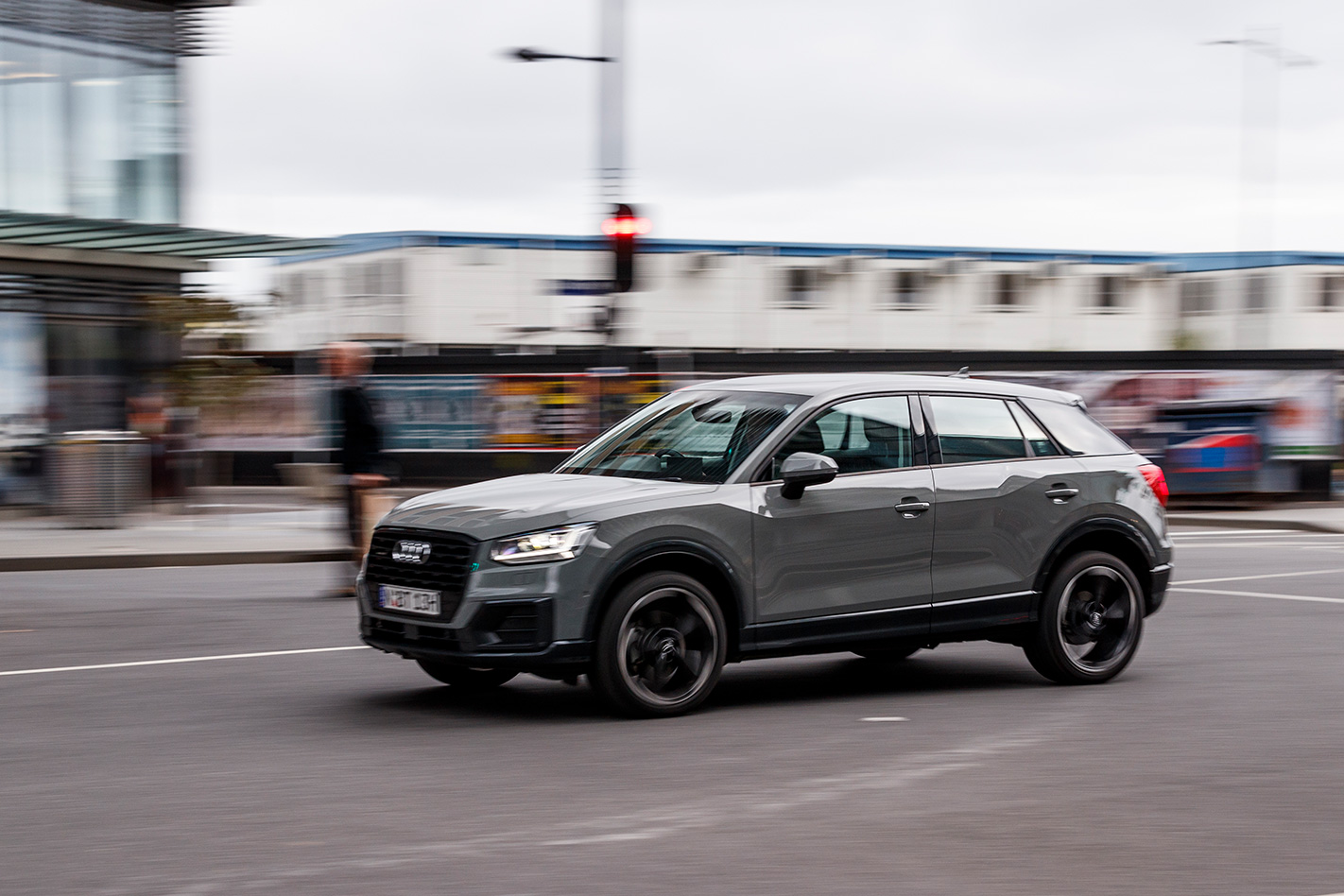
Like the BMW, the seven-speed dual-clutch seems terrifically in tune with the available power. Yet, even when caned, it managed a respectable 9.0L/100km, to be the only single-digit achiever – a litre less than the X2 and more than 25 percent better than the Volvo’s disheartening 12.1L/100km average.
The Jag’s 10.7L/100km consumption wasn’t bad considering how much harder that new-fangled Ingenium four-pot turbo has to work to overcome the E-Pace’s mass. The P250 actually feels pretty muscular, shuffling imperceptibly through its nine ratios for decent accelerative thrust. Only beyond triple digits does its weight burden wash the pace away.
Both the Swede’s fuel consumption and acceleration will improve with mileage. But even without that advantage (which our Q2 had, with 10,000km under its belt), the XC40 has ample urge in reserve, with its lusty yet refined engine reacting willingly and smoothly to pedal inputs (as its vigorous 4.6sec 80 to 120km/h time suggests), and it even seemed to loosen up as testing kilometres piled on.
Light and breezy, the Volvo’s steering seems perfectly suited to its intended urban habitat, providing for ease of manoeuvrability. Ride quality with two on board is also pleasant around town, and up there with its rivals in dealing with low-speed bumps, thumps and tram lines.
Where the XC40 wilts somewhat is through faster bends on rougher roads. The steering’s remoteness turns into disconnection for the driver mid-corner, undermining confidence, even with sticky 245/45R20 Pirelli P Zeros providing significant grip. Furthermore, even at moderate speeds, the suspension can seem busy, transmitting lots of little shocks into the cabin, particularly to the rear passengers, who are already dealing with inadequate cushion support.
The R-Design Launch Edition is betrayed to some extent by its excessive wheel size (20s versus the others’ 19s) without the assistance of optional adaptive dampers (present here only in the BMW) to help smooth the ride.
While a plush suppleness around town is right on Jaguar’s USP, the E-Pace’s dynamics, too, wither a little on rural roads, trailing the Volvo with noticeable (and at times nauseating) lateral body movement to go with its vertical pitching at speed.
This is doubly disheartening because the Jaguar’s steering is a joy, providing the crispness, feel and feedback of a smaller car – in this case, the excellent XE – in equal measure. On smooth surfaces the chassis’ agility is noble for such a portly beast, though ultimately a top-heavy nervousness dissuades press-on driving.
In contrast, that’s what the X2 feels born to do. It’s better than any BMW SUV in recent memory, with bite, consistency and surety in its handling and grip that makes it refreshingly good fun. However, the steering is still devoid of feel and could use more weight at speed, and the Mini-derived front-drive underpinnings can bring torque steer on greasy or wet surfaces.
Run-flat tyres make the BMW’s ride brittle over rough bitumen, but the must-have $400 adaptive dampers smother the lumps in most situations, apart from its abrupt reaction to concrete road joins. X1 owners will marvel at the progress displayed here, though not as much as we did at the Q2 2.0 TFSI quattro, which feels entirely unrelated to the noisy and agitated 1.4 TFSI front-drive we tested last year on the same roads.
Yes, the Q2’s suspension is firmer than that of the non-Germans, but there’s better control and discipline in the very non-SUV manner in which it deals with the surface, delivering a comfortable and calm experience. That it’s considerably smaller and lighter than everything else here is largely behind its dynamic advantage, boasting rewarding steering and a chassis that’s nimble and forgiving. Whether that’s adequate compensation for its packaging shortcomings is an altogether thornier issue.
The Jaguar E-Pace is a case of the converse. While it’s far from a loser, the likeable Jaguar SUV isn’t quite on the, er … pace. Spacious, plush and hushed at urban speeds, there’s neither enough equipment to justify its price, nor the dynamic finesse when pressed to fit the marque’s resurgent image.
The X2, on the other hand, is an unanticipated and welcome return to form for BMW. Accommodating, engaging and cosseting in equal measure, it’s Munich’s best SUV. But the sDrive20i is expensive considering its meagre kit and the need for optional adaptive dampers, not to mention torque only going to the front wheels.
In 2.0 TFSI quattro guise, the dinky Audi finally delivers on its initial promise, just as long as you’re forensically picky with the necessary options list.
The Volvo reqires no such immersion in spec sheets. That said, the XC40 Launch Edition’s static dazzle, crushing equipment superiority and socially acceptable image needs to be balanced against its comparatively numb steering, busy suspension and high fuel consumption. The Volvo was odds-on to steamroller the competition, yet only does enough to squeak a decision here. Just like Netflix, Uber and the whole damn premium small SUV thing, nobody saw that coming.
What do you think is the most brutal thing Luffy’s body endures every year?
Is it the countless laps at Bathurst in cars that would make a GT-R Nismo whimper? Dragging door mirrors along the ground while stunt driving at Movie World? Nope. On his calendar, today is the most unforgiving. “It’s the lack of bolstering,” he says, in a road car that completes 70 slalom runs, 84 emergency stops, and 14 motorkhanas that take its toll.
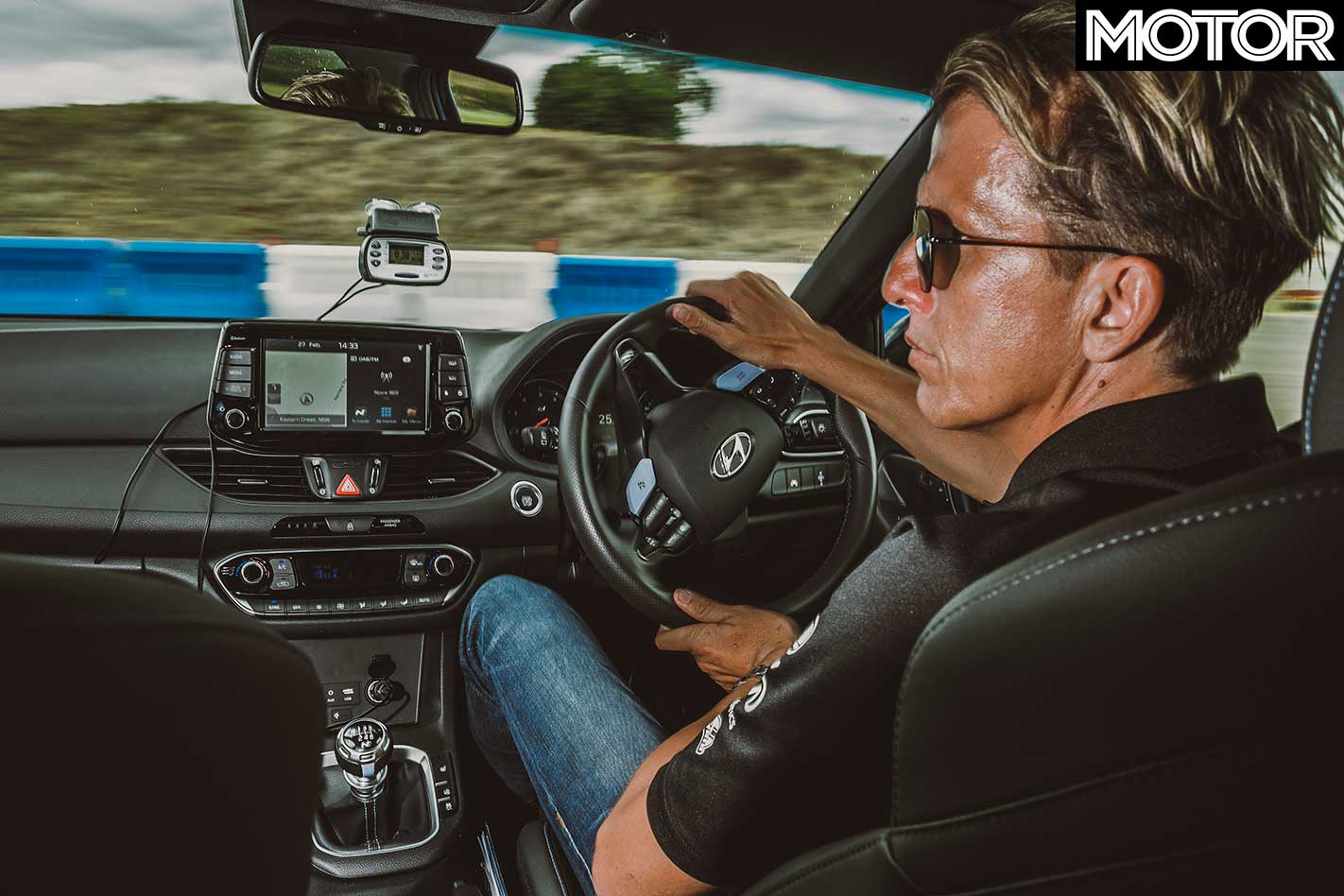
Based on this, it would be cruel to add lateral G tests to his roster. However, it’s crucial to know which tyre will turn on a soggy surface. So we’ve set up a right angle corner to be taken at 45km/h in both directions three times. We’ll toss the best and worst lateral G figure, average the remaining four, and rank the tyres accordingly.
The Dunlop starts off strong with some stratospheric peaks around the 1.08G mark, but its average is quickly sunk by a couple sub-1G figures. To make matters worse, the Continental SportContact 6 wastes no time in establishing its dominance. It consistently registers lateral acceleration above 1G. Amazingly, this equals an average higher than the peak G any tyre could manage during the dry motorkhana.
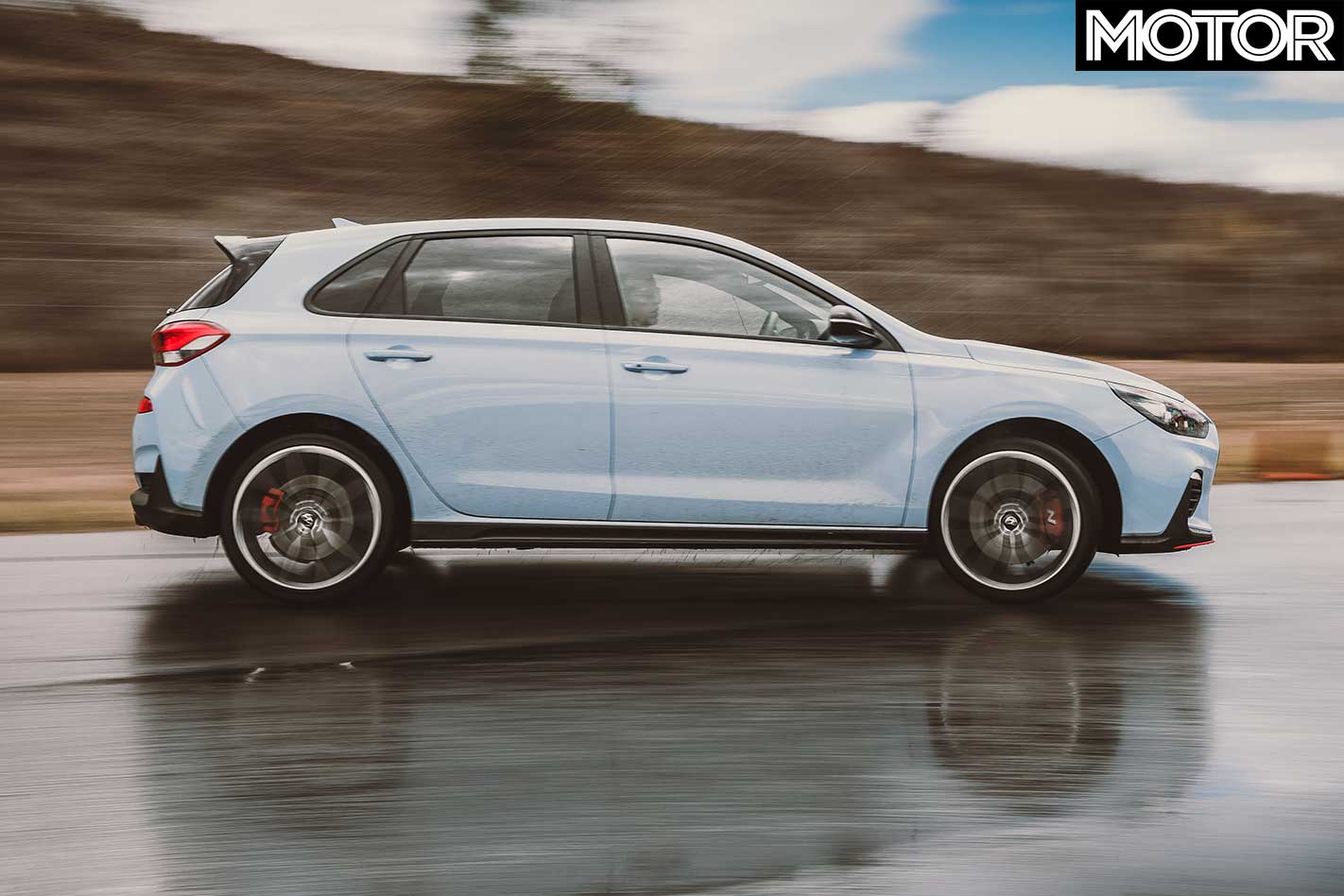
Goodyear’s Eagle F1 produces nothing remarkable, however, the Falken FK510 paddles through the water like it has webbed feet. It spikes at 1.08G and drops to less than 1G in only one considered run.
Interestingly, our middle-order tyres can’t swim anywhere near as well. The Laufenn fails to pip 1G on the Driftbox, while the Invo’s considered runs range between 0.9G and 1G. They’re bettered by the Nexen, which hovers around the 1G mark more consistently.
Like our wet braking test, a warming surface starts to affect the control tyre performance. Its peak G climbs slowly, as does its average, which may be why the HiFly registers a 1.04G spike in the afternoon.
The Pirelli, which follows the HiFly, makes the most of the warmth, producing more than 1G on every run like the Continental. A few sub-1G turns from the Kumho, though, suggest the Pirelli’s own merits rather than a warmer surface are responsible for its performance. Meanwhile, the Achilles can’t capitalise on the day’s best conditions and again turns in a lowly result.
That said, once we zap the data with linear regression the adjusted results downgrade the Kumho’s and Pirelli’s average lateral G and lift the Dunlop’s. The Continental and Falken are also boosted by the advantage of running early, but they secured their top places with or without it.
Wet Lateral G Results
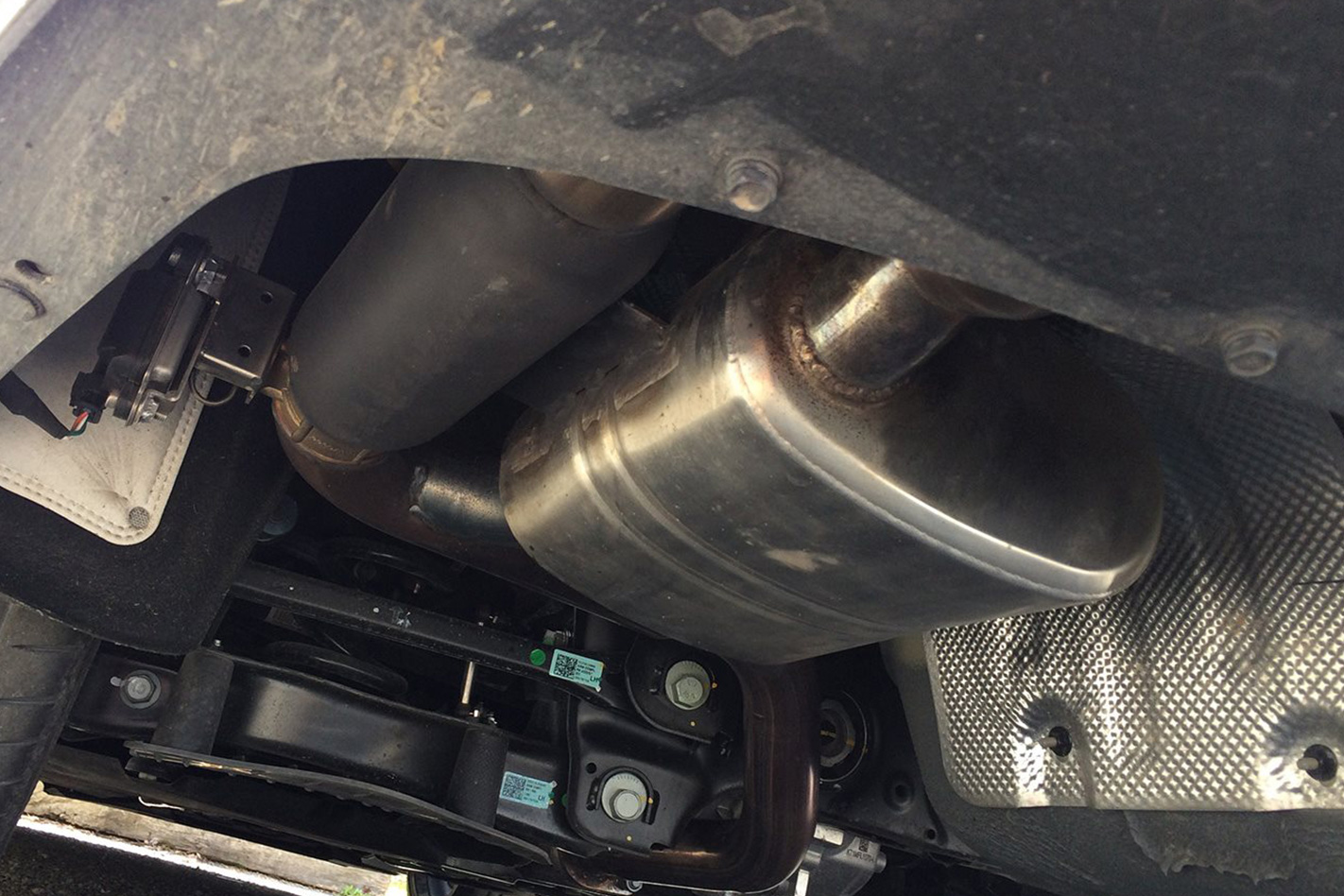
From thunder rumble to shrill scream, the sounds made by engines can be mechanical music to the ears of car lovers. For machines with character, it’s an important part of their personality. What issues from their exhausts can trigger excitement, admiration, desire.
But let’s keep this noise thing in perspective…
For my own not-so-distant ancestors the sound of horsepower was hooves hitting the ground. Maybe they found the ringing clip-clop of a single saddlehorse trotting along a cobbled street or the rumble of galloping thoroughbreds on racetrack turf thrilling sounds. It wasn’t something I thought to ask them when I was just a kid and they were old men.
Horses were as big a part of their lives as cars have been of mine, because they chose to be photographed with them in a time when images were costly. The proof is in my family’s photo albums, in sepia tone and black and white.
Grandfather George harvesting wheat with his six-horse team, led by big Boy with the white blaze, probably sometime in the 1930s. Even older, there’s great-uncle Sylvester as a skinny, wild-looking youth, feet thrust forward in the stirrups, on a rangy stockhorse.
These are scenes from only two, three, or four generations ago, depending on your age. And two, three, or four generations from now the preserved evidence of our time’s obsession with our cars, inevitably including the way they sound, will seem just as distant.
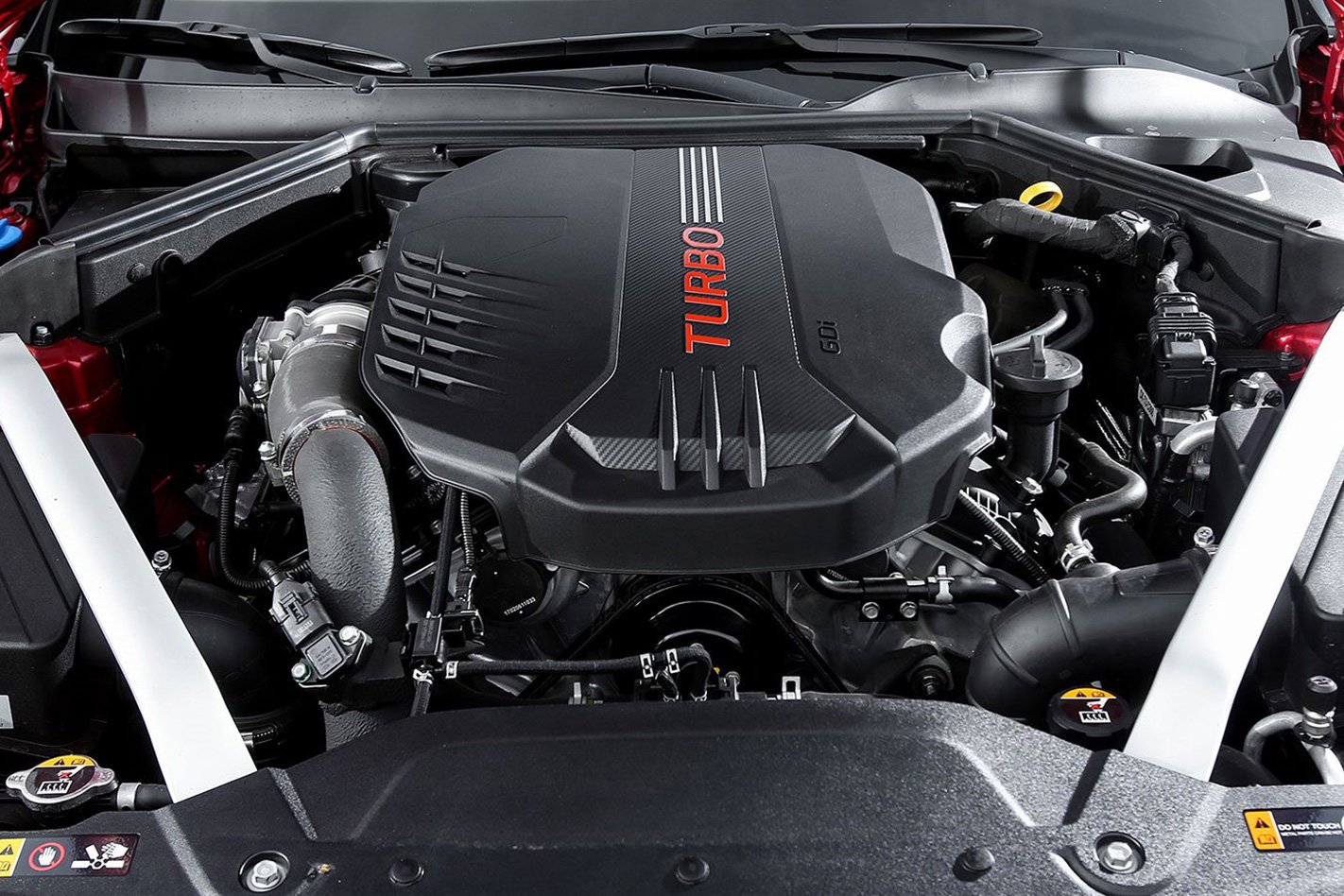
Cars haven’t always blown muffler-tip melodies. I doubt anyone enjoys the huffing and chuffing of the engines under the hoods of the machinery that introduced people like my forebears to internal combustion.
It wasn’t until the 1920s, around four decades after the invention of the car, that exhaust notes began to get interesting. That’s when engineers working on the exotic racers and supercars of the day realised the way to make winning power was high revs.
But the metallurgy of the time meant only tiny and therefore light piston and connecting rod assemblies, could stand the stress.
This thinking spawned many-cylindered engines like the 2.0-litre in-line eight of the Bugatti Type 35. It could spin to 6000rpm, two or three times as fast as the 2.9-litre four in the Ford Model T on sale at the same time, while producing around four times the power. Revs, and the sound that went with them, were only for the rich for decades afterwards.
It took 1960s advances in manufacturing, materials and fuels to bring the music to the masses with simple, affordable engines that could sing. The two-valve, pushrod V8s developed by Ford and General Motors are among the best, and best loved, examples. While Americans had the bass end of the spectrum covered, the Japanese, especially Honda, filled the treble ranges with ever-higher revving fours, and Europe supplied some real mid-range punch.
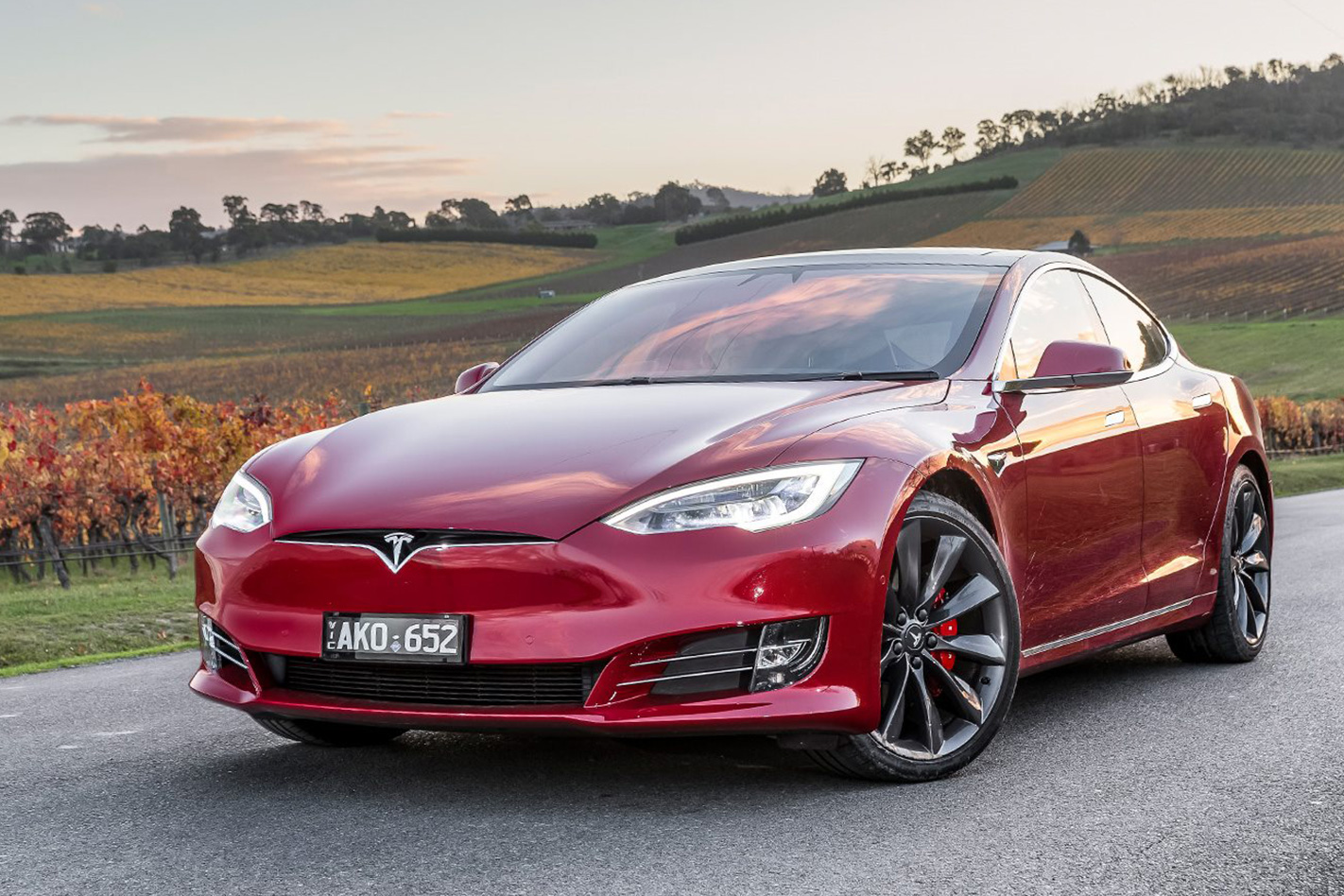
But the relatively brief period of great exhaust notes is already coming to a close. The efficiency-driven shift to downsized turbo engines and tougher noise limit laws are downing the decibel levels. And automotive electrification means the beginning of the end.
Between the long-gone clip-clop era and the coming age of whisper-whine EVs sure has been an interesting time to live, to drive, and to hear first-hand the roar of the fuel-burning dinosaurs of the future.
Reduction, not extinction
Obsolescence doesn’t spell extinction for technologies that earn our affection. Just look around; horses are still being ridden and boats are still being sailed, though they no longer rule the road or the waves. I suspect something similar will be the eventual fate of internal combustion cars.
FERRARI is working on EV powertrains… for now only for Maserati. But it is only a matter of time until there’s a new model from Maranello with a recharge port instead of a fuel filler. As outlined in FCA’s five-year plan last month, Maserati will soon drop diesel engines. It will produce only plug-in petrol-electric hybrid and pure battery-powered vehicles and Ferrari will supply the powertrains for all of them.
The Ferrari-developed EV powertrain will deliver Ferrari-grade performance. Tim Kuniskis, the Fiat Chrysler Automobiles exec who heads both Maserati and Alfa Romeo, promises 0-100km/h acceleration in around 2.0 seconds and a 300km/h-plus top speed for its new brand-halo sports car in his presentation.
The EVs, marketed under the ‘Maserati Blue’ banner, will utilise three electric motors. It’s certain two will be mounted on the rear axle, for full torque-vectoring capability. And 800-volt battery packs will deliver high power, long range and quick recharging. This is exactly the kind of high-end EV technology that Ferrari would choose.
Former Ferrari and FCA head Sergio Marchionne saw plug-in vehicles becoming a staple of Maranello’s model mix. “I think I’ve been clear on the topic that we’re going to embrace electrification,” he said at Ferrari’s Geneva International motor show press conference last March. “We are going to bring it in and make it a mainstay of our offering.”
At the same time he confirmed Ferrari would launch a hybrid model in 2019. He implied it would be a plug-in hybrid, unlike the LaFerrari, and that it wouldn’t be a supercar.
“In the LaFerrari it’s an interesting add-on that’s used for power,” he said, referring to hybrid tech. “In the case of the next hybrid I think it needs to become more traditional in a sense, because it needs to fulfil a different role.”
Ferrari, recently spun off from FCA, will present its separate plan to investors come September. Marchionne hoped it will include a new model or concept reveal.
Count on it being large, since size is needed to make space for battery packs and hybrid hardware. Plug-in hyper-hybrid SUV? Or a ‘Ferrari Red’-branded EV pointing to a potential GTC4 Lusso replacement?
Both are now possible.
Whatever it is, a utility vehicle will stretch Maranello’s designers. “Doing an incredibly elegant car that embodies Ferrari values is not an easy thing,” Marchionne admitted in Geneva last March.
MITSUBISHI Motors has poached Audi designer Alessandro Dambrosio in a bid to improve the look of its future products.
The move is a positive step by the Japanese carmaker, whose recent efforts – particularly the Pajero Sport – have become notable for their divisive designs.
Dambrosio, who most recently worked at Volkswagen Group as the head of the Audi Concept Design Studio in Munich, will join the Mitsubishi in October to head up its three advanced design studios, in Okazaki and Tokyo, Japan, and Frankfurt, Germany.
Dambrosio started his career at the Fiat Group where he built up a folio that includes the Alfa Romeo 159, Giulietta, and Mito from his time at Fiat Chrysler, as well as a number of concepts including the Lancia Granturismo, Alfa Romeo Kamal and Maserati MC.
He joined the Volkswagen Group in 2009, and helped influence high-profile models such as the VW Polo and Passat, Bentley Bentayga, Audi A4 and A5, and the Concept Audi TT Sportback.
One of the most striking vehicles from his portfolio is Lamborghini’s Egoista concept car, which celebrated the Italian supercar manufacturer’s 50th birthday.
“Alessandro is a very experienced and skilled designer with a long career at leading car companies,” said Tsunehiro Kunimoto, Corporate Vice President of Mitsubishi’s design division.
”I look forward to him inspiring our teams to shape the next generation of Mitsubishi Design and contributing to rebuild and enhance the Mitsubishi Motors brand.
“He is joining at an exciting time when we are working on concepts for the future of Mitsubishi Motors styling.
“With his passion and well-developed understanding of brand values, he will be an extremely valuable addition to our design team.”
The Mercedes-Benz CLS-Class has returned to Australia in third-generation form. The bodywork is more “boardroom” than “weights room” this time around, but the bigger news lies beneath the bonnet – peer under it, and you’ll discover Mercedes-Benz’s first petrol straight-six in more than two decades.
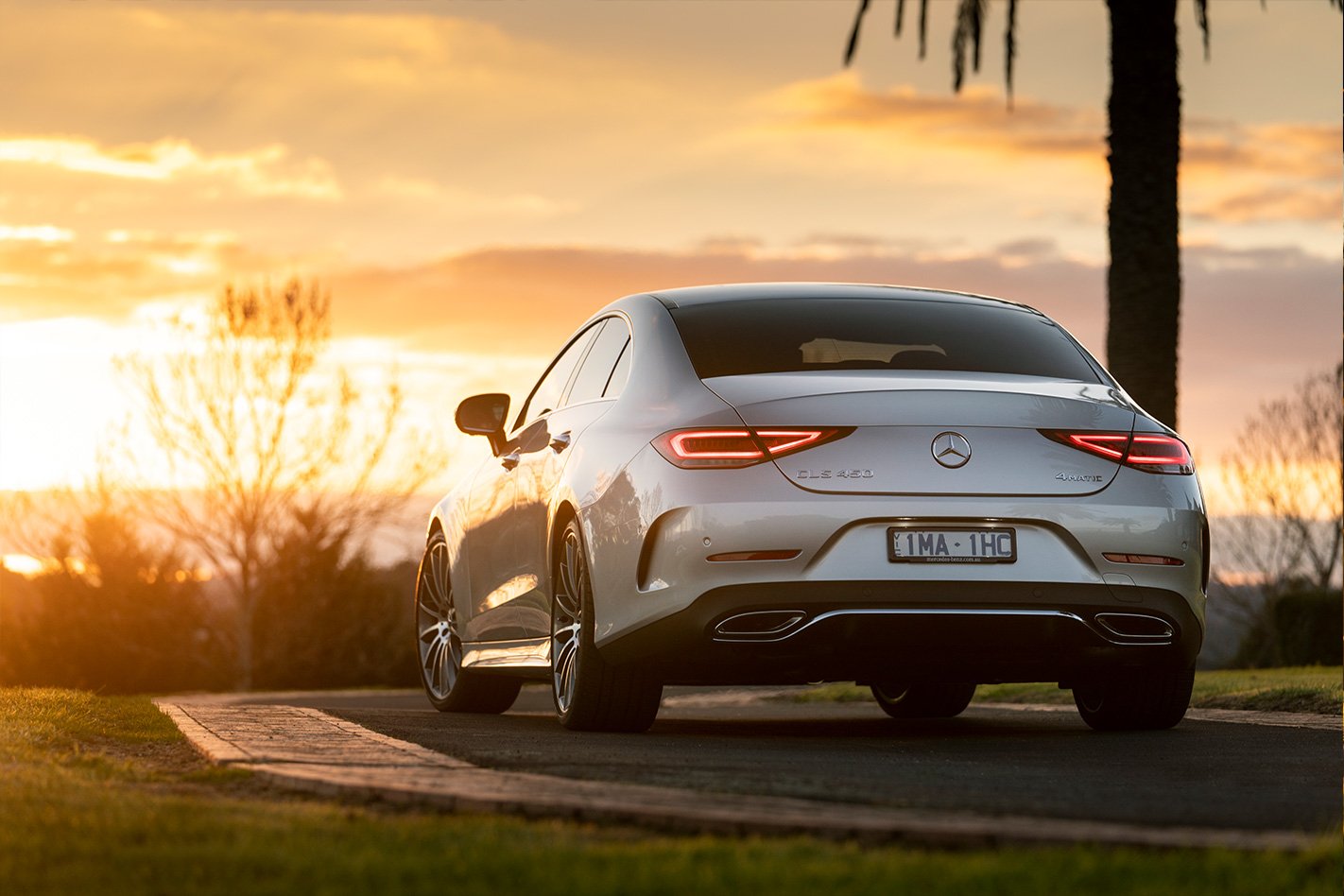
Packed with technology and offering the best interpretation yet of ‘mild hybrid’ propulsion, the CLS is here now in mid-ranking CLS 450 form. We test it on local roads for the first time.
WHAT IS IT?
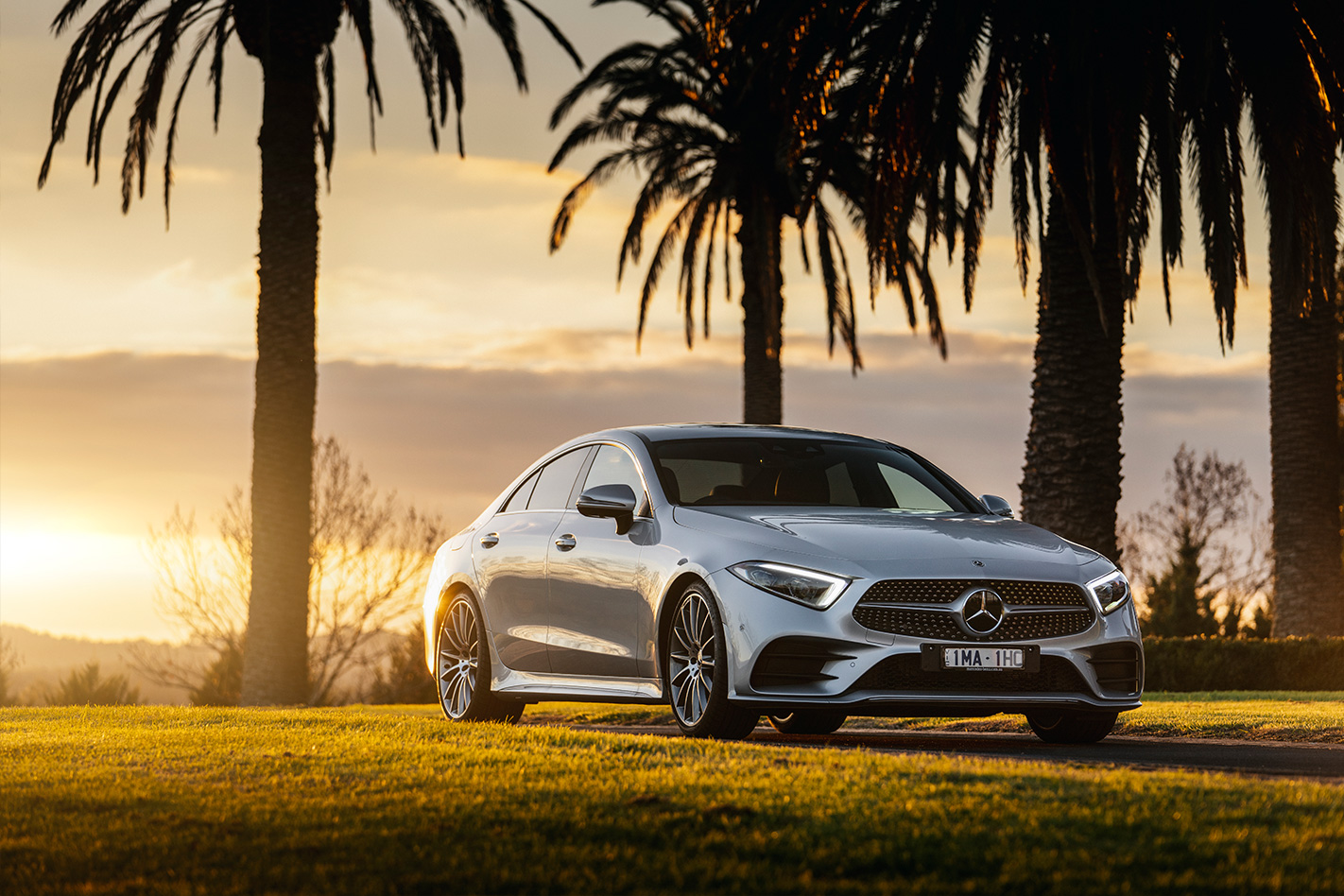
It’s Benz’s ‘four-door coupe’, or more accurately a large sedan that allows form to lead function. The chopped roof costs a little headroom and it’s considerably more expensive than a similarly-sized E-Class, but practical considerations such as these are secondary for a design-led luxury car like this.
WHY WE’RE TESTING IT
This is the all-new third generation CLS-Class, and in CLS 450 form tested here it’s also the first vehicle to arrive down under with Mercedes-Benz’s box-fresh 3.0-litre petrol straight six.
MAIN RIVALS
Audi A7, BMW 6 Series Gran Coupe, Lexus LS 500
THE WHEELS VERDICT
From its frameless door glass to its opulent cabin to its low-slung bodywork, the CLS 450 oozes class in a big way. It’s not a case of style without substance, however, thanks to a supremely refined and electrically-enhanced turbo inline six and outstanding levels of comfort.
PLUS: Outstanding refinement, cabin quality, long-distance comfort MINUS: Not as athletic as the numbers suggest, pricey
THE WHEELS REVIEW
IN 2005 Benz dropped a bombshell with its first-gen CLS. While ‘four-door coupes’ are thick on the ground these days, the term was truly alien at the start of this century. At least, it was until the CLS arrived on the scene.

Low-slung with a chopped-down glasshouse it looked impossibly stylish for its time, and the second-generation model that succeeded it in 2011 was similarly jaw-dropping thanks to more muscular surfacing and swollen guards. Now there’s a third iteration of the CLS formula, but the ocular impact this time around isn’t quite so mind-blowing.
Not because it’s ugly, mind you. The opposite in fact. It remains wide, long, and hunkered down over the tarmac, but the wild design language of the second-gen has been replaced by a more businesslike interpretation of Benz’s corporate look. It still looks great, just a little less extroverted.
The real great leaps forward are found under the skin. There’s a completely new six-cylinder engine under the bonnet, arranged in-line rather than in a V format. It’s a return to a configuration last built by Benz in the 1990s, but the M256 3.0-litre six-pot in the CLS 450 is a very different beast to those machines.
And not just because it sports a turbo hanging off to one side, either. Underpinned by a 48-volt electrical architecture, the M256 is augmented by an integrated starter/generator (ISG) that’s sandwiched between the engine and nine-speed automatic and can deliver up to 250Nm of extra torque when the accelerator is firewalled. Given the 3.0 turbo already develops a healthy 270kW and 500Nm on its own, the CLS 450’s total system torque of 750Nm is properly stonking. From rest, it’s enough to zip the 1940kg CLS 450 to 100km/h in a very respectable 4.8 seconds. It’s worth noting that there are no AMG badges on the bootlid, despite the 450’s impressive acceleration.
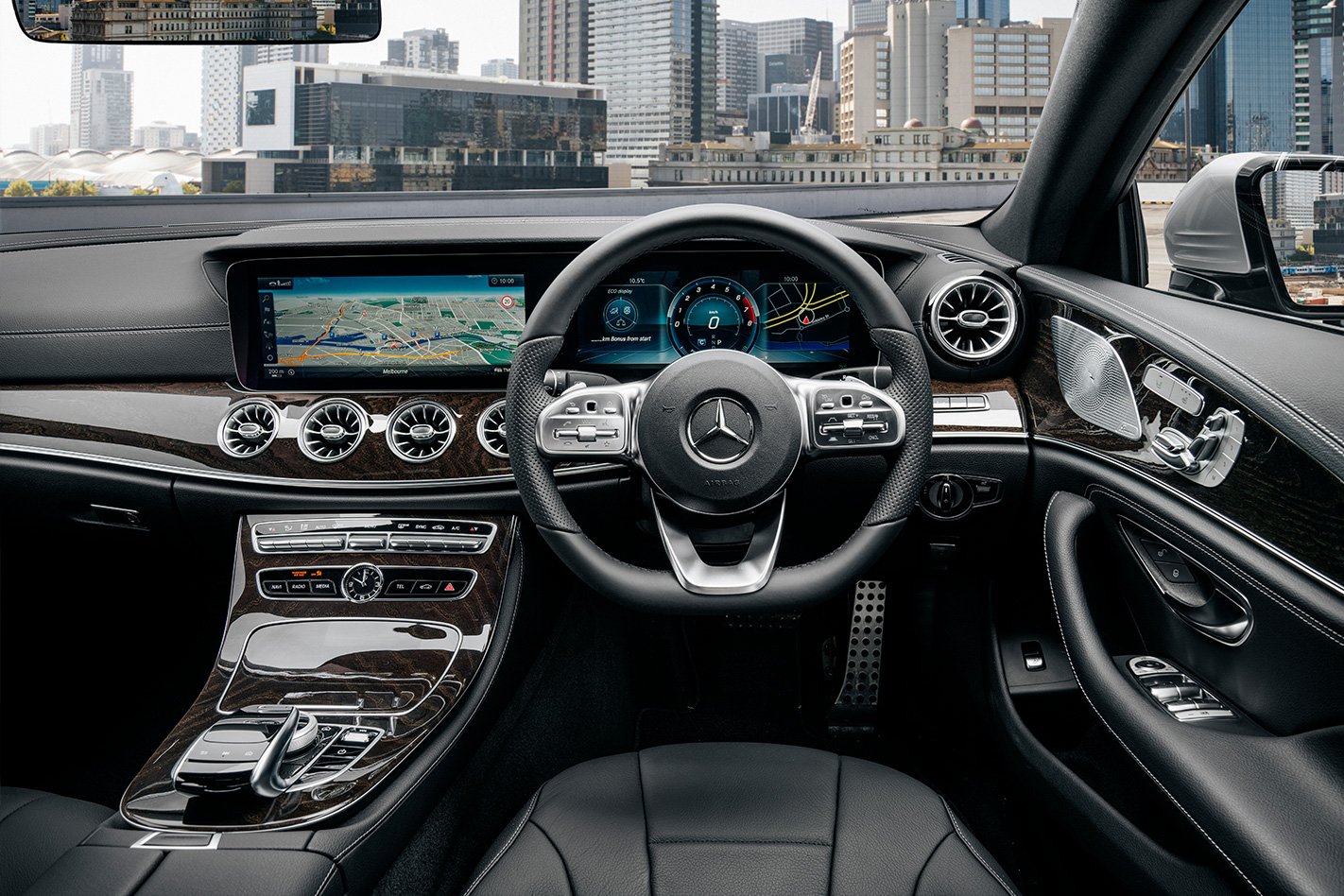
But it’s not speed that impresses the most in the CLS 450. It’s the silky seamlessness of this powertrain, and the effortless thrust it possesses.
That’s most in evidence when you slot it into the mode more commonly known as ‘kryptonite for motoring journalists’ – Eco. Sport and Sport+ might liven up the powertrain, increase the exhaust’s volume and stiffen the 450’s standard air suspension, but despite the ‘coupe’ tag this is no sports car – as our colleagues at Motor found out.

But in Eco mode, the CLS 450 transforms into one of the smoothest, quietest grand-touring devices around. It wraps S-Class refinement in a sleeker bodyshell, and while the rear seats are predictably short on headroom, the relaxed posture offered by the canted-back bench seat and generous leg and elbow room promise outstanding long-distance comfort. What’s more, that turbo straight six is virtually dead-silent at a cruise, ticking over just a smidge above idle in ninth gear at highway speeds and transmitting barely any vibrations into the cabin.
But the greatest party trick is the powertrain’s ‘sailing’ function, which shuts down the engine when coasting and decouples the transmission from the wheels to reduce friction. The 450 will coast in this way for a significant distance without dropping much road speed, and passengers will scarcely be able to determine what’s going on. The engine shuts down and re-lights so smoothly and instantaneously, that the only way you’ll tell the system is active is by watching the tachometer like a hawk.
Not only is it refined, but it’s also a boon for efficiency. With a claimed average of 8.7L/100km, the CLS 450 is more economical than you’d expect of an all-wheel drive turbo six-cylinder that weighs nearly two tonnes.
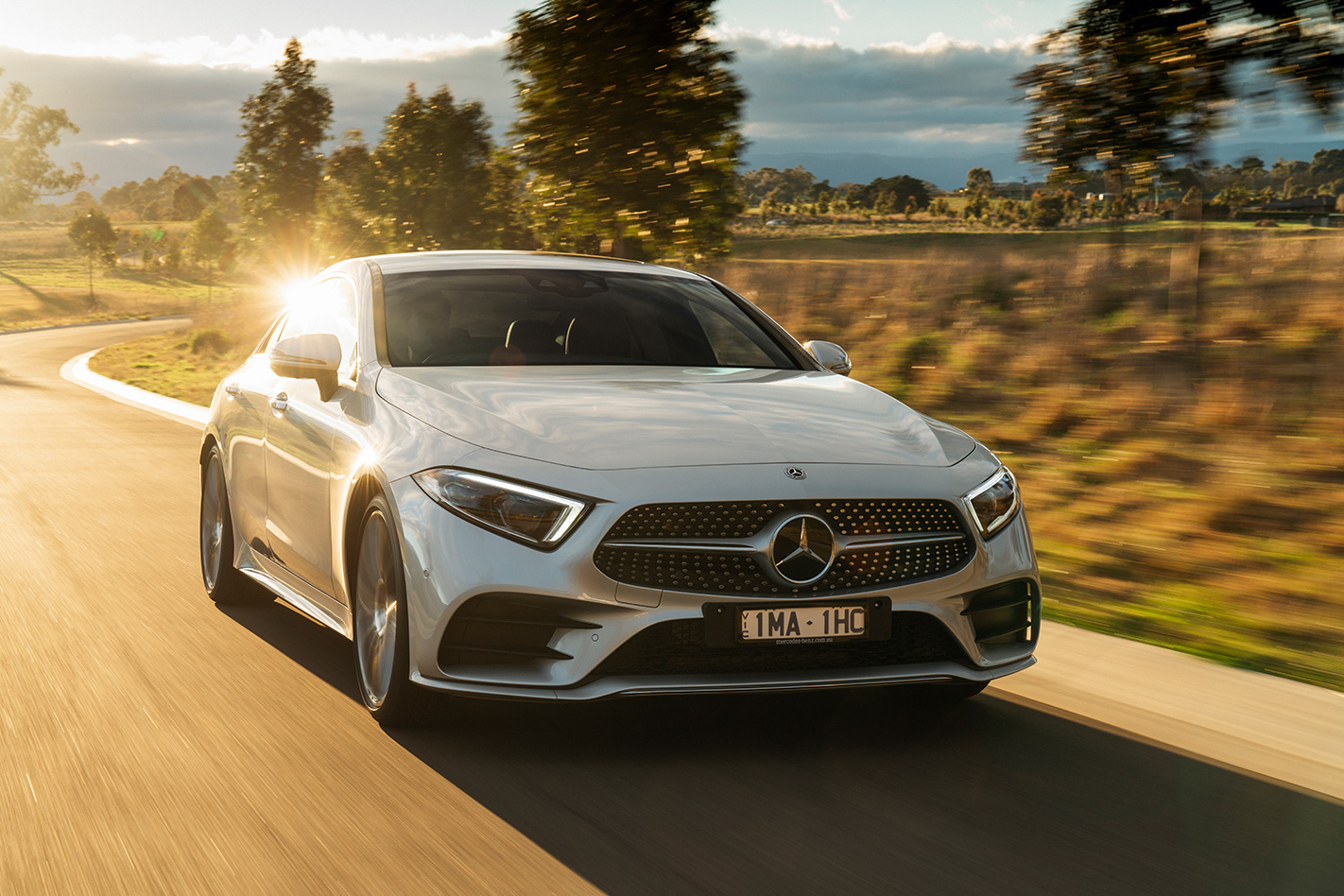
Sound too snoozy for your tastes? The CLS 53 will amp things up in November with a higher-output version of the M256 that features an electric compressor, 320kW, 520Nm (770 with EQ boost) and a zero-to-hundred of 4.5 seconds, but those simply searching for a car that typifies those Benz qualities of elegance and effortlessness need look no further than the CLS 450.
SPECS
Model: Mercedes-Benz CLS 450 4matic Engine: 2982cc 6cyl, dohc, 24v, turbo Max power: 270kW @ 5500-6100rpm Max torque: 500Nm @ 1600-4000rpm (750Nm with overboost) Transmission: 9-speed automatic Weight: 1940kg 0-100km/h: 4.8sec (claimed) Fuel economy: 8.7L/100km Price: $155,529 Available: Now
HYUNDAI Australia has removed any speculation about a local arrival of the i30 Fastback N by officially confirming its appearance in our showrooms from next year.
Overnight the South Korean head office revealed new photos of the i30 Fastback N – a coupe-styled version of Hyundai’s brilliant hot hatch – which show the car at a racetrack track with heavy camouflage covering its bodywork to disguise the details.

Hyundai’s N division has a technical centre at the Nordschleife in Germany, and has been testing the hotted-up Fastback on the famously punishing circuit as part of its development programme.
Confirmation of the Fastback N might come as a surprise to Aussie customers, as Hyundai initially ruled out lesser variants of the big-booted i30 body-style for Australia. However, our appetite for N product has resulted in the single, hot Fastback getting the green light.
Hyundai is yet to reveal the i30 Fastback N’s full technical details and trim specifications, but it does share a platform with the i30 hatch, so expect Australian-delivered iterations to be of a similar set-up.

Locally, i30 N comes in just a single specification, priced at $39,990, with a turbocharged 2.0-litre four-cylinder sending 202kW and 353Nm to the front wheels via a six-speed manual transmission. A variant with a dual-clutch automatic transmission remains in the works.
The i30 Fastback N is the third N model to come from Hyundai’s new performance division, following the regular i30 N hatch, and the Veloster N.
Unfortunately for performance hungry Australians, Veloster N still won’t be taking the boat ride to Australia despite a change of heart around the Fastback. A local Hyundai spokesperson confirmed again to Wheels today that there are no plans for right-hand-drive production of the sporty hatch.

Aussies looking to put an i30 N in their garage will have to form an orderly queue, as Hyundai Australia says there is currently a six-month waiting list for the Korean hot hatch locally.
The i30 Fastback N is expected to land on our shores sometime in 2019, following an official reveal later this year.
Bugatti engineers, look away now – the crew at Royalty Exotic Cars is back.
These are the folks that attempted to DIY service a Bugatti Veyron rather than pay the $25,000 bill. With the car – a rare Mansory Vivere edition – out of warranty for some time, REC has started doing all the maintenance itself, documenting the process along the way.
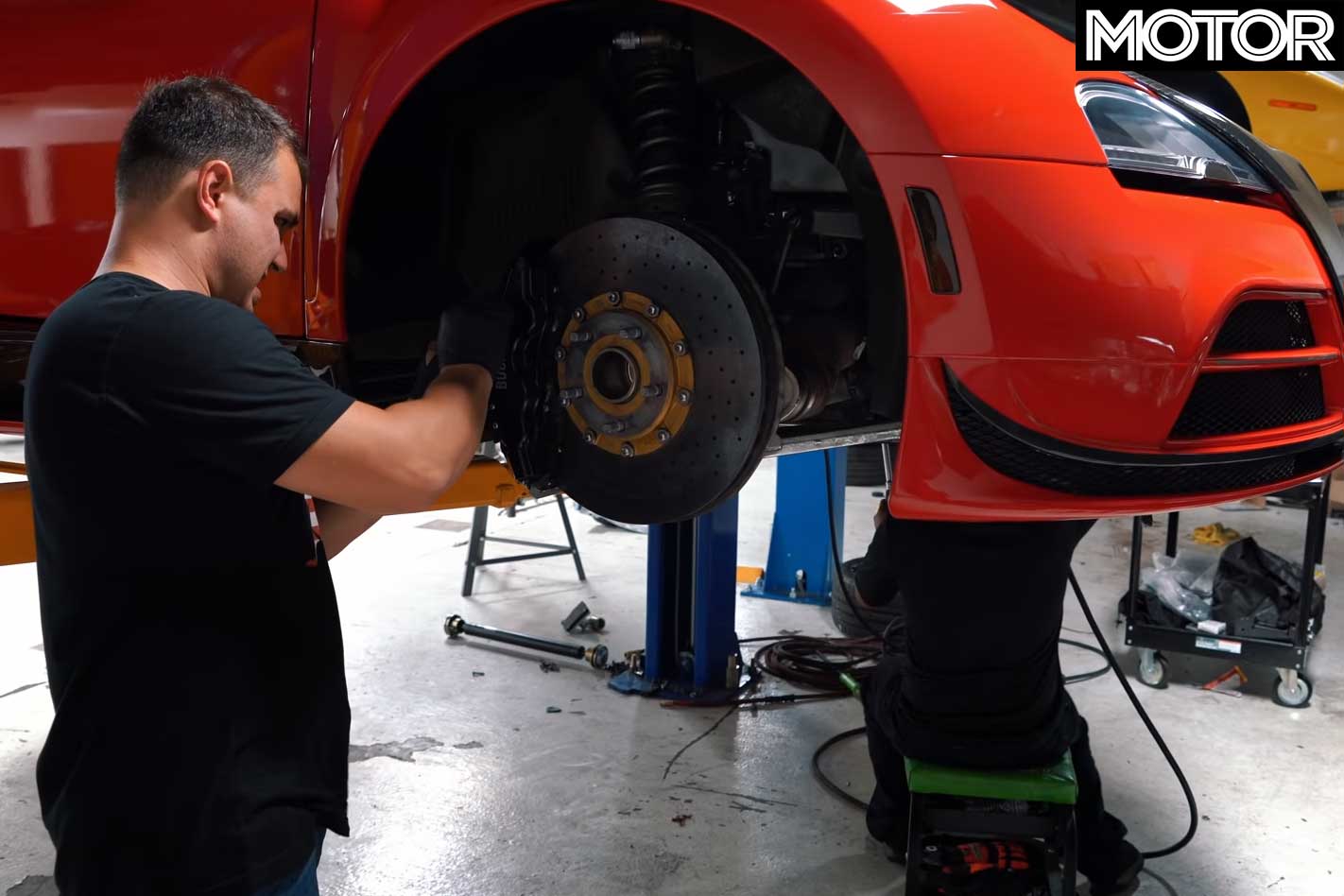
Owner of REC, Houston Crosta, has some crazy ideas. His latest was: “What if we made the Veyron rear-wheel drive?” Having completed the conversion on a previous Lamborghini Gallardo, Crosta’s logic – if you could call it that – is that it would make the car lighter and also more exciting, akin to a McLaren 720S.
To achieve this, Crosta and his sidekick Jesse Tang disassemble the Veyron’s front-drive mechanism, including pull out the axles and removing the front differential. Incredibly, the car not only appears to work without hiccup, it apparently doesn’t even throw any fault codes.
It also vastly improves the turning circle and lightens the steering, which is unsurprising given the lock will no longer the restricted by the drive shafts and the front wheels are no longer driven.
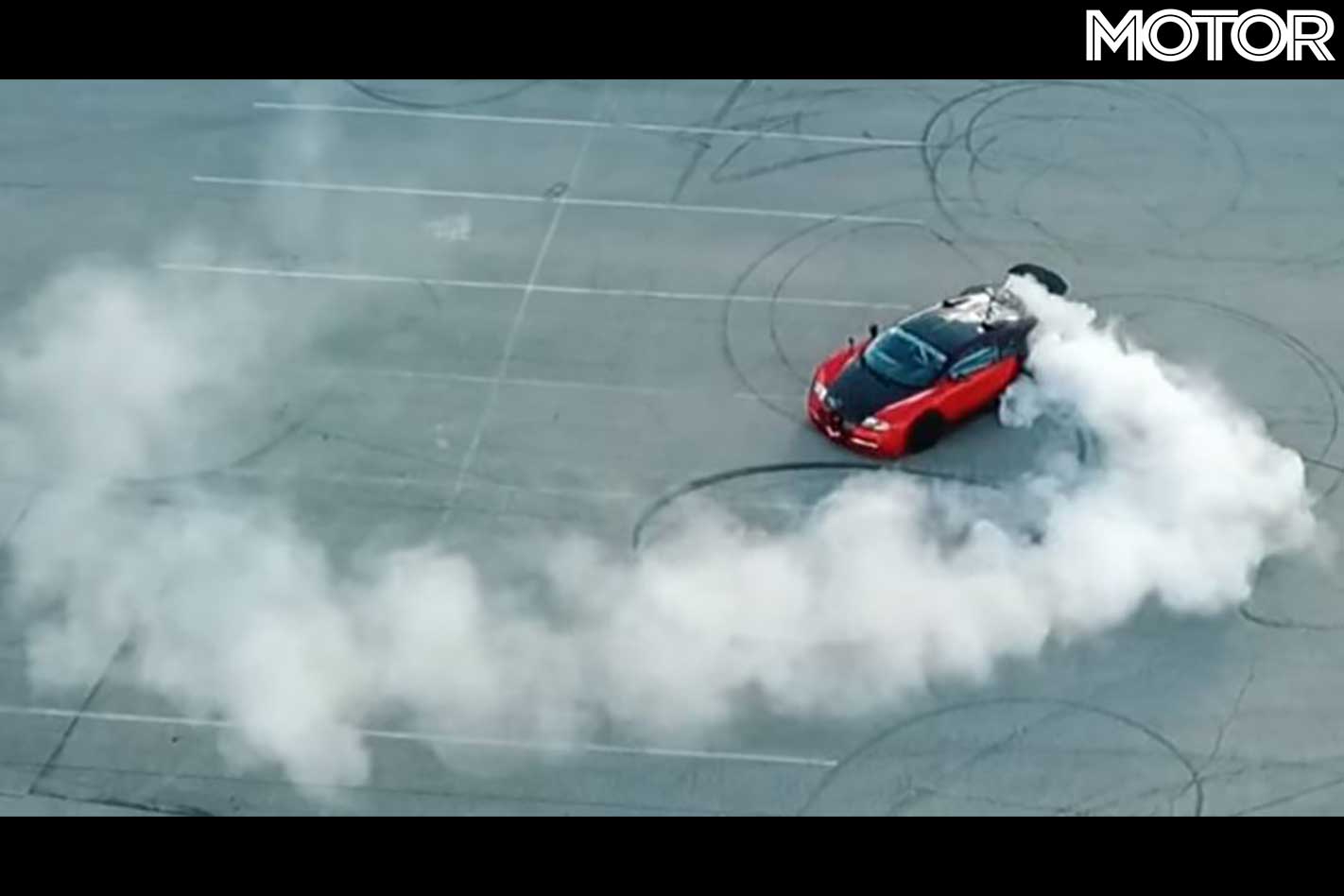
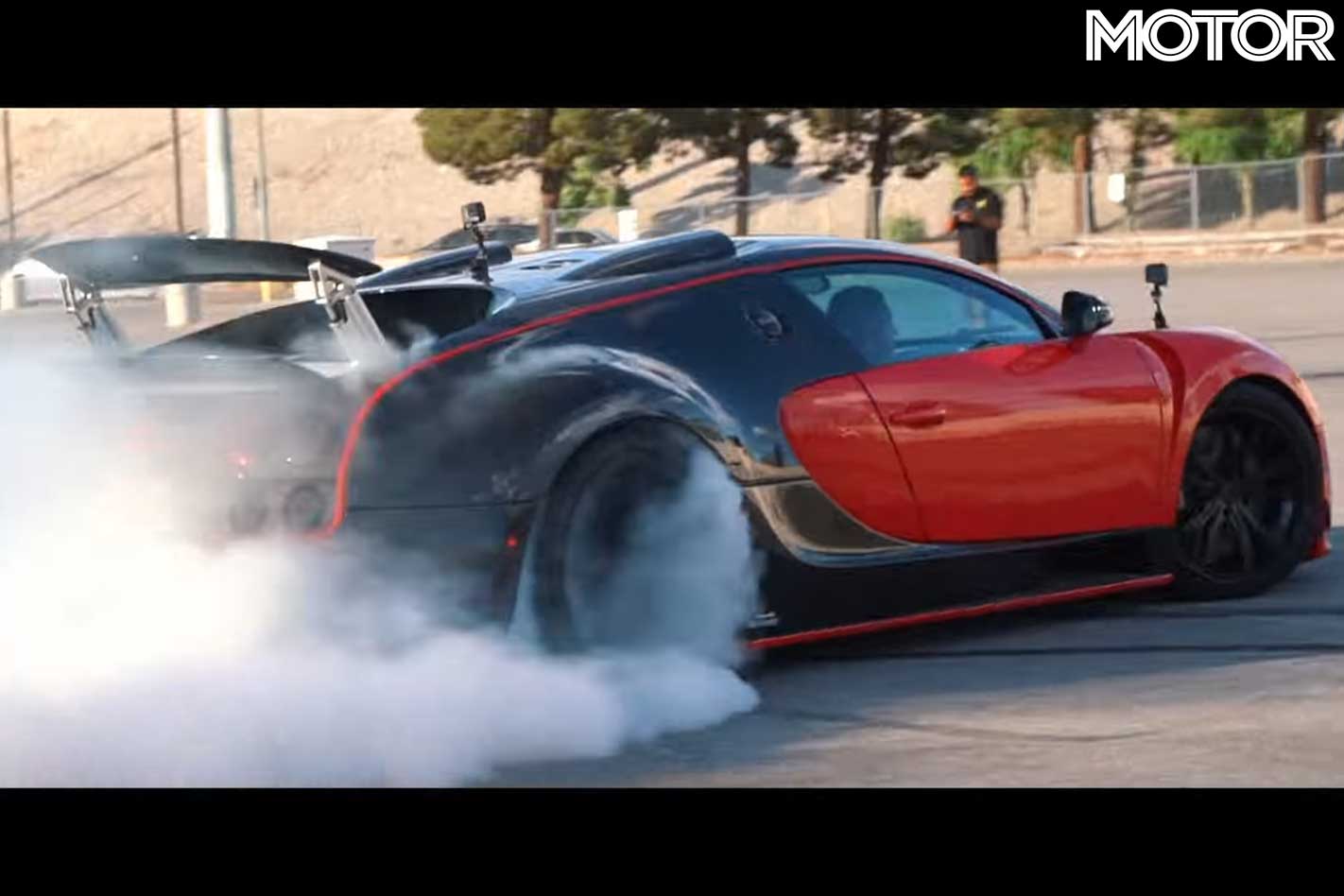
After a short shakedown, Crosta tests the Veyron RWD in a time-honoured Aussie tradition – donuts. Lots and lots of donuts. As you’d expect, it proves rather adept, with 736kW/1250Nm from its 8.0-litre quad-turbo W16 fed through just the rear tyres.
So adept, Crosta burns through a brand new set of 365mm rear tyres in moments, not good when they are $10,000 each. We’re not sure Bugatti will be too impressed, but then again the company has always been about pushing the limits.
The Veyron was often criticised for its somewhat inert handling, so pulling the front driveshafts out is one way to fix that.
Formula One’s wet-option tyre can disperse 85 litres of water a second. When an F1 car is scything through a wet track at top speed, that would mean its four hoops can displace more than 20,000 litres every minute.
You can thank an F1 tyre’s cuts and grooves for that fire-hose worthy flow. Your tyres have them as well, they’re called tread patterns. And when clouds cry, their job is to bite into the road surface through a film of water. This braking test is designed to reveal if they add more than just an aesthetic look.
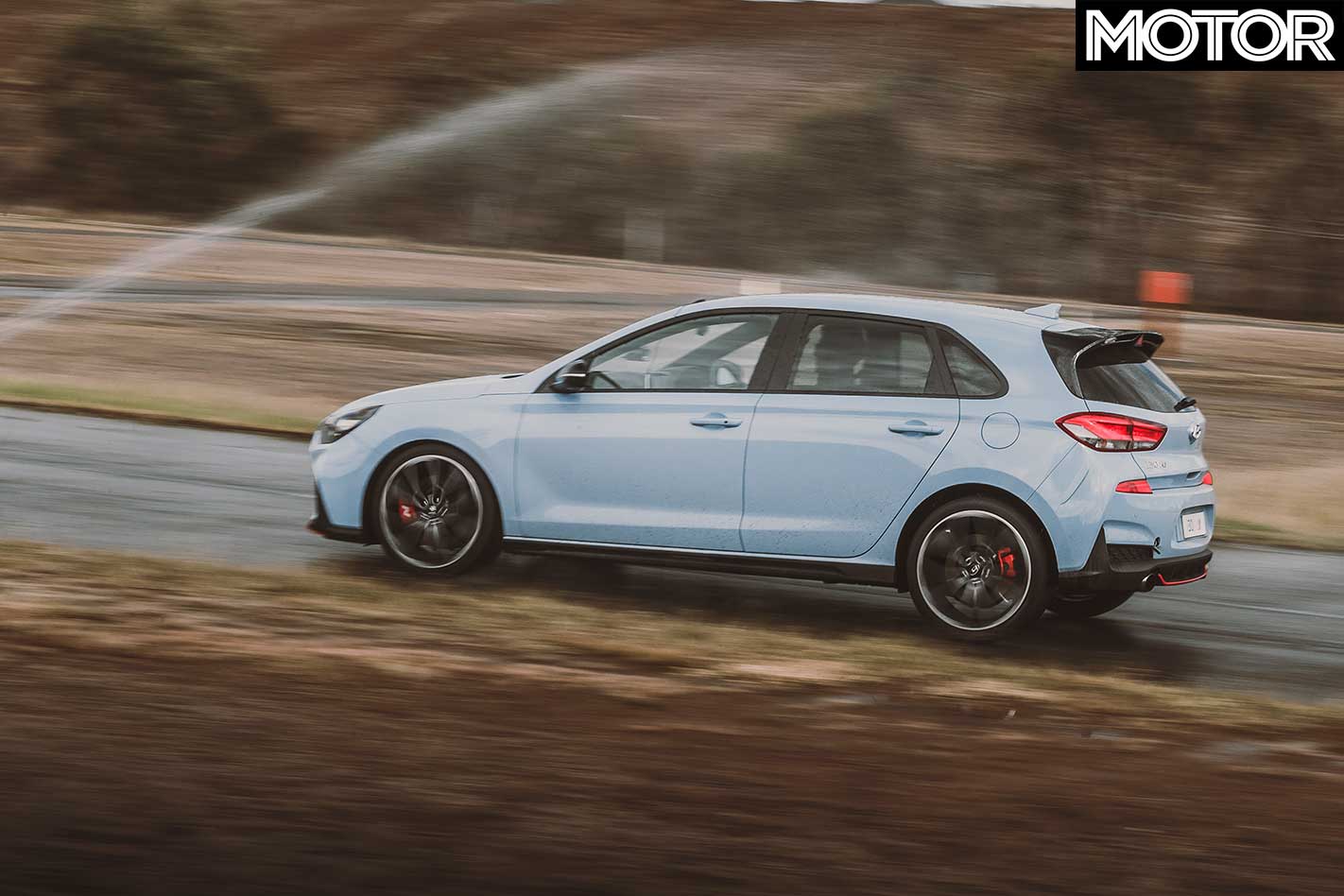
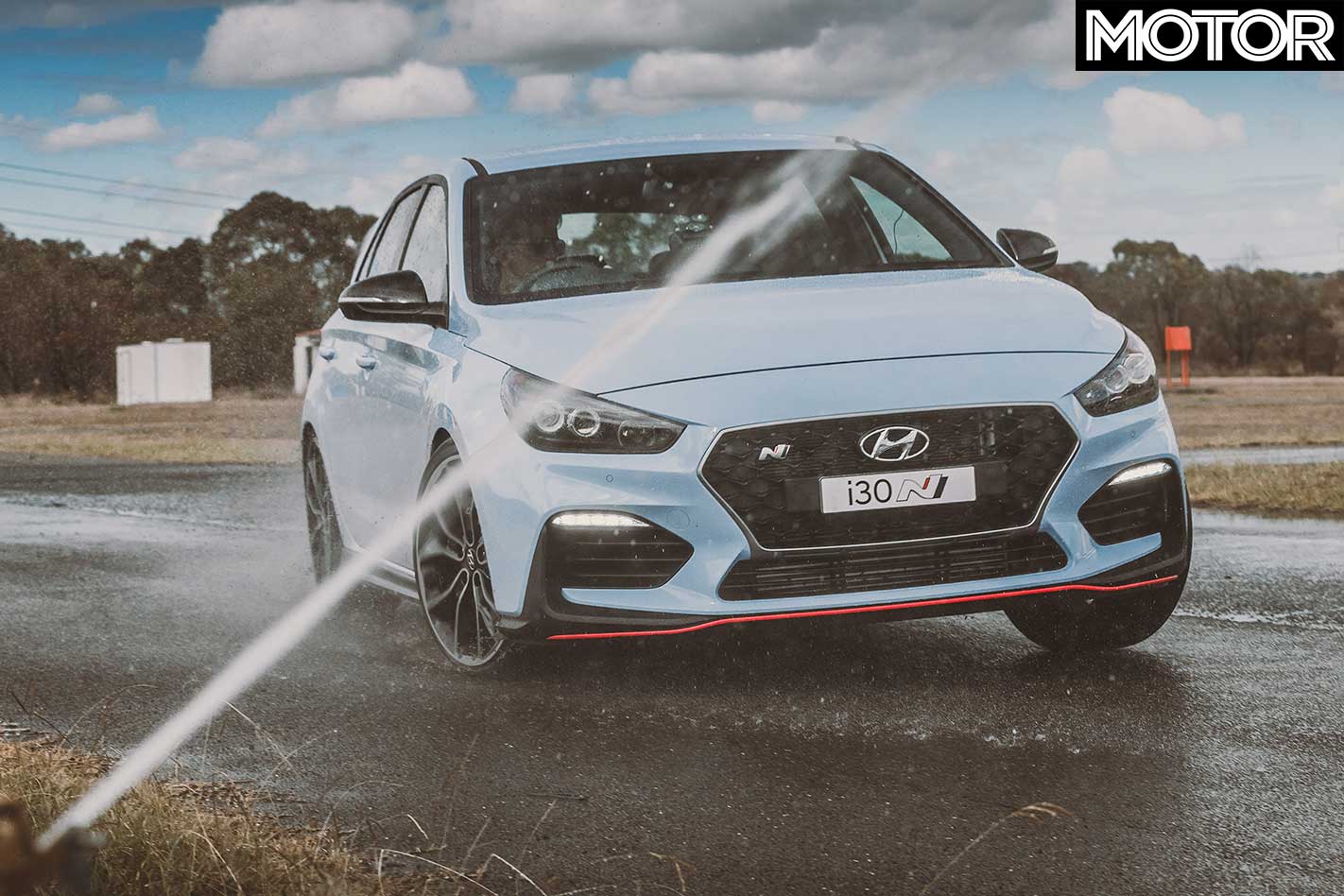
We’ve placed two impact sprinklers along a 30 metre stretch of tarmac. They won’t send Noah after an ark, but they drench the surface nice and evenly to leave small pools of standing water.
Luffy will barrel into the braking zone with ABS fully engaged, like the dry-braking exercise, allowing the Driftbox to measure the distance it takes for the Hyundai to go from 70km/h to rest. It’s repeated three times before we rank the averages.
The Dunlop’s chances are smothered early when the Continental’s first stop matches the Dunlop’s best. The SportContact’s chunky tread blocks and minimal cuts prove more water-loving than anyone could imagine. That’s not the same story for the Goodyear. Traditionally keener for a swim than a Pommy at Bondi, the Eagle F1 Asymmetric 3 needs another two metres to arrest the Hyundai.
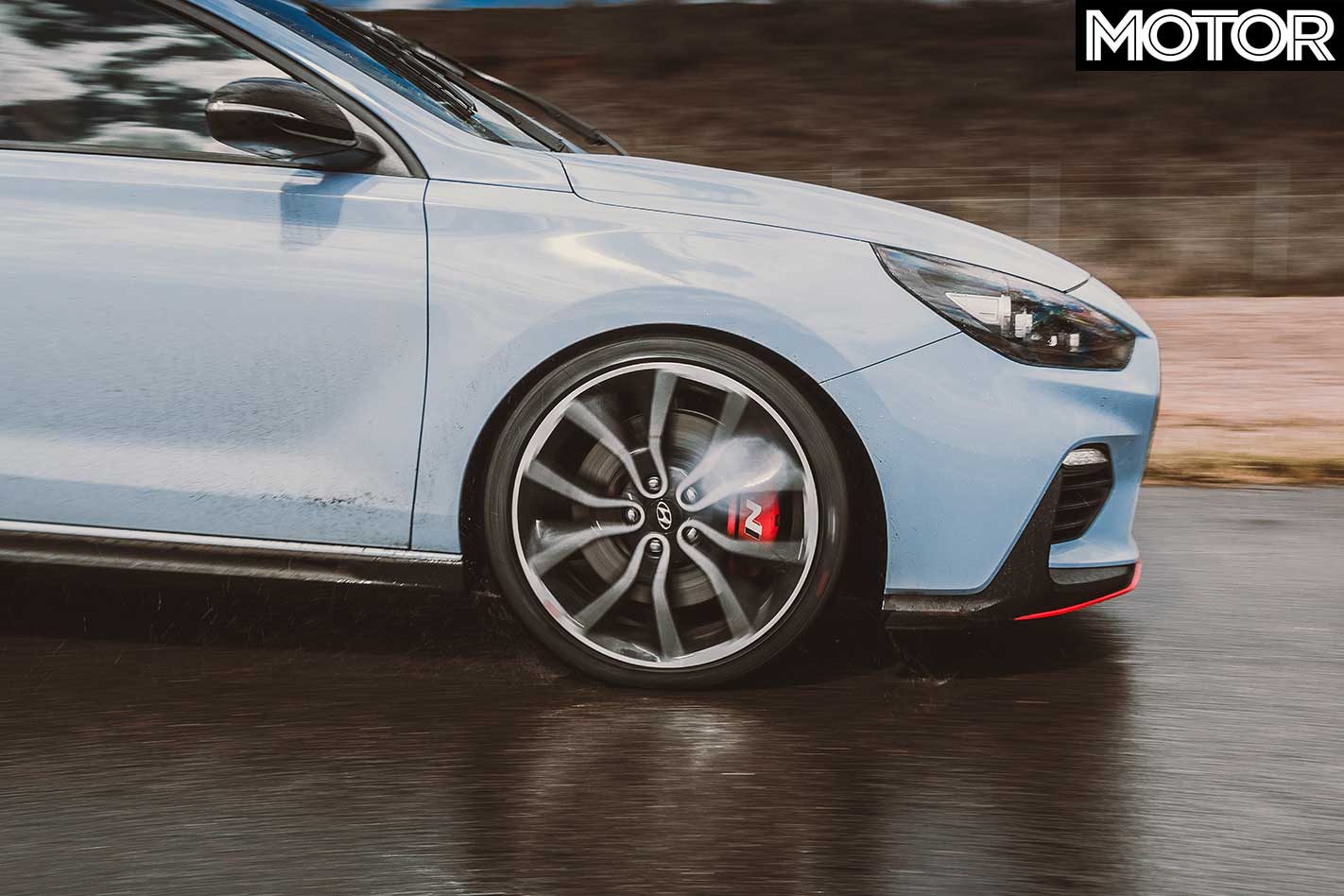
Falken’s FK510 starts off with a 19-metre stop to signal there’s still fight in this tyre. And its brilliance is only magnified by the Laufenn’s lack of it, as the Indonesian-made tyre sails along to 22 metres on its first try. While the Laufenn is claimed to be a comfort-focused tyre, there’s nothing comfortable about colliding with a courier van’s rear bumper because your tyres can’t pull up fast enough.
The Kumho, our second-last tyre to run, makes an unbelievable lunge at the top spot by either matching or beating the Continental on every stop. As it turns out, though, the day’s warmer temperatures gifted later runs an advantage. And the Kumho’s re-calculated score dissipates its chances for first place.
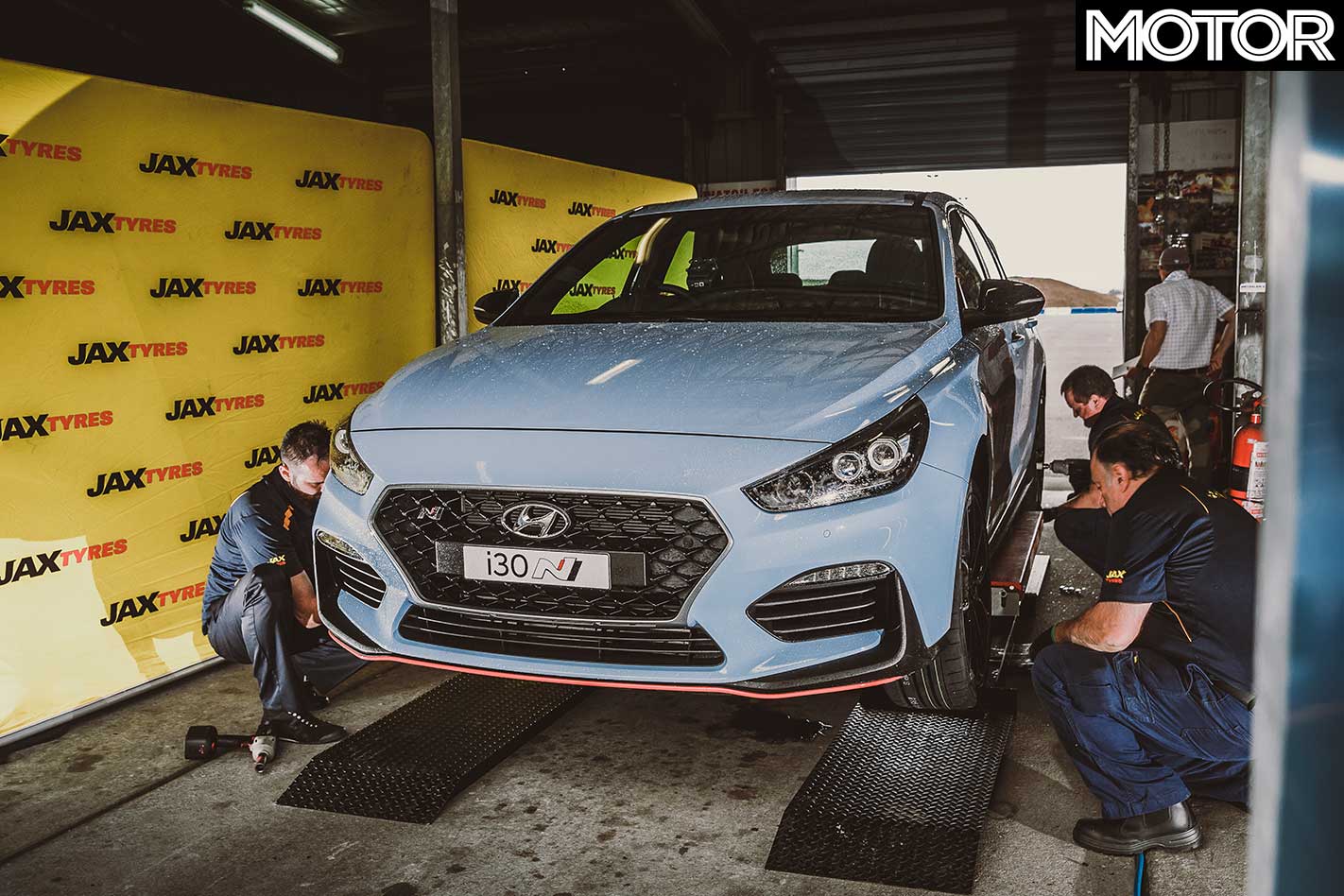
The Achilles makes another trip to the bottom of the order. Its 22.24m average distance is about 14 per cent worse than the best. There is some good news for the bottom half of the field, though. Luffy says the Nexen has enough braking feel to give the driver decent confidence.
Wet Braking Results
There’s nowhere for a tyre to hide on a racetrack. It needs to repeatedly brake, turn, grip and go, often at the same time. And while our motorkhana circuit won’t make the Supercar’s calendar, its tight hairpins and fast sweeping right-hander is more than enough to sort one-trick ponies from true all-rounders.
Considering the course’s short length, Luffy will do three laps to reveal even the slightest performance differences. Each three-lap run is timed on a stopwatch. We have a Driftbox for back-up, but it only goes to one decimal place.
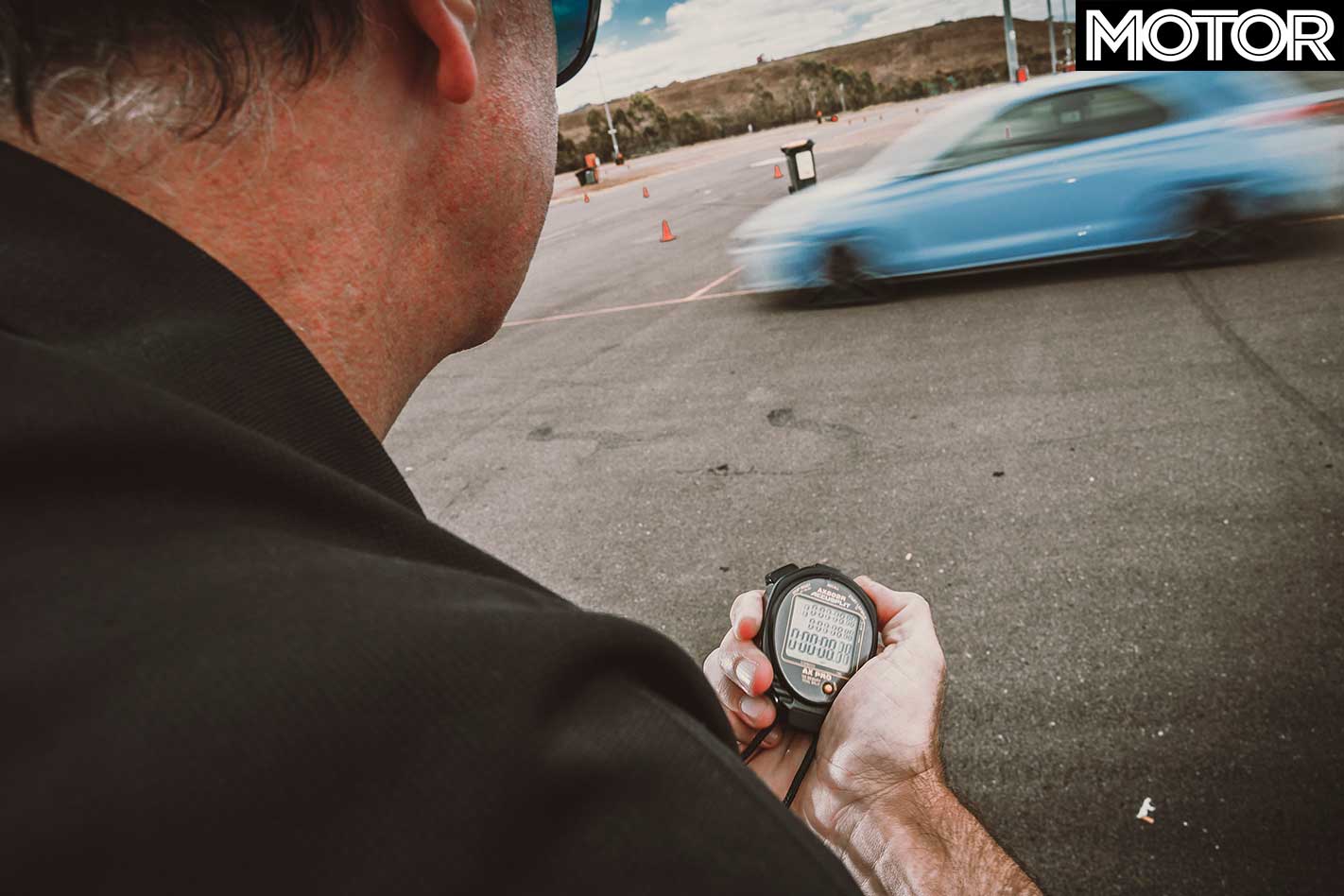
Starting off with the Dunlop, Luffy earmarks the German-made hoop’s talent early, saying “its ability to carry speed into the corner, and not wash out with any mid-corner understeer”, was really impressive. Positive signs indeed.
The Continental next makes a charge for the Dunlop’s time. It finds more grip in corners, generating an extra 0.05G, but can’t find speed elsewhere. The Goodyear and Falken then mount an attack. They end up only two hundredths apart from each other and match the Dunlop’s peak 1.03G during their runs, but can’t get within a second of its leading time.
Things gets progressively worse from here, the Laufenn, Invo and Nexen each going slower than the tyre before it. “That harder compound gives [the Laufenn] more understeer and ultimately affects the grip,” Luffy remarks. He’s similarly disappointed in the Nitto Invo, saying “you can feel the level of grip start to fall away quite early in the corner,” and the Nexen, adding “again it’s just that overall lack of grip.”
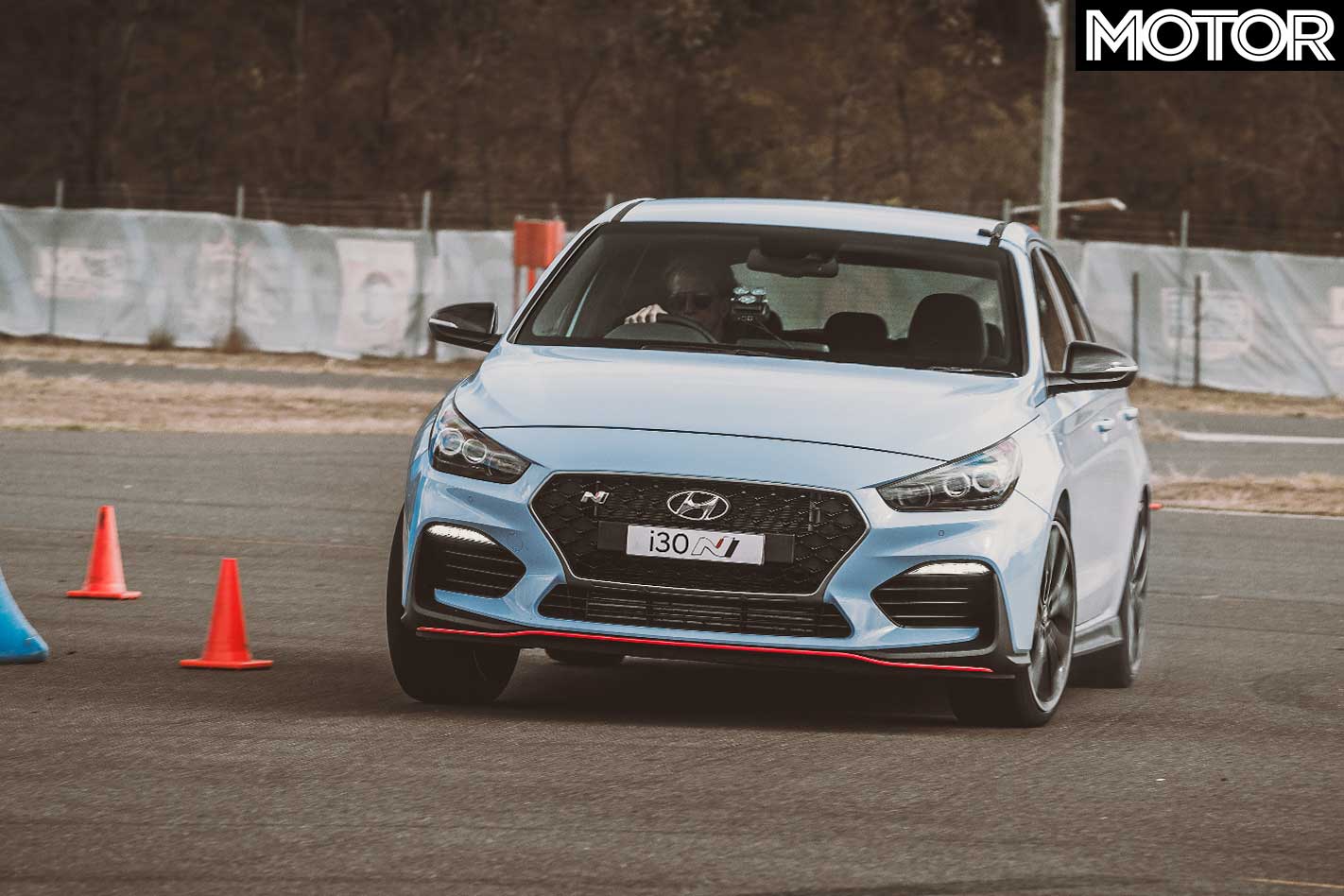
Things improve when Luffy arrives smiling after testing the HiFly Challenger. “That was fun,” he blurts. “Through the sweeper, they tend to oversteer, but as they get hotter they grip up.” Though they still can’t convince the stopwatch.
The competition Pirelli does a better job by registering the first decent time since the Falken, but it’s the Kumho that puts everyone on notice. “Look out Conti,” our timekeeper says as he reads the PS91’s time. Luffy’s eyebrows are raised as he enters the pits, surprised by its turn of speed.
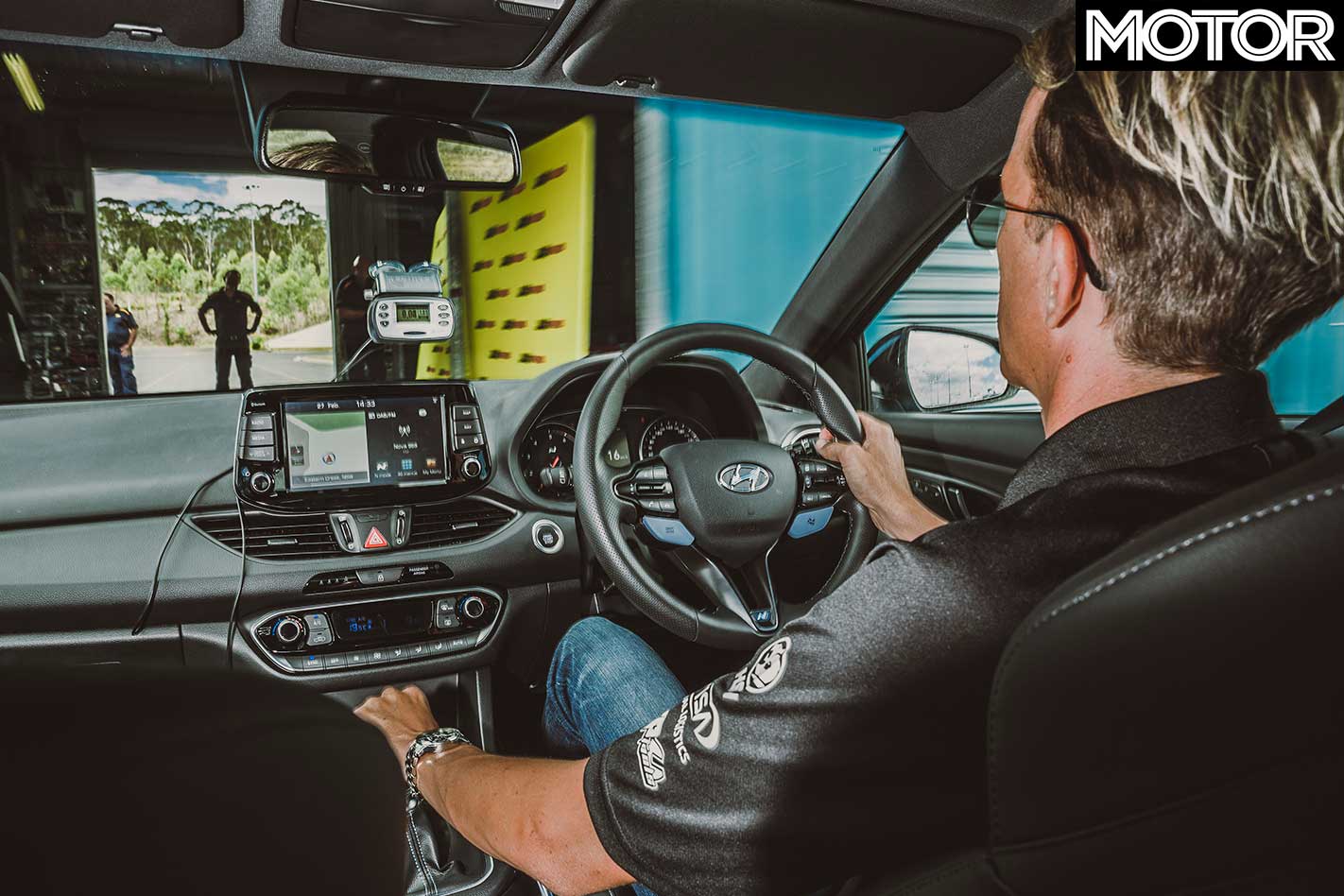
While the Kumho’s cracking pace would have bagged it second place in the motorkhana, the control tyre data has other plans. Its performance improves through the day, giving earlier run tyres an advantage, and thus hoists the Continental above the Kumho and into second place. But that’s the single change in the whole field and leaves the Dunlop as our motorkhana lap-meister.
