
There’s a problem that many motoring enthusiasts face at least once – not having enough space for another car.
This house looks like the ultimate solution to that problem.
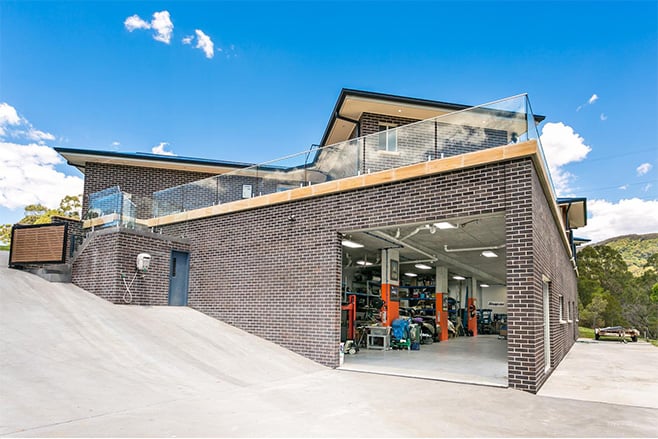
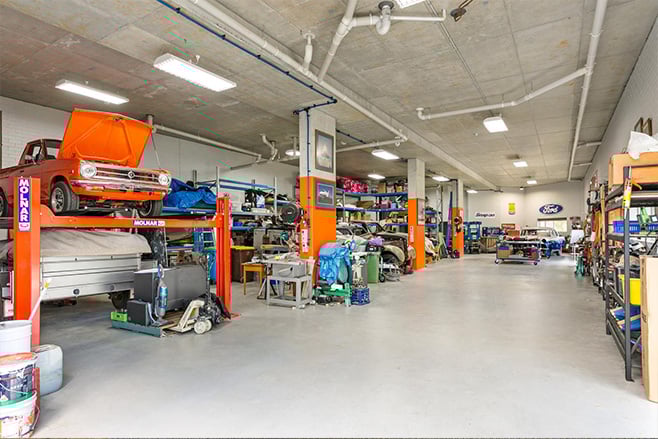
Located by Mount Kembla, west of Wollongong, the 12-month-old four-bedroom house has one rather large plus for car nuts – a full-sized workshop and garage space for 12 cars.
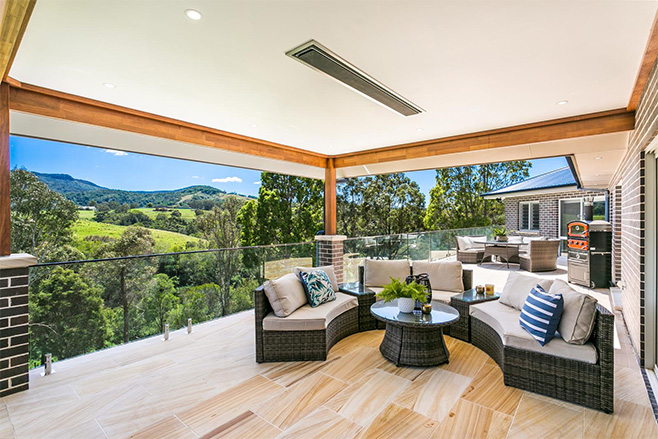
On the main level, it’s all business as usual with a two-car garage, the house itself, and a rather nice balcony that overlooks the rolling hills behind it.
There’s even a cellar, a bathroom, and a large storage area which all adjoin the workshop.
We’re not sure whether the hoist which is currently there is included with the house.
We’d say the place looks ripe for a custom or prestige car business, especially considering the house is only a little over an hour from Sydney.
With the workshop being the obvious main attraction, there’s another selling point this house has going for it – it’s actually really nice.
Sure, the garage would be enough for most enthusiasts, but if you’ve got a parter and/or family, they’re going to want to like the place too.
You can find the listing from Belle Property Wollongong here. The house goes to auction on January 19th.
THERE are many noises you expect to hear while powering a V12 Ferrari up a tight rural road, but the crack of a gunshot isn’t one of them.
Watching in disbelief as a farmer, his face mottled and purple with rage, takes stock after charging down his driveway and unloads two more shots – crack, crack – across my bow is equally high on my ‘unexpected’ list.
The gun-toting farmer finishes his performance by slowly and deliberately drawing his thumb across his veiny throat. I glean from this that he mustn’t like Ferraris.
Having arrested my attention, what follows is something of a standoff: the farmer poised at his fence line, his chest heaving and trigger finger quivering, while I sit in the Ferrari, my hands gripping the wheel tighter than normal, wondering what I’ve done to upset him.
My puzzlement is genuine; we’d been using this stretch of empty rural road for photography and I had driven past his house twice, but I wasn’t speeding. I wasn’t hooning, or sliding – though Ferrari’s latest version of Side Slip Control did make the latter tempting.
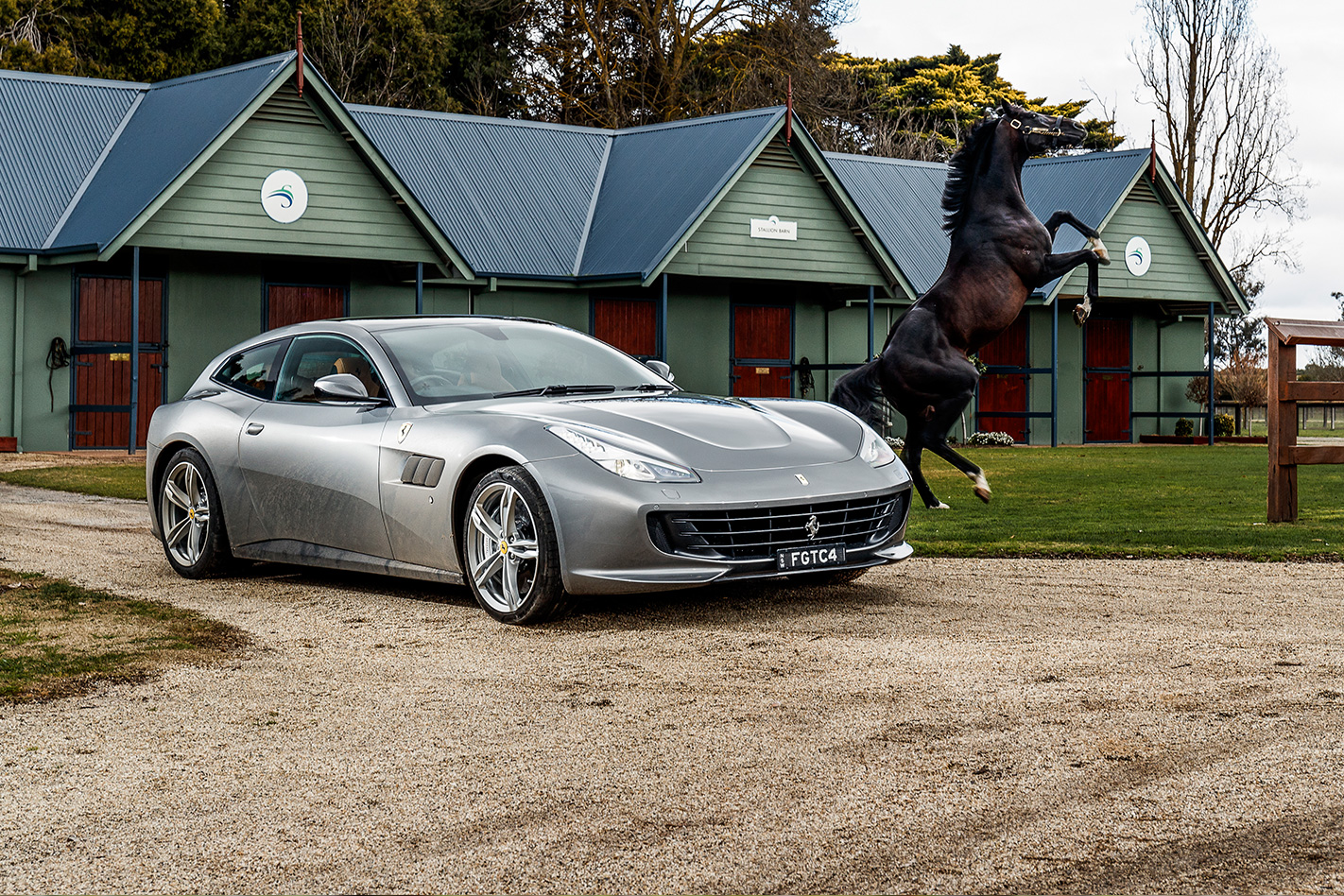
Eventually the impasse is broken when another car appears, the farmer turns on his heel and I drive away slowly, my eyes nervously glued to the rear-view mirror.
“What a shame,” I think to myself. “He totally missed the point.”
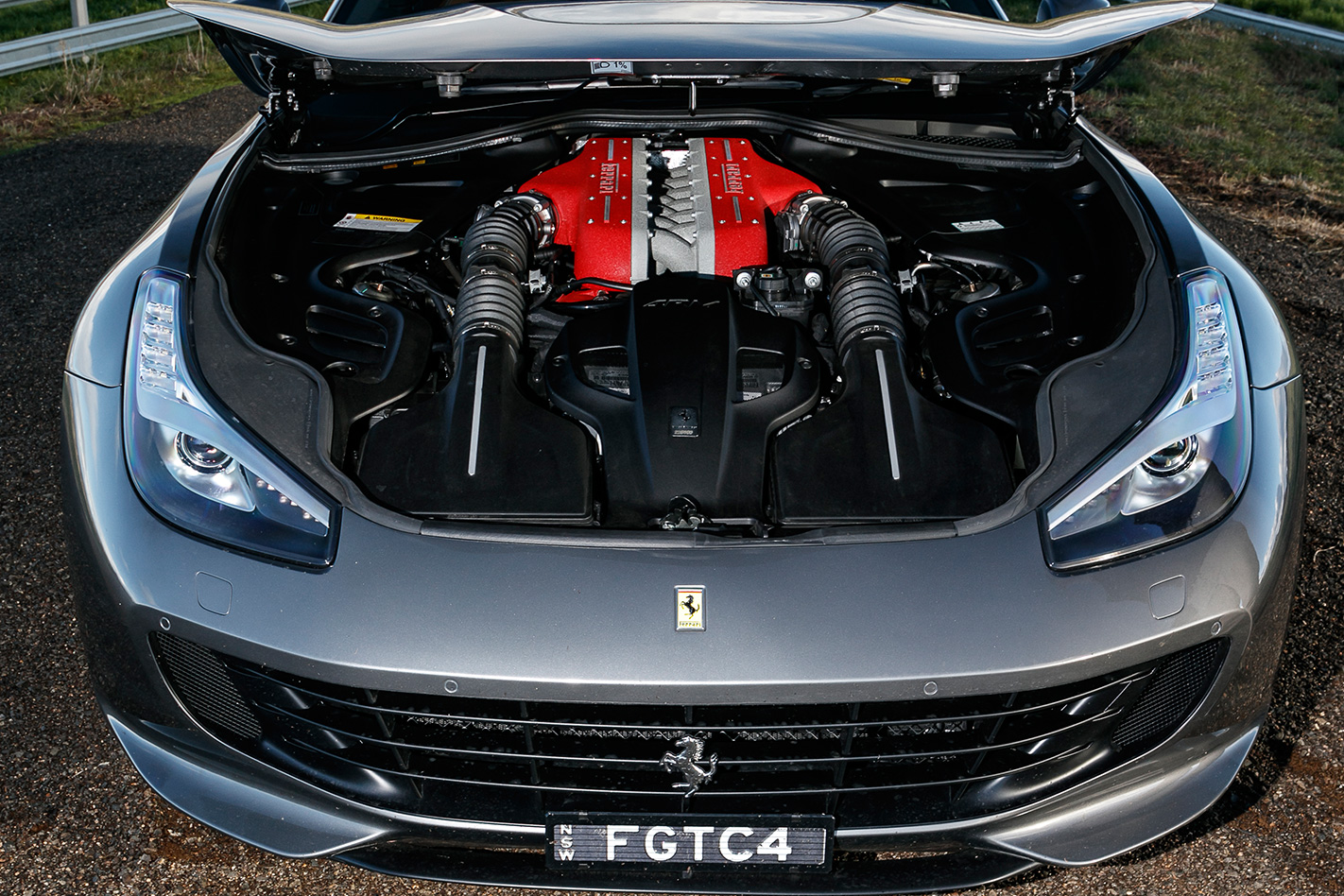
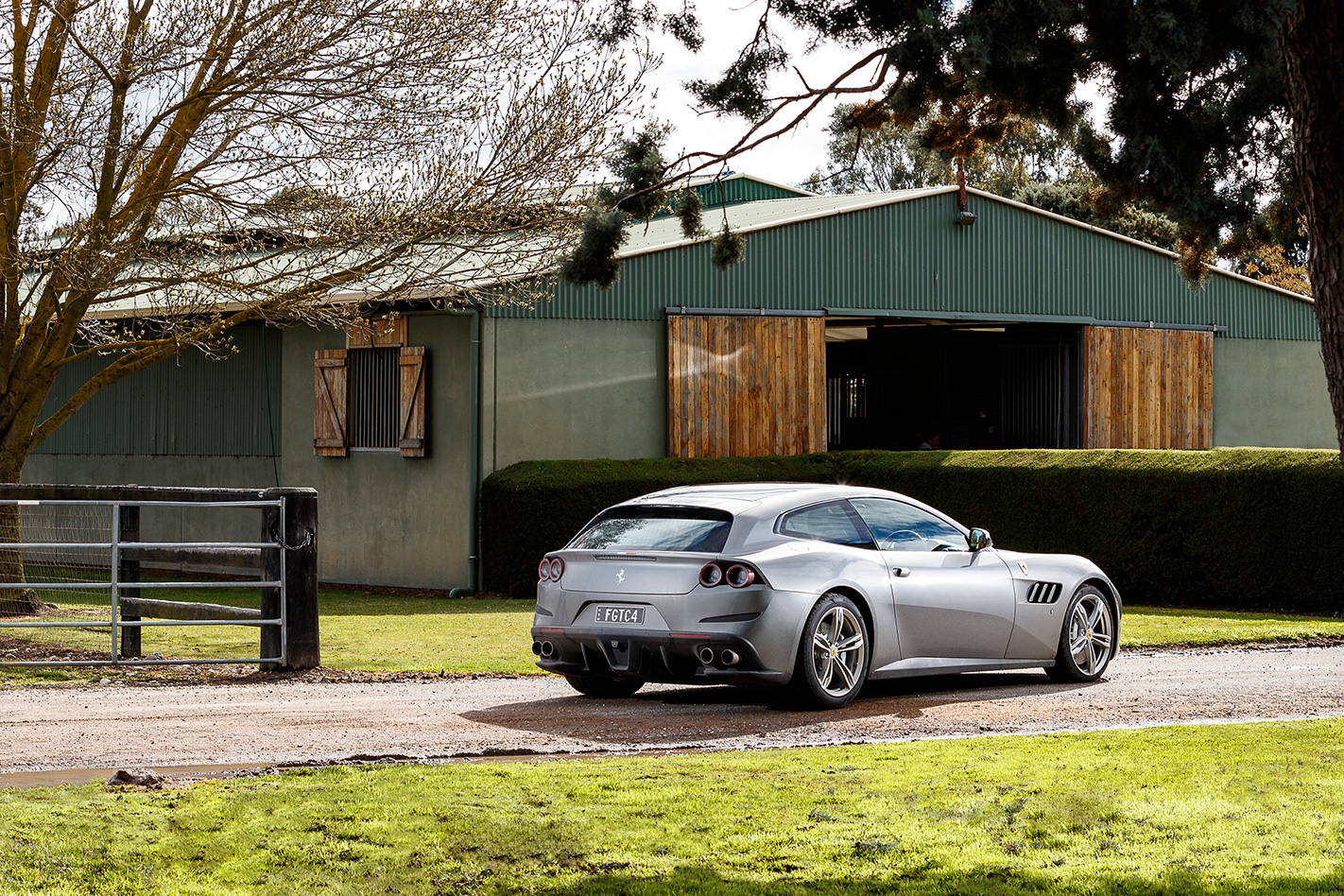
Ferrari will tell you the GTC4Lusso is ‘all-new’, but in reality, it’s a facelift. The same basic recipe from the FF remains: big naturally aspirated V12 up front, plenty of room for four in the middle, and enough load-lugging ability and versatility to satisfy even heavy packers out back.
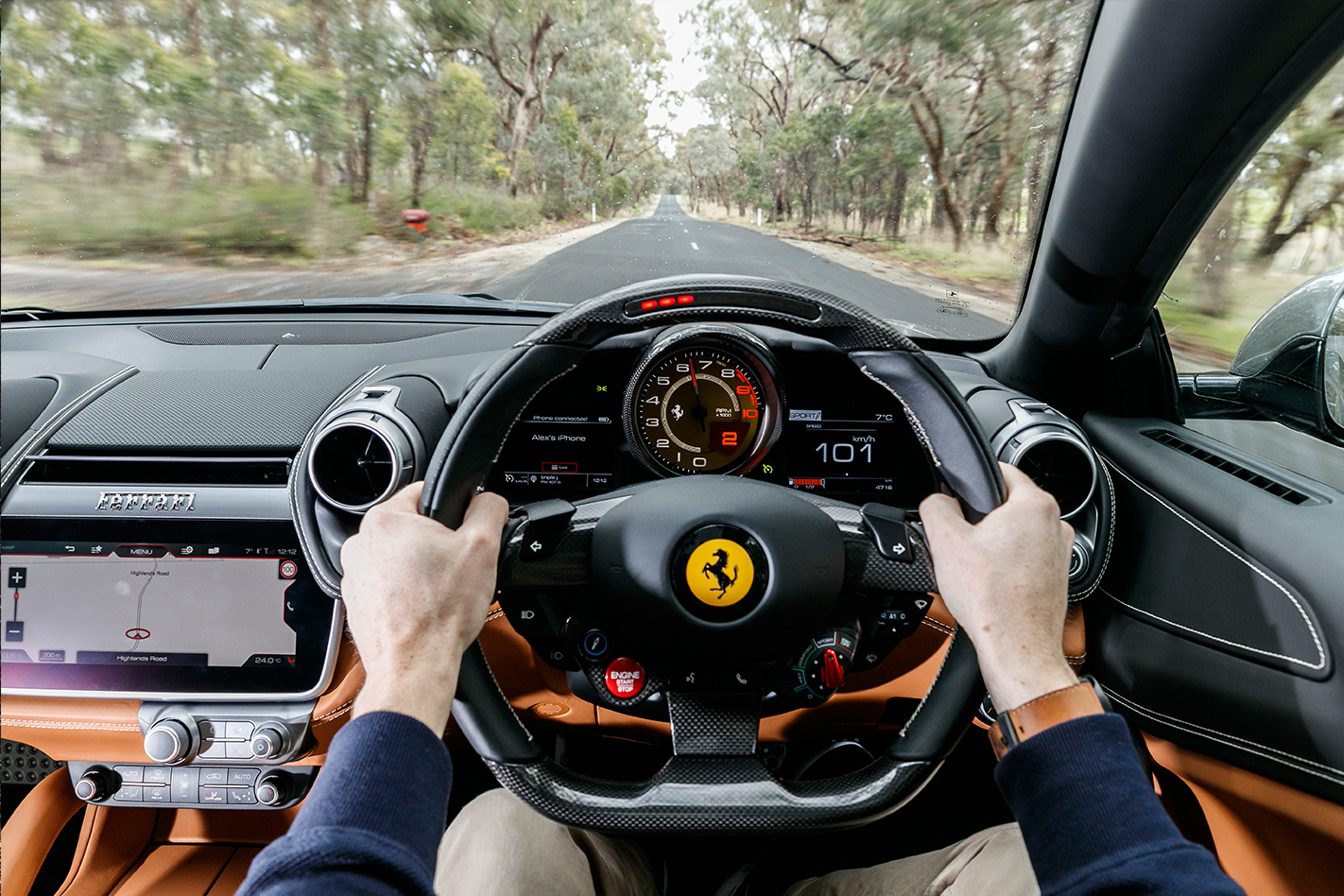
Inside, the cabin has been totally redesigned, and now boasts an eye-catching 10.2-inch infotainment screen and a new steering wheel with a smaller centre boss and revised switchgear. It’s a special place to sit; the leather seats waxy and supportive, the fit and finish exemplary, and the quality of materials top shelf.
Cabin space is up fractionally too, with rear passengers scoring 16mm more leg room to go with surprisingly comfortable bucket seats capable of swallowing 6ft adults. The back also scores air-con vents, cup-holders and USB outlets.
The mechanical changes appear more subtle, at least on paper, yet like the rest of the Lusso’s tweaks they coalesce to produce a package that’s markedly more aggressive.
Most of the grunt is sent to the rear wheels via a seven-speed dual-clutch ’box, but as in the FF, the Lusso uses Ferrari’s unique take on four-wheel drive. Dubbed 4RM EVO, the system has no mechanical link between the front and rear axles, and instead uses a power transfer unit to take drive directly from the crank, which is then split between the front wheels by a pair of clutches.
The big news, however, is the addition of four-wheel steering to improve high-speed agility and importantly, low-speed manoeuvrability, which is handy in a low-slung sportscar that’s almost as long as an S-Class (overall length is 4922mm).
Yet despite the new tech, this remains a car dominated by its engine. In this age of forced induction it’s easy to forget just how special a big-capacity, free-breathing unit can be at full noise and Ferrari’s 6.3-litre V12 is a triumph.
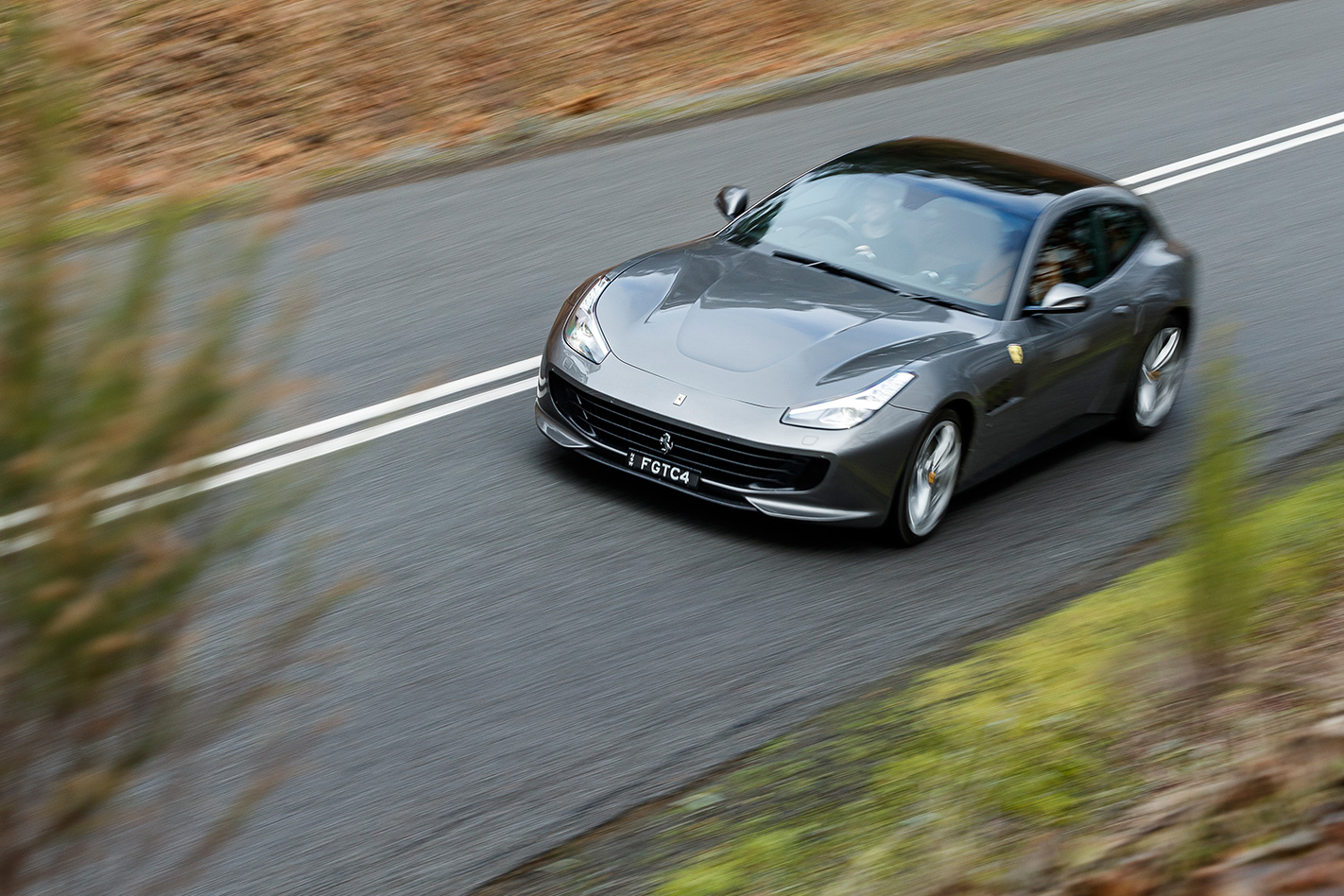
Ferrari claims 0-100km/h in 3.4sec (three tenths quicker than FF) and on bumpy Aussie roads, it feels every bit that fast, the sensation of speed enhanced by the scream of 12 cylinders working at fever pitch.
It’s the noise, I’m sure, that drove the farmer batty. Ferrari has tuned the exhaust to be quieter on start up (the FF was an anti-social old thing), but with the baffles wide open, the Lusso emits an operatic howl that can be heard for miles.
There’s plenty of handling nous to back up it up too, despite the Lusso’s GT positioning. Admittedly, throw it at a slew of tightly stacked hairpins and you’re reminded this is a big, heavy car (kerb weight is 1920kg), but through high-speed sweepers on open, flowing roads, the Lusso is in its element. There’s plenty of bite from the Pirelli P Zeros (245/35R20 front and 295/35R20 rear), the nose points accurately and the rear provides that reassuring breath of bodyroll as the weight shifts to the outside tyre.
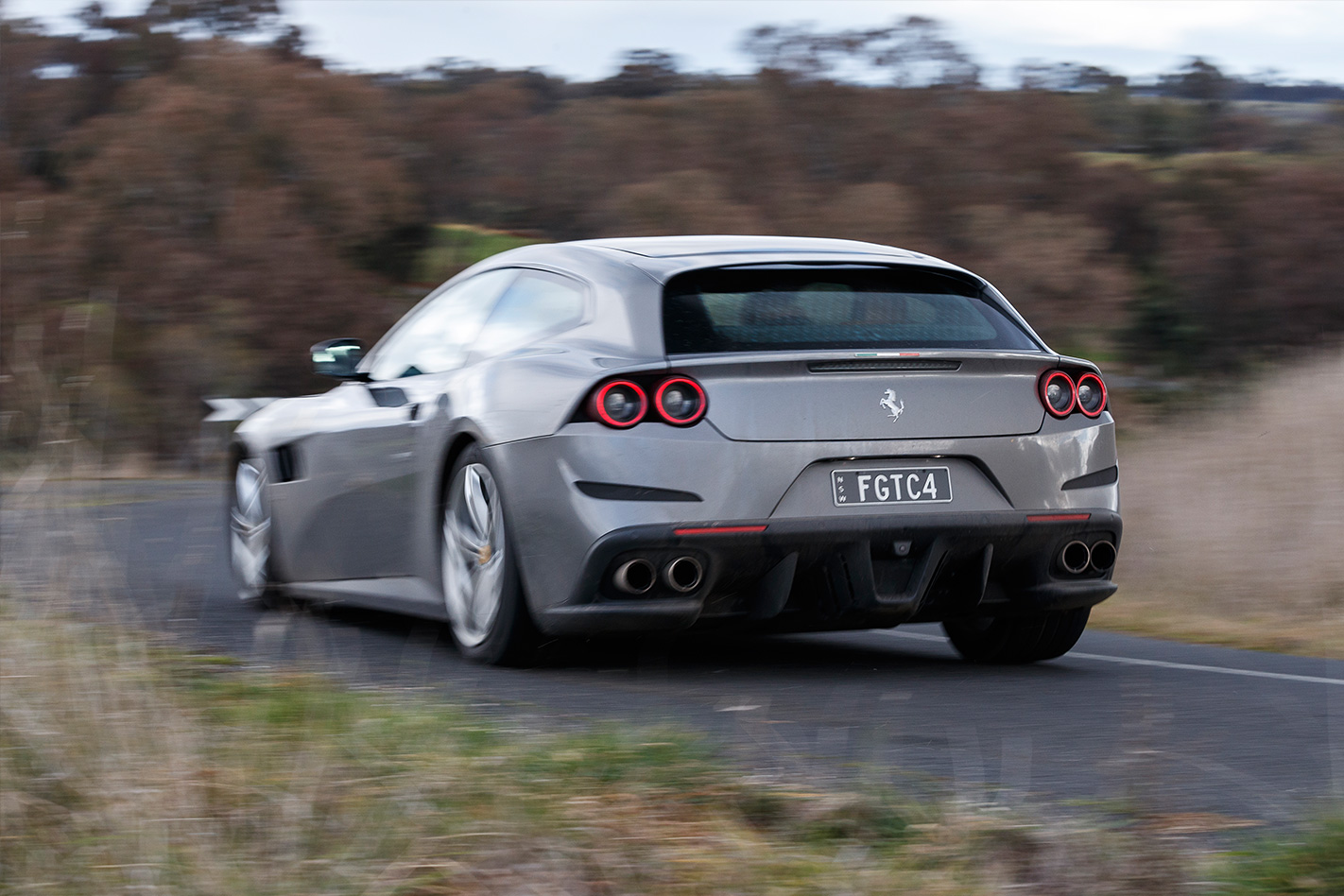
It will oversteer, and on wet roads, heavy-handed use of the throttle results in unsettling armfuls of opposite lock with Sport mode engaged on the manettino, but despite its prodigious speed, the Lusso lacks the adjustability and agility that defines Maranello’s best. Another niggle is occasional tramlining as the front rubber chases the camber and surface irregularities on some roads.
Where the Lusso stands alone, however, is when it comes to cross-country comfort. A well-controlled ride with decent wheel travel and a degree of bodyroll, plus improved NVH and reduced suspension noise, combine to make it a sublime long-distance tourer.
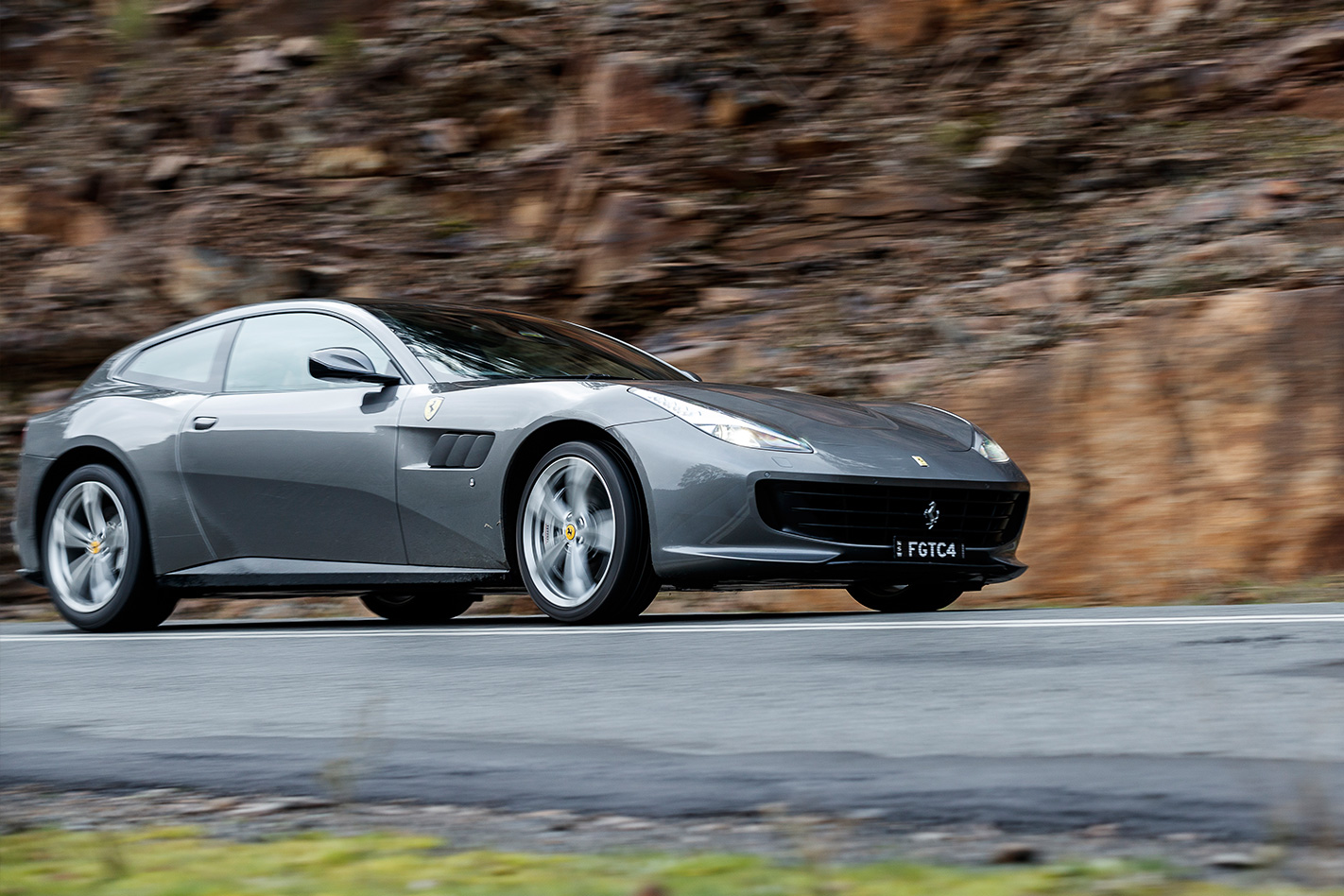
I can think of nothing that is capable of lugging four adults great distances which is this effective, this engaging or this exciting when driven hard.
It feels special, sophisticated, exotic and delivers a notable step forward over the FF.
Why Ferrari feels the need to build an SUV when the Lusso so effortlessly blends high-octane thrills with luxurious practicality is beyond me.
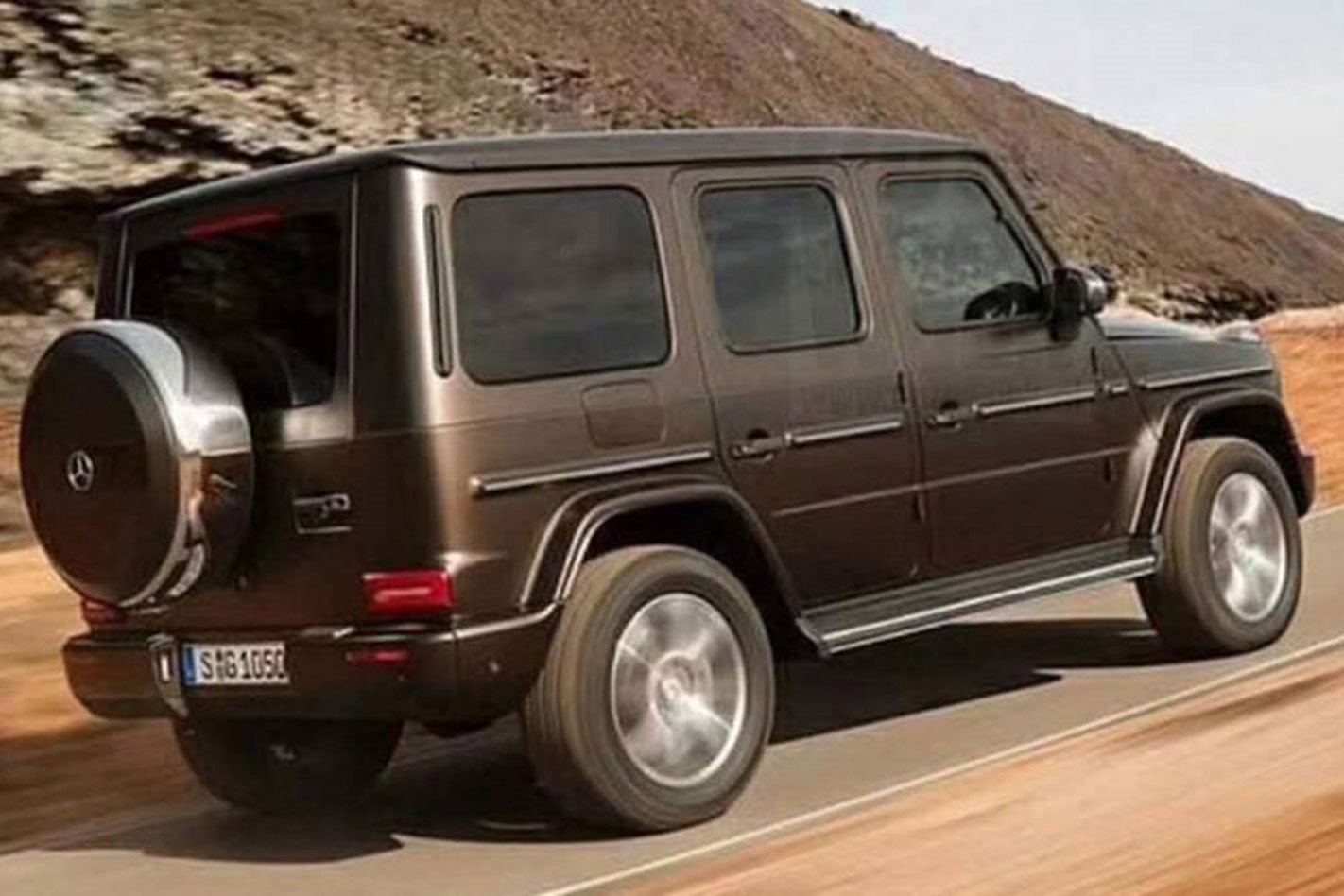
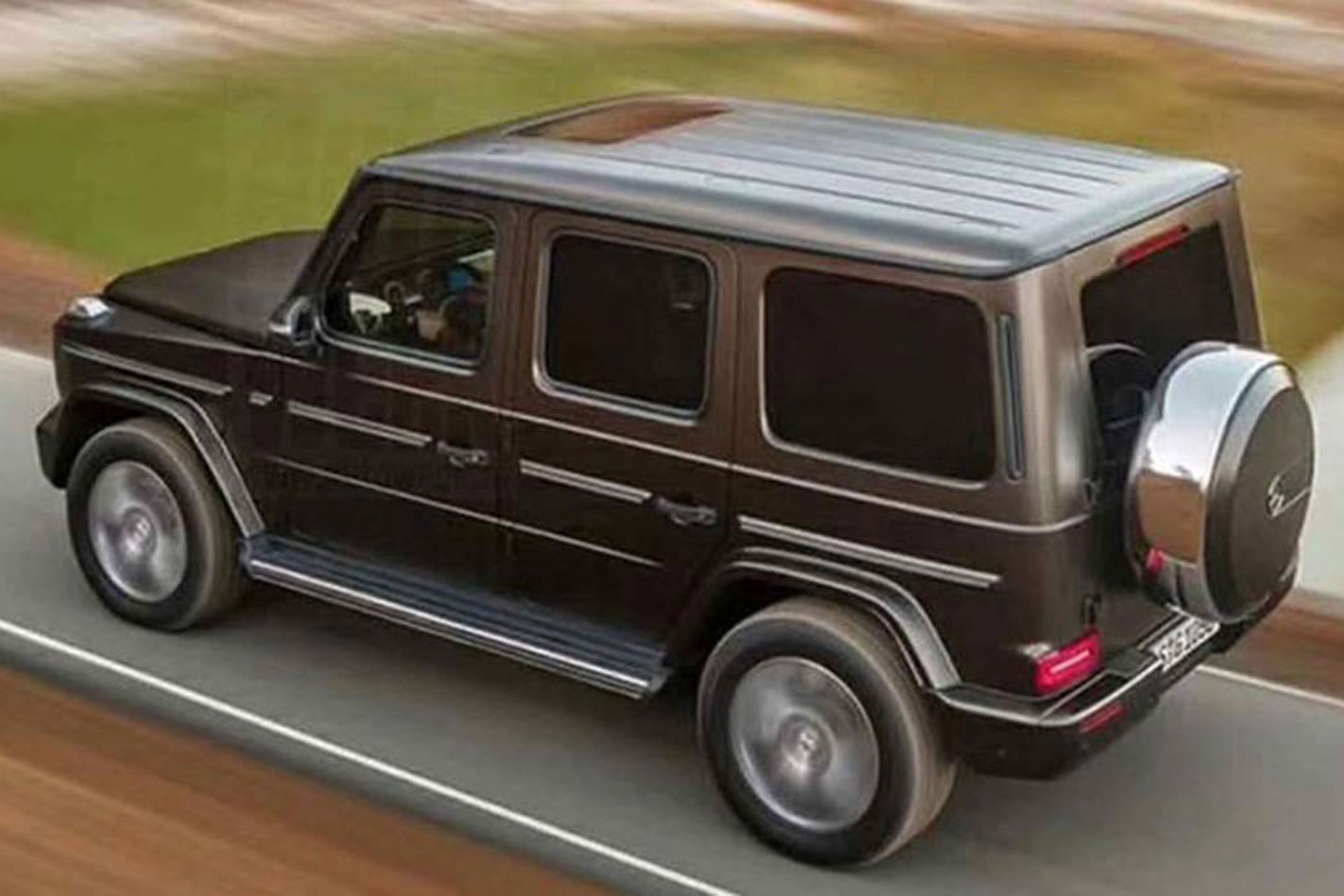
THE 2018 Mercedes-Benz G-Class has been revealed in full ahead of its official Detroit Motor Show debut after images of the boxy off-roader slipped online overnight.
We’ve all but seen all the elements of the third-generation G-Class – the civilian version of the military-spec G-Wagen that’s recently been added to Australia’s army car pool – but up until now, the exterior has worn heavy camouflage. These pics, though, give us our first look at what lies beneath the dazzle disguise.
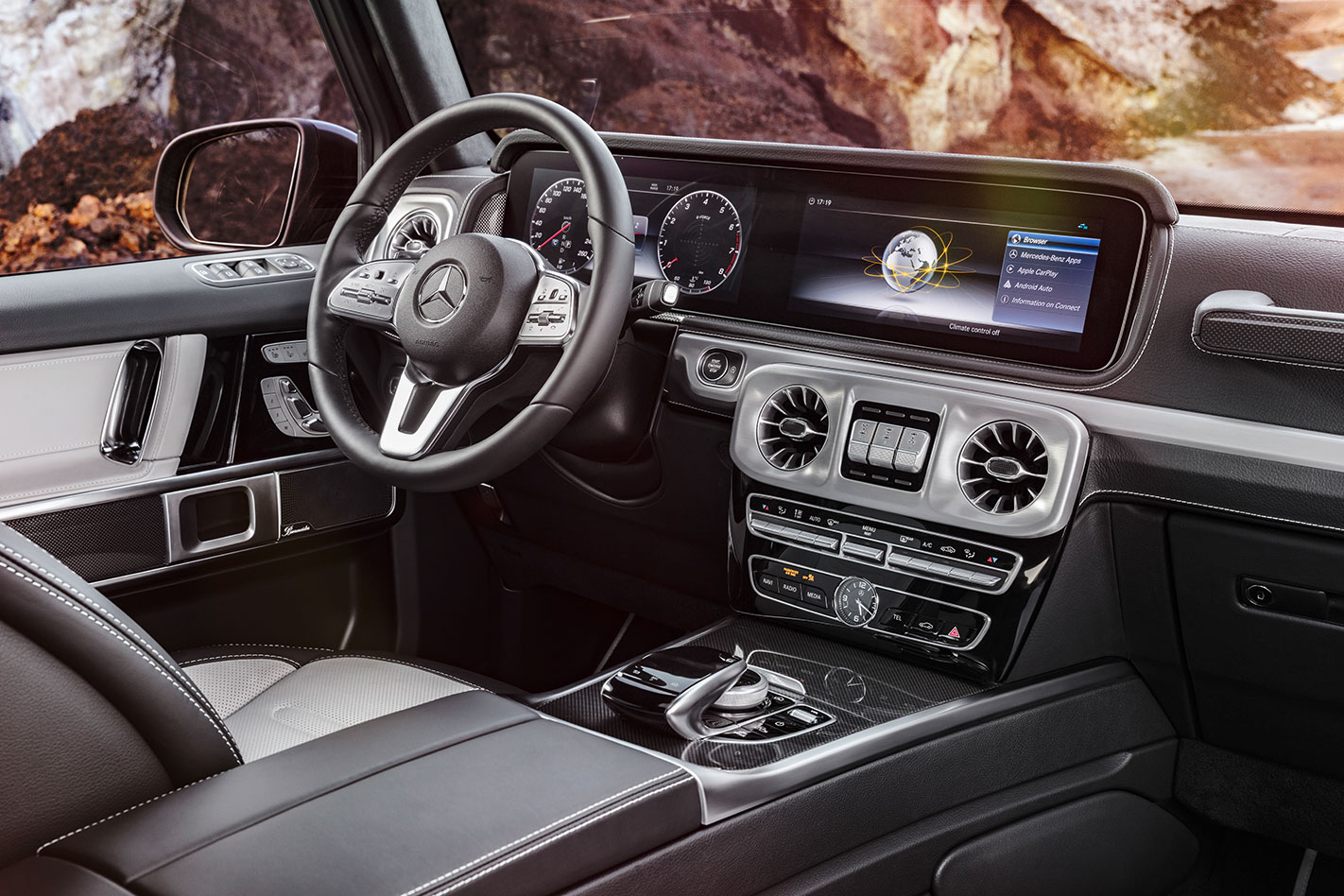
You have to crack open the driver’s door to see where the big changes to the G-Class have been made. The interior, which we’ve already seen revealed in full, loses some of its mud-plugging links to look more like a luxury car than a off-road specialists adapted for the cashed-up urban explorer.
Mercedes-Benz is holding its Detroit Motor Show press conference on January 14, a day before the show’s first official media day kicks off.
While MOTOR is most well-known for the magazine we produce, it’s safe to say millions of people have also seen our work online, whether through our site or social media.
Our video crew is responsible for some of the most popular content we produce – who doesn’t love seeing the rear tyres of a hi-po car turning into smoke?
So in no particular order, here are our favourite videos from the year.
1. Walkinshaw W557 shreds tyres
What happens when you put 557kW and 930Nm through the drivetrain of a Commodore and then take it to a racetrack? R.I.P Continentals.
This smoke-fest was undoubtedly the most popular video MOTOR has produced this year, with over 1 million people having witnessed its glory.
2. Guilia QV vs M3 Competition vs C63 S
The Alfa Giulia is the new kid on the block, but it’s here to take on the big boys from Germany.
We took the trio to a track to see which is the wildest weapon.
3. Stinger GT at the Nürburgring
The most anticipated newcomer for most this year was the Kia Stinger GT, and when it was launched, Kia chose one hell of a place to do it.
Though our dear leader Dylan wasn’t going ten-tenths, MOTOR’s editor still managed to extract a bit of fun from South Korea’s twin-turbo rear-driver.
4. Performance Car Podcast: Falcon XR8 Sprint
In two parts, we spoke to some Blue Oval die-hards in the hope of drawing out the stories which make Ford fans what they are.
In part one, we chat to a man who helped build them, then we chat to someone who bought one in part two.
5. Performance Car of the Year: Porsche 911 Turbo S
This year’s PCOTY winner was one that may have surprised few, but was still well deserved. Porsche’s domination of PCOTY really just comes down to the fact that the 911 has been honed over decades to make it a razor-sharp tool.
6. WRX STI vs Evo rally-off
Japan’s off-road racer go head to head in a dusty showdown built on decades of pedigree. But as both cars are getting on, which holds onto its youth the best?
7. Focus RS wins Bang For Your Bucks 2017
Though it was towards to pricier end of the pack, the Ford Focus RS was just too much fun for its price to let it down. Even the harsh BFYB formula agreed that the RS was worth every dollar.
8. First Aussie fang in the Hyundai i30
While we were at Rally Australia, soaking up the Coffs Harbour sun and breathing that fine sea air – okay it was rainy and dusty – Hyundai let us have a little play in its new hot hatch, the i30 N.
9. Performance Car Podcast with John Bowe
The man really needs no introduction, but we felt it would be a good idea to put JB in the drivers seat and let him tell us what we don’t already know about his career. It’s a must-watch for any die-hard Aussie racing fans.
10. Roadster rev-battle
They’re not the wildest of cars, but the MX-5 and Abarth 124 Spider can still put a smile on your face with their rorty little engines and sporty exhaust notes.
We had a BRZ tagging along too, so we compared flat-four to inline goodness. Check it out here.
“More than the sum of its parts. It’s not what you’ve got that counts, but what you do with it.”
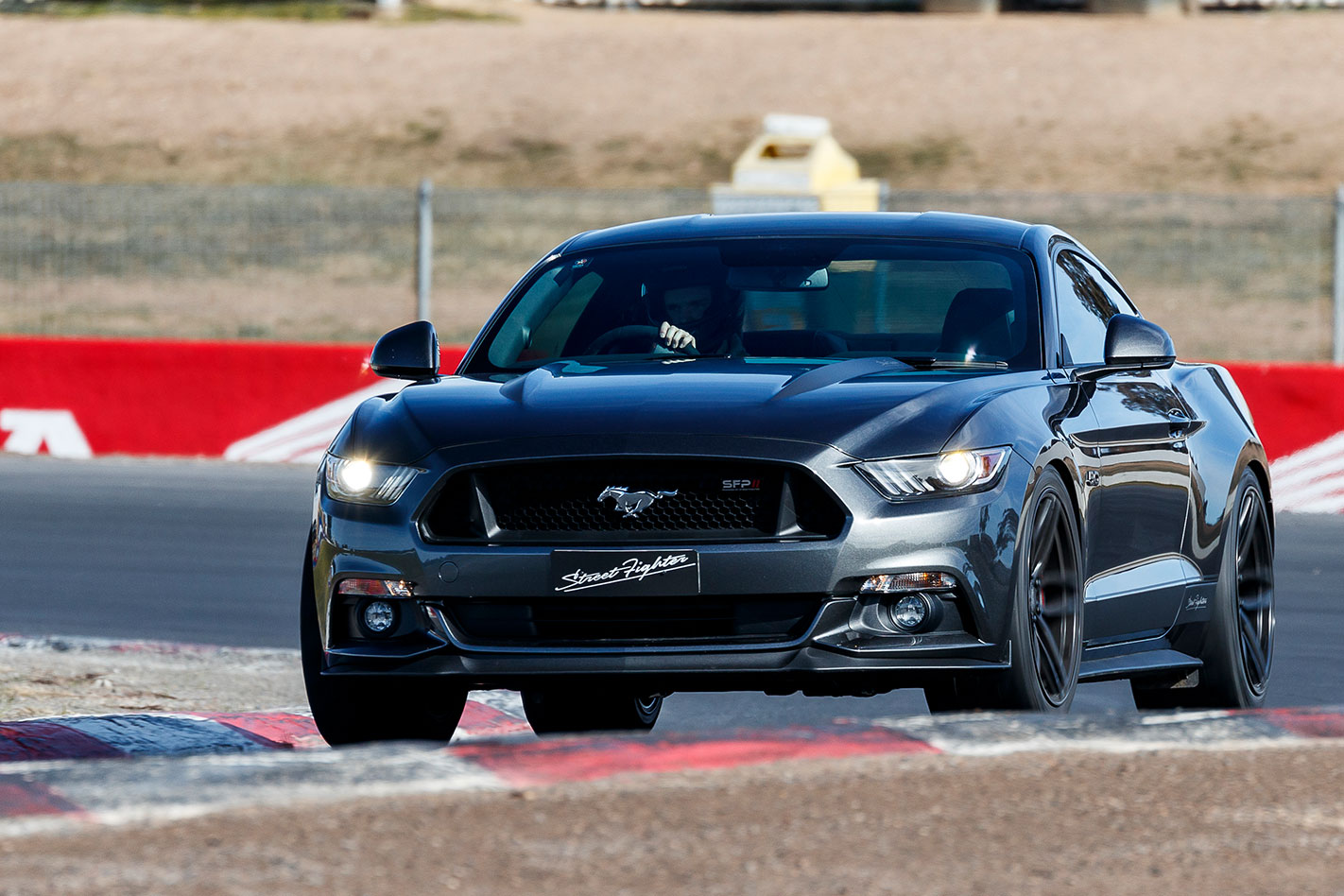
All these cliches apply to Streetfighter’s SFP II Mustang, but don’t think we’re damning it with faint praise, for the proof of the pudding is in the driving.
Okay, I’ll stop now. Essentially, what it all means is that while the atmo Streetfighter didn’t necessarily light up the timing sheets in any particular area, its relatively mild, well-rounded approach nonetheless made it the top-scoring naturally aspirated contestant.
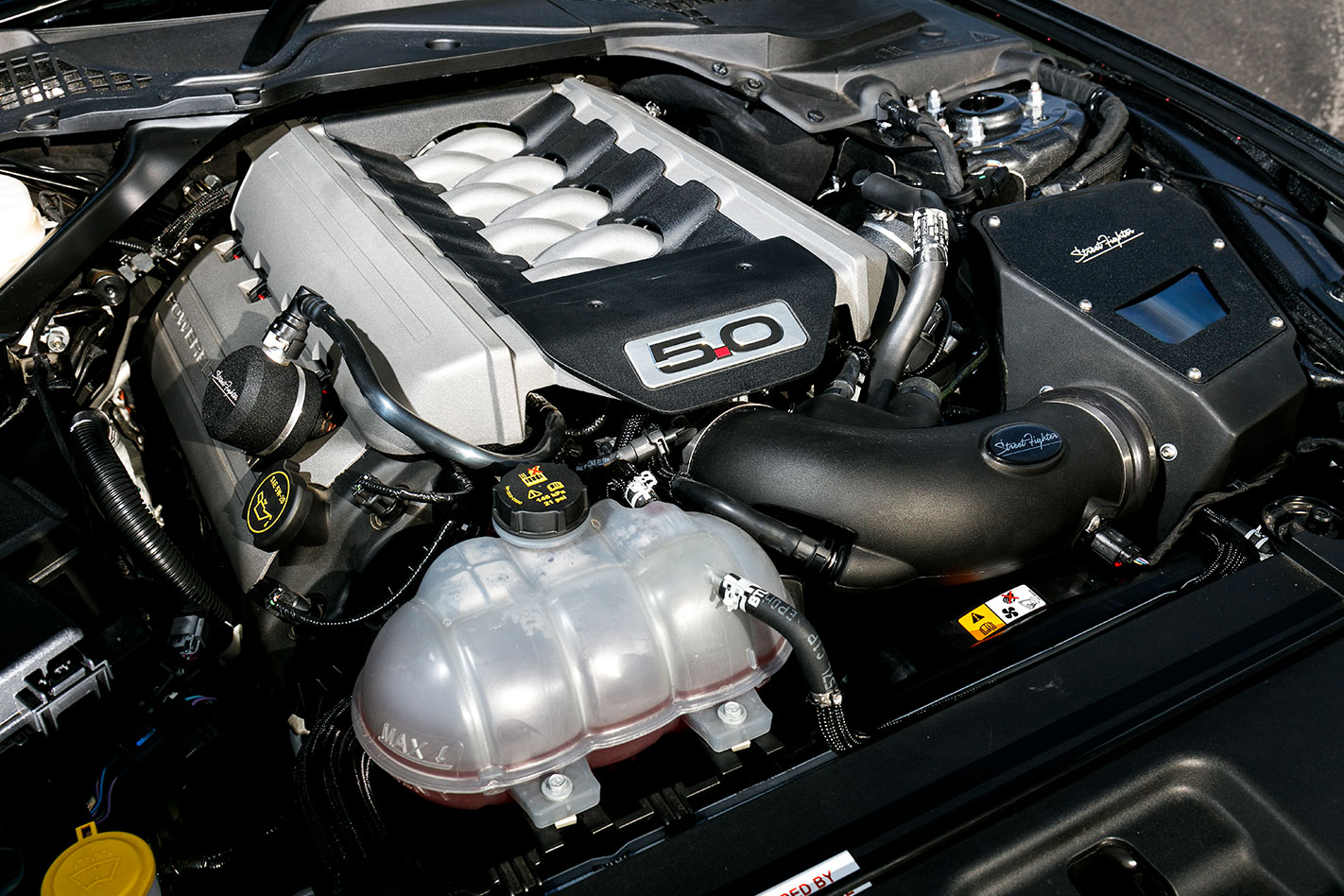
SFP III lifts this further to 427kW courtesy of a new intake manifold and 90mm throttle body, but Streetfighter boss David Roscio says Stage II is perfect for “somebody who wants a full exhaust system, they want the note, they want the increase in power [but in a] drive-away, turn-key sort of car”. The kit is backed by a three-year, 100,000km-limited warranty.
While fairly mild compared to some of the supercharged monsters also present (including Streetfighter’s own SF700s) the SFP II illustrates its power advantage over the standard car. The ice-cold track didn’t help its efforts to 100km/h but by the end of the quarter it’s 0.2sec and more than 4km/h clear of the standard GT and holds a similar margin in terms of lap V-max.
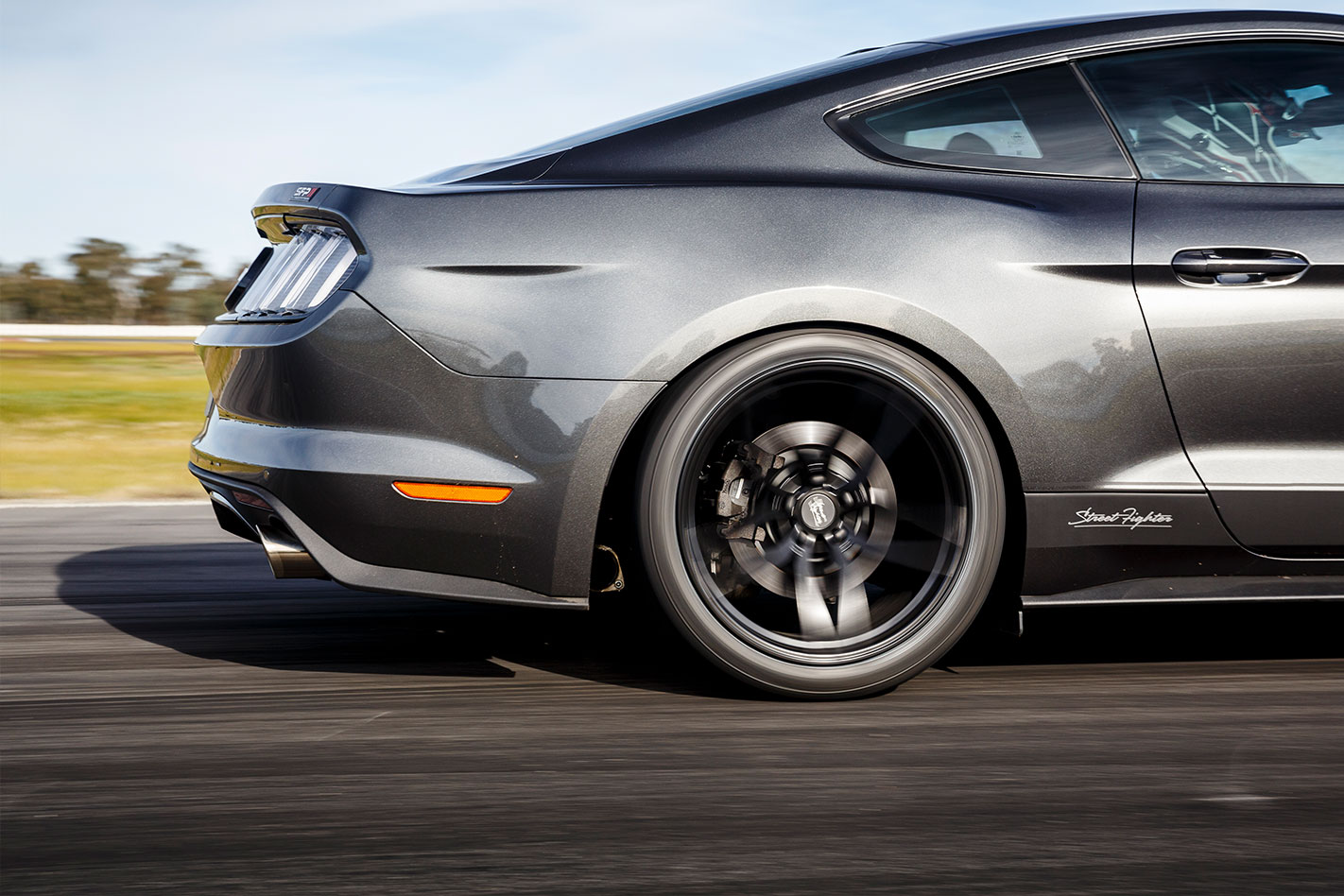
Roscio admits that the R888 is a very focused tyre that’s not particularly suited to the street – mostly due to the unbelievable din it produces at speed – but for anyone keen on enjoying their Mustang on a circuit they make for a worthwhile investment. The Mustang’s fundamental balance is unchanged with a propensity towards understeer, however, the sticky Toyos provide a much more stable base to work from.
At this point you could be forgiven for wondering why, given the apparent success of its modifications, the Streetfighter Mustang only lapped 0.1sec quicker than the standard Mustang GT.
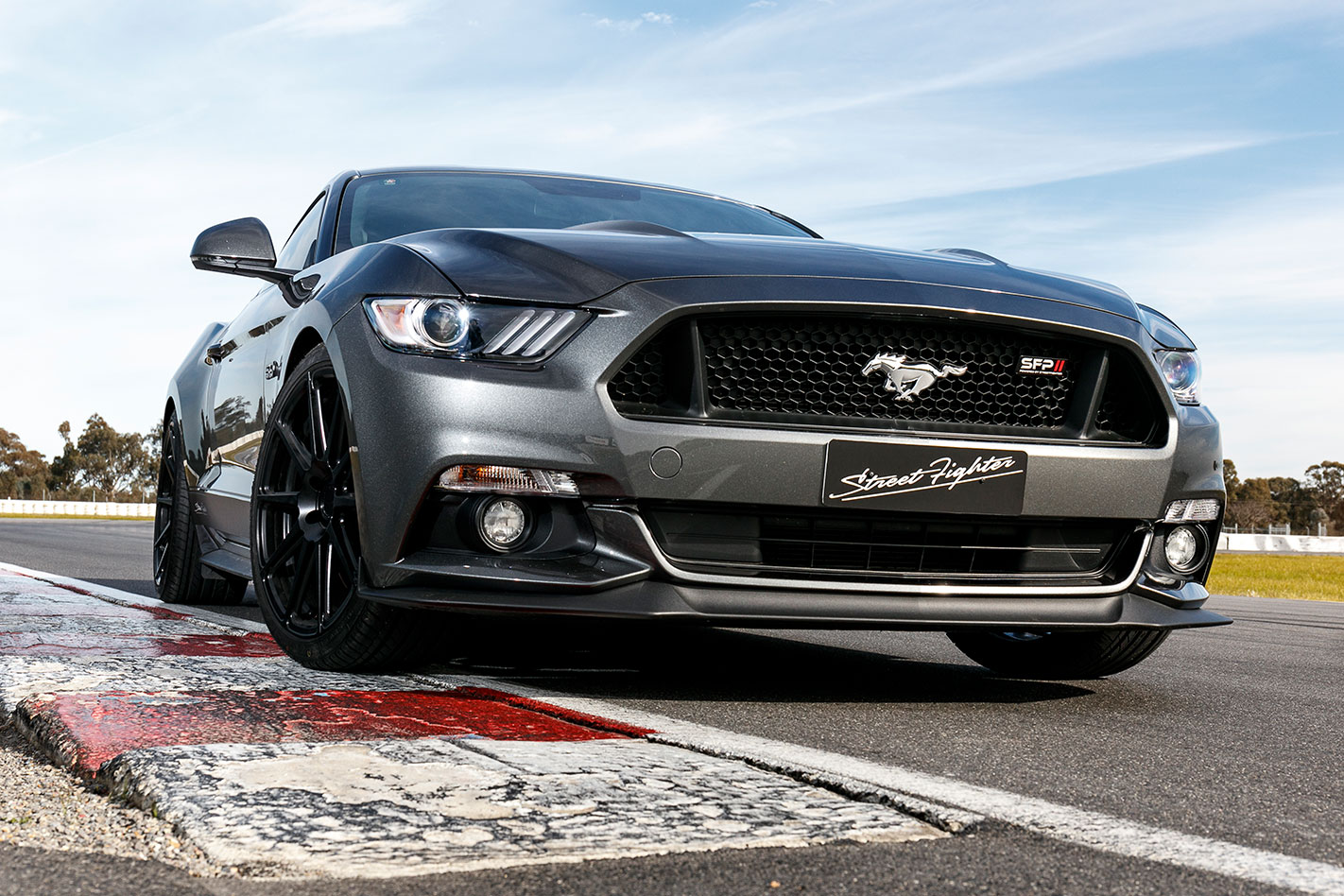
However, in an effort to minimise the load on a possibly strained engine, Luffy simply cruised around to record the data we needed for the car to complete the event rather than going all-out for a representative lap time.
Streetfighter’s SF700S proves it can build a crazy 10-second supercharged beast if that’s what you want, but this SFP II shows that a bit of restraint can also pay huge dividends.
By applying mild upgrades to an already excellent base vehicle you can enhance its strengths and negate many of its weaknesses, resulting in a car that’s a hell of a lot of fun.
WARREN LUFF SAYS:
“You can really notice the effort put into the handling of this car at such a tight circuit like Winton.
“Let’s be honest, the Mustang’s no lightweight, so to get this car to handle like it does means a great job.
“It’s got a cracking sound, but the real attribute of this car is its braking and cornering; you can really tip it in and it’s really sharp on the change of direction.
“It’s certainly a surprise packet and one that definitely delivers.”
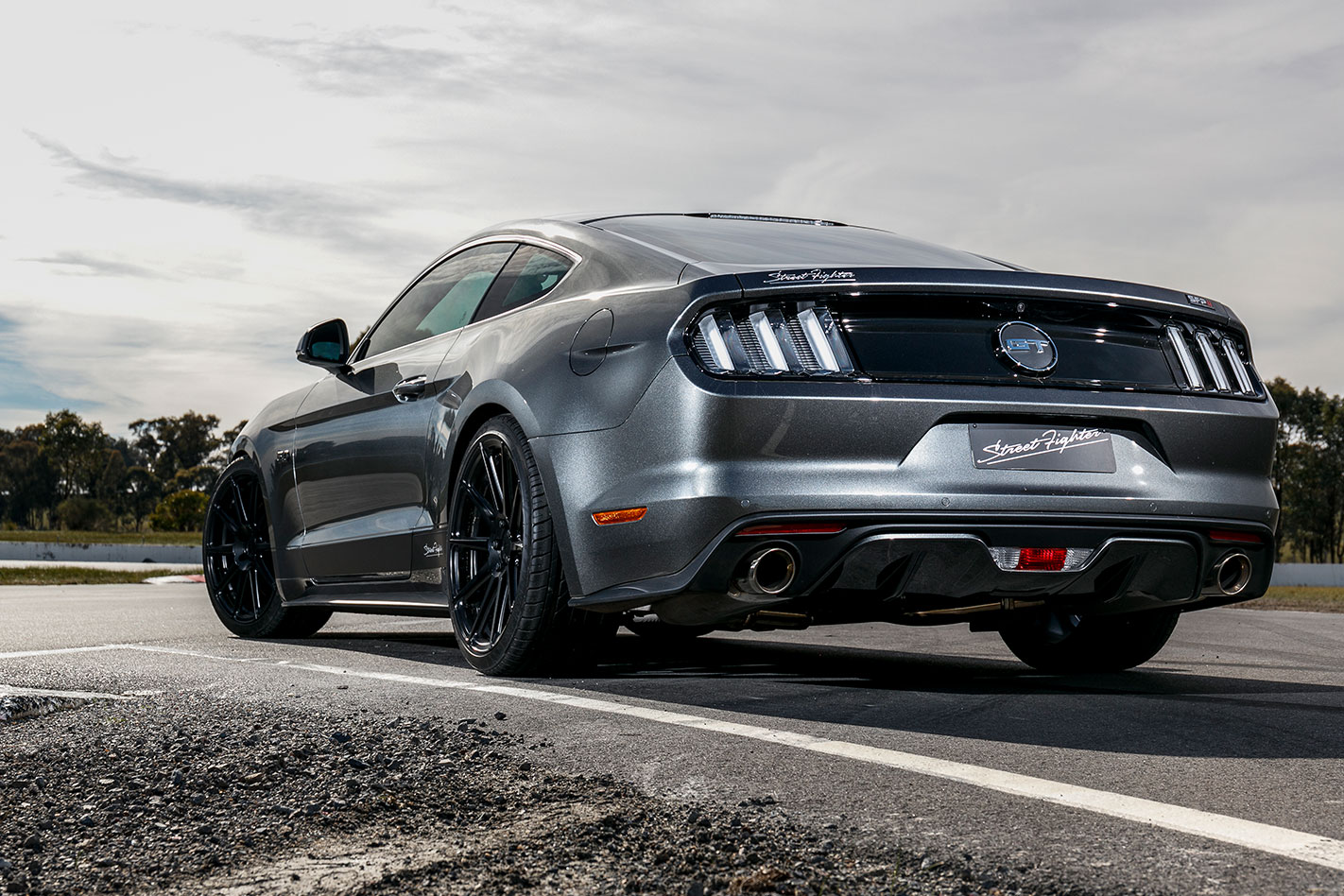
STREETFIGHTER SFP II MUSTANG GT SPECS
Power: 403kW Torque: 650Nm
0-100km/h: 5.18 seconds 0-400m: 13.23 seconds 80-120km/h: 2.8 seconds 100-0km/h: 33.93 metres Lap Time: 1:37.1 seconds Apex km/h: 82.23km/h Lap V-max: 190.61km/h 400m V-max: 182.09km/h
Engine: 4951cc V8, DOHC, 32v Gearbox: 6-speed manual Suspension: struts; anti-roll bar (f); multi-links, coil springs, anti-roll bar (r) Brakes: 380mm ventilated discs, 6-piston calipers (f); 330mm ventilated discs, single-piston calipers (r) Wheels: 20 x 10.0-inch (f); 20 x 11.0-inch (r) Tyres: 285/35 ZR20 (f); 285/35 ZR20 (r); Toyo R888
PARTS AND PRICES
SFP II Package: $7899 Oil Breathers: $495 Handling Kit: $2732 Wheels: $5940 Tyres: $2400 Total Mods Cost: $19,466 Vehicle Cost: $57,490 Total Cost: $76,956
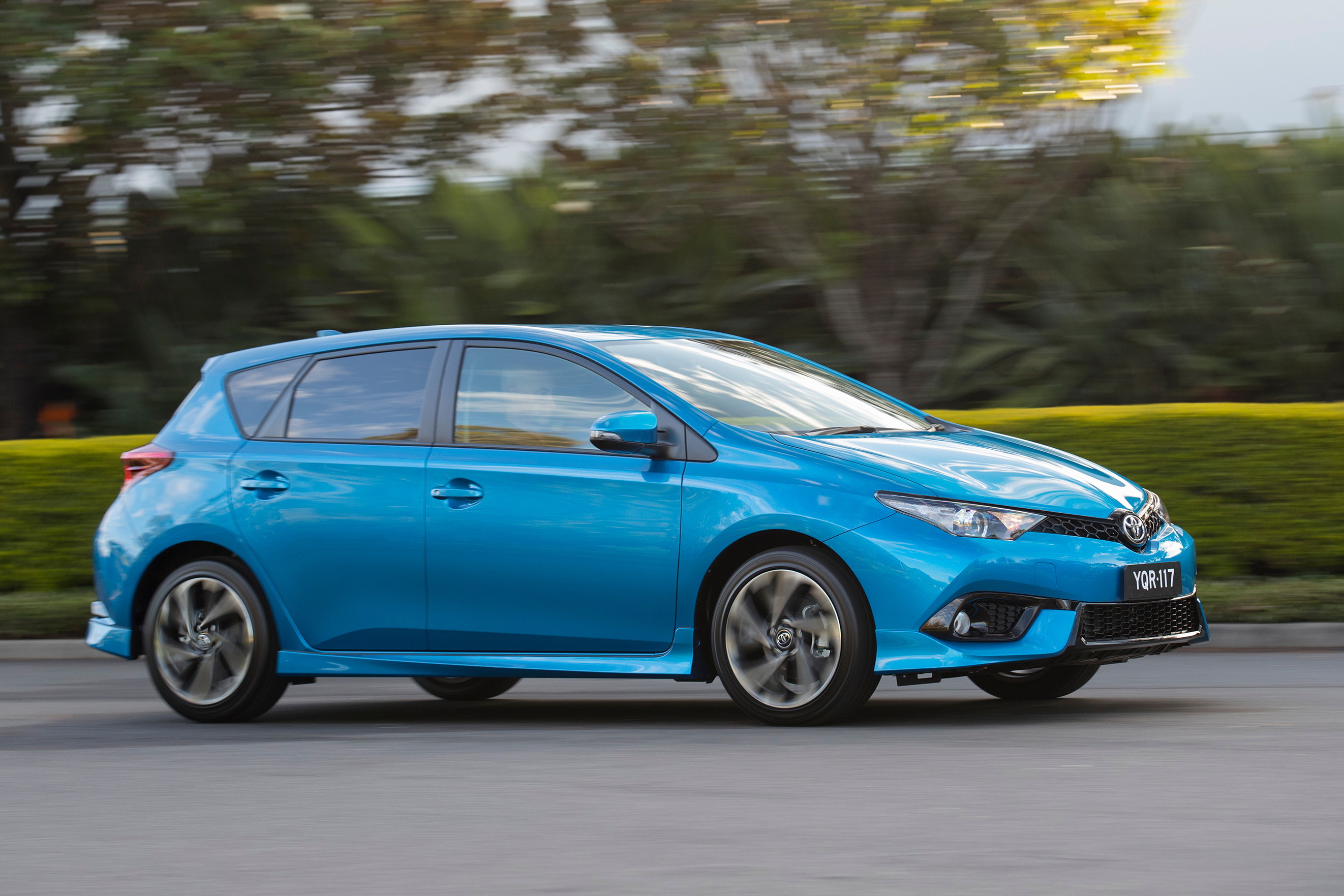
THE Holden Astra jumped to the top of the Australian passenger car sales charts in December, comfortably outselling rivals including the Mazda 3 and the Toyota Corolla.
The Astra range – a mix of a European-sourced hatchback and a Korean-made Cruze sedan – found a hugely surprising 3532 buyers in December, more than double its best result since the car replaced the locally made Cruze in October last year. In contrast, the Mazda 3 could only manage 2807 sales, and the Corolla 2641.
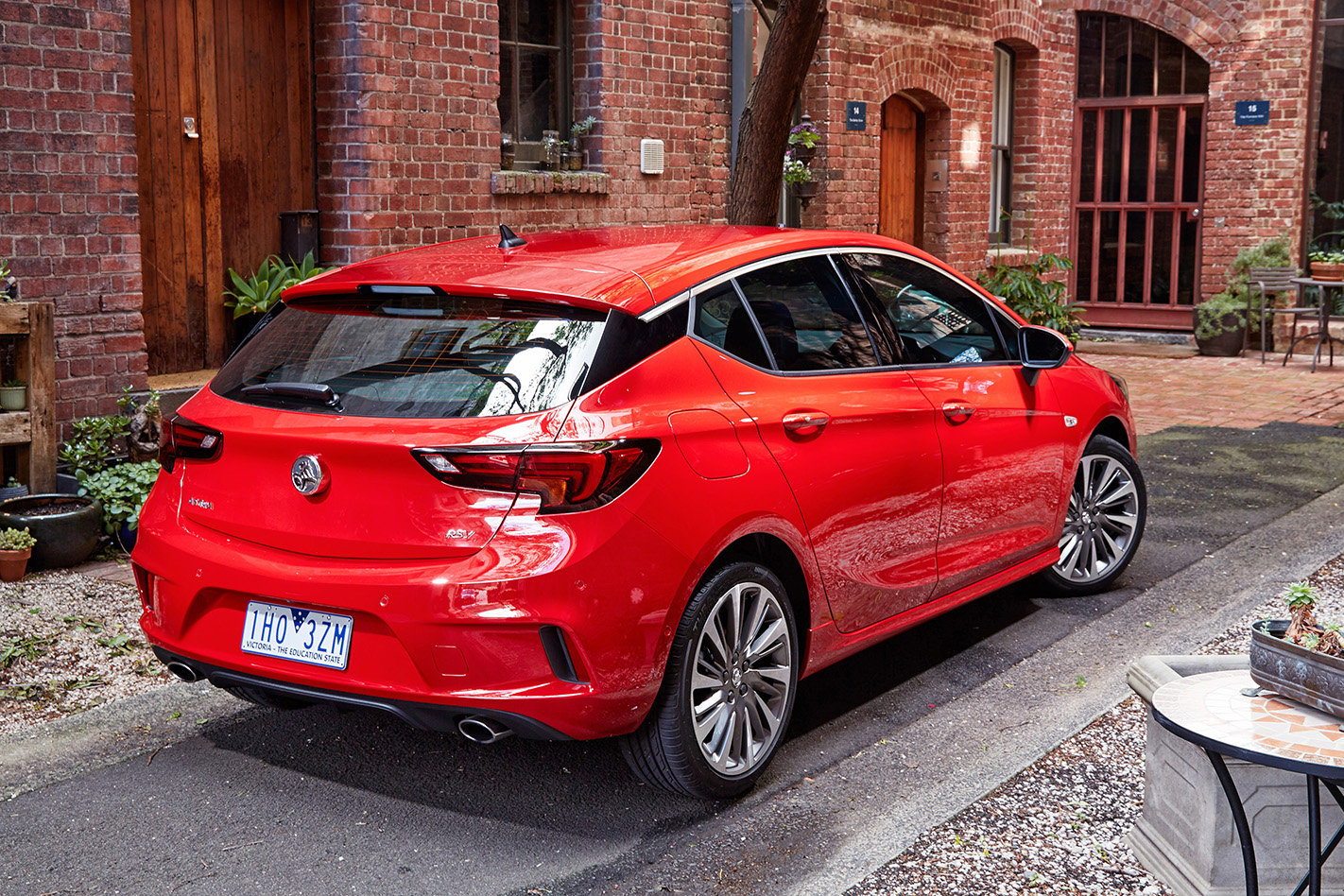
December sales pegged another record month – the eighth this year – to post 102,820 sales, a 4.1 percent rise over December in 2016.
The month’s real winner, though, was in the light commercial vehicle segment. It grew to 21.6 percent in December, with the Toyota Hilux (4042) and Ford Ranger (3565) both outselling the Astra. Pitch in the high-riding trade utes, and along with the Holden Colorado (3130) the tradies occupied three of the top five spots on the sales chart.
The poor performance of the Camry – down 75 percent over December 2016 – as well as softer sales results for the Corolla (2641), the traditionally strong-selling 86 sports coupe (99) and the Yaris small hatchback (858) helped Toyota to fall 14.3 percent in December to post just 17,081 sales for the month compared with the same month last year. Its month was so poor that its share of the market slipped to just 16.6 percent, though it posted an overall growth of 3.3 percent for the year.
Holden (12,179) overtook Mazda (9102) to regain second place on the charts for the month, a position it hasn’t occupied in some time. Mazda’s sales slump for the month can be attributed to a 10 percent fall in Mazda 3 sales (2807) and softening interest in the CX-3 (1286).
Mitsubishi (9019) overtook Hyundai (6182) for fourth place, while Ford (5636) – you have to count down to the Ford Focus (454) in 48th spot to find its best-selling passenger car – continued its year to forget in sixth place, with Mustang selling just 451 units. Volkswagen (5136) and Honda (5041) weren’t that far behind.
Kia (4007) fell a tantalising 125 sales short of appearing in the list of the top 10, narrowly edged out by Subaru (4132).
In the luxury stakes, Mercedes-Benz (2999) easily beat Euro rivals Audi (2073) and BMW (1302), while traditional bottom 20 feeder Land Rover leapt up the charts to outsell BMW with 1445 sales – it has the new fifth-generation Discovery (204 sales) to thank for that.
Peugeot (541), back from the wilderness after a change of importer, also appears to have reignited its sales. It outperformed Toyota’s luxury brand, Lexus (534) for the first time since June 2011.
Ford sold no Falcons for the month for the first time in more than five decades – the final reserves of the sedan appear to be tapping out – while it moved four Territory SUVs.
1. Holden Astra 3532 154 2. Mazda3 2807 3141 3. Toyota Corolla 2641 2927 4. Holden Commodore 2229 2130 5. Mitsubishi ASX 2128 1484 6. Mazda CX-5 2113 1906 7. Toyota RAV4 1823 1495 8. Volkswagen Golf 1759 1579 9. Nissan X-Trail 1737 1857 10. Honda Civic 1725 1049 11. Toyota Prado 1590 1197 12. Mitsubishi Outlander 1486 1130 13. Hyundai i30 1467 2835 14. Hyundai Tucson 1306 1384 15. Mazda CX-3 1286 1438 16. Kia Cerato 1278 1040 17. Toyota Camry 1209 4850 18. Mitsubishi Pajero Sport 1164 832 19. Honda CR-V 1152 662 20. Toyota Kluger 1114 859
The sighting of an ‘Eleanor’ replica Mustang is a rare thing here in Australia.
Sure, there are a couple getting around, even being driven. We’ve spotted one cruising around our local Melbourne, but only one.
We’re talking, of course, about Nicholas Cage’s co-star from the 2000 flick Gone in 60 Seconds, in which Cage’s character, Memphis, tries to steal a modified GT500-esque 1967 Mustang called Eleanor, along with a lot of other cars.
But in the US, seeing a Mustang in ‘Eleanor’ guise would be slightly more likely thanks to Fusion Motor Company.
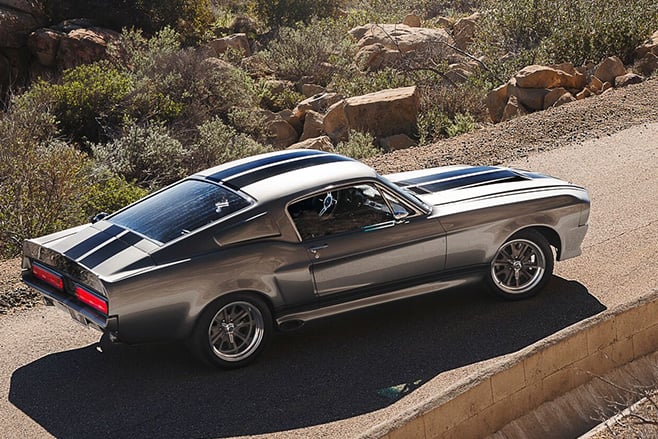
The head man at Fusion, Yoel Wazana, says he once owned an Eleanor replica built by someone else, but was disappointed with the quality. So he set out to build his own.
“I bought one of the first Eleanor tribute cars from a previous manufacturer. I loved the way it looked, but it had many issues.
“As the fiberglass body parts vibrated and sagged, the Bondo transitions to the sheet metal cracked. And those were just the body problems.
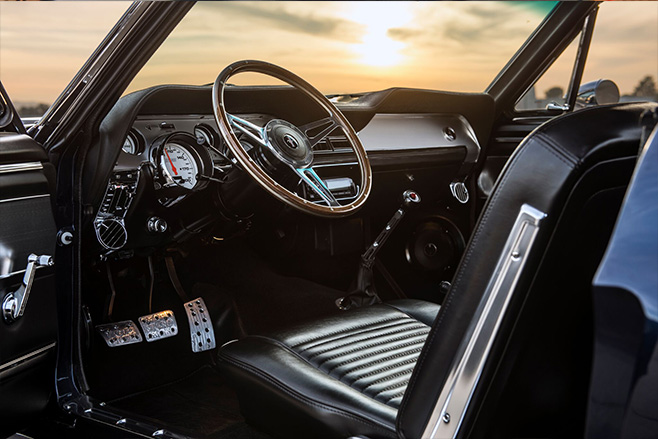
Fusion uses 1967-68 Mustangs to create its replicas, stripping the car to the shell and making sure the body underneath is straight.
More structural reinforcement is added to account for the extra power and forces that will be running through the car. These Ponies don’t run on ‘60s power.
Fusion then creates its own carbon fibre spoilers and splitters, and uses LED lighting rather than the lighting the car would have had in 2000.
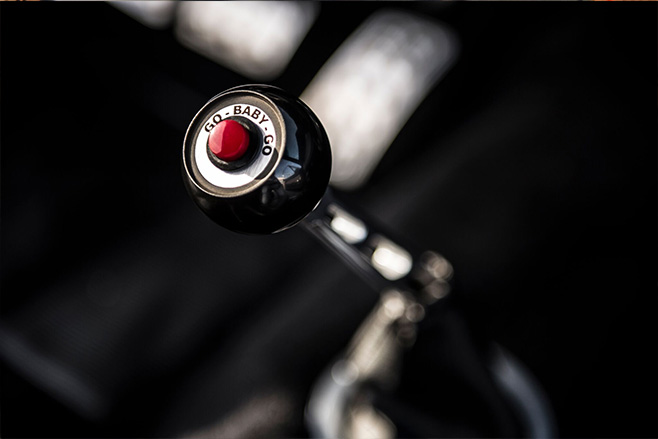
It even comes with a nitrous tank in the back, which can be hooked up to a “Go Baby Go” button on the shifter (as in the film) if customers don’t mind voiding the Roush warranty.
Fusion says the wait time for an Eleanor Mustang is around 6 months, with prices ranging from $189,000-$284,350 USD (or $240,870 to $362,389 AUD), depending on options.
TOYOTA is keen to enter the performance pick-up war with a more hardcore version of the Hilux to take on the likes of the upcoming Ford Ranger Raptor and the Walkinshaw-fettled Holden Colorado.
Toyota Australia president Matt Callachor told Wheels today that a big jump in buyer interest at the top end of the trade ute segment – the main driving force behind a surge in light commercial vehicle sales in 2017 – could be just the tipping point the Japanese car maker needs to kick-start the project.
“I think there’s room probably at the top end for Hilux in terms of where the market is, and we’re seeing the evidence that in the 4×4 the top-selling vehicle is the top end,” Callachor said. “Probably what I’d say to you is ‘stay tuned’ at this point.”
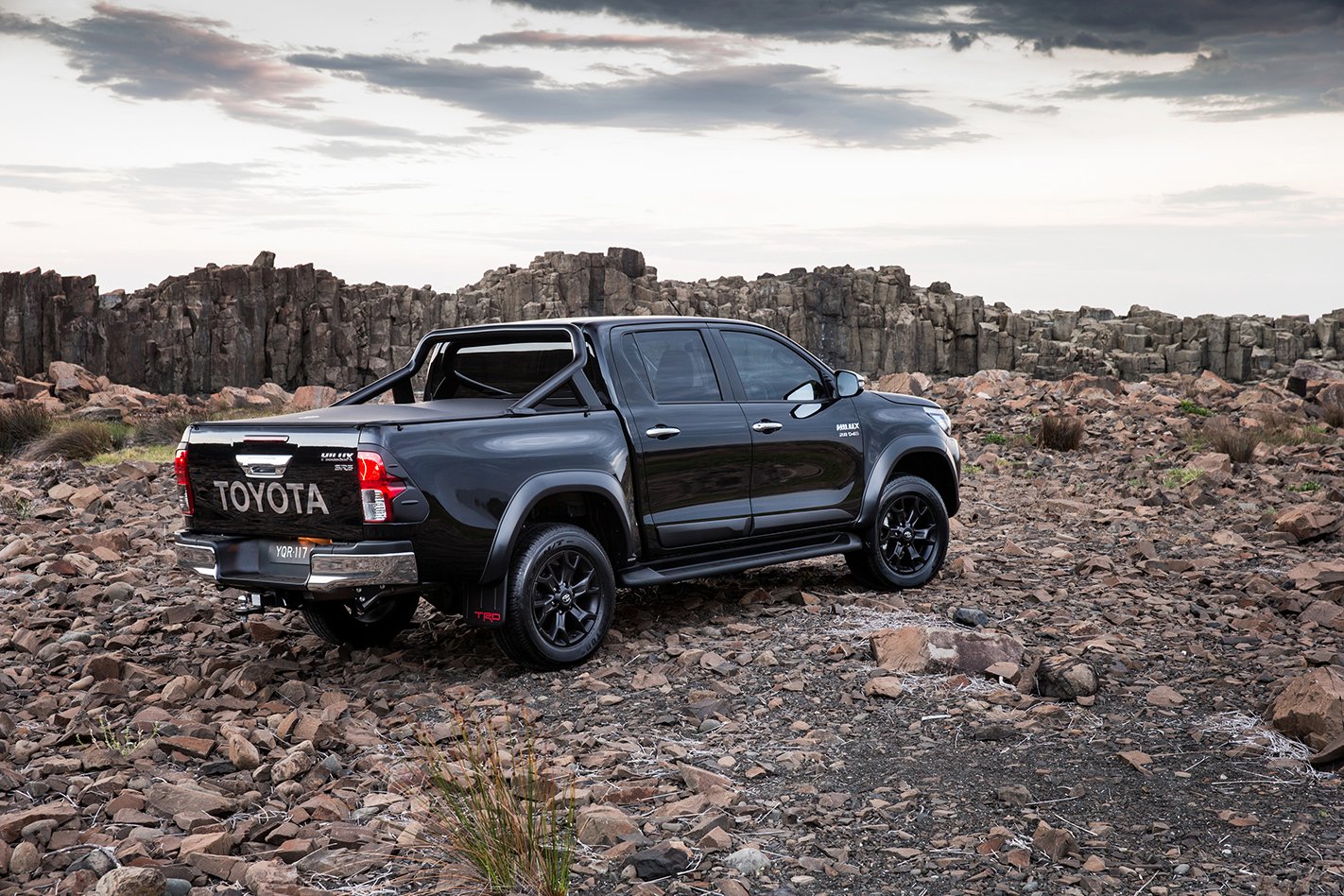
Toyota has previously made an attempt to produce a performance version of the Hilux specifically for the Australian market. The Hilux TRD 4000, as it was known, strapped a Harrop supercharger on the workhorse’s 4.0-litre petrol V6. It produced 225kW at a relatively peaky 5400rpm, with torque rising to a diesel-like 453Nm at 2800rpm. However, the ute kept much of its workhorse underpinnings, including drum rear brakes and wet weather handling that could best be described as entertaining.
Ford has announced plans to introduce the Ranger Raptor to Australia late this year, potentially powered by a twin-turbo four-cylinder diesel engine. The more hardcore version of Ford’s worksite workhorse will include a smoother 10-speed automatic gearbox and rear-wheel disc brakes replacing the traditional tow-rating friendly drums.
The Raptor is also expected to adopt the Everest’s coil rear suspension, replacing the load-bearing leaf springs used in other versions.
Toyota sold more than 47,000 Hilux utes in 2017, while Ford moved more than 42,700 Rangers. However, the sales split flip-flops when you account for just the more expensive 4×4 trade utes: Hilux 35,297 versus Ranger 36,932.
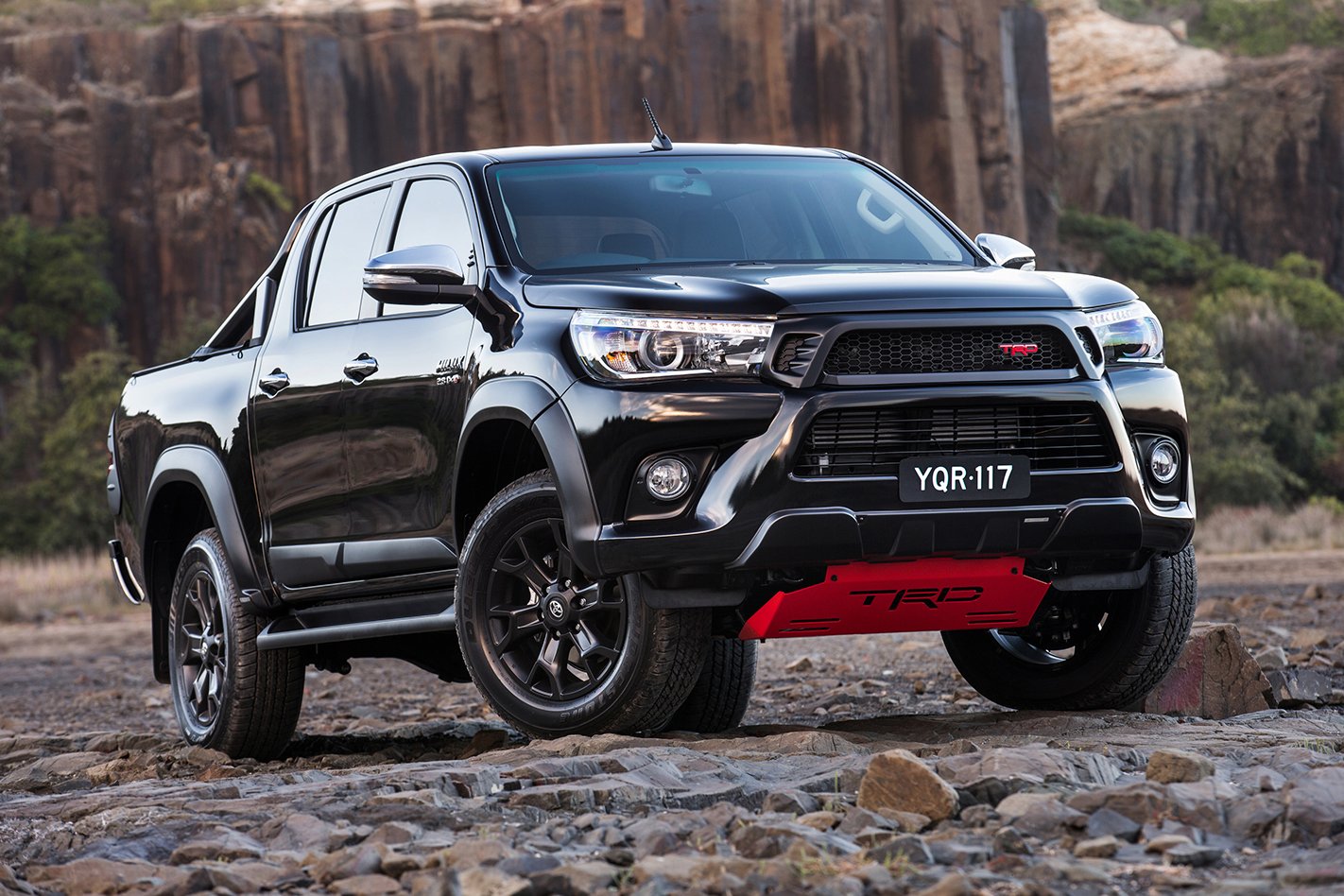
Since the supercharged Hilux release in 2008, the Japanese car maker has stumped up TRD-badged versions of the Hilux that have been little more than just stickers and wheels tapping into the Toyota Racing Development hype – all show and no go. Callachor hinted that a more performance-honed Hilux would potentially not stray too far from that philosophy.
“I think you also got to take into account that the vehicle can also be used as a workhorse, so it’s got to balance out these particular requirements,” he said. “But I think there’s opportunities for Hilux.”
A V6-engined version of the Volkswagen Amarok trade ute, which accounts for half the trade ute’s 4×4 sales, has shown Australian buyers have an appetite for a big-engined ute costing almost $70,000. Ford recently revealed it had Ranger customers who were routinely spending upwards of $100,000 to own a customised version of the Ranger, leaving plenty of room above the almost $60,000 it charges for the Wildtrack version of its dual-cab ute.
MORE: Toyota Hilux Range Review MORE: Toyota Hilux Specs, Range & Price
TOYOTA has topped Australia’s new-car sales chart for the 15th year running as our appetite for trade utes and SUVs continued in 2017.
And we’ve pegged yet another record year with 1,189,116 vehicles sold, the latest VFACTS sales data shows, the third year running that sales have snuck 0.9 percent higher than the previous year’s numbers.
The Toyota Hilux was Australia’s most popular vehicle for the second year running, snaring 42,728 sales for the year and up almost 14 percent on 2016’s result. It edged out the Ford Ranger, the nation’s second most popular vehicle with sales up more than 19 percent for the year, by just 624 sales.
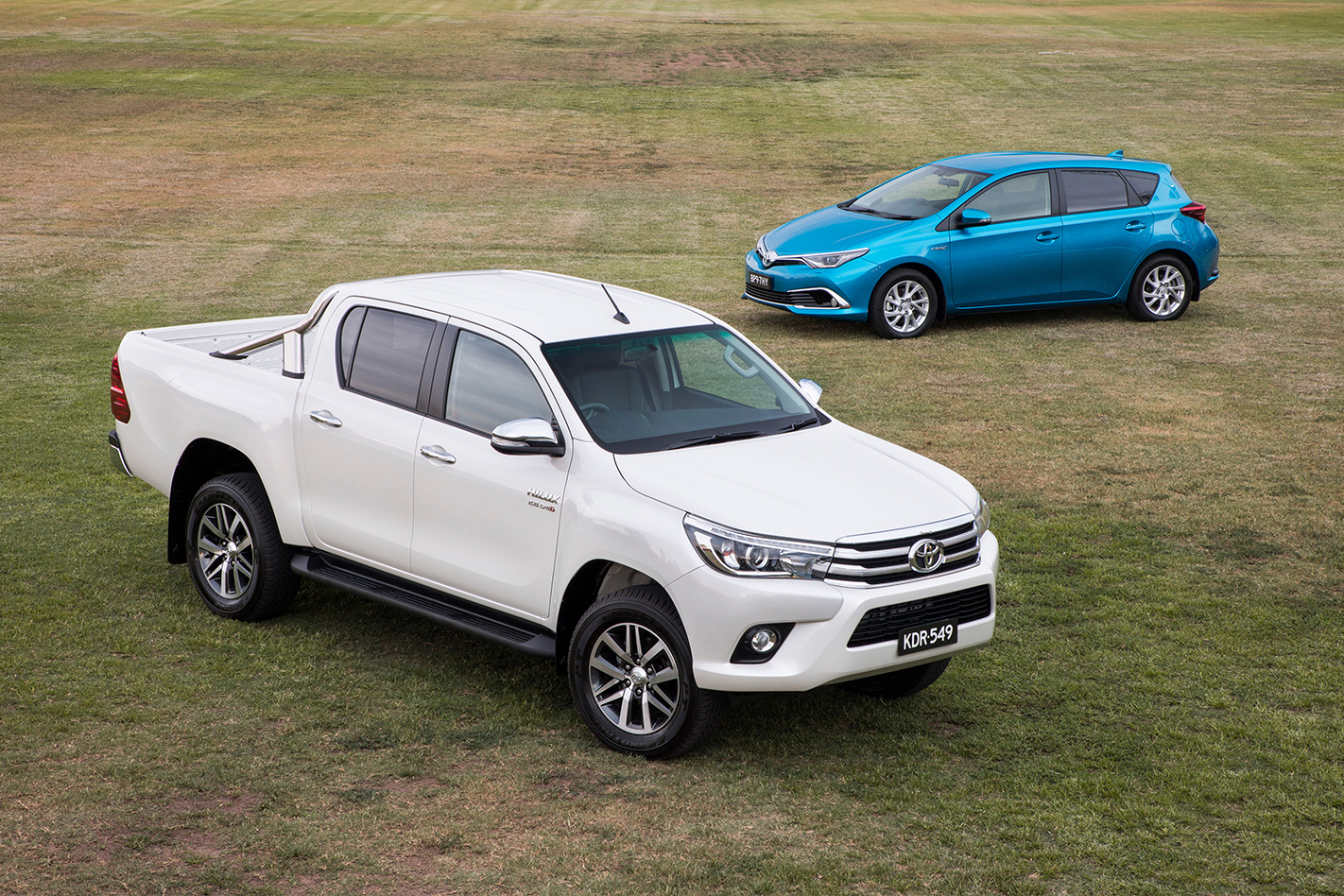
Another Toyota, the Corolla small hatch and sedan, placed third overall, accumulating 37,375 sales. It was followed closely by the Mazda 3 – gauged to be Australia’s most popular choice among buyers who spend their own money rather than someone else’s – and the new Hyundai i30 hatchback (28,780 sales). The Mazda CX-5 (25,831) was Australia’s best-selling SUV in 2016.
The books will close on the Holden Commodore (23,676 sales) showing the large Aussie staple remained the fifth-best selling model in 2017, despite the curtain falling on almost 70 years of manufacturing in October. It was edged out by the Hyundai Tucson (23,828) – a difference of only 152 sales.
The books will close on 2017 as the year in which SUV sales (465,646) overtook those for traditional passenger cars (450,012) – the only corner of the record-breaking new-car sales market to shrink.
FCAI chief executive Tony Weber said the record result was an “amazing feat in a mature market”.
He said the success of the Toyota Hilux was “back to the future” for the Australian market as buyer preferences continued to change.
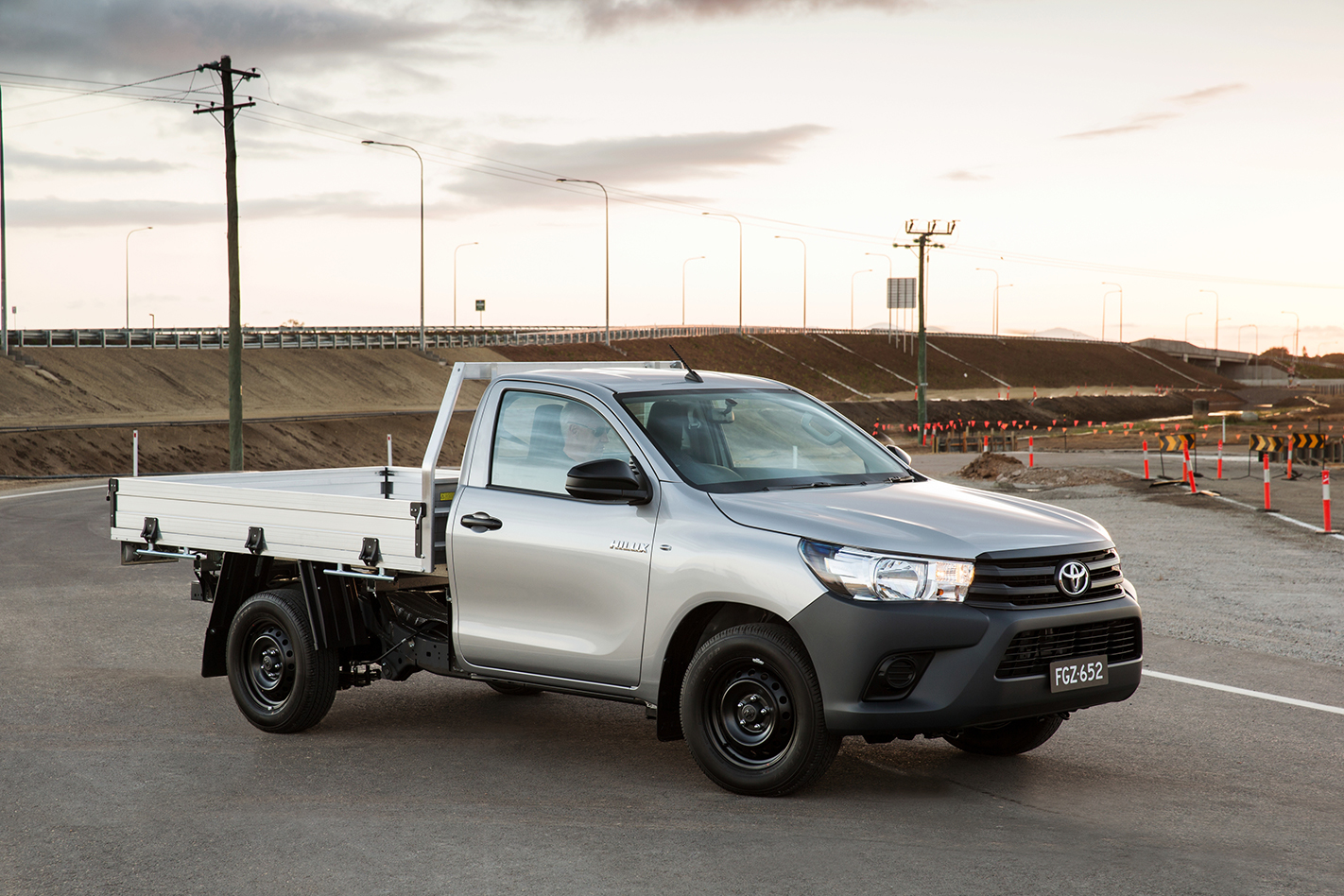
Toyota’s domination of the market came as it grew its sales 3.3 percent to 216,566 over the previous year’s result. Mazda finished second with 116,349 sales, down 1.3 percent over the previous year, while Hyundai (97,013 sales, down 4.5 percent) edged out Holden (90,306, down 4.2 percent) and Mitsubishi (80,654, up 9.9 percent) edged out Ford (78,161, down 3.8 percent) to take fifth spot.
Big winners, though, will go down as Kia, up 28.3 percent to crack the 50K mark (54,737) for the first time, Subaru (52,511, up 11.7 percent) and Honda (46,783, up 14.6 percent).
Those gains came at the expense of brands including Nissan, down 15.3 percent to 56,594 after a rout of some of the bigger-selling models in its showroom, luxury marque BMW (23,619, down 15.7 percent), and Jeep (82790, down 34.5 percent) after hitting the reset button on its business here.
BMW wasn’t the only luxury brand feeling the pinch in 2017. Audi also fell, dropping 9.3 percent to 22,011, Lexus (8800, down 2.5 percent) saw its sales soften, and that blip on the radar known as Infiniti (776 sales, down 3.8 percent) faded slightly more.
Ferrari has had a cracking year, posting 210 sales, up more than 11 percent, to outperform rival Lamborghini with just 122 sales (down almost 4.0 percent) and McLaren (116 sales, up 24.7 percent).
WE LOVE a bit of empirical research here at Wheels, so we doff our ten-gallon hats to Texan tuner John Hennessey who has decided to see how fast a Jeep Grand Cherokee Trackhawk will go. Spoiler alert: 282km/h.
The 522kW behemoth is the most powerful SUV in the world, but even 868Nm of twist action has to cede to an impenetrable wall of physics at an indicated 175mph. Jeep quotes a 3.7 second sprint to 100km/h and, as you’ll see in the other video, the Trackhawk deploys its torque cleanly to leave a Challenger Hellcat vaporising its tyres in a sprint off the line.
Okay, so that’s still a little shy of Tesla’s 2.8 second claim for the Model X, but you don’t get a soundtrack like Zeus gargling a sack of hammers when you sign on Elon’s dotted line.
Hennessey offers even faster versions of the Trackhawk in either 635kW HPE850 or 755kW HPE1000 guises, the latter featuring a supercharger with 14psi of boost, 1314Nm @ 4200rpm, a 0-100km/h time of 2.8 seconds and a quarter mile time of 10.5 seconds. John Hennessey is 165cm tall.
