
BMW Australia has introduced M3 and M4 Pure models that offer a cheaper way into the mid-sized M-car range without compromising on performance.
The more affordable versions of the M3 sedan and M4 coupe/convertible will join the M2 Pure model in Australian showrooms from July.
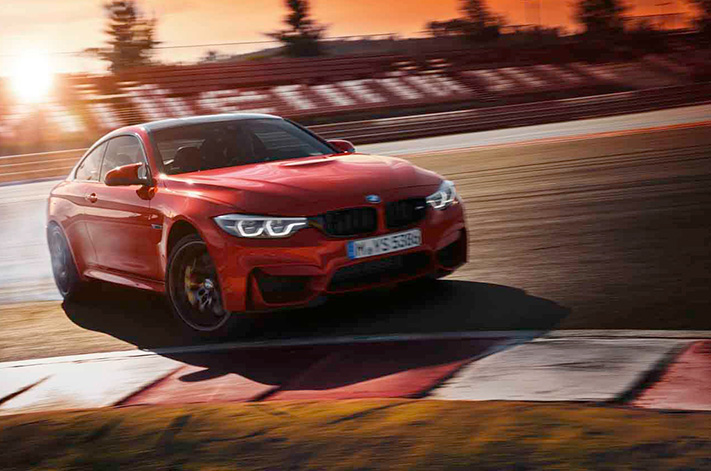
Priced from $129,000 the M3 Pure is $10,000 cheaper than the ‘standard’ M3 but shares the upgraded outputs, chassis and interior of the range-topping M3 Competition.
The M4 Pure is priced from $139,000 and offers similar value and performance compared to the higher-spec M4 variants.
Both receive a power boost from 317kW to 331kW, reconfigured adaptive M suspension settings with 15 percent stiffer springs, and black 19-inch double-spoke alloy wheels.
Paired with the standard seven-speed dual-clutch automatic transmission, the M3 and M4 Pure are capable of 0-100km/h in 4.0 seconds, or 4.2 seconds with the no-cost optional six-speed manual.
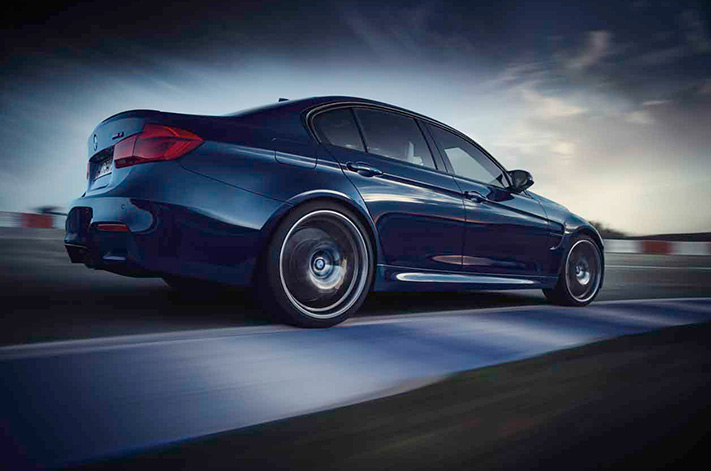
Externally, both Pure models are identifiable by gloss black treatment applied to the boot badge, kidney grille, side gills and upgraded sport exhaust, which is also borrowed from the M3 and M4 Competition.
Inside, their scaled-back cabins feature M Sport seats with weight-saving cut-outs, carbon-fibre interior trims and seatbelts decorated with the classic M colours. Other standard features include a head-up display, and nine-speaker stereo system.
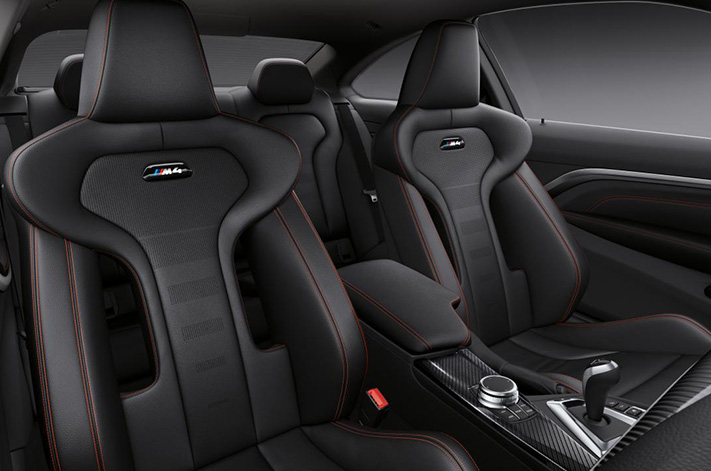
To keep the base price low BMW has removed some of the luxury equipment included as standard in the normal M3 and M4 models and made them optional for the Pure, for those who are after more than just a driver’s car.
These now optional items include adaptive LED headlights with main-beam assistance, leather-upholstered instrument cowl, top-spec Harman Kardon stereo, full leather, heated seats and rear roller sunblinds.
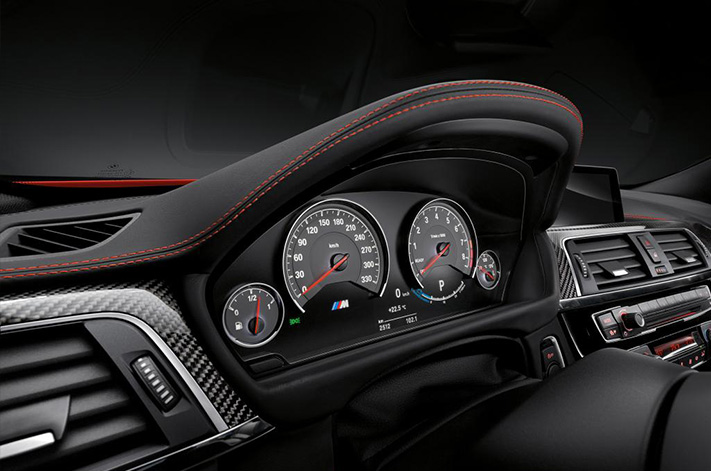
Like previous Pure packages, the M3 and M4 versions were specifically developed by BMW’s Australian team to appeal to performance enthusiasts.
The Pure editions are part of a wider M3 and M4 ‘Life Cycle Impulse’ [LCI] update, which includes the arrival of the new M4 CS variant, as well as a number of enhancements for all M3 and M4 versions such as the latest iDrive6 version of BMW’s information and entertainment system. It brings a larger 8.8-inch screen with new touch-sensitive function.
THE all-new Subaru XV crossover will arrive in Australian showrooms next month with sharper pricing across the all-CVT range to offset the lack of a cheaper manual transmission option.
The second-generation Subaru XV range will start at $27,990, with entry-level duties now handed to the 2.0i with CVT. While this is $1250 more than the current 2.0i manual, it’s also $1250 cheaper than the CVT model it directly replaces, which is good news for the majority of XV customers who preferred to forgo a clutch pedal.
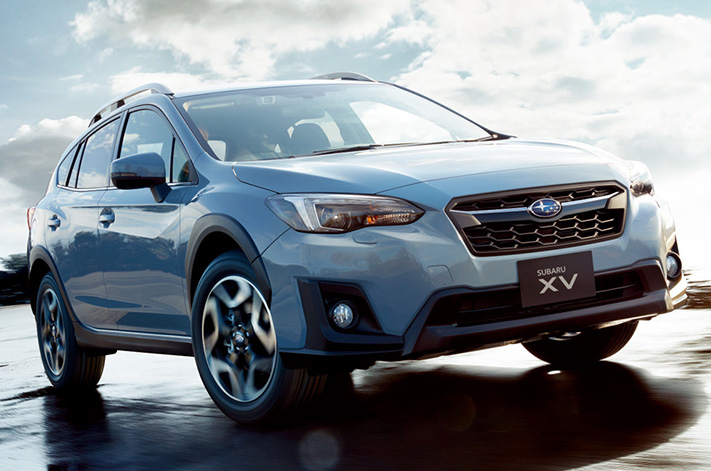
Subaru says the price drop comes despite enhancements to the second-generation XV including all-new underpinnings, all-round performance improvements. More interior space and a refined 2.0-litre flat-four boxer engine that provides a slight power boost and increased fuel efficiency.
All variants come with X-Mode, which enhances driving performance on poor surfaces (such as gravel) through integrated control of engine, drivetrain, braking, and other functions in slippery conditions and also features hill descent control.
Subaru’s EyeSight Driver Assist, has also been added to all but the entry-level XV variants and now includes lane keeping assist.
Standard features in the 2.0i include a 7.0-inch screen, reversing camera, Apple CarPlay and Android Auto, daytime running lights, 17-inch alloys, shark fin radio antenna and auto start stop.
The 2.0i-L has all those features plus the EyeSight, dual zone climate control, 8.0-inch touch screen and premium cloth trim. The 2.0i-Premium has all that plus an electric sunroof and factory fitted sat nav.
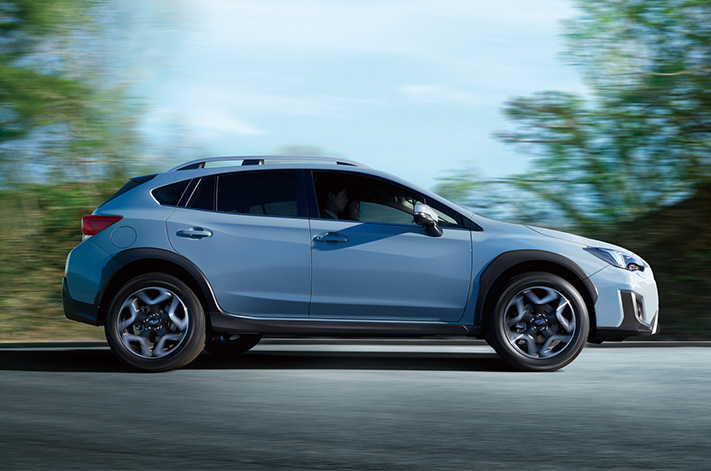
The range-topping 2.0i-S has 18-inch alloy wheels, alloy pedals, auto LED headlights with steering response, auto wipers, leather accented trim, power driver’s seat. It also has additional EyeSight functions including blind spot monitoring, high-beam assist, lane change assist, rear-cross traffic alert and reverse automatic braking.
The 2018 XV should also be cheaper to operate, with service intervals stretched out to 12 months or 12,500km, rather than every six months or 10,000km. According to Subaru this will result in 40 percent reduction in ownership costs over three years.
The Subaru XV is also covered by a three-year/unlimited-kilometre warranty.
2018 Subaru XV pricing
- 2.0i – $27,990
- 2.0i-L – $30,340
- 2.0i-Premium – $32,140
- 2.0i-S – $35,240
We love a good racing simulator, and Forza is up there on the list, but Microsoft has taken it a step further.
Instead of racing from their own homes, Forza Racing Championship (RC) competitors are vying for a place in the finals which will take place at the 24 Hours of LeMans in June.
To celebrate the largest esports event hosted at leMans, historic race organiser the Automobile Club de l’Ouest (ACO), has created the Official Endurance Esports Category for the virtual event to be held within.
With a $100,000 prize pool, this competition is a reminder that esports are taken seriously worldwide, with some people even competing professionally.
Further to the monetary prize will be the public recognition the winners receive, with accolades drawing parallels between the virtual race and the real one.
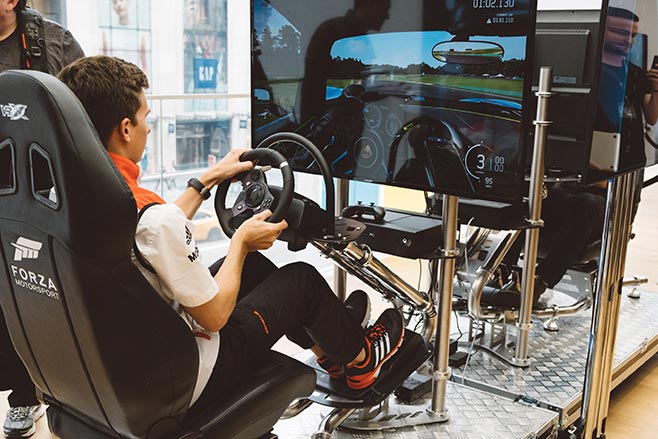
With Porsche joining Microsoft, and the ACO as a supporter, the in-game vehicles that will be used are primarily Porsches such as the 2012 GT3 RS 4.0, the 718 RS 60 from 1960, and the 2015 Porsche Team 919 Hybrid.
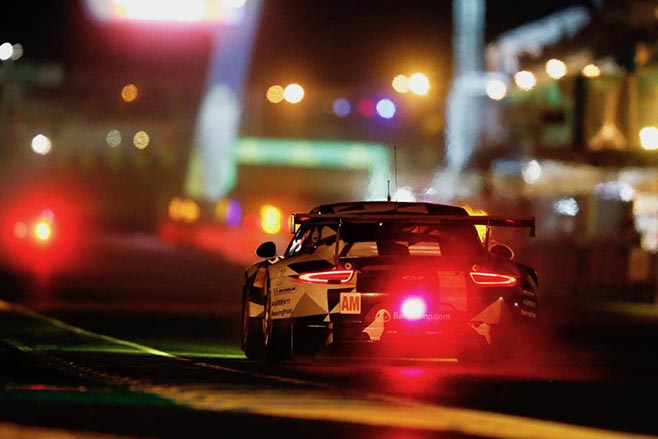
Qualifying for the event is ongoing until May 28.
IT’S buzzwords aplenty over at Ford, which announced overnight it would replace CEO Mark Fields with Jim Hackett, a man six years his senior and with a background in office furniture.
Under intense pressure from investors who’ve watched recent market share and profits decline in what is a fast-changing automotive market, 56-year-old Fields officially retired after less than three years in the role, although the feeling from some is that he was pushed to the edge of a company under pressure from traditional players and newcomers from Silicon Valley.
A statement released by Ford talked of “transforming” and “strategic processes” and “nimbleness” that will arrive as part of Hackett’s promotion in his short-lived time at Ford; he has been a board member since 2013 and in 2016 was appointed chairman of the newly formed Ford Smart Mobility division, targeted at taking advantage of a shift towards car sharing and different ownership models.

It’s not the first time Ford has looked outside the automotive industry for a CEO; in 2006 it hired former Boeing executive vice president Alan Mulally, who helped guide the company through the financial crisis (Ford was the only one of the big three American makers not to apply for bankruptcy) and boost its sales and profits.
“We’re moving from a position of strength to transform Ford for the future,” said Bill Ford Jr about Hackett’s appointment. “Jim Hackett is the right CEO to lead Ford during this transformative period for the auto industry and the broader mobility space. He’s a true visionary who brings a unique, human-centred leadership approach to our culture, products and services that will unlock the potential of our people and our business.”
In farewelling Fields, who worked for the company for half his life, Ford referred to him as an “outstanding leader”.
In the early 2000s Fields was credited with setting Mazda – then under Ford control – on its current “zoom zoom” path and helping expand its global focus.
He also headed the now-defunct Premier Automotive Group of Ford, which included Aston Martin, Jaguar, Land Rover and Volvo.
Overseas reports suggest Ford will take a more hands-on role in what many see as the biggest period of change within the automotive industry in more than a century.
The big questions remain as to whether Ford can succeed in its wish to become a “mobility company” as well as a successful car company, in turn leading the way on things such as autonomy.
THE EYES of senior industry executives always light up when you ask them about autonomy.
First published in the April 2017 issue of Wheels Magazine, Australia’s most experienced and most trusted car magazine since 1953.
It’s a chance for them to look like visionaries, to riff on a bright, shiny future. Instead of old-fashioned dinosaurs, they become tech pioneers, promising the almost-there future of click-and-go mobility.
Snake oil salesmen might be closer to the truth, especially as the yawning chasm between the hype and the reality of autonomous cars becomes increasingly obvious. Because the auto industry is guilty of deliberately sowing confusion about what self-driving cars will, and won’t, be able to do.
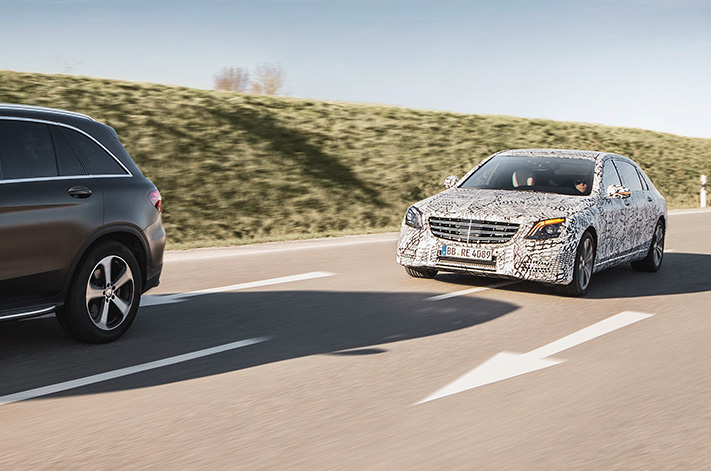
They’re coming, and you’ll be able to buy one soon – Mercedes reckons half the cars it sells will have some form of Drive Pilot within five years.
But they’re not really autonomous, requiring the driver to remain in charge of the car and ready to take full control at any time.
The prospect of a car capable of doing the whole ‘home James’ bit while you slumber in the back – what the boffins refer to as ‘Level 5’ autonomy – is a pot at the end of a far-distant rainbow.
The problem isn’t the technology, which will get us there eventually. It remains the human-machine interface, both in terms of over-trust – early studies suggest some drivers think autonomous cars are capable of far more than they actually are (like the cruise control scene in Anchorman 2) – and the fact that people are likely to quickly realise they can game the system.
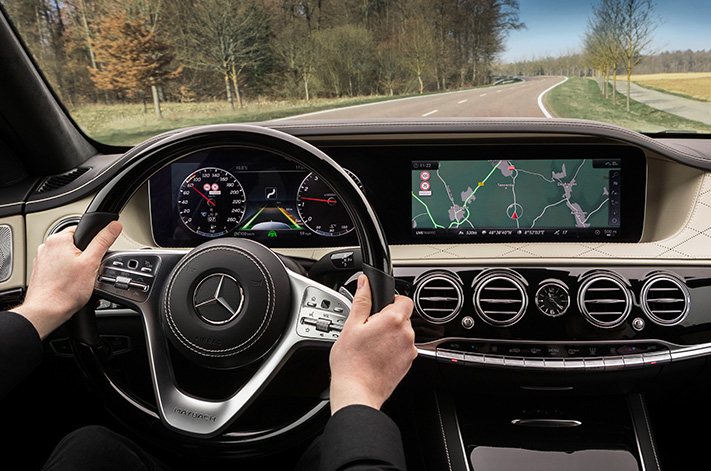
The only obvious answer is to restrict certain areas to fully autonomous operation, something even the most enthusiastic adherents don’t see happening any time soon.
At a recent event, an Audi autonomy engineer admitted that his team is still struggling with creating cars capable of navigating US four-way stop signs, which require drivers to effectively yield to each other.
He described the challenge of crowded megacities as being “several magnitudes” harder than open-road autonomy, citing Mumbai and Naples as the toughest environments.
Does anyone really think Sydney and Melbourne are going to be much easier?
Hence the provisos like “gradual” and “phased” that are getting mixed into the grandiose autonomy venacular of senior executives. The wait for a truly self-driving car is going to be a long one.
Hit me, I’m a robot The Volvo’s ‘Drive Me’ trial of partially autonomous XC90s is using unmarked cars after the risk of other road users deliberately testing the robo-car’s observation and braking skills was identified as a real one.
And why would a pedestrian wait patiently for a green man if they know the approaching car will stop safely if they step out?
For that matter, who wouldn’t be tempted to gain a bit of an advantage in traffic at the expense of the autonomous car that will always back off when you chop in front of it?
In a world suddenly filled with cars that must adhere scrupulously to all traffic laws, will the aggro dickhead in a battered shitbox end up king?
Question: Laurie
Hi, I have narrowed my selection down to three dual cab 4WD utes – Mazda BT-50, Ford Ranger and Holden Colorado. I tow a 16-foot caravan and want the power for hills and all-round best vehicle. I believe that Mazda gives the best customer service. Are any of these three vehicles better than the other?. And with two having a 3.2L 470Nm motor and the Colorado 2.8L 500Nm motor does the size of the two bigger motors have an influence on the overall performance and power?
Budget: $60,000
Answer: Matt
You’ve narrowed the field down to some worthy contenders. However, the mechanically related Mazda and Ford options are my pick for towing for a couple of reasons.
Both the Mazda BT-50 and the Ford Ranger share the 3.2 litre 5-cylinder powerplant. And while it puts out a little less torque than the 2.8 litre Duramax in the Holden Colorado on paper I still feel that the bigger engine hauls a load easier and will serve you better over its lifetime.
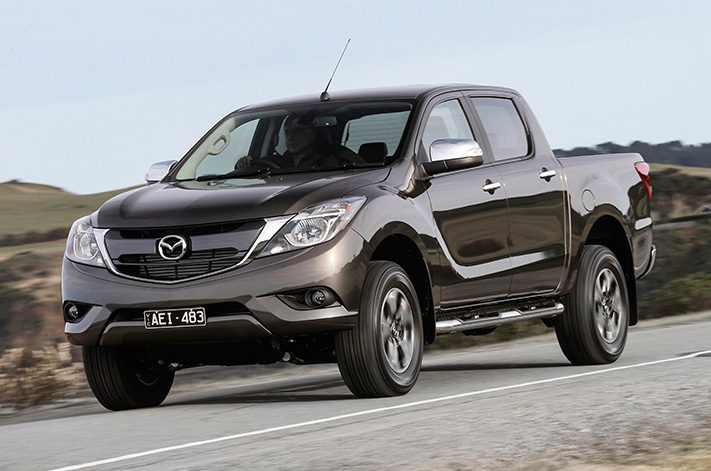
The shared platform of the Mazda and Ford has quite a long wheelbase which makes for a stable tow vehicle. That feeling of fighting with a twitchy tow rig can be exhausting over a long trip.
And speaking of stability, the Ford and Mazda have stiffer leaf springs underneath the rear. While this gives them a more jiggly ride when empty it also means that they feel more stable when heavy towing than the Colorado.
The Ford has better power delivery as the Ranger now features a new fuel injection system and a low-inertia turbo. The BT-50 didn’t get that update. However the Mazda still hauls well, it’s just a little noisier under load than the Ranger and power takes slightly longer to come on tap. That said I’m not a huge fan of the Ford’s electric power steering and much prefer the Mazda’s traditional non-electric feel through the wheel.
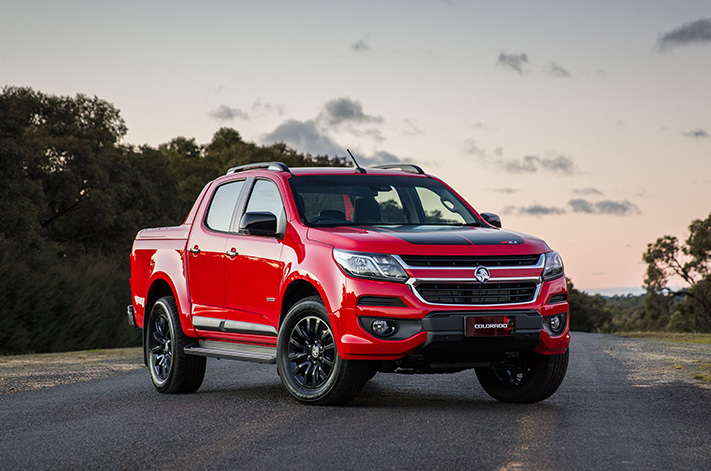
The Colorado is arguably better value at the moment with Holden going in pretty hard on pricing. And it’s a much better ute than it used to be. But in the long term I think the Ford/Mazda twins are the way to go.
The Ranger has a little more finesse (and is better looking) than the Mazda but you’ll get a better deal on the BT-50.
Hyundai Australia has confirmed its local engineers are currently finalising suspension and chassis tuning for its BMW 3 Series rival soon to be globally revealed as the Genesis G70.
The compact rear-wheel drive sedan will be unveiled with multiple engines, but all eyes are locked on the range topping 3.3-litre twin-turbocharged V6 petrol, an engine shared with the heavily hyped Kia Stinger GT in which it produces 272kW and 510Nm.
Kia has indicated its offering will start at $50K, however the G70 is pitched as a more premium sedan version of that larger liftback, set to target a $90K BMW 340i for less.
Hyundai Australia chief operating officer Scott Grant told MOTOR that the Genesis G70 will have a clear and unabashed sports-performance focus compared with the limousine-like Hyundai Genesis, which will soon be rebadged Genesis G80.
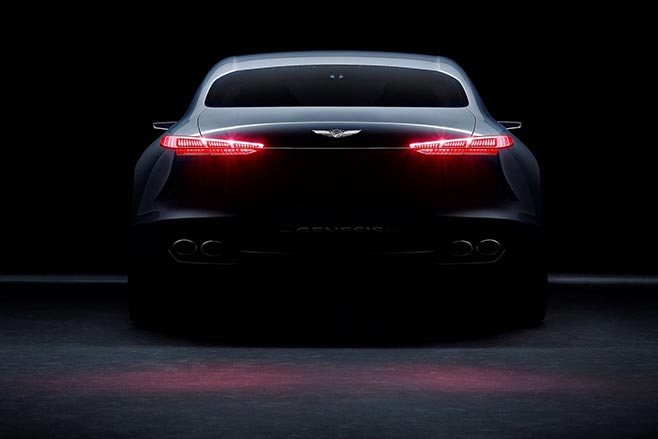
“I drive a Genesis now, it’s quite a large car, it’s beautifully finished, but it’s not necessarily a sporting drive where I think the G70 will have a more performance orientation.
“If you want to play in that [3 Series] game the luxury part is essential. But they’re not enough if you want to have a sports-oriented product, which is what the possibility is for this product.
“You have got to have the luxury but you’ve got to have the sports flavour to it. You can’t have one without the other.”
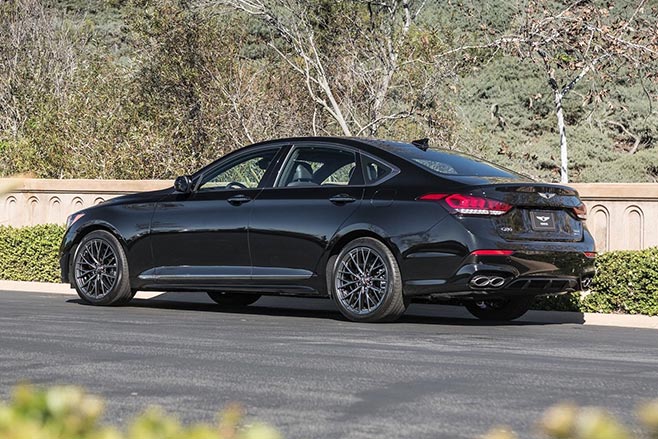
Over-arching Hyundai chassis development, meanwhile, is in the hands of former BMW M division chief engineer Albert Biermann – who is also readying Hyundai’s i30 N hot hatch.
If the G70 can mirror the twin-turbo V6-engined Stinger GT’s 4.9-second 0-100km/h claim, it will be as quick as a 340i and two-tenths slower than a $99,900 (plus on-roads) Audi S4.
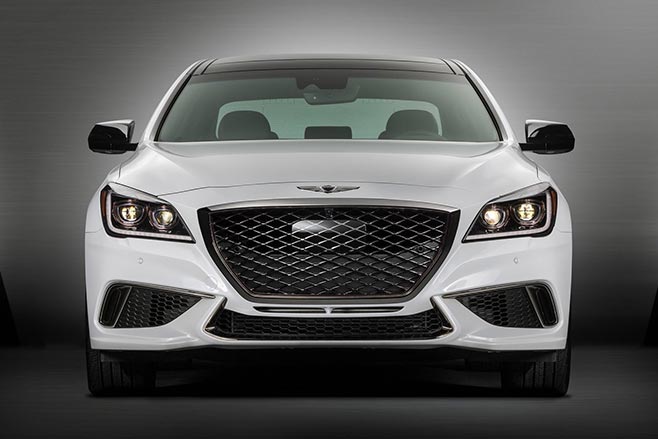
That Commodore-sized sedan with a 3.8-litre naturally aspirated V6 and which sells mostly to hire-car drivers, today starts at $61,500 plus on-road costs.
“I think there will be different buyers and a different experience completely,” he said of the G70 and G80 pair.
“So to what extent will they sit side by side? How far is it this way [cheaper] or is it a Y-strategy and equal in pricing?”
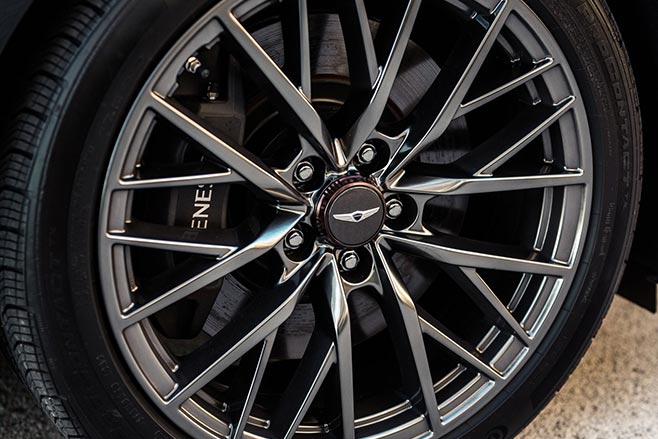
The Genesis G70 is expected to be revealed at the Frankfurt motor show in September before arriving Down Under in December or early 2018.
MOTOR has used the driving services of Supercar and GT racer Warren Luff for more than a decade now.
Despite our best attempts to scare him off with tuner car blow-ups, eskies, dodgy food and poor fashion, he’s stuck around and is one of our biggest assets.
Like Liam Neeson in Taken, Luffy possesses a very particular set of skills. He’s fast obviously, but his stunt work also gives him the ability to slide a car with millimetric precision for the cameras, something not every pro driver is comfortable with.
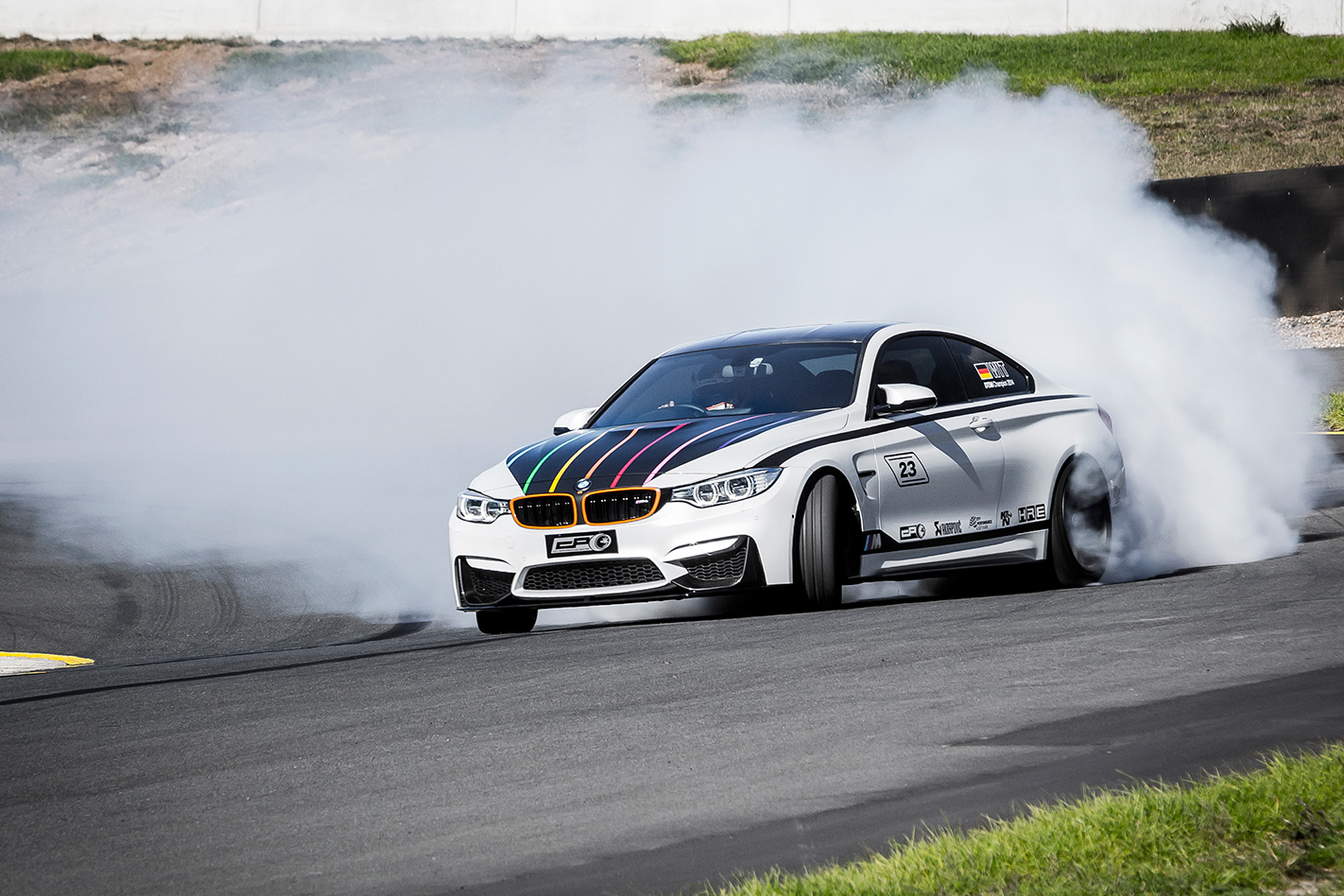
A recent track comparison between the BMW M3 Competition, Mercedes-AMG C63 S and Alfa Romeo Giulia QV (coming soon) provided the chance to dig a little deeper. Being reasonably familiar with Winton I plugged in the Driftbox following Luffy’s laps to time my own attempts.
The chance to directly compare your data with a pro driver is an invaluable learning opportunity and also provided some interesting insight for the comparo.
I was pretty chuffed to get reasonably close, between 0.5-0.7sec in each car, but aside from the fact that I could do another 100 laps and not find that half-second or so, I’m under no illusion that I could set the lap times myself as the times in and of themselves don’t tell the whole story.
Firstly, Luffy tends to do two flying laps and then park it (see earlier comments about mechanical sympathy). With more laps no doubt more time could be found, but that isn’t the object of the exercise. The point is to nail a representative lap time while leaving tyres and brakes intact.
Examining the data shows how Luffy is able to do this. The picture below is the overlay of each of our two best laps in the Mercedes-AMG C63 S through Winton’s tricky back section (turns 3-9).
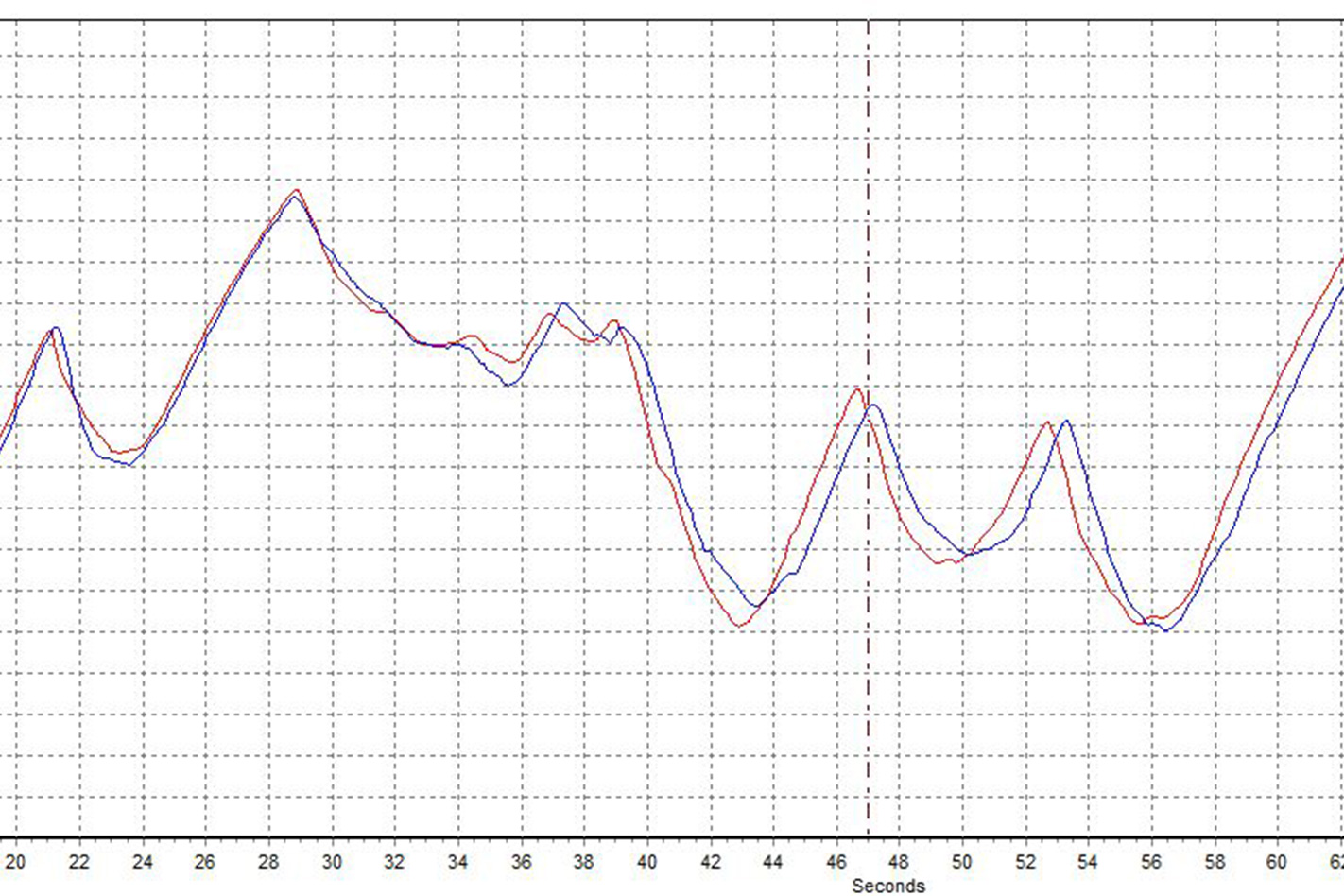
Secondly, Luffy can extract the maximum lap time regardless of which track we visit. As mentioned, I was stoked to get reasonably close at Winton, but I’ve done hundreds of laps around there and the more difficult the race track (or more difficult the car), the wider that gap would stretch.
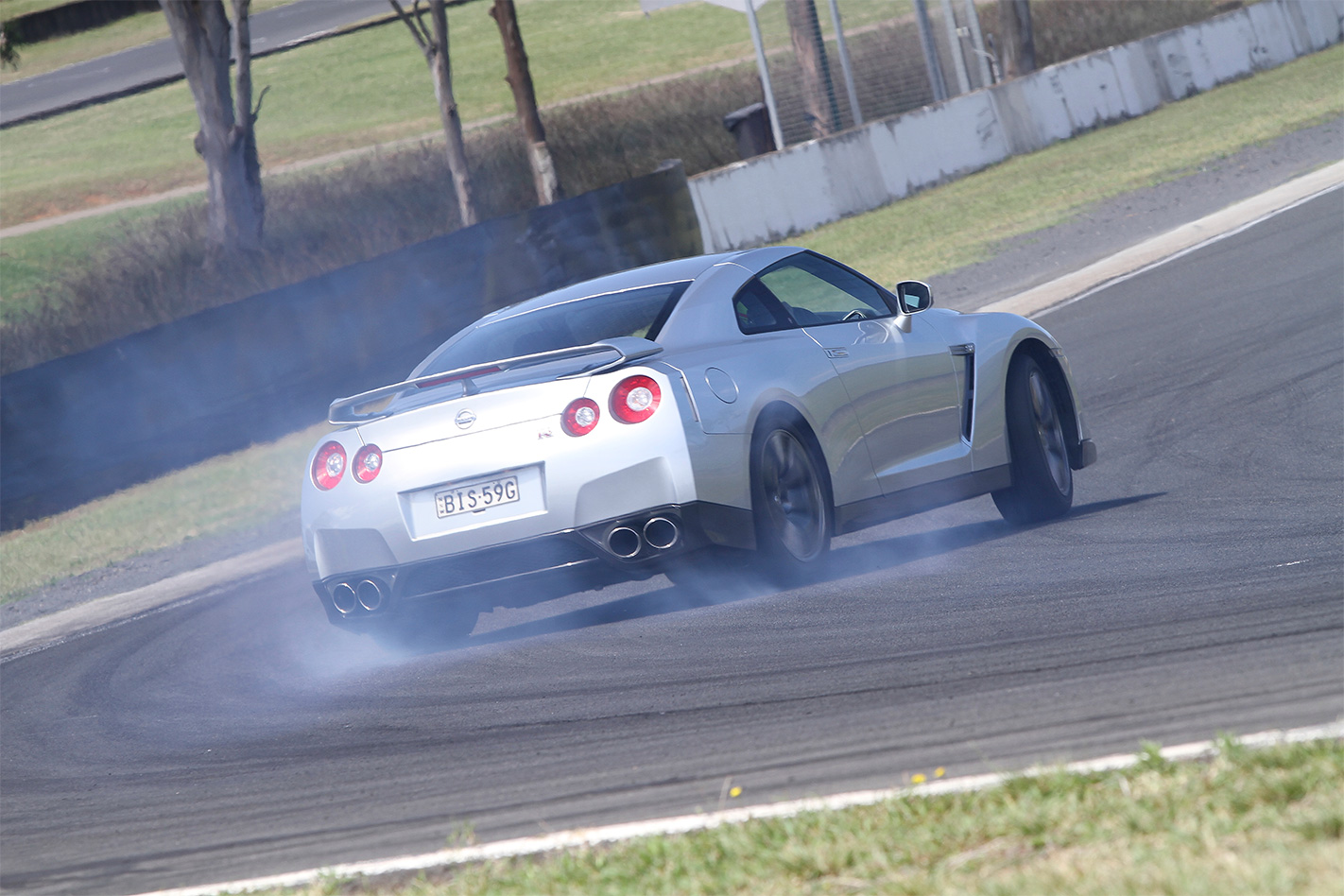
Luffy’s ability to quickly and consistently nail quick laps in unfamiliar road cars while also being able to do fourth-gear drifts standing on his head is why hopefully he’ll be part of the MOTOR team for many years to come.
CONNECTIVITY is the buzzword of a generation, built on instant gratification and unimpeded interaction with the world at large, yet there’s an ironic, gaping hole in all of this.
First published in the May 2017 issue of Wheels Magazine, Australia’s most experienced and most trusted car magazine since 1953.
We’re being fed communication by the continent load, yet we’re craving taller, less intimate vehicles that lift the driver up from the road, beyond lesser mortals, further from the point of connection.
But not the three superstars you see here – Mazda’s freshly targa-roofed MX-5 RF, Subaru’s exquisite BRZ and Porsche’s now-ballistic, turbocharged Cayman S.
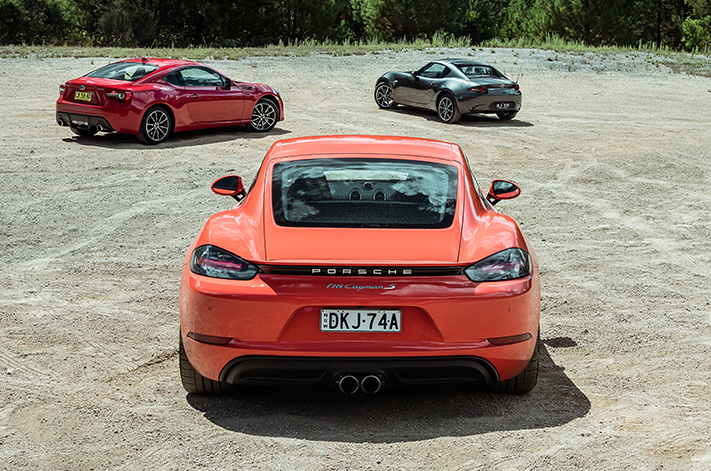
The caveat, of course, is extracting yourself from their low-slung cabins while maintaining a shred of dignity, but if you have to ask…
We could’ve invited other sports coupes to the party, like Ford’s hugely popular Mustang and maybe even a BMW 2 Series, but that would be missing the point of the MX-5, BRZ and Cayman experience.
Each represents the definition of motoring purity in 2017, and it’s no coincidence that each houses its engine inside the wheelbase. In the Mazda and Subaru, it’s front-mid placement while the Porsche is a true mid-engined sports car.
There’s some back story here too. In our June 2012 issue, we sent Peter Robinson to Japan to compare the BRZ’s near-identical sibling, the Toyota 86, with Porsche’s previous-generation 987 Cayman flat six, prompting the hugely controversial cover line ‘Toyota beats Porsche’.
“A brilliant and charming enthusiasts’ car; one that tops the Porsche in this comparison”, wrote Robbo. But where do we stand five years hence?
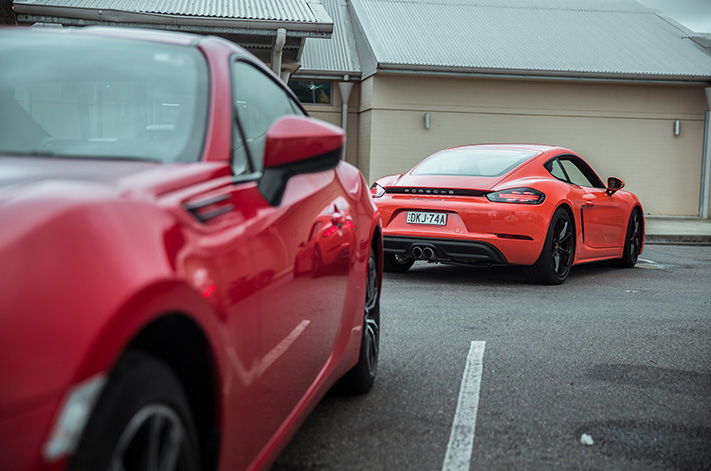
Following a complete generational change in late-2012, Porsche almost started again with last year’s 718 Cayman. Only the bonnet, windscreen, roof and tailgate are carried over from the 981 Cayman, while engine-wise, the revered atmo flat-six has stood aside for an all-new boosted flat-four, measuring 2497cc in the case of this range-topping S, not 1988cc like the base Cayman we wanted for this test.
But hey, who could turn down a Lava Orange Porsche wearing black 20s, looking like a slice of Gold Coast bikini chic from the late-’80s?
Packing a variable-vane turbocharger (as per 911 Turbo) and enough muscle to dramatically re-write the rulebook for ‘entry-level’ Porsche performance, the Cayman S is truly supersonic. With launch control aiding traction, the dual-clutch Porsche leaps off the line like a barking pit-bull and strains at the leash virtually to its top speed of 285km/h.
In just over four seconds, the Cayman S is travelling 30km/h faster than the BRZ and MX-5, nailing triple digits in 4.3sec and flashing past the 400m mark in a rip-snorting 12.4sec (at 187km/h).
That’s a level of acceleration that would’ve once been a 911 Turbo’s exclusive domain, yet here we have a brattish little four-potter matching its grand-daddy’s brutishness.
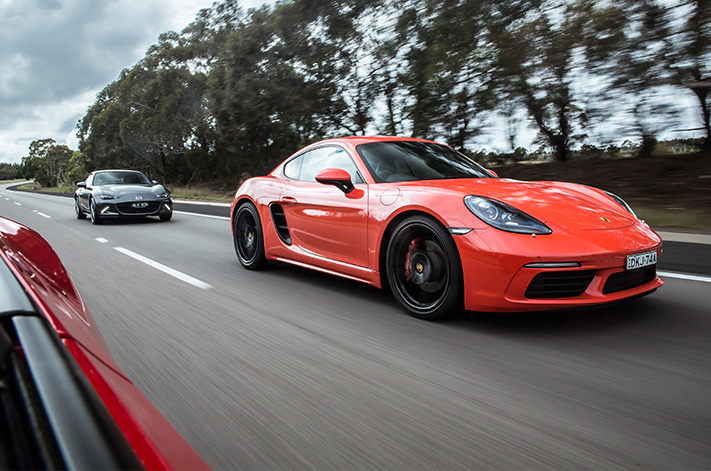
Up against the cream of Porsche’s Cayman crop, the BRZ and MX-5 RF are left reeling. The Cayman S will sprint to 160km/h in half the time it takes the BRZ (9.2sec versus 18.0sec), while an upshift to fifth gear at exactly that point means the MX-5 is slower again (19.4sec). But there’s still a sizeable chunk of sports-car spirit in the charismatic Japanese pair.
Bolstered by snick-snick manual gearshifts and an insatiable desire to rev, both the Subaru and Mazda reward redline commitment.
The BRZ’s direct-injection 2.0-litre flat four has been thoroughly tweaked for 2017 to extract a bit more power and torque in manual-transmission models, yet it feels little different to before. The alterations haven’t banished a curious lull in its power and torque delivery between 4000 and 4500rpm, though the fact the engine suddenly comes alive at four-five probably exacerbates the experience.
Beyond 4500rpm, the BRZ exponentially dials up the intensity until it snags its ignition cut-out at 7400rpm – just like the much-missed atmo Renaultsport Clios used to – supported by a sharp induction rasp amplified by a sound symposer plumbed from intake to firewall.
But the low-mileage test car never felt as elastic as we remembered, and its numbers proved as much – it clocked a modest 7.8sec to 100km/h (Subaru claims 7.4sec) and 15.5sec to 400m, or about as quick as a warm hatch like the Mazda 3 SP25.
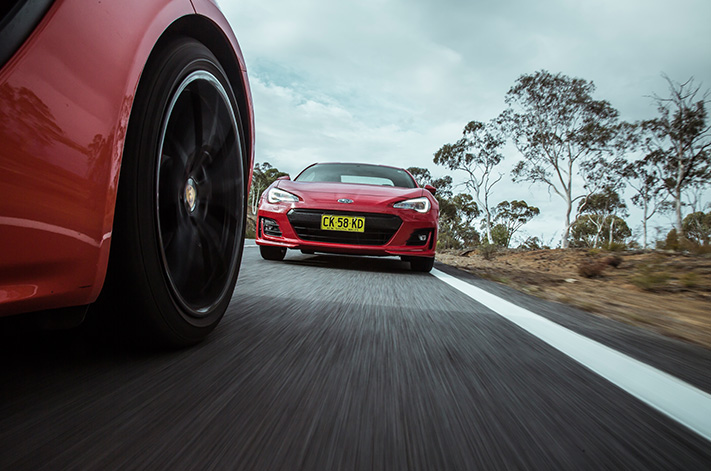
But there’s a lot to like in the RF.
Weighing just 1080kg (compared to 1282kg for the BRZ and 1385kg for the Cayman S PDK), the tin-top MX-5 is saved by its power-to-weight ratio, and much of the time, it feels torquier than the Subaru.
There’s a throaty muscularity to its induction note, too, that fits the sporting bill perfectly, and a rev ceiling of 6950rpm is still plenty in a delicate little coupe like this. You have to work hard for your performance rewards in the Mazda and Subaru, yet the Porsche, too, withholds its true accelerative brilliance for the deeply committed, or deeply insane.
Rev the absolute tits off the BRZ and MX-5 and you’ll still be only a decisive brake stab away from something approaching a legal speed.
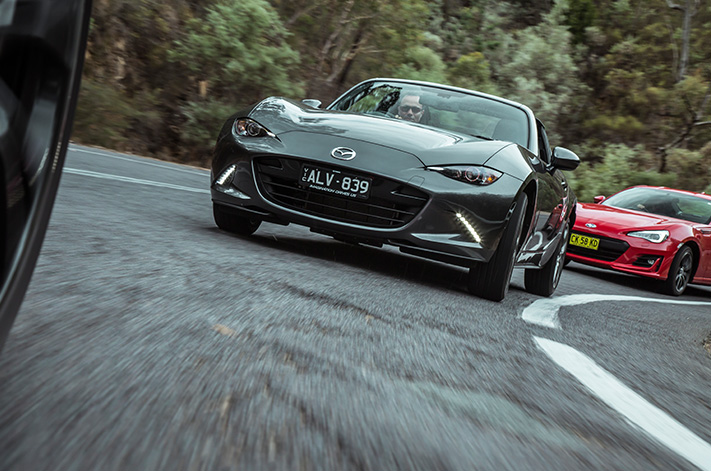
If you keep the throttle pinned long enough, it will keep piling on the artillery right to its 7400rpm redline, just like the old flat-six used to, but on another level altogether.
It’s breathtakingly quick, with a throbbing, pulsing, cackling backing track courtesy of an optional $4330 sports exhaust in this instance, yet the Cayman S PDK is tractable enough to lend to your granny for a trip to the shops.
It also has the dynamic dexterity to harness every fragment of its 257kW and 420Nm engine outputs.
Indeed, the Porsche’s blend of precision, control and comfort is really quite astounding.
On the punishing Cotter Road outside of Canberra – a fabulous test route blessed with both a 100km/h limit and more lumps, bumps and curves than a Sports Illustrated calendar – the Cayman S demonstrated the worth of its cutting-edge (and expensive) mechanical set-up.
Featuring Porsche Torque Vectoring (with a mechanically locking rear differential – $3190) and Porsche Active Suspension Management (adaptive dampers) with ride height lowered by 10mm ($2710), as well as 20-inch Carrera S alloys wearing Pirelli P Zero rubber, the Cayman S operates on a much higher plane than the BRZ and MX-5.
Even with its suspension in default mode, the Cayman’s body control is superior to the Japanese pair, but in Sport mode the difference is even more remarkable.
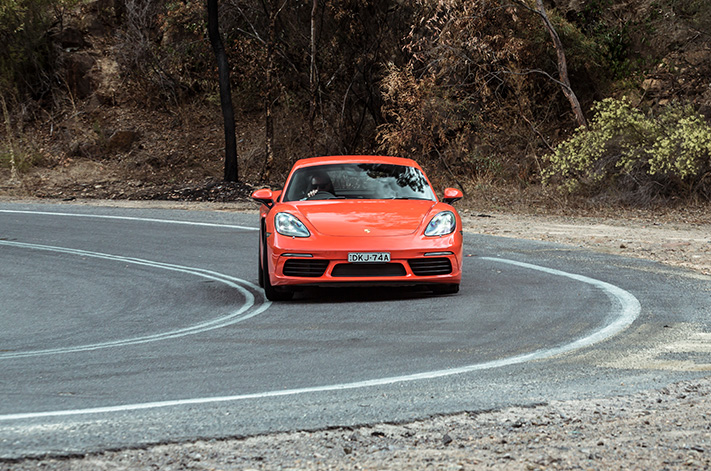
Benefitting from the tangible strength of the Cayman’s body structure, the Porsche’s damping is perfection.
It’s a rare Sport mode that can be used effectively on an Aussie country road, with steering and fingertip connection amped up to suit, yet the Cayman S pulls it off with almost arrogant conviction.
And its brakes – ventilated and cross-drilled discs clamped by four-piston calipers – are stunning, pulling up from 100km/h in just 31.7m.
In comparison, the MX-5 managed a still-decent 35.5m while the BRZ (with slightly mushy pedal feel unless you’re really into the travel) stopped in a pretty average 38.4m.
More so than the previous 987 generation, there’s a 911-esque flavour to the Cayman’s dynamics that rewards technique and commitment. You need to be decisive on turn-in, feeding in plenty of lock, but when you do it transfers load onto the rear axle instantly, enabling you to carve a line through a corner – bumpy or smooth – almost like a sculptor.
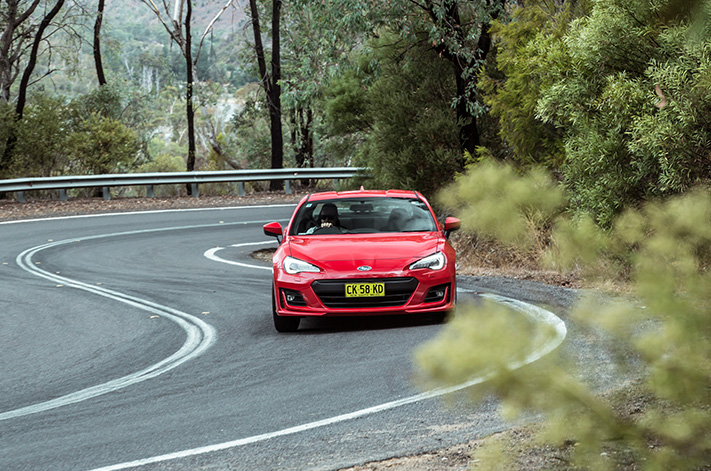
Like the Porsche, the boxer-engined Subaru resists bodyroll much more than the almost comical MX-5. And like the Porsche, the BRZ’s work station is texbook brilliance, with perfectly aligned pedals, and the best steering wheel and driver’s seat here (complete with a plush headrest that can be reversed to make room for a helmet on track days), despite the cloth-trimmed bucket’s rudimentary lever backrest adjustment.
In fact, the BRZ’s seats form a major part of its rough-road comfort. They’re masterfully in tune with what’s raging beneath, though the BRZ’s tightly damped chassis can feel a little twitchy over bumps.
It’s more of an amusement ride than the Porsche and Mazda on Cotter Road, with lots of grin-inducing movement in all directions, but its body control is terrific and its new Track ESC setting is subtle enough to monitor oversteer subtly and proficiently.
Ultimately, it’s a bit skittish on a road like this, but once you learn to trust it, it’s rarely unsettling. And the BRZ’s steering – just the one setting, beautifully weighted, crisp and communicative – is of a standard that should be automotive engineering 101.
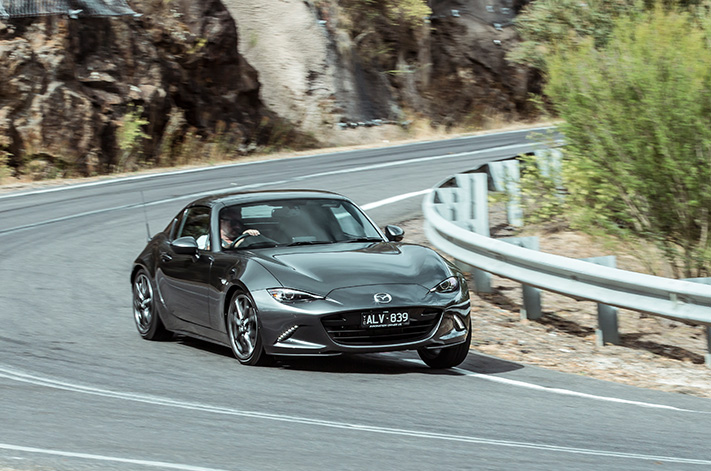
Once you’ve settled an MX-5 onto its back end in a corner, it’s virtually all throttle steer from there. So delicious is its fluidity and suspension pliancy that you can drive it flat out virtually everywhere, without the cocktail-shaker effect of the BRZ over lumpy surfaces, and boy does it love to lean! Personally, I think well-balanced bodyroll is right up there with great margaritas and rude graffiti in terms of life’s little pleasures, yet the MX-5’s lateral attitude doesn’t inhibit its cornering speed or outright grip.
Not on the road.
Where the lightweight MX-5 requires some compromise is inside its intimate cabin. The by-product of its exquisite form and diminutive size is not a whole lot of room for larger frames.
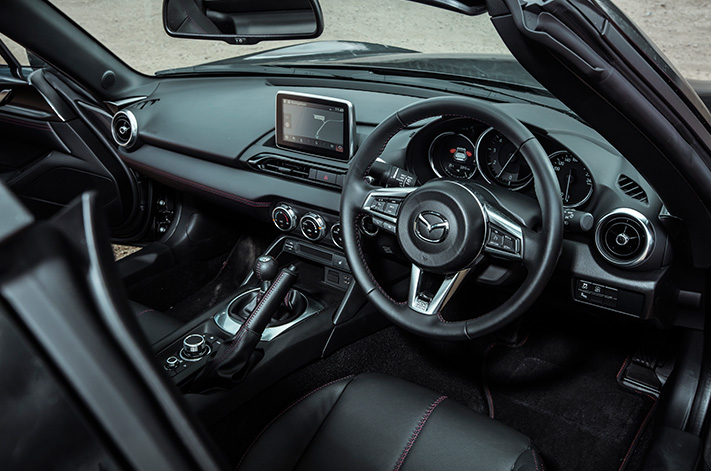
It can’t match the in-cabin refinement of proper coupes, either. The MX-5 RF is a tin-top roadster convertible, and providing you view it that way, then you’ll understand why its cabin sounds slightly hollow, as if you’re closer to the elements than you are in the Subaru and Porsche.
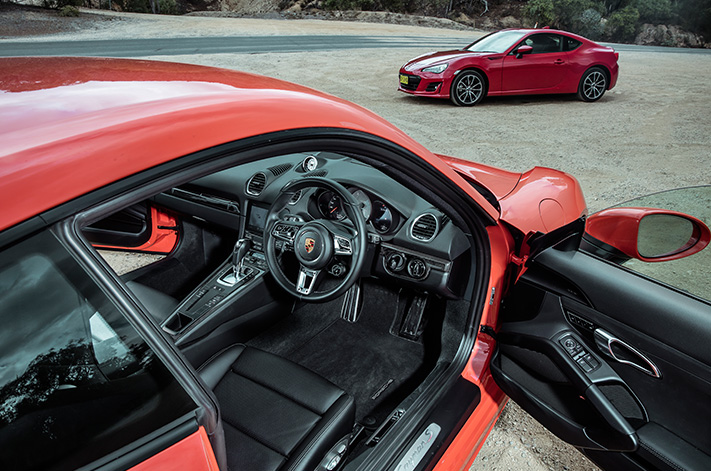
While they’re best suited to legless twins, the fact you can actually put kids in there awards the BRZ a liveability prize that makes it a genuine option as a second family car. You can even fold its rear backrest down to squeeze in a bicycle, and it has a spare wheel.
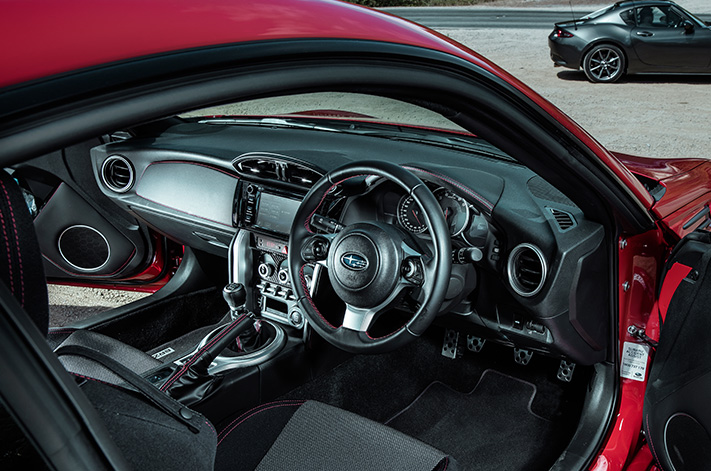
Some punters will only ever buy a Porsche, while others are fanatically devoted to the Toyota 86/Subaru BRZ ‘hachi-roku’ phenomenon that they wouldn’t look sideways at an MX-5. And yet others would only ever buy the Toyota (the inspiration behind the car) while it’s Subaru all the way for the rest (the builder and supplier of oily bits).
In MX-5 terms, the purest example is the 1.5-litre manual rag-top, though the fact the hard-lidded RF exists, and is destined to expand the MX-5’s fan base, deserves praise in itself.
And who can dispute the return of flying buttresses, the RF’s beautiful point of difference? Certainly no Jaguar XJ-S devotee.
But does the fact that the loveable RF demands the greatest compromise to fit into your life nudge it into third place?
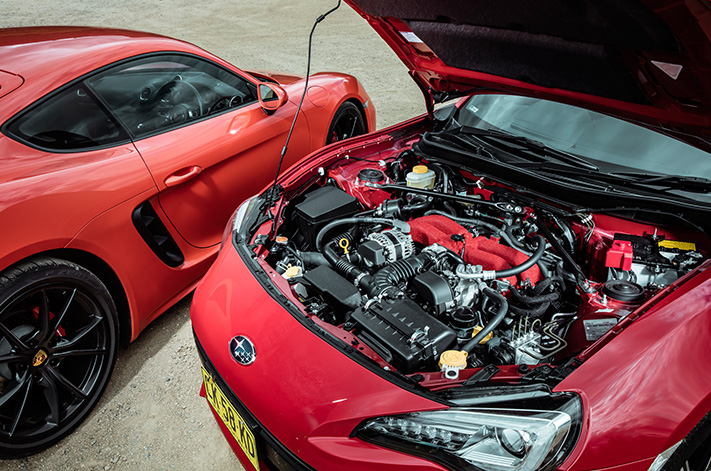
What’s even more surprising is just how seductive the Subaru BRZ still is, even at five years of age.
Its fundamental DNA and structural bones are just about perfect, making stuff like its ho-hum multimedia screen and unremarkable straight-line acceleration pale into insignificance.
Unlike the Porsche, the Subaru coupe isn’t about appendage measuring.
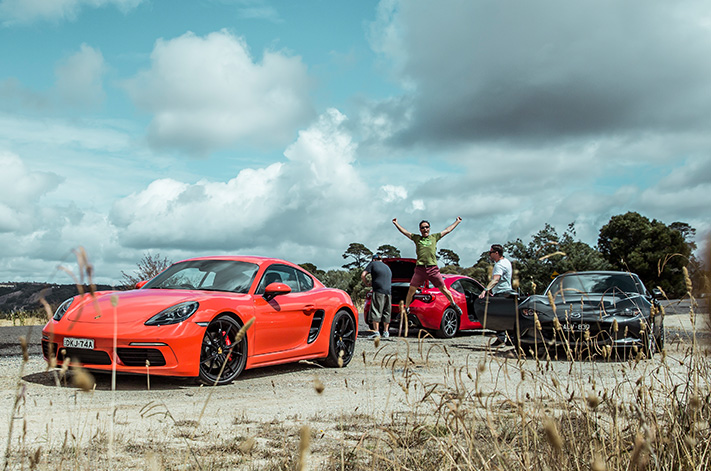
Then there’s the Cayman S. At an as-tested price of $180K, this delectable slice of orangeness is about as ‘everyman’ as a stock portfolio and a holiday pad in Byron, yet it’s also truly, madly, deeply aspirational – the sports car the MX-5 RF and BRZ would be if they grew up and scored a Joe Hockey-style ‘proper’ job.
Its broader dynamic repertoire kinda goes with the territory, but it’s the Cayman S’s phenomenal performance that puts it so far ahead of the Japanese coupes.
It’s so blindingly quick that after driving the other two, it takes your breath away. And, in my opinion, it loses almost nothing for being a boosted flat-four, yet gains a shedload of additional stomp and cred.
So while the BRZ is arguably the purest coupe of our time, and the MX-5 a deserving roadster legend, the Cayman S is simply a frigging great Porsche. And that speaks volumes, via smartphone or bush telegraph.
What stands out?
The Qashqai is the larger of two small SUVs Nissan sells (the other being the quirkily styled Juke). It costs less than the mid-sized X-Trail but comes with lots of equipment. Along with a spacious, well-presented and clever interior, it offers advanced crash-warning technology and a choice of petrol or diesel power.
What might bug me?
Taking off from rest in diesel versions: the engine takes a moment to get going properly. You learn to allow for that, but it requires attention in city traffic.Explaining to friends and family how to pronounce Qashqai. For the record, it’s “cash-kye”.Driving under 80km/h on the space-saver spare until you can fix your full-sized flat tyre.
What body styles are there?
Five-door wagon only.All Qashqais drive the front wheels only, and the Qashqai is classed as a small SUV, lower priced.
What features does every Qashqai have?
Cruise control, Bluetooth phone connectivity, and a colour touchscreen (a 5.0-inch unit for the ST and TS, and a 7.0-inch screen for the more expensive Ti and TL models).A reversing camera, for better vision when parking.A leather-wrapped steering wheel.Aluminium alloy wheels, which are lighter than steel wheels. (And a space-saver spare wheel.)Six airbags: two directly in front of the driver and front passenger; side airbags to protect the upper body of front occupants; and head-protecting curtain airbags for front and rear occupants.The Qashqai is covered by a three-year, 100,000km warranty.
Which engine uses least fuel, and why wouldn’t I choose it?
The most fuel-efficient engine is the 1.6-litre four-cylinder turbo diesel used in the TS and TL models, consuming 4.9 litres/100km in official tests (urban and country combined). That’s very good.One reason you might not want it is that the diesel engine comes only with an automatic transmission and is more expensive than the alternative petrol engine.Additionally, it has a diesel particulate filter, which is not suited to predominantly urban driving. You need to spend 30 minutes at highway speeds every week or two, so that the filter can self-clean.The diesel engine also gets a stop-start feature, which can automatically shut the engine down when the car is stationary, saving fuel.The other engine, a 2.0-litre four-cylinder petrol, uses about 40 per cent more fuel when teamed to the auto transmission most buyers opt for, consuming 6.9 litres/100km. (With a manual gearbox it uses more again – to the point where it is among the thirstier small SUVs on sale.)Only the petrol engine is available with a manual gearbox, a six-speeder. Both it and the diesel can be had with a CVT (continuously variable transmission) auto, which does away with gear ratios and adjusts the engine speed steplessly to your demands as a driver.
What key features do I get if I spend more?
Possibly the key feature that you pay more for in a Qashqai is the diesel engine. In fact, the more expensive of the two petrol-engined Qashqais costs about the same as the less costly of the two diesels.Nevertheless, if you step up in price from the cheaper petrol Qashqai, the ST, to the cheaper diesel, the TS, you also get more equipment. There is smart key entry, which allows you to unlock the doors without taking the key out of your pocket or bag. Headlamps on the TS switch on automatically in low light, and its exterior mirrors can be folded electrically (to reduce the chance of damage from other cars on narrow streets). There is dual-zone air-conditioning, which allows separate temperatures to be set for each side of the cabin.Spend your money instead on the luxury petrol version, the Qashqai Ti, and you get in addition a parking assistance system, which can automatically steer the car into place. The Ti also has a sunroof, partial leather trim (it’s a mix between real and fake leather), heated front seats, a power-adjusted driver’s seat, and the bigger touchscreen with satellite navigation. Windscreen wipers operate automatically when it rains.The Ti also has active safety features that include a lane departure warning (which alerts you if the car wanders out of its lane) and a blind spot warning (this alerts you if there is another car alongside, out of view, when you indicate to change lanes). And it has bigger, 19-inch wheels fitted with wider, lower-profile tyres.The diesel engined Qashqai TL has the same equipment as the Qashqai Ti.
Does any upgrade have a down side?
The lower profile tyres on Ti and TL models ride more roughly and could cost more to replace.The diesel engine is more expensive to service. And you need to give it a highway run every couple of weeks, to clean the particulates filter.White and black are the only standard colours, with the other six costing extra.
How comfortable is the Nissan Qashqai?
The Qashqai has broad front seats, which are good for big adults – although small people may find themselves wishing the seat bolsters constrained them more narrowly. The seats are comfortable and can be easily adjusted in other respects to suit most people.The touchscreen is easily accessible for both of the people in front and has a logical menu system. The ventilation system is user friendly also.The Qashqai feels nice inside and the interior is generally well put together.Steering is light and responsive and the turning circle is tight, so the Qashqai is easy to pilot around town. The cabin is well hushed and the suspension feels supple over bumps.The 2.0-litre petrol engine is responsive and works best with the CVT auto, which quickly adapts to your needs and gives you good acceleration. The turbo diesel is less impressive around town, because it is a tad noisy and takes a while to wind up from a standstill. That can be disconcerting if you’re looking to dart out of a side street. It’s not helped in such conditions by the stop-start system, which adds to the wait.
What about safety in a Qashqai?
Every Qashqai has the mandatory stability control, a full complement of airbags, seatbelt warnings for all five seats, and a rear-view camera. It is a package that prioritises your control of the car, your protection in a crash, and the safety of others when you are reversing.All Qashqais but the ST come with auto headlights, which can respond to poor visibility before you would notice and turn them on. That could help other drivers see you.TL and Ti Qashqais have active safety features that warn of a potential crash.However, no Qashqai has automatic emergency braking, which would apply the brakes for you if you ignored the warning.The Australasian New Car Assessment Program (ANCAP) rated the Qashqai’s safety at five stars, its maximum, in July 2014.
I like driving – will I enjoy this car?
The Qashqai doesn’t lean much in bends, something that helps it feel planted on the road and responsive to driver inputs. It’s fun and drives more like a good car than a higher-riding SUV.The Ti and TL models riding on the slightly wider, lower-profile tyres respond quicker to steering inputs, although there is little feedback sent through the wheel.The 2.0-litre petrol engine accelerates well and the car feels perky, especially in CVT auto form.The diesel easily builds freeway speeds and maintains them up hills, again helped by responsive CVT auto transmission.The Qashqai may look like an off-roader but it drives only its front wheels, so is not designed to be used off-road.
How is life in the rear seats?
The Qashqai is one of the bigger small SUVs and so it has good head and leg room in the back. The seat is mounted quite low, so people with long legs will sit with knees higher than usual. The rising line of the back windows could restrict vision for small children.While the back seat is flat (unlike some that are dished in the outer positions), a centre passenger has to contend with the firmer, raised armrest in the seatback behind them and a central hump in the floor.There are pockets in the rear doors and behind the front seats where you can store small items. But there are no rear air-conditioning ducts.
How is it for carrying stuff?
Like the cabin, the Qashqai’s boot is big for a small SUV’s. Binnacles on either side are handy for small items, while the flat floor is relatively broad. The boot can be expanded significantly thanks to 60/40 split-fold rear seatbacks, although they do not fold completely flat.There’s a clever removable shelf which can be used to create a slim secondary space hiding delicate or valuable items, and the shelf can also be locked in vertically to divide the boot.Up front there is a deep centre console that’s great for small bags or myriad odds and ends. There are also large door pockets, a pair of cupholders and an open storage container (perfect for phones) forward of the gear stick.
Where does Nissan make the Qashqai?
All Qashqais are produced in the United Kingdom.
What might I miss that similar cars have?
Support for Apple CarPlay and Android Auto, which would let you display apps from your smartphone on the car’s touchscreen and use them from there. The Holden Trax offers this, for example.An all-wheel drive system, for light-duty off-roading. The Mazda CX-3, Subaru XV, Suzuki Vitara and Mitsubishi ASX are available with all-wheel drive, for example.Automatic emergency braking, which can slow or stop the car if the system concludes you are about to crash into an obstacle in front (typically another car that has slowed suddenly). The CX-3 and Toyota C-HR come with this, for example.Other cars you might consider include the Honda HR-V, Renault Captur, Ford EcoSport, Citroen C4 Cactus, and Jeep Renegade.
When did Nissan update the Qashqai?
The original Qashqai went on sale in 2014 as a replacement for the Nissan Dualis. A facelifted Qashqai was presented at the Geneva motor show in March 2017, and arrived the following December.
I like this car, but I can’t choose which version. Can you help?
We like the Qashqai Ti with an auto gearbox. In most situations – and for most drivers – the petrol engine makes more sense, and we’d choose the CVT auto because it uses less fuel than the manual and should hold its value better. The step up to the Ti is also worth it given the additional equipment, including the active safety gear.
