
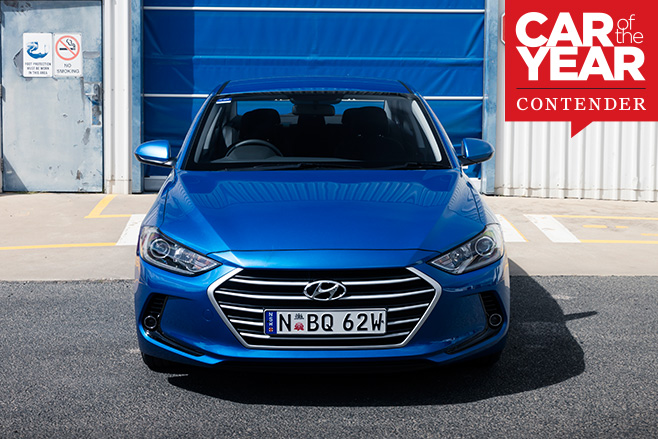
IN WHAT IS a reversal for cheap Korean small cars, the most expensive version of the sixth-gen Elantra is the best. And the only one to consider.
That’s right, folks. Look for the ‘SR’ badge (and ignore the old-school bodykit and spoiler treatments), because this cracking little sporty sedan is the neat but anonymous small Hyundai sedan’s saving grace.
Lusty performance from a 1.6-litre direct-injection turbo four, driving the front wheels via a (notchy) six-speed manual or (slick) seven-speed dual-clutch transmission, bigger brakes, reworked front suspension, a multi-link independent rear end (replacing a torsion beam), and a faster steering rack create a driver’s sedan of real substance.
Body hugging seats, a terrific steering wheel, decent equipment, and appropriately lairy trim lift an otherwise restrained cabin, though sat-nav is strangely missing while the sloping ceiling and sunroof can snare heads.
So, the SR bodes well for the forthcoming next-gen Hyundai i30 hatch that shares most of its chassis fundamentals. The rest of the Elantra range, though, is mired in mediocrity.
While interior space is generous, this is a flair-free zone. Granted, the archly conservative dash does not put a foot wrong in terms of layout and practicality, thanks to ultra-clear instruments, light and easy controls, excellent ventilation, and lots of places to put things in or on. Nobody will find this Hyundai challenging, but nor could it ever be desirable. And the rear-seat ambience is a bit depressing.
The robust 2.0-litre atmo four-pot and amenable six-speed torque-converter auto transmission provide spirited acceleration and fairly quick responses when more is called for, though you won’t be wanting to visit the higher regions of the rev counter because it gets raucous.
Not nearly enough though. The handling is now predictable and controlled, but the steering is treacly and overly heavy. The suspension remains jittery and loud, the stability control is ragged during fast lane changes and tardy on dirt. And wet/gravel braking is poor.
Finally, while blind-spot detection, lane-change assist, and rear cross-traffic alert are at least offered in the SR variant, AEB is absent altogether.
The latest Elantra, therefore, is a tale of two Hyundais – one that’s frisky and fun, and another that’s way off the small-car pace despite the fact it plays in Korea’s typically happy price-leader zone.
Specs
BODY Type: 4-door sedan, 5 seats Boot capacity: 458 litres Weight: 1255 – 1415kg
DRIVETRAIN Layout: front engine (east-west), FWD Engines: 1999cc 4cyl (112kW/192Nm) 1591cc 4cyl turbo (150kW/265Nm) Transmissions: 6-speed manual; 6-speed automatic; 7-speed dual-clutch
CHASSIS Tyres: 205/55R16 – 225/45R17 ADR81 fuel consumption: 7.1 – 7.7L/100km CO2 emissions: 163 – 176g/km Collision mitigation: No Crash rating: 5-star (ANCAP)
Prices: $21,950 – $31,290
MORE: Hyundai Elantra Range Review MORE: Hyundai Elantra Specs, Range & Price
I feel I’m about to say something deeply unpopular here, and possibly deliver the editorial equivalent of kicking oneself in the plums, but I’ll take a deep breath and say it anyway: i’m genuinely excited about an autonomous future.
It’s a topic I ponder most during my morning commute, which can include as much time sitting still as it does moving, but it’s a thought thrown into sharper focus by a conversation I had this morning with the PR bloke from Mercedes-Benz.
He’d called about our trip to Portugal next week, where Wheels will be one of only two Aussie outlets to sample the new AMG GT R, but it wasn’t the prospect of driving AMG’s latest and greatest track-honed weapon that had him so excited.
Seconds after telling me the AMG GT R is poised to become the world’s fastest rear-drive production car at the Nurburgring with a time of 7m10s, he gushed, “But the big news is Mercedes is building an autonomous city near Stuttgart!” Then, pausing for effect, he added, “And Wheels is going to be the first outlet in the world to see it”.
Honestly, I’ve never heard someone so excited about a plot of dirt, and I fear my lack of immediate response was taken as apathy. Which really wouldn’t be surprising.
The fact that the autonomous dawn is breaking has many petrolheads folding tin hats and crafting cardboard signs scrawled with “The End is Nigh!” Motoring journalists in particular seem to view the autonomous car as the antichrist, come to smite at the very heart of what they love most. And it’s easy to see why.
For people like us, people who enjoy driving, who relish the sense of connection delivered through a car’s controls and the seat of your pants, buying a car that removes the driving experience altogether seems counter-intuitive. We want to feel more connected, right? Not made redundant.
Yet what I fail to grasp is the notion that autonomy and driver enjoyment are somehow mutually exclusive. Surely we can have both.
I paused on the phone because I was reaching the realisation that over the next few days I’ll experience both ends of the motoring spectrum – a fire-breathing supercar designed to plug the driver into the core of its being, and ground zero of an autonomous city designed to delete the driver entirely. While poles apart, the crossover potential between these worlds is enormous, and it’s already happening. Take the E63 on this month’s cover, which will not only vaporise its rear rubber with V8-infused fury, but on the right roads drive itself home from the track with zero driver input.
Speak to people in the know, like AMG boss Tobias Moers and Renault Sport’s Patrice Ratti, and they see autonomy and driver involvement working hand-in-hand. “Why not?” shrugged Moers. “Why couldn’t an AMG drive you to a track, but then you push a button and the driver takes over?”
Ask Ferrari the same question, though, and the response is different. “Over my dead body,” Sergio Marchionne told us. “You’d have to shoot me first.”
But would a 488 or La Ferrari really be any less desirable if it had autonomous capability? Would allowing the car to drive you in city traffic actually detract from its ability to blow your mind when you regain control? I don’t think so.
Like it or lump it, the autonomous age is coming, and it’s something to look forward to, not fear. Check mate.
The much-needed reality check to autonomy is that despite the millions of dollars being invested in these systems by carmakers and tech giants like Apple and Intel, we’re still decades away from having our roads ruled by self-driving cars with no steering wheel. Drive a current Mercedes E-Class or Tesla and, regardless of the hype, you’ll quickly realise their autonomous ability is limited. Lane-markings, overhead signs and shadows easily trip them up, which means that, for now at least, the driver must be in control.
And so, as one of the mightiest flotillas of PCOTY fodder ever assembled is washed and fuelled in a small Victorian town on a languid spring afternoon, more than one set of eyes is surreptitiously checking weather apps under the heading ‘next 24 hours, Winton’.
Wet weather had been forecast for some days but had yet to materialise. For a sodden Victoria, it’s no hardship to go without the stuff for a couple of days at least, and one more day would be bloody great.
The thought of a greasy and narrow track lined with concrete walls isn’t filling editor Campbell’s heart with joy and rainbows, either. “It’ll be fine,” he said, with the quietly resigned air of a Melbournite more than familiar with the concept of rain ruining parades.
To be fair, the morning actually starts out pretty well. Despite a reasonably solid breakfast ordering error resulting in a pile of fried food that even I couldn’t finish, the day dawns with a hint of sun and a bit of a nip in the air.
When I was a young man a job in meteorology involved as much accuracy as setting course with a sextant made of breadcrumbs. A nice suit and a winning smile for the telly didn’t change the fact that the conditions that were generally forecast for the following day bore as much similarity to reality as anything that comes from the desk of Donald Trump’s foreign-policy advisors.
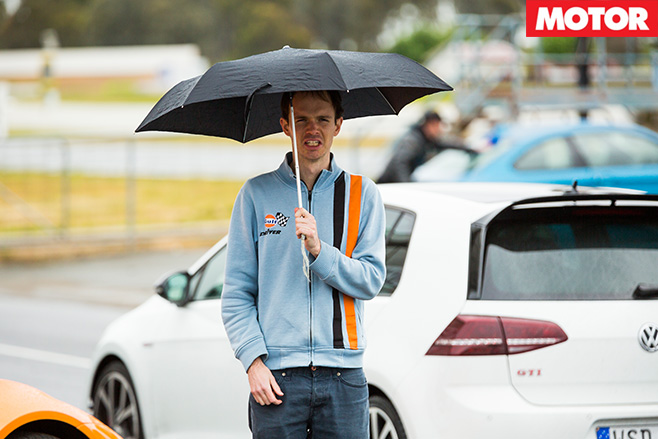
Bastards got it right today, didn’t they… literally the moment the last car was lined up along Winton’s pit lane, small drops began to fall.
“It’ll be fine,” says the eternally, foolishly optimistic Campbell. “Just a passing shower.” There’s a law of averages that applies when attending race tracks, and it essentially holds that the day will generally be far from average. Either it’ll be Hades hot, Kelvinator cold or 40 days-and-nights-worthy raining… and today definitely is turning into the latter. The ‘passing shower’ sets up camp just above the circuit and turns on all the taps. At once. Great.
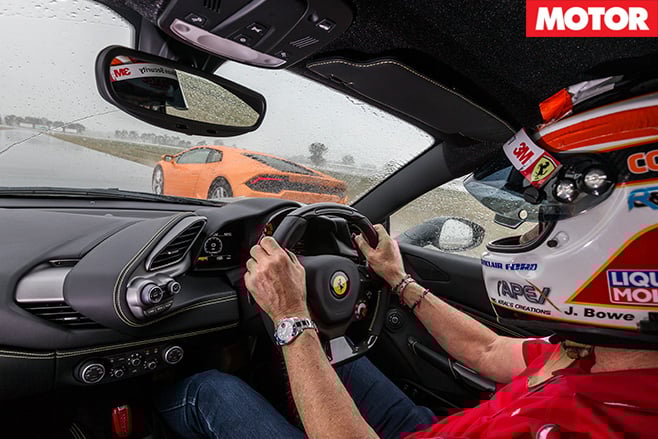
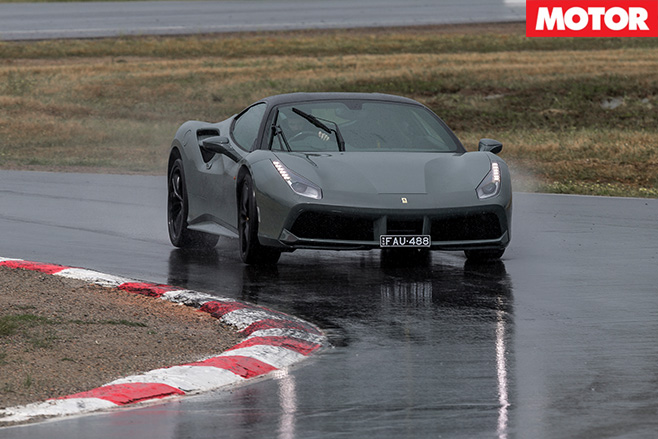
He’s right, too. Such is the top-heavy balance of our fleet, the tyre spec across the 12 cars leans towards dry-condition grip. Most people who own Ferrari 488s, for example, don’t tend to expose such expensive toys to such high levels of potential harm when the weather turns to poo – like it has for us.
Speaking of the 488, the Ferrari contingent has – almost inconceivably – doubled overnight. Not sure if it needs a band of techs and a vanload of bits for four journo hacks and a real racing driver – who actually races Ferraris – to do 40 laps absolute tops. In the decades’ worth of PCOTYs I’ve seen and done, not once has a company sent so much as a toolbox and a rag, let alone uniformed mechanics, a PR minder, a brace of tyres, laptops and a rattle gun. Anyway.
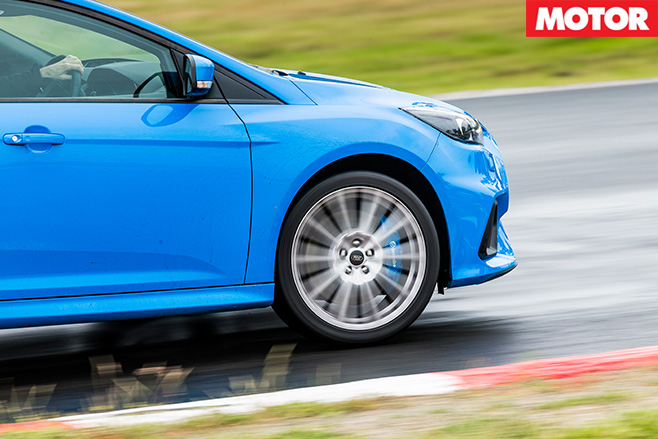
Bowe is on the clock, with a plane flight to a warmed-up racecar at the Gold Coast 500 awaiting him, so he fires out post haste to record his thoughts on the contenders. It would literally be impossible to guesstimate how many times he’s flung a car around the joint – his career stretches back to the stone age, after all.
What becomes immediately apparent is how hard he can push, despite the now completely soaking conditions. Smoke pouring from the Focus RS’s brakes is not what I expected to see today.
I follow his lead and venture out first in the RS – I figure it’ll not want to try and kill me straight away – and I instantly find there’s loads more grip off the typical racing line around the back of the track as the rain keeps tumbling down. “Should play to your strengths, then, Robbo?” quips Morley. Staying about a metre off every apex is the trick, with the polished inside line as obvious and unwelcome as a mezze platter at a One Nation barbeque.
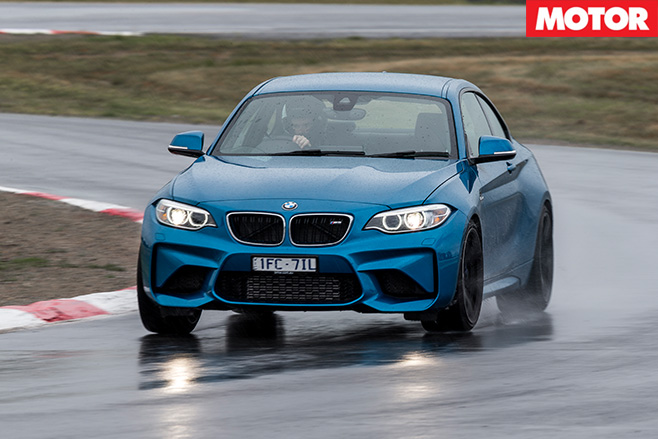
Likewise, the BMW M2 lucked in on the tyre lottery, with its Pilot Sports revelling in the rain. The little Bimmer’s low, broad footprint and sinuous suspension tune helps it to key into the road, while its steering – easily the best from BMW for quite some time – provides enough feedback and delicacy of response to find turn and lateral grip despite the water filming on the surface of the track.
It also feels like there’s a bit of torque trickery going on in lower gears, as if the ECU is holding back a bit in first and second. In such wet conditions, that’s perfectly okay with me. If anything, it adds to the Bimmer’s aura of being a bigger, more mature car than it actually is.
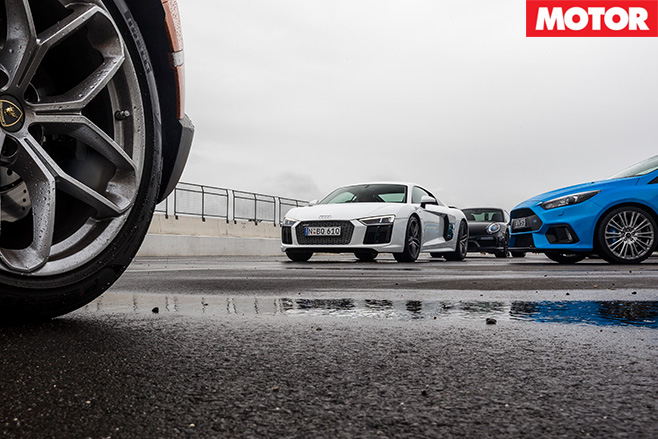
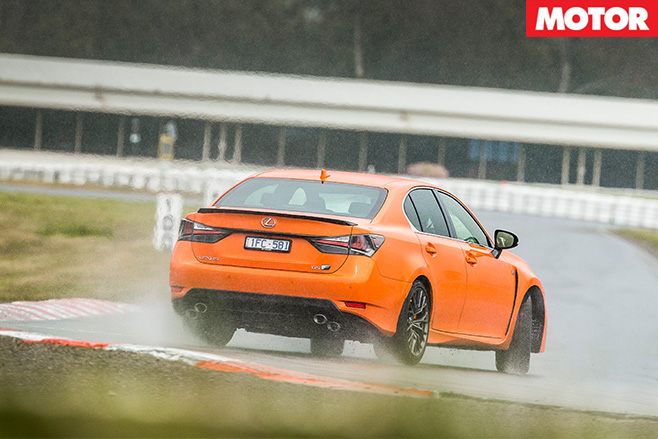
It’s time to move up to some cars with serious horsepower figures behind them, and I pick the Lexus GS F for no other reason than its perceived friendliness. Sure, it’s real-wheel drive and packs a smidge more than 350kW, but… I mean, it’s a Lexus, right?
The blisteringly orange paintwork reflects off the sodden tarmac as I ease into the low-slung cockpit and gingerly head out to test some limits, only to find my original summation is true. Mostly.
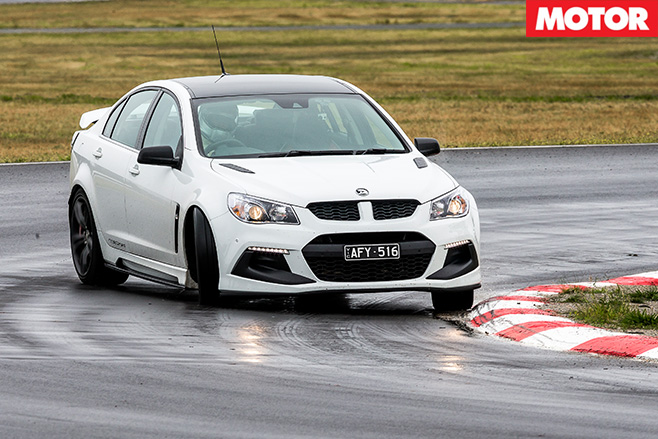
The HSV’s Continental SportContacts are up for it, too, and so is that mighty, mighty 400kW supercharged V8 and the VF’s lovely chassis, its softer tune suiting the conditions to a tee. Its only weak link for me is a driveline that doesn’t like to be rushed.
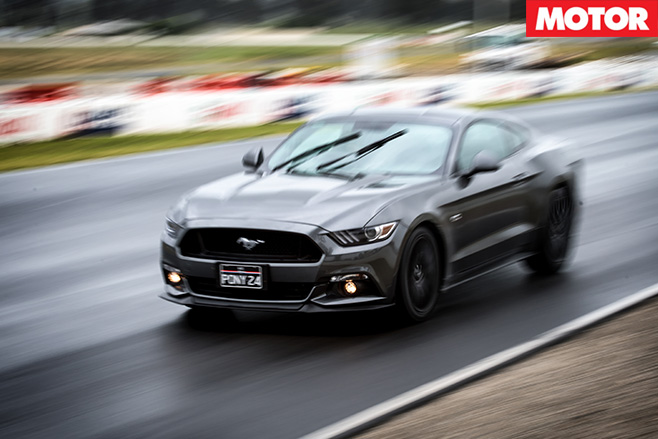
The Mustang, though, is all at sea here – quite literally. Its Pirellis are not giving the long, languid GT the confidence needed to get anything meaningful out of it, which is a pity.
The answer comes soon enough, as the big guns flounder through giant puddles on the unused section of the 0-100km/h straight – and right before it starts to rain again.
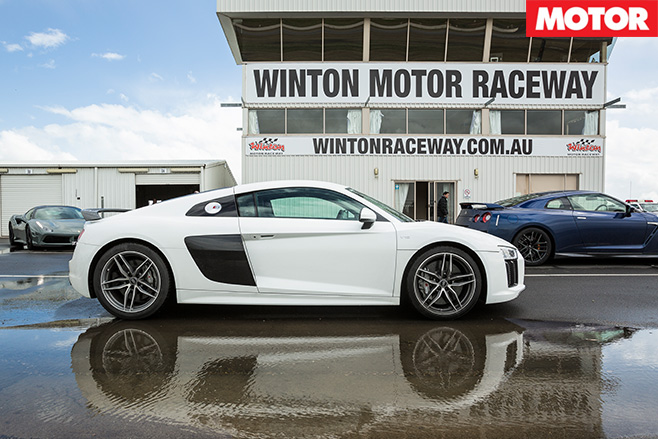
As the heavens really go to town over Winton, I’m strapped into the Audi R8 at the end of pit lane and wondering how clever an idea it really is. I like wet-weather driving, but it’s gone beyond that point. I inch out onto a track that is no longer a patchwork of blacks – it is a solid, uniform ocean of shimmering grey ripples that’s starting to form lakes where no lakes should be.
The same can categorically not be said for the Nissan GT-R. Nobbled by its dry-biased Dunlop SP Sport Maxx tyres, it’s a heart-stopping, lurching mess of sudden jinks under even moderate throttle, a complete lack of turn when there’s moisture in the way, and an overarching sense that carnage is just a breathe on the throttle away.
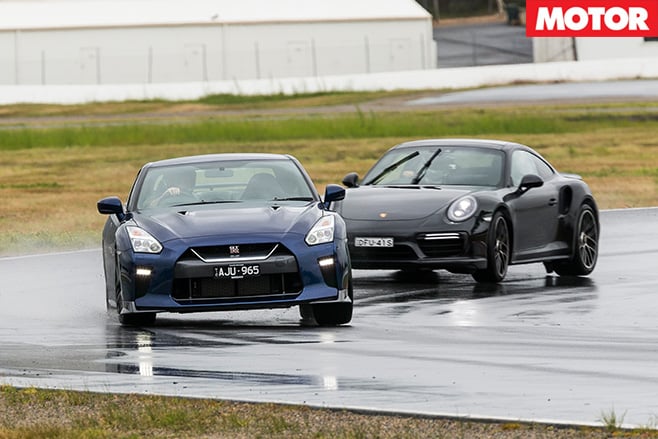
Of the three biggest bangers of the week, the one that gets the best of it is the 911 Turbo S. Its massive P Zeros – 305mm across the rear, if you don’t mind – are quite at home, and leaving the dampers in their softest mode allows for a shockingly quick turn of pace off a corner, and unadvisedly late braking into them.
The rear-drive Huracan is also on P Zeros, but is much edgier than the all-wheel drive 911 on the well-watered track. It steers more than well enough, but short-shifting the 427kW V10 is advisable lest several hundred thousand dollars’ worth of ski-boat orange Lamborghini is left on Winton’s white concrete walls.
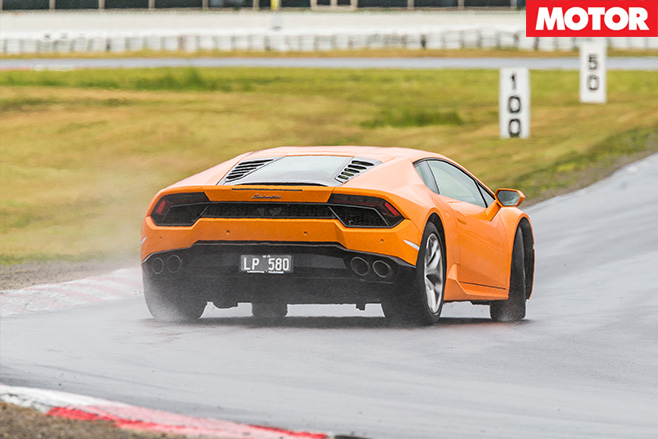
Even though to tacho goes to 10,000rpm, the party is stopped just before 8000rpm, with the shift lights on the steering wheel blinking obstinately. It’s still loud and intense… but it’s a more bass-driven intensity that takes some getting used to.
And so the day goes – the cars with the most suitable tyre package for the conditions continue to shine, while others fall back in the reckoning almost through no fault of their own. Having said that, though, a performance car that’s worthy of winning the PCOTY prize needs to bring the magic, no matter the weather.
Dragged down
Rain, rain, go away…
The first 400m of the Winton dragstrip did, in fact, dry out all but completely for a few minutes. But as a recce revealed, from the 401m mark (and the dirty big yump where the strip crosses the circuit) the next 400 metres were puddles. Big ones.
Bearing in mind the Ferrari was likely to be doing 210-plus through the traps, I for one didn’t fancy playing slalom through the ponds. And by now, the outfield was so wet the chances of finding a fence were odds-on. So we went back to scaring ourselves on the circuit. And we waited.
Finally, with help from the wind, the track dried enough for us to run the cars we’d not tested before – 911, R8, GT-R, 488 and Lambo – meaning we’ve had to publish existing numbers for the rest, which are all as-tested by us on different days at Heathcote Dragway, except the M2. Its numbers are from a different Winton test.
Beyond sheer, blind terror, the other drama playing out was Scotty’s attempt to get anywhere near Ferrari’s claim of 0-200 in eight seconds in the 488. Time after time he lined her up and after each run he went back to confer with the Ferrari minders. While each new attempt netted a good time, they’re not the figures you’ll find in the brochure. And then it started to rain again…
0-100km/h 1 Porsche 911 Turbo S 2.9sec 2 Audi R8 V10 Plus 3.18sec 3 Nissan GT-R 3.20sec 4 Ferrari 488 GTB 3.30sec 5 Lamborghini Huracan 3.55sec 6 HSV Clubsport R8 LSA 4.48sec 7 BMW M2 Pure 4.55sec 8 Mercedes-AMG C63 S 4.56sec 9 Lexus GS F 4.99sec 10 Ford Focus RS 5.04sec 11 Ford Mustang GT 5.20sec 12 VW Golf GTI 40 Years 6.00sec
0-400m 1 Porsche 911 Turbo S 10.70sec 2 Audi R8 V10 Plus 10.93sec 3 Ferrari 488 GTB 11.00sec 4 Nissan GT-R 11.21sec 5 Lamborghini Huracan 11.25sec 6 Mercedes-AMG C63 S 12.48sec 7 HSV Clubsport R8 LSA 12.55sec 8 BMW M2 Pure 12.82sec 9 Ford Focus RS 13.08sec 10 Lexus GS F 13.09sec 11 Ford Mustang GT 13.38sec 12 VW Golf GTI 40 Years 14.00sec
Terminal Speed 1 Ferrari 488 GTB 214.40km/h 2 Porsche 911 Turbo S 212.40km/h 3 Audi R8 V10 Plus 209.58km/h 4 Lamborghini Huracan 209.46km/h 5 Nissan GT-R 199.67km/h 6 Mercedes-AMG C63 S 194.10km/h 7 HSV Clubsport R8 LSA 184.84km/h 8 Lexus GS F 179.72km/h 9 Ford Mustang GT 176.72km/h 10 BMW M2 Pure 175.82km/h 11 Ford Focus RS 173.82km/h 12 VW Golf GTI 40 Years 171.75km/h
ANYONE who buys a Jeep from February this year will be a part of the brands new warranty program, which runs for five years and offers lifetime roadside assistance and capped price scheduled serving.
This new program is standard across the entire Jeep range, and is available for any customer that buys an MY17 car starting from February 24 this year.
Any MY16 cars bought from February will receive the old three-year warranty with a two-year extended insurance.
The program is called the u2018Jeep There & Back Guaranteeu2019, and is a fully transferable five-year/100,000km warranty.As long as the vehicle is serviced within the authorised Jeep dealer network, the brand will also offer free road-side assist for the life of the vehicle.
Customers who bought a MY15 or MY16y car before February, the three-year plus two-year warranty extension is available for $1950. However, they will be eligible for the lifetime roadside assistance if they service the vehicle through Jeep’s authorised network.
Jeep has also revised its servicing intervals with 2017 models requiring a stop at the dealer every 15,000kms or 12 months for petrol engine cars, and 20,000km or 12 months for those with diesel engines.
There are also three and five year pre-paid maintenance plans available.“The Jeep There & Back Guarantee is the next step in our commitment to improve the Jeep ownership experience,” said Jeep Australia CEO Steve Zanlunghi.
“This is not a limited-time offer or a short term promotion. It forms a fundamental component of our business going forward and it’s a commitment to our owners now and in the future.”
The program begins February 24.
Rising sun’s reborn supercar plots assault with battery, but doesn’t electrify all judges.
Here’s the car that divided opinion more sharply than any other at Car of the Year 2017. Honda’s aim with the NSX was to create a visionary supercar, something to rekindle its fading reputation for engineering, at once audacious and intelligent. And this hyper-hybrid does demonstrate that one of Japan’s bravest brands, historically speaking, hasn’t turned into a complete coward, technically speaking.
But while the Honda NSX is stuffed with tomorrow technology, is this enough to make it desirable today? This, in essence, was the question that split the judges, sometimes noisily.
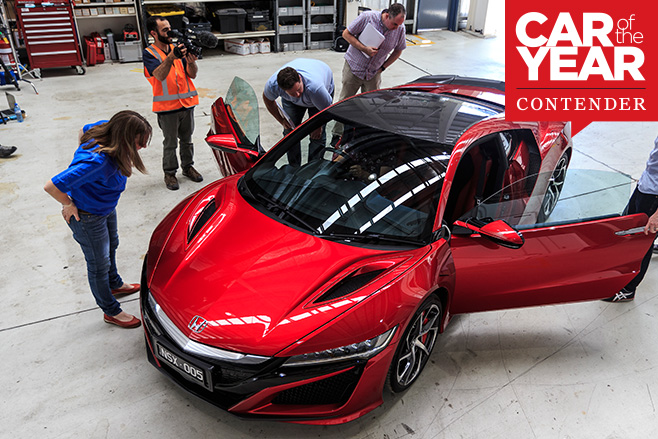
The counter attackers pointed out that the Honda produces supercar-league acceleration more efficiently, with three electric motors supplementing the output of its twin-turbo 3.5-litre engine. The sound of the 75-degree V6 in Sport+ and Race modes is wonderful, at least from inside the Honda, and the way the NSX’s drivetrain seamlessly blends urge from four different sources is hugely impressive.
The nine-speed dual-clutch transmission was singled out for special praise. It’s a magically quick and beautifully co-ordinated shifter when the car’s sportier modes are selected. Possibly even better than the latest dual-clutch gearboxes from the acknowledged experts at Porsche and Ferrari.
The electric motors that make the Honda a hybrid add breadth to the car’s capability, they argued. The NSX can run almost silently, using only electric power, in its Quiet mode, making it a more sociable beast than the typical supercar. And the torque-vectoring ability of the two electric motors in its front axle palpably enhances handling.
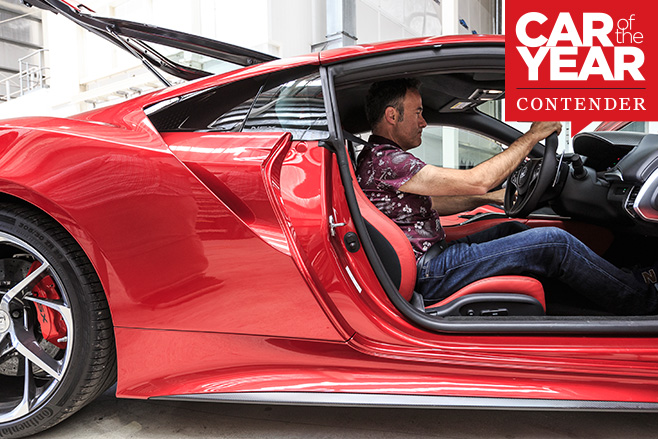
It wasn’t all argy-bargy. There was consensus that the NSX’s lane-change stability was as outstanding as its wet braking wasn’t.
The NSX is too costly to be independently crash tested and lacks advanced active safety technology, such as autonomous emergency braking, which is increasingly offered in much less costly cars, though it is fitted with an array of passive safety features.
The NSX comes as a welcome hint at a Honda return to form, but because it failed to win every judge with its technology, performance and driving character, it could not advance beyond Round One.
Specs
BODY Type: 2-door coupe, 2 seats Boot capacity: 110 litres Weight: 1725kg
DRIVETRAIN Layout: mid-engine (north-south), AWD Engine: 3493cc twin-turbo V6, 3 x electric motors (427kW/645Nm) Transmission: 9-speed dual-clutch
CHASSIS Tyres: 245/35R19 – 305/30R20 ADR81 fuel consumption: 9.7L/100km CO2 emissions: 226g/km Collision mitigation: No Crash rating: not tested
Price: $420,000
Porsche has lifted the lid on its 500kW range-topping Panamera Turbo S E-Hybrid, which will be the most powerful Porsche ever sold in Australia when it arrives in local showrooms.
The hi-po plug-in hybrid is the first electrified vehicle to headline a Porsche model range. Its heady combined power output comes from coupling the regular Panamera Turbo’s 404kW/770Nm 4.0-litre twin-turbo petrol V8 engine with a 100kW electric motor and 14.1kWh liquid-cooled lithium-ion battery pack.
Peak torque of 850Nm is available virtually from idle, meaning the four-door coupe has enough shove for a 0-100km/h blast of just 3.4 seconds and a top speed of 310km/h.
Electric only range is a stated 50km on a full charge, and combined fuel consumption of 2.9L/100km is claimed.
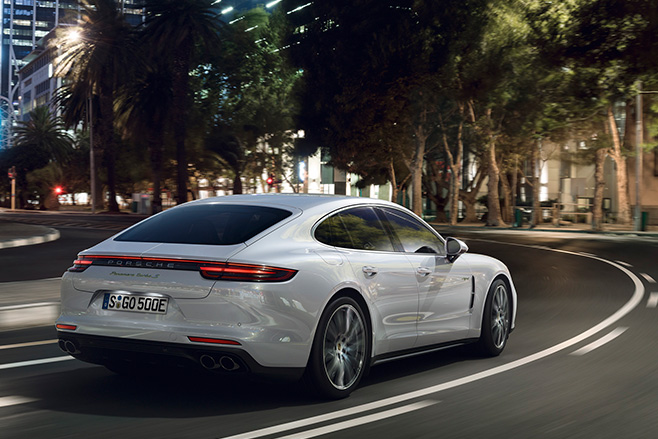
A similar hybrid setup is already in play in the Panamera E-Hybrid, where it boosts the output of the twin-turbo V6 from 243kW to 340kW, though its additional 300kg erodes some of the power benefit.
Standard equipment for the Turbo S E-Hybrid includes ceramic brakes, dynamic chassis control, torque vectoring, adaptive aerodynamics and air suspension.
While the basic shape is identical to any other second-generation Panamera, the Turbo S flagship gets the trademark ‘acid green’ brake calipers and ‘eHybrid’ badges that distinguish the brand’s petrol-electric models.
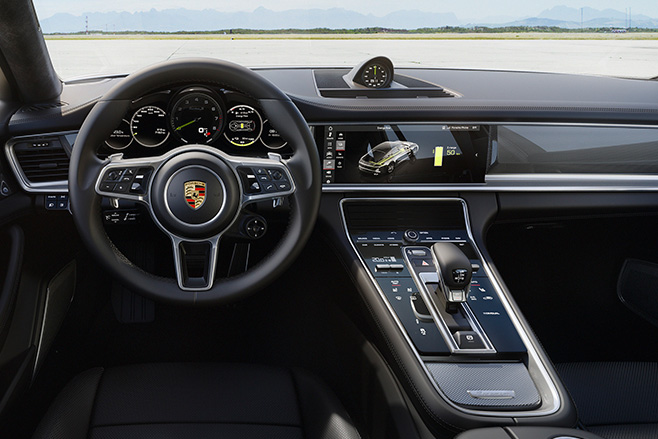
The Panamera Turbo S E-Hybrid marks the start of an ambitious hybrid assault for Porsche’s four-door models and signals a turning point for the manufacturer as it adapts to tighter emissions regulations and regional requirements for short-range, electric-only driving.
Given the component sharing within Porsche’s volume-selling SUVs – Macan and Cayenne – expect to see the hybrid setup spread across the four-door line-up, with the next model likely to be the 2019 Porsche Cayenne.
While Porsche, Ferrari and McLaren have utilised electric motors and batteries in their most recent hypercars, the move to rely on electrons rather than unleaded is unprecedented in the mainstream performance market.
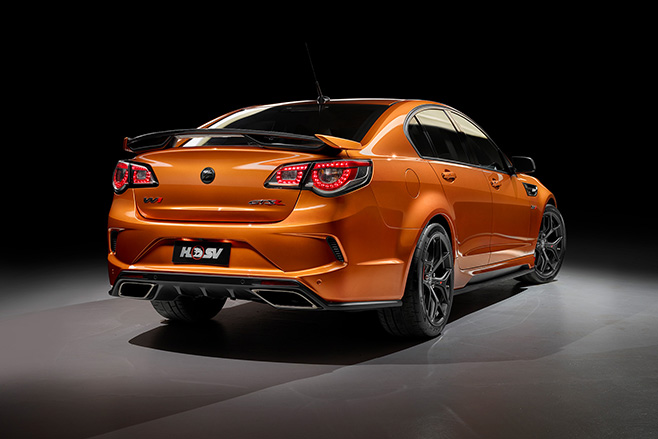
HSV GTS-R W1
Power: 474kW
Old school supercharged V8 pulls off towering figures and big noise working with a four-lobe supercharger within a 6600rpm rev limit. By sheer weight of numbers alone, it’ll go down as a great.
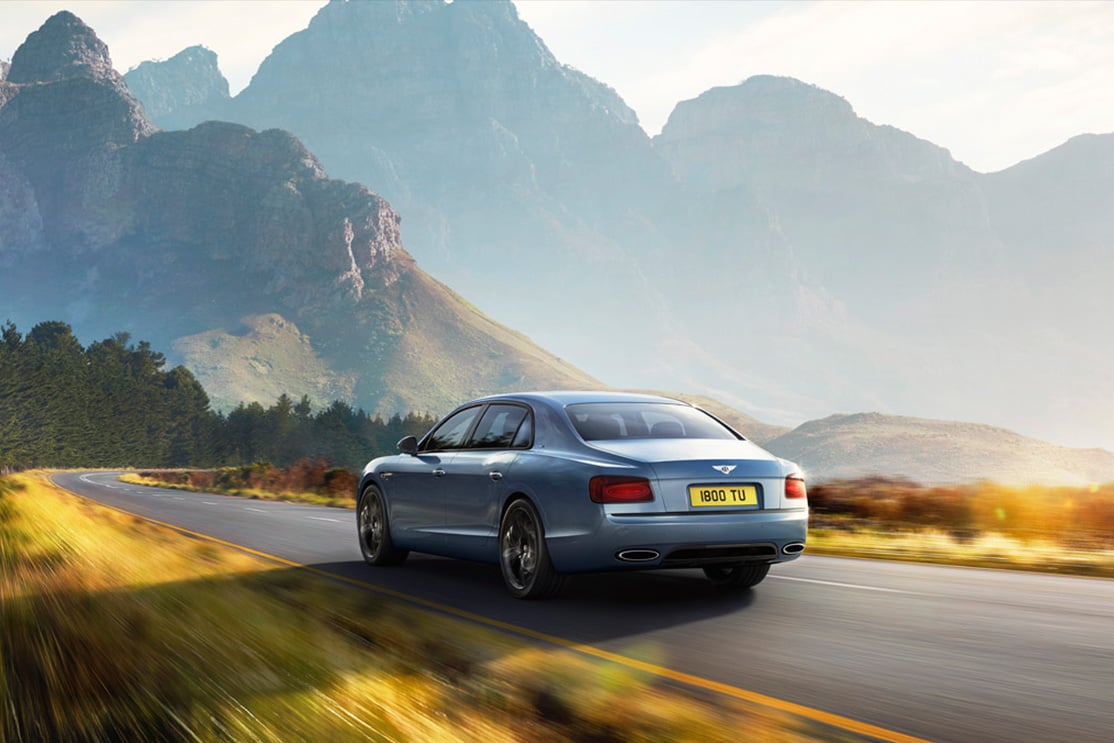
Bentley Flying Spur W12
Power: 467kW
Unique W12 engine configuration is paired with two turbos to deliver torrential torque and effortless charm, although near 2.5-tonne kerb weight dulls the big sedan’s initial acceleration.
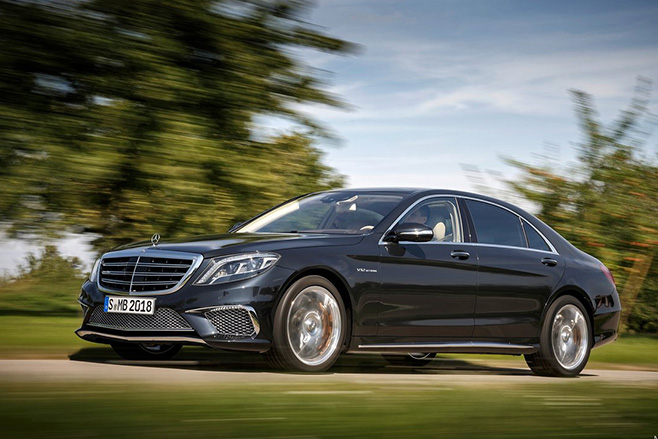
Mercedes-AMG S65
Power: 463kW
If in doubt, add more cylinders seems to have been the mantra with Merc’s flagship S-Class. Its 463kW only just outpunches the S63 AMG, but with four more pots and fatter torque.
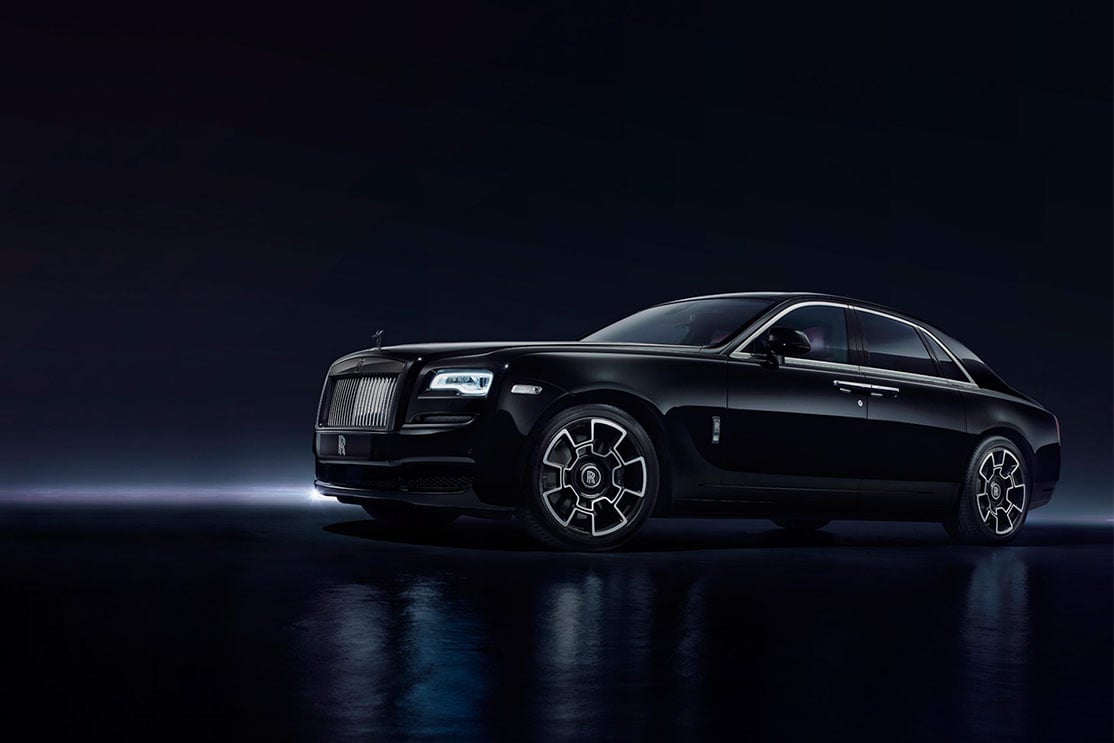
Rolls-Royce Ghost Black Badge
Power: 450kW
Recently tweaked as part of the Black series aimed at younger buyers, you can thank BMW for the effortless urge of the 6.6-litre twin-turbo V12 beneath the imposing bonnet of the imperiously rapid Ghost.
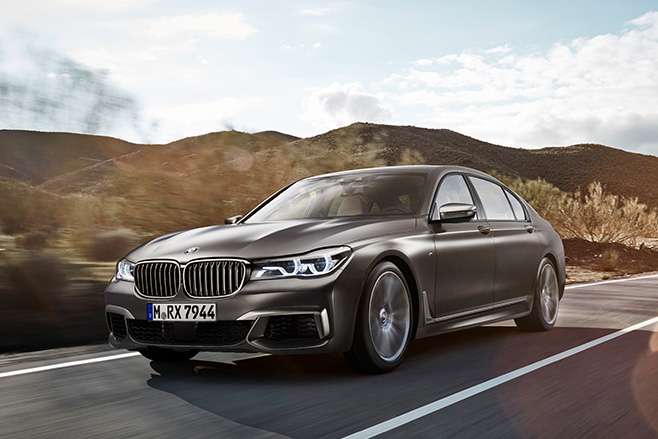
BMW 760Li xDRIVE
Power: 448kW
The Bee Em flagship’s 6.6-litre V12 is the same as that in the Roller (inexplicably with two less kilowatts). Set to hit our shores soon, the AWD 760 hits 0-100km/h in 3.7sec.
WHAT IS IT The C-HR is an all-new small SUV, and the first sign that Toyota is on the verge of a product-led renaissance. It’s one of the brand’s most concerted efforts to produce a properly polished automobile – rather than just phoning it in.
WHY WE’RE TESTING IT Compact crossovers and SUVs are on a trajectory to overtake sales of conventional small cars, and the C-HR is Toyota’s contender for a significant slice of that swelling sales pie. It’s only the second model to be built on Toyota’s box-fresh TNGA platform, and one that we’re keen to experience on Australia’s more challenging roads.
MAIN RIVALS The Mazda2-based CX-3 is the C-HR’s most prominent rival, with other competitors including the Honda HR-V, Nissan Qashqai, Mitsubishi ASX, Holden Trax, Ford EcoSport and Nissan Juke.
THE WHEELS VERDICT If Toyota’s seemingly endless stream of dull automobiles has been making you go a bit green around the gills, then Toyota’s C-HR is the perfect antidote. It’s not just an attempt to snatch some cash in the increasingly-lucrative small SUV segment, but it’s a genuinely impressive car in more ways than one. Well done Toyota.
PLUS: At last, a Toyota that’s cool to look at; capable chassis; healthy standard equipment MINUS: You may need to join a queue for this one; engine could use more pep; pricey for top-spec C-HR Koba.
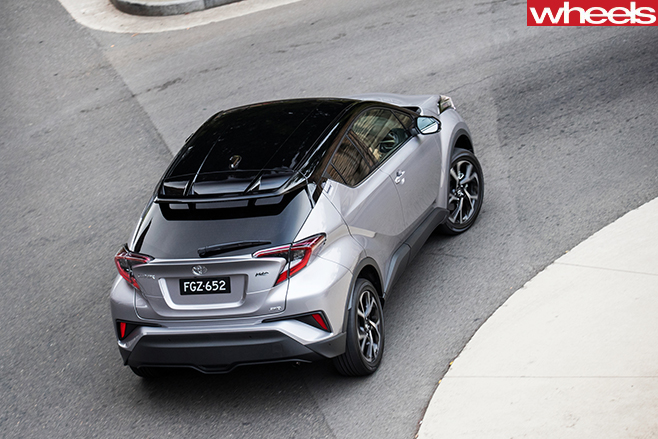
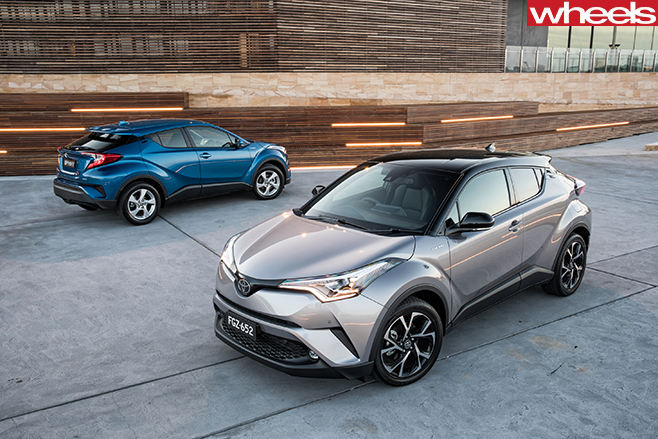
THE WHEELS REVIEW The C-HR is a most un-Toyota-like thing. It boldly goes against the grain, and when parked next to the largely soulless and conservative metal that presently decorates Toyota showrooms across the country it appears foreign. Actually scratch that: it’s thoroughly alien.
Just look at it. There are curves and creases everywhere, and say whatever disparaging things you want about soft-roaders, but there’s not really a bad angle to the C-HR. It’s an eye-catching – and eye-pleasing – design, and it’s been quite a while since we’ve been able to say that about a Toyota.
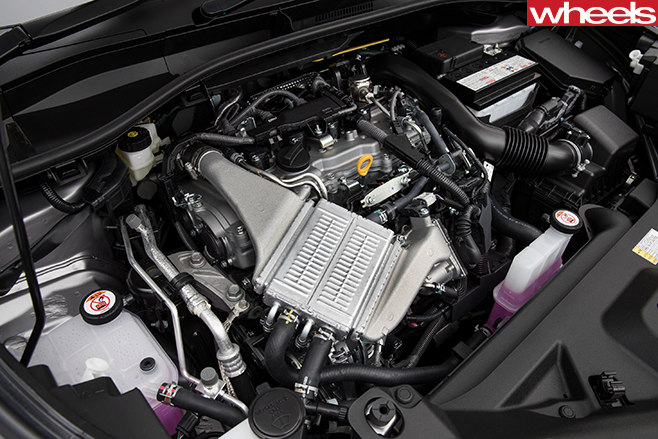
Then there’s the engine – a downsized and turbocharged 1.2 litre that makes 85kW and 185Nm. Low outputs, sure, but Toyota hasn’t thrown turbo tech like this into a mainstream crossover before. There’s also a double-wishbone rear end and a fairly clever all-paw drivetrain option. This car is such an abrupt change of direction and flavour for Toyota, and a refreshing one at that.
Were it not for Toyota Australia’s 6000-car first-year allocation of C-HRs, Mazda and its popular CX-3 should be quaking in their boots right now. Even the more conventional Nissan Qashqai should feel challenged, for the C-HR has the right balance of space, design and driving chops to command this segment… if only Toyota Oz can get enough cars to cater for demand.
The starting price is admittedly steep at $26,990 for the base C-HR (add $2000 for the CVT automatic), but Toyota counters that by packing in a hefty amount of features as standard. Not only that, but Toyota reckons most people shopping for a mini-SUV don’t go for stripped-out models anyway, and most have around $30k to play with.
The design and materials also impart an air of upmarket sophistication to the C-HR’s cockpit, something that’s a rarity at this end of the SUV spectrum. While the Suzuki Vitara and Nissan Juke make do with cheap, rock-hard plastics, the C-HR takes things to the next level with plenty of soft surfacing and cool textures – though the sparkly gloss black trims are fingerprint magnets.
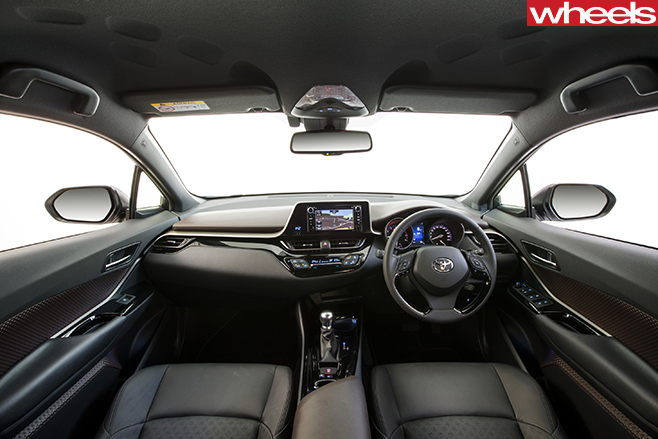
Wider, longer and with 40mm more distance between the front and rear axles compared to the Corolla, the C-HR is also more accommodating on the inside than Toyota’s evergreen hatchback.
There are weird facets to this cabin though. The front cupholders are separated by the gear selector, the glovebox handle is well hidden by the overhanging dashboard and the tiny rear windows and rising shoulder line mean kids will see jack-all from the back seats. Style before function? Yep.
However the real highlight is the C-HR’s all-new TNGA-platformed underpinnings. With Mac struts up front and double wishbones at the rear the hardware story is already impressive enough, but adept tuning endows the C-HR with a well-balanced undercarriage that boasts segment-leading comfort as well as excellent body control.
Handling favours understeer, but tip it in with a subtle lift of the throttle and the C-HR’s neat rear end comes into play, rotating with ease. It’s especially enjoyable on dirt. Were we expecting that? After our first experience of it at its European launch, not really, but after driving it on local roads it’s clear that this car can handle bucketloads more grunt – and might make a respectable base for a high-riding hot hatch too.
It’s also clear that Toyota has finally shrugged off whatever malaise was preventing it from building genuinely appealing cars. The 86 was a Subaru-sourced outlier, but the C-HR is the first true signal that Toyota is once again interested in making cars that people would proudly put in their driveway.
Vote for the Toyota C-HR to win the 2018 Wheels Car of the Year Readers’ Choice competition
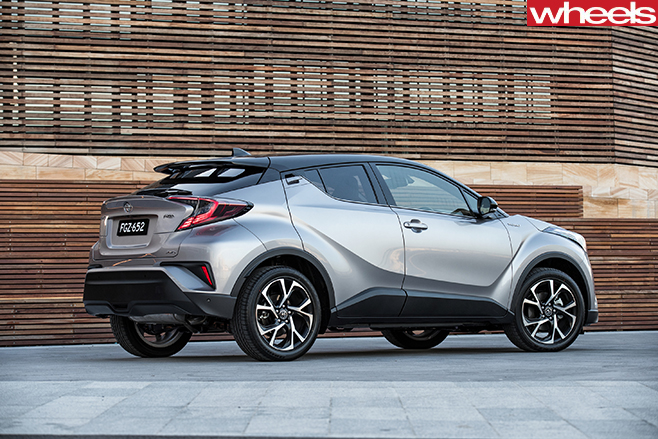
Model: Toyota C-HR automatic Engine: 1197cc 4cyl, dohc, 16v, turbo petrol Max power: 85kW @ 5200-5600rpm Max torque: 185Nm @ 1500-4000rpm Transmission: continuously variable automatic Weight: 1375kg (FWD manual), 1460kg (AWD auto) Economy: 6.4L/100km Price: $28,990 On sale: Now
Leaked earlier this week and now confirmed, a Ford GT Competition Series has been announced as a stripped-down, bare-essentials and track-focused supercar special edition.
In a lesson to all owners to read the handbook of their newly acquired sports car, the first GT owners this week discovered a reference to a Competition Series model in their glovebox book that described a manual-opening rear liftback among other race-spec details.
Ford has now officially revealed its head-nod towards track-day enthusiasts, with the aim of the GT Competition Series being to reduce weight positioned high in the vehicle and therefore lowering the centre of gravity.
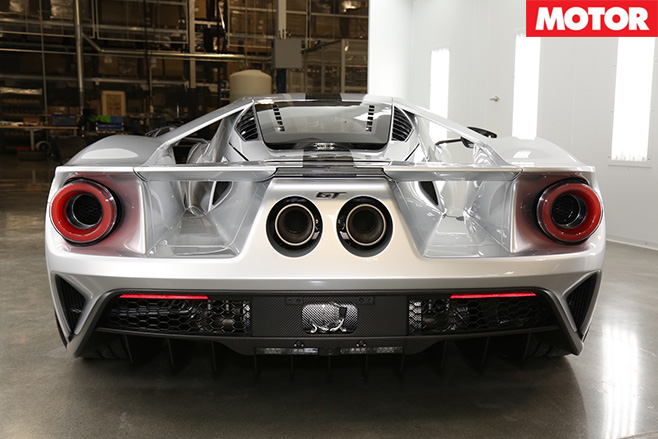
Gorilla Glass is used for the bulkhead screen behind the driver, which Ford claims is half as thick and half as light as regular glass.
Active aerodynamics and an FIA-approved rollcage remain, but “items not essential to performance” have all been deleted, such as air-conditioning, audio unit, speakers, cupholders and storage bins.

Red paddleshifters and Alcantara headlining bring a unique touch to the otherwise spartan cabin of the GT Competition Series, teamed with special dashboard ‘plates’ – perhaps a euphemism for blanks – for the deleted steering wheel buttons and colour screen.
Black, white, silver, blue, grey and yellow are the only exterior colours available for what Ford executive vice president of global product development and chief technical officer Raj Nair describes as a limited edition “developed with the most hardcore track enthusiasts in mind, providing a tailored set of lightweight features and unique livery to match.”

Ford hasn’t directly revealed whether the GT Competition Series will be produced in addition to the 1000 units allocated over four years’ production – already twice the originally slated number and time. It only says the limited edition model “is available in North America for all announced production years.”
The Mercedes-Benz X Class attracted large amounts of attention when it was unveiled late last year, and is now in Australia.
The car, to be built atop a chassis shared with the Nissan Navara, is Mercedes’s answer to the high demand for dual-cab utes.
The Toyota Hilux was Australia’s best-selling car of 2016, with the Ford Ranger also enjoying a boom in sales in the latter-half of last year.
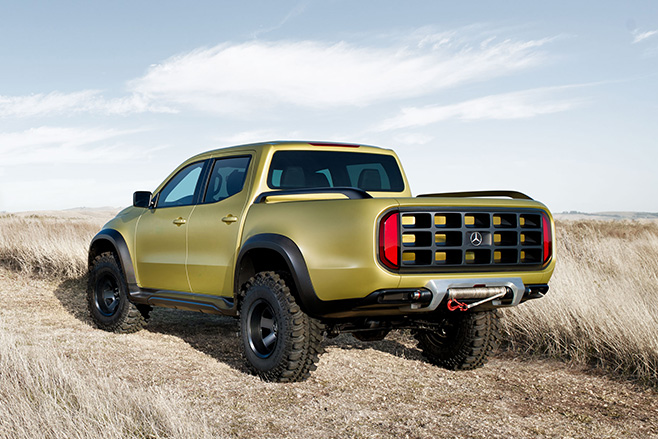
The X Class concept was first shown in Stockholm, Sweden last year, and has now been flown to Australia for a number of promotional activities, including a series of photos of the vehicle in typically Australian environments.
Christian Pohl, global Head of Product Management and Marketing for X-Class, has joined the concept in Australia to give dealers a briefing on the ute, and assist the Mercedes-Benz Australia team prepare for its arrival in production-guise next year.
The concept also made an appearance at the Mercedes-Benz Vans Australia and New Zealand National Dealer Conference in Melbourne.
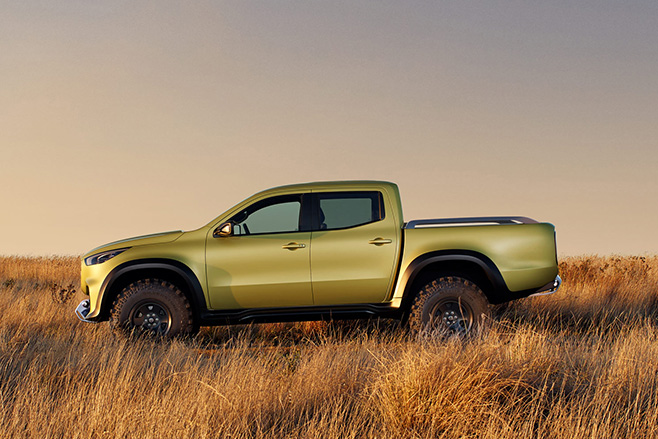
“Australia and New Zealand are critical markets for the success of the X-Class,” Managing Director Mercedes-Benz Vans Australia and New Zealand Diane Tarr said
“The Concept has been flown from Germany so our dealers can get a detailed briefing about the vehicle and continue their preparation for a successful launch of the X-Class in 2018.”
Keen customers have started to place pre-orders for the X-Class already to ensure they are the first to receive the car when it is released.
