
HE may have just reset his own road car lap record around Mt Panorama, but German racing legend Bernd Schneider isn’t best pleased with his effort.
He punted the shockingly green Mercedes-AMG GT R around the hallowed mountain track in a time of 2min 16.5sec, knocking a handy eight or so seconds off his own record, set in 2015 at the wheel of the slightly more sedate Mercedes-AMG GT S.
But Bernd, speaking with MOTOR after setting the record, reckoned there was still more in the $349,000 GT R, which was flown out from Germany just for the event and will return home this week.
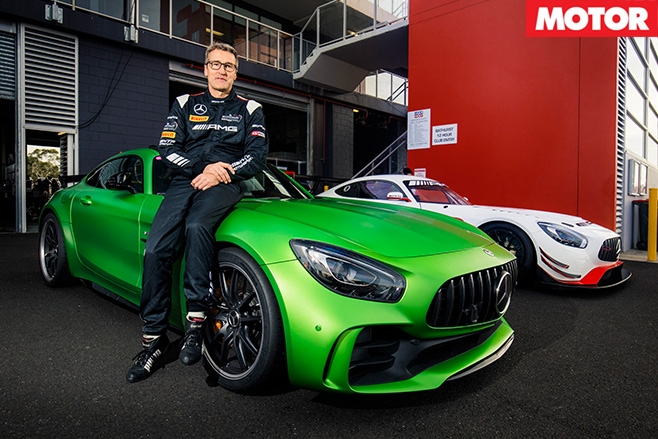
Wider in track and festooned with active aero bits, the GT R punches out 430kW and 700Nm from its 4.0-litre twin-turbo V8, which is 55kW and 50Nm more than the GT S.
Bernd said that an issue with his helmet, as well as the 35 degree C plus temperatures of the day, meant he dropped a little time on Friday’s officially timed lap at the Bathurst 12 Hour race.
“I was distracted by a camera bumping my helmet,” the affable multiple DTM champion and former F1 driver explained, “and I had to adjust it a couple of times, so that cost some time. I reckon we could easily get into the 15s with it.”
It was a bit of a handful on Mt Panorama’s fearsome crest on Conrod Straight, according to Bernd. “Because it’s a road car, you have to be a bit careful, because the air gets under it and [mimics tweaked steering wheel],” he said.
Still, the GT R punched through 308km/h on the way into the Chase, so it obviously didn’t affect him too much.
This year’s Bathurst 12 Hour was one for the ages, and not least for the fact that it took the form guide and tore it up into a million tiny pieces.
Mt Panorama has been a happy hunting ground for Nissan and its grunty, noisy, menacing Nismo GT-R GT3 over the last couple of years, taking the top two steps of the podium with a combination of scintillating race pace and clever strategy.
With two factory cars entered in the race for 2017, as well as a brace of privately entered cars, the Nismos faced a new, very intense competitor group, and the subsequent race for pace saw the team’s brand new #24 hit the fence on Mountain Straight on Friday. Hard.
Driver – and former winner – Florian Strauss was thankfully okay, but the car was far from it. Chassis damage to the front left, plus structural damage to front rails and a whole host of mechanical maladies faced the crew, who started the strip at 6.30pm, working through the night with help from local trades to complete the job by 8.30am on Saturday.
The engine stayed in the car throughout, but chassis rails were re-welded, the front left corner as rebuilt and the driveline refreshed during a genuine, old-school all-night makeover.
“I knew that they could do it,” said an obviously relieved Strauss after practice on Saturday. “You worry if it is going to be all done right, but the car was better in the front end than it was before the crash.”
Sadly, gearbox issues forced the #24, which started from position 18 and was co-driven by UK-born GT Academy driver Jann Mardenborough and Supercars team owner and racer Todd Kelly into the pits for lengthy repairs at hour seven, but the team fought back to finish eighth overall.
Mercedes-Benz has teased an image, via its official Facebook page, of a new 4×4 we expect the German automaker to reveal at the Geneva Motor Show in March.
Captioned “First we built the G 63 AMG 6×6 – Now the ultimate off-roader has another surprise up its sleeve. Stay tuned…” the image reveals the rear of an almost Jeep Wrangler-like roofless 4×4 with a number plate hinting to the name “G 650”.
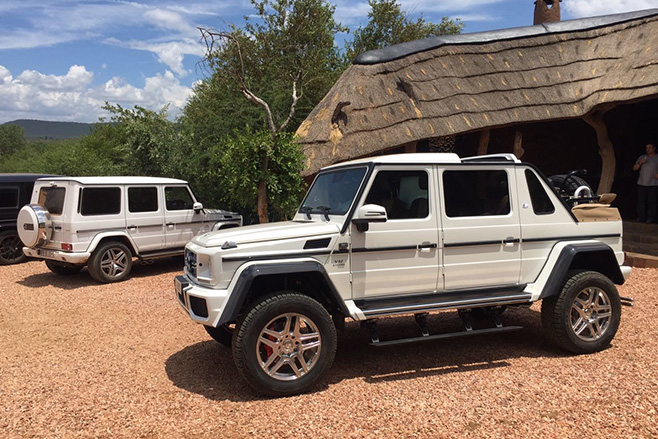
Images of a similar car, but in white, have also been spied, confirming the G 650 will carry a Maybach badge. It appears to be a smaller four-wheeled version of the G 63 AMG pick-up truck but with landaulet body – that is, a convertible roof over the passenger seats.
The last time we saw Mercedes release a landaulet was when it revealed the Maybach 62S Limo at the 2008 Detroit Motor Show.
From the images alone, we can surmise the vehicle will feature a large rear brake light, which sits above the spare wheel mounted on the rear, carbonfibre wheel arches, a rear-cabin separated in limousine style from the front passenger seats and the rear seats get screen displays in front of them.
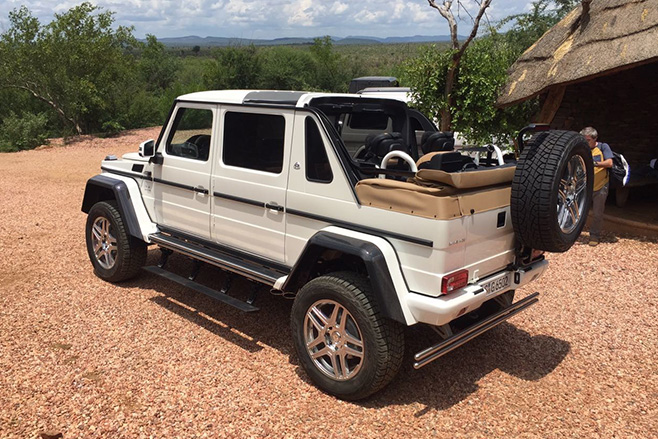
It appears the Mercedes-Maybach G 650 will be powered by a 6.0-litre turbo V12 engine. Given the caption on the Facebook image, we can expect it to also feature a four-wheel-drive system and locking differentials.
Like the G 63 AMG, where the carmaker produced only 100 vehicles, reports suggest the G650’s sales will be limited to a similar number. For more details, we’ll be holding on to our seats for the big Geneva reveal.
The Holden Commodore appears to have bucked the trend that has seen a dramatic drop in large car sales in January compared to December 2016.
Large car sales in January were down by 13 percent from December as remaining stocks of the Ford Falcon, which has not been built since October last year, dry up and Toyota Avalon sales slow. However Commodore sales rose by 17 per cent to 1960, accounting for 88 percent of the large cars priced at less than $70,000, and 73 percent all large cars including prestige brands.
As expected, Falcon sales were down to a trickle with just 73 delivered, however any opportunities this presented for other manufacturers only seemed to go Holden’s way.
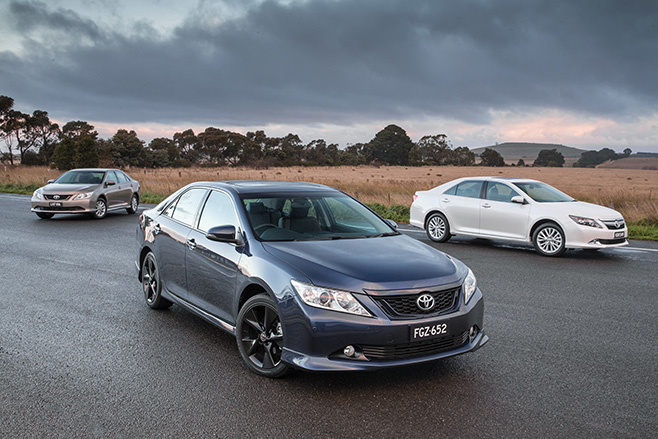
The only other locally produced large car, the Toyota Aurion, saw a dramatic drop in sales from 641 in December to just 95 last month. The Skoda Superb, meanwhile, failed to make up any ground with just 61 sales, down 29 per cent.
Of the prestige cars priced at more than $70,000 only the new Mercedes-Benz E-Class and its BMW 5-Series rival (80) enjoyed any real growth since December, up 24 and 158 percent respectively – the latter being run out before the all-new model’s release in March.
The Commodore’s sales also represented a significant improvement compared with the frirst month of last year, with sales up 57.8 percent compared with January 2016.
A Holden spokesman told WhichCar this could be attributed to a variety of factors including buyers wanting to secure a Commodore in the final year of production, on top of MY16 plate clearance sales.
“Finally, we launched the Commodore Special Editions (Motorsport, Director and Magnum) in Dec/Jan which drove a lot of traffic to the Commodore website and dealers,” the spokesman said.
Walkinshaw Racing has unveiled its 2017 Supercars challenger and it’s quite a looker.
It’s the beginning of a new era for the team now dubbed Mobil 1 HSV Racing, with Holden switching its factory support to the Triple 8/Red Bull organisation for 2017, ending a 26-year partnership with Walkinshaw.
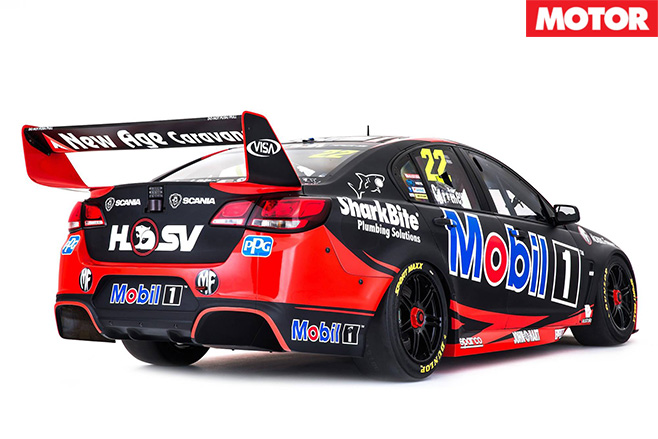
Company boss Ryan Walkinshaw says the team’s new name “pays tribute to the HSV Dealer Team that we won two championships with” with Rick Kelly and Garth Tander taking back-to-back titles in 2006 and 2007.
“I think during this whole process what was really important was that the fans are dying to have a team that they can continue following,” said Walkinshaw. “They still want to have Team Red…I think it’s really important that we stayed with Holden and aligned ourselves with the HSV brand, which is the performance brand from Holden.”
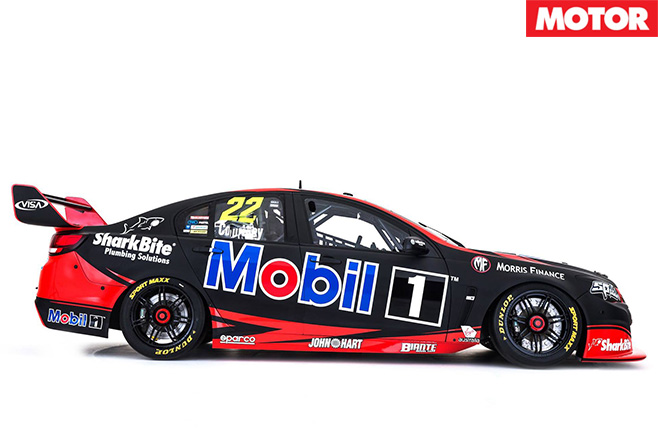
New title sponsor Mobil is no stranger to the side of a racing Commodore, having adorned Peter Brock’s racers in the late 1980s and early 1990s.
James Courtney remains with the team, hoping to regain the form that captured him the 2010 championship, while Garth Tander has moved to join Garry Rogers Motorsport. His place has been taken by quick youngster Scott Pye, who has moved from the Penske DKR operation.
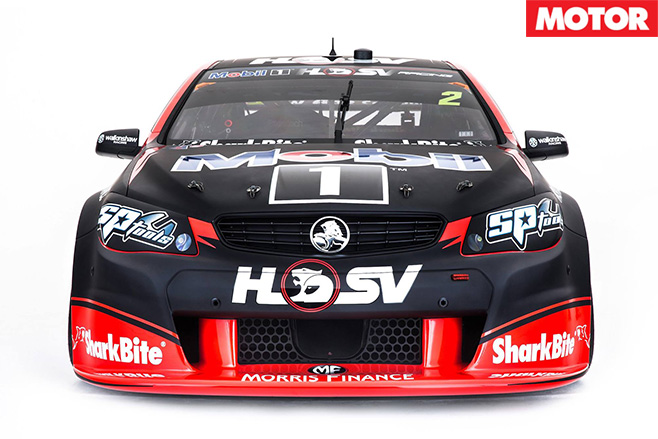
Walkinshaw has retained its co-drivers from the 2016 season, with Jack Perkins partnering Courtney and MOTOR‘s chief track tester Warren Luff – who won last year’s Sandown 500 – joining new recruit Pye.
The 2017 Supercars season kicks off in Adelaide with the Clipsal 500 on March 4-5.
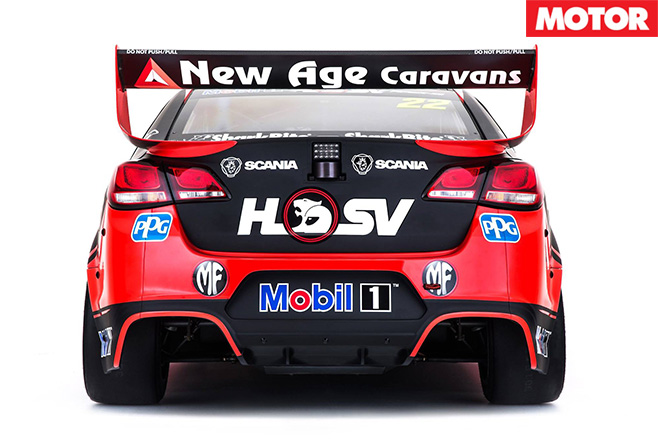
You’re a keen driver but love the feeling of the wind in your hair (or would if you had any). With a budget of $250K, there’s no shortage of choice – everything from the Aston Martin V8 Vantage to the BMW 650i to the Jaguar F-Type R.
If you truly want to combine sports car dynamics with open air motoring though, it’s tough to go past the Porsche 911 Cabriolet. You might get laughed at by your GT3-owning mates, but in its latest twin-turbo 991.2 guise, the 911 Cabriolet is seriously rapid and massively accomplished.
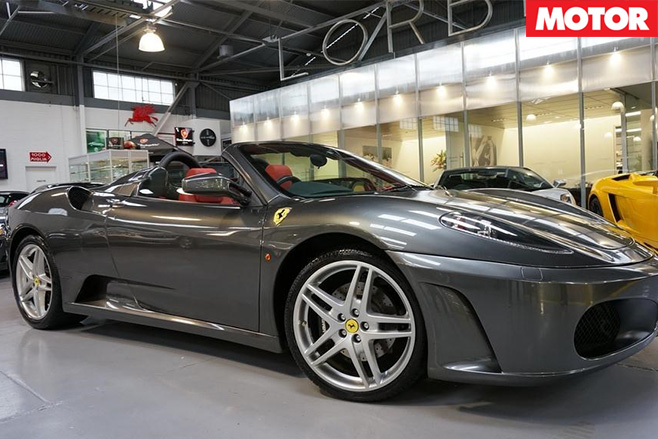
Shift your gaze to the used car market, however, and the selection becomes significantly spicier. For similar money to a new drop-top 911 you could land a Ferrari F430 Spider, at which point you’re shifting into supercar territory.
We found this highly specced F430 in Melbourne for $229,888, though a similar car was recently listed at $209,990. For comparison’s sake, a new 911 Carrera Cab starts at $239,000. The two are lineball in terms of speed, the 911 claiming 4.4sec from 0-100km/h and the F430 4.2sec, though the Italian takes top speed honours.
Surely running a 10-year-old Ferrari is akin to tearing up $100 notes? Apparently not. As long as the car has been cared for, the drivetrain is reportedly bulletproof, with the major problems being cracking exhaust manifolds, fragile wheel rims and weak exhaust and engine mounts.
There’s the odd electronic bug, the clutch (manual or F1 paddle-shift) doesn’t like abuse and be wary of any car fitted with carbon ceramic brakes; they last longer but are horrendously expensive to replace.
All in all, there seems to be no reason not to enjoy an F430 regularly and the prospect of that engine and badge for less than the price of a new 911 or F-Type is seriously tempting.
| SPECS | 2006 FERRARI 430 SPIDER | PORSCHE 911 CABRIOLETu00a0 |
| Engine | 4308cc V8, DOHC, 32v | 2981cc flat-6cyl, DOHC, 24v, twin-turbo |
| Power | 360kW @ 8500rpm | 272kW @ 6500rpm |
| Torque | 465Nm @ 5250rpm | 450Nm @ 1700rpm |
| Weight | 1570kg | 1500kg |
| 0-100km/h | 4.20sec (claimed) | 5.20sec (tested) |
| Price | $444,000 (new)u00a0 | $239,000 |
Here’s one we found on Trade Unique Cars
2006 F430 Spider
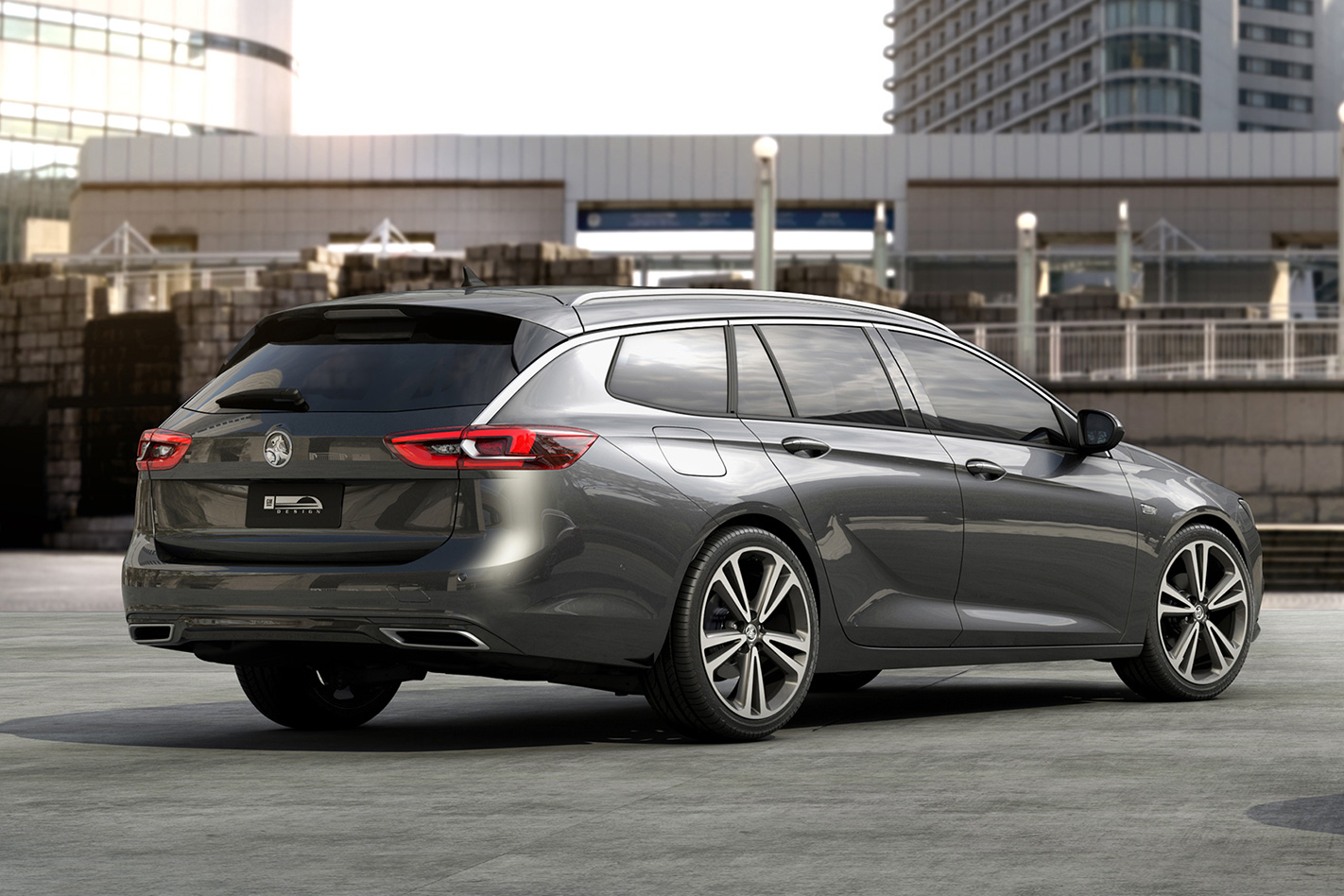
A DAY after corporate cousin Opel whipped the covers off its next-generation Insignia Sport Tourer, Holden has followed suit and announced that yes, Opel’s sleek family wagon will be coming our way as a Commodore.
Set to go on sale locally in 2018, the next-generation Holden Commodore Sportwagon will appear in the metal in March at the Geneva Motor Show wearing Opel badges on its snout and tailgate.
While the Sportwagon lacks the more pleasing proportions of the rear-drive current-generation Holden VFII Commodore version, the transverse-engined 2018 model nevertheless sports an attractive profile… for a front- or all-wheel-drive wagon.
Compared with the outgoing Insignia five-door, the 2018 model’s rump appears slimmer and neater, with the tailgate cutline no longer ballooning out, Audi Q7-style, around the tail-lights. The rear glass is less steeply raked than before, and the chrome window trim arches up over the side glass before plunging across the C-pillar and puncturing through the tail-light jewellery.
There’s less sheetmetal between the top of the rear wheel arch and the bottom of the glasshouse, while the rear quarters are more pronounced than the outgoing model. Lined up against the current-generation Insignia wagon, it’s definitely more trimmed and toned.
The rest of the car’s exterior apes the 2018 Commodore ‘sedan’ (which is actually more like an overgrown five-door hatchback), making for a sleek alternative for SUV-shy motorists with luggage to haul.
Holden promises it’ll be packed with convenience features, with the Sportwagon’s tailgate set to gain a hands-free opening function for the first time. Instead of fumbling for keys or having to reach for a button when your hands are full of groceries, the 2018 Commodore Sportwagon’s tailgate will open or close by kicking a foot under the rear bumper. The tailgate will open to a sizable load area, measuring 1640 litres with the rear seats folded down, and 520 litres with them up.
An optional 40/20/40 split rear seatback will allow greater cargo-carrying flexibility. Those seatbacks can also be dropped from the rear of the car, via a button located in the boot area.
Compared with the current Commodore Sportwagon, the 2018 car will weigh up to 200kg less largely via its smaller, lighter east-west four-cylinder engine configuration, plus greater use of lightweight materials.
The powertrain range will mimic that of the Commodore sedan/liftback, with a 230kW/370Nm petrol V6 flagship sitting above a pair of 2.0-litre four-cylinder turbo petrol and diesel engine options. The V6-engined model will feature all-wheel drive and a nine-speed automatic, while the four-pot Sportwagons will take a more conventional front-wheel drive configuration.
It’s a similar story with driver aids and other technology, with everything from adaptive dampers, lane-keep assist, autonomous emergency braking, a head-up display, massage seats, radar-assisted cruise control and LED headlamps all set to feature on the 2018 Sportwagon.
Holden is yet to say when the wagon will arrive, although the four-door hatchback is slated to go on sale locally in February next year. A crossover-style version of the Sportwagon based on the Opel Insignia Country Tourer is also expected to arrive sometime next year, but has yet to be announced by Holden.
Thieves have stolen roughly $4.8 million dollars’ worth of engines from a Jaguar Land Rover plant in Solihull in the UK, allegedly using a prime mover – itself also suspected to be stolen – to tow away two trailers full of brand-new motors.
The theft occurred late on Tuesday evening last week, but was far from a Fast And The Furious-style escapade. Instead, the thieves calmly drove their truck into the plant, collected paperwork from the site to facilitate their exit, then hooked up a trailer full of engines before driving away.
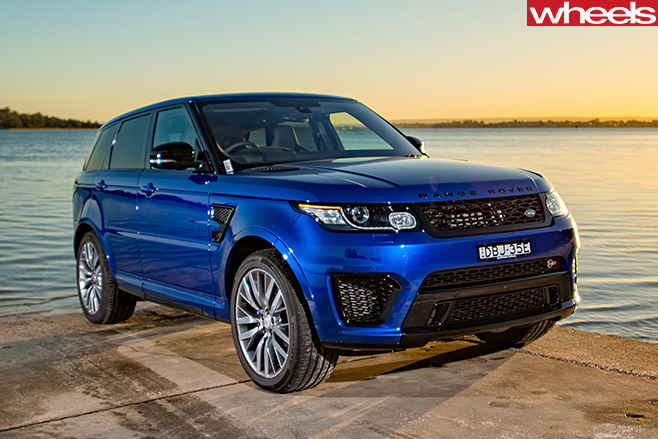
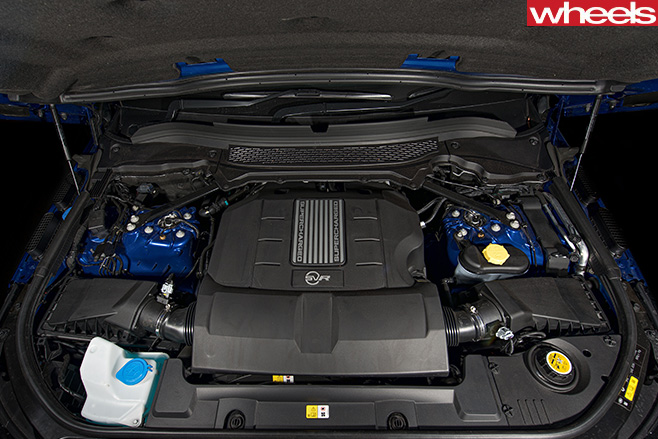
Details of precisely how many engines have been stolen aren’t yet available, nor is it clear what type of engines they were. JLR’s high-performance supercharged 5.0-litre V8 would surely have made for an enticing target, though the more pedestrian diesel engines and petrol four-pots that power the bulk of Jaguar and Land Rover’s offerings would undoubtedly be easier to sell.
All seven were arrested in 2012, with the Holden insider sentenced to two years prison for his role in the crime. The value of the engines and transmissions that were pinched from under Holden’s nose was estimated to be around $2.5 million.
As most of the US fill their cups with beer and settle in to watch the Atlanta Falcons take on the New England Patriots in the 2017 Super Bowl, the rest of the world tune in to watch the universally-anticipated commercials.
As soon as the Kia Niro teaser dropped last week, we knew we could expect big things from this year’s ads. And with eight car commercials dropping this week, automakers have certainly delivered with an array of whacky, funny and inspiring videos.
Some made us laugh, like the Kia “Hero’s Journey” staring Melissa McCarthy, and others made us stand in applause as they made strong, political statements (shout out to Audi’s “Daughter” commercial which will have feminists everywhere offering a standing ovation).
But of course, we’re not without the ads that leave us scratching our heads in confusion. Cam Newton (quarterback for the Carolina Panthers) makes an appearance in Buick’s ad alongside a three-second appearance from Miranda Kerr.
So, without further ado, here are some of the best and worst car commercials of the 2017 Super Bowl.
“Daughter” – Audi #DriveProgress
Audi’s commercial, titled “Daughter”, couldn’t have come at a better time. Perhaps one of the most inspiring releases this year, Audi makes an important statement about following your dreams, but also equal pay and women’s rights. The commercial tells the story of a young girl competing in a downhill cart race against a field of predominantly male competitors, while her father resights a poetic-like dialogue on her worth as a human measured by her gender or her abilities. She wins. WhichCar is all for empowering women in the industry, so from us, this ad gets a standing ovation.
“Easy Driver” – Mercedes-AMG GT Roadster directed by The Coen Brothers
This ad, directed by American filmmakers, Joel Coen and Ethan Coen whose filmography includes Fargo (1996), The Big Lebowski (1998) and No Country for Old Men (2007) also stars rebel actor, Peter Fonda. In a bid to make shiny-luxe seem wild, Mercedes-AMG attempts to make the GT Roadster look tougher than a bikie-gang riding through middle-America. Whether it succeeds or not all depends on how easily you’re persuaded by celebrity endorsement. Still, this ad makes us long for wind-in-our-hair road trips to Steppenwolf’s “Born to be Wild”.
“Hero’s Journey” – Kia Niro
The more we watch this commercial, the funnier it gets. If we didn’t like Melissa McCarthy before, we sure do now. Not only is the advertisement making an important statement about the importance of looking after our environment (because, you know, climate change is actually a real thing) while promoting Kia’s hybrid crossover SUV, the Niro, but it does so in a way that makes us want to watch this ad over and over again.
“Yearbooks” – Honda CR-V
Another one for the inspiration column, the Honda CR-V Big Game commercial is all about chasing your dreams, no matter the obstacle. The video description says “Honda celebrates the people who chase their dreams with reckless abandon, and the amazing things that happen when their dreams come true. For us, they lead to vehicles like the all-new Honda CR-V, a 20-year dream come true”. With an all-star cast, Tina Fey, Robert Redford, Amy Adams, Earvin “Magic” Johnson, Steve Carell, Missy Elliot, Stan Lee, Jimmy Kimmel, and Viola Davis appear in yearbook photos with one message – never give up. If you need us, we’ll be packing the coolest car we can find in the WhichCar garage and setting off on a trip through Australia, because… dreams.
“Operation Better” – Hyundai
There’s not much we can say about this ad just yet, but it’s certainly got our attention. Apparently, the Hyundai ads are just a series of teasers of what’s to come as the carmaker attempts to shoot a 90-second advertisement, or “documentary”, during the game to be aired after the game. By the looks of the teasers, it’ll make a military statement, and recent reports suggest footage will come from a U.S. military base. Hyundai, you’ve got our attention…
“Go Further” – Ford
Go Further simultaneously motivated and disappointed. Sending a message, albeit a subtle one, to never give up and always keep moving, the ad does so well until the final sixty seconds when it does what you expect every ad to do and plugs, well, Ford. We know that that’s the point of spending a whole lot of money to reach a whole lot of people at one of the most watched events on the planet, but Ford went and took a good thing and made it about them. The commercial is intrinsically about Ford’s dedication to innovation and helping people get about their daily lives with more convenience and less hassle than before. But really, who’s not doing that. We were more on board with the whole “never give up” thing.
“Big Game” – Buick
We don’t sell Buicks here in Australia, so maybe it’s just a matter of our inability to relate to this commercial, but it seems like the luxury arm of General Motors is trying to clear its name as an ‘old-person’s’ car and attempt to reveal itself as a sexier brand, by two, well, unsexy cars. Either way, Cam Newton and Miranda Kerr (at least three seconds of her), don’t really sell us the concept.
“Man and Machine” – Lexus LC
“The feeling” is something we talk about a lot in the WhichCar office. The ability of a car to make you feel something for it, or how it feels to drive, is something we’re very aware of. That’s what Lexus is portraying in its commercial through the art of dance. In an age of autonomous technology and controversy around the legalities of robot cars, Lexus makes the statement; “Machines don’t have emotions, but the rare few can inspire them.” Dance, engine noise, good music and fast driving makes this one of the cooler ads of the reveal.
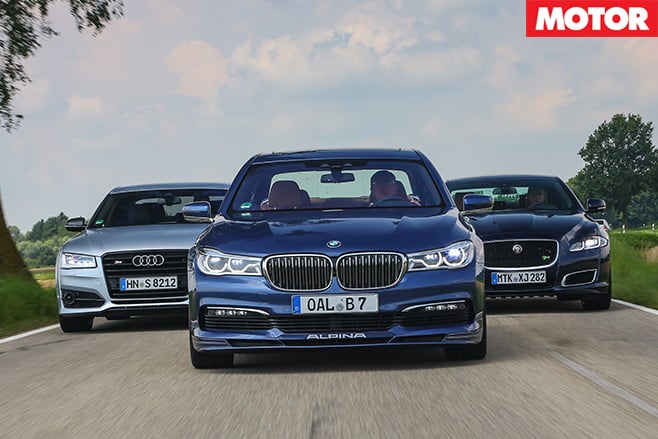
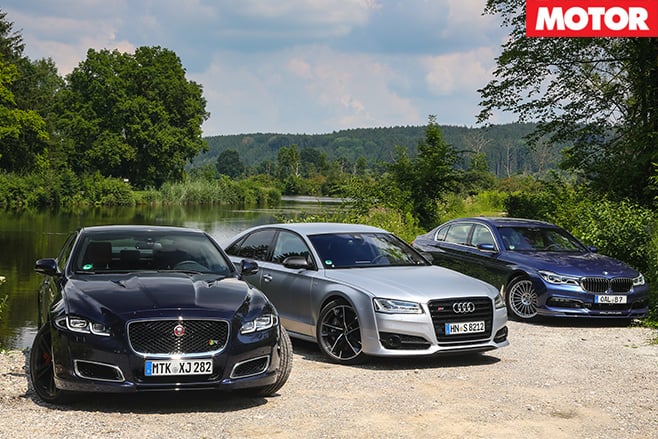
Something is not quite right here. Each of these three-box designs has four doors and four seats, ostensibly providing elegant family transit for the very well-to-do exec.
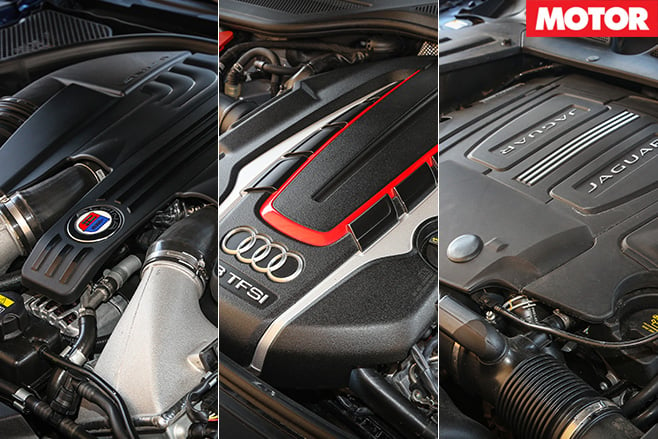
But then you hit the starter button, and all three musketeers drop their masks. Dominating the stage now are three mean V8s, each assisted by two fat turbos or a growling supercharger, always eager to rev and with legs long enough to gobble up blacktop in time-warp fashion.
Attached to the boosted V8s are eight-speed transmissions with wham-bang upshifts, and chassis wearing broad-shouldered tyres, bratwurst-diameter anti-roll bars, aggressive brakes employing discs as large as small satellite dishes, and steering boxes which aim, more or less successfully, to fuse intuition with inspiration and information. Styling varies from the gothic to the technoid, through to the neo-baroque, with each individual cockpit nevertheless embodying an arcane mix of sports bar and cigar lounge.
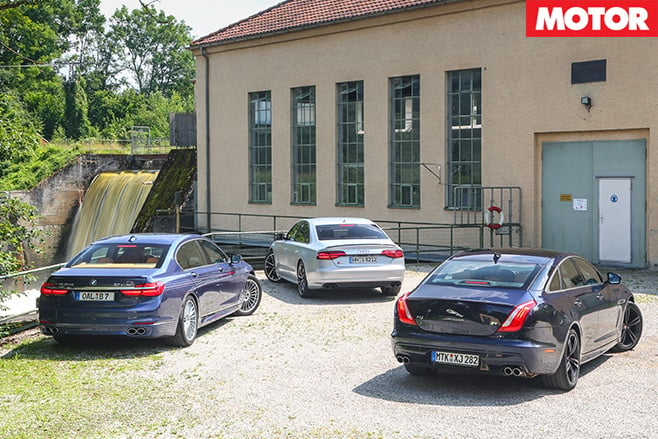
If you are eyeing-off any member of this trio with serious intent, then what you want is not mere opulence and efficiency with a handy turn of speed. Any of these cars makes a statement. You want one because you want the best of breed, a wolf in sheep’s clothing with the pace and class to run unchallenged at the forefront of the pack.
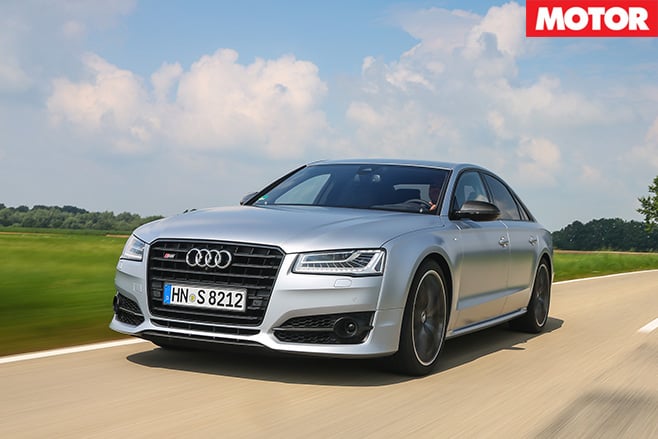
That makes the $330,216 Plus the fastest S-car Audi has produced, however irrelevant that may be on any road in Australia now the Northern Territory has reintroduced speed limits. And it puts it 63kW ahead of the un-enhanced S8, which like the S8 Plus is based on the D4 A8 platform introduced in 2010.
The newest entrant to the V8 uber-limousine contest has the credentials to take on this pair strength for strength. Alpina has long been absent from Australian showrooms but it made a return late 2016, initially offering B3 four-door and B4 two-door models based on BMW’s 3 and 4 Series cars and built to order.
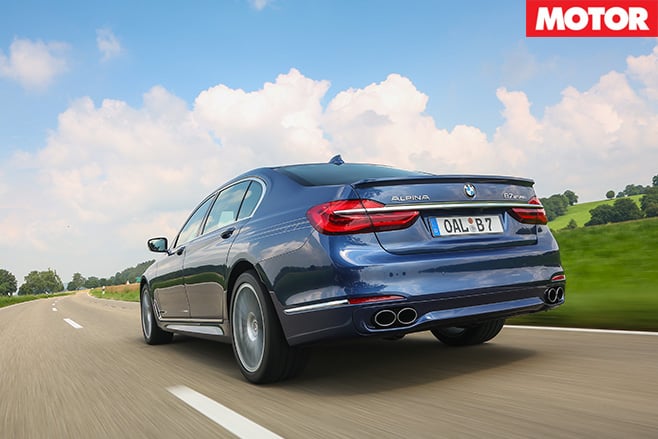
Melbourne-based importer the In Motion Group recently confirmed it has completed homologation for the 7 Series-based B7 Bi-Turbo. Pricing is not yet confirmed, however given the 750Li on which it’s based retails at $312,700 we wouldn’t expect much change from $400,000 for our third and newest contender.
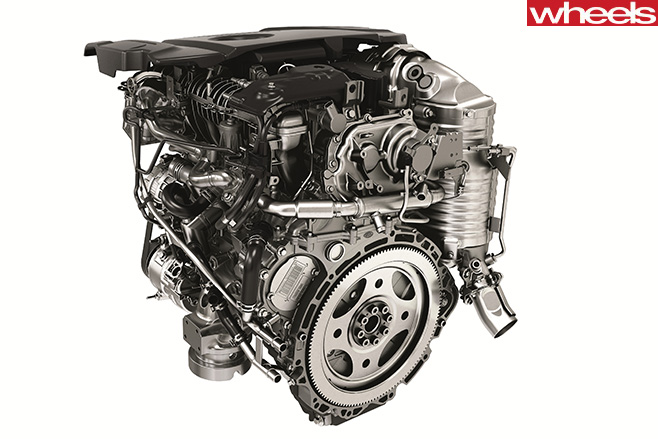
On paper, the much fresher BMW B7 is the car to beat. The Alpina treatment includes bespoke turbochargers, a free-flow induction and exhaust system, and a small army of intercoolers, oil coolers and radiators, pushing the output of the 4.4-litre twin-turbo BMW V8 to 447kW (a giant leap from the 330kW of the original).
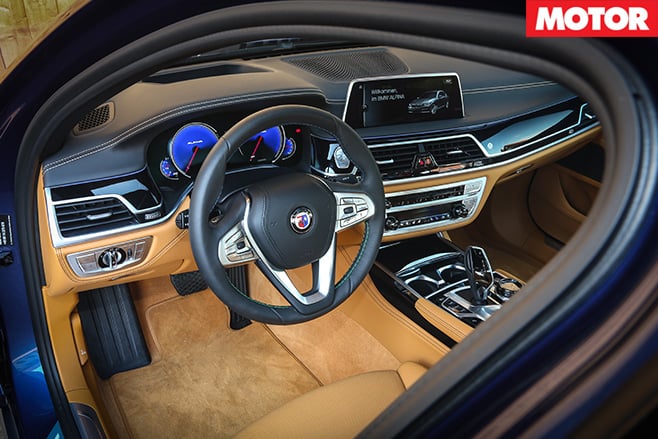
The untold mission of the Alpina flagship, with its trademark ’70s-look multispoke wheels, is to show BMW and the world that no one does super-luxury sports sedans better than the small Bavarian specialist. It represents an attempt to unite the finest of all worlds as the ultimate common denominator of comfort and performance. The 7-Series chassis combines all-wheel drive with rear-wheel steering, makes adaptive adjustments to the anti-roll bars, and links the adaptive dampers to a camera that scans the road ahead.
The B7 impresses in many areas, but there are three traits we don’t like. The squat under full-throttle acceleration from low to medium speed kicks up the bow and feels very old-school. Brakes compensate for a shortage of initial bite with subsequent vigour and pronounced dive. And the steering on less than perfect turf transmits too much information. No big deal, but a couple of small bruises on an ego transferred from maker to machine.
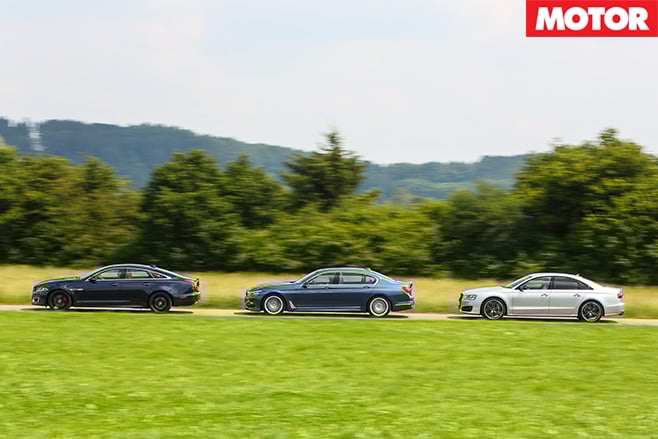
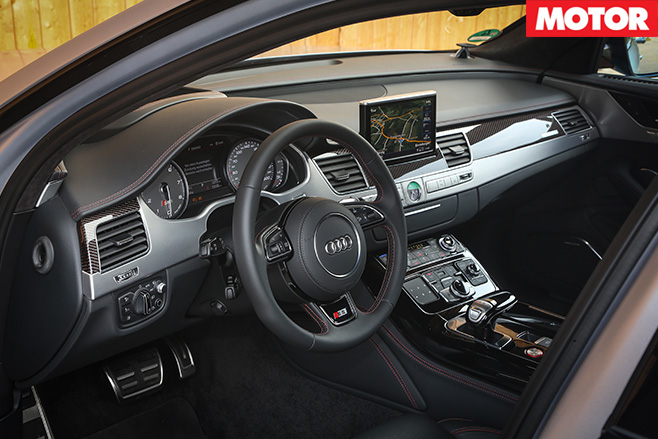
When you give the Audi stick at the exit of a bend, the body likes to bob up and down once before the car settles for the straight-ahead. And the tiller’s calibration is confusingly broad. Around town, a quick two-finger flick at the wheel gets you round any 90-degree bend.
On the freeway, however, the set-up is almost too stiff even for high-speed stability freaks. Drive Select invites you to dial in a slightly more relaxed steering action – or an alternative that is even more frantic.
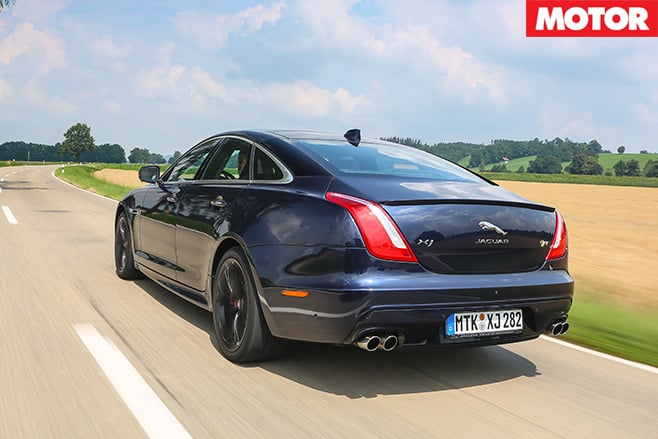
Whenever you are no longer in the mood for low-rev, sheathed-claws wafting, simply hit the Dynamic button and the Jaguar will duly morph from living-room pussy to snarling wild cat. It has the most likeable steering of the lot, packing a sweet blend of input and response, quick turn-in followed by nicely weighted feedback, with enough interest as you wind on more lock yet zero nervousness to encourage second guessing when carving a straight line.
The Alpina soaks up vagaries more comprehensively than the grip-oriented yet latently tail-happy Jag and the lightfootedly neutral Audi. In combination with a unique Sport-Plus mode, the special software developed in house will send only 10 per cent of the torque to the front axle, lower the ride height, select the tautest damper setting, switch the steering to flick-quick and turn up the exhaust volume.
On mirror-smooth tarmac, that’s the way to go. But on bumpy ground, one should mix and match the settings. Although it is 5250mm long, rear-wheel steer makes the B7 feel almost as nimble and agile as a 5 Series. The absolute stopping power leaves little to be desired, but we would still prefer compound discs for even more strength and stamina.
The stoppers fitted to the Jaguar are more obliging and easier to modulate but no less tenacious. Being the only rear-drive contender, the XJR is in principle favourably disposed toward the odd smoky burnout and a whiff of sideways pathos. But at the end of the day, we found it more rewarding to mastermind the momentum, to position the car for the next corner, and to keep up the flow.
Ergonomically, all three models strike an odd balance between brilliance and madness. This applies in particular to the Alpina, which should come with a half-day total immersion course. Autonomous driving? Yes, but not in this vibrating, beeping and flashing please-wait-another-four-years manner.
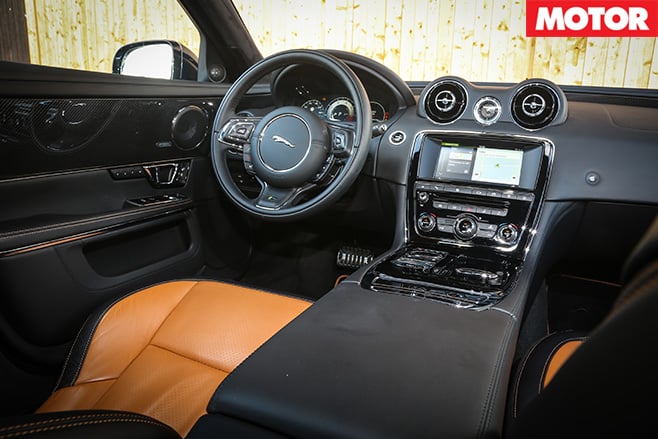
It’s the curse of doing things because they can be done, plus an erratic gear-lever which drives you bananas when selecting R or P, and persistent difficulties penetrating the callous Multi Media Interface maze with your digit. Nor is the Jaguar a master of the centre stack. While the latest infotainment system does bring it up to speed, the busy steering-wheel, the scattered controls and the distant touchscreen are nothing to brag about.
The Jaguar mixes eight parts XJ with two parts R. It’s a four-seater GT, brawny but dated. The Audi is the sports car in this trio. The S8 Plus is sure-footed, corner-greedy and charmingly competent. The Alpina treatment has turned the 7 Series into a much faster yet barely less docile hyper-sedan. Even though ambition and ability don’t always match, the Alpina B7 does outperform the competition.
SPECS
 ALPINA B7
Body: 4-door, 5-seat sedan
Drive: all-wheel
Engine: 4395cc V8, DOHC, 32v, twin-turbo
Bore/stroke: 89.0 x 88.3mm
Compression: 10.0:1
Power: 447kW @ 5750-6250rpm
Torque: 800Nm @ 3000-5000rpm
Power/weight: 220kW/tonne
Transmission: 8-speed automatic
Weight: 2035kg
Suspension(f): A-arms, air springs, anti-roll bar
Suspension(r): multi-links, air springs, anti-roll bar
L/W/H: 5250/1902/1491mm
Wheelbase: 3210mm
Tracks: 1622/1619mm (f/r)
Steering: electrically-assisted rack-and-pinion
Brakes(f): 394mm ventilated discs, 4-piston calipers
Brakes(R): 366mm ventilated discs, single-piston calipers
Wheels: 20.0 x 9.0-inch, 20.0 x 10.0-inch (f/r)
Tyre sizes: 255/40 ZR20 (f); 295/35 ZR20(r)
Tyre: Michelin Pilot Super Sport
Price as tested: $400,000 (est)
Pros: Massive power; great handling/comfort balance
Cons: Huge price tag; needs better body control
Star rating: 4.5/5
 AUDI S8 PLUS
Body: 4-door, 5-seat sedan
Drive: all-wheel
Engine: 3993cc V8, DOHC, 32v, twin-turbo
Bore/stroke: 84.9 x 89.0mm
Compression: 9.3:1
Power: 445kW @ 6100-6800rpm
Torque: 700Nm @ 1750-6000rpm
Power/weight: 224kW/tonne
Transmission: 8-speed automatic
Weight: 1990kg
Suspension (f): multi-links, air springs, anti-roll bar
Suspension (r): multi-links, air springs, anti-roll bar
L/W/H: 5147/1949/1458mm
Wheelbase: 2994mm
Tracks: 1632/1623mm (f/r)
Steering: electrically-assisted rack-and-pinion
Brakes(f): 380mm ventilated discs, 8-piston calipers
Brakes(r): 325mm ventilated discs, single-piston calipers
Wheels: 21.0 x 9.0-inch (f/r)
TYRE sizes: 275/35 R21 101Y (f/r)
Tyre: Pirelli P Zero
Price as tested: 330216
Pros: Crazy performance; adjustable handling
Cons: Numb steering; dated interior
Star rating: 4/5
 JAGUAR XJR
Body: 4-door, 5-seat sedan
Drive: rear-wheel
Engine: 5000cc V8, DOHC, 32v, supercharged
Bore/stroke: 92.5 x 93.0mm
Compression: 9.5:1
Power: 404kW @ 6000-6500rpm
Torque: 680Nm @ 3500-4000rpm
Power/weight: 216kW/tonne
Transmission: 8-speed automatic
Weight: 1875kg
Suspension (f): multi-links, coil springs, anti-roll bar
Suspension (r): multi-links, air springs, anti-roll bar
L/W/H: 5130/1899/1460mm
Wheelbase: 3032mm
Tracks: 1626/1604mm (f/r)
Steering: electrically-assisted rack-and-pinion
Brakes(f): 380mm ventilated discs, 4-piston calipers
Brakes(r): 370mm ventilated discs, single-piston calipers
Wheels: 20.0 x 9.0-inch; 20.0 x 10.0-inch (f/r)
TYRE sizes: 255/35 ZR19 92Y (f); 275/35 ZR19 100Y XL(r)
Tyre: Michelin Pilot Super Sport
Price as tested: 300275
Pros: Steering accuracy; playful chassis; looks
Cons: Feeling its age inside; traction difficulties
Star rating: 4/5
