
The Toyota Hilux is on pole position to become the first ute to be crowned Australia’s most popular vehicle after breaking clear of its nearest rival in November new-car sales.
A sales figure of 3839 placed the Hilux on top of the sales charts last month, with its stablemate Toyota Corolla small car posting 3245 sales in November.
The latest preliminary results, due for official release later today, extended the Hilux’s lead over the Corolla from a slender 21 units to 615 with just one month of the year to go.
For the second consecutive month, the Ford Ranger ute pipped the Corolla to second – with 3410 sales.
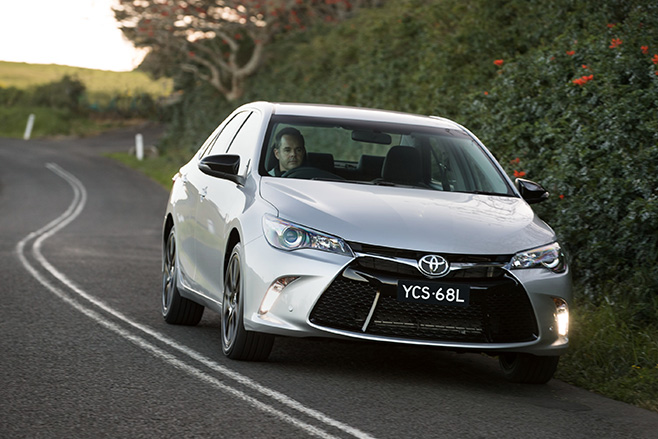
Another strong November from the Toyota Camry gave Toyota three places in the top, as the medium car took fourth spot with 2957 units.
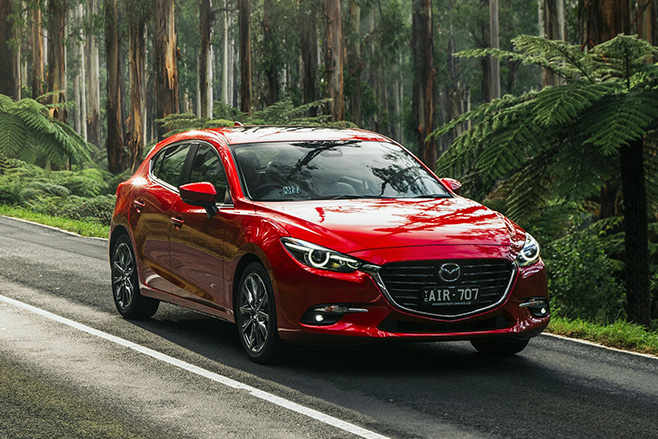
Mazda’s 3 small car was fifth last month, mirroring its placing in the year-to-date race.
In sixth was the Hyundai i30 that hasn’t been able to maintain its early-year form that made it an early bet for 2016’s most popular vehicle, though it’s looking safe to secure the final spot on the podium thanks to a 1370-unit lead over the Ranger.
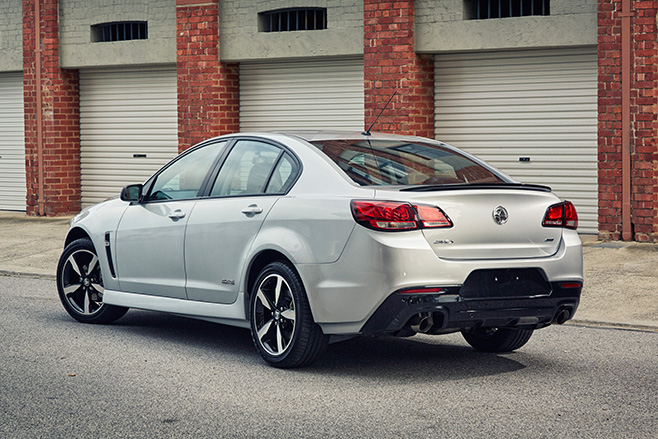
The Holden Commodore (seventh with 2088 sales) and Mazda CX-5 (eighth, 1956 units) continued their runs as perennial top 10 vehicles, though the Nissan Navara ute is more of a stranger to the table.
A tally of 1938 sales for November edged out the Hyundai Tucson by just four units – and matched showroom companion the X-Trail SUV for joint ninth.
If December results reflect the year’s sales trends, the Hilux will end the Corolla’s run of three successive titles. The ute’s sales are up 19 per cent compared with this time last year, where the Corolla is down three per cent.
November 2016 sales overall were just 298 units ahead of the same month in 2015, though it keeps 2016 on track to set a record for the industry.
November 2016: Top 10 Vehicle Sales
| RANK | MODEL | SALES NOV u201816 |
| 1 | Toyota Hilux | 3839 |
| 2 | Ford Ranger | 3410 |
| 2 | Toyota Corolla | 3245 |
| 4 | Toyota Camry | 2957 |
| 5 | Mazda 3 | 2877 |
| 6 | Hyundai i30 | 2541 |
| 7 | Holden Commodore | 2088 |
| 8 | Hyundai Accent | 1995 |
| 9 | Mazda CX-5 | 1956 |
| 10 | Nissan X-Trail | 1938 |
Race for 2016’s No.1 Sales Spot (at end of November 2016)
| RANK | MODEL | SALES NOV u201816 |
| 1 | Toyota HiLux | 38,018 |
| 2 | Toyota Corolla | 37,403 |
| 3 | Hyundai i30 | 34,937 |
| 4 | Ford Ranger | 33,567 |
| 5 | Mazda 3 | 32,966 |
HYUNDAI is staying tight-lipped about a mid-engined Veloster proto spied zipping around the Nurburgring earlier this month, but odds are that the very resolved looking machine is another chapter in the N story that the Korean company is currently writing.
Hyundai Australia spokepeoples could only say that they knew nothing about what might be coming up for the Veloster range.
What we all know, of course, is that Hyundai will launch its VW Golf GTI-rivalling Hyundai i30 N next year in a couple of levels of spec, but the company doesn’t want to stop there.
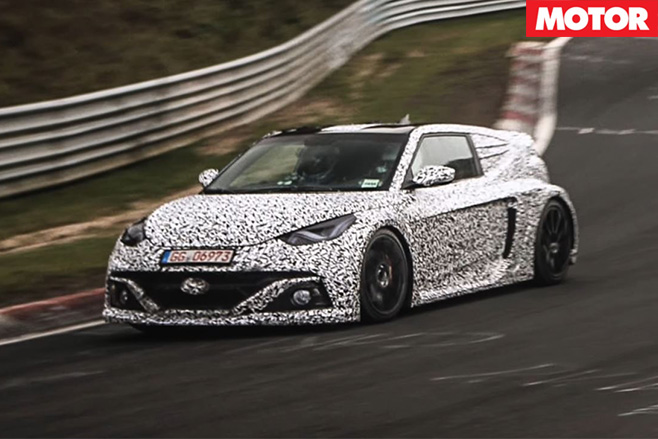
The RM16 runs a 220kW 2.0-litre turbocharged four-potter backed by a six-speed manual and running an electronic limited-slip diff; very similar, in fact, to the spec of the forthcoming i30 N.
The biggest difference between the RM16 and a production Veloster is its chassis; the concept car is built atop an alloy space frame structure clad in carbon fibre body panels.
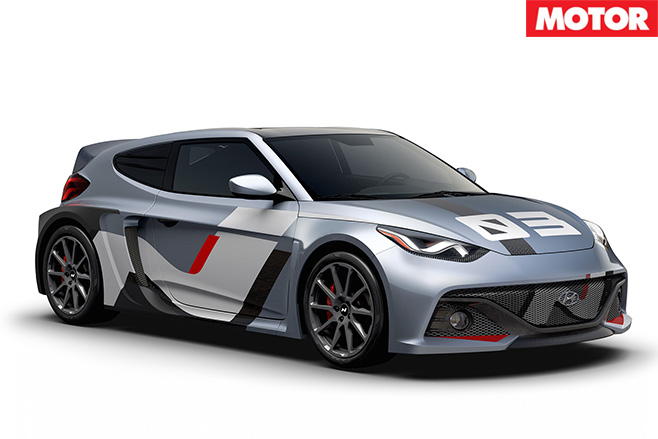
It’s also not unusual to see the Koreans blasting around the ‘Ring; after all, it has a testing and research facility overlooking the Döttinger Höhe straight, and it’s the only Asian company to have one.
It looks like its test drivers and engineers suddenly have a few cool new cars to belt around the Green Hell, though.
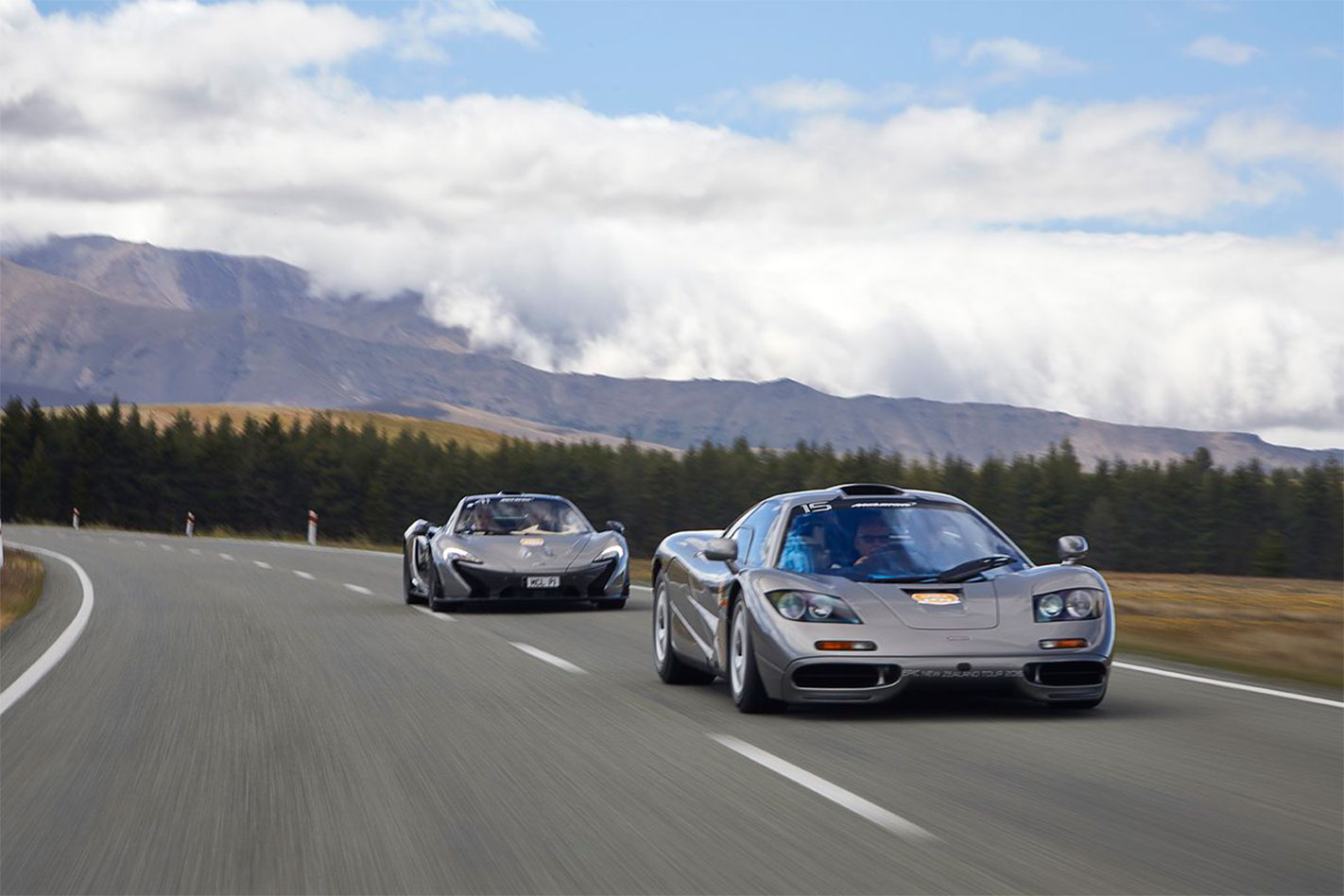
Australia’s only McLaren F1 has been crashed during McLaren’s inaugural Epic New Zealand Road Tour.
The Victorian-registered F1, spotted semi-regularly in Melbourne, was part of a convoy of 31 McLarens travelling from Auckland to Queenstown when the driver lost control and spun into a ditch.
The car was immediately covered with a dust cover before being towed away, while according to a McLaren statement the driver was treated for a minor injury to his thumb. Police have charged the driver with reckless driving.
Unfortunately, the car was heavily damaged in an accident while being driven by a BMW mechanic who worked at the dealer that serviced the F1.
Originally silver, the car was repainted its current darker shade of grey. Wills sold the car in early 2005 and the current owner purchased it shortly after.
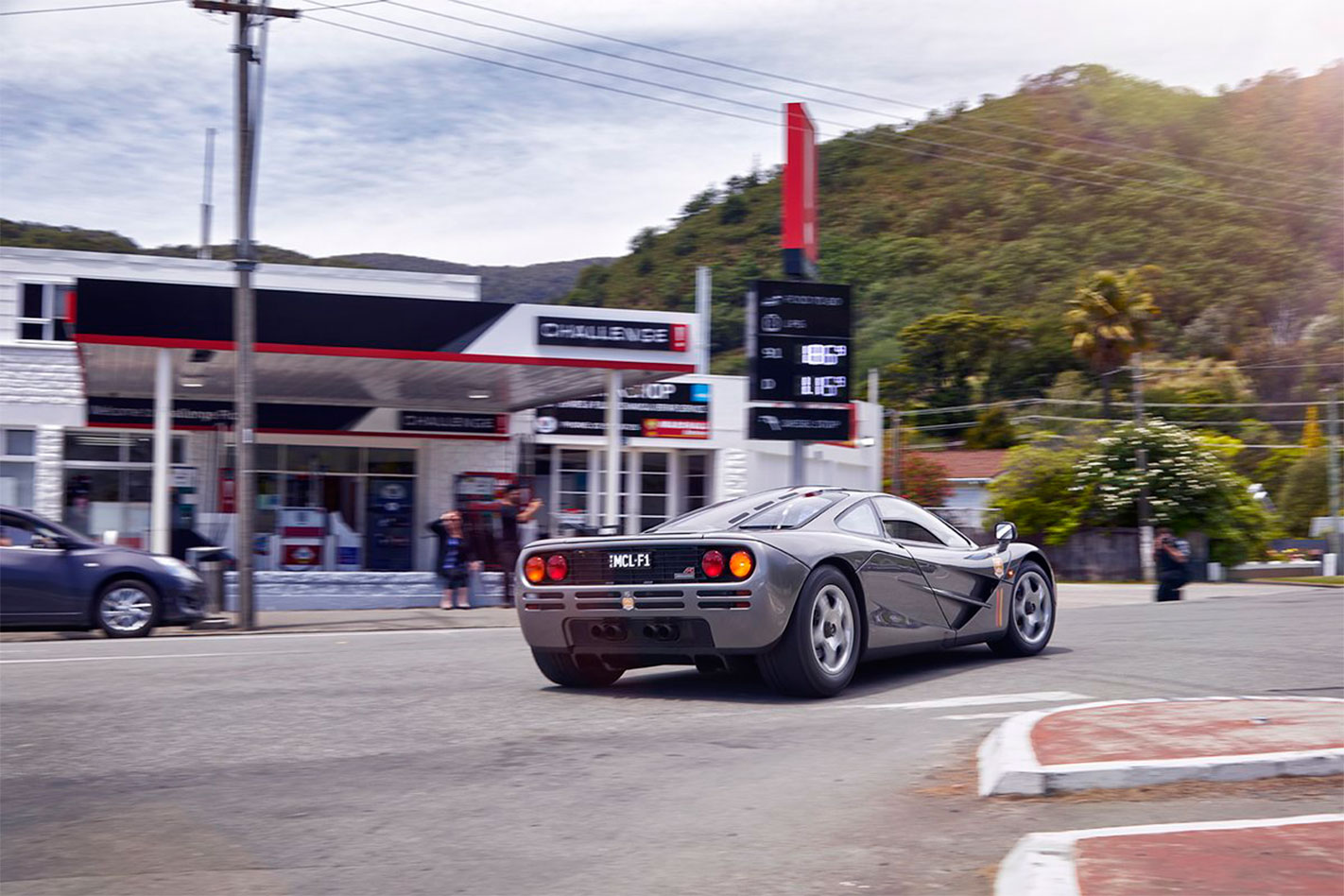
Rowan Atkinson was famously responsible for the biggest automotive insurance claim in history when his F1 required A$1.6m worth of repair work following a heavy accident in 2011. The car was sold in 2015 for $16million.
What stands out?
The Abarth 124 Spider is a front-engine, rear-drive sports car built for wind-in-the-hair enthusiasts from the lightweight Mazda MX-5. A sprightly turbocharged engine makes the drop-top Italian two-seater both more eager and more economical with fuel than its Japanese sibling, and slightly firmer suspension adds poise in fast cornering. The name is a nostalgic nod to a 1970s rally roadster from Abarth, which is the Fiat motorsport brand.
What might bug me?
Accommodating friends and luggage. The Abarth 124 Spider is a very small vehicle with a tiny boot.Dealing with a flat tyre. If you puncture a tyre on an Abarth 124 Spider, you must get to grips with the tyre-repair kit – or walk. There’s no spare.
What body styles are there?
Two-door, two-seat convertible only. The Abarth 124 Spider drives the rear wheels, and it is classed as sports car, lower priced.
What features do all versions have?
Smart-key entry and start, which lets you open the doors and start the car with the key kept safety in a pocket or bag. Cruise control, and a reversing camera.A leather-wrapped steering wheel and gear lever handle, and a mix of leather and microfibre fabric on the seats. Climate control air conditioning – which maintains a set temperature – and heaters in the seats.An infotainment system with a 7.0-inch touchscreen interface, a digital radio, satellite navigation, USB and auxiliary input sockets, and Bluetooth connectivity for phone calls and audio streaming. A Bose-branded sound system, with a sub-woofer for better bass presentation.Headlights that turn on automatically when it’s getting dark. Front and rear foglights, and bright, long-lived LEDs in the taillights. Windscreen wipers that operate automatically when it rains.Seventeen-inch aluminium alloy wheels, and a tyre repair kit. A tyre pressure monitor, which warns you if a tyre has lost air (this can give you extra time to get a slow puncture seen to).A sport mode switch, which lets you adjust how readily the car responds to your pressure on the accelerator pedal.A limited-slip differential, which helps control rear-wheel slip through turns. Suspension dampers and brakes from specialists Bilstein and Brembo, respectively.Four airbags: two directly in front of the driver and passenger; and one on the outer side of each occupant to protect the upper body and head.Electronic stability control, which can help you control a skidding car. All new cars must have this feature.Every Abarth 124 Spider carries a three-year, 100,000 kilometre warranty.
Which engine uses least fuel, and why wouldn’t I choose it?
There is only one engine in the Abarth 124 Spider, a 1.4-litre turbo-petrol four-cylinder which uses 6.5 litres/100km on the official test (city and country combined) with the standard six-speed manual gearbox.Many people think it is more fun to change gears yourself in a car like this, and the gearshift is very pleasant to use. The manual version also uses slightly less fuel than the optional auto.However, if you are planning to do a lot of suburban driving in your 124 Spider, or just don’t like manuals, you might find the auto gearbox easier to get along with. It’s a six-speeder too, and the conventional torque-converter design means it’s smooth in stop-start traffic or when parking.
What key features do I get if I spend more?
The Abarth 124 Spider comes in only one trim level, and with a manual gearbox as standard.You can have an automatic gearbox for an extra $2000 or so.An optional Visibility pack gets you better headlights and some active safety features. The headlights use long-lived and very bright LEDs, and they swivel left and right with the steering to light the way around corners. There are also LED daytime running lights, which help other drivers see you. Rear parking sensors help you judge how close you are to obstacles. Blind-spot detection warns you, when you indicate to change lanes, if a vehicle is alongside out of view. And a rear cross-traffic alert warns, when you’re reversing, if a jogger, cyclist or other vehicle is crossing behind you.If you plan to make the most of your 124 Spider through turns, you might consider the optional Recaro brand sports seats. These have more deeply bolstered backrests (to hold you in place more securely) and are trimmed in leather and Alcantara.
Does any upgrade have a down side?
It is likely you will find the optional Recaro seats harder to climb out of than the standard seats, and some people may also find them less comfortable on long drives.Of six colours available on an Abarth 124, only two – red and white – are non-metallic and come without extra cost. Other colours cost about $490 extra.
How comfortable is it?
The Abarth 124 Spider cocoons you with a mixture of neat design – much of this shared with the Mazda MX-5 – and Latin flair, all rendered in good quality materials. It feels at least the money’s worth inside.The seats, bolstered to provide lateral support for swift cornering, are designed to allow easy entry and egress – the outer bolsters on the seat cushion are a bit less pronounced than the inner ones, to let you slide in and out easily. There’s also a broad inner door sill to lean on.The cushion comfort of the seats is excellent for extended periods, and our testers report a driving position that’s just right – even though the steering column adjusts for height but not reach. The seats hold you in when you’re cornering quickly.Navigation of infotainment is via the Mazda MZD-connect system, which is intuitive to use.The Abarth 124 Spider rides bad roads with controlled absorbency – it’s a well judged sports ride, and not a bone-shaker.In the inescapable comparison with the MX-5, the Abarth feels a bit bumpier at low speeds. But in corners it leans less and responds a little more directly. The differences are small in both respects, however.The Abarth 124 Spider does a good job of shutting out wind noise with the roof up, even if it is noticeably noisier inside than a car with a fixed roof.
What about safety?
Four airbags might not sound much compared with the typical passenger car’s six-plus count, but it’s a full suite in a drop-top two-seater. There are two frontal airbags, and side airbags that protect the upper body and head.Elsewhere, electronic stability control, a reversing camera and a tyre pressure monitor are solid safety fundamentals in all Abarth 124s. Auto-on headlamps and auto wipers improve visibility and cut driver fatigue.Optional active safety aids extend to a blind-spot monitor, which helps you avoid changing lanes into the path of a car closing fast from behind. Another optional monitor works when you are reversing – for example, out of a parking space – alerting you to vehicles approaching from the side. Both come with the Visibility pack.Autonomous emergency braking is not available on the Abarth 124 Spider.The Australasian New Car Assessment Program (ANCAP) has not rated the Abarth 124 Spider. However, it awarded the very similar Mazda MX-5 its maximum five stars for safety, in June 2016. The Mazda achieved perfect scores in the pole and side impact tests on its way to an overall score of 35.20 out of 37.00.
I like driving – will I enjoy this car?
The Abarth 124 Spider is derived from the Mazda MX-5, which was Wheels Magazine’s 2016 Car of the Year. You don’t get a better donor-car than that.The Abarth, like its Japanese sibling, is a dream for an enthusiastic driver. The open-top Italian allies progressive, intimately connected steering with faithfully responsive handling and arresting brakes. You get great feedback, which builds confidence and rewards your driving. Even the six-speed manual gearbox is a delight to slot from one gear to the next.The 1.4-litre turbo four-cylinder perhaps makes the 124 Spider a superior urban drive to the MX-5. The extra oomph it provides, even from low speeds, also aids overtaking and enhances sporty driving. However this focus on businesslike grunt does mean you lose some of the playful exuberance that is especially apparent in the high-revving 1.5-litre MX-5.The turbo engine has a pleasant note, but it isn’t especially vocal. You can better appreciate the subtle deceleration grumble of the exhaust when you have the roof down.Being able to drop the top and be part of the surroundings brings a dimension to the enjoyment of driving the 124 Spider that you don’t get from the hot hatches available at a similar price. It is easy to lower and raise the Spider’s light fabric roof – you can do so in seconds, without even undoing your seatbelt.The optional automatic gearbox is smoothly responsive, and brings paddle shifters to allow some of the fun of manual gear selection.
How is life in the rear seats?
It is excellent if there are people you don’t want to take with you. The Abarth 124 Spider does not have rear seats.
How is it for carrying stuff?
Not surprisingly given it is a small two-seater, the Abarth 124 Spider is compromised when it comes to carrying stuff. There is no glovebox in the traditional position in front of the passenger, and the storage places in front of the gear lever and beneath the centre console are small – too tight even for some phones and wallets. The most accommodating place to put items in the cabin is in the rear bin between the seatbacks, but access is a bit awkward because you have to reach over your shoulder.With the roof down, items left in the cabin are an easy snitch. Even with the canvas roof up, thieves can enter with the help of a knife.The boot is small at 140 litres, which might mean you have to pack light for a weekend away. It is big enough for grocery shopping and other day-to-day duties.
Where is it made?
The Abarth 124 Spider is built in in the Mazda plant in Japan.
What might I miss that similar cars have?
Not much. There’s only one other car on sale that’s a direct parallel for the Abarth 124 Spider, and that’s the Mazda MX-5 it is derived from.The Mazda is slightly slower and softer, and arguably is more lighthearted for that. And its 25-year reputation and cult following means it is likely to hold its value better.The Toyota 86 and Subaru BRZ are low-priced rear-drive coupes which, like the 124 Spider, offer great steering and relatively low power. They have two small rear seats but they are not convertibles: there is a fixed metal roof.The Hyundai Veloster is a sporty-looking front-drive coupe with rear seats and more boot space – but again, it has a fixed roof.
I like this car, but I can’t choose which version. Can you help?
There is only one version of the Abarth 124 Spider. None of the optional extras is a must.
Are there plans to update this model soon?
The Abarth 124 Spider went on sale in October 2016, and is based on the fourth-generation ND Mazda MX-5 that arrived in mid-2015. The long life-cycle of previous-generation MX-5s suggests the 124 Spider will be around in its current form for a long time – we may not see a new model for a decade, perhaps with a facelift about 2020.
MUM and dad buyers appear to be taking a back seat as the Australian car market rushes towards setting another sales record in 2016.
Unofficial VFACTS data for November, due to be released later today, show that business, rental and fleet buyers – and not private buyers – have pushed the Aussie new-car market past the one million mark despite another flat month of sales.
And it’s the worksite favourites, and not conventional passenger cars, again topping the charts. The Toyota Hilux trade ute pegged 3839 sales for the month to lead November’s sales tally, followed by its main rival, the Ford Ranger (3410).
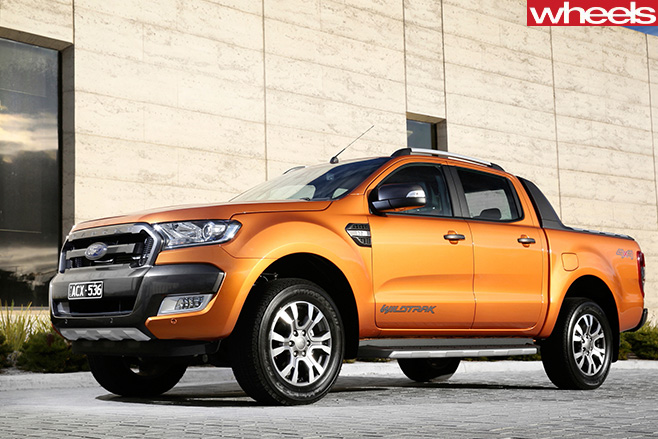
Rounding out the top five was Australia’s best-selling private buyer’s car, the Mazda 3 (2877 sales).
The passenger car market for private buyers has shrunk more than 11 percent so far this year, while SUV sales have grown by only 1.7 percent. In contrast, business sales of passenger cars are up almost four percent (and were up 10.2 percent in November), while SUV sales to businesses and government are up 19.2 and 12.0 percent respectively.
Toyota hung on comfortably as the biggest selling brand, moving 18,162 units for the month to hold an 18.4 percent share of the market. Mazda, meanwhile, rose to second spot with 9825 sales with a 9.9 percent share as Hyundai slammed on the brakes, moving only 7991 units for an 8.1 percent market share. Its best performer, the price-driven Hyundai i30 hatchback (2541), fell to fifth spot on the sales chart.
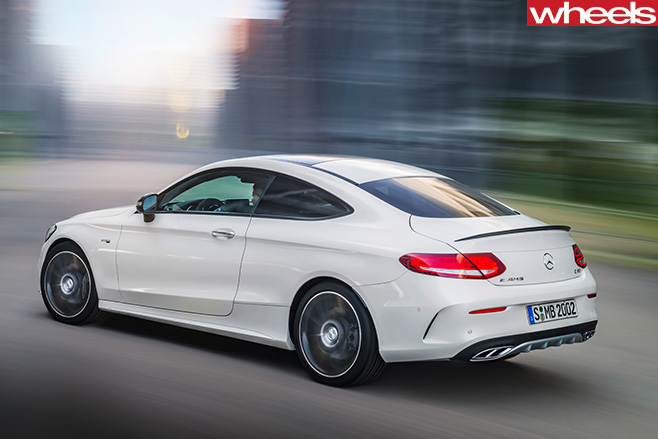
Mercedes-Benz (3584 sales) made it into the bottom of the top 10 as it lured buyers with its C-Class Coupe, snaring 317 sales. Most of those cars sold were AMG-badged C63 coupes; single it out, and the AMG performance sub-brand accounted for almost 20 percent of the German luxury brand’s sales for the month largely on the back of CLA45 and the newest entrant, the C45.
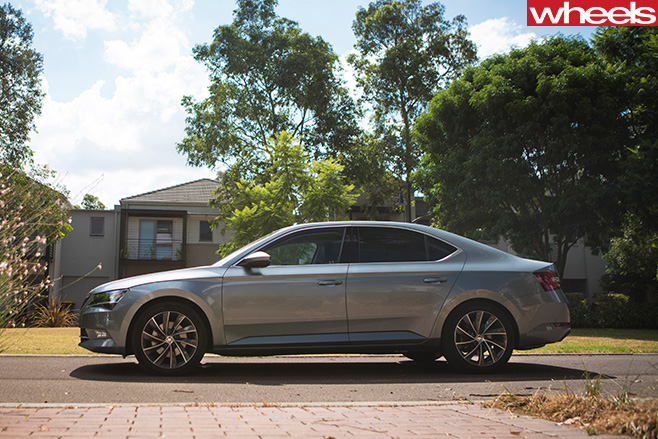
Among the strong performers for November was the Skoda Superb large liftback and wagon, which added 92 sales to its tally. That’s a third of its annual sales in a single month. Volkswagen’s new Tiguan has also taken off, selling 1028 for the month alone to help push it up to the number eight spot on the brands leaderboard.
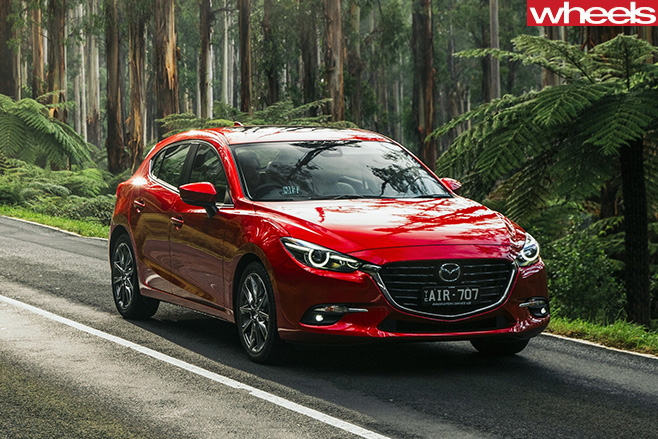
Other cars making an impact included the Audi R8 (increasing its sales for the year-to-date by a quarter by snaring 19 buyers in November), the Mazda CX-9 (921) and the Honda Civic (765) helped by the new-generation sedan.
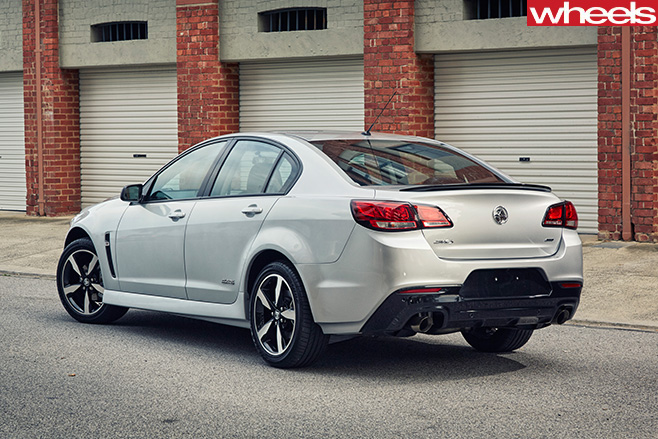
The proportion of locally made cars sold in November shrunk another 14 percent as the industry prepares for a late 2017 shutdown. All up, 7486 Aussie-fettled models were sold, with Ford selling a combined 750. Holden held on to 3419 locally made sales despite Cruze production ending in late July, while the Camry’s strength gave Toyota a combined 3317.
Top 10 best-sellng models
| RANK | MODEL | SALES NOV u201816 | SALES NOV u201815 |
| 1 | Toyota Hilux | 3839 | 3369 |
| 2 | Ford Ranger | 3410 | 3028 |
| 2 | Toyota Corolla | 3245 | 3430 |
| 4 | Toyota Camry | 2957 | 3025 |
| 5 | Mazda 3 | 2877 | 3104 |
| 6 | Hyundai i30 | 2541 | 2499 |
| 7 | Holden Commodore | 2088 | 2614 |
| 8 | Hyundai Accent | 1995 | 1371 |
| 9 | Mazda CX-5 | 1956 | 2169 |
| 10 | Nissan X-Trail | 1938 | 2225 |
*Unoffical VFACTS data
Top 10 best-sellng brands
| RANK | MODEL | SALES NOV u201816 | SALES NOV u201815 |
| 1 | Toyota | 18,162 | 18,402 |
| 2 | Mazda | 9825 | 9807 |
| 2 | Hyundai | 7991 | 8416 |
| 4 | Holden | 7750 | 8889 |
| 5 | Ford | 6827 | 6332 |
| 6 | Nissan | 6341 | 7229 |
| 7 | Mitsubishi | 5875 | 5169 |
| 8 | Volkswagen | 4,862 | 4,441 |
| 9 | Subaru | 4,141 | 3,884 |
| 10 | Mercedes-Benz | 3,584 | 3,034 |
*Unoffical VFACTS data
My one and only previous experience of a three-cylinder car was the rather obscure and curiously named Suzuki Mighty Boy back in the 1980s. And my abiding memory of that car u2013 other than the fact it was incredibly impractical for a ute and incapable of carrying anything more than an attache case and a toothbrush u2013 was that, while it sounded like a mighty flat-10 Porsche 917 hammering down the Mulsanne at Le Mans in 1970 as you snapped through the gears, it performed more like a strangled Beetle towing a horse float. It was certainly more boy than man, and not so mighty.So it was with some trepidation that I approached my new long-termer, Renault’s frankly girl-friendly Captur mini-SUV with its 898cc triple, even though it does boast a turbocharger just like Porsche’s even mightier 917 Can-Am cars that revolutionised racing in the early 1970s.
Sure, I’d read and listened to the ravings of Ponch and Byron about their beloved turbo triples, but it wouldn’t be the first time I’ve been out of step with some of my colleagues over trends in motoring. Could such a pipsqueak engine really be all about “thrummy goodness”?
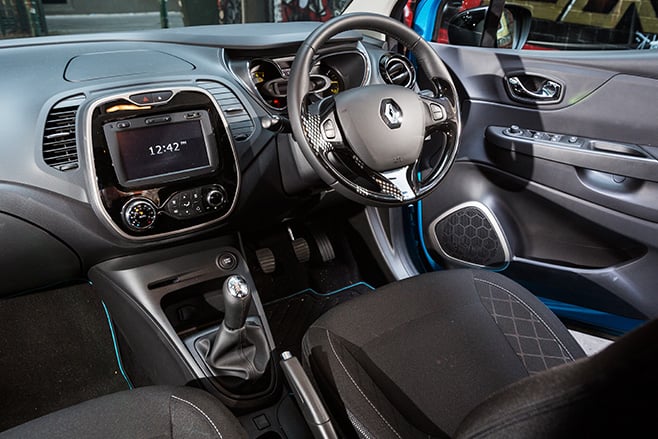
First impressions were not all good. As I drove away from Renault’s collection centre there was a reassuring thrum from the engine alright, just like that yellow Mighty Boy of old, but there was also a disconcerting lack of forward motion. As I racked up the first hundred kays getting used to my new environment, a deepening dread took over. The lack of performance was chronic; this car simply struggled to get out of its own way.
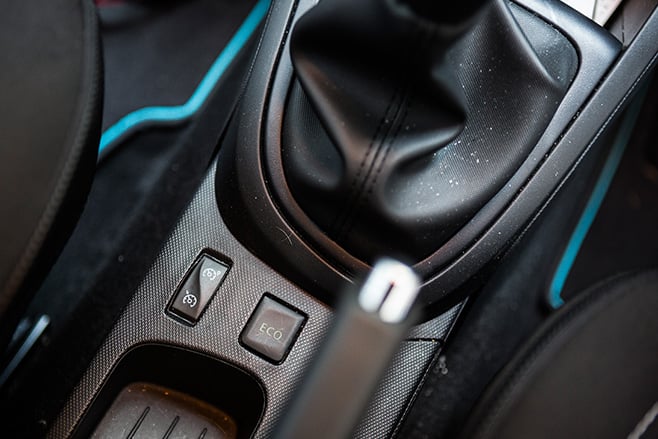
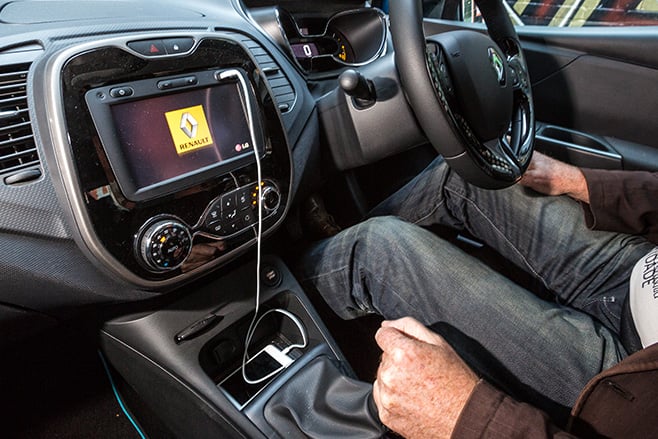
But then, enlightenment. An examination of the owner’s manual revealed a switch – inconveniently located down between the front seats, obscured by the handbrake – labelled ‘Eco’.
As you might imagine, this dulls the throttle and power output. Exactly why you’d want to do that to such a small engine I dare not imagine, but to my delight turning it off transformed the little Renault Captur. Suddenly that thrummy goodness was unleashed, revealing a surprising level of torque and response, at least above 2500rpm. This could be a happy association after all.
Best of all, the Eco switch remains off – as it surely will for our six months together – whenever I drive the car, so I don’t have to worry about resetting it every time I get in.
With fears about the Captur’s performance set aside, I was able to embrace its other charms more willingly. Though surely designed to appeal to women, I can appreciate the modern lines of the body, that already iconic Renault nose design, the funky chrome-embellished scallop shape in the side, the ‘floating’ roof in contrasting black to the mainly metallic blue paintwork. Some think the chrome highlights are overdone, notably the scoop surrounds in the front bumper, but I think they cleverly ground the car, making it look less tall than it is.
Also impressive is the interior’s presentation, which is not only comfortable but comparatively normal for a French car.
I’m not sure how I’ll go with Renault’s usual but still awkward audio controls hidden behind the steering wheel, but the wheel itself is pleasing – I even like the sporty chequer pattern, which makes the car feel a bit more masculine – the centre information pod looks and works well, the carbonfibre-look dash doesn’t come across as cheap (as it might have), all the controls feel solid and well-weighted, the seats are comfortable, and there’s no shortage of space for my 1.8-metre frame.
It’s no Mighty Boy, but boy the Captur could turn out to be mighty.
Update #2
I admit to being a Francophile. It’s a relationship that’s been tested over the years – nuclear testing in the Pacific comes to mind, and that pompous clown Jean-Marie Balestre who presided over the FIA in the 1980s – but nothing that a visit to Paris or the Loire Valley couldn’t overcome.
The French have an admirable outlook on life, an effortless elegance, a love of food and drink, a beautiful language and a remarkable creativity that is reflected in their architecture and movies.
But my love of things French has never extended to cars, even though that creativity has produced some of the most elegant designs in history, such as the Citroen DS. Also some of the most effective, from the incomparable Citroen 2CV to Peugeot’s iconic 205 GTi hot hatch. Perhaps I was scarred by having raced a French car – ah, yes, the mighty Renault 12 – but that’s another story.
I was nevertheless looking forward to getting my latest long-termer to see how I’d go living with a French filly. I’d happily spent a month driving a Koleos in France a few years ago, but that was on home soil. My new Renault Captur has to pass muster in Australian conditions, dealing with big open roads, not tootling around the back streets of Montmartre or cobblestone villages.
So far it’s been coping manfully, if you’ll excuse such a description for a car that is anything but macho. With a tiny little turbo three-cylinder engine that has to drag around 115kg more than the equivalent Clio on which it’s based, the Captur is hardly a ball of fire around town. I’m never going to win the Grand Prix du Traffic Lights, but by working the gears diligently and keeping the revs up, we can at least stay with the flow and not embarrass ourselves.
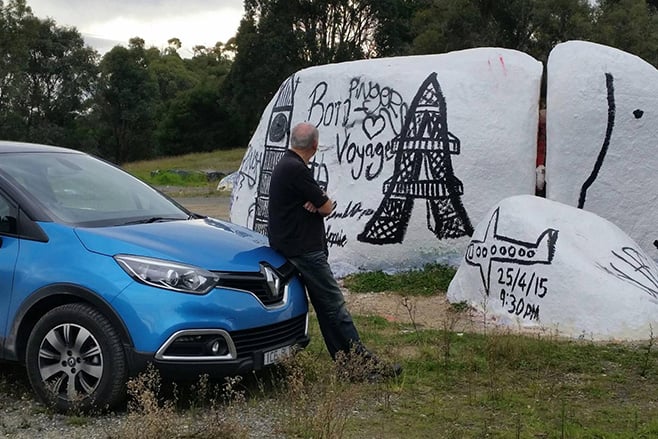
Another French trait is overly soft suspension and, while the Captur doesn’t bounce as much as my previous Jeep Cherokee, I’d prefer it to be more tightly controlled. And I’m glad the bewildering switchgear of old has succumbed to globalisation.
Having the indicators on the ‘wrong’ side was always a bugbear of mine, but it’s so common these days you adapt quickly and rarely hit the wipers by mistake, while the gearshift quality is now world standard, unlike years ago when it was like poking into a jar of molasses. Thankfully, I don’t have to worry about the notorious depreciation of French cars, and I’m yet to experience any reliability issues.
French cars are like art; not really my thing (at least not modern art, or Impressionism), but I like that they exist because they’re different and bring a fresh perspective that inspires others. Maybe I wouldn’t buy a Renault, but I’m glad other people do.
Update #3
Buying a new house can be one of the most exciting things you can do in life – or the most stressful, frustrating, annoying and downright distressing. As you can probably read between the lines, I have mixed feelings about the whole caper. And don’t even get me started about agents and how they’re largely responsible for Australia’s absurd affordability crisis.
Despite all that, I actually quite like the searching process. I love trawling the web, finding likely properties, drawing up a schedule of inspections and dragging the family around from one to the next with military precision. It’s quite exhausting, yet also thrilling and nerve-wracking all at once.
It’s also a good test of a car. There’s lots of stop-starting, piling in and out, parking in tricky places, negotiating unfamiliar territory, eating on the run, working the satellite navigation overtime and rushing to make up lost time because some people simply can’t assess a million-dollar purchase in the allotted 10 minutes. Anyone would think it’s potentially life-changing! Come on, people, we should be two suburbs away.
I thought the Renault Captur would be the perfect vehicle for such duties, being a commodious ‘SUV’ yet compact enough to be nippy. I was being optimistic.
The ‘kids’ lumped into the back seat are 20-somethings who know nothing of imperial measures yet are keenly aware of their “six foot-plus” stature, which challenges the Captur’s metric capacity. They’re too polite to complain, but when asked are happy to proffer that being wedged into the back doesn’t combine well with a jiggly ride and winding roads. Mum didn’t feel too settled in the front, either.
As it happens, we’re looking in The Dandenongs, the hills on the outskirts of Melbourne’s east, and there are plenty of twists and turns, dips and rises, sharp hairpins, bumpy dirt roads and sometimes daunting driveways. The traction control occasionally worked overtime as the tyres scrabbled for traction, yet somehow the blue Renault always made it back to the blacktop without anyone having to get out and push. But the poor little three-pot turbo did struggle with such a fullload and some fierce climbs.
Most annoying was the reversing camera. It’s not a sparkling display, so it wasn’t always easy to make out what was on the screen when presented with unmade roads, dirt verges, ditches, and sometimes even scary steep drops. Worse still, though, the damn screen takes about 12 seconds to come on after you’ve started the car and selected reverse. Why? I’ve no idea. But it’s a long time to sit in gear waiting for a screen to come on before you can start reversing.
At least the sat-nav worked a treat and could be programmed on the run. It certainly made communicating with the car easier than with the agents.
Update #4
Renault knows a thing or two about small turbocharged engines, though you would be forgiven for thinking otherwise if you’ve been following Daniel Ricciardo’s exploits in this year’s F1 world championship. The poor guy must go to bed some nights wondering if the Regie has ever built a decent engine in its life.
But Renault has not only produced some stunning Formula One engines – powering seven drivers to 11 world titles – it actually pioneered the turbocharged F1 engine.
In the late 1970s the French turned racing on its head by producing a winning 1.5-litre turbo V6, overcoming considerable teething problems; rival team chief Ken Tyrrell dubbed the cars the ‘yellow teapots’ because they were always on the boil…
Turbos were all the rage in the 80s, but it took the cool Swedes to harness the power and make them suitable for regular motoring. Turbocharged engines had been all about high boost and performance, and turbo road cars tended to be a bit wild, with sudden explosions of power that threatened to throw you off the road. Saab changed that in the early 90s with the ‘light pressure turbo’, which produced enormous low-rev torque rather than peaky power, and with less lag.
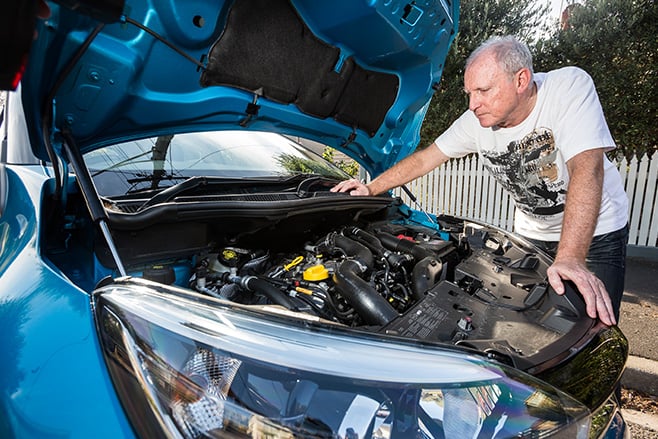
Here we are today, where turbos are as much about economy as performance. Now we have a car like the Renault Captur, which makes do with just 898cc of capacity to haul its mini-SUV arse around. It’s a hell of a feat.
However, the awe I feel for this technology is more theoretical than practical.
Truth is, 66kW and 135Nm simply doesn’t cut it. You won’t find many other cars struggling as hard as this to get up to speed – 13 seconds flat from rest to 100km/h for heaven’s sake – and it’s no better accelerating on the move, either. You have to work hard to keep up with the ‘Cardashians’.
I’d tried to stay positive about the three-pot Captur, thinking back to how Renault had decimated the V8s and 12s in F1 with an engine half their size, but what really did it in for me was taking a Mazda CX-3 home one night. The Mazda’s 2.0-litre atmo felt alive by comparison, responding quickly to my right foot as I happily zipped along with the traffic. In theory, the Mazda uses 25 percent more petrol, but in practice I reckon the difference would be much less that that – and the extra cost of the 95-octane juice required by the Renault means there’s no price to pay at all for that extra driving enjoyment. For me, it’s a no-brainer.
So I’ve put my inner Alain Prost on ice; now I’m listening instead to my inner Daniel Ricciardo.
Update #5
You wouldn’t think a cylinder the size of a snack-can of baked beans could be a real game-changer for something as big as a car. But enthusiasts know only too well there’s no replacement for displacement. It’s an easy way of gaining performance.
What’s not so easy is adding cylinders to existing engines. Cosworth put a couple of its four-cylinder engines together and created the legendary DFV V8 that dominated F1 racing for 20 years, while Volkswagen Group made a W12 by mating two V6s. In the same vein, Renault’s 1.2-litre four-cylinder turbo available for the Captur is essentially the 0.9-litre three-pot with an extra cylinder tacked on the end. My apologies to any engineers reading this…
After complaining last month about the slovenly progress of my blue long-termer, I was keen to try the four-cylinder version and Renault was equally happy to provide one for comparison. So for the past few weeks I’ve been driving a Renault Captur Dynamique variant that not only has the bigger engine, but also a dual-clutch transmission because it’s not available with a manual. And, because it’s an auto, it goes without the idle-stop function. As far as I’m concerned that’s a win-win-win.
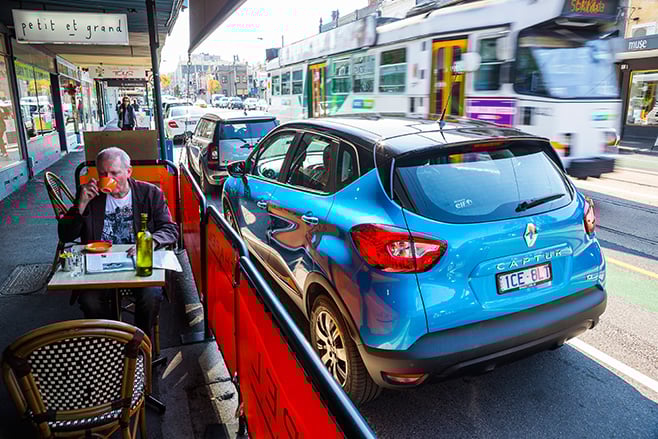
The extra grunt transforms the car, making it a delight to drive; you can comfortably keep up with traffic, accelerate up hills that stump the three-cylinder, and not have to worry about falling off the power brand and losing all momentum. What’s more, the four-pot does it much more quietly, so it’s less wearing on driver and passengers alike.
In line with the capacity, outputs are similarly up about a third and, importantly, it comes on strong earlier than the three-pot engine. Power goes up from 66kW at 5250rpm to 88kW at 4900rpm, while torque increases from 135Nm at 2500rpm to 190Nm at 2000rpm. Okay, it’s no DFV, but these are significant numbers in context.
Despite carrying an extra 81kg, the bigger engine slashes 2.1sec off the sprint to 100km/h. And that extra weight seems to benefit the Captur’s ride, making it settle better and feel less choppy. Even the fuel consumption is a match – 7.0L/100km on a few tanks versus a four-month average of 6.8 for our three-cylinder.
Less impressive is the Getrag six-speed dual-clutch transmission, which might shift quickly and smoothly once on the move, but is slow on take-off and a bit dithery around town, unsure whether to pre-select first or third when you’re in heavy traffic toddling along in second.
But I don’t care. More power, better flexibility, quieter operation, comparable fuel use, no confounded idle-stop and the convenience of an automatic. For the sake of a few grand, you can keep your thrummy triples.
Farewell
At the risk of revealing too much about my inner self, sometimes I wish I was a girl. They might think it’s a man’s world, but I reckon they have it made, or at least they did until they went down the road of equality and discovered it perhaps wasn’t everything they’d expected.
When it comes to cars, it seems that looks and colour are often the major factors women consider when choosing a new vehicle. Yes, I realise I’m generalising horribly here and owe an apology to the many female revheads reading this, but seriously, how many times have we blokes poured through mountains of research only for our better halves to decide they want a particular model because “it’s just so cute” or that it doesn’t matter “so long as it’s that bright metallic red”.
When I collected the Renault Captur back in March, I was well aware that this was a ‘chick car’ and certainly not intended for an ageing boy racer. So I tried to get in touch with my inner female. Not very successfully, as it turns out. I just couldn’t master the high heels and all that makeup palaver. But wearing a bra was kinda fun.
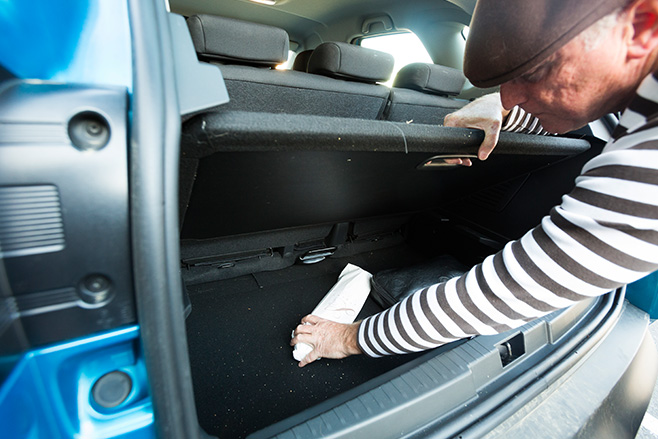
I digress. The point is that I had to get into an extremely atypical character to appreciate this car, and on the odd occasion I succeeded it wasn’t hard to see the appeal of that funky styling, the bright blue duco with floating black roof, the scalloped sides with black and silver swishes, the high seating position and extra headroom, the jazzy interior with its fancy seat covers and steering wheel, and the flexible boot space with a false floor that could be angled so your shopping didn’t go everywhere. Yep, it was fun pretending to be a girl.
But still it didn’t work for me. The technically impressive yet mere 898cc three-cylinder engine, even with the help of a turbocharger, just couldn’t get the job done adequately, and it only comes with a manual gearbox. Seriously, since when do us chicks do manuals?
I really wanted to see what the Captur was like with the bigger four-cylinder turbo engine and an automatic transmission, so I grabbed one for a few weeks and my opinion changed completely. Of course I knew the 1.2-litre would have better performance, but I didn’t expect it to change my perspective completely. Suddenly I began to appreciate its Gallic charms, which had been hidden behind expletive-riddled frustration as I tried to get the turbo triple to at least keep up with traffic flow. Now that was a given, and suddenly the minor foibles of the Captur – the hidden remote audio controls, the ’80s-style trip computer readouts, the cruise control switch down with the handbrake, the dodgy iPod connection – became what French car tragics would call character. And I didn’t mind it a bit. In fact, I asked to keep it a bit longer. Sacre bleu!
I’m also heartened that Renault’s globalisation has resulted in impressive build quality and, in the case of ‘my’ Captur, zero reliability issues. Not a fault, failure or even a single rattle during six months together. Perhaps that will come to be reflected in improved resale values in the years to come.
If I was a female – a proper one, not one of the Caitlyn Jenner variety – I think I could be drawn to the Renault. But like probably 99 percent of Captur buyers, I’d order the equally economical four-cylinder with the auto. Ca va?
Kent Dalton from Hi-Torque Performance still owes me a pair of underpants after bringing the brutal, 515kW-at-the-wheels “LOLYF” supercharged Gen-F R8 Clubsport to the 2015 Hot Tuner Challenge.
Hot Tuner 2016 is brought to you by Valvoline SynPower
Even in the dry the Magnusson 2.3-litre-blown, 6.2-litre brute could fry its treads with ease in fourth gear, but the Gen-F2 HSV Senator he brought to the 2016 event was a thoroughly different beast.
“This is far tamer than the car we brought last year,” says the Queensland tuner and driver of Hot Wheels stunt cars. “BADNWS is a factory supercharged LSA car, so we chose to fit one of our LSA580 packs that makes 580hp [433kW] at the back wheels on 98RON. It’s a nice, mild driver that’s reliable but still fun.”
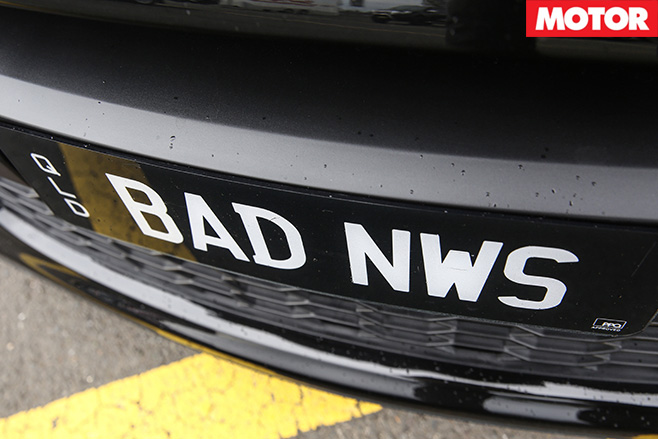
“Shane Ross, who owns this car, also has a VL Walkinshaw with a 1000hp turbo LS motor and a genuine VL HDT Commodore with a supercharged big block Chev V8 making over 1800hp, so he wanted something he could drive on weekends and have a bit of fun with.”
Carrying that fine line between just enough and too much, Dalton left a few upgrades off the Senator, as it had reached the point where the returns in power diminished greatly for the work involved. “I had ported heads and blower on the bench ready to go, but I left them at home to ensure reliability,” he says.
The upgraded camshaft was an interesting addition to BADNWS, with the Gen IV small-block Chevy V8s (as found in VE-on Holdens) famous for responding strongly to cam upgrades, thanks in part to their deep-breathing “rectangle port” cylinder heads.
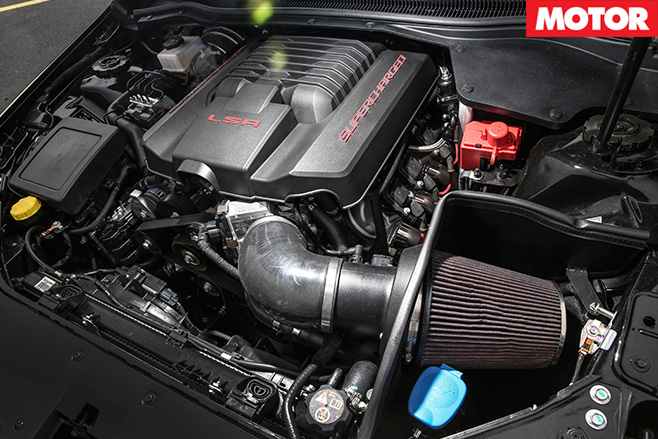
“The cam has huge 125-degree lobe separation and massive overlap, but it is really mild to drive,” explains Dalton. “If you just walked past the car idling, you’d be hard pressed to pick up that it has an aftermarket cam, but it works so well with the blower set-up and makes really good mid-range power.
“We have E85 everywhere in Queensland, so I fitted a flex-fuel sensor, twin upgraded in-tank fuel pumps and lines ready in case Shane wants to put a bigger supercharger on. The car makes around 50-60hp more on E85 than 98RON pump fuel; forced induction cars really respond well to ethanol fuel.”
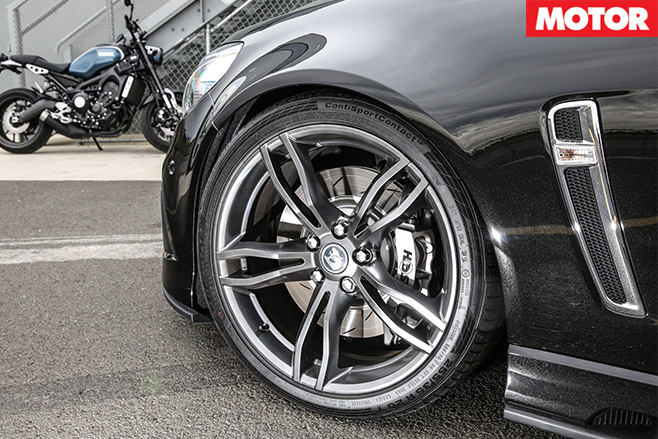
SPECIFICATIONS DRIVE: rear-wheel Engine: 6162cc V8, OHV, 16v, supercharger Gearbox: 6-speed automatic Suspension: coil-overs, anti-roll bar(f); multi-links, coil-overs, anti-roll bar(r) Brakes: 367mm ventilated discs, 4-piston calipers(f); 372mm ventilated discs, 4-piston calipers(r) Wheels: 20 x 8.5-inch(f); 20 x 9.5-inch(r) Tyres: 255/35 ZR20(f); 275/35 ZR20(r) Continental ContiSportContact 5P
PARTS AND PRICES Supercharger kit: $13,000 e85 fuel system: $3000 Headers: $4000 Suspension: $3300 Total mods cost: $23,300 Vehicle cost(mSrp): $92,990 Total cost: $116,290
It may have already occurred to you by now, but not everybody is reading from the same page when it comes to their four-wheeled transport. By which I mean, we all have differing standards when it comes to evaluating whether a car is ‘right’ or ‘good’ or not. Or ‘roadworthy’. Or, even more fundamentally, just ‘worthy’.
Should this pearl still not be apparent to you, may I suggest you are yet to buy your first car from a classified advert. I, on the other hand, have spent, oh I dunno, years of my life chasing cars from the small ads, so I know only too well the disparity between what is stated as fact in nine-point Helvetica and what serves as reality.
I cannot hope to recall the number of times the classified has assured me that the vehicle on the block is not only utterly desirable to anybody with even one functioning eye, but is also a 100-point concours car. I have often arrived to inspect same and been forced to walk past a pile of mouldering crud in the driveway to get to the car I had come to see. Only then to be told that the bucket-o-shite oozing its last on the driveway IS the 100-pointer in question.
Of course, folks can flip the other way, too, and conjure up a long list of faults, the most dire of which is ‘that number plate would look better if the G was an S’. Folks like this can not sleep at night knowing their car is grotty from the day’s drive. The slightest hiccup in acceleration has them running to the nearest dyno for a full diagnosis and tune when, in fact, the blip was nothing more than the sole of their shoe compressing against return-spring pressure about half way through the throttle pedal’s travel.
I know plenty of people from both camps. MOTOR’s sister publication, Unique Cars, employs (and, indeed, would not function without) a character known only as Uncle Phil who never ceases to amaze me with his attention to detail. Phil is the sort of bloke who refuses to use a toothbrush to detail an engine bay if it’s already been used on anything else. Like teeth, for example.
The cars that fill his garage are beyond immaculate; they make a virgin birth seem somehow schoolboy-humour-dirty. And it doesn’t matter when or where they’ve been driven (and they do get driven) Phil’s cars need a detailer like a tortoise needs a front splitter.
Then there’s my mate the Mad Wop. Now, Mad Wop has a driveway that is precisely three shitboxes deep. Sadly for Mrs Mad Wop, it is a wide driveway, so the turds are stacked two abreast, for a total of six.
This dirty half dozen includes a Chev ute so totally rusted out, even the rust doesn’t want to hang around, an elderly Holden Caprice that is j-u-s-t about to shed its entire butt from the rear screen back thanks to a similar level of tinworm, and an LJ Torana that is even rustier. But to hear the Wopster tell it, each one of these classics can be resurrected at any time with minimal effort, some cutting compound and a small amount of welding.
Which is odd, because the Torana will require input from a shovel since it’s only really from the doorhandles up that it’s still above ground.
Me? I reckon I’m somewhere between Phil and Mad Wop when it comes to obsessing over clean and recognising a lost cause. I number both these characters as my good friends and refuse to let our differences of opinion on this one subject define our relationship. Which is another way of saying I have no idea what drove them to their current points of view. But I do know one thing: I know for damn sure which one I’d rather buy a car from.
First published in the October 2016 issue of Wheels magazine, Australia’s best car mag since 1953.
It’s time to embrace the best post-Ford Mazda that isn’t an MX-5 – the Mazda CX-9.
Can’t wait to see the final score? Jump to the verdict now.
Since Mazda’s CX-5 kicked off the newly independent Japanese brand’s ‘SkyActiv’ model renaissance back in 2011, each proceeding model has earned widespread respect, if not universal acclaim, tempered mostly by persistent road-noise intrusion.
To Hiroshima’s credit, minor sound-suppression measures have been implemented with each respective facelift. But this second-generation Mazda CX-9 is a massive leap forward, finally breaking the noise, vibration, and harshness hex that has plagued Mazda for decades. It’s almost like driving with earmuffs on.
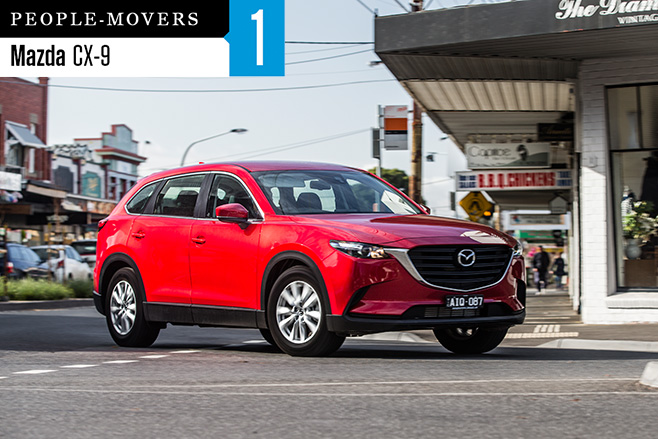
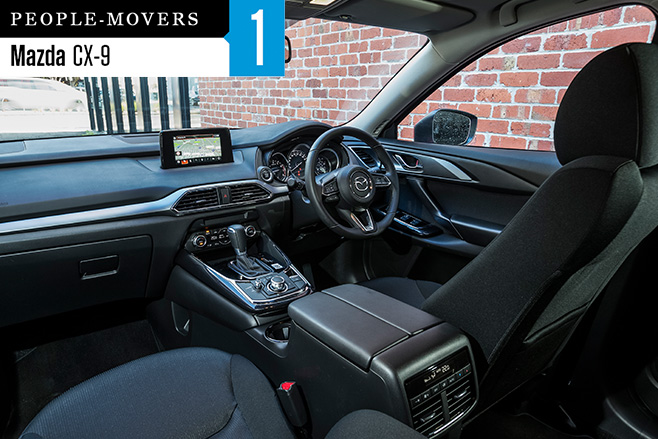
The second row is also generously packaged, bringing with it firm theatre-style cushions with slide adjustment, reclinable backrests, and passenger-configurable climate control.
While seats six and seven lack air vents, reading lights, and reclinable backrests, both offer adult-friendly accommodation (Mazda says it was designed to fit a pair of 170cm ‘Junior High’ kids). Beyond that, cargo capacity is ahead of this pack, but at 230 litres with all seats in use, the new CX-9 is 37 litres shy of its longer, heavier, and thirstier predecessor.
Quibbles are few, but they do include a weirdly oily and clammy dash-top finish, and an oversized centre console lid that fouls a wheel-twirling driver’s left elbow during fast cornering – something the CX-9’s deliciously limbre dynamics encourage.
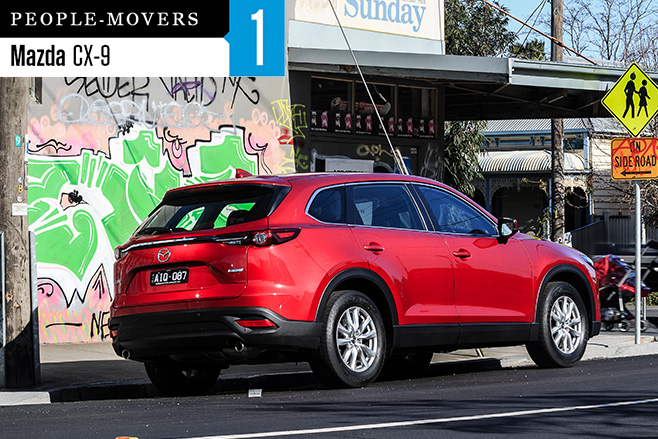
Combined with alert gearing, the CX-9 is quick off the mark and strong on throttle response, for punchy point-to-point performance. At 7.7sec to 100km/h, it concedes nothing to the other’s six-pot powertrains, yet real-world economy is up to 20 percent better in some cases.
Our 11.6L/100km average is impressive considering how eager everybody was to cane the CX-9 Sport. It’s that sort of car (sorry, SUV), thanks to precise yet fluid steering, agile and controlled handling, and pleasingly supple suspension compliance. Even on low-grip tyres, the driver feels connected and the CX-9 feels planted, without the usual punishing ride compromises. This is real progress. The only worry is a soft brake-pedal reaction, which at higher speeds requires a hefty shove before full stopping force is applied.
The last time we were this pumped about a large SUV, it was 12 years ago, it wore a Territory badge, and it won Car of the Year. Ironically, then, the CX-9 is that dying Aussie Ford’s spiritual successor, and the first SUV to evolve what the Ford Territory started.
Hush now, baby
This TC-series CX-9’s SkyActiv chassis is actually a generation 1.5 evolution of the CX-5’s, with 24kg instead of 7.5kg of sound insulation, as well as a significantly thicker-steeled floorpan, to help cut NVH pathways.
Also helping out is a 65 percent torsionally stiffer body with more high-tensile steel (compared to the old CX-9), tighter panel gaps, improved aerodynamics, better sealing, and thicker glass. Result? On coarse roads at 100km/h, there is a 2.5dB noise cut.

SPECS
Price as tested: $42,740 *includes metallic paint ($250)
Engine: 2488cc 4cyl, dohc, 16v, turbo
Power: 170kW @ 5000rpm
Torque: 420Nm @ 2000rpm
Transmission: 6-speed automatic
Dimensions (L/W/H/W-B): 5075/1969/1747/2930mm
Weight: 1845kg
Cargo capacity: 810 litres
Tyres: Yokohama Geolander H/T 255/60R18 108H
Test fuel cons: 11.6L/100km
0-100km/h: 7.7sec
0-400m: 15.6sec @ 146.5km/h
80-120km/h: 5.2sec
3yr resale: 54%
Plus: A brilliant all-rounder that’s high-quality and great value
Minus: Soft braking response; obstructive centre armrest
Verdict: 8.5/10

The fourth iteration of Mazda’s legendary MX-5 drop-top roadster, the ND, lobbed in 2015.
Hot Tuner 2016 is brought to you by Valvoline SynPower
With the car having grown gradually more porky over the past 25 years, the new-gen model saw the little two-seater become once again lithe and nimble. And, as always, it’s a great platform for enhancement.
Tunehouse has chosen to play with the 2.0-litre ND. As well as satisfying Aussie speed freaks, it has its eye on the US, the MX-5’s biggest market. “The last car we developed was the Toyota 86,” says Tunehouse’s Jim Ghelis, a regular at Hot Tuner. “Of course we thought we’d invest in the new MX-5: it’s far lighter and it’s a new platform with direct injection.”
Tunehouse’s first plan was to refine the chassis and engine in naturally aspirated form. “We found some restrictions in the exhaust and played with the tune,” Ghelis explains. The result was an extra 22kW at the wheels – the standard car shows around 75kW at the tyres – and this is what Tunehouse will market as a Stage 1 upgrade.
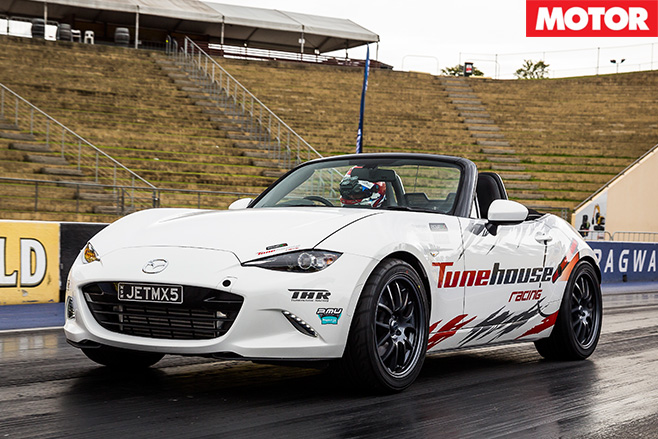
“Doing that made a big difference,” Ghelis smiles. “The car’s standard sway-bars allow the body to move around a little more than ideal. That gives a funny feeling when you’re sitting so close to the rear axle line.”
Tunehouse’s next step was fitting MCA coilovers. “What it used to do was squat a lot,” Ghelis says. “This is what we provide to a customer as a Stage 2 set-up after they’ve done the sway-bar upgrade.”
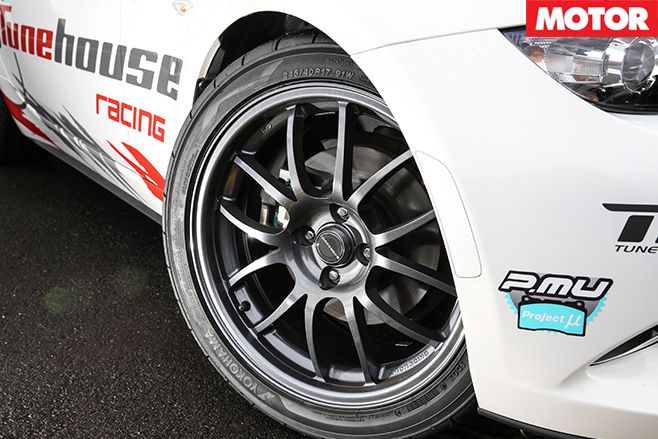
The Mazda’s four-wheel disc brakes have been given the once-over, too, with Project Mu pads against the original discs, and braided lines and higher-spec fluid for a tight ’n’ bright pedal, better bite and reduced fade within the standard wheels and tyres.
Tunehouse has managed to squeeze the turbo, new intake plumbing and intercooler under the Mazda’s skin with only one significant hardware change: relocating the battery directly in front of the engine.
For reasons of price, reliability and ease of fitment, the engine is internally standard, but the GTX 28/67 turbo and intercooler hardware will eventually be used on bigger-budget and bigger-boost modified motors if Tunehouse chooses to go that way.
Surprisingly, this conversion retains the standard exhaust from the cat converter back. Sure, it might be leaving a handful of kilowatts on the table, but it helps keep the cost down at this level of power.
The clutch is also standard. “It hasn’t let us down,” Ghelis says. “It’s the same with the gearbox. It will cope with a lot of extra power, but obviously we keep an eye on things; for instance by looking at the oil.” The result for now is 135kW at the treads.
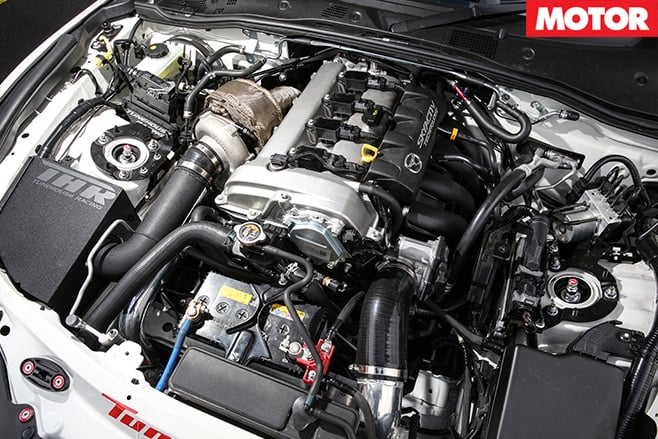
SPECIFICATIONS Drive: rear-wheel Engine: 1998cc inline-4, DOHC, 16v, turbo Gearbox: 6-speed manual Suspension: A-arms, coil-overs, anti-roll bar (f); multi-links, coil-overs, anti-roll bar (r) Brakes: 280mm ventilated discs, single-piston calipers(f); 280mm solid discs, single-piston calipers(r) Wheels: 17 x 9.0-inch (f/r) Tyres: 245/40 ZR17 (f/r); Yokohama Advan AD08R
PARTS AND PRICES Stage 3 kit: $7999 Suspension: $2500 Brakes: $300 Wheels/tyres: $2200 Total mods cost: $12,999 vehicle cost: (mSrp) $34,490 Total cost: $47,489
