
First published in the February 1974 issue of Wheels magazine, Australia’s best car mag since 1953.
In any other country his name would be whispered with awe. We look back at the life of Philip Edward Irving, the man who powered Jack Brabham in 1966.
WHEN I WAS toying with the idea of coming to live in Australia I wrote to Phil Irving and asked what the job situation was like in Melbourne. His reply was: “A worker can get work”, and he added further on in his letter: “By the way, if you’re stuck for transport when you get here I can lend you a car for a few weeks”.
Read former Wheels editor Peter Robinson’s story of how this story came to be written.
With these two sentences we have Philip Edward Irving summing himself up pretty well. Head down, get on with the job, and help others as and when you can.
And the first social function I attended in Australia was a surprise dinner party thrown for Phil’s 68th birthday. It was a surprise to him too because he’d been told that he was being carted off for a quiet little dinner but when he came into the room he found more than 80 of his friends clapping their hands. With the net thrown a little wider the figure could easily have been over the 200 mark.
Another little scene. I forgot who it was told me he had been more or less frog-marched into attending some motor or motorcycle club function at which the great attraction was a talk by Phil. This man isn’t very mechanically minded so he was looking forward to the occasion with about as much enthusiasm as an octopus has for playing the bagpipes. But as the evening went on he found himself completely captured, hanging on every word and having a thoroughly enjoyable time. There we have Irving the orator.
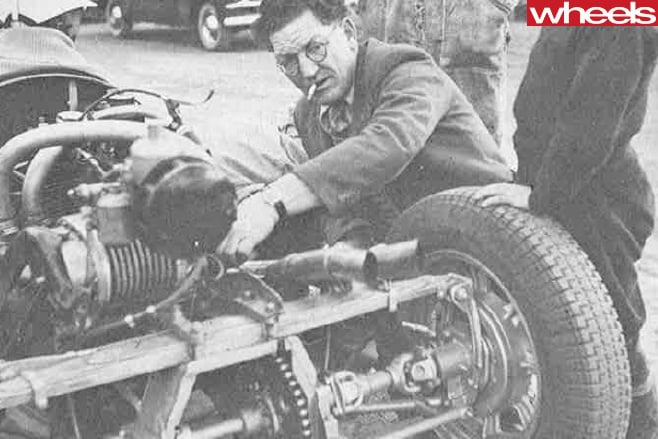
Then we have Irving the author, for he has produced a goodly number of books which are regarded as The Work in their various spheres: Tuning for Speed, now in its fifth edition; Motor Cycle Engineering; Automobile Engine Tuning; Two-stroke Power Units. He must have written hundreds of magazine articles, both under his own name and “Sliderule”.
And there is lrving the competing motorcyclist, competing motorist, the craftsman who can do any mechanical job that he is likely to ask another person to do. There is Irving the dry-humor specialist as well. When I was apologising for returning his Rover somewhat unwashed, he said: “Aw, that’s all right. I wash them every six months”. He paused, and then added defiantly: “Whether they need it or not!”
But above all, there is Irving the designer of engines. Had he been an Italian living in Italy, his name would be whispered with awe in every place where motorists gather, but in Australia it would seem that a prophet hath no profit in his own country.
The facts of the matter are these. The Repco engine which Jack Brabham used to win the world championship in 1966 was designed by Phil Irving. The drawings were done at Aliwal Road, Clapham Junction, London, in 1964. Pencil was first put to drawing paper on March 15 of that year and the job was completed by September of the same year. And 53 weeks after the start of drawing, the first engine was running in Australia.
The whole thing was done under a veil of dark secrecy. Phil and Jack Brabham had about six meetings in the middle of the night and the engine was designed to fit the contours of a chassis design that was later discarded so it wasn’t a completely straightforward job.
Another thing that requires pointing out is the matter of the engine succeeding “because it was reliable”. That is perfectly true but that wasn’t the sole reason, because Brabham kept on getting pole grid positions and you don’t do that on reliability alone. In fact, instilling both speed and reliability into a unit is something that usually escapes most designers.
But there were write-ups about the engine and about Jack Brabham and even a film and if you searched the small print or the crowd of extras cheering in the background, you could find little trace of Irving. The engine was designed in secrecy, and a lack of publicity followed. It was only in 1967 that a CAMS award put the matter right to a certain extent. But all this happened in ’64… So let’s get it right and all chorus together: “Phil Irving is a brilliant engine designer”. And I would add that, at the age of 69, he’s no different from what he was a few decades ago.
Phil comes from a family which seems to have pretty well equipped with grey matter. His great grandfather, from Annan in Scotland (where there is a statue of him in front of a church), was a Presbyterian minister who formed a sect called the Irvingites. They have their head church in Gordon Square, London. Then his grandfather was a classics professor at Melbourne University and his father a doctor in Victoria. You just can’t keep these Scots down!
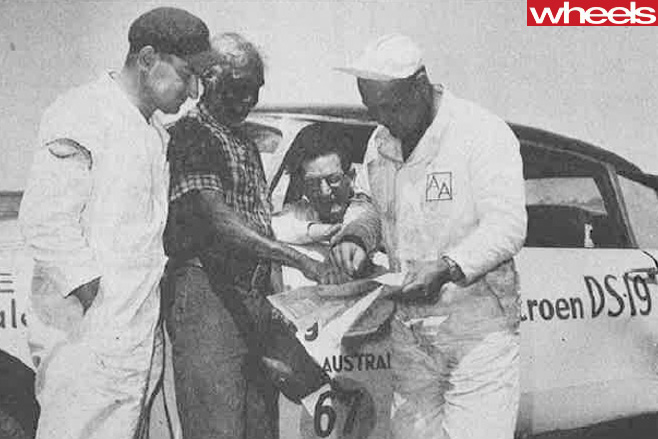
Phil went through State school, Wesley College and Melbourne Technical College before joining Crankless Engines at the age of 18, as a draftsman, which would have been in 1921 since he was born in ’03. As well as drawing, he did work in the machine shop and on stress calculations. About 1924 he was working under a man name of Sherman who, among other things, designed the valve gear for Bentley engines. A pretty good grounding and it is one of Phil’s joys that anything he draws, he can make – and indeed, has, in most cases.
Then in partnership with one Kenny Granter he set up a motorcycle dealership in Ballarat and they weren’t the only people who didn’t realise that a world-wide depression was on the way … So in 1930 when a citizen called Jack Gill arrived in Melbourne with a Vincent HRD motorcycle and empty sidecar from which his erstwhile passenger had decamped, Australia lost Irving right through until 1949. They made their way to Britain via New Zealand and Canada and Phil spent some time at a drawing board with Velocette before leaving to embark on the construction of a motorcycle to attack the world record, in conjunction with Arthur Simcock and Alan Bruce.
The machine, “Leaping Lena”, was Brough Superior based with a supercharged JAP engine. It had a solo potential of 160 mph and Bruce took the sidecar record with it at 128 mph in 1931, but the solo record eluded it mostly because of lack of time in Hungary, where the roads couldn’t be closed long enough to let them tune the engine for the conditions.
It wasn’t long before he had a job with Vincent HRD and from that union came the Series A, B and C Rapides, Black Shadows, Black Lightnings, Meteors, Comets, Grey Flashes and even at one stage, a water-cooled 250 cc two-stroke with fully enclosed engine and built-in legshields.
The basis of these splendid motorcycles was Phil Vincent’s triangulated rear suspension, at a time when the greybeards of the business had set their faces firmly against such going on. Motorcycles were intended by the Lord to have rigid rear frames, just as pedalcycles had to have big wheels until Alex Moulton came along. Another example of Irving instant design – it was decided in 1934 that Vincent would make their own engines, and motorcycles bearing them were on sale in 1935.
He has always put in fantastic hours at the drawing board and, indeed, his home is known. as Owl’s Rest, so named by his son, Denis, because of the late hours that were kept when Pa was in the throes of getting on to paper what was already in his head. “A worker can get a job.” But sometimes I look around me and observe that the non-workers are the ones with the chrome-plated offices and platinum-plated secretaries.
Then I stop to wonder if they or the workers are the happier and when I look at Phil I decide that the workers have won through by a clear margin. Would you rather look back and say: “I designed that engine” or: “I’ve tucked away half a million dollars by saying the right things to the right people?”
If you visit Owl’s Rest you will find three Rovers dotted around it and perhaps a pair of legs sticking out from under one. No need to guess who. One is a Land-Rover and the other two of the 75/90/105 series, and all are in good mechanical order. I had a puncture with the one I borrowed and when I opened the boot found two spare wheels. Knowing PEI I wasn’t surprised.
“Why,” I asked, “do you like Rovers so much?”
That almost stumped him and after wondering aloud if they had just sort of become a habit along the lines of “better the devil you know”, he decided that it was because when he bought a Rover 12 from Reg Hunt he was struck by the fact that it was very well engineered, that attention was given to details, it had a free ·wheel which he likes, a central floor change (in a 1947 model, this was), one-shot lubrication. And it is a fact that there are enough Rover spares knocking about the Owl’s Rest garage to cope with most mechanical emergencies.
I seem to have wandered off the trail circa 1935. From then on there was a bit of shuttling between Vincent, Velocette and Associated Motor Cycles (AJS and Matchless in those days) and lrving designs included the Velocette LE water-cooled flat twin, a supercharged vertical twin motorcycle of 500 cc with two crankshafts geared together, work on the AJS “Porcupine” supercharged racing machine and a uniflow engine for use in airborne lifeboats.
He did a lot of other work as well … then back in Australia to the Rolloy Piston Co where he was involved in the design of a Chamberlain flat-twin diesel tractor engine of 6-litres, which suggests a certain element of versatility!
Then a move to Repco Research, which was Lhe start of a fruitful association, and from there issued a cylinder head which would make an FJ Holden engine produce 90 bhp instead of the usual 60. A completely rebuilt engine could be bought for 450 Pounds complete, and it made the unfortunate car do 104 mph if the driver was so minded.
About 100 of these engines w3ere sold until the racing regulations were altered but they are still in great demand today, especially among the boating people, and it is said that they change hands for more than they cost originally. The good that men do lives after them…
In 1959 there began a shuttle service by ship back and forth to Britain, which went on for so long that PEI didn’t see a winter for six years. He spent his time writing books, magazine articles and, of course, designing the Brabham engine.
Phil used to share my London office not so much because he liked my company but because I had a spare desk and my secretary, Ann Emerson, could read his handwriting. I can too but some people claim to have difficulty and it may be something hereditary from his doctor father .
Good friends as we were, I had no idea be was designing a racing engine, nor did anyone else. Now and then I’d overhear a conversation in which special valves or something like that were being ordered, but for what I had no idea. Just “something for Repco” and when I look back I reckon I missed a considerable journalistic scoop.
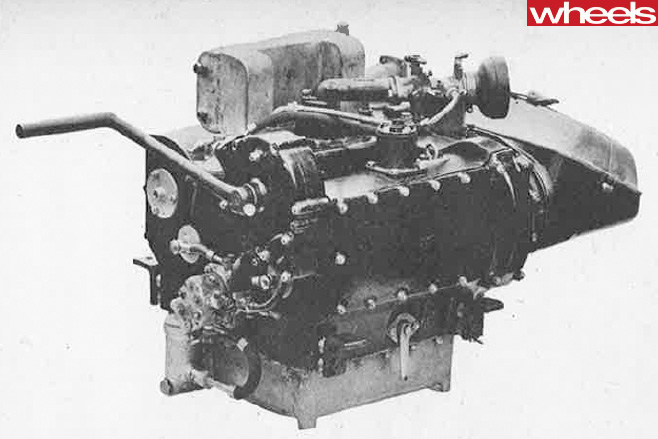
After a time Phil worked with Repco on a consultancy basis and you may have noticed certain Holden-based F5000 engines which were “…stirred up enough to beat the Chevs”. They produce about 480 bhp.
And there is a boat called The Cheetah which does about 90 but we’re not sure if that is knots or mph. Frank Sinclair, for example, took the Australian sidecar record on a Vincent outfit and still holds it. Also with Frank he has competed in car trials and, in one memorable event , the Midnight Trial of 1951, their MG was the only finisher out of 31 starters.
He has motored over most parts of Australia, had a finger in Donald Campbell’s world record affairs at Lake Eyre, designed a dirt-track engine, evolved a banking sidecar outfit, introduced twin brakes (per wheel) on motorcycles, patented a form of adjustable rear suspension, been upset by more people than he has upset and he has shamefully undervalued his abilities and his worth. Denis on this subject: “He makes me hopping mad”.
The foregoing words probably cover about a third of what Phil has done so far, and the “so far” isn’t written without due thought. Who knows what he will design next, least of all himself, for an idea may come at any moment.
Usually, when I write articles about people, I let the victim see my golden words before they are published as a check on the accuracy of dates and so on but, in this case, Irving me ol’ cocksparrow, you’ll read it when it’s in print. Good on yer.
Combined with the relatively low physical effort required, the fast (2.6 turns) ratio means that you initially apply more lock and steer deeper than you intend, then have to wind back a bit to restore yourself to the desired line.
The radial-shod car always tracked degrees truer than the cross-piled Silver model but both (like all HQs) are inveterate understeers which demand disproportionate increases in steering lock as the cornering speed is raised or the radius reduced. This absolute only-and-always addiction to understeer unfortunately negates any semblance of throttle control and handling finesse, and ultimately leads to terminal front-end plough.
***
This was the first occasion on which we have driven the HQ Holden in really windy conditions. Contrary to expectations, in view of the prominent understeer and front weight bias, the Premiers were not unaffected by side winds and both wandered considerably, keeping us busy.
While by no means a scintillating performer by today’s mean standards, the Holden 202 six nevertheless provides entirely adequate acceleration and speed for everyday driving. And the marriage between it and the Tri-matic transmission is a particularly happy one. It’s a nice easy-driving combination thanks to well chosen ratios and (ordinarily) almost imperceptible shifts up and down the range.
Although it pulls a standard 3.36:1 final drive ratio the Silver model proved clearly quicker than the optioned edition which was handicapped to some extent by the air conditioning and power steering. This car was fitted with a 3.55:1 final drive ratio but there was little effective difference in the gearing overall because its radial tyres turned fewer times per mile (larger rolling radius) than the Silver’s cross ply tyres. So with only a nominal 0.4 mph per 1000 rpm between them in top, the gearing was near enough to identical.
To determine exactly what influence the air conditioning had on the optioned Premier’s performance we ran a full set of figures with the cooler switched off, then repeated the procedure with the air switched on. The respective acceleration times simply confirmed an obvious impression – the car was measurably slower right through the range when the air system was operating; about four seconds behind in the 0-80 mph bracket for example.
Of course in terms of everyday driving the loss of performance is relatively minor and means virtually nothing. And when ambient temperatures during the test session soared to a muggily oppressive 32 deg C we (in the optioned car) needed no further convincing about the compensating benefits of “air.
One disappointing aspect of both cars was fairly heavy fuel consumption. On one easy 337 km (211 miles) run of cruising at a very leisurely 80-88 km/h (50-55 mph) and deliberately driving for optimum economy, the optioned car (with air on) returned a welcome- but apparently exceptional – 7.52 km/l (21.2 mpg). Thereafter it averaged about 6.39 km/l (18 mpg) and sank to a low of 5.53 km/l (15.6 mpg) over a 276 km (172 miles) stint that included the performance tests.
The Silver Anniversary car was generally driven harder throughout the test, a fact brought home by its considerable thirst. It returned a low of just 5.25 km/1 (14.8 mpg) over a 295 km (184 miles) stretch which included the performance checks and gave a best, if it can be called that, of 5.68 km/1 (16.0 mpg) for 394 km (245 miles) of urban commuting and fast country cruising. Overall, the Premiers’ consumption can only be rated as poor. Whether there is any connection between the uncomplimentary fuel consumption and the advent of detoxed exhaust gases we don’t know… and the General’s not saying.
Our test was conducted before the new emissions limits (ADR 27) came into effect in January. And although the “clean” Holden engines were phased in some months earlier GMH hadn’t released details of the means by which the engines are modified and how, if at all, performance and economy are affected by the changes.
The optioned car exhibited a very annoying (presumably not typical) rattle from an ill-fitted exhaust tail pipe when accelerating hard uphill or on rough roads. But otherwise both were mechanically and bodily quiet cruising on sealed and dirt roads alike.
Wind noise was also commendably low when cruising at up to 110-130 km/h (70-80 mph) with the windows raised; indicative of good fit and sealing of the doors and glass. But the same can’t be said of the ventilation booster fan which is audibly obtrusive when operating above the slowest of its alternative speeds.
We also found the windscreen washers (on both cars) very feeble: their squirts reached only halfway up the glass so that attempts at cleaning it only worsened the spots and smears.
But overall there was relatively little to criticise on the Premiers. They’re not outstanding cars by any stretch of the imagination, but they’re not bad either – middling good in fact.
Heaven only knows what we’ll be driving, and the General will be building 25 years hence. For now, however, the Silver model seems as good a way as any of commemorating two and a half decades of Holdens.
Want to read more classic tales? Visit the Wheels Archive – simply log in here using your existing MagShop account or create a FREE account and select this article from the homepage.
Don’t have a MagShop account?

Have a MagShop account?

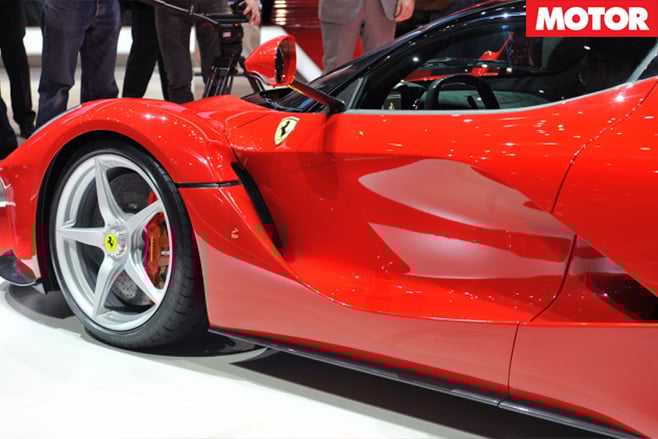
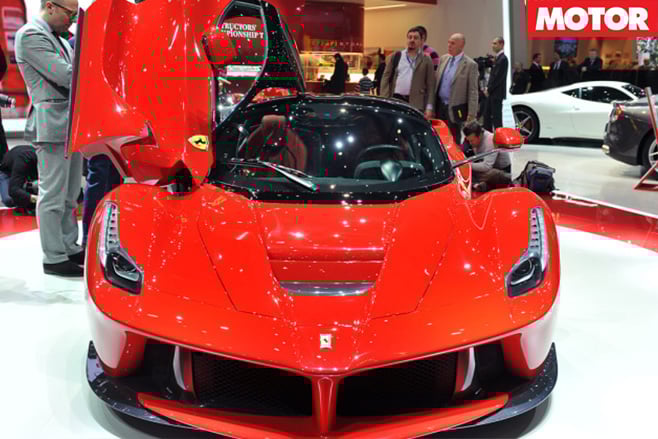
Ferrari CEO Sergio Marchionne “sees” hybrid technology as a way to sidestep emissions regulations and reach unprecedented sales targets, reports Automotive News.
With its LaFerrari the only hybrid model in the company’s range, Marchionne reportedly said all Ferraris will rely on hybrid power in some way from 2019.
Promising a “fundamental shift” in the way Ferraris are manufactured, and with the aim to not only produce more hybrids but cars that appeal to a wider demographic, he says the doors are open to sell possibly in “excess” of 10,000 cars in 2025 but did not to commit to any number or target.
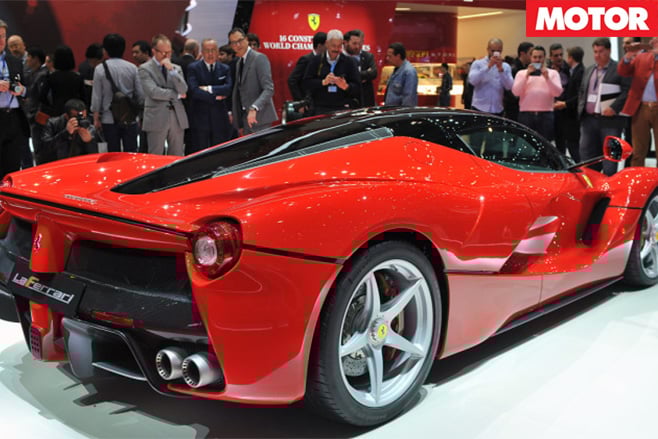
Ferrari shares reportedly experienced a 7% price increase following their quarterly report last Monday. And while Marchionne’s vision for Ferrari as a “luxury brand” involves expanding its focus beyond vehicles, these positive earnings have helped keep the focus on cars.
Automotive News also talked to Stuart Pearson, Exane BNP Paribas analyst, who reinforced Ferrari’s plan to introduced up to two new models in the next five years is “gaining favour over potential brand extension strategies”.
Affordable small cars offer enormous bang for buck these days, but what do you buy if you also want a car that’s fun to drive? The recently launched Holden Astra R is making a play for that space. It needs to fend off the Ford Focus Trend and another latecomer to the scene, the Subaru Impreza 2.0i-L. So, which one is best?
PRICE AND EQUIPMENT | WINNER: SUBARU IMPREZA
In hatchback form with automatic gearboxes our three protagonists are very similarly pegged. The Astra R is cheapest at $24,190, Focus Trend is $24,390 and the Subaru Impreza 2.0i-L is $24,690 – just $500 between most affordable and most expensive.
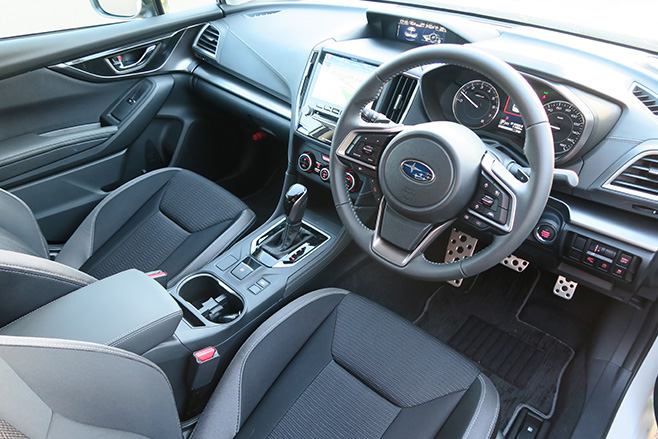
It comes down to equipment, and in that arena the Impreza stands tall. For a few hundred dollars more than the others the Subaru gets dual zone climate control, where the Astra and Focus only have manual A/C; push-button start; leather-wrapped steering wheel (the Astra’s is bare plastic) and the most upmarket interior feel overall.
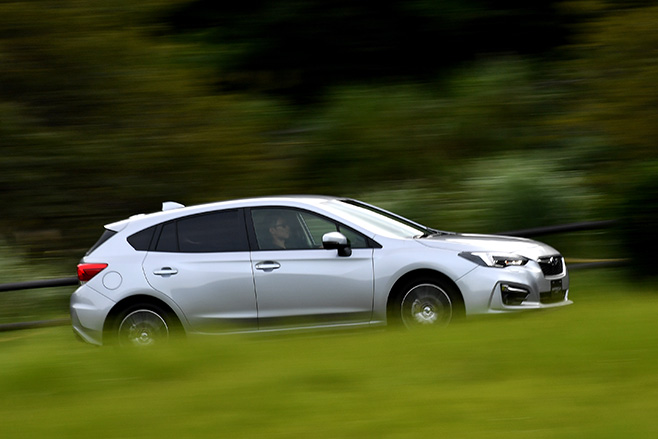
The Impreza also arrives wrapped in a thick layer of active safety gear known as EyeSight. The package includes radar cruise control, lane departure warning, automatic emergency braking, and other collision avoidance systems. It costs extra to get this tech in the Astra and Focus.
And let us not forget that the Impreza is all-wheel drive where the other two are front-wheel drive only. For anybody hoping to drive on icy or gravelly roads, this is important.
All three cars come with Apple CarPlay and Android Auto for excellent smartphone integration. Astra and Focus are better than many other competitors, though they’re not quite as comprehensively equipped as the Impreza.
INTERIOR AND VERSATILITY | WINNER: SUBARU IMPREZA
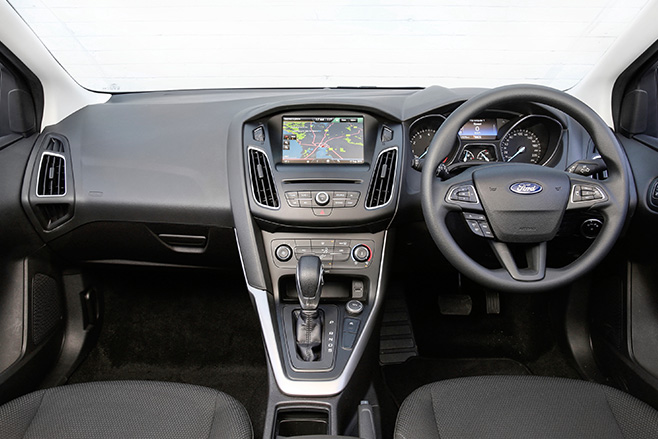
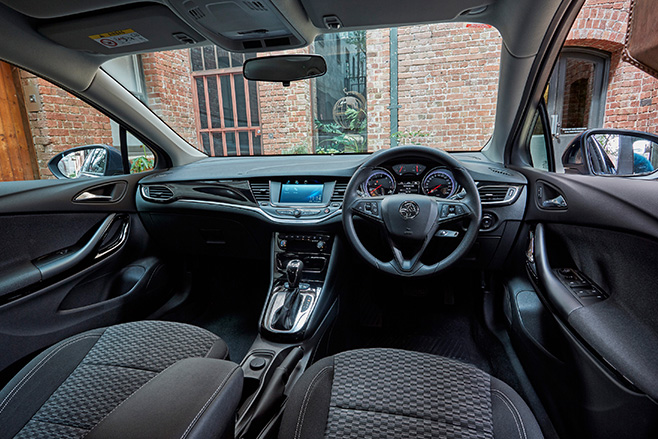
All three of these vehicles are relatively comfortable up front, and do well to make the driver feel like the most important part of the car. Styling inside the newer Subaru and Astra feels the most up-to-date when compared to the ageing Focus.
There’s little contest when it comes to rear seat comfort. The Impreza offers outstanding leg and headroom, and the nicest fabrics and door trims of the three cars here. An armrest tucks into the rear seatback that can be folded down when there’s no middle passenger. Impreza also has a large cargo area with a wider boot opening that’s easy to load and unload.
The Holden Astra places second with reasonably accommodating rear seats and boot, and a smartly designed cabin that feels more expensive than its price tag.
Focus is the least polished inside. The most recent update added an 8.0-inch infotainment screen, like the Subaru’s, which is more functional than before though the dashboard design is still clunky. Focus also has the smallest rear seat area of this trio.
PERFORMANCE AND ECONOMY | WINNER: HOLDEN ASTRA
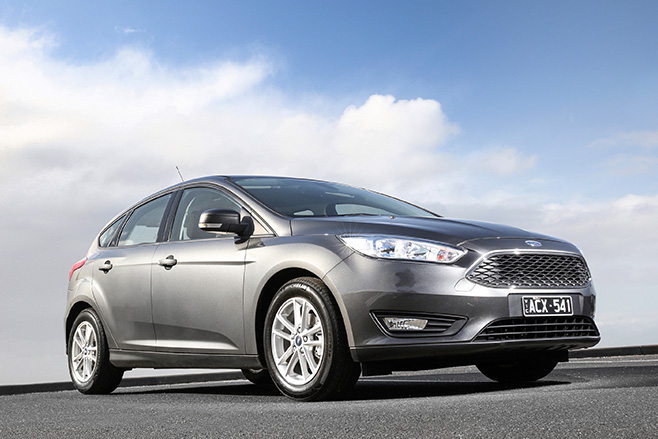
Outright performance usually comes at the cost of economy, and that is true of the most powerful car here – the Ford Focus. Its 1.5-litre turbocharged four-cylinder engine produces 132kW and 240Nm and is the sportiest of the bunch. However, it’s also the thirstiest when driven quickly.
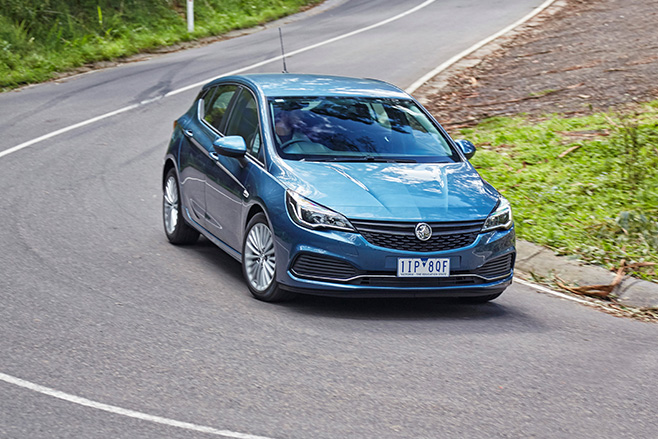
The Astra’s 1.4-litre four-cylinder engine is also turbocharged, and isn’t far behind the Focus in terms of performance. It makes 110kW and 240Nm and responds well to spirited driving while using less fuel than the Focus. It’s the best compromise of the two. It gets an excellent ‘Sport’ mode for the gearbox that does a great job of selecting the right ratio.
Impreza has outputs that sit in the middle at 115kW and 196Nm. In the real world it’s the slowest, though it maintains speed nicely and isn’t a complete slouch once up and running. Its CVT gearbox is the least inspiring, especially when being worked hard.
Claimed combined fuel economy figures for each car are 5.8L/100km for the Focus, 5.5L/100km for the Astra, and 6.6L/100km for the Subaru Impreza.
RIDE AND REFINEMENT | WINNER: HOLDEN ASTRA
In one generation change the Astra has made a big step in terms of refinement. Its engine noise is the least intrusive, and its ride quality is very good for a car that opts for a firmer, sportier tune. It’s comfortable over long distances and feels well-suited to Australian roads.
The Subaru’s engine and gearbox combination is prone to drone at higher rpms, and that becomes a source of annoyance when climbing up hills or hauling heavy things. The Impreza also has quite a firm ride, though it never becomes harsh enough to be uncomfortable.
The Focus has a great engine note, which does come through to the cabin though it’s not unpleasant and adds to its sporty character. Road noise inside the cabin is more noticeable than in the other two.
STEERING AND HANDLING | WINNER: FORD FOCUS
The Ford Focus set the benchmark for dynamics before the new Astra and Impreza arrived on the scene, and its steering still has the greatest feel and feedback of the three. It weights up beautifully through corners and encourages you to drive it faster. Trend may be the entry level Focus, but it has the same sporty DNA as the more powerful models.
Sitting in a close second is the Astra, which offers good front to back connection and effective steering. It’s easy to place and neatly follows a line through a corner. Front-end grip is excellent on the standard 17-inch wheel and tyre package.
The Impreza does a good job with what it has. It’s the only one with power going to the rear wheels as well as the front, and there’s a good amount of interactivity from the back. It drives through corners with confidence. All three of these cars are competent handlers.
VERDICT | WINNER: HOLDEN ASTRA
At the end of the day, the Holden Astra does the best job of balancing equipment, performance, practicality and driver involvement in a package that looks more premium than its price would suggest.
It’s the cheapest of the three, yet it offers respectable engine grunt without being too thirsty, outstanding cabin refinement, and never falls too far behind the Impreza or Focus in the areas they nudge ahead. Astra should prove to be a lovable companion for those who need an everyday hatchback, as well as those who want to enjoy a brisk country drive from time to time.
Australians are good at naming things.
Oh, sure, we like to take the mickey now and then, which is why your friend’s chihuahua is called Killer and old mate John with the flaming red hair is known as Bluey, but in general, Aussies take names very seriously.
For example, the vast area of sandy desert in the country’s north-west is called the Great Sandy Desert; likewise, the huge band of coral reef that forms a barrier off Australia’s east coast is the Great Barrier Reef. The bridge across Sydney harbour? The Sydney Harbour Bridge. Not everyone gets this common-sense naming convention, which is why Paul Edmund Strzelecki named our highest peak Mount Kosciuszko instead of Really Massive Hill.
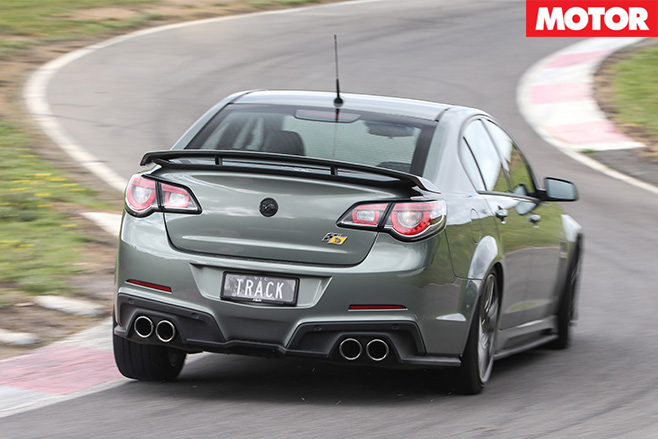
Limited to 150 units plus another six for the Kiwis, at $68,900 for the manual – another $2500 for the automatic – the Track Edition is $3000 more than the R8 SV but $4300 less than the MY15 Clubsport R8.
It’s easy to be cynical about any end-of-the-line special edition, but while there is the obligatory ID plate and blacked-out styling tweaks, a glance at the spec sheet suggests that Engineering may have had just as much a hand in the Track Edition as Marketing.
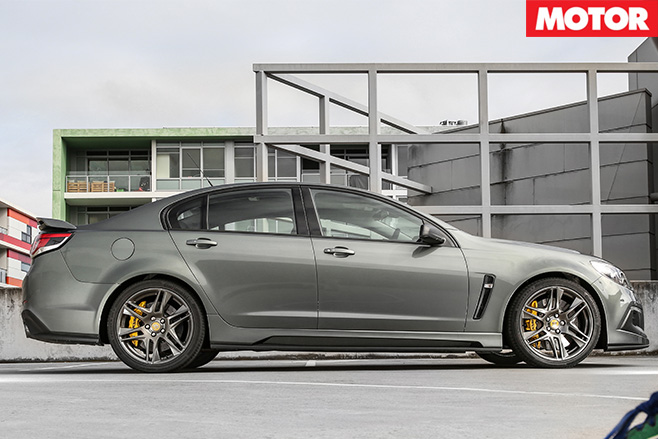
Other visual tweaks include the ‘Hyperflow Performance’ rear spoiler as standard, various bits of blacked-out trim, cool shadow chrome exhaust tips and a suede steering wheel for track day respect points. Of more interest, however, is what can’t be seen.
HSV has re-engineered the suspension “to reduce body roll and improve corner-entry response”; more specifically, spring rates have been stiffened by more than 200 per cent to around 6kg/mm front and 9.5kg/mm rear for the tech heads out there. The dampers are re-valved to match and new rebound springs are fitted.
It doesn’t take too long for the changes to make themselves felt. HSV says there has been “minimal degradation to ride comfort” but it must have a different definition of “minimal” as the Track Edition is very firm, a step beyond even the LSA cars which are already right on the verge of what’s tolerable day-to-day.
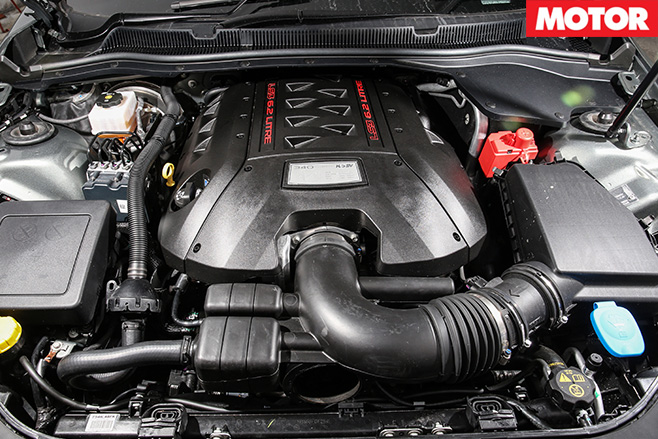
The rest of the drive experience is, unsurprisingly, more or less identical to a regular Clubsport R8. The naturally-aspirated LS3 V8 doesn’t have the massive mid-range punch of the newer forced-induction V8s but is arguably better for it. Power builds progressively as the revs rise which gives you a good excuse, as if any was needed, to use more of the engine more of the time.
Your ears will thank you for doing so, as the combination of HSV’s bi-modal exhaust and ‘Mechanical Sound Enhancer’ produces a particularly sweet V8 song and with 340kW/570Nm this is still a very rapid four-door sedan. It feels a little odd to have an automatic gearbox in a car aimed at circuit work, but the 6L80E six-speed at least makes for undemanding low-speed progress and is relatively obedient to manual shift requests.
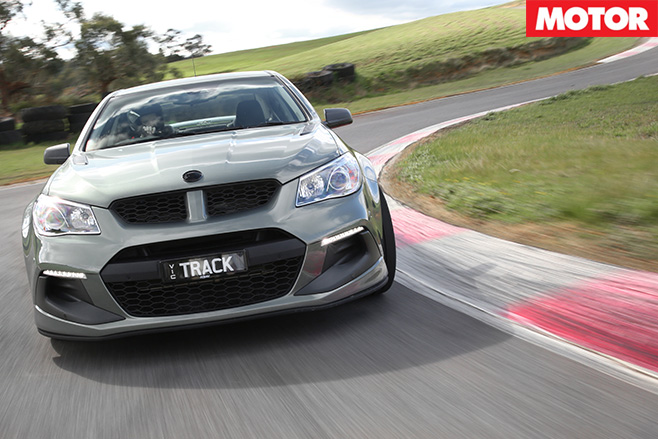
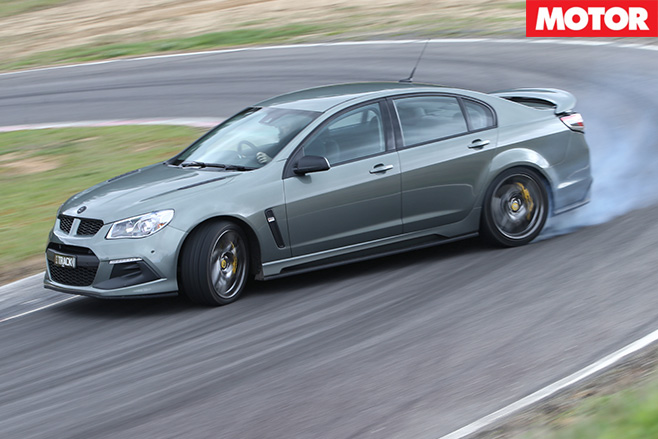
In contrast, the Track Edition feels more locked down, not just over bumps but in terms of its grip levels, too. With 340kW on a wet road, oversteer is never far away, but the rear feels more reluctant to relinquish grip and when it does so the transition seems more sudden. This is clearly a result of the suspension modifications, as the Track Edition wears the same Continental ContiSportContact 5P rubber, measuring 255/35 front and 275/35 rear, as every other HSV.
To get a true reading on the Track Edition’s abilities, however, we need to venture to its intended habitat. Bryant Park hillclimb, better known as Haunted Hills, isn’t a traditional racetrack in the sense of Phillip Island or Sydney Motorsport Park, but its combination of constant, varying-radius corners and gnarly elevation changes can quickly expose any chassis shortcomings.
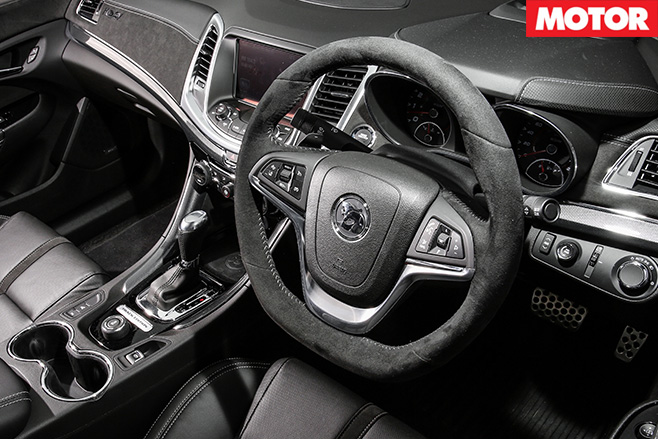
Driven somewhat more sensibly, the Clubsport Track Edition proves its moniker is more than just marketing waffle – this is a car that loves the track. It does feel a little less playful than a standard Clubsport, but is still highl adjustable in a high-horsepower, rear-drive way; simply wait for the nose to bite, give it a bootful and feel the tail wag on corner exit. Not necessarily the fastest way, but lots of fun.
HSV claims the suspension tweaks are worth two seconds a lap around Winton, and while we weren’t necessarily driving for a lap time at Haunted Hills, examining the video footage later gave a best lap of 1:04.5sec, similar to the M4 Competition and C63 AMG Coupe that were also present on the day. Not scientific or conclusive, but interesting that a $70K HSV can be in roughly the same ballpark.
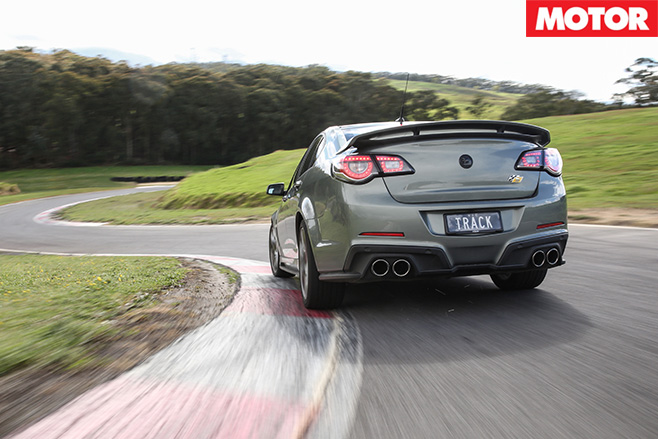
And this brings us to our reservations about the Track Edition. The level of engineering changes means it’s far more than a marketing run-out special, and it absolutely does what it says on the tin – it’s a Clubsport that is more than capable of sustained track work. But it could have been so much more.
HSV says a crucial goal for the last-of-the-line LS3 Clubsports was affordability, something it’s undoubtedly achieved with the sharp $68,990 sticker, but given the car’s limited-run status, we’d be prepared to bet enthusiasts would’ve been prepared to pay more for something truly special. HSV has form here. Remember the VZ Clubsport Dealer Team Spec from 2005?
We’re just not sold that the improvement in racetrack performance offsets the compromise in ride quality. Don’t get us wrong, the Track Edition is still a very enjoyable car, and good value, too, but with sticky tyres, lighter wheels and a shorter diff ratio it would be something spectacular, even at $75K or more.
If you’re a track day addict and like the idea of a Track Edition, buy a manual, fit a set of Michelin Pilot Sport Cup 2s or similar and you’ll have a blast. But get in quick, because HSV estimates around 50 per cent have already been sold. For the majority of users, though, the Clubsport R8 SV is a better bet.
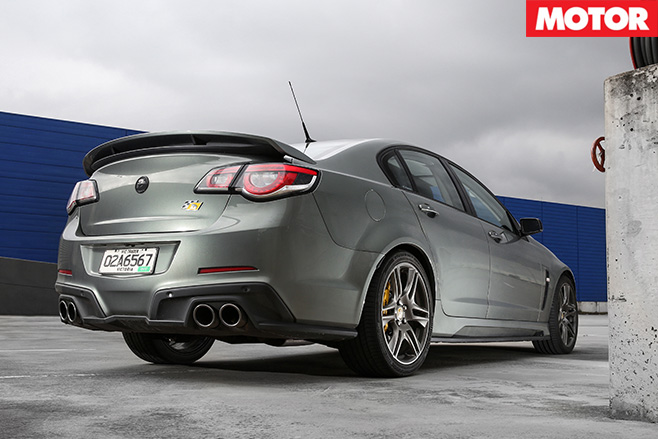
LIKE: Benchmark brakes; chassis balance; value DISLIKE: Ride quality; unfulfilled potential
SPECS body 4-door, 5-seat sedan drive rear-wheel engine 6162cc V8, OHV, 16v bore/stroke 103.1 x 91.9mm compression 10.7:1 power 340kW @ 6100rpm torque 570Nm @ 4650rpm power/weight 196kW/tonne transmission 6-speed automatic weight 1739kg FRONT suspension struts, coil springs, anti-roll bar REAR suspension multi-links, coil springs, anti-roll bar L/W/h 4991/1899/1453mm wheelbase 2915mm tracks 1616/1590mm (f/r) steering electrically-assisted rack-and-pinion FRONT brakes 390mm ventilated/drilled discs, 6-piston calipers REAR brakes 367mm ventilated/drilled discs, 4-piston calipers wheels 20.0 x 8.5-inch (f); 20.0 x 9.5-inch (r) tyres 255/35 ZR20 (f); 275/35 ZR20 (r) Continental ContiSportContact 5P price as tested $71,490
The Mazda 3 and Honda Civic each have a reputation for providing quality at an affordable price in the hotly contested small-car market. With the new Civic hatch still a few months away, we’re comparing the base model VTi sedan with the similarly priced Mazda 3 NEO sedan.
PRICE AND EQUIPMENT | WINNER: CIVIC
Not much splits the duo in terms of price. The entry-level Mazda 3 NEO sedan has a six-speed automatic transmission costing in at $22,490 and the base Civic VTi with CVT at $22,390. The Mazda has a manual option for $20,490 but isn’t included in this comparison.
Standard features in the Mazda 3 NEO not found in the Civic VTi include automatic stop/start, curtain airbags and front-and-rear parking sensors, however it lacks a touch screen and reverse camera.
As well as a 7.0-inch touch screen infotainment that supports Apple CarPlay and Android Auto, the Civic can boast a reverse camera (which is helpful because of its high rear-end) and automatic climate control.
Both come with cruise control, electronic stability control and 16-inch alloys.
INTERIOR AND VERSATILITY | WINNER: CIVIC
The Honda Civic has good interior space with excellent presentation, and refinement that makes it look and feel nicer than most small cars in its price range. It has plenty of cabin storage including a large lidded compartment complete with a slide able armrest.
The Mazda3’s cabin also provides good comfort for four adults and like the Civic also looks and feels elegant. Cabin storage is adequate.
The Civic’s boot capacity of 519-litres shames many larger cars and is substantially more voluminous than the Mazda 3’s 408-litres. Both have 60/40 split rear seats.
PERFORMANCE AND ECONOMY | WINNER: MAZDA 3
The Mazda’s 2.0-litre four-cylinder engine produced 114kW of power and 200Nm of torque and has a combined fuel economy rating of 5.7L/100km.
The Honda has a smaller 1.8-litre four-cylinder engine producing 104kW/174Nm but is less fuel efficient, drinking 6.4L/100km despite being around 30kg lighter.
RIDE AND REFINEMENT | WINNER: CIVIC
The Civic has a bump-absorbing and quiet suspension via the MacPherson strut-style front and multi-link rear suspension. The set-ups work together superbly, soaking up bumps and creating a comfy and refined ride. The CVT automatic feels much like an auto gearbox and operates smoothly and only whines when pushed hard.
The Mazda 3 rides quite smoothly, disposing of bumps well and settling quickly. The 2.0-litre engine copes admirably with city life and has enough power for easy highway touring. It revs freely and mates well with the six-speed auto gearbox. Noise from the tyres might intrude on coarser road surfaces, but other dins are kept at bay.
STEERING AND HANDLING | WINNER: MAZDA 3
The Civic has progressively weighted yet engagingly responsive electric steering which provides agile yet controlled handling, especially at high speeds. The chassis gels together quite enjoyably, offering fluent and predictable roadholding, whether on smooth bitumen or loose gravel.
The Mazda3 also provides polished handling, with fluent yet engaging steering and an agility that makes light work of suburban streets and country roads alike. It now has G-Vectoring Control, which adjusts the engine when you turn the steering wheel, decelerating slightly so as to transfer load to the front tyres and help them bite (and reversing the process as you return to centre).
Both are excellent but the Mazda provides a little bit more in terms of driver enjoyment.
VERDICT | WINNER: CIVIC
The Civic wins on points in a 12-round slug fest. The Mazda’s strengths are its performance and handling and it’s a delight to drive. But the Civic provides just that little more in terms of refinement, value and versatility, while still offering driver enjoyment.
If the Mazda 3 NEO came with infotainment and reversing camera it might have been a different outcome.
First published in the August 2015 issue of Wheels magazine, Australia’s best car mag since 1953.
Getting into vinyl kicked off a racy career.
PLENTY of us spent our school years sketching racing cars, doodling sponsor designs and plastering car, surf clothing and flavoured milk stickers over everything. Brett Rogers, 41, now does it for a living, as one of a small handful of specialists in motorsport design and signage.
These days, that means vinyl-wrapping, a technology that originated about 20 years ago for German taxis. Wrapping’s advantages of quick colour changes, the precision of printed graphics and vastly less expense than sign-writing – or painting – proved even more applicable to motorsport.
Rogers practises what he preaches, owning a Mitsubishi Evo VI time-attack car and co-owning, with Paul Stokell, a Radical SR3. Rogers’ race-wrapping portfolio has included V8 Supercars, Australian GT and Carrera Cup cars, and usually totals three dozen or more vehicles a year.
Rogers got into the graphics industry via two wheels. “I grew up in motorsport, raced karts and hillclimb. I was racing mountain and road bikes at an elite level and got a job as a bicycle designer at Merida Bikes.
“I went to the US in 2000 to race mountain bikes for a season. I got home and thought, ‘What am I going to do with my life?’. I enrolled as an adult student in a college of design.”
Rogers designed a graphics package for a Suzuki Swift Sport show car. The prize-winning wrap wasn’t without its challenges. “The vinyl technology was still pretty average: If you made a mistake you had to cut it, or reprint it.”
Rogers moved to Sherrin Motorsport, then promoter of the Porsche Carrera Cup and Mini Challenge series. “I was doing a lot of sponsorship proposals, putting a commercial value to each sticker on the car, which was a very good insight for what I do now.”
Around 2008 came a wrap revolution, with air-release vinyl. “It has a cross-hatched pattern, which disperses any air bubbles as you put down the vinyl.”
Rogers aims to keep graphics bold and simple, recognising that the job is to represent a brand, on a vehicle travelling at high speed – there’s little time for design nuance at 200km/h. The client-approved design is printed in full-length sections on a machine capable of continuous-printing an entire 50-metre roll.
The vinyl is printed and applied in full-length sections, with panel shut-lines cut in later. Rogers likes to have a car for three days, which includes the final post-heating process that cures the wrap material against the surface.
The typical job, from art concept to final wrap, costs about $4500. Even under the Aussie sun, Rogers says a wrap should stay colour-stable and intact for four to five years.
One to go, thanks
Vinyl-wrapping a vehicle usually takes three days, but race-wrapper Brett Rogers knows motor racing better than that. “I got a call on a Thursday afternoon; a V8 Supercar had to leave for Abu Dhabi on the Saturday afternoon. I finished the design at 11pm, started printing at 2am Friday, and finished two full wraps and spares at 3 o’clock Saturday afternoon. That was evil.”
STRENGTHS
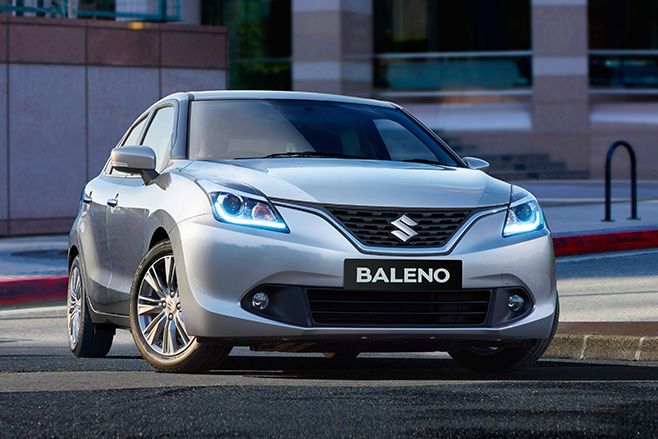
- Aside from the fantastic BOOSTERJET name, the 1.0-litre three-cylinder in the GLX Turbo is a treat. Great rorty exhaust note, smooth when cruising in traffic, and enthusiastic when the throttle is planted.
- Despite being electronically assisted, there is fantastic feel through the wheel. It feels like a traditional hydraulic power-steering setup, with natural weight and feel. The one downside is the massive 3.8 turns lock-to-lock. Prepare to work your arms while parking.
- The central 7-inch touchscreen infotainment system is easy to use and read at a glance. Phone connectivity is simple, plus Apple Car Play and Android Auto as standard are big wins. Reversing camera and satellite navigation are standard.
- The twin-dial dash is a nice touch. Although there is no digital speedometer, the car’s drive mode, speed, and instant fuel economy are all easy to read, and the blue backlighting gives a modern feel.
- The Baleno is a small city car, which is a big plus in urban areas. You will rarely worry about narrow streets, whether parking spaces are large enough, or if you can squeeze through tight gaps in traffic.
WEAKNESSES
- The Baleno falls short in suspension refinement. While smooth over long undulations in the road, the GLX Turbo crashes over shorter bumps.
- Driving alone, the Baleno feels roomy inside. However, add bodies, and you quickly begin to realise how narrow the cabin is. Driving with an adult passenger in the front seat, it is easy to graze their leg reaching for the gear lever. Redeeming factors include the ample 355-litre boot and decent legroom for the rear seats.
- While the six-speed automatic transmission doesn’t hunt for gears in normal driving, it falls short during when hustling the car more spiritedly. Despite a 6,5000rpm redline, the car auto-upshifts at 5800rpm in ‘manual’ mode, making the paddle-shifters and manual mode somewhat redundant.
This segment shows how sensible choices need not be boring.
Subaru Liberty 2.5i
Sometimes all the figures tell you that a car will be economical to own while experience suggests the opposite, but that’s certainly not the case with the Subaru Liberty 2.5i. Armed with road-test experience, we’d guess that a Liberty would be a sound long-term proposition, if you value dependability and affordability. Plug its vitals into a spreadsheet and the hard data agrees.
The Subaru sedan is among the least expensive in its class, yet it gets more gear than most rivals, including all-wheel drive. The Liberty’s reputation translates into a rock-solid 55 percent three-year resale figure that’s much better than most and enough to give it the gong by a good margin, which is handy because it’s not the thriftiest in its class, and uses premium unleaded. Add to that six-month service intervals, meaning more frequent trips to the workshop than most.
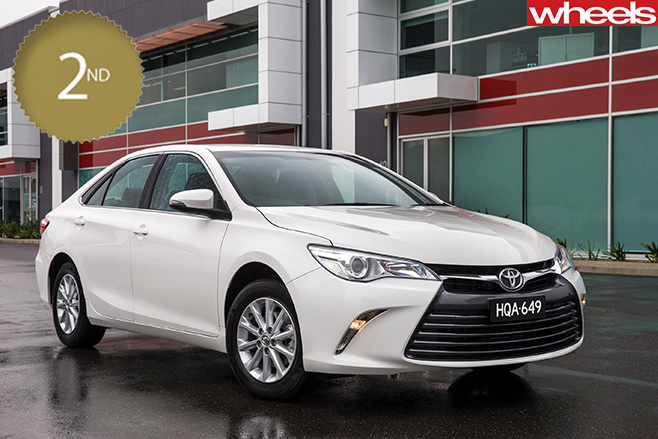
Toyota Camry Altise
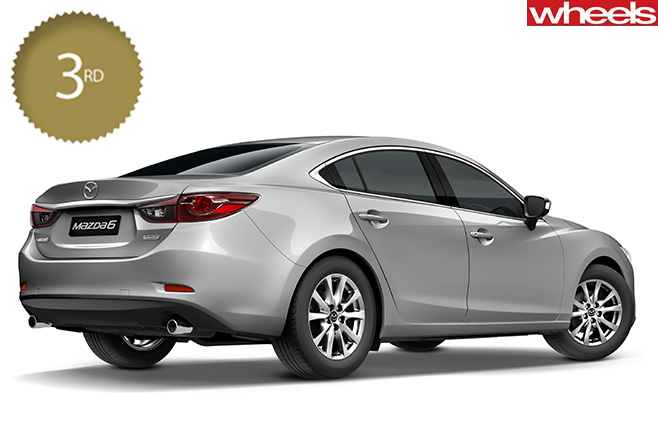
Mazda 6
MORE GOLD STAR COVERAGE
 WHEELS GOLD STAR VALUE AWARDS
What if someone could expose the hidden costs, crunch the numbers, present the data, and draw conclusions about how to best spend your hard-earned on a brand new car? Enter Wheels’ annual Gold Star Value Awards.
Find out more
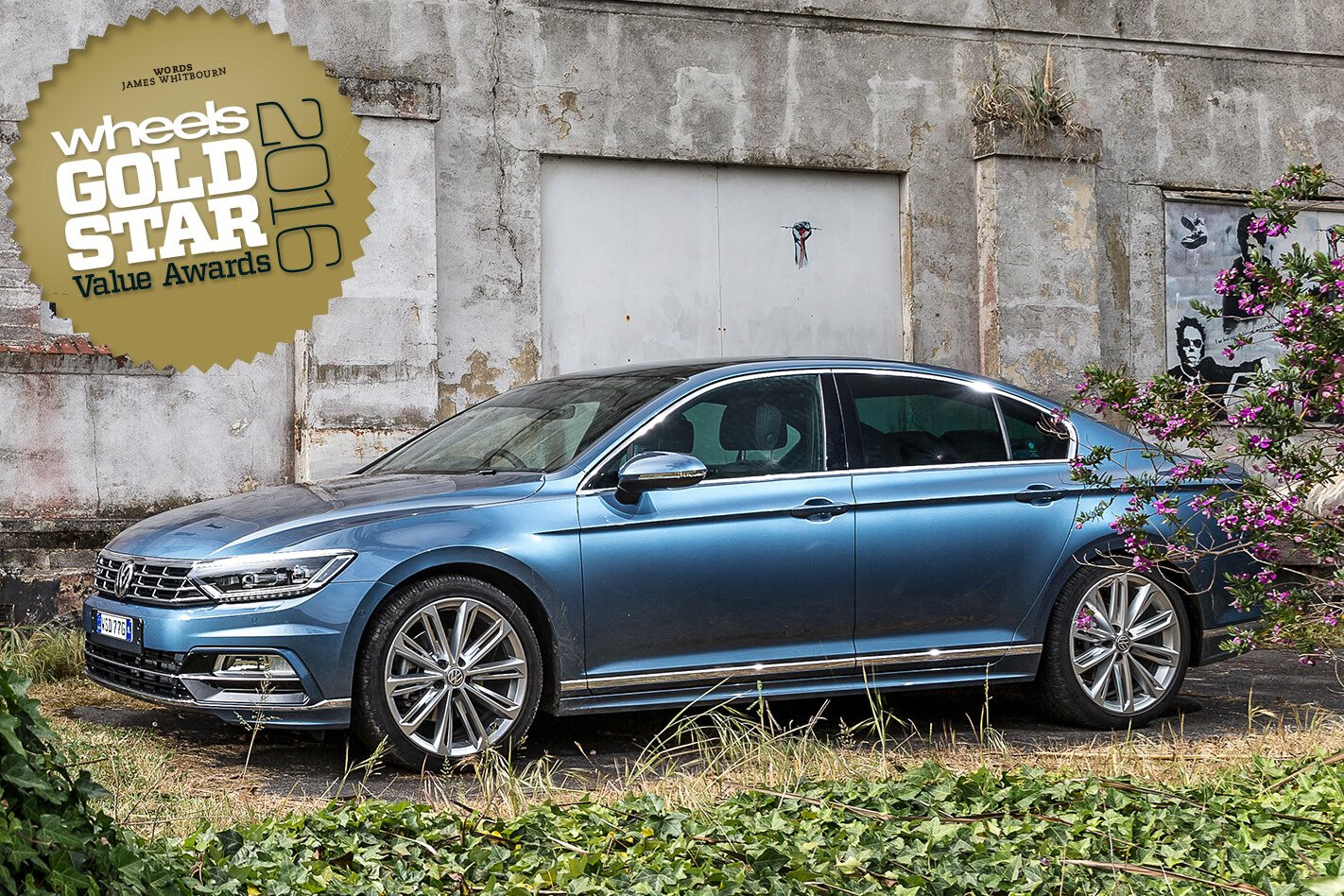 BEST PREMIUM MEDIUM CARS $45K to $60K
Depreciation takes its toll on otherwise excellent cars.
View the results
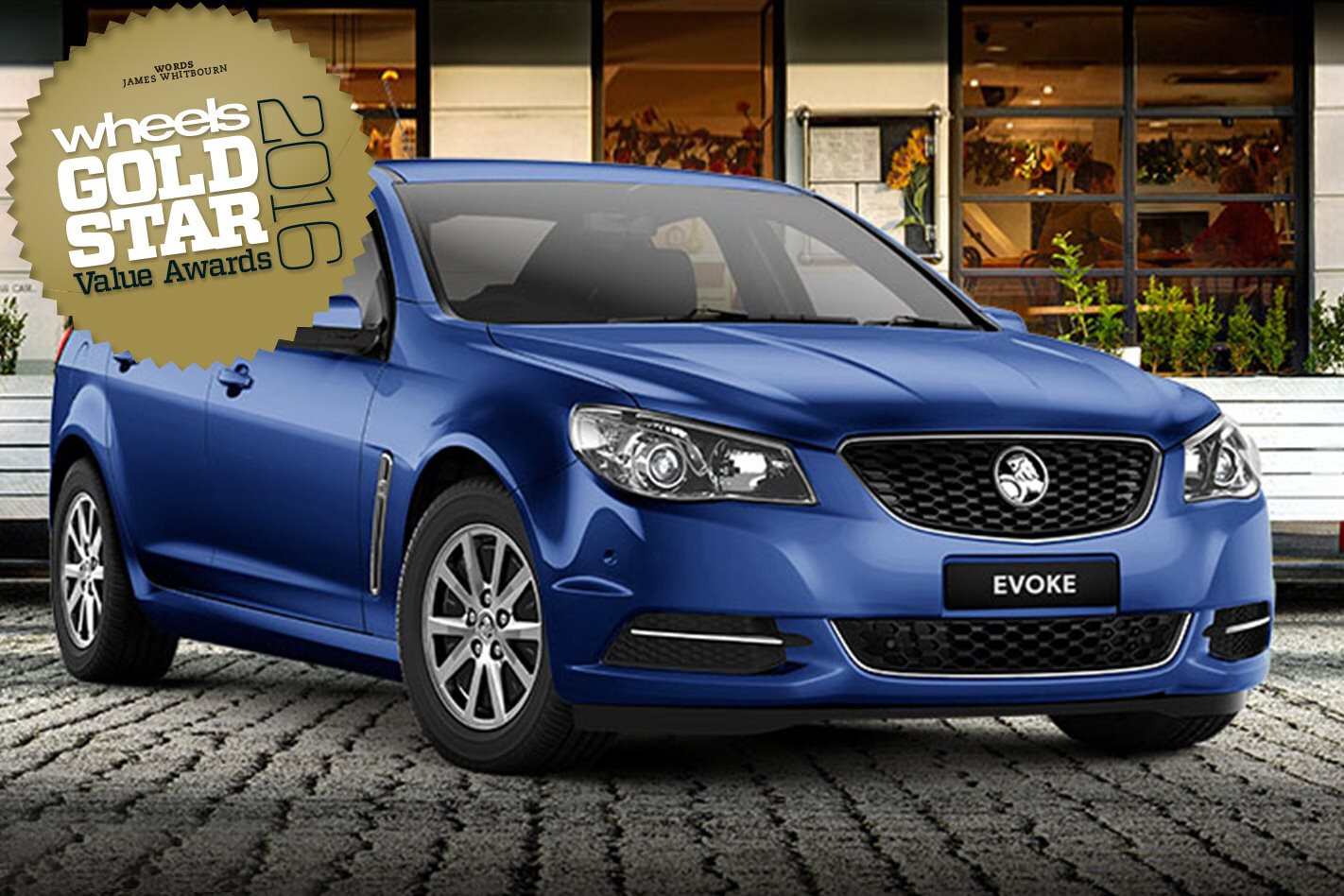 BEST LARGE CARS under $45K
Economical engines have helped large cars avoid becoming instant money pits.
View the results
We’ve nominated the F6 Typhoon here, but in reality all the FPV-branded turbocharged six-cylinder cars deserve a spot on the dais.
In a nutshell, the Typhoon was FPV’s take on the XR6 Turbo, kicking off with the Series 2 BA in late 2004. From there the Typhoon badge was applied to the BF model (Series 1 and 2), with all those cars getting a boosted up version of the XR6T’s engine with a total of 270kW and no less than 550Nm of torque.
From the FG model on, the Typhoon tag was dumped and the car became simply the F6. But power had grown to 310kW, torque was 565Nm and the performance was simply amazing. Still is.
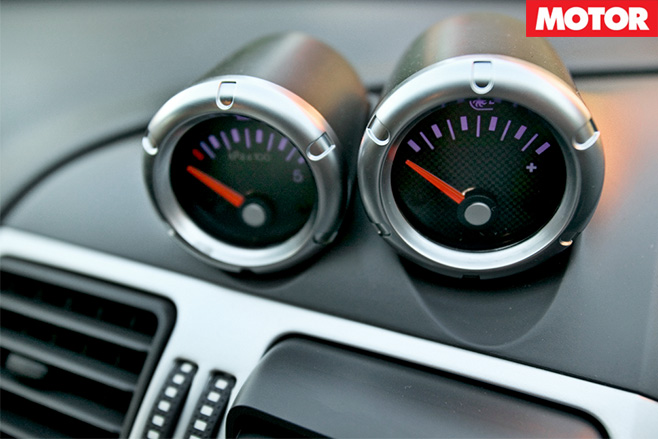
Like any Falcon from that era, the FPV stuff was brilliant at long-distance running. Point it at the horizon and you could hop out at the end of the day, 1000km or so in your wake, and still feel like dinner and drinks. We should know.
They weren’t totally at home on a race-track, but for the way 99 per cent of people used them for 99 per cent of the time they were on the target. The F6’s output wasn’t bested by a Ford turbo-six until the very last XR6 Sprint of recent times, and even though it could feel a little laggy in some circumstances, the reality was a superbly flexible car that was smooth, refined and felt like a rocket when you sunk the clog.
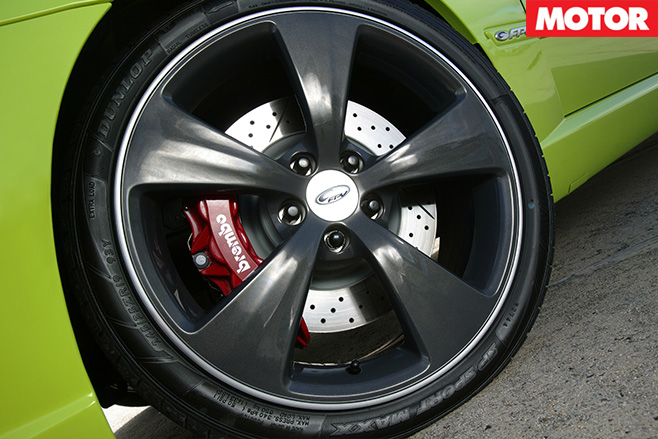
One of the biggest achievements of these FPV sixes was to convince the buying public that they were the real deal. That was something arch-rival HSV had never really been able to do, despite having access to a supercharged V6 back in the day. But where a HSV was a V8 or nothing, the force-fed sixes from FPV proved to those high-end buyers that the brand offered choices and suggested that variety really is the spice of life.
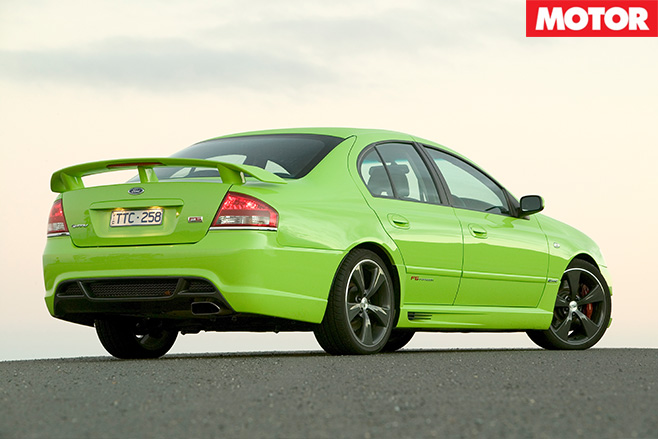
IN DETAIL Engine: 3984cc 6cyl, DOHC, 24v, turbo outputs: 270kW/550Nm Weight: 1805kg Price: $63,460
What’s our fave Falcon? Check out MOTOR’s take on the top 10 Fast Ford Falcons ever made here.
Porsche’s new Panamera Turbo is coming to frighten VN Commodores at the lights near you soon – it is, after all, able to knock out 100km/h in just 3.6sec. We cover off the 10 things that make it great.
1. PORSCHE DOES A V8 Two twin-scroll turbos live in the vee of new 4.0-litre, 90-degree V8 – less plumbing makes for better response. Despite less than 4.5psi boost, still good for a potent 404kW and 770Nm. Centrally-mounted injectors improve fuel burn and efficiency
2. ’BAHN BURNER The Turbo will hit 100km/h in a launch control-assisted 3.6sec, 200km/h in 12.7sec on its way to a 306km/h top speed. The claimed combined 9.4L/100km fuel consumption might blow out a bit, though
3. GROWING BOY Second-gen Panamera is 34mm longer, 6mm wider and 5mm taller. A 30mm longer wheelbase absorbed with a shorter front overhang – much easier on the eyes
4. LIGHT SHOW Prismatic “3D” tail-light design not as cool as the optional Matrix headlights. With 109 LEDs each, high beam can track cars ahead and turn off individual LEDs, putting them in a little box of shade to avoid blinding them. Not new tech, but still clever
5. ANTI-GRUNT A big car with big power needs big brakes: optional Porsche Ceramic Composite Brakes measure 420mm front with 10-piston (!) calipers, 390mm rear with four-piston calipers. Available as a $20,890 option on all models, it’s a big price, too
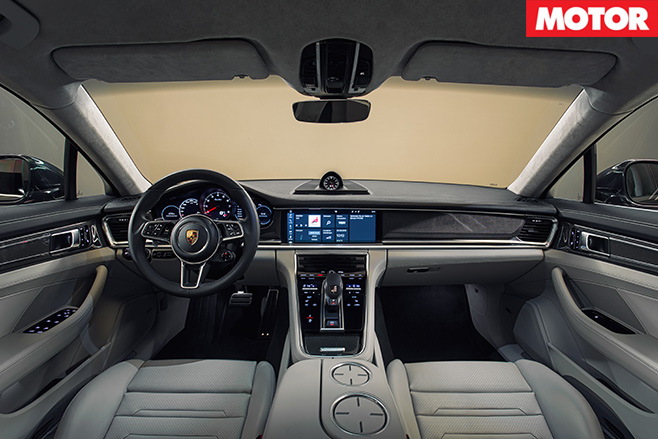
7. NEXT 911? Analogue tacho flanked by two 7-inch screens – fully digital speedo on the left, infotainment on the right – hint at what next-gen 911 drivers will be seeing. Can include Night Vision, too – a first for Porsche
8. TITILLATING TILLER Pursuit of economy and the need to integrate systems like rear-axle steering and air suspension sadly meant replacing the super-sweet hydraulic steering with a new electric system. Fortunately it’s fixed rate, though the weighting is variable
9. TEUTONIC TECH Porsche has done its best tablet computer impression with an enormous 12.3-inch centre touchscreen, handling the new generation Porsche Communication Management, controlling sat-nav, phone and audio
10. HEADS UP It’s the most technologically complex Porsche ever, but gadget fans must wait a little longer for fashionable gear like heads-up display and semi-autonomous cruise control
