
The “world’s fastest SUV” made its grand entrance at the SEMA show in Las Vegas this week and what’s hiding under its bonnet could “leave most sports cars in the dust.”
This heavily modified Toyota LandCruiser concept wields a mighty 5.7-litre Toyota V8, ripped straight from a Lexus LX570, and a boosted twin-turbo setup.
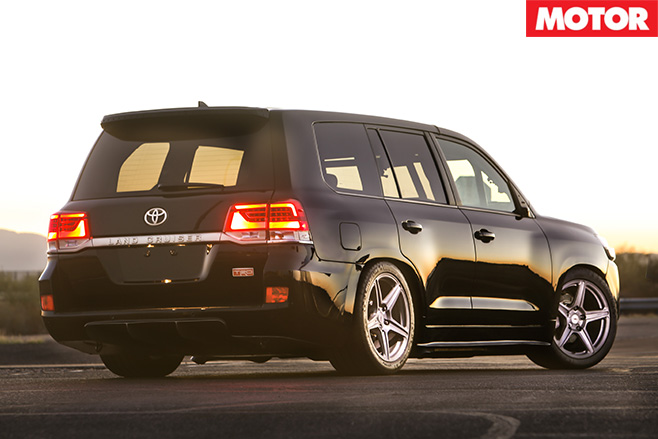
The boosted V8 produces a massive 1500kW, enough for a claimed 354km/h top speed, smashing the Bentley Bentayga’s current off-roader record speed of 301km/h.
To add to the madness, “volleyball sized” Garrett turbochargers flank each cylinder bank of the engine and breath directly through inlets in the aerodynamic hood, and the whole thing is plugged into an ATI transmission.

And that’s without taking into consideration the chassis modifications required to make this behemoth capable of Ferrari F12-matching speed. Despite its promise, Toyota Motor Sales national engagement marketing manager Steve Appelbaum sees the Land Speed Cruiser as more of an engineering feat than the way forward.

Representing the extreme side of motoring, this monster in disguise will be the ultimate goal for speed demons with an affinity for SUVs and precision engineering.
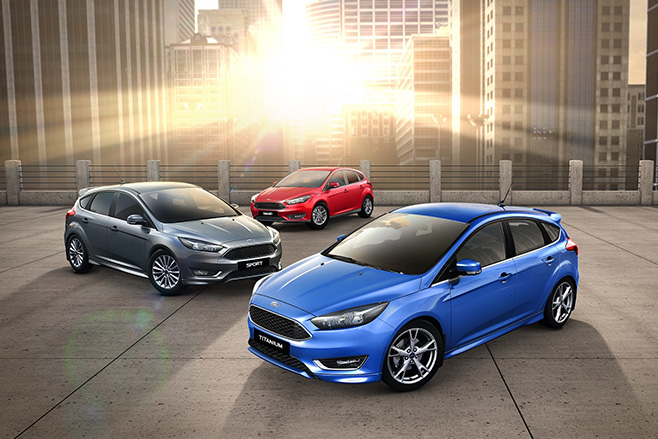
It’s surprising to learn the Ford’s internationally popular hatch only has a 3.3 percent of the highly-competitive small car market here. Its 5632 sales so far this year seem reasonable but are eclipsed by 30,000-plus figures of the three leading passenger cars in Australia, the Toyota Corolla (34,158), Hyundai i30 (32,396) and Mazda 3 (30,039) which combined make up about 55 percent of the segment’s market share.
Despite winning a swag of awards and providing plenty of bang for your buck including plenty of equipment and a seven-year warranty, only 3469 Kia Sorento SUVs have rolled out of showrooms in the year ending October 31. Compare that to other large soft-roaders including the Toyota Kluger (10,084), Hyundai Santa Fe (6935) and even the Holden Captiva (9612) and you wonder if the Kia salespeople are trying hard enough.

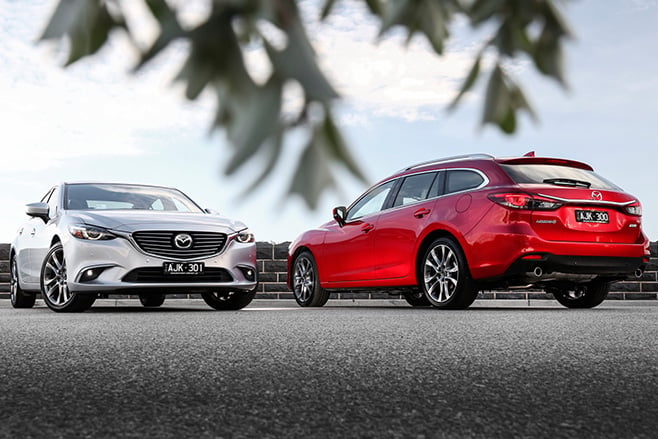
Perhaps it’s the pricing starting north of $30,000 but the Mazda 6 is widely acknowledged as an excellent medium-sized car, yet its 3635 year to date sales are low. Sure, it’s second in its segment, but there’s more daylight than an Alaskan summer between it and Toyota Camry, which has sold 18,678 so far in 2016. The Mazda 6 wagons are the pick of the bunch, though these are at the mercy of SUVs as well as its direct competitors.
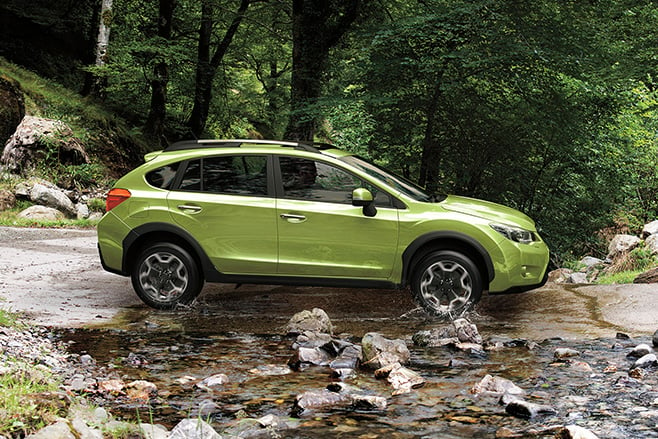
Like its bigger brothers the Forester and Outback, the Subaru XV is one of the more car-like SUVs, but it doesn’t enjoy the market dominance they do in their respective segments. Sitting in the growing small-SUV category, the XV is by no means the worst seller, but its 6831 sales so far this year is less than half that of the likes of the Mitsubishi ASX (15,112) and the class-leading Mazda CX-3 (15,493). Whole providing the best of both worlds in terms of handling and elevated ride, it is let down by its small boot space.
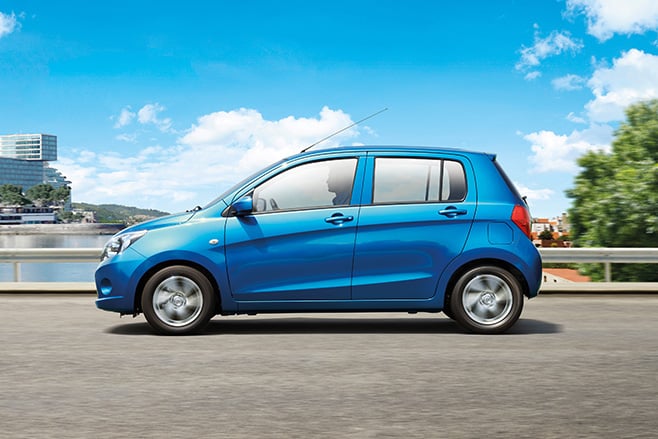
The baby Suzuki is one of the better cars in the micro car market but only managed 28 sales in October, bringing its year to date tally to 679, compared to the segment-leading, yet arguably inferior, Mitsubishi Mirage (2357), Holden Spark (1467) and Nissan Micra (1367). It might not be the sleekest looking car in its class (not that many are) but it is roomy, drives nicely and has a competitive starting price of $12,990.
CRASH testing cars is vital. It is these tests which determine whether the occupants of a car are kept safe if something goes wrong, and when the car in question is capable of mega speed, good crash performance is essential if a company doesn’t want to turn its well-heeled customers into pulp.
For most cars, this process is fairly straight forward. With production numbers in the hundreds of thousands, the cost of crash testing multiple cars is able to be amortised easily
With higher end sportscars and supercars, though, these tests become more arduous for manufacturers as they are forced to sacrifice cars from a relatively limited run to be slammed against solid walls.
For low-volume hypercars from boutique manufacturers with double-digit production runs, this becomes even more of a hassle.
Take Koenigsegg for example, and the frankly absurd Koenigsegg Regera. Only 80 of the 1118kW Swedish monsters will be built, so the manufacturer can’t just write off a couple of cars to be crash tested – and it’s not as if they can skip the vital safety step altogether.
To get around this, Christian von Koenigsegg, the company’s owner and founder, has revealed how the Swedish supercar maker uses a single pre-production Regera for all its crash tests.
This is the benefit of using carbon fibre body panels and single-cell monocoque.
“This car is prepared for different crashes from different angles,” von Koenigsegg explains. “And then it is being rebuilt again for different crash tests”
“A big car company would have many cars doing these different tasks, but as our cars are so expensive, and take so long to build; it is quicker and cheaper to rebuild it after each test rather than building from scratch.”
It makes sense for a company that builds cars in such low numbers to use just one vehicle to undergo its testing.
Watch the video above to get the full rundown on the Regera’s safety development.
Swedish-carmaker Volvo has revealed its S90 Excellence, the ultimate chauffeur car.
The Chinese-made long-wheel-base sedan eliminates the front passenger seat to make way for a shoe cabinet and adjustable footrest. Above it is a touchscreen holder and entertainment system for the rear passenger.
Volvo calls the space a “Lounge Console” created to allow passengers to relax and work while being driven around busy cities.
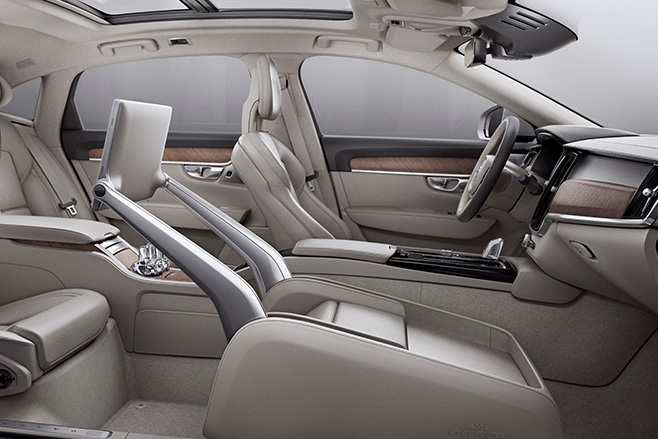
“The first thing you notice in the S90 Excellence is that we have removed the front passenger seat and replaced with what we call the Lounge Console, designed to meet the chauffeur-driven executive customers’ need to relax and work while on the move,” said Senior Vice President Design at Volvo Car Group, Thomas Ingenlath.
Whacky interior design aside, the S90 Excellence will also feature a panoramic roof, foldout worktables, heated and cooled cup holders and built-in refrigeration compartment.
Keeping with the theme of “high quality materials” and “immersive luxury feel” are some hand-made crystal glasses made by Orrefors.
As we’d expect of Volvo, it’ll feature a host of safety feature, including the brand’s Pilot Assist, which works up to 120km/h.
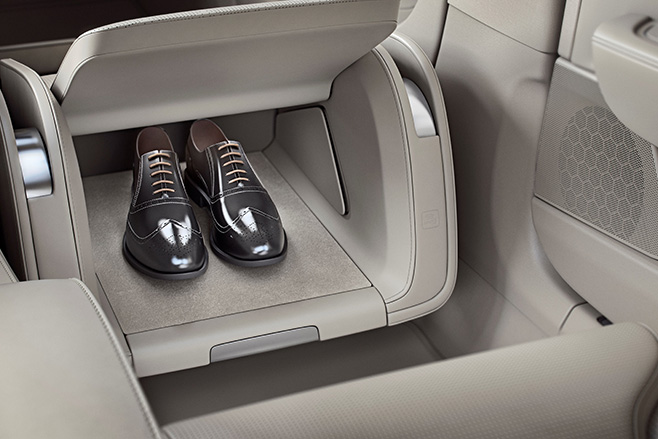
The Excellence will, however, do away with the three-engine options of the Volvo S90, and instead only be available with Volvo’s T8 Twin-Engine powertrain option.
Given the S90 Excellence’s is targeted at executives-types in cities like Beijing, it also includes a CleanZone air filtration system to filter toxic pollutants and keep in-cabin air pure.
The S90 Excellence will be built alongside the S90 sedan in Volvo’s production facility in Daqing, China, and will be the most premium car ever made in the country.
Production for the limited edition limo starts this month and it’s expected to go on sale early next year.
ONE bombshell follows another…
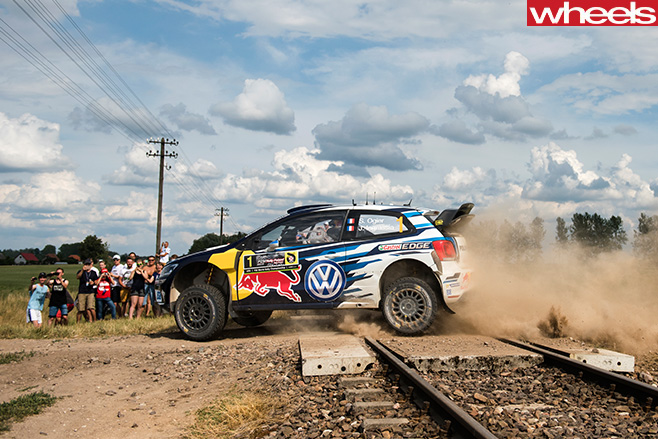
Though Audi pulling out of the WEC at the end of this season stunned some, it was really no great surprise. Conversely, the announcement of Volkswagen’s withdrawal from the World Rally Championship after the final round in Australia this month caught everyone on the hop, including its star drivers and team boss.
To give such, almost rude, short notice of the withdrawals in both cases smacks of either real need to save euros for the massive dieselgate emissions scandal payouts, or reactive boardroom decisions to take the brands into different directions in terms of their powertrains.
Or maybe both.

And, by any measure, it’s a huge disappointment to lose Audi from the WEC and VW from the WRC.
But no brands are permanent fixtures in any motor sporting theatre, perhaps with the exception of Ferrari in Formula One. And even Ferrari makes periodic threats to leave unless it gets its own way on regulatory matters and financial incentives.
The VW announcement of its WRC exit mentions brand realignment of its motor sport programme, focussing on new technologies and customer sport.

“At the same time, Volkswagen is going to focus more on customer racing. As well as the Golf GTI TCR on the circuit track and the Beetle GRC in rallycross, we also want to offer customers top products and will develop a new Polo according to R5 regulations.”
The announcement dances carefully around the diesel engine manipulation disgrace and the need to find many billions of euros and dollars to pay fines to authorities and for rectification to customer cars.
Don’t hold your breath.
VW has never confirmed its budget for the WRC but insiders have indicated it was north of 100 million euros annually. Helped by a large contribution from sponsor Red Bull.

The abrupt withdrawal left four-time world champion Ogier and his VW team-mates Jari-Matti Latvala and Andreas Mikkelsen without drives for 2017.
While no doubt their contracts will be honoured (financially), they want to compete next year, and Ogier in particular is being wooed and chased by other manufacturer teams in the 2017 championship.
Ford M-Sports’ Malcolm Wilson admits he would love to sign Ogier, the class act in world rallying, and that talks have already begun. This could be bad news for either Ott Tanak and Eric Camilli, who had been expected to drive with the main M-Sport squad, with Elfyn Evans in the sister DMACK entry.

Matton told Autosport he would be happy to chat to Ogier, a former Citroen driver, although “there’s no question about changing my driver line-up for next season”.
The VW exit is a setback for the WRC which next year features a new technical rules package with significantly faster and more dramatic-looking cars.
It will be a battle between series regulars Hyundai and M-Sport (Ford) plus returning championship giants Citroen and Toyota.
Finns Esapekka Lappi and Juho Hanninen were expected to be the 2017 factory Toyota Yaris WRC drivers for team boss Tommi Makinen. But that was before the drivers’ market was unexpectedly flooded…
THE cost of running a car continues to rise in most Australian capital cities, with Sydney again the most expensive, according to the Automotive Association of Australia’s latest transport affordability index.
The Index is based on the incomes and transport costs of a hypothetical household in each capital city, consisting of a couple with children and two cars. It assumes that one family member drives to work, while the other catches public transport.
Nationally, transport costs as a percentage of income also increased slightly over the September quarter to 13.4 per cent (up from 13.3 per cent). In comparison, household expenses relating to telecommunications, electricity and water consume one to three per cent of household budgets.
Sydney was again the most expensive city in which to run a car, with the average family paying around $21,653 compared with the national average of $16,894 (up from $21,389.78 as measured in the previous quarter) while the annual cost of land transport is lowest in Hobart at $14,197 (up from $14,115.72 in the previous quarter).
A rise in Sydney public transport fares, registration and compulsory third party insurance contributed to annual household cost increases of around $260.
Melbourne was the only capital city to experience a fall in average annual transport costs since the second quarter of 2016, down from $18,136.02 to $18,056.11, and mainly due to public transport fees becoming standard across the network.
Weekly car/transport costs of typical two-car households were $416 in Sydney, ahead of Brisbane ($377) and Melbourne ($347), Perth ($308) and Canberra ($302).
Adelaide, Hobart and Darwin all dipped under the $300 mark, costing $287, $273 and $288 a week respectively. In these cities, public transport, driver’s licences and vehicle registration were all relatively less expensive.
Car loans continue to make up the biggest share of a household’s transport costs nationally; about $120 a week.
Other major costs, including tolls in cities that have them, fuel, public transport, insurance and registration, varied from city to city.
In Sydney, tolls were the second biggest charge for people living in outer suburbs, costing $78.20 a month, compared with $46.40 in Melbourne and $49.30 in Brisbane.
Brisbane is the most expensive city in which to travel on public transport, with an average weekly cost of $65.43 compared with Sydney ($59.04), Melbourne ($39.00), Perth ($55.30), Adelaide ($35.40), Canberra ($29.80), Hobart ($25.60) and Darwin ($20.00).
While Hobart is the cheapest place to own a car and get around, it had the highest average weekly fuel bill of $61.86, compared with Canberra ($59.88), Sydney ($59.04) and all the other capitals, hovered around $57.
AVERAGE WEEKLY CAR/TRANSPORT EXPENSES
- Car Loan: $120.53
- Rego and licencing: $31.68
- Comprehensive insurance: $22.37
- Car servicing and tyres: $27.08
- Fuel: $58.32
- Public transport: $41.20
- Toll roads (Sydney, Melbourne and Brisbane): $57.97
- Roadside assistance: $1.96
German newspaper claims it has uncovered evidence of yet another emission cheat device in Audi-badged cars.
The Volkswagen Group is back in the Dieselgate spotlight after claims surfaced over the weekend that US authorities have uncovered yet another emissions cheat built in Audi vehicles.
German newspaper Bild am Sonntag reported that the US-based California Air Resources Board (CARB) engineers had uncovered the software cheat in an unspecified V6-engined Audi model fitted with an AL155 automatic transmission.
The cheat is believed to be linked to the car’s electrically assisted steering system. According to the report, if the vehicle accelerates and the steering wheel doesn’t move – a specific condition that will kick in if the emissions test is performed on a rolling road – the car switches the gearbox into a low-emissions mode.
The paper said applying torque to the steering wheel in potentially hundreds of thousands of vehicles would deactivate the car’s “warm up” program, meaning the car would use more fuel and produce more emissions.
The cheat device is alleged to be present in models including the Audi A6, A8, and Q5.
Both CARB and Audi are yet to comment on the report.
Audi last month said it would set aside €752 million ($A1.09 billion) to cover the cost of recalls that will roll out for its V6 diesel engine caught up in the Dieselgate scandal.
According to Audi, a $US10 billion ($A13 billion) settlement reached with US authorities in July won’t cover all the claims against the German luxury carmaker.
Volkswagen claims it has not broken any laws in Australia relating to the emissions cheat it built into more than 90,000 cars sold here, and that it therefore does not need to compensate customers.
To date, Volkswagen Australia has issued only one recall to install new firmware on almost 9000 Amarok trade utes. Its Dieselgate website has not been updated since a statement issued in June advising Australian owners that, unlike owners in the US, they would not be compensated for having been sold vehicles with the emissions cheat devices.
However, Australia’s consumer watchdog in September launched Federal Court action against Volkswagen Australia over the diesel engines scandal.
The Australian Competition and Consumer Commission alleges Volkswagen Australia and its parent company “engaged in multiple breaches of the Australian Consumer Law by concealing software in their vehicles to cheat emissions testing and misleading consumers about the vehicle’s compliance with standards and emission levels during on-road conditions”.
The carmaker potentially faces millions of dollars in fines if the court sides with the ACCC.
The case has its next hearing scheduled for December 6.
IN 1976 if you wanted the fastest four-door car in the world, you called Australia. In 2016? You’re looking at it. And, err, the cost of admission has gone up a little…
Porsche’s second-generation Panamera – just released – is prettier (though it would have been difficult to go backwards), cleverer and faster – and boy, is it fast. But we’ll come back to that.
You’d hope it was all these things given the investment involved. It’s an all-new car, and most of the time car companies make this claim it’s a half-truth. Rarely will a car company risk the development costs of a new chassis and new powertrain on the one generation – and then go build a new factory, too.
But that’s exactly what Porsche has done for its new super sedan, truly clean-sheet, and in doing so has broken rank with what is apparently the ‘golden rule’ of making cars.

And its baby is without doubt much prettier thanks in part to more compact engines and a shorter, less hands-on CEO. The story goes that then Porsche-boss Wendelin Wiedeking would casually drop in on the engineers developing the first Panamera and, presumably to their chagrin, insist he had plenty of headroom in the back.
Sadly for them, he was taller than average and, in turn, so was the first Panamera’s roofline. Other factors were in play, but before the public knew it, Porsche’s first four-door had become the hunchback of Stuttgart.
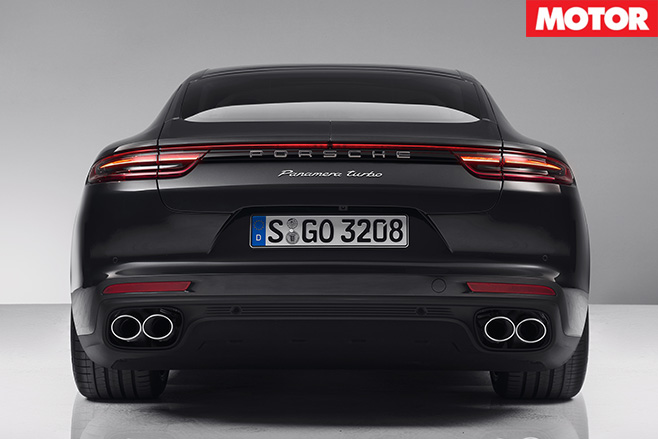
The wheelbase has grown, absorbed by a shorter front overhang (very sporting, a stylist will tell you) and the bonnet is now more deeply scalloped thanks to lower engines. The new Panamera is at its most photogenic seen from its three-quarter angles, and on a ladder – not unlike, err, these flattering press images.
Under that restyled skin is the Volkswagen group’s brand new Modular Standard Drive Train Platform – MSB – designed entirely by Porsche and set to underpin other models in the VAG like the next Bentley Continental.
A Panamera coupe – a modern day 928 – is in theory possible and was reportedly under consideration but shelved from fear it would cannibalise Bentley Continental sales.
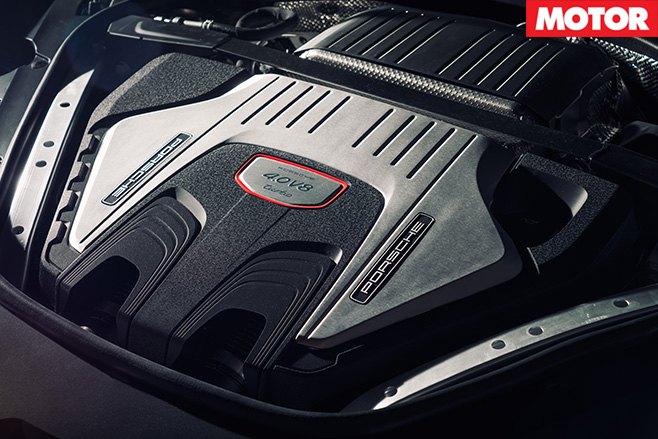
There’s the new oil burner making for the ‘fastest diesel production car in the world’, a 4.0-litre V8 with 310kW and 850Nm (from 1000rpm), hitting 100km/h in 4.3sec and, with its 90-litre tank, boasting a theoretical 1500km range. Then there’s Big Daddy, the supercar-scaring 4.0-litre twin-turbo petrol V8.
Brand new, and developed entirely by Porsche (though expect to see it pop up elsewhere in the Volkswagen group), this small-on-cubes, big-on-punch donk belts out 404kW at 5750rpm and 770Nm from just 1960rpm.
Think 0-100km/h in just 3.6sec and a scorching 7:38 ‘official’ Nurburgring lap time – the fastest production four-door car the world had ever seen, until Alfa Romeo unleashed the Giulia QV for its amazing 7min32sec run.
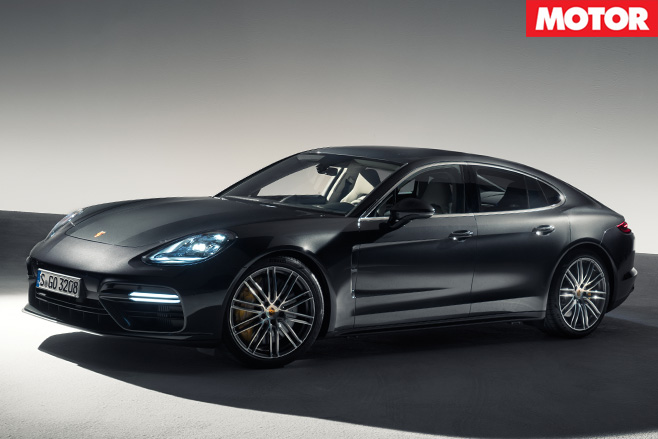
And we mightn’t have seen anythin’ yet. A 447kW Turbo S is reportedly in the works with a sub 3.5sec 0-100 sprint. A 918-inspired performance hybrid is supposedly inbound. And while all three Panamera variants are all-wheel drive, Porsche says rear-drive is possible.
A wagon (sorry, Shooting Brake) is on its way and with its more rounded rump better suiting the 911 design DNA, could be the prettiest Panamera of them all. Much to look forward to, then, and we haven’t even driven it. That happens next month.
HEADS UP It’s the most technologically complex Porsche ever, but gadget fans must wait a little longer for fashionable gear like heads-up display and semi-autonomous cruise control
REGULAR visitors to Wheelsmag.com.au will be accustomed to seeing spy shots of camo-covered cars being tested.
What those images don’t reveal, though – along with many of the intricate details of the cars they camoflauge – is the intensity of the new car testing regime.
Until now, that is. A 16-minute collection of B-Roll footage of the Mercedes-AMG SLS takes you from the very first sketches, all the way through prototype development, and finally onto high-speed testing in pre-production models.
This was AMG’s very first bespoke production model, so clearly it was intent on making sure the gullwinged sports car was done properly. The footage reveals the anmount of time AMG engineers spent crash-testing the car, even going as far to drop it on its head to test the systems developed to allow occupants to escape the car following a rollover (gullwing doors would traditionally make this rather difficult).
In the film, you also get to see the SLS’s monster 6.2-litre V8 being put through its paces on the dyno bench, and the car’s suspension being absolutley punished on a simulation rig.
All of this is just building towards the pre-production models, which are put through various hot and cold weather testing, as well as some high-speed track time.
The heavily camoflauged SLS is taken to Pikes Peak in Colorado for hot-weather testing. It is interesting to note the famous hillclimb is still partially dirt in the footage – it has since been sealed top to bottom.
The footage also provides rare insight into what happens inside the heavily camoflauged cars, with in-car footage of engineers monitoring data as they drive.
Finally, we are treated to some wild slides on snow and ice as part of the mandatory cold weather testing.
So next time you slide behind the wheel of a new car, just think about the extensive testing that happens, sometimes for years, before you’re handed the keys.
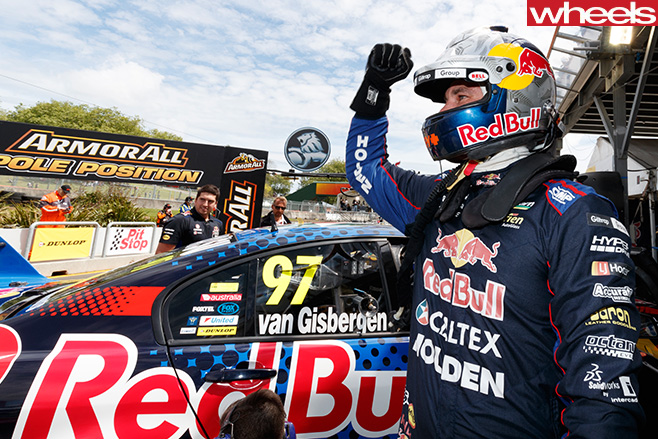
KIWI Shane van Gisbergen is ever closer to securing his maiden Supercars Championship after winning a dramatic four-race ITM Auckland SuperSprint at Pukekohe Park Raceway.
Van Gisbergen used the weekend to extend his lead over teammate Jamie Whincup to 191 points with just one round remaining in Sydney next month.
Van Gisbergen also admitted he was teary as he crossed the line in the fourth race of the weekend, knowing he had won the Jason Richards Trophy awarded in memory of the much loved New Zealand racer who died in 2011.
Passing moves within the leading bunch were rare after the opening lap or so of the four 100 km races.
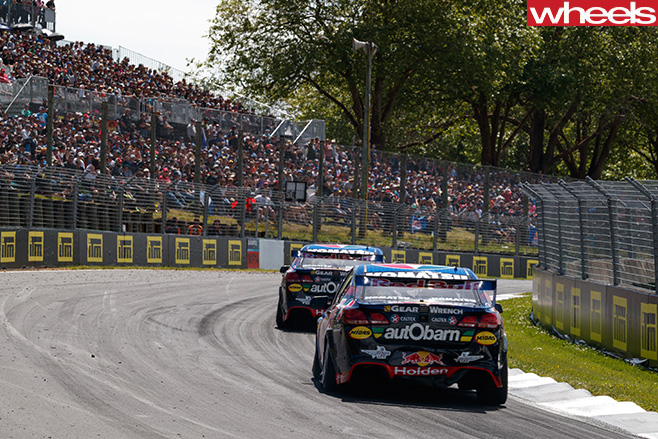
This, of course, doesn’t help the dearth of overtaking on the track…
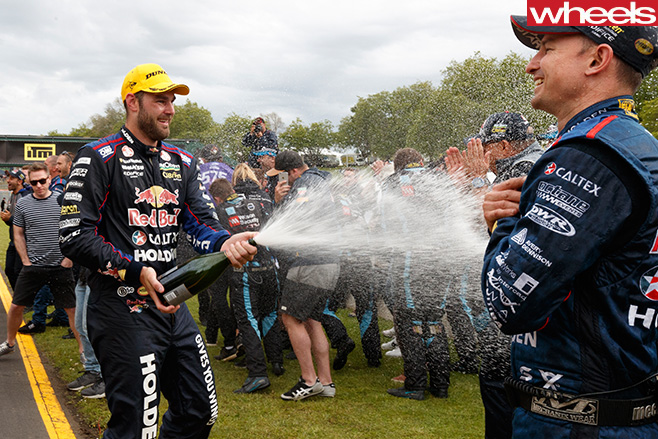
The two Red Bull drivers won a race apiece on Saturday and we were also treated to a couple of laps of torrid and tense high-speed duelling as van Gisbergen and Whincup went at it hard, yet fair, moments after the start of race two. It was precise, centimetre-perfect combat (and respect) rarely seen in touring car racing.
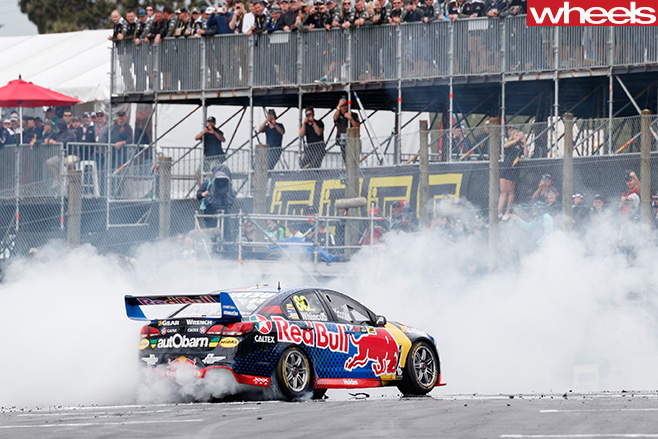
Mark Winterbottom, who had been steady without looking to threaten the Red Bull dominance on Saturday, flew off the line in race three, firing past pole man van Gisbergen and fellow Ford driver Scott Pye to take the lead. He went on to take his second win of the season.
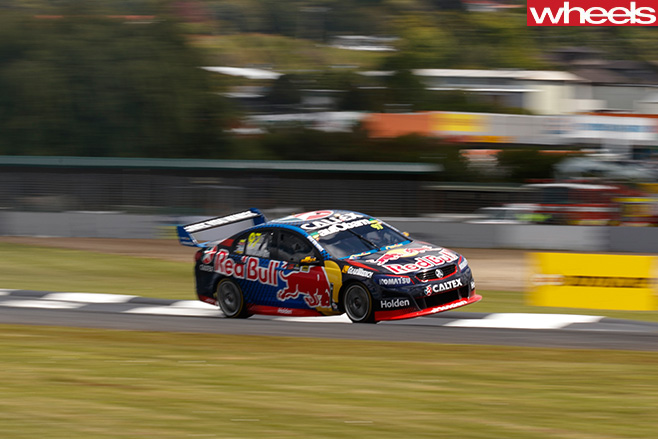
Van Gisbergen recovered to finish third behind Winterbottom and Pye while Whincup was delivered the further bad news of a drive-through penalty which left him 25th.
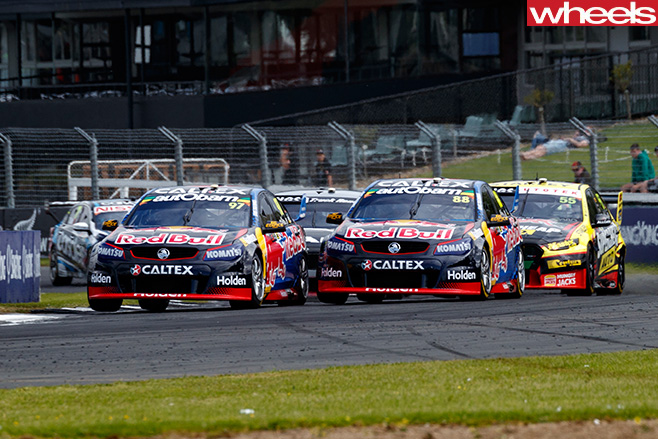
“My car was quick, and I made the mistake and took out my teammate,” said a candid Whincup. “I have apologised; thankfully it didn’t affect car 97 too much and they got a podium. “
Whincup bounced back spectacularly from his disaster to win the fourth and final race of the weekend, but van Gisbergen grabbed second to secure the Jason Richards Trophy.
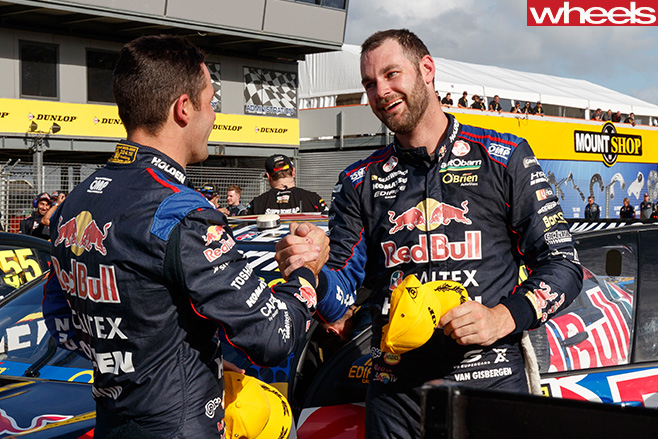
“I am in a pretty special place with the car and the team at the moment, I am very lucky.”
Fortunate, perhaps. But luck isn’t delivering van Gisbergen his success. He is driving brilliantly and not making many mistakes.
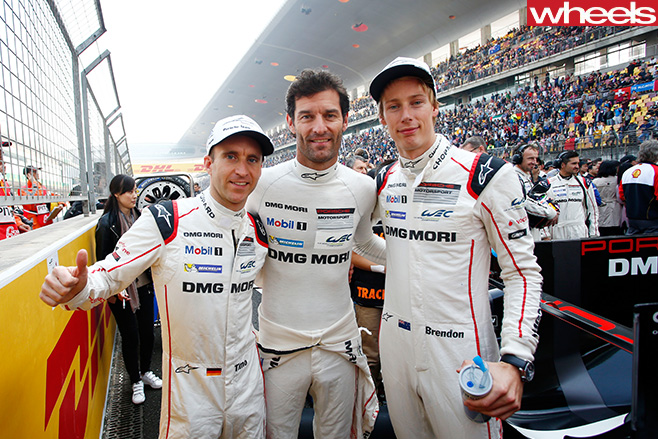
Webber and Porsche take Six Hours of Shanghai
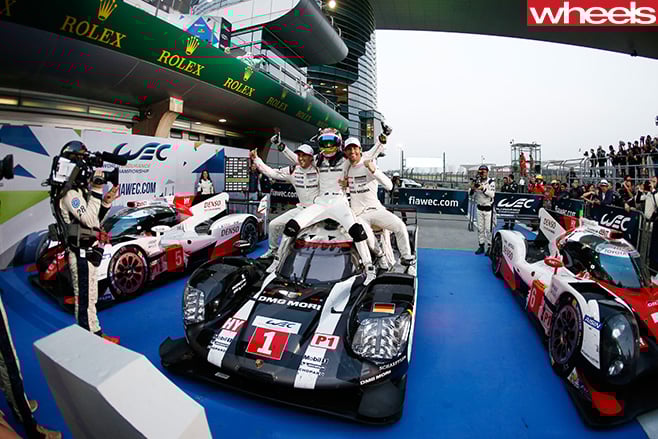
But the quick Number 6 Toyota of Stephane Sarrazin, Mike Conway and Kamui Kobayashi was unlucky not to be right in contention. Just when the Toyota looked very threatening, it was slowed with a puncture 76 minutes from the flag.
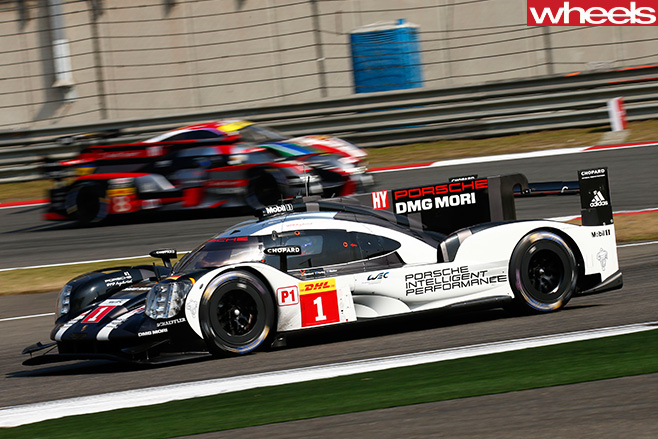
Hartley lost the drag race to turn one at the start, but a crash further back in the pack brought out the safety car and gave the Kiwi the chance to regain the front running.
The only time he and his cohorts were not in the lead was due to slight variations in pit stop strategies.
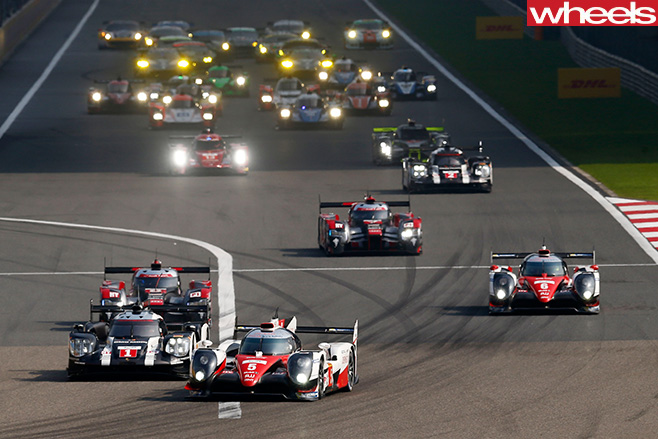
A day earlier Webber and Hartley combined to take pole from the Toyota TS050 Hybrid of Anthony Davidson/Sebastien Buemi/Kazuki Nakajima and the Audi of Oliver Jarvis, Lucas di Grassi and Loic Duval.
A bad-news fortnight for Audi got worse during the Shanghai race when its two R18s collided, dropping them way back.
With Toyotas taking second and third, the fight for the drivers’ title will go to the final race in Bahrain, after which Mark Webber will cruise into retirement.
Matt Close takes Targa High Country tarmac win
Victorian Matt Close has taken his Porsche GT3 to outright victory and GT2 competition class honours after a hard-fought battle at Targa High Country, which finished yesterday at the top of Mt Buller.
Close went into the final day with a one second lead over fellow GT2 competitor, Tasmanian Michael Pritchard, driving a Dodge Viper ACR.
Overnight snow on Mt Buller left all competitors – especially those in two-wheel-drive machines – a little apprehensive about the slippery roads.
Close was one to adopt a cautious approach on the wet and slippery run down the mountain, dropping 16 seconds to his rival.
But the Porsche driver hit back on the next stage, speeding into the lead on the 40-kilometre Jamieson test. With his confidence high and hard tyres now working well, Close pushed on to extend his lead on every stage, finishing the three-day enduro 59secs clear of his rival in the V10-engined Viper.
The Shannons Classic GT win went the way of South Australian Craig Haysman in his thumping 1979 Triumph TR7 V8.
Lindsay Stone led from start to finish in a 1985 Mazda RX-7 to top the Shannons Classic competition.
One of the drives of the event came from Alan Roe, who took the Duttons Garage Early Modern honours in a 2000 Mitsubishi Evo 6.5 RS.
In the RDA Brakes GT4 competition, Trevor Macleod had the highly experienced Steve Glenney calling the notes, and they proved a formidable combination in their 2010 Subaru WRX STI.
Anthony Rizzo continued his great form to take a 1977 Subaru WRX STI to victory In the Mansfield Shire GT Sports Trophy.
