
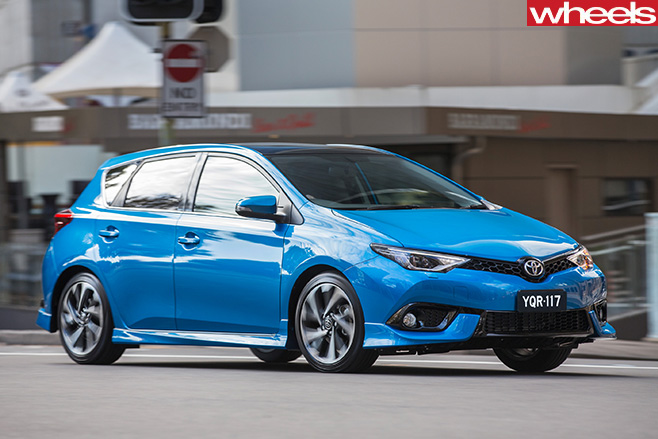
The Mazda3 slightly spoiled the Toyota Corolla’s 50th anniversary celebrations by pipping its rival to the No.1 sales spot for September.
Toyota’s veteran nameplate, which was launched in October 1966, can at least claim leadership in the race to become Australia’s most popular car of 2016. Its runner-up figure of 3423 sales allowed it to leapfrog the stable-mate HiLux ute, which was third with 3209 units.
The 3’s 3491 sales contributed to a record month for Mazda, which also featured the Mazda CX-5 in the top 10 – placing sixth with its own monthly record of 2662 units.
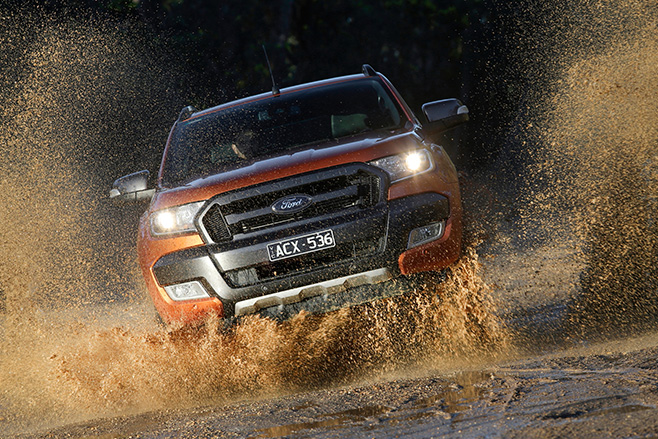
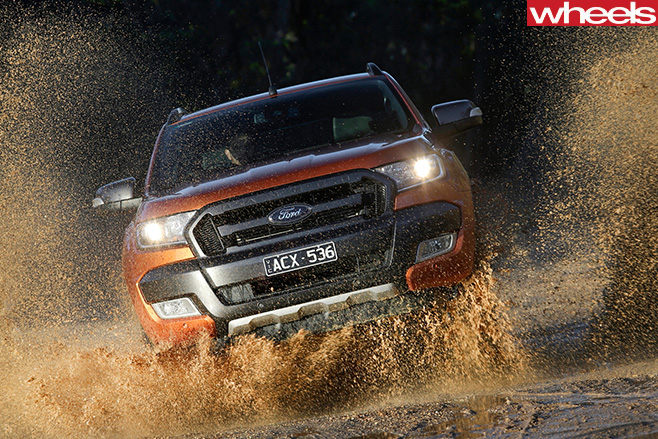
Ford’s Ranger was fourth with 2451 sales, continuing its lone pursuit of the seemingly unstoppable HiLux in the ute segment.
The Hyundai i30 placed fifth despite its 2741 figure dropping by 40 per cent compared with September 2015. The hatchback has lost momentum in recent months since aggressive drive-away deals helped to make it an early pace-setter in the overall sales race.
The Korean brand’s smaller Accent increased sales 127 per cent year on year, however, to take the last rung on the top 10 ladder, while the Tucson mid-sized SUV (9th) continues to perform strongly.
Mitsubishi’s Triton (8th) made it three utes in the top 10, while the sole large car was the Holden Commodore (7th).
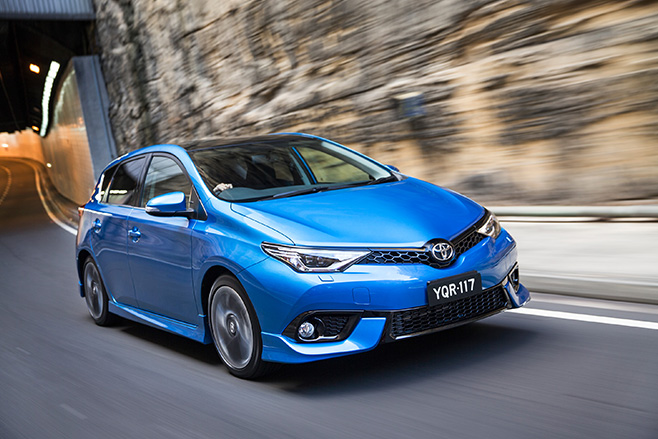
Just 121 sales separate the Corolla and HiLux at the three-quarter stage of 2016, though the i30 is not out of the running entirely – 1270 units shy of top spot.
September sales of 102,696 equated to a 1.3 per cent increase – or 1304 vehicles – over the corresponding month in 2015. SUVs and light-commercial vehicles continue to drive market growth. While passenger sales were down 9 per cent compared with this time last year, SUVs were up 7 per cent and light commercial vehicles up 18 per cent.
Toyota is already describing its overall market lead as “virtually unassailable”, with second-placed Mazda more than 60,000 units behind despite a record month for the Japanese brand in September.
Top 10 selling vehicles in September 2016
| Rank | Model | Sales |
| 1. | Mazda 3 | 3491 |
| 2. | Toyota Corolla | 3423 |
| 3. | Toyota Hiluxu00a0 | 3209 |
| 4. | Ford Ranger | 2903 |
| 5. | Hyundai i30 | 2741 |
| 6. | Mazda CX-5 | 2662 |
| 7. | Holden Commodore | 2366 |
| 8. | Mitsubishi Triton | 2246 |
| 9. | Hyundai Tucson | 2209 |
| 10. | Hyundai Accentu00a0 | 2189 |
Race for 2016’s No.1 Sales Spot (at end of September 2016)
| Rank | Brand | Sales |
| 1. | Toyota Corolla | 30,948 |
| 2. | Toyota HiLux | 30,827 |
| 3. | Hyundai i30 | 29,678 |
| 4. | Mazda 3 | 27,898 |
| 5. | Ford Ranger | 26,940 |
Suzuki Australia this week confirmed the second-generation Ignis would arrive in the first quarter of next year, days after the model was unveiled in European-spec at the 2016 Paris Motor Show.
The new Suzuki Ignis was first previewed by the iM-4 concept at the 2015 Geneva Motor Show, with a production version shown later in the year in Tokyo.
The Ignis’s stumpy yet funky design is slightly longer for markets outside of Japan, with lengthened front and rear bumpers stretching it from 3.6 to 3.7 metres.
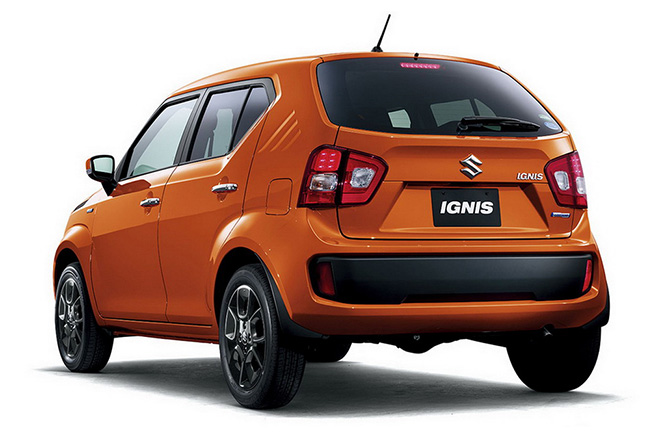
A 1595mm roof height ensures upright proportions related to the model’s predecessor, which was sold locally between 2000 and 2005 (and between 2002 and 2006 as a rebadged Holden Cruze).
Suzuki says design details are borrowed from stable mates such as the Swift as well as as old classics such as the SC100 (notably the rear-pillar ‘vents’ from the latter).
The interior aims to match the urban coolness of the exterior, including the option of orange or titanium trim accents. For functionality, there’s a colour touchscreen multimedia display. For additional practicality, the rear seats split 50:50.
The Ignis is a five-seater as standard, with an optional sliding rear bench restricting rear places to two.
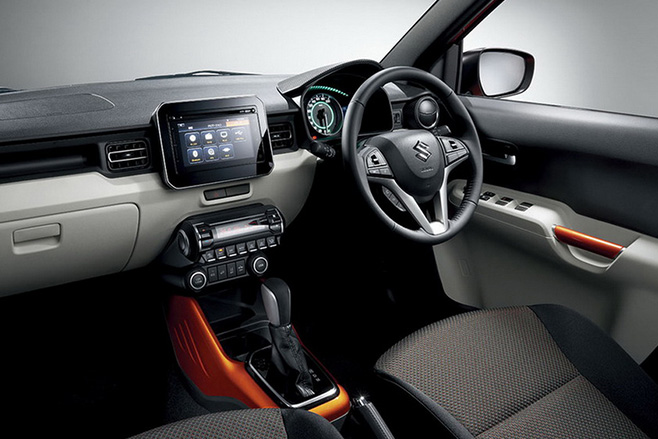
The Ignis will be available with either front-wheel drive or optional all-wheel drive.
The standard engine is a 1.2-litre four-cylinder offering 66kW of power and 120Nm of torque. Alternatively, there’s a mild-hybrid drivetrain linking the petrol engine with an electric motor for extra assistance.
Fuel consumption is unlikely to be high either way with the Ignis weighing between just 810 and 920kg.
From half a Great Southern Land away, you could predict the Sydney Motor Show’s reaction to the new Monaro. What you couldn’t foresee, what nobody outside a select few people could have predicted, was the way the Ford faithful flocked around the T3 T-Series.
This article was originally published in the December 2001 issue of MOTOR.
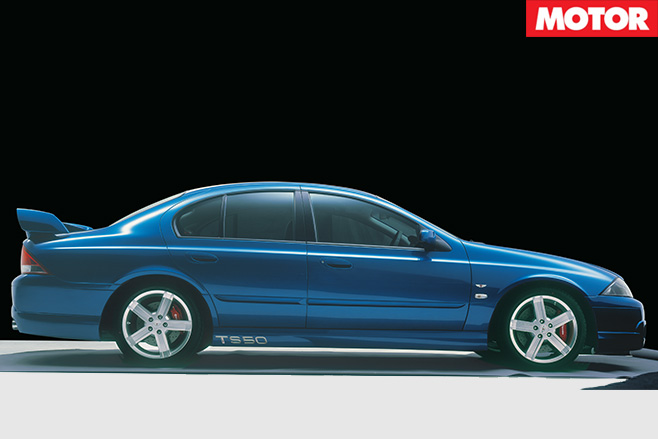
Here was the Ford brand’s saviour. The punters, especially the long-suffering Blue Oval troops whose every performance ambition has been relentlessly crushed by Holden and HSV, treated the stroked, hand-built TS50 like it was their own personal conduit between racetrack and road. Journos clamoured over themselves trying to get to Ford’s hierarchy, eager to be the first in the hotseat of the world’s only factory-built 250kW Falcon.
But, as Tickford supremo David Flint caught my gaze seconds after unveiling his beast, we exchanged the knowing smile of a secret well kept. Righto, it wasn’t up there with the Monao’s surprise appearance three years ago, but it wasn’t bad.
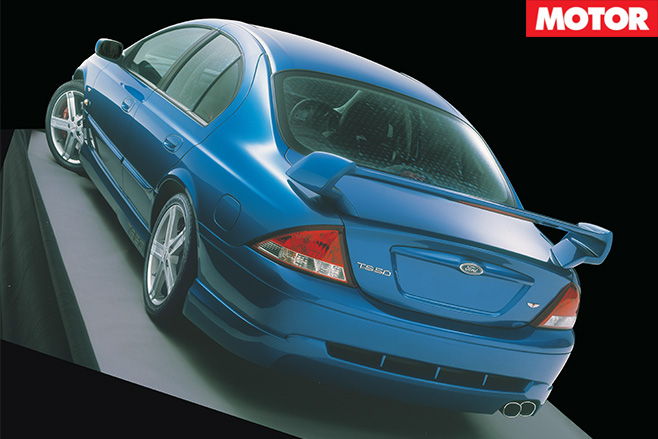
A month or two later, Ford’s big car marketing man Stephen Kruk and The Prez himself, Geoff Polites, were let in on the secret. For the longest time, not even the PR department was on the same page. Sorry guys. What most Ford folk didn’t know, what the assembled journos didn’t know, what you didn’t know until now is that everybody else was too late. Seven months too late. And late twice over.
See, we drove this fire-breathing new Ford a long time ago. So while everyone else was jostling for position in the queue for a ‘first drive’, MOTOR already had a couple of thrashes in what’s shaping to be the hardest-hitting factory Falcon of all time.
Ahhh, but torque? Now that’s another story. What Flint meant, but never publicly said, was that in the bottom two-thirds of the rev range, his team would be bloody happy to step into the ring with anybody. There, he believed, even his 220kW 5.0-litre with its 435Nm was more than a match for what the Blue Believers call The Evil Empire.
But the T3’s 500Nm crushes even the best 5.0-litre Windsors Tickford has turned out. It’s got more torque at 1800rpm than the old T-Series could boast when its hardest punches were being thrown. When we first came a-calling, this fast Falcon’s code name had yet to progress to the T3 it wears today.
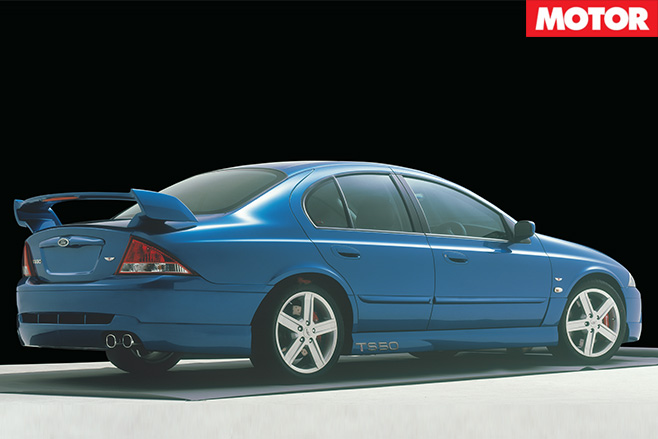
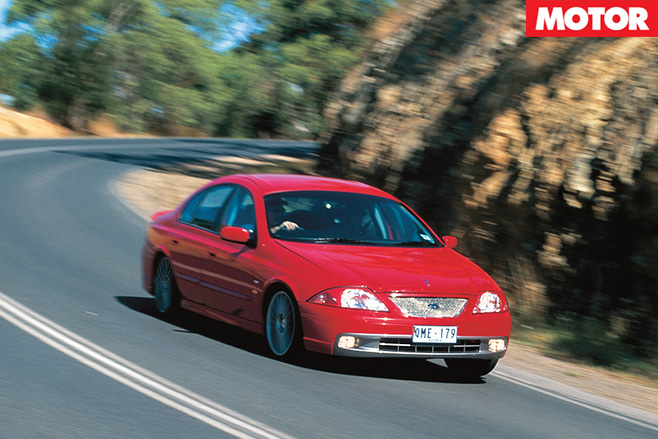
Photographer Helmut Mueller and I were expecting a fearful weapon, something fairly bristling with the sort of latent aggression eventually displayed by the blue TS50 concept car. Instead, we were confronted by a rather plain-looking red TE50. Say what?
The lensman was gutted, a head full of creative ideas blown away in the sweep of a dusty car cover. But that’s the way of development hacks and … wait … there are giveaways. The wheels on this T-Series are different; bulging with an experimental Brembo brake package, all bright red calipers and black tape, but still instantly identifiable as Italian four-pots.
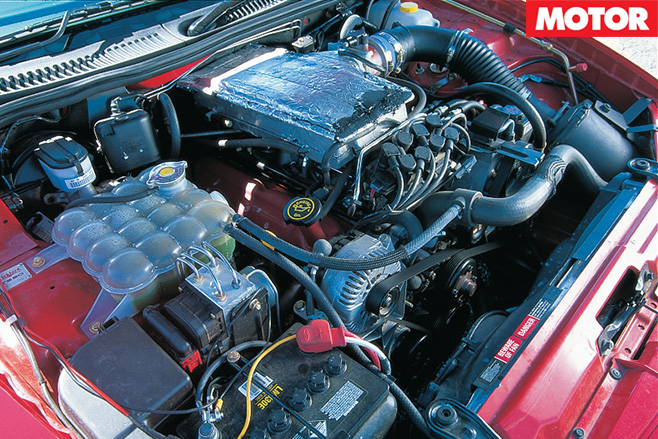
There had been rumours of forced induction – supercharging and turbocharging, even both together – as the preferred power route, but a scan of the engine bay puts that to rest. Nothing to see here, folks, except a plenum chamber that looks like something mum would pull from the oven on Sunday night, an industrial strength airbox and plumbing to match. Hmm, a stroker, then Winnie?
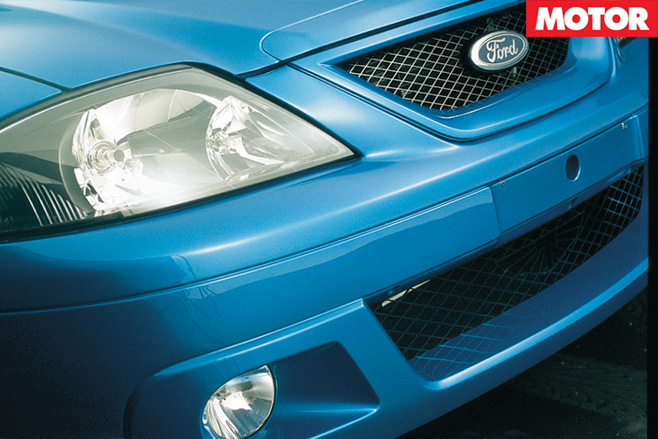
He nods and smiles. There’s bugger-all else to look at under the lid. The rest of this story is buried deep inside that engine. The key I’m handed looks the same as that of an XR, fits in the same hole, turns the same way.
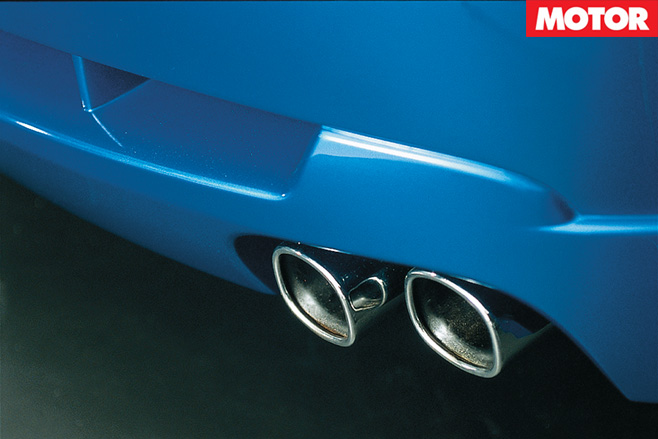
Ah, that’s it. The vibrations are a bit thin on the ground. And the sound. It’s deeper, even without touching the throttle. Richer, too. At this early stage of its development the ‘Stroker’ packs a TE50-spec T5 gearbox. Though rated at 470Nm, it ain’t up to this engine.
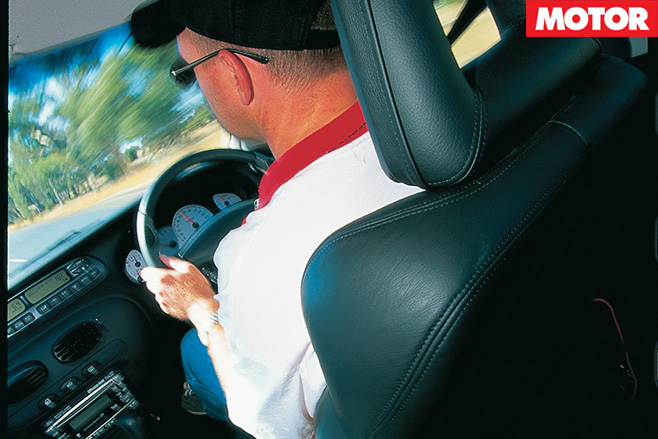
Heeding Winfried’s advice not to rush the shifts, I slot it into first and trickle the innocuous looking T-Series across to the Hume’s central traffic island, turning towards Sydney. Clutch feel, gearbox noise and that trace of driveline slap are all familiar.
Standing starts in XRs and T-Series are grouse fun. Tougher clutches than the hot Holdens, more step-off torque and a delicious engine note are all part of the play. Speed, at least when compared to HSV, isn’t.
But the old rules are out the door now, even in this plain red mule. The same 1800rpm clutch slip that sees a T-Series dependably off the line bags the Dunlop SP9000s ferociously in the T3 and, oh yes there’s more – plenty more – power there.
The XR8’s 14.58sec quarter mile time? I was in the car for that and it’s nothing like what this thing’s capable of. It should, all things being equal on a good day at Calder, be capable of matching the Clubsport’s mucho respectable 14.1sec sprint. And, with five useable gears, it’ll run hard in all of them.
The T3 is happy to cruise for a while too, as we find on the way to John Bowe’s favourite piece of test blacktop. En route, I remark that this is the best behaved mule I’ve seen. No bucking, no temper tanties, nothing. And it’s smooth, far smoother at constant throttle openings than Tickford’s handbuilt 220kW mills. As an added bonus, it’s got think-quick acceleration everywhere.
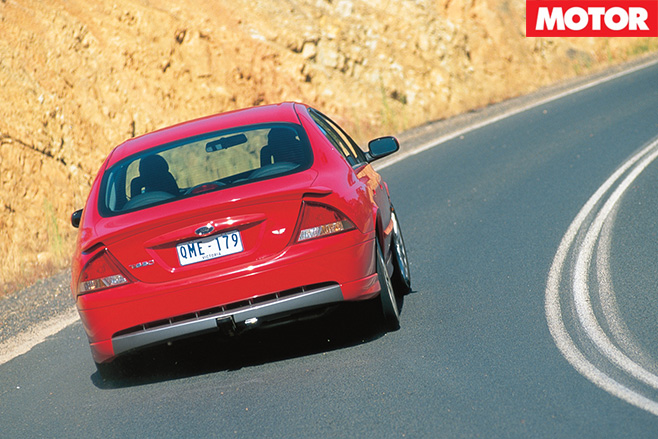
I attack a long, uphill bend on the noise in third gear and the T3 snorts and fires its way out the other side, the rear suspension convincing the rubber to accept more drive than any HSV possibly could.
Work around the slow, old gearbox (the proddy versions will run the Mustang’s Tremec TR3650 instead) and the rest of the package is brilliant. Beilharz explains that the engine’s been taken apart, stroked, loaded with hand-built, individually-balanced and blueprinted components, balanced again when it’s reassambled, then balanced again when it’s in the car. Its no wonder, then, that the lumpy spots across the 220kW Windsor’s rev range have been banished.
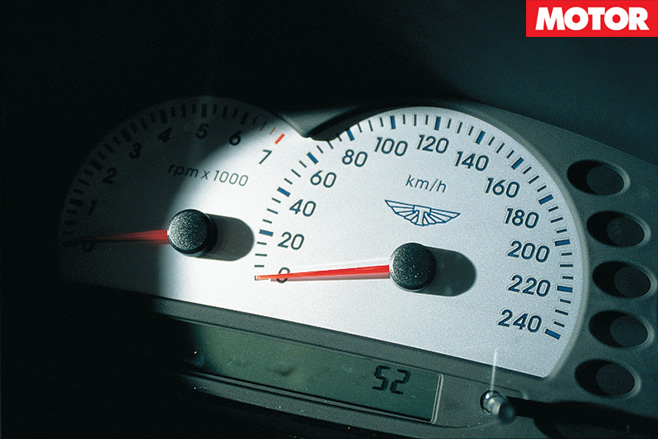
The last 500 revs – up around where the 250kW is actually made – isn’t exactly a no-go zone, but it’s not the stroker’s forte. No matter how precise the build, all that internal mass starts to trip over its own reciprocation above 5000rpm
Tickford admitted it hadn’t quite made 250kW in this early mule, one of the first of the 5.6-litre Windsors, but it had belted the hell out of the 500Nm target by a “very safe” margin. Rather than rev its ring out, it’s better to pick a tall cog and bludge it around on the torque curve, or keep short shifting to drop back into the engine’s meatiest bits. It seems just as fast either way.
EVERY STORY must have a beginning, and the Falcon’s started with the release of the XK in 1960.
Initially a locally-assembled version of the new US mid-sizer, it didn’t take long for the Falcon to be tweaked to suit Australia’s unique environment, setting in motion a narrative that would take 56 years to reach its conclusion.
It’s a tale with many twists and turns – and it was almost over before it began. Early Falcons were literally shaken to pieces by Australia’s rough roads and sales dived with the ‘Foul Can’ proving itself unable to hack life Down Under.
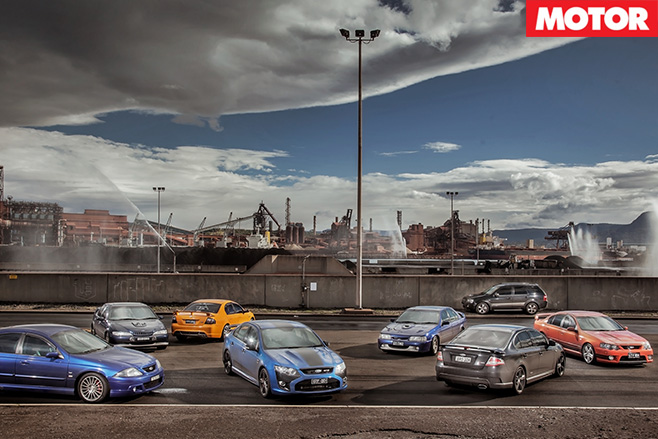
The Falcon was off and running, on its way to becoming arguably Australia’s most loved model. It’s this story that we’ll be telling over the next 12 pages, but this being MOTOR, we won’t be dealing with Fortes or Fairmonts, or discussing improvements in trim quality or rear leg room.
Nope, we’re interested in the fast stuff, the models that tore rear tyres to shreds, put a smile on the driver’s face and instinctively made enthusiasts turn their heads as they burbled (or roared) down the road.
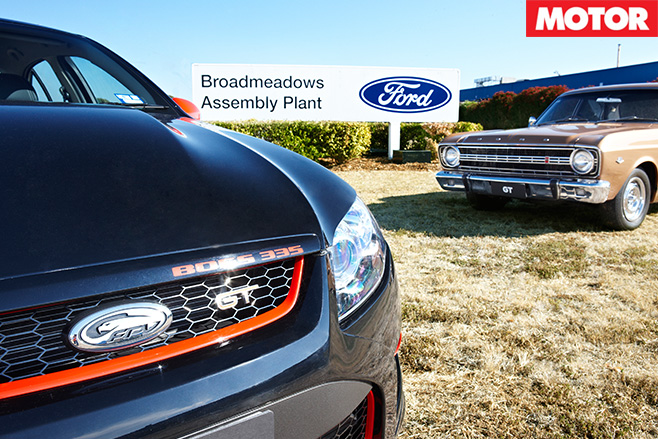
Sadly, at a time when Ford has rediscovered its performance mojo with cars like the new Mustang and Focus RS, we’re forced to celebrate what’s been rather than what’s still to come.
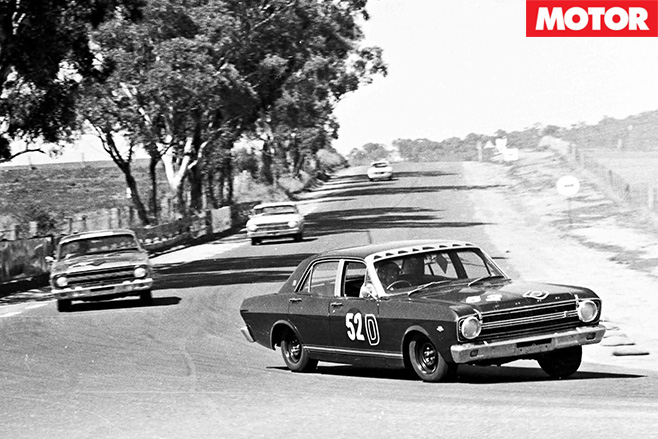
At Bathurst in 1967, a new chapter in Australian motoring began, entitled ‘High Performance’. Local manufacturers had dabbled in tuned-up variants of regular models in previous years, most notably Holden’s EH S4 and Ford’s Cortina GT500, but both were built in very limited numbers and so of questionable relevance to the car-buying public.
With a 168kW 4.7-litre V8, uprated suspension, front disc brakes, quicker steering and wider wheels and tyres, the XR Falcon GT redefined what constituted a fast car in Australia and set the Aussie muscle car template for the next 50 years. Crucially, 596 were built, which meant that your average Joe also had a chance of finding one in a dealership.
It was an immediate success, filling six of the top 10 places on the grid for the 1967 Bathurst 500 and, crucially, the top two spots on the podium, Harry Firth and Fred Gibson (pictured negotiating Murray’s corner) securing victory from Ian and Leo Geoghegan in controversial circumstances following a lap-timing irregularity. The leading Mini Cooper S, the car that had utterly dominated the previous year, was two laps down in fifth place. From now on, power would rule the roost at Mount Panorama.
It’s impossible to overstate the impact this first V8 Falcon had on Australia car culture. It was the first shot in a performance car war that would engulf Ford and Holden for much of the next 50 years.
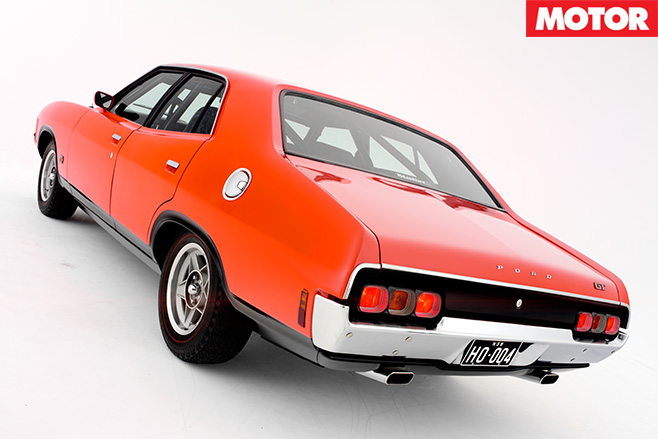
BY THE early 1970s, flower power had been replaced by horsepower. Ford, Holden and Chrysler were all engaged in a fierce battle to build the fastest Bathurst weapon – and Ford was winning.
The Bathurst qualifying times from this era provide a graphic example of the giant strides being made in performance year-on-year. Ian Geoghegan’s 1967 pole time in the XR GT was 3min3.0sec; by 1970 Allan Moffat had lowered that to 2min49.3sec in the XW GT-HO Phase II. A year later, however, driving the new XY GT-HO Phase III, Moffat recorded 2min38.9sec, an improvement of more than 10 seconds in 12 months.
The outcome of this arms race is well-known; newspapers got involved, governments were spooked, threats were made and the new breed of supercars was cancelled. Holden’s proposed V8 GTR XU-1 never saw the light of day, but with XA Falcon GT-HO Phase IV production already underway, four managed to escape captivity.
Three were race cars in Brambles Red, only two of which survive, while a solitary road car in Calypso Green was the only Phase IV to receive a compliance plate. Current values are impossible to gauge, as the last Phase IV to change hands was the car you see here in 2000.
It’d be more than 30 years before Ford created a Falcon with this level of performance again.
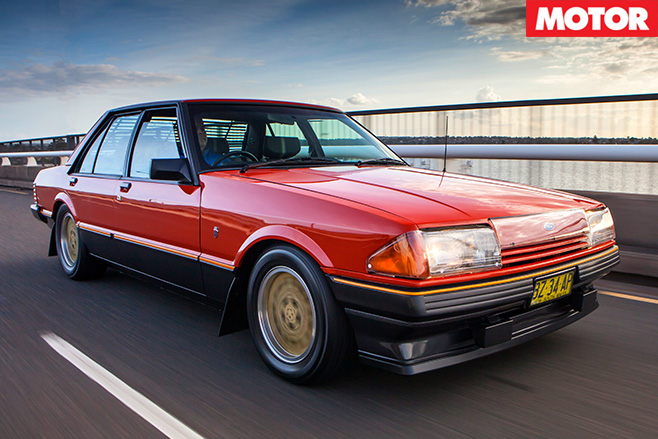
THE 1980s was a decade of dire straits, but while Mark Knopfler and his merry men were on their way to becoming one of the biggest bands in the world, performance Falcon fans were to discover the true meaning of the phrase when Ford announced it was killing the V8 in 1982. Officially, the last V8 Falcon was a 4.9-litre Fairmont Ghia ESP with a four-speed manual built on November 25, 1982.
It was a moment of some significance, with a media event held to commemorate the occasion and the car in question fitted with a plaque to cement its status. However, there’s plenty of evidence to suggest that Ford continued building V8 Falcons on a special order basis into 1983. It appears that these cars were built on the production line as six-cylinder models before being fitted with a V8 – whether it be the 4.9- or the 5.8-litre engine – at a later stage off-line.
Sadly, the factors that led to the V8’s demise – depressed economy, oil crisis – didn’t last as long as expected and Ford unwittingly steered a generation of enthusiasts towards Holden dealerships, who were only too happy to sell you a V8 Commodore similar to the one being driven by the likes of Peter Brock and Allan Grice at racetracks around the country.
However, nature abhors a vacuum and so does the automotive industry. Certain outfits, including Dick Johnson, who campaigned a Falcon in the Australian Touring Car Championship for as long as possible, began to investigate turbocharging the 4.1-litre six, but it would be another 20 years before a force-fed Falcon really caught on.
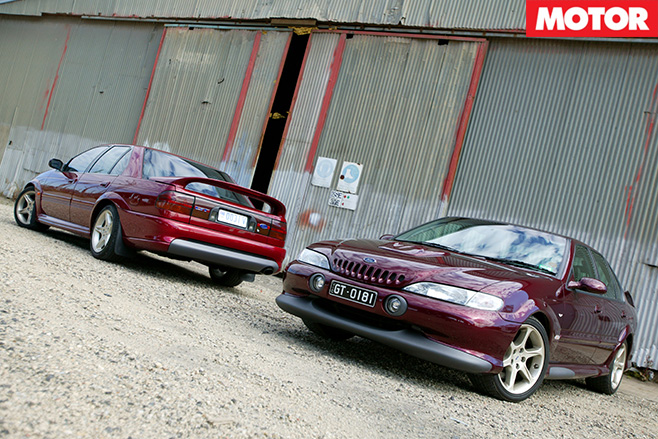
Hallelujah. Salvation at last. After an absence of almost a decade, a V8 returned to the Falcon line-up. With Aussie Jac Nasser at the helm, Ford was back in the local performance game in a big way. As well as the return of the V8, there was the introduction of a new sports model, the S XR8.
Less than a year later, the Series II update brought with it the Tickford-enhanced S XR6, as well as a new GT to celebrate 25 years since the introduction of the XR. It may not have been the prettiest GT, nor was it the fastest with just 200kW, but it was exclusive (265 built) and its very existence proved that Ford was once again serious about speed.
This resurgence was perfectly timed, as big rear-drive V8 sedans were once again Australia’s premier motorsport category, the controversial Group A regulations replaced by V8 Supercars in 1993. Only two teams used EB Falcons in that inaugural year, but between them they occupied four of the first five spots in the championship, Glenn Seton earning his maiden title.
Ford was riding the crest of a wave, the EF Falcon selling a record 81,300 units in 1995. The Commodore stole the sales crown in 1996, but the EL continued to sell well, though the 30th Anniversary EL GT was even uglier than the EB! Unfortunately, the decade ended with Ford struggling to shift the unloved AU while Holden sold up a storm.
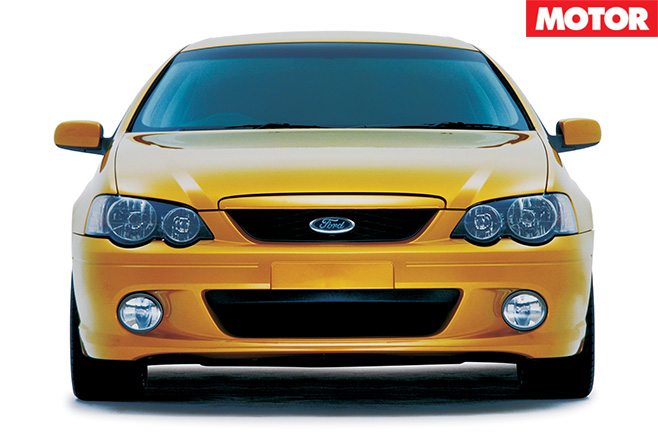
The arrival of the new millenium allowed Ford to show the AU was but a momentary blip. Holden’s VT Commodore and its successors had given the Falcon a bloody nose, but with the BA, Ford came charging back off the canvas.
Its broad-shouldered styling banished any memories off the droopy AU, its ride and handling instantly set a new Aussie car benchmark and there was now a full suite of performance models to choose from. Hell, even the base 4.0-litre atmo six Futura managed 182kW/380Nm, but you could also spec it with a three-valve 5.4-litre V8 good for 220kW/470Nm to create the ultimate sleeper.
The new XR8 scored a 260kW/500Nm four-valve version of the same engine, while the new GT, back as a regular production model thanks to the formation of Ford Performance Vehicles, upped the ante to an HSV-baiting 290kW/520Nm.
The true hero of the range, however, was the 240kW/450Nm XR6 Turbo. With a Garrett turbo forcing air into the new Barra donk, it was faster and sharper to drive than its eight-cylinder sibling, scoring a podium place at Performance Car of the Year 2003, one slot behind the $400K SL55 AMG.
And it kept getting better. FPV’s take on the Turbo, the F6 Typhoon, struggled with early clutch problems, but in BF guise, with a six-speed ZF auto and premium brake upgrade, Australia had its first six-cylinder performance car king since Chrysler’s E49 Charger.
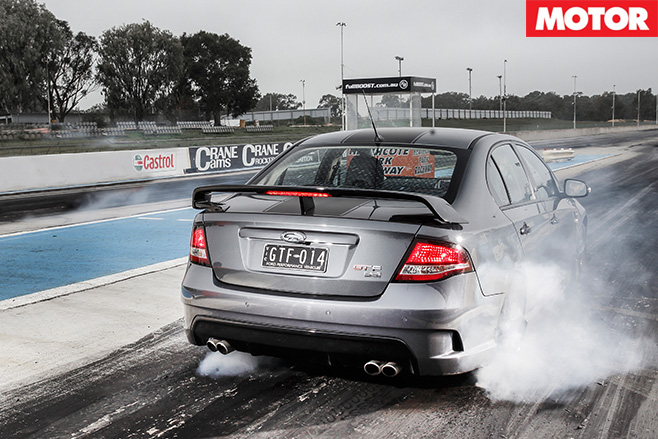
Having spent almost a decade playing second fiddle to its six-cylinder sibling, the V8 returned to its rightful place atop the fast Falcon heirachy thanks to a $36 million investment in the locally-designed and built ‘Miami’ 5.0-litre supercharged V8, which debuted in the Series 2 FG FPV range in late 2010.
It was rated at 315kW/545Nm in the GS and 335kW/570Nm in the full-fat GT, but it only took a brief drive to deduce that Ford was being somewhat coy with the engine’s true outputs.
It wasn’t until the release of the most powerful Falcon model ever, FPV’s GT F swansong, that engineers admitted the existence of the ‘transient overboost’ function, which lifted outputs closer to 400kW/650Nm.
Little wonder that on the right surface, these blown Blue Oval bullets could rocket across the quarter mile in the mid-to-high 12-second bracket, radically altering the Australian performance car landscape. Would HSV have introduced a 430kW/740Nm supercharged GTS if its crosstown rival hadn’t raised the stakes to such giddy heights?
It’s a fitting final chapter to the Falcon story. Like any classic tale, there have been highs and lows, heroes and villians, but crucially it’s kept us captivated until the very last page. Now, after 56 years, it’s time to close the book.
Shane van Gisbergen has upped the drifting ante by hurling a V8 Supercar around Sydney Motorsport Park. At Night.
ON A LIST of awesome promos by Australian racing teams, Triple Eight Racing has shot straight to the top by building a legitimate V8 Supercar drift car.
The recipe is delightfully simple. Take one V8 Supercar raced by Jamie Whincup earlier in this year’s championship, add quadruple the steering lock, dual brake callipers at the rear, flared wheel arches and a hydraulic handbrake, then throw Shane van Gisbergen behind the wheel and film the resulting smokefest.
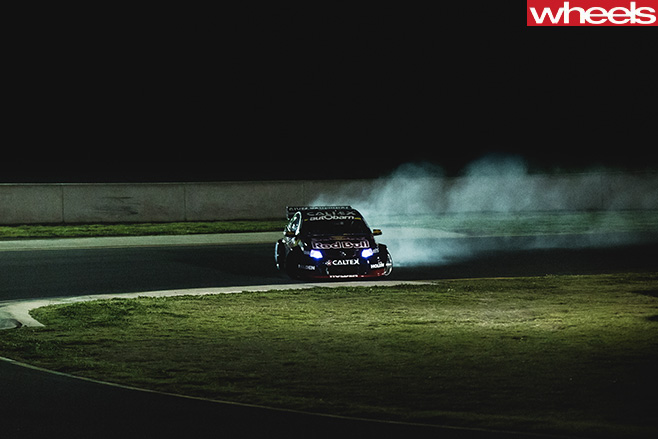
But the Kiwi has always complained about a lack of steering lock in the V8 Supercar when it comes to the sideway action.
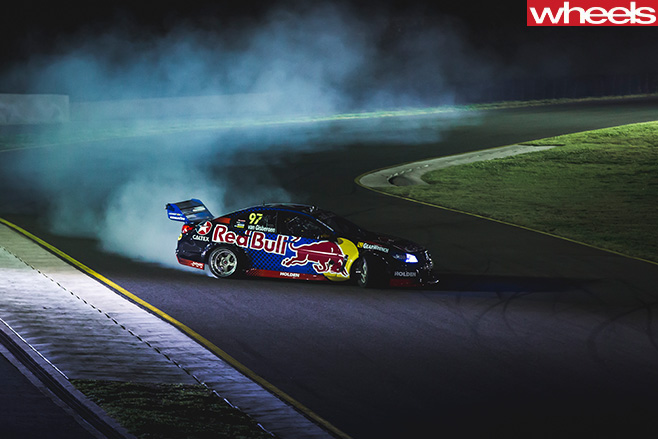
This new project, which was headed up by Triple Eight’s Team Manager Mark Dutton, seems to solve that problem, with custom steering arms resulting in 60-degrees of steering angle. Impressive when you consider a V8 Supercar usually only has 15-degrees.
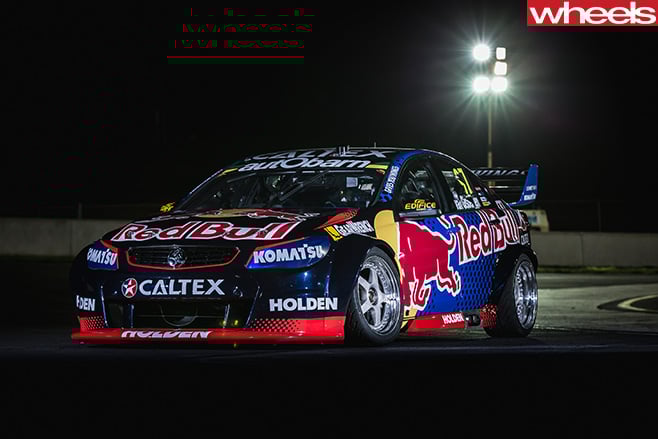
Packing over 470kW, the V8 Supercar is more than capable of transforming rubber into smoke in spectacular fashion.
“It was an awesome thing to be a part of,” said Van Gisbergen.
“To be able to combine my love of drifting with a Supercar was cool. I never thought I could put the two together, but the car performance was really great. I was able to really go hard around the bends, we really smoked it up.”
This article is brought to you by Savvy Finance.
When we see big, clunky wagons on the road, we may assume it’s a “kid carrier,” the vehicle to cart the little-ones around (and their various bits of equipment for sports and activities). Wagons are long, difficult to park and a nuisance to maintain. Can a large to medium hatchback replace the humble family wagon? We think the five-door variations definitely can – so we spoke to Bill Tsouvalas, CEO at Savvy Finance, Australia’s leading car finance institution to come up with the list for you to consider over a big old (and considerably more expensive) wagon.
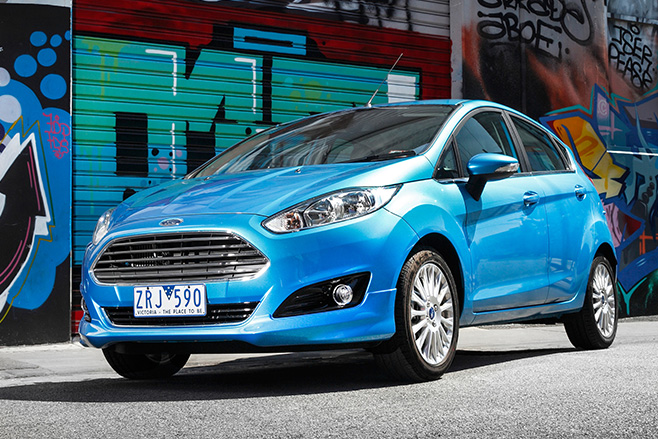
A good balance of performance, comfort and roominess, the Ford Fiesta Sport is the first ‘wagon killer’ on the list. It’s powered by a 1.0-litre three-cylinder turbo EcoBoost engine. Even if you’re not a petrolhead, you’ll agree that’s small. But it pulls well low in the revs, bolstered by smooth steering and handling. Cabin space and storage is ample, too.
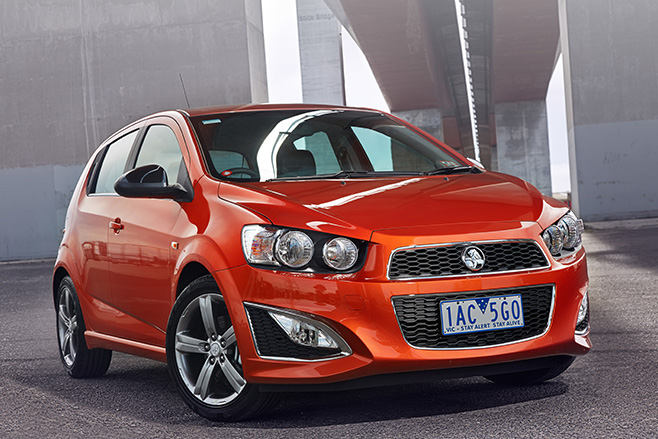
The Barina RS features a MyLink entertainment system, perfect for the kids on long trips. It’s much more spacious than the Fiesta, being taller, longer and wider. The Barina also features a double glovebox, cup holders and front seat heating. A 1.4-litre four-cylinder turbocharged engine, perfect for city driving, revs it up. Though you will have to get used to some mushy controls, though. This could prove a decent stopgap until the re-introduction of the Opel (rebranded now as Holden) Astra hatch next year.
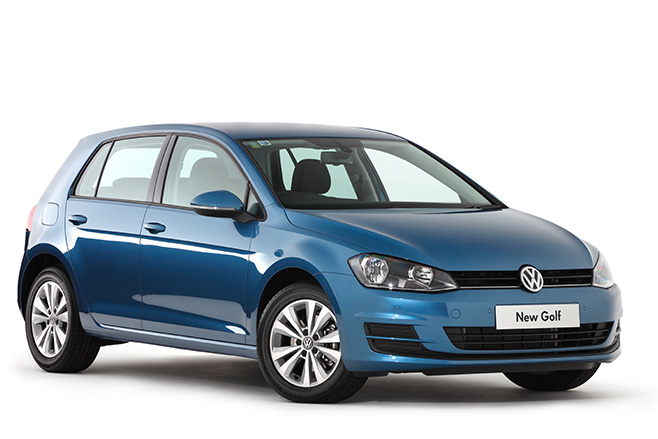
VOLKSWAGEN GOLF 92TSI COMFORTLINE
A step down in length from the bulky Volkswagen Golf R wagon, the 1.4-litre turbochargedfour-cylinder puts out a handy 92kW and 200Nm, which is more than enough for the suburbs. It boasts a big high resolution 6.5-inch touchscreen display, controlling the satellite navigation and Apple CarPlay/Android Auto functions. It’s not the biggest hatch on the market, but the inside is far roomier than the outside suggests.
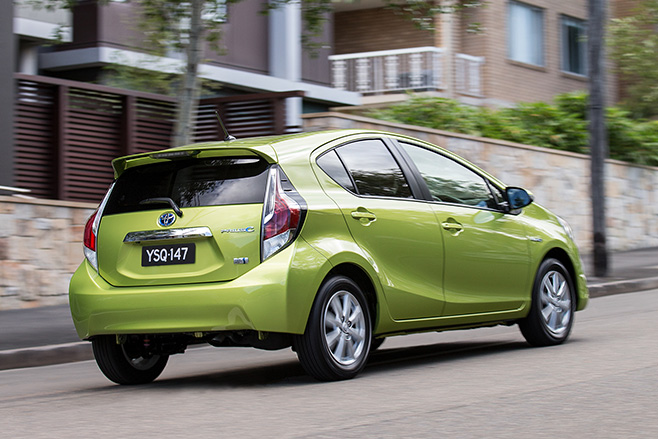
Feel like going green? (Or rather, saving money on fuel?) Packed with storage and features such as an infotainment system and enhanced ride comfort, the i-Tech is the updated – and cheaper – version of the original Prius C released earlier this year. The petrol engine is a 1.5-litre four-cylinder outputting 54kW, teamed up with a 45kW electric motor and nickel-metal-hydride battery. The best part? Toyota claims it only uses 3.9L/100km combined.
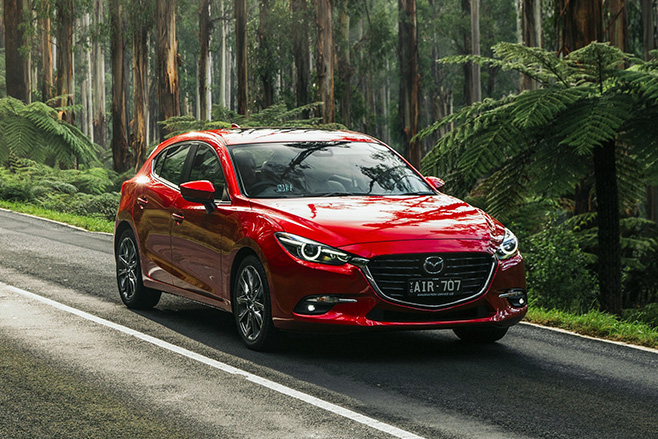
Australia’s fourth most popular new vehicle, the Mazda 3 has improved its safety equipment, cabin space and dashboard for easier USB charging and steering. A 2.0-litre inline-four cylinders pumps out 114kW, which is more than enough grunt for driving around the suburbs. Couple it with its unique G-Vectoring system that helps smooth out steering, and the handling is that much more exciting. The cabin is also a winner, rivalling some of the larger (and more expensive) cars in its class.
The first time I ever saw inside an engine, I was standing in a pool of oil by the side of the road, staring horrified through the gaping hole in the side of my car’s cylinder block.
This article was originally published in the August 2002 issue of MOTOR.
One minute I’m sailing along in top gear, tacho pointing north, the next, there’s a bang big enough to father a new universe.
The old girl had snapped a gudgeon pin, fired number three piston into the open exhaust valve (shutting it permanently) the con-rod had tangled with the cylinder wall and snapped in two with the bigger half launching through the side of the motor, knocking the engine mount off the cross-member and even snapping the centre main-bearing cap.
Salvage? The camshaft, manifolds and alternator. The rest was swarf. Complete devastation. Oh dear.
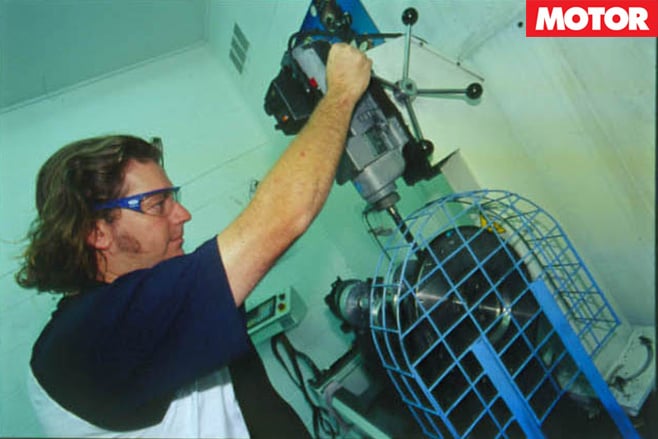
So, yeah, I still do my own servicing, I kind of know my way around a Holden red motor and I’ve rebuilt the odd air-cooled motorbike engine (four valves per cylinder might be sexy in the brochure, but it’s a different story when you’re lapping in valves by hand). And let’s not forget that when it comes to bolting together a 250kW stroked Windsor, I’m no more qualified to reach for a torque wrench than yer average NRL cheerleader.
See, you can’t just throw a long-leg Windsor together from 10 metres away. If you want it to hang together and produce its full 250kW, it needs to be assembled by somebody who knows what’s what.
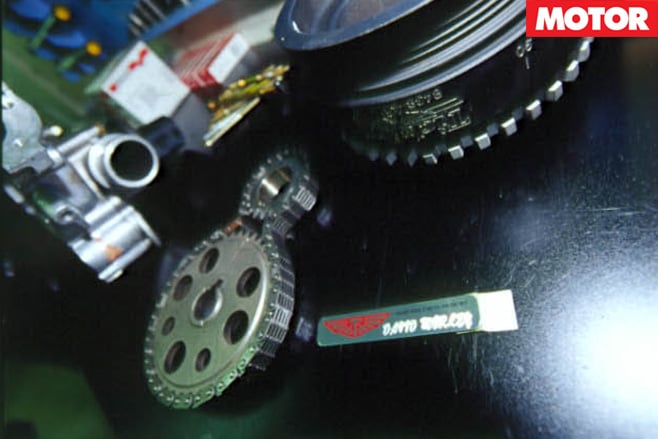
See, MOTOR is taking delivery of a TE50 long-termer and Ford’s comedy relief team (aka public affairs department) figured it would be a good idea if one of the blokes who would eventually thrash the TE’s tatters off had a hand in building its powerplant. Eeek.
By the time I arrive … late … Tickford’s ace engine man, Phil, has already got everything laid out and the engine up to short motor stage. That is, the crank, rods and pistons are all assembled and torqued, but I still get a feel for the bottom-end balancing process by messing about with the crank and rods of another engine (two stuffed motors for the price of one, then).
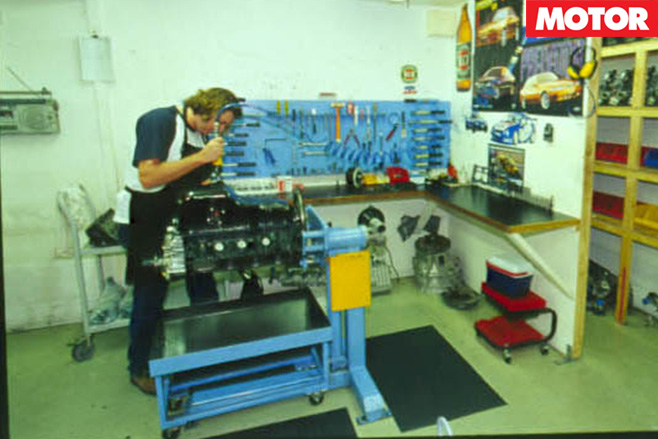
The camshaft is the first thing to slide in and I manage to smack the lobes into every bearing as it disappears into the bowels of the Windsor. Phil can do it one-handed, like he’s sliding a knife into a fruit cake. Bastard.
The harmonic balancer goes on next and is torqued to a set value which remains a mystery to me. See, here’s the clever bit: rather than use a single torque wrench which needs to be reset for each job, Phil and George (Tickford’s stroker dudes) have a specific torque wrench for each stage of the assembly. Head studs? Use the head-stud wrench. Lower manifold? Use the lower-manifold wrench. You get the idea.
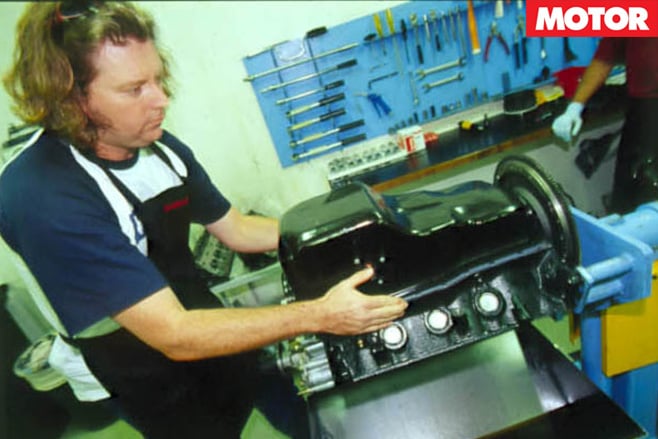
On go the heads and the studs are torqued in a specific sequence, twice with the first torque wrench (to allow for the gasket compressing) a third time with the second wrench set at a higher value and a fourth time with a breaker bar that adds a final quarter of a turn to each stud.
The roller-tipped hydraulic lifters and push-rods are slid into their holes (there’s probably a more technical term, but ‘holes’ works for me) and the roller rockers bolted up in pairs according to the engine’s firing order.
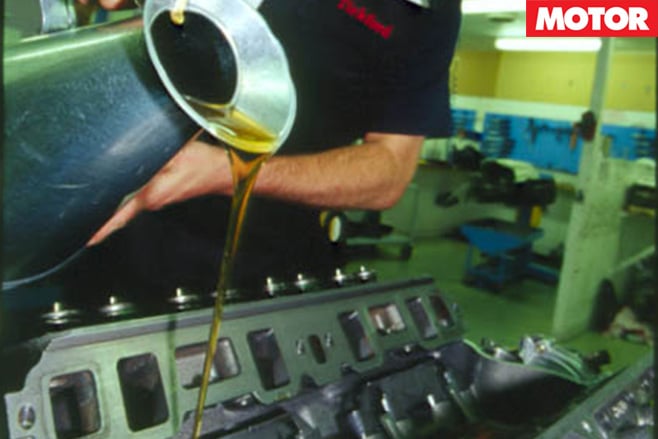
The lower manifold – which carries the fuel injectors – is bolted up next and then the upper manifold (which is a 200kW item and will be changed once the engine is fitted to the car. Weird, but that’s the necessary interface between an assembly-line car and a hand-built engine) is torqued down.
Rocker covers and exhaust manifolds go on now and finally it’s stuff like the loom fitted and the injectors clipped into it, some sensors hooked up and spark plugs screwed in.
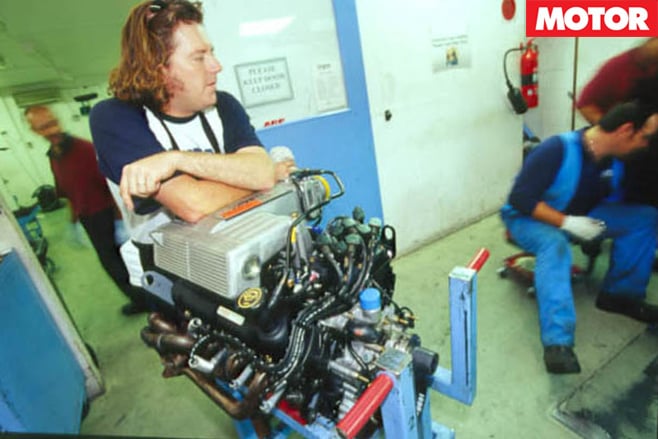
A cheeky little work experience kid pushes over a trolley, the engine is dropped off its stand and I wheel it out to the test bench like a nurse who’s just delivered a screaming sprog.
An enormous bloke I know only as Sir hooks up the exhausts, electronics and fuel, looks at me like he sees engines blow up every day, and pushes the button that spins the starter motor. And bugger me; it runs.
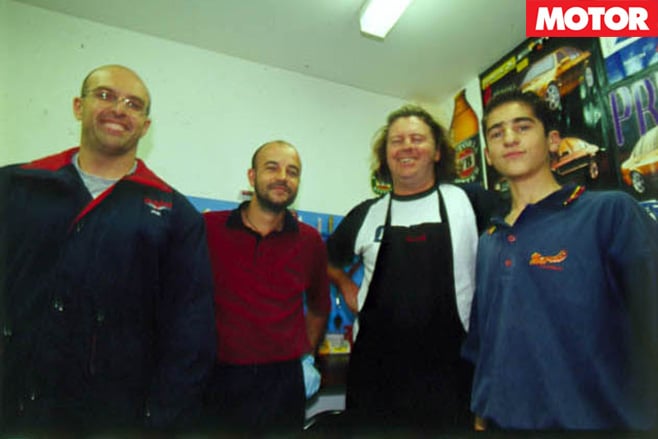
So, now there’s no turning back. If it blows up it’s either because the MOTOR boofheads in general killed it deliberately or this large, hairy boofhead in particular screwed it together all wrong.
Christ, I hope it hangs together. And in that sentiment, I suspect, I’m just like any engine builder anywhere in the world.
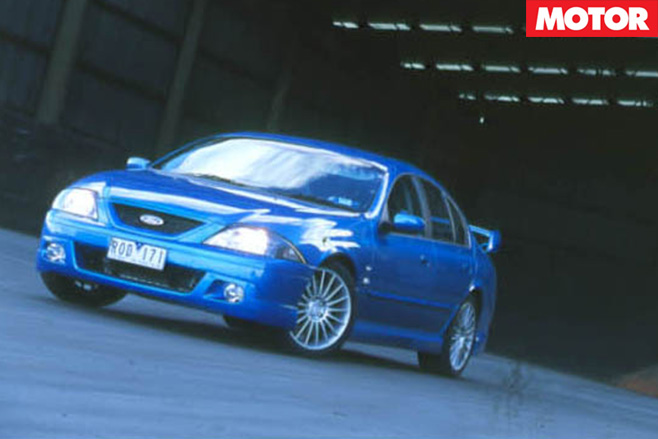
The Morley masterpiece finds a home
So Morley built this thing. They’re a hardy lot, Ford staffers. Four years of the AU hasn’t dimmed the collective sense of humour. The redoubtable Mr Flint and his troops have gathered to make sure the mill at least gets the TE off their land before it shits, which just leaves a Melbourne-Sydney drive to run it in. They’re casual about it, too. Nothing specific for this engine/gearbox/drink holder package, save staying off racetracks for a month or so.
Still, big throttle and big loads at low to middling revs is the accepted wisdom. Oh, and don’t let it sit on one opening for too long. Hence the fuel consumption figures. So if you followed a TE50 up the Hume that lonely Thursday night in June, now you know. That incessant dropping to 50-60, BWOOOAAARRing to 110 and back again wasn’t just to hear the noise. Or was it?
IF YOU are a car manufacturer that doesn’t have an SUV or light commercial vehicle for sale in Australia, it’s time to start worrying.
Australians just can’t seem to get enough of the two categories, with both segments experiencing a strong continued rise in sales.
In September 39,497 SUVs were sold for a year to date total of 332,103. That represents a 6.8 percent rise on the same month last year, and sales that are 9.9 percent up on the same point last year.
Meanwhile, overall new car sales are up 1.3 percent nationally compared with September last year, with 887,076 cars being sold so far in 2016. That equates to a 2.8 percent increase compared with the same point in 2015.
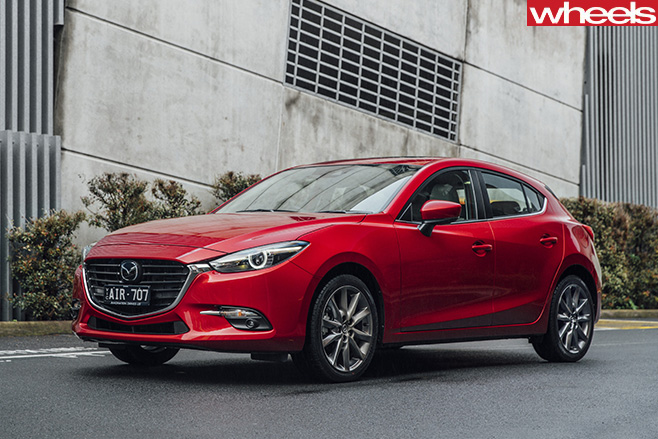
Mazda topped the best-sellers list, with 3491 Mazda 3s leaving showrooms in September.
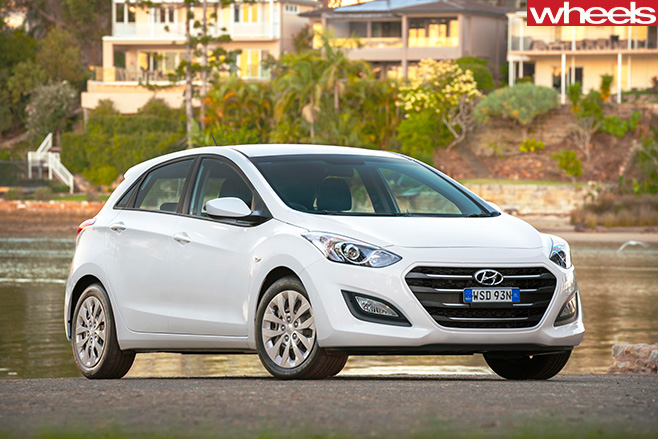
Next was the Ford Ranger with 2903 sales, soundly beating the Hyundai i30’s 2741 sales.
The strong performance by Corolla and Hilux makes Toyota the best-selling manufacturer so far this year, with 155,175 sales (a 64,475 unit advantage over the closest competitor Mazda) netting them a 17.5 percent market share.
Mazda and Hyundai finished second and third overall respectively year to date, with Holden trouncing Ford with 71,312 sales to the Blue Oval’s 61,406.
Mitsubishi, Nissan, Volkswagen, Subaru, and Kia rounded out the top 10.
Interestingly, private sales are down by 8.2 percent in September this year compared with September 2015, while business purchases are up 14.3 percent.
Ahead of the closure of Ford’s local manufacturing plant this Friday, sales of Aussie-built cars continued to plummet. Holden, Toyota, and Ford each sold fewer than 8000 locally built cars between them.
The Mazda CX-3 was the best small SUV in September (1878) ahead of the Mitsubishi ASX (1776), and Nissan Qashqai (1141).
Mazda also topped the Medium SUV segment with the CX-5 (2662) ahead of the Hyundai Tucson (2209), and Toyota RAV4 (1617).
Top 10 selling brands in September 2016
| Rank | Brand | Sales |
| 1. | Toyota | 16,716 |
| 2. | Mazda | 12,009 |
| 3. | Hyundai | 9319 |
| 4. | Holden | 8564 |
| 5. | Ford | 7280 |
| 6. | Mitsubishi | 6701 |
| 7. | Nissan | 5177 |
| 8. | Volkswagen | 4380 |
| 9. | Subaru | 4050 |
| 10. | Kia | 3687 |
Source: Federal Chamber of Automotive Industries
First published in the November 1992 issue of Wheels magazine, Australia’s best car mag since 1953.
An emotional Jim Richards once told the Bathurst crowd: “You’re a pack of arseholes!” Here’s Wheels’ account of what led up to that infamous 1992 outburst.
It was, perhaps, Bathurst’s darkest day. Mark Fogarty was there to record the drama and tragedy you didn’t see.
IT’S three hours since his Nissan GT-R skated off the track amid murk and mud and Jim Richards has been on an emotional rollercoaster. He’s ridden his feelings through disbelief, despair, guilt, surprise, elation, disgust and relief.
Now in the Winfield racing tent, surrounded by crew and friends, the biggest emotional wave is about to engulf Richards. He is proposing a toast to his friend Denny Hulme, who suffered a fatal heart attack early in the race.
“We all lost a good mate today.” Richards says, his voice so strained he is almost choking on the words. “Ladies and gentlemen, would you charge your glasses… to Denny.”
The memory is too much and Richards can no longer contain his grief. Overcome by sadness and mourning, he cries. For several minutes he wipes tears from his eyes as he is comforted by Russell Skaife, friend and father of his team-mate Mark.
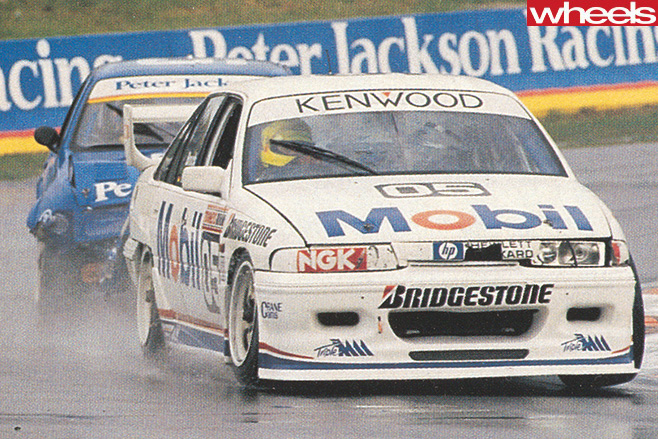
Richards took Hulme’s death very hard. They had been very close, Kiwi comrades whose relationship was described as “a mutual admiration society” by a long-time friend of both.
A few hours earlier, just after 4.30pm, Richards didn’t have time to think about Hulme. His mind was focused on keeping Godzilla from falling off the Mountain. As he headed up the hill on lap 145 of the Tooheys 1000, Bathurst was blinded by torrential rain.
Slick tyres and a streaming track proved too treacherous even for the best wet-weather driver in the best wet-weather car. The Nissan lost all grip at the Cutting and slid into an earth bank, almost tearing off the left front wheel.
Richards managed to keep the car going up and over the hill, crab-crawling at little more than idle speed. As he struggled to stay on the track, others were spinning and crashing.
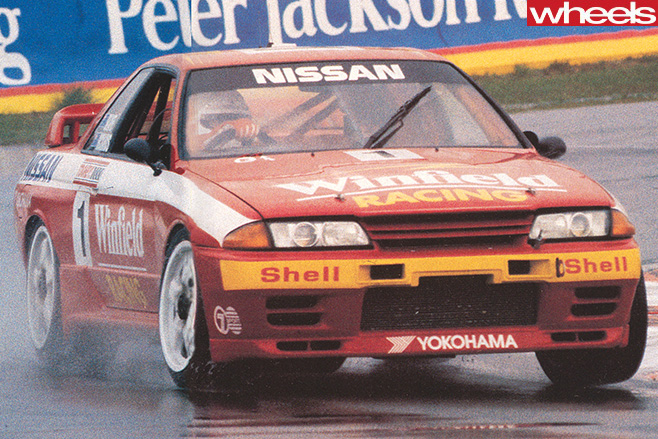
Coming out of Forest Elbow onto Conrod, Richards became a passenger as the battered GT-R slid out of control into a concrete wall, then slipped out and slammed into the aftermath of a multi-car accident just moments before.
When Richards left his wreck, he was unaware that the race had been declared at 144 laps, when he was far in front. The Winfield wonder car had been there since the second lap, when Skaife passed Dick Johnson at the end of Conrod Straight.
By the time Richards got back to the pits, where he was stunned to learn that he and Skaife had retained their Bathurst crown after all, the crowd was already baying for blood. They regarded Johnson, whose Shell Ford Sierra was still running after being shod with wet rubber during the Mountain mayhem, as the rightful winner.
It all turned ugly during the victory presentation. As Richards and Skaife stepped onto the podium above pit straight, the mob chanted “Bullshit, bullshit” and other choice epithets.
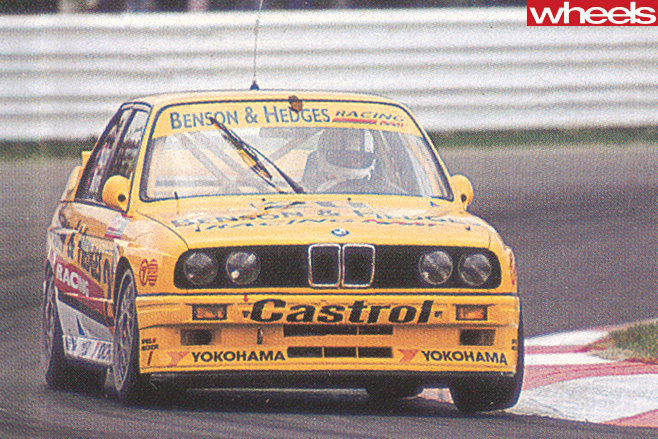
Down on the ground, Nissan managing director Leon Daphne, bravely brandishing a corporate umbrella in the midst of hostile natives, was taunted into retaliation. In response to repeated singing of “Nissan cops it up the arse, doo-dah, doo-dah,” Daphne turned on the crowd, battering boofs with his brolly.
Even more remarkable was Richards’ response. “This is disgraceful,” he barked. “This reception will stay with me for a long time. I thought Australian motor sport fans were made of more than this. You’re a pack of arseholes.”
Although uncharacteristic, Richards’ outburst was justified. On this day of triumph and tragedy, he spoke the words millions were mouthing at home.
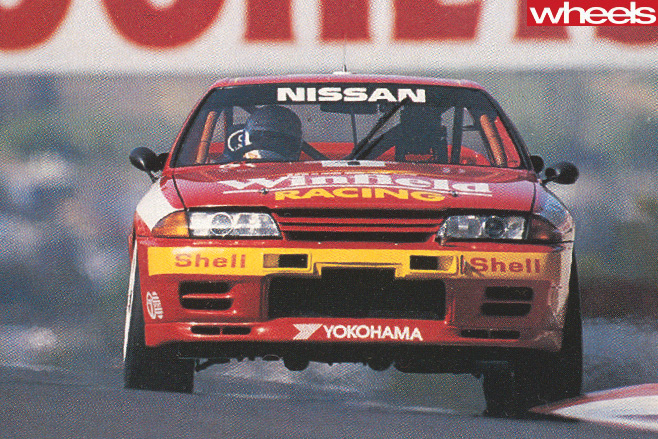
It was the day of the Black Reign, when dark clouds – both real and metaphoric – cast their pall over the final appearance of the Nissan GT-R.
Of course, it was always going to be a contentious and eventful 30th running of The Big Race. Small minds and big issues guaranteed controversy.
The car that ate Bathurst in 1991 returned hungrier, if not leaner. Despite Winfield Racing team boss Fred Gibson’s earlier vow not to bring the handicapped Nissans to Bathurst, where he claimed they would be unsafe and uncompetitive, the team arrived in full force.
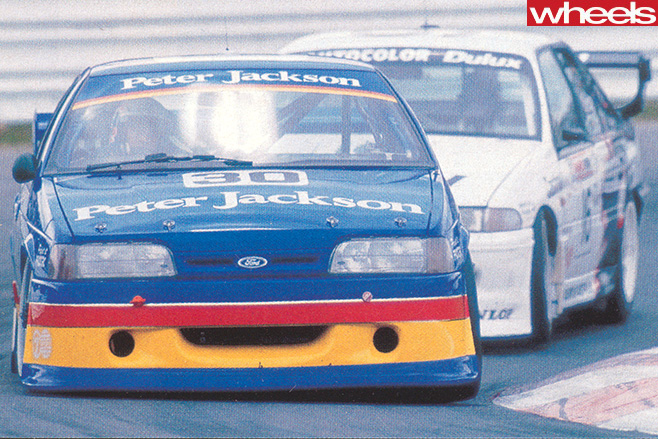
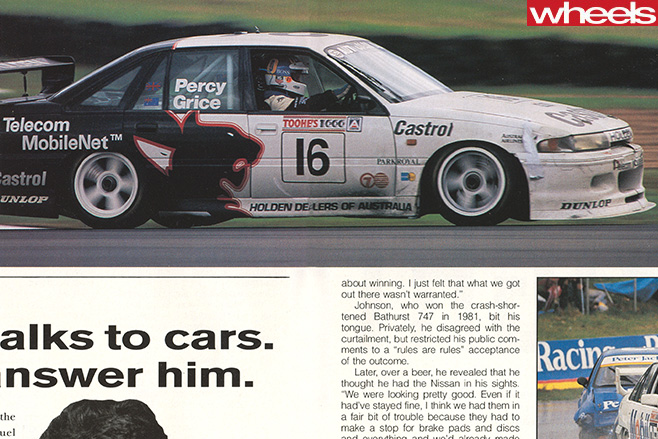
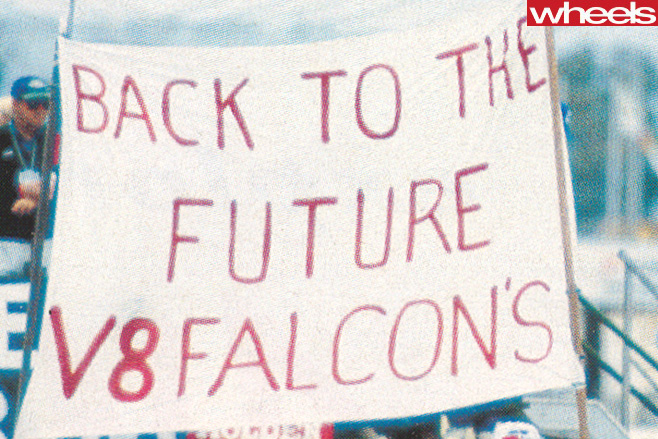
Among the punters, resentment of the four-wheel-drive, twin-turbo supercar was made more intense by the restrained resumption of the V8 wars. For the first time since 1984, there was a Falcon V8 in the field. Glenn Seton’s Peter Jackson EB Falcon joined the VP Commodores of Allan Grice, Tomas Mezera and Peter Brock to preview Bathurst ’93, when V8s will be the only Tooheys Top Guns.
It was into this highly charged atmosphere that I returned to Bathurst after five years and half a world away. Would Mount Panorama still be a motorsport peak after the glam jam of Formula One?
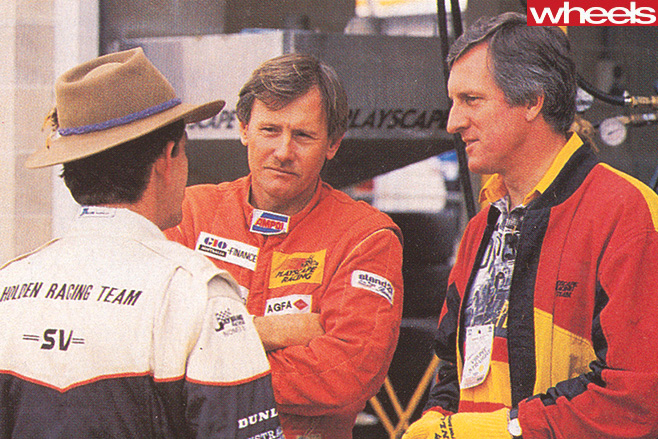
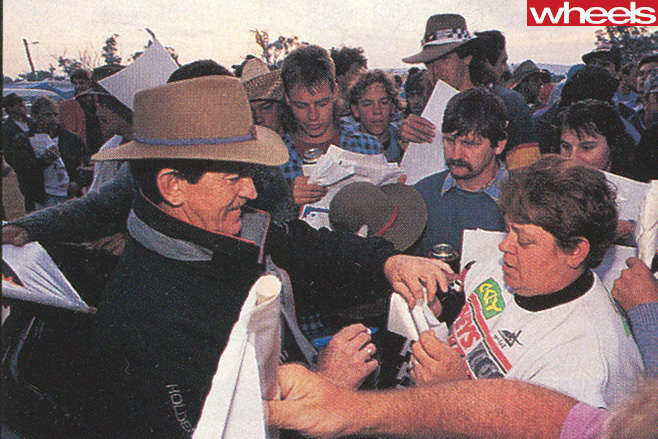
Well, it was different. Especially Saturday evening, when I took a trip up the Mountain with Holden hero Grice, freshly elected state member for Broadwater in Queensland. For the past eight years, Gricey – ah, the Right Honourable Gricey – has been treating campers on the hill to sangers, tinnies and all the autographs you can find space for.
The mountain men and women are a feared breed among the gentlefolk down in the paddock. But we survived. Grice and teammates Tomas Mezera, Win Percy and Brad Jones were received enthusiastically and treated with respect.
Hundreds of fans turned up and, while Grice and the gang signed anything from books to bosoms, helpers dispensed barbecued sausages in rolls, cans of beer and highly prized HRT flags.
According to Gricey, he’s never had any trouble with the camping corps. “I’ve seen little problems start and they police themselves. You know, they stop it – they say ‘Hey, you, out! ‘ – because the last thing in the world they want is for you to pack up and go away.
“It’s regarded as an ‘Animal Factory’ up here. People don’t come up because they’re frightened they’ll be beaten up and peed on. Those are the stories you get and that’s why the drivers don’t go up there. But they’re not animals, are they? They’re just a rough bunch having a good time.”
One celebrity who didn’t dare venture onto the Mountain was Doug Mulray, former king of Sydney breakfast radio, host of the Naughtiest Home Videos television show which had its plug pulled, Jaguar fan and full-on petrol-head.
Mulray, a member of Seven’s commentary team, was mobbed whenever he left the TV compound. Shouts of “Dougie, Dougie!” rivalled those for “Brocky!”.
The rude Reverend Doctor Doug is a Brock fan and he had no intention of lambasting motor racing’s folk hero. “There’s nothing funny about Brocky, nothing funny about any of the heroes. Whether they’re on the right side – the Holden side – or the Ford side, I’m fascinated by what the Brocks and Johnsons do and how well they do it. I don’t want to demean them. I’m here because I love it.”
Bathurst brings them from everywhere. Federal Opposition Leader Dr John Hewson took a break from sparring with Ford and Toyota over his vision of the motor industry to join the pit crew of Gold Coast businessman Kevin Waldeck’s Ampol Sierra team. Waldock likes Hewson’s policies and early this year contacted the would-be PM, offering him race driving tips and honorary membership of his team.
Hewson, Ferrari owner and long-time motorsport follower, accepted Waldeck’s invitation to crew for the team in the 1000. His presence was a coup for Waldock, guaranteeing newly signed sponsor Ampol plenty of media exposure. Of course, it also gave Hewson the opportunity to push his political barrow in front of a largely captive audience of around four million.
Not that Dr Hewson, who was shadowed by his press secretary, was looking for an opportunity to reverse negative publicity that he has it in for the local car industry. “I didn’t do it from that point of view,” he said. “I committed to this long before the whole issue broke, really. I’ve always had an interest in motorsport and I think motorsport really is a very good sport from the point of view of most Australians.
“I think a lot of people would watch the race and understand there’s no politics in it. You just do it because you enjoy it. I could get better coverage at a lot of other sports which I don’t support.”
No politics at Bathurst? Perhaps if the good doctor had poked his head out of the pits, where he spent the day helping to change the right (of course!) front wheel of Waldeck’s Sierra, he would have noticed the air was thick with intrigue.
Everyone was grumbling about the Nissans, saying “I told you so” as the Skaife/Richards GT-R capitalised on the morning downpour to build up a comfortable cushion.
By the time the race was red-flagged, there had been two torrents and four pace car periods. It made for a long and dramatic – as opposed to exciting – race, marred by ill-feeling and bad sportsmanship at the finish.
What’s more, the bizarre circumstances of Nissan’s era-ending victory only seemed to harden Fred Gibson’s bitterness. “Blew the shit out of them!” he chuckled as he prepared to leave the track.
“That’s what we came here to do, isn’t it? Stuff ’em all, the whole lot of ’em. And the crowd was a bloody disgrace – an absolute disgrace. That’s bloody typical of the way Australians have got lately, isn’t it?”
After his ordeal, in conditions all drivers agreed were the worst they’d experienced in an Australian race, Richards was relieved and unrepentant. “I had no idea we’d won the race until it was announced. I’m terribly excited about winning. I just felt that what we got out there wasn’t warranted.”
Johnson, who won the crash-shortened Bathurst 747 in 1981, bit his tongue. Privately, he disagreed with the curtailment, but restricted his public comments to a “rules are rules” acceptance of the outcome.
Later, over a beer, he revealed that he thought he had the Nissan in his sights. “We were looking pretty good. Even if it had’ve stayed fine, I think we had them in a fair bit of trouble because they had to make a stop for brake pads and discs and everything and we’d already made our last full stop. It would’ve been a very exciting finish.”
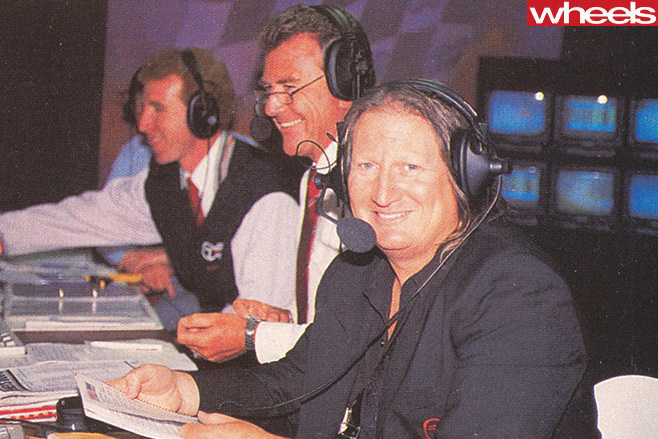
Mulray, meantime, was still shaking his head about his incredible day in the commentary booth long after the closing credits of Seven’s telecast. “I feel shell shocked. It’s an extraordinary thing to be part of. I said yesterday it was the best race in a long time coming up and in many ways it was the worst race in a long time.”
Dr Hewson, whose manner during our conversations failed to convey the enthusiasm suggested by his words, couldn’t resist political point scoring when asked to comment on the behaviour of the crowd at the presentation.
“I think it was frustration, a natural frustration about the race not running its course. And, as well, there’s a healthy degree of Australian competitiveness when it comes to the automobile industry.
“I go back to my view on the car industry. I think most Australians, if they could look at their own cars – the cars made in Australia – and see they were among the best in the world, that’s where we want the industry. They’d like to see a Ford or a GM make a car that’ll compete with the Nissans and beat it.”
Written, spoken and authorised by…
Being a professional racing car driver probably isn’t always as fun as it might seem.
Some days, however, it definitely is. The team from Red Bull Racing Australia descended on Sydney Motorsport Park after dark with a custom-built drift-spec VF Supercar for driving phenom Shane Van Gisbergen to shred some tyres with.
The regular Supercar scored extra steering lock, a handbrake and wider wheels and tyres to allow SVG the extra control needed to enter corners backwards. One area that didn’t need any work was the 485kW 5.0-litre V8 under the bonnet.
Van Gisbergen is one of the most active racers on the planet, fitting in stints as a factory McLaren GT driver around his Supercars commitments and also competing in endurance races like the 24 Hours of Daytona.
He has also been a regular in the Australian and New Zealand drifting championships and is also a very accomplished remote control car racer.
His foray into drifting has given him almost unrivalled car control, which he’s only too happy to show off whenever he wins a race. In fact, Sydney Motorsport Park played host to another dizzying display of Gizzy skill in 2014, when he, Chaz Mostert and Jamie Whincup indulged in an impromptu expression session.
The next round of the Supercars championship is the Bathurst 1000 to be held this weekend.
