
All-new VW Tiguan goes to the top of the class and proves that bigger really is better.
WHAT IS IT?
Arguably the most important car Volkswagen will launch in Australia this year. It’s the second-generation Volkswagen Tiguan, which is all-new and lands in SUV-mad Australia spoiling for a fight with the Mazda CX-5 and Hyundai Tucson sales juggernauts.
WHY WE’RE DRIVING IT
Because when we say all-new, we really mean it. Tiguan is the first SUV built on VW’s excellent MQB platform, shared by cars including the Golf VII, so there’s a good chance it will have polished dynamics and address the packaging shortfalls of its predecessor, which had a boot the size of a thimble.
RIVALS
Mazda CX-5, Hyundai Tucson, Nissan X-Trail, Renault Koleos, Subaru Forester, Ford Kuga (check out our mid-size SUV comparo).
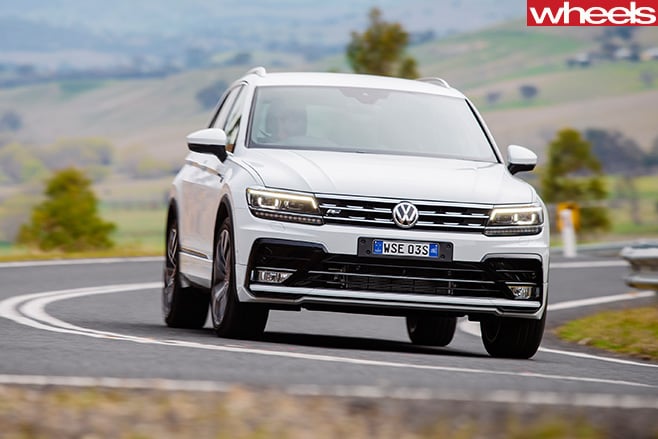
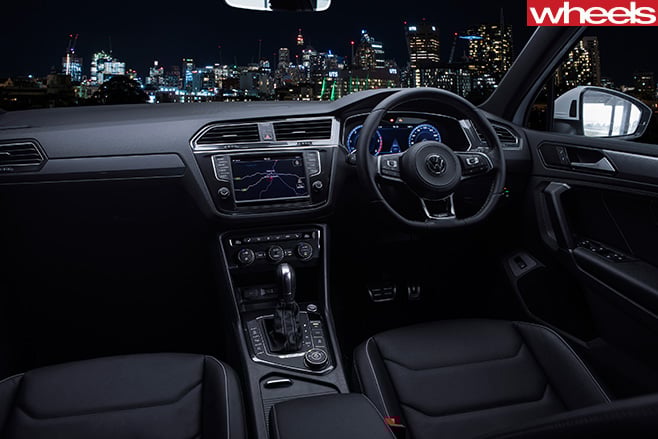
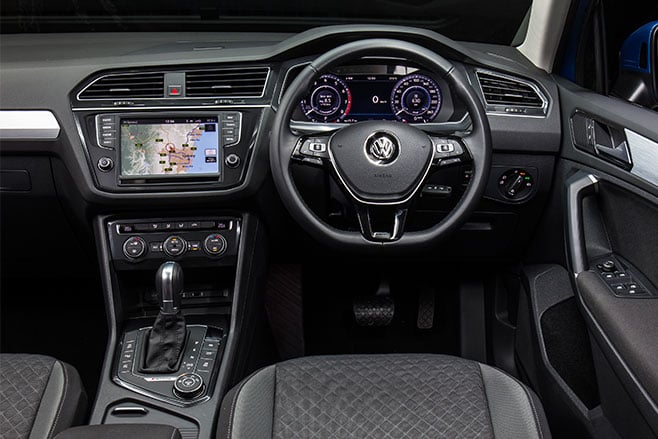
Not the cheapest mid-size SUV around, but Tiguan 2.0 is instantly one of the best thanks to polished dynamics, impressive equipment levels and a roomy, well-built cabin.
PLUS: Dynamics; packaging; refinement; equipment; interior quality and design
MINUS: High starting price; snoozy design
THE WHEELS REVIEW
WE FIRST sampled this all-new, second-generation Tiguan a few months ago in Belgium, and we liked it. A lot. We praised its packaging improvements, its slick, upmarket interior, refined engines and overall polish, all of which shot it straight to the pointy end of the booming mid-size SUV segment.
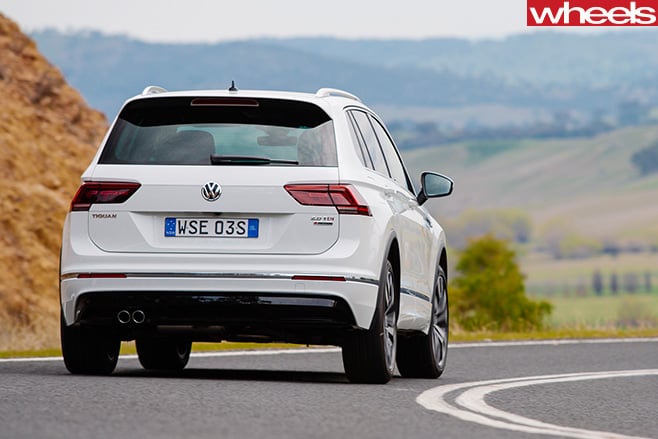
And the news is good. On lumpy, pockmarked roads around Byron Bay, Tiguan 2.0 asserted itself with aplomb and delivered handling that is not only composed and light on its feet, but fun too, which is rare for this segment.
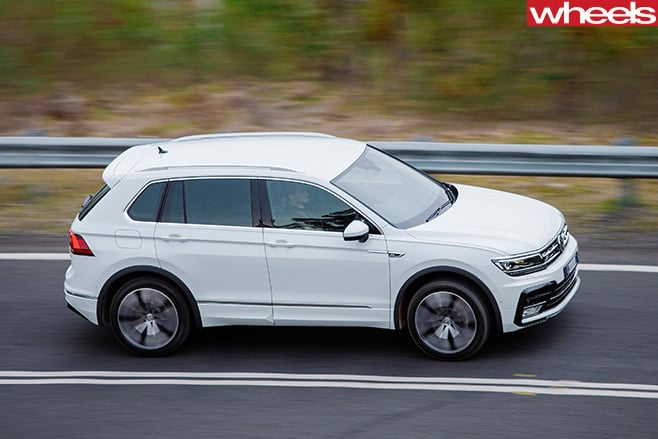
The electric steering is accurate and well weighted, the handling progressive and precise, bodyroll is kept tightly in check despite the taller ride-height, and the ride is nicely judged across the range. Wheel sizes span 17 inches up to 20 on models fitted with the optional R-Line package (which also adds adaptive dampers).
MQB also allowed VW to address the original Tiguan’s packaging shortfalls. Where Tiguan 1.0 had a tight interior and small boot, this new model muscles into mid-size SUV territory with larger dimensions all round and a 77mm-longer wheelbase.
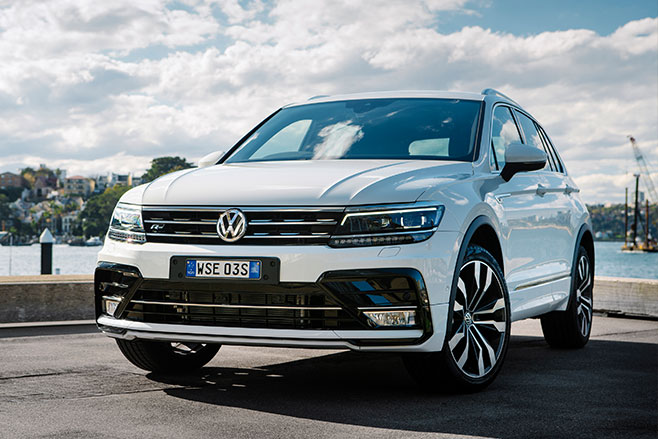
There’s plenty of equipment, too. Three trim grades are offered – Trendline, Comfortline and Highline – and all score an 8.0-inch central touchscreen with Apple CarPlay and Android Auto, rear air vents, cruise control, and auto wipers and headlights.
Safety is best in class, headlined by standard AEB, lane-departure warning, a pedestrian-friendly active bonnet, seven airbags and fatigue detection.
The pair of 2.0-litre diesels (110kW/340Nm and 140kW/400Nm) are smooth and impressively quiet, though the 140TDI is more responsive and has a stronger mid-range.
All up, it’s a convincing and comprehensive suite of engines with no obvious weak point, a fact that adds to the Tiguan’s overall feeling of engineering prowess.
Buyers could also be put off by the higher entry price given some Asian rivals start below $30K. But the Tiguan is still good value with its refinement, classy engines, polished dynamics and class-leading equipment. VW’s smallest Aussie SUV has grown up, literally, and is arguably the best offering in its class.
SPECS Model: Volkswagen Tiguan 140TDI Highline Engine: 1968cc 4cyl, dohc, 16v, turbo Max power: 140kW @ 3500-4000rpm Max torque: 400Nm @ 1900-3300rpm Transmission: 7-speed dual-clutch Weight: 1691kg 0-100km/h: 7.9sec (claimed) Economy: 5.9L/100km Price: $49,990 On sale: Now
A marketing ploy for a ‘female-friendly’ car by Cosmopolitan UK and Spanish automotive manufacturer, SEAT, has gone, well, tits-up.
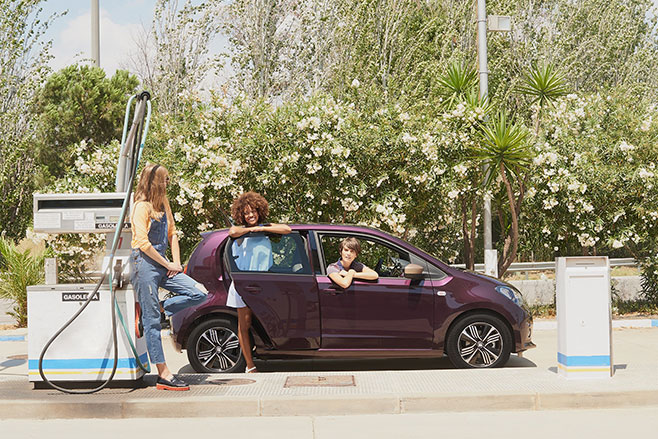
The duo teamed up to co-create the SEAT Mii by Cosmopolitan, a little purple hatch made just for women. And boy, has it got people talking.
Unveiled in London last week at Cosmopolitan’s #FashFest event, the “agile, exciting to drive and easy to park” car went through an 18-month co-creation program between SEAT, which is owned by Volkswagen, and Cosmopolitan’s global creative team, regional editors and readers.
The result? A compact car that makes driving, parking and stopping on a hill ‘easier’ for women, thanks to its small size, rear-parking sensors and “Hill Hold Control” technology.
It’s available in two colours, ‘Violetto’ purple or ‘Candy White’ white.
Unfortunately, ‘Barbie Pink’ and ‘Lipstick Coral’ aren’t included in the colour line-up.
The SEAT press release also states the car’s “headlights have an ‘eyeliner’ shape, emphasized in the same way as make-up emphasizes the eye’” while the “jeweled, bi-colour alloy wheels” offer a “surprise sparkle”.
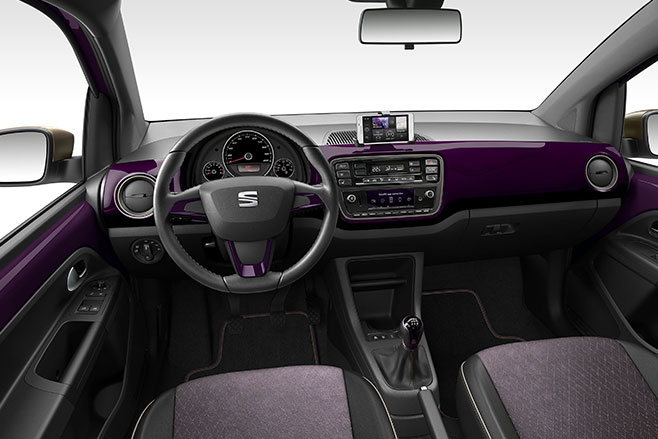
Surprisingly, the car, which will launch early 2017, is only available with a five-speed manual transmission. Yep, you read that right; women can drive manual cars.
In what is possibly the most unique and useful feature of the car, it also comes with a “smartphone cradle integrated into the dashboard” so your device is appropriately located when you connect to the app, “DriveMii” which allows the driver to control the infotainment system.
According to an interview with Campaign Live, SEAT’s global marketing director, Susanne Franz, “Cosmopolitan contributed to transforming the role of women in society and the Mii by Cosmopolitan aims to establish a fresh perspective on cars. It is a tribute to the modern woman.”
Just to clarify, by ‘woman’, they mean a consumer-group who only buys things that come in certain shades, with a low fat label, daily-routine conveniences (aka lipstick holders) and a free perfume.
In an article published on Cosmopolitan UK’s website, it stated Europe’s Cosmo readers wanted a car that is “an extension of themselves”, “agile”, “easy to park and drive” and “looks stylish and cool, and suits their personality”. To which the magazine interpreted as “a place for impromptu karaoke performances, last-minute wardrobe changes, dramatic gossip sessions and emergency lunch-hour kips.”
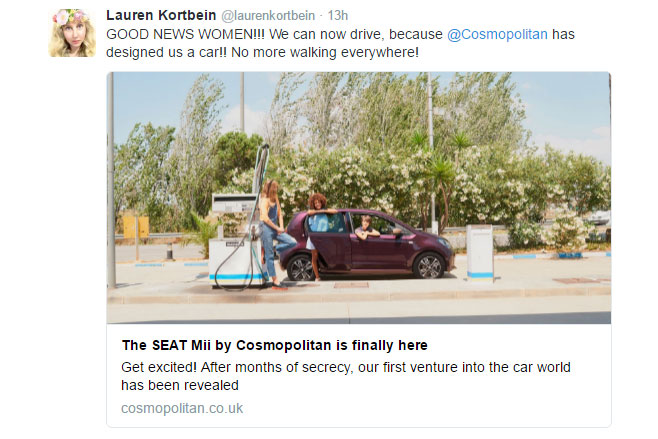
The uproarious discussions from women and men around the world saw everyone turning to Twitter to find out whether this meant Cosmo and SEAT believed every other car made was only for men, in a bunch of hilariously sarcastic tweets.
According to the video released by SEAT to show the inspiration behind the car, which outlines women accounted for 64 per cent of all urban cars purchased in Europe in 2015, Franz said “women prefer a smaller car.
They like much more of the maneuverability of a smaller car. And they pay much more attention to the design of a car.”
And in that, she’s not exactly wrong. But women are not the only ones who pay attention to the design of the car.
Actually, carrying extra clothing, conveniences, and car-karaoke sessions, are not women specific features.
Remember this guy?
How about this adorable duo?
Or more famously, here’s a car full of men singing in a car. It event includes a wardrobe change:
The concept was simple, but not entirely entrepreneurial. They’re not the first carmaker to design a car specifically for women, and they won’t be the last.
There’s a long history of automakers marketing cars to women.
Lady-only cars include the pink and white Dodge LaFemme, or the 2000 Maytag and Ford Windstar minivan, which came complete with washing machine, microwave and vacuum (yeah, that was a thing).
Then there’s always the 2012 pink-everything Honda Fit She’s or the 2004 Volvo Your Concept Car.
The latter, however, got some things right. The tag line for the Your Concept Car was “by women for modern people”. It was a car designed by women that allowed the manufacturer to “Concentrate on the fast-growing group of women customers – without losing the men. Because I’m certain that our male customers will love this concept car”; a statement made at the time by Hans-Olov Olsson, President and CEO of Volvo Car Corporation.
The release for this car said; “women customers in the premium segment want everything that men want in terms of performance, prestige and style. But they want more besides: smart storage solutions; a car that is easy to get in and out of; good visibility, a car you can personalize; minimal maintenance; a car that’s easy to park.”
So, aside from the whole ‘women can’t park’ thing, there are some manufacturers out there who get it.
As for the SEAT Mii by Cosmopolitan, we’re not yet sure if the car will also include extra mirrors to make doing your make-up at traffic lights easier, a lifetime supply of tampons, accelerator and brake pedals that make driving in heels easier and a flip-out ironing board, but we’ll get to take a look at SEAT’s “most female-focused car yet” when it’s showcased at the Paris Motor Show next week.
Cue squeals.
City cars – or Light cars, as they’re also known – seem to be suffering the same fate as larger passengers, with buyers migrating towards similarly sized SUVs instead.
Sales for city cars are down 17 per cent year on year as of August 2016, reducing market share from 10- to eight-percent.
That’s still about 90,000 vehicles per year, of which five models in particular dominate.
The Honda Jazz (plus its sedan spin-off, the City), Hyundai Accent, Mazda 2, Suzuki Swift and Toyota Yaris account for 70 per cent of class sales.
Here, WhichCar provides a guide to any changes planned or expected for these five models during the next 18 months – to help you pick the perfect timing for buying one.
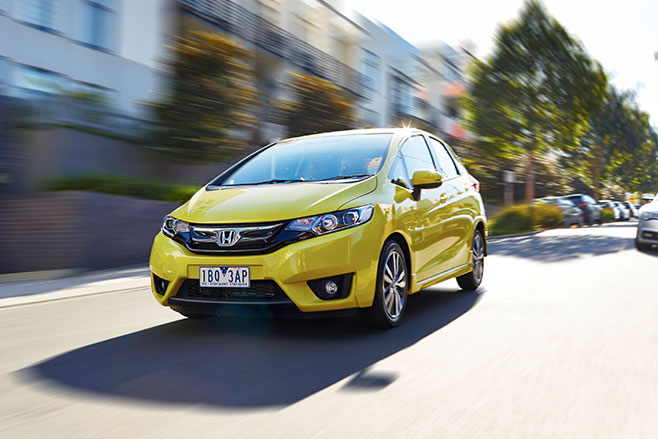
This ingeniously practical city car made it generation No.3 in mid-2014, and to no surprise continues to maintain its popularity. Based on the timing of the previous model’s mid-life update, don’t expect any major changes to the Jazz – or the City – until about 2018. However, Honda Australia released a Limited Edition model in September 2016. Based on the VTi variant, the edition lifts the price tag by $1000 in return for a package of features worth $3000. The features comprise 15-inch alloy wheels, rear parking sensors, rear spoiler, foglights, and a sportier-looking, black grille.
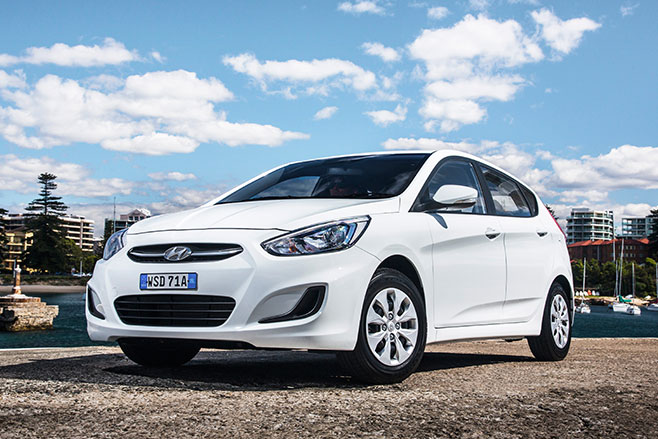
It’s been five years since the latest Accent went on display in showrooms. There were minor tweaks in 2012 and 2013 for the model, while a diesel engine option was also deleted. Expect the current model to soldier on until at least 2018, though age is not wearing it in terms of sales. Attractive drive-away pricing has contributed to significant growth in 2016.
MAZDA 2
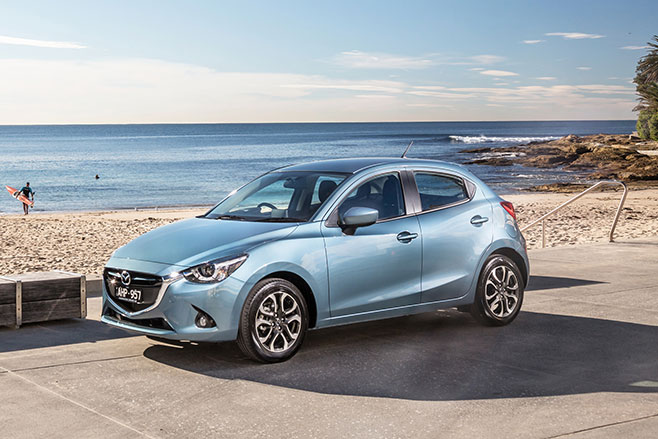
The current Mazda 2 is still much fresher than its closest rivals – less than two years old at the time of writing. The sedan is even younger, having arrived in August 2015 – and bringing some new standard additions across both body styles. Cruise control was added to Neo models, and Maxx and Genki variants gained rear-view cameras. Further changes are likely for 2017 – not least the introduction of G-vectoring, Mazda’s new technology designed to improve cornering balance by varying engine torque.
SUZUKI SWIFT
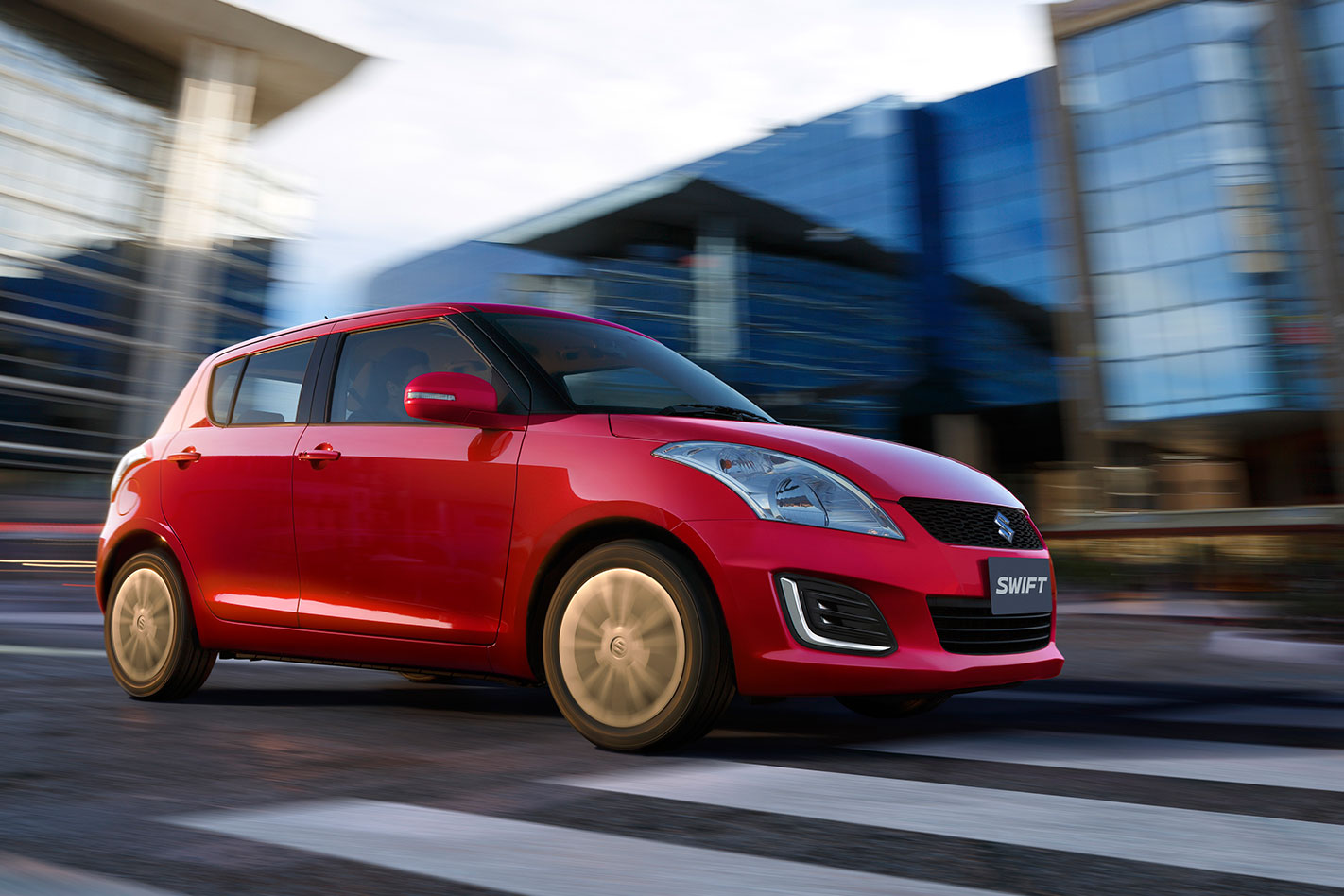
Australia’s favourite Suzuki is set to be more enticing than ever with a new-generation model in 2017. The fourth instalment of the much-loved Swift is due to be unveiled publicly at March 2017’s Geneva motor show, where spy images have already pointed to a more angular shape than the current model. There will still be the signature wraparound glass/floating roof effect, though. Swift Mark 4 will sit on the same platform as the recently released Baleno, though will be slightly smaller and be focused more on dynamics to suit its status as the more emotional city car to its sibling’s more rational appeal. The current model’s 1.6-litre will also be axed in favour of the Baleno’s 1.0-litre turbocharged three-cylinder. The feistier Sport variant is rumoured to be getting the 1.4-litre four-cylinder turbo from the Vitara compact SUV. There’s also speculation the long-missed GTi badge could return for this generation.
TOYOTA YARIS
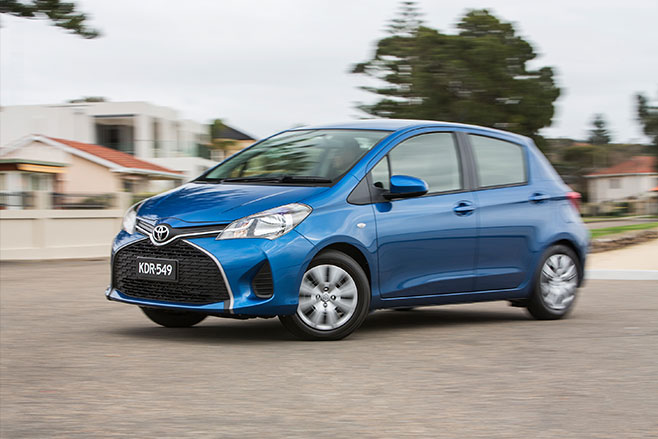
Toyota’s third-generation Yaris was released in 2011, with a mid-life update dubbed Series 2 introduced in late 2014. The smart money seems to be on the fourth iteration appearing in 2018 rather than next year, with potential for Toyota to roll out a progressive update before its arrival. The next Yaris will sit on the Japanese manufacturer’s new TNGA (Toyota New Generation Architecture) platform, and should see its ageing 1.5-litre engine replaced with a more contemporary powertrain.
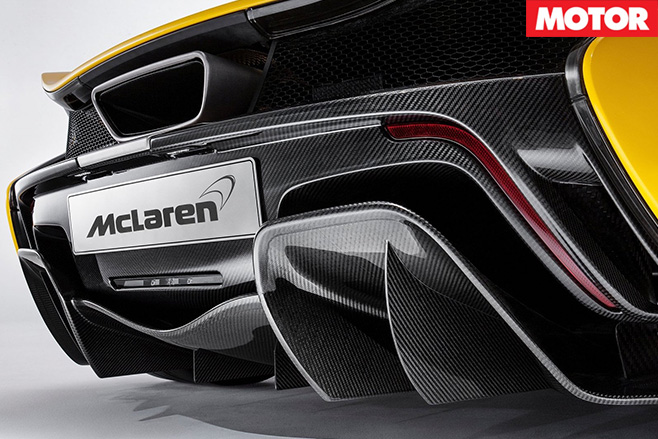
Could the McLaren P1 share engineering with the Apple iCar?
Perhaps not as the British automotive brand denies reports of a takeover bid by the technology giant – although it concedes that confidential discussions with several parties have taken place.
Apple usurping McLaren was – as reported by the Financial Times this week – claimed to have been a £1.5 billion (AU $2.5b) proposition and according to three internal sources negotiations have been ongoing without a result.
“As you would expect, the nature of our brand means we regularly have confidential conversations with a wide range of parties, but we keep them confidential.”
FT reported that Apple planned to use a McLaren acquisition to fuel development of the iCar, its planned all-electric autonomous vehicle that has been in Silicon Valley secrecy for two years, using its expertise for power systems rather than to build the vehicle.
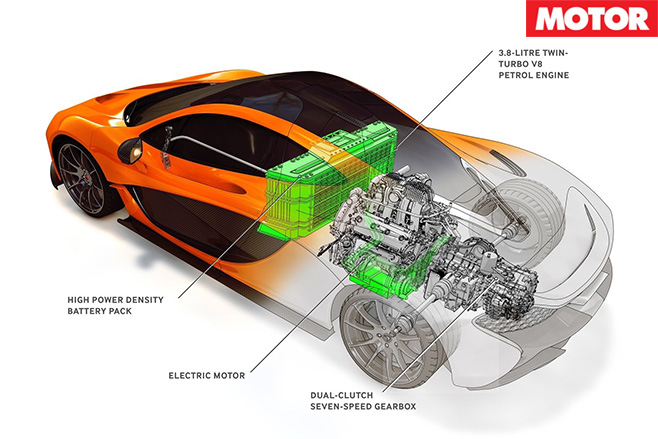
It is unclear whether Apple wanted to take an entire chunk of McLaren Technology Group – which has an 80 per cent share of McLaren Automotive – or carve out a slice in an ownership pie currently divided between Ron Dennis and Tag Group’s Mansour Ojjeh (25 per cent each), and Middle Eastern wealth fund owner Bahrain Mumtalakat (50 per cent).
Apple has form in honing in on the automotive space, however, having purchased Chinese ride-sharing company Didi Chuxing at the start of the year.
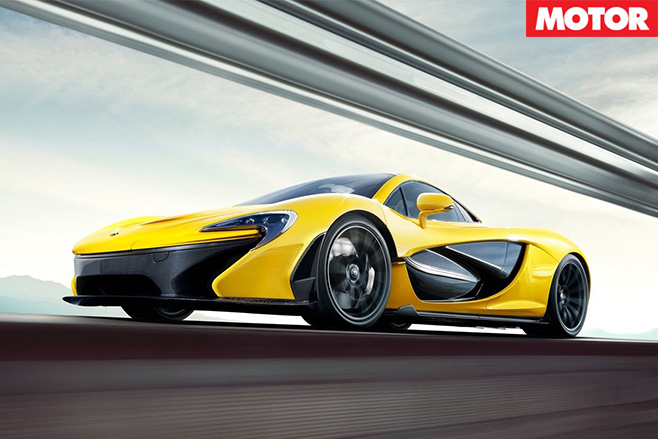
Multiple global analysts have claimed the widespread reports of the flailing iCar has affected Apple, which typically runs a watertight PR machine and is seen as perhaps the most successful technology company in the world, and buying McLaren would give the Californian-based mobile and computer outfit credibility in the automotive space.
McLaren Automotive will spend £1bn on research and development in six years – but whether Apple gets a chance to bite into that investment remains to be seen.
There’s a harder, faster, leaner version of the Audi TT RS on the way.
WHAT IS IT? The second generation of the Audi TT RS, and – apart from the inevitable “Plus” version that will come later – probably the most powerful car that will ever be built on Volkswagen Group’s mid-sized MQB architecture.
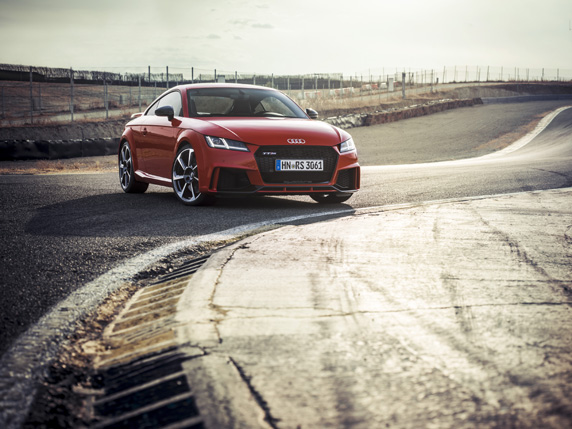
WHY ARE WE TESTING IT? To see if the TT RS manages to move the game on from its predecessor, a sportscar that managed to be enormously fast all the time but was only rarely exciting. Like its lesser brethren the TT RS is more practical than rivals like the Porsche Cayman, with rear seats and usable boot space, but there’s still a question mark over whether it can deliver dynamic thrills.
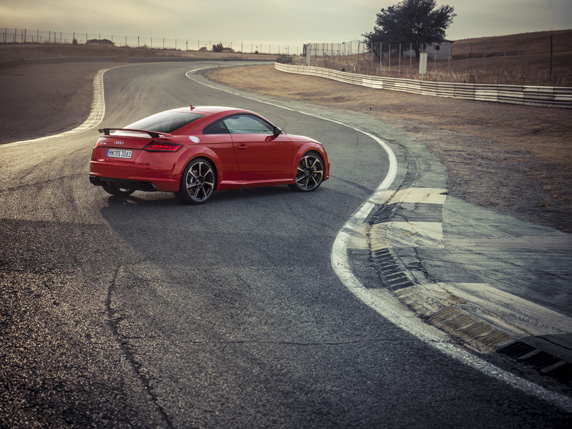
MAIN RIVALS Porsche Cayman S, Jaguar F-Type V6
THE WHEELS VERDICT SORRY if this starts to sound familiar, but the TT RS is another fast Audi that is better suited for making ultra fast progress rather than driving thrills. It’s sharper to steer than its predecessor, and the five-cylinder engine is a cracker, but it still falls some way short of the sort of the dynamic engagement that most sportscar buyers are looking for. It’s a receipe that’s worked well for Audi in the past, of course, and we’ve no reason to believe this RS won’t find its niche and outsell its predecessor.
PLUS: Even better to drive; poke from snarly five-cylinder engine; more practical than two-seat rivals MINUS: Not an all-out corner carver; something lost in AWD translation
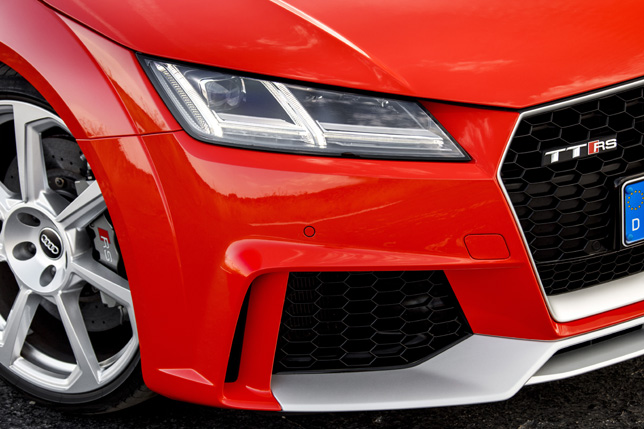
THE WHEELS REVIEW There’s always been something compelling about a car with a wilful excess of power. While it’s hard to say exactly what the TT RS competes with, it’s fair to say that it outguns anything that could be legitimately regarded as a rival. While few people complained that the last RS TT was lacking in firepower – the later “Plus” version managed 265kW –this one boasts both a new aluminium five-cylinder engine and a boost to 294kW. That’s more than a Cayman S, a BMW M2 or a Focus RS, or indeed the Audi RS3.
The good news is the new TT RS is better to drive than both its predecessor and its hatchback sister. Making faster progress in the first-gen RS often felt more like a challenge than an experience, it was brutally quick but had a punishingly firm ride, a nose-heavy handling balance thanks to the boat anchor weight of the iron-block turbo five hung out front, a punishing ride, and minimal feedback. The new RS is vastly better, sitting on Volkswagen’s advanced MQB architecture and with a new all-alloy five that weighs 26kg less than the old engine.
But while there’s less understeer, and more supple manners when asked to deal with a bumpy road, the new RS is still a car that’s been designed to travel quickly rather than reward its driver for trying hard. Grip is massive, enough to get Velcro referenced, but there’s still not much in the way of throttle adjustability. The all-wheel drive system still uses the familiar on-demand coupling on the rear axle – a development of the Haldex system that Volkswagen has been using for more than 20 years – and lacks the ability to do any of the trick torque vectoring of its Focus RS namesake. The result is a car that feels like a very quick front driver, with the only way to stop the front from ultimately running wide being to ease off the throttle. It’s no Cayman S.
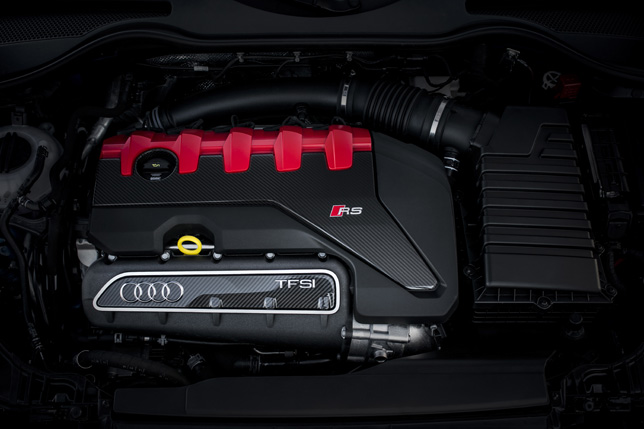
The new five-cylinder engine brings plenty of compensation, though. It’s an absolute cracker: snarly, keen across the board and happy to rev to the limiter. Yes, there’s lag if you go looking for it – although in ‘drive’ the standard twin-clutch gearbox will always kick down to eliminate this – but the RS’s turbocharged power delivery makes it feel properly exciting. Quattro’s engineering boss, Stephan Reil, admits that it would have been possible to generate a similar output with a four-cylinder engine – VW was working on a similarly powerful version of the EA888 2.0-litre motor – but sticking with a five has given the RS vastly more character. It was undoubtedly the right decision.
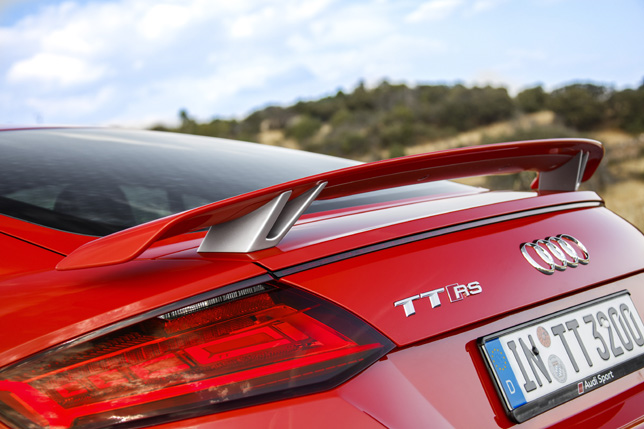
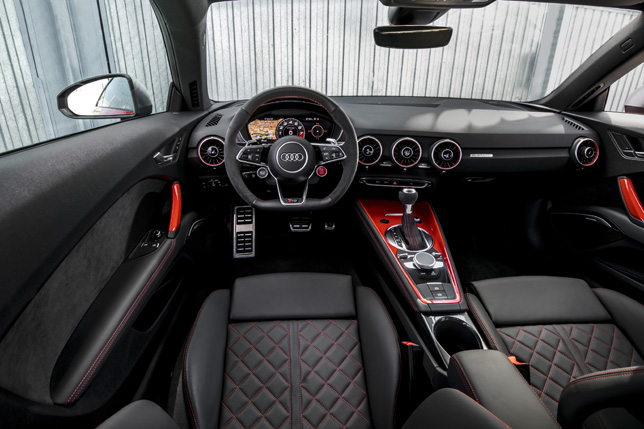
Everything else is beefed-up TT. The RS gets a far more purposeful look than the anaemic base version, its bodykit and rear wing making even the 231 kW TTS look wussy. The cabin is brilliant with Audi’s class-leading VDU “virtual cockpit” instruments as standard and – trump card time – it’s vastly more practical than any of its two-seat rivals. The RS coupe has small but child-viable rear seats and a reasonably sized loadspace under the rear hatch. The ride is still firm, but it feels far more composed at speed than the crashy first-gen RS ever did.
We have to wait for Australian pricing until closer to the RS’s launch next year, but we’re told to expect it will be around the $145,000 mark. That’s more than double what the most basic TT Coupe costs, although the RS will come with generous standard equipment including LED headlamps, active safety gizmos and the “plus” navigation system. For the chosen, the RS’s sheer speed and class-leading practicality will be more than enough to compensate for its lack of dynamic involvement.
SPECS Model: Audi TT RS Engine: 2480cc 5cyl, dohc, 20v Max power: 294kW @ 5850–7000rpm Max torque: 480Nm @ 1700–5850rpm Transmission: Seven-speed dual-clutch, all-wheel drive Weight: 1515kg 0-100km/h: 3.7sec (claimed) Economy: 8.4L/100km (EUDC) Price: $145,000 (est) On sale: Summer 2017
WHAT IS IT?
It’s the fastest version yet of Audi’s iconic TT sportscar. Although it straddles several segments it’s fair to say that the new Audi TT RS outguns anything that could be considered a rival. Power comes from a five-cylinder turbocharged engine that produces 294kW, and can propel the RS Coupe from 0-100km/h in just 3.7 seconds.
The Coupe will go on sale in Australia next year and, although pricing hasn’t been finalised, we’re told to expect it to be about $145,000.
STRENGTHS
- The turbocharged five-cylinder engine is superb, and makes the RS almost supercar fast. It sounds great and is lighter than the old five-pot, improving the RS’s responses. Performance is stunning, with the RS’s acceleration numbers pretty much identical to those of the V10-powered Audi R8. There’s a launch control system to help buyers replicate the official 0-100km/h claim (if they happen to find themselves at a drag strip.)
- It looks great, with a pumped-up bodykit and chunky 19 inch wheels giving it a real visual lift over the standard TT. Audi makes some of the best interiors in the business, and the TT RS builds on it. Audi’s digital “virtual cockpit” display will be standard, a screen in place of the conventional instrument pack that can be configured to deliver different information. It’s a great place to spend time.
- This TT RS is far more civilised than the last one, which felt harsh when asked to deal with anything other than the smoothest road surfaces. The new car is still firm, but rides well over rougher road surfaces and cruises quietly when you want it to.
- Like every other TT the RS’s trump card remains practicality. Unlike its small coupe rivals, it has rear seats which, although small, are more than up to lugging kids around. There’s also a respectable 305 litres of luggage space with the rear seats in place, and 712 with them folded.
- The RS can’t match the immersive driving experience of its best sportscar rivals. It’s secure and fast, but not much fun to push hard.
- Although more practical than the Porsche Cayman, the RS can’t match the interior space and accommodation of the BMW M2.
- And while pricing isn’t confirmed, the expected $145,000 sticker will make the RS one of the most expensive cars in its class. It’ll also cost twice the basic TT Coupe.
- Fuel consumption is heavy. Audi claims 8.4 l/100km in Europe, but getting near that number would require a very light right foot.
- There’s no confirmation whether the convertible version will come to Australia. The official line is that it is likely too much of a niche product to make it here.
Although the Porsche 718 Cayman S is likely to be cited as the RS’s main opponent, its rear seats mean it can also be compared to the BMW M2.
Next year will be my 25-year anniversary in automotive journalism. A landmark for me, but as important to you as yesterday’s corn flakes. And yet, in all those years I’ve never driven on a public road in Japan. Until now.
My little Tokyo Drift (not!) Session came as a total surprise. I was in Japan to meet new Lamborghini boss Stefano Domenicali; a bloke who had the bad luck to inherit a company enjoying record sales and record profits, and soon to add a lucrative SUV to its portfolio. No pressure then…
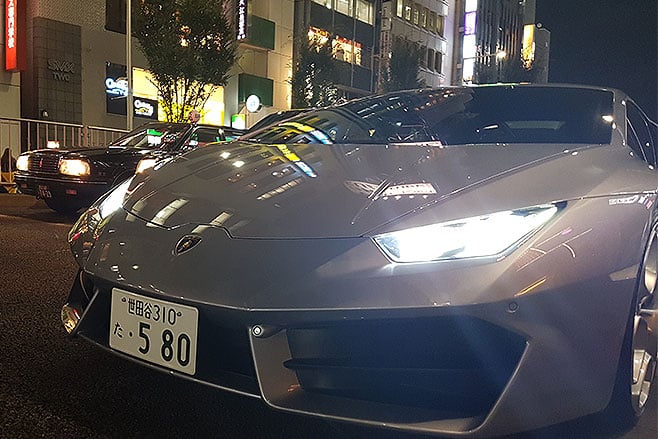
But when a colleague and I checked in to the hotel, our Lamborghini host casually mentioned that the two Huracan LP-580s in the valet area were available for test drives after 6pm if we wanted.
Only catch was we had to be back for the official dinner at 8pm.
Now, I don’t knock back two hours with a baby Lambo. But I soon realised that even two hours would not be enough to get anywhere interesting, let alone back again. Greater Tokyo is one-quarter the size of Melbourne but has three-times the population (13.6 million). Let me put that another way. Melbourne has 453 people per square kilometre, Tokyo has 6225.
And it would be peak hour. And they were left-hookers.
So no full throttle blasts out to and up the Hakone Pass, home of the famous 300 Club. And no scorching around Route 246, the Gran Turismo 5 road circuit that runs past Sony’s HQ in real life.
The realisation that I’d be lucky to get out of second gear, let alone roast expensive Pirelli P Zeroes with full bottle drifts, was strangely freeing. It gave me licence to just enjoy the moment as we burbled and barked from the hotel in Chiyoda-ku up to Shibuya Crossing – you’ve seen pictures of this five-way intersection that is flooded with humanity every four minutes.
It was a round trip of barely 25km, and I could have done it all in first and second, but the gunfire salute that follows every gearchange is too addictive not to employ whenever possible. And the sound of the Huracan’s V10 wail bouncing back off the canyons of concrete and glass is spine-tinglingly sublime.
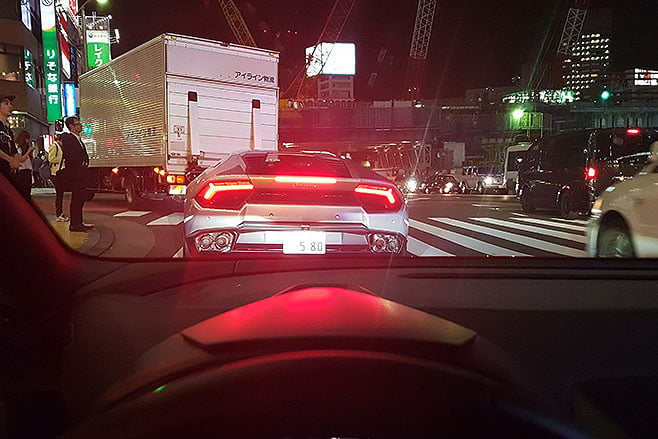
It was all really quite bizarre. But despite the ludicrously low speeds in a 300km/h-plus super-sports car it’s a memory as indelible as driving an MX-5 on the Nurburgring during a thunderstorm, crossing the Grossglockner Pass in an RS5 in winter, and having Laguna Seca and an Audi R8 V10 all to myself for half a day.
Sometimes wonderful automotive experiences require a lot of planning, and sometimes the planets just align.
One squeeze of the new Audi TT RS’s right pedal is all it takes to know what’s most special about the car. That inline five-cylinder is an Audi hallmark that’s featured in everything from its greatest racecars to humble passenger sedans.
In the TT RS, the 2480cc turbocharged unit is now at the top of its game. Spinning up 294kW at 5850rpm and 480Nm at 1700rpm, it packs a heavy punch.
It’s also very new. At the vehicle’s launch we had the chance to mingle with the engineers and learn some interesting things about it.
For instance, did you know its turbocharger’s turbine now flows in reverse? Nope? Then here’s five nerdy things about the new TT RS’s engine…
1. It’s been on a serious diet
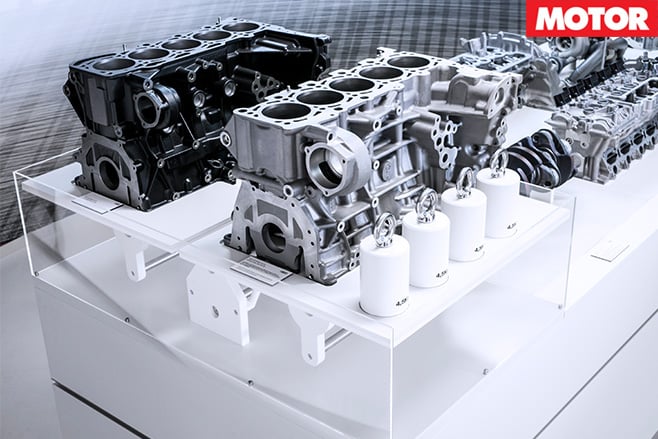
Lightweight pulleys do their bit, as do smaller main bearings and the magnesium oil sump top, which finds another two kilograms. Overall the new engine is 26kg lighter, totalling at 157kg.
2. It no longer has a cool red cylinder head
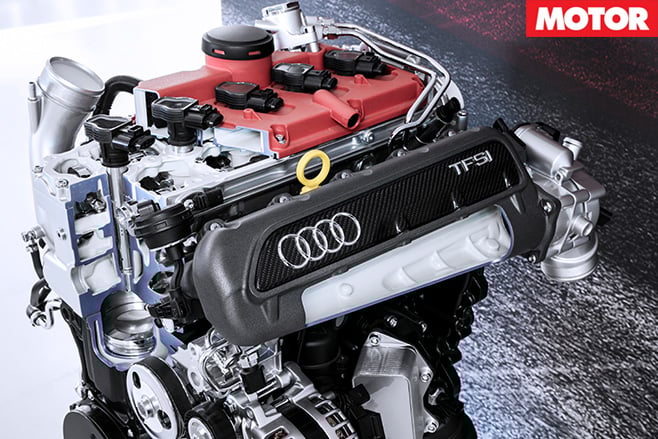
3. There’s a whole new turbocharger system
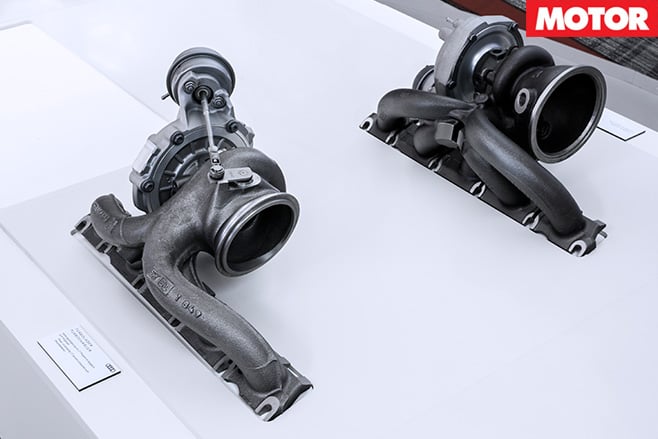
While still single-scroll (as it must be with a five-cylinder), the exhaust flow’s direction has been reversed so gases hit the turbine’s fins straight on to help spool and response.
4. It’s technically related to a Rabbit
The old TT RS’s iron-block turbo five was essentially a tweaked and turbocharged version of what was found in the US market’s Rabbit (also known as the Golf). Both blocks share the same undersquare bore (82.5mm) and stroke (92.8mm) measurements with the new alloy unit, however this latest case’s alloy design evolves the iconic five-cylinder even further.
The strong classic car market shows little sign of slowing, with Shannons recent Melbourne spring auction resulting in a number of vehicles selling for well in excess of their estimates.
Heading the list was a 1970 Ford XY Falcon GT, fitted with desirable factory options such as a long-range fuel tank, wind-back sunroof and four-speed manual.
Presented in original condition, the GT was expected to bring between $80-100,000 but bidding reached $176,000 before the hammer dropped, the buyer a Melbourne local.
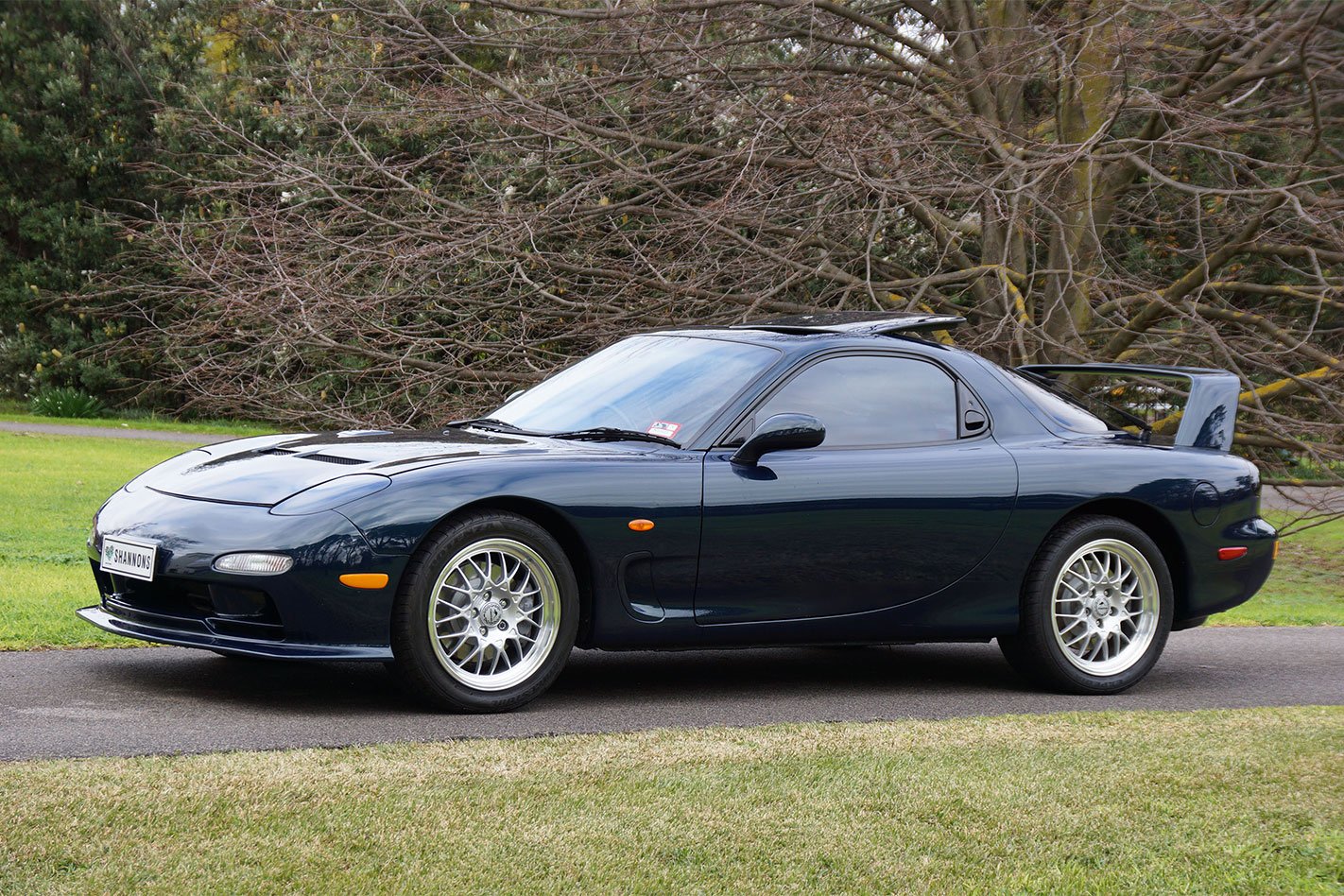
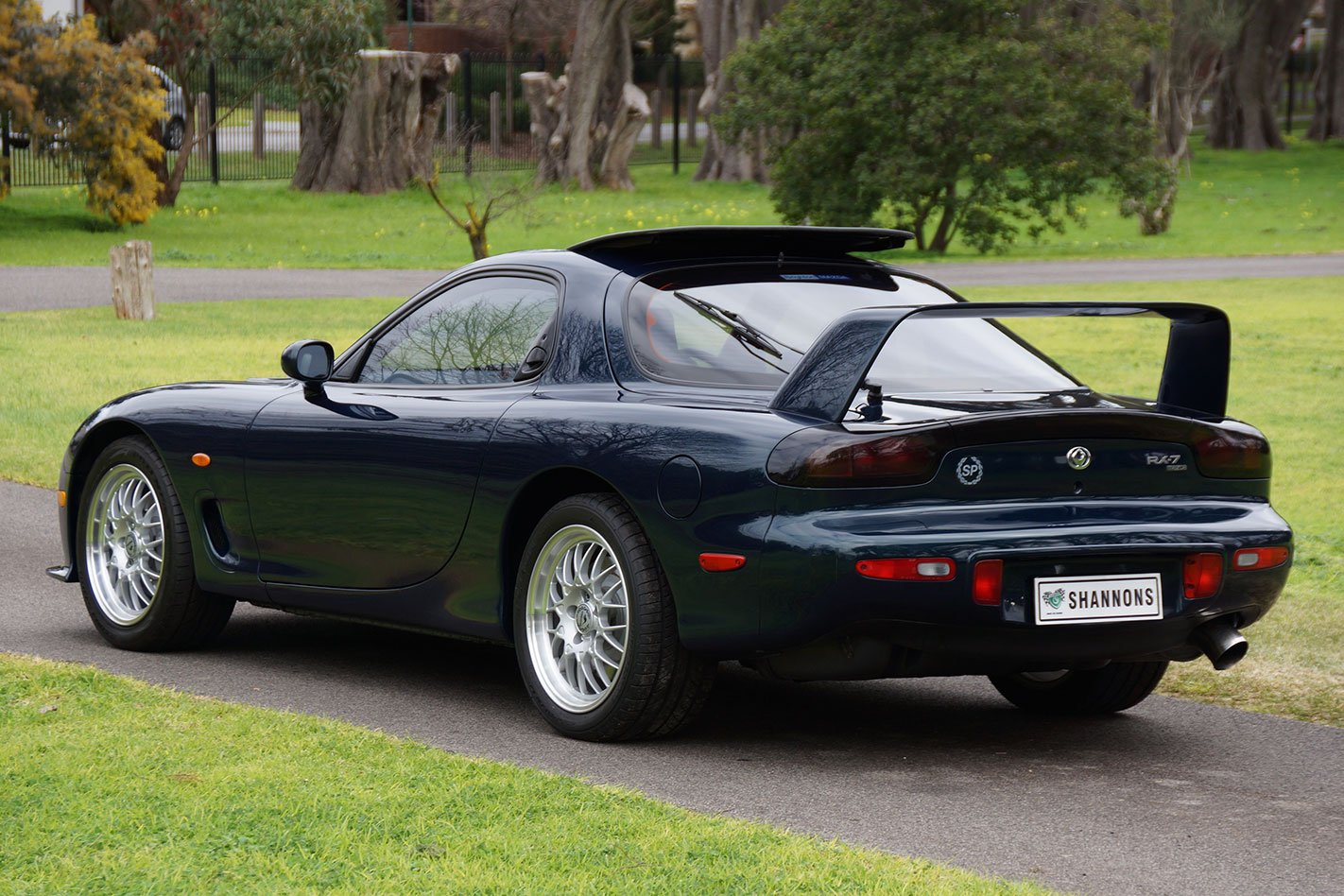
The brainchild of Mazda Australia motorsport boss Allan Horsley, the SP modifications included a new intercooler, exhaust and ECU, which lifted the twin-turbo 13B rotary’s outputs from 176kW/295Nm to 204kW/357Nm.
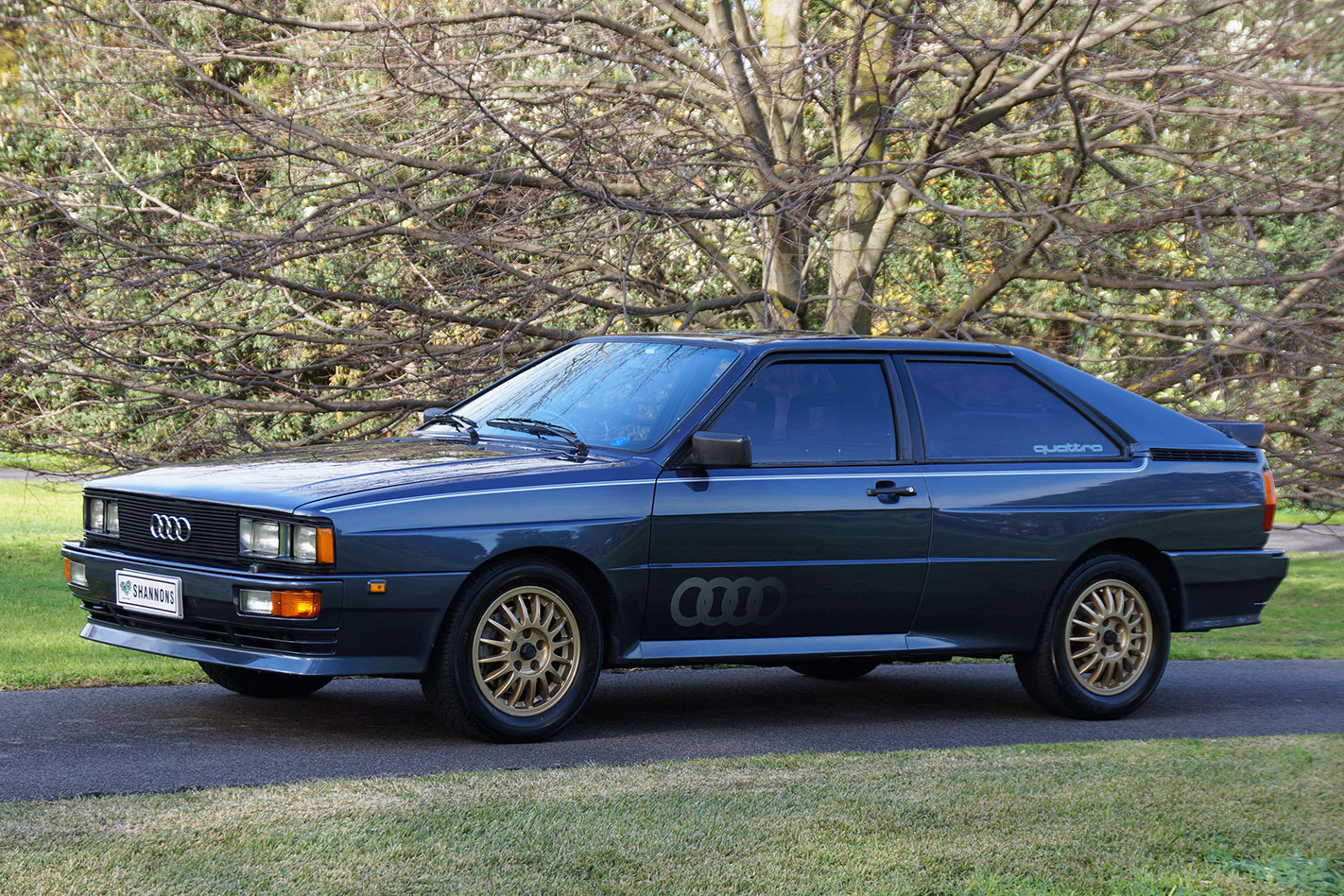
Another famous competition car is the Audi ‘Ur’ Quattro, responsible for revolutionising the world of rallying in the early 1980s. It’s a rare car in Austraila, partly due to being left-hand drive only, though a number of cars were converted for sale in the UK.
Right now in Germany someone’s selling the BMW Z4 coupe from hell.
You’ll need Google Translate’s help to read the EBay listing, but there’s no mistaking the numbers and letters ‘8.3-litre V10’.
That’s right, crammed into this black-on-black Z4’s bonnet is the beating heart from a Dodge Viper SRT.
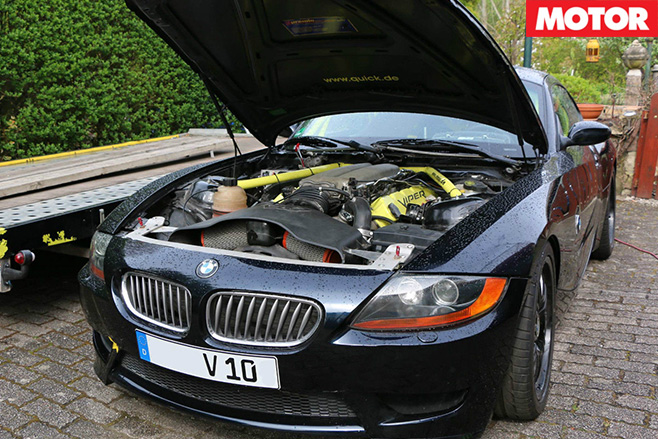
There’s no story on the engine swap, but we suspect BMW’s own 5.0-litre V10 from the M5 might have been hard to find. Or its SMG-transmission hard to consider. This has a Tremec six-speed manual.
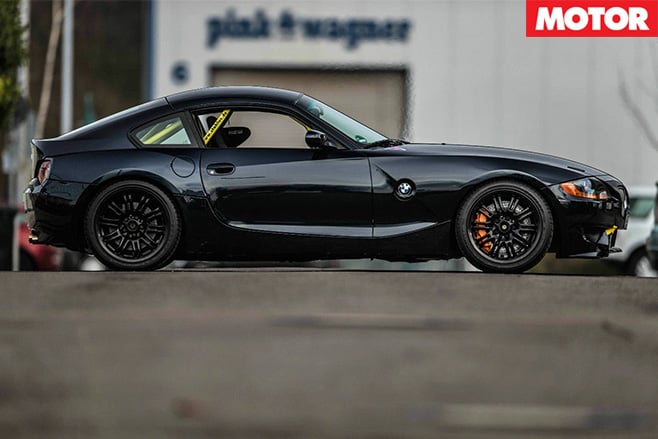
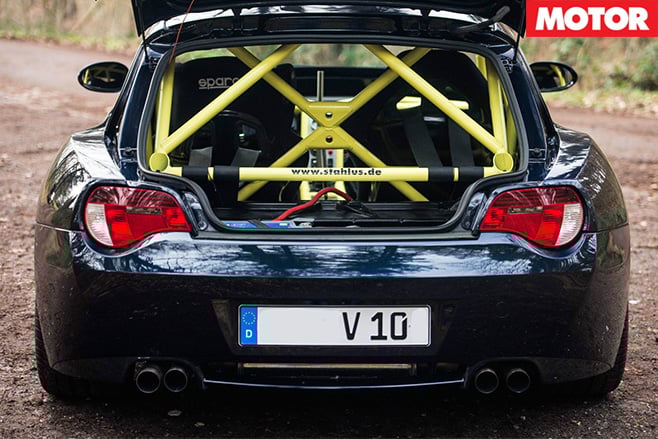
Amazingly, though, the seller’s managed to keep this ride street registered. So you can do the milk-run while surrounded by race seats, roll-cage, and six-point harnesses.
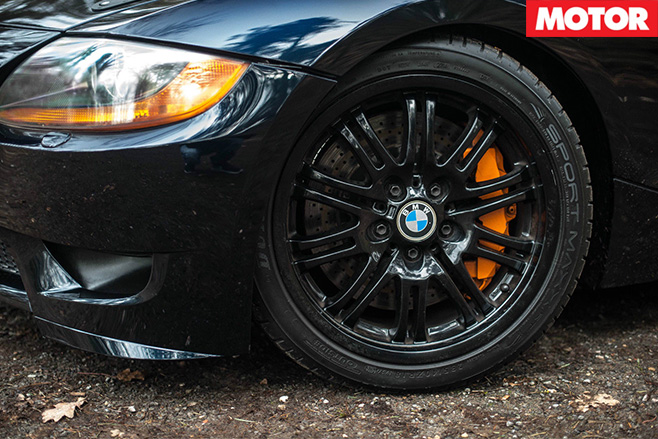
But we don’t think anyone will be using this thing anywhere but a racetrack. After all, there’s a reason it’s packing the six-pot Brembos from an Audi R8.
Better get clicking.
Pics via Ebay
