
Iron maiden could become a full-time driver in Supercars.
Simona De Silvestro – currently racing in Formula E for Amlin Andretti and set to compete in her second Bathurst 1000 this October – hasn’t ruled out a full-time drive in the Supercars Championship next year.
Before we go any further, let’s get one thing straight. Swiss-born de Silvestro is a serious, competitive racer. Forget the gender. She’s no gimmick.
She raced in the 2010 Indianapolis 500, and finished 14th, earning the Rookie of the Year award.
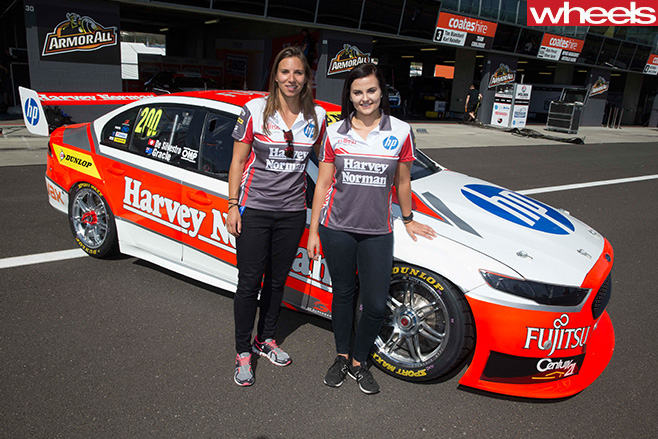
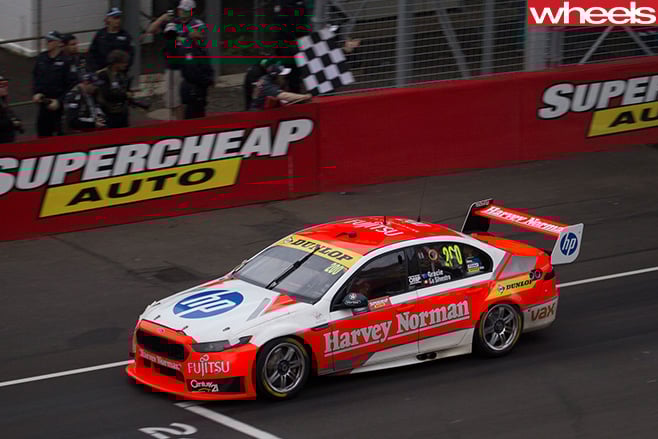
The 27-year-old impressed in her first and thus far only V8 Supercars drive in the Bathurst 1000 last year.
She is back again in October with Renee Gracie, but anticipates a discussion or two with the right people about a full-time season in the Australian Championship.
“I think, for me, I’ve had a tough year in Formula E right now and I’m definitely looking at all the options out there,” de Silvestro told the Supercars website.
“So who knows. Maybe. I don’t know yet.”
In an interview with Wheels early this year, Supercars CEO James Warburton prioritised full-time female participation in the series “hopefully by 2017”.
“We want a female driver on the grid on merit,” he stressed.
Warburton was very taken with de Silvestro’s professionalism and the way she adjusted to Supercars after minimal testing.
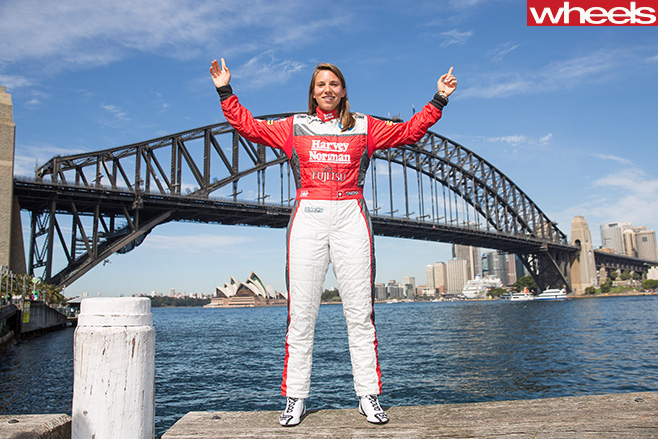
Wheels understands that money has been earmarked for di Silvestro and the category is working towards securing her a seat.
“Globally, Simona has a number of options and people chasing her,” Warburton told the Supercars website. “All we can do is try and get to the front of the queue and believe me we are pushing.”
It is believed Warburton is insisting on any potential full-time drive being with a top-level team, which would give the ‘Iron maiden’ a serious chance at race wins and potentially a championship.
Ford’s new challenger is at long last trim, taut and terrific. All this, however, may have come one model late.
First published in the May 1964 issue of Wheels magazine, Australia’s best car mag since 1953.
ONE new model-change swallow does not necessarily make a motoring magazine’s summer, but the XM Ford Falcon has gone a long way toward making 1964 a more pleasant year. Too many road tests carry the atmosphere of this-new-model-is-marvellous-Iast-year’s-was-a-dog,” but this is justified with the new Ford six-cylinder. It does, however, deserve the criticism that the changes should have been made one model earlier. If this had been done, the company would not have faced its long uphill climb to regain the heights of favor; it is an unfortunate axiom that it takes only a few months to turn a public against a car, but a few years to lose that reputation.
The XM model is the result of immediate action by Ford’s new managing director, affable, steel-minded Wallace Booth, whom we described in WHEELS February as “Ford’s New Broom.” It took him only a few weeks, apparently, to realise that the Falcon lost acceptance in Australia because of poor quality control and lack of engineering application of the peculiar demands of Australian conditions. He must also have seen that the worst thing the company could have done would have been to use the 1964 US Falcon as the Australian 1964 model.
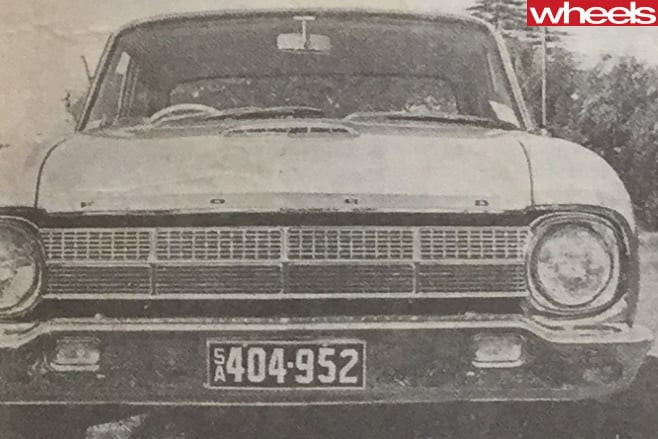
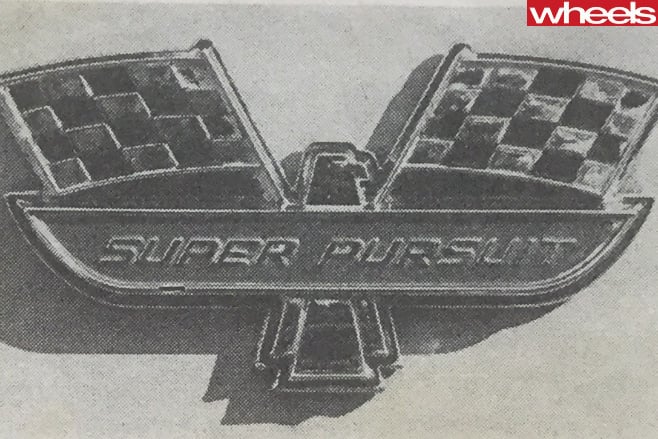
The mechanical and body styling changes to the car have been described completely in the April and March issues of WHEELS and we will not labor them again. It has, of course, the option of the previous 144 and 170 cu in engines uprated to 96 and 111 bhp, mainly through increase in stroke and valve head sizes, plus the new 200 cu in. “Super Pursuit” engine at the moment available only with automatic transmission. Borg-Warner is experimenting with Falcons and its ·three-speed transmissions, so the two-speed Fordomatic may not be long for this hemisphere, particularly if the Tariff Board inquiry militates against imported components, as we expect it shall.
All three engines share a compression ratio of 8.7 to 1, and all respond very well to self-mixed 98-100 octane fuels. Oil change periods have been extended to 6000 miles by use of an improved oil filter, and brakes are self-adjusting. Body styling changes are minimal, but have given the car more character, particularly in the squaring-off at the rear.
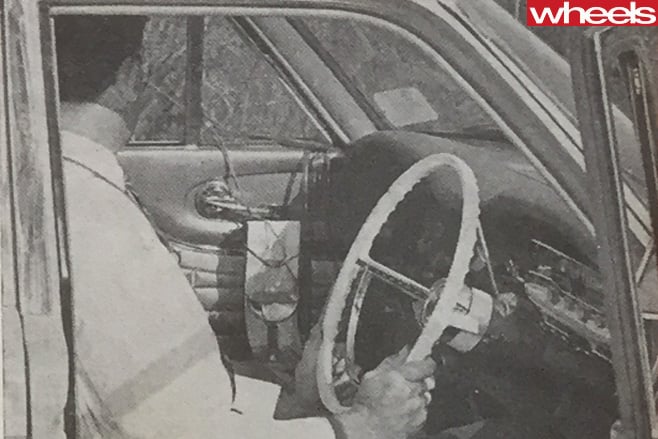
Ford has also given much attention to anti-rust treatments of chrome and body metal. Front wishbones are from the Fairlane 260, and the coil spring/shock absorber units are heavier and have a higher rate. Rear dampers have been angled differently. The XM model now uses the 6.50 by 13 tyre, on a 4 1/2 in. rim that was optional on the Ford Falcon XL.
We covered 1522 miles testing three of the units. They were a 170 deluxe sedan, a 200 deluxe sedan, and a Futura with 170 engine. They varied remarkably in engine stiffness in their early miles, although much of this was probably due to stiff throttle springs – a habit which suspicious-minded motoring journalists might attribute to a company’s desire for good fuel economy figures in its test cars. In fact, the 200 cu in. engine – which had a very free throttle spring – returned an average of 21 mpg under all conditions, and the specific consumption figures at steady speeds in top gear were good.
Most of our performance testing was done on the new engine, because of its novelty. We were quite pleased with its acceleration figures, but top speed of 90 mph was disappointing, even allowing for a mileage of less than 2000. The car does not work hard under acceleration, because the two-speed Fordomatic transmission has always given an impression of being utterly lazy. The car goes deceptively hard, particularly now that extensive sound-proofing has dampened down that unpleasant nasal buzz in the exhaust note.
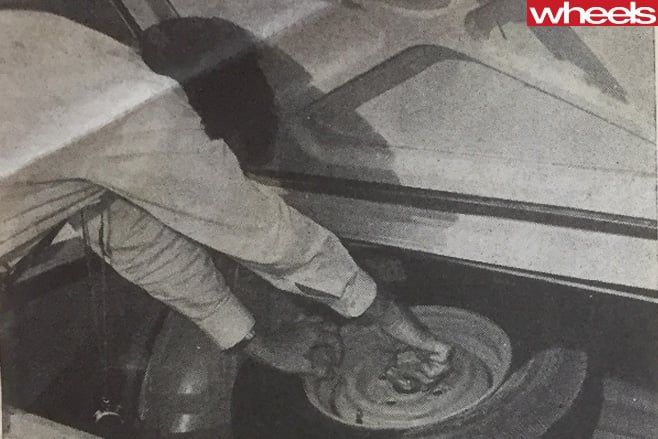
Most of our drivers found that they could now commit the Falcon completely in all road situations whereas they were consciously holding back the earlier car. There is less roll movement and less rear axle misbehaviour, and we found that the car is absolutely faithful at all times. Under pressure on winding roads it begins to feel just like an overgrown Cortina, particularly in the way one would put on the first amount of lock and gradually feed the wheel back through the hands while applying more and more power out of a corner. The car is now predictable, even on wet or loose surfaces; that could not be said about the XL, because few people had enough courage to turn it loose.
The ride is firmer than it was before, due to higher rates all round. There is still some front-end and steering tremble over bad corrugations, but none of the wallow and wheel flap found in earlier Falcons.
The changes in seat location and wheel size have brought the wheel rim out of the line of sight and closer to the driver’s knees. All of our drivers liked the new situation, and were definite that it made for far more confident handling of the car. A minor side effect of the styling, incidentally, is that you can you can see your rear extremes now when reversing. The front end is still a mystery, because the curve of the bonnet conceals the extremities, which are actually about two inches further from the driver’s seat.
Our general opinion is that the extra power has been well-matched by improvements in suspension and steering “feel”. The car can be cruised at 75mph in peace of mind, although a two-speed gearbox limits one’s overtaking flexibility, despite first running to 50mph. Nonetheless there is enough torque from both the 170 and 200 engines to accelerate the car from, say 55 mph in drive. However, the brake lining swept ‘area’ remains unchanged at 114 sq ins., and this is not enough. The brakes can be made to fade readily under hard work and are affected by water splashes, but recovery is rapid; they are adequate for normal traffic driving. The handbrake, under the facia, is too far away, although it pulls up the car well.
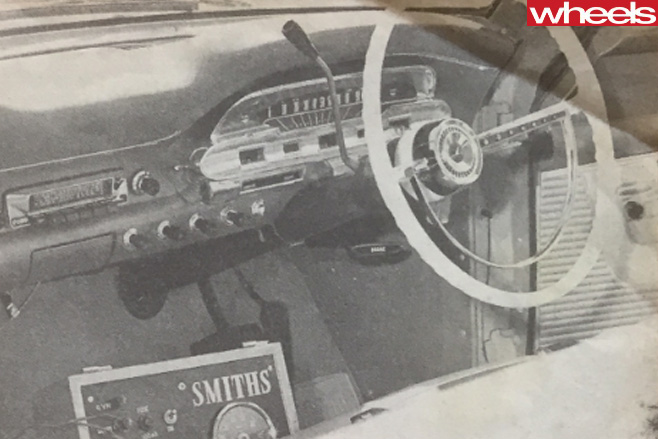
The floor covering is an improved pvc mixture that looks much neater and more durable than the rolled, colored chewing gum used in some of the Falcon’s competitors. There is slightly more leg room in the rear, and head room is good throughout. However, the rear-seat cushion is still curved at its edges to allow easy exit and access, and this does rob one of some leg support. Otherwise the seats are properly angled with good support.
The top of the facia cowling still reflects badly in the vast screen, and we feel also that the top of the screen extends too far back into the hood for Australian sunlight. Most Falcon owners will still be driving the XM with the sunvisors swung forward.
The visors themselves have gained padding, but still are located by a plastic ball in a plastic spring-clip that often springs and rarely clips. The big rear vision mirror covers a lot of the rear window.
The redesigned facia has too much ribbed chrome moulding around the instruments, which themselves are quite well located in relation to the new two-spoke wheel (with those rather dreadful cone embellishments on the spokes). Unfortunately, neither the temperature nor fuel gauges are graduated apart from EMPTY or C for COLD or somesuch, and are of little help.
As well, the Falcon retains those great features which came with the very first Ford Falcon XK; those two big air boxes each side of the front compartment, making it the best ventilated six on the market, plus the beefy door and window handles located properly in the doors.
The interior, overall, is well-planned, durable and far better finished than that of any previous Falcon. The same goes for the exterior paintwork, which is much better than any Ford has produced before. Some of the acrylic finishes are deep and lustrous.
Overall, the XM Falcon has many changes that have been made for the practical purposes of durability, than for the sake of practical usage and durability, than for the sake of keeping up with the Joneses from Fisherman’s Bend. Whether this very good car can recapture the glories of former registration figures is not within the scope of a road test article. We will say only that for the first time the Holden has an excellent car competing with it in volume.
Check out Wheels Archive online now for other great Ford Falcon features and more from decades past!
Simply log in here using your existing MagShop account or create a FREE account and select this article from the homepage.
Don’t have a MagShop account?

Have a MagShop account?

There are quite a few vehicles on the market today that use cameras and sensors to process the data to know when to apply the brakes, steering or accelerator.
While these are excellent driving aids, their combined capabilities are labelled along with terms such as self-driving, autonomous or autopilot, which give the impression that the cars can safely drive themselves.
While such technology offers a level of autonomy, a couple of high-profile Tesla accidents have tragically demonstrated we’re still a long way from having true auto-pilot in dynamic driving environments.
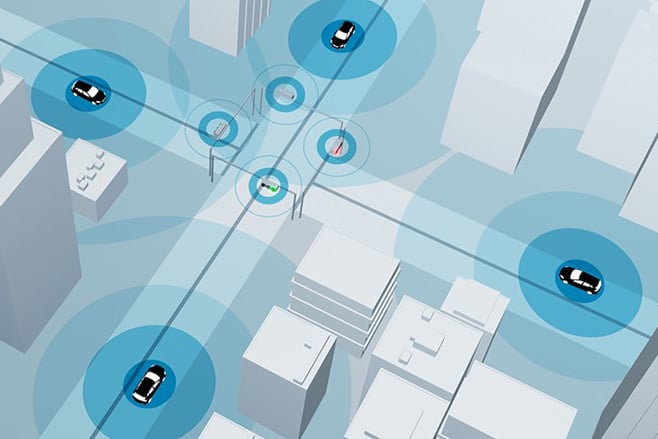
Co-pilot is perhaps a better name for current autonomous-car technology. A car that steers itself along the freeway or reacts to a collision in a millisecond has your back as an extension of your senses. As Mercedes-Benz is careful to stress; we are “On the road to autonomous, accident-free driving” but not quite there.
So where are we?
There are different levels of autonomous vehicle technology, which according to the US National Highway Traffic Safety Administration are defined as:
- Level 0: The driver completely controls the vehicle at all times.
- Level 1: Individual vehicle controls are automated, such as electronic stability control or automatic braking.
- Level 2: At least two controls can be automated in unison, such as adaptive cruise control in combination with lane keeping.
- Level 3: The driver can fully cede control of all safety-critical functions in certain conditions. The car senses when conditions require the driver to retake control and provides a “sufficiently comfortable transition time” for the driver to do so.
- Level 4: The vehicle performs all safety-critical functions for the entire trip, with the driver not expected to control the vehicle at any time. As this vehicle would control all functions from start to stop, including all parking functions, it could include unoccupied cars.
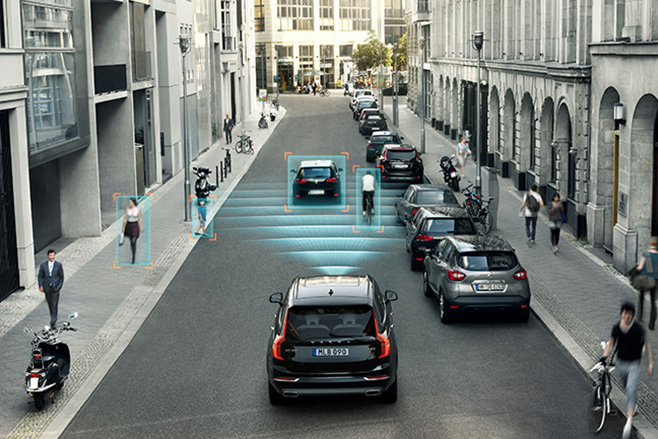
The Society of Automotive Engineers has also devised levels based on the amount of driver attentiveness required rather than the intelligence of the vehicles.
- Level 0: Automated system has no vehicle control, but may issue warnings.
- Level 1: Automated system may include features such as adaptive cruise control and lane keeping assist, but the driver must be ready to take control at any time.
- Level 2: The driver is obliged to detect objects and events and respond if the automated system fails to respond properly. The automated system executes accelerating, braking, and steering. The automated system can deactivate immediately upon takeover by the driver.
- Level 3: Within known, limited environments (such as freeways), the driver can safely turn their attention away from driving tasks.
- Level 4: The automated system can control the vehicle in all but a few environments such as severe weather. The driver must enable the automated system only when it is safe to do so. When enabled, driver attention is not required.
- Level 5: Other than setting the destination and starting the system, no human intervention is required. The automatic system can drive to any location where it is legal to drive.
Then there’s the pace of generational change. Could Level 4 cars safely share a highway with less-intelligent cars with slow-to-react humans in control?
See exactly how helmets have changed over the past 100 years, with this brilliant clip from Donut Media.
Comedian Jerry Seinfeld once joked how you should never attempt any activity that requires a helmet. Of course, being a car buff he’d probably exclude motor racing, though when you look at the sparse protection offered by racing headwear during the early years of the sport anyone would be forgiven for thinking twice before participating.
If you watch modern motorsport, it’s easy to forget how the technology behind the helmets on the driver’s heads has advanced as much as the cars they drive.
This development is wonderfully shown in a new video by Donut Media which is part of its The Evolution Series which spans the early days of the soft shell helmets through to today’s high-tech carbon fibre designs in just over two minutes.
Incredibly, the first helmets simply protected drivers from dirt and it wasn’t until 1949 that hard shell helmets were introduced to protect the head from impacts.
These resembled jockeys’ headgear until 1957 when Bell Helmets introduced the first mass-produced helmet in the now familiar ball shape with attached visor. A few years later drivers starting wearing goggles and in 1968 Nomex was added to the inner lining for fire protection.
Full-face helmets were being developed during this time and would become commonplace on racetracks by 1970. Within a couple of years visors and “dirt-skirts” attached to the bottom of the helmets were introduced for further protection from fire.
By the late 80s, helmets had headsets installed in them for drivers to communicate with their garages, and in 1990 a plastic tube called a “pop off valve” was attached to allow turbo drivers to hear their engines popping to avoid turbo lag. The ’90s also saw helmets become billboards for sponsor logos and their shapes change to be more aerodynamic in open wheelers.
The new century saw helmets produced from new lightweight materials and the introduction of visor tear offs for better vision. Helmets are now made from Kevlar and carbonfibre and weigh about 1250 grams. They have increased head and neck support and contain air-ducting and drink tubes to increase comfort and reduce fatigue.
Honda has revealed official pictures of the 2017 Honda Civic Hatch ahead of its arrival in Australia early next year.
The lift-back will form the basis of the cut-throat Civic Type-R, which is also due to arrive on our shores next year.
“Like the Civic sedan, the Honda Civic Hatch will be a very important car in the Honda line-up in Australia,” Honda Australia Director, Mr. Stephen Collins said.
“In the small car segment in Australia, hatches reign so we expect the Honda Civic Hatch to be a relevant option for Honda customers looking for the versatility of a hatch but with the proven quality, style and performance of a Honda.”
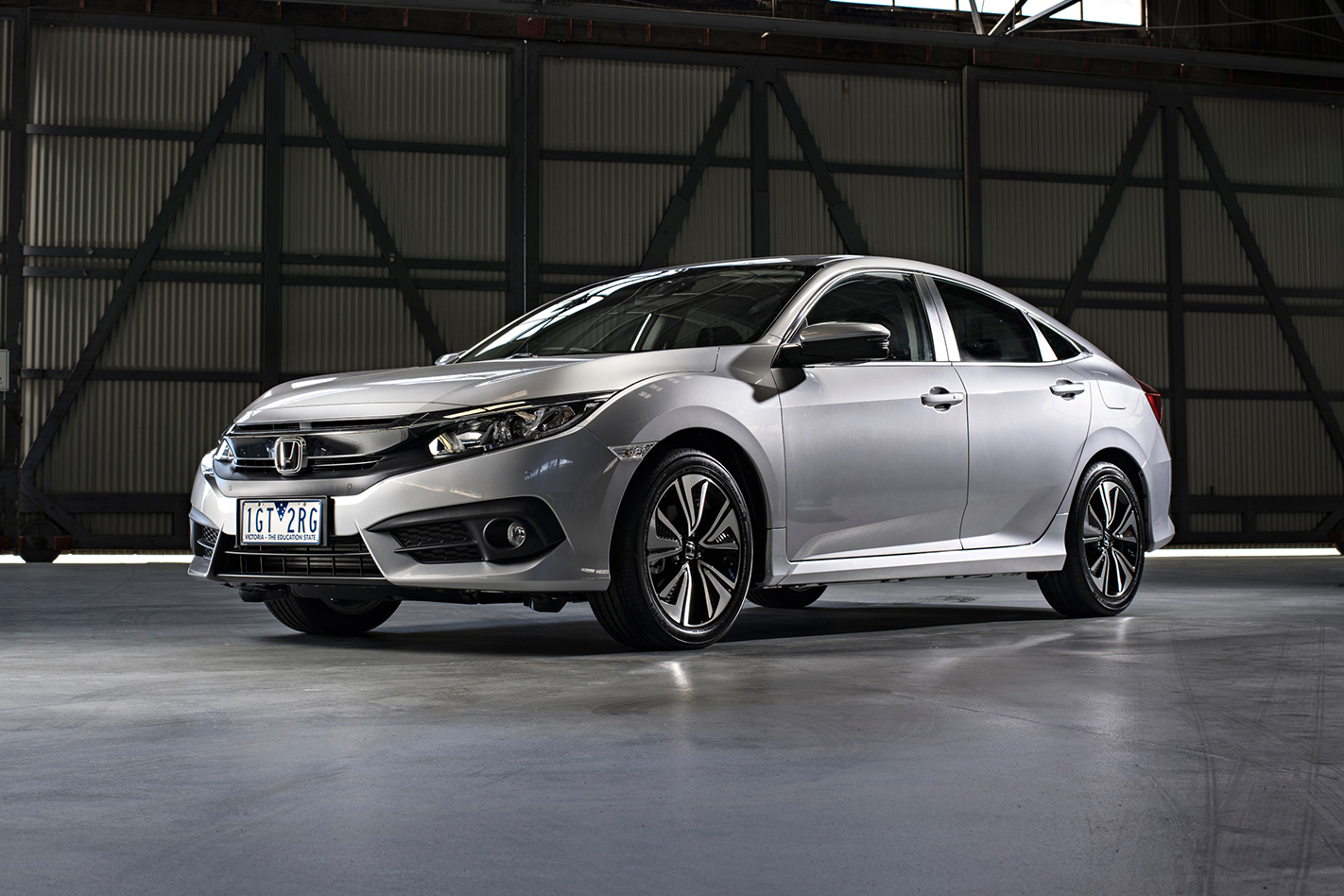
Honda says the hatch will have both turbo and naturally-aspirated engine options, have a similar model line-up as the Civic sedan, which is made up of the VTi, VTi-S, VTi-L, RS, and Honda Civic VTi-LX.
While the Civic is currently on sale national in its sedan guide, starting from $22,390, there is no word on official pricing for the Civic hatch.
Judging from the pictures, Civic hatch owners won’t be sacrificing much in the way of boot space, with the car featuring a sizeable rear-end.
The 10th generation Civic has been Honda’s most popular car since it went on sale earlier this year, with 1,097 models being sold in July, and 2,551 rolling off showrooms so far this year.
“Our customers have really been impressed by the interior packaging, significantly improved quality and luggage space of the new Civic sedan, as well as the performance of the new 1.5-litre turbocharged engine and proven reliability of the 1.8-litre engine,” Mr. Collins said.
Like its sedan sibling, the Civic Hatch will have fully independent suspension in both the front and rear, sport-tuned electronic power steering, variable gear rations, and anti-lock disc brakes on all four corners.
Welcome to the main event, the fight for the super(charged) heavyweight belt.
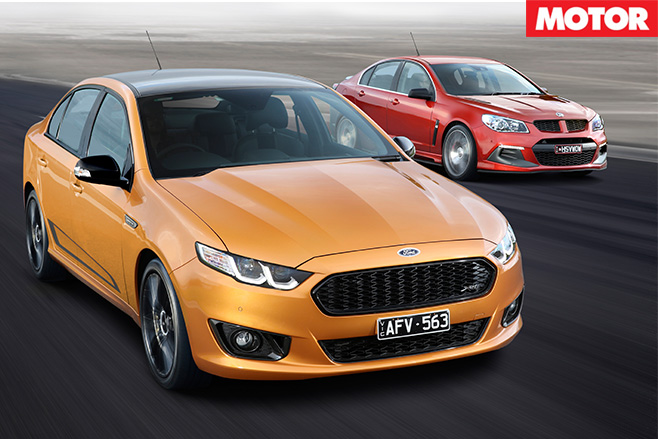
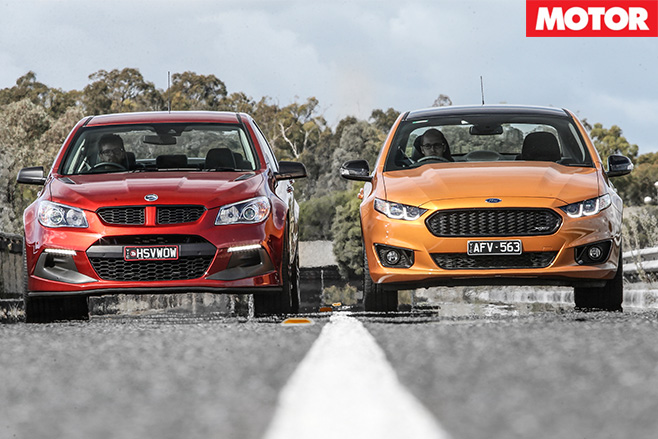
Our two contenders have a long history of antagonism, but this will be one of the final battles between these two bitter rivals. In the red corner is the HSV Gen-F2 Clubsport R8 LSA, a veteran of this game but fitter than ever and in the prime – albeit the latter stages – of its career.
Facing it in the blue corner is the Ford FG X Falcon XR8 Sprint, a challenger with retirement on the near horizon, however one that has undergone an extensive training regime to make one last charge for the title. Over the next six rounds these two will be put to the test but only one can be crowned champion.

On paper this doesn’t look like a very fair fight.The Clubsport packs 400kW/671Nm from its 6.2-litre supercharged LSA V8 and asks $83,490 for the pleasure in six-speed automatic guise (manual: $80,990). Similarly specced, the $62,190 XR8 Sprint holds a substantial price advantage but also looks decisively outgunned, its 5.0-litre supercharged V8 producing ‘just’ 345kW/575Nm.
Of course, that doesn’t take into account the Ford’s well-documented ‘transient overboost’ function, which evens the ledger by boosting outputs to a lineball 400kW/650Nm. At 1872kg it’s no lightweight, but it holds a 35kg advantage over the HSV so theoretically there should be nothing in it from a performance perspective, in a straight line at least.
In near-perfect testing conditions – cool, sunny and dry – the Clubsport nails its best ever times, smashing 0-100km/h in just 4.48sec and crossing the quarter mile in 12.55sec at 184.84km/h. It’s a relatively easy exercise, despite the HSV lacking any form of launch control.
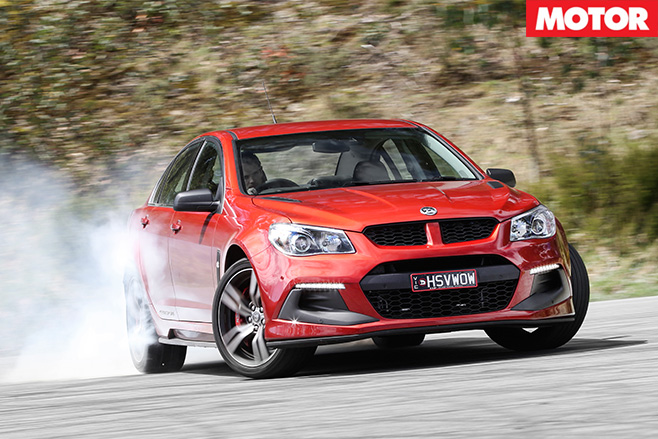
With a 182.35km/h trap speed, it’s clear the XR8 Sprint easily has the grunt to match the Clubsport, however getting it off the line cleanly proves nigh-on impossible. Whispering behind hands, Ford insiders admit the Sprint is capable of 4.6sec to 100km/h and a 12.6sec quarter mile, but the best it manages is 5.07sec to 100km/h and 13.14sec over 400 metres.
Insufficient traction is the easily identifiable culprit; feeding the power in gently results in clean runs but slow times and any attempt to use more throttle just burns the 265/35 rear Pirellis into oblivion.
A 30-minute conversation with the Sprint engineers fails to produce any progress, however later investigations reveal the potential cause of the Sprint’s troubles (see breakout on next spread). The other issue is there is a relatively small window in which to extract the best numbers as heat soak from back-to-back acceleration runs slowly but surely dulls the Miami’s edge; only slightly, but enough to rob it of 2-3km/h at the top end.
Taking the launch problems out of the equation reveals the Sprint’s true potency. From 80-120km/h it matches the Clubsport at 2.5sec and on the Ford’s first acceleration run – which results in the highest trap speed but not the best numbers – it charges from 80-190km/h in 9.98sec, whereas the HSV takes…9.98sec. Like we said, these cars are more or less as fast as one another, but it’s the Clubsport that delivers the numbers and so it takes an early lead. Clubsport: 1 Falcon: 0
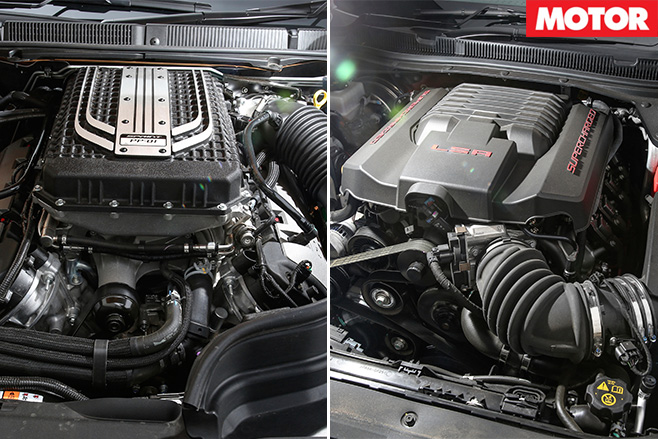
Round 2: Under the Bonnet Everyone loves a set of fast numbers, but it’s the engines’ ability and character on the road that are of far greater importance and despite their similar configurations, the two have remarkably different personalities.
The Falcon feels more explosive on initial throttle application; make no mistake, the HSV is no slouch, but the Ford’s throttle mapping feels more aggressive, which means it really slams you back in your seat. It feels outrageously strong at low rpm – maximum torque is available from just 2220rpm – but with the crank-driven supercharger boost continues to build all the way to the 6200rpm cutout.
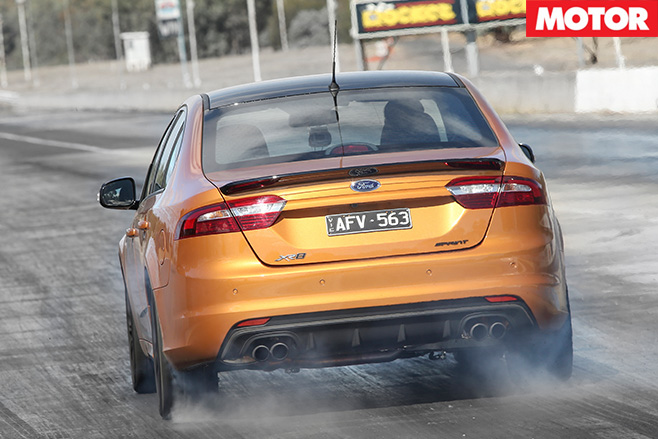
The six-speed ZF auto has incredibly long gearing, running to 122km/h in second and 188km/h in third, but with so much power available there’s a certain thrill in experiencing the seemingly endless acceleration. It also limits the need to use the gearbox, for though it’s commendably smooth during urban duties, in a performance application it feels slow and dim-witted, with the inability to rev-match on downshifts a real Achilles’ heel.
The Clubsport’s six-speed auto will blip the throttle going down the ’box, but still feels a long way from state of the art. Its shorter gearing – second stretches to 109km/h, third 168km/h – feels more appropriate for a performance car, but it refuses seemingly reasonable downshift requests frustratingly often.
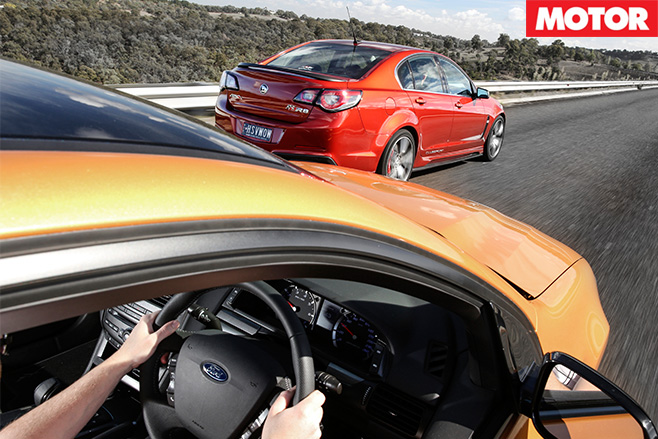
The Clubsport LSA has the benefit of shift paddles behind the steering wheel, but using the sequential lever feels far more appropriate – perhaps it’s the V8 Supercars connection.
So linear is the 6.2-litre LSA V8’s power curve that it doesn’t initially feel that fast. As with the XR8, however, power builds as revs rise and by the time the tacho needle hits its upper reaches you really need to focus on where you’re going as you’re getting there very quickly.
The noise is deeper and dirtier than the Falcon’s and while it’ll be personal preference as to which one’s better, from the inside there is more exhaust note and less blower whine, though the choof as the bi-modal exhaust opens its valves isn’t popular in the MOTOR office.
Round 3: On the Road Traditionally, one of the biggest strengths of the Aussie performance sedan has been its touring ability. From Ford XR Falcon GT to HSV W427 and almost everything in between, few cars at any price point have been able to haul passengers and luggage in relative comfort at high speed over long distances.
One of the most disappointing aspects of the FG X XR8 is its fidgety, unsettled ride, which doesn’t take long to become a major irritation on a long drive. Thankfully, the Sprint is a marked improvement. A complete suspension rethink, necessary due to the switch to Pirelli P Zero tyres, led to softer spring rates but much firmer rebound damping and the result is a ride that is firm but with enough compliance not to become wearing.
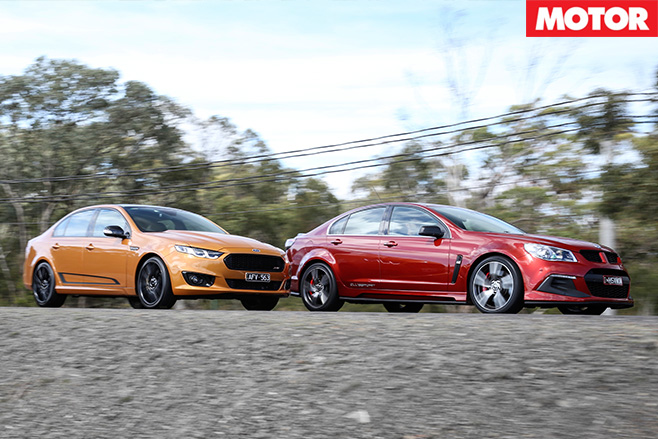
The Clubsport is also firm, with a focus on body control over ride comfort, which works well at higher speeds but can be a little abrupt over sharp bumps at low speed. Like the Falcon, it’s a reasonable compromise but HSV’s Magnetic Ride Control would be a welcome addition for the ability to soften the dampers on a bumpy road. For now, the trick suspension remains the preserve of the Senator and GTS.
One area the Clubsport does display an advantage is its refinement. Wind and road noise is well managed in both cars, but the chink in the Falcon’s armour is what appears to be insufficient underbody sound deadening. Any loose surface encounter, for instance roadworks or pulling onto the side of the road, sprays gravel into the arches with a racket that sounds like a hailstorm on a tin roof.
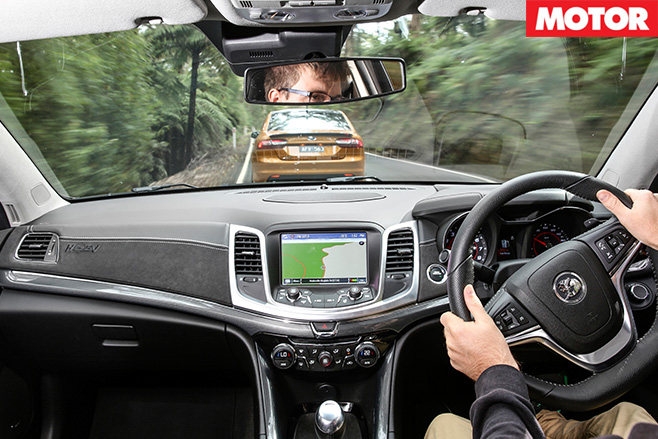
It’s another split decision, and at the halfway point the Ford is hanging on to the HSV. Clubsport: 2 Falcon: 1
Round 4: In the Bends This is where the roads, and this comparison, get interesting. For Gen-F2, HSV focused on stuffing a stable-full of horsepower under the Clubsport’s bonnet, while Ford took the opposite approach with the Sprint by upgrading the chassis in an attempt to harness the grunt it already had.
Our test route is a six-kilometre section of the Euroa-Mansfield which fortuitously contains almost every conceivable type of corner, from tight second-gear hairpins to flowing sweepers interspersed with various bumps, crests and tricky braking zones.
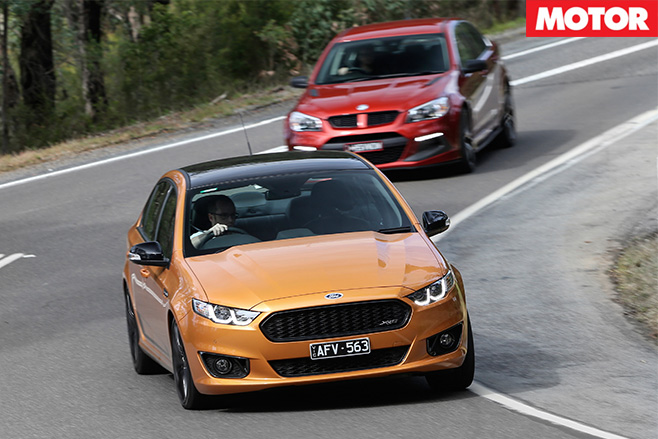
The mass does take its toll on the rubber, though, the Continental ContiSportContact 5Ps providing excellent grip but disappearing at a fearsome rate under continued punishment. Front end grip is the fuse in the handling circuit, with gentle understeer the prevailing characteristic at the limit, so it’s important to shed enough speed before turn in, a process made easier by hugely powerful brakes.
HSV stoppers are among the world’s best and the combination of large ventilated discs and four-piston calipers at both ends hauls this huge car up from 100km/h in just 33.9m while displaying an impressive resistance to fade.
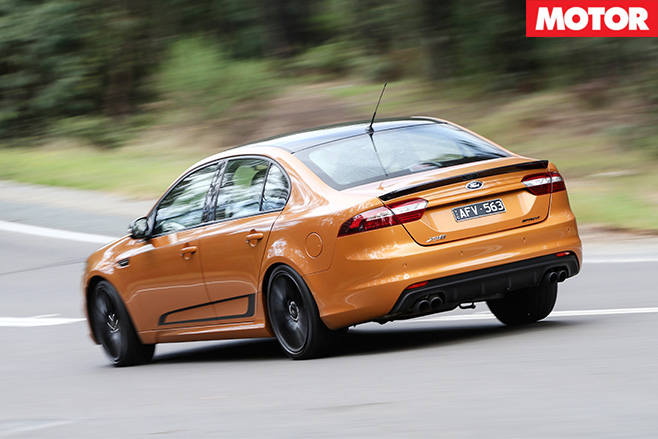
It’s arguably the Clubsport’s biggest advantage over the Sprint, as it allows it to be driven hard with a safety net in place, even in tricky conditions. Despite using the latest Bosch 9.0 ESP system, the Falcon’s electronics are way too conservative for performance driving.
It’s quite subtle in its interventions and allows relatively high cornering speeds, but as soon as you go anywhere near the throttle it strangles the car. It’s the automotive equivalent of trying to run with your shoelaces tied together and freeing the Falcon from its electronic shackles illustrates how much it’s being held back.
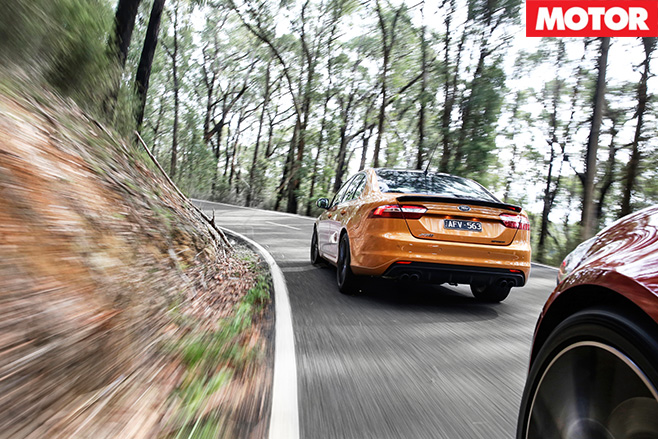
Crucially, though, there’s now enough grip and composure that you can commit to corners and know the car will stick. Front end grip has improved markedly and feels to allow more mid-corner speed than the HSV, though whether that’s actually the case will remain unclear until we get them both on a track and analyse the data. Regardless, it’s a confidence-inspiring setup and the Sprint can be driven harder and faster than any Falcon in recent memory and is more enjoyable to boot.
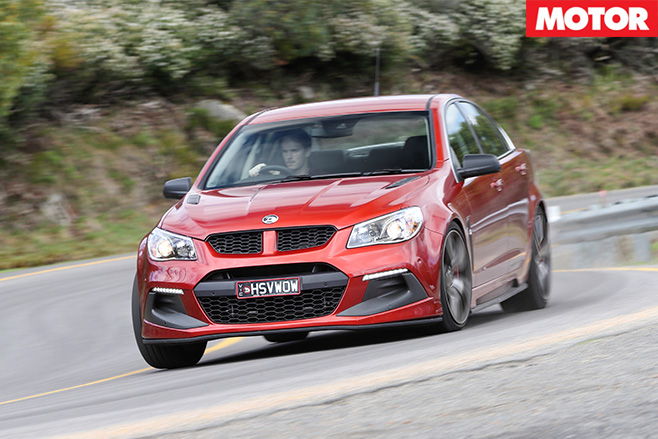
However, while the Ford runs it close, the HSV is still marginally the more polished package. It could do with a bit more front-end bite, but its greater communication, particularly through the steering, makes it easier to approach its limits with confidence. Clubsport: 3 Falcon: 1
Round 5: Inside and out Styling is so subjective that no points will be awarded here. For instance, some commentators have described the FG X look as like something that’s emerged from the ocean depths, however personally I think Ford’s designers have done a solid job of incorporating the corporate nose and freshening a shape that dates back to 2008.
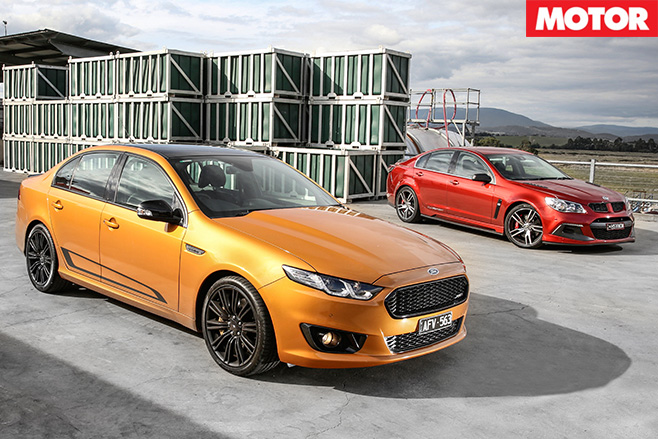
With its bonnet vents and bodykit, the Clubsport has a more aggressive exterior package and again, some will love it and others will hate it. For mine the new bodykit, especially the side skirts, and the subtle rear spoiler strike a good balance between differentiating it from the basic Commodore shape without dissolving into caricature.
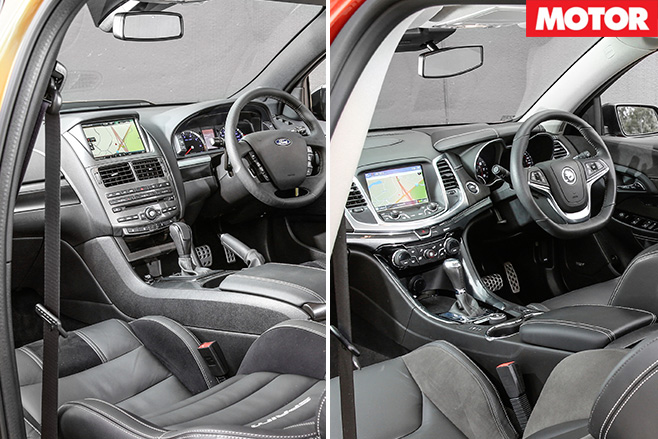
Points can be awarded, however, for the interiors. The inside of the Clubsport is overwhelmingly grey and the seats lack lateral support in hard cornering, though the driving position is spot-on. The reverse is true of the Falcon, its seats more supportive but mounted far too high, the driver perched like a child in a high chair. Yes, we’ve said it many times before, but that doesn’t make it any less true.
Round 6: Dollars & Sense Value is the Falcon’s trump card. Yes, it struggled on the strip but from an experiential standpoint, it offers a package every bit as potent as the Clubsport for $20,000 less. With equal drivers on a twisty road or racetrack, there’s unlikely to be much more than a handful of metres between them, which means the Sprint offers enormous bang for your buck.
It lacks the 21st century toys of the HSV, notably active safety equipment like blind-spot monitoring, lane-assist and emergency braking, but traditional muscle car buyers aren’t likely to notice their absence and everything they will use, stuff like sat-nav, Bluetooth audio and smartphone app support, is present and correct.
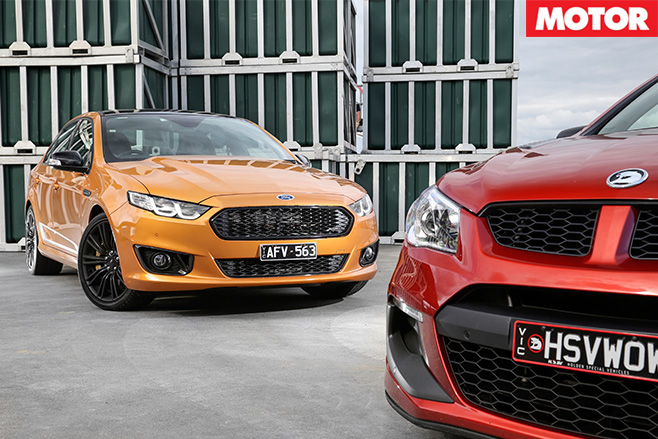
The verdict The scores tell the story: the HSV wins, if only by the slimmest of margins. A half-point swing in any of the six rounds would’ve led to a tie. The Clubsport LSA wins because it is the better car; it puts its power down more effectively, inspires more confidence in the driver and is the more competitive contemporary package. It’s an excellent example of the modern-day muscle car, but its price tag reflects this.
Ford has done a great job in making the Sprint a fitting farewell to the Falcon. It certainly doesn’t leave the Clubsport bruised or bloodied in any area, but that it’s now close enough to compete is a big achievement. A regular XR8 would be mauled by the HSV. Sprint owners have bought something much more than a badge exercise; let’s just hope they don’t tuck them away in sheds, as none of the improvements will be noticeable in there.
There’s no fairytale win for the XR8 in its final bout, but neither is it a knockout, and while the HSV wins, both contenders deserve to leave the arena carried on the shoulders of others.
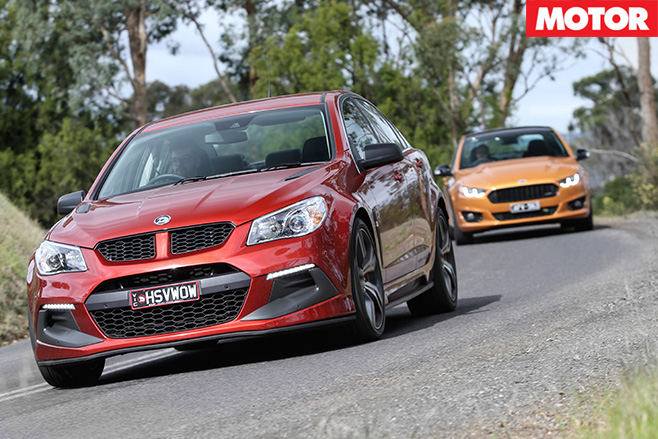
Clubbie comes up trumps
| u00a0 | Ford XR8 Sprint | HSV Clubsport LSA |
| 0-10km/h | 0.40 | 0.32 |
| 0-20km/h | 0.84 | 0.71 |
| 0-30km/h | 1.28 | 1.10 |
| 0-40km/h | 1.68 | 1.47 |
| 0-50km/h | 2.13 | 1.84 |
| 0-60km/h | 2.61 | 2.28 |
| 0-70km/h | 3.18 | 2.76 |
| 0-80km/h | 3.82 | 3.29 |
| 0-90km/h | 4.44 | 3.86 |
| 0-100km/h | 5.07 | 4.48 |
| 0-110km/h | 5.69 | 5.20 |
| 0-120km/h | 6.66 | 5.97 |
| 0-130km/h | 7.65 | 6.76 |
| 0-140km/h | 8.70 | 7.57 |
| 0-150km/h | 9.68 | 8.47 |
| 0-160km/h | 10.69 | 9.45 |
| 0-170km/h | 11.73 | 10.65 |
| 0-180km/h | 12.86 | 11.91 |
| 0-190km/h | N/A | 13.27 |
0-400m | 13.14sec @ 182.35km/h | 12.55sec @ 184.84km/h |
SPEED IN GEARS | 69km/h @ 6200rpm | 64km/h @ 6300rpm |
2nd | 122km/h @ 6200rpm | 109km/h @ 6300rpm |
3rd | 188km/h @ 6200rpm | 168km/h @ 6300rpm |
4th | 230km/h @ 5680rpm* | 224km/h @ 6300rpm |
5th | 230km/h @ 4330rpm* | 250km/h @ 5200rpm* |
6th | 230km/h @ 3440rpm* | 250km/h @ 4100rpm* |
As tested by MOTOR: Heathcote Dragway, 10:30am, 17 degrees, dry. Driver: Scott Newman. *Manufacturer’s claim
| u00a0 | Ford Falcon XR8 Sprint | HSV Clubsport R8 LSA |
| Body | 5-door, 5-seat sedan | 5-door, 5-seat sedan |
| Drive | rear-wheel | rear-wheel |
| Engine | 4951cc V8, DOHC, 32v, supercharger | 6162cc V8, OHV, 16v, supercharger |
| Bore/Stroke | 92.2 x 92.7mm | 103.25 x 92.0mm |
| Compression | 9.3:1 | 9.1:1 |
| Power | 345kW @ 5750rpm (400kW on overboost) | 400kW @ 6150rpm |
| Torque | 575Nm @ 2220-6250rpm (650Nm on overboost) | 671Nm @ 4200rpm |
| Power/Weight | 184kW/tonne | 210kW/tonne |
| Transmission | 6-speed automatic | 6-speed automatic |
| Weight | 1872kg | 1907kg |
| Suspension(F) | A-arms, coil springs, anti-roll bar | struts, coil springs, anti-roll bar |
| Suspension(R) | multi-links, coil springs, anti-roll bar | multi-links, coil springs, anti-roll bar |
| L/W/H | 4950/1868/1493mm | 4991/1899/1453mm |
| Wheelbase | 2838mm | 2915mmu00a0 |
| Tracks | 1583/1598mm (f/r) | 1616/1590mm (f/r) |
| Steering | hydraulically-assisted rack-and-pinion | electrically-assisted rack-and-pinion |
| Brakes(F) | 355mm ventilated/drilled discs, 6-piston calipers | 367mm ventilated discs, 4-piston calipers |
| Brakes(R) | 330mm ventilated/drilled discs, 4-piston calipers | 372mm ventilated discs, 4-piston calipers |
| Wheels | 19.0 x 8.0-inch (f); 19.0 x 9.0-inch (r) | 20.0 x 8.5-inch (f); 20.0 x 9.5-inch (r) |
| Tyre sizes | 245/35 ZR19 (f); 265/35 ZR19 (r) | 255/35 ZR20 (f); 275/35 ZR20 (r)u00a0 |
| Tyre | Pirelli P Zero | Continental ContiSportContact 5P |
| Price as tested | $62,190 | $83,490u00a0 |
| Pros | Massive speed; much improved handling; value | Archetypal Aussie muscle car; fast, furious and fun |
| Cons | Vague steering; out-dated gearbox | Firm ride; very heavy; lotsa money |
| Star Rating | 4/5 | 4/5 |
TELL ME ABOUT THIS CAR
It’s the most high-performance variant of the Porsche Boxster range, meaning a folding soft top, accommodation for only two occupants, and huge driving thrills and involvement.
It’s also now an anomaly to the current 718 Boxster line-up, using a naturally-aspirated (non-turbo) engine donated from the previous generation of its larger sibling, the 911.
STRENGTHS
- Engine is smooth, wonderfully free-revving, and seems to urge the driver to extend it at every opportunity, rewarding with a vicious howl and incredible top-end acceleration once the needle passes 5000rpm.
- Open-top body allows full immersion in the driving experience, and yet remains supremely stiff, exhibiting virtually none of the wobbles and tremors through the body that can afflict lesser convertibles.
- Manual gear change has a beautifully slick, mechanical feel, enhancing the driver’s sense of connection with the car.
- Steering provides an intimate picture of what is happening at ground level from the front tyres, and skilled drivers can push the car very hard with constant and ample rewards – until its high grip levels are eventually breached.
- Engine is flexible at low revs, but really needs to be worked vigorously for the Porsche Boxster Spyder to feel quick and engaging.
- Clutch and gearshift are not light, and may become tiring in heavy stop-start traffic.
- Exhaust is loud in Sport mode, and may attract unwanted attention.
- Tyre noise is loud at highway speeds, reducing the Spyder’s abilities as a tourer.
- The roof does not have the electric operation of the regular Boxster range, so raising and lowering it is a fiddly exercise.
- Interior lacks some equipment, connectivity and premium finishes now standard on the new 718 Boxster.
- Price premium is high over lesser Boxsters.
Not if you’re serious about owning the best-handling, most thrilling and involving open-top car in this segment. The Audi TT S quattro cabriolet is some $65K cheaper, but can’t touch the Spyder for dynamic genius. So-called ‘rivals’ – the BMW Z4 and the forthcoming Mercedes-Benz SLC – suffer from the same shortcomings: They are more convertible cruisers with sporting ability than outright performance cars. If a Boxster Spyder is out of reach, consider a base 718 Boxster and enjoy the punchy turbo engine, improved cabin and easier electric soft-top. It’s a sweet package and (comparatively) affordable.
When the world’s fastest man gets behind the wheel of a car, you can bet your bottom dollar it’s not for your average Sunday drive.
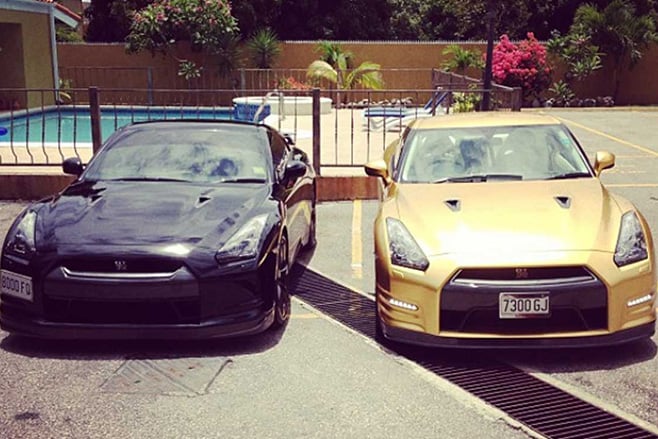
When he’s not making news for record-breaking on-track performances, or winning gold for the men’s 100m race at the Rio 2016 Olympics against notorious doper Justin Gatlin, he gets the world talking about his ultra-fast cars leaving a dealership or piling onto the back of a tow truck.
Naturally, we had to take a speedy trip down the Lightning Bolt’s memory lane (via a quick Google search).
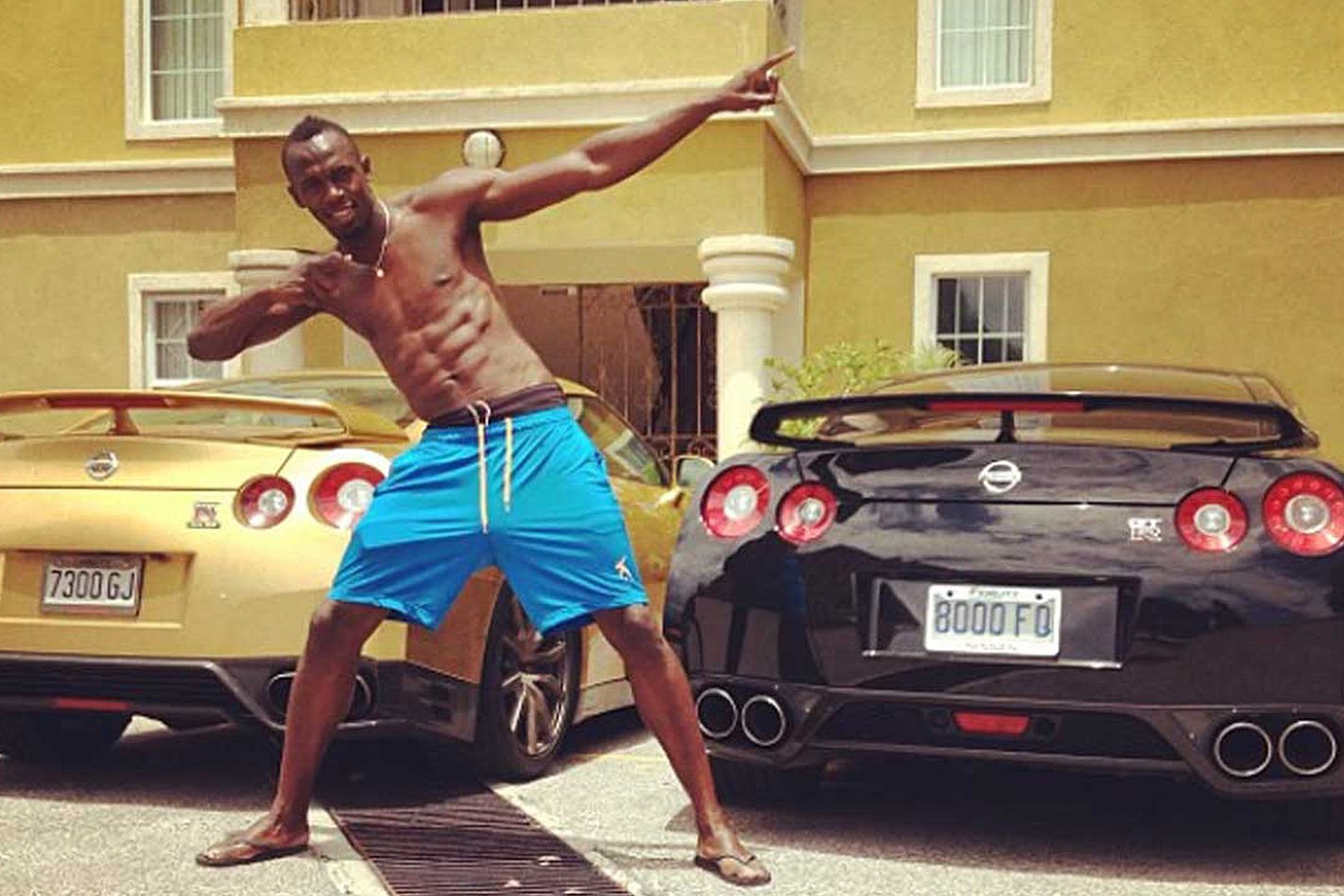
Bolt’s car story begins in 2009 when the Jamaican world-champion was getting around his home-land in a black BMW M3. When your nickname is ‘Lightning Bolt’, you’ve got seven gold medals, with more on the way, and you’ve been named the fastest man in the world, you’re going to want to prove your reputation extends further than your feet. So when Bolt rolled his BMW M3 three times into a ditch, and walked away with nothing more than a few prickles in his foot (he was driving barefooted), no one was surprised. Least of all Bolt himself who talks about the incident with a nonchalant attitude only recognisable in a confident 100m sprint athlete.
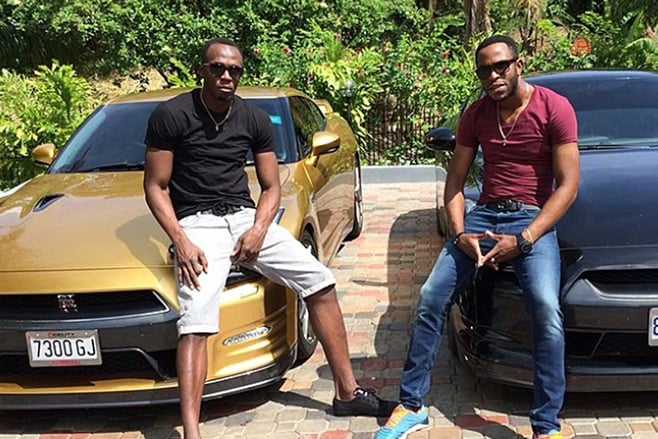
Three years and a second black BMW M3 later, Bolt drove into a guardrail in Jamaica after a night out. This same year, Bolt’s Nissan GT-R obsession began.
In 2012, Bolt teamed up with Nissan to release the special edition metallic gold Bolt GT-R. The car was eventually sold to an anonymous Australian buyer for an estimated $177,005 of which proceeds were donated to the Usain Bolt Foundation for under privileged children in Jamaica. Only one of the Bolt GT-Rs was expected to be made, but Nissan ended up offering Bolt a second, customisable version. Bolt kept the metallic gold exterior (of course, representing his gold medals) but replaced the sold GT-R’s gold-accented interiors for all white.
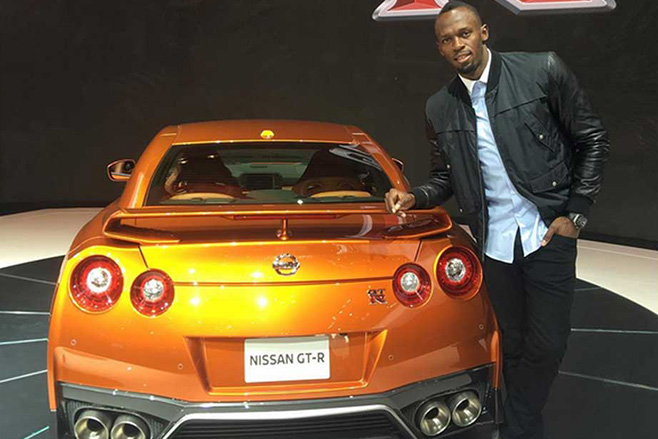
Somewhere between two written-off M3s and a one-of-a-kind Nissan supercar, Bolt has also been spotted with a black GT-R, Ferrari F430 and Ferrari California.
In a recent post to his Instagram account (@usainbolt) he posted a photo of the new 2017 metallic Blaze Nissan GT-R. It’s unclear whether this has been added to his collection, but given Bolt’s history, he’s due to add a third GT-R to his collection. Maybe a gift to himself as a pat on the back for winning gold at Rio? Watch this space.
In a country that invented the ute, it shouldn’t come as a surprise that the iconic tray-backed vehicle style is immensely popular in Australia.
The biggest-selling models in the segment currently are the Toyota HiLux, Ford Ranger and Mitsubishi Triton – and all are regulars in the monthly top 10 sales charts.
Here’s a guide to any changes planned or expected for these models – to help you pick the perfect timing for buying one.
TOYOTA HILUX
Toyota released its first all-new HiLux in 10 years in 2015, so for now there’s little point holding off for an update if you want to join the other 850,000 Australians who have purchased this ute since its 1968 debut.
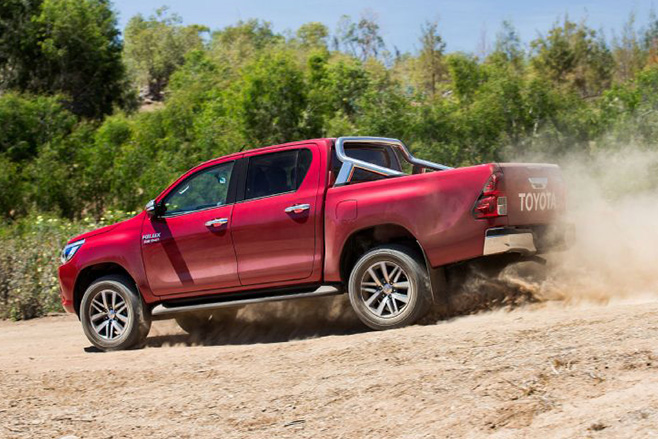
The eighth-generation HiLux brought it right up to speed with key rivals, and in some instances placed it ahead.
A rear-view camera is standard on every model, for example, while a 1000kg-higher braked towing capacity of 3500kg matches the segment benchmarks of the Ford Ranger, Mazda BT-50 and Holden Colorado.
FORD RANGER
The slow-progressing nature of the ute segment means that even the current, five-year-old Ford Ranger is still sufficient up to date. A significant update in 2015 and an important update in June 2016 help.
The 2015 changes included styling tweaks (notably at the front with a revised grille), an increased maximum payload, while higher grades received a new 8.0-inch touchscreen display. There was also revised suspension and steering across the board.
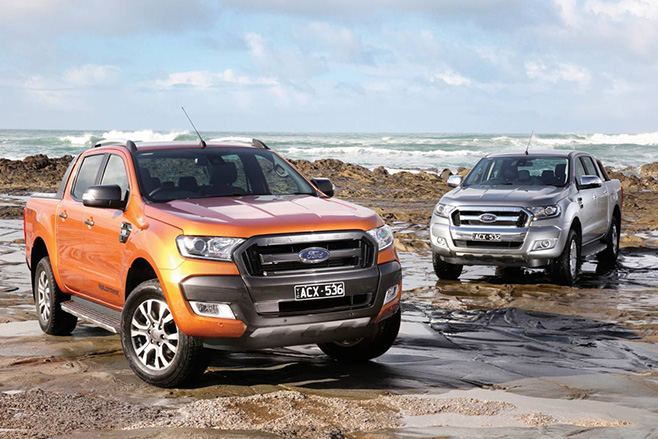
For 2016, Ford responded to the new HiLux with further upgrades that included making a rear-view camera and rear parking sensors standard on every model.
The XLT and Wildtrak trim grades also gained the most advanced version of Ford’s infotainment system – Sync3 – which includes integration of Apple CarPlay and Android Auto.
MITSUBISHI TRITON
Last year was a busy time for new utes, as Mitsubishi joined Toyota in launching a new iteration of its popular Triton.
Like the HiLux, the Triton grew dimensionally – with dual-cab versions adding an extra 20mm in legroom and 10mm more shoulder room.
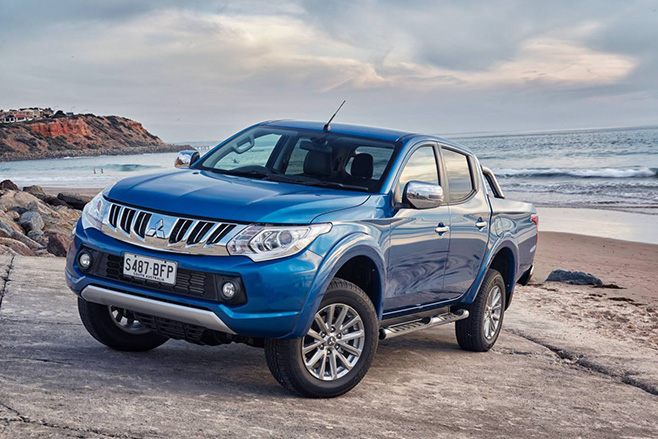
A new 2.4-litre turbo diesel slotted in with significantly improved fuel economy (by 20 per cent) over the engine it replaced.
Don’t expect too much action from Mitsubishi’s product planning department in terms of Triton updates over the next 18 months.
The next-generation Triton – which will appear sometime in the early part of the next decade – will be twinned with the Nissan Navara, following Renault-Nissan’s takeover of Mitsubishi in 2016.
HOLDEN COLORADO
Holden’s latest Colorado emerged in 2012 but it has been given a major overhaul for the next phase of its lifecycle – so much so they refuse to even call it a ute.
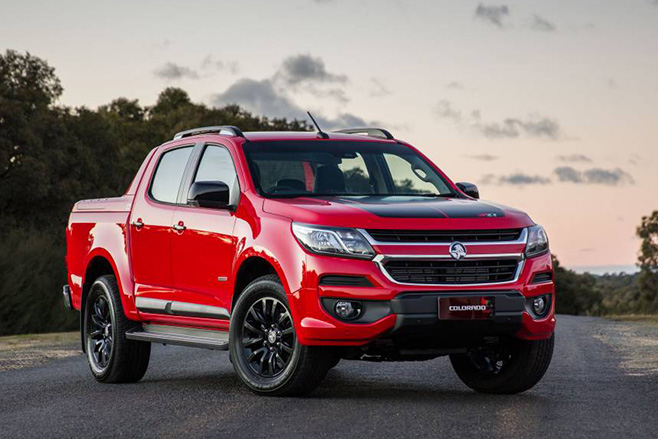
The heavily updated Colorado will be available in Holden showrooms from September, marking the change visually with an exterior update based on the Holden Colorado Xtreme concept shown earlier this year.
Colorado steps up the safety by following the HiLux and Ranger with a rear-view camera fitted to every model, while some models will also offer forward collision alert, lane departure warning, and front park assist.
There’s a new version of the MyLink infotainment system with Apple CarPlay and Android Auto compatibility, and there’s an expanded range of factory accessories also inspired by the aforementioned Xtreme.
Holden engineers were also involved in improving the Colorado’s handling, ride comfort and noise refinement.
Every now and then, a car passes through the WhichCar garage and steals the heart of one of the team. With rose-tinted glasses, we accept its faults of impracticalities, prickly drivetrains or missing airbags and fall in love with it anyway.
This is a phenomenon we call the ‘perfect match’. When a car’s personality connects with our lifestyle in a way we deem it our automotive soul mate.
So we decided to brew up a hot tip, add a little bit of salt, and throw in a few stereotypes to help you find your perfect match.
THE ADVENTUROUS SUBURBANITE
You like to take the path less travelled and would choose a weekend adventure into the wilderness over a Netflix and chill date any day. But your life in the city is every bit as important as your life on the road. You crave adventure as much as you crave stability and routine so your car needs to be up for the journey and get you through the hard roads while also coping with your nomad city lifestyle. If it comes with a dream catcher in the window, you’ll know you’ve found your soul-mate.

We suggest the 4X4 or AWD:
- Subaru Outback
- Toyota LandCruiser Troopy
- Jeep Renegade
You spend as much time by the ocean as humanly possible and you tend to pick up litter buried in the sand on your evening walks. Shoes are a burden, dry shampoo is your best friend and you’ve signed every petition to save the forest as humanly possible. You’re certainly not one to follow social norms and if you have to use something mechanical to get around, it may as well be one that causes as little harm to the environment as possible. It’s for this reason you turn to electric cars or at least plug in hybrids, short of driving a working Volkswagen Kombi.

We suggest the electric car:
- Toyota Prius
- Nissan Leaf
- Mitsubishi Outlander PHEV
Most of your time is spent in the car weaving in and out of traffic on your daily commute. Come weekends, you try and spend as little time in a car as possible, unless you’re driving through some ultra-scenic roads. While you work hard during the week, you like to really let loose and have fun on the weekends. You eat out more than you thought would ever be possible, red wine is a staple grocery in your house and you pull out your dancing shoes as often as your sneakers. Ultimately, you’re a creature of habit, and habit breeds practicality. Given you spend so much time behind the wheel you want something practical but ultra-fun to drive.
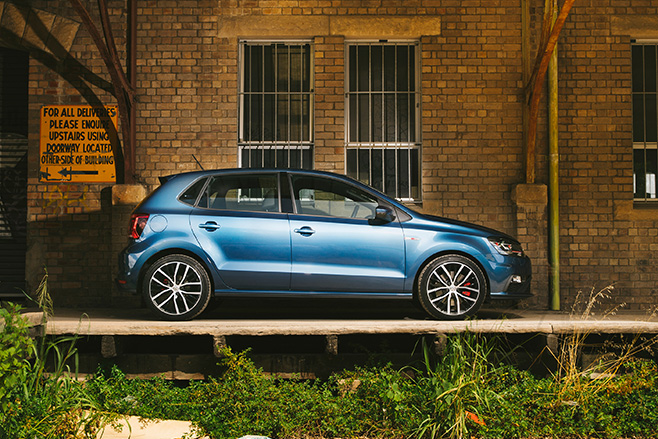
We suggest the hatchback:
- Volkswagen Polo
- Renault Clio
- Mazda 2
You don’t remember the last time you slept in, your house has turned from an interior-design dream to a play yard and you’ve had a brood of tiny humans following you around constantly. Your designer handbag or briefcase has since been replaced by a bag of nappies, juice boxes and rollups and in the last 10 years you’ve spent more money at Cotton On kids than you’ve spent on wine. But there’s nothing more important than the family and you want something you all love. Your car needs to cope with the school run, family holidays and fit the gang, but your postcode will also plays its part in your car choice.

We suggest the SUV or Minivan:
- Toyota Tarago
- Volvo XC90
- Mazda CX-9
“Never give up” is the motto you have had stuck to your mirror ever since you turned 16. You were a straight A student, university was one of the most stressful periods of your life, and every time one of your friends buys a new toy, you’ve just got to have the same, or better. It’s because you’ve always strived to be better that you’ve achieved such success in your life, and you like people to know it. You’ve got one of the best houses, on the best street, in the best suburb; so naturally, your car has to match.
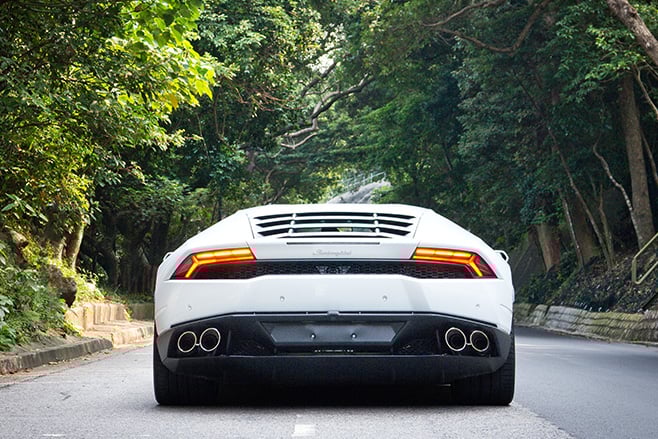
We suggest the luxury car:
- Lamborghini or Maserati of any kind
- Mercedes-Benz G Wagon
- BMW X6 M
You own more blue singlets than shirts, you’ve got two pairs of shoes – boots and thongs – and you’ll pick anything that can fit in a stubby holder over a bottle of wine most days of the week. You know sheilas are women and blokes are men, and your favourite thing to do on the weekend is throw a BBQ with close mates or head to any event that sells champagne or beer. You’re everything you’re supposed to be as an Australian and as far as you, and the rest of the country, are concerned, that’s what makes you fun.
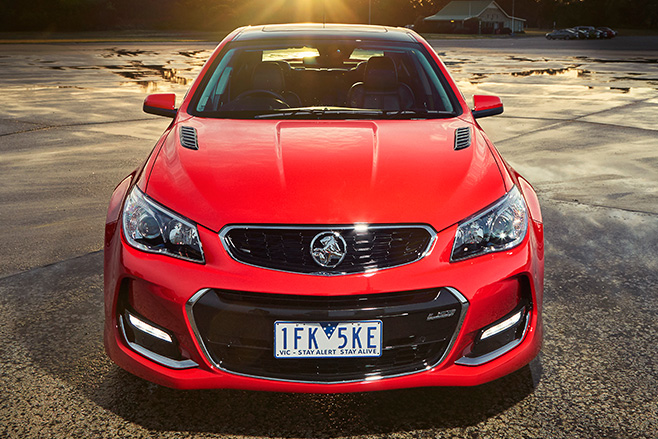
We suggest a ute or a V8:
- Holden Commodore
- Toyota HiLux
- Nissan Navara
Woman’s Day is one of your favourite reads, you spend most of your time trolling Instagram and you once you even joined a fan club. You cried when your favourite brand broke up, and you’ve watched more re-runs of Keeping Up With The Kardashians than you really ever should. Celebrity endorsed products hook you every single time. But aside from that, you’re excellent at general pop knowledge and you spend a lot of time in the city trying to follow in the footsteps of your idol (hopefully not the literal footsteps). You want a car that makes you feel like you’re driving around LA, but within your limited non-celebrity-status budget.
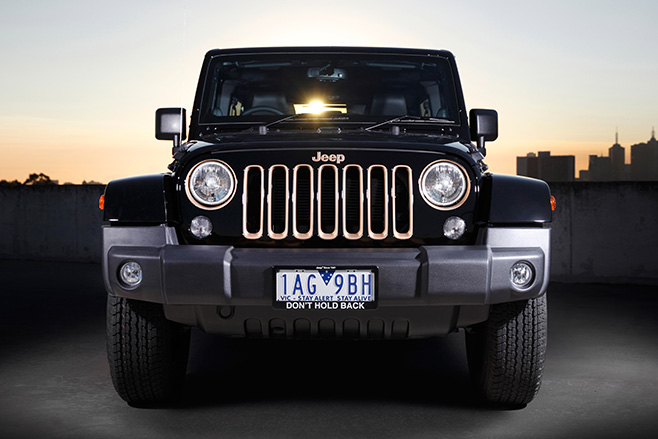
We suggest anything a celebrity drives:
- Jeep Wrangler
- MINI Cooper
- Porsche 911 (because everyone has to have a goal)
Your friends and family know that asking you to make a decision is like waiting for grass to grow – it’ll happen eventually, but never as quickly as you need it to. Decision making isn’t your forte and you can’t decide on whether to eat Thai or Burgers for Friday-night takeaway let alone any major life decisions. You can get quite anxious at times but the best part is you love to go with the flow. It’s not that you’re too fussy, it’s just you don’t really mind and you’re happy to make the best of every situation. Live life to the fullest is your motto, so why waste time trying to decide when someone else can just do it for you, right?
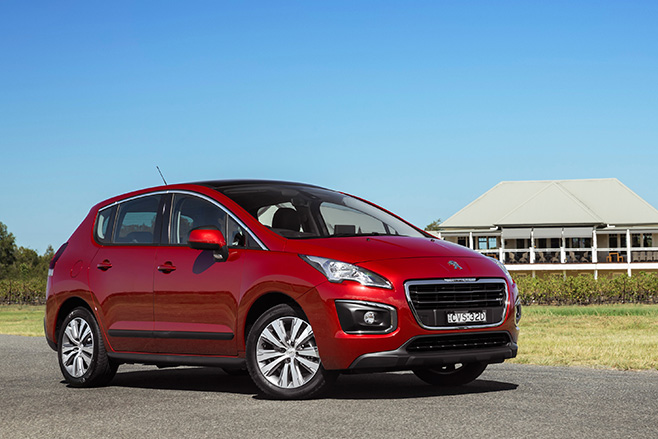
We suggest a crossover:
- Peugeot 3008
- Volkswagen Passat Alltrack
- Audi Q5
