
When the second-generation Hyundai Tiburon was released in 2001, certain generous sectors of the press described it as looking like a Ferrari 456.
If you squint really, really hard…it still doesn’t really look like a 456, but the comparison was enough for Rob Lamont to take his 2010 Tiburon to the next level, undertaking more than 150 modifications to add a dash of Prancing Horse magic to his Hyundai.
There are the obvious badges, yellow brake calipers, a special Michael Schumacher plaque inside and an exhaust system “modified to sound exactly like a Ferrari”.
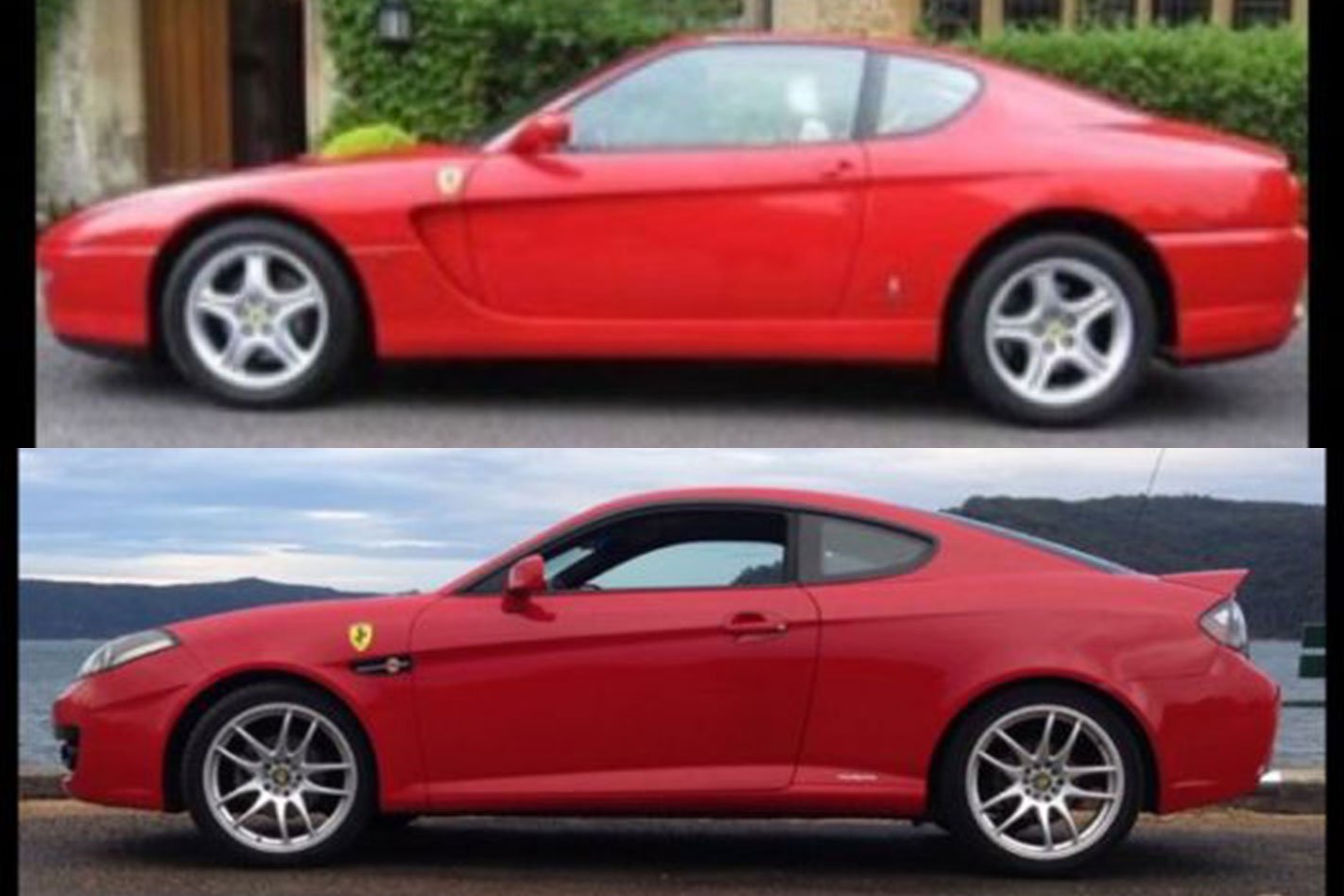
If you’re keen on this Seoul-Maranello mash-up, the Hyundai Ferrari Tribute is for sale on Gumtree for $14,900. Alternatively, you could buy a regular Tiburon for around $5000 less.
Apple often rushes things to market then works on fixing the issues. You can’t do that with cars.
First published in the May 2016 issue of Wheels magazine, Australia’s most experienced and most trusted car magazine since 1953.
Forgive me for not being as excited as the i-thingy brigade about Apple spreading its app-happy wings to develop a car.
If all the rumours are true – and there’s plenty of evidence and innuendo to suggest that the i-smoke must eventually lead to fire – the world’s second-largest tech company will be hoping to do to transport what it has done to the music and phone industries.
It’s a big call. But while Apple doesn’t always nail the bullseye first time around, it usually gets somewhere close to the target once some of the inevitable lessons are learnt. The iPod, iPhone and iPad are perfect examples.
Apple is not alone in wanting to tackle cars. Search engine giant Google is also hoping to shape transport, predominantly by sidestepping the driver with robots, although it remains to be seen if they’ll do what they’re told. The Google car’s much-publicised crash earlier this year was evidence of the challenges ahead, especially when it comes to dealing with human drivers who won’t always behave like a computer. As a result, the company said it would make “refinements to our software”, something we suspect will be happening for decades to come.
There’s no question that Apple and Google have shaped our tech worlds. But each has also made plenty of mistakes, and in Google’s case the list of failures is longer than the very short list of (admittedly very big) successes. Google Glass anyone?
Oh, and they need to work faultlessly the minute you drive them out of the dealership. It will require the tech giants to develop their four-wheeled products in a very different way to their regular offerings.
As with its rivals, Apple often rushes things to market then works on fixing the issues once it’s in consumer hands (Apple Maps anyone?). You can’t do that with cars. You can’t use consumers to help develop climate-control systems or the entertainment system, let alone the braking or crash-avoidance systems.
History suggests, though, that Apple won’t have issues finding buyers. There are millions of fanbois around the world eager to buy anything new adorned with the Apple logo. But there’s a big difference between having a new phone or watch or iPad go on the fritz for a minute or two and a car doing 100km/h down a freeway.
Fast learners
From the outside, Apple appears to be playing it smart when it comes to developing its top-secret car. The California-based company has been hiring experts across the automotive industry – including some engineers from Holden – to at least shortcut some of the lessons learnt from more than 100 years of car-making. And, as with everyone at Apple, secrecy appears paramount to their future employment; it’s understood part of the deal is not to talk to anyone outside the company about what they’re up to.
MG awoke from its post-war slumber with this sleek new convertible.
CECIL Kimber and his MG marque – the initials stand for Morris Garages, where Kimber worked – gave the world not just fast, affordable and reliable sports cars, but a new formula for making them. Lotus, Porsche and the AC Cobra are just a few examples of performance legends built on the back of proven, mass-produced models.
Early MGs were giant-killers in circuit racing and speed records, but by the early 1950s their upright, “square-rigger” styling was a major sales handicap. Jaguar’s XK120 (1948) and the later Austin Healey 100/4 and Triumph TR2 (both 1953) had reset the template.
As ever, MG turned to its racing experience. In 1951, motorsport photographer and successful MG TC racer George Phillips commissioned Syd Enever, who worked in MG’s experimental department, to design a streamlined body for the 1951 Le Mans sports car race. Based on a new TD chassis and running gear, the EX172 pointed the way for MG’s future. However, development of a streamlined successor to the TD was stalled by BMC management’s preoccupation with the Austin Healey.
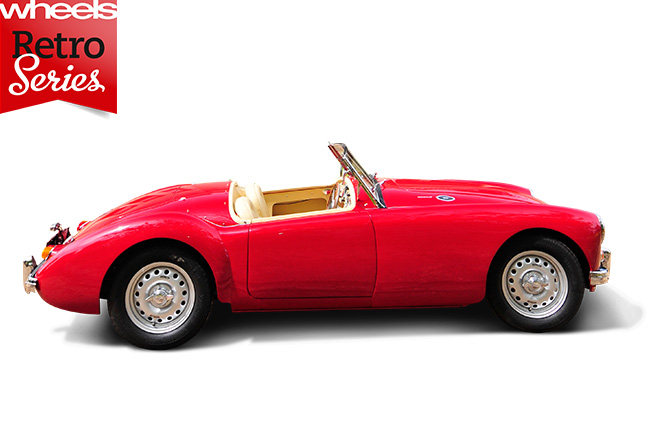
The MGA, launched in September 1955, was effectively a productionised EX182. Beneath the all-new body was a well-measured recipe of new and existing parts, including steering and front suspension partly pilfered from the recently defunct Y-series sedan.
Despite some initial resistance to the suddenly modern styling, the MGA sold up a storm. The lion’s share of production went to the US, where its timing played perfectly into the post-war sports car boom.
Instant popularity in racing prompted MG to produce the Twin Cam in 1958. It was exotic, fast and fragile; just 2111 were built. Its bigger-bore block and (front) disc brakes were adopted by the (sohc) MGA 1600 in 1959, followed in 1961 by a refined, swansong MkII (pictured).
Some 101,081 MGA roadsters and coupes were built from 1955-62, most being the early 1.5-litre models. It had been the biggest-selling model in MG’s history, but its successor, the MGB, would outsell it almost four times over. What could possibly go wrong?
Modest gains
Good vibrations
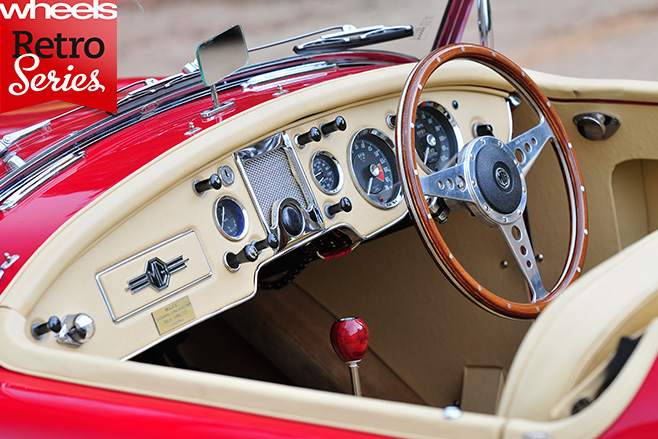
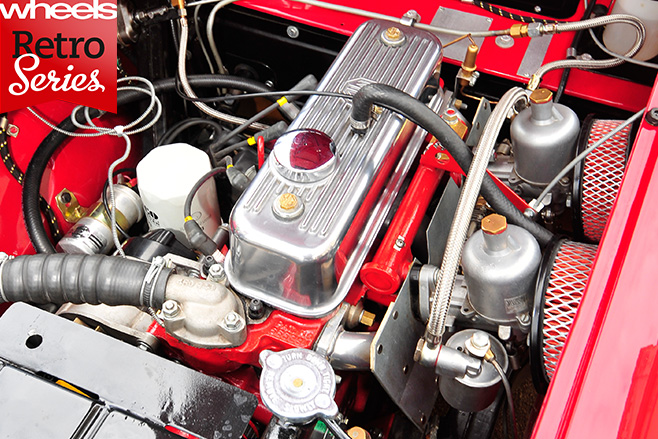
MGA’s widened chassis created lower, more spacious seating for two. The original spring-spoked steering wheel (not the solid one pictured) eased road vibrations. Full gauges, rheostat panel switch and map reading light were pleasant bonuses on the steel-faced dash. “Rubber-filled leather trim” on dash top was a “safety measure”. Roadsters lacked exterior door handles; you reached under the sieve-like soft-top and pulled a cable inside the door trim.
Body on frame
Fast & factual
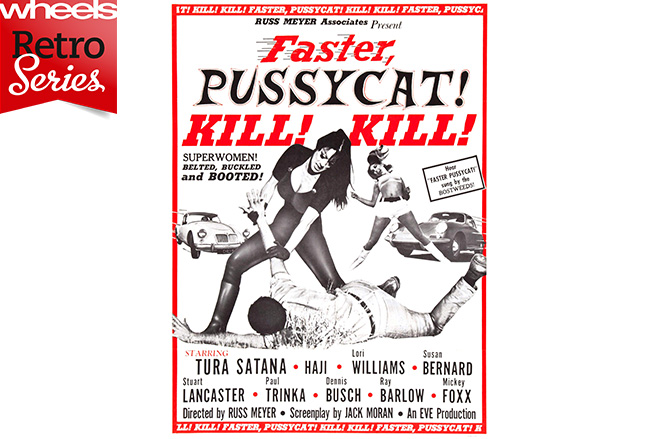
MGAs were drawn to B-movies. Our faves are Faster, Pussycat! Kill! Kill! (1965), The Horror of Party Beach (1964) and Daughters of Satan (1972)
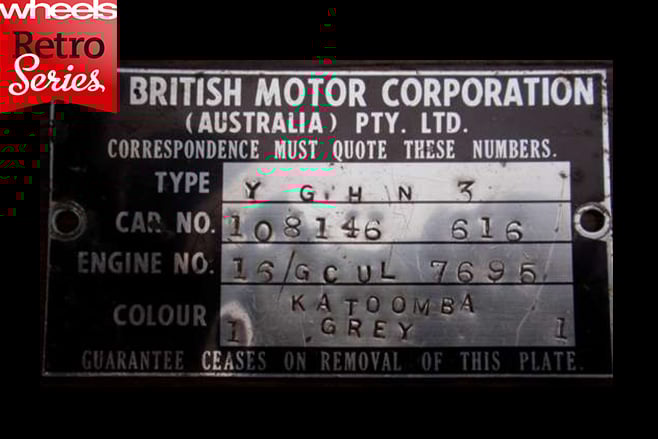
MGAs were assembled in Australia from kits by BMC in Zetland, Sydney. Local content varied, but went right up to Oz-made 1622cc engines
Phoney numbers
MG’s traditional chassis numbering, which had started with the factory’s telephone number (Abingdon 251), finally ended with the MGA
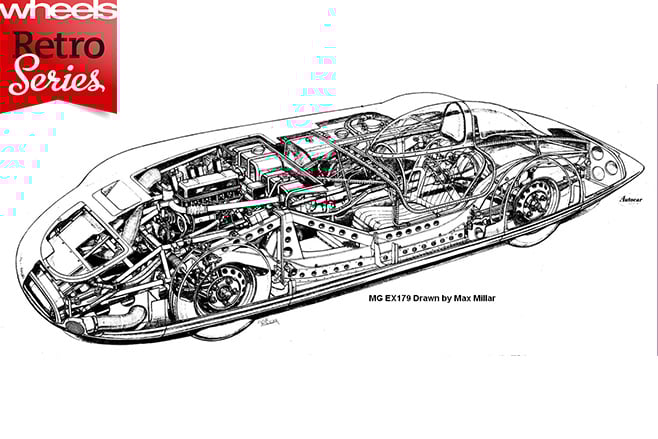
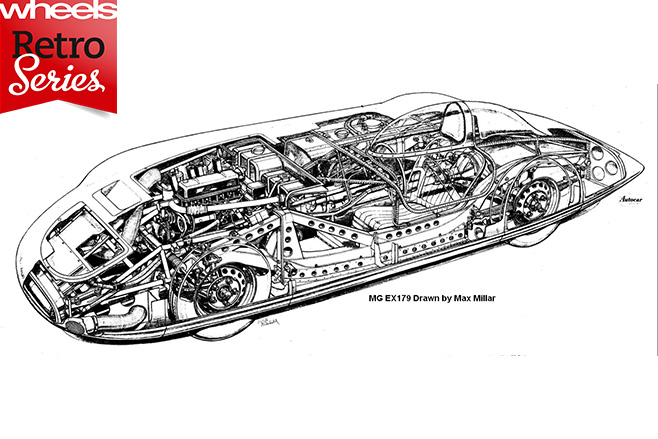
The MGA’s wide-spaced ladder chassis is a direct descendant of EX179, George Eyston’s famous 1954-57 Bonneville record-breaking streamliner (above)
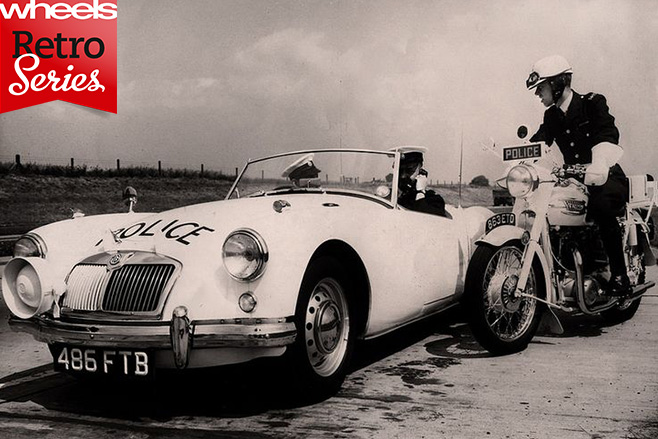
Dozens of MGAs, fitted with high-accuracy speedometers, were used by various British police forces as highway pursuit cars
Here’s our comparison test of the two semi-luxury, status-seeking sedans that have set Australia agog.
First published in the October 1962 issue of Wheels magazine, Australia’s best car mag since 1953.
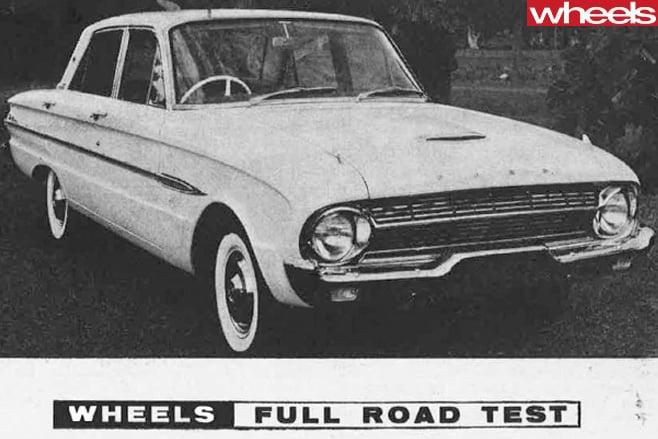
IF any Australian during the past two years had any doubts that the Ford Motor Company was serious in its efforts to tackle GMH’s domination of our family car market, those doubts must surely now be dispelled.
In the very same week GMH released its long-awaited EJ range, Ford answered with the XL Falcons, the first change in the Falcon since it was released in Australia in September, 1960.
Not only was this the first time in Australian motoring history that the makers of the two leading volume sellers released new models in the same week, but it was the first -time an American-owned car company had released a new model in Australia before it went on the market in its homeland.
And that is precisely what Ford did. The XL Falcon hit the Australian market months before the same model was due to be released in America, proving beyond doubt how keen Ford is to bite big chunks out of the Holden percentage pedestal.

Holden came out with the Premier at a very un-Holdenish price of £1420, and Ford Falcon produced the Futura for £1252 in its most basic form-stick shift and 144 cu in engine. Although the Futura was announced with the rest of the new Falcon range, it was not going to be generally available for many weeks – a legacy of the industrial dispute at Ford in mid-June which greatly upset the company’s production schedules.
But GMH had not been blighted with such troubles, and the Premier hit the streets at the same time as new standard and special sedans and station wagon. Predictably, it got the lion’s share of the new model publicity throughout Australia.
It was something entirely new for a motoring public accustomed for 14 years to accept basic Holden standards – those of reliable, serviceable transport with a minimum of motoring comforts.
The Premier was still very much a Holden, basically. Its bodyshell, engine, suspension, brakes were all exactly as they were to be found on the lesser EJ models. The Hydramatic automatic transmission was made standard equipment, but this, too, was no different from the Hydramatic offered as optional equipment on the rest of the Holden range.
lt was only in the trimmings and standard of finish that the Premier offered something brand new in the Holden marque.
So, too, with the Futura. Unlike the American version of the Futura, which is a two-door coupe offered with an optional four-speed, floor-change gearbox, the Australian version is basically a Falcon deluxe – with trimmings.

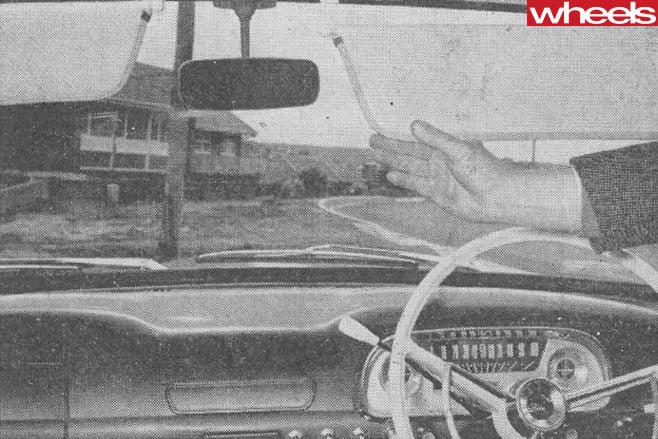
The Futura has none of these desirable items, but it does share some basic equipment with the Premier, such as divided, semi-bucket seats in the front, wall-to-wall carpet, a console between the front seats, extra ash trays, thicker seat padding, padded sun visors, wheel trim discs and special ornaments.
Ford’s luxury model has one distinct advantage over the Holden Premier. It is sold with the full Falcon range of optional engines and transmissions.
Both the standard 144 cu in, 90 brake horsepower engine and the Pursuit 170 cu in, 101 bhp motor are available.
So, too, the Futura buyer can have either the standard three-speed manually operated gearbox or the two-speed Fordomatic automatic transmission.
As with the other standard transmission XL Falcons the standard gearbox Futura has an improved gearbox and change linkage over the original Falcons.
The gear teeth have been toughened, second gear ratio lowered and the linkage altered to provide a longer and smoother movement between cogs.
Although noticeably better, the new gearbox was still not without fault. The long, steering column mounted change lever felt too light and spongy. The synchromesh could be beaten if the driver pushed the lever either too quickly or too slowly from ratio to ratio.
The Fordomatic transmission has not been altered.
Smooth and with a silent and hardly perceptible change between ratios, the automatic does suffer from the lack of a third gear when coupled with the standard 144 cu in engine. As with the other Falcons, the automatic Futura is best when coupled with the Pursuit engine. The Fordomatics fitted to all the Falcons are now water cooled – an interesting situation considering the efforts Ford went to a year or so ago to extoll the advantages of the air-cooling on the original Fordomatics coupled with the standard Falcon motor.
Gear selectors seem to be a Ford weakness. The Fordomatic selector does not need to be used very often – virtually only to move from neutral to drive or to find reverse – but it is a reluctant mechanism that does not shift with the smooth action of most automatic transmission selectors.
Keen motorists in the £1420 bracket are undoubtedly disappointed that GMH has not offered the Premier with either a manual transmission or a more powerful engine.
You have no choice in the matter – if you want a Premier, you must have the standard Holden engine, and you must have Hydromatic. Ford should undoubtedly catch a slice of this new luxury/popular market because of its more broadminded attitude to the performance and transmission tastes of potential Futura buyers.
Because of its extra weight, compared with the Holden standard and special models, and its compulsory automatic gearbox, the Premier does not give a sensational performance.
On the rather low mileage test car (it had done only 800 miles) I could not top 80 mph, and acceleration times were just adequate, certainly not exciting.
Indeed this is the point about the Premier – it is not really an exciting car, and I doubt if it was meant to be one.
But it is exceptionally comfortable and extremely well equipped. The bucket seats in the front are solid, thickly padded and well-shaped to support the shoulders, backs and thighs of those who sit on them.
Because the seat is thicker than the bench provided in other Holdens, the driver’s seat cannot be pushed as far away from the steering wheel as I would like.
With that slight reservation, however, the Premier has an excellent driving position. The driver is upright, the white steering wheel is well-raked, all the instruments are right in front of him and the vision in all directions is so good that the car is just about impossible to criticise from that point. Even the rear-vision mirror, for long a sore point with Holdens because it pointed at the back roof, now lets the driver see straight through the big and distortion-free back window.
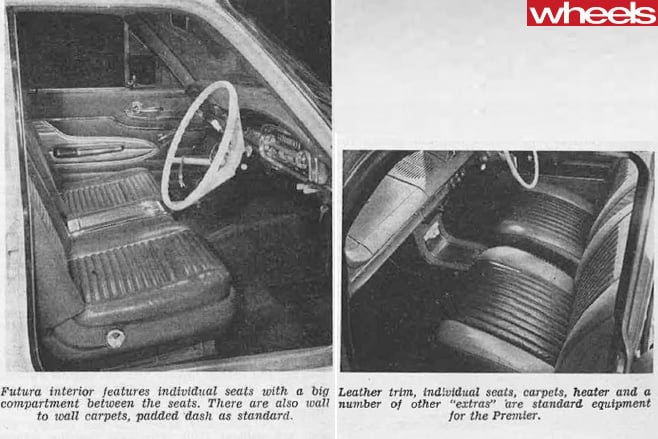
White, handsome and deep dished, the Futura wheel comes so far out from the dashboard that one would be excused for thinking it was meant to be turned by the teeth.
And, of course, the Futura retains the Falcon steering ratio which necessitates a full 5 1/4 turns from lock to lock.
Much firmer front suspension and a tauter body all round have improved the Falcon’s all-round
handling and, indirectly, made the low-geared steering seem less of a burden – but only slightly so.
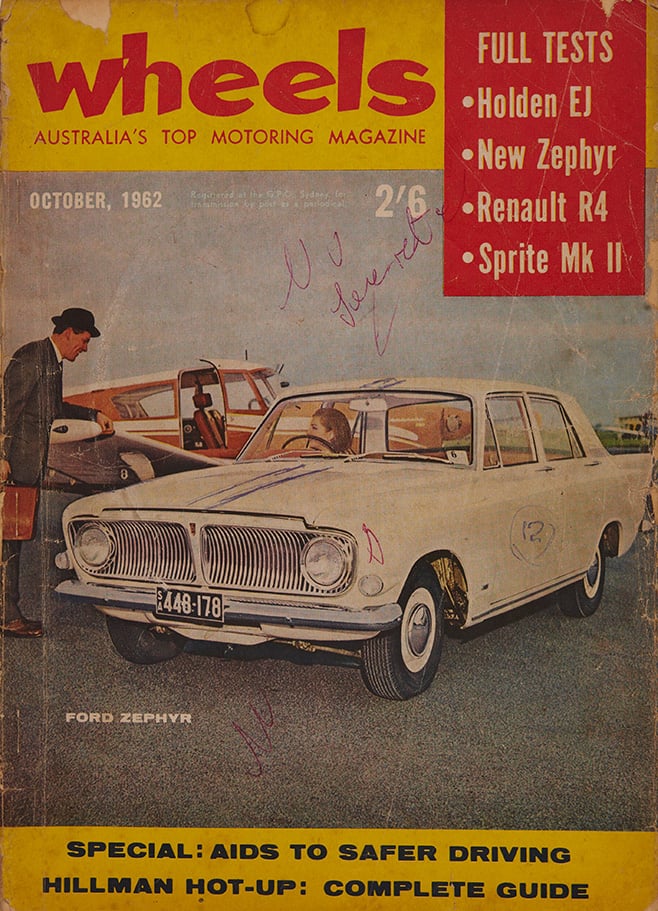
It seems as ridiculous as ever that such a moderately lightweight car of compact dimensions should be fitted with a steering mechanism that would be more useful for manoeuvring a 10-ton truck at slow speeds through sand. In fairness to the Futura (and the other Falcons), the steering is certainly light and on good, reasonably straight roads, the car keeps going in a straight line with little conscious effort on the driver’s part.
Finish of all the Falcon range has been improving continually since the car first hit our market, and the new range is quite well finished but note quite up to the fairly high standard of the Holden and certainly not up to the standards of the pacesetters in the popular car finish stakes – Volkswagen and Hillman.
As I wrote earller, the handling of the Futura and the other new Falcons is greatly improved on the old models. Earlier Falcons used to scud sideways, in a crab-llke action on broken gravel roads traversed at speed. I found the new models stayed on their feet with dignity, and loped across potholes and corrugations without any disturbing kicks or slides.
There Is little between the Futura and Premier on the score of stability and roadholding ability. But the excellent Holden steering does give It an edge.
Appearance Is much more an open question now than it was when the Falcon competed against the FB and EK Holdens. Then the Falcon had a commanding advantage.
Now, the Holden is radically restyled and, in most eyes, looks much better. But the Falcon is still an exceptionally handsome package, especially the Futura, with its extra embellishments and all red upholstery.
Personally I could do with less red and chrome inside and a couple of extras like a heater and windscreen washer, but l’m prepared to bow out of the argument arid leave it to the fashion experts.
The Premier does have a slight advantage by using leather trim on the seats. The Futura sticks to plastic, albeit a very good plastic that looks like leather, and about the same quality as the plastic used by Mercedes-Benz.
Good carpets are fitted to both the Premier and Futura, back and front.
Well, there it is. Australia’s “people’s cars” have gone for the status seekers in a big way. How do they square up to each other?
That is a question ultimately to be answered by the market. And the market will base its answer on such pertinent facts as the Falcon’s markedly better performance, price advantage and range of optional engines and transmissions and the Premier’s more elaborate equipment, better handling and better finish.
Check out Wheels Archive online now for other great Ford Falcon features and more from decades past!
Simply log in here using your existing MagShop account or create a FREE account and select this article from the homepage.
Don’t have a MagShop account?

Have a MagShop account?

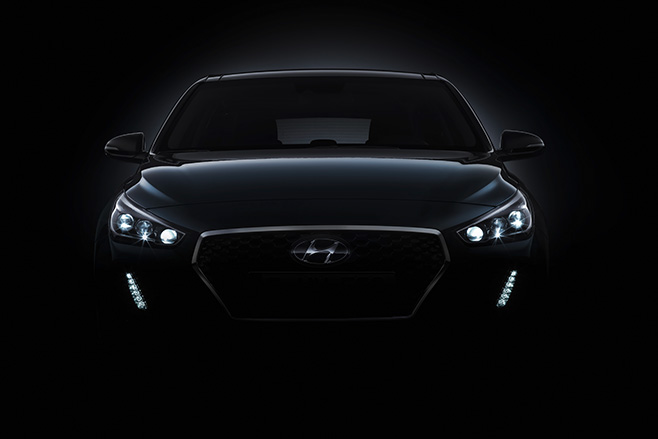
“More refined and a timeless design” is how Hyundai’s Chief Design Officer Peter Schreyer has described the third-generation Hyundai i30 hatchback in a teaser video released by the firm, along with three darkened images which reveals a more premium looking car that the one it will replace.
From what we can see, the new i30 which is set to be officially revealed online on Wednesday, 7 September before making its public debut at the Paris Motor Show, will gain new vertical LED headlights and a re-sculpted bonnet with the new i30 release also signifying the debut of the firm’s new-look and self-named cascading grille.
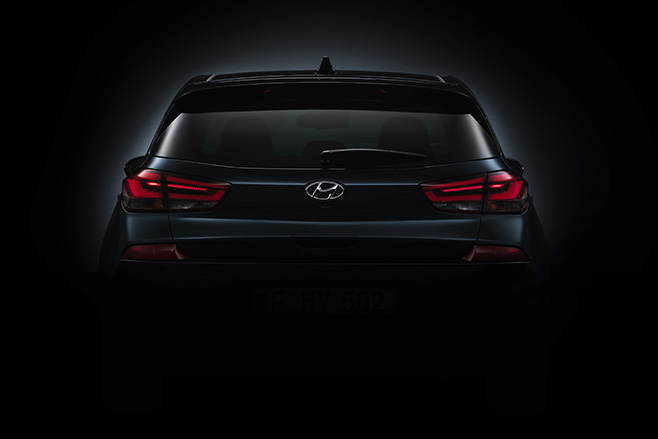
At the other end, new taillights, foglights and a redesigned tailgate are all set within what appears to be both a wider and lower overall package giving what has been Australia’s best-selling small car a higher-end appearance.
“For the design of the new generation Hyundai i30, we didn’t just look at one customer, we focused on a wide range of different people,” Schreyer said in a statement accompanying the pictures and video. “The design is an evolution of Hyundai Motor’s design language with natural flowing lines, refined surfaces and a sculpted body to create a timeless appearance.”
The car will also spawn the Korean brand’s first-ever road-going performance model with the release of the highly anticipated i30 N, the first of the firm’s performance-focused sub-brand.
“We can feel a new spirit at Hyundai, there is a movement going on,” Schreyer says in the 55-second film.
The next-generation i30 is expected to be offered in both petrol and diesel variants matched to a choice of manual, automatic or dual-clutch transmission options.
In official sales data released recently by Australia’s Federal Chamber of Automotive Industries, Hyundai’s i30 claimed the mantle of being Australia’s number-one selling small car priced under $40,000.
Between January and June, 2016, the firm sold 6423 new i30s which represents a significant share of 25.5 percent of the competitive segment. Its closest rival, the Toyotas Corolla, sold 4427 units in the same period with 17.6 percent share of the segment, closely followed by the Mazda 3 with 4112 and a 16.3 percent share.
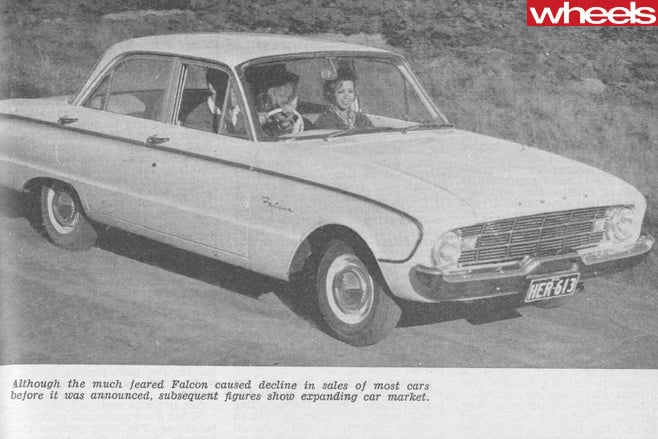
In spite of the gloom which settled over the motor trade just before the Falcon was released, the main result to date has been to expand the car market.
First published in the January 1961 issue of Wheels magazine, Australia’s best car mag since 1953.
“The tumult and the shouting dies, The Captains and the Kings depart O’er leagues of land The Falcon flies, The battle’s joined of salesmen’s art.”
WITH apologies to the author. But true, the wreathing dust of battle descends after the shindig of the Ford Falcon release. As the parties in the fray become visible once more we can see at things have changed and that the Australian motoring scene will probably never be the same again.
Places like the showroom-huddled speedway, Sydney’s William Street, look externally as before. But there has been a strong new force added to the car market which could be the first since the Volkswagen invasion to have a real impact on motorists’ buying.
Like the fall-out from an atomic bomb, the dust of Ford Falcon‘s rise from its launching pad has settled everywhere. Some has drifted over the showrooms of GM-H distributors, obscuring – temporarily – the glittering new Holdens inside. Some has settled on the smaller-car display centres. A little has got into the noses of salesmen selling behemoths, with some left over for those pushing quality, specialist cars. It’s even spread to speedboat and TV shops.
For nothing sells like a new popular-appeal car, and it’s been a long time since there was some new family-business transport about. The effect of the Ford Falcon has accordingly spread everywhere, and not a car salesman in Australia can truthfully say that his sales have not been tied up, delayed or even lost outright to Falcon.
As a result, the brooms are out all around. In particular, salesmen in Holden showrooms are sweeping vigorously. As one Ford sales rep acidly put it:
“Those blokes up the street will have to sweat like the rest of us have been doing.”
However, the Holden salesmen – to a man – are playing mum and showing a very stiff upper lip.
They say off the record that they’ve got nothing to worry about. They could be right at that. Statistics indicate that the exploding market for cars in Australia promises such demand for this class of car that Holden, even with its recently announced expansion program, may not have been able to fill every order in the next few years unless Ford had released the Falcon to relieve the pressure.
So there is solid ground for the attitude in Holden showrooms today:
“There’s plenty of room for two of us.”
“We welcome competition.”
“Ford make a good car.”
But on an executive level, the reply to all questions is: No comment! No comment! NO COMMENT!
However, no matter how obvious the direct tussle between the two, one popular misconception should be laid flat.
(One Sydney newspaper made a real splurge of this. And when, in a story supported by a flamboyant poster, they said that GM-H would probably produce the Corvair here as an answer to the Falcon’s challenge, I felt a twinge of sympathy for the GM-H executives who have to read, digest and report on this flim-flam to their superiors in Detroit.)
No, Ford is not after scalps. Sure, Australians, being perverse, agin-the-guvverment crowd, are inclined to be cheering Falcon on because Ford has been the underdog. If the roles were suddenly reversed public opinion would switch as well!
Ford is in business for one primary reason – to make profits on its shareholders’ investments. Just how much profit they have made, or will make, is unlikely to be known, because Ford would be understandably reluctant to divert some of the annual outcry against the profits of foreign-owned companies, now directed exclusively against GM-H, on to its own head.
However, business depends on profits and Ford have produced the Falcon to increase their share. Their aim is not to “hurt” GM-H. Far better business can be done – if the lion who feigns sleep is not officially awakened.
Price cutting and mud slinging is out, although you can be sure that individual distributors on both sides will be loading trade-ins when they need sales. But on a factory level there is little likelihood of a price war, because that would make both Ford and the General Motors Corp. wish they had stayed home. In fact, Ford probably hopes that the market expands fast enough to keep Holden sales healthy as well as their own.
On the Holden side of the fence, they are well aware that if they cut prices, notwithstanding any long-range results, the loss to them will be three times as great as it will be to the newer competition, because even if Ford sales go as anticipated they will be outselling Falcon three to one for quite some time.
And, paradoxically, a severe price war would discredit General Motors because they would then be accused of trying to stifle competition! So if General Motors make any downward move in price, or hold prices against others going up, it is likely to be small indeed, an “adjustment” to add a finer edge to their sales sword. And, of course, a price drop would sweep everyone else off the market which the Government would hate.
On the other hand, no matter how much the giants avoid a direct clash on a top level, they will clash, and are doing so now, on the sales floor.
As a result the salesmen are working hard, and the repercussions have been felt all around.
Perhaps the firms who had the stickiest time during the month following F-day were those selling “class” cars – cars which sell in small numbers and which offer unusual specifications, better performance perhaps, more luxury than in ordinary cars, something “different” all round
This month the buyers of this type of car tended to be diverted to the Falcon. One sales manager who sells in the vicinity of 20 specialist cars a month admitted losing four of his sales to Ford. But, he said, he wouldn’t lose them when the first, freshness had worn off the Falcon and would probably pick up sales to people who had been waiting for a Falcon and had decided against it.
“All the same,” he rasped, “there isn’t a salesman in Australia who can truthfully say that he hasn’t lost business in the over-a-thousand field to Ford this month.”
In the Ford camp, there are more pink clouds than cars. There’s no doubt that the Falcon has revitalised the enthusiasm of the Ford organisation from top to bottom, and no matter what way you look at it that’s a good thing for motoring.
Surprisingly, many of the salesmen on the floor were losing money at the time of writing. Usual thing on Falcons is a base salary of £20, plus a company car, plus £5 per sale. A good man will sell a car a day. But selling them is not the problem at the moment. It’s a matter of getting deliveries.
On the most popular model, a wait of up to four months was quoted.
One live-wire said: “When Ford really gets rolling, I’ll be rolling. I’ve really written some business. But until they do, my earnings are down. No deliveries, no commission.
“We’re holding between 500 and 600 orders so far with deposits on the line. We’ve delivered less than 200 cars.”
All these orders have a deposit attached, and the money is placed in a trust account. Incidentally, deposits are invariably returned to the motorist if he decides not to go ahead with his purchase.
Despite the big backlog in deliveries, the newness, freshness and thrill of having something a bit different is making things easy for Ford to keep up the sales volume.
“People want something a bit different,” said one. “The Holden owners who’ve been in here say one of two things. Either they had an FE or FC, liked it, but don’t like the new FB, and feel the Falcon is more their car; or else they just want a change.
“They are invariably satisfied with the mechanical quality of Holden and reckon it’s a good car.
“However, my impression is that they generally prefer the FC and are inclined not to be happy with the FB. It’s a bit flashy, and that wraparound screen doesn’t seem to have gone over as expected.
“My theory is that all the stories we’ve heard over the last couple of years about the excesses of the American car have been soaked up by motorists here. People are definitely after the cleanly-styled, good-looking car. And everyone will admit that Falcon is a good-looker.”
Ford, though, is not content with picking up drift-aways from other makes. They are actively selling the advantages and virtues of their product. From a salesman’s point of view their story is a good one. Fuel economy is well to the front. Owners are backing up salesman’s claims, too. Sure, they have the advantage of new cars being driven at run-in speeds. But higher compression ratio and a design of cylinder head and manifolding incorporating later thought than the 15-year-old Holden engine seems certain to show a definite gain over the Holden in economy. Ignoring the wilder claims, it seems likely that the average Falcon owner will get 27 to 30 mpg on commuting driving, which is probably 10 to 15 percent better than the equivalent Holden mileage.
Some road tests show a 20 percent increase, which is somewhat higher than a comparison of specification figures would suggest.
However, pointed out a Holden salesman, Australia’s own will happily burn standard gas and Fords must use super. The threepence a gallon difference is still a nice card in GM’s sleeve and helps to nullify the sales advantage.
“Anyway,” said this Holden man, “I’m not comparing the two cars. We don’t knock the other product. But more motorists realise today – especially the ones who use a car for business and have it set out for them in black and white by their accountant – that petrol is the cheapest part of running a car. Running a new Holden or Falcon will cost £8 to £10 a week. Petrol will probably account for only £2/10/- of that.”
Bit silly to worry about a 5/- difference in your petrol bill – or 2/- if you allow for the difference in super and standard.
It seems taken for granted that the Falcon will cost approximately as much as the Holden to maintain. Resale value is a doubtful quantity at this stage, but there seems to be no reason, after the establishment period has passed, why it should not be as good as the competition. But there have been surprises before, and it won’t be until the early birds – or the birds in early trouble – start selling their new-used Falcons that any sort of price structure will be established. And you can be sure that Ford distributors will bid up big for the first Falcons to come up at auction to prevent any sort of early price slump setting a precedent for the future.
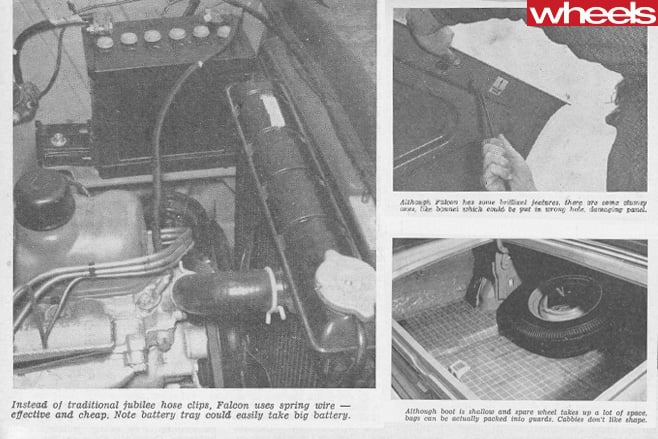
Maintenance is being sold by Ford salesmen as one of its virtues. It has been designed as a simple car so that the customer could get as much car for the money as possible. As a result, the simplest mechanical solutions have been adopted wherever possible. Even the radiator hose clips, traditionally a screw-type clip with a worm screw, are replaced by bits of spring wire; the steering linkage is ingeniously sorted out to combine the simplicity of the asymmetrical track rod layout with the straight-running properties of the symmetrical types. The spring-supported bonnet has given way to a stay type, on the theory that it will annoy nobody but service station attendants.
(One such lugubriously hoisted the heavy bonnet into the air, unflipped the stay, and showed us how that an inattentive or lazy attendant could drop the bonnet on the stay in the wrong hole, thus denting the skin of the bonnet from the inside.
Maintenance is important to the taxi market, and both sides have their eye on this field. Taxi drivers are often surprisingly perceptive in their criticism and aren’t loath to pass on their views to their passengers.
“The boys aren’t going wild over the Falcon. Why should we?”
“How are we going to travel three in the front with that great hump in the middle of the floor?”
“They reckon that the boot holds more luggage. Well, it looks too shallow to me to hold the odd loads we get.”
“You tried turning her around in a narrow street? Well, you wind all day and nothing much happens, and on top of that the turning circle is 38ft. Not good enough for me, mate.”
We also heard a couple of drivers criticise the low build, but admitted that they hadn’t much grounds except that it looked awkward to get in and out of. (However, most reports say that it isn’t difficult to get in or out.)
On looks, which, providing it doesn’t look too different, don’t matter much to a taxi driver, the Falcon probably scores, even if only on account of its ordinary windscreen.
The wrap-around screen of the FB was criticised by several of the drivers we spoke to.
Petrol consumption is very important to a cabbie. The best-documented report came to us from an owner of two Falcons, which, against his log books, were turning in 28 mpg. That should be enough to bring a smile to the face of the flintiest owner.
What about private owners? Universally happy, as far as we can tell. There have been no mechanical bugs which we can put our fingers on (judging from the reports we have heard, that is) and performance has been up to expectations. Sealing is a problem with any modem car, and owners are reporting water leaks in the front compartment. But Ford hasn’t got it on its own in that department.
The steering is still a question mark right through. There is no doubt that, early on, many top distributor executives spent a lot of time worrying whether, in fact, Ford had boobed in this department and whether they would strike sales resistance because of it. The press were solidly against it and all who drive the car are conscious that you turn the wheel a long time before much happens. The salesmen say that customers coming back for service say “they will have to get used to it”.
One Ford distributor executive said that the steering was exactly the same as all current American cars, that Ford knew what they were doing and that he had confidence in the factory’s judgment. And he underlined the fact that he hadn’t lost any sales because of it.
That perhaps, is about the only inconclusive note in the Falcon story, and is about the only feature of the car which is not in tune with current Australian thought.
Just a weekend with a Rolls-Royce Ghost was a pain in the arse for Stahly.
First published in the May 2016 issue of Wheels magazine, Australia’s most experienced and most trusted car magazine since 1953.
Somebody tried to speak to me at a traffic light the other day. A tray-top ute pulled up next to me. From the corner of my eye, I noticed a hi-vis shape rolling down the passenger window. “hey, mate…”
I reflected, momentarily, that this hardly ever happens now that everyone’s got air-conditioning. Thankfully, my turn lane began to move and I drove away.
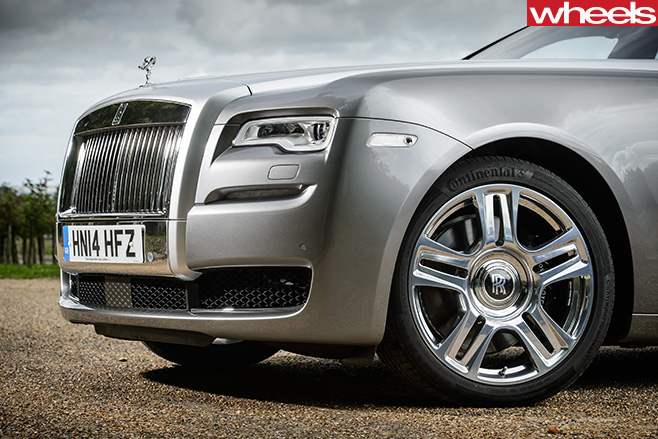
Or perhaps not, because spending a weekend with it was – for me at least – a pain in the arse.
I’ve never understood really big cars. The only cars I’ve ever owned have ranged from smallish to comically tiny.
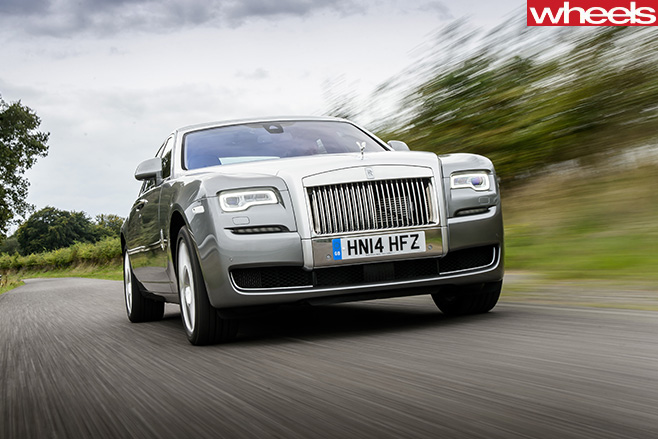
Only a year ago, I drove the Ghost’s two-door sister, the Rolls-Royce Wraith, down the NSW south coast. It was swift, serene and majestic on the open road.
This time, family commitments kept me close to home. At the dealership, I agreed to park always undercover and to cop the first $5000 of at-fault damage. My mind focused on how much that equated to on a $740K car. Kerbing a wheel could render me a human write-off.
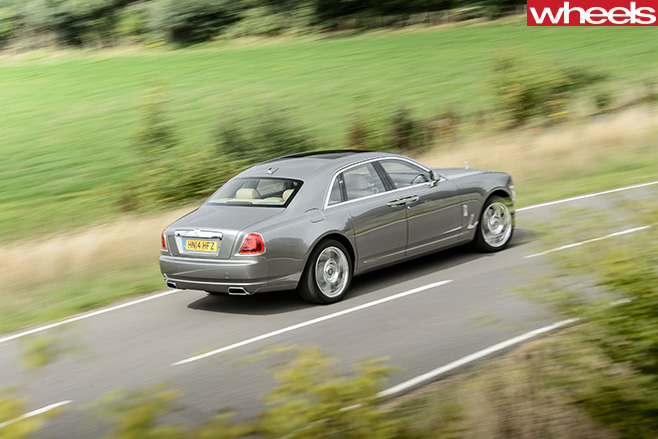
The first stop was to collect one of the Stahlettes’ friends. She lives in an inner-city suburb with leafy plane trees overhanging quiet, narrow streets. Suddenly really narrow streets.
When I did find an adequately long parking spot, I caught myself waiting for a tugboat to draw alongside.
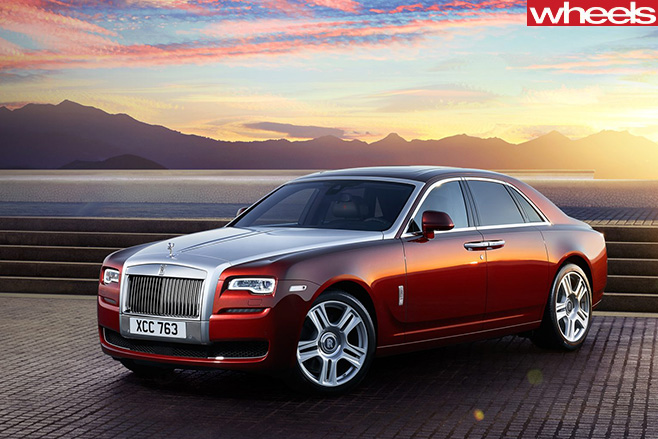
I was glad to get the Ghost home. Although my wife wasn’t, because our two-car garage demands a 90-degree entry from a narrow driveway; even reversing in, the Ghost’s long wheelbase precluded her car being there.
Right around this point you remind yourself that the Ghost is the (ahem) smaller, more agile, less ostentatious Rolls-Royce, aimed at the younger, sporting gentleman. I guess I’ll concede I don’t tick any of those boxes.
Market forces
It’s not just me who doesn’t ‘get’ luxury land yachts. Great though they are as bearers of new technology, in the past 15 years sales of the Mercedes S-Class and BMW 7 Series sedans have more than halved to a combined 424 units in 2015. Then again, there are more brands and niches in the market today. Rolls-Royce? They’ve had spectacular growth – from two deliveries in 2000 to 15 last year.
Suzuki’s S-Cross compact crossover hatch will get a makeover in time for the Paris Motor Show, with the Japanese automaker revealing the car’s bolder and more assertive design today.
The chrome-ringed 10-slat grille is all new and moved higher relative to the old model, the bonnet pressing grows two longitudinal strakes and the front bumper plastics are completely revised with new cutouts and contouring. The headlamps have shrunk too, eliminating the current car’s wide-eyed look.
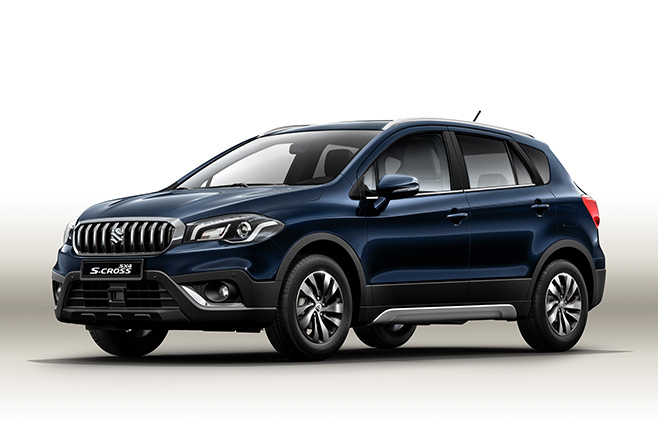
The net result is a car with a less front-heavy design. The current S-Cross looks heavy-handed and awkwardly proportioned by comparison, even though all sheetmetal bar the bonnet appears to carry over unchanged.
What we can’t see just yet is the cabin, which Suzuki says has been updated with more refined interior materials.
Under the restyled bonnet lies Suzuki’s new 1.0 litre and 1.4 litre Boosterjet direct-injection turbo petrol motors, the first of which makes 82kW/160Nm in the Baleno small hatch while the latter generates 103kW/220Nm in Vitara Turbo guise.
Together they replace the 86kW/156Nm naturally-aspirated 1.6 litre petrol motor that propels the current-gen S-Cross range. It’s unclear at this point which engine will find its way to Australia-bound S-Crosses (or when we can expect the update on our shores), though Suzuki Australia has been approached for comment.
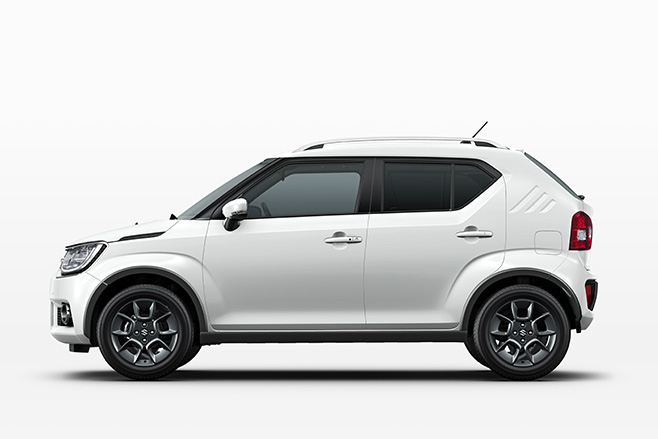
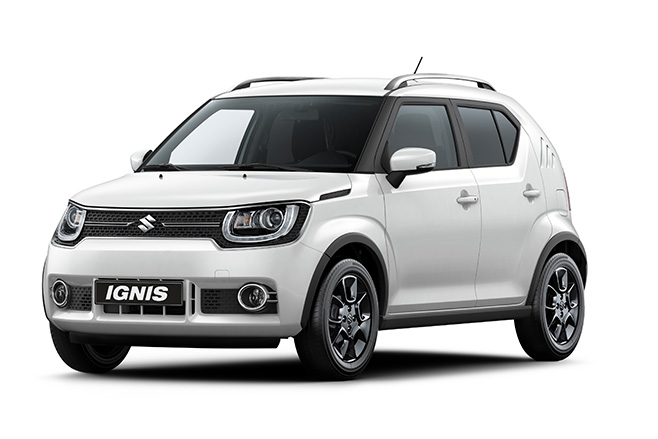
The 2017 Suzuki S-Cross – which is sold in Europe as the SX4 S-Cross – will be accompanied on the Suzuki stand at Paris by the Ignis city car, a pint-sized five-door crossover which resurrects a badge last seen in Australia in 2005.
An Australian release for the Ignis has yet to be announced, though the boss of Suzuki’s local operation is on record as saying it would be a likely starter for a local release provided currency and specification concerns are addressed.
The 2017 Suzuki Ignis is powered by a 67kW/118Nm 1.2 litre naturally-aspirated four, though a mild hybrid will be available in its home market of Japan together with an AWD variant.
While the American public gets ready to vote in their next President in November, Cadillac is also preparing itself for the arrival of the USA’s next Commander-In-Chief. Photos of the next US Presidential limousine have surfaced on US websites, with the successor to the current limo – called “Cadillac One” by the Secret Service and nicknamed “The Beast” by US media – set to get a new style that merges SUV and sedan styling cues.
And while it may have a big Cadillac wreath on its grille, it won’t resemble anything you’ll find on Cadillac’s showroom floor.
A beefed-up truck chassis will continue to serve underneath Cadillac One, however precise details of its undercarriage are predictably a closely-guarded secret. The same goes for its engine, which is also believed to be taken from GM’s commercial vehicle catalogue.
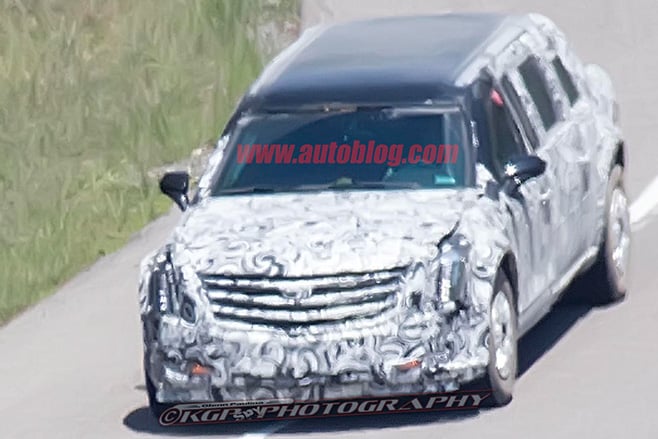
As for its protection package, we’re confident a Google search for those details will land you on a CIA watchlist.
The spy images of the next President’s whip suggest there are few structural changes in store for the crucial passenger-carrying centre section of the next-gen Presidential limousine. Extra armour plating may be applied under the skin though – handy, should the divisive Republican candidate Donald Trump claim victory in November.
The most obvious discernable differences are seen at the front of the car, with the redesigned Beast looking like it will adopt a more cohesive design that takes inspiration from the new Cadillac CT6 and Escalade SUV – namely the former’s wide-mouthed grille and the latter’s headlamps.
And in terms of political transportation, its sheer bulk puts our own Prime Minister’s grenade-proof BMW 7 Series firmly in the shade. The Beast will seat seven in armoured comfort thanks to its bus-like wheelbase. The PM’s BMW seats a maximum of five. ‘Murica.
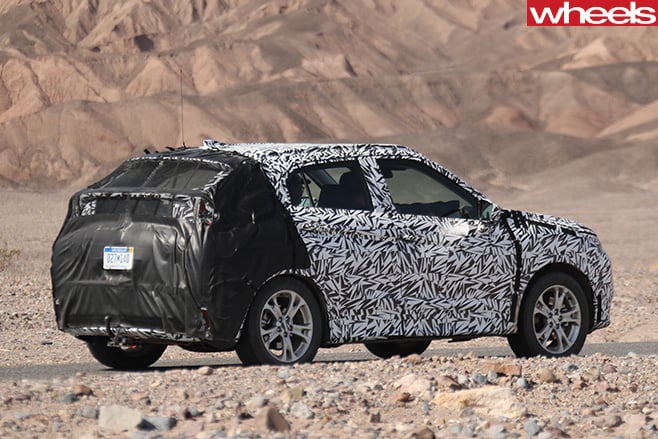
Mitsubishi’s upcoming midsize partner to the Outlander SUV has been spotted conducting testing in the USA, with a pair of its intended competitors being benchmarked alongside it.
Spied in convoy with a Kia Sportage and Ford Escape (the US-market name for the Kuga), Mitsubishi’s new crossover is expected to be sized somewhere between the current-generation ASX and the seven-seat Outlander, putting it at the lower end of the midsize SUV category where it’ll duke it out with the CX-5, RAV4 and Tucson – in addition to the aforementioned Sportage and Escape.
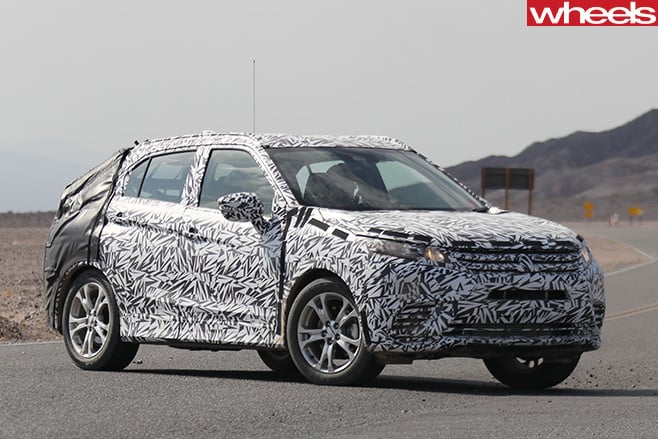
What it won’t be, however, is the next-generation Mitsubishi ASX. In line with Mitsubishi’s planned expansion of its SUV lineup, that model is set to be downsized to make room between it and the Outlander for the XR crossover shown here.
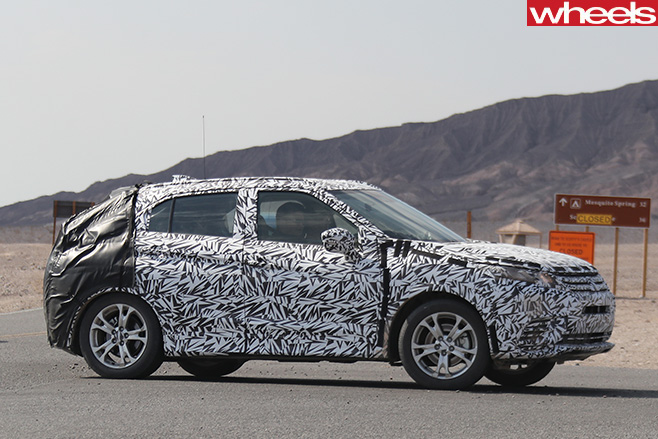
That means a 2.0 litre petrol, 2.4 litre petrol and 2.2 litre turbo diesel will be likely starters for the production version of the XR, along with a plug-in petrol-electric hybrid.
