Morley’s all-too-freely-available views on the subject notwithstanding, my decades of dabbling in automotive journalism have not left me totally ignorant of its protocols.
Okay, analysing steering feel whilst cresting Mount Horrible on opposite lock may not be second nature yet but I’ve got a grip on most of the basics by now. Ergo, when invited to conduct a comparison test involving the new Mercedes-Maybach S600, I accept, naturally expecting another car to be involved.
So when, on the day, the proposed opponent fails to appear, leaving nothing whatsoever to judge the Maybach against, you can imagine my discomfort. Comparing half-a-million dollars worth of mogul-mover to public transport is hardly going to inspire a rush to the results page.
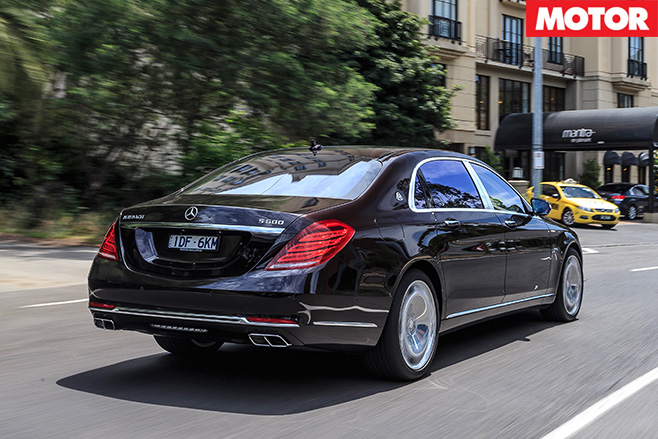
So best to reassure them by beginning the examination with a calm confidence. Which disappears damn near immediately. Because this car renders virtually every preconception irrelevant. For instance, the very first thing I learn is that the front seat is not the best it offers.
Oh sure, it’s swaddled in hide and sumptuous finishes, indulges you with heated armrests and massaging and seduces you to slumber with exotic agarwood fragrances gently swirling in an interior claimed to be the quietest in the automotive world. But want to go First Class? Try the rear!
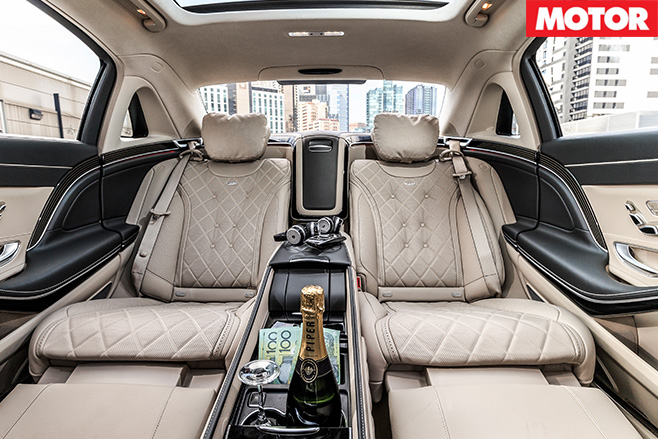
A six-footer, I still don’t touch the front seat and the sating of every sense now awaits me. Soothed by a chilled glass of whatever appeals served in the optional sterling silver champagne flutes, each rear-seat occupant has their own media screen with remote-control and/or the eyes-closed indulgence of a Burmester 3-D surround-sound system that turns the car into a concert hall.
Everything from hot-stone massage to a tasting-tray set out on each pop-up table is an option now and suddenly, in that splendour of choice, comes the realisation that we really do have a comparison test to undertake today: choosing the ultimate Maybach experience – Driver or Passenger?
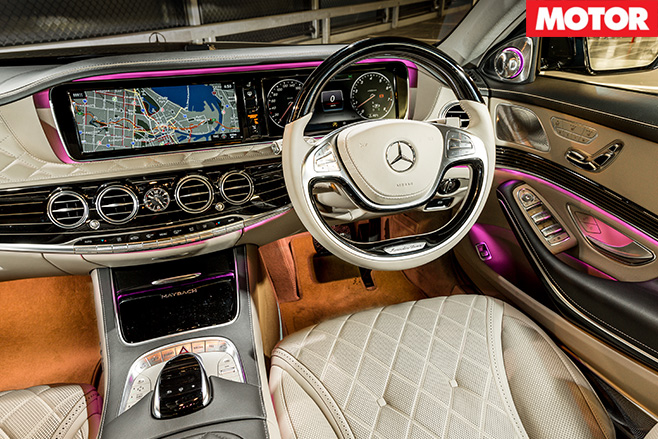
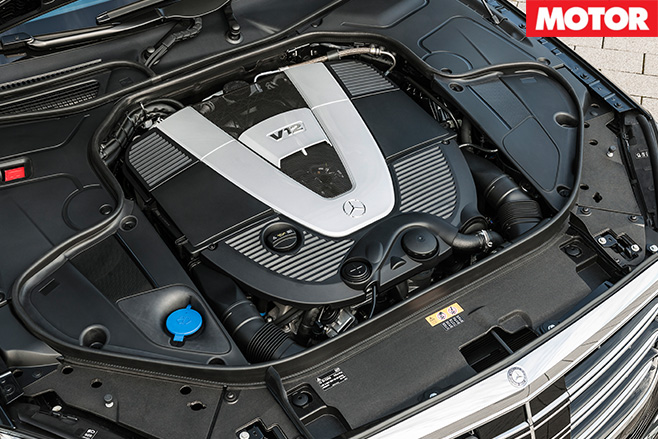
Where I’d imagined such a specification would immediately inspire running zero-to-stiffies in a tumble of seconds, the exact opposite occurs. From the first moment, this Maybach arouses an entirely different ambition in its driver: to exploit a silence and refinement previously unknown and drive it with silken skill.
Apart from a first-gen WRX at the other end of the scale, this car shapes its driver like no other I’ve ever driven… and rewards concord with an almost surreal partnership. Driven fluidly, its bulk instantly falls away, replaced by control of almost every imaginable factor with spacecraft silence and fingertip sensitivity. And the span of those factors is equally impressive.
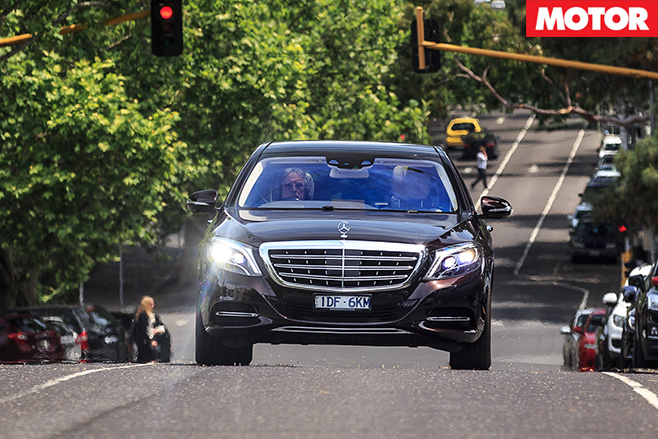
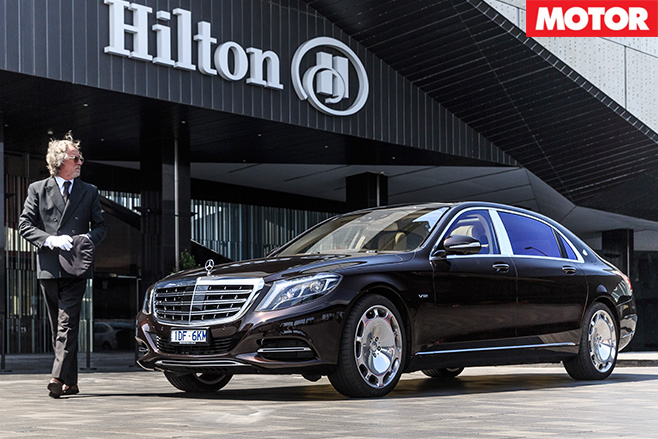
And, trust me, confusion is unwelcome when attempting a grand entrance in well-over 10 square metres of sheikh-shifter. Just parking it is akin to a mooring, and reinforcing that theme is Newman’s report that his first effort required four bays. Luckily, however, the quest for photo locations keeps us moving, and soaring down a motorway in the Maybach’s eerie silence is easily assumed by this driver to be further evidence of his mastery of the craft.
Okay, the tight schedule allows little research of roads beyond the motorway but I’m not sure that the reputation of either man or machine would be much enhanced by any cowboy corner-working.

In truth, as Newman points out, this genre, of all automotive categories, would be ideally suited to electric propulsion. Soundless, boundless torque would serve it perfectly. But it seems that when Rolls-Royce tested the concept it was a marketing flop. Crisis? What crisis? The target audience wants a V12. And if that likes a drink, well, so do they. And, after all this, so do I.
So back to exploring the passenger possibilities, and the deeper you look, the more the details impress. Softly-closing doors automatically latch themselves and, reclining beneath the panoramic sunroof, one savours the gentle scenting within a ventilation regime that is a wholly atmospheric affair rather than simply a foot-and-face blast. Even the symphony system is blessed with exquisite detail such as tweeters that sweetly pop out and rotate when in play.
“Yes, it’s wonderful,” she says, “it’s lit with adjustable lighting on me and also in front of the mirror and I can see my entire face to put my makeup on”. All of which can be done from the reclining position, she also notes, before ruminating on that latter thought just a little too long and compromising the culture of proceedings with: “But you couldn’t throw a leg over easily back here.”
Whether that reflects a failing of car or critic we need not ponder at this time, for there are surely more profound issues to be covered in this comparison. Not least the entirely unexpected one gradually revealed today in the isolation of this rear sanctuary: that there is a third contender.
Some of the reasons for that, of course, are obvious. The owner can choose to wind it up or wind themselves down and both are profoundly satisfying. And, ipso facto, almost certainly the owner of this car will be less troubled by its expenses than the average family car buyer. But there is another factor at play here: this is a car designed to be enjoyed beyond mere contact. Because its purpose transcends simply functioning well.
The aim of this car – and the designers and craftsmen responsible for it – is excellence beyond compromise. And, for the owner, knowing that is a pleasure beyond merely experiencing it. As a very small and very lucky group of people in Australia are about to discover.
4.5 OUT OF 5 STARS
LIKE: Ground-based business class travel; stately presence DISLIKE: Finding a park (though that’s the chauffeur’s problem)
SPECS Body: 5-door, 4-seat sedan Drive: rear-wheel Engine: 5980cc V12, SOHC, 36v, twin-turbo Bore/stroke: 82.6 x 93.0mm Compression: 9.0:1 Power: 390kW @ 4900-5300rpm Torque: 830Nm @ 1900-4000rpm Power/weight: 163kW/tonne Transmission: 7-speed automatic Weight: 2335kg Suspension(F): multi-links, air springs, anti-roll bar Suspension(R): mult-links, air springs, anti-roll bar L/W/H 5453/1498/1900mm Wheelbase: 3365mm Tracks: 1633/2131mm (f/r) Steering: electro-mechanically-assisted rack-and-pinion Brakes(F): 390mm ventilated/drilled discs, 6-piston calipers Brakes(R): 365mm ventilated/drilled discs, 4-piston calipers Wheels: 20 x 8.5-inch (f); 20 x 9.5-inch (r) Tyre sizes: 245/40 R20 (f); 275/35 R20 (r) Tyre: Goodyear Eagle F1 Asymmetric 2 Price as tested: $448,610
We go to Maralinga, South Oz, 60 years after British atomic bomb testing left the earth and the people in fallout.
First published in the June 2016 issue of Wheels magazine, Australia’s most experienced and most trusted car magazine since 1953.
HELL is in remote western South Australia. And we’re driving through it.
From behind glass in our Land Rover Discovery Sport, air-con set to 19 degrees, suspension soothing the potholes and dust sealed out, this could be any outback scene for millions of square-kilometres around. But stop, kill the turbo-diesel engine and step out and there is something different here, something missing. Life.
On these rolling hills, stunted saltbushes are the only sign of vegetation, their faded colour matching the grey clouds. There are no birds of prey wheeling through the sky, no kangaroos grazing, lizards scuttling or dingoes lurking in the distance.
This is ground-zero Maralinga. It is where the British exploded a series of atomic bombs in the 1950s, at the height of the Cold War. The fires have long gone and the mushroom clouds and ash drifted away. But the poison remains, locked in the earth, and in the people.
For 50 years this place has been off-limits, but recently the gates were opened to the public by the traditional landowners, the Maralinga Tjarutja people. You can now drive here, pay your money, take the tour and stay overnight. Then drive away again, reflecting on what you found.

This is not a Land Rover as Beadell would have understood it. With its monocoque chassis, he would have dismissed it as a car, and without low-range gearing it couldn’t bash through the bush the way he once did. It even has an eight-speed automatic transmission, leather trim and air-conditioning; Len made do with a fold-down windscreen.
Our plan is straight-forward: collect the Disco in Port Lincoln, make our way via Ceduna to the Maralinga turn-off just west of the Nundroo roadhouse on the Nullarbor Plain, turn north and get to the ‘barrier’, where we’ll meet up with Maralinga manager Robin Matthews.
The centrepiece of the trip is a tour of the village and the bomb sites close to it. But the biggest driving challenge will be the 200km journey north on a track surveyed and built by Beadell to a place called Emu Field, where atom bombs were also exploded. We will literally be driving in his wheel tracks.
Photographer Thomas Wielecki and I have long worked toward this adventure, but we go with some underlying apprehension, weighed down with gear as well as expectation.

On bitumen the Disco Sport is civility itself, pretty quiet for a diesel, sipping fuel at 7.5L/100km, riding with a soft-edged gait and steering with lazy rather than laser accuracy.
Just after Nundroo we turn north on the new, wide and smooth coarse-bitumen road constructed for the Iluka mineral sands mine. We share the road with two extremes – giant B-doubles and blue tongue lizards. The latter are in plague proportions, dashing onto the bluestone surface and sometimes dying under our 19-inch wheels.
A small ‘Maralinga’ sign marks the turn onto dirt. From here it is 62km to the transcontinental rail line where, if we get a Telstra connection, we can call Matthews so he knows we’re ‘nearby’; from there it’s another 48km to the front gate.
This is the M1 of dirt roads; wide, smooth and with great sight lines. We motor along at a good speed, the Disco levelling out the imperfections. It is more compliant and forgiving than a BMW X3 or Audi Q5, and pays more than lip service to the concept of going beyond tarmac.
As dusk closes in, so do the clouds. They are a broiling iron-grey above us, mutating to a deep purple and then a devil’s red. To the south, bursts of rain descend like the liquid trunks of fat, multi-coloured trees. A gold band slashes across the flat plain close to the western horizon. It is spectacular, apocalyptic, a reminder of where we are headed and what has been here before us.

Matthews is waiting in his Toyota Hilux when we finally arrive. “Welcome to Maralinga,” he rasps in a voice honed by years of roll-your-own cigarettes, crushing my hand in a grizzled paw with the texture of sandpaper. The 64-year-old looks of this place with his salt-and-pepper Santa Claus beard, weathered, reddened skin and relaxed gait.
Robin is not only caretaker of the village but tour guide, mechanic, host and visionary. He has spent his life in the western part of SA: on the tuna boats out of Port Lincoln; in the outposts that once clung to the rail line; driving the supply trucks that made the long trek out to the remote settlements. In one way or another he has been coming and going from Maralinga since the early ’70s. He has lived here for the last eight years. His wife Della joins him sometimes, as do some of his four kids, 22 grandchildren and eight great-grandchildren.
He’s often here alone, either maintaining the village or out on week-long patrols around the boundaries of what is called Section 400, the 3300 sq km area that includes the Maralinga village and bomb sites. “I enjoy the solitude,” he crackles. “But I also enjoy the history of it. There is so much history, but it’s not only British history. This is where people get confused. It’s Indigenous history, Australian history, British history and world history out here.”

The modern history of Maralinga began in 1955 when the Cold War between the Soviet Union and the West was raging. It became home to a British defence base devoted to the development and explosion of atomic bombs. It was established after earlier detonations on the Montebello Islands off WA and at Emu Field. Both Emu and Maralinga were set up with the compliance and assistance of the Australian government, reconnoitred and surveyed by the legendary Beadell.
Maralinga was built to operate for at least 30 years, but after five major tests and hundreds of smaller tests, the British left in 1967. Then came the clean-ups, the controversy and even a Royal Commission. Finally, the land was handed back to its tribal owners, and only in 2015 was it officially opened up to the public.
“There was never any doubt the Maralinga Tjarutja wanted that land back,” says Matthews. “They wanted the land back that the British stopped them travelling through years ago. But they did not want to come and live here. They only wanted the satisfaction of saying, ‘We got it back, we’re happy now’.”
It is a 10-minute drive up to the village, but in darkness there is not a lot to see, just the silhouettes of a few low buildings. There’s more to hear once we arrive, the ever-present background hum of a diesel generator that provides electricity to the site, and the creak and rustle of gum trees swaying in a strong breeze. It’s cold, but it turns out we’re staying in a portable cabin rather than camping; there’s a shower, toilet, our own bedrooms and even a TV.

The impact on the Indigenous population was even more horrendous. The fallout from the explosions spread much further than forecast through an area that had been declared uninhabited, but was nothing of the sort.
In daylight, the place seems sad. Only six buildings remain from the era, including the ‘hospital’ where Robin lives. They are all heritage listed. There’s also a giant water tower at the village’s highest point. The vast majority of structures that housed up to 3000 personnel at any one time have been bulldozed.
Street after street of metre-deep concrete foundations are all that’s left of much of Maralinga. I had expected to be coming to a Chernobyl, wreckage frozen in time. However, while some of it is derelict and there’s some machinery and tangled metal strewn about, most of it harks from the clean-ups that took place in the decades after the British left.
The village swimming pool was turned into a rubbish dump. Photos from the ’50s show young men lounging around the water, admiring the view down toward the Nullarbor Plain 40km away. This must have been the closest thing to paradise on 50-degree summer Sundays; a swim after church before spending the afternoon grogging on in the canteen.

“It’s strong enough to land the space shuttle on,” Robin says proudly. “It’s the only runway in the southern hemisphere that can do it. They planned for years to come so that’s why it’s so big and so well built. It’s a huge feat of engineering. And built in the middle of the desert.”
If the runway itself is indicative of giant ambition then the ‘Bridge of Sighs’ is a poignant reminder of the smaller, human realities of this outpost. It is merely a few steps over a deep gutter on the way to or from the airport terminal; those crossing to leave sighed with relief, those arriving back sighed sadly.
It is clear but bitterly cold early next morning as we head for Emu. This is a 400km-plus return journey on the toughest roads we will encounter. A Commodore could have coped with the drive into Maralinga from the south, but not this. The track becomes slower and windier, then sandy. The Disco Sport’s ground clearance, compliant suspension and steering is a boon in these conditions, the sometimes laggy relationship between engine and transmission less helpful. Shifting the Terrain Response dial into Sand mode overly sharpens the throttle, so the friendlier Gravel mode is the better choice.
The further away from Maralinga we go the healthier the land becomes. There are tall gums, camels, dingoes, an immense array of stunningly beautiful wildflowers.

We reach the Emu village after six hours. It’s at the junction of the east-west Anne Beadell Highway (named after Len’s wife) on a small, stony and unsheltered escarpment looking down toward the clay pan. There are a couple of roads, the inevitable concrete foundations and mounds of rubbish. Emu Fields’ remoteness and inhospitality prompted the move to Maralinga.
If the drive out to the bomb sites was as uncomfortable then as it is now on the incredibly corrugated Anne Beadell Hwy, then the move south is easy to understand. We slow to walking pace as the suspension jackhammers on impossible ruts that come at us in vast swells. To go any faster would shake the Disco Sport to pieces.
Thankfully, the detour to the Totem 1 and Totem 2 bomb sites is relatively smooth. We know we’re getting close because the vegetation is now minimal, there are massive dirt banks and frequent signs warning against camping. There are stone cairns at both sites marking where the first bomb was detonated on October 15, 1953, the second 12 days later.
The sky is blue and clear, but a cold wind pushes unimpeded across the open plain. There is nothing much to see here, but it is compelling. Time is against us now and we cannot stay long, not that we want to. This still feels like a death zone. Nothing good happened here.

We see frequent evidence of markers left by Beadell, metal plaques or painted rocks, some of which have been souvenired and replaced by replicas. There is one atop Observatory Hill, the highest point between Emu and Maralinga. Trees wash and wave to the horizon in every direction. There is absolutely no sign of modern ‘civilisation’ here, yet experiments of immense power and destruction took place just a few kilometres up the road.
Driving long into the dark, the track straightens and the chance of encountering wildlife lessens as we close on Maralinga. In the end it’s an epic 14-hour, 450km day. Sleep comes easily, the generator quietly snoring in the background.
Next day we visit the Maralinga bomb sites, 30 minutes north along a sealed road that spreadeagles into a web of streets and avenues. It’s a map for a city without buildings, trees, or life. Low salt bushes struggle to grow more than a foot above the ground.
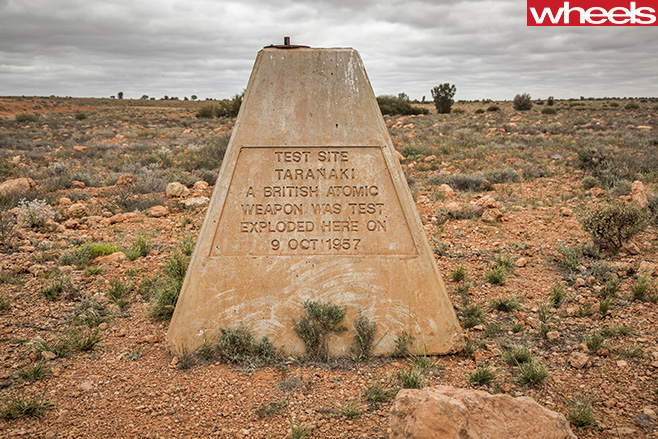
We tag along as Robin takes a group of visitors from one site to another in a Coaster bus. We see the massive clean-up at Taranaki where the ground has been scrubbed, and the machinery that did it crushed and buried when the job was done. At Breakaway, sand has been burned into glass by the infernal explosion. At Marcoo, there are tangled remains of the thick wire that held the bomb in place. There are cairns at each ground zero, the stubs of steel towers and mounds where planes, tanks and other structures were anchored to test their resistance to explosions.
Through it all Robin is enthusiasm itself; no question throws him, his passion never flags. His love for this place is obvious.
“I feel a sense of pride in what I do,” he says. “As people are driving away I’m thinking, ‘There goes another satisfied customer and they will go back and tell their friends and then they will come and visit this place’.”
Robin sees something here I can’t. Yes, it is worth visiting. It is a place of great importance and relevance to Australia and its development. But a cold wind gusts across the mottled plain; a chilling wind for a chilling place. Low, grey clouds make it seem more like evening than mid-afternoon, a total contrast with yesterday’s clear blue skies and the spectacular sky show we saw down south.
It is impossible not to be affected by the grey, cloying, quiet nature of this place, and by what we have seen and what we know happened here. There are lessons to be learned.
As all great adventures are, Maralinga is a journey in more ways than you expect. So take the drive, do the tour and stay the night. Hopefully it’s the only time you will ever go to Hell.
Toxic history

The local Maralinga Tjarutja population was shifted away from their traditional lands to enable the testing to take place, but Aboriginal people crossed the test area throughout its working years. The most famous story is of a family found living in a bomb crater in 1957.
Most of the horror stories only came to light because of the brave whistleblowing of veteran Avon Hudson in the 1970s and the McClelland Royal Commission of 1984-85.
After years of bitter dispute, the SA government handed back the native title for most of the region in 1984. The title to Section 400, the 3300 sq m of land that encompassed the test area, was finally regained by the Maralinga Tjarutja in 2014.
The last of four major clean-ups of the site was completed in 2000, although there are still question marks about their effectiveness.
Damper dodge
The rear dampers’ inability to cope with the torturous Anne Beadell track underlines the fundamental fact this is a crossover, not the sort of outback bush basher with which Land Rover made its name.
“The suspension on Discovery Sport has to find a fine line between off-road capability and refinement for urban driving and we think it handles both very well,” Jaguar Land Rover Australia’s James Scrimshaw wrote in reply to our queries.
“Continual arduous driving may consider a more heavy-duty and less comfortable shock absorber, but in 99.9 percent of cases we feel we have the suspension performance just right.”
Scrimshaw also passed on a response from Land Rover’s technical department concerning our experience: “We are not aware of any Discovery Sport suspension dampening concerns in Australia on the question raised by Bruce Newton. It appears that the vehicle was operating within design parameters under the severe road conditions as advised, providing that a balanced vehicle load was maintained and no mechanical or hydraulic shock absorber malfunction occurred when crossing the Anne Beadell Track.”
Decipher that.
Getting there
Maralinga is in south-western SA, 1308km by road from Adelaide. The nearest significant population centre is Ceduna on the Great Australian Bight, about 370km to the south-east.
From Ceduna it’s a straight run on the Eyre Highway (National Highway 1) to the turn-off, 27km past the Nundroo roadhouse. This is the final refuelling option.
Be aware the turn-off to Maralinga points only to the Iluka sand mine. You’re on a quality bitumen road for 78km to the Maralinga and Oak Valley turn-off to the left.
Now you’re on a wide, smooth dirt road across the flat plains. At 62km you get to the Trans-Australian railway at Ooldea, where there’s Telstra service and you can call Robin to confirm ETA.
From here it’s another 27km of dirt until you reach the bitumen road that connects Maralinga village with the old Watson railway siding. The barrier guarding entry to Maralinga is another 21km up the road.
Give Robin our regards.
SPECS Model: Land Rover Discovery Sport SD4 SE Engine: 2179cc 4-cyl, dohc, 16v, TD Max power: 140kW @ 4000rpm Max torque: 420Nm @ 1750rpm Transmission: 9-speed automatic Weight: 1775kg 0-100km/h: 8.9sec (claimed) Fuel economy: 7.1L/100km (on test) Price: $59,595 On sale: Now
October 7 is the day Ford will close its factory doors forever. It’s also the same day as the Bathurst 1000. Does no one at Ford own a calendar? Seriously.
First published in the June 2016 issue of Wheels magazine, Australia’s most experienced and most trusted car magazine since 1953.
DOES nobody at Ford Australia own a calendar? The Broadmeadows factory is to close on Friday, October 7 – the same day the V8 Supercars will be qualifying for the Bathurst 1000 at Mount Panorama.
I’m writing this on Anzac Day, so the themes of respect and honour are all around me today. A friend went to a chilly Dawn Service at the Shrine of Remembrance to pay respect to soldiers she never knew, and a grandfather who fought in WWII.
Later today I’ll go to the MCG to watch my boys Collingwood battle traditional Anzac Day rivals Essendon. Neither team is setting the 2016 season on fire, but the occasion inevitably affects the players. Their commitment and endeavour lift as they strive to respect the Anzac spirit.
Before the on-field battle begins, a lone bugler plays the Last Post while 80,000 fans pay silent respect. It’s an eerie and incredibly moving moment.
Anzac Day is one example of respect, but respect does not require a grand spectacle. It can be a small thing, like giving up a seat for an elderly person.
Ford’s decision to close Broadmeadows on the Bathurst 1000 weekend shows scant respect for generations of Ford fans, or to the country that supported it for 56 years. Coincidence or ignorance? It has to be one of those, because I can’t imagine that Ford Australia deliberately scheduled the closure to coincide with Australia’s Great Race, on which much of Ford’s Australian spirit and reputation has been built.
I was introduced to the Bathurst 1000 in 1985, a year dominated by international stars in international cars, though Peter Brock gave them a red-hot run in his VK until a timing chain failed. I remember the great Ford victories since then: old-stager John Bowe beating Holden upstart Craig Lowndes in 1994; Lowndes, now in a BA Falcon, paying the ultimate respect to his mentor and icon Peter Brock with an emotional victory in 2006; Winterbottom’s emphatic 2013 victory that ended a four-year domination by Holden.
The most iconic Ford moment has to be the Moffat and Bond 1-2 in 1977 (below). Before my time, but I still know about their victory many laps ahead of the nearest Holden.
These are defining moments in Ford’s history in Australia, and there are many other Bathurst moments that contributed to Ford’s fighting spirit. Hot favourite Dick Johnson crashing into a tree in 1983. A broken valve spring snuffing a well-deserved maiden victory for Glenn Seton in 1995; the live cross that followed with TV commentators interviewing a gutted Seton in his lifeless EF Falcon is hard to watch, even today.
Ford has been a big part of Australia for decades, and that relationship is about to change in the most fundamental way. Closing the Broadmeadows factory on a sacred day for motorsport is not the way to show respect for that relationship.
Laser vision
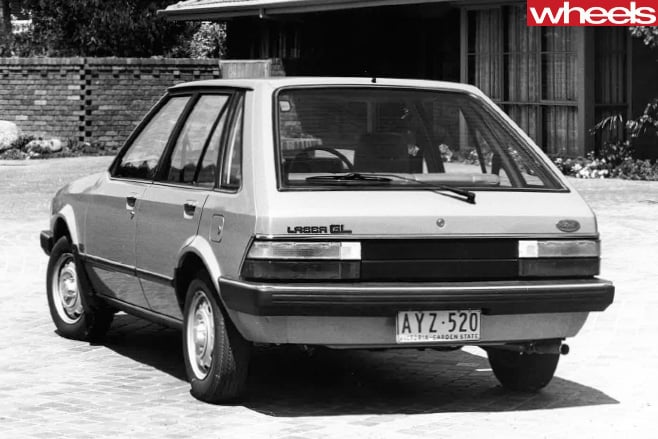
I learned to drive in an Australian-made Ford, though not one out of Broadmeadows. Mum’s Homebush-built Laser (pictured above) suffered terribly as I struggled to master clutch and gears, then again when I discovered handbrake turns. This poor, abused ex-Avis renter was also the first car I crashed – though I remain adamant it was the other guy’s fault, right Mum?
1. The Mercedes-Benz E-Class gets a Crosswind Assist function that is also on some Mercedes-Benz vans and people movers. It monitors the speed of each wheel as well as the yaw rate (whether the car is spinning around its axis) and can individually apply brakes to counter the effects of a crosswind.
2. The E-Class can react to drivers who have fallen asleep or unconscious at the wheel. If it notices no steering input for an extended time it can automatically bring the car to a stop.
3. Another addition to the Pre-Safe safety suite is “Impulse Side”. It uses air chambers in the upper parts of the driver and front passenger seats to nudge the driver 5cm towards the centre of the car to get them further away from the doors if a side impact threat is detected.
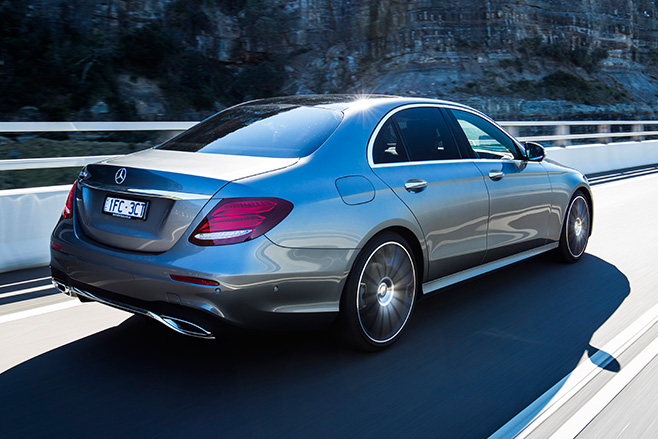
4. Pre-Safe also now has a function called Pre-Safe Sound, which is designed to reduce the likelihood of hearing damage in a crash. It does so by emitting an 80dB sound through the speaker system which is designed to stimulate the stapedius muscle in the ear, forcing it to contract, in turn protecting the ear drum.
5. The ambient lighting system has 64 colours that can be adjusted across five levels of intensity. Owners can also choose to switch it off completely, or run it only in the front or rear of the vehicle.
6. The E-Class is the first Mercedes-Benz to get upgraded software (NTH 5.5) for the Comand infotainment system. It is claimed to have smarter voice recognition as part of the Linguatronic system, a faster hard drive, and allow online internet searches.
7. The digital instrument cluster and central infotainment screen on the E-Class are identical 12.3-inch screens bonded together under a single piece of glass to make them look like one broad display.
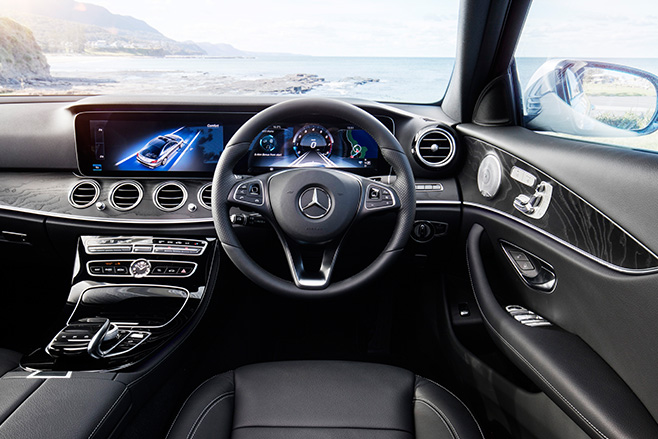
8. The new E-Class is 43mm longer than the model it replaces and with an extra 65mm between the front and rear wheels (wheelbase). But the new car is 2mm narrower and 3mm lower than the previous E-Class. Despite the extra size, it’s about 70kg lighter.
9. All E-Classes get more efficient LED headlights. There are also active multi-beam LED headlights on the C350d and above (and optional on other models) that house 84 LEDs in each headlight. Individual LEDs can be illuminated or switched off instantly depending on the road and traffic ahead.
10. A new car can cost $1 billion or more to design and develop. But the new 2.0-litre four-cylinder diesel engine on the E-Class (codenamed OM 654) was the result of a €3 billion development program. That’s big bucks, although the engine will be used across most of the Mercedes-Benz range in dozens of models.
11. All new E-Classes get a nine-speed automatic transmission that’s said to be 92 percent efficient (up from 85 percent compared with the old seven-speed unit).
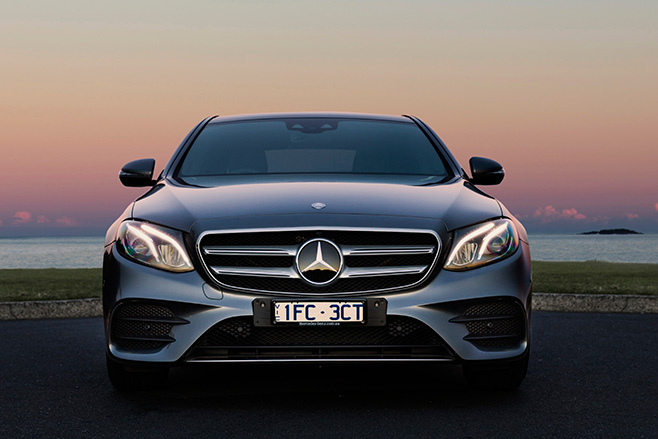
12. The fifth generation E-Class will be the first offered with an all-wheel drive system. The 4Matic system has long been offered in America and Europe, but this is the first time the E-Class will have it locally. It’s fitted standard on the E400 and upcoming E43 AMG and E63 AMG.
13. Mercedes-Benz is secretly working on an off-road version of the E-Class. Similar in concept to the Subaru Outback – a car based on the Subaru Liberty wagon – the E-Class off-roader will have higher riding suspension, body add-ons to give it a chunkier look, and the 4Matic four-wheel drive system.
14. The E-Class is not offered with a manual gearbox. Instead, all cars come with a nine-speed automatic transmission; marketed as 9G-Tronic.
Want more? Check out the history of the Mercedes-Benz E-Class
A weapon’s potency can only be properly determined once it’s clear what it’s up against.
After all, Attila the Hun conquered most of Europe with swords, bows and arrows, but would’ve been badly outmatched in Desert Storm. So while Peugeot Sport has opened the bomb doors and delivered a pair of potent hot hatches, it’s our job to determine where the new 308 GTi stands in the pecking order.
For that we sent the juiciest 308, the $49,990 GTi 270, which scores more power and all sorts of go-fast goodies over its more basic GTi 250 sibling, out into the pen and waited for the predators to appear. Sadly, the pack is a little thinner Down Under than in its native Europe; the Seat Leon Cupra 290 isn’t sold here, Honda’s Civic Type R missed the boat and the Ford Focus RS is still on it (and is too all-wheel drive).
Possibly the Pug’s most obvious rival is the Volkswagen Golf GTI Performance, however sadly there wasn’t one available at the time of testing, which makes this tussle an all-French affair. That leaves only one hurdle for the 308 GTi to clear, but it’s an almighty big one.
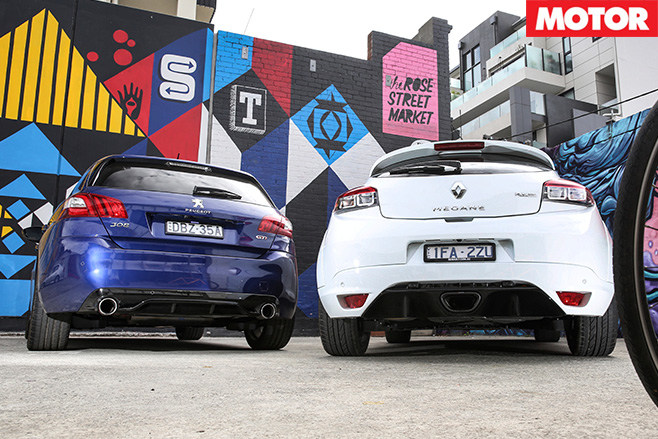
At $53,000, it’s $3K more with two less doors than the Peugeot, but if this pair were LEGO sets, you could build both with a similar set of blocks. Both use force-fed four-bangers backed by a six-speed manual gearbox, steer with electrical assistance and have a limited-slip differential stuffed between the front wheels.
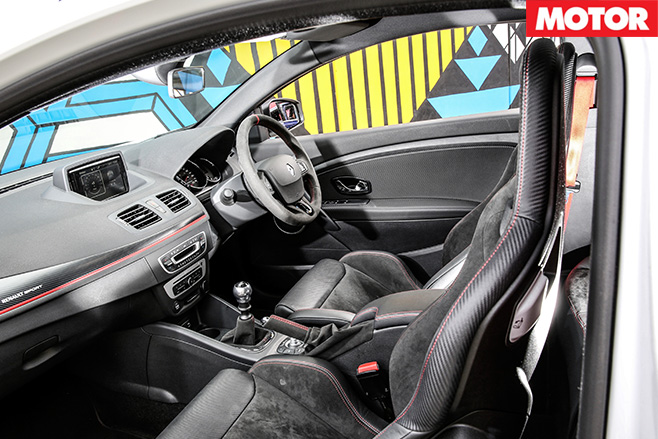
Climb inside, however, and it’s obvious which car is more open about its performance bent. Swathes of Alcantara coat the Renault’s interior, from the deeply-bolstered Recaros to the touch points on the steering wheel, handbrake and gear shift surround. The suede-like material also covers the rear bench and there’s a ‘Zamac’ alloy gear knob pinched from the limited-edition RS275 Trophy.
Familiar to those upgrading from the cheaper RS265 will be the bright red seatbelts that make you feel like you’re wearing a beauty pageant sash and carbon fibre inserts that sweep across the dashboard, as well as the curiously French ergonomics including the heavily sloped instrument display and random scattering of major functions: the cruise control/speed limiter button is between the seats, the audio controls are hidden by the steering wheel – you get the picture.
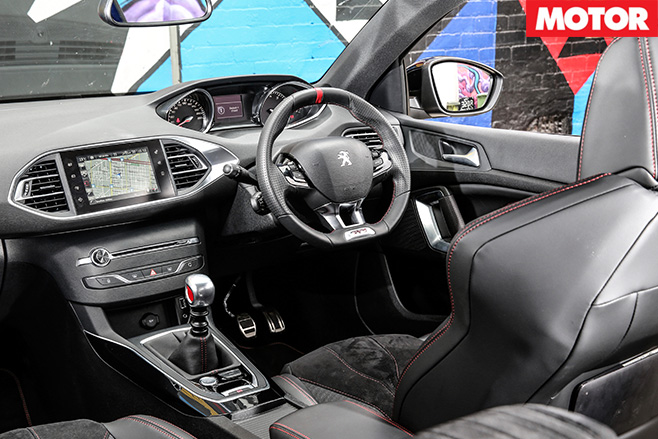
The Renault doesn’t have a monopoly on weirdo ergonomics, though. Thickly padded and coated in Alcantara and a plastic-coated fabric called TEP, the GTi 270-specific seats make the Megane’s feel like deck chairs, but the high hip point forces you into an awkward driving position, requiring the tiny steering wheel be dropped unusually low to clearly see the instruments.
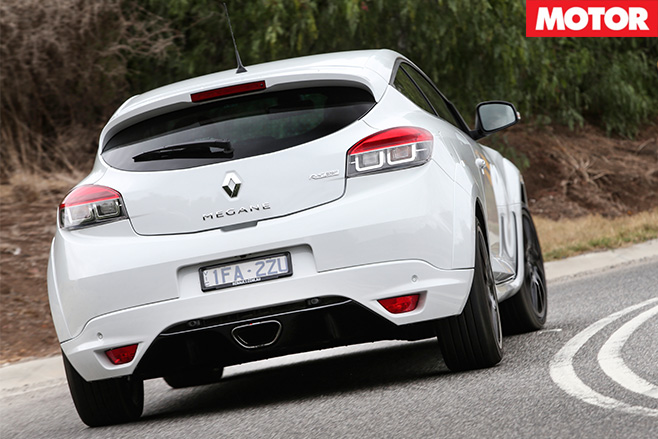
In the Megane you’ll strike a much more natural pose. Its hip point is well below the steering wheel which puts the wheel at chest height and instantly primes you for a punt, ready to take on a challenging road.
There’s a whiff of dullness around the steering’s centre, but it’s linear with sufficient feedback and is quick enough to keep up with the car’s hyper-alert chassis. Push on and it’s like the chassis has been welded to your nervous system, the driver able to sense the car’s every intention.
The high seating position and small wheel in your lap is much like the 208, while the 308’s firm suspension copies the sadly departed and fairly simmering RCZ-R (which finished fourth at PCOTY, remember). Similarly, the Torsen LSD is an evolution of the unit in the RCZ-R and, along with increased negative camber and wider tracks, works to increase front grip and bully the 235mm front Michelin Pilot Super Sports into corners.
Diff lock-up can be a little inconsistent and it feels like it can’t transfer the same amount of torque to the outside wheel as the Megane, but if the inside wheel has enough grip, it can pull through corners with serious speed. However, the steering’s indirectness means a little guesswork is needed, which makes it hard to nail every corner. It’ll bob over bumps and shimmy into corners but the suspension has a degree of compliance that sees it strike a decent balance between ride and handling.
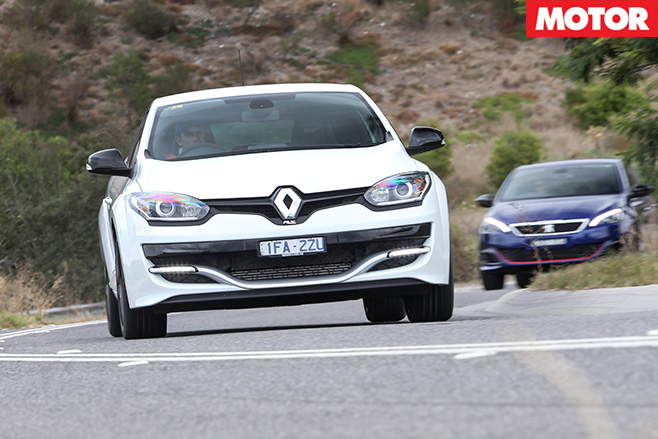
For noise the Megane’s titanium Akrapovic exhaust shames the Peugeot’s half-fake note, the Renault’s snarl accompanied by a cacophony of pops and bangs on the overrun. The Peugeot’s dual pipes make a decent tune with a blow-off-valve-like sneeze accompanying each lift of the throttle, but unfortunately to hear that you’ve got to have the windows down.
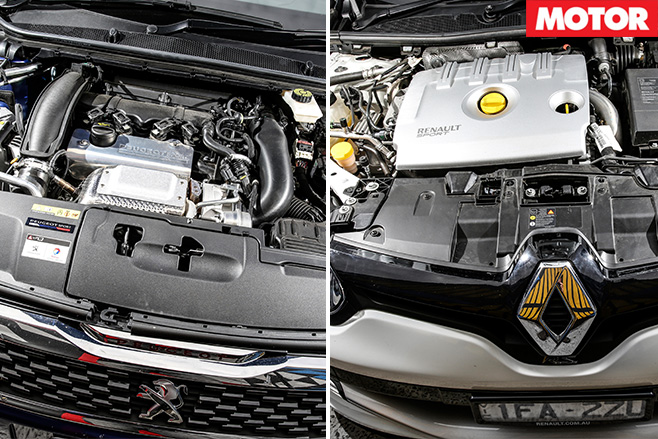
Between corners the Peugeot’s hard-working 200kW/330Nm 1.6-litre is a sweet, flexible thing that starts huffing as early as 2000rpm and loves to spin out in a smooth, elastic fashion. There’s some lag but that stems from the fact Peugeot stuffed it with Mahle pistons, trick bearings and 22psi of boost on 9.2:1 compression to help make up for its 400cc deficit.
In contrast, the Renault’s 201kW/360Nm 2.0-litre four-pot has more muscle. Once the needle passes 3000rpm the grunt comes on hard and fast in a manic rush; it’s a bit cruder in operation, winding up quickly and feeling deadliest in its mid-range, but it’s certainly no less potent.
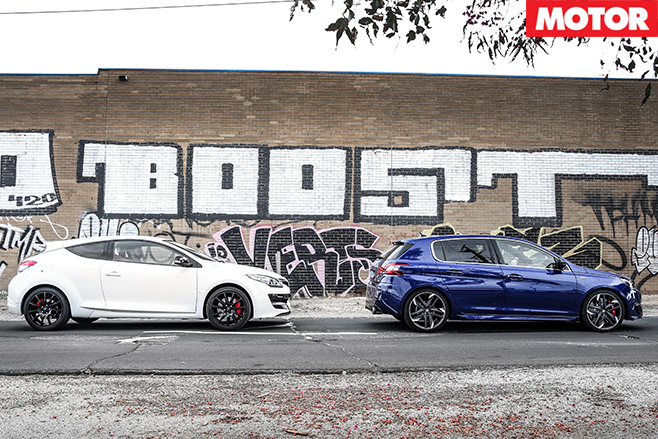
The Peugeot finally lands a punch once the show is rolling. Its superior power-to-weight ratio (166kW/tonne plays 146kW/tonne) helps it eke out a 2.57km/h advantage in trap speed (ie, it’s chasing the Renault down) and it thrashes the Megane for sixth-gear overtaking punch, nailing 80-120km/h 2.3sec faster, though that gap shrinks to just 0.1sec in third.
As for stopping, you only have to peek behind the Peugeot’s enormous 19-inch wheels to see that braking was always going to be one of its strong points. The enormous 380mm two-piece front rotors even come with a warning not to be alarmed by race-car style noises under low speed operation due to brake dust build-up, something Peugeot is currently developing a fix for.
They feel over-assisted for the first few centimetres of pedal travel but with a firm press and once a bit warm they pull the 1205kg 308 to a halt from 100km/h in just 34.2m – a full 4.7m shorter than the Megane.
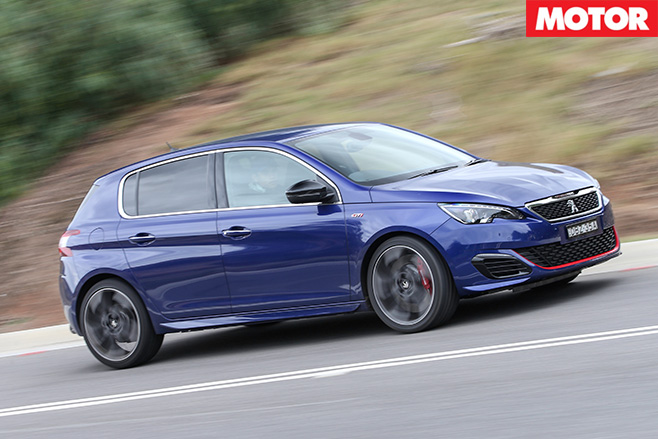
The two-door, subtly pumped body gives the Megane a more svelte shape but square-on there’s something off about the size of its headlights and badge. The platinum grey blade slotted into the front grille is a nice touch, but when are manufacturers going to stop with the fake exhaust tips?
Looks provide a compelling reason to pick the Renault and many diehards will rue the change to a five-door body when the new Megane RS arrives in 2017. Likewise the loss of one of the most bewitching front-drive chassis ever built, should the whispers that Renault is going Focus RS hunting with an all-wheel drive system prove true.
Not to mention the demise of the manual gearbox. All undoubtedly changes that should shift a lot more Renault Sport Meganes, but few cars provide such an adrenalin hit while also flattering your abilities as the current model – it’s a proper supercar hurry-upperer on the right road.
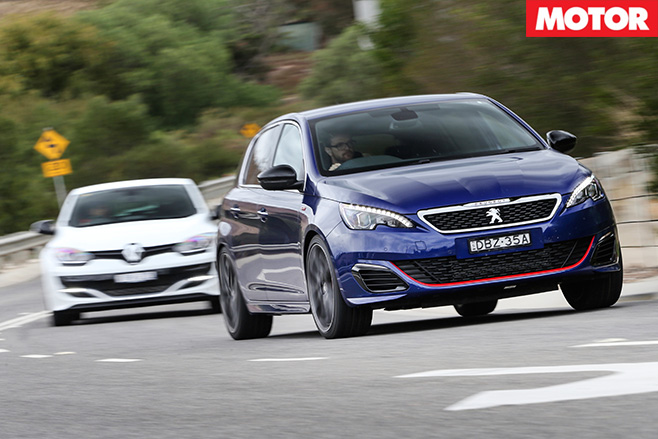
Including the Peugeot. The ride is more than bearable, the engine’s more tractable and the steering’s easier to use day-to-day. It’s seven years younger than its fellow Frenchie, so you’d expect its package to be more refined, but Peugeot has done so well chasing its German opposition that its cabin feels as hushed and solid as any.
Sure, the all-in-one media screen that hides the HVAC controls in a sub-menu can be a little… testing, it has the world’s most abrasive door-open warning chime and the fake engine note in sport mode at 100km/h sounds like somebody sat on a pipe organ, but it’s still a great drive and impressive value.
You might not exit the 308 GTi 270 in a dopamine-laced buzz like you do in the Megane, and it’s unlikely to be as quick around a circuit (we’ll find out at BFYB), but there’s enough performance up to at least eight-tenths that what’s lost to the Megane on a Sunday fang is made up for by the plusher cabin and cushier suspension on the other six days. There are further challenges ahead (VW’s new GTI Clubsport for one) but Peugeot’s new hottie has proved its potency.
The numbers
Front-paw fighters
| u00a0 | Peugeot 308 GTi 270 | Renault Megane RS275 |
| 0-10km/h | 0.52 | 0.41 |
| 0-20km/h | 1.03 | 0.92 |
| 0-30km/h | 1.5 | 1.38 |
| 0-40km/h | 1.99 | 1.84 |
| 0-50km/h | 2.57 | 2.29 |
| 0-60km/h | 3.34 | 2.98 |
| 0-70km/h | 3.82 | 3.58 |
| 0-80km/h | 4.41 | 4.24 |
| 0-90km/h | 5.06 | 4.92 |
| 0-100km/h | 6.09 | 5.93 |
| 0-110km/h | 6.95 | 6.92 |
| 0-120km/h | 7.87 | 7.88 |
| 0-130km/h | 8.94 | 8.98 |
| 0-140km/h | 10.43 | 10.57 |
| 0-150km/h | 11.78 | 12.02 |
| 0-160km/h | 13.23 | 13.57 |
0-400m | 14.16sec @ 165.57km/h | 14.09sec @ 163km/h |
SPEED IN GEARS | 54km/h @ 6500rpm | 59km/h @ 6500rpm |
2nd | 99km/h @ 6500rpm | 93km/h @ 6500rpm |
3rd | 132km/h @ 6500rpm | 130km/h @ 6500rpm |
4th | 172km/h @ 6500rpm | 176km/h @ 6500rpm |
5th | 215km/h @ 6500rpm | 222km/h @ 6500rpm |
6th | 235km/h @ 6000rpm* | 255km/h @ 6165rpm* |
As tested by MOTOR: Heathcote Dragway, 10:36am, 21 degrees, dry. Driver: Scott Newman. *Manufacturer’s claim
Specs
| u00a0 | Peugeot 308 GTi 270 | Renault Megane RS275 Cup |
| Body | 5-door, 5-seat hatch | 2-door, 4-seat coupe |
| Drive | front-wheel | front-wheel |
| Engine | 1598cc inline-4, DOHC, 16v, turbo | 1998cc inline-4, DOHC, 16v, turbo |
| Bore/Stroke | 77.0 x 85.8mm | 82.7 x 93.0mm |
| Compression | 9.2:1 | 8.6:1 |
| Power | 200kW @ 6000rpm | 201kW @ 5500rpm |
| Torque | 330Nm @ 1900-5500rpm | 360Nm @ 3000rpm |
| Power/Weight | 166kW/tonne | 146kW/tonne |
| Transmission | 6-speed manual | 6-speed manual |
| Weight | 1205kg | 1376kg |
| Suspension(F) | struts, coil springs, anti-roll baru00a0 | struts, coil springs, anti-roll bar |
| Suspension(R) | torsion beam, coil springs, anti-roll bar | torsion beam, coil springs, anti-roll bar |
| L/W/H | 4253/1804/1446mm | 4320/1848/1422mm |
| Wheelbase | 2620mm | 2646mmu00a0 |
| Tracks | 1570/1554mm (f/r)u00a0 | 1546/1547mm (f/r) |
| Steering | electrically-assisted rack-and-pinion | electrically-assisted rack-and-pinion |
| Brakes(F) | 380mm ventilated discs, four-piston calipers | 340mm ventilated discs, four-piston calipers |
| Brakes(R) | 268mm solid discs, single-piston calipers | 290mm solid discs, single-piston calipers |
| Wheels | 19 x 9.0-inch (f/r) | 19 x 8.25-inch (f/r) |
| Tyre sizes | 235/35 R19 91Y (f/r)u00a0 | 235/35 ZR19 (f/r)u00a0 |
| Tyre | Michelin Pilot Super Sport 3 | Bridgestone Potenza RE050Au00a0 |
| Price as tested | u00a0$49,990u00a0 | $53,000u00a0 |
| Pros | Great ride/handling mix; superb engine; nicer interior | Still the pinnacle of front-drive performance |
| Cons | Lacking steering feel; driving position; fake engine note | Firm ride; could be trying as a daily driver |
| Star Rating | 4/5 | 4/5 |
Road-trip shenanigans cement the bond.
First published in the May 2016 issue of Wheels magazine, Australia’s most experienced and most trusted car magazine since 1953.
UNHEALTHY as it is, consuming a gullet-load of drinks and washing it down with some fast-food gloriousness at 1am is a great way to bond with fellow humans. Some of the finer conversational details may be lost in the process but there’s a warm-and-fuzzy feeling associated with letting rip in fine company that can seal a friendship.
That’s how I feel about the Mercedes-AMG C63 S. Initial misgivings over its brusque and unforgiving nature – especially when tackling low-speed traffic snarls and bumpy urban roads – have transitioned into a much more tolerant, almost lovey-dovey relationship phase.
Having fully stretched 1DF-6IS’s muscular legs over the past two months and 1700 kays, including a soon-to-be-published comparo, I now fully comprehend what this 375kW slingshot is capable of.
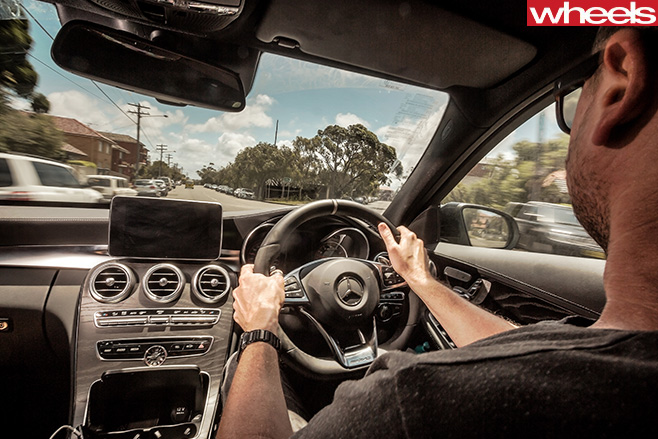
I’ve found a solution for its urban driveability issues. Instead of defaulting to ‘Comfort’ mode and quietly cursing the laborious off-the-line slurring as it starts in second gear, I now drive the C63 solely in ‘Individual’, mixing Comfort dampers with a livelier Sport drivetrain setting, a rumbling sports exhaust note and a more forgiving ‘ESP Sport’ safety net for the stability control.
In conjunction with semi-slick tyres, you’d think it was a step too far for standing-start traction but that isn’t the case. The Speedshift-MCT seven-speed holds onto gears a smidge too long at times in Sport but it makes the C63 feel genuinely quick. Sure, there has been the odd oversteer moment when plugging traffic gaps but at least its flow isn’t being spoiled by electronics.
About the only thing that can’t be remedied by pushing a button is the steering. Given that Sport, Sport + and Race are all too stiff for road driving in Australia, and group together all dynamic adjustments, there’s no chance of upping the meat of the steering while leaving the dampers ‘cushy’.
One particular corner on my work commute – a smooth, downhill left-hander just past Redfern station – makes the steering feel kinda slack, almost as if lane-assist is trying to make directional corrections, especially if the front treads aren’t bang on 38psi. And selecting Sport doesn’t cure it.
Yet when the C63’s vast roadholding reserves are fully explored, its steering becomes faithfully crisp and communicative, allowing this wonderfully poised little groover to be placed with precision.
Could it be related to our optional semi-slick tyres? When the Michelin Pilot Sport Cup 2s get swapped for regular road rubber in the coming weeks, we’ll know for sure.
S express
Unlike other markets, Australia exclusively receives the range-topping 375kW C63 S, hence its firmly focused, ultra-sporting personality. Yet for what most punters do, the marginally more forgiving 350kW C63 riding on 18-inch wheels would be a more sensible and comfortable choice. But Aussie AMG buyers can’t bear the thought of someone else having more power than they do, hence the ‘S’ on our C63’s bootlid. Wonder how owners will feel when the even more hardcore C63 S Coupe lobs in June?
Read part one of our Mercedes-AMG C63 S long-term car review.
Mercedes-AMG C63 S Price as tested: $165,610 Part 2: 1686km @ 14.9L/100km Overall: 2054km @ 16.1L/100km Odometer: 4567km Date acquired: December 2015
Its rate of acceleration is simply phenomenal, quite simply in a class of its own… yes, the Ferrari really is the boss.”
These words appeared in MOTOR’s October 2004 issue and the Ferrari in question was the incredible Enzo, which had just annihilated its supercar opposition in a group test at Italy’s famous Nardo speed bowl.
Equipped with a bellowing 485kW/650Nm 6.0-litre V12, the Enzo blew past 100km/h in 3.6sec, dispatched the quarter in 11.4sec at 212.5km/h and flew to a 352km/h top speed. Its nearest rivals, Porsche’s Carrera GT and the Mercedes-Benz SLR McLaren, trailed by 21km/h. In a pre-Veyron world it was the undisputed king.
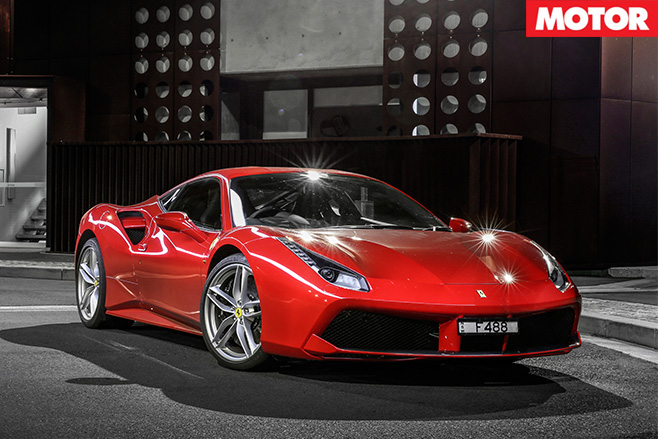
Thanks to two turbochargers and a decade’s worth of engine development, the 488’s 3.9-litre V8 bests the Enzo’s V12 with 492kW/760Nm. At 1475kg it carries an extra 110kg, yet Ferrari claims the 488 will hit 100km/h from rest in 3.0sec and cover the standing quarter in a mind-warping 10.45sec. But the truly jaw-dropping stat is the 488’s 0-200km/h time of 8.3sec. Eight-point-three!
To put that in context, having not sampled any of the current crop of hypercars, my current acceleration benchmark is the latest Porsche 911 Turbo, a car that feels like it compresses time and space, yet trails the Ferrari by a full 2.0sec to 200km/h.
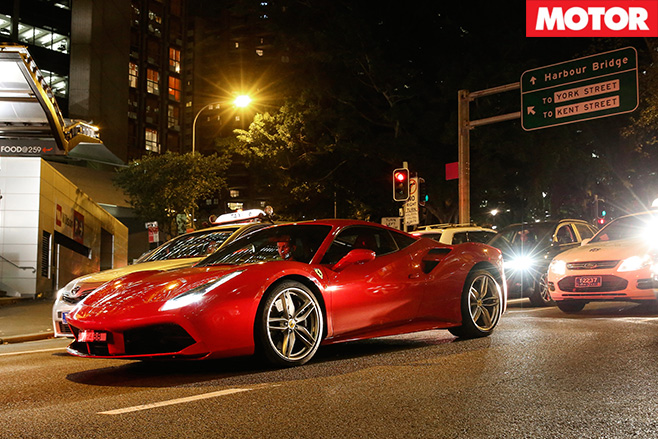
Frustratingly, the answer must wait, as Sydney’s suburban streets aren’t designed to exploit firepower of this magnitude. Even so, there are early hints as to its potency, the rear tyres chattering in response to a quick stab of throttle in second.
Driving a half-million-dollar supercar through city traffic might sound like a recipe for sweaty palms, but the 488’s comfort and useability lowers its intimidation factor markedly.
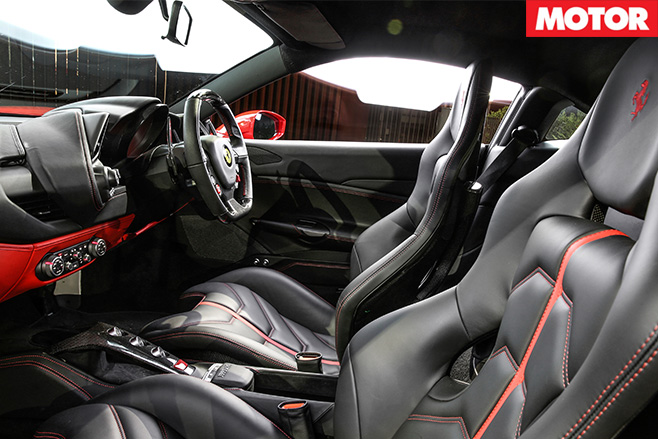
With all major controls moved to the steering wheel some acclimatisation is necessary but within a day, operating the lights, wipers and indicators becomes second nature.
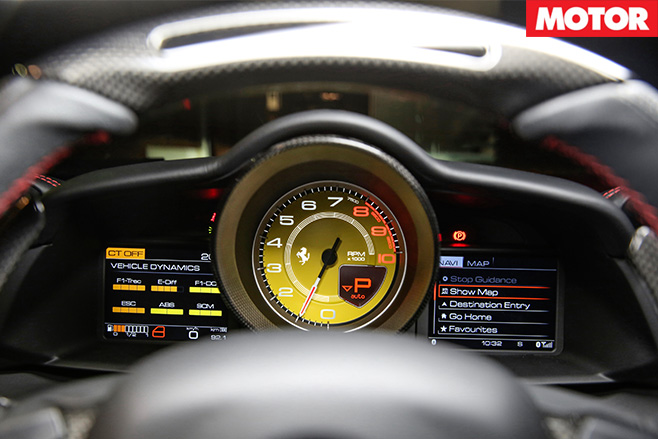
The rest of the interior is a similar story. Two digital screens flank the enormous central tachometer, the left displaying all manner of vehicle information (turbo boost, tyre temperature, trip information, etc) and the right responsible for media, telephone and sat-nav.
The driving environment is similar to the 458’s; no surprise as, despite its vastly different mechanicals, the 488 is still essentially a mid-life update of its predecessor – the next all-new mid-engined Ferrari isn’t due until 2021.
Plenty of wheel and seat adjustment makes the weirdo long-arm, short-leg ‘Italianised’ driving position a thing of the past, though the $15,000 carbonfibre racing seats are very firm. Numb bum will set in later, but as the 488 and I escape Sydney’s northern fringes I realise I could – and would – use this Ferrari every day.

Press the picture of a shock absorber on the steering wheel and the whole car… relaxes. It doesn’t morph into a Rolls-Royce Phantom, but most impacts are now smothered, like being punched through a pillow. Bumpy Road soon becomes part of the start-up procedure.
Turning off the Pacific Motorway at Calga, the first opportunities to taste the 488’s performance present themselves. To ease into it, I flick the left-hand paddle three times for fourth gear, slow slightly then with a clear road ahead floor the throttle. Impossible. It must be a trick. What was a good 300m of straight road moments ago seems to have disappeared, almost instantaneously.
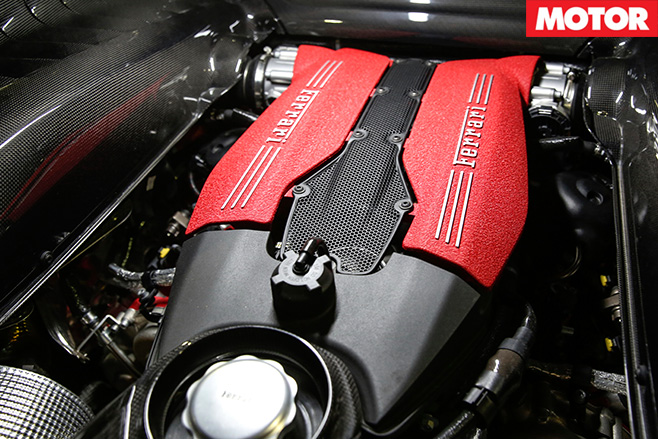
The engine stuttering at the 8200rpm limiter signals the need for another gear; a pull of the paddle is answered instantly, yet another shift is required almost immediately as second is gone in a heartbeat. Third reveals the devastating effectiveness of Ferrari’s variable torque management strategy as the acceleration feels to increase in ferocity.
Nervous laughter fills the cabin – there’s no other appropriate response. In seconds objective journalist has been replaced by giggling schoolchild, dumbstruck by an unholy force. While familiar with Ferrari’s variable torque trickery from the California T, the 488 turns it up way past 11.
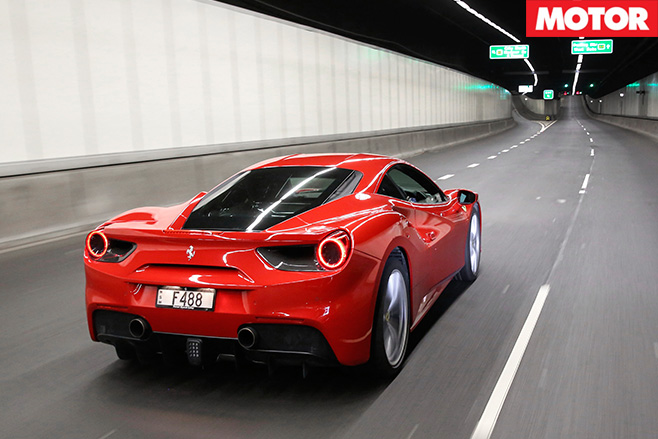
The road changes, wide-open sweepers giving way to narrow, bumpy switchbacks and hairpins with intermittent damp patches; perfect terrain for a Subaru WRX STI, a stern test for a 660hp rear-drive supercar. The 488’s outrageous thrust is now a problem; there’s too much of it.
Not for the car, but for my brain. Corners arrive so quickly that braking becomes rushed and clumsy and gears come and go in a blur. Traction seems strong but there’s no time to see if ESP intervention or mechanical grip is keeping things under control.
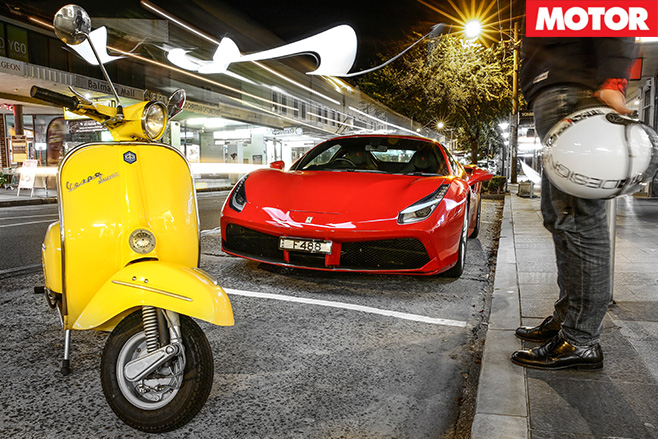
More than a little bamboozled, I continue and almost immediately I meet a series of well-sighted, medium-speed sweepers, punctuated by short straights, and a surface so smooth it’s like it’s been injected with Botox.
This feels like more appropriate territory for an Italian supercar. The acceleration is still shock-and-awe in its intensity, but the wider road and faster corners make it slightly easier to process.
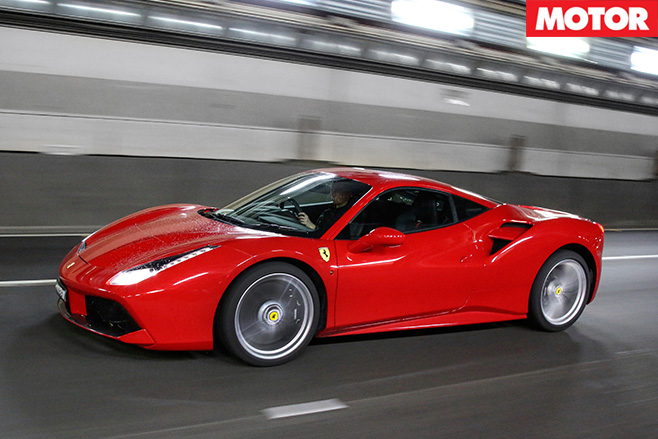
With 334kW/tonne, the 488 was always going to be fast, but the challenge with any turbocharged engine is response and noise. Ferrari has gone to great lengths to eradicate any lag, using twin-scroll ball-bearing turbochargers with titanium-alloy compressor wheels and three-piece, equal-length exhaust manifolds. The result is zero delay, or as near as makes no difference.
Ferrari claims response time in third gear at 2000rpm is a mere 0.1sec slower than the naturally-aspirated Speciale, and it has the graphs to prove it. As for the noise, well, to these ears it’s better than the 458’s. It’s loud, properly loud, still with that unique flat-plane V8 blare, but smoother and overlaid with the whine and inhalation of those clever turbos.
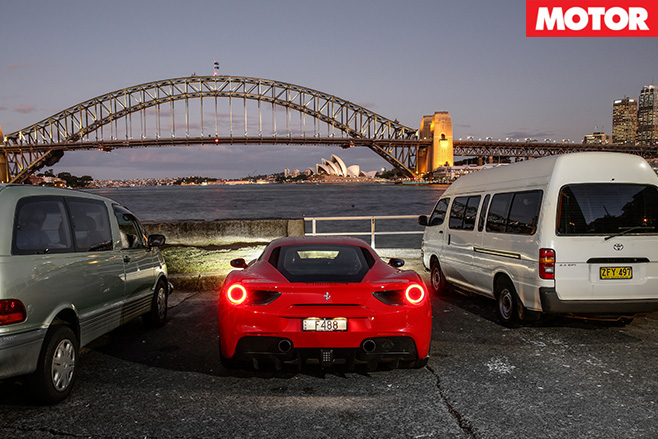
Now in its second-generation, SSC manages the stability control, electronic differential and active suspension and has the ability to soften each individual damper as the limit approaches to increase grip but also smooth the transition to slip.
It works brilliantly, allowing the driver to probe the 488’s limits with much greater confidence and thoroughly explore one of the best chassis around.

It wears regular Michelin Pilot Super Sports (245/35 front; 305/30 rear) rather than the more focused Cup 2s of the Speciale and they allow you to nudge in and out of understeer and oversteer, thanks in no small part to SSC.
The steering remains hydraulically-assisted and is very fast with just 1.9 turns lock-to-lock, but without any hint of off-centre nervousness. It is slightly affected by bumps and cambers, but that seems a small price to pay to be able to feel the texture of the road.
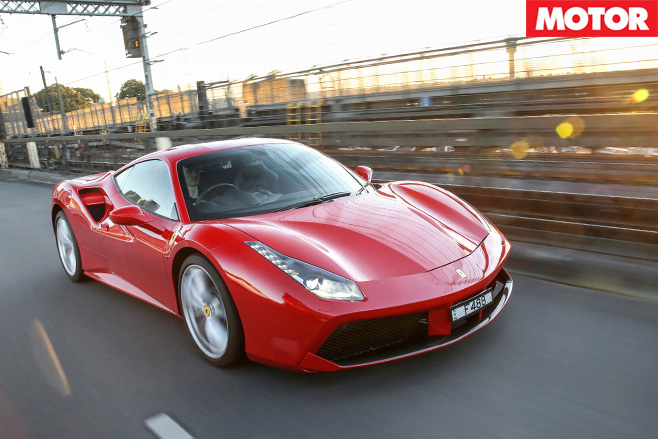
In pictures the 488 looks almost a little plain, particularly its gaping mouth, but as clichéd as it sounds, it looks much better in the metal, with serious supercar presence.
That beautiful shape is largely dictated by aerodynamics. The twin pillars in the nose split the airflow, directing some to the radiators and channelling the rest to the flat underbody.
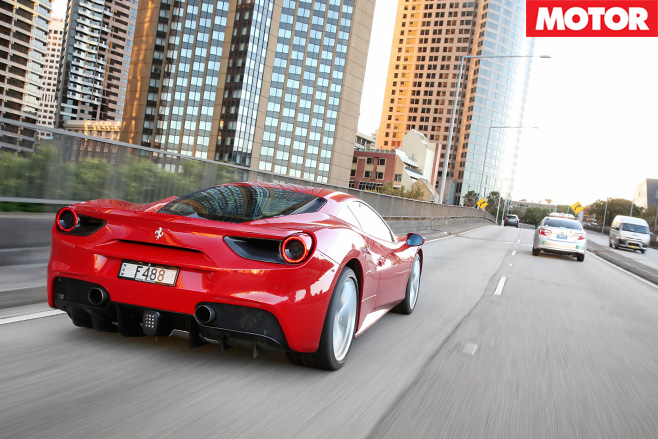
Like an early-80s F1 car, the 488 generates a lot of its downforce – 325kg at 250km/h – from its underbody, the rear diffuser housing electronically-controlled flaps that open to a maximum of 17 degrees to reduce drag.
From behind the wheel, the only hint of this aero trickery is a small ‘DRS’ symbol on the left-hand digital display. And that’s possibly the 488’s greatest achievement – it’s a fiendishly complex car, yet feels utterly transparent to drive.
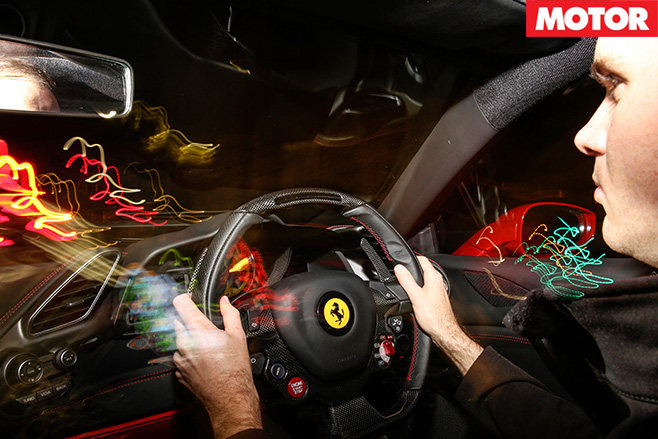
Carrying an extra 80kg and with 1000rpm lopped off the redline, the 488 is probably not as visceral as the ultimate incarnation of its predecessor, but it counters by deploying its talents with greater driver comfort – it has carpet, for a start – and a hefty helping of extra performance. The handling makes the car feel like it’s an extension of your body, but it’s the acceleration that leaves the biggest impression.
I’ve never really been a ‘power guy’, but I’m now hopelessly addicted to the rush. And whenever doubt creeps in I might be overstating it, one more full-throttle blast is all it takes to dispel those concerns.
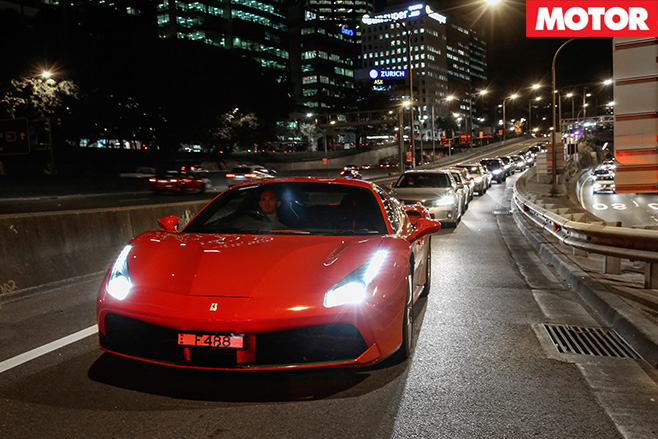
Potential improvements are few, though the most obvious – though likely specific to this car – would be to fix the rattling passenger seat and the buzz in the dash that began as a mild irritation but is rapidly approaching fingers-down-a-blackboard 400km later.
More general suggestions would be to move the shift paddles to the wheel and lose the keyhole in the driver’s door, it’s an unsightly blemish on that scarlet skin, and unnecessary now Ferrari has switched to keyless entry/start.
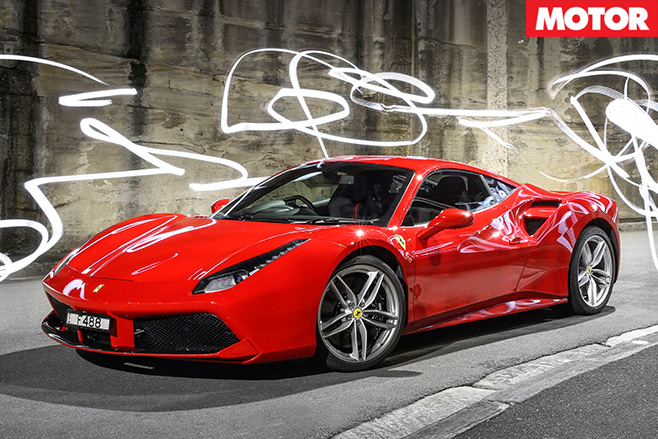
It’s a benchmark performance car and to answer the original question: what does acceleration like this feel like? Well, like much of what the 488 does, it’s simply phenomenal.
5 OUT OF 5 STARS
SPECS body 2-door, 2-seat coupe drive rear-wheel engine 3902cc V8, DOHC, 32v, twin-turbo bore/stroke 86.5 x 83.0mm compression 9.4:1 power 492kW @ 8000rpm torque 760Nm @ 3000rpm (seventh gear) power/weight 34kW/tonne transmission 7-speed dual-clutch weight 1475kg suspension (f) double A-arms, adaptive dampers, anti-roll bar suspension (r) multi-links, adaptive dampers, anti-roll bar L/W/h 4568/1952/1213mm wheelbase 2650mm tracks 1679/1647mm (f/r) steering hydraulically-assisted rack-and-pinion brakeS (F) 398mm ventilated discs, 6-piston calipers brakes (R) 380mm ventilated discs, 6-piston calipers wheels 20.0 x 9.0-inch, 20.0 x 11.0-inch (f/r) TYRE SIZES 245/35 ZR20 (f); 305/30 ZR20(r) TYRE Michelin Pilot Super Sport price as tested $593,910 PROS Unbelievable performance; useability; looks CONS Build quality niggles; fixed paddles; wait list
Dial a drift
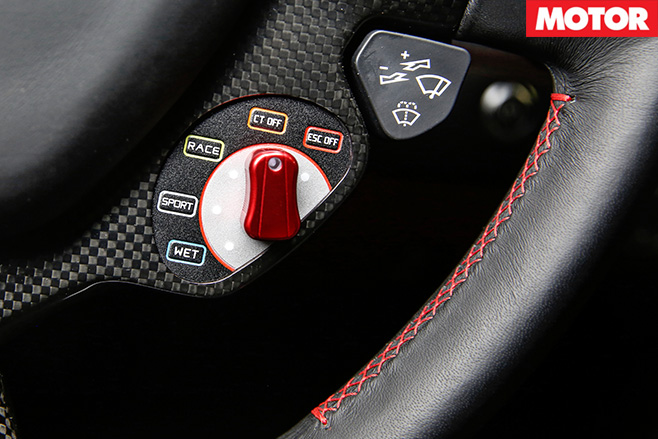
In Wet mode it’s an utter pussycat and even in Sport the electronics are working overtime to keep you safe. Race is essentially the default mode, though CT Off activates Side Slip Control and will make you feel like a much better driver than you are.
If you happen to actually be that good, however, or are just very brave, then ESC Off will leave just your right foot in charge of controlling those 492kW.
IS APPLE now doing what it should have done from the start: developing software that helps iPhone owners drive a car, rather than building a car?
Bloomberg reported overnight that the mobile device and computing giant has hired the former head of Blackberry’s automotive division – Dan Dodge – to head up its car operations.
And Dodge’s brief? Swing the Project Titan’s team’s focus from developing the iCar, and instead concentrate efforts on how to develop self-driving technology.
The strategy swings Apple’s focus to the same path as autonomous car software rival Google, which already has self-driving pods running around its California campus.

According to Bloomberg, the shift in focus did not mean California-based Apple was abandoning its efforts to design a vehicle. “That leaves options open should the company eventually decide to partner with or acquire an established car maker, rather than build a car itself,” Bloomberg said, not quoting any sources.
Google appears to be streets ahead of Apple’s efforts to marry its technology into cars, establishing a separate autonomous car research and development centre in Michigan, the heart of US carmaking, and signing up Chrysler as a development partner.
Their efforts are in stark contrast to another US technology company that already builds cars: Tesla. It has rolled out several self-driving functions in its vehicles, one of which was linked to the first-ever recorded death in an autonomous vehicle – even though Tesla has repeatedly warned drivers that the self-steer mode is only a trial and not a substitute for a switched-on driver behind the wheel.
Whenever we’re lucky enough to drive a supercar here at MOTOR, we’re always staggered by the amount of options fitted, that often blow the purchase price way out beyond the MSRP.
Ferraris are always particularly amusing, the last California T we drove wore $140,000 worth of options and the F12 we took to Tasmania had $133,500 worth of boxes ticked.
It all seems so unnecessary, until you have a go at Ferrari’s online configurator and end up ticking boxes like you’re voting below the line in the Australian senate. Have a go and share your creation with us on Facebook.
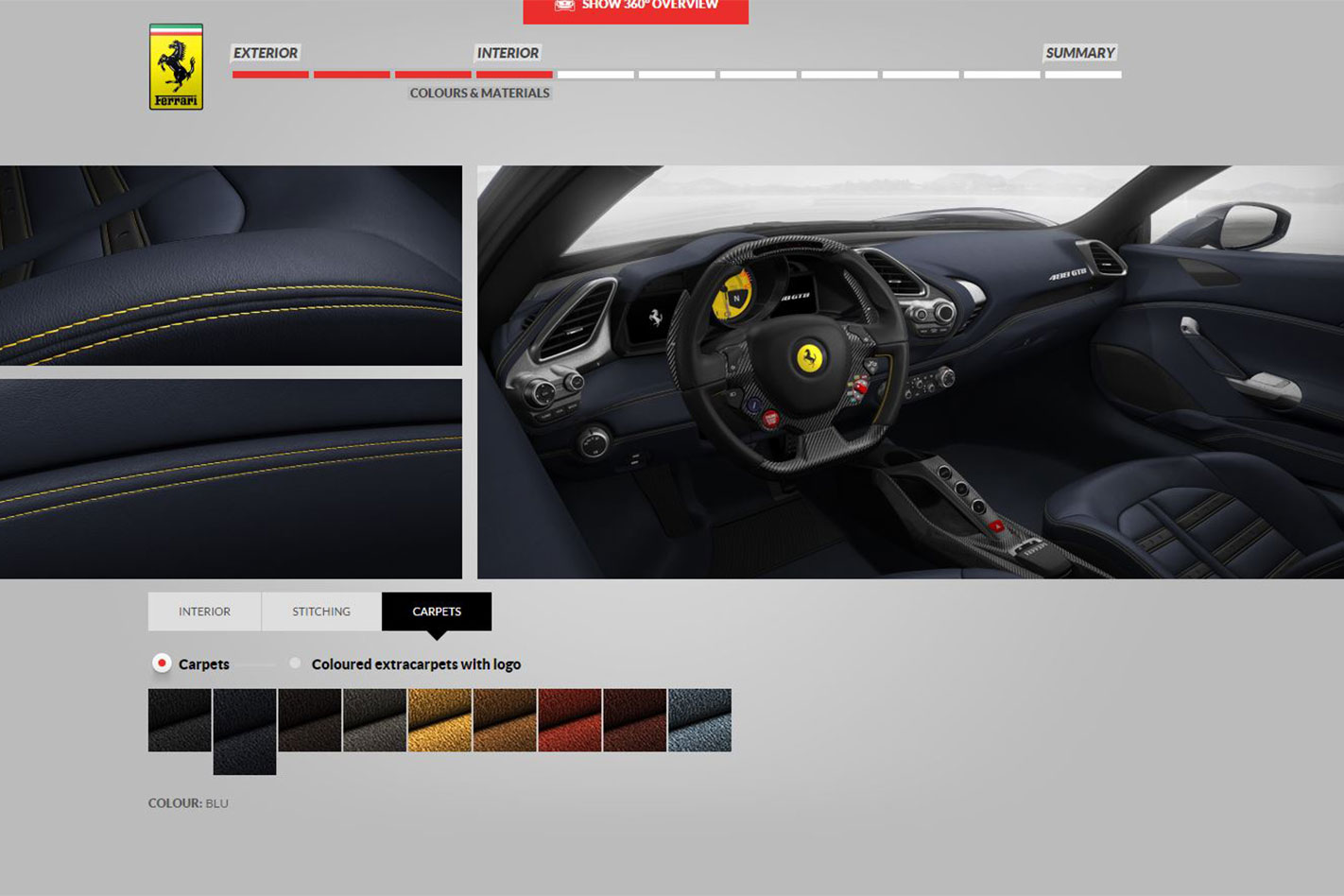
We started with the 488, and you can see the full extent of our lack of self-control in the picture below. The basics, however, are Blu Scozia paintwork with forged dark painted rims and yellow brake calipers.
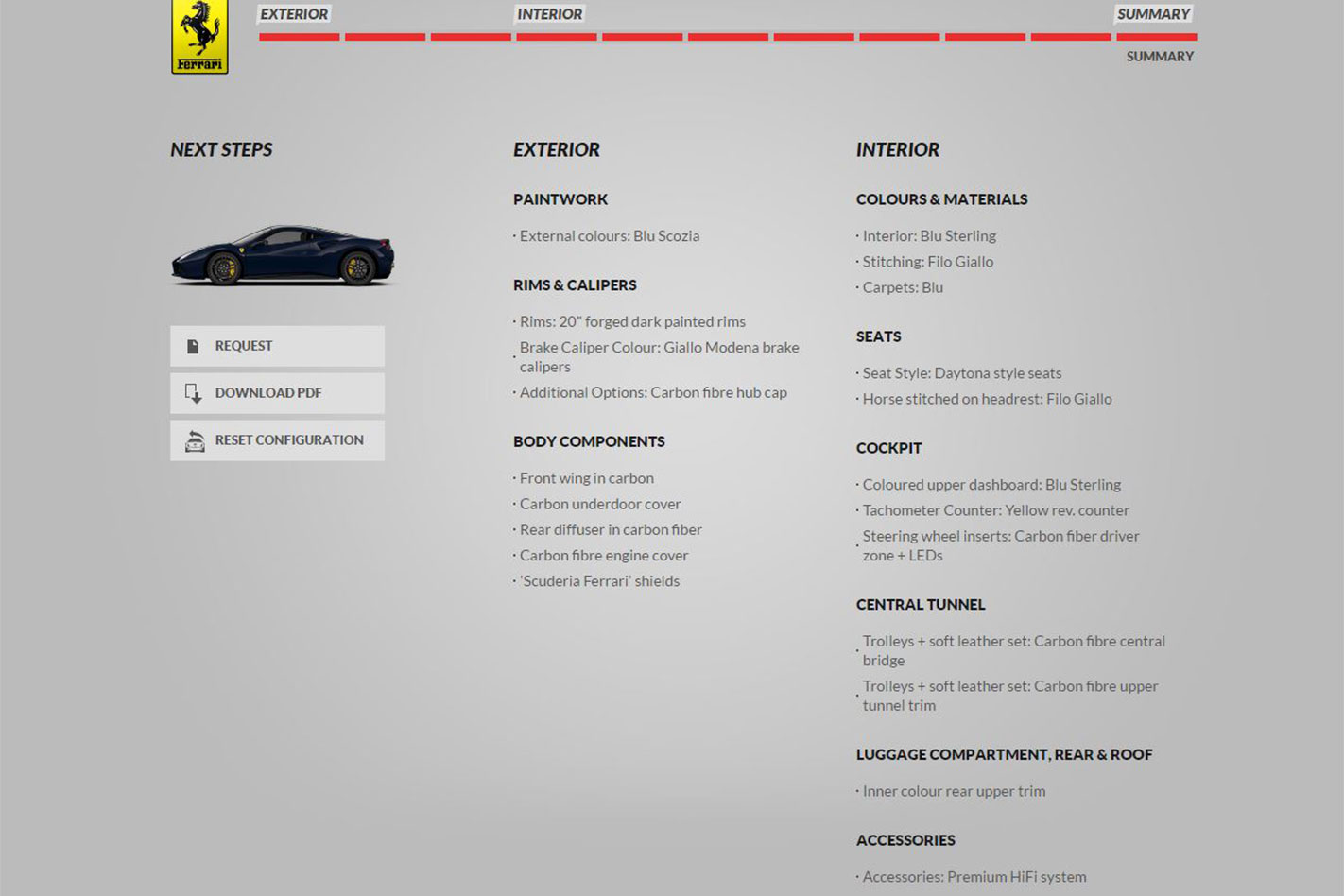
The blue/yellow/carbon theme continues on the inside, with a blue interior with constrasting yellow stitching and rev counter, with carbon covering the driving zone and central tunnel.
Perhaps thankfully, there is no price tag attached to our desired 488, but we wouldn’t expect much change out of $700,000.
Back in the days when Australia still had a motor show, every year Ford and Holden would compete to wow crowds with a crazy new concept.
More often than not these would preview an upcoming model, however one of Holden’s more fanciful creations was almost one of its most prescient.
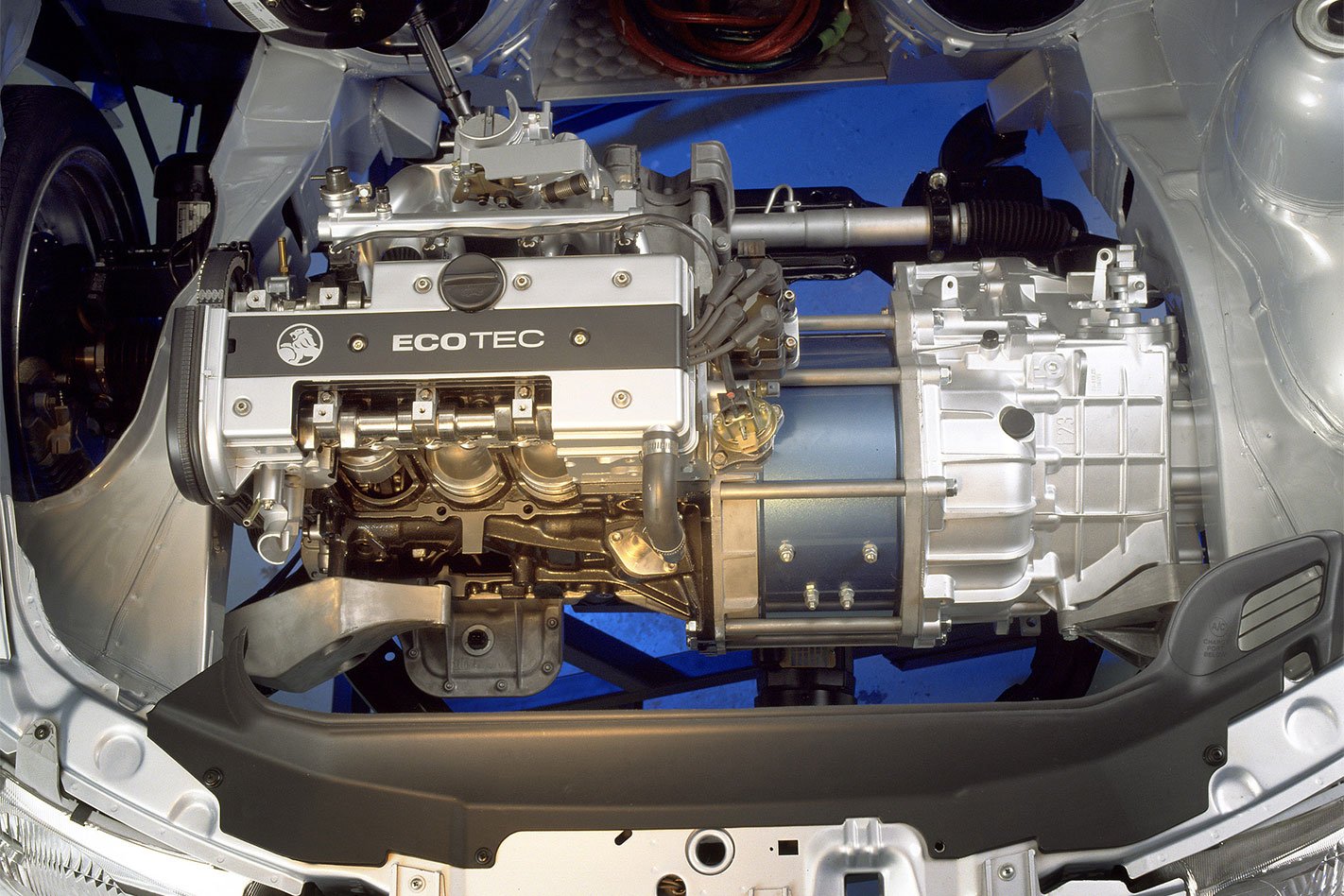
However, by stretching the Monaro body over the long-wheelbase Commodore Wagon platform, Holden (probably unknowingly) foreshadowed the future trend of coupe-sedans, a full five years before Mercedes-Benz released the CLS and which would be followed by the likes of the Porsche Panamera, Audi A7 and BMW Gran Coupe series.
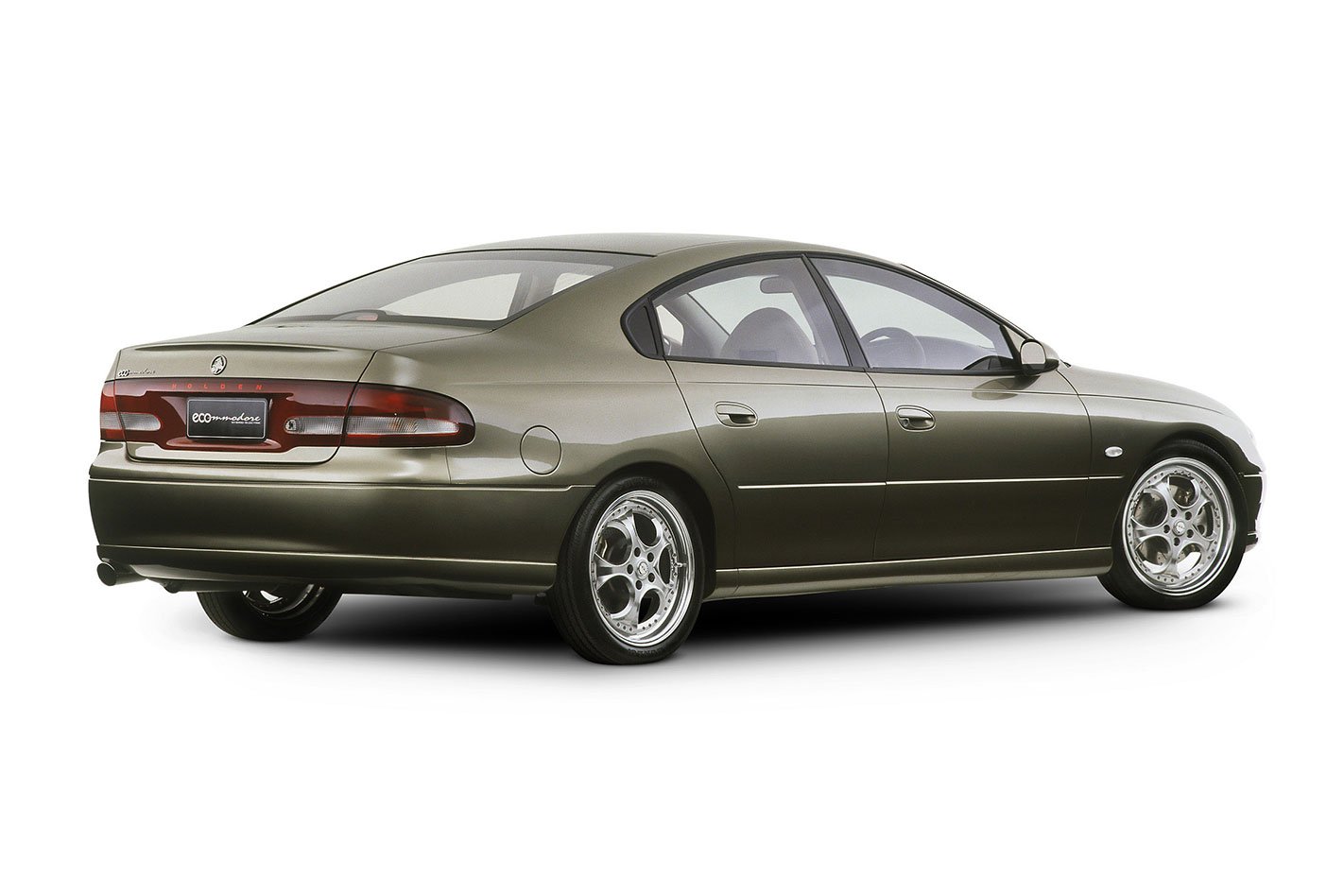
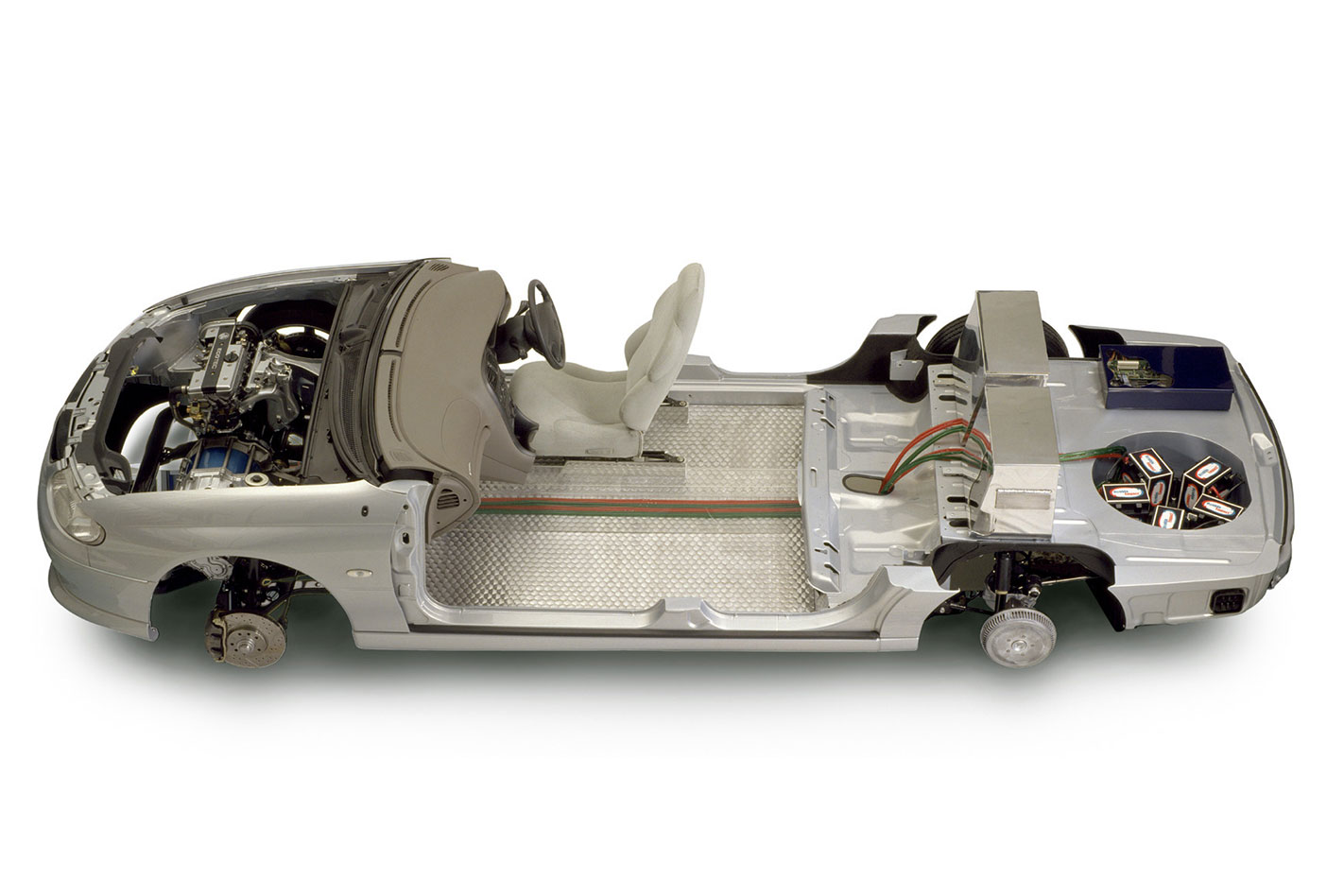
Weight reduction was achieved thanks to an embossed aluminium floor, carbon fibre and fibreglass panels, polycarbonate windows and lightweight suspension and brake components. Rolling resistance was also reduced courtesy of narrow 18-inch wheels and tyres.