
Millions of people world-wide die from road accidents every year. In fact, according to the United Nation’s 2015 Road Traffic Injuries report, 1.25m people die on average each year. And millions more suffer road accident-related injuries.
Here in Australia, we’re not unfamiliar with dangerous roads. In the 12 months to April this year, there has been a 9.8 percent increase in road deaths, with 1,271 fatalities recorded. A 2000-2009 survey conducted by the Australian Automobile Association revealed that many highways scored some of the lowest safety ratings possible, with the majority scoring just two out of a possible five stars.
But Australia can’t take all the credit. Plenty of roads and highways across the globe have earned reputations as risky drives. So, in no particular order, here are 10 roads you might want to reconsider if they’re on your bucket list.
1. STUART HIGHWAY (EXPLORER’S WAY), AUSTRALIA
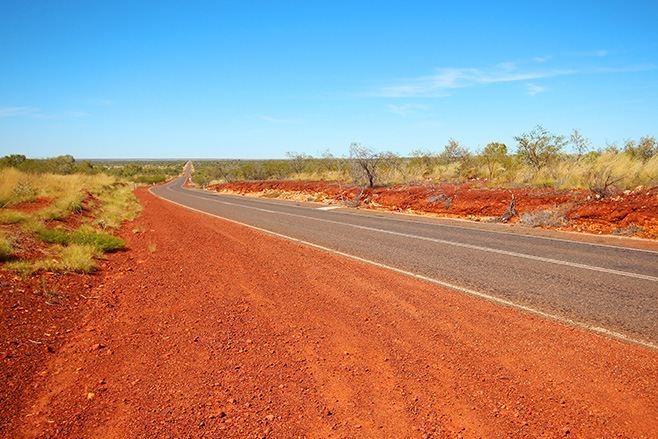
In recent years, the Stuart Highway has been dubbed Australia’s most dangerous stretch of road. The iconic Australia road, known as ‘Explorer’s Way’ runs 2,834km from Darwin to Port Augusta in South Australia, but it’s the 225km from Darwin to Pine Creek in the Northern Territory that really has authorities concerned. However, this road may be better known to international travellers due to the notorious disappearance of British tourist, Peter Falconio from it in 2001.
2. TRANS-SIBERIAN HIGHWAY (THE ICE ROAD), RUSSIA
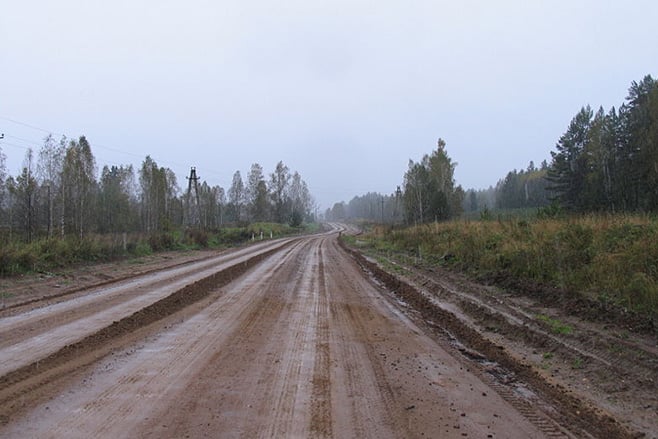
One of the longest stretches of road in the world, the Trans-Siberian runs more than 11,000km from the Baltic Sea to Vladivostok near the Japan Sea. The road crosses forests, mountains, deserts and plenty of nothingness in between, and while the road closest to St Petersburg is mostly sealed, it becomes a little patchier and almost un-drivable during extreme winter weather when travellers get closer to Vladivostok in the east.
3. RODOVIA DA MORTE, BRAZIL
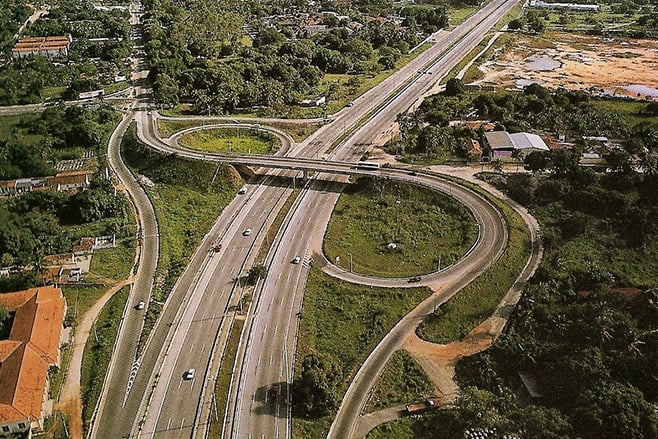
Any road that earns the name ‘The Highway of Death’ is probably one to be wary of. This stretch is part of the BR-116, which connects 10 different Brazilian states. The narrow, cliff-hanging road is used by freight trucks and a high number of accidents are recorded, particularly during bad weather. But even when Mother Nature is in your favour, there’s always the bandit and gang situation to be aware of.
4. GUOLIANG TUNNEL ROAD, CHINA
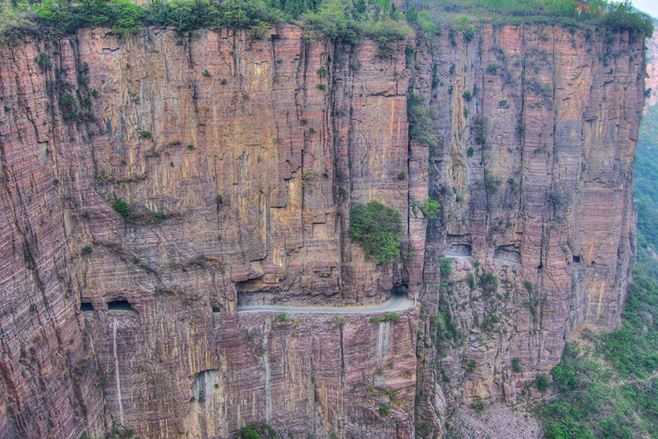
It’s obvious why this road, or tunnel, might be hard to resist for the avid photographer. It was carved into the side of one of the Taihang Mountains by villagers from 1972-77. At just 1.2km long, it’s certainly one of the shorter scenic routes in China, but locals say one mistake can be fatal due to how badly it was constructed.
5. PAN-AMERICAN HIGHWAY, NORTH AND SOUTH AMERICA
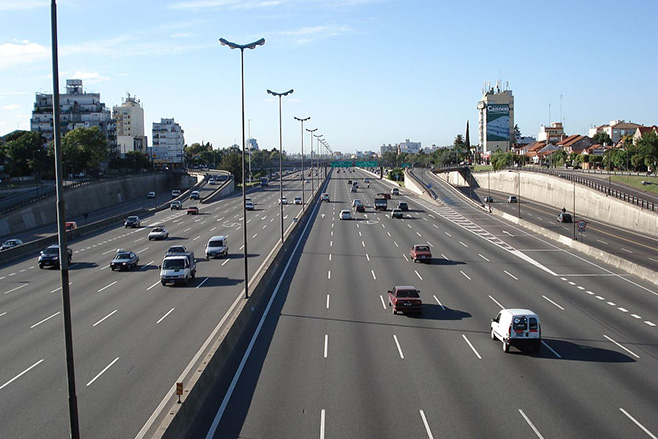
The Pan-American Highway is just one of the many dangerous roads in the US and South America. This network of roads and highways spans 48,000km through frozen wildernesses, rainforests, mountains and deserts from the top of Alaska to Tierra del Fuego at the bottom of South America. It’s the world’s longest “motorable road” according to the Guinness World Records. Sections are impassable during wet weather and drivers are also threatened by landslides and wandering livestock.
6. STELVIO PASS, ITALY
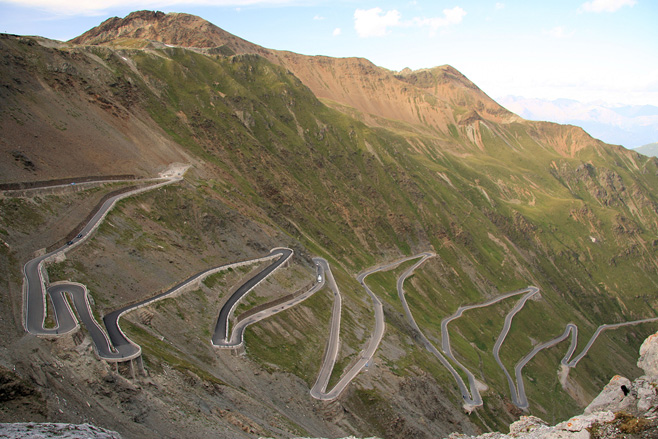
The Stelvio Pass in Italy climbs up and down a mountain in the Ortler Alps. The pass is the second highest in the Alps and the 2.7km road includes 60 hairpin bends. It’s certainly not the most dangerous on this list, but drivers won’t have the opportunity to soak up too much of the scenery – one miss-steer and you could find yourself driving through one of the low concrete barriers and tumbling down the mountainside.
7. PATIOPOULO-PERDIKAKI ROAD, GREECE
The Greeks aren’t known for the quality of their road structures, but this piece of tarmac gets a particular mention. Running up and down a mountain from Perdikaki village to Patiopoulo (1160m altitude) in the Aetolia-Acarnania region, the road is slippery during wet weather and chock-full of potholes. And it has no Armco barriers!
8. CANNING STOCK ROUTE, AUSTRALIA
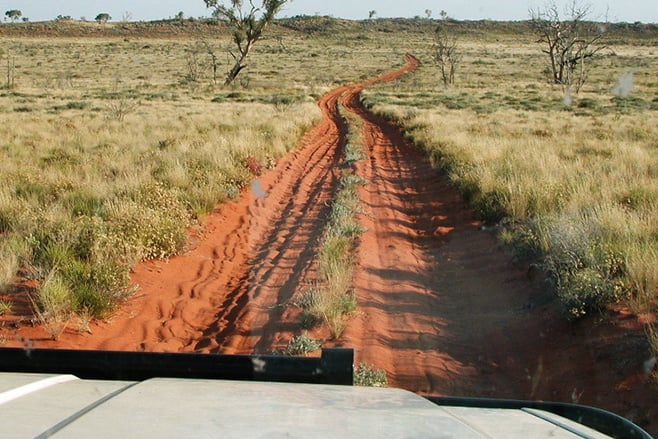
Remote travel is one of Australia’s greatest tourism strengths, but as is the case with any isolated stretches, it doesn’t come without its challenges. The Canning Stock Route is perhaps one of Australia’s most famous cross-country trips, and the world’s longest stock herding routes. Clocking around 1850km from Halls Creek to Wiluna in Western Australia, it is rich in Australian history and Indigenous culture, but the three-desert crossing has no water, fuel or service stops along the way so 4×4 travellers need to be fully self-sufficient.
9. SKIPPERS CANYON ROAD, NEW ZEALAND
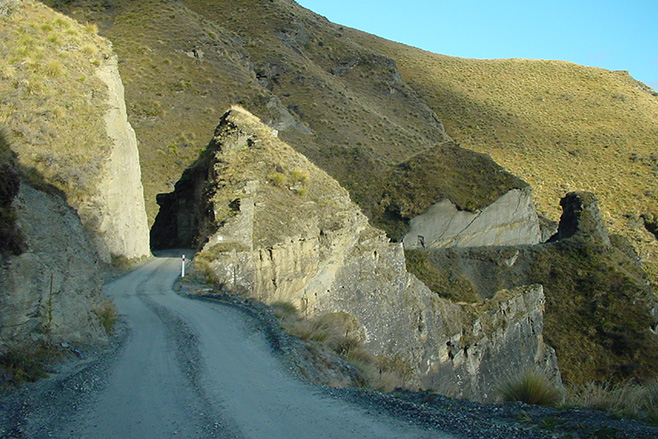
Unsealed, narrow and hand-carved through a cliff by miners in the late 1800s, this South Island road is a popular spot for tourists looking for a scenic drive. But despite its slippery reputation, the scenic drive is worth the trip for those willing to take it nice and s-l-o-w-l-y.
10. NORTH YUNGAS ROAD, BOLIVIA
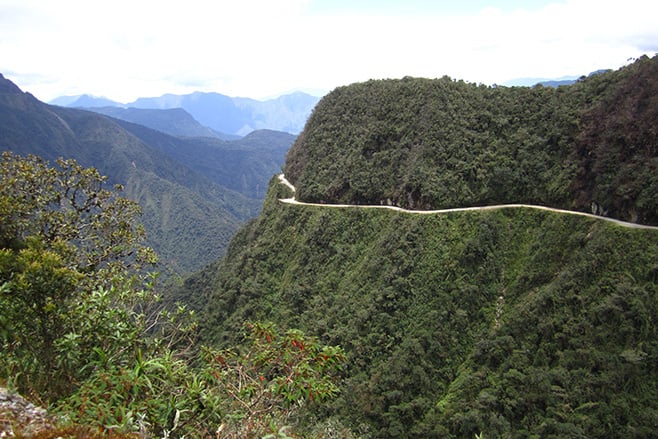
This road is notoriously known as the ‘Road of Death’. Some reports state that 96km stretch of road claims up to 300 people per year. While rarely used these days since the country’s government built a new road connecting the Amazon to La Paz, the old road is single-lane with 600 metre sheer drops.
Local BMW enthusiasts have snapped up Australia’s allocation of the new M4 GTS despite a near-$300,000 price tag.
Such was the demand for the hardcore track special that BMW Australia managed to double its initial allocation, securing 25 of the 700-unit global build run despite the $295,000 price tag being almost twice that of a regular M4.
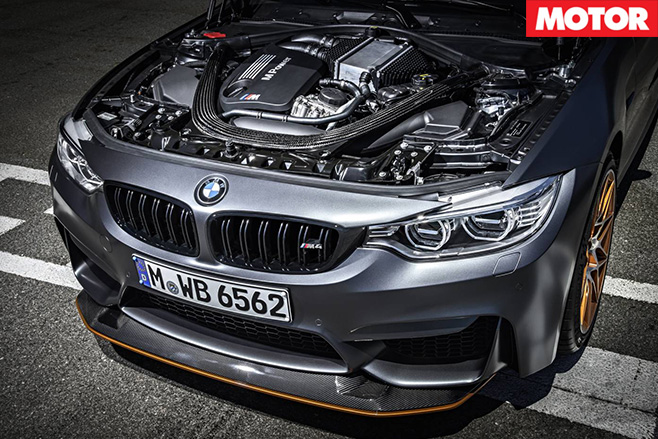
Water is drawn from a five-litre tank in the boot and is sprayed into the intake system to cool the air and allow more boost pressure (22psi vs 17psi) to be used. BMW claims the tank needs refilling with every tank of fuel on track or every five tanks on the road.
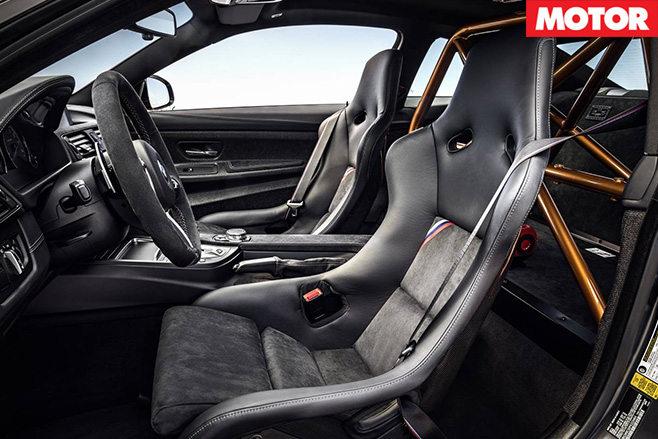
Weight drops 30kg to 1510kg courtesy of a carbon-fibre reinforced plastic (CFRP) bonnet, front splitter and rear wing, carbon ceramic brakes, lightweight wheels and the front seats being replaced by lightweight carbon buckets.
Regardless of wheels specified, the M4 GTS wears Michelin Pilot Sport Cup 2 rubber (265/35 ZR 19 front; 285/30 ZR20 rear) to make the most of the car’s revised chassis setup.
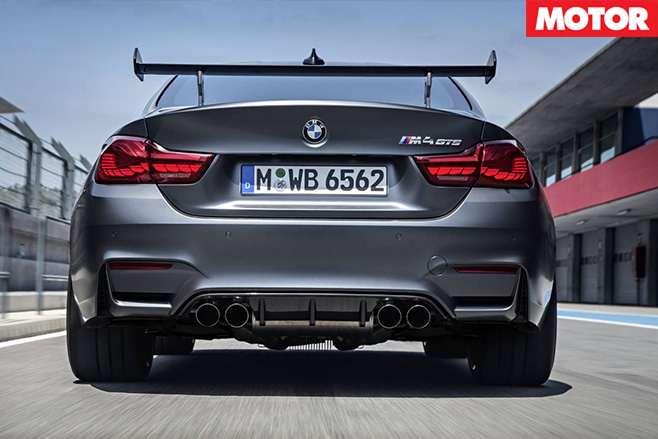
The coilover suspension can be adjusted for height, rebound and high and low-speed compression damping, while the rear wing and front splitter are also adjustable to balance drag and downforce. The result of these changes is an impressive Nurburgring lap time of just 7min 28sec.
TOYOTA has extended its locally developed sports suspension to more Camry models as part of a mild makeover of the brand to bring it in line to meet tougher engine emissions targets that will hit all carmakers later this year.
The carmaker has announced that the tweaks to the suspension and steering that make the Atara SX-badged car the most dynamic Camry on offer will now also extend to the range-topping petrol or hybrid SL, although as a box to tick on the options list rather than standard equipment.
However, the petrol-engined Atara SX will jump in price by $1500 to $33,490 – the only Toyota Camry in the seven-model line-up to face a price rise – but Toyota claims the extra cost is more than offset by the list of added equipment the car gains.
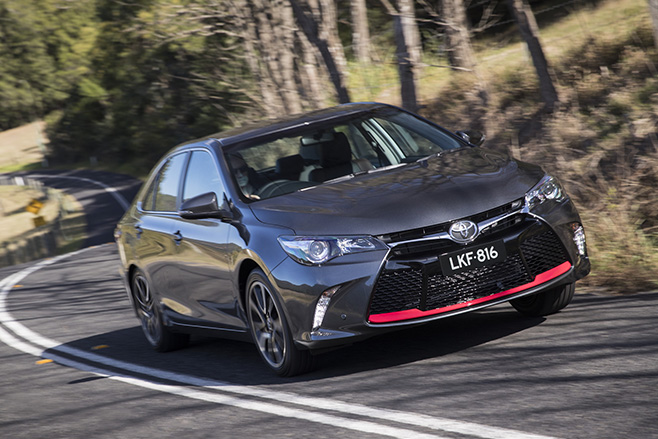
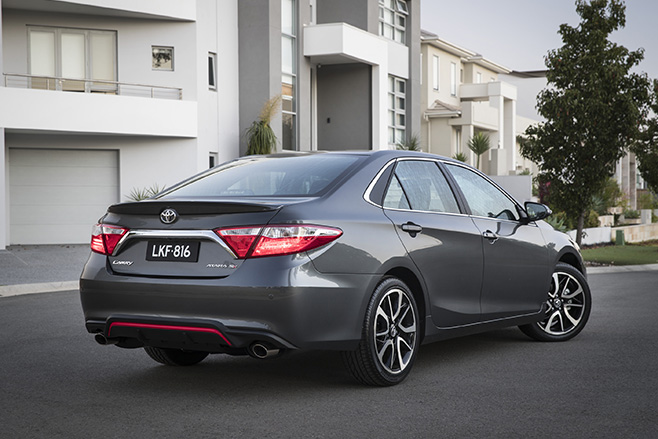
This includes a larger seven-inch touchscreen with satellite navigation, as well as a JBL audio system with digital radio. The reversing camera linked to the screen now includes guides that show where the car is reversing.The Atara SX will also use different 18-inch alloy wheels, red inserts along the lower edge of the front grille and rear diffuser, and a powered sun blind for the rear window when it goes on sale next week.
Toyota said the updates to the Camry range include modifying the locally made 2.5-litre four-cylinder engine used in both the conventional and hybrid models to meet tougher Euro 5 emissions standards that come into play in Australia later this year.
The Camry has also played catch-up, adding Isofix child seat fittings to the rear seats for the first time, months behind local carmaking rivals Ford and Holden.
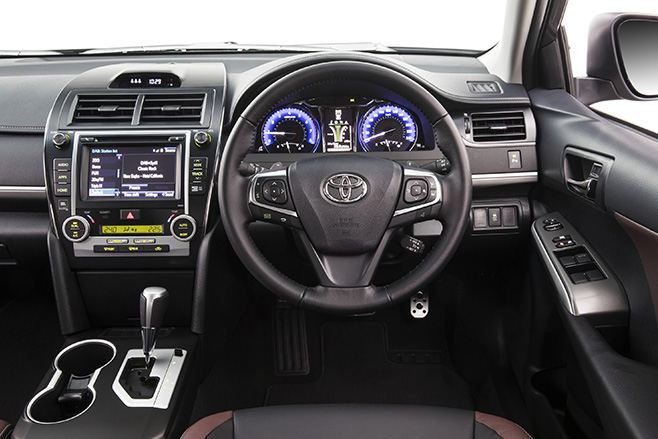
All Camry models, apart from the $26,490 entry-level Altise, gain front and rear parking sensors. The Atara models add a colour 4.2-inch display to the dash, while at the top of the range, the $37,400 Atara SL adds a wireless device-charging pad.
The tweaks to the Camry range – the car still counts among Toyota’s best-selling models here, largely based on government buying policies that encourage the support of local carmakers – come little more than a year after a major makeover of the mid-size sedan that will carry it to the end of Australian production late next year.
The Big Little Change Camry, as the 2015 Australian redesign of Toyota’s global mid-size passenger car was known, was limited to cosmetic changes to the exterior, with the locally built model missing out on a number of interior enhancements and driver safety aids built into cars sold overseas.
Toyota is yet to announce where the fully imported Camry will be sourced from.
Australia’s switch to a tougher petrol engine emissions standard for all new cars sold here kicks in from November 1 – it is also one of the reasons Ford decided to quit local manufacturing in October this year, as its Geelong-built 4.0-litre in-line six-cylinder engine would not meet the deadline.
As well as the Ford Falcon and Territory, the emissions standard has claimed another high-profile victim – Nissan’s Micra small car, which will also fall off the Australian market later this year.
Fast Clios have always been among MOTOR’s favourite hot hatches.
Models like the Clio II 182 Cup and Clio III RS 200 offered all the fizz and effervescence of a freshly opened bottle of Schweppes, the screaming atmo engines and playful handling offering a truly red cordial driving experience.
When Clio IV arrived in late 2013, it was more like a cappuccino – still capable of delivering a shot of adrenaline, but in a more mature, refined fashion. It’s proved a popular approach; enthusiasts might scoff at the dual-clutch ’box, turbo engine and five-door body, but buyers aren’t fussed, Australia now the second biggest Clio RS market globally with more than 1500 sold.
Popular it may be, but we’ve been a little underwhelmed by this new grown-up Clio, though to be honest we probably need to discard those fond memories of its predecessor. Help may be at hand, however.
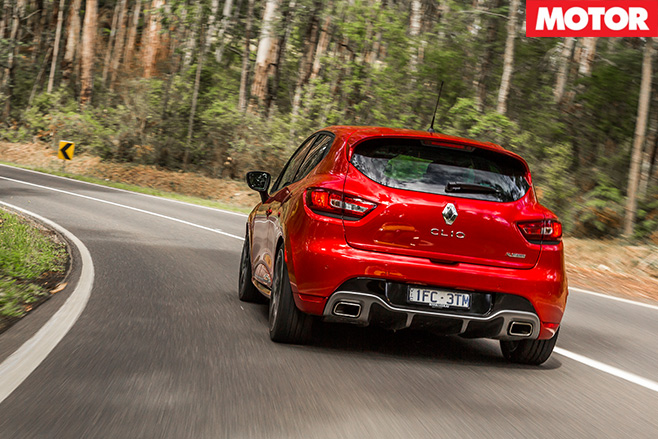
It’s a modest premium given the extent of the changes, as few areas of the Clio have escaped modification. The 1.6-litre turbo four offers 162kW/260Nm, the extra 15kW/20Nm courtesy of a new intake and exhaust, extra 1psi of boost pressure (now 14.8psi) and a bigger turbo.
A torque boost function also adds an extra 20Nm in fourth and fifth gear. Speaking of gears, the six-speed EDC dual-clutch ’box has been thoroughly overhauled, with 30 per cent faster shifts and shorter paddle throws, though from June 2015 the latter was carried over to the RS 200.
The biggest changes, however, are reserved for the chassis. Ride height has dropped 20mm at the front and 10mm at the rear, rear spring rates are up 40 per cent, there are stiffer dampers with hydraulic bump stops and a 10 per cent faster steering rack.
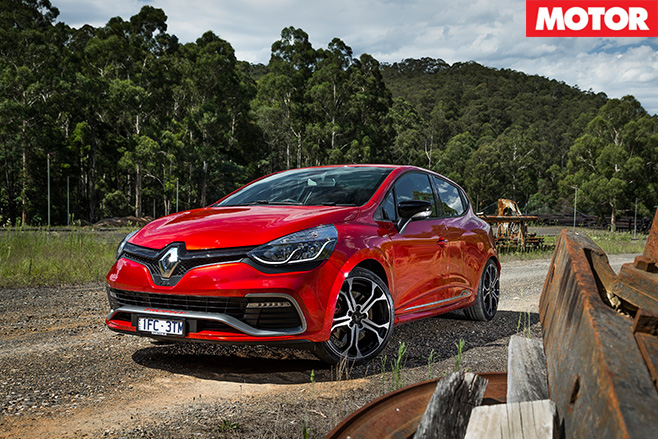
Renault’s number one aim with Clio IV was to make it more liveable day-to-day and there’s no question it achieved just that. As fantastic as the previous Clio RS was, its hyperactive gearing and jiggly ride made it wearing on the daily grind; the new car is an oasis of calm in comparison. The ride is well-judged, the gearbox is annoyingly hesitant from rest but slips unobtrusively through the gears and turbo torque makes plugging gaps in traffic a breeze.
It’s very undramatic, though. If you just want a quick-ish daily runabout, that’s fine, but if you’ve forked out extra for an RS product, shouldn’t it give you some reminder of what you’ve paid for? Personally I find myself driving everywhere in Race mode using the paddles just to feel somewhat involved.
Most of the blame lies with the engine, which is effective but feels flat and lifeless with little reward to revving it to the 6500rpm limiter bar a load of turbo whoosh. Compared to similarly-sized units in the likes of the Fiesta ST or Peugeot 308 GTI the Renault’s M5Mt seems, well, dull.
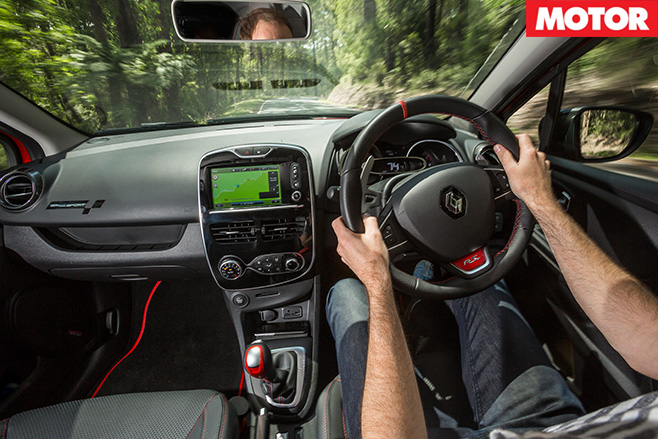
The Clio RS comes alive when driven hard, strong brakes, accurate steering and a lively yet easily controllable chassis ensuring it relishes a thrashing. The nose will push wide if you’re greedy with the throttle but find the sweet spot and you can float the car into corners under brakes with a hint of oversteer, even within the constraints of ESP.
Suddenly the engine is merely a tool for transporting you from corner to corner. If the RS 220 can deliver a similar level of handling entertainment while adding some firepower under the bonnet, it could be something special indeed.
Swapping into the 220, it takes a while to really hone in on any differences; the changes have been extensive, but we’re mostly talking 10 per cent here and there rather than any drastic alterations. For example, the extra grunt shaves just 0.1sec off the claimed 0-100km/h time (now 6.6sec) so the biggest difference in the engine is a little extra growl at middling rpm before hefty helpings of turbo rush once again dominate the soundtrack at higher revs.
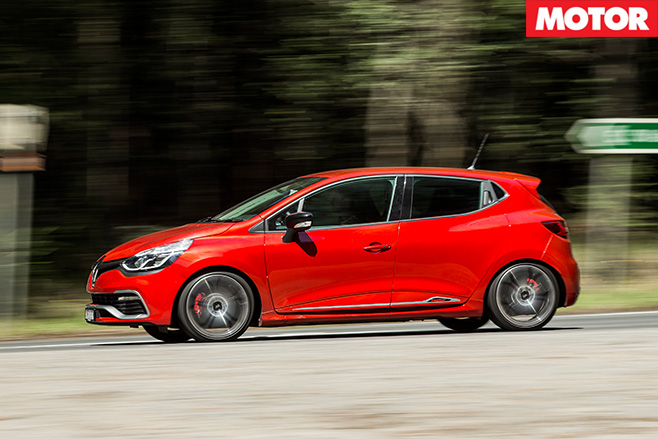
The gear ratios are also all over the shop; even with the RS 220’s higher 6800rpm cutout in the first three gears, first runs to just 50km/h and second is done by 80km/h before a big jump to third, which stretches to 122km/h.
On a typical twisty road, swapping frequently between second and third gear, often neither is ideal for the corner you’re tackling. It’s a problem exacerbated by the paddles being fixed to the steering column, as you’re frequently grasping at air when you need an upchange on the exit of a corner.
Really, the Clio RS – both 200 and 220 – is crying out for a manual transmission with sensible ratios. Just such a gearbox exists in the Nissan Pulsar SSS, which shares the Clio’s engine, so there seems little reason not to at least offer the option, just as VW now does with the Polo GTI.
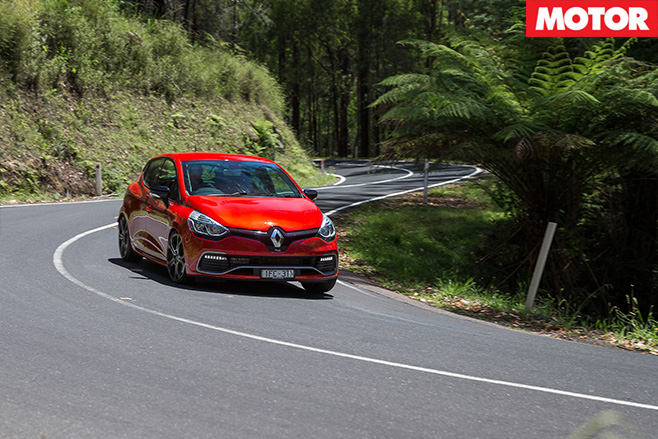
Perhaps unsurprisingly, with so much attention focused on the chassis, it’s here the changes are most apparent, and the news is mostly positive. With Michelin Pilot Super Sport rubber at all four corners, the Clio has impressive levels of grip, but the severe stiffening has also endowed it with a serious dose of attitude. The RS 200 is lively but the RS 220 is even keener to rotate the rear, which is entertaining in second gear corners but can get the heart racing in third, especially when it skips off a bump and needs quick correction.
Add these heightened cornering capabilities to its increased straight-line speed and you have a car that can dispatch a tricky road at huge pace, and will likely only heighten the RS 200’s already impressive circuit capabilities, however the added stiffness has had a seriously detrimental effect on the Clio’s ride quality. This is a very firm car; probably no more so than the Clio III RS 200, but it is really borderline for day-to-day use and after 300km photographer Jacobs and I are both keen for some respite.
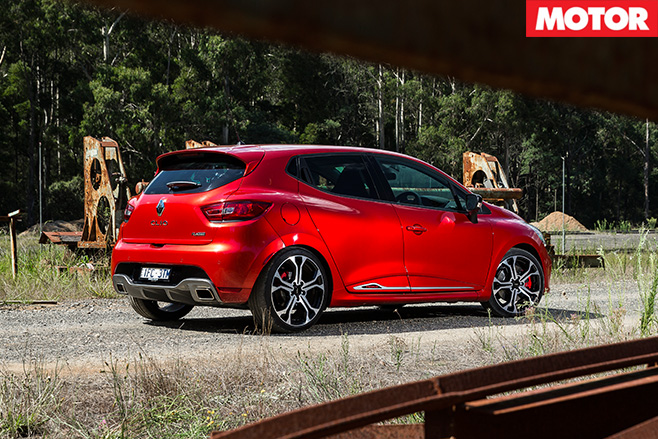
There’s also the issue of price. While good value in comparison to the Cup Premium, at $39,990 the RS 220 sits perilously close to cars from the segment above such as Volkswagen’s excellent Golf GTI, Ford’s entertaining Focus ST and the Clio’s brilliant bigger brother, the Megane RS265. In this context it doesn’t really stack up and we can’t help but feel the base Clio RS 200 Sport at $30K offers the most entertainment for your outlay and remains our current favourite.
Sharing is caring
Clio’s Pulsar SSS connection
The clio’s M5Mt engine was co-developed with Nissan who install it in the Pulsar SSS and Juke among others. Oddly, it feels (and sounds) very different in its Japanese applications.
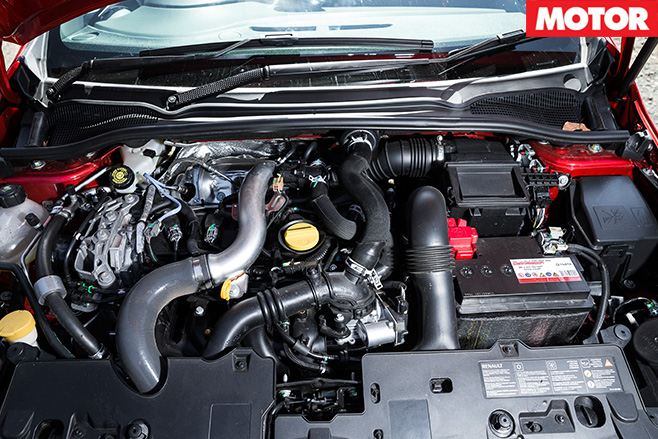
SPECS: RENAULT CLIO RS 220 TROPHY Body: 5-door, 5-seat hatch Drive: front-wheel Engine: 1618cc inline-4, DOHC, 16v, turbocharger Bore/stroke: 79.7 x 81.1mm Compression: 9.5:1 Power: 162kW @ 6050rpm| Torque: 260Nm @ 2000rpm Power/weight: 128kW/tonne Transmission: 6-speed dual-clutch Weight: 1270kg Suspension(F): struts, A-arms, anti-roll bar Suspension(R): torsion beam, coil springs, anti-roll bar L/W/H: 4090/1732/1420mm Wheelbase: 2589mm Tracks: 1504/1500mm (f/r) Steering: electrically-assisted rack-and-pinion Brakes(F): 320mm ventilated discs, single-piston calipers Brakes(R): 260mm ventilated discs, single-piston calipers Wheels: 18.0 x 7.0-inch (f/r) Tyre sizes: 205/40 ZR18 (f/r) Tyre: Michelin Pilot Super Sport Price as tested: $39,990 Pros: Brilliant steering; gearshift; engine tractability; handling Cons: Flimsy build; lacks straight-line grunt; on-limit handling
This is the car we thought would never happen again; a Peugeot that strives to be a cut above not just mainstream competition, but also anything similar in size at any price.For about 15 years from the mid-1980s, models such as the 205, 306, 405 and 406 rose above the pack thanks to exciting dynamics married to exquisite design. Of course, greedy pricing and patchy tech – French automatics were always rubbish, for example – meant that their full impact in Australia was somewhat watered down.

In the 2000s, Peugeots degenerated into dreary and at times ugly and unreliable dross, to the point of near bankruptcy a couple of years ago. Today’s billion-euro T9-series Peugeot 308 is Peugeot’s last chance, and its greatest hope.
We’re already fans. In base 96kW e-THP guise, the second-gen 308 has beguiled on several occasions: first on an international drive last September, then at COTY 2014 (where it very nearly beat the winning BMW i3), and most recently in a comparo against the Volkswagen Golf and Renault Megane, though the German pipped the base Access on price, space and equipment.

And now it joins Our Garage for the next six months. Well, seven months as it turns out, because miscommunication on both sides saw a well and truly used 5000km press car from WA arrive on our Melbourne doorstep. This was a golden opportunity because in the weeks before our correct Active 96kW e-THP auto arrived, we experienced first-hand how it stacked up in light of Peugeot’s repeated promise that quality and durability have improved under an obsessive new regime that included 120 percent more testing cycles and more than four million kilometres of research and development.
We added another 5000km in six weeks, criss-crossing Victoria and New South Wales, and not a single squeak, rattle or breakage blotted the Peugeot’s performance. The hard-worked 308 averaged 6.5L/100km while impressing with its spirited acceleration, light-footed handling agility, cosseting ride and brilliant refinement.
A Melbourne-Albury round trip in biblically torrential rain and almost cyclonic winds did not phase the gutsy Peugeot, parting the temporary Hume Highway River like Moses. And we preferred ours to the less supple Allure 1.6 and GT versions we were driving up there to assess. The 1.2 turbo-triple Active is definitely the range’s sweet-spot.
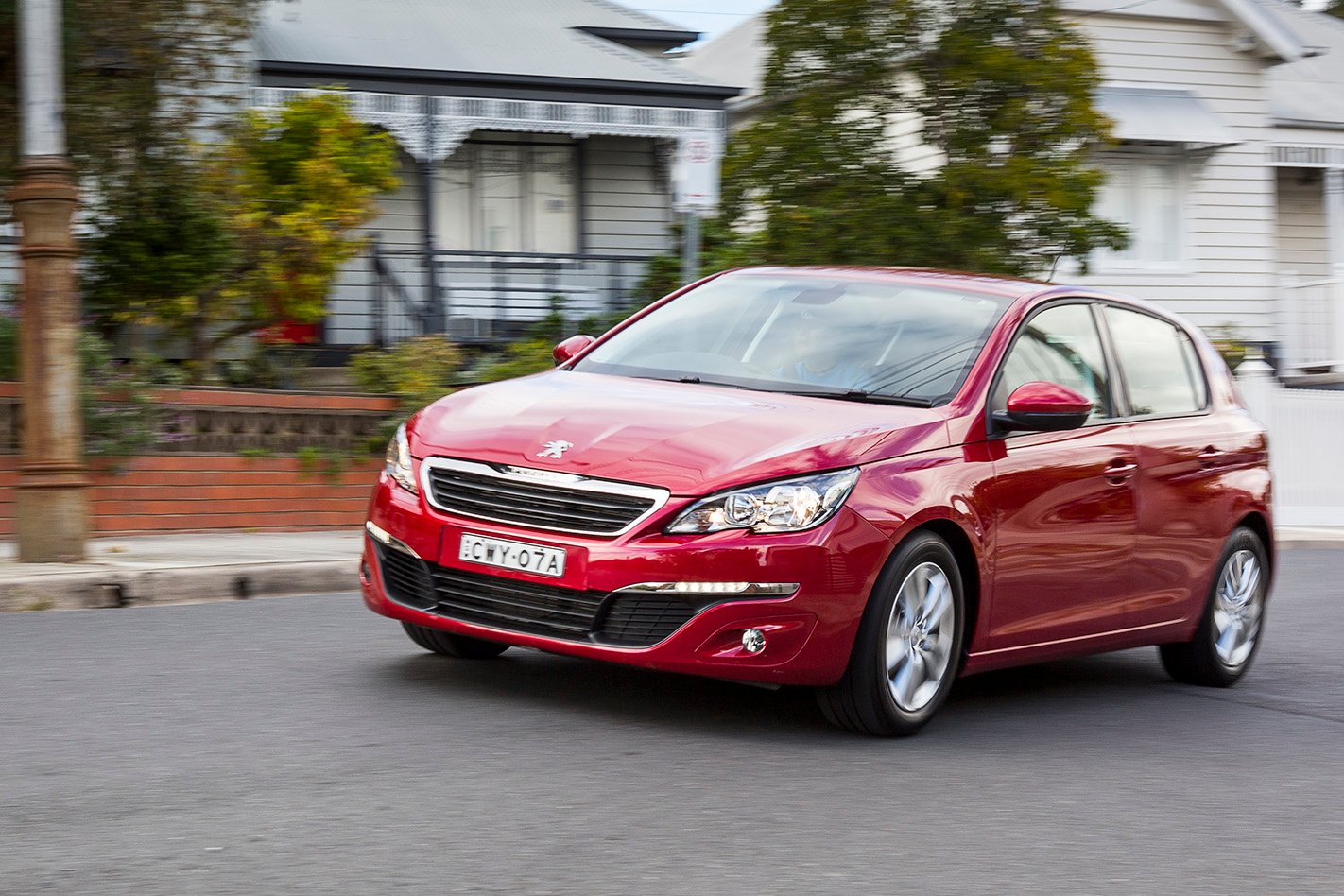
Anyway, in the end we didn’t want to give ‘Bluey’ back, until our lustrously red replacement landed with just 10km on the odometer. What a contrast.
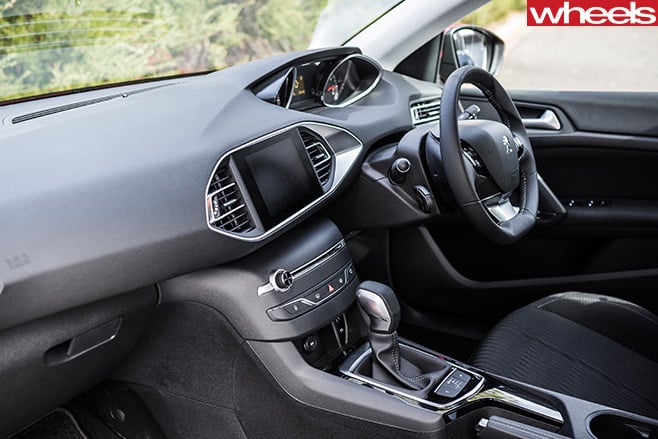
No reversing camera is a massive oversight (though the rear sensors do include a handy ‘pictogram’), but otherwise CWY-07A is well equipped, bringing useful goodies such as Bluetooth phone and audio streaming, lumbar and height adjustment for both front seats, a rear backrest ski-port, multi-function central touchscreen and 16-inch alloys (wearing Goodyear Efficient Grip 205/55R16 tyres that are outstandingly supple).
In 1300km of running-in mileage, the 96kW/230Nm 1.2 three-pot turbo feels almost as peachy as old Bluey’s did at 10,000km.
It’s so encouraging to see that the Peugeot of old is back.
Update 1
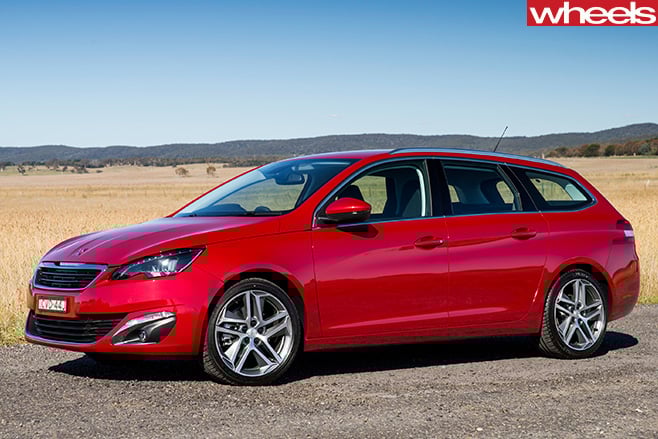
Peugeot’s decision to contain the latest 308 within traditional C-segment hatchback dimensions – in other words, small – can work both for and against it.
Two close friends each drive current Volkswagen Golfs, and rarely transport anybody in the back. While the German car’s generous rear-seat space was appreciated the few times it was required, both admit they would probably trade a bit of that extraneous size for more of the parking-friendly compactness and manoeuvrability of the Peugeot.
The 308 is 96mm shorter and 34mm lower than the Golf, though it is 5mm wider, and its 435-litre boot capacity is 55 litres larger. Both sit on a 2620mm wheelbase. Surely the VW offers the better experience for passengers?
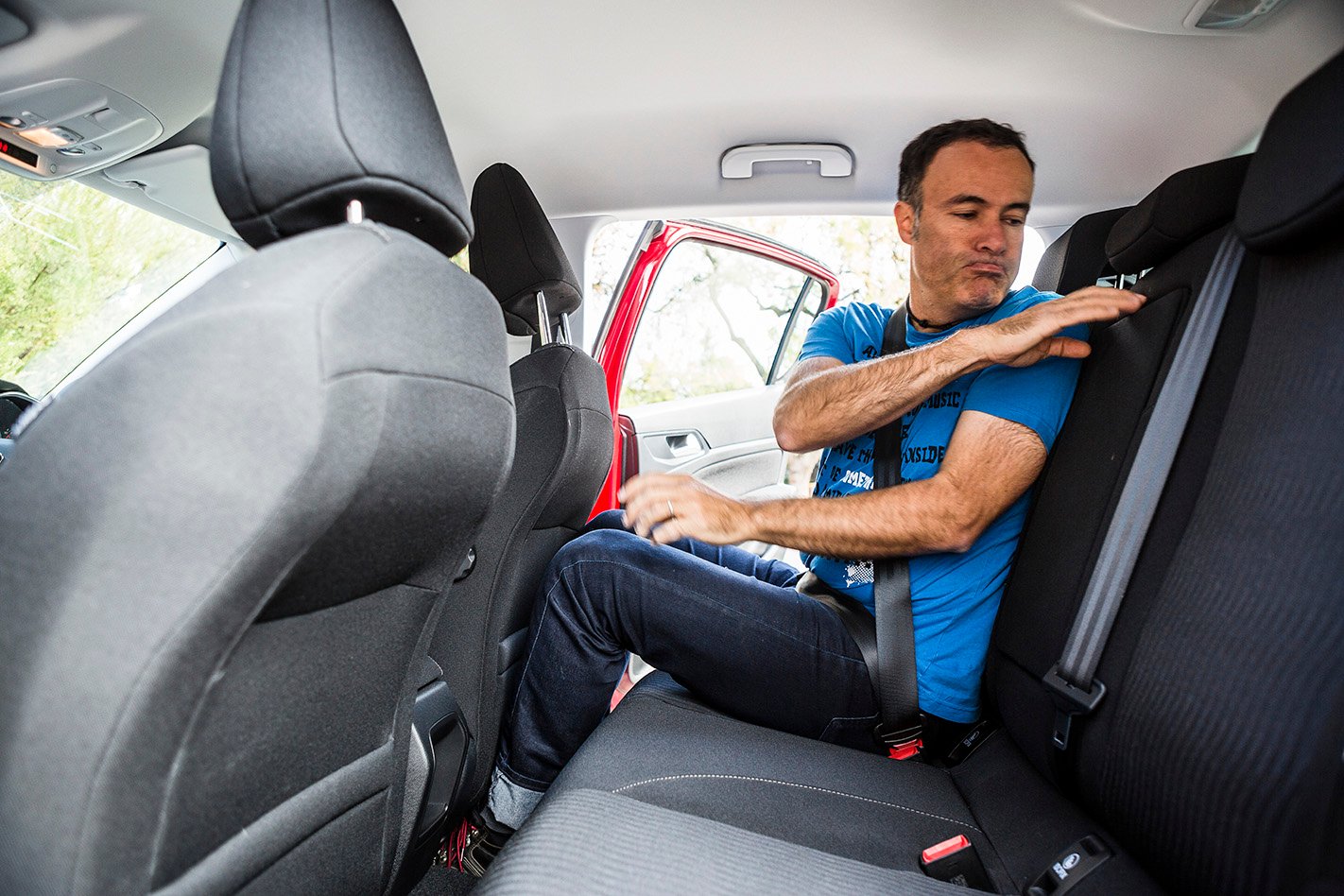
You’d think so, but two four-up journeys in the Pug totalling 700km challenged that impression. It was a surprise just how accommodating that French back seat was when carrying two adults of 180 and 165cm.
The lack of rear vent outlets – one of our earliest criticisms – wasn’t missed, either, due to the massive centre-dash vents that can supply areas of the cabin some rival cars cannot.
Later it occurred to me that the low seating, narrow rear glass, high parcel shelf and relatively shallow side windows probably make the Peugeot feel more petite inside than it really is.
So our Gallic hatchback’s packaging and comfort are not at all hampered by its compactness, and it still feels very grown up in the rough and tumble of city driving.
Even from the back seat, Peugeot’s renaissance continues.
Update 2
Supple ride smooths Byron’s path to true love.
The Peugeot is ruining other cars for me. It has nothing to do with the steering’s unfettered connection with my palms, and everything to do with what I feel from the seat of my pants.
Three months in and the mid-range five-door hatch from France continues to surprise and delight with an incredibly silken ride quality. It’s as if a fresh hot coat of bitumen precedes my every move because the supple and silent suspension absorption has bettered every other 2015 model I’ve driven this year, with the exception of the Ford Mondeo.

We’re talking here about patchy inner-urban streets with pimply surfaces, potholes, crumbling edges, pyramid speed bumps and tyre-shredding tram tracks. And the 308 glides over them, in most cases with utter insouciance. The same applies out on the open road.
Owners of post-war/pre-millennium Pugs may ponder what all the fuss is about, since classics like the 504 (which I own), 306 and 406 were renowned for their lush ride. From about 2001 the French tried (but failed) to emulate BMW dynamics with sub-standard suspension set-ups that traded Teflon smoothness for tetchiness, as many 407 drivers learned the hard way.
Wheels veteran John Carey once said that, while even keen drivers might only demand Lotus-style dynamics 10 percent of the time, everybody can delight in a comfortable ride 100 percent of the time.
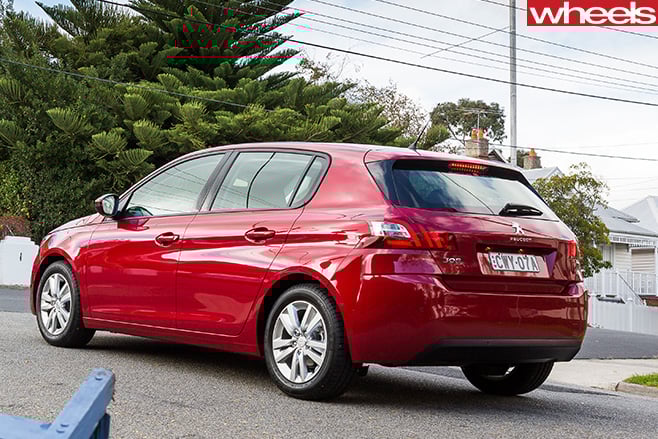
Yet here’s the crux of the Pug’s brilliance, because CWY-07A continues to deliver beautifully fluent steering, wonderfully playful handling and superb body control as well. These, along with a terrific turbo triple that continues to loosen up with mounting mileage, completes this T9-generation 308’s holy-cow dynamic trinity. Peugeot’s engineering magic is back.
You can even argue that it’s never been better, because the (Japanese-sourced) Aisin six-speed self-shifter works so well with the engine’s torque characteristics. It’s the first truly great ‘French’ auto.
Furthermore, fuel consumption (on premium unleaded only) is still in the mid-6s, there’s been not a single rattle or broken piece of trim, the low-wheel/high-instrumentation driving position feels intuitive, and the front seats remain supportive over long distances (and we’ve been on a couple of extensive but completely non-eventful rural jaunts this month).
Rear seat access isn’t up to Golf let alone Skoda Octavia standards, and the roof gutters actually slosh water onto the 308’s alighting occupants in heavy rain, but otherwise my French honeymoon continues.
All quiet on the western front
At the 308’s international launch in France last year, Peugeot told Wheels that the 308’s all-new EMP2 platform was engineered to be significantly stiffer and more rigid than the previous one in order to absorb 80 percent of crash forces compared to 50 percent.
This, along with the torsion-beam rear axle’s mounting dampers, unique triangular ‘spacer’ brackets and specific sound-isolating rubber bushes, helps eliminate NVH pathways into the cabin, for a far quieter ride. Additionally, the sound-deadening material was designed-in from the start, rather than added later.
Update 3
308 might be stellar, but some black holes do exist.
IN THE 18 years I’ve been writing about cars professionally, not many have impressed as consistently as the 308 1.2-litre three-pot turbo auto. Four months and 5000km in, the Peugeot’s punchy yet supple driveability, fluid dynamics, restrained class and unbelievably excellent build quality continue to shine brightly.
That makes the faults in this small-car superstar all the more glaring.
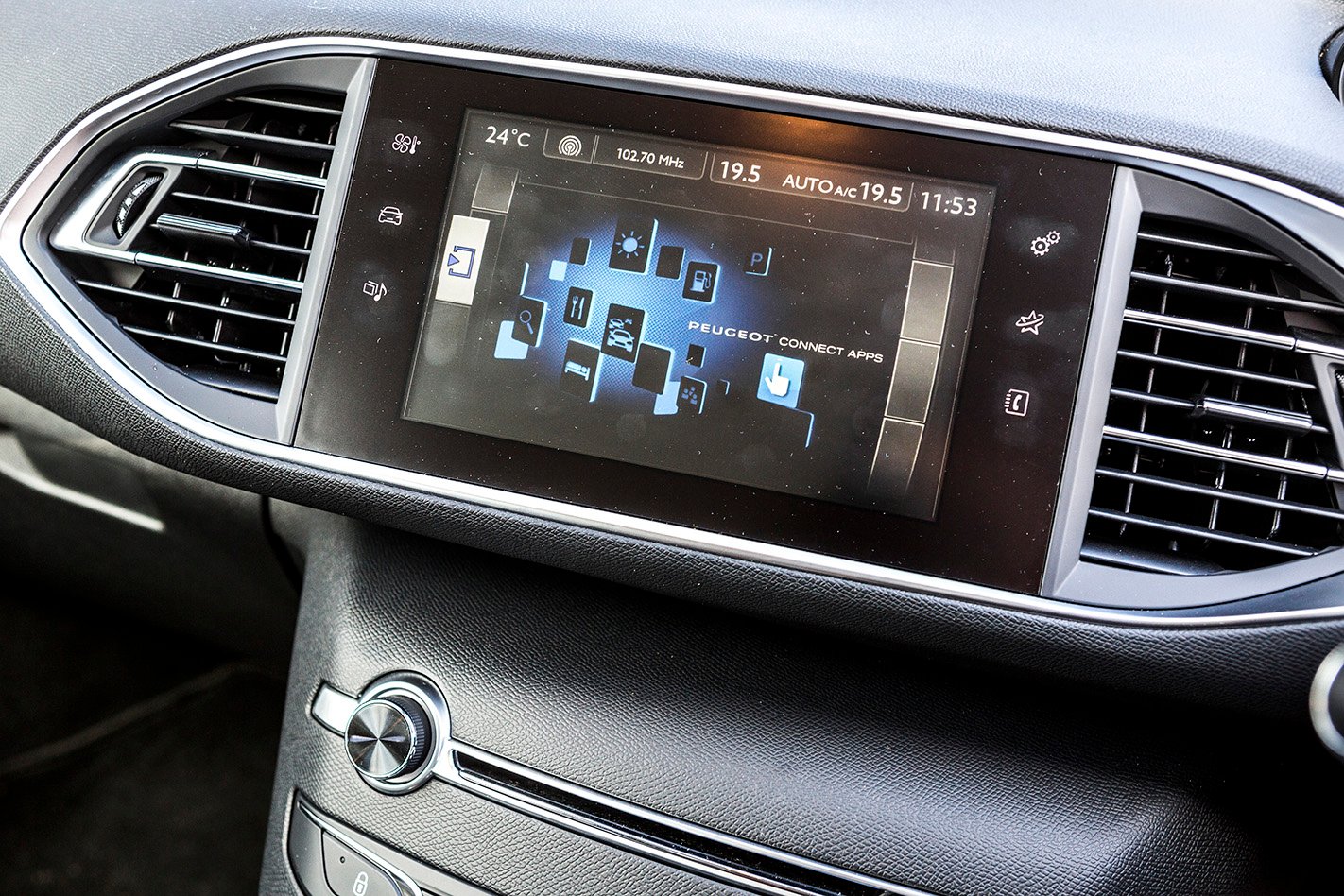
Probably top of the list is the touchscreen’s overloaded functionality. Like an old Merc’s indicator/wiper stalk, it has too many jobs to do, and scrolling between each can be tiresome. For instance, changing the temperature requires a different display ‘window’ followed by hit-and-miss prods of the display. A simple thermostat dial – or even a big old knob just like the one for altering the fine audio system’s volume – would suffice.
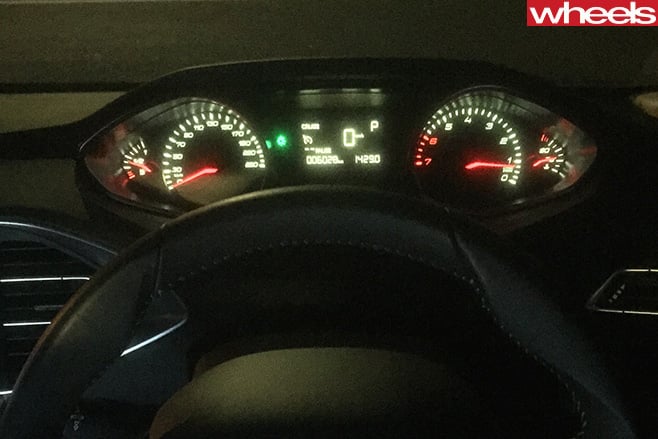
That leads to whinge number two, the lack of night-time steering wheel illumination for the remote audio controls, requiring the sort of fumbling in the dark that would bring back embarrassing teenage-years memories for many frustrated drivers.
Once you’ve arrived at your destination, be prepared for an unintended shower if it’s been raining, thanks to the most ineffective roof gutters we’ve experienced in a long time. Thankfully the door pockets are large enough to take an umbrella for just such occasions – unlike the latest Mazda 3’s…
Speaking of dampness, the Active’s Goodyear Efficiency Grip tyres might help damp out road irregularities while eking out maximum fuel economy, but their wet-surface grip can be tenuous. In willing hands, the sliding rubber can be fun, and the chassis’ innate control and adjustability means even novice drivers stand a very strong chance of regaining their intended trajectory, but we’d prefer stickier items. Efficiency Grip? More like ‘Efficiency Slip’.
And finally there is the infernal back-to-front tachometer needle action. This is a bit of a love/hate thing, actually, because it’s obviously done for symmetry’s sake, or just to be different and French, and that ought to be celebrated in this age of uniformity. But, really, how can anybody get used to a reverse-swinging rev counter?
Still, as I approach the end-game in the Pug, I also know that once CWY-07A goes, I’ll miss the bad along with the good because the T9-series 308 is that rarest of beasts – a car with character. It’s what’s been missing in most rivals.
As for the faults, all are minor. What a major achievement.
Boot on quality
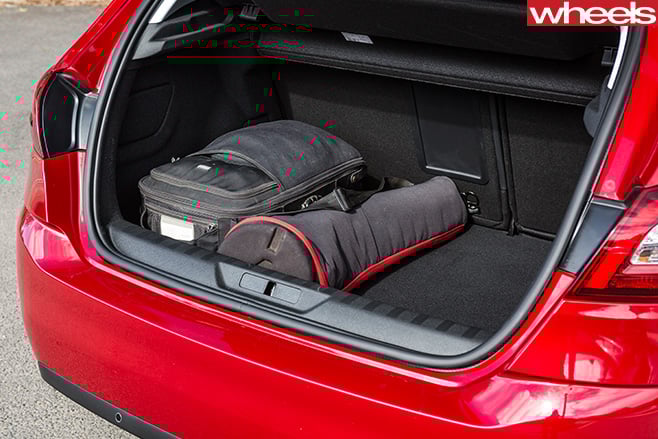
Peugeot is understandably forever banging on about this 308’s huge quality strides. But rather than take it at face value, punters ought to explore the car’s posterior instead. Or, more accurately, the generous luggage compartment. Right there is evidence of thorough craftsmanship, from the solid operation of the tailgate (which opens up high to clear taller scalps) to excellent fit and finish. There’s nothing shoddy there at all. You might even call it Teutonic in its presentation.
Update 4
What’s thriftier; a 308 running on 95 or 98 RON?
The reason so many manufacturers are moving to smaller-capacity turbo engines is economic rather than for economy. A lower emissions rating means higher sales in many countries due to tax breaks.
Starting with a clean slate as Peugeot did with the T9 308 means the engineers were able to create a lighter and more aerodynamic car around the terrific 1.2-litre three-pot turbo, maximising the downsizing potential. And, as regular readers know, we’ve revelled in the performance, agility, control and ride comfort of the 96kW e-THP 1.2-litre turbo-equipped Active.
However, for some people, one downside of downsizing is the need to fill them with premium unleaded petrol, due to their higher octane diet demands. While our 308’s triple can run on the standard 91 RON brew, it isn’t recommended.
But what about at the other end of the petrol price scale? Which of the two premium unleaded fuels is better – 95 RON or 98 RON? We normally fill the Pug with the more expensive stuff because that’s what we’ve long believed to be the best for efficiency. To find out for sure, though, we switched to the lower-octane premium bowser for three fills, before returning back to the top-shelf stuff for three more.
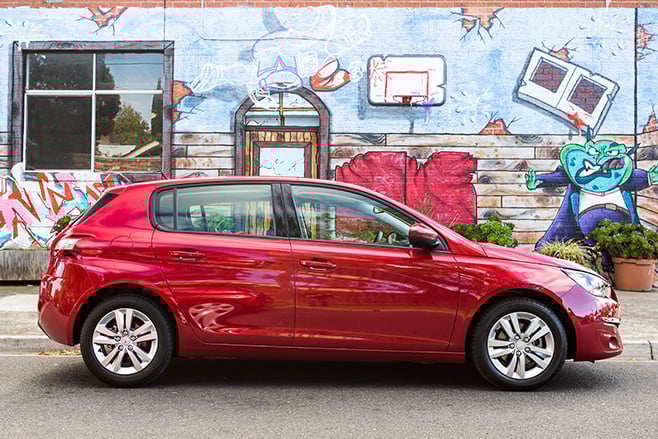
The trio of runs on 95 RON saw CWY-07A average 7.4L/100km, with 7.0 achieved on a country cruise and 7.8 during regular inner-urban schlepping. Back on 98 RON, the average was 6.6L/km, the best was 6.3 and the worst was 6.9. That’s 0.8L/100km better on the richer brew. So, even at 147.9 cents versus 155.9 cents per litre, spending more for 98 RON literally makes cents, because the five percent premium is covered twice-over by an 11 percent consumption decrease. All up, for every 500km driven, we saved $3.25 using the more expensive stuff. Over 20,000km, that’d be about $130.
Obviously prices and gaps fluctuate almost daily, but in our experiment the outcome is a victory for 98 RON – at least as far as our 308 is concerned, and a win-win when you factor in the slightly stronger performance that the premium promises. Yet even on 95 RON, it’s an outstanding result for the tiny turbo triple, as well as a big thumbs up for downsizing.
Help me, RON-da
Educating readers is always a noble endeavour, but the true instigator for our premium fuel fight-out came about when I recently queried CWY-07A’s unusually listless performance. My partner replied: “Oh yes, I filled it up with 95 RON for a change” — the first time he’d done so — thus prompting the experiment. As a scientist, Jim needed convincing about the merit of the full brew, which the result duly delivered. Now he’s a 98 RON convert. And now the 308’s vigour is back.
Update 5
Godzilla storms in, but the Peugeot 308 bravely stands its ground.
In most minds, the definition of a Grand Tourer is a car that reels in the miles with effortless ease.
With me abroad on assignment for much of the month, it was a relentless roster of country runs in the hands of my partner for the hard-working 308 Active, sometimes with three others on board, and always carrying geological paraphernalia. And, just like a Japanese car, the lack of shake, rattle or roll continued to surprise and delight.
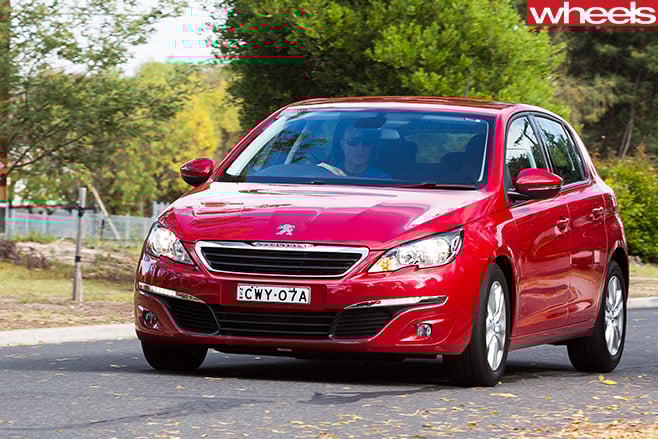
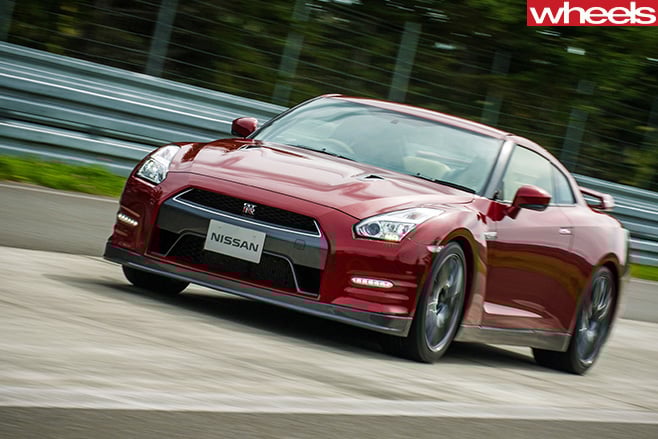
Initially, CWY-07A remained in stasis beneath our borrowed Apollo Bay getaway’s carport, after ably schlepping over a week’s worth of gear and Romy the Lady Labrador Retriever as our holiday workhorse. But after a frenetic few days of roaring along the many glorious little B and C roads of western Victoria, which the GT-R conquered with amazing insouciance, I actually longed for the 308’s light and breezy touch.
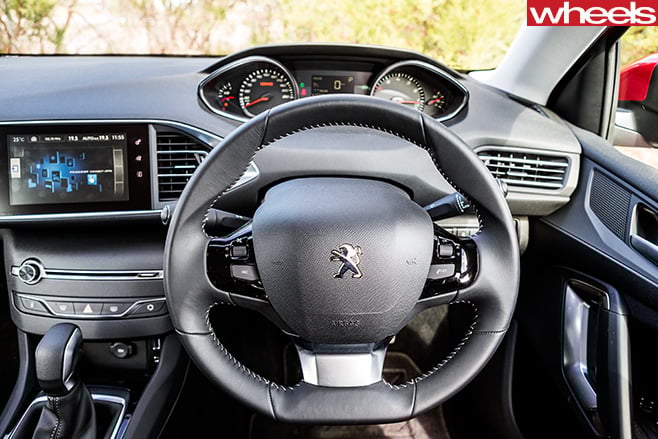
Later on, a wrong turn and my desire to keep on driving led me through some deserted gravel roads, and here the Pug displayed yet another talent. Aided by that superb low-wheel driving position and reactive chassis, the 308 revels in the dirt, the front wheels digging in as the rear slides out gently for some fab rally-style fun. Unperturbed by the many and varied rutted surfaces, the suspension’s ability to soak up all and sundry was just icing on the cliche.
I spent the final couple of days hopping between the two, certain that I was definitely in the company of two great modern yet disparate grand tourers.
Cruise missile
Like most non-premium vehicles, the 308’s cruise control works fine on a flat road surface, but struggles to keep the vehicle travelling at the set speed when a downhill gradient comes into play, with the pace picking up dramatically as the slope’s angle intensifies. In speed-camera infested Australia, you can’t always rely on the cruise control to save your licence, so beware. Why can’t more manufacturers follow BMW’s example of engineering braked cruise control systems?
Update 6
Much satisfaction, and few blemishes, after 10,000km.
Seven months and 10,737km in, it’s au revoir Melbourne and bonjour Sydney for our French friend, summoned northwards for road-test editor Ponchard to see out its final few weeks with us in the Emerald City.
Actually, make that 16,000km and nine months later because Peugeot Australia delivered the wrong car initially, meaning we’ve in fact run two 308s consecutively.
Such extended exposure has naturally revealed blemishes: The touchscreen layout with separate menus for the audio and climate systems isn’t as intuitive as having actual switches; the cruise control struggles to maintain the set speed on inclines; not every button on the steering wheel is illuminated; the finish in the driver’s footwell area isn’t ship-shape; and are the so-called rain gutters porous?
Speeding fines and wet hair aside, these are minor foibles. Even the lack of a reversing camera – instead there are effective rear sensors with an object proximity pictogram display – didn’t dampen our enthusiasm.
But what about reliability? It’s an issue that has plagued previous Peugeots for years, but incredibly, considering this is a clean-sheet redesign on an all-new platform, nothing has failed, rattled, broken off or busted. With more than four million kilometres of development over 4.5 years, Peugeot reckons it has redoubled quality efforts to ensure that the 308 “looks new after three years/60,000km”. Our experience suggests this might be more than fanciful PR fluff.
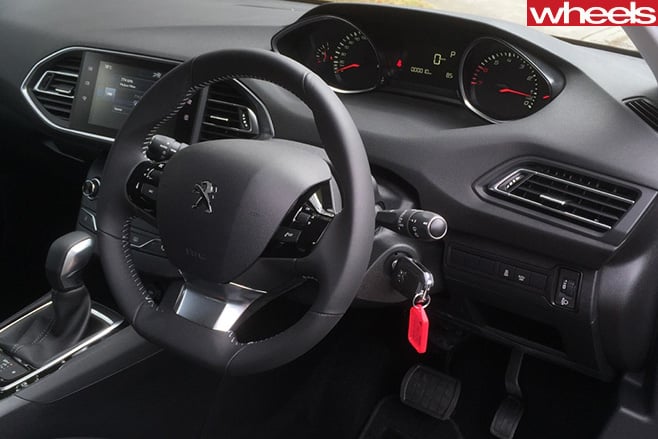
More ownership-enriching engineering is evident in the 140kg-lighter (yet significantly stronger) 308’s fluent dynamics, serving up sweet steering and engaging handling as well as a quiet and soothing ride.
Finally, the Pug scores for packaging – plenty of comfort for two up front, fine for four adults overall (though rear legroom isn’t up to Golf standards) and a sizeable cargo area beneath that world-first composite tailgate.
So CWY-07A has nailed it (so far), cementing what we suspected back when the 308 almost stole last year’s COTY crown – that Peugeot is back at last. What an enjoyable 16,000km. Please try before buying a Golf, Mazda 3 or Focus.
Ponch is in for a treat.
There’s flair in there
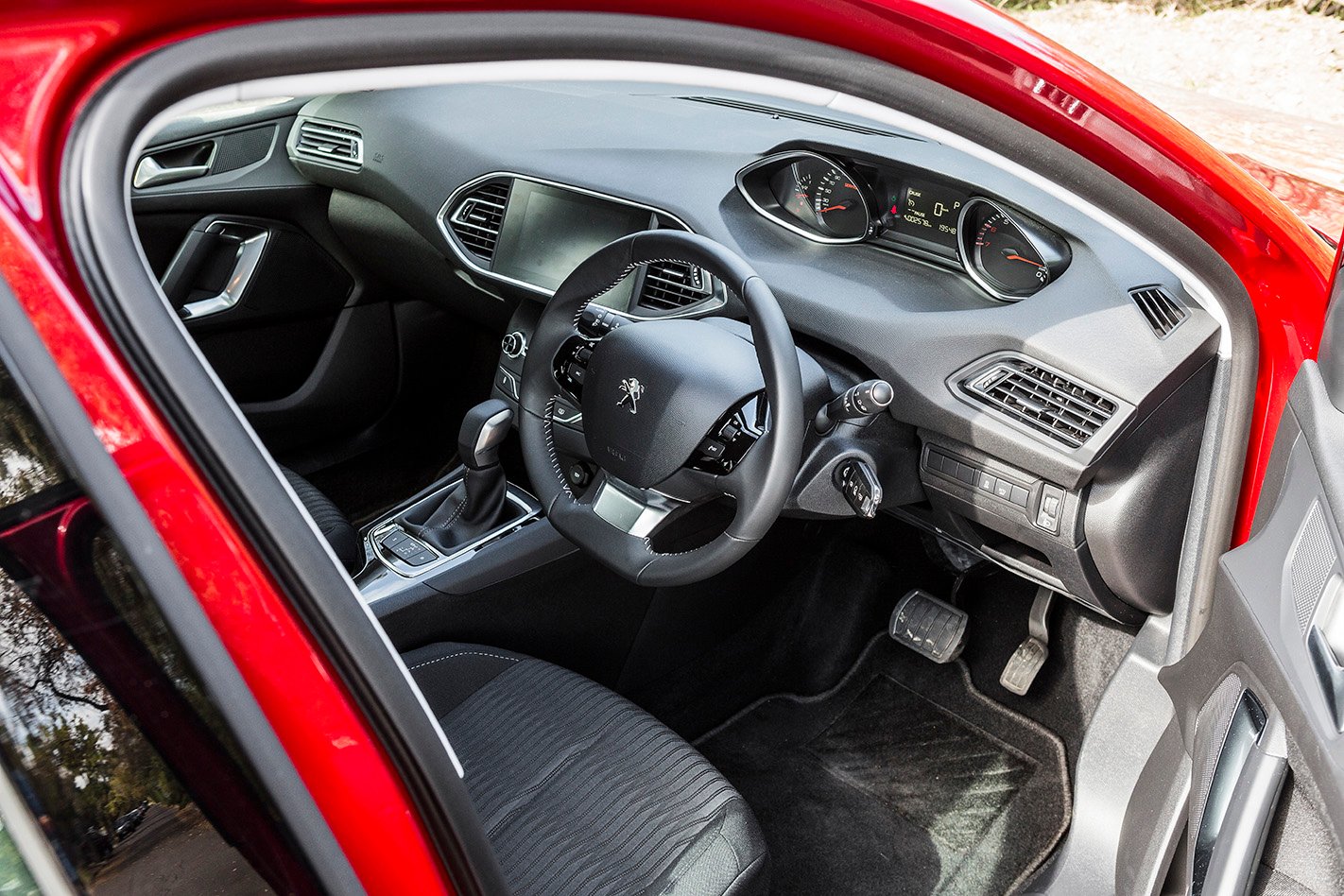
Along with the fluid handling and punchy turbo triple, the distinctive dash design is probably the 308’s strongest draw for us after living with it for 11,000km, fusing non-homogenous design, eye-catching detailing and quality materials. And then there’s the ergonomics, thanks to an effective (if controversial) low-wheel/high-instrumentation driving position. So what might be initially confusing works brilliantly with familiarity, making all rival cabins this side of an Audi A3 seem staid by comparison.
Update 7
French revolution finally breaks years of resistance.
Like passing a baton in a relay, barely a month after I gifted the Corby clan my Citroen C4 Picasso, here I am in its platform buddy, the Peugeot 308 – the much-loved red 1.2-litre Active auto that Byron has been cooing like a Peacock about since March.
Appropriately, the first time both of us saw the new 308 in the flesh was on a motorway outside London, returning from a road trip. Amusing ourselves at the magnificence of Byron’s new drag-queen name (Krystal Methioudakis), the sight of the low-spec, navy-blue 308 under a dull English sky was like being fed cold fish and chips. We were both gutted. How could Peugeot be so boring?
Two months later, the Australian 308 line-up debuted at COTY 2014 and opinions instantly shifted, to the point where Peugeot’s comeback car stood a bloody good chance of taking the prize. And it’s been nothing but growing admiration since. From the base Access to the feisty Peugeot 308 GT, the 308 is something I could seriously own.
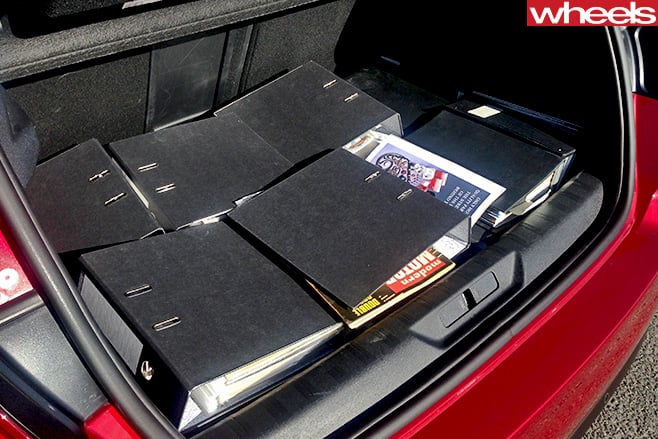
But there’s arguably none finer than Byron’s former filly. So when the opportunity arose to transport a car-load full of old mags on the 850km-plus slog back to Sydney, the 308 stuck its hand up and opened its derriere.
With the boot and footwells crammed, the 308’s handsome shape looked suitably hunkered down and, even with the load, the brilliant torque of its turbo triple made motoring a joy. From Friday to Sunday I blatted about Melbourne like some Op Shop collector hoarding tat, then on the Monday guided the Pug back to its home state.
Having done virtually the same journey in the C4 Picasso, without a load, the 308’s effortlessness on the Hume is even more incredible. The torque is so terrific that the Aisin six-speed auto only kicked back to fifth once on the entire trip. The unladen Citroen has a better power-to-weight ratio (92kW per tonne versus 83), but the three-pot’s performance transcends what its on-paper specs promise.
And the economy! Despite that load and several foot-flat extensions up through its rev range after pit stops or dispatching slow-moving traffic, the 308 1.2 auto averaged 6.8L/100km for the journey, and that includes three days of city slogging with the same load. In the Citroen, I clocked 8.1L/100km.
Both PSA cars share a few faults, like a Bluetooth phone system that must have its volume level at less than 20 or it echoes in the caller’s ears, and the fiddly procedure for choosing tracks with an iPod plugged into the multimedia system. But they’re minor irritations you can work around.
What shone most is the 308’s cohesion. I think it makes better use of its EMP2 platform than the Picasso, particularly in terms of general agility and urban ride. Yet both are superb at smashing out day-long drives minus fatigue and discomfort. Not to mention excuses. Finally, here’s a small Peugeot hatchback you’ll want to own for reasons other than the way it looks.
THE BMW M3 is set to party like it’s 1986. Thirty years since BMW took a Formula One engine block and fitted it to its then-smallest model to create one of the finest drivers’ cars on the planet, Munich is set to release a 30th anniversary model to celebrate – and it’s likely to come to Australia.
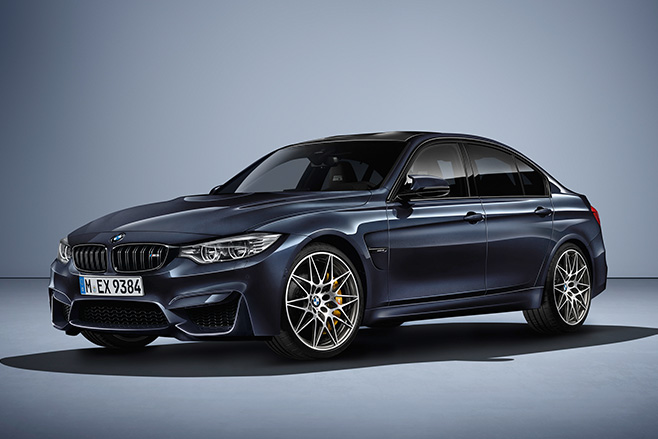
While it’s yet to be officially confirmed, BMW Australia says it will stop at nothing to ensure that the ‘30 Years M3’ anniversary model gets to party on local soil. Only 500 will be available globally. “BMW performance customers are very enthusiastic,” said company spokesperson, Lenore Fletcher. “We’re going to do everything we can to look after those customers so when anything with an M-badge becomes available, we’re straight in there with our hands held high.” Australia is one of the world’s highest consumers per capita of BMW’s famed M models, second only to South Africa.
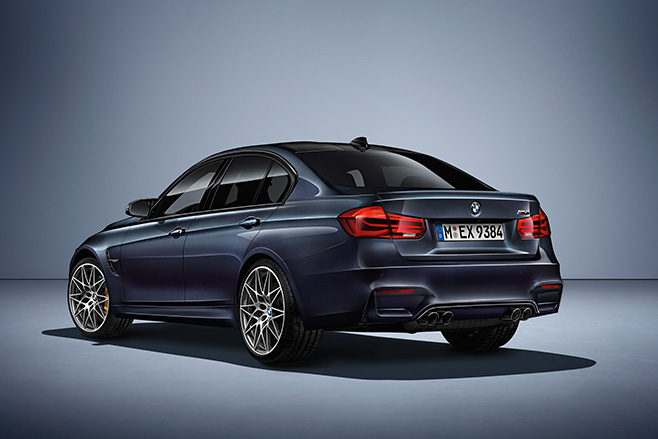
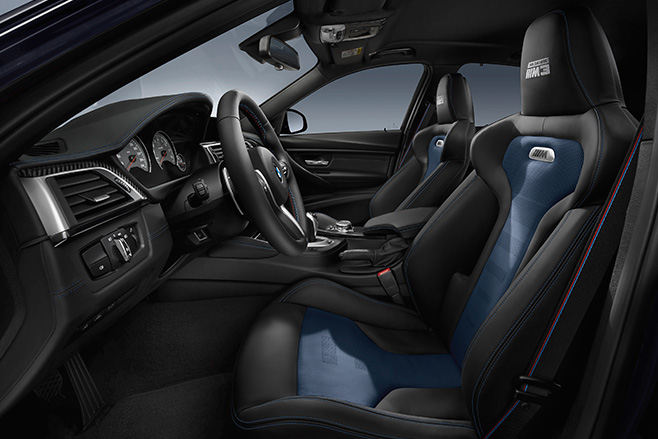
The ‘30 Years M3’ (translated from 30 Jahre M3) builds on the Competition Pack currently offered in the BMW M3 and M4, which includes the 14kW power increase to 331kW, adaptive M suspension as well as a recalibrated M differential. On top of this are 20-inch alloys – taken from the M4 GTS sans the orange detailing. There’s also a 0-100km/h time of 4.0sec flat for the M-DCT version, an improvement of 0.1sec over the regular M3.
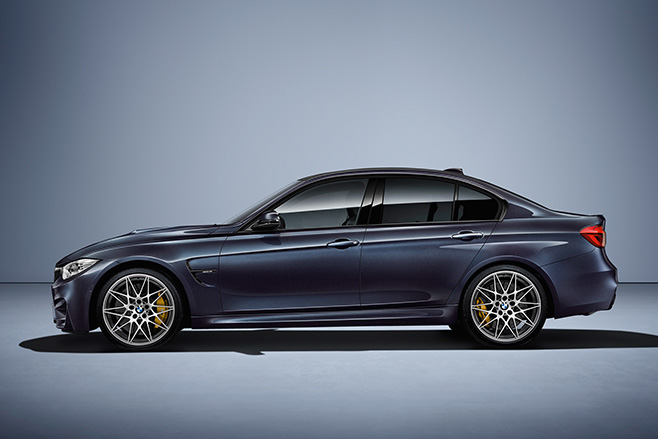
Visually, the party pack includes black exhaust tips, unique gills on the guards as well as obligatory badging to commemorate three decades of what truly was the Ultimate Driving Machine. The Macao Blue metallic colour you see here will be exclusive to the anniversary model, a colour that was offered on the original 1986 M3.

That first M3 became the world’s most successful touring car and an enthusiast’s wet dream when it stormed onto the scene in 1986. Winning numerous touring car titles, Spa and Nurburgring 24-hours as well as success in rallying, the first M 3 Series made its mark in Australia in the hands of drivers including Jim Richards, Peter Brock, Tony Longhurst and Paul Morris. The E30 M3 was particularly handy at tracks such as Sydney’s now defunct Amaroo Park, where handling counted more than horsepower, or when the heavens opened and rewarded balance and poise over heft and horsepower.
Since that original four cylinder model, five generations of M3 has seen straight six (E36 and E46 models), V8 (E92) and now a 3.0-litre twin-turbo six in the current F80 M3, which arrived in 2014 and saw the coupe version badged M4 for the first time.
The 30 Years M3 follows the 30 Jahre M5 that was offered in Australia in 2014, and is likely to arrive in Australian showrooms in the second half of 2016. Pricing is estimated to start at around $170,000 with the same ask for either the six-speed manual or 7-speed double-clutch M-DCT versions.
It’s known as the Bathurst 1000 of the Outback, so how do you prep a stock-standard Mazda ute for a 452km desert bash?
UTES are good for carrying stuff, doing circle work, driving to Cape York, towing boats… not racing in Australia’s toughest off-road race.
But when did good sense ever stop the magazine that took a Porsche 911 to the top of Big Red, and a 7 Series limo up the Birdsville Track?
So we put it out there that Wheels wanted to compete in the race they call the Bathurst 1000 of the outback, the Finke Desert Race. And Mazda – cleverly or stupidly, jury’s out – stepped up.
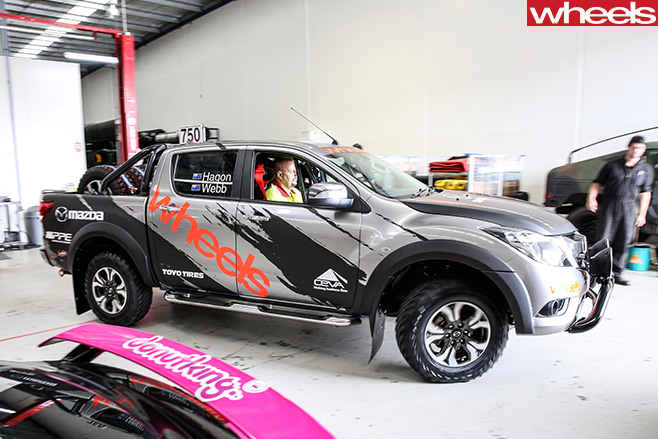
Utes have gone from being rudimentary workhorses to genuine off-roaders, everyday runabouts and family cars. As well as traditional players including Holden, Ford, Nissan, Mazda and Mitsubishi, there are relative newcomers in the segment such as Volkswagen and, soon, Mercedes-Benz and Renault.
They’re big business in showrooms around the country, and three of them are among the nation’s best-selling cars. But they’re not all that popular with off-road racers.
First stop for our soon-to-be-race-ute was the workshop to get prepped for race duties.
Our Finke car is a regular production car that was used at the media launch for the updated Mazda BT-50 last September. It’s also spent a fair chunk of its life lugging around a 2.1-tonne caravan. And to really wring its neck, Wheels and sister publication 4X4 Australia threw AFT-123 into an eight-way megatest – as reported in our May issue – that included a stint at the Melbourne 4×4 Training and Proving Ground, where it was headlight-deep in water crossings and crossed-up over moguls designed to stretch and stress every inch of an off-road vehicle.
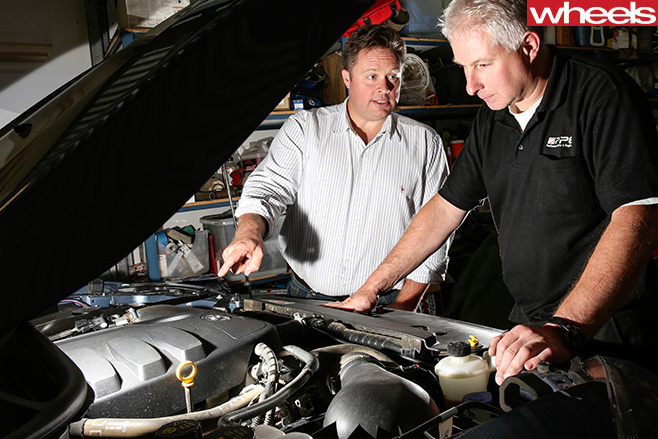
Indeed, the crew at motorsport specialists Performance Parts & Engineering – the team at the centre in our Finke assault – spotted the occasional clue that AFT-123 wasn’t fresh from the factory.
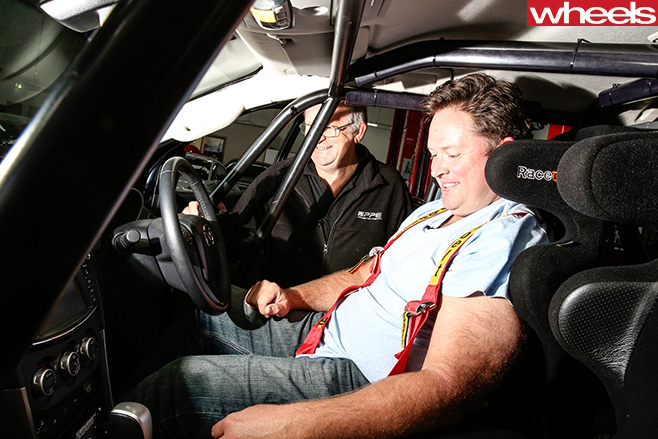
“Have you been to McDonald’s in this car?” was the query from Pete as the interior was being stripped to fit a roll cage. Turns out not all those French fries ended up in the mouths of my kids. Again, just like so many family cars. So Job One was a thorough clean.
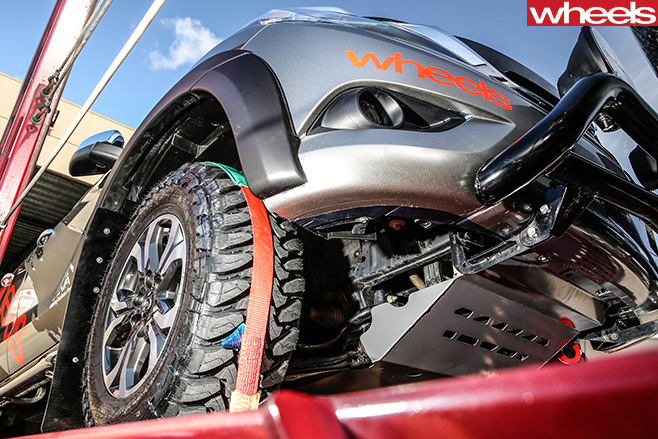
We threw some tougher Toyo off-road tyres at the standard 17-inch alloy wheels, underneath are some extra sheets of metal in case we bash something serious, and we’ve gone for some heavier-duty brake pads and linings (it’s still got drum brakes at the back). Aside from upgraded shocks, the suspension is standard, including the rear leafs because they’re designed to cope with a hefty 1095kg payload.
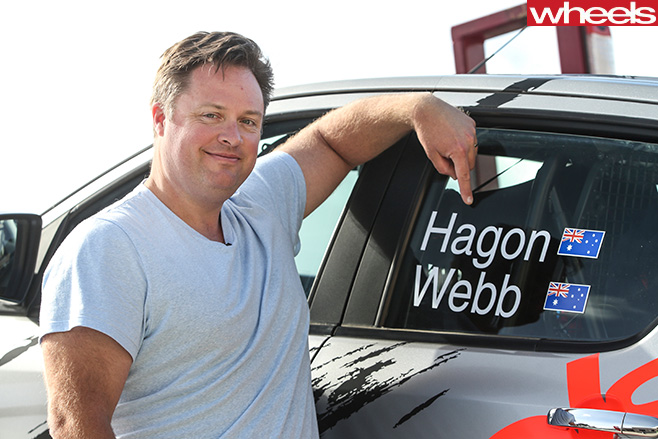
Experienced co-driver Bernie Webb will be riding in the hot seat. He has sat alongside some of Australia’s best rally drivers, including Targa Tasmania paceman Steve Glenney; they won outright in 2008. He’s also meticulous with pace notes, which should be handy over the notoriously challenging – and occasionally treacherous – Finke course that loosely follows the Ghan Railway line south of Alice Springs.
Our pace is expected to be a little more relaxed than Targa Tassie, although lumpier and bumpier than anything your average rally throws up. The fastest buggies and trophy trucks have enormous suspension travel and dampers designed to cope with repeated high-speed hard hits.
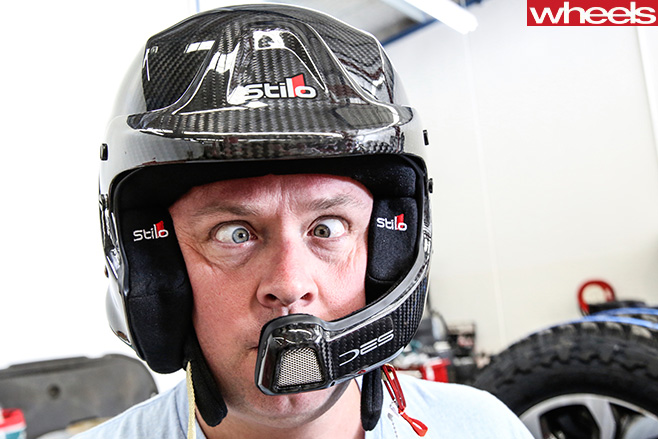
While a win in the production car category would be a dream result, that’s not the goal. The aim is to finish – in the process (hopefully) proving that a factory ute designed for more genteel duties can also kick its heels up and maintain a decent pace in what is shaping up as hell of a challenge.
Right now, the June 11-13 Finke Desert Race is two weeks away. We’ll have a full report in the August issue, on sale July 21. And stay tuned here for more updates.
Lusting after something special that Peter Brock once owned? His HDT-tuned Opel Monza could be yours.
PETER Brock enthusiasts have the opportunity this evening to own a piece of motoring history close to the legendary race driver’s heart. The 1984 HDT Monza Coupe – the only one ever built – will go under the hammer at Shannon’s in Sydney tonight, where it’s expected to fetch around as much as $120,000.
The V8-powered two-door was a car that Brock thought his Holden Dealer Team (HDT) road-car business could turn out as a globally competitive vehicle, but it was stillborn as it was expected to cost around $50,000 – about the same as a Porsche 911 at the time.
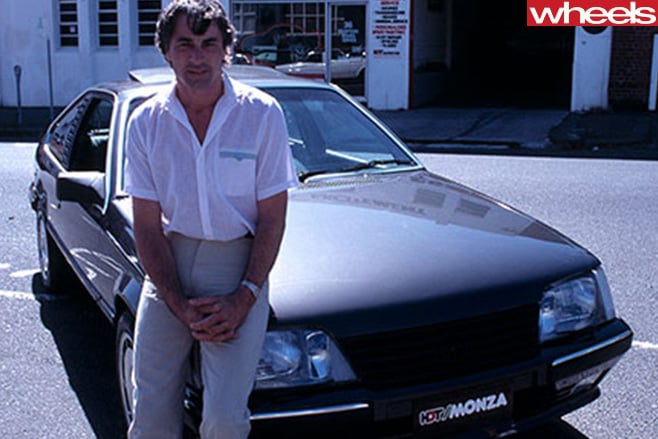
At the time, Brock was imagining how good the Monza would be with a V8 under the bonnet, and that’s exactly what this car is. With one of his highly-tuned 5.0-litre V8 engines under its bonnet, making 180kW/430Nm, the coupe not only served as a potential two-door Commodore, and in a way a precursor to the reborn Monaro that Holden introduced in 2001, but also boasted independent rear suspension at a time when both the Commodore and arch-rival XD/XE/XF Ford Falcon were using live-axle rear ends.
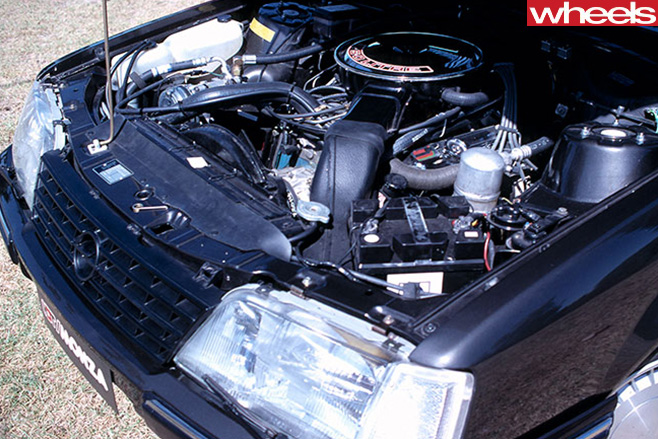
Brock did just that with the VL Director, but Holden did not offer an independent rear-end until 1990, with its long-wheelbase version of the VN Commodore, the VQ Statesman and Caprice models. The Monza also had ABS, another feature that arrived with the Statesman/Caprice range.
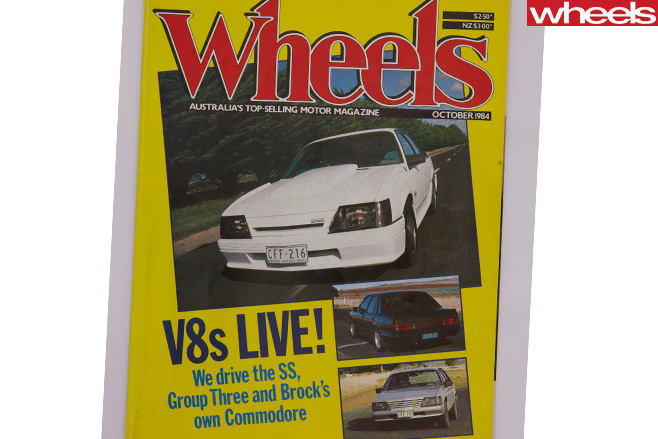
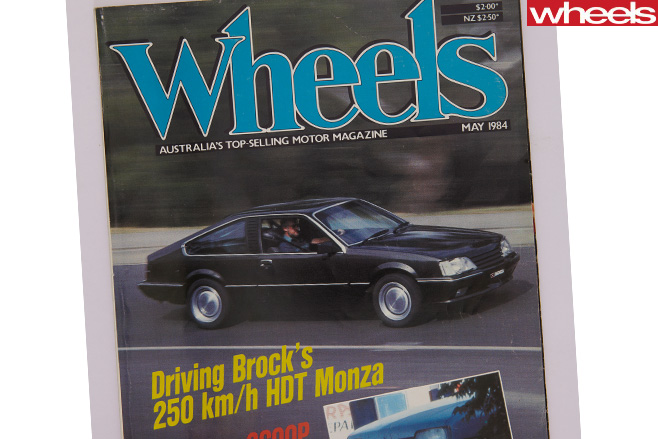
The one-off Monza graced the cover of the May 1984 edition of Wheels, but it’s not the only vehicle with a personal link to Brock at tonight’s auction. Hiss personal 1984 VK SS Group III is also up for sale, and is expected to fetch as much as $100,000. This car, build number 1354, appeared on the cover of Wheels in October 1984.
The Monza goes under the hammer as Lot 26 at Shannon’s Sydney Late Autumn Classic Auction.
HYUNDAI’S new performance car boss, Albert Biermann, has opened up the future of the brand’s N-Division and dropped some tasty hints about its first model, the i30 N.
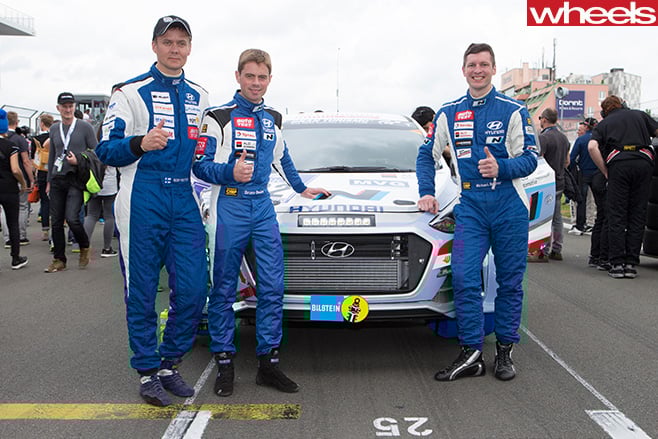
For a start, it’s a definite goer. The i30N will be launched next year as the first model from Hyundai’s new performance sub-brand. Although Biermann didn’t tell us much in the way of specs, we can tell you that the car will be based on the next-gen Hyundai i30 and has been built alongside it, is powered by a 2.0-litre turbocharged four and that at least some versions will have an electronically controlled limited slip differential and electronically controlled adaptive dampers. It will be launched with a manual gearbox – the brand raced a prototype car at the Nurburgring 24 Hour last weekend with a ’stick – but Biermann also confirmed that an automatic option is under development, almost certainly a twin-clutcher.
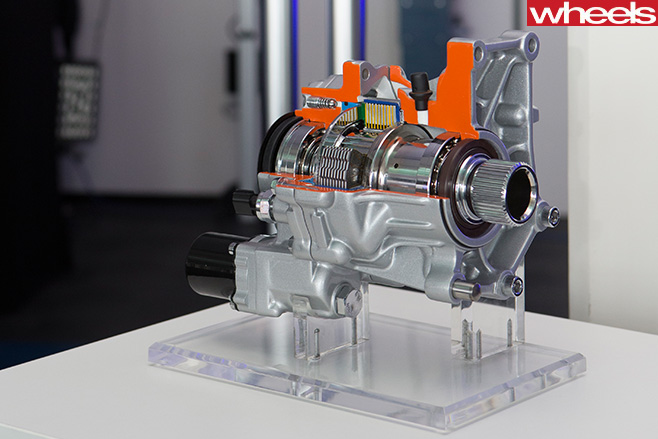
There are no numbers on the turbo donk, but Hyundai showed us a video of it being dyno tested with numbers going up to 264PS (197kW), which we’re taking to be a minimum. Biermann also showed us the underside of the prototype, although we weren’t allowed to take pictures of it, showing that it has both beefed-up suspension and also some structural reinforcement pieces. “We are very serious about this, it is not just about the output,” he said, adding later that “if you look at the data our car will not look like the winner [compared to rivals], but when you drive it you will feel how serious we are.”
We’ll find out more closer to the N’s launch next year.
IT’S STILL not official but there is progress on which of the cockpit protection designs mooted for Formula One next season is garnering the most support – with the FIA’s favouring the halo over the aeroscreen.
The robust aeroscreen was tested on Aussie Daniel Ricciardo’s Red Bull racer earlier this season, and is widely preferred by fans over the halo, though the FIA is understood to have some concerns about its design.
Not all the driver’s like it either, with Lewis Hamilton tellingly describing it as “looking like a riot shield.”
A decision on which design will be used needs to be made before the July 1 deadline.
A revised, less obvious, version of the halo, first sighted publicly on a Ferrari at Catalunya before the season began, is set for more tests next month.
The cockpit protection issue had been dormant for some time until the on-track incidents which led to the deaths of Jules Bianchi and Justin Wilson.
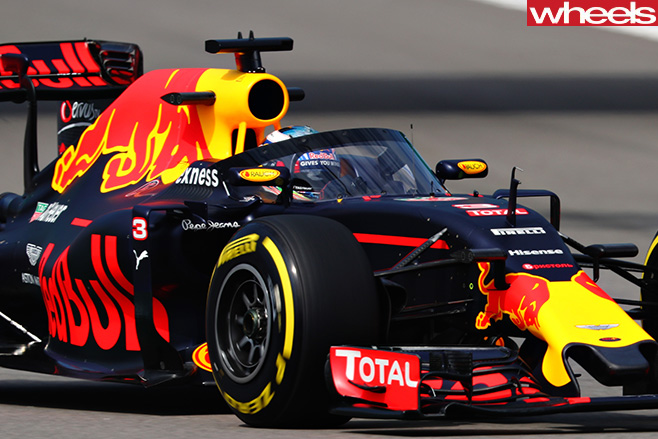
The safety initiative has split F1, with most of the current drivers in favour, but many ex grand prix racers and a number of veteran F1 scribes firmly against change.
Meanwhile, Bianchi’s family is now mounting a legal case against the Formula One Group of companies, the FIA, and the Marussia team.
Bianchi collided with a recovery vehicle during a wet 2014 Japanese Grand Prix at Suzuka, and died nine months later.
The family wants an apology from the parties named, claiming one was never offered and that the driver was wrongly blamed in the FIA report into his death.
The Bianchi family contends others were accountable, and are willing to pursue the matter through the courts should the respondents not take the chance to apologise.
This is the first time the family of a deceased F1 driver has decided to pursue the FIA and the Formula One Group.
