
WHAT makes a fitting send-off for one of the most significant models in Australia’s all-too-brief carmaking history?
Our cover story this month is a heartwarming salute to the Aussie-made Ford Falcon. Writer Nathan Ponchard and photographer Thomas Wielecki take the Ford Falcon Sprint XR8 on one last three-day, octane-fuelled tribute to a half-century of Falcon heritage. We’ve caught the XR8 at its playful best; sideways, in a freshly ploughed paddock just outside Mullalley in central NSW. Says Wielecki: “I love photographing cars in the outback; I just love the dirt, the dust. It’s much better than photographing cars on a race track.”
In news, we take an in-depth look at the new Holden Commodore hatchback. Yep, that’s right, the fully imported replacement for the Aussie-made Commodore will ditch a traditional boot for a liftback. Before you choke on your Chiko Roll, though, it’s worth remembering it’s not the first time Holden has tried the idea.
We also take a deep dive into Maserati’s bid to woo a new class of SUV buyers, with the Maserati Levante setting the go-fast luxury brand’s sights directly on the V8-powered Porsche Cayenne, investigate who Mercedes-Benz reckons is evolving as its most feared rival in the luxury car game, and wonder why buyers are switching off manual gearboxes.
We’ve had our first drive, too, of Jaguar’s SUV-led future. The Brit brand reckons the F-Pace will be at home devouring challenging roads, and we’re not about to disagree. We also have our first steer of the turbo-four Porsche 718 Boxster – with mixed feelings – experience a much-improved second-generation Tiguan, and fang a harder, faster Ferrari California.
Journalist Bruce Newton features prominently in this issue. First, he talks with Mike Simcoe, the former Holden designer now in charge of shaping GM’s entire suite of future products. Then he turns up the heat, taking a Land Rover Discovery Sport to the eerie, deserted epicentre of Australia’s nuclear tests.
Jez Spinks, meanwhile, gets to punt the BMW M2 around Targa Tasmania’s challenging roads. Is it a better all-round performance BMW than the BMW M3/M4? We then chuck the bent-eight Lexus GS-F straight into the lion’s den, benchmarking it against the blown HSV Clubsport as well as a few others.
Missed out on this month’s great content? Our next edition will go on sale on June 16.
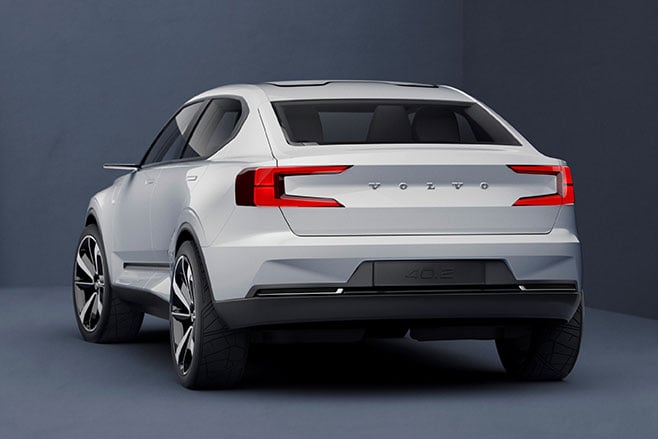
VOLVO has revealed a pair of concept cars – named the 40 series – unveiling an all-new conventional, hybrid and electric-friendly platform that it will share with Chinese owner Geely.
The platform, dubbed Compact Modular Architecture (CMA), will underpin a new generation of small premium cars that will start rolling out globally next year before arriving in Australia by early 2018.
Volvo hasn’t said what that first car will be, but it teased concept versions of a small SUV and sedan, both spun off the new platform. The carmaker says the CMA platform was “specially created for smaller cars and which has liberated the company’s designers and engineers to explore bold and daring new directions”.

“Each member of our product family has its own distinct character, just like the members of a real family,” Volvo design senior vice-president Thomas Ingenlath said.
“CMA has helped us to capture something special, something youthful in our new concept cars,” he said.
“They have an energy, a disruptive and engaging urban character that makes them stand out amongst the crowd. This is the flavour of small Volvos to come.”
The new platform joins Volvo’s Scalable Product Architecture (SPA) platform for larger cars, launched last year underneath the XC90 large SUV that will soon add a T5 “Twin Engine” plug-in hybrid version to its Australian line-up.
Similar to its larger cars, Volvo has flagged the small car range will include a pure battery electric vehicle as well as Twin Engine plug-in hybrid powertrain variants. Volvo has also teased that the upcoming S90 large sedan, also based on the SPA platform, is also expected to roll out a Polestar-fettled version.
The Swedish carmaker has previously flagged it will not spin off a battery-fuelled version of its larger SPA platform until about 2019.
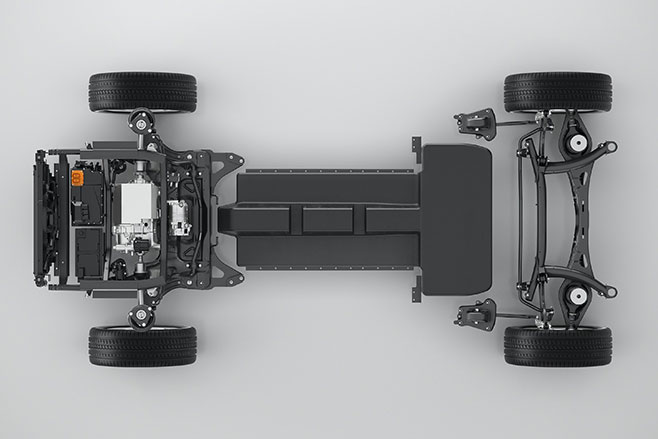
Volvo said the Twin Engine drivetrain, based on a new three-cylinder petrol engine paired with a new seven-speed dual clutch transmission and an electric motor, would allow it to pass over all-wheel-drive options in favour of “more accessible front wheel-based system for … smaller cars”.
Volvo’s parent company, Geely, will also spin off its own cars based on the CMA architecture, media reports said.
The new CX-9 will set the benchmark for active safety technology in the sub-$70,000 large SUV segment when it goes on sale mid-year.
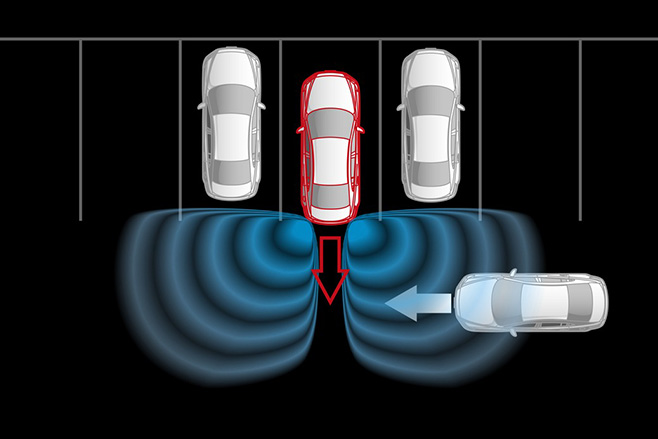
Mazda’s second-generation seven-seater SUV will include active blind spot monitoring, a system that warns of traffic when reversing out of a parking spot or garage, and autonomous braking capability for both forward and reverse gears, all as standard.
The Japanese brand has also announced that the range-topping Mazda CX-9 Azami will feature additional safety technology as standard.
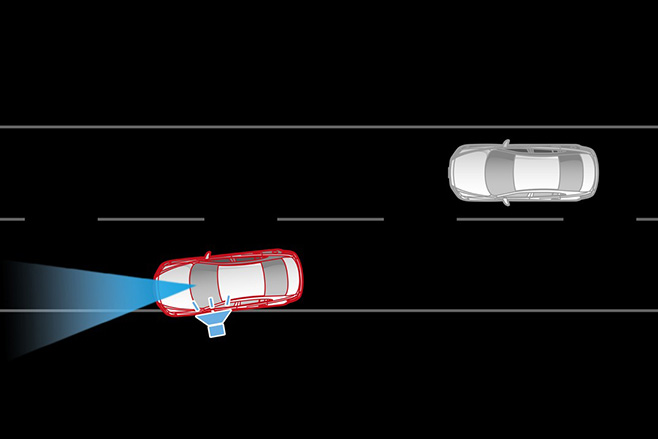
Included will be adaptive LED headlights with an anti-dazzle high beam mode, driver-fatigue monitoring, the ability to increase braking response to help avoid a crash and a lane-keep assist system that will apply subtle counter-steering if it detects the vehicle unintentionally leaving its lane.
None of the CX-9’s rivals can currently match the Mazda’s suite of safety tech. Hyundai’s Santa Fe comes closest by offering autonomous emergency braking, forward collision alert, lane departure warning, blind spot monitoring and rear cross traffic alert, though the features are available only on the most expensive variant, the Highlander.
Kia’s Sorento also only features blind spot detection, lane change assist and lane departure warning on the highest-spec model.
Blind spot monitoring and lane departure assist systems are available only on the top Toyota Kluger model, the Grande, while the Nissan Pathfinder’s only prominent active safety system is blind spot detection – not available on the base model.
The new Mazda CX-9 will be offered in four trim grades – Sport, Touring, GT and Azami and with the choice of front-wheel drive or all-wheel drive.
It is powered by a 2.5-litre turbocharged petrol engine that offers stronger performance than the outgoing CX-9’s V6 while significantly reducing fuel consumption.
A more powerful yet more economical six-cylinder engine has spawned new BMW M140i and M240i models in the German brand’s M Performance range.
The M140i hatch and M240i Coupe and Convertible are due in Australia in the final quarter of 2016, when they will go faster and use less fuel than the BMW M135i and M235i variants they replace.
The M140i and M240i Coupe can now accelerate from 0-100km/h in 4.6 seconds – cutting 0.3 and 0.2 seconds, respectively, from the sprint times of their predecessors. The time is 0.2 seconds slower if the standard six-speed manual gearbox is chosen over the optional eight-speed auto.
Both models also improve fuel consumption by up to seven per cent, now sharing an official figure of 7.1 litres per 100km in manual form or 7.8L/100km with the auto.
The BMW M240i Convertible is three-tenths quicker and uses half a litre less petrol over 100km than the model it replaces, for figures of 4.7 seconds (4.9sec manual) and 7.4L/100km.
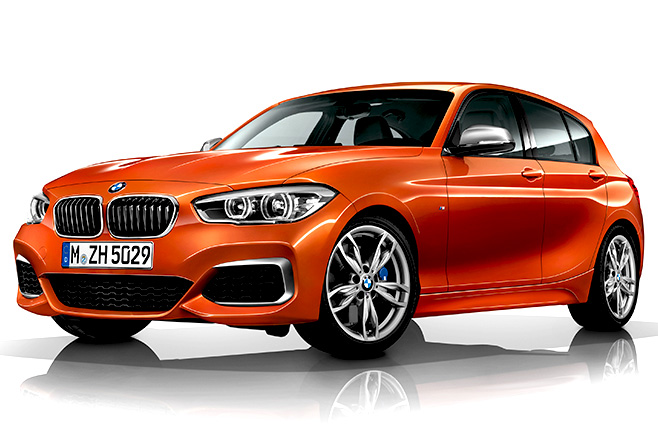
Key to the performance and efficiency improvement is the same new engine installed last year in the 340i, though with additional power and torque for the M Performance models.
The 3.0-litre single-turbo six-cylinder is similar to the engine from the M135i and M235i models, though it is a member of BMW’s new modular engine family that ranges from three to six cylinders.
BMW’s new engine produces an extra 10kW for a total of 250kW, while torque expands from 450Nm to 500Nm. Maximum power is produced slightly sooner, at 5500rpm rather than 5800-6000rpm. Maximum torque kicks in slightly higher – from 1500 rather than 1300rpm – but stretches to the same 4500rpm.
The update positions the M240i Coupe closer to the outputs of BMW’s full M version of the 2 Series. The BMW M2 produces 272kW, and only develops 500Nm temporarily via an overboost function. It’s still faster, with a 0-100km/h claim of 4.3 seconds with auto transmission.
In Europe, the M140i and M240i models are also available with ‘xDrive’ all-wheel drive as an alternative to the standard rear-wheel-drive models, though BMW Australia is expected to focus only on the latter for this market.
TELL ME ABOUT THIS CAR
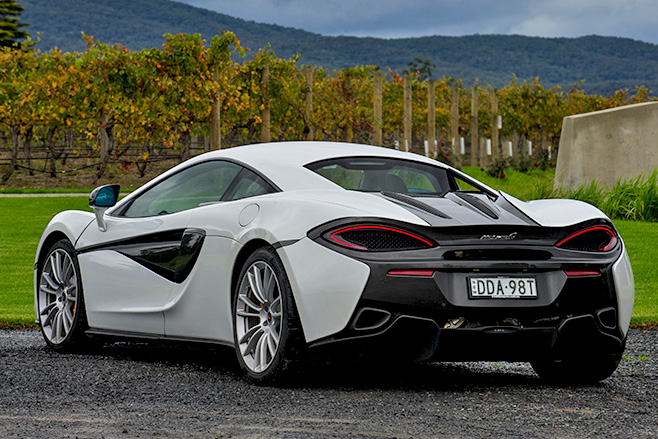
It’s McLaren’s cheapest ever supercar. Dubbed the 540C, this ‘baby’ McLaren is a new entry-point to the British marque’s supercar line-up, thanks to a $325,000 price tag. The 540C features the same 3.8-litre twin-turbo V8 engine as the rest of the McLaren range, though it’s less powerful and is designed to be more usable than McLaren’s other offerings.
STRENGTHS
- That engine. Don’t be put off by the fact this is the least powerful McLaren you can buy – it still has plenty of grunt. The 397kW/540Nm twin-turbo V8 rockets you from 0-100km/h in a blistering 3.5 seconds and when you’re high in the rev-range, the 540C feels seriously quick.
- The big difference with the 540C though, is the way it uses its power. Where other McLarens are ferocious all the time, the 540C is much friendlier below 4000rpm. Here the V8 feels refined, smooth and docile, which makes the 540C more usable, especially in heavy city traffic.
- Adding to the 540C’s usability is its improved entry and egress. All McLarens are built around a special carbon fibre chassis that can make getting in and out tricky , but the 540C (and its more powerful 570S bigger brother) use a modified chassis with a slimmer and lower sill and doors that open wider. While it’s an improvement, getting in still isn’t as easy as a conventional door.
- And don’t think McLaren has skimped on the 540C’s looks either. It might be the cheapest model, but only trainspotters will be able to tell the difference from McLaren’s more expensive variants. Visually, the 540C ticks all the supercar boxes.
WEAKNESSES
- The sound. You might imagine all supercars produce an amazing exhaust note, but McLarens are the exception. Unlike the screaming V8 you get in a Ferrari 488 or the howling flat-six engine of a Porsche 911, the V8 in the 540C sounds more functional than beautiful.
- Then there are the sports seats, which are beautifully bolstered for excellent lateral support but are too firm on your lower spine. They’re manually adjustable too (no electric seats here), which seems a little stingy in a $350K car.
- Speaking of stingy, there’s no reverse camera as standard either. Coughing up a few hundred bucks extra to have one fitted mightn’t be a big concern when you’re paying this much, but it’s a necessary expense given the 540C’s poor rear visibility and should be standard.
- There’s also a question mark over build quality. The car we drove, which McLaren stressed was a pre-production model, had a few rough corners and rattles inside which isn’t ideal in a car this expensive. Hopefully these will be ironed out on production versions.
You can’t shop for a sportscar at this price point and not consider the Porsche 911. For 540C money you could buy the brutally fast 911 Turbo or even opt for the 911 GT3 or GT3 RS, which have been fettled by Porsche’s iconic motorsport division.
You should also look closely at the new Audi R8, Mercedes-AMG GT S and Aston Martin V12 Vantage.
We sneak an early look at a Euro-spec Renault Megane GT ahead of its local launch later this year. It’s a crucial car for the French brand, and promises good things to come.
WHAT IS IT? It’s the fourth generation of the Renault Megane, a premium hatchback best known for the high-performance RenaultSport versions adored by Aussies. The core model range has struggled to cut through to mainstream buyers in the past, but the new car could change that.
WHY WE’RE TESTING IT Renault has fitted the Megane GT with a first-in-segment four-wheel steering system and believes this new model is the best equipped and most competitive yet.
MAIN RIVALS Volkswagen Golf 110TSI R-Line, Peugeot 308 GT
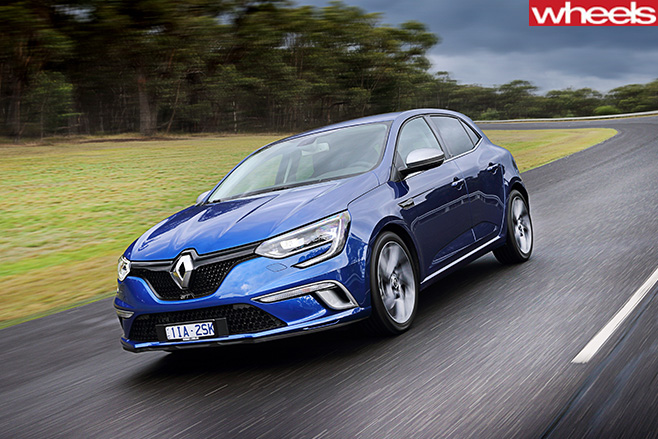
PLUS: road holding, chassis, engine performance MINUS: cabin lacks premium finishes, synthetic engine noises
THE WHEELS REVIEW You don’t buy a Renault by accident. This thought runs through my head as I sit at the wheel of a left-hand drive Megane awaiting its run around the high-speed loop at Angelsea Automotive Research Centre in rural Victoria.
Renault Australia has brought four European-spec Meganes around the globe for local staff and press to get briefly acquainted with, ahead of its proper introduction later in the year. It’s clear this car means a lot for Renault.
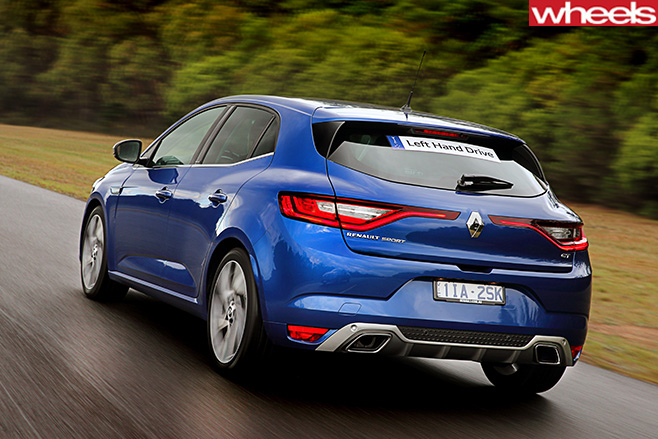
The GT TCe205 EDC tops the core Megane range, featuring a development of the Clio RenaultSport’s 1.6-litre four-cylinder turbo petrol engine producing 151kW and 280Nm. It’s the fieriest Megane outside the potent RenaultSport models that are still more than a year away, and will compete with other warm hatches like the Peugeot 308 GT and VW Golf 110TSI. A price tag around $40,000 is expected.
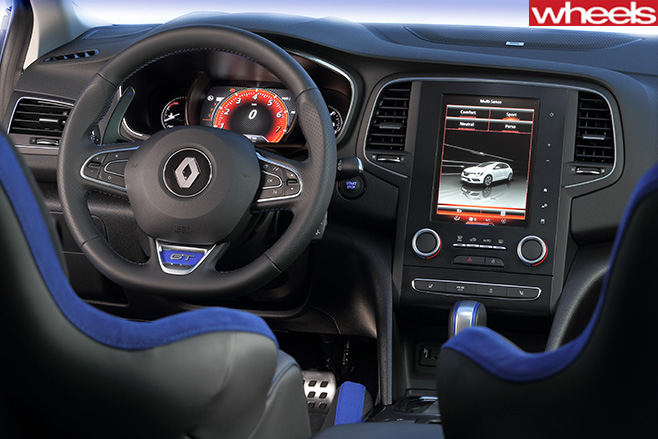
The engine is punchy, particularly when driven through Sport mode’s sharpened throttle map. It revs freely as the turbo spools to full boost with a satisfying torque kick. It sounds good, too, though in Sport mode the car’s speakers add fake engine noise to the cabin, which is a gimmick we could do without.
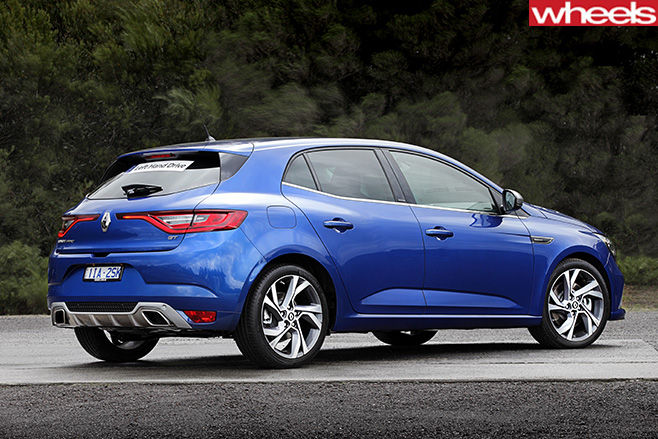
A first-in-segment four-wheel steering system called 4Control has been added to the GT. At low speed the rear wheels turn in the opposite direction to the fronts, giving a sensation of the car turning from the middle. It’s surprisingly natural. On a tight handling demonstration course the 4Control system was immediately responsive and added considerable pointedness to the front end.
Run the speedo up above 60km/h (80km/h in Sport mode) and the 4Control system swaps to turn the rear wheels in the same direction as the fronts. At highway speed the feeling of stability is remarkable. For the most part, 4Control is undetectable, adding a level of surefootedness without muddying the drive experience. Only sharp mid-corner adjustments bring out a bit of ‘bendy bus’ behaviour.
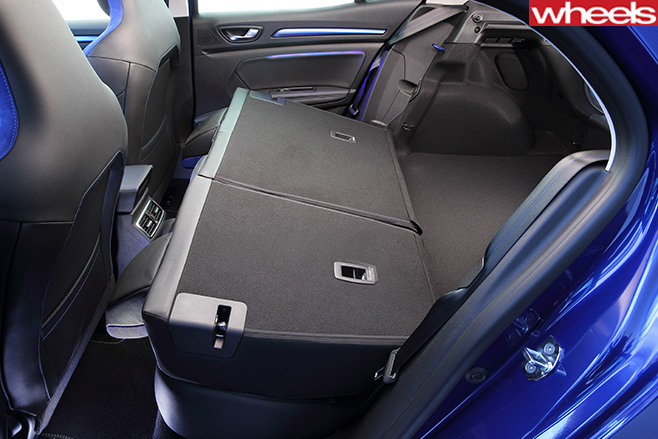
The body itself is bigger and more rigid than before, housing a longer wheelbase and wider wheel tracks. It’s more spacious inside with notable improvements to leg and knee room in the back seat, where second-row passengers get generous headroom and their own air vents too.
Interior appointments are on par with others in the Megane’s class, though the sophisticated cabin lacks the premium finish of a Golf. A fully digital TFT instrument display is a great addition and well implemented with unique graphics for each of the five drive modes – Comfort, Sport, Eco, Neutral and a user-customisable mode called Perso.
Megane has typically found favour with people attracted to its individuality and ability to stand out from the crowd, particularly in the case of the second-gen’s polarising, booty-licious backside. To buy a Megane is to make a deliberate decision not to buy anything else.
The new car is more accessible and potentially more competitive, depending on local specification and pricing, which will be announced closer to its Australian launch in September. Certainly this early first impression suggests the new Megane has the best chance yet of cutting through to mainstream buyers in Australia.
SPECS Model: Renault Megane GT Engine: 1618cc 4cyl dohc, 16v turbo Max power: 151kW @6000rpm Max torque: 280Nm @2400rpm Transmission: 7-speed dual-clutch Weight: 1392kg 0-100km/h: 7.1sec Fuel economy: 6.0L/100km (Euro) Price: $40,000 (est.)
Ford’s Ferrari-fighting supercar is set to sex-up with carbon fibre wheels made right here in Australia.
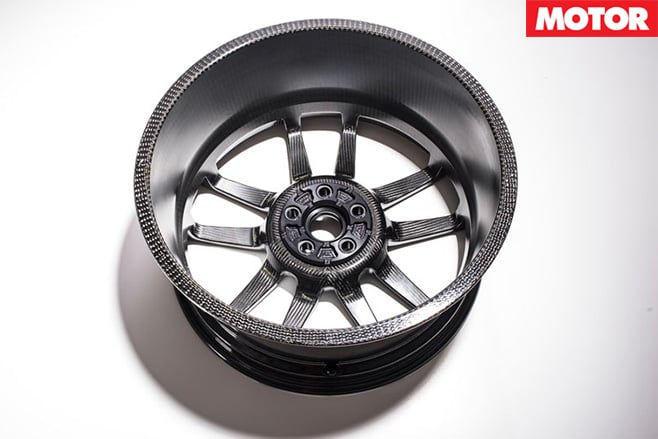
It was confirmed overnight by the manufacturer its much hyped ‘GT’ will offer an optional carbon fibre wheel package that will see it fitted with items made by Geelong’s own Carbon Revolution.
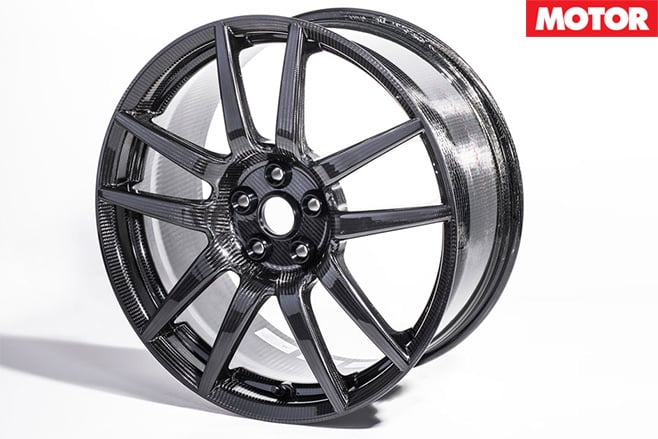
They’ll be made in the same size as GT’s standard aluminium items, at 20 x 8.5 inches up front and 20 11.5 behind, but by using new resin and more advanced fibres the wheels will also knock 2 pounds (0.9kg) from each standard wheel’s weight and slash inertia by 25 per cent.
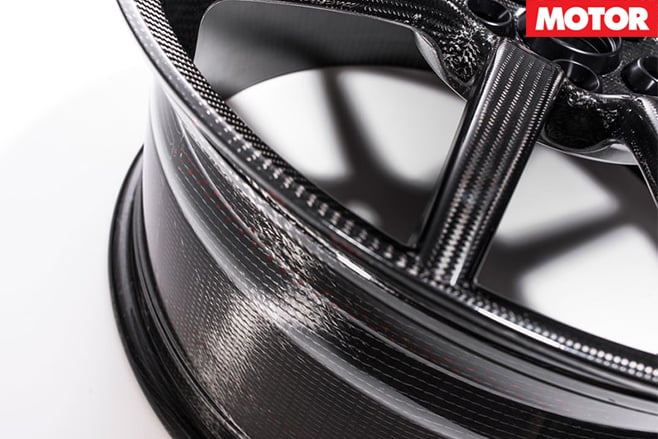
While the GT350R’s wheels are exclusively painted black, the GT’s set will be finished in either a matte or gloss clearcoat to match the car’s extensive use of carbon-fibre, seen on its sills, fascia, and rear extractor.
MITSUBISHI’S president will step down as the carmaker’s growing fuel use scandal and a bold takeover bid from rival brand Nissan sweeps the company.
Nikkei Asian Review reported overnight that Tetsuro Aikawa, who took over the role of president of the Japanese carmaker in April 2014, would stand aside from his role next month, with his position filled temporarily by Mitsubishi board chairman Osamu Masuko until a replacement was found.
The scandal broke after Nissan flagged that several of the small city cars it sold on the Japanese market had understated their official fuel use ratings. As it turned out, those cars had been built by Mitsubishi for Nissan.
Mitsubishi’s share price halved in the wake of the revelations, opening the door for Nissan to swoop in and take a controlling 34 percent stake in its rival.
Mitsubishi is expected to today present to the Japanese government the findings of its own internal investigation into how the fudged fuel use figures were applied to the cars.
Nikkei Asian Review said that Aikawa had risen to his present role with the carmaker after heading up its product development unit, which has been flagged as the potential source of the incorrect figures.
Nissan will use a June 24 shareholder meeting to appoint one of its own directors to head up Mitsubishi’s product development unit, the Review said.
Mitsubishi’s president would also be replaced with a Nissan director, it said.
Nissan’s interest in Mitsubishi is believed to be tied to its petrol-electric hybrid engine technology.
Nissan has also flagged there is a possibility that the two carmakers could use a single platform to underpin the Nissan Navara and Mitsubishi Triton trade utes, helping to build economy of scale in one of the strongest-performing segments of the new-car market.
Thirsty cars will soon become cheaper under upcoming changes to the controversial luxury car tax. But fuel efficient vehicles – including electric and hybrid cars – will not benefit nearly as much.
The Federal Government today announced that the price at which the 33 per cent tax kicks in will rise to $64,132 in the 2016-17 financial year for cars that use more than 7.0 litres of fuel per 100 kilometres, a rise of $948.
In contrast, the LCT threshold on fuel efficient models will rise by just $151 – the first time in seven years the tax’s tipping point for fuel-sipping cars has risen.
However, the gap between the fuel-efficient and fuel-thirsty LCT threshold has narrowed even further to just $11,394, compared with $17,820 in the 2009-10 financial year.
Mercedes-Benz senior manager of public relations, product and corporate communications David McCarthy told Wheels that while the German luxury brand was “very pleased” with the increase in the thresholds, narrowing the gap between them was sending the wrong message to luxury car buyers.
“It’s disappointing that the threshold for fuel-efficient vehicles has reduced in its relevance because of inflation [the figure that is used to set the LCT’s level],” McCarthy said.
“If it keeps going like this we could end up with the situation in five or six years where the luxury car tax on a fuel efficient vehicle is lower than that of a less-efficient vehicle.”
The tax is expected to earn the government about $570 million this financial year alone. However, the government flagged in its budget earlier this month that Australia’s appetite for luxury cars meant it would reap a $240 million bonus from the tax over the next four years.
“It continues to be disappointing that fuel-efficient vehicles haven’t been given a bigger break,” McCarthy said.
“The luxury car tax does become like a badge of honour for buyers because they are not paying luxury car tax … and no one likes paying extra tax. Do you want to give me the name of a person who does that?”
Whether it’s adding sugar to our morning coffee or wearing 3D goggles at the cinema, humans have created a world full of shameless artificial enhancement. It’s happening to cars, too, and one of the more curious phenomena is stereo-assisted engine notes.
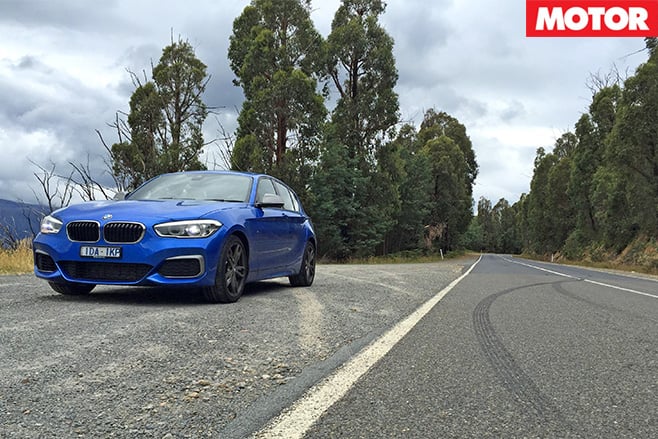
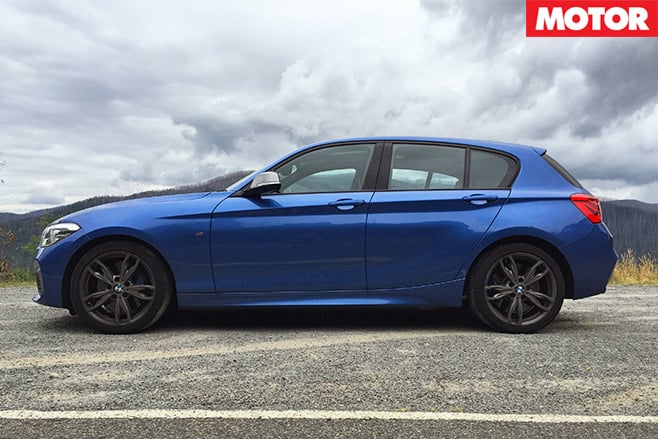
The dilemma with our long-term BMW M135i is it’s one of these cars, its 3.0-litre single-turbo inline-six belting out a mean snarl when given the berries – and not least because it’s being lent a generous hand by the sound system.
But where once these systems sounded plainly, obviously fake – like someone put PlayStation in charge of the exhaust note – they’re getting better. Much better. In fact, of all BMW’s “Active Sound Design” enhanced performance models, the current M135i has to be the best we’ve heard yet. It’s so good, in fact, those unfamiliar with the wool-pulling-over-ears antics of car companies in this area, would suspect nary a thing.
The judging panel was given a freeway on-ramp and three instalments of 7000rpm to adjudicate – and the consensus was extremely positive.
Initially incredulous as I explained the mean, rorty engine note was computer-enhanced, the consensus soon shifted to acceptance and then even embrace, my Falcon-doting mate even going so far as to say he’d happily have the artificially-sweetened set-up in his XR6T “if it meant is sounded as ballsy as this”.
Personally, as the editor of a car magazine exclusively about performance cars, I’m not quite sure how I feel about this. Particularly after watching videos on YouTube where clever M135i owners have found a way to disconnect the Active Sound Design system, only to find a gasping, half-muted and rather underwhelming engine note indeed.
Only adding to the curiosity is the fact the M135i’s exhaust hardware itself seems entirely up to the task of making a sweet tailpipe racket. Starting with a burst of mean revs and settling to a loud, purposeful idle, under full throttle the M135i bellows a satisfying, rich growl. “Man, this car sounds awesome from the outside,” remarked another mate after chasing down our 240kW rear-drive rocket in his new VW Golf R.
In Sport Plus there are even exhaust over-run burbles, although more subdued and mature than the attention-seeking cracks and pops of, say, a downshifting A45 AMG.
I suppose it says it all in the case of the M135i that with the windows up, the cabin is a serene and peaceful place, impressively low on tyre and wind noise, which meant after nine solo hours on the Hume, I felt unusually great – and more bonded to our long-termer than ever. But what a strange place the world has become when M135i owners are debating whether a speaker upgrade would be just as effective as an aftermarket exhaust.
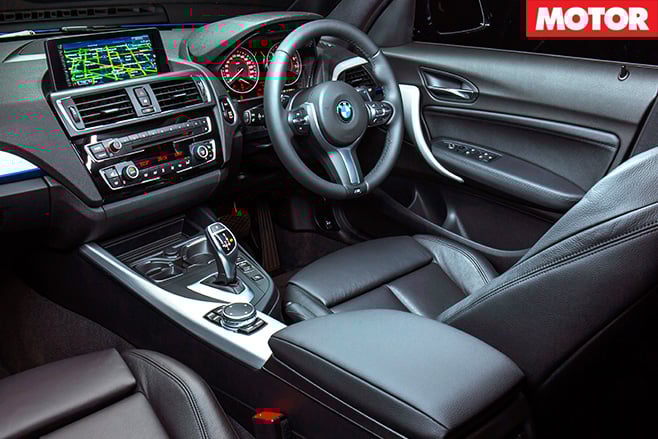
Fuel this month: 9.1L/100km Average: 10.5L/100km Distance this month: 1670km Total: 10,521km
Driver’s eye view
1. IDRIVE? ILIKE Once widely derided, iDrive is now one of, if not, the best in-car entertainment system. Shades Merc for intuitiveness and Audi for slickness. Very easy to use on the fly, stable software and smart 8.8in graphics. Voice input even works great.
2. SPEED DIAL Live readouts of power and torque all M135i offers. No R35 GT-R-style data overload here.
3. BUTTON UP Adjust ESP and switch between Eco Pro, Comfort, Sport and Sport Plus modes here. Pleasingly, manual mode for the eight-speed torque converter auto is pull back for up, push for down. But steering paddles the nicer option.
4. WHEEL NICE Chunky M-branded leather wheel feels great and one of the best tillers around. If it wasn’t for this, you could half think you’re in a 120i. As for cruise control buttons, this is how it’s done.
5. LOW(ER) TECH M135i interior dates back to 2011, yet aesthetically doesn’t feel five years old. Shows its age in gadgets instead – no adaptive cruise, blind spot monitoring or head-up display. Radar cruise aside, top Commodores have all this stuff. But from a materials and build quality perspective, for $63K this is as good as interiors come. (For what it’s worth, M135i has no spare wheel. Tyre repair kit only.)
Want to see more of our BMW-M135i-long-termer? Check out the below:
