
I DROVE my first Ferrari – this impossibly red F355 GTS – at precisely 9:48am on a bright Wednesday morning. Three hours later, I almost crashed it.
Exiting the penultimate corner at the Broadford circuit, my attention fixed firmly on the GoPro wedged on the dash as I tried to film a witty video, the 355’s rear stepped out.
From the outside it hopefully looked like a perfect slide, where I calmly added a dash of opposite lock as I exited the second-gear right-hander. Inside the car, it was code brown.
Lesson number one when driving your first Ferrari, then: give it the attention it deserves or it’ll kick you in the face. As it should, given that it’s a thoroughbred from Maranello.
To me, though, the 355 isn’t just any Ferrari. It’s the Ferrari. Plastered on my wall as a 10-year-old (my 355 was bright yellow), I fell in love with its seductive Pininfarina design, its classic proportions and its screaming 3.5-litre five-valves-per-cylinder V8. So obsessed was I with the 355, I spent hours on the internet, fighting a painfully slow dial-up connection, just to download 10-second sound bites of its exhaust note.
Impossibly high expectations, then, but the 355 did not disappoint.
In the metal, it’s low, brutally wide and, to my eye, the perfect shape. Boxy, yet seductively curvy in all the right places, I still regard it as one of the prettiest Ferraris ever made.
Things only improve on the track. The steering is surprisingly light and wonderfully communicative, the brake pedal firm but confident, and the handling direct, planted and balanced.
It’s the engine, though, that dominates the experience with its glorious, high-pitched V8 howl. Mated to a sweet-shifting six-speed manual that emits a loud, spine-tingling ‘snick-snick’ every time you swap cogs through that open gate at the lofty 8500rpm redline, it’s undoubtedly one of the most engaging drivetrains I’ve experienced.
There’s no electronic safety buffer shielding you from the action. So, unlike most modern cars, I can feel every pop, fizz and crack. It also means every mistake, as I found out, is mine and mine alone.
Sure, there are some foibles. The driving position is far from perfect and I find myself reaching for the wheel, the rubber on the centre console has deteriorated into a sticky mess, and I can’t get the air-con to work. Then there are the enormous servicing costs (see breakout). But these are small complaints for a 20-year-old car that steers, stops and goes this well.
And don’t dismiss the 355 as impractical. On the road it’s as easy to drive as a Mazda 2. There’s a big boot in the nose, the ride on adaptive dampers (Sport and Comfort) is firm yet well-sorted, and when you remove the roof you can easily have a conversation at 100km/h with none of the wind-buffeting that can plague even modern targas.
And the best thing? Despite costing $275,000 in 1995, today you can pick up a good one for about $130,000. Forget the cliche of never driving your heroes; the Ferrari 355 was even better than I’d hoped.
Did you know?
The 355 was the first Ferrari to be fitted with an F1-style paddle-shift gearbox. The 355 F1 introduced in 1997 boasted a new electro-hydraulic system for shifting the six cogs
Ferrari is rumoured to have conducted 1800 hours of wind tunnel analysis on the 355’s body during the course of development
The 355’s nomenclature doesn’t follow the formula used by other Ferraris of the era – the engine capacity followed by the number of cylinders. For example: the 348 is 3.4-litres, eight cylinders. Instead, the 355 used its displacement, then five valves per cylinder
Living the dream
THIS particular Ferrari is owned by Peter Goodin, who is not only secretary of the Victorian Ferrari Club, but actually owns two 355s, six Toyota Soarers, a Hummer H2 and a 1997 Pontiac Trans Am. Both his 355s are GTSs (the other one is silver) and Peter drives them both regularly. He’s even road-tripped this red 355, which now has 43,000km on the clock, from Victoria to Queensland and back. Peter’s the second owner, having bought it in 2006, and the entire car is stock aside from a Tubi exhaust. Servicing costs are high: a minor service sets Peter back about $2000 every two years, while a major service every five years or 5000km, which requires removing the engine to change the cam belts, is at least $6000. Still, insurance is cheap at $1100 because, Peter says, “people don’t steal Ferraris, they scratch them”.
Model: 1995 Ferrari F355 GTS Engine: 3496cc V8 (90°), dohc, 40v Max power: 279kW @ 8250rpm Max torque: 363Nm @ 6000rpm Transmission: 6-speed manual Kerb weight: 1430kg 0-100km/h: 4.8sec (est) Economy: 18.0L/100km Price when new: $275,000
Sign up here to receive the latest round-up of Wheels news, reviews and video highlights straight to your inbox each week.
IT Happened One Night (1934), Night of the Hunter (1955), Gallipoli (1981)… these and many more movies co-starred a Model T. For this film-loving car nut, the sight of Ford’s go-anywhere jalopy represents two worlds colliding.
Read part two of Wheels Bucket List in the May issue, on sale now.
Nicknamed Tin Lizzie, it wasn’t the first car, or even the first Ford. But Henry Ford’s radical mass-production techniques made the automobile affordable, changing the world as new roads and then towns opened up before it. Some historians reckon the very fabric of society was altered forever.
Like old Henry himself, the Model T was a flawed genius that demanded things were done a particular way, and so it’s infamously difficult to drive. I couldn’t wait to try one for myself.
Climbing through skinny doors and perched up higher than in any SUV, I’m instantly aware that the T is closer to a horse-drawn carriage than a modern car, except for the steering and seating arrangements. Although the three pedals and two wheel-mounted levers suggest conventionality, clearly we’re not in Kansas anymore, Toto.
Fully pressed, the left pedal engages first gear, but only after the handbrake lever beside the driver is pushed forward beforehand. The wheel’s left-hand lever actuates the throttle, and the right one is spark control, which crucially needs ‘retarding’ to keep the engine from firing suddenly and breaking the crank-handle operator’s arm while starting it! The right pedal is what passes for a brake, while the middle pedal operates reverse.
Confusing? The T demands total concentration, precision, muscle and the ability to read road conditions. It takes years to master. By today’s standards, acceleration is grindingly slow, responses are crude, and the noises and smells are headache-inducing. But, even though the concrete-heavy steering is alarmingly nervous and body roll excessive at speed, the Ford’s comically skinny tyres somehow grip. That owner Geof had it drifting was awe-inspiring and terrifying! Top speed is under 75km/h.
Incredibly, the Ford is smoothest gliding over paddocks rather than bitumen, something Geof was keen to try again and again. Then the penny dropped. There were virtually no sealed roads as we know them back in the early part of the 20th Century. The T had to cope with everything the land threw at it. This car is actually happiest traversing furrowed land, soaking up bumps and smoothing out rough and ragged tracks in a way that even today seems incredibly effortless.
With just two people on board, the Tin Lizzie’s ride is certainly bouncy, but the Ford is in its element with another three or even four passengers, plus luggage. Or, as was the case after the Wall Street collapse of October 1929, piles of furniture and other people’s belongings as entire families fled poverty for a better life elsewhere.
This was the right car at the right place at the right time. Before the Model T, you’d need a horse and carriage or take a boat or steam train.
Yes, it is unfathomably difficult to drive (especially on gravel or in extreme weather), but after hours of driving it around the track, the T becomes an addictive experience. No wonder people fell in love with this car. The sheer exertion demanded from it is rewarded with personal transportation.
The paradox of the Model T is that Henry resisted updating his masterpiece while the world he helped change kept moving forward, ensuring his masterpiece’s eventual obsolescence. Like the old films I love watching again and again, I yearn to drive another T. There are, after all, nine official bodystyles to choose from. But in all honesty I was never more relieved than to travel back to the future just two days later in a Tesla Model S.
Did you know?
- In December 1999, 133 automotive experts voted the Model T as the Car of the Century, ahead of the original Mini and Citroën DS
- Although famous for being offered in “any colour as long as it’s black”, that was only true between 1914 and 1925. And there’s no evidence that old Henry even uttered that immortal line
- Model T production ran from 1 October, 1908 to 26 May, 1927, totalling 15,007,013. In 1921 it accounted for more than half of all global car production
Living the dream
GEOF Baulch’s great-grandfather purchased this 1924 Touring three-door six-seater convertible from Wade Motors of Hamilton in western Victoria for £500 (about $38,000 in today’s money).
It had only travelled 16,000km before being waylaid for a 1932 Ford Model B prior to World War II. Geof’s father rescued the complete though rusty T from a shed in 1968, but it remained unrestored due to his declining health.
Geof’s engineering background – he revived the family’s 1940s BSA 500 – meant he was handed ownership of the Ford in 1992. Three years and more than $20,000 later, it was back on the road, and has since done another 45,000km.
“It just makes people happy, no matter where you are,” he said, adding that many older Aussies rejoice at seeing the T, many having ridden in them as children.
Though this Tourer’s chassis was imported from Canada, Melbourne Body Works most likely built it a year before Ford finally commenced Australian production in Geelong in 1925.
Model: 1924 Ford Model T Touring Engine: 2896cc 4cyl, side-valve Max power: 16kW @ 1600rpm Max torque: 112Nm @ 900rpm Transmission: 2-speed manual Kerb weight: 545kg 0-100km/h: Impossible! Economy: 11-18L/100km (official) Price when new: £500
Sign up here to receive the latest round-up of Wheels news, reviews and video highlights straight to your inbox each week.
I WAS a teenager the first time I went to the Bathurst 1000 back in the 1970s and it blew my mind. It made me a lifelong touring car fanatic.
By the end of that decade, this was the car to have at Bathurst: the Holden Torana A9X. My family also owned LH and LX Toranas, although nothing as exotic as this, so that was another reason I always fancied the A9X.
Boil it all down and I just love the fact that here’s an Aussie-designed, developed and manufactured muscle car with a good chassis (Radial Tuned Suspension, of course!), brakes that were outstanding for the era, and a 5.0-litre V8 engine, all wrapped up in a package about the same size as a current-day Holden Cruze.
While I’ve always lusted after the A9X, I’ve never even got close to driving one, at least until today. This particular example is one of about a dozen Holdens owned by Melbourne Torana nut Mick Cameron, who is bravely handing over the keys.
It’s a very similar green to the Newton family’s LX sedan, so instantly there’s a connection. It looks a little careworn, certainly not in concours condition, but that’s a good thing. Surely a car like this should be driven regularly, not hidden away under a dust cover.
And, bloody hell, it is an amazingly visceral car to drive. The rack-and-pinion steering mounted directly to the crossmember communicates every nook and cranny of the road, the clutch pedal requires full effort to depress, the four-speed manual is heavy and direct, and the engine is a roaring, spitting, pushrod force. Who needs overhead cams?
There are so many inputs to absorb; the driveline whines, burning fuel explodes in the exhaust on over-run, the almost-solid rear end shudders over any road corrugation. It feels ready to play.
On the Broadford circuit you can feel the racing pedigree. Once up and rolling, this car is right at home. Acceleration is only brisk by modern standards and having four ratios in an era when nine is not unheard of takes a little getting used to. But the A9X turns eagerly for the apex and then hunts for the exit, demanding throttle.
You’re holding a skinny steering wheel, looking at ‘squircle’ instruments – introduced 35 years before Fiat decided to start promoting them as a feature – and out over that fabulous rear-facing bonnet scoop.
Damn, has there ever been a better looking car? Maybe the sedan version, the SL/R 5000 A9X.
This is not a completely standard car; there are very few standard A9Xs in existence apparently. The big 15×10-inch Hotwire wheels and the burble of the extractors give it away, but I can feel the essence, and it’s glorious.
So good was the road-going A9X that Peter Robinson rated it right up there with the legendary GT-HO Phase III when Wheels finally got its hands on a test car in early 1978.
Why “finally”? Well, the A9X was a racing homologation special, slipped quietly onto the market in August 1977 with only about 400 built. We were still in the shadow of the Supercar scare of the early-70s, so Holden didn’t want to draw attention to the car, and the company also wanted to focus on the launch of the HZ Kingswood/Premier around the same time.
Thirty-five years on, I’m in no doubt the A9X has become the star. And there’s no doubt plenty of people agree with me, as SS hatchbacks now change hands for more than $200,000. If I had that sort of money, I’d buy one tomorrow.
Did you know?
- Road-going A9X came with a standard 5.0-litre V8, but the hotter L34 engine went into racing cars
- Larger 10-bolt Salisbury diff and rear disc brakes were fitted to A9X, with the option of a Borg Warner Super T10 four-speed
- The A9X’s crowning glory was Peter Brock’s 1979 Bathurst 1000 win; by six laps, with a lap record on the last lap
Living the dream
MICK Cameron developed a passion for V8 Toranas watching Bathurst on TV in the 1970s in the orphanage where he was raised. Now he owns nearly a dozen of them, including the SS A9X you see here.
Only a couple of years ago he met his biological mother and discovered that Harry Firth, the legendary multiple Bathurst winner who formed the Holden Dealer Team and developed the A9X and L34, was his great uncle.
“I have been obsessed with Toranas and I’ve been obsessed with the whole Harry Firth history, and found out only about three years ago that he was my uncle,” Mick laughs.
“I grew up with my love of the L34 and A9X Toranas, but when I was younger I couldn’t afford them and I had to start with that XU-1 stuff. When I opened the bonnet I could only count six spark plug leads, so I couldn’t quite see the point.”
Sadly, Mick developed retinitis pigmentosa in 2002 and is now legally blind. He can’t drive, so wife Anna does it for him. She races the Toranas occasionally.
Mick still maintains his cars and his son’s karts for racing. He loves his wife, his life, his kids and, without doubt, his V8 Toranas.
Model: 1977 Holden Torana SS A9X Engine: 5044cc V8 (90°), ohv, 16v Max power: 186kW @ 5000rpm Max torque: 434Nm @ 3400rpm Transmission: 4-speed manual Kerb weight: 1242kg 0-100km/h: 8.0sec (est) Economy: 17.2L/100km Price when new: $10,751
TOM Cruise triggered my obsession with Porsche’s anti-911. Actually, it was his gorgeous ‘girlfriend’ Rebecca De Mornay in the 1983 movie Risky Business. Any car that snared that long, blonde lush – she did play a call-girl – immediately got my teenage attention.
Curvaceous, classy and with an intoxicating aura of self-belief, the 928 seemed almost the automotive embodiment of De Mornay’s character Lana.
My infatuation with Miss De Mornay lasted barely a year until I saw Ally Sheedy in The Breakfast Club – bad girls did it for me, apparently – but my interest in the 928 never died. In fact, it only grew stronger the more I learned about this revolutionary front-engined GT from that obstinately rear-engine German car company.
Despite my chosen profession, I’ve never had the opportunity to drive a Porsche 928. Not even when I almost bought one back in 1998. It was a low-mileage 1987 S4 with a 221kW 5.0-litre V8, and I couldn’t afford it. Not even close.
It’s taken three decades since Tom cruised that gold 928 across the big screen – and into a lake – for me to drive my automotive dream. Today I take the wheel of one of just 22 Australian-delivered 1994 GTS models, the last and best of breed in my opinion.
For a car that was intended by its maker to succeed the rear-engined 911, Porsche’s designers and engineers really did start with a clean sheet. What they ended up creating is a timeless classic that was launched in 1977, and arrived in Oz in ’78.
The 928 shares little with 911s of the era, although the Porsche Cup II alloys on this late-model GTS are common. This 2+2 coupe is longer, fatter and faster than same-vintage 911s, and not as sharp or immersive to drive, according to Mel Nichols, who attended the global launch for Wheels in 1977. Of course, the engine is at the wrong end, has the wrong configuration and two cylinders too many. And I love all that about it.
We start slow because my reverence for this moment, this dream come true, keeps the inner revhead at bay. I feel inexperienced and unsure, like I’m 14 again and meeting Ms De Mornay in person. Actually, let’s stop the pimply teenage metaphor before it blows up.
This particular 928’s interior may be two decades old, and the interior design betrays its age more than the exterior does, but as I slide into the seat I notice the materials and surfaces have weathered well. This one has been well cared for.
Shut the door, turn the key. The 5.4-litre V8 fires, the whole car vibrates gently. Open the door again to release the handbrake, which sits between seat and door. Shut the door, engage Drive on the Benz-supplied four-speed and…
I remember little of my first drive, even though we had plenty of time. I do recall that I grinned a lot, even giggled like a tipsy teen. I remember that the 928 felt unlike any other Porsche I’ve driven: more luxurious, more effortless, more graceful. More dreamlike.
At the same time, it was immediate and involving like a 911 – like a Porsche – despite its GT pretensions and 1620kg kerb weight. Tactile steering, hungry front end; the 928 nurtures a symbiotic relationship between car and driver.
I didn’t take the 928’s rumbling V8 to redline, nor did I make the Pirellis howl through the corners, and I certainly didn’t thump those big disc brakes like a last-corner champ. Even thinking about those acts of mechanical aggression felt deeply disrespectful. Instead, I revelled in the GTS’s continent-crushing ability to cover the miles effortlessly and with poise.
I immersed myself in its eight-tenths delights. The way it glided across the tarmac and carved sweetly around the bends. The way the body leaned through the bends, and how its throaty V8 roared enthusiastically under acceleration.
I felt enough through the controls to know the 928 would be heaps of fun on my favourite backroads. And to know that any dynamic deficiencies against modern sports cars are more than compensated by the sense of occasion this superb machine delivers. It feels incredibly special to drive.
Much of that is probably in my mind – I’d been dreaming of this day for decades, mentailly building it up. And the 928 GTS didn’t let me down. It was better than I dared hope, and so exotically different to a 911.
And, since 928 values are climbing, there’s nothing risky about the business of buying one, right?
Did you know?
- Rumours persist that Porsche will reprise the 928 badge, possibly as a coupe version of the Panamera. Porsche has not said yes or no, but if it does, classic 928 values will skyrocket
- Just over 61,000 928s were sold globally from 1977 to the end of production in 1995. Porsche has sold more than 820,000 911 models since production began in 1963
- The Porsche 928 is said to be the first production car with the instrument binnacle mounted to the steering column, so the dials are always clearly visible
Living the dream
ROGER Holding has owned five Porsches, three of which were 928s. But the Geelong hotelier is not addicted.
“The first time [I bought a 928] was in 1989. I wanted to buy a sports car but needed to fit the kids in. The 928 fit that bill, though thankfully the kids were young back then.
“For this one, I knew I wanted a GTS. When I first saw this one, I was told it was a 1993 model, but further investigation proved it was a 1994, which was the last year of production, so it might have been worth a little more than I paid!
“This particular car was delivered new in Queensland. I bought it from a doctor in Sydney. It’s not perfect, but it’s pretty close, as close as I can get it without spending silly money. I’ve replaced a few things, the front lip for example – it’s very low! – and it’s got an aftermarket stereo with Bluetooth, but everything else is pretty much stock.
“It gets driven a fair bit. Last week, I drove it to Adelaide and back from Melbourne.
“A low-mileage 928 GTS in this condition should fetch around $60K. That’s not actually a lot of money when you’re getting a Gran Tourer coupe with five-second performance and a Porsche badge.”
Like any ageing luxury import, maintenance is not cheap – Roger reckons it costs about $3K a year to keep it at this level – but it’s a lot cheaper than having to replace worn-out parts.
“This one will keep going for years and years… Why? Do you want to buy it?”
Model: 1994 Porsche 928 GTS Engine: 5397cc V8 (90°), dohc, 32v Max power: 257kW @ 5700rpm Max torque: 500Nm @ 4250rpm Transmission: 4-speed automatic Kerb weight: 1640kg 0-100km/h: 5.9sec Economy: 13.1L/100km Price when new: $235,900
Sign up here to receive the latest round-up of Wheels news, reviews and video highlights straight to your inbox each week.
After hearing a Ferrari 4.5-litre flat-plane-crank V8 scream its lungs out for the first time, you’ll swear nothing else could sound as good.
That is, unless, you were part of the wide-eyed MOTOR crew on a particular road test last October. Because accompanying the 4.5-litre V8 nestled mid-ship in our Ferrari 458 Speciale was Lexus’s symphonic LFA, equipped with a 5.2-litre V10, and Lamborghini’s 6.5-litre V12 Aventador LP700-4.
Gathered for no other reason than to celebrate the naturally aspirated engine, its existence endangered, each engine had earned its rightful place as one of the greats.
Ferrari’s donk manages to extract 99kW from each litre of capacity, well above the previously revered 100-bhp-per-litre benchmark. Lexus’s V10, meanwhile, can send its crankshaft from idle speed to 9000rpm in 0.6sec.
Then there’s the big daddy Lamborghini’s V12 that relies on displacement and cylinder count to produce 515kW.
What we really wanted to experience with these powerplants, though, didn’t have as much to do with speed as it did noise. Turbochargers can make any vehicle faster, but make it sound better? Rarely, and these three underscore that.
But which of our trio does it best? That’s what we want to find out from you. Hit play on the video above, treat your ears to a V8, V10 and V12 orchestra of noise, and let us know which soundtrack you’ll be telling your grandkids about.
Get your free weekly report from the world of fast cars – subscribe to the MOTOR newsletter!
Mercedes-Benz’s unofficial replacement for the gullwing-doored SLS is not only a more focused and well-rounded sports car, it’s both prettier and cheaper
WHAT IS IT? A Porsche 911 fighter with a hot rod flavour, built in Affalterbach by Mercedes-Benz’s performance arm, AMG, and designed to be the purest expression yet of an AMG sports car. Unlike the ballistic but flawed SLS, and the lumbering SLR that preceded it, the GT is more mainstream, and all the better for it.
WHY WE’RE TESTING IT To coincide with the opening of Australia’s first AMG Performance Centre in Fortitude Valley in Brisbane, we were treated with our first taste of the new Mercedes-AMG GT on local soil. Admittedly, it’s on the Norwell circuit with driving instructors riding pillion, but it’s enough exposure to know that the GT one helluva sports car.
MAIN RIVALS Most obviously, the rear-drive Porsche 911 Carrera GTS PDK at $276,090, though there’s also the 911 GT3 ($293,600) and the formidable 911 Turbo ($366,500). And let’s not forget the old but still capable Audi R8 supercar in entry-level 4.2-litre V8 guise ($287,000).
PLUS: Arresting style; neck-snapping performance; all-pervading soundtrack; great steering; chuckable chassis MINUS: Un-ergonomic placement of gearstick and centre-tunnel controls; more affordable 336kW GT has been deemed not AMG enough for Australia
THE WHEELS VERDICT It’s a great-looking car with a great-sounding engine and an X-factor that its rivals can’t match. Combine that with a terrific chassis and a much sharper sticker than the bitey old Mercedes SLS AMG and it appears Stuttgart is onto a winner with the GT S. But if you haven’t ordered one already, you’ll need to join the queue.
THE WHEELS REVIEW IT appears third time’s a charm for Mercedes-AMG. Having already had two stabs at creating a sports car – the SLR co-developed with McLaren and the schlong-nosed SLS – it’s only with this third iteration that true greatness has been achieved. And you can tell that even from a 15-minute stint behind the wheel on Queensland’s Norwell race circuit.
Not the greatest of first impressions though. In the flesh, the AMG GT S – the top model in a line that will also include a lesser-powered GT in the coming months – appears smaller than expected and definitely lacks the in-your-face drama of an SLS. And it isn’t as loud either. As the GT S begins a series of laps at Norwell with a rotating crew of journos behind the wheel, I wonder why I can still hear myself think. “Where’s the deafening exhaust noise? Where’s all that crackle and pop? Is that journo going soft?”
But patience has its own reward. The AMG GT is an incredibly pretty coupe, especially when viewed from behind, even though the Solar Beam Yellow Edition 1 version we’re being treated to has a fixed rear spoiler, side skirts and a front splitter. No biggie though, because they’re subtle enough not to impede its overall shape.
While the GT S may not quite be the aural crowd pleaser the SLS was, behind the wheel the drama is all there. AMG’s new twin-turbo 4.0-litre V8 – punching out 375kW from 6000-6500rpm and a 650Nm wad from 1750-5000rpm when fitted with an AMG Dynamic Plus package – is such a tractable beast, yet there’s a tidal wave of acceleration, induction growl and exhaust thunder waiting for anyone brave enough to bury the right pedal. The downsized engine feels more at home in the GT than in the Mercedes-AMG C63 sedan that goes on sale in July.
Thing is, the GT S isn’t a monster at all. It’s just as ballistic as the old 6.2-litre SLS in a straight line (3.8sec to 100km/h), yet it isn’t as intimidating to drive quickly. How quick? AMG reckon the GT S is eight seconds faster than the SLS Coupe around the Nurburgring Nordschleife, and only seven seconds slower than the SLS Black Series…
“It’s the beginning of a new era regarding driving dynamics” said Tobias Moers, former head of engineering and now chief boss man at AMG, and I can believe it. From the creamy consistency of its steering to the feedback channelled through your fingertips, the GT S wants to be driven hard.
Trailing brakes into a corner doesn’t snap the GT S into oversteer like it did an SLS, yet there’s ample tail adjustment available if you choose to go there. It’s all about progression, and that’s what makes the GT S stand out. Combined with the optional ceramic brakes ($17,500) fitted to our test car, the speed and composure with which the GT S could string together a tight circuit like Norwell would’ve been a pipe dream for the lairy SLS.
And this is only the beginning for the AMG GT. When we raise the topic of a convertible version, AMG’s Moers confirms that “we will bring a family; GT is supposed to be a family”.
A high-achieving family, as it turns out.
Model: Mercedes-AMG GT S Engine: 3982cc V8 (90°), dohc, 32v, twin-turbo Max power: 375kW @ 6250rpm Max torque: 650Nm @ 1750-4750rpm Transmission: 7-speed dual-clutch Kerb weight: 1570kg 0-100km/h: 3.8sec (claimed) Economy: 9.4L/100km Price: $295,000 On sale: July 2015
Sign up here to receive the latest round-up of Wheels news, reviews and video highlights straight to your inbox each week.

Ford turns up the heat on its medium-size rivals with the generously equipped, impressively refined and dynamically excellent 2015 Mondeo.
WHAT IS IT? The replacement for the circa-2007 third-generation Mondeo has been a long time coming. Unveiled at the Detroit motor show in 2012 and on sale in the US from 2013, it has taken Ford Australia two years to source adequate stock of the new European-spec Mondeo from its new home in Valencia, Spain. The delay was partly due to the 2013 closure of Ford’s production plant in Genk, Belgium, which had built Mondeo since its inception in 1992.
WHY WE’RE TESTING IT With a full line-up of variants, body styles and engines finally at its disposal, Ford Australia expects the new Mondeo to succeed. Loaded with equipment and priced super-competitively, Ford hopes Mondeo has more than just dynamic excellence to steer buyers away from Camry and Mazda 6.
MAIN RIVALS Citroen C5, Holden Malibu, Honda Accord, Hyundai i40 and Sonata, Kia Optima, Mazda 6, Nissan Altima, Peugeot 508, Renault Latitude, Skoda Superb, Subaru Liberty/Outback, Suzuki Kizashi, Toyota Camry, Volkswagen Passat.
THE WHEELS VERDICT At $37,290 for the mid-level Trend, sporting a lovely 177kW 2.0-litre turbo, a quiet, supple ride, and a great chassis, Mondeo feels a class above its rivals for driver appeal. And it backs this up with standard equipment that goes far beyond what they offer for the same money. The wagon is quite handsome, too, especially in Titanium guise, though the Titanium range-topper is a disappointment inside and arguably inferior to the model below it.
PLUS: Superb chassis; vast interior; sweet turbo-petrols; diesel efficiency; value MINUS: Top-spec Titanium interior not special enough; cabin plastics below VW standard; weighs too much
THE WHEELS REVIEW SINCE the days of Jeremy Clarkson’s notorious ‘Mondeo Man’, the quintessential Pommy rep, the rise of premium sedans such as the BMW 3 Series and Mercedes-Benz C-Class has relegated many ‘bread-and-butter’ models to bit players in the fight for mid-size supremacy.
In Australia, the effect is even more dramatic. This year C-Class sales are almost double those of the Mazda 6, and even the ageing Audi A5 Sportback has outsold Holden’s beleaguered Malibu.
So the new-generation Ford Mondeo is set for a tough fight. With Ford refusing to chase fleet sales like Toyota, and with several key rivals having recently been refreshed or replaced by all-new models, Mondeo’s mission statement is based entirely on its astounding level of equipment.
Starting at $32,790, the only indicator that Ambiente is the base-level Mondeo is the modesty of its 16-inch alloy wheels, and its lack of a reversing camera. A 149kW turbo-petrol four tied to a six-speed auto, standard sat-nav, nine airbags (including rear seatbelt airbags), dual-zone climate control, an 8.0-inch colour touchscreen, digital radio, a superb leather steering wheel and beautifully trimmed cloth seats definitely don’t say ‘base model’.
But it’s the $37,290 Trend that makes the best impression.
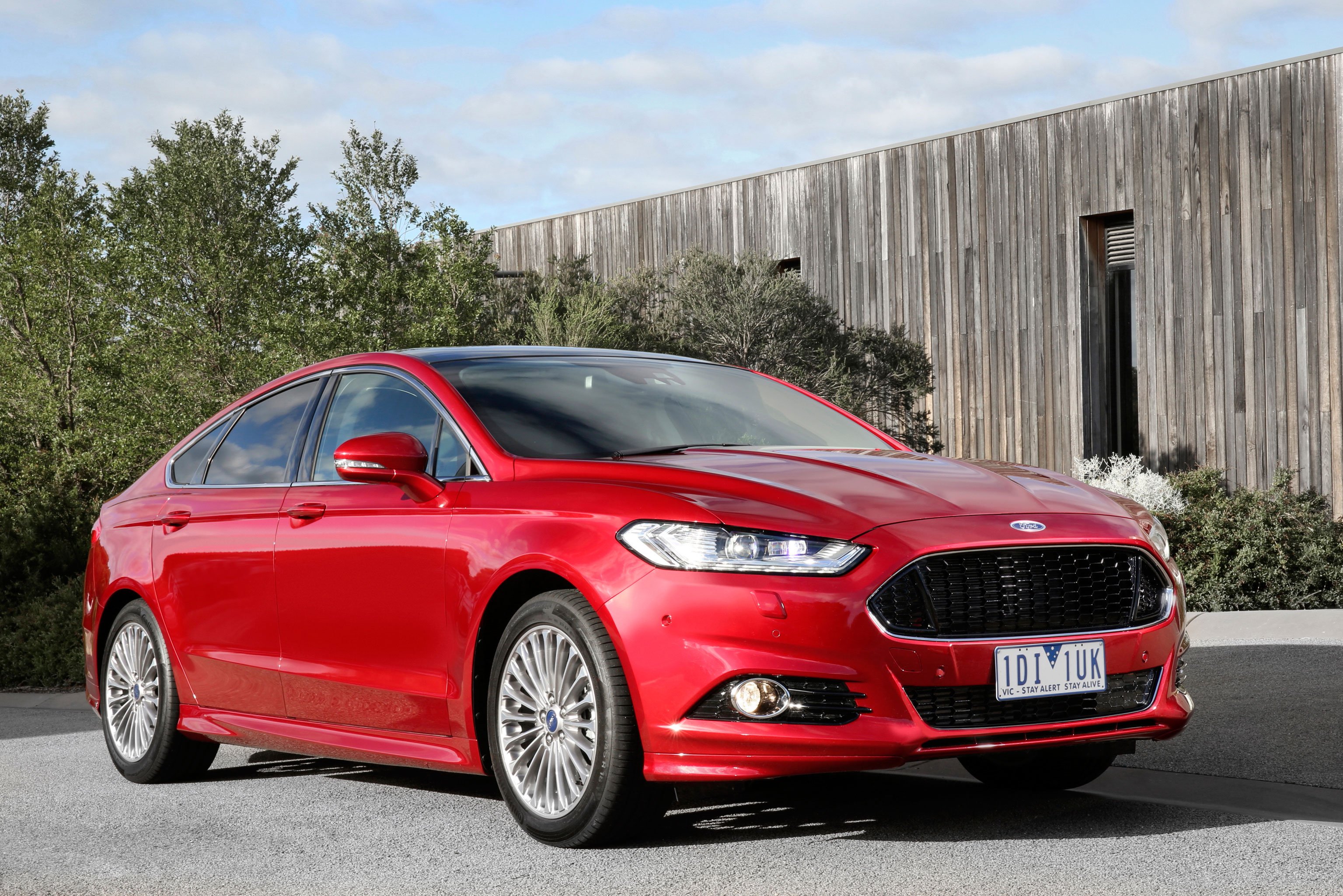
An uprated 177kW 2.0-litre turbo four combines with chubby 235/50R17 tyres and excellent heated leather/Alcantara seats with 10-way power adjustment for both the driver and front passenger to really make Mondeo Trend feel a class above.
Its driving position is brilliant, its seats are enveloping and plush, and its refinement reeks of expense.
Trick gear like adaptive cruise, auto high-beam, active city stop and pre-collision assist with pedestrian protection are simply the icing on the cake of the Trend’s value story.
The flagship $44,290 Titanium focuses more on exterior sizzle than anything else, seeing the mid-level Trend is so chockers with gear. Multi-spoke 18s with Continental rubber, trick LED headlights with striking running lights and very cool sequential indicators, and a dark-coloured mesh grille make the Titanium clearly the looker of the Mondeo crew.
Inside, however, the upgrade isn’t quite so effective. The posh Mondeo gets full leather, a glass roof (with opening sunroof in wagon), techy instruments and blind-spot/lane-keeping assist, among other bits of tinsel, but it doesn’t feel as special as the Trend below it.
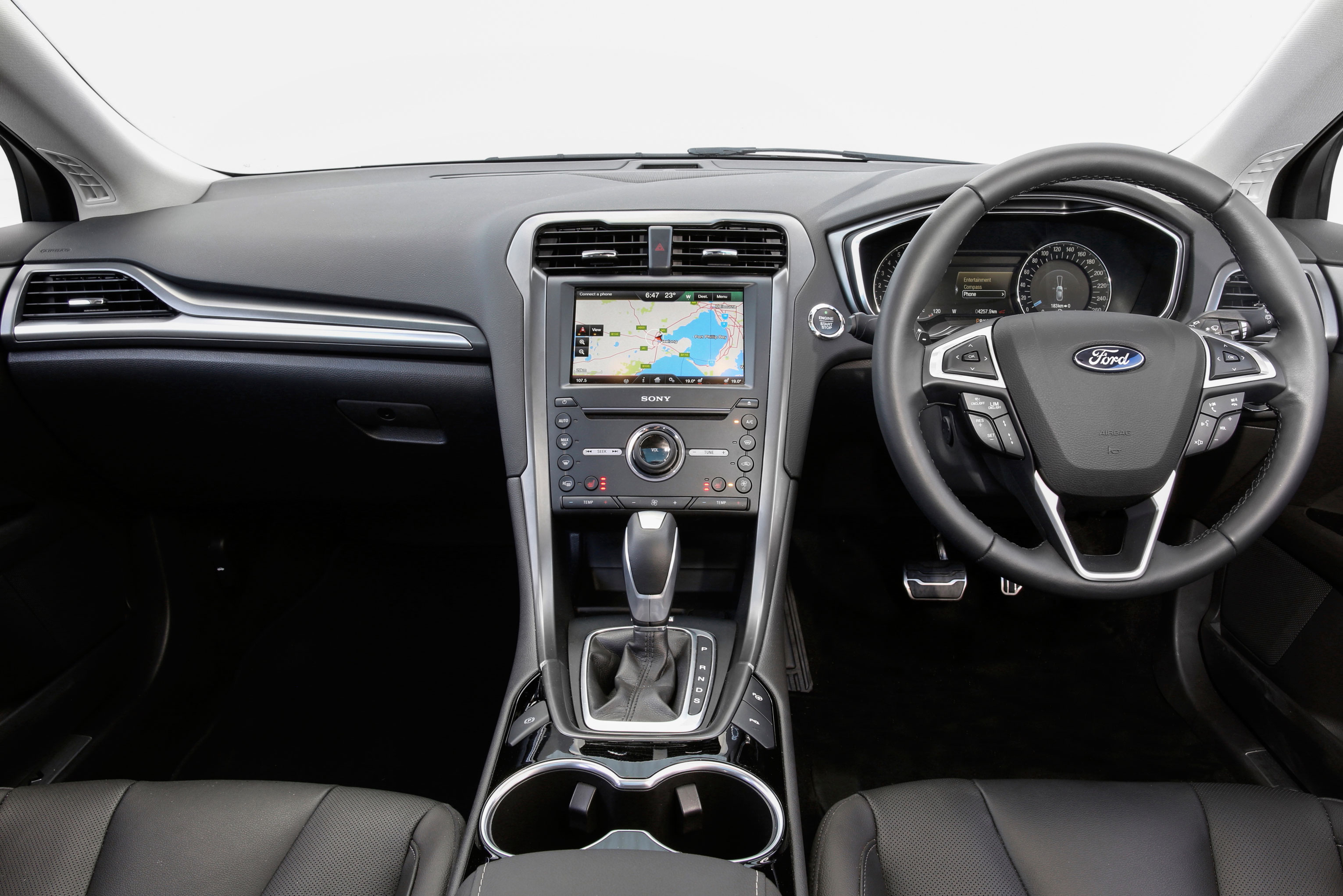
The leather doesn’t quite have the give of the Trend’s perforated Alcantara, so you don’t sink into its seats as nicely. And the change-for-change’s-sake centre stack climate control buttons look like they’re from a cheap Aldi stereo.
Apparently the designers were chasing differentiation, but making the lower half of the trim grey instead of an all-charcoal abyss would have been more effective, and probably cheaper.
Incidentally, Ford Australia has no plans to bring in the Mondeo Vignale, whose bespoke-trimmed two-tone interior with diamond-stitched leather and luxuriously bejewelled exterior were deemed too exxy for Aussies.
What makes a posh interior treatment like the Vignale’s seem worthwhile, though, is the all-round excellence of the Mondeo’s engineering. Within the first 100 metres, it feels a cut above.
The aforementioned driving position serves as a great foundation for the Mondeo’s dynamic excellence, as does its 40 percent-stiffer body. The new car’s dimensions might be similar to its predecessor’s, but it’s all-new from the ground up, with an ‘Integral Link’ multi-link rear suspension set-up designed to absorb bumps more readily, without affecting handling.
And boy does it handle. The cohesion of the Mondeo’s dynamic abilities is deeply impressive.
From the attitude of its body and suspension as you start to apply lock to the positivity of its front end and the corner-enhancing involvement of its excellent rear suspension, the Mondeo feels much smaller than its size and weight would suggest.
Fling it down a twisty road and you’ll revel in its poise and adjustability, guided by an electric steering system that feels hydraulic most of the time.
Ride quality and road-noise refinement are two other new Mondeo hallmarks.
On narrow 215/60R16 Bridgestones, the Ambiente is the quietest and most cossetting of the group, though the Trend’s 235/50R17 Michelins are similarly hushed, yet noticeably grippier, which blends well with its uprated engine.
While the Ambiente’s 149kW 2.0-litre is strong and sweet, there’s something about the muted snarl of the 177kW version that makes it the pick, even though the petrol’s 8.2L/100km fuel claim is well down on the diesel’s excellent 5.1L/100km.
We drove several diesels, including an Ambiente wagon on 17s (hatches get 16s) and an 18in-wheeled Titanium hatch, which is a little noisier than its lesser siblings but scores in the grip department.
While the 132kW/400Nm 2.0-litre turbo-diesel lacks the sparkle of the petrols, it’s a solid engine with decent grunt off the line (8.6sec to 100km/h) and a six-speed dual-clutch ’box that is so slick and positive the car feels like a perfectly tuned regular auto.
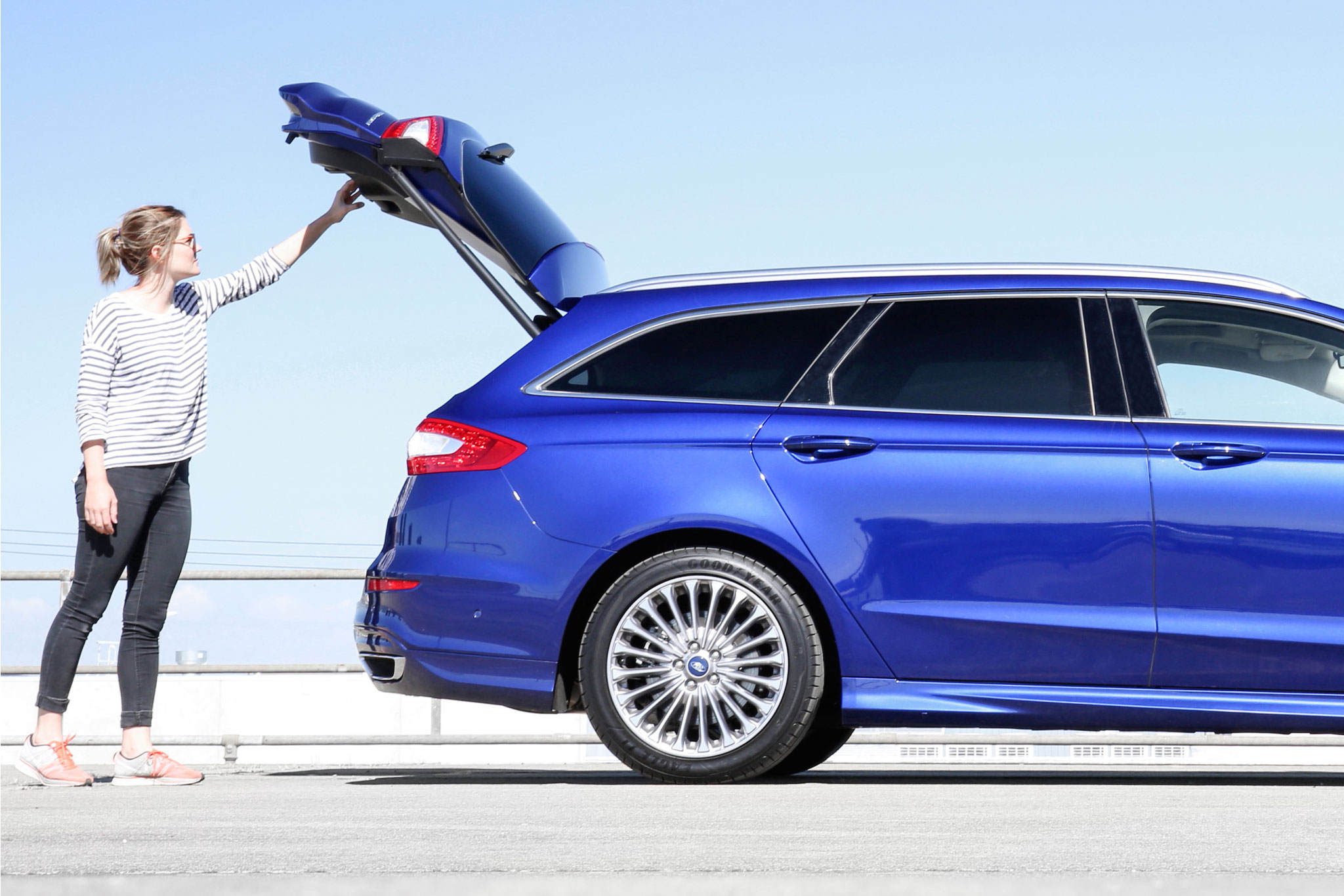
The 54kg-heavier wagon feels equally as dynamic as the hatch, and it gets self-levelling rear suspension to boot, as well as cargo dividers on rails like the Audi A6 Avant. Terrific ESC tune, too, which keeps the car on line in hard driving without spoiling the show.
While two years might be a long time to wait, we think the new Mondeo is well worth it. At the lower end, its excellent refinement, ample space, great seats and superb dynamics make a base Falcon seem virtually redundant, though in XR, Turbo and V8 guises, the home-grown Ford maintains a definite USP.
At Trend level, though, in either body style, the Mondeo deserves to make an impact. In so many ways, it’s all the car most people could ever need.
Model: Ford Mondeo Trend Ecoboost hatch Engine: 1999cc 4cyl, dohc, 16v, turbo Max power: 177kW @ 5400rpm Max torque: 345Nm @ 2300-4900rpm Transmission: 6-speed automatic Kerb weight: 1629kg 0-100km/h: 7.9sec (claimed) Economy: 8.2L/100km Price: $37,290 On sale: May 2015
Sign up here to receive the latest round-up of Wheels news, reviews and video highlights straight to your inbox each week.
What is it?
Mercedes-AMG’s very first example of a right-hook, Aussie-spec GT S super sportscar. And in the fetching, range-topping ‘Edition 1’ trim offered from its July launch.
What’s Edition 1 entail?
Well, for a start, it’s a $19,900 premium over the regular $295,000 GT S, so there’ll two versions available at launch.
Half of the extra Edition 1 goodies are aesthetic and aero enhancements: a more aggressive front fascia design, a natural carbonfibre-finish roof, blackout Exterior Night stylisms, specific 10-spoke rims and a more race-inspired cabin makeover with Nappa leather ‘performance’ seats and a neat Dinamica-trimmed tiller.
The rest of the package essentially hardens up the vibe and handling character somewhat. Electronically controlled damping, aka AMG Ride Control, is fitted as standard on Edition 1.
So is the AMG Dynamic Plus package, which adds a suite of harder-tuned addendum such as firmer spring and damper settings, more negative camber up front, speed-sensitive ‘sports’ steering, dynamic self-adjusting engine and transmission mounts and a Race drive mode to regular trio of Comfort, Sport and Sport Plus settings.
What, no regular GT?
Nope. Mercedes-Benz Oz is doing what all prestige Euro importers do with big-ticket new models: launch with high-spec variants filled with lots of fruit. So both the GT S and GT S Edition 1 get the full monty 375kW and 650Nm from the biturbo 4.0-litre V8, rather than the GT’s 350kW and 600Nm.
While the official line is that there are no plans to bring the GT to Oz, you’d wouldn’t bet against it arriving some time in the range’s lifecycle, perhaps closer to $250K – and 911 Carrera S money – in price.
It’s just a baby SLS, right? Or a bloated SLK?
If you presume so you’re in for a big shock. It’s way better than the SLS it effectively replaces. And not just because it’s a helluva lot more affordable.
When pushed, the SLS could get downright spooky – it was essentially a big, powerful hot rod without a huge amount of poise.
Granted, we only had about ten laps around the Norwell Driver Training circuit, which is a tight, dinky and fairly lumpy track, but the GT S is a sharper, friendlier and more focused sportscar. It feels much better sorted and more resolved when pushed hard.
It’s also offers far too much performance for such a compact and tight circuit, though it was an absolute hoot.
Isn’t it supposed to be Affalterbach’s answer to the Porsche 911?
Sure. And in many ways it is. At 1540kg, it feels light on its feet and a tremendous agility. From how keen it is to track its front end to how well sorted and communicative the interplay is between the throttle and the rear axle, it’s a real AMG high water mark. And seeming taps sports car purity with as much gusto as the finest 911 Carrera.
It’s also quite an intimate driving experience – you steer it with light and accurate inputs rather than chucking it around with white knuckles.
And yet, the GT S is anything but Mercedes-AMG biscuit-cutting a rear-engined Porsche…
How so?
AMG boss Tobias Moers, who was at Norwell for MOTOR’s drive, name-check’s Jaguar’s F-Type Coupe R as a key rival, and after a red hot go at his new steed you can see why.
The GT S still retains that hot rod factor of the SLS, from how it sounds to its rolling punch, to how much swagger and mojo it has at six-tenths, to the glorious view across the sculpted bonnet.
It’s a total feel-good car in a number of areas where 911s can feel a bit lacking. So, yes, it’s got a lot of that Coupe R fire about it, particularly when you kick it in the slats when exiting a corner and the tail end dances around under forced-induced V8 torque.
Ah, yes, the 4.0-litre turbo V8. As heroic as the old 6.2?
Fire the biturbo V8 into life, plant the right foot, snick a couple of paddle-slapping upshifts via the seven-speed twin-clutch transaxle and you’ll almost begin to believe AMG boss Tobias Moers’ bold claim that “nobody will be missing the 6.2.”
It’s a gem of an engine. Somehow, AMG engineers have manage to virtually eliminate turbo lag and, at just 1750rpm, well before its sonorous exhaust bark bellows throughout the cabin, 650Nm has wound up the electronically control diff lock and is doing its best to unglue the fat 295mm rear rubber.
Where the GT S gets hairy-chested is from the mid-corner and corner exit. It doesn’t take much to unglue the rear rubber, though the linearity of the throttle allows a high level of accuracy when doling out the V8’s good with the right foot. There’s so much on tap, though, that you really want to keep the tail tidy before unleashing all of the engine’s herbs.
So how quick it is?
Its maker claims the GT S will dispatch the 0-100km/h sprint in just 3.8sec. We didn’t try launching it hard but it sure feels that quick…if the rear hooks up well enough, that is. V-max is a lofty 310km/h v-max.
So it’s plenty good then?
Put it this way: the victory is that in one package AMG has managed to imbue its new hero with 911-like friendliness, accuracy and precision in driver control with the kind of fiery, lively, ballsy character of, say Jaguar’s F-Type Coupe R. And an arguably more accomplished, multitalented blend than either key rival can muster.
A PCOTY contender then?
Absolutely. And a frontrunner at that.
4.5/5
Specs
Engine: 4.0-litre twin-turbo V8, DOHC, 32v
Power: 375kW @ 6000-6500rpm
Torque: 650Nm @ 1750-4750rpm
Weight: 1540kg
0-100km/h claim: 3.8sec (claimed)
Top speed: 310km/h (claimed)
Price: $314,900
Get your free weekly report from the world of fast cars – subscribe to the MOTOR newsletter!
Prancing Horse power for Alfa Romeo as it announces the powerplants that will kick off its brand renaissance as a genuine sporting brand
THE dream of turning Alfa Romeo into Germany’s nightmare grew a little more realistic this week, when Fiat Chrysler Automobiles boss Sergio Marchionne announced manufacturing plans for two new high-power engines. The “advanced, high-output four-cylinder” and “Ferrari-derived six-cylinder”, both specifically developed for FCA-owned Alfa Romeo, will go into production later this year at the group’s Termoli plant in southern Italy. More than €500 million ($692 million) is being invested in designing and developing the engines, and constructing new production lines for them.
“This high-tech project is an integral part of our bet on Alfa Romeo,” Marchionne told Termoli’s employees on Wednesday. This is a hefty chunk of the €5 billion ($6.92 billion) FCA plans to invest in reversing the once famed, now failing, brand’s fortunes. The aim is to increase Alfa’s global sales, currently well south of 100,000 a year, to 400,000 by 2018. Eight all-new models are scheduled for launch between now and then.
Alfa Romeo is saying nothing official, but reliable and well connected Italian media have revealed details of the two engines. The four will be an in-line 2.0-litre with direct injection, and Fiat’s clever MultiAir variable valve timing and lift technology. With outputs ranging from 130kW to 240kW, it’s obviously also turbocharged.
The larger engine will apparently be an adaption of the twin-turbo 3.0-litre V6 currently manufactured by Ferrari at Maranello for the Maserati Ghibli and Quattroporte. It’s not certain whether the engine’s capacity will be slightly reduced for its Alfa Romeo role, but Italian sources report it will deliver up to 350kW.
There’s no doubt about the new engines’ first destination. They will both be seen in the Alfa sedan to be officially revealed near Milan on 24 June. This car will utilise the all-new rear- and all-wheel drive architecture being developed to tight deadlines in a specially set up Skunk Works near Modena, close by the headquarters of both Maserati and Ferrari.
This car is currently known as “Project 952”, according to Italian media. Though frequently referred to in the past as “Giulia”, it’s not certain the historic name will be applied to the D-segment four-door. Alfa Romeo North America boss Reid Bigland told journalists at the recent New York International Auto Show that the decision was still being discussed.
But Bigland did promise the unnamed Alfa would deliver better model-for-model performance than rivals like the Audi A4, BMW 3 Series and Mercedes-Benz C-Class. “I’m confident that it’s going to blow your Italian socks off when look at the specifications associated with this vehicle,” he told Automotive News.
Production of the new engines at Termoli is scheduled to begin in October, and the most important Alfa in ages will start rolling off assembly lines soon afterwards. While sales should begin in Europe before the end of this year, the car won’t reach Australia until sometime after its first-quarter 2016 intro in the important North American market.
Next up from Alfa will be a compact SUV, currently known only as “Project 949”. Sharing much of its technology with the new sedan, this model is intended to compete with the Audi Q5, BMW X3 and Porsche Macan.
Some commentators are saying we’re entering a new golden age of performance cars.
Looking at the line-up of metal in our May issue, it’s difficult to argue with that statement; here’s what you’ll read about this month
– Exclusive first drive of the brilliant Porsche Cayman GT4
– Full report from the international launch of the Mercedes-AMG C63
– Then we pitch it against its main rival, the BMW M3, in a world exclusive comparison test
– Back on local soil, we grab three $50K contenders for a classic front vs rear vs all-wheel drive battle
– We are granted rare access into TRD’s secret Japanese warehouse, containing some of its most famous race cars
– After 10 years of production, it’s goodbye to the Bugatti Veyron, and we also take a look at its oft-forgotten predecessor, the EB110
– All this plus first drives of the Porsche 911 GTS, Alfa Romeo 4C, Caterham 485 and all our regular features
Available now at all good retailers, and for digital fans, don’t forget you can now buy MOTOR through iTunes or Zinio from just $3.75 an issue! Bargain!
Get your free weekly report from the world of fast cars – subscribe to the MOTOR newsletter!
