
Note: It’s important to remember that the details below are per the BZ4x’s 2021 debut. The Australia car, possibly updated for the 2024 model year, may bring improvements. Time will tell.
Ineos will continue to offer petrol and diesel powered vehicles in parallel with zero-emissions options to cater for global regions that are unable to transition into pure electric transport.
In response to growing numbers of governments chalking end dates for petrol and diesel vehicles, many European brands have signalled the end of combustion power in their ranks. Startup off-road vehicle manufacturer Ineos however, is planning a different future.
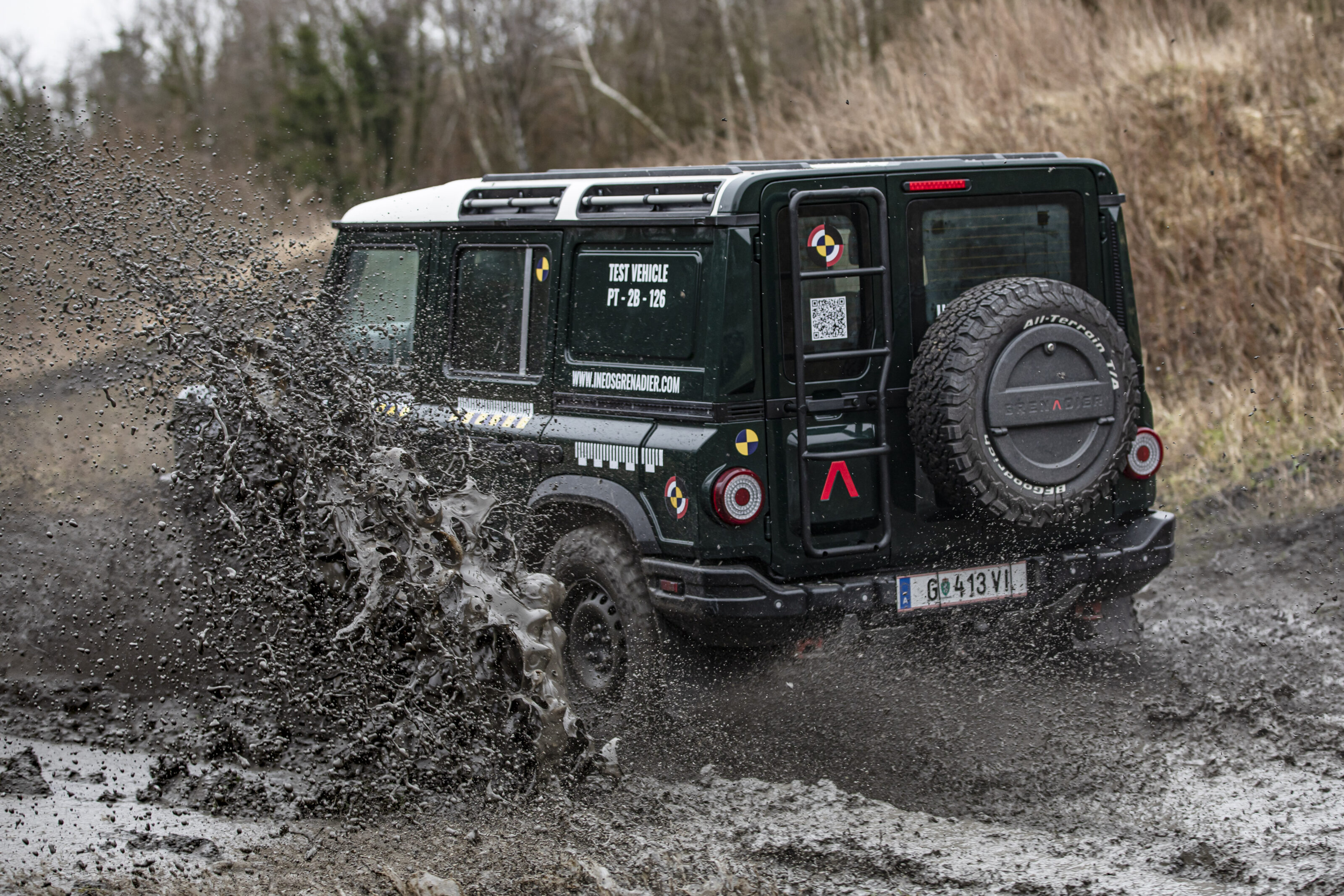
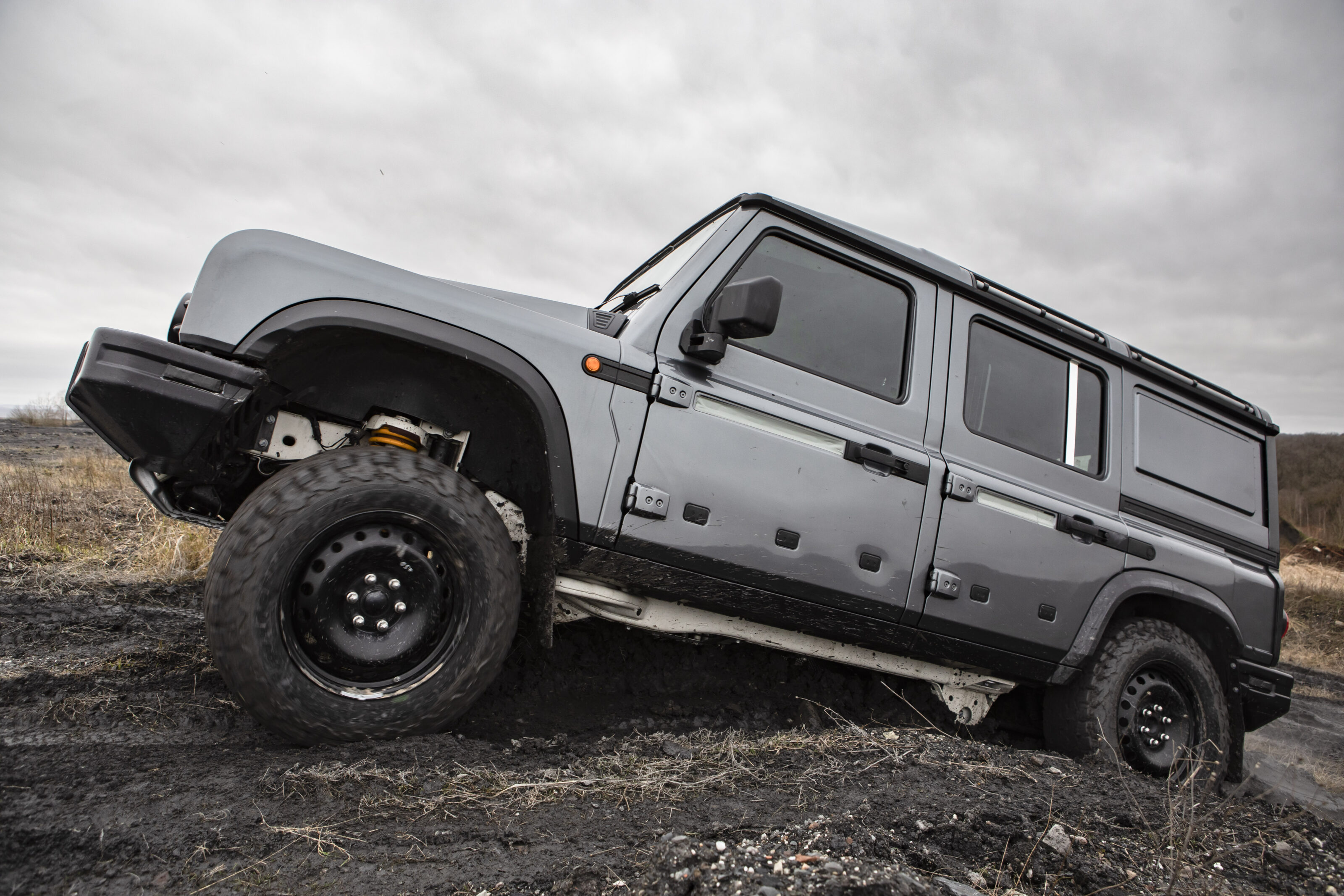
While the British brand will also soon offer an electric vehicle under the Ineos name, the company sees an important role and market for models like its Grenadier large SUV, which is powered by BMW six-cylinder petrol and diesel engines.
1
Speaking at the international launch of the Grenadier, Ineos Automotive’s commercial director, Mark Tennant, explained that the decision to persevere with internal combustion engines was not a matter or ignoring the inevitable, but a calculated strategy to meet a specific demand.
“This is not us being antediluvian or luddites in terms of progress because clearly we’re all driving towards zero emissions, but you’ve got to ask what are people going to use other than really old cars in some of these places where people are still going to need to put a fossil fuel in the tank.”
Mass-market vehicle technology continues to accelerate in all areas beyond drivetrains and emissions, and Tennant pointed out that many of these cutting-edge technologies are irrelevant in the same areas that are currently unable to support electric vehicle use.
1
“What we’ve tried to do with this vehicle is what other manufacturers are doing less and less of – trying to build a vehicle for the world,” he said. “You get a divergence because of active safety, driver assistance systems, emissions, technology development and rightly so.
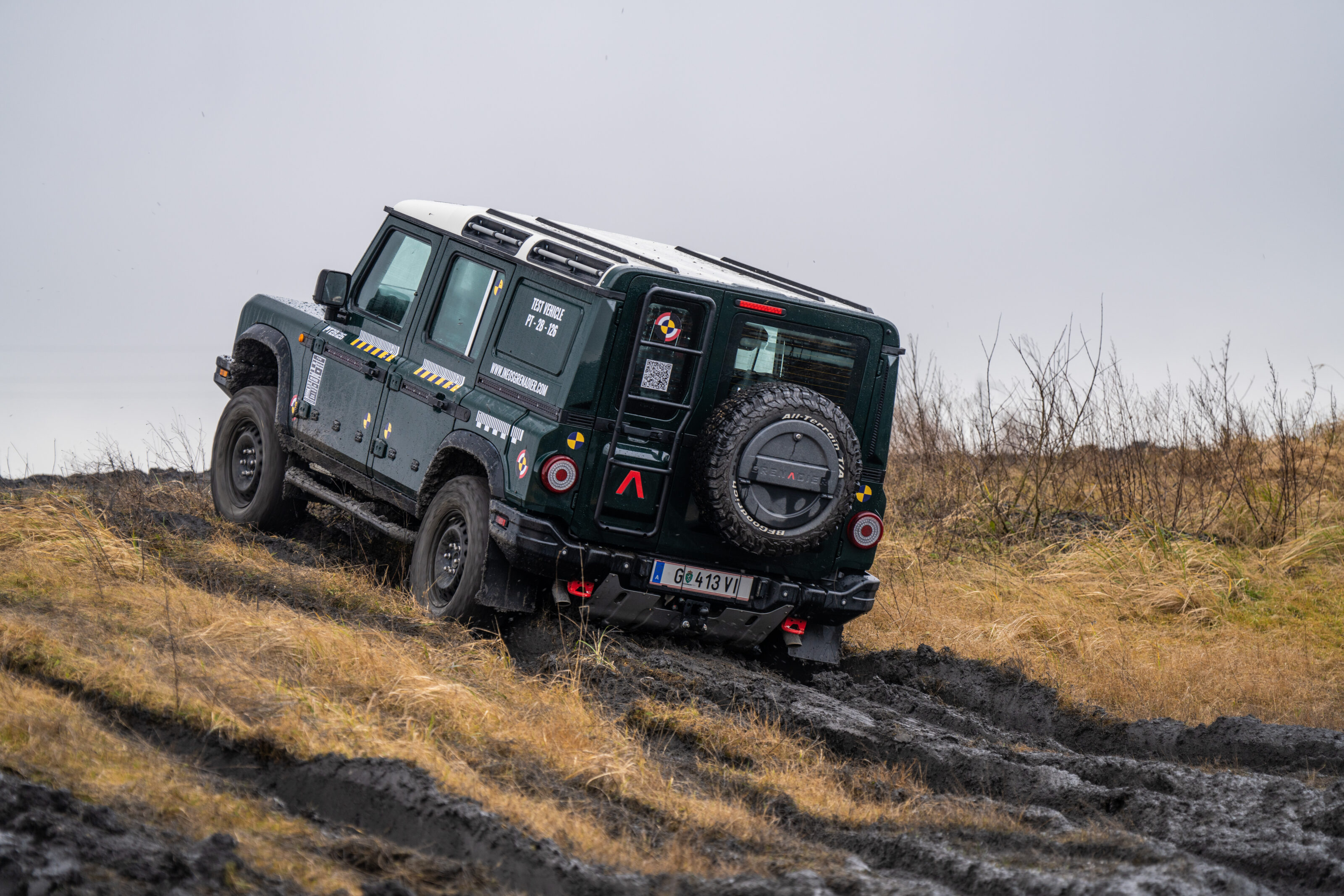
“But some of those things are not going to be so relevant if you’re operating in the middle of the Australian outback or West Africa. Lane-departure warning is probably secondary to those markets and the same goes for powertrain development because you need to get back as well as out.”
Conversely, the company has already presented a hydrogen fuel-cell powered prototype version of the Grenadier, showcasing a more sustainable version of its pilot model, but its first model is already gaining significant interest due to its BMW petrol and diesel six-cylinder engines.
1
With its combustion-powered offering, Ineos is working hard to satisfy customers in challenging environments and considering the next move if BMW pulls the pin on combustion engine production.
“We’re working with BMW now, but we’re also thinking about what we might be able to come up with that would take us in rest-of-world markets beyond the end of internal combustion engines in Europe,” said Tennant.
“The other segment is definitely corporate fleet and that includes government vehicles and such like. If we can come up with something that works for those sorts of customers I think that will take us beyond.”
1
Ineos’s attitude toward combustion power is similar to Ford’s, which has previously confirmed it too would continue developing and offering petrol and diesel-powered models for regions that are unable to transition to electric.
While the Blue oval has already launched three pure-electric models in developed countries around the globe, Ford CEO Jim Farley shares the Ineos belief that complete transition to electric would leave many communities with significant transport problems.
“Everyone wrote the story that EVs are the next cycle of our industry, but it’s not that simple really,” Farley said. “There are different customers who want different things, they have different duty cycles and there are 100 million vehicles sold in the world.”
1
So while many global brands are forecasting the end of petrol and diesel, Ineos sees it as an integral part of its emerging lineup and as a solution to challenging markets both in Australia and overseas.
“We can get very wrapped up in the parochial and the close to home and ‘where do I go for my (Tesla) Supercharger?’ At least we’ve got a choice, but some of these places that is not going to be there for decades,” concluded Tennant.
Chances are you’ve already made a few assumptions about the Audi E-Tron GT. This is the sister car to the Porsche Taycan and it shares the same bespoke J1 platform, the same 800-volt architecture (which allows for ultra-fast charging), and uses the same battery and e-motor tech.
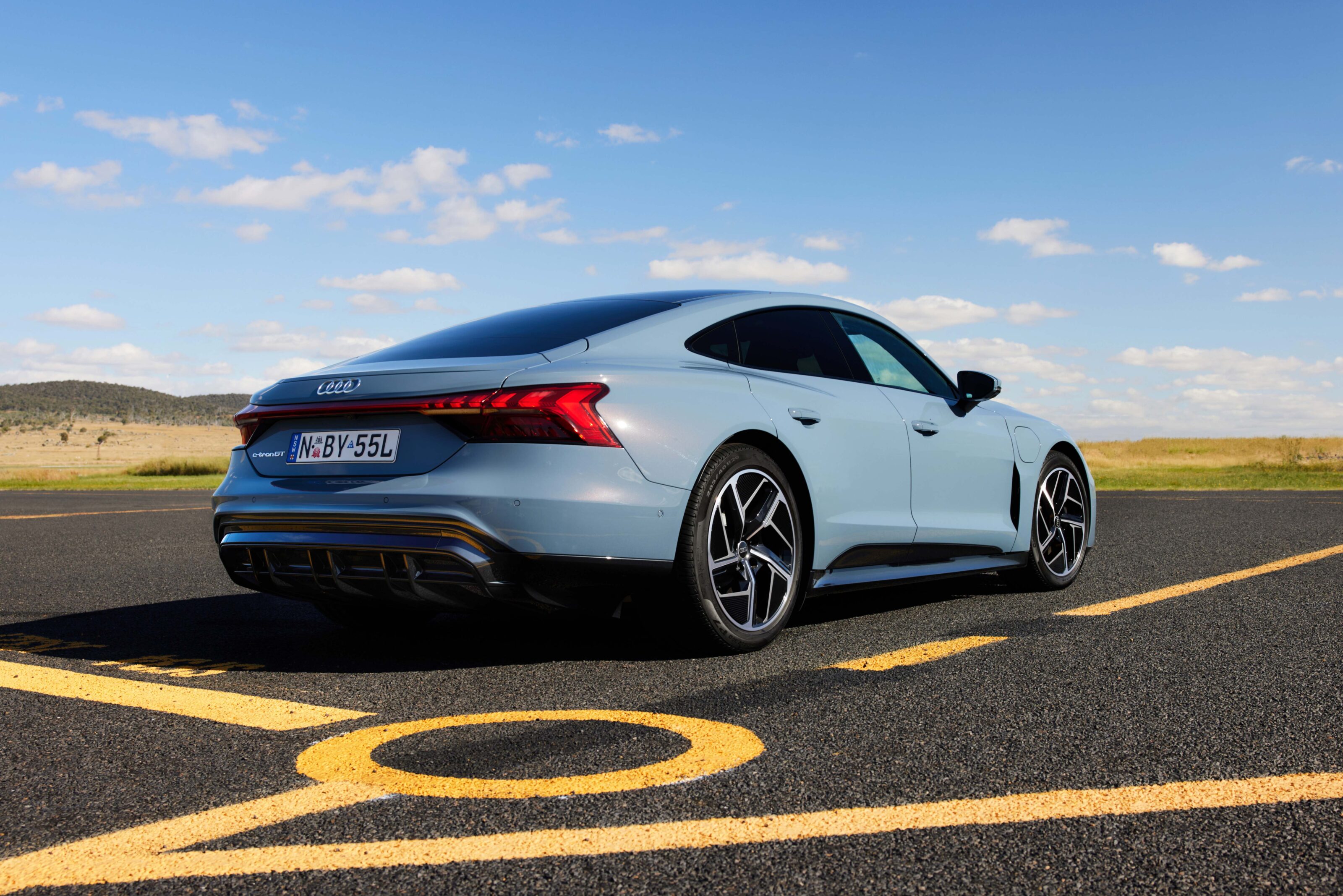
It’s tempting, then, to think of Audi’s new electric flagship as simply a Taycan draped in a fresh, and rather fetching, Hugo Boss suit. Quite the looker, isn’t it?
But for all their similarities, there are some key differences. The first is that unlike the Porsche, which has a wider spread of variants and bodystyles, the Audi is only available here in two variants: a base E-Tron GT or a more powerful and more richly equipped RS E-Tron GT flagship.
The second difference is more significant.
1
Where the Porsche has a strong focus on performance and dynamics, Audi’s engineers have deliberately made their car more of a grand tourer.
Ride comfort and silky handling were top priorities and this hasn’t only given the E-Tron GT a personality all of its own, it’s arguably made Audi’s take on the silent super sedan the smarter pick. Yeah, we weren’t expecting that one either…
Audi calls the E-Tron GT its new ‘brand shaper’ (a role previously held by the R8 supercar), meaning it gives us a glimpse at where Ingolstadt sees itself heading. And now, after a multitude of delays, it has finally arrived in Australia. We drove it on some of Australia’s best roads in the New South Wales high country to see if it can live up to the hype.
1
JUMP AHEAD
- How much is it, and what do you get?
- How do rivals compare on value?
- Interior comfort, space and storage
- What is it like to drive?
- How much energy does it use?
- How fast can it charge?
- How safe is it?
- Warranty and running costs
- VERDICT
- Specifications
How much is it and what do you get?
There are two versions of the Audi E-Tron GT available in Australia.
The range kicks off with the ‘entry-level’ E-Tron GT which starts at $180,200 before on-road costs and has a claimed NEDC range of 540km.
Its twin electric motors produce a healthy 350kW/630Nm but if you engage a ‘boost mode’ function, those outputs jump to 390kW/640Nm for short 2.5-second bursts. In boost mode, the E-Tron GT can hit 0-100km/h in 4.1 seconds.
The flagship RS variant ups the ante considerably. Priced at $248,000 before on-road costs, it produces 440kW/830Nm in regular driving or 475kW/830Nm with boost mode engaged. That makes it the most powerful production Audi ever.
1
The basics
| Audi E-Tron GT | Audi RS E-Tron GT | |
|---|---|---|
| Power | 350kW (390kW in boost mode) | 440kW (475kW in boost mode) |
| Torque | 630Nm (640Nm in boost mode) | 830Nm |
| Transmission | 2-speed automatic | 2-speed automatic |
| Body | 5-door, 5-seat large sedan | 5-door, 5-seat large sedan |
| Driving range | 540km (NEDC) | 504km (NEDC) |
| Boot space | 405L boot + 81L frunk | 350L boot + 81L frunk |
| Price | $180,200 + on-road costs | $248,200 + on-road costs |
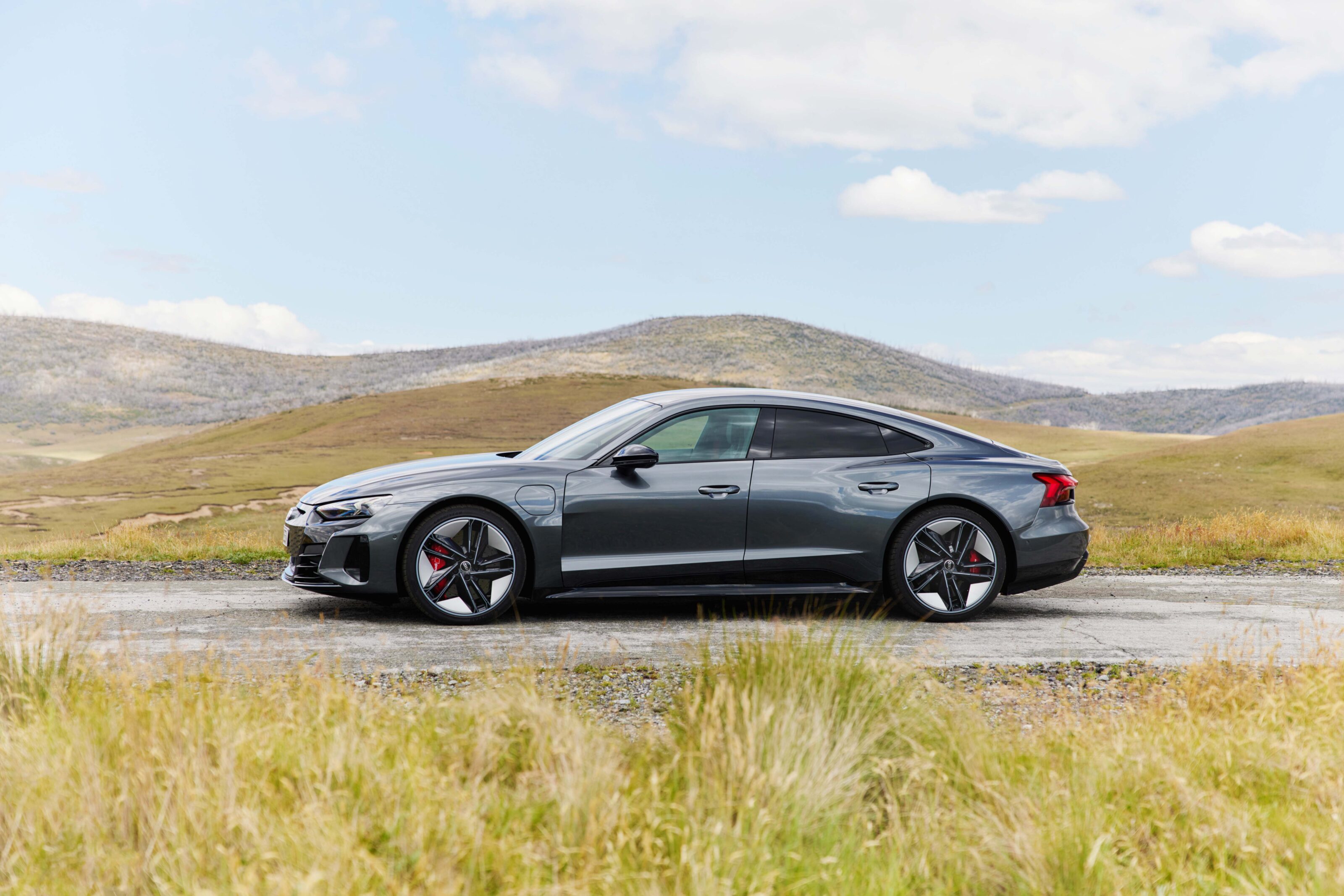
It can rocket from 0-100km/h in a supercar-baiting 3.3 seconds and is armed with a host of additional chassis hardware like all-wheel steering, which can turn the rear wheels to a maximum of 2.8 degrees, tungsten-carbide brake discs, larger 21-inch alloys and an E-Quattro sport differential.
A downside to the RS version’s extra performance is a drop in range, with its NEDC claim rated at 504km. Still, despite its extra expense and shorter range, Audi expects the RS to make up the majority of E-Tron GT sales in Australia.
2
Both versions of the E-Tron GT are all-wheel drive and powered by the same 93kWh battery pack (that’s gross; usable capacity is 84kWh). They also both feature a two-speed gearbox on the rear axle, have five seats and hit the scales at around 2300kg. Three-chamber air suspension that can adjust the ride height depending on your drive mode is also standard across the range in Australia.
As you’d expect given the E-Tron GT’s flagship positioning, the level of standard equipment across both models is impressive and includes:
| 023 Audi E-Tron GT standard features | |
|---|---|
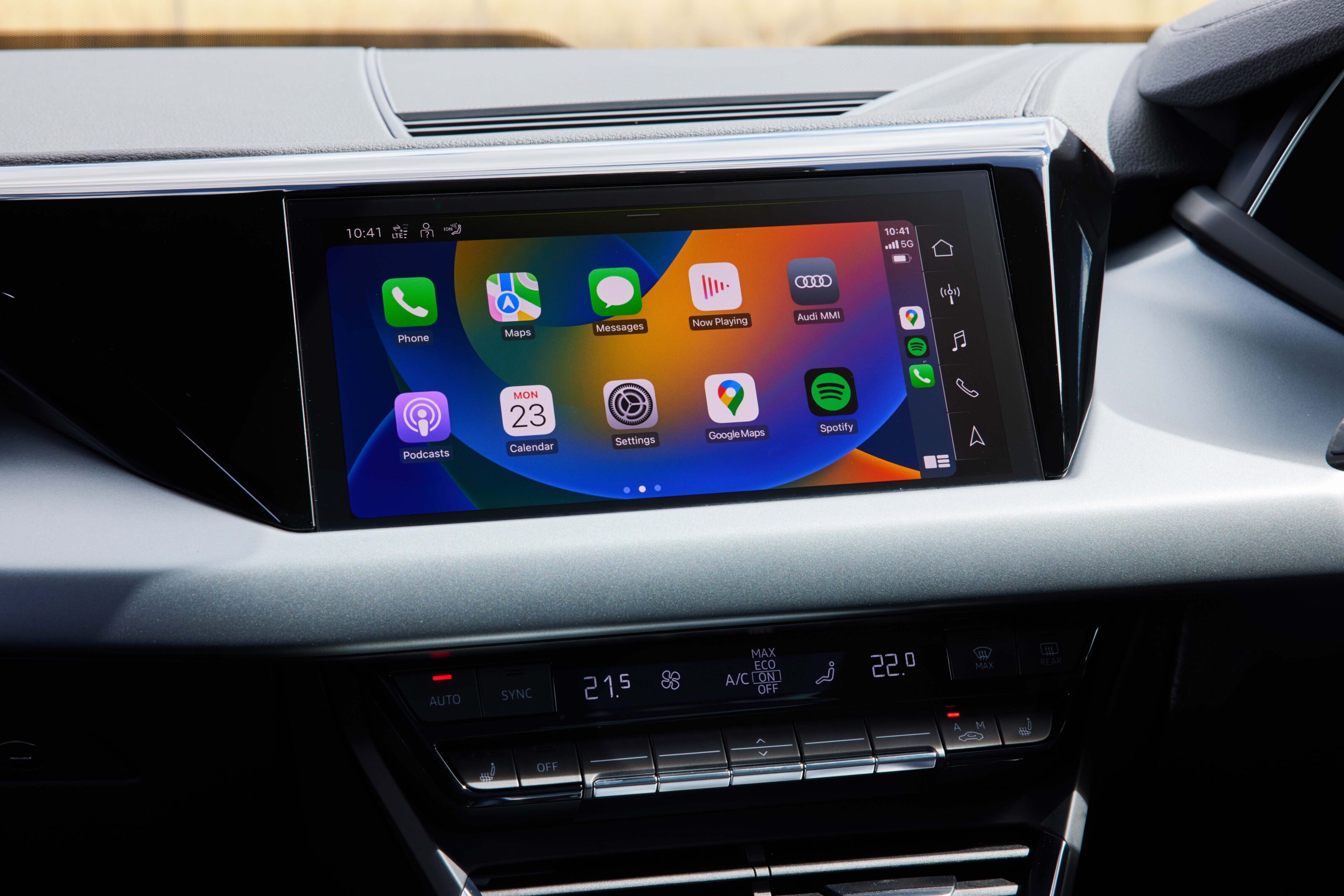
| 10.1-inch infotainment screen | Matrix LED headlights |
| 16-speaker Bang & Olufsen audio | Panoramic sunroof |
| DAB+ digital radio | Satellite navigation |
| Head-up display | Tri-zone climate control |
| Heated leather sports seats | Wireless Apple CarPlay & Android Auto |
1
Stepping up to the RS adds an even richer list of standard equipment, headlined by:
| 2023 Audi RS E-Tron GT features | |
|---|---|
| Black exterior styling package | Nappa leather upholstery |
| Carbon-fibre inlays | Privacy glass |
| Heated sports steering wheel | RS E-Tron sport sound |
| Heated/cooled RS sports seats | Stainless steel pedals |
The battery tech that powers both versions of the E-Tron GT is quite clever.
The pack itself is made up of 33 cells, so should one fail they can each be replaced individually.
Audi’s engineers have even altered the battery’s design to improve rear passenger room. Two sections of the battery pack have no cells to provide a dip in the floor and increase rear foot room.
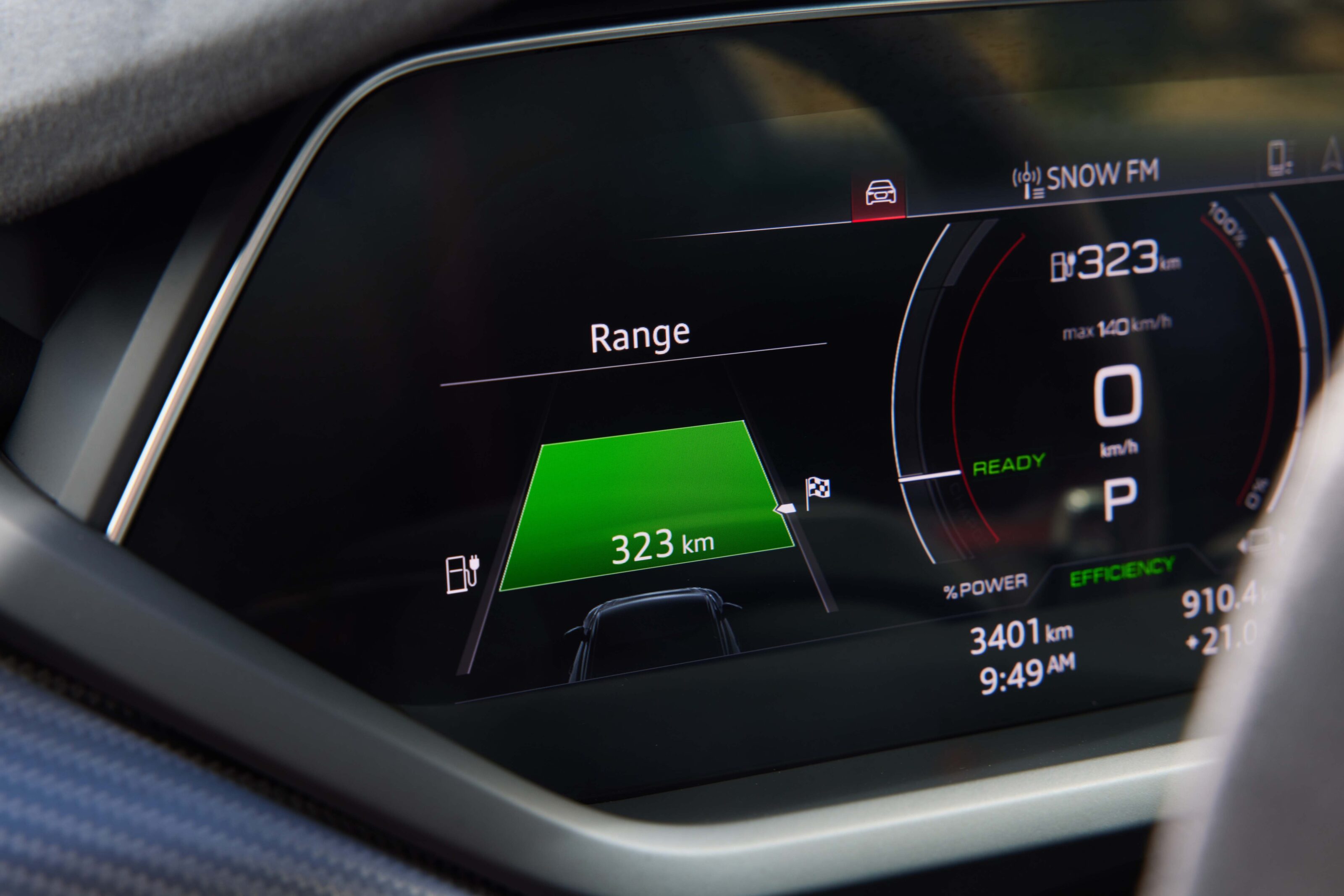
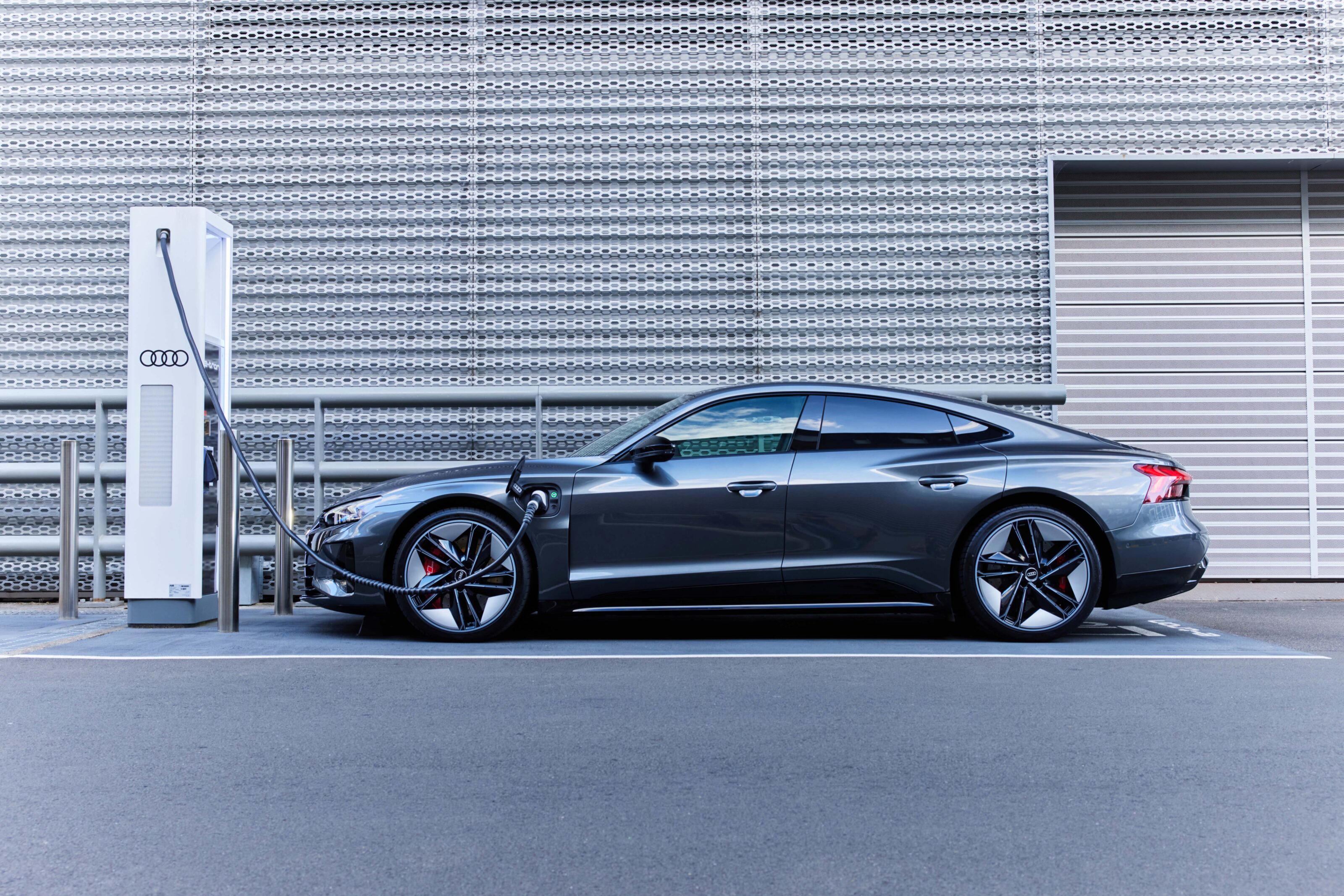
Because the E-Tron GT is built around an 800-volt architecture it can accept ultra-fast DC charging up to 270kW, meaning that if you can find a charger fast enough (and one that’s in working order), you can top up the battery from 5-80 per cent in 22.5 minutes.
1
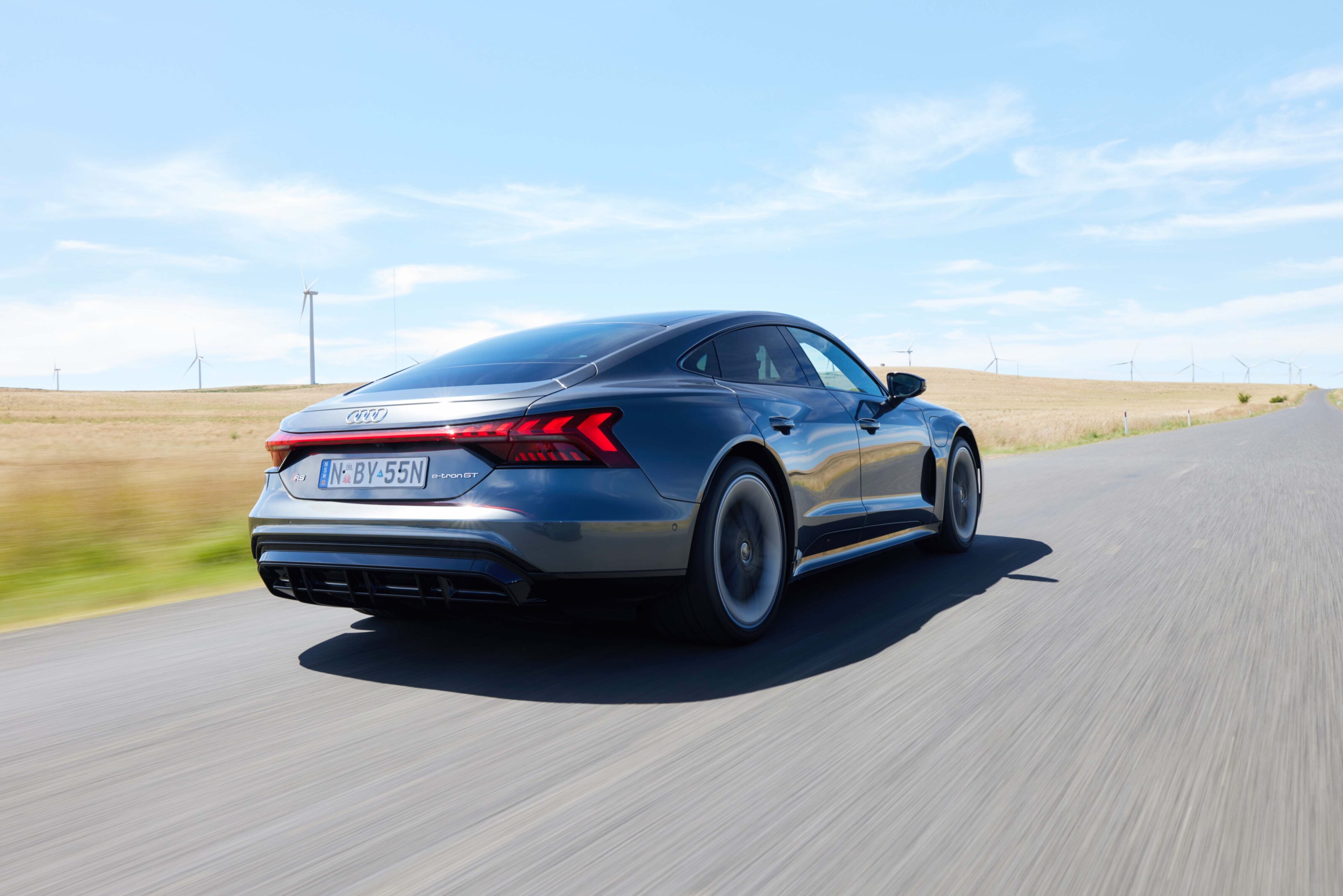
Size-wise, the E-Tron GT has a similar form factor to an RS7 but it’s a smidge shorter and a touch wider. Further enhancing that sense of width are the flared wheel arches which Audi says are the most pronounced of any production model it has ever made.
A final point to consider when it comes to value is that Audi has worked hard to deliver what it calls “the best EV ownership scheme in the industry”. Every E-Tron GT comes with six years of free servicing, six years of free charging via the Chargefox network and six years of complimentary roadside assistance.
Installation of a 7.2kWh wallbox charger in your home is also complementary and if customers prefer a 22kW charger on three-phase power, they’re simply required to pay the difference rather the shelling out for the more powerful charger.
1
How do rivals compare on value?
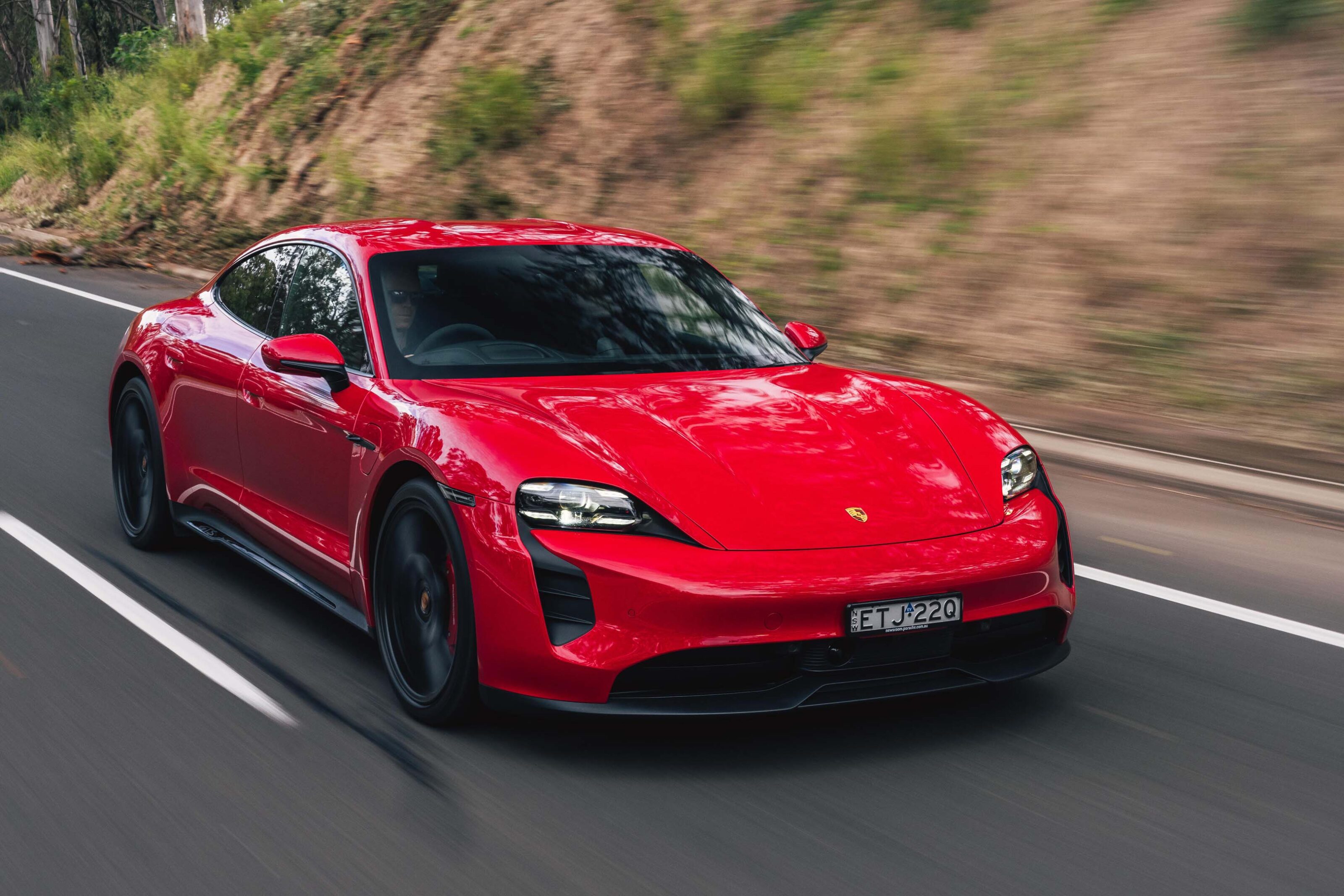
Line the E-Tron GT up against a Porsche Taycan and it compares favourably.
While the Porsche does offer a less expensive, rear-drive model, to get an equivalently powerful and all-wheel drive version of the Taycan you’ll need to spend around $20,000 more over a ‘base’ E-Tron GT.
That will score you a Taycan 4S, but the Porsche also comes with a smaller 79kWh battery as standard, meaning you’ll need to fork out an additional $11,590 to secure the same 93kWh battery and range as the Audi.
A Taycan 4S has a slightly smaller boot, too, and it only carries a three-year warranty compared to the Audi’s five-year coverage period.
1
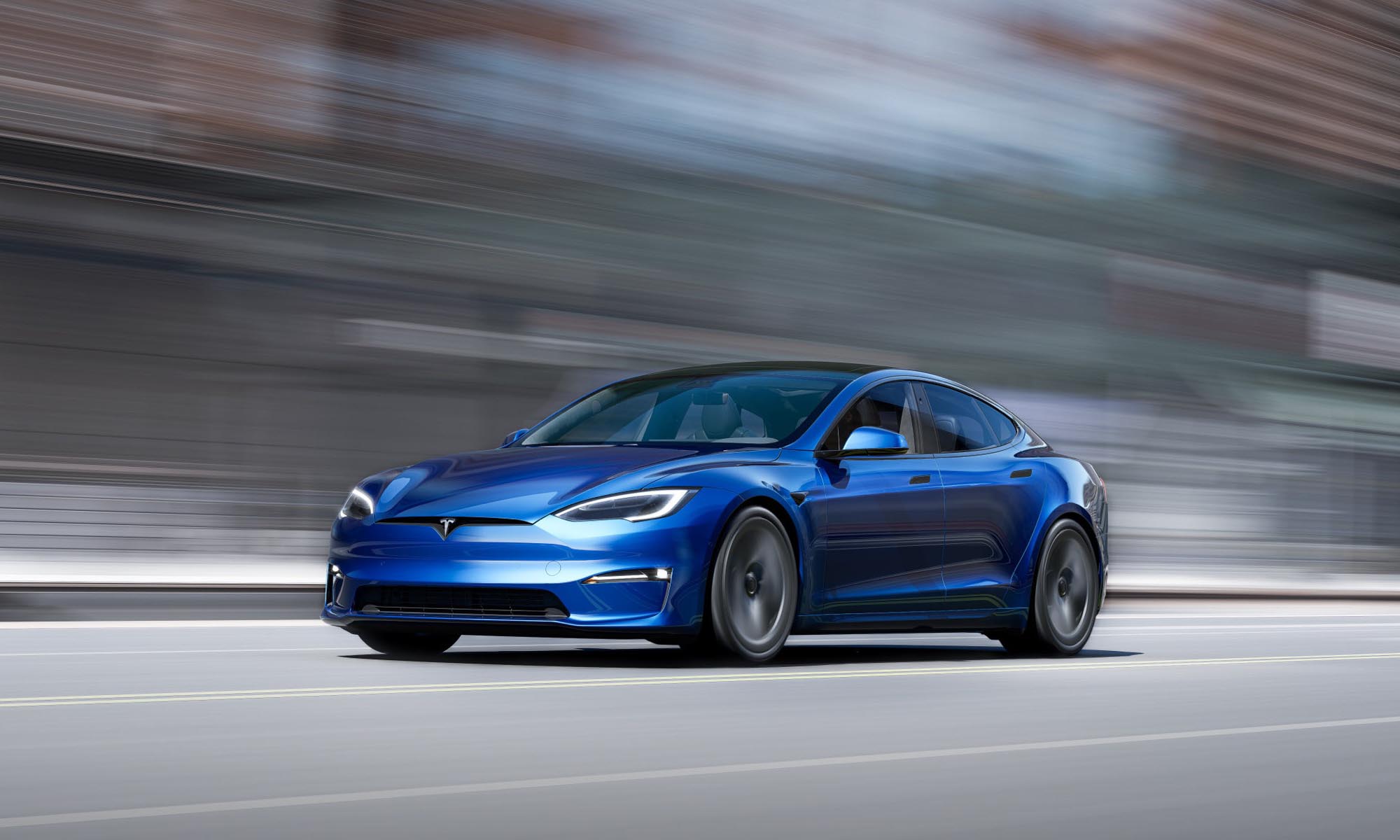
Another logical rival is the Tesla Model S Plaid, given it offers more range and even more performance for similar money but the Model S hasn’t been available for purchase in Australia since December 2021.
The Kia EV6 GT is an interesting, left-field alternative. While it can’t compete with the Audi for interior presentation, exterior design execution or outright handling, Kia’s performance-focused flagship EV6 is considerably more powerful than a base E-Tron GT thanks to outputs of 430kW/740Nm and it can hit 0-100km/h in 3.5 seconds.
Kia’s new flagship also offers ultra-fast charging thanks to its 800-volt architecture, has a roomier cabin, boasts a seven-year warranty and undercuts the cheapest E-Tron by a hefty $80,000.
1
Interior comfort, space and storage
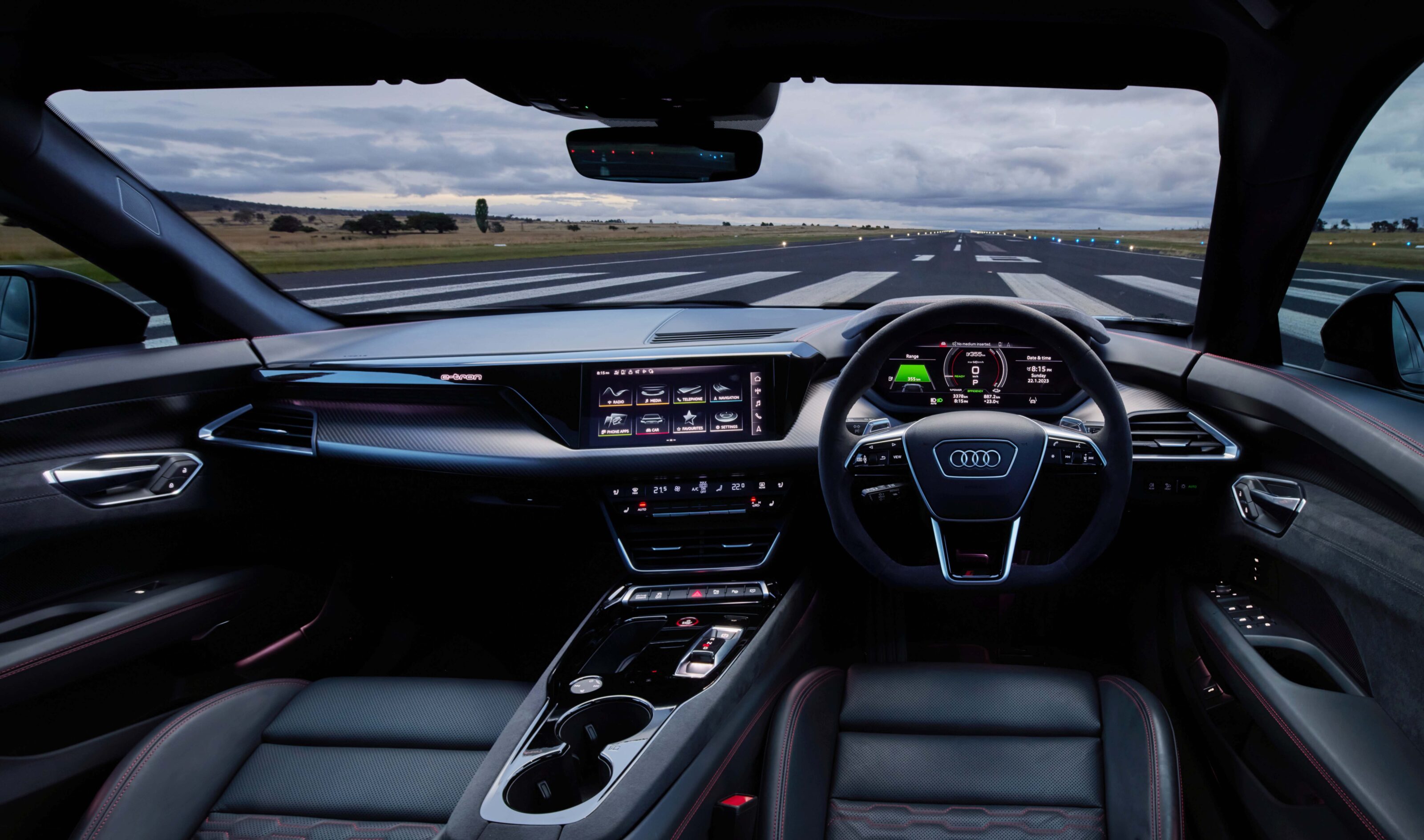
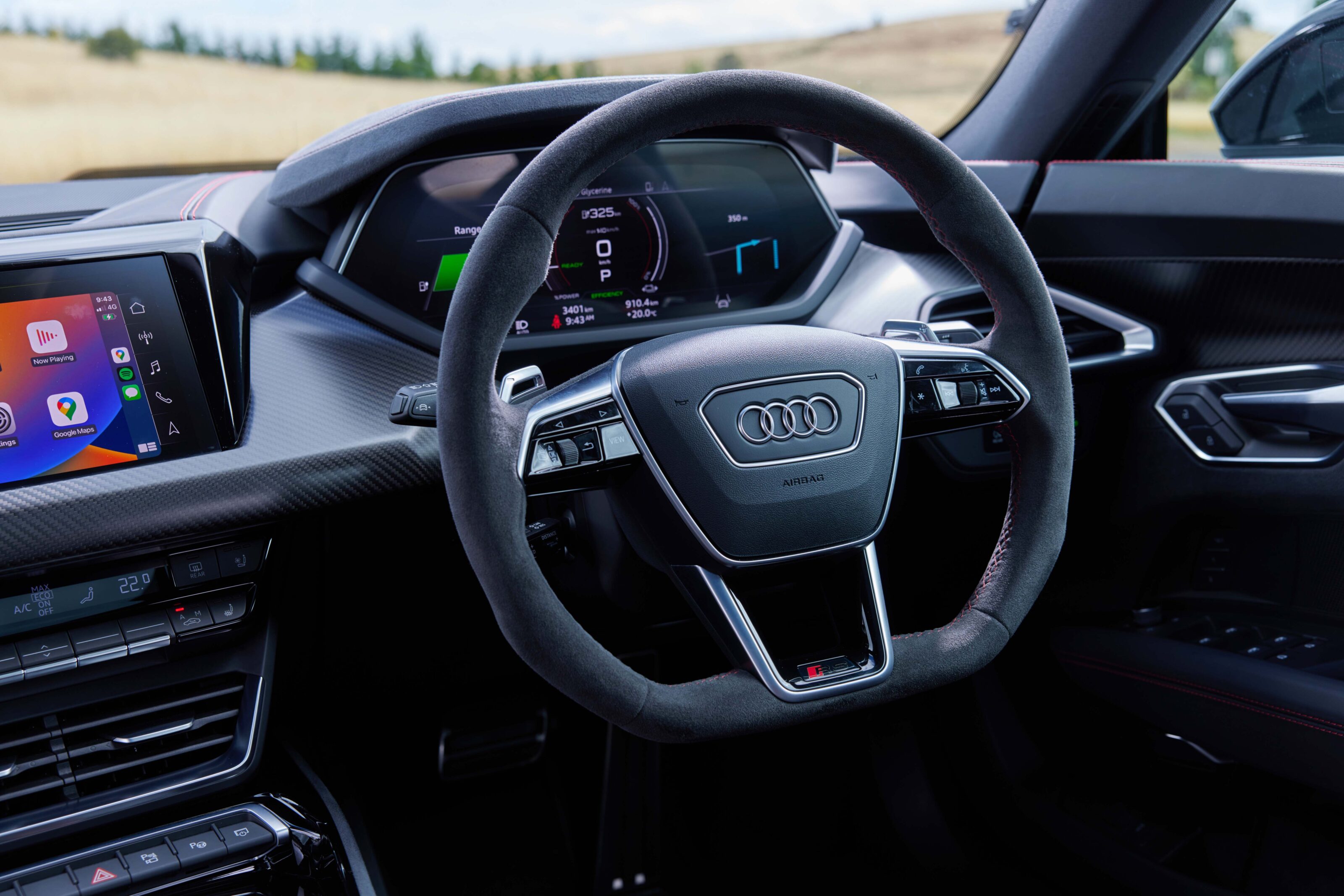
Audi makes some of the world’s best car interiors and the E-Tron GT is no exception.
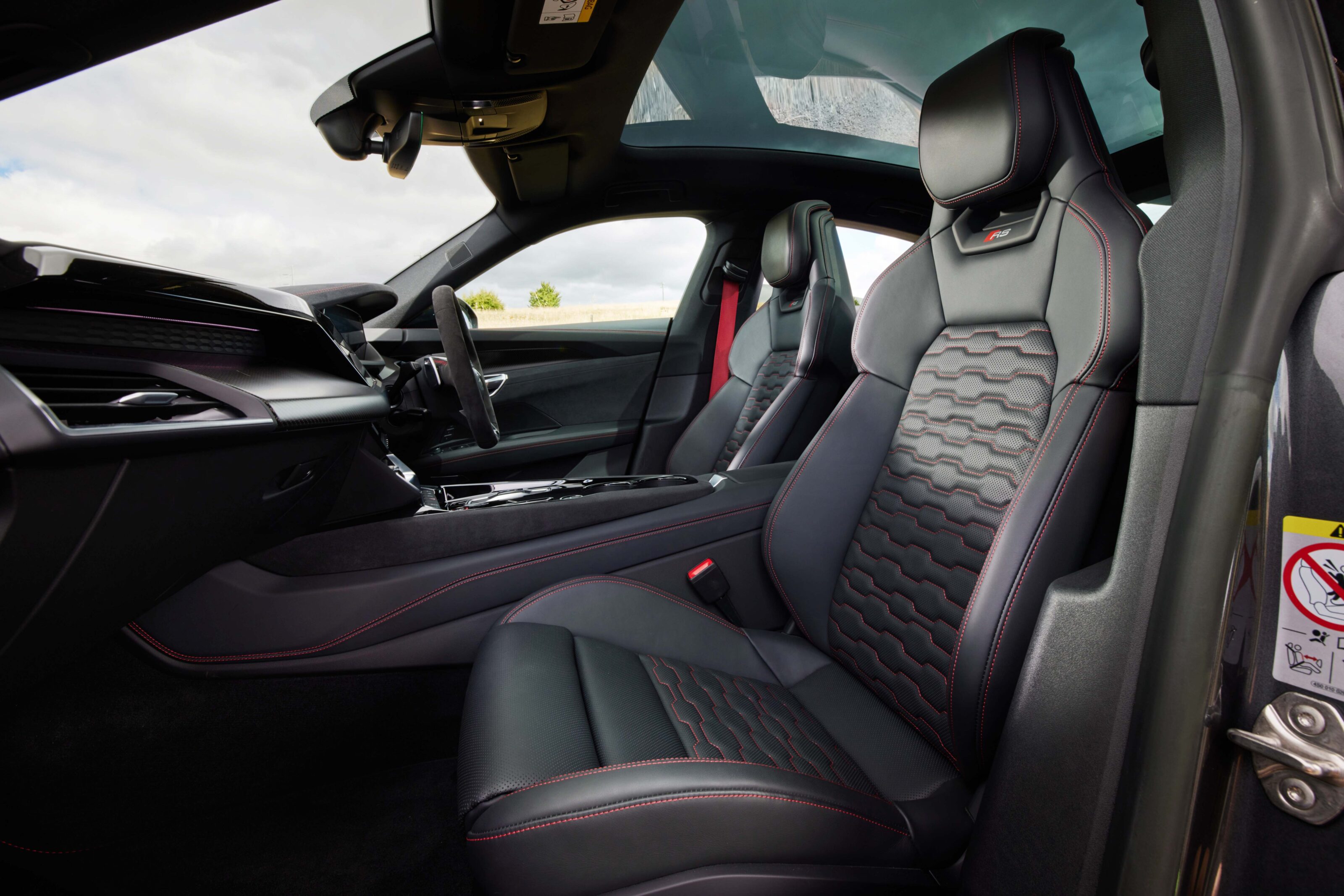
Slip inside and you’re greeted by a low driving position and a high-end cabin that feels remarkably familiar in its layout and execution. That’s quite deliberate.
Unlike some rivals that strive to impress with glitzy and bravely designed cabins that require a steep learning curve to operate, Audi wanted the interior of the E-Tron GT to be user-friendly. The result is a cabin that feels modern and cutting-edge but supplements its large digital displays with actual physical buttons (hooray!).
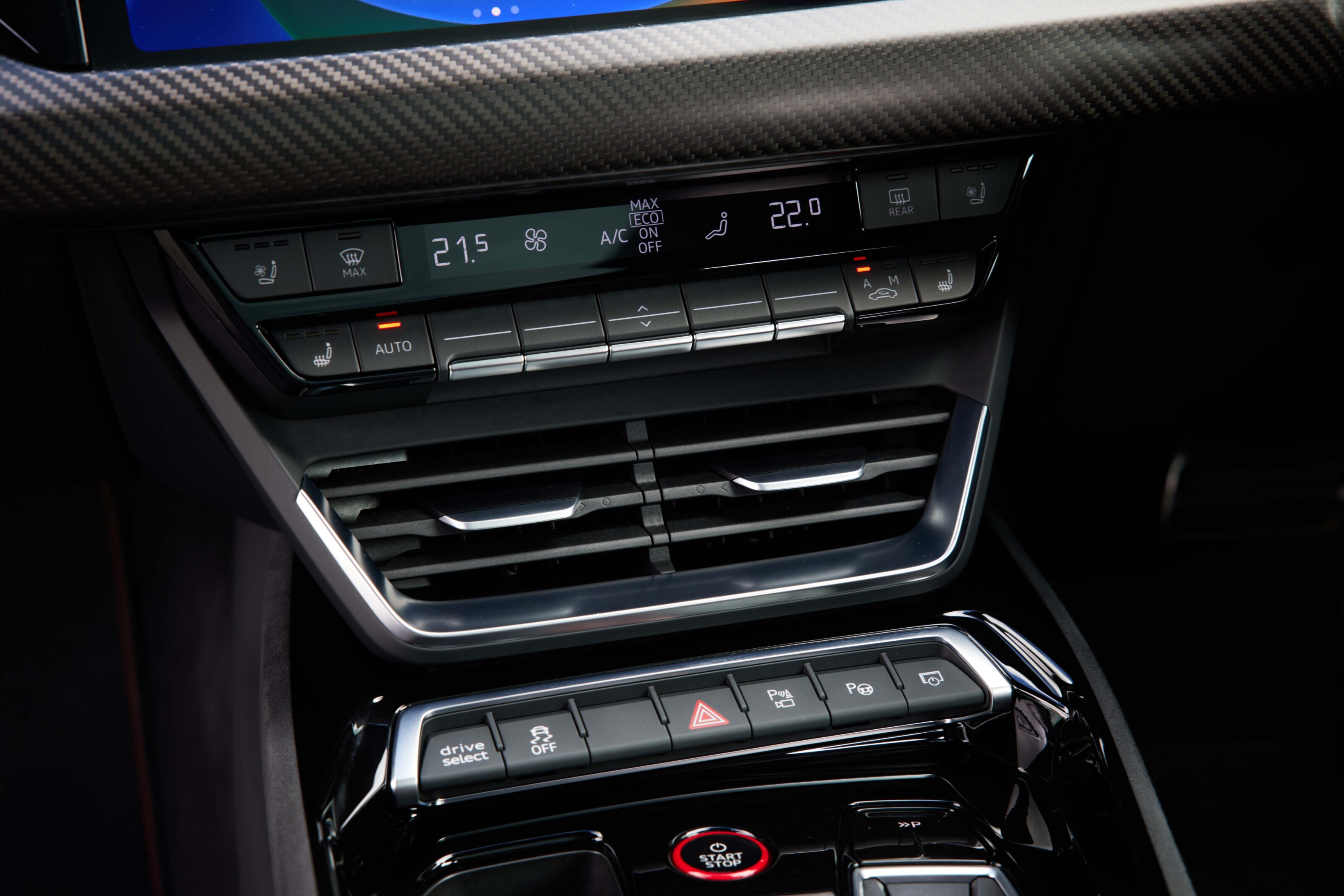
The mix of materials in both versions is high quality, the front seats are supportive and comfortable and all of the cabin tech is remarkably simple to use and navigate. Even better is that Audi has done away with the Taycan’s haptic touch controls on the centre console and instead fitted a strip of conventional buttons to adjust the air-con temperature and fan speed.
Call that a rare triumph of form following function.
1
There are a few interior niggles, however. For such a big car, cabin space and storage are adequate rather than generous. Up front, you score a pair of central cupholders, some average-sized door pockets and a little slot next to the stubby gear selector but that’s about it for space to put things.
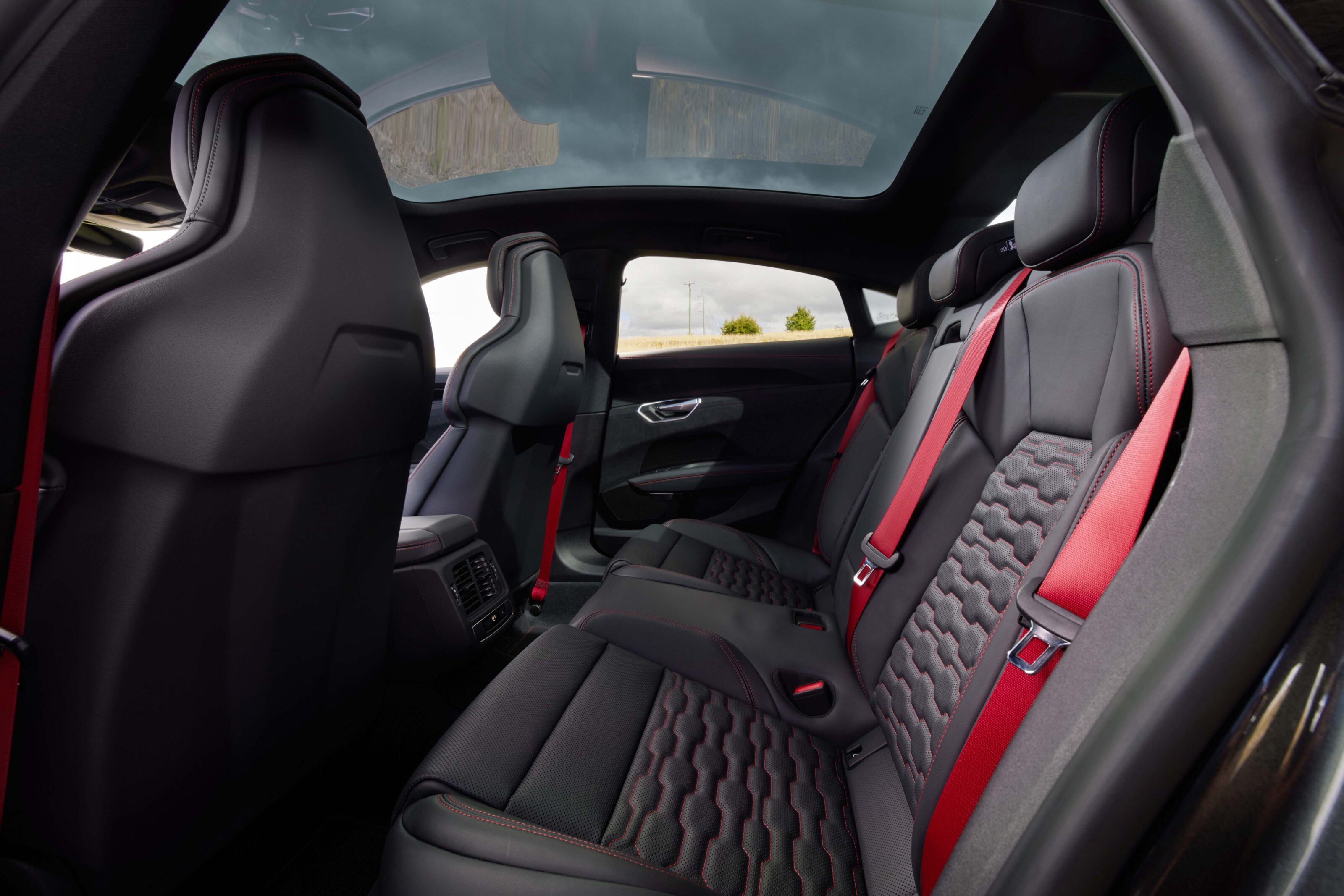
It’s equally light-on in the back. While the outboard seats are relatively roomy for adults thanks to ample knee- and toe-room (you can thank the cutouts in the battery pack for that one), taller passengers could struggle for headroom.
And although Audi does officially classify the E-Tron GT as a five-seater, the middle rear seat is so narrow and high-set that it’s really more of a 4+1. Rear visibility is also pretty limited due to that sleek rear window, although the 360-degree camera is good enough that it’s not really an issue.
1
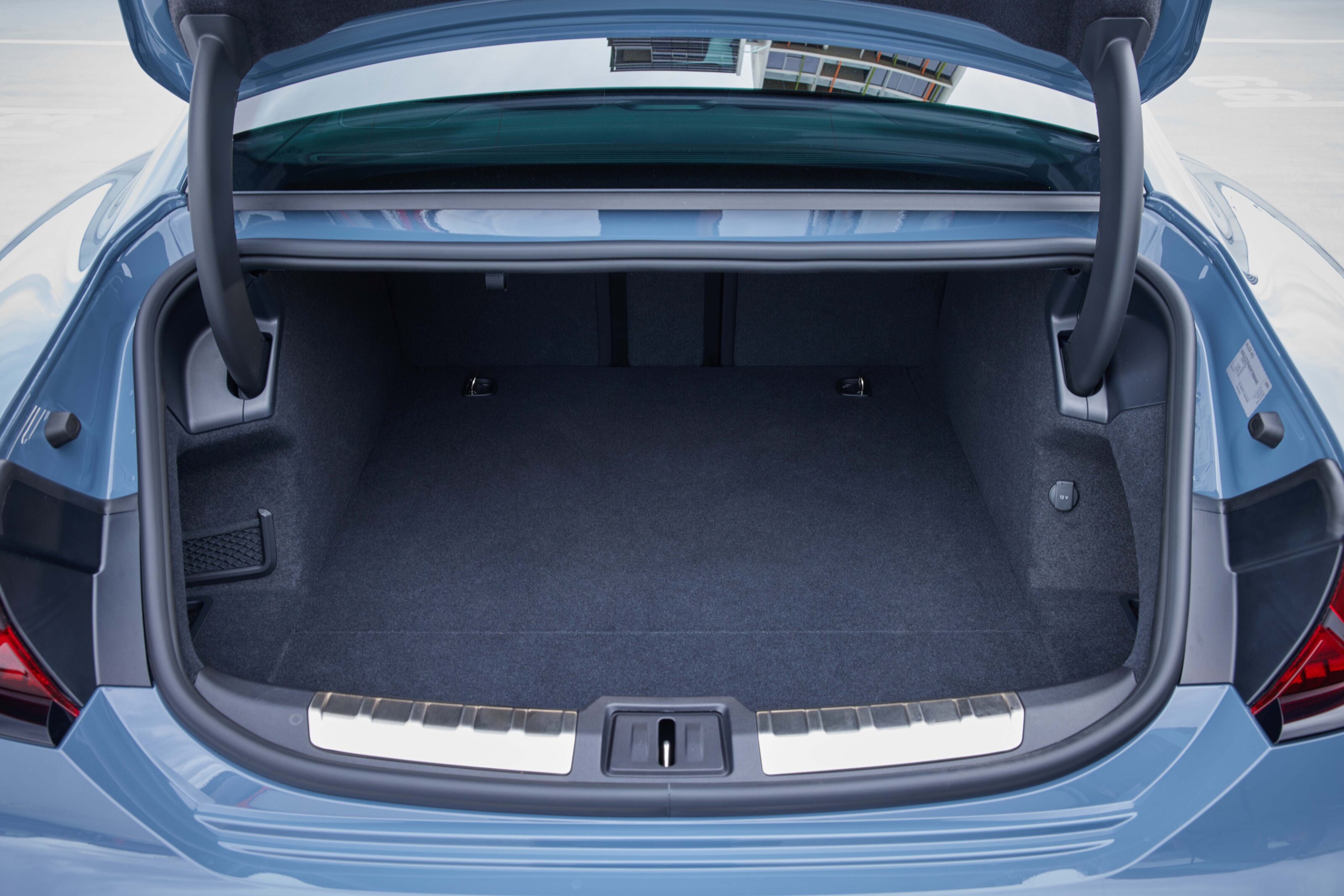
The amount of boot space you get depends on which version of the E-Tron GT you go for. The base car offers 405L of luggage capacity in the boot and another 81L in the nose.
The boot itself is on the narrow side but it’s flat and relatively deep and the rear seats do fold flat if you need more room. The flagship RS has a smaller 350L boot on account of needing to fit a larger electric motor on the rear axle.
Hankering for an Avant version? Us too but we have bad news on that front. Despite Audi’s reputation as a builder of some of the world’s best fast wagons, and the fact that Porsche builds a wagon-like Cross Turismo version of the Taycan, there are no plans for a long-roof version of the E-Tron GT. Boo.
Oh, and if you plan on using your Audi E-Tron GT as a proper grand tourer (and you should, as we’ll explain in the next section of this review) one thing to be mindful of is the lack of spare tyre.
1
What’s it like to drive?
Let’s pull the band-aid off immediately, shall we? This is no hardcore apex hunter that rewrites the laws of physics and is dripping with driver feedback.
If you’re chasing back-road thrills, a Porsche Taycan is a better bet. But what the Audi gives up in ultimate performance, it more than makes up for with ride comfort and control.
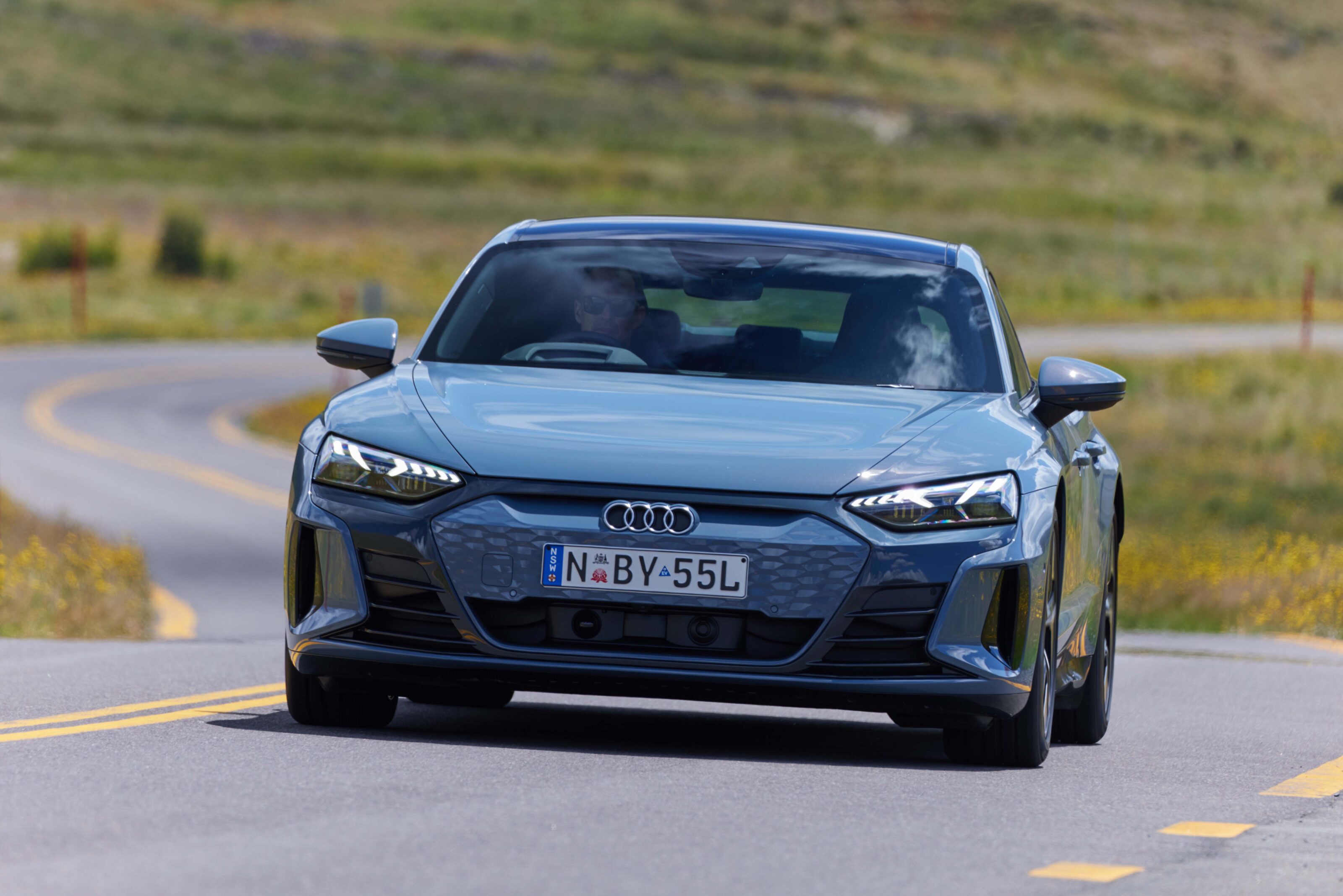
Audi’s engineers have softened off the E-Tron GT’s three-chamber air suspension by as much as 4PSI compared to the equivalent set-up in a Taycan and the benefits of this more relaxed focus are obvious. Sure there’s a sniff more body roll than you get in a Taycan but on sweeping open backroads, the E-Tron GT is a deeply impressive and surprisingly compliant super sedan.
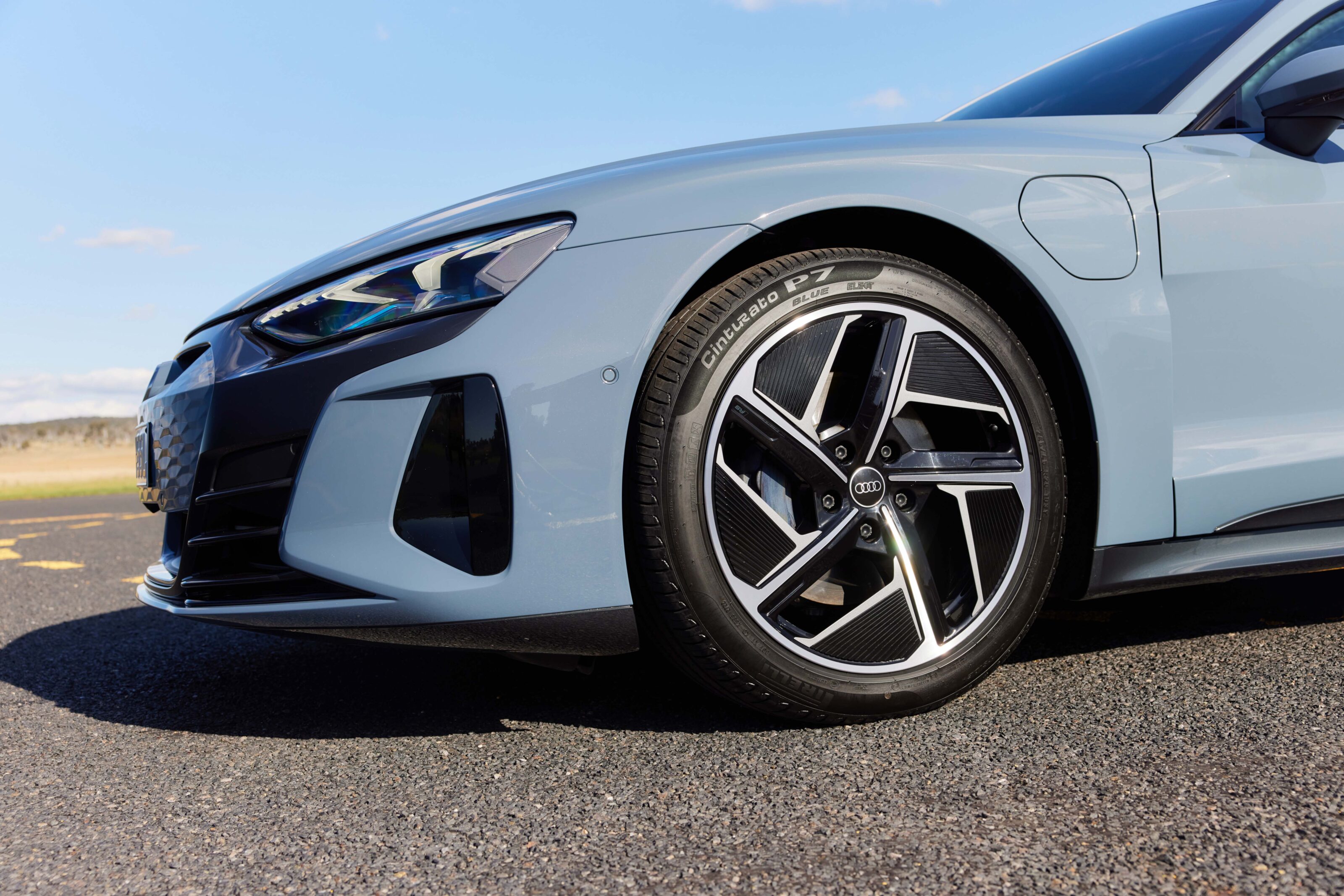
The cabin is nicely refined, the steering is naturally weighted and accurate, and the ride comfort, even on the RS’s large 21-inch wheels which are wrapped in enormous Goodyear Eagle F1 rubber measuring 265/35 R21 up front and 305/30 R21 out back, is deeply impressive.
1
And if it’s speed you want, both versions deliver in spades.
Rollercoaster acceleration has fast become an EV party trick and in terms of pure pace, the E-Tron GT can mix it with the best of them. Against our clock, the RS E-Tron GT actually beat Audi’s 0-100km/h claim and rocketed from a standstill to three figures in 3.2sec.
The ‘regular’ car wasn’t far behind either, completing the same marker in 4.0sec dead. Is a Taycan Turbo S or Tesla Model S Plaid quicker? They might be on paper but in the real world, the E-Tron GT feels every bit as fast as you’d ever want to go.
As for outright grip and agility, it’s clear that the harder and more powerful RS version has the edge over the ‘regular’ E-Tron GT. That’s largely down to the benefits of the RS’s standard four-wheel steering and e-diff, which combine to make it feel far keener and lighter than a 2300kg sedan ought to but, weirdly, it was actually the standard car that impressed us the most.
1
It might be a sniff slower but its smaller 20-inch wheels (rubber is Pirelli Cinturato P7 measuring 245/45 R20 and 285/40 R20 F/R) deliver ever greater compliance and on fast, flowing roads its more conventional chassis tune is easier to key into.
To our minds, it felt like a better match for the E-Tron GT’s ‘grand tourer’ focus and when you factor in the fact you also save $68,000 while getting more battery range, it seems the smarter pick.
So what about complaints?
Dynamically, they’re few and far between.
Tyre roar can intrude on coarse-chip surfaces, the two-speed gearbox does occasionally deliver a jerky shift and at low speed, it’s possible to detect some suspension noise and cabin boominess.
1
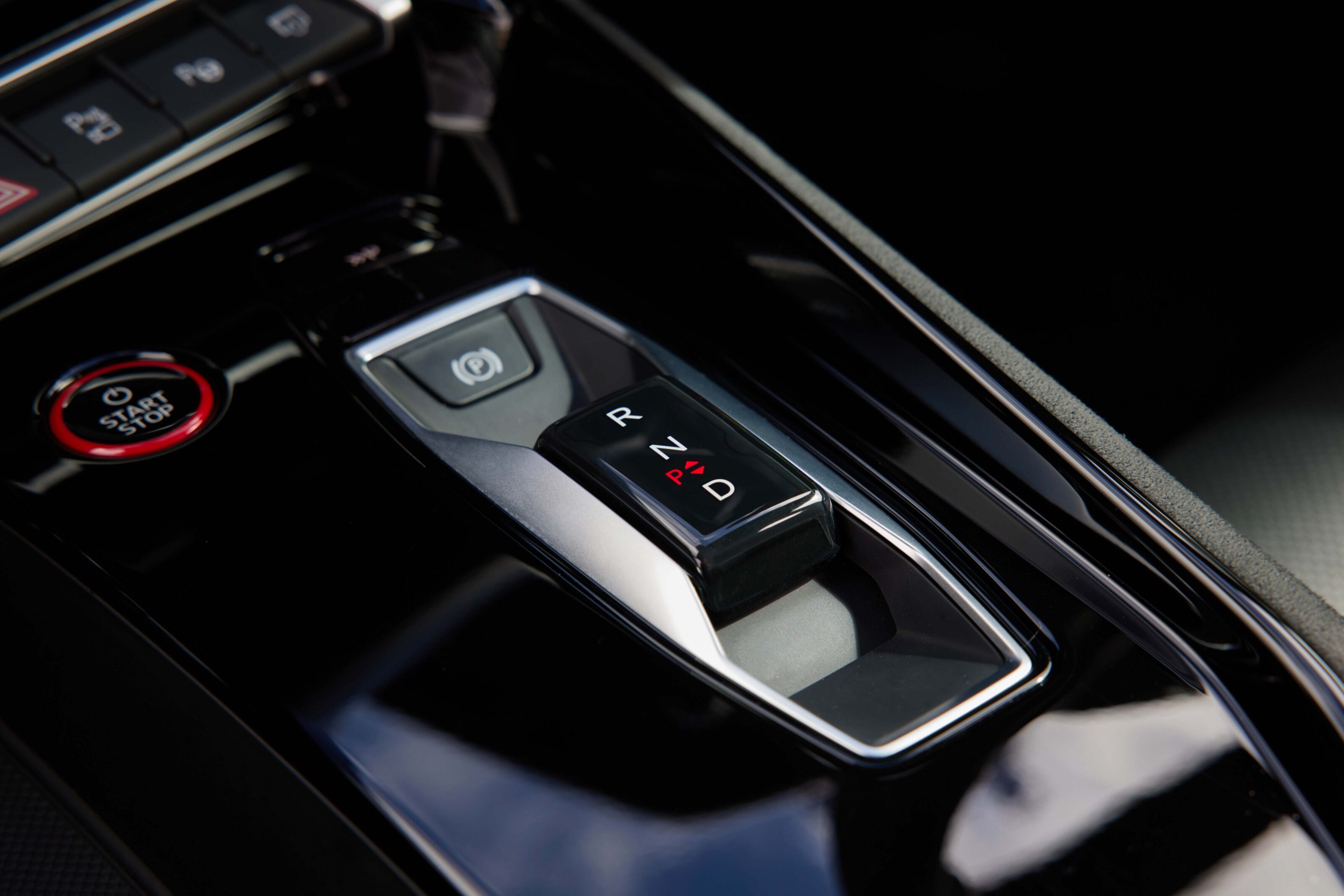
But our biggest quibble goes to the location of the Drive Select button. The E-Tron GT has three drive modes to choose from – Eco, Comfort and Dynamic – but actually cycling through them is a bit of a faff because the button is tucked away on the far side of the centre stack, near the air-con controls.
It’s finicky to reach and can force you to take your eyes off the road, which had us yearning for a drive mode dial on the steering wheel, as you get in Mercedes-AMG or, incidentally, a Porsche Taycan.
If that sounds like we’re scratching for things to complain about it’s because we are. It’s a mighty impressive thing, the Audi E-Tron GT.
1
How safe is it?
Officially, the short answer is we don’t know.
Safety watchdogs are yet to crash test the E-Tron GT, so it has no official ANCAP or Euro NCAP crash rating. That doesn’t mean it’s an unsafe car, however.
The closely related Porsche Taycan does carry a five-star crash rating and Audi has fitted the E-Tron GT with a long list of standard safety equipment. That includes autonomous emergency braking with pedestrian detection, adaptive cruise control, a 360-degree surround view monitor, blind-spot monitoring, intersection cross assist, rear-cross traffic alert, lane-keep assist and tyre pressure monitoring.
Further assistance systems include an exit warning system that can alert occupants of approaching pedestrians and cyclists as you open the door and turn assist, which monitors approaching traffic to prevent a collision as you turn right through intersections.
1
Warranty and running costs
Like all new Audis, the E-Tron GT is covered by a five-year, unlimited-kilometre warranty.
The battery pack is covered for eight years or 160,000km.
Service intervals are every two years or 30,000km but the first three visits to the dealer are free under Audi’s ‘666’ package which also includes six years’ roadside assistance and six years’ free public charging via the Chargefox network.
1
VERDICT
There’s a lot to like about Audi’s fresh electric flagship. It’s ferociously fast, stunning to look at, and genuinely comfortable. Thanks to its conventional cabin and deft chassis tuning, it also delivers an experience than feels more like a svelte and silent RS7 than a rebadged Taycan.
In fact, Audi has done a remarkable job of taking the same ingredients as the Taycan and turning out a super sedan that doesn’t only offer the customer something different but one that also feels like a proper Audi.
Should you buy one over a Porsche Taycan? Well, like most things in life, the answer is “that depends”. The E-Tron GT is marginally more comfortable, has a longer warranty and thanks to the inclusion of six years’ free servicing, charging and roadside assistance, its value equation is also a touch sweeter.
Is it better than a Taycan? No, it’s just different. And that just might be its biggest strength.
MORE
Everything Audi
MORE
Electric Cars
| Audi E-Tron GT | Audi RS E-Tron GT | |
|---|---|---|
| Price | $180,200 + on-road costs | $248,200 + on-road costs |
| Body | 5-door, 5-seat large sedan | 5-door, 5-seat large sedan |
| Drive | all-wheel | all-wheel |
| Drivetrain | 2 x electric motors + 93kWh (gross) lithium-ion battery | 2 x electric motors + 93kWh (gross) lithium-ion battery |
| Power | 350kW (390kW in boost mode) | 440kW (475kW in boost mode) |
| Torque | 630Nm (640Nm in boost mode) | 830Nm |
| Transmission | 2-speed automatic | 2-speed automatic |
| Consumption | 19.2kWh/100km | 20.2kWh/100km |
| Kerb weight | 2275kg | 2345kg |
| Towing capacity | n/a | n/a |
| 0-100 | 4.1sec (claimed in boost mode) | 3.3sec (claimed in boost mode) |
| L/W/H/W-B | 4989/1964/1396/2900mm | 4989/1964/1414/2900mm |
| Boot space | 405L boot + 81L frunk | 350L boot + 81L frunk |
| Warranty | 5yr/unlimited km | 5yr/unlimited km |
| Safety rating | not yet crash tested | not yet crash tested |
Snapshot
- Next-gen Rio wonu2019t be sold in Australia, marking the end of the line
- Picanto and Cerato promised to live on
- Adds to the growing list of axed light car nameplates
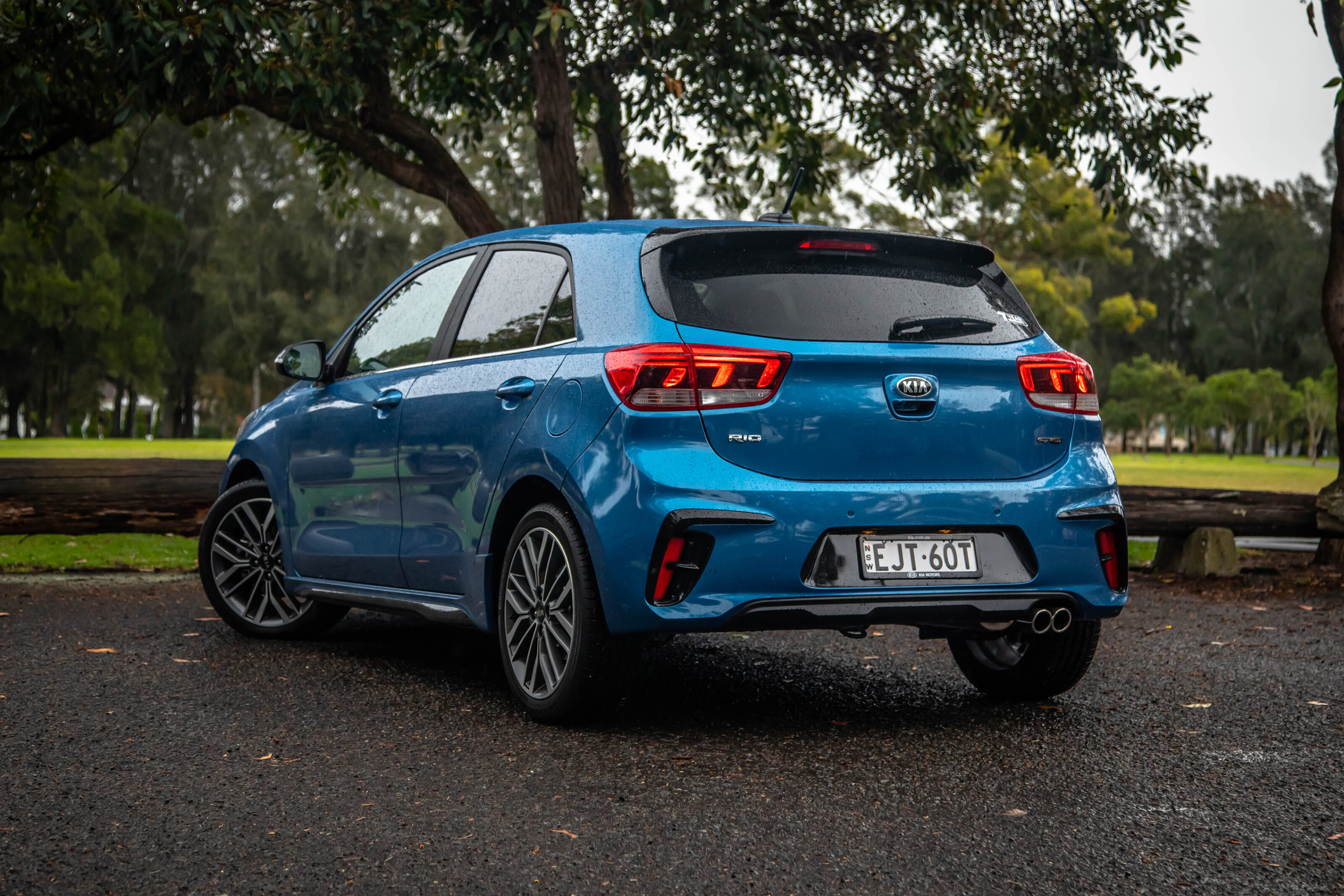
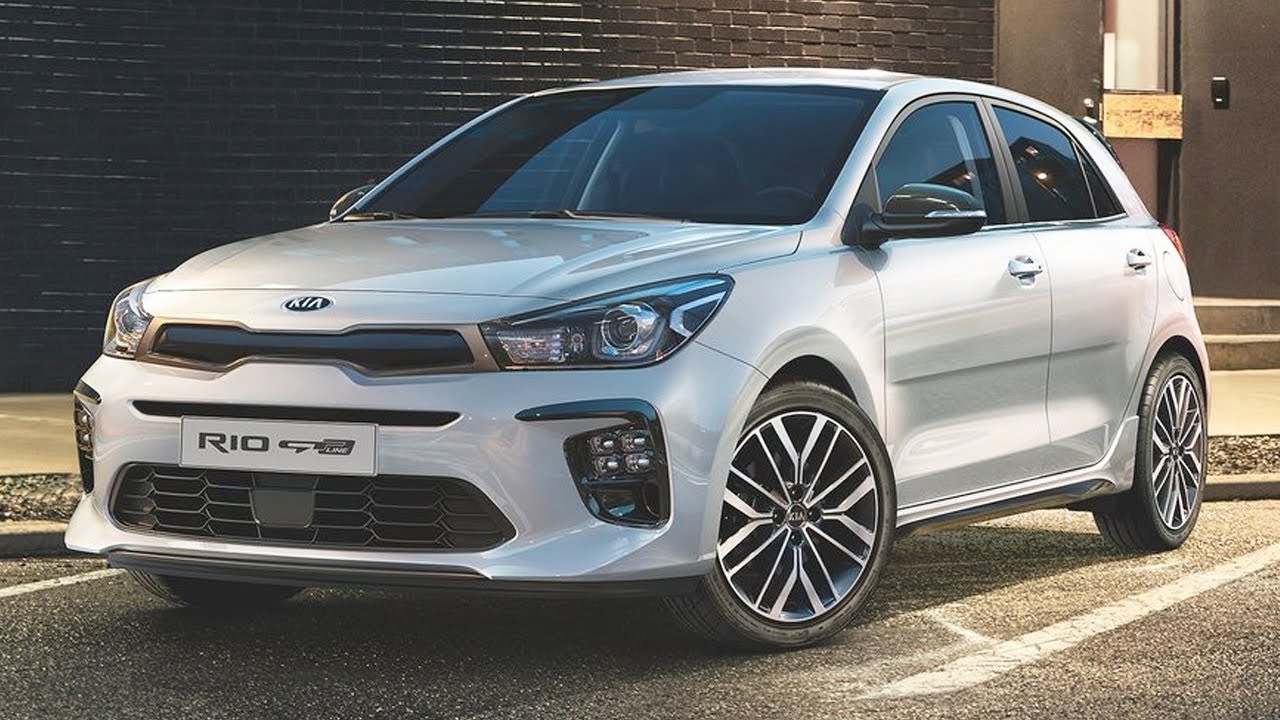
Kia Australia has confirmed the Rio city hatchback will exit the Australian market when the next-generation model launches, marking the end to the nameplate which first debuted locally in 2003.
“The next generation Rio will not be produced in RHD [right-hand drive],” a Kia Australia spokesperson told Wheels.
“The award-winning Rio has been a tremendous car for Kia in the Australian market with 162,494 sold since its debut in mid-2000.
1
“While the Rio nameplate will not continue locally, Kia does continue to offer its popular Picanto and Cerato ranges, with new models across various segments currently under study for our market.”
It’s unclear when the all-new Rio will launch, but the current fourth-generation city car has already been on sale for six years.
The news comes as the South Korean hatchback was axed in mainland Europe and the United Kingdom due to low sales, although the related Kia Stonic SUV will live on, according to Autocar.
1
The local division axed the top-spec Rio GT-Line last year due to supply shortages related to its turbocharged engine and dual-clutch transmission. It’s now only available with two variants starting from $19,690 before on-road costs.
Like all other new cars, the Rio has been subject to steep price rises over recent years.
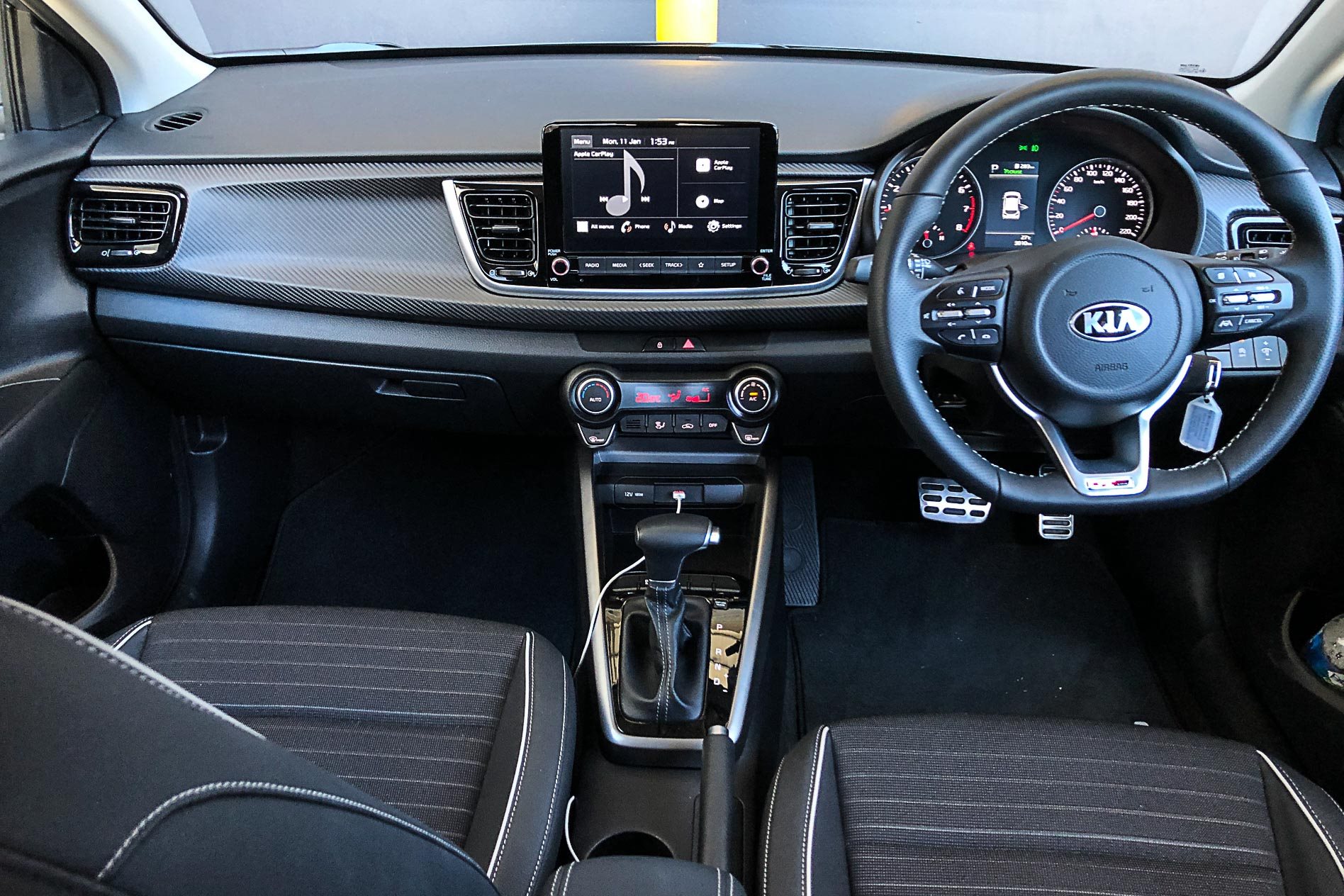
When the current generation first launched in 2017, it was only priced from $16,990 before on-roads and could be had for under the $20,000 drive-away mark – a major selling point for first-car buyers.
1
The Kia Rio was the fourth best-selling model in the light car segment last year, trailing behind Australia’s cheapest new car, the MG 3, semi-premium Mazda 2, and now-defunct Suzuki Baleno.
Light cars have been shrinking gradually in favour of more in-demand crossover SUVs. The Ford Fiesta, standard Hyundai i20, Hyundai Accent, Honda Jazz and Suzuki Baleno are no longer, while the Toyota Yaris, Mazda 2, Volkswagen Polo and Skoda Fabia have gone upmarket with price tags around the $30,000 mark and beyond.
MORE
Everything KIA
The imminent 2023 Alfa Romeo Tonale has received a five-star ANCAP safety rating.
Snapshot
- 2023 Alfa Romeo Tonale receives five-star ANCAP safety rating
- Applies to all hybrid variants
- Set to launch in Australia this month from $49,900 plus on-roads
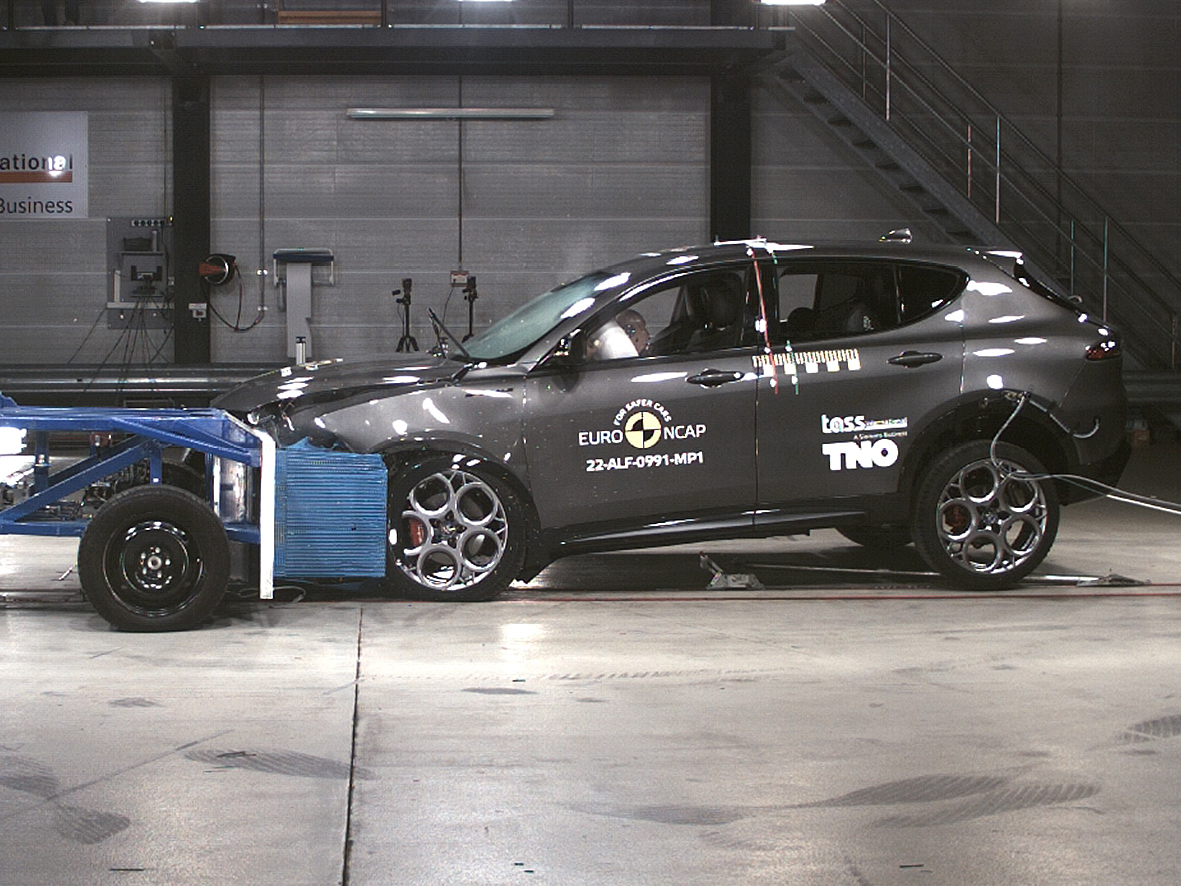
This rating is based on testing conducted by Euro NCAP in 2022. It applies to Tonale hybrid variants, which will arrive in Australia this month, priced from $49,900 before on-road costs.
It scored 84 per cent for adult occupant protection (32.15 out of 38 points), 87 per cent for child occupation protection (42.88 out of 49 points), 67 per cent for vulnerable road user protection (36.23 out of 54 points), and 85 per cent for safety assist (13.62 out of 16 points).
A plug-in hybrid Tonale is due in late 2023, but it is currently unrated.
1
“The five-star rating for the Alfa Romeo Tonale hybrid sees it added to a growing list of small SUVs with strong and green safety credentials,” said ANCAP chief executive officer Carla Hoorweg.
“We are very pleased that the extensive safety features inherent in our Alfa Romeo Tonale Hybrid have now been recognised here in Australia,” added Stellantis India and Asia Pacific’s senior vice president of marketing, sales and regional operations, Billy Hayes.
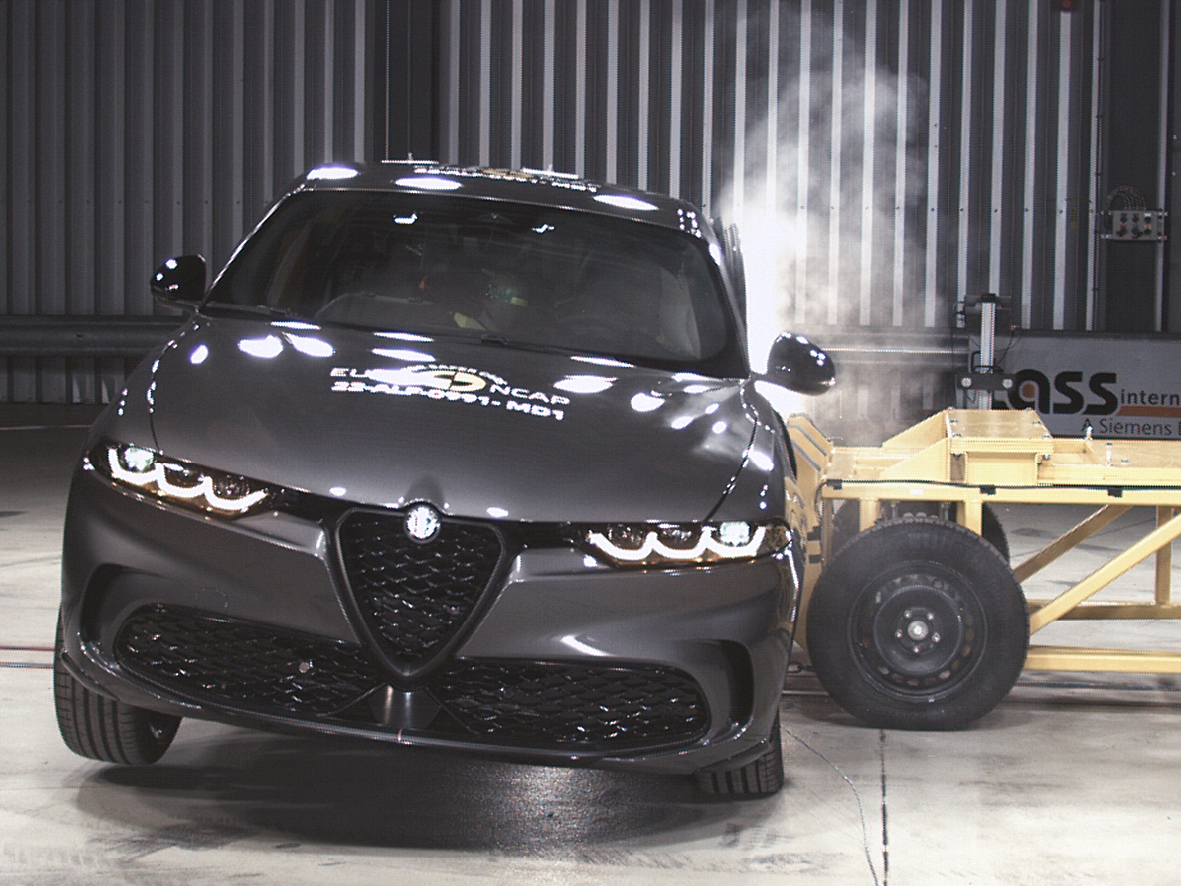
ANCAP noted the lack of a front-centre airbag, which can prevent a potentially deadly head clash between the driver and front passenger in a side collision, with far-side impact points deducted.
Standard safety equipment includes; autonomous emergency braking with junction assist, lane departure warning, lane-keep assist, adaptive cruise control, traffic sign recognition, and intelligent speed limit assist.
6
Blind-spot alert and rear cross-traffic alert are limited to the flagship Veloce in Australia.
Six airbags (dual frontal, side head and side chest) are fitted as standard.
ANCAP also released results for the GWM Ora and Citroen C5 X this week, which all scoring a maximum five-star safety rating.
However, the BMW i4 and Peugeot 308 fell short, with four-star safety ratings from testing conducted in 2022.
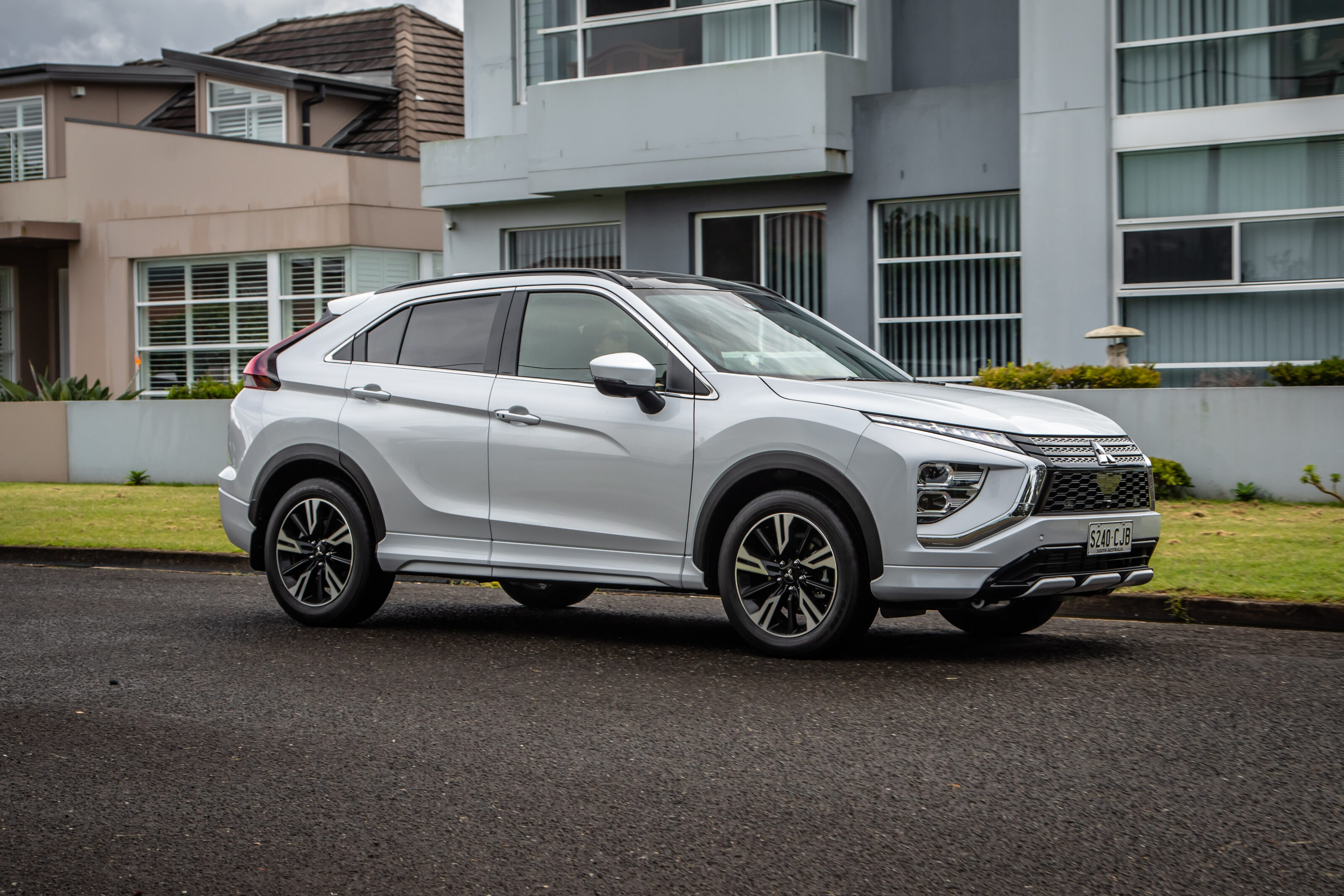
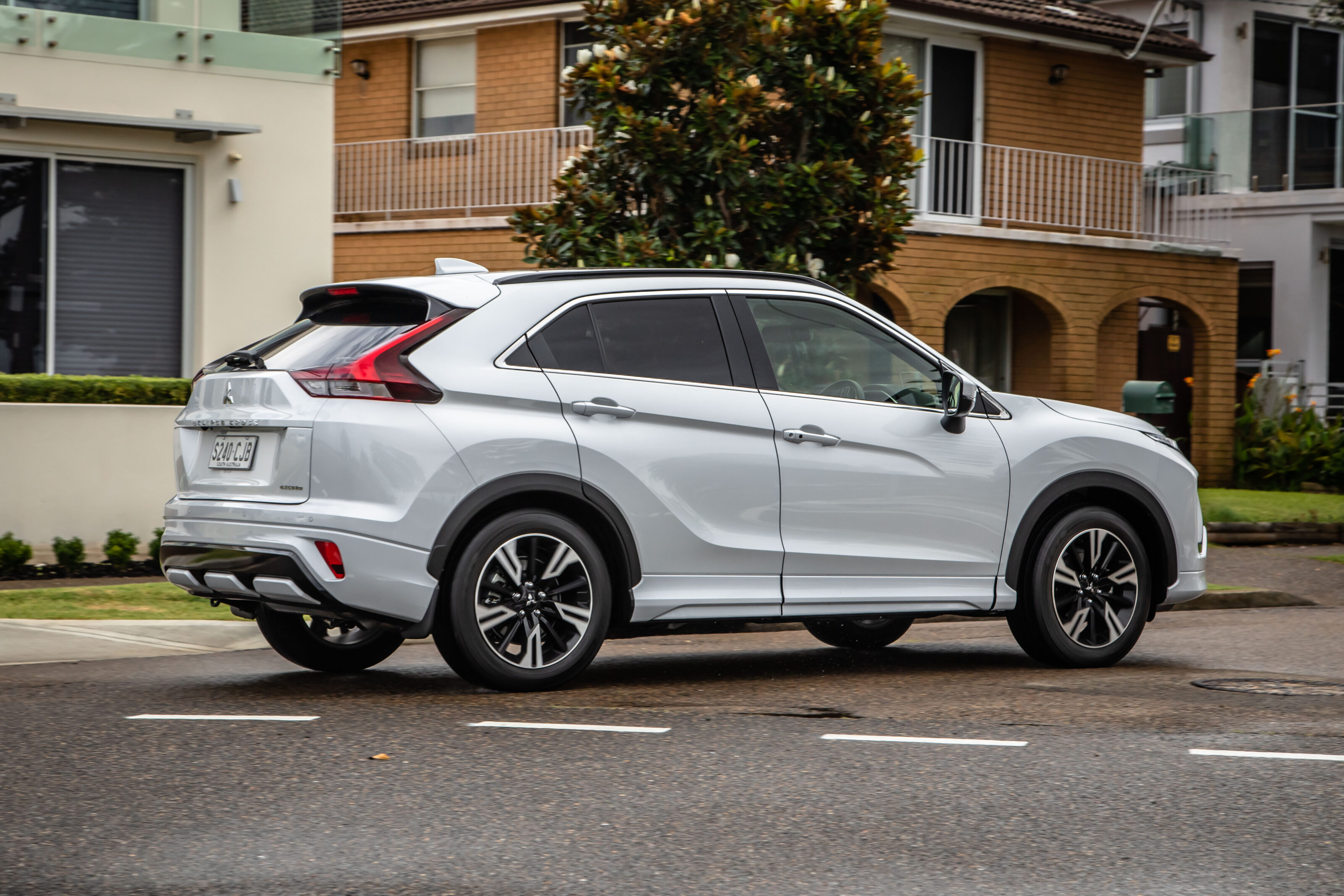
The updated 2023 Mitsubishi Eclipse Cross small SUV has been detailed.
Snapshot
- 2023 Mitsubishi Eclipse Cross pricing and features
- ES gains rear sensors, but downgrades to a smaller alloy wheels
- New, blacked-out LS Black Edition grade
- Priced from $31,490 before on-road costs
It will arrive in local showrooms in March with minor specification changes, a new grade, and vehicle-to-load compatibility for flagship plug-in hybrid variants – but pricing has increased between $250 and $1000.
Across the range, the Eclipse Cross includes improvements to its air-conditioning refrigerant, while all variants bar the petrol ES gain second-row charge ports with USB-A and USB-C connections.
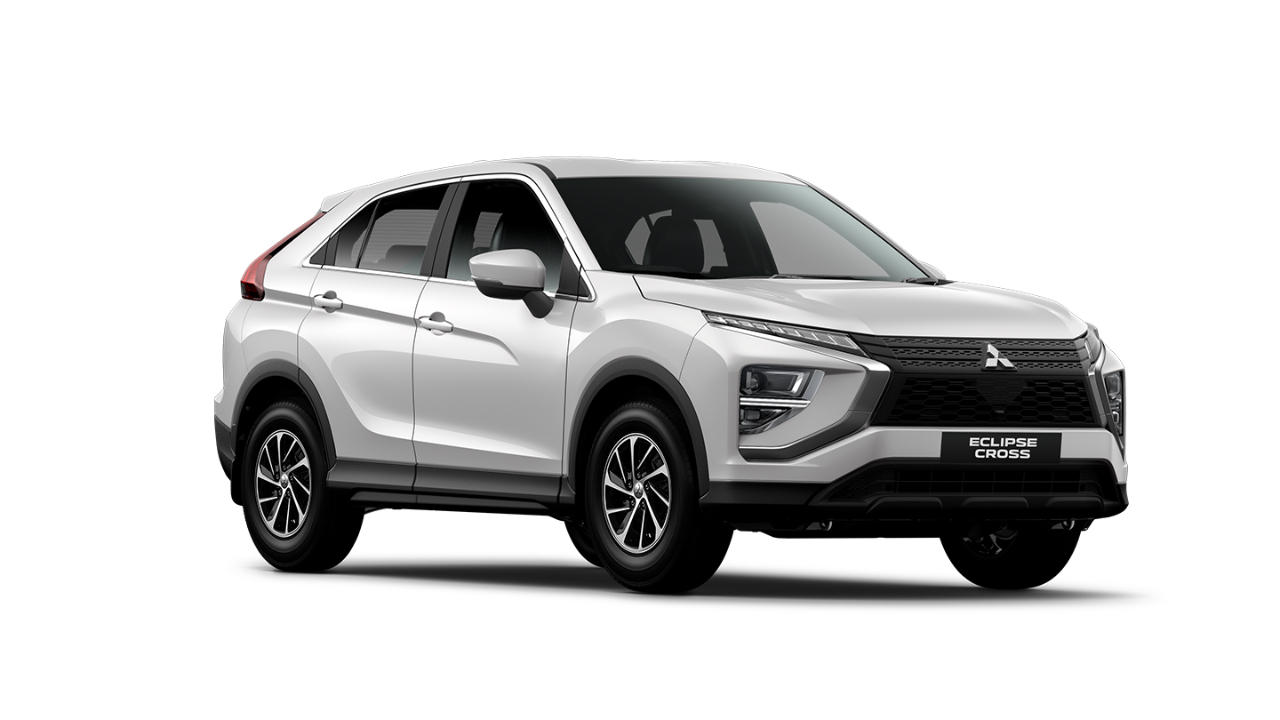
The entry-level ES adds rear parking sensors, but the petrol model has lost its 18-inch alloy wheels for smaller 16-inch units with unchanged pricing.
1
The mid-spec LS – available in petrol only – adds features previously limited to the Aspire, such as an auto-dimming rear-view mirror, lane-keep assist, blind-spot alert and rear cross-traffic alert.
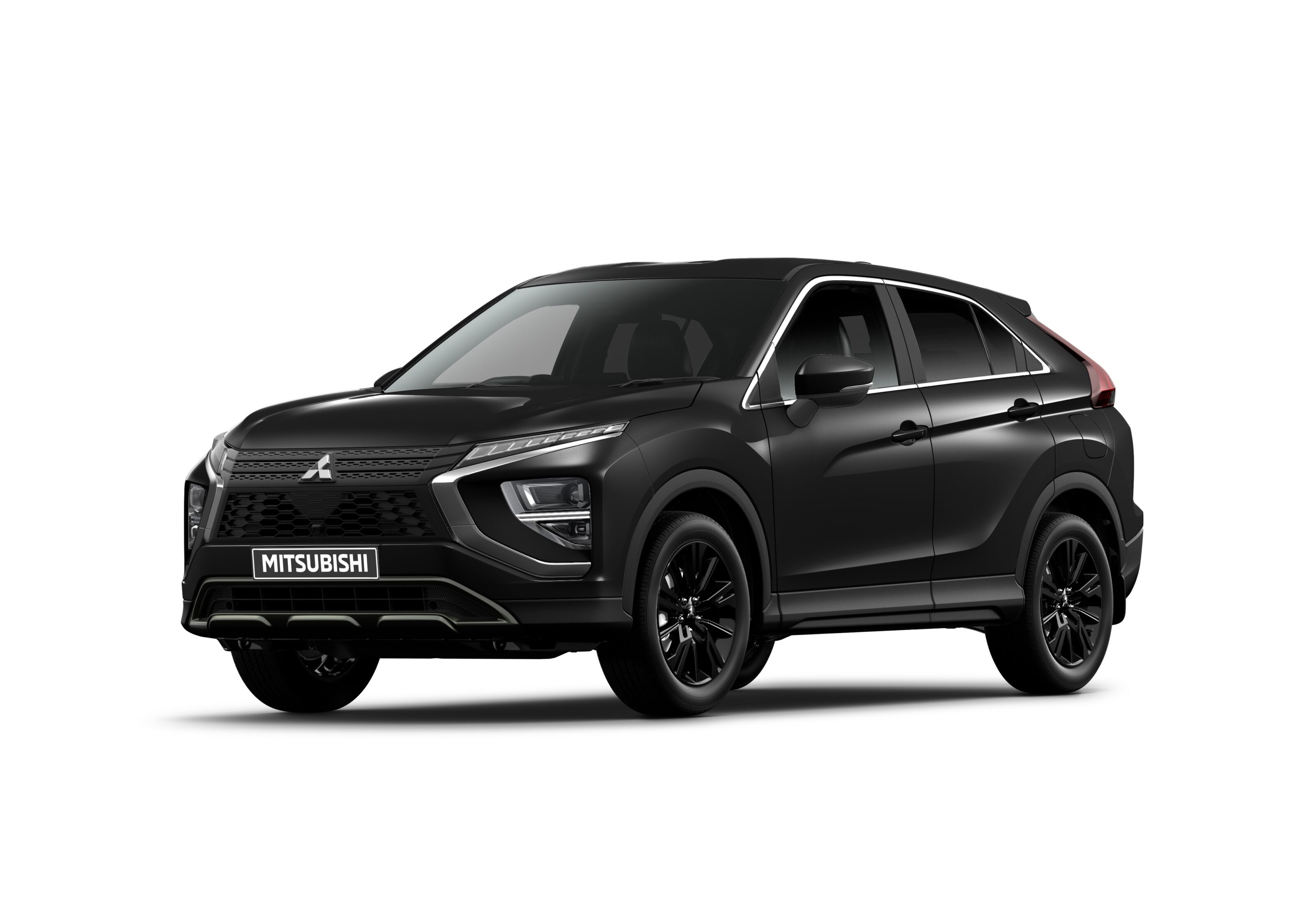
For model-year 2023, the Black Edition nameplate returns to the Eclipse Cross line-up, with the blacked-out grade based on the LS.
It gains black 18-inch alloy wheels, darkened trims, metallic paint, leather- and suede-accented upholstery, heated front seats and a power-adjustable driver’s seat – but roof rails are deleted.
1
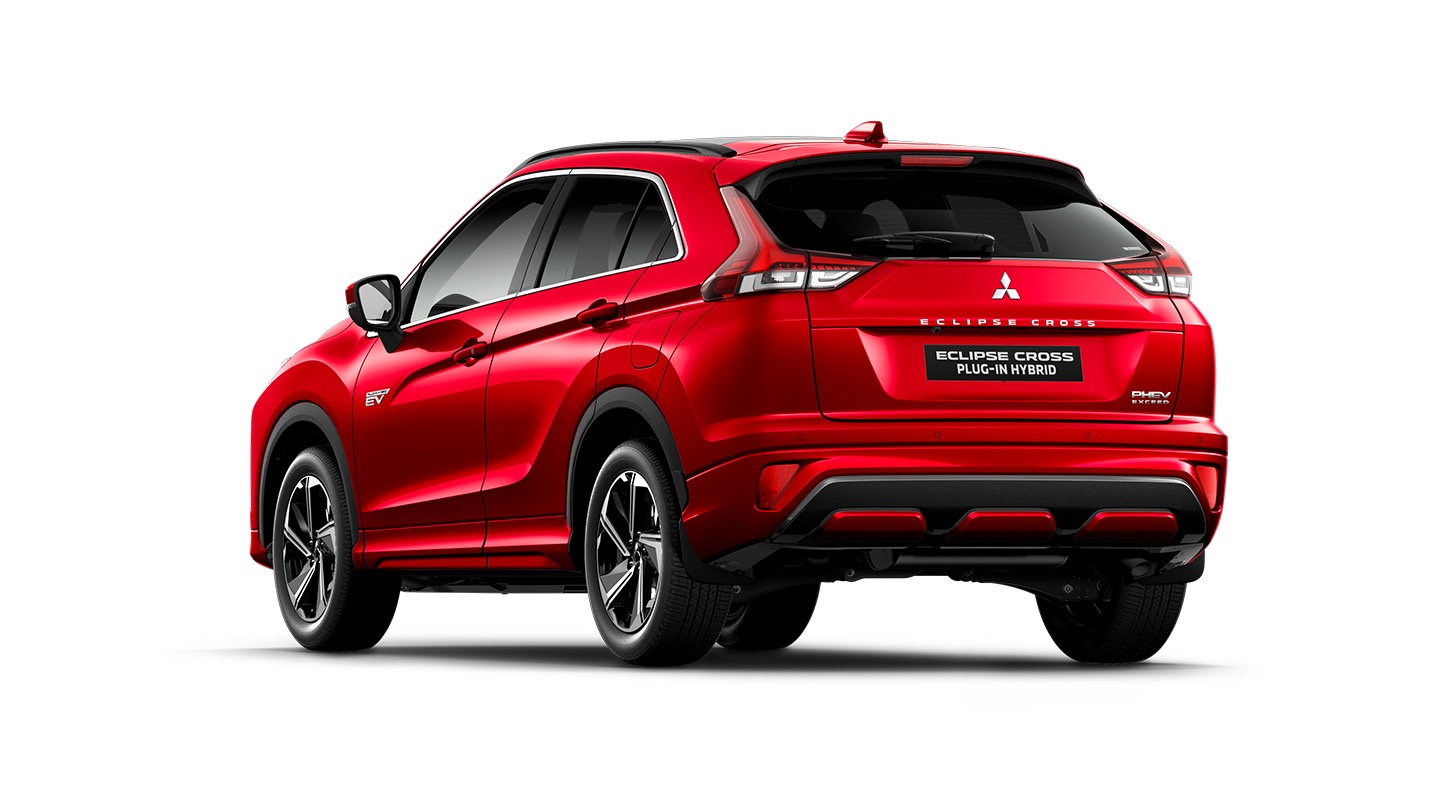
Aspire variants include an updated exterior design with blacked-out trim and a silver lower front bumper, while the plug-in hybrid adopts vehicle-to-load technology.
With a 240-volt power outlet in the rear luggage compartment, the vehicle-to-load function can output up to 1500 watts to “power a range of domestic, office, industrial and leisure appliances.”
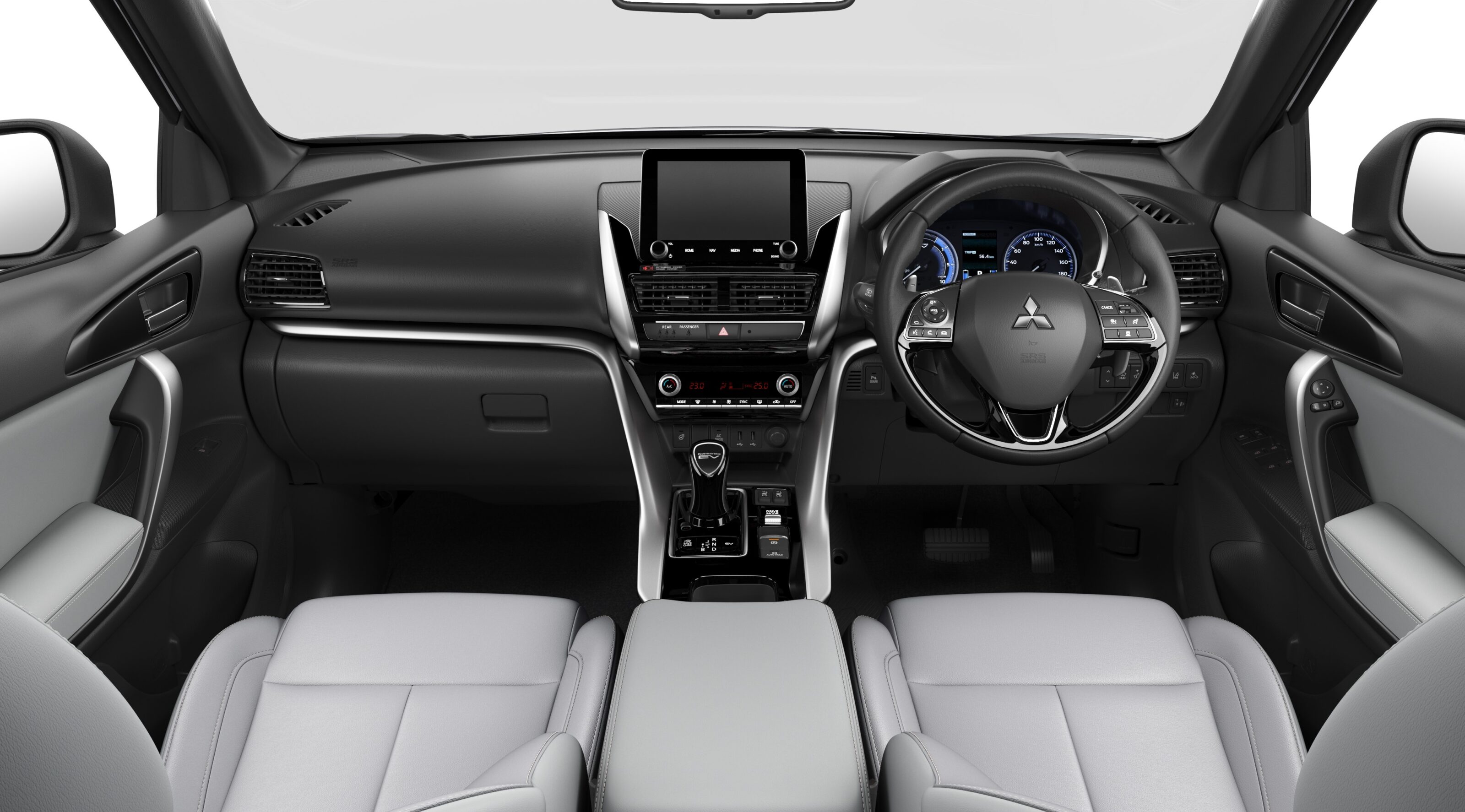
The flagship Exceed receives a hands-free electric tailgate and optional light grey upholstery for both petrol and PHEV grades.
In Australia, the Mitsubishi Eclipse Cross competes in the small SUV segment, with rivals including the Mazda CX-30, MG ZST, GWM Haval Jolion, Hyundai Kona, Nissan Qashqai, Kia Seltos and Toyota C-HR.
1
JUMP AHEAD
- 2023 Mitsubishi Eclipse Cross pricing
- 2023 Mitsubishi Eclipse Cross features
- Colours
- Engine, drivetrain, and fuel economy
- Safety
- Dimensions
- Warranty and servicing
- Availability
2023 Mitsubishi Eclipse Cross PHEV pricing
Prices exclude on-road costs.
| Model | Pricing | Change |
|---|---|---|
| ES FWD | $31,490 | u2013 |
| LS FWD | $34,420 | up $930 |
| LS Black Edition FWD | $35,490 | new |
| Aspire FWD | $36,490 | up $250 |
| LS AWD | $36,740 | up $750 |
| Exceed FWD | $40,490 | up $1000 |
| Exceed AWD | $42,990 | up $1000 |
| ES PHEV AWD | $47,290 | up $300 |
| Aspire PHEV AWD | $51,240 | up $750 |
| Exceed PHEV AWD | $55,990 | up $1000 |
7
2023 Mitsubishi Eclipse Cross features
ES
| 16-inch alloy wheels (down from 18-inch) | Cloth upholstery |
| Rear parking sensors (new)u00a0 | Halogen headlights |
| 8-inch infotainment system | LED daytime running lamps |
| Wired Apple CarPlay and Android Auto | Climate-control air conditioning |
| Four-speaker audio system | Manual cruise control. |
LS
LS Black Edition (new)
Aspire
Exceed
ES PHEV
Aspire PHEV
Exceed PHEV
1
Colours
Metallic paint incurs a $740 premium. White diamond and red diamond incur a $940 premium.
LS Black Edition is limited to white diamond, red diamond, titanium and black.
1
Engine, drivetrain and fuel economy
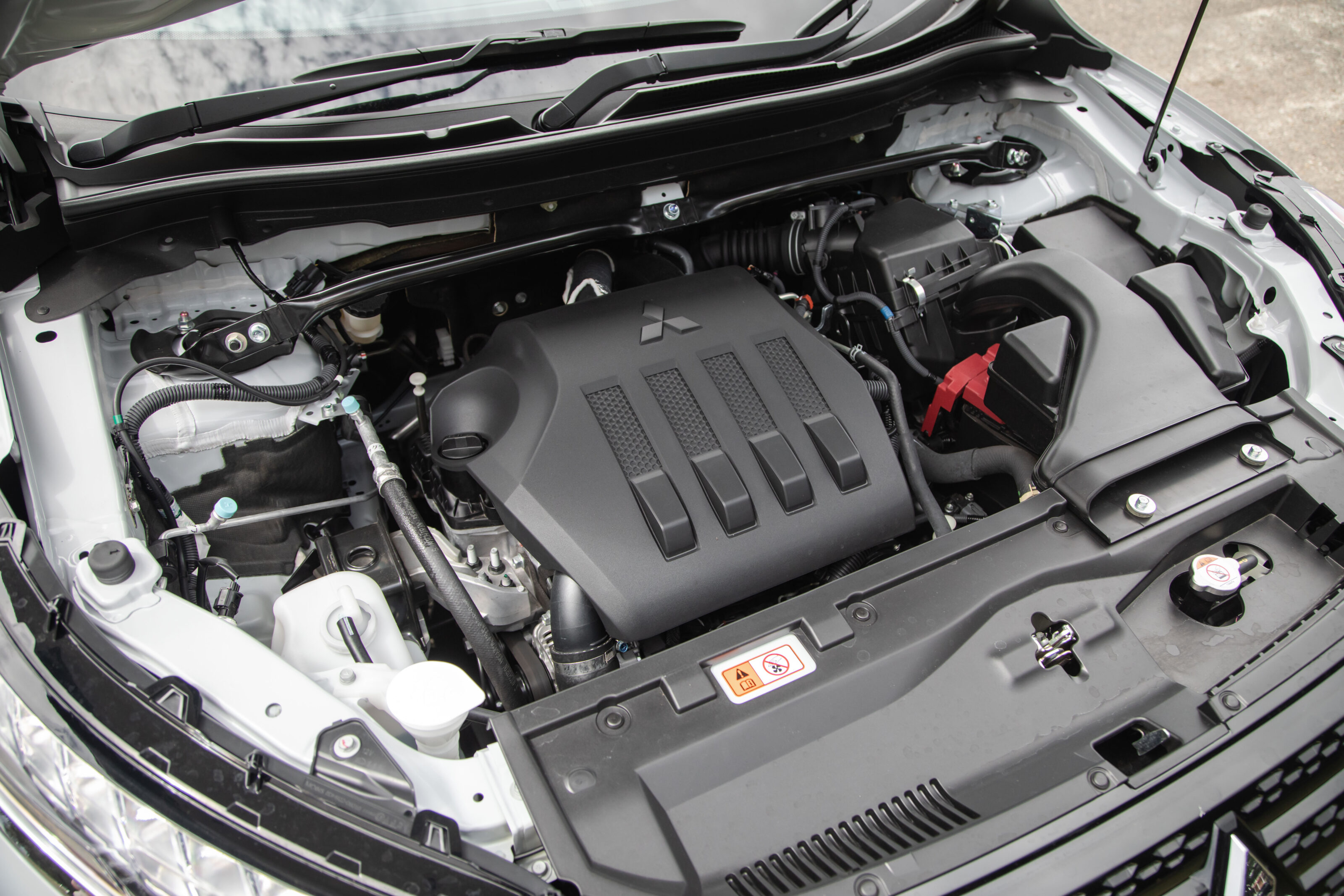
Under the bonnet, the Mitsubishi Eclipse Cross is powered by a 1.5-litre turbocharged four-cylinder petrol engine, producing 100kW and 250Nm.
It is matched to a continuously-variable transmission, with front-wheel drive as standard. An all-wheel-drive option is available on LS and Exceed grades.
Meanwhile, the plug-in hybrid features a 2.4-litre naturally-aspirated four-cylinder petrol engine from the previous-generation Outlander PHEV, with 94kW and 199Nm.
It is mated with two electric motors, producing 60kW/137Nm and 70kW/195Nm, respectively. It has a 130kW and 322Nm total system output.

1
Under the floor is a 13.8kWh battery pack, allowing up to 54km of emission-free driving on the electric motors in EV-only mode.
Then there is a Series Hybrid mode available, where the petrol engine acts as a generator for the electric motors, which in turn continue to propel the car.
Lastly, the electric motors can also act as range extenders for the petrol engine in Parallel Hybrid mode, working together to increase range, switching where the power comes from depending on the scenario.
1
Safety
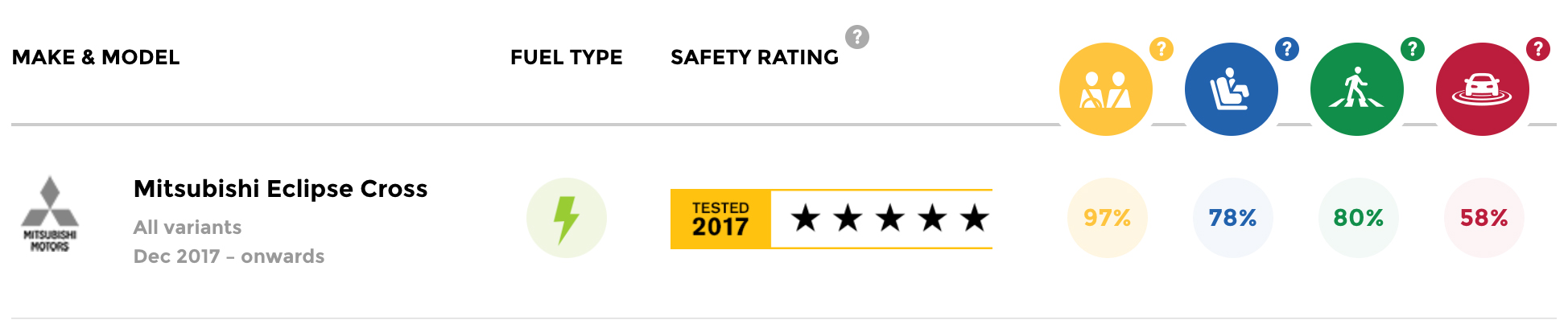
The Mitsubishi Eclipse Cross is covered by a five-star ANCAP safety rating, based on less-stringent testing conducted in 2017.
This score applies to all variants, including the plug-in hybrid.
However, this rating will expire on December 31, 2023, in line with ANCAP’s newly-introduced six-year datestamp limit.
It received a score of 97 per cent for adult occupant protection, 78 per cent for child occupant protection, 80 per cent for vulnerable road user protection, and 58 per cent for safety assist.
Seven airbags (dual front, side, curtain, and driver’s knee) are fitted across the range.
Additional active safety features are available in higher Eclipse Cross grades.
A full breakdown is available in the 2023 Mitsubishi Eclipse Cross features section.
1
Dimensions
The Mitsubishi Eclipse Cross has a 2670-millimetre wheelbase, and is 4545mm long, 1805mm wide and 1685mm tall.
2023 Mitsubishi Eclipse Cross boot space
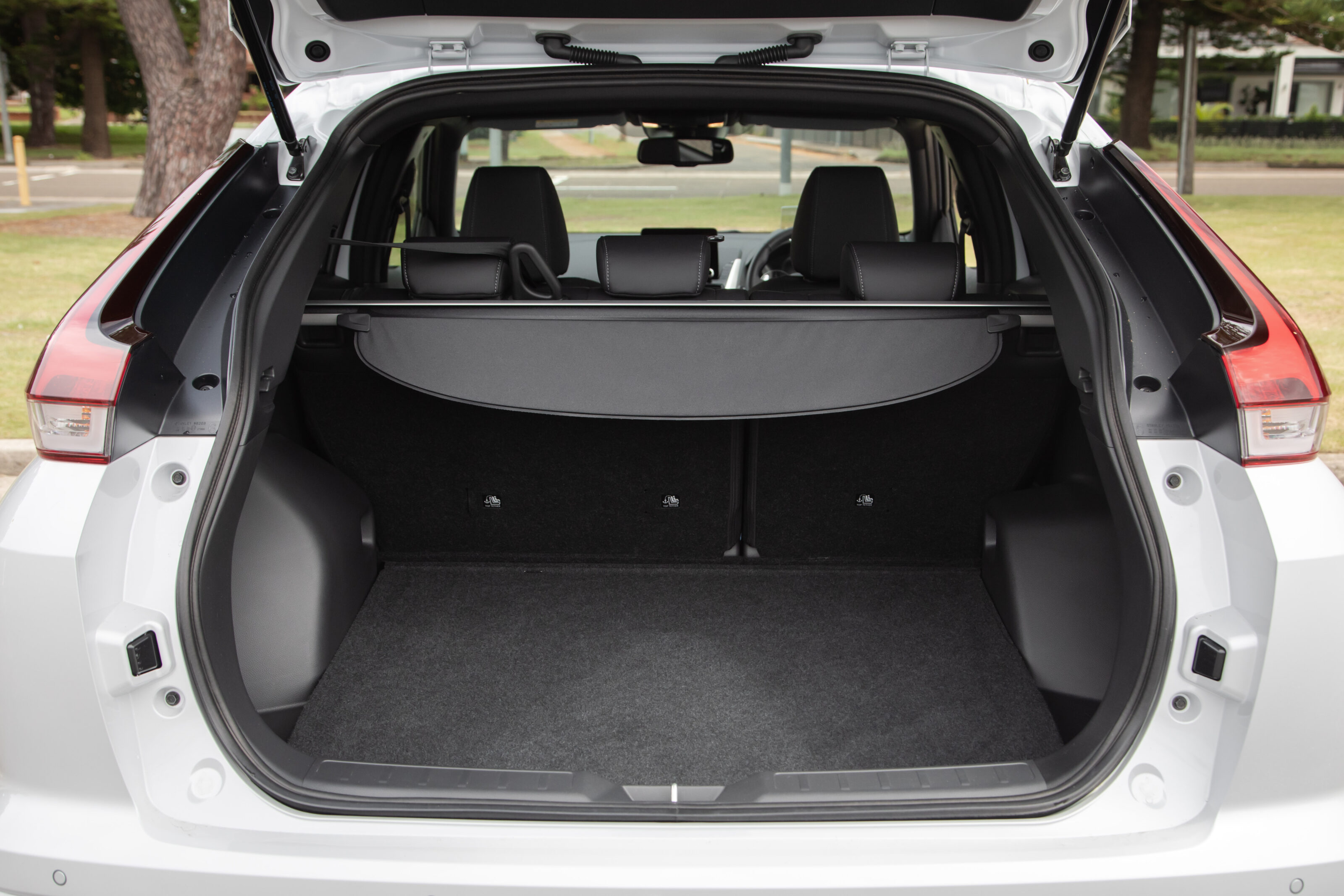
With the rear seats up, the Mitsubishi Eclipse Cross has a 405-litre boot capacity. Folding the second row increases luggage capacity to 1146 litres.
1
Warranty and servicing
As per the wider Mitsubishi range, the Eclipse Cross is covered by the brand’s 10-year/200,000-kilometre warranty.
This reverts to a five-year/100,000-kilometre period if the vehicle is serviced outside the Mitsubishi dealer network.
Maintenance for the Eclipse Cross is required every 12 months or 15,000 kilometres, whichever comes first.
Capped-price servicing is available for ten years. Pricing has increased in comparison to mechanically-identical 2022 versions.
Note: list scrolls horizontally.
Availability
The 2023 Mitsubishi Eclipse Cross will arrive in Australian showrooms in March.
For information on Mitsubishi’s wait times, click here.
Whether you’re looking for guidance on your next family hauler or it’s only power you’re after, the Feb 2023 issue of Wheels has you covered.
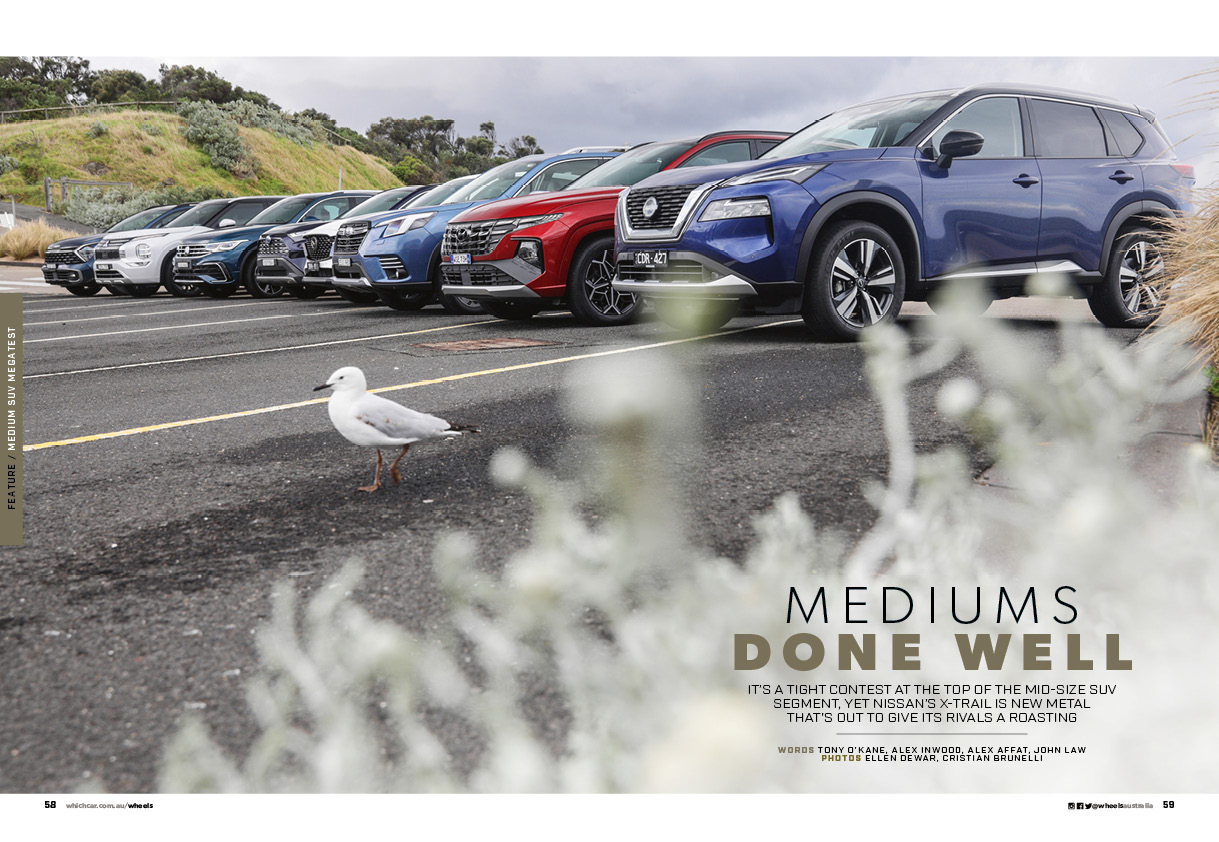
We drive Australia’s most popular cars and figure out which medium SUV deserves its place at the top of the sales charts and which are mere also-rans.
Can Nissan’s new X-Trail break into the top echelon of family transport and does Toyota’s hot-ticket RAV4 Hybrid still warrant a place at the top table?
1
1
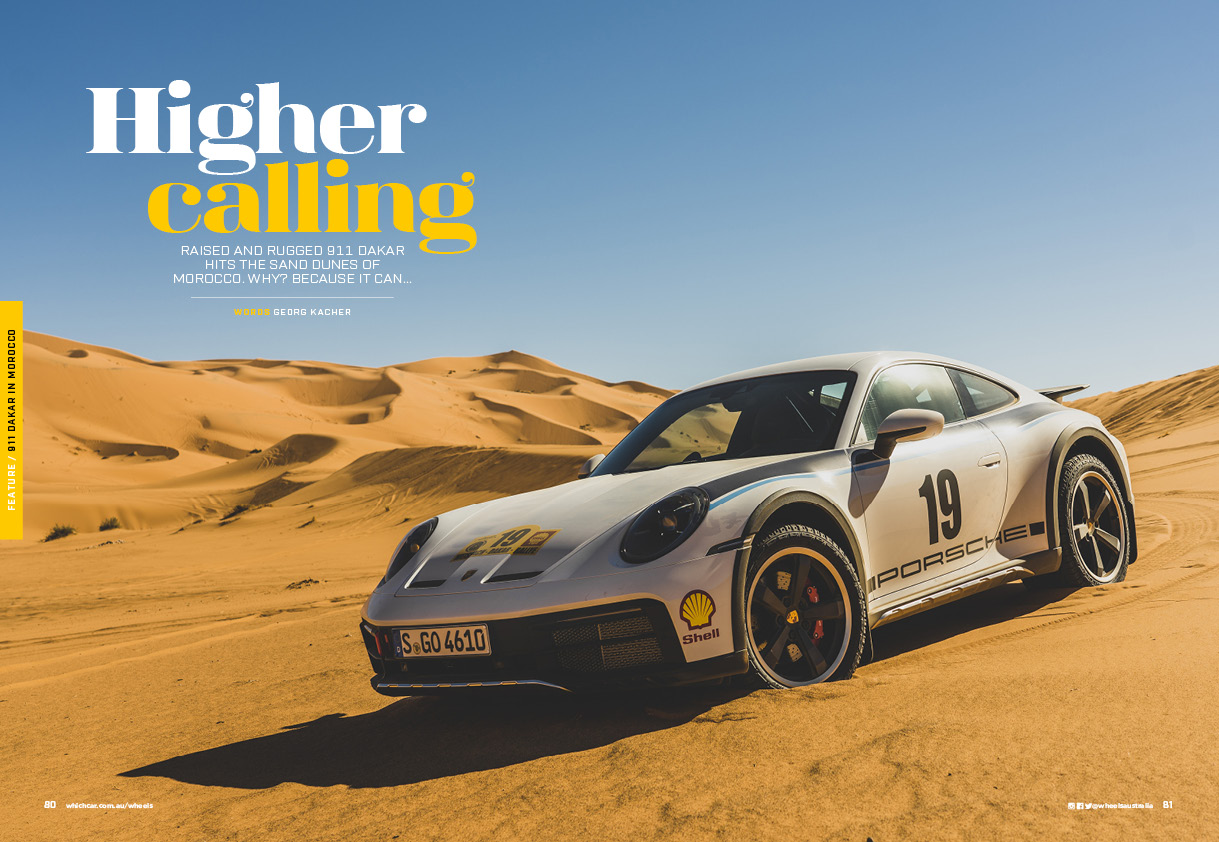
If that’s all a bit sensible, we also have a Sahara desert drive in Porsche’s new 911 Dakar and a road test of BMW’s long-awaited M3 Touring.
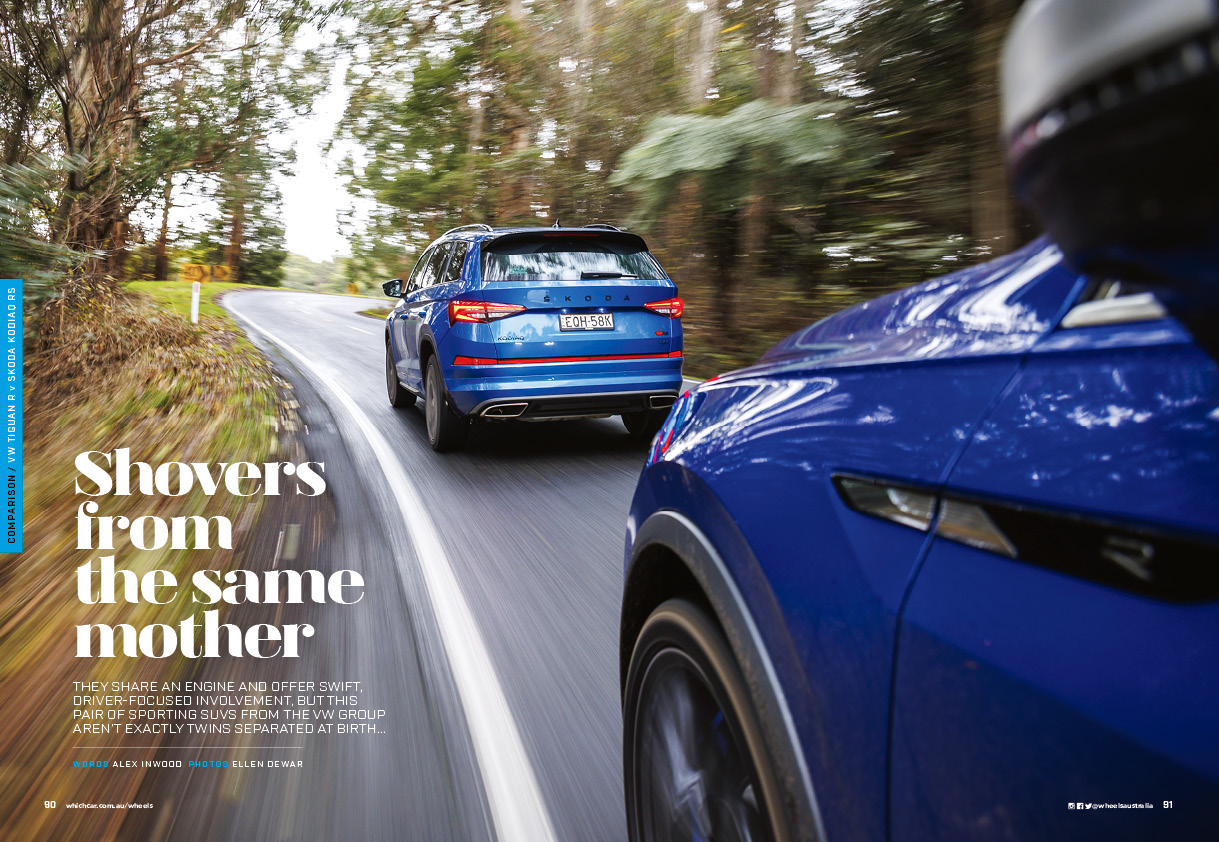
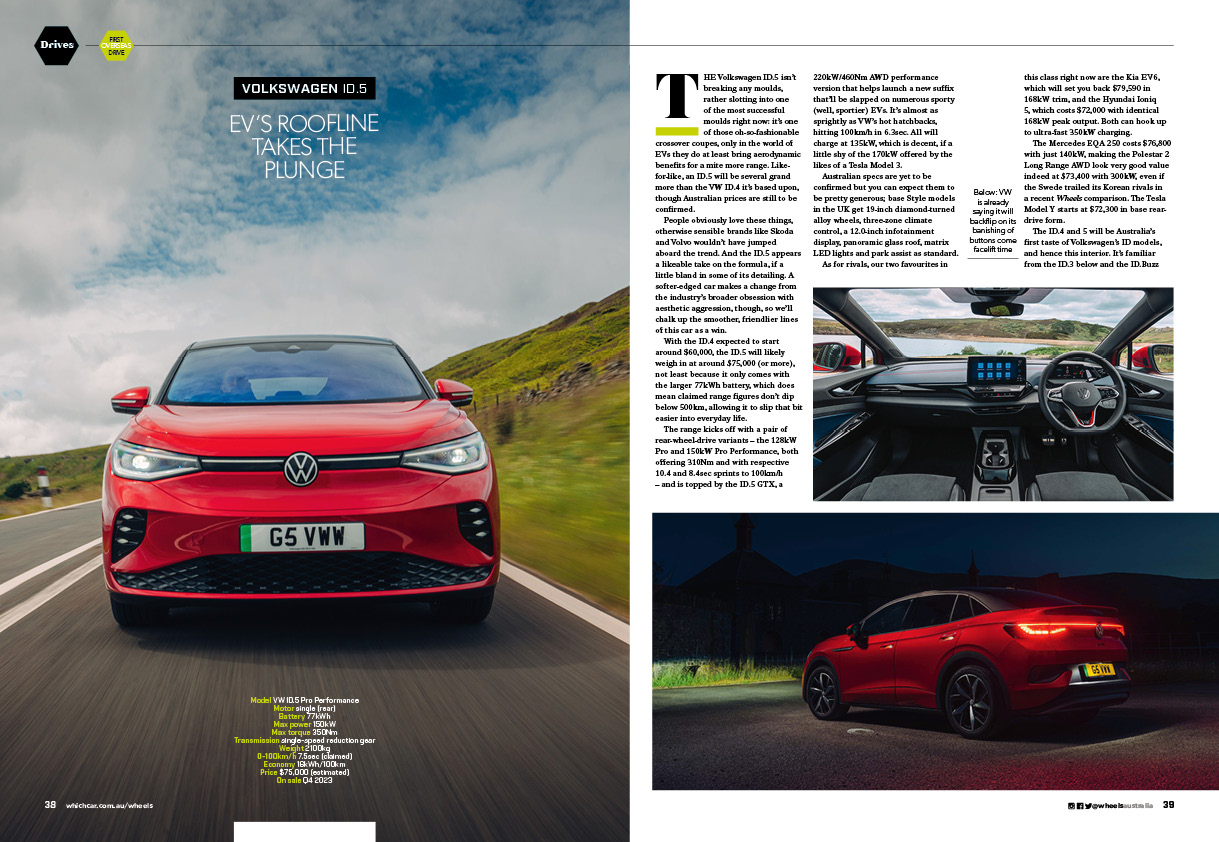
We put Volkswagen’s punchy Tiguan R up against Skoda’s Kodiaq RS and also get behind the wheel of the Audi Q8 e-tron, the Porsche Macan T and the 386kW Land Rover Defender 90 P525 V8.
1
1
Yes, that last one’s as unhinged as it sounds.
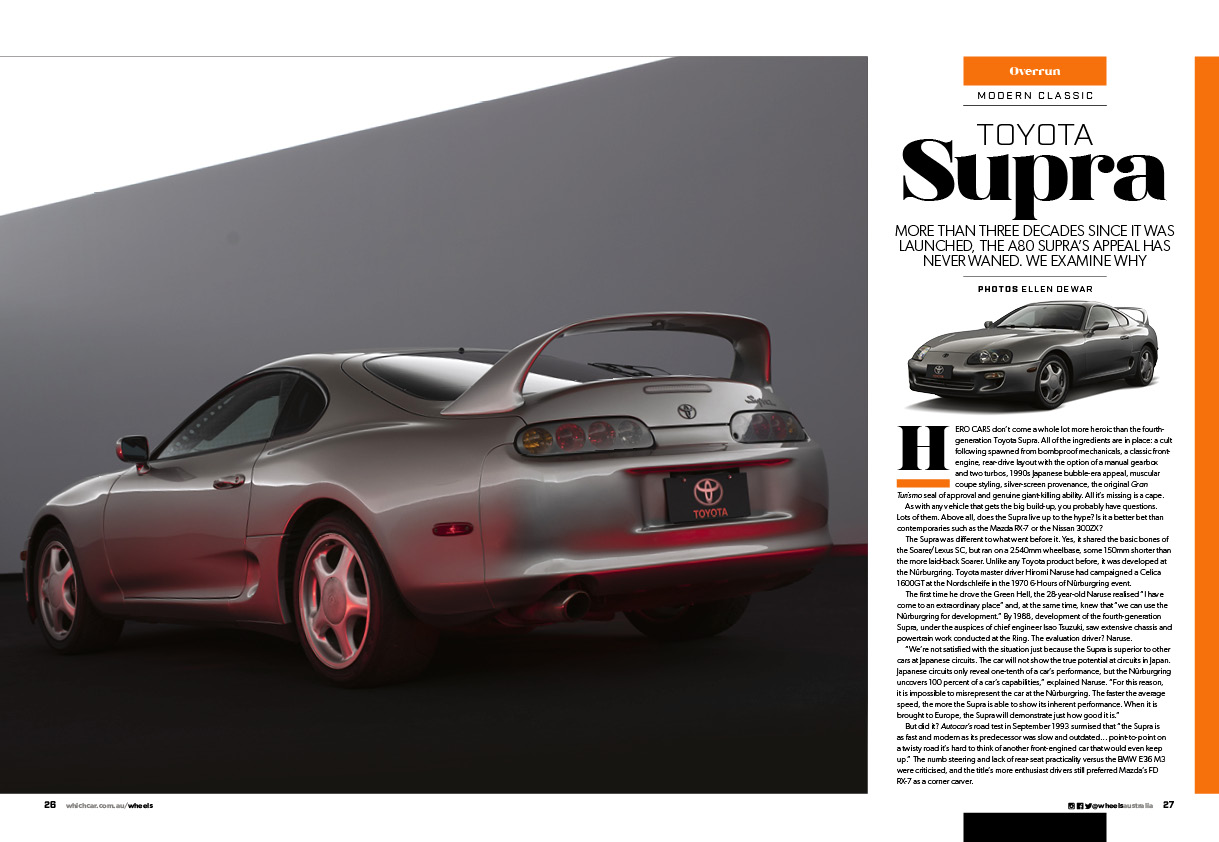
The Toyota Supra headlines our Modern Classic section – yes the iconic A80 version – while the Wheels garage sees Ford’s latest Everest V6 sidle in alongside the Kia EV6 GT Line and the Hyundai i30 Sedan N.
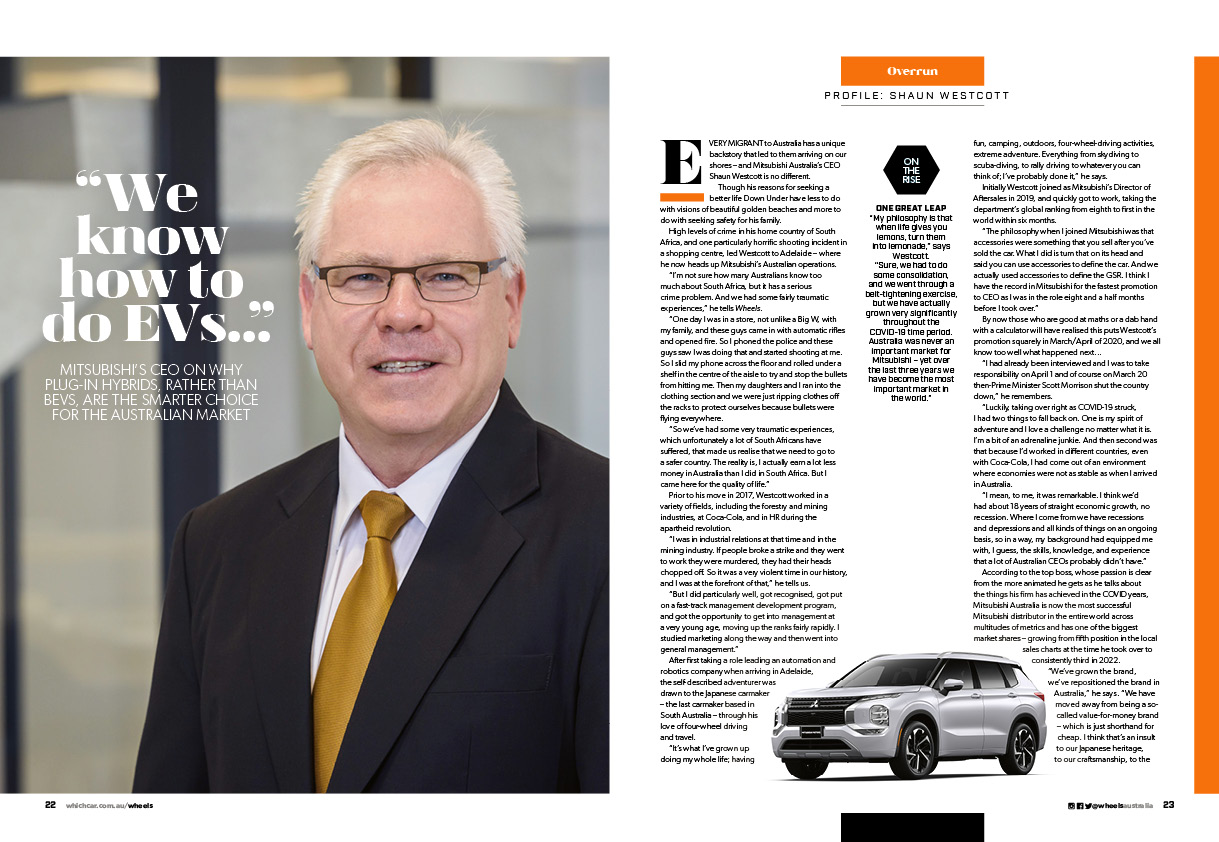
We get the low down from Mitsubishi Australia boss Shaun Westcott, celebrate the life of the late Ken Block, and opinion from Andy Enright, Daniel Gardner and Dylan Campbell.
There’s a bit of everything in the February issue, due on shelves Monday 13th February. Don’t miss it.
1
1
Not yet a subscriber?
You can subscribe to Wheels magazine from only $59 and we’ll send you a copy of the current issue straight away. Subscriber benefits include:
- Huge savings on the regular cover price
- Free delivery to your doorstep
- Free digital access
- Browse the entire Wheels archive back to 1953
- Exclusive benefits and discounts
Valentine’s Day comes and goes each year, flying past faster than cupid’s arrow. But with so many spectacular driving routes on offer in Australia, it’s the perfect opportunity to take a break and hit the road with your loved one.
For that matter, why wait for February 14? Better yet, leave your lover at home – these drives are just as fun with friends.
We take a look at a few of the best butterflies-inducing, proposal-popping road trips in Australia. It’s not Paris, but it’ll be worth it.
Epicurean Way, South Australia

1
They say the best way to a man’s heart is through his stomach, right?
Don’t be fooled by Adelaide’s reputation, South Australia is the master of romantic drives; from the Barossa to the beachside wine region of McLaren Vale, the Epicurean Way drive is just one way to experience this decedent part of our country.
The four-day tour takes you from Adelaide through the coastal wine-region of McLaren Vale, Adelaide Hills, Barossa and Clare Valley. It’s the ultimate scenic trip that will keep your taste buds tingling and your glasses full. There are also plenty of spots to get in touch with your inner teenager and sit on the bonnet of your car to watch the sun go down because…well…romance.
Great Southern Touring Route, Victoria

1
When it comes to road trips, Victoria has a bit of everything, including the Great Ocean Road and the food and wine regions of the High Country and south-east coast.
But there is nothing quite as spectacular and breathtaking as the Great Southern Touring Route. While you could probably jam the journey into 13 hours, we’d advise you opt for spreading it out over a luxurious five-day sojourn.
Whatever the case, this is one drive that will keep your camera full and your memory bursting.
Otway Fly Treetop Walk, The Twelve Apostles and Grampians National Park – from coast to inland, what more do you want for a romantic getaway? We’re pretty certain your car will love spending some time away from Melbourne’s hustle and bustle.
Cradle Country, Tasmania

1
Tasmania is no stranger to romantic getaways… nor is it foreign to the weekend escape – thanks to Falls Festival and its adventurous reputation.
Great food, wine and scenery are the staples of this ultimate road trip.
But any trip to this detached island wouldn’t be the same without a bit of adventure, which is why Cradle Country is on our list. Spend anywhere from two to four days exploring the north coast hinterland to the edge of the Tasmanian Wilderness World Heritage Area, where you’ll find the popular Cradle Mountain.
Things to do include cheese-tasting at Ashgrove Cheese and treading one of the many walks around Cradle Mountain – in particular, the Dove Lake Circuit. Also, explore Promised Land and Tasmazia, stop and smell the roses at Emu Valley Rhododendron Gardens and return to Devonport via the Great Nature Trail.
Waterfall Way, New South Wales

1
Did someone say waterfalls? Does anyone’s brain flicker to the 1988 movie Cocktail with Tom Cruise and Elisabeth Shue? Anybody? Guess not.
Waterfalls are one of nature’s most spectacular displays, so it’s only natural you’ll want to whisk your lover away on this scenic drive from Coffs Harbour on the NSW north coast, through the tablelands of the New England region.
Think lush countryside, rainforests, waterfalls and national parks. This 191km trip, ending in Armidale, will take you through a range of landscapes with plenty of spots along the way to pull out the old selfie stick.
It’s no surprise this has been voted one of Australia’s best scenic drives. Must-sees include New England National Park, Cathedral Rock National Park, Wollomombi Falls and Darrigo Rainforest Centre and Skywalk.
Bloomfield Track, Queensland
1
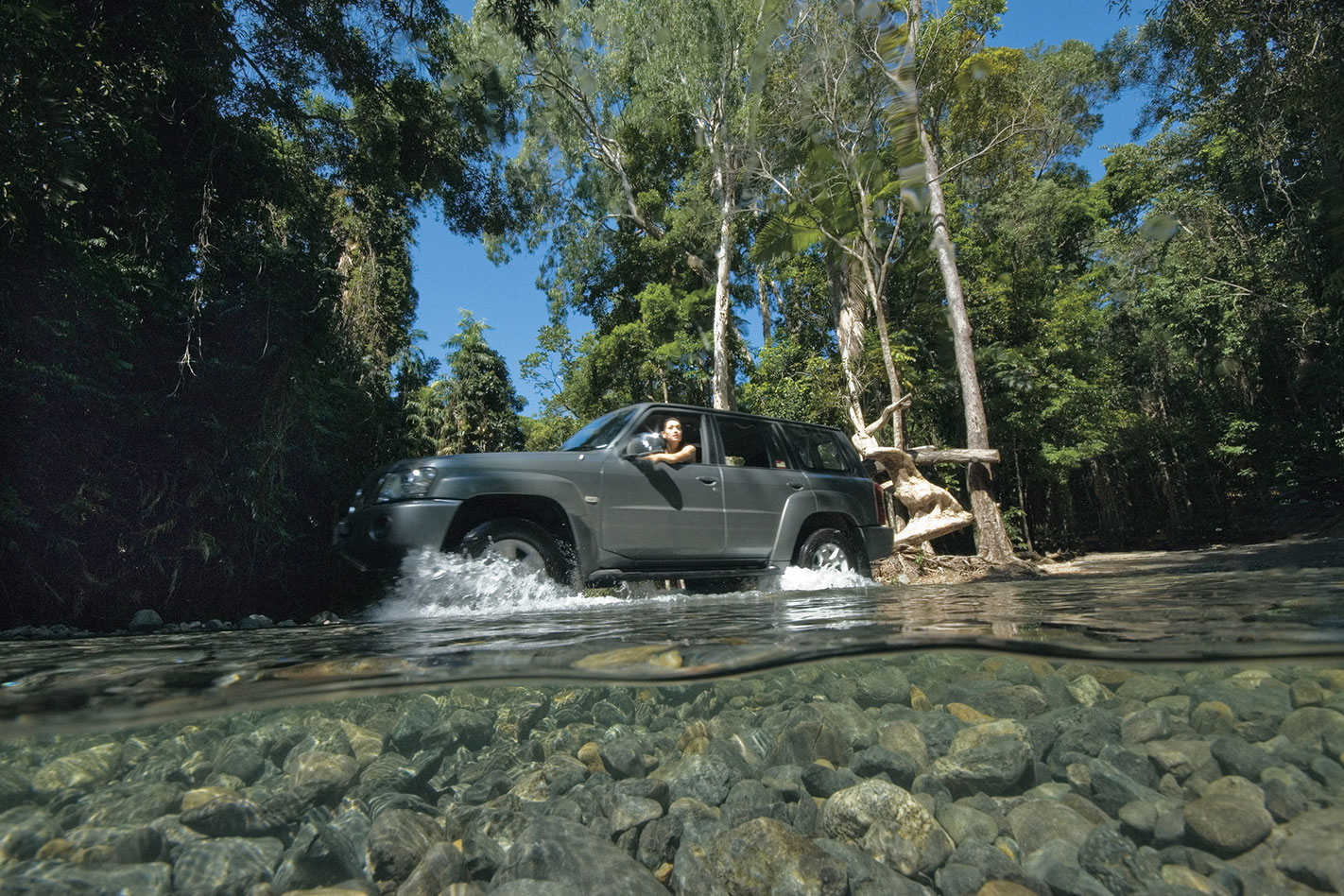
If you’re looking for something a little more adventurous than four tyres on the black-top, the Bloomfield Track in Far North Queensland is bound to get the heart pounding.
Travelling from Cairns to Cooktown, this coastal drive is four-wheel drive only.
Take in the spectacular views and get the 4WD good and dirty as you cross one of the many creeks and marvel at the lush rainforests and secluded beaches.
Make sure to stop at Cape Tribulation to check out the point where the rainforest meets the reef, before spending the night at eco-luxury Bloomfield Lodge – you’ll feel like you’re on the edge of the world.
Uluru to Kata Tjuta, Northern Territory

1
The Northern Territory is no stranger to remarkable scenery, with the Top End and the Red Centre offering some of Australia’s most-popular drives, usually via 4WD.
And if feeling close to someone is the aim of your game, then travelling to one of the most spiritual parts of the country is probably going to have you kicking goals.
The sealed road from Uluru to Kara Tjuta is one of those drives that you can do in a day, but there’s so much to do, we wouldn’t be surprised if you decide to take your time.
Sunrise and sunset are the most attractive times to visit various icons, and if you tire of your tyres, you can swap the seats of your car for a bit of time on the hump of a camel (we said camel).
You can even stretch your legs with a walk around the base of Uluru or the Valley of the Winds. This is a trip for all of the senses as you touch, smell and explore the Australian outback.
Scotsdale Tourist Drive, Western Australia

1
The 34km drive from Denmark to McLeod Road, eventually connecting you to William Bay National Park, is a lover’s dream. Tall karri trees, lush forests, orchard, wineries and spectacular ocean pools are sure to get the fingers intertwined.
Wineries, art galleries, the Harewood Forest Walk, and the remarkable Greens Pool are just some of the stops along this half-day adventure.
Relax on the pristine white sand or walk along the beach to Elephant Rocks or Madfish Bay, before putting aside some time for the Valley of the Giants Treetop Walk. All of this is just five hours drive south of Perth.
Any romantic drives we may have missed? Let us know in the comments!
MORE
Road trip stories
Thomas Broberg has been with Volvo nearly three decades, and has been in the Safety Centre for that entire time.
It’s fair to say safety is a bit of a passion.
Snapshot
- LIDAR is the future
- Drivers still front and centre in research
- Over-the-air updates to improve safety over time
1
A mechanical engineer by trade, and specialising in computer-aided design for crashworthiness, his first job was to design a crash structure for a small car to make it as safe as a large car in a crash. His work ended up in the first-generation S40, V40 and XC90.
Now the acting head of the Volvo Safety Centre, he carries a century-old commitment to safety into the next era of Volvo Cars – electrification.
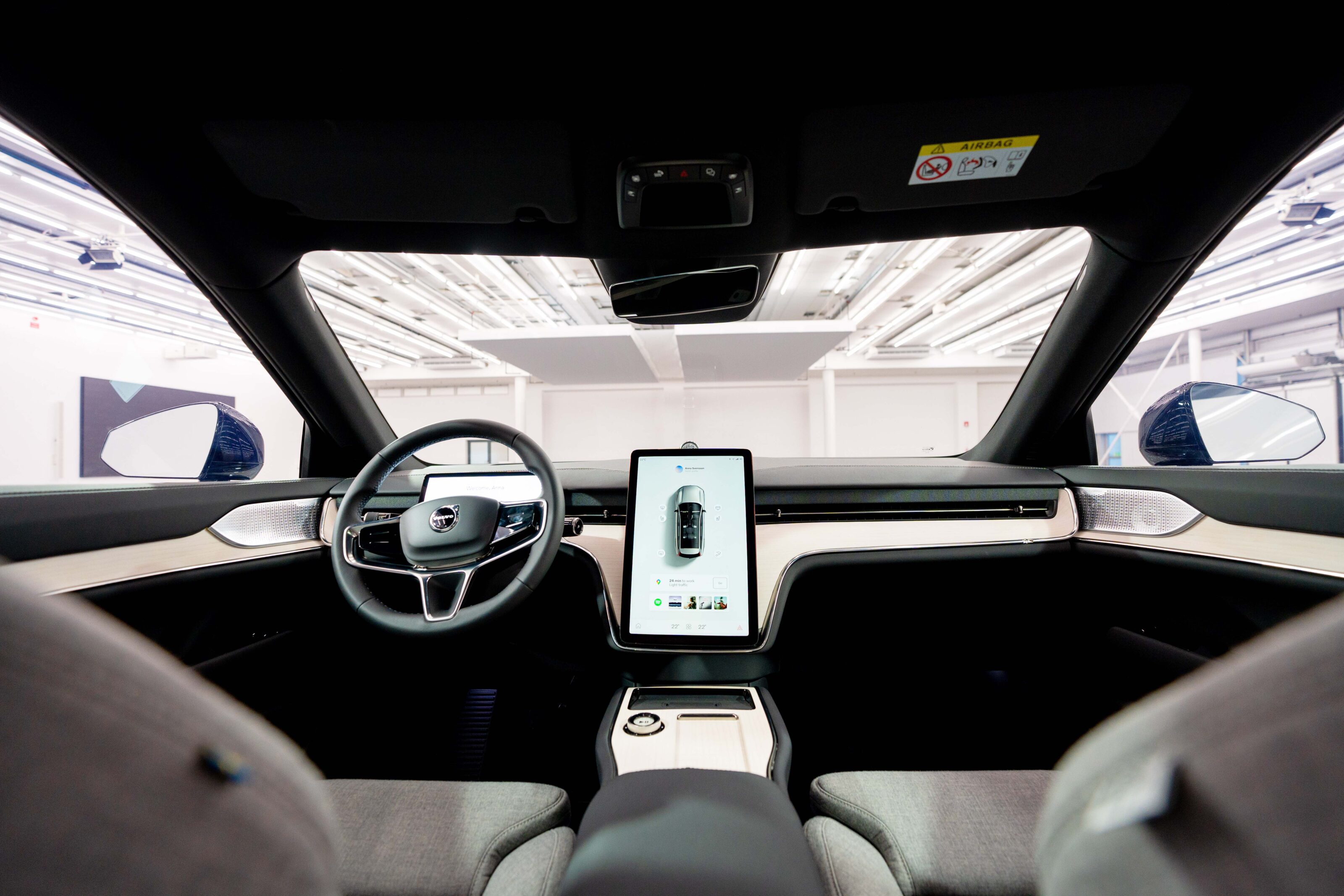
Volvo’s next focus is driver monitoring and using interior cameras to keep an eye on what’s going on behind the wheel. People are understandably worried that Big Brother is watching.
“It’s a stumbling block we need to overcome. If you look at the first generation of the system we have right now, it’s working with data instantaneously so we don’t have anything that is collected. Even though cameras are used as sensors, it’s not taking footage. It’s basically measuring, so you have ones and zeroes. They’re used in time and then erased.
“We have a long history of working with sensitive individual data in our research, more than fifty years of working with the Traffic Accident Research team, so we have a culture of high integrity. Also working with how we make the data anonymous so it can only be used by a small amount of people within our organisation to do the research and nothing else.”
Volvo engineers famously spent some time in Australia working out how safety systems might better understand how to deal with kangaroos and other tricky situations.

1
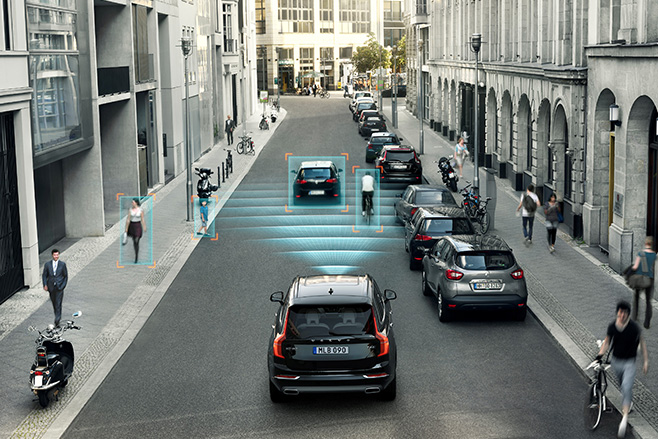
“We’re constantly trying to develop our systems for different circumstances. When it comes to the kangaroos that was quite difficult to recognise. Specifically – and this was during the development of the first stages of auto braking technology – an area we’ve been pioneering since 2006. The challenge developing auto braking systems like this when the car is supposed to do something is not to have the car brake or steer when it’s not supposed to.
“There’s always a balance in finding the situations that you can actually detect. You don’t want to insert any adverse affect that could be false and annoy the customer, because you would not trust a car that is braking every time you pass a mailbox. That would be very annoying. And more importantly that you’re not causing something that is more harmful or serious than what you’re trying to avoid.
“We’re constantly training our systems when it comes to kangaroos, I think that’s been a very challenging situation. I don’t have any data on what that may give. More importantly it’s difficult to collect data on situations that have occurred that didn’t end up in something.”
1
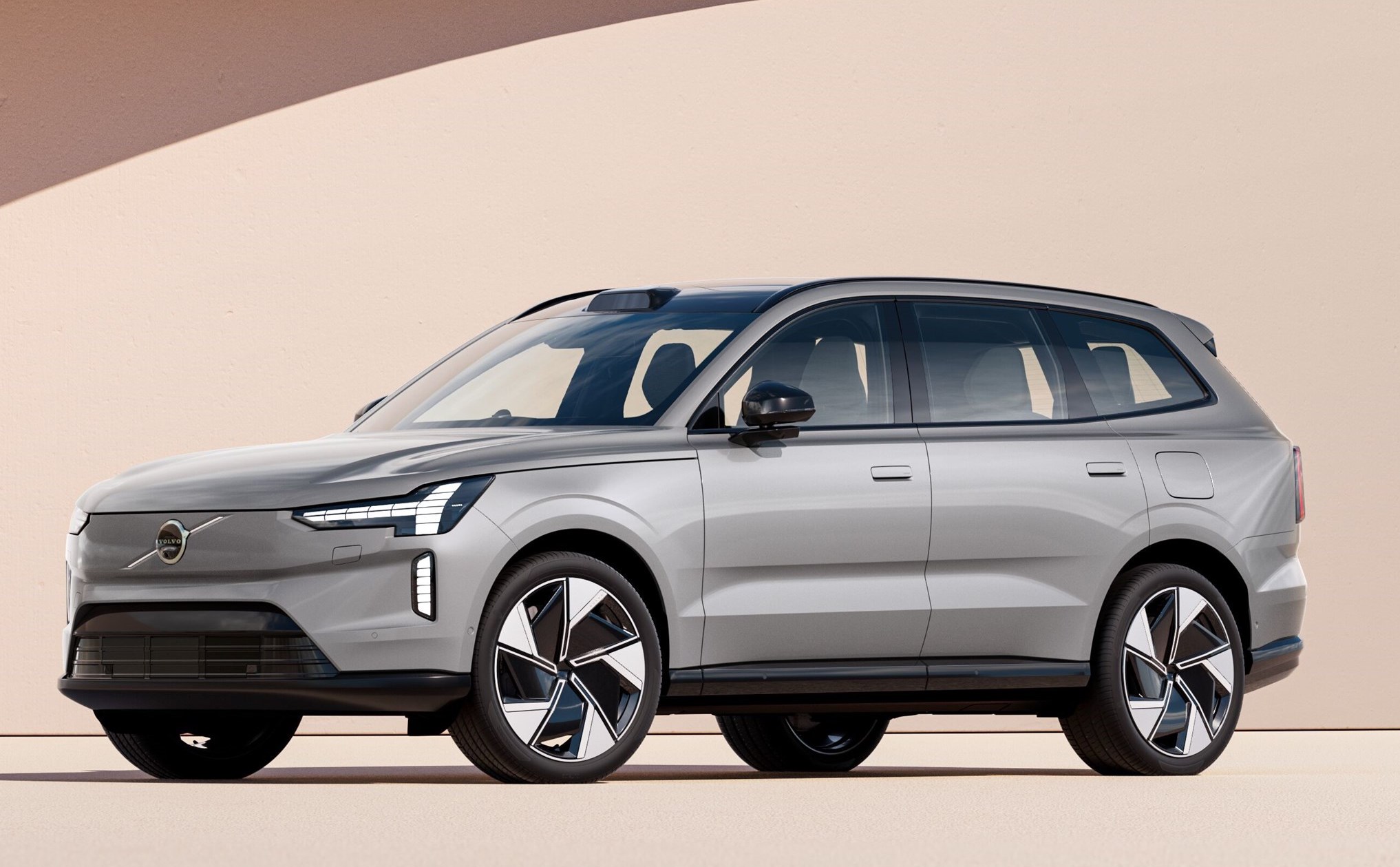
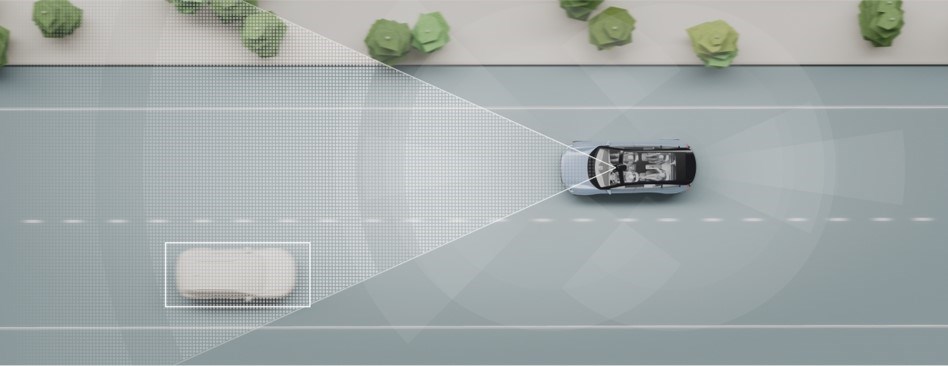
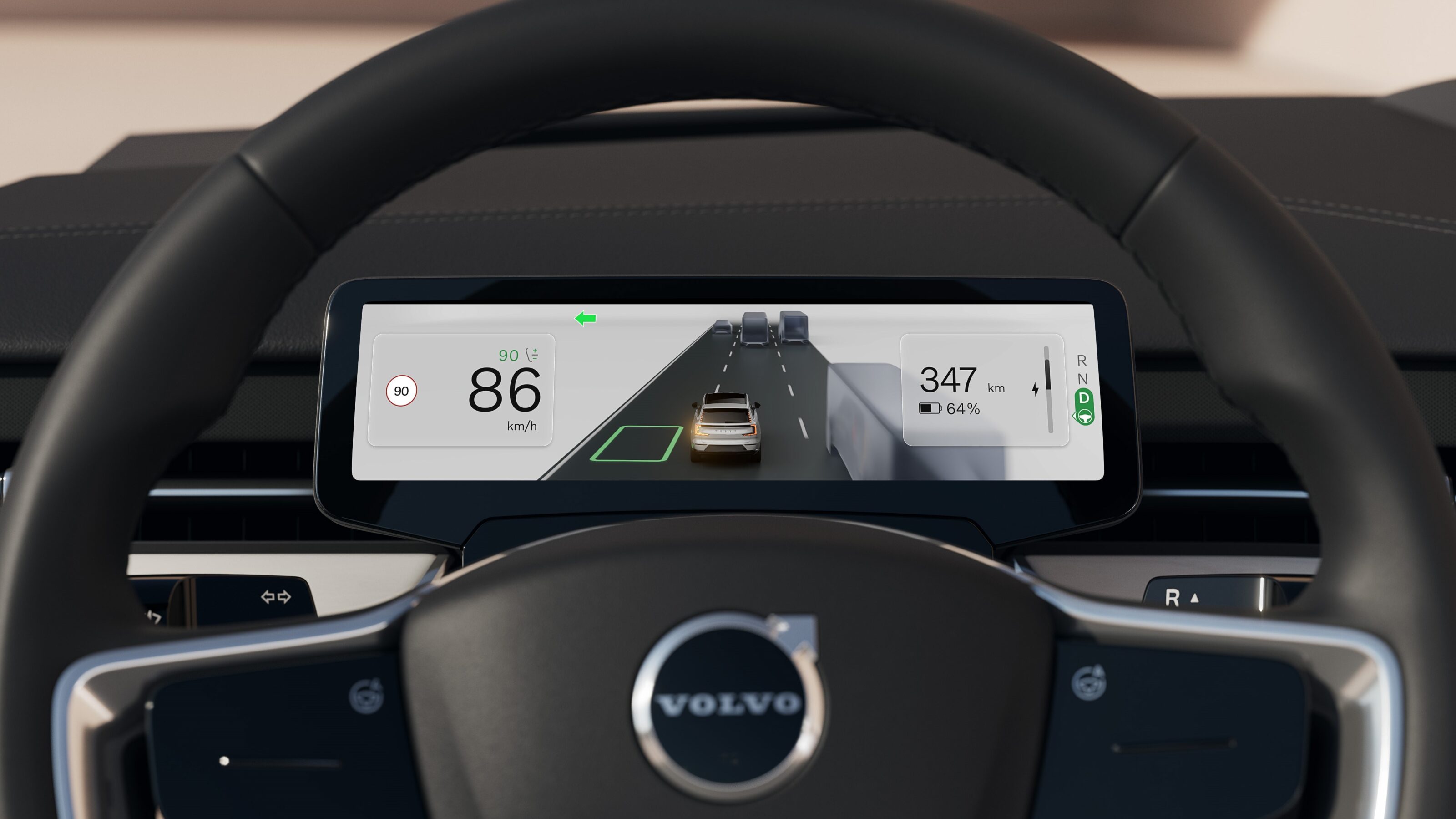
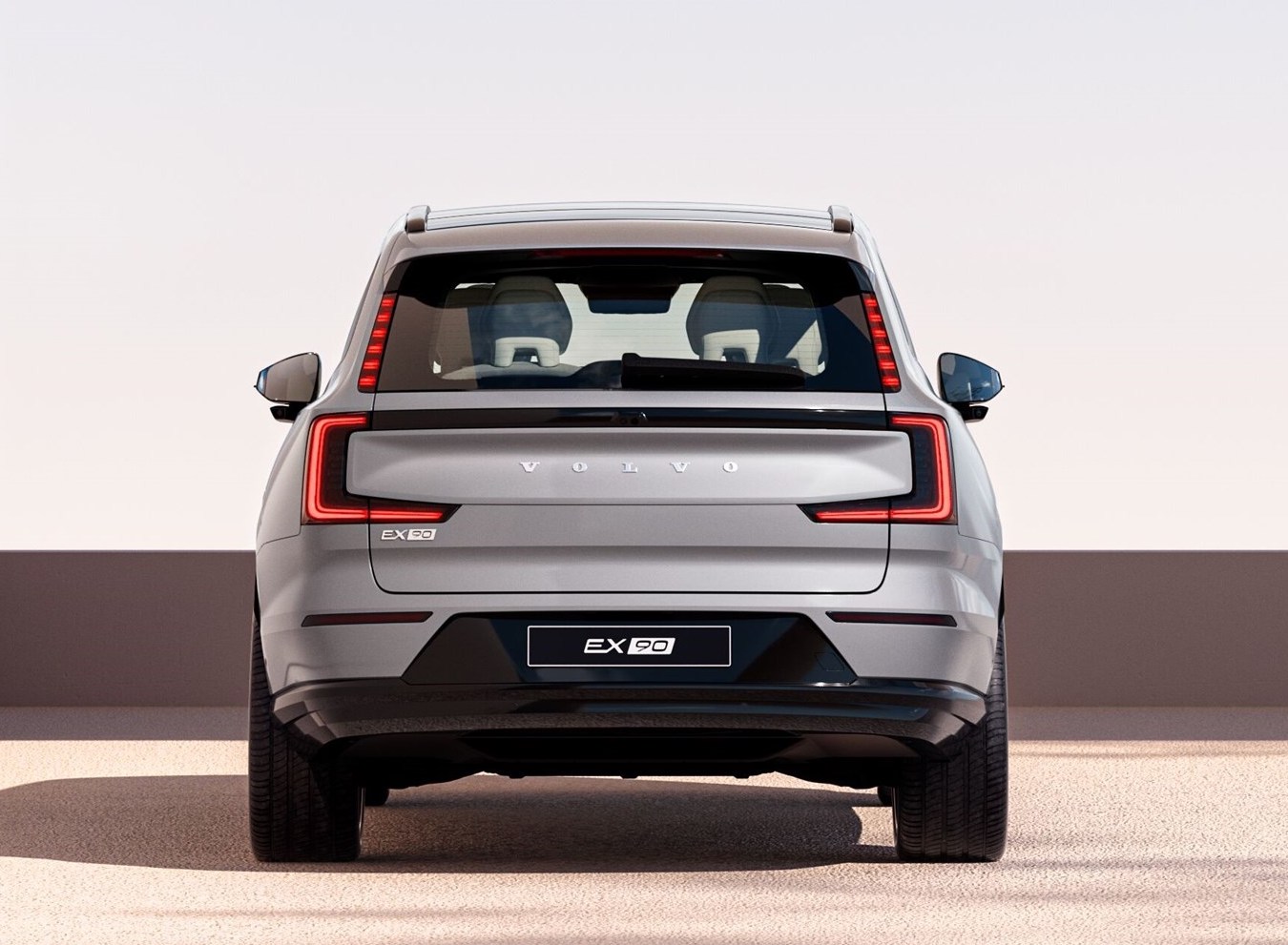
Broberg explained the upcoming EX90 not only has LIDAR technology, but a large range of cameras, radars and sensors around the vehicle. That feeds into a higher compute capacity to detect objects and help the car understand its surroundings. He says that this new platform will improve efficiency to handle more situations and new ones.
“What’s good with the new cars – as well as the C40 electric – is that we have the capability of upgrading over-the-air, which means we can improve the safety functionality of the car over time.
“Our primary objective is to protect the people in the car. We have a very deliberate strategy in that. Where do we start and how do we proceed with the data that we have and collect. How common is a typical situation and a crash and how severe it is. And also on top of that, what can we do about it with existing technology or do we need to invent new technology.
1
“And that kind of working process is one of our keys to actually be leading the pack in safety, because we understand the problem from a customer point of view, a real world point of view. And if there is no new technology we need to innovate it.
“And I think if you look at it over the years and how many safety innovations that you find in all cars today, many of them have had a world-first in Volvos. From a three-point safety belt to side airbags, side curtains, whiplash protection, auto-brake, auto-brake for pedestrians. We have been pioneering a lot of that and it’s based on our working methods in understanding the real-world scenarios.”
While Tesla has abandoned LIDAR and is using cameras for its advanced drive assist functionality, Volvo’s EX90 has gone the other way. The new seven-seater has LIDAR above the front windscreen that can “see” 200 metres down the road in pitch black, where a camera relies on at least some light to capture data.
1
The car is also loaded with sensors and cameras all around. While not commenting directly on Tesla, Broberg is clear as to which direction Volvo will take.
“More sensors will help, accurate sensors – that’s what we’re introducing with the EX90. Even though a lot of the buzz is around what the LIDAR itself can do, it’s a combination.
“Also the driver understanding systems, so understanding the engagement of the driver in combination with the surroundings of the car. That will enable us to provide or change the shield around the driver and the car pending on their engagement.

1
“We can have an earlier or later intervention or warning so that we do not annoy the driver. If you look at us as human beings, we are able to handle incredibly complex situations, we can foresee what others may do or may not do. So we (humans) are extremely good at that if you look at the complexity of driving a car.
“But we have our limitations. We can get tired, we can be distracted for many different reasons and we may not even have the best day, our thoughts may be somewhere else.
We’re great, but at the same time we have limitations and our approach is that with this advanced technology, how can we assist in a way that is designed around the human being. It’s always starting with the human and understanding these aspects.
1
“We need to understand that we are humans. It needs to start around the human and we do that with passive safety we need to understand what forces does the body afford, differences in sizes, ages, gender, you name it. We have to understand that. We’ve been building that knowledge for many, many years.
“I would say the same with understanding how we operate here,” Broberg said, tapping his head. “Driver behaviour. If you look at our team, over the last 20 years, we don’t only have engineers on our team, we have behavioural scientists.
“There are even some of us, including myself, that are engineers, but have studied behavioural science to complement in the same way as engineers who have studied bio-mechanics.
1
“The understanding about the human being is essential. It’s not only building our own knowledge, it’s co-operating with others. If you look at the Gothenburg area here, for being such a small place if you look at the joint traffic safety research that is conducted in the Gothenburg area I would say it is unique to have so much competence in one site, which is relatively small.”
“If you look at the big gaps, it’s intoxication, distraction and also speeding. If you look at fatalities in most statistical databases around the world, at the government agenda in most countries, it’s intoxication, driving under the influence, speeding at the same time and not wearing your safety belt.
“Unfortunately, it’s not only that you may hurt yourself, but usually also includes someone else who is innocent. We have a joint responsibility with authorities because these are violators of the traffic systems. We need to see what we can do because it’s such a big gap.”
MORE
Everything Volvo
MORE
Electric Cars
MORE
Electric SUVs
Can you believe 2023’s arrival of the fifth-generation Lexus RX marks 25 years of the nameplate, and 20 years on the Australian market?
Yes, the RX line was born in 1998 and in two and a half decades has evolved from a conservative, dependable luxury SUV into a more progressive-looking family wagon.
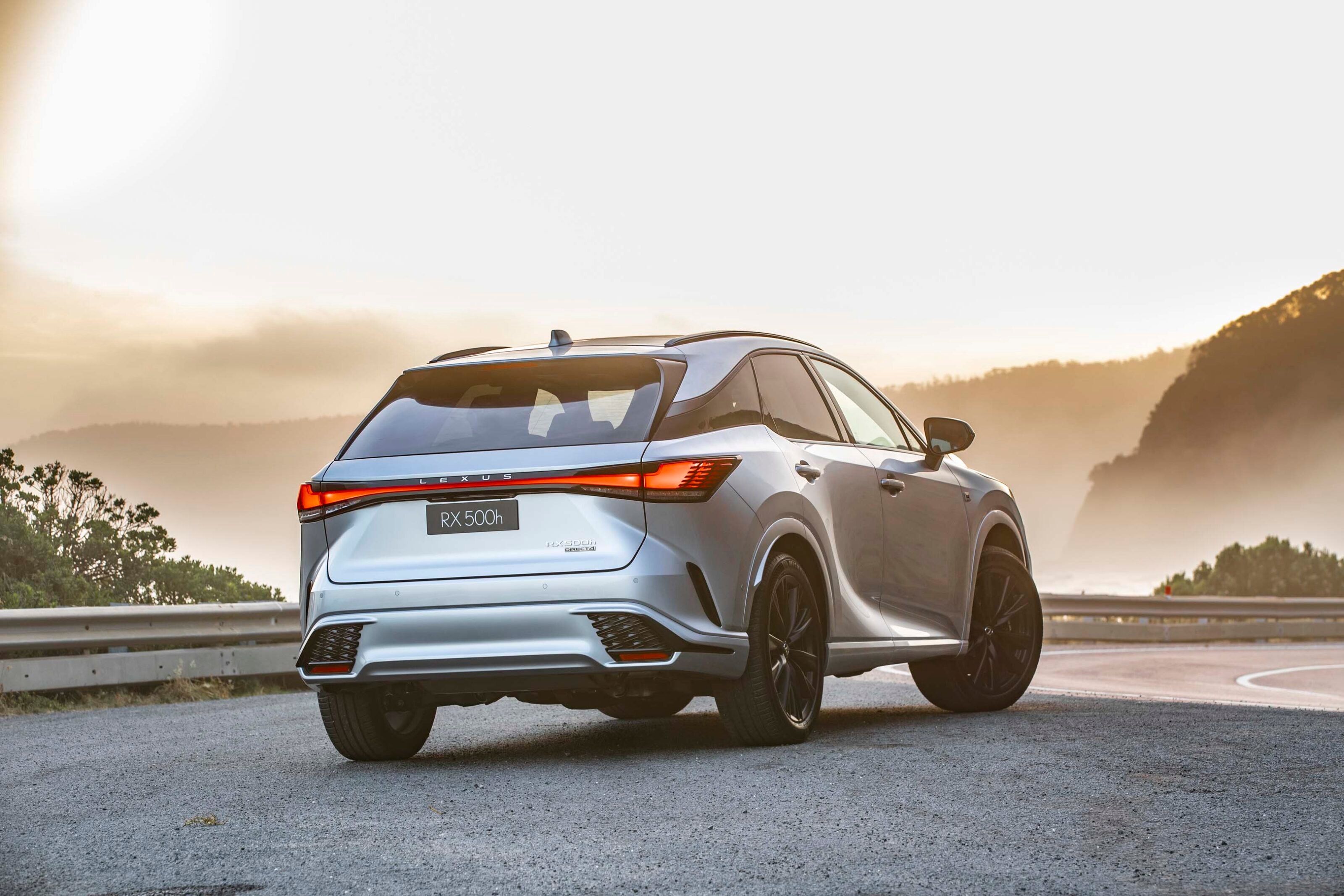
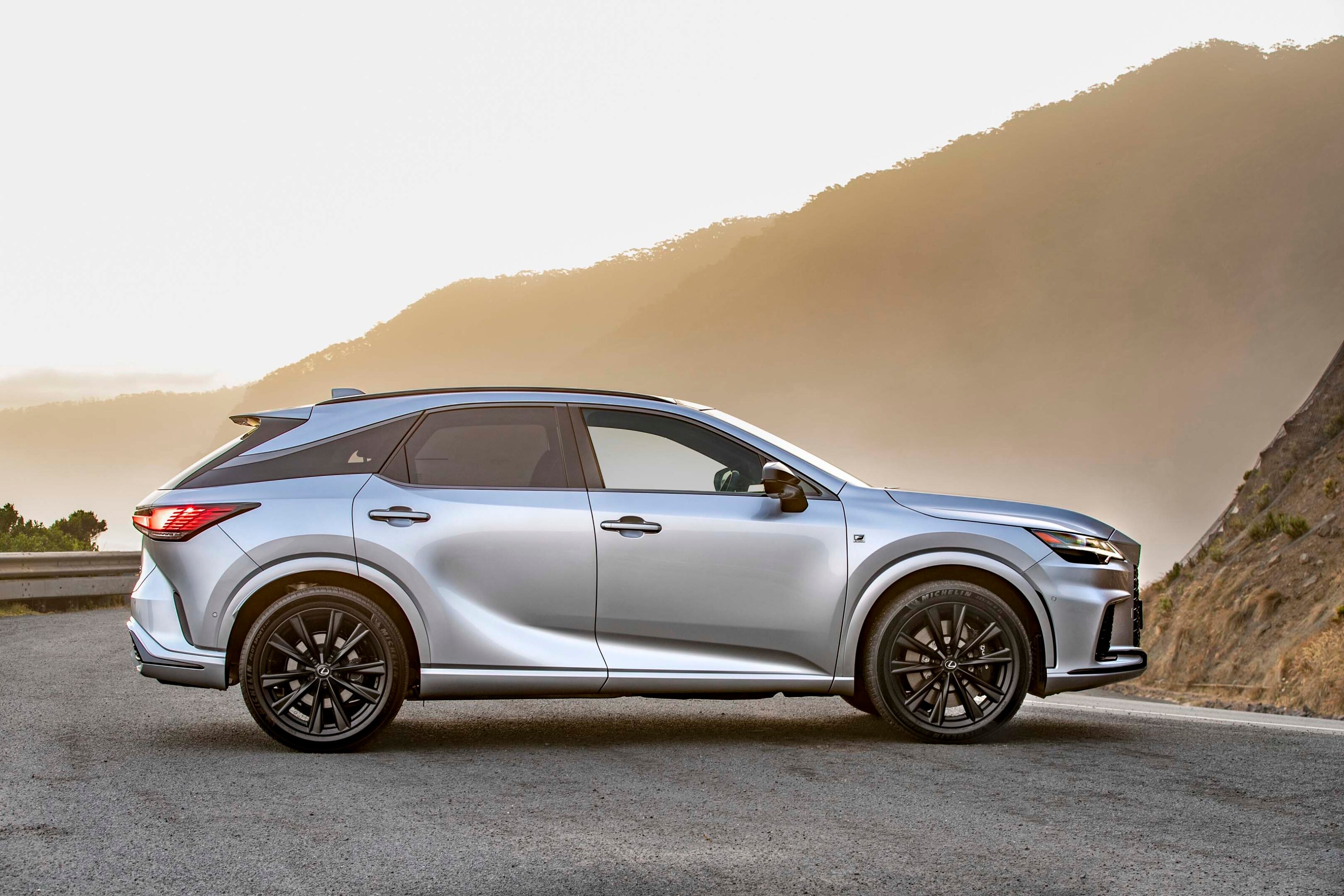
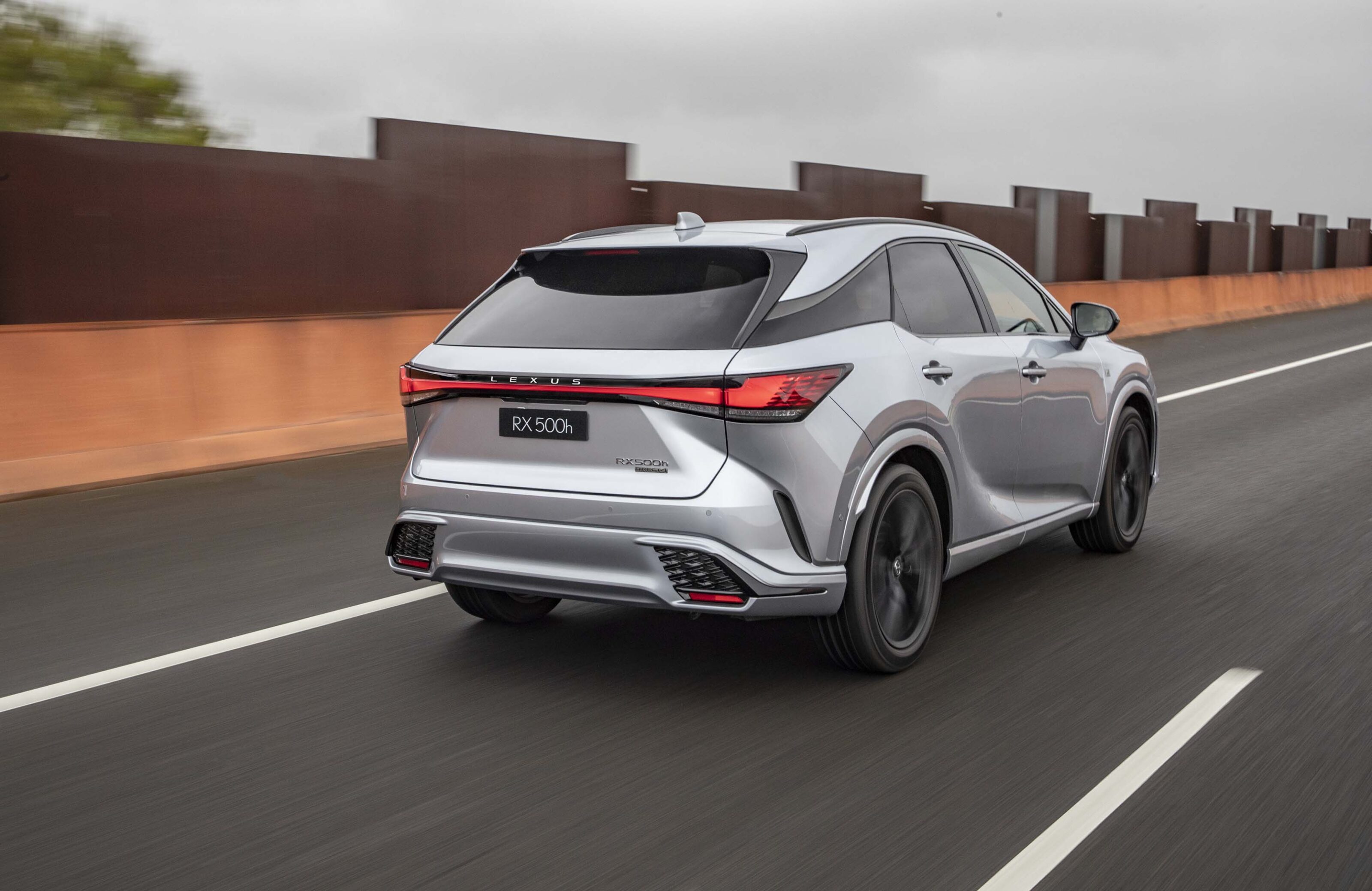
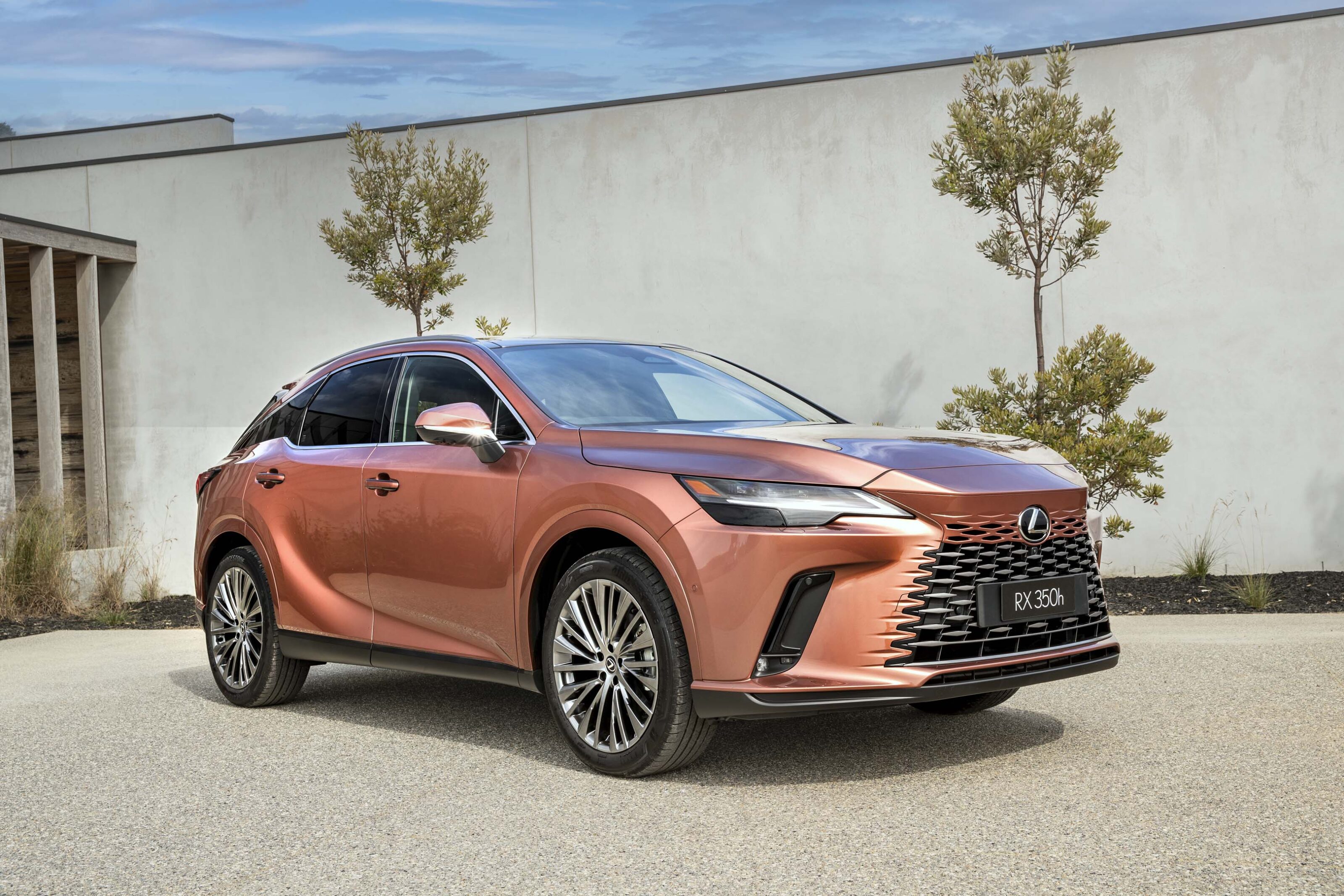
The fifth-gen continues to push the styling frontier with the spindle grille segueing into a ‘spindle body’ design in which the bonnet forms the upper half of the hourglass.
1
Electrification headlines in the new model, which supplants the outgoing RX’s V6-based hybrid with four-cylinder petrol-electric combinations. A turbocharged hybrid debuts in the quicker 273kW flagship called RX 500h – in new F Sport Performance guise – that is pitched as the drivers’ pick.
A lighter body, wider tracks, lower centre of mass and driver-focused tech, on the brand’s GA-K architecture, suggest this new RX could elevate the nameplate’s dynamic experience to meet the flagship’s positioning – and the bold aesthetics.
Does the 2023 RX deliver? Let’s find out.
1
JUMP AHEAD
- How much is it, and what do you get?
- How do rivals compare on value?
- Interior comfort, space and storage
- What is it like to drive?
- How is it on fuel?
- How safe is it?
- Warranty and running costs
- VERDICT
- Specifications
- Frequently asked questions
How much is it, and what do you get?
With electrification the brand’s focus – on a mission to be 80 per cent electrified by 2025 – the Lexus RX line-up duly opens with the hybrid RX 350h that teams a 2.5-litre petrol four with an electric motor and front-wheel drive for $87,500 excluding on-road costs – it’s $92,000 with all-wheel drive.
At the other end of the range, the new flagship RX 500h F Sport Performance with its 2.4L turbo-petrol parallel-hybrid AWD system costs $126,000 before on-road costs and leaves no options on the table.
In between, there are 2.4L turbo-petrol AWD RX 350 variants from $99,900 before on-road costs.
Luxury, F Sport and Sports Luxury trim levels continue, joined by the RX 500h’s new F Sport Performance grade, and a series of enhancement packs.
1
The Luxury grade is standard for the RX 350h with bi-LED headlights, LED daytime running lights, roof rails and 19-inch five-spoke alloys among the highlights.
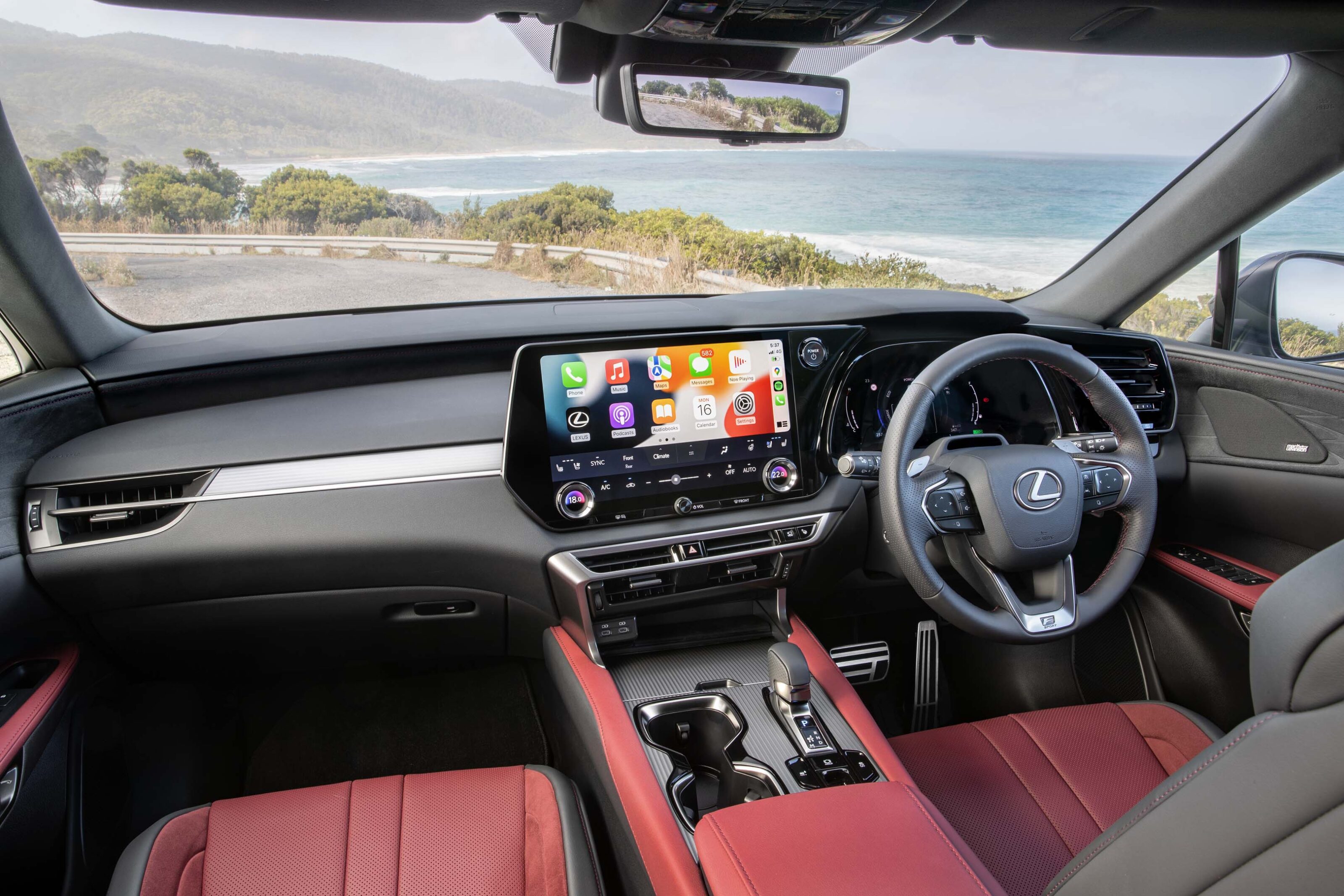
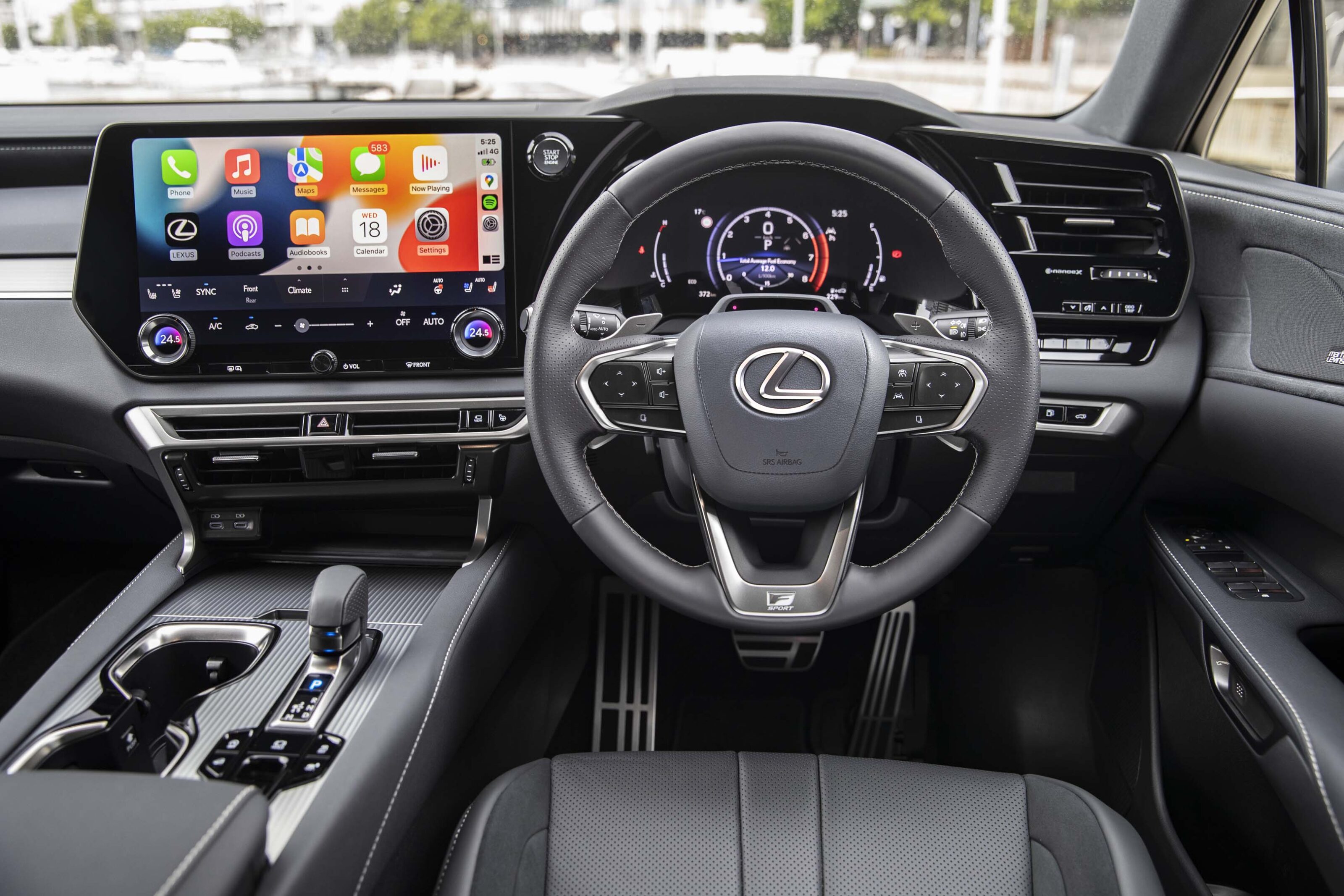
Inside, Luxury grade brings heated, eight-way synthetic leather front seats with two-way power lumbar adjustment, three-zone climate control with air purification, an electrically adjustable steering column and a powered tailgate.
Every RX gets Lexus’ latest multimedia system with a 14-inch hi-def touchscreen, Android Auto and wireless Apple CarPlay, and 12-speaker Panasonic audio.
The unit features satellite navigation, DAB+ digital radio and Lexus Connected Services functionality.
1
There are five USB-C ports around the cabin, a pair of 12V sockets, and a single USB-A port for multimedia connection and smartphone charging.
Extensive safety features and technologies are also standard, which we’ll cover in a subsequent section.
An optional enhancement pack for RX 350h Luxury adds a panoramic glass roof, leather-accented seats, ventilated front seats, touch-sensitive steering wheel controls linked to the head-up display, an upgraded instrument cluster display, a smart key card and wireless smartphone charger.
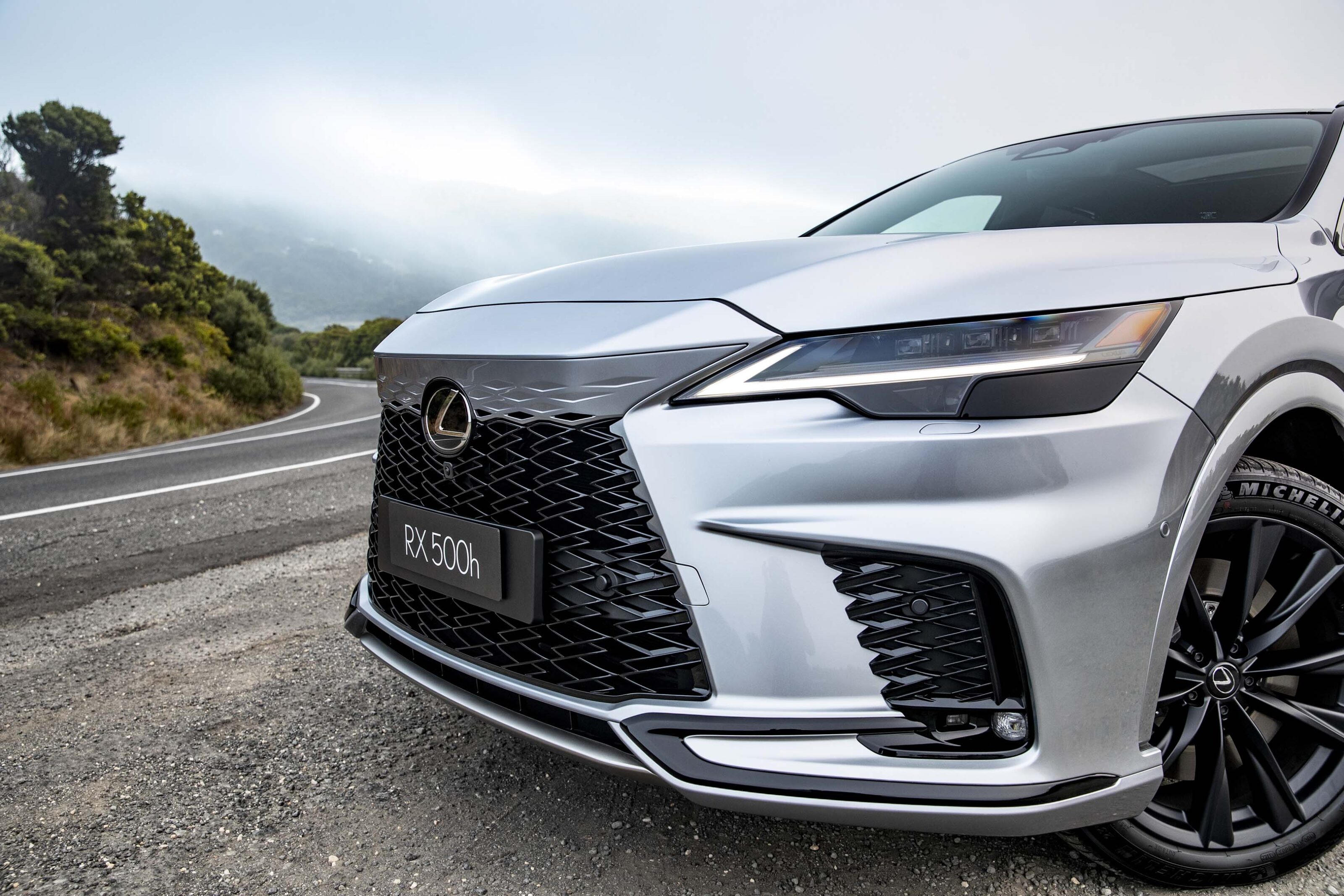
F Sport grade for the 350h drivetrain adds gloss black 21-inch alloys, a specific grille and bumpers, and black roof rails and mirror caps.
1
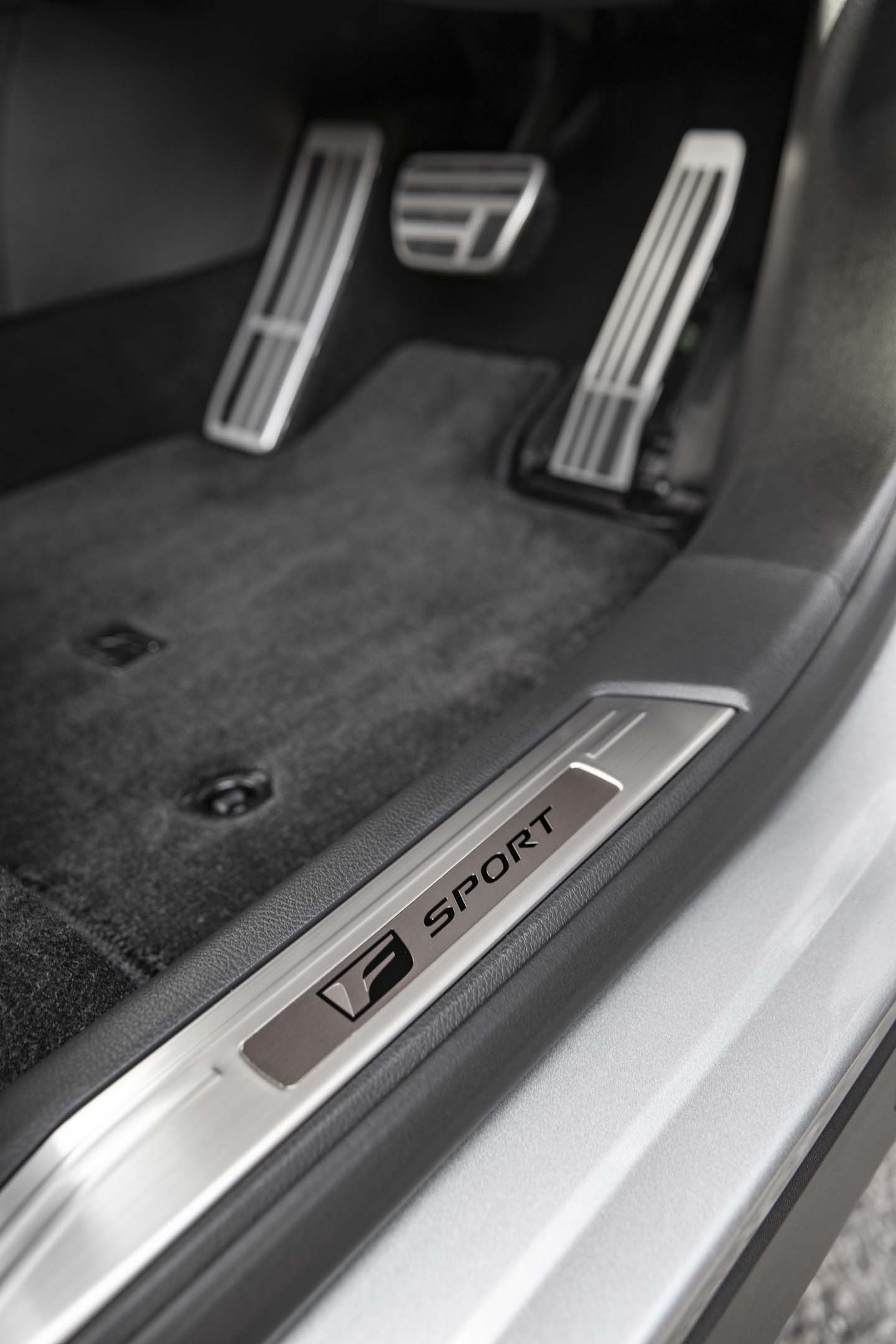
Similarly sporty touches inside include dimpled leather steering wheel, scuff plates, shift knob and instrument cluster, aluminium pedals and F Sport seats with heating and ventilation.
There are also three-projector bi-LED headlights with auto-levelling, cornering lamps and washers, a powered tailgate with kick sensor, a smart key card and rear door sunshades.
A colour HUD also features, with touch-type steering wheel controls, an upgraded instrument cluster display, wireless smartphone charging, active noise cancelling and a 21-speaker Mark Levinson surround sound system.
F Sport hardware upgrades include adaptive suspension and aluminium monobloc six-piston front brake calipers.
1
The RX 350 F Sport brings the optional EP1 – a sliding panoramic roof – and EP2 which, as well as the roof, adds a digital rear-view mirror, heated steering wheel and automated parking.
Sports Luxury grade builds on the key F Sport features, adding semi-aniline leather front seats with 10-way power adjustment, a heated steering wheel with woodgrain detailing, power-folding and reclining rear seats, heated and ventilated outboard rear seats, and unique 21-inch wheels.
It also brings the choice of a panoramic roof (EP1) or EP2, which also adds a digital rear-view mirror and auto parking.
1
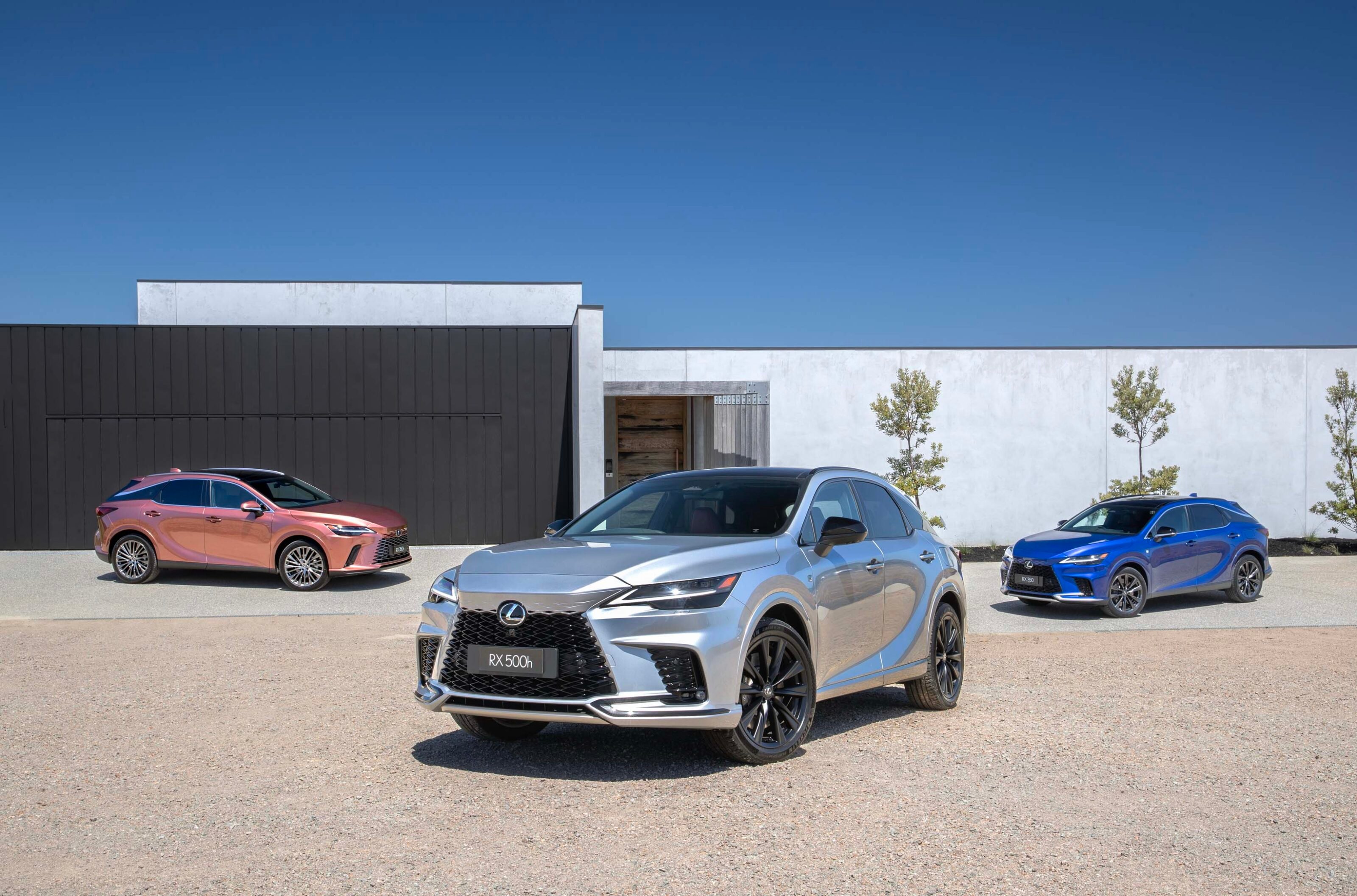
The flagship RX 500h is offered only in highly equipped F Sport Performance trim, which features all the enhancement pack and F Sport extras, as well as leather upholstery and aluminium interior trim.
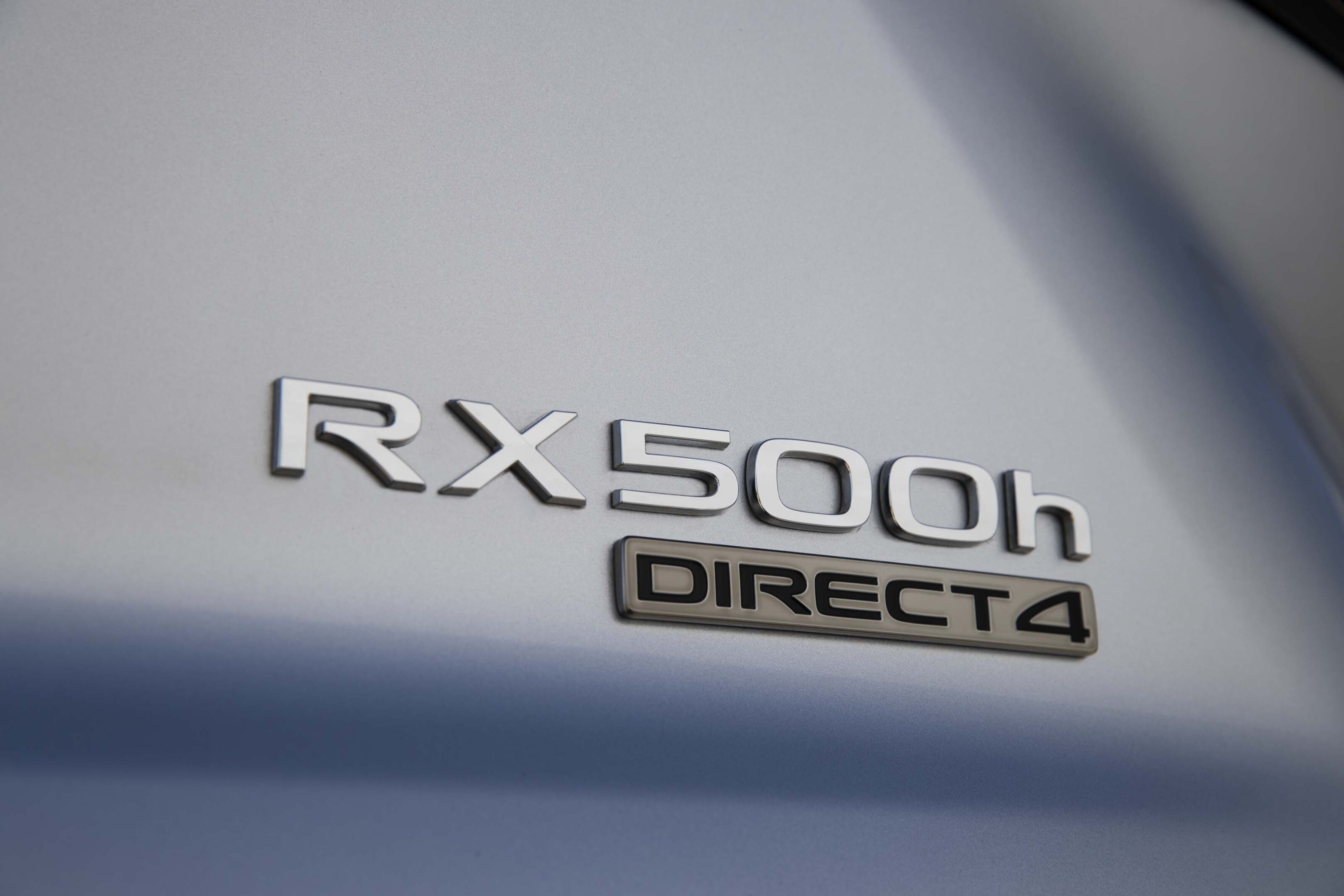
It’s set apart with matte black 21-inch alloys, matching black aluminium monobloc front calipers, piano black bumper side mouldings, and black badging and window surrounds. Lots of black, okay.
It also gets body-coloured side rocker trims.
The RX 500h benefits from extra driver-focused tech too, which we’ll cover in the driving section.
1
| 2023 Lexus RX price list | |
|---|---|
| Model | Price |
| RX 350h Luxury 2WD | $87,500 |
| RX 350h Luxury 2WD + Enhancement Pack | $92,600 |
| RX 350h Luxury AWD | $92,000 |
| RX 350h Luxury AWD + Enhancement Pack | $97,500 |
| RX 350 F Sport AWD | $99,900 |
| RX 350 F Sport AWD + Enhancement Pack 1 | $102,900 |
| RX 350 F Sport AWD + Enhancement Pack 2 | $104,000 |
| RX 350 Sports Luxury AWD | $105,900 |
| RX 350 Sports Luxury AWD + Enhancement Pack 1 | $108,900 |
| RX 350 Sports Luxury AWD + Enhancement Pack 2 | $109,800 |
| RX 350h Sports Luxury AWD | $111,900 |
| RX 350h Sports Luxury AWD + Enhancement Pack 1 | $114,900 |
| RX 350h Sports Luxury AWD + Enhancement Pack 2 | $115,800 |
| RX 500h F Sport Performance AWD | $126,000 |
How do rivals compare on value?
There are so many alternatives to the Lexus RX, the majority of them more costly European models that, it should be noted, differ from the Lexus in offering three rows of seats either as standard or optionally.
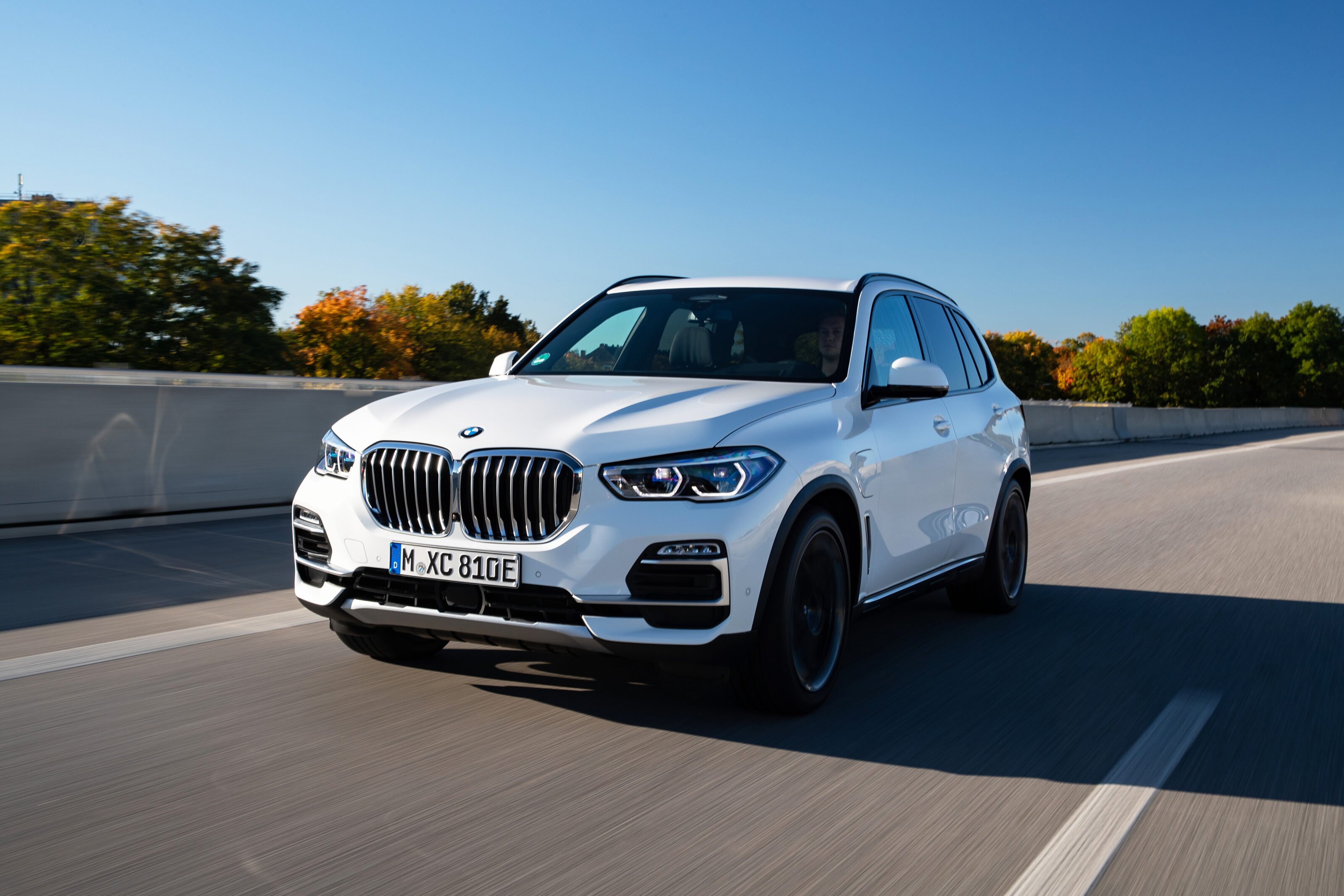
The BMW X5 and Mercedes-Benz GLE-Class are presently the volume-selling Lexus RX competitors.
A BMW X5, for example, starts at $109,900 for the xDrive25d and runs to $139,900 for the xDrive45e (excluding the high-performance M models).
These are followed, in terms of popularity, by the Audi Q7 which runs from $108,200 for a 45 TDI Quattro to $164,100 for an SQ7 TFSI.
And the Volvo XC90, which is closer to Lexus RX territory, is $92,990 for a Plus B5 AWD and $121,990 for an Ultimate Plug-in hybrid, excluding options.
1
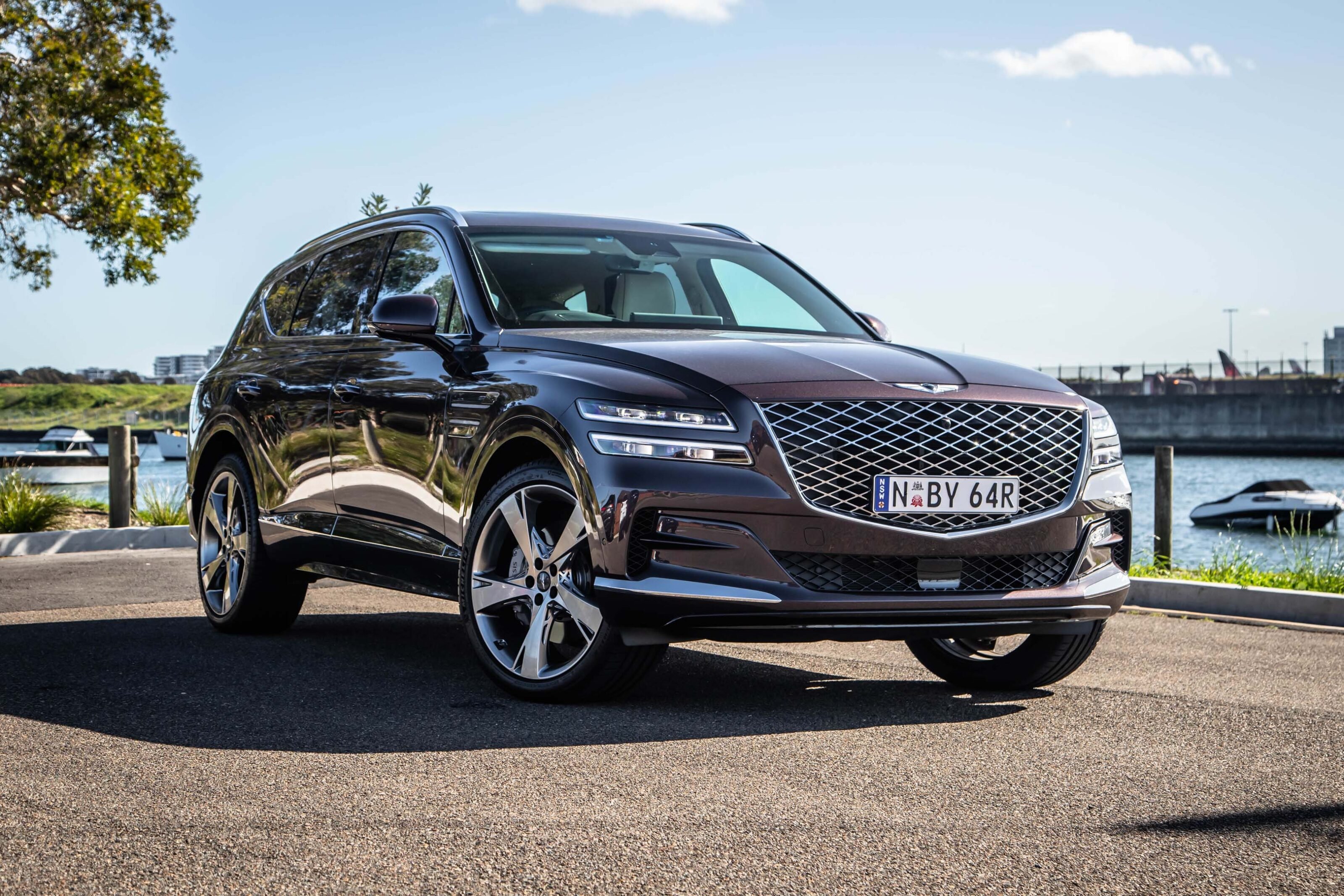
Occupying a similar or slightly lower price point to the Lexus RX – depending on the variant – is the Genesis GV80, which runs from $92,200 for a 2.5T RWD to $109,700 for a 3.5T AWD.
All the above prices exclude on-road costs.
Based on its competitive standard equipment and nominally lower price points compared with models of equivalent powertrain and grade, the Lexus RX compares favourably to the majority of rivals on value for money.
In addition, the brand’s quality, dependability and customer service credentials translate to strong value (low cost of ownership) and perceived value (customer experience).
1
Interior comfort, space and storage
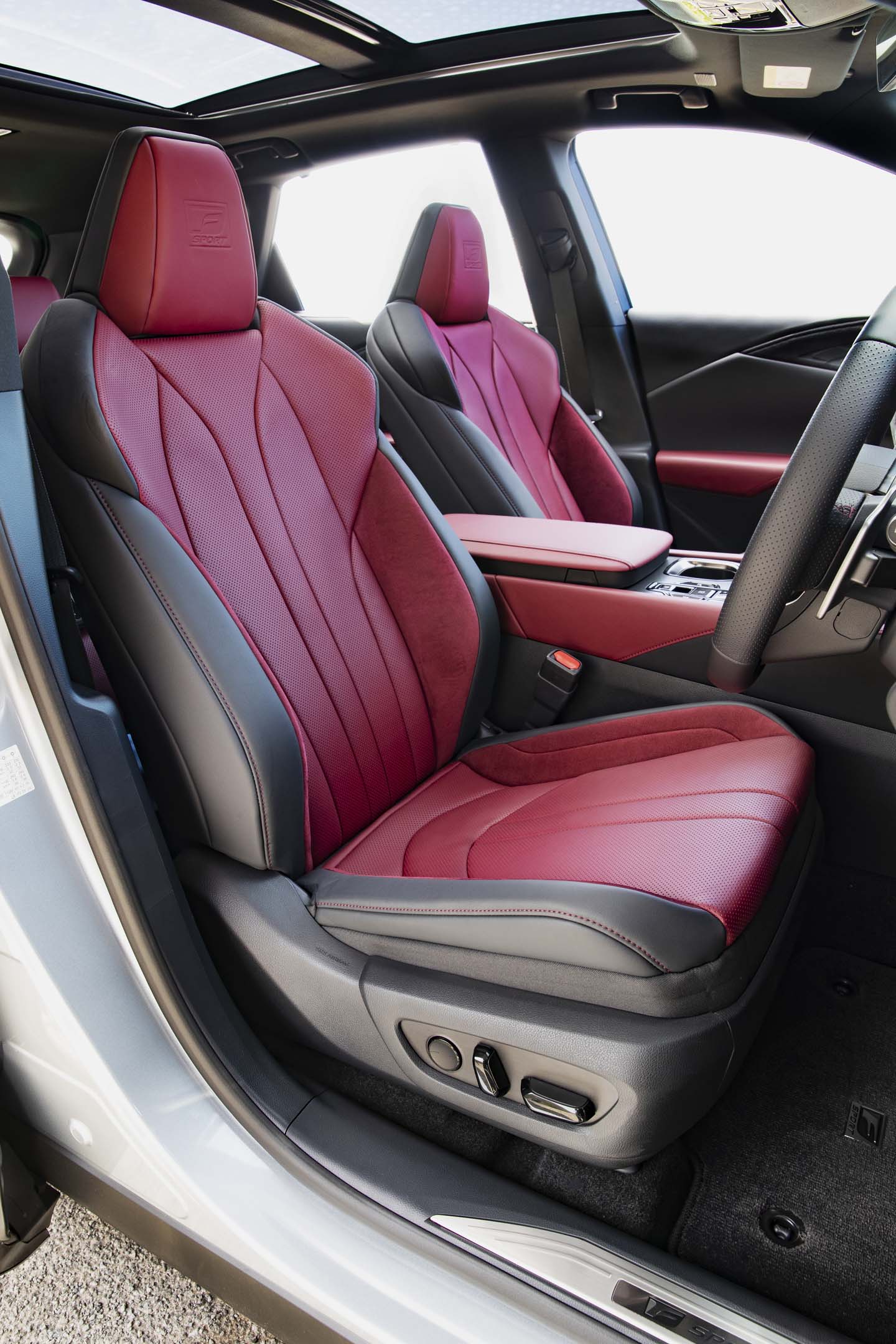
A more modern take, executed with the expected Lexus quality, fit and finish give the new RX a good lift in interior presentation from the outgoing model.
It’s an easy place to get comfortable, especially in the flagship’s form-fitting 10-way powered seats, which provide a welcome cooling function and terrific support.
The steering wheel is nicely tactile and features neat touch control buttons.
However, the headline cabin departure is the binning of the touchpad.
1
It makes way for a smart new infotainment system featuring a glossy, tablet-like 14-inch display, sat nav, wireless Apple CarPlay and Android Auto, and DAB+ digital radio.
The unit is mostly intuitive to operate and helps free the cabin from buttons.
But there are still some features for which a button would be ideal – such as drive mode.
The drive mode settings are easy to find but on a bumpy road, it can take a couple of stabs at the screen before you bullseye the setting you want.
1
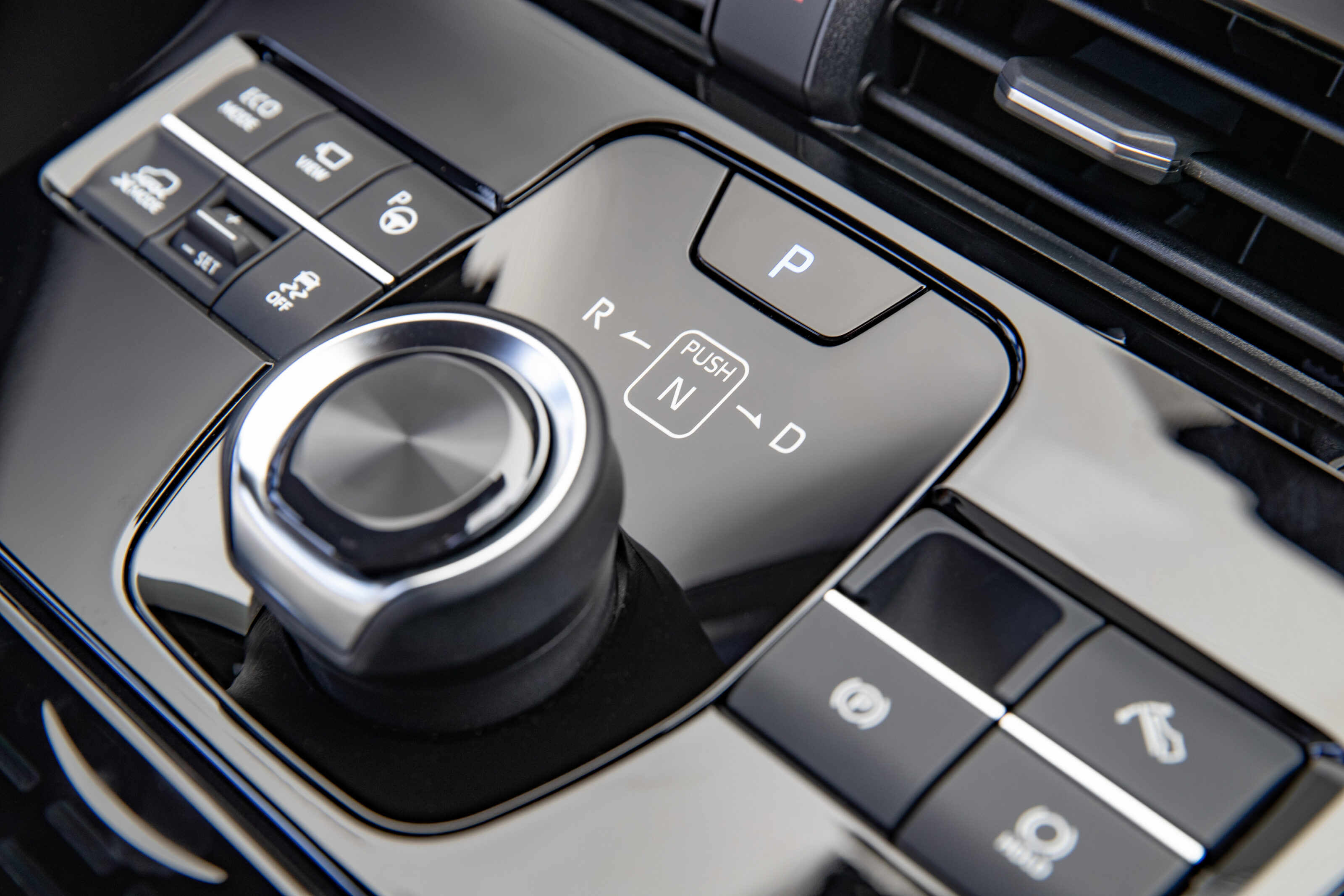
While on quirks, the transmission drive selector is not so intuitive – it’s odd – although no doubt once familiar it’ll be easy to use.
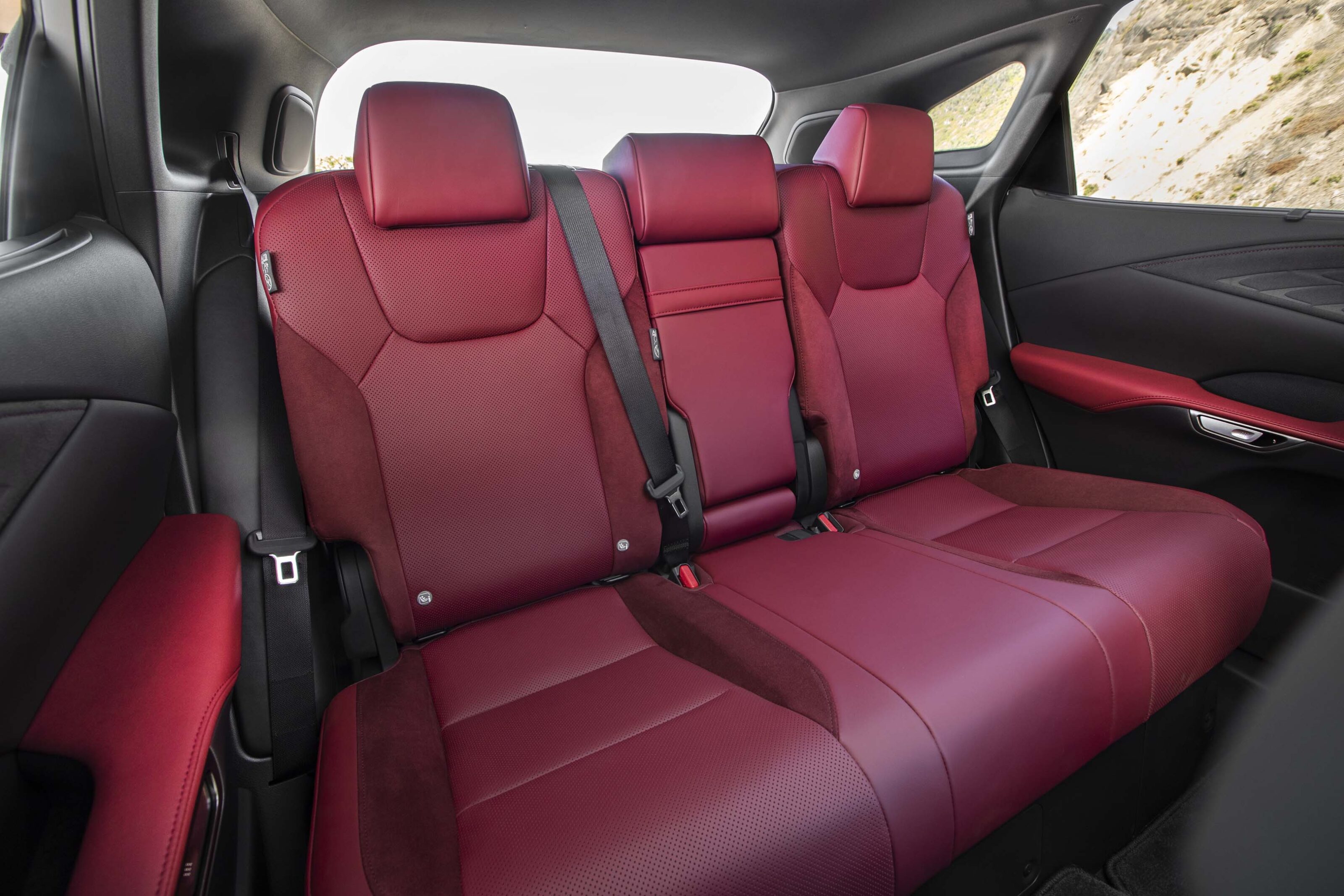
The RX’s second row is decent for foot, leg and headroom and, as you’d expect, there are rear HVAC outlets.
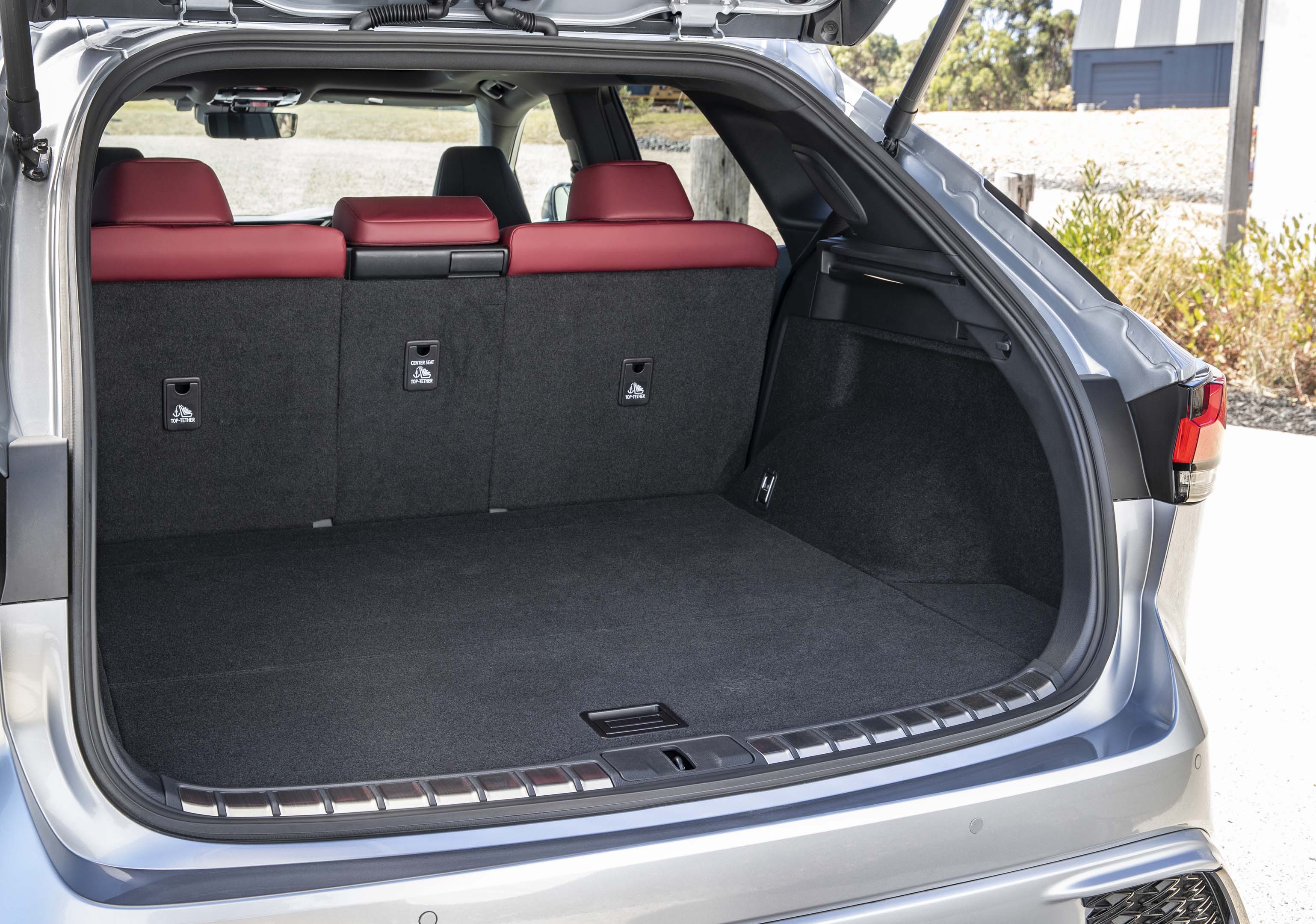
The cargo area holds 612 litres, or up to 1678 litres with the second-row seats folded.
1
What is it like to drive?
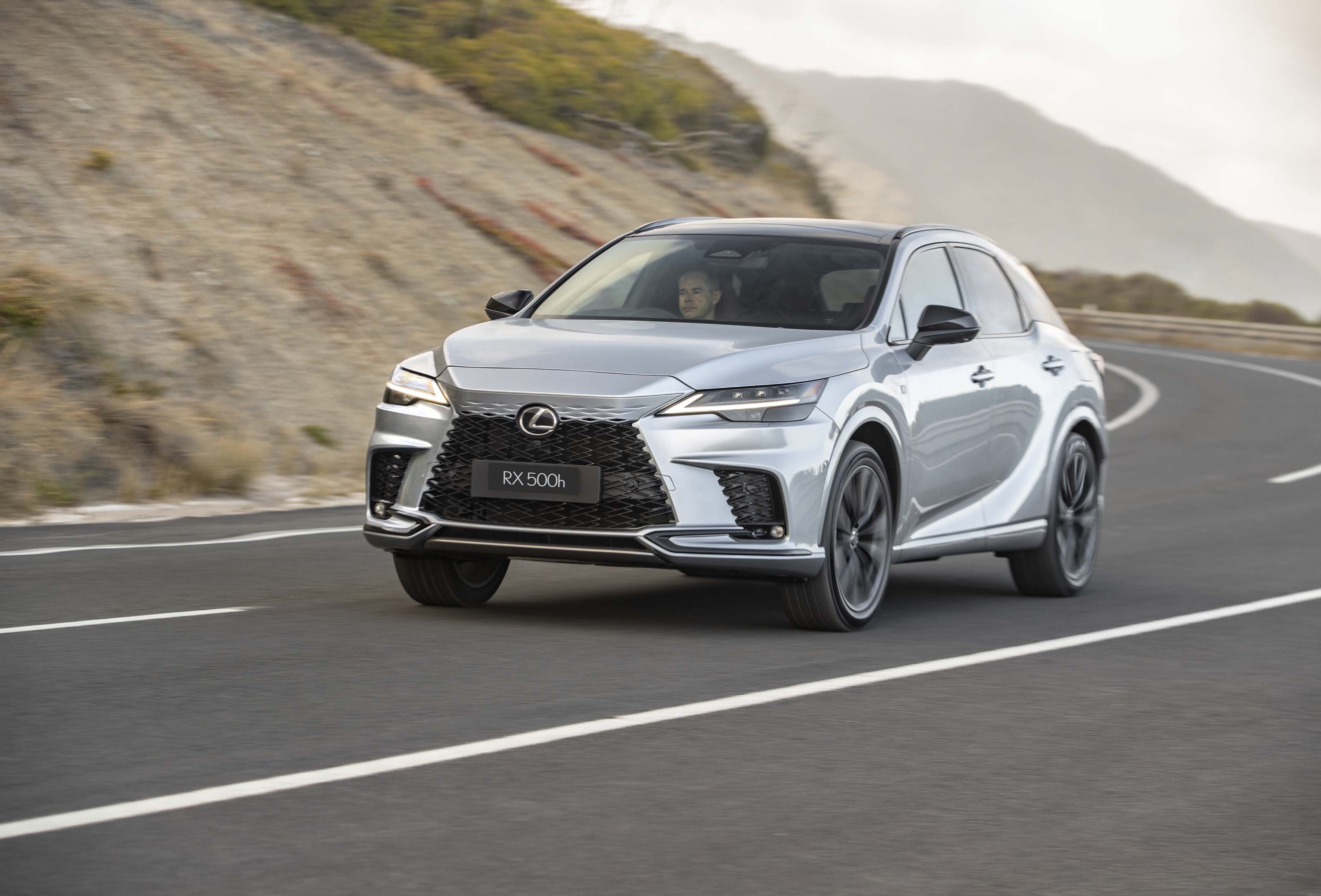
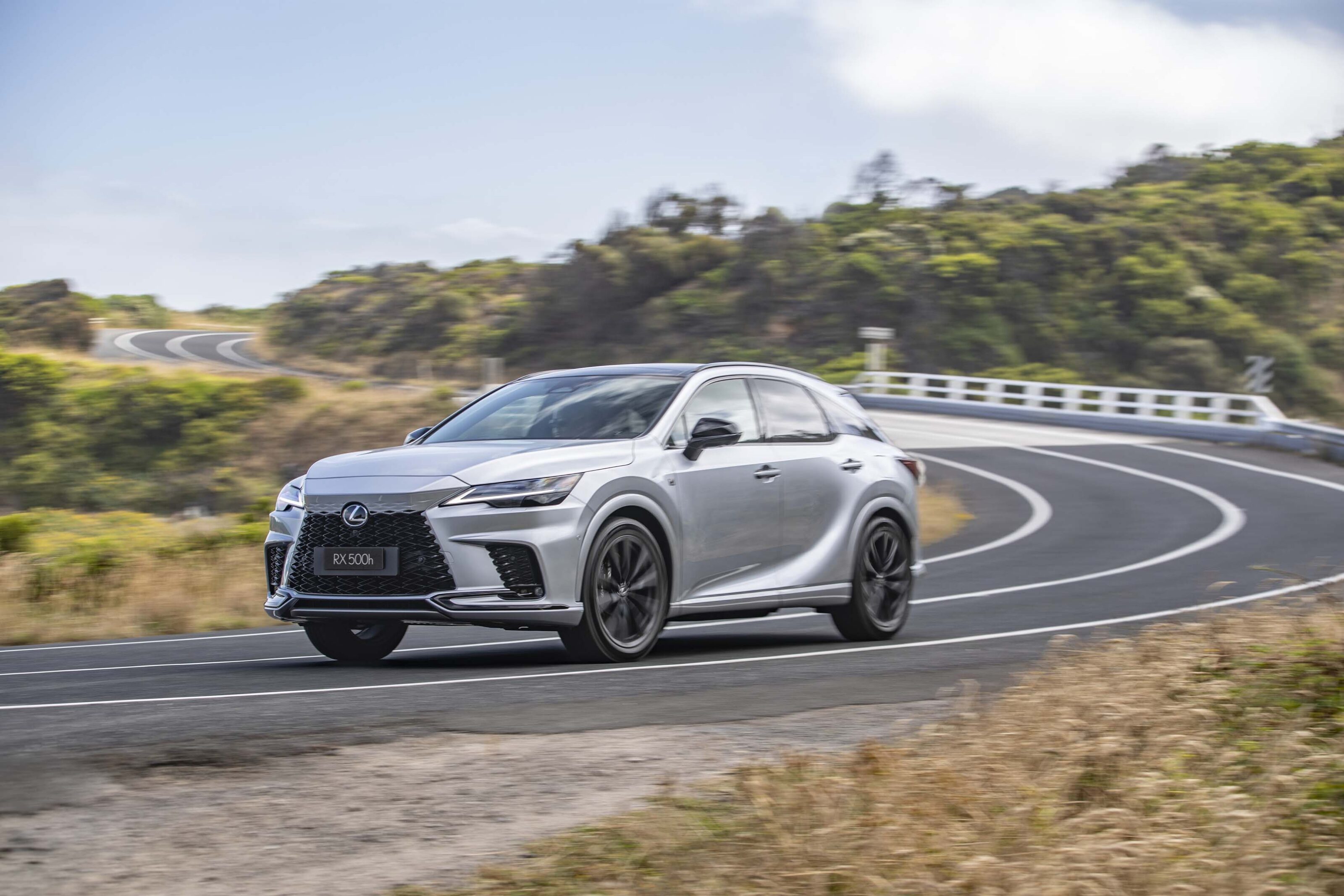
Our time in the RX started in the range-topping RX 500h that Lexus says will account for a quarter of sales, and bills as the most powerful and driver-focused RX yet.
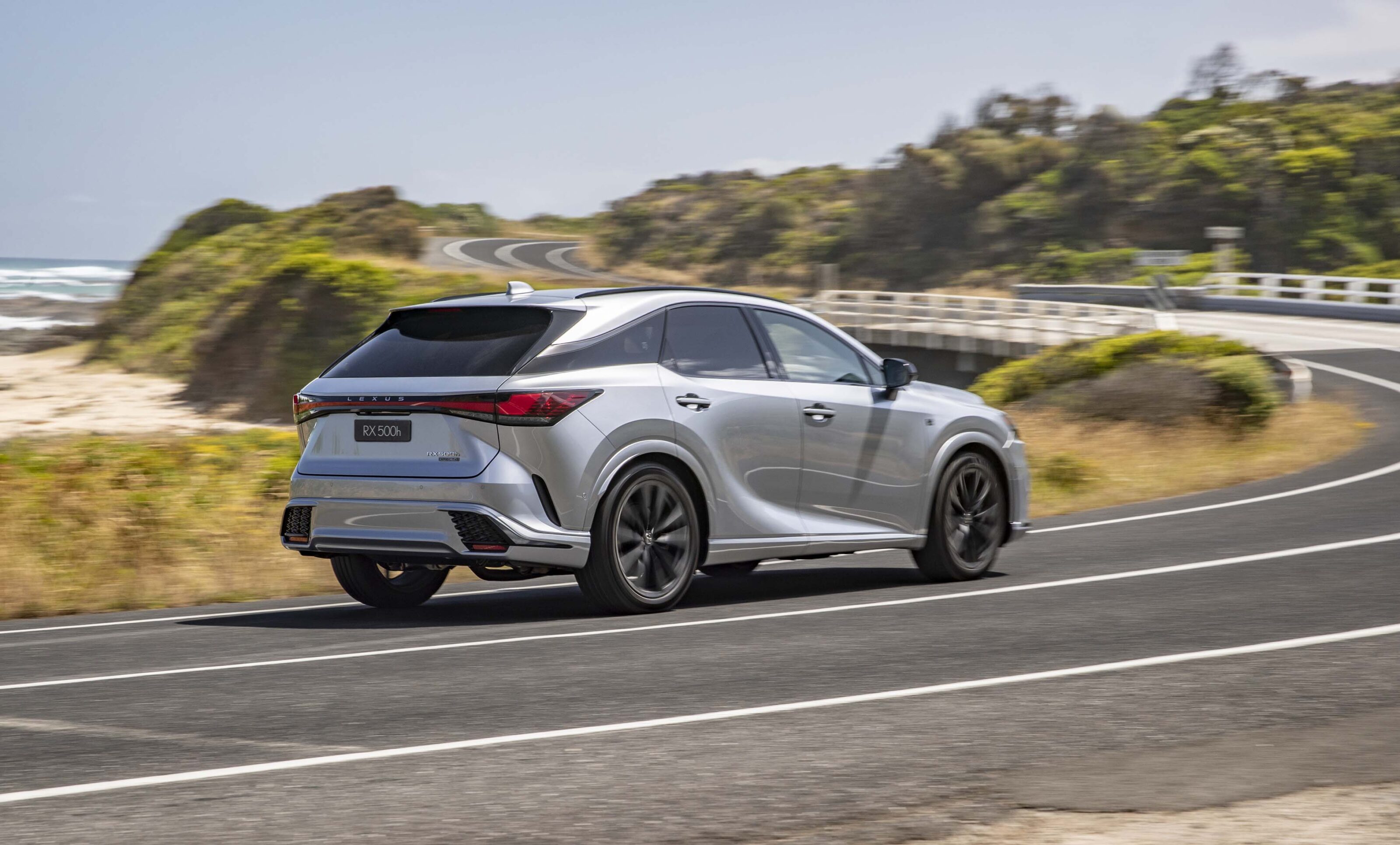
It is certainly the most powerful, with 273kW from a petrol-electric powertrain which, as a turbocharged parallel hybrid system, represents a pair of Lexus hybrid firsts.
That’s 43kW more than the outgoing RX flagship, the 450h, and with a claimed 6.2-second 0-100km/h time, it’s substantially quicker than its circa-8.0sec predecessor.
EV-like immediate, electric shove on a light throttle stands out while driving the 500h in Normal mode. In this kind of driving, it’s quiet, refined and smooths small bumps well.
1
Flicking through the modes, Eco brings a deliberately dulled response to the accelerator and Sport makes the 500h feel decidedly muscular.
The big turbo-petrol four is rarely heard in most driving but when load and throttle openings are increased, the induction sound – with input from an Active Sound Control system – has notes of synthesised six, rather than four.
Floored from a standstill, the 500h’s front tyres work on the cusp of slip as the big wagon squats and powers down the road with authority, and rapid, decisive shifts through the six-speed auto.
The rear electric motor provides drive to the back wheels and it works pretty seamlessly.
1
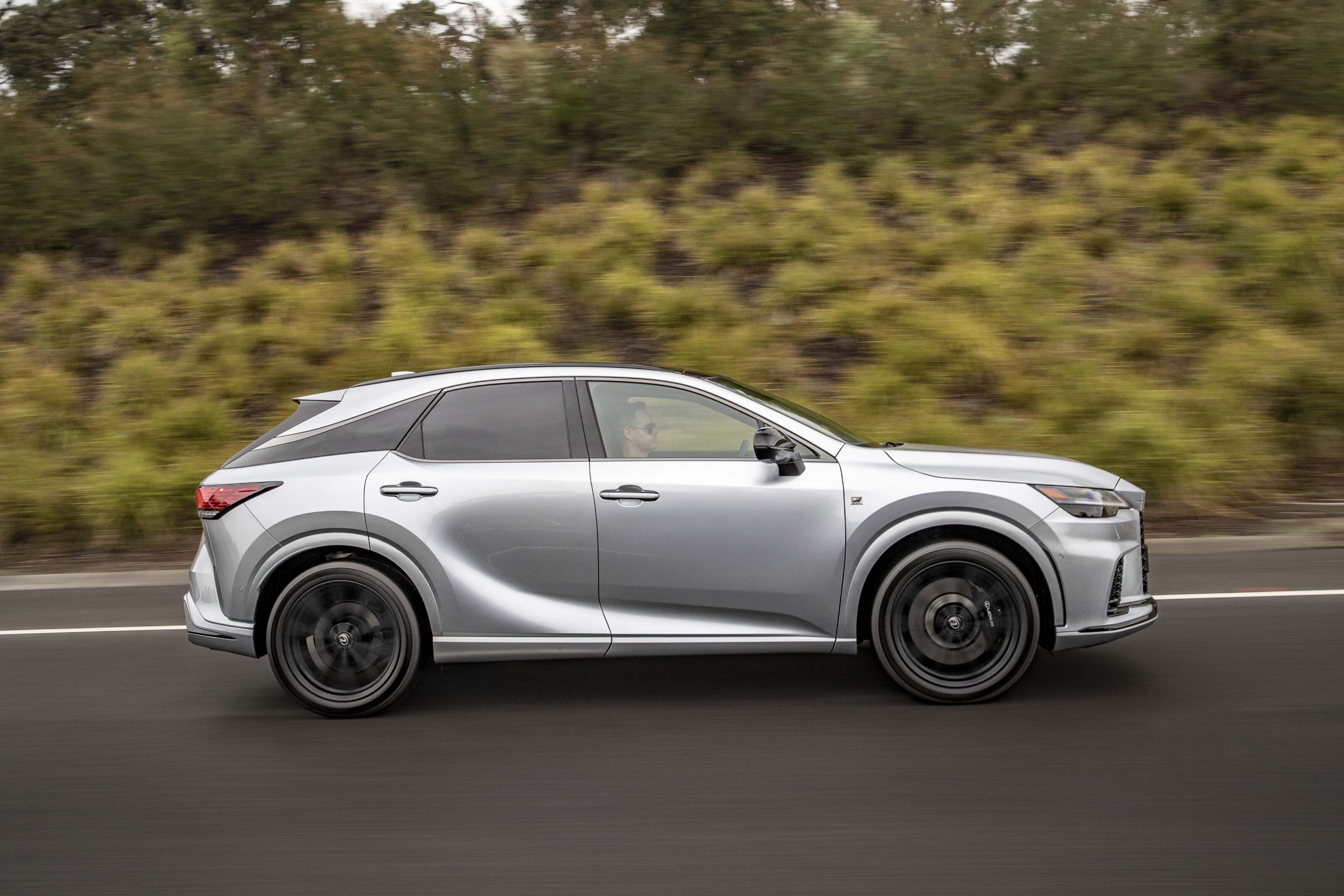
As the mountain roads northeast of Melbourne tighten, the slightly busier adaptively damped ride in Sport mode is worth the trade-off because it noticeably enhances crispness and control.
The extra steering beef from an already well-connected system is welcome, too.
With the flagship’s standard dynamic rear steering adding up to four degrees of input, the 500h rotates around ultra-tight turns more keenly than you might expect from a big, heavy, long-wheelbase SUV.
The transmission does a fine job of downshifts, which leaves the shift paddles as a nice-to-have but not really necessary.
1
And the brakes are reassuringly strong and reasonably easy to modulate.
Is the RX 500h the world’s finest driver-focused luxury SUV? No, but it’s not supposed to be.
More importantly, if utter dependability and fine customer service are non-negotiables, and so you find yourself in the Lexus showroom, then the RX 500h’s capabilities should have your family SUV dynamic aspirations comfortably covered.
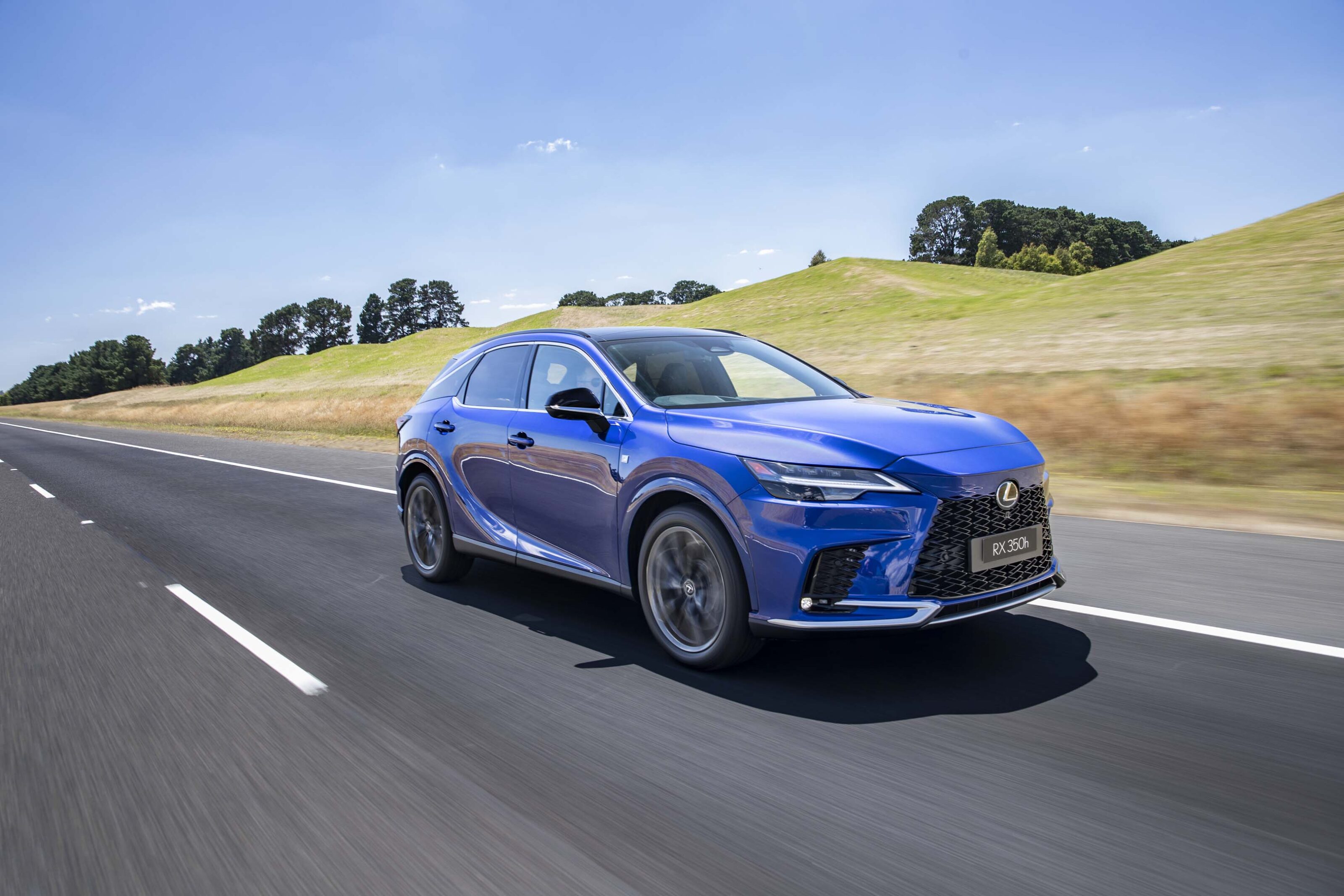
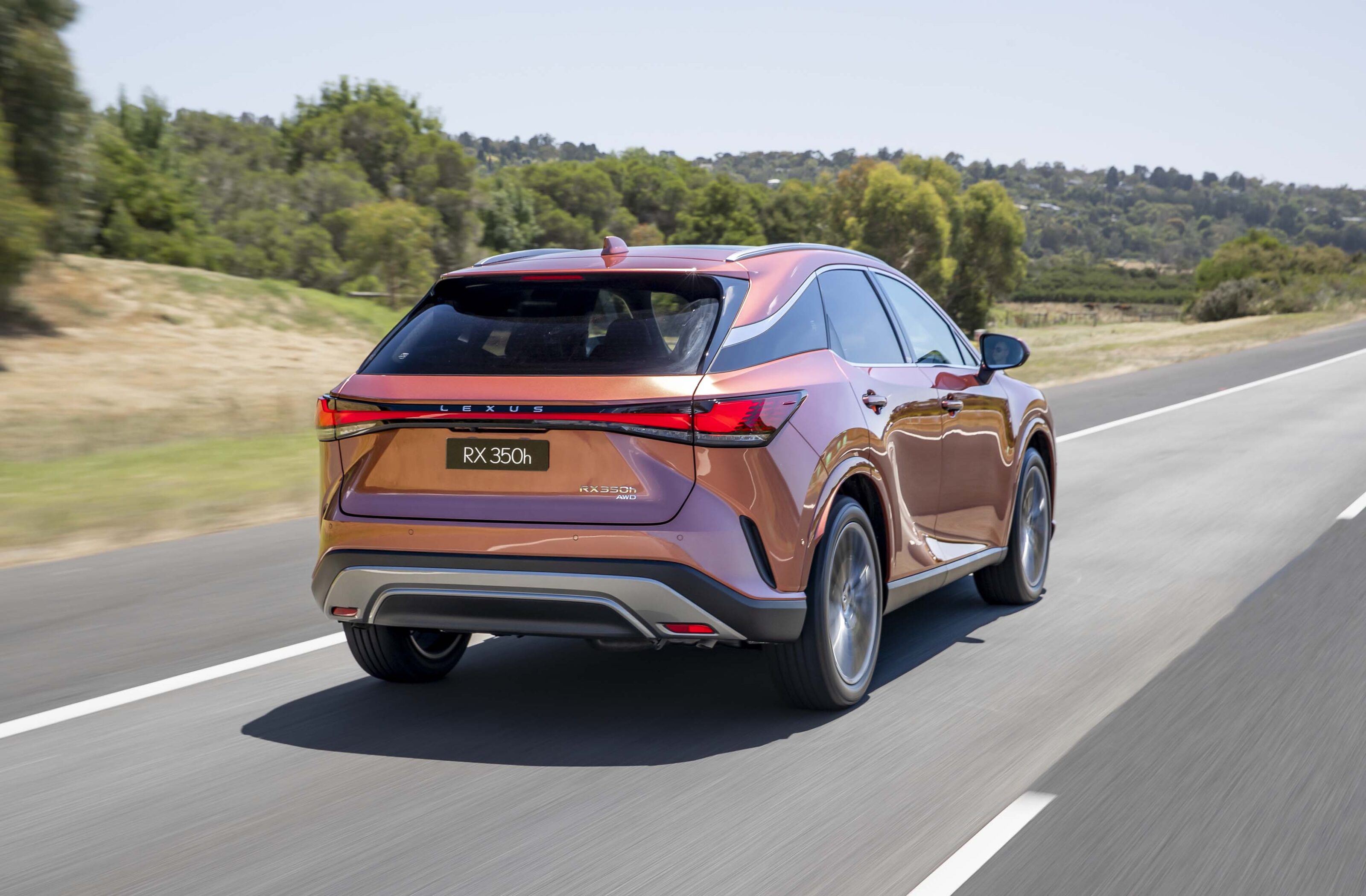
Hopping from the 500h to the RX 350h – ours was front-wheel drive – brings a more relaxed pace. But it’s worth pointing out that even this, the least-quick RX, is about on par with the outgoing flagship 450h, with a claimed 8.1sec 0-100km/h sprint.
1
Lexus says this is the volume variant, with a roughly 50 per cent share of initial orders.
With a CVT here, rather than the conventional autos found in the two variants above, it’s super smooth and driveable most of the time, but flares and gets noisier when asked to deliver more performance.
Happily, the crisply connected steering translates into the base model, as does the generally tidy chassis composure and balance.
1
Surprisingly, though, the ride isn’t quite as polished here, without adaptive dampers, despite the switch from 235/50R21s to chubbier 235/60R19s; there’s a light jiggle even on visibly smooth roads, a bit like when the 500h is in Sport mode.
The non-hybrid RX 350 is the more conventional package, then, and with a smart eight-speed auto (and variable torque split all-wheel drive) it’s a bit more satisfying from a powertrain point of view, while continuing the new RX’s well-sorted steering and chassis.
Its turbo 2.4, without any electric assistance, can seem a fraction coarse. Maybe it works a bit harder without motor torque to cover the step-off, as it does in the hybrid. Either way, it’s no deal-breaker.
1
How is it on fuel?
Our launch drives of each of the 2023 Lexus RX variants didn’t allow for tested fuel figures, which we’ll cover come comparo time.
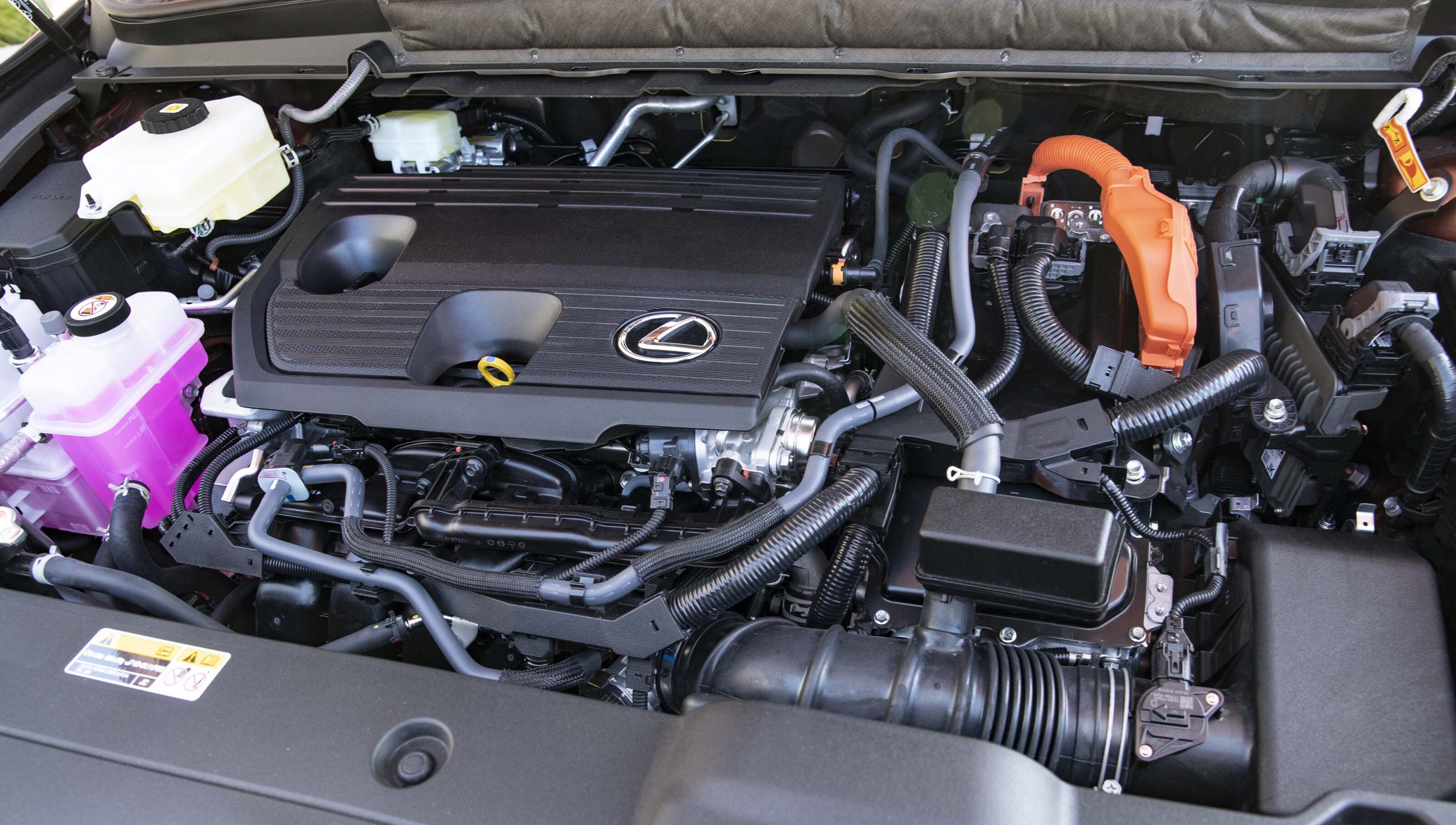
What stands out is the RX 350h should be very good on fuel, especially in front-drive form.
Based on ADR combined cycle figures, the 350h uses 5.0L/100km as a front-drive and 5.4L/100km as an all-wheel drive.
1
The RX 500h should also be good given the performance, with an ADR combined cycle figure of 6.5L/100km.
The RX 350 by comparison, looks less good, particularly when you focus on the 11.5L/100km urban consumption figure.
Here are the full figures:
| Fuel Economy (L/100km) | ||||
|---|---|---|---|---|
| 350h 2WD | 350h AWD | 350 AWD | 500h | |
| Combined | 5.0 | 5.4 | 8.7 | 6.5 |
| Extra-urban | 4.7 | 5.2 | 7.1 | 6.3 |
| Urban | 5.3 | 5.7 | 11.5 | 7.4 |
| CO2u00a0emissions (g/km) | ||||
| Combinedu00a0 | 114 | 123 | 197 | 148 |
1
How safe is it?
ANCAP has not published a safety rating for the 2023 Lexus RX but we’d be surprised if it didn’t earn five stars like its predecessor.
The Lexus RX range features many Lexus Safety Sense + active safety features.
Among them are a pre-collision system with intersection collision avoidance, emergency steering assist and low-speed acceleration suppression, blind-spot monitoring, and a driver attention monitor.
1
There are also lane departure alert, lane tracing assist, rear cross-traffic alert, safe exit assist, adaptive cruise control and parking support brake systems.
F Sport variants build on the standard safety with a panoramic view monitor and adaptive high-beam headlights.
MORE
ANCAP
Warranty and running costs
The RX is covered by the Lexus brand’s five-year, unlimited-kilometre warranty.
Five years of capped-price servicing is also part of the deal, with services at 12 months or 15,000km (whichever comes first) and the price set at $695.
Lexus also offers a complimentary service loan car which will save customers hassle and, probably, money. The brand also offers a pick-up service.
1
The Encore owner benefits program runs for three years and provides 24-hour roadside assistance among the perks.
Every Lexus RX variant will run on 95 octane unleaded, which saves the costs of filling up with 98.
VERDICT
The 2023 Lexus RX is almost exactly the sort of next-gen model a customer could hope for.
Prices have risen but upgraded hybrid powertrain technology means performance and efficiency have taken a sizable step up.
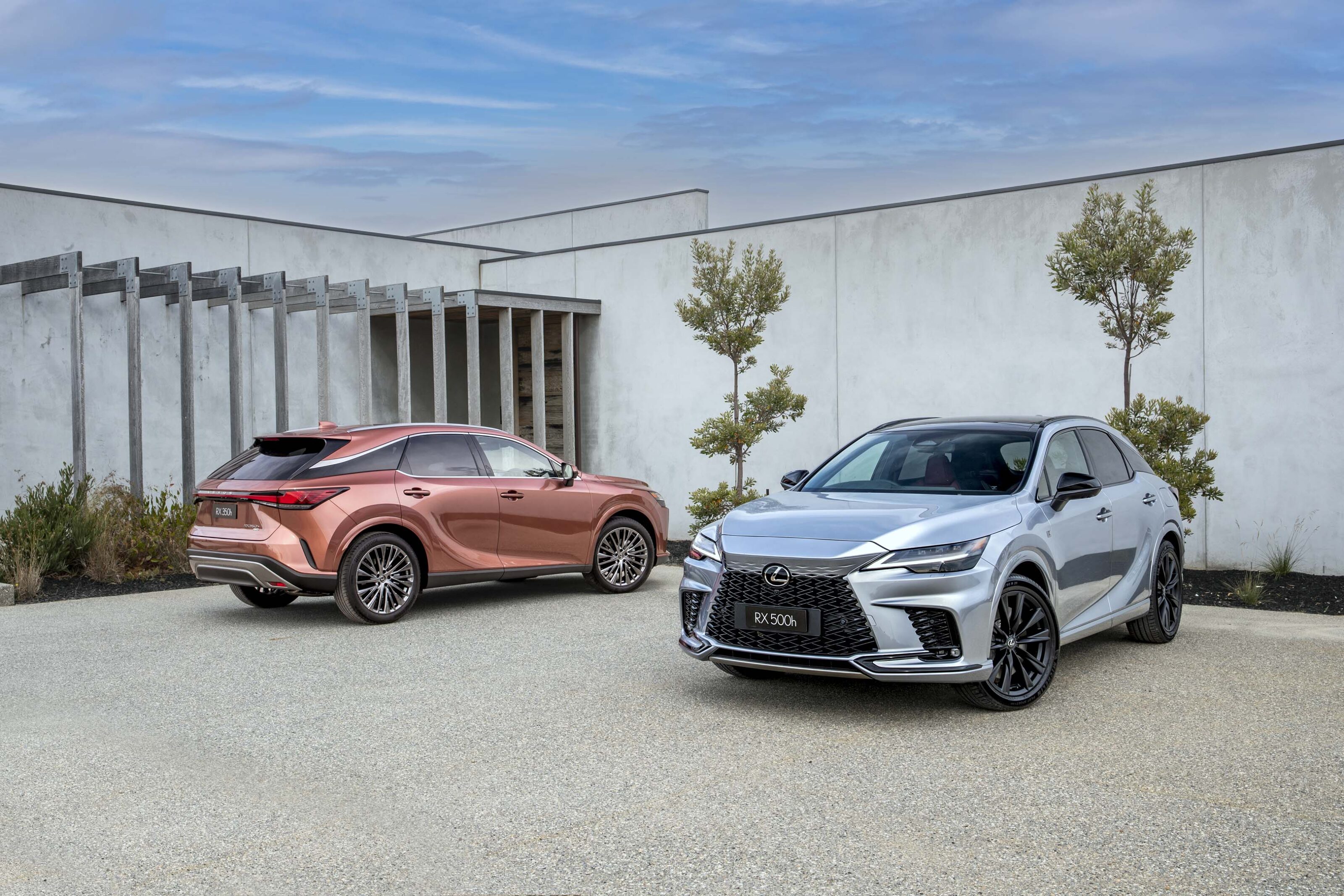
By doubling down on the potentially polarising style of the outgoing car, Lexus has somehow come up with a more resolved take on the design.
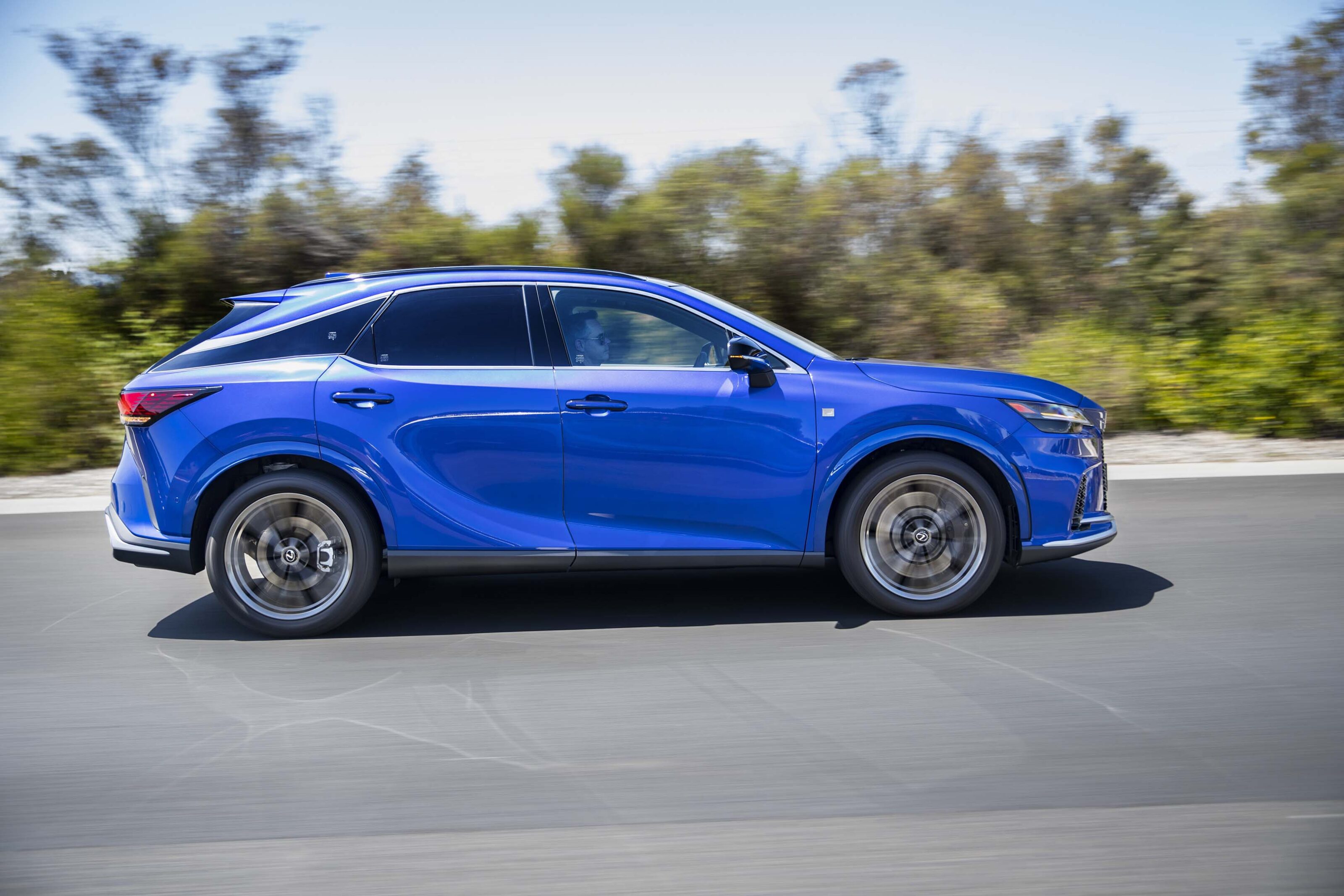
The new ‘spindle body’ works better than the spindle grille, and we particularly like the rear treatment, which applies the Lexus wordmark rather than a badge.
1
Satisfying steering and capable dynamics come courtesy of the new GA-K platform and, provided you’re on adaptive suspension, decent ride and a switchable ride/handling compromise.
As ever in a Lexus, the cabin is a nice, high-quality place to be, now brought up to date with the latest infotainment.
The 350h is superbly economical, based on ADR figures. From an enthusiast’s point of view, the only letdown is the CVT, especially given the excellent autos in the other variants.
Sealing the range’s appeal is the new 500h F Sport Performance which, although pricey, is easily the best-driving RX yet.
MORE
Everything Lexus
MORE
Midsize SUVs
| 2023 Lexus RX specifications | |
|---|---|
| Model | Lexus RX 350h 2WD |
| Engine | 2487cc 4-cylinder, dohc, 16v, turbo-petrol + synchronous motor (series hybrid) |
| Max power | 184kW (combined) (140kW @ 5200rpm engine only) |
| Max torque | 239Nm @ 4300 – 4500rpm (engine only) |
| Transmission | CVT |
| Weight | 1995kg |
| Economy | 5.0L/100km |
| 0-100km/h | 8.1sec (claimed) |
| Price | $87,500 + on-road costs |
| On sale | now |
Frequently asked questions
Frequently Asked Questions
It’s here, almost. Unveiled in the distant past of late 2021, the Toyota BZ4x electric SUV is now in Australia – but it’ll be sometime in late 2023 before you’ll be able to order one, roughly a year later than initially expected.
To its credit, Toyota Australia says it delayed the local launch of the BZ4x to ensure a relatively small but steady supply – whereas other brands have brought their EVs into the country in small allocations, angering buyers not quick enough to get an order in.
It’s also expected that by the time the BZ4x arrives in its Australian specification, it will have had a model-year update, which could include new features and improvements under the skin. Maybe even a glovebox?
1
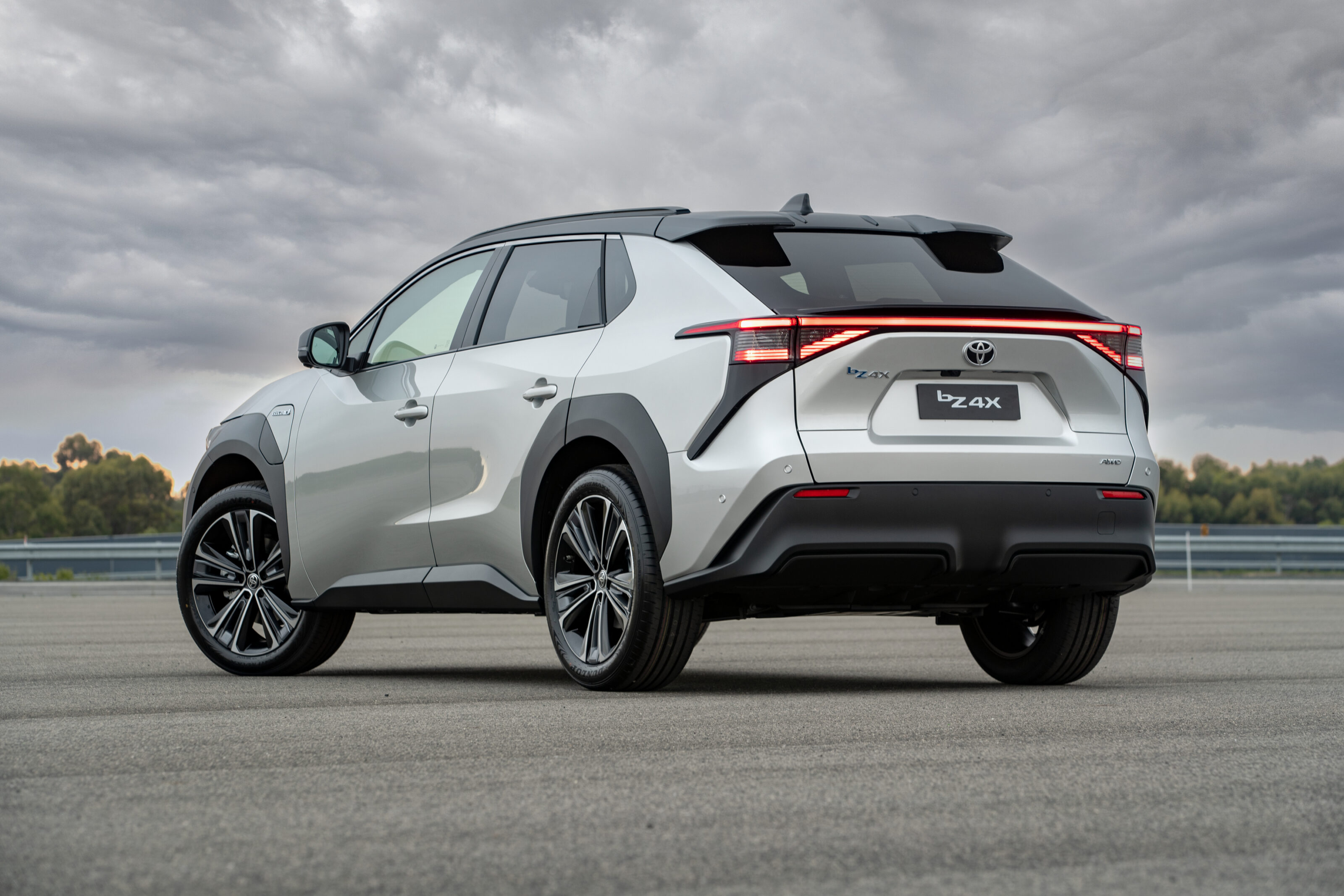
To give Australian buyers a taste of what’s to come, Toyota shipped a right-hand-drive BZ4x in from the UK for media to sample. The vehicle is a production car, not a prototype, but the brand’s local team were at pains to explain that its unspecified specification should not be considered a clue as to the equipment levels and trims we’ll see here.
Still, it must be fairly representative of what Australian buyers can expect, for Toyota to bother with bringing it in for our assessment.
Whether it will prove compelling when weighed against rivals like the Hyundai Ioniq 5 and our 2022 Car of the Year, Kia’s EV6, remains to be seen. This first drive, though, suggests BZ4x buyers will be fairly satisfied – when eventually they can get one.
1
JUMP AHEAD
- How much is it, and what do you get?
- How do rivals compare on value?
- Interior comfort, space and storage
- What is it like to drive?
- How safe is it?
- VERDICT
How much is it, and what do you get?
We don’t know, and… we don’t know.
The Australian-market BZ4x is still almost a year away from its Australian launch, and some sort of update to the car is expected to appear in that time.
What we know well enough is that the Toyota BZ4x won’t be cheap in Australia, with Toyota Australia’s Sean Hanley confirming as much in conversation at the event.
He wouldn’t be moved to offer even a ballpark, but we expect the BZ4x to be quite expensive – just as most offerings in its segment are. Look for a figure above $60,000 at the lowest, but anticipate a number starting around $70,000.
The BZ4x presented to the press at Toyota’s Australian headquarters in Melbourne was a dual-motor example, giving it the benefit of all-wheel drive and more traction than its regular front-wheel drive sibling. For the AWD car, a price somewhere closer to $80,000 might not be out of the question for Toyota.
1
At a glance
Motors and drive
Right now, there are two configurations: a 150kW single-motor front-wheel-drive car, and an all-wheel-drive model with two motors producing 60kW each. Torque in the AWD model, tested here, is listed at 337Nm.
Battery
Both versions have a 71.4kWh battery system, which is fairly ‘on par’ for size for its segment.
Charging
At a DC ‘fast charger’, the BZ4x will accommodate up to 150kW charging – compared to about 230kW for the EV6 and its 77kWh battery.
It’s not a much poorer result, though: Toyota promises a 0-80 per-cent charge should be achieved in 30 minutes, while the EV6 is claimed to get there in 18 minutes. (In all cases, these times will vary depending on what charge level you start from, thanks to every EV’s battery protection system.)
1
Energy efficiency
Toyota claims a power consumption rate of 14.3kWh/100km (think of how regular fuel consumption is measured in L/100km) for the front-wheel-drive model, and 15.8kWh/100km for the AWD version.
Driving range
In its current form, the FWD model offers 516 kilometres of driving range. The all-wheel-drive model will give you surety, but – As with all AWD EVs – it’ll reduce driving range to 460 kilometres.
Acceleration
Toyota claims a 0-100km/h time of 8.4 seconds for the FWD version and 7.7 seconds for the AWD. Perhaps a GR BZ4X will arrive later for buyers seeking more go…regardless, I didn’t have the opportunity to test these claims in my brief drive.
1
How do rivals compare?
The BZ4x stacks up fairly well on some key figures.
Driving range
For that all-important figure, the BZ4x compares fairly well. That is, without knowing the asking price.
The recently launched Tesla Model Y claims up to 542 kilometres of range, while Nissan’s incoming (we hope) Ariya lists up to 500km.
The popular Hyundai Ioniq 5 boasts 454km in its MY23 updated form, and the Volvo XC40 Recharge Pure Electric claims 418km. When it eventually gets here, Volkswagen’s ID.4 should be good for around 510km.

1
How big is the Toyota BZ4x compared to its stablemates and rivals?
Size
Overall dimensions for the BZ4X are 4690mm long, 1860mm wide and 1650mm tall (although the quoted number includes the antenna), with a 2850mm wheelbase.
Within the Toyota family, those dimensions are a match for the new Kluger’s wheelbase, despite that large family SUV being 300mm longer overall.
These numbers make the BZ4x markedly shorter than the Tardis-like Hyundai Ioniq 5 – but the BZ4x and Ioniq 5 are similar in that they are smaller overall than each brand’s large family SUV, while boasting similar wheelbases.
1
The Ioniq 5’s 3000mm wheelbase is 10mm longer than the footprint of Hyundai’s Palisade, which Wheels recently declared the winner in our Palisade v Kluger v CX-9 face-off.
Below the Kluger, the mid-sized 4570mm RAV4 SUV rides on a 2690mm wheelbase (160mm shorter than BZ4x).
Tesla’s hugely popular newcomer, the Model Y, has a 2890mm wheelbase (40mm longer than BZ4x) and an overall length of 4750mm (60mm longer).
Interior quality, technology and comfort
That brings us to the interior: quite good in so many ways, odd in others.
Quality
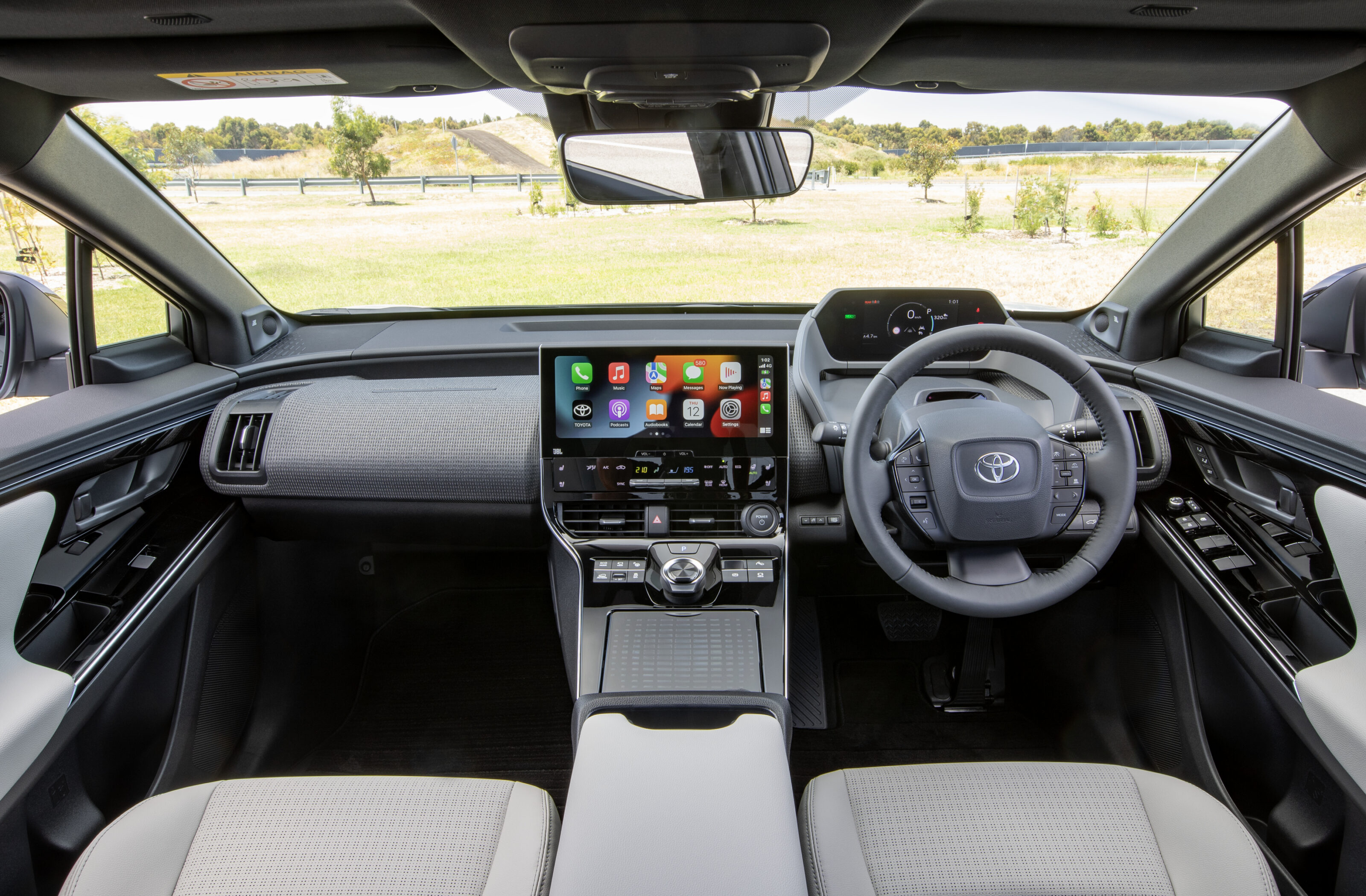
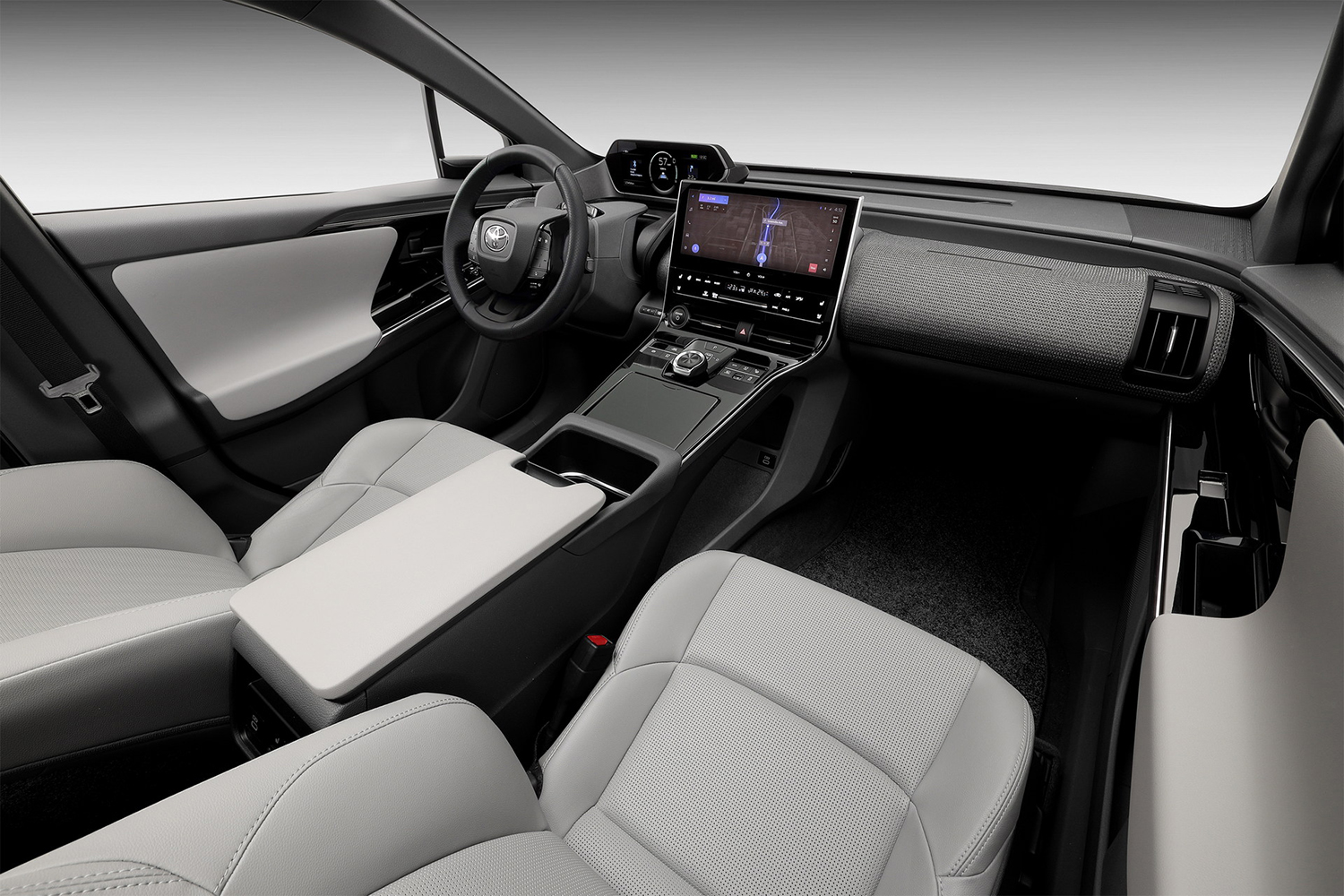
There’s no mistaking it – whatever the BZ4x will cost, it’ll bring the nicest interior Toyota has offered here in a long time. Fit and finish is overall of a high standard, while materials are a mix of familiar and unique – whether it be the ‘premium until you touch it’ piano-black surfaces or the almost garment-like open-weave fabric stretched across the upper dash.
Technology
With little time available to explore its infotainment system, for now I can only say that it feels like a marked improvement over Toyota’s regular system. It seems attractive, mostly quick and fairly intuitive – qualities not easily assigned to what Toyota buyers are used to. Android Auto and Apple Carplay are featured, although only the latter is wireless – for now, at least.
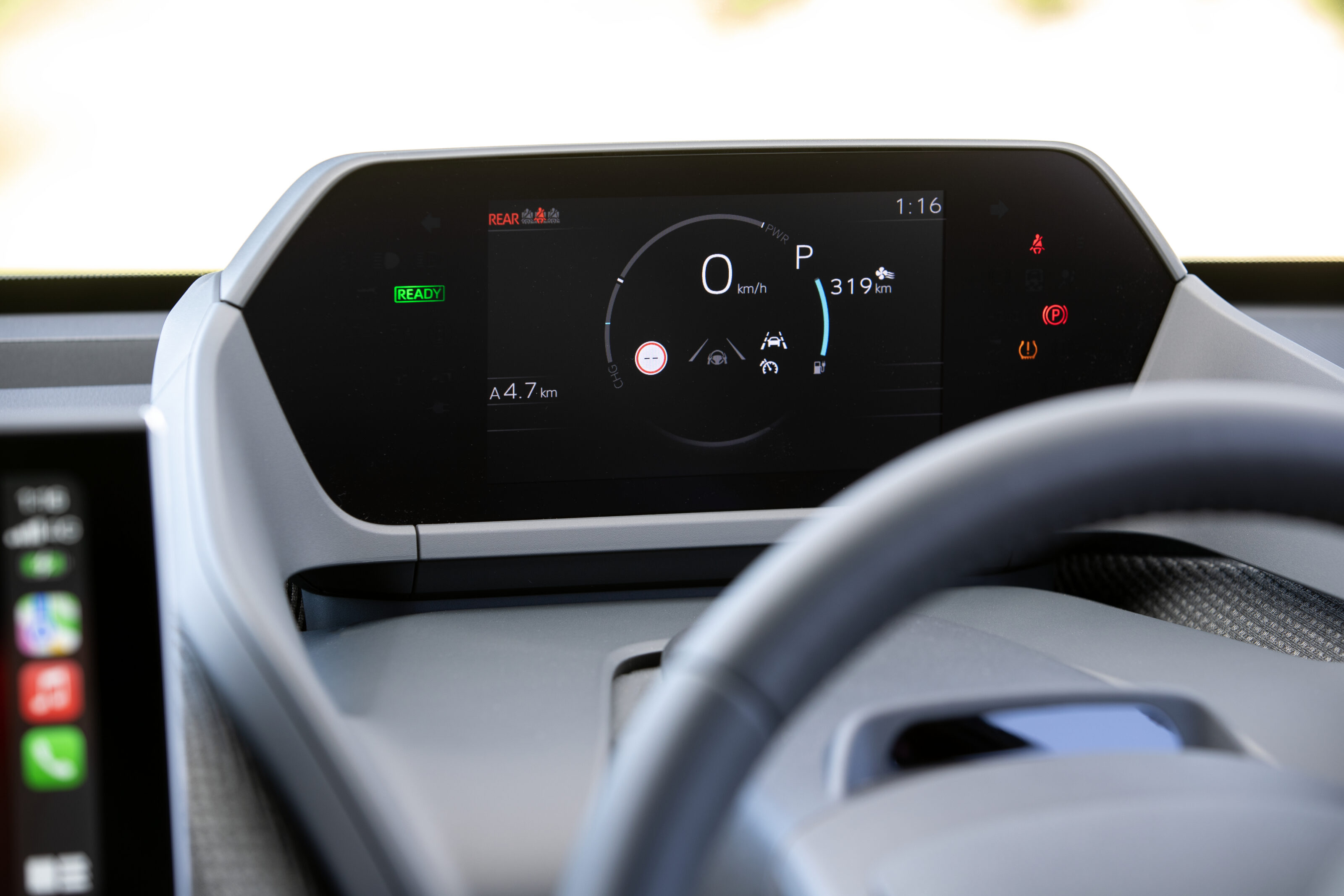
The main display of our test car was a large 12.3-inch unit (the industry-standard size for ‘large’), while entry models overseas have an 8.0-inch display. The ‘instrument’ display behind the steering wheel is a relatively small 7.0-inch unit surrounded by acres of glossy black bezel, so a bigger screen might quietly be on the cards for update time.
1
Comfort
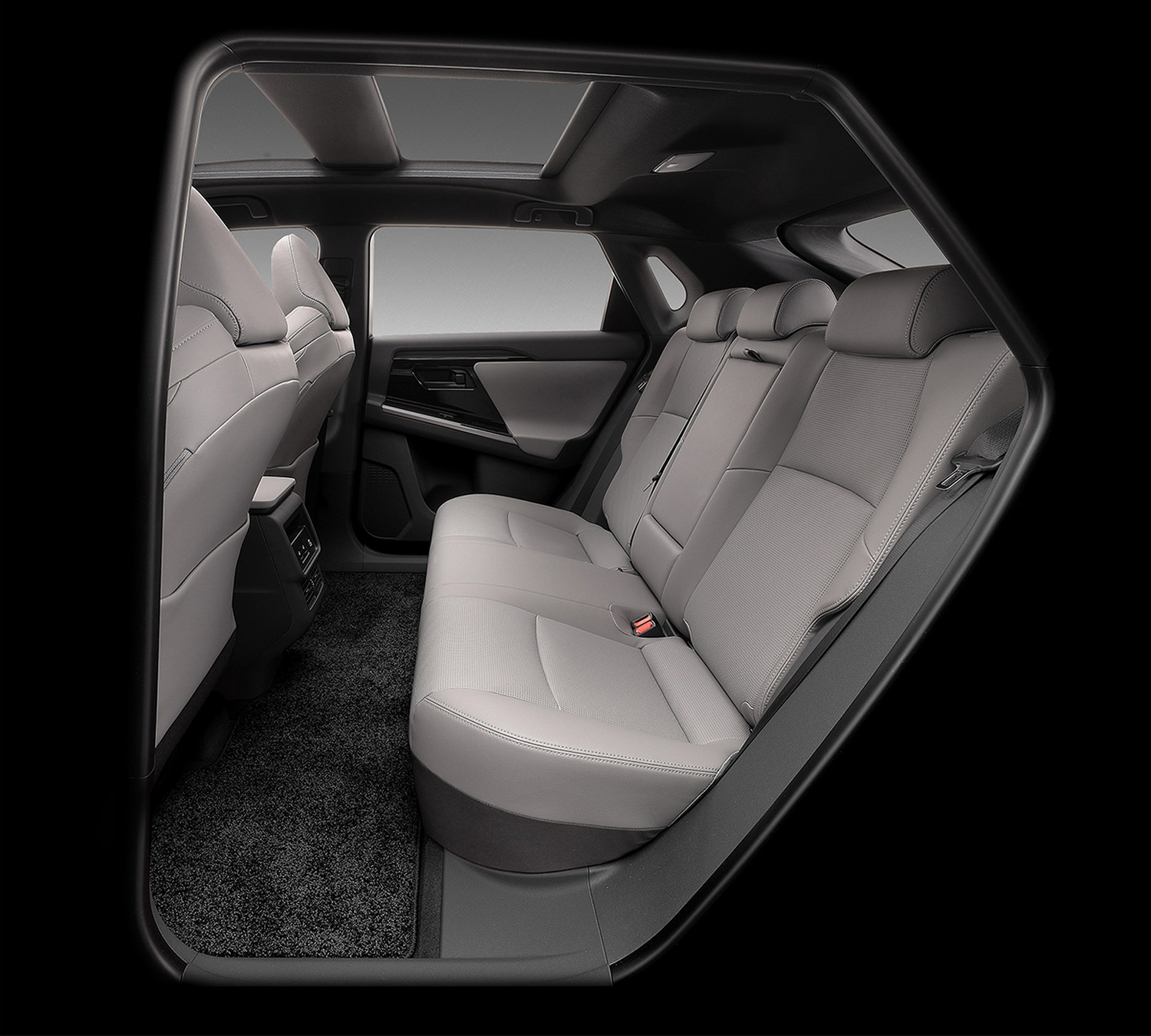
The BZ4x’s greatest strength seems to be comfort and room to stretch your legs – at least in the rear. The front seats are firm but supportive with surprisingly large bolstering and good thigh support.
Front space
There isn’t a great deal of room for lateral movement of your legs, however, and the driver’s foot space is a little cramped – but not so much to be a cause for concern. Unless you have clown feet.
Head room is also a little tight. I’m 5’9”, albeit long in the torso, and my hair was brushing against the ceiling – which also accommodated a large dual-pane fixed sunroof.
Rear space
The rear is honestly a treat, with limo-rivalling legroom and good wiggle room for your toes. Space across the second row would be tight for three grownups but perhaps not uncomfortable, and there’s at least a mostly (if not completely) flat floor.
1
Boot space
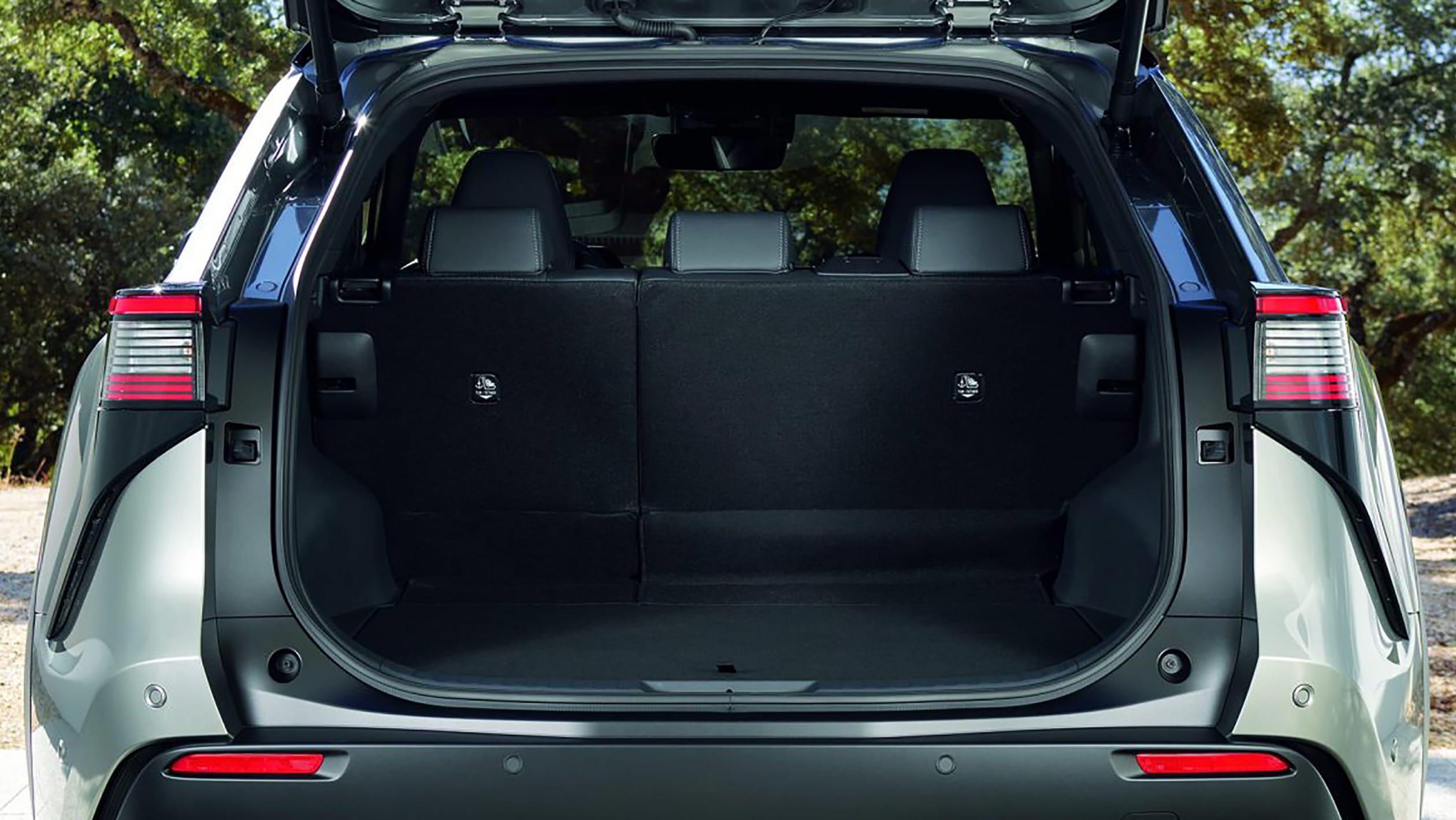
The BZ4x has a 412-litre boot, which is well shy of the overall shorter RAV4’s 580 litres – partly explaining where all that legroom in the second row has come from.
Even the much smaller Corolla Cross has a bigger boot, with 425 or 436 litres in petrol form, depending on the model. Only the hybrid has a smaller boot, thanks to its batteries, at 380 litres.
The BZ4x also goes without a spare tyre of any type, just like the AWD hybrid versions of the Corolla Cross. There’s also nothing particularly clever about this EV’s rear storage area, it is merely… there. Likewise, there’s no storage at all in the front.
The Tesla Model Y comes out a clear winner on this front, with a massive 854 litres in the boot, including the large space beneath the floor. It also has a large storage space under the bonnet up front, measuring 117 litres.
Of course, choosing the Toyota over the Tesla will likely offer buyers some peace-of-mind when it comes to reputation for reliability and customer support.
1
What is it like to drive?
So far, so really quite good.
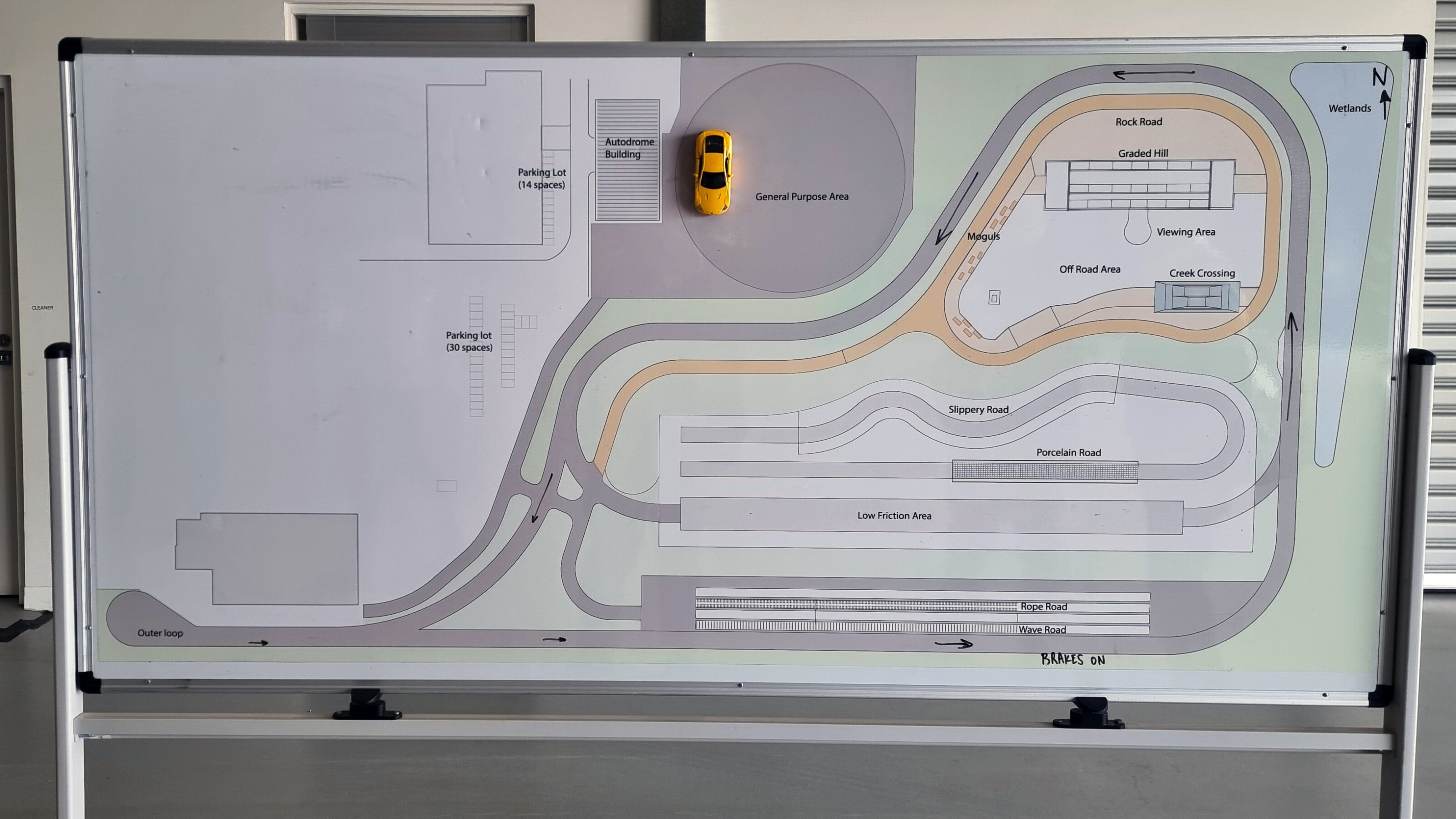
Three laps of the outer loop at Toyota’s learning and assessment course in Melbourne is what I was afforded in the BZ4x, and while its surface is not in tip-top racing form, it’s smooth and uninterrupted. Those sorts of conditions will flatter any car. (The course does have more challenging sections, as you can see below, but Toyota wasn’t humouring any requests for access…)
1
Ride quality and comfort on the BZ4x’s 18-inch wheels was therefore quite good, but reports out of Europe suggest we can expect similar on public roads here – although Australia’s roads are, as a rule, of a much poorer quality than in Europe.
Still, what few small bumps and holes I did encounter (indeed I aimed for them) hinted at a firm yet supple design to the BZ4x’s ride that should satisfy Aussies, neatly rounding off the hard edges of the few small craters I could find.
And, unlike Hyundai and Kia with their localised suspension tuning, this could be the setup we’ll see sold here – so it bodes well.
1
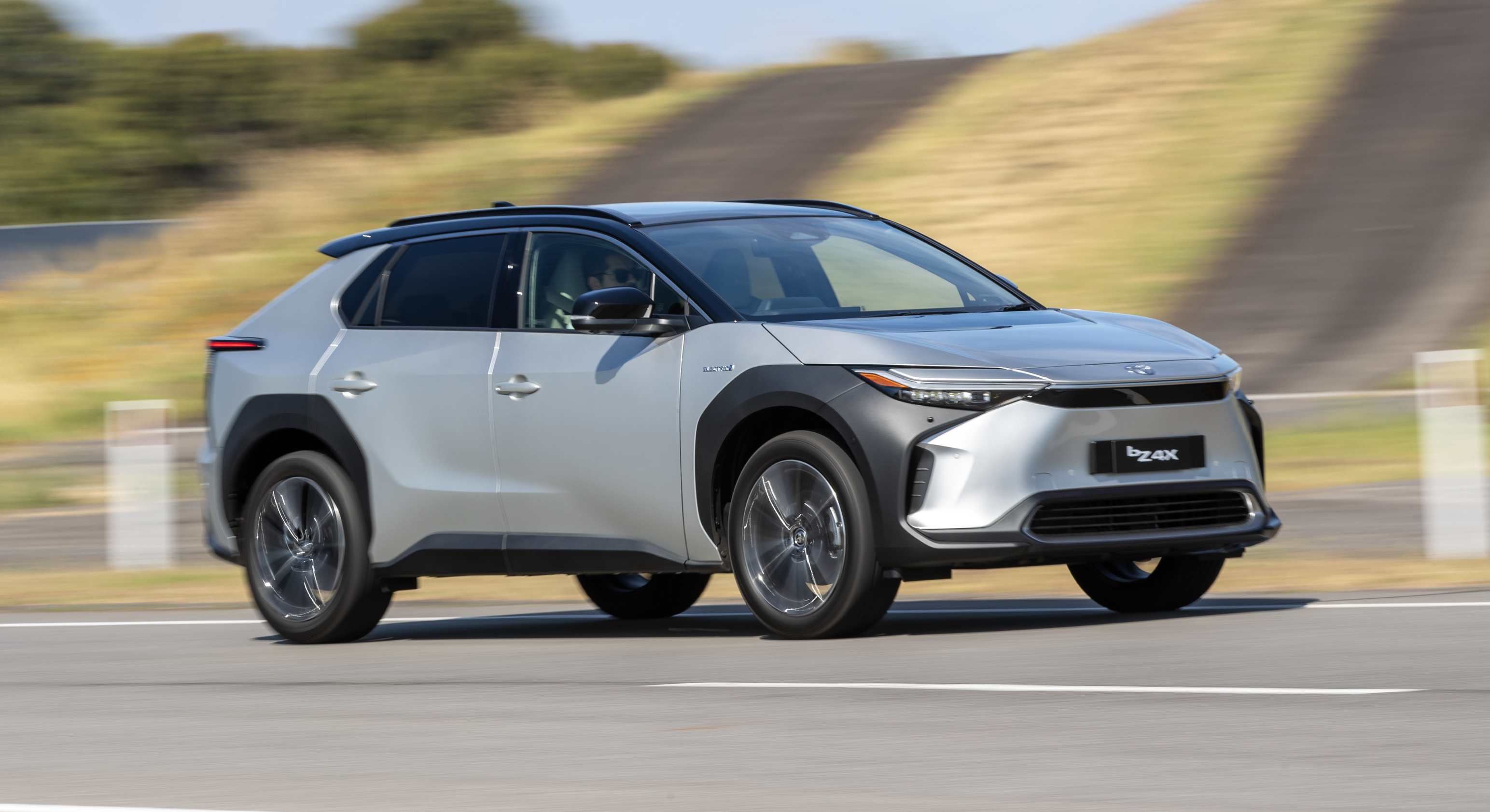
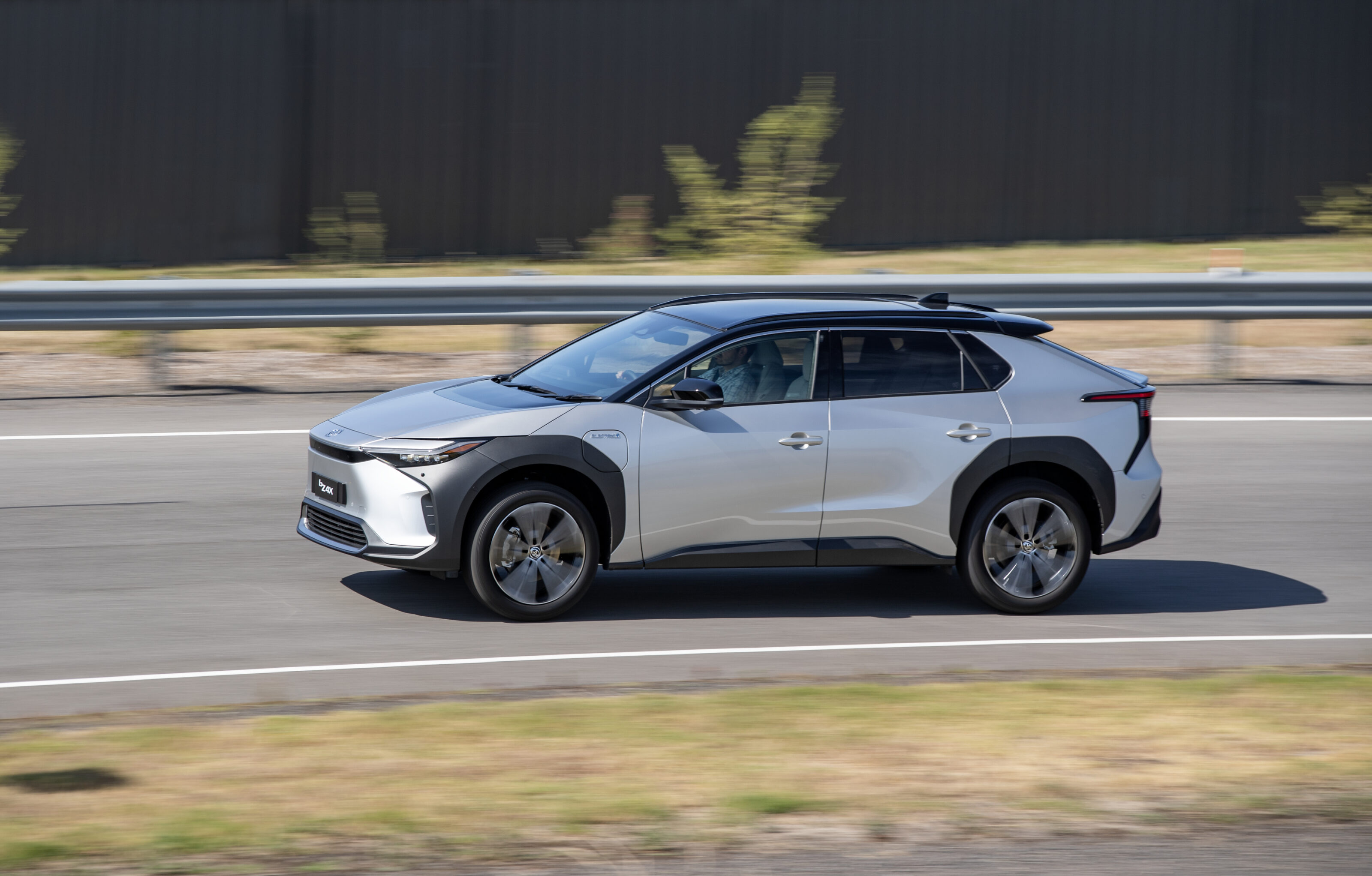
That comfort doesn’t seem to come at any great expense to the car’s cornering, either. In regular long turns at suburban speeds, the BZ4x is inspiring in how flat it sits, while an extra helping of beans didn’t seem to bother it much either. As with most EVs, the BZ4x’s heavy and low-set battery pack helps in this regard.
Wind and road noise is fairly restrained but, again, the absence of engine noise and vibration in an EV will tend to exacerbate the sounds of rubber pounding the road, or wind rushing past and around the door mirrors. Turn the stereo up. ?♂️
1
How safe is it?
The BZ4x doesn’t have an ANCAP score yet, but it was awarded a 5-star Euro NCAP rating in 2022.
Expect that to cross over to Australia, although surprises do happen.
BZ4x warranty and running costs
Toyota is offering no details on this just yet, and with zero real precedent in the Toyota range, this is a hard one to speculate on.
At the very least, we’d expect Toyota’s standard five-year warranty to apply, and an eight-year warranty on the battery should also figure, if Toyota wants to be competitive. Toyota’s hybrid batteries have a 10-year warranty, so you might get lucky with more of the same – although the tech is distinctly different.
Although a vastly different car, Toyota’s RAV4 Hybrid has service intervals of every 12 months and 15,000kms, with each visit is capped at $230 for the first five years.
As a point of comparison, our 2022 COTY the EV6 is covered by a seven-year/150,000-kilometre warranty, with seven-year cover for the battery pack. Kia offers three different pre-paid servicing packages to the tune of three, five and seven years. For Kia EV6 Air and GT-Line, these cost $594, 1089 and $1584, respectively.
Tesla has a four-year / 80,000km warranty on its vehicles, but the battery and drive unit are covered to eight years/160,000km in RWD form, or 192,000km for AWD models.
Comparisons
Best Electric Cars, $65k-80k: Australia’s premium EVs tested
In part two of our three price-based EV buying guides, we compare Australia’s electric cars priced between $65,000 and $80,000
VERDICT
All good things…
Whatever the spec we see on sale in Australia, these very brief first impressions suggest it could be worth the wait.
We can’t know until the price and features are revealed later this year, but as a package on its own, the car I drove makes a good first impression.
Its strongest advantage against similarly priced rivals might simply be, like Tesla, that Toyota expects to have a relatively steady supply of BZ4x, and might even be able to keep stock in Australia for quick deliveries.
That alone could see buyers, unable or unwilling to wait for what might be a bigger or more stylish or cheaper rival, conquested by the big T.
MORE
Everything Toyota
MORE
Electric SUVs
