
Australians have been buying Mazda utes for decades. Think Bravo, B-Series and, in the last 20 years, the BT-50. Along the way, the Mazda product has grown in size, performance and complexity in line with consumer expectations, and it’s been a big player for the last two decades.
But here’s the weird part: the modern BT-50 is not sold or made in Japan, and isn’t even a Mazda design beyond some detailing. And if you want to be really pedantic about it, the previous model BT-50 was more Australian in design terms than it ever was Japanese or anything else. Now it’s all changed again, anyway.
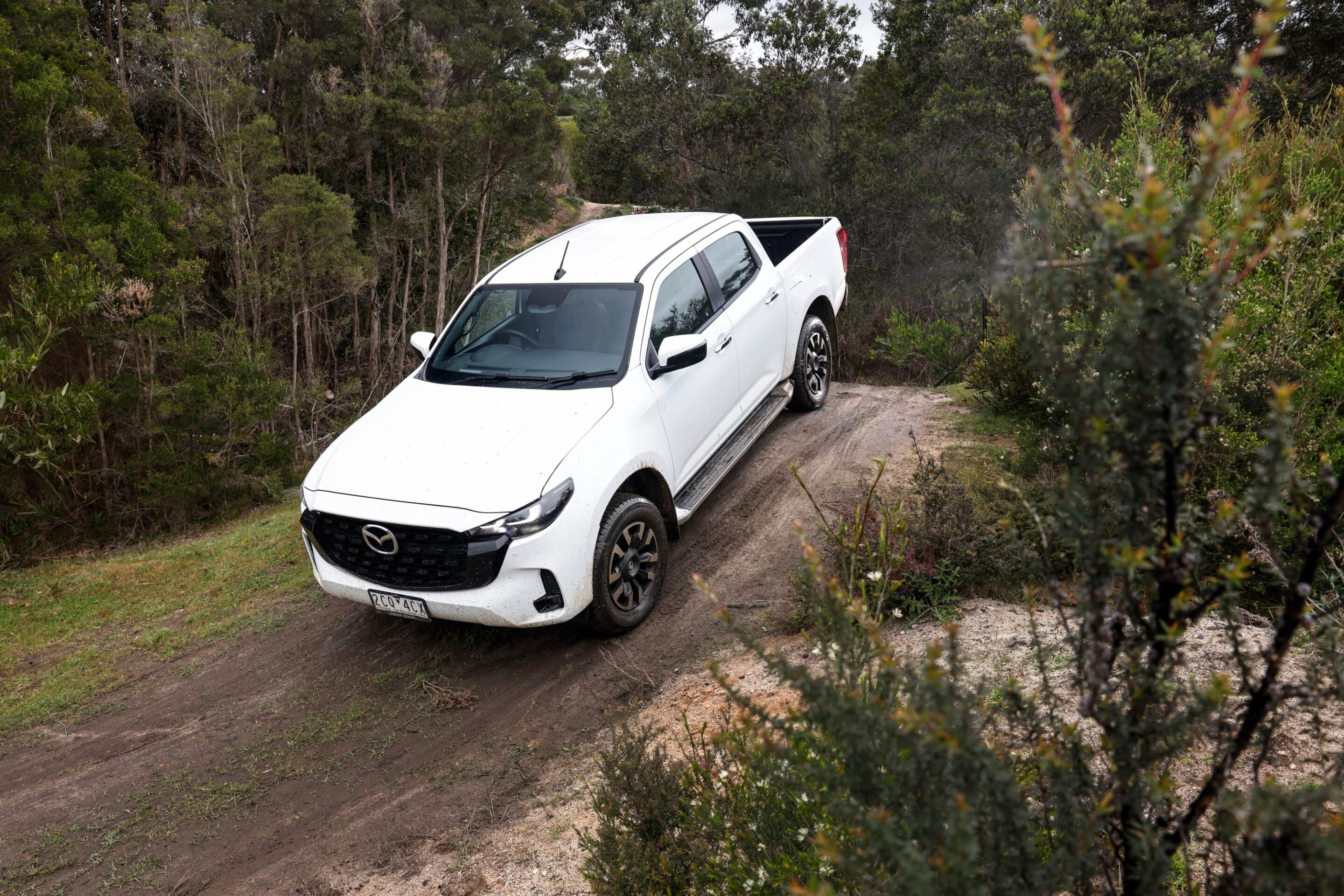
The BT-50 franchise came along in 2006 as a co-designed (call it rebadged) Ford Ranger. It was known for all the things the Ranger was, including a determination to overheat uncontrollably. Much better was to come when the Ranger was redesigned right here in Australia for 2011, carrying the BT-50 along with it, despite a Mazda-specific styling job that only a mother dual-cab could have loved.
4
That deal lasted until 2020 when the new Ranger emerged and Ford booted Mazda out of bed in favour of a tryst with Volkswagen to produce the new Amarok. Mazda took the flat-screen and the dog and shacked up with Isuzu to emerge as a rebadged third-gen D-Max with virtually no Mazda engineering input beyond the front sheet metal, lights and grille. And here we are.
To be honest, there are probably some people within Mazda and some potential buyers who wish that Ford and Mazda had been able to patch things up and stay together. Fundamentally, the Thai-built BT-50 with its Isuzu heart and lungs is not the polished thing it was when it sported Ford giblets.
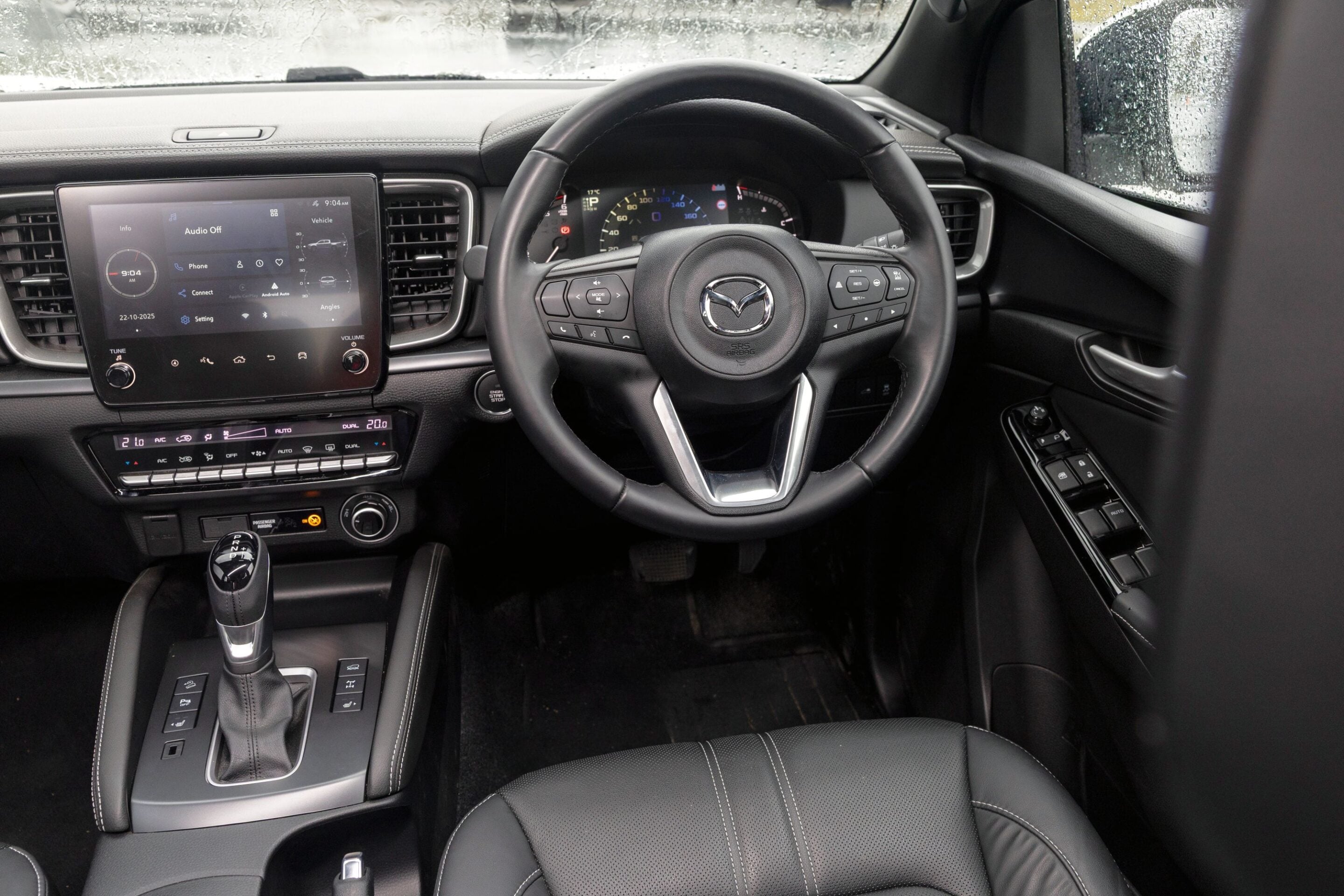
And that starts from the moment you step inside. To be honest, there’s nothing wrong with the interior layout, but the Mazda feels relatively small and narrow inside compared with a lot of the competition.
Actually, it’s kind of refreshing to see lots of analogue instruments and a conventionally placed T-bar gear selector, but there’s no disguising this is as a more budget-conscious vehicle than it used to be.
2
The model we’ve looked at here is the GT 4X4 mid-speccer (there’s always the SP and Thunder models if you want to splash even more cash) which includes lots of kit such as 18-inch alloys, side-steps, keyless entry, dual-zone climate control, embedded sat-nav, leather seats, heated front seats, remote start and front parking sensors. It’s priced at $66,620 (MSRP) plonking it firmly in a hotly contested segment of the market where the established mid-spec players have at it against the Chinese raiders.
As Wheels editor Trent Nikolic noted, ”It was a smart move by Mazda to pair up with Isuzu, given the legendary nature of Isuzu’s drivetrain. While it owes more to the traditional way of the dual-cab world, the BT-50 is a reliable, robust option for those of you who need your dual-cab to work.”
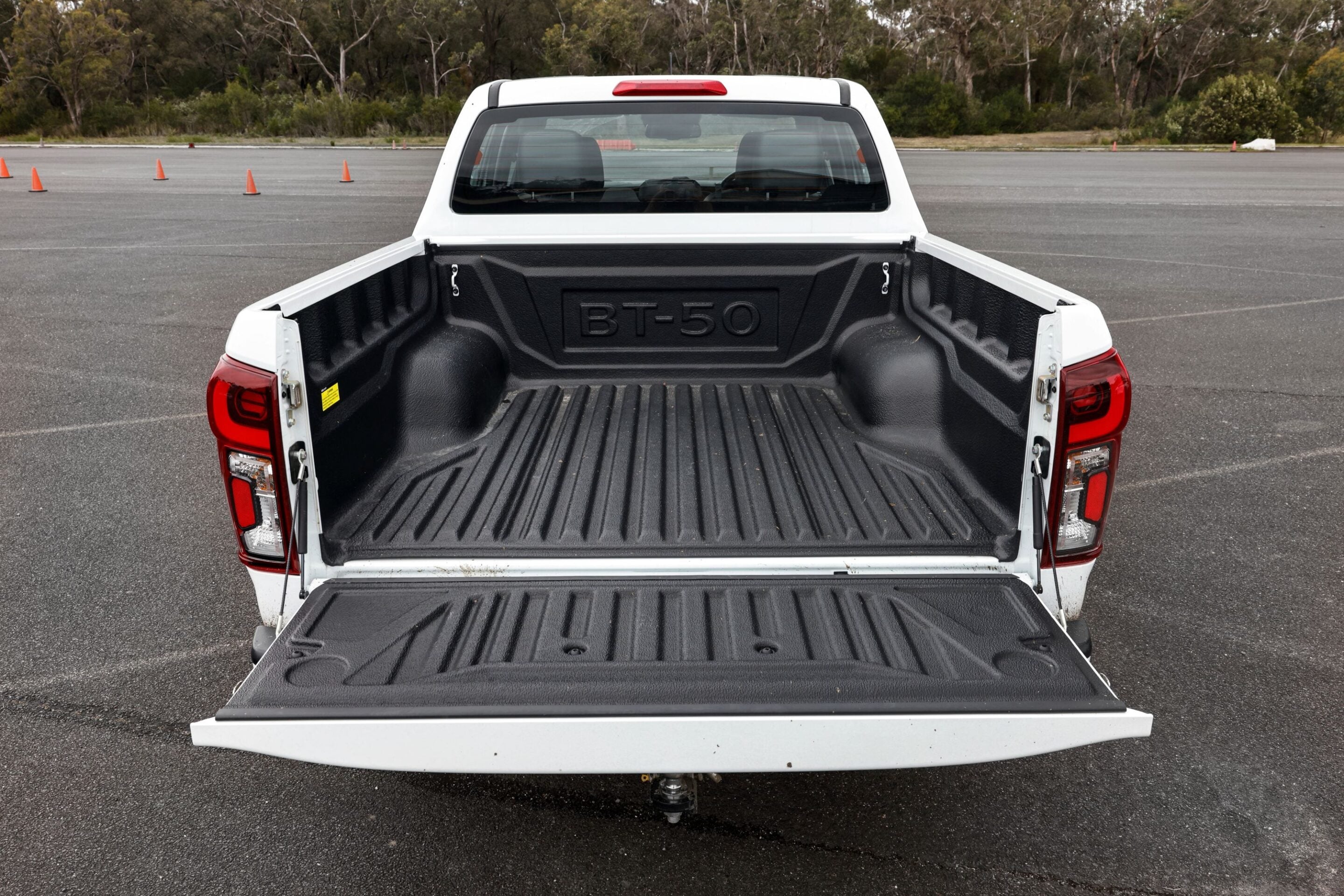
In other respects, the BT-50 hits the right targets. It has a 998kg payload in this form and can tow the usual 3500kg with a braked trailer and the appropriate tow-ball. But it lets things slide a bit in other ways. That includes the warranty which, at five years, is a year less than that offered by the mechanically identical Isuzu D-Max. Some ground is made up with the Mazda’s cover being open-ended on distance, while the D-Max throws you to the wolves at the 150,000km mark.
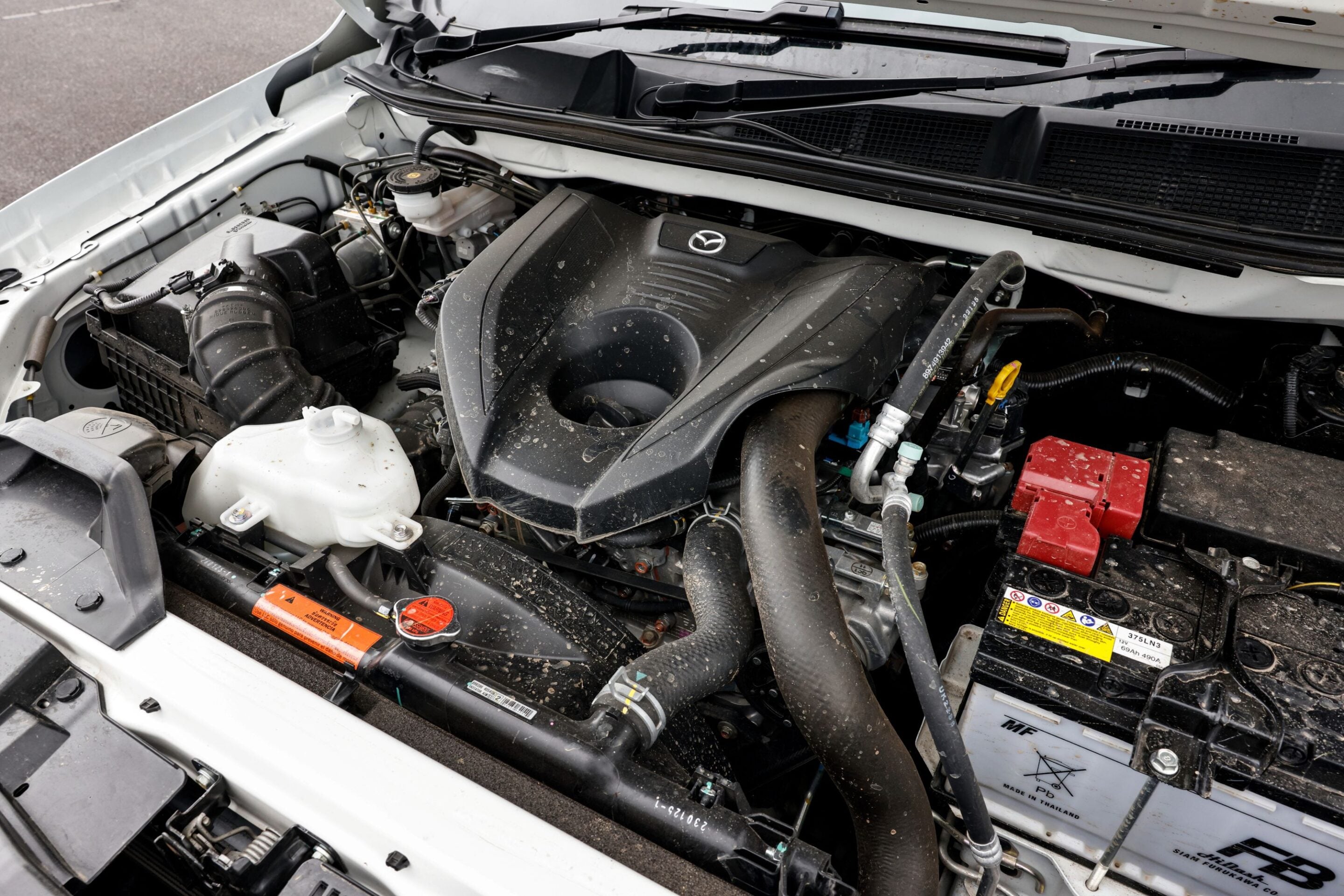
It is, however, when you jump in and hit the starter button that the BT-50’s shortcomings become immediately obvious. Isuzu has gained a great reputation for reliability over the years, by keeping the specification and output of its three-litre turbo-diesel engine conservative. And, of course, that’s precisely the powerplant the Mazda has inherited.
1
And maybe that was okay a few years back when diesel was the new black, and buyers were prepared to trade off refinement and smoothness for that promise of being able to go the distance. But things have changed, certainly in the context of these vehicles as family transport.
And right now, the level of diesel clatter, vibration and industrial soundscape the BT-50 generates
anywhere from idle to redline, is a real spoiler. Even the six-speed transmission feels like it comes up short, especially in an era when a lot of the competition boast eight or even nine forward ratios. And even though the driveline will get you where you need to go, it doesn’t do it with any real flair. For somebody jumping out of a modern petrol-engined hatchback into the BT-50, the culture shock involved would potentially be a deal-breaker.
But it even feels and sounds as though the engineers have pulled a bit of sound-deadening out of the cabin’s surfaces. We’ve noticed this in the BT-50’s smaller-engined brother, the XS model, too, so it’s not just this car or specification.
Actual performance? Nothing to get excited about as the Mazda’s 140kW and 450Nm seem a bit lame for a three-litre engine when many smaller engines in the same marketplace offer more.
3
The other problem is that Mazda has opted for an even firmer suspension tune than the equivalent Isuzu model. At low speeds you can feel the suspension grudgingly taking the edge off things, but as speeds rise, the Mazda flat out refuses to play the game. It’s at its worst when you get a few bigger bumps arriving too fast for the rear suspension (in particular) to relax and recover from the previous one. At that point, it all gets pretty busy in the cabin and you start to wonder if maybe there’s a better way to do this.
Overall, the ride is simply too stiff to make a convincing case as an urban get-around and while that sounds like it’s ignoring the payload and towing limit, it’s simply the way it shakes out when held up against the on-road, family-car criteria we’re working with here. Not to mention the other vehicles vying for the same customer’s money.
Throw in the old-school sound, feel and performance of the BT-50, and the case is pretty much closed.
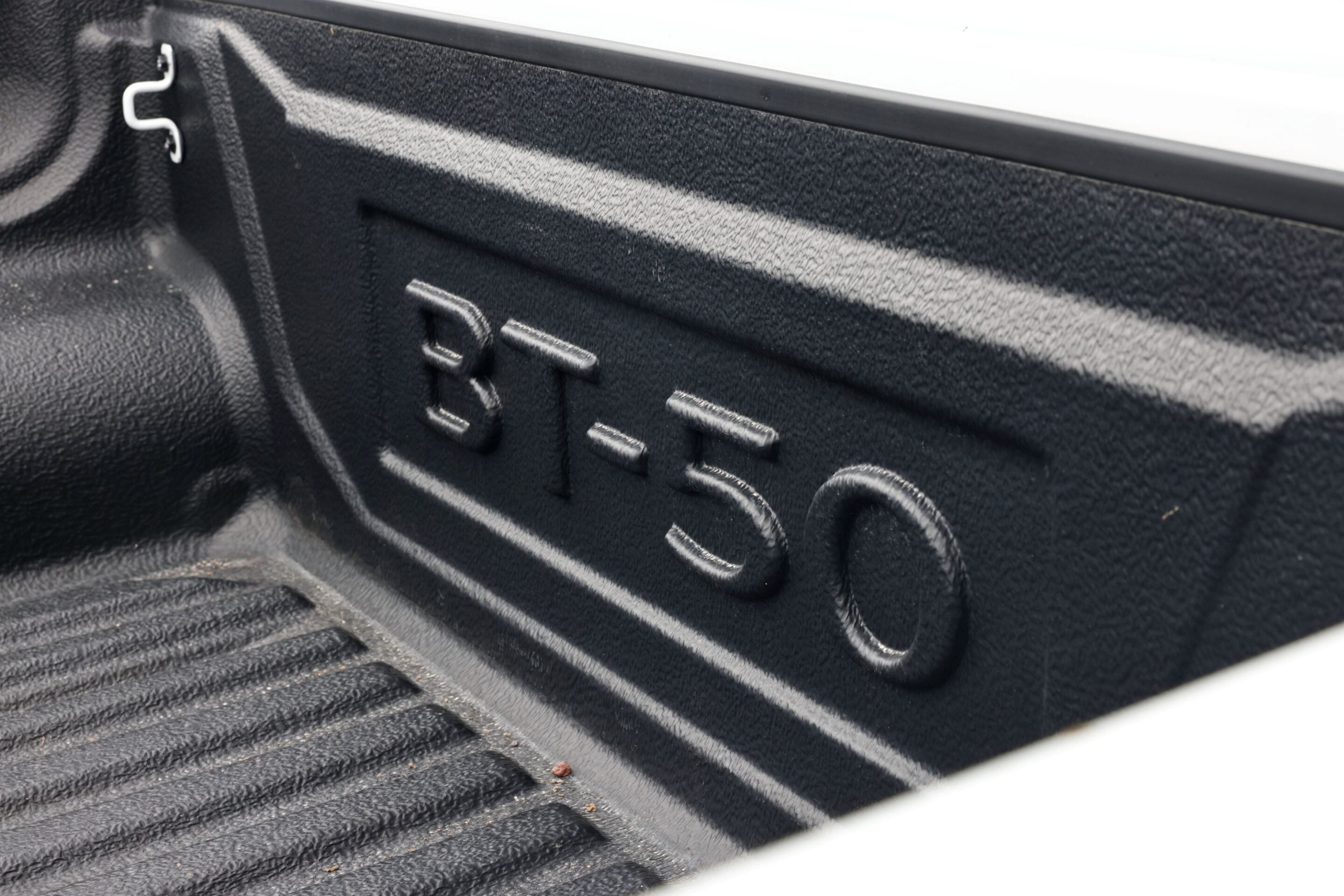
1
Specs
| Price | $66,620 MSRP |
|---|---|
| Body | Dual-cab, five-seat ute |
| Drive | Dual-range 4×4 |
| Drivetrain | 3.0-litre four-cylinder turbo diesel |
| Power | 140kW @ 3600rpm |
| Torque | 450Nm @ 1600-2600rpm |
| Transmission | 6-speed automatic |
| Consumption | 8.0L/100km |
| Kerb weight | 2102kg |
| 0-100km/h | NA |
| L/W/H/W-B | 5280/1870/1790/3125mm |
| Payload | 998kg |
| Warranty | 5yr/unlimited km |
| Safety rating | 5 star ANCAP (2022) |
It’s fair to say there’s been plenty of fanfare trumpeting Kia joining the dual-cab segment with its Tasman, but within that fanfare, South Korea’s first dual-cab in our market has seemingly been forgotten.
Enter the refreshed KGM Musso Ultimate Luxury XLV. What was once a SsangYong is now a KGM, but fear not, the value position remains unchanged along with the Musso nameplate.
Not so long ago, the Musso was the only go-to when it came to value-packed dual cabs for sensible buyers willing to deftly sidestep the bragging rights of the badge in their driveway. The coil spring rear end provided a point of difference too, some time before Nissan went that way with Navara. In theory, it means you get ride quality that’s more SUV than truck-like.
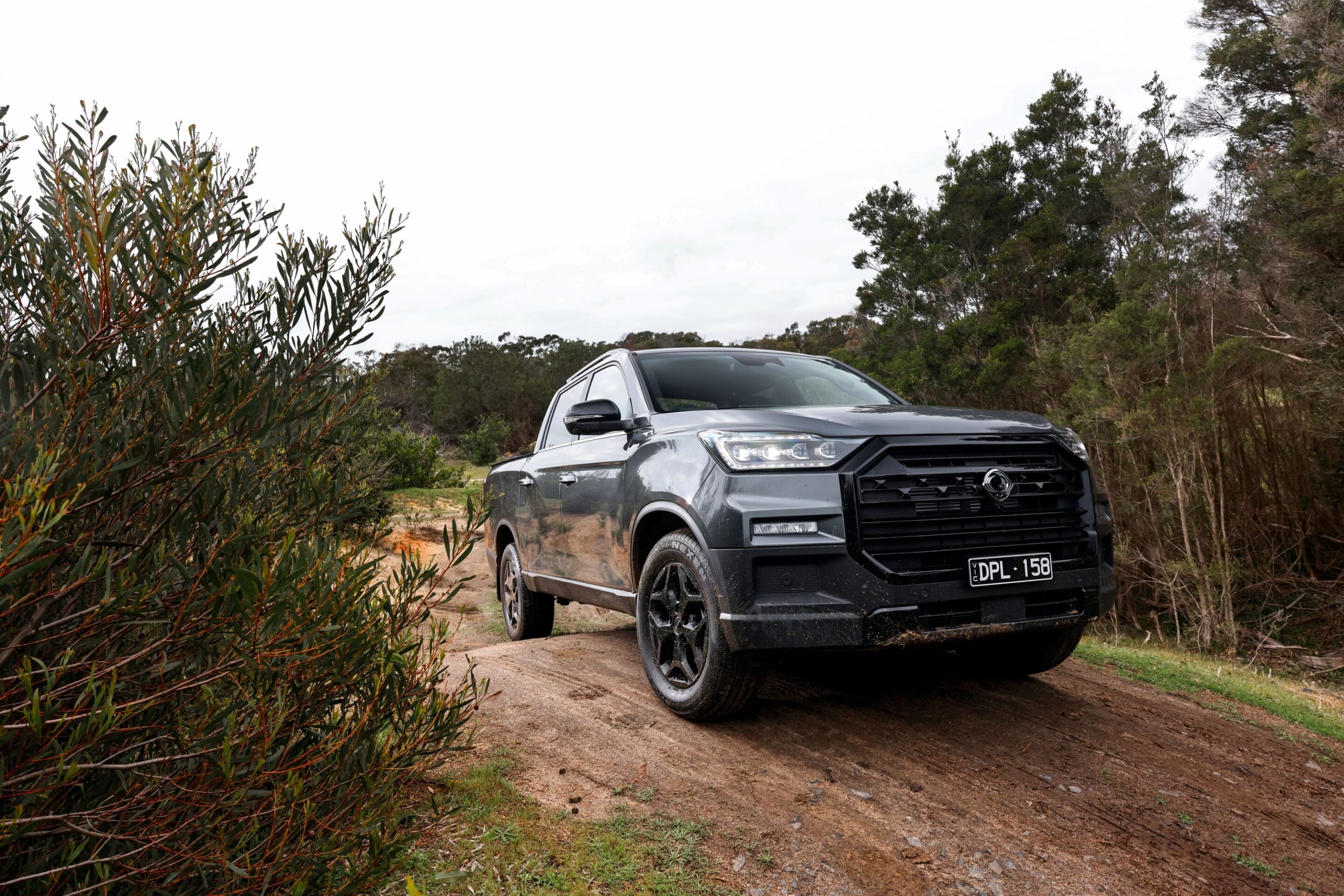
2
And, in this company, any combatant with a price that starts with a 5 is off to a solid start. While the GWM Cannon has started to eat into KGM’s value action, the Musso still stands as a smart money buy, and not just because it’s affordable, which we’ll get to. Add in the seven-year/unlimited kilometre warranty, and capped price servicing scheme ($2298 over five years), along with a frugal 8.6L/100km fuel use claim, and the Musso nails the value proposition. In testing, we’ve managed to keep the real-world fuel use below 10L/100km, settling in around 9.5-9.8L/100km.
As the judges found during Wheels’ UOTY, the Musso is well designed, cleverly executed, comfortable, spacious and doesn’t feel like it’s been built down to a price. That’s a crucial point, too, because in the chase for value at the more affordable end of the market, the way to stand out is not to appear to be cheap. The price point is one thing, the experience inside the cabin, for example, is quite something else.
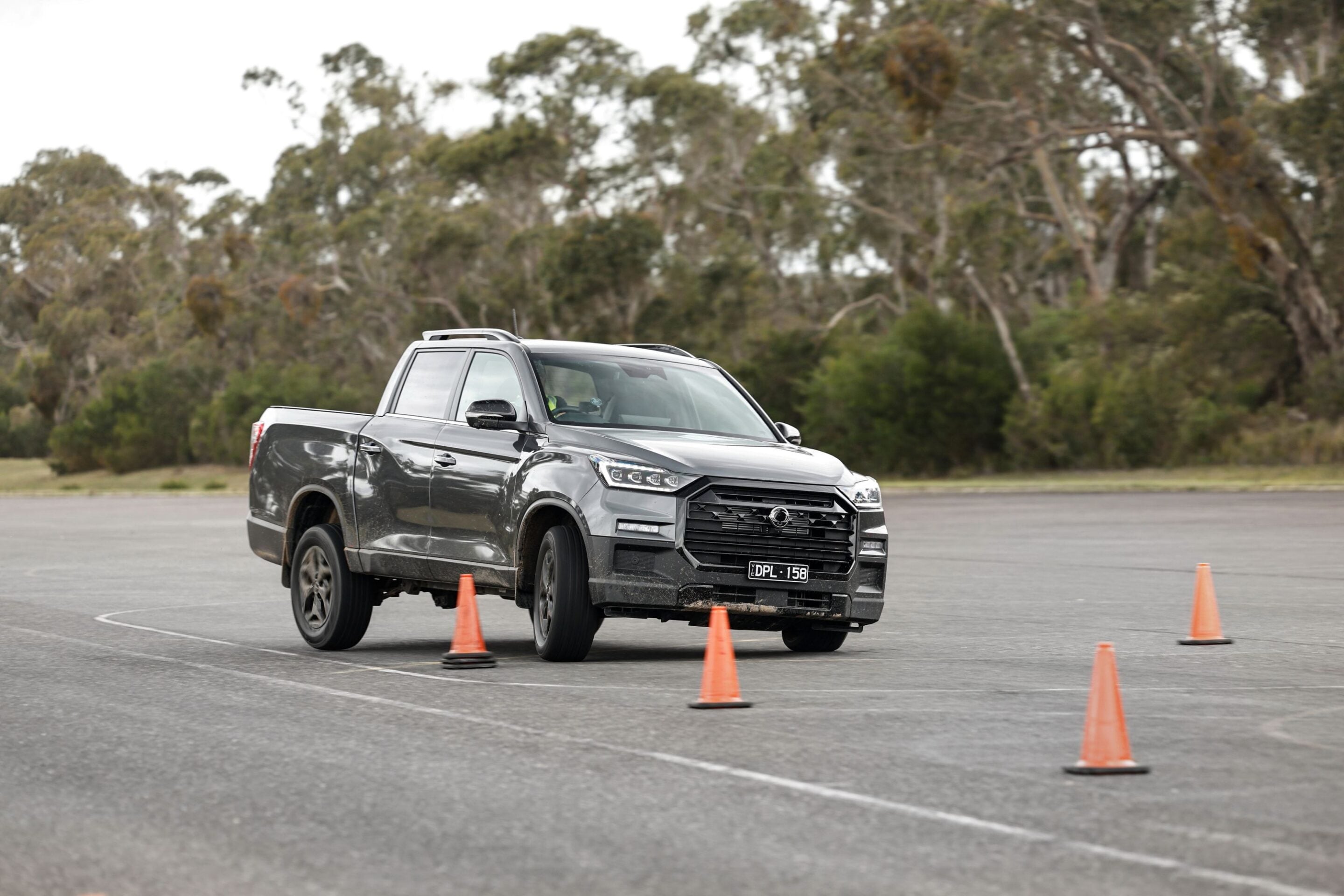
Keep in mind, again, that the judges here are assessing the chops of these dual cabs around town, in the confines of the city. It’s here the Musso once again impresses. Like a few of the newcomers here, it isn’t the one to buy if you need to regularly carry a heavy load in the tray.
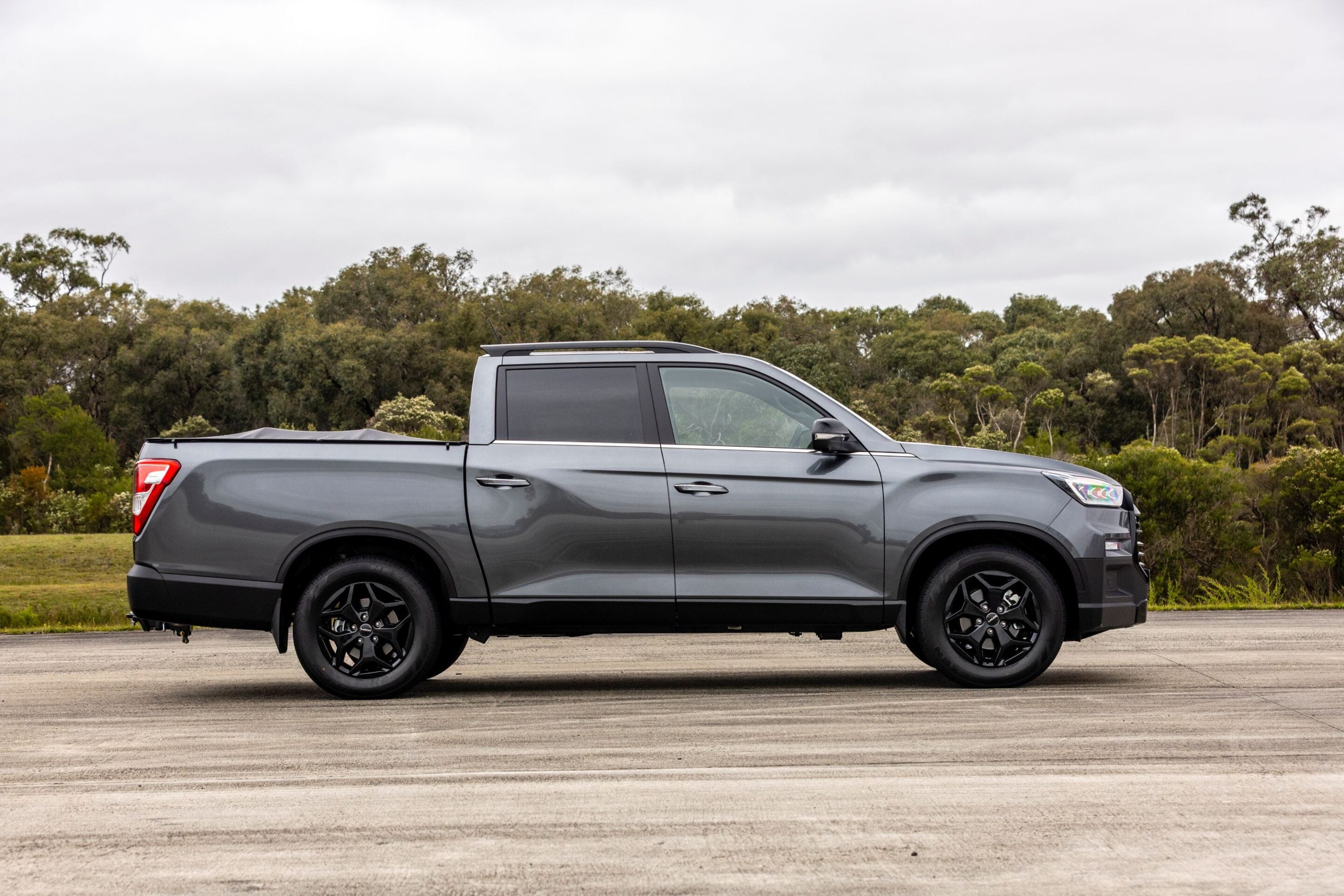
2
There are more hardcore, work focused options for that – Ranger at the top of the tree.
The Musso does, however, make light work of the urban sprawl, with a comfortable cabin, long list of standard features that work as they should, and space for the family if that’s how you need to use your ute. Even some of the larger utes in this class don’t feel especially spacious in the second row, but the Musso is comfortable back there, even for longer trips, especially in regard to legroom.
“The Musso proves a couple of things,” Morley said. “First, that you don’t necessarily have to shop Chinese in order to get a big package, your share of tech and a decent drive. Second, that even though it’s the cheapest vehicle here by almost six-grand, it’s far from the least likeable.”
He’s right too, with this segment getting more expensive by the month, despite the relatively primitive underpinnings beneath dual cabs of every colour. The Musso steps things forward somewhat with a multi-link, coil spring rear, with the platform beneath based on the Rexton SUV. It’s a key point, too, because often, the SUV comes after the dual cab.
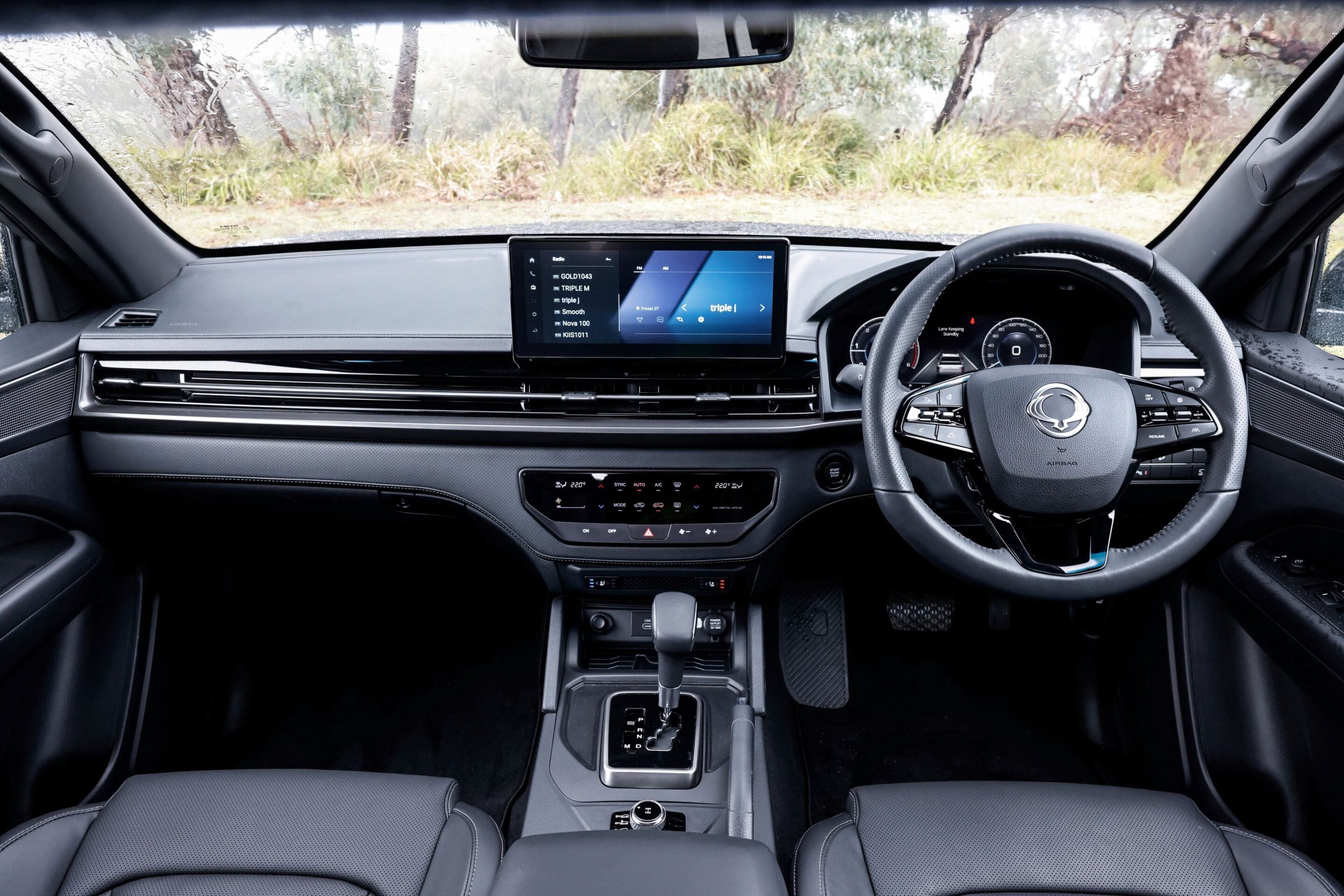
2
There’s still a firm element to the ride – there has to be to account for the 880kg payload and 3500kg tow rating – but it’s more adept at dealing with road imperfections than a leaf-spring rear could ever be. Keep in mind, though, that you can get leaf springs with the more affordable ELX model grade if you want a Musso and you need it to get to work.
Smaller, four-cylinder engines are now effectively the standard for the segment, and as such, the Musso’s 2.2-litre, four-cylinder turbocharged diesel isn’t as strange as it might otherwise be. Power and torque at 133kW and 420Nm, are down on the segment best meaning it rarely feels sharp under acceleration, but the six-speed auto is a good one and makes the most of the power and torque on offer. The segment standard has been 500Nm for some time now, so the Musso doesn’t feel as punchy as the best in segment.
It’s driving where the Musso shines brightest. To get the same level of driving engagement and comfort, you need to spend a lot more money, and that’s why it’s been the smart money option for as long as it has. Challengers are many now, not the least of which being the heavy hitters from China such as the BYD Shark 6, the GWM Cannon and the new MG U9. With that in mind, Musso continues to impress even though it might not be the first model on everyone’s shopping list.
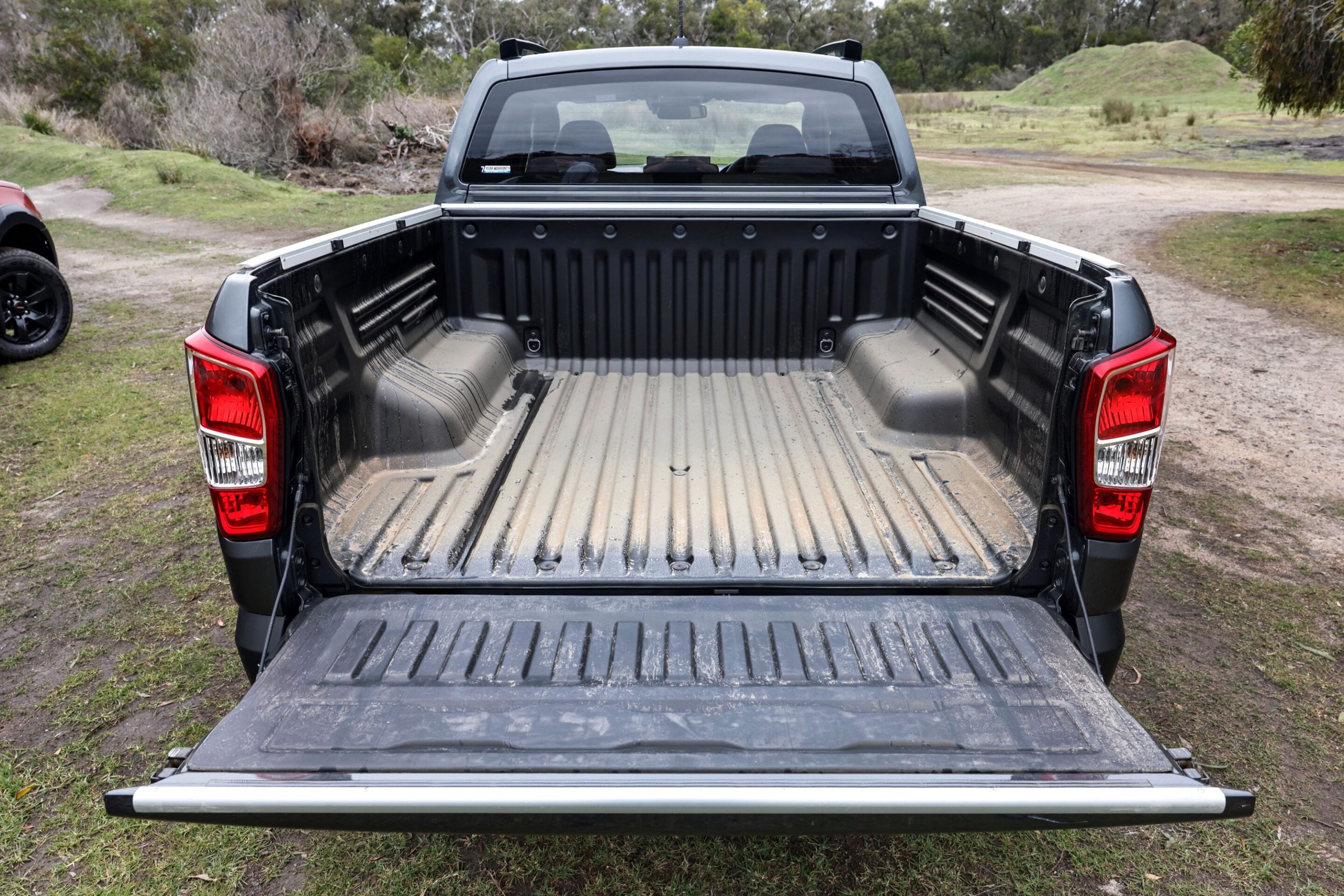
3
A steady stream of updates, styling tweaks and technology inclusions has ensured the Musso ticks along, keeping pace with the most appealing in the segment and their respective standard features list.
However, the fact that KGM has managed to keep the pricing as sharp as it has is the real story here. It means those of you wanting a dual cab with the lot, but with a budget that doesn’t quite stretch that far, still have the option to access a vehicle with everything you need.
Specs
| Price | $52,000 (DA) |
|---|---|
| Body | Dual-cab, five-seat ute |
| Drive | Dual-range 4×4 |
| Drivetrain | 2.2-litre four-cylinder turbo diesel |
| Power | 133kW @ 3000rpm |
| Torque | 420Nm @ 1600-2600rpm |
| Transmission | 6-speed automatic |
| Consumption | 9.0L/100km |
| Kerb weight | 2090kg |
| 0-100km/h | NA |
| L/W/H/W-B | 5415/1950/1885/3210mm |
| Payload | 880kg |
| Warranty | 7yr/unlimited km |
| Safety rating | Untested |
1
2025-26 Wheels Ute of the Year
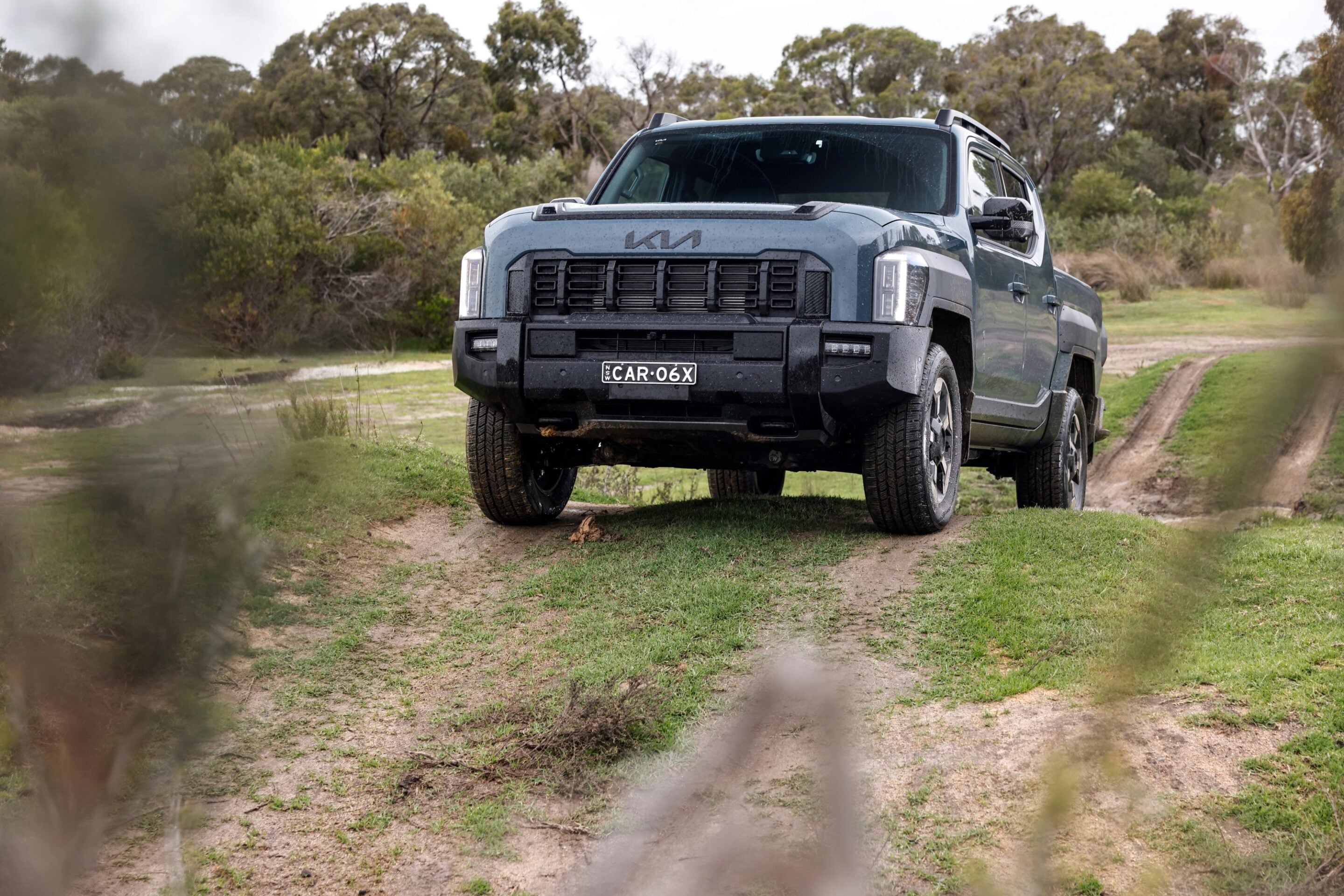
The groundswell of contempt for – and rejection of – the online trolls who bully, harass and ruin the lives of others has clearly skipped the dual-cab ute segment. You only need to Google up a four-wheel-drive forum or other electronic cesspit to know that the cyber bullies are alive, well, and feeling as emboldened as ever when it comes to trashing the Kia Tasman for nothing more than its looks.
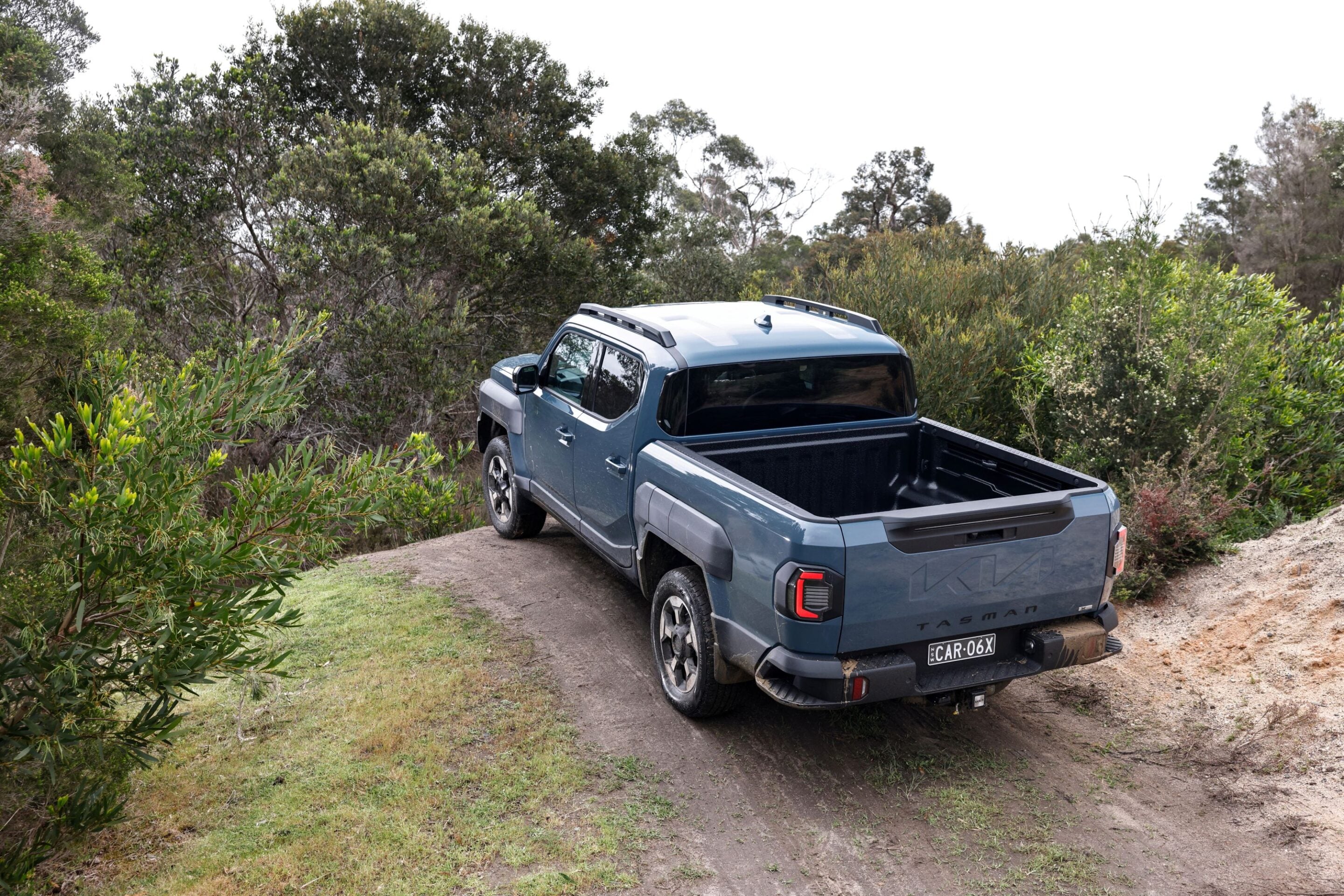
And, okay, the Tasman is not the prettiest dual-cab out there. From head-on, it looks like somebody forgot to paint eyes on it, and in profile, there’s more than a hint of HumVee going on. But in a market segment dominated by vehicles that also look like the work of a seven-year-old (who then ate the crayons) does an unconventional visage deserve such a panning? Probably not, we say.
We could also suggest that it’s a damn fine effort for Kia’s first attempt at such a thing, but that would be either condescending at best, or damning with faint praise at worst, and the Tasman doesn’t deserve that, either.
2
Despite it being perceived as a novelty (mainly because it’s a Kia and not a Toyota) the Tasman sticks to a pretty well-trodden path in terms of its layout and construction. That includes a body-on-chassis design,
a front suspension consisting of double wishbones and coil springs and a live rear axle with leaf springs. The X-Line model we have here uses a mechanical locking rear differential, and there’s no locking front diff.
The driveline consists of a 2.4-litre turbo-diesel four-cylinder with 154kW of power and 440Nm of torque, the former being weight-for-age and the latter perhaps a tad off the pace relative to the competition, many of which boast closer to 470 or even 500Nm.
But the eight-speed automatic is a beauty and is coupled to a two-speed transfer-case with one important advantage over the majority of the vehicles it sells against. And that is a setting that allows for driving in four-wheel-drive on even a high-grip surface like dry bitumen. In this case, the centre differential remains open, allowing for this. And while this ability is brilliant for towing, it also has huge primary safety implications for a simple journey on a wet road. Big bonus points, and something all utes should have, but most don’t.
2
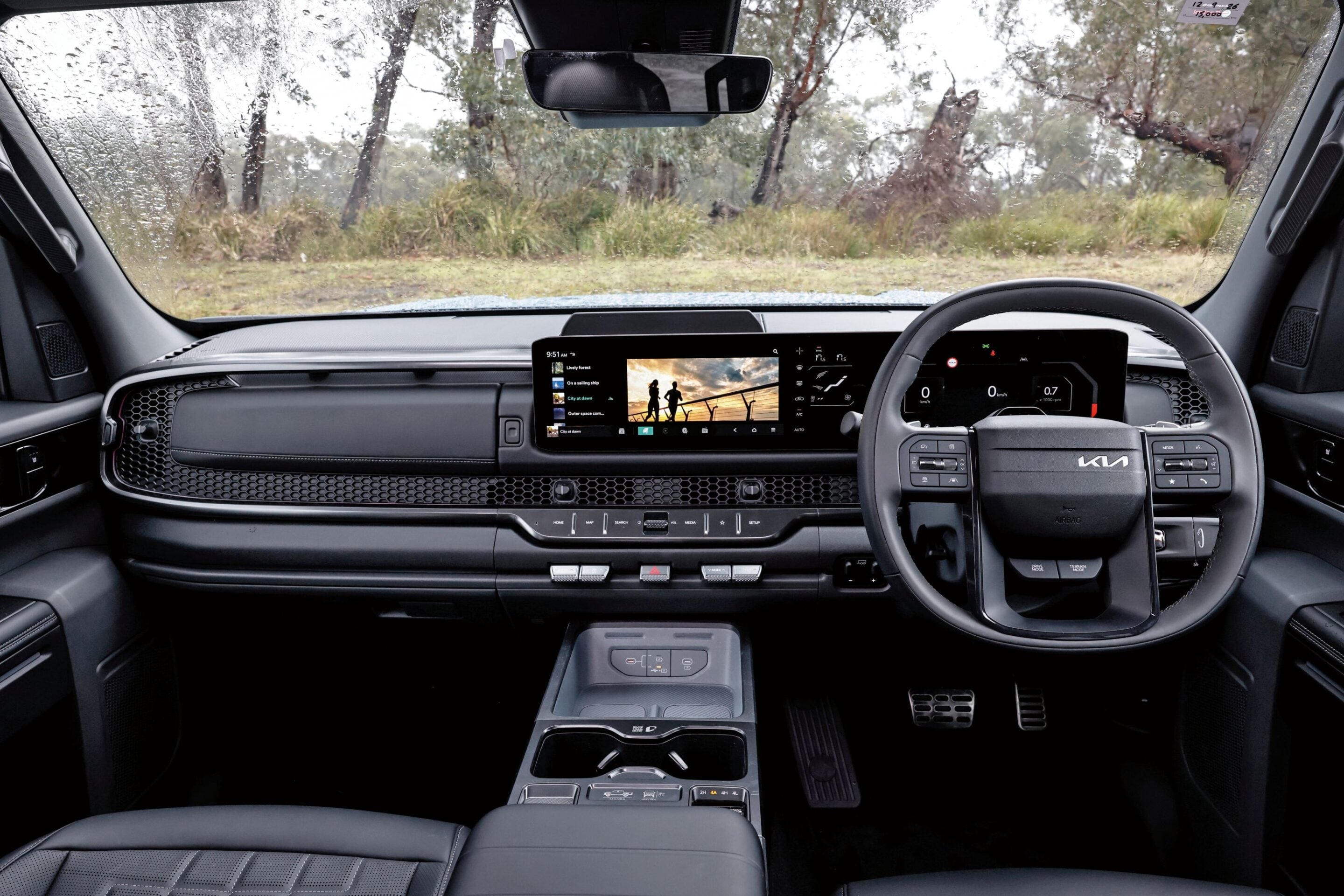
Inside, the Kia has been proudly praised for its feel and layout, but I’m one of the few that isn’t completely won over. While I can appreciate the modern layout of the large screens, and I’m all for the hard-switches versus pull-down menus and touch-screens, the slightly square steering wheel always felt odd. And it can look as smooth and modern as it likes, but the ergonomically-impure placement of the seat-heater switches and the starter-button that is hidden by the tiller tell me marketing has trumped engineering at some point.
The actual driving experience reveals a willing engine that is also impressively smooth for a diesel. The eight-speed auto is a ripper and hides the relative lack of torque well. That said, when you’re really making the Tasman work, you’ll sometimes get a niggling feeling that a few extra Newton-metres would be nice.
Ride quality is okay, but only okay. True, that’s nothing new in this market segment, but when the driveline is so refined, you kind of subconsciously expect a little more in terms of ride plushness. Still, it’s hardly the most agricultural vehicle here… not by a long chalk. Part of the ride compromise is clearly to preserve payload and towing abilities, but could also be something to do with the portly 2200-or-so-kg kerb mass. Again, the Tasman is hardly on its own here, but that’s an awfully large kilo-count to rely on leaf springs to tame and control.
3
Trent Nikolic urged potential buyers to look beyond the Tasman’s unconventional styling and dig deeper to discover its true beating heart. “Beneath the controversial skin, lies a well executed 4WD, with clever cabin design and ergonomics, and technology that works,” he noted.
All things considered, the Tasman stacks up pretty well. Its refinement is a plus and it steers nicely and won’t throw you any curve-balls mid-corner. Within our family-transport terms of reference, it makes a good fist of things, and it definitely benefits from our unconventional criteria. Notably, thanks to the fact that we’ve ignored towing here. And that’s because, while the Kia is, on paper, rated to tow the industry-standard 3500kg, in practice, it’s a different story.
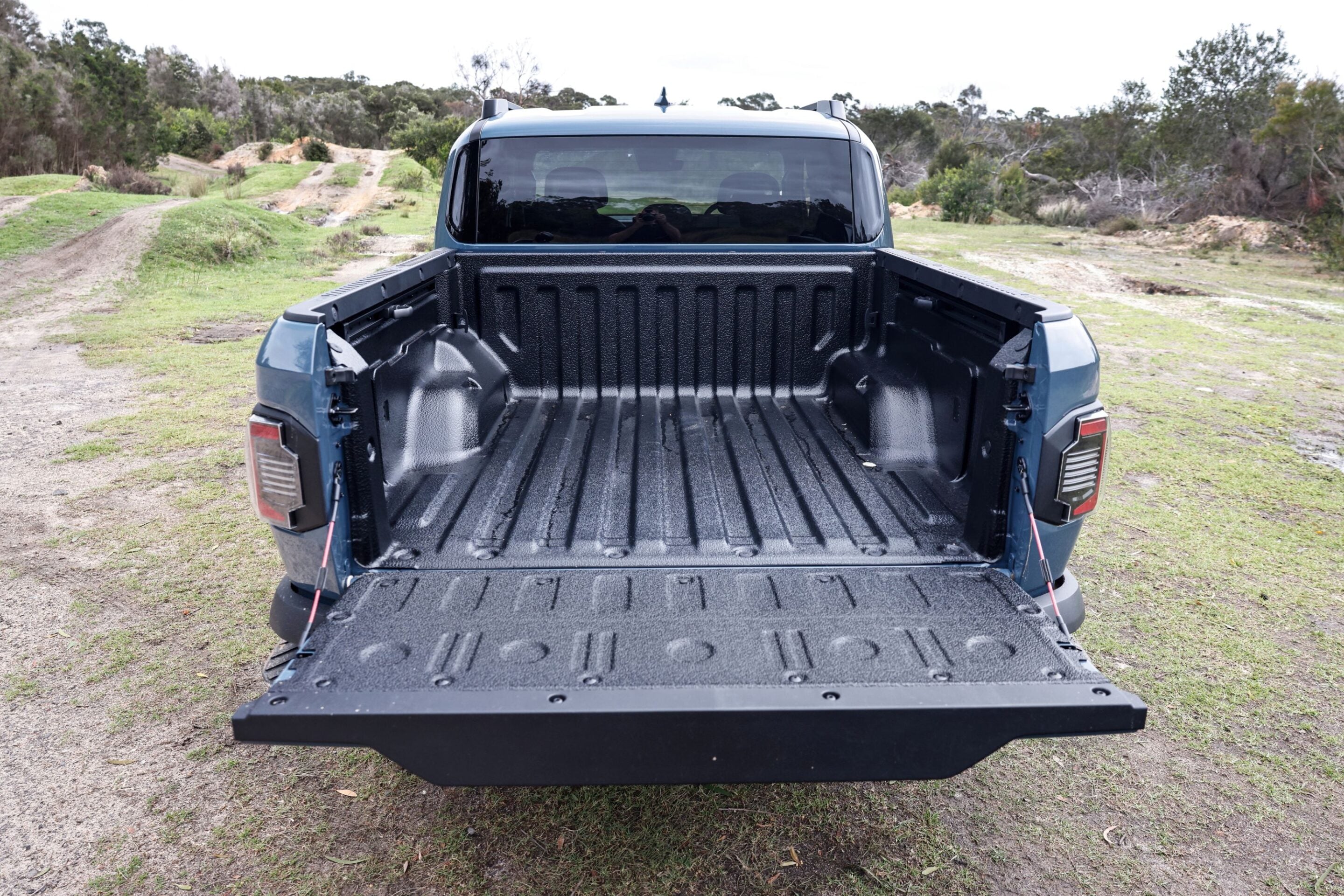
Using a typical loading scenario where a nominal one-tenth of the 3500kg maximum towed load is likely to bear directly down on the tow-ball, and the Tasman’s rear leaf springs kind of give up the ghost. At this point, the springs will be compressed farther than a lot of its opposition, and the vehicle will effectively be riding on the bump-stops. In other words, it’s just not up to it.
2
But in other dual-cab four-wheel-drive pursuits, the Tasman is a happier place to be. Its off-road chops are very good and it’s likely to have more ability than the average owner will have brave pills. Worth remembering in case you’re one of the tiny percentage of buyers who will actually tackle Cape York or The Simpson.
Meantime, it’s another one of those cars that will sell better as Kia gets more punters behind the wheel. And not just because it’s the one place where you can’t see how odd it looks.
2
Specs
| Price | $67,990 (MSRP) / $70,990 (DA) |
|---|---|
| Body | Dual-cab, five-seat ute |
| Drive | Dual-range 4×4 |
| Drivetrain | 2.2-litre four-cylinder turbo diesel |
| Power | 154kW @ 3800rpm |
| Torque | 440Nm @ 1750-2750rpm |
| Transmission | 8-speed automatic |
| Consumption | 7.8L/100km |
| Kerb weight | 2223kg |
| 0-100km/h | NA |
| L/W/H/W-B | 5410/1930/1890/3270mm |
| Payload | 1027kg |
| Warranty | 7yr/unlimited km |
| Safety rating | 5 star ANCAP (2025) |
2025-26 Wheels Ute of the Year
If you’re looking for confirmation of just how popular dual cabs and large SUVs are in this market, Isuzu is the perfect example. Able to excel with a simple, two-model range, the brand trades on robust build quality, reliability, and value for money for buyers looking for either a large SUV (M-UX) or dual-cab (D-Max).
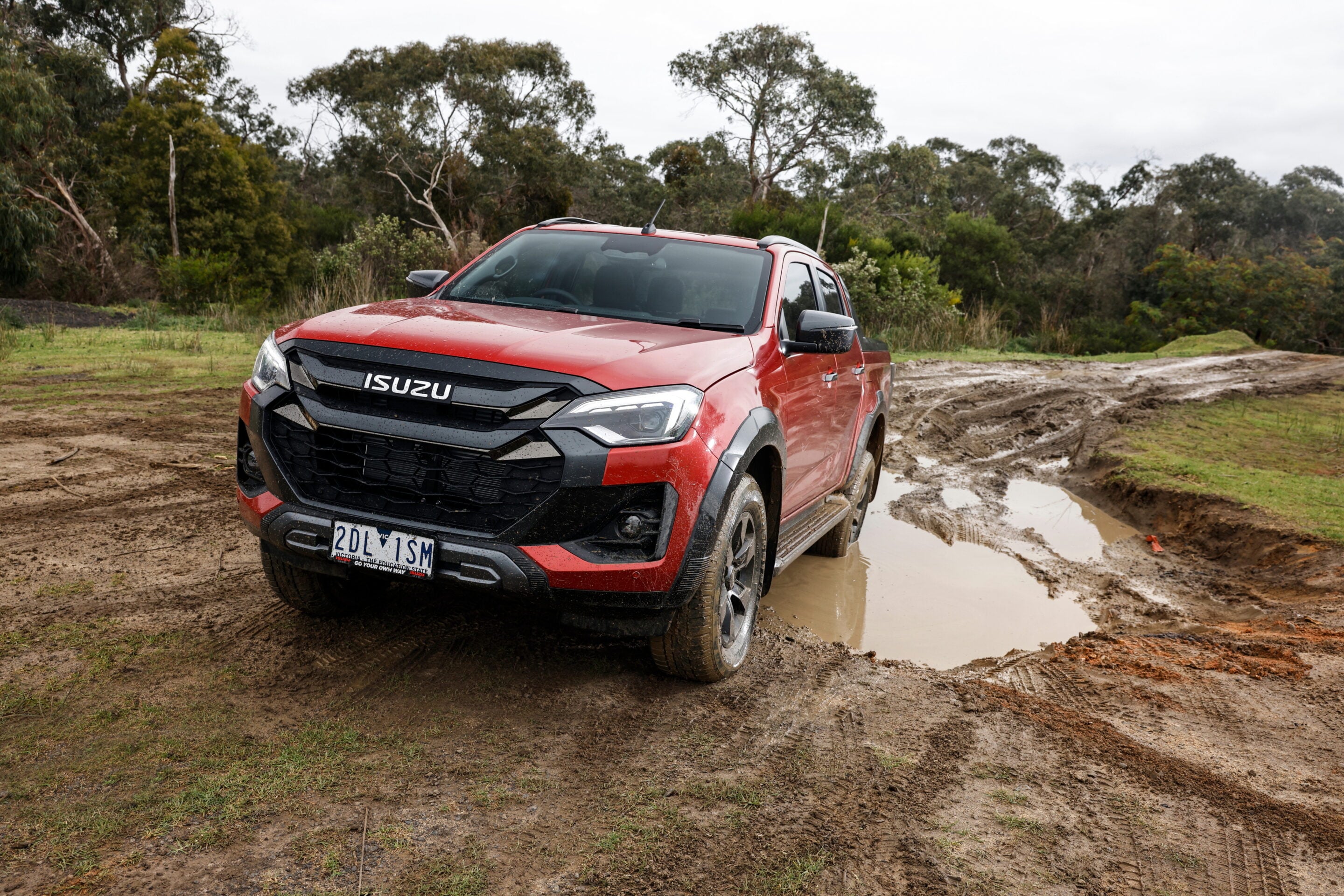
It’s hard to argue with the strong points of the D-Max we’re testing at Wheels UOTY. The 3.0-litre turbo diesel sits up near the head of the class, thanks to its ability to work effectively whether you drive around town, tow long distances, or head further off-road. Leave the confines of the city and the D-Max is clearly one of the preferred vehicles for those with a caravan in tow.
On test here we’ve got the range-topping X-Terrain model, starting from $73,000 before on-road costs. If you’re shopping for an Isuzu, though, keep in mind the brand will often run limited drive-away pricing across the range, so it’s worth doing your research to check if that’s in play. A six-year/150,000km warranty, and sharp servicing costs across the first five years, ensure the value equation is looked after with the D-Max, one of the more affordable to own post purchase.
2
Isuzu’s 3.0-litre engine is a masterclass in understated ability. Refined through years of service under the bonnet of all types of commercial vehicles in Japan and around the world, it’s an engine that, while not big on power, feels understressed all the time. It’s why those who own a D-Max swear by them, and often just replace one with another when its time to upgrade. It’s also why it maintains a rep for reliability.
In 2026, 140kW and 450Nm aren’t heady figures by any means, but they don’t need to be either, such is the effortless way the D-Max gets to work. The ADR fuel claim is 7.8L/100km and if you drive as most of us do around town, you’ll use 8.8-9.0L/100km, less on the open road when cruising. The six-speed automatic is smooth and eschews the ‘more is more’ philosophy of some to deliver crisp shifting at any speed on any road.
Isuzu’s cabin is starting to feel its age, especially when lined up alongside much newer competition. The screens, switchgear and technology feel like they have come from half-a-generation ago. What remains a positive though, is how well everything works. From the smartphone connection to the one-touch button to turn off some of the more annoying driver aids, the Isuzu suite of technology works well and is easy to decipher.
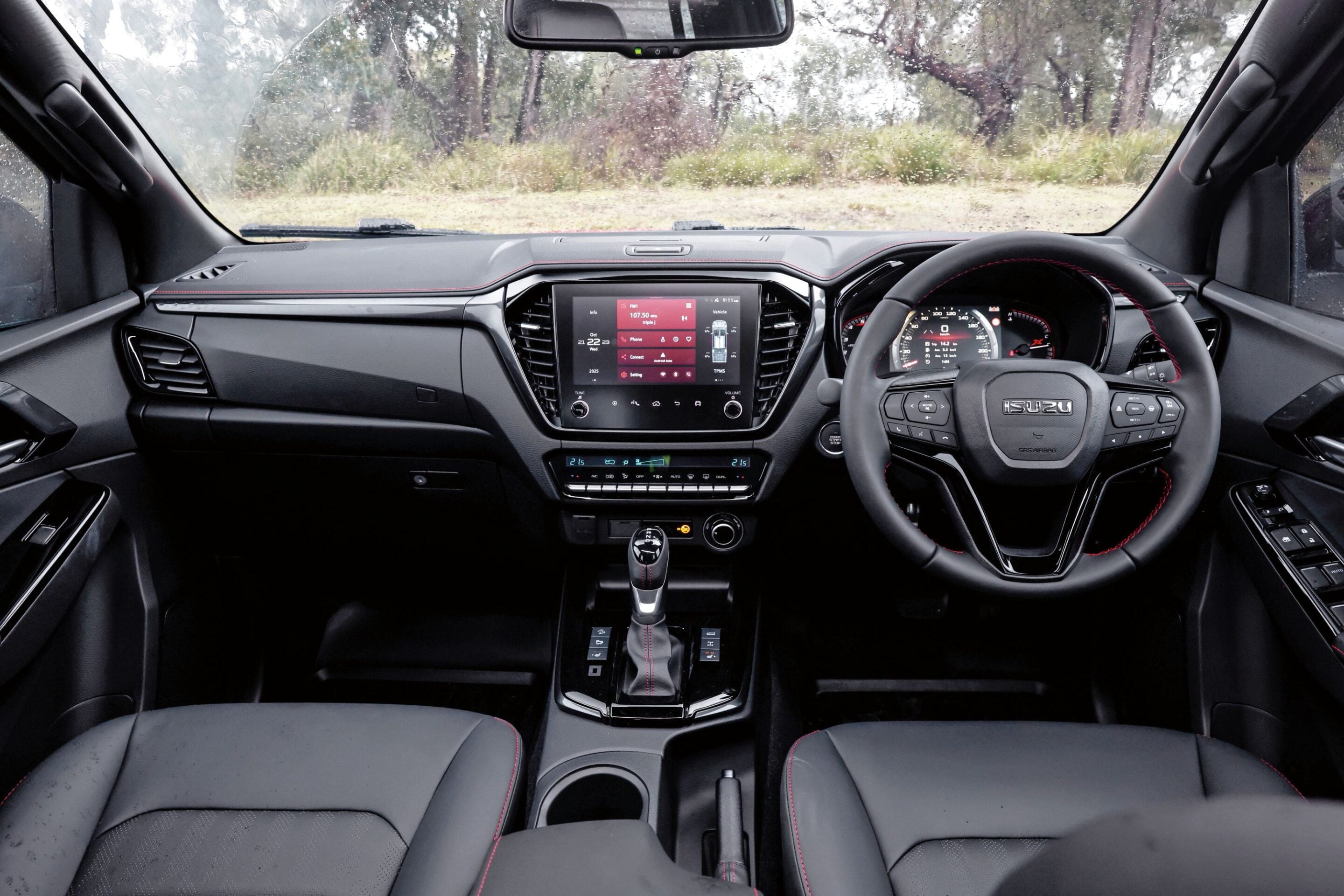
4
As dual cabs have crept up in size, cabin space has likewise shifted, and the D-Max doesn’t feel as big as the biggest on offer, especially in the second row. It’s a factor worth noting if you have tall teenagers in the family, or transport adults back there regularly. It’s not uncomfortable, just not as spacious as the best in class.
What’s interesting in this company, especially compared to those with hybrid drivetrains, is how old-school and agricultural a dual-cab like the D-Max can feel. The engine isn’t particularly refined, and as such, there’s an engine note and vibration from under the bonnet, that isn’t present in the newer, more refined offerings in a segment that continues to shift.
However, Morley and I both agreed there’s something reassuring and comforting about the ‘Grandpa’s axe’ nature of the D-Max, even more so when you’re out in remote parts of the country. But today’s modern buyer expects more, especially those who live in urban areas.
“Slightly softer suspension than its stablemate, the Mazda BT-50, isn’t enough to save what is otherwise a capable, but dated result,” Morley said. “The levels of noise and vibration are from another age, and while the rough-and-tough crowd mightn’t mind, we do.”
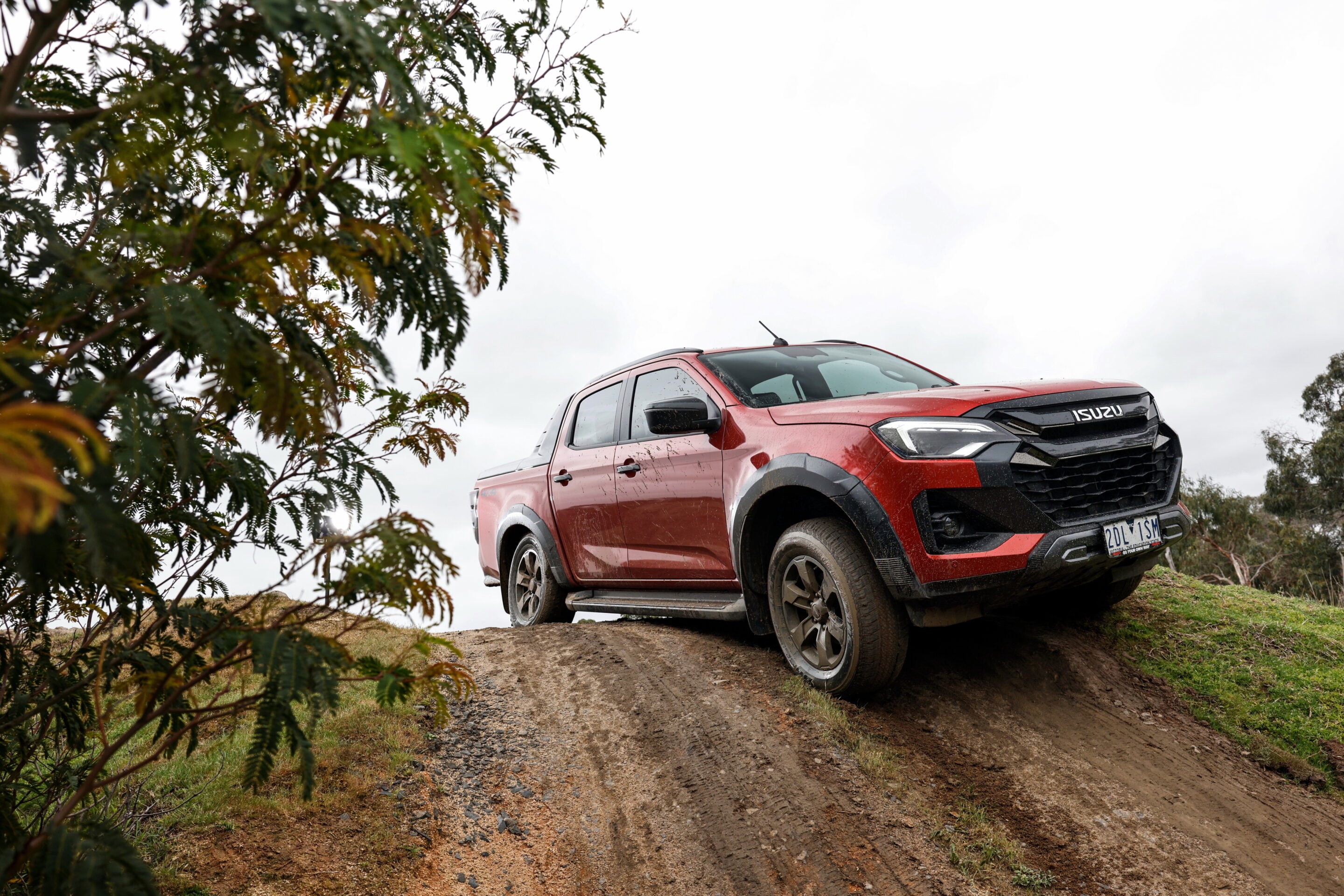
2
That last point is an interesting one, too, given you can roll around town in silence with a plug-in hybrid dual-cab, or in a significantly more refined manner with petrol power. Is diesel the last vestige of the way we used to drive? Perhaps, but for those with long-distance touring in mind, it’s still the best way to go, and it’s another reason why the Isuzu remains so popular.
Like nearly every dual-cab on the market, the D-Max isn’t at its best with an empty tray, and you’ll notice the firm ride on rough surfaces if it is unladen. It’s not harsh, but it does jiggle and skip over the worst surfaces in a much more noticeable way than a more composed SUV might.
As traditional as the D-Max is, it’s actually a good thing to drive in traffic and around town. The steering is light with the right amount of assistance, especially at low speed, the brake pedal feel and manoeuvrability are where we would expect them to be, and it’s not so big that it feels too large for the city. It exudes a sense of toughness.
In this company, then, with a focus on the way the average person uses a dual-cab, the D-Max can’t keep pace with the more refined, tech-focused offerings now available. But if you’re intent on long-distance touring, off-roading or towing, only the Toyota HiLux puts itself forward to take the fight to the D-Max.
2
Specs
| Price | $66,990 (MSRP) / $68,490 (DA) |
|---|---|
| Body | Dual-cab, five-seat ute |
| Price | $73,000 (MSRP) |
| Body | Dual-cab, five-seat ute |
| Drive | Dual-range 4×4 |
| Drivetrain | 3.0-litre four-cylinder turbo diesel |
| Power | 140kW @ 3600rpm |
| Torque | 450Nm @ 1600-2600rpm |
| Transmission | 6-speed automatic |
| Consumption | 7.8L/100km |
| Kerb weight | 2170kg |
| 0-100km/h | NA |
| L/W/H/W-B | 5310/1880/1810/3125mm |
| Payload | 930kg |
| Warranty | 6yr/150,000 km |
| Safety rating | 5 star ANCAP (2022) |
2025-26 Wheels Ute of the Year
It’s a bit hard to know what’s left to say about the Ford Ranger. As the vehicle that has played leap-frog with the mighty Toyota HiLux for the number-one overall spot in the new-car sales race for the last couple of years, it’s proven itself the only dual-cab capable of giving the Toyota some showroom grief. Others have tried, but the Ranger has actually done it.
So there must be something to it, right? True, and from the very moment you jump into the Ranger in V6 form, hit the start button and set sail, there’s a feeling of solidity and – yes, dammit – refinement that is not just unexpected but actually, even in isolation, better than average for a dual-cab ute.
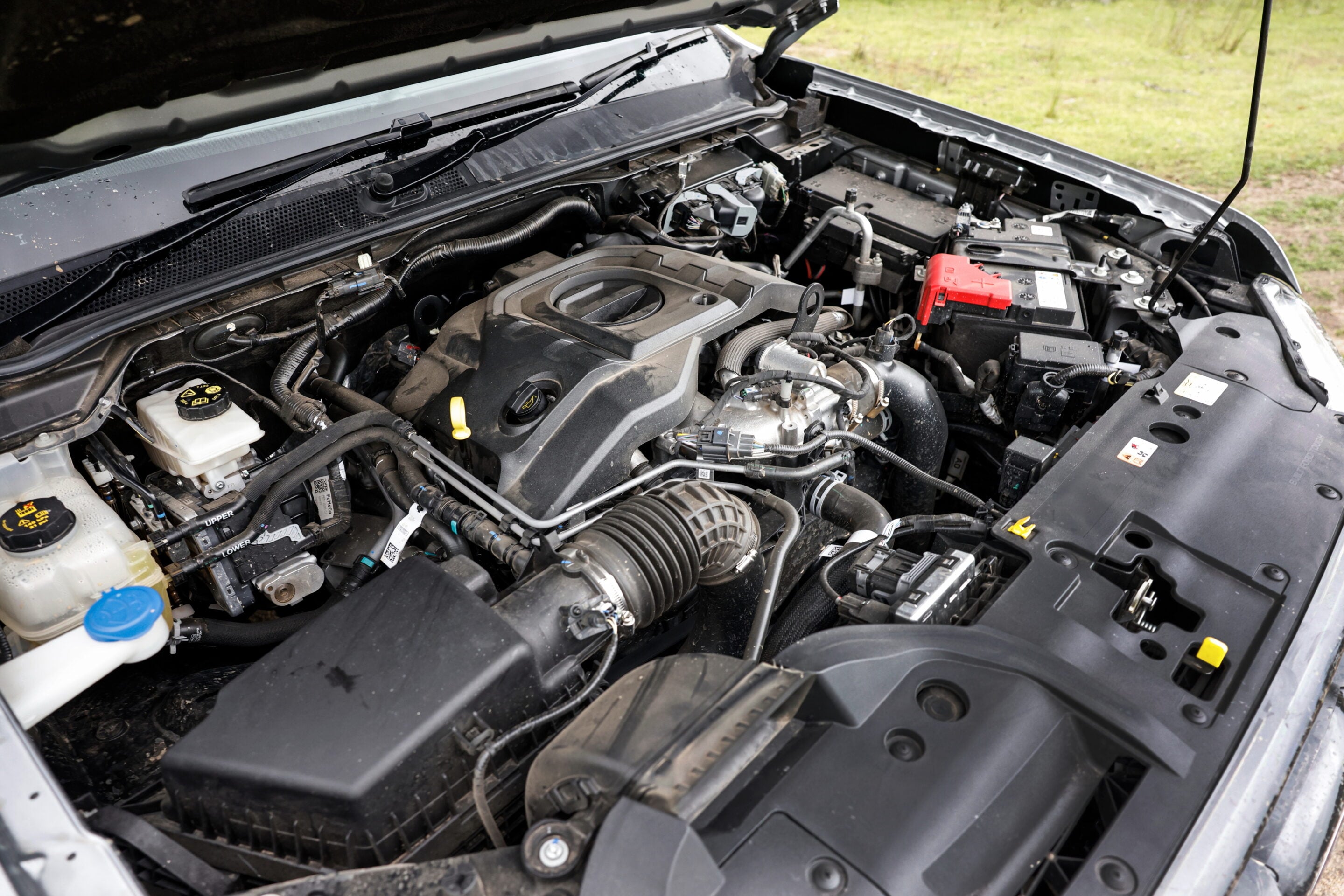
That starts with the engine, of course, and while the three-litre V6 served as the auxiliary engine on The Ark, the years haven’t wearied it. It trumps the diesel competition for bald numbers with 184kW and a meaningful 600Nm of torque, but on the road, the difference feels even more than that.
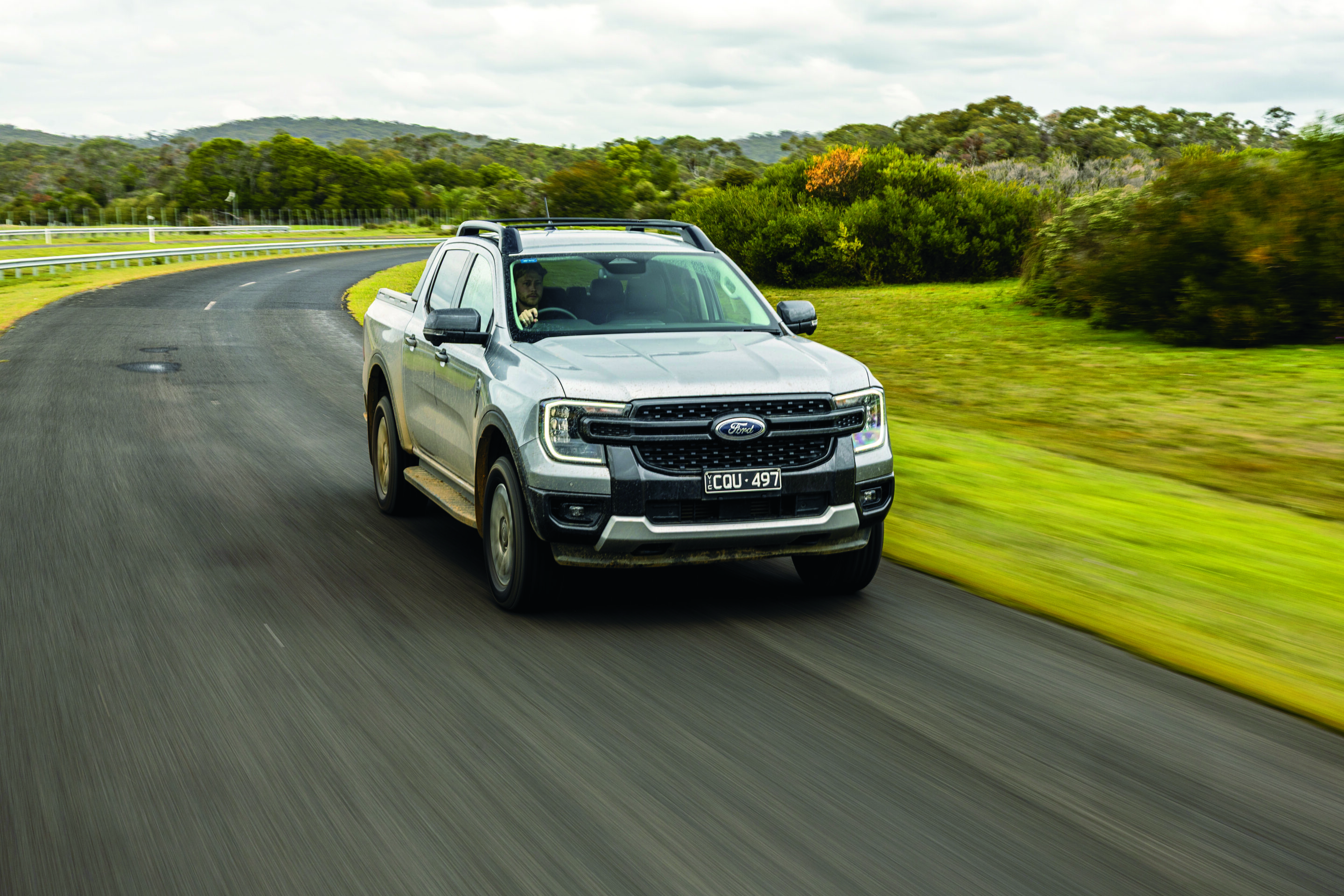
3
That’s probably partly because the V6 never seems to raise a sweat. It just motors out into the traffic, you dial up your cruising speed and that’s that. All taken care of. And all the while, it’s so much smoother than the four-cylinder competition that you’d almost swear the Ranger’s powerplant was drinking petrol, not diesel. Sounds like an exaggeration? It’s really not.
The 10-speed auto is your friend, too, skipping multiple gears when it can afford to and slotting the precise cog when it needs to. Even so, you get the feeling that the depth of ability of the V6 means the Ranger would survive with a six- or even five-speed transmission.
Mind you, less than the full 10 gears would probably mean the Ford’s fuel economy would take a hit, and that’s not something it can really afford. On paper, it’s about half a litre per 100km thirstier than the main rivals, but in reality, the disparity is probably closer to a couple of litres, and making use of those 600Nm will soon make a mark on the contents of the 80-litre tank.
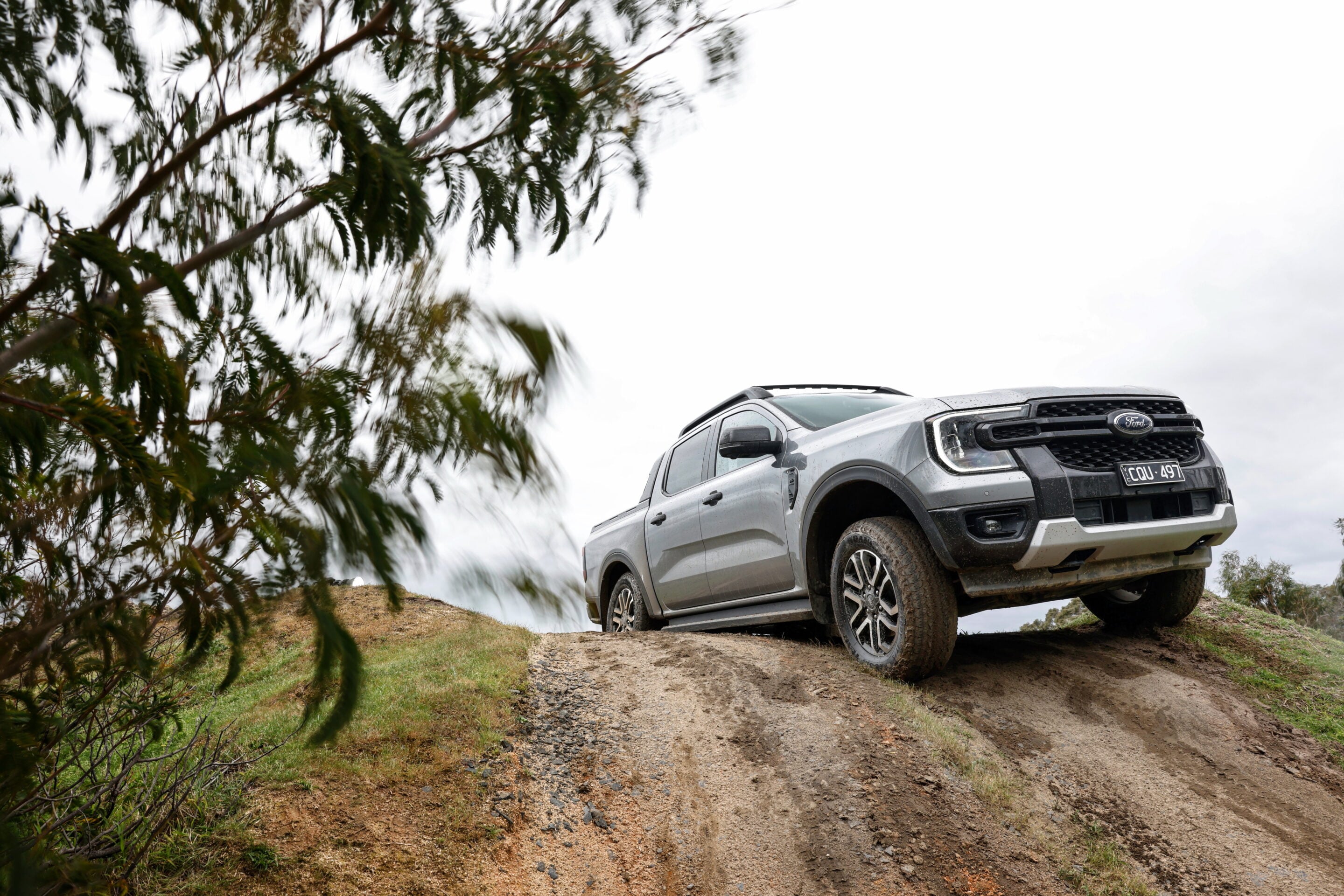
The Ranger’s four-wheel-drive system also wins it plenty of friends, particularly those who spend time with something heavy hitched up to their dual-cabs. The Ranger, you see, sports something that all serious tow-cars should have, and that’s a drive mode that allows for four-wheel-drive in high-range, even on dry bitumen. The magic is all in the centre differential, but on a damp road (or even that bone dry one) where lesser vehicles are forced by mechanical politics into two-wheel-drive, the Ranger can steam along with all four tyres driving and, crucially, gripping.
2
This is not just an added safety margin for those in the Ranger, but for everybody else sharing the road with it. And even when you’re not towing, the opportunity to use four-wheel-drive on the road in, say, light drizzle or a rainstorm is not to be underestimated. It works like a fresh piece of sandpaper on gravel, too.
And while we’ve deliberately downplayed towing in our judging criteria, it’s worth mentioning that the Ranger also boasts the excellent towing package that gives guidance to the driver for hitching up (via the cameras) the chance to check all brake lights and indicators without leaving the driver’s seat (via technology) and even a trailer-sway-avoidance function (via sheer genius).
The Ranger also addresses probably the biggest single bitch regarding dual-cab utes; ride quality or, more specifically, the lack of it. Both primary and secondary ride quality is better than average and the Ranger seems to glide over stuff that has many of the others bucking and lurching along at the same pace.
The ride is very well damped and there’s little intrusion into the cabin of nasties like suspension or even tyre noise. And across our test track’s offset-undulation section, which had some of the utes here either waddling or even twerking at 25km/h, the Ranger was far more controlled. No, it wasn’t as good as the all-independently sprung BYD, nor the Cannon Alpha with its enormous wheelbase, but definitely way better than average. A metaphor for the whole Ranger V6 experience, perhaps?
1
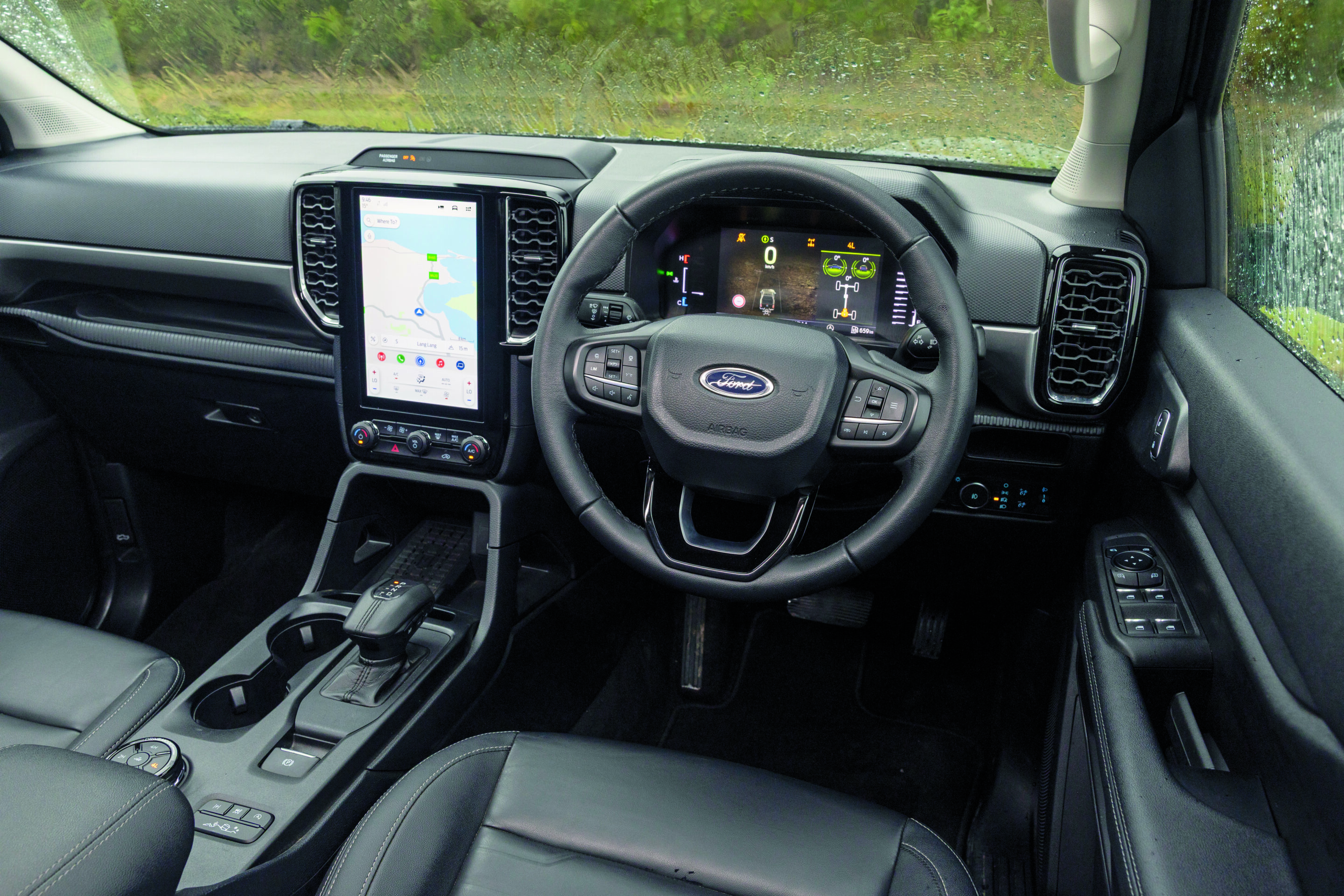
Inside, the cabin shows real evidence of some clever thinking in the layout (those door handles, for instance, are brilliant) and there’s tech aplenty. You can count on Ford’s Sync connectivity system with a 12-inch screen, wireless phone charging, lots of charge points, a power-socket in the tray (why don’t they all have this?), heated front seats and dual-zone climate control.
But the big, burly Ford lost marks when we put it through our equivalent of the dreaded moose-test; a swerve-and-recover exercise that tests agility and stability in equal measures. Frankly, the Ranger did pretty poorly here, both in terms of long stopping distances and gratuitous understeer both on tip-in and the crucial change of direction. The reason probably has a fair bit to do with the All Terrain tyres fitted to our test car, and while other utes here had more road-oriented rubber, the Ranger’s off-road emphasis (and Ford’s marketing department, presumably) demands the more compromised A/Ts.
Beyond that, however, the safety story is a pretty strong one with a five-star ANCAP rating, predicated upon driver assistance gear including blind-spot monitoring, rear cross-traffic assistance, autonomous emergency braking, tyre-pressure monitoring and active cruise-control. Even better news is that things like the lane-keeping assistance and distracted-driver monitoring stuff is calibrated properly so that it works without constituting its own distraction.
4
Trent Nikolic summed it up neatly: “Ford’s Ranger has set the standard in this segment for close to a decade,” he said. “Ford’s determination to update, fettle, improve and offer new sub-segment models is the way forward for any manufacturer wanting to compete. Of our top three, if you want to head off-road or do long distances, the Ranger is the pick.”
At $71,590, the Ranger V6 is far from cheap and towards the top of the pricing tree of this bunch. But it surely makes the dearer ($73,000) Isuzu D-Max X-Terrain (among others) look pretty lame by comparison.
Specs
| Price | $71,590 (MSRP) |
|---|---|
| Body | Dual-cab, five-seat ute |
| Drive | Dual-range 4×4, incl. auto mode |
| Drivetrain | 3.0-litre V6 turbo diesel |
| Power | 184kW @ 3250rpm |
| Torque | 600Nm @ 1750-2250rpm |
| Transmission | 10-speed automatic |
| Consumption | 8.4L/100km |
| Kerb weight | 2276kg |
| 0-100km/h | NA |
| L/W/H/W-B | 5370/1918/1886/3270mm |
| Payload | 1004kg |
| Warranty | 5yr/unlimited km |
| Safety rating | 5 star ANCAP (2022) |
2025-26 Wheels Ute of the Year
In the Big Book of Marketing (find it in the Adult Fiction section), the current way to make a splash and attract the interest of the previously non-committal, is to be a disruptor. And while that sounds like the sort of online, pseudo-knowledge that will eventually see social media disappear up its own orifice (can’t happen fast enough, I say) in the case of the GWM Cannon Alpha PHEV, maybe there’s slightly more to it than that.
Of course, in some ways, the Cannon plug-in hybrid is straight out of Dual-Cab Compton with its ladder-frame, body-on-top construction, 3500kg towing and leaf-sprung live rear axle. But there’s a bit of sugar on top with front and rear diff locks standard on the Ultra model as tested here.
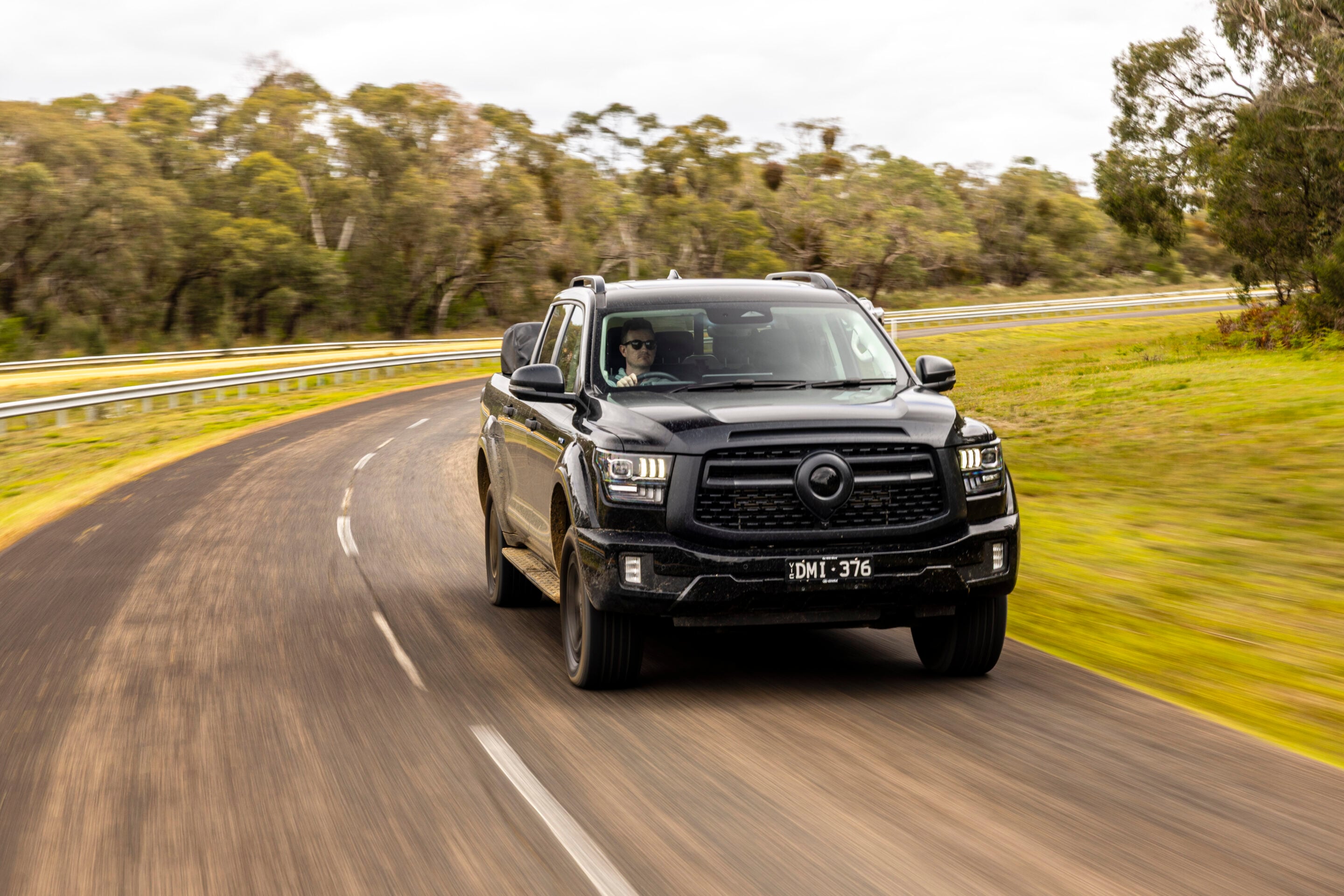
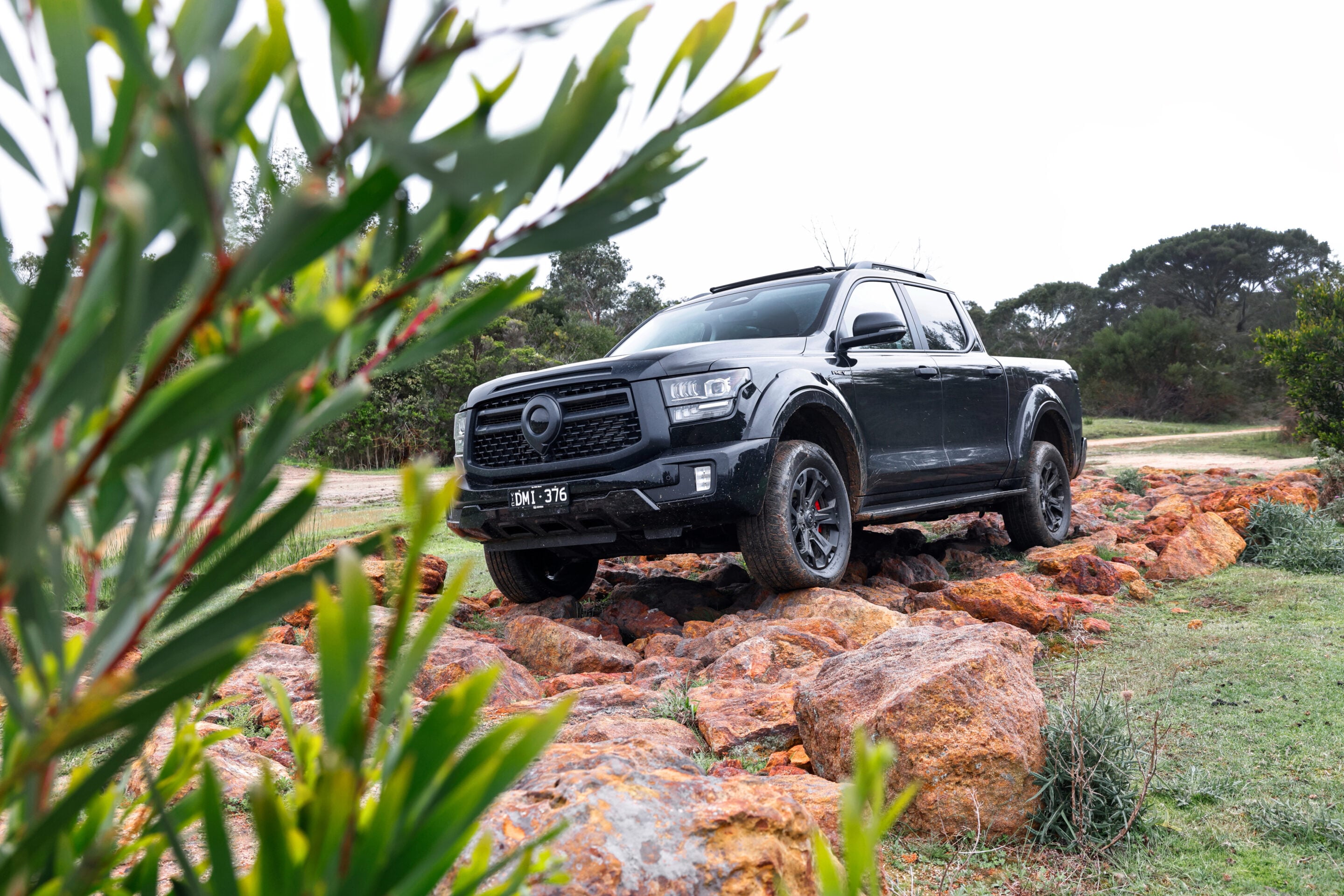
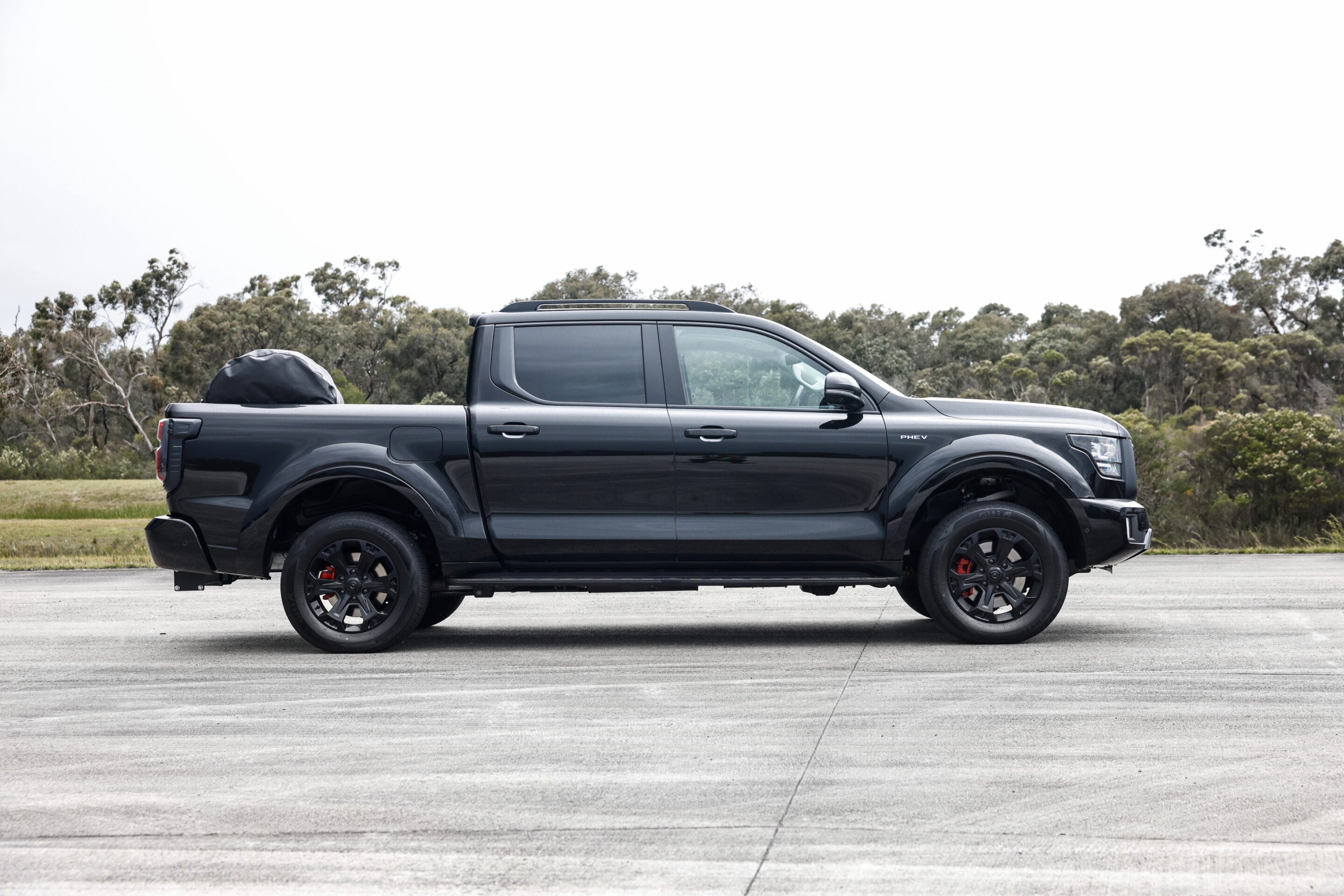
The disruption begins with the vehicle’s packaging. Fact is, it’s huge and points the way for future dual-cabs which have, inevitably, become bigger and bigger over the years. How big? Plenty. Try 35mm longer than the standard GWM Cannon Ute, 57mm wider, 38mm taller and a full 120mm longer in the wheelbase.
3
This translates to more front and rear seat room, although any real size advantage in the tub is gobbled up by the EV battery. That’s largely because the spare tyre, which would normally live under the tray floor (where the battery now resides) has been moved to an upright position in the tray, sitting up in the breeze like an inquisitive kelpie, and wilfully shedding its afterthought vinyl cover on a regular basis (most owners simply remove the cover and stash it in the shed for trade-in time).
However, the disruption amps up to 11 in terms of the Cannon’s driveline. Where the four-cylinder turbo-diesel has reigned supreme in the segment for at least a couple of decades now, the Cannon Alpha has switched back to petrol technology in the name of a refined, powerful plug-in hybrid arrangement.
The two-litre four-cylinder is turbocharged and teams with an electric motor that is sandwiched between the engine and the nine-speed automatic transmission. Together, the combo can produce a peak of 300kW of power and 750Nm of torque; big numbers in anyone’s book and comfortably ahead of the 150kW and 500Nm (or less) that most conventional dual-cabs manage. There’s also an on-demand four-wheel-drive set-up with low-range ratios, but no on-bitumen four-wheel-drive setting. The layout also means the GWM features ‘mechanical’ all-wheel-drive rather than the petrol engine driving one axle and the electric motor the other; both powerplants drive through the transmission and transfer-case.
3
What this means, of course, is that the Cannon can really keep pace with anything modern traffic and conditions can throw at it, as well as offering those who commute in it the chance to charge-up at home overnight, and run on electricity-only for the weekday grind. Fancy a trip interstate? No problem, and once you’ve depleted the battery (GWM claims 115km worth of electrons, but it’s probably closer to 90km) the Cannon will keep going while ever you continue to put petrol in it.
The big guy can really shift, too, and when all those 300kW show up, there’s a surge of performance that easily offsets the 2800-plus kilo heft. Even when you’re not giving it the full welly, the driveline is smooth,
torquey and relaxed, and the nine-speed automatic ensures there are no gaps in the thrust curve. You might need a little time to acclimatise to the regenerative braking which makes it feel like you’ve brushed the brakes when all you’ve done is take your foot off the throttle, but most people get used to it pretty quickly and soon learn to enjoy the one-pedal experience.
What’s also pretty impressive is the ride quality. There’s enough bump absorption to make the Cannon one of the better riding dual-cabs, although like anything heavy, designed to cart a load and suspended by leaf springs at the rear, the wrong combination of bumps at the wrong speed can see it get a bit tangled up in itself.
Ah yes, carting a load. Here’s where the whole plug-in hybrid ute thing starts to reveal its compromises. The listed payload for the GWM is just 685kg; a lot less than the tonne-or-more boasted by many of its competitors. Clearly, the mass of the battery contributes to this, but it remains a fact that once you have a full load of bodies on board, their luggage and a full fuel tank, you might be getting pretty close to the limit. Throw a trailer on the back with its down-ball mass measured as part of the payload, and some owners will be jettisoning their loved ones (or worse, their esky) to stay legal.
2
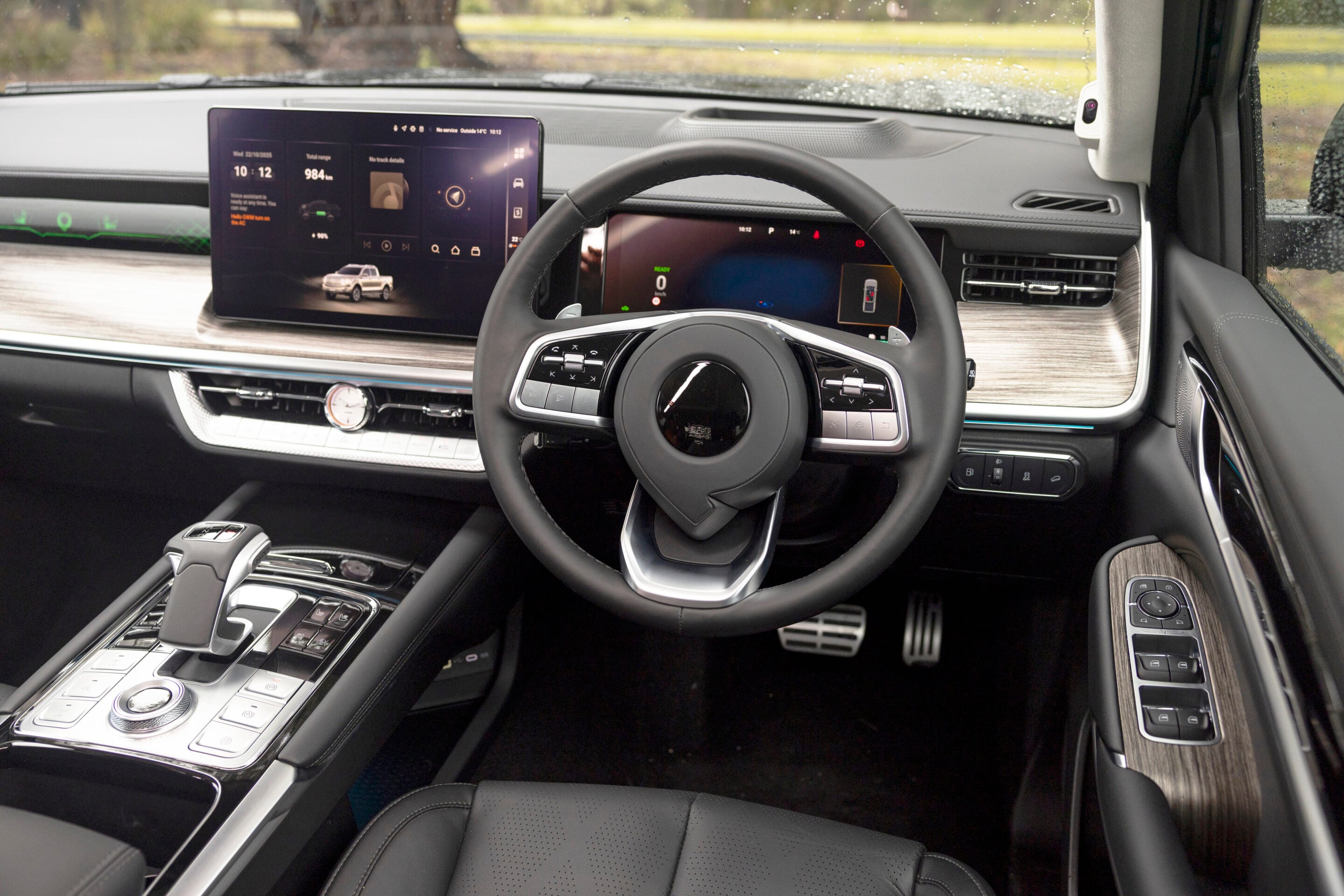
At $66,990 (MSRP), the Cannon Alpha is not exactly cheap, but you do get a lot for your money over and above the hybrid system and huge package. Inside, you get plenty of tech including full wireless connectivity, a big touch-screen in the centre, cooled, heated and massage-function front seats, and even an electric adjustment for the rake of the rear bench’s backrest.
Fellow UOTY judge Trent Nikolic noted, “There’s a lot to like about the GWM Cannon PHEV. More capable than the BYD off-road, and a better option for towing, it’s the choice for light duty weekend off-road work but with the benefit of electric power.”
One thing you won’t appreciate, however, is the GWM’s driver-distraction monitor’s habit of confusing your normal facial expression with that of somebody asleep at the wheel. It needs recalibrating, even if it does help the vehicle achieve five safety stars.
2
And that tricky tailgate that either drops down conventionally or can be swung open like saloon doors in a dodgy western movie? The jury is still out, but it seems like an awful lot of moving parts for something that is most commonly used as a picnic bench.
The factory warranty is good, with seven years/unlimited kilometres (and eight years on the EV battery) and seven years of roadside assistance thrown in, too.
In truth, the Cannon Alpha was a close thing in this year’s contest and for many, its extra off-road ability would probably swing the argument GWM’s way.
1
Specs
| Price | $66,990 (MSRP) / $68,490 (DA) |
|---|---|
| Body | Dual-cab, five-seat ute |
| Drive | Dual range, 4X4 |
| Drivetrain | 2.0-litre four-cylinder turbo petrol PHEV, Single electric motor, 37.1kWh battery |
| Power | 300kW combined |
| Torque | 750Nm combined |
| Transmission | 9-speed automatic |
| Consumption | 1.7L/100km, 115km EV range (NEDC) |
| Kerb weight | 2810kg |
| 0-100km/h | NA |
| L/W/H/W-B | 5445/1991/1924/3350mm |
| Payload | 685kg |
| Warranty | 7yr/unlimited km |
| Safety rating | 5-star ANCAP (2024) |
2025-26 Wheels Ute of the Year
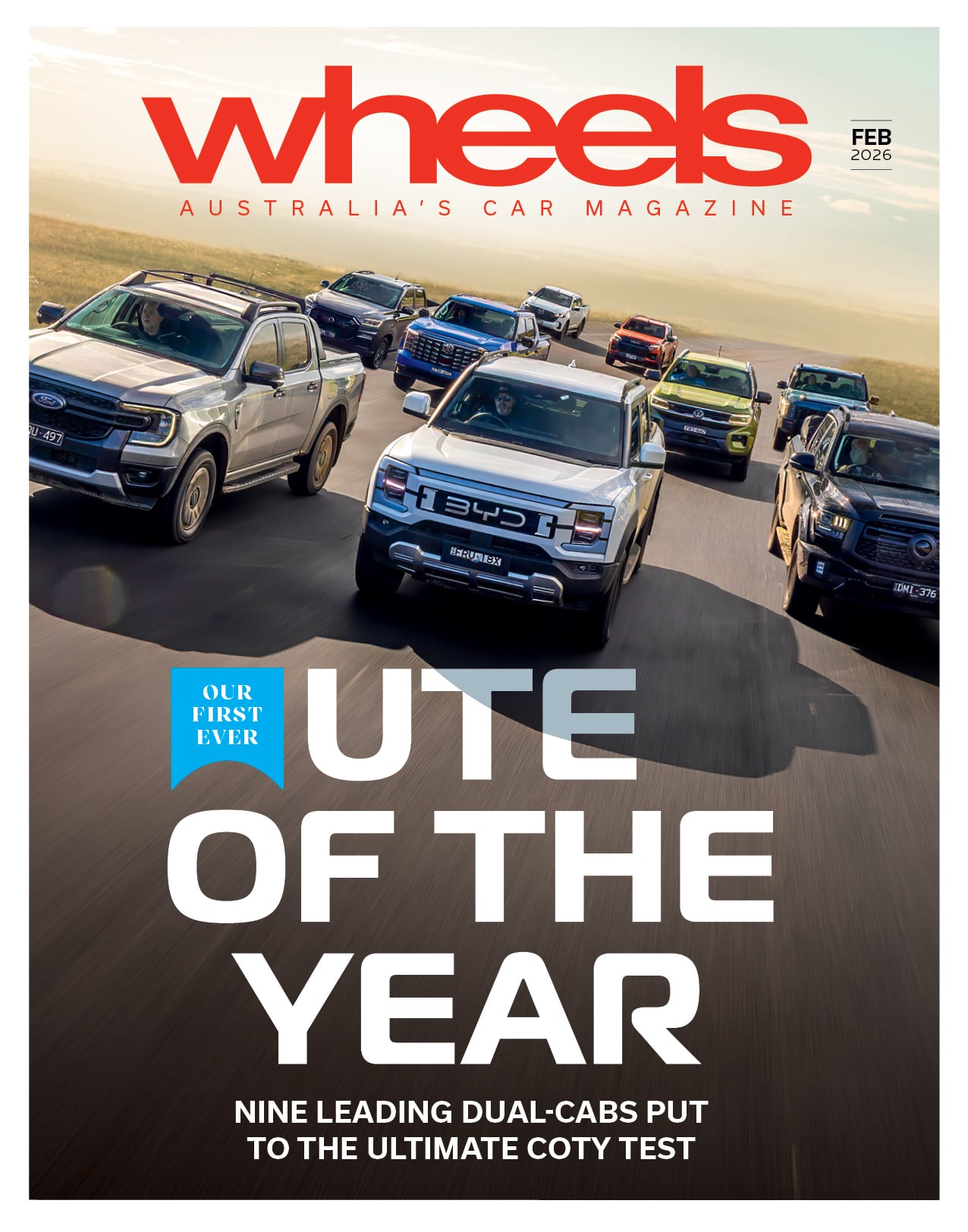
The February 2026 issue of Wheels magazine is now on sale, and it marks a major moment in the publication’s long history with the debut of our inaugural Wheels Ute of the Year award.
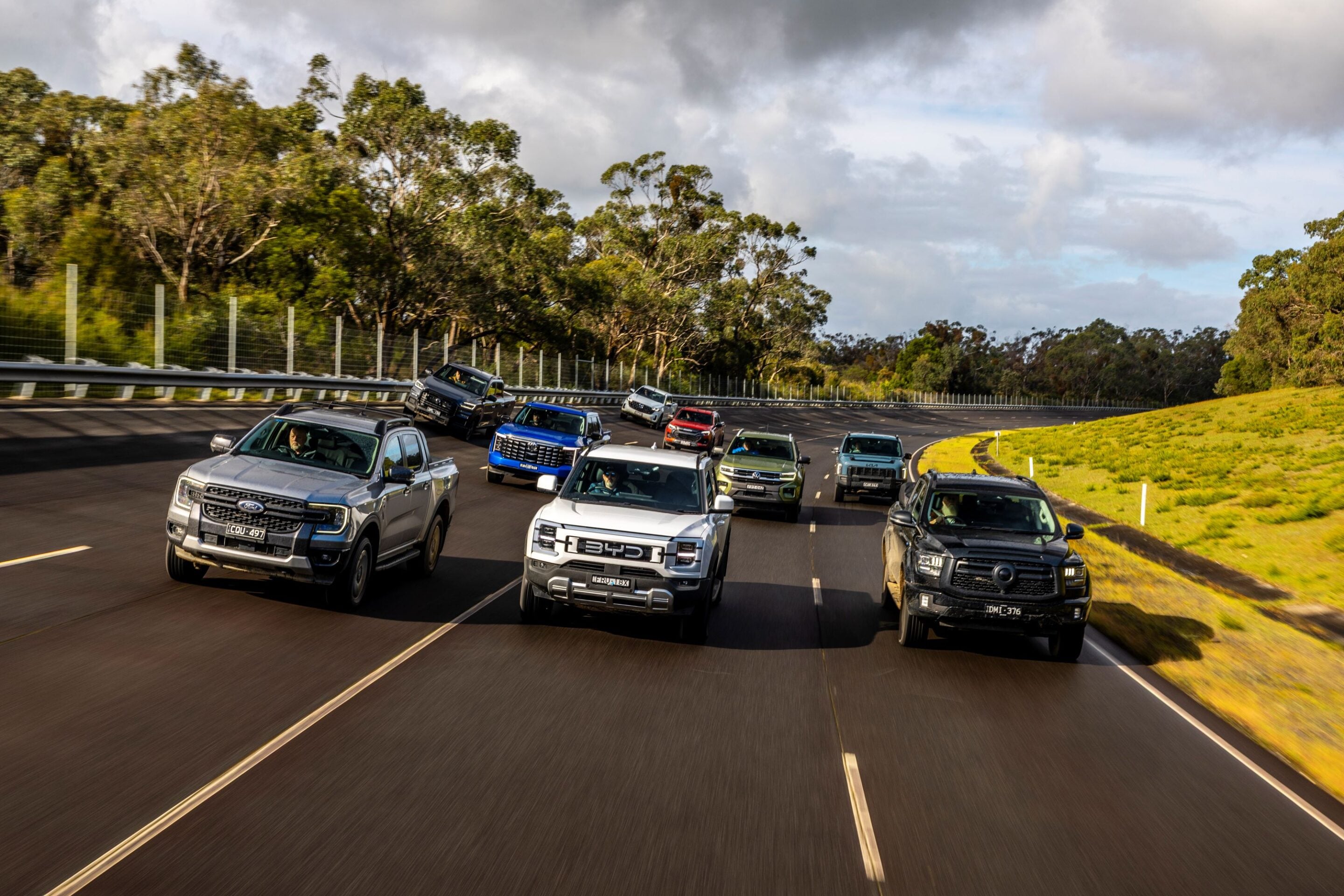
For the first time, Wheels has applied the same rigorous testing process used to determine its long-running Car of the Year to Australia’s most hotly contested segment: dual-cab utes. Nine of the country’s top-selling utes were brought together at Lang Lang Proving Ground for comprehensive dynamic testing, objective analysis and real-world evaluation, reflecting how Australians actually use these vehicles.
The cover story follows the contenders from arrival through to final judgement, examining performance, ride and handling, cabin comfort, technology, efficiency, safety and value. With dual-cabs now serving as family transport as much as workhorses, the judging criteria were adapted to reflect modern buyer expectations without losing sight of each vehicle’s utility roots. Only the new-gen Toyota HiLux was missing from the field, the testing window occurring a little too early for its arrival.
1
After days of testing, debate and data analysis, the field was narrowed to a final three. The resulting podium features one long-established name alongside two newer challengers, with one emerging as the first-ever Wheels Ute of the Year for 2025–26. The outcome underscores how rapidly the segment is evolving, with electrification, refinement and on-road behaviour now carrying far more weight than in years past.
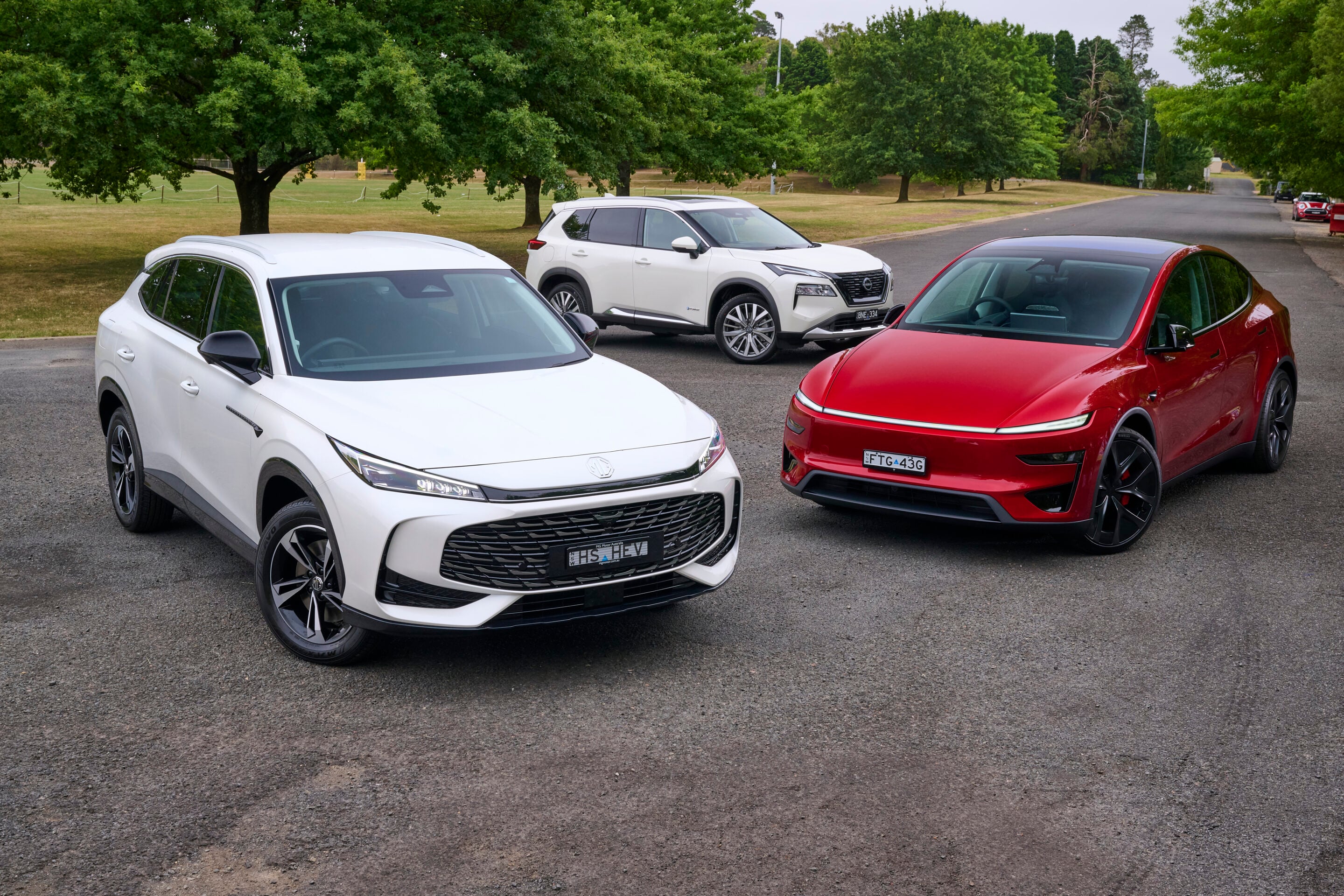
Beyond the headline award, the February issue delivers a wide range of reading. Paul Gover chats with Ford executive Jim Baumbick for the Wheels Interview, exploring Australia’s influence on the Blue Oval’s global product strategy, while a family-focused SUV comparison pits the Tesla Model Y Performance against the Nissan X-Trail e-Power and MG HS Hybrid.
1
There’s also a deep dive into the origins of the BMW M3, a modern classic feature on the Porsche 928, and first drives of the Kia Stonic GT-Line, Ferrari Amalfi and MG HS Super Hybrid. Regular columns, our 22-page buyer’s guide and a look back at a classic Wheels scoop from 1991 round out the issue.
With its first Ute of the Year crowned, the February 2026 edition signals a significant expansion of Wheels’ authoritative testing in the heart of Australia’s new-car market.
1
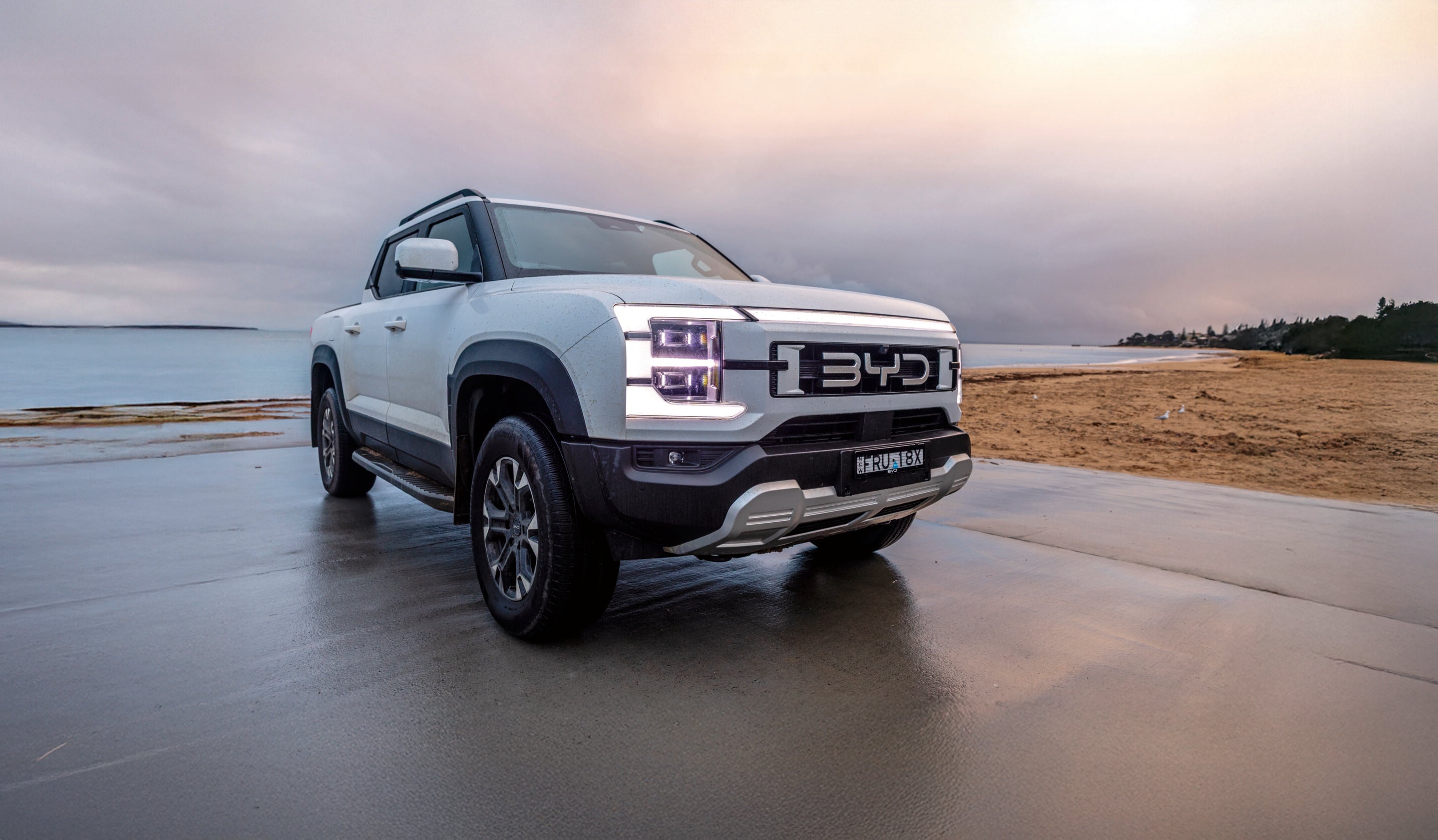
Let’s make this point from the outset – one more time it must be said – before we dive into why you would buy the BYD Shark 6. There are two reasons you wouldn’t buy it – neither of which are relevant to Wheels Ute of the Year testing. The first is towing, and the second is genuine, long distance off-roading. If you intend to do either, in large doses, this isn’t the dual-cab for you. In fact, you’d probably side-step our second place-getter as well, and opt for a traditional diesel-powered workhorse if that’s what you intend to do with your new dual-cab.
With that out of the way, here are the reasons you would buy the BYD Shark 6 and indeed, the reasons it wins Wheels’ inaugural Ute of the Year award. Not the least of which, is the way the Shark 6 behaves on the road, around town. More on that in a minute.
If, like most of us, you live within spitting distance of a large city, or within the greater urban sprawl, and if like most high-end dual-cab owners, you never intend to thrash your expensive new purchase in the vast emptiness of the Aussie off-road wilderness, the BYD Shark 6 is exactly the kind of dual-cab you could be driving because of the way it does what most buyers would want it to do. It’s probably why BYD sold so many of them in the city as soon as it launched locally.
3
Morley’s thoughts on the BYD fit nicely with the mantra of reaching the same point, but by taking a
different road – something the dual cab segment is finally starting to do.
“I really admire BYD’s decision to do something different with this vehicle,” Morley said. “The driveline is phenomenal and clearly points the way forward. The BYD could almost have been developed with our criteria as the blueprint. No wonder it was unbeatable.”
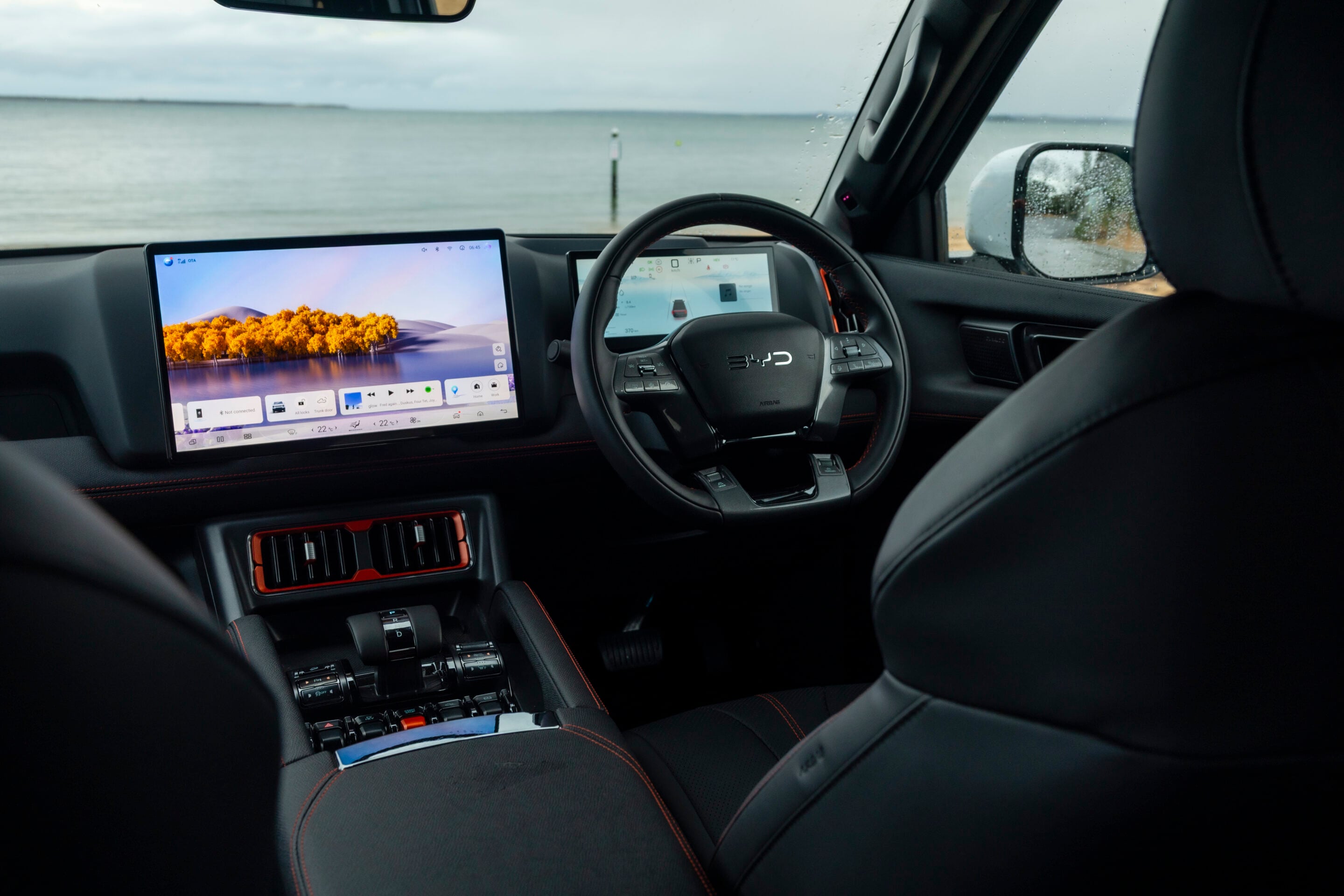
It’s quiet, refined, laden with technology that works, will complete more than the average Aussie commute on pure electricity alone, has a spacious cabin, and drives in a way that makes it enjoyable to use day-to-day in traffic. Importantly, these are all factors we prioritised for this assessment – along with value for money of course – as per the Wheels Car of the Year judging criteria.
Shark 6’s cabin is excellent. It’s big, comfortable and ergonomically well laid out. There’s a cohort of dual cabs now that almost feel half a size bigger than the traditional combatants, and the Shark 6 is one of them. As such, cabin space is better than almost anything else in the segment. It’s comfortable in any of the five seating positions, and family buyers – who don’t really need a truck – will love it.
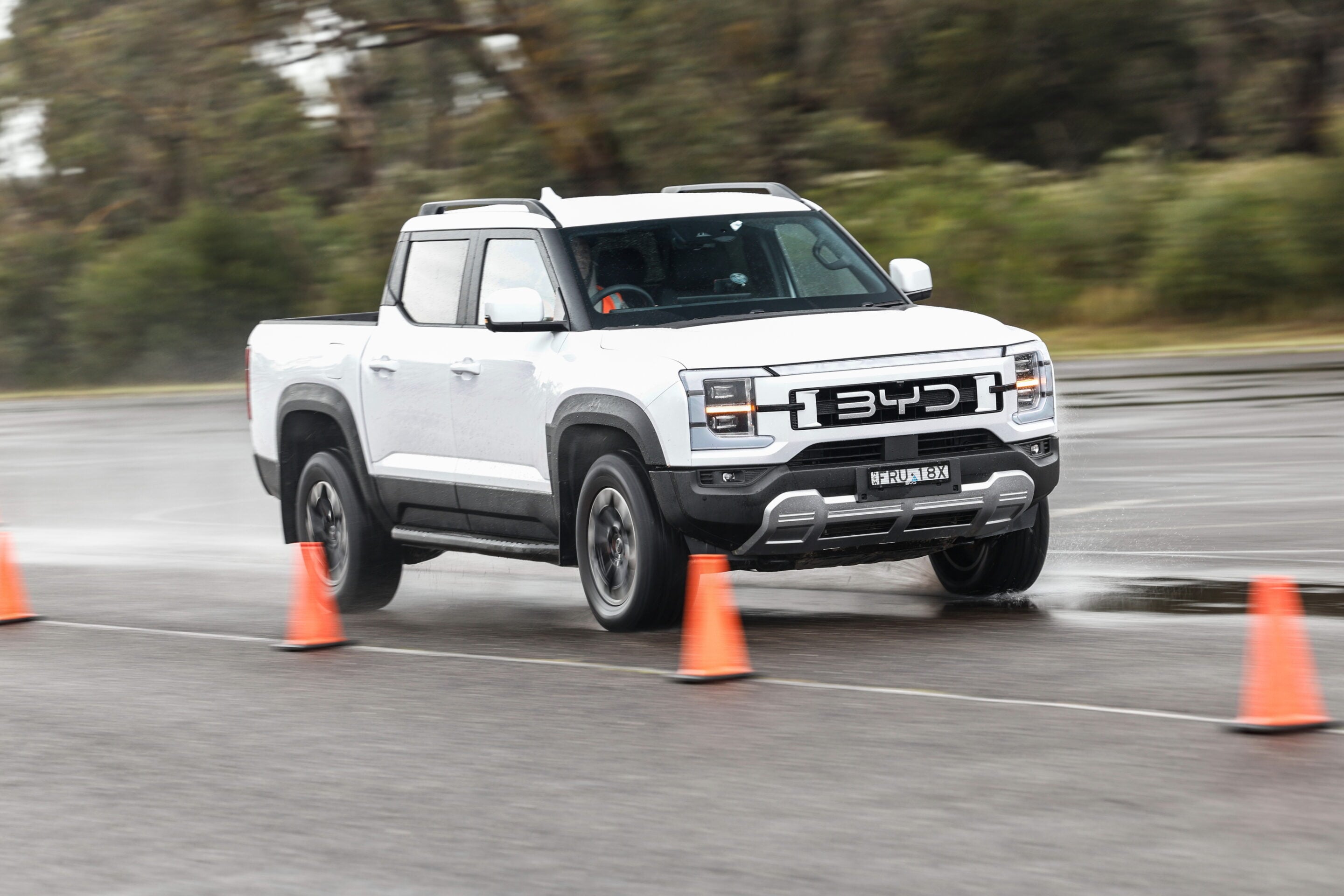
Let’s also give the Shark 6 one hell of a big tick for the way it behaves when you’re behind the wheel. This, along with the execution of the cabin technology, is of course the most obvious element of a new vehicle purchase. Technology is the touchpoint, the experience behind the wheel is the reward. As with our regular COTY award, dynamic testing and data analysis was conducted by the pre-eminent Karl Reindler, who was impressed with the Shark 6 from the outset, even before we asked him to sample it on open roads after the fact.
“It’s the fastest to 100km/h,” Reindler said. “It feels to me to be the closest to a car to drive, has more
refined stability control than the others, is generally more car-like and stops really well, too.”
2
Reindler’s assessment, beyond the numbers, is spot on. There’s a refinement and premium feel to the Shark 6’s driving behaviour that no diesel dual-cab can match. The cabin is quiet, the ride is excellent, even unladen, the steering and braking feel more like a large SUV than they do a truck, and there’s an effortless nature to the way in which it settles into a relaxed cruise. Around town, in the cut and thrust of city traffic, it betters any traditional dual-cab in the segment.
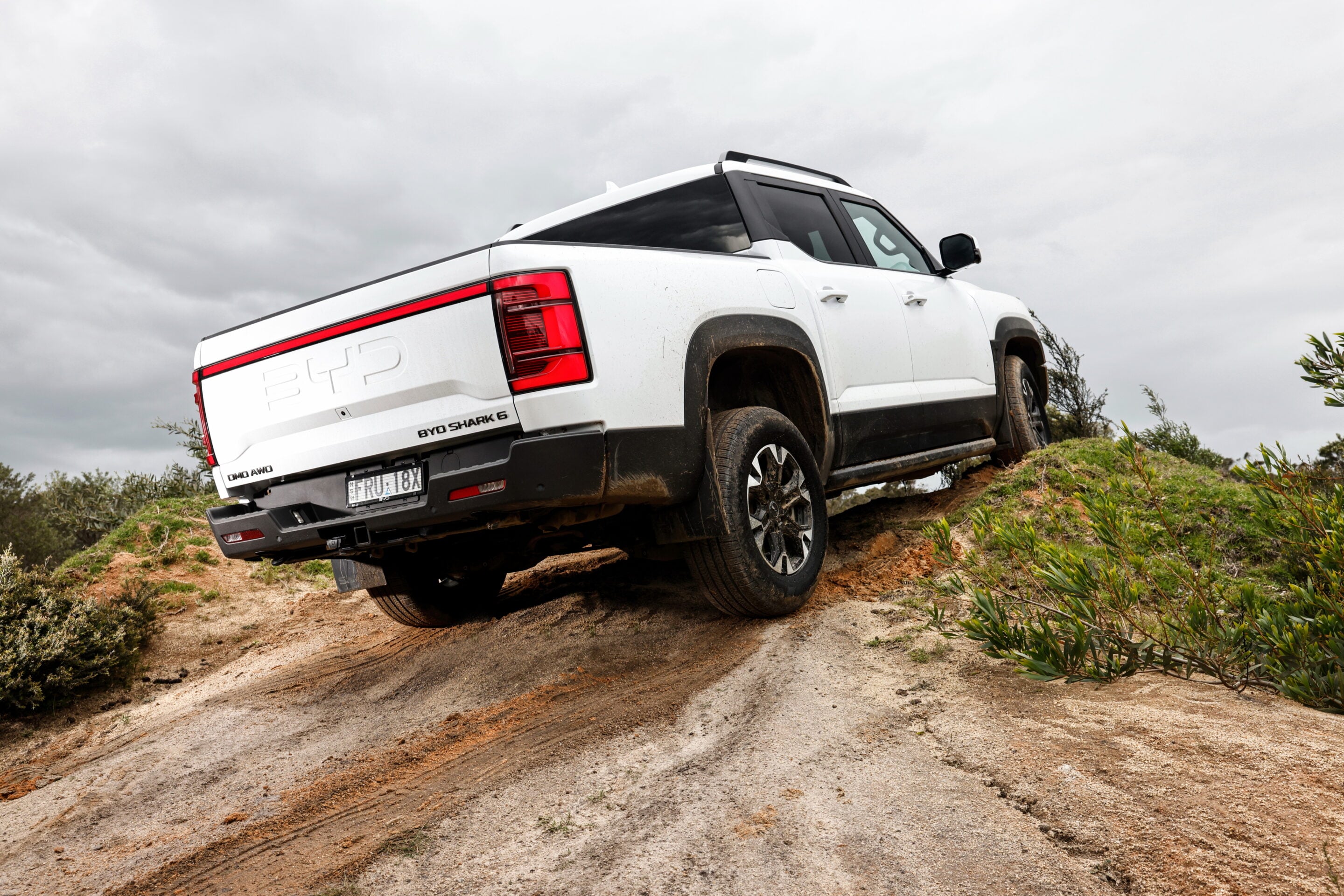
The reason the Wheels team wouldn’t advocate for the Shark 6 as the long-haul towing or off-road touring option is, in part, the same drivetrain that makes it so competent around town. The 1.5-litre four-cylinder turbocharged petrol engine seems underdone on paper, but that’s only if you’re dragging heavy weight behind it. That aside, the dual electric motors and 29.1kWh battery pack combine to deliver a formidable 321kW and 650Nm combined.
4
The single-speed multi-mode hybrid transmission works beautifully around town, too, and the Shark 6 feels fast if you nail the accelerator pedal with intent. Reindler’s 0-100km time backs up that seat of the pants measurement. For the record, BYD claims 5.7 seconds for the run to 100km/h, which isn’t far off a run-of-the-mill sportscar.
Forget the fanciful 2.0L/100km fuel use claim and pay attention to the 100km NEDC electric-only range. In testing, we got into the low 90km range without trying to be efficient, meaning you can easily tackle the average commute, Monday to Friday, on electric power alone. Factor in 85km range, and you’ll get there without any hassles. All you need to do is plug the Shark 6 into a regular powerpoint at home overnight, to once again have a full charge in the morning – no expensive infrastructure needed. Then, when you need to travel further afield, the petrol engine takes over. If you’re tempted, then, by the seductive glance of electric vehicles, but not yet ready to make the plunge, a PHEV is the way to go, of that there is no doubt.
The value part of Wheels’ judging, is as pertinent here as anywhere, such is the soaring cost of what is an otherwise rudimentary platform. If a time machine could transport you back to 2000 and you tried to tell someone you’d be paying six figures for more than one dual-cab…
3
Ringing the till at $57,900 before on-road costs are added, the Shark 6 is significantly cheaper than the established competition. Back that up with the five-star ANCAP safety rating, a six-year/150,000km warranty and service cost clarity out to 11 years/220,00km, and you’re onto a winner. For the first five years, you’ll pay $2489, a full 11 years will cost $6077 – the certainty of it is a smart way to attract buyers.
Morley’s likening of a good dual-cab to a Swiss Army knife tale got me thinking about this segment a little deeper than I otherwise might. Indeed, it got me thinking about my own Swiss Army knife (not quite as vintage as his) and the Leatherman multitool I added to my roadside recovery kit approximately five years ago. I’ve used that poor thing – should it be tortured – in ways the maker never intended. It doesn’t have a hammer, but it’s been used as one. It doesn’t have a proper pry bar, but it’s been used as one, to great effect, I might add. And it probably wasn’t intended to be used to ark across terminals to try to remote start a recalcitrant engine. But you can rest assured I’ve used it for all those things.
Such is the way of the modern dual-cab in 2025. And that’s why the BYD Shark 6 is so popular with city buyers. It’s fascinating to watch a segment shift and transform before our very eyes, but the emergence of the Shark 6 is quite possibly the best example of it. If the motto of giving them what they want still stands, BYD has hit the nail on the head.
2
Specs
| Price | $57,900 (MSRP) |
|---|---|
| Body | Dual-cab, five-seat ute |
| Drive | All-wheel drive (on demand) |
| Drivetrain | 1.5-litre four-cylinder turbo petrol PHEV, Dual electric motors, 29.1kWh battery |
| Power | 321kW combined |
| Torque | 650Nm combined |
| Transmission | 1-speed multi-mode hybrid transmission |
| Consumption | 2.0L/100km, 100km EV range NEDC |
| Kerb weight | 2710kg |
| 0-100km/h | 5.7 sec |
| L/W/H/W-B | 5457/1971/1925/3260mm |
| Payload | 790kg |
| Warranty | 6yr/150,000 km |
| Safety rating | 5 star ANCAP (2025) |
2025-26 Wheels Ute of the Year
Stellantis has announced one of the largest electric vehicle–related writedowns in automotive history, taking a €22 billion (around A$26 billion) charge as it scales back its ambitions for battery-powered cars. The move underscores a broader industry rethink, as several global manufacturers adjust plans that once assumed a rapid shift to full electrification.
The global carmaker, which owns brands including Jeep, Dodge, Ram and Chrysler, said the writedown reflects a sweeping reassessment of its EV strategy after consumer demand failed to materialise at the pace previously forecast. The charge, booked in the second half of 2025, brings total EV-related impairments across the global auto industry to an estimated $55 billion.
Stellantis joins a growing list of manufacturers retreating from earlier EV investments. Volkswagen booked a $3.5 billion writedown linked to its electric division in September, Ford followed with a $19.5 billion charge in December after abandoning plans for large electric vehicles, and General Motors announced a $6 billion hit last month tied to reduced EV output.
1
Chief executive Antonio Filosa, who took over the role in May 2025, said the company had misjudged the speed of the energy transition. In a statement, he said the reset was intended to refocus the business on customer preferences rather than ambitious volume targets that proved unrealistic. Filosa also pointed to “poor operational execution” under the previous leadership, which left Stellantis with expensive EV factories, platforms and technology that struggled to find buyers.
Under former CEO Carlos Tavares, who departed in late 2024, Stellantis spent heavily to position itself for an electric future. Following its 2021 formation through the merger of Fiat Chrysler Automobiles and PSA Group, the company invested billions in battery partnerships with LG Energy Solution and Samsung SDI, while planning a wide range of electric models across its brands. However, profits fell sharply during Tavares’ final year as EV sales lagged behind expectations.
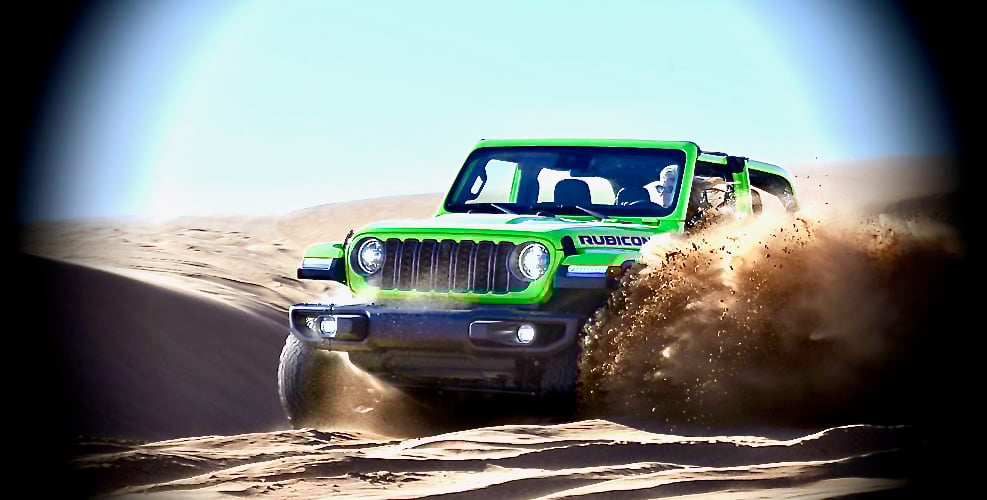
The strategic shift has immediate consequences for consumers. Stellantis has cancelled or delayed several high-profile EV projects, including the Chrysler Airflow, an all-electric Ram 1500 and a low-cost electric Jeep Renegade. It has also ended production of multiple plug-in hybrids, such as the Jeep Wrangler 4xe and Chrysler Pacifica Hybrid.
1
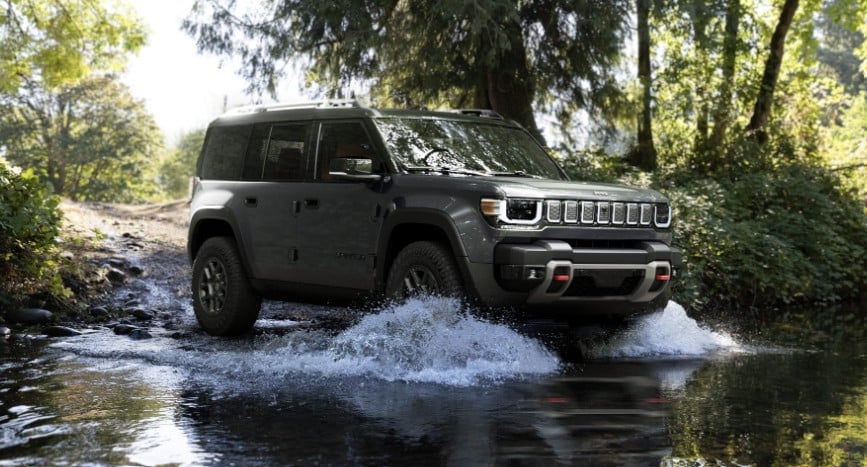
Looking ahead, Stellantis’ remaining EV plans are more conservative. Confirmed launches for 2026 include the Jeep Recon and a range-extended Ram 1500 REV, which uses a petrol generator alongside its battery system. At the same time, the company is reintroducing combustion engines, including V8-powered Ram pickups and a petrol Dodge Charger.
Investors reacted sharply to the announcement, with Stellantis shares plunging more than 25 per cent in early trading. The reaction highlights the financial risks facing automakers as they recalibrate their electric ambitions in an increasingly uncertain market.
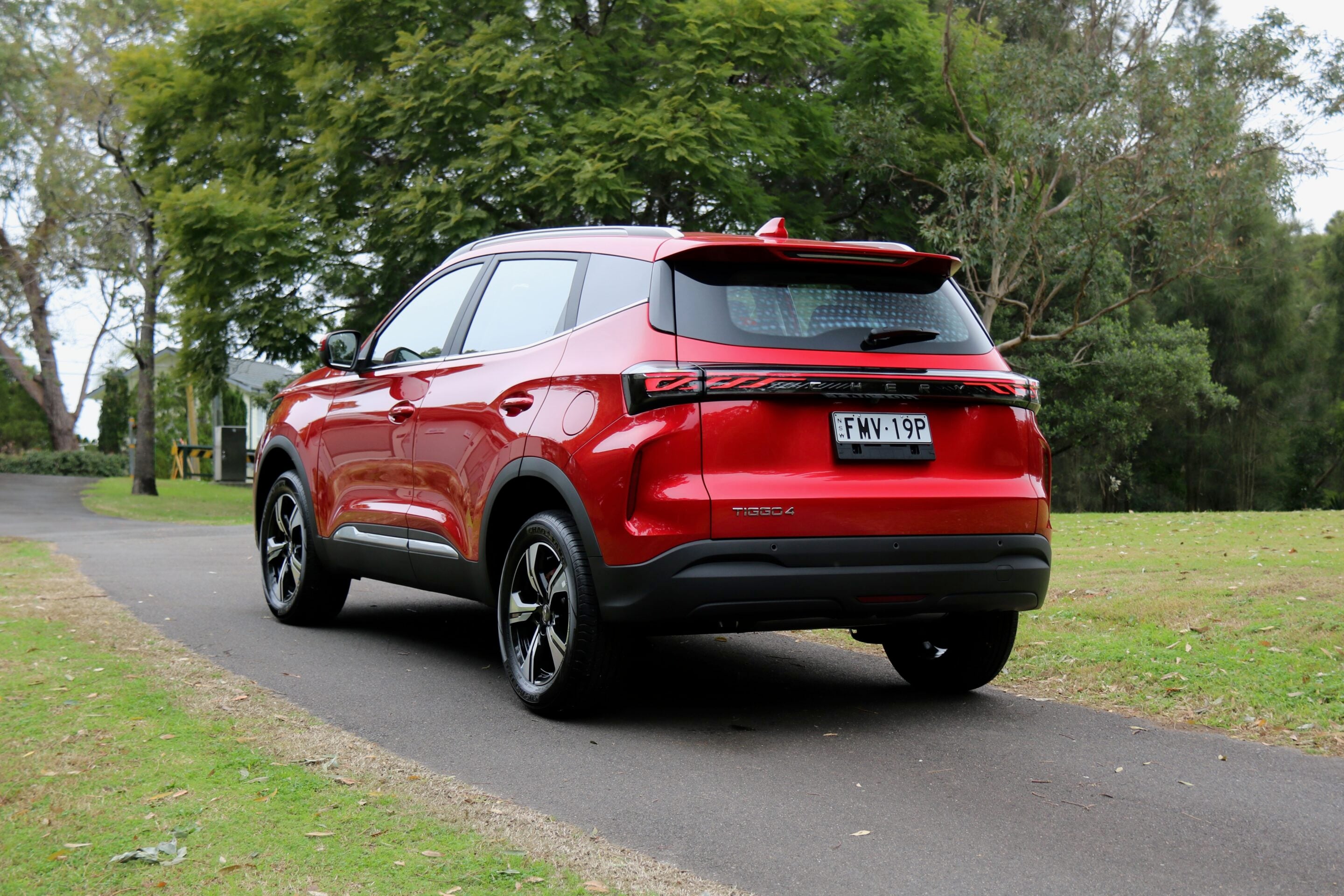
Chery sold 22,419 units of its Tiggo 4 small SUV in 2025 which, considering that it only launched locally in October 2024, is quite an achievement for the brand’s smallest offering. In 2026, its 2234 sales to date are already up 119.4 per cent on 2025 and it’s leading the small SUV segment. Keen value is key to the Tiggo 4’s appeal, but there is plenty more to like.
Prices for the Tiggo 4 start at $23,990 driveaway and two models are on offer: entry-level Urban and top-spec Ultimate (from $26,990 driveaway). Both are very well equipped for the money, including LED lighting, dual-zone climate control, 10.25-inch displays and a full suite of active safety kit. Find a full list of standard equipment at the end of this article.
2026 Chery Tiggo 4 pricing (driveaway):
| Urban | $23,990 |
|---|---|
| Ultimate | $26,990 |
| Urban Hybrid | $29,990 |
| Ultimate Hybrid | $32,990 |
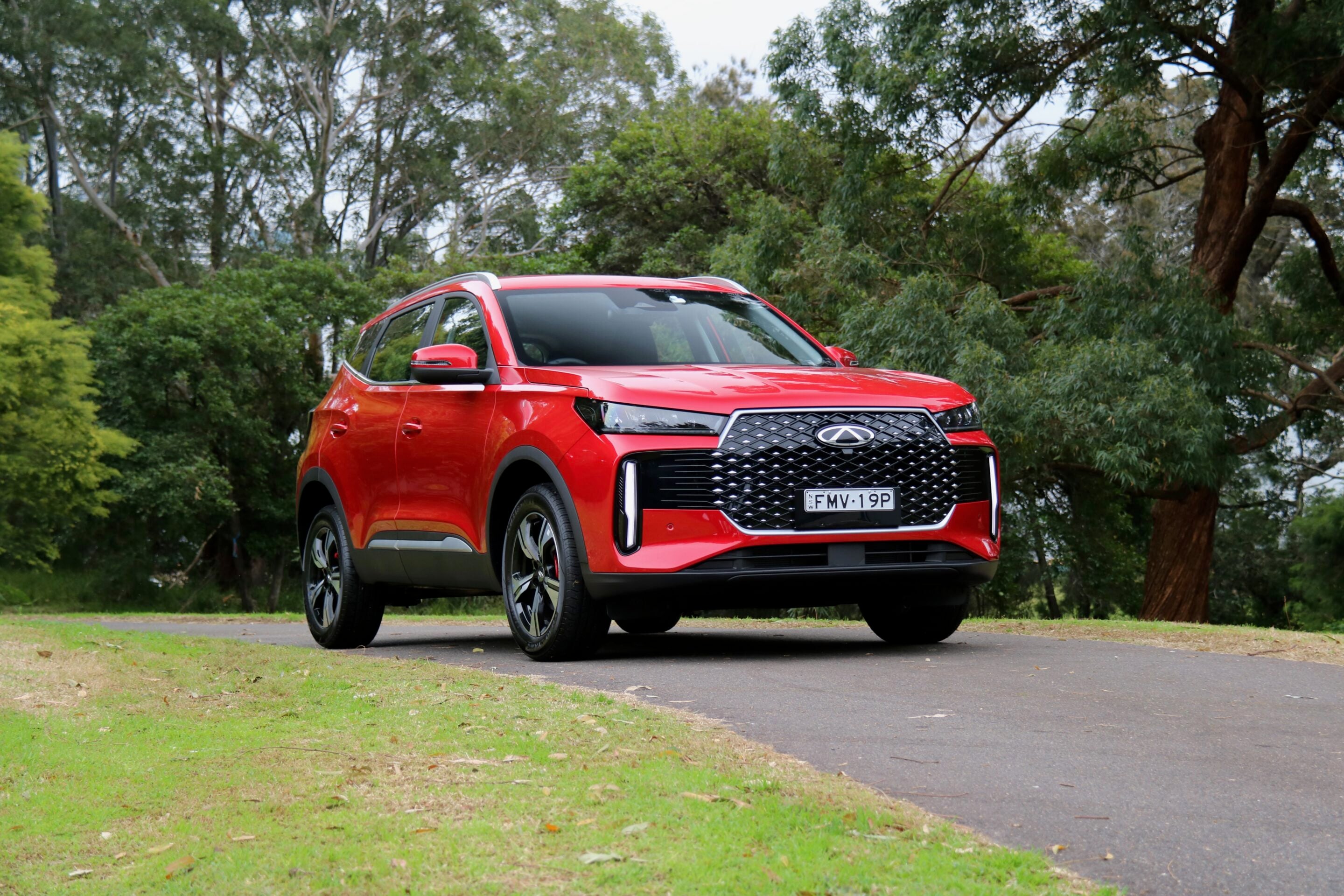
Two drivetrains are available in the Tiggo 4 range: a 108kW 1.5-litre turbo-petrol or a 150kW 1.5-litre hybrid, with both using a CVT transmission and sending power to the front wheels.
4
The petrol engine is no powerhouse, but provides more than enough thrust for everyday life. Peak torque hits at just 1750rpm and the CVT transmission features stepped ratios for a more natural acceleration feel. Unlike most CVTs, the Tiggo 4 feels surprisingly like a regular geared transmission, and combined with the turbocharged engine, feels peppier than its main rivals. The hybrid gives more thrust, thanks to its 150kW/310Nm electric motor. It’s also more refined and quieter than the petrol model, and subtly changes between petrol and electric power.
The claimed combined fuel consumption for the petrol Tiggo 4 is 7.4L/100km with claimed CO2 emissions of 166g/km, which is higher than expected. Thankfully, the hybrid is more fuel efficient at a claimed 5.4L/100km and cleaner at 123g/km, though it does have a surprisingly steep premium over the petrol Tiggo 4. Whereas the premium for hybrid Toyotas used to be $3000, Chery charges an extra $6000 and while the hybrid is more efficient, that extra money will buy a lot of petrol.
Elsewhere on the road, the Tiggo 4 is a really comfortable and surprisingly refined small SUV with suspension that’s quite soft and excellent noise suppression. In fact, the Tiggo 4’s suspension is a bit too soft, as it comes at the expense of body control, which is too loose. Larger bumps sometimes see the Tiggo 4 taking two or three rebounds to settle.
We’d like to see the suspension made firmer so it’s not as keen to roll in corners, and would be more adept at quick lane change manoeuvres. The Tiggo 4’s steering is also quite light, so it can take a bit to adjust to how much input is needed to turn the wheels.
5
Every Tiggo 4 offers a long list of standard active safety features like lane keeping assistance, adaptive cruise control, blind-spot monitoring and driver attention monitoring. Chery has refined these systems a lot since the Tiggo 4 was first launched here and they’re now far less sensitive as a result.
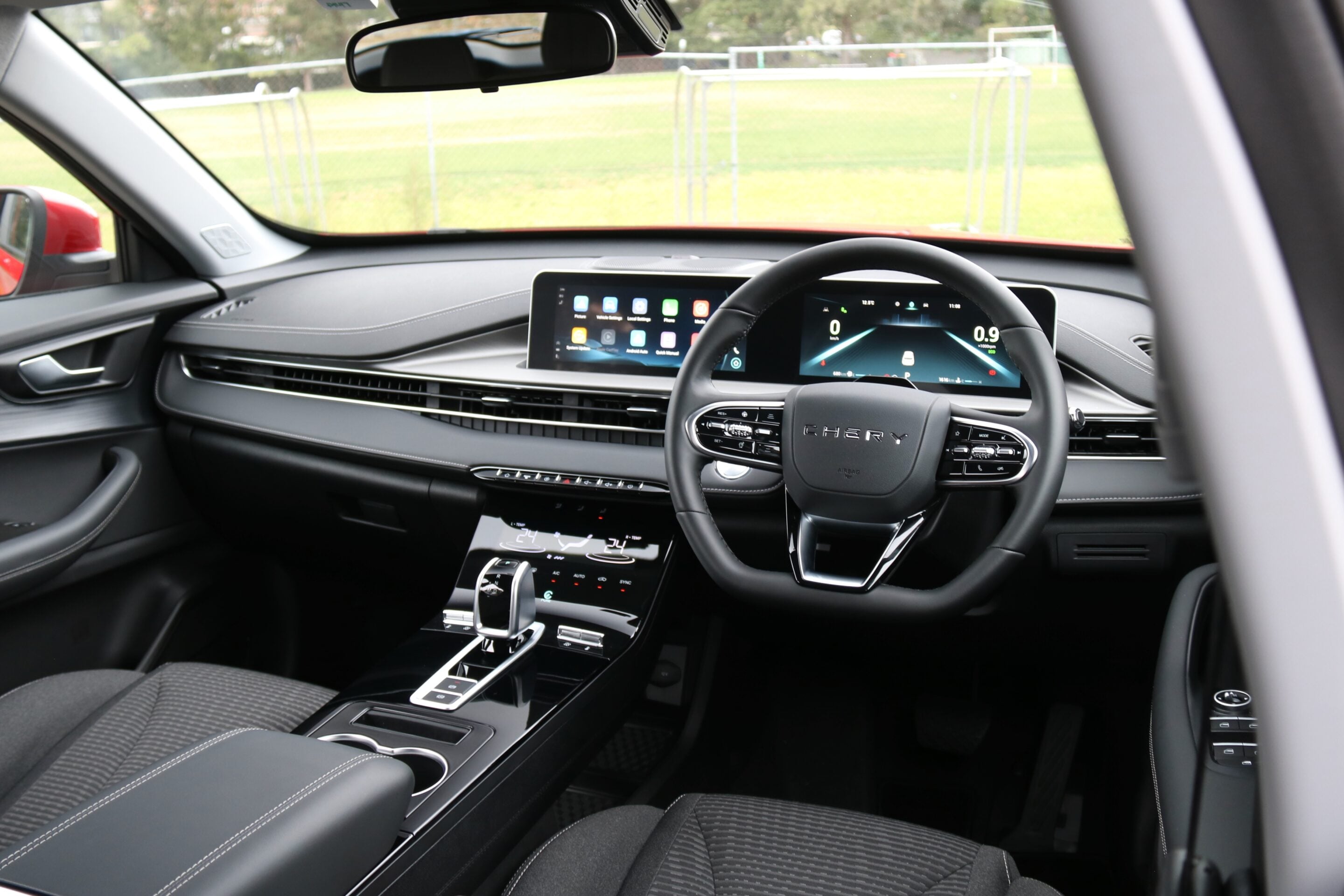
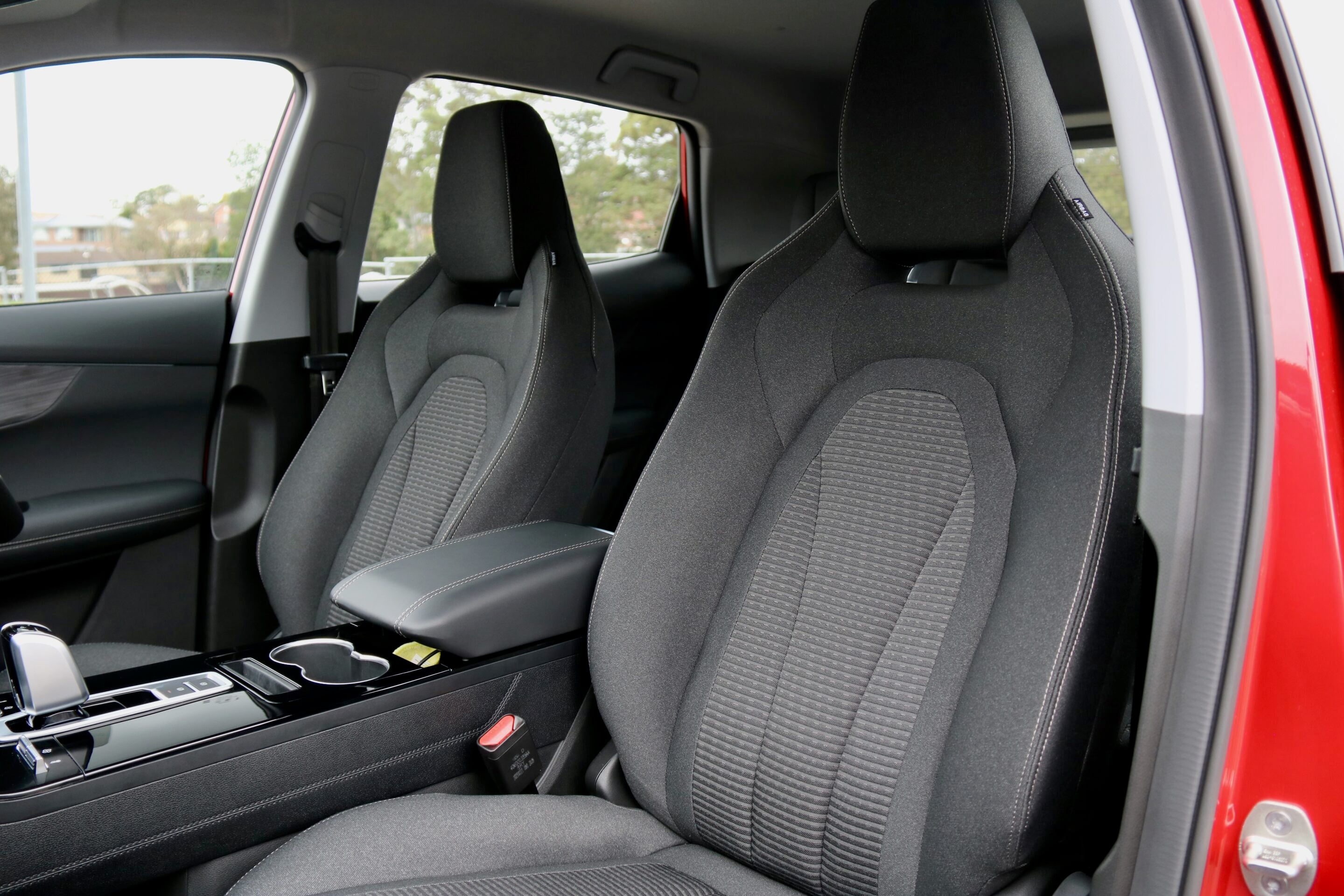
The cabin of the Chery Tiggo 4 is modern, good quality and filled with useable tech that we think will appeal to small SUV shoppers. Unlike the scratchy plastics of rivals such as the Hyundai Venue, the Tiggo 4’s cabin is loaded with soft touch materials, including on the dashboard and door tops, though the liberal use of piano black trim will need effort to keep unscratched.
A 10.25-inch touchscreen handles infotainment duties in all Tiggo 4 models with wireless and wired Apple CarPlay and Android Auto smartphone mirroring and DAB+ digital radio, though no satellite navigation or live services. It’s a really easy system to use and thankfully, Chery hasn’t tried to fit every function of the car into it. The climate control is controlled with separate buttons below the screen, and there is also a line of physical buttons underneath it to aid usability.
4
Practicality is excellent for the segment in the Tiggo 4 thanks to its large door bins, huge under-console tray that can hold handbags and large box underneath the central armrest. Seat comfort is generally good as well, though lumbar adjustment on any Tiggo 4 is missing.
Move to the rear seat and the space on offer for the segment is excellent, with a lot of headroom, generous legroom and features such as a USB charging port, an air vent, map pockets, door pockets and a central armrest. Two ISOFIX and three top-tether points handle child seat duties, and the doors open wide and even feature a light to warn of incoming traffic.
The Tiggo 4’s boot measures 380 litres with the rear seats up and 1225 litres with the rear seats folded, which is large for the small SUV segment. There aren’t many features in the boot, however, just a space-saver spare and an annoying lip between the boot floor and rear seats when they’re folded.
Chery’s Australian warranty is long with a seven-year/unlimited km coverage and 12 months of roadside assistance that’s extended a further 12 months with every dealer service (up to seven years in total). The capped price servicing program lasts for the warranty length, and the first five years/75,000km of servicing costs just $1445 ($289 per service).
1
Overall, it’s easy to see why so many people have been drawn to the Chery Tiggo 4. Not only is it one of Australia’s cheapest cars, but it’s also very well equipped, good quality, practical, cheap to service, covered by a long and easy warranty program, and very easy to drive. Plus, the availability of a hybrid model also gives it consideration for those wanting better fuel economy.
Could it be small SUV sales champion in 2026? Watch this space.
Chery Tiggo 4 specifications:
| Model | Chery Tiggo 4 |
|---|---|
| Price | From $23,990 drive away (Urban petrol) |
| Engine | 1.5-litre four-cylinder turbo-petrol or 1.5-litre four-cylinder hybrid |
| Peak power | 108kW (petrol), 150kW (hybrid) |
| Peak torque | 210Nm (petrol), 310Nm (hybrid) |
| 0-100km/h | 9.4 seconds (hybrid) – est. 10.5 seconds (petrol) |
| Transmission | CVT automatic, front-wheel drive |
| Fuel consumption (claimed) | 5.4L/100km (hybrid) – 7.4L/100km (petrol) |
| Claimed CO2 emissions | 123g/km (hybrid) – 168g/km (petrol) |
| Fuel type/tank size | 91RON regular unleaded, 51 litres |
| Dimensions (length/width/height/wheelbase) | 4307/1825/1660/2610mm |
| Boot size (rear seats up/folded) | 380 litres/1225 litres |
| Tare mass | 1404kg (petrol) – 1494kg (hybrid) |
| On sale | Now |
Chery Tiggo 4 Urban standard features:
- 17-inch alloy wheels with a temporary spare wheel
- Dusk-sensing automatic LED headlights
- Rain-sensing automatic wipers
- Heated exterior mirrors
- Roof rails
- Keyless entry with push button start
- Cloth seat upholstery
- Synthetic leather steering wheel
- Dual-zone automatic climate control with rear vent
- Dual 10.25-inch displays
- AM/FM/DAB+ digital radio
- Wired and wireless Apple CarPlay and Android Auto
- Six-speaker sound system
- 3x USB charging ports
- 7x airbags
- Autonomous emergency braking
- Lane keeping assistance with lane departure warning
- Adaptive cruise control with adaptive lane guidance
- Blind-spot monitoring
- Rear cross-traffic alert (with automatic braking)
- Driver attention monitoring
- Traffic jam assist
- Traffic sign recognition with speed limit information
- Door open warning
- Auto high beam
- Front and rear parking sensors
- Reversing camera
- Anti-theft alarm
- Tyre pressure monitoring
Ultimate model adds:
- 18-inch alloy wheels
- Sunroof
- Synthetic leather upholstery
- 6-way electric driver’s seat
- Heated front seats
- Auto-folding exterior mirrors
- 15W wireless phone charger
- Colour-selectable ambient lighting
- 4x auto up/down windows
