
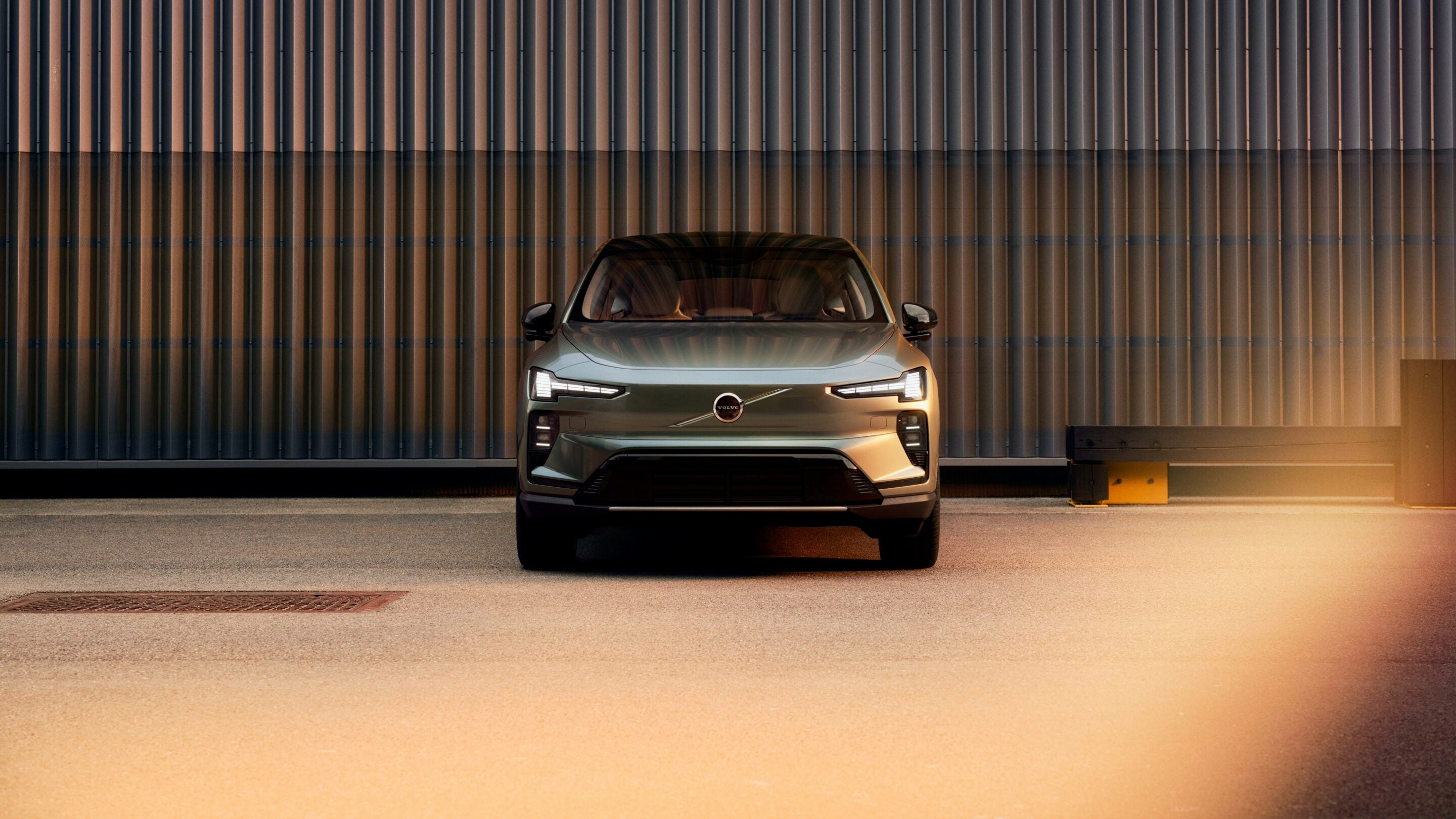
Volvo has revealed one arguably the most important new product in its line-up in decades, one that will influence its products for years to come thanks to a new generation of design, technology and even the way it’s built.
Due in Australia in late 2026, the Volvo EX60 is the electric sibling to the existing XC60 – the brand’s highest-selling car ever – and will be available with three battery options with up to 810km of range.
Built on a brand new architecture called ‘SPA3’, which will underpin a whole host of future Geely Group cars like the upcoming Polestar 7 in 2028, the EX60 will be initially offered globally in three forms: P6, P10 AWD and P12 AWD, and each drivetrain will be available in either Plus or Ultra trims with a lower-end Core model to be added later.
The Volvo EX60 P6 uses an 83kWh (80kWh useable) battery for a claimed 620km of range (WLTP) with a 275kW/480Nm motor for a claimed 5.9 second 0-100km/h sprint. The P10 AWD increases battery size to 95kWh (91kWh useable) for 660km of range and the extra electric motor takes outputs to 375kW/710Nm for a claimed 4.6 second run. Finally, the P12 AWD uses a huge 117kWh battery (112kWh useable) for a claimed 810km range and 500kW/790Nm for a 3.9 second run to 100km/h.
The SPA3 architecture allows for super fast charging speeds, with the P6 capable of a 320kW maximum, and the P10 and P12 370kW.
The EX60 measures 4803mm long, 1908mm wide, 1635mm tall and rides on a 2970mm long wheelbase, which makes it 95mm longer, 6mm wider, 20mm less tall and 105mm longer between the wheels than the XC60. Its boot measures 523 litres with the rear seats up, growing to 1647 litres with them folded – plus, a large front boot with between 58-85 litres of space depending on the drivetrain.
On the inside, the Volvo EX60 follows its siblings with a minimalist and screen-heavy look, though the brand says it’s learnt from criticism aimed at the EX30 and its too-minimalist cabin with more physical controls and more shortcuts in the new 15.1-inch touchscreen. Using a new processor reportedly capable of 50 billion operations per second, it’s said to be much quicker than the current system in Volvo products like the EX30 and features a new Google software, including Google Gemini AI voice control for more “conversational” interaction.
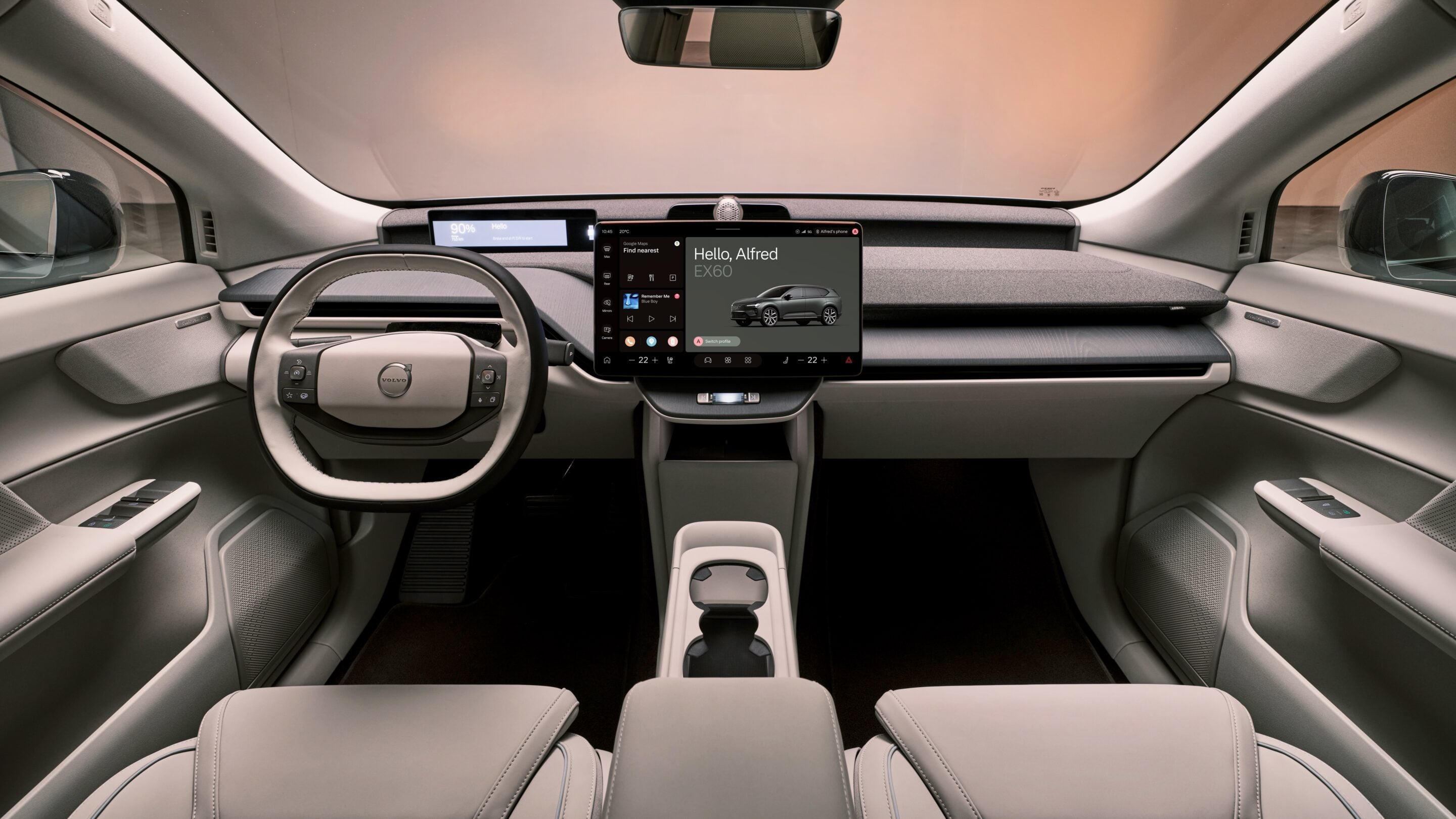
Other interior features include a two-level centre console, a panoramic glass roof that can switch between transparent and opaque and a Bowers & Wilkins sound system.
The EX60 is the first Volvo to use a new manufacturing process involving mega casting, which is where many smaller parts are replaced with larger recycled aluminium casts, which improves production efficiency and reduces the impact of manufacturing on the planet. As a result, Volvo says that the EX60 has a similar overall environmental impact as the smaller EX30.
The Volvo EX60 is due in Australia by late 2026, with the P12 AWD model due around six months afterwards.
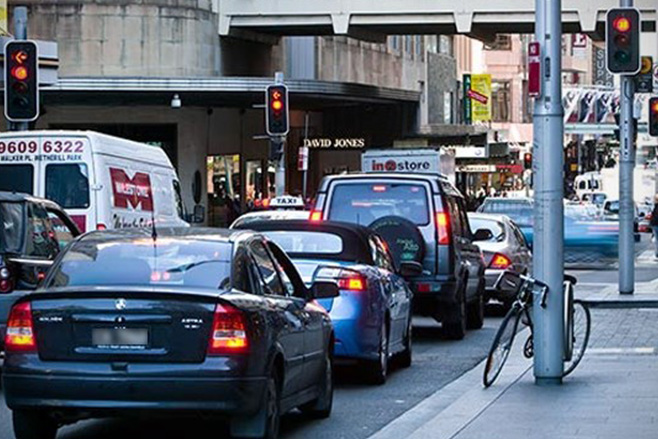
If you want an easy life on the road then head to Darwin. Australia’s northern outpost has just ranked best for traffic congestion, ahead of Wollongong and Canberra, in a global gridlock rating.
Commuters only suffer a 25 per cent peak-hour delay in Darwin, compared with 75.9 per cent in Mexico City, which was the worst performer in the worldwide TomTom Traffic Index results for 2025.
Adelaide has the worst traffic in Australia, according to TomTom, ahead of Melbourne, Gold Coast and Sydney.
It’s the 15th year TomTom has surveyed traffic delays, measuring how much traffic slows down on a road network compared with ideal free-flow travel times, expressed as a percentage.

Brisbane was the only Australia city to have an improvement in its performance, as 466 of 500 cities went backwards in 2025, although it only improved by one per cent.
“For another year, it shows just how universal vehicular congestion is,” TomTom said. “Major cities experienced increased travel times, including, London, England; Bengaluru, India; Dublin, Ireland; Mexico City, Mexico; Barcelona, Spain; Athens, Greece; Milan, Italy; Rosario, Argentina; Hiroshima, Japan; San Francisco, United States; and many others.
“It would be significantly quicker to list the cities where travel times have improved and decreased compared to 2024. Of the nearly 500 cities reviewed in 2025, just 34 saw reductions in their inner-city travel times per kilometre compared to a year earlier.”
Adelaide had a 55.1 per cent rating from TomTom, which meant drivers spent 109 hours in rush-hour delays each year, as it was ranked 50th overall. It finished just ahead of Melbourne at 52.9 per cent, then Gold Coast, Sydney and Newcastle. Globally, Mexico City was rated at 75.9 per cent, ahead of the Indian city of Bengaluru, then Dublin in Ireland.
TomTom Traffic Index 2025
1. Mexico City, Mexico, 75.9%
2. Bengalaru, India, 74.4%
3. Dublin, Ireland, 72.9%
4. Lodz, Poland, 72.8%
5. Pune, India, 71.1%
6. Lublin, Poland, 70.4%
7. Bogota, Columbia, 69.6%
8. Arequipa, Peru, 69.5%
9. Lima, Peru, 69.3%
10. Bangkok, Thailand, 67.9%
Australian cities
50. Adelaide, 55.1%
64. Melbourne, 52.9%
106. Gold Coast, 48.6%
166. Sydney, 43.7%’
206. Newcastle, 41.3%
222. Brisbane, 40.5%
255. Hobart, 38.2%
303. Perth, 35.9%
348. Canberra, 33.6%
374. Wollongong, 31.8%
426. Darwin, 27.5%
A supercharged V8 engine, sedan bodystyle and manual transmission are three ingredients that have all but disappeared from today’s new car market. Especially in Australia, where homegrown performance heroes are long gone, sports sedans are nowhere near as plentiful as they once were thanks to the demise of cars like the Holden Commodore, Ford Falcon, Chrysler 300C, Kia Stinger… even the Volkswagen Passat is no longer sold here.
But in other parts of the world, there are still options and the USA makes probably the tastiest in the world right now: the Cadillac CT5-V Blackwing.
You might be thinking “but hang on, Cadillac is sold in Australia, isn’t it?”. And that is correct. But thanks to a lack of right-hand production for the brand’s ICE models, only electric vehicles in the Caddy stable are sold in Australia, like the Lyriq mid-size SUV, with the smaller Optiq and larger Vistiq due later in 2026.
As such, Caddy’s petrol-powered models are off limits for us, for now – despite other petrol vehicles in the General Motors Special Vehicles stable such as the Chevrolet Silverado converted to right-hand drive locally.
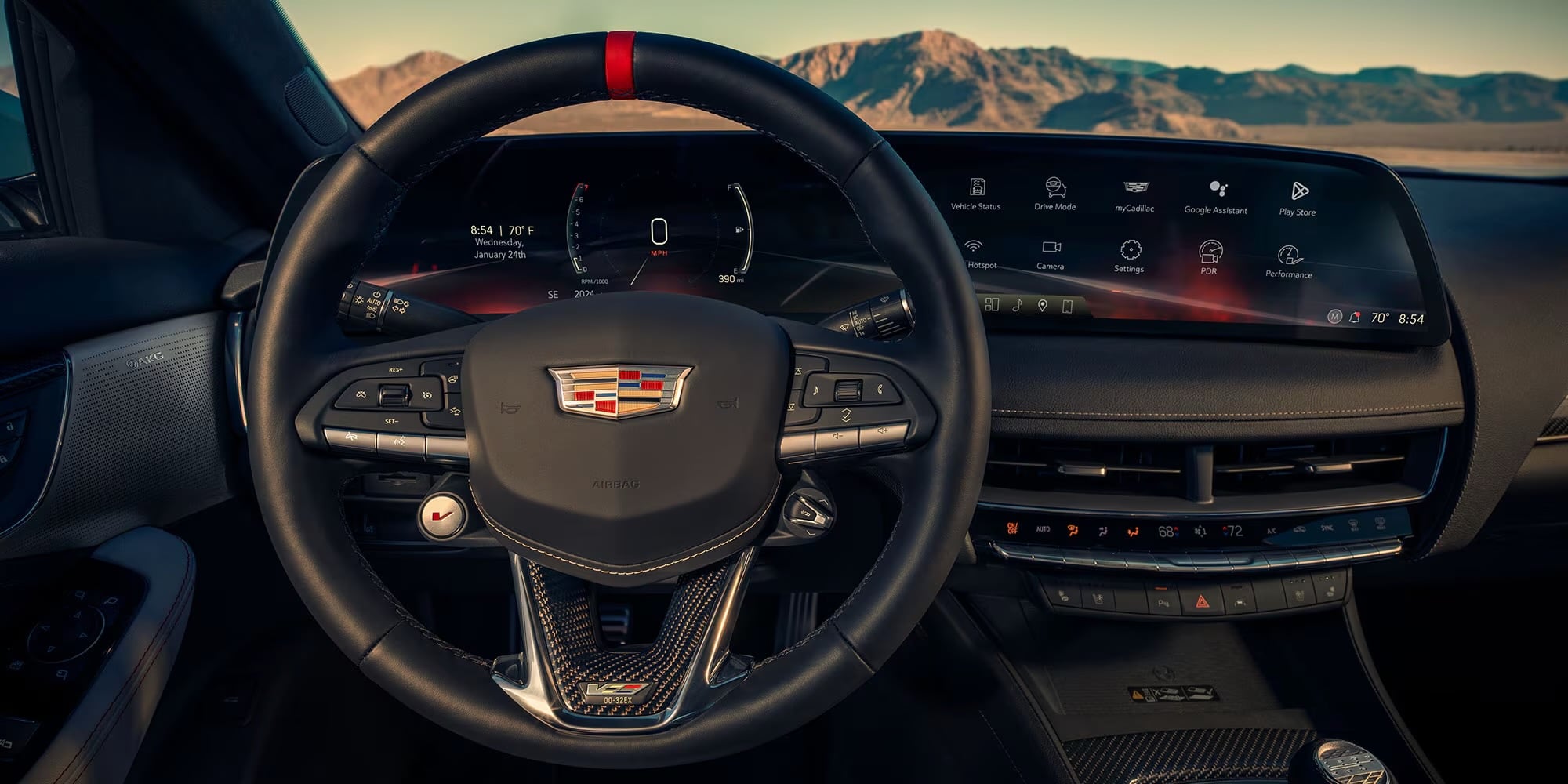
It’s unlikely to ever be sold here, so why lust after the CT5-V Blackwing? Well, it’s got a 6.2-litre supercharged V8 engine making 498kW of power (that’s 668 horsepower) and 893Nm of torque. Power is sent only to the rear wheels via a 10-speed automatic, or in a big move to please enthusiasts, a six-speed manual.
Sitting on GM’s ‘Alpha’ platform – shared with the latest Chevrolet Camaro, which was converted to RHD and sold in Australia for around 18 months until 2020 – the CT5-V Blackwing uses expensive features such as adaptive dampers, Brembo brakes and Michelin Pilot Sport 4S tyres to ensure that it handles much better than you’d expect for an American car. Carbon-ceramic brakes are also optionally available. According to US media, it’s a monster at both the drag strip and on the track.
The exterior of the CT5-V Blackwing is appropriately sporty with big intakes, 19-inch alloy wheels, carbon fibre pieces and big exhaust pipes to show its intent further. Inside, the CT5-V Blackwing is dominated by a huge 33-inch display with a performance app for track driving, and inbuilt Google as well. The rest of the CT5-V Blackwing’s cabin is covered in carbon fibre and leather-like materials, as well as features such as 126-colour LED ambient lighting and a 16-speaker AKG sound system.
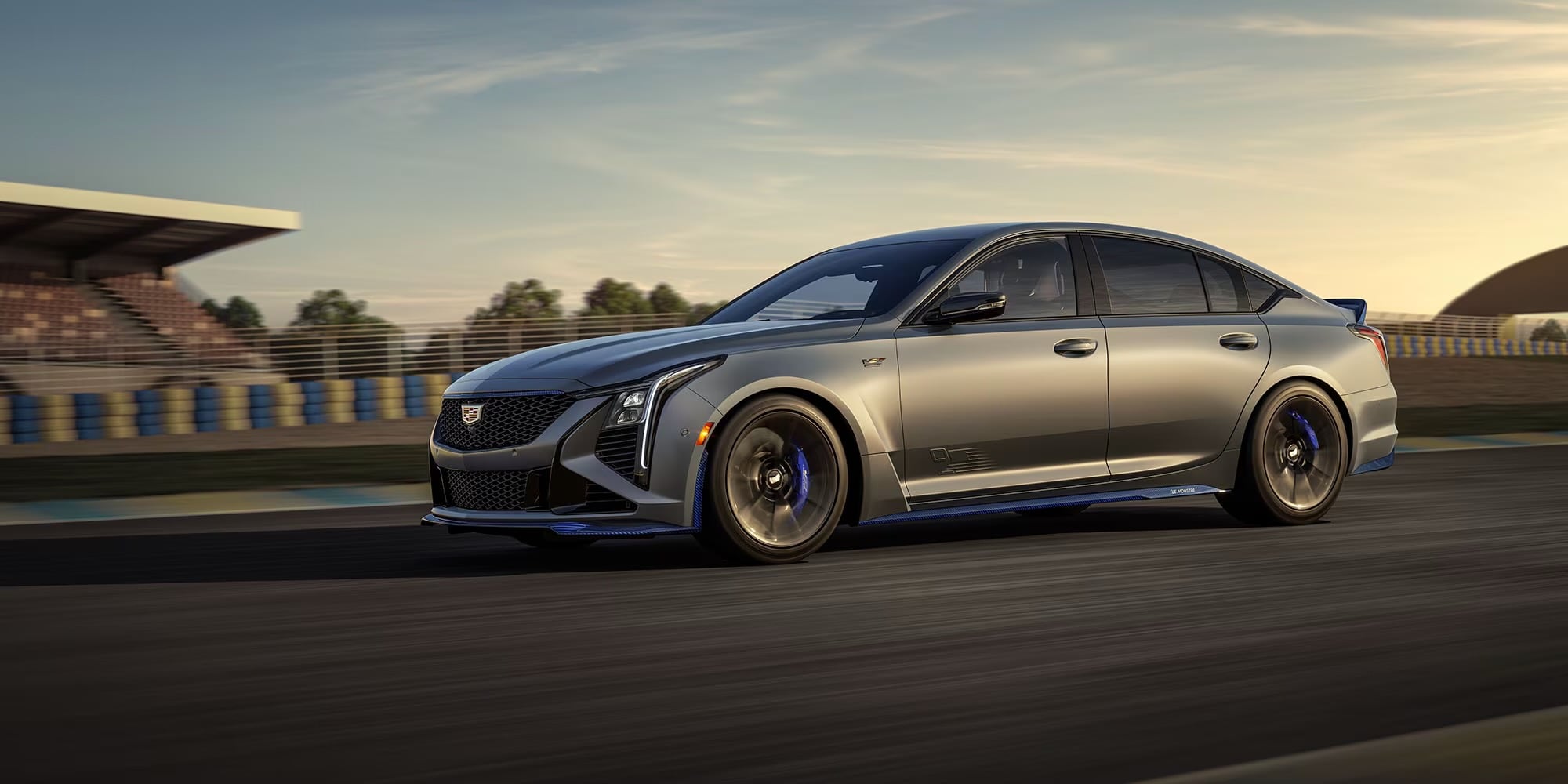
Pricing in the USA for the CT5-V Blackwing starts at US$100,695 (just shy of A$150,000 at the time of writing) and optioning it with features like the automatic transmission (which includes GM’s ‘SuperCruise’ semi-autonomous driving system), carbon-ceramic brakes and a sunroof push the price towards US$140,000 (A$200,000). But an Audi RS7 Performance in the US, for example, is priced at least US$20,000 more – and a manual is unavailable with the RS7, giving the Caddy even more appeal.
Alas, like the Escalade, the CT5-V Blackwing is unlikely to make it to Australia anytime soon. But it’s nice to know that there are fast V8 manual sedans still on offer in some parts of the world. If you’re in a position to buy one, dear international reader, please do before you’re no longer able to.
Kia has unveiled a refreshed version of its Niro small SUV, revealing sharper exterior styling and a reworked interior that brings the model into line with the brand’s latest design and technology direction… but it’s no certainty for the Australian market.
Visually, most of the changes are concentrated at the front. The previous silver trim that framed the nose has been deleted, replaced by a slimmer interpretation of Kia’s familiar Tiger Nose grille. This is paired with taller, more angular headlights that feature the brand’s ‘Starmap’ lighting signature, now common across Kia’s global range from the Picanto through to the EV9.
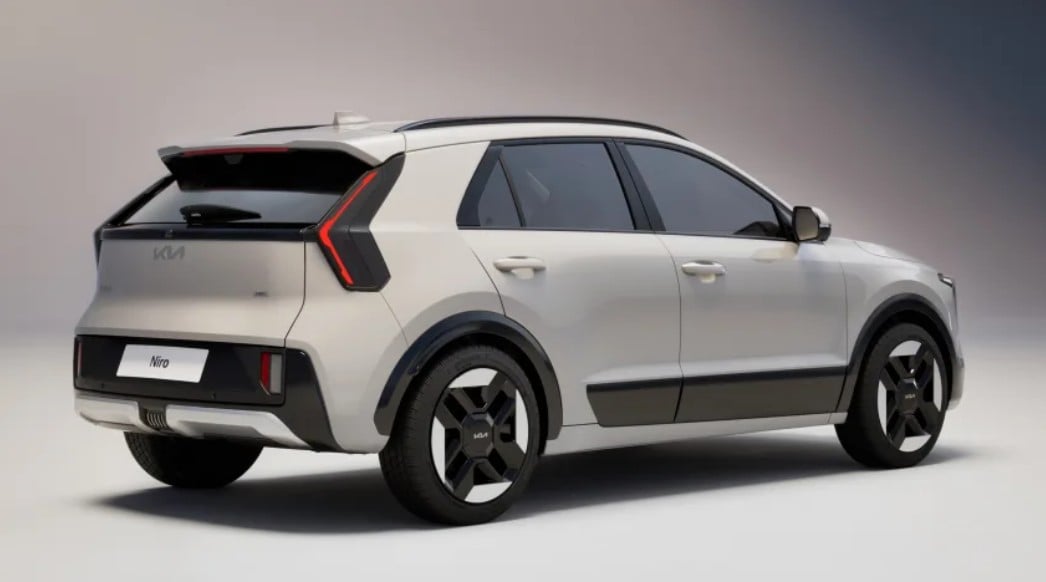
Lower body cladding on the bumpers, doors and wheel arches appears to switch to a gloss-black finish, giving the Niro a cleaner, more upmarket look. New 18-inch alloy wheels join the options list, while the SUV-style skid plate elements remain in place to preserve the Niro’s slightly rugged aesthetic. At the rear, the tail-lights have been reshaped into slimmer units with a darker finish, complemented by a redesigned bumper and an integrated brake light within the roof spoiler.
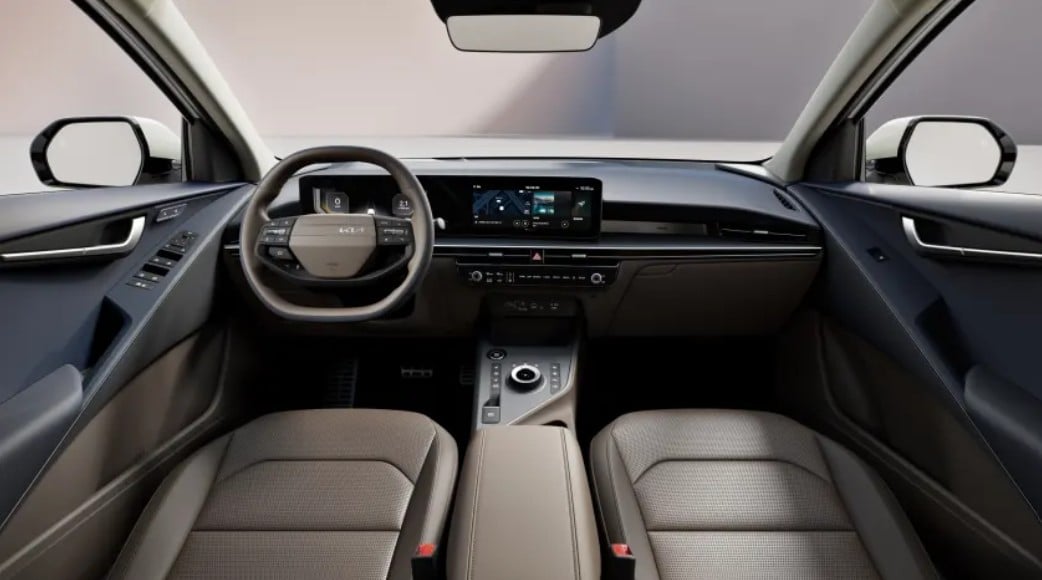
Inside, the updates are more substantial. The facelifted Niro adopts twin 12.3-inch displays running Kia’s latest infotainment software, housed within a revised dashboard layout. A new two-spoke steering wheel with physical controls makes its debut, alongside a dedicated drive mode selector borrowed from newer Kia electric models. The centre console has also been refreshed, although the familiar switchable control panel beneath the touchscreen remains.
Full specifications have yet to be confirmed, but the updated Niro is expected to continue offering a choice of hybrid, plug-in hybrid and fully electric powertrains, mirroring the current line-up. The hybrid pairs a 1.6-litre four-cylinder petrol engine with an electric motor and small battery, producing 95kW and driving through a six-speed dual-clutch automatic. Performance claims translate to a 0–100km/h time of around 11.5 seconds, with fuel consumption expected to sit well below 4.5L/100km.
The plug-in hybrid adds a larger battery, boosting combined output to approximately 125kW and enabling an electric-only driving range of around 65 kilometres. The fully electric Niro EV is expected to retain its 64.8kWh battery and single-motor front-wheel-drive setup, offering a driving range of about 460 kilometres and DC fast-charging capability.
Kia says further details will be revealed in coming months with a planned Korean launch in March, but the brand has indicated the model is currently discontinued in Australia as it brand focuses on other small SUV options.
The Australian Automobile Association (AAA) is urging the Commonwealth Government to lead changes to Australian road safety management after new data showed the national road toll rose in each of the past five calendar years. According to the AAA, that is a phenomenon that last occurred in 1952.
The AAA says the Government’s review of the failing National Road Safety Strategy 2021-30 is an opportunity to enhance the Australian Government’s transport safety role and correct the nation’s recent tragic road trauma surge.
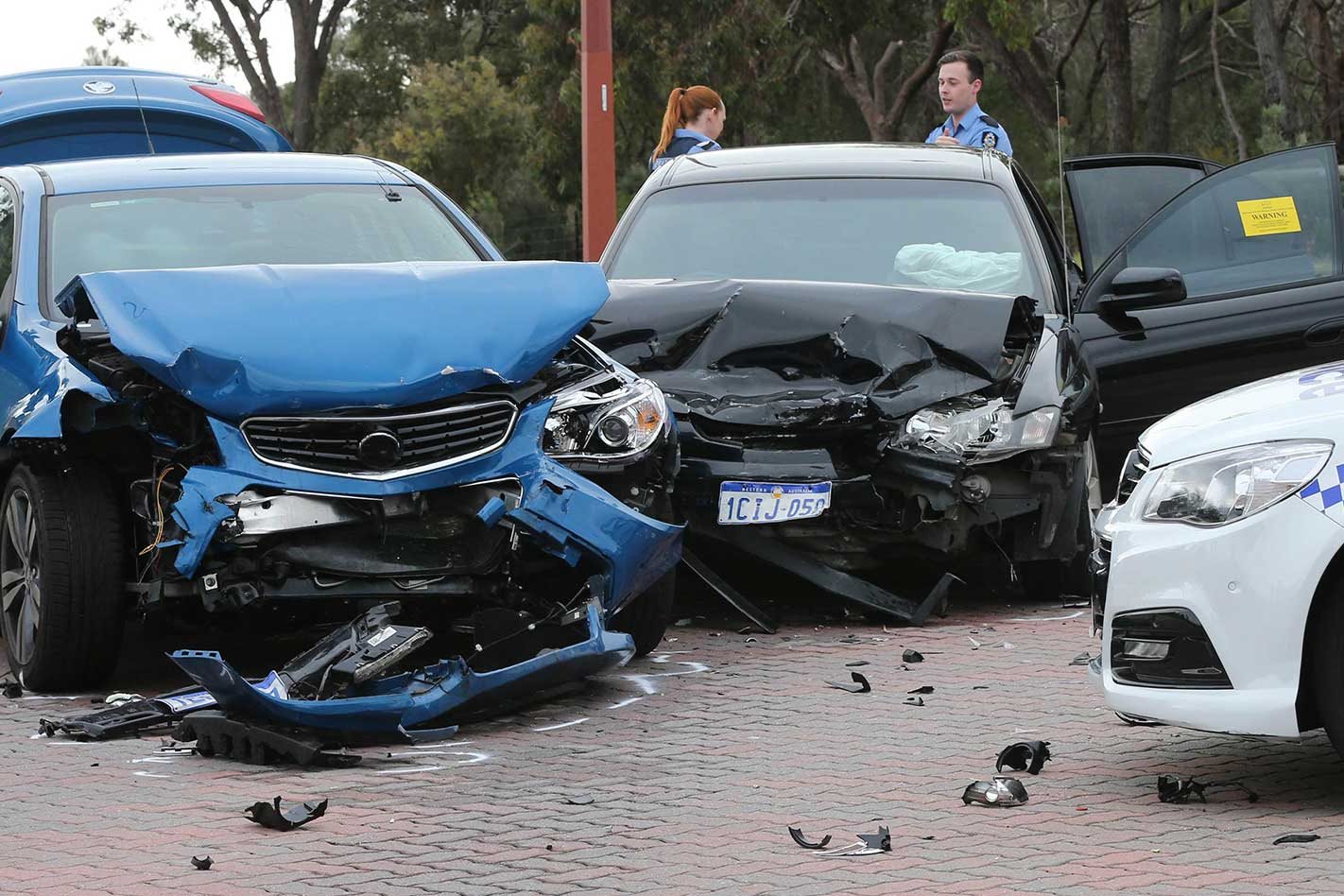
Agreed by all Australian governments in 2021, the Strategy aims to halve national road fatalities through the decade to 2030. But five years in, it has instead delivered a 19.8 per cent increase in road deaths, and three of its five headline targets remain unmeasurable.
Australia’s road toll increased again in 2025 (by 1.7 per cent) to 1,314 fatalities, meaning that Australia’s road deaths have risen every year since 2021. According to the AAA, that’s the worst sequence of rising road tolls in more than 70 years.
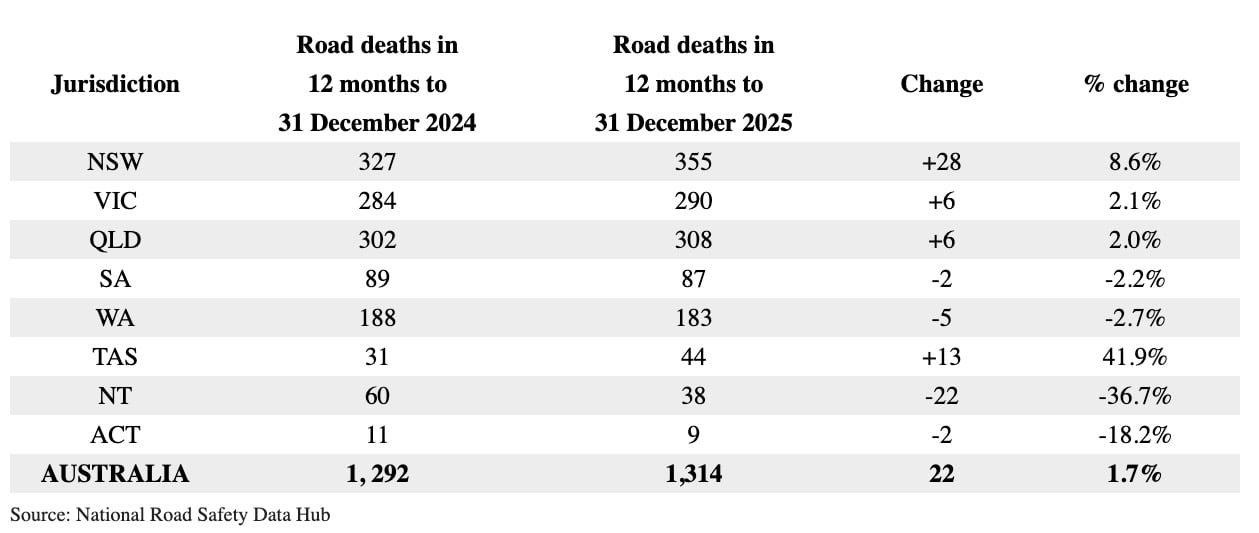
According to data supplied by the National Road Safety Data Hub, almost half of 2025 road death victims were drivers (571), a 2.6 per cent decrease from 2024. Motorcyclist deaths were the next most common category (266 deaths, a 4.3 per cent decrease), followed by passenger deaths (204, up 2.5 per cent from 2024).
Deaths among vulnerable road users (people not travelling in a car, bus or truck) rose by 4.7 per cent in 2025 to 512.
Cyclist deaths rose most in NSW (up 200 per cent from 2024), Western Australia (up 75 per cent) and Queensland (up 62.5 per cent). They declined in South Australia (-50 per cent), Victoria (down 18.2 per cent) and the ACT (-50 per cent). In 2025, there was one cyclist death in Tasmania and none in the Northern Territory.
Pedestrian deaths rose most sharply in South Australia (up 54.5 per cent from 2024), followed by Western Australia (up 26.3 per cent), NSW (up 25.6 per cent), Tasmania (up 25.0 per cent), Queensland (up 15.2 per cent), and Victoria (up 10.6 per cent). Only Northern Territory pedestrian deaths declined, and by 70.6 per cent from 2024.
AAA Managing Director Michael Bradley said: “The AAA is calling on the Commonwealth to extend its powers conduct no-blame investigations of transport fatalities beyond aviation, rail, and maritime incidents, to also examine the factors driving up our road toll.”
“The starting point to addressing our worsening road toll road toll is to understand what’s causing it to rise in the first place. Reducing road trauma requires new road funding; regulatory change; and public education campaigns – all of which will be better targeted, more evidence-based, and more effective if informed by the work of a national investigative body.”
Mercedes-AMG will arrive at Mount Panorama in February with its biggest Bathurst 12 Hour presence yet, committing a record ten Mercedes-AMG GT3 cars to the 2026 endurance classic.
The Meguiar’s Bathurst 12 Hour, scheduled for 13–15 February, will mark the 23rd running of the race and the 15th time GT3 machinery has headlined the event. It also serves as the opening round of the Intercontinental GT Challenge (IGTC), continuing a tradition that has made Bathurst one of the most important fixtures on the global GT calendar.
A total of 36 cars from 12 manufacturers have been entered, reflecting continued growth in international interest. Mercedes-AMG once again leads the field in numbers, with six cars entered in the outright Pro class, alongside two Pro-Am and two Bronze class entries. The 10-car effort represents not only the brand’s largest Bathurst entry, but the biggest single-manufacturer presence in the race’s history.
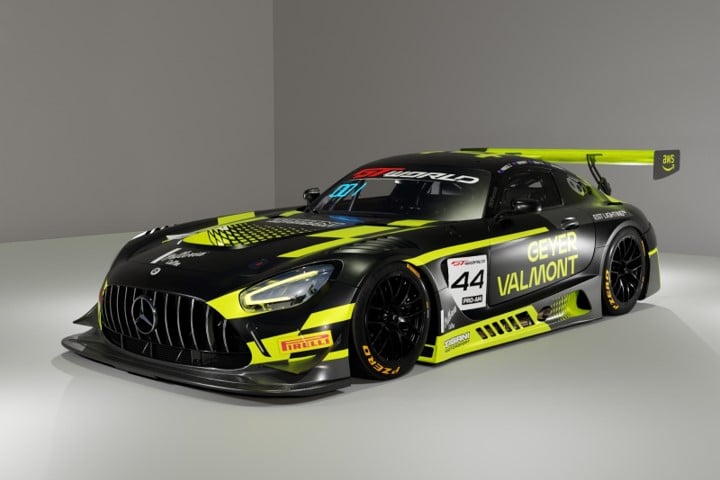
Mercedes-AMG will rely on three Performance Teams: Tigani Motorsport, which steps up to Performance Team status for the first time; Craft-Bamboo Racing; and GMR. Collectively, they will field a mix of factory-supported international drivers and high-profile Australian talent.
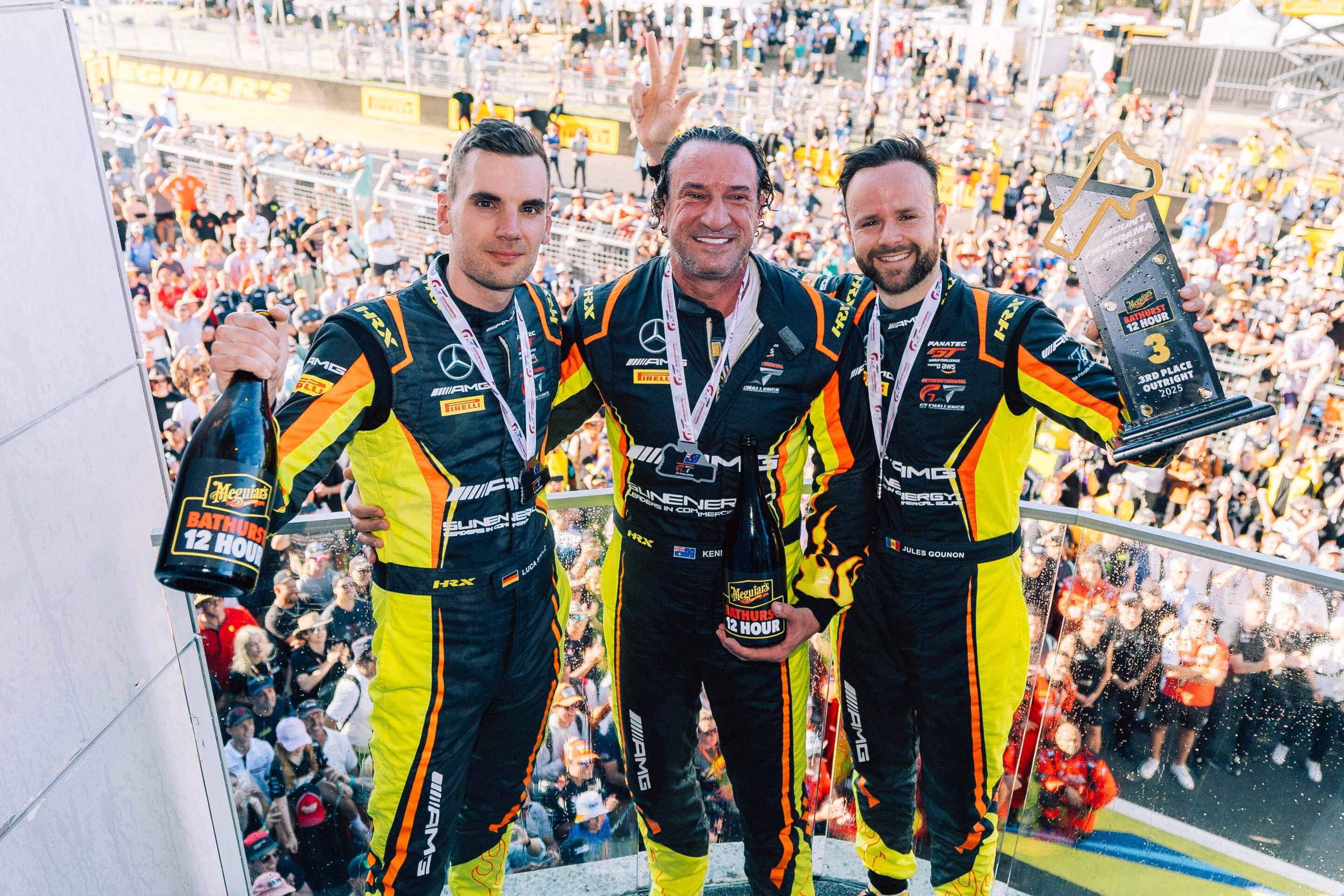
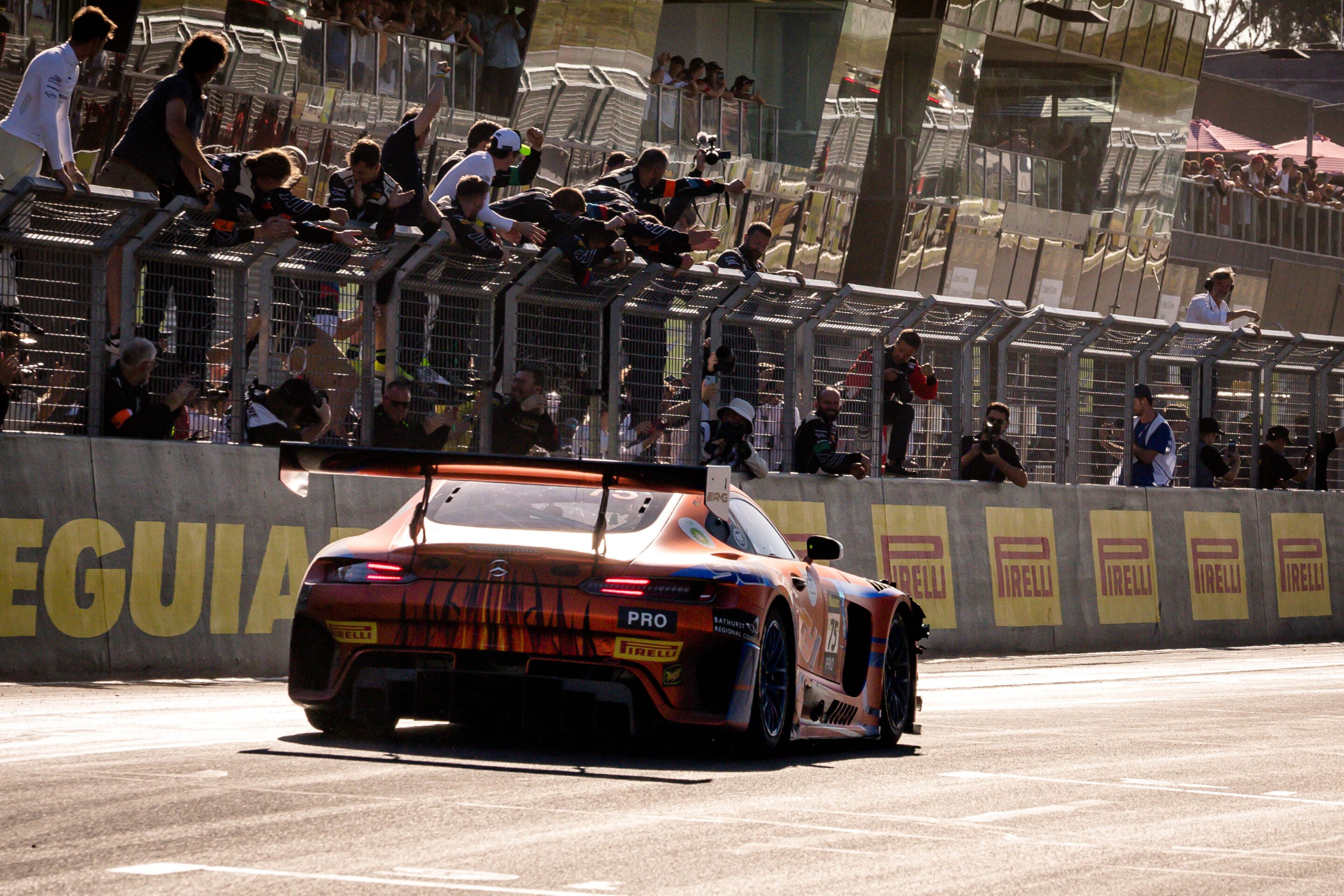
Among the headline entries is car #75, run by 75 Express, featuring Kenny Habul alongside Mercedes-AMG Performance Drivers Jules Gounon and Luca Stolz. The trio finished second and third overall in the past two editions and return as one of the strongest Pro-class combinations. Another notable Pro entry is the Scott Taylor Motorsport Mercedes-AMG GT3, pairing Australian Supercars stars Chaz Mostert, Cameron Waters and Thomas Randle.
The Tigani Motorsport Pro car will be driven by Philip Ellis, Jayden Ojeda and Fabian Schiller, while Grove Racing fields an all-Australian Pro line-up including Will Davison and Kai Allen. Craft-Bamboo Racing’s Pro entry includes former DTM and GT race winner Maximilian Götz, joined by Lucas Auer and Ralf Aron.
Mercedes-AMG has previously won the Bathurst 12 Hour three times, in 2013, 2022 and 2023, and again shapes as a major contender. Qualifying, including the Top 10 Shootout, will be held on Saturday 14 February, ahead of the 12-hour race start at 5:45am on Sunday morning.
With the Pro field larger than ever and competition intensifying, Mercedes-AMG’s record-breaking presence ensures it will be central to the fight for victory on the mountain.
MG is set to launch a facelifted version of the MG4 electric hatchback later in 2026 with a new interior and a smaller battery range. Not to be confused with the newer and cheaper MG4 Urban, also set to launch this year, the updated regular MG4 range gains an all-new dashboard layout from the MGS5 EV electric small SUV, as revealed by the Brazilian market MG4.
The interior of the MG4 has been given a big upgrade with the MGS5 EV’s dashboard, larger screens and more physical buttons. The materials are higher quality with more soft touch portions, while the centre console has also been redesigned with larger cupholders, soft touch materials and a wireless phone charger.
The new touchscreen – again, adopted from the MGS5 EV – is 12.8-inches in size, or much larger than the current MG4’s 10.25-inch display, and its driver’s display is 10.25-inches versus the current MG4’s 7.0-inch unit. A new software system will also feature, as well as physical buttons for the climate control, volume and track selection.
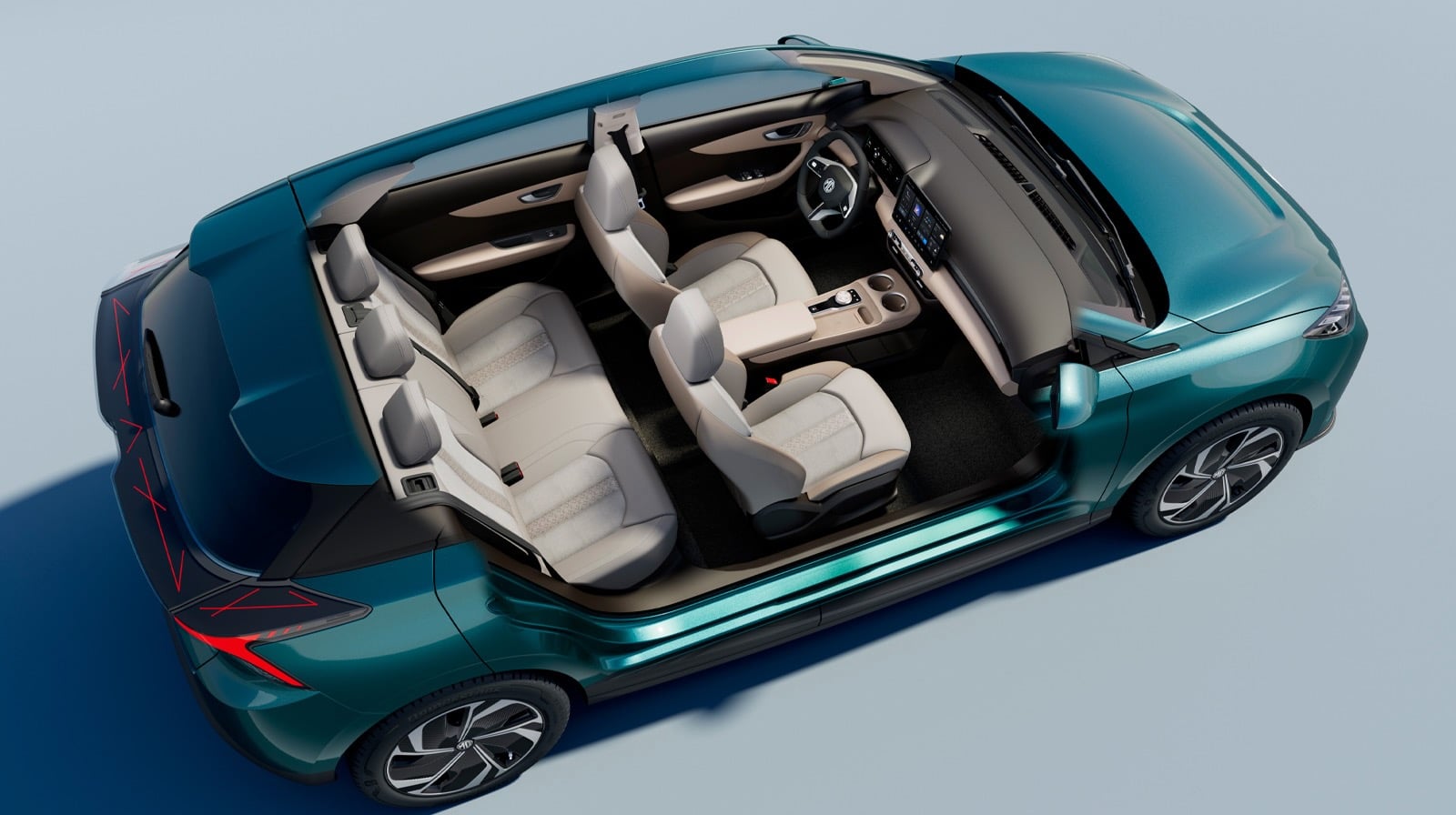
No exterior changes have yet been revealed – the Brazilian MG website shows an XPower model with an updated interior – aside from revised wheel trims.
Australian government approval documents have also revealed that the updated MG4 range will only be offered with a 64kWh battery option in both rear- and all-wheel drive forms, as the MG4 Urban will adopt the smaller battery options that the regular MG4 is currently offered with.
As such, and to give breathing space for the new MG4 Urban, the MG4’s pricing will rise, to likely above $40,000 and only with higher-spec models. Aside from the new Urban, MG Motor Australia is yet to confirm any details about the MG4 range but will likely do so soon.
You might not have heard of Geely before – don’t worry, you’re not alone, because plenty of Australian new car buyers haven’t either. In a deepening sea of new-to-the-market brands from China, it’s easy to assume Geely is just another one on the list.
But – and it’s a big but – Geely is different. It’s not a new player in China, where it’s been building cars for close to 40 years. And, it owns brands like Volvo, Polestar, Zeekr and Lotus to name just a few, so it’s fair to say Geely has deep investment and research might.
Interestingly, the Starray EM-i we’re testing here is the second Geely to be launched in Australia, which was the first export market for this PHEV crossover. This is, in a market of spiralling costs, an affordable PHEV, no matter which way you slice it. At the time of testing, you could park this midsize SUV in your garage from $39,990 drive away. With up to 83km (WLTP) pure electric range, and a combined 943km (WLTP) range with a full charge and full tank, Geely’s ‘Super Hybrid’ claim might be easier to justify than you might think.
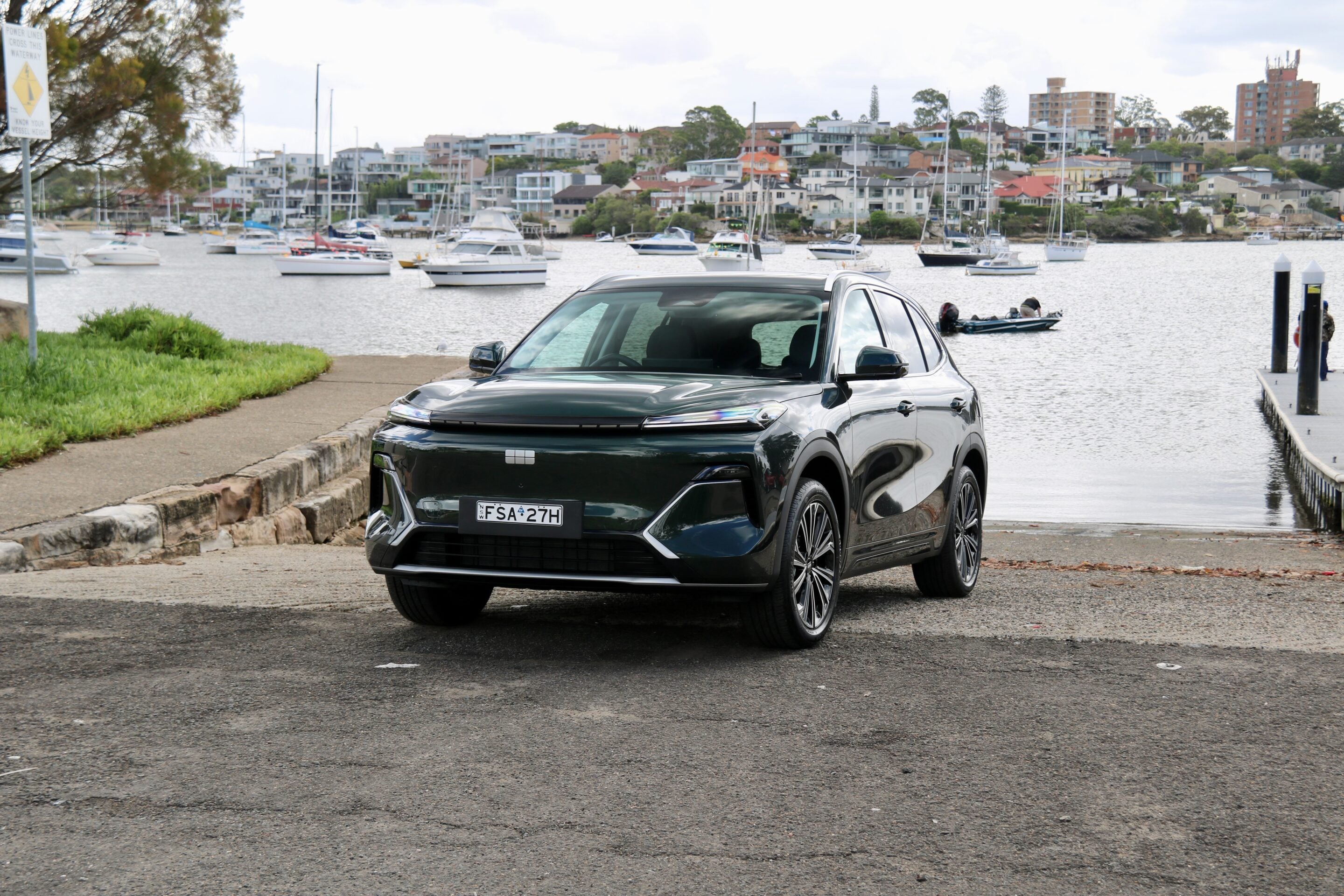
Our undoubtedly eye-catching and attractive test car, then, is the 2026 Geely Starray EM-i Inspire in beautiful Jungle Green paint, cutting a stylish figure when you’re mixing it up with the traffic on a bland daily commute. The standard feature list is long, countering the sharp pricing, which might see the word ‘cheapest’ or ‘cheaper’ used more than is fair in the description of the vehicle. Especially after you’ve spent some time with it.
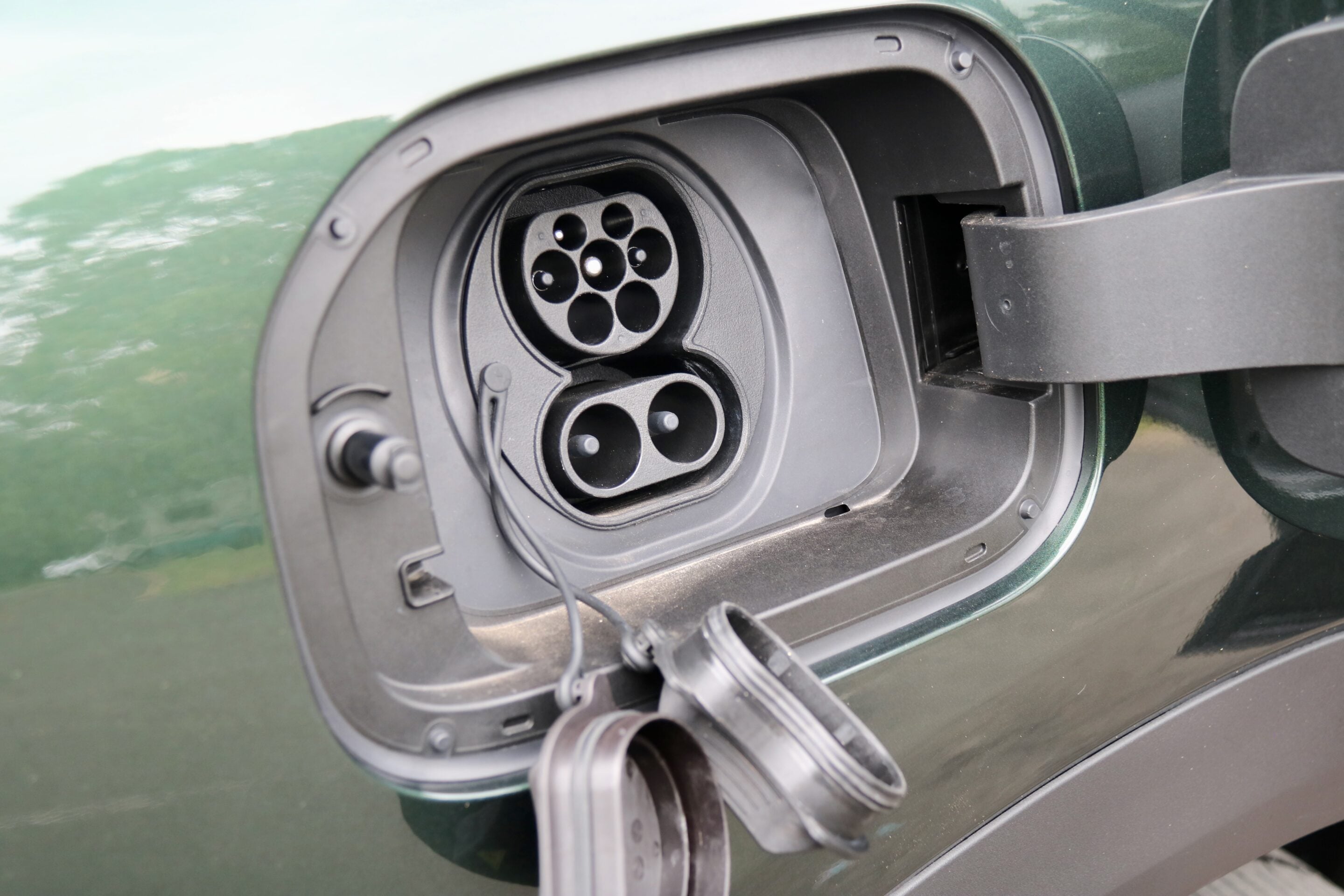
Standard mechanical equipment includes a 1.5-litre petrol engine, which works as a power generator for the front electric motor – its FWD only for the moment. The electric motor pushes 160KW and 262Nm to the front wheels, and there’s an 18.3kWh battery pack – 17kWh usable, of lithium iron phosphate construction. The petrol engine, as mentioned above, works to charge the battery pack, but you can also charge it with 6.6kW AC power or up to 30kW DC fast charging. Geely tells us that in power mode, the petrol engine can drive the front wheels – but that’s not a mode you’ll use often.
How’s its fuel efficiency?
On test, against the WLTP claim of 83km, WhichCar by Wheels managed to get 67km the first time and 66km the second time, with a full charge. Oddly, that’s because the battery wouldn’t let us access the last 20 percent of charge, but the claimed 83km would have been achievable given the average usage. If you need or want to head further afield, you can run it in hybrid mode and get somewhere near 815km, which is what our indicated consumption was suggesting.
We’ll get the Starray back into the WhichCar by Wheels garage for longer distance testing, but the initial indicators are impressive. Around town, we managed a best of 6.9L/100km with the petrol engine whirring away, and on the highway an even 6.0L/100km – both acceptable for this size vehicle in this segment – although slightly thirstier than a RAV4 Hybrid would be under the same testing.
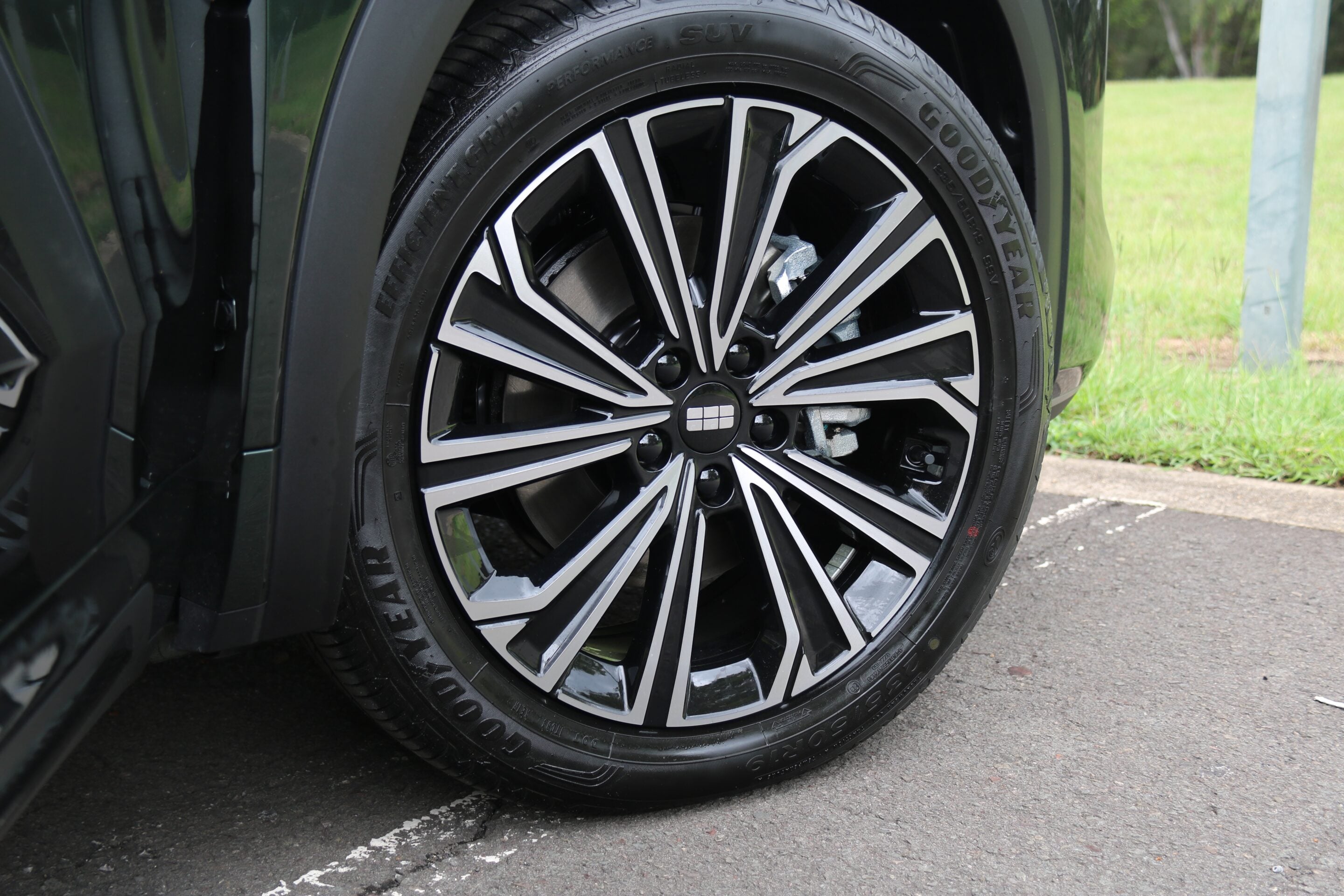
Our Inspire gets attractive 19-inch rims standard, a panoramic glass sunroof with retractable shade, electric tailgate, front parking sensors, wireless charging, head-up display, premium 16-speaker audio system, ambient interior lighting, cooled front seats and four-way electric (passenger) and six-way memory (driver) with memory for the driver’s front seat.
What’s the interior like?
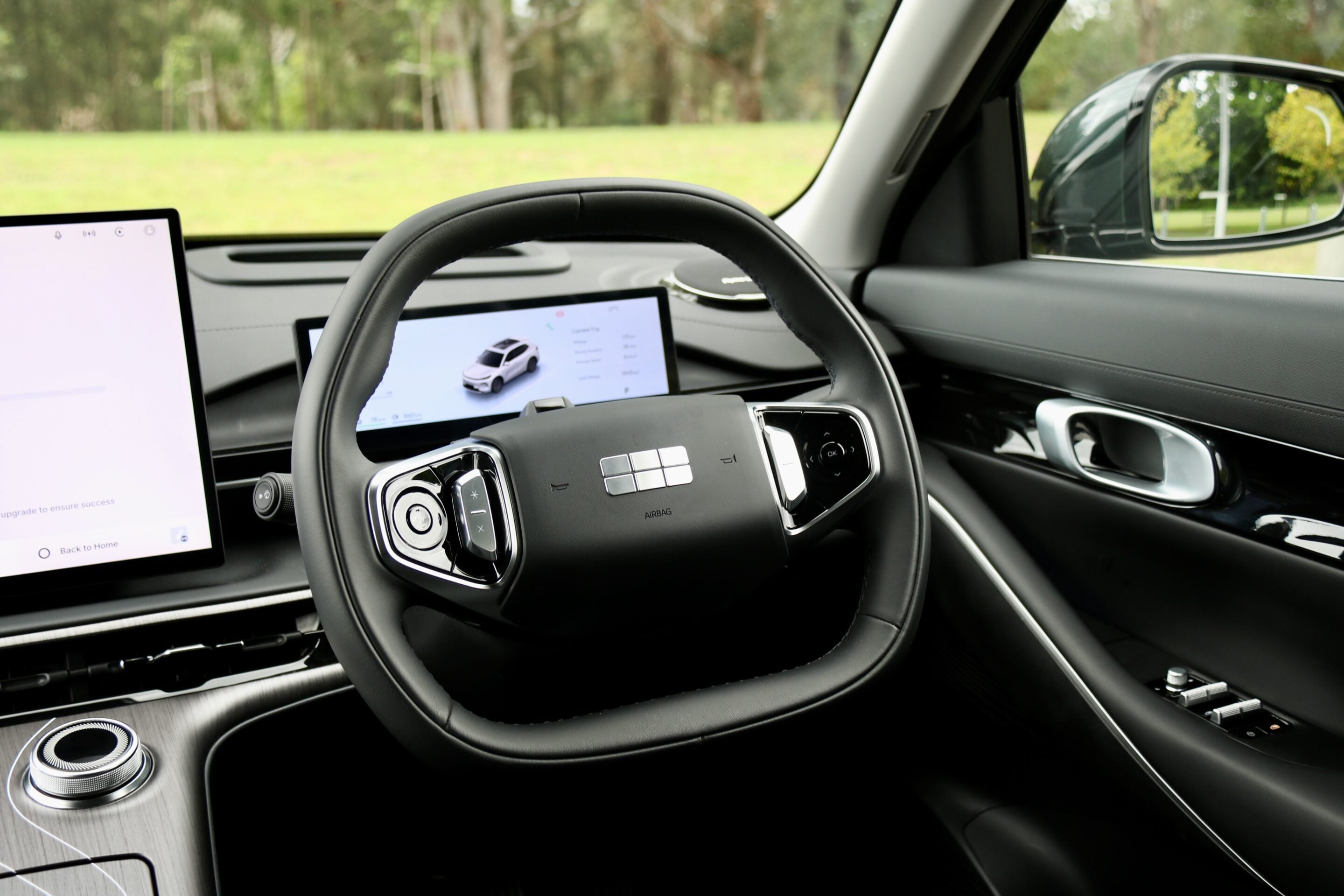
Aside from the exterior styling, the Starray impresses inside the cabin, too, with a huge 15.4-inch central screen, attractive trim, and slick design touches, that certainly don’t look – or feel – cheap. Regardless of the asking price, that’s an important point to note, because no one wants to feel like they are driving a cheap car, even if they are in monetary terms. In that regard, the Starray will make you feel pretty good about your budget-minded purchase. The big screen – oriented in landscape mode – looks neatly placed atop the centre of the dashboard.
On test, the cabled smartphone connection was reliable and clear, and the screen was responsive to command inputs. Call clarity was reported to be excellent from callers whether incoming or outgoing. The gear shift lever on the right side of the column takes a bit of getting used to if you’re new to the game, and there are enough physical controls to assuage the criticism we’d often direct at a complete lack of buttons.
The single most obvious factor inside the cabin though, is the sense of space. First row, or second, head, leg or knee room, and even into the luggage area, this is a well-proportioned medium SUV. With the second row in play, you get 528 litres of storage space, and a decent retractable luggage cover as well. Note that there’s no spare wheel. This isn’t the first time you will have heard us say that a spare of some sort should be standard on all cars in Australia.
What’s the driving experience like?
The driving is also solid without being dynamic. Ride quality and bump absorption is skewed distinctly in favour of comfort around town, which is ideal and bang on for the target buyer. That means body control isn’t as taut as it could be when you hook into a corner at speed, but the target buyer won’t be worrying too much about that kind of driving. Keep in mind, the Geely weighs a hefty 1739kg, meaning it’s not as svelte as a regular petrol vehicle of the same size. The quality of the ride around town is excellent, though, even over sharp speed humps, making it an excellent city commuter.
When you’re driving on electric power alone, without the requirement for the petrol generator, the experience is quiet, refined and quite punchy. When the 1.5-litre fires into life though, it can feel harsh and a little noisy as it whirs away, pushing charge to the battery pack. The pack retains a minimum 20 per cent to always feed the electric motor, offsetting the theoretical maximum electric range, which you can’t actually access. As is common with challenger brands, some of the electronic safety warnings err on the side of enthusiasm, but they aren’t as intrusive as some.
You can work through brake regeneration settings, to find the one you like as well, with moderate the one we favoured during our first drive, and the brakes felt pretty regular once you got used to the initial bite point. The steering is relatively light, even at low speed, and if Geely were to offer a sportier or more powerful version, firmer steering feedback would be the go.
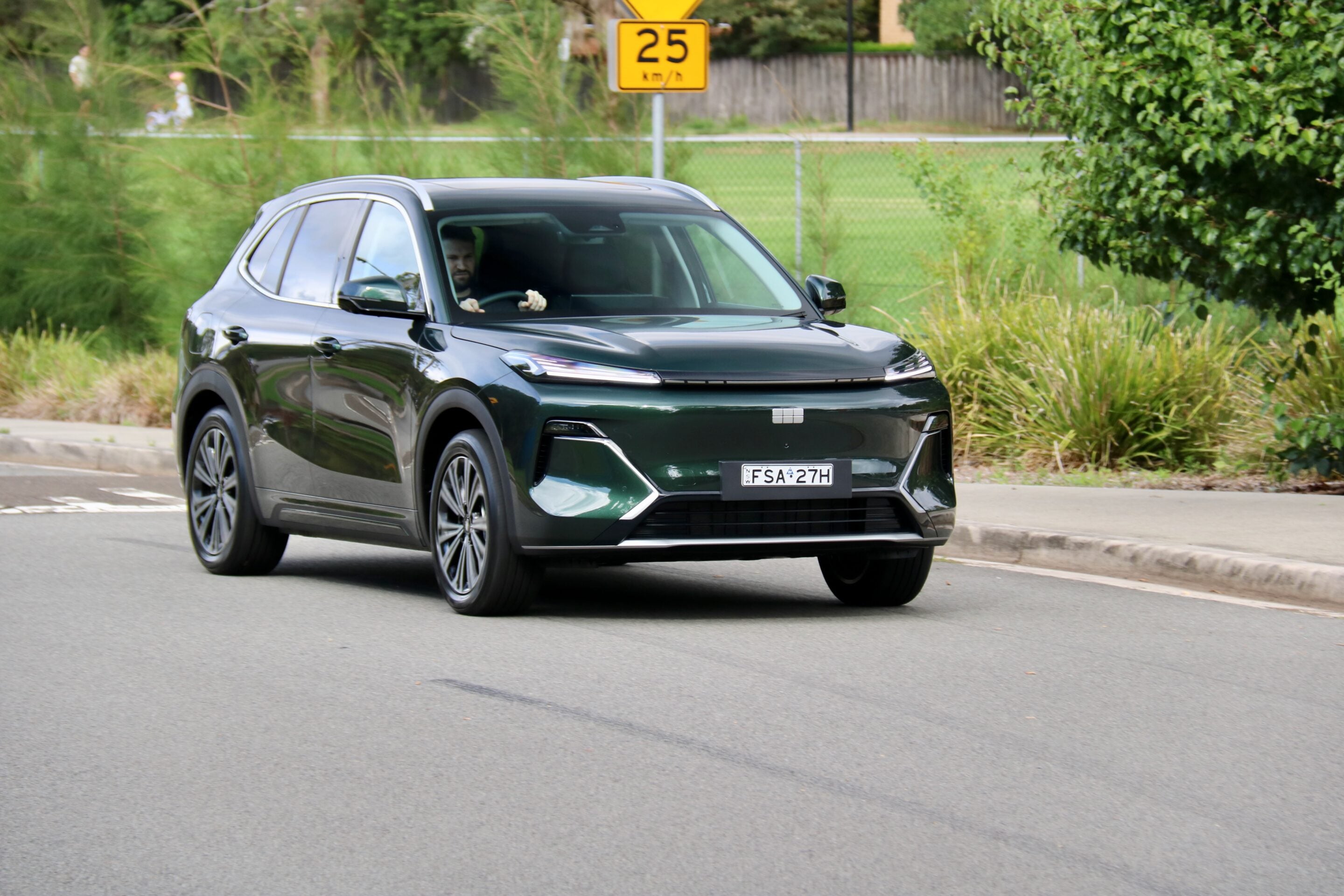
There’s no doubt that for the money you spend, the Geely Starray is an excellent choice in top-spec Inspire guise. If you’re looking to dip a toe into the water of the PHEV lifestyle, this is a low risk way to do it. The caveats remain that retail is hard to predict, and we don’t have the data yet to accurately assess how these challenger brands stand up with 10 years and 150,000km under their belt, but on face value and after our first drive, the Geely is one to consider.
Specs
| Price | $39,990 drive away |
|---|---|
| Engine | 1.5-litre, four-cylinder petrol |
| Power | 160kW |
| Torque | 262Nm |
| Transmission | Hybrid transmission |
| Battery | 18.4kWh |
| 0-100km/h | 8.0 seconds |
| Weight | 1739kg |
| Fuel consumption | 2.4L/100km (combined) |
| Fuel Tank | 51 litres |
| L/W/H/WB | 4740mm/1905mm/1685mm/2755mm |
| Warranty | Seven-year/unlimited kilometre |
| Overall rating | 7.2/10 |
There have been plenty of milestone days through my career in cars.
There was the time I test drove the world’s original automobile – Karl Benz’s Benz Patent Motorwagen from 1886. It wasn’t quite the real deal, just one of the identical replicas built by Benz apprentices in Germany to celebrate the 100th anniversary of the world’s first motor maker, but what a car. It was awful. And scary. And we had to jump off and push it up a slight slope during a short test drive in a tiny park in Canberra. Still, it was something special. And now I’m thinking of many other special days.
There was the first time I drove a Rolls-Royce, when I was so nervous that my sweating palms were having trouble getting any sort of grip on the Bakelite steering wheel that could have been stolen from the 1950s.
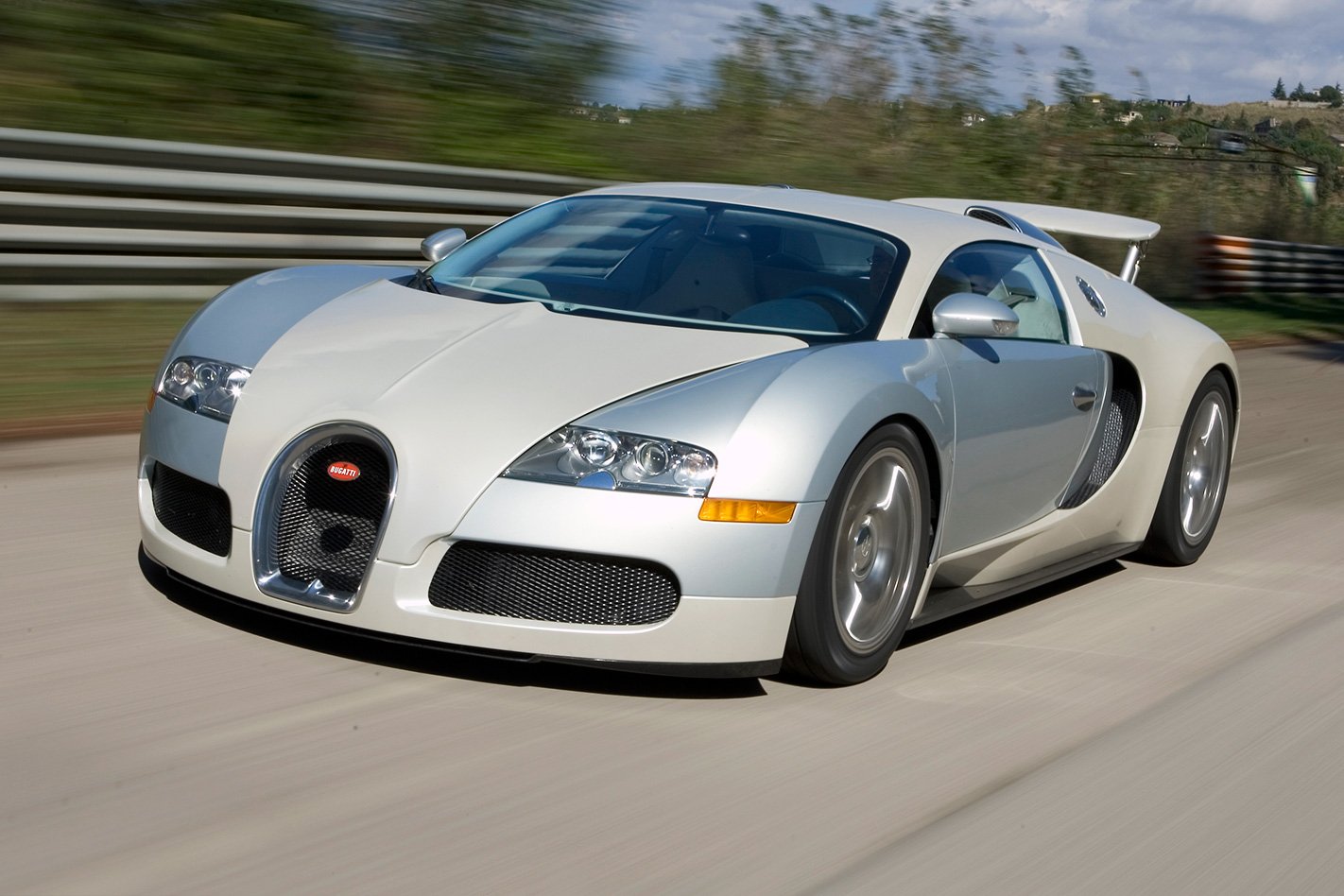
Then there was the day I drove a Bugatti Veyron at the Sandown racetrack and rocketed up the back straight much faster than I had done while racing a V8 Supercars Commodore in the Sandown 500.
My first trip to Japan to drive the original front-wheel drive Mazda 626 and my first visit to Europe, as a guest of Alfa Romeo on a trip which taught me as much about Italy and Italians as the new Alfasud funster we were driving, were both hugely memorable.
So, too, was riding with Peter Brock and Dick Johnson, interviewing Carlos Ghosn and Mark Reuss, diving into the design studios at Ford and Holden for the first time, witnessing a live crash test at Mercedes-Benz, and riding along in an autonomous BMW 7-Series prototype…
Now there is a new milestone. It happened on Thursday, November 13, 2025. That’s the day when China lobbed a sub-$25,000 electric car into Australia.
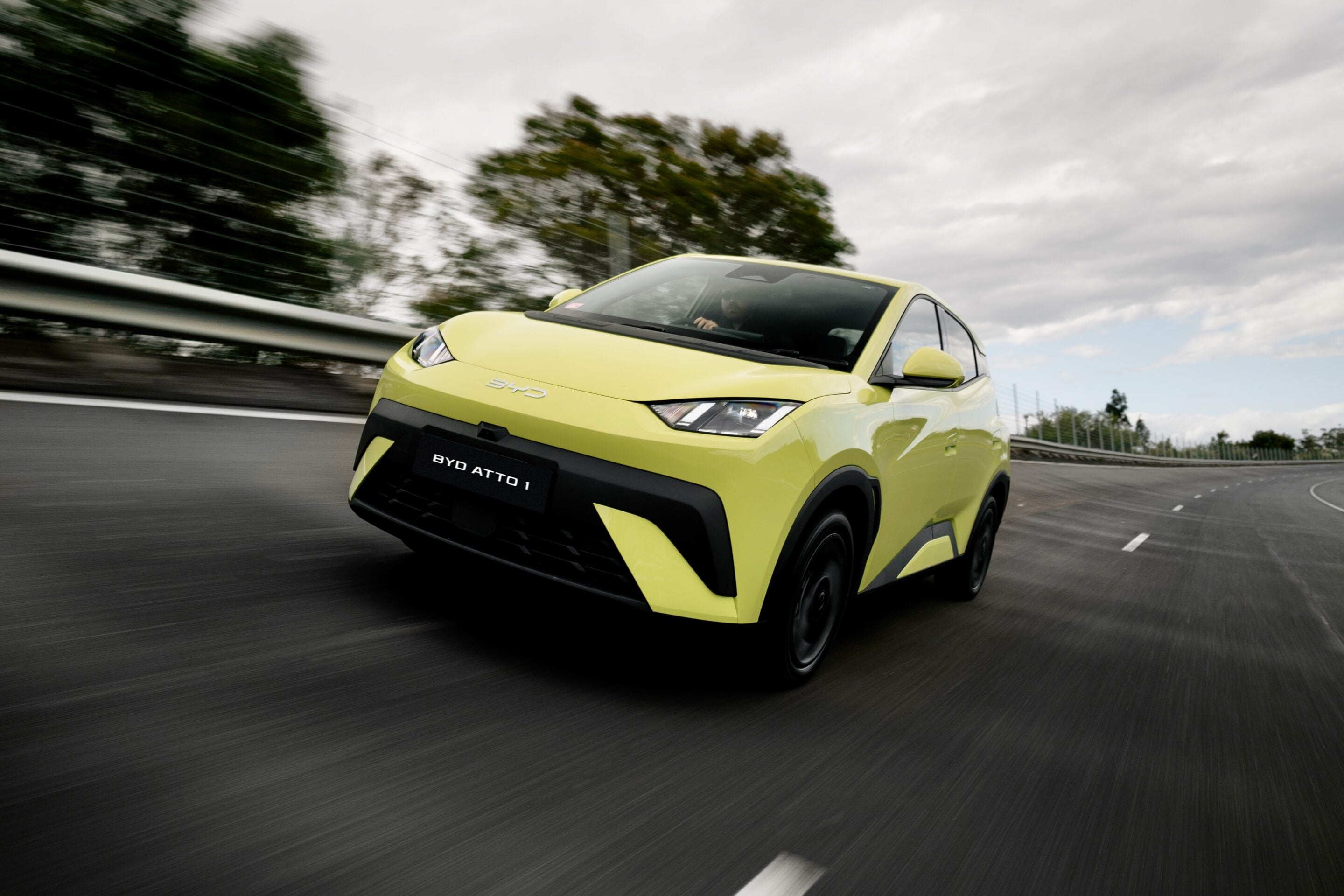
Why was it a milestone? Because it provided the indisputable proof that affordable EVs are real, and that China has beaten the rest of the world to get them onto local roads.
The car in question is the BYD Atto 1 and it doesn’t matter if it is good, bad, indifferent or – like so many new cars in 2025 – just plain ordinary. It’s all about the price point. And the value.
The starting price for the Atto 1 is $23,990, before on-road costs. So, in reality it’s going to be somewhere a little north of $25,000 as the new owner drives away from the showroom, but it’s the $23,990 headline which is attracting the interest and triggering BYD’s rivals.
The Atto 1 is an ideal ‘first and last’ car for city living. These F&Ls are people buying a first car, usually as freshly-minted P-platers, or the old(er) timers looking for their retirement wheels.
They don’t want a sports car, don’t need a family SUV, and are definitely not planning to hook a giant caravan to the back of a pick-up to set off on ‘the lap’ of Australia. They want something simple, easy and affordable.
Increasingly, they are also looking at electric cars. As time moves forward, their numbers will grow. Potentially, at least, quite rapidly. How do I know? Because I remember another milestone event, back in the ’90s.
At that time, I was an eyewitness to the phenomenal growth triggered by something relatively simple – drive-away pricing.
It was a bright idea from a mercurial sales chief, Simon Pinnock, who liked golf as much as selling cars with Hyundai in NSW. He realised there was considerable pushback against newbie Korean cars because they were unproven in Australia. He was looking for the vital ‘permission to buy’ which has triggered the latest move into 10-year warranty packages, even by solid brands including Nissan and Mitsubishi.
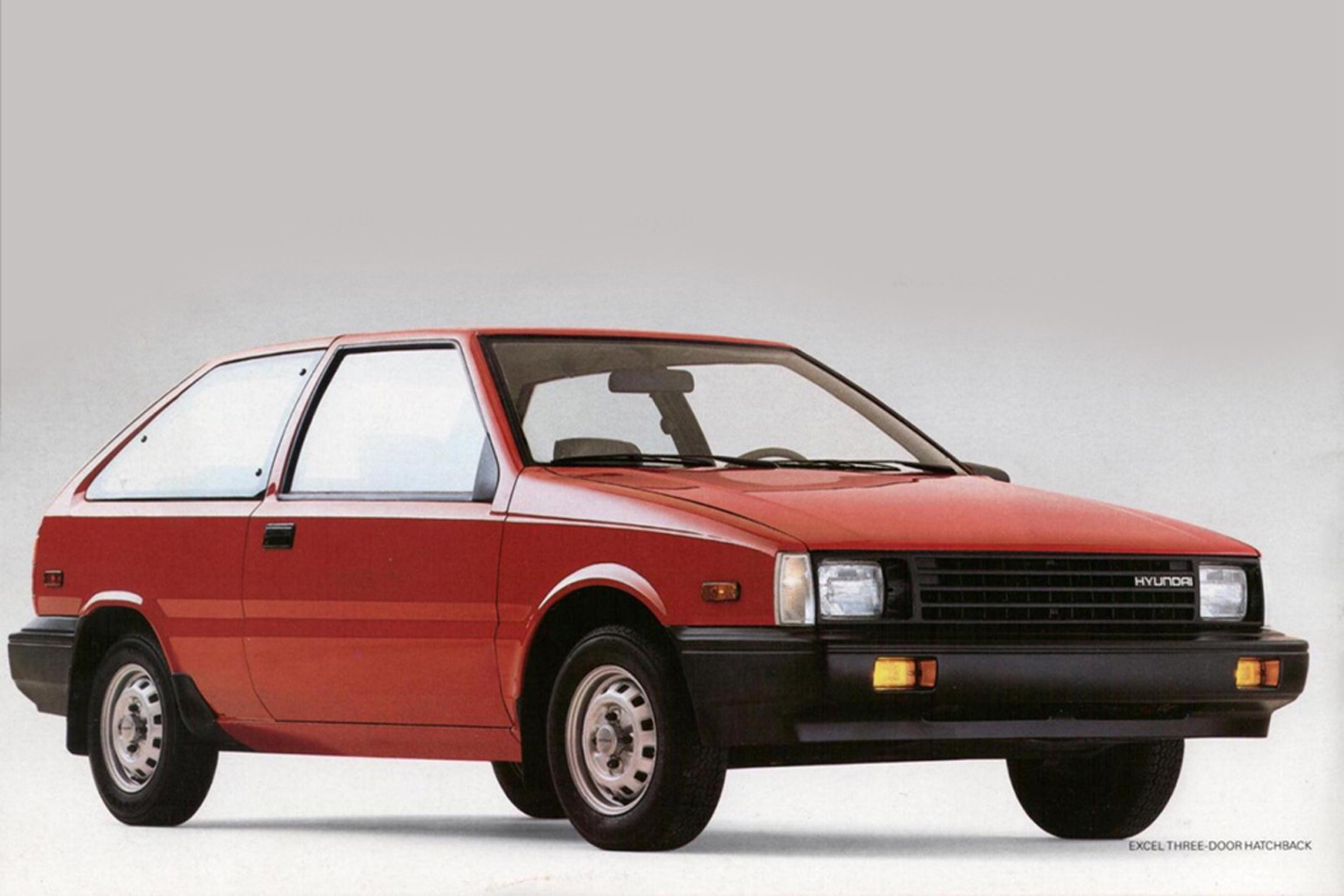
His gimmick was a $13,990 deal for the Hyundai Excel (above), as the ‘drive away, no more to pay’ solution eliminated the need to haggle with a dealer or worry about added extras. It effectively covered the $1500 of government charges and pre-delivery costs, creating a no-fuss transaction.
And it worked. Like a champion.
Driveaway deals are commonplace in 2025, especially among the budget brands and the latest newbie challengers from China, because they simplify car buying and provide a deal that is easy to understand. It will be the same soon on the EV front, but there is another question still to be answered.
How long before there is a baby EV with a sub-$20,000 bottom line?
This article first appeared in the January 2026 issue of Wheels. Subscribe here and gain access to 12 issues for $109 plus online access to every Wheels issue since 1953.
Australian pricing and specifications for the Kia EV4 electric mid-size sedan have been revealed ahead of its imminent on-sale date. Priced from $49,990 plus on-road costs, the EV4 sedan undercuts its Tesla Model 3 main rival by $4910. Three models are available and the longest-range version – the mid-spec Earth – is rated at 612km (WLTP) for driving range.
Featuring a 58.3kWh lithium-ion nickel-cobalt-manganese (NCM) battery, the Kia EV4 Air can travel up to 480km on a charge (WLTP). Based on the 400-volt version – not 800V as in the EV6 or EV9 – of the company’s E-GMP electric vehicle platform, it can be charged at up to 135kW for a claimed 10 to 80 per cent charge time of 29 minutes.
The upper-spec Earth and GT-Line use a larger 81.4kWh battery and their claimed 10-80 per cent charge time is 31 minutes. The EV4 range can be AC charged at up to 11kW, while Vehicle-to-Load (V2L) functionality is standard.
The EV4 range in Australia for now uses a 150kW/283Nm front-mounted electric motor giving a claimed 0-100km/h time of 7.4 seconds for the Air and 7.8 seconds for the Earth and GT-Line and a top speed of 170km/h. The recently revealed EV4 GT, with its 215kW dual-motor drivetrain, is under consideration for Australia.
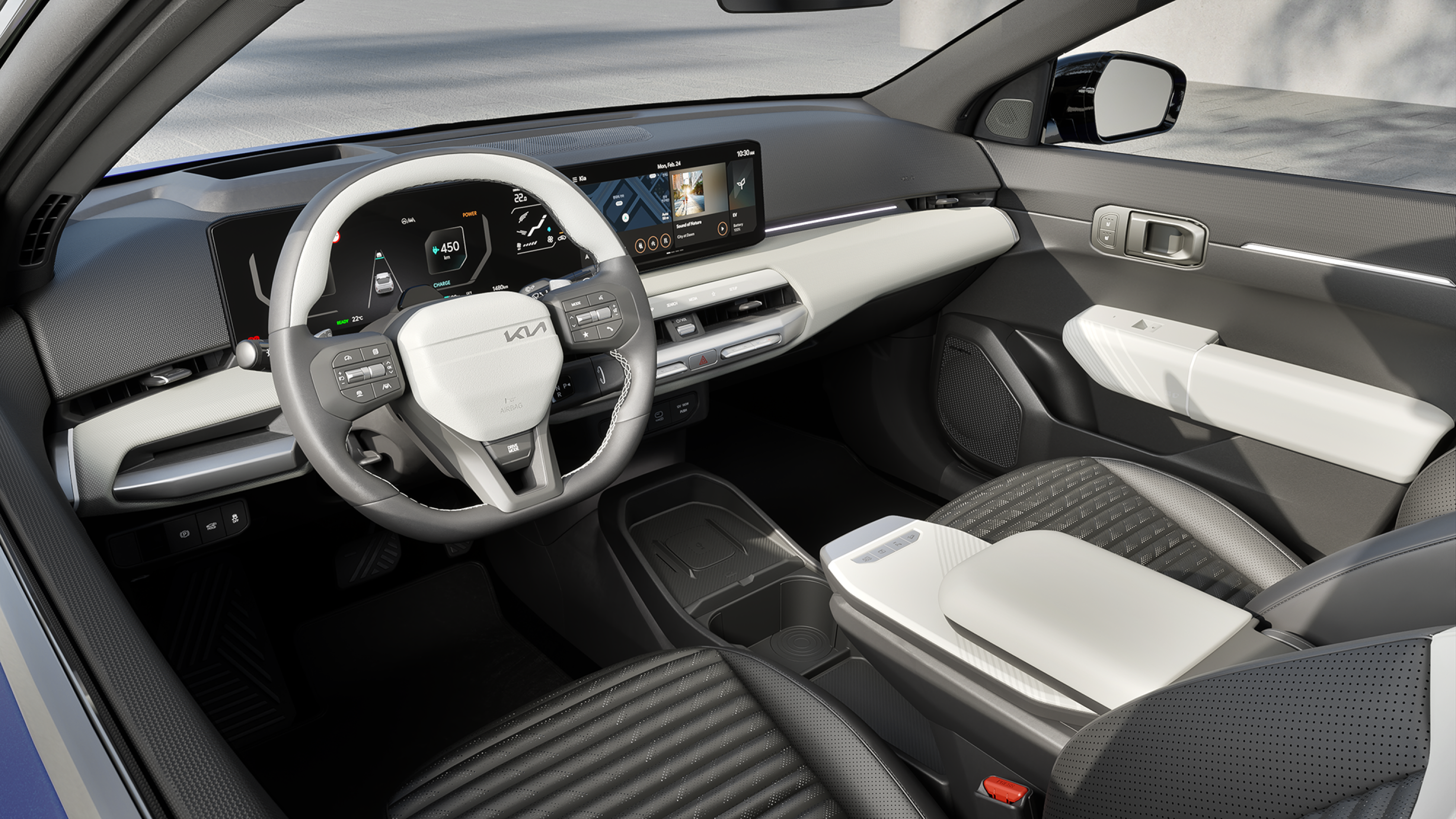
The EV4 sedan measures 4730mm long, 1860mm wide, 1480mm tall and rides on a 2820mm long wheelbase, making it 10mm longer than a Model 3, 10mm wider, 39mm taller and using a 55mm-shorter wheelbase. The EV4 weighs between 1805kg and 1912kg, and its boot measures 490 litres.
Three models are available in the Australian EV4 range: base Air, mid-spec Earth and top-spec GT-Line, with the Air using the smaller battery and the Earth and GT-Line the larger. Even the Air is well equipped with a full suite of active safety features, as well as dual 12.3-inch displays with over-the-air updates and the Kia Connect live services. Scroll down to see a full standard equipment list.
2026 Kia EV4 pricing (plus on-road costs):
| Air Standard Range | $49,990 |
|---|---|
| Earth Long Range | $59,190 |
| GT-Line Long Range | $64,690 |
Kia K4 Air standard features:
- 17-inch alloy wheels with a tyre repair kit
- Automatic dusk-sensing LED lighting
- Automatic rain-sensing wipers
- Keyless entry with push button start and remote start
- Auto-folding/heated mirrors
- Cloth upholstery
- Dual-zone automatic climate control with 5.0-inch touch panel and rear air vents
- Two-spoke synthetic leather steering wheel
- 12.3-inch digital driver’s display
- 12.3-inch touchscreen with live services and over-the-air updates
- Satellite navigation
- Wired and wireless Apple CarPlay and Android Auto
- AM/FM/DAB+ digital radio
- Six-speaker sound system
- 4x USB-C ports
- Vehicle-to-load (V2L) functionality
- Sport, Normal, Eco, Snow and My Drive driving modes
- 7x airbags
- Autonomous emergency braking with car, pedestrian, cyclist, junction turning/crossing and direct/oncoming lane change detection, steering assistance and automatic evasive steering assist
- Lane keeping assistance with adaptive lane guidance
- Adaptive cruise control with stop and go functionality
- Blind-spot monitoring with rear cross-traffic alert (with braking)
- Safe exit warning
- Driver attention monitoring
- Rear occupant alert
- Traffic sign recognition with speed limit alert
- Reversing camera
- Auto high beam
- Front and rear parking sensors
- Burglar alarm
EV4 Earth model adds:
- Long Range 81.4kWh battery
- 19-inch alloy wheels
- Cloth and synthetic leather upholstery
- 10-way electric driver’s seat
- Heated front seats
EV4 GT-Line model adds:
- Sportier GT-Line exterior styling
- Sunroof
- Head-up display
- Electric bootlid
- 10-way electric front passenger seat, driver’s memory
- Ventilated front seats
- Synthetic leather upholstery
- Adaptive auto high beam
- 360-degree camera with blind-spot camera feed
- Safe exit assist
- Rear privacy glass
- Heated three-spoke synthetic leather steering wheel
- Ambient mood lighting
- Wireless phone charger
- Eight-speaker Harman Kardon sound system
- Rear autonomous emergency braking
- Remote parking
