
A joint venture between automotive manufacturer Volvo and fellow Swedish company SSAB has been established to develop fossil-free steel, bringing net carbon emissions of a car’s life cycle down.
The collaboration is a first for any automotive company, reflecting Volvo’s recent commitment to go green by investing in battery technology and the ultimate aim for its entire range of cars to be EVs by 2030.
The partnership makes Volvo Cars the first carmaker to work with SSAB and its ‘Hybrit’ initiative – the steel industry’s most ambitious and advanced project in fossil-free steel development.
Hybrit was started by SSAB, together with iron ore producer LKAB and energy firm Vattenfall. It aims to replace coking coal, traditionally needed for iron ore-based steelmaking, with fossil-free electricity and hydrogen. The result is expected to be the world’s first fossil-free steelmaking technology, with virtually no carbon footprint.
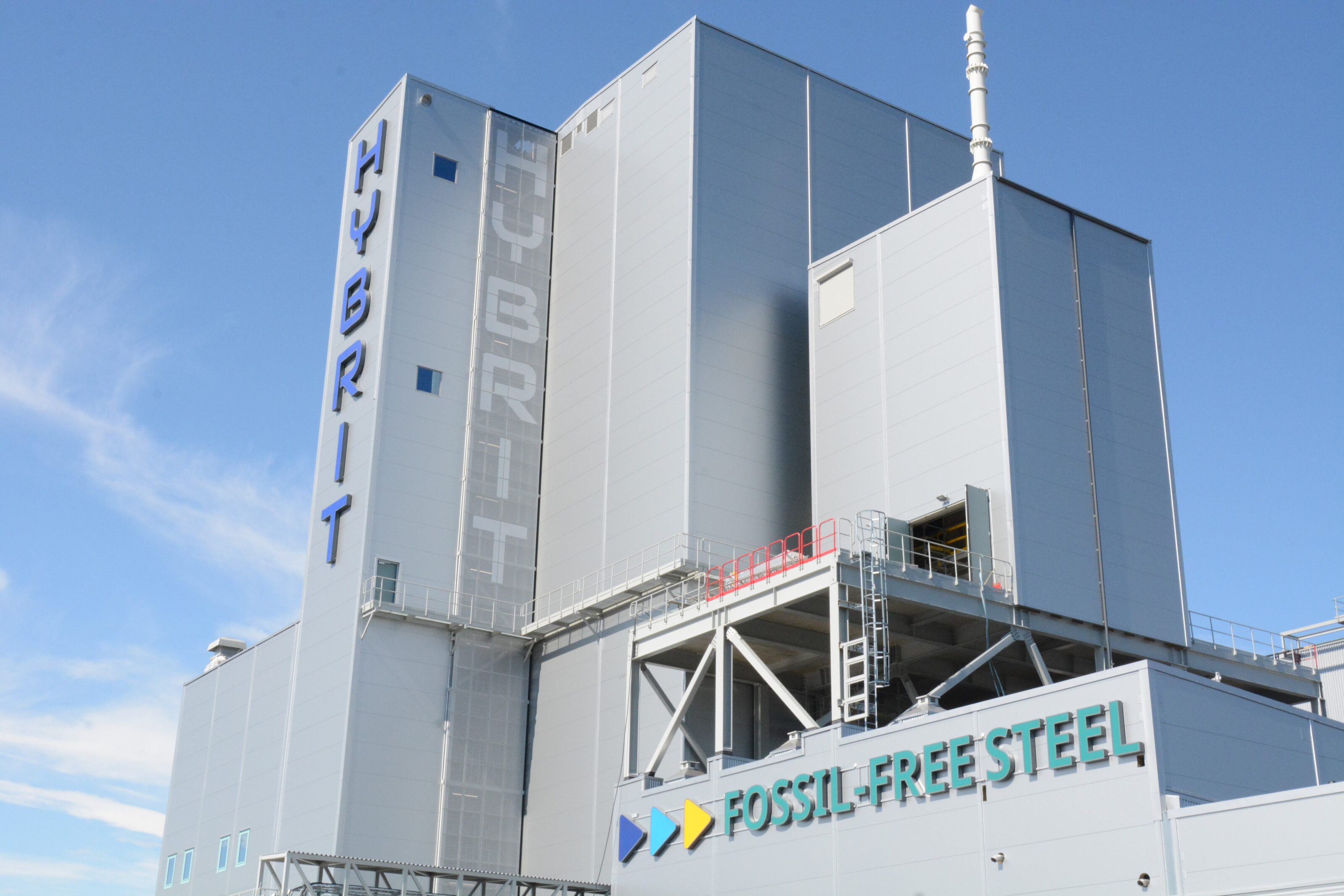
The ultimate aim from SSAB is to supply the fossil-free steel on a commercial scale by 2026, with Volvo utilising the product in concept cars for testing before implementing the materials in its production cars.
Volvo’s Chief Executive, Håkan Samuelsson, says the development of fossil-free steel is important for Volvo in its aim to reduce carbon emissions.
“As we continuously reduce our total carbon footprint, we know steel is a major area for further progress,” said Samuelsson.
“The collaboration with SSAB on fossil-free steel development could give significant emission reductions in our supply chain.”
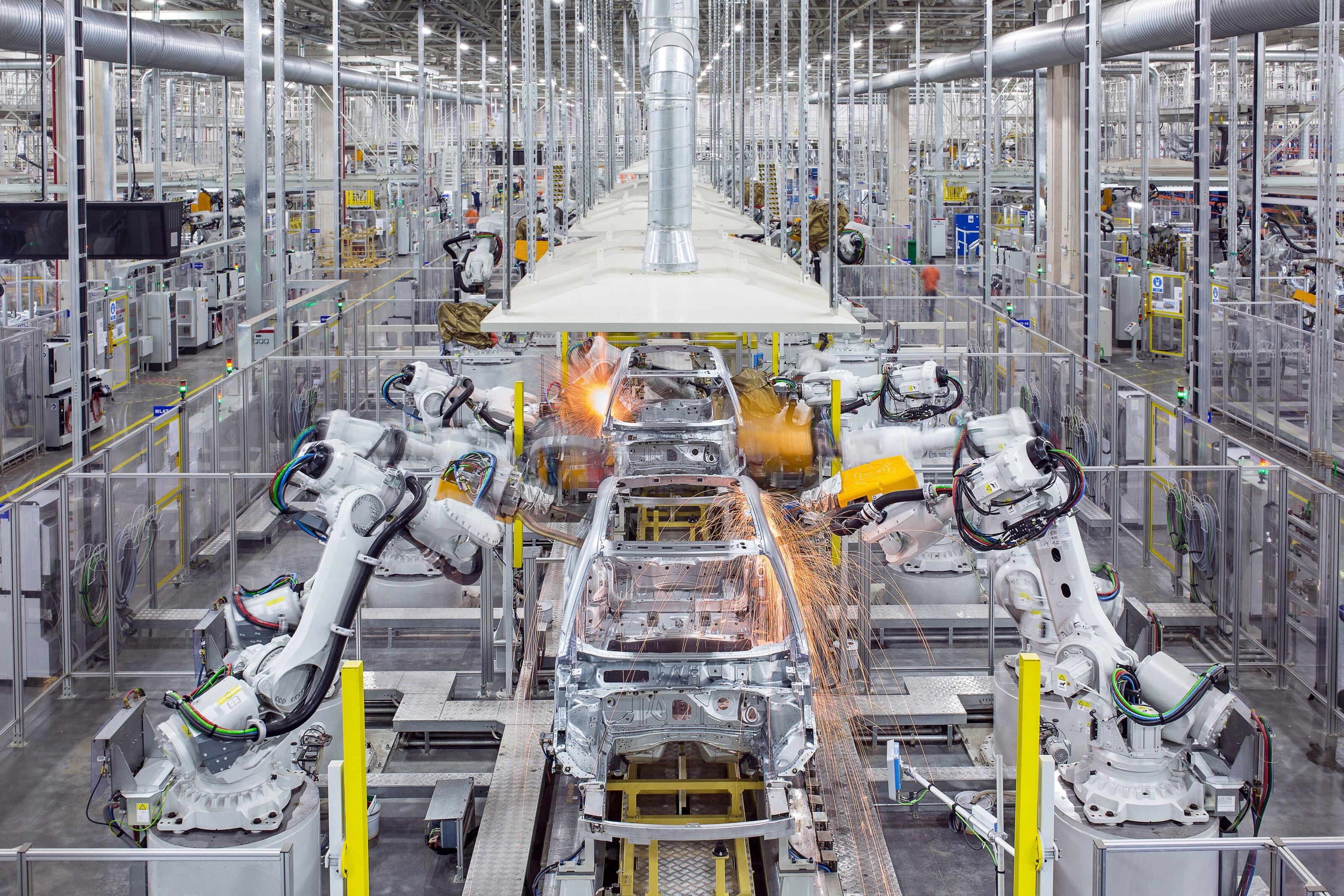
SSAB CEO Martin Lindqvist believes the new process has next to no carbon footprint and will help Volvo in achieving its goal with a larger ambition of being used across the industry.
“We are building an entirely fossil-free value chain all the way to the end customer,” said Lindqvist.
“Our breakthrough technology has virtually no carbon footprint and will help strengthen our customer’s competitiveness.
“Together with Volvo Cars, we aim to develop fossil-free steel products for the cars of the future.”
Currently, steel and iron production accounts for 35 per cent of total CO2 emissions in the production process for Volvo’s internal combustion engine powered cars and 20 per cent in its electric vehicles, with the global steel industry accountable for seven per cent of overall carbon emissions.
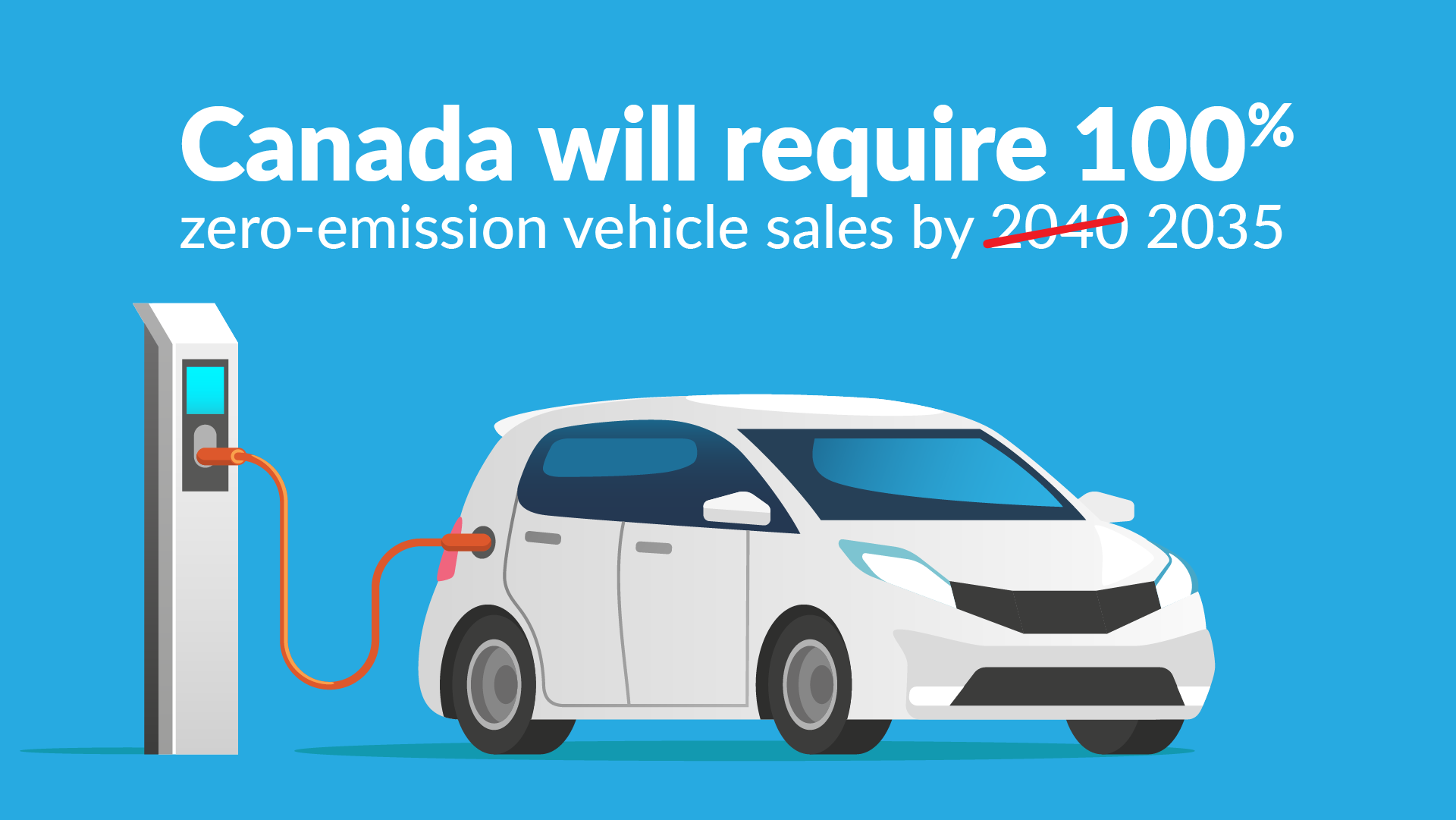
The Canadian Government has announced it wants to bring forward its plan to achieve zero-emission vehicle sales from 2040 to 2035, aiming at eliminating internal combustion engine sales within 14 years.
With the plan being implemented in stages, Canada’s ultimate aim is to reach net zero emissions by 2050, with vehicles currently making up around one quarter of the country’s greenhouse gas emissions.
Canadian Minister of Transport, Omar Alghabra, says an CAD$8 billion (AU$8.6bn) investment into clean energy production in the automotive industry will help the country to achieve its zero-emission vehicles goal.
“Only bold climate policies lead to bold results,” said Alghabra.
“Through measures aimed at accelerating the transition to 100 per cent zero-emission vehicles sales, we will continue building a cleaner and more resilient economy, while also creating good jobs and opportunities for all Canadians.
“We will also continue to support the automotive sector, including through our investment of $8 billion to accelerate the industrial transition.”
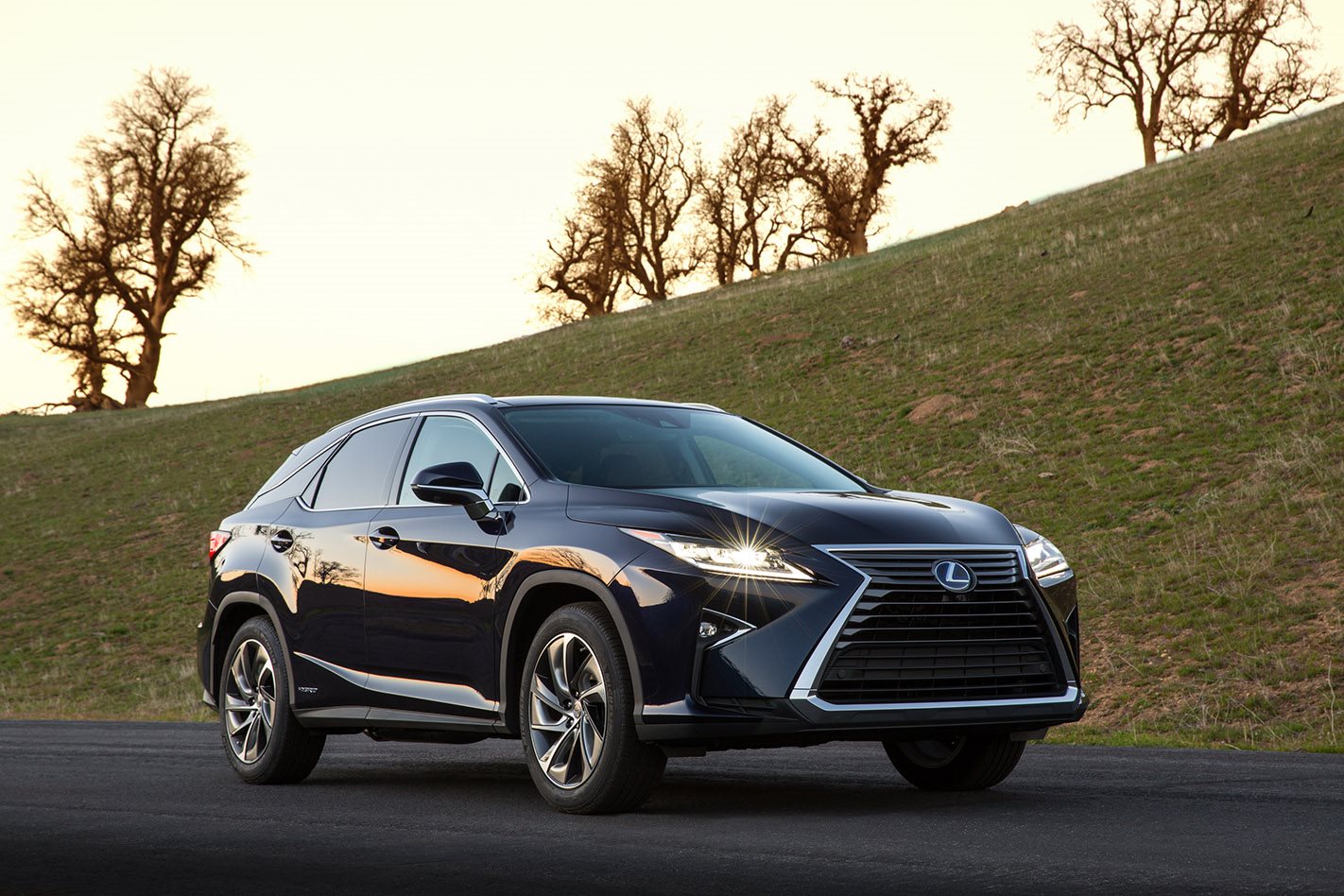
Prime Minister Justin Trudeau backed the announcement on Twitter, saying he believes it’s the best way forward for the nation’s economy and environment.
“That’s right – by 2035, all new cars and passenger trucks sold must be zero-emission,” he tweeted.
“That’s how we’ll build a cleaner, stronger economy [which] both creates good jobs and cuts down pollution.”
Although Canada doesn’t have any major vehicle manufacturers to call its own, Ford, General Motors, Honda, Stellantis and Toyota all have plants in the country.
This is the generational model that will take the Volkswagen Golf to its 50th anniversary in 2024.
The question is whether the prospect of such a milestone prompted the German brand to abandon decades of evolutionary approach to the world’s most classless hatchback.
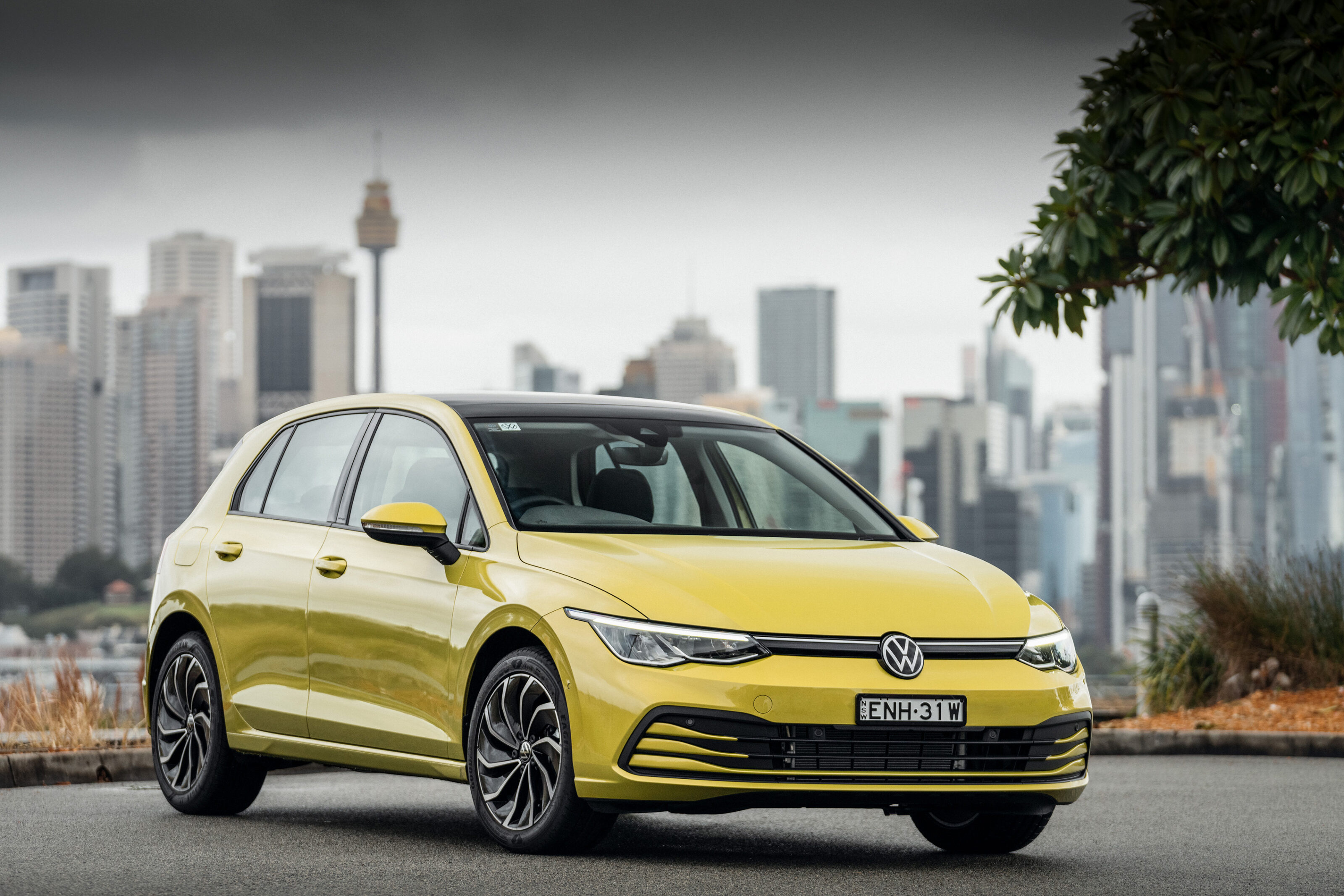
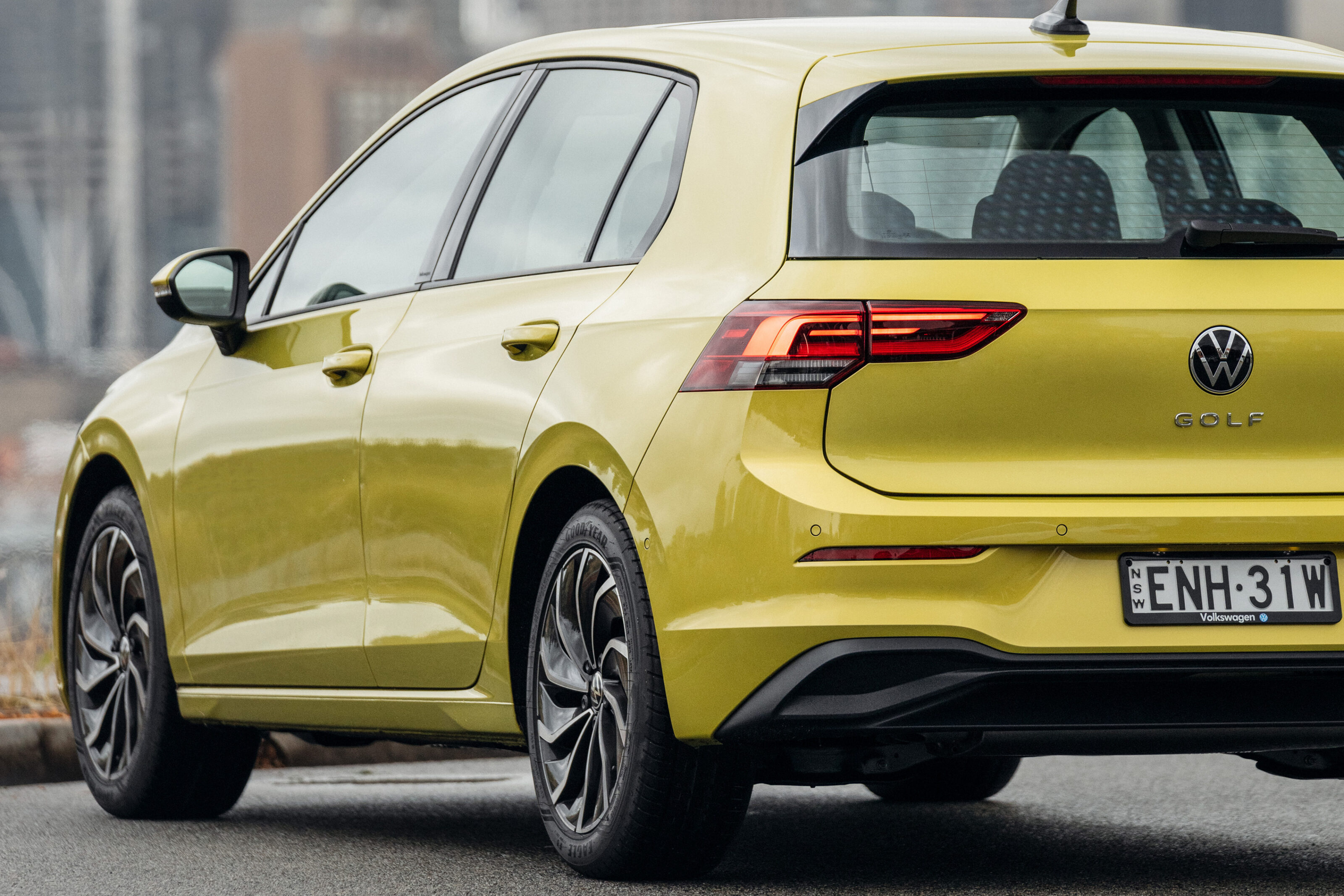
VW’s designers have certainly tried to be braver with the Golf’s exterior. While few will confuse the shape – including that trademark thick rear pillar – for any other five-door, the sheetmetal has lost some of its typically clean lines.
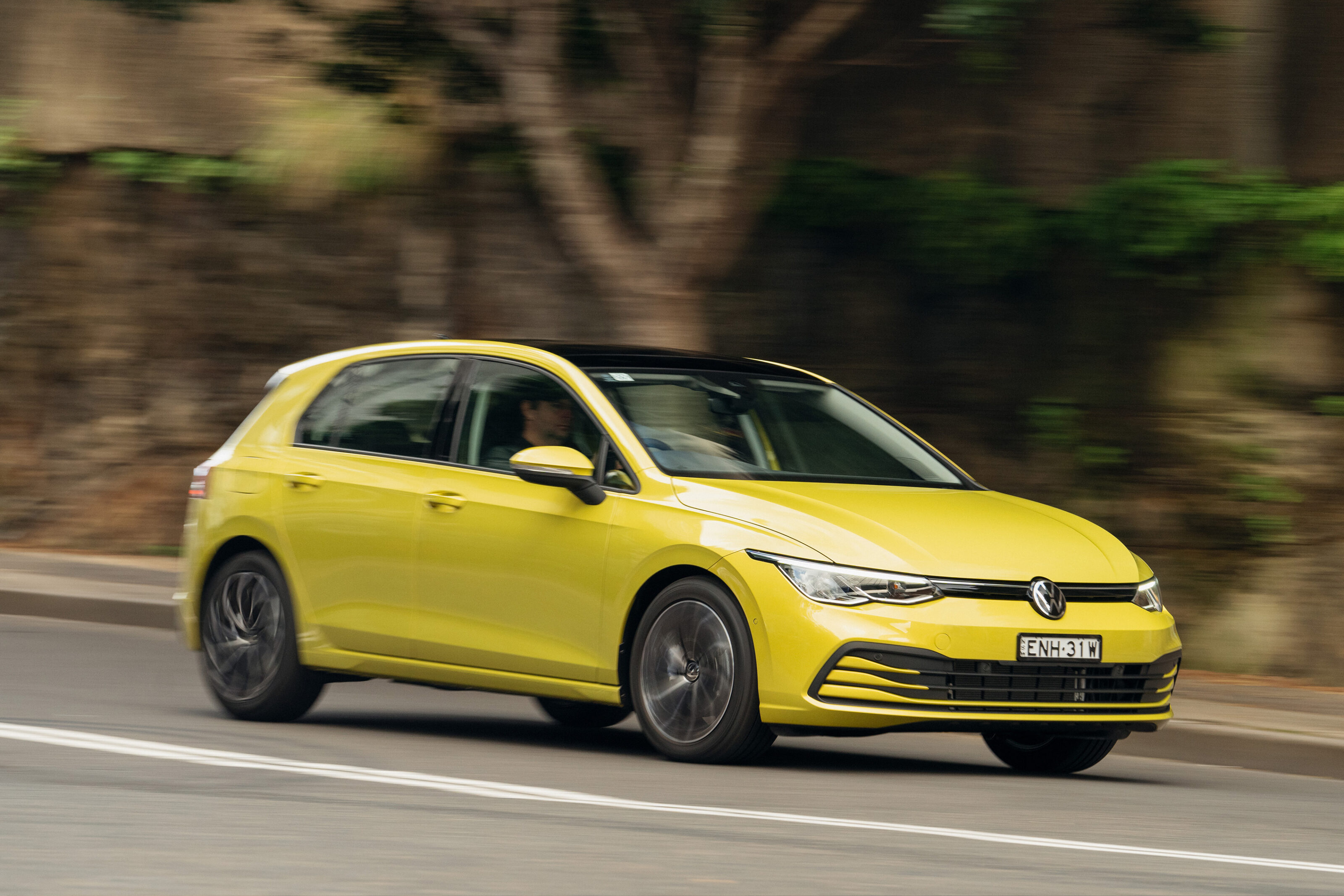
The conjoined grille and headlights have become ever narrower and there are even some boisterous paint options such as the Pomelo Yellow pictured here.
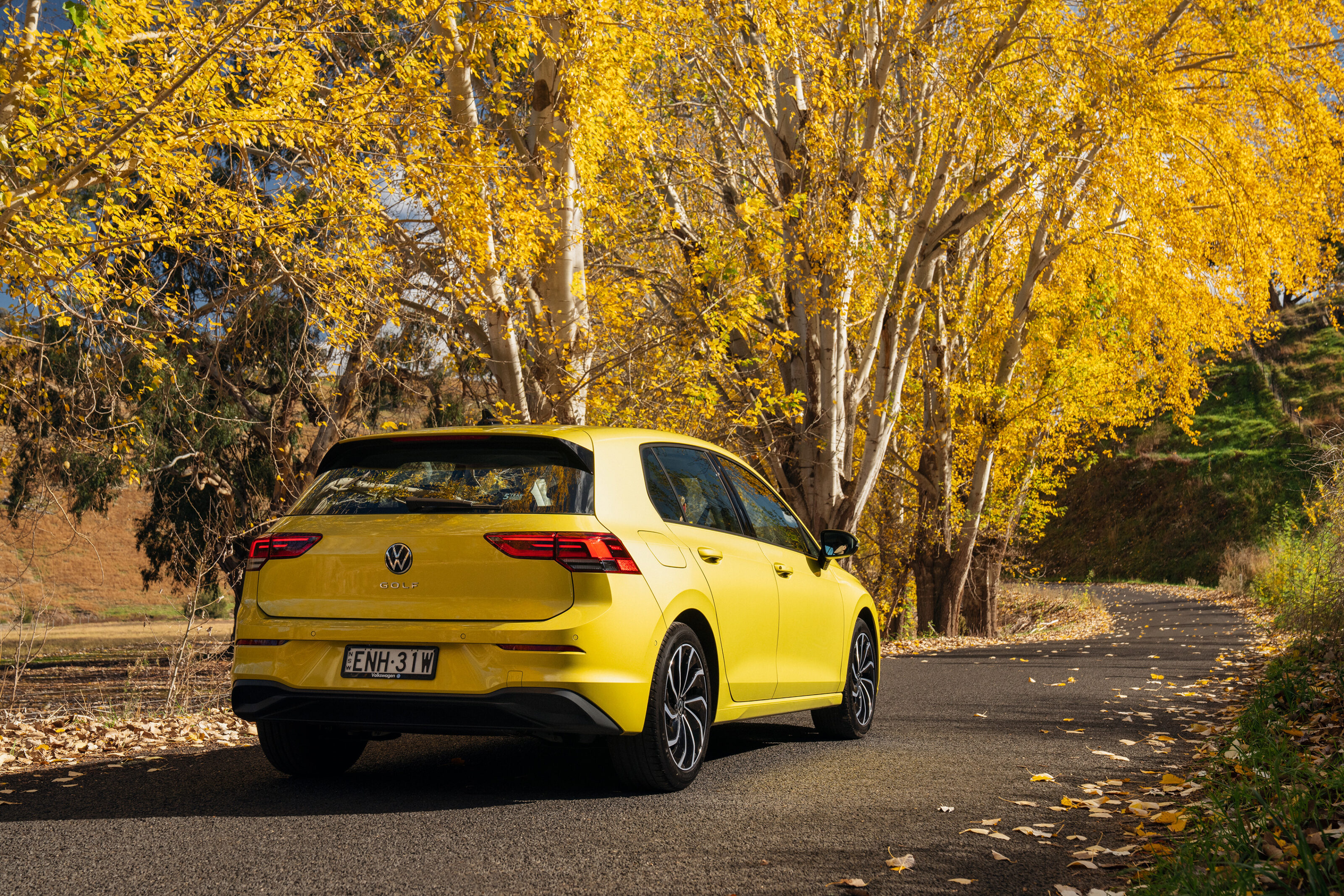
Volkswagen is pitching the Mk8 as its most technologically advanced Golf yet, and there’s a step forward in price to accompany it.
The range starts below $30,000 only with a manual gearbox, meaning most buyers need $31,950 before on-road costs for the base model with an automatic transmission.
The Golf Life we’re specifically reviewing costs from $34,250, with the $37,450 R-Line the last of the regular models before the $53,100 GTI hot hatch.
Although there’s a broader suite of driver-assistance systems (including a semi-autonomous steering function) and a digital dashboard double act for every model, the Life is the minimum starting point for those seeking a properly sophisticated Golf.
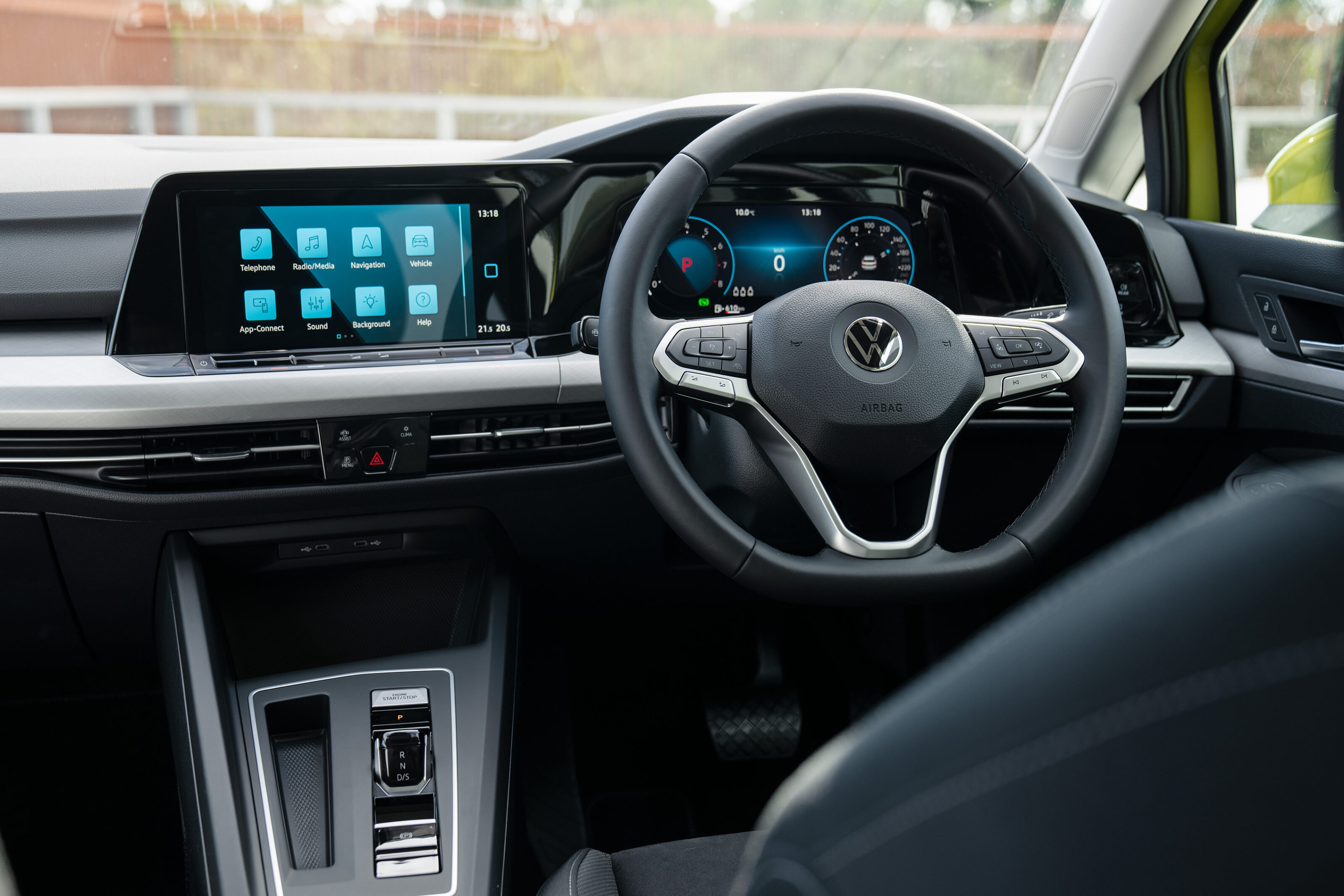
Life introduces a larger, 10.0-inch centre touchscreen over the base model’s 8.25-inch unit plus a higher-resolution driver display with increased customisation.
Over the entry grade, the Life also adds wireless smartphone charging, wireless Apple CarPlay/Android Auto, integrated navigation, keyless entry, ambient interior lighting, and two extra safety features comprising Exit Warning and Emergency Assist.
R-Line tech additions are auto high beam (surprisingly missing from the Life), driving modes and touch-control steering wheel buttons.
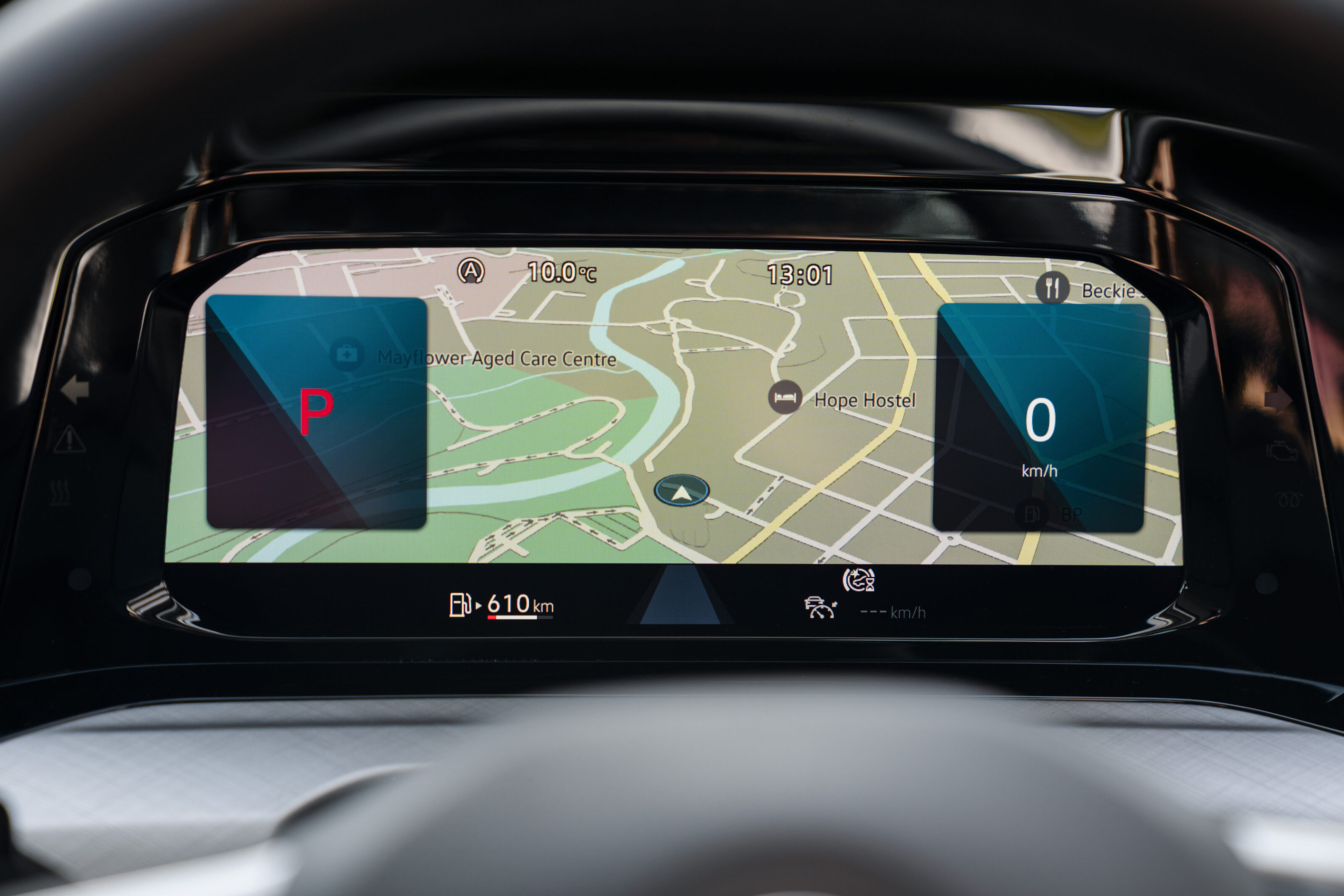
With the latest Golf following the minimalist cabin trend, the infotainment display is now the primary access point for climate controls.
There are separate temperature touch buttons (Life and R-Line), but a CLIMA button below needs to be pressed to access the air recirculation and fan speed/direction functions.
If the deletion of physical climate controls is a loss for ergonomics, the screen offers a clever alternative ‘Smart Climate’ menu that allows front occupants to make simple, instructional requests such as Defog Windows, Warm Feet, Cool My Feet and Fresh Air.
Volkswagen is pitching the 8 as the most technologically advanced Golf yet, and there’s a step forward in price to accompany it
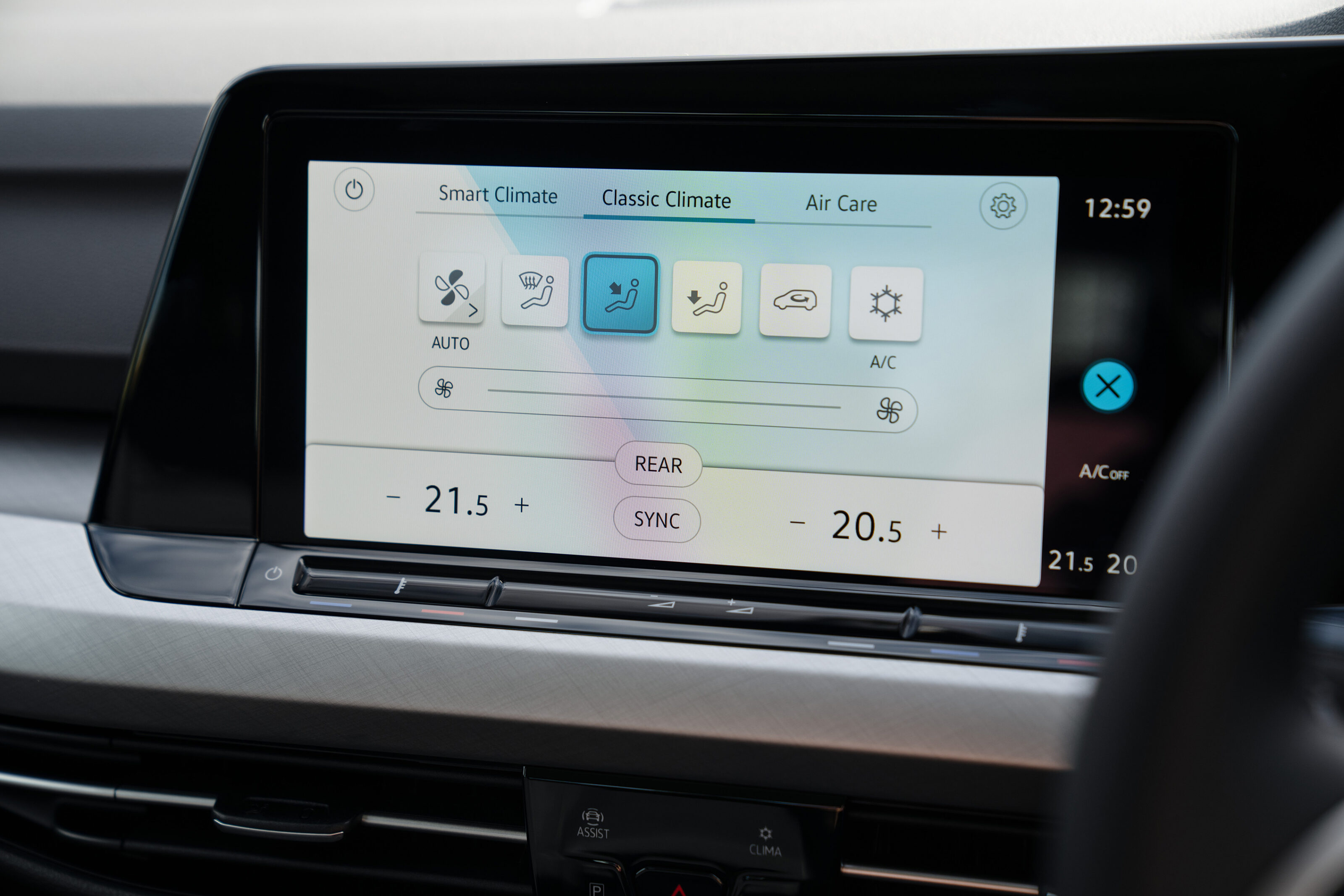
It doesn’t take long to find some harder plastics – including the more cheaply constructed rear door cards – though the Golf 8 largely upholds the nameplate’s tradition for high perceived quality.
This includes attention to detail such as storage areas that are either flocked (the large door pockets) or lined with rubber (centre console cupholder section and tray strip).
The optional microfleece/cloth seats (fitted to our Life test car) are not only exceptionally comfortable but look about as posh as non-leather upholstery can get.
They form part of a $2000 Comfort & Style pack – for the Life only – that also adds a tilt/slide sunroof and an expansion of ambient lighting colours (from 10 to 30).
Life and R-Line models can also be equipped with a head-up display and a 480-watt Harman Kardon audio system through a $1500 Sound & Vision pack.
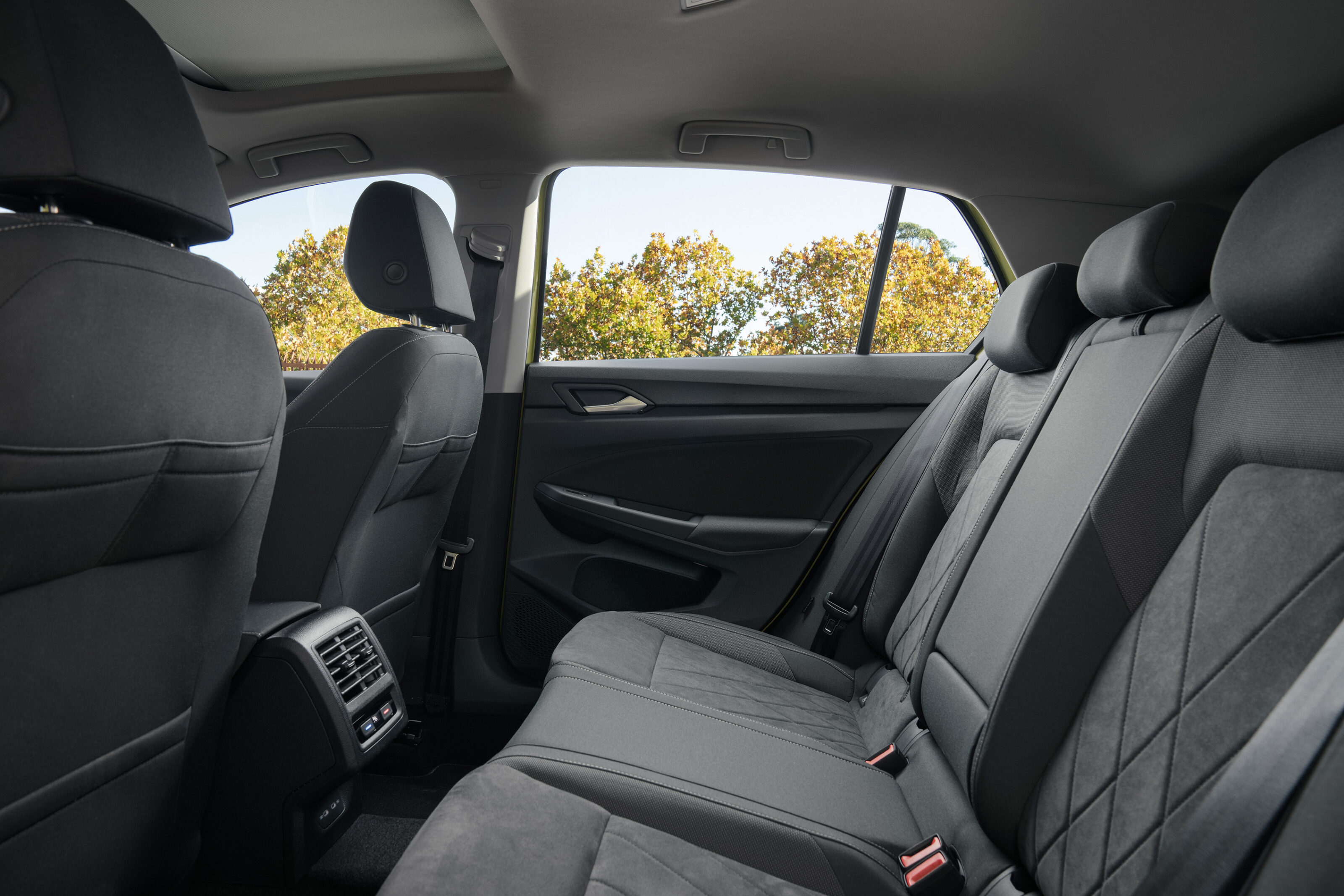
With little change to the Golf’s footprint, rear-seat space remains far from class-leading yet sufficiently roomy for most adults.
There are rear vents with dedicated temperature control plus two extra USB-C ports, though the base Golf misses out on the centre armrest (with cupholders) and multi-pouch front seatbacks of other models.
The Life and R-Line also feature a thru-port to a boot that is a fraction smaller than before at 374 litres. There are two floor-height options as well as 60:40 folding seatbacks.
A Golf wagon is again offered for those needing more cargo space, priced from $33,550 in base form or from $36,250 in Life guise.
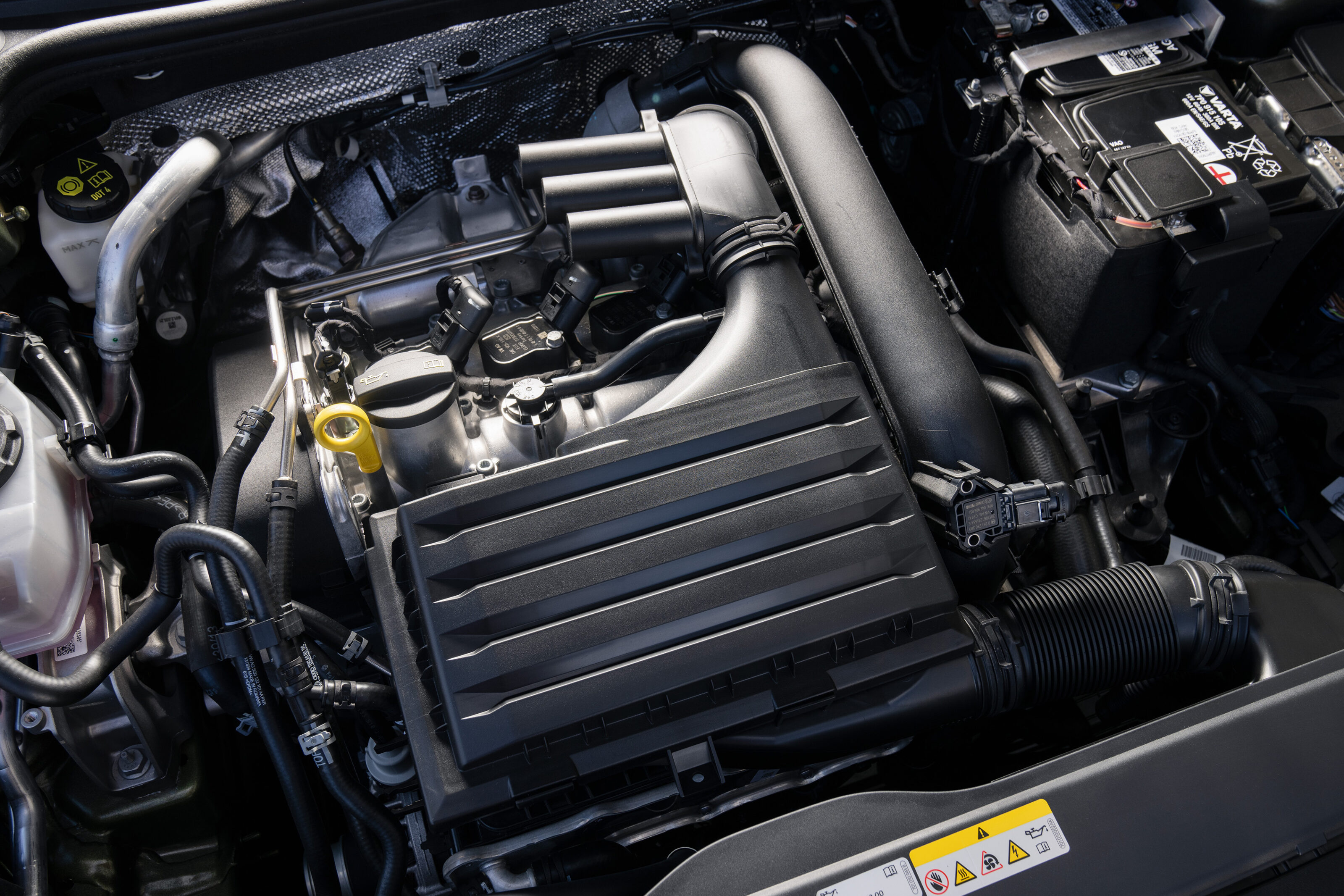
Australia’s poor fuel quality continues to thwart VW’s most advanced engines, including plug-in hybrid drivetrains.
Yet while regular Golfs utilise a carryover 1.4-litre turbocharged four-cylinder with 110kW and 250Nm, there is a notable change of transmission.
The ‘DSG’ dual-clutch system that has swapped gears on most automatic Golfs locally since 2004 has been exchanged for an eight-speed torque converter auto on the regular models.
Although the Golf doesn’t feel as lively going up the gears with the new auto – and is slower to accelerate than its predecessor, according to VW – it feels like a more suitable gearbox for the standard hatch.
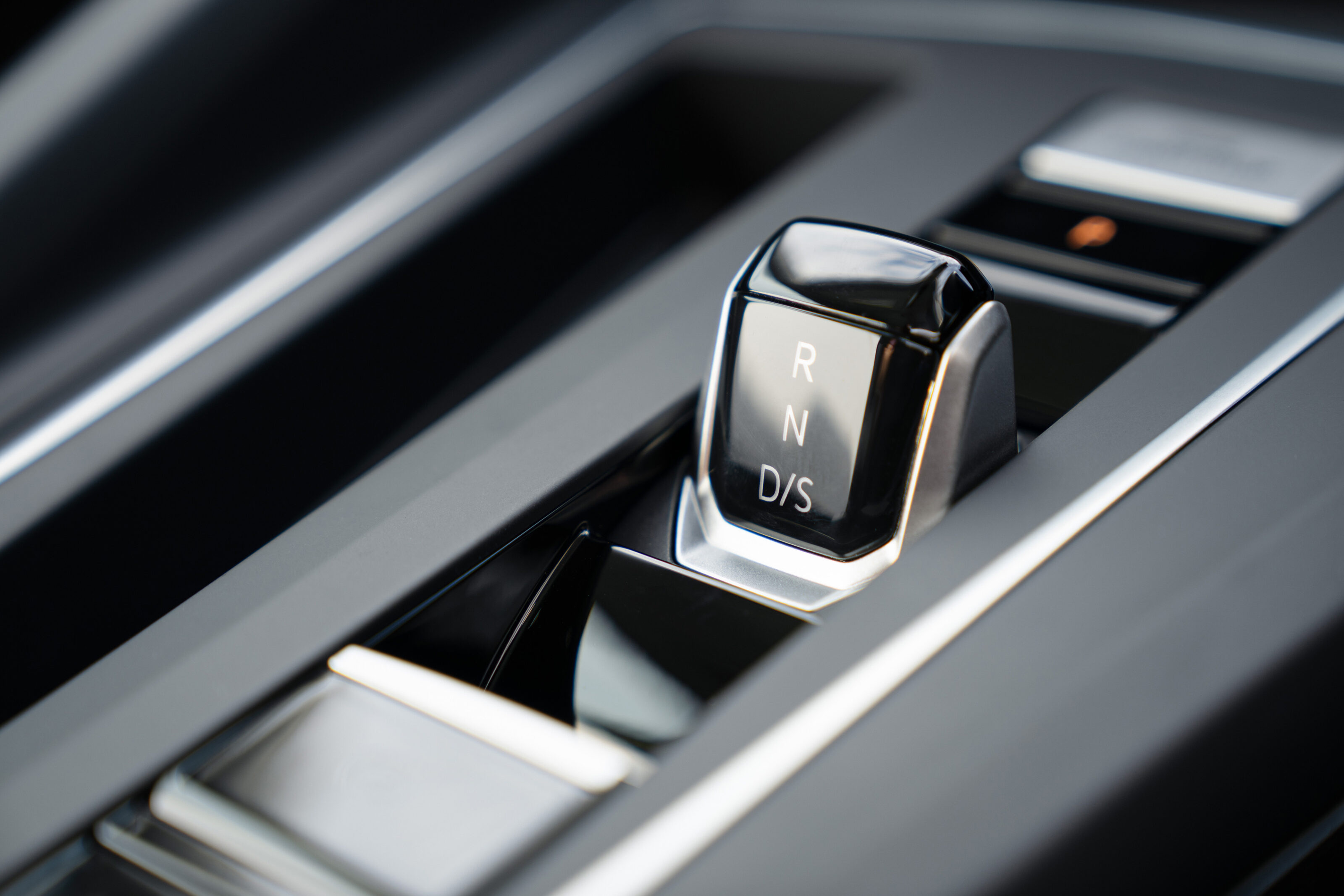
The auto is still effective at choosing suitable ratios, but perhaps most importantly it eliminates the DSG’s tendency to hesitate when moving off from a stationary position.
It combines well with a 1.4-litre turbo engine that remains enjoyably flexible, as well as refined. And economical.
Although a WLTP adjustment has seen the Golf’s official fuel consumption climb from 5.4 to 5.8 litres per 100km, our testing – involving an even balance of suburban and freeway driving – produced an indicated 5.3L/100km.
The standout of the Golf Life driving experience is ride quality. Rolling on 17-inch wheels that defy the trend for big rims, the Golf’s Goldilocks suspension is neither too hard nor too soft.
Its ability to absorb bumps consistently across inconsistent road surfaces is almost unrivalled – and certainly not matched by torsion-beamed rivals such as the Mazda 3 or base Mercedes A-Class.
The only blot on refinement is tyre noise that starts to intrude when coarser surfaces are encountered. (We’ve yet to test the R-Line that features bigger wheels and sports suspension.)
For those more monotonous journeys, drivers can press a Travel Assist button on the steering wheel to make the car steer autonomously in addition to the auto acceleration/braking function of the adaptive cruise control.
However, the driver can have their hands off the wheel for barely a minute, or not gripping the wheel sufficiently, before the system starts warning them to put their hands back on. Ignore the visual/audible warnings and the car rudely tightens the seatbelt and starts slowing the car as part of the Emergency Assist system.
As with other temporary self-steer systems, it seems like a gimmick next to the genuine usefulness of variable-speed cruise.
For owners planning to get their Golf serviced regularly within the Volkswagen dealer network, it’s worth considering upfront service plans. The German brand’s capped-price servicing program is relatively expensive, and the plans save about $400 over three years ($1100) or nearly $1000 over five years ($1900).
The Mark 8 is still a textbook Golf – unchanged in so many ways yet improved in areas that are key today, such as technology and connectivity. It will be even better when VW Australia can equip it with the company’s more advanced drivetrains, and we would ignore the base model.
As transcendent hatchbacks go, though, the Golf 8 already remains the gold standard.
Snapshot
- 110TSI now the only engine on offer
- Entry prices up, but a well-equipped opening point
- Optional travel pack adds solid value
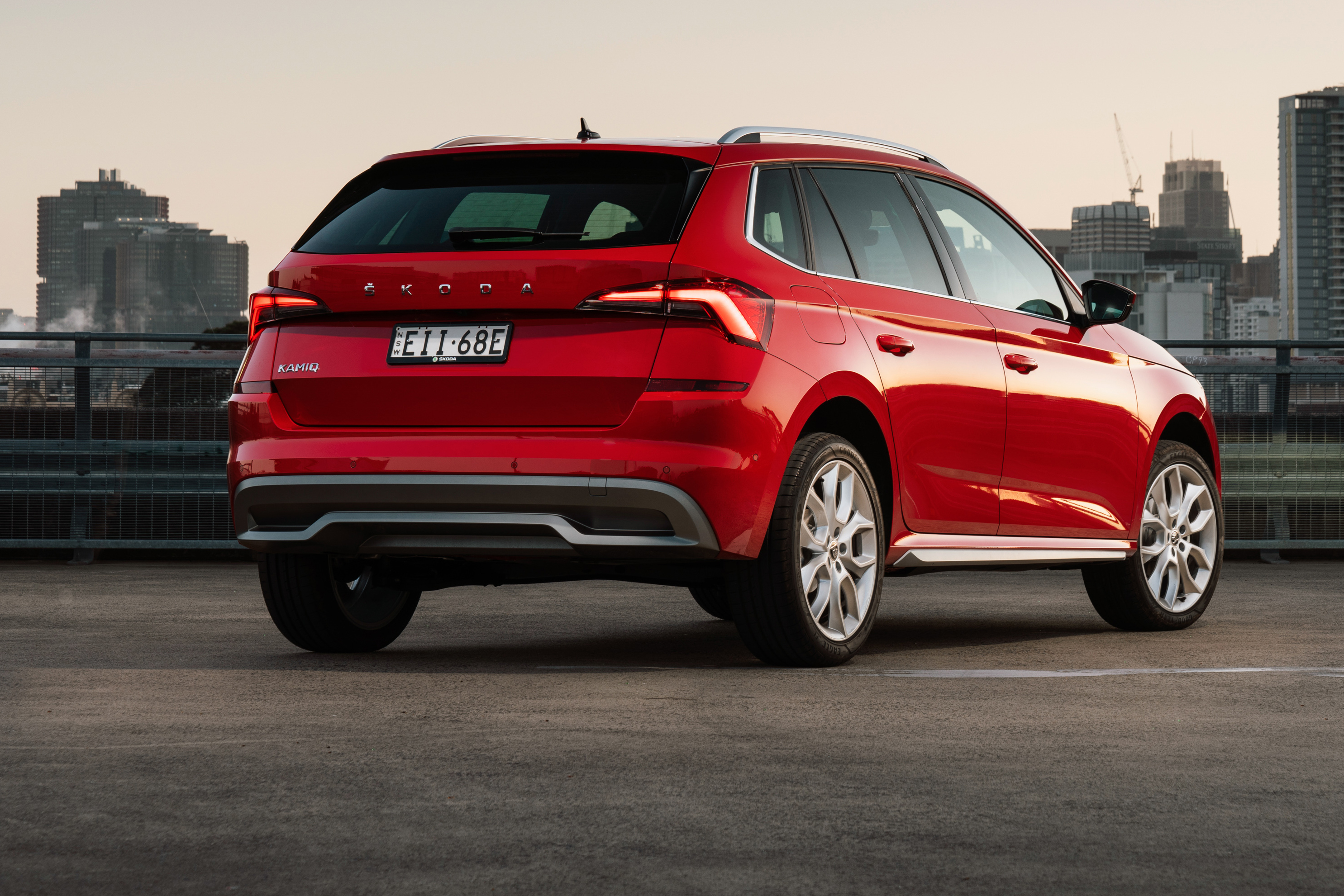
The refreshed 2022 Skoda Kamiq is now on sale in Australia, arriving with new entry-level and top-shelf Signature models, and the brand’s popular 110TSI engine powering the entire range.
For the new model year, Skoda’s small SUV is priced from $32,390 before on-road costs for the new manual-equipped Kamiq Ambition grade – although Skoda is also offering a drive-away price of $32,990.
Despite the otherwise generous drive-away deal, the Ambition’s price represents a marked increase over the $27,990 drive-away price of the previous entry-level model, the 85TSI manual.
But, as its name suggests, the 85TSI was a less powerful offering, its 1.0-litre three-cylinder turbo petrol engine delivering 85kW and 200Nm – whereas the 110TSI’s 1.5-litre turbo petrol four produces 110kW and 250Nm.
That engine is now the only powertrain on offer with the Kamiq, with Australia’s allocation of the 85TSI engine exhausted for the immediate future.
The Ambition model is available in both six-speed manual and $33,390 ($34,990 drive-away) seven-speed DSG dual-clutch automatic forms, while the wider range can be had with the DSG only.
Standard kit for the Ambition includes:
- 18-inch Crater alloy wheels
- Rear LED lights,animated turn signal
- Double-sided mat in luggage compartment
- Floor mats
- Privacy Glass
- Window surrounds in black
- Silver Roof Rails
- LED headlights
- Electric, heated & foldable mirrors with driver side auto dimming
- Upholstery –Fabric (Ambition)
- Multi-function sports flat bottom leather 3-spoke steering wheel
- Auto dimming rear view mirror
- Height adjustable driver and passenger seat with lumbar support
- Rear view camera with rear parking sensors
- Front Assist with City Emergency Brake
- 7 airbags–dual front, front-side, curtain and driver’s knee
- Tyre pressure monitoring system
- ESC (incl. ABS, EBD, ASR, Hill hold control)
- Lane Assist with lane keeping system
- Multi collision brake
- Fatigue detection
- Anti-theft alarm system
- Rear Manoeuvre Braking assist
- Virtual Cockpit
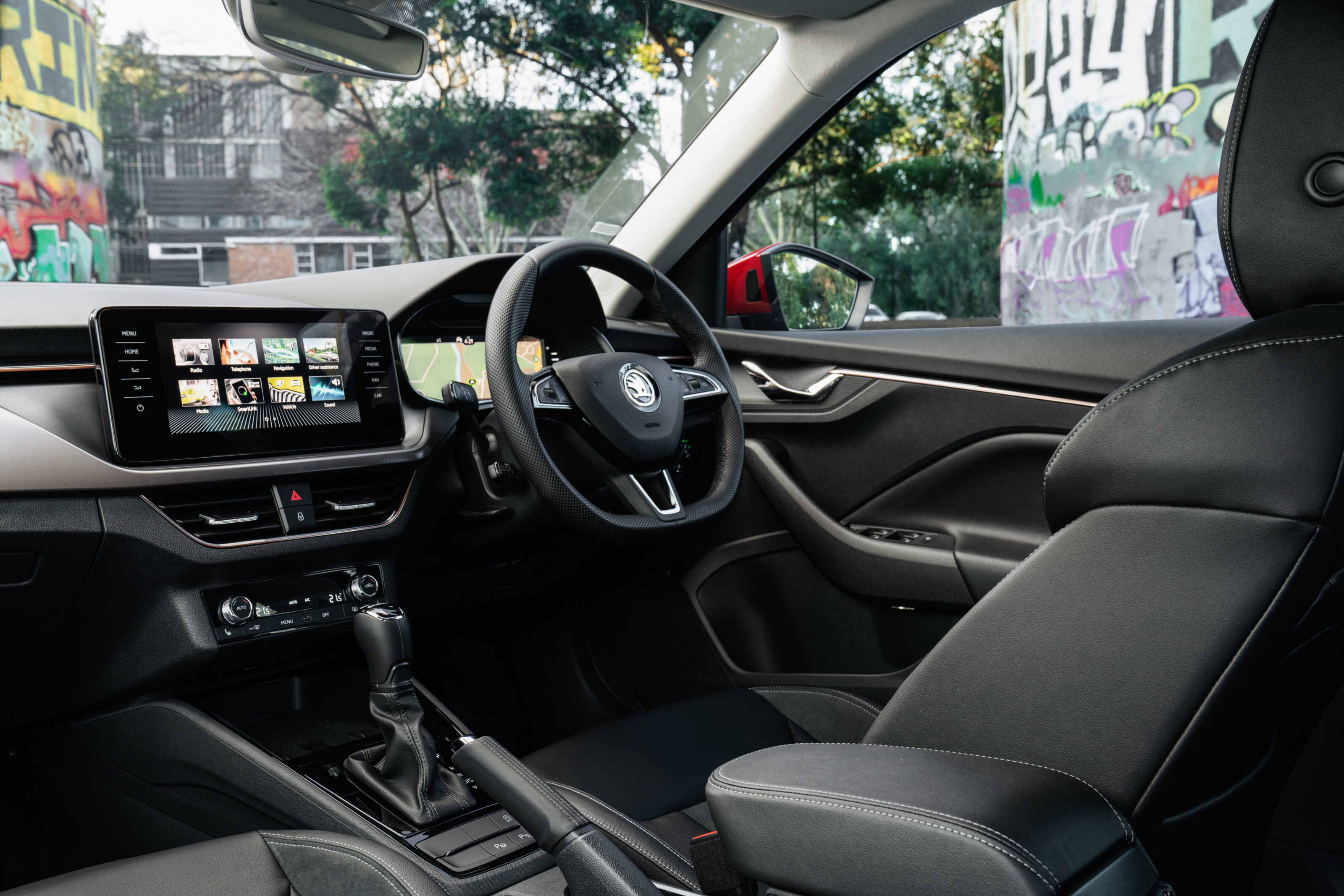
- BOLERO infotainment with 8.0-inch touch display
- SmartLink Smartphone connectivity including Apple CarPlay and Android Auto
- Bluetooth phone connectivity
- 8 speakers
- Wireless Phone Charging
- Electrically opening & closing Tailgate
- AdaptiveCruise Control
- Dual-zone Climatronic air-conditioning with humidity sensor
- Advanced keyless entry includingSmart Start (KESSY) with SAFE function
- Stow-away umbrella
- Light assist
- Rain-sensing wipers
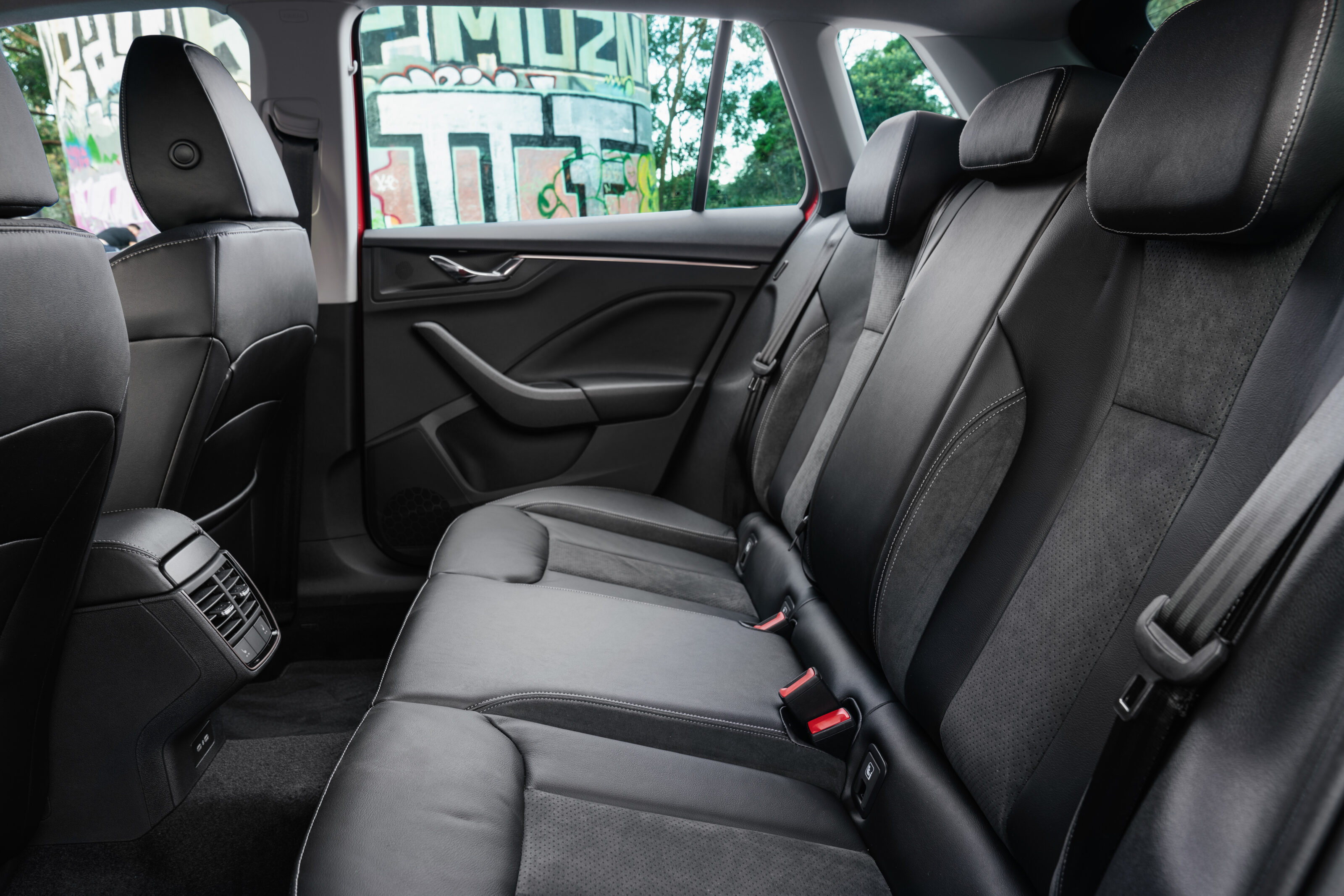
The familiar Monte Carlo trim adds:
- 18-inch Vega Black alloy wheels
- Monte Carlo Sports seats
- Full LED Headlights with Adaptive Frontlight System, fog light and cornering light
- Panoramic Roof
- Sports pedals (Monte Carlo only)
- Upholstery – Fabric (Monte Carlo)
- Black roof rails
- Black door mirrors
- Black shine radiator grill frame
- Black lettering on tailgate
- Black roof lining
- Black rear diffuser
- Animated front turn signals
- Sports Suspension (15mm lower)
- Drive Mode select
- ParkAssist
- 18-inch Crater alloy wheels
- Upholstery – Leather / Suedia
- Silver roof rails
- Electric drivers seat
- Power adjustable lumbar support for drivers seat
- Heated front and rear seats, separately controlled
- Front & rear parking sensors
- Side Assist – Blind Spot Protection
- Rear Traffic Alert
- AMUNDSEN Navigation with 9.2-inch touch display and voice control
- Wireless Apple Carplay & Android Auto
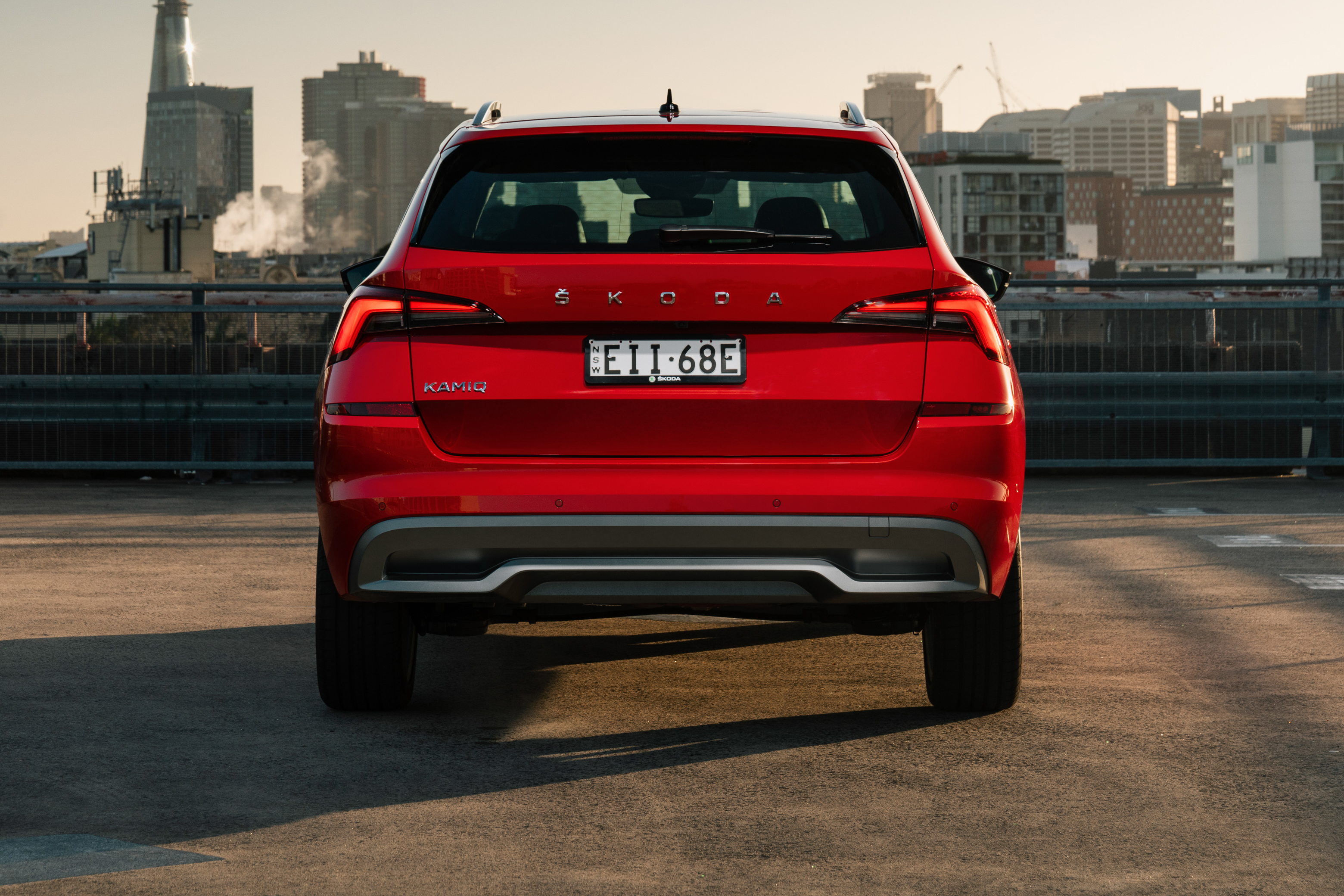
Options
- Panoramic Roof – $1300
- Tow bar (factory / dealer fit) – $2000
- Travel Pack (Monte Carlo only) – $4300
Features:
- 9.2-inch Amundsen infotainment with navigation (value $2700)
- Automatic Parking Assist (value $1100)
- Side Assist Blind Spot Detection (value $900)
- Heated front and rear seats (value $900)
- Skoda sound system (value $800)
- Wireless Apple Carplay & Android AUTO (value $500)
- Rear Traffic Alert (value $350)
- 3 Spoke leather, multifunction and heated steering wheel with DSG paddles (value $300)
- Voice Control (value $200)
2022 Skoda Kamiq pricing for Australia
- Ambition manual – $32,390 ($32,990 drive-away)
- Ambition DSG auto – $33,390 ($34,990 drive-away)
- Monte Carlo – $35,290 ($37.990 drive-away)
- Signature – $35,890 ($38,990 drive-away)
NOTE: 2021 Skoda Kamiq Limited Edition pictured in this story
Mini is set to bring a virtual concept car to the real world, transforming the Vision Urbanaut from an on-screen rendering to a tangible vehicle ahead of the Digital-Life-Design Summer conference.
Initially teased as a computer-generated concept towards the end of 2020, the Urbanaut was designed as a look into the future of mobility and space in modern vehicles.
Far from mini, the Mini Vision Urbanaut concept boasts more space than any of the current Mini line-up thanks to its taller and longer design.
(Click any of the images below for a look at our full gallery)
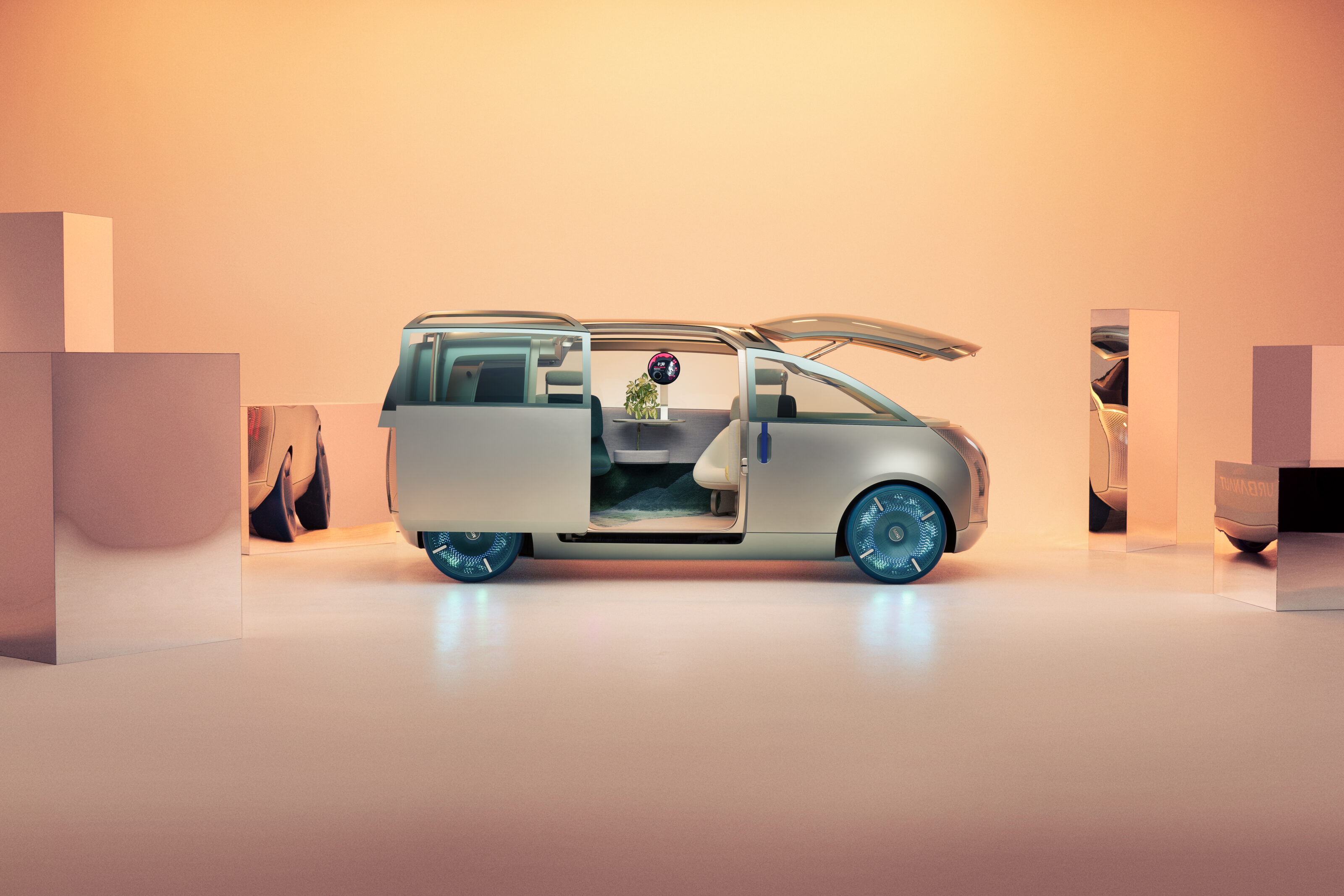
Based on an electric platform, autonomous driving is possible in the Urbanaut, allowing occupants to relax – although control can be returned to the driver’s hands in ‘Wanderlust’ mode, bringing back the steering wheel and pedals.
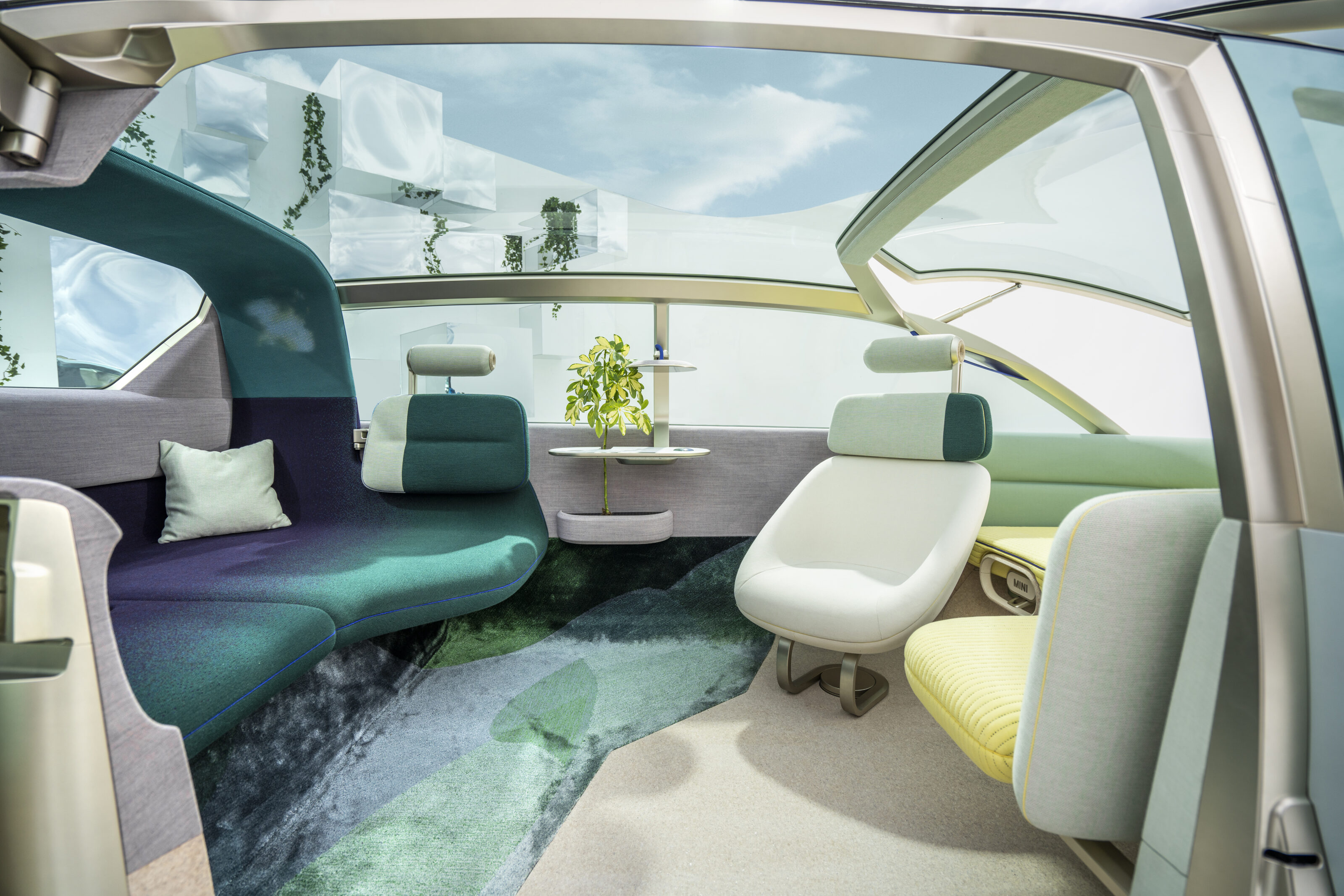
Two other modes (or ‘Mini moments’) are available in the Urbanaut, only when the vehicle is parked up – ‘Chill’ allows occupants to wind down on the rear bench seat or ‘cosy corner’ with enough space to lay down, while ‘Vibe’ opens up the interior space to allow more passengers in the vehicle, propping open the front windscreen to create the impression airiness.
The vehicle’s dashboard serves as a daybed when in Chill or Vibe modes, as the Wanderlust driving controls retract into the dash when the Urbanaut is in a stationary state.
Head of Mini, Bernd Körber, believes the theory behind Vision Urbanaut is relevant to how urban infrastructure is designed in the future.
“With our eyes fixed on the future, we have developed an idea, with the Mini Vision Urbanaut, of how we can take the Mini attributes – with the focus on the ‘Clever Use of Space’ – into the future of mobility and interpret them in a typically Mini way,” said Körber.
“It brings the user’s personal space into the car and opens up various possibilities for them, from creating an urban oasis to experiencing freedom in the ‘Wanderlust’ moment.
“The Mini Vision Urbanaut represents our image of how MINI’s ‘Clever Use of Space’ could provide an answer to the needs of future cities and lifestyles.”
Production of the Urbanaut is unconfirmed and unlikely, but its design language could end up in the next generation of Mini models with the German-owned British brand planning a move to electrification by 2025, with an all-EV line-up by 2030.
The Fast and Furious franchise has become almost a touchstone for car films, for better or worse, so we thought we’d take a look back at which films hold up, and which don’t.
Three of WhichCar’s journalists (Chris Thompson, Wheels Journalist; Alex Affat, MOTOR Journalist; Kian Heagney, Street Machine Journalist and Content Creator) have combined their own ranking lists to find out which film is collectively judged by us to be the best Fast and Furious movie.
The rule for ranking, 1-5, is that at least one film needed to be awarded a ‘5’ as the judge’s favourite of the series and their idea of the FnF films at their best.
You’ll notice Hobbs & Shaw is missing from this list… but it’s not exactly a racing film, not part of the main franchise, and we feel not worth comparing. Feel free to leave a 1-5 ranking for it (and each other film) in the comments below.
The Fast and the Furious (2001)
Our score: 4.5/5
Is the original the best? This is arguable, but a quick look at the average score we’ve given each film will reveal what we collectively think.
Here, in the first of the franchise, we meet the ‘Family’ and are granted some incredible lines and moments, from ‘DANGER TO MANIFOLD’ to ‘nobody likes the tuna here’, and even Ja Rule screaming ‘Noooo!’.

Toretto and Brian O’Conner’s story arcs, as with the other primary characters that return later, is relatively plausible here compared to the later films.
Some parts of the film haven’t aged well: the constant odd CGI and use of computerisation in cars, as well as some of the driving visuals. The feeling of the film is very ‘of it’s time’ though, and that’s no bad thing.
The first film remains entertaining, nostalgic, and fun… just remember to check your sense of realism at the door on the way in.

2 Fast 2 Furious (2003)
Our score: 4/5
Very much a ‘sequel’ film in that its story arc and theme is very similar to the first.
It ditches the ‘hometown’ vibe of the first by setting O’Conner on a group of drug runners in Miami. Partnered with a new character, Roman Pierce, O’Conner’s second adventure is a little less memorable than TFatF, though his Lancer Evo isn’t easy to forget.
Eva Mendes and Ludacris bring a little early-2000s star power, though we reckon the lack of Vin Diesel turned a fair few potential fans away. We know the use of shifting gears and somehow speeding up after long periods of apparently hitting top speed turned us away at some points.
It’s really a better film than it’s given credit for, but it’s not exactly the star of the first three in the series. In fact, it was nominated for a Razzie under the ‘Worst Excuse for an Actual Movie’ category. Then again, the later films have significantly higher IMDb scores than the first so what would the general public know?
– Chris Thompson
Fast and Furious: Tokyo Drift (2006)
Our score: 4.65/5 (our top ranked FnF film)
The film least tainted by the increasing blockbuster action nature of the later films, Tokyo drift featured almost no connection to the main plotline upon its release, though has now been used to introduce later characters such as Statham’s Shaw.
Tokyo Drift’s protagonist Sean meets Twinkie (Bow Wow), the owner of a ridiculous Hulk-themed VW Touran/Caddy, and is introduced to the world of drifting. “Driftin’… what’s that?”
Its disconnect from the increasingly silly main story arc of the series and the fact it doesn’t take itself too seriously might explain why two of our three writers put this atop their lists (the other picked the original as the best).
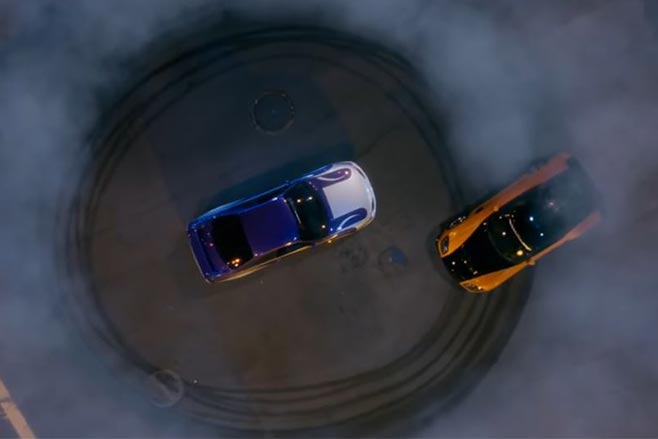
Some aged CGI and potentially problematic themes aside, the film delivers some excellent and fun action, likeable characters (okay, mostly Han), and cars you could believe are actually usable for their intended purpose.
Sean’s storyline isn’t the most memorable thing about the film, though thankfully there’s not too much of it slowing the pace down.

Aside from Toretto’s appearance in the film, drift fans are given a treat when the real DK (Keiichi Tsuchiya, not the character granted the title in the film) appears for a few seconds. Tsuchiya and other drifters such as Rhys Millen were consulted and used as drivers during the production of the film.
– Chris Thompson
Fast & Furious (2009)
Our score: 3.35/5
What many people may not realise, is that the first three Fast & Furious movies were made and produced independently of each other, in thanks to the unexpected success of each previous instalment. The fourth movie in the series was the first time the writers stitched together an over-arching narrative for series’ future roadmap. But they had a lot of loose-ends to tie together, and it shows.
The central crew for this movie was made up of a motley crew of old familiar faces, and new ones. Essential members from the first movie return, including Paul Walker, Vin Diesel, Jordana Brewster and Michelle Rodriguez (whose apparent death fuels motive for our two protagonists). Gal Gadot gets her first introduction here as one of Arturo Braga, the main villain’s goonies.
The fourth movie for many marks the departure point for the franchise, in becoming more of a cornerstone Hollywood action series than the cinematic validation for the tuner car enthusiast it once was. In hindsight, it certainly wasn’t as ludicrous (or should we say, Ludacris?) as the series would later reveal. It’s a little forgettable, but acts as an important springboard for future narratives.
– Alex Affat
Fast Five (2011)
Our score: 3.15/5
Fast Five was the first time in the series that our gang of affable automotive outlaws went transcontinental. The “family” are now on the run and have made it through South America where they land in Brazil. They link up with Toretto’s childhood best friend Vince who enlists them on a job which goes bad. This puts the gang in the crosshairs of Hernan Reyes, a corrupt businessman and drug lord.
Significantly for the series’ canon, Dwayne ‘The Rock’ Johnson’s character Hobbs makes his debut in this film and is tasked with hunting down Toretto’s crew while they plan a heist to steal Reyes’ fortune. The Rock actually adds a counterbalancing dimension to Vin Diesel’s character, and may be likened to Loki of the MCU. A charismatic overstated villain who would later become part of ‘the team’ in order to defeat larger evils.
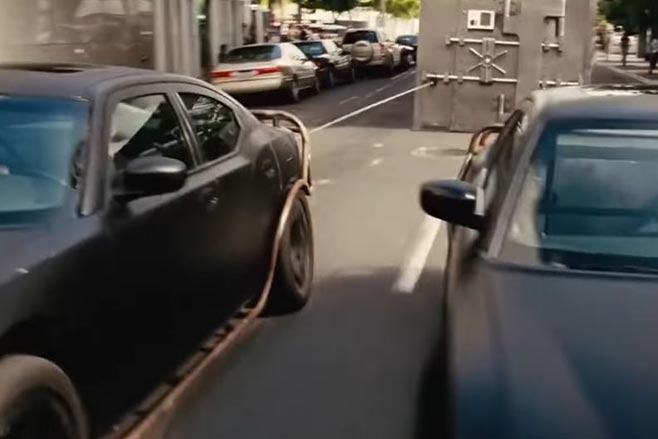
Of course, the heist itself displays a laughable understanding of physics (or just a very liberal interpretation of a 2011 Dodge Charger’s tow rating), but it would certainly not be the last time that the producers threw realism out the window.
– Alex Affat
Fast and Furious 6 (2013)
Our score: 2.35/5
This instalment is often referred to as ‘the one with the 10-minute runway chase scene’. Agent Luke Hobbs barters Dominic Toretto and his crew out of retirement to help him take down criminal mastermind Owen Shaw.
Most of the unnecessarily destructive car chases take place in the UK, but we are briefly treated to an actual race between Dom and his presumed dead former squeeze Letty Ortiz. An Army tank driving the wrong way, an open wheel car designed specifically to upturn oncoming Police cars – this movie is perfect if you don’t care about cars at all but love grotesque action with no substance.
– Kian Heagney
Furious 7 (2015)
Our score: 2.5/5
The basic punchline to the seventh film is Owen Shaw’s brother Deckard Shaw (Jason Statham) channels his inner Crank vibes and chases after Dominic and his crew to avenge his dead brother.
They end up in the Middle East where a super rare supercar jumps between two sky scrapers, and there’s a final showdown with lots of shouting in a multi-story car park in Los Angeles over some deadly software. But the main takeaway from this seventh film is it’s the final farewell to Paul Walker and his character Brian O’Conner, who tragically passed away during filming.
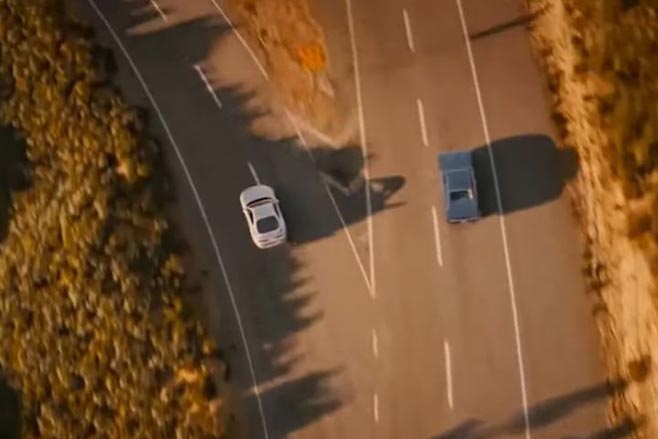
Most of the movie is as ridiculous as expected, but the final scenes bidding farewell to Paul are done tastefully and give the movie a level of meaning missing from the previous iterations.
– Kian Heagney
The Fate of the Furious (2017)
Our score: 2.15/5
Fate pits Dominic Toretto against his crew when cyberterrorist Cipher (Charlize Theron), forces him to do his bidding under threat of harming his newborn son with former lover Elena (Elsa Pataky).
The big action scenes in this one mainly revolve around a five-way tug of war in the middle of a city, and a truly ridiculous chase on an ice lake where a submarine quite literally breaks through the ice while in pursuit of a bright orange Lamborghini Murcielago.

Deckhard Shaw and Agent Luke Hobbs both join the cause to help take Dominic’s crew take down Cipher, and unlike previous movies this one uses some semi-decent comedy to distract from the Michael Bay levels of carnage.
– Kian Heagney
F9 (2021)
Our score: 2.25/5
Wait what? Dom had a brother this whole time? And he also happens to be some sort of world-threatening super spy? Han is alive? But how!?
You can’t look at F9 too closely because, if you do, it simply won’t make sense. The stunts and physics are mind-bending and borderline laughable, and the plot raises more questions than it provides answers; but F9 will likely emerge as an important launching pad for the franchise’s final two remaining movies.
The film doubles as a Toretto family origin story, opening with a flashback of the fiery demise of Dom’s father, Jack Toretto, the tale of which viewers first heard being told to a young undercover policeman named Brian O’Connor 20 years ago.
Infrequent flashbacks to the day of his father’s death, and the events thereafter, explain why Dom’s long-lost brother, Jakob (played by John Cena), hasn’t been heard of for the past eight films, and why the two are now engaged in transcontinental warfare over potentially world-ending tech.
It’s a bit of a soggy narrative, as Jakob often comes across as a scourned little brother with an inferiority complex while, conversely, it’s hard to feel sympathy for Dominic after it seems he was heartlessly responsible for setting Jakob on his warpath as teenagers – after they both viciously lost their father.
The action sequences are unrelenting and everything you’ve come to expect from the Fast franchise – for better or worse. From gravity-defying Jeep Gladiators, flying Mustangs, to city-destroying electromagnets and even a Pontiac Fiero space shuttle. Nine blockbusting movies in, and it’s clear that the franchise is self-aware, with Roman Pierce (Tyrese Gibson) in one scene seemingly breaking the fourth wall by humorously commenting on his remarkable lack of injuries after being fired upon by an entire military unit.
By introducing a new Toretto as the main antagonist, we’re treated to the most blatant and thinly-veiled exploration of the franchise’s ‘family’ trope. The main plot may come across as low-hanging fruit, but if you’ve come this far with the now-two decades-old franchise, it’s probably worth a bite – if anything for your own posterity. Though we wouldn’t blame you for waiting until it hits streaming services.
-Alex Affat
Snapshot
- Schmollinger has worked at Porsche for 17 years
- Will assume responsiblity as CEO of Porsche Cars Australia and Porsche Retail Group Australia
Porsche Cars Australia (PCA) has appointed Daniel Schmollinger as its new managing director and CEO.
Effective from September 1, Schmollinger will replace Sam Curtis, who has worked as the managing director and CEO of PCA since February 2014.
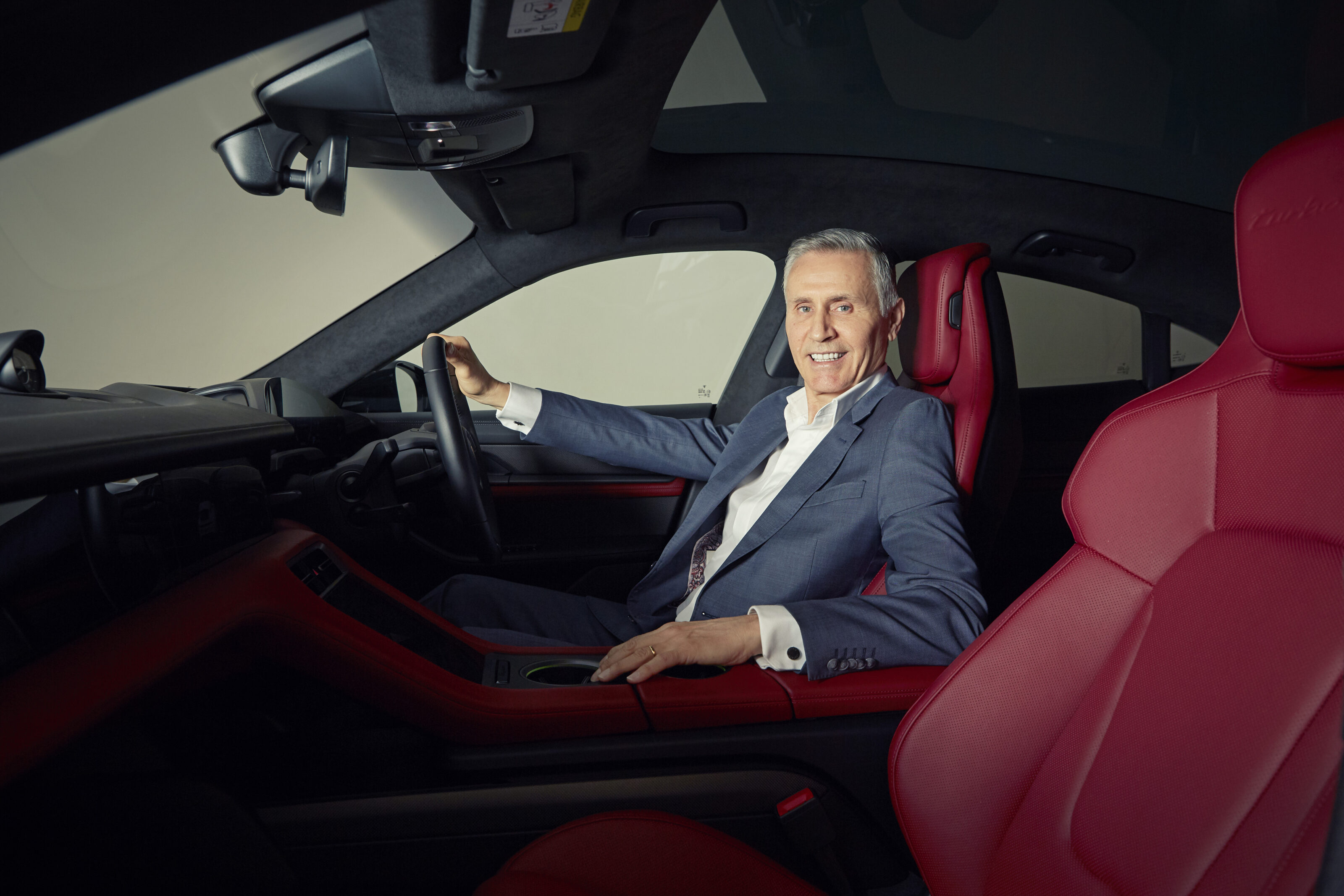
“I’ve had an incredible time leading Porsche in Australia, and I’m pleased to be handing over to Daniel with the business in such great shape,” said Curtis.
“We have an outstanding network of Porsche Centres around the country, an exciting product line-up that now includes the all-electric Taycan, and most of all, incredible staff across all areas of the organisation that I am certain will move the business forward into its next phase.”

Schmollinger, who has worked for the Stuttgart firm for 17 years, currently works as the vice president of marketing for Porsche China, and has previously worked for Porsche AG in several roles including director of Japan, South Korea, Australia, and Asia Pacific, also serving as Interim Managing Director for Porsche Asia Pacific in Singapore.
“Daniel Schmollinger not only knows the specifics of overseas markets very well, he also brings a close relationship to the retail organisation and broad marketing knowledge thanks to his experience in China,” Matthias Becker, vice president overseas and emerging markets at Porsche AG, said.
“I am pleased that in the year of the 70th anniversary of Porsche in Australia we have been able to win a proven sales expert as the person responsible for this growing market.”
In addition to his role as MD and CEO, Schmollinger will also head up Porsche Retail Group Australia (PRGA), which owns Porsche Centre Melbourne and Porsche Centre Sydney South.
Snapshot
- Schmidt will replace Brett Waudby in GM role
- Waudby will now take over BMW’s retail netowrk
BMW Group has announced Matt Schmidt as the new General Manager of Mini Australia and New Zealand.
Effective from July 1, Schmidt will replace Brett Waudby, who will now head up BMW’s retail network and oversee sales operations for the BMW brand in Australia.
Schmidt currently works as the national BMW sales manager for operations & planning, focussing on wholesale product planning and stock management.
Part of BMW Group Australia for 17 years, Schmidt has previously been responsible for various marketing and communication roles at both the German and British marque, including brand communications manager for Mini Australia, and more recently, BMW’s i and special vehicles sales manager.
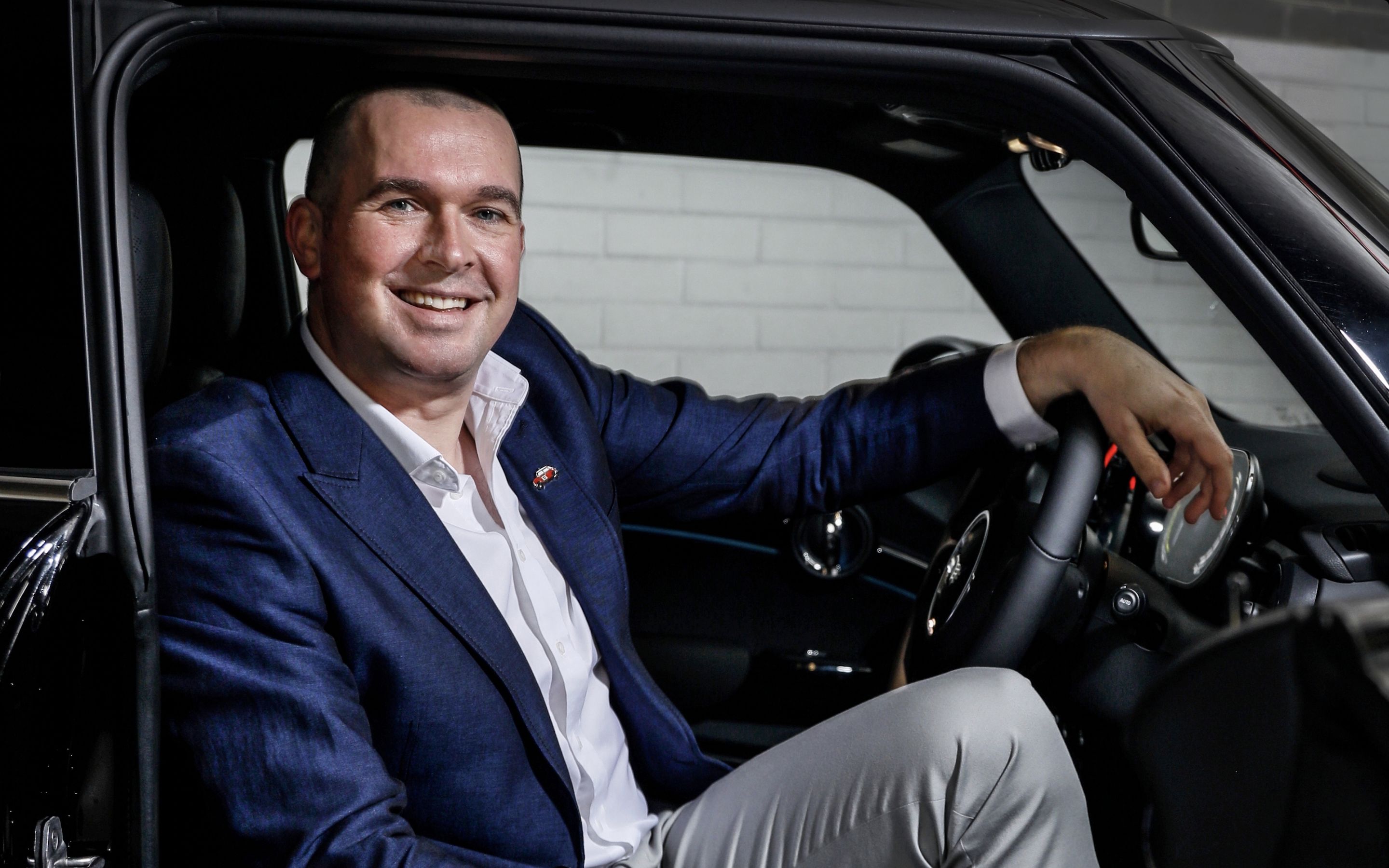
“Brett and Matt are two experienced leaders with considerable knowledge of the BMW Group brands. They have brought important change and growth to both BMW and MINI and their expertise will be of great benefit to their new positions and their new teams,” Wolfgang Buechel, CEO of BMW Group Australia, said.
The news comes as Mini Australia celebrates a particularly prosperous period in the new car market, achieving year-to-date sales growth of 39 per cent compared to 2020 and registering 1528 new vehicles.
Snapshot
- Cayenne gets GT badge for first time
- Biturbo V8 pushing out 471kW/850Nm
- Landing in Australia later this year from $336,100
Porsche Australia has revealed pricing and specifications for its new range-topping Cayenne Turbo GT, the car which now holds the record as the fastest SUV around the Nürburgring Nordschleife.
Expected to land in Australia from the fourth quarter of 2021, the new Cayenne Turbo GT will start at $336,100 before on-road costs – representing a $37,000 premium over the Turbo S E-Hybrid which currently sits at the top of the Cayenne range.
Available as a four-seat, four-door coupé only, the GT’s 4.0-litre biturbo V8 petrol engine pushes out 471kW and 850Nm, a 67kW/80Nm increase over the Turbo, helping 0-100km/h sprint times drop by 0.6 of a second to 3.3 seconds.
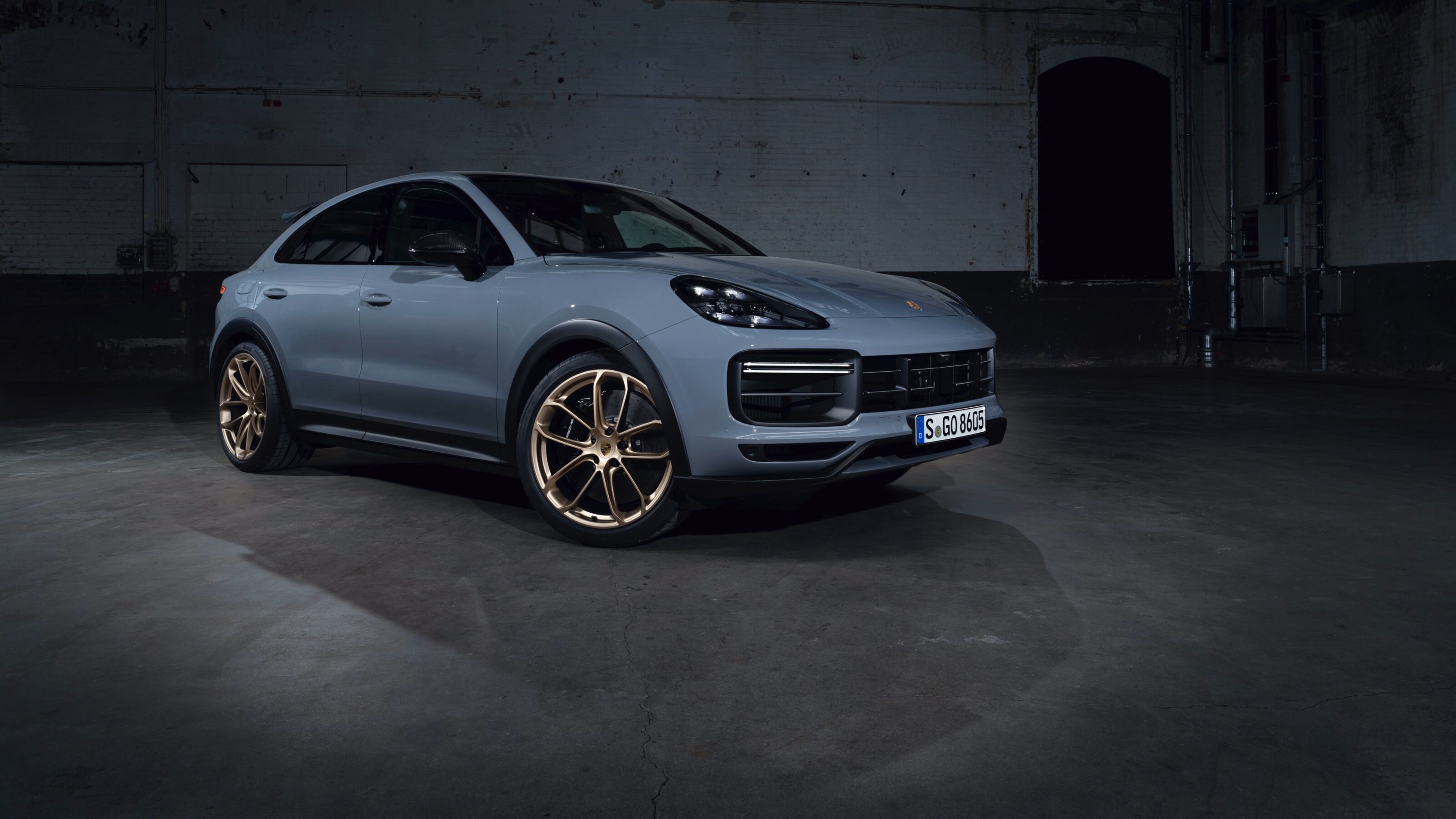
Suspension changes mean the GT sits 17mm lower than the Turbo with the rigidity of its air suspension system increased by 15 per cent, combining with the GT-specific 22-inch Pirelli P Zero Corsa tyres and ceramic brakes to help control the two-tonne-plus SUV.
Updated tuning to the eight-speed torque-converter gearbox means the GT shifts even faster than the Turbo, with increased transfer-case cooling protecting the longevity of the transmission.
Porsche fans may notice the centrally-mounted exhaust tips at the rear, a GT-specific feature which distracts from the new lightweight titanium exhaust underneath, now marginally louder thanks to a central silencer delete.
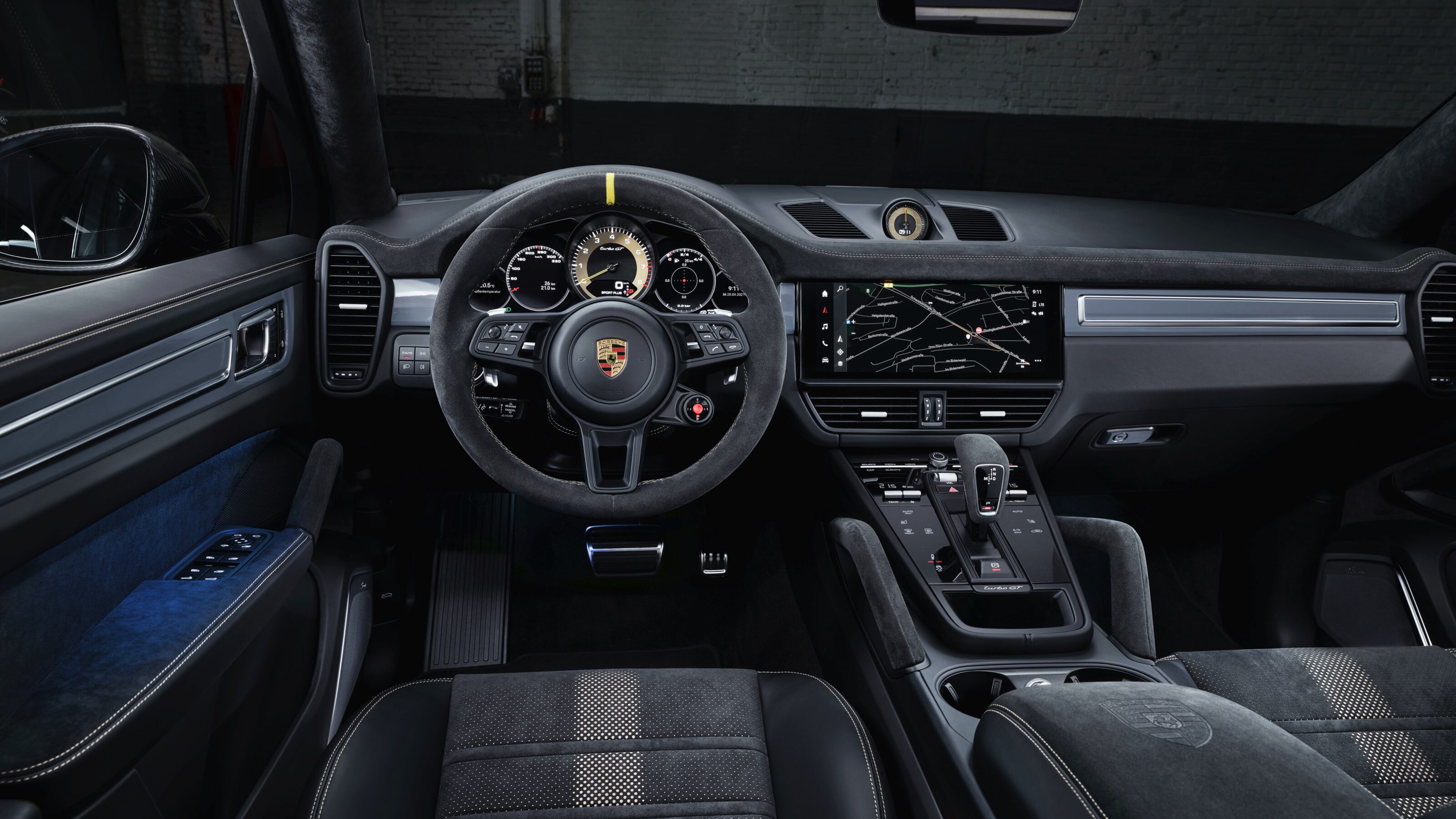
Inside the cabin, the GT scores Porsche’s next-generation infotainment system, now integrated with wireless Apple CarPlay, Apple Music and Apple Podcasts, as well as Android Auto for the first time.
The GT’s interior features even more Alcantara than the existing models, featuring along the door trims, dash, steering wheel and centre console lid. A yellow 12-o’clock marker is stitched on to the wheel, giving a nod to the car’s performance capabilities.
Porsche Australia has confirmed the GT will feature standard equipment such as comfort access, privacy glass, lane change assist, front and rear park assist including rear view camera and surround view, head-up display, adaptive cruise control with emergency assist, side airbags in rear compartment, four-zone climate control, ambient lighting, digital radio and a 20-inch collapsible spare wheel as standard.
Last year, Porsche sold its millionth Cayenne since its arrival in 2002, shifting 1385 units of its Cayenne Coupé and Wagon variants locally in 2020.
For a brief period of time, McLaren was considering putting a Lamborghini V12 into one of its iconic race cars.
In the ‘90s, McLaren was synonymous with Honda in Formula 1, and it paired with BMW for the F1 road car (though that was very nearly a collaboration with Isuzu).
However, the idea of the two powerhouses of Woking and Sant’Agata coming together seems almost surreal.
But, it very nearly happened in 1994.
For several years Lamborghini had supplied engines to a number of mid-field F1 teams to little success.
By 1993 Lamborghini was ready to pull out of the sport altogether, until a handshake deal was struck between Bob Lutz – the head of Lambo’s parent company Chrysler – and McLaren’s notoriously iron-fisted leader Ron Dennis to see if the two companies could join forces.
An all-white MP4/8 was fitted with the Italian V12 for factory McLaren drivers Ayrton Senna and Mika Hakkinen to drive.
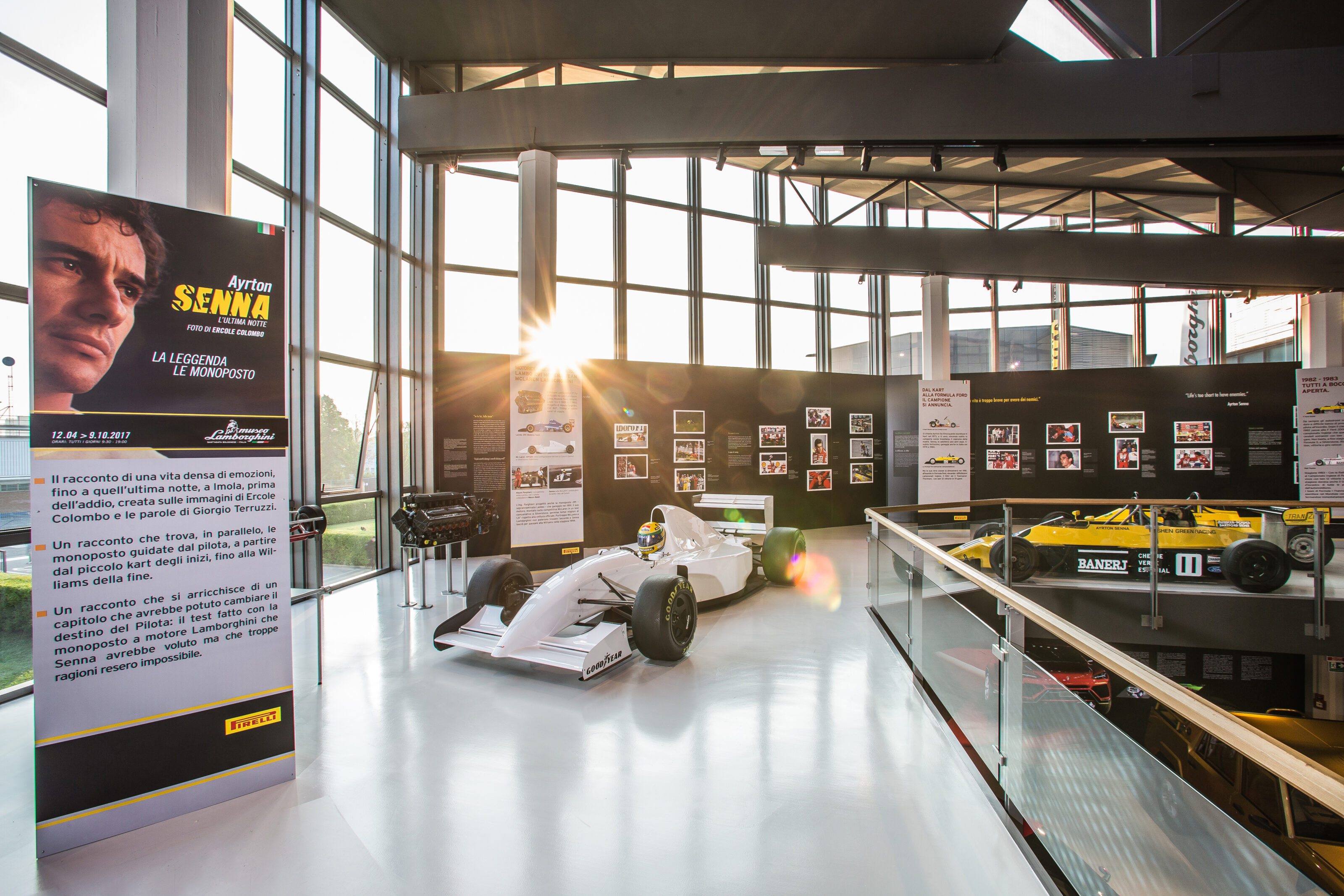
The engine, codenamed LE3512, was a 3.5-litre naturally aspirated V12 designed and built by former Ferrari designer and engineer Mauro Forghieri. It sounded fantastic, but results were hit and miss at best.
Test engines were badged as Chrysler, while the cars that did race with the unit were labelled with “Chrysler powered by Lamborghini”.
When the Lamborghini V12 was first introduced to F1 in 1989 it was reported to be producing 447kW. By the time McLaren completed its test of the engine in ’93, power was said to be in the region of 559kW.
But, as is typical of certain engines from that era of F1, all that power comes with a high risk of complete engine failure.
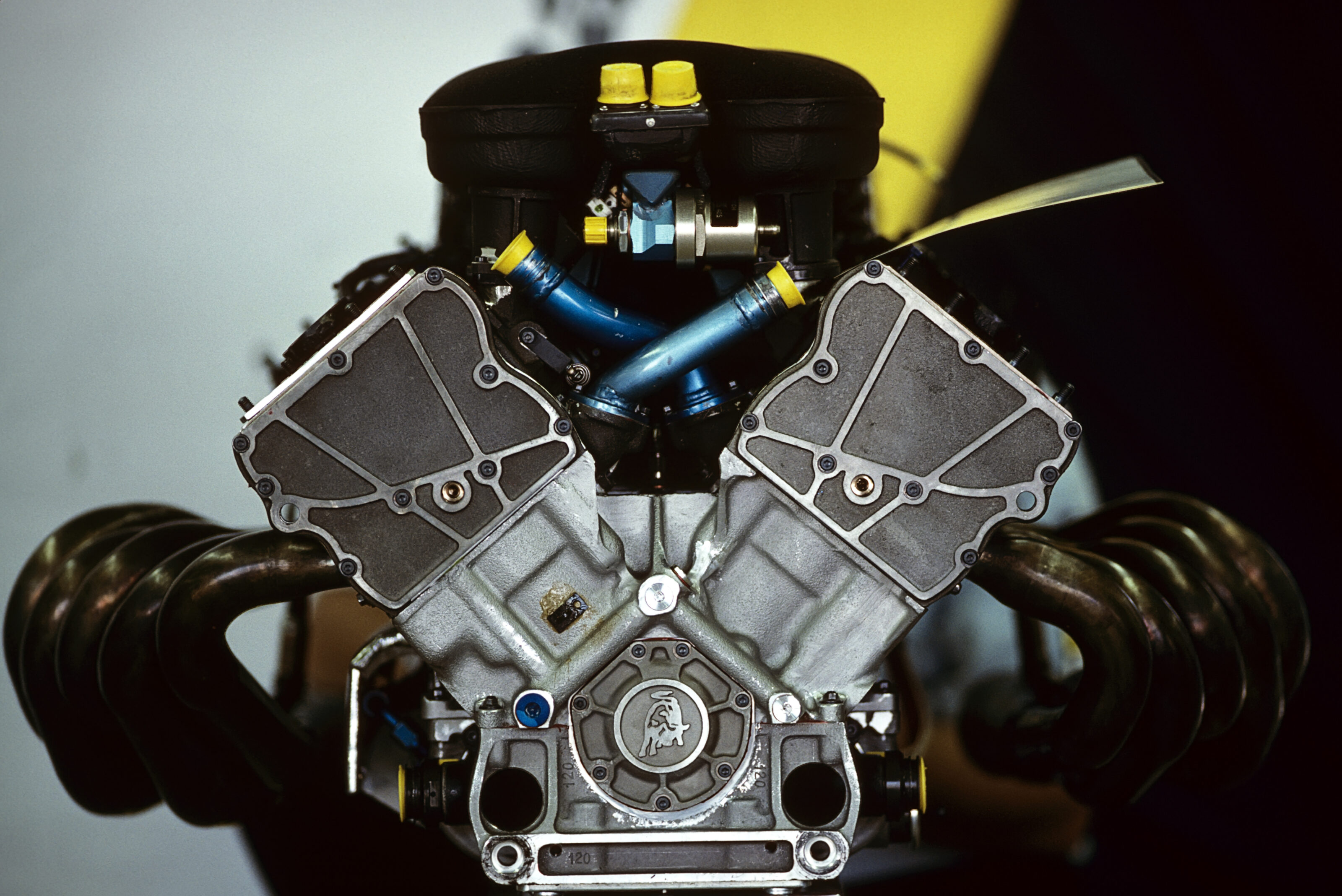
Supercars’ head of motorsport Adrian Burgess worked for McLaren at the time, and recently spoke with the V8 Sleuth about his time spinning spanners on the Italian-British hybrid racer.
“I was on the test team then; we had the Ford DFV wire-spring, basically a customer engine, we were paying for our engines and Benetton had the air valve which was the latest spec engine, they were the factory team,” Burgess recalls to the V8 Sleuth.
“I think they won one race with Michael and we won five with Ayrton.
“Myself, and two other mechanics were the only ones to actually work on that [Lamborghini-powered] car. All of the Lambo testing was our car crew. We went to Pembrey, then we went to Silverstone, then we took it to Estoril.”
During testing McLaren boss Ron Dennis set Burgess and his teammates an ambitious benchmark, which they came close to achieving.
“I remember going to Estoril in Portugal the day after the Grand Prix. Ayrton loved it, he thought [the engine] was great. And coupled with that chassis – our chassis at the time, we were just catching up with Williams with the active – we’d made some really good strides. The car was quick.
“We turned up at Estoril and I think Ron said to the team: “If you’re 5 seconds quicker than the Larrousse with the same engine, then we’ll consider it.”
“We went out and did a qualifying run and were like 4.9 seconds quicker – within half a day we were 4.9 seconds quicker than the Larrousse was two days earlier at the Grand Prix with the same engine.”
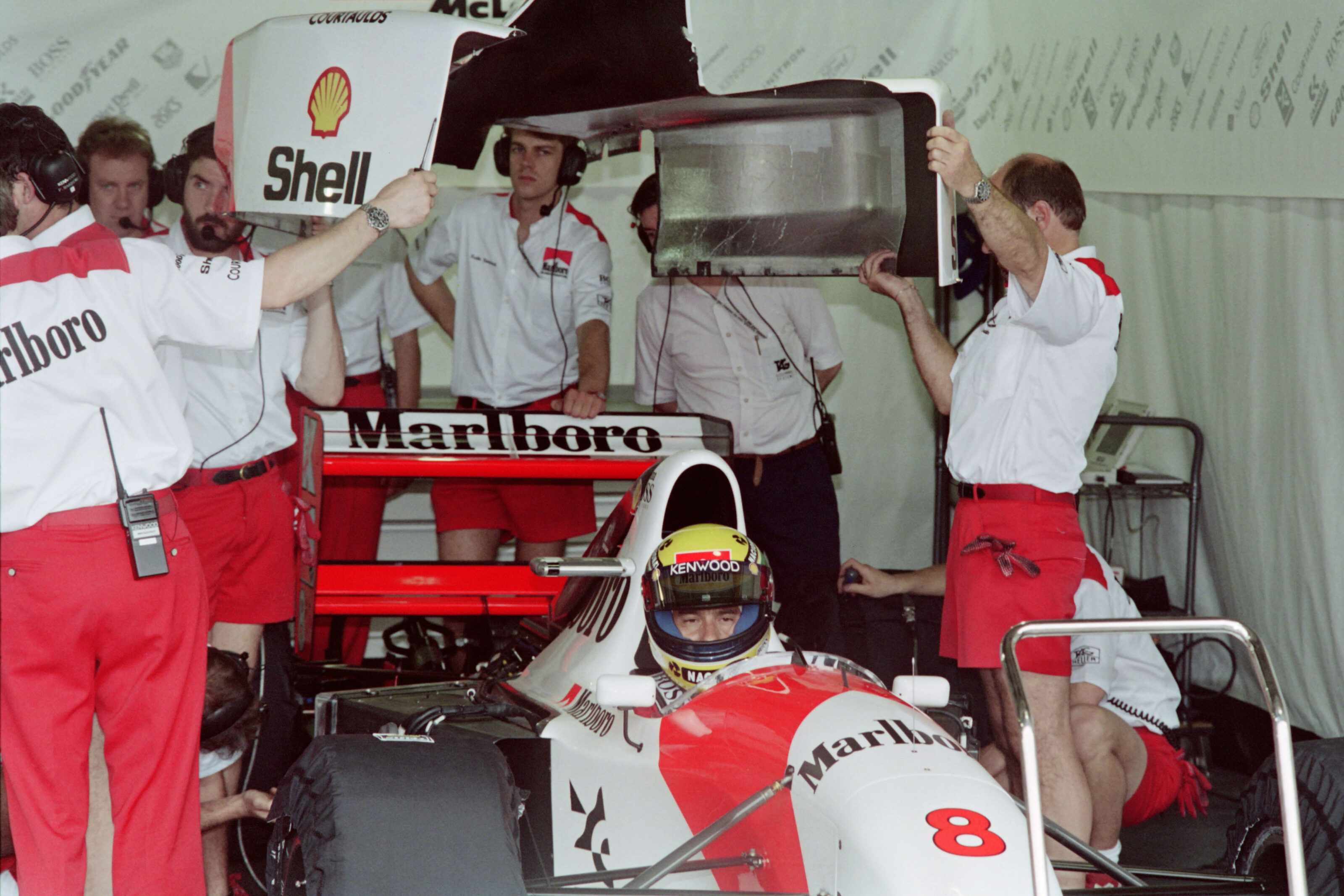
Despite being able to make the Lamborghini V12 fast, the McLaren mechanics couldn’t stop it from detonating in spectacular fashion.
“The problem with the engine was that by the time it was warm it normally had handgrenaded itself,” Burgess laughs.
“I think the furthest we went was 19 laps before all of a sudden you could look down through the inlet trumpets and actually see out the bottom! It handgrenaded itself in the most magnificent ways. It was like a Scalextric car dragging con-rods down the front straight at Estoril. The thing just blew up.”
Despite the constant critical mechanical failures, Burgess recalls his time working on the Lamborghini-powered McLaren fondly.
“I’ve got so many good memories about that car; we were so good at doing engine changes on the thing because they were so unreliable,” he recalls.
“We actually did one, from rolling it into the garage to driving it back out the garage, 26 minutes was our best!
“It was such a big engine, everything was spread out, it was actually fairly quick and easy to change. Unfortunately you just changed them quite a lot because they were so unreliable.”
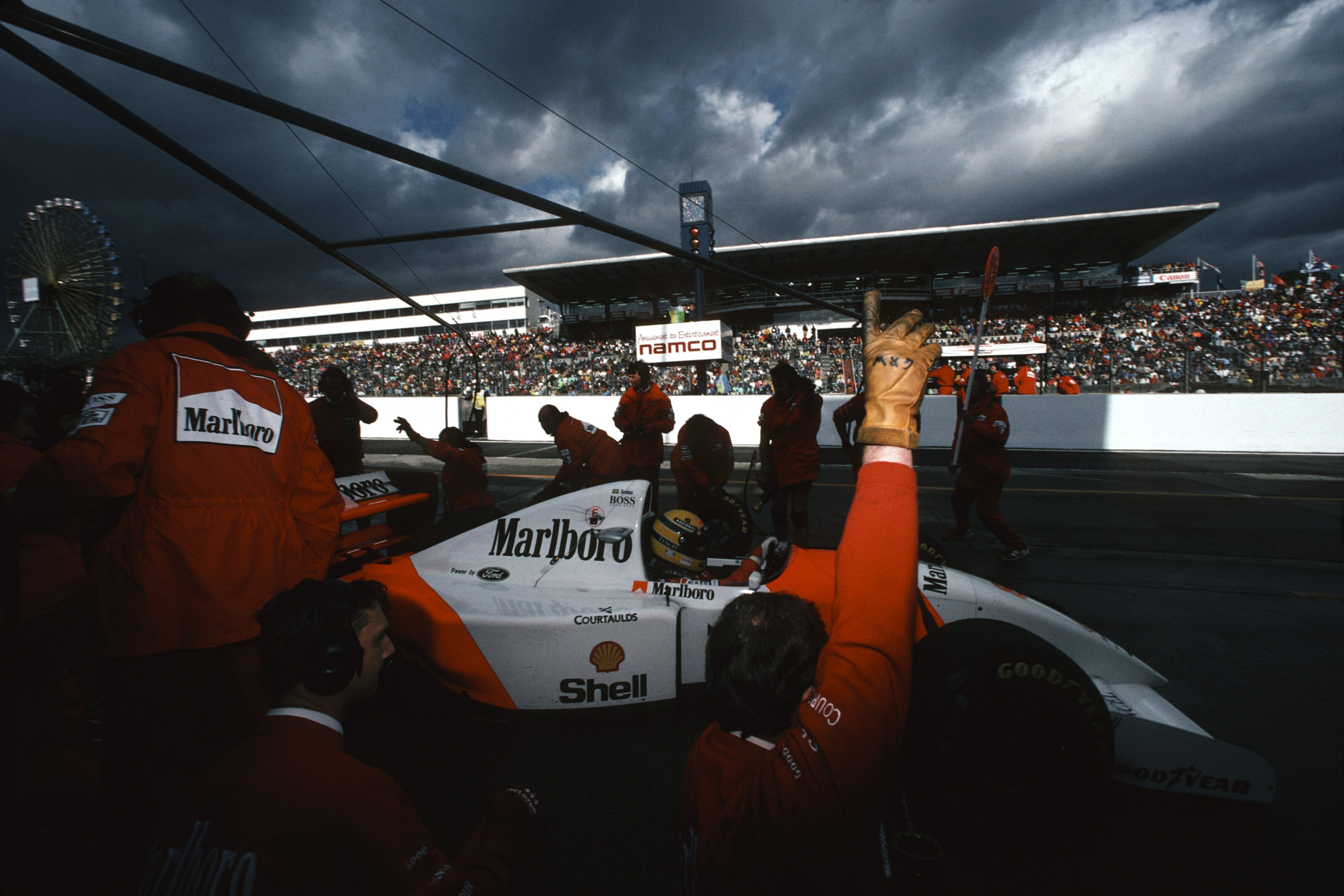
McLaren was using a 507kW Ford V8 engine in 1993. Despite Ayrton Senna wanting to run the Lamborghini V12 as early as the Japanese Grand Prix that same year (an event he would win using the Ford engine), Dennis instead signed Peugeot on as the engine supplier for ’94.
As a result, Senna signed with Williams, who was set to use a 3.5-litre Renault V10 in its FW16.
“Ayrton wanted [the Lamborghini] and I think if we’d taken the engine he’d have stayed with us. He knew the engine was our weakness and we needed a good engine partner. He wanted to take that car to Japan and Adelaide – which ended up being his last two races with McLaren, and ironically he won both those races for us with the Ford,” Burgess explains.
“At the end of the day it came down to Chrysler putting in the money to develop the engine and making it reliable. Ron couldn’t get a deal over the line with those guys and we ended up going with Peugeot.”
With no McLaren deal, that would sign the death warrant for LE3512. History tells us that the Lamborghini engine was one of only five V12 engines used in the naturally aspirated era from 1989–2013.
