
Snapshot
- Ford set to release two new EV platforms in its new models
- Expected US$30bn (AU$38.6bn) investment in EV technology by 2025
- 40 per cent of Fords sold by 2030 to be electric
The Ford Motor Company has announced two new EV platforms which will underpin a range of models, doing so thanks to an US$30 billion (AU$38.6 billion) investment in EV technology by 2025.
Ford’s investment in its EVs is increasing at a rapid rate as it starts to play catch-up to its competitors, going from an estimated US$11.5 billion (AU$14.8 billion) by 2025 in its projections last year and increasing to US$22 billion ($28.3 billion) at the start of 2021 before the new number was released this morning.
The growing investment reflects Ford’s expectations of how EV’ will play a role in the future of the company, expecting EV sales to account for 40 per cent of all new vehicles sold globally by 2030.
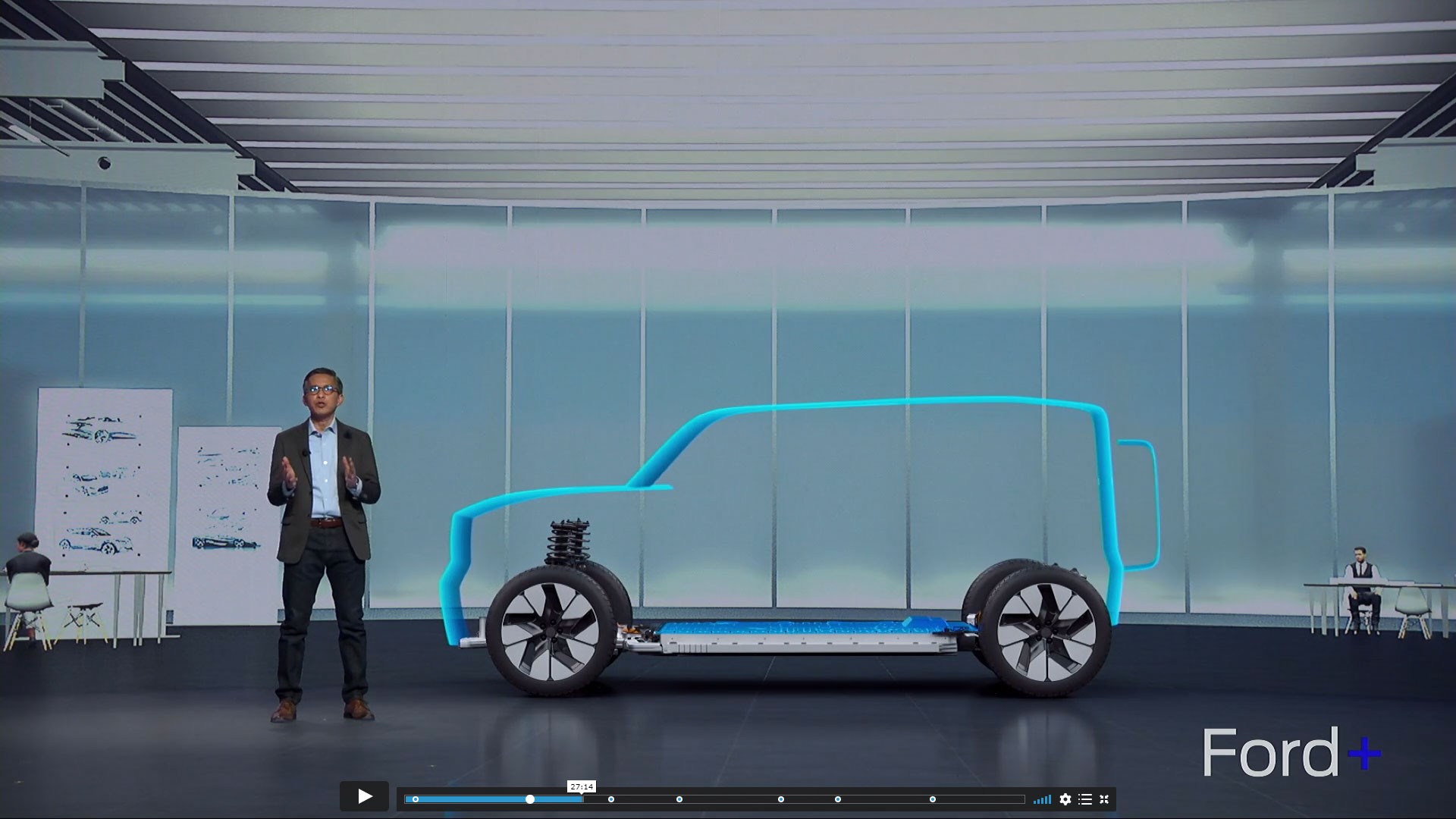
Ford revealed its two new EV platforms at a presentation overnight, each being the base architecture of a wide range of models already within the Ford range.
Codenamed GE2, the smaller of the two platforms is an evolution of the existing architecture which was developed for the Mustang Mach-E, expected to be launched first underneath the Ford Explorer and Lincoln Aviator.
Screenshots from the presentation show the GE2 platform will also underpin the new Transit van as well as a Bronco-like off-roader, while an all-electric Mustang is also on the cards.
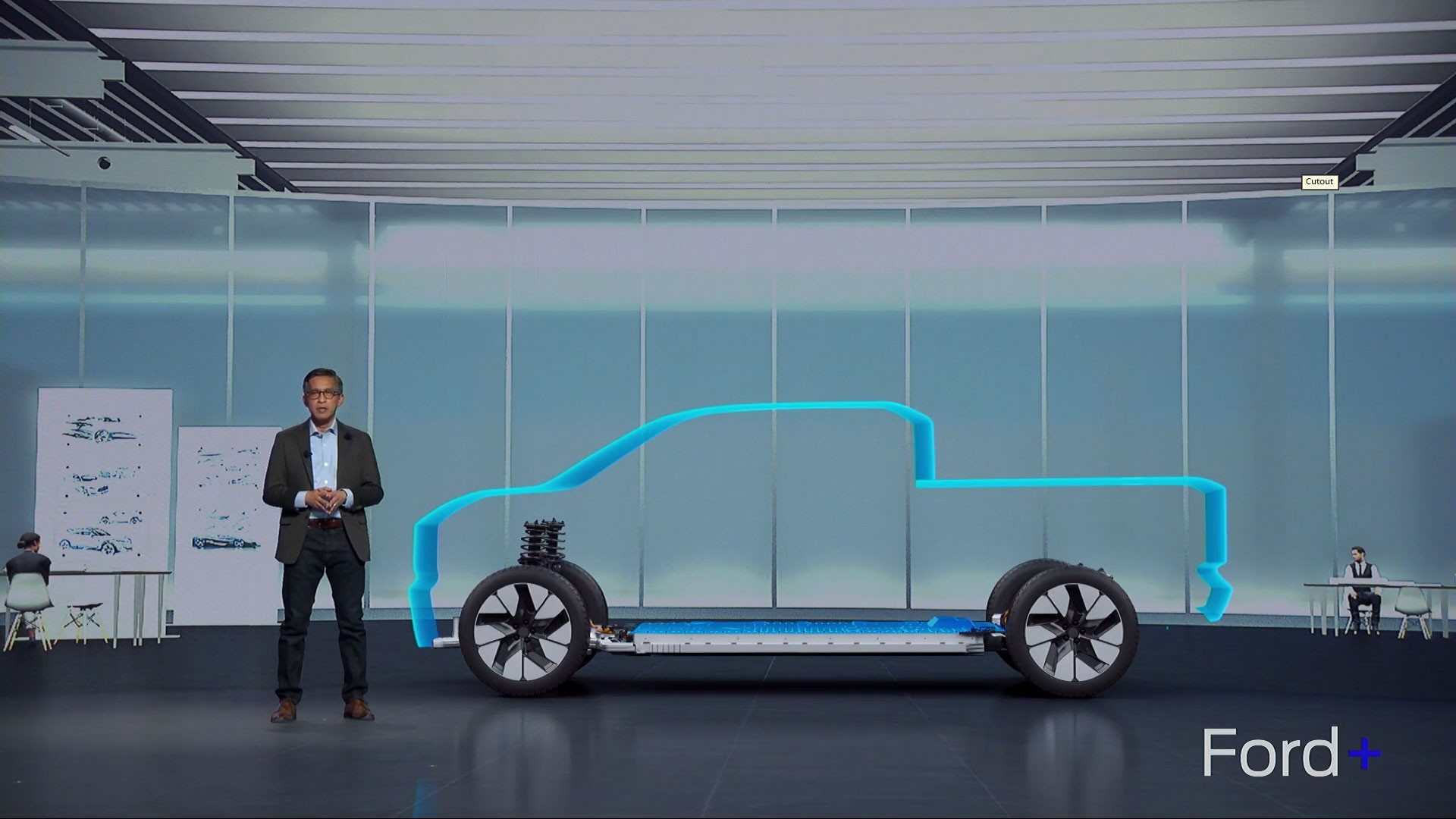
The larger platform is set to be the base upon which the next generation of F-150 Lightnings will be built, expanding out to full-size SUVs like the Expedition and Lincoln Navigator.
It is unclear whether these models will be available in Europe or just in the United States, given Ford has entered into a joint venture with Volkswagen to use the German marque’s MEB platform in its smaller, family-sized vehicles.
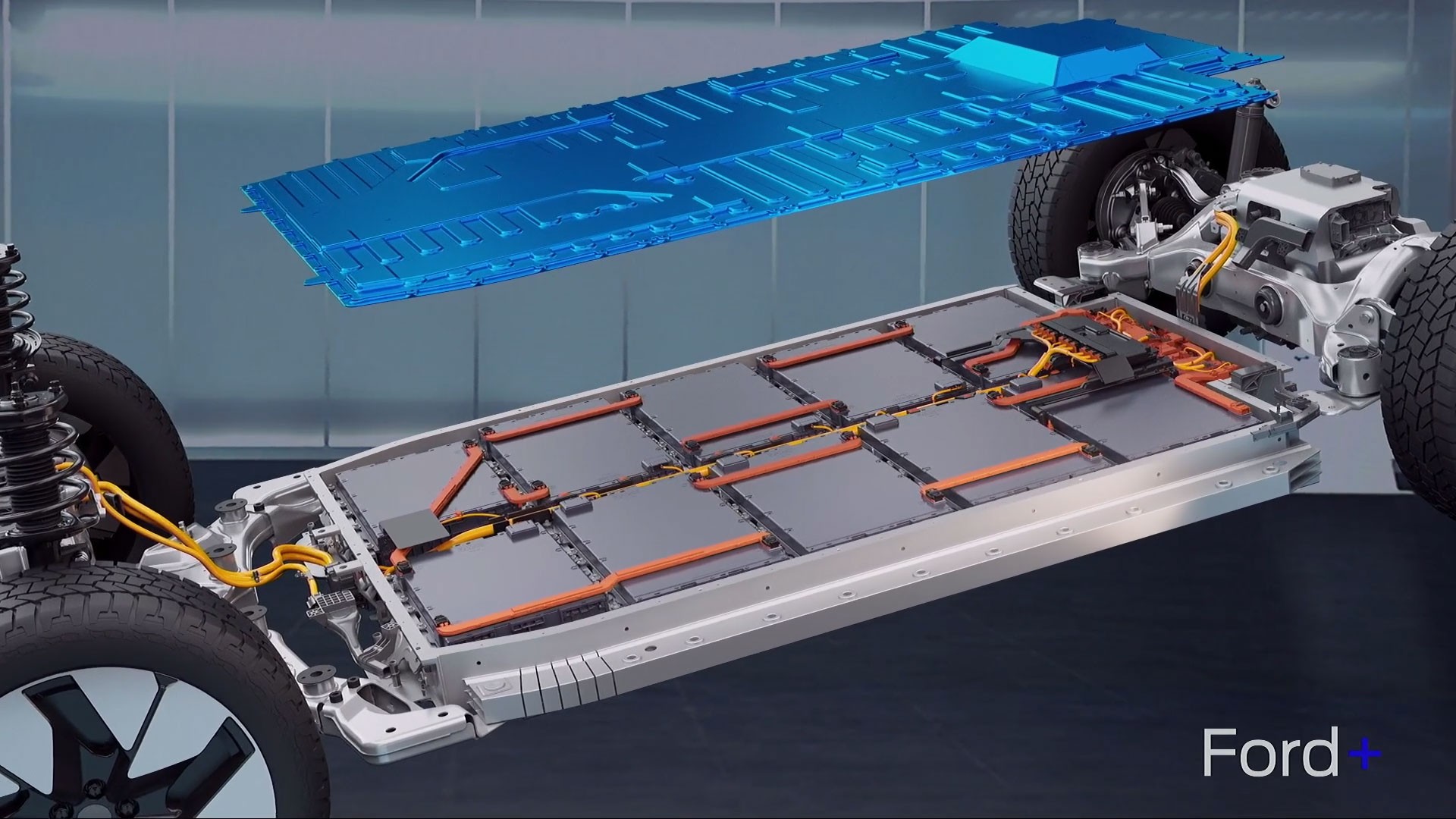
All of Ford’s new EV platforms will use batteries made in-house after it announced a joint venture with South Korean firm SK Innovation last week, building two factories in the United States under the name BlueOvalSK.
While IonBoost-branded lithium ion batteries feature in the new architecture and IonBoost Pro lithium-iron-phosphate batteries will be used in commercial vehicles, Ford is also developing solid-state batteries with the assistance from US developer Solid Power.
Lewis Hamilton sits opposite me in the Wing complex at Silverstone, head down. I think he’s scrolling through Instagram. He nods an appreciative acknowledgement that I’m leaving him to his own devices and not badgering him for a selfie or trying to engage him in vacuous conversation. I feel a moment of guilt that, as a journalist, I should be angling for an exclusive, but that’s probably why I don’t work for a tabloid.
I’m often surprised at just how personable many big names remain. Please excuse the clangy name-drops but Ian Callum chatted about car design for an hour while waiting for a man to mend his washing machine. Sir Stirling Moss drove me up the hill at Goodwood in a Maserati Birdcage back when I was a rookie journalist, then took me for lunch and gave me an invaluable lesson in how to ask a decent interview question. The notoriously volcanic Michele Mouton was charm personified. Harm Lagaay drew me a sketch of a 996 Turbo which I then gifted as a birthday present to a Porsche-owning friend, a moment of generosity I’m now beginning to regret.
Not everyone’s been a ray of light though. I was once summoned for a dressing down at TVR by then-boss Peter Wheeler, who was incensed that I’d contacted owners on a web forum about reliability, a hot-button topic for TVR. With hindsight, some of the comments were pretty ripe.

“I have amassed 2000 miles on dealer visits alone,” said one. “Thank God for the warranty is all I can say,” claimed another. The most pertinent quote came from one frustrated owner who, when asked what he most wanted in his Cerbera, replied “a spare car in the boot.”
TVR’s flustered PR man phoned me to claim that all of the posts on the web forum, which had over 2000 members, were aliases of one disgruntled and hysterical owner who was given to camping in TVR’s reception and refusing to leave unless his grievances were addressed.
I knew this not to be true. I wasn’t about to trek to Blackpool like a naughty schoolboy to get the hairdryer treatment for reporting genuine issues. When I wouldn’t play ball and take the quotes down, he made vague threats of legal action, which predictably came to nothing.
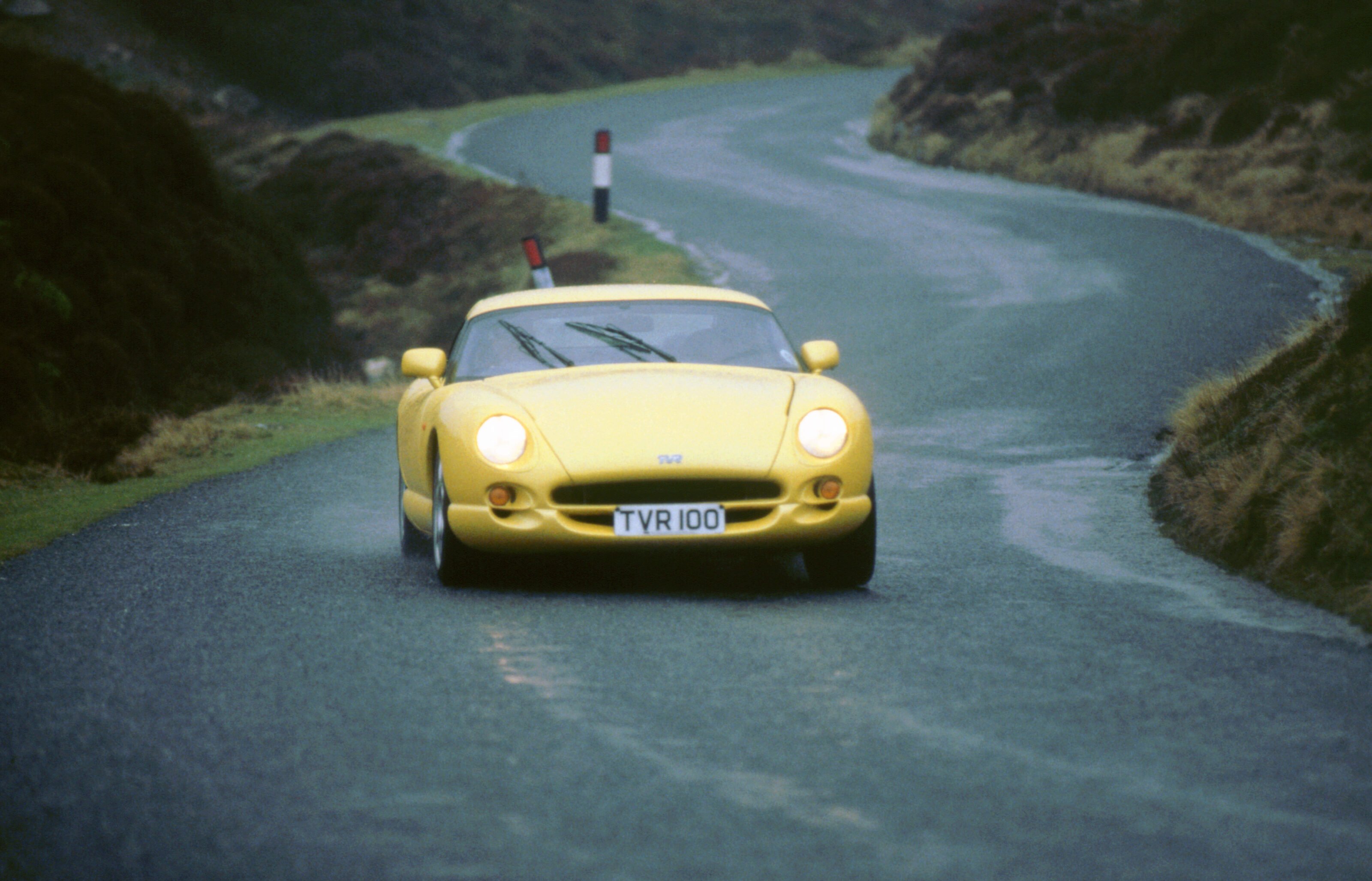
Keen to extend my first-hand experience of the brand, I later arranged a drive of one of their later coupes. It suffered an electrical fire on the way to being delivered and I’ve never driven a TVR since. I’m sure the late Mr Wheeler was an engaging character and fiercely loyal to his company, but all we ever shared was some pretty industrial language over the phone. That was disappointing.
Jeremy Clarkson was similarly disappointed when he finally got to interview his childhood idol, test pilot and first man to break the sound barrier, Chuck Yeager. Perhaps Jeremy’s a little less empathetic, but he’s certainly not short of an opinion on being let down by Yeager. “When I finally got around to meeting him, I found he was the biggest wanker,” said Clarkson.
Never meet your heroes? I don’t subscribe to that.
Maybe just choose your moments.
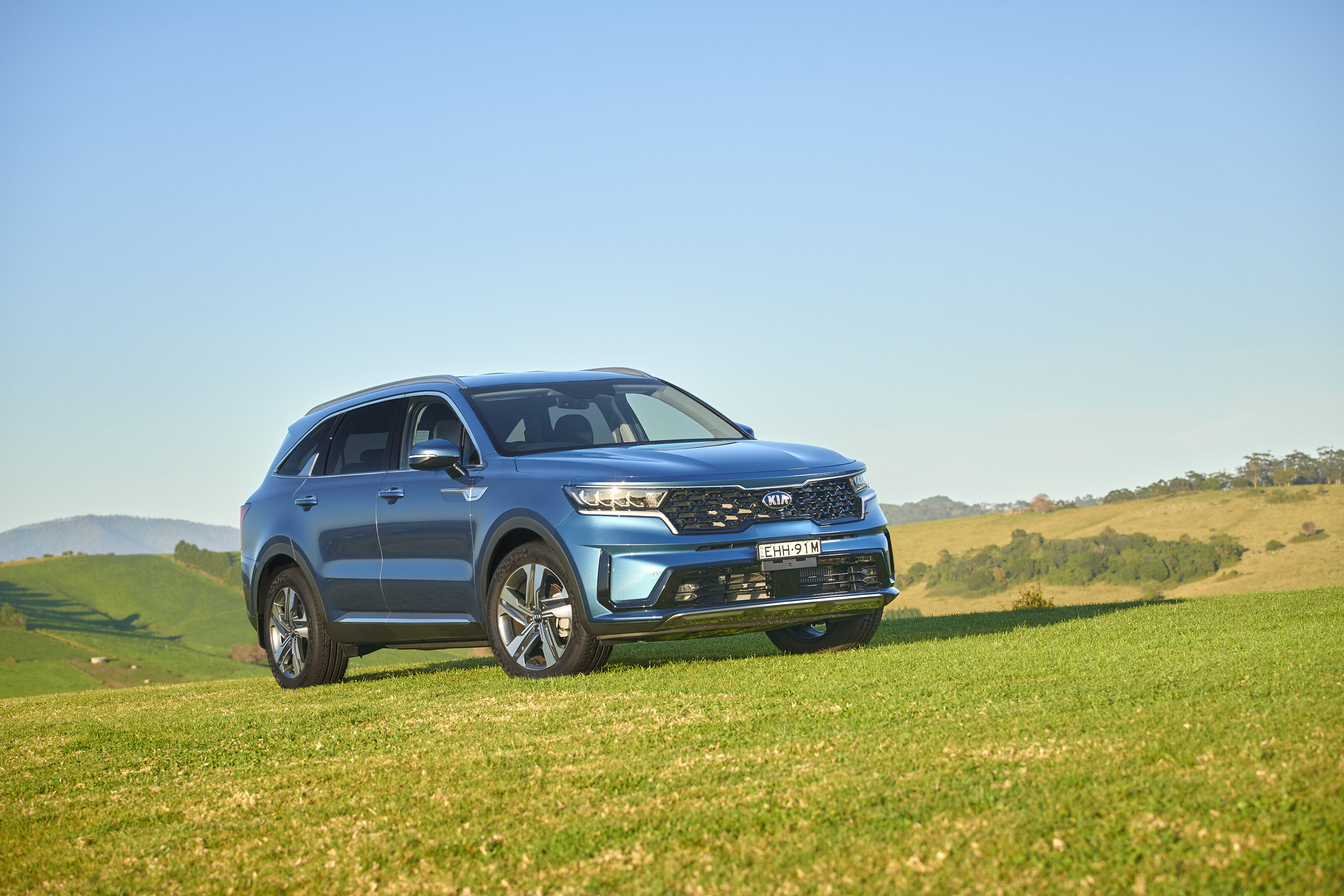
This is the Kia Sorento seven-seat SUV, or more specifically the Sorento Sport+ diesel AWD, that on paper looks like being the sweet spot of the range. But of course, the best way to see if the Sorento’s penultimate spec really does strike the balance between price and equipment is to take it for a drive.
But first an overview: The Sorento range features S, Sport, Sport+ and GT-Line variants that are each available with a 3.5-litre V6 petrol engine that drives the front wheels, or a torquey 2.2-litre four-cylinder turbo-diesel with all-wheel drive.
Pricing starts at $46,850 before on-road costs for the petrol Sorento S, with the diesel AWD drivetrain attracting a $3000 premium.
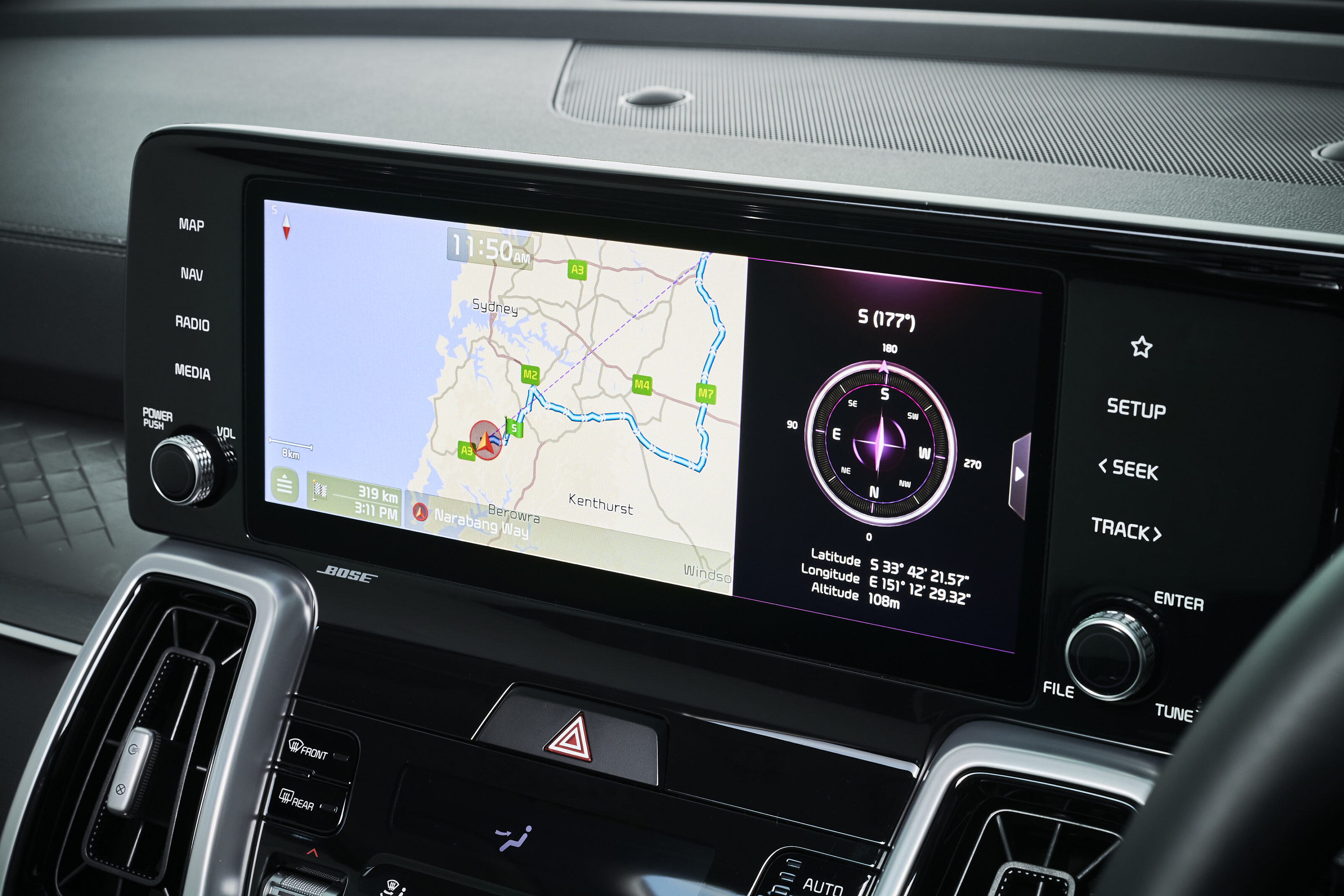
For another $2600, you can upgrade to the Sorento Sport that brings a host of extras over the already generous standard features list, including a bigger panoramic 10.25-inch touchscreen with built-in satellite navigation for when you’re unable to use Apple CarPlay or Android Auto.
It also has dual-zone climate control air-conditioning, an auto-dimming rear-view mirror, 10-way powered settings for the cloth driver’s seat and bigger 19-inch alloys wheels.
“To me, opting for the turbo-diesel is a bit of a no-brainer.”
Spending another $4400 on the Sport+ – priced at $53,850 and $56,850 for the petrol and diesel versions respectively – brings creature comforts such as leather-appointed seats, heated front seats, heated steering wheel, smart keyless entry, push-button and remote engine start, heated door mirrors, hands-free powered tailgate and USB sockets in both the second and third row.
Incredibly, you can spend an additional $7200 on the GT-Line spec that brings a metric tonne of extras and is an excellent choice if you can afford more than $61,000.
But I reckon most buyers would be tossing between the Sport and Sport+.
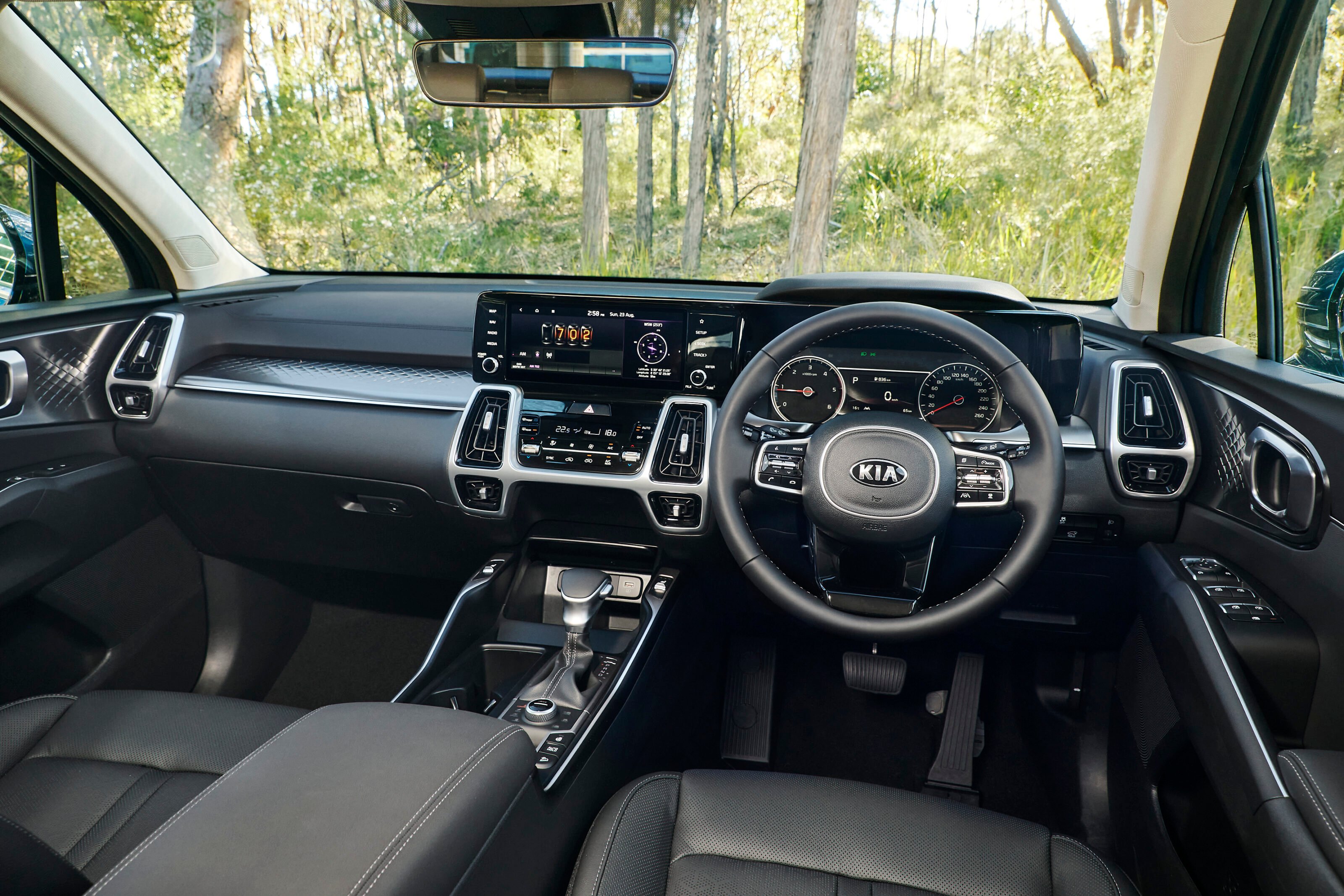
Choosing either brings a spacious interior. There is plenty of elbow room up front, evident by the broad centre console with ample storage space including a deep tub and a spot to plug in and place mobile devices, and the door bins will carry all manner of items too.
Soft surfaces abound and while you’ll find hard plastics on the doors below the armrests, they don’t really feel cheap or brittle.
The second row is also quite roomy and offers plenty of leg and headroom. The seats are comfortable and can slide back and forth while the backrests recline up to about 30 degrees.
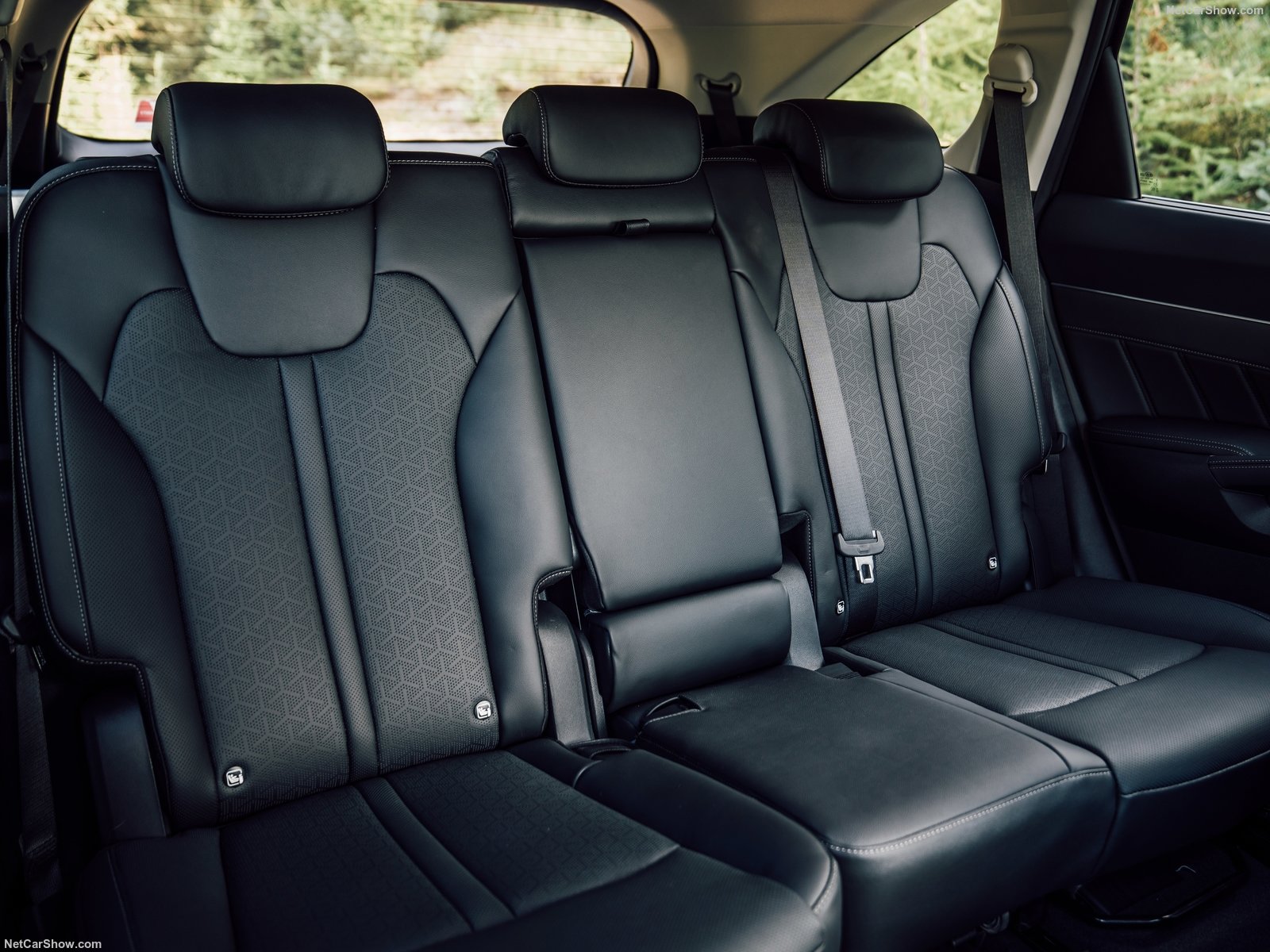
Fitting three adults would be a bit of a squeeze, particularly on longer trips, but there is heaps of space for three children and a nice wide door opening to make strapping them in easier.
The middle row is serviced with air vents, map pockets behind the front seats, smallish door bins, cup holders cleverly installed in the door armrests, a fold-down centre armrest with additional cup holders, a 12-volt power socket and USB sockets mounted in the side of each front seat for easy reach.
The 60:40 split seats slide forward and fold down to provide third-row access with a single touch of a button, though climbing into the very back isn’t exactly an elegant exercise for anyone older than 12.
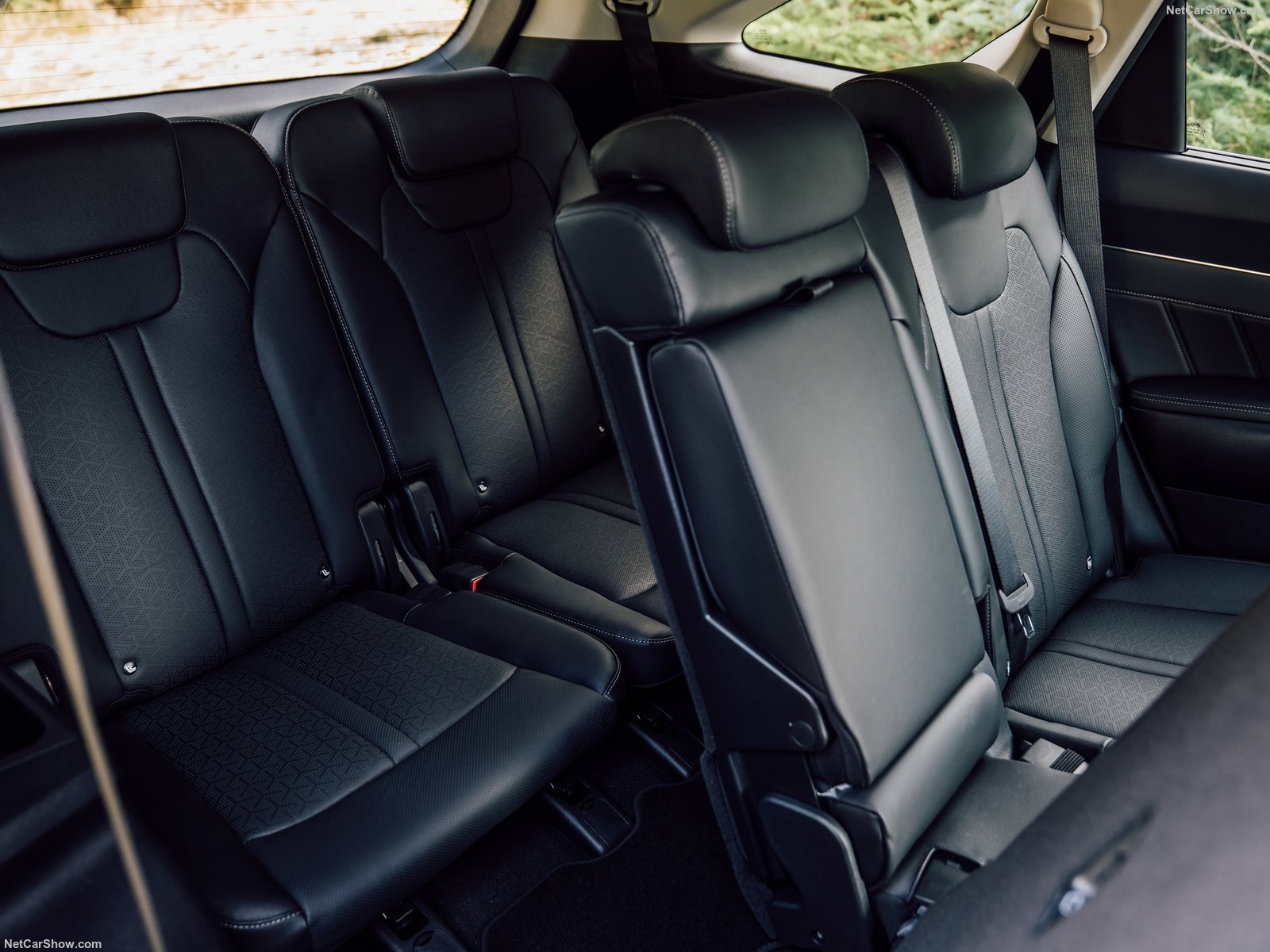
Indeed, the third row is best utilised by kids. Legroom is very tight for bigger people, even the with second-row seats pushed forward a couple of inches. There is nowhere to slide your feet and the seat is quite low, meaning taller people’s knees will almost be touching their chin.
Another third-row downside is the lack of curtain airbag protection that’s enjoyed by the first and second rows.
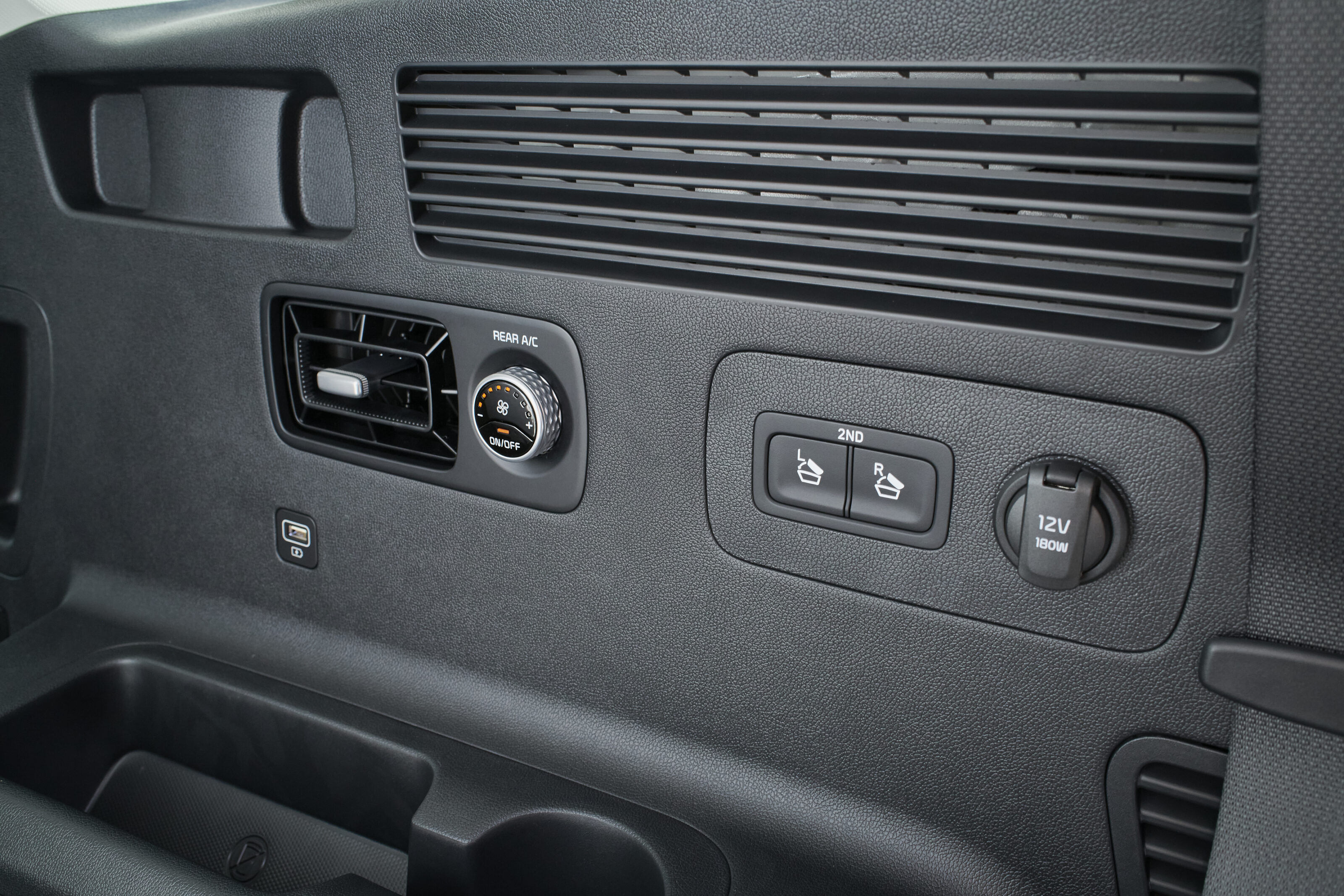
On the plus side, the Sport+ brings third-row passengers their own USB ports, cup holders, a small storage tub and a dial to control airflow through the rearmost vents.
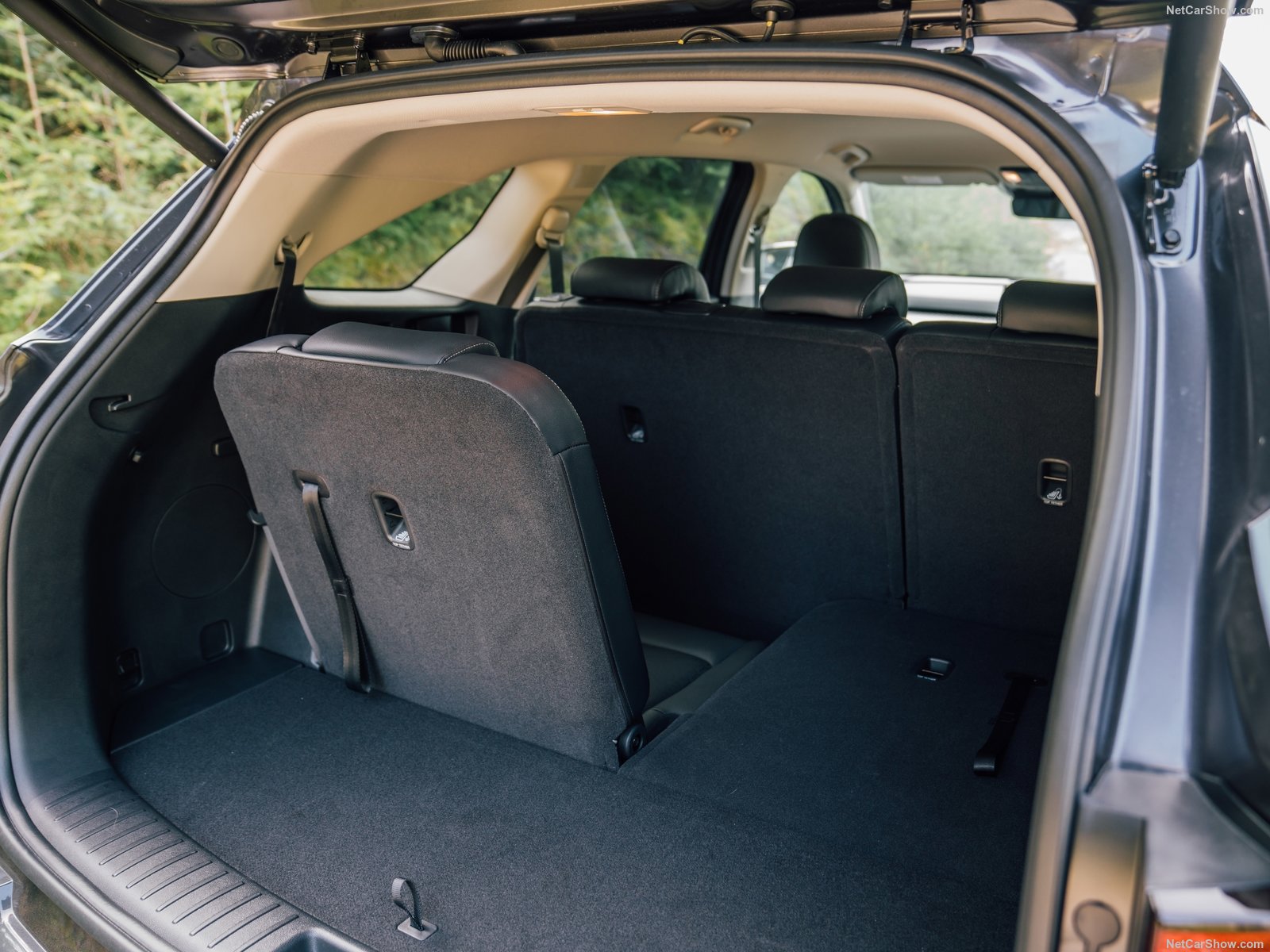
Boot space with all three rows in use is 187 litres, which is enough to hold a stroller, the weekly shopping or a set of golf clubs. The third row seats easily fold flat to bring a big 616-litre boot, and folding the middle-row seats down allows you to carry up to 2011 litres of stuff.
The boot blind and wheel jack are neatly stored under the boot floor, while the full size spare wheel is stored underneath the Sorento so you can change a wheel without having to unload the kids or baggage. Unlike the Sorento Sport, the Sport+ has a hands-free powered tailgate.
If you need to carry more, the Sorento has roof rails onto which you can install roof racks, and all variants have a braked towing capacity of 2000kg or 750kg with an unbraked trailer. The maximum towball down-weight is 200kg.
The Kia Sorento is covered by a seven-year warranty and all variants require servicing every 15,000km or 12 months, with capped-priced maintenance available. Respective service costs for diesel variants during the first seven years are $335, $544, $408, $729, $377, $670 and $400,
What is the Kia Sorento AWD like to drive?
The first decision one has to make when looking at any Sorento variant is whether to go with the front-driving petrol powertrain or turbo-diesel AWD.
The former comes in the form of 200kW/332Nm naturally aspirated V6 that’s coupled with an eight-speed automatic transmission. It’s a little gutsier than the previous model Sorento’s but somewhat on the greedy side with an official combined fuel economy rating of 9.7L/100km.
The petrol car isn’t exactly potent from a standing start or at low engine speeds, but with peak torque and power respectively kicking in at 5000rpm and 6300rpm, it does have decent shove in reserve for when you need to overtake.
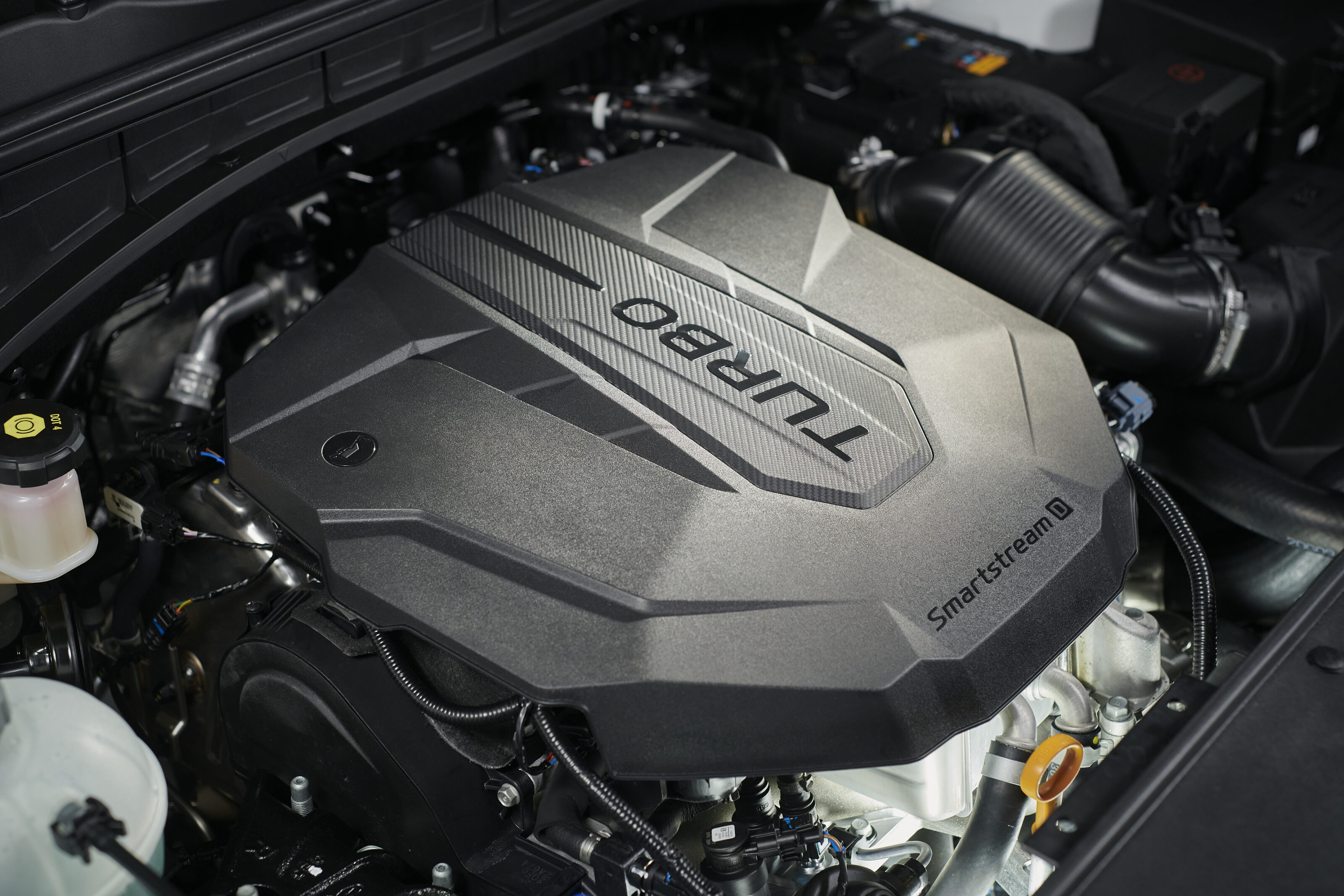
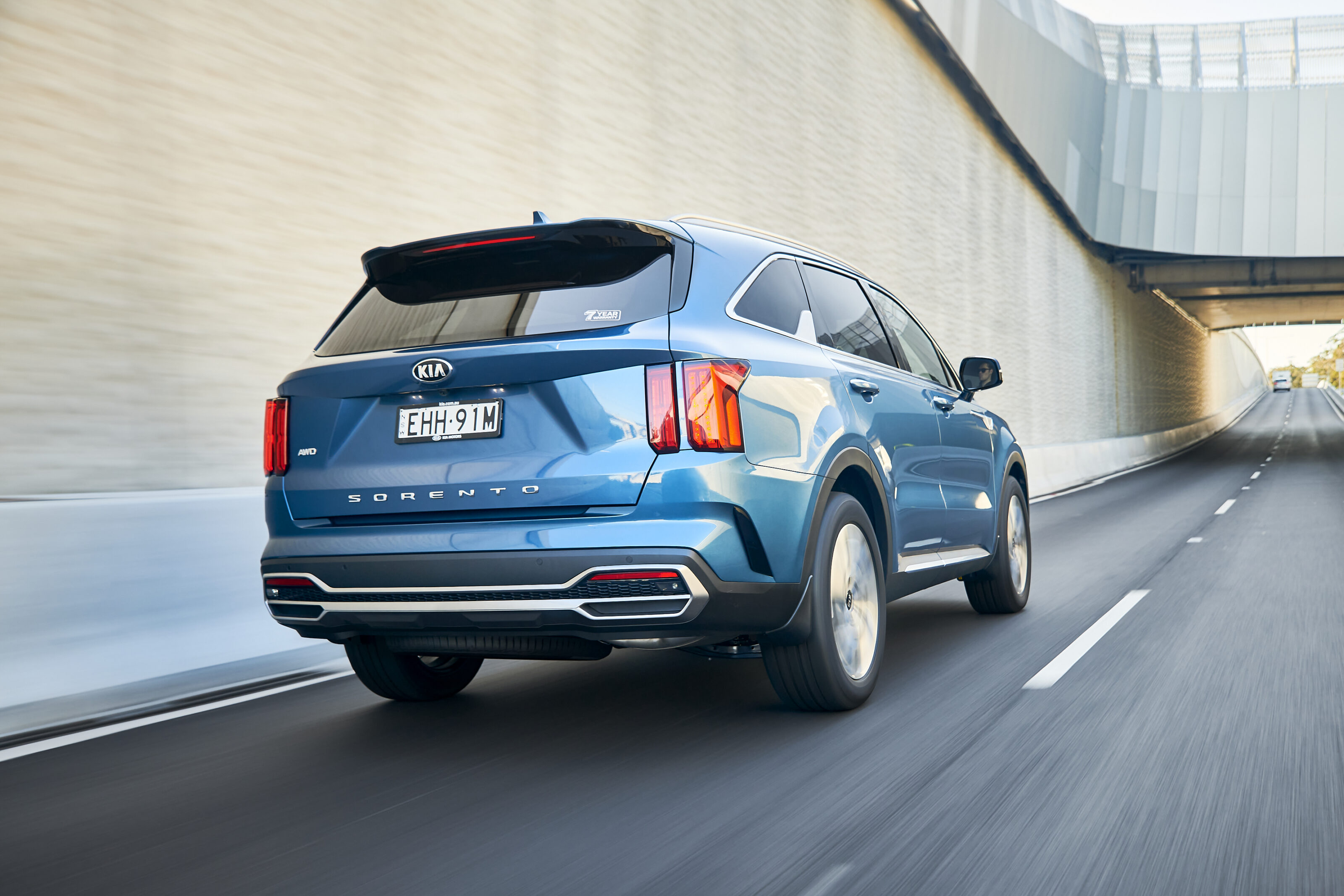
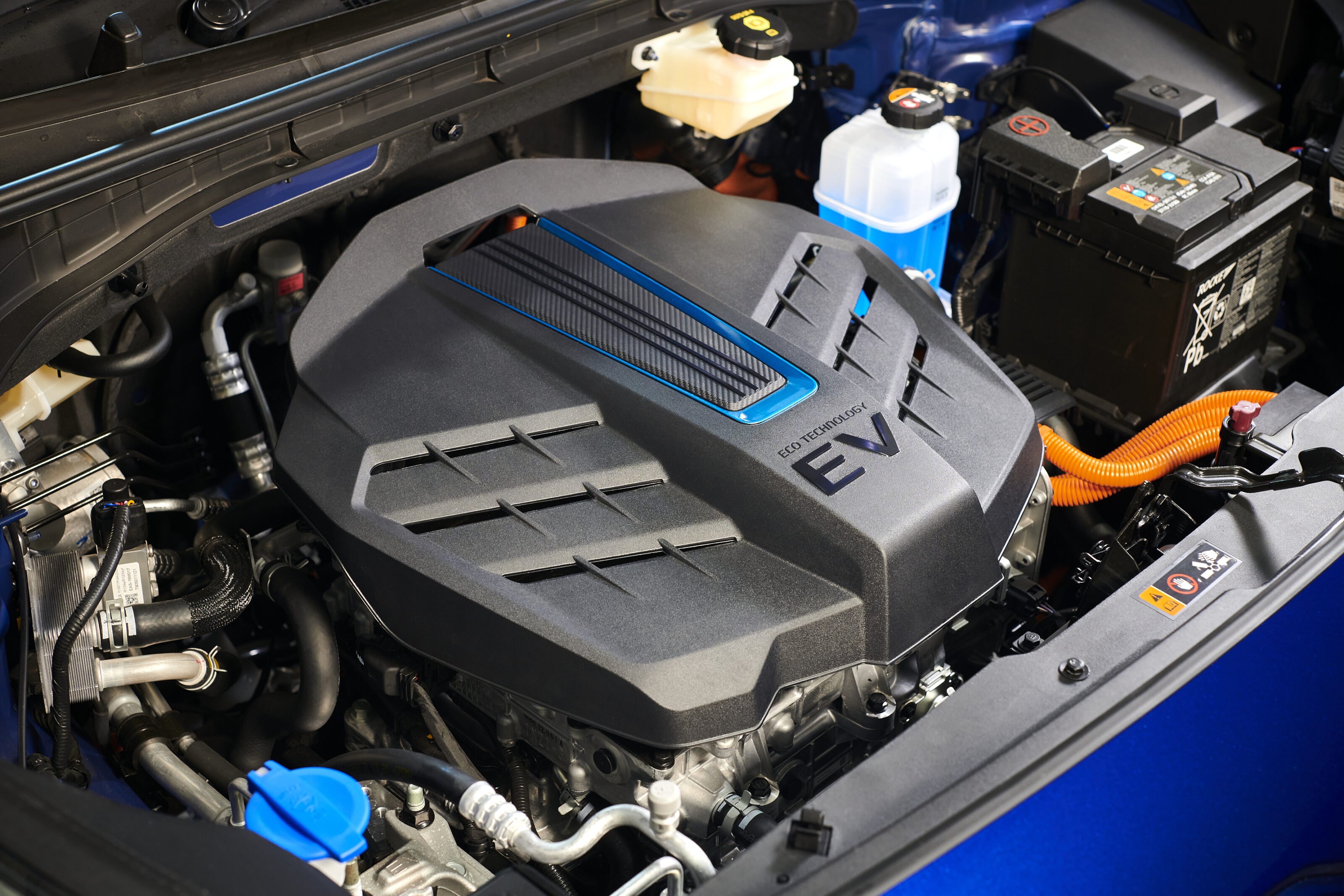
To me, opting for the turbo-diesel (pictured above) is a bit of a no-brainer. Coupled with a more advanced eight-speed dual-clutch automatic, it produces 149kW of power and 440Nm of torque to better move the Sorento’s 1.9-tonne heft while consuming just 6.1/100km.
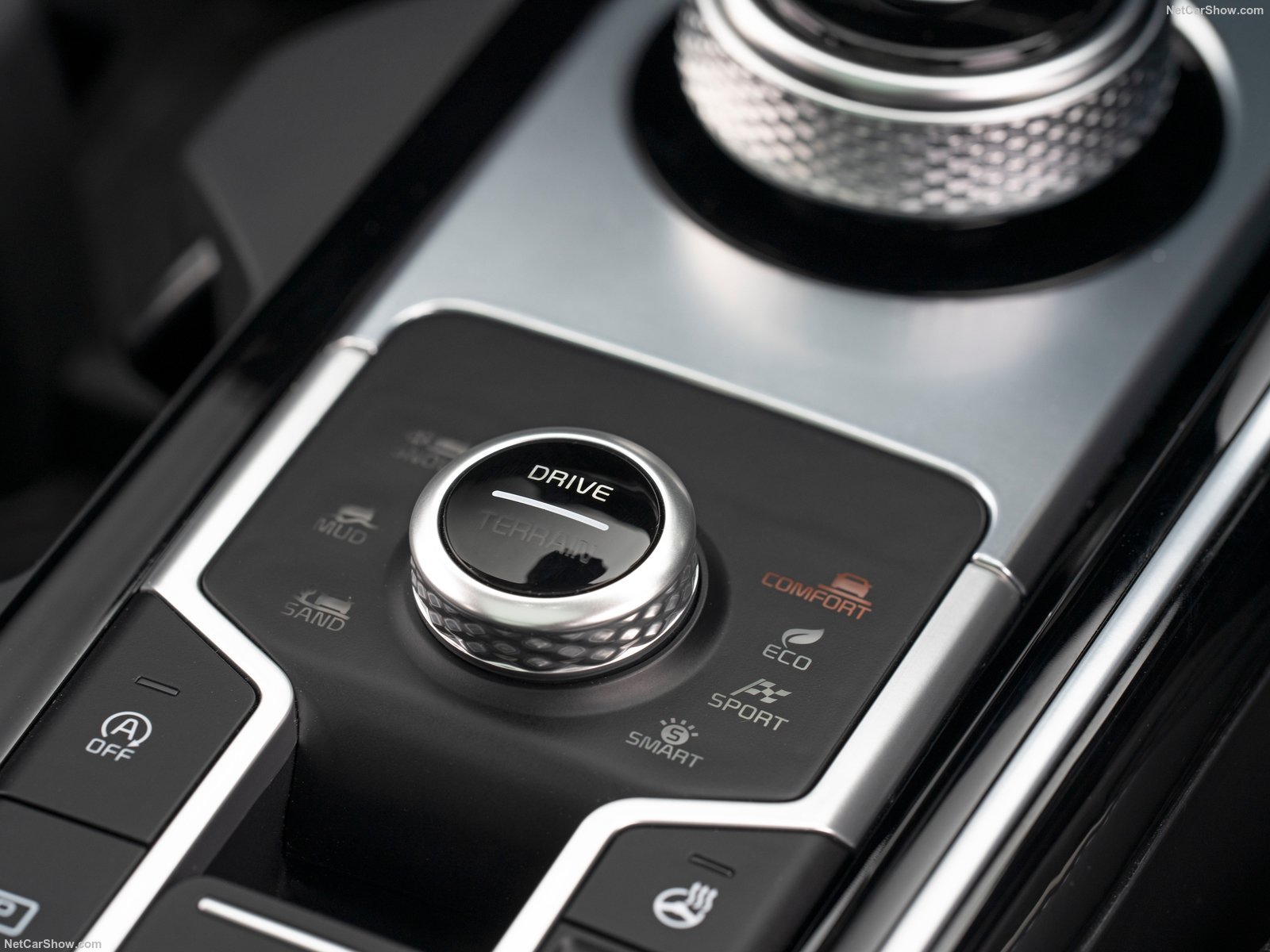
It feels lively from the get-go, which helps with towing and doesn’t have the lag you expect from dual-clutch transmissions. It also has drive modes to suit different road conditions including Comfort that sees it respond instantly to a light foot, and Sport that grabs gears up or down to accelerate quicker with near-perfect precision.
It’s pretty quiet too, with obvious improvements to NVH levels compared to the previous model.
Other drive modes include Eco, which keeps the revs down by gearing up sooner and Smart, which automatically selects the best options based on how you’re driving.
While not a true four-wheel-drive vehicle, the AWD variants let you choose between Sand, Snow and Mud terrain settings that alter the traction control and throttle response accordingly.
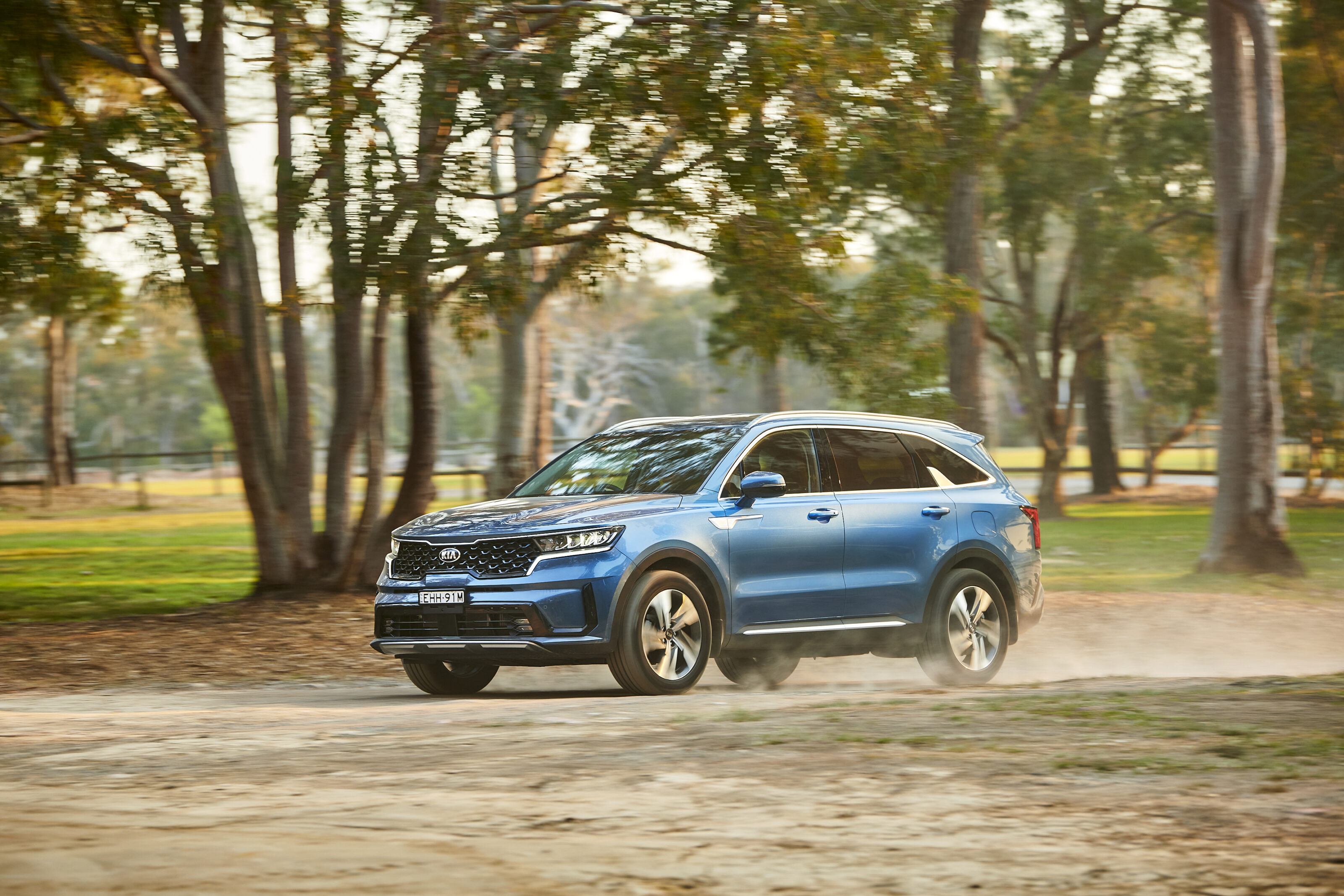
Like most Kia models introduced in Australia, the suspension, which includes a multi-link rear setup, has been recalibrated to suit rougher Aussie roads and the result is a better ride with less body roll in corners.
Even on the 19-inch wheels fitted to a Sport+, it glides limousine like over smooth roads and feels composed on rougher surfaces as well, which is good news for third-row occupants sitting directly above the rear axle.
The electric power steering feels direct and selecting Sport mode adds additional weight to the tiller for more precise cornering that makes you forget you’re driving a 4.8-metre three-row SUV.
What about safety in the Kia Sorento Sport+?
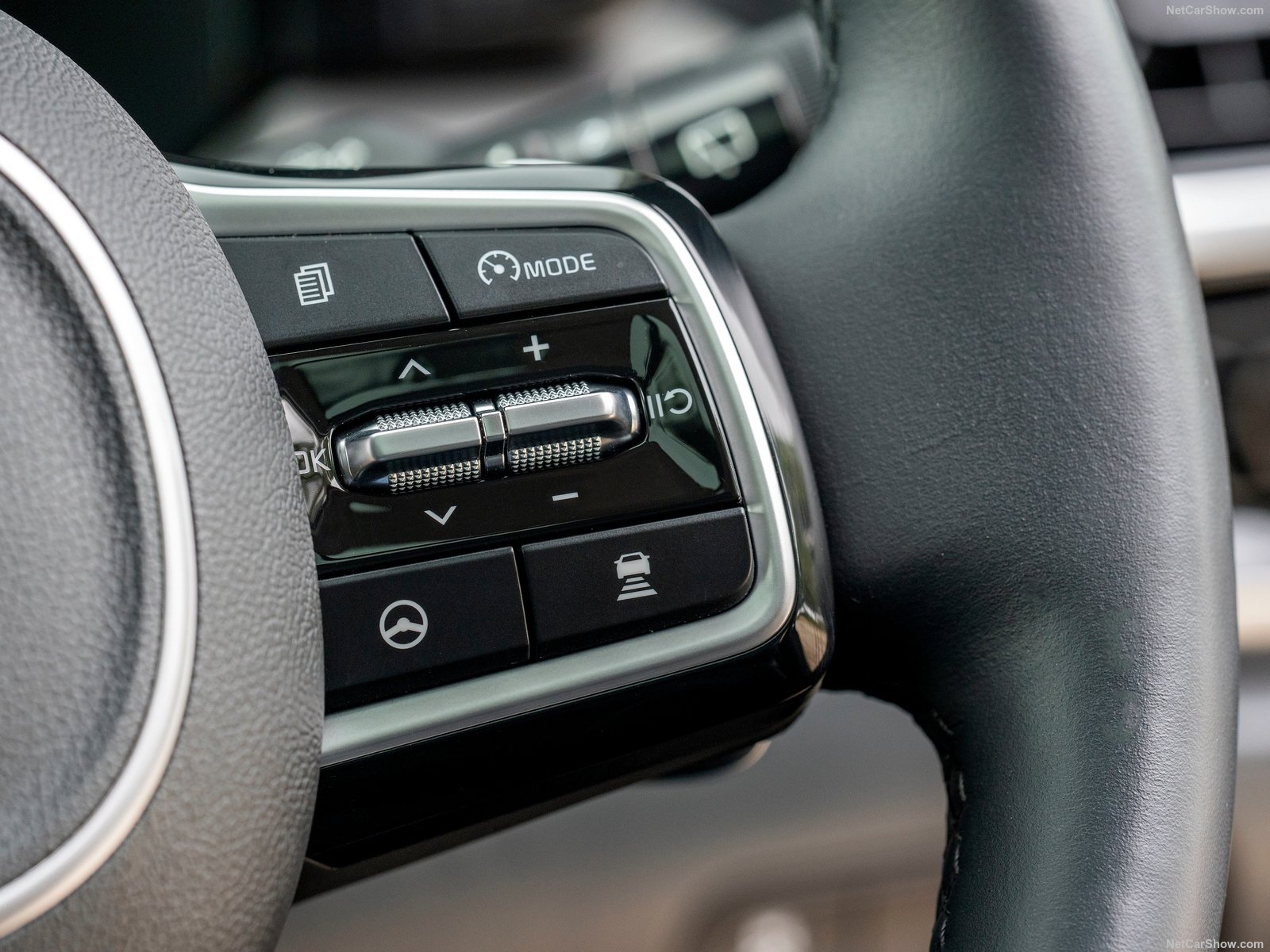
The Sorento’s driving experience is aided by a host of advanced driver assistance features including autonomous emergency braking (AEB) that can detect pedestrians and cyclists. The AEB also has junction detection, which can sense a vehicle entering an intersection from the side and apply the brakes if necessary.
Other advanced driver-assist features include lane-keeping assist, rear cross-traffic alert, blind-spot collision avoidance, driver attention alert, smart adaptive cruise control with stop-and-go function, and speed sign recognition
The Sorento has eight airbags: two directly in front of the driver and front passenger; one alongside each front occupant to protect the upper body and two more that pop up between the front seats to prevent occupants colliding with each other during impact.
As mentioned above, the curtain airbags, which protect the heads of those riding in the front two rows do not extend to the third row.
The Australasian New Car Assessment Program (ANCAP) awarded the diesel Sorento its five-star rating in December 2020 based on its excellent Euro-NCAP results. The ANCAP rating initially applied only to the diesel variant but now includes the petrol and soon-to-be-introduced hybrid versions.
The verdict
Regardless of what engine you choose, deciding between the Sport and Sport+ comes down to whether you want leather seats and a warm bum.
Do you need leather heated seats? Well, there’s no shame in wanting them. And they really add a sense of luxury to the Sorento+ that makes it feel more expensive than it is.
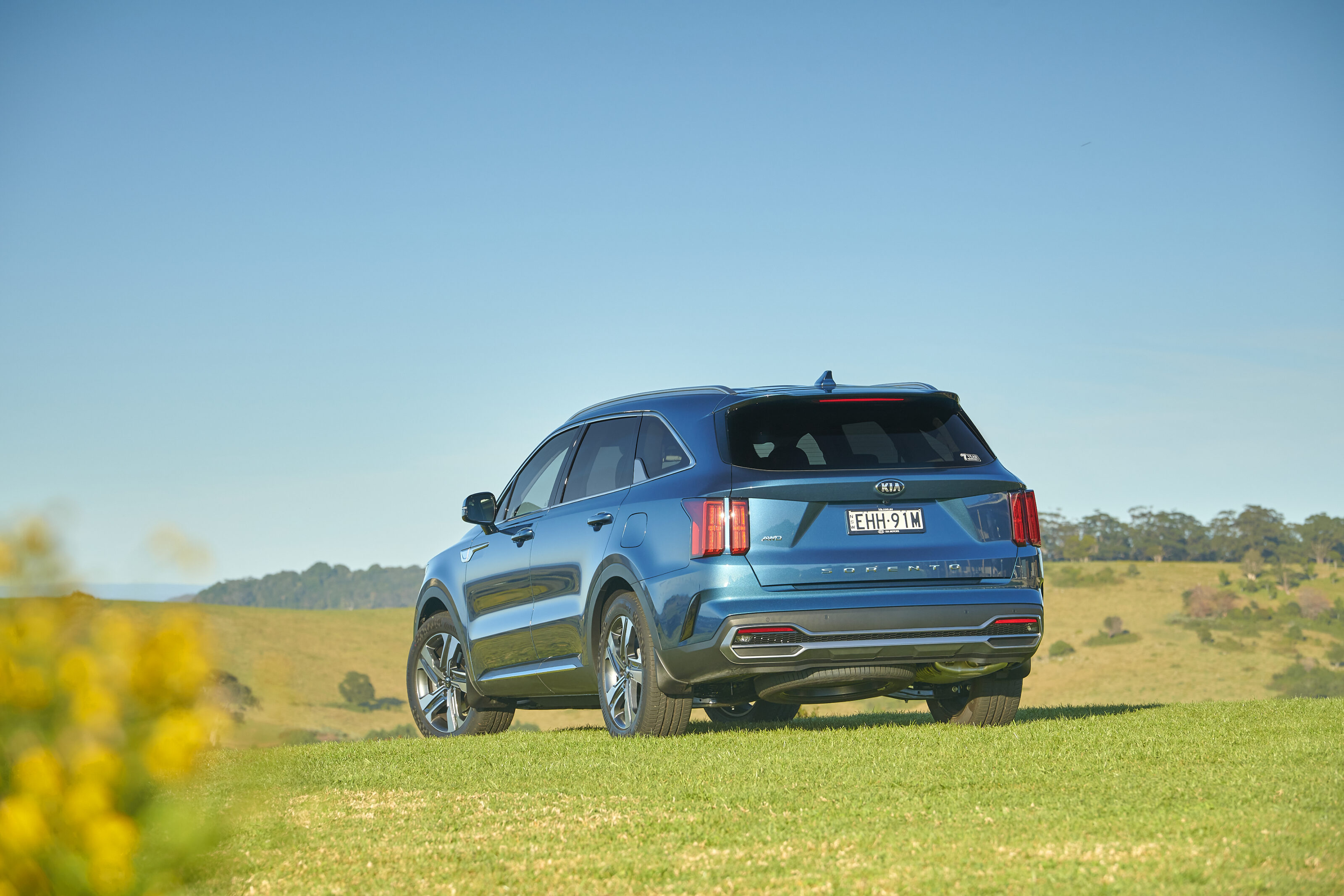
To that end, I reckon the Sport Plus+ does live up to the Sorento sweet-spot mantle and is well worth a look if considering similarly priced seven-seat rivals such as the diesel Hyundai Santa Fe Elite, Mazda CX-8 Touring SP, and the turbo-petrol CX-9 Touring.
Kia Sorento Sport+ specifications
- Body: 5-door, 5-seat SUV
- Drive: AWD
- Engine: 2151cc 4-cyl, 16v turbo-diesel
- Transmission: 8-speed DCT
- Power: 148kW @ 3800rpm
- Torque: 440Nm @ 1750-2750rpm
- Bore stroke (mm): 83.0 x 99.4
- Compression ratio: 16.0:1
- 0-100km/h: 9.2sec (claimed)
- Fuel consumption: 6.1L/100km (combined)
- Weight: 1908kg
- Suspension: MacPherson strut front / multi-link rear
- L/W/H: 4810/1900/1700mm
- Wheelbase: 2815mm
- Brakes: 325mm front and rear ventilated discs
- Tyres: 235/55 R19 Continental Premium Contact 6
- Wheels: Alloy 19-inch (including spare)
- Price: $56,850
Snapshot
- 533 vehicles recalled
- Exhaust gas could leak into engine bay
- Approved Jaguar Land Rover dealers will fix the issue free of charge
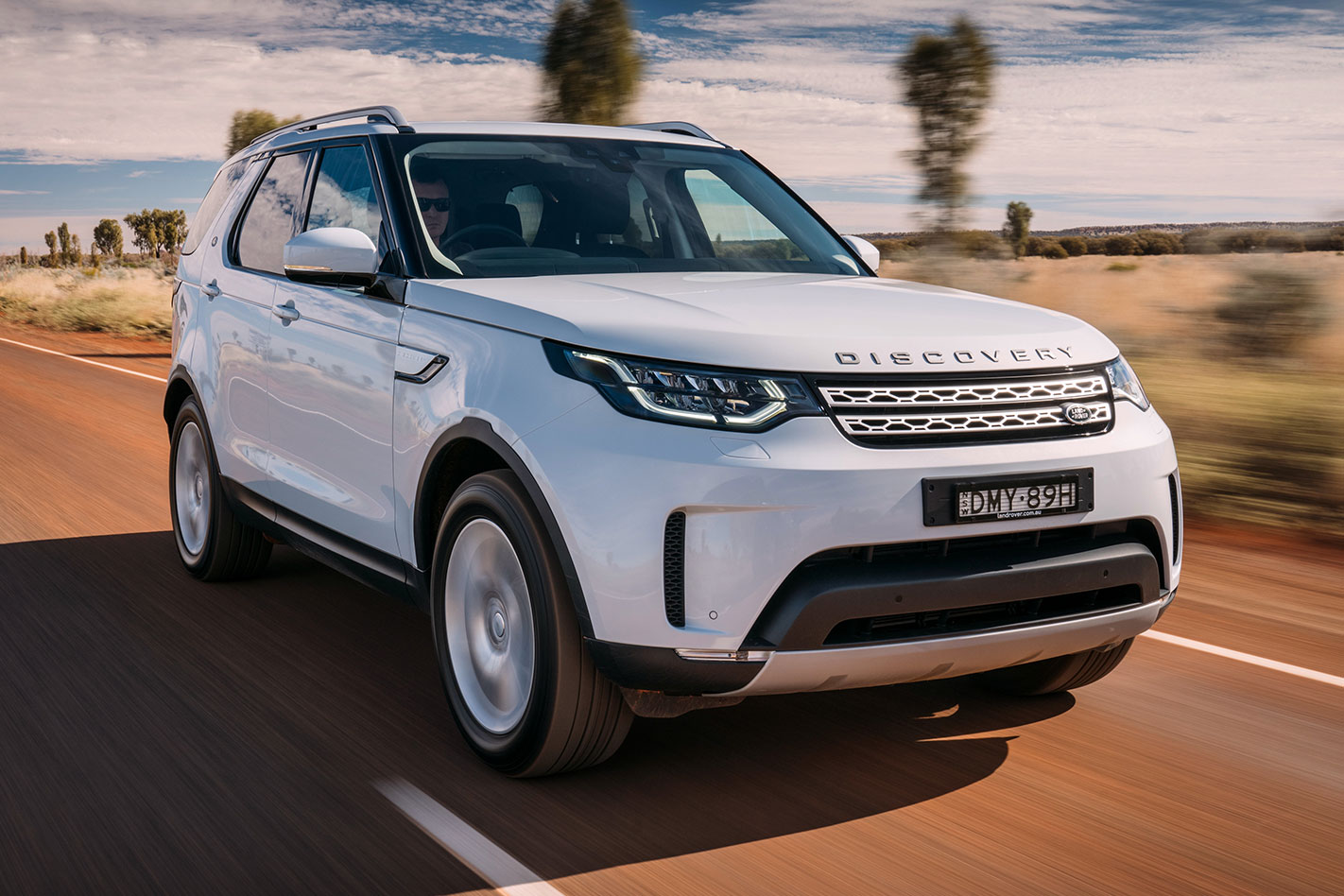
Jaguar Land Rover has issued a recall for 533 of its 2021 Discovery and Defender models sold between November 2020 and March 2021.
The manufacturer claims a nut attaching the exhaust downpipe to the catalytic converter may not have been tightened to specification, causing it to potentially loosen which could lead to hot exhaust gases leaking directly into the engine bay.
The gas leak could result in damage to the engine bay or an engine fire in serious cases, potentially exposing vehicle occupants to serious danger.
JLR will soon be writing to any owners of the vehicles it believes may be affected with the purchase dates ranging from November 2, 2020 until March 11, 2021.
For more information, owners can contact the Jaguar Land Rover Customer Relationship Centre on 1800 625 642 (Monday to Friday, 8am – 8pm and Saturday, 9am – 4pm) or by email on [email protected]
To find your nearest Jaguar Land Rover dealer, visit https://www.landrover.com.au/national-dealer-locator.html
A full list of the affected VINs can be found here.
Snapshot
- New tax will be effective from July 1
- EV owners will be taxed 2.5 cents per kilometre
- Runs alongside $3000 incentive on EV purchases
The Victorian Labor government on Tuesday night passed its controversial new electric vehicle tax. The tax is described as a necessary first step towards a broader user-pays approach to road usage – the government reasoning that EV drivers do not pay the fuel excise and should therefore “pay their fair share.”
The Andrews government further complicated the situation between the time it announced and subsequently passed the EV tax policy, by announcing an EV incentive policy.
The EV road tax – decried by EV enthusiasts, various lobby groups and policy experts – places a price on EV road usage at 2.5c per kilometre. A separate tax of 2c per km applies to plug-in hybrid electric vehicles (PHEV).
The Andrews government says the tax is fair because EV drivers don’t pay the fuel excise – 42.7c per litre – paid by drivers of conventional vehicles.
The kicker here is that the fuel excise is a federal tax and therefore totally unconnected with state policy makers in Spring Street (or Macquarie Street or any other state capital’s streets). The fuel excise, based on where the fuel is purchased, is passed on to state governments as part of a deal dating back to the introduction of the GST.
The 2.5c per kilometre tax will rely on the EV user supplying odometer readings via a digital photo uploaded as part of the registration process – which sounds shaky to say the least.
According to various government and cross-bench figures in the Victorian Parliament, the tax must be implemented now (more accurately, July 1, 2021), because it would be “too hard” to implement in future.
Opponents of the tax argue an immediate implementation is partly down to political expediency. The tiny proportion of the state’s EV owners aren’t going to be able to overthrow the crushing majority the Victorian Labor government currently enjoys in the lower house.

After a visceral response from the Victorian public to the original announcement – and a very tepid response from other State premiers and transport ministers – a few weeks of wrangling ensued and the Victorian government revealed an EV policy intended to encourage uptake.
This policy includes an incentive of up to $3000 to buy an electric vehicle or hydrogen-electric vehicle. The incentive scheme will cover 4000 cars this year and eventually 20,000 EV sales in Victoria over the next three years. This number is unlikely to be surpassed anytime soon, even if the Victorian Government delivers on its policy to up to $10 million worth of EVs.
The incentive is limited to EVs priced under $68,740 – which severely restricts the number of cars to which it applies. It does, at least, head off criticism that handing $3000 to buyers of more expensive EVs is subsidising luxury car purchases for the wealthy.
When paid in full, the incentive will also cancel out the already marginal benefit to the state budget of 2.5c per kilometre for 120,000km of use, or nearly eight years of the average Australian’s annual pre-COVID mileage.
Plug-in hybrid (PHEV) buyers should perhaps feel more aggrieved than full EV owners. Despite these vehicles having a much lower electric-only range (typically 35-50km), the tax on these vehicles amounts to 2c per kilometre, just 20 percent less than the EV tax. The government seems to be operating under the assumption that PHEV owners operate their cars religiously as EVs and rarely use the ICE component of the vehicle.
There is no distinction made by the government between mileage on Victorian roads and mileage on other states’ infrastructure.
A per-kilometre charge – also known as road pricing – was perhaps inevitable not just for EVs, but all road users. However, the problem with state-based road charging is that it effectively undermines a national approach to EVs or, at best, a nationally agreed approach between the states to transition ICE cars from the current fuel-based regime.
The fuel excise approach itself is inequitable on a per-kilometre basis, and more akin to a carbon tax as vehicles used more often – or that use more fuel – are subject to more excise.
NSW Transport Minister Andrew Constance believes a road pricing tax is inappropriate until EVs make up 40 percent of the state’s new car sales. This is likely to change, but it provides a signal to the market of what to expect, rather than the surprise imposition of the Victorian tax at a still-early stage for EV market acceptance and the still meagre supply of affordable options.
Much of the talk surrounding the policy is either strongly negative or strongly positive. Campaigner and spokesperson for the Victorian Public Transport Users Association, Daniel Bowen, said on Twitter, “Electric cars should not be free to drive.”
John Band, a transport writer and analyst, believes ICE cars are in their final decade on sale, and subsidising EVs charging through a largely coal-reliant grid doesn’t improve the overall carbon situation very much.
Like Band, a number of commentators believe new car sales will soon be mostly or completely electric, as manufacturers will not be interested in supplying only Australia with ICE-engined cars.
This belief is based on a number of European countries pledging to phase out ICE sales in the next 10-15 years and manufacturers like Ford telling the market that the company will not be offering ICE cars for sale in 2030.
While it’s unlikely that 2030 will be the final death-knell for ICE cars – with the Victorian Government itself expecting a 50-50 split by 2030 – there will be significantly more electric cars, new and used, for buyers to consider.
Prominent energy transition specialist Simon Holmes à Court – who believes the tax load on EV buyers is already far greater than an equivalent ICE car – is an opponent of the tax.
He says that in the coming years, governments will reap billions of dollars in tax revenue from EV buyers and says the $50m incentive scheme doesn’t make sense.
Author and Chief Economist for the Australia Institute, Richard Denniss wrote in The Guardian, “As a rule of thumb, it’s good economics and good politics to tax the things you want less of and subsidise the things you want more of. That is why the Australian government raises so much tax from alcohol and tobacco, and why the Victorian government’s electric vehicle tax is the dumbest idea since Tony Abbott made the Queen’s husband a knight.”
The Victorian Government’s pioneering move has put a few noses out of joint, particularly the vehicle manufacturers. At the same time, it has demonstrated a glaring lack of policy at a federal government level and a reticence from other states to apply a tax to a new technology that is popular – at a conceptual level if not in sales.
While incentive programs like the Victorian Government’s have been very successful in Europe and the US, those markets are not undermined by a disincentive in the form of a tax, which is why reform for all road users is required. These programs are also more generous – in upfront dollar terms as well as in side benefits like exemption from London’s hefty congestion charge or, closer to home, the ACT’s free registration.
What the Victorian Government has failed to do is create a genuinely equitable road pricing system to cater for all road users and create an environment that favours EVs while also recovering the cost of the use of infrastructure, which includes charging.
The future of cars is electric, no matter where the electrons come from. That leaves a big hole in revenue for both the Federal and State governments, so road pricing is most likely the way forward. The Andrews government knows this, and probably figures it’s not going anywhere for some time – and had best bite the bullet now rather than later, when it might be electorally difficult.
Snapshot
- G80 sedan solid all-rounder, particularly well in side and far-side impacts
- GV80 SUV gives great child protection results
- Child Presence Detection system in GV80 could shape future scoring criteria
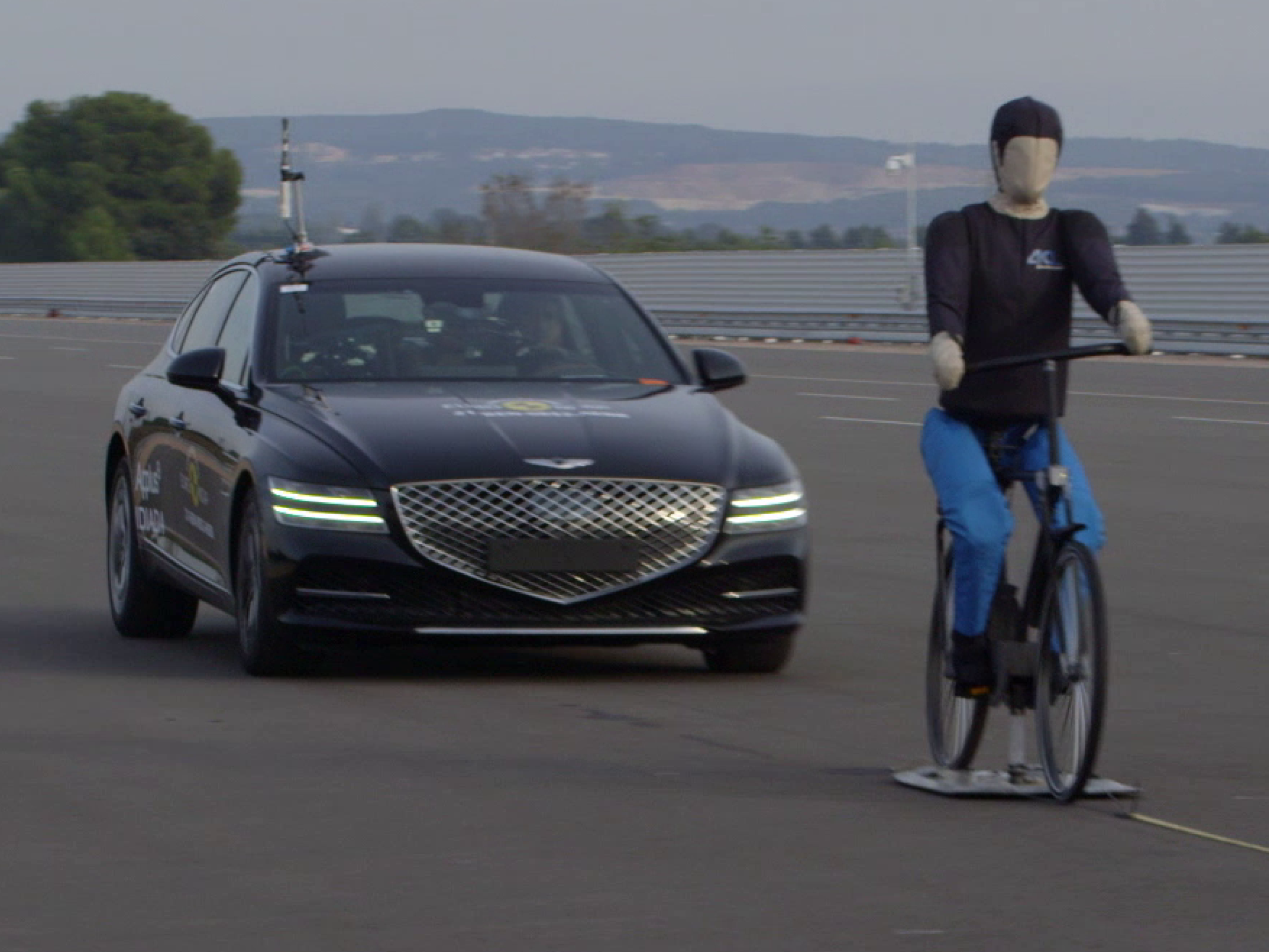
Both of the new Genesis models which have recently hit Australian shores passed ANCAP testing with flying colours according to the independent safety authority.
The G80 sedan, which was released to the Australian market in December 2020, fared notably well for rear-seat occupants in a full-width frontal crash given the size of the car.
A stand out of the G80 test was its protection in the event of side and far-side impacts as well as the car’s autonomous emergency braking (AEB) capabilities, achieving full avoidance or crash mitigation in the rear-end and turning-across-path tests.
ANCAP also said the G80 performed strongly in its vehicle-to-vehicle accident capability, its design providing a low risk of injury to occupants of both vehicles in a crash.
The GV80 seven-seater scored as well as its sedan counterpart in adult occupancy tests and even better for child protection, taking maximum points from the occupant-to-occupant testing.
In the vehicle-to-vehicle crash tests, the GV80 proved to protect its own occupants but pose a higher risk to a partnering vehicle in the event of an accident than the G80 did, owing to its larger size and weight.
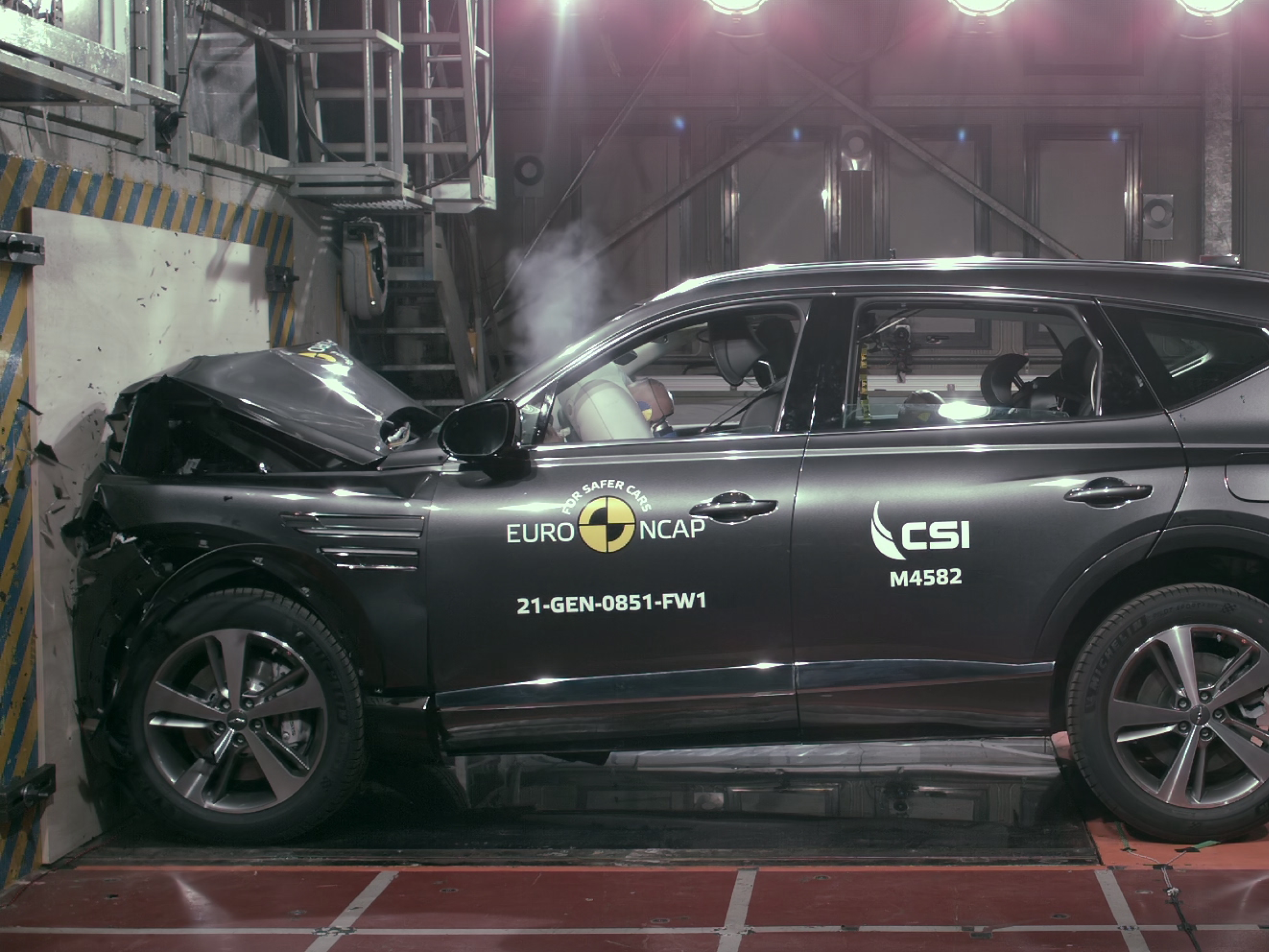
ANCAP noted the GV80’s Child Presence Detection technology, which is designed to alert the driver if they leave the car with a child still occupying one of the back seats, which aims to make children being stuck in hot cars a thing of the past.
“The GV80 also gives consumers some insight into ANCAP’s future plans, with all variants equipped as standard with a Child Presence Detection system,” said ANCAP’s Chief Executive, Carla Hoorweg.
“While this feature is not yet scored as part of the official ANCAP rating process, it paves the way for a new aspect we’ll be introducing from 2023.”
Snapshot
- Based on VW’s MEB Platform
- Fastest variant claims to complete 0-100km/h in 6.6 seconds
- Cupra brand will launch in Australia in 2022
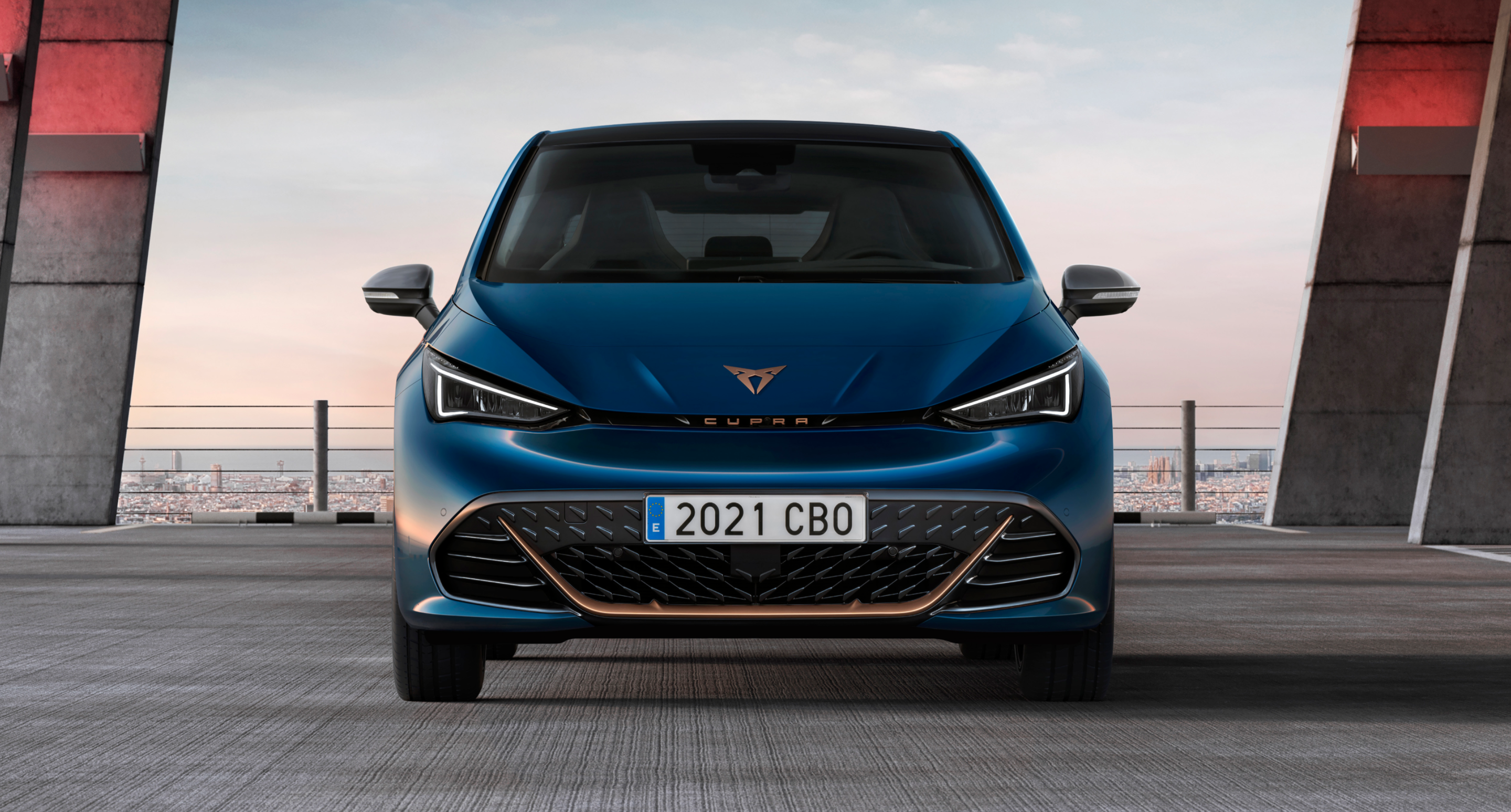
The 2022 Seat Cupra Born has been unveiled as the Spanish automaker’s second battery electric vehicle (BEV).
Sitting above the supermini Mii electric, which is based on the Volkswagen Up, the new Cupra is the production-spec version of the el-Born concept we first saw back in 2019.
Underpinning the Born is Volkswagen’s modular MEB platform, which also forms the basis for VW’s electric ID.3 hatchback.
The new hatchback represents the Cupra performance brand’s first electric vehicle. However, the quoted figures aren’t exactly inspiring.
From launch, there will be three different water-cooled lithium-ion battery pack sizes available – 45kWh, 58kWh and 77kWh.
The base 45kWh variant will produce 110kW and 310Nm, which is enough to shift the five-door hatchback from 0-100km/h in a lacklustre 8.9 seconds. Driving range is a claimed 340 kilometres.
The mid-spec 58kWh battery pack will have two different variants.
The first will produce 150kW and 310Nm and run from 0-100km/h in 7.3 seconds. Driving range improves considerably over the smaller battery pack, with Seat claiming around 420 kilometres.
The second will feature Seat’s e-Boost performance pack, which bumps power to 170kW (torque remains the same) and drops the 0-100km/h dash to 6.6 seconds. Range is still said to be 420 kilometres, but dynamic driving will reduce that number considerably.
Finally, the 77kWh battery pack will also produce 170kW and 310Nm. However, while the 0-100km/h time slows to 7.0 seconds due to the extra heft of the bigger battery pack, the driving range is bolstered to an impressive 540 kilometres.
All Cupra Born variants utilise a single electric motor mounted over the rear axle, which sends its drive exclusively to the rear wheels.
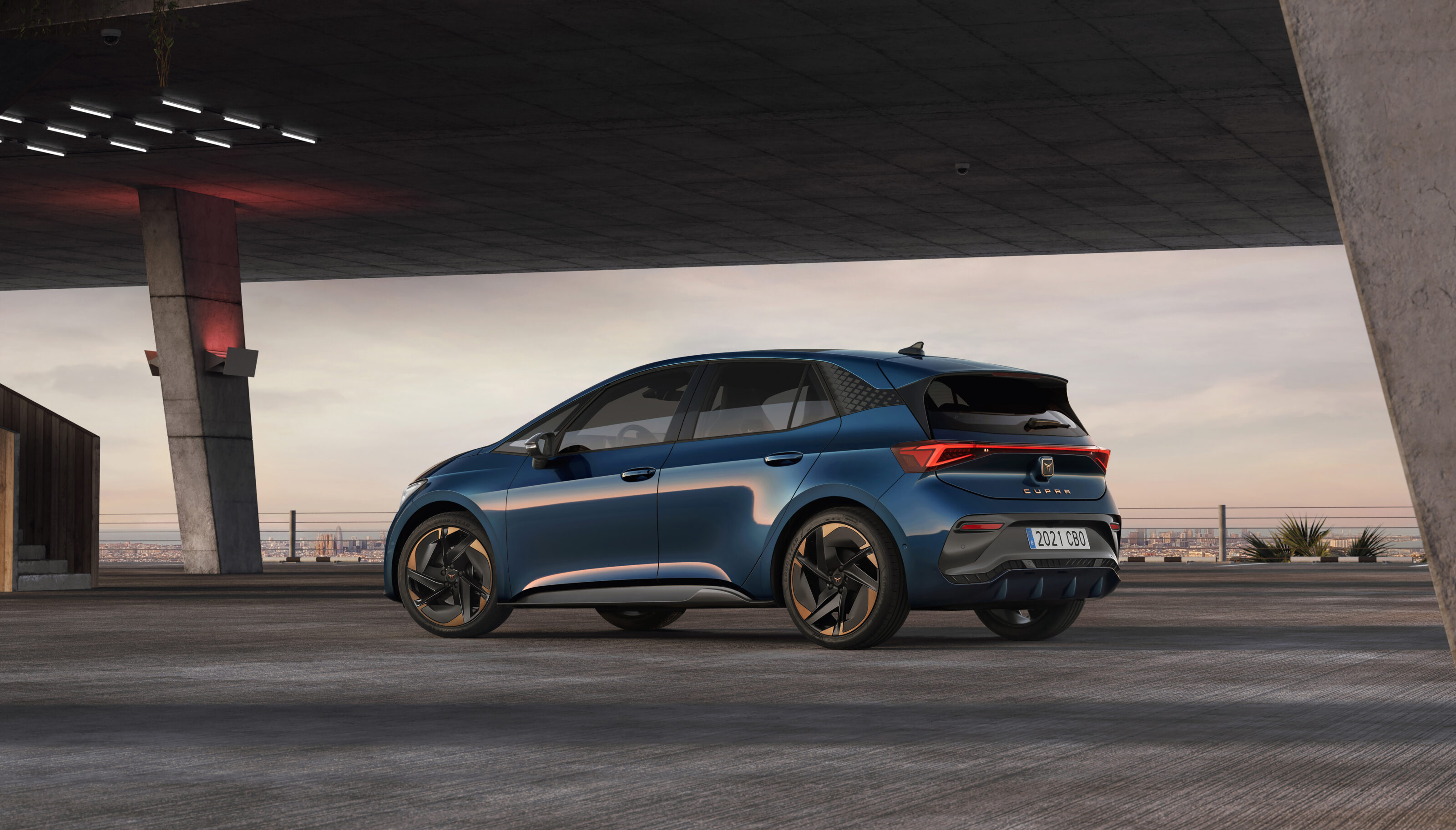
All variants also support both AC and DC charging, and the largest 77kWh battery pack variant using a 125kW DC charger will be able to increase its driving range from five to 80 per cent in just 35 minutes. Up to 100km of range can also be added in as little as seven minutes.
Other features include a near-perfect 50:50 weight distribution, sports-tuned suspension, 18 to 20-inch alloy wheels, and performance-oriented tyres ranging from 215-235mm in width.
Seat says the EV handles as a hot hatchback should, and that’s down to, at least in part, its dimensions.
Measuring 4322mm long, 1809mm wide, 1537mm high, and with a wheelbase measuring 2767mm, the Born is actually larger than most hatchbacks on the market, dwarfing other models like VW’s Mk8 Golf and BMW’s F40 1 Series.
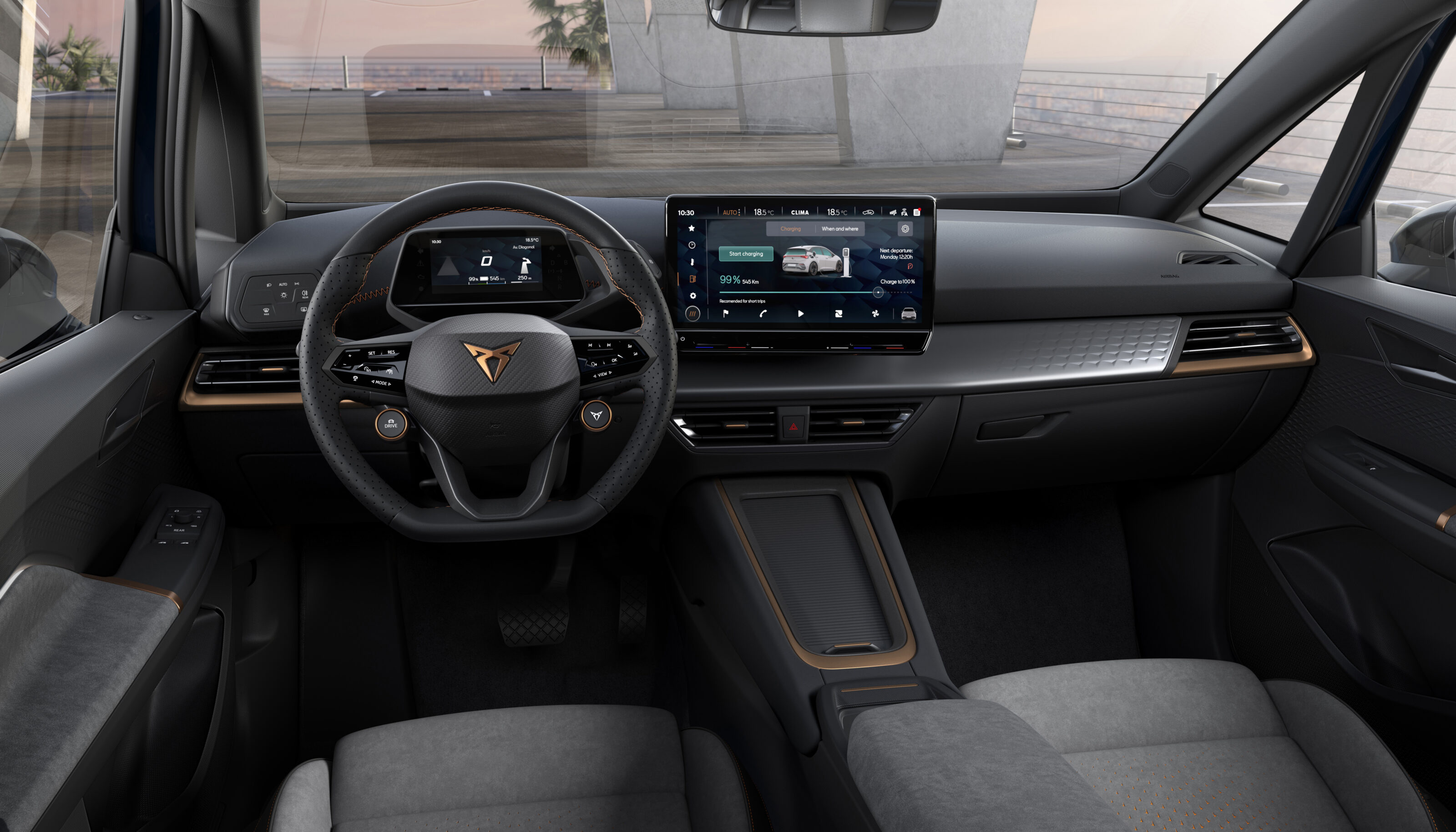
Inside, the EV hatch scores a large, centrally mounted horizontal 12-inch touchscreen infotainment display, sports bucket seats, wireless Apple CarPlay and Android Auto, wireless phone charging, nine-speaker stereo, and augmented reality head-up display.
The Born comes equipped with a host of safety features such as autonomous emergency braking, predictive adaptive cruise control, travel assist, side and exit assist, traffic sign recognition, emergency assist and pre-crash assist.
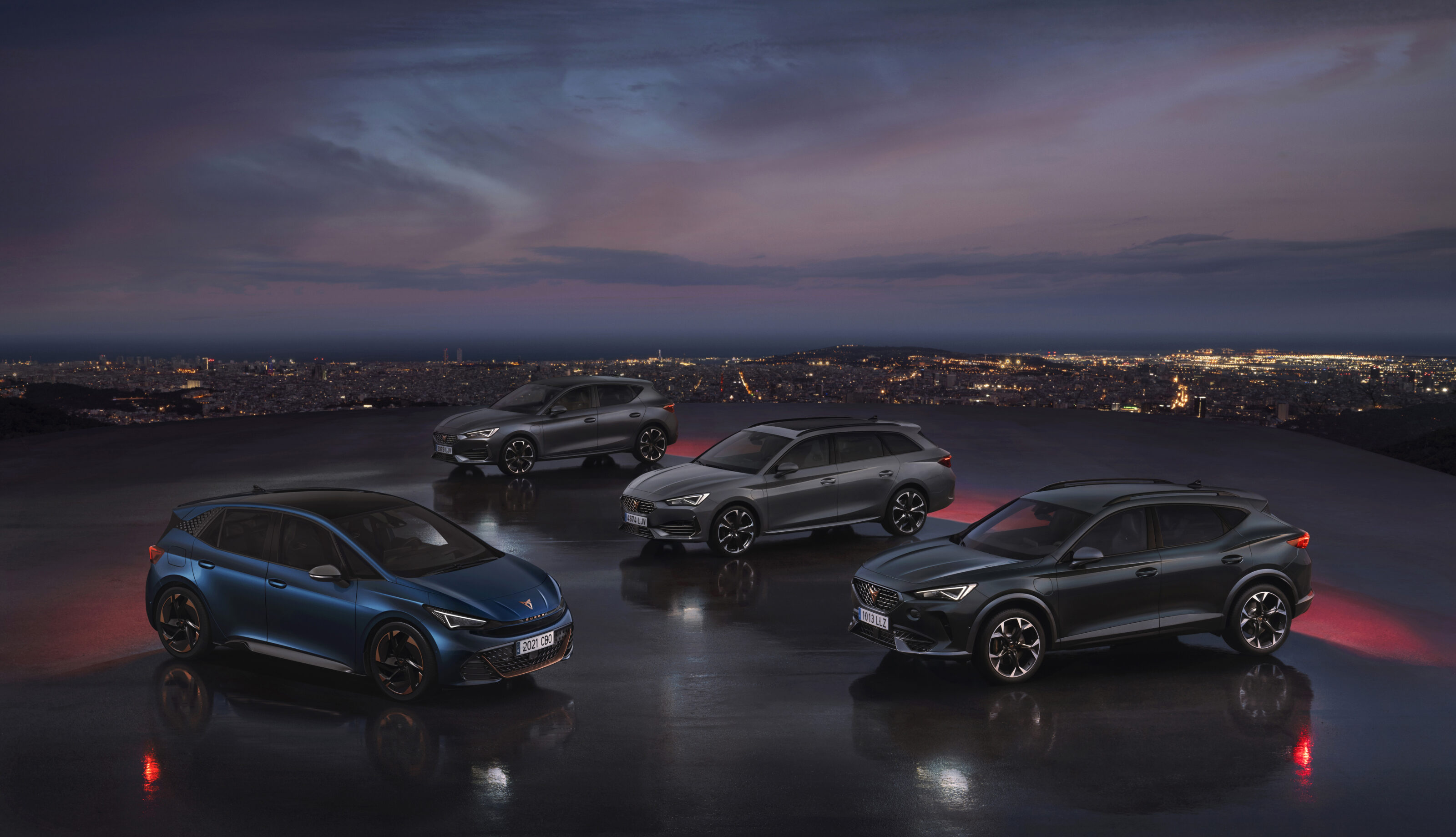
It’s unlikely we’ll the Seat Cupra Born make its way to Down Under anytime soon, with a representative from Volkswagen Australia telling WhichCar that, although the EV is an enticing product, it’s not right for the local market at the moment while there are still no emissions targets in place.
However, while we’re probably not getting an EV Cupra, the performance brand will be officially launching in Australia in the next 12 months, with models like the Ateca, Formentor, and Leon all expected to be here in 2022.
This circuit at Balocco in northern Italy isn’t unpaved. The Giulia GTAm just makes it feel that way, painting black smears and leaving wisps of white smoke in its wake. This car instantly earns a place in the shrine of sideways, and Alfa Romeo is sure to be adored for producing it.
What have they done? The GTAm is basically a Giulia Quadrifoglio Verde, with modifications. These are extensive. And so they should be. The price of the GTAm is $288,000, not far below supercar money, and double the cost of the Quadrifoglio Verde.
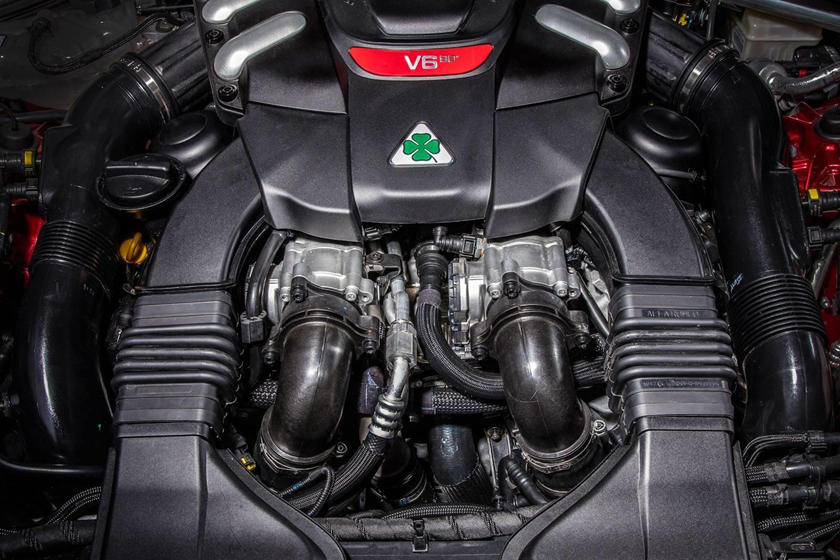
There’s a touch of the exotic to the Alfa Romeo’s engine, at least. The 690T is a 2.9-litre V6 twin-turbo that shares vital bore and stroke dimensions with the version of Ferrari’s excellent F154 V8 used for the Roma and Portofino, from which it was derived.
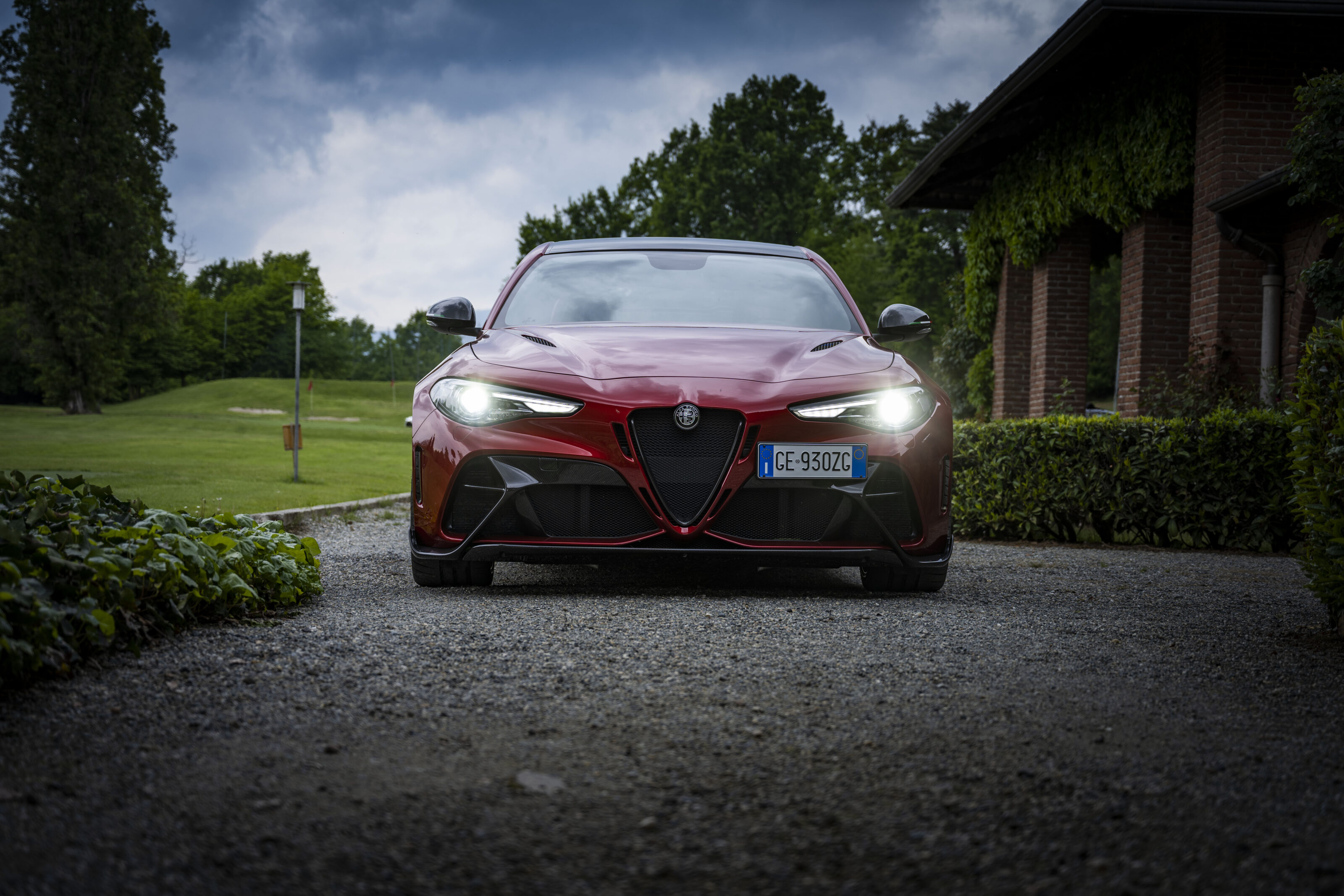
For the GTAm, new con-rods, faster-spinning turbos, extra oil-cooling measures and a titanium Akrapovic exhaust up the 690T V6’s output to 397kW, an increase of 22kW. It drives the rear wheels through the same eight-speed ZF automatic as in the Quadrifoglio Verde.
Alfa Romeo invested more time, and money, in weight reduction than power augmentation. After all, GTA stands for Gran Turismo Alleggerita. It means lightened GT, and is a name from Alfa Romeo’s glorious past. The Giulia Sprint GTA of 1965 was developed by the company’s Autodelta racing division and was a winner.
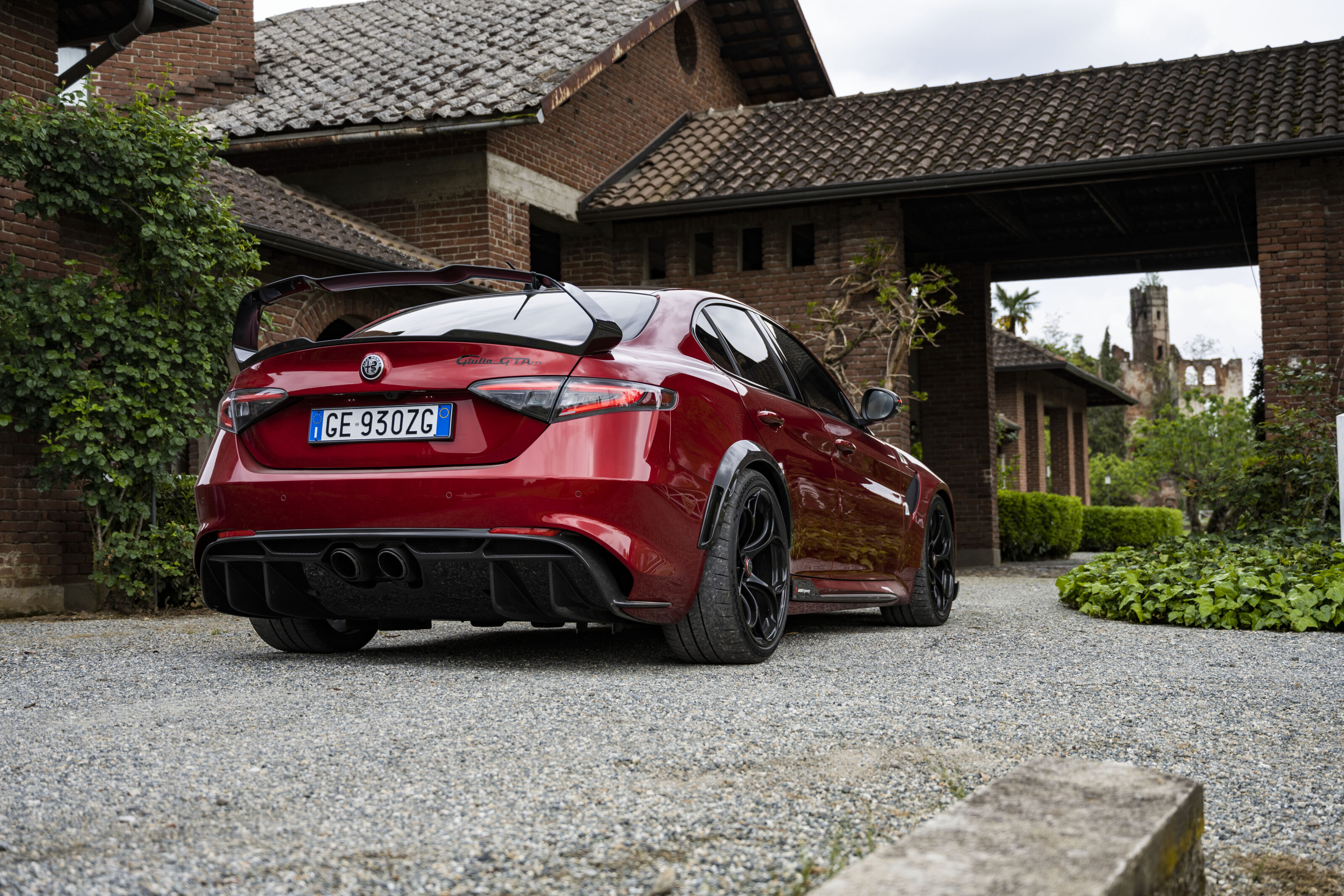
While the original GTA employed aluminium to shed kilos, the new one relies on carbonfibre and other modern materials. It retains the carbonfibre roof and bonnet of the Quadrifoglio Verde, and adds carbonfibre front guards. The rear screen is polycarbonate instead of glass.
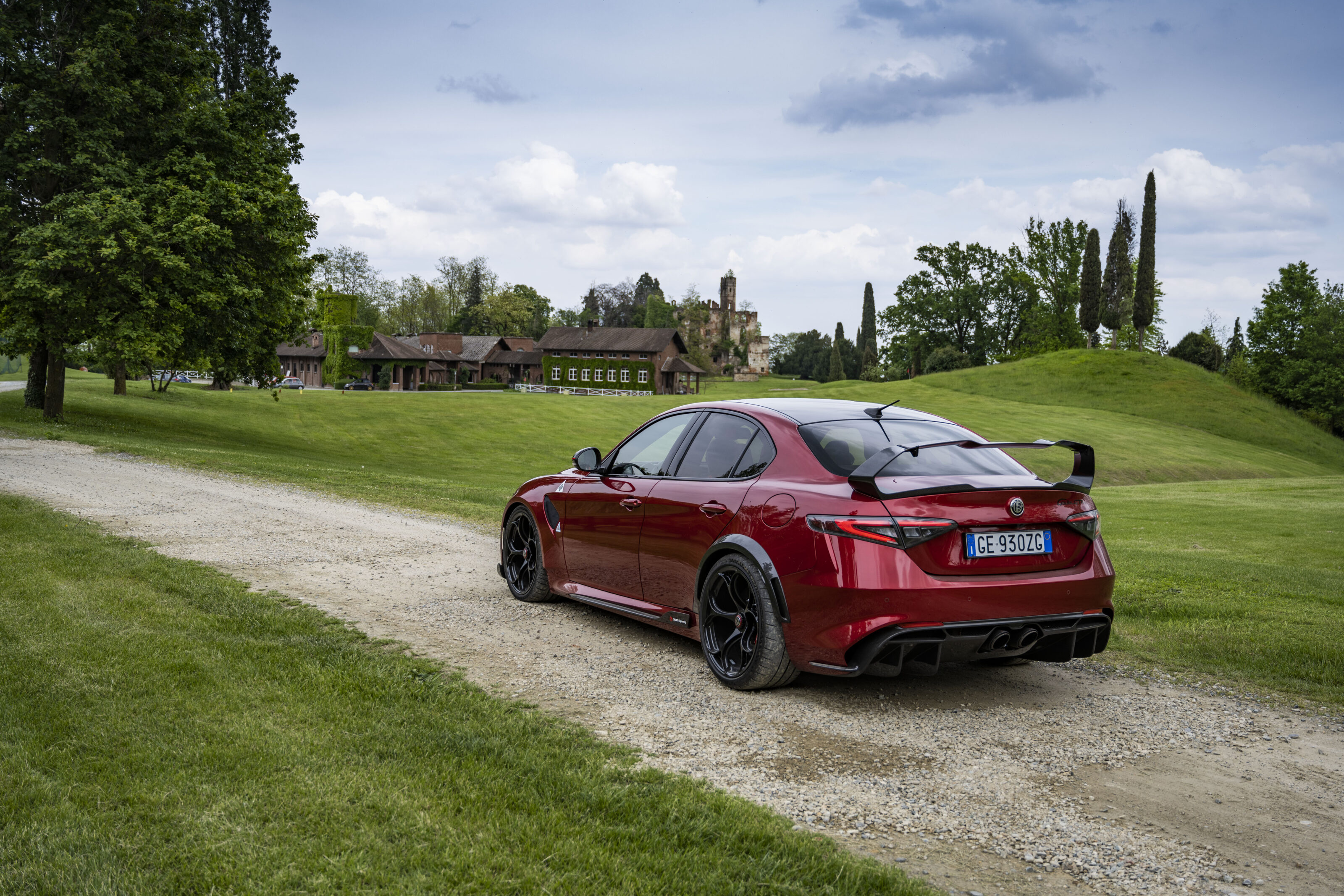
This car instantly earns a place in the shrine of sideways, and Alfa is sure to be adored for producing it
The GTAm – with that last letter standing for ‘modificata’ – goes further. The rear seat is removed, allowing a half roll cage to be installed. Handy helmet storage wells and a fire extinguisher go where the rear seat cushion used to be.
The cage anchors the top straps of the six-point harnesses for the pair of Sabelt carbonfibre shell seats up front. Polycarbonate is substituted for glass in the rear doors, which also have their interior trim replaced by something simpler and lighter. There are pull-loops to open the front doors, and the interior of the GTAm is even more Alcantara-intensive than the five-seat GTA.
It’s equally easy to spot the difference between the GTAm and the $20,000 less costly GTA from the outside. The GTAm is the one with the big rear wing. Made, of course, from carbonfibre. It’s adjustable, where the device attached to the bootlid of the GTA is not. The GTAm also has an adjustable front splitter, which can be extended forward by 40mm for track use.
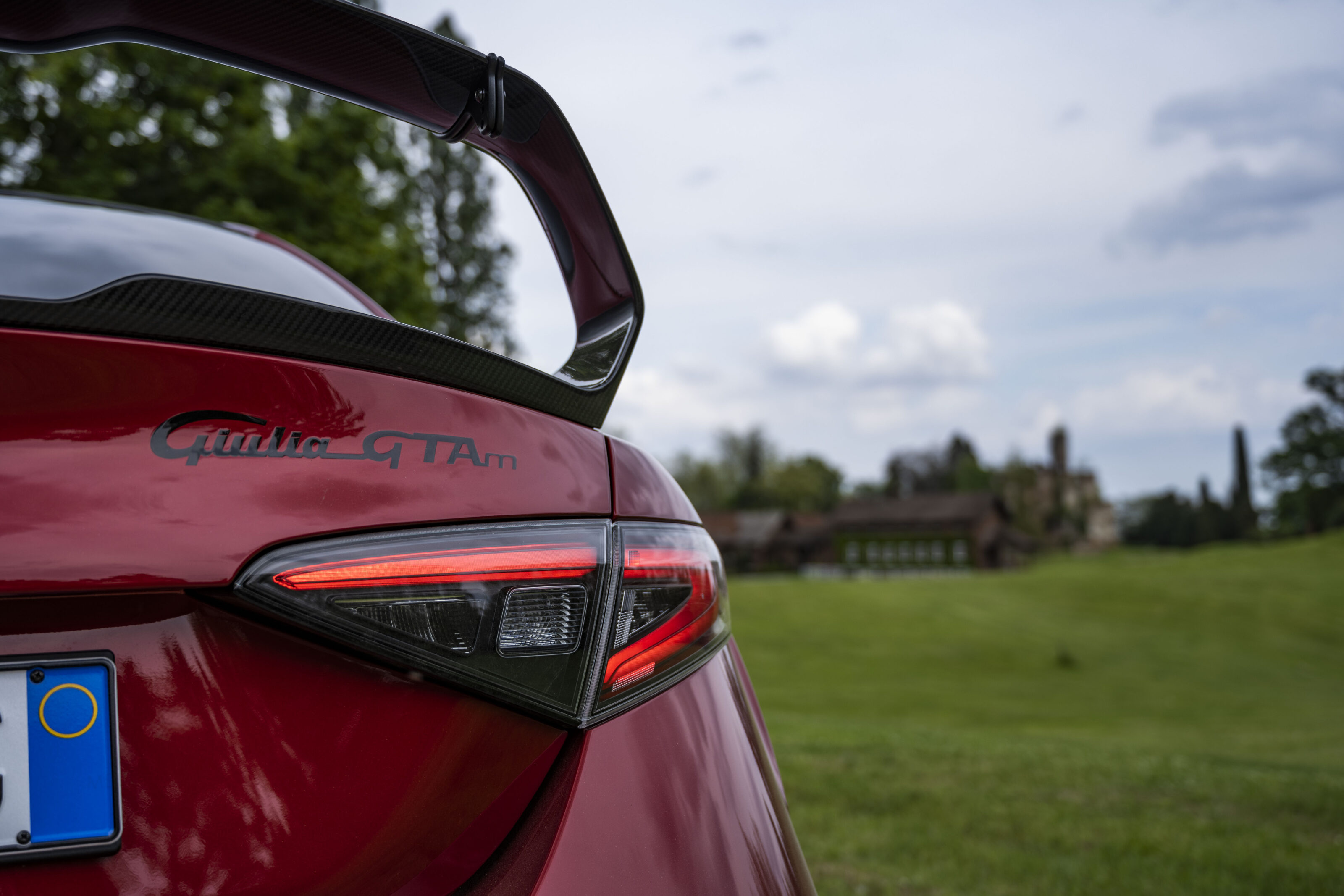
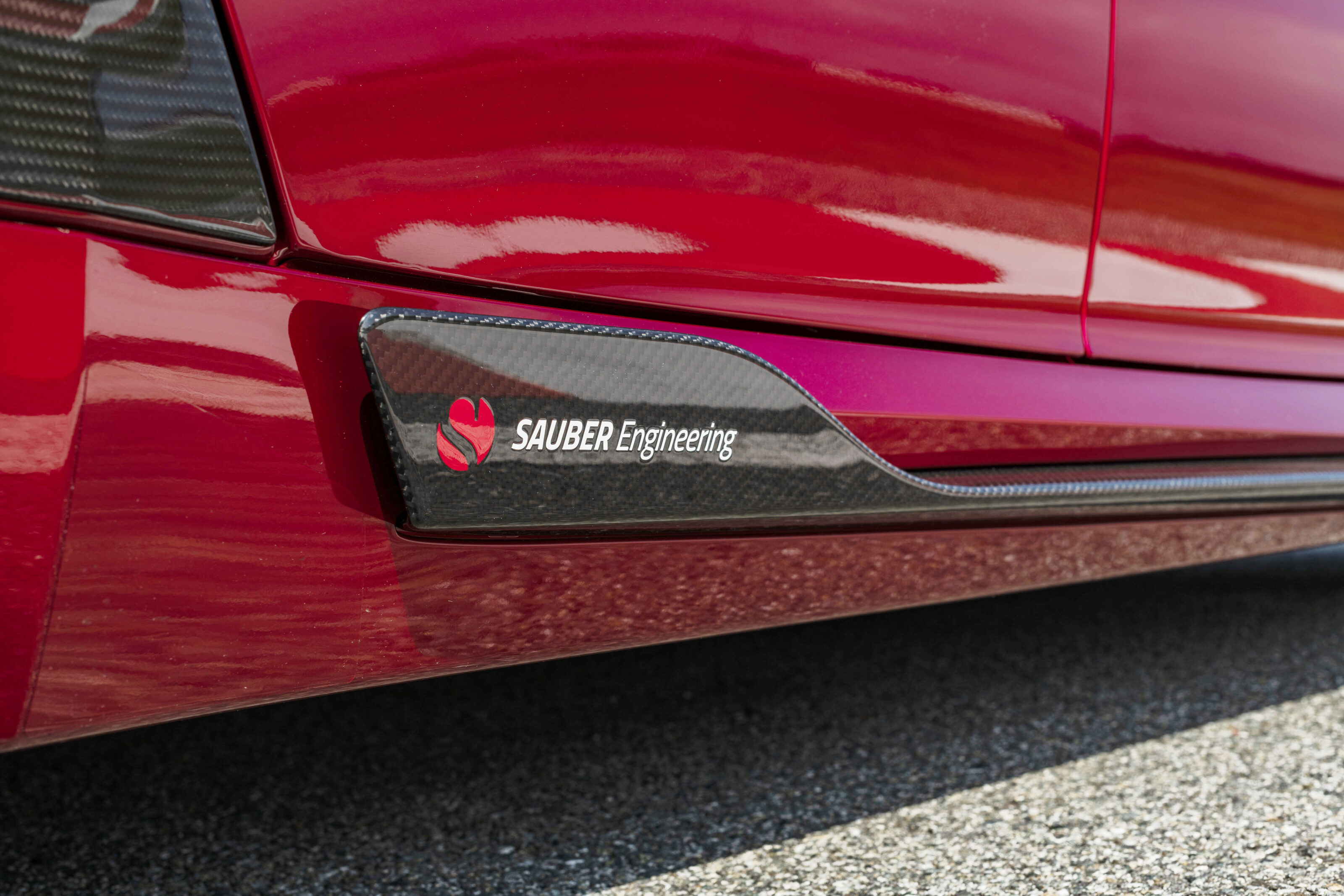
The remainder of the aero package – the winglets, flics, enlarged engine compartment vents, wheel air curtains, wheelarch vents, side skirts and underbody fins – are shared by both versions. Sauber Engineering, Alfa Romeo Racing’s Formula 1 partner, contributed to the design, development and manufacturing of the aero components. The Swiss outfit’s wind tunnel was used for testing, too.
According to Alfa Romeo engineers, the GTAm develops three times the downforce of the Quadrifoglio Verde, presumably with spoiler and splitter adjusted for maximum effect, and double that of the GTA.
For both versions, the chassis upgrades are the same. Front track grows 25mm, while at the rear the increase is 50mm, enough to require small wheelarch extensions, naturally made from carbonfibre. Lightweight springs for the double A-arm front and multi-link rear suspensions drop ride height slightly, and specific calibrations for the variable dampers and electric-assisted steering system were developed.
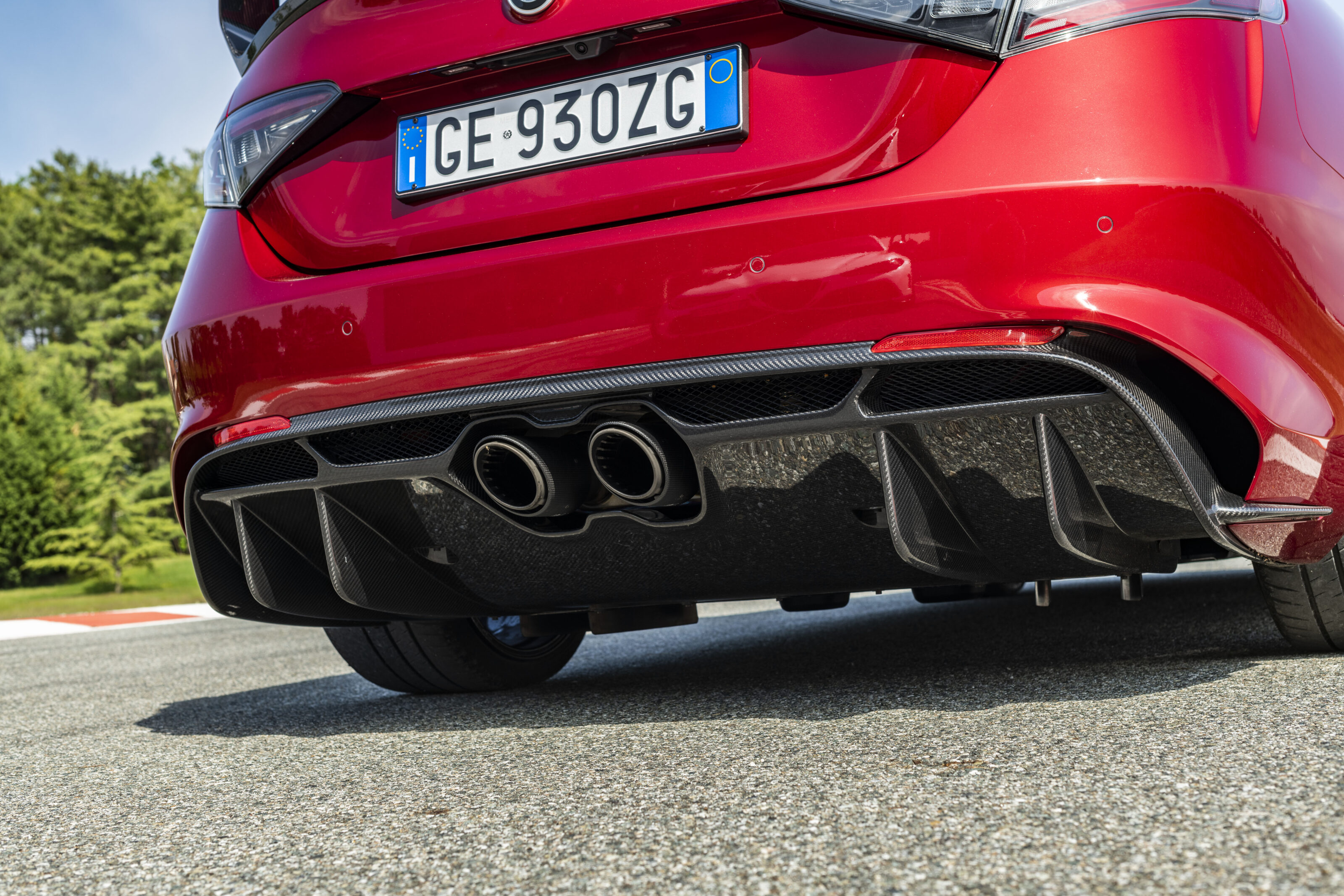
Single fasteners secure the Alfa Romeo’s forged 20-inch wheels. This makes the super Giulia the only road-legal one-nut sedan in the world, the company claims. The rubber is Michelin Pilot Sport Cup 2 Connect; 265/30ZR20 at the front, 285/30ZR20 at the rear.
Inside the rims are Brembo carbon-ceramic rotors, clamped by massive monobloc calipers adorned with the Alfa Romeo logo. The brakes are the same in both GTA and GTAm.
Balocco is perhaps the most beautiful proving ground in the world. Originally constructed in the early 1960s by Alfa Romeo, it’s now the property of Stellantis and is used by other brands that are part of the group.
Though the site is adjacent to a flyspeck village and surrounded by the mosquito-and-rice-producing paddy fields of the Po Valley flatlands west of Milan, on clear days there are views of the Alps that form Italy’s borders with Switzerland and France.
There’s history here, too. It has all you expect to find at a modern proving ground, but there’s also a cluster of charming old farm buildings that Alfa Romeo likes to use as a base for launches. One of them used to be Autodelta’s workshop, and it’s aptly the venue for the presentations delivered by Alfa Romeo engineers and designers before we’re allowed to drive the GTAm and GTA.
The Balocco handling circuit that’s been selected for this launch has been somewhat journalist-proofed; temporary chicanes have been installed in a couple of the faster places. But there’s nothing obstructing the slower corners…
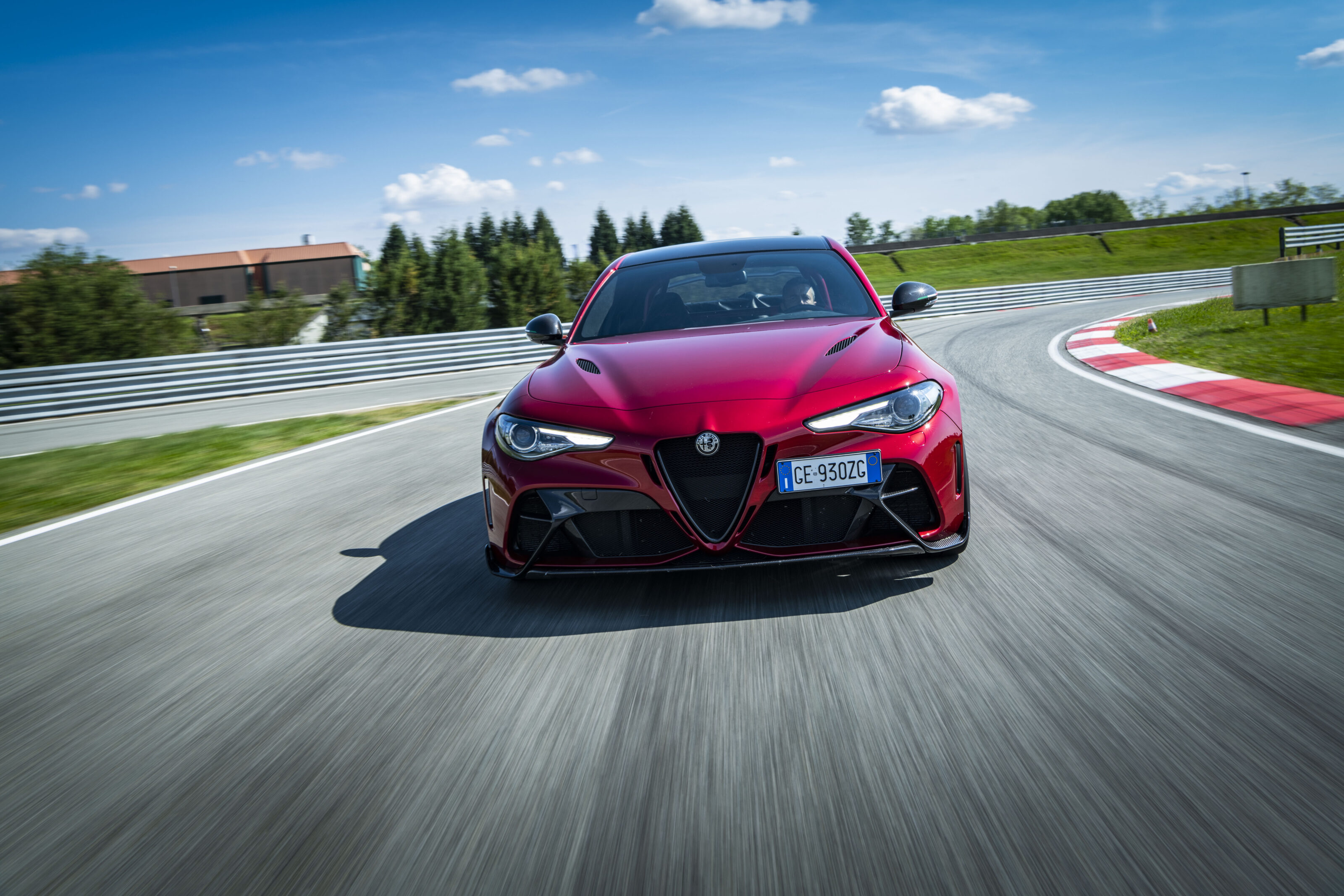
The chassis’ brilliantly communicative nature make the GTA a precision corner-carving tool
The Giulia GTAm and GTA have an extra Race mode added to their DNA dials. Those letters stand for Dynamic, Normal and All-weather, which basically means wet. Turn the dial beyond Race and hold it there for at least five seconds, and every electronic driver aid, save for ABS, is deactivated.
After exploring the place in Dynamic and then Race, the GTAm is almost begging out loud to be switched to no-safety-net mode. It’s the kind of car that quickly builds both confidence and trust.
The steering is, well, perfect. Not too heavy and divinely precise, it speeds the process of bonding with the car. Soon you discover the chassis is fabulously fluent in the jargon of cornering, able to translate steering inputs into apexes nailed while at the same time offering the option of throttle-guided line adjustment.
Oversteer is very easily accessible in the super Giulia. And once the rear rubber is slipping, the degree of drift can be controlled with similar ease. This is immense fun, of course, but not the way to cut a great lap time.
Aim instead for speed and the Alfa Romeo co-operates. The fade-free power of the big Brembo brakes, the accuracy of the steering, and the chassis’ inherent balance and brilliantly communicative nature make it a precision corner-carving tool. The skill of the team that created the GTA and GTAm is evident, as is the dynamic focus of the Giorgio platform that’s the foundation for every Giulia.
The engine, raspy at low revs, sings loud and lusty as a flood of boosted torque propels the tachometer needle towards the cut-out, a little beyond 7000rpm. Its work is made even more impressive by the expert calibration of the eight-speed transmission. It’s excellent if left in auto, and a snappy shifter when the steering column mounted paddles are used.
There’s little difference to be felt around Balocco between the GTAm and the GTA. The sports seats don’t hold torso and hips quite so securely, of course, but the performance and handling feel identical.
There’s only a 25kg difference between the two versions, according to Alfa Romeo’s specifications sheet, after all. Alfa Romeo Racing driver Kimi Raikkonen, who provided input during development, might be able to feel a difference in downforce between the big-spoiler GTAm and the GTA, but I couldn’t.
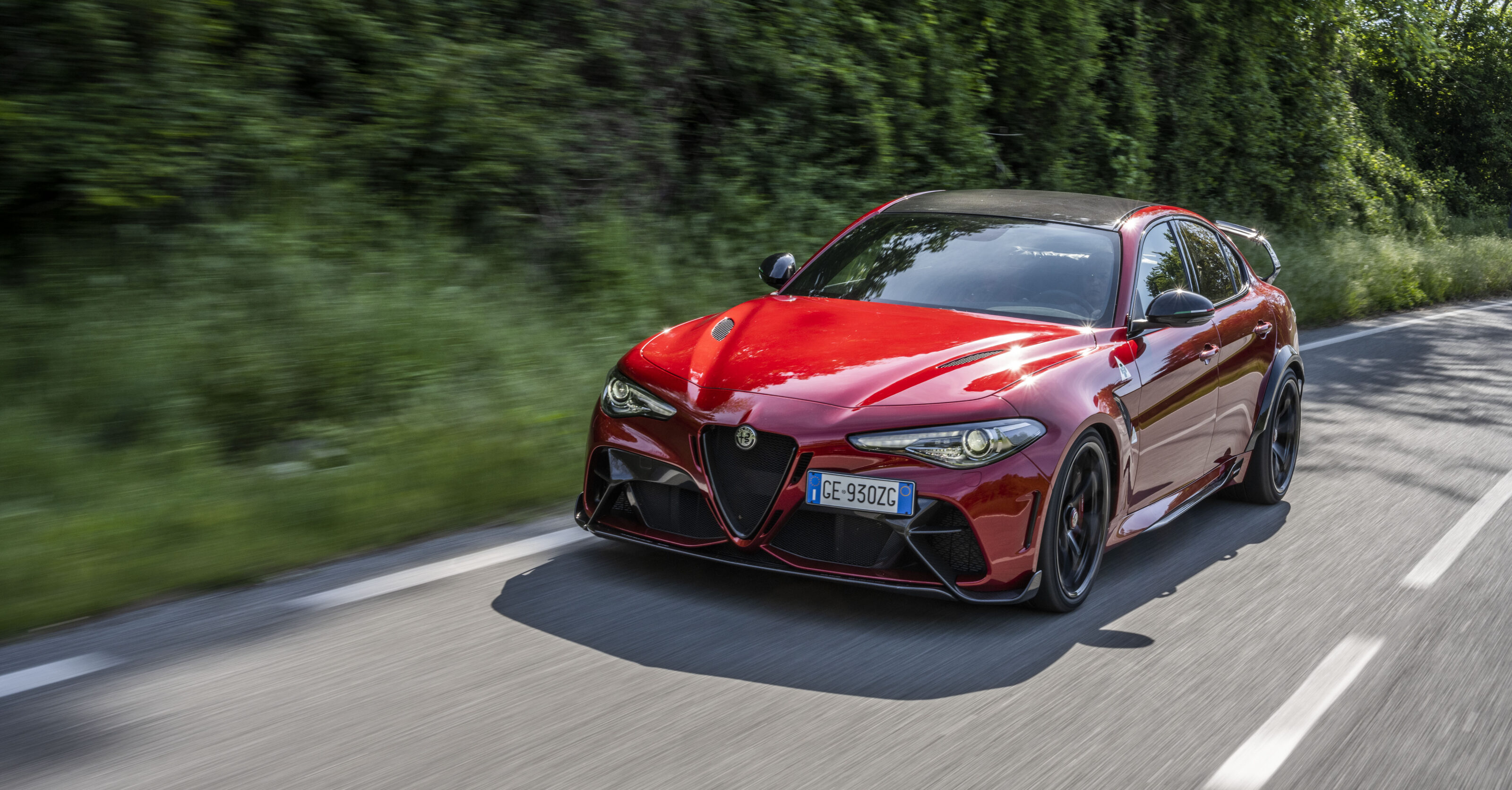
Stunningly, this track-worthy Alfa Romeo is an excellent road car. In either Normal or Dynamic mode, the ride quality is simply superb for such a ferocious car. And none of the Alfa’s charisma disappears when driving at sane speeds on a winding hill road or making a quick autostrada overtake. It truly makes the hideously stiff Mercedes-AMG C63 S feel like the work of suspension amateurs.
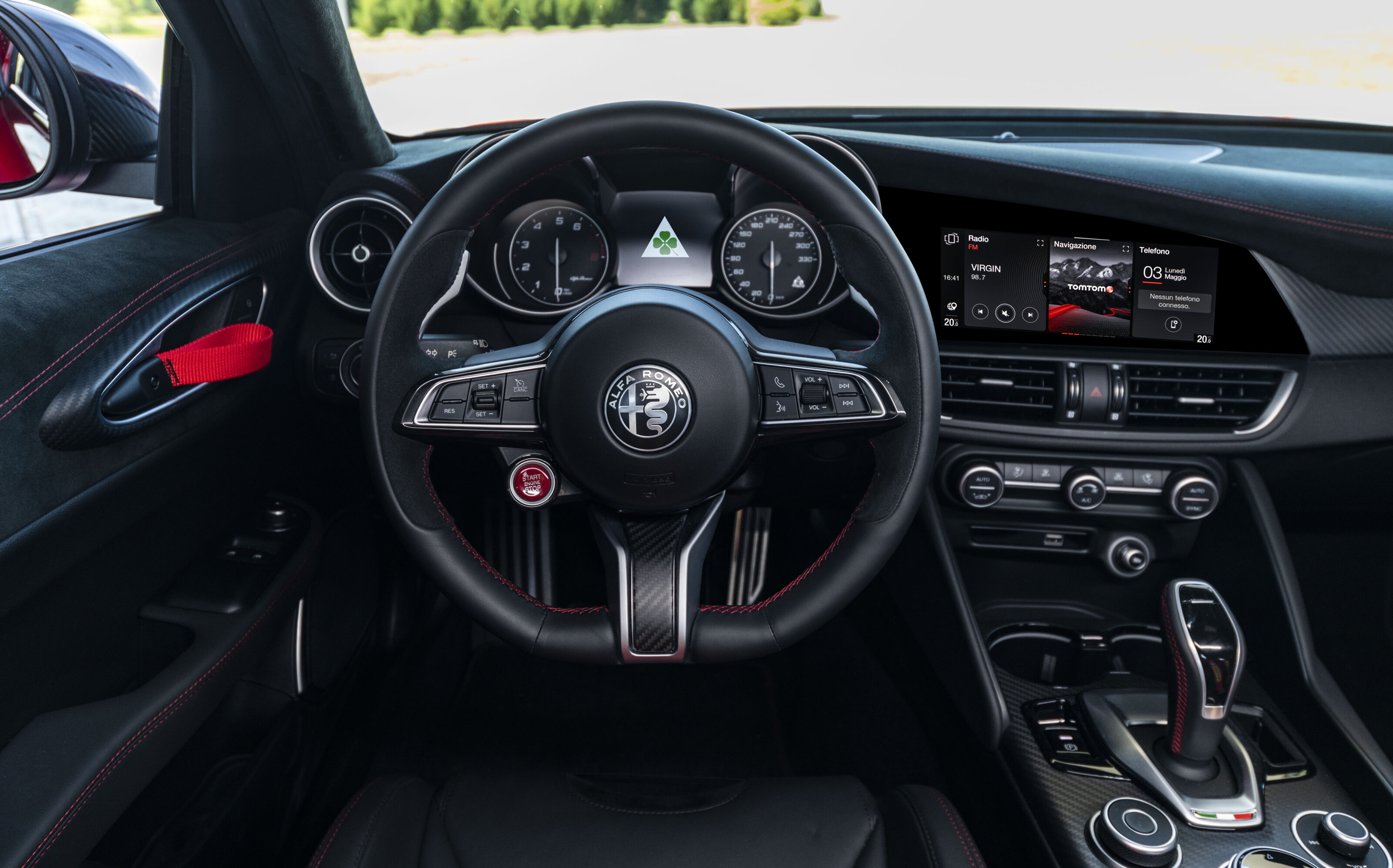
The only dismal thing about using the GTA in a normal way is that it’s impossible to miss noticing the second-rate infotainment system that has blighted the Giulia since launch. The navigation in particular is simply awful. It looks like something on a cheap Android phone.
While it’s imperfect, and very costly, the Giulia GTA is a truly great car. Alfa Romeo, against the odds, has created something both thrilling and able. And awesomely memorable…
Alfa Romeo Giulia GTAm specifications
Engine 2891cc V6 (90°), dohc, 24v, twin-turbo Max power 397kW @ 6500rpm Max torque 600Nm @ 2500rpm Transmission 8-speed automatic Weight 1580kg 0-100km/h 3.8sec (claimed) Economy 10.8L/100km (WLTP) Price $288,000 On sale Q4 2021
Snapshot
- New M4 convertible will tip the scales at 1995 kilograms
- Only available with all-wheel drive
- 0-100km/h taken care of in 3.7 seconds
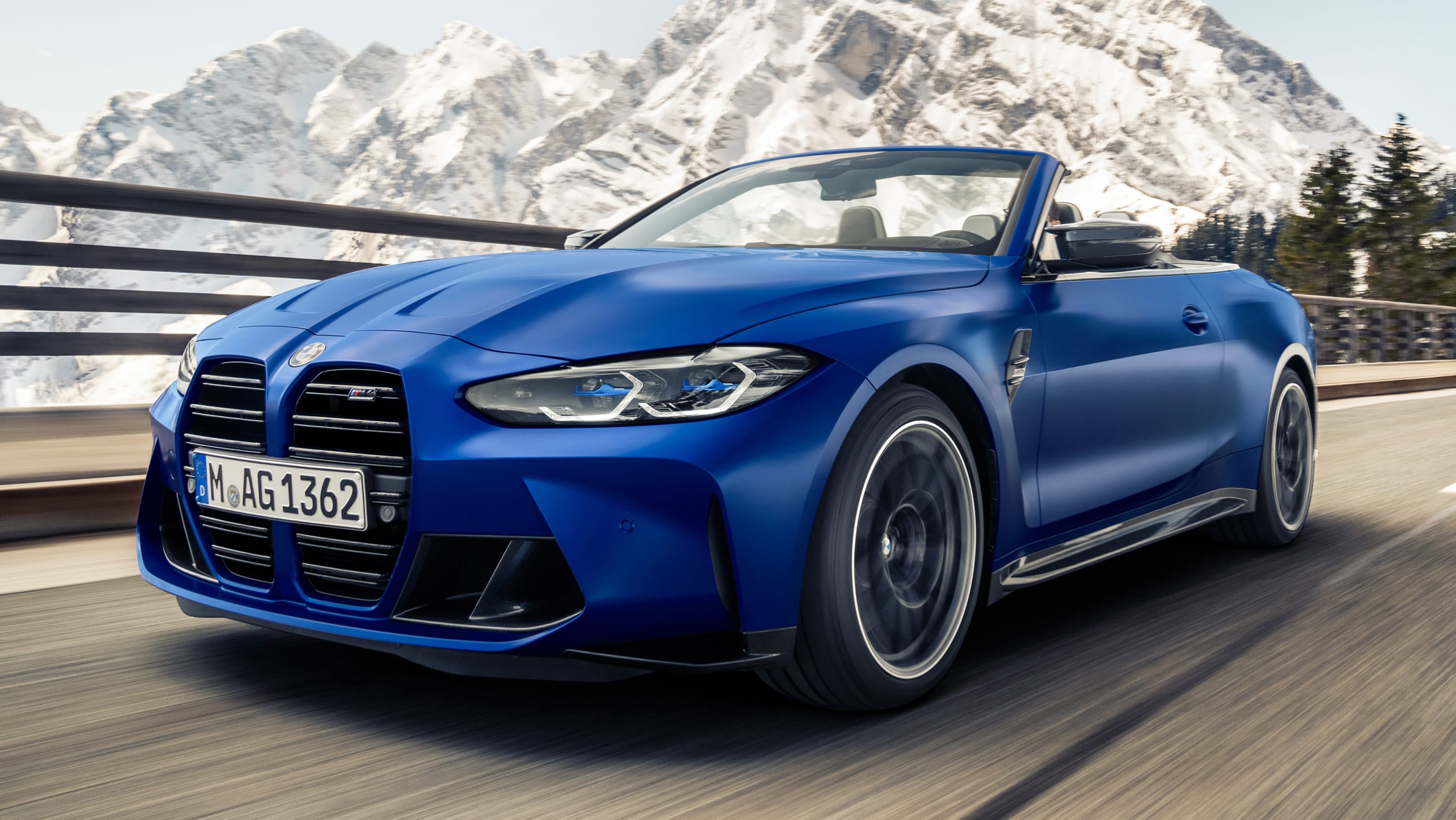
The 2021 BMW M4 Competition Convertible xDrive has officially been unveiled as the third and final body shape for the current G80-era M3 and M4 performance range (only two more years ‘til we get the wagon).
Unlike its predecessor, the F83 M4 Convertible, the new topless two-door is equipped with a fabric roof rather than a hard-top folding job.
BMW says this change equates (unsurprisingly) to a roof 40 per cent lighter than the hardtop, which has also freed up an additional 80 litres of luggage space in the boot.
The new fabric covering can also be deployed or retracted on the move at speeds up to 50km/h in just 18-seconds.
Despite the swap from metal to fabric, however, the latest iteration of the moniker tips the scales at a hefty 1995 kilograms, which is a whopping 205 kilograms more than the F83.
How has this happened? Well, apart from the car itself being heavier, which has already been well publicised, as the name would suggest, the roofless M4 will only be available with BMW’s xDrive all-wheel drive system.
Driven front wheels always translate to a heavier kerb weight. Nevertheless, BMW is claiming its latest drop-top performance car is far quicker than the one it replaces.
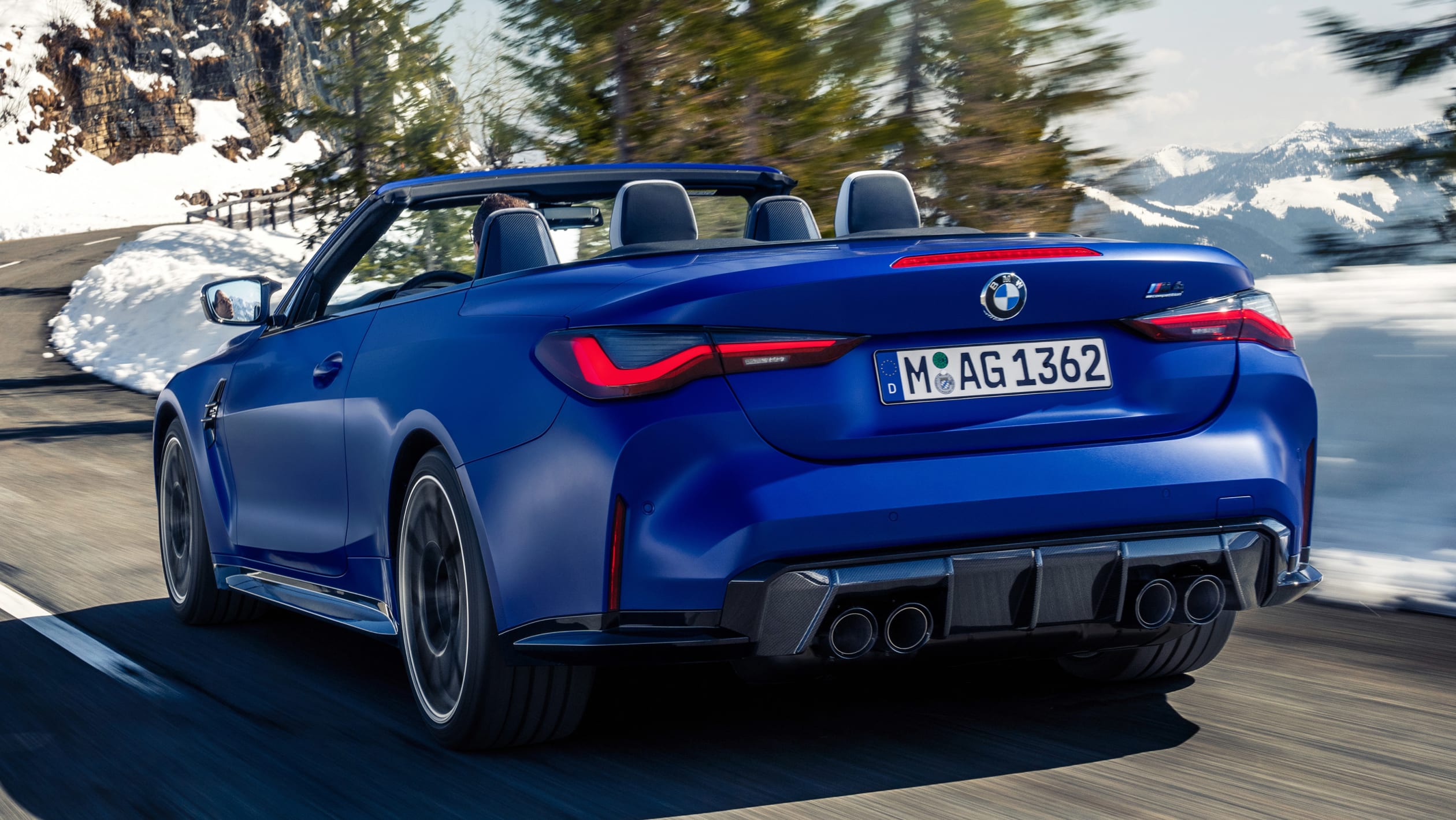
The formidable S58 twin-turbocharged three-litre six-cylinder motor pumps out no less than 375kW and 650Nm and is mated to a ZF quick-shifting eight-speed automatic transmission.
Couple this tremendous shove (44kW and 100Nm more than the F83 M4 Competition) with the exceedingly clever xDrive system, and the new drop-top can sprint from 0-100km/h in just 3.7 seconds (0.6 quicker than its predecessor).
Flat-out, the M4 will hit a claimed limited top speed of 250km/h, or 280km/h if the M Driver’s Package option box is ticked.
Those fond of opposite lock needn’t worry either, as the topless M4, like the rest of the G80 Competition variants with xDrive, has three separate driving modes to choose from – 4WD, 4WD Sport and 2WD.
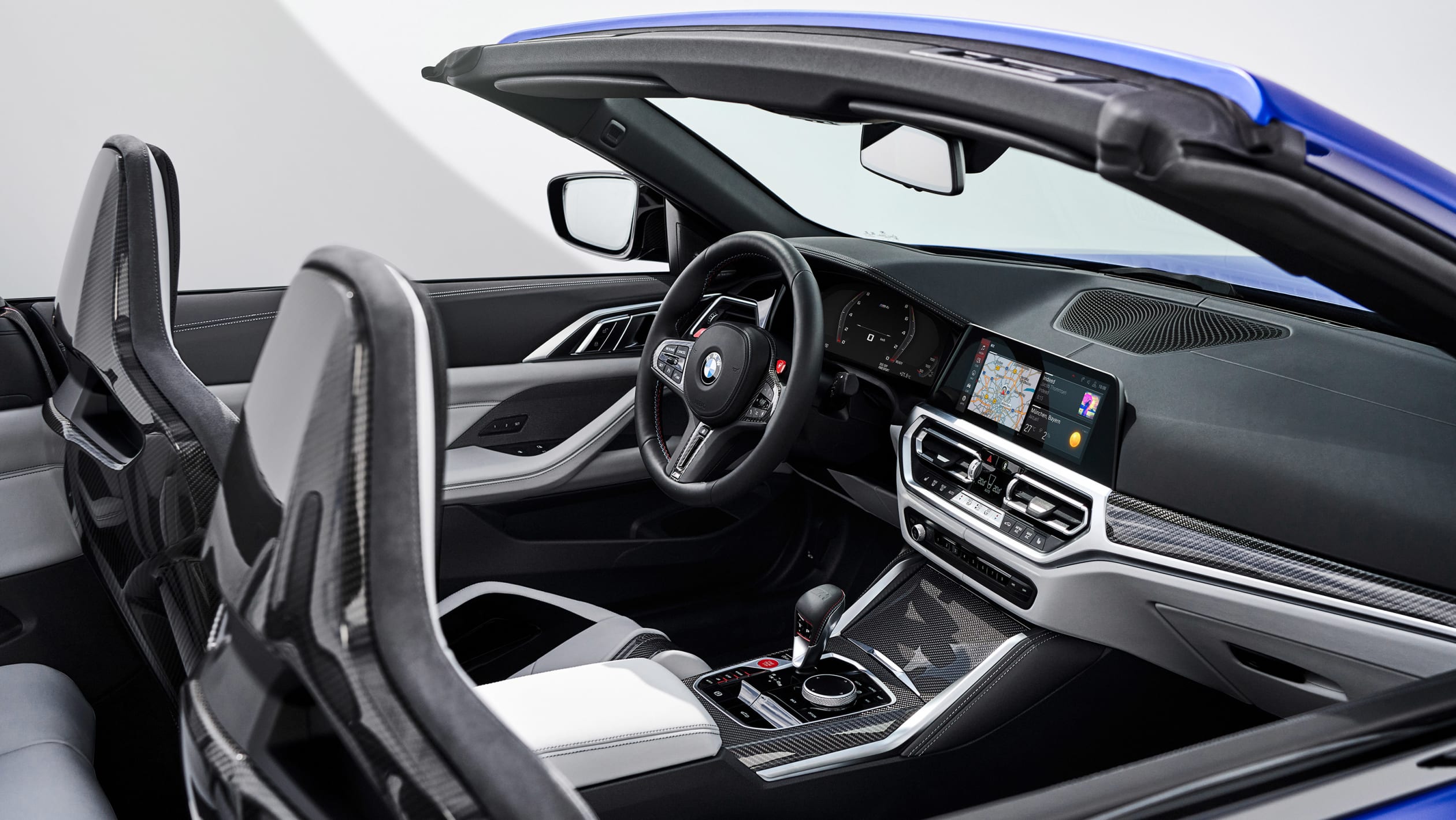
The new convertible has also been festooned with bespoke componentry and additional bracing to ensure the chassis doesn’t get bent out of shape when the going gets twisty.
The rear of the vehicle scores a unique set of torsion struts, and the rear axle has been rigidly connected to the car’s body. The front axle subframe gets a unique aluminium shear panel too.
There’s also a bespoke steering ratio and geometry for the double-joint spring strut front axle, while the five-link rear axle has received specially tuned kinematics and elastokinematics.
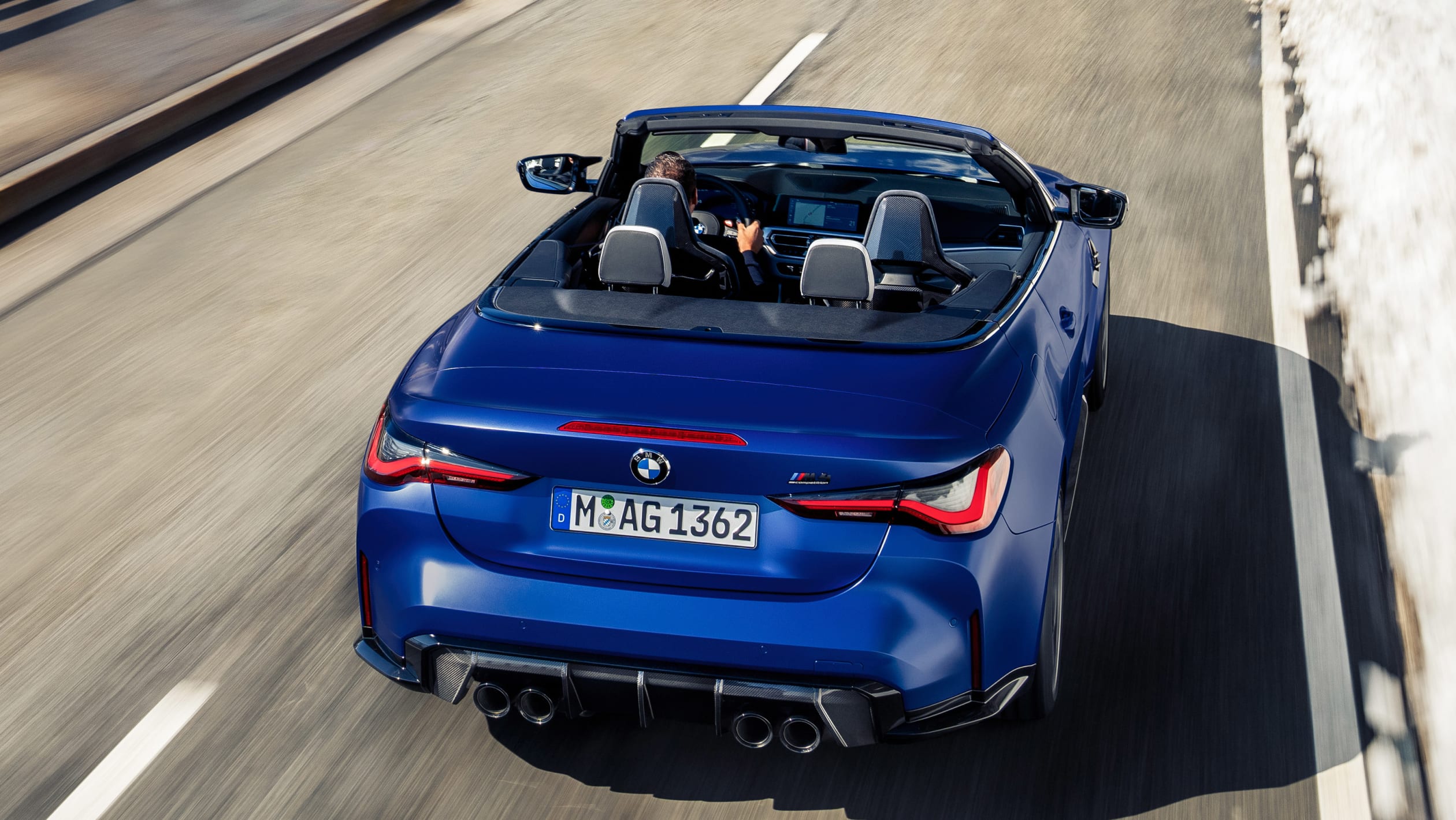
Stylistically, the G80-series M4 convertible looks virtually identical to its two-door coupe and four-door sedan siblings, with perhaps the most notable design change being the lack of a rear lip spoiler on the boot lid, which has been replaced by an additional brake light.
WhichCar has confirmed with the marque’s local arm the 2021 BMW M4 Competition Convertible xDrive is coming to Australia.
It should land on our shores in the fourth quarter of 2021, around the same time the M3 and M4 Competition Coupe xDrive arrive.
Snapshot
- Luxury Car Tax has been at 33 per cent since 2008
- LCT has remained in place despite Australian manufacturing wrapping up in 2017
- $700 million windfall from LCT could disappear for the Government
An “inefficient” tax on imported cars could be phased out if the Federal Government agrees to it as part of a trade deal with the UK.
In the last few days, the UK has put an offer on the table to Australia which could see both countries phase out taxes on imports – including cars – over the next 15 years.
If Australia accepts the offer, which was made to Minister for Trade, Tourism and Investment, Dan Tehan, on Friday as part of a bid by the UK to secure as many trade deals as possible post-Brexit, it could see the controversial Luxury Car Tax (LCT) eventually being scrapped.
The two countries are said to be working towards a June deadline for a deal to be in place, with UK ministers keen to strike before the country hosts the G7 summit next month.
Mr Tehan said he was “confident” of reaching an agreement with the UK by early June, having had “very positive discussions”, reports news.com.au.
A spokesman for the Department of Foreign Affairs and Trade (DFAT) told WhichCar that “generally” the LCT falls outside of the scope of a free trade agreement, however, they did not rule out any changes to the tax may be possible in future.
“Minister Tehan is meeting every week with his UK counterpart, Secretary of State for International Trade Liz Truss, to continue negotiations in a sprint to have an in-principle agreement by the end of June,” the DFAT spokesman said.
“The Government has been consistent throughout this process that it doesn’t comment on the details of the negotiations,” they added.
In 2019-20, trade in goods and services between Australia and the UK was valued at $36.7billion, with Australia’s main UK imports being cars, medicines and alcoholic drinks.
The full terms of the deal are yet to be fleshed out by both sides, but the Australian Government first needs to reassure the British National Farming Union that it won’t flood the market with Aussie meat if the agreement goes through, according to the BBC.
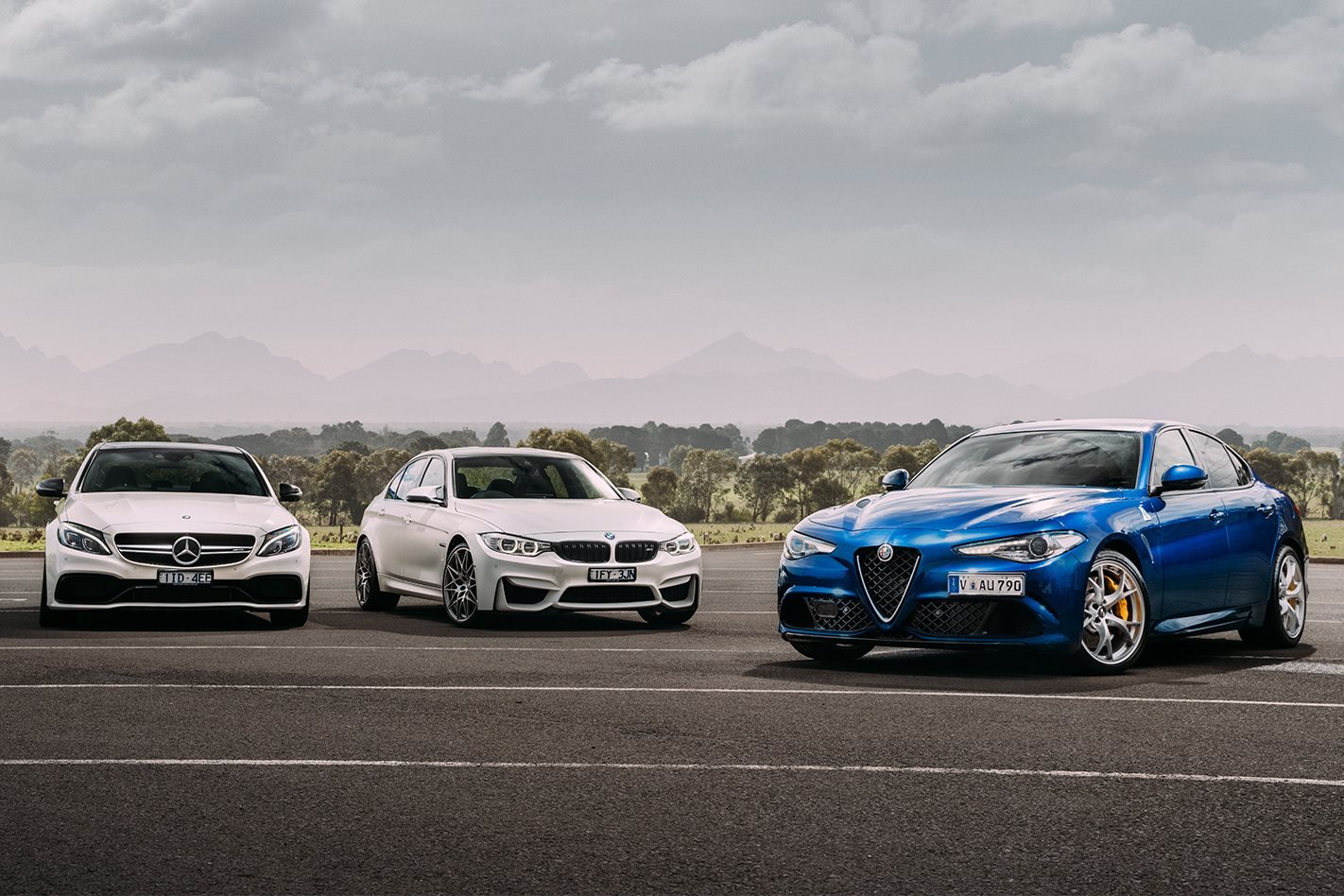
Though a free trade agreement doesn’t guarantee the LCT would be dissolved, it makes sense. However it would mean UK importers such as Jaguar, Land Rover and Mini could become exempt while their German, French and Japanese competitors would continue to be taxed at 33 per cent above the threshold, creating an unlevel playing field.
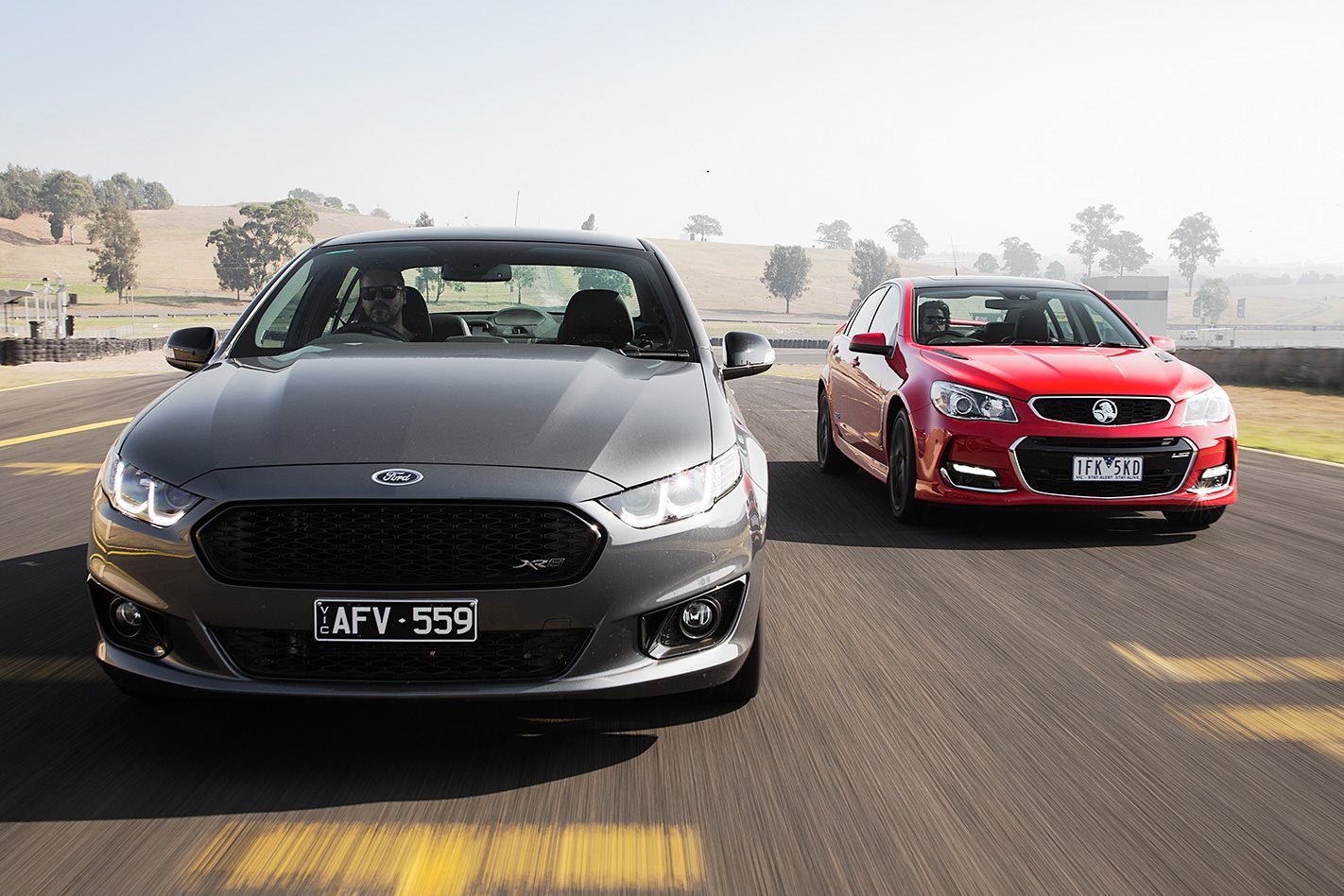
Introduced by the Howard Government in 2001, the LCT was designed to protect the local motoring industry by placing a 25 per cent tax on imported cars worth up to $55,134, essentially hitting the competitors to the Ford Fairlane and Holden Statesman.
The LCT was increased in 2008 to 33 per cent, currently standing at a threshold of $68,740, though cars with an economy of 7L/100km or better have a higher threshold of $77,565 – making the idea of purchasing an electric vehicle completely unaffordable for most Australians, which in turn affects Australia’s EV uptake.
Furthermore, since Holden ceased production in 2017, being the last manufacturer to build cars on Australian soil, there have been growing calls from industry bodies like the Australian Automotive Association (AAA), Australian Automotive Dealer Association (AADA) and Federal Chamber of Automotive Industries (FCAI) to axe the LCT as it was designed to protect an industry which no longer exists.
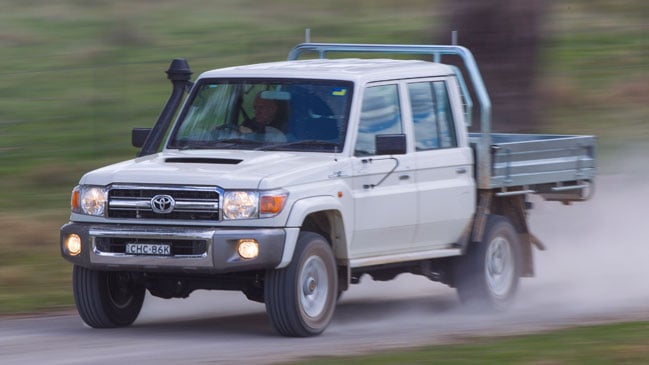
FCAI’s Director of Innovation and Strategic Engagement, Peter Griffin, said the LCT puts a tax on safety and improving environmental outcomes through emissions, pricing consumers out of a majority of the electric car market.
“[The] Luxury Car Tax is a tax on technology,” Mr Griffin said.
“Technology in the automotive industry improves safety and environmental outcomes. It remains an inefficient tax and we would want to see it removed.”
At the start of 2020 the Federal Government introduced a refund scheme for primary producers, offering up to $10,000 back on the purchase of any vehicle above the threshold purchased before July 1, 2019.
But despite pressure from the motoring industry, Treasurer Josh Frydenberg stated in a 2020 interview with the Australian Financial Review the LCT wouldn’t be scrapped until the budget could afford it.
“When it comes to the Luxury Car Tax, we have no plans to remove that, but I would never say never,” he said.
“We’ve always got to maintain a strong budgetary position. We’ve got a series of taxes we’d like to remove, but we’re committed to keeping the nation’s balance sheet strong.”
Though this year’s Federal Budget was stronger than expected thanks to the country’s response to the COVID-19 pandemic, an abolishment of the LCT may still be some time off given its large contribution to the economy. At present, the tax nets the Federal Government around $700 million per year.
