
The 2022 Mercedes-Benz CLS range has been given a facelift, with the sleek-looking coupe expected in Aussie showrooms in quarter four of 2021.
The CLS has been updated with a number of different variants powered by no less than five different petrol and diesel motors for various markets.
However, Mercedes-Benz Australia has told WhichCar that the local CLS range will continue to consist of just two models – the CLS 450 4MATIC and the Mercedes-AMG CLS 53 4MATIC+.
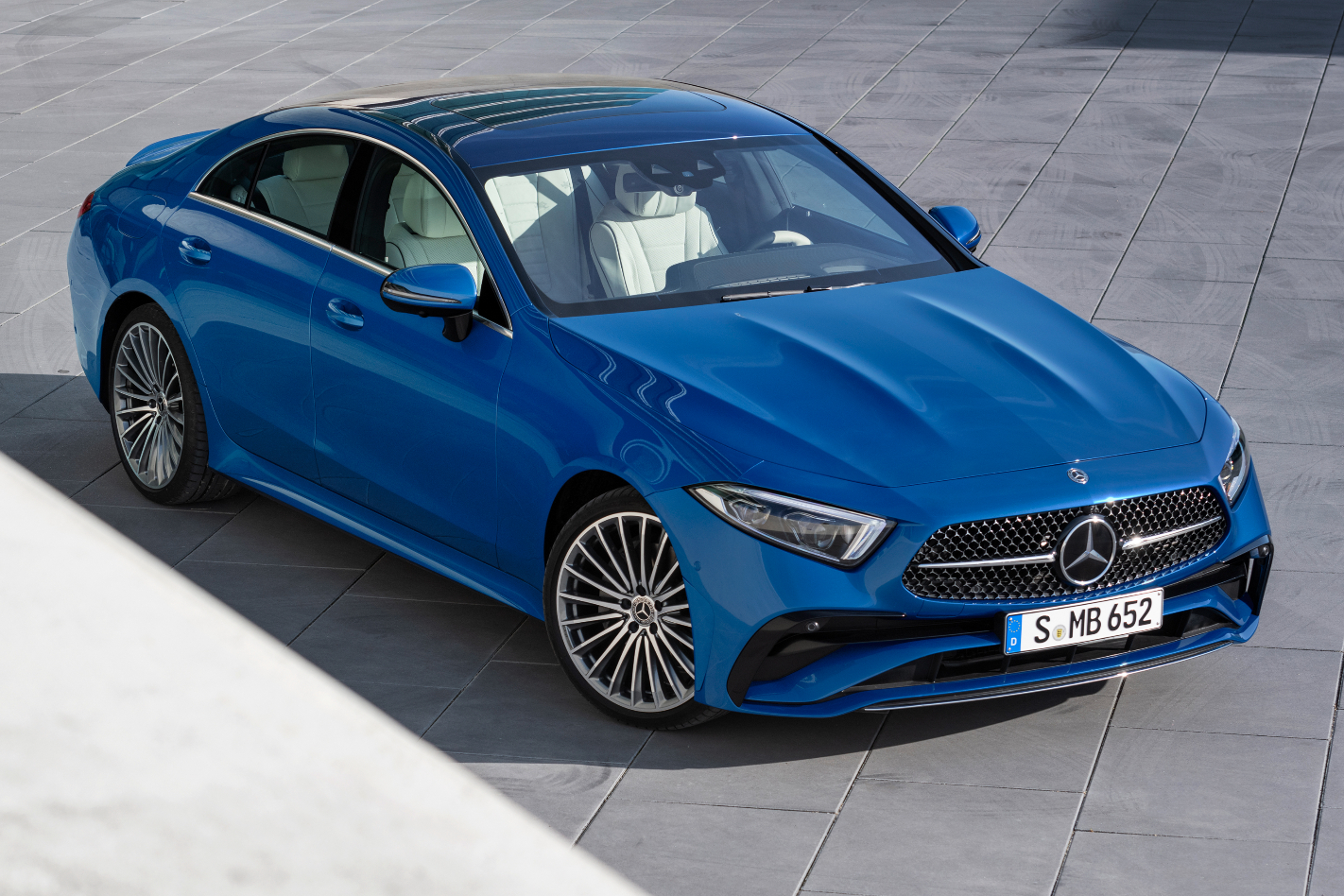
In other parts of the globe, the entry-level CLS 220 d is powered by a 2.0-litre turbo-diesel four-cylinder motor that produces 143kW and 400Nm and drives the rear wheels.
Sitting above the 220 d is the CLS 300 d 4MATIC, which will utilise the same 2.0-litre turbo-diesel four-cylinder but also employ a mild-hybrid system for a combined power output of 195kW and 550Nm.
Rounding out the diesel-powered four-door coupes is the CLS 400 d 4MATIC, which has a 2.9-litre turbo-diesel inline-six slotted underneath its bonnet and churns out 243kW and 700Nm.
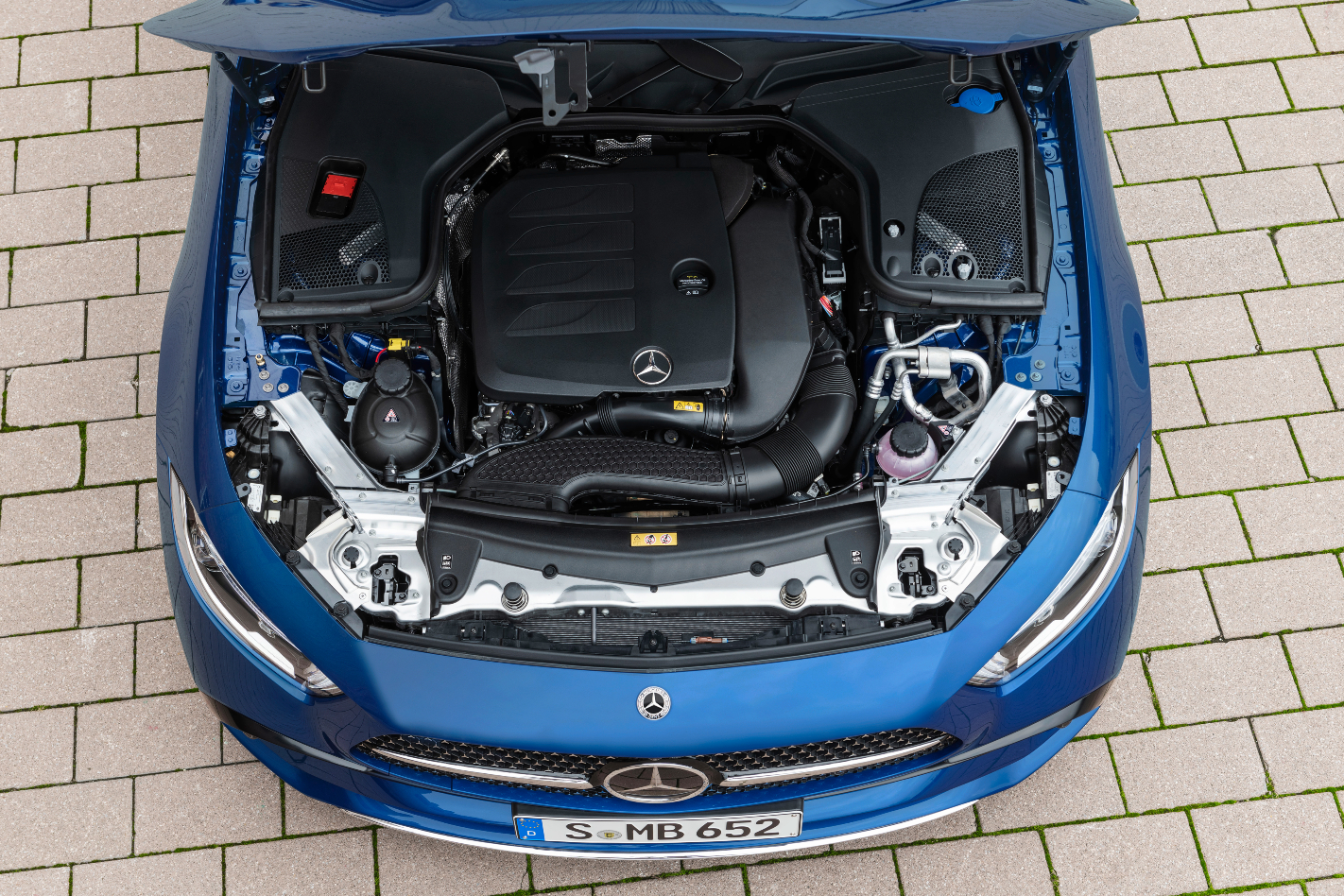
As for petrol-powered models, the CLS 350 will sit at the base of the line-up and come equipped with a turbocharged 2.0-litre four-cylinder engine that will drive the rear wheels and give 220kW and 400Nm.
The CLS 450 4MATIC will represent the range-topping variant of the standard CLS range, and when combined with its 3.0-litre turbo inline-six-cylinder engine and 48V mild-hybrid system, the low slung four-door coupe will deliver 270kW and 500Nm to all four wheels and complete the 0-100km/h sprint in 4.8 seconds.
All engines are capable of topping out at 250km/h, with the exception of the CLS 220 d which still manages a respectable 237km/h top speed.
Exterior updates across the standard line-up include a new headlight configuration, a sportier-looking front fascia with a redesigned bumper and a rehashed 3D chrome grille wearing the signature star pattern.
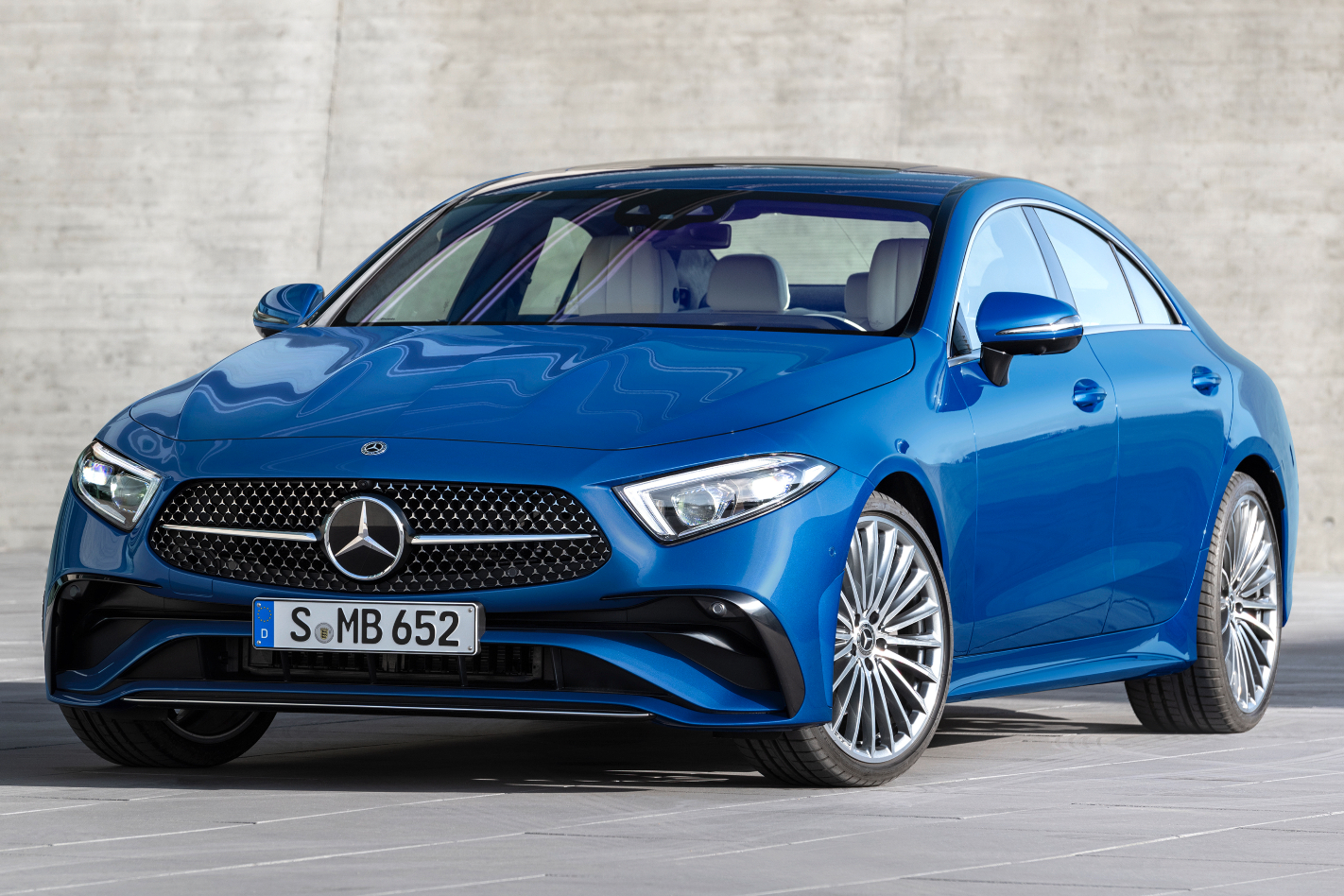
If the optional AMG-Line exterior box is ticked, the front also scores gloss black accents, sportier air inlets, and a chrome front splitter.
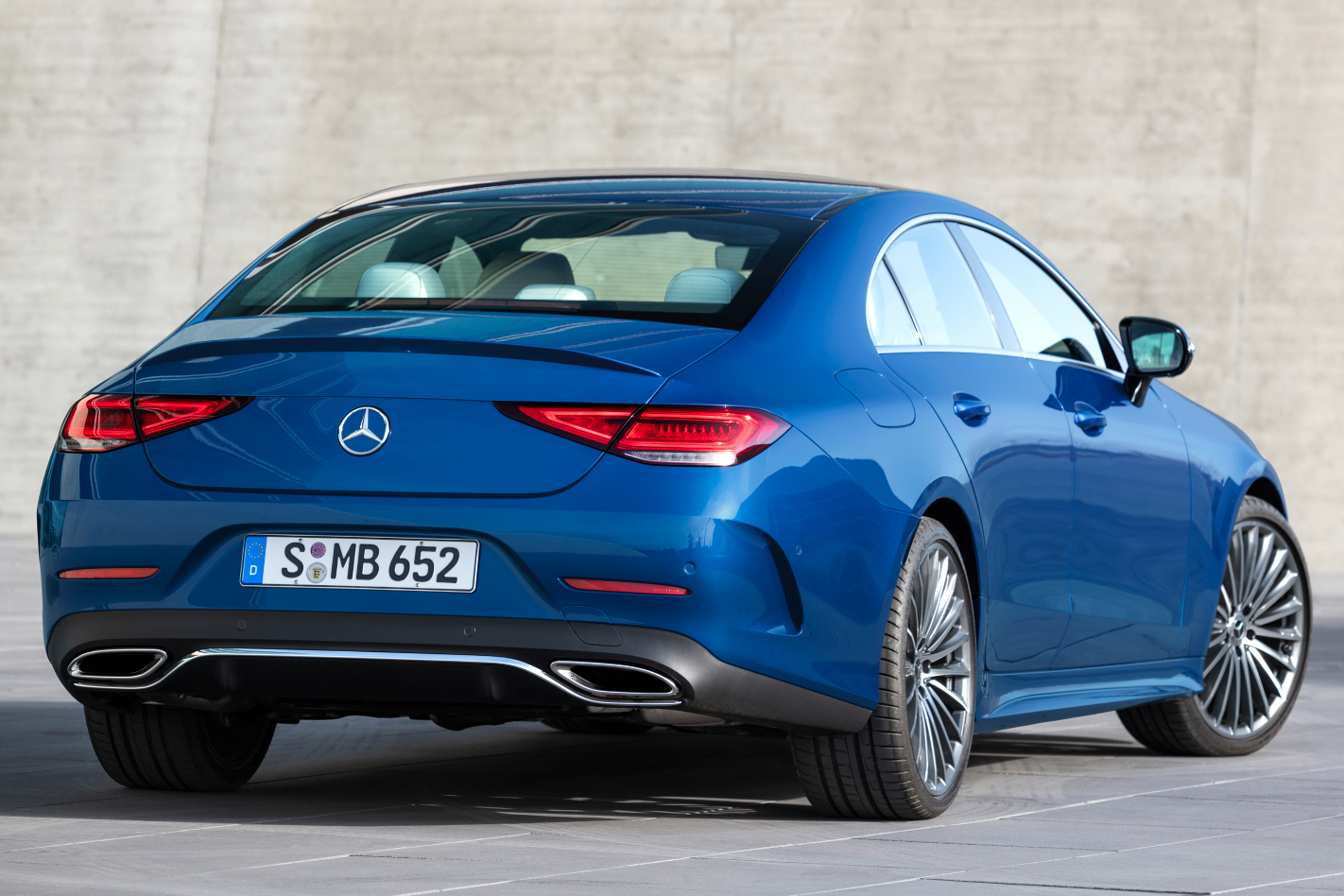
At the back, the coupe sports dual-trapezoidal exhaust tips with chrome accents that hug the outer edge of the bumper’s sides and are separated by a large, matt-black diffuser.
The facelifted four-door can also be had with new five-twin-spoke and multi-spoke 19-inch wheels, while the AMG-Line tweaks the style of the established 20-inch wheels, which gain either a High-Gloss Black or Tremolite Grey paint option.
Inside, the CLS gets a revised intelligent steering wheel that brings it into line with the rest of Mercedes’s more opulent vehicles.
Buyers can also option the coupe with several new leather and trim specifications; Sienna Brown/Black or Neva Grey/Magma Grey two-tone leather and High-Gloss Grey Wood or Open Pore Brown Walnut trim.
There have also been some updates made to the suite of safety features found in the CLS such as; revised automatic parking, autonomous emergency braking, active speed limit assist, and active stop-and-go assist.
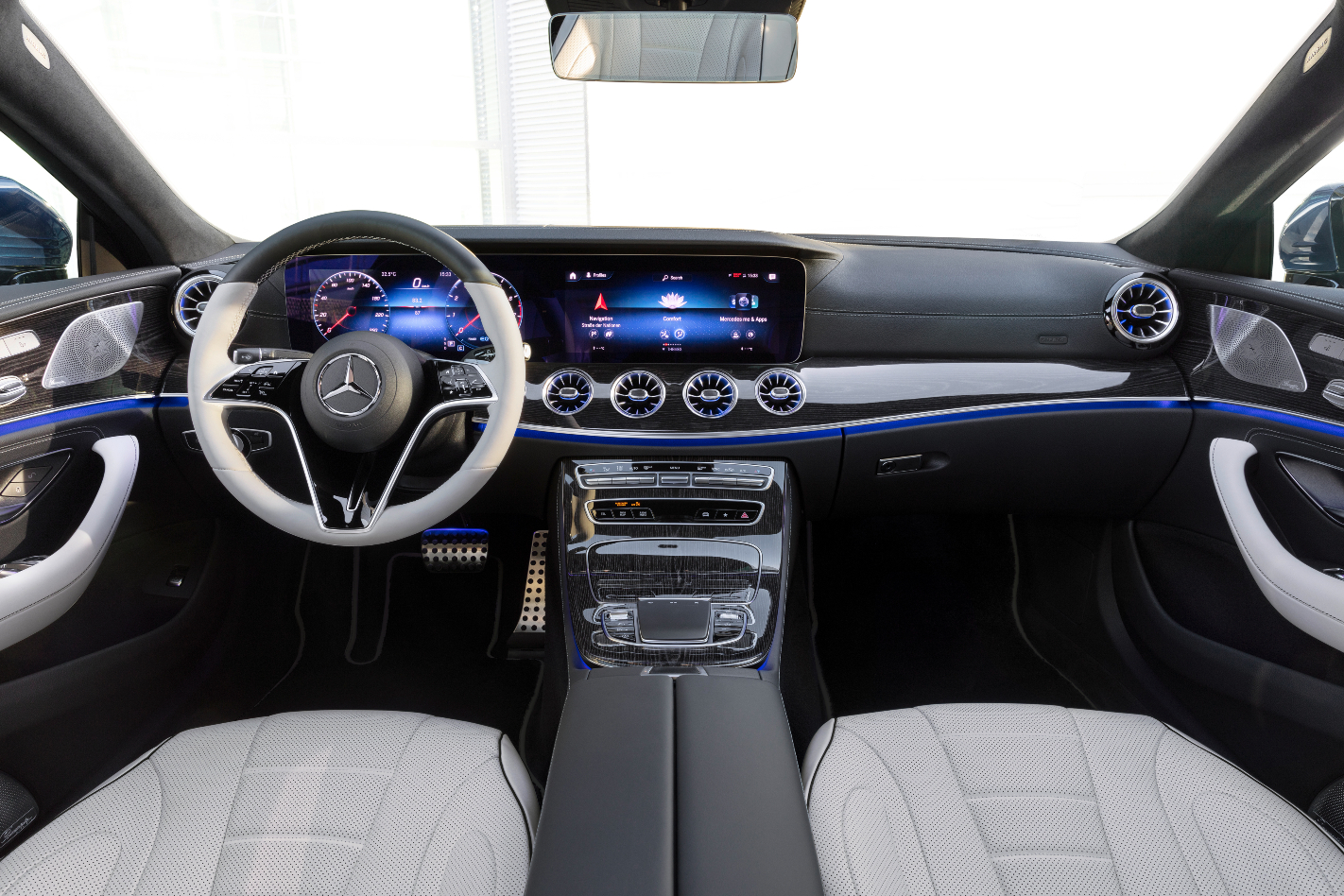
As is the case with the current model line-up, the ultimate incarnation of the updated CLS range comes in the form of the Mercedes-AMG CLS 53 4MATIC+.
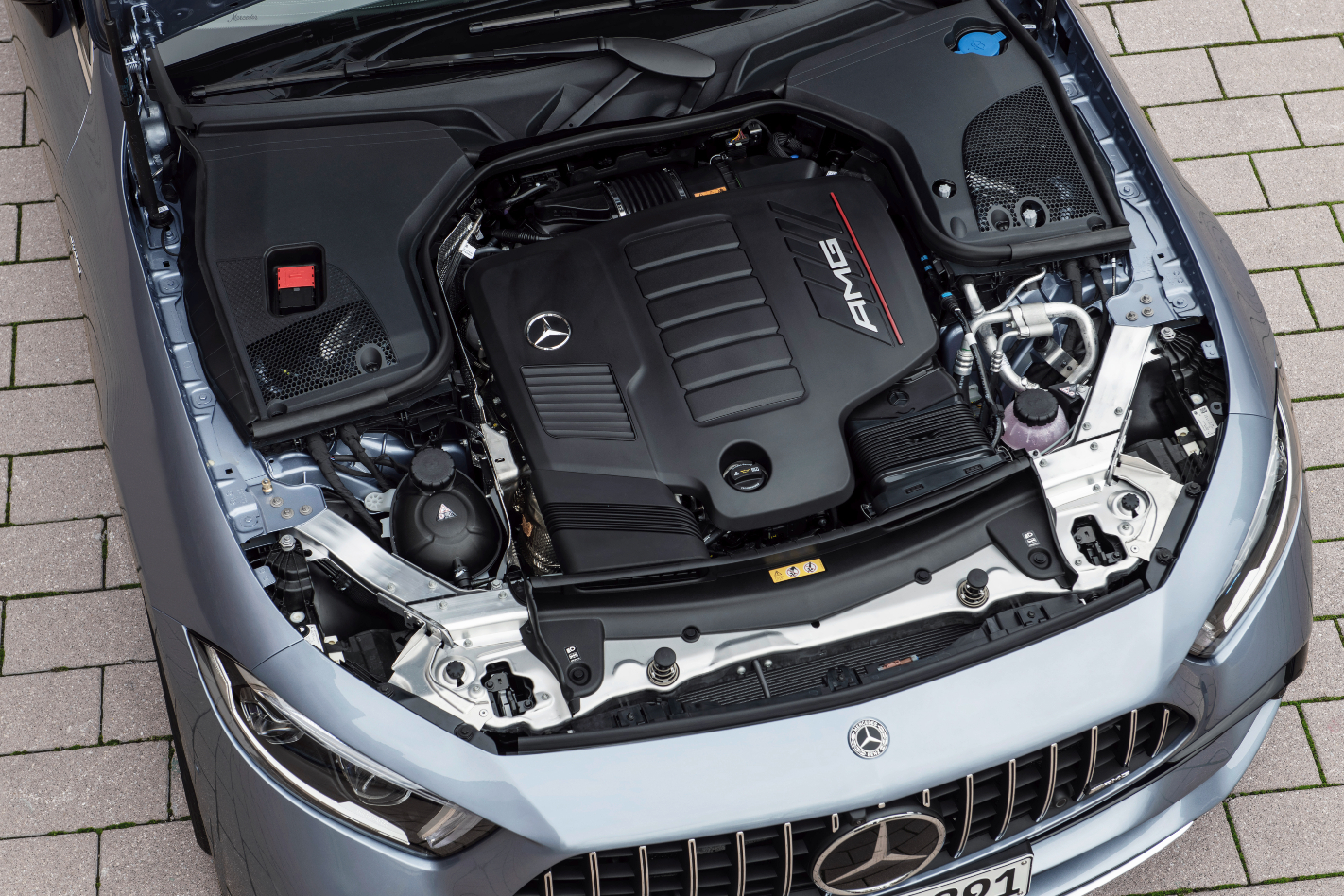
This Affalterbach-made grand tourer is powered by the same 3.0-litre turbocharged inline-six petrol engine as the car it replaces, along with the same 48V mild-hybrid system and 4MATIC all-wheel drive set up.
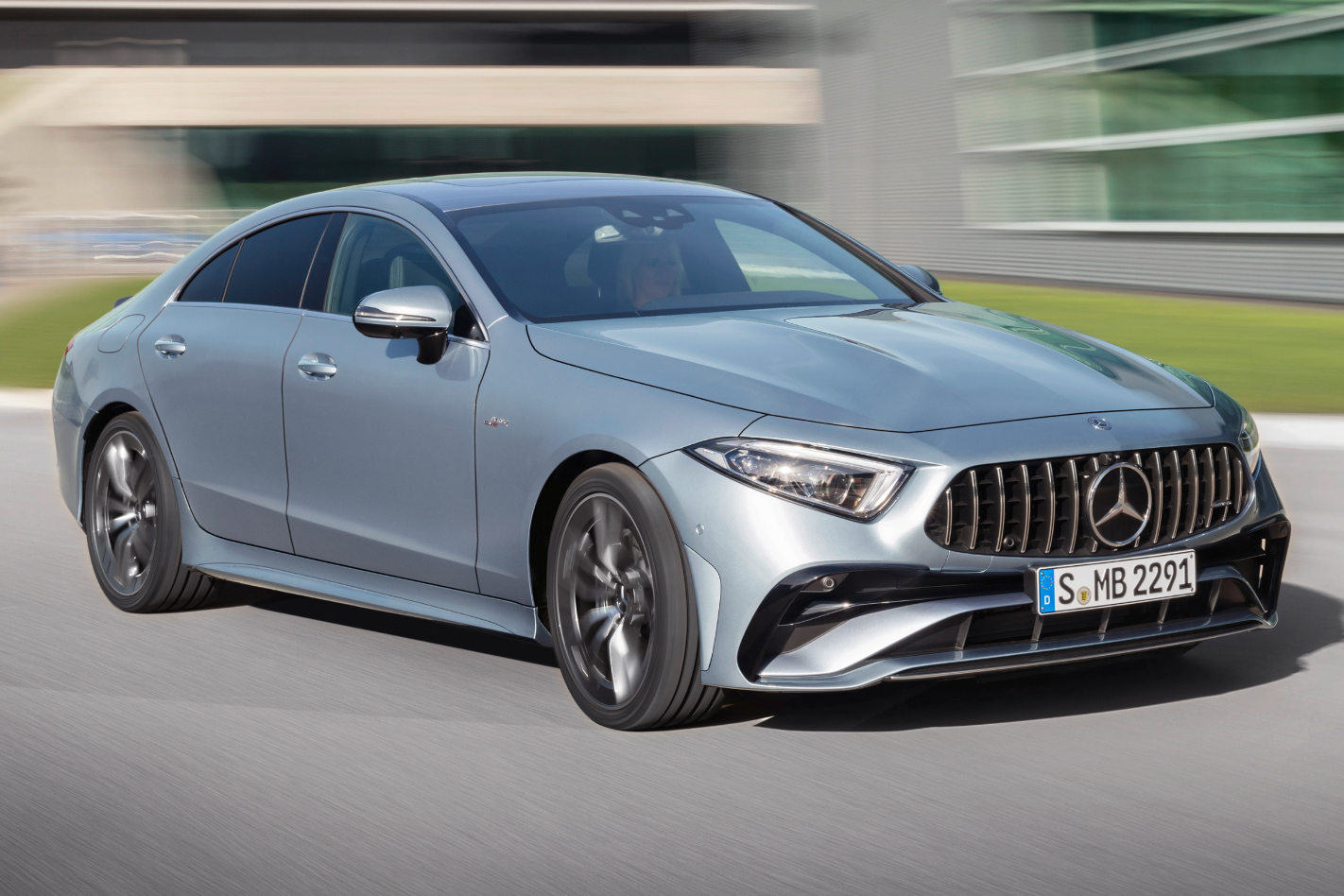
Power hasn’t changed either, with the AMG producing 320kW and 520Nm, while the mild-hybrid system can also provide short bursts of an additional 16kW and 250Nm.
Combine this oomph with the electronically assisted turbocharger that further augments performance, and the CLS 53 will surge from 0-100km/h in 4.5 seconds and won’t stop accelerating until it hits an electronically controlled limiter set at 250km/h (or 270km/h with the AMG Driver’s Pack).
The new AMG also benefits from a raft of visual updates both inside and out. The front fascia gains the signature AMG vertical slat grille design, as well as a more aggressive bumper with a body-coloured splitter.
At the rear, the quad exhaust layout has been carried over, albeit with slightly tweaked exhaust tips, which integrate into a dynamic matt black splitter.
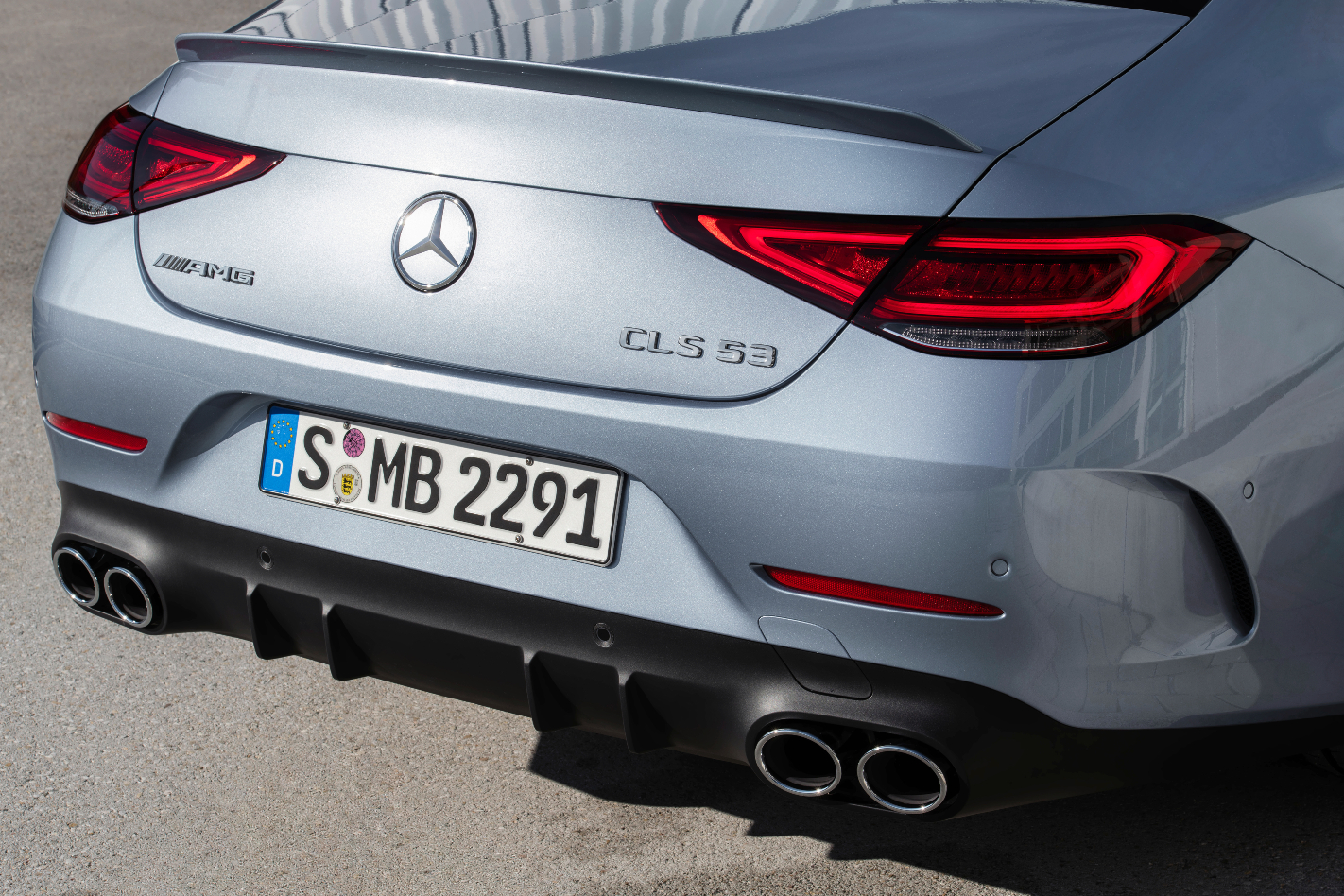
The CLS 53 will be available with two exterior trim options – the AMG Night Package, which adds matt black accents, or the AMG Exterior II Carbon Package, which adds carbon fibre accents.
The performance coupe will also benefit from a new AMG-line sports steering wheel wrapped with fine Nappa leather and equipped with metal paddle shifters.
All variants of the CLS model range will be equipped with Mercedes’s 9G-Tronic nine-speed wet-clutch automatic transmission.
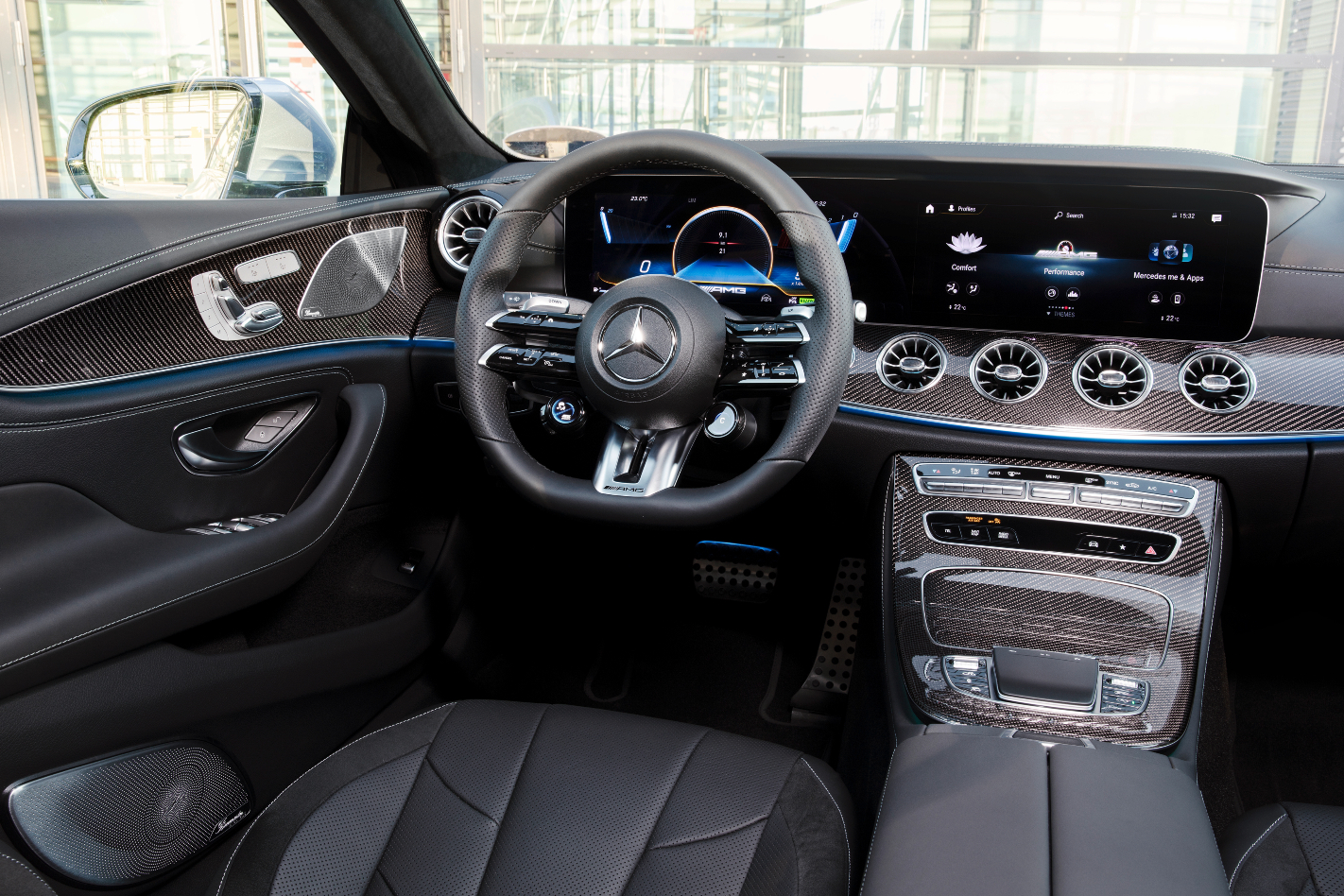
The German carmaker will also celebrate the refreshed CLS with a limited edition model CLS 53 AMG 4MATIC+, which will be limited to just 300 units worldwide.
However, it is unclear at this stage whether or not Australia will be receiving the edition Hi-Po four-door, but seeing as the local market is one of the strongest performing in the world when it comes to AMG products, the possibility of a few landing Down Under is strong.
A representative for Mercedes-Benz Australia has told WhichCar that local pricing is yet to be revealed, but the local launch of the updated CLS range will occur at the end of October, and customer deliveries will begin in the final quarter of this year.
The 2021 Nissan Juke has debuted with a new trim grade, dubbed ST-L+, and given its Ti version a dash of new colour for good measure.
The small SUV’s new styling has been added to the Japanese carmaker’s four-strong line-up of Juke trims, joining the ST, ST+, ST-L and Ti – the latter of which has also received a fresh new colour option called ‘Ti Energy Orange’.
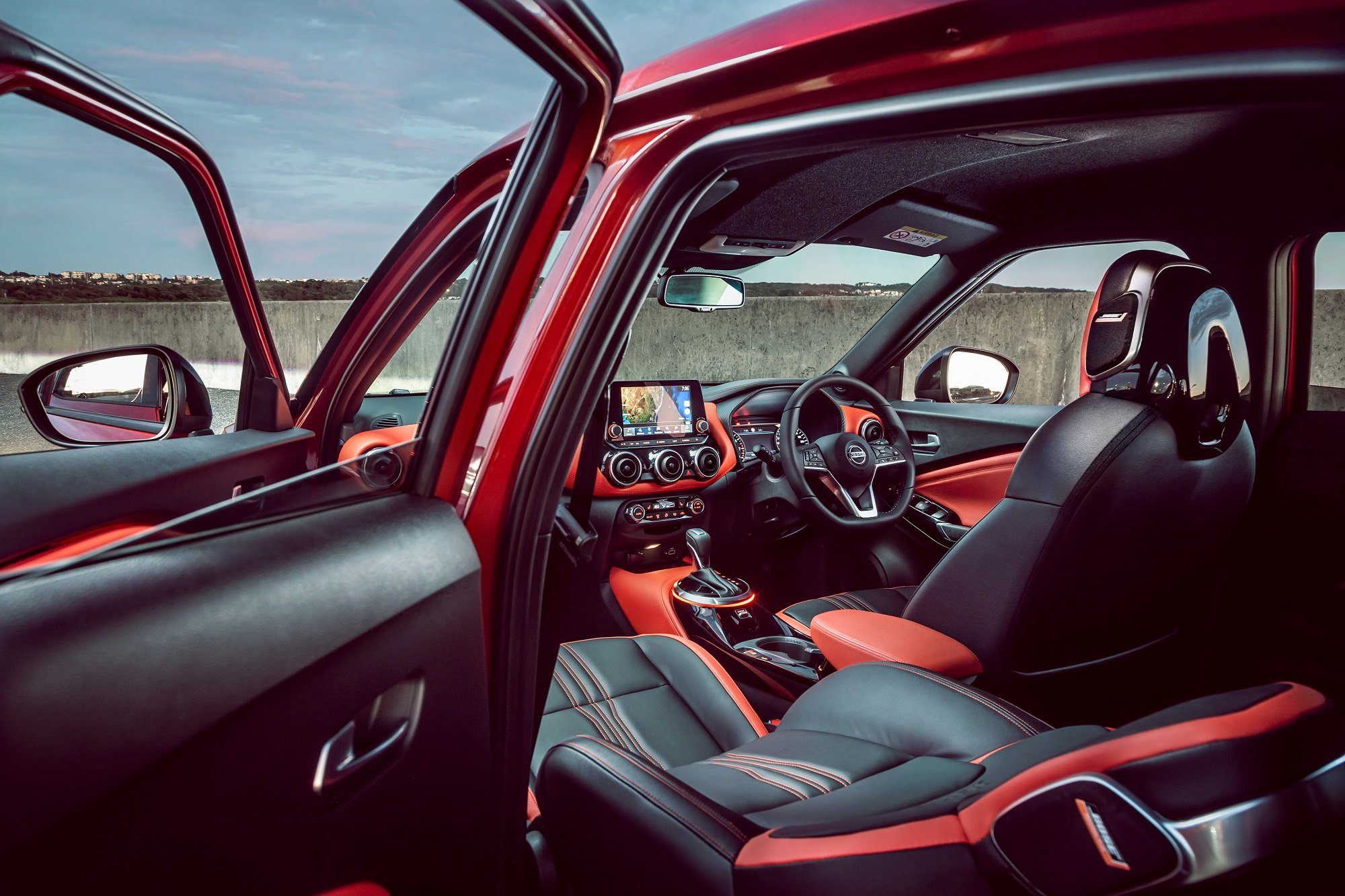
The Juke ST-L+ includes many of the same features as the standard ST-L, such as 19-inch alloy wheels, ambient interior lighting, a 7.0-inch Advanced Drive Assist Display (ADAD), and 8.0-inch touchscreen with Apple CarPlay and Android Auto capability.
Where the ST-L+ differs is that it also now includes a part-leather-accented seat trim finished in white, complemented by a white leather-accented dashboard, knee pad, door trims and front armrest.

In contrast, the driver and front passenger headrest finisher, centre console and front door trim are finished in black chrome.
It also features a pair of Bose UltraNearfield speakers integrated into both front-seat headrests.
The Ti Energy Orange offers buyers a new interior option when choosing the range-topping Juke model – at no extra cost than the existing Ti trim.
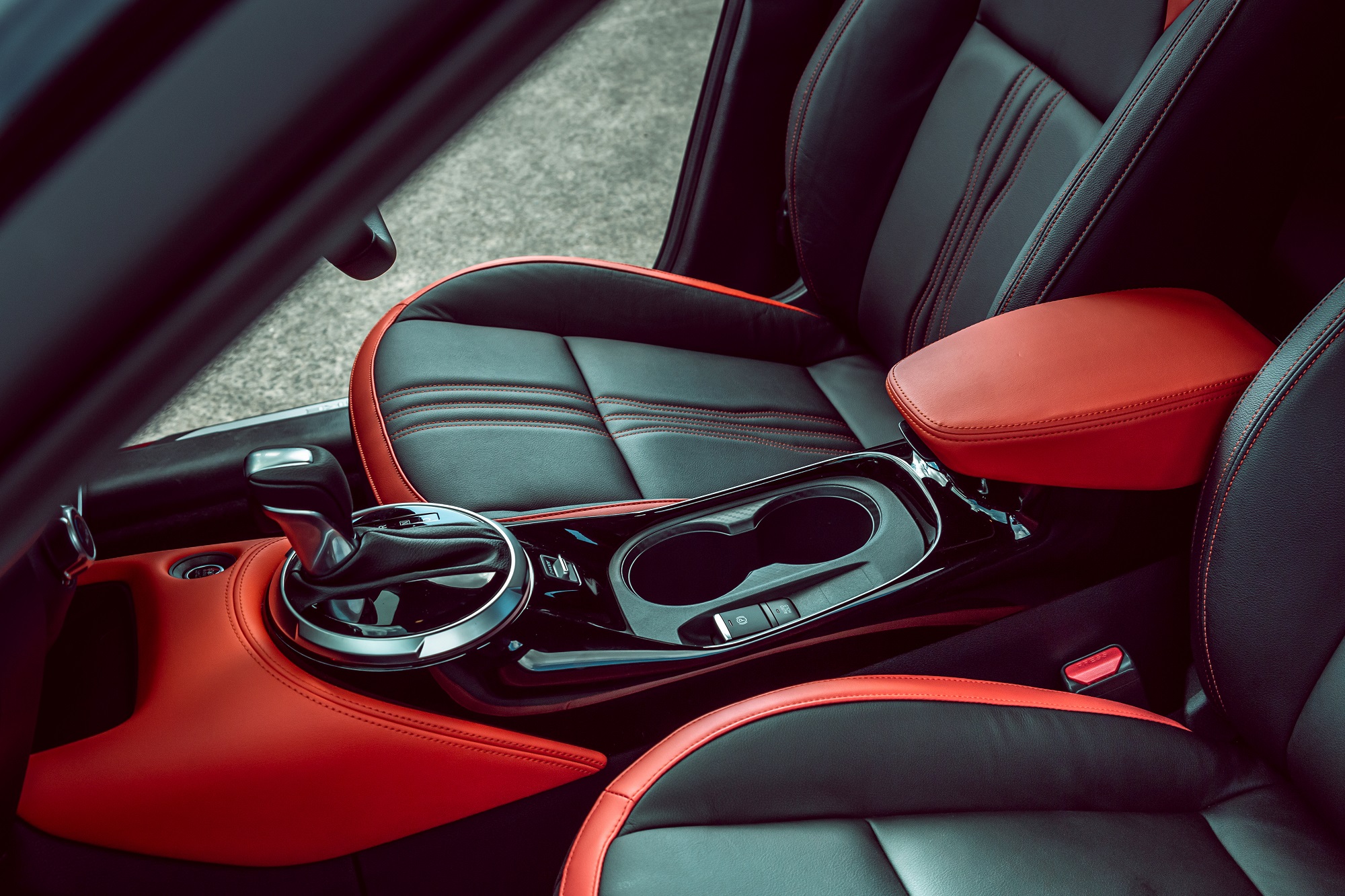
While the current Ti model sports Alcantara-trimmed seats, as well as an Alcantara dashboard, knee pad and door panels, the Ti Energy Orange replaces those items with orange and black leather-accented seats, and an orange leather-accented dashboard, knee pad, door trims and front armrest, which the manufacturer claims gives it a “more eye-catching treatment”.
Designed to sit alongside the existing Ti model, the equipment lists are pretty much the same, including 19-inch Akari alloy wheels, follow-me-home headlights, illuminated ‘Juke’ entry kick plates and eight-speaker Bose Personal Plus audio.
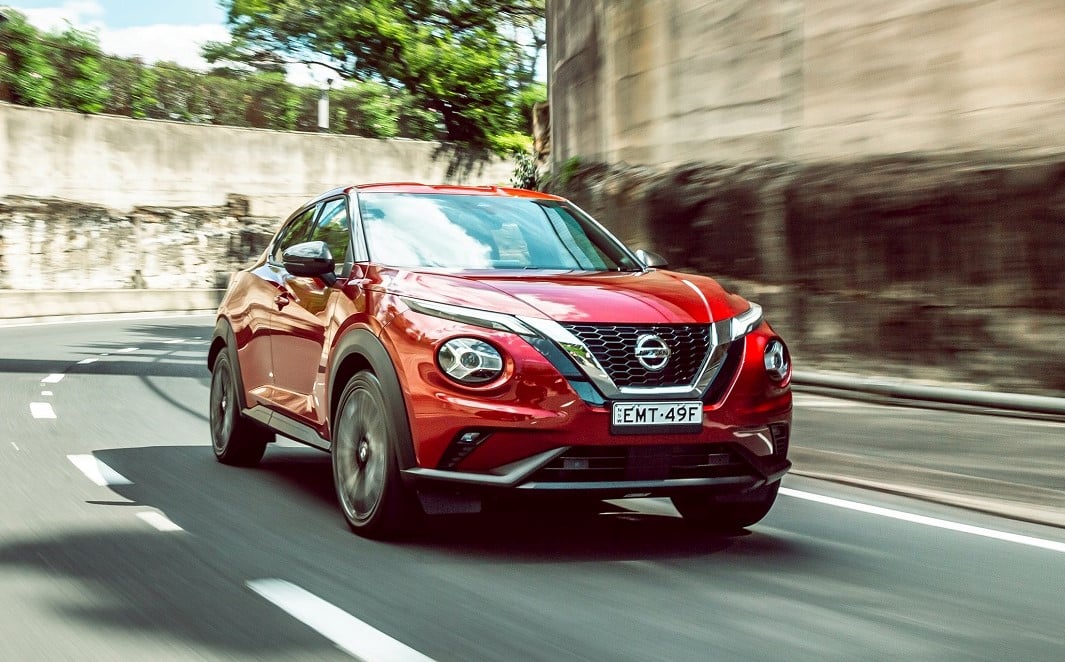
Before on-road costs, the ST-L+ will set you back $35,140 (MSRP) compared to $33,940 (MSRP) for the ST-L, while the Ti Energy Orange remains priced the same as the standard Ti at $36,490.
Trim specifications
ST-L+ (in addition to ST-L specification)
Design
- 19-inch alloy wheels
- Door and centre ambient lighting
- Black part cloth/part white and black leather-accented trim
- White leather-accented dashboard, knee pad, door trim and front armrest
- Black chrome driver and front passenger headrest finisher
- Black chrome centre console and front door trim
- Moving Object Detection
- Intelligent Cruise Control
- Intelligent Around-View® Monitor
- 7.0-inch TFT/Advanced Drive Assist Display (ADAD), driver’s binnacle
- Rear USB port for charging
- Eight-speaker BOSE Personal Plus
- Drive modes (Eco/Standard/Sport)
- Electric park brake with auto-hold
- Intelligent Key with push button engine start
- Auto-dimming rear-view mirror
- Rain-sensing front wipers
- Leather accented steering wheel and shift knob
- Part cloth/leather-accented seat trim
Comfort/Convenience
- Follow-me-home headlights
- Privacy glass
- All the Alcantara trim is replaced with leather-accented trim finished in Energy Orange / Black
- Full leather-accented seating
- Black chrome centre console, front door trim and headrest finisher
- Shark-fin antenna
- Illuminated ‘JUKE’ entry kick plates
- 19-inch Akari alloy wheels
- Eight-speaker Bose Personal Plus audio
- Tyre-pressure-monitoring system
2021 Nissan Juke pricing
- Juke ST – $27,990
- Juke ST+ – $30,740
- Juke ST-L – $33,940
- Juke ST-L+ – $35,140 (new)
- Juke Ti – $36,490 (Energy Orange interior, new)
MORE: Nissan stories MORE: Nissan Juke stories
Australian new-car sales have emphatically confirmed their resurgence after more than 100,000 vehicles were registered in March.
Official industry figures released today revealed 100,005 vehicles were sold last month – making it five consecutive months of growth after more than two and a half years of declining sales.
March 2021’s total sales were a 22 per cent increase on March 2020, which was the first month to be adversely affected by the then emerging COVID-19 pandemic.
It is the first March since 2018 – Australia’s current record sales year – to break the six-figure barrier and is a result achieved during a time of vehicle-parts shortages chiefly arising from the pandemic.
SUVs and light-commercial vehicles, as well as private buyers, continue to drive the growth.
SUV sales increased 32 per cent month-on-month and are up 26 per cent year to date.
Light commercials – mainly comprising utes and vans – were up 28 per cent compared to March last year and are up 25 per cent year to date.
Light SUVs and Upper Large SUVs were particularly notable, with 123 and 53 per cent year-on-year growth, respectively.
In the ute segment, 4×2 and 4×4 variants both increased by 23 per cent compared with this time last year.
Passenger car sales continued their negative trend, dropping two per cent compared with March 2020 and down nine per cent year to date.
There were three stand-out passenger-car segments, however. Micro cars jumped 74 per cent, albeit from a low base, while there were 43 and 44 per cent increases for Large Cars and People-Movers.
Luxury cars accounted for Large Car growth, up 145 per cent month-on-month, thanks mainly to the Mercedes-Benz E-Class and the addition of the new electric Porsche Taycan.
People-Movers moved up thanks primarily to new-generation versions of the Kia Carnival and Volkswagen Multivan. The latter was up a staggering 476 per cent compared with March last year.
What were the best-selling models?
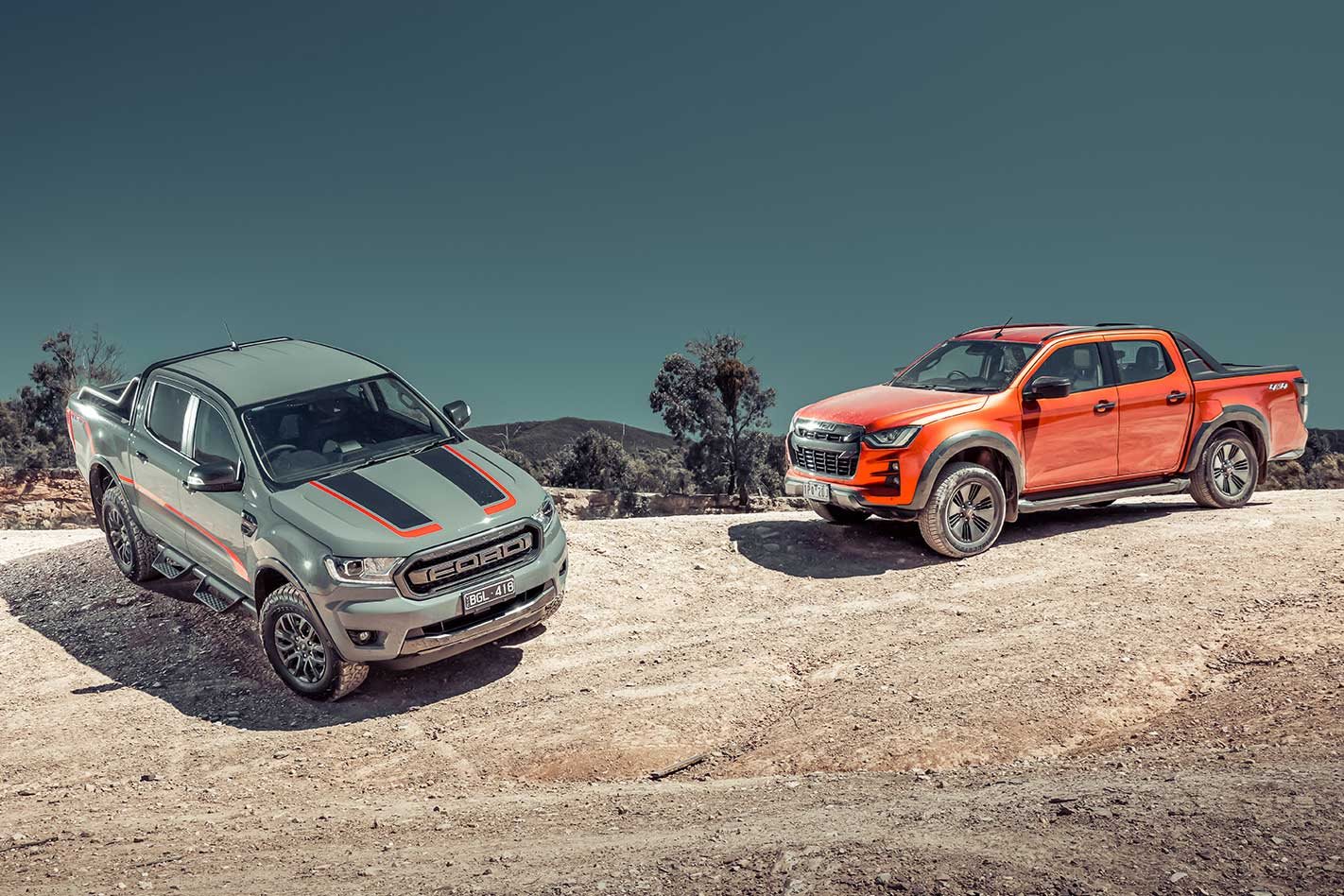
The Toyota HiLux smashed past 5000 sales (5319) to be the runaway leader for Most Popular Model, well ahead of the Ford Ranger that still cements its now-regular No.2 position with 3983 sales.
Both utes posted strong year-on-year growth for their 4×2 variants (HiLux up 66 per cent; Ranger up 70 per cent), yet still strong increases for the vastly more popular 4×4 models (up 26 and 45 per cent, respectively).
The Mitsubishi Triton (2492) and Isuzu D-Max (1994) made it four utes in the Top 10, as with January and February.
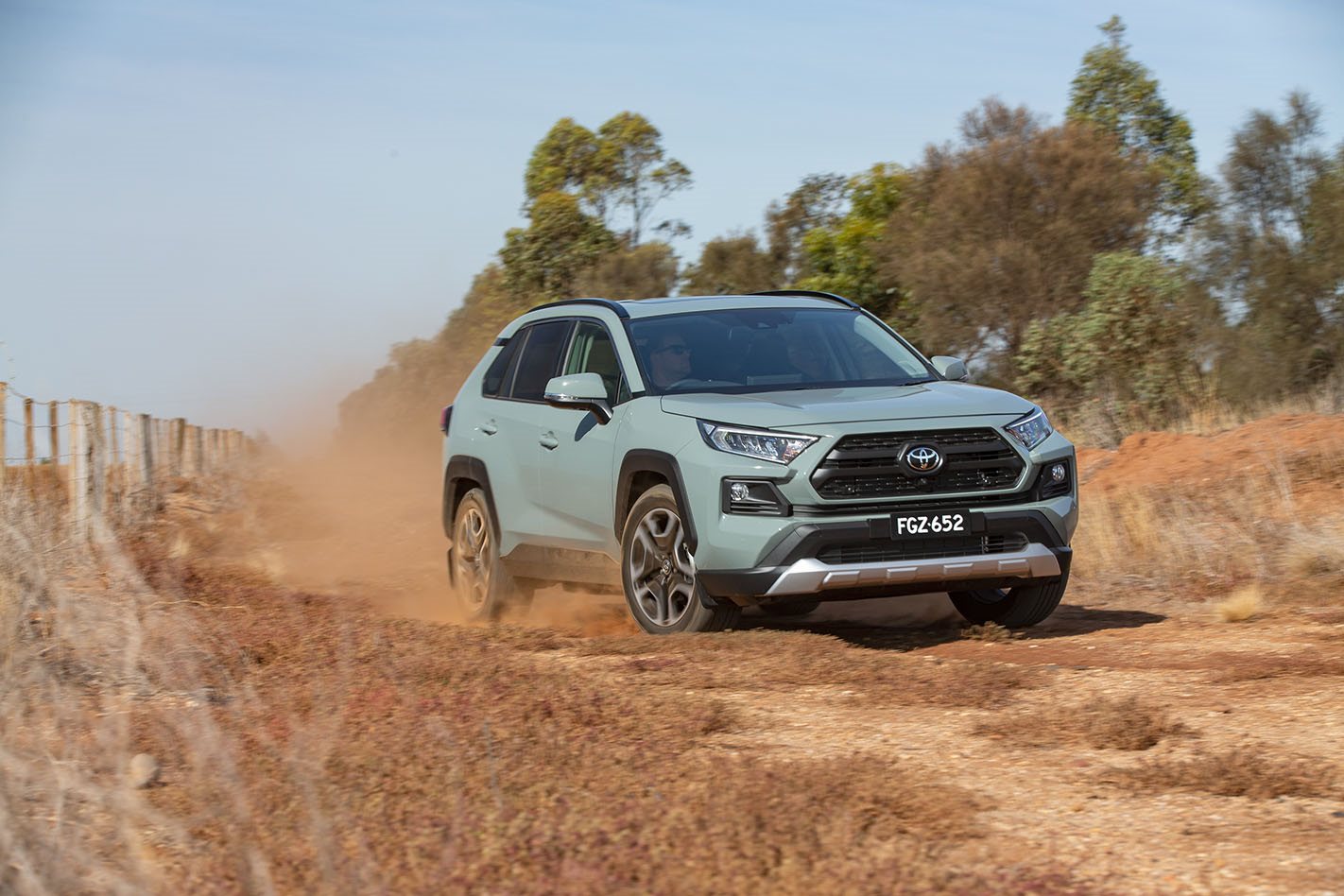
They were pushed down the table again by the ever-popular Toyota RAV4 medium SUV (3522 sales) and Toyota Corolla small car (2892), though between them was the Mazda CX-5 mid-sized SUV with a rare result above 3000 sales (3022, up 74 per cent).
Hyundai’s i30 small car, now counting a sedan body style after a name change for the Elantra, had its best figures of the year so far – 2514 sales (up 36 per cent) placing it sixth.
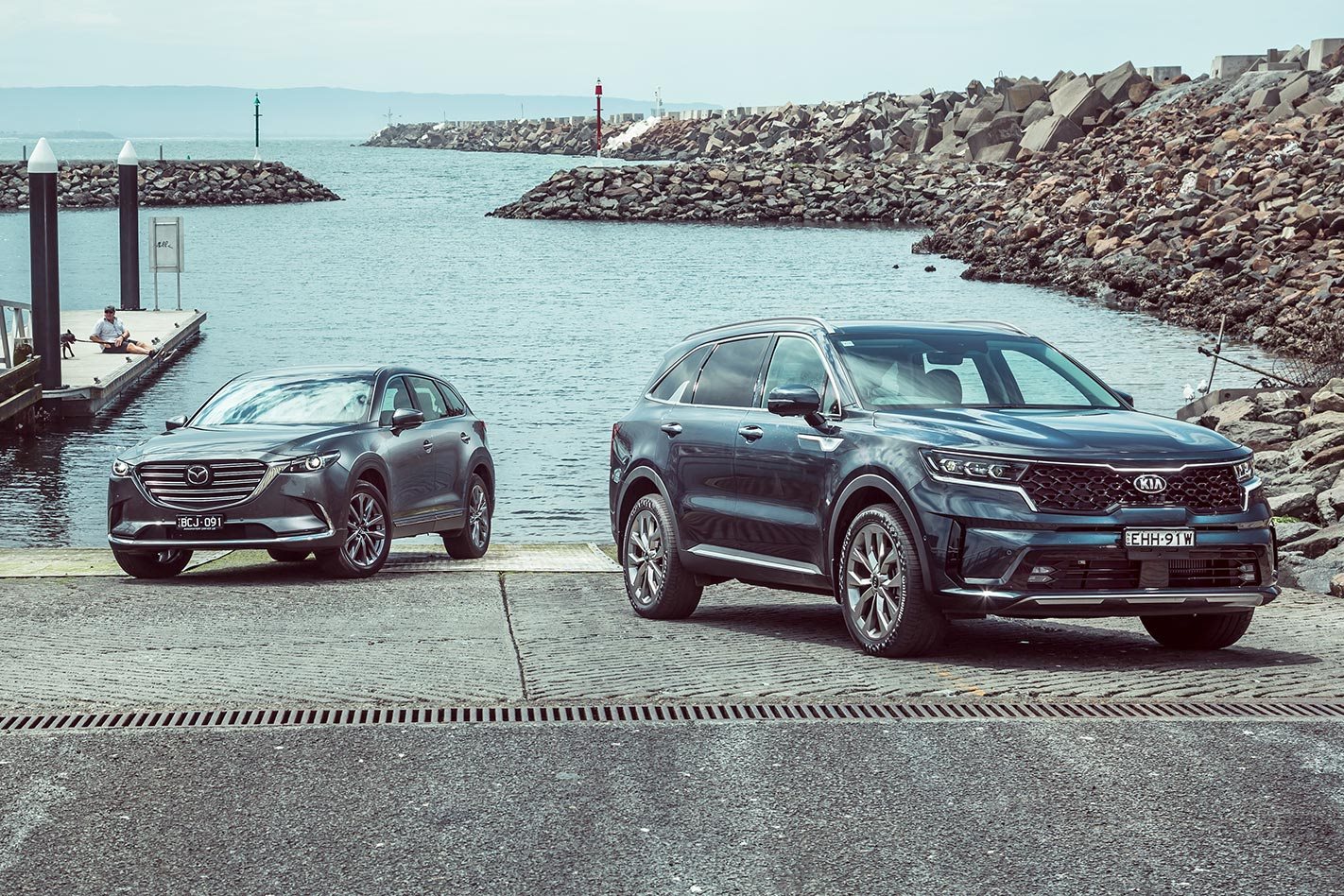
Demand for the outgoing Toyota LandCruiser 200-series wagon helped it to eighth place, with a 78 per cent year-on-year climb taking it to 2244 units (and a 61 per cent year-on-year increase).
Mazda’s smallest SUV, the CX-3, just missed out on the Top 10 with 1744 sales (up 66 per cent).
There were plenty of other notable sales performances from individual nameplates.
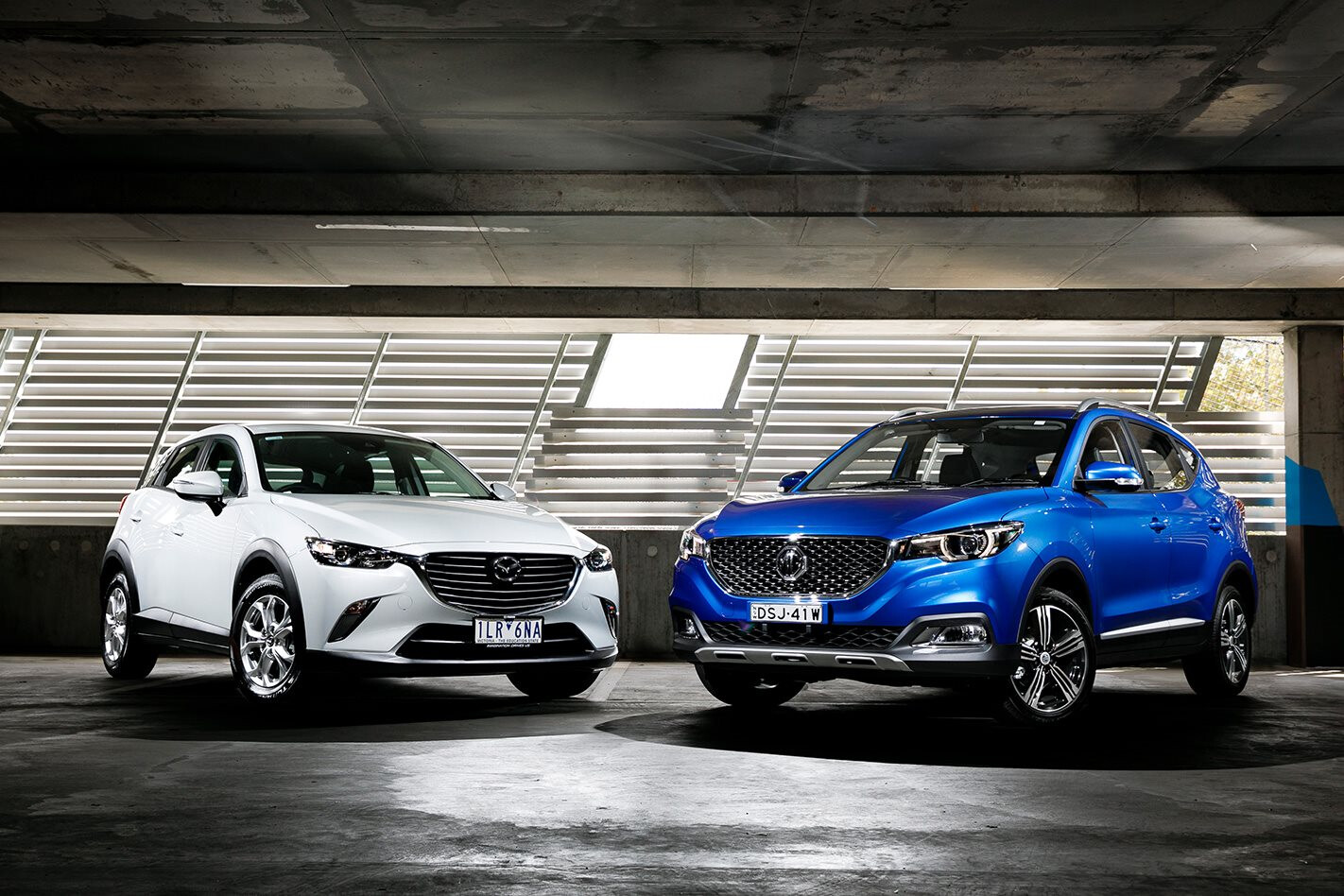
MG’s ZS compact SUV recorded a March figure of 1510 units – a sensational 322 per cent increase on March 2020.
The latest-generation Subaru Outback has made a stunning start to sales life with a 191 per cent year-on-year jump to 1341 units.
The second half of Isuzu’s showroom double act, the D-Max-based MU-X SUV, grew by 85 per cent (1179 units) compared with March 2020.
MARCH 2021: TOP 10 MODELS
- TOYOTA HILUX – 5319 – up 49.6% YTD
- FORD RANGER – 3983 – up 28.2% YTD
- TOYOTA RAV4 – 3522 – up 17.8% YTD
- MAZDA CX-5 – 3022 – up 74.3% YTD
- TOYOTA COROLLA – 2892 – up 2.8% YTD
- HYUNDAI I30 – 2514 – up 35.5% YTD
- MITSUBISHI TRITON – 2492 – up 37.5% YTD
- TOYOTA LANDCRUISER – 2244 – up 78.0% YTD
- ISUZU D-MAX – 1994 – up 35.9% YTD
- NISSAN X-TRAIL – 1932 – up 46.0% YTD
The top-selling brands
There was no change to the 2021 form guide in March, with Toyota, Mazda and Hyundai occupying the top three positions.
Mitsubishi maintained fourth from February (it was fifth in January), though Ford jumped Kia courtesy of a 23 per cent increase over March 2020. Comparatively, the Korean car maker was up only three per cent.
Nissan seems to be making seventh place its home, while an impressive start for the new-generation Outback contributed to Subaru’s solid eighth position.
Volkswagen remains in the Top 10, though it was almost displaced for the second consecutive month by Chinese brand MG that was just 50 sales behind.
MG kept Mercedes-Benz (3275) out of the Top 10 for the first time this year.
MG’s growth compared with March 2020 is 168 per cent, though it wasn’t the only Chinese brand to register triple-figure year-on-year increases that are impressive – even if in the context of being compared with the first month affected by COVID-19.
LDV was up 188 per cent (1468 units) and GWM was up 173 per cent.
American 4×4 and SUV brand Jeep continues its comeback, growing 183 per cent year on year to 730 sales for March.
Swedish brand Volvo surprised with a 162 per cent jump, which equated to 992 sales and year-to-date growth of 67 per cent that puts it on track currently to break its 2021 target of 10,000 sales.
Skoda (up 148 per cent to 1032 sales), SsangYong (up 133 per cent to 298 sales) and Renault (up 119 per cent to 739 sales) were other triple-figure brands.
The latter result will be encouraging for independent distributor Ateco and the Renault dealer network. Ateco announced last month that from April onwards it is taking over local management of the French brand from the OEM.
Genesis was up 260 per cent, though this was only to 58 cars as Hyundai’s luxury brand begins a long strategy of establishing itself in Australia.
Hyundai’s own growth of 29 per cent was impressive for a Top 10 brand and helps create some distance to its sister brand Kia, which had been starting to breath down its neck.
TOP 10 BRANDS
- TOYOTA – 21,319 – up 21.2% YTD
- MAZDA – 10,785 – up 58.2% YTD
- HYUNDAI – 6852 – up 29.1% YTD
- MITSUBISHI – 6430 – up 7.1% YTD
- FORD – 5977 – up 23.1% YTD
- KIA – 5802 – up 2.6% YTD
- NISSAN – 4559 – up 30.2% YTD
- SUBARU – 4212 – up 39.3% YTD
- VOLKSWAGEN – 3358 – up 17.0% YTD
- MG – 3303 – up 167.7% YTD
Technical sketches appearing to show Toyota’s LandCruiser 300 Series interior have been leaked online.
The images, first published on several LandCruiser and 4×4 forums including Kurdistan Automotive Blog, show a series of drawings intended for internal use by Toyota employees.
Perhaps the most notable feature of the possible new interior is the large, most likely 12-inch touchscreen infotainment display which sits proudly mounted in the LandCruiser’s dash.
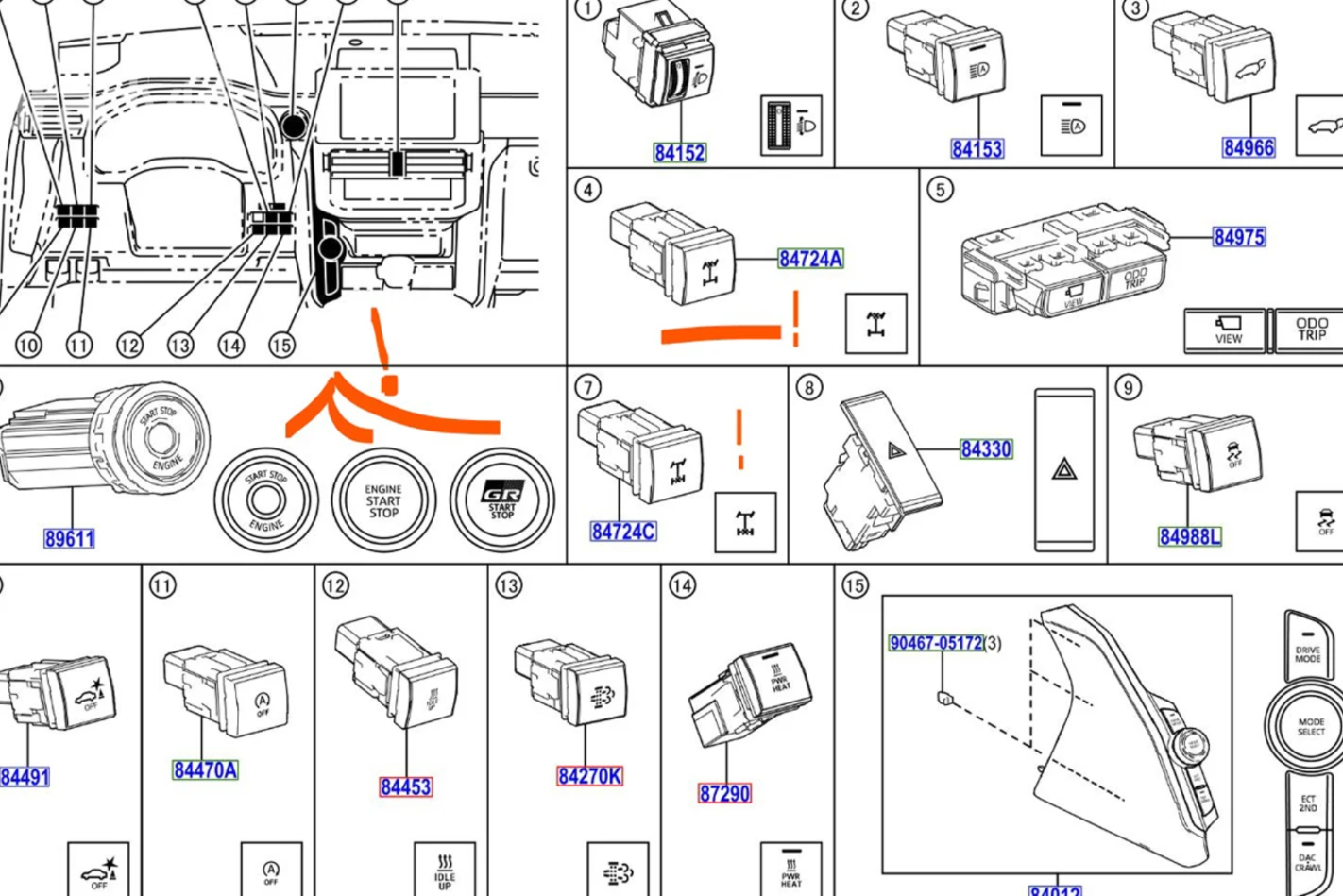
Below the large display sit two centrally-mounted air vents, and on either side of the driver’s seating position are two double-stacked rows of physical buttons, which operate the various functions of the car.
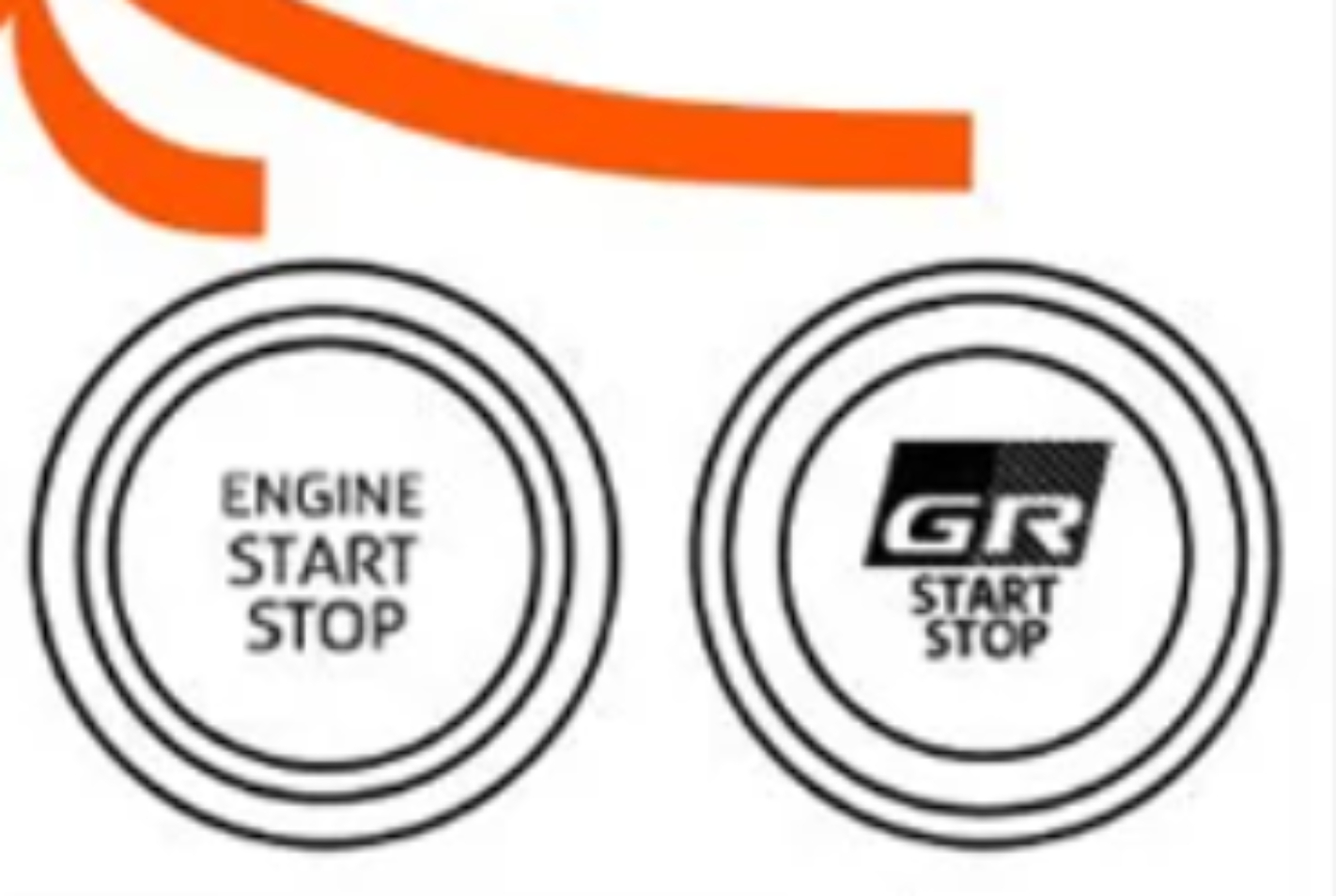
The internal sketches depict a LandCruiser with a left-hand drive configuration, so the large push-button ignition sits on the right-hand side of the driver. However, this could change to the opposite side of the vehicle for right-hand drive variants of the 4×4.
Whatever the case, it seems the start-stop engine button will be available in two guises – standard and GR-branded – which would suggest the new 300 series will be spawning a sportier model honed by Toyota’s Gazoo Racing (GR) outfit.
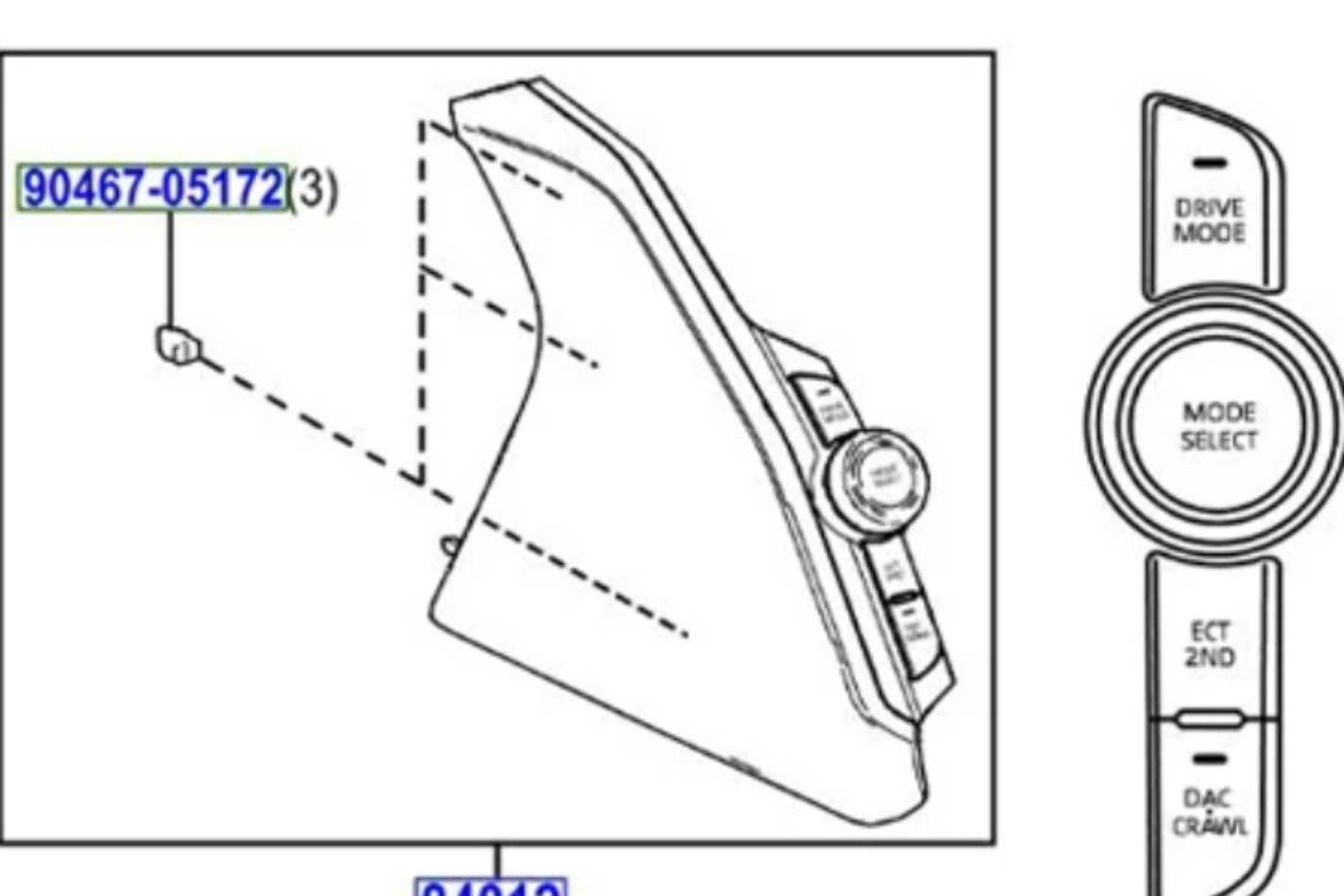
Another important feature of the sketches is the new driver-mode select station, which sits below the start-stop button at the driver’s knee height.
This will presumably allow operators to switch between different modes such as normal, sports, off-road, wet etc.
Positioned directly below the ‘Mode Select’ button is a smaller ‘ECT 2nd’ button, which activates the LandCruiser’s second gear start mode when driving on slippery or low-traction surfaces.
Nestled beneath ‘ECT 2nd’ is the ‘DAC Crawl’ button, which engages the 4×4’s downhill crawl control function.
The inclusion of the new push buttons also appears to confirm other features of the new 300 series, such as; the ability to switch between the front and rear differentials, a power tailgate, and an automatic headlights function.
Drivers should also be able to cycle through the various video images provided by the different cameras mounted around the 4×4 and view them on the two digital screens.
The leaked interior sketches of the new Toyota LandCruiser 300 series come less than a week after exterior, wheel and mechanical drawings were also published by Kurdistan Automotive Blog’s Instagram page.
Those images show the new model will most likely have a redesigned front and rear fascia featuring; a larger front grille, novel headlight and taillight configuration, and new bumpers.
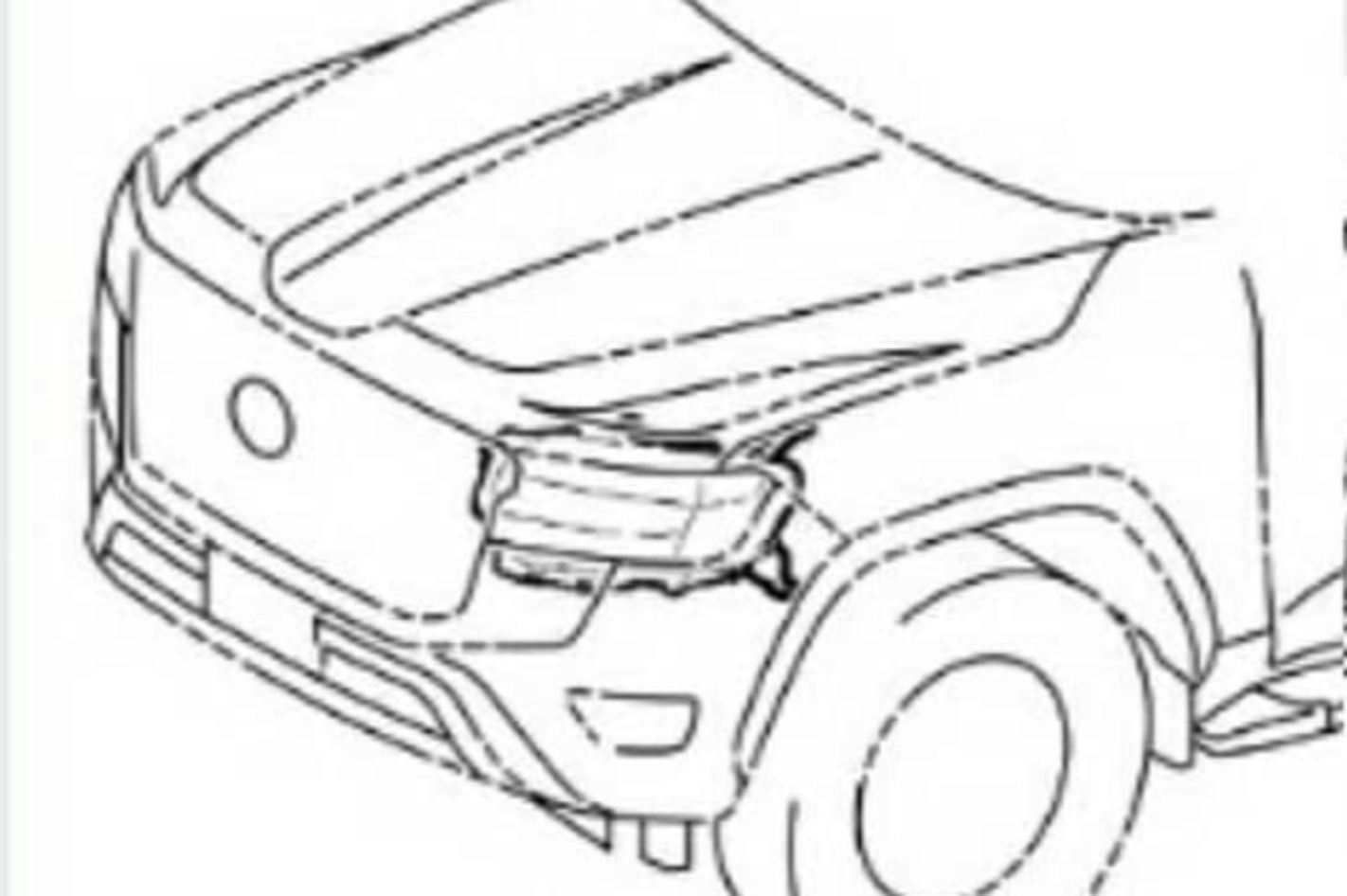
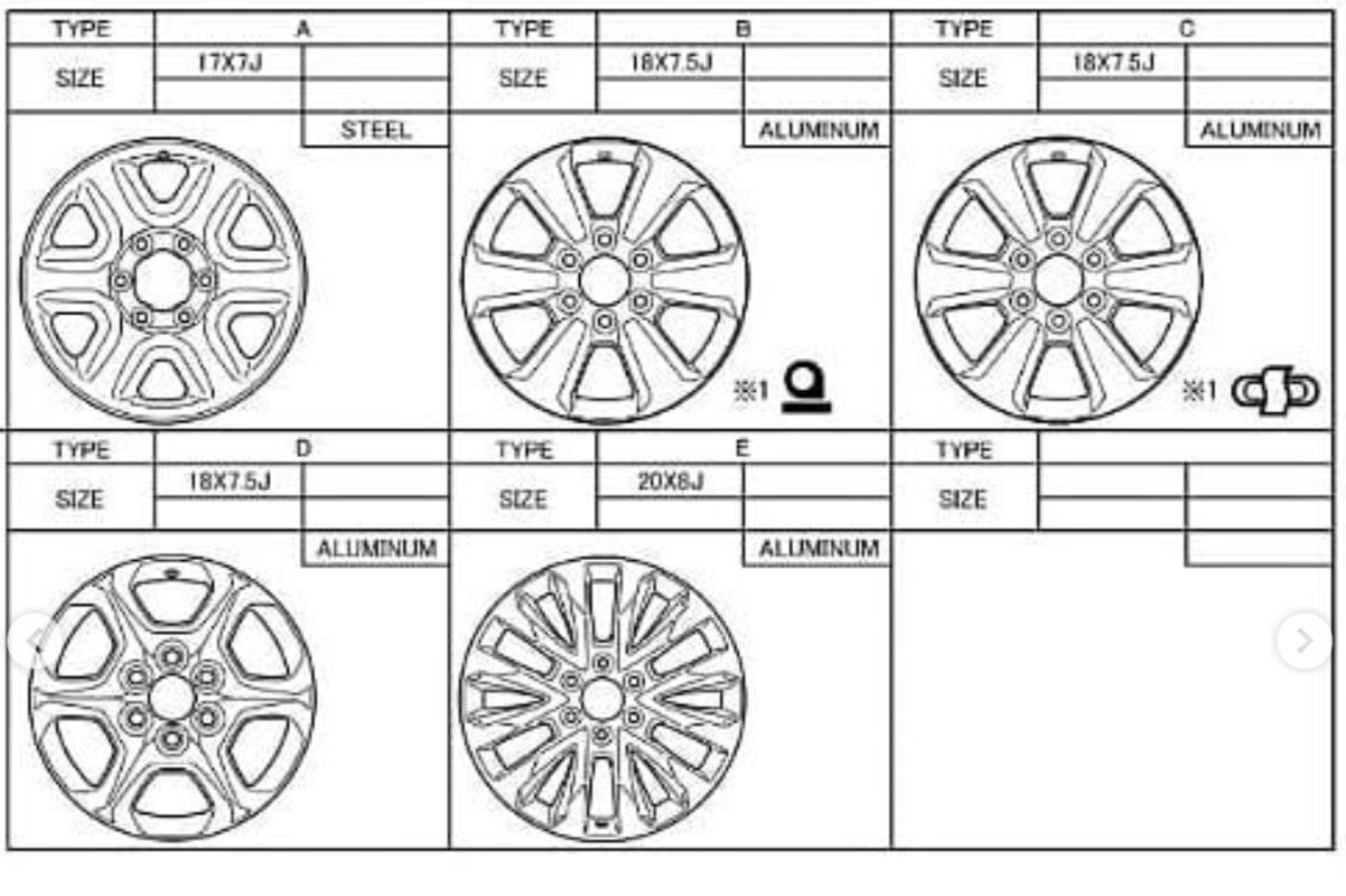
It seems there will be no less than five wheel options from launch, one of which looks to be a basic steel option, with the remainder in aluminium.
Wheel sizes could start at 17×7-inches for the steel wheel, and also include three different designs measuring 18×7.5-inches as well as a larger, more glitzy wheel sized at 20×8-inches.
One looks to be the ‘1GR-FE’ 4.0-litre V6 petrol engine used in other local models in the past such as the Toyota FJ Cruiser, HiLux and Prado, – most likely producing somewhere around 280kW and 380Nm.
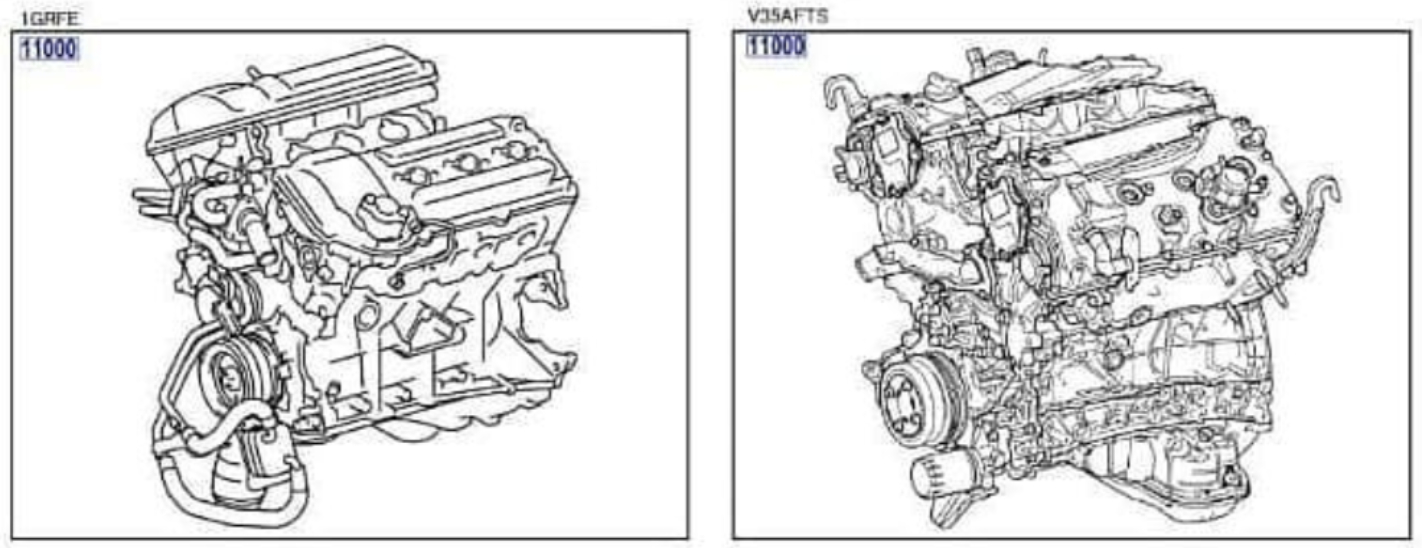
The other will be the all-new ‘F33A-FTV’ 3.3-litre V6 turbo-diesel engine, which looks set to replace the outgoing LandCruiser’s 4.5-litre V8 turbo-diesel donk and churn out more than 200kW and 650Nm.
WhichCar has asked Toyota Australia for comment regarding rumours the new LandCruiser 300 series could be unveiled before the end of April and on sale in the second half of this year, however, a representative for the automaker said they could not yet confirm any details about the new 4×4.
MORE: LandCruiser stories MORE: All Toyota stories
The 2021 Hyundai Kona Electric is now on sale in Australia, arriving with new looks, more technology and an improved driving range of 484 kilometres from a single charge.
The line-up again features two model trim grades, opening with the $62,000 Elite and the $66,000 Highlander. Both prices exclude on-road costs.
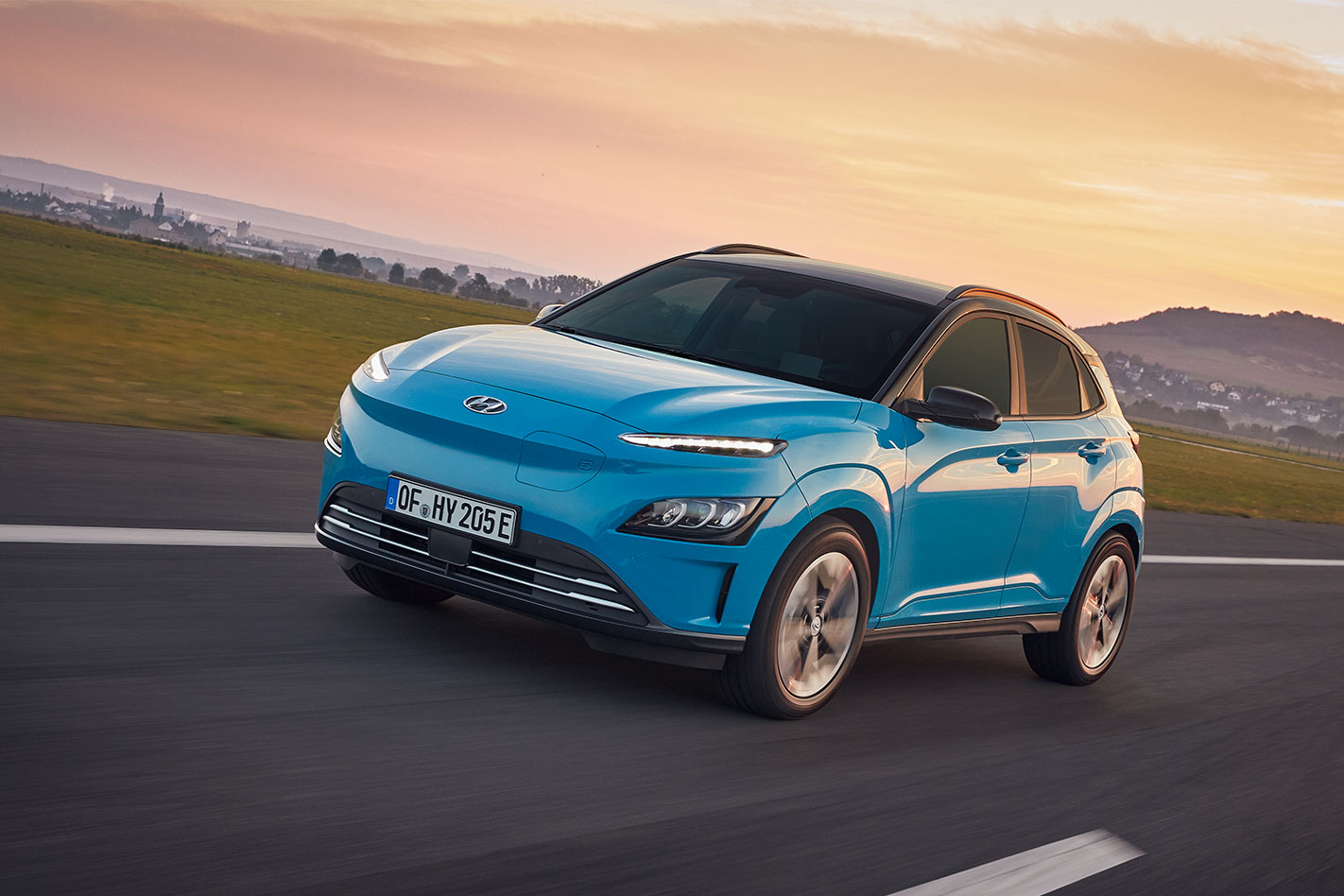
The updated Kona Electric debuts a cleaner front-end design, along with aerodynamic tweaks and an upgraded safety suite that complements improved interior technology.
The new front grille is smoothed over and flanked by redesigned daytime running lights that sit above headlights featuring multi-faceted reflector (MFR) technology on their inner bezels.
Wheel arch cladding is now body-coloured rather than unpainted grey, while functional air intakes cut vertically into either end of the front bumper, feeding air over the front wheels to reduce turbulence.
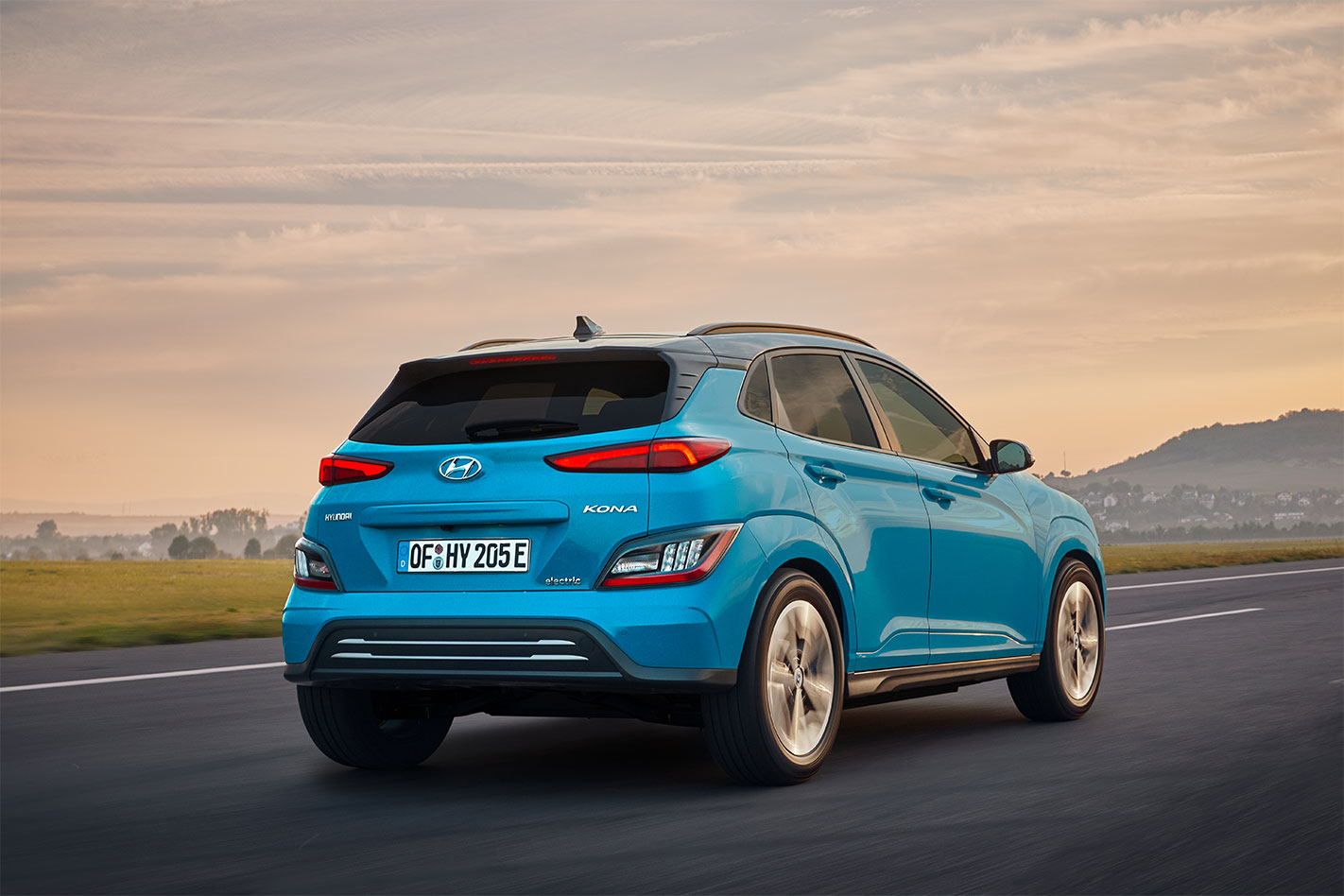
The rear-end follows the same ‘clean up’ design, with more panel areas painted in the Kona’s body colour, matched to refreshed upper and lower lighting designs.
New 17-inch machined alloy wheels round out the novel styling upgrades.
Hyundai has again opted for a single 64kWh lithium-ion battery pack for the Australian-delivered Kona Electric, powering the same 150kW/395Nm motor that featured in the outgoing car. Overseas, a 39kWh model is available with a 300km driving range, but that variant remains unavailable to Australian buyers.
As before, power is sent to the front wheels of the compact SUV through a single-speed reduction gear transmission.
The Korean automaker claims it has increased the efficiency of the new Kona by 7.8 per cent compared to its predecessor, by fitting low rolling resistance Michelin Primacy4 tyres.
Driving range is now rated at 484km (previously 449km) when tested in accordance with the WLTP standard.
The charging port has also been moved to fit asymmetrically between the front headlights, and the charging time is claimed to take just 47 minutes when done with a 100kW DC fast charger.
A table of charging times, comparing the 2021 and 2018 Kona Electric models, is shown below.
| 2021 Hyundai Kona Electric | u00a0 | u00a0 |
| DC Fast Charging (10-80%) | 50kW Charger | 64min |
| u00a0 | 100kW Charger | 47min |
| AC Normal Charging (10-100%) | 7.2kW on-board charger | 9h 15min |
| u00a0 | 10.5kW on-board charger | 6h 50min |
| 2018 Hyundai Kona Electric | u00a0 | u00a0 |
| DC Fast Charging (10-80%) | 50kW Charger | 75min |
| u00a0 | 100kW Charger | 54min |
| AC Normal Charging (10-100%) | 7.2kW on-board charger | 9h 35min |
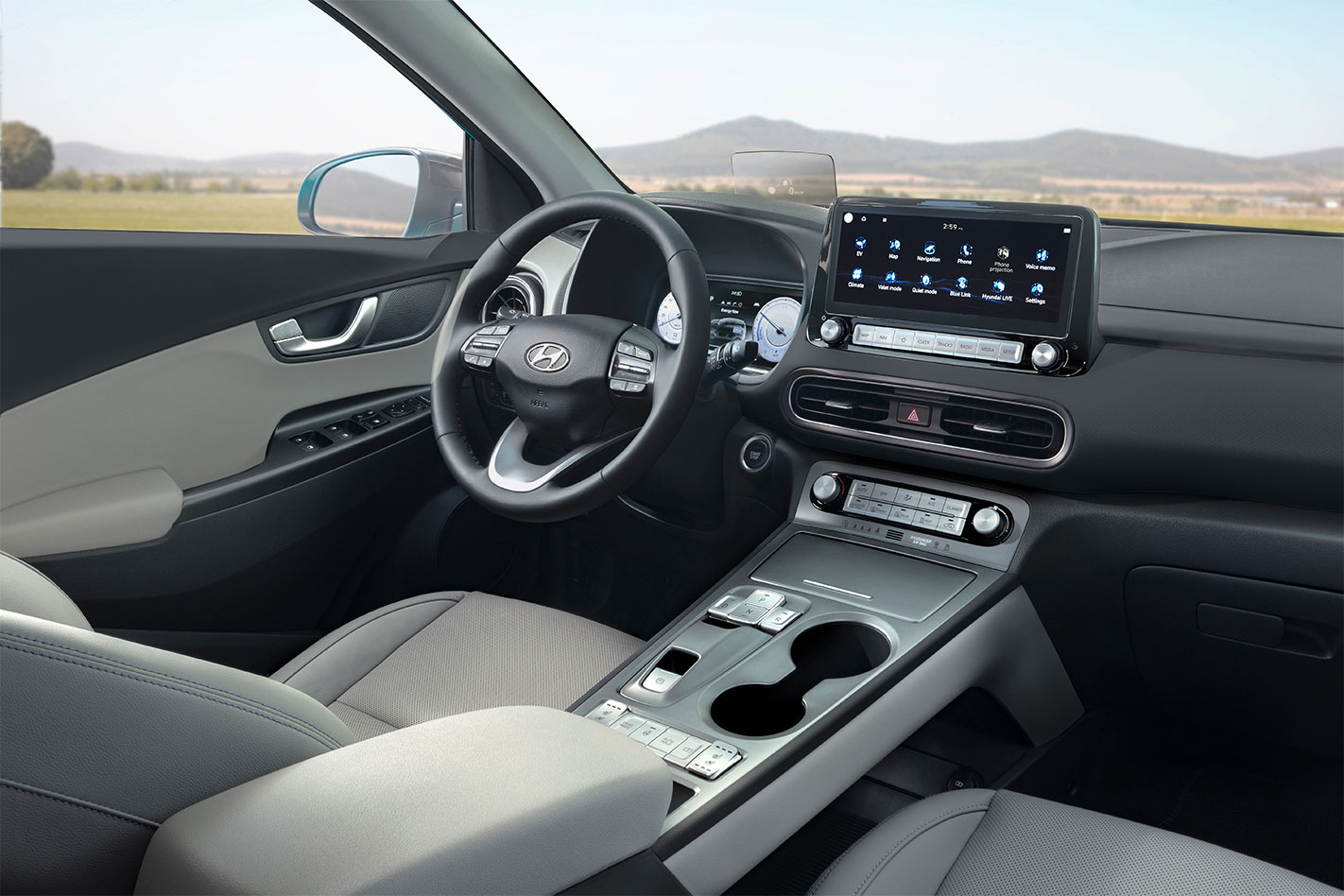
Changes inside the new Kona Electric bring it in line with other key models in Hyundai’s range. The old analogue instrument cluster is now a full 10.25-inch digital dash, which matches the identically sized, centrally mounted TFT LCD ‘Supervision’ infotainment display.
Ambient lighting comes as standard on the Highlander variant of the Kona and is said to match the car’s “lifestyle character”, while the second row of seats score a USB port to keep rear occupants supplied with power.
The rear seats in the Highlander model will also come equipped with heating elements to ensure passengers are kept warm in cold conditions.
Wireless charging now also comes as standard across the model range, as does a Harman Kardon eight-speaker premium audio system, rear view monitor (RVM), and remote start.
Broadened safety technology rounds out the gamut of upgrades, including new additions like:
- Lane following assist
- Blind-spot collision-avoidance assist
- Rear cross-traffic collision-avoidance assist
- Safe exit warning
- Rear occupant alert
2021 Hyundai Kona Electric pricing
- Hyundai Kona Electric Elite – $62,000
- Hyundai Kona Electric Highlander – $68,000
MORE: Kona news and reviews MORE: All Hyundai stories
What is the Toyota GR Yaris?
Have you been living under a rock?
There have been few cars released in recent memory that were hyped as much as the Toyota GR Yaris. It’s with some trepidation that I even begin this review because it’s the car that everyone’s quick to share their opinion of – good and bad.
But, as part of my ongoing Toyota Yaris long-term test (I’m finding out whether Toyota’s smallest range can back up its marketing team’s “Small now has it all” slogan) I saddled up in a GR Yaris to see what all the fuss is about.
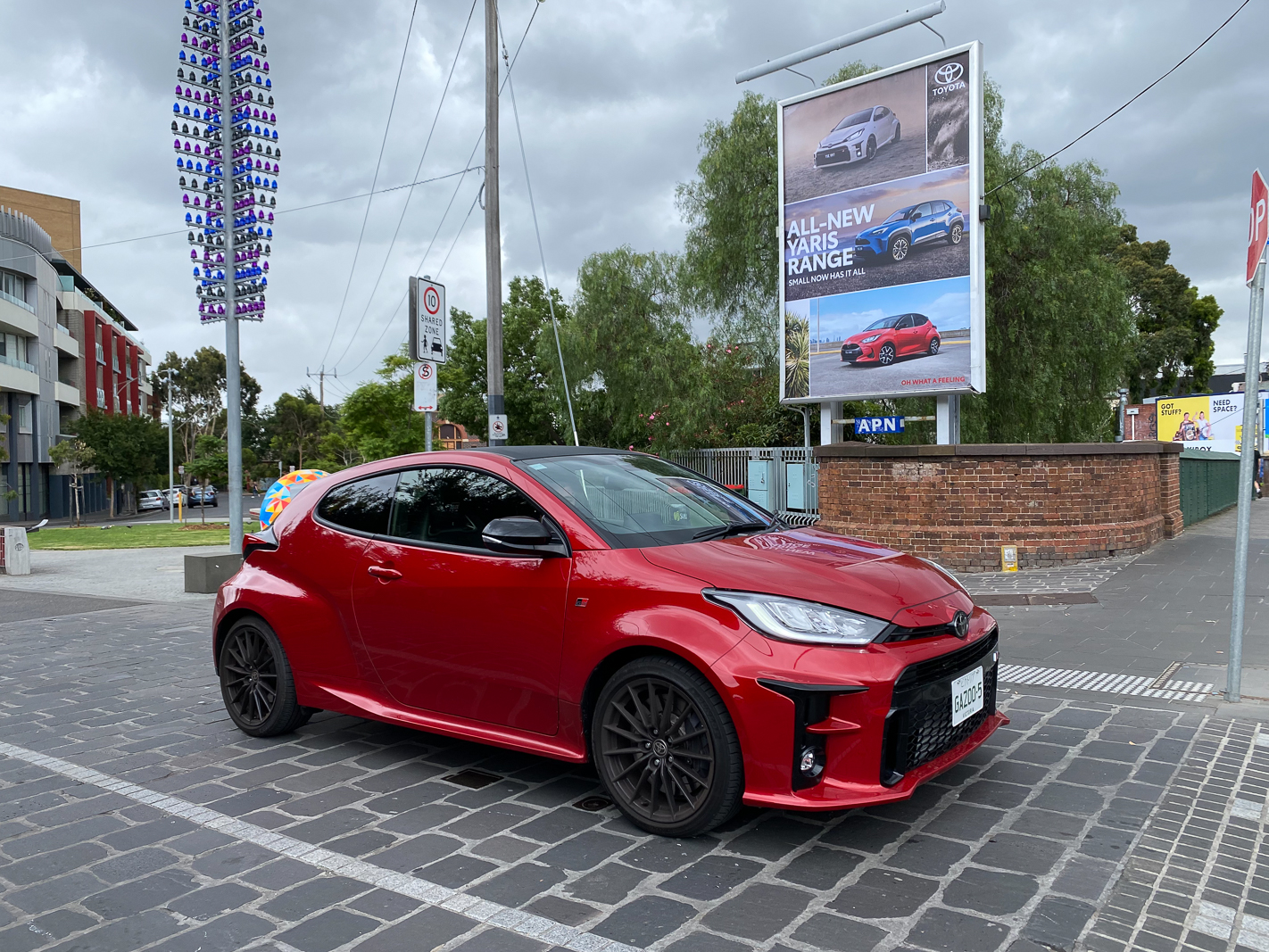
It’s a two-door hot hatch version of the latest generation Yaris small hatchback, though it only shares three exterior components with the regular Yaris – headlights, taillights and mirrors. The rest is a bespoke widebody affair featuring aluminium panels for the doors, bonnet and boot, while sporting a carbonfibre roof.
Our base-spec car is painted Feverish Red (a $500 option and coincidentally the nicest GR Yaris colour) and misses out on Rallye-spec kit that includes 18-inch BBS forged wheels with Michelin Pilot Sport 4S tyres, Torsen front and rear limited-slip differentials, ‘Circuit’ suspension tune and red brake calipers.
Why have I just told you what it misses out on? It’s significant and we’ll get to that soon.
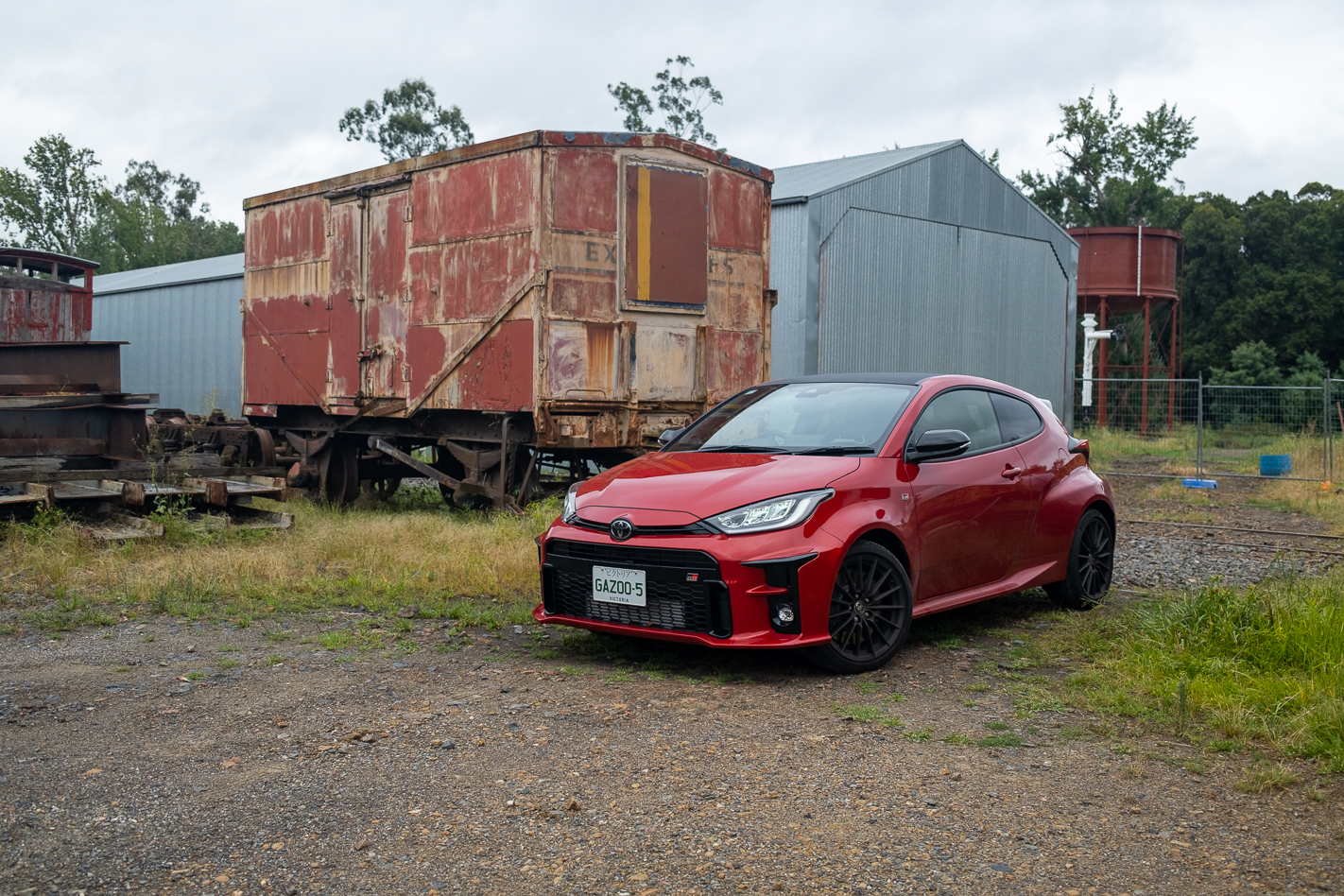
But as it stands, this GR Yaris costs $49,500 before on-roads and stocks a swathe of cool kit as standard.
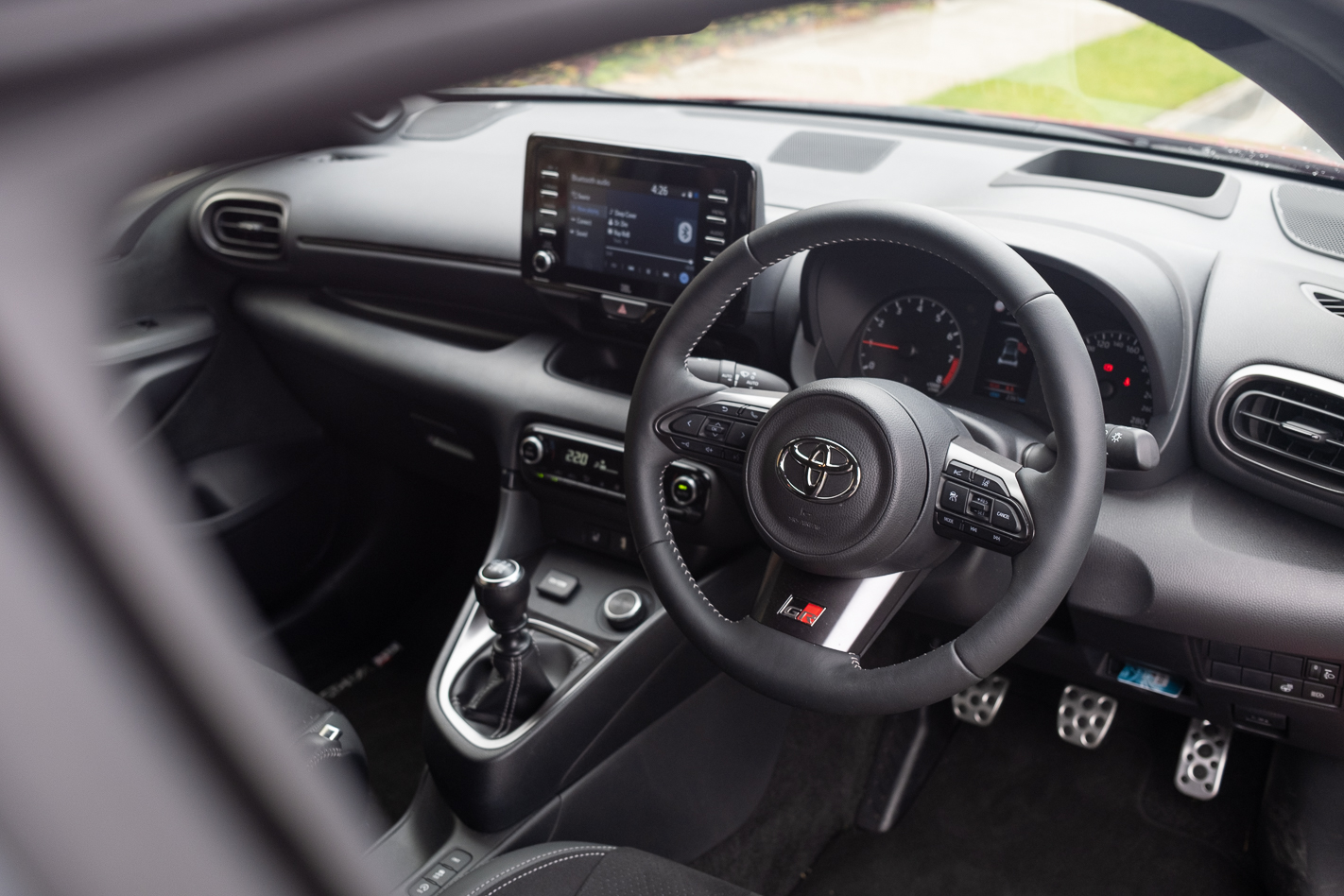
You’ve probably heard a lot about it already, but as a refresher the Toyota GR Yaris equips a carbonfibre roof, black 18-inch Enkei alloy wheels, Dunlop SP Sport Maxx tyres, power-folding mirrors, LED lights, small-diameter sports steering wheel, aluminium pedals, and sports seats lifted from Toyota’s ZR variants.
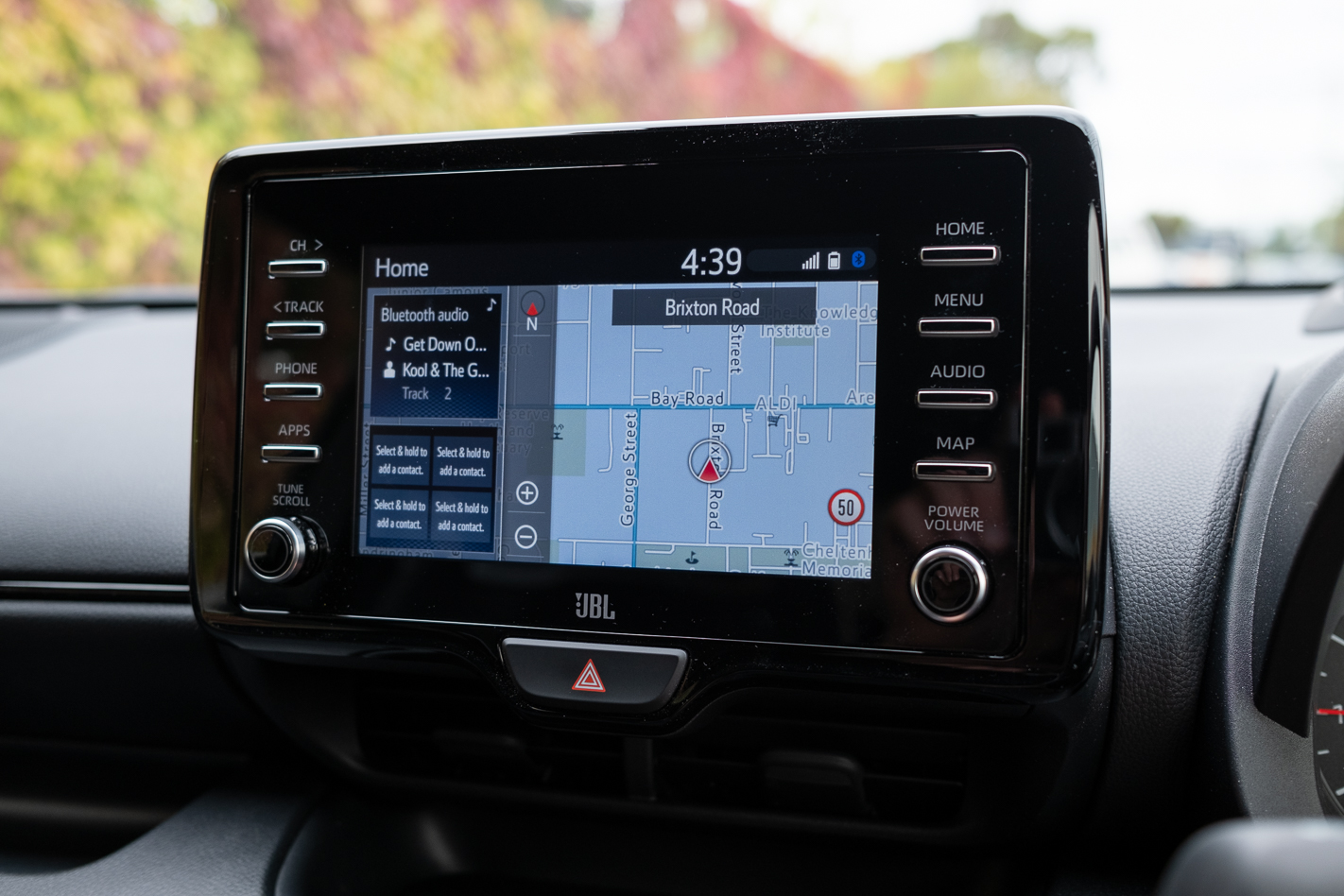
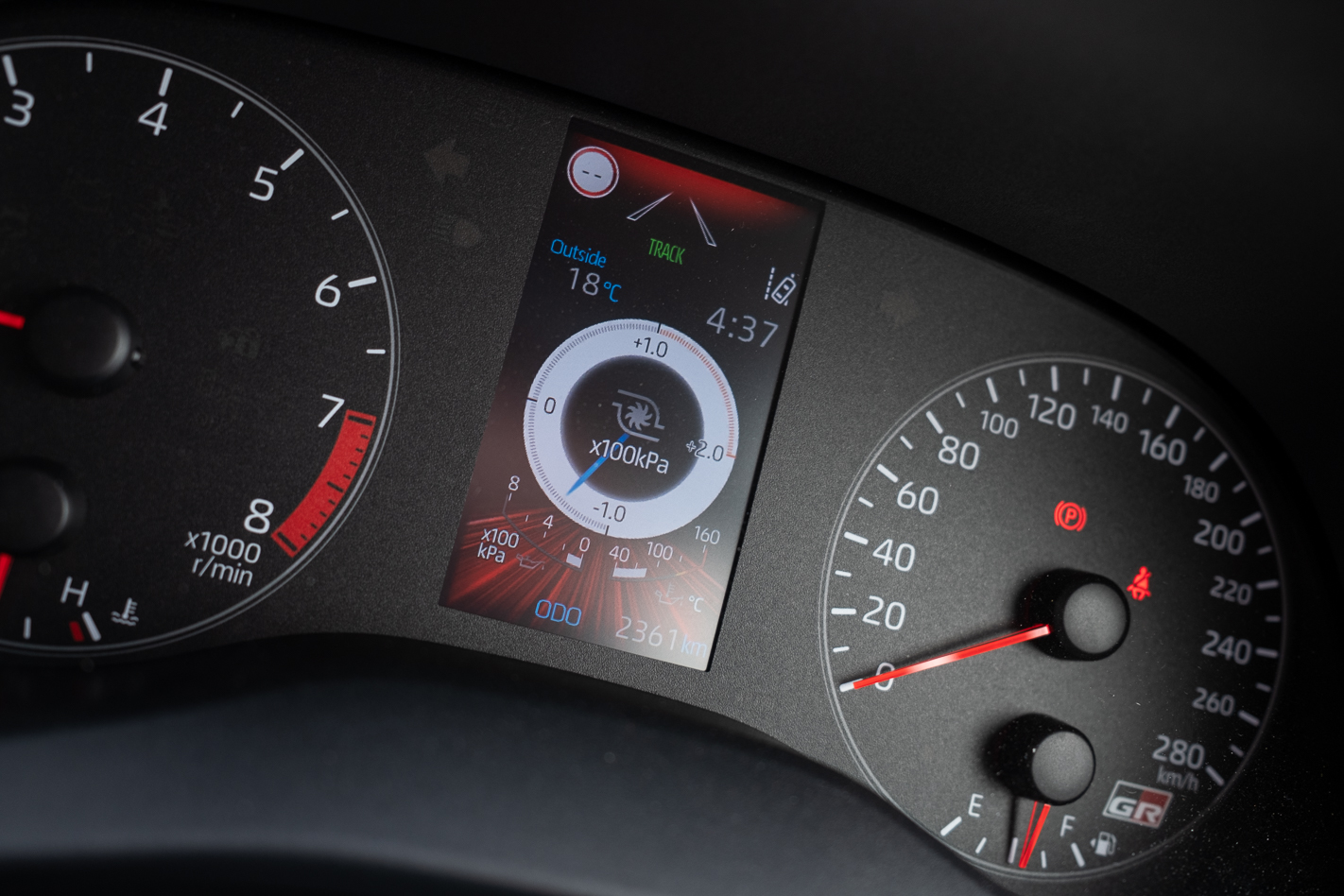
Screen wise, there’s a 7.0-inch main infotainment unit with Apple CarPlay/Android Auto capability joined by a smaller 4.2-inch display nestled within the instrument cluster that provides information such as turbo pressure and shift lights.
Safety was also high on Toyota’s engineers’ minds throughout development, owing to its sporting intent.
As a result, the GR Yaris includes autonomous emergency braking, lane-keep assist, adaptive cruise control, intersection assist, blind-spot monitor, a head-up display, reverse camera and six airbags as standard.
While it does say ‘Yaris’ on the box, in reality, this is not like a Yaris at all. Toyota combined the front end of Toyota’s GA-B platform (Yaris) with the rear of the GA-C platform (Corolla) for a dedicated standalone architecture that houses a special suspension design and bespoke GR-FOUR all-wheel-drive system. It can theoretically send up to 100 per cent of torque to either the front or rear axle.
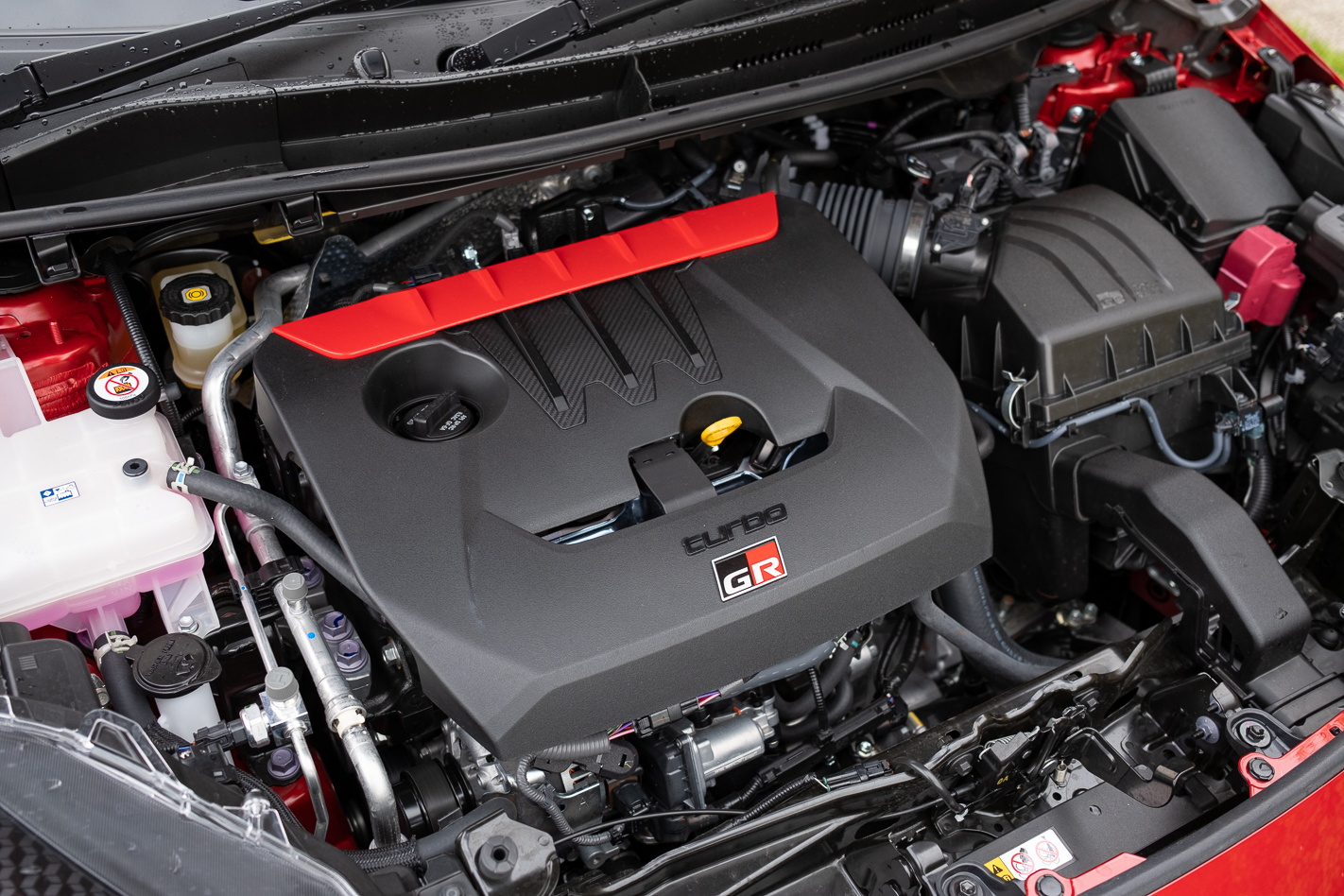
A 1.6-litre three-cylinder turbocharged engine powers the GR Yaris. It produces 200kW and 370Nm in a 1280kg body, resulting in a 0-100km/h claim of just 5.2 seconds. There’s plenty of opportunity to stuff up fast launches too, as the GR Yaris only comes with a six-speed manual transmission.
What is the GR Yaris like to live with?
From the outset, it should be noted that this isn’t a car that you buy with joyous daily driving experiences in mind. First of all, it should really have been sold as a two-seater with a bigger boot because the second row is about as useful as a screen door on a submarine.
But Toyota has made the best of a compromised situation. It comes well equipped as standard with various helpful driving features such as the head-up display that shows rpm, a speedo, speed limit and radar cruise information, as well as the intelligent manual transmission that can rev-match if you want to be lazy.
Other features that make the Yaris friendly around town include keyless entry and start, clear and concise satellite navigation maps and a fast-acting dual-zone climate control system. Not to mention, the various safety measures all worked in harmony during my test, picking up minor driving errors such as me wandering out of my lane or reacting to a hard-braking vehicle ahead.
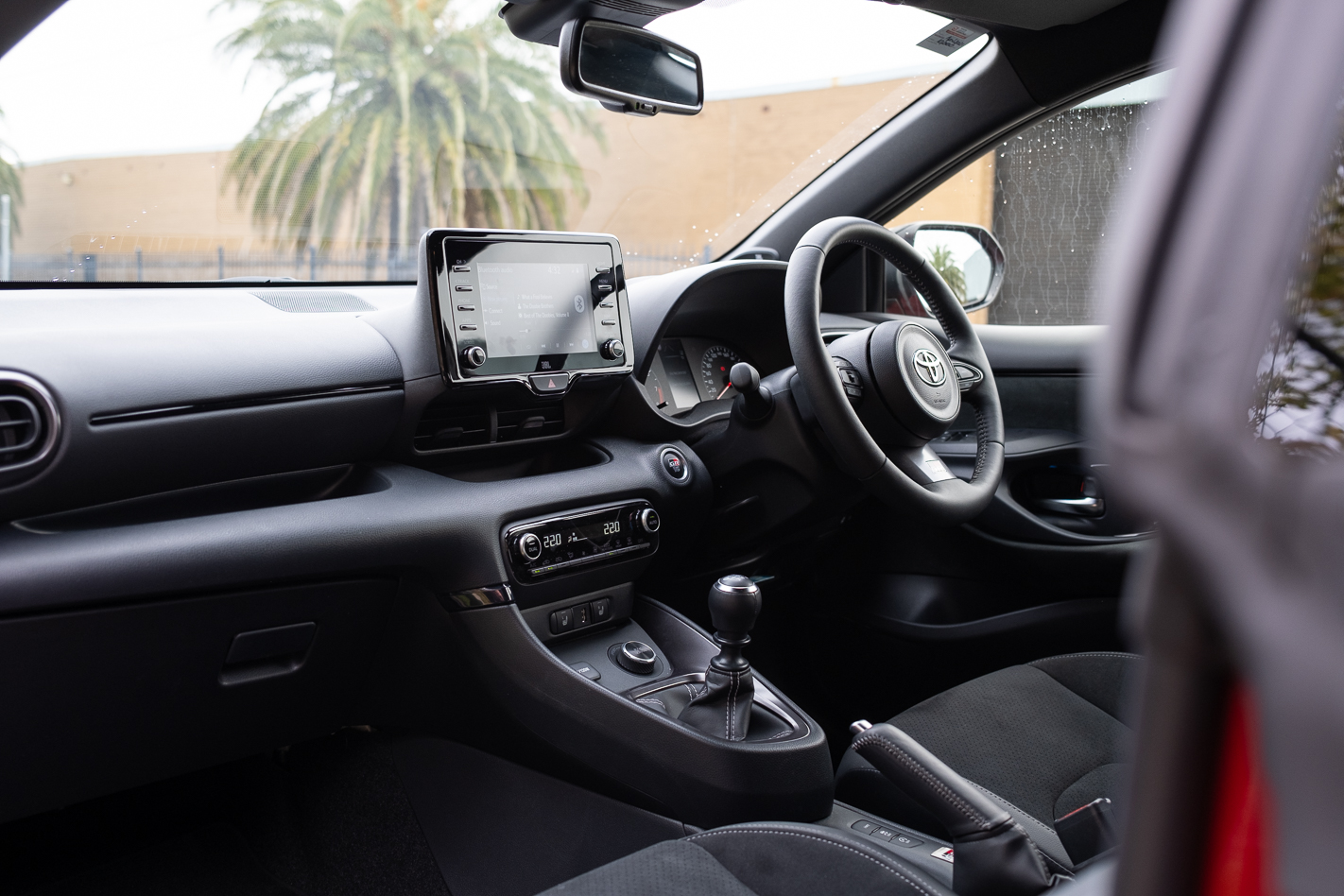
Various infotainment features are all easy to access using the button shortcuts mounted around the 7.0-inch screen, and there are cool boost and all-wheel drive gauges to play with in the instrument cluster’s multifunction display. There are relatively few bells and whistles about the cabin, but it’s a comfortable and focused place to spend time.
Speaking of driver-focused, the small-diameter leather-covered steering wheel deserves a special mention for ease of manoeuvrability and the leather shifter feels great in-hand.
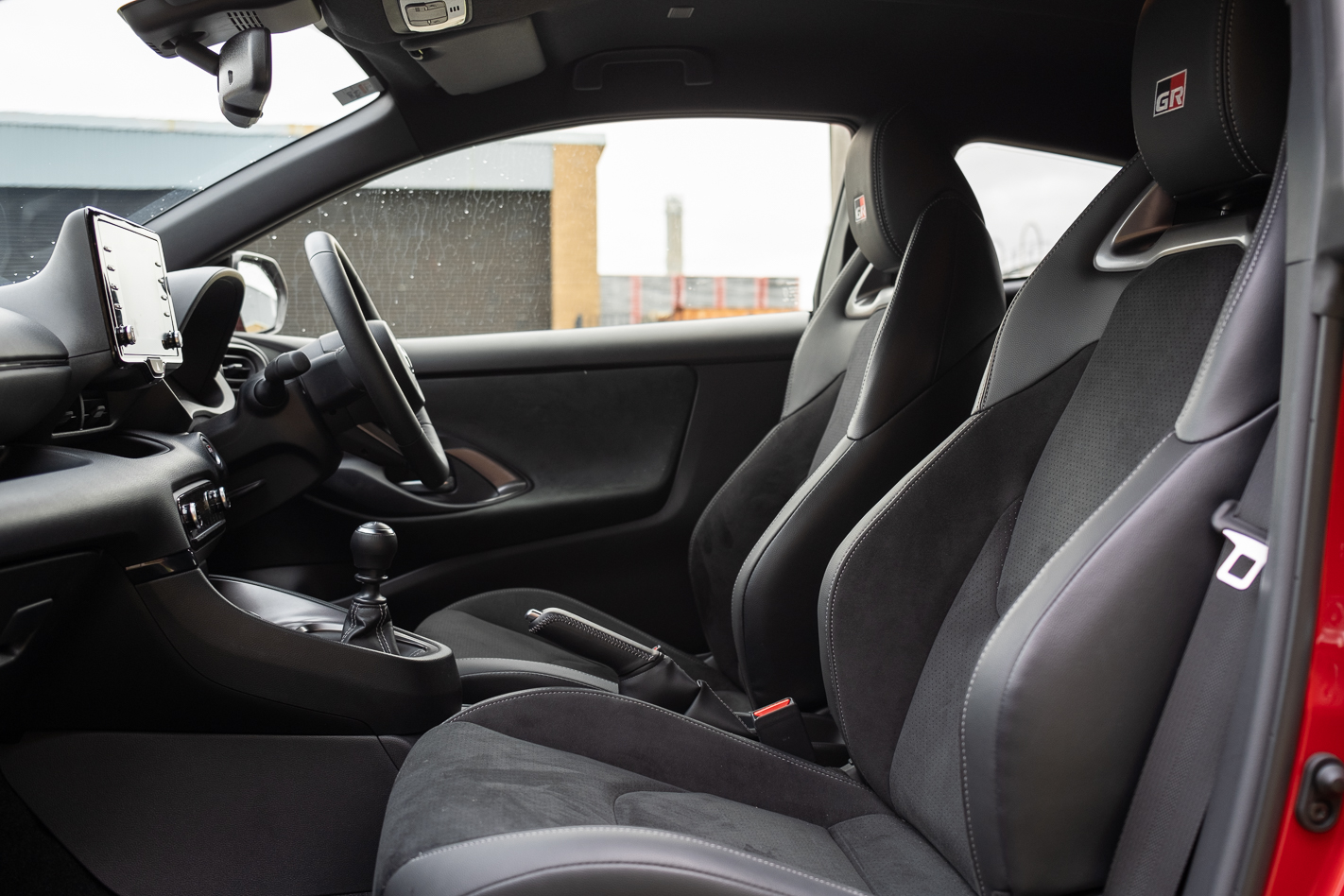
The seats are very comfortable and hold you in place well thanks to the microfibre material and huggy bolstering, though I found they were mounted just a smidge too high for my liking. The passenger seat is also mounted high, though it can’t be lowered like the driver’s seat.
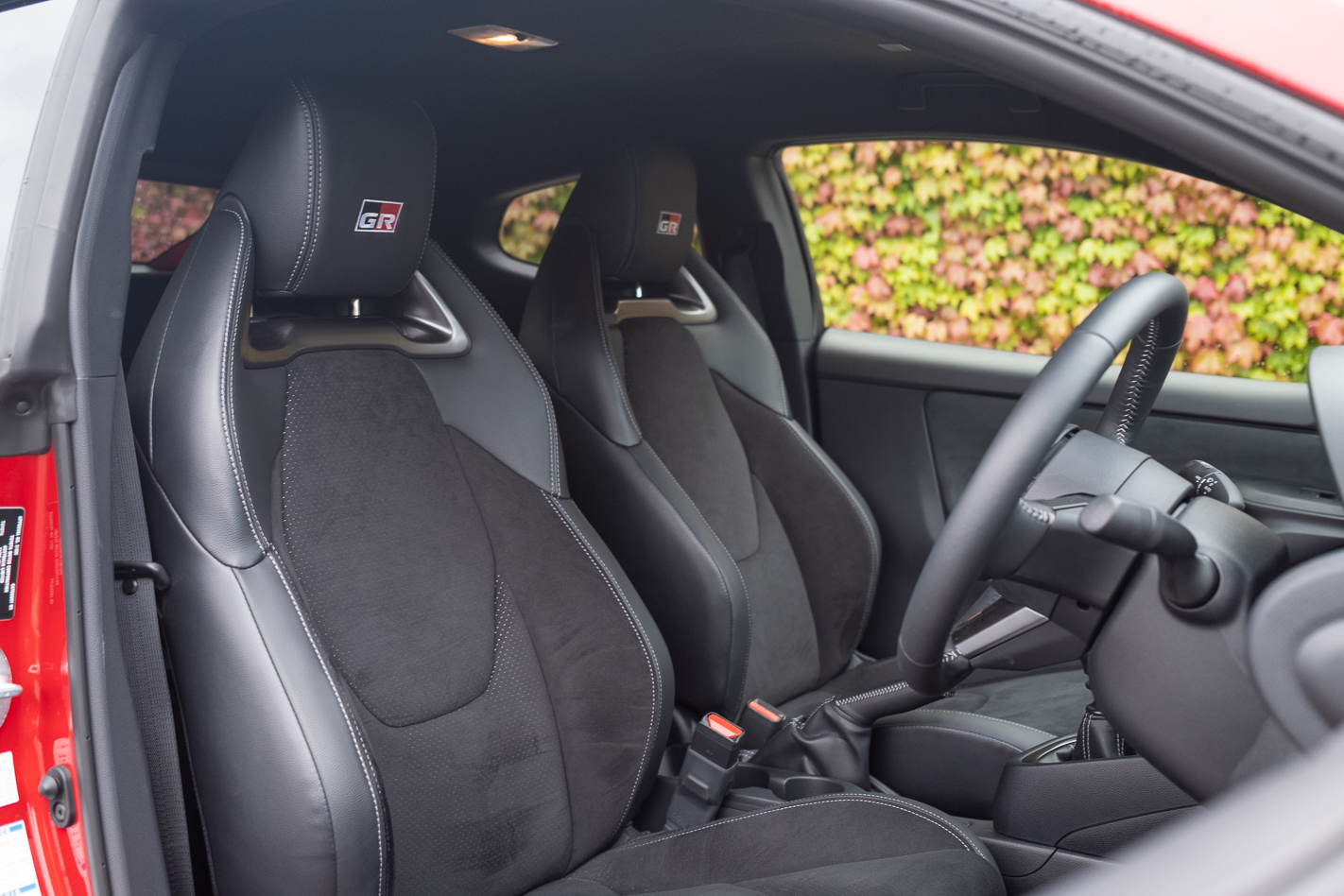
Due to this, vision out isn’t great, especially as the rearview mirror housing is gargantuan and takes up a large portion of the windscreen.
While it’s genuinely grin-inducing looking back through the side mirrors and seeing the wide haunches ballooning out over the rear wheels, rear vision through the back window is poor due to a narrow aperture.
Space in the second row is difficult to access, as there’s no one-touch easy slide mechanism to fold the front seat and slide it forward in one go. Despite a more commodious hatchback shape, rear-seat space is best described as being similar to the Toyota 86 – ideally kept for emergencies only.
Storage wise, the GR Yaris only caters for the basics. There are some storage spots around the centre console (you’ll also find a neat WRC plaque next to the shifter) for phones, keys and wallets, and the door bins are large enough for big water bottles and other loose items.
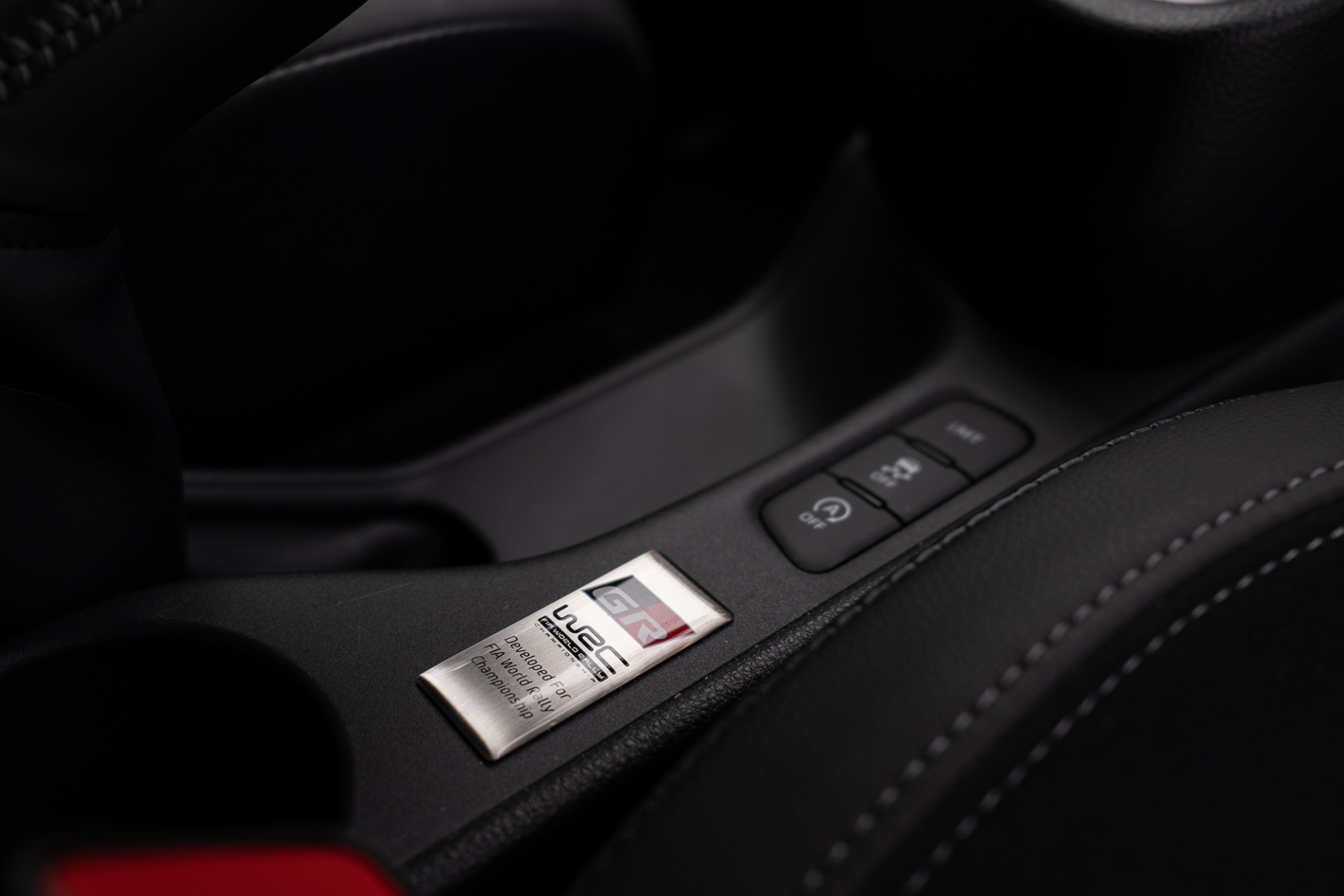
However, there is no centre console bin to hide valuables once you leave the car.
Under the infotainment screen and above the glovebox are two storage slots, though be careful what you use it for because I guarantee whatever’s stored there will fall out with every hard acceleration.
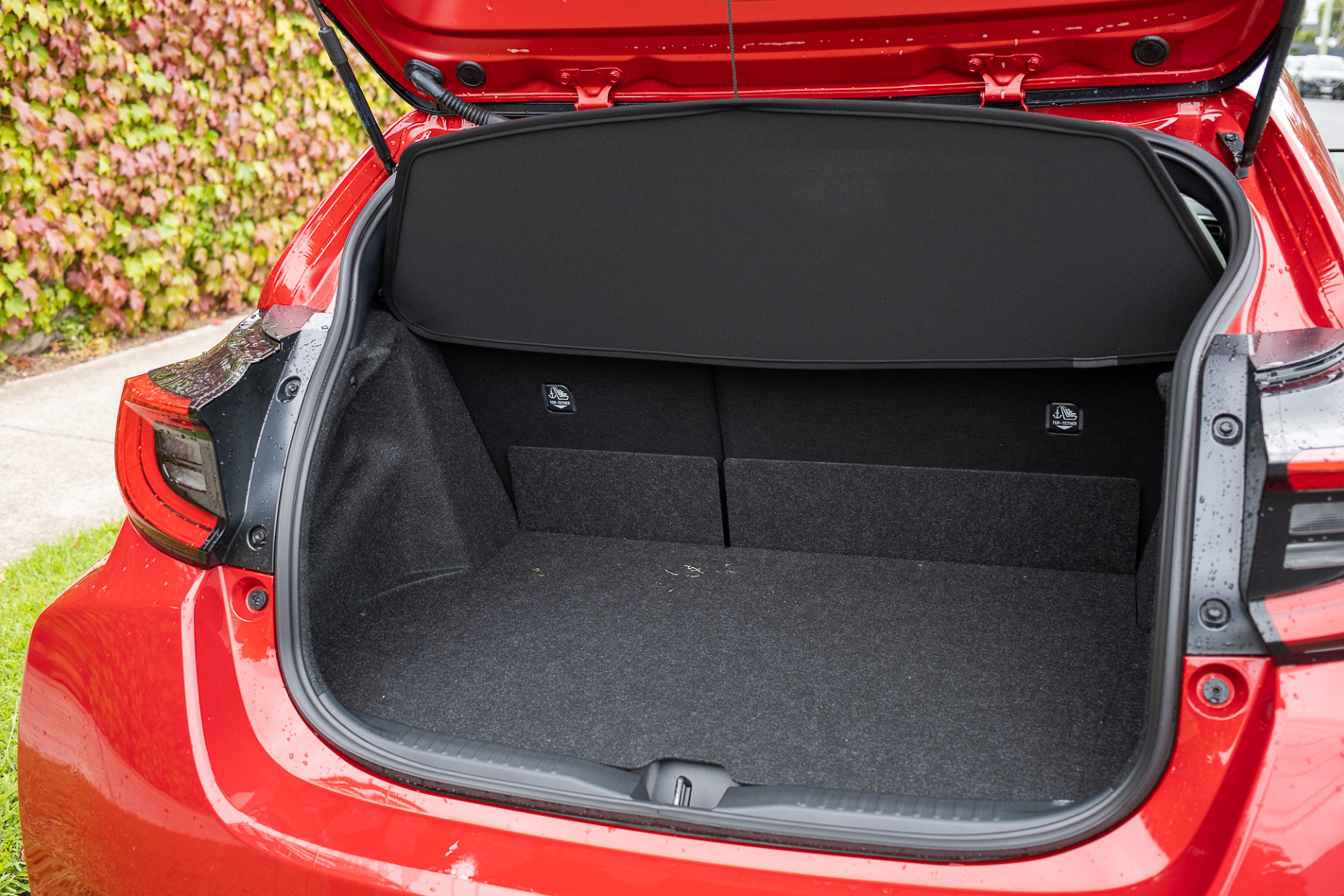
Toyota says the GR Yaris can only fit a miserly 141 litres of luggage, though the seats fold in 60/40 fashion to bolster that somewhat. Sports cars aren’t known for their storage capacities, but a 141-litre boot is very small for a hatchback. A rear-mounted battery also takes up functional boot space.
What is the Toyota GR Yaris like to drive?
The GR’s 1.6-litre turbocharged three-cylinder produces 200kW/370Nm and the car weighs just 1280kg. This sort of performance in a car of the GR Yaris’ size is very entertaining. It feels every bit as powerful as its 200kW/370Nm outputs suggest, and as numerous reviews have already stated, it feels as mechanically old-school as its 80s rally heroes.
The gearchange is one aspect that feels particularly awesome, slotting into gear with a nice, solid thunk and there are a few mechanical noises about the cabin to remind you you’re driving something special.
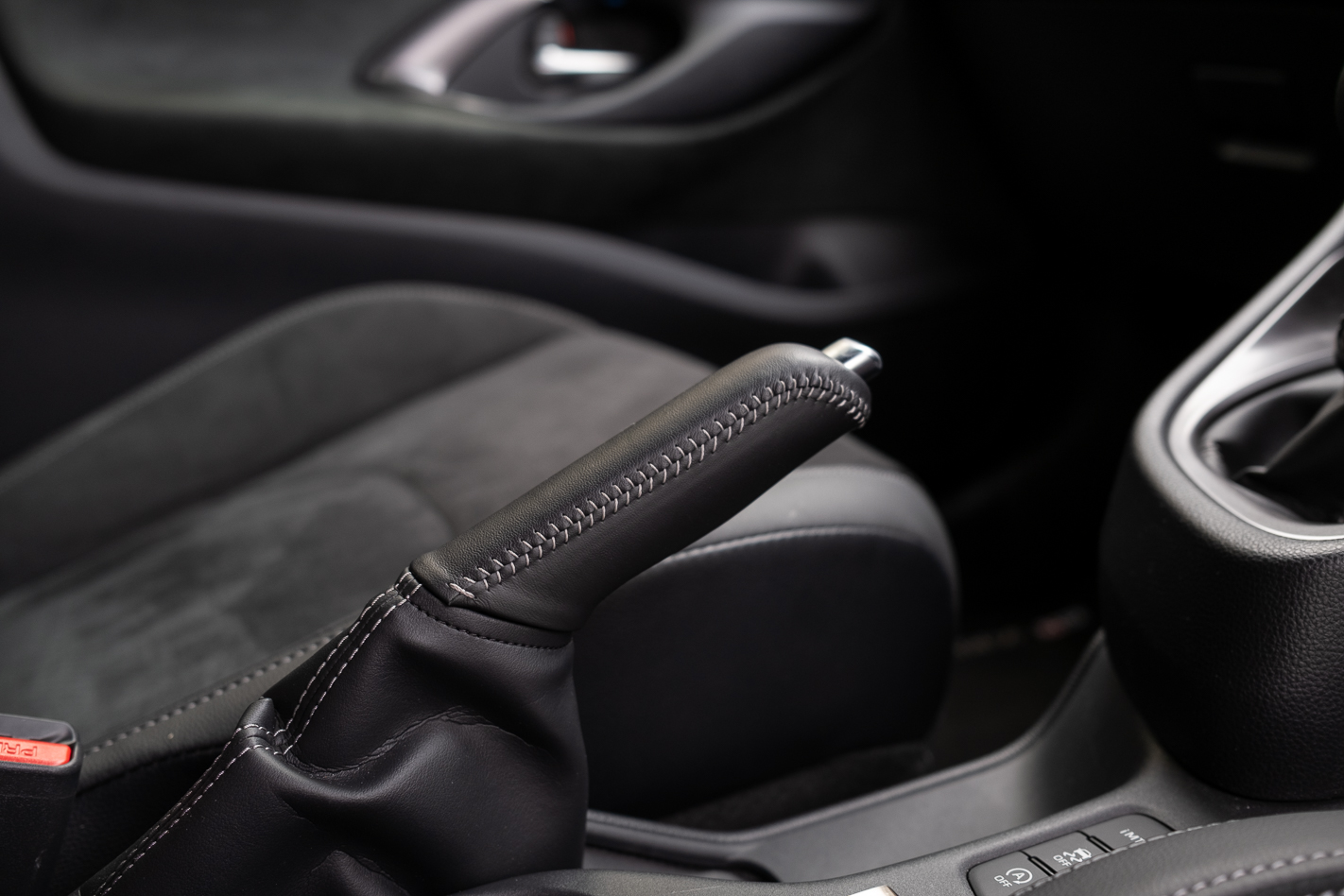
Speaking of cool GR Yaris aspects, a quick rip of the handbrake is a very effective way to get the GR Yaris to rotate around on a private road thanks to a system that decouples the drive to the rear wheels. Small unique tricks like that aren’t especially useful off a rally stage, but are extremely fun and hark back to what this car’s all about – a road-going homologation special.
Its small, unique body with the tapered roofline forms the perfect dimensions to blast about a rally special stage – or your favourite tree-lined back road. While I didn’t venture off-tarmac with it this time (keen to keep its Feverish Red paint in good nick), I did hit a number of different rally-style spots in my time with the GR Yaris.
Up through Arthur’s Seat and through to the quiet bits of the Mornington Peninsula, the GR is a genuine point-to-point rocket ship. Its ability to pull itself out of a corner and crack on, putting all 200kW to the ground, is remarkable.
The steering is pleasantly tactile around pock-marked bends and the thin-rimmed GR-branded steering wheel itself is a nice unit to hold. Likewise, the ride strikes a great balance between comfort and sport, though it does have a tendency to skitter over rougher roads at speed.
Handling wise, you feel the GR Yaris wants to change direction fiercely and it has the capability to do so, though the standard Dunlop SP Sport Maxx tyres feel like the weak link. Especially so in the wet. I couldn’t place ultimate confidence in ‘chucking’ the Yaris through a bend at speed on public roads, like you’d want to in such a small and light all-wheel-drive hot hatch, for fear of the front tyres pushing on.
So too, the tight corners leading up to the top of Arthur’s Seat caught the GR Yaris a little unstuck as it tried to clamber around 180-degree bends without limited-slip differentials.
The GR Yaris Rallye edition comes with Michelin Sport 4S tyres and limited-slip differentials at both ends, which may just address these shortcomings.
Aside from a pleasantly placid ride quality on the freeway drive back home, there’s a fair amount of road noise and vibration to endure. Exhaust noise is fairly muted, despite being fake-amplified into the cabin to big up the car’s sporty nature.
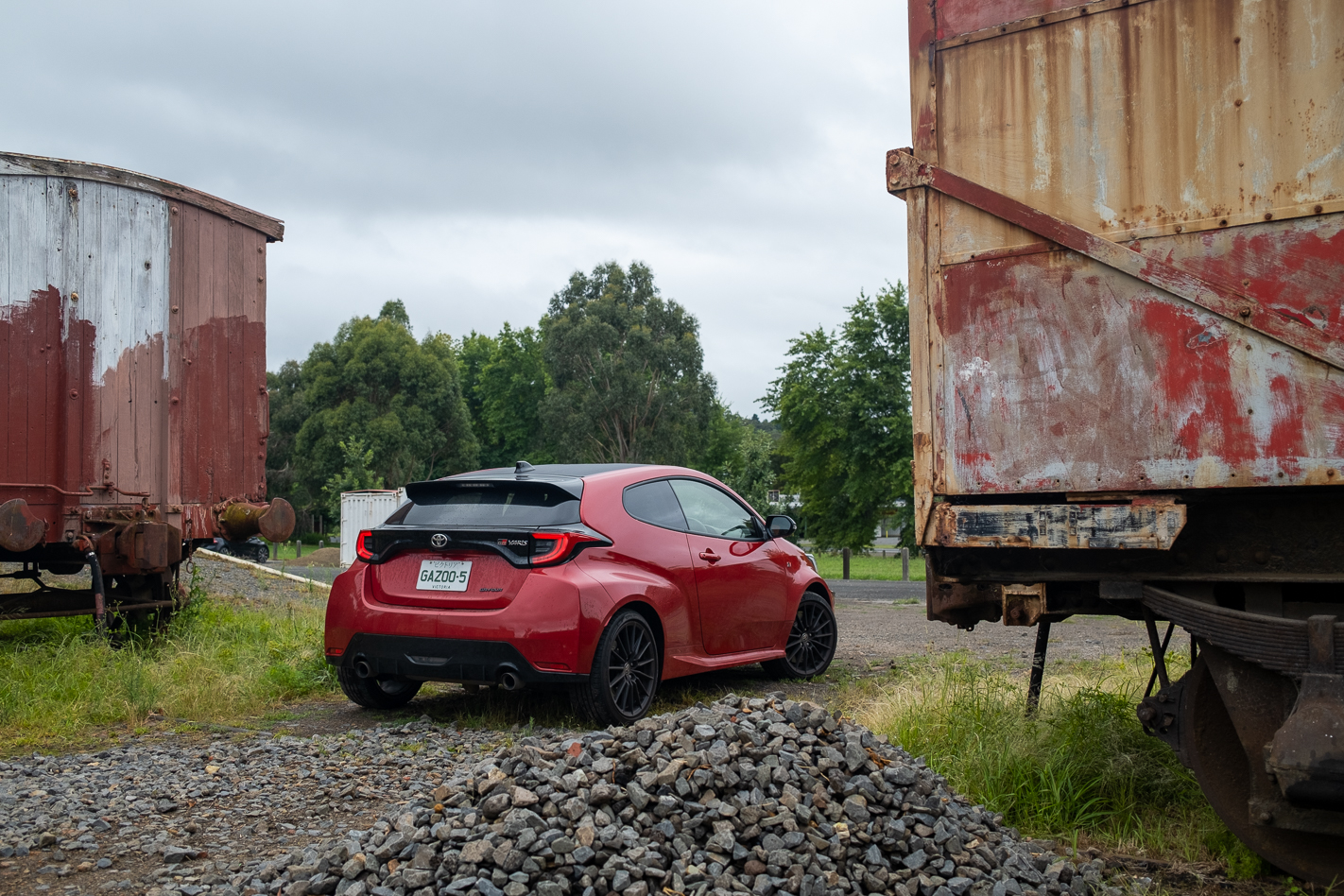
During my time with the GR Yaris, I managed a fuel consumption figure of 10.2L/100km – higher than you’d expect for a small sports hatch but not altogether horrible.
Verdict
As a performance hatchback that punches well above its weight grade, the GR Yaris is just about there, save for some minor understeer issues.
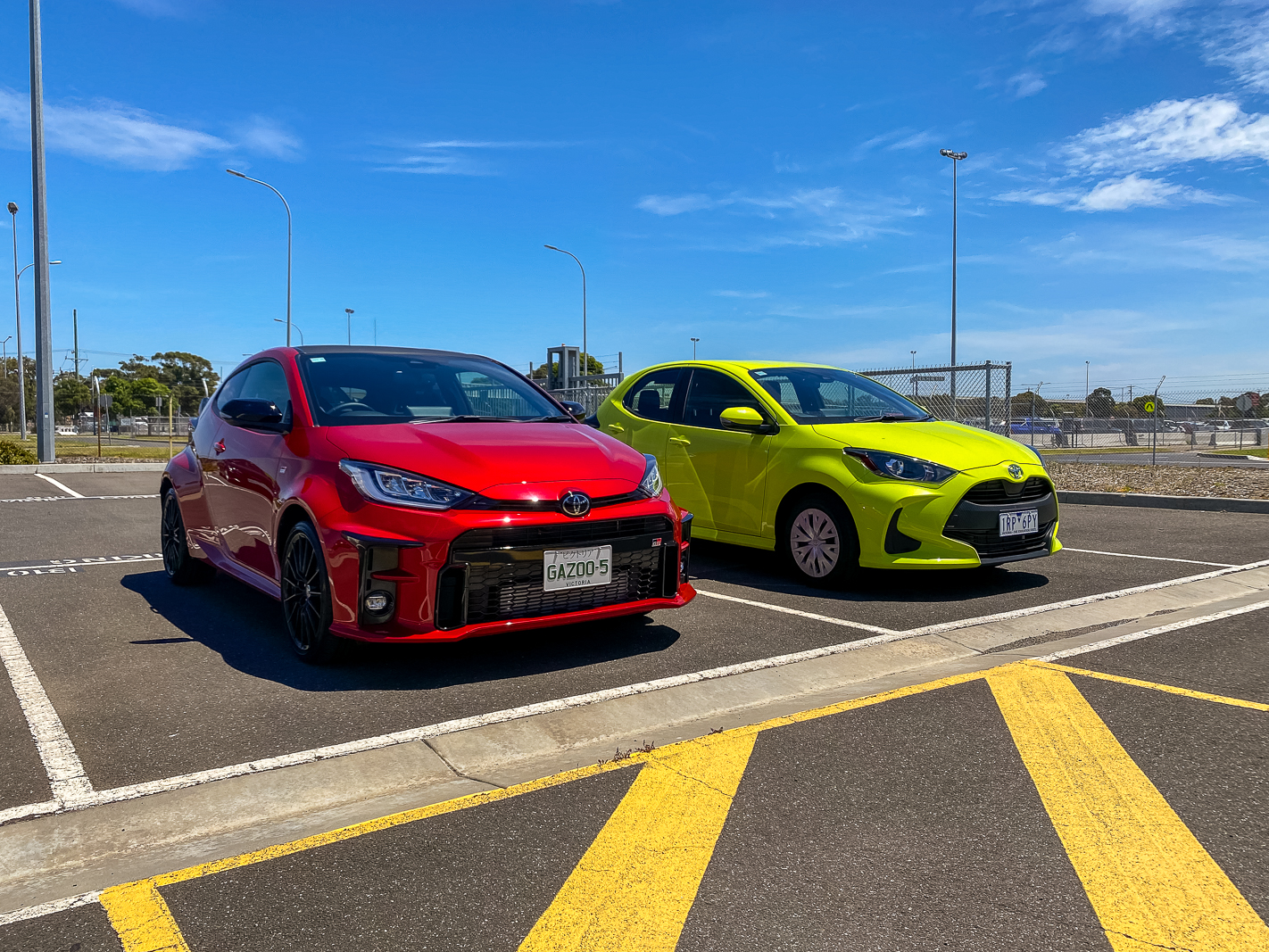
Could it be worth waiting for the Rallye-spec GR Yaris and all its performance-focused upgrades? It’s hard to know without having driven the car, though it’d be a safe bet to at least sample both before plonking down your hard-earned.
2021 TOYOTA YARIS GR SPECS
Engine: 1618cc inline 3-cyl, DOHC, 12v, turbo Power: 200kW @ 6500rpm Torque: 370Nm @ 3000-4600rpm 0-100km/h: 5.2sec (claimed) Weight: 1280kg Price: $49,500
Just rarely, a car is launched that is so revered that it creates a huge headache for its manufacturer. We examine 10 instances where car makers asked “how the hell do we replace this?”
Holden Commodore ZB VXR | 2018-2019
Imagine you’ve gone to an Iron Maiden show, one of the most legendary live heavy metal acts on earth, and just as they prepare to sing their final tune, the band walks off stage only to be replaced by Cat Stevens. Sure, Yusuf can hold a tune, but it’s not the show finale you’d be happy about.
Well, Holden attempted to pull the automotive equivalent when its follow up to the VF II Commodore was the uninspired Opel Insignia-based ZB.
Before we go any further, it’s worth noting that in isolation the Holden ZB Commodore was a good car. It wasn’t a class benchmark, but certainly a worthy contender in a shrinking segment.
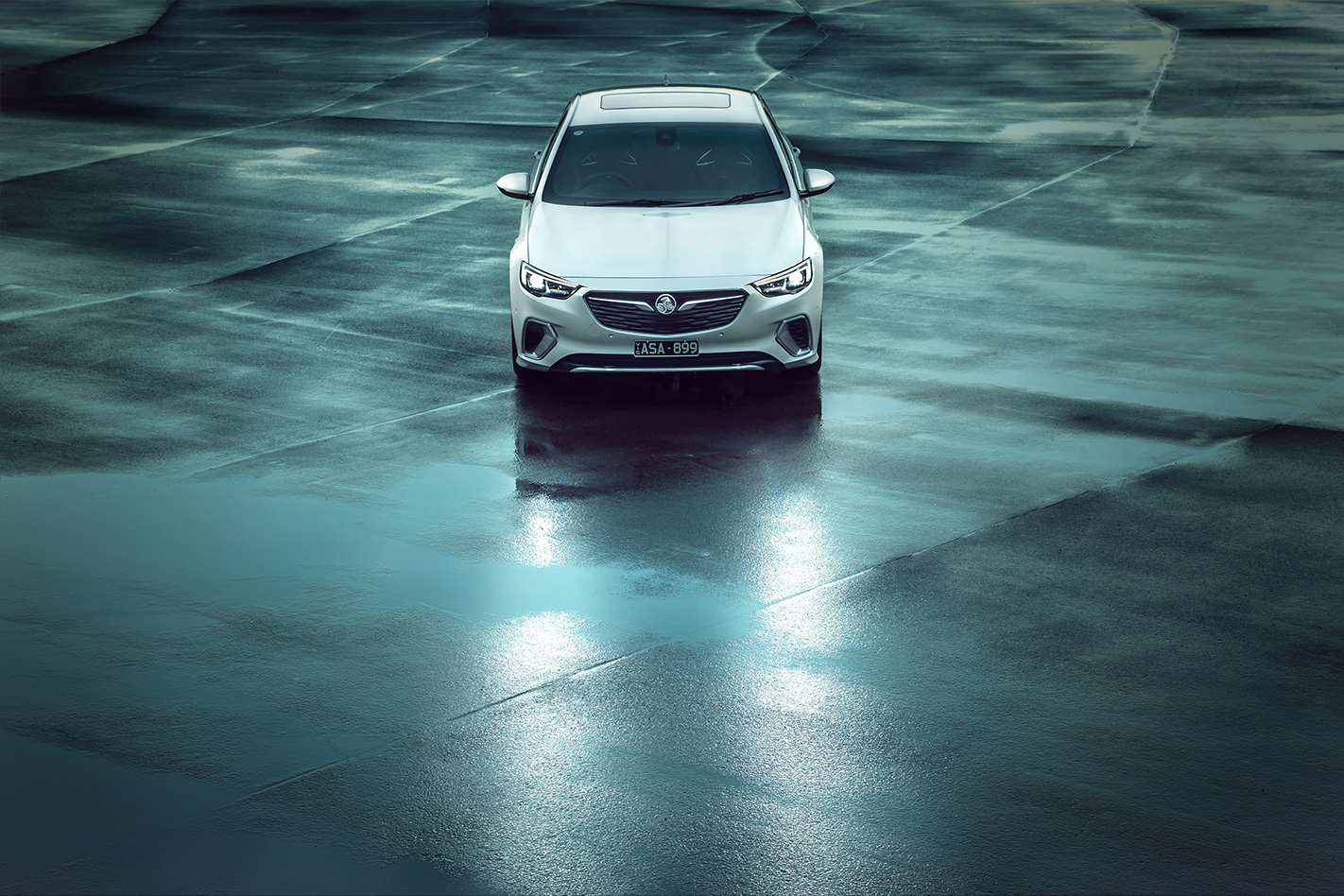
What it wasn’t was a worthy successor to the last locally made Commodore, the VF, and its flagship SS-V Redline. Using the 6.2-litre LS3 V8, it is no exaggeration to call the VF one of the greatest sports sedans ever produced in Australia.
The reaction to the ZB was never going to be pleasant. Not only was it not built in Australia, but there would be no rear-drive option, and the most powerful variant would be fitted with a thirsty and somewhat torque-shy 235kW atmo V6.
To its credit, Holden attempted to make the best of a bad situation with the ZB. Before it was announced that local manufacturing would come to an end, Holden was considering building the next Commodore locally.
However, even if the local car industry had survived, the follow-up to the VF was always going to use Opel’s global FWD/AWD and transverse engine E2 architecture as its base. When it became an inevitability that the next Commodore after the VF wouldn’t be built at Elizabeth, but before the public became aware, Holden (along with Buick) began lobbying their GM counterparts in Europe that were leading the ZB’s development for a V6 engine option to fit to the VXR flagship at a bare minimum.
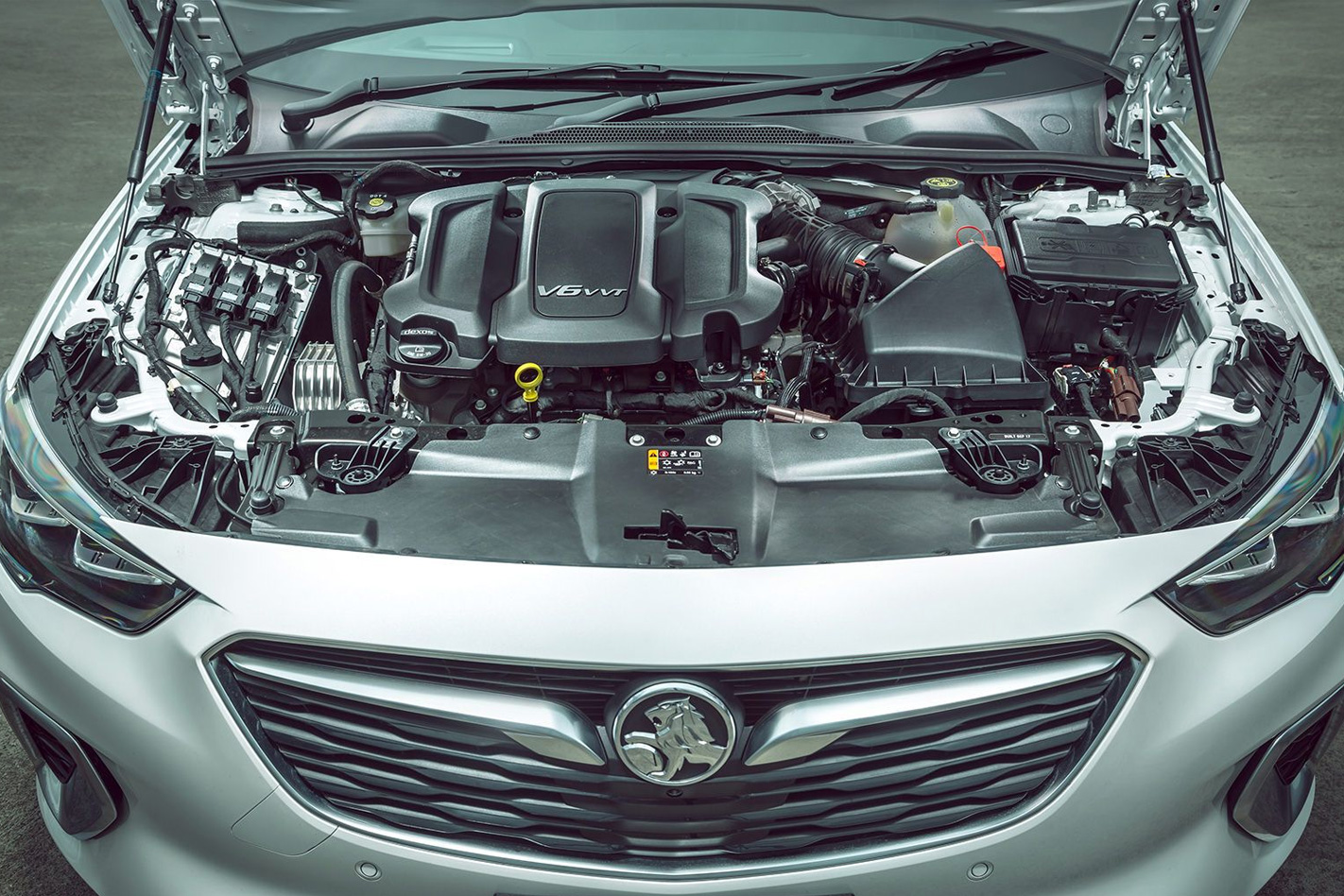
Eventually the Insignia’s German engineering team conceded and included a V6 engine option. But it wouldn’t be enough. No V8, no Commodore was the battle cry from the keyboard barrage. The blow may have been softened if Holden had received its first preference, the 300kW/540Nm twin-turbo 3.0-lire V6 from the Cadillac CT6. Instead, its most powerful engine was the 235kW/381Nm 3.6-litre HFV6. Ouch.
Try as they might, not even HSV could save the ZB’s enthusiast credentials. Problems with pairing American and German electronics prevented the Clayton madhouse from home brewing its own performance hero using another of Cadillac’s high-performance engines. The Australian team simply couldn’t get the 313kW/483Nm 3.6-litre twin-turbo LF3 V6 to work as desired.
Ultimately, the ZB would be the shortest lived generation in the Commodore badge’s history, completing less than two years of service, with the announcement of its demise hidden several paragraphs deep in a late-2019 press release. It wasn’t even given the dignity of a proper farewell.
The lack of a true performance option may have been forgiven if the ZB had sold in any decent numbers, but registrations fell off a cliff as even mainstream buyers shunned the imported replacement. Strong fundamentals as an adequate commuter car weren’t enough – not for a nameplate as charged as Commodore. No amount of involvement from local legends like Rob Trubiani could save the ZB’s legacy.
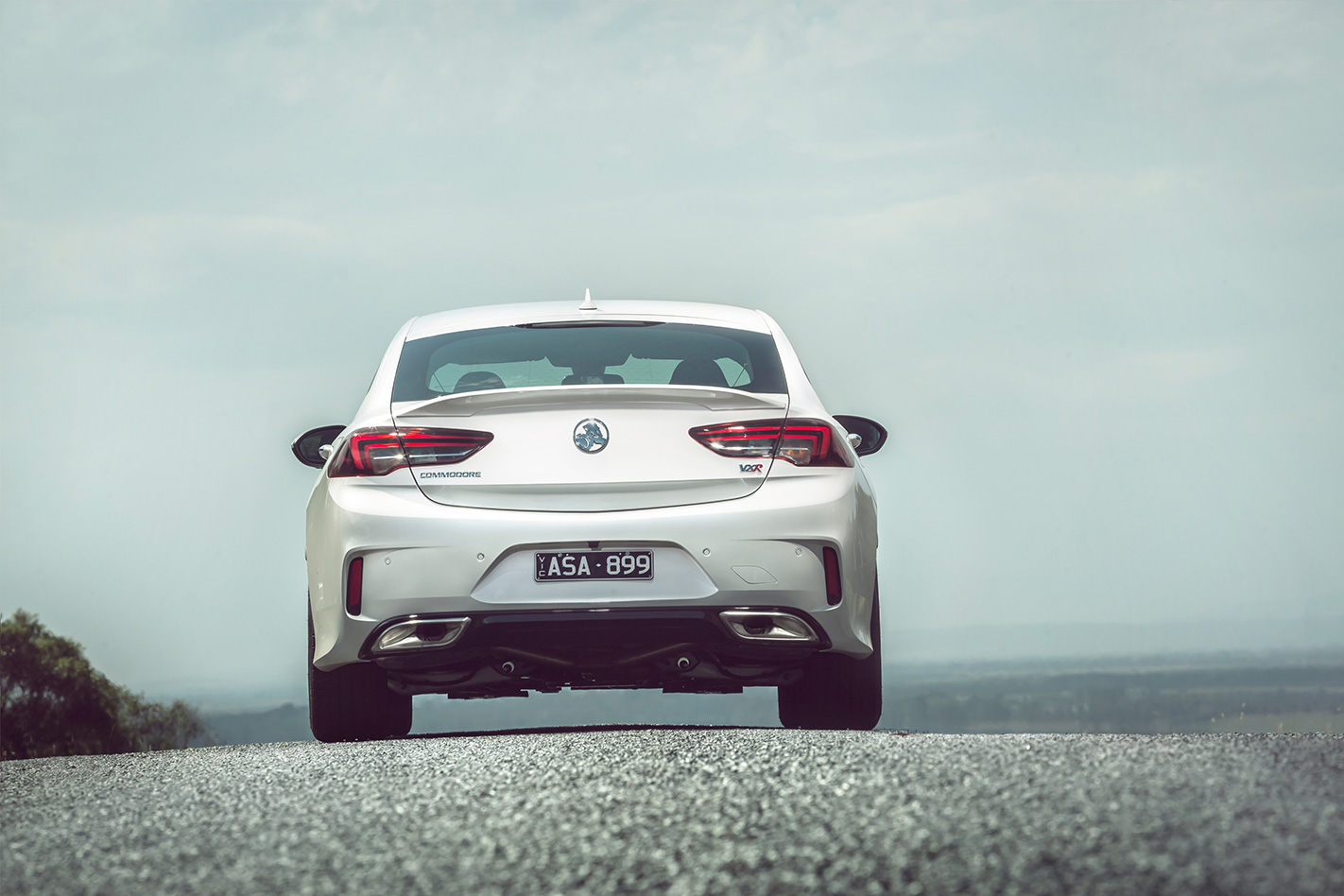
Hindsight is 20/20. But history will not be kind to the ZB Commodore.
Would Australians have been better served if it never arrived? Possibly.
Would we have missed out on anything worthwhile? Not really.
The Icon: 2013
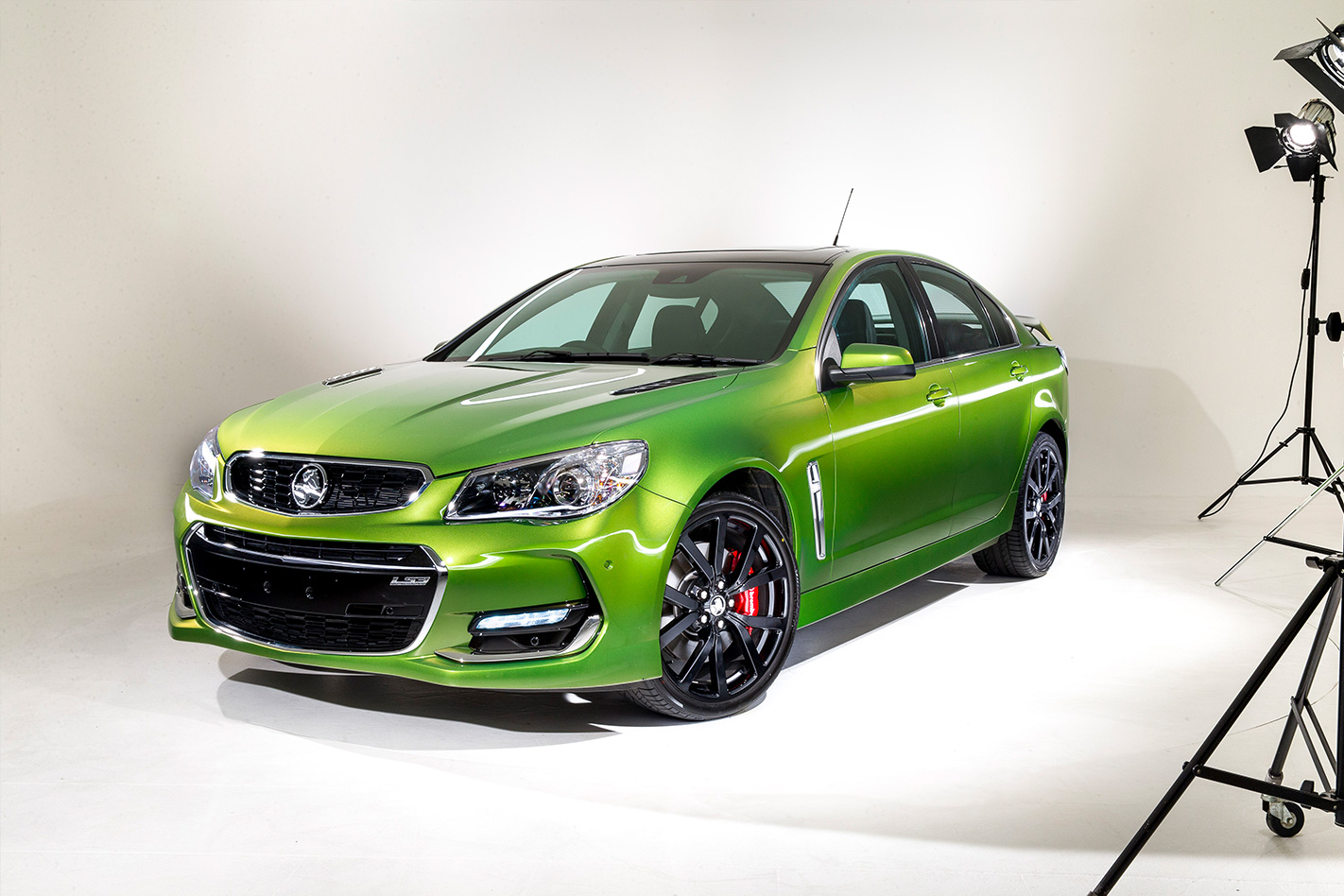
The Last Hometown Hero
For several years the last Holden ever built remained a secret. VIN 333644 is ‘officially’ the last VF constructed, despite another vehicle being the last off the production line.
Three things that made the VF rock
1. Holes were drilled into the exhaust tips to give the LS3 more auditory character and burble 2. MY16 updates brought suspension changes that included a 50cm wider rear sway bar 3. The LS3’s 6.2-litre capacity made it the biggest engine ever fitted to an SS Commodore
UPDATE: We’ve now driven a prototype of the Ariya, see our review at the link below!
The story to here
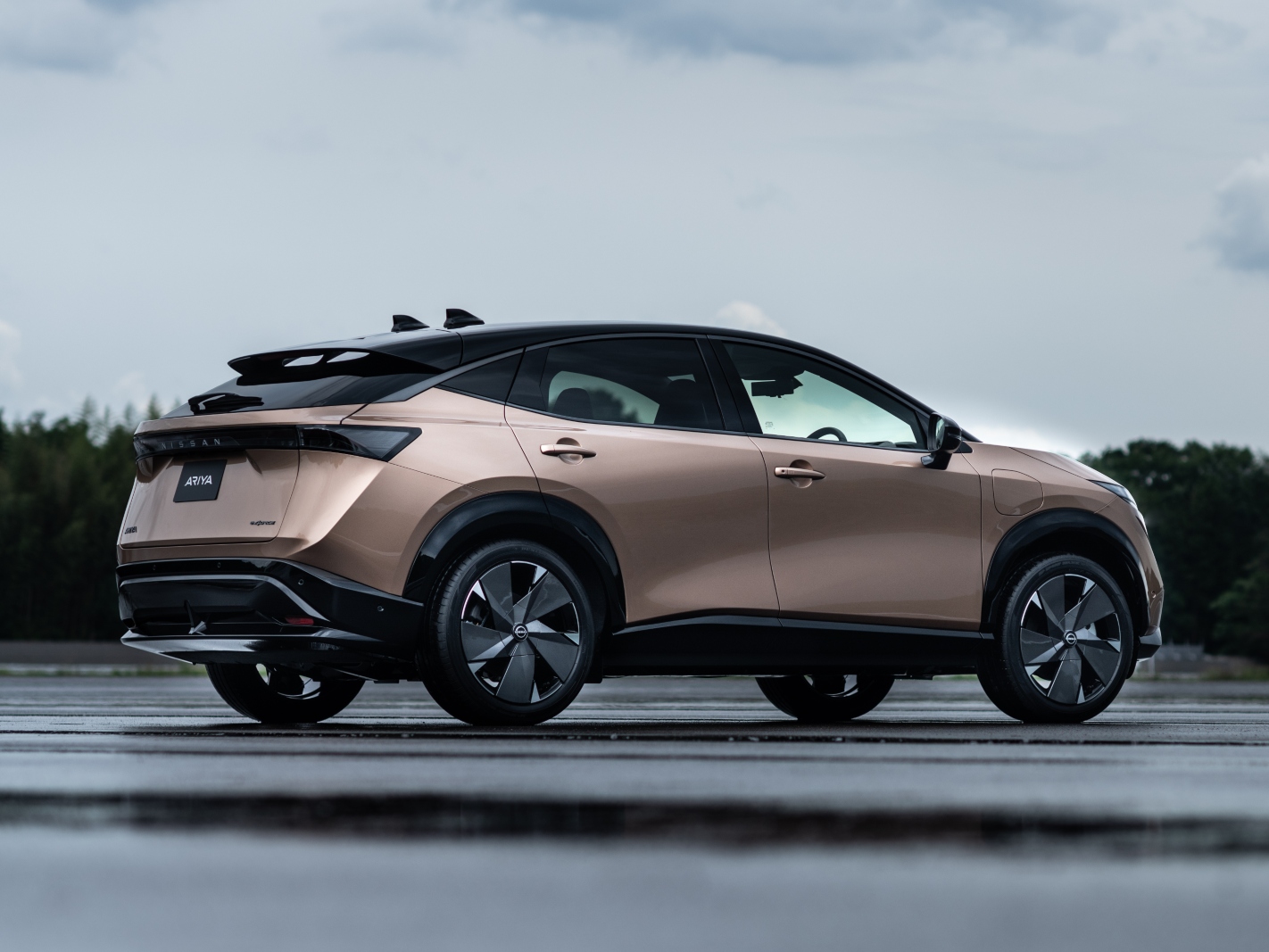
Nissan will introduce its second full-electric vehicle to the Australian market with the new Ariya crossover chalked for launch as soon as global production allows, joining its smaller Leaf sibling in local showrooms.
The all-new model is set to roll out first in Japan around the middle of 2021, followed by Europe and the US late in the year, while Australia can expect to see the first examples appearing on red dirt after that.
According to Nissan Australia’s managing director Stephen Lester, with a relatively small appetite for EVs, Australia is not at the top of global roll-out schedule, but the Ariya will arrive once more popular electric markets have been addressed.
“We’ve got to start building them on mass scale and then most definitely we can start bringing them into Australia,” he said.
“With the current state of EV policy in Australia we wouldn’t be considered a primary market for future (electric) vehicles. There will be other markets that are seen as much more progressive that will take command of those EVs early on.”
Exactly when those more demanding regions will be initially satisfied is unknown, but Lester said the Australian EV market is starting to look more compelling and buoyant with the introduction of more vehicles like the Ariya.
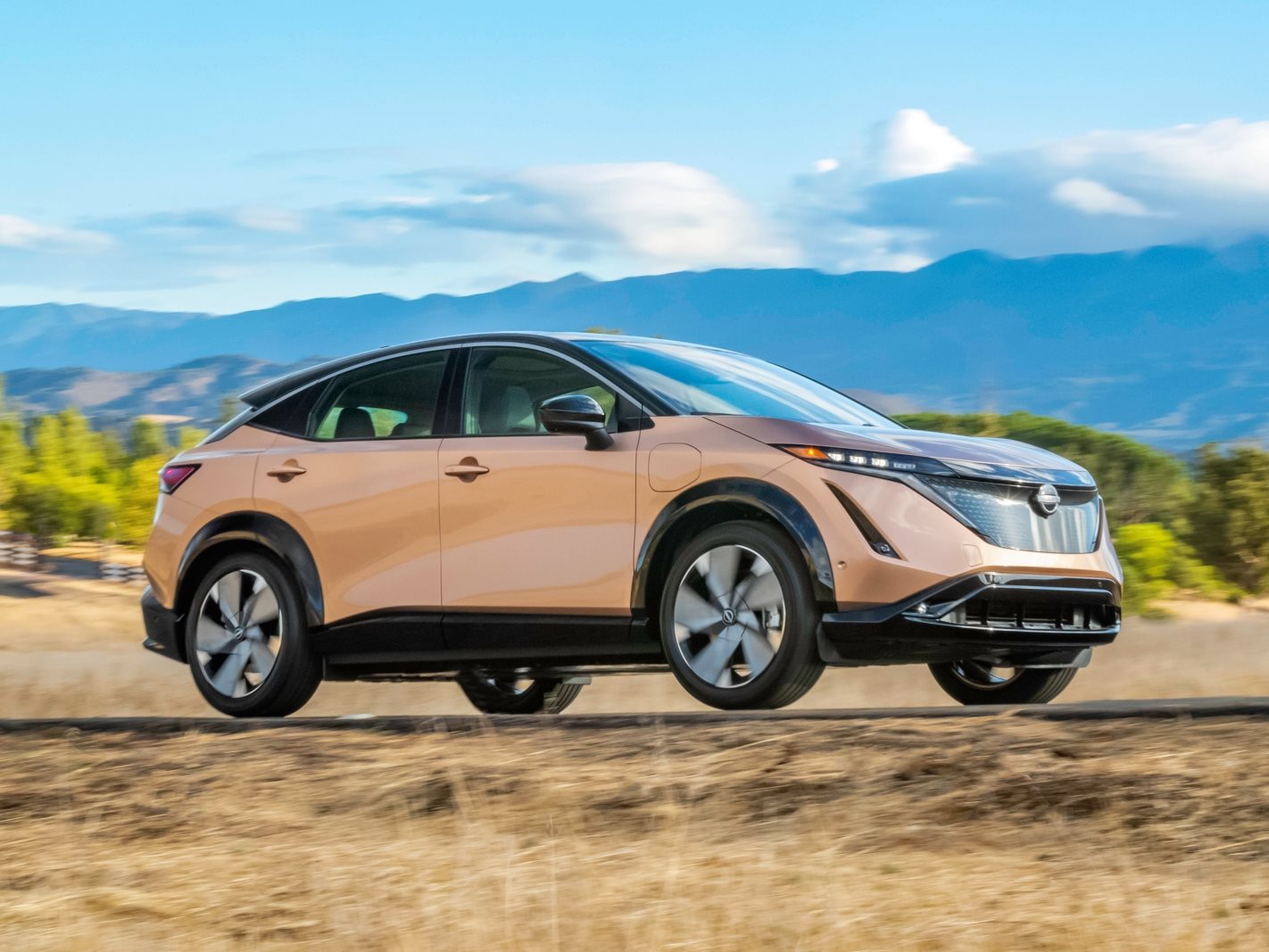
“A vehicle like this will speak much more closely to what consumers are looking for. I think we will have our hands up very high in the air and do everything we can to get a vehicle like Ariya to our shores as quickly as possible.”
Exact specifications are still being finalised for local showrooms, but the model will be offered globally with a choice of 63kW and 87kW batteries, the latter allowing a single charge trip of more than 500km. The most potent version will also do the zero to 100km/h dash in a respectable 5.1 seconds.
What’s more, a choice of front or four-wheel drive will be offered allowing a choice between more affordable and more potent variants and perhaps a dash of off-road ability.
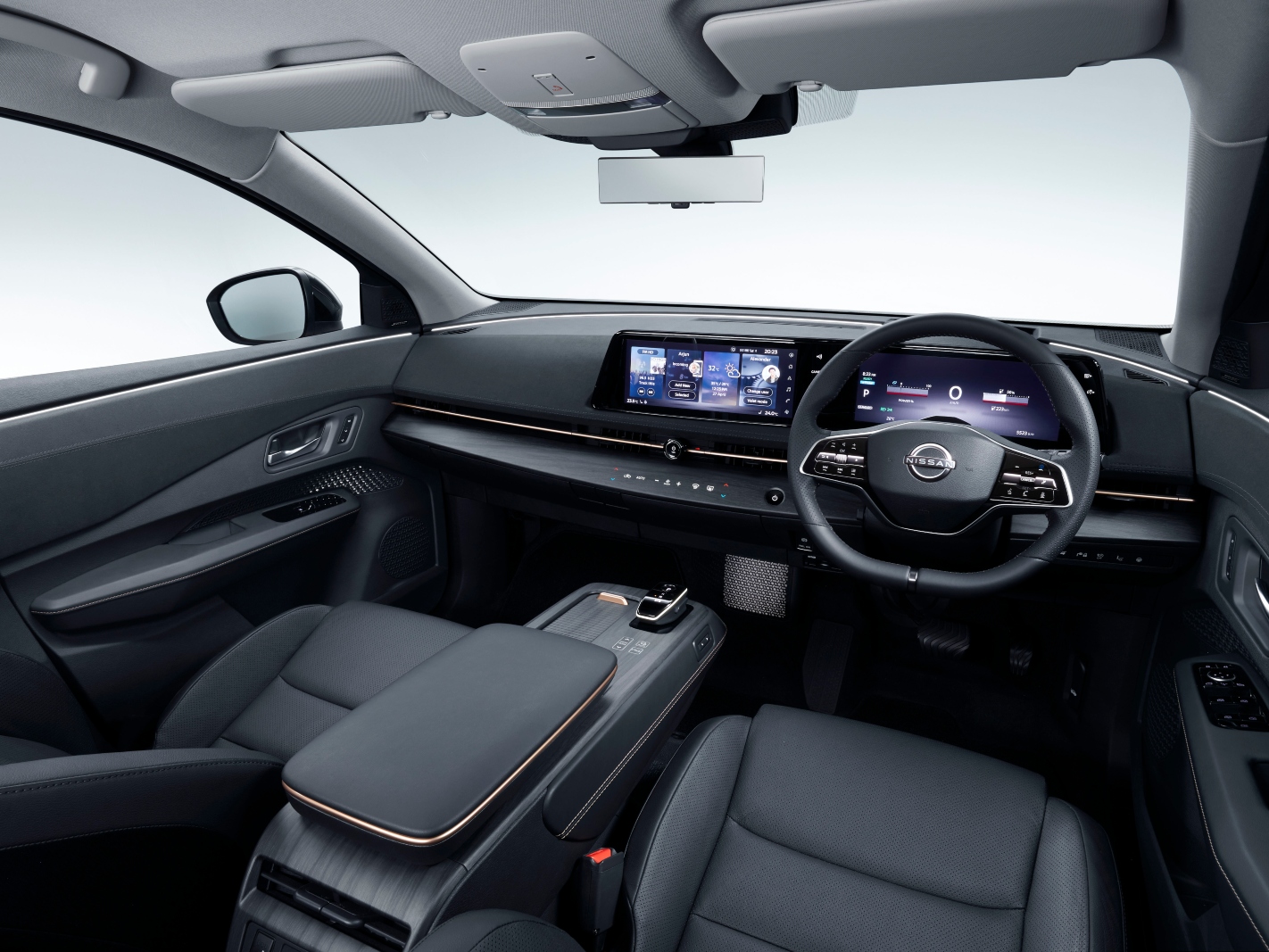
That, says Lester, is exactly what Australians are after in an EV; a combination of zero-emissions, high-performance and practicality – wrapped up in increasingly popular SUV/crossover styling.
“In the EV space in general, the one thing that is lacking from the entire landscape is the variety of choice. When we look at where the segment will continue to grow and SUVs in general, this is by far the most dominant style of vehicle.
“The sheer positioning of the vehicle being larger and presenting itself as a crossover appeals more to what consumers are looking for aesthetically.
“We have a very strong penchant for performance cars, not just SUVs, and that’s where the dual motors and the output of the batteries – not just from a [driving] range perspective but also the power output – will really start to speak even more broadly to Australian customers.”
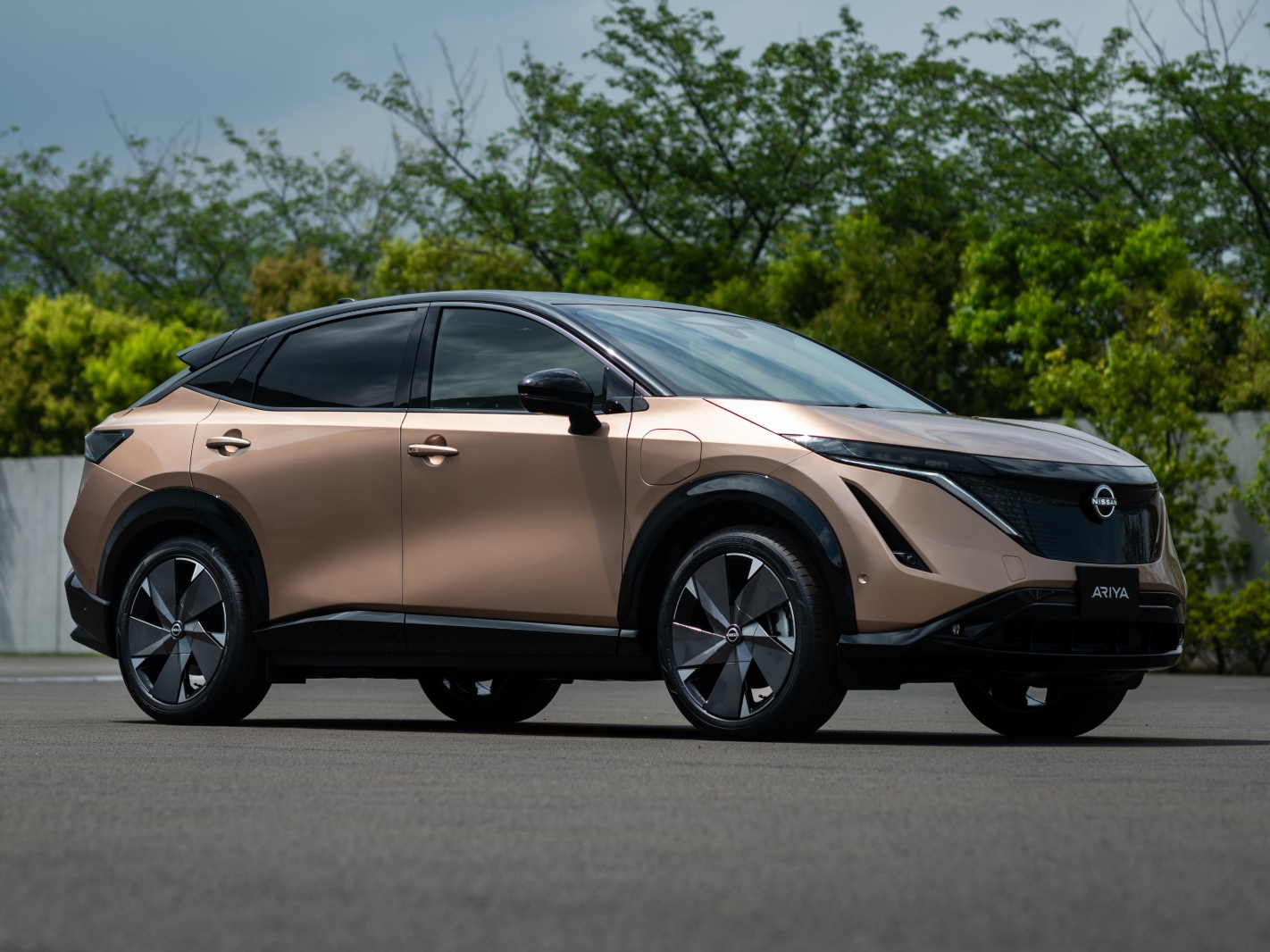
As for pricing, base Ariyas are expected to kick off in native Japan from about ¥5m (approximately A$59,000), while US customers will be asked for about US$40,000 (about A$52,000).
It’s expected however, that the Ariya will command a higher premium in Australia than its Leaf stablemate which costs $49,990 before on road costs at the time of writing, positioning it a little out of the frequently cited EV ‘price parity’.
“Certainly price will play a role in helping broaden the appeal of EVs,” said Lester. “The cost to build an EV versus an ICE vehicle is expected to reach parity by the mid 2020s. Once that is the case, you’ll start to see a stronger proliferation of EVs.”
Hyundai is kicking goals, scoring tries and adding to its ace count. Whatever sporting analogy you want to use, the South Korean giant is winning.
It often has numerous models within the top 20 of Australia’s VFACTS sales charts, so there’s little room for underperforming fat in the line-up.
And with consistent podium places each month within Hyundai’s own pecking order, the Kona isn’t at risk of becoming unwanted love handles anytime soon.
It’s no surprise, then, to find out that the Kona is a strong seller Down Under. In fact, in a turbulent 2020, Hyundai’s small SUV almost eclipsed the hugely popular Mitsubishi ASX.

However, with a refreshed line-up and an already strong start to 2021, the Kona looks set to challenge the ASX for top spot in the small SUV segment.
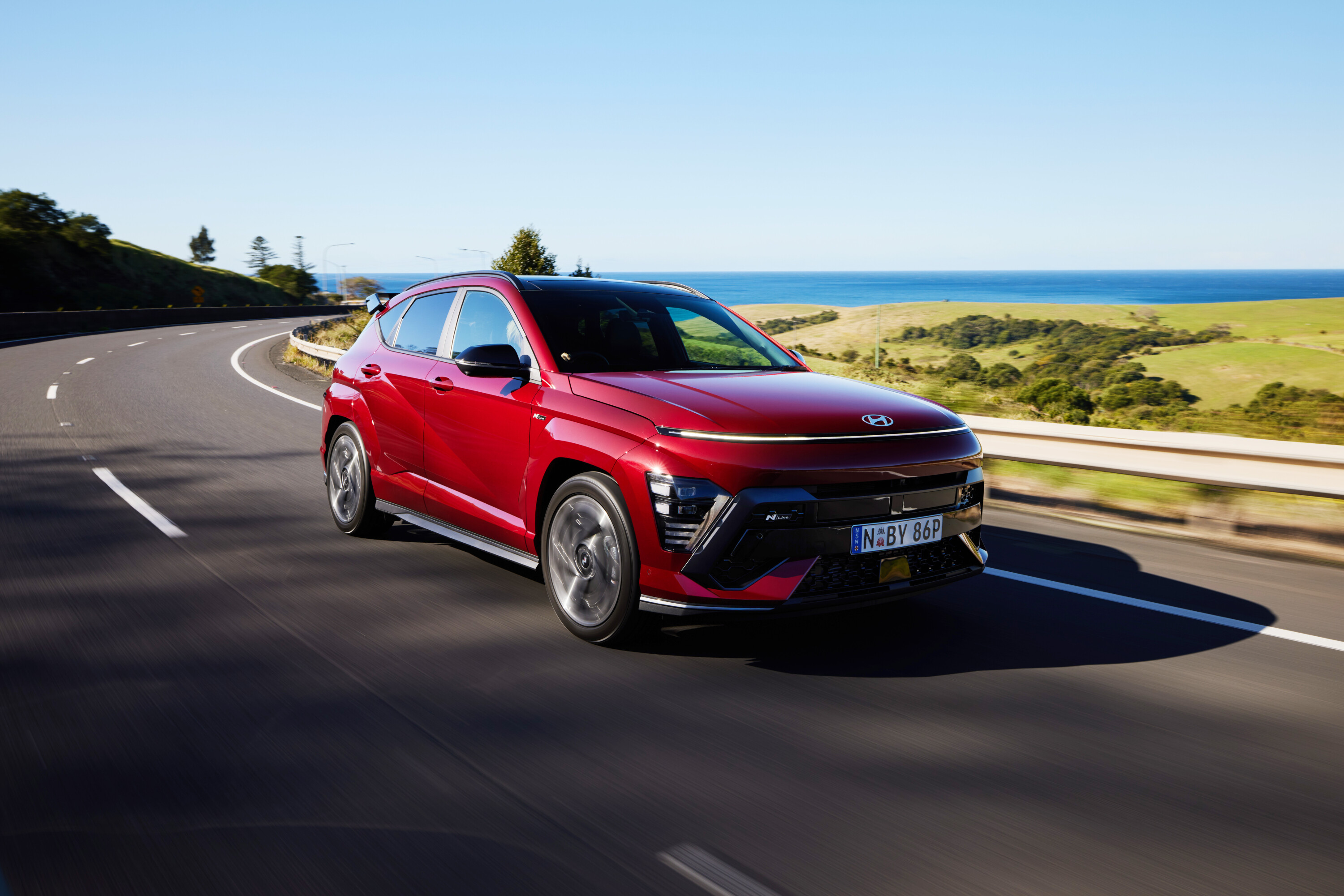
A big part of that projected success will be down to significant updates for a model originally released in 2017. It sees styling, mechanical and technology changes throughout the four model grades that make up the Kona range.
? Hello from the future!
There’s a new-generation Kona in Australia now, and you can find our news and reviews at the link below.
Review continues…
Prices are up across the board, but more features have become standard and the new 2.0-litre four-cylinder petrol engine gains a continuously variable transmission (CVT).
It’s the second-from-the-bottom $28,200 Active variant that we’re focusing on here.
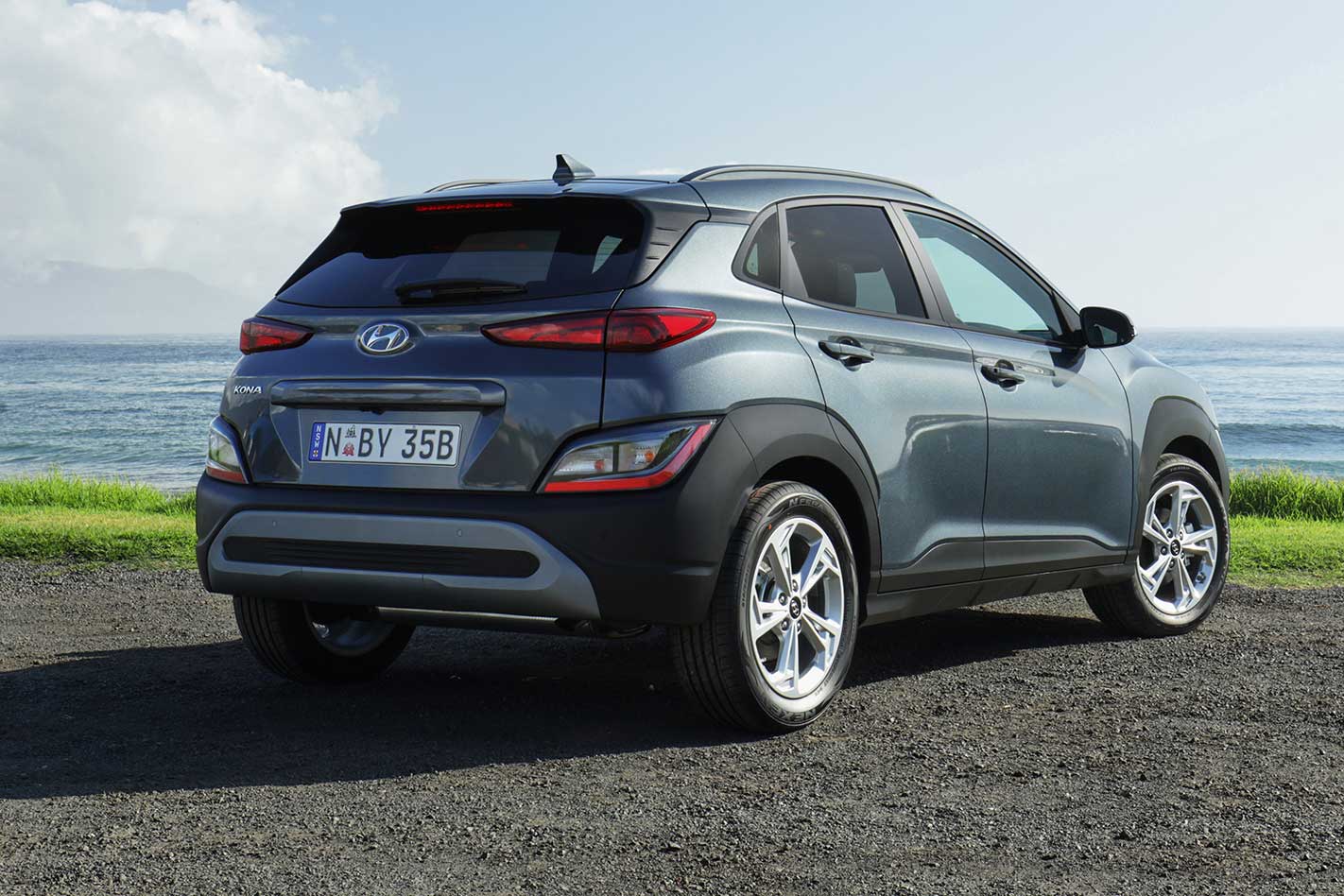
An electronic park brake replaces the conventional hand-operated unit, while wireless phone charging pairs with the smartphone mirroring for a potentially cable-free cabin – perfect for those who rue clutter.
The Active gains leather upholstery – which includes the seats, steering wheel and gear selector – while the alloys are 17-inch items and rear parking assist is standard.
New for this model grade in 2021 are map pockets, rear privacy glass and heated/power-folding mirrors, which are useful on tight streets given the Kona fits the city-dwelling-crossover genre.
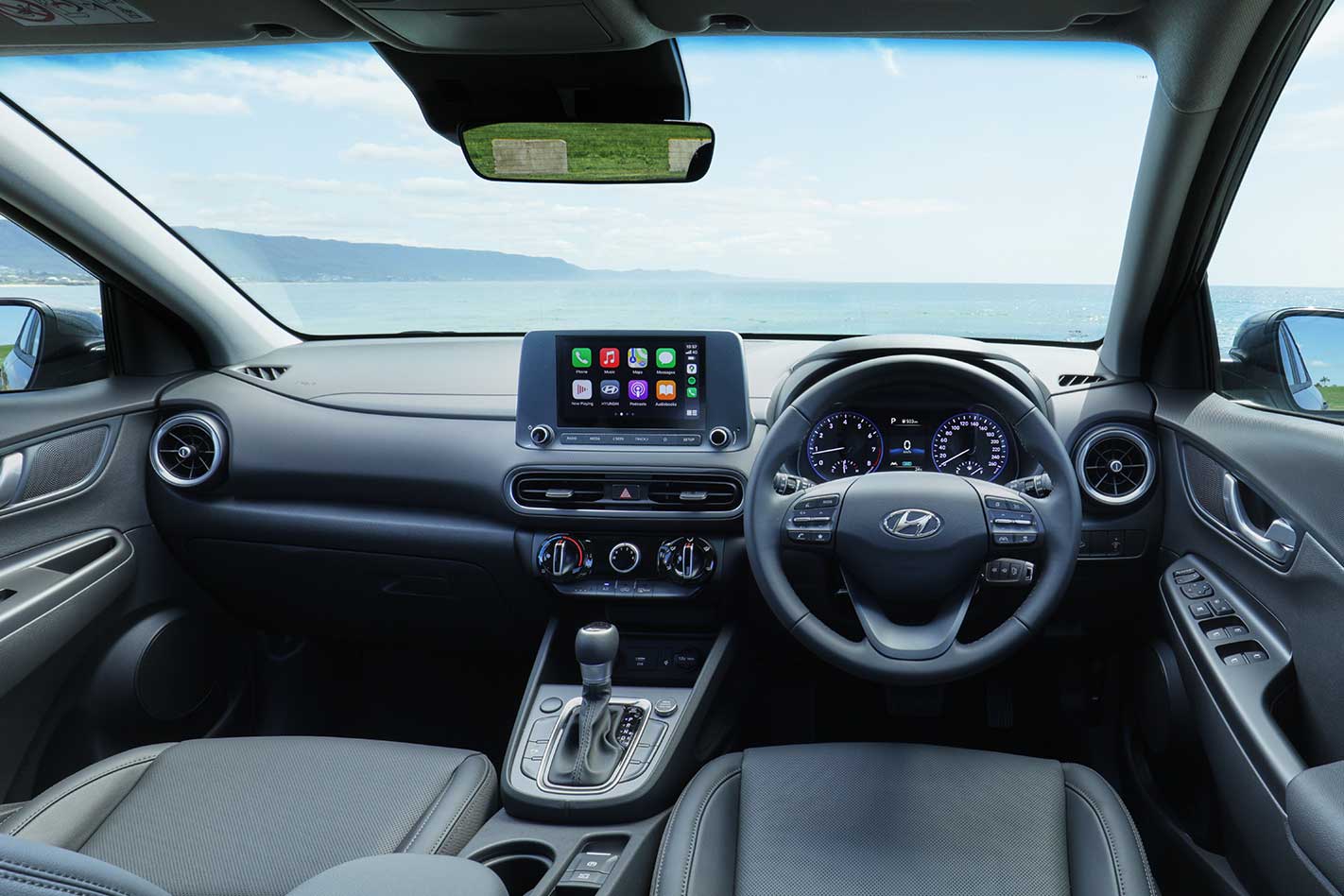
Servicing for the Active is every 12 months/15,000km (whichever comes first) and the warranty is five years/unlimited kilometres.
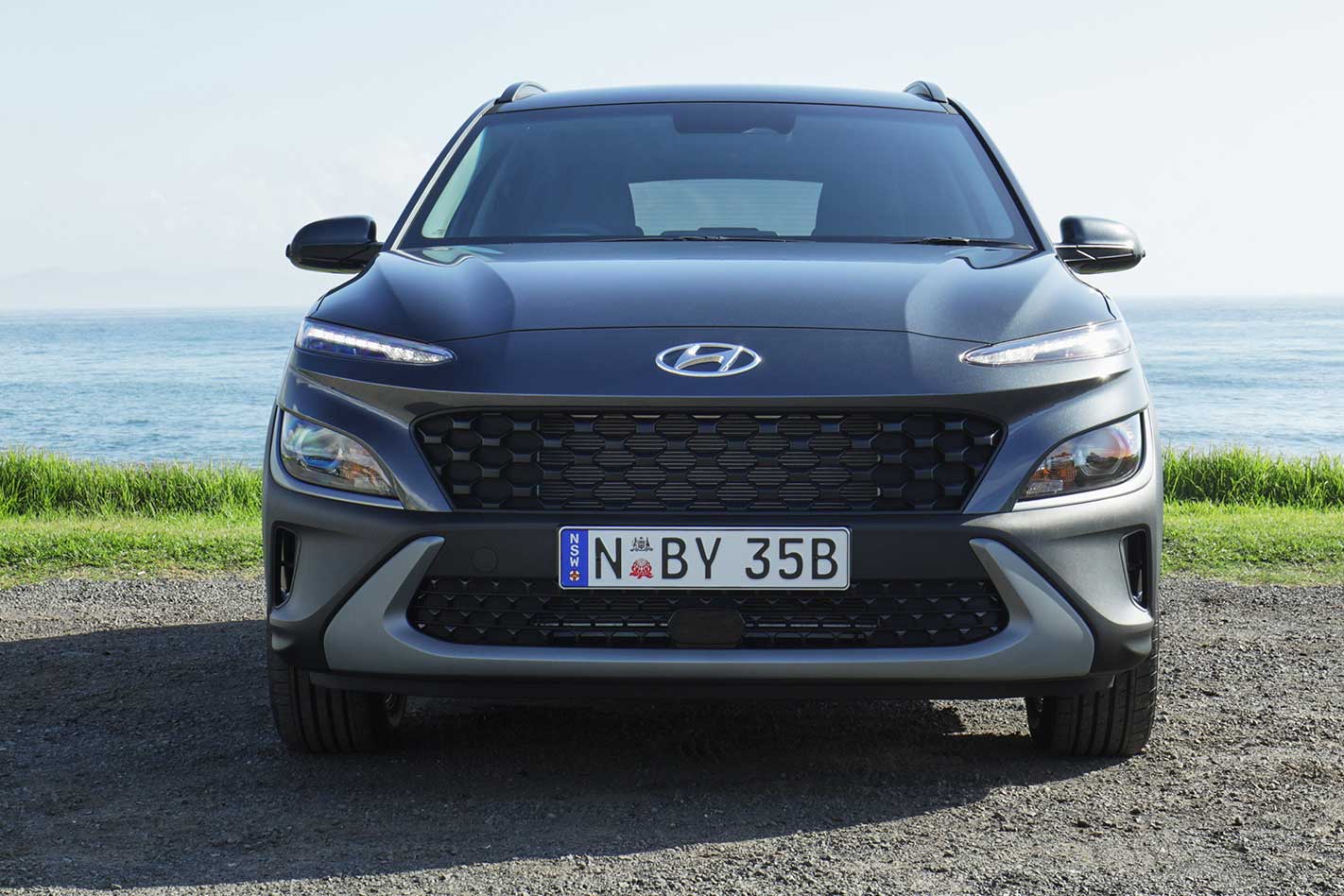
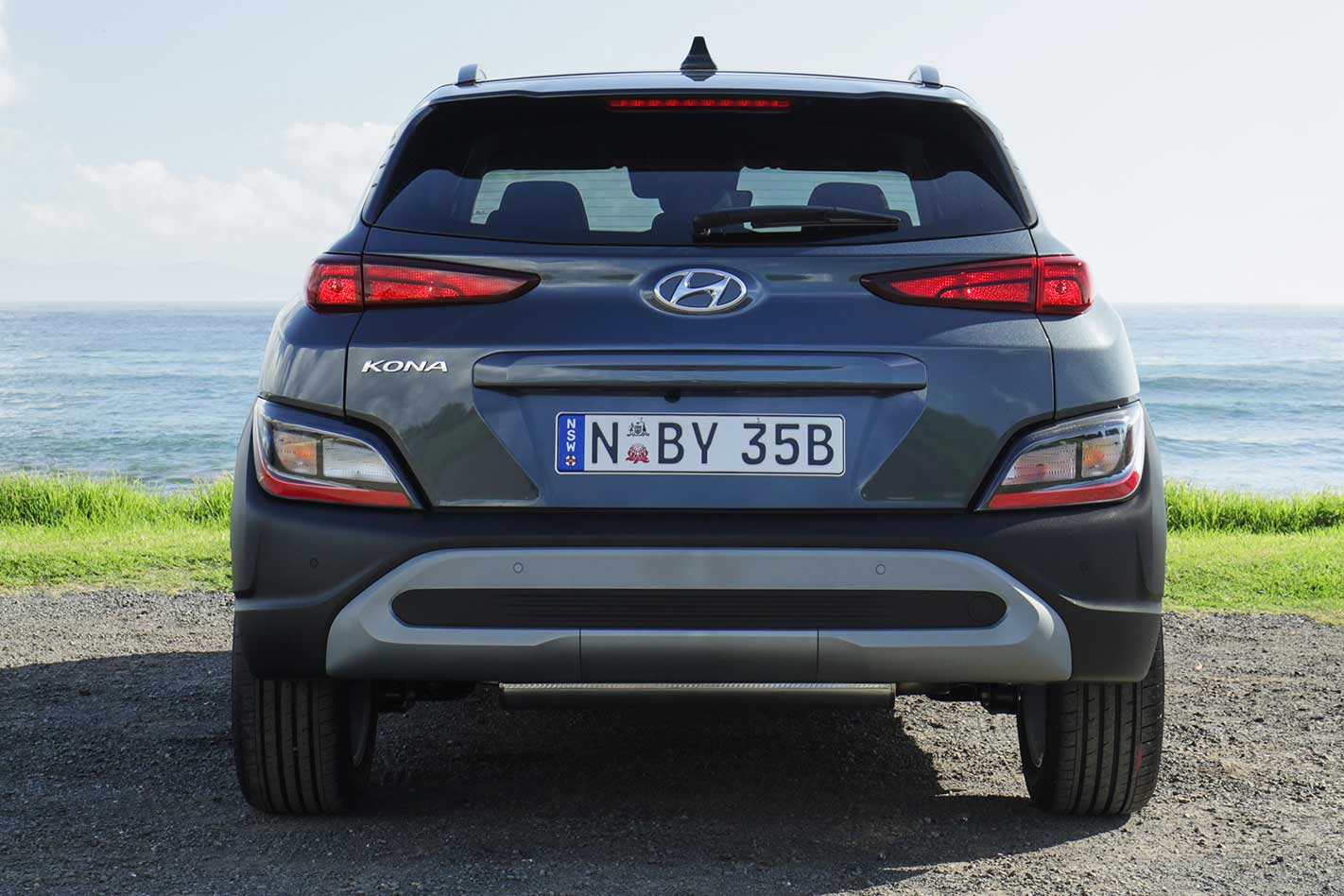
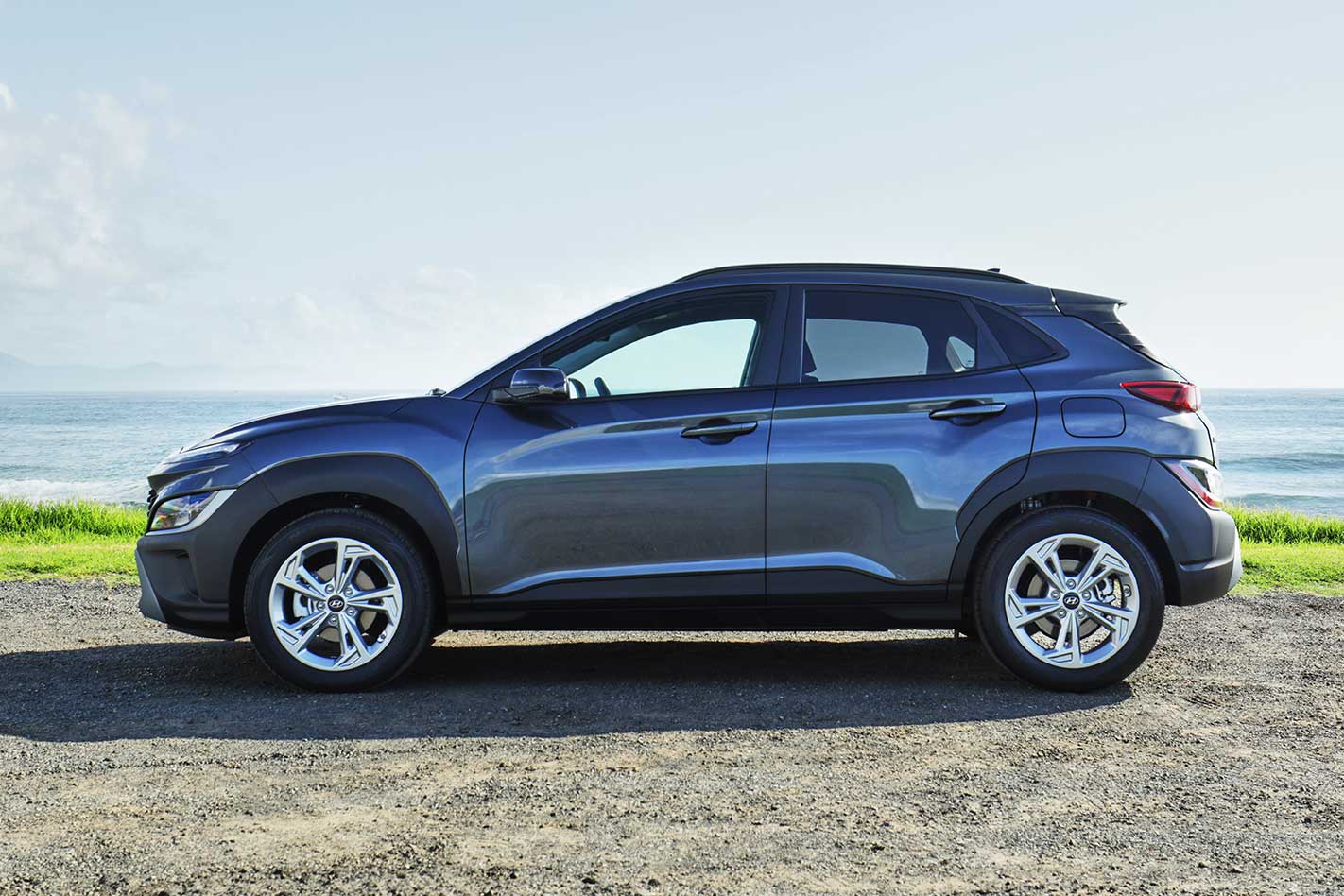
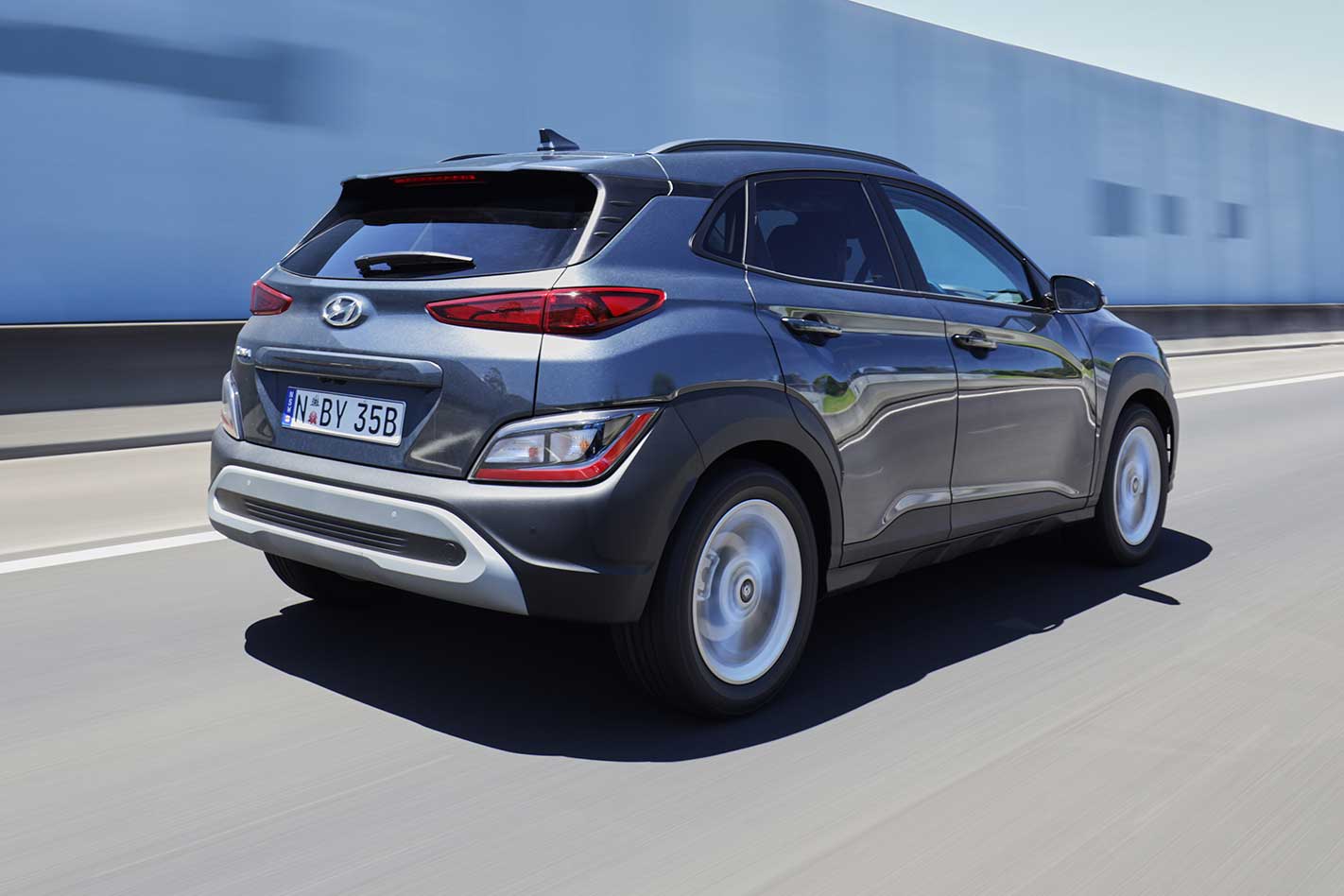
Design wise, the biggest changes are seen outside. The Kona gains a distinctive new face with a big grille and LED daytime running lights placed atop the conventional headlights – a design theme Hyundai has been shifting towards for its SUVs.
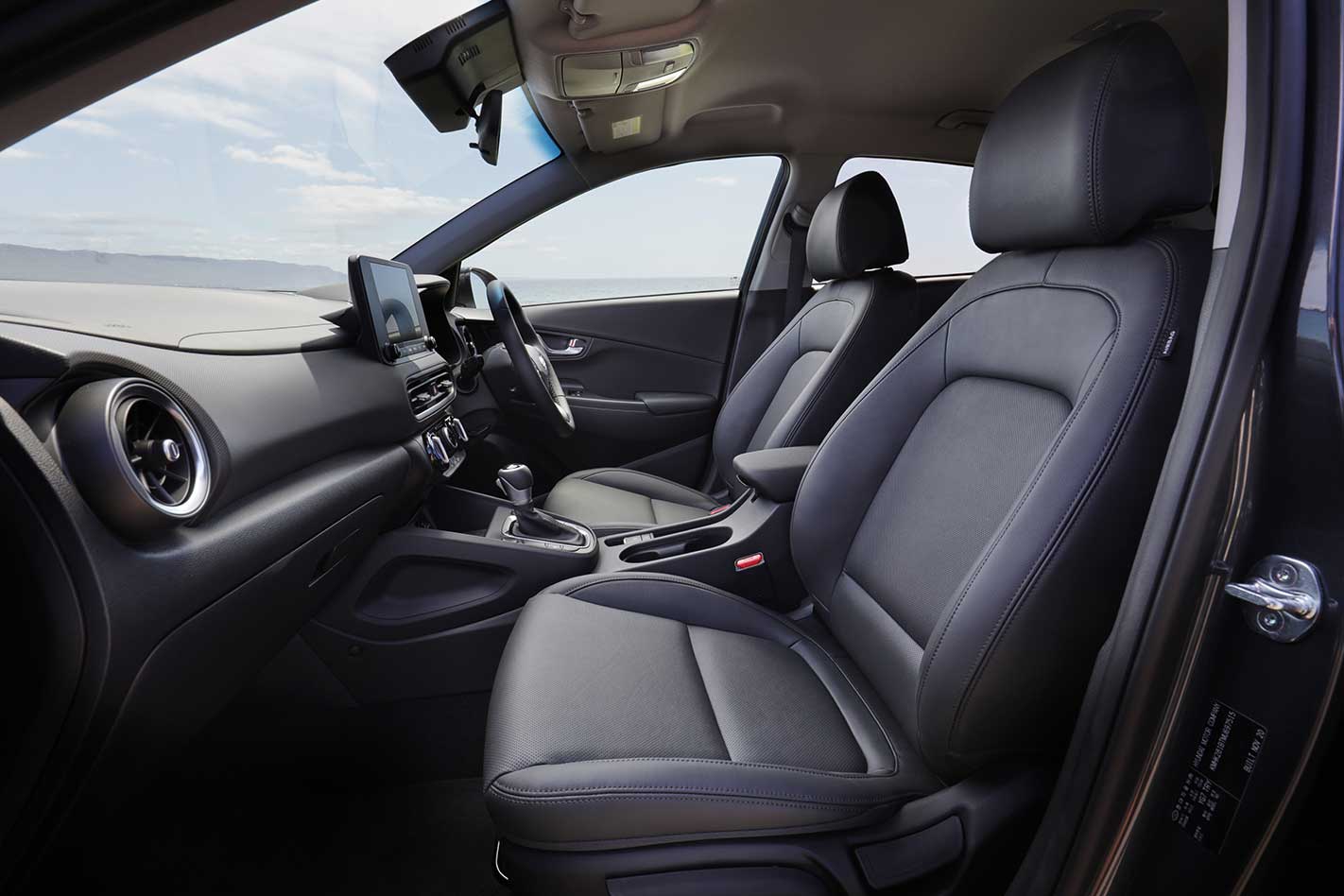
Inside the differences are harder to pick, although the Elite, Highlander and N Line variants gain a new 10.25-inch infotainment display and the latter two also score a TFT instrument cluster of the same size.
Ergonomically the layout is sound, with good all-round vision and loads of adjustment to the seating/driving position. The multi-function steering wheel is easy to use and general NVH levels are OK despite the Active missing out on extra sound deadening available in more expensive grades.
Call it a first-world problem, but having to actually use a key to start a car has become and automotive oddity.
You also have to pay more to gain extra safety kit like blind-spot collision-avoidance assist, high-beam assist, rear cross-traffic collision-avoidance assist and safe-exit warning.
Annoyingly, the smartphone mirroring is glitchy – and that’s being rather pleasant about it. While this isn’t an issue specific to just Hyundai with other wireless systems having a tendency to drop out, too, the Kona’s performance with Apple CarPlay was very poor.
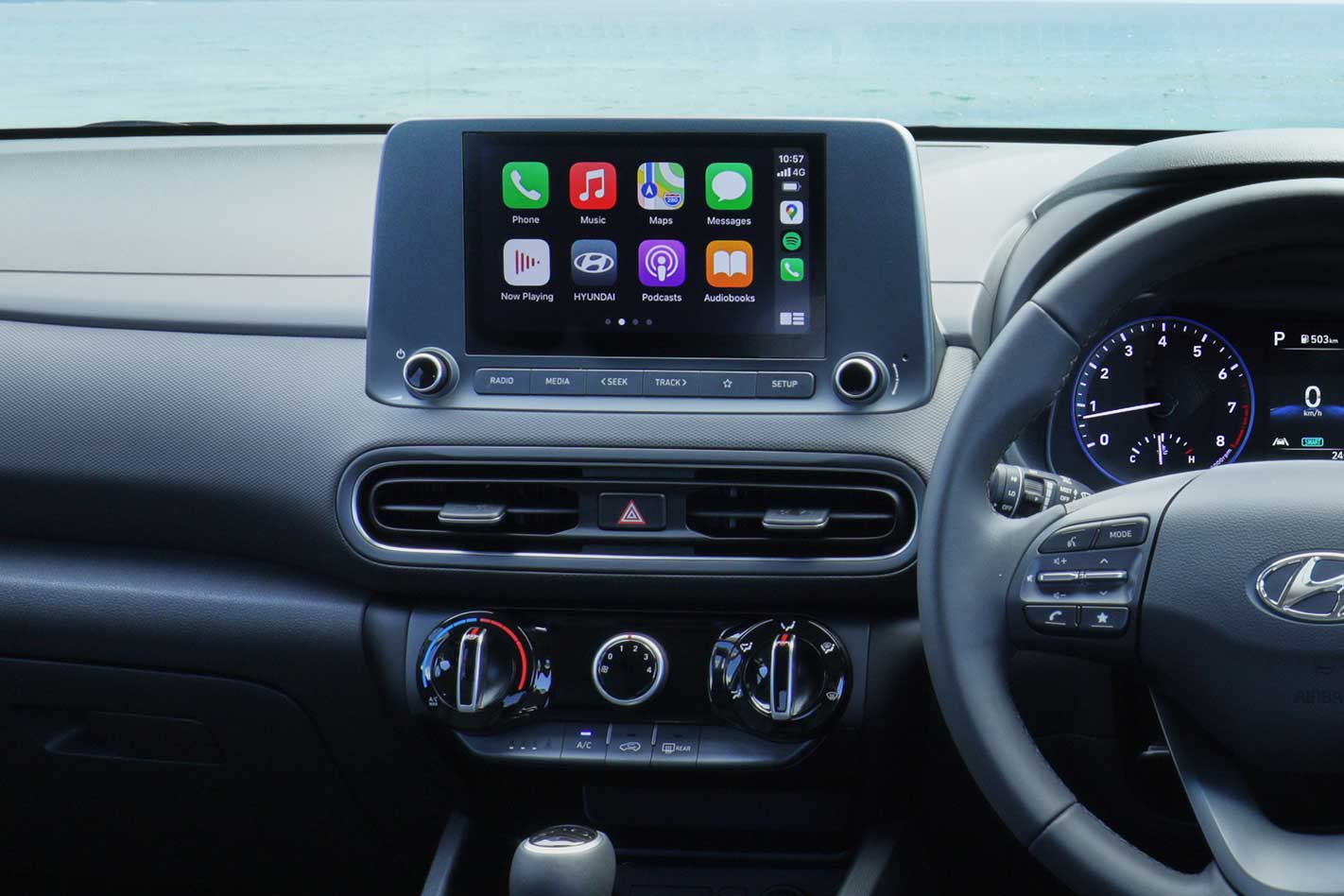
Given the Active also doesn’t have in-built sat-nav, this became an issue on a planned weekend trip. A software update from Hyundai needs to be in the works to rectify this – and quickly.
Practicality proves far stronger than the wireless connection. Room for heads, shoulders knees and toes is at comfortable levels front and rear – with a little bit of compromise required if you’re four-up with adults – while the leather seats offer plush cushioning.
The rear doors offer small stowage areas, while the transmission tunnel isn’t too intrusive if you need to carry a fifth passenger. ISOFIX points are located in the outboard pews.
Cargo capacity is 374 litres and the rear seats fold flat if you need to transport larger items home from the weekend Bunnings or IKEA trip. With a raised boot floor there’s also no lip with the seats stowed, meaning you can slide items straight through.
Mechanical changes are actually quite extensive with both the engine and transmission receiving attention. The SmartStream 2.0-litre (1999cc) four-cylinder engine is a part of the ‘Nu’ family, but it doesn’t really feel ‘new’.
Sans forced induction, and especially when compared with Hyundai’s punchy ‘Gamma’ 1.6-litre turbo four-pot, it can be left wanting for power and torque – especially given both outputs are developed high in the rev range.
With stepped ratios to mimic a conventional torque-converter automatic, the CVT actually works well with the naturally aspirated four-cylinder.
It largely eschews the perching sensation, resisting the urge to hold revs at a constantly high rpm under heavy load, and it even offers a pseudo manual mode (sans steering-wheel-mounted paddles).
An injection of torque would not only help driveability, but also aid the fuel economy. However, being able to fill up on 91RON fuel is a bonus with constantly fluctuating petrol prices.
While Hyundai hasn’t played with the spring rates or dampers, the 2021 Kona feels a little suppler than before – especially on smaller rims with chubbier 215/55 rubber. There’s a veneer of firmness, which is appreciated on smooth roads with enticing corners, but the ride quality doesn’t cross over to the harsh side.
The Active keeps body roll in check, however, the rebound calibration of the dampers needs work as the Kona is, ahem, active in terms of vertical movements over smooth undulations. Adding weight via extra passengers and luggage only exacerbates the lack of control.
Which is a shame, because without this issue the Kona displays pleasing dynamics, bearing in mind its small-SUV premise. And that’s despite the fact the Active uses the lower-spec torsion beam rear suspension over the N Line’s multi-link setup.
Traction isn’t an issue on-road, while the front-wheel-drive layout has help off-road with dedicated Snow, Mud and Sand traction modes – although there is only 177mm of ground clearance.
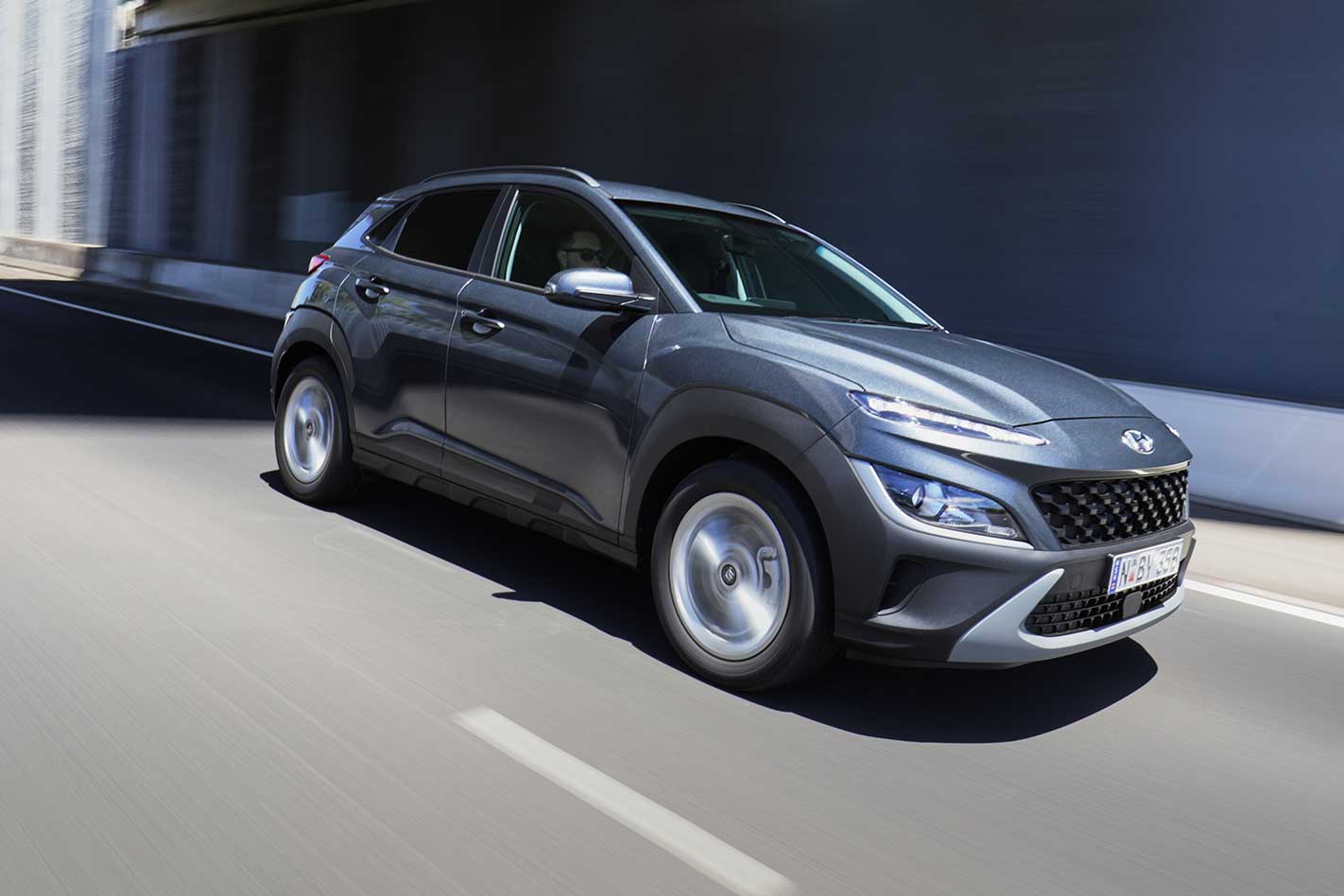
Ultimately, the Active grade makes a curious case for itself. It misses out on some key equipment and the 2.0-litre powertrain is best described as adequate. Nor is it especially frugal.
The N Line offers more grunt and all-wheel drive, while the all-electric EV solves the consumption issues. However, the Active pleases on a monetary front more so than those options, as does its funky persona and juxtaposing pragmatism.
Hyundai’s half-time refresh has given the Kona enough of a second wind to compete in the sales race.
Specifications
- Body: 5-door, 5-seat SUV
- Drive: front-wheel
- Engine: 1999cc inline-4, DOHC, 16v
- Bore/stroke: 81.0 x 97.0mm
- Compression: 12.5:1
- Power: 110kW @ 6200rpm
- Torque: 180Nm @ 4500rpm
- 0-100km/h: 9.4sec (estimated)
- Fuel consumption: 6.2L/100km (combined/claimed)
- Weight: 1280kg
- Power/weight: 86kW/tonne
- Transmission: Continuously Variable Transmission
- Suspension: MacPherson struts, coil springs, anti-roll bars (f); torsion beam, coil springs, anti-roll bars (r)
- L/W/H: 4205/1800/1550mm
- Wheelbase: 2600mm
- Tracks: 1563/1572mm
- Steering: electrically assisted rack-and-pinion
- Brakes: 280mm ventilated discs, single-piston calipers (r); 284mm solid discs, single-piston calipers (r)
- Wheels: 17.0 x 7.0-inch (f/r)
- Tyres: 215/55 R17 94V (f/r) Nexen N’Fera SU1
- Price: $28,200
A shadowy teaser for the upcoming new Audi Q4 E-Tron and Q4 E-Tron Sportback electric SUVs has been released today, following confirmation last month that production has already begun.
The big debut for both mid-sized EVs is set to occur at 3:00AM on April 15 (7:00PM April 14 in Germany).
The electric Q4 models will join the existing E-Tron SUV (which sits between a Q5 and Q7 in size, yet gets no ‘Q’ name of its own) and the recently revealed E-Tron GT electric sedan.
The E-Tron is already on sale in Australia and you can read our coverage here, while the E-Tron GT will make its way to Australia by October. Handily, we’ve already driven it and you can read our review here.
Check in with WhichCar next week for all the details on the new Q4 E-Tron models, including details on Australian launch timing.
The story to here
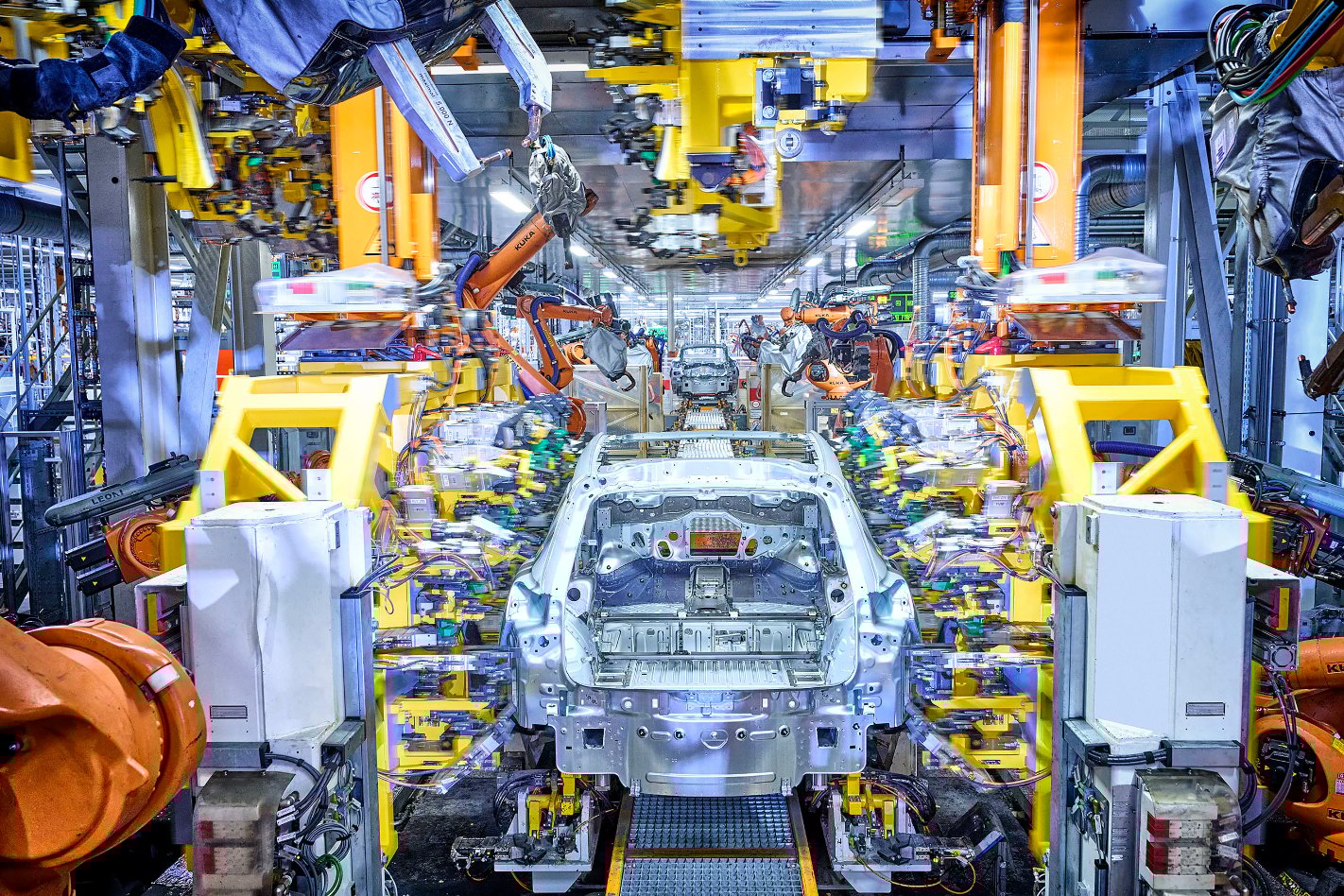
March 23, 2021: Audi has announced its first fully-electric SUV, the Q4 E-Tron, has entered production at Volkswagen Group’s multi-brand production facility in Zwickau.
Based on Volkswagen’s MEB modular electric car platform, which is shared with other brands under the VW umbrella such as Skoda and SEAT, the Q4 E-Tron is an important car for the automaker.
Audi also claims that, thanks to the ground-up development of the MEB platform to support EV-only drivetrains, the interior space of its Q4 E-Tron is comparable to a full-sized SUV.
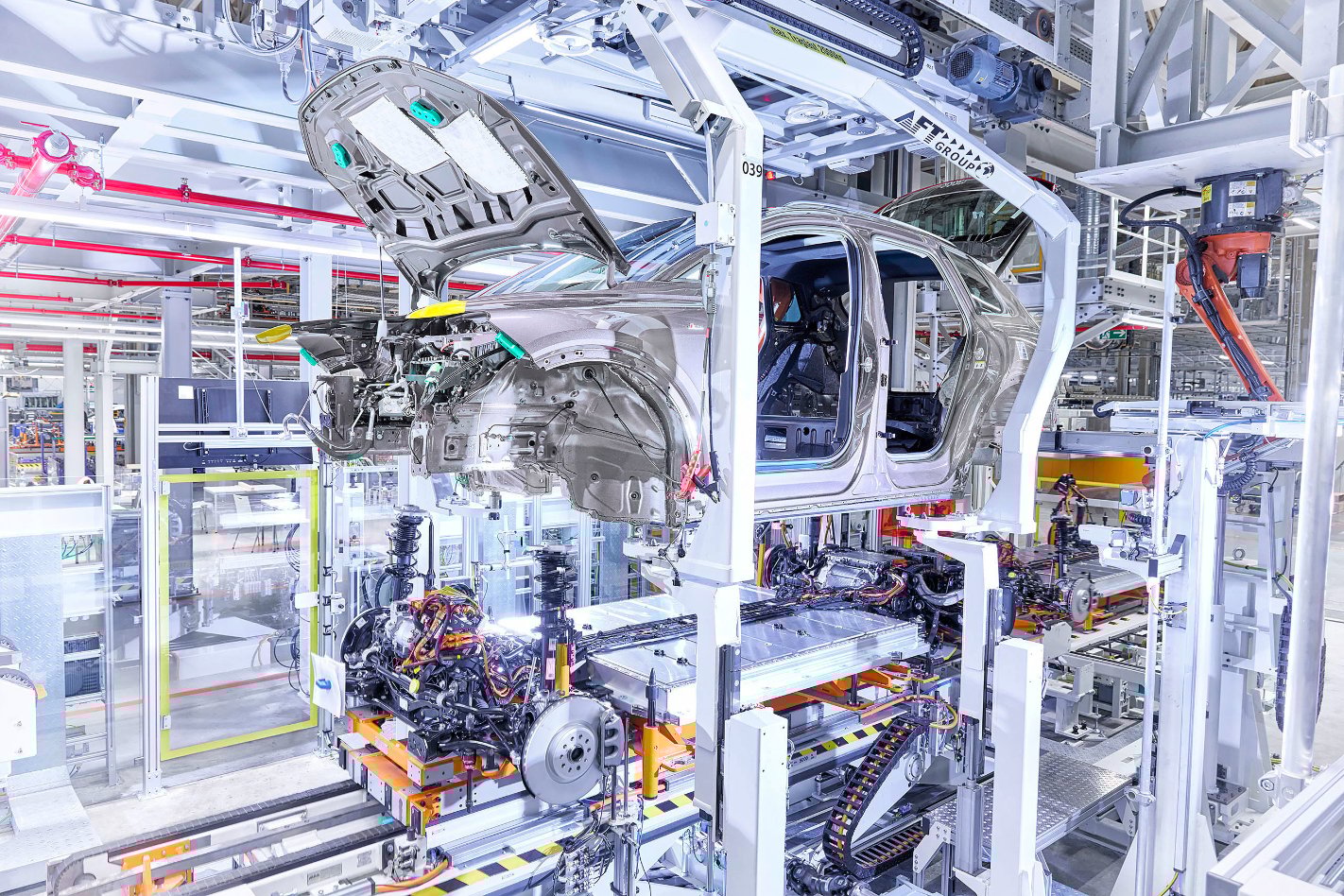
The electric SUV will be built alongside the VW ID.4 in Zwickau, with 1400 assembly line workers from Volkswagen Saxony and 100 Audi employees responsible for production.
Interestingly, although it’s being built in Zwickau, such is the complexity of the Q4 E-Tron’s design, that the press tools needed to make the intricate body panels had to be brought in from Audi’s own toolmaking shop.
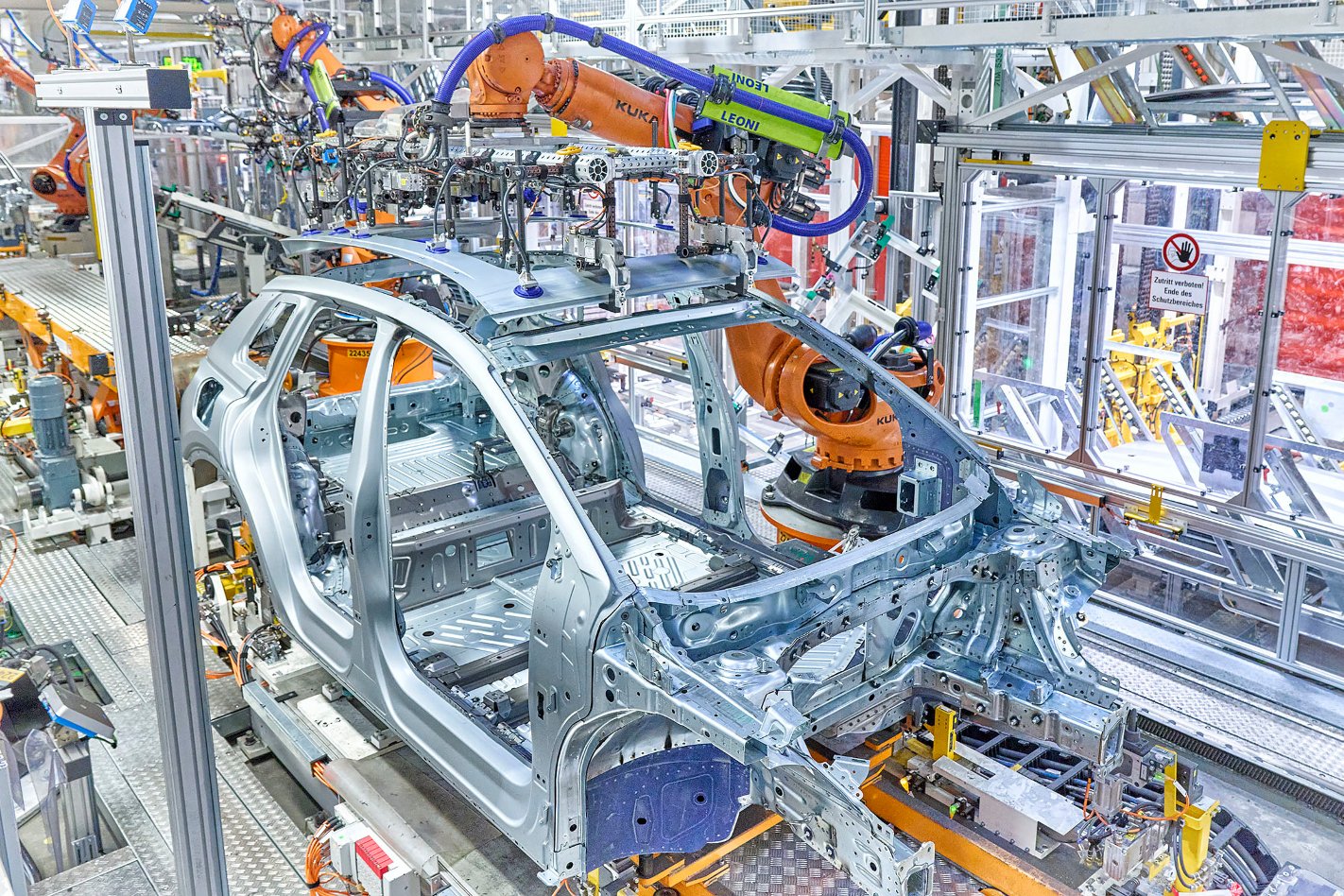
Audi toolmakers from Ingolstadt and Neckarsulm were also involved in the Q4 E-Tron project from the beginning of its development, to iron out any creases that may occur at Zwickau.
“The cross-brand collaboration in Zwickau demonstrates once again the enormous synergy potential that we enjoy with the Volkswagen Group,” Peter Kössler, AUDI AG board member for production and logistics, said.
“The on-schedule start of production of the Audi Q4 E-Tron is testament to the outstanding teamwork – among the Volkswagen and Audi colleagues alike.
“Our compact electric SUV is unmistakably a true Audi that will wow our customers with its outstanding quality and everyday usability.”
Dr Stefan Loth, Chairman of the executive management of Volkswagen Saxony, echoed Kössler’s sentiments.
“With the start of production of the Audi Q4 E-Tron, the Volkswagen plant in Zwickau is now a multi-brand plant,” Loth said.
“As a result, we are writing yet another chapter in the long history of the automotive industry here in Saxony.
“I’d like to thank all the Audi employees who are currently manufacturing the vehicles to the very highest quality, in the agreed-upon volume, and on schedule.”
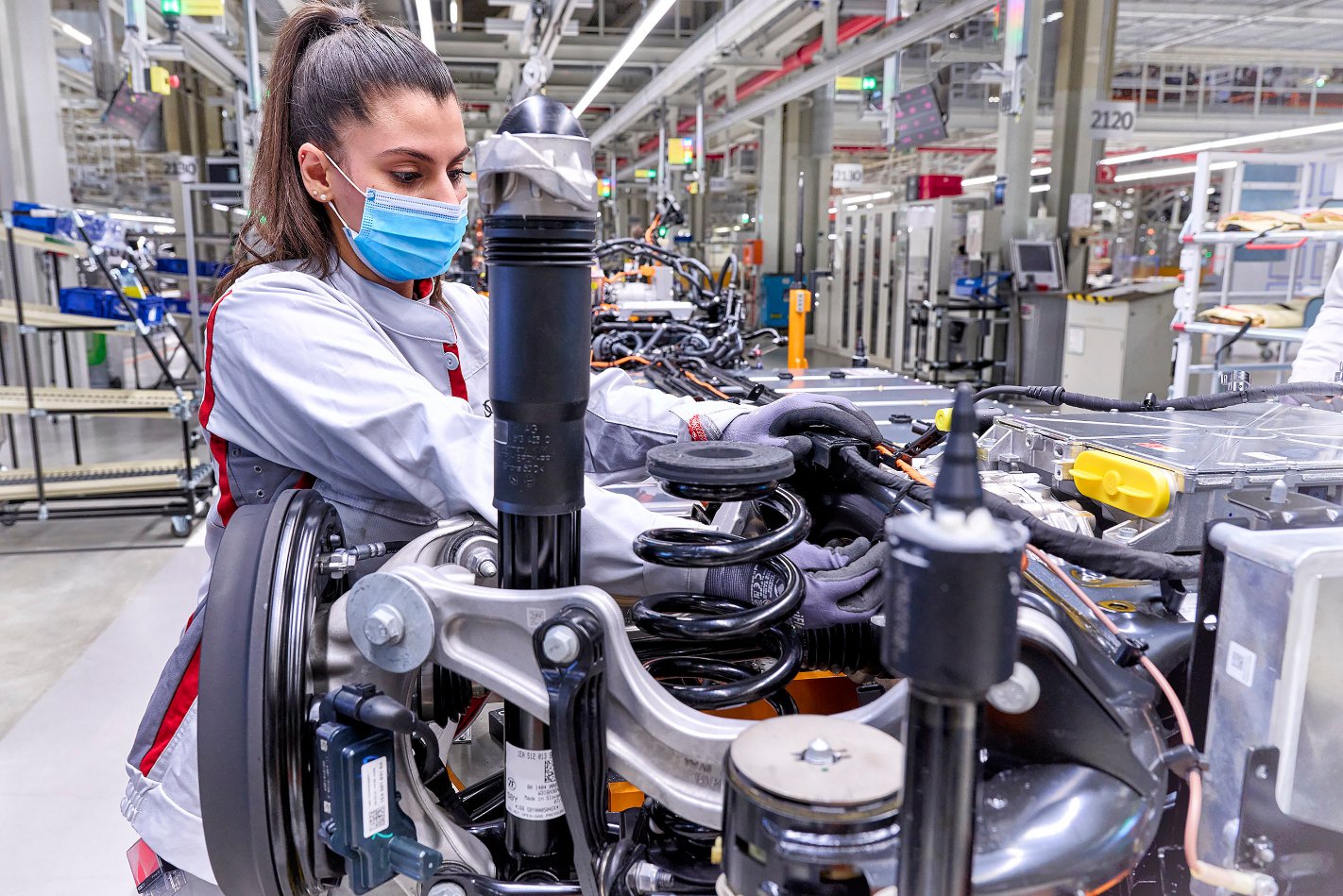
The Audi Q4 E-Tron will be unveiled globally in April and will be launched across Europe in the following months.
The compact SUV is just the tip of the German manufacturer’s EV iceberg, with plans for no less than 20 fully electric models to be launched by 2025.
