
A second recall notice for the new-generation 2021 Subaru Outback has hit the Australian Competition & Consumer Commission’s Product Safety Australia website, to address a fault with the vehicle’s stereo camera system.
This notice follows the issuing of a recall for 256 examples of the the new Outback in March, regarding the new SUV’s electronic brake booster. You can read more on that issue here.
Subaru Australia first made contact with owners for the brake booster recall in early March, and the company has confirmed with WhichCar today that owners have likewise already been contacted for this latest notice.
The newer recall centres on the Outback’s autonomous emergency braking technology, specifically the dual cameras mounted atop the windscreen, in front of the interior rear-view mirror.
According to the notice, the stereo camera system in 1982 examples of the new Outback could confuse or “mis-recognise” roadside objects, and/or miscalculate the travelling direction of an oncoming vehicle.
In the event of either software bug striking, the Outback could unexpectedly activate its pre-collision braking system.
The company says the likelihood of these symptoms occurring is low, but it is nonetheless contacting owners of affected vehicles to arrange an update to the software that controls these features.
The process takes 120 minutes, and will be carried out without charge.
Owners can visit www.subaru.com.au/retailers to find their preferred Subaru Retailer.
For further information, contact your nearest Subaru Dealership or the Subaru Customer Relations Team on 1800 226 643 (Monday to Friday, 8:30am – 5pm AEST).
MORE: Outback news and reviews MORE: All Subaru stories
Volkswagen in the US could be in hot water with authorities after a hoax about changing its name went wrong this week.
On Monday, it was leaked that the American arm of the manufacturer would be changing its name to ‘Voltswagen’ later this year to emphasise its commitment to electric vehicles – in what turned out the following day to be an April Fools’ joke.
But the German marque could find itself in trouble with US regulators for misleading investors in the country because its stock price spiked by five per cent on Tuesday in response – the day the bogus statement was officially issued.
Investors have been responding recently in favour of automakers increasing electric vehicle production, swelling the value of shares of Tesla as well as of some EV startups.
James Cox, who teaches corporate and securities law at Duke University in the US, told the Associated Press the Securities and Exchange Commission (SEC) should take action to deal with such misinformation, which can distort stock prices.
“The whole market has gone crazy,” he said. “We need to throw a pretty clear line in the sand, I believe, about what is permissible and what isn’t permissible.”
This week’s blunder bears some similarity to one in 2018, in which Tesla’s CEO Elon Musk tweeted that he had the funding secured to take the company private – a comment which drove up the stock price, Mr Cox said. Later, it was revealed that the funding had not been lined up. In that incident, Musk and Tesla each agreed to pay $20 million in fines to the SEC.
The SEC has yet to comment on what action, if any, it may take against VW in the US. However, Erik Gordon, a business and law professor at the University of Michigan, said for the authorities to be interested, he believes they would have to truly believe VW knowingly issued the fake news release to manipulate its stock price.
There is no evidence to suggest at this point that the hoax name change was linked to foul play.
“I don’t think the SEC is going to see this as stock price manipulation any more than when General Motors or Ford or Toyota or anybody talks about their (electric vehicle) future,” the professor said. “It is incredibly stupid, but if being stupid were illegal, a third of the CEOs in the US would be in jail.”
Confusion has spread like wildfire worldwide over the fake news this week, after Mark Gillies, a company spokesman, insisted on Monday that the name change was true, saying that it reflected a shift towards more battery electric vehicles (BEV) in the wake of Dieselgate – the 2015 scandal in which it cheated on government emissions tests.
Volkswagen admitted that about 11 million diesel vehicles worldwide were fitted with deceptive software. The software reduced nitrogen oxide emissions when the cars were placed on a test machine but allowed higher emissions and improved engine performance during normal driving. The cover-up cost Volkswagen US$35 billion in fines and civil settlements, and led to the recall of millions of vehicles.
Late Tuesday, VW issued a statement confirming it won’t be changing its brand name to ‘Voltswagen’, despite having already issued a statement quoting its American CEO saying it was true earlier the same day.
“The renaming was designed to be an announcement in the spirit of April Fool’s Day,” the company said.
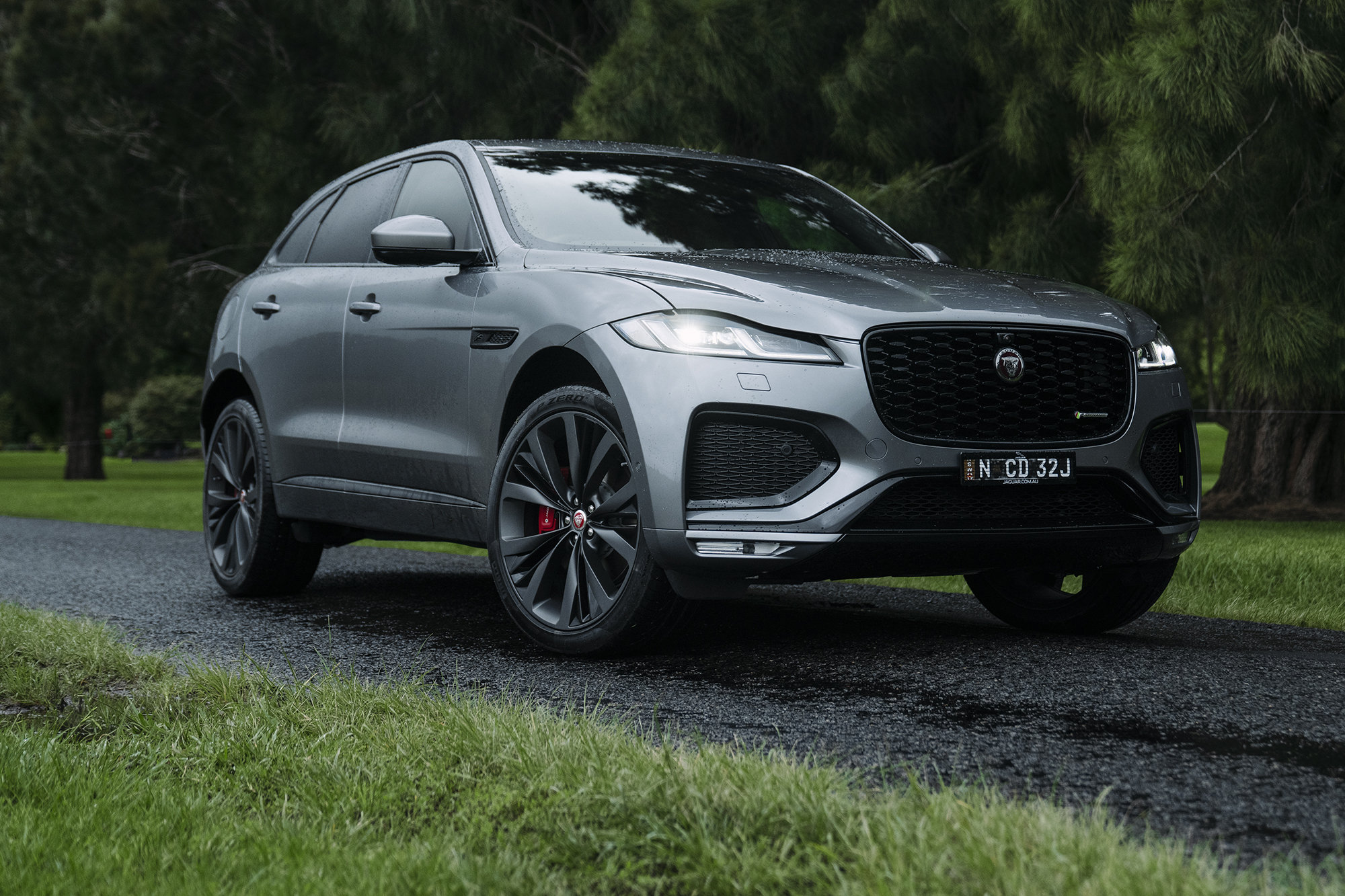
The 2021 Jaguar F-Pace large SUV has arrived with a mechanical and technological boost to help it fight for attention in the increasingly tough premium SUV category.
The cost of entry has gone up around $1500-2000 across the range, although Jaguar says that is more than justified by the new features and equipment.
This mid-life facelift – the first major one for Jaguar’s large SUV since it originally launched in 2016 – brings no significant dimensional changes but does improve the ownership experience considerably, especially under the bonnet and inside the cabin.
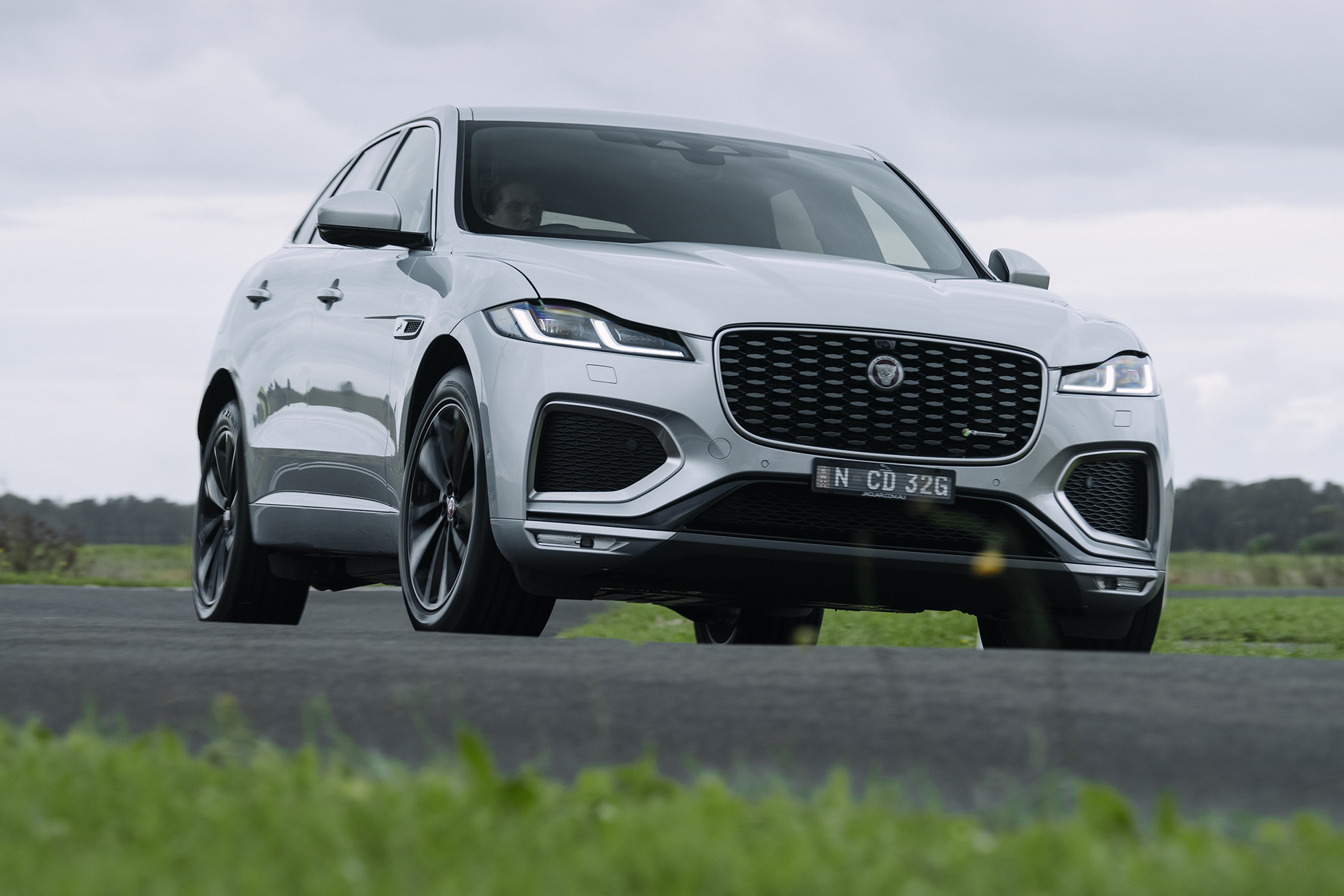
Headline changes include two new inline six-cylinder engines, an all-new Pivi infotainment system, and an enhanced active safety suite that all combine to put the F-Pace at the pointy end of the premium SUV field for appeal and value.
Plus, all Jaguar (and Land Rover) models move to a best-in-class five-year, unlimited kilometre new car warranty from April 1, 2021 (previously it was 3yr/100,000km).
Both new engines are 3.0-litre, inline six-cylinder turbocharged units with 48V mild hybrid technology, from Jaguar Land Rover’s Ingenium engine family.
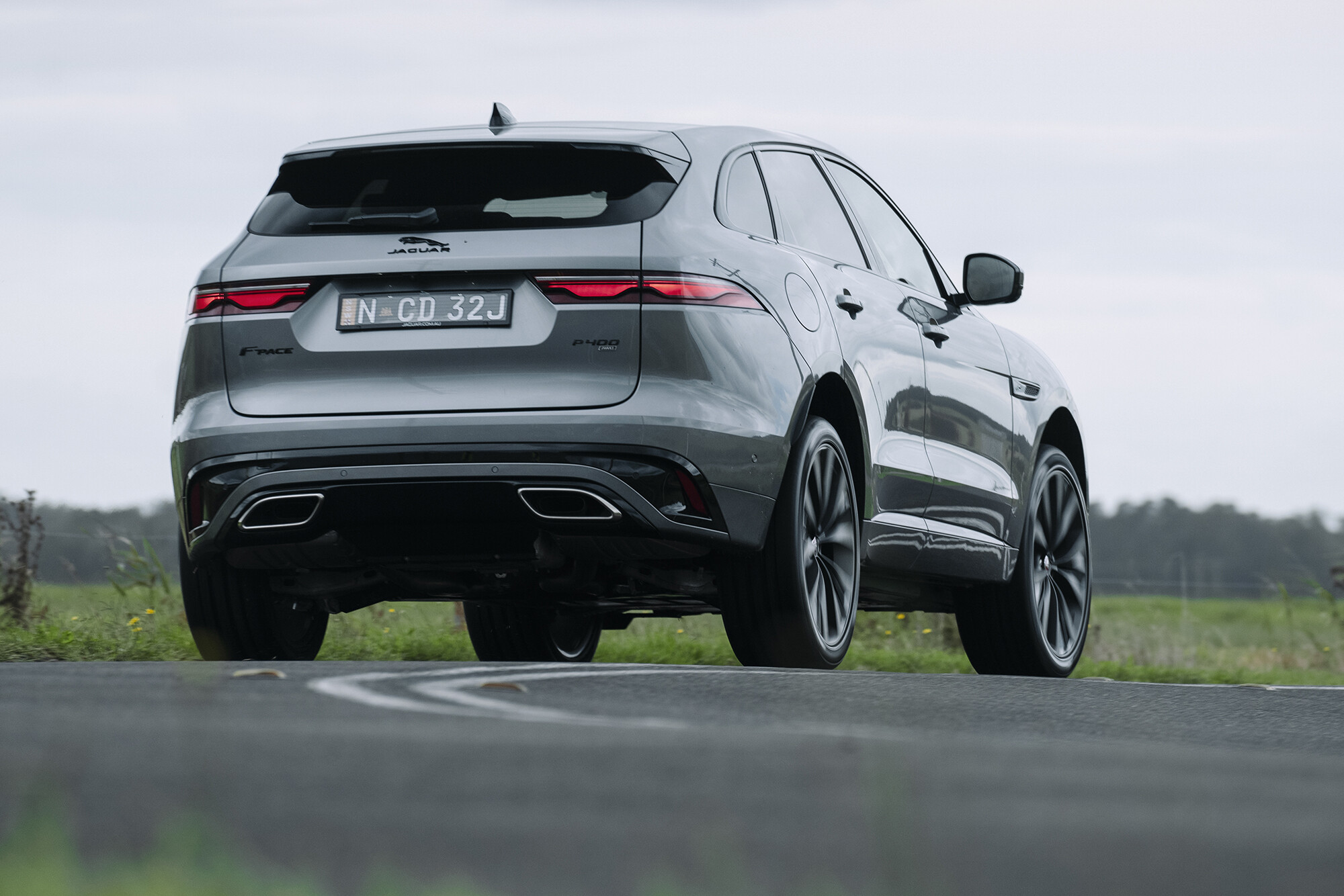
Neither of these can run on battery power alone, instead using electric power harvested from braking to assist with acceleration and deliver a more refined stop/start system.
The diesel version fitted to the F-Pace D300 ($96,194) produces 221kW and 650Nm, and is capable of propelling the D300 from 0-100km/h in 6.4 seconds. Fuel consumption is rated at 7.0L/100km on the WLTP combined cycle.
The petrol version found in the P400 SE ($98,654) and HSE ($110,404) produces 294kW and 550Nm, and accelerates the P400 from 0-100km/h in 5.4 seconds. Fuel consumption is 8.7L/100km.
Picking the 2021 model from its predecessor externally is made easier thanks to new slimline LED headlights and a sleeker, simpler bonnet and front bumper profile.
On the flanks Jaguar has incorporated its iconic Leaper emblem into the front quarter panels, and the rear end gets a new bumper and taillights as well.
The MY2021 range kicks off with the Jaguar F-Pace P250 S priced at $76,244 (up $1254 over the outgoing model).
The P250 S is powered by a 2.0-litre turbocharged four-cylinder petrol engine carried over from the previous generation, mated to an 8-speed automatic transmission and all-wheel drive.
The drivetrain produces 184kW and 365Nm, is capable of accelerating the F-Pace from 0-100km/h in 7.3 seconds and has a claimed fuel efficiency rating of 7.8L/100km.
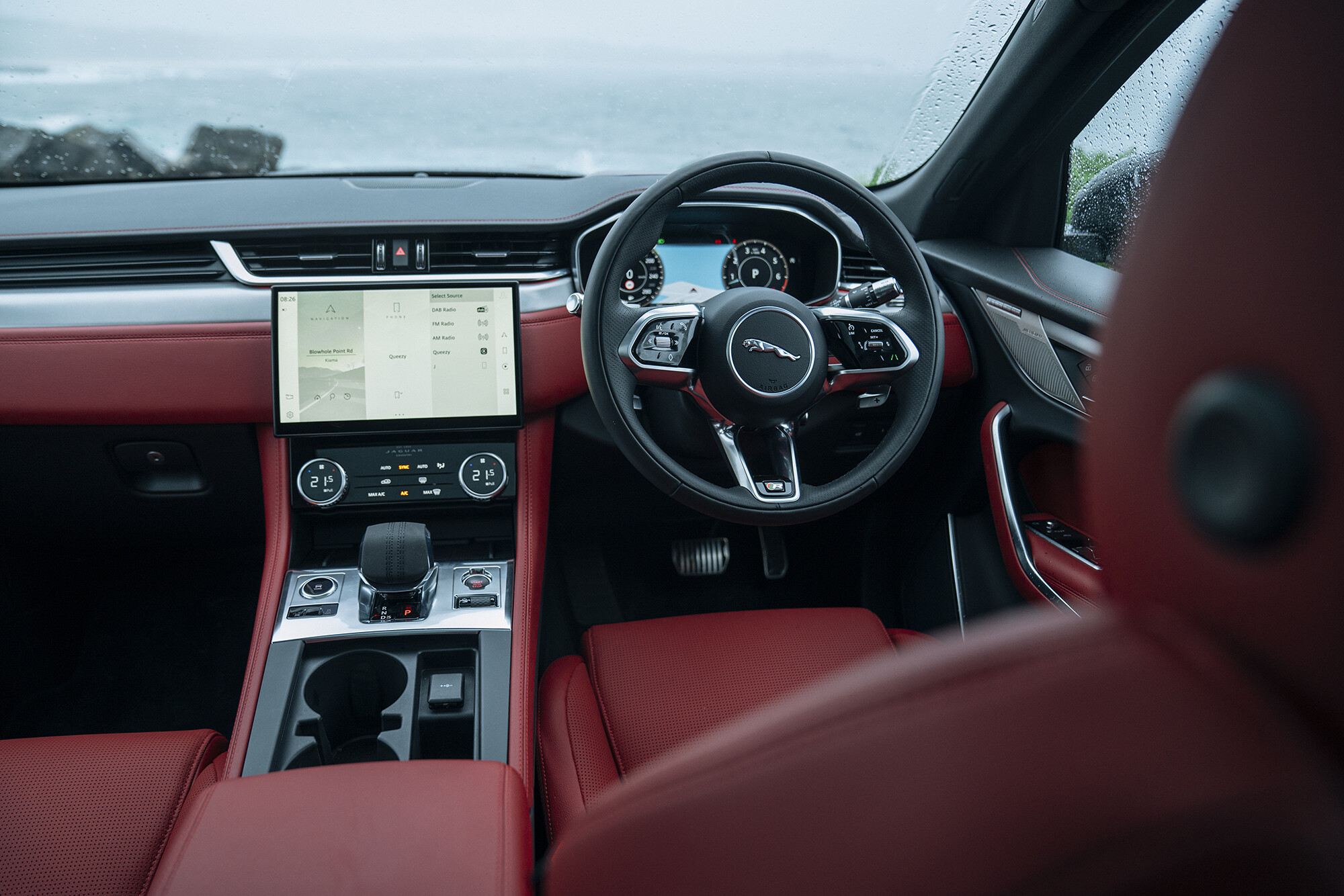
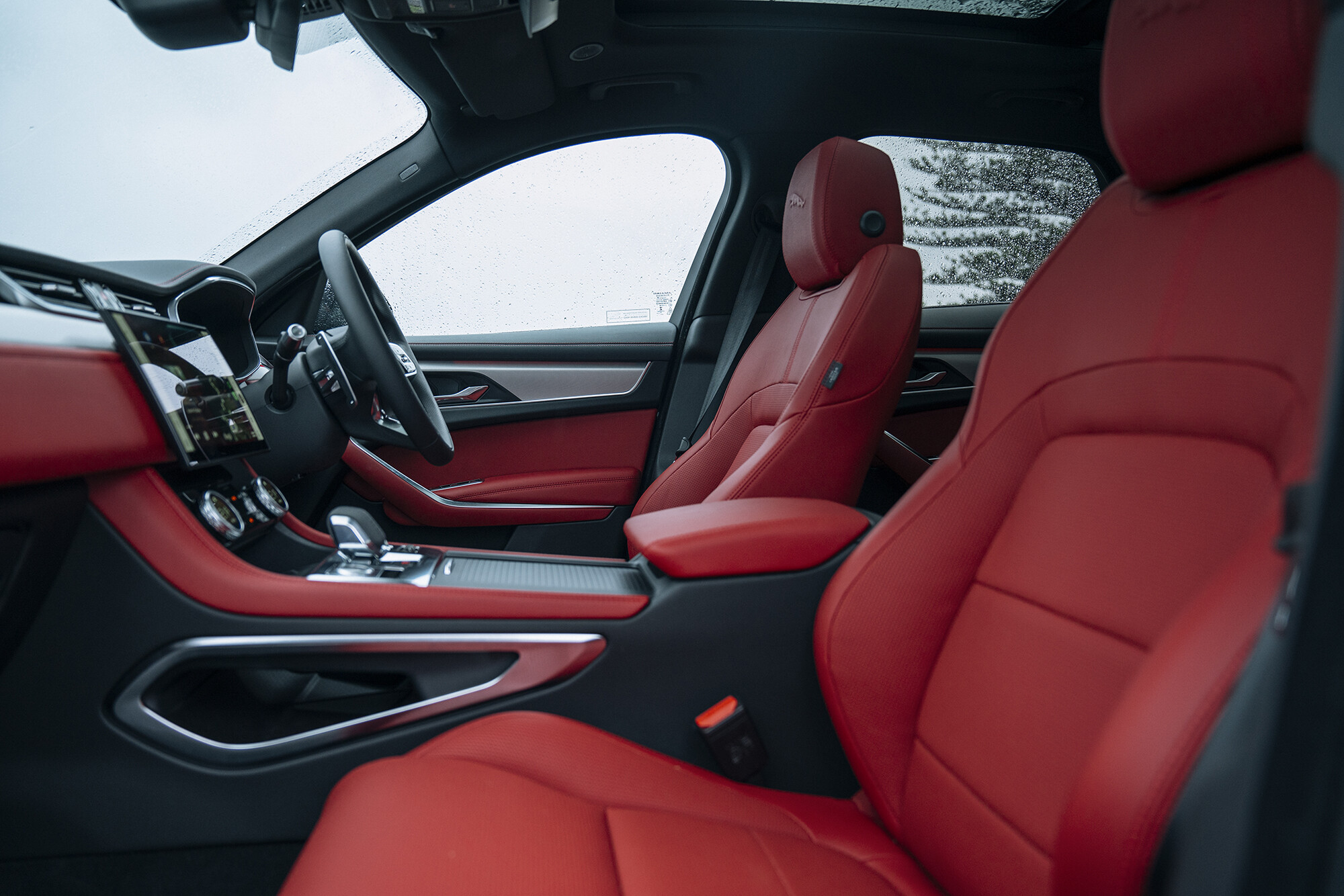
Equipment new to the 2021 F-Pace range includes LED headlights, powered tailgate and configurable cabin lighting. The steering wheel is all-new and has integrated controls for the sound system, cruise control and trip computer. There are bigger pockets in the doors and a hidden storage area under the centre console.
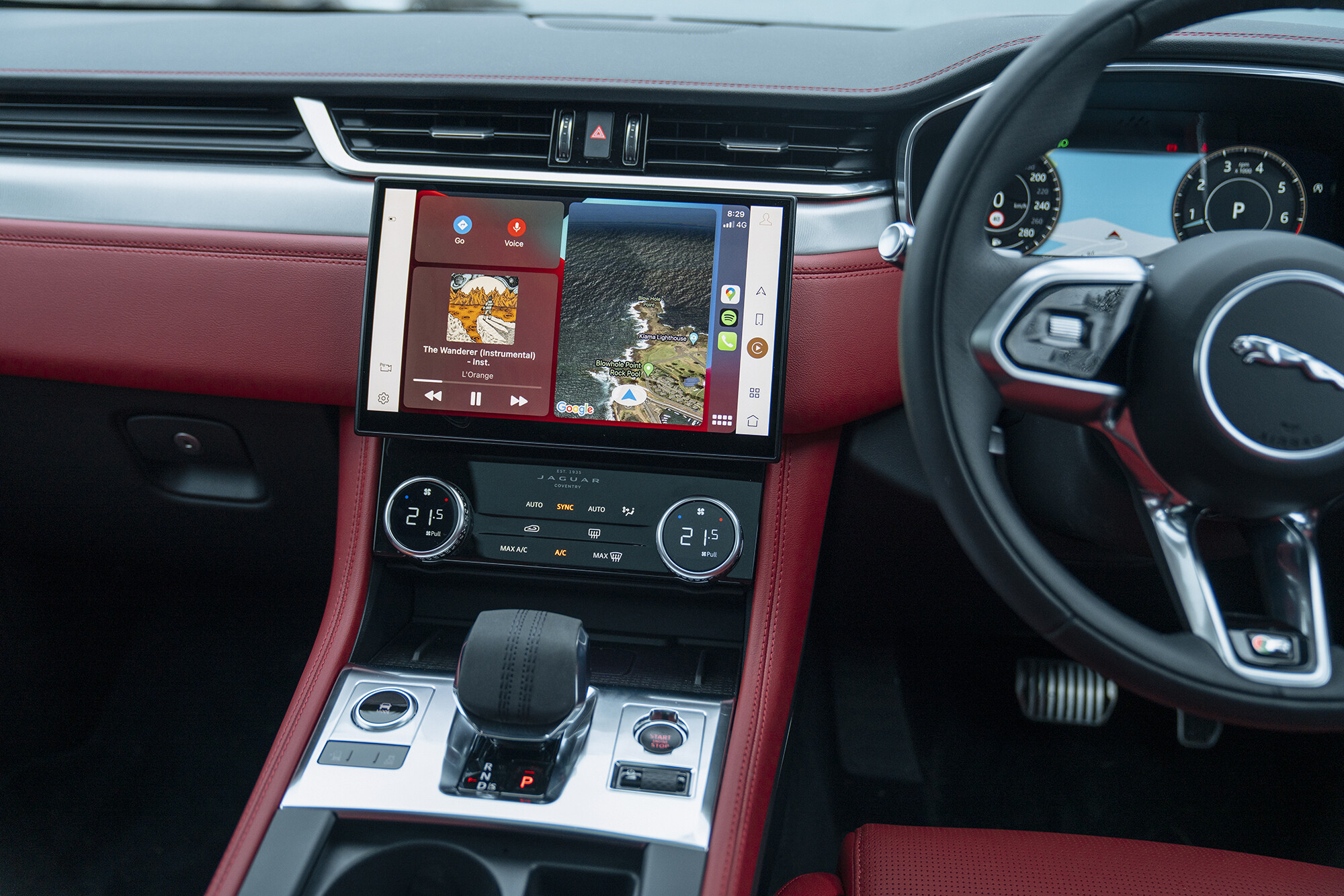
The all-new Pivi Pro infotainment system which is standard in all models features an 11.4-inch curved touchscreen which incorporates digital radio with Apple Carplay and Android Auto, and an optional wireless phone charger.
It also features Over The Air (OTA) updates similar to a smartphone, which means owners could get new features as they become available without having to go to a dealership.
Active Noise Cancellation is also a part of the new Pivi sound system, standard on HSE models, a $1560 option on others. This system uses microphones inside the cabin to identify unwanted sounds like road rumble and wind noise, and pumps sound waves out through the sound system’s speakers to reduce or nullify those sounds.
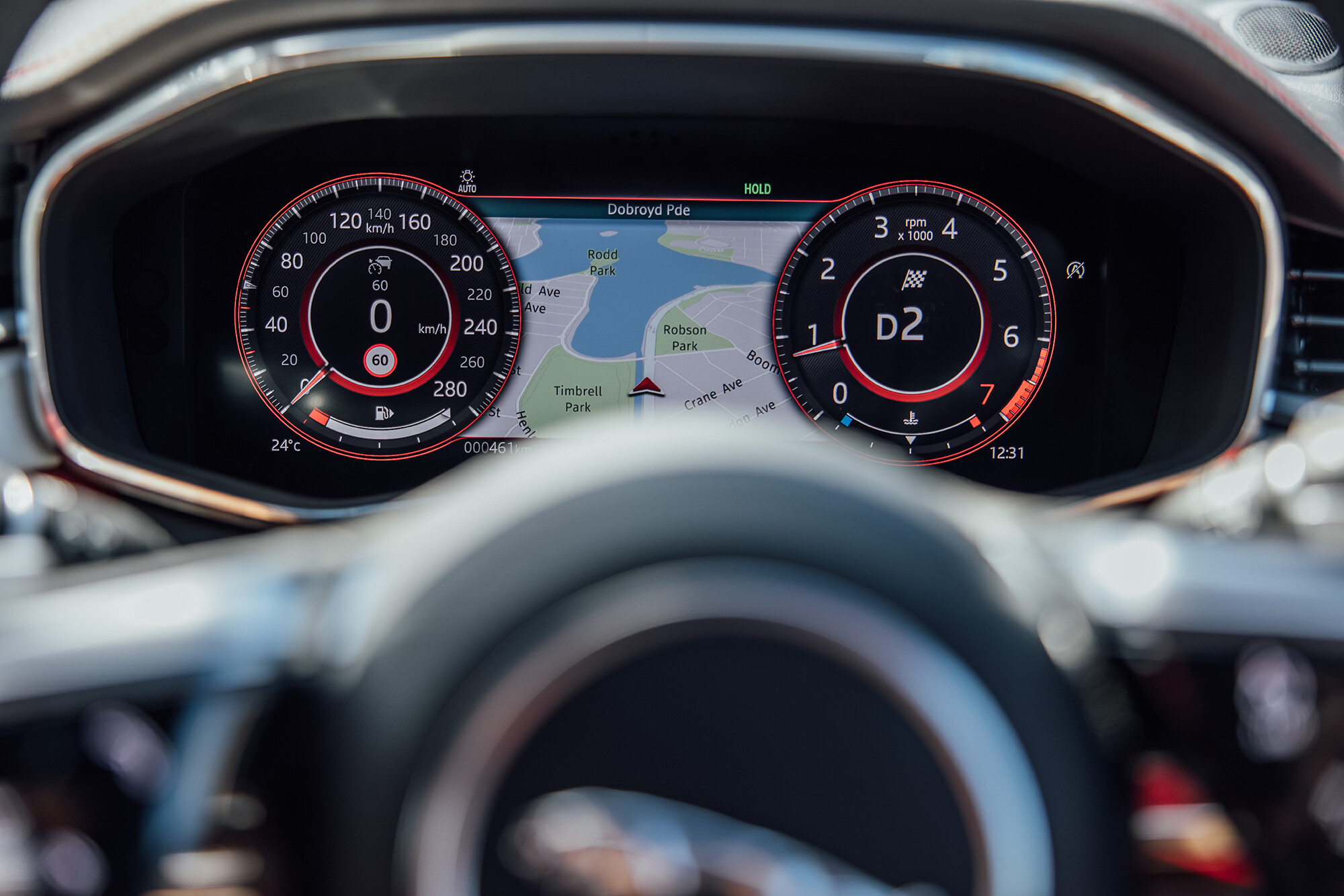
Jaguar has also enhanced the active safety features on the F-Pace. Adaptive Cruise Control, Blind Spot Monitoring, Rear Collision Warning, Rear Traffic Monitor, Traffic Sign Recognition and Adaptive Speed Limiter are now standard on all models.
It’s not clear whether ANCAP will want to test the 2021 Jaguar F-Pace given the two new engines under the bonnet, or carryover the MY2016’s five-star safety rating which included 93 per cent score for occupant protection.
All F-Pace models have electrically adjustable front seats, and the steering wheel adjusts for reach and rake. Dimensionally nothing has changed externally, which means the F-Pace’s internal space remains the same as before.
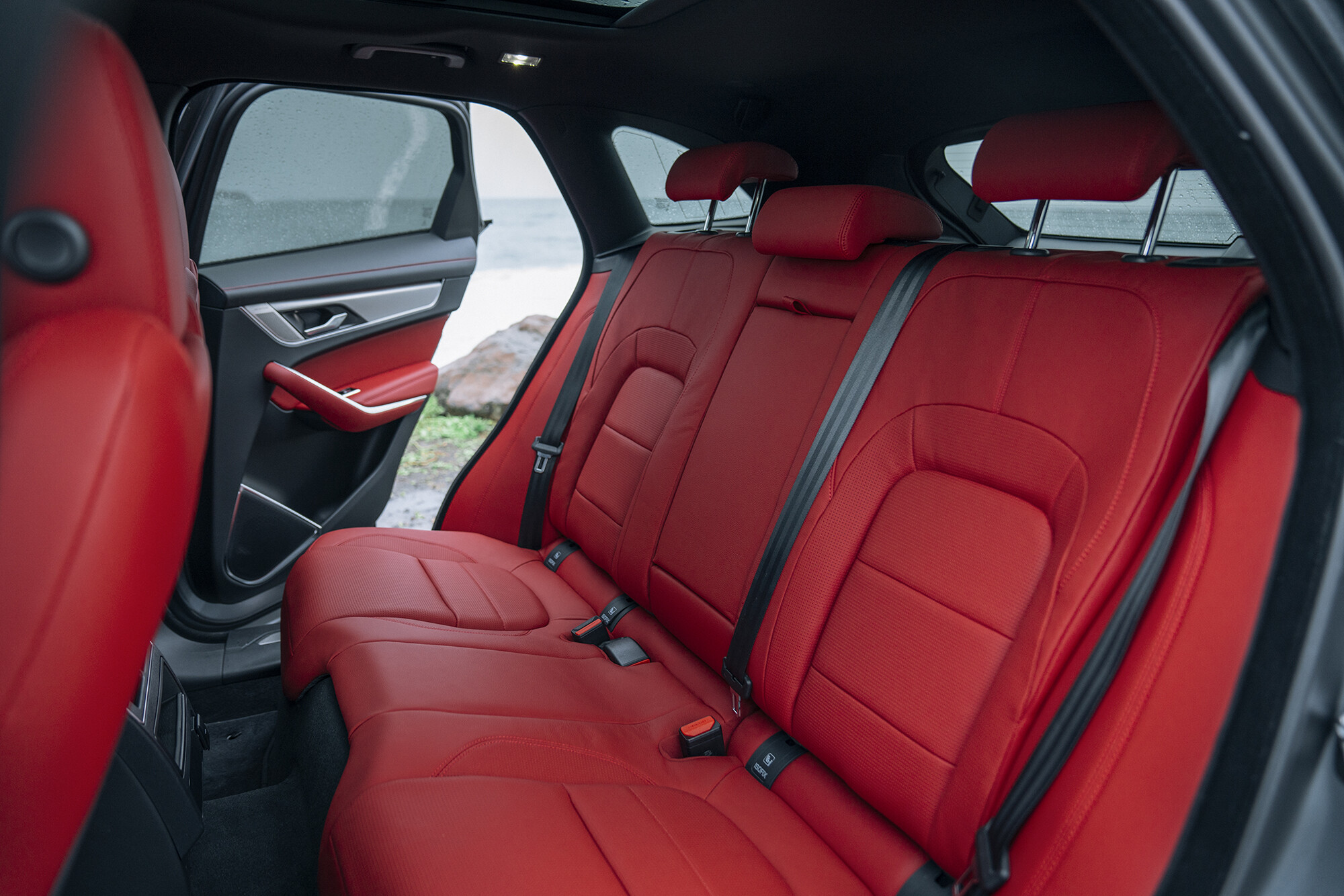
There is sufficient room in the back seat for two adults comfortably, and three at a pinch. Boot space is a minimum of 755 litres.
The second F-Pace model is the mechanically identical P250 SE variant costing $80,854. It uses the same petrol engine as the S, so justifies its higher price with heated mirrors, high beam assist, 20-inch alloy wheels, 16-way adjustable front seats, an electrically adjustable steering column and an interactive driver display in the infotainment system.
Next up is the only diesel in the F-Pace range, the D300 SE, priced at $96,194, which features all the same equipment as the P250 SE but obviously has the more powerful and more economical diesel engine.
Then comes the P400 SE priced at $98,654 and specced similarly to the D300 SE.
The top cat of the F-Pace range – for now – is the P400 HSE, priced at $110,404, or a price jump of $11,750 over the SE. For that you get the high-tech Meridian sound system, premium interior materials, heated and cooled front seats, and 21-inch alloy wheels with larger 380mm front brakes.
Later this year Jaguar will return the F-Pace SVR to the range.
This fire-breathing SUV is the performance king of the crop, boasting a supercharged 5.0-litre V8 petrol engine (405kW/700Nm) that catapults the SVR from 0-100km/h in four seconds flat. Fuel economy is rated at 11.7L/100km (272g/km). We’ll report more on that model when it arrives in June.
MORE: Read and watch our 2021 F-Pace review here MORE: F-Pace news and reviews MORE: Everything Jaguar
Isuzu Ute Australia (IUA) has jacked up the price of its popular D-Max ute as of today, due to rising manufacturing costs.
The increase will apply to anyone buying a car from the entire 2021 D-Max line-up from April 1, with every variant up an extra $1000 across the board.
The Japanese marque has confirmed anyone who has already placed an order prior to April 1 will not be affected.
According to the automaker, the cost of making the third-generation D-Max is behind the hike, which will see RRPs increase by between 1.58 and 3.1 per cent across the range.
Defending the rise, Koichiro Yoshida, Isuzu UTE Australia’s director of sales and marketing, said: “IUA has not taken the decision to increase pricing lightly and has deeply considered all options.
“But, in lieu of increasing costs associated with the 2021 Isuzu D-Max we see no option but to implement this price increase.
“While pricing for the 2021 Isuzu D-Max range will increase by $1000 per vehicle from April 2021, we are working diligently with our Isuzu UTE Dealer Network to ensure that all existing customer orders already in the system prior to the price increase announcement will be honoured at the agreed price.”
Key models in the product line-up will, however, continue to be offered with fixed drive-away price, including the Isuzu D-MAX SX Single Cab Chassis 4×2 High-Ride Manual, priced at $29,990 driveaway, and the Isuzu D-Max X-Terrain 4×4 Auto, priced at $59,990 drive-away.
2021 Isuzu D-Max pricing
- D-MAX SX Single Cab Chassis 4×2 Manual – $33,200 ($29,990 Drive-away)
- D-MAX SX Single Cab Chassis 4×2 Automatic – $35,200
- D-MAX SX Crew Cab Chassis 4×2 Automatic – $41,700
- D-MAX SX Space Cab Ute 4×2 Automatic – $39,900
- D-MAX SX Crew Cab Ute 4×2 Automatic – $42,900
- D-MAX LS-U Crew Cab Ute 4×2 Automatic – $49,900
- D-MAX SX Single Cab Chassis 4×4 Manual – $41,200
- D-MAX SX Single Cab Chassis 4×4 Automatic – $43,200
- D-MAX SX Space Cab Chassis 4×4 Manual – $44,700
- D-MAX SX Space Cab Chassis 4×4 Automatic – $46,700
- D-MAX SX Crew Cab Chassis 4×4 Manual – $47,700
- D-MAX SX Crew Cab Chassis 4×4 Automatic – $49,700
- D-MAX SX Crew Cab Ute 4×4 Manual – $48,900
- D-MAX SX Crew Cab Ute 4×4 Automatic – $50,900
- D-MAX LS-M Crew Cab Ute 4×4 Manual – $52,000
- D-MAX LS-M Crew Cab Ute 4×4 Automatic – $54,000
- D-MAX LS-U Space Cab Ute 4×4 Automatic – $54,900
- D-MAX LS-U Crew Cab Ute 4×4 Manual – $55,900
- D-MAX LS-U Crew Cab Ute 4×4 Automatic – $57,900
- D-MAX X-TERRAIN Crew Cab Ute 4×4 Automatic – $63,900 ($59,990 Drive-away)
MORE: D-MAX stories MORE: All Isuzu stories
BMW has just unveiled its new ‘My BMW’ app for Apple and Android devices, and it’s promising a better mobile experience for users.
Replacing the current ‘BMW Connected’ app, which will still be operational until June 30, My BMW will offer a new design, contemporary interface and an overall better experience, says the automaker.
BMW has designed and developed the app from the ground up completely in-house and says it has learned from behaviour patterns and listened to feedback from consumers to ensure this new app ticks all the boxes.
There will be three tabs at the heart of the new My BMW app – Vehicle, Map, and Profile – and all the information in these tabs can be individually configured quickly at the user’s discretion.
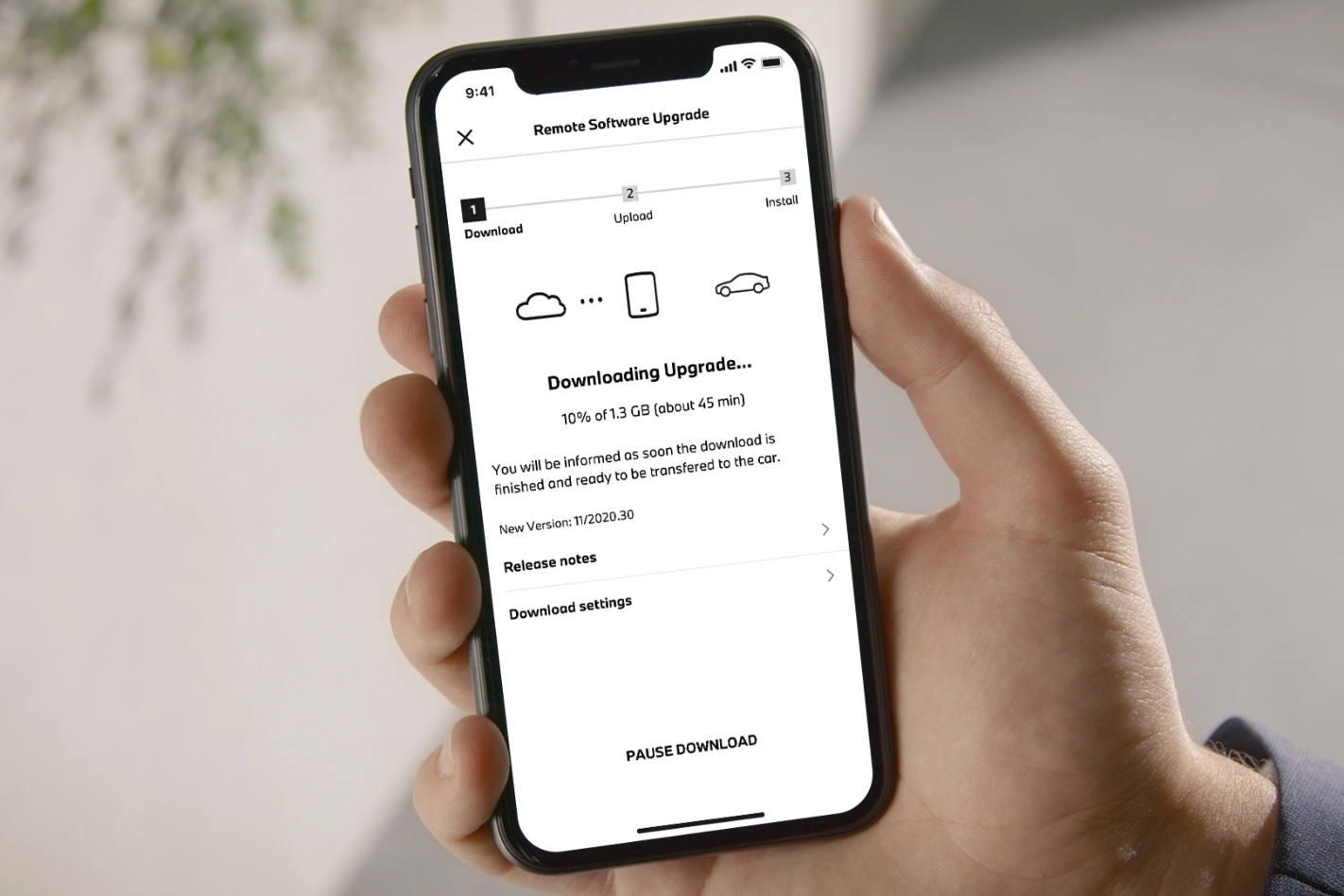
BMW owners will also be able to add a photo of themselves to their profiles, which can then be displayed on the infotainment screen of vehicles running BMW Operating System 7.0.
And for owners with BMW battery electric vehicles or plug-in hybrid electric vehicles, the app will also show unique data about the vehicles’ batteries.
A charging history feature will even let owners know when and where their vehicles were last charged and how long the charge took, as well as if there were any energy tariffs incurred juicing up the batteries.
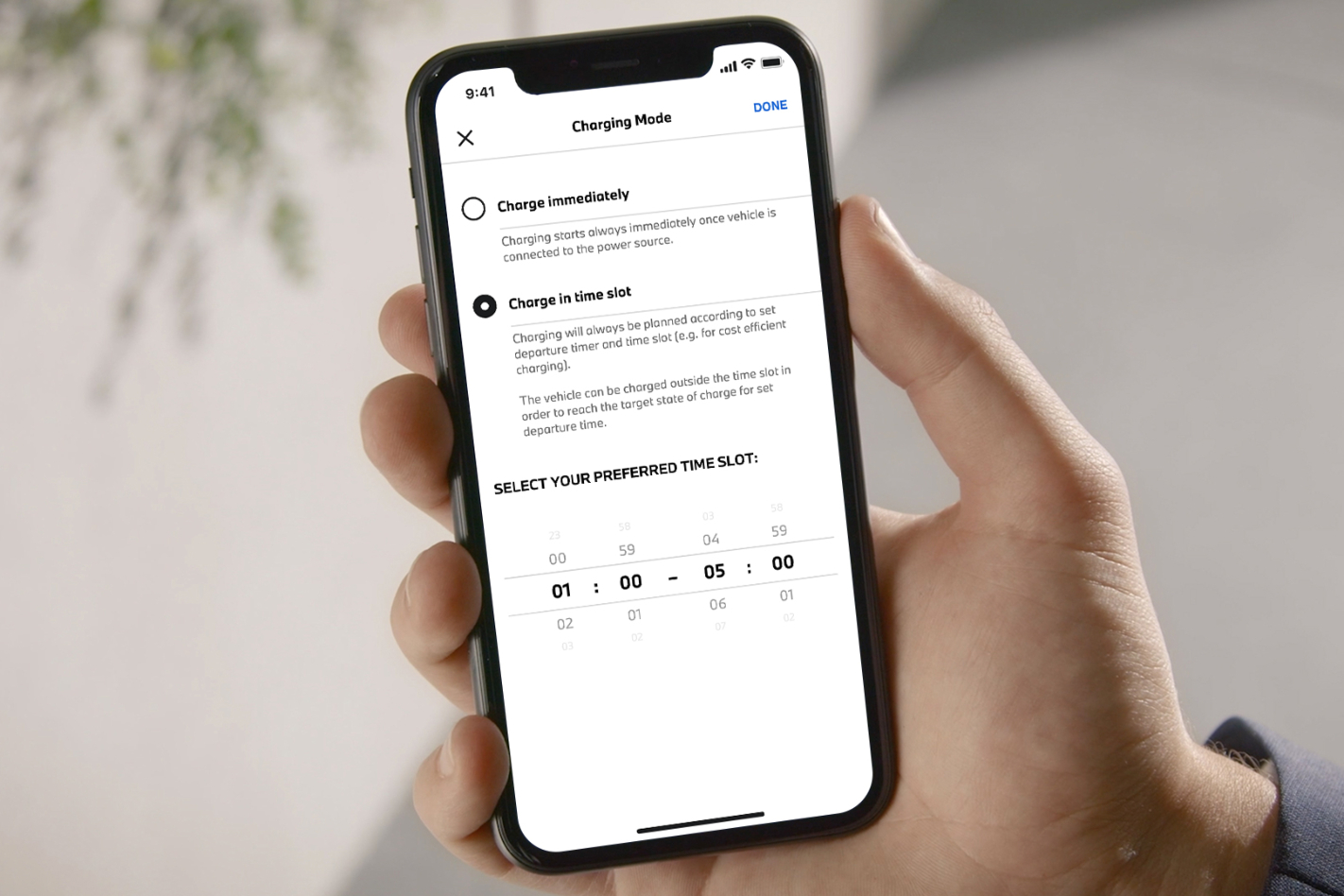
The new app will also feature popular elements of the outgoing BMW Connected app, such as allowing owners to lock and unlock their vehicles, flash the headlights and ventilate cabins.
The German automaker has also created a new user ID system that aims to streamline logging into different BMW services such as the ‘BMW Driver’s Guide’ app and the BMW Shop.
My BMW can be downloaded for free right now on Apple’s App Store and Google’s Play Store.
DO YOU KNOW what a Lexus LC500 is? Sure, some of you might be able to picture the car, and a smaller subset might even have an idea of the asking price, but I’d be surprised if many of you otherwise well informed readers could pin down exactly what sort of car it is other than a big coupe. And that’s it’s problem.
The old LC500 coupe always had a bit of an identity issue. For the most part, it was too aggro to be a properly wafty GT coupe, so never really cut it as a half-price Bentley Continental GT. On the other hand, there were plenty of rivals for its $200k asking price that were better at surgically dissecting a set of twisties. That it could do both tasks acceptably well wasn’t enough of a drawcard. Now Lexus offers the LC500 as a convertible.
Under the bonnet is the same 4969cc 32-valve V8. The same Yamaha-tuned cylinder head, dual-length intakes, titanium inlet valves. The same ability to switch between conventional Otto and efficient Atkinson cycles by holding the intake valves open during the initial stage of the compression stroke. In short, it’s a delightfully exotic piece of engineering and anything with this powerplant is fundamentally worthy. That’s a good start.
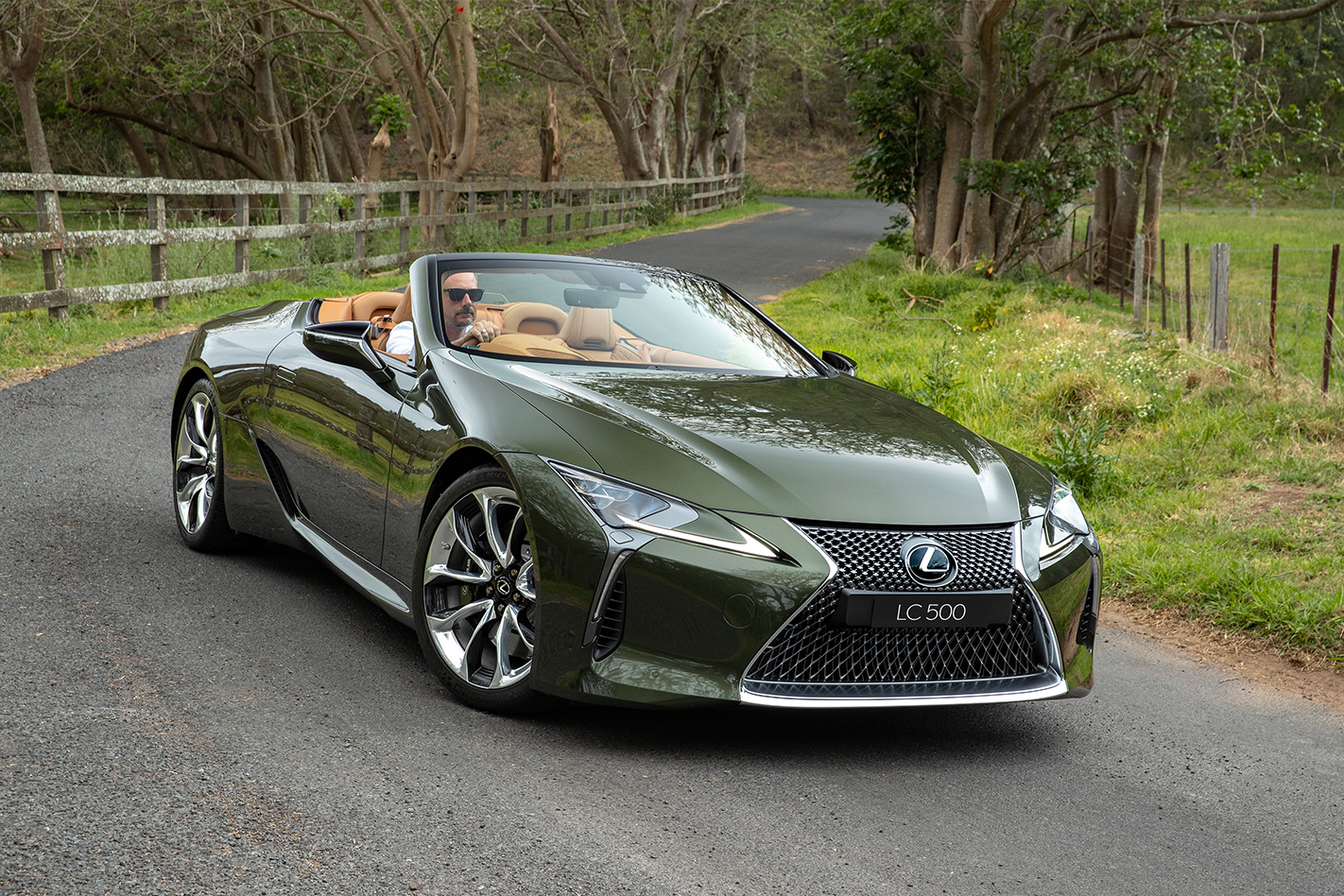
In order to assess a convertible, it helps to drop the roof and I’m not sure how to do this. It’s a point of pride among road testers that we can figure most things out, and there have only been two occasions in the last few years where I had to give up and consult the manual because I’d run out of ideas.
The first was trying to pair a phone to a Lexus LC500 when its bank of saved devices was full, sitting in a rainy car park in a slough of despond, wondering how MARTIN GRUNDLE IPHONE and six of his cohorts had this figured out and I didn’t. The second was trying to drop the hood on this LC500 convertible. What’s more, having seen the solution, I could have owned this car for a year and never figured out where the switch was.
After scouring every part of the console, lower dash, steering wheel, roof and even the infotainment system, the manual notes that the hood mechanism was located beneath the cushioned palm pad just aft of the track pad. To access it, you flick down a button on a rear sliding cubby, then hook your finger beneath the palm rest and flip it forwards, revealing the hood switch and the master switch for the windows.
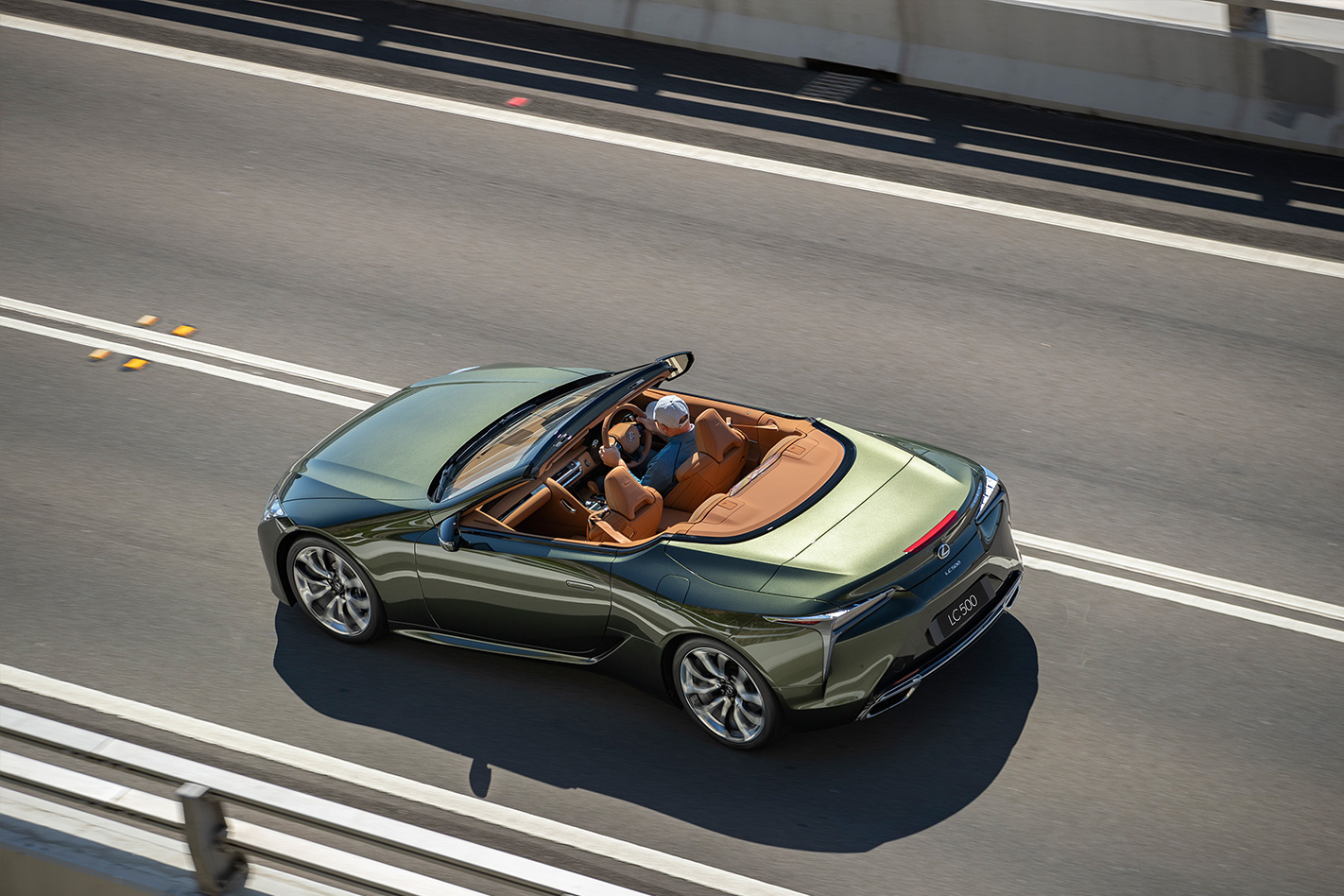
So beautifully engineered are the chunky metal hinges that there’s zero play in it and the fit is so perfect that you’d never think the pad was a lid just by feel. It’s such a gloriously Lexus solution; slightly oddball but engineered like nothing else.
The four-layer hood itself takes a relatively brisk 15 seconds to raise or lower and operates at speeds of up to 50km/h, taking that moment of mild panic out of stop-light operations. It’s a relatively compact arrangement which allows for the packaging of roof, vestigial rear seats and 149 litres of boot space. Lexus claims that there’s 11mm less headroom for front seat passengers than the coupe, but even taller drivers won’t struggle for room here. The seats are mounted low, and there’s a stack of adjustability for both seat and steering column, but given the overall length of this rakish cabrio, your hip point, as a result, tends to be surprisingly far forward.
There’s not a great deal of storage space in the adventurously styled cabin, and both you and your passenger will have to fight over the modest single cupholder. Most of the touchpoints are extravagantly finished in leather and solid-feeling metal, although the fat column stalks feel disappointingly mainstream. The infuriating infotainment system at least now features smartphone mirroring so that you can bypass the worst excesses of its native interface. The 13-speaker Mark Levinson stereo fitted is one of the best in any production car.
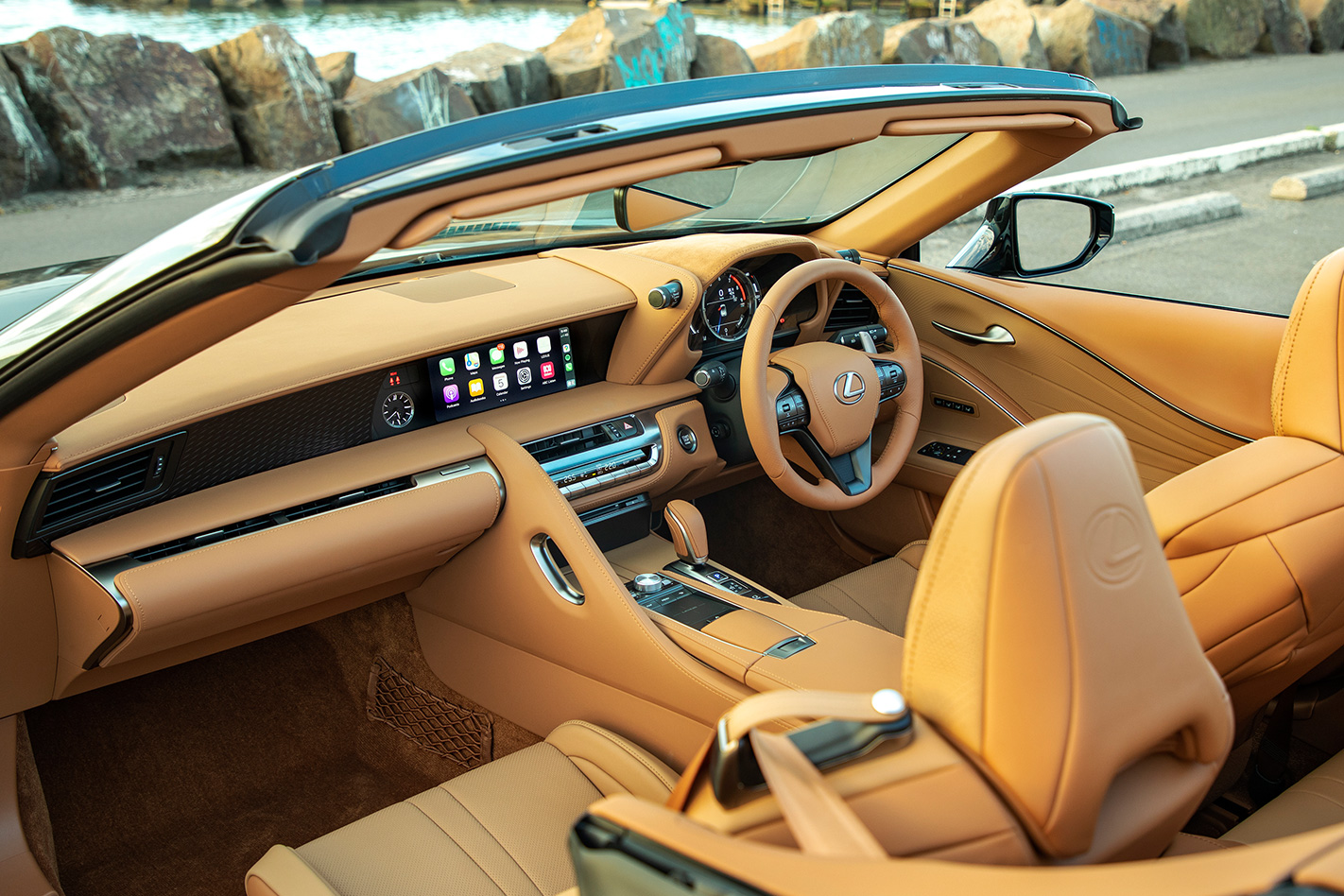
Hood up, road noise is insulated almost as well as the coupe. What’s more, the car looks pretty good with the roof up, the squat turret looking not unlike that of the old Aston Martin V8 Vantage drop top.
Hood down, the tiny rear wind deflector only works to around 60km/h so there is more buffeting than in some rivals, but a ‘Climate Concierge’ system knows when the hood is down and automatically directs warming air to your neck.
Stung by criticism from some quarters that the old LC was too firm for the GT role and too soft to be a convincing sportster, Lexus has revised the suspension setup. The heroic 21-inch Michelin Pilot Super Sport tyres, extra rigidity in the rear anti-roll bar and reduction in unsprung weight would appear to focus the vehicle’s dynamics a little more but Lexus has balanced that with a smoother damping stroke.
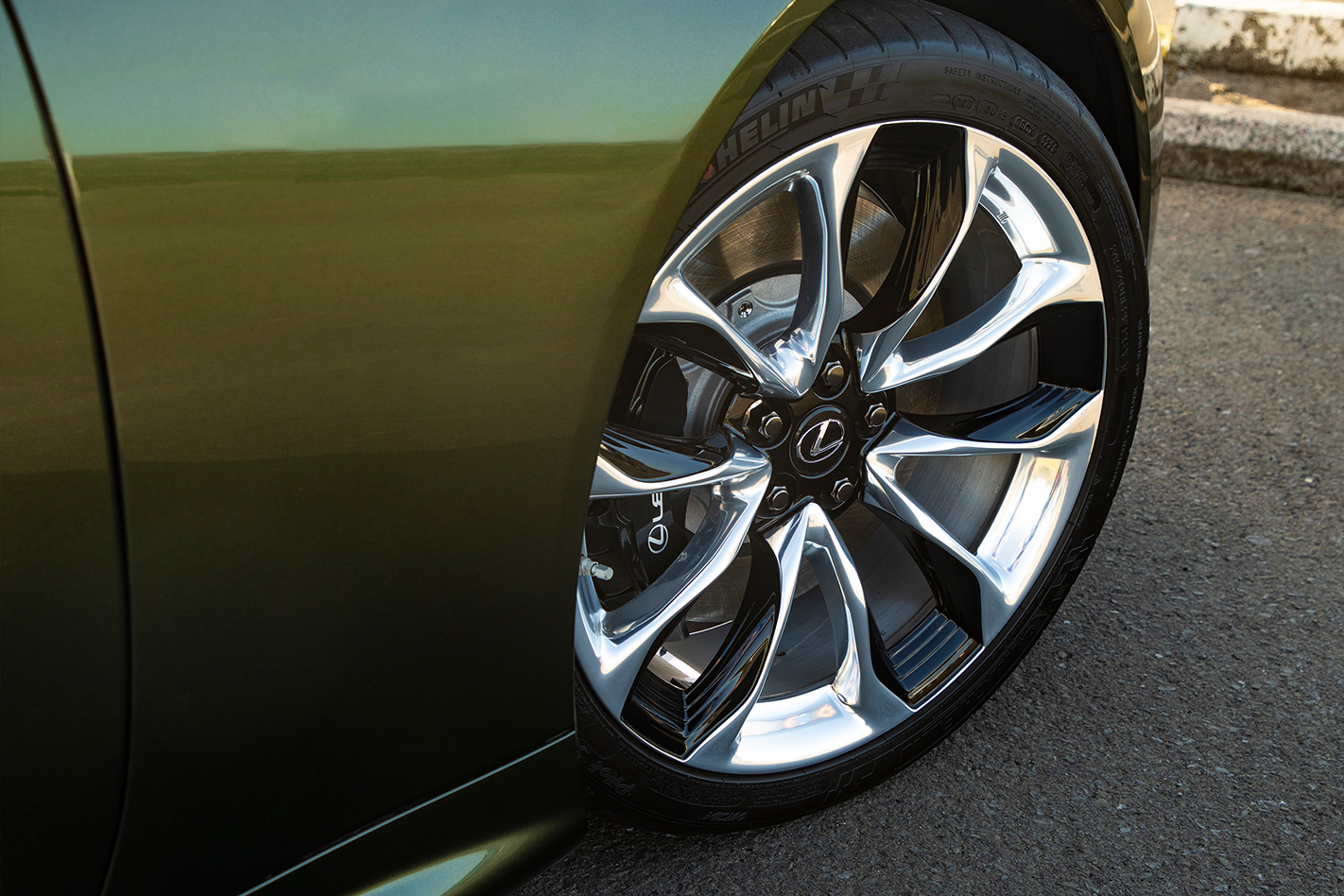
Use of aluminium componentry has removed weight from the suspension structures and Lexus has wisely traded that for additional chassis bracing. As a result, this drop top is acceptably stiff in torsion and ride quality in comfort mode is acceptable but never limo-like. At 2035kg though, you have some significant mass that needs shifting in any given plane.
Up the pace and body control goes to pieces a little, so switch into Sport S+, attempt to flick the gear lever into manual mode without snagging neutral and you can then ping up and down through the ratios with respectable composure. One advantage of a ten-speed box is that second gear will run into the 7200rpm redline at 108km/h, with third still legal in the 5000rpm+ fun zone.
It’s an acoustically rich engine, building seamlessly to an extravagant crescendo before butting the limiter with a staccato rat-a-tat more reminiscent of the GAU-8 cannon fitted into the front of an A-10 tankbuster. It’s a shame that peak power is reached within 100rpm of the redline, because you’ll find that rev limiter pretty often. Despite the aural payback, it never gathers speed at a truly hedonistic rate, so it feels eminently useable on road.
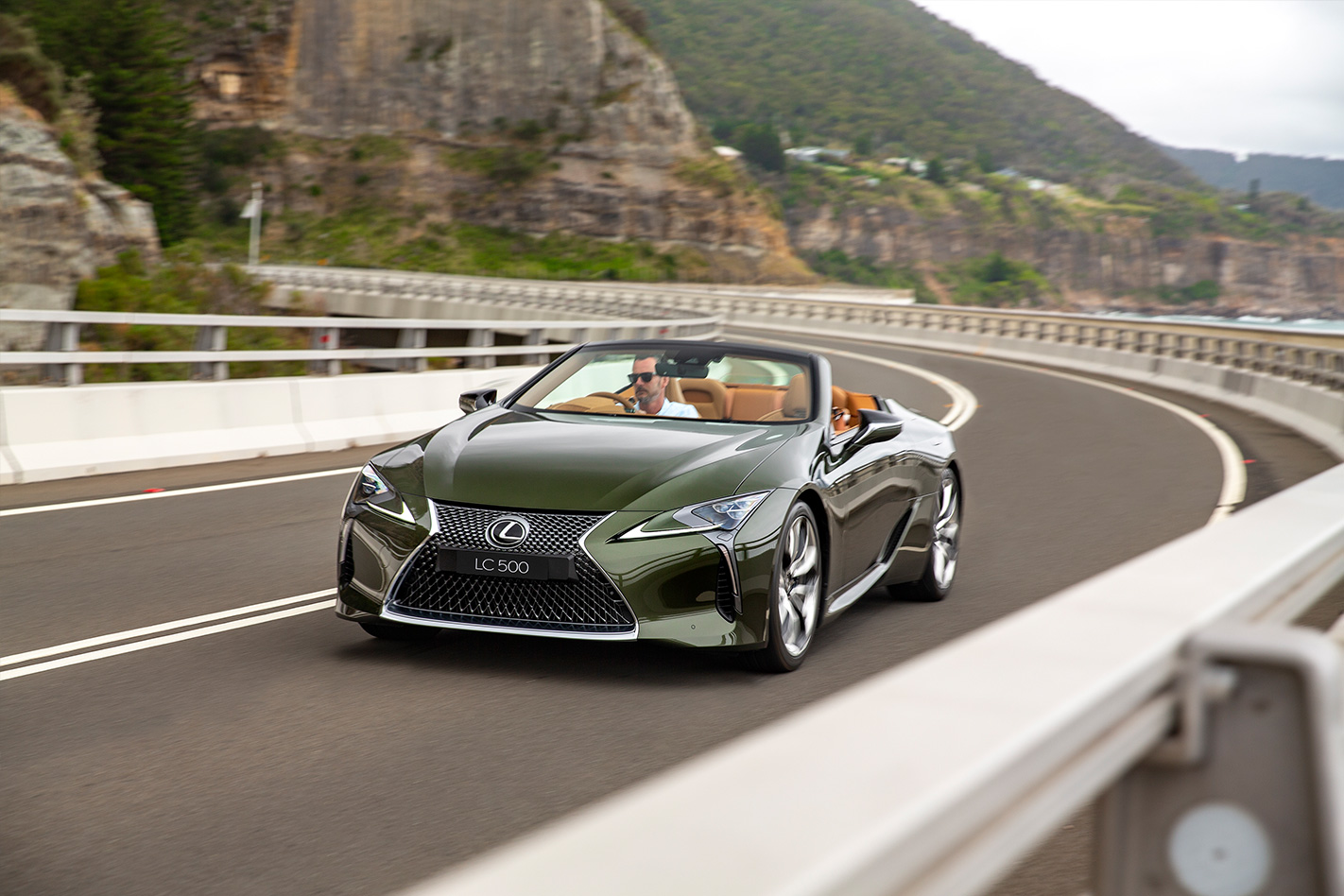
The Lexus LC500 Convertible emerges as something intriguingly removed from the mainstream. It’s charming, interesting and would be extremely easy to live with, thanks in part to Lexus’ after-sales care package. Ownership nets you three years of the new Encore Platinum Owner Benefits, which includes a pick-up-and-delivery for servicing and Lexus on Demand so you can just jump into another Lexus model at dealerships and major airports.
A good looking, charismatic convertible that’s effortless to drive and which runs a smoothing hand over the petty annoyances of car ownership? There’s a lot to like about this LC and what’s more, it might just make more sense than the coupe. Never thought I’d hear myself say that.
2021 Lexus LC500 Convertible specs
Engine: 4969cc, V8, DOHC, 32v Power: 351kW @ 7100rpm Torque: 540Nm @ 4800rpm 0-100km/h: 5.0sec (claimed) Weight: 2035kg Price: $214,000
%MCEPASTEBIN%
Just rarely, a car is launched that is so revered that it creates a huge headache for its manufacturer. We examine 10 instances where car makers asked “how the hell do we replace this?”
Jaguar XJ-S | 1975-1996
The E-Type was an icon of the swinging ’60s. The XJ-S had it tough from day one
FEW LEGENDS cast longer shadows than Jaguar’s iconic E-Type.
In fact, it wouldn’t be a particularly invidious debating position to argue that the company has never adequately replaced it.
Many worthy coupes and roadsters have appeared in the interim but none have had the sheer arresting impact of the E-Type, nor its ability to transcend its original purpose quite so magically.
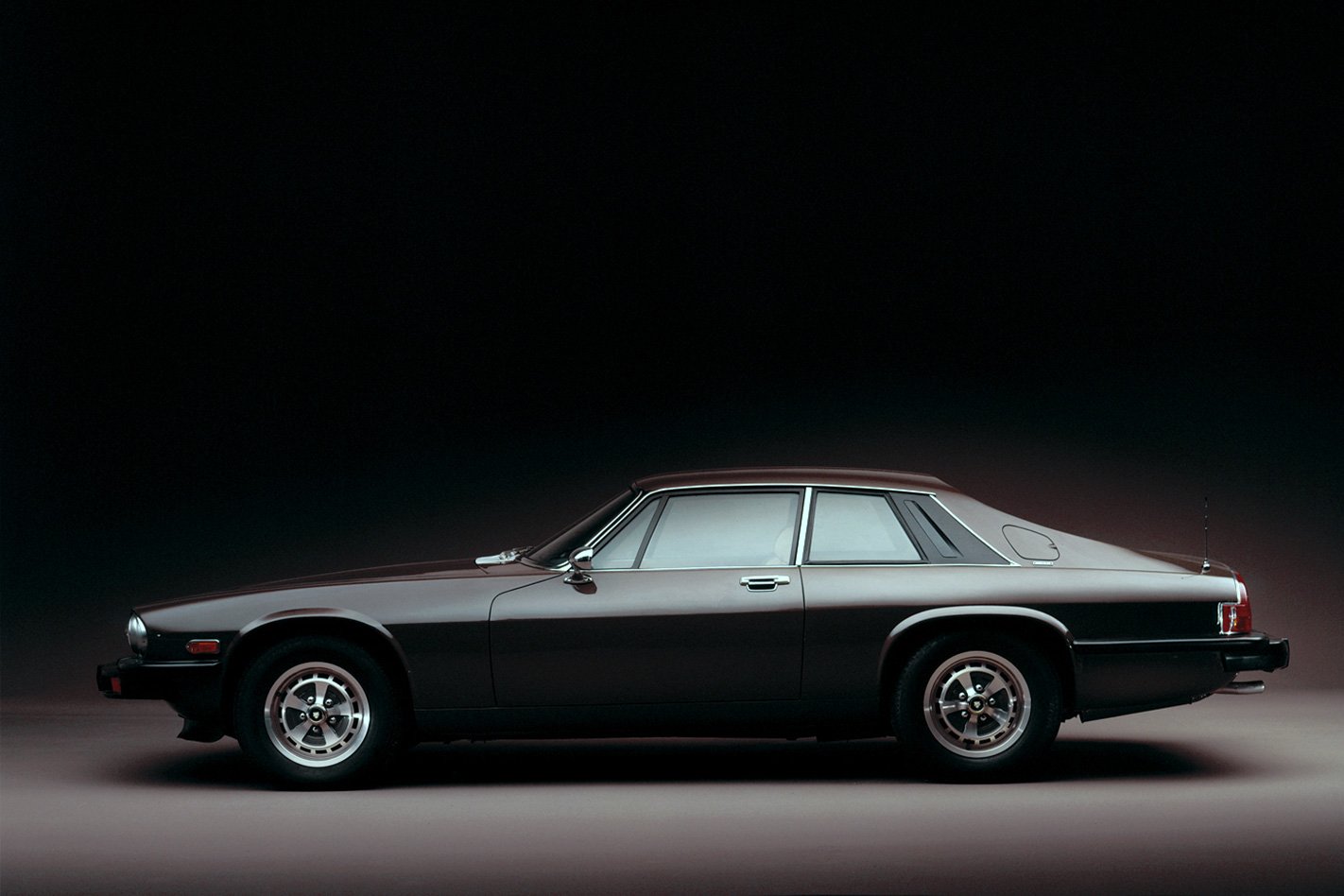
Eminent Jaguar historian Philip Porter encapsulated the issues faced by the E-Type’s successor, the XJ-S, almost perfectly in his 1996 book Jaguar XK8: “No one could deny that the XJ-S was technically excellent, but it committed one cardinal sin, especially for a Jaguar. It lacked great beauty. Compare it with the XK120 and the E-type – Jaguar threw away all of its wonderful styling heritage. It may have been a factor that by this time [Jaguar boss, Sir William] Lyons was of advancing years and [designer, Malcolm] Sayer was not a fit man – he died in 1970 at the age of only 53.
“The last E-types rolled off the production line in 1974 and after a brief hiatus the XJ-S appeared in 1975. The reception was a rather embarrassed silence. This was unprecedented for a Jaguar. I remember the day well, and I remember the great disappointment.” Porter never forgave the XJ-S for its dereliction of duty to gratuitous pulchritude, but it appears the buying public were a good deal more accepting.
The XJ-S enjoyed a 21-year production run of some 115,413 cars. That certainly compares favourably to the E-type’s total production of 72,233 in 13 years. That works out at 5496 XJ-S units per annum and an almost identical 5556 E-Types every 12 months. If Jaguar’s intention was to replicate the sales success of the E-Type, then the XJ-S was certainly no failure.
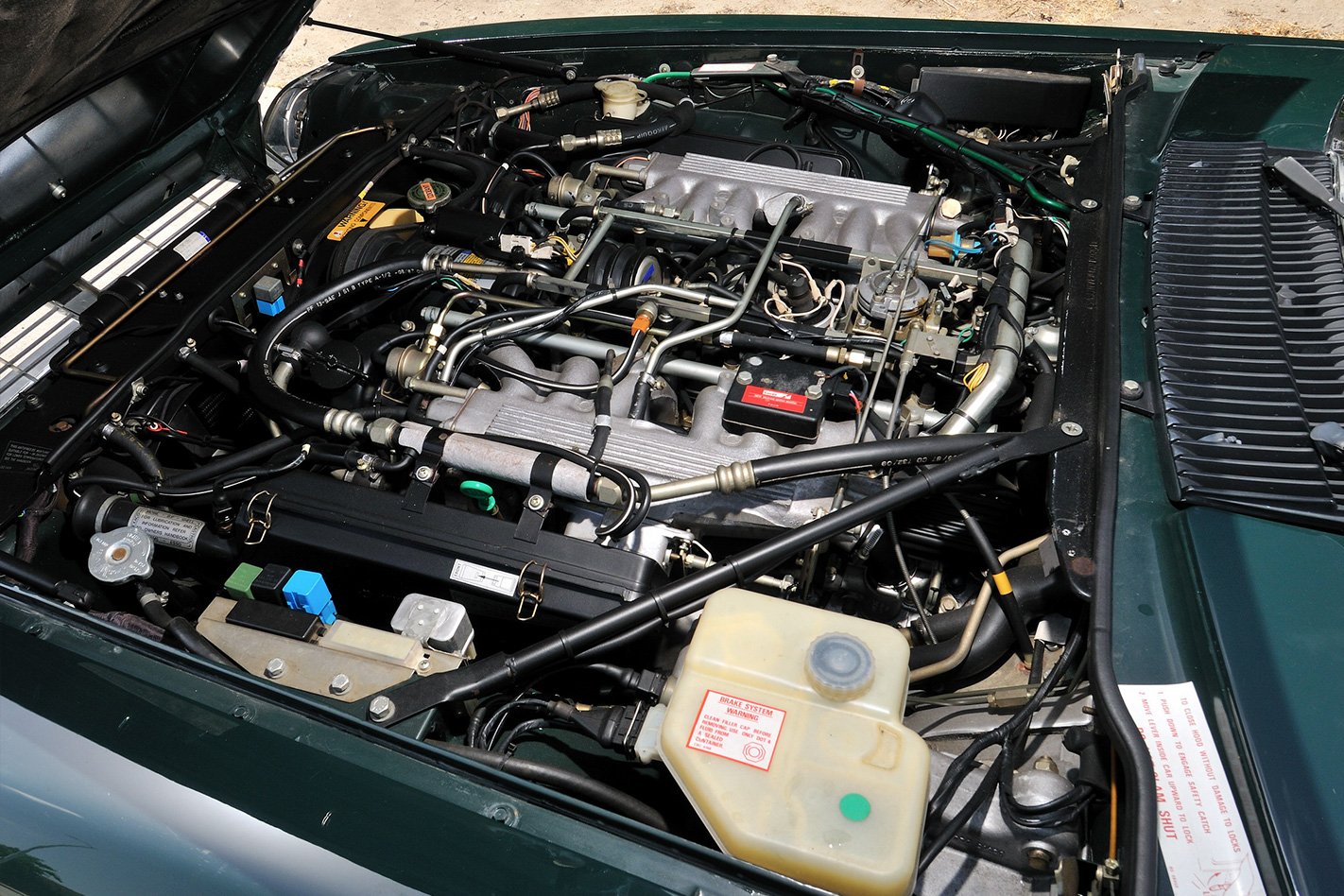
There is one key difference to note here though. Whereas the E-Type became less pure, less desirable and less current, the steady process of diminution never affected the XJ-S. In fact, the XJ-S steadily improved throughout its lifetime, with its best sales year arriving in the relative twilight of its production run, 1989 seeing 10,665 units roll from the Browns Lane plant.
The XJ-S also adheres to a particularly Jaguar stylistic arc, namely that the company seems to become hidebound by certain design themes before radically changing the script. The XJ-S did it in 1975, followed in turn by Geoff Lawson’s 1996 XK8 coupe and cabriolet and Ian Callum’s XE sedan in 2007, the latter finally shedding the legacy of the XJ’s outdated design language.
The XJ-S had an extremely long gestation, much of which was due to Jaguar being unable to afford its development. Work started in 1966 on a GT, based on E-Type underpinnings, and on the 9th of September 1968, Sayer sent a memo to Lyons proposing a 2+2 based on the then-new XJ6 saloon’s chassis, the very car whose development bills had forced Jaguar to merge with BMC.
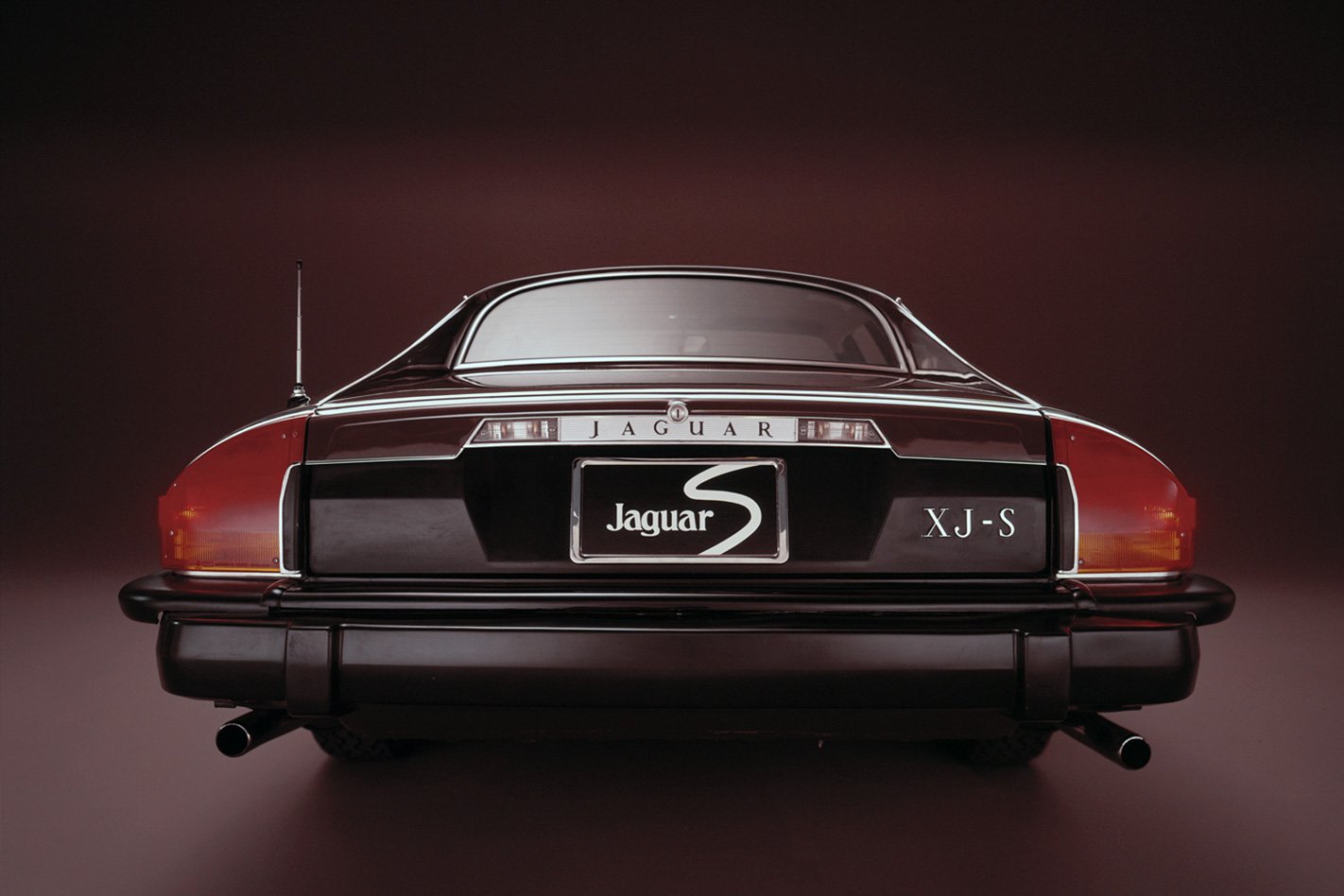
Jaguar’s financial travails proved fortunate. The production XJ-S would have been doomed were it to have run on an E-Type chassis that dated back to 1961. Jaguar’s most durable coupe might have been divisive back then, but it’s hard to argue against it now.
The icon: 1961
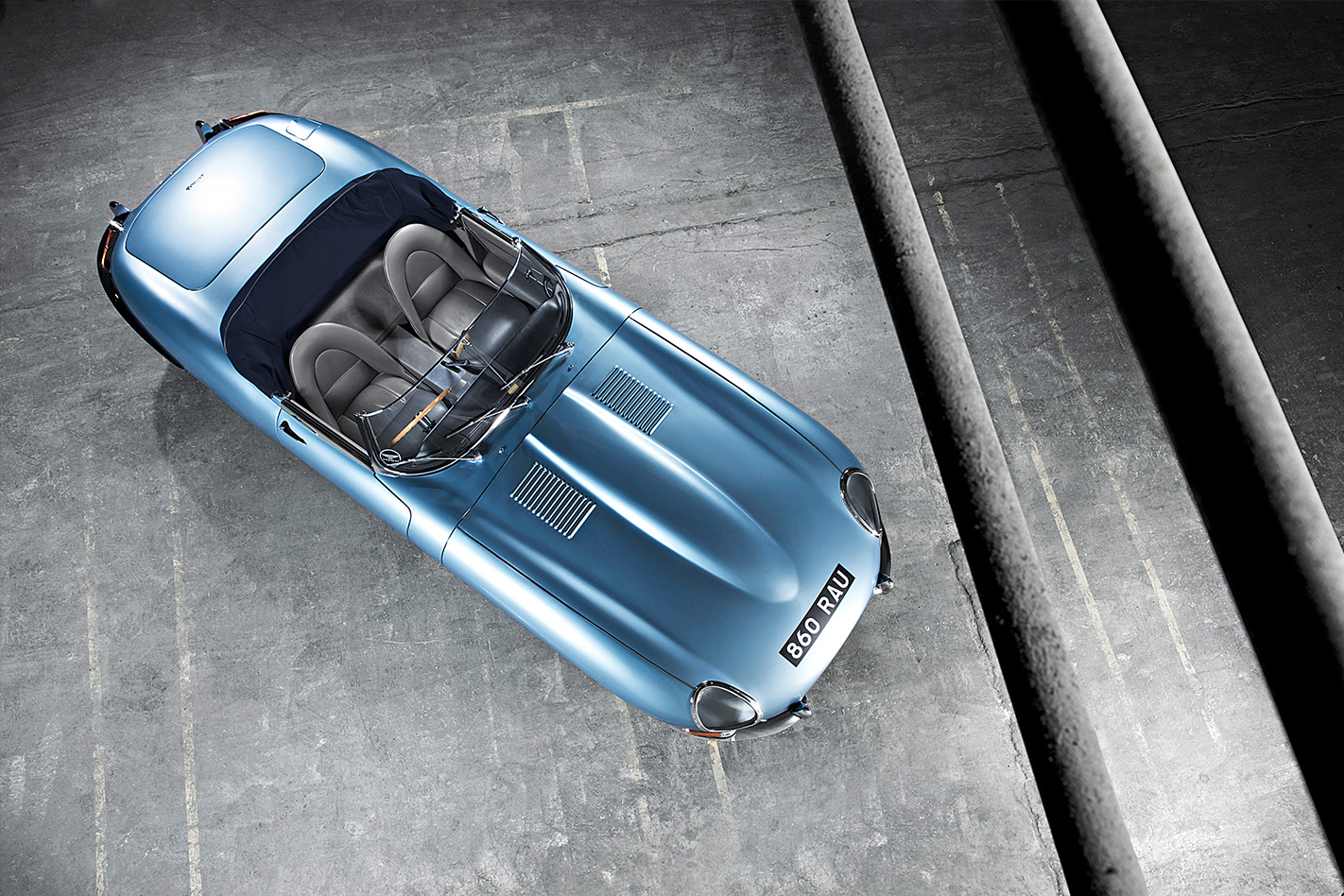
The most beautiful car ever made?
That was how Enzo Ferrari famously dubbed the Jaguar E-Type upon its introduction in 1961. Celeb owners like Frank Sinatra, Brigitte Bardot, George Best and Steve McQueen seemed to agree.
Three reasons the E-Type rocked
1. It did 240km/h. Sort of. Jaguar hoodwinked the world with its creative approach to testing 2. Jaguar built just 12 Lightweight cars in ‘63-’64, and followed with six more in 2015 3. All E-Types featured an independent rear end and four-wheel disc brakes
Toyota Australia is recalling more than 200 vehicles nationwide – because they were sold with the wrong sticker on them.
The manufacturer is contacting owners of 141 Toyota Landcruiser 200 VX and Sahara variants built between 2015 and 2019 as they’ve got the wrong compliance label fitted.
According to the recall notice, the labels claim the seating capacity of the vehicles – sold between October 20, 2015 and December 18, 2019 – is eight, when in fact it’s just seven.
Additionally, the notice states that the Japanese marque is also recalling 74 Toyota Hilux 4×2 Hi-Riders built between 2019 and 2020 for also having inaccurate compliance labels.
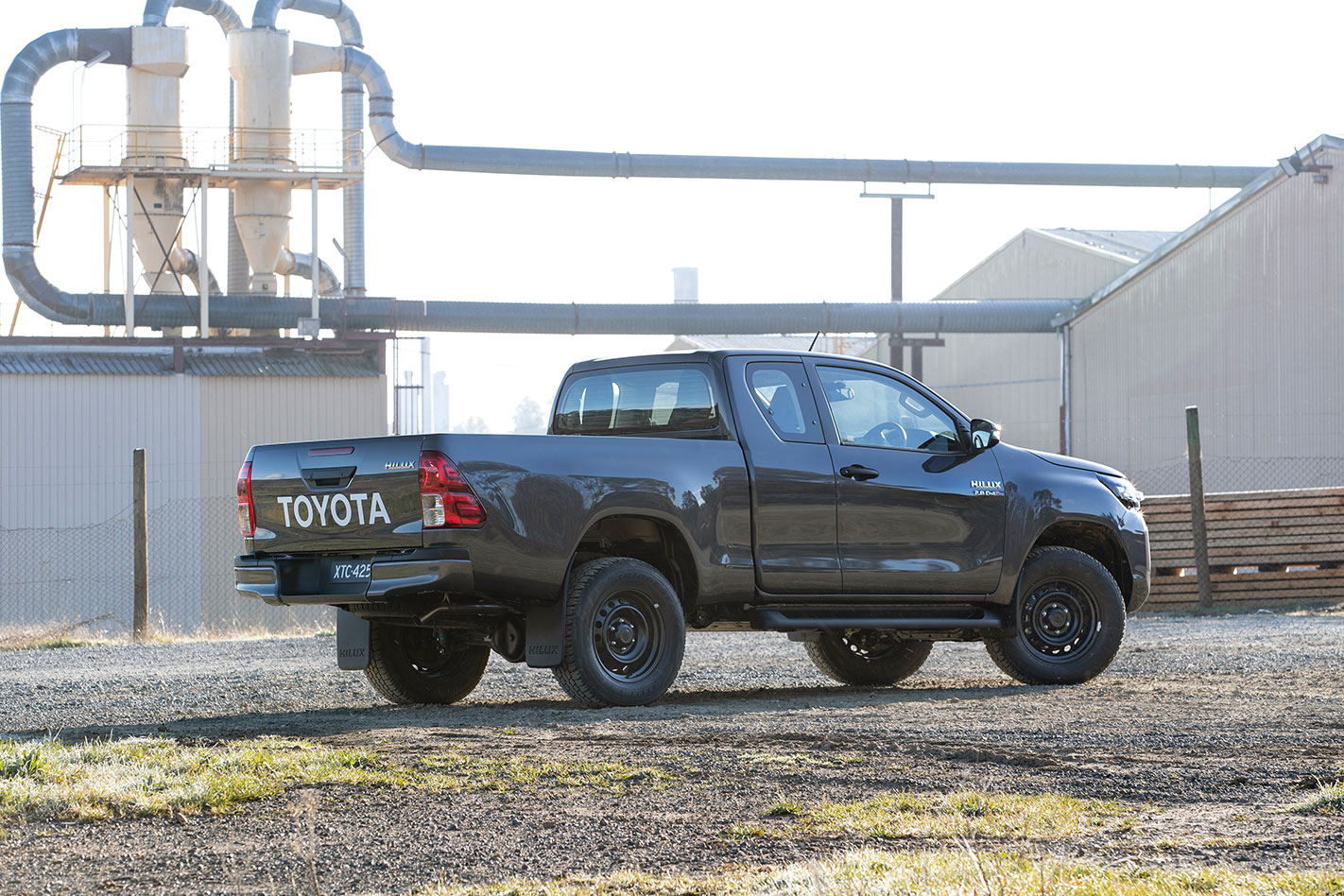
The Hilux 4×2 Hi-Rider sticker claims the Gross Vehicle Mass (GVM) capacity of the ute is 2850kg, when actually it’s a touch more capable, at 3050kg – a benefit for owners who can now carry a larger payload than they previously thought.
Toyota will get in touch with owners to make an appointment at an approved Toyota dealership to grab a free replacement label.
The Product Safety Australia website has a Vehicle Identification Number (VIN) list of all affected Landcruiser, Sahara and Hilux variants.
For more information, contact the Toyota Recall Assist helpline on 1800 987 366.
MORE: Landcruiser 200 news and reviews MORE: HiLux news and reviews MORE: All Toyota stories
UPDATE, April 1: Renault Australia has officially joined the Ateco Group today after announcing earlier this year it would be switching away from a factory operation.
Under the Ateco Group banner, the French marque joins LDV, Maserati, RAM Trucks and Upfitter in Australia, alongside Alfa Romeo, Fiat, Jeep, Maserati and RAM in New Zealand.
The Renault business will be led by Glen Sealey, former Chief Operating Officer (COO) of Maserati Australia and New Zealand, who claims the brand has an exciting model line-up coming over the next few years.
“We have just launched the All-New Captur – so our job in the short-term is to maximise the potential of these models in Australia,” he said.
“Product will always be key. The launch of the All-New Captur marks the start of a product offensive from Renault, not just in terms of new vehicles but drivetrains, too. Renault is well positioned to capitalise on the rising EV trend once it’s strongly adopted in Australia.”
Neville Crichton CNZM, Founder and Executive Chairman of the Ateco Group, added the deal is a significant milestone in the history of the company.
“History shows we usually initiate the presence of automotive brands in Australia, but this is the first time in over 30 years we have taken on an established OEM – we’re delighted to welcome Renault Australia to the Ateco Group,” he said.
The story to here
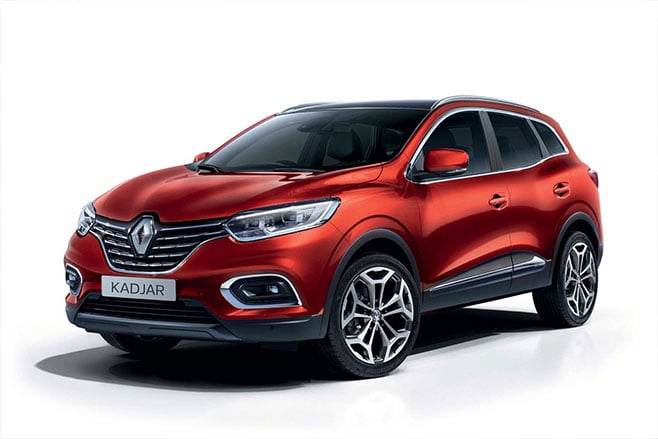
February 4: Renault Australia will relinquish its factory status from April 1, with the French brand’s limited model range to fold into Ateco Group, one of Australia’s largest independent car importers.
Confirming the news on February 4, local Renault boss Anouk Poelmann – who had previously run the Peugeot and Citroen brands under distributor Inchcape – said the existing network of around 60 dealers will remain unchanged.
”This announcement by Groupe Renault secures Australia’s future as an import market,” Poelmann said.
Sydney-based Ateco Group has a storied history of vehicle importation into Australia, holding at various times the licence to import brands like Alfa Romeo, Suzuki and even Audi.
It currently imports Maserati and Chinese commercial brand LDV, as well as distributing locally re-engineered RAM pick-up trucks.
As part of today’s announcement, Ateco owner Neville Crichton said: ”We have a strong track record in successfully building and managing world-renowned automotive brands locally. This announcement enables the Renault brand to stay in Australia and allow its customers to continue enjoying the same high levels of service they have come to expect from one of the world’s leading automotive brands.”
Despite a long history in this country that can be traced back to 1903, Renault has struggled to gain a foothold in the modern Australian market, even after hatching big plans in the mid part of last decade to ramp its annual sales up to 20,000 units a year.
However, the plans – which included the potential addition of a Nissan-sourced dual-cab ute – never came to fruition.
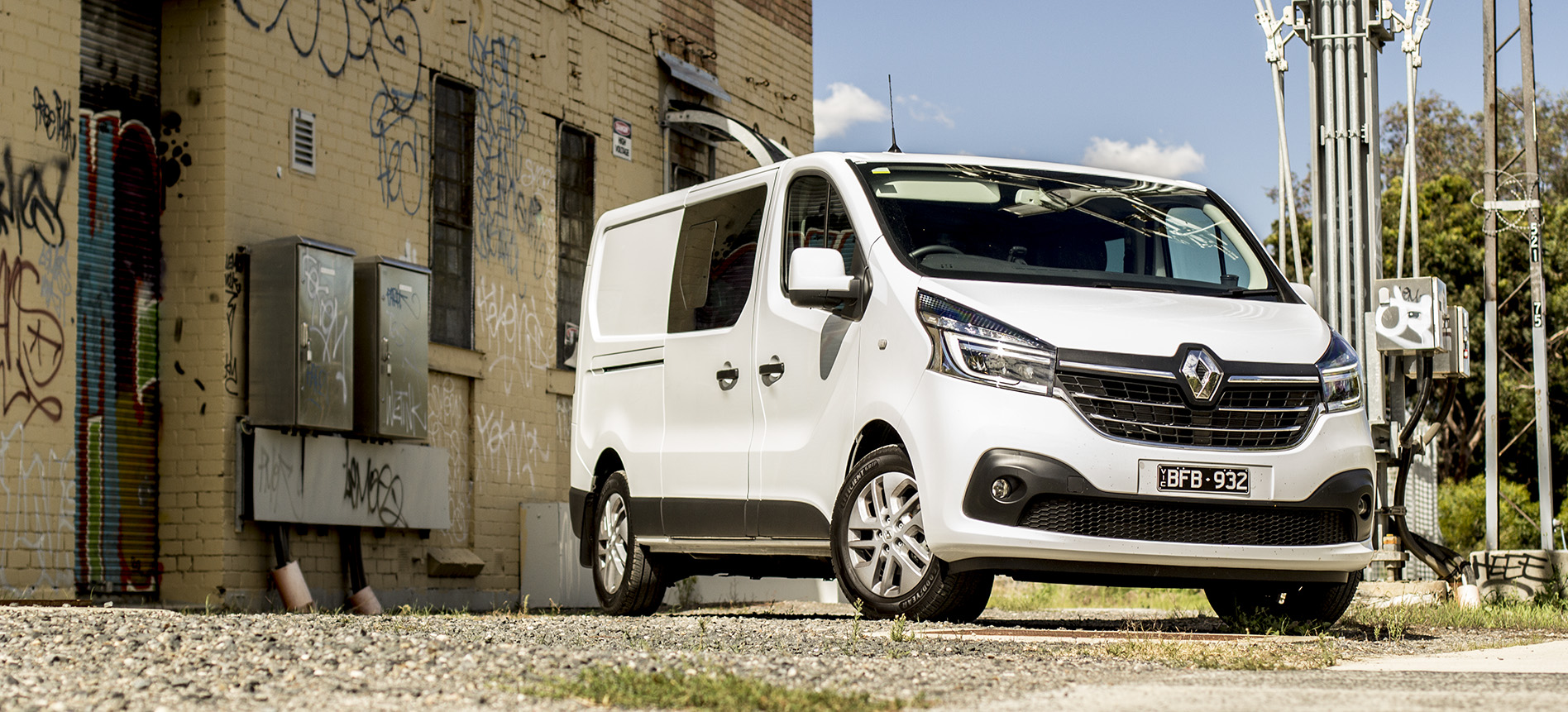
Instead, Renault has wound back its offerings over the last 18 months, dropping the Clio hatchback, Zoe electric hatch and Megane hatchback (excluding R.S. models) from the line-up on the way to posting a sales figure of just over 6900 cars and vans for 2020, in a market of 1.5 million new car sales.
Its best-ever result came in 2015, where it sold a shade over 15,000 cars.
The best-selling vehicle for Renault at present is the mid-sized Koleos SUV, while the medium Trafic (below) and large Master commercial vans outsell the small Kadjar SUV and Megane hot hatch.
The future management and communications structure of the Renault brand in Australia has still to be confirmed, but the company says it will offer more detail when the business transition is finalised in April.
Jaguar Land Rover (JLR) is increasing its new car warranty to five years and unlimited kilometres from April 1 – and that’s no April fools joke.
The new five-year warranty, announced at the Australian launch of the MY 2021 Jaguar F-Pace SUV this week, replaces the previous three-year, 100,000km warranty on all new Jaguar, Land Rover and Range Rover vehicles sold in Australia and New Zealand.
It makes the Indian-owned British brand’s warranty equal best with Mercedes-Benz in the premium class. Mercedes was the first to move to five years, back in March 2020.
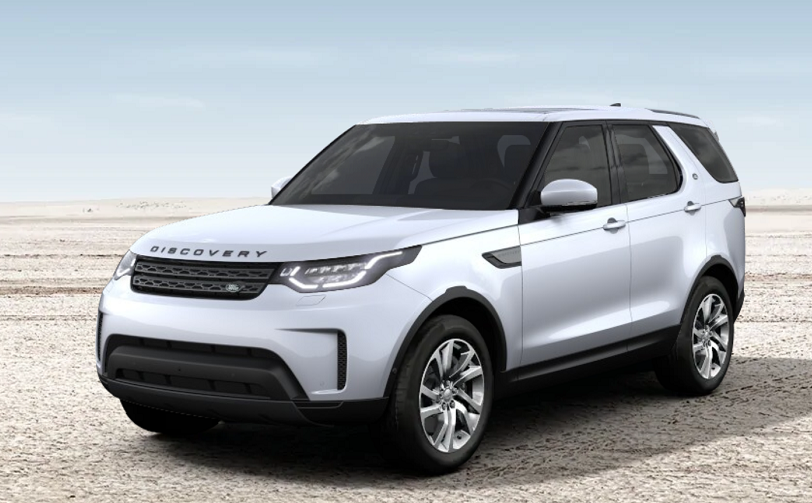
Lexus offers a four-year warranty to new vehicle buyers, and Audi and BMW provide three years coverage. When contacted by Wheels, none of those brands have any intention of matching JLR and Mercedes-Benz.
However, BMW’s position today is less emphatic than it was a year ago when Mercedes-Benz jumped to five years. When asked back in 2020 if it would also offer a five-year warranty, a BMW spokesman said: “The feedback we’ve got from customers is that they are entirely content with what we offer…our customers are not demanding anything more [than three years]”.
The response in 2021 is: “We have no plans to change at this point.”
This is not the first time Jaguar Land Rover has offered a five-year warranty on its new vehicle range. JLR first offered a five-year warranty as a sales promotion just after Mercedes-Benz introduced its five-year warranty in April 2020, and has repeated the promotion at times throughout 2020.
Now, JLR has decided to make it permanent.
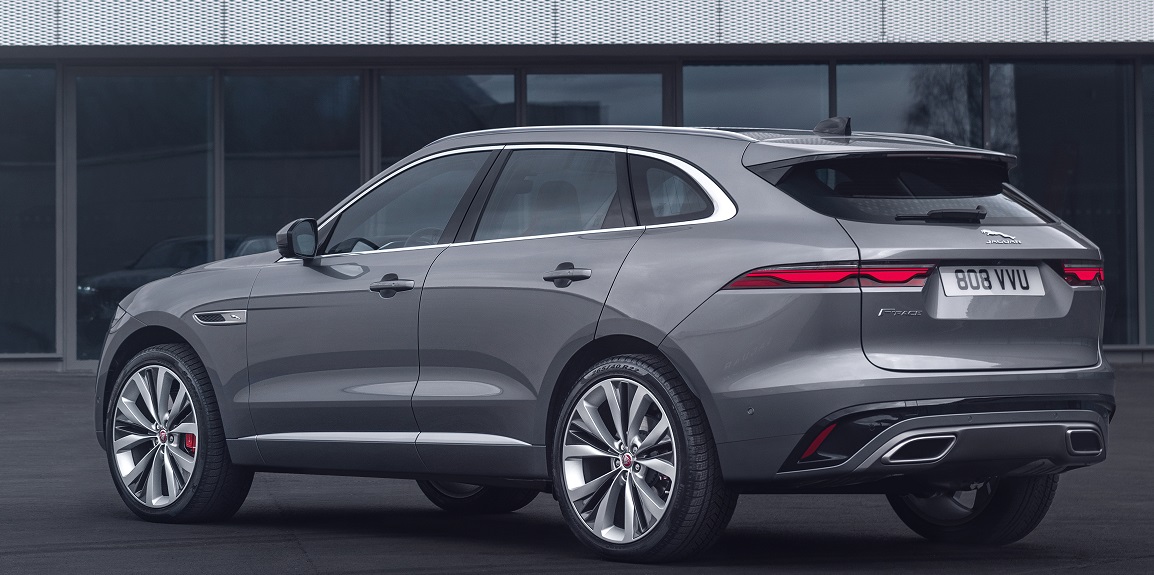
“We are proud to be able to offer our Australian customers such an extensive warranty,” said JLR Australia managing director Mark Cameron.
“We have worked extremely hard at developing the extended warranty for the Australian market and I believe the increased length of the warranty period, plus unlimited kilometres, will deliver an even more enjoyable ownership experience for Jaguar buyers.”
The new warranty applies to all Jaguar, Land Rover and Range Rover vehicles purchased for private and business use, including the Jaguar I-Pace electric SUV which previously carried a five-year, 200,000km warranty. The warranty on I-Pace BEV’s traction battery remains at eight years and 160,000km.
JLR also confirmed that the five-year warranty applies to all genuine accessories fitted at the time of new car purchase.
All JLR models carry a six-year anti-corrosion warranty for panels.
