
We don’t make a habit of bringing modified cars to PCOTY. While there is precedent with Peter Dichiera’s CSVs about 20 years ago, in recent years our main event has been on OEM-only affair. So what changed?
The obvious muscle car entrant this year was the Ford Mustang R-Spec, but the combination of that car’s heat sensitivity and this year’s contest being held in the height of summer was unlikely to be a happy one.
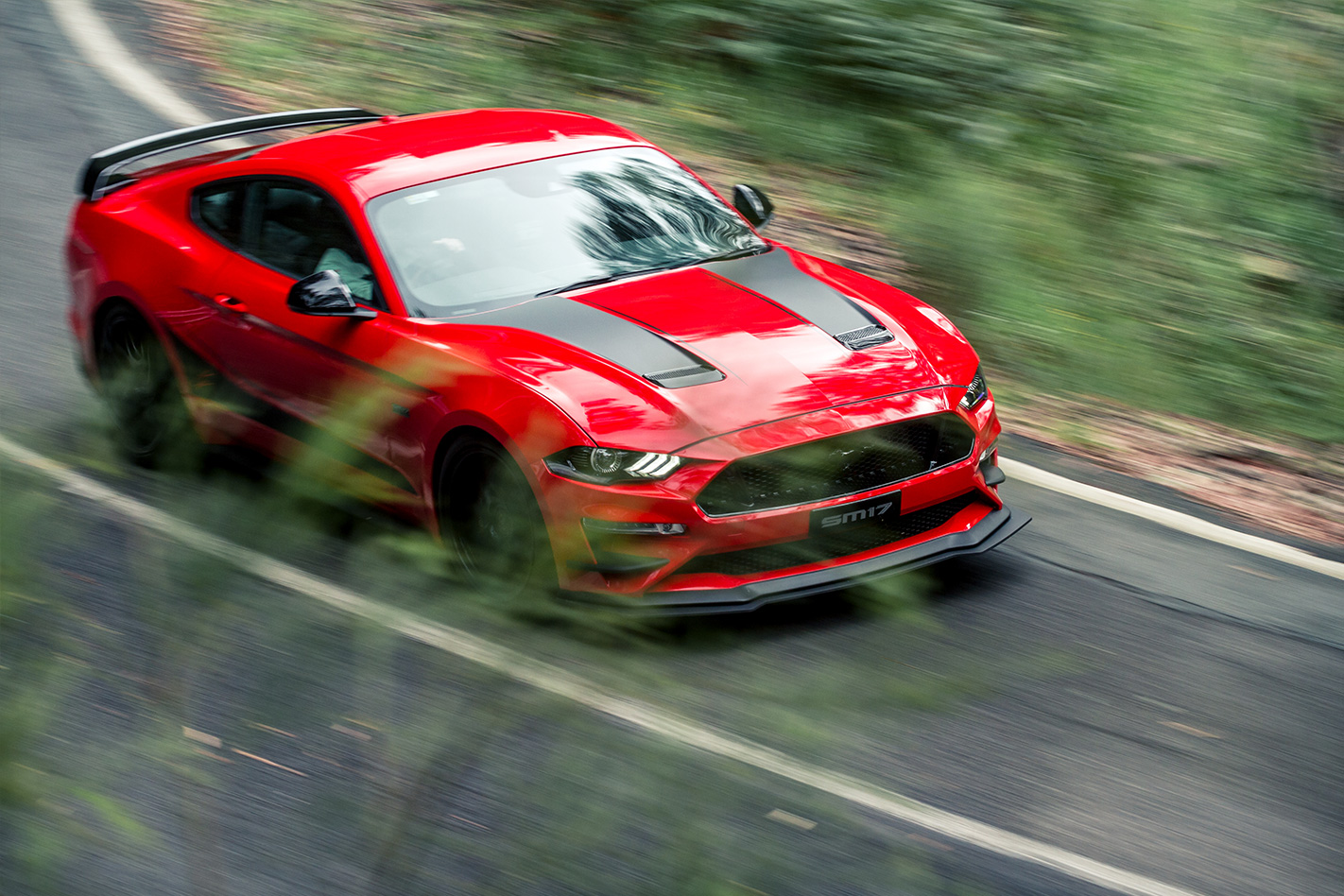
Having been impressed with not just the SM17’s power but its chassis modifications, not to mention the steps Herrod took to improve durability, we reasoned that anything the R-Spec could do the SM17 could do better.
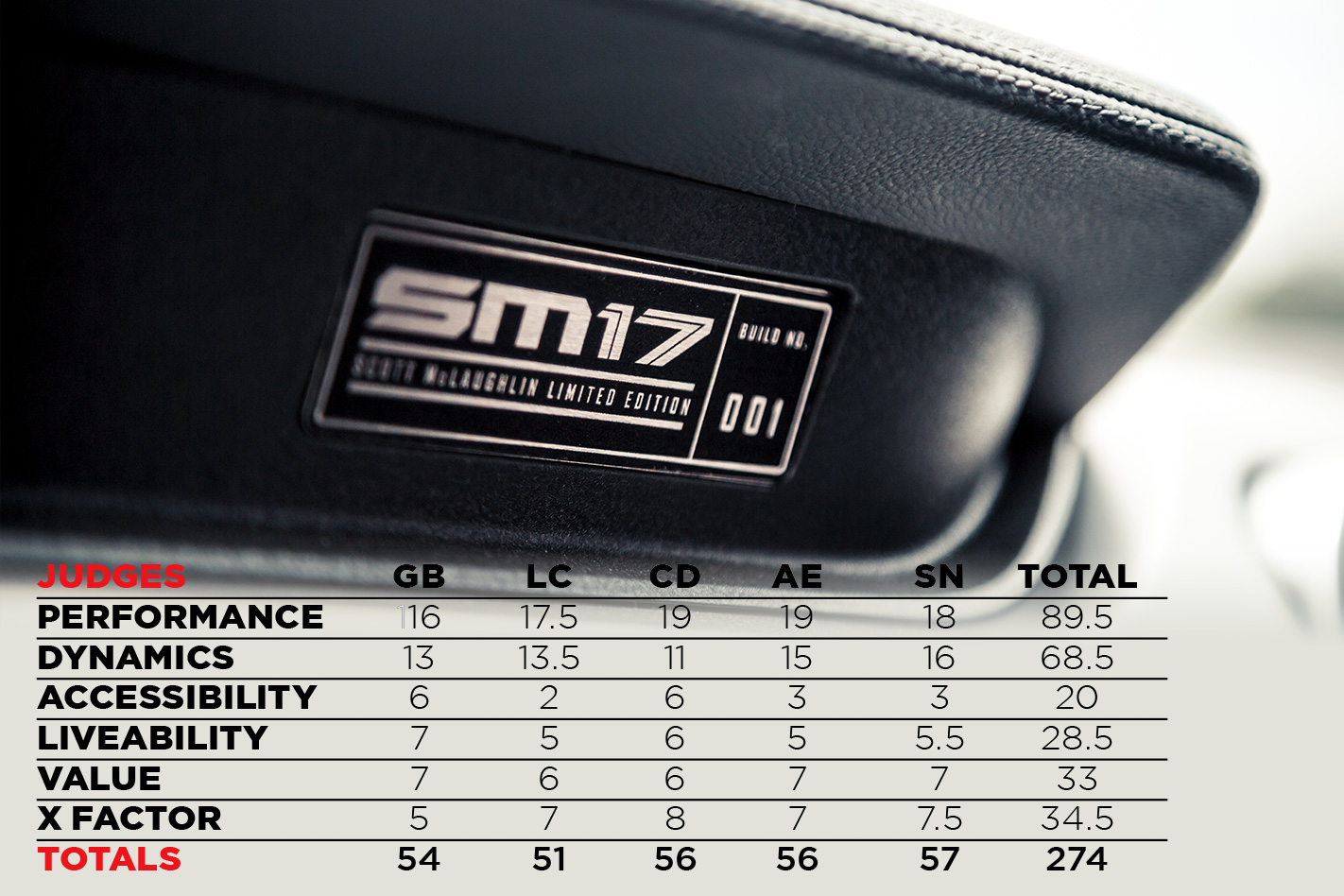
Its 10th place suggests we were mistaken but a closer look reveals a slightly different picture. While the mighty Mustang sits in 10th it is a mere half-point behind the Audi RS6 and only one point behind the GR Yaris.
Unsurprisingly, it scored best in Performance, that 578kW supercharged V8 endowing the SM17 with acceleration to match the PCOTY-winning GT R Pro.
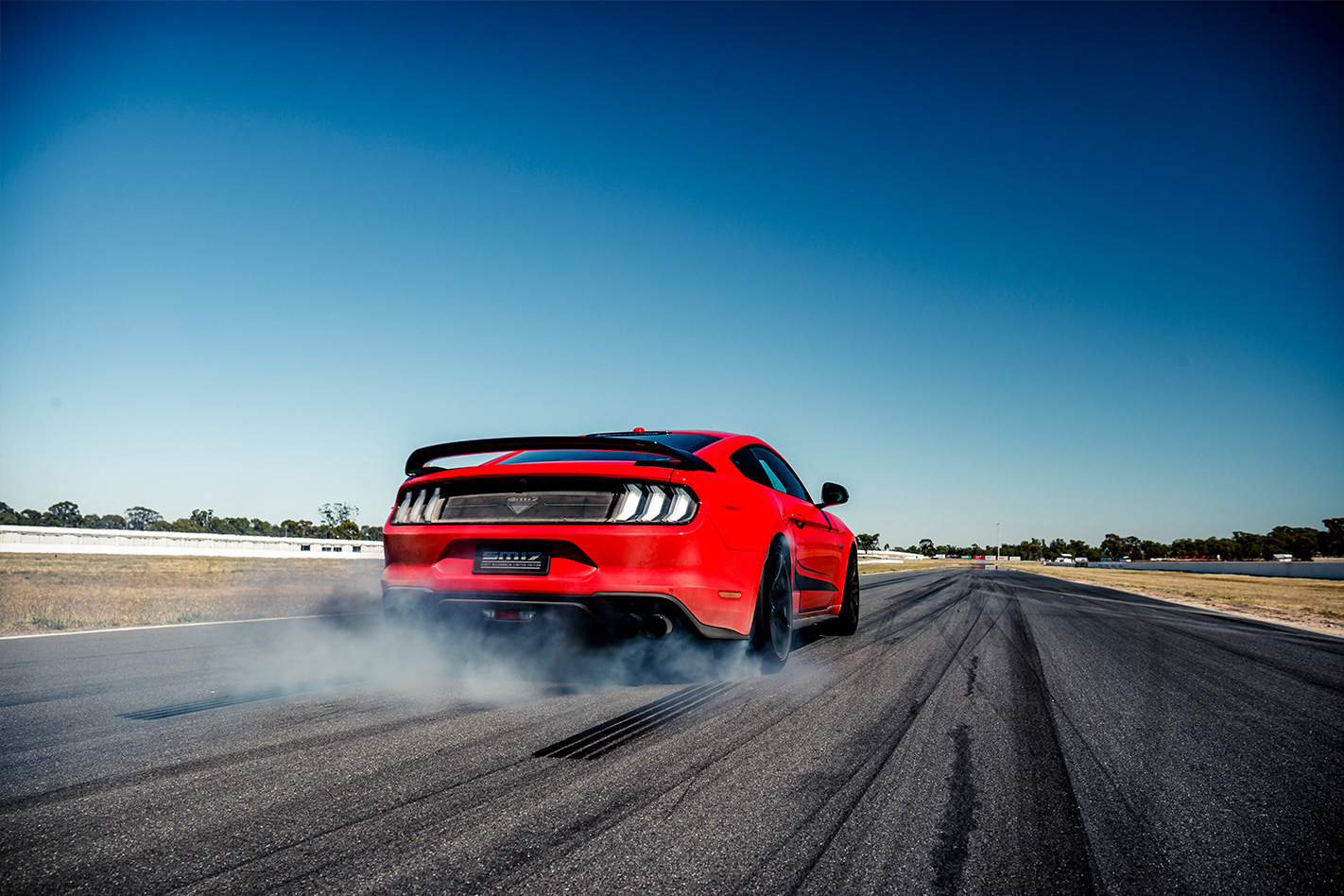
Combined with the noise it makes, it’s arguable whether any other car at PCOTY whitened knuckles under full throttle like it.
The SM17 completed more than half a dozen runs without the slightest degradation in trap speed, which hasn’t always been MOTOR’s experience with modified Mustangs. This much power requires respect, but it’s also useable thanks to the wider rims, fat Michelin Pilot Sport 4 S tyres and unique calibration for the MagneRide suspension.
The same changes certainly went a long way to putting the SM17 fourth on the lap time chart with an impressive 1:33.7sec. There might have been more in it, too, but sadly the Herrod could only manage one flying lap before the coolant temp soared into the red.
Our experience took the Herrod folk by surprise and they’re investigating as it doesn’t match their testing, but it’s fair to say the SM17’s lack of stamina was disappointing. The other Achilles’ heel is part-throttle mapping, which is the primary reason most judges marked the Herrod down heavily for accessibility.
In that crucial 20-80 per cent range there isn’t enough finesse, especially when you’re controlling the best part of 800bhp.
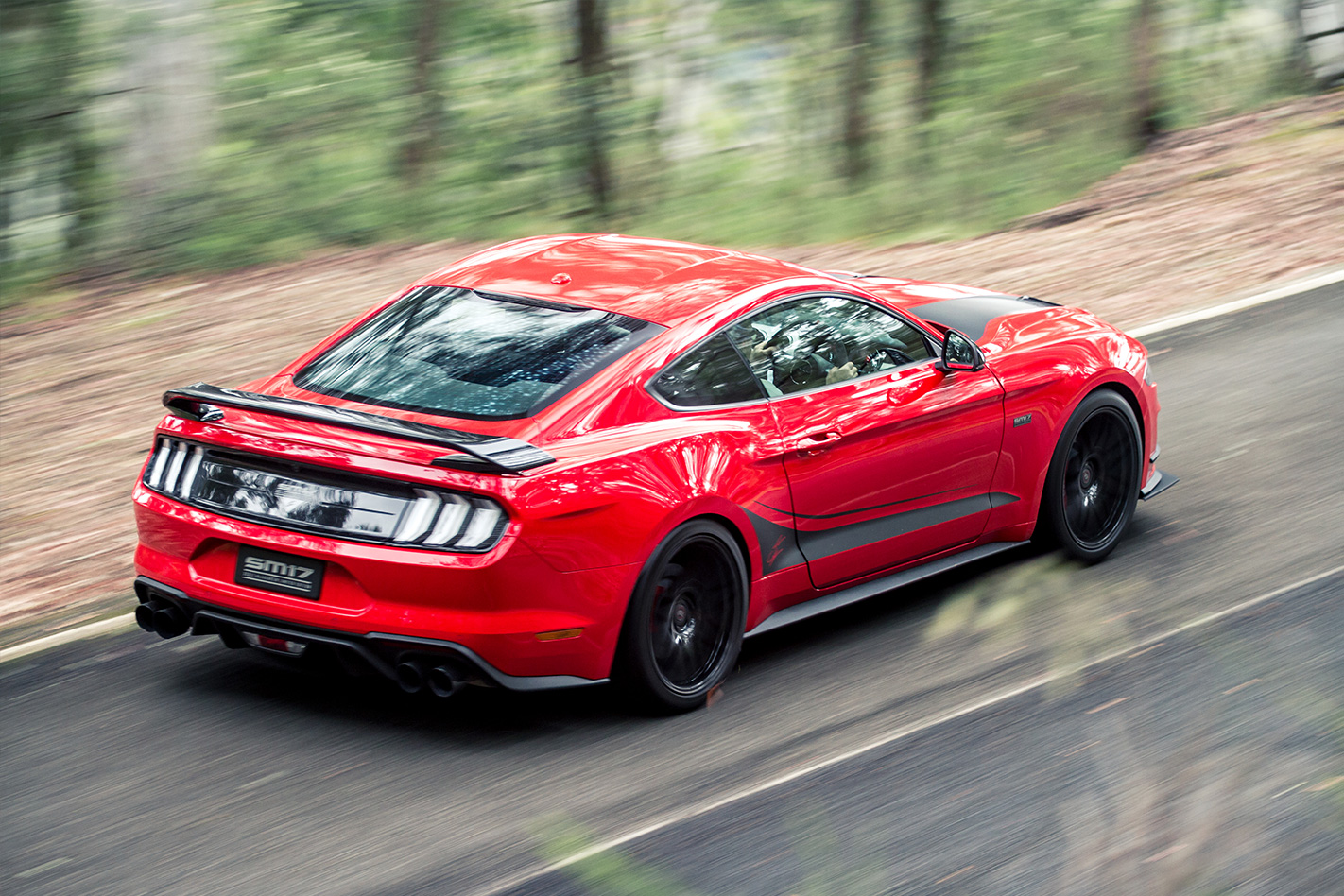
Nevertheless, Herrod can hold its head high with the SM17. Bar on track, where it backed itself off rather than blowing up, it completed the entire week without a single hiccup, while producing some stunning numbers and scaring a few people in the process.
If you like your cars on the wild side… – SN
THE NUMBERS
0-100km/h: 3.70 sec 0-400m: 11.42 sec @ 206.95km/h Lap Time: 1:33.7
JUDGE’S RANK
Butler 9th Sit down, strap in, hold on, and hope to see you on the other sideCordony =9th A scud missile with a steering wheel that can struggle to keep its coolDupriez =8th Possessed pony manages to harness its dynamite thrust… just. Not quite OE tempered in areas it needs to be
Enright 9th Virtually a DNF. There’s genuine talent here but it seemed only to be able to cover 6000 metres at full noise
Newman 8th The Mustang turned up to 11. Or perhaps 12. Flawed but such an experience
It’s been less than a month since Californian electric vehicle startup Alpha Motor Corporation released its Jax electric little meanie, but it’s back again with a new off-road pick-up truck named Wolf.
It is, essentially, much the same as the Jax off-roader that came before it. Though instead of a sporty coupe design, its compact design houses a tub-lined tray.
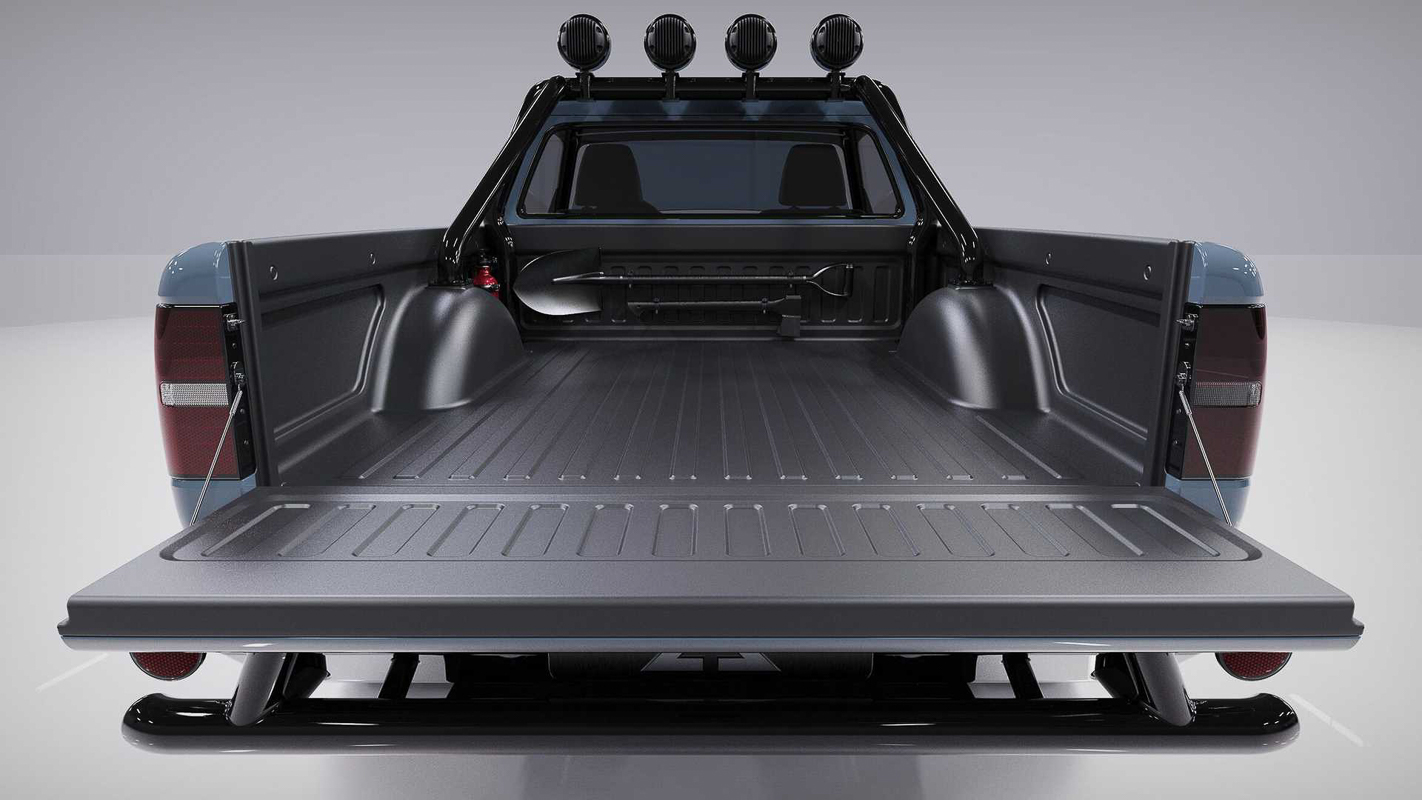
The quirky, retro styling of the Wolf incorporates squared-off front and rear ends and LED headlights, while off-road tyres, quad spotlights and a nudge bar feature on this reveal car.
It’s sized smaller than other utes on sale such as the Ford Ranger and Volkswagen Amarok – just over 4.5 metres in length.
It also undercuts other electric utes in size, such as the Rivian R1T.
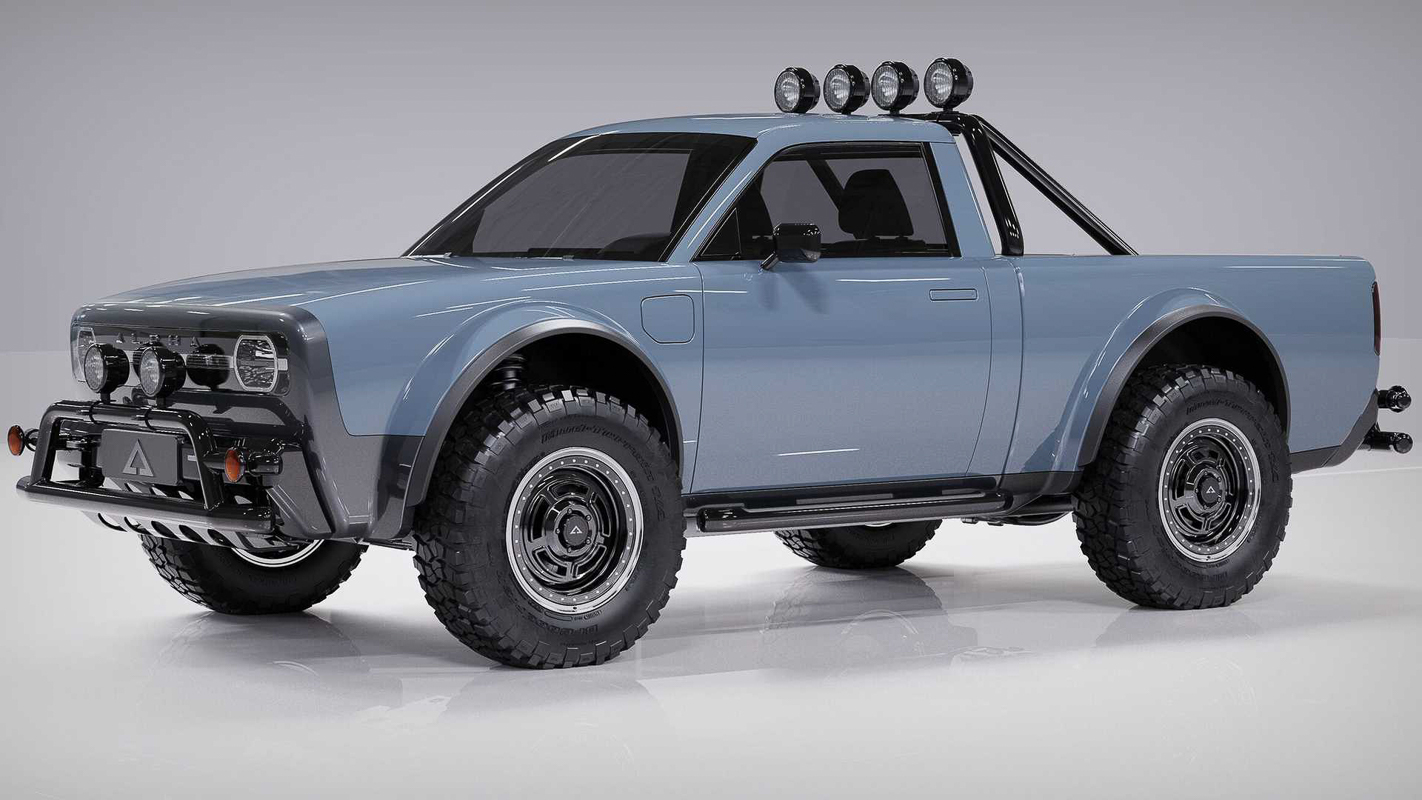
The Wolf uses the same electric powertrain that’s proposed for the Jax off-roader, with a 75kWh lithium-ion battery pack.
It can come connected to either a single-motor powertrain that drives the front wheels, or s dual-motor setup that powers both the front and rear wheels.
Alpha says the latter of the two can accelerate from zero to 100km/h in 6.2 seconds. Range is estimated at around 440km. No information is listed regarding charging capacity or charge times.
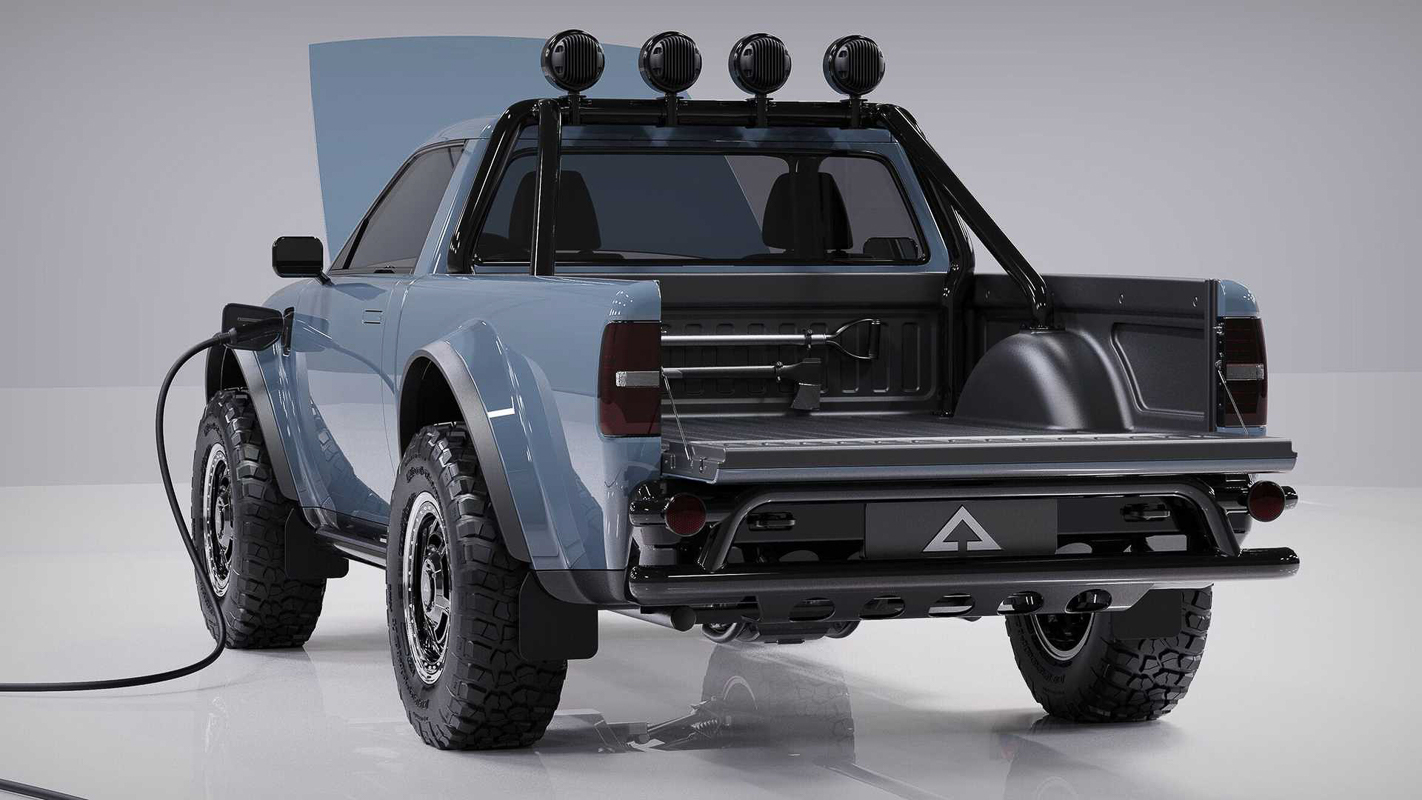
The Wolf has so far been shown in a single-cab specification only, with retro styling seemingly straight out of the 1980s or 1990s.
Where other utes, even the one we wrote about earlier, use forward-thinking design aligned with their futuristic electric drivetrains, the Alpha Wolf takes us back to a time of simple tailgates, traditional roll bars and squared-off design.
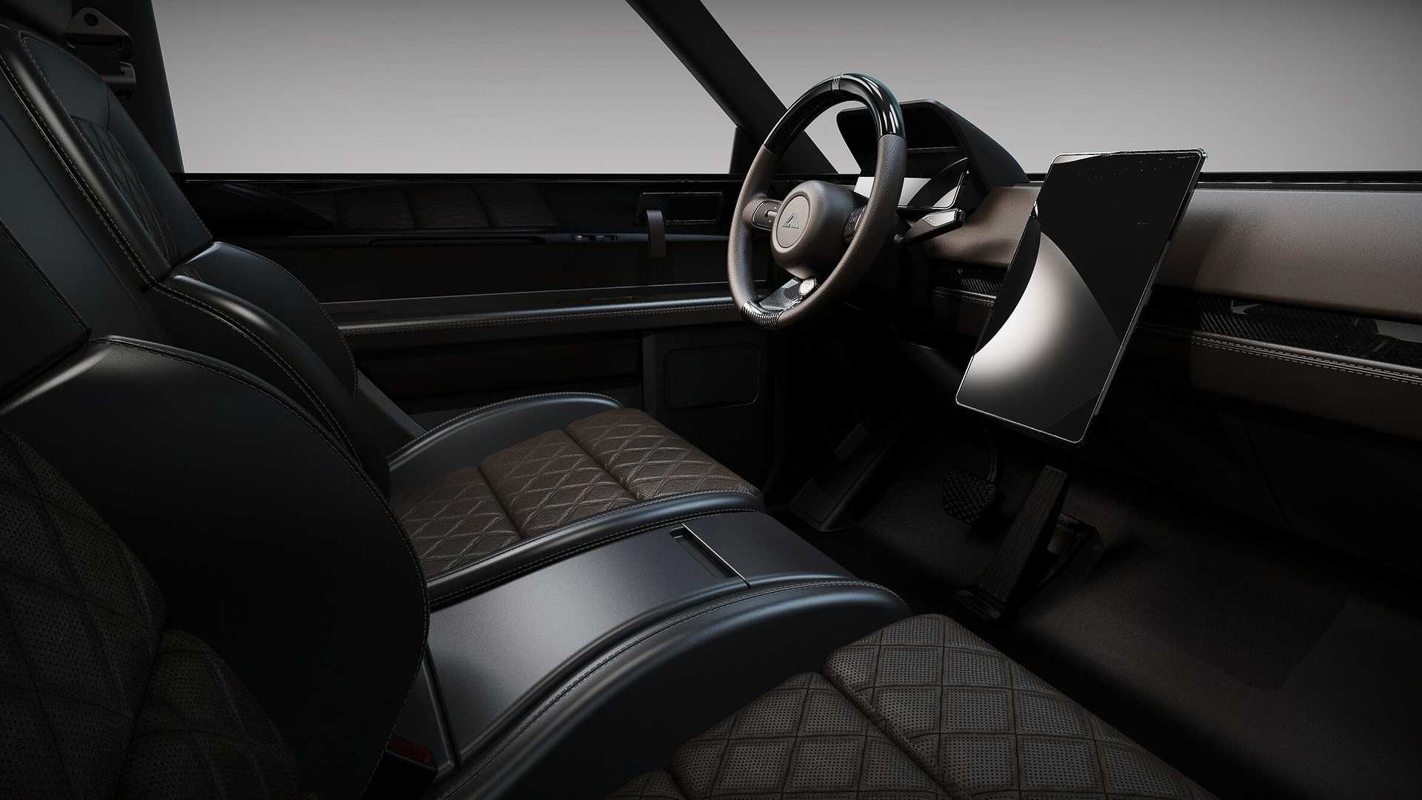
The minimalist interior features a set of bucket seats with quilted fabric and not a whole lot else. There is a portrait-mount touchscreen to house the infotainment and a digital instrument cluster, but the inside is just about free of buttons and other conventional controls.
Reservations can be placed online for the Alpha Wolf from now. No word is given on an eventual production start date or any potential for Australian availability, with the company also saying specifications are estimates and subject to change.
We’re lost. Not terribly – this isn’t a tragic tale in the style of Burke and Wills, a story of the unforgiving Australian landscape claiming two more scalps – but the fact remains that I don’t really know where we are or how to get to where we need to be.
My stress levels would be higher if we didn’t have the latest Subaru Outback Sport at our disposal, a car that’s already proven capable of far more than most would give it credit for.
If you occasionally – or even frequently – venture off the beaten track and think you need a towering SUV to do so then we have news for you.
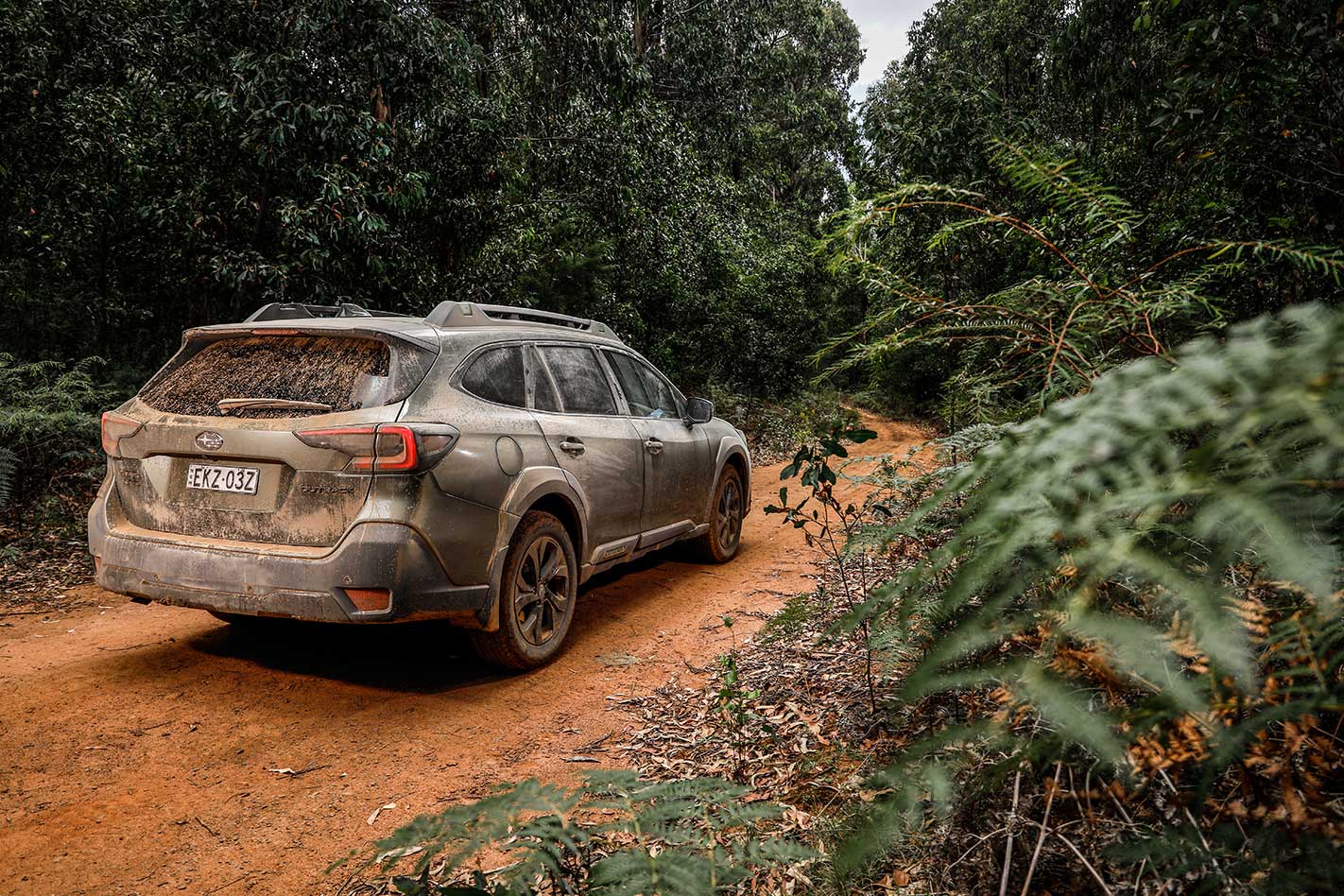
Subaru has rationalised the range, binning the six-cylinder and diesel models and offering a trio of 2.5-litre, boxer-four variants starting at $39,990, rising to $44,490 for the mid-spec Sport we have here and topping out with the $47,790 Touring.
It’s an inescapable fact that prices have increased – the previous Outback 2.5 started at $36,240, rising to $42,640 for the Premium – but the standard equipment list is now an almighty long one, so much so that it’s a bit challenging to know where to start.

The safety equipment list is equally extensive, with airbags galore, autonomous emergency braking and steering, lane centring and departure warning, adaptive cruise control, speed sign recognition with intelligent speed limiter, driver attention warnings, blind spot assist and rear cross-traffic alert.
These systems work relatively unobtrusively, though they can be quite insistent that you drive the car as they would like when they do activate, with various flashing lights and beeping noises.
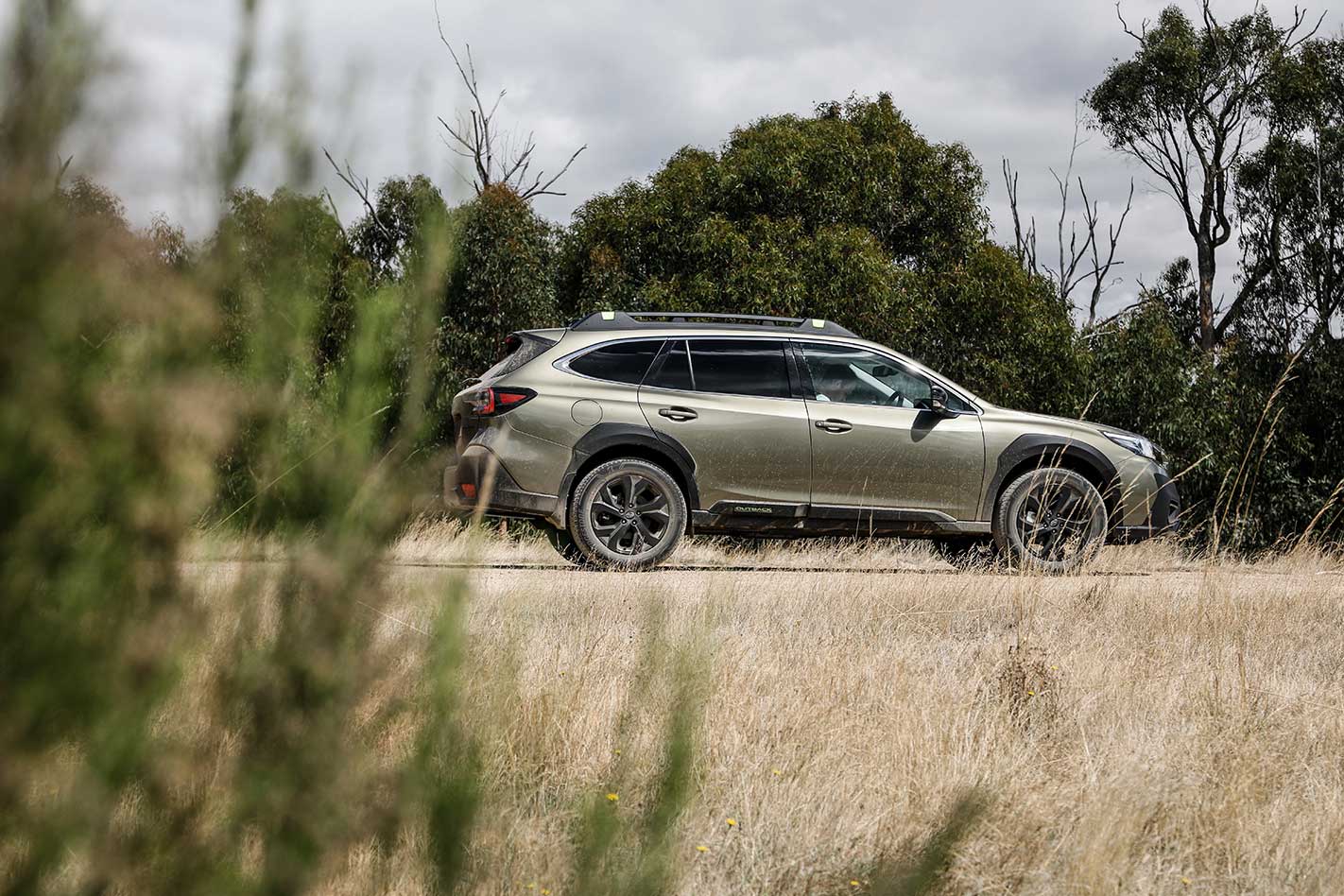
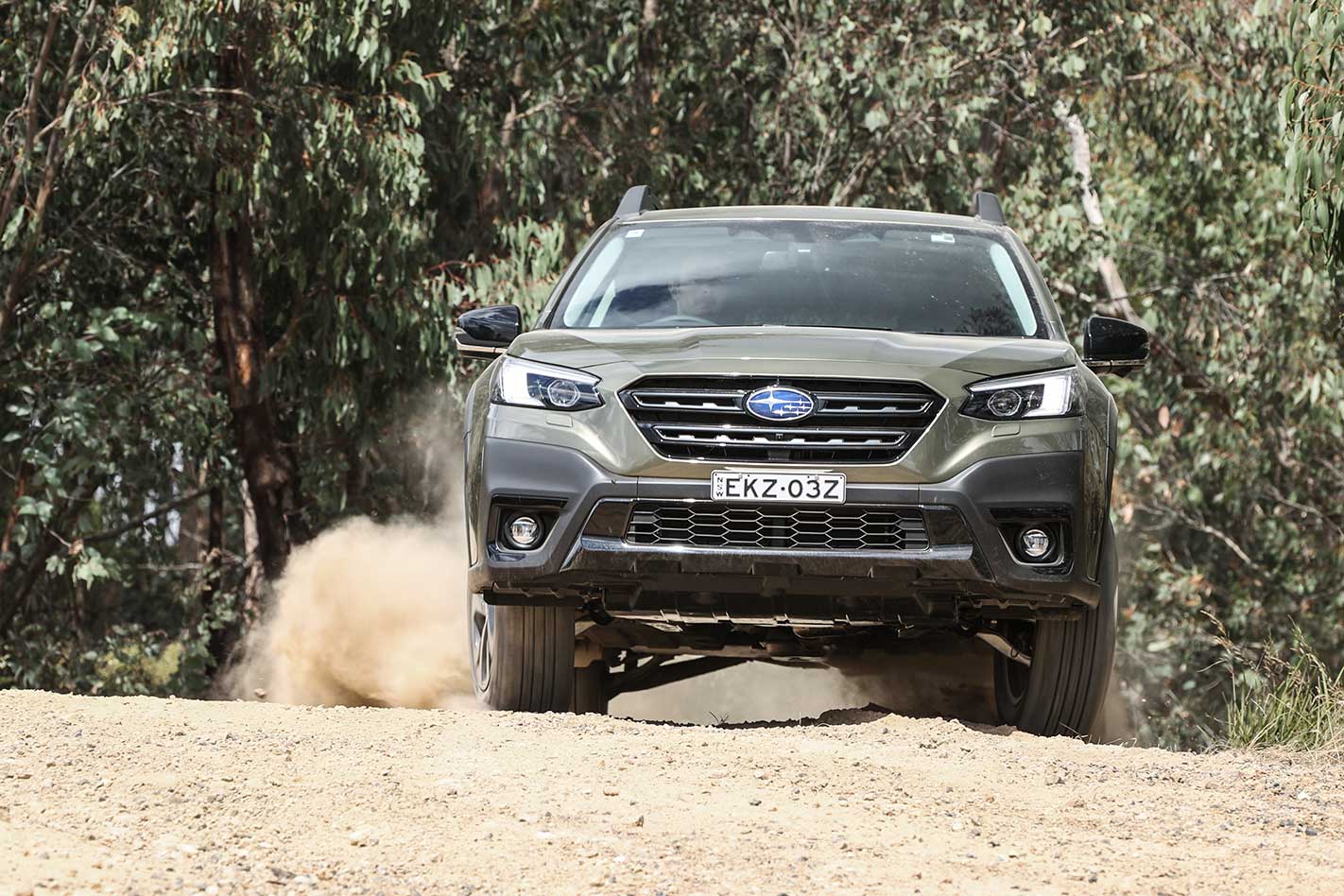
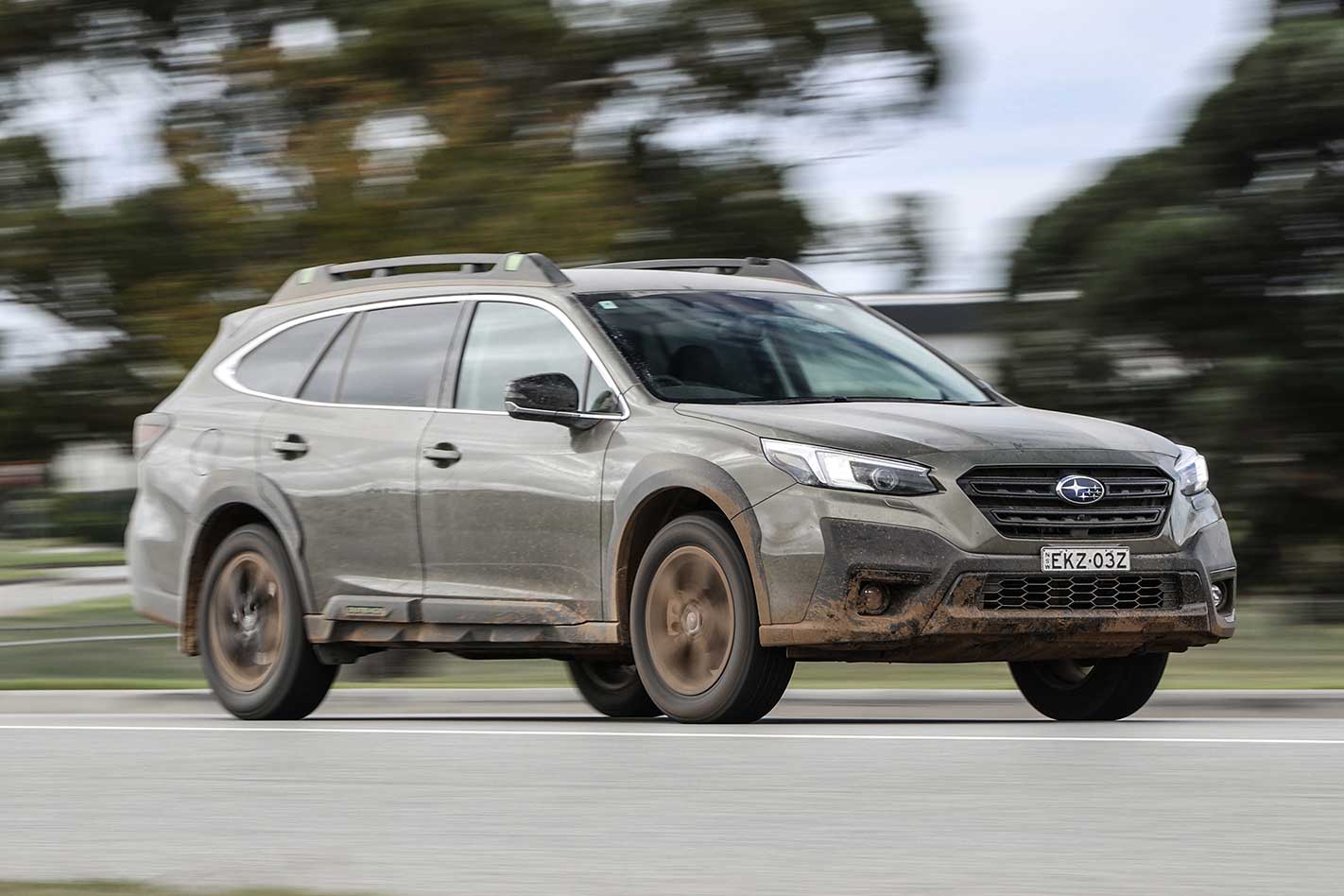
No one is ever going to put a poster of an Outback on their wall but in Sport guise it’s a cool looking thing, at least in the khaki-esque Autumn Green metallic.
Combined with the black cladding, wheels (now an inch bigger at 18s) and exterior highlights it has somewhat of a military vibe, like something you’d find at Duntroon with Bear Grylls sitting on the bonnet.
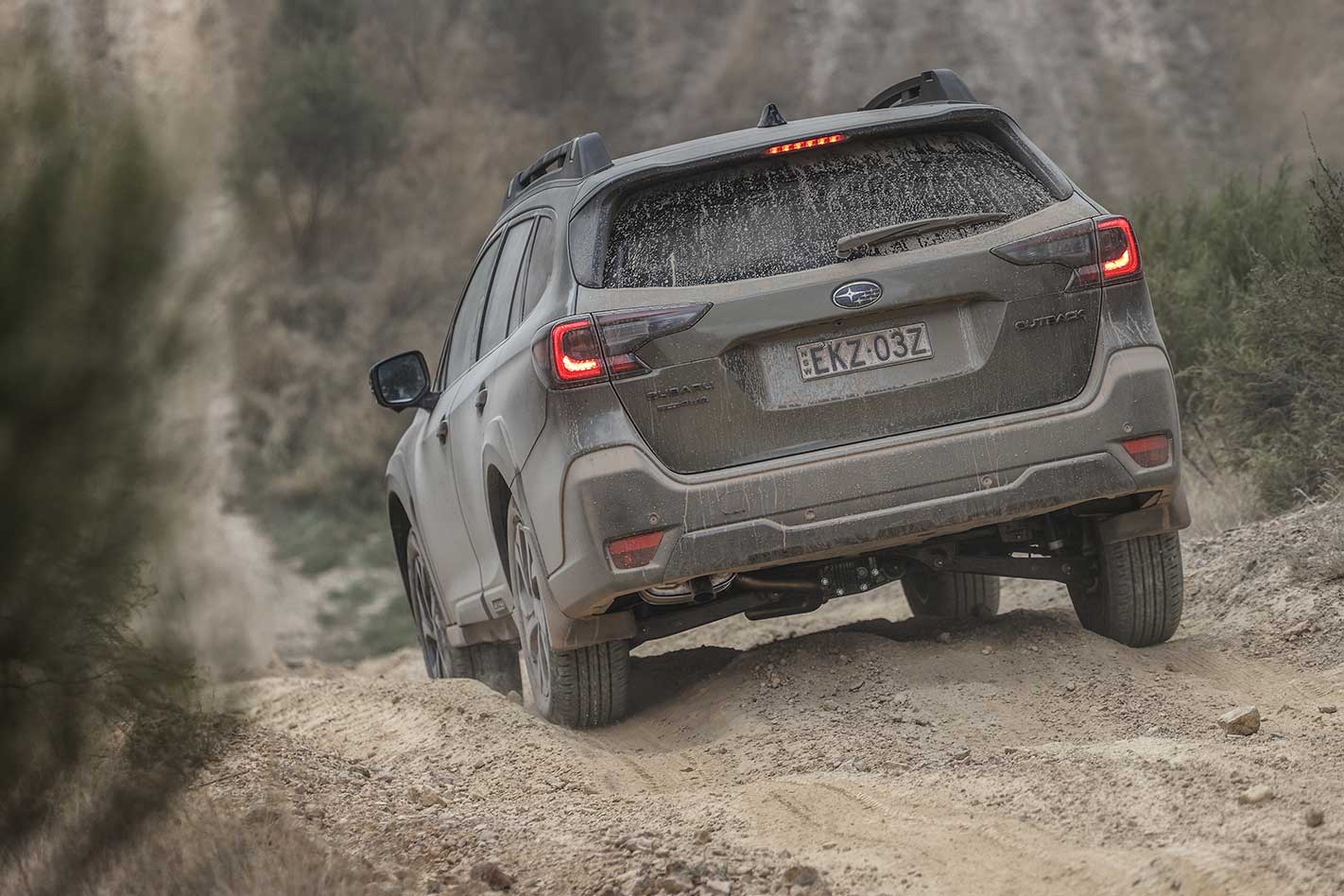
Attempts to follow our noses and the sat-nav’s compass have led to ever more overgrown roads and dead ends in the form of ruts that would require more than the Outback’s 213mm of ground clearance (which is pretty good, equal to a BMW X5 and only 26mm less than a Ford Ranger) and road-biased Bridgestone Turanza tyres.
Earlier off-road attempts revealed Subaru’s soft-roader to be remarkably capable, however. Time and again it scaled hills and negotiated ruts that we thought were beyond it only for it to scurry through with little fuss.
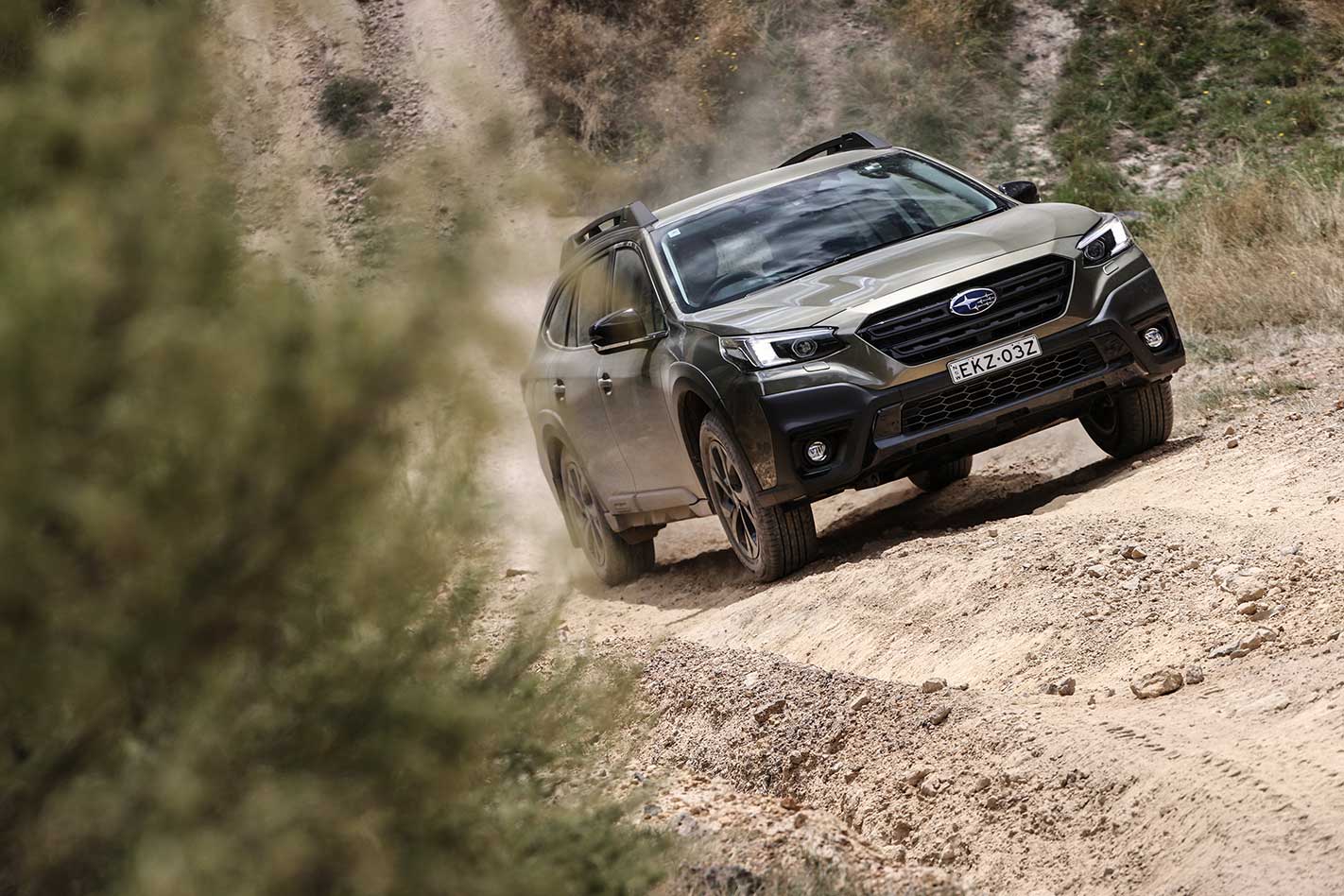
The all-wheel-drive system successfully uses its traction control to deal with most issues and even has ‘X-Mode’, which supposedly helps clamber out of snow/dirt or deep snow/mud, but it understandably has its limits, ineffectually spinning an unloaded wheel if it’s waving in the air. A slight suspension lift and set of knobbly tyres would definitely help its bush-bashing ability.

Outbacks will spend most of their lives carrying families to the beach, bush or snow loaded with boards, bikes or skis.
Luggage space is similar to its predecessor but Subaru has teased out a little more practicality. The rear load bay is 1100mm wide (+20mm), 436mm from floor to cargo cover and a very precise 1085.5mm long, which extends to 1982.6mm with the 60:40 split-fold rear seats down.
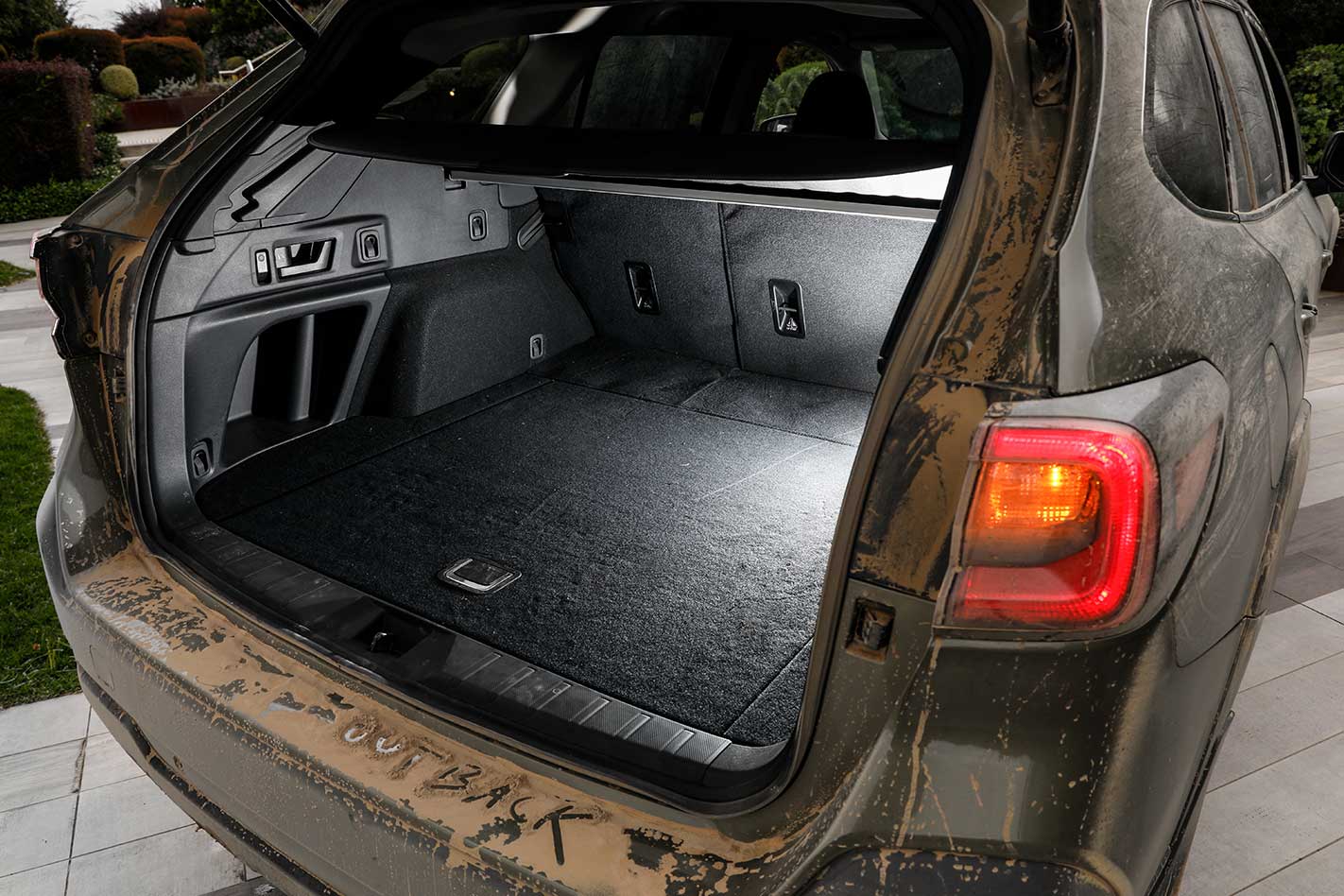
It’s equally commodious in the rear seat. There is masses of head, leg, shoulder and foot room in those heated outer rear seats, while even the centre pew would be habitable for short journeys.

Up front, the driving position is widely adjustable and the materials are all leather-wrapped this and soft-touch that – it’s very polished. The Sport’s premium steering wheel is a great size and though it’s loaded with buttons, all are pretty self-explanatory.

Lack of reception is currently rendering Google Maps useless, but the Outback’s onboard nav has enough signal for me to select a waypoint and extricate ourselves from the current predicament.
The fact it’s not displaying a physical road isn’t promising, but the distance-to-destination keeps reducing as we slowly navigate a heavily overgrown bush track, branches scraping the bodywork (sorry Subaru!), mud splashing the sides and rocks pinging the underside.

It’s here the Outback really shines. All-wheel drive provides stability and traction, tall tyres lessen the risk of a puncture and its long-travel suspension soaks up the majority of bumps and undulations without fuss.
Subaru has made a lot of changes under the skin including a stiffer bodyshell (it’s actually stitched together a different way), while an aluminium bonnet and suspension components reduce weight by 10kg despite this latest model being 50mm longer and 35mm wider.
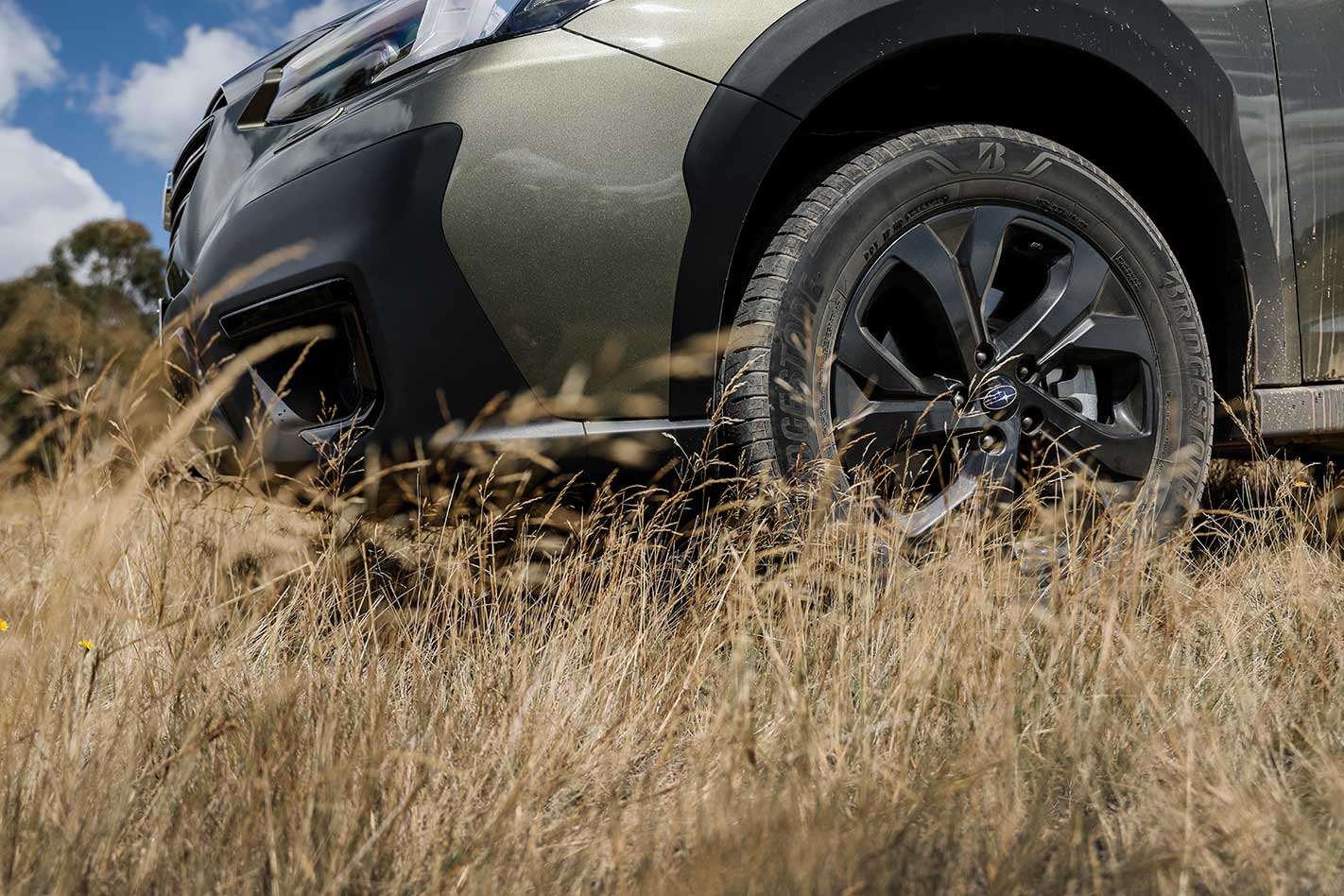
Likewise its handling: the steering is well-weighted and accurate and there’s reasonable grip on both sealed and unsealed surfaces. In fact, such is its balance that the very conservative ESP is a buzzkill, constantly dumping cold water on any attempts to indulge your inner Colin McRae.
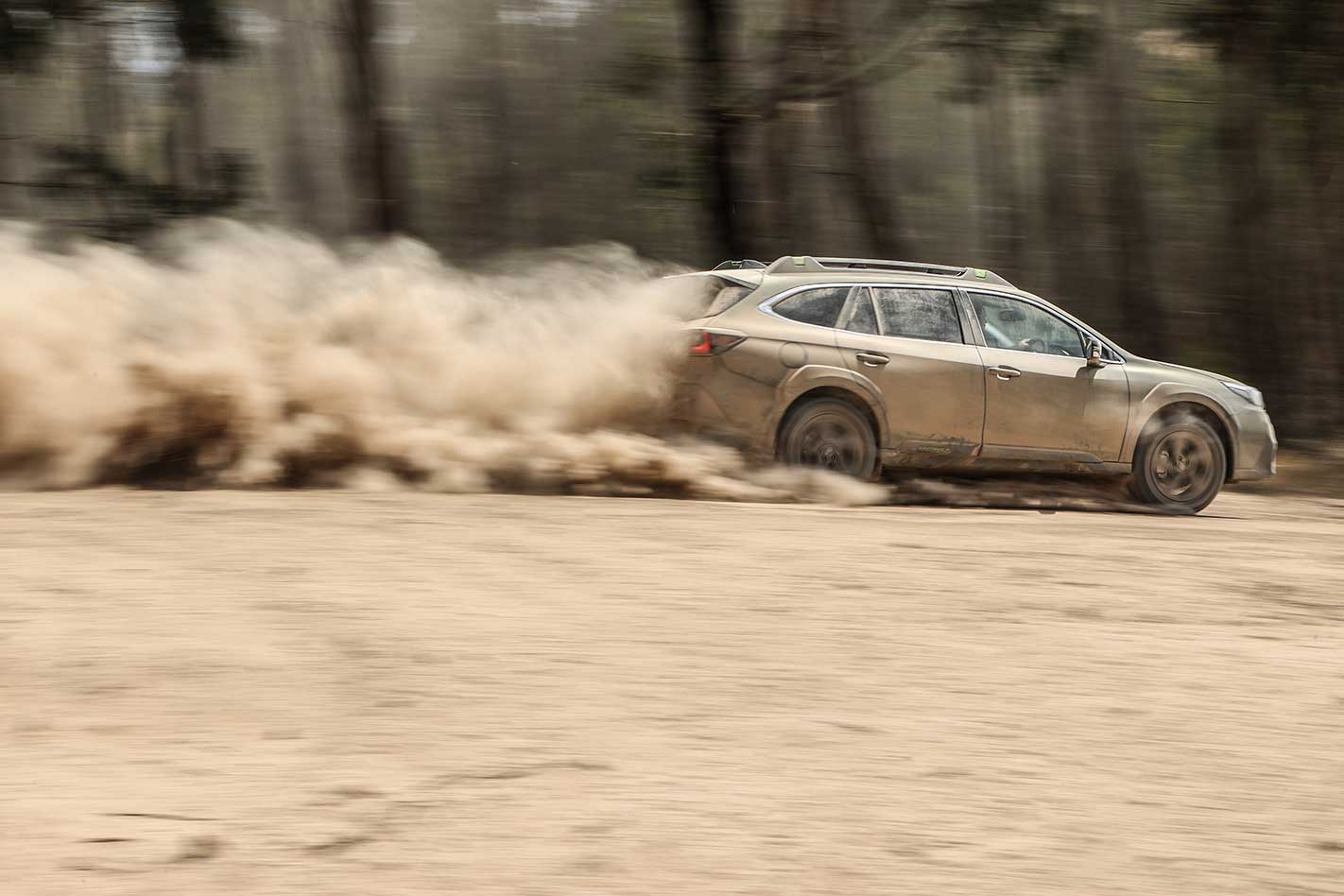
That said, there isn’t that much power to deal with as the under-bonnet offering is the Outback’s greatest shortcoming.
Despite being a 2498cc boxer four-cylinder like its predecessor, Subaru claims 90 per cent of the engine is new. Direct fuel injection has been added and the compression ratio increased from 10.3 to 12.0:1 resulting in an extra 9kW/10Nm, while the CVT has had its ‘ratio spread’ increased – Subaru includes eight steps for a more natural feel – to improve acceleration and fuel economy.
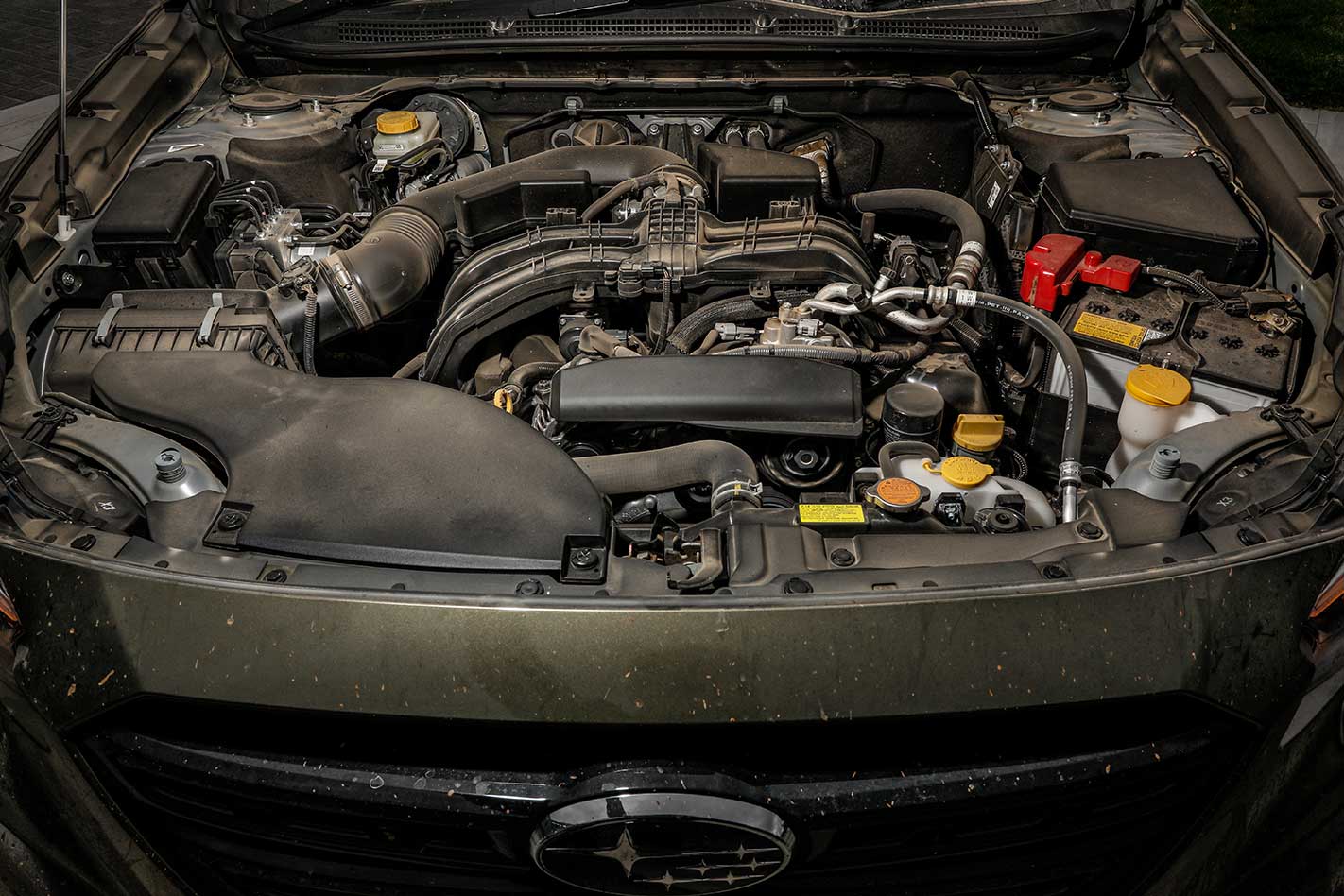
Acceleration is reasonable one-up; Subaru makes no 0-100km/h claim but a few tenths improvement on its predecessor’s 10.2sec seems a safe assumption.
Only a few years ago that would’ve been in line with most of its competitors, but with the Toyota RAV4 and VW Tiguan now at the 8.0sec mark and the turbocharged Mazda CX-5 and Ford Escape another second quicker than that, the Subaru has been left behind literally and figuratively. Ironically, the 194kW/375Nm 2.4-litre turbo Outback XT available in the US would vault Subaru virtually to the front of the field.
Neither is the 2.5-litre boxer four a fuel economy leader; the 7.3L/100km combined claim is reasonable but over the course of 450km of mixed driving our average was 11.4L/100km. If ever there was an engine that was crying out for electrical assistance it is this one.
Subaru’s website quotes a total cost of $2449.88 whereas Mazda quotes $1737 for the CX-5 (though its service intervals are 10,000km to the Subaru’s 12,500km) and Hyundai $1530 for the Tucson (15,000km intervals).
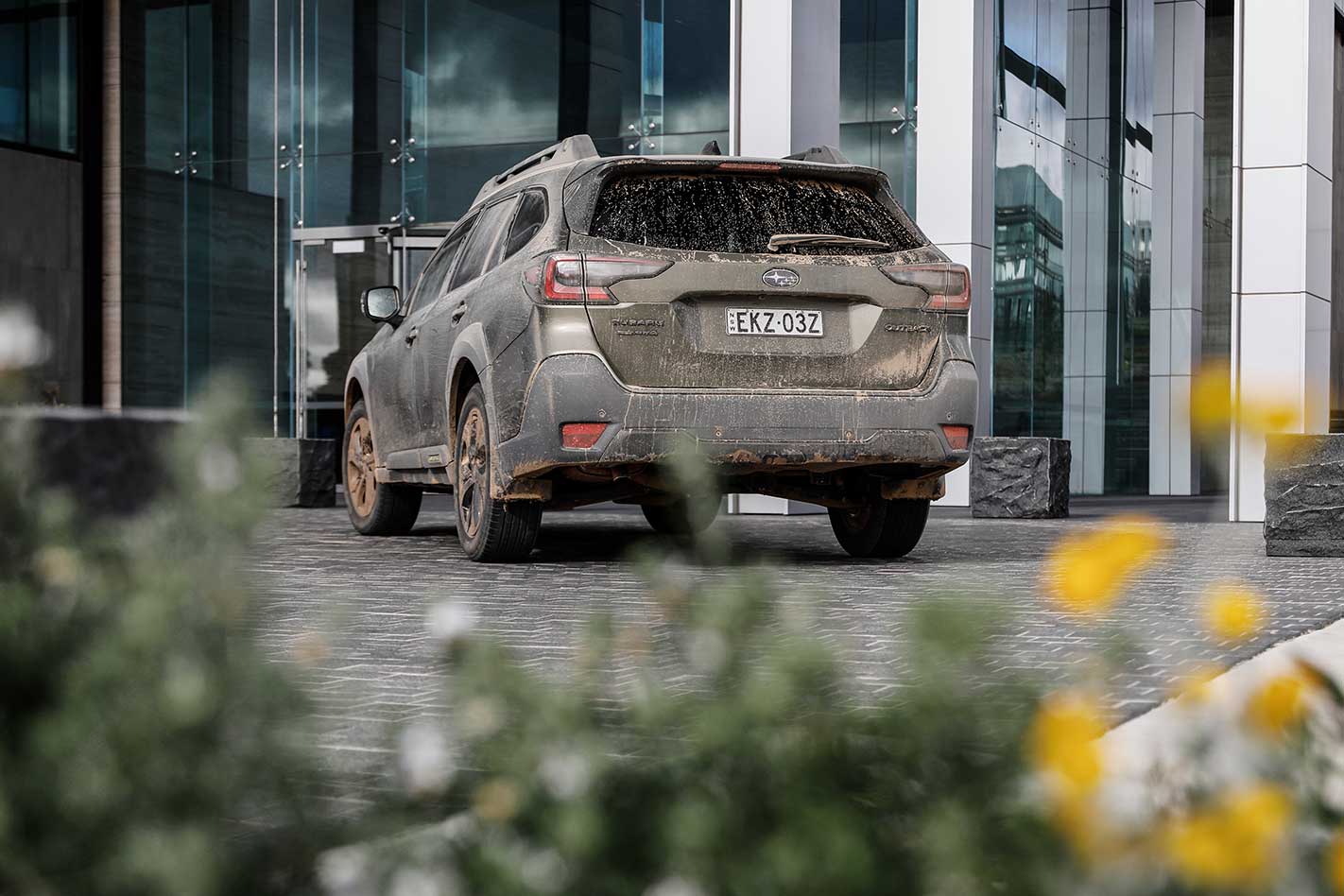
We wish it had stronger performance but its combination of comfort, space and ruggedness are appealing attributes, especially if you’re lost in a forest.
8/10
Pros: ride comfort; equipment; space; off-road ability
Cons: underwhelming engine; expensive servicing
Specifications
Body: 5-door, 5-seat wagon Drive: all-wheel Engine: 2498cc boxer-4cyl, DOHC, 24v Bore/stroke: 94.0 x 90.0mm Compression: 12.0:1 Power: 138kW @ 5800rpm Torque: 245Nm @ 3400-4600rpm Transmission: CVT Power/weight: 85kW/tonne Weight: 1629kg Fuel consumption: 7.3L/100km (combined/claimed) L/W/H: 4870/1875/1670mm Wheelbase: 2745mm Tracks: 1570/1600mm Suspension: struts, coil springs, anti-roll bar (f); double wishbones, coil springs, anti-roll bar (r) Steering: electrically assisted rack-and-pinion Brakes: 316mm ventilated discs, 2-piston calipers (f); 300mm ventilated discs, single-piston calipers (r) Wheels: 18 x 7.0-inch (f/r) Tyres: 225/60 R18 (f/r) Bridgestone Turanza Price: $44,490
The Morrison government has signalled it will introduce reforms to the Franchise Code of Conduct, including specific changes in the automotive industry, to protect both consumers and local dealers from multinational automotive corporations unfairly treating Australian stakeholders.
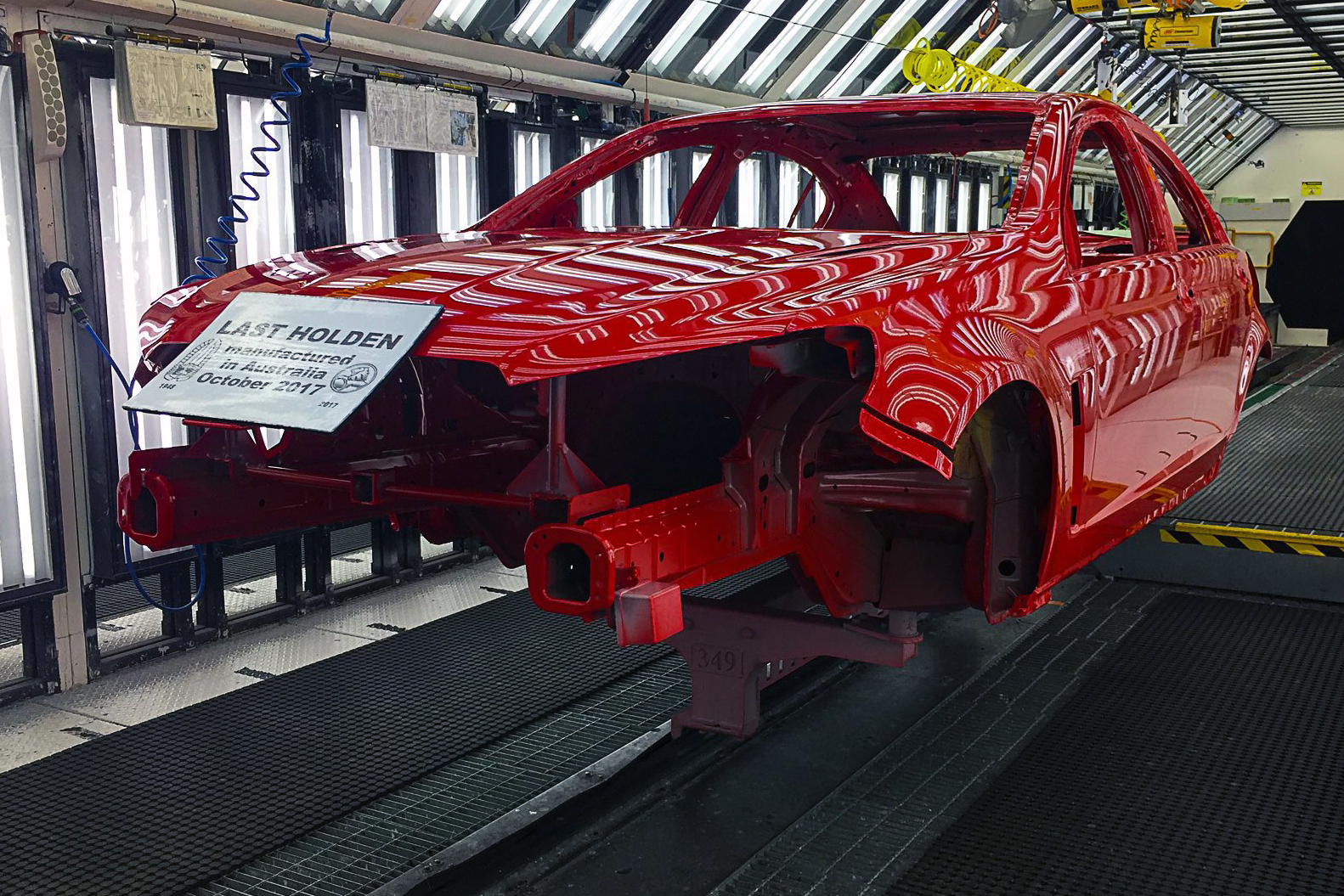
The move comes in the wake of last year’s shock announcement that General Motors would be permanently abandoning the Holden brand, leaving some locally-owned small business franchises on the verge of financial ruination, and car owners worried about how they could service their vehicles in the future.
The new measures announced today will:
The Morrison Government said it would also consult on behalf of the local automotive franchising sector to ensure appropriate protections were made for automotive dealerships to protect them from unfair contract terms in their agreements with manufacturers.
Multinational car makers may also have to participate in “mandatory binding arbitration for automotive franchisees, to address power imbalance.”
Speaking about the changes, Prime Minister Scott Morrison said his government would “stand up for Australian jobs and Australian businesses.”
“We stood up to Big Tech companies and we will stand up to multinational car companies who are riding roughshod over many family-owned Australia car dealers,” Prime Minister Morrison said.
“By protecting these businesses, we will be protecting the thousands of jobs that rely on the sector, including many apprentices.
“Car sales are surging and it’s further proof that the Australian economy is on the comeback. We need to ensure Australian family-owned automotive businesses continue to reap the rewards of this growth and the support from our supercharged instant asset write-off.”
The Australian Small Business and Family Enterprise Ombudsman, Bruce Billson, said the proposed changes by the Federal Government were a step in the right direction.
“These proposed changes represent significant progress and once passed, will go a long way to levelling the playing field in the automotive franchising sector,” Mr Billson said.
”They will ensure that franchise-like arrangements where dealers are operating as the car-maker’s new vehicle sales agent still benefit from the Franchising Code protections.
“A mandatory best practice framework will help address the ongoing issue of multinational car manufacturers who fail to follow the current voluntary principles. Examples of small car dealers being devastated by the actions of multinational manufacturers in recent years has warranted this action.
“Higher fines for significant breaches of the Franchising Code will act as a big stick that will force the larger players to think twice before acting unfairly towards their franchisees.”
Australia’s peak body that represents franchised new car dealers, the Australian Automotive Dealer Association (AADA), was equally pleased by news of the proposed reforms.
“Today’s announcement will be welcomed by automotive dealers and their 60,000 employees all across Australia. It will give these local businesses the confidence to employ more Australians, take on more apprentices, invest in their communities and continue to support local sporting teams and charities,” James Voortman, AADA CEO, said.
“These changes will bring a degree of balance to the relationships between new car Dealers and the Manufacturers to which they are franchised. The reforms are sensible and fair and will bring all Manufacturers up to the standard already being employed by ethically-minded car brands operating in Australia.”
Not all have welcomed these reforms with open arms, however. In a statement released today, the Federal Chamber of Automotive Industries (FCAI) – which represents Australia’s 65-plus car brands – said these changes will threaten the existing relationships of automakers and local dealer networks.
“Over regulation of any industry is not a solution to solving issues and forging strong, sustainable and profitable business relationships,” Tony Webster, FCAI president, said.
“In Australia, we already have extensive competition and franchising regulations. They should be allowed to work without introducing new regulations that can stifle innovation which impacts consumers and the thousands of people working in the national dealer networks.”
Mercedes-Benz has released what resemble spy shots of its own upcoming SL Roadster, which it confirms is now undertaking public road testing.
These latest photos show Mercedes-AMG engineers undertaking winter testing in Sweden. The next-gen SL can be seen performing long powerslides in order to calibrate the 4Matic+ all-wheel-drive system, an option for the first time on the SL Roadster.
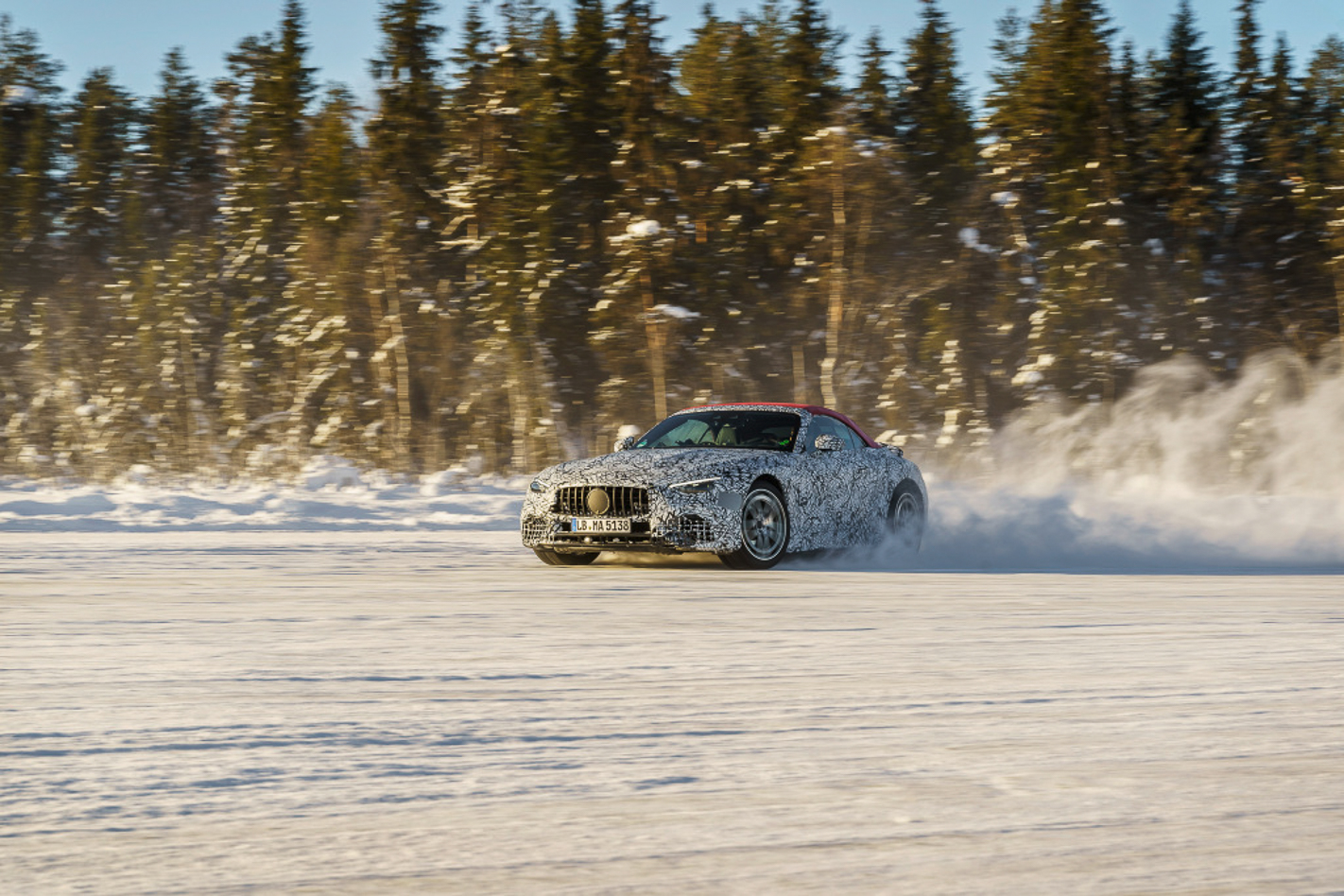
With little information coming from HQ about the new model, the acknowledgement and snippet of information is a refreshing change.
“The next generation of the legendary SL Roadster is going back to its roots, which lay in motorsport back in 1952,” AMG’s very short press release says.
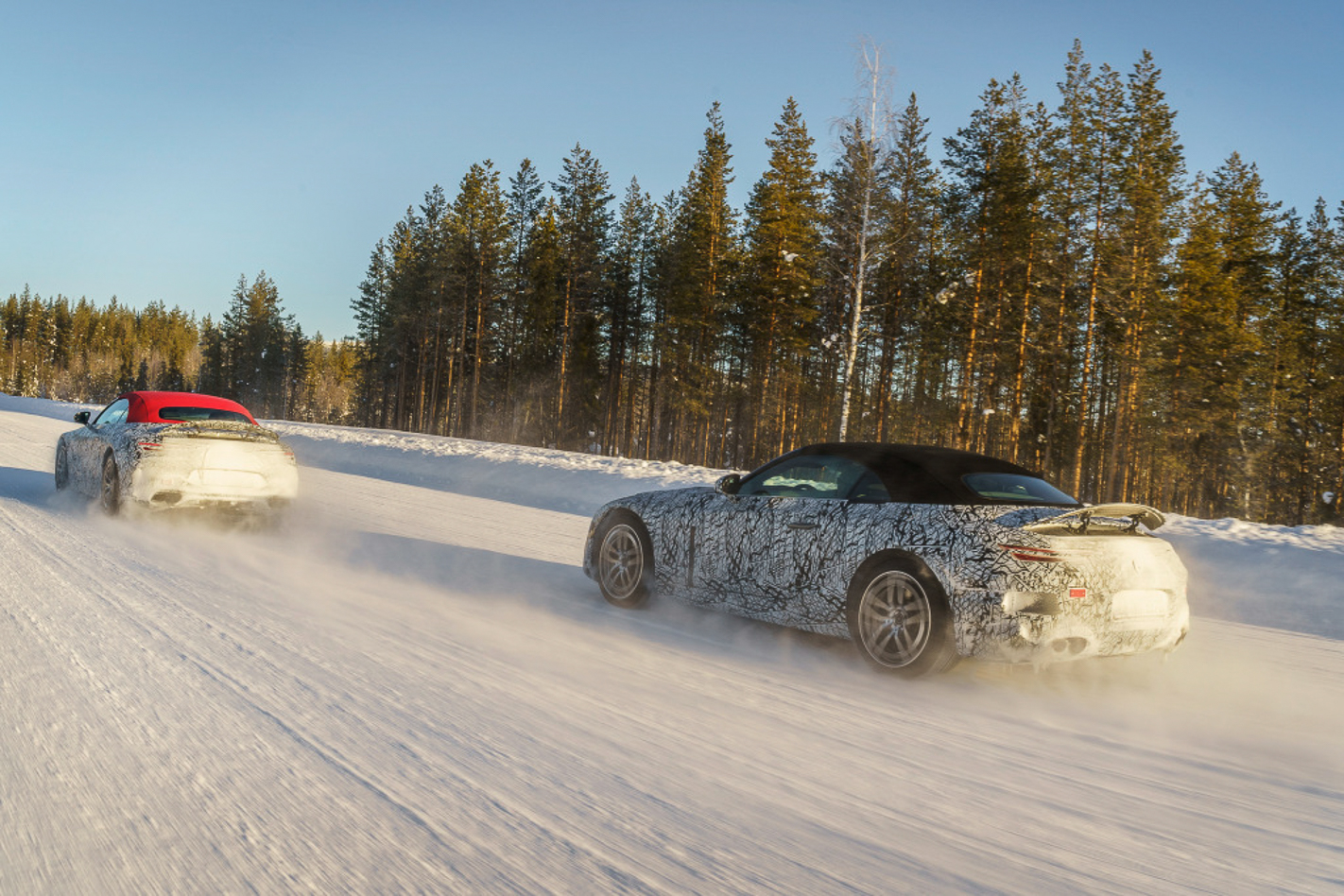
In fact, AMG has confirmed just about no information about the new SL Roadster, aside from its testing and development progress, as well as that it’s set to be a relatively high-performance model.
A number of variants will be sold under the Mercedes-AMG sub-brand for the first time, as opposed to the Mercedes-Benz SL Roadster.
As a successor to the likes of the Gullwing and SLS, we expect the SL Roadster will remain a GT-style car with high-performance elements.
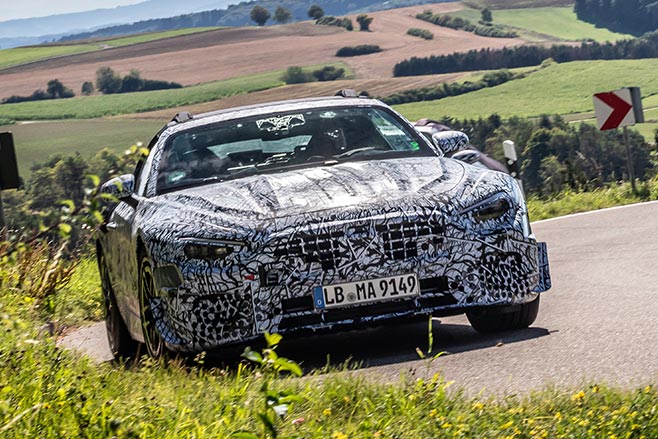
“Mercedes-AMG, as the performance and sports car brand of Mercedes-Benz AG, has fittingly taken on the task of overall vehicle development for the reinterpretation of the legendary roadster.”
Expect a version of AMG’s 4.0-litre V8 under the bonnet, though a mild-hybrid inline-six variant wouldn’t be a surprising addition to the SL lineup.
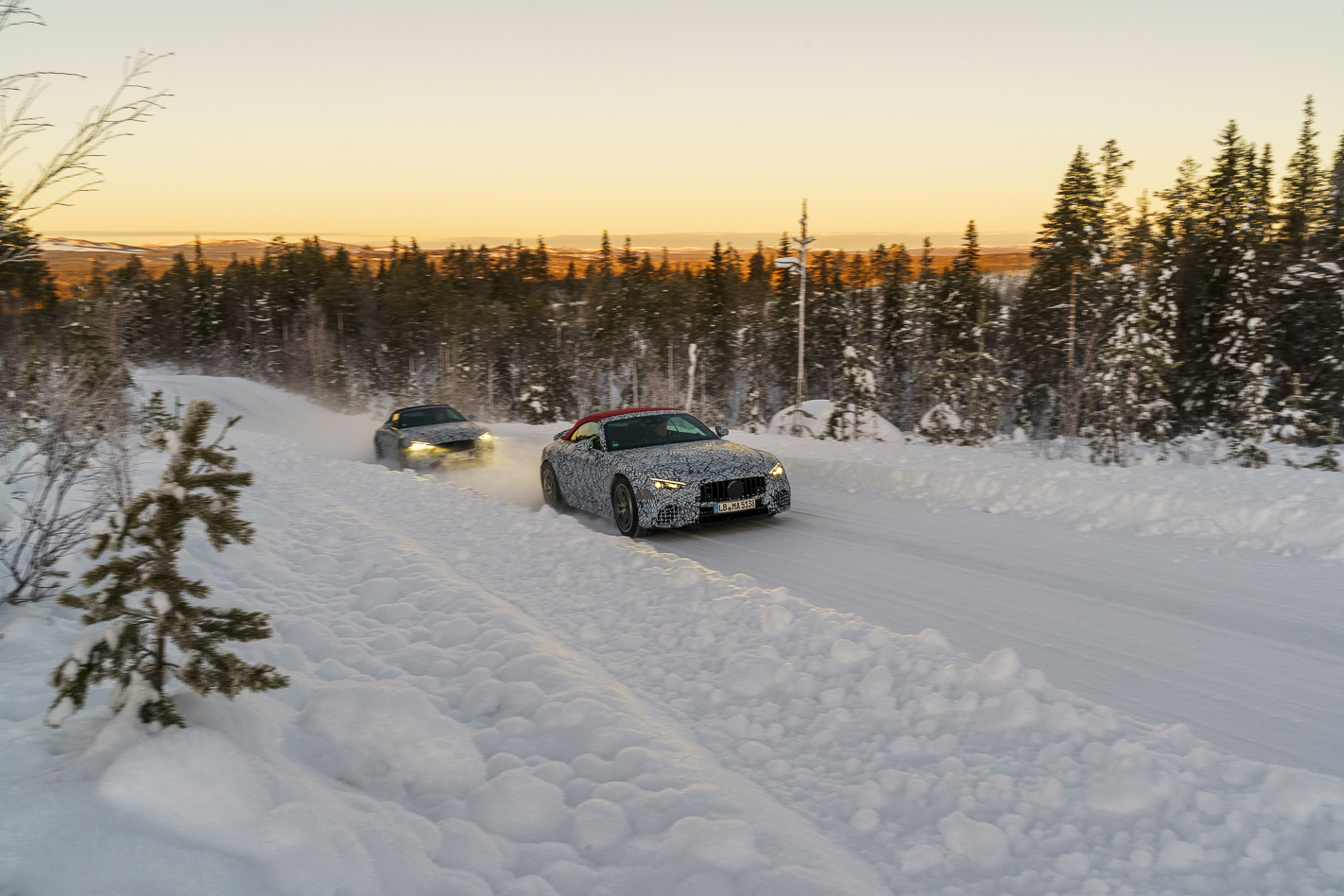
“Following extensive digital development steps, test stand runs and simulator trials the new sports car is now entering a scheduled phase of wide-ranging dynamic driving tests – thus far at the Group’s own Test and Technology Centre in Immendingen – and now also on public roads in some cases.”
Mercedes-AMG says the next stop on its test-schedule is the Nurburging.
Volkswagen will recall a series of Amarok utility vehicles after it was found the spare wheel attachment underneath the tray bed may unexpectedly break, leaving the spare wheel at increased risk of detaching.
The recall affects 19,936 MY2015-18 Volkswagen Amaroks which were sold across the country between August 1, 2016 and March 1, 2019.
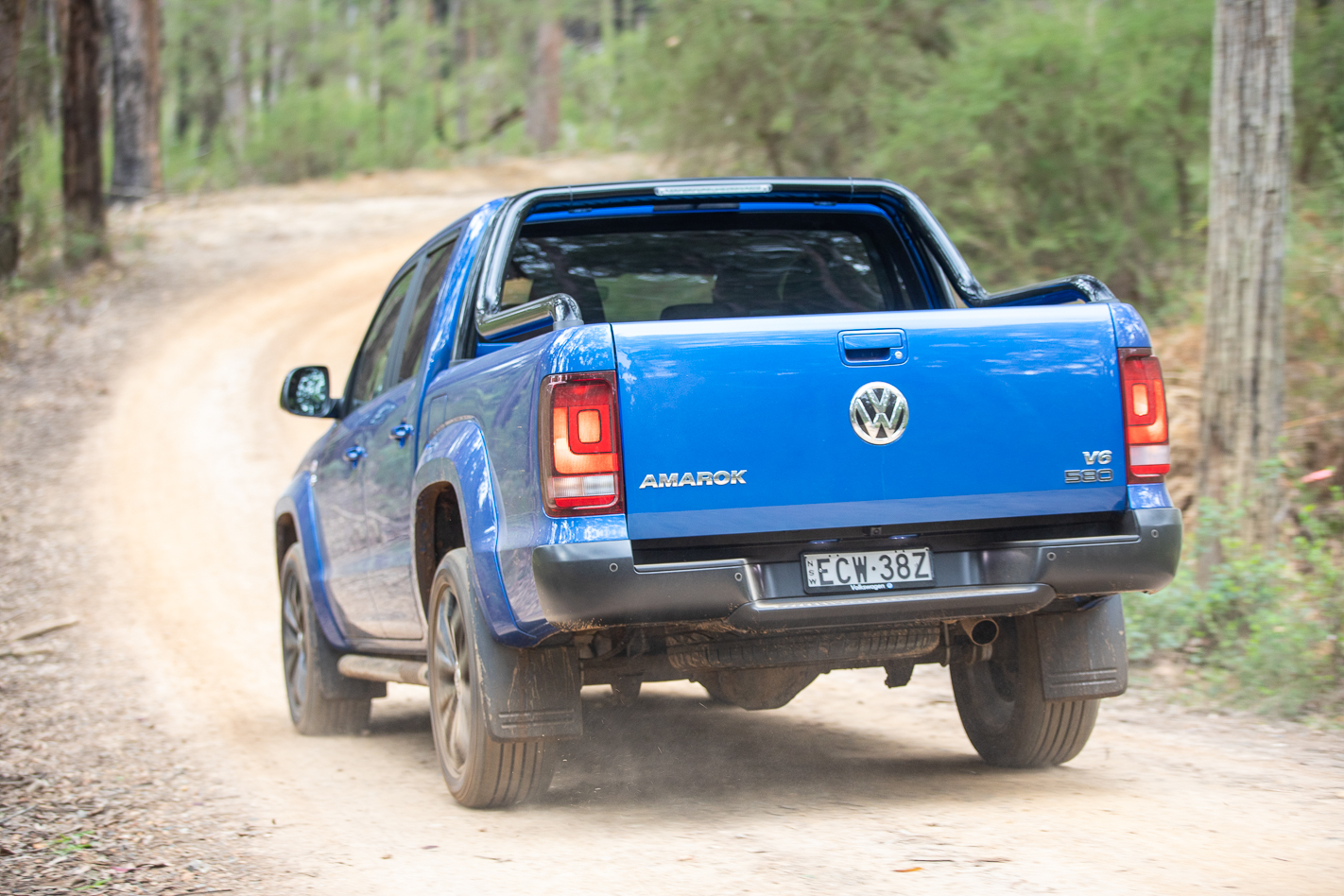
Volkswagen explains the defect as being a weak cable that winches the spare wheel down. Under certain “extreme dirt/dust exposure” conditions, the cable could snap.
If the winch system were to break, the spare wheel would only be suspended by the secondary securing strap.
The notice reads: “if the spare wheel detaches, this may result in an accident and injury or death to other road users”.
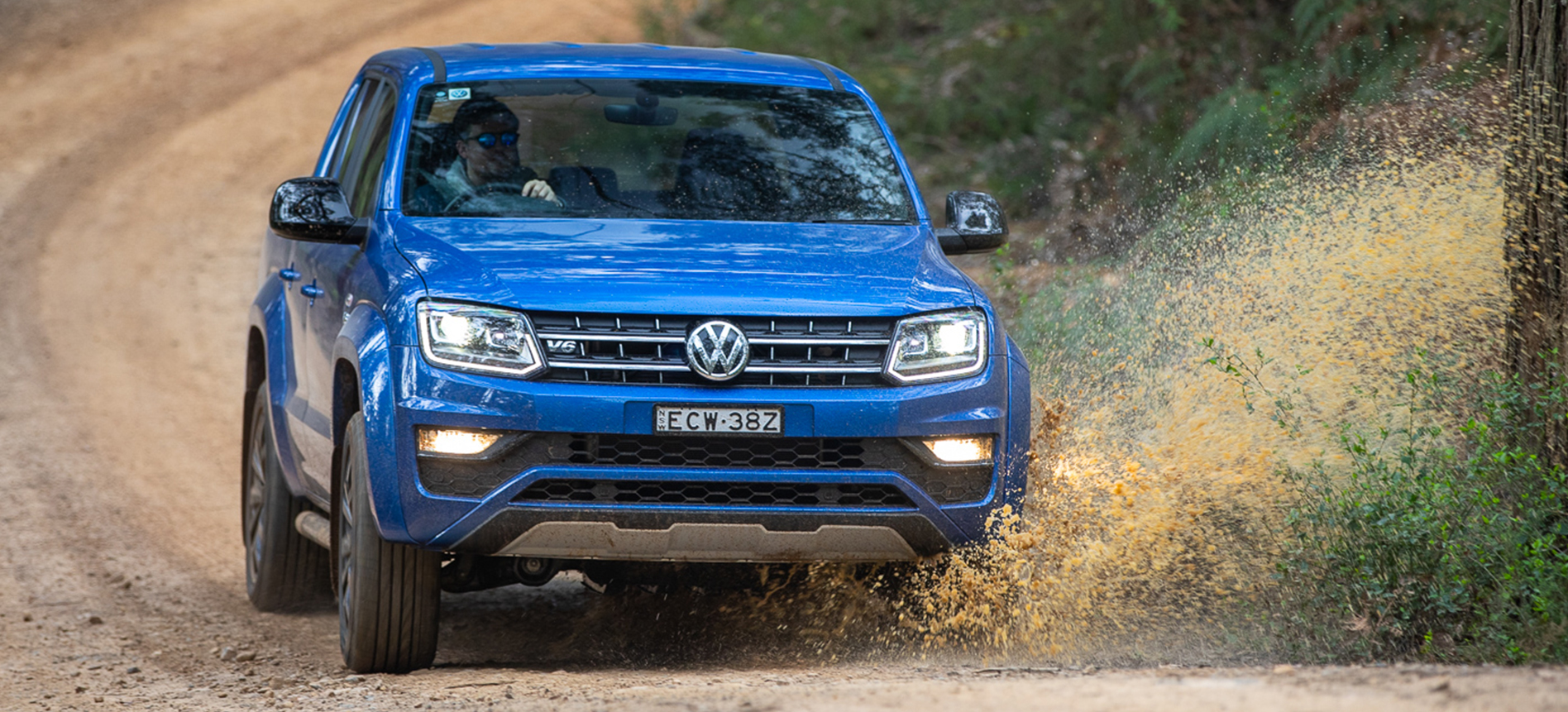
Affected owners will be contacted directly by Volkswagen Australia to organise an inspection and repair, free of charge.
Owners who want to get on the front foot can also contact the Volkswagen Recall Campaign Hotline by calling 1800 504 076 (Monday to Friday, 8.30am-8pm AEST) or visit volkswagen.com.au/app/locals/find-dealer.
A full list of affected VINs can be found here.
Photographs of Honda’s next-generation Civic Sedan have just been leaked on a number of Chinese websites.
The sedan variant of the 11th-generation Civic was previously unveiled in November last year in prototype form, however, these pictures of the Chinese market-spec car confirm an almost indistinguishable appearance.
Images of the new sedan were first leaked on popular Civic blog, Civic11Forum, and while details of the fabled model’s Chinese variant are still thin on the ground, it appears this will be the car jointly built by Honda and Chinese automaker Dongfeng.
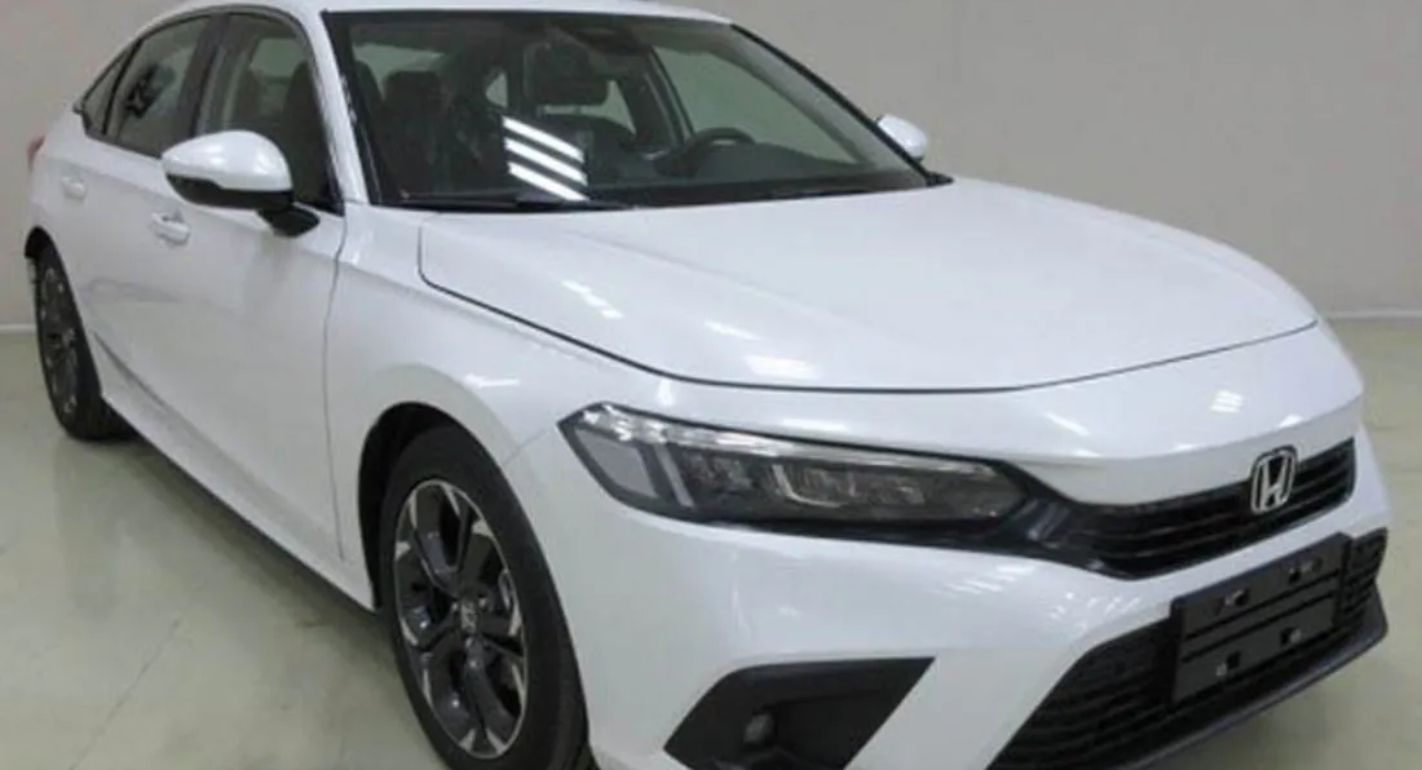
Styling of the Civic sedan looks to be far more mature than the car it replaces, with a subtler front fascia incorporating sleek, elongated headlights and a diminutive blacked-out and low-mount grille that appears less offensive than several of the car’s contemporaries.
At the rear, eyes are immediately drawn to the new integrated spoiler and wrap-around headlight design that follows the body lines of the side profile.
Looking further down, the exhaust tips, cloaked by blacked-out sections of the rear bar, give the Civic a much-needed hit of macho flair.

Unfortunately, as previously confirmed by WhichCar, this sexy sedan will not be coming Down Under, with Honda Australia stating that the yet-to-be-unveiled five-door hatchback variant of the new Civic will better suit the Aussie market.
Honda has yet to confirm many details for the new Civic, but when it eventually is unveiled officially, expect a combination of petrol and petrol-hybrid engines, a more tech-focused interior, improved safety and, barring any unforeseen changes of heart, a new Type R.
MORE: Civic stories MORE: All Honda stories
Volkswagen Australia has issued a recall on 32 examples of the 2021 Tiguan Allspace, describing an issue where a crucial bolt may be missing from the driver’s seat adjustment mechanism.
The notice reads: “A missing bolt may reduce the seat’s restraint capability in the event of an accident, increasing the risk of injury to vehicle occupants.
The company notes that if a “serious accident” were to occur, the manufacturing fault could result in death. As the Tiguan Allspace is a seven-seat family model, this recall addresses a significant risk.
Owners of the affected vehicles will be contacted directly by Volkswagen, which will perform an inspection and repair of the vehicle.
Any owners concerned about the recall can also contact the Volkswagen Recall Campaign Hotline on 1800 504 076 (Monday to Friday, 8.30am-8pm AEST) or visit volkswagen.com.au/app/locals/find-dealer.
Volkswagen has included a full list of the affected vehicles VIN numbers, which can be viewed here.
MORE: Tiguan news and reviews MORE: All Volkswagen stories
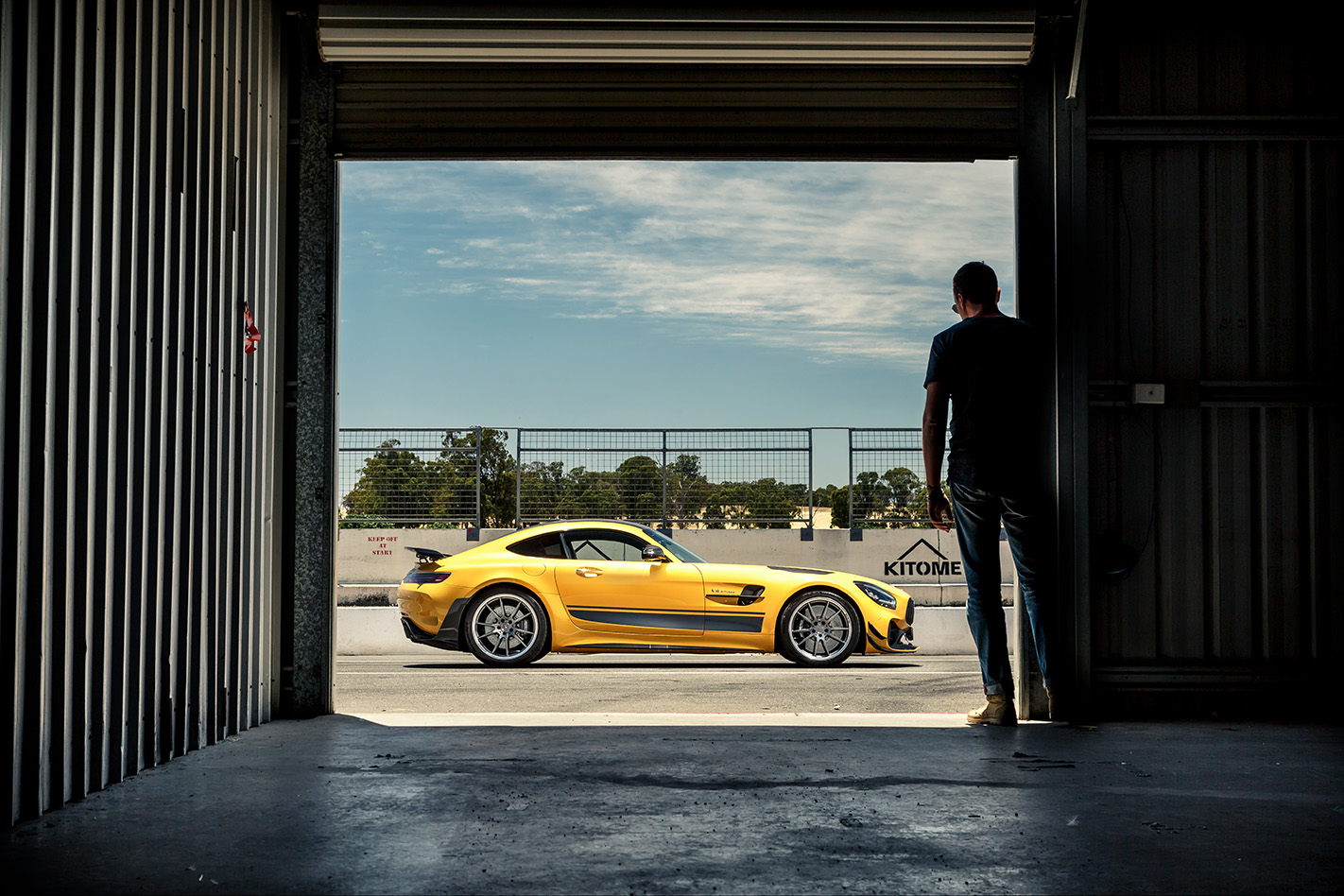
When we began tallying the votes for our 2021 Performance Car of the Year award we stumbled upon a realisation that surprised many of the MOTOR team – AMG has never won our biggest award.
Despite building some of the most bombastic and technically impressive performance cars in modern history, the top step has seemingly eluded Mercedes-Benz and its AMG sub-division.
We have trawled the archives, and poured over previous PCOTY issues to find out exactly how close Mercedes-Benz and its performance arm have come to winning over the award’s 25 year history.
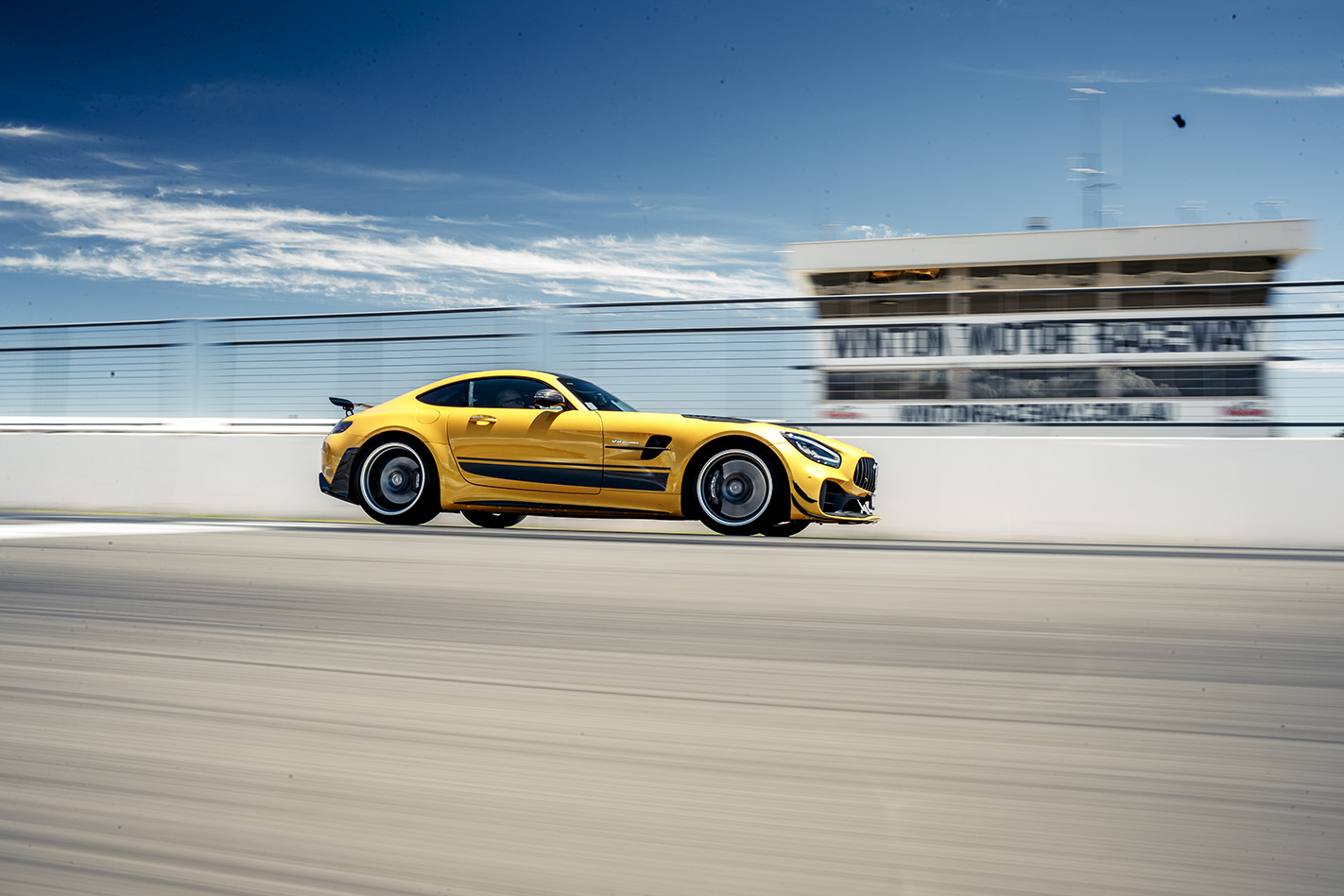
The AMG bridesmaid curse began at the very first Performance Car of the Year in 1996 when the Mercedes-Benz AMG C36 came second to the Porsche 993 911 Turbo.
There are plenty of brands that have had their PCOTY hopes torpedoed by Porsche, but AMG has had to play second-fiddle a surprising number of times.
This is a testament to the strong record of consistent well-engineered performance cars to be released from Affalterbach.
In total AMG has finished on the PCOTY podium eight times, winning once, finishing second five times, and filling the final podium position a further two.
During PCOTY’s 25 years, an AMG-badged model has finished within the top five an impressive 15 times. Six times Mercedes’ performance weapons have been the first of the non-podium finishers, while in 2009 the C63 secured the brand’s sole fifth-place result.
The cars AMG has almost won with are an eclectic and impressive group; ’99 E55, ’03 SL55, ’18 E63 S, and ’20 GT63 S 4-Door.
This year AMG took two of the three podium places with the A45 S securing third – one up compared to the previous-gen model which took fourth in 2013. The modern classic SLS earned an impressive third place in 2012.
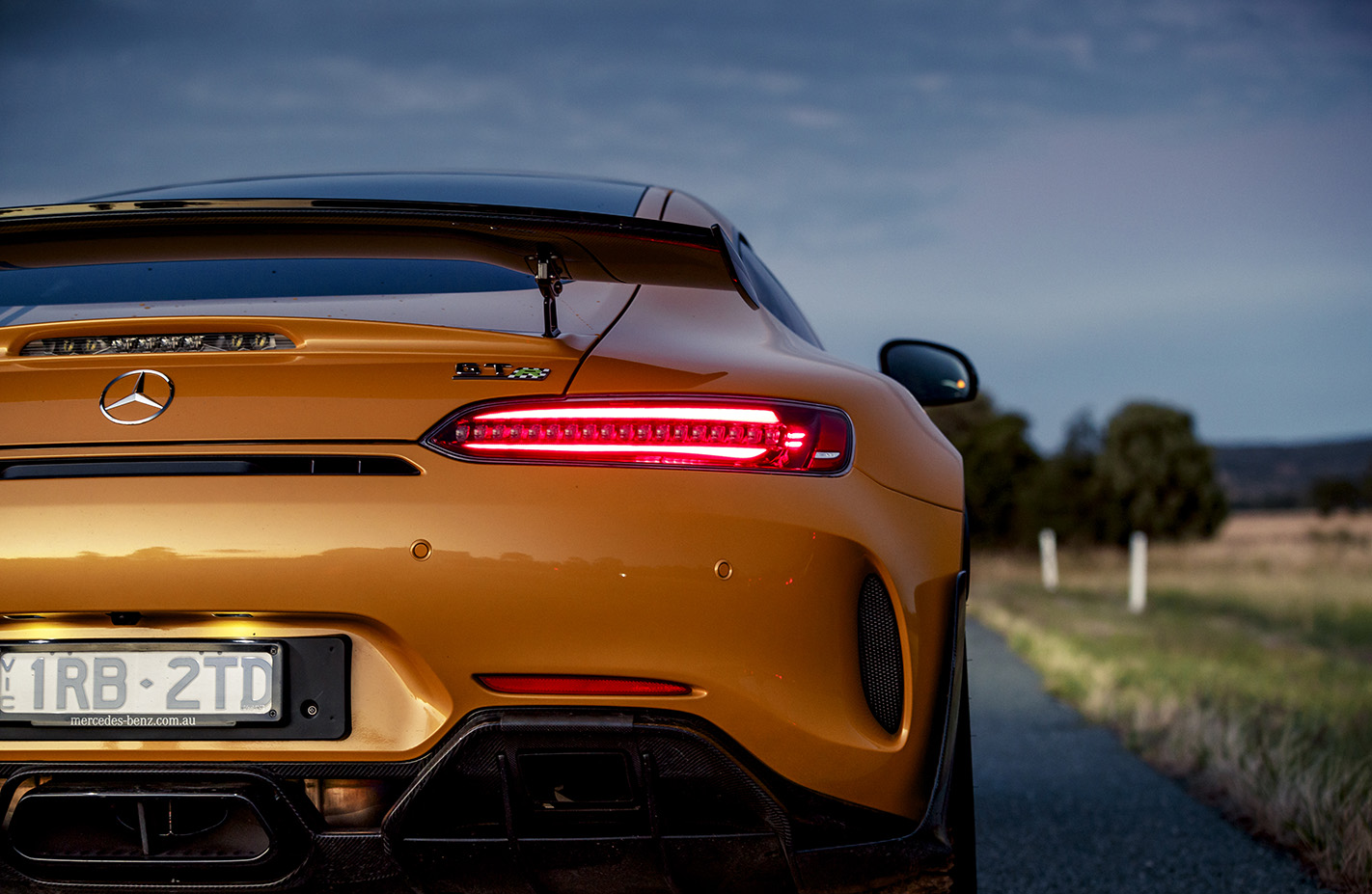
While 2021 is AMG’s first PCOTY victory, we feel like it won’t be the last. For 2022 the bonkers AMG GT Black Series looks set to make a strong run at back-to-back titles – though it’ll have some stiff competition.
Excited? You should be!
MERCEDES-BENZ AND AMG’S BEST PCOTY FINISHES
1st
- 2021 Mercedes-AMG GT R Pro
2nd
- 1996 Mercedes-Benz AMG C36
- 1999 Mercedes-Benz AMG E55
- 2003 Mercedes-Benz SL55 AMG
- 2018 Mercedes-AMG E63 S
- 2020 Mercedes-AMG GT63 S 4-Door
3rd
- 2012 Mercedes-Benz SLS AMG
- 2021 Mercedes-AMG A45 S
4th
- 2001 Mercedes-Benz CLK
- 2003 Mercedes-Benz E55 AMG
- 2005 Mercedes-Benz C55 AMG
- 2008 Mercedes-Benz SL63 AMG
- 2011 Mercedes-Benz C63 AMG
- 2013 Mercedes-Benz A45 AMG
5th
- 2008 Mercedes-Benz C63 AMG
If we had to place bets on only one hot hatch cracking the top-three this year, the odds would have been paying high for the Mercedes-AMG A45 S.
Yes, the hype around the Toyota GR Yaris would be a damning factor, but further doubt comes with the A45 S’s heart-stopping price tag. At $94,200, it towers above excellent hot hatches like the $52,900 Honda Civic Type R – which claimed the win in 2018.
Sure, while price only creeps into mind when positioning a car more broadly for Performance Car Of The Year, it’s reasonable to wonder how the A45 S would find the performance, dynamics and accessibility to justify that figure. But it was Andy Enright who leapt from the driver’s seat after a blast up Mansfield Whitfield road with the first idea of what the A45 S was. “I’d just wait at the bottom of a hill,” he explained between chuckles, “waiting to harass much faster cars.”
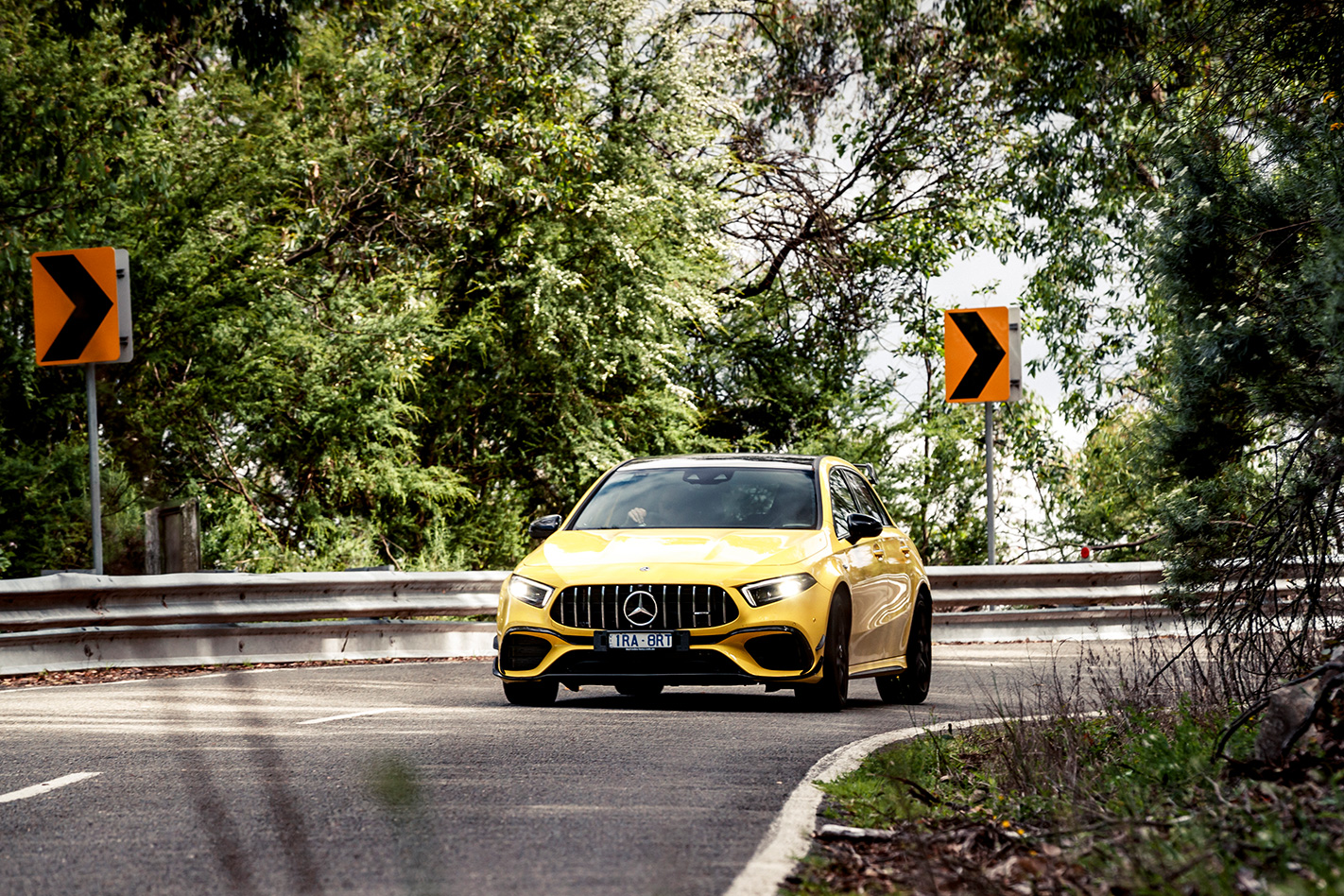
Overhauled for the latest generation A-Class, the new A45 S had to nail three objectives. Delivering the first-generation car’s accessibility and pace, fixing its one-dimensional handling – as well as a brittle ride – and, finally, blowing its competition out of the water.
Ballistic as it is, extracting 310kW from a 2.0-litre engine and then squeezing it through a weapons-grade all-wheel-drive system was what we expected AMG to do. Instead, it uses a limited-slip differential and two multi-plate clutches on the rear axle, so that it can actively divide torque not only between the front and rear axles (with up to 100 per cent rearwards if necessary), but also between the rear wheels.
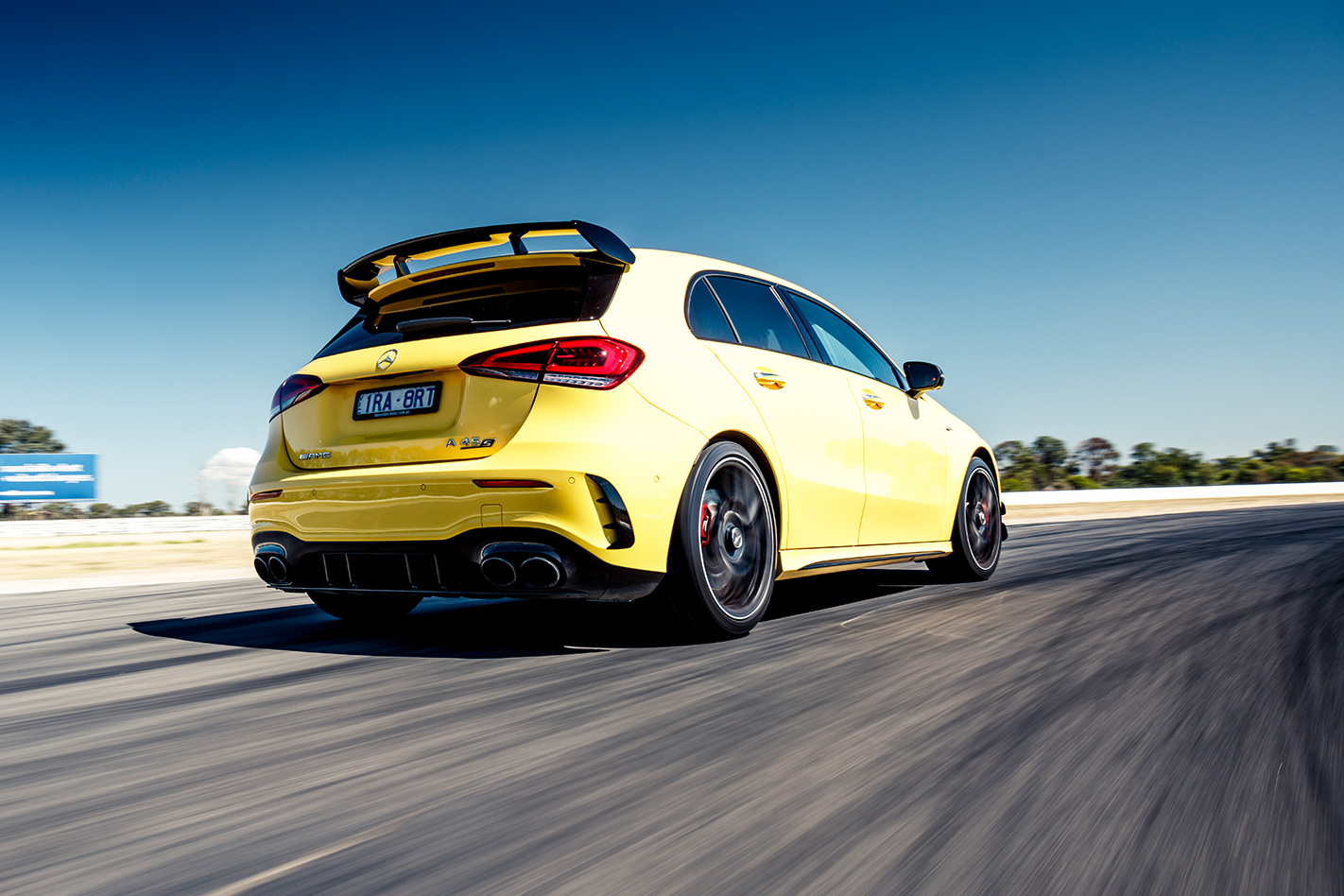
Whereas the old A45 would activate its rear axle for traction and ultimately neutral-to-push understeer, with only a maximum of 50 per cent of torque going rearwards, the new A45 S is different, deploying an eager front-end that’s ready to call upon the rear to tweak your angle of attack upon demand.
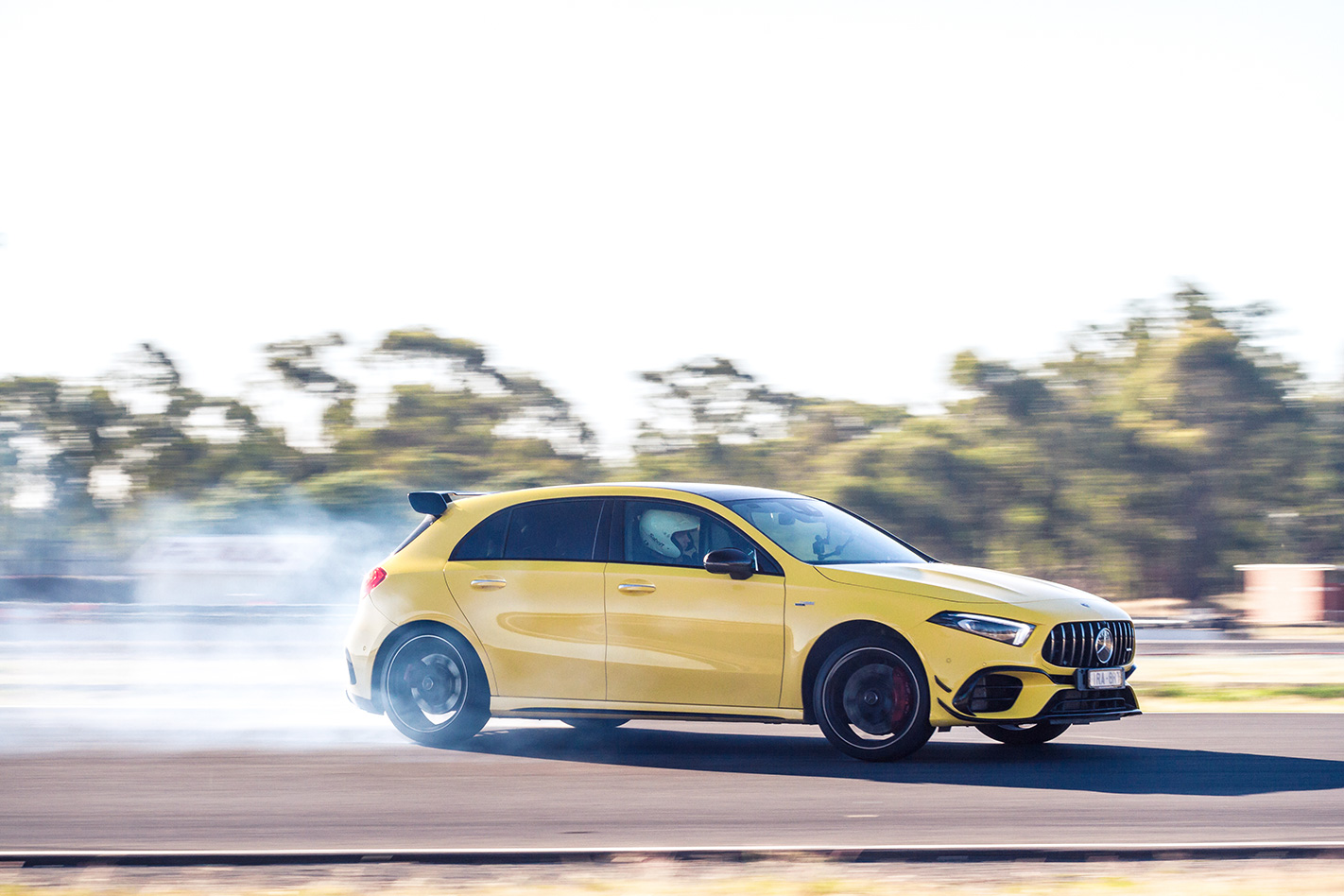
Of course, this also creates the possibility for a Drift Mode, which Newman and Enright were happy to verify works a charm for photography.
It requires commitment, though, and counter-intuitively steering into the slide while smothering the loud pedal. A bit of space, and a dollop of common sense, also help.
Pin-sharp steering dials you into the front-end, but it is worth noting the suspension plays a large part in brightening the A45 S’s handling. Increased rear roll-stiffness tips the A45 S on its toes at corner entry, helping all-wheel-drive break rear traction ever so slightly. Crucially, while AMG could have called it a day on the A45 S’s dynamic repertoire then and there for a very capable hatch, what sets the A45 S apart is genuine compliance to go with its all-paw punch.
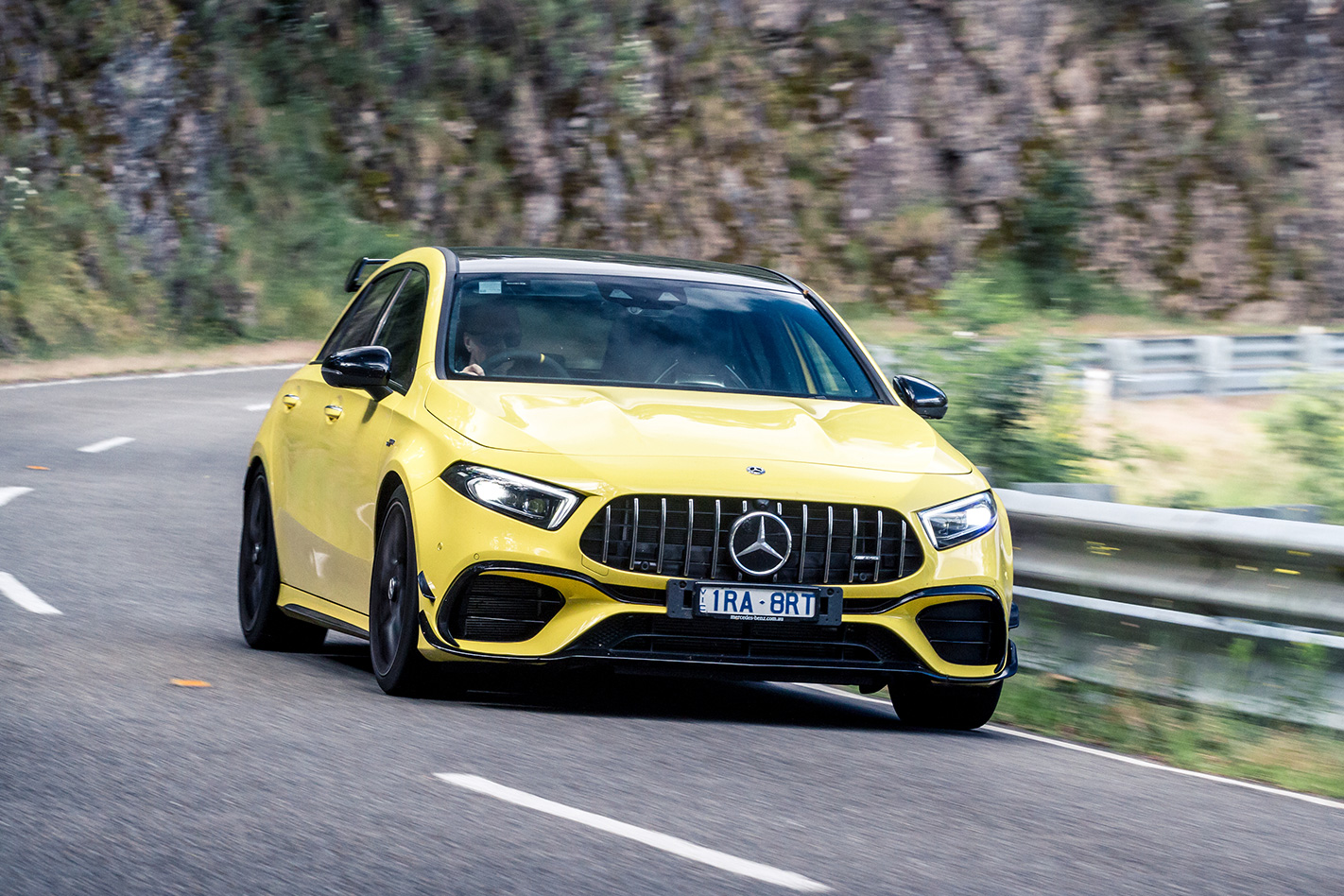
Things like solid mount subframes, along with long-stroke adaptive damping, let you dig in into its chassis while knowing there’s an underlying suppleness to forgive any ham-fisted inputs. However, this does compromise its secondary ride a touch.
The AMG tweaked interior also encourages having a go. The seating position is low for a hatch, while the steering wheel and shift paddles are just as ergonomically sound. The pedals are sturdy and well-sized. Full throttle fills the interior with a likeable rortiness, even if AMG saw the need to offer an amplifier, and the eight-speed dual-clutch ‘box keeps a tight leash on its 500Nm, shifting fast and precisely.
With launch control it’ll keep the 2.0-litre turbo engine on the boil to nail AMG’s 3.9sec 0-100km/h claim, leaving many cars above its price range in its wake.
With all this, it’s no surprise the A45 S is an absolute riot on track. Massive brakes for a hatch showed barely any fatigue. And judge Butler enjoyed the $2500 optional Pirelli P Zero Trofeo Rs we had on at Winton since we feared he would have run the tyres down to their belts on track if the A45 S had a bottomless fuel tank.
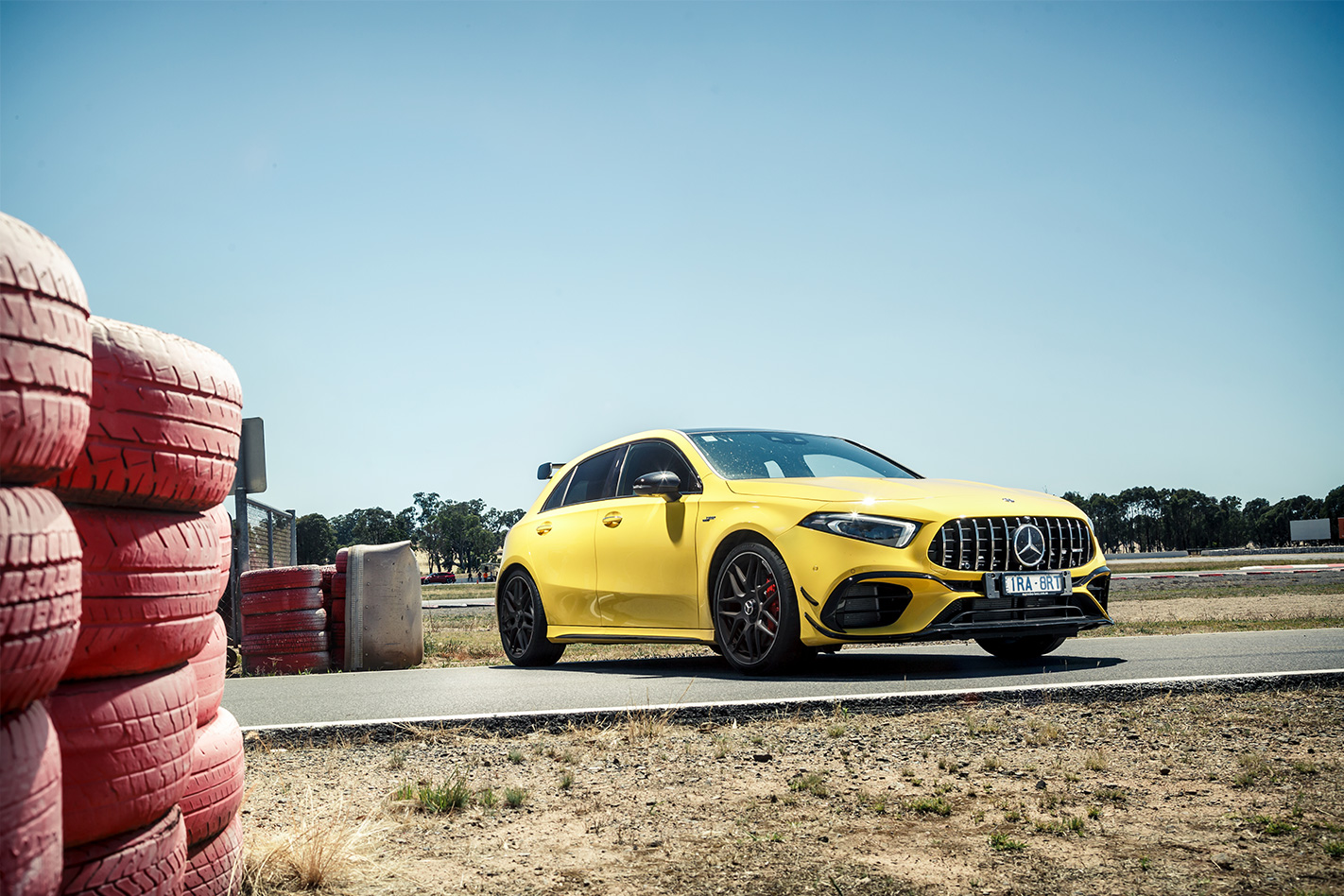
They were enough to help the A45 S thrash half the PCOTY field on a lap time. But after bouncing back from a brief transmission fault light, the car felt more alive, and natural, on its regular Pilot Sport 4 S tyres – at least at lower speeds.
And that’s a trait we’d happily have instead of bragging rights. This breadth of talent replaces any doubt for the A45 S, proving it as not only a successful development on the nameplate’s legacy but a cracking addition to the hot hatch category that can hold its own, whatever its price.
That’s why two of the judges, Newman and Enright, singled it out as the best, or equal best, of this year’s bunch. But it was the rest of the panel who unanimously ranked it fourth. Why? I found its price too hard to reconcile when the Honda Civic Type R still exists.
Most importantly, the third-place underscores one statement in the performance car landscape, to never underestimate the A45 S again. – LC
REVERTING TO TYPE?
True, an A45 S is significantly pricier than the last hot hatch to win PCOTY, the Honda Civic Type R. But just chew on this fact. The Honda recorded a 5.68s sprint to 100km/h, the AMG 3.96s. In an niche marked by minuscule degrees, the difference in the sprinting ability of the two best hatches to have ever graced PCOTY is more than 30 per cent. That’s massive.
THE NUMBERS
0-100km/h: 3.96 sec 0-400km/h: 12.09 sec @ 186.53km/h Lap Time: 1:34.9
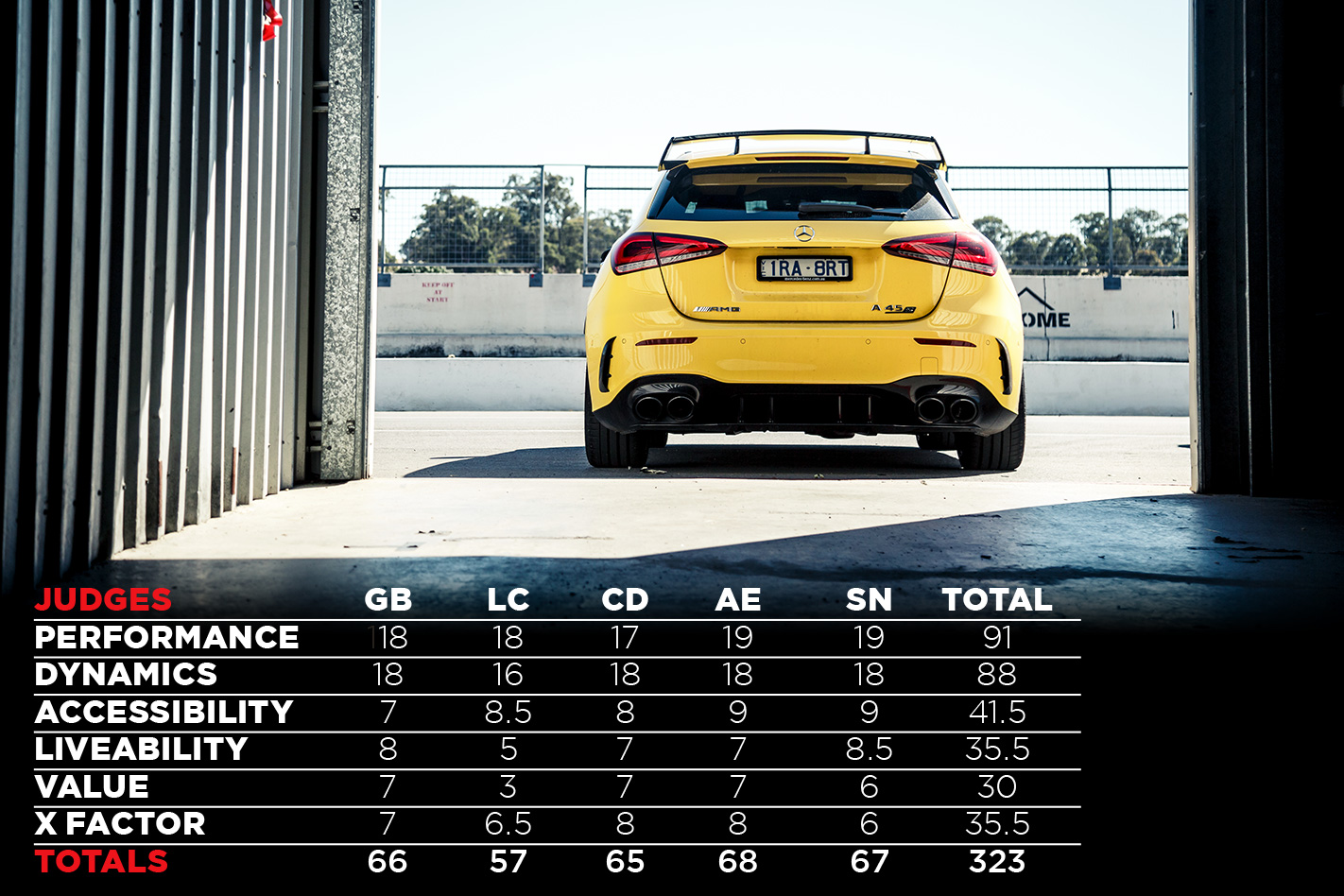
JUDGE’S RANK
Butler 4th A point-n-shooter that also bends the laws of physics in corners
Cordony 4th If you had to tackle Targa Tassie without pace notes and one car…
Dupriez 4th Hot hatch on steroids impresses most in sheer surgical precision. Dynamite on road or track, it’d be a mixed-condition Targa champ
Enright =1ST Still stand by my assertion that this is the best hot hatch ever built. Tell me I’m wrong
Newman 1ST It does everything, as a hot hatch should, and at such a high level
