
The highly-tuned five-cylinder barks in a steady rhythm, each successive prod of the throttle raising the revs ever higher. Each engine note question is swiftly answered by a crisp pop from the exhaust in a highly combustive game of call-and-response. A man in a brightly coloured vest holds out his hand and extends a finger at a time: “uno…due…tre…quattro…” His hand drops, as does the clutch, all four wheels sending rooster tails of earth into the sky.
It was here that Audi changed the face of rallying. While its rear-wheel drive rivals scrambled and slithered away from the start line the quattro surged; imagine asking any motorsport team if they’d like a five-second head start at the beginning of each race? Add that up over a 15-20 stage rally and you can see why all-wheel drive quickly became the technology of choice for loose surface competition.
But it wasn’t all plain sailing. Despite Audi’s enormous technological advantage, the strain of the associated power and weight took its toll and unreliability allowed the 1981 and 1982 WRC titles to fall to lighter, nimbler and, crucially, more reliable two-wheel drive opposition. However, as the Group B regulations took hold and sent power outputs soaring Audi’s advantage only grew culminating in back-to-back titles for Hannu Mikkola in 1983 (see pg. 86) and Stig Blomqvist in 1984.
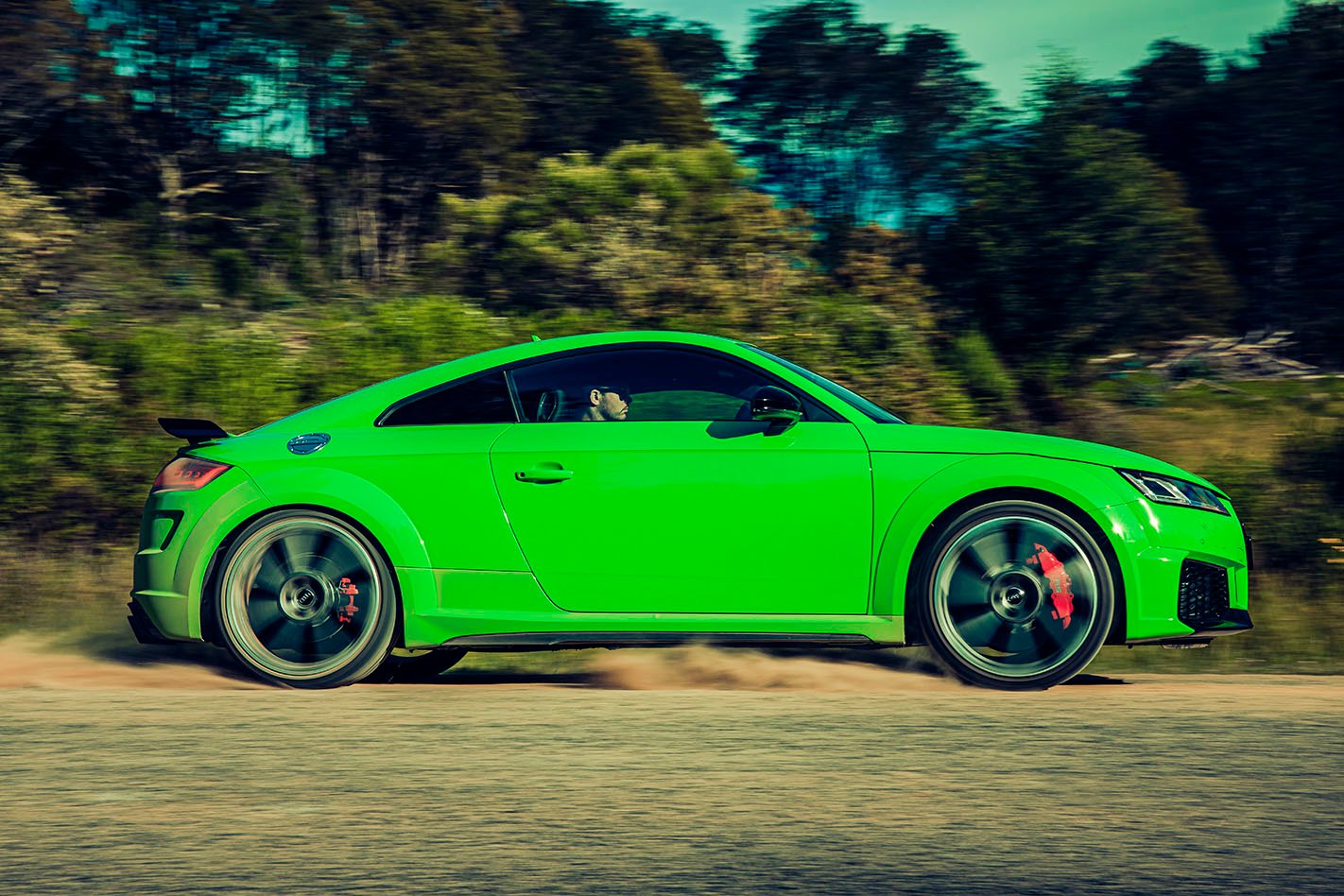
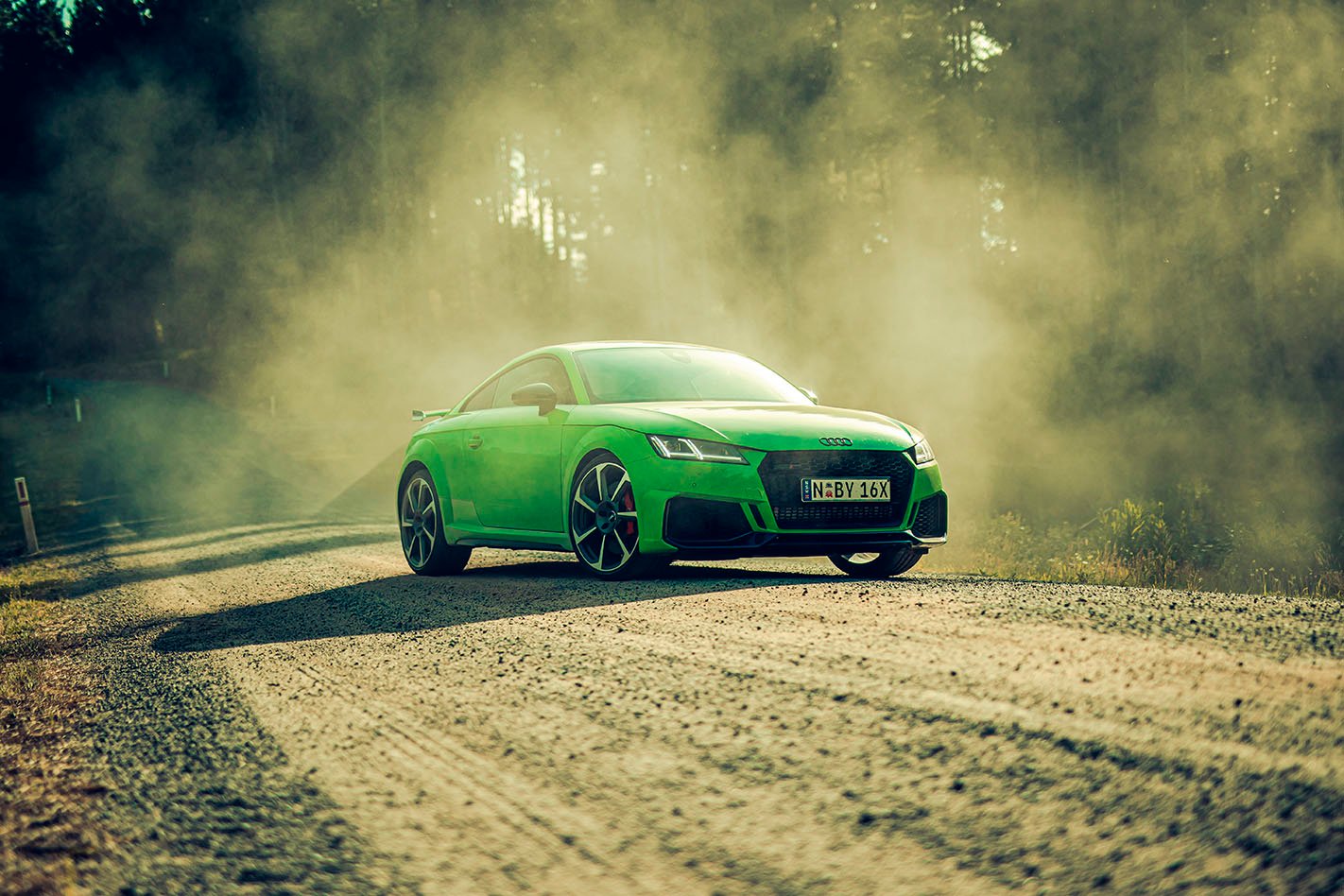
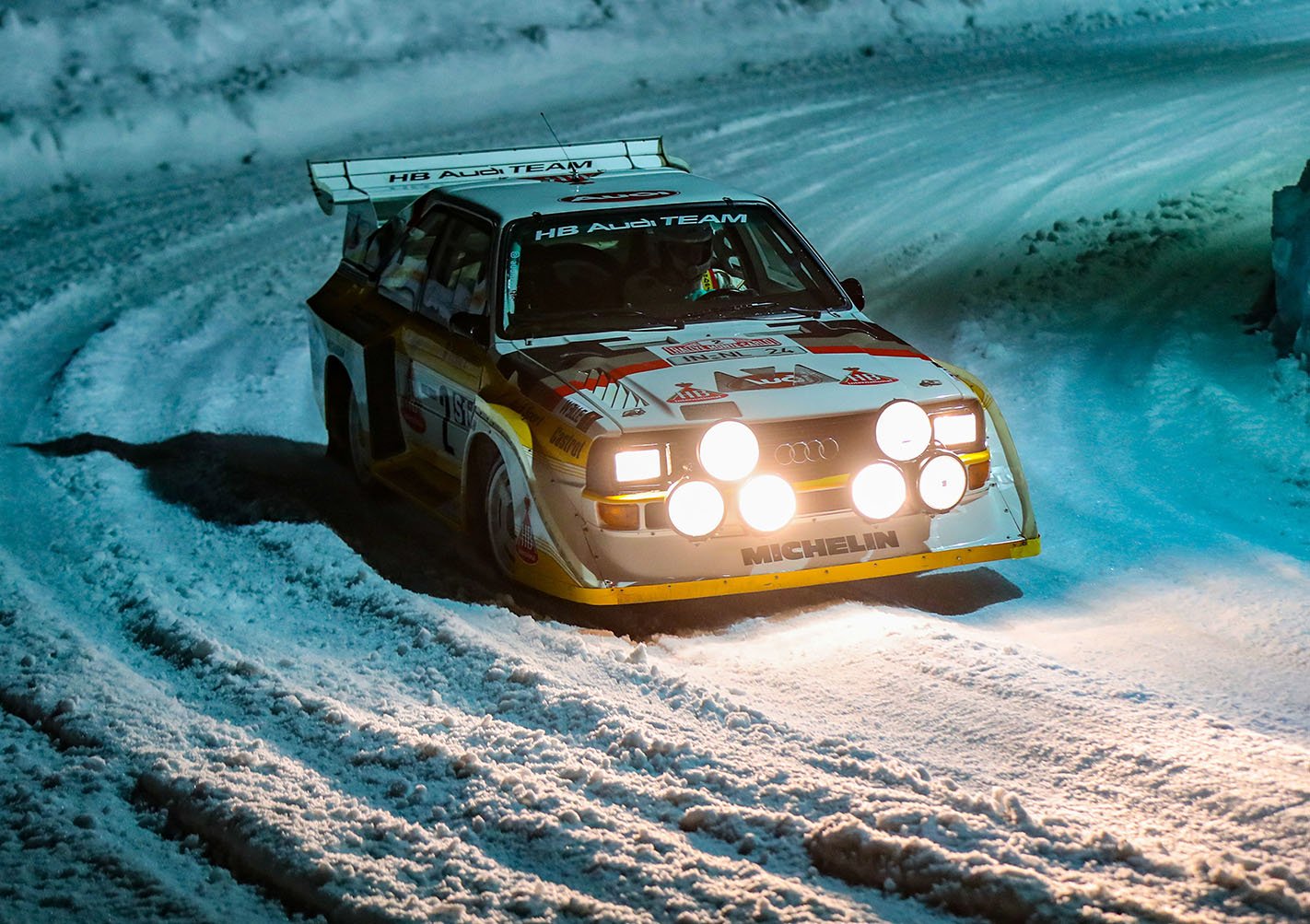
This, perhaps unexpectedly, brings us to the latest TT RS. During the 1984 season Audi developed the short-wheelbase Sport quattro. In an effort to improve its predecessor’s somewhat ponderous handling, particularly on tarmac, the engineers cut 320mm out of the wheelbase, increasing agility and removing weight while also extracting more power from the engine. Compare the specifications of the competition Sport quattro, dubbed ‘S1’, with the latest TT RS and it’s clear the two are kindred spirits.
The two are almost identical in size, the newer car just 41mm longer, 15mm wider and 4mm taller. Both use turbocharged five-cylinder engines, though while the S1 has a 345cc deficit (2135cc vs 2480cc) the outputs are, again, virtually identical: 298kW at 7500rpm and 460Nm at 5500rpm for the S1; 294kW from 5850-7000rpm and 480Nm from 1700-5850rpm, the newer car’s torque spread a clear indicator of 35 years’ advancement inturbo technology. Even the firing orders are the same, 1-2-4-5-3, if you’re interested.
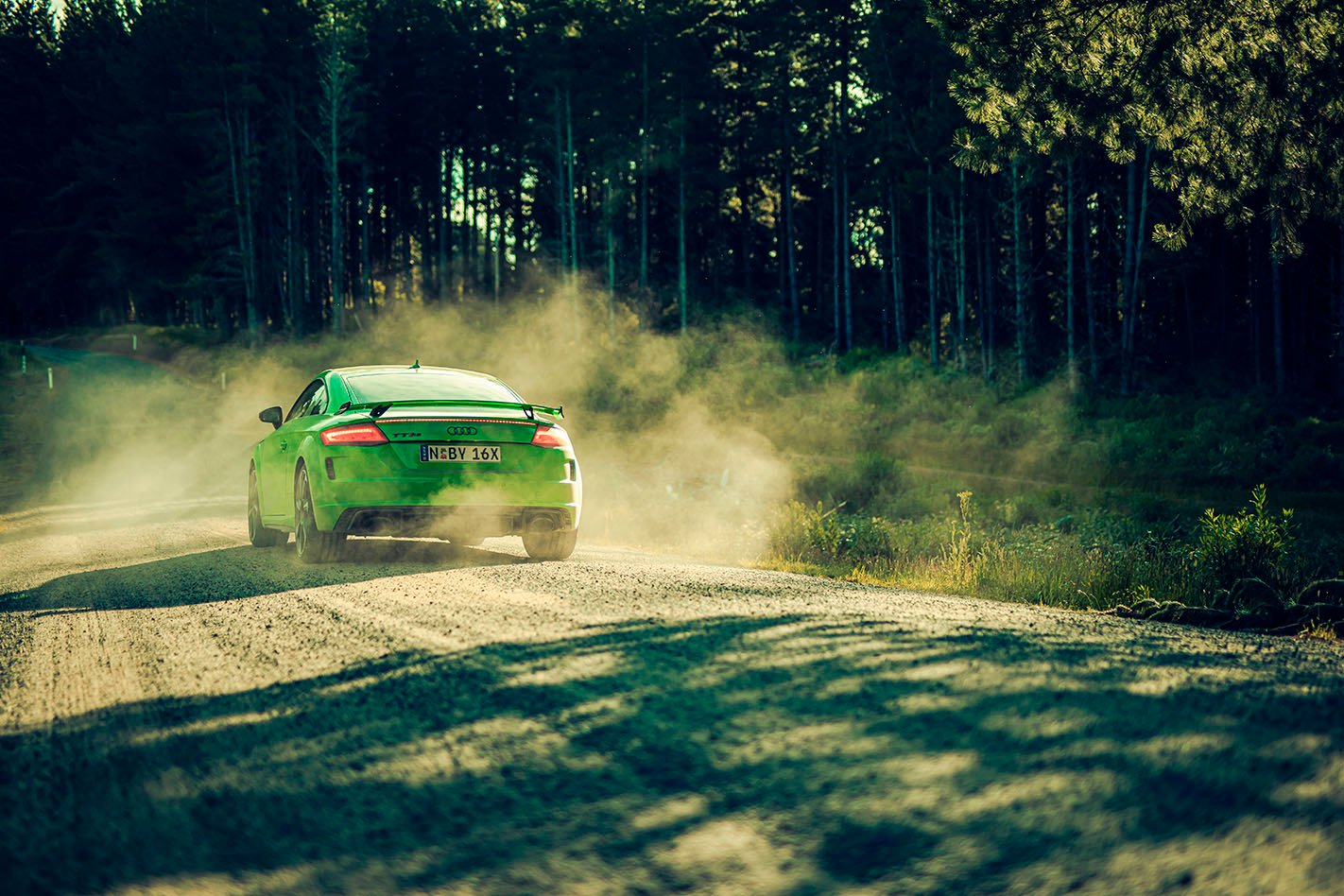
Given the two car’s on-paper similarities, can the newly facelifted TT RS follow in its grandfather’s footsteps as an all-surface assassin? We’ll forgive you for not realising there was a ‘new’ TT RS. It’s a facelift in the truest sense of the word with redesigned front and rear ends, including larger air intakes at the front, a new rear wing, vents behind the rear wheels and a new diffuser design. Audi says “the TT RS has never been this masculine”. True. It’s certainly a long way from the rounded, unadorned, Bauhaus-inspired original – sharper, more aggressive, less ‘pretty’.
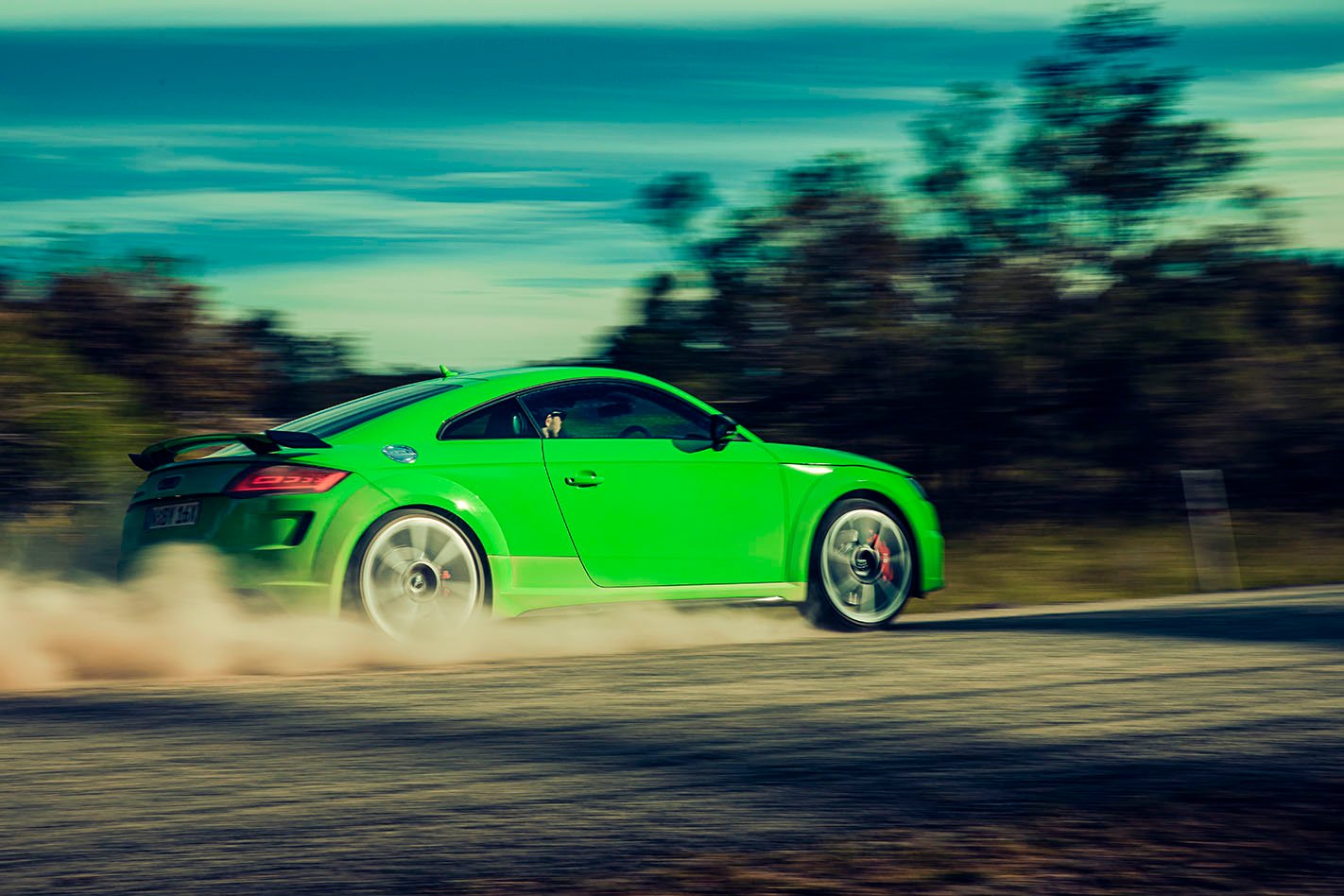
The TT has long carried a ‘hairdresser’s’ label, despite the fact it’s been offering true sports car performance for almost two decades; the first-gen (8N) V6 was interesting and the 1.8T quattro Sport promising, while the second-gen (8J) TT S was an under-rated gem, this very magazine decreeing: “After thrashing the new TT S at Wakefield Park you can call us all hairdressers.” It appears the TT RS has earned the respect of the Audi cognoscenti, however, judging by the raised finger of acknowledgement (no, not that finger) from the B5 RS4 driver who spots our Kyalami Green test car passing through Traralgon. Well, he could hardly miss it, could he?
The mechanicals carry over, but there wasn’t a lot of need for change. Audi claims 3.7sec from 0-100km/h but we clocked the previous TT RS at 3.59sec during testing Performance Car of the Year 2018 and it kept hauling to an 11.75sec quarter mile at 191.89km/h. Supercar speed for sports car money. It’s a cracking engine, a nine-time consecutive winner of the International Engine of the Year 2.0-2.5L category. While it’s found in a range of Audis, the 2.5 five-pot has less weight to push in the TT RS than in any other model and subsequently is at its most potent in this application.
Maximum torque is on tap from just 1700rpm so there’s ample urge down low, handy if you find yourself a gear too high through a corner. Despite being substantially under square with an 82.5mm bore and 92.8mm stroke, it spins easily to its 7000rpm redline with a characteristic off-beat gurgle like it’s trying to sing underwater. A six-speed manual would be a sweet fit for this car, but the seven-speed dual-clutch is an appropriate partner; the evolution of the Sport quattro, the wild S1 E2 (see breakout) was the first Audi to use a dual-clutch gearbox way back in 1985!
There’s a certain thrill to the uninterrupted delivery of power this clever transmission provides, especially in a car this quick. The TT RS is absolutely one of those cars that requires a weather eye on the speedometer at all times. Its combination of cornering grip, total traction and ample stonk means it accrues speed incredibly quickly and easily. The 2505mm wheelbase is much closer to that of the original quattro than the truncated S1 but the ultimate TT has no shortage of agility, each movement of the steering wheel eliciting an instantaneous response.
One thing the TT RS has inherited from its forebears is a predilection for push. Of course, it doesn’t plough like its 1980s predecessors, which often resolutely refused to change their course from the straight-ahead. The Sport quattro’s decidedly unfavourable 62:38 weight distribution did it no favours, but the rudimentary centre diff, which split drive 50:50, also didn’t help. To make matters worse, reliability problems sometimes led Audi to delete the centre diff entirely which only exacerbated its handling difficulties. Walter Rohrl described the technique of driving the quattro as akin to the Olympic sport of “throwing the hammer”.
Thankfully, the TT RS has no such affliction. Nevertheless, while the all-alloy five-cylinder introduced in 2018 improved the weight distribution by a single percentage point by removing 26kg out of the nose, it remains a front-heavy 59:41 and the handling reflects this. While lateral limits are extremely high, eventually the front tyres begin a gentle slide into understeer; it’s slightly difficult to know exactly where this point is, but as the kilometres pass and experience builds you can feel when the scrub starts, wait, then put the quattro system to good use on corner exit.
Driving well isn’t a requirement to go quickly in a TT RS, its make-up capable of flattering lazy or abrupt inputs, but it’s surprising how much happier the car is if you do so. That’s true for every car, of course, but while Audi’s all-wheel drive allows the throttle to be mashed with impunity, a little progression goes a long way towards letting the tyres work to their maximum. Smoothness becomes even more paramount on loose surfaces. It’s reasonable to assume that very few TT RSs – or Audis of any kind, really – will ever venture onto the gravel but perhaps they should, for it opens the door to a room of capability that would otherwise go undiscovered, though snow would work just as well.
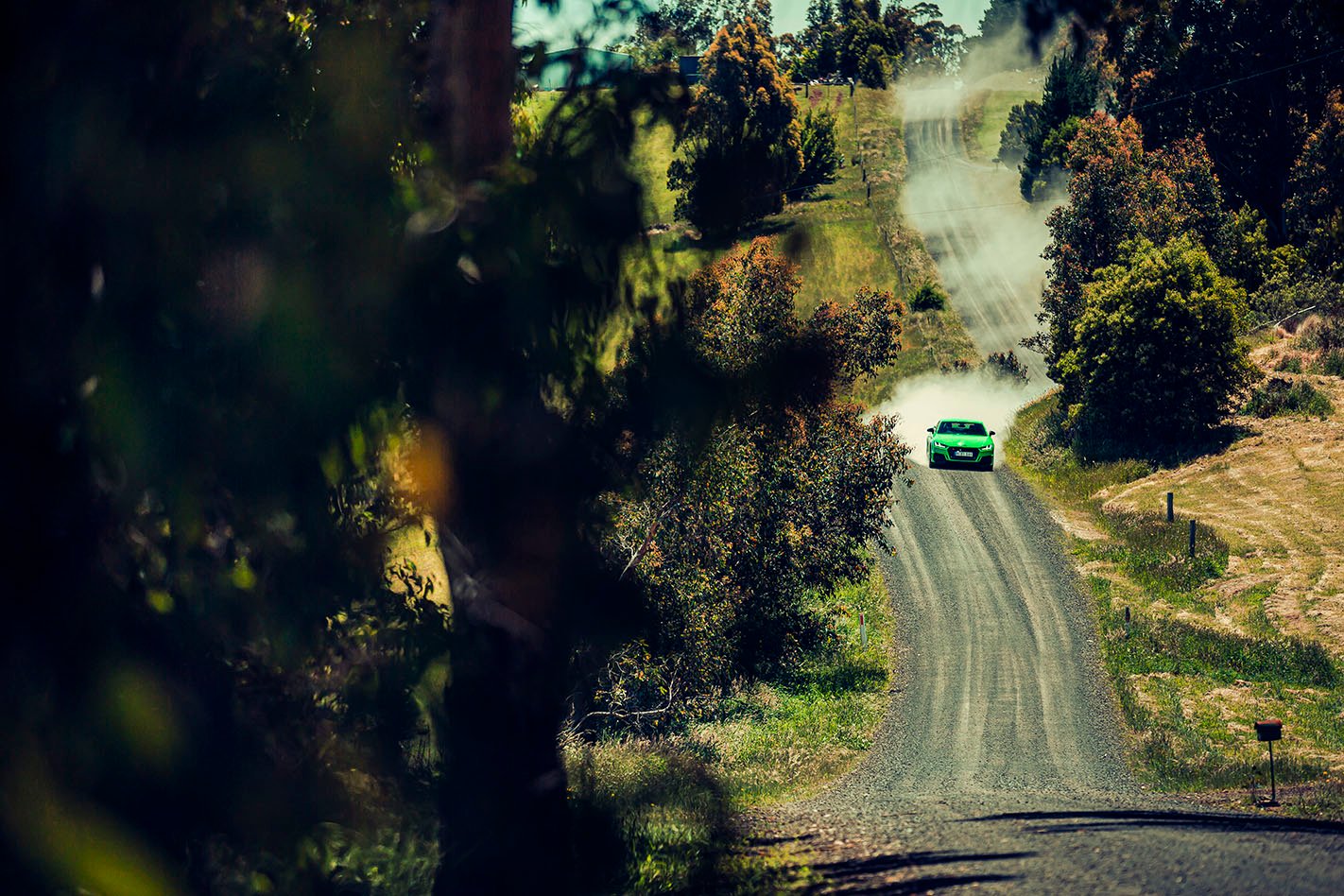
All of a sudden, that unusual weight distribution can be used to the driver’s advantage, a lifted throttle or trailed brake swinging the rear end loose which can then be held there using the throttle. The quattro system that offers no hint of throttle adjustability on asphalt proves there’s truth to Audi’s claims of a greater rear drive bias on RS models. Our route has morphed from Rally Spain, relentless tarmac twists and turns with gravel-strewn apexes where corners have been cut, to Rally Finland, smooth, wide but slippery dirt roads with the rollercoaster topography of the fearsome Ouninpohja stage.
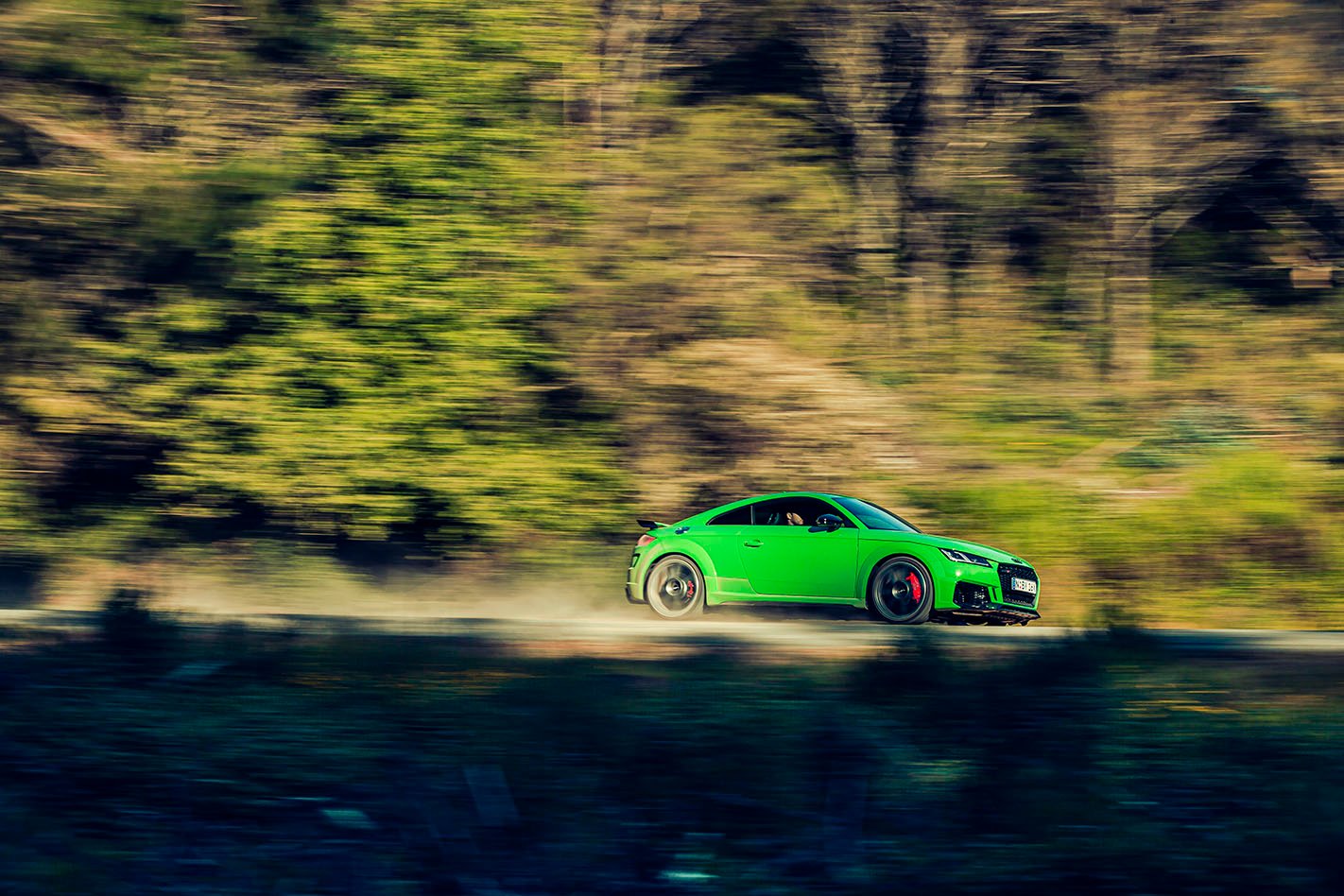
This decidedly road-focused coupe feels surprisingly at home. While choreographing the opener to this feature, it feels like the TT RS ‘learns’ the available grip. Lacking aggressive, knobbly rally tyres it doesn’t quite shoot off the line like its competition predecessors but each successive launch is cleaner than the last. On the first it wheelspins wildly, smashing into the rev limiter; on the second there is less furious wheelspin and a shift to second, while on the third it almost immediately upchanges to maximise grip. A sub-5sec 0-100km/h sprint on gravel wouldn’t be a surprising result.
It isn’t all Weissbier and skittles, however. There is a degree of less is more with the TT range, the base model possessing a sweetness and delicacy that the RS replaces with brute force: more power, more brakes, more grip and more speed but without necessarily any more fun. The chassis is compromised, skipping over a bumpy road rather than keying into it. The rear in particularly feels very stiff, the ride turning choppy on poor surfaces, sometimes brutally so. Speed humps can be a wince-inducing affair and the suspension can be quite noisy, clattering away over small amplitude bumps.
Road noise is also substantial; it’s a good thing there’s a powerful stereo, but Bluetooth conversations at highway speed necessitate a careful ear and a raised voice. Audi calls the the TT RS a “2+2” but it’s closer to a 2+0; it’s difficult to imagine what sort of human could fit comfortably on the short, upright bench. That’s probably fitting, as I can’t imagine chopping 320mm out of the quattro’s wheelbase did much for the Sport quattro’s rear accommodation. I drop the apologetic rear seats to see if it provides greater amplification of the five-cylinder exhaust note but sadly the only result is a pronounced Megane-like turbo whoosh. The upside ofmaking the TT a pure two-seater is excellent luggage space, the decent 305-litre boot swelling to 712 litres.
Despite its flaws, the TT RS is a weapon. At full pace, it’ll have adrenaline coursing through your veins and your eyes out on stalks; while it prefers smoothness it’s not averse to being bullied, flitting from apex to apex, the chassis not alive with feel but providing reassuring confidence. A word for the brakes, too; in a world where many cars still have lacklustre stoppers, the monster 370mm discs with eight-piston calipers on the front of the RS, backed by 310mm discs and four-piston calipers at the rear, are a welcome inclusion.
As such it would be a shame if these words are the TT’s epitaph, but there’s a distinct possibility that this will be the case. In May 2019 Audi’s interim chairman, Bram Schot, told media that there would not be a new TT, its replacement instead being “a new emotive model in the same price range.” Subsequent reports suggest that model will be an all-electric coupe-like crossover – whether that qualifies as an “emotive model” perhaps depends on your interpretation.
Electrification will be a quantum leap for all-wheel drive, offering hitherto unknown levels of traction, torque and tuneability thanks to the potential to gift each wheel its own individual motor. As such, quattro is potentially entering a golden age. It will fire off the line faster than ever regardless of the surface, but the lack of that rhythmic five-cylinder bark signifies the passing of an era.
KING QUATTRO
AUDI’S ALL-wheel drive advantage quickly evaporated during the Group B era. Peugeot changed the game with its wild 205 T16, a mid-engined, featherweight flyer; Audi might have won both the 1984 drivers’ and manufacturers’ title but Peugeot dominated the last three rounds it entered, putting the writing firmly on the wall for more traditional machinery. Audi responded as best it could: the S1 ‘Evolution 2’ produced up to 410kW, massive wings generated 500kg of downforce, a Torsen variable-drive centre diff was added and everything possible – radiators, oil coolers, alternator – was moved to the boot, improving the weight distribution to 51:49 front-to-rear. Acceleration was mind-blowing, the E2 clocking 0-100km/h in 3.1sec and a 10.8sec quarter mile. Sadly, the car’s success was limited, Walter Rohrl scoring the E2’s sole victory at San Remo in 1985.
AUDI TT RS SPECS
- Body: 2-door, 2+2-seat coupe
- Drive: all-wheel
- Engine: 2480cc inline-5, DOHC, 20v, turbocharger
- Bore/Stroke: 82.5 x 92.8mm
- Compression: 10.0:1
- Power: 294kW @ 5850-7000rpm
- Torque: 480Nm @ 1700-5850rpm
- Power/Weight: 203kW/tonne
- Transmission: 7-speed dual-clutch
- Weight: 1450kg
- Suspension: struts, adaptive dampers, coil springs, anti-roll bar (f); multi-links, adaptive dampers, coil springs, anti-roll bar (r)
- L/W/H: 4201/1832/1344mm
- Wheelbase: 2505mm
- Tracks: 1564/1543mm
- Steering: electrically assisted rack-and-pinion
- Brakes: 370mm ventilated/drilled discs, 8-piston calipers (f); 310mm ventilated/drilled discs, 4-piston calipers (r)
- Wheels: 20.0 x 9.0-inch (f/r)
- Tyres: 255/30 R20 (f/r); Pirelli P Zero
- Price as tested: $134,900
There’s something bittersweet about handing back the keys to an outrageous supercar or luxury limo.
On the one hand, returning something that costs the same as a Toorak two-bed usually marks the end of a few days of motoring ecstasy and a lot of fun.
And it also serves as a brooding reminder that, as long as I stay in this line of work, I’ll never call something of a similar ilk my own.
Beneath the more superficial sadness, however, lies intense relief.
Opinion: Here is how we can make station wagons popular again
Over the years I’ve been fortunate to get my hands on some very expensive and exciting hardware and, whether it’s the simply unfathomable sums of cash or a case of downright ignorance, a certain measure of desensitisation to the value of these cars is a byproduct of the experience.
In fact, it’s sometimes a necessity to ignore the eye-watering bottom line to drive an expensive car as it deserves to be driven.
But the nagging fear of damaging a car is always there – the terror of binning something that, not only can I not afford but would struggle to run to its optional paint job – buried beneath layers of confidence and distraction like an ugly fossil under millennia of sediment.
With a smile and a handshake I tell the press-car keeper I didn’t want to give it back but, between you and I, I really did.
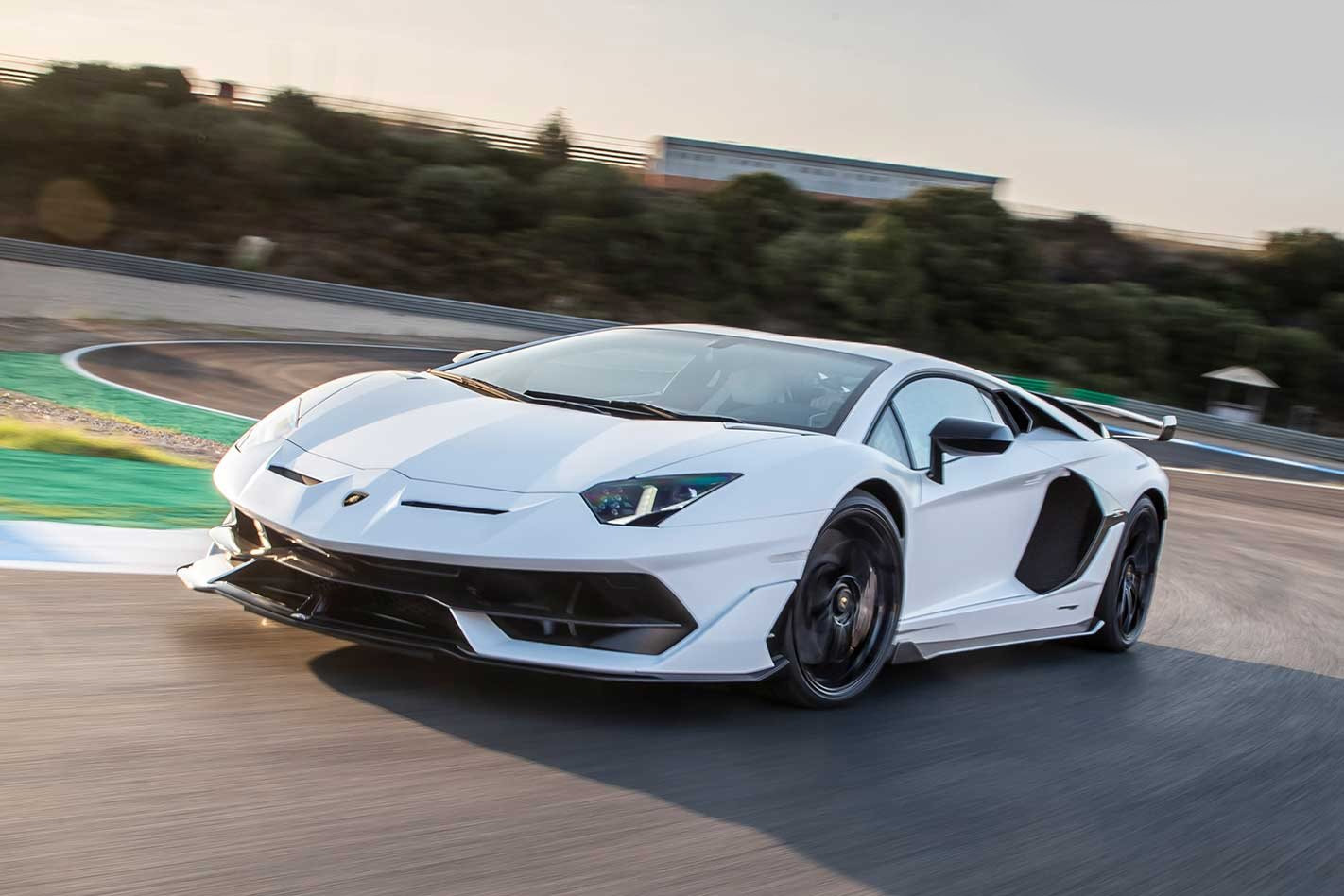
And it’s not just the stress of potentially splintering some seriously pricey carbon that can tarnish the fun. The Lamborghini Aventador SVJ, for example, can exceed the national speed limit in second gear and, hilariously, will crack 100km/h … in reverse.
In short, if you want to hear the heavenly noise of a 6.5-litre V12 go through more than one successive gear-change at the red-line (and everyone should at least once in their lives), you had better be prepared for the sort of tickets the police frame on the station wall.
That’s why really fast, expensive and rare cars are not the most fun you can have and, ironically, it’s at the very opposite end of the automotive spectrum that you’ll find the car’s Elysian Fields.
Opinion: How SUVs will save the future of the sports car
There are many facets that combine to produce the unique enjoyment of driving. One of them is the sensation of speed and rapid acceleration, another is the tailpipe report and both of these are dealt out in surplus by our Lambo example and all of its rivals.
But when it comes to arguably the most important of driving virtues – involvement and interaction – the shitbox is king.
Take my friend Mason’s Hyundai Excel for example. Just a few laps of his improvised grass-track were necessary to experience oversteer, a handful of scandis, second-gear wheelspin, handbrake turns, four-wheel drift, and a fully overcooked circuit exit in an embarrassing demonstration of understeer.
Had the same set of circumstances played out in a Ferrari I wouldn’t have ended up giggling at my own childishness but unemployed, alight or dead.
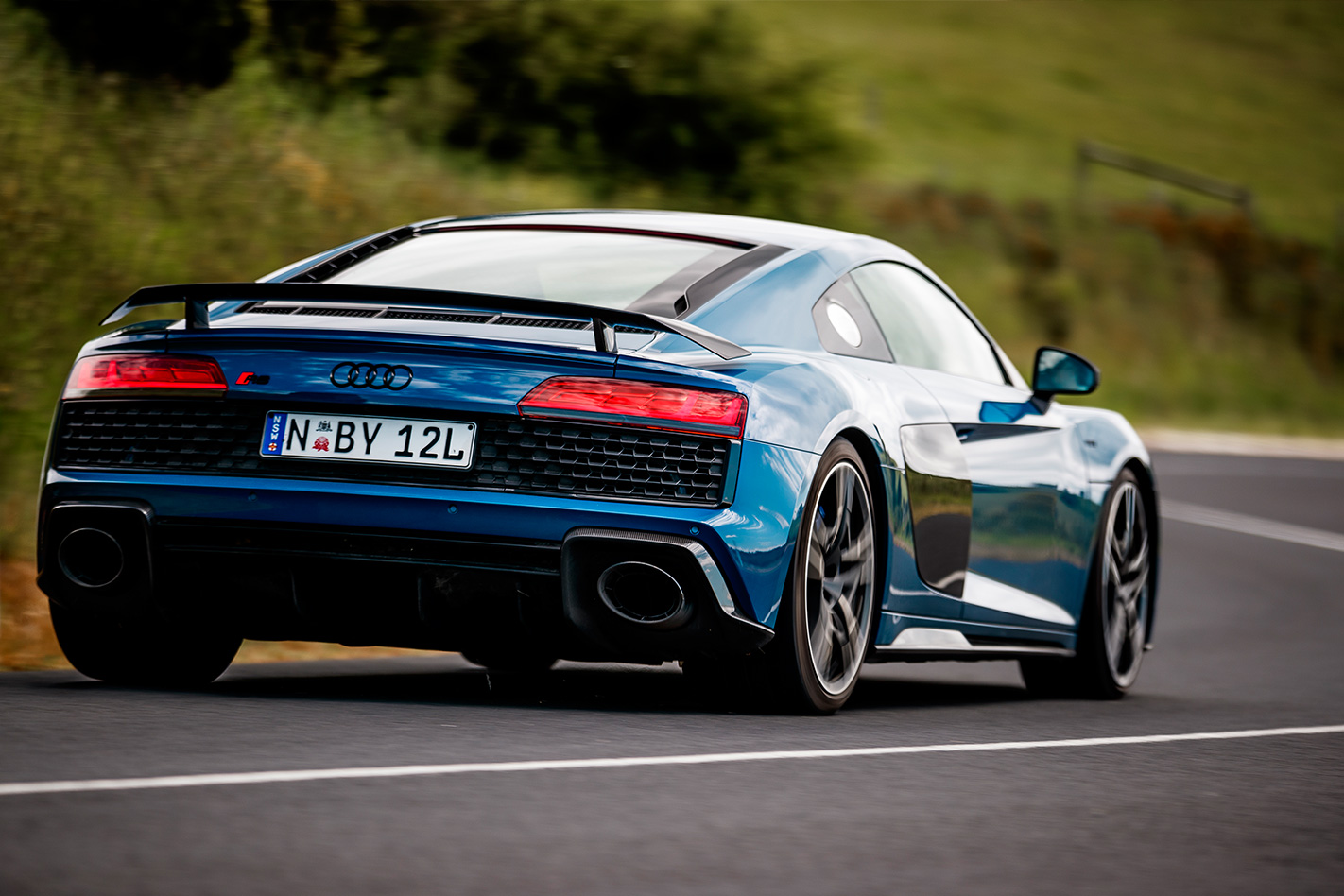
If faced with a few laps of the tight and narrow Haunted Hills hillclimb track and the choice of either an Audi R8 or Suzuki Celerio I can honestly say it would be a difficult decision.
While there is something exhilarating about the dizzying limit of an all-wheel drive, mid-engined supercar, venturing there is terrifying.
But pushing a tiny three-cylinder, front-drive manual hatch to the edge is something you can replicate indefinitely and always with a smile on your face.
Cutting laps of a racing circuit in something with upwards of 600 horsepower will always be an automotive nirvana of sorts, but it’s the same kind of sweaty-edge-of-disaster fun people seek in bull riding and doing a full loop in a plane.
I’ve done one of those and, even though I will be telling people about it until I die, I don’t want to do it every day.
Finding that perfect band of blacktop away from the melee and bouncing the valves of a little four-pot all the way to the top of a mountain is, however, something I will do for the rest of my days.
And if I ever did the same in a Porsche 911 GT2 RS, those days would be severely curtailed.
Back in 2017, when Mazda Japan launched the Roadster Restore program, enthusiasts and fans alike yearned and hoped that the Hiroshima brand would expand its efforts to its other increasingly classic models, namely the Mazda RX-7.
The recently-announced heritage program expansion from Japan adds the iconic RX-7 to the Mazda Classic fold, and will see 91 new components put back into production.
Mazda stresses, however, that more and more components will be added gradually as the program expands in scope.
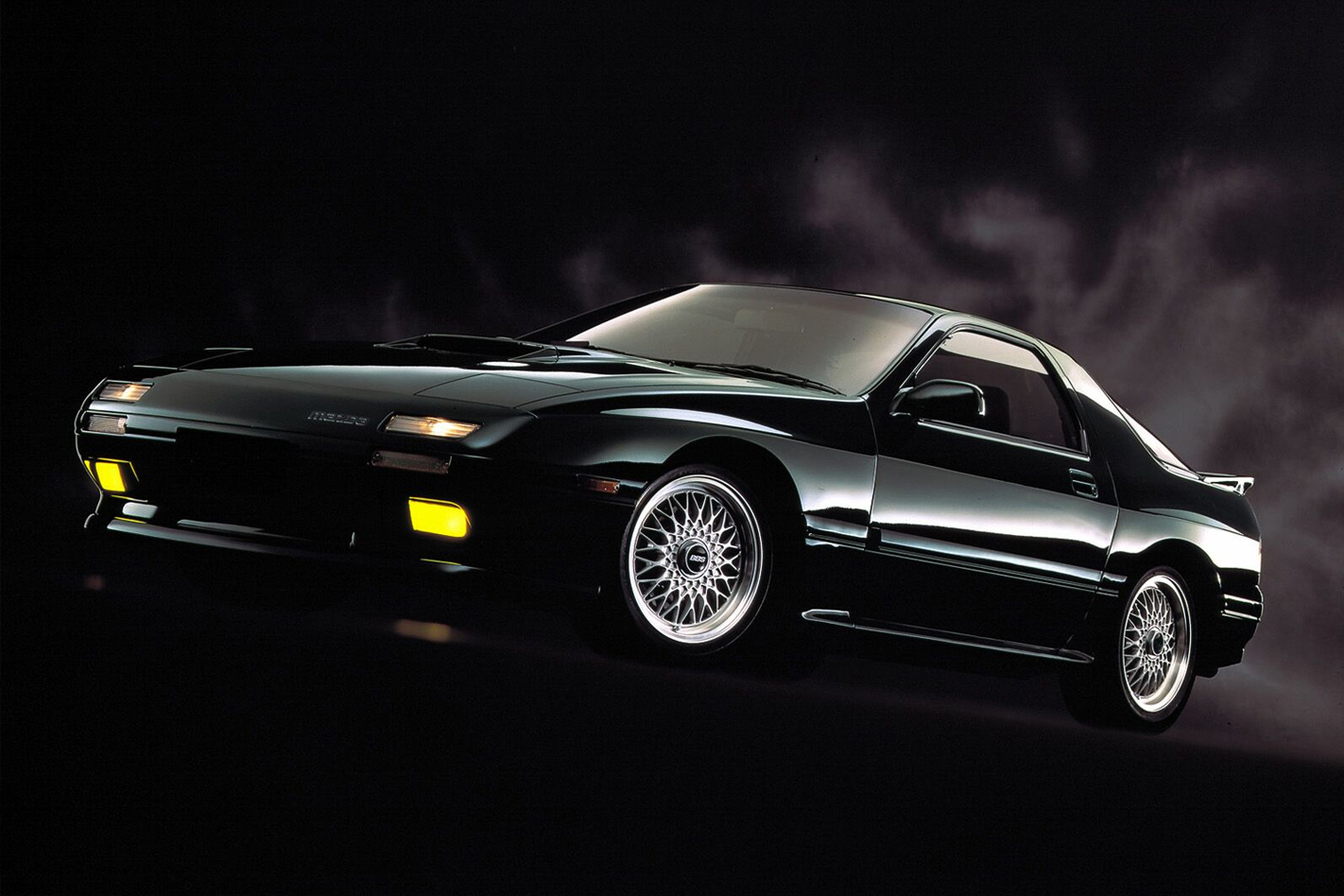
To begin with, there are 30 new components for the FC generation RX-7 (1985-1882), and 61 for the FD generation.
The initial release is comprised of the most frequently perished items including vacuum hoses, throttle position sensors, rubber bushings, gaskets and fasteners.
Those hoping for replacement panels or interior trim will have to wait, although these components are likely on the horizon judging from the MX-5’s more mature program.
For this initial release, Mazda reportedly sought input from various rotary service and tuning shops around Japan to construct the list of items.
While the RX-7’s heritage parts program is still in its infancy and will initially only be available to buyers in Japan, there is much hope that the program will follow the trajectory of its roadster relative which offers a far greater range of parts, an in-house factory restoration service, and is available over the counter in the US market.
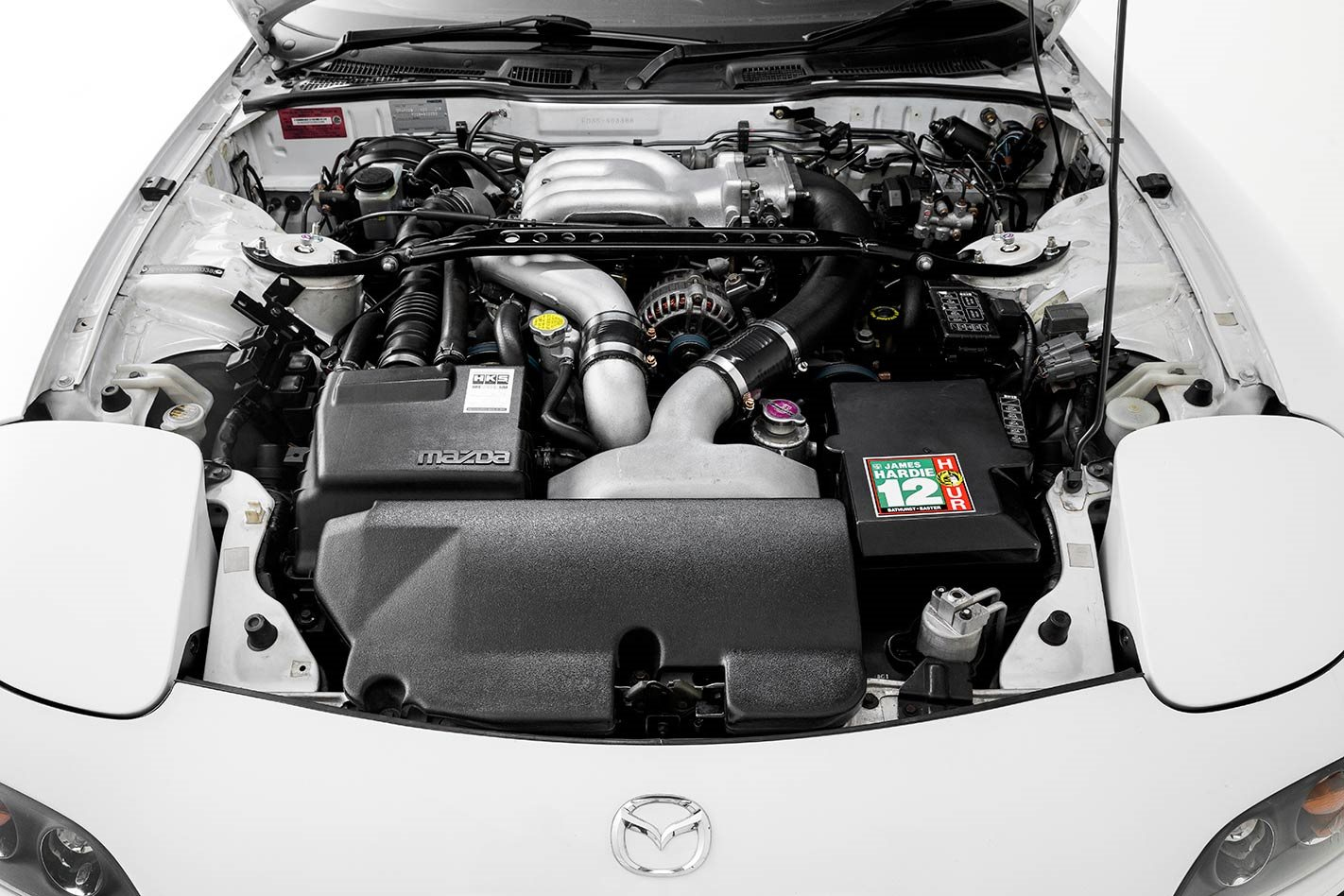
Mazda’s announcement of support for the RX-7 will be welcome news to enthusiasts and owners around the world, however, bolstering a growing fraternity of Japanese manufacturers offering parts and support to owners of some of their back-catalogues’ greatest hits.
Nissan spearheaded the movement with its heritage parts program encompassing R32-R34 GT-R generations, as well as its recently-announced factory restore service for the R32 GT-R.
Honda Japan also boasts a factory refresh service for the original NSX supercar and its Beat roadster, while Toyota has launched similar programs for the A70 and A80 Supra, as well as the blue-chip million-dollar 2000GT.
Buyers in Japan will be able to purchase the newly reproduced parts from February 2021.
The full list of components is available here, or at the Mazda Classic website.
NOW CHECK OUT 40 years of the Mazda RX-7 at Fuji Speedway
It wasn’t long ago that Australians gravitated to sedans and wagons for their family duties. Those days have long gone for many, an SUV replacing tradition in the driveway.
But there’s still an impressive array of medium and large sedans and wagons on the market.
And in a 21st-century twist, there’s even the occasional hatchback, adding more load space flexibility.
As much as there are many new nameplates, others have been killed off.
It’s a long list that starts with Ford Falcon and Holden Commodore and has more recently farewelled the Subaru Liberty and Ford Mondeo.
It’s a segment dominated by Asian brands, with a few flashes of European flair to break things up.
But within the mix of offerings still available there hides some genuinely great value, providing a sportier antidote to those high-riding wagons.
GOLD – Toyota Camry Ascent Hybrid
Family sedans may have largely gone the way of the dodo, but the Toyota Camry is not only hanging in there but fighting hard – and with good reason.
The sizeable four-door (the Camry wagon was killed off more than a decade ago) has shed most of its conservative driving manners to become a car that is comfortable cruising and competent in corners.
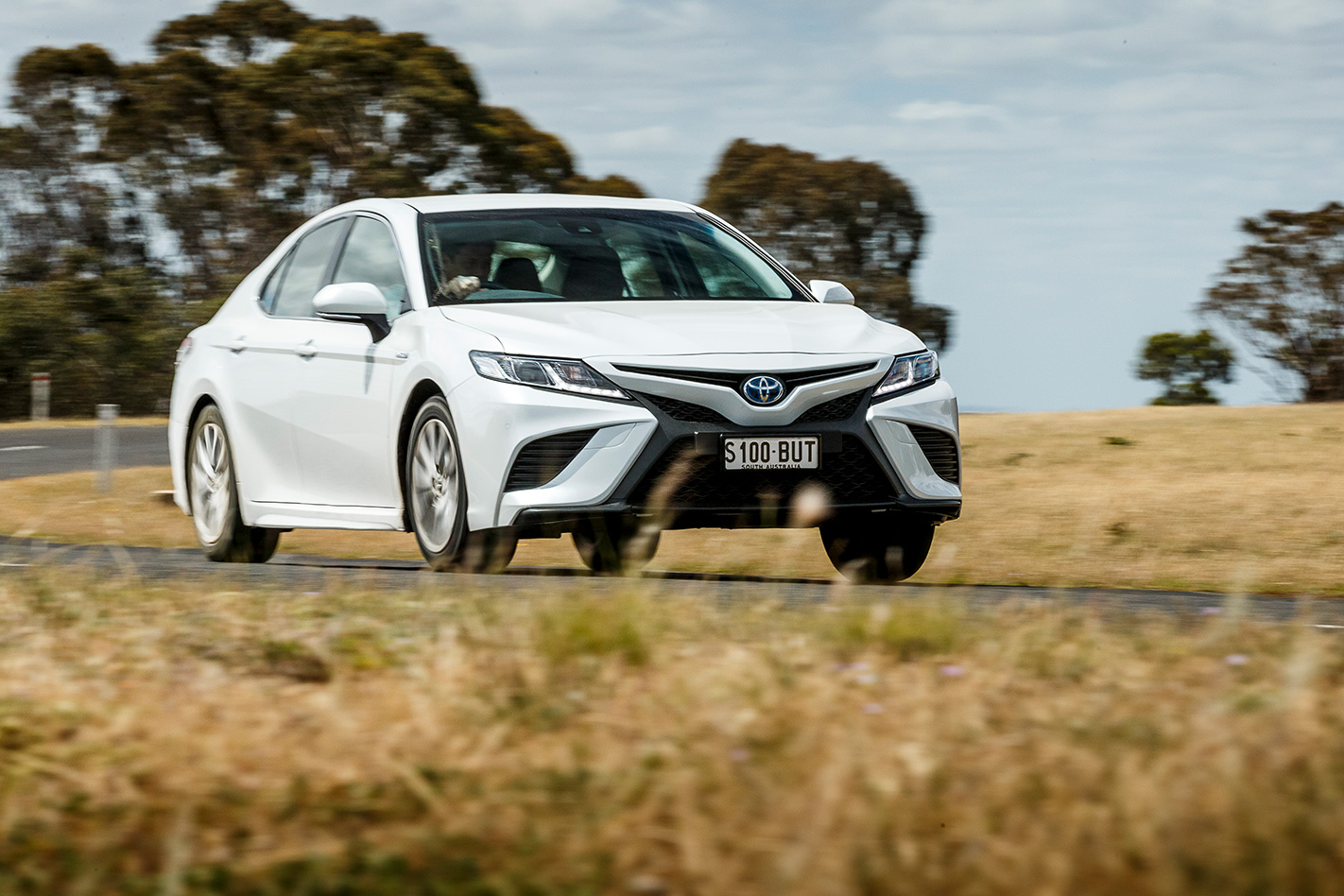
That it also has acres of space – adults in the rear are thoroughly welcome – and a big boot reasserts its suitability to family duties.
At almost five metres long it is a heck of a lot of metal for a surprisingly compact price.
The hybrid system also does what it says on the box. Fuel use is around half that of the regular model in city driving, mostly because the small battery pack can store braking energy to power the electric motor when accelerating.
That motor provides a solid initial shove, making up for otherwise modest performance from the 2.5-litre four-cylinder.
A long list of standard features incorporates the key active safety systems, dual-zone ventilation and Apple CarPlay and Android Auto connectivity.
To get to the top of the podium the Hybrid first had to beat the regular non-hybrid Camry, something it did largely thanks to significant fuel savings.
But the focus on fuel economy means used-car buyers are increasingly likely to sniff out a petrol-electric model over the pure petrol.
So the Camry Hybrid’s forecast Redbook resale is a few percentage points higher than the regular Camry, further cementing its lead.
SILVER – Skoda Octavia 110TSI
European engineering has traditionally meant bigger price tags, but at $27,390 the Octavia is one of the most affordable mid-sizers on the market. Utilising much of the running gear under the Volkswagen Golf (Skoda is owned by Volkswagen), it’s proven tech.
Yet there is more space than the popular VW hatchback: it’s slightly wider and about 40cm longer. Plus, the availability of a wagon is rare and only adds about $2100 to the price.
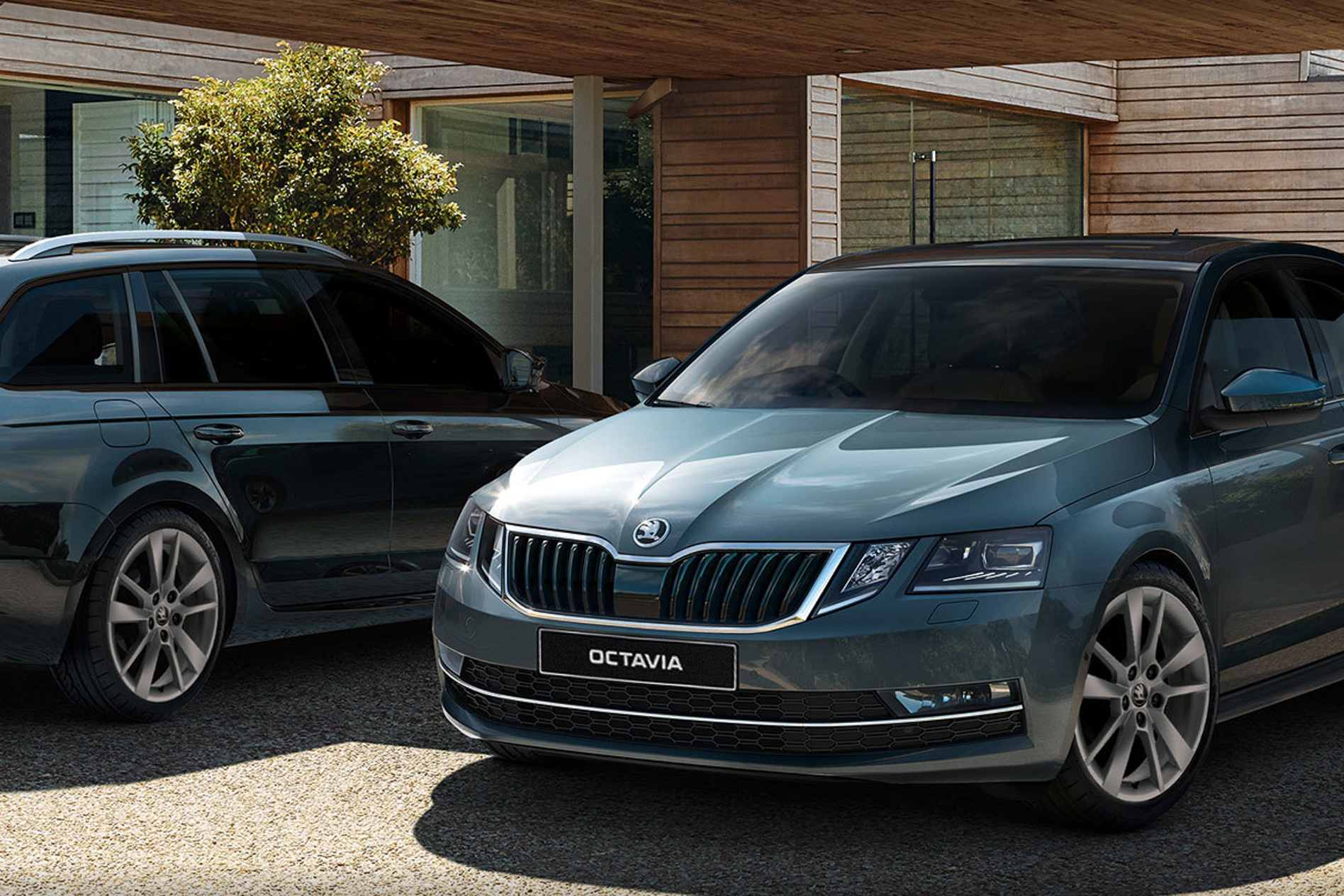
A compact 1.4-litre engine is helped along by a turbo, something that gives it ample mid-range engine response.
It’s not the most powerful car in its class, but that flexibility across the rev range and the clever twin-clutch automatic transmission make it thoroughly useful around town and on the open road.
Sure, the Octavia needs premium unleaded, but it doesn’t use much of it, offsetting the price premium.
While early Skodas didn’t have great resale values, the improved brand recognition and appeal of the Octavia see it outpunch the Volkswagen Passat and Mazda6 when it comes to forecasting five-year residuals.
That’s it’s also great to drive is a bonus.
BRONZE – Toyota Camry Ascent
It’s not as frugal as its hybrid sibling nor forecast to be worth as much after five years, but the regular Toyota Camry is still terrific buying.
And with a price of entry that sneaks below $30K, it makes for excellent value for what is a sizeable sedan.
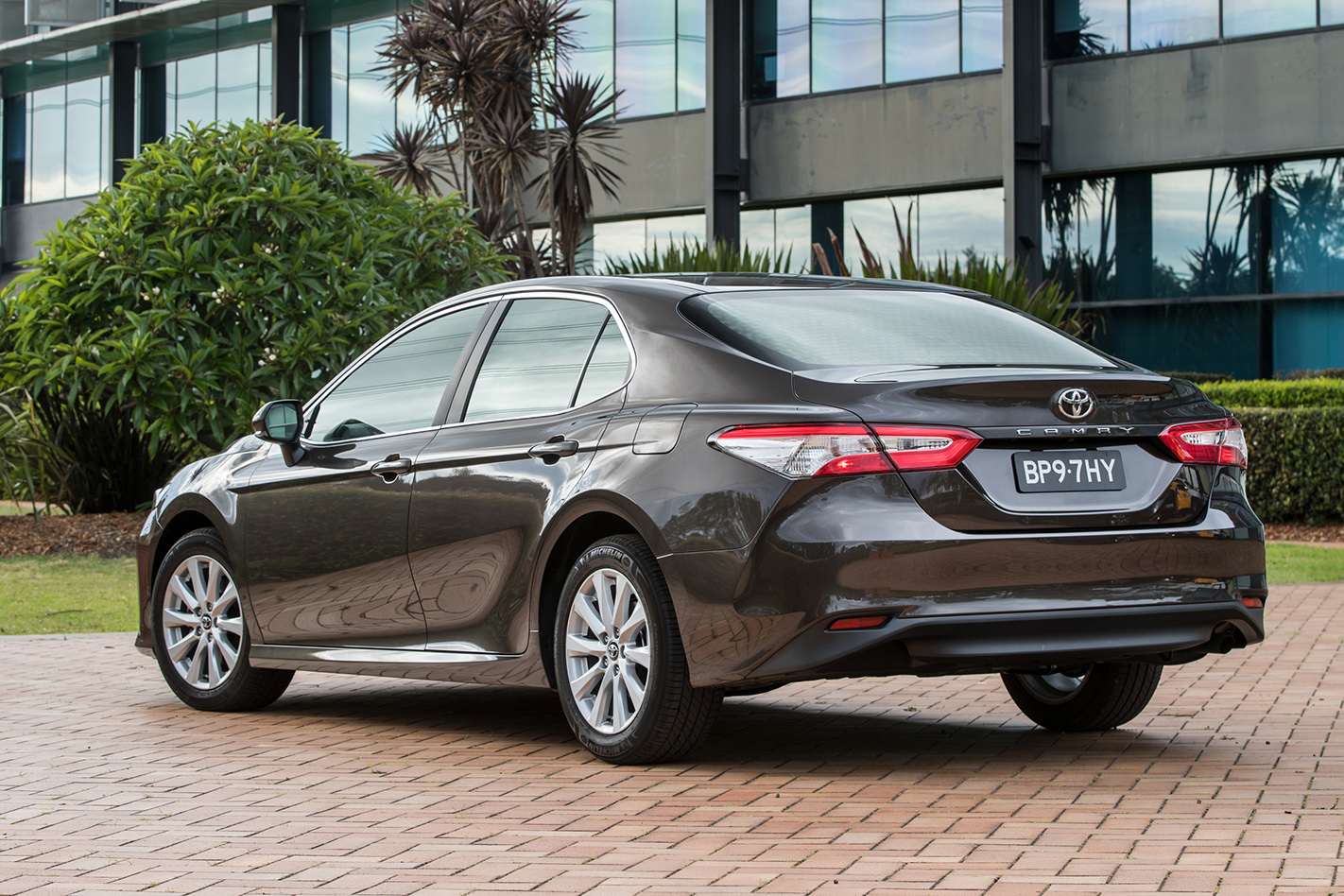
Indeed, the big appeal with the most affordable Camry in the line-up is an asking price $2800 below than of the Hybrid.
Throw in affordable servicing and respectable fuel use and it makes the Camry a top family car pick. That it doesn’t look or drive like a cheap car is testament to the engineering within.
Jump to
- How we rate Australia’s Best Value Car
- Light/City Cars
- Small Cars
- Budget luxury cars
- Small SUVs
- Five-seat SUVs
- Seven-seat SUVs
- Premium SUVs
- Prestige cars
- Kid Carriers
- Dual-Cab 4x4s
- Off-Road 4x4s
We’re looking back through some of our most-viewed content throughout the year, and it turns out you couldn’t get enough of this one! Kick back and relive one of the standouts from a tumultuous 2020.
You might not recognise the name Reuben Bemrose, but Ferrari sure does. That’s because Reuben Bemrose built a Mazda 13B rotary-powered Ferrari 456.
Now, before we carry on, we should note that it’s not as if Bemrose took a pristine example of Ferrari’s 1990s V12 grand tourer and turned it into what he now calls the ‘Rotorrari’. He actually found the 456 as a shell, with no engine, and a lot of damage.
You could argue it’s in better condition now than when he found it. But Ferrari doesn’t see it that way and has expressed its ire, something we’ve previously seen inflicted upon music producer Deadmau5 for his Nyan Cat-liveried ‘Purrari’.
https://www.instagram.com/p/B8hMZ9mHFwa/?utm_source=ig_embed&utm_campaign=loading
Bemrose has begun to enter the Rotorrari in competitions and take it to track days, even being awarded a ‘best conversion’ award at a rotary event. The rumours are true, Kiwis love rotaries.
Attention has also started rolling in from international media outlets – and of course ‘Hert’ from Hoonigan is all over Bemrose’s comments sections on each post about the Rotorrari.
https://www.instagram.com/p/B8r7FZcHDDF/?utm_source=ig_embed&utm_campaign=loading
Okay, given Ferrari’s protectiveness over its brand image, we can see why a car like the Rotorrari would be a particular target for its legal team.
So, in response to Ferrari’s complaints, Bemrose took the opportunity to… er, apologise… when he was the subject of a segment on an NZ chat show.
If there’s one thing we can say about Bemrose based on his Instagram presence, and his brief interactions with media, it’s that he likes a laugh. That’s why his Rotorrari is probably going to be a persistent thorn in the side of Ferrari.
If you ask us, however, seeing a car become a project like this is miles better than seeing it rot away in a field with no engine.
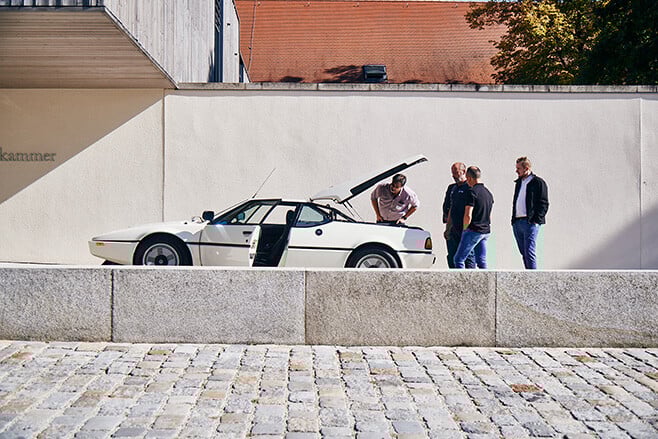
When I first lay eyes on the BMW M1, it’s pointing nose-out in front of the BMW Classic service area. I’ve waited 40 years to drive this car – BMW’s rare mid-engined coupe – and for the next two days, this white 1980 M1 is mine. But something prevents me from rushing to the driver’s door. Some secret power forces me to pause, to savour its slender form, to absorb Giugiaro’s masterpiece.
Better to slowly walk around it, soaking up the gentle wedge, recognising the importance of the slim, horizontal line that runs the full length of the body and connects so many different elements of the M1’s so-pure shape. Then walk around it again, discovering and drinking in the exquisite detail: the tiny graceful kidneys in the so-low nose, the various air slots and openings that are both functional and beautiful, and the perfectly positioned BMW roundels, one on each rear corner.
Is it flawless, I wonder? It’s certainly timeless and supremely elegant. Only as I get closer do I appreciate just how low it is: at 1140mm tall, the M1 is a staggering 154mm (that’s six inches!) lower than a 911.
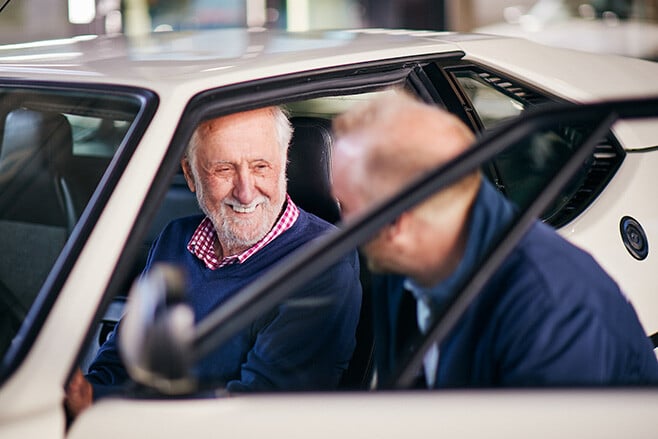
They only hand me the keys when it’s time to leave. Perhaps to lower my expectations, I remind myself that the M1 was conceived as a race car and then made to conform to the road. More, this is the car that famously launched the magical letter M to enthusiasts and, not coincidentally, BMW Motorsport.
Despite the M1’s ultra-low profile, getting in is easy through the large door openings, and there’s plenty of room in the relatively plain cabin. Excellent forward visibility through the huge windscreen is a supercar bonus. To the rear? Not so good. Compromises are few; wheelarch intrusion means the pedals are offset and clutch travel is so long that my leg is almost straight when I shift up through the gears.
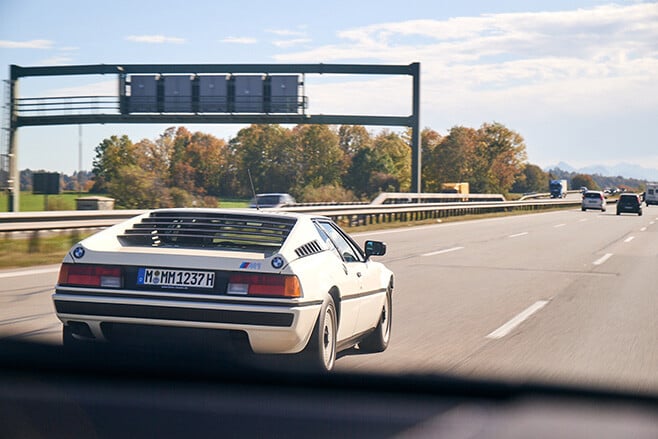
The ZF five-speeder’s dog-leg pattern means first is down and to the left, yet despite developing peak torque of 330Nm at 5000rpm and 204kW of power at 6500rpm, BMW’s wonderful 24-valve, 3.5-litre six is so flexible that first is only ever needed when moving off from standstill. This engine might be race-bred, but it doesn’t feel it. And the gearchange is so utterly mechanical in its action that you can almost feel the individual cogs engaging, especially shifting from second to third.
Engine noise is never less than glorious, even at the slightly lumpy idle. Accelerate hard and the straight-six soars to a hard-edged intake symphony that’s overtaken by exhaust snarl as the tacho needle approaches 6000rpm. As autobahn traffic thins, the M1 swiftly sprints towards its 260km/h V-max. No, it doesn’t feel supercar quick – 0-100km/h takes 6.0sec – yet the M1 is eager, responsive and always encouraging. Here, and as I later learn, on winding roads, its composure and stability are staggering.
A constant joy to drive, yet so easy and relaxed, the M1 inspires confidence, not least because its ride is supple and controlled, soaking up bumps that could jolt or bottom-out a lesser machine. By today’s standards, the modest tyres ensure the grip is less than heroic, but the advantage is the kind of involvement and feel that too many modern supercars lack.
The M1’s only serious flaw is heavy steering below 40km/h. At proper speeds, the steering – BMW’s first rack-and-pinion set-up, remember – is direct and provides an almost intimate relationship between driver, front tyres and the road.
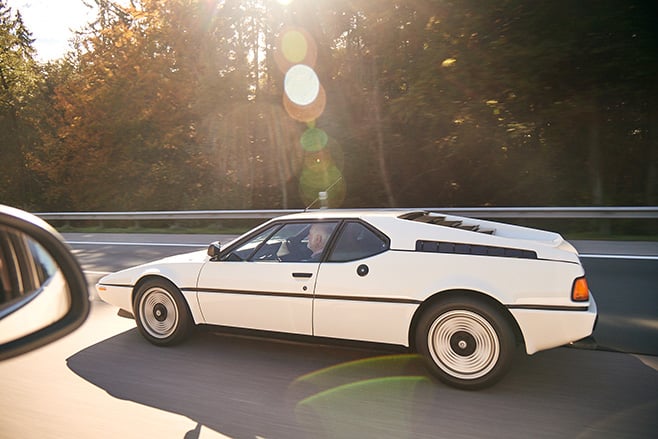
Normally, 300km in a machine as desirable as the M1 would be highlight enough. Except my friends from BMW Classic suggested our M1 adventure should involve a visit to Fritz Wagner.
A wonderfully obsessive visionary, compulsive collector and gifted mechanic, Wagner has cornered the world’s supply of M1s. Not just cars – he has five and maintains at least 14 racing Procar racing versions – but all the spares necessary to literally build an M1 from the wheels up. So I’ve pointed my M1 towards Wagner’s Kolbermoor home/workshop/collection, 65km southeast of Munich, just off the autobahn to Austria.
Not for Wagner a Teutonically organised warehouse, meticulously laid out and arranged by some advanced computer program, so clean you could eat off the benches. Instead, the collection spreads chaotically across half the ground floor of his 100-year-old home and spills out in a variety of ramshackle buildings, scattered around what has, by default, become a large courtyard.
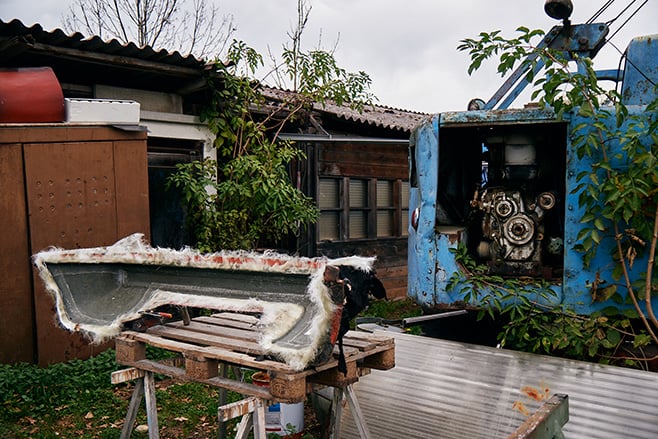
Absolutely nothing can prepare you for the shock of discovering Wagner’s M1s, plus the stock of thousands of residual parts of damaged racing cars, strewn among the barns and sheds. The reality is, if your M1 fails and you need a replacement component, Fritz Wagner is your only option.
“If something breaks down, they come to me and exchange old versus new,” explains Wagner. “I’ve never made a deal out of it; I’m happy keeping these great cars on the track and the road.”
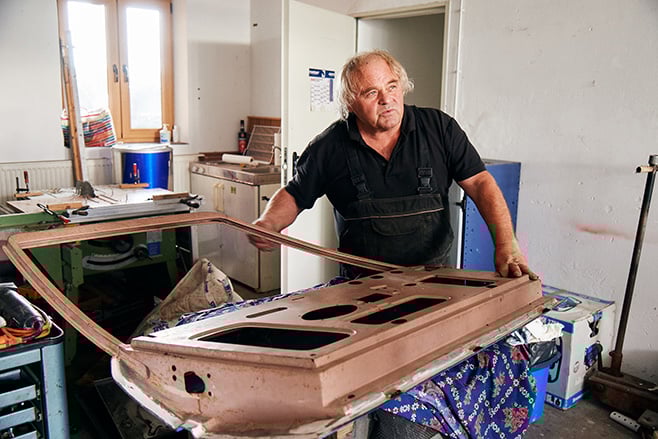
Only Fritz, and perhaps son Marco, who is involved in the Wagner-Motorsport M1 business and operates in exactly the same way – if on a smaller scale – from his home a kilometre away, comprehends this disorder and instantly knows how to find the required part. The rest of us simply stare in amazement at the apparent chaos.
Five complete M1 engines line up on the wooden floor of one shed. Eight crankshafts sit on shelving in another, along with 23 cylinder heads, a number of pistons, wheel hubs, brake calipers, suspension arms and alternators. Even a stockpile of the M1’s BMW roundel is visible.
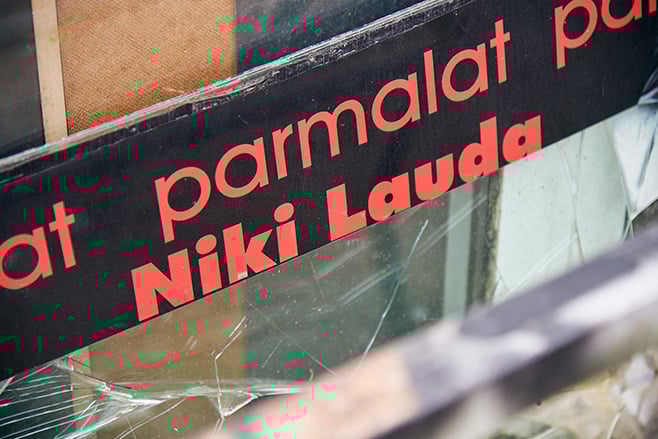
Body bits, body moulds and door frames hide in the attic of another shed, accessed only by step-ladder. Old photographs and posters of hero M1 drivers – Niki Lauda, Nelson Piquet, Manfred Winkelhock, Christian Danner and Hans-Joachim Stuck – known as Strietzel (junior) Stuck to everyone in motor racing circles in order to distinguish him from his also-famous father – line many of the walls. One of Nelson Piquet’s old helmets sits on the back of his Procar M1. Seats, wheels, springs and complete exhaust systems are spread over the workshop floor. It is impossible for an outsider to see any system in Wagner’s organisation.
When Strietzel Stuck first visited, he told Fritz, “Now I have to go home to sleep to capture this in my head.”
I can’t help asking why Fritz’s collection of M1s and all the assorted M1 parts aren’t maintained as part of BMW Classic’s 1400-strong car/bike collection? Superbly organised and, since 2016, contained in over 13,000 square metres of structures that include a handsome 1918 building that serves as the café/foyer, archive and small museum, Classic is walking distance from BMW’s Munich HQ.
“We’ve talked about buying Wagner’s collection,” admits BMW Classic’s Benjamin Voss, “but Classic knows where the cars and the parts are, that they are safe, and that we have access to them, so we are happy.”
How did this near priceless collection come to be in the hands of Fritz Wagner? Priceless? To give you an idea of the collection’s value, the white M1 (one of five in BMW’s collection) I’m driving has an insurance value of 750,000 Euros ($A1.213m). At the other end of the scale, Andy Warhol’s M1 art car is apparently worth almost A$50m.
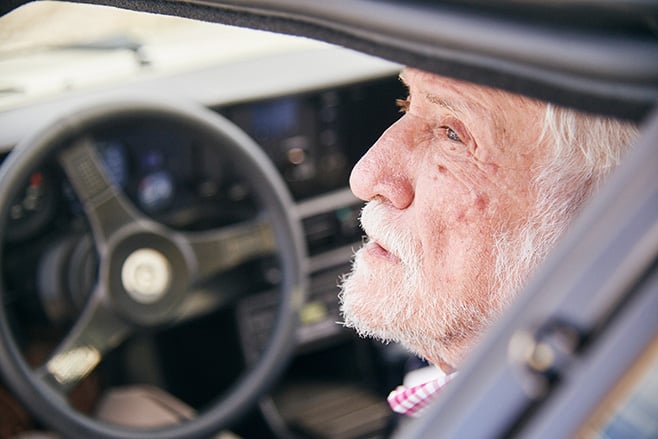
Over an alfresco lunch, Fritz – now 66, stocky, friendly, permanently in overalls, his long hair thick and matted, his handshake forceful, the dirt and oil of his work ingrained into his hands and fingernails – explains.
When, at 24 years of age, the racing mechanic and passionate motorsport fan first saw images of the M1 in 1977, he knew “that’s the car of my life.”
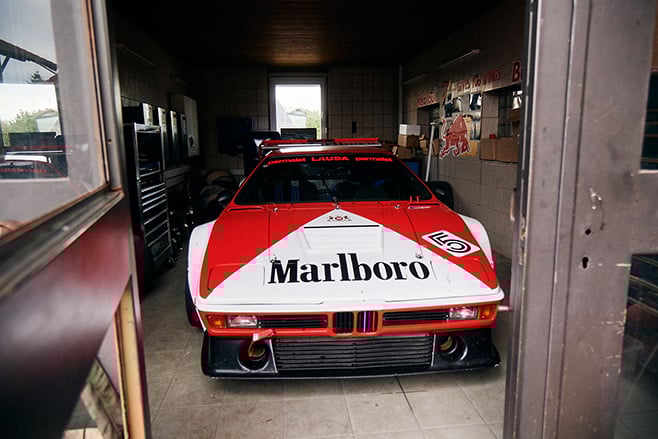
Wagner well knows the complicated M1 story. Without going into too much detail, back in the early ’70s BMW was still considered a minor player in the prestige ranks and wanted to lift its profile through motor racing. Jochen Neerpasch, lured from success as boss of Ford’s racing operations in Germany, established BMW Motorsport GmbH as a separate company.
With BMW’s heavy 3.0 CSLs becoming uncompetitive, Neerpasch set out to create a new Group 5 silhouette race car.
“The idea was to build a racing car and convert it to a road car,” Neerpasch tells me a few days after I hand back the M1. “We wanted to price the road car at DM100,000 (A$40,000) and the racing version at DM150,000 (A$60,000), when our racing 3.0 CSL cost DM350,000 (A$140,000). We also wanted Paul Rosche (BMW’s engine man) to develop a new 3.0-litre V8 engine that could also be used in a Formula One car.”
BMW Motorsport project E26 called for 800 cars to be built by Lamborghini with spaceframe construction, a twin-cam 24-valve version of BMW’s in-line six delivering 204kW as a road car or 345kW in race spec, and a fibreglass body styled by Giugiaro. Lamborghini’s Giampaolo Dallara, fresh from the Miura and Countach, assisted Neerpasch and Martin Braungart, who ran the project, in developing the car. Lamborghini built five prototypes.
“It was a fantastical technical co-operation,” according to Neerpasch. “At least once a week in 1977, taking turns, Martin and I would drive from Garching [Motorsport’s base] to Sant’Agata Bolognese [Lamborghini’s HQ], getting faster and faster as we improved the car, each trying to beat the other’s time. In the end we cut 30 minutes from our time.”
Then Lamborghini’s financial problems hit. The request for a $500,000 loan from BMW was denied. Neerpasch organised for trucks to collect all the prototypes and everything related to the M1 from Sant’Agata. After BMW’s board decided not to buy Lamborghini, the solution was to have the car assembled by Giugiaro’s Italdesign in Italy, with Italian suppliers providing the spaceframe and fibreglass body. The cars were then trucked to Baur in Germany for installation of the BMW hardware. Finally, they were sent to BMW Motorsport for quality assurance.
Inevitably, all the complications lead to drastic cost increases. The dramas meant the M1 launch was delayed by two years to February 1979. Production finally ceased in March 1981. In the end just 399 M1 road cars were built, plus another 54 race versions, this number made up of 48 complete race cars and six chassis that have since been assembled as race cars.
Neerpasch also convinced F1 heavyweights Max Mosley and Bernie Ecclestone to create a still-unique one-make race as part of the European F1 race weekend. The BMW Procar championship took the best five F1 drivers (except those from Ferrari and Renault) from Friday’s practice and mixed them with successful GT and Touring car drivers, all racing in identical M1s. The championship lasted two years (’79 and ’80) and was won by Niki Lauda and Nelson Piquet, respectively. Their prize? A new M1.
When buyers hesitated at the DM100,000 (A$40K) price, BMW began to lose interest in the M1. Once the silhouette formula was cancelled in 1980, the motorsport budget was cut by two-thirds and not even Neerpasch’s brilliant strategy of the one-make Procar series could save the M1.
By this time, Fritz Wagner was a freelance mechanic building Procars for Helmut Marko and, later, the Cassani Racing Team. Striezel Stuck won the last two races of the 1979 series with Cassani, instantly raising Wagner’s profile as the go-to Procar mechanic. But BMW wanted nothing to do with the M1, and became far more interested in becoming an F1 engine supplier to Brabham with a Rosche-designed 1.5-litre turbo engine.
By 1983, the M1s and all their componentry were just sad old racing cars, little better than scrap.
Eventually, in 1984, with nowhere to store all the M1 stuff, Motorsport suggested Wagner take the lot for DM100,000, a quarter of their real value. He was allowed to sell any of the parts except for the engines, and BMW insisted that if it needed any bits they could buy them back. The collection included the original E26 prototype – four of the five prototypes had been destroyed in crash tests – visually identical to the production car apart from having two wipers, different wheels and no BMW roundels on the rear corners. Wagner adds about 1000km a year to the car’s odo.
Wagner’s dream business, helping owners of the soon-to-be-coveted M1, was set for life. And still there was motor racing. The revival of Procar racing as a support event for the 2008 German Grand Prix and again in 2019, to celebrate the series’ 40th anniversary, took Wagner back to preparing M1s for many of the drivers, include Stuck. There are other historic events like the Daytona Classic 24-hour race, hence David Brabham’s Procar M1.
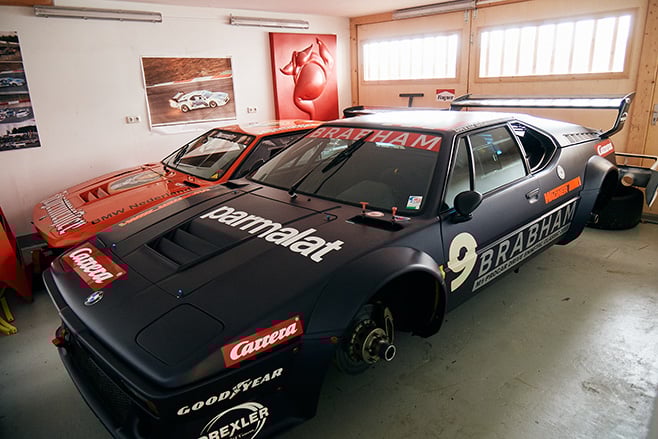
“Ten years ago my cars were the fastest,” says Wagner, “[but] not now – new materials, small tolerances, new parts, mean some cars have more power. I only use the original parts and would never use reproduced parts.”
Wagner admits he races for fun, not for the money, and swears he no longer keeps any accounts. “I never take holidays; every day is a holiday,” he says, admitting to working 15-hour days. “I am living in the right time with the advantage of real freedom. For me, progress stopped in the 1980s. I don’t have a cell phone or a computer.”
BMW Classic’s Benjamin Voss confirms, “I quickly learned the only way to contact Fritz is to ring his landline phone at lunchtime.”
Says Wagner, “I don’t need to go into the basement and open the safe to look at a Rembrandt. I only have to open the garage to see my Rembrandts.” He keeps a few alpaca “as a distraction from the cars” but it’s impossible not to conclude that the M1 is everything to him.
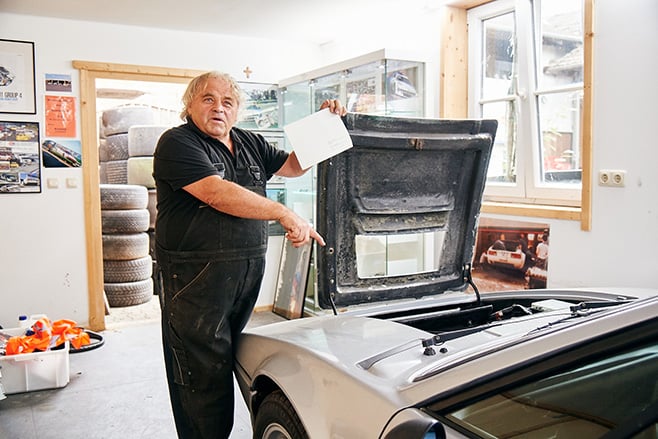
It’s a testament to the development skills of Neerpasch, Braungart and Dallara that the M1, conceived as a racing car, became the most civilised of all late-’70s/early-’80s supercars. A commercial failure, the M1 truly is one of the world’s great cars.
Says Neerpasch, “If the M1 had been properly developed, it could have been like the 911. BMW needs a car like this urgently and they don’t have one.”
Reluctantly returned, I’m unable to leave ‘my’ M1 without walking around it again. Twice.
BMW M1 Specs
Engine 3453cc 6cyl, dohc, 24v Max power 204kW @ 6500rpm Max torque 330Nm @ 5000rpm Transmission 5-speed manual L/W/H/W-B 4361/1824/1140/2600mm Weight 1290kg 0-100km/h 6.0sec (claimed) Top speed 260km/h (claimed) Price A$40,000 (new) On sale 1979-81
Modern small cars aren’t so small anymore. They’re not always so simple, either, with many offering luxury trimmings and advanced drivetrains for those who want the tech and luxury but don’t need the space of a bigger car.
It’s a category made up of some of the stalwarts of the new-car market, familiar names providing more features and better value than they ever have.
New players are also showing their face, hoping for a slice of what is still a significant (but declining) segment of the Australian car market.
Yet the Redbook predicted resale figures show there’s still plenty of love for small cars in second-hand land.
While manual transmissions still exist, many small car offerings don’t bother anymore, indicative of a shift towards suburban driving ease. For that reason, it’s the autos we focused on here.
GOLD MEDAL – Toyota Corolla Ascent Sport Hybrid sedan
It’s arguably the best-known Toyota on the road, one that’s been soldiering on for twelve generations and more than half a century. And now it’s the Hybrid version that is the best value of the Corolla line-up.
A relatively fresh addition to the range – the first Corolla hybrid arrived in 2016 – the Hybrid is now a big volume player. Our numbers demonstrate why.
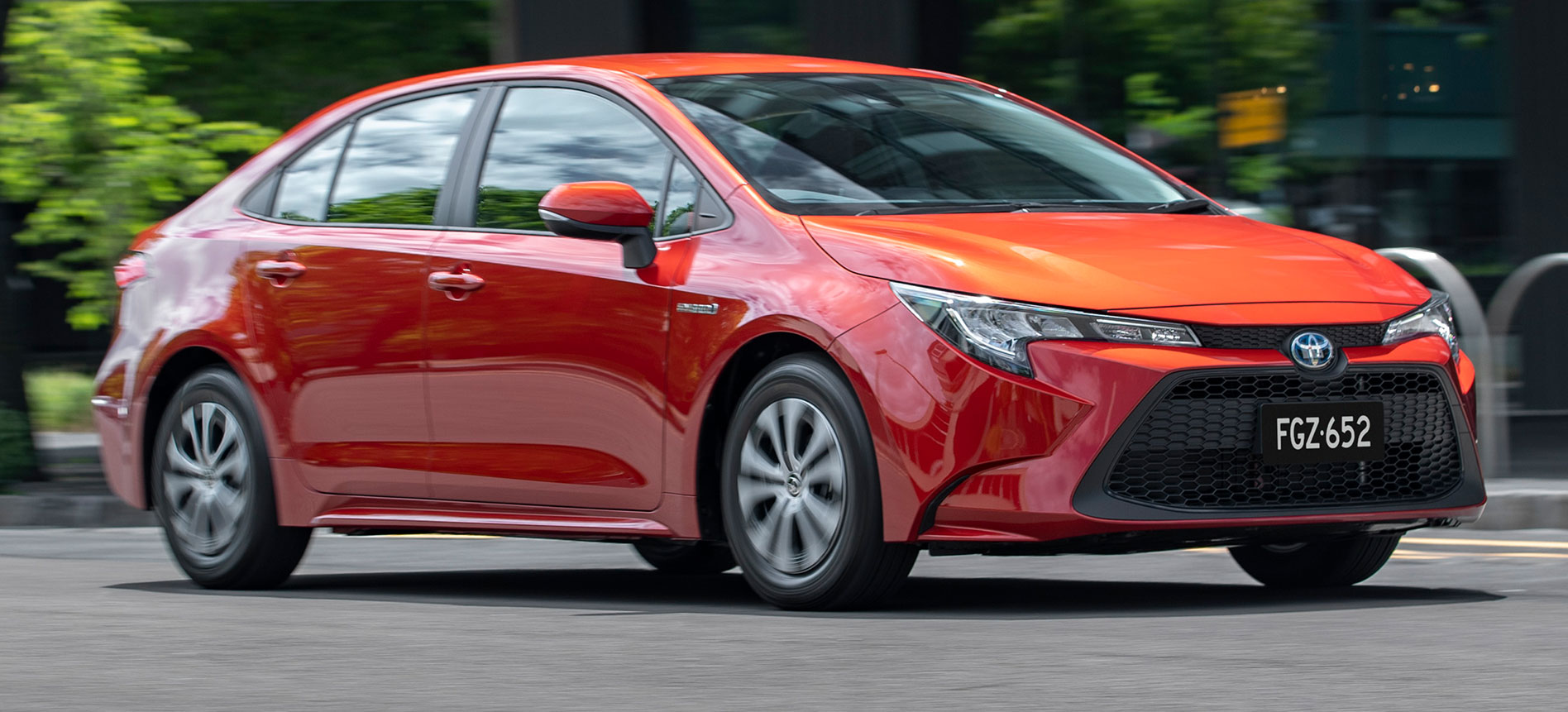
Yes, you’ll pay more to get into a Corolla Hybrid compared with a petrol-only version – it’s a $1500 premium, the Hybrid starting at $27,395 – but the Hybrid is marginally cheaper to insure and uses a lot less fuel.
The fuel equation changes between hatch and sedan, too. In sedan form the Corolla Hybrid uses a claimed 3.5 litres per 100km, 17 per cent less than the identical drivetrain in the Hybrid hatchback.
That’s because the sedan gets skinnier 15-inch tyres versus the grippier 16s on the Corolla Hybrid hatch, one of many efforts to position it as a fuel leader in its class.
There are downsides: the sedan isn’t as fun to drive on winding roads, but it will save dollars when it comes time to top up. Hence its victory in our value awards.
With Apple CarPlay and Android Auto and the safety of autonomous emergency braking and blind-spot monitoring, it’s a lot of small car for not much outlay.
But key to the Corolla’s success here is its 64 per cent predicted resale value.
It’s an impressive number and one that means you won’t go far backwards after five years of ownership.
Some of that used-car appeal can no doubt be traced back to the rich heritage of a car that has long flown the Toyota flag.
SILVER MEDAL – Toyota Corolla Ascent Sport
Corollas have long ticked the reliability and practicality boxes beautifully, but they haven’t always been particularly enticing to drive. That stepped up a few gears with the latest iteration that arrived in 2018.
While the Corolla hatch has a disappointingly compact boot and tight-ish back seat, it partially makes up for it with a zingy 2.0-litre four-cylinder engine and an innovative CVT transmission; it pairs a traditional first gear with a CVT to get rid of that rubber-band-like feeling traditional CVTs can have from a standstill.
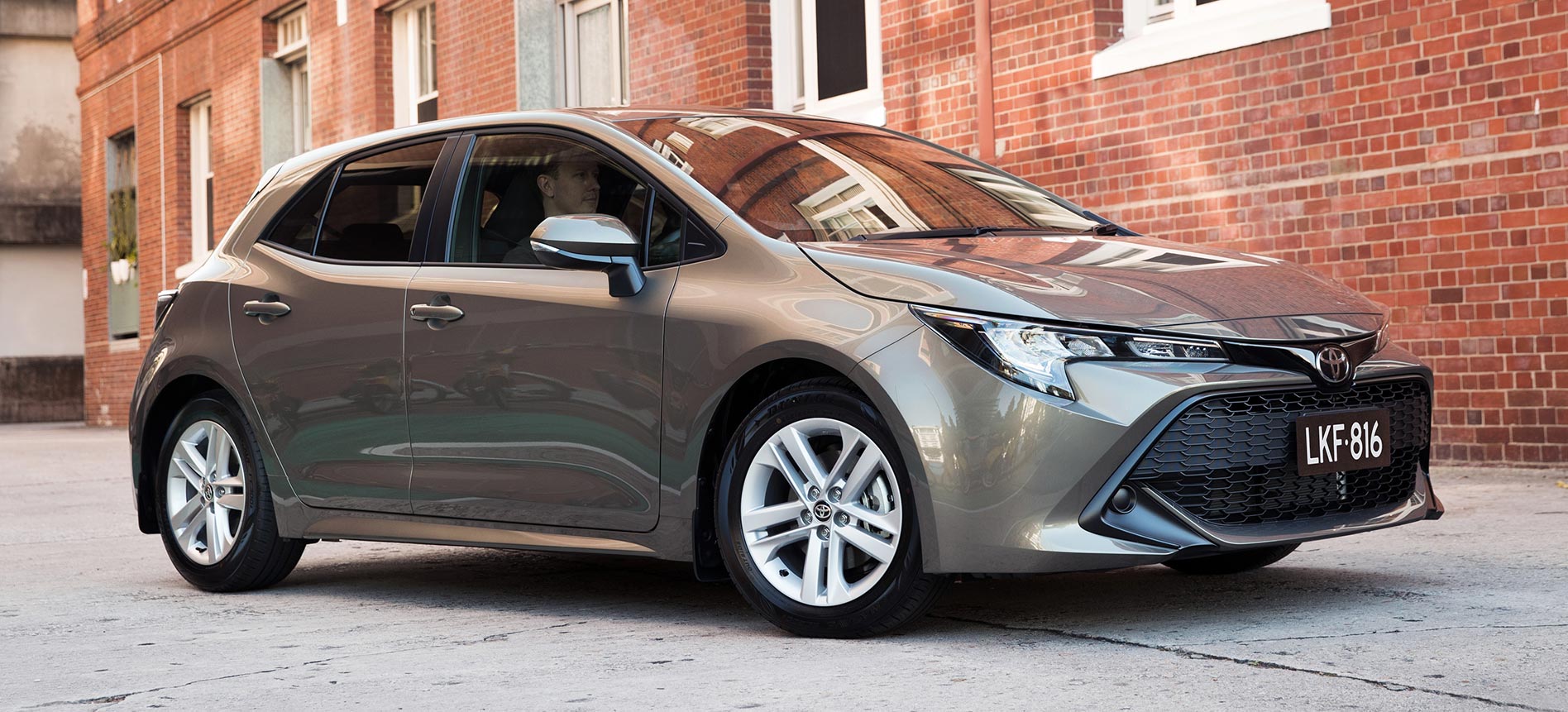
It’s also competent through corners, the focus on driving enjoyment during the vehicle’s development clear in the finished product. Throw in a generous list of equipment – including good smartphone connectivity and an 8.0-inch touchscreen – and the Corolla continues to impress.
If you enjoy driving, the Corolla Ascent Sport hatch is nicer than the Hybrid that beat it to the value gong – mainly due to tyres.
Instead of rubber focused on reducing fuel use, the regular Corolla hatch gets more grip for crisper steering and a more engaging experience overall.
But most of all the entry to the Corolla range is terrific value, even with a circa-$1000 price creep since it first arrived. Good resale and the cheapest servicing in its class (it can get expensive after the first six check-ups) reaffirms its value position.
BRONZE MEDAL – Honda Civic VTi
At $22,590 the most affordable Honda Civic is a heck of a lot of sedan for the money (the hatch almost matches it, but costs $200 more). It’s one of those small cars that do a great job of catering for adults in the back, reinforcing the clever packaging that Honda has long been known for.
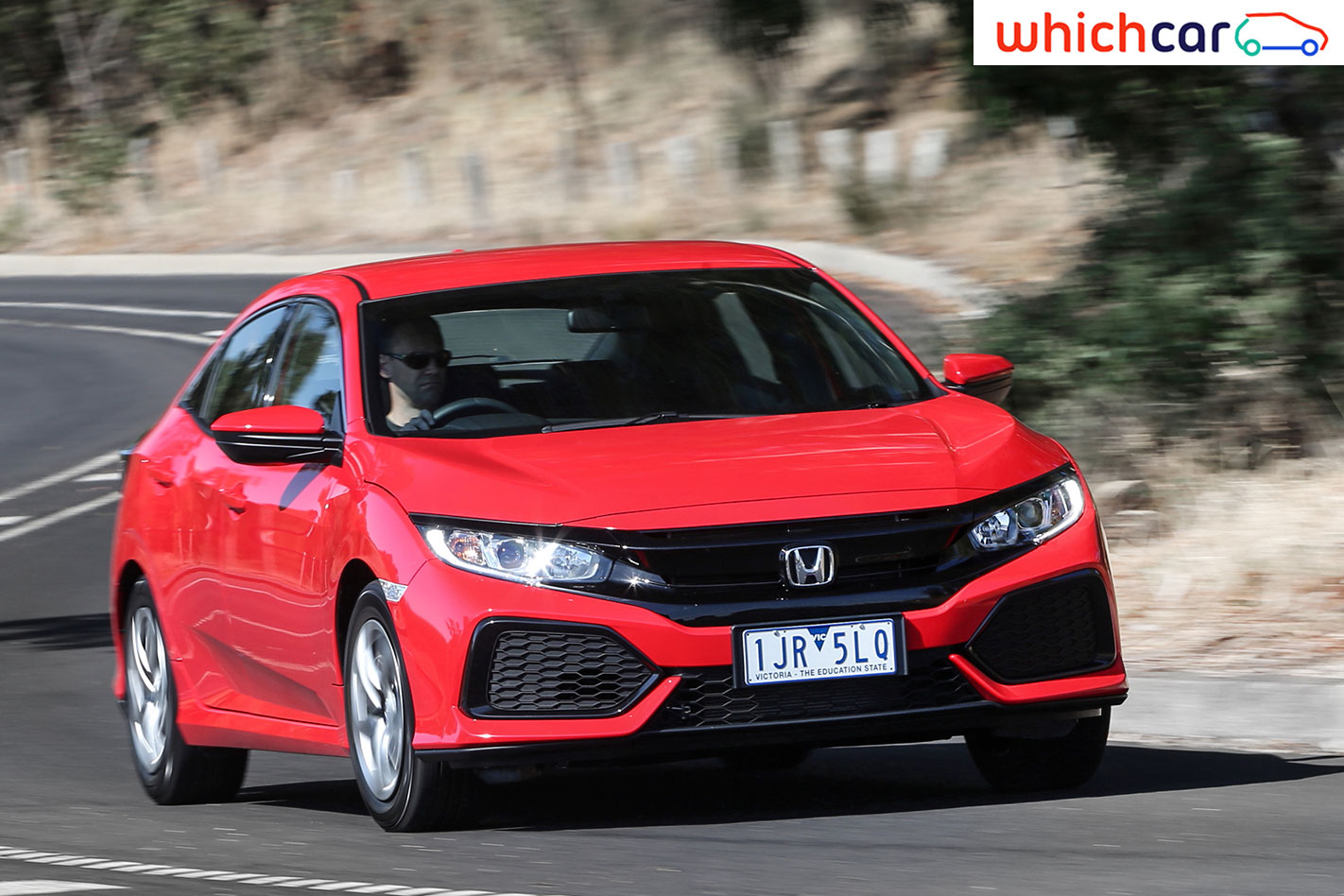
While more expensive 1.5-litre turbo models are nicer to drive, the 1.8-litre four-cylinder is more affordable and better value overall.
Key to the Civic’s success is a 61 per cent resale forecast.
It’s a shame the most affordable VTi isn’t lavished with active safety gear like many rivals.
Jump to
- How we rate Australia’s Best Value Car
- Light/City Cars
- Budget luxury cars
- Family Cars
- Small SUVs
- Five-seat SUVs
- Seven-seat SUVs
- Premium SUVs
- Prestige cars
- Kid Carriers
- Dual-Cab 4x4s
- Off-Road 4x4s
Green Hell
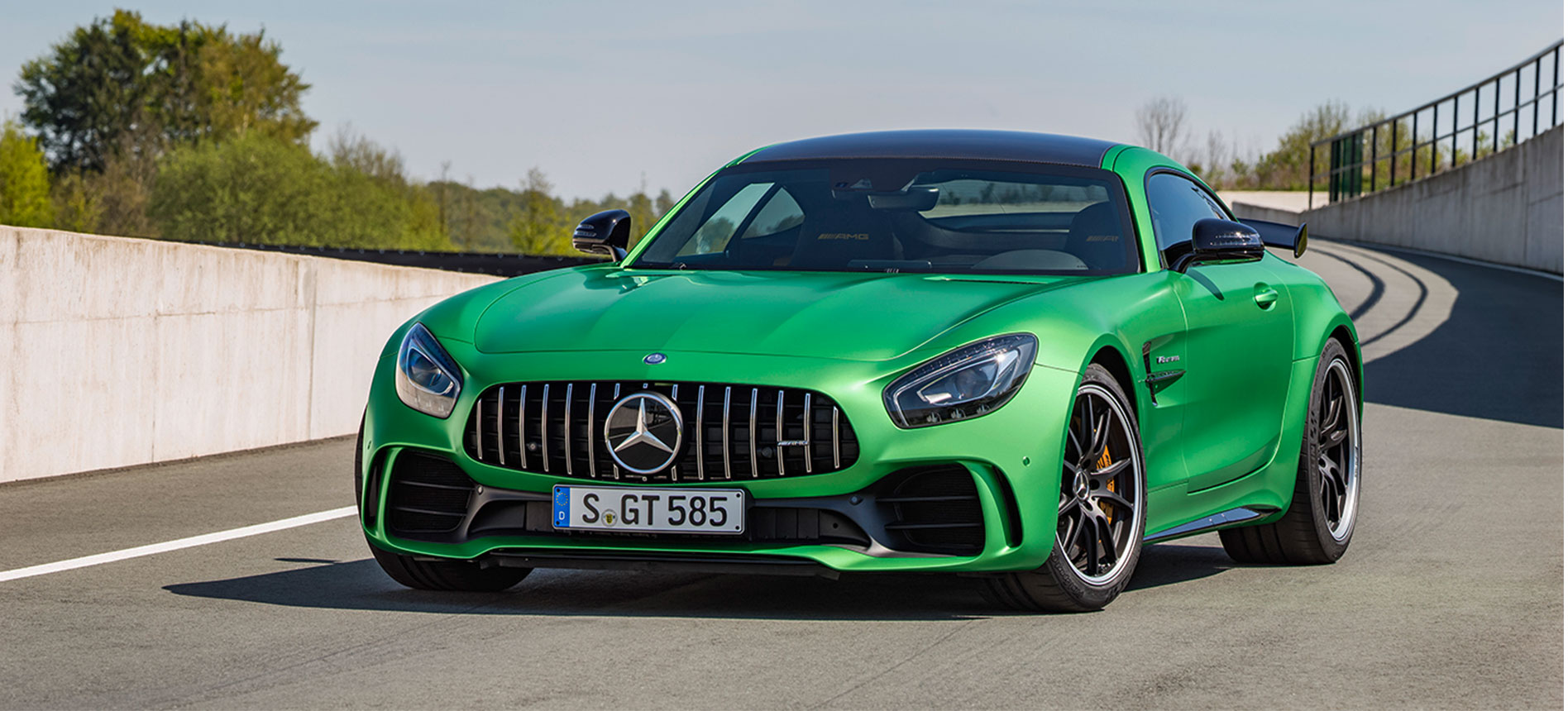
AMG’s fire-breathing GT R is very much at home at the Nürburgring, smashing the sports car record with a time of 7m 10.9sec in December 2016. Handy, then, that the car’s signature colour is named after the German circuit. We wouldn’t want it any other way, even if the finish costs £7500. Yikes.
Some Like It Hot Red
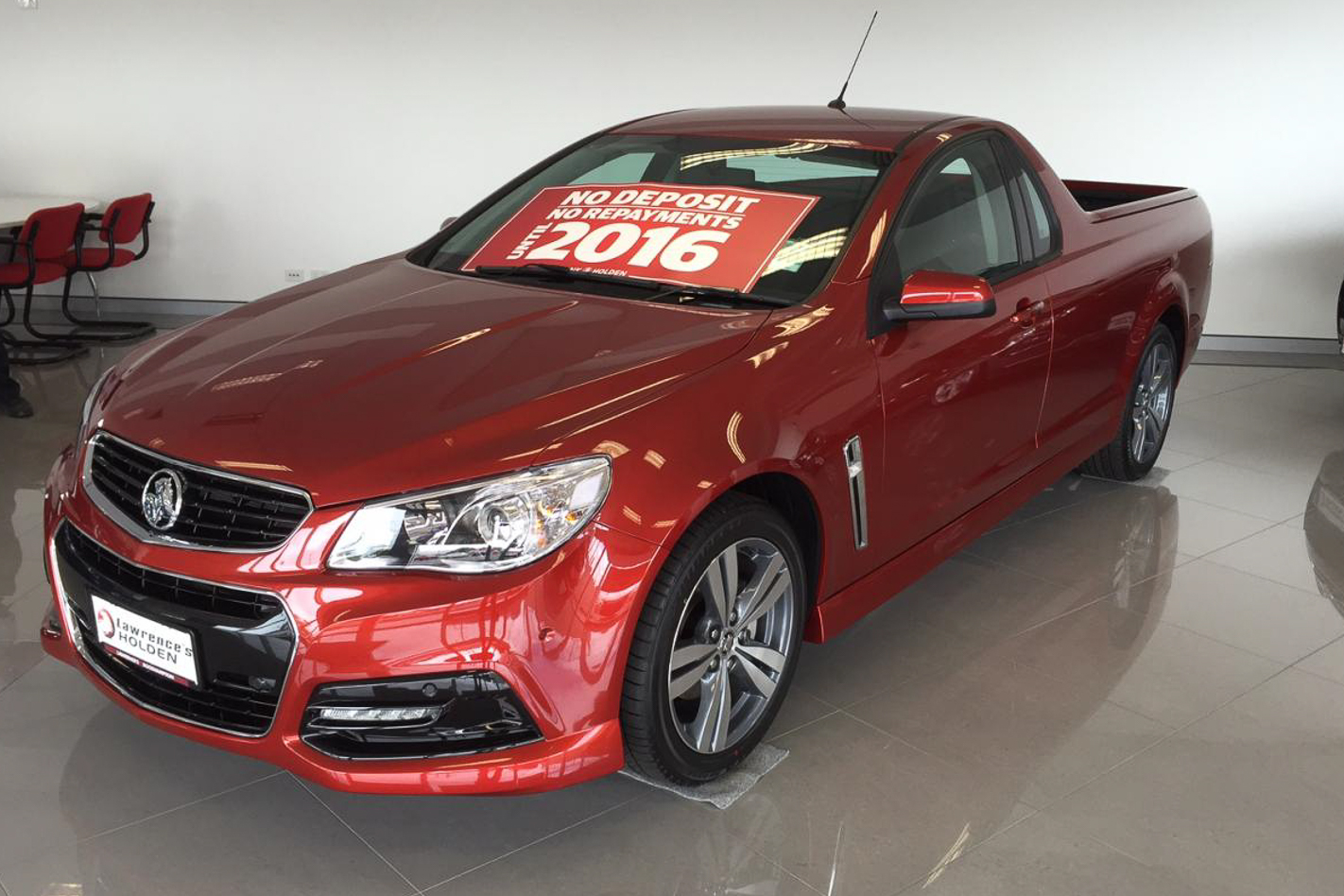
At least Holden was creative when it came to naming its colour schemes. Some Like It Hot Red featured on the VF Commodore Down Under and overseas on the Chevrolet SS before local manufacturing closed in 2017.
Tangerine Scream
‘Gah! My eyes!’ is probably where the ‘scream’ part of this retina-searing yellow/orange (depending on who you ask) colour comes from. One of very few colours guaranteed to bring you to the attention of the local plod, and is only available on the (now outgoing) Focus ST.
Avant-garde Bordeaux
No, this isn’t a flighty and free-thinking wine from Western France. Along with the 400,000,000 special-edition Fiat 500s (we counted), regular 500s are subject to paint colour names that barely make any sense. The 500’s too hip to be nailed down by convention.
Ooh La La Rouge
Toyota USA has recently been pushing the boat out to make some of its cars seem more interesting through any means available, including this, er… cheeky colour applied to the Highlander SUV, among others. Has it worked? Um…
Grabber Blue
Our favourite version of where this shade of blue originated has the Petty brothers (of NASCAR fame) running low on supplies of their favoured dark blue, and having to dilute it. It became a huge hit among the Ford Mustang fraternity. Nowadays it has completely unintentional Trump-esque tinges to it.
Papa Don’t Peach
Pop culture references! LOL! OMG! Amazeballs! Almost none of the Vauxhall Adam’s colours have ‘normal’ names. See also: Saturday White Fever, the Green Gatsby and Shades of Grey. The orange-ish colour here has since been killed off, but not because the Adam has gone all sensible.
DMZ
Special-edition SsangYong Korando Sports pick-up named after tenuous zone splitting the Korean Peninsula that cost you £2k extra for a camo finish spray painted by what we think was a four-year-old in a hurry. ‘A bit of fun,’ said SY UK. ‘A bit stupid,’ said everyone else.
Plum Crazy
Dodge and Plymouth went full-on in the ’60s and ’70s with colours that more than lived up to their extravagant names. Aside from Plum Crazy – recently revived on this Challenger show car – others include Sassy Grass, Citron Yella and Go Mango, as part of the High Impact series.
Detonator Yellow
What’s cool in a muscle car and muscle truck fan’s world? Beer? Patriotism? Maybe, but nothing as much as… explosions. That’s why some of Dodge, Ram and Jeep’s butchest cars like the Charger, Challenger and Wrangler were available with this startling hue – as if they’re mid-combustion.
This article first appeared on carmagazine.co.uk
We’re looking back through some of our most-viewed content throughout the year, and it turns out you couldn’t get enough of this one! Kick back and relive one of the standouts from a tumultuous 2020.
All the pearl-clutching about the morality of performing a Cannonball Run during a global pandemic seems to have been for nothing, with Ed Bolian reporting America’s most illegal record has been beaten seven times in the span of just five weeks.
According to Bolian, who has been in contact with the new record holders, the time to beat is now less than 26 hours. A sub 28-hour Cannonball Run was once unthinkable.
While he has not disclosed the exact time, that frame of reference means the drivers would have had to achieve an average speed of at least 173km/h for the 4507km journey.
Accommodating for fuel stops, the team’s peak and cruising speeds are probably far in excess of that figure.
Bolian states that the new record holders averaged 193km/h when crossing “several” States. It is unknown what car the new record holders used.
What is known is that they were well prepared, with over 30 spotters littered across the country, along with a heavily modified vehicle.
According to Bolian, its not just the outright record that has been broken, with the solo-driver, diesel-powered, and coast-to-coast-to-coast Cannonball records all tumbling – the last of which having almost 20 hours shaved off the previous record time.
This new flurry of record attempts follows a team of drivers who took advantage of empty roads that had been created by the coronavirus lockdown to set a cross-country time of 26 hours and 38 minutes.
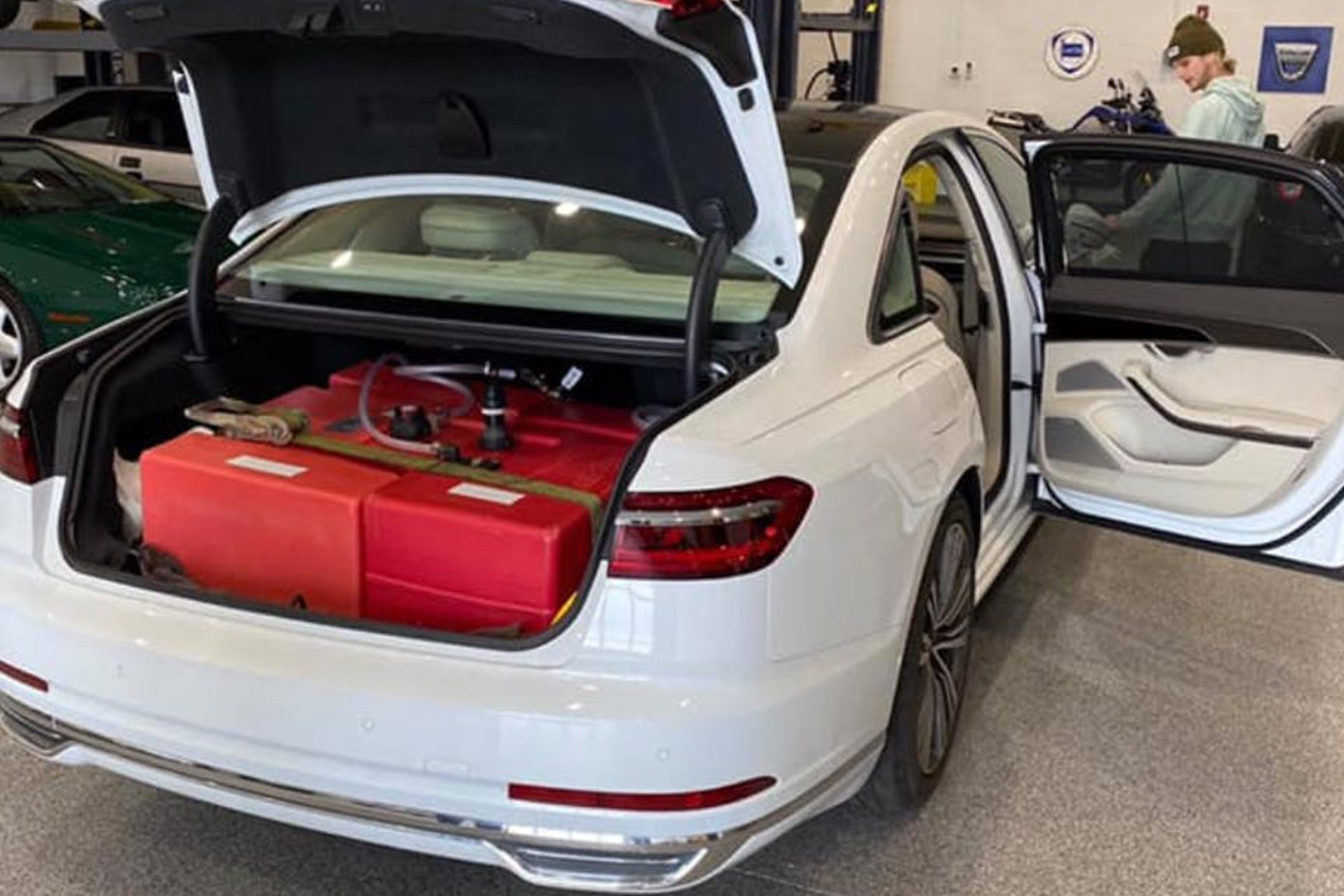
This unknown team used an Audi A8 for the record, with large marine fuel tanks strapped into the boot.
The Cannonball Run is a simple, and highly illegal, record that despite having no governing body, is infamous within car culture.
Bolian is a former competitor, record holder, and now somewhat of a defacto adjudicator on the record.
To set a Cannonball Run record, you must traditionally start at the Red Ball Garage in Manhattan, then traverse the entire United States of America as fast as possible to finish at the Portofino Inn in Redondo Beach, California.
Modern technology, and ultra-prepared teams, have resulted in the record falling to unthinkable levels in recent years, with teams maintaining crazy speeds on public roads to secure their place in motoring infamy.
The new record holders are reported to be preparing a documentary to accompany their official record announcement.
Understanding what a warranty is and how it covers you is an important part of the new car buying process.
Warranties are a form of consumer guarantee usually imposed by the manufacturer itself, to cover you in the event of a fault within the defined warranty period.
That said, a warranty doesn’t protect you for every little thing that goes wrong. To make matters confusing, manufacturers often vary on what’s included within their warranty guarantees, too.
But, as a baseline, a warranty is designed to cover a car and its accessories with regard to safety, reliability and roadworthiness. Most notably, if it has anything to do with the drivetrain, fittings, paint, tech or functionality of the car, it’s likely to be fixed under a warranty scheme if it breaks – but for a limited time only.
Most warranties sold with new cars cover you for at least three years and up to 100,000 kilometres, but the best deals can have your back for up to seven years and include unlimited kilometres.

Try as you might, wear and tear on your car can’t be fixed with a warranty. Any defects arising after repeated wearing down, resulting from misuse or occurring after motorsport participation is generally not included in a warranty. Regular maintenance and servicing is the responsibility of the owner as well.
That means items such as brake pads, tyres, oil, other fluids, filters, spark plugs, timing belts and clutches fall to the owner to replace.
If a vehicle is sold with a balance of warranty, it automatically transfers to the new owner – which can be a positive selling point when listing your near-new car for sale.
Some manufacturers won’t honour the warranty if you don’t service your car using their dealership servicing, but the good makes will, so long as genuine parts and manufacturer-recommended fluids are used. It’s always best to check what the required conditions are with the dealership before buying.

Less ambiguous is what happens after you modify your new car. Generally speaking, if you tune or change any part of your car (even if it’s indirectly related to the faulty part), it could void your warranty. Again, best to enquire with the dealership and do your research to see if you’re covered if you plan on going down that route.
With all this said, there are always exceptions to the exclusions and inclusions listed within this story. Some manufacturers like Hyundai will continue to warrant its i30 N even after having participated in a track day.
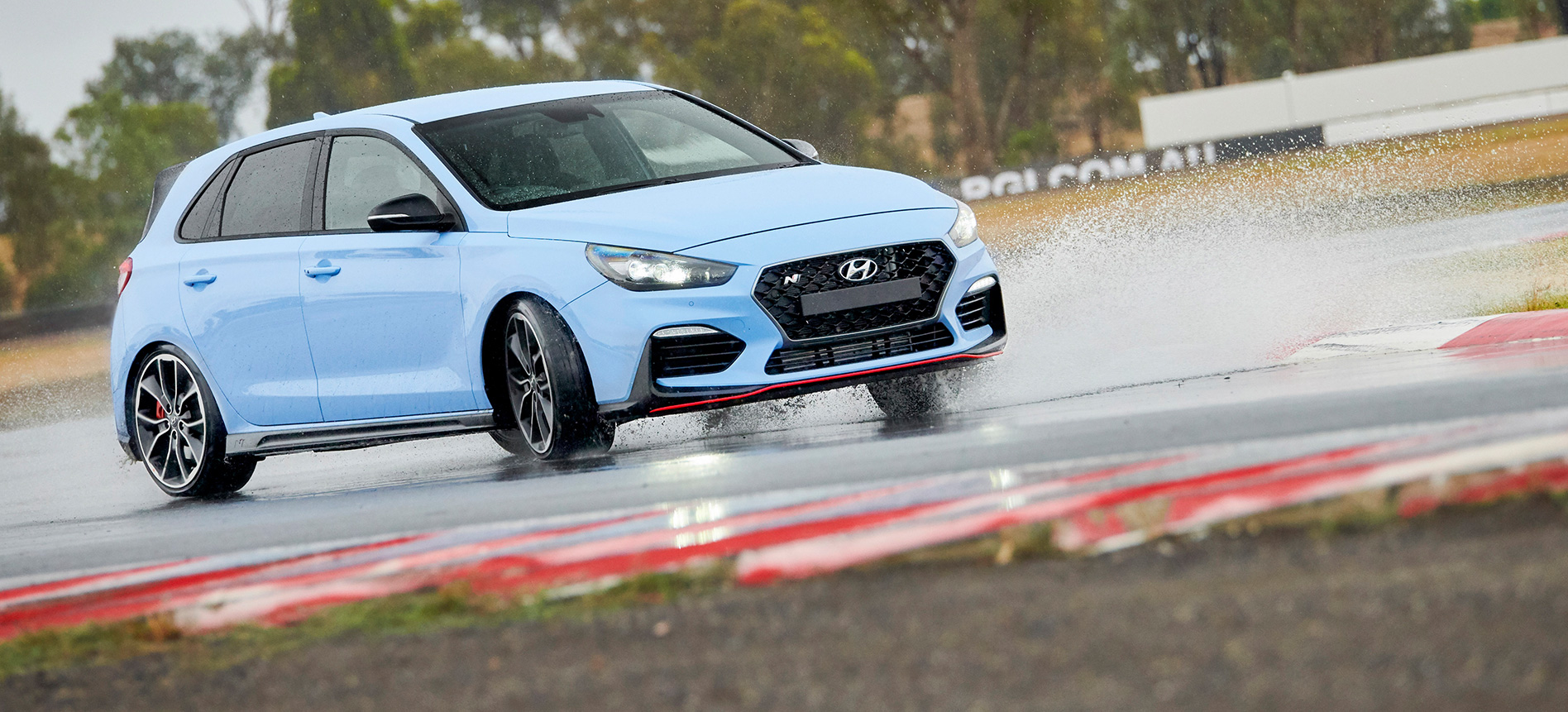
It’s good to have an idea of what to expect when it comes to warranties, but always do your own research before diving into a purchase to save yourself being burnt in the future.
