
According to a 2020 Geely annual report, Geely Sweden Holdings also incorporates a motorsport management company and a competence centre that provides services for group companies in Sweden. Geely Sweden Holdings is owned by Zhejiang Geely Holding, a privately owned industrial group of companies headquartered in Hangzhou, China.
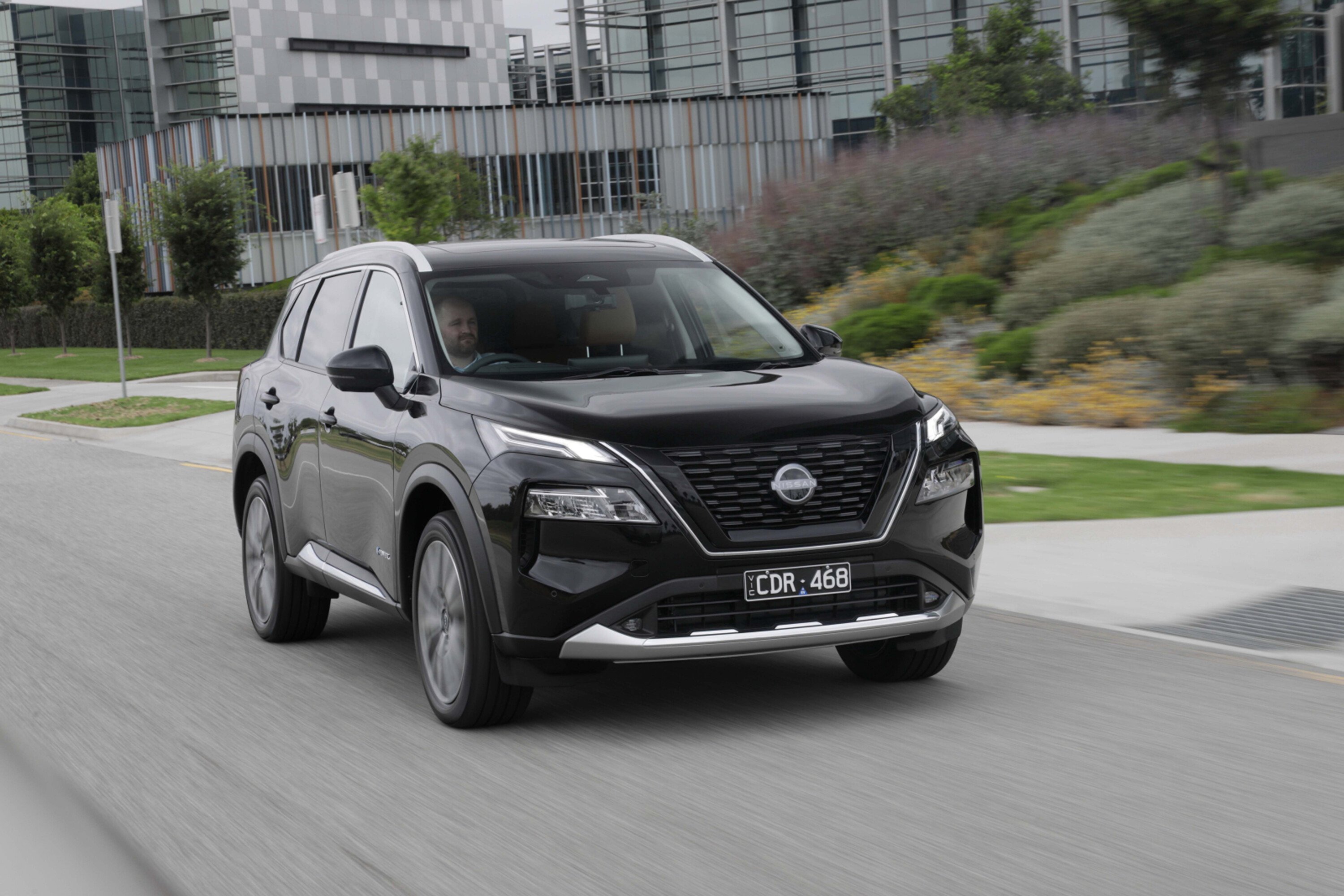
The 2024 Nissan X-Trail is one of Australia’s better known mid-size SUV wagons, but how much can it tow and is it any good at it?
JUMP AHEAD
- What you need to know about the Nissan X-Trail
- How much can the Nissan X-Trail tow?
- How does it compare with its rivals?
Everything you need to know about 2024 Nissan X-Trail
As one of Australia’s most popular mid-size SUVs, the X-Trail is a go-to wagon for everyday family activities as well as the weekend get-away vehicle.
For lighter trailerboats or caravans and camper-trailers, the X-Trail is a promising option.
The Nissan X-Trail arrived last year in the form of an all-new fourth-generation model, platform shared with the Mitsubishi Outlander. Offered in four trim lines, in 2WD and AWD, in petrol or hybrid and in five- or seven-seat configurations, the X-Trail we’re focussing on here is the popular five-seat petrol Ti spec.
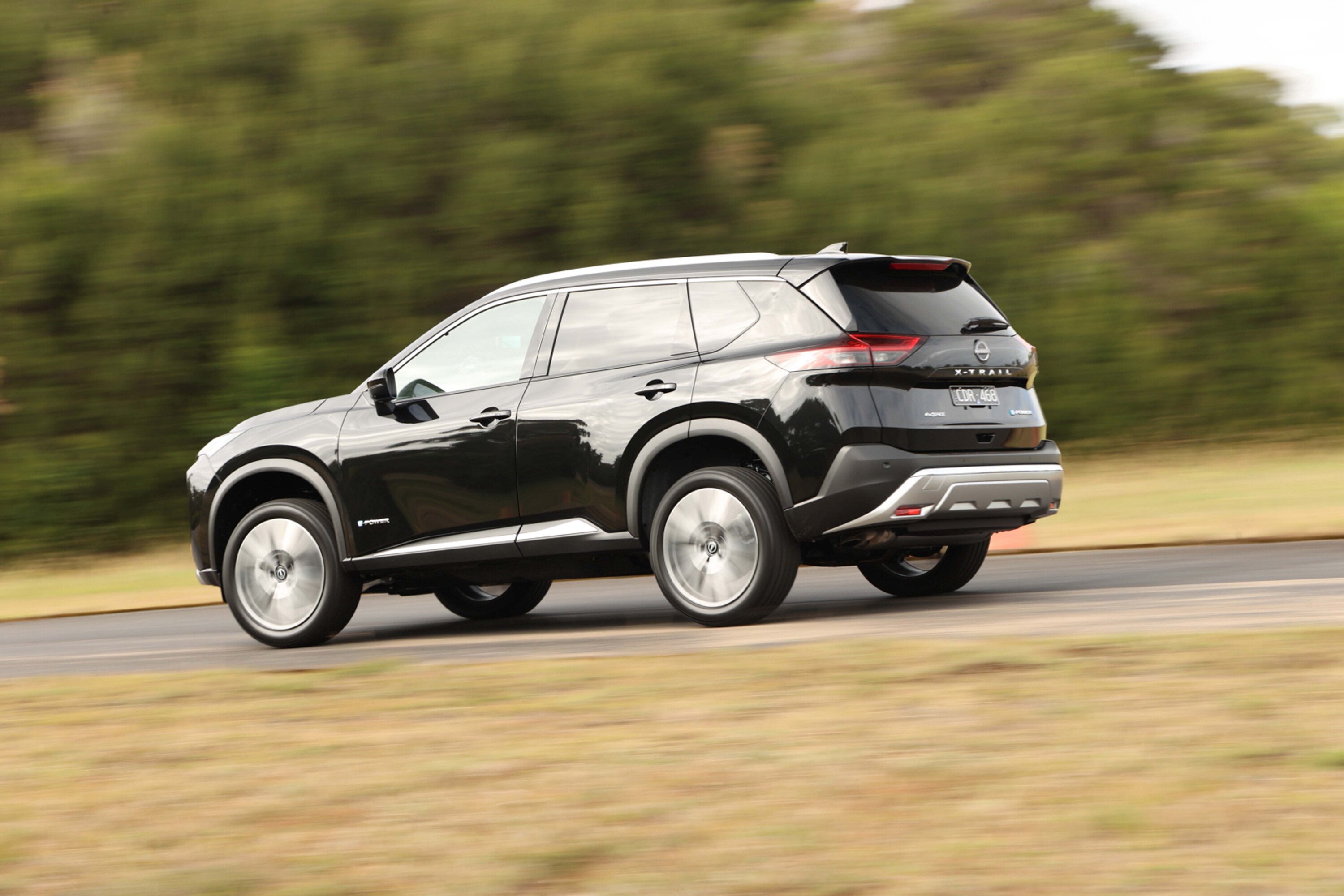
1
While the hybrid X-Trail would appear to be the towing pick – with its higher outputs and lower fuel use – its 400kg lower (1600kg versus 2000kg) towing capacity over the petrol knocks it out of contention.
The standard safety equipment list for Nissan X-Trail Ti includes seven airbags (dual front, side, curtain, and front-centre), Autonomous emergency braking (vehicle, pedestrian, cyclist, junction, reverse), Adaptive cruise control, High Beam Assist, LED headlights, 360-degree camera, front and rear parking sensors, Blind-spot alert, Lane-keep assist, Traffic sign recognition, Lane departure warning, Rear cross-traffic alert and Rear Automatic Braking.
The X-Trail Ti comfort features include keyless entry and start, leather seats (heated and powered at front), sunroof, a 12.3-inch digital dash a 10.8-inch head-up display, 12.3-inch infotainment screen, Apple CarPlay (wireless) and Android Auto (wired) and a wireless phone charger.
The Ti is a five-seater only; for seven seats you need to choose from either (lower spec) ST or ST-L. For all X-Trail towing-specific features, see below.
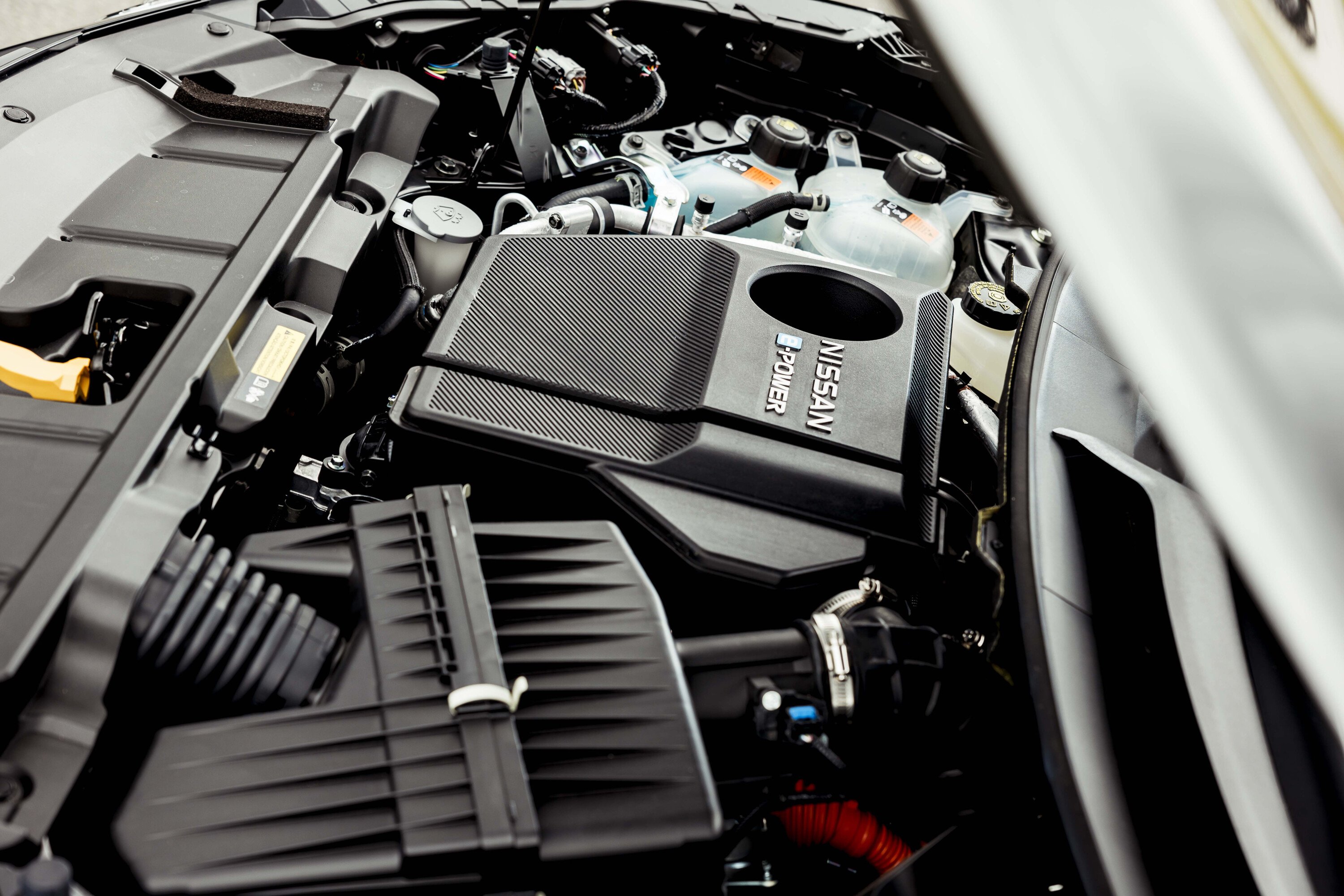
1
Get up to speed on the X-Trail
The stories below will give you a guide on everything to do with the 2024 Nissan X-Trail. All fresh stories will be found on our Nissan X-Trail Sport page.
2024 Nissan X-Trail coverage
How much can the 2024 Nissan X-Trail tow?
All Nissan X-Trail models have a 2000kg (braked) and 750kg (unbraked) towing capacity, with 200kg towball download maximum.
The X-Trail Ti petrol’s kerb mass is 1668kg, and GVM is 2135kg. This mean you have a 267kg available payload once 200kg towball mass is subtracted. GCM is not noted in Nissan data, as is often the case with passenger vehicles.
Out of the box the X-Trail’s only towing features are trailer-sway control and, while not directly for towing, it does help hitching up, a rear-view camera. Trailer sway control is an active safety feature is in many (but not all) new vehicles, and it works by automatically applying individual wheels brakes when sensors pick up that the vehicle is yawing excessively because of trailer sway.
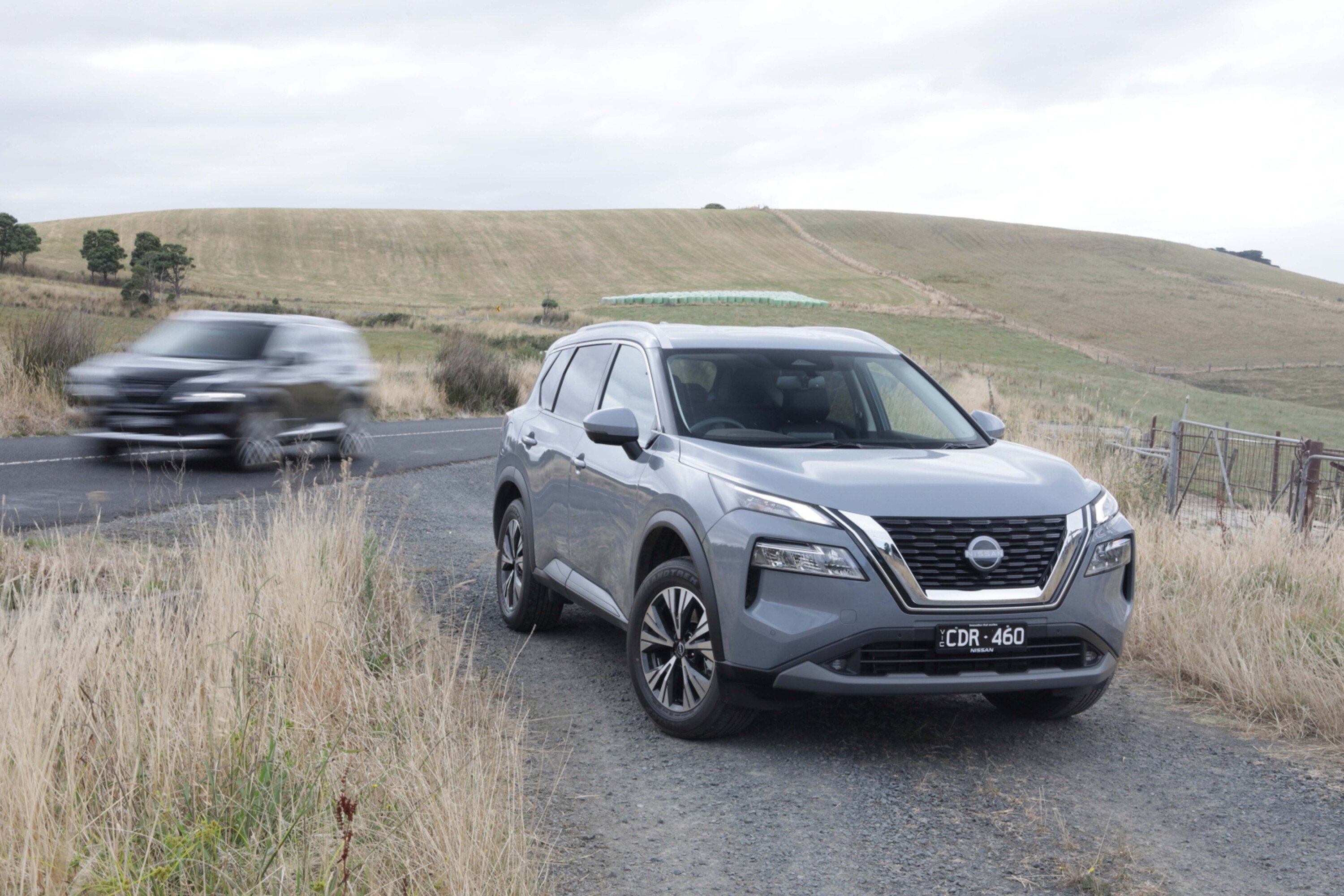
1
While a genuine Nissan tow kit is optional, not much else (such as an electric trailer brake controller) is offered by Nissan for towing.
The towball on the Nissan accessory towbar is very close to the rear bumper, making it possible to damage the rear bumper with the trailer coupling if you’re not careful when hitching up.
Towing performance is acceptable, although a bit blunted with a heavy trailer behind, while towing ride is quite good. Fuel consumption will depend what size and weight trailer you are towing, but if it’s a big, bluff 1900kg caravan then expect a fuel figure of around 15L/100km.
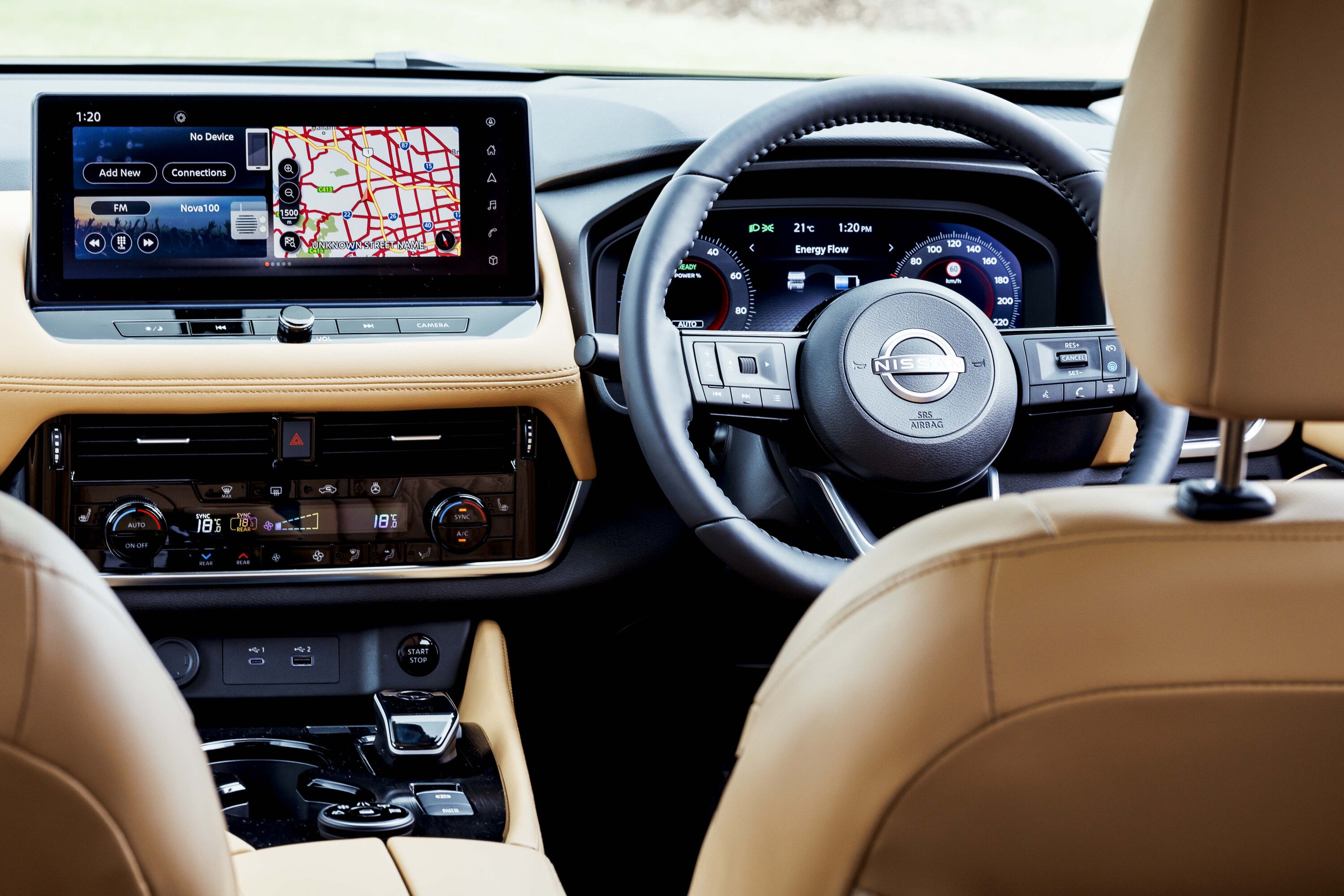
1
How does this match up with competitors?
The fact is, the mid-size SUV market is not where manufacturers tend to spend much effort setting up their vehicles to tow heavy loads.
Many have much less than 10 per cent towball loading, for example, a vital statistic if towing the typical caravan or camper-trailer. While the X-Trail is one of few with a solid towing capacity (and with 10 per cent towball download), it isn’t the only one with some good towing specs. The X-Trail has some solid competition.
There are not many that can equal the X-Trail’s 2000kg maximum towing capacity and 200kg towball download. The Volkswagen Tiguan beasts X-Trail with its 2500kg best in class towing capacity, but allows only 200kg maximum towball download.
1
The Hyundai Tucson comes close with 1900kg maximum capacity, bit only accommodates 150kg of than on the towball. Even the platform-shared Mitsubishi Outlander only offers 1600/160kg towing maximums.
It’s hard to pick a winner here; while the Tucson offers diesel torque and efficiency, it is beaten by the 162kW petrol Tiguan in outright capacity – although you’d have to make sure to keep towball weight below the 200kg threshold.
| Nissan X-Trail | Hyundai Tucson | Mitsubishi Outlander | Subaru Forester | Volkswagen Tiguan | |
|---|---|---|---|---|---|
| Engine | 2.5L 4 | 2.0L TD4 | 2.5L 4 | 2.5L 4 | 2.0L T4 |
| Power | 135kW | 137kW | 135kW | 136kW | 162kW |
| Torque | 244Nm | 416Nm | 244Nm | 239Nm | 350Nm |
| Towing Capacity | 2000kg | 1900kg | 1600kg | 1800kg | 2500kg |
| Towball download | 200kg | 160kg | 160kg | 180kg | 200kg |
| Kerb Weight | 1668kg | 1680kg | 1760kg | 1576kg | 1706kg |
| GVM | 2135kg | 2315kg | 2355kg | n/a | 2260kg |
| GCM | n/a | n/a | 3955kg | n/a | 4760kg |
MORE
Everything Nissan
MORE
Midsize SUVs
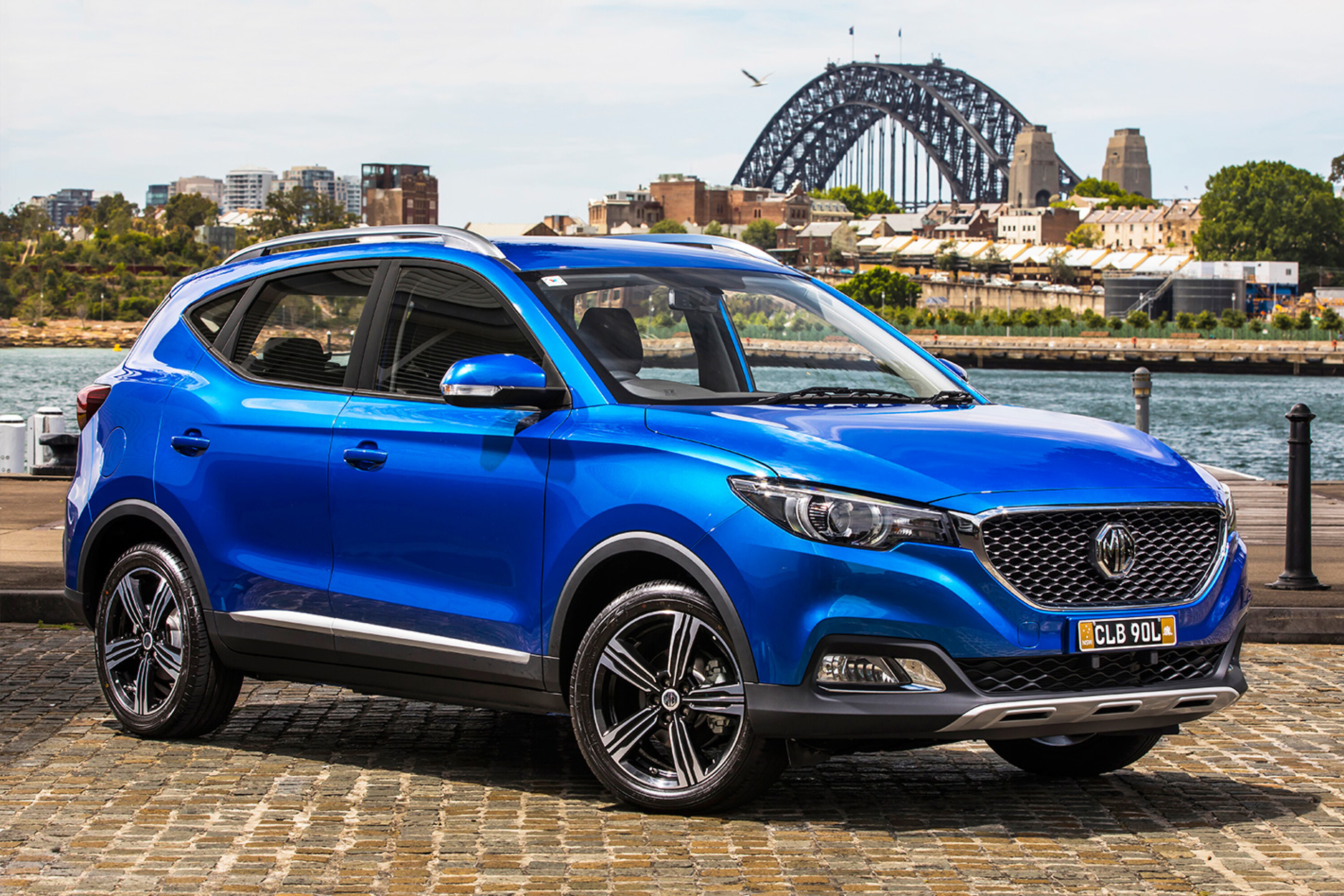
The 2024 MG ZS is an affordable small SUV that’s gained quick popularity in Australia since arriving in 2017.
It’s produced by British-turned-Chinese automaker MG who are now a regular in the list of top ten best-selling car brands.
2
Pricing and Features
It’s a single ZS grade on offer – Excite– which you can pick up for the extremely competitive price of $23,990 drive-away. It sits in a price bracket akin to most of used key selling rivals.
Under the bonnet lives a 1.5-litre engine paired to a 4-speed auto that produces a humble 84kW of power and 150Nm of torque.
The entire MG range is backed a seven-year unlimited kilometre warranty, unless you use the vehicle for commercial purposes which will cap your odometer to 160,000km over that period.
1
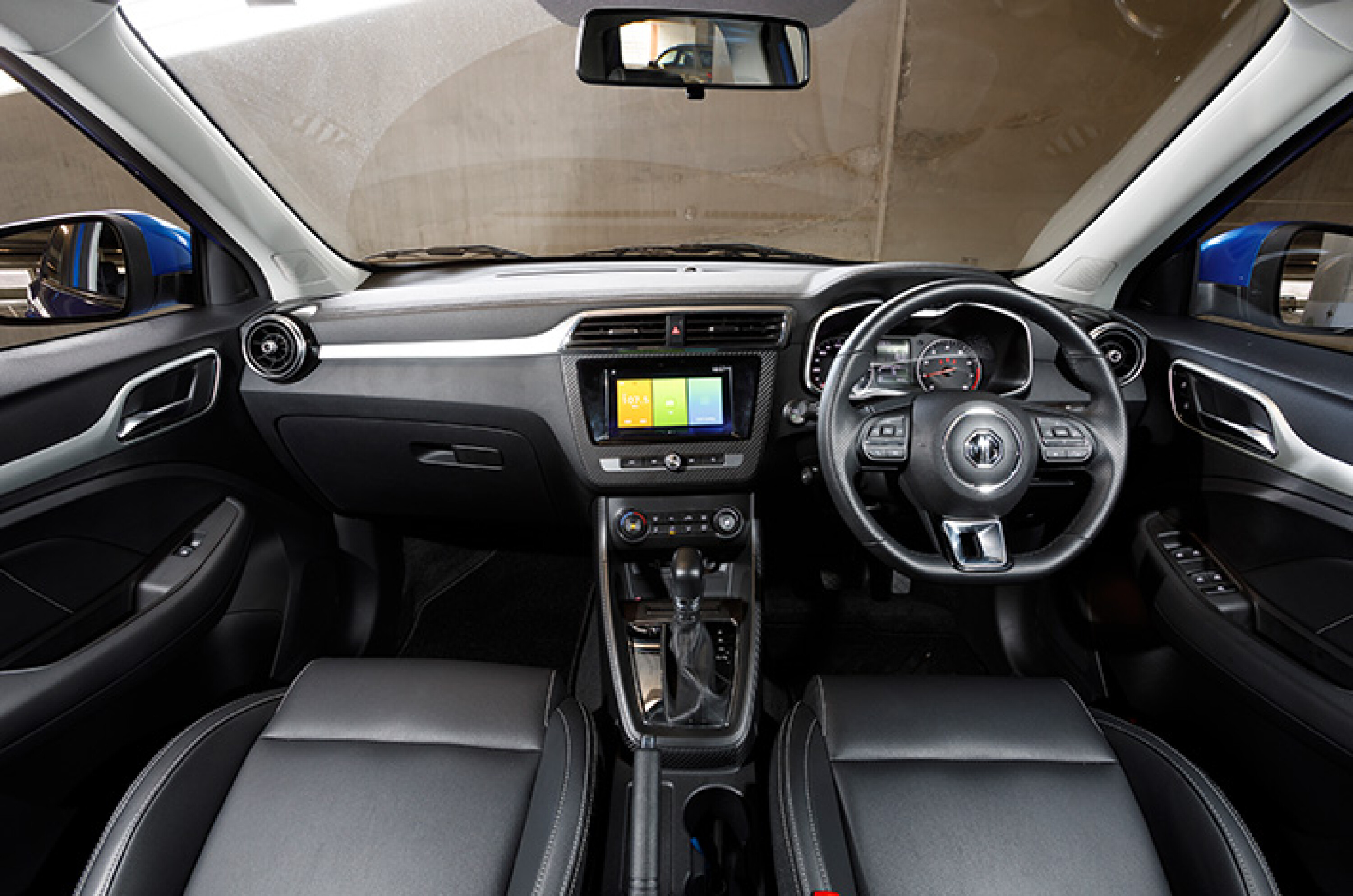
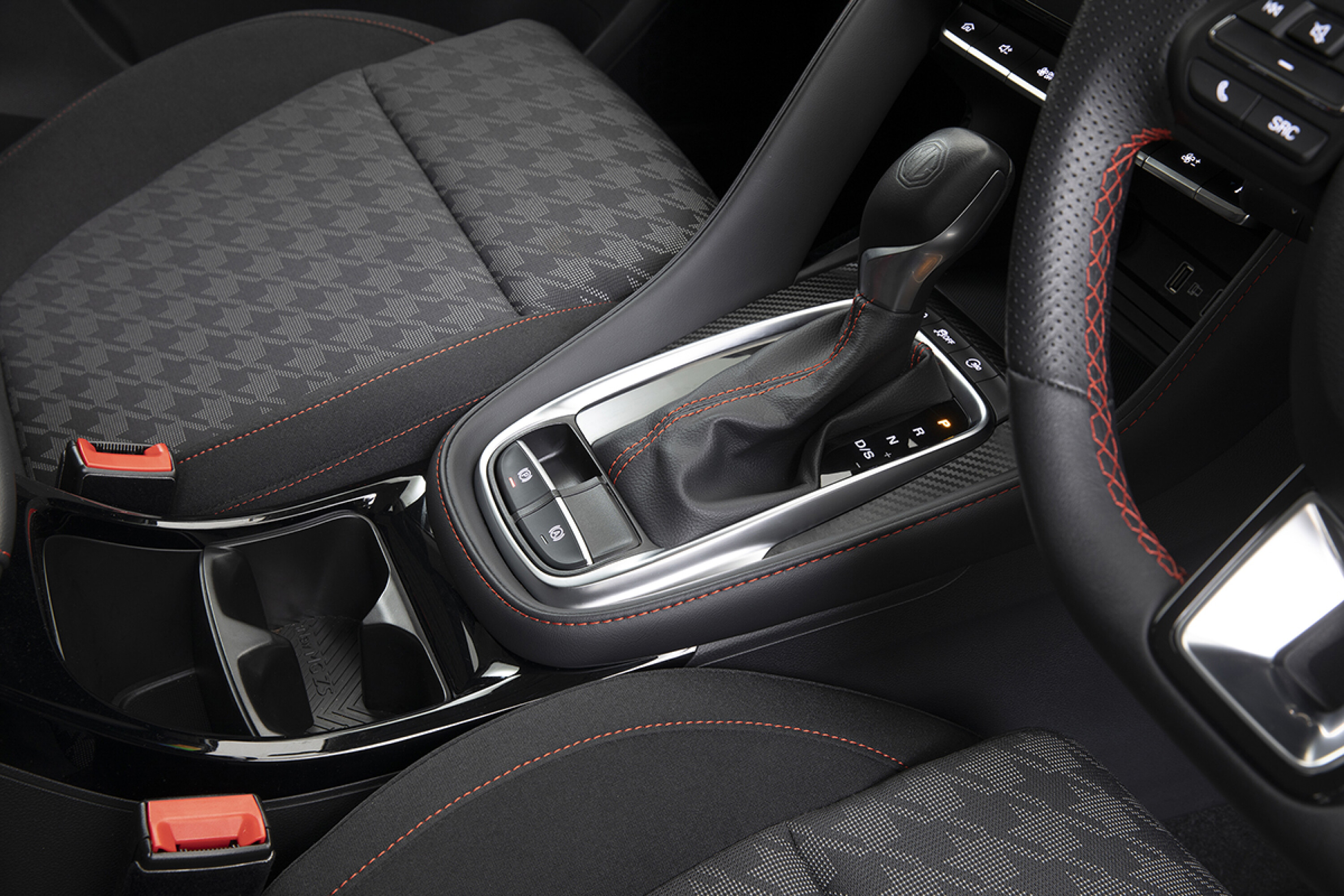
MG ZS has basic standard equipment that gets the job done.
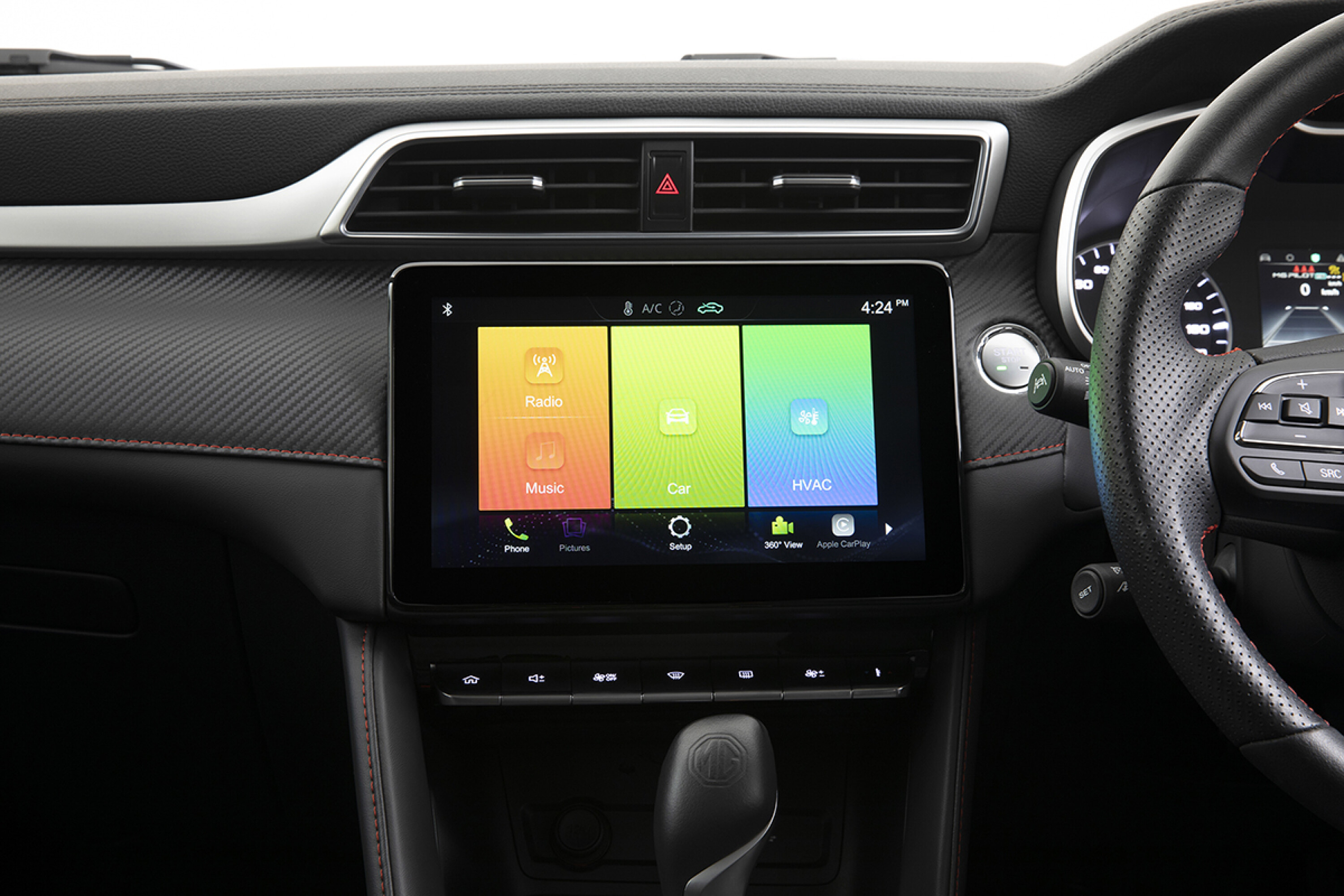
This includes 17-inch alloy wheels, a leather-appointed steering wheel, six speakers, Apple CarPlay, an 8.0-inch touchscreen, a reverse camera and rear parking sensors. All the standard specs you’d expect out of a vehicle in the category, but with a sharper price point than most.
It’s cheap and simple, but if you’re after more, you’ll want to look into the more premium of the MG ZST range.
2
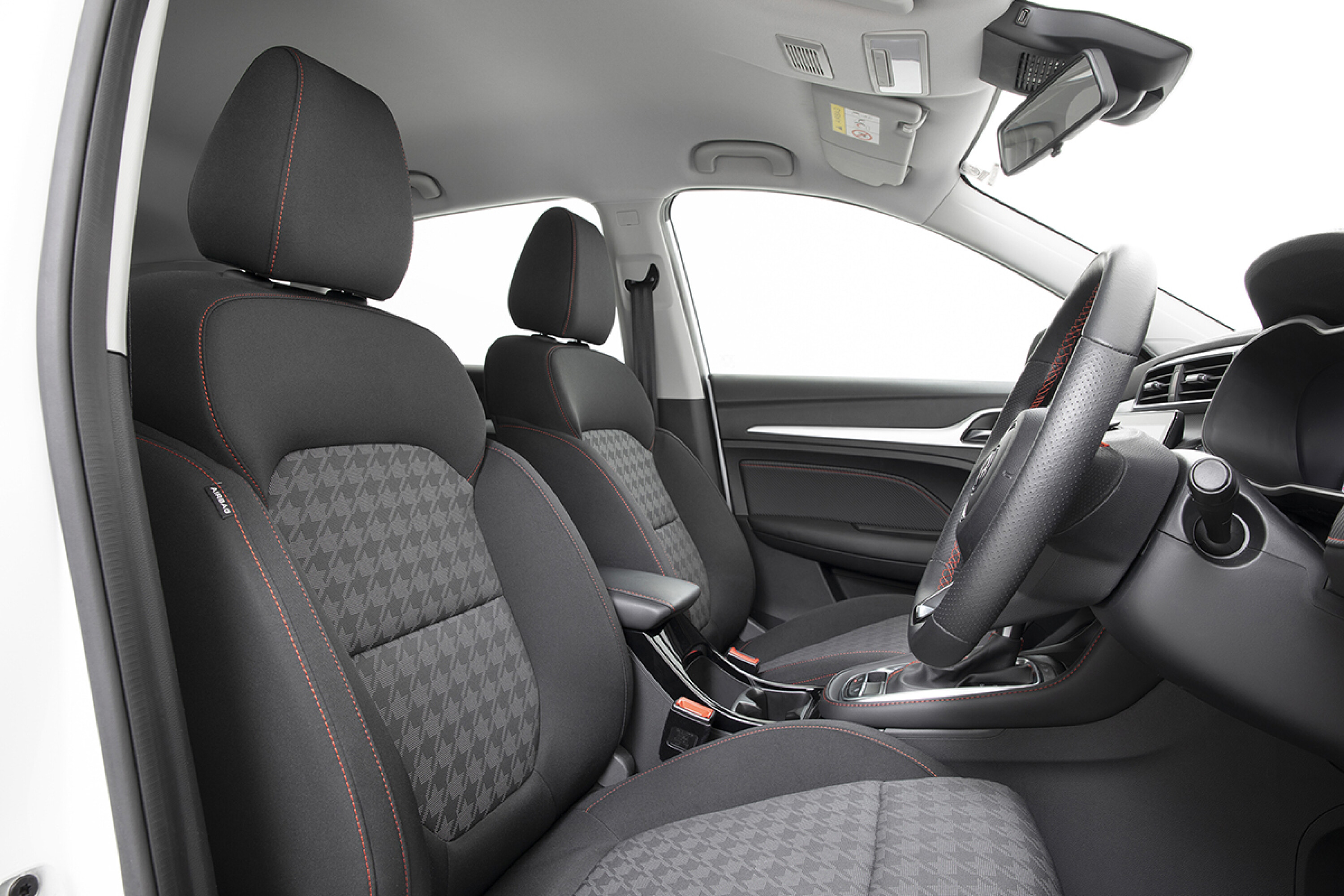
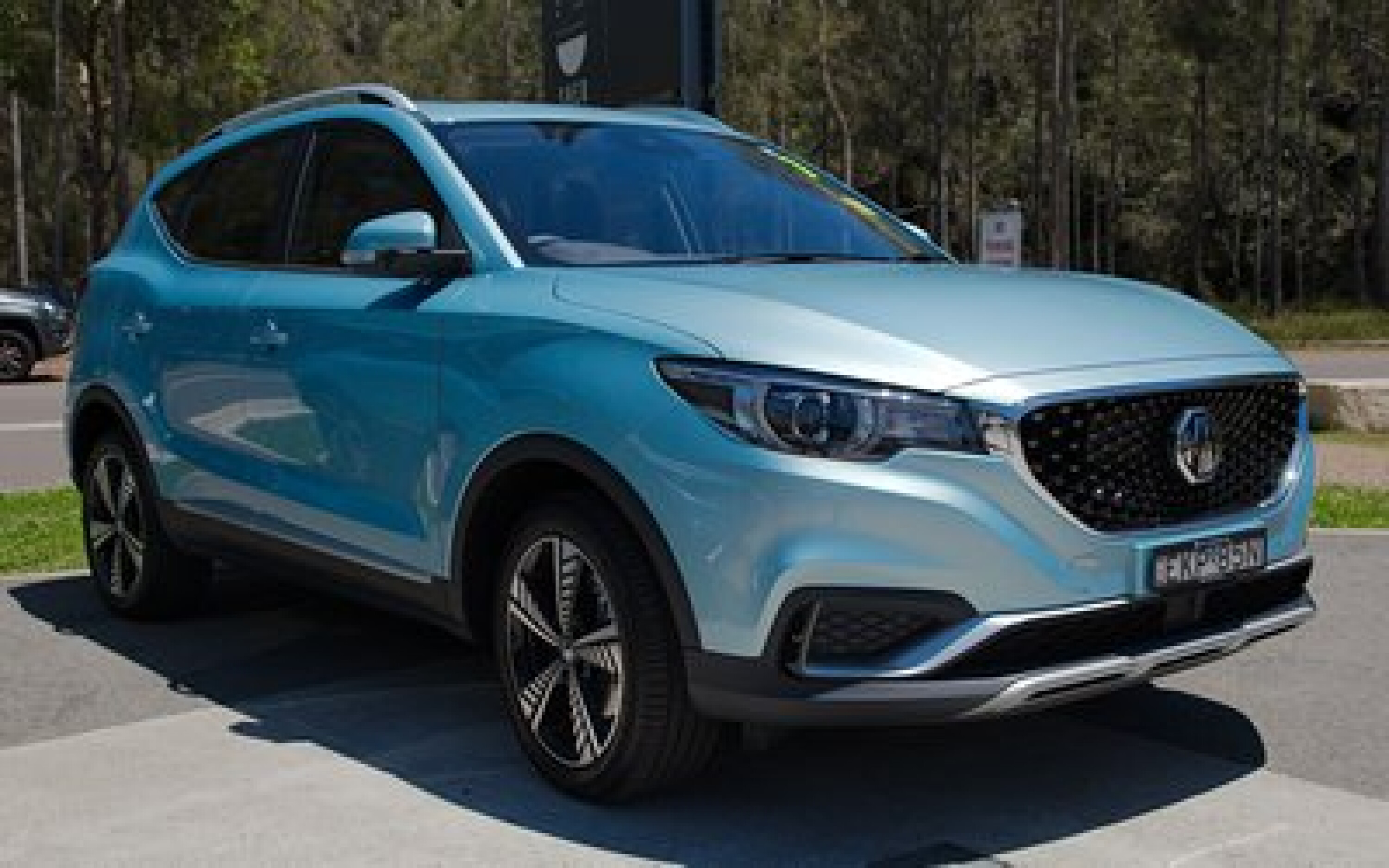
In the world of compact SUVs, the ZS Excite stands out with its unexpectedly roomy interior and commendable design aesthetics.
While it might not be an outright head-turner, it subtly exudes a more premium look — especially for those not as car-obsessed as us — than a vehicle that can be driven home for less than $25k.
Buyers have the choice of five exterior colours, including MG’s signature Diamond Red metallic paint. Dover White and Pebble Black come free of charge, while the remaining colours carry a $700 premium.
1
Safety
The safety features in the MG ZS have improved over the years, but the car still maintains the four-star ANCAP rating it received when it was rated in 2017. This is due to omissions like Automatic Emergency Braking (AEB), which has become standard for many other brands.
2
Key Rivals
As a best-seller in the small SUV segment, the MG is competing with a range of key players, from budget-friendly to mainstream luxury models.
These included the:
1
Should I Put It On My Shortlist?
The MG ZS is a great value-for-money proposition, offering a decent set of features and inclusions at its price point.
It’s a step into a new vehicle you’ll only get from used cars of key competitors.
If you’re restricted by budget and want the peace of mind of a leading seven year warranty, then the MG ZS could be your answer.
MORE
Everything MG
MORE
Small SUVs
Australia’s favourite vehicles are dual cab utes. Year-on-year the Toyota HiLux and Ford Ranger battle it out for supremacy and in that sense, we’re not too different in the F-150-dominated United States.
No surprise that Australian politicians are keen to match the Yanks’ fuel efficiency standards, then.
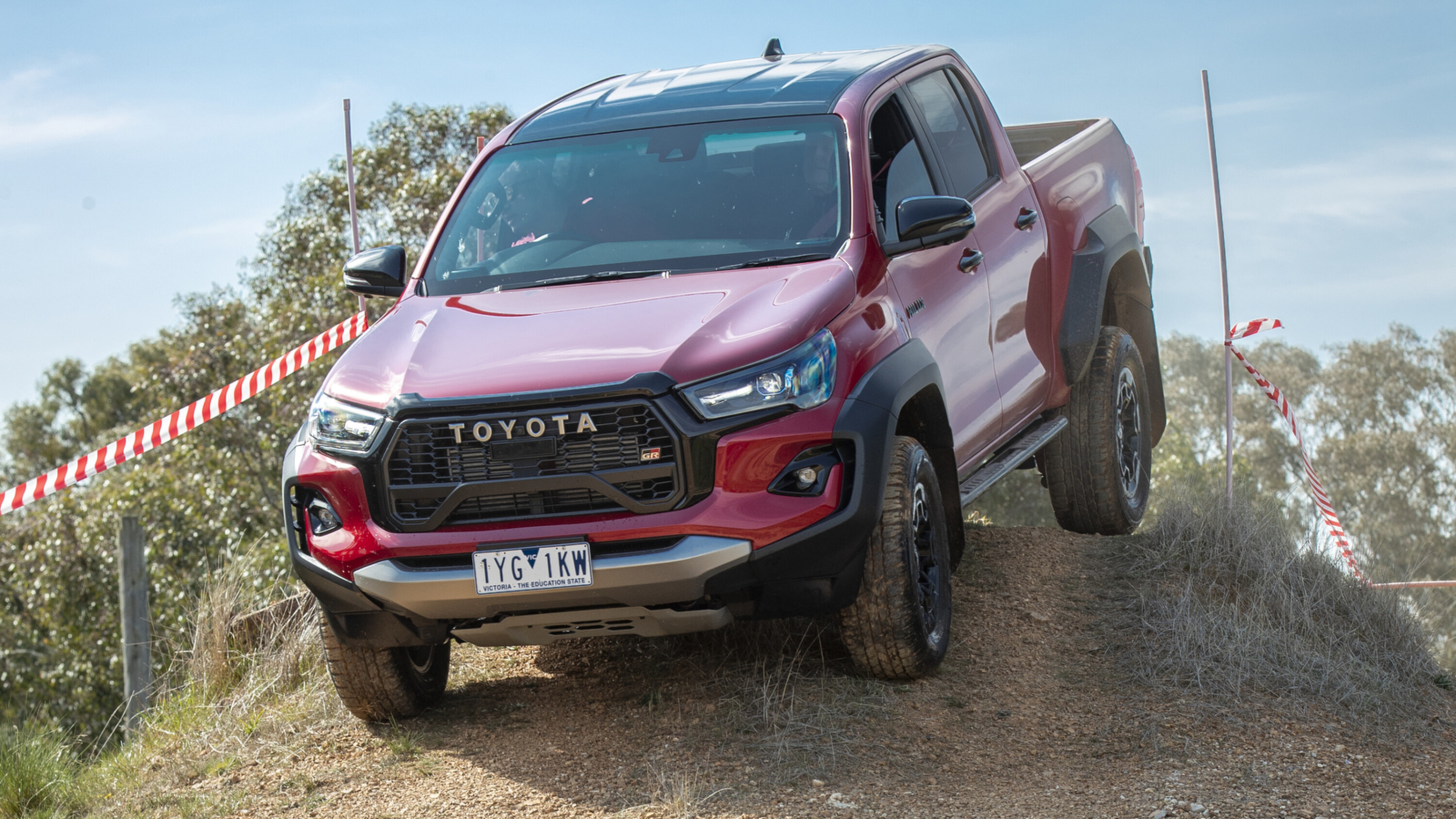
The UK has been heading in the same direction as us, with record Ford Ranger sales in 2023. Instead of allowing these popular family-friendly four-door pick-ups to masquerade as work vehicles, they were set to be reclassified in the UK’s Benefit in Kind (BIK) rules – the company car scheme – as passenger, rather than light commercial vehicles.
1
It would’ve placed a Ford Ranger Wildtrak in the highest company car tax bracket of 37 per cent; from 2025 a 40 per cent taxpayer in the UK would have to cough up £582 ($1120) monthly for using it as a company car, compared to just £120 ($230) before.
A less polluting vehicle is taxed significantly less in the scheme. This is separate from the UK’s efficiency standards, though it drastically adjusts purchase habits.
Little surprise then that, around a week after the change was announced, pressure from the United Kingdom’s motor industry saw the government U-turn on its decision. The official reason is that the changes could have inadvertently harmed farmers and the UK’s economy.
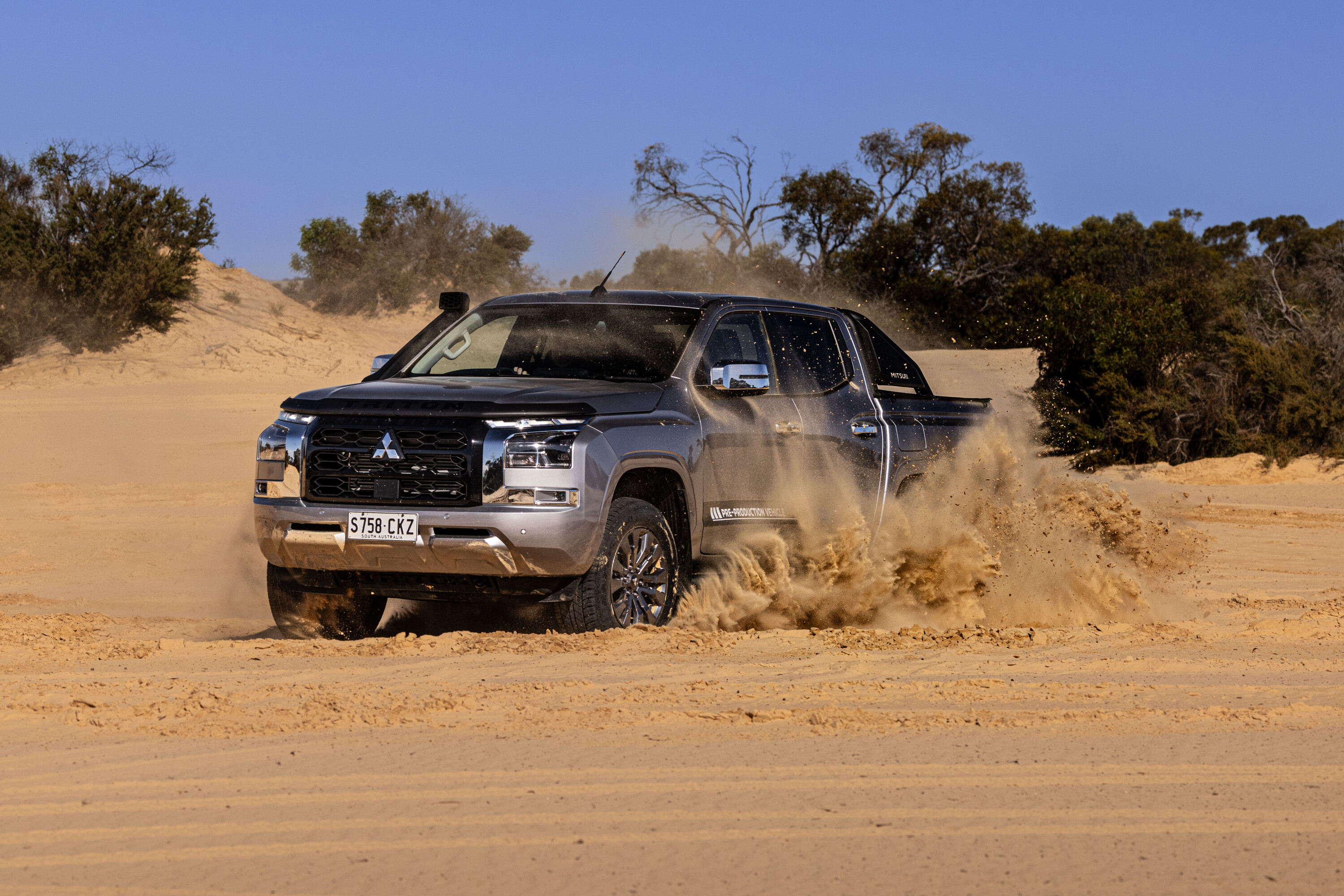
1
Australia’s market is different from the UK’s, with utes necessary for large parts of our country where travelling long distances loaded or towing on rough roads is common.
But dual-cabs are now one of the default vehicles for Aussie families.
Statistics give credence to this, with Mitsubishi identifying that more than half of Triton buyers use their vehicles strictly privately: to and from work, on weekend drives and adventures.
These are the kind of buyers that see utes as a lifestyle vehicle for recreation, offering more than sheer utility.
I have no issue with how vehicles may be used, but giving concessions in the New Vehicle Efficiency Standards to Australia’s most popular and polluting vehicles by taxing them less than a Toyota RAV4 or MG ZS (according to the FCAI’s calculations) would only going to push more buyers into this type of vehicle – ergo more CO2 emissions in the short-medium term.
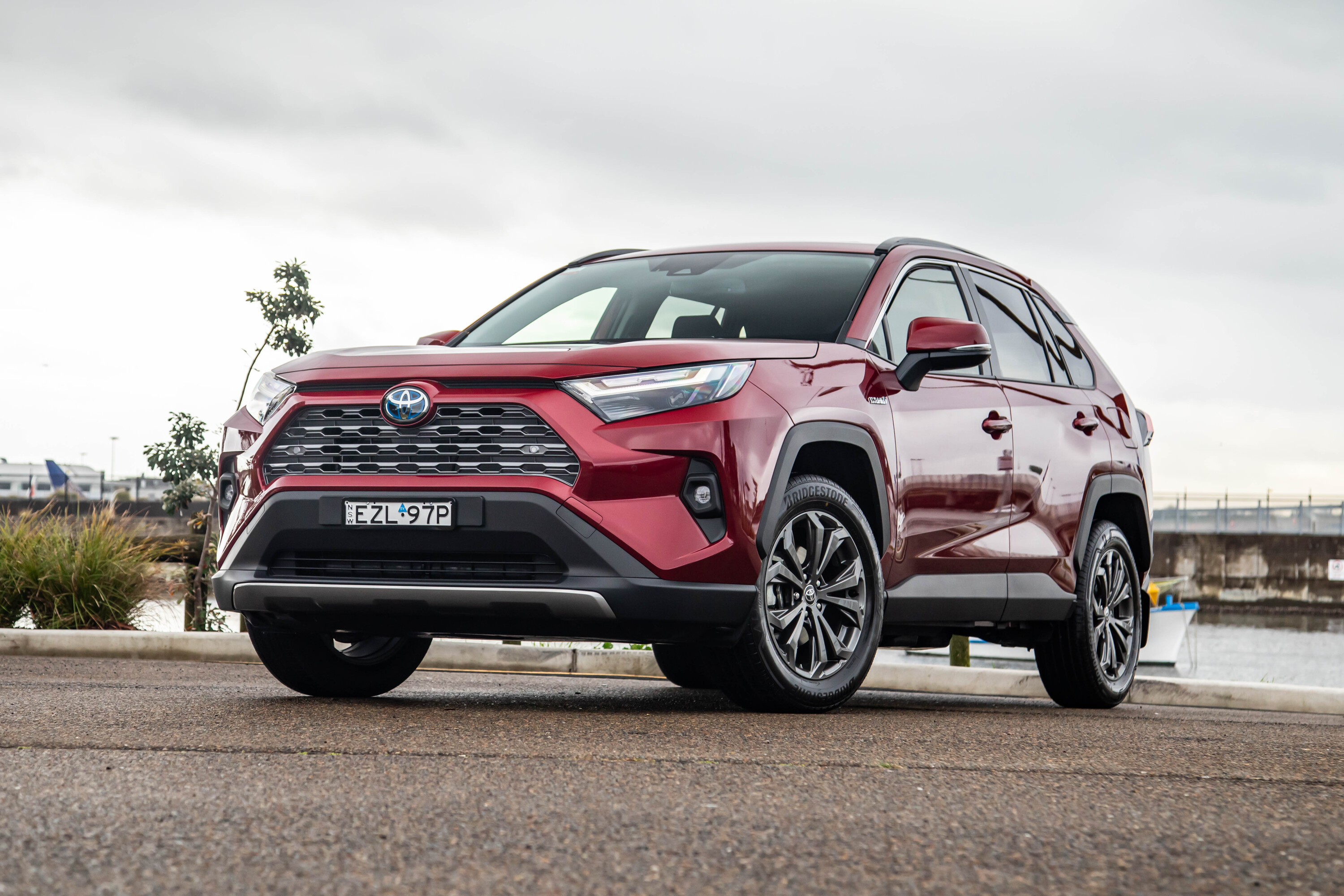
1
The Federal Chamber of Automobile Industries commissioned a study to determine the biggest winners and losers under the proposed tax penalties by the government’s proposed standards (the middle option) by 2025.
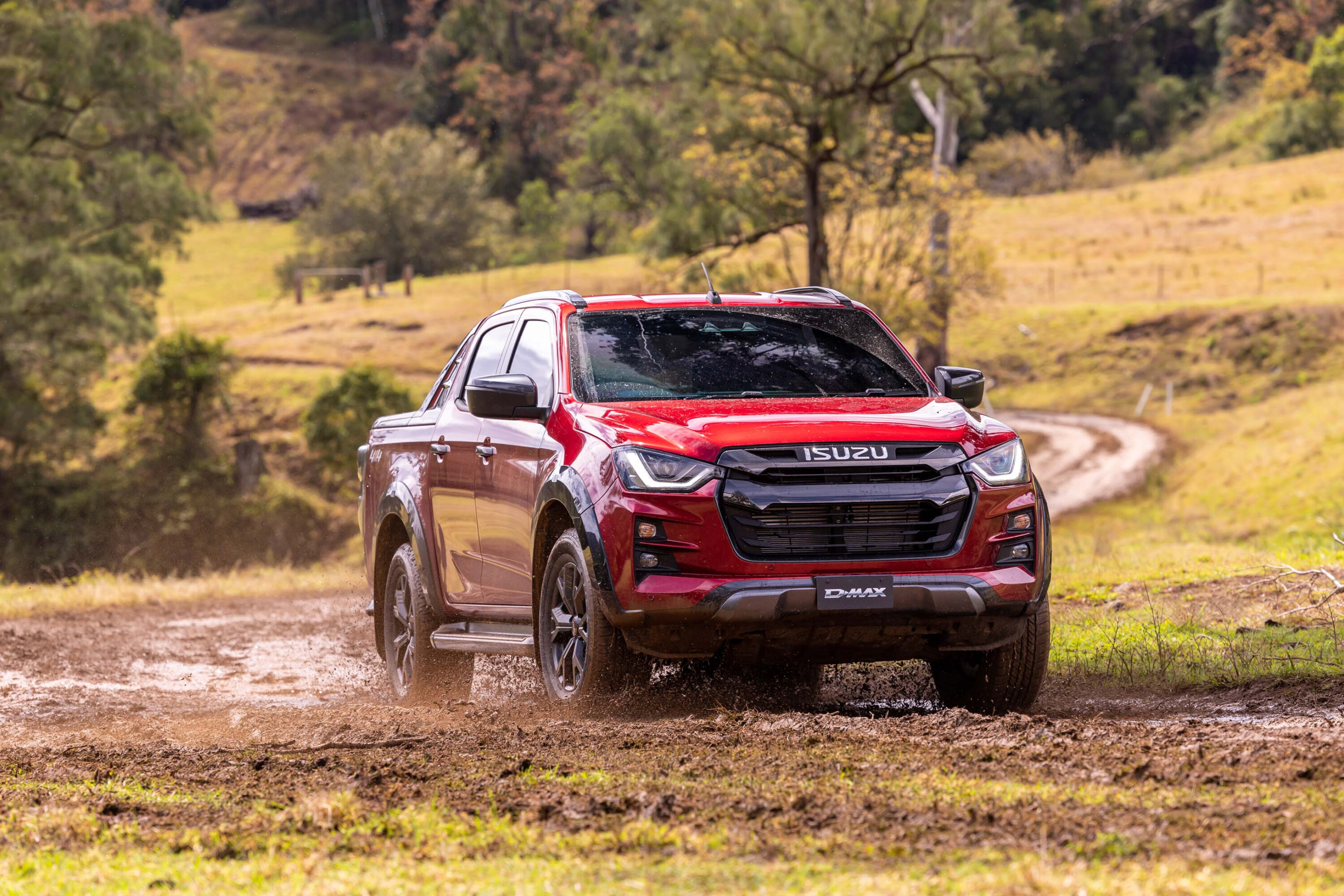
And while an Isuzu D-Max X-Terrain would be hit with a $2030 penalty (assuming the charge is $100 per gram), a Toyota RAV4 Edge 2.5 petrol suffers more at $2720. That doesn’t feel right.
Aside from the niche RAV4 Edge non-hybrid, Toyota is in a pretty good place with targets based on fleet average emissions. A Toyota RAV4 hybrid emits 31 per cent less CO2 than a 2.5 petrol and (with the right number sold) could aid in offsetting polluting LandCruisers, for example.
1
For manufacturers like Isuzu with its diesel-only line-up, the standards could prove tough.
Plug-in hybrids developed in tandem with other ute manufacturers could be the silver bullet for Isuzu and similar companies and Ford’s already on the program with Ranger.
While it’s logical to tax work vehicles under a different structure if they’re contributing significantly to industry, aligning increasingly private-use vehicles like high-spec dual-cabs more closely with passenger vehicles seems wise.
Australian automotive bodies caution that these policies will force large-scale changes within the sector, potentially affecting consumers.
But is there any point in implementing a toothless efficiency standard? After the warmest February on record, it’s clear the climate doesn’t wait for legislation.
MORE
Ute Buyers Guide
With the inexorable creep towards widespread electrification looming heavily in the minds of petrol-loving enthusiasts, being able to report on an even more hardcore, yet still affordable, performance sedan is something of a Taylor Swift moment in 2024.
That is, a bright and shiny respite from the doom and gloom of regular newsfeeds… except that purchasing the new i30 Sedan N should be a shedload easier than expecting a Hogwarts level of wizardry from Mummy in scoring Tay-Tay tickets.
Anyhoo, the point is that despite all of Hyundai’s humble chest-beating about its increasingly kick-arse EVs, there’s still an unhinged turbo-petrol scorcher in its line-up that has just become more aggressive, more focused, and even more desirable than its already-tantalising predecessor.
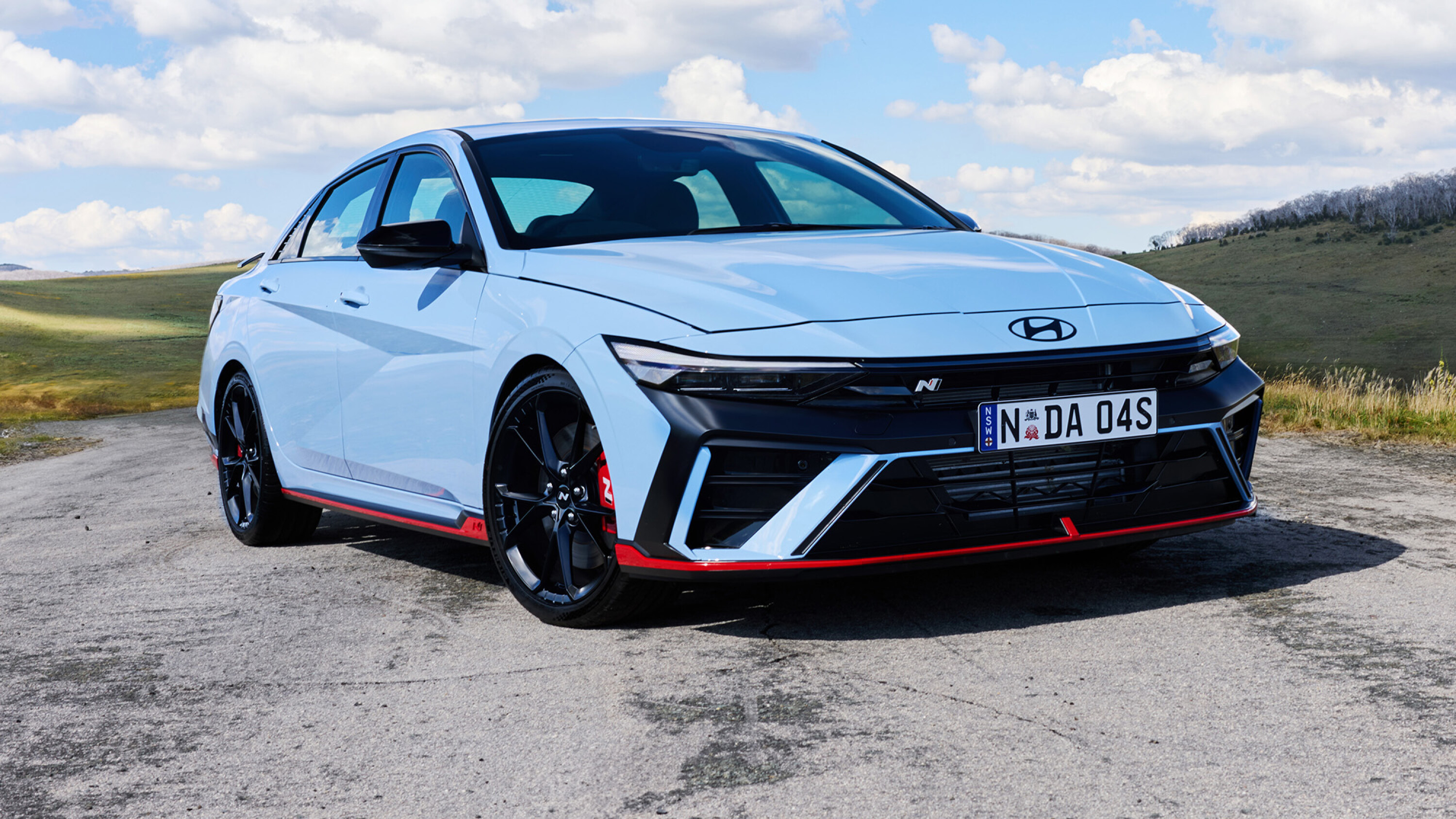
1
Just over two years since the i30 Sedan N launched in our market, along comes this edgier 2024 version – both in the way it looks and the way it drives.
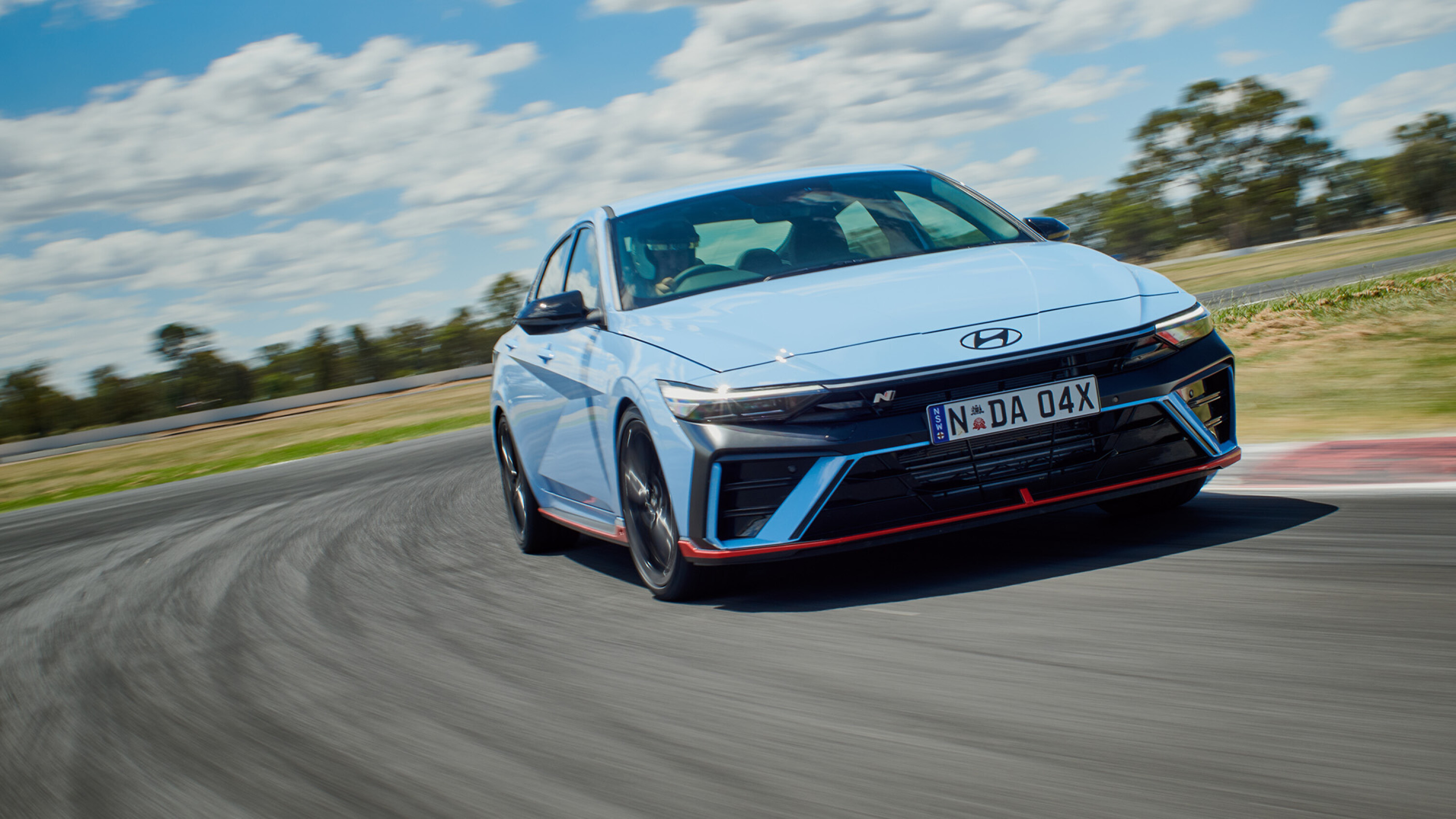
The refreshed visuals are immediately obvious, especially at the front. Sporting a much more aggressive horizontal theme to its front end (that almost looks like a pissed-off frown), Hyundai says the Sedan N’s broad split grille enhances engine cooling and features air curtains that direct extra ventilation to the front brakes through racecar-style guides.
It is a menacing visage that teams beautifully with fang-like body-coloured lower grille inserts, dual-projector LED headlights with LED indicators, new flat aluminium matte-black badging, and purposeful new black 19-inch forged alloys that reduce unsprung mass by 15kg and are tougher-looking than their machined-face predecessors.
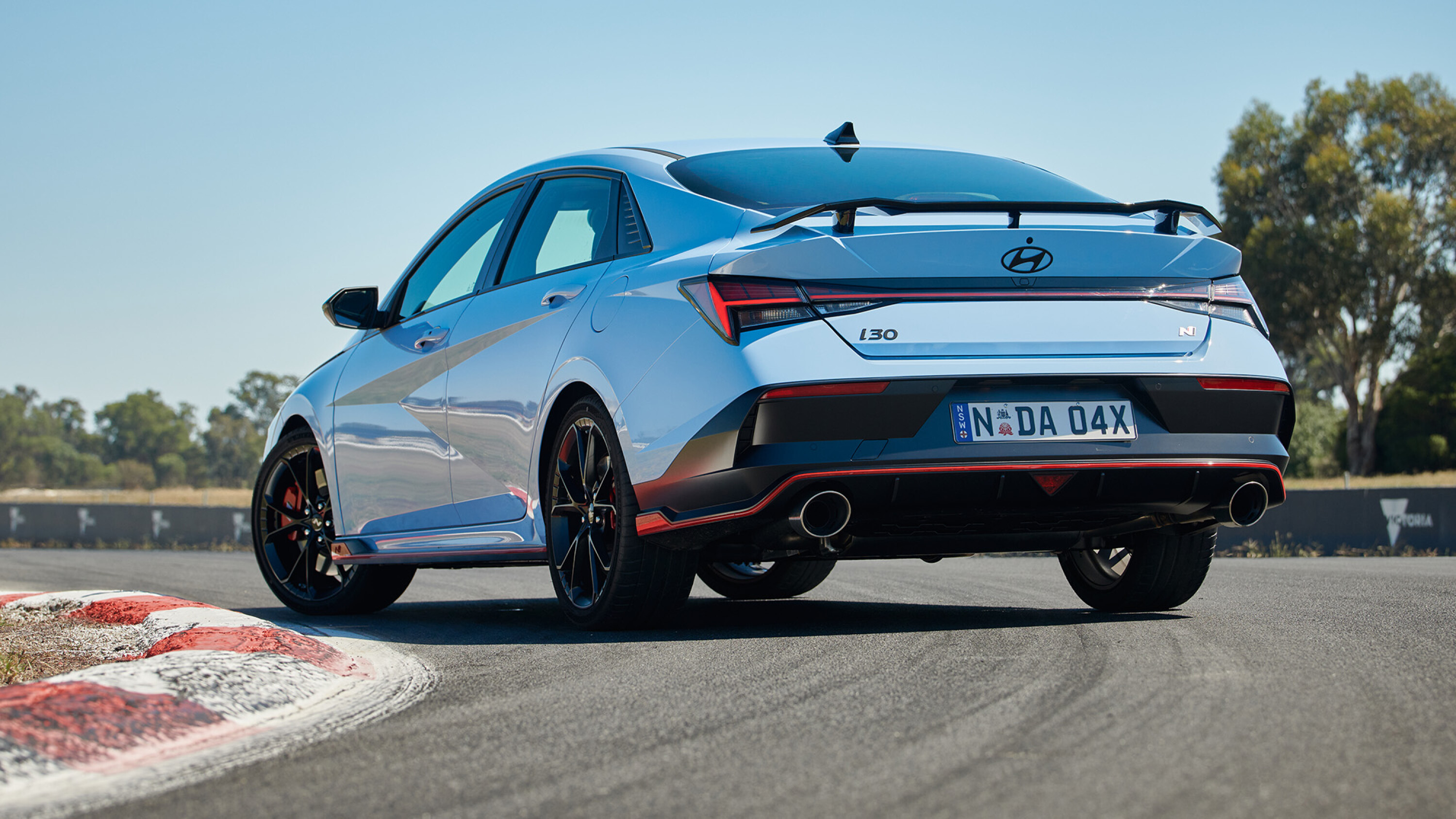
1
When you take into account that the Sedan N is riding on a newer platform development, right now this is absolutely the N model to covet
The red side-skirt garnishing now extends into the lower rear section while the rear bumper itself is also new, with a chunkier matte-black horizontal insert to make it look broader and meatier.
Indeed, if any visual treatment was going to make the rather contentious i30 Sedan look genuinely great, this is it!
Underneath, the engineering changes are similarly extensive, which shouldn’t be surprising given that the Sedan N accounts for such a large proportion of i30 N sales in Australia (and is the only N variant sold in the US).
Hyundai shifted 1573 Sedan Ns here last year compared to 1626 N hatches, so an almost 50:50 split. And when you take into account that the Sedan N is riding on a newer platform development, right now this is absolutely the N model to covet.
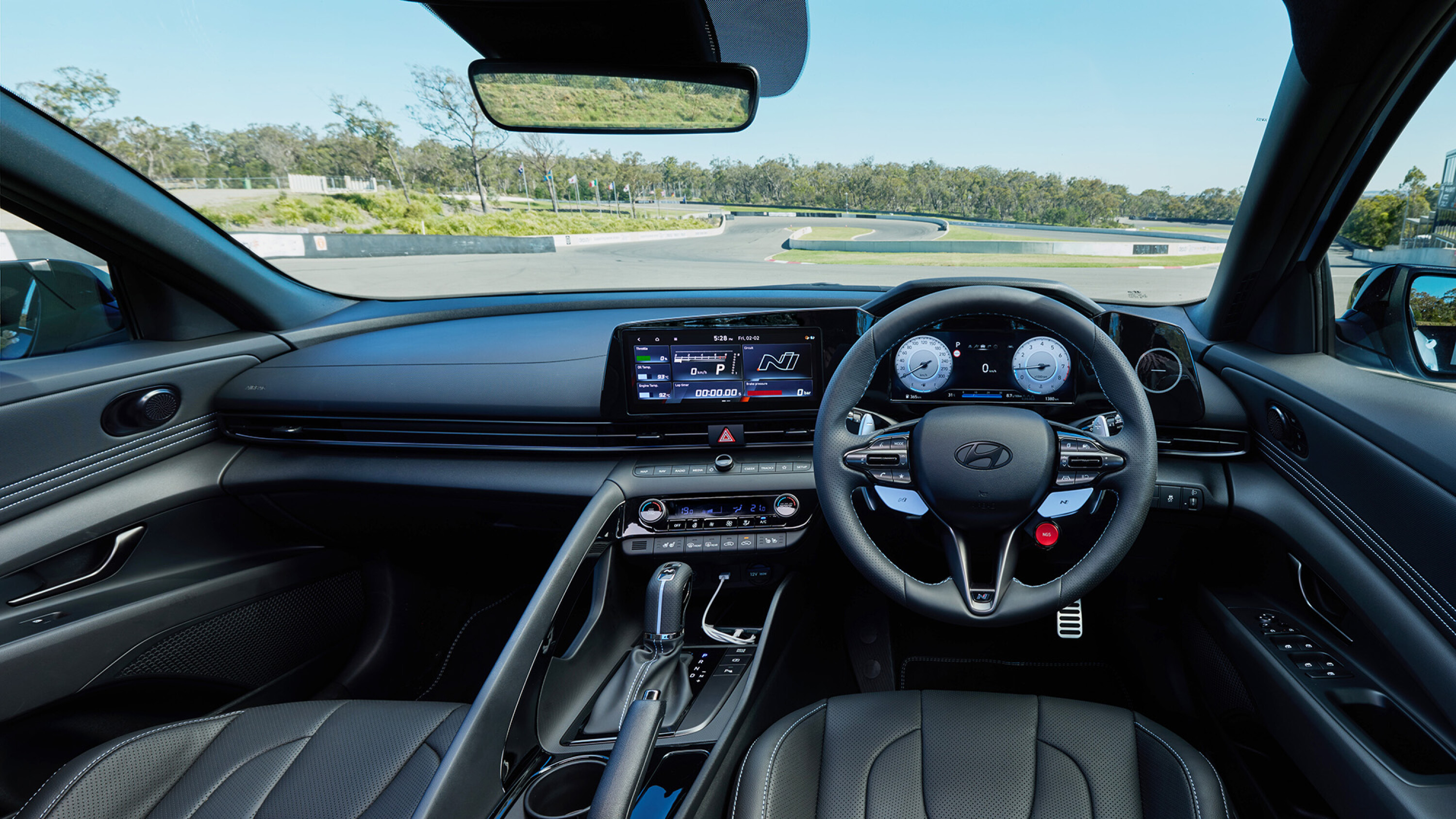
1
How much is the i30 Sedan N, and what do you get?
Pricing
- $52,000 before on-road costs u2013 an $1800 increase
Regardless of transmission – six-speed manual or eight-speed dual-clutch automatic – the 2024 i30 Sedan N costs $52,000 before on-road costs, which is an $1800 rise over its MY23 predecessor.
For that additional outlay, the main extra features for 2024 include intelligent speed limit assist and Hyundai’s ‘Bluelink’ connected car services – complimentary for the first five years and transferable if you sell the car.
Less visible are comprehensive alterations to suspension hardware and body strengthening (detailed in What is it like to drive?), and a new colour (Ecotronic Grey Mica) to go with the aforementioned styling alterations, new bumpers and redesigned wheels.
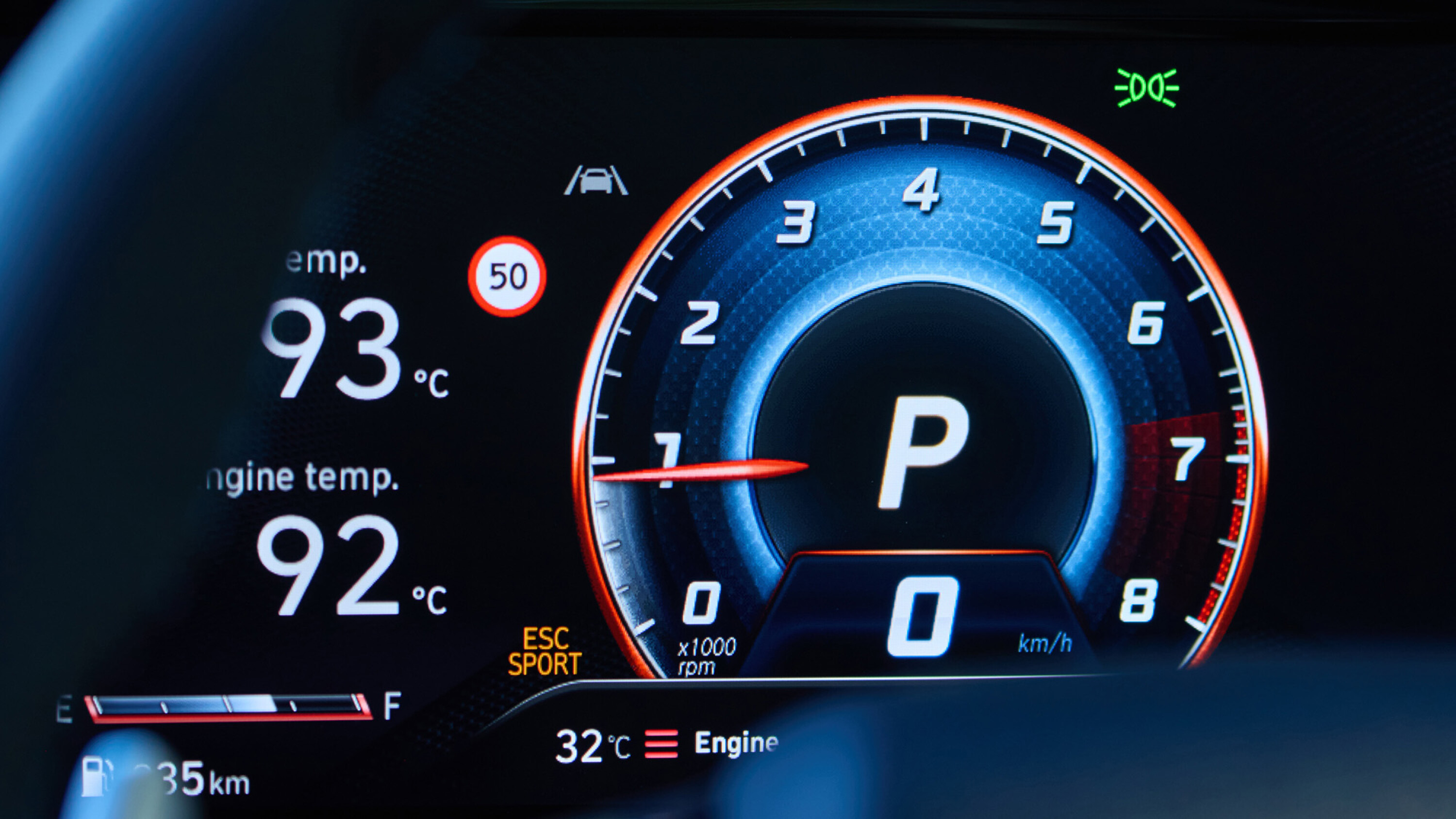
1
Apart from an optional glass sunroof ($2000), everything else is standard.
| i30 Sedan N Bluelink features | |
|---|---|
| Automatic Collision Notification (ACN) | Navigation send to car |
| Emergency Call (SOS) function | Voice recognition for POI lookup, vehicle controls |
| Connected Routing u2013 live traffic updates | Live weather information |
| Alert services including geo-fencing, valet, speed & time alerts | Vehicle settings management |
| Remote control of climate and vehicle functions | |
| 2024 i30 Sedan N highlights | |
|---|---|
| Fixed bootlid spoiler | Heated steering wheel |
| LED lighting front and rear | Leather-appointed upholstery with perforated inserts |
| Active variable exhaust | Dual-zone climate control |
| Electro-mechanical LSD | Rain-sensing wipers |
| N Grin Control system (drive modes) | 10.25-inch digital instrument display |
| Track maps | 10.25-inch multimedia touchscreen |
| N Grin Shift (DCT only) | 8-speaker Bose premium audio system |
| Automatic rev matching | Wireless phone charging |
| Keyless entry/start | Front and rear USB-C outlets |
| Sports front seats with heating/cooling | Ambient cabin lighting |
| 10-way electric driveru2019s seat with memory | |
| 2024 i30 Sedan N safety | |
|---|---|
| Front AEB with pedestrian/cyclist detection | Rear camera with multiple views and dynamic guides |
| Auto high-beam | Front and rear parking sensors |
| Lane-following assist | Blind-spot collision avoidance assist |
| Lane-keep assist | Rear cross-traffic collision avoidance assist |
| Leading vehicle departure alert | |
Interior comfort, space and storage
It’s once you start to pick through the Sedan N’s cabin that you realise the lion’s share of its budget has gone into performance engineering, not plush furnishings.
All the key touch points are generally spot on – the superb three-spoke steering wheel with blue stitching (and new matte-black Hyundai logo), excellent screen graphics, and simple-to-access performance settings and drive modes, as well as terrific forward vision over a relatively low cowl.
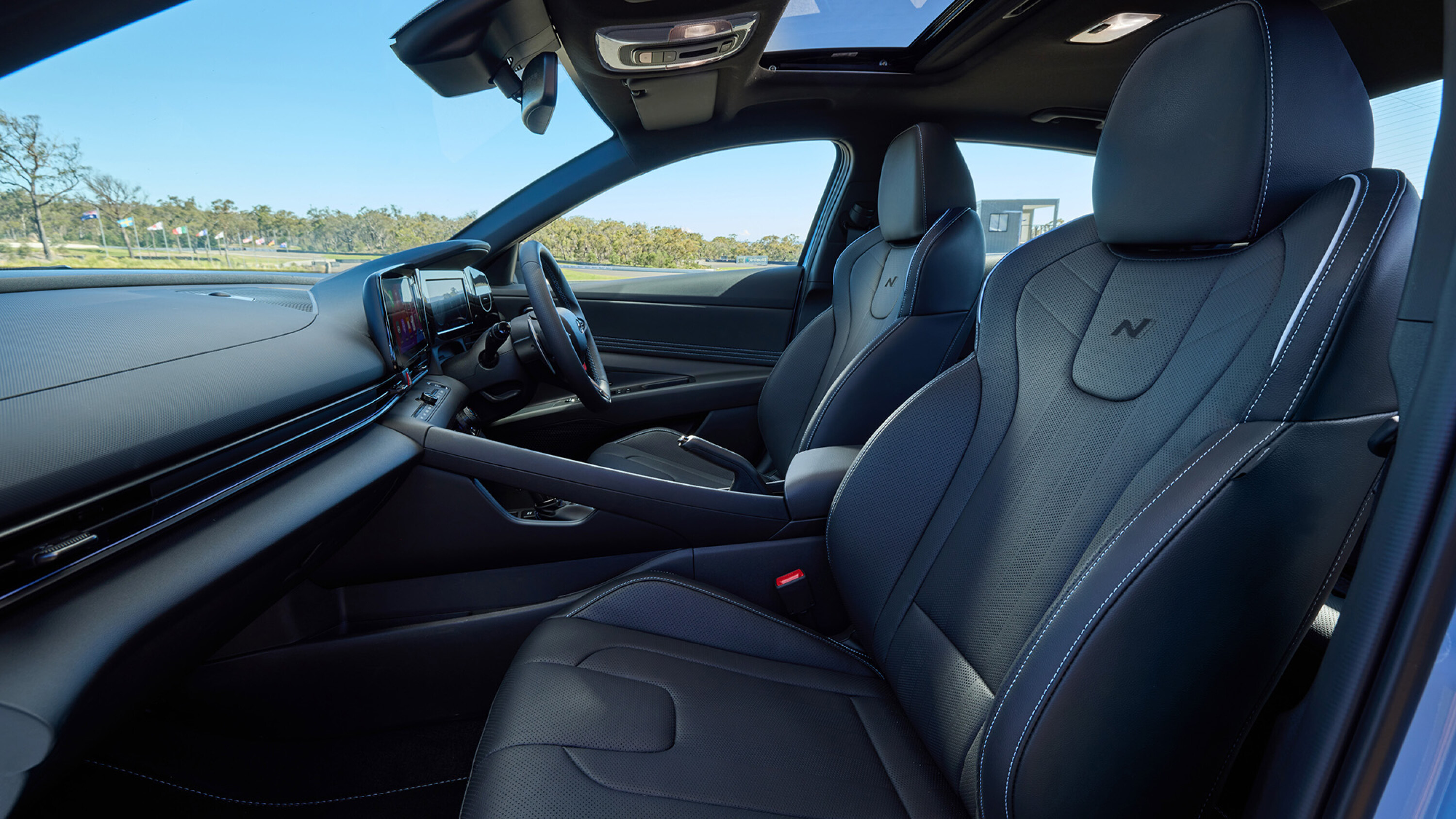
1
Australian cars don’t get the low-set leather/Alcantara sports buckets offered overseas
There are also new-for-2024 features such as Bluelink connected car services, a revised wireless charging pad to accommodate larger phones, USB-C outlets front and rear, and first-for-N intelligent speed limit assist (which is nowhere near as intrusive as it used to be in previous Hyundai-Kia models).
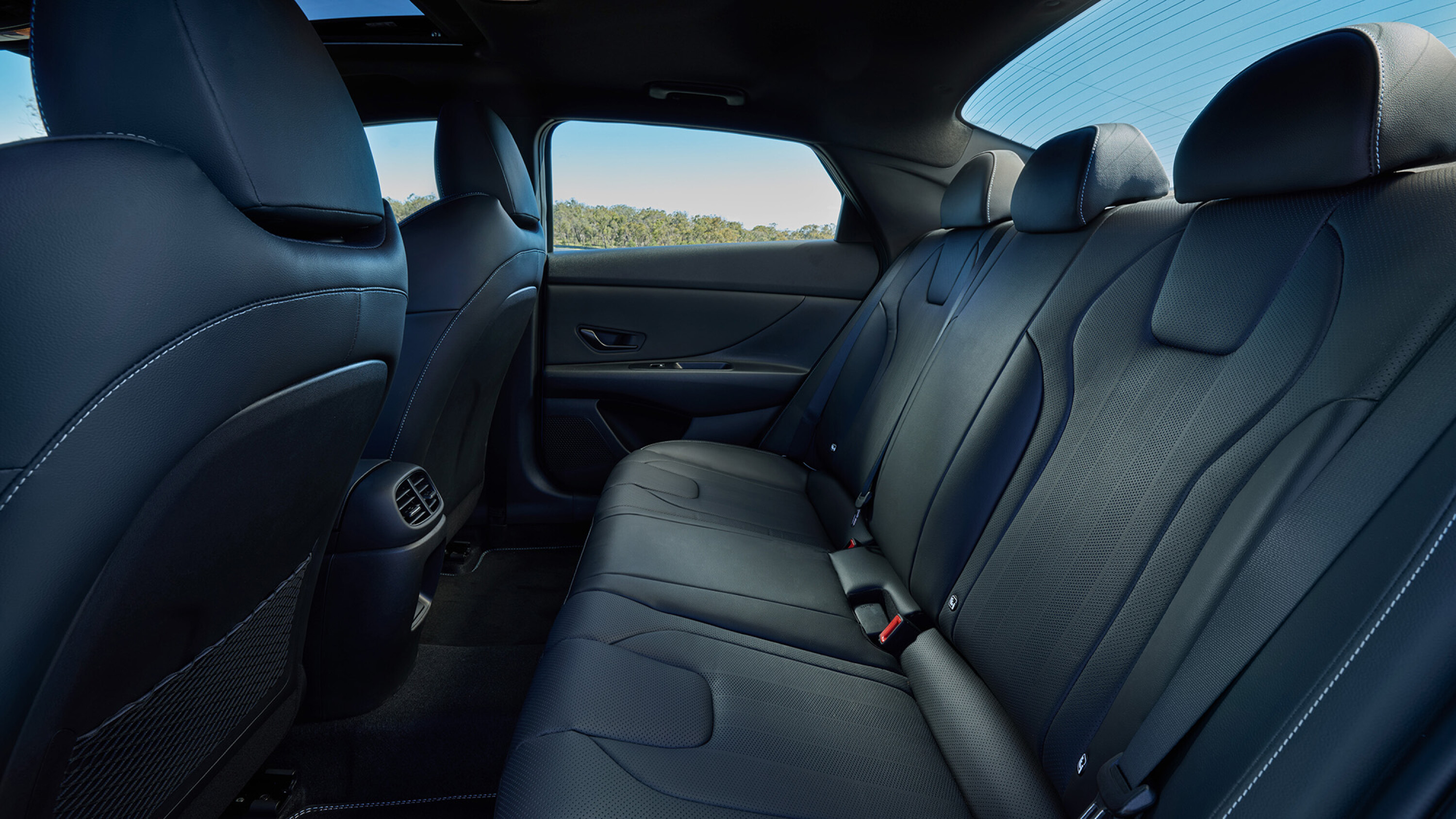
Australian cars don’t get the wonderfully huggy, low-set leather/Alcantara sports buckets offered overseas. While the all-electric, perforated leather alternatives are amply comfortable and feature cooling as well as heating, they’re mounted a bit too high to truly complement the Sedan N’s dynamic personality.
1
Apart from its relatively interesting dashboard design, the N’s interior is fairly rudimentary. For the most part, fit and finish is good, but hard plastics abound.
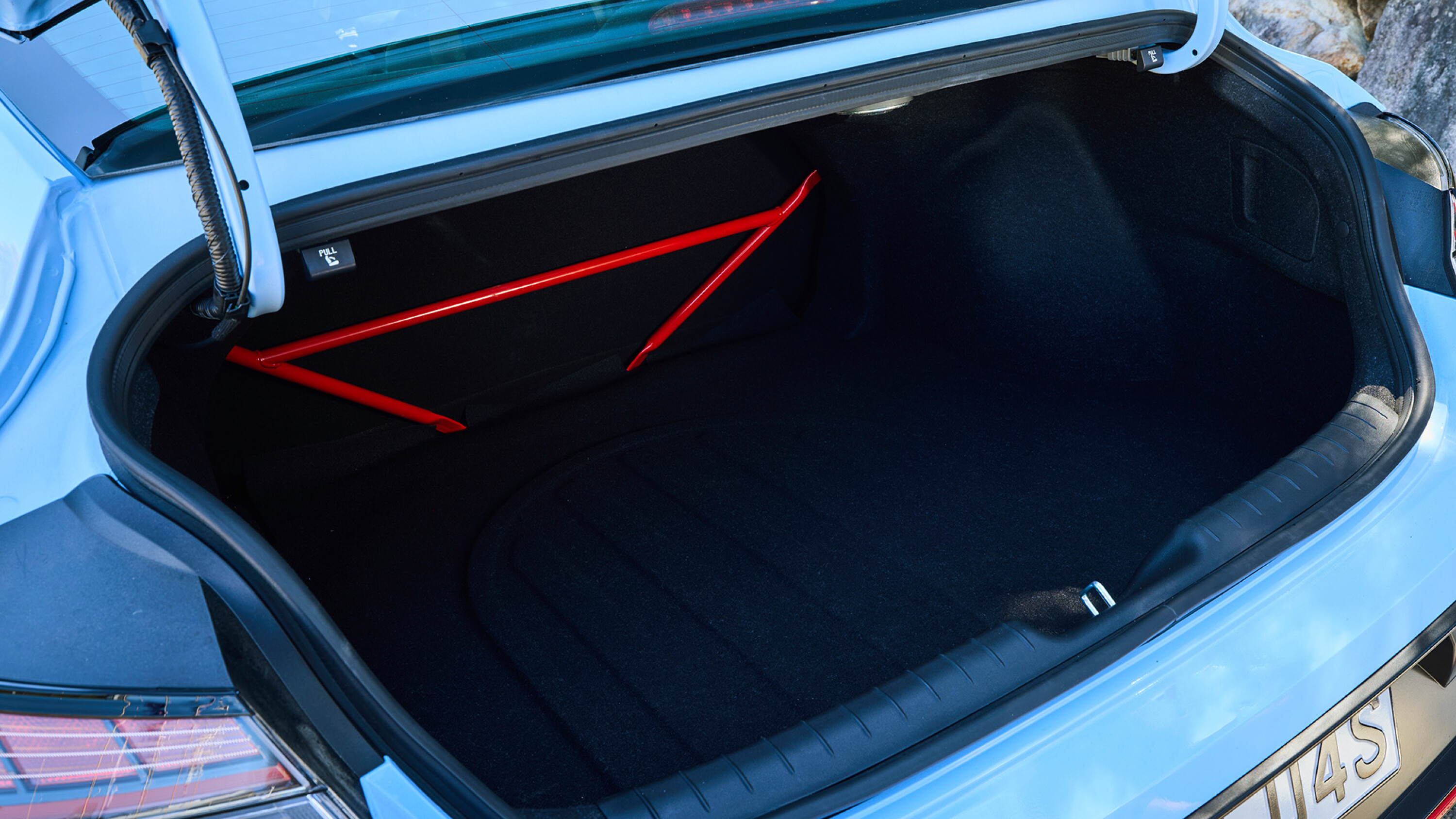
The doors only take 600ml bottles (awkwardly), and the N’s rear seat lacks a centre armrest. It also folds only as a single piece (rather than 60:40) to expose the red body stiffener you’ll need to thread stuff through if you want to carry long items.
The 464-litre boot is also pretty crummy – not for its size, or even its space-saver spare, but because its trimming is sparse and there’s nothing to grab onto when closing the lid, or even an outside button to open it!
1
What is it like to drive?
Punchy
- Significant mechanical improvements
- DCT 0-100km/h in 5.3sec versus 5.8 for manual
- Bespoke 245/35ZR19 Michelin Pilot Sport 4 S tyres
Developed globally alongside Ioniq 5 N, with Australian engineering input, Hyundai says chassis changes to the i30 Sedan N are derived from its experience in TCR motorsport.
Tweaks include a reinforced upper engine mount (for reduced vibration and improved agility), polyurethane rear strut-top bushes (for improved yaw response and steering precision), a new urethane rear suspension insulator on the rear support (instead of rubber) for improved damping and yaw response, and a lipstick-red rear stiffening bar (a lateral brace behind the rear-seat backrest) that increases body stiffness by 29 per cent.
The electronically controlled three-setting dampers have a finessed tune to enhance body control, while the motor-driven steering system gains a number of new components: a revised gearbox yoke (to enhance feedback and directness), a low-friction universal joint (to improve steering precision), as well as optimised software to make the most of the hardware upgrades.
Even the front brake hoses gain a new thermal protector to improve fade resistance, and the stability control has been upgraded to further enhance braking performance.
1
Otherwise, it’s situation normal for the rest of the mechanicals – a multi-talented 2.0-litre direct-injection turbo-petrol four producing 206kW at 5500-6000rpm and 392Nm from 2100-4700rpm, tied to either a six-speed manual or an excellent ‘wet’ eight-speed dual-clutch gearbox.
The N-DCT version weighs 40kg more than the manual but remains the acceleration star – 0-100km/h in 5.3sec versus 5.8 – though with a shared 280km/h top speed, no one is ever going to question the Sedan N’s performance. Indeed, this is the ballsiest smallish car you can buy this side of an AWD European alternative, for considerably less money.
No doubt the i30 Sedan N would be faster if it were all-wheel drive, but that is completely missing the point – this front-drive stunner is all about driving feel, dynamic nuance, adjustability and reduced weight, not narcissistic Nürburgring times.
1
You’d probably need to drive old and new back-to-back to truly appreciate the wealth of engineering changes, but we can definitely tell you this is one hell of a performance car when giving its all – as well as surprisingly liveable and easy to drive when it needs to be.
Even back at launch in 2018, this has always been one of the greatest attributes of the i30 N. Only now the 2024 Sedan N is firmer in the day-to-day stuff, yet still relatively comfortable, with greater bandwidth, more resilience, and an even keener attitude.
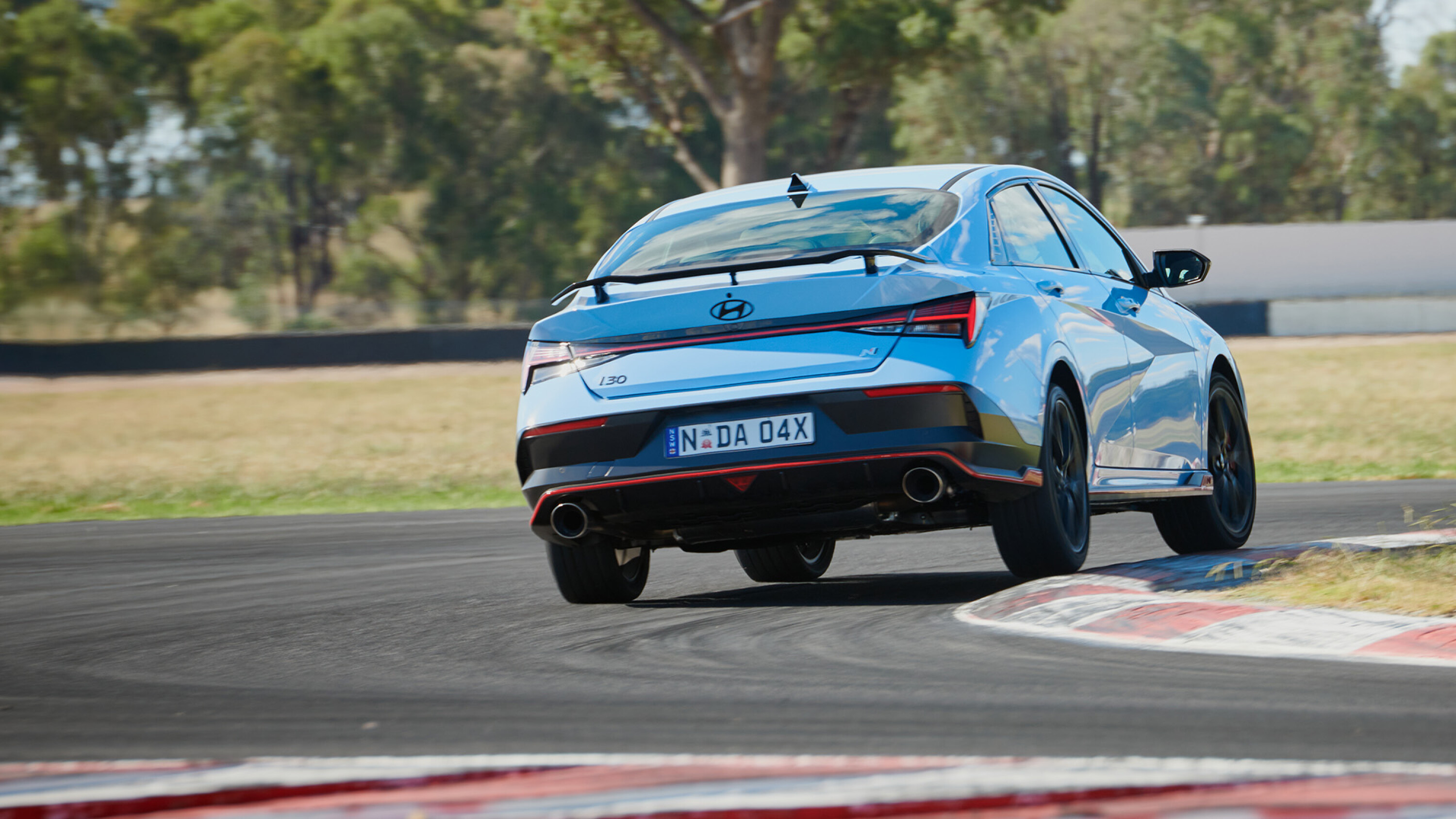
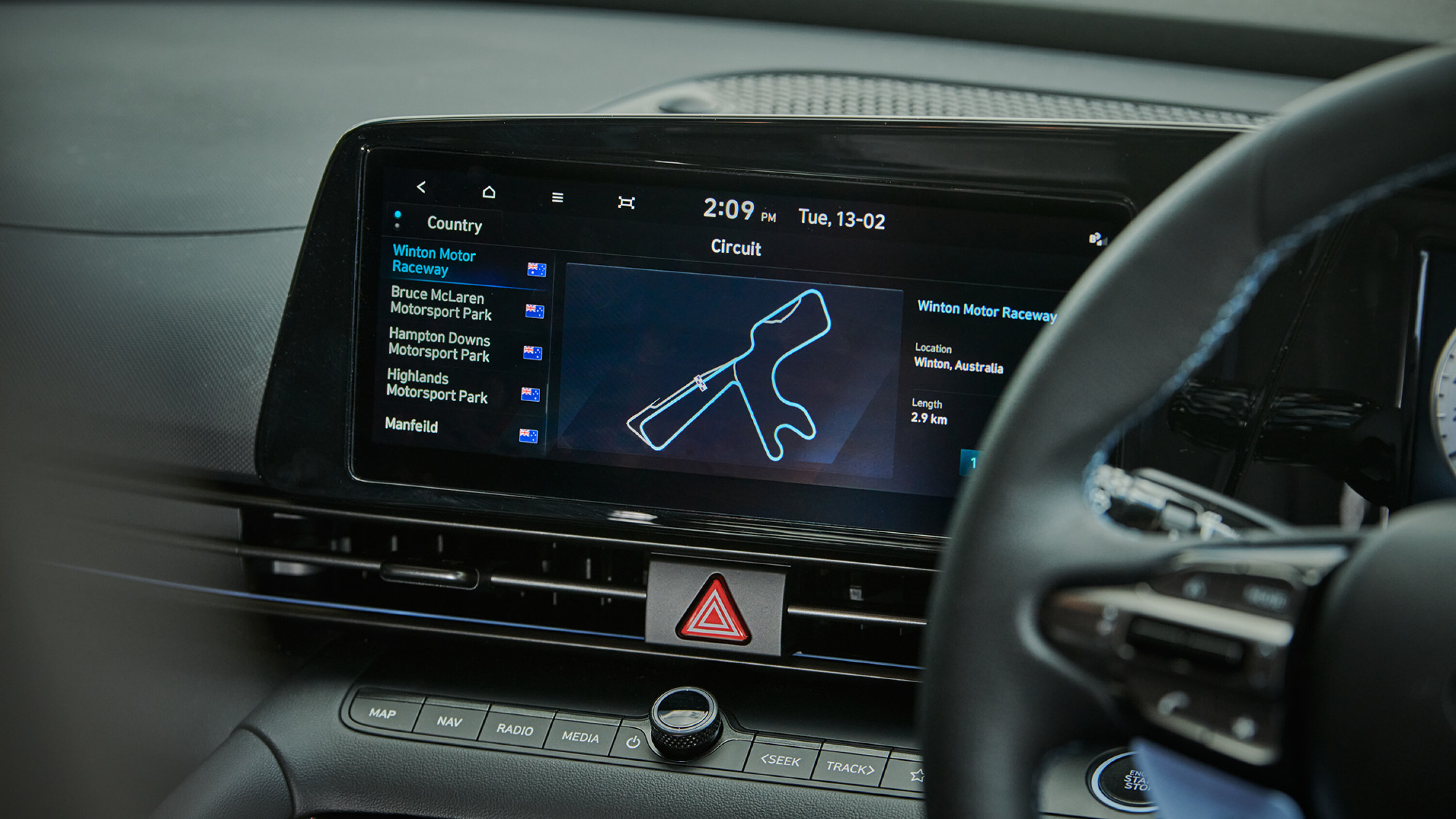
The way its balance pivots mid-corner on the road is a delight, yet it’ll still do that, even in its firmest N setting, on a challenging racetrack like Winton in Victoria, where we spent several hours caning a series of Sedan Ns.
1
We selected level two for everything except steering, where even the lightest setting delivers plenty of meat
Thanks to its N Mode screen with individually adjustable settings for pretty much everything (engine, steering, suspension, transmission, e-LSD, ESC, and exhaust) – each with three options apart from the superb electronically controlled mechanical front diff (which gets two) – your ultimate N custom mode is a mere finger-press away.
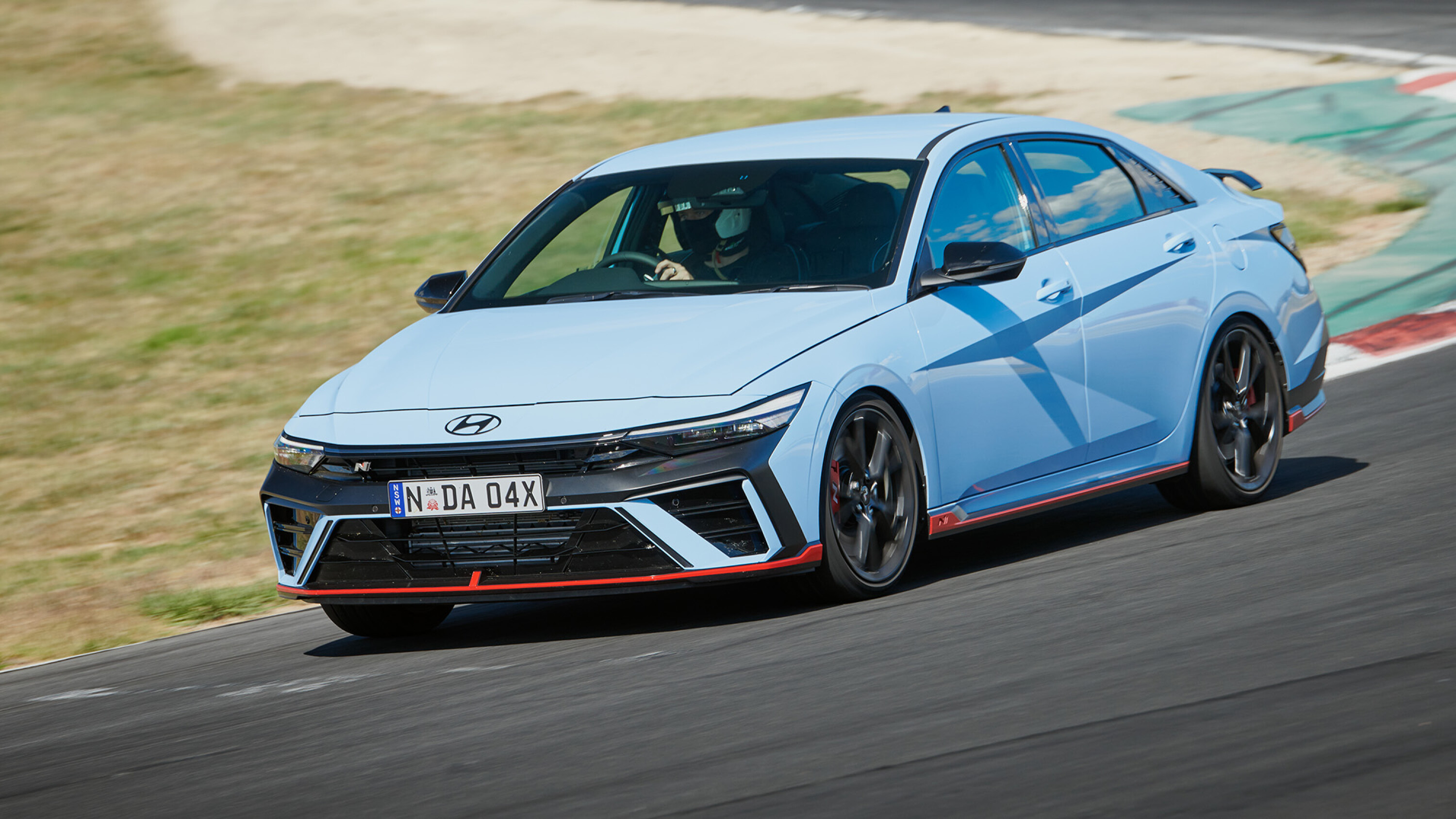
We selected level two for everything except steering, where even the lightest setting delivers plenty of meat for its 2.2 turns lock-to-lock. And in that setup, its combination of damping discipline, handling adjustability and furious power-down when exiting corners is a thrill to experience.
1
In full-blown N mode (accessed quickly via the right steering wheel tab), everything gets maxed apart from the ESC (which needs one more press to be fully disabled), though you’ll need a smooth road surface to comfortably experience its many talents.
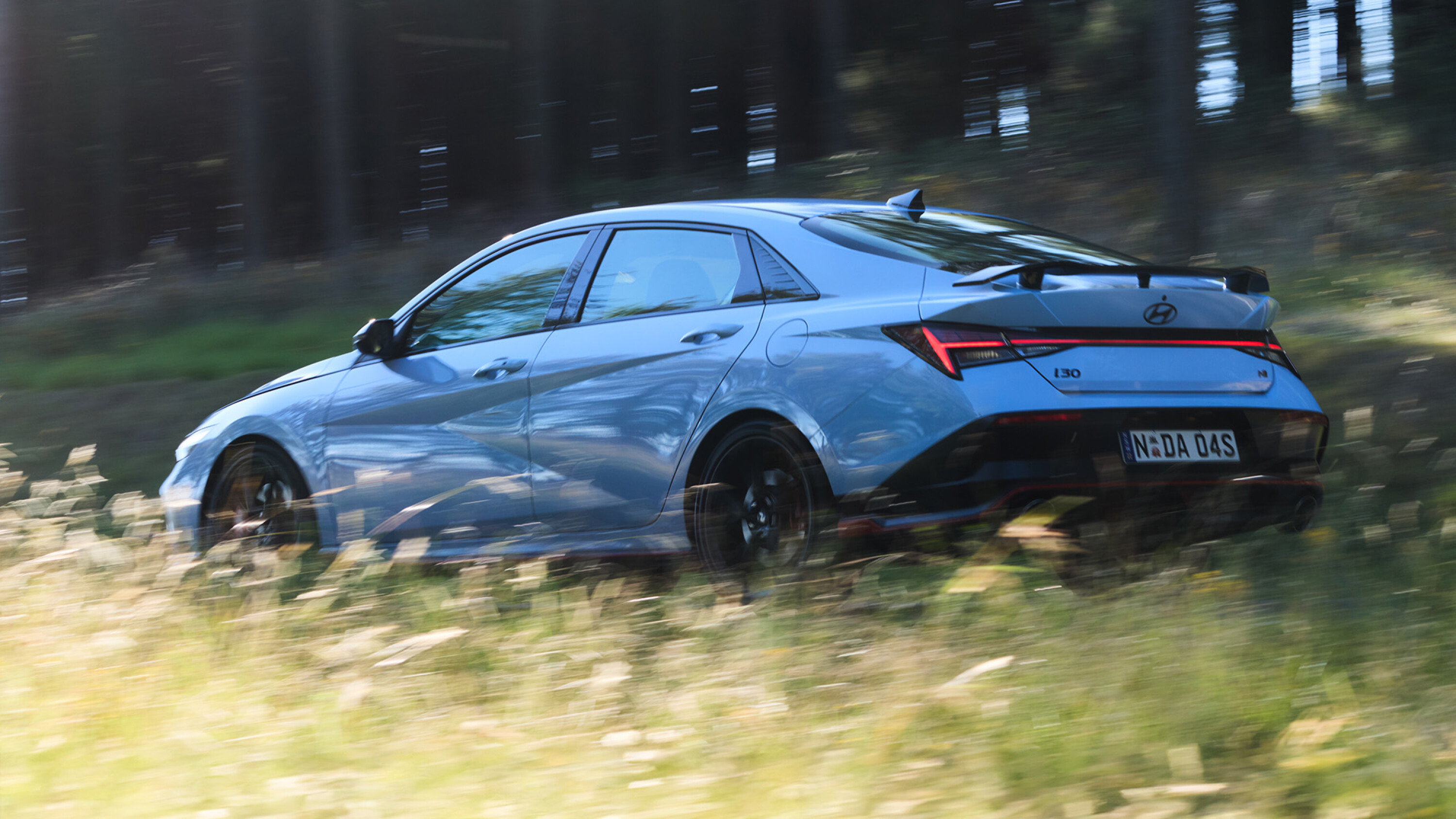
But around Winton, even deliberately bouncing off ripple strips, the Sedan N is far from feeling like a mechanical skateboard. It offers just enough roll to enhance its involvement, tireless steering assistance that combines firm weighting with crisp precision, and superb grip everywhere – plus that barking, crackling, belting exhaust note that a Hyundai N at full noise is now known for.
Both its brakes (vented discs at both ends, 360mm front and 314mm rear, combined with a proper manual handbrake in Australia) and its bespoke 245/35ZR19 Michelin Pilot Sport 4 S tyres withstood the punishment dished out by the Aussie motoring media without needing a cold compress and a lie down in a shady corner – they just kept on keeping on.
After all that, I drove a manual Sedan N 650 kilometres back to Sydney, in challenging weather, cranking the decent eight-speaker Bose stereo – and averaged just 7.0L/100km!
1
VERDICT
We should be thankful that many enthusiasts deep inside the N skunkworks are still clearly sniffing petrol
In some areas, you can tell the i30 Sedan was built to a price, for Americans. But everywhere that counts, the 2024 Sedan N is a visceral performance machine that brings so much talent to the table for a bargain mid-50s drive-away price.
As a side note, it’s fascinating how Aussie ‘N-thusiasts’ (as they call themselves) have championed Hyundai’s N cars more than any other market in the world. Many of them are also former Ford and Holden faithful – from Fiesta ST to Commodore SS-V Redline.
So while the Sedan N can’t replicate the sound or flavour of a rear-drive Commodore V8, this is the new everyperson’s performance hero.
We should be thankful that many enthusiasts deep inside the N skunkworks are still clearly sniffing petrol.
| 2024 Hyundai i30 Sedan N specifications | |
|---|---|
| PRICE | $52,000 (before on-road costs) |
| DRIVETRAIN | |
|---|---|
| Engine | 1998cc 4cyl, DOHC, 16v, turbo |
| Compression ratio | 9.5:1 |
| Drive | Front-wheel drive |
| Power | 206kW @ 5500-6000rpm |
| Torque | 392Nm @ 2100-4700rpm |
| Transmission | 8-speed dual-clutch |
| 0-100km/h | 5.3sec (claimed) |
| Fuel/Tank | 95 RON/47 litres |
| Economy | 8.3L/100km (combined) |
| CHASSIS | |
|---|---|
| L/W/H | 4710/1825/1415mm |
| Wheelbase | 2720mm |
| Track (f/r) | 1584/1579mm |
| Weight | 1515kg |
| Boot | 464 litres |
| Suspension | Front: struts, A-arms, adaptive dampers, anti-roll bar |
| Rear: multi-links, coil springs, adaptive dampers, anti-roll bar | |
| Steering | Electric power-assisted, 2.2 turns lock-to-lock |
| Front brakes | Ventilated disc (360mm) |
| Rear brakes | Ventilated disc (314mm) |
| Tyres | Michelin Pilot Sport 4S HN |
| Tyre size | 245/35ZR19 93Y |
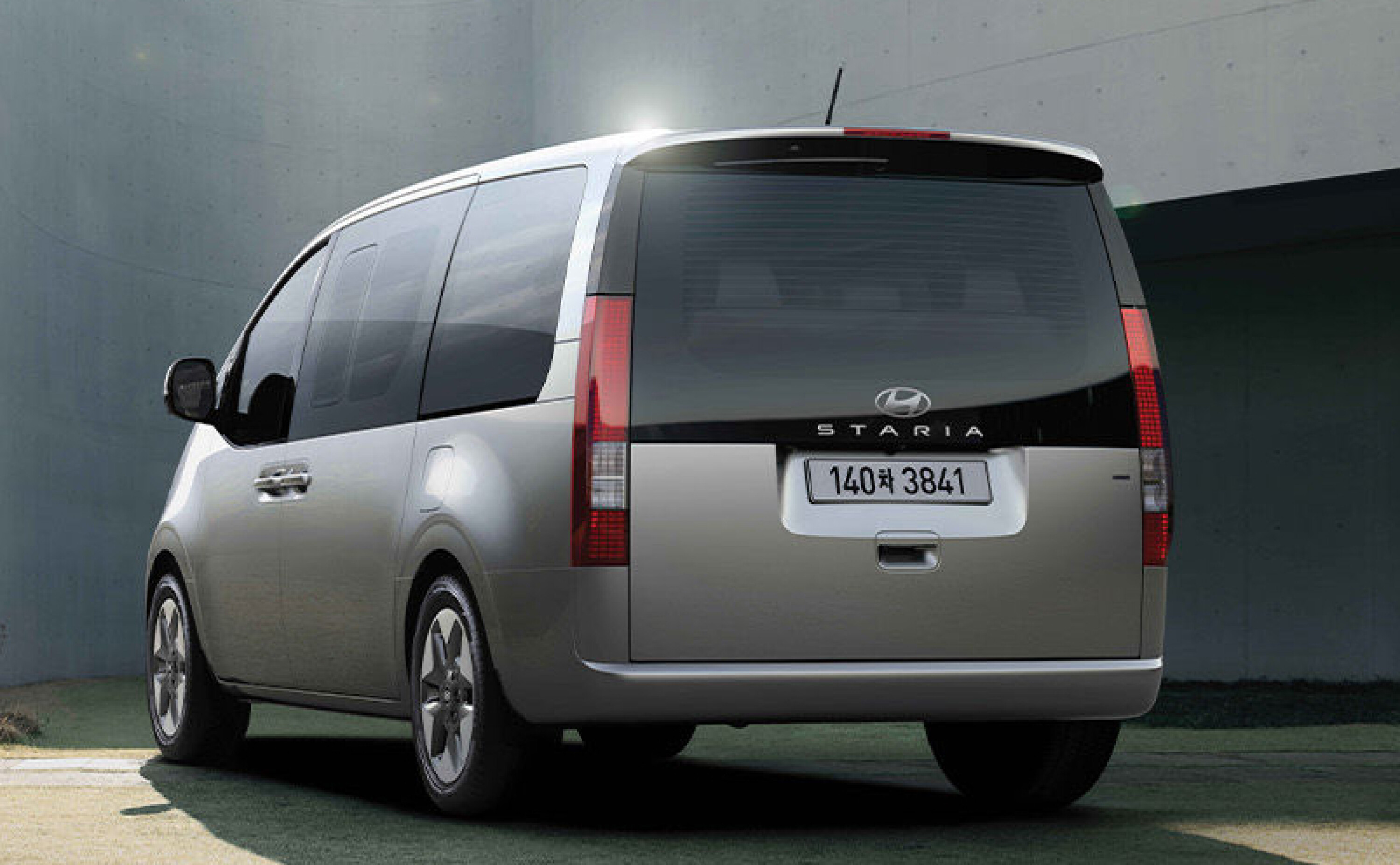
The 2024 Hyundai Staria Hybrid has been announced for South Korea with people mover and cargo-carrier options.
It is currently limited to Hyundai’s domestic market with no export plans for the Staria Hybrid confirmed at this stage.
However, Hyundai Australia says it is “very keen” to expand its hybrid line-up – where an electrified Staria Load would become the first commercial van to offer a full-hybrid powertrain locally.
1
“Staria Hybrid is currently only available in the domestic (Korean) market. We are very keen to add Staria Hybrid to our rapidly expanding hybrid portfolio Down Under, however nothing is confirmed at this time,” said a Hyundai Australia spokesperson.
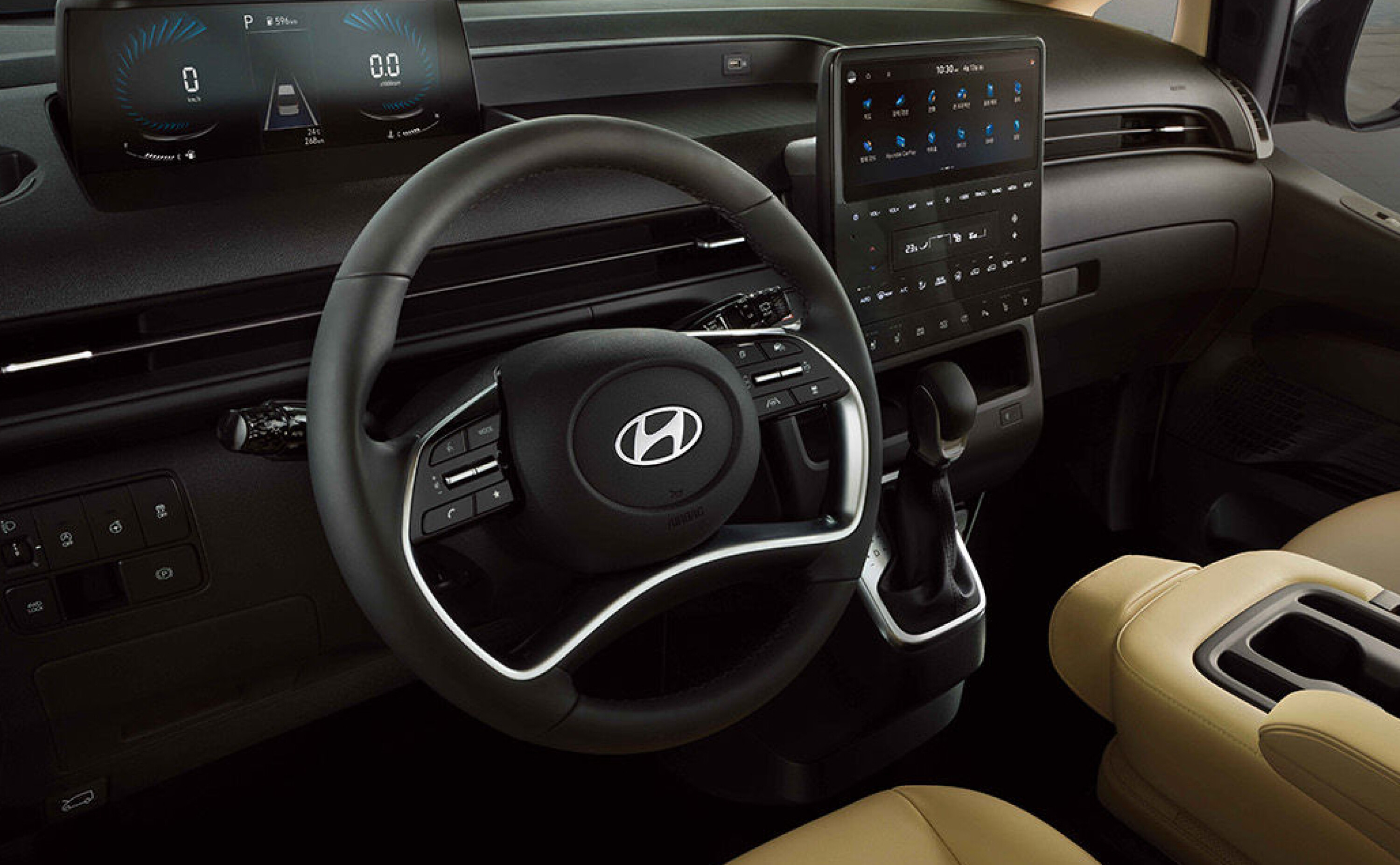
Like the related Santa Fe and Kia Carnival – which are all based on Hyundai-Kia’s ‘N3’ monocoque platform – the Staria Hybrid features a 1.6-litre turbo-petrol engine matched to an electric motor for a 180kW and around 370Nm total system output.
It has a six-speed automatic transmission instead of the eight-speed units found in petrol V6 (200kW/331Nm) and turbo-diesel (130kW/430Nm) versions of the Staria and Staria Load.
The Korean Car Blog [↗] reports the 2024 Hyundai Staria has also received minor updates in addition to the newly added hybrid powertrain.
1
This includes traffic jam assist, USB-C charge ports, an updated key fob, standard front parking sensors, and a quieter power sliding door with a new warning sound.
Hyundai Australia could not confirm whether we’ll see these revisions applied to local Staria and Staria Load models.
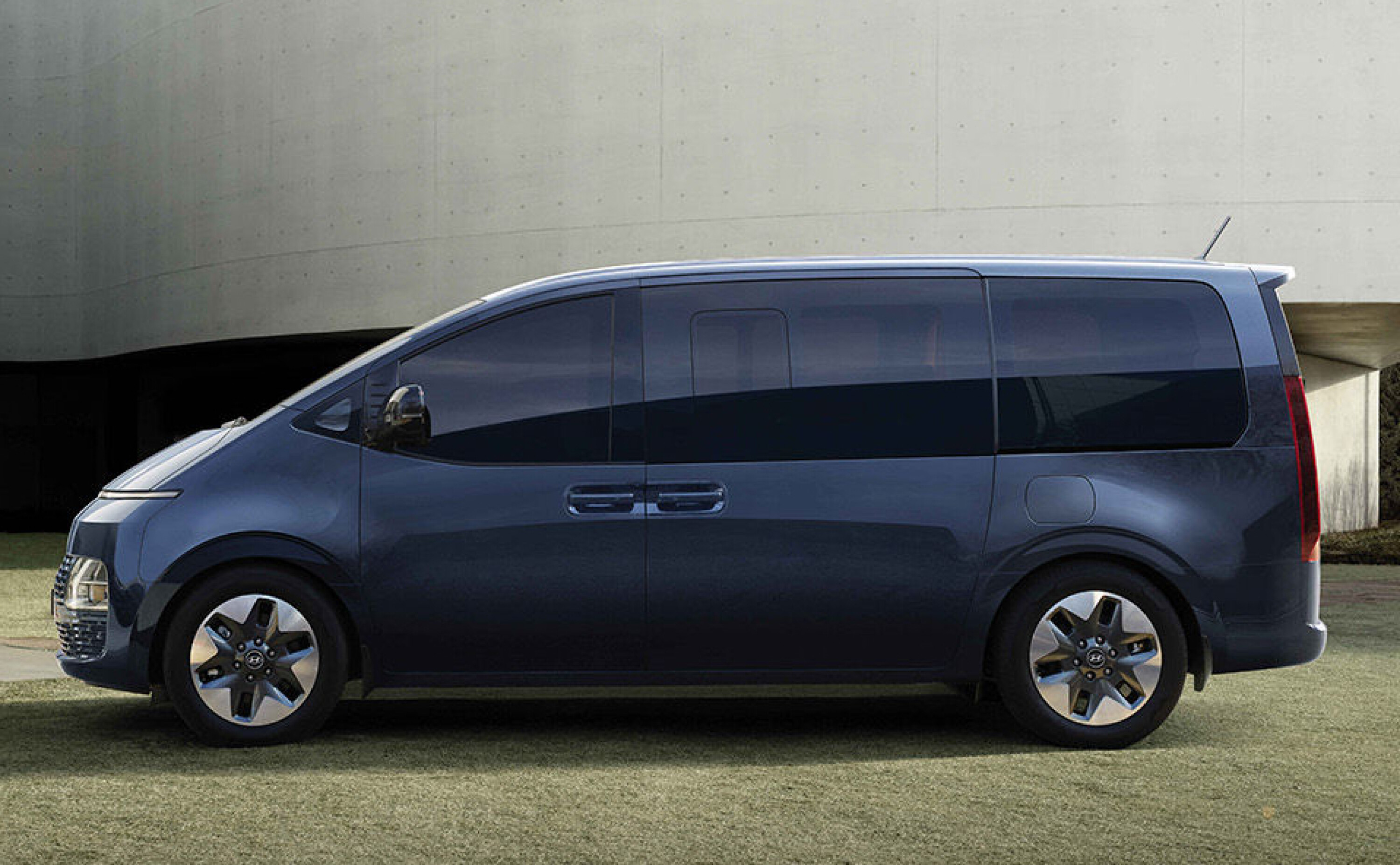
The Hyundai Staria and Staria Load were unveiled in 2021 as the successor to the iMax and iLoad, respectively, which were on sale for 14 years.
Both models switched from a unique rear-wheel-drive commercial van platform to the front-wheel-drive ‘N3’ passenger car architecture shared with the Santa Fe, Tucson and Sonata – as well as the Kia Sportage, Sorento and Carnival.
1
Unlike its Carnival arch-rival, the Staria people mover is all-wheel-drive in diesel form, while Staria Load diesel and Staria V6 petrol models are front-drive.
Hyundai has not confirmed if the Staria Hybrid will be offered with all-wheel drive.
VFACTS new-car sales data reveals 1141 examples of the Hyundai Staria were sold in Australia in 2023, significantly behind the Kia Carnival (11,312) but ahead of the Volkswagen Multivan/California (851), LDV Mifa (452) and Toyota Granvia (112) people movers.
Meanwhile, Hyundai sold 2497 units of the Staria Load, behind the Toyota HiAce (7133), LDV G10 (3638) and Ford Transit Custom (2843).
MORE
Everything Hyundai
February 29: Polestar takes $1.5b loan, Volvo to shrink its stake
EV brand Polestar has secured a three-year, US$950 million loan from a consortium of 12 global banks, including BNP Paribas, Natixis, Standard Chartered, BBVA, HSBC and SPDB.
The company added that it has a cash balance, as at 31 December 2023, of approximately USD 770 million ($1.2 billion).
This announcement follows news in early February that Volvo would respond to an 83% fall in Polestar’s share price – which played a part in Volvo’s own share price having halved over the past year – by cutting the spinoff brand’s funding.
Volvo said it was evaluating “a potential adjustment to its shareholding … with Geely Sweden Holding being the primary recipient.”
Today’s news confirms that the largest stakes in Polestar will now be held by Geely directly and its subsidiary, Geely Sweden Holdings.
Geely’s owner Eric Li already owns a stake in Polestar, but the Geely holding company itself was not a direct shareholder before this latest change.
Presaging any suggestion that Polestar is now on a three-year lifeline, Geely CEO Daniel Li said: “We will retain our shares in Polestar and intend to participate in future financing activities when required.”
Volvo will retain an 18% stake, confirming previously that it “will remain a strategic partner in areas across R&D, manufacturing, after sales and commercial”.
Volvo Car boss Jim Rowan told The Financial Times in early February that Geely is “much more of a natural holding company” for Polestar, giving “clarity” to Volvo investors.
Speaking with Wheels Media today, a Polestar spokesperson said: “The new ownership structure enables Polestar to take its place within the group alongside other brands like Volvo, Lotus, Zeekr.”
The huge external investment comes with conditions, however, including the establishment of “a comprehensive efficiency program”. Like a number of large global companies in recent years, layoffs have been a big piece of finding those efficiencies. Polestar has already shed 10% of its workforce since mid-2023, and a further 15% will follow in 2024.
Polestar expects its fortunes to improve in the coming year, with the long anticipated market launch of its Polestar 3 and Polestar 4 SUVs.
Both will reach Australia this year.
Those two are likely to be Polestar’s highest-volume models alongside the compact 2 sedan, but the brand still intends to launch its confirmed halo models: the large Polestar 5 “four-door GT” sedan and the Polestar 6 convertible.
Outlook for end of year: Expectation of volume growth, double-digit gross profit margin, with significant progress in the second half of 2024 as new SUVs reach full production.
“This marks a new phase in Polestar’s business,” said Polestar CEO and former Volvo design boss, Thomas Ingenlath. “The efforts of recent years are paying off: We improved our cost basis, secured financing and are ramping up our product offensive.
“Both SUVs now sharpen the brand, target one of the fastest growing segments in the industry and position us for strong volume growth and profit margin progression from the second half of 2024.”
February 2: Volvo cuts Polestar’s funding
Polestar’s current financial struggles look set to continue after Volvo Cars announced it will no longer provide the EV-only brand with further funding.
Snapshot
- Volvo withdraws funding support for struggling EV brand Polestar
- Polestar is on shaky financial ground following an 83 share price plummet and low sales
- Volvo and Polestar will still be strategic partners in R&D and manufacturing
Volvo currently owns a 48 percent stake in Polestar, which was previously the Swedish brand’s performance-car division, however it is now preparing to cut financial ties and handball all future financial responsibility to their mutual parent company, Geely.
The news follows Polestar’s announcement it would cut 450 jobs globally, which is about 15 per cent of its entire workforce, as it looked to adjust to “challenging market conditions”.
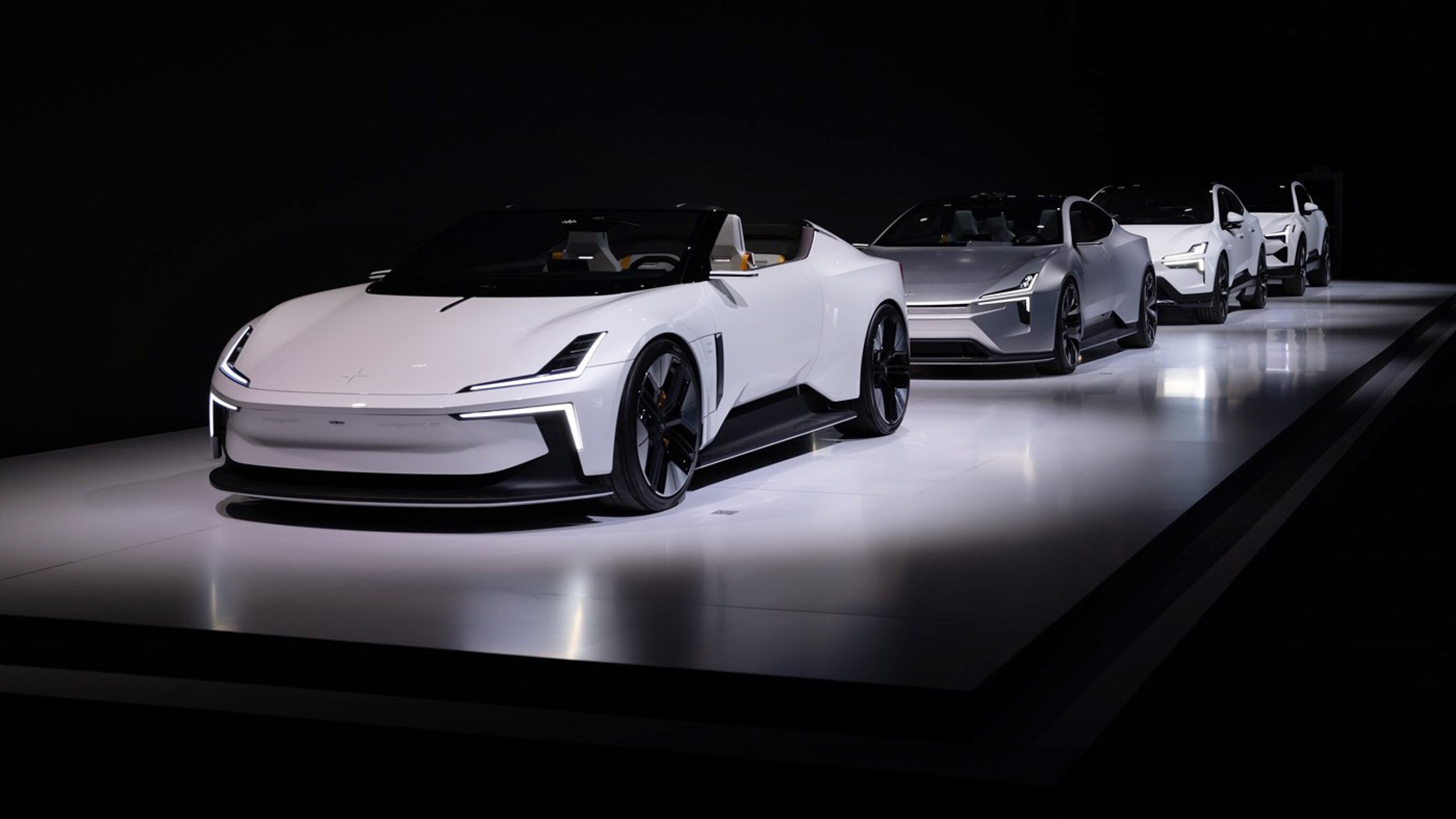
Despite a promising pipeline of future product that includes the Polestar 3, 4 and 5, Polestar has failed to meet sales targets and been forced to cut spending as it struggled with low demand, high inflation and a price war with EV heavyweight, Tesla.
3
Reuter’s reports [↗] Polestar’s share price has fallen by 83 per cent since it went public in June 2022.
Polestar revised its business plan in November 2023, though still said it required US$1.3 billion in “expected external funding” before it could reach its target of being cashflow break-even in 2025.
“Polestar Automotive, the Swedish electric performance car brand, welcomes Geely Sweden Holding as a potential direct new shareholder,” said an official statement on Polestar’s global website. “Volvo Cars is evaluating a potential adjustment to its shareholding in Polestar including a distribution of shares to its shareholders, with Geely Sweden Holding being the primary recipient. Volvo Cars will remain a strategic partner in areas across R&D, manufacturing, after sales and commercial.
1
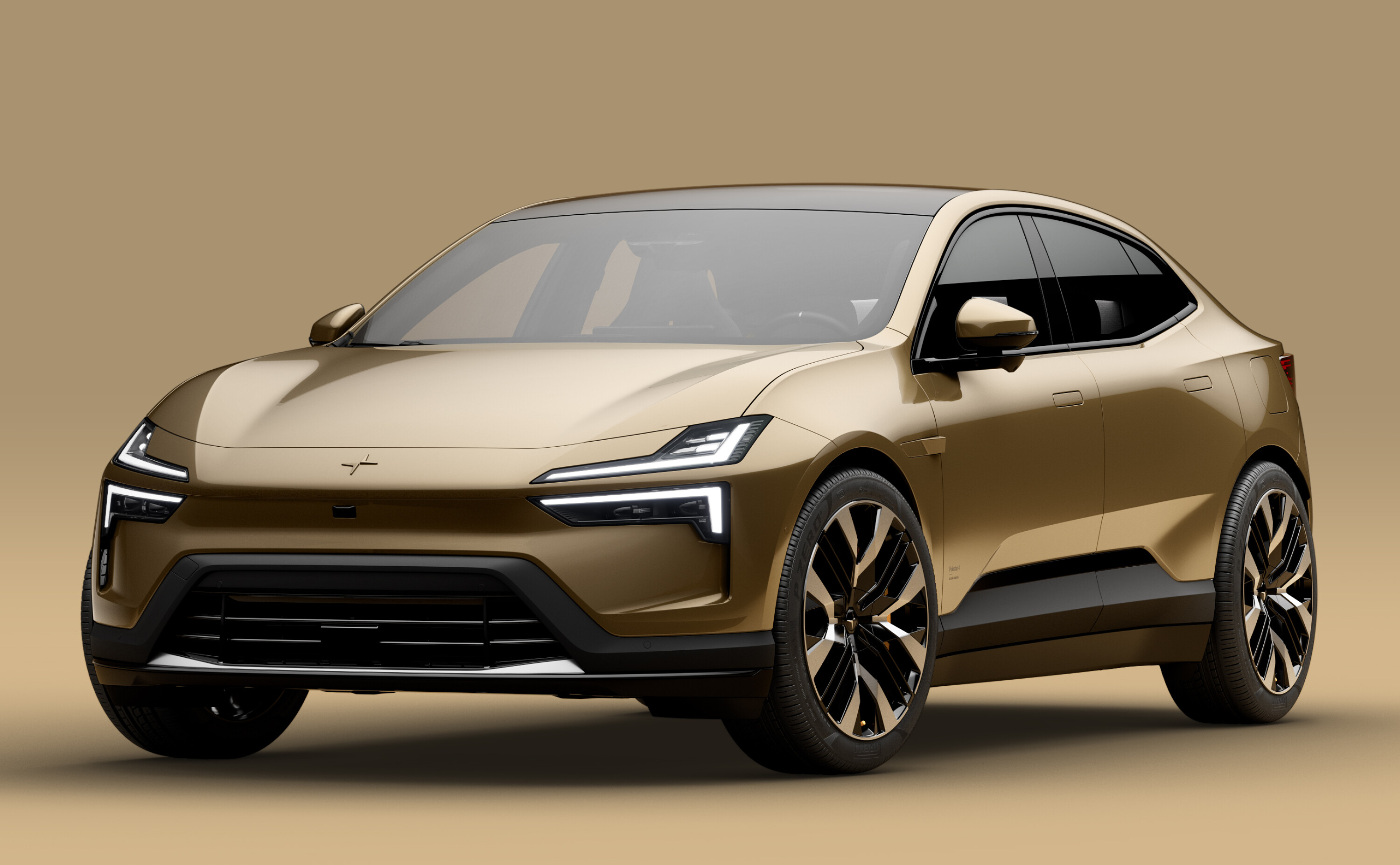
Polestar became a standalone electric-car brand in 2017 and currently sell two models in Australia: the Polestar 2, which is based on the Volvo XC40, and the recently confirmed Polestar 4 which will arrive in August.
The Polestar 3 large SUV, itself based on the Volvo EX90, is expected to arrive later this year.
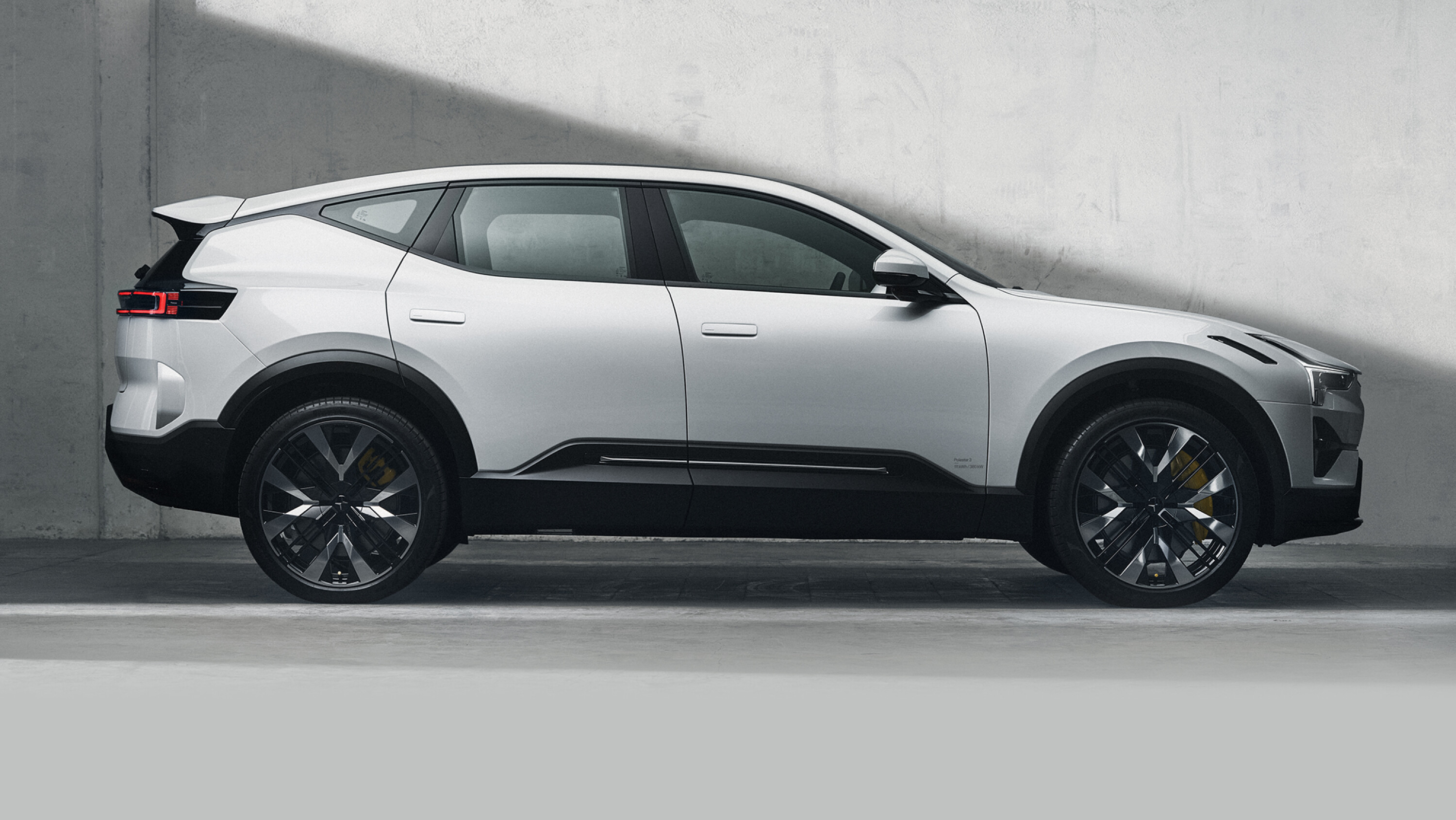
6
MORE
Everything Polestar
MORE
Everything Volvo
The Volkswagen Scirocco could be reborn as an electric-powered ‘icon’ model.
According to UK publication Autocar [↗], Volkswagen is assessing proposals for a reborn electric Scirocco sports coupe.
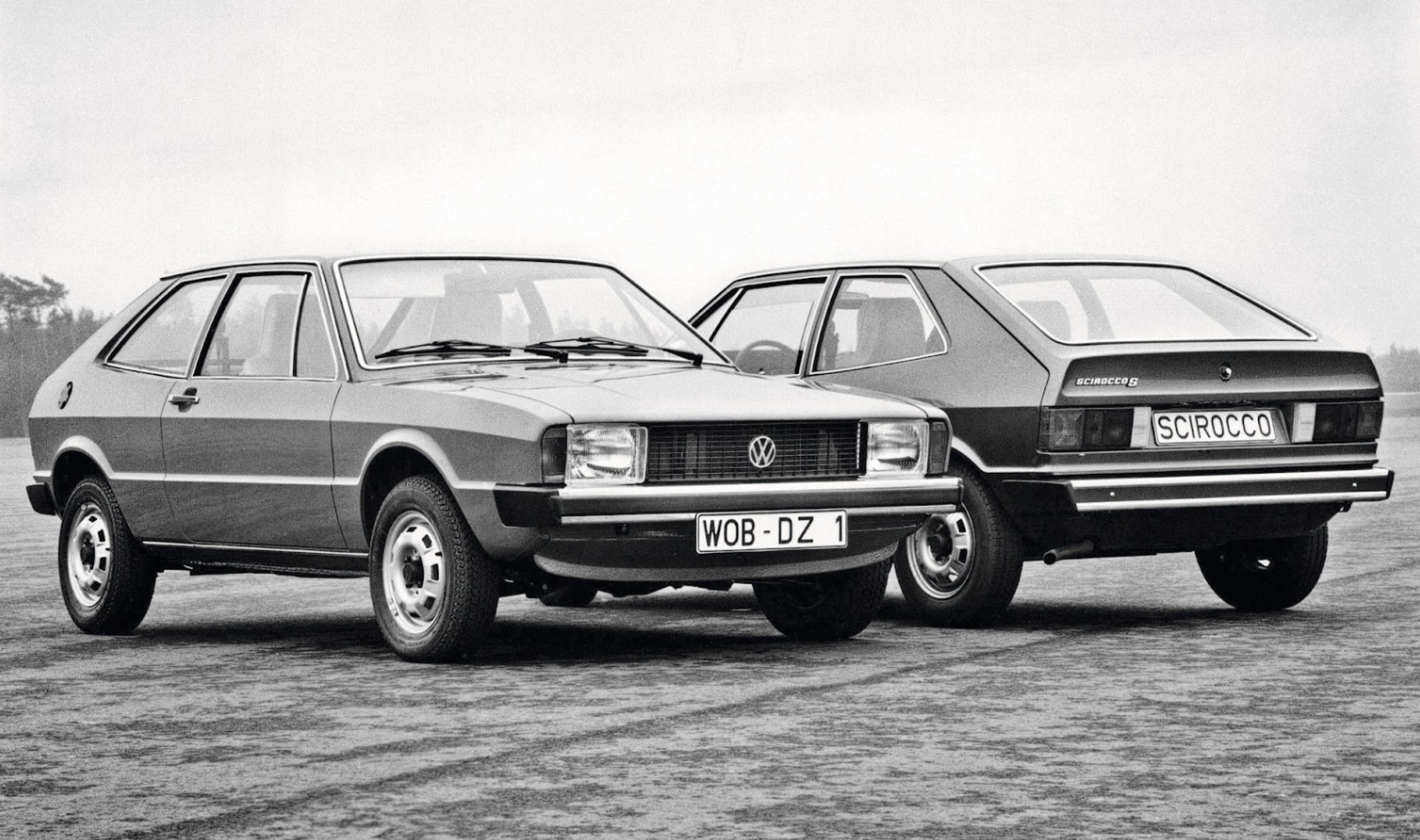
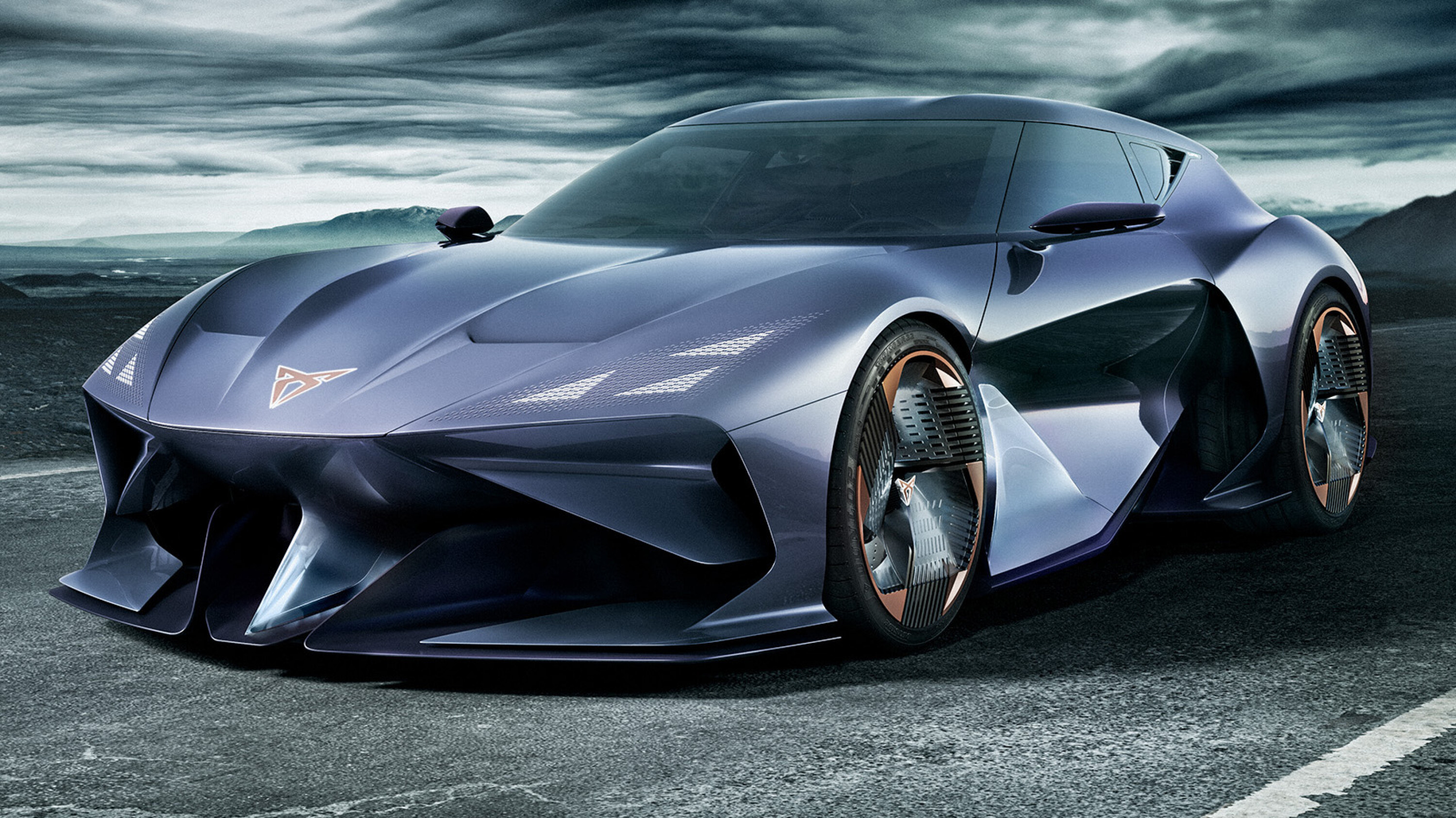
If it is greenlit, the new Scirocco’s styling would be inspired by the 1970s original, and it would share a platform with the fourth-generation Boxster/Cayman, fourth-generation Audi TT, and a production version of the Cupra Dark Rebel concept, according to a “high-ranking insider”.
It follows previous comments by Volkswagen Group CEO Oliver Blume, who outlined plans to launch a range of new electric cars inspired by iconic Volkswagen designs – including the Beetle.
1
Fourth-generation Scirocco would be an EV
Development of design proposals started shortly after Andreas Mindt, formerly lead designer at Bentley, arrived as head of Volkswagen design.
The new Scirocco would be positioned, as is traditional, above the Golf – which could replace the ID.3 when the electric ninth-generation version launches around 2028.
While previous Sciroccos and Golfs were closely related, the new Scirocco would use the Volkswagen Group’s Premium Platform Electric (PPE) architecture, while the electric Golf will use the unified Scalable Systems Platform.
The switch to a platform shared with Porsche and Audi suggests the new Scirocco might be a sportier proposition than before.
1
The PPE platform eschews the increasingly common ‘skateboard’ format for a design that allows for low door sills and floor height, giving stylists more freedom to create lower, sportier bodies.
It achieves this by packaging the battery within the centre tunnel and behind the cabin, with the aim of weight distribution – and, presumably, handling – akin to the mid-engined layout of previous Boxsters and Caymans.
Expect around 220kW in single-motor form and more than 300kW in the AWD dual-motor model, which could resurrect the Scirocco R badge.
It is understood that PPE will be offered with varying wheelbases and track widths to suit different purposes, as well as both single-motor RWD and dual-motor AWD drivetrains. The Boxster and Dark Rebel would offer two seats on a shorter wheelbase, while the Scirocco would have a longer wheelbase to allow for rear seats.
1
The reborn Scirocco could launch around 2028 if the Volkswagen Group’s board gives it the go-ahead.
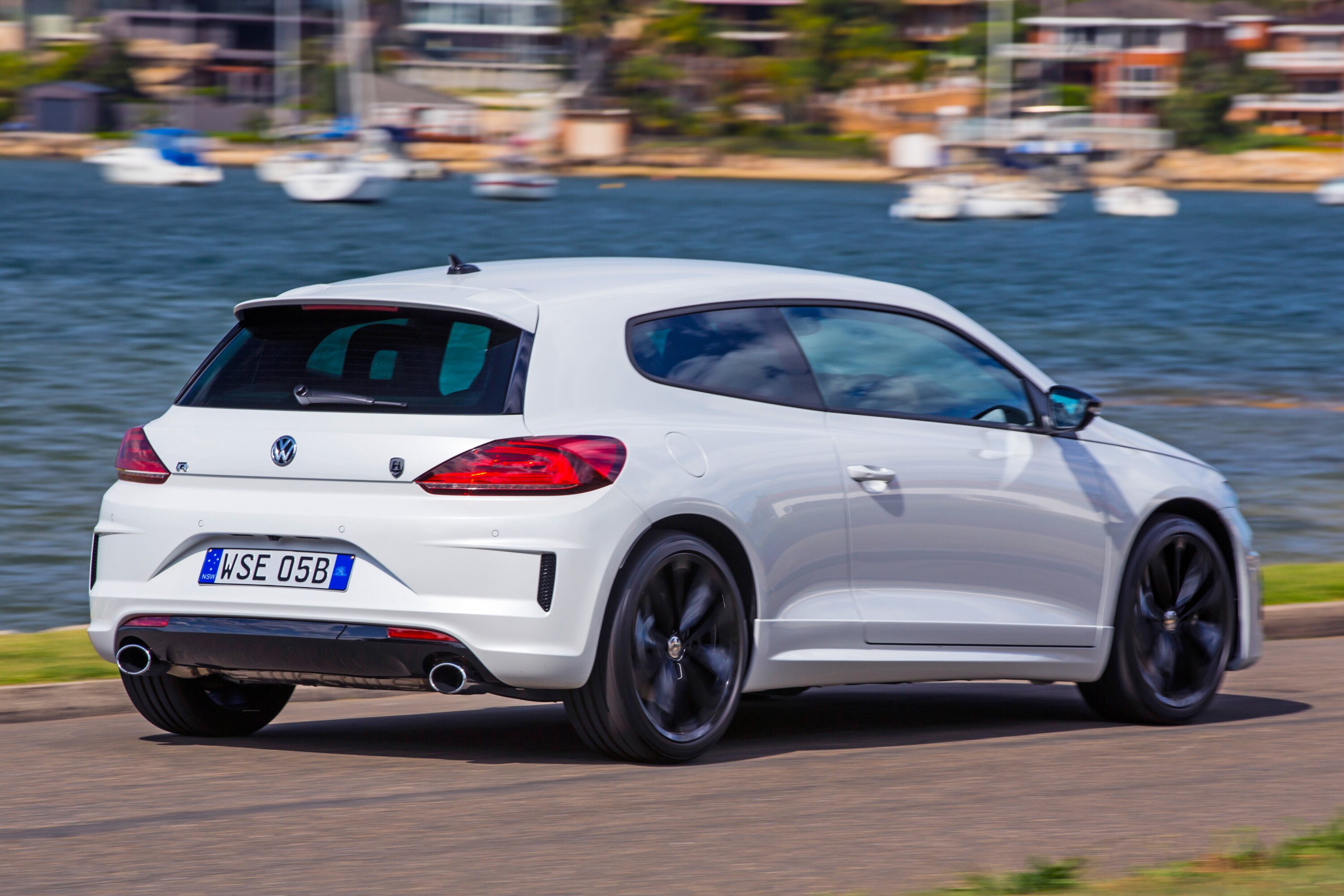
The VW Scirocco sold in Australia from 2012 to 2017 was the first series we received, but it was actually the third generation model.
Named after an African desert wind, designed by Giugiaro, and closely related to the Golf I, the original dropped in 1974, with the second series running from 1981 to 1992.
As part of what it calls a “passion for sustainability”, Victoria’s Monash University is boosting the number of ‘ultra fast’ electric car chargers in the state’s urban areas.
The new sites provide a total of 20 x 150kW charging bays – six each at two Clayton campuses and in Caulfield, plus two in Frankston.
In addition to the 150kW units, one Clayton campus (Ancora Imparo Way) also has six 7kW bays, while the other (Research Way) will add four 22kW bays and 11 x 7kW bays. Caulfield has six 7kW bays.
The stations at all four sites [↗] are open to Monash University staff, students, and the general public.
Installed by Engie and run on the Chargefox network, the new stations come partly through a grant from the Victorian Government’s Zero Emissions Vehicles Commercial Sector Innovation Fund (CSIF).
“Electric vehicle sales in Australia are increasing rapidly (8.3% in 2023 compared to 2% in 2022), and the demand for public charging infrastructure is also increasing,” said Associate Professor Roger Dargaville, Director (Interim) of the Monash Energy Institute.
“By charging their EVs at Monash’s newly installed charging stations, staff, students and the general public can take advantage of the plentiful solar power on the grid, making it a green and cost-effective option.”
Monash University charger fees
The university has not said if it draws revenue from these locations, although the prices below are in-line with Chargefox’s pricing at many of its locations across Australia.
| Charger Type | Fee | Idle Fee |
|---|---|---|
| DC – 150kW Ultra Fast | 60c/kWh | 9c/minute (after 15 minutes idle) |
| AC – 22kW Medium | 30c/kWh | 9c/minute (after 60 minutes idle) |
| AC – 7kw Standard | 25c/kWh | 9c/minute (after 60 minutes idle) |
You won’t find any official UN report card on EV manufacturing – although the council’s trade body has previously sounded the alarm on the mining boom [↗] – but now there’s this: Lead the Charge, a self-appointed watchdog for the car industry.
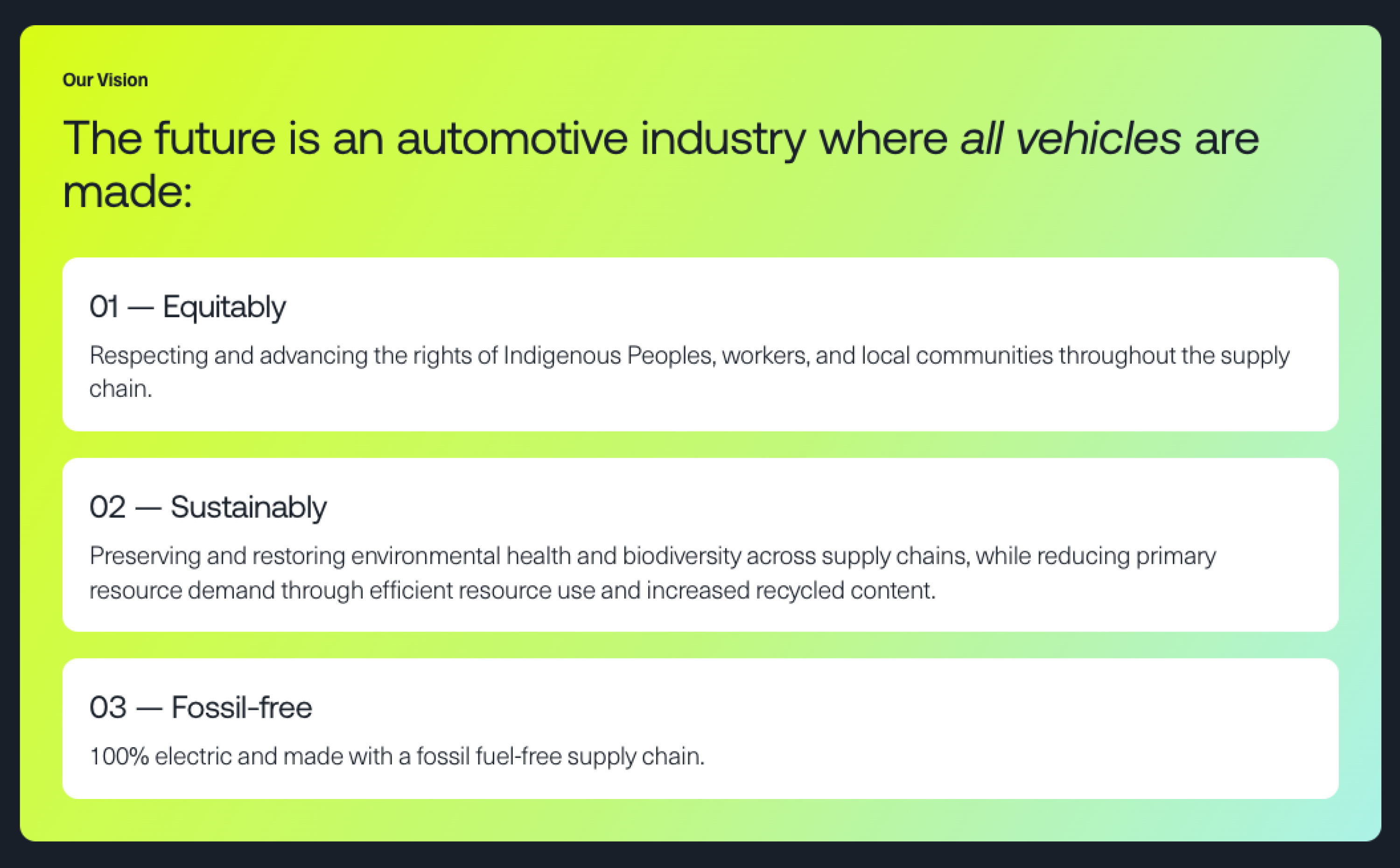
Launched in March 2023, Lead the Charge is built around the idea of an industry scorecard, tracking and ranking the efforts of leading carmakers to ensure every part of their EV supply chain is “equitable, sustainable, and 100% fossil free”.
“The Leaderboard analyses publicly available reporting from 18 of the leading automotive manufacturers in the world,” Lead the Charge says. “It ranks their efforts to eliminate emissions, environmental harms, and human rights violations from their supply chains.
The billboard shown above is part of a campaign against lithium mining. While salt mining is not a problem, people from Argentina’s Jujuy Province are against the extraction of Lithium in Salinas Grandes area. They claim this industry will destroy their natural water reservoirs. Photo: Getty Images | Luis Andrew Sampaio
1
How does Lead the Charge assess each brand?
Lead the Charge says its methodology is built on publicly available reporting from the brands themselves (as required by governments and various boards), focusing on aspects of sustainability and human rights within supply chains.
Although the organisation offers a full list of indicators and score attributions, the accuracy of its methodology might vary across different brands depending on their supply chain transparency.
The process has also had significant updates and amendments for 2024, including changes in definitions and improved precision – it says – in measuring “pre- and post-consumer scrap” and battery recycling.
2024 results
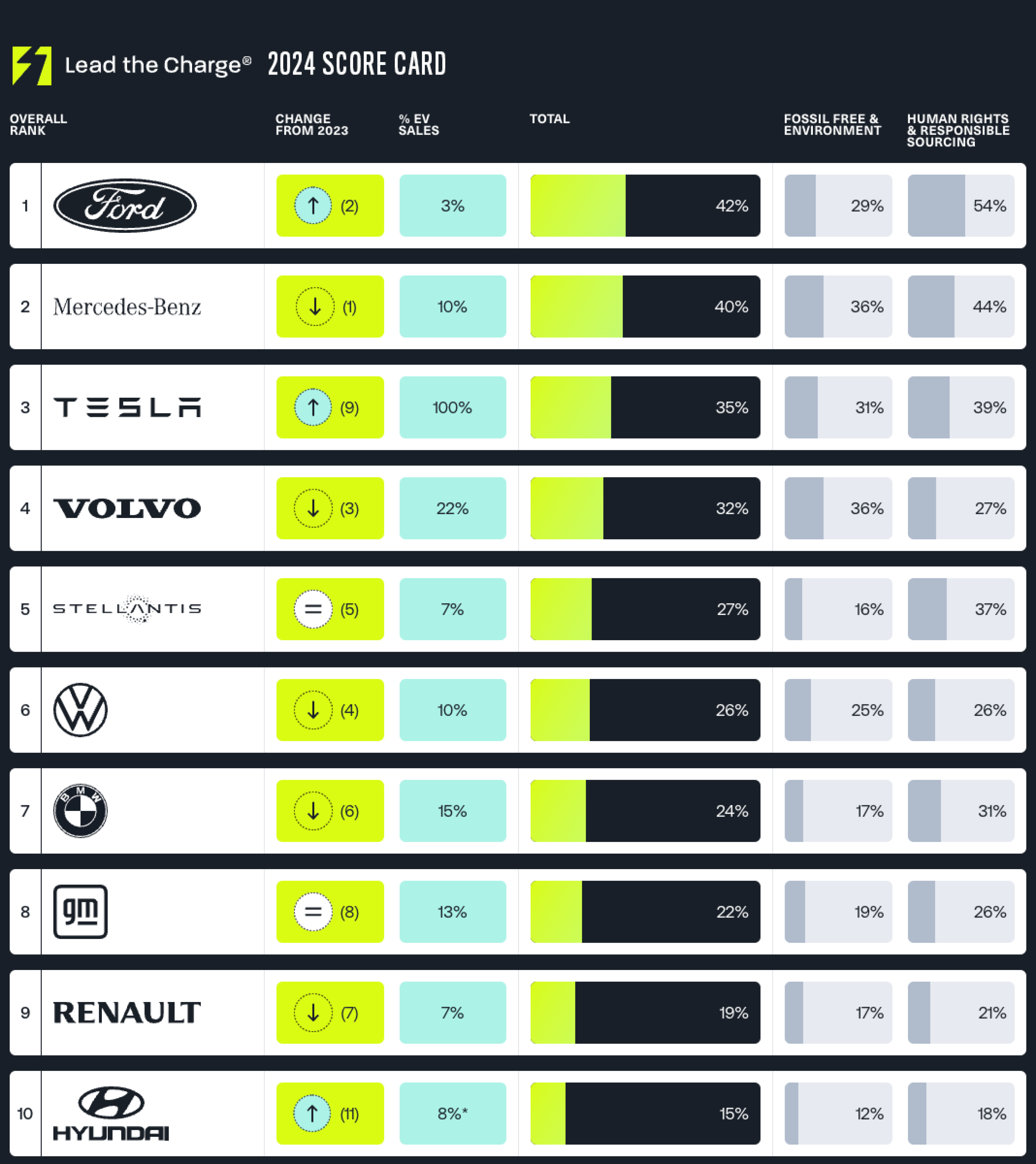
The full list of 18 brands can be found on the Lead the Charge website. We’ve listed the top 10 below.
1
This year’s report says that while all brands have failed on indigenous peoples’ rights (with 11 of the 18 tracked brands achieving a score of 0% on that metric), there has been marked progress in reducing supply chain emissions.
None have impressed the organisation, however.
Ford’s new position atop the chart comes off a score of 42%, thanks to improvements in the mining, production and transport of its steel and aluminium – meaning that even the best performing brands are well behind on the report’s criteria.
The organisation says Tesla’s leap from ninth to third is thanks to the American carmaker “becoming the first automaker to disclose disaggregated scope 3 emissions for its steel, aluminium, and battery supply chains”.
Indigenous rights remains the burning issue for all brands, however.
“One of the dismal findings in the report was an almost industry-wide inaction on ensuring a just and equitable transition across automotive supply chains. Average scores on the responsible sourcing of transition minerals, Indigenous Peoples’ rights, and workers’ rights have risen by only 2%,” the report says.
Ford Leads: Ford tops the Leaderboard with a 42% score, surpassing Mercedes and showcasing leadership in workers’ rights and supply chain cleanliness.
Tesla’s Leap: Tesla jumps to third place with the largest score increase, highlighting its progress in disclosing scope 3 emissions and improving in responsible sourcing and Indigenous Peoples’ rights.
Human Rights Gaps: Despite some progress, there’s a significant lack of advancement in Indigenous rights, with all major automakers, including Ford and Mercedes, showing no improvement.
Global Influence of EU Regulations: EU regulations positively impact automakers worldwide, driving improvements in human rights due diligence and environmental practices.
Supply Chain Emissions Focus: The report emphasises the urgent need for automakers to address supply chain emissions to meet their climate goals.
Lagging Behind: Toyota and other automakers are criticised for not sufficiently cleaning up their supply chains, risking their competitive edge.
Indigenous Peoples’ Rights Inaction: The industry shows almost no progress on Indigenous Peoples’ rights, with 11 out of 18 automakers scoring 0% in this area.
Steel Decarbonisation: Over two-thirds of automakers are moving towards green steel, marking a significant shift from the previous year, with East Asian automakers falling behind.
Transition Minerals and Decarbonisation: Ford excels in transition mineral sourcing and decarbonisation of steel and aluminium, yet the overall industry progress is slow.
Increased Regulation and Compliance: 2023 saw improvements in supply chain practices due to EU legislation, with some Chinese automakers making notable strides in human rights and environmental practices.
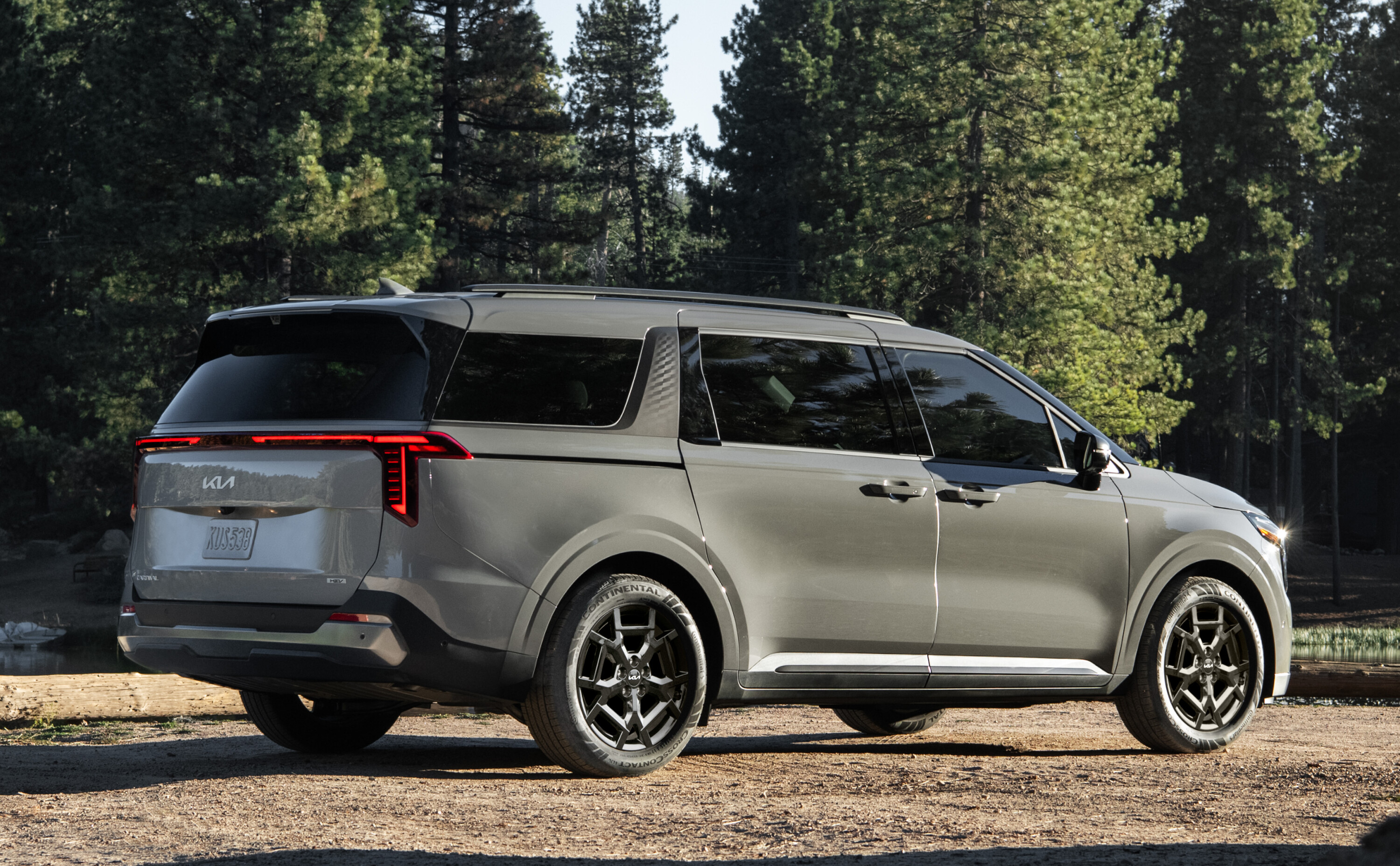
The 2024 Kia Carnival Hybrid has been approved for sale in Australia.
It will arrive in local showrooms later this year, while facelifted petrol V6 and turbo-diesel Carnival variants are due around March or April.
The Carnival Hybrid will become the first people mover priced under $100,000 with an electrified powertrain to be officially sold in Australia, with the Japanese Toyota Alphard and Estima (Tarago) hybrids popular in the grey import market.
1
The Lexus LM hybrid and Mercedes-Benz E-Vito Tourer, EQV, and LDV Mifa 9 electric cars are available in Australia with much higher price tags.
Government approval documents confirm the electrified people mover will offer a 1000-kilogram braked towing capacity in Australia, down from 2000kg for petrol V6 and turbo-diesel models. Its unbraked towing capacity is unchanged at 750kg.
With its added electric components, including a high-voltage battery, the Carnival Hybrid weighs around 100 kilograms more than the turbo-diesel at 2288kg, while it is 10mm taller.
Kia Australia has listed 17, 18 and 19-inch wheel options for the Carnival Hybrid, though it’s currently unclear what variants will be offered locally.
1
As with the related Sorento Hybrid, supply will be limited, with the hybrid line-up likely to be restricted to the flagship variant – which should retain the Platinum name – and possibly a fleet-focused base model at launch.
The Carnival Hybrid features a 1.6-litre turbo-petrol hybrid powertrain shared with the Sportage and Sorento Hybrids but with higher 183kW/367Nm outputs – up from 169kW/350Nm.
It is matched to a six-speed automatic transmission, which exclusively powers the front wheels like all other Carnivals.
In Korea, the hybrid has a claimed fuel consumption of 7.1L/100km– compared to 7.6L/100km for the diesel and 11.1L/100km for the petrol V6 in that market.
The diesel is rated at 6.5L/100km on the combined cycle in Australia, while the V6 is listed at 9.6L/100km.
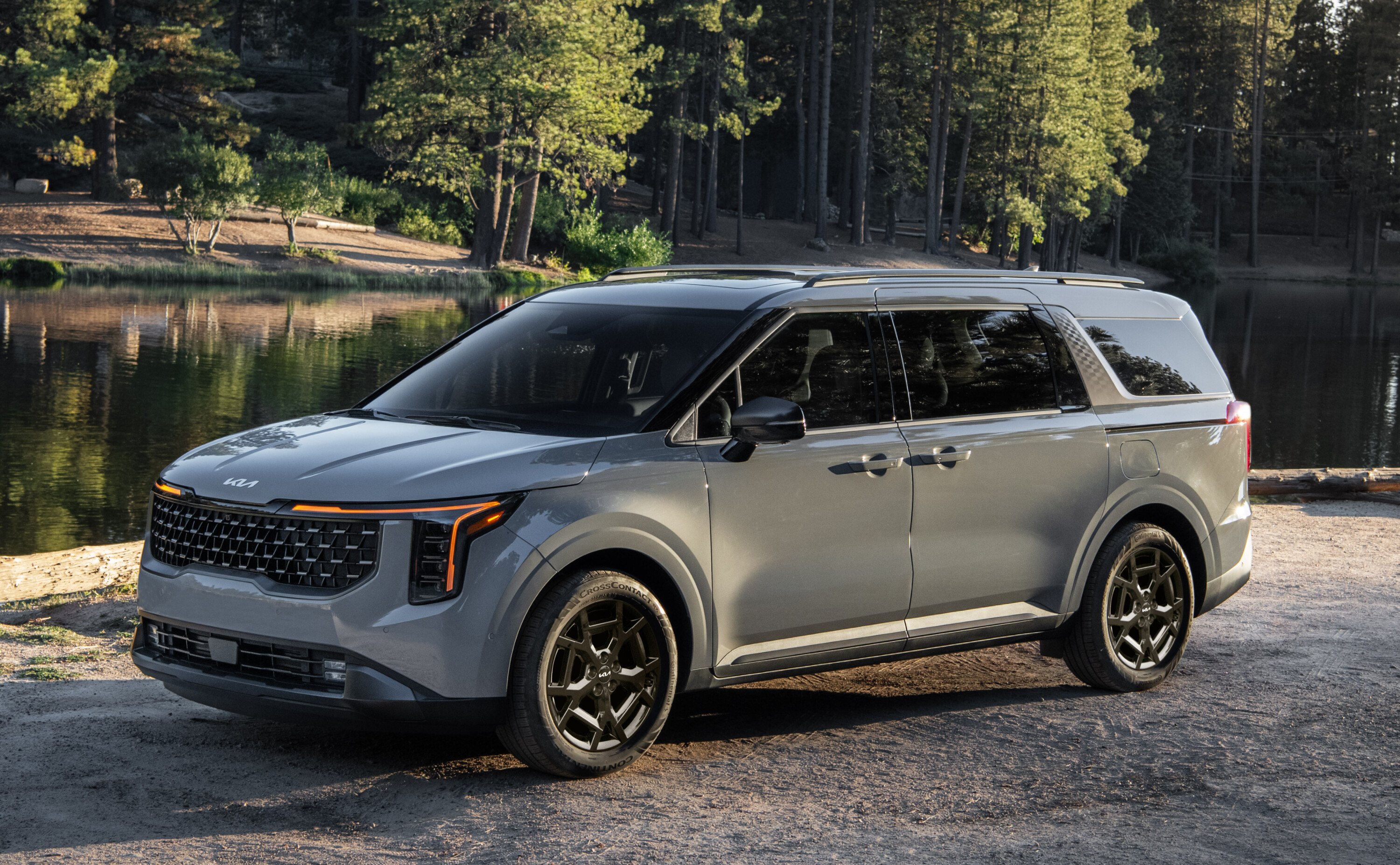
1
A specific 18-inch alloy wheel design and ‘navy grey’ interior option are offered for the hybrid model overseas.
As detailed here, the facelifted Carnival has a revised look with vertical headlights, ‘star map’ daytime running lights, a wider grille, and updated tail-lights with a full-width light strip.
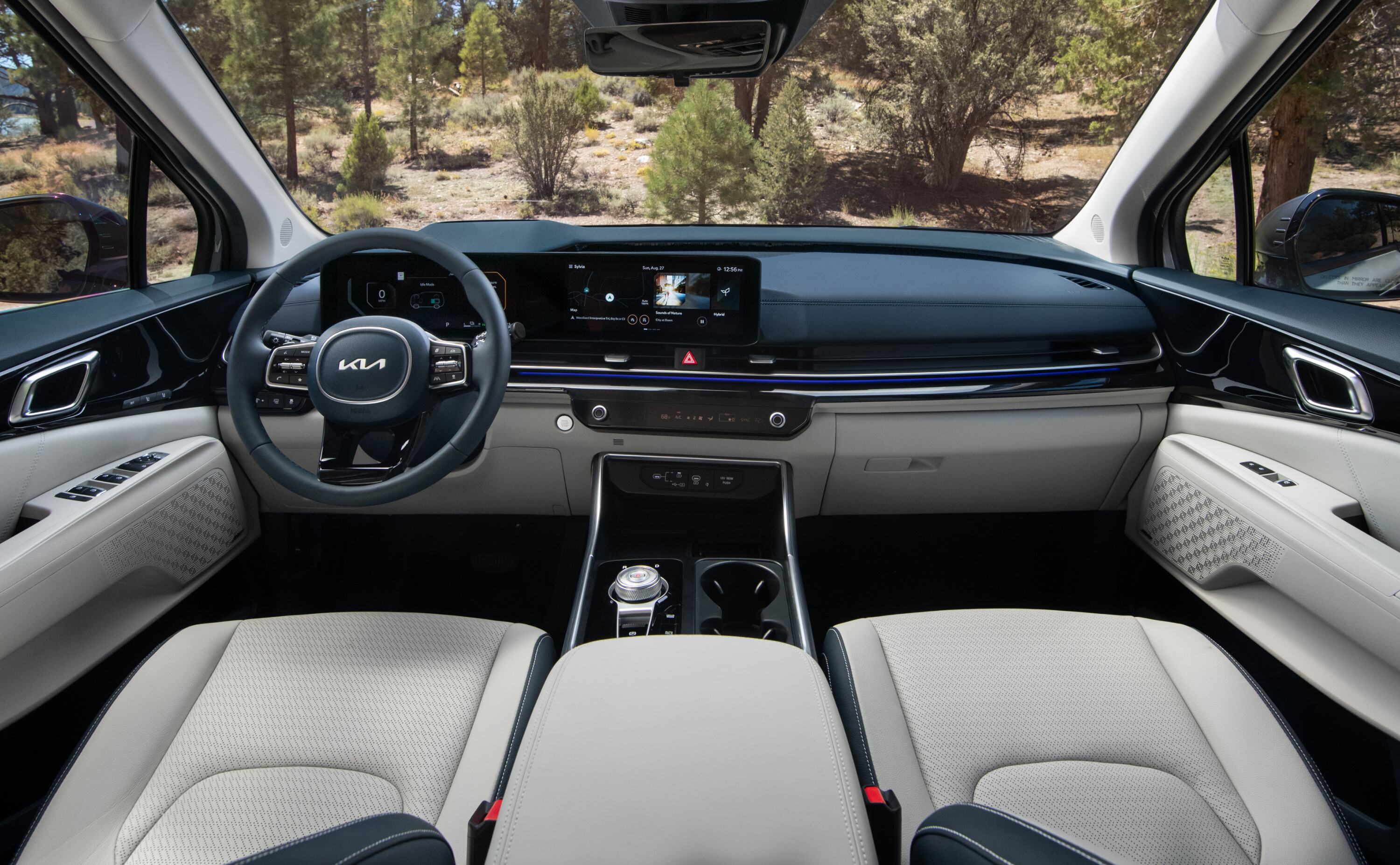
Interior enhancements include a new curved display panel with dual 12.3-inch screens, an updated ‘CCOS’ infotainment system with over-the-air updates, digital key functionality, and USB-C ports.
It also has a switchable climate/audio touch panel like the EV6, Niro and Sportage, along with configurable ambient lighting that extends from the dashboard into the door panels.
Newly added active safety systems include oncoming vehicle detection, evasive steering assist when overtaking, semi-autonomous ‘Highway Driving Assist 2’, and intelligent speed limit assist.
It is now fitted with a front-centre airbag to help prevent head clashes in serious side impact collisions, taking the airbag count to eight.
In Australia, the facelifted Carnival will likely receive missing features already available overseas, including a full-digital instrument cluster, rain-sensing wipers, a blind-spot view monitor and Kia Connect.
MORE
Everything Kia
MORE
PHEV and Hybrid Cars
