
Hyundai’s N Performance arm is about to undertake its most important launch yet, with the Ioniq 5 N said to be a bigger deal than the cult favourite i30 N.
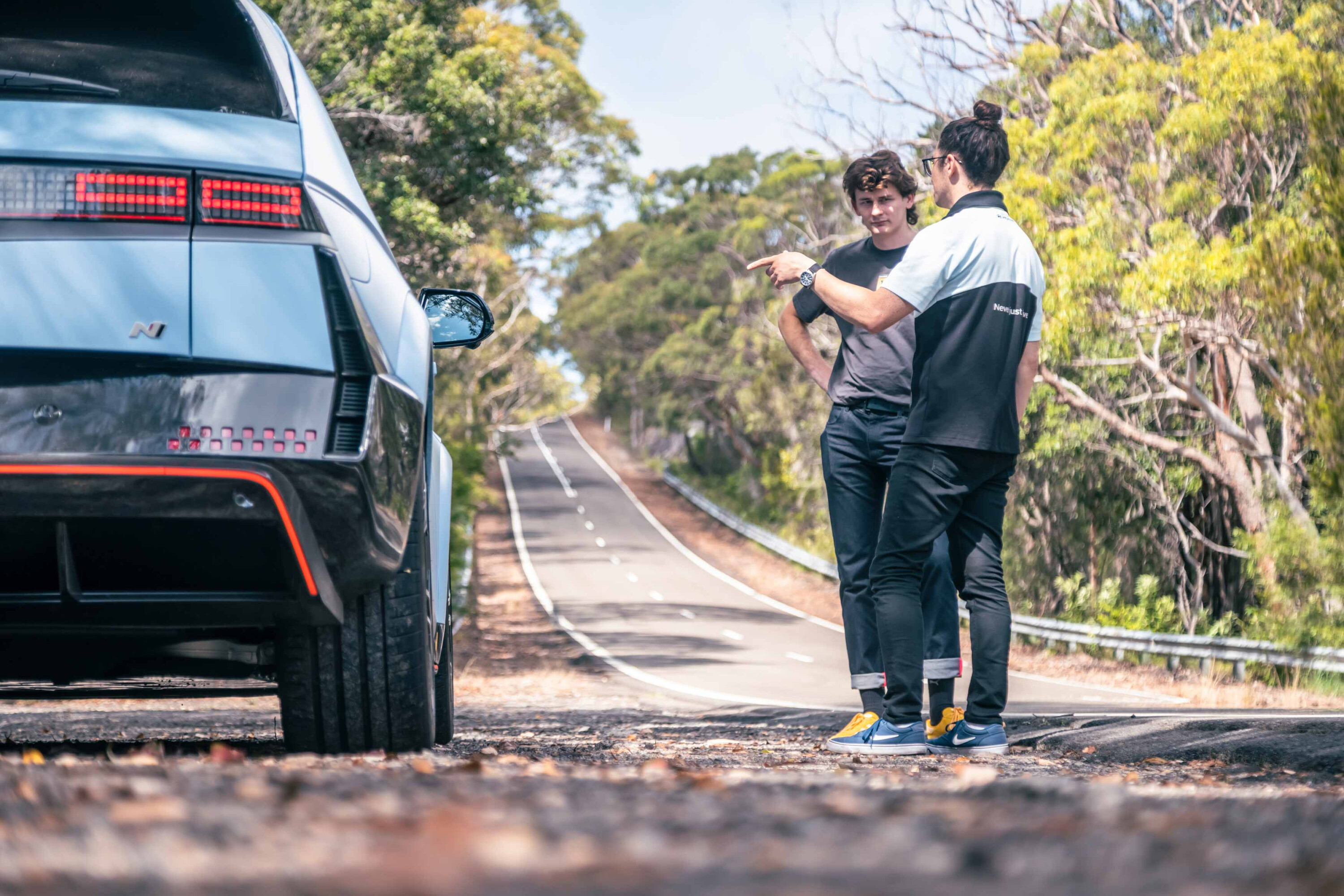
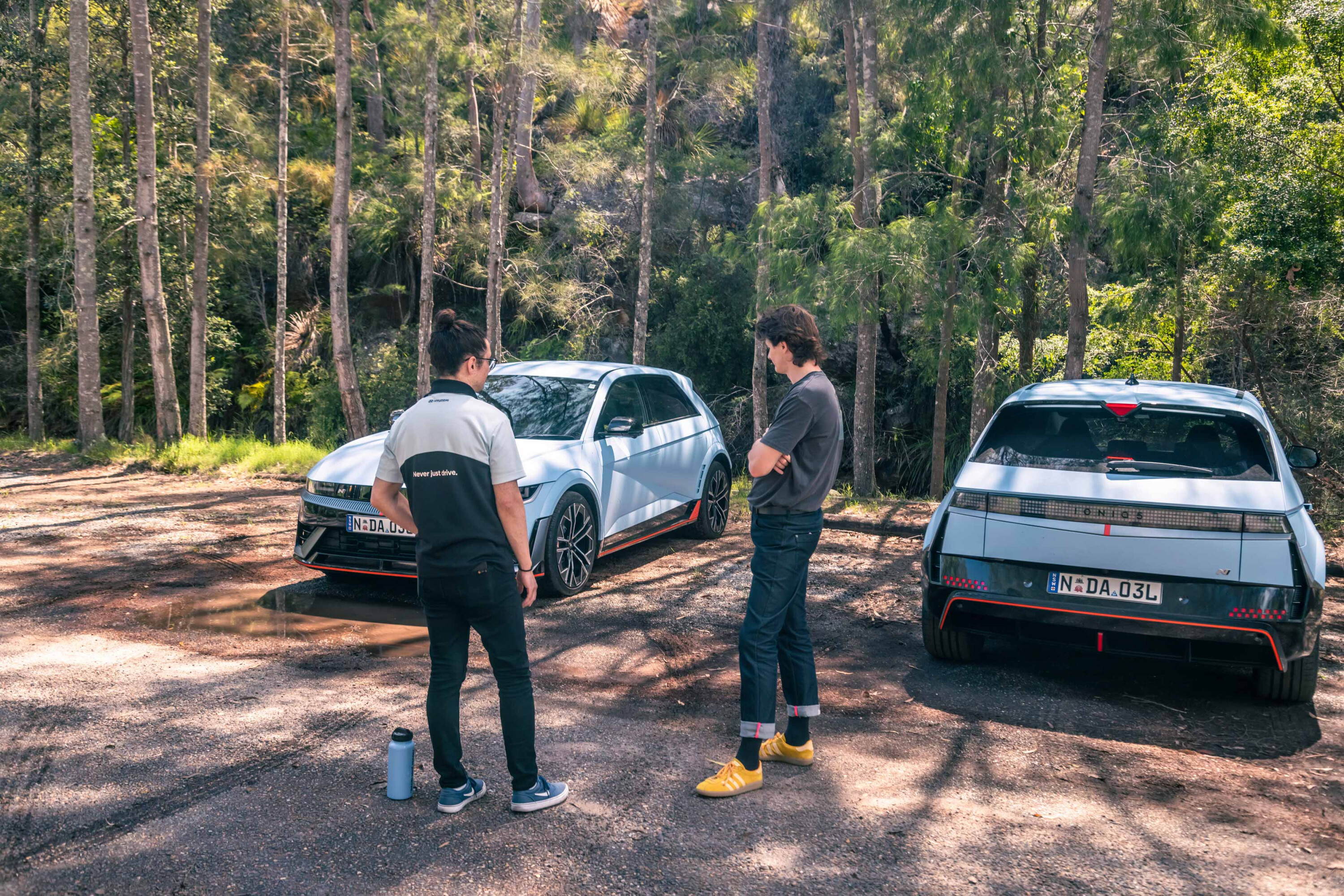
Wheels was invited to sample the new Ioniq 5 N – Hyundai is not labelling it as a performance SUV, hot hatch, or anything else – alongside HMCA product development manager Tim Rodgers who was heavily involved in the car’s chassis tune.
This is a new formula. This is a new type of car… but I think (hopefully) history will say that this car kicked off something
1
The last question we asked Tim before getting behind the wheel was this: is the Ioniq 5 N as big a deal as the i30 N? “It’s bigger, I reckon”, he replied.
“Because with i30 N, we made our statement, and we made it clear, but we didn’t write any new rules. The formula was already there.
“This is a new formula. This is a new type of car. It’s a new niche, but I think (hopefully) history will say that this car kicked off something. Let’s see, but that’s what we thought about it.”
That’s been our engineering challenge this entire time… How do we make it enjoyable? How do we make it emotional?
1
How was Hyundai Australia involved in the process?
Tim and his team were brought into the development earlier than ever before for the Ioniq 5 N, as were engineers and product planners from North America.
Not only was Hyundai Australia able to give feedback on suspension, chassis, and powertrain calibration, but also more nuanced specification details.
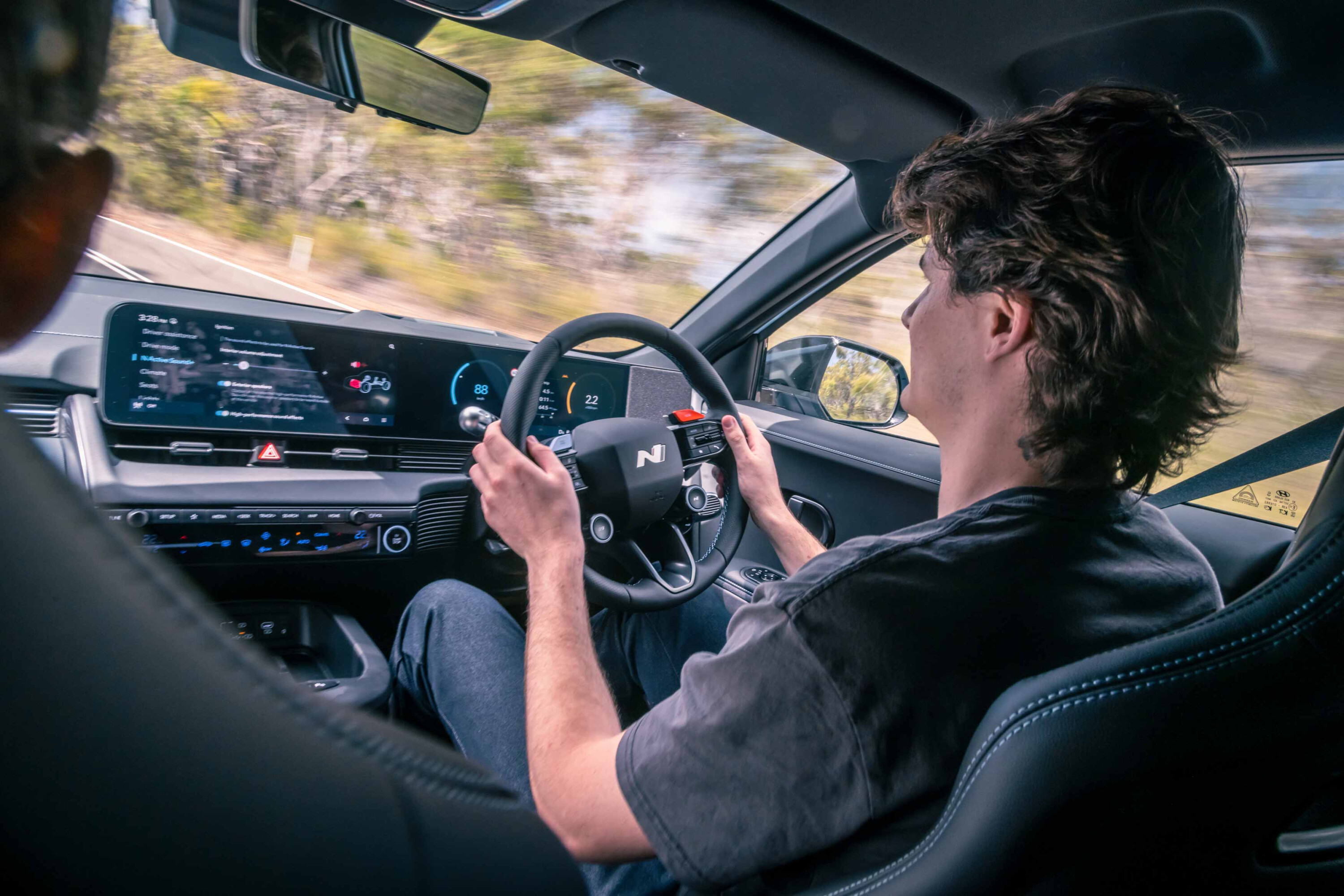
“When I’m there embedded with the engineers, I can talk to them about the product stuff and say things like, ‘Hey, guys, you’ve got to remember this is a $100K-plus car, so this is the expectation from the customer” explained Tim – perhaps that’s why the Ioniq 5 N’s bucket seats are fitted with ventilation and the EV6 GT’s aren’t.
1
As for where customers are coming from, Tim’s insight is that Hyundai has “people coming out of the woodwork for this car… We can’t pinpoint it and pigeonhole it into one type of demographic.”
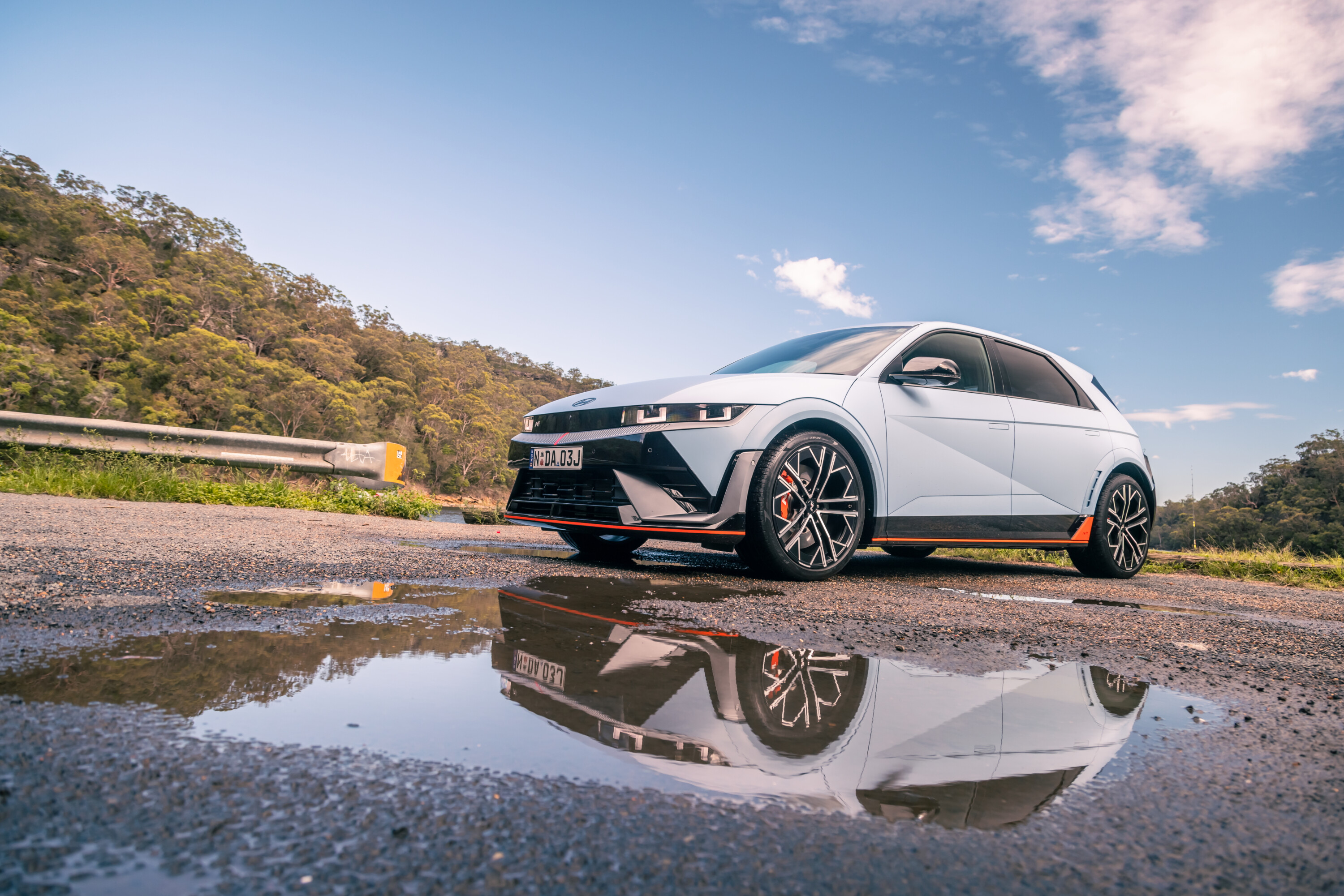
When you look at what else offers so much grunt and chassis tech for $111,000, there isn’t much out there. Cars like the Mercedes-AMG A45 and its GLA 45 relative, and the Audi RS3 and its RSQ3 relation seem the most logical match. The BYD Seal Performance might not be far off for straight-line speed, but the Ioniq 5 N’s talent runs far deeper.
Tim even noted that current owners of i30 N Lines had expressed interest in the new flagship N product. It’s this brand loyalty that’s most interesting, with Hyundai only really making enthusiast cars since the i30 N’s 2017 reveal, the events supporting performance driving have contributed massively to the brand’s cult following.
1
Hyundai was keen to capture the i30 N’s DNA above all else – and that’s what makes the Ioniq 5 N so much more than its 3.4-second 0-100km/h sprint.
“What we recognise about EVs is the easy bit is making them go fast in a straight line, right? We know that. The formula is simple: big battery, big motor, 4WD, grippy tyres, done. 0-100km/h in three-point-something. How do we do the rest of the car?
“And that’s been our engineering challenge this entire time: how do we make that power accessible? How do we make it comfortable? How do we make it fun? How do we make it enjoyable? How do we make it emotional? They’re the questions we keep asking ourselves throughout this whole process.”
“And I think, because we’re talking about this sort of stuff more so than the 478kW, we hope that we’ll find the customer that values that’, he added.
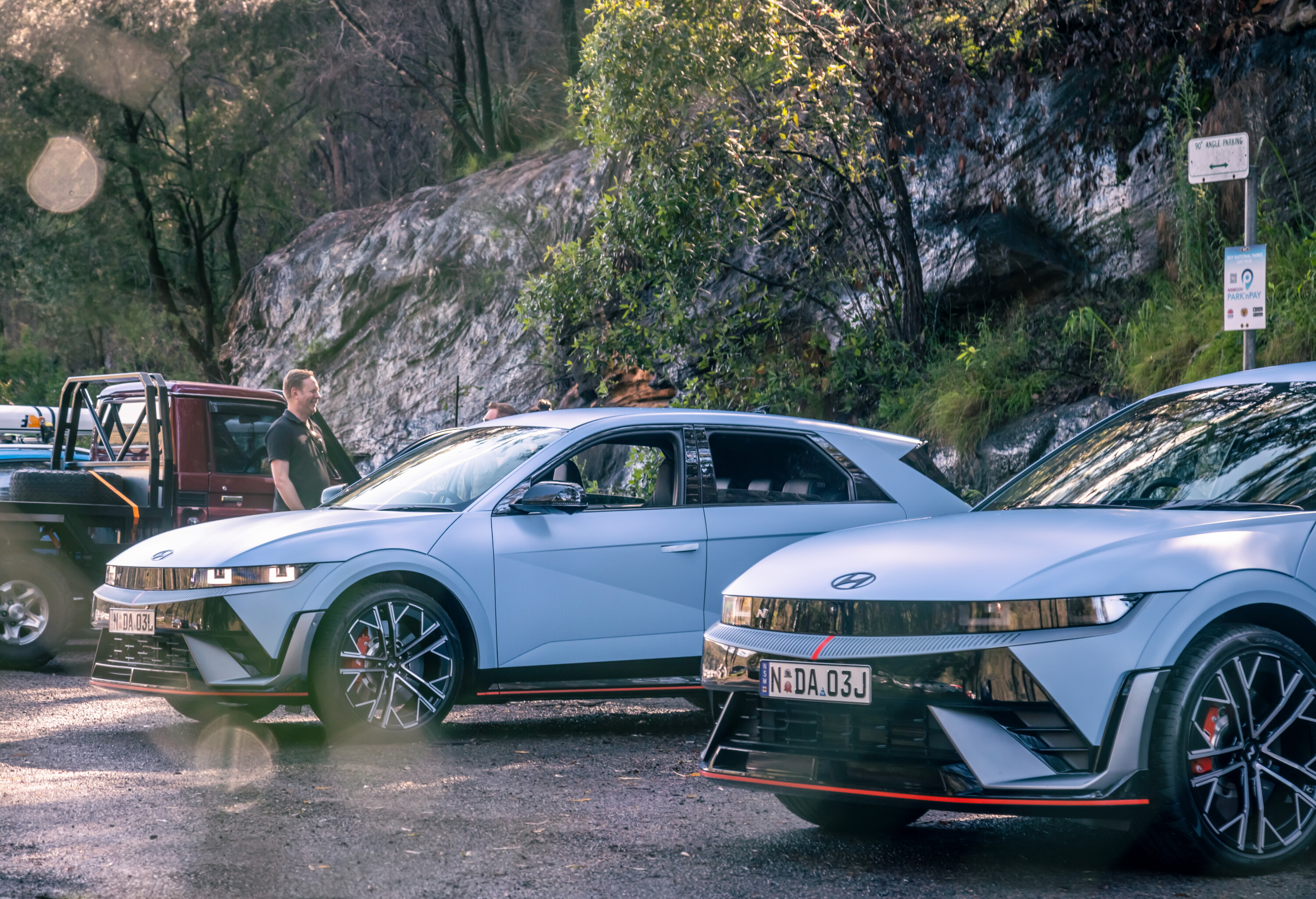
We’ve sampled the IONIQ 5 N in pre-production form on ice, and on South Korean roads in production guise, but Hyundai has finally called us an hour north of Sydney for a first local taste of an Aussie-spec 5 N.
Short on distance but not on bumps, the road we’re heading to (known informally as Akuna Bay) is the stuff of nightmares if you happen to be a damper, spring, or suspension bush.
When engineers come to visit and ask the team at Hyundai’s Australian outpost how they tune suspension without using a proving ground, Akuna Bay is the place product development manager Tim Rodgers takes them to demonstrate our roads. It helps that it’s close to the Macquarie Park head office, and one of the roads used before final sign-off of local suspension tunes.
Partially due to the success of the ride localisation program and i30 N involvement (though mainly due to expected demand for the IONIQ 5 N), the electric N car marked the first time Aussie engineers were embedded in tuning from the get-go.

2
Tim told Wheels he was thrown in at the deep end, testing the car jetlagged and then being thrown into developing and refining various N-specific components including the rear knuckles and bump stops.
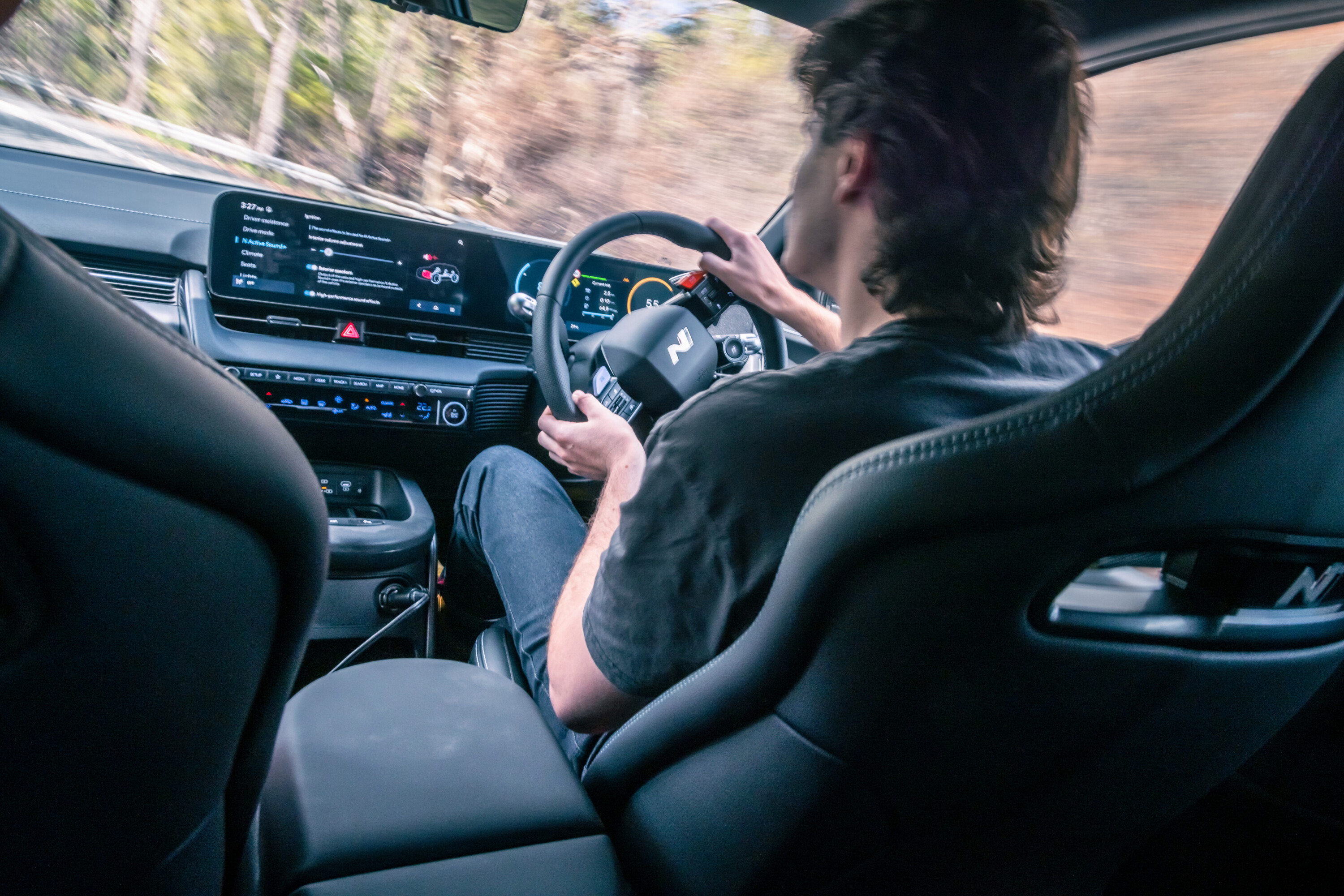
Inside, it’s clear how different the N is from the regular IONIQ 5, with almost no shared DNA. Aside from different interior fabrics is a superb driving position obliged by heated and ventilated manual-adjust bucket seats set millimetres above the carpet and a perfectly sized three-spoke steering wheel.
The centre console is different, too, and is an item former lead engineer Albert Biermann said he obsessed over trimming weight from, yet at 2.2 tonnes (provisional weight, spec not yet finalised), the N is about 70kg heavier than an IONIQ 5 Epiq AWD.
1
Of course, that extra weight can be attributed to a combination of things, including enhanced cooling, a bigger battery, stiffening measures – 42 extra welding points and 2.1 metres of structural adhesive for a start – and other things.
Even knowing the depth of engineering behind the 5 N – it being Biermann’s last official start-to-finish N product – and reading Jez’s words from Korea, I was still half-expecting a stiff-limbed limpet tuned for Nurburgring lap times.
Logic goes that with something so large and heavy on such big wheels will always be talent-limited – the flawed, concrete-ride BMW X3 M is the perfect example of this.
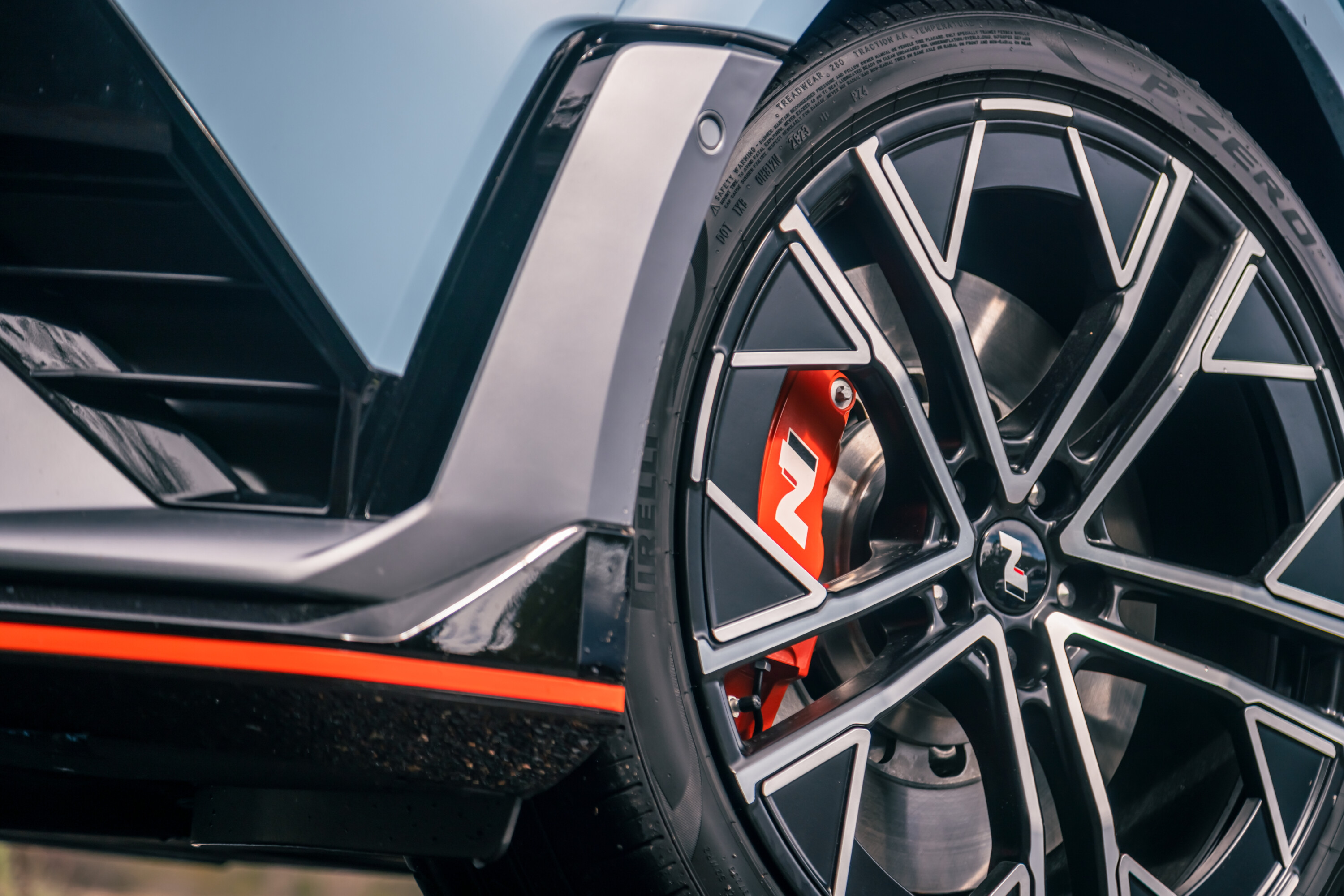
Yet the IONIQ 5 N’s compliance in Normal mode took me totally by surprise. Rolling through the waterlogged gravel car park’s potholes at walking pace, the N’s big 21-inch forged alloys eased themselves into depressions as needed and soaked up sharp edges as well as – or better than – a standard IONIQ 5 might’ve.
1
Should be damn good at the ‘going to get milk’ part of being an everyday sports car.
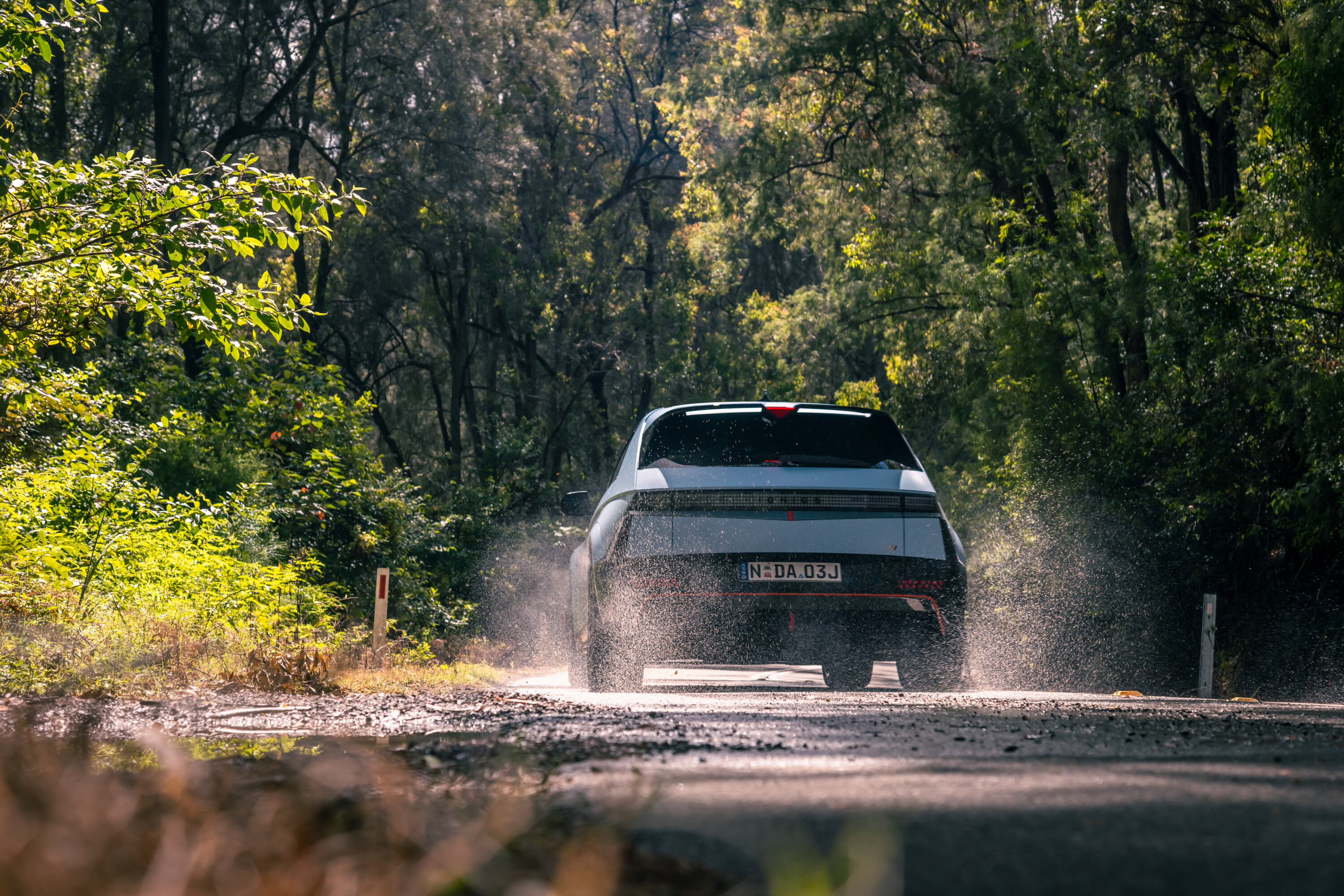
Guess that means the body control suffers? You’d be wrong. The IONIQ 5 N was planted and poised, dispatching savage mid-corner bumps that upset even the best hot hatches without breaking a sweat.
That front end is so gripped up, I kept upping entry speeds to find a limit to the grip but it proved impossible on the road, with the IONIQ 5 N’s sticky HN-marked 275/35 R21 Pirelli P Zero rubber holding steady.
And yet the beauty of the IONIQ 5 N is that you’re given something to enjoy mid-corner, with genuine weight transfer and yaw moments that so many fast and heavy cars (including the Kia EV6 GT) erase with high spring and damper rates; in contrast, the IONIQ 5 N is delightfully loose-limbed.
2
With the diff set to Sport Plus and the ESC in its half-off mode, a little extra accelerator than you might strictly need on corner exit allows a gentle over-rotation of the rear that can be caught effortlessly with a flick of the wrists.
The drivetrain is naturally rear-biased, the front motor producing 166kW and the rear 282kW, with the ability to control the ‘torque split’ for drifting around skid pans (though there’s no physical connection between each motor).
Steering is sharp without being hyperactive and it has a nice heft in Sport+ mode with no glugginess – the IONIQ 5 N’s EPAS system is a ‘driver demand’ type that dishes out assistance as the wheel is turned rather than altering it depending on road speed.
Compliance at speed is excellent and our lumpy road dictated that N Custom mode with dampers in Sport was the best. Sport+ (or full N mode, accessed using one of the two wheel-mounted buttons) wasn’t catastrophic but would be best reserved for smoother roads and racetracks.
1
As for the difference between Aussie IONIQ 5 Ns and everywhere else’s, N mode is identical but there are a few – rather complex – differences in Normal and Sport.
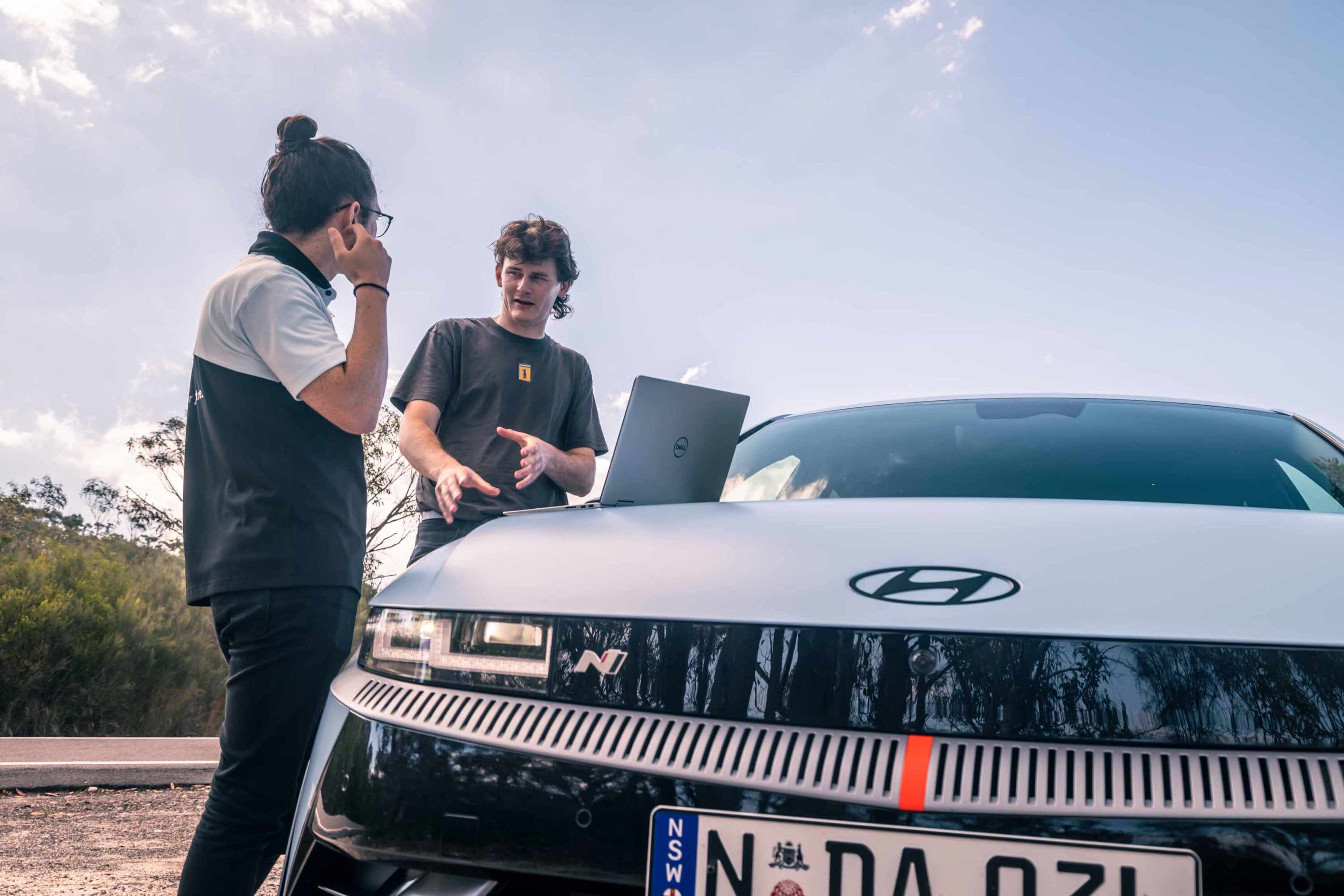
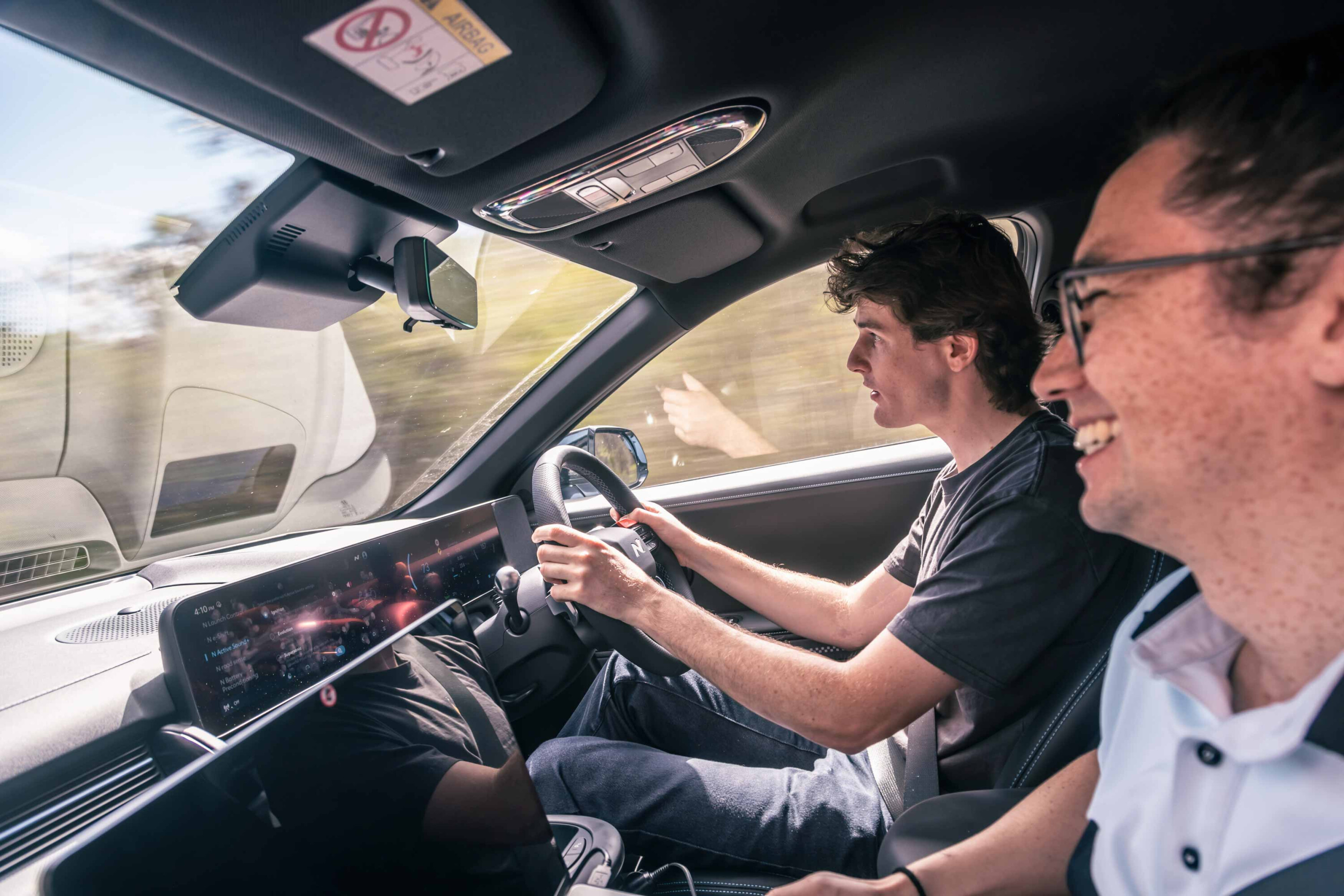
Rodgers illustrated the nuance of the IONIQ 5 N’s electronically controlled dampers by riding shotgun with a laptop plugged into the car’s mainframe. Using a humble spreadsheet, Tim could adjust all manner of damping parameters on the fly; the most illustrative is the speed-dependent mapping.
Tim effectively told the dampers to relax into their absolute softest setting at all speeds. This resulted in lots of body movement and heave over bumps I had yet to experience.
1
Then it was fully hard, which is more in line with what I expected from N mode if I’m honest – that being a busy ride (but still preferable to a BMW X3 M in Normal) that sapped the joy out of driving the N.
Rodgers then dropped the damping force right off again and explained how the various lines of code work to rein in (or allow) body movements. In simple terms, there are two basic inputs for the suspension’s brain: road-induced motion and driver-induced motion.
The former takes information such as the car’s speed, and the size and frequency of bumps (there’s even a speedbump-specific program!), adjusting damping forces up to 200 times a second. The latter responds to your inputs and might change the amount of anti-squat when the driver is accelerating, for example, or pre-empt body roll as the steering wheel turns in.
2
In ‘full soft’ on the spreadsheet, inputs other than speed still cause the dampers to react and this gives an insight into the system’s sophistication. Brake heavily and the dampers quickly firm up; turn into a bend and after a moment of wallow the chassis stiffens up suddenly to limit roll.
As Tim points out, when you can feel the systems working clumsily, the effect of them in harmony is amplified: “The magic is blending it all together so that’s invisible because you don’t want a driver to be able to feel any of that. You just want them to be able to drive the car and say it’s incredible.”
The IONIQ 5 N flatters the driver, no doubt, but it gets better. Not only does it make driving fast easy like all limpet hyper hatches (such as the Volkswagen Golf R), but it involves and engages the bit of flesh between the wheel and seat at reasonable speeds.
2
Waiting a moment as the body settles on the outside rear, I fire out, just catching the faux limiter at the top of second
This chiefly comes down to N’s implementation of what reads like childish gimmicks in a press release: ‘N e-shift’ simulated gear shifts, three selectable ‘engine’ noises with external speakers (Evolution with the interior level set to 2/10 and the outside speakers on was our preference), fake pops and crackles on the overrun, and a ‘rev-limiter’ that imitates fuel cut.
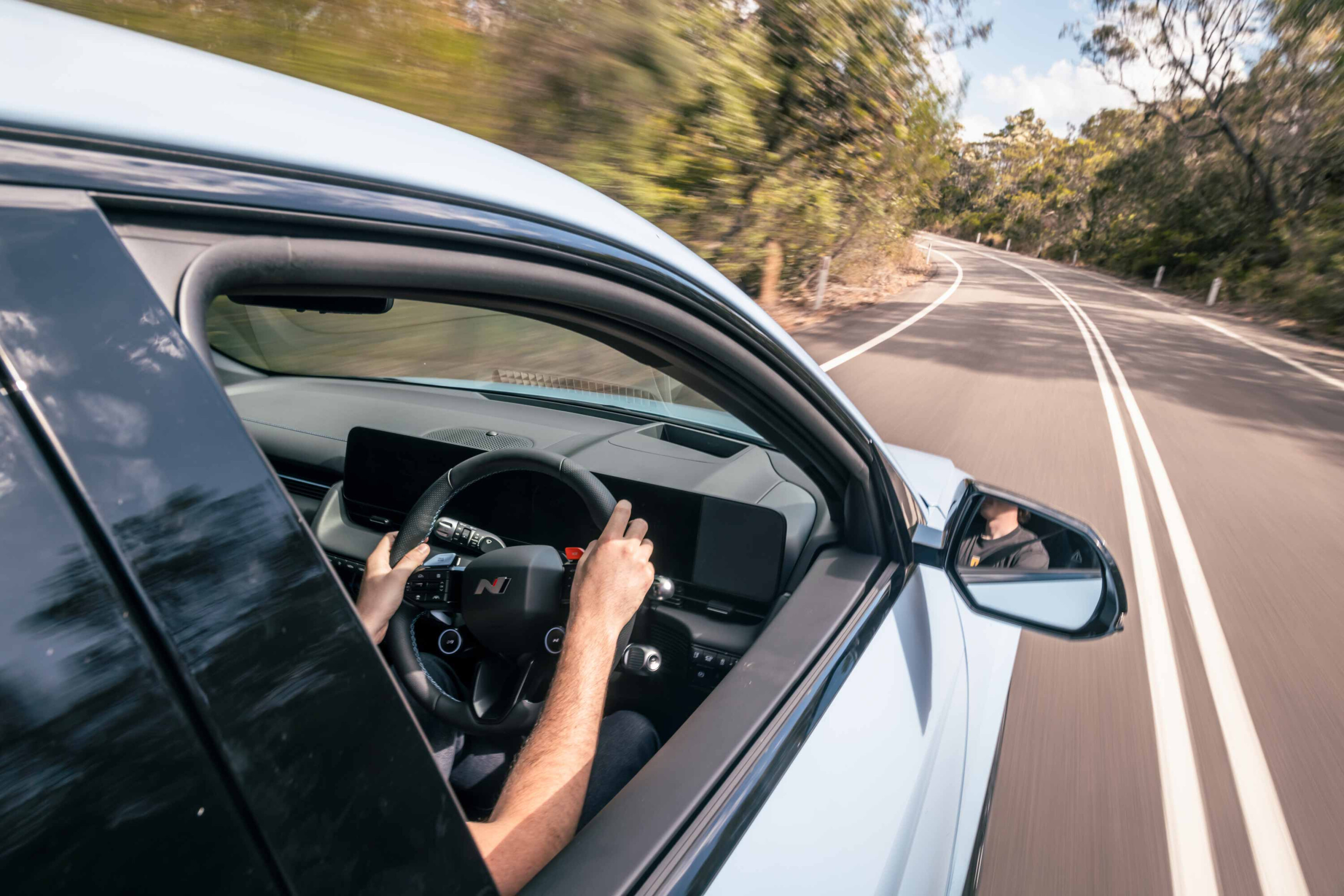
Clearly though, the N team has been hard at work. Coming into a downhill right-hander I plucked ‘second’ using the paddles while turning in on a trailing brake (the left pedal feels fantastic, by the way).
The IONIQ 5 N jerked slightly as the extra regenerative force simulated the drivetrain shock of a DCT downshift. This helpfully unsettled the rear and pointed the car’s nose towards the apex. Waiting a moment for the body to settle on the outside rear, I fire out, just catching the faux limiter at the top of ‘second gear’.
1
It sounds silly as I write it, but the grin on my face and elevated heart rate don’t lie. These are primal reactions that a great sports car can unlock.
Any whingeing about electric cars with silly childish programs is quickly replaced by grins and giggles. That’s what matters for IONIQ 5 N buyers. Plus, if you don’t like them, you can customise these features to your heart’s content, or disable them altogether.
Think of the IONIQ 5 N’s engine fakery as lab-grown meat and you’re on the money. If said meat was served as a steak with no accompaniments, you’d be able to spot the differences: a sinewy texture and slightly different flavour.
But when that meat is ground up into a patty and placed into an artisan burger bun with homemade dill pickle, a perfectly melted slice of cheese and just the right amount of special sauce, it’s a cheeseburger you can’t resist.
The simulated gears also help those used to engines pick the road speed better; all up they make driving the IONIQ 5 N briskly far more satisfying than even a Porsche Taycan.

2
Of course, the IONIQ 5 N is savagely fast. Combining the launch control and ‘N grin boost’ functions that unlock the full 478kW and 770Nm outputs with a fully depressed accelerator is enough to make your vision go blurry.
It’s frankly excessive and enough to hit 100km/h in a claimed 3.4 seconds, so it’s nice that the throttle’s long travel makes it easy to meter out that grunt.
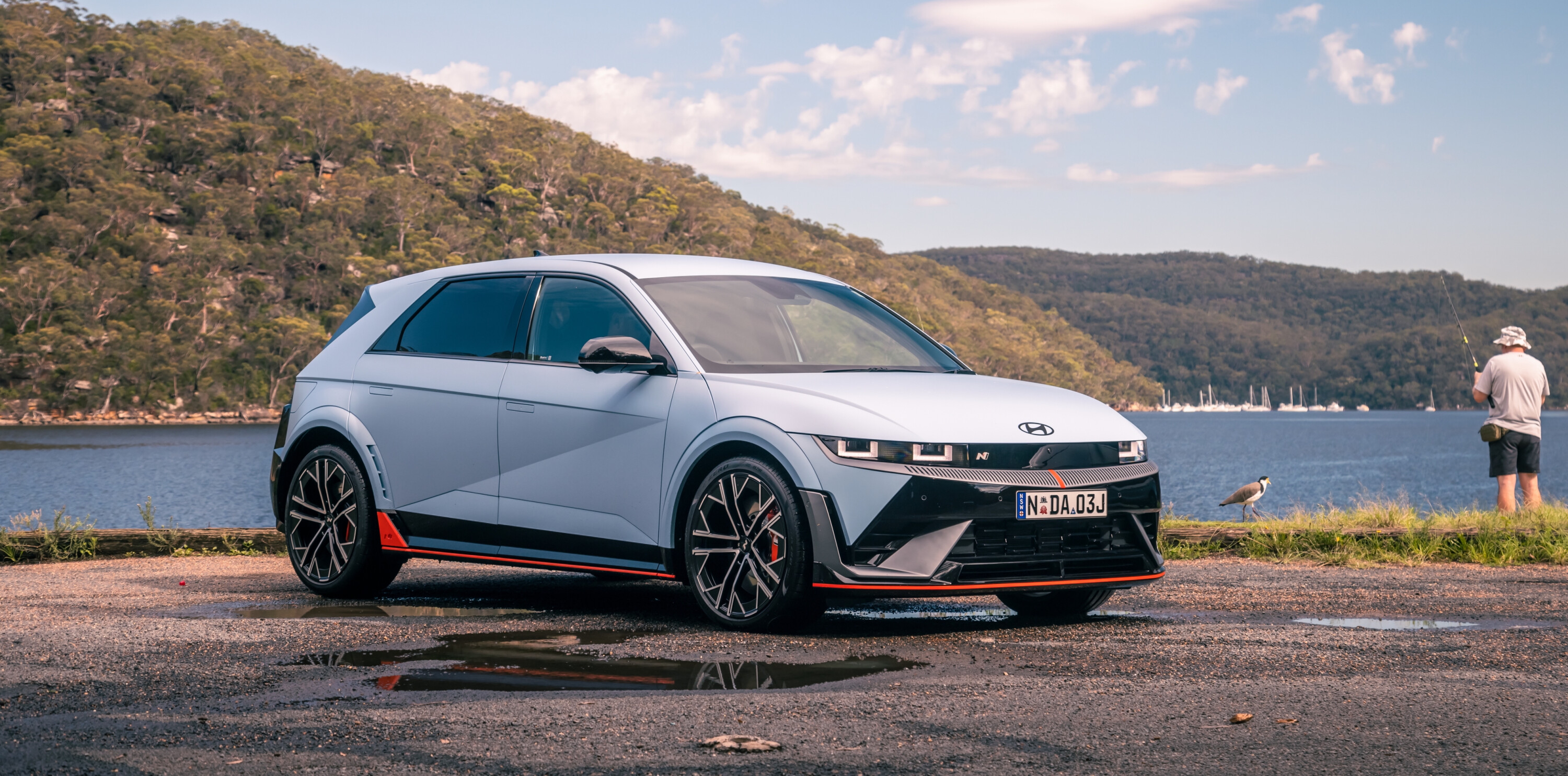
The only real negative is the battery element. You can charge the 84kWh battery up quickly (from 10-80 per cent in 18 minutes) with E-GMP’s 800V electric architecture, though that’s null and void without the right kind of fast charger.
2
When you’re enjoying the IONIQ 5 N, a full charge will realistically get you 350-420km between stops.
And that’s a shame because it may prevent Australian owners from being able to get out and explore the kind of epic backroads that this car would devour with joy. That’s a problem common with any performance-oriented EV, from Born to Taycan, so it’s unfair to knock the IONIQ 5 N down a peg for that.
Things are looking good for Hyundai’s first electric N car; it really does redefine your expectations.
We’ll be exploring the IONIQ 5 N in greater depth to see if we can’t find a chink in its armour (that currently seems rather impermeable), with a road and track drive in March followed by a comparison to put its excellence in context.
MORE
Everything Hyundai
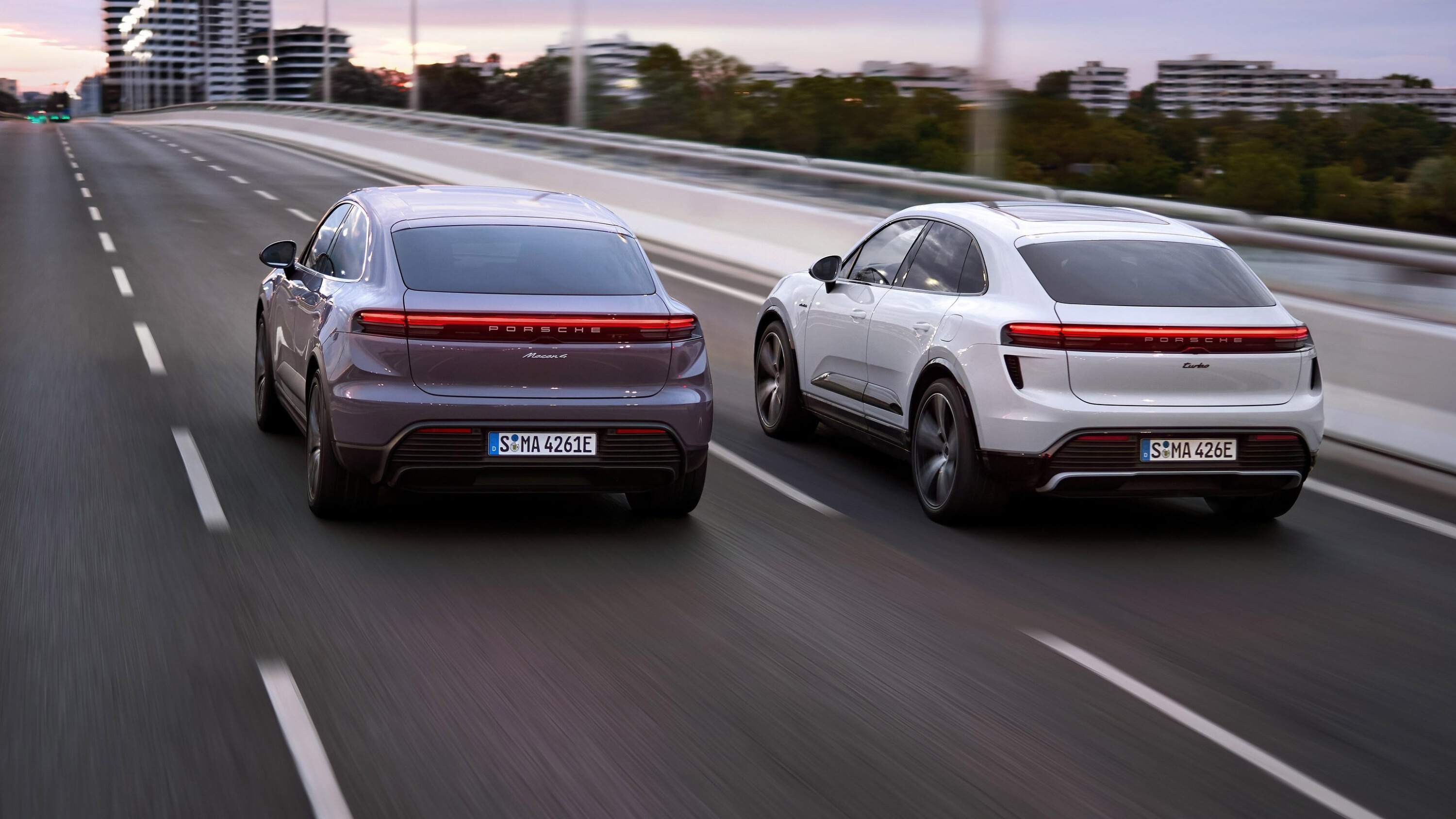
Porsche has taken a bold step with the 2024 Macan, making its strong-selling medium SUV electric only and upping the price by the best part of $40k.
But Porsche hasn’t exactly short-changed Macan owners, the new entry-level Macan 4 is only 24kW shy of the old GTS range-topper, and its 0-100km/h sprint is a brisk 5.2 seconds.
There’s also a bigger footprint – which should mean more cabin space – and it’s capable of charging faster than the expensive Taycan.
For current owners, is the new Macan worth a look? Read on to find out exactly how the new 2024 electric Macan compares to its ’95B’ predecessor.
JUMP AHEAD
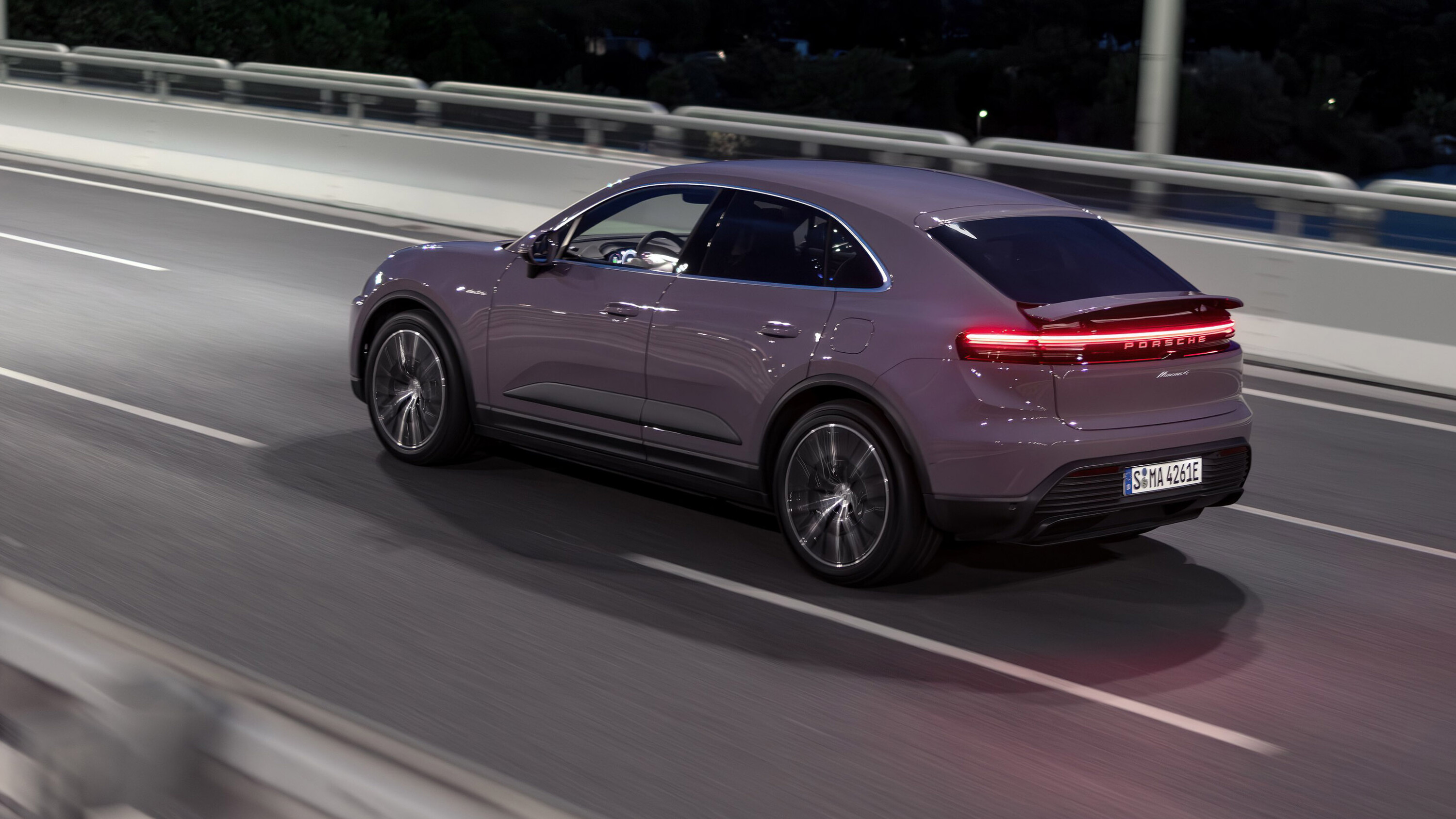
1
Dimensions & boot space
As you’d expect from a new-gen vehicle, the Macan has expanded – though not entirely proportionally.
Exterior dimensions have all grown in a linear fashion, to 4784mm long, 1938mm wide and 1622mm tall. But the single largest increase for the new Macan is its 86mm longer wheelbase – this certainly bodes well for rear seat occupant comfort.
It hasn’t hurt cargo space, either, the new Macan’s boot is bigger and it even packs a ‘frunk’ under the bonnet with 84L of space.
| Dimensions and boot space | ||
|---|---|---|
| Specifications | New Macan | Macan (95B) |
| Length | 4784 mm | 4726 mm |
| Width | 1938 mm | 1927 mm |
| Height | 1622 mm | 1606 mm |
| Wheelbase | 2893 mm | 2807 mm |
| Cargo | 540L + 84L frunk | 453 L |
| Weight | TBC (est. 2200kg) | 1960 kg |
Powertrain and performance
The other expected improvement for a new model is increased outputs and faster acceleration with all-wheel drive maintained.
Porsche has taken this a rather long way, though, with more than twice the torque of the twin-turbo Macan GTS in the new 1130Nm Macan Turbo. Power is up by 45 per cent (in overboost mode) for a one-second faster 0-100km/h sprint.
| Range and performance | ||
|---|---|---|
| Specification | Macan Turbo | Macan GTS (95B) |
| Power | 470 kW | 324 kW |
| Torque | 1130 Nm | 550 Nm |
| E-motor / engine | 1x front axle, 1x rear axle | 2.9 TTV6 |
| 0-100km/h claim | 3.3 seconds | 4.3 seconds |
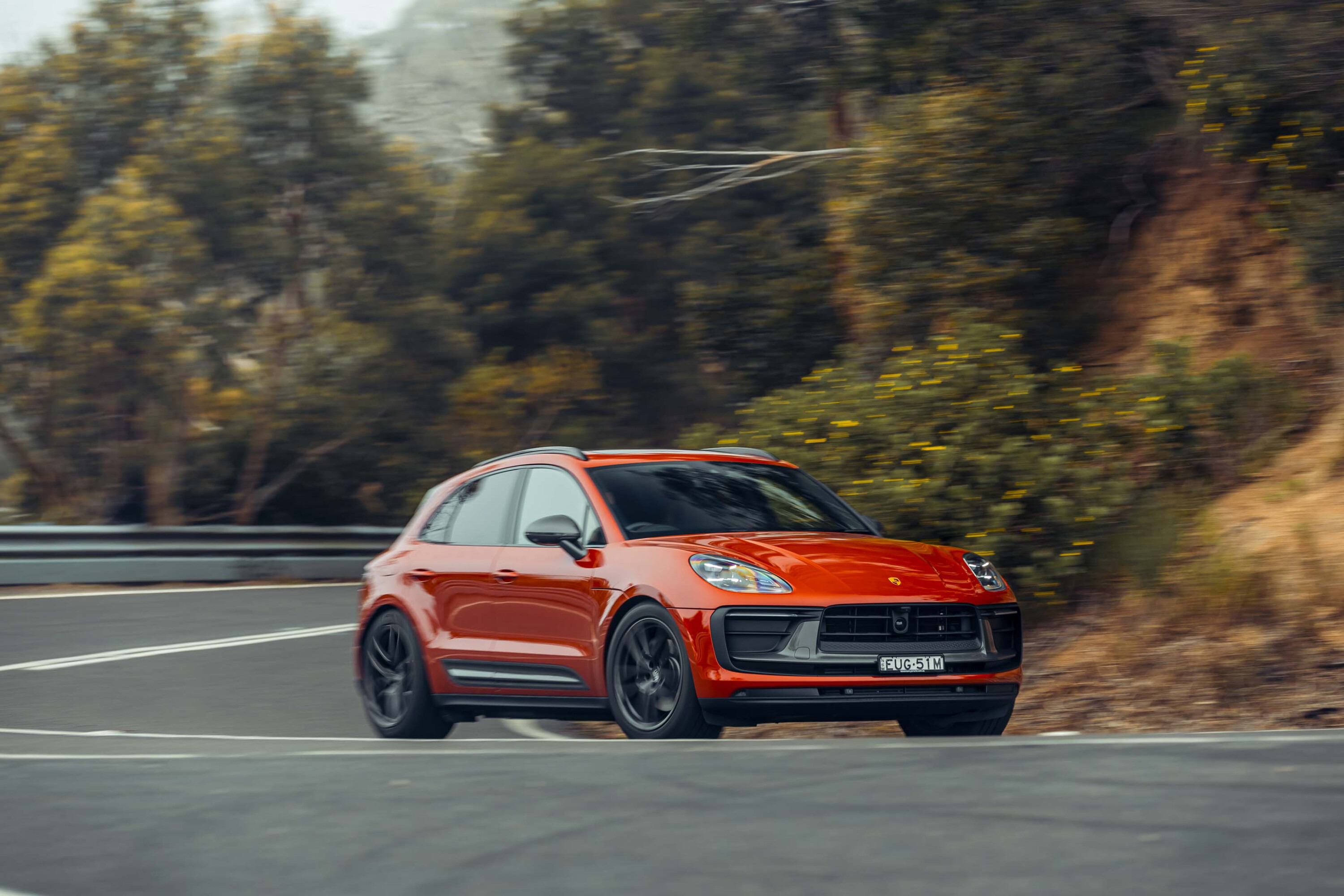
1
The entry-grade Macan 4 benefits from similar improvements, its torque climbing from 400Nm to 650Nm and power to 300kW chopping the ‘base’ Macan’s standard sprint time by 1.2 seconds
| Range and performance | ||
|---|---|---|
| Specification | Macan 4 | Macan (95B) |
| Power | 300 kW | 195 kW |
| Torque | 650 Nm | 400 Nm |
| E-motor / engine | 1x front axle, 1x rear axle | 2.0T I4 |
| 0-100km/h claim | 5.2 seconds | 6.4 seconds |
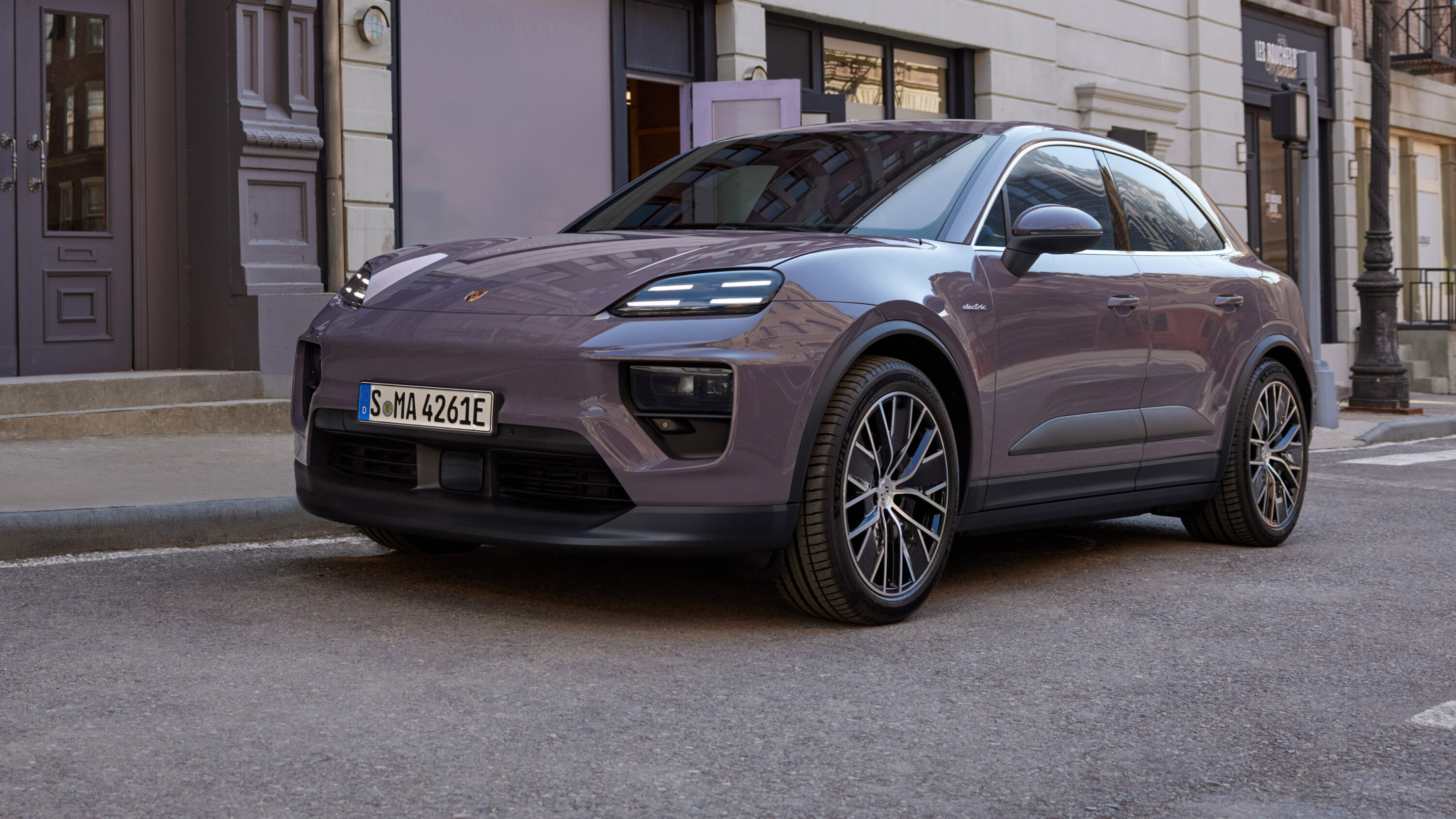
1
In addition to higher power and faster acceleration, Porsche’s new Premium Platform Electric (PPE) underpinnings give the new Macan some other advantages, too.
The new car will be offered with rear-wheel steer and twin-valve adaptive dampers for the first time (tech shared with the larger Cayenne), while Porsche’s refined active adaptive air suspension (PASM) is standard in the Turbo and optional on the Macan 4.
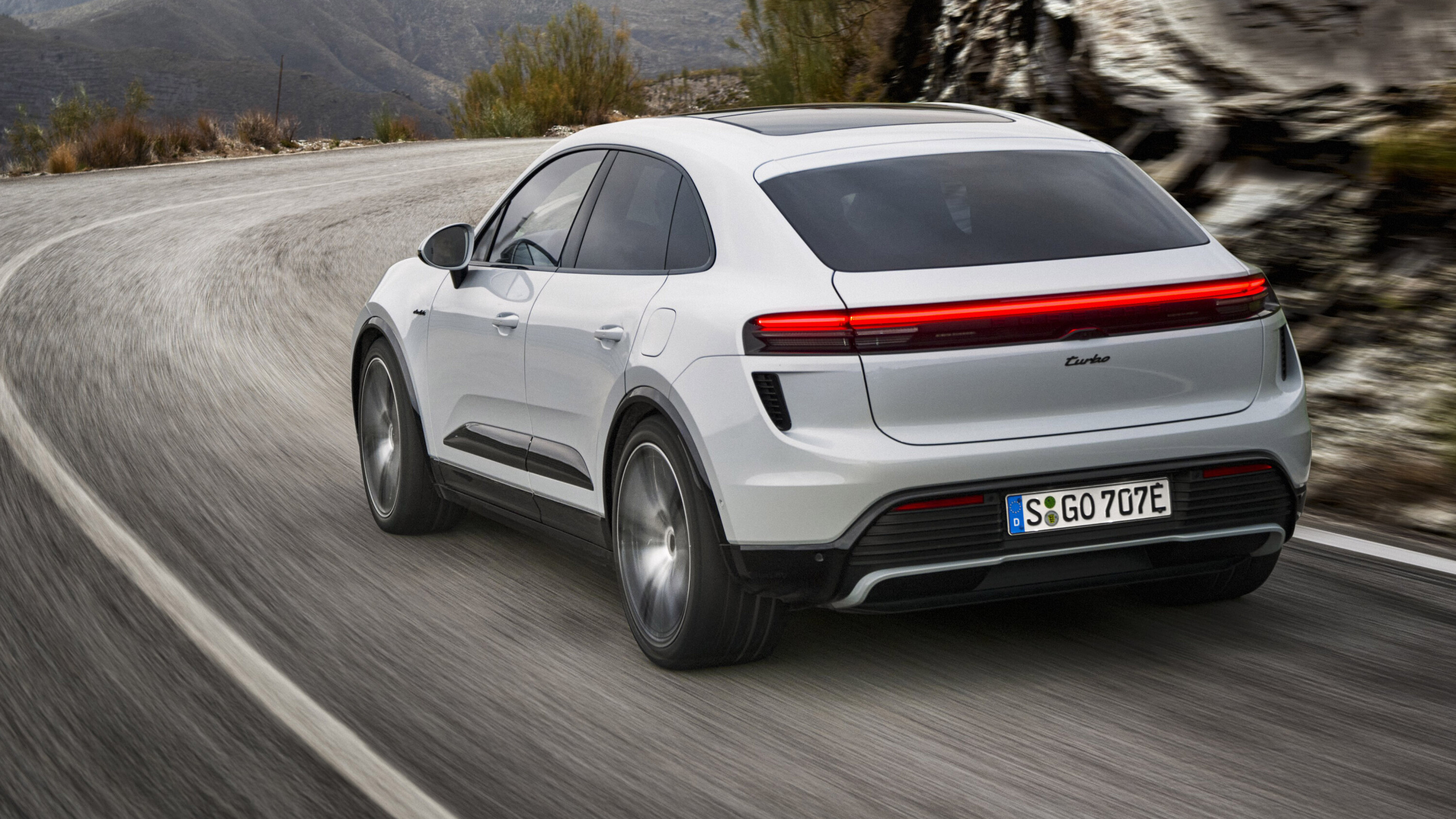
1
- What is a Powertrain or Drivetrain?
- Power vs torque
- Car suspension explained
- Automatic transmissions (‘gearboxes’) explained
- Chassis control systems explained
- Car vs Ute vs SUV: How the vehicle you buy should guide the way you drive
- What is the WLTP emissions and range test?
Comparing new and old Macan’s electricals doesn’t make much sense, but the Taycan gives a good idea of how Porsche’s improved its technology.
Like the Taycan’s ‘J1’ platform, the Macan’s PPE boasts 800-volt electrics and peak 270kW DC charge speed, but the refinements are clear. Despite its bigger 96kWh gross battery, the new Macan charges from 10-80 per cent faster than the Taycan.
An official WLTP driving range figure hasn’t been released for the Macan yet, so we can only speculate what the larger battery and active aerodynamics will achieve for its efficiency.
The Taycan’s 452km figure isn’t hugely impressive; to compete with long-range (and more affordable) vehicles the Macan will need to be able to travel at least 500km – preferably 600km – from a single charge.
| Range and charging | ||
|---|---|---|
| Specification | Macan | Taycan |
| Battery size | 100 kWh (96kWh usable) | 93.4 kWh (83.7 kWh) |
| Listed peak DC rate | 270 kW | 270 kW |
| DC / 10-80% | 21 minues | 22 minutes 30 seconds |
| Driving range | 500-600 km (Whichcar est) | 452km (WLTP) |
1
Interior and cabin design
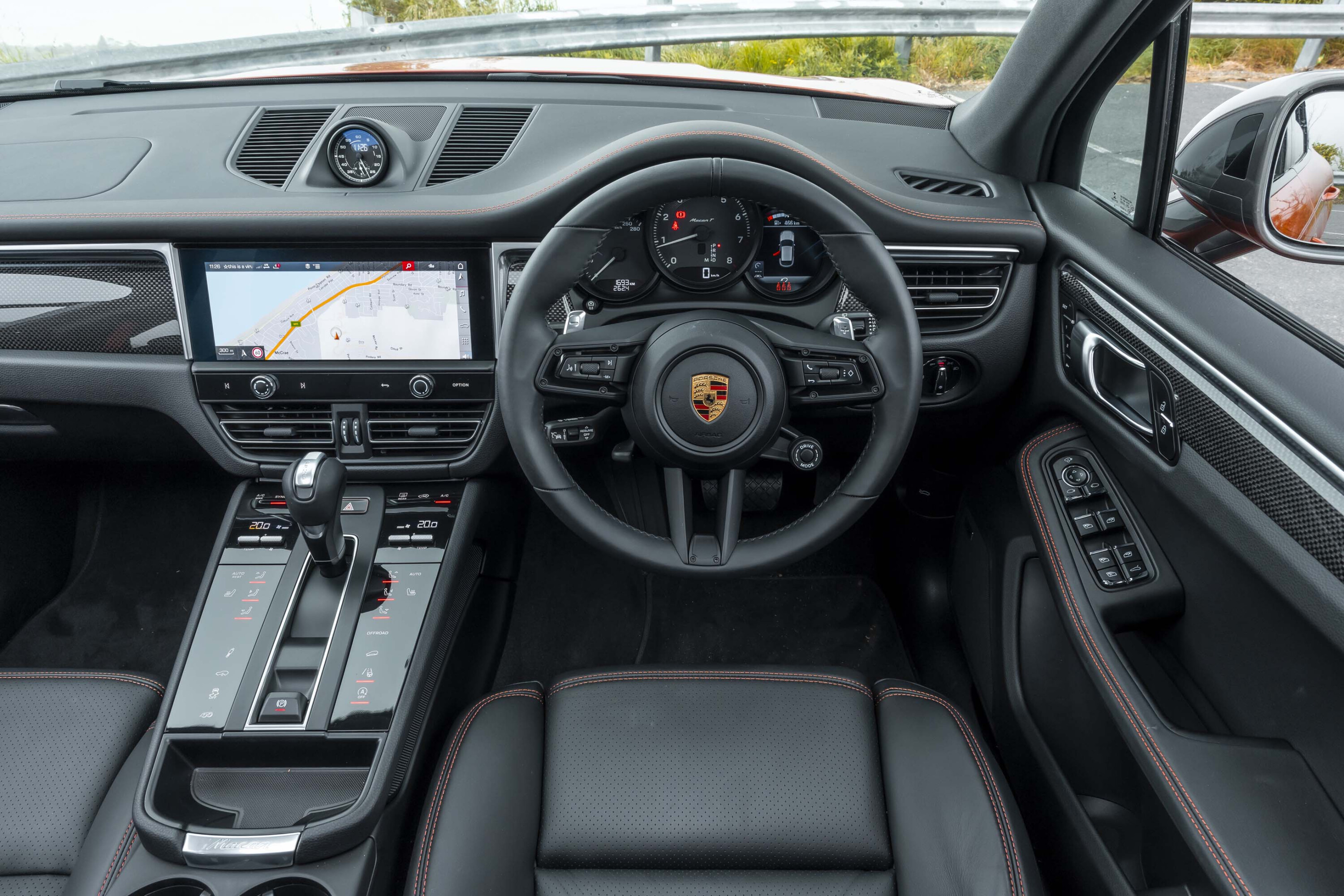
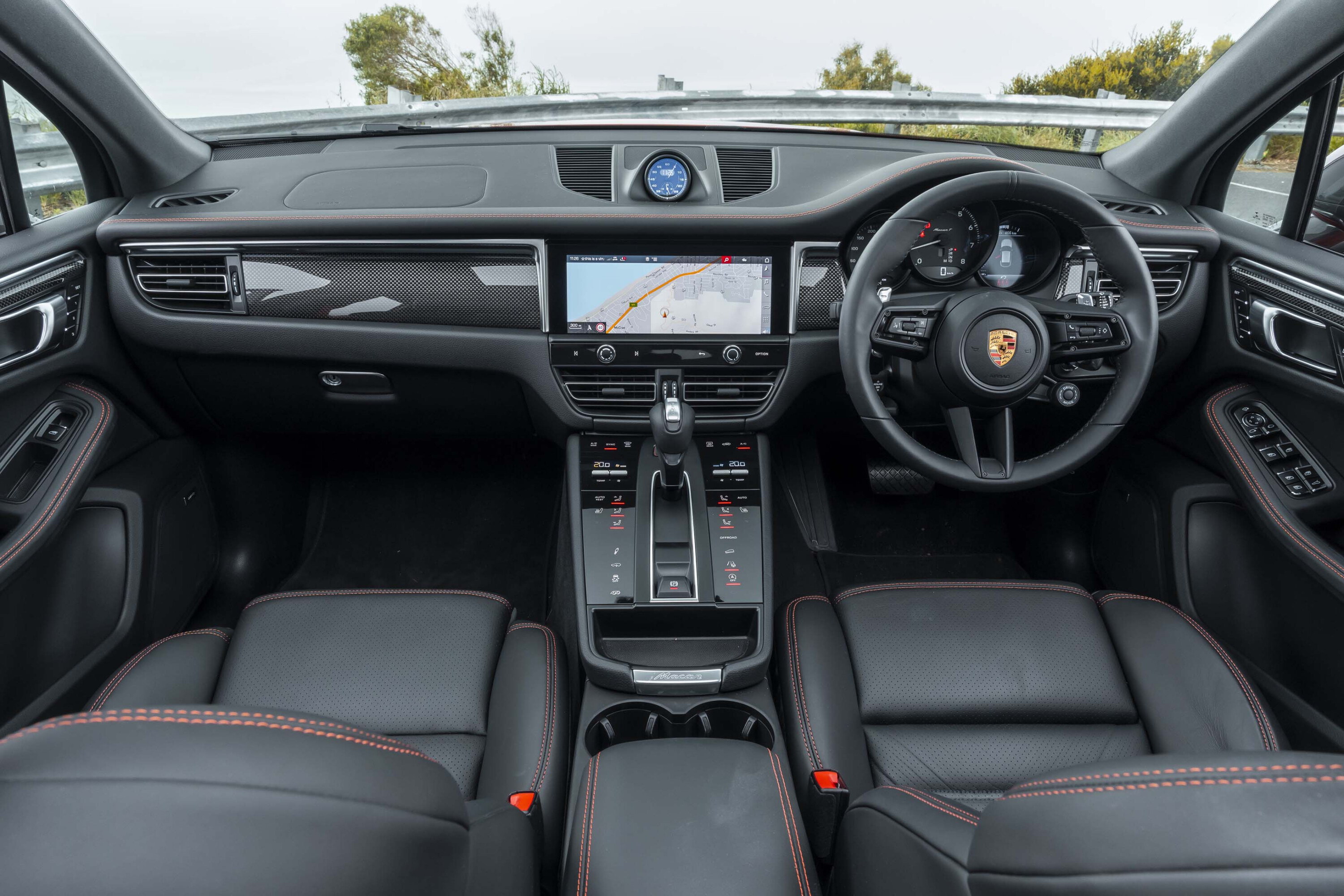
Porsche knows not to mess with a good thing – especially the ergonomic excellence of its timeless interiors.
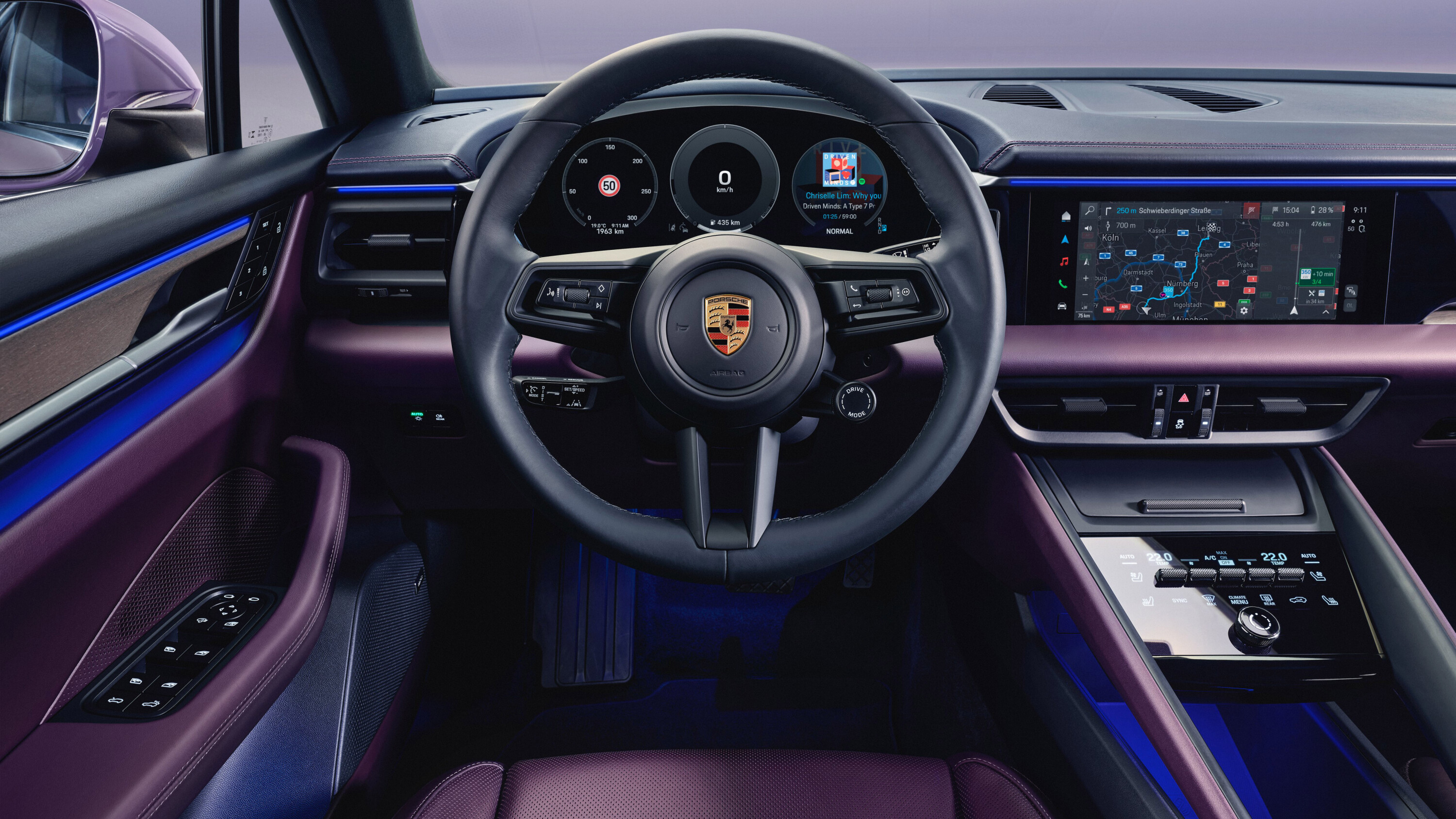
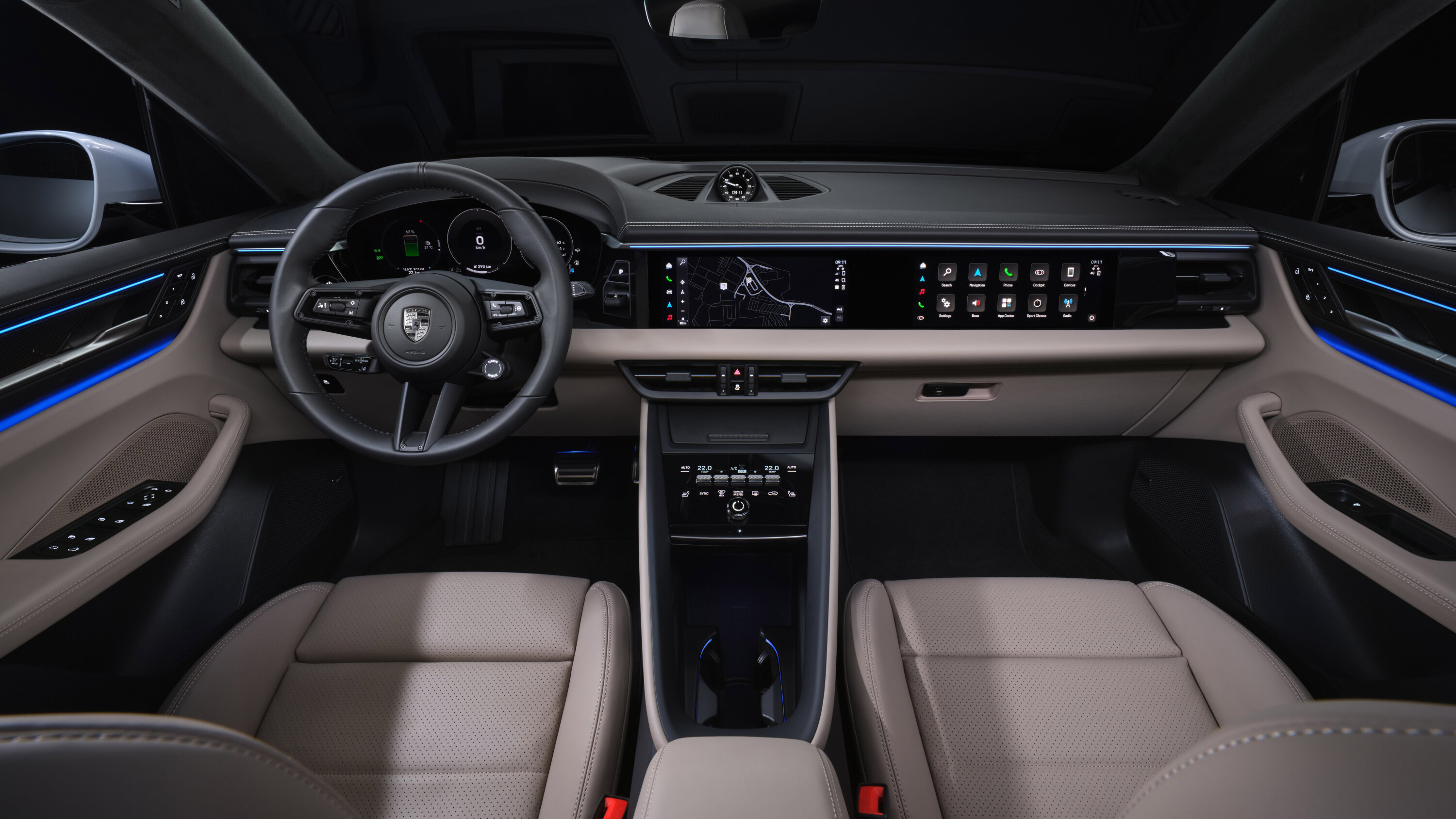
The new Macan borrows some of its technology (thankfully not the digital vent controls) from the Taycan, such as the 12.6-inch curved digital driver’s display and 10.9-inch touchscreen.
The digi dials replace the current Macan’s analogue gauges, and there’s a separate digital panel with physical toggles for controlling the new car’s HVAC system.
1
1
Thankfully, the near-perfect circular steering wheel with physical controls and drive mode dial remains.
Also evident is a commitment to customisation in the new car – the paint-matched purple upholstery with contrast blue ambient lighting is a bold choice, and there will naturally be more subdued options, such as the two-tone cream and black option seen in the Macan Turbo.
Porsche has not confirmed precise figures for head and leg room, but we know the new taller Macan’s front seats are set 28mm lower, and the rears 15mm lower, than the outgoing car.
1
1
Pricing
Everything should be better in the new Macan, with a cutting edge electric drivetrain, more space, new looks, and enhanced suspension performance promised.
Everything except the price that is. The new base Macan 4 costs nearly the same as the old top-spec GTS, and the $188,100 Macan Turbo now matches the larger Cayenne S for list price.
| Variant | Price (before on-road costs) |
|---|---|
| Macan (95B) | $93,900 |
| Macan 4 | $133,700 |
| Macan GTS (95B) | $141,700 |
| Macan Turbo | $188,100 |
Porsche’s customers aren’t short on money, but it’s a gamble to change the price and powertrain recipe of its second best-selling vehicle so drastically – the Macan found 87,355 homes last year globally and the Taycan 40,629.
The Stuttgart-based marque rarely gets it wrong, though. And given the success of Taycan compared to Panamera last year, Porsche customers (at least globally) clearly aren’t scared of going electric.
Snapshot
- Second-gen Porsche Macan Australian pricing and details confirmed!
- Electric SUV initially available in 4 and Turbo trim levels in Oz
- Pricing from $133,700 before on-road costs means it’s $40K dearer
Following today’s leak, Porsche’s first electric SUV has been priced for Australia, with the 2024 Macan 4 arriving later this year from $133,700.
Launching with two variants initially, the all-wheel-drive Macan 4 packs 300kW while the flagship Turbo develops a whopping 470kW and 1130Nm – enough to frighten a Hyundai Ioniq 5 N in a straight line.
This is Porsche’s first outing of the Premium Platform Electric (PPE) underpinnings that boast 800-volt capability, twin-valve dampers, rear-wheel steer, and a 96kWh usable battery pack in the Macan.
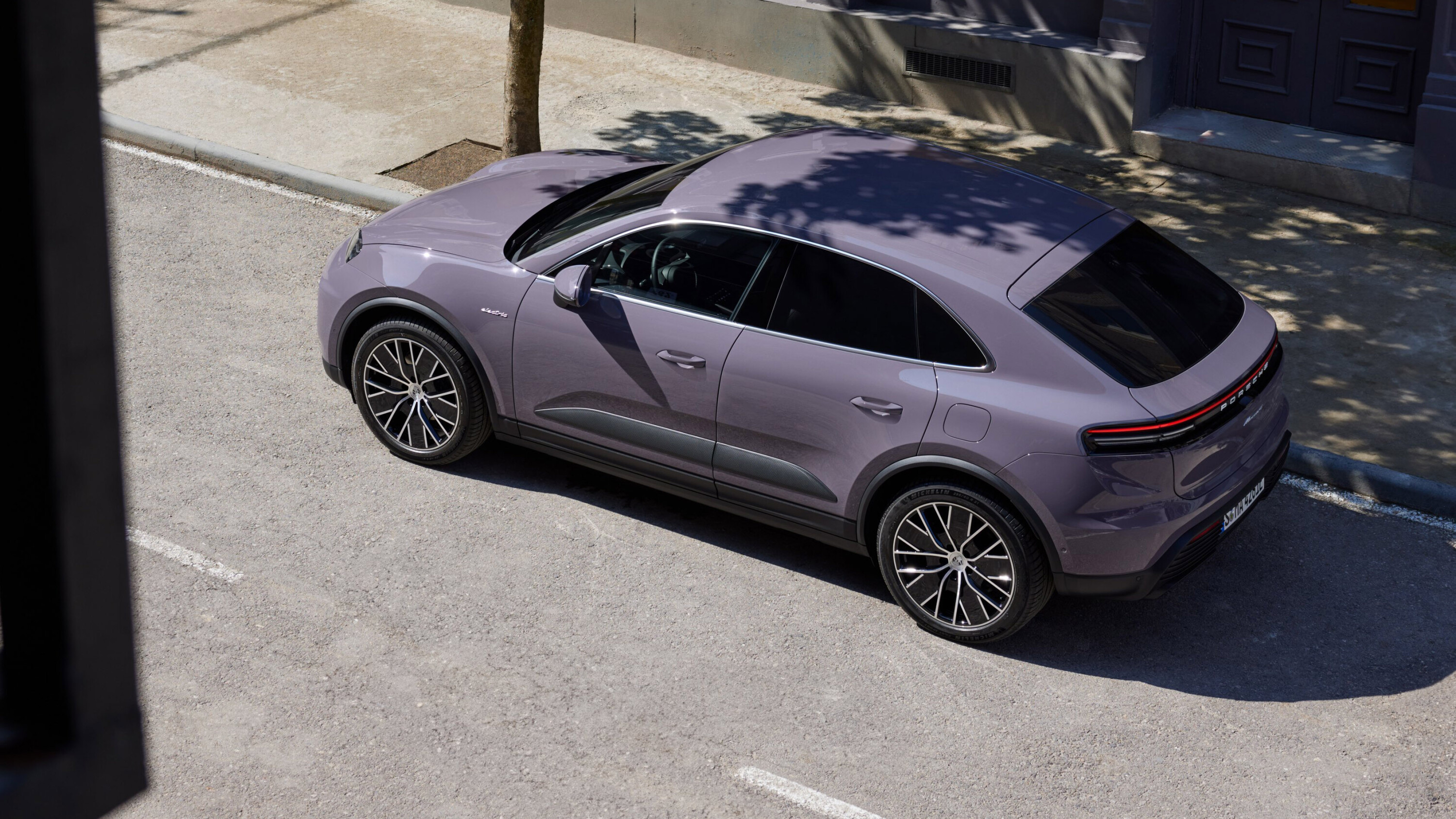
Although it’s distinctively Porsche, the larger second-gen electric Macan has a few new details including Taycan-inspired lighting signatures and a rounder rear end.
Inside, Porsche has implemented a familiar layout and moved back to physical controls for the cabin vents – perhaps in response to the less-than-rosy reception of Taycan’s digi-vents.
“We are taking the Macan to a completely new level – with exceptional E-Performance, the new Driver Experience, and a very impressive design,” said Oliver Blume, Chairman of the Executive Board of Porsche at the new Macan’s debut in Singapore.
Matching the zero-emission nature of the new Macan, Porsche will build the BMW iX3 and Mercedes-Benz EQC rival in a ‘carbon neutral way’ at its Leipzig manufacturing plant.
JUMP AHEAD
- 2024 Porsche Macan pricing
- 2024 Porsche Macan features
- Dimensions
- Powertrain, batteries, and driving range
- Safety
- Warranty and servicing
- Availability
1
2024 Porsche Macan pricing
The new electric Macan is, expectedly, a lot dearer to get into. The entry-level Macan 4 costs $39,900 more than the current unsuffixed model.
The Turbo, meanwhile, is a whopping $46,400 dearer than the ICE GTS. However, both are meaningfully more rapid; it’s hard to consider Porsche’s new Macan as a direct replacement for the old medium-sized SUV in price or performance terms.
Click here for an even clearer picture of how the new Macan compares to its predecessor.
Prices exclude on-road costs
| Variant | Price (before on-road costs) |
|---|---|
| Macan 4 | $133,700 |
| Macan Turbo | $188,100 |
1
2024 Porsche Macan features
Porsche is yet to confirm exact Australian specifications. However, we know a few details about the brand’s new EV.
Inside it features a 12.6-inch curved digital driver’s display, and there’s a 10.9-inch infotainment touchscreen in the centre.
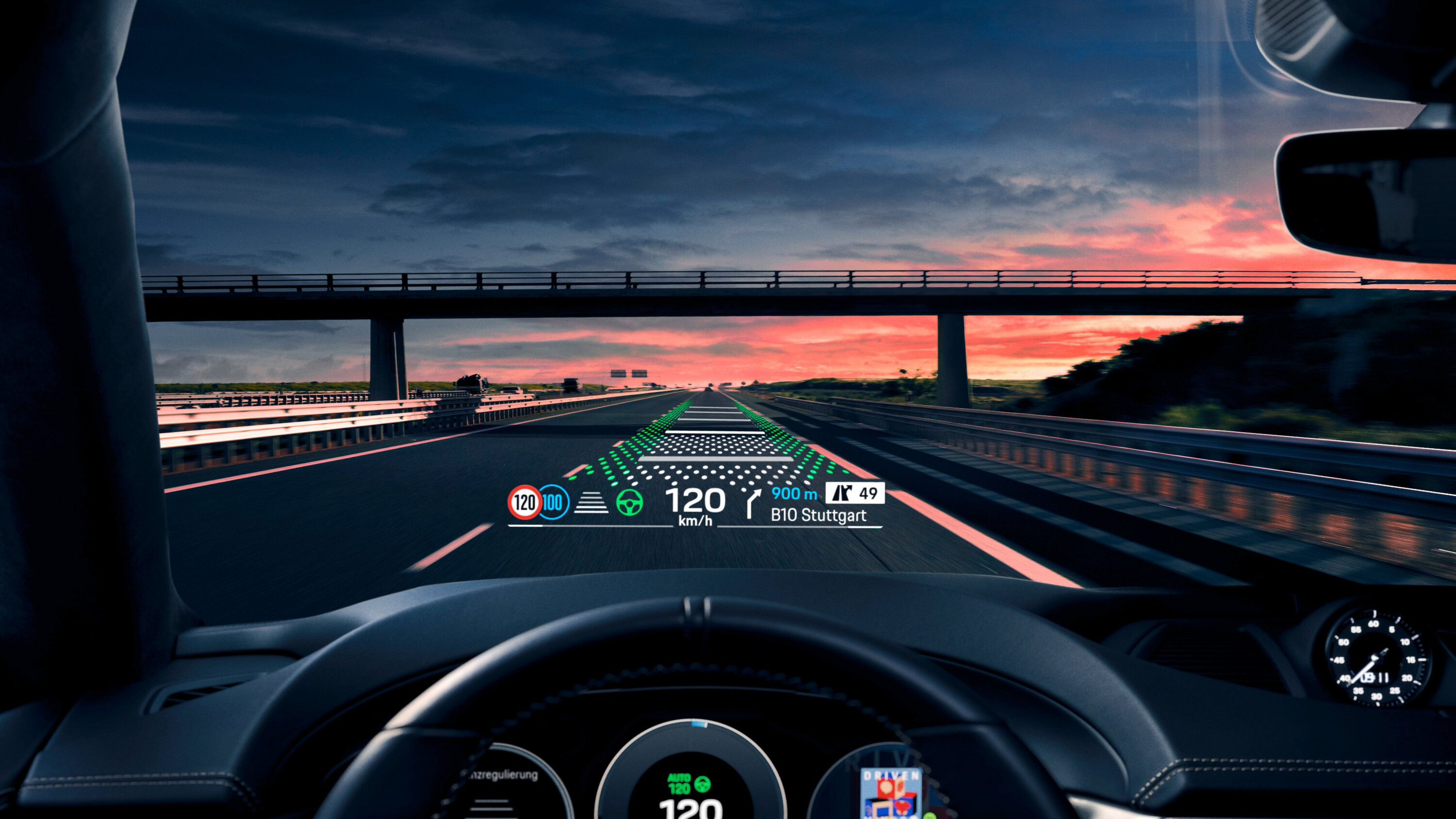
A first for the Macan nameplate is an optional 10.9-inch passenger display and augmented reality head-up display for the driver.
1
1
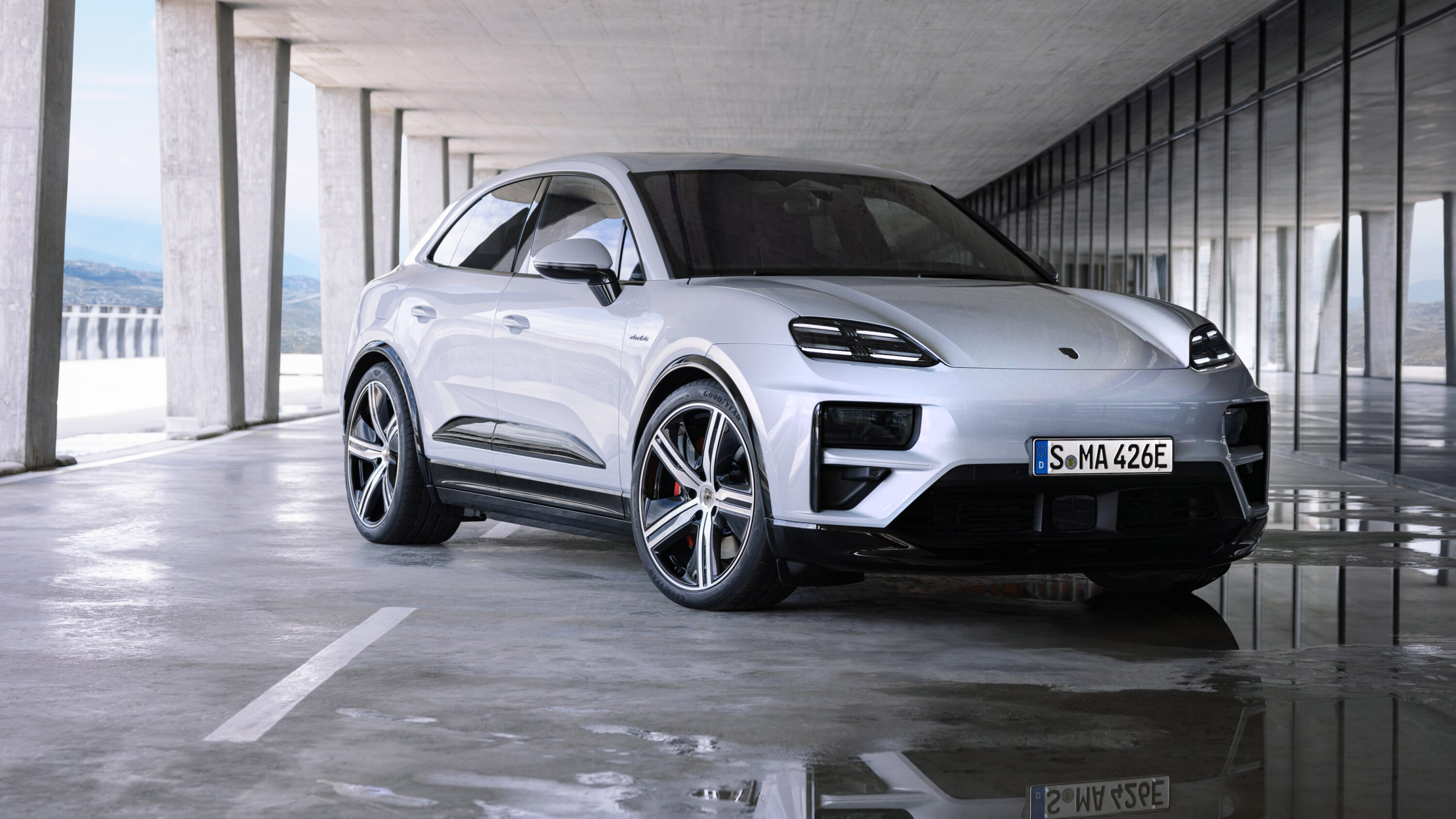
The dearer Turbo gets standard (all optional on the Macan 4) 21-inch alloy wheels (22s are optional), Porsche Active Suspension Management (PASM, or air suspension), power steering plus, and 14-way power adjust ‘comfort’ seats.
Turbo exclusives include a panoramic roof, Porsche Electric Sport Sound, Sport Chrono package, and four-zone climate control.
1
Dimensions
The new Macan has grown up, measuring 4784mm long, 1938mm wide, 1622mm tall, and riding on a 2893mm wheelbase.
It’s bigger in every metric than the car it replaces (Porsche hasn’t quoted an official weight figure yet but expect it to be around 2200kg) and that means more cabin space.
The front seats are 28mm lower and the rear 15mm lower with enhanced legroom. Cargo carrying is up, too, with 540L of boot space (87L more) and the bonus of an 84L ‘frunk’ under the bonnet.
It’s also capable of towing a braked load weighing up to 2000kg.
1
Powertrain, battery, and driving range
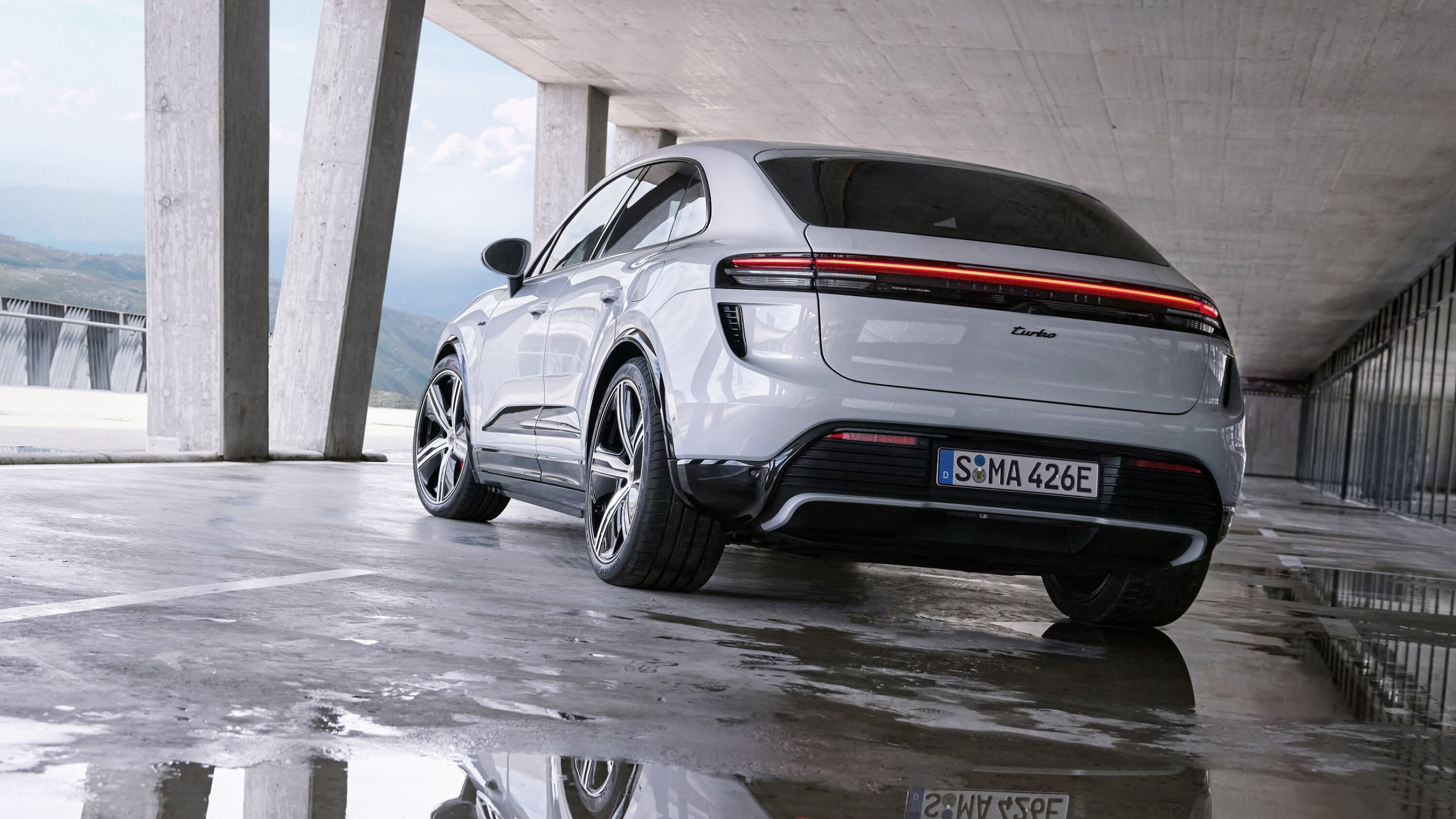
It’s well accepted that making an electric vehicle powerful isn’t particularly hard – that said, peak outputs of 470kW and 1130Nm in the twin-motor Macan Turbo are stunningly high.
Porsche claims a 0-100km/h sprint of just 3.3 seconds, and a top speed of 260km/h for the Turbo.
The Macan 4 is no slouch, with its two motors you’ll experience 300kW and 650Nm in overboost mode, a 0-100km/h time of 5.2 seconds, and 220km/h top speed.
1
The brand says the Macan’s permanently-excited ‘PSM’ electric motors are particularly efficient and ‘enable optimum reproducibility’ of peak power.
Putting the grunt to the road is Porsche Torque Vectoring Plus, an electronically locking rear differential.
Porsche also describes the Macan’s ‘Integrated Power Box’ (IPB) that allies the high-voltage heater, DC/DC converter and onboard AC charger to optimise efficiency.
1
Between the axles is a 96kWh usable (100kWh gross) battery pack.
Porsche hasn’t published a final WLTP driving range yet, but a drag coefficient of 0.25 and active aero (including spoiler, air curtains, and other features) should see it achieve over 550km in the test.
It’ll charge quickly, too, thanks to the 800V architecture’s ability to take DC electricity on board at 270kW.
Porsche says 10-80 per cent at ultra-rapid charging locations will take 21 minutes, and the clever architecture can speed charging up at 400V DC locations to 135kW by effectively splitting the single 800V battery into two items.
The Macan will accept up to 11kW AC from a home wallbox.
1
Safety
The Porsche Macan is yet to be evaluated by Euro NCAP or ANCAP.
Porsche will include adaptive cruise control, lane-trace assist, autonomous emergency braking, blind-spot monitoring, a 360-degree camera, side airbags (and more) on all Australian-delivered electric Macans.
1
Availability
The second-gen electric Porsche Macan will arrive in Australia in Macan 4 and Macan Turbo guises in late 2024.
Model on test: GT-Line diesel AWD
Kia is absolutely sauntering right now, buoyed by a series of well-received new cars.
After the fillip from the Wheels COTY-winning EV6 and the excellent seven-seat EV9, the Korean giant has turned its attention to one of its volume favourites.
Late last year we tested the run-out version of its Sorento seven-seat SUV in a group test and it put some comprehensive manners on the rest of the bunch.
As such, there must be an element of hearts sinking into boots amid rival manufacturers as Kia whips the wraps off its Sorento PE. That’s ‘Product Enhancement’ in Kia-speak, but most of us would call it a mid-life facelift.
Before we wade into what’s changed, it’s perhaps worth positioning the Sorento within Kia’s huge and growing range of SUVs.
The Korean marque’s rapid push to electrification is well documented, with the EV6 and newly arrived EV9 spearheading the charge. Following later this year will be the baby Russian doll version of the EV9, in the Minecraft-rendered shape of the EV5.
But, let’s face it, not everyone’s after an EV, and Kia will still sell you (in ascending size) a Stonic, a Seltos, a Sportage or a Sorento. The seven-seat Sorento MQ4 generation only debuted in 2020, so it’s about due for a facelift.
Still, maybe it’s a case of ask and you shall receive. In our sub-$80k large SUV comparison, the Sorento didn’t turn in a faultless performance.
As Dylan Campbell noted, “an abundance of black gives it a dark vibe, while its 10.25-inch infotainment display now seems a bit small for the richest grade. The menu graphics look a bit last-decade and the lack of USB-C outlets further betray its age – as does wired Apple CarPlay and Android Auto.”
Kia fixed all of that in this latest update to the Sorento and had it left the changes to that, it would, in all likelihood, have been enough to see this version of the car into its dotage at or near the top of the class. Unwilling to gamble on near or near enough, Kia went further. Quite considerably further.
1
What hasn’t changed are the basic bones of the vehicle. Or indeed, what you’ll find beneath the bonnets.
The 3.5-litre petrol front-wheel drive variant and the all-wheel drive 2.2-litre diesel model provides the power for the vast majority of Sorento customers and these come in four trim grades: S, Sport, Sport+ and GT-Line, the latter of which mops up over 30 percent of all sales. Kia expects the diesel engines to account for fully 80 percent of all Sorento registrations. So much for diesel being on the skids.
On top of that, there are hybrid and plug-in hybrid versions of the Sorento also offered – albeit solely in GT-Line trim – and they’ll be arriving on our shores later in 2024, so we’ll set those electrified models aside for the purposes of this review.
| 2024 Kia Sorento fuel economy | ||
|---|---|---|
| 3.5-litre petrol V6 FWD | 9.7L/100km | 222g/km |
| 2.2-litre diesel AWD | 6.1L/100km | 159g/km |
1
For 2024, Kia has targeted five key areas
It clearly needed to refresh the interior design, but it has also updated the exterior detailing to distinguish it from its predecessor, it has included additional comfort and convenience features, it has boosted safety and it has also improved the vehicle dynamics.
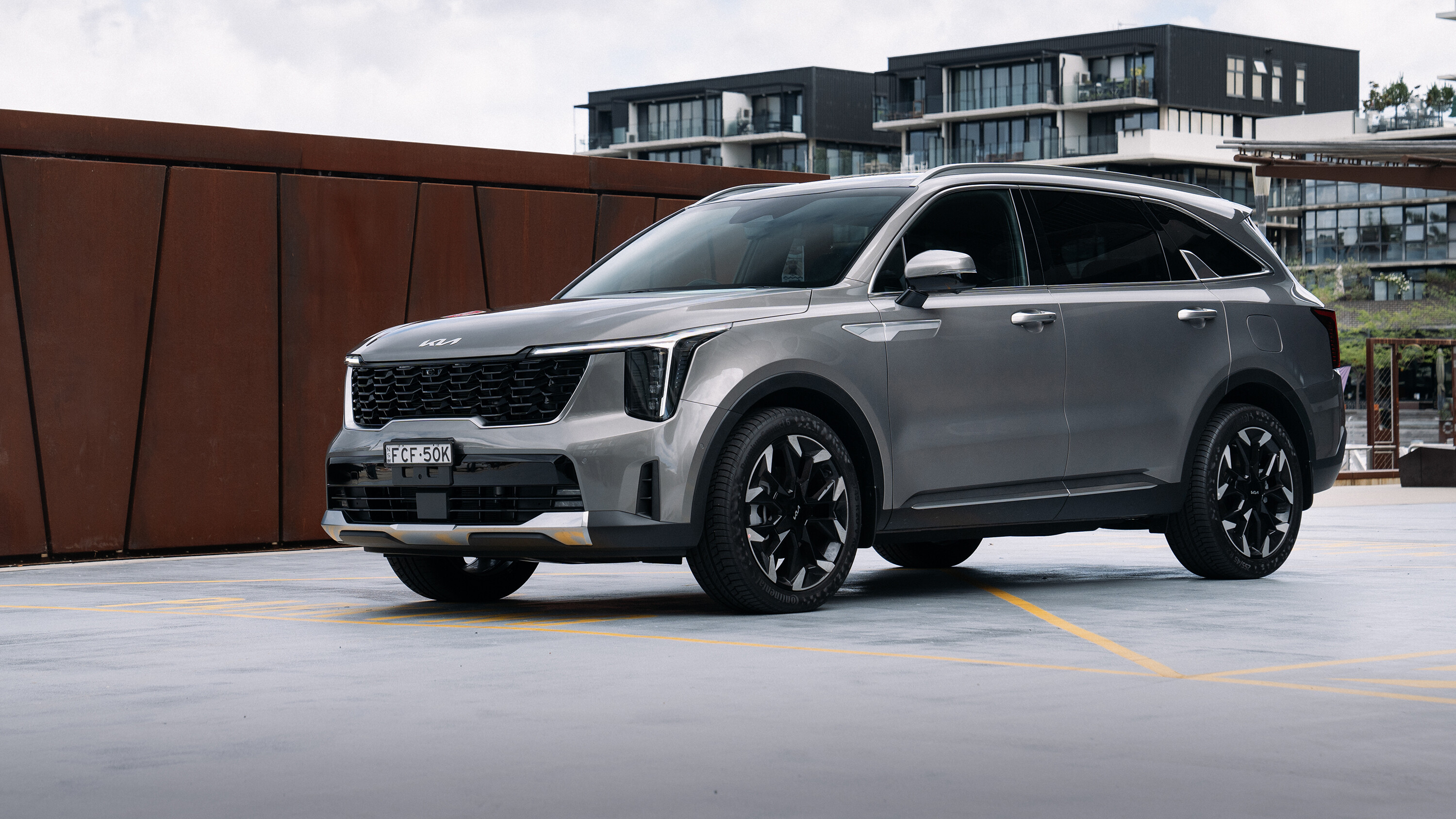
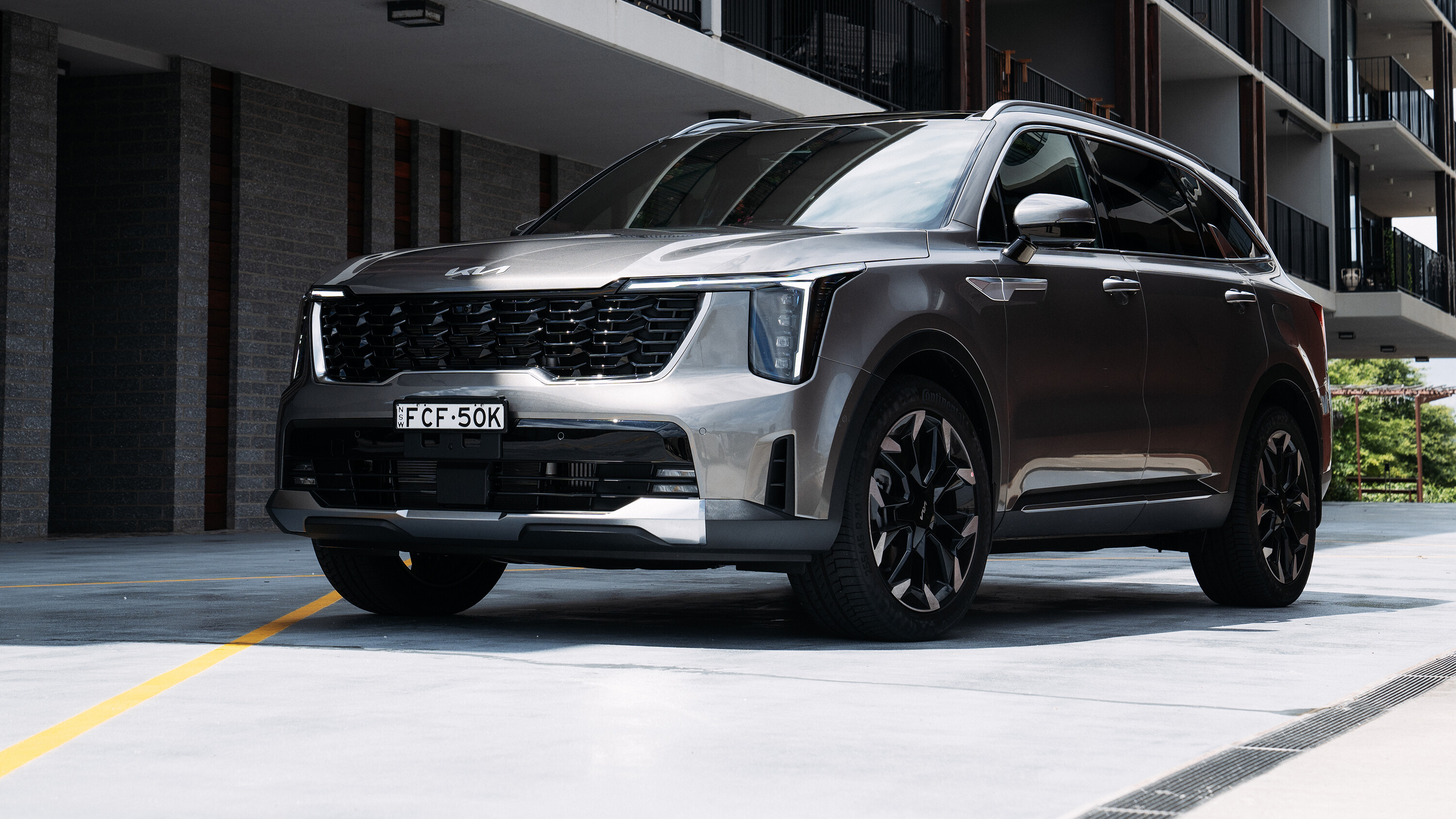
The styling changes are possibly the only real area of contention. The pre-facelift Sorento was an undoubted looker but, to me, the preoccupation with grafting elements of the EV9’s front end onto the Sorento has given it a pinched, squinty front end that’s neither one thing nor the other.

1
The ‘face’ of the car has vanished, and the previously rather svelte Peter Schreyer tiger-nose grille has enlarged to a bit of a bottom-feeder maw.
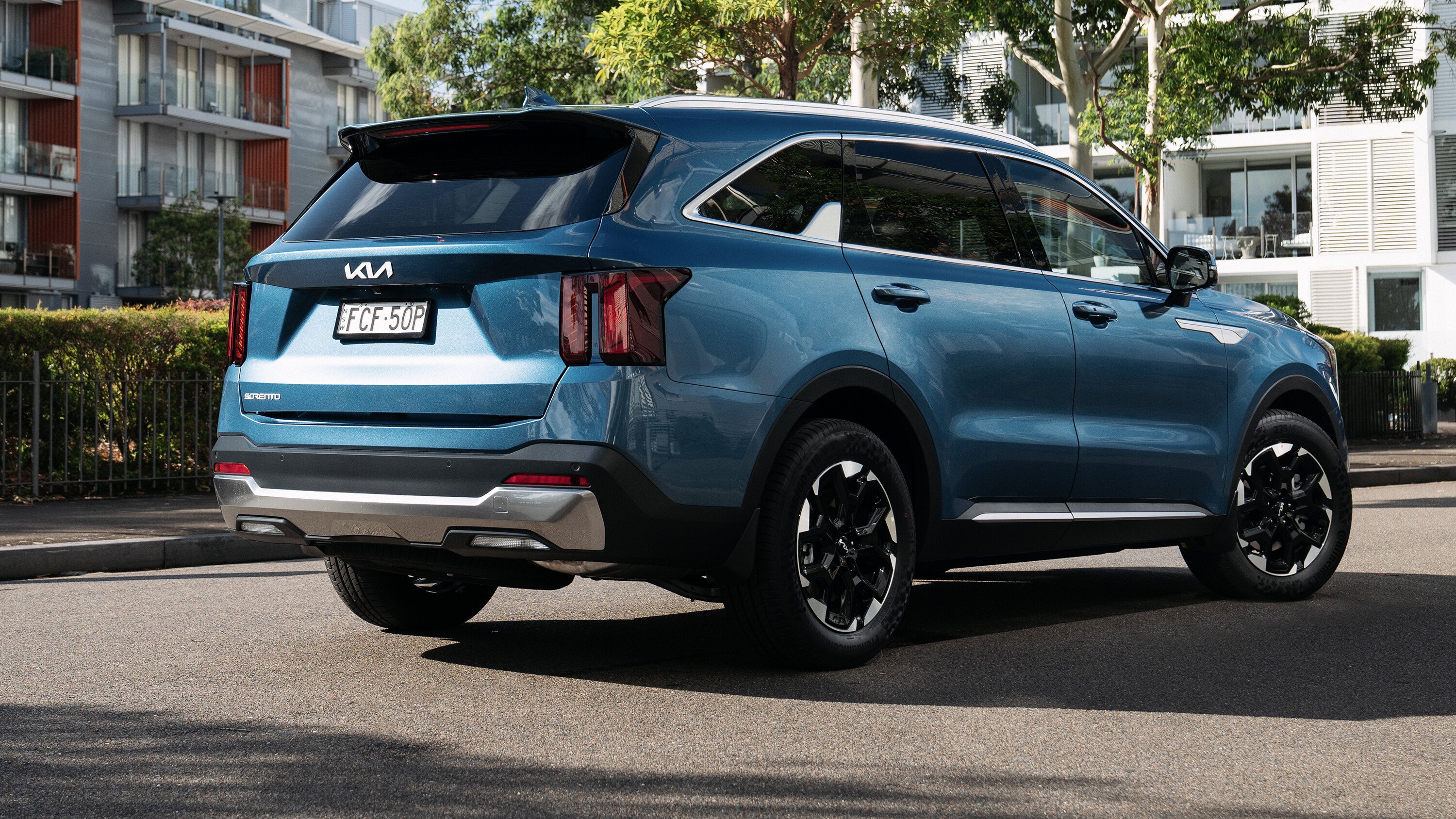
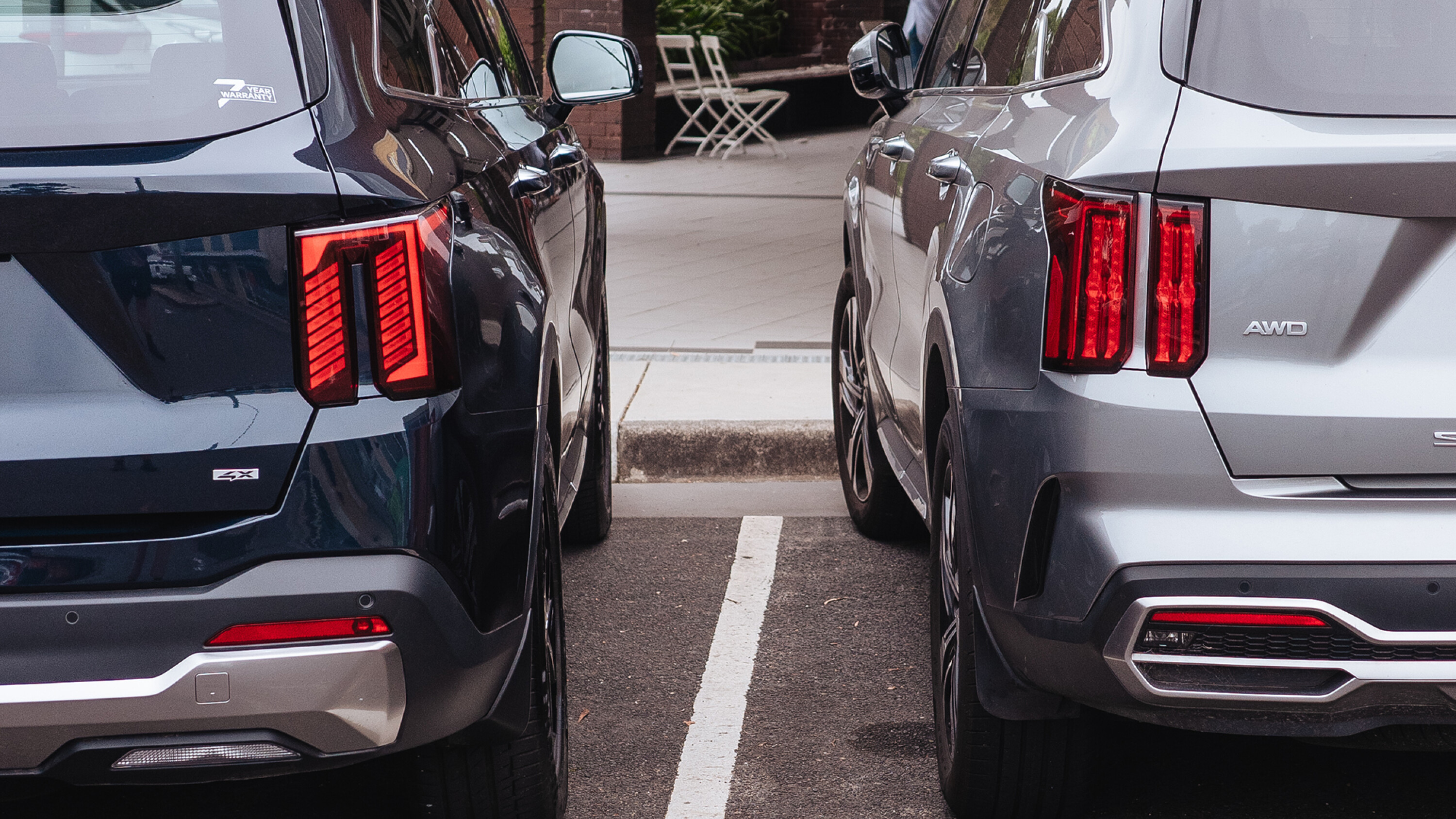
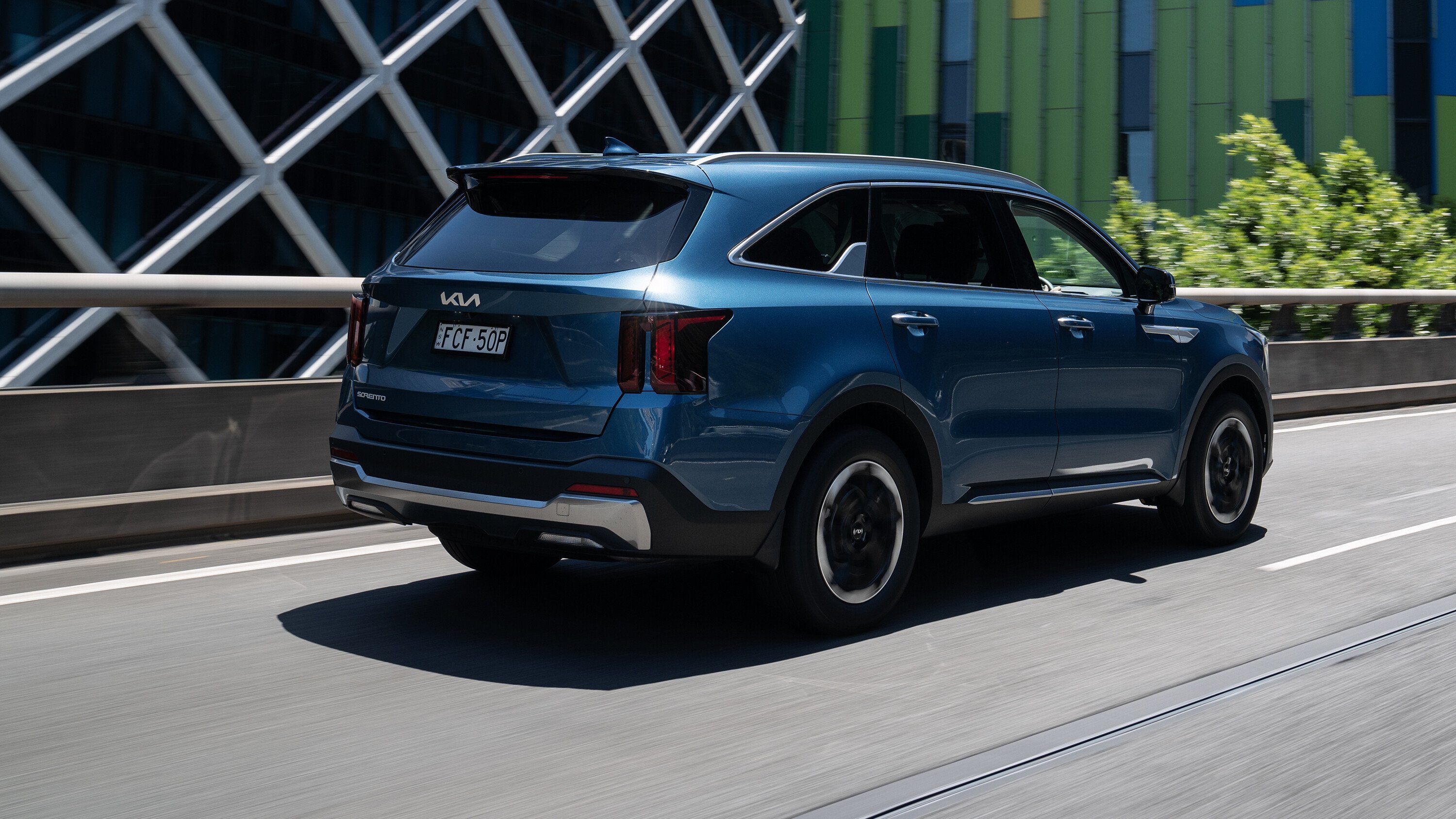
The rear end treatment is a good deal slicker, with neater rear lamps and a more rugged look to the bumper assembly and skid plate.
Two new paint finishes, Volcanic Sand Brown and Cityscape Green, have been added to the colour palette, bringing the exterior colour choices to a total of nine.
Unfortunately there’s only one no-cost paint finish, Clear White. You’ll have to pay extra for Snow White Pearl, Mineral Blue, Steel Grey, Gravity Blue, Silky Grey and Aurora Black Pearl.
1
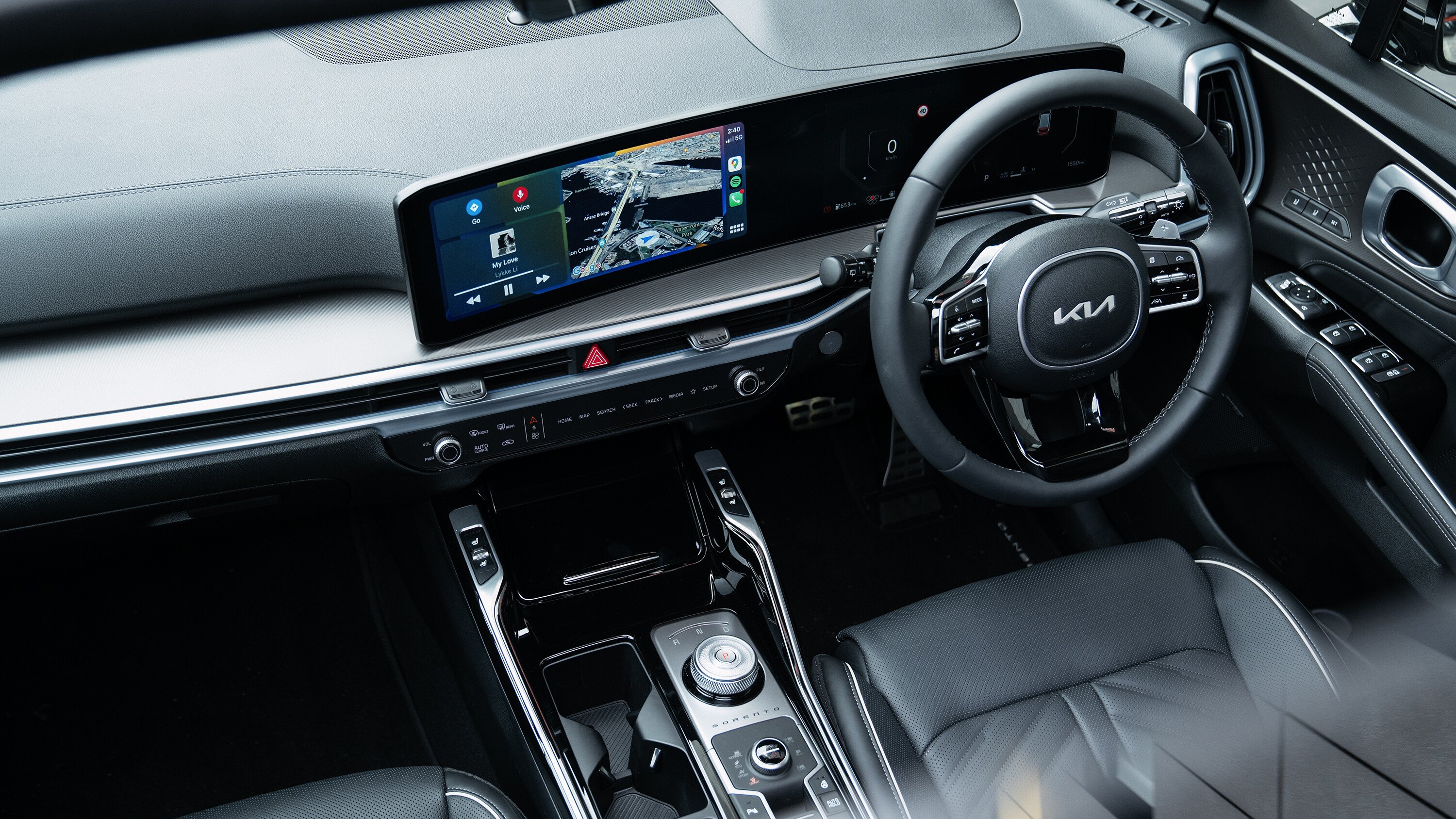
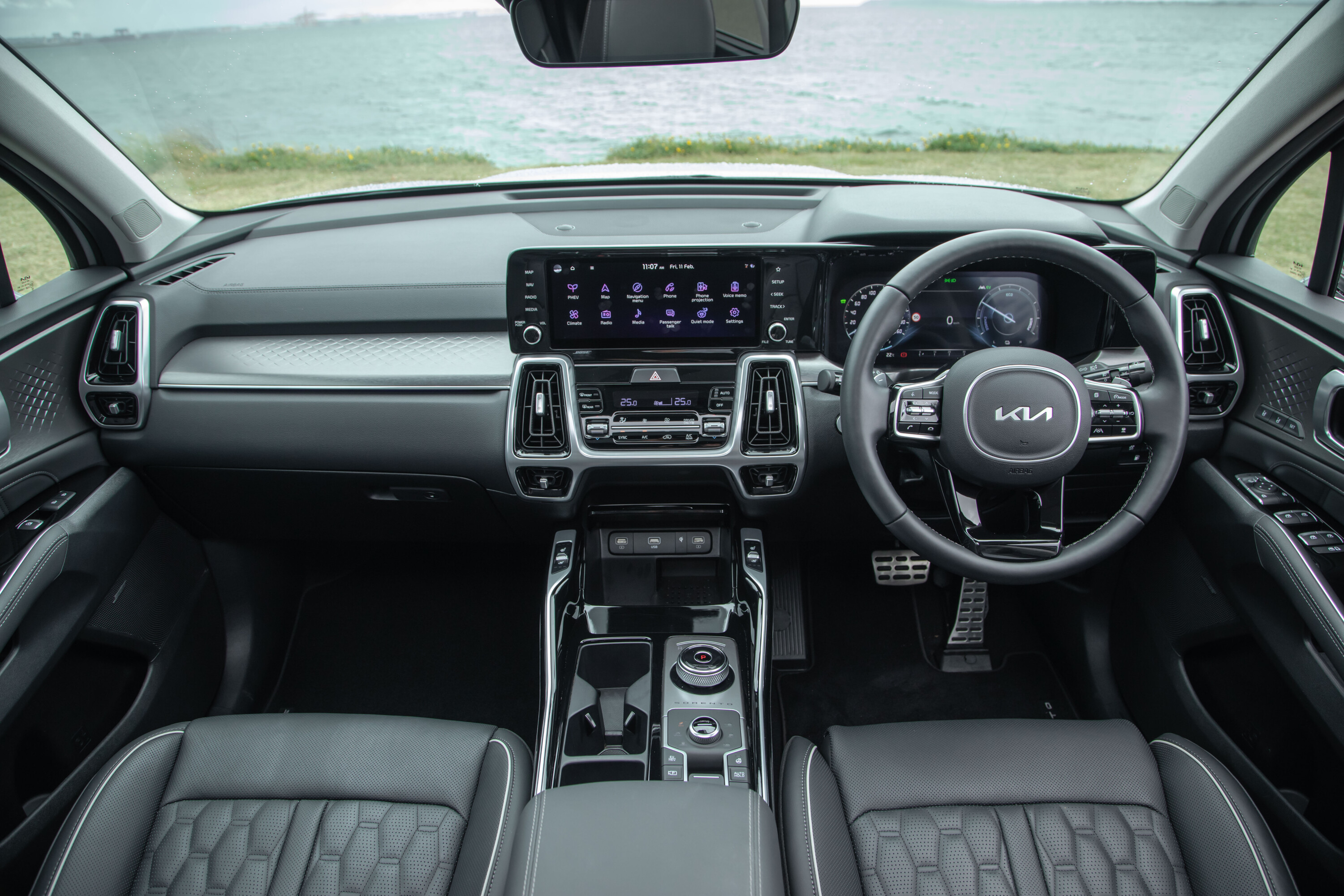
Jump inside the cabin and the updates are considerably more cohesive.
Much of the design influence hails from the EV6, with that car’s integrated curved display being introduced to first the Sportage and now the Sorento.
It not only comes with wireless Apple CarPlay and Android Auto, at last, but also features Kia’s latest iteration of the Connected Car Navigation Cockpit. As in the EV9, the latest Kia Connect system is installed, with its capability to receive over the air software updates.
1
1
Kia Connect also includes some neat features like a valet mode that allows the user to monitor where and how the car’s being used, it can lock and unlock the vehicle beyond the range of a traditional key fob, can precondition the cockpit temperature and defrost the car and will adopt the driver’s last preferred settings upon system start.
Models from Sport+ upwards can also open the windows if required to vent hot air as you approach.
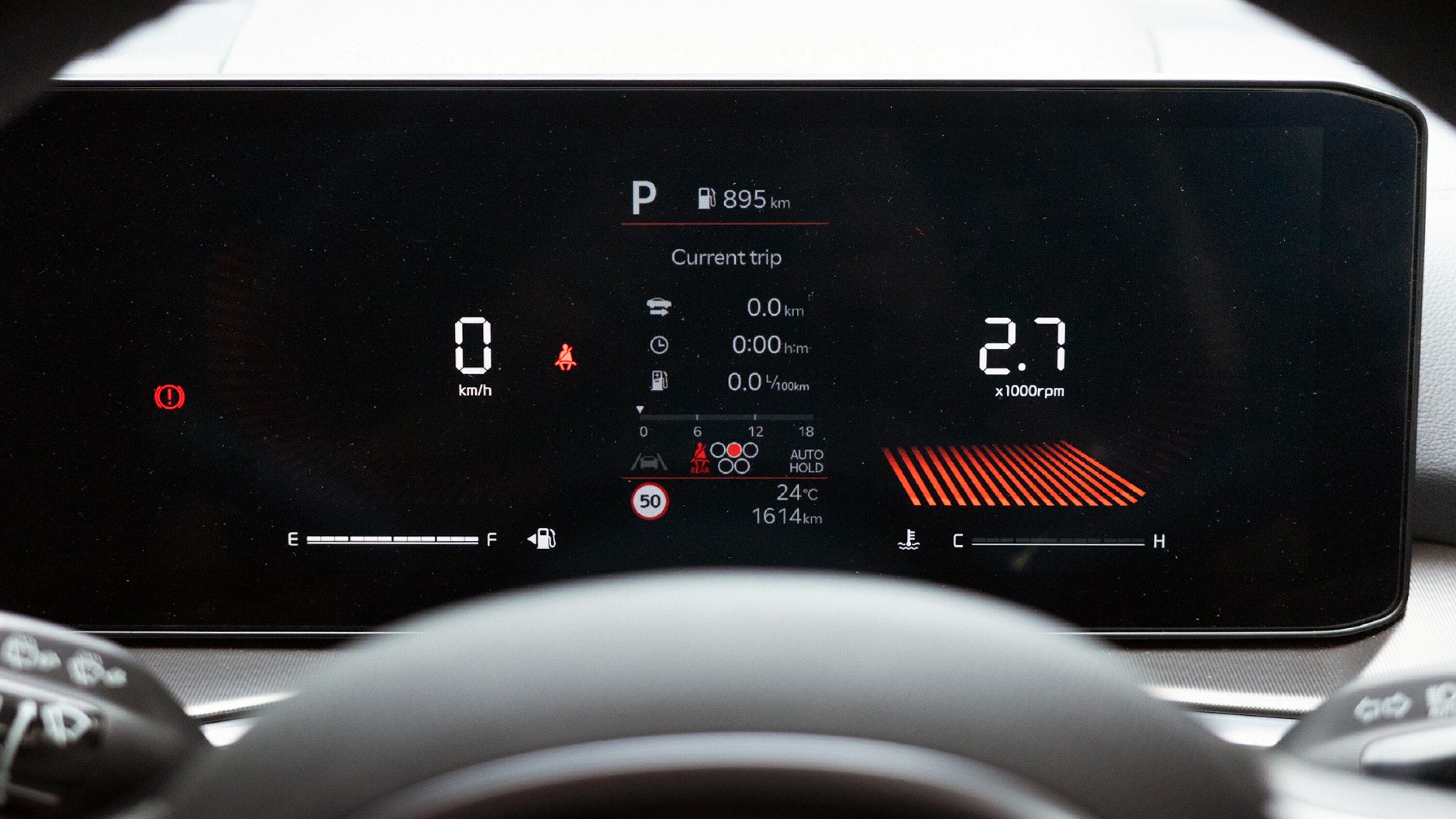
The GT-Line gets a 4.3-inch instrument cluster, and a huge 12.3-inch display with moveable icons, the performance boosted by a new chipset. There’s a capacitive touch control to switch between HVAC and infotainment. This is activated quite cryptically via a long press on a toggle switch.
1
Models below GT-Line get a smaller 4-inch digital cluster (above), and it pays to inspect the spec sheet quite closely – because Kia’s been pretty clever with the trim walkup. Lower grade models miss out on some key pieces of kit, like in-built navigation.
There’s a new and improved head-up display that now shows the turn-by-turn instructions from Android Auto and Apple CarPlay as well as Kia’s native nav. Like many such systems it disappears if you slip on a pair of polarised sunglasses.
There’s also a digital centre mirror that delivers a clearer and crisper image at night or in adverse weather. It’s also a boon if you’ve got a tall rear passenger in the middle seat or if you’ve loaded the Sorento to the gunwales.
1
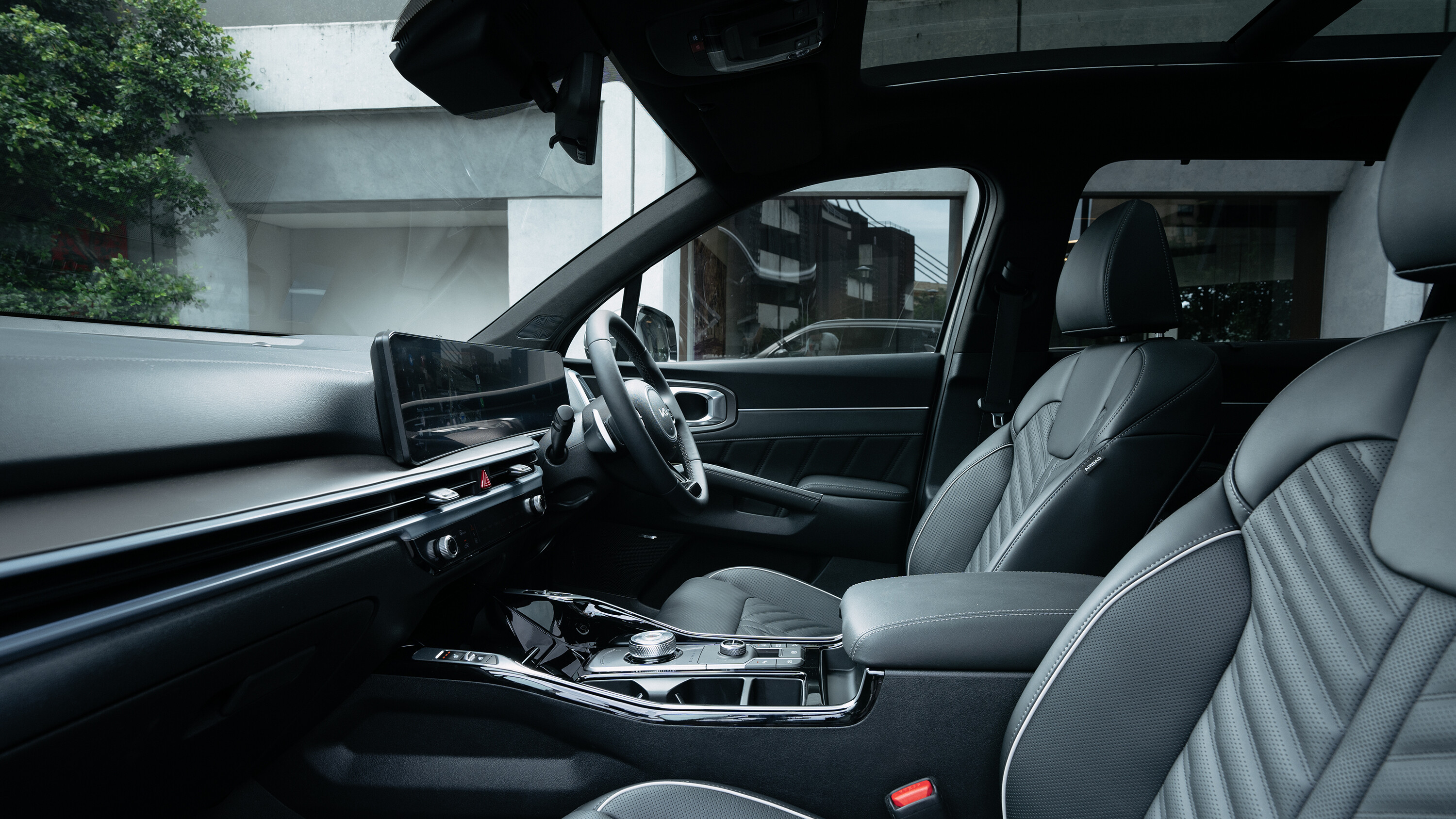
The GT-Line also features a new ambient lighting system. This illuminates the shifter, with more generous spread across the dash, and can be linked to the drive modes.
A 12-speaker Bose stereo is also a standard fit on trims from Sport+ up. The old T-bar shifter is no more, with a rotary gear shift dial now marshalling the eight-speed auto and creating a slicker look in the cabin. It even features a haptic response to let you know when you’ve shifted into reverse. Push button start and remote start are standard across the range.
Other equipment upgrades? Expect second row sunshades from Sport+ up and privacy glass from Sport. USB-C charging features throughout, replacing the old USB-A sockets for quicker charging and you’ll never have the old USB 50/50 lottery of plugging the cable in upside down.
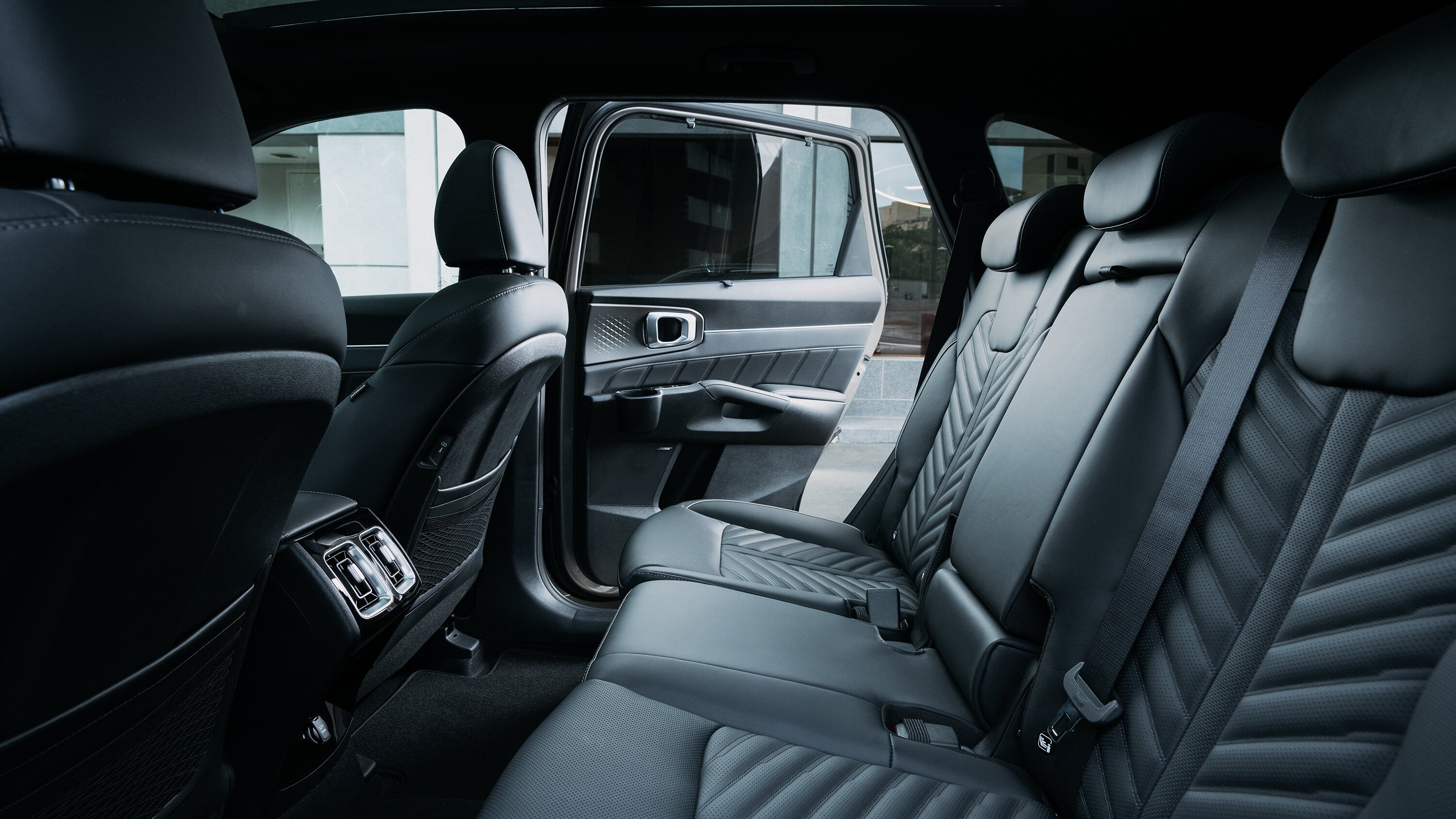
1
Safety gear is also upgraded
All models get AEB Junction Turn and the audible overspeed alert (3db quieter now) introduced in 2022, but it’s now easier to revert to the silent, visual information mode.
Models from Sport up also get Highway Driving Assist(HDA). This is an adaptive cruise control system with stop and go functionality that also packages a much-improved Land Following Assist system.
Nervous in shopping centre car parks? Go for the GT-Line and you’ll have the assistance of Parking Distance Warning which now features side alerts as well as the previous front and rear zones. Despite the changes to the front bumper and grille design, ANCAP Has pledged to carry across the MQ4 Sorento’s existing 5-star safety rating.
| 2024 Kia Sorento active safety features | |
|---|---|
| Autonomous emergency braking (vehicle, pedestrian, cyclist, junction-turning) | Intelligent speed limit assist |
| Lane-keep assist | Safe exit warning |
| Lane departure alert | Driver attention alert |
| Blind-spot warning with braking | High-beam assist |
| Rear cross-traffic alert with braking | Adaptive cruise control |
| Multi-collision braking | Rear occupant alert |
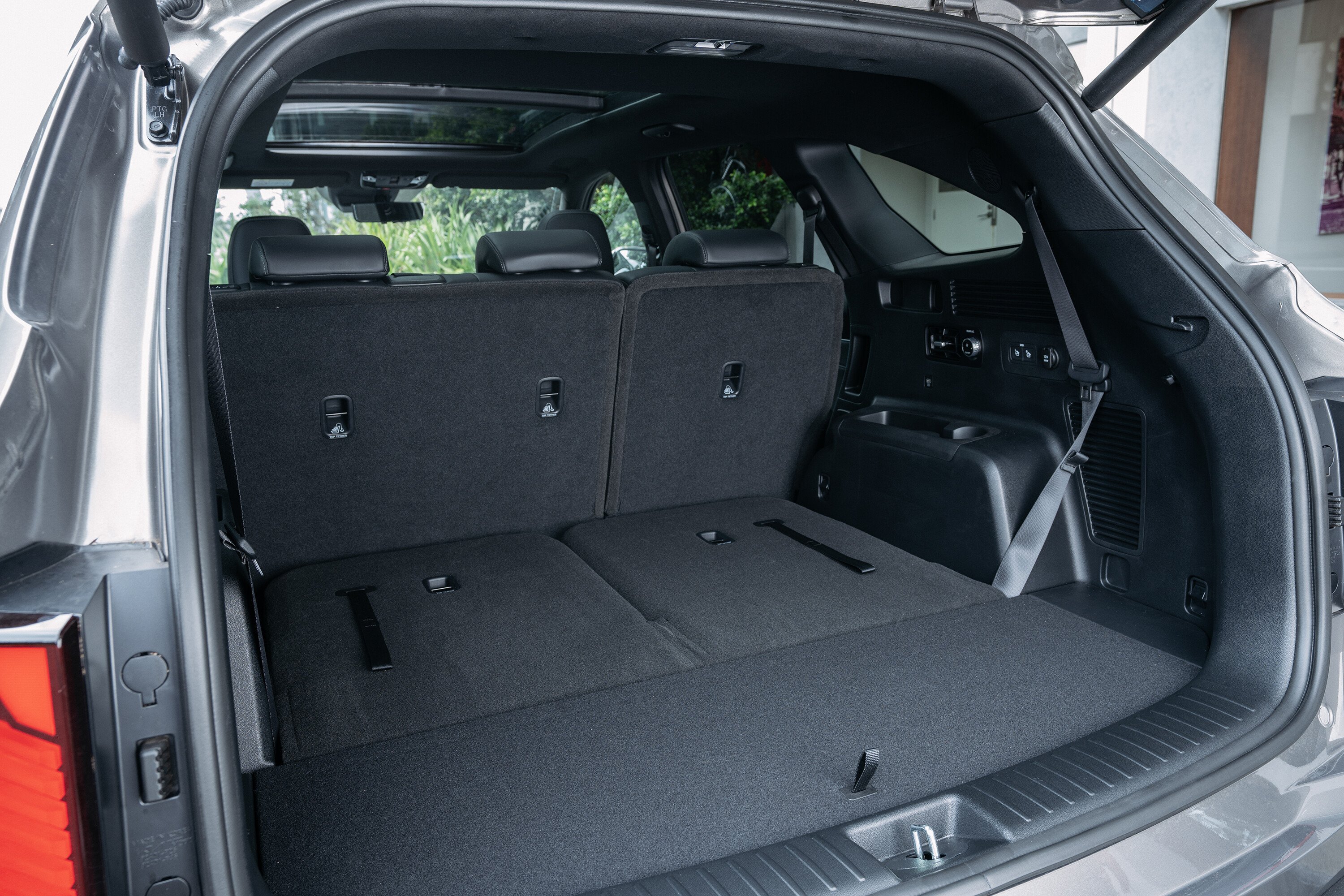
2024 Kia Sorento boot space
The Kia Sorento has a 179-litre boot with all seven seats in place, rising to 608 litres with five seats up and 1996L with both the third and second rows folded.
3
How does it drive?
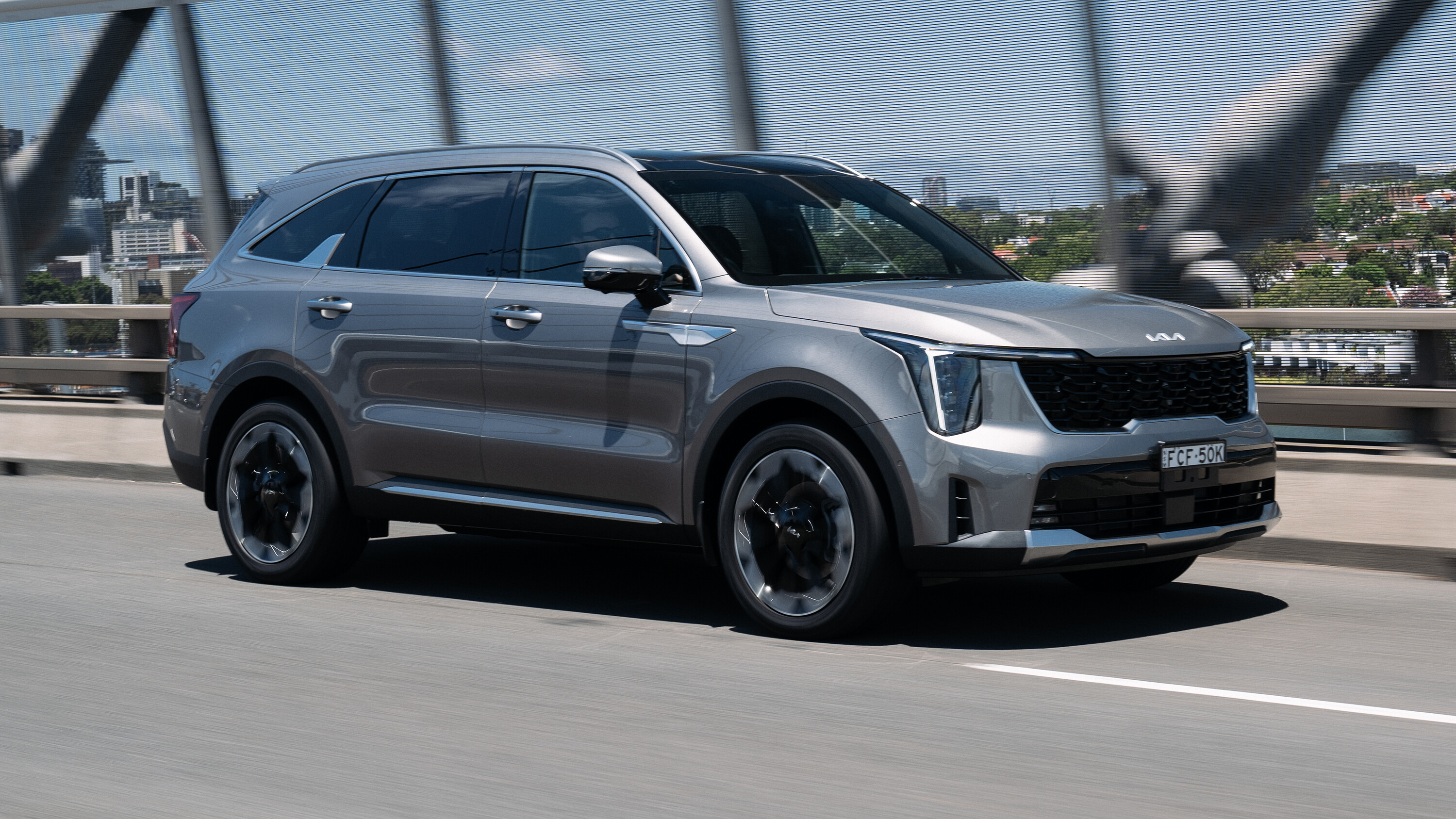
Kia’s chassis guru Graeme Gambold has, somewhat unexpectedly, blown the overtime budget on improving the ride and handling of this latest Sorento.
When we tested it last year, we found it agile and unexpectedly lively at the rear. This model features the same springs and stabiliser bars as its predecessor, but there have been some big changes in how the car is damped. Lessons learned in the development of the EV6 have been utilised here, with the Sorento now getting expensive ZF Sachs SDC3 dampers.
These feature ZF Sachs’ latest valve tech, and feature three separate valves and includes a special pocket valve designed especially for the Sorento. In other words, these shocks are even more capable than those fitted to the EV6 and further differentiates body control from ride comfort.
1
The biggest improvement is in secondary ride: the high-frequency nervousness that can afflict large vehicles on poor surfaces.
On typically poor Victorian country roads, this generation Sorento feels noticeably better damped than its predecessor and there’s an added benefit that there’s less noise, vibration and harshness transmitted into the passenger cell. As a side note, with the prior MQ4 Sportage, the petrol and diesel versions were treated to local chassis tuning whereas the hybrid models weren’t. That’ll change with this update.
If you’re an existing Sorento owner, you’ll also notice that the steering will feel different. That’s because this generation car has been treated to a revision of the electrically-assisted power steering. It still features a rack-mounted motor, but all of the software, including the firmware, the algorithm base and the steering maps are new. I’m a little less convinced about this particular update.
1
Yes, the steering feels slicker and quieter, turning in a little more keenly just off-centre, but it seems a little more mute than before, with an oddly artificial feel.
Having said that, it’s probably one of those things you’d notice in the first 24 hours with the Sorento and then never register again once you’d become accustomed to it. Kia has recently finalised the towing ratings for the new Sorento and reports that it comes to market with a 2.0-tonne braked towing figure.
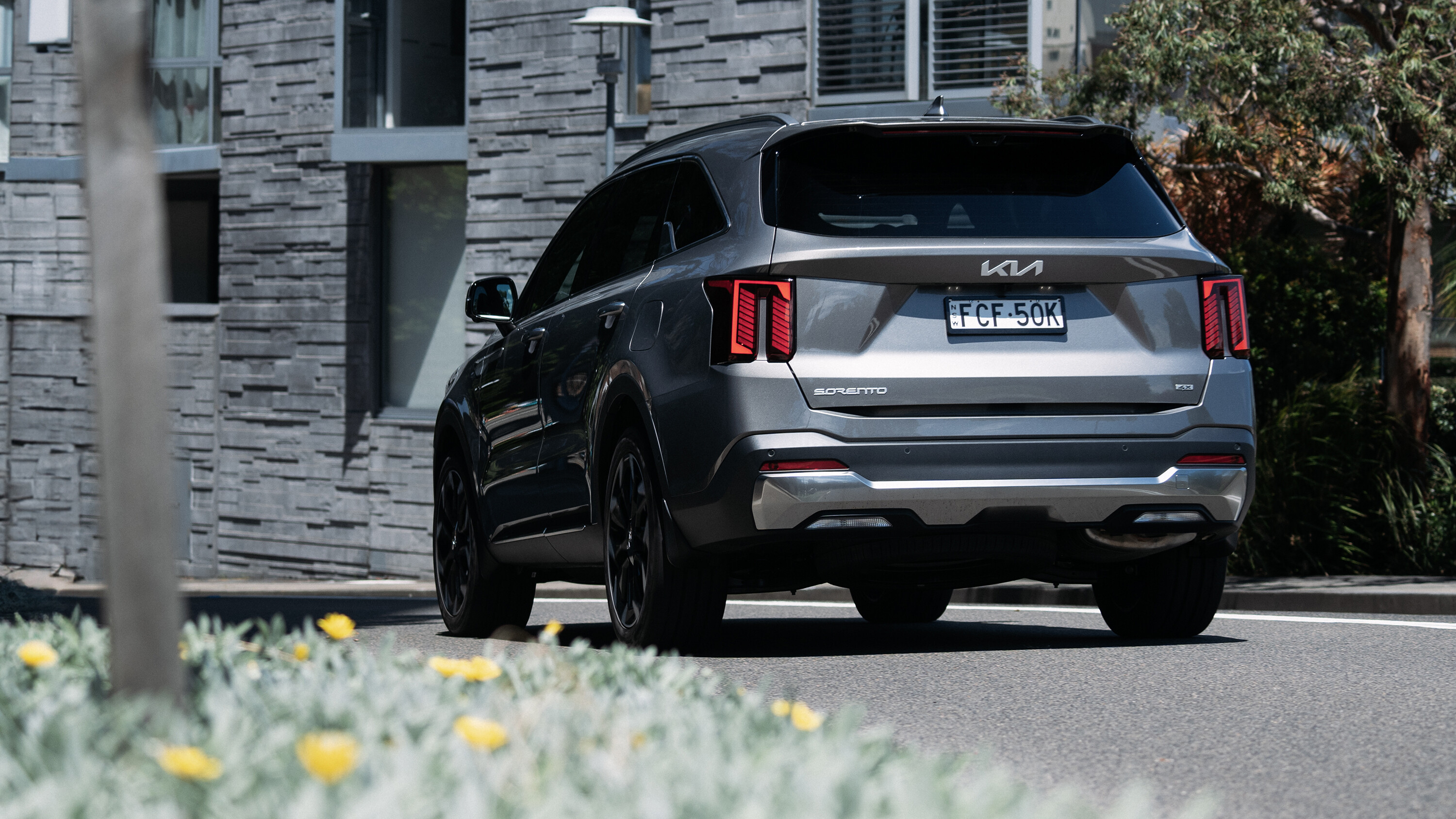
1
2024 Kia Sorento pricing
One of the key factors that got the original MQ4 Sorento across the line in our sub-$80K SUV test last year was its pricing.
This latest update typically tacks around $3500 model for model on top of its predecessor. Its pricing will undoubtedly dent the value proposition a little, but even if this updated Sorento were pitched into that comparison again, it’d still be markedly the most affordable vehicle.
| 2024 Kia Sorento | Price | Change |
|---|---|---|
| S petrol FWD | $50,680 | up $3030 |
| Sport petrol FWD | $53,300 | up $3030 |
| S diesel AWD | $53,680 | up $3030 |
| Sport diesel AWD | $56,300 | up $3030 |
| Sport+ petrol FWD | $58,230 | up $3380 |
| Sport+ diesel AWD | $61,230 | up $3380 |
| GT-Line petrol FWD | $65,590 | up $3520 |
| GT-Line diesel AWD | $68,590 | up $3520 |
| Prices exclude on-road costs | ||
It’s even a little easier to get hold of one now.
Kia was plagued by some severe supply issues in 2023, and was punished with order cancellation rates of around 20 percent from private buyers as a result, but the wait time for the new Sorento is estimated at between three and four months.
Kia’s local boss Damien Meredith doesn’t believe the cost of living issue will knock sales. “There’s a resilience in the Australian economy that we always underestimate,” he says.
“I’m confident in the economy, confident in the market and confident of what we’re getting into. We’re very happy with finishing fourth [by marque in local sales] but that’s historic data. We’re firmly focused on what we need to do in 2024.”

1
Warranty and servicing
The Kia Sorento is covered by a seven-year / unlimited-kilometre warranty.
Service costs and schedules differ depending on the powertrain you choose, but all are covered by seven years of capped-price servicing. The turbo-diesel and petrol V6 Sorentos require servicing every 12 months/15,000km.
1
VERDICT
In making a proven class winner even better, Kia should be congratulated. The changes wrought here are more than enough to carry the Sorento MQ4 safely and serenely into its eventual runout.
What’s more, it’s hard to see anything coming in the short term that’ll dethrone it for families looking for a safe, competitively priced, reliable seven-seat road-biased SUV. Job done.
MORE
Everything Kia
Specs
| 2024 Kia Sorento specifications | |
|---|---|
| Model | Kia Sorento GT-Line AWD |
| Engine | 2151cc 4cyl, dohc, 16v, turbo-diesel |
| Max power | 148kW @ 3800rpm |
| Max torque | 440Nm @ 1750-2750rpm |
| Transmission | 8-speed automatic |
| L/W/H | 4815/1900/1700mm |
| Wheelbase | 2815mm |
| Weight | 1974kg (tare) |
| 0-100km/h | 9.2sec (claimed) |
| Economy | 6.0L/100km (combined) |
| Price | $68,590 before on-road costs |
| Availability | On sale Now |
It’s back, almost! The global hit responsible for a massive boost in Formula 1 audience numbers returns for its sixth season next month – just as 2024 pre-season testing wraps up in Bahrain.
As with earlier seasons of the show, this latest series will look back at the previous year’s championship – which means, this time, a big focus on the record-breaking run of Max Verstappen Red Bull Racing.
Expect other key ‘plot points’ to include the year’s starring moments from Aston Martin and McLaren, and the return of our local hero Daniel Ricciardo with AlphaTauri.
This latest announcement comes just weeks after Netflix revealed it has signed off on development of a similar series, focusing this time on America’s NASCAR formula.
The past couple of years have also seen screen plans for Daniel Ricciardo and Lewis Hamilton, with Ricciardo signed up to produce a scripted F1 series for Disney’s Hulu service, while Hamilton is working on an F1 film for Apple, with Brad Pitt lined up to star.
When is Drive to Survive season 6 starting?
Season 6 of Netflix’s Drive to Survive will be available to watch from February 23, everywhere around the world.
How many episodes will be in Drive to Survive season 6?
Netflix has yet to reveal how many episodes will be in season 6 of Drive to Survive, although all previous seasons had 10 episodes running between 30 to 60 minutes each.
Is there a Drive to Survive season 6 trailer yet?
Despite announcing the series return today, Netflix has not yet released a trailer for Drive to Survive season 6.
Here it is! Our first look at the all-electric 2024 Porsche Macan
Images of the all-new, second-generation Porsche Macan have leaked online just hours before the fresh SUV’s official reveal.
Two images of the new Macan have been posted to instagram by WilcoBlok, revealing a fresh exterior design and dimensions that appear to be slightly larger than the outgoing model.
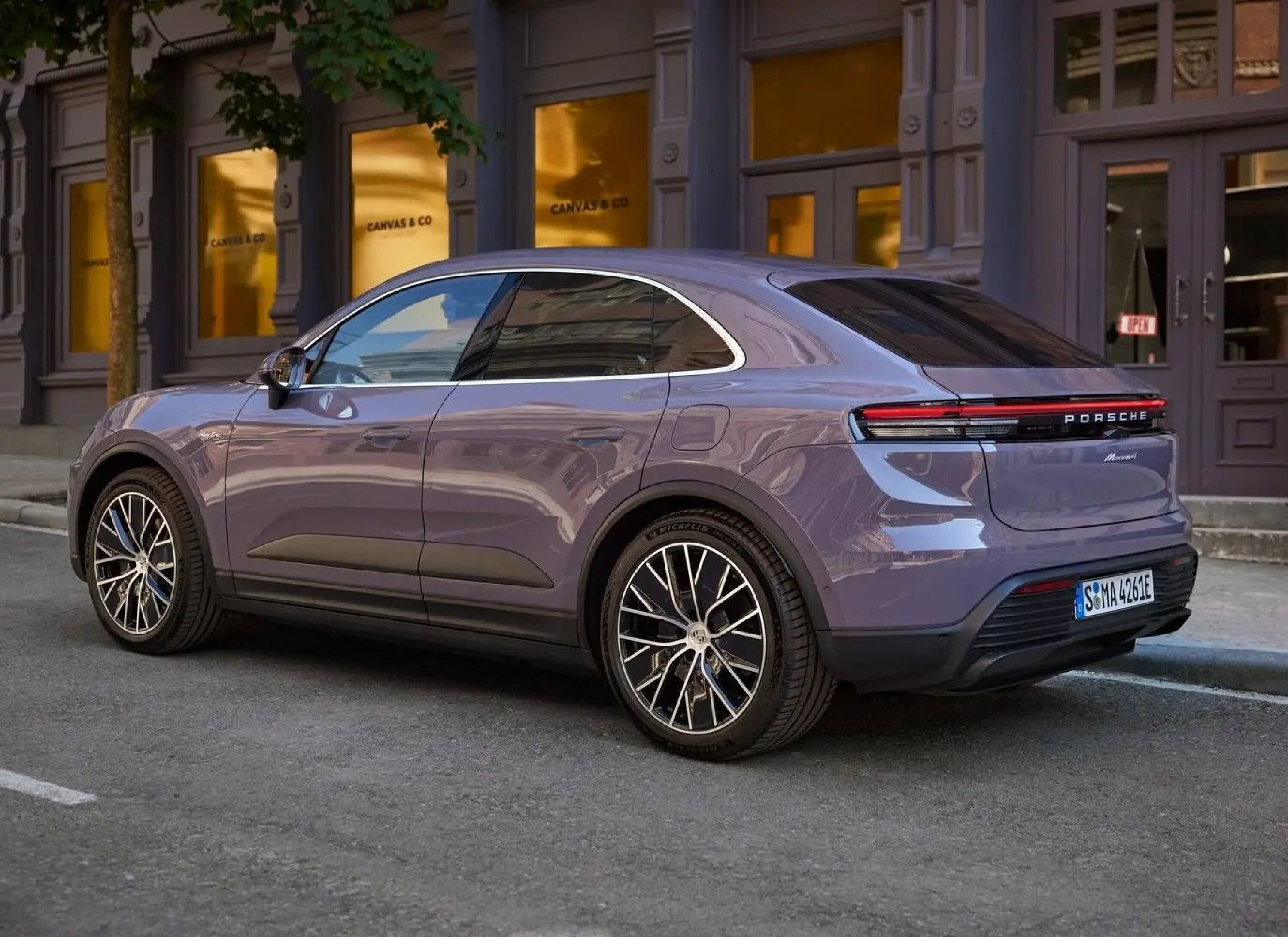
1
The wheelbase, in particular, seems to have grown, however we’ll need to wait for the Macan’s official reveal later tonight before we can confirm its exact dimensions.
The new-gen Macan will be offered solely as an EV in Australia and is the first model to utilise Porsche’s fresh Premium Platform Electric (PPE) architecture.
Porsche has already confirmed some key details for the new Macan, including a driving range of up to 500km, power outputs of more than 450kW and a large 100kWh battery pack. Keep reading our story below to learn more.
Design wise, the new Macan debuts a cleaner, more minimalist look. Up front there’s a new, split-level lighting arrangement, while Porsche’s now familiar full-width light bar features at the rear.
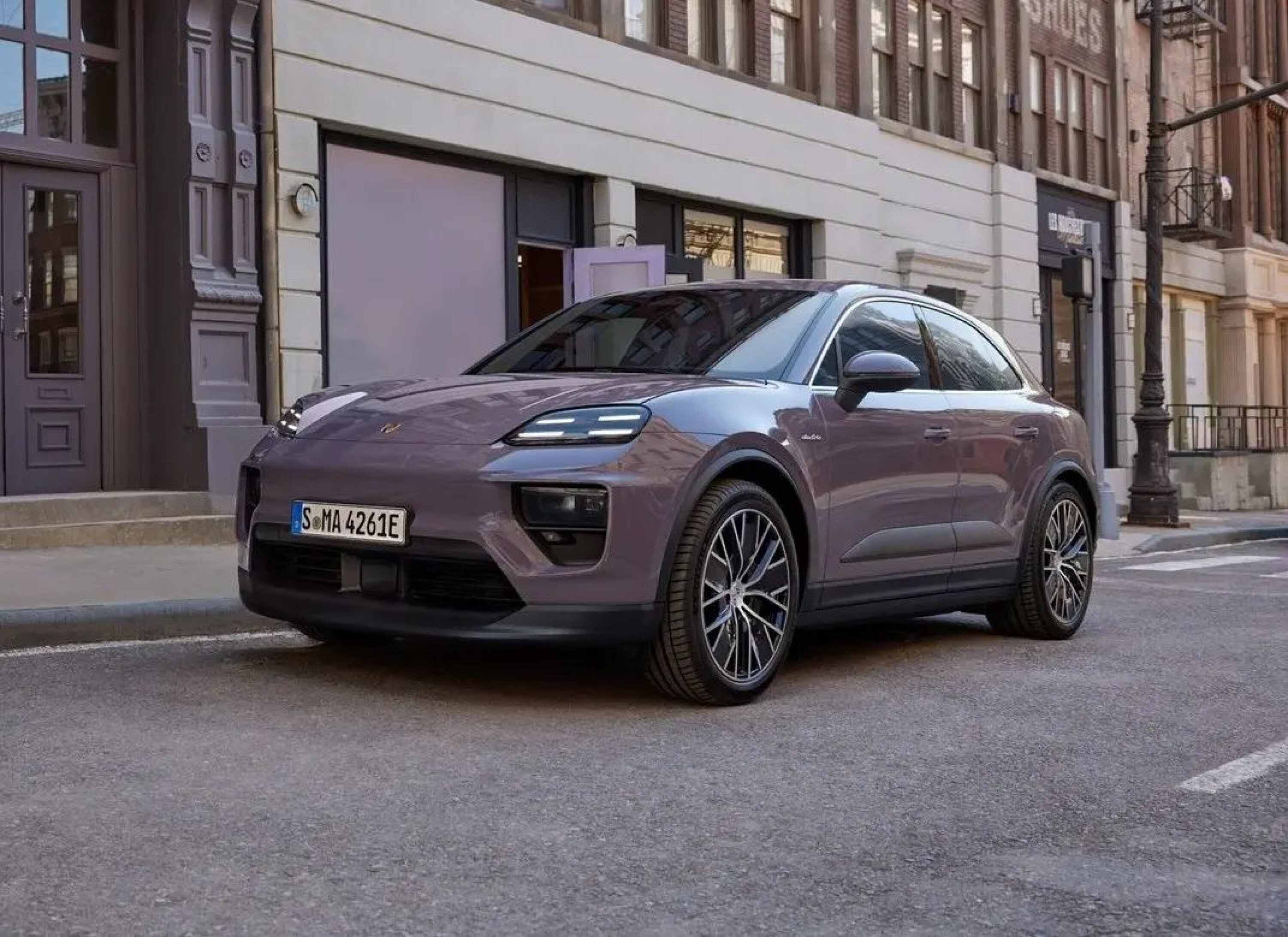
1
Inspiration from the Taycan and larger Cayenne are also evident in the new exterior design.
Perhaps the biggest change can be seen in the new Macan’s silhouette, courtesy of a new tailgate design that’s more steeply raked.
Stay tuned for the Macan’s official reveal but for now, let us know what you think. Do you like the fresh look?
January 2024: Porsche Macan Electric details confirmed
More details have been delivered on the upcoming and overdue Porsche Macan EV, following news in December that Australia’s Macan range will be electric only in the coming year.
Key Points
- Up to 500km driving range
- Big 100kWh battery, 80% charge in 22 minutes
- Over 450kW power in Turbo model
This week the company confirmed at last that the electric Macan – the first EV built on the company’s Premium Platform Electric (PPE) architecture – will pack a big CATL-supplied 100kWh battery unit, with 95kWh of that being “actively usable”.
In a video released today (below), the company also confirmed a driving range of up to 500 kilometres will be achievable in the electric Macan, depending on the variant.
Big power, fast charging
Thanks to its 800V architecture and 270kW speeds, the Macan will charge from 10 to 80% in “less than 22 minutes” at compatible DC ultra-fast stations, outpacing the likes of Hyundai and Kia whose 800V systems can charge a 77.4kWh battery pack from 10 to 80% in around 18 minutes (although these capabilities can vary dramatically).
This is helped by the electric Macan’s ability to split its 800V system into two 400V systems as needed.
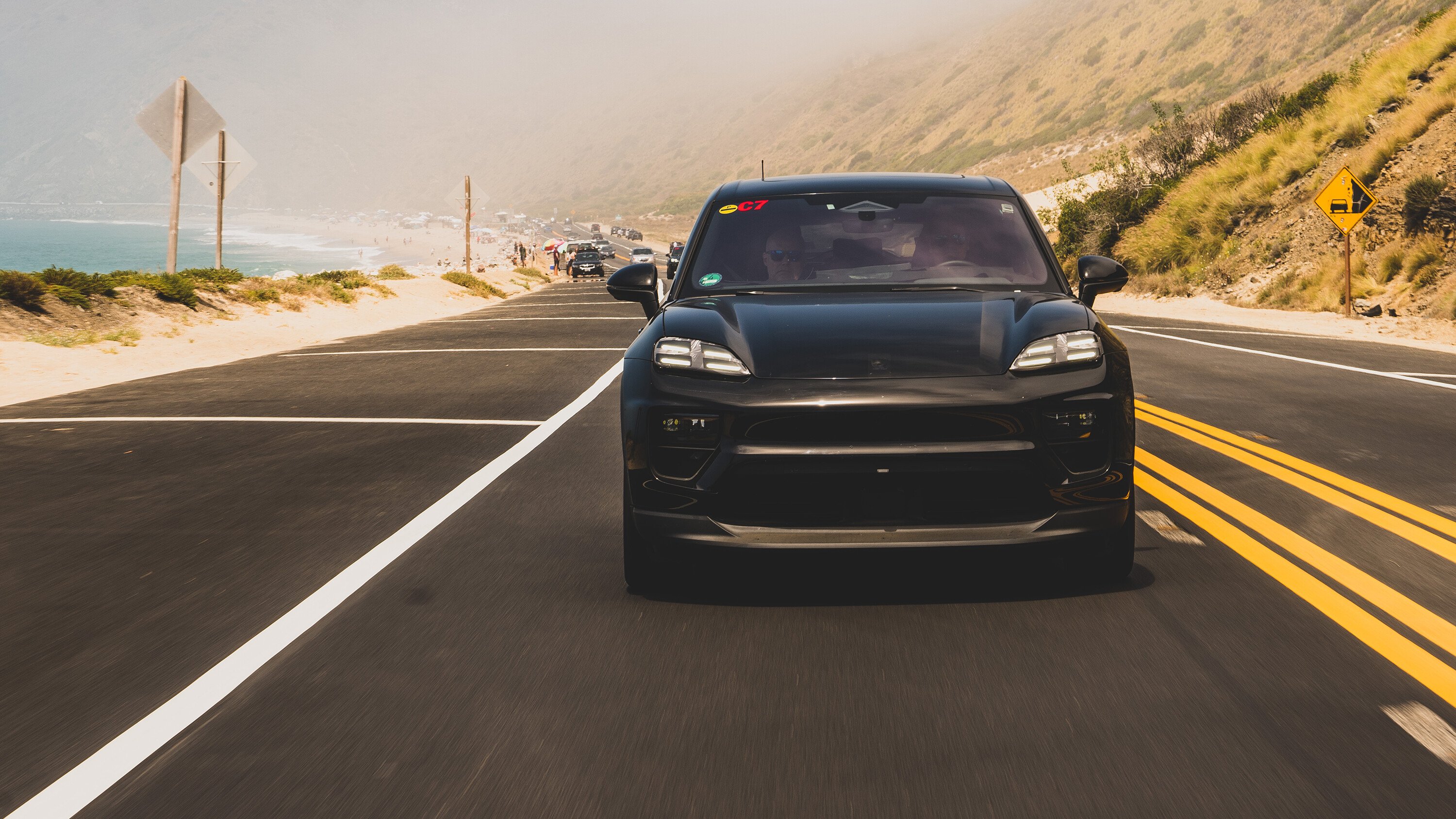
1
With a dual-motor configuration on-board, the electric Macan also boasts all-wheel drive. Power and acceleration figures are still to be revealed, but Georg Kacher’s first drive last year revealed we can expect the flagship Turbo (yep, no actual turbos included) to produce around 456kW and hit 100km/h in less than four seconds. That’ll do.
In entry-level form, the electric Macan is expected to deliver around 280kW, and closer to 300kW in boost mode.
Efficiency figures are also still to be revealed, but Kacher’s launch-day results shows 31.1kWh/100km in one Turbo and 35.7kWh/100km in the other.
Still, launch events are notoriously inappropriate sources of real-world data when it comes to fuel/power efficiency.
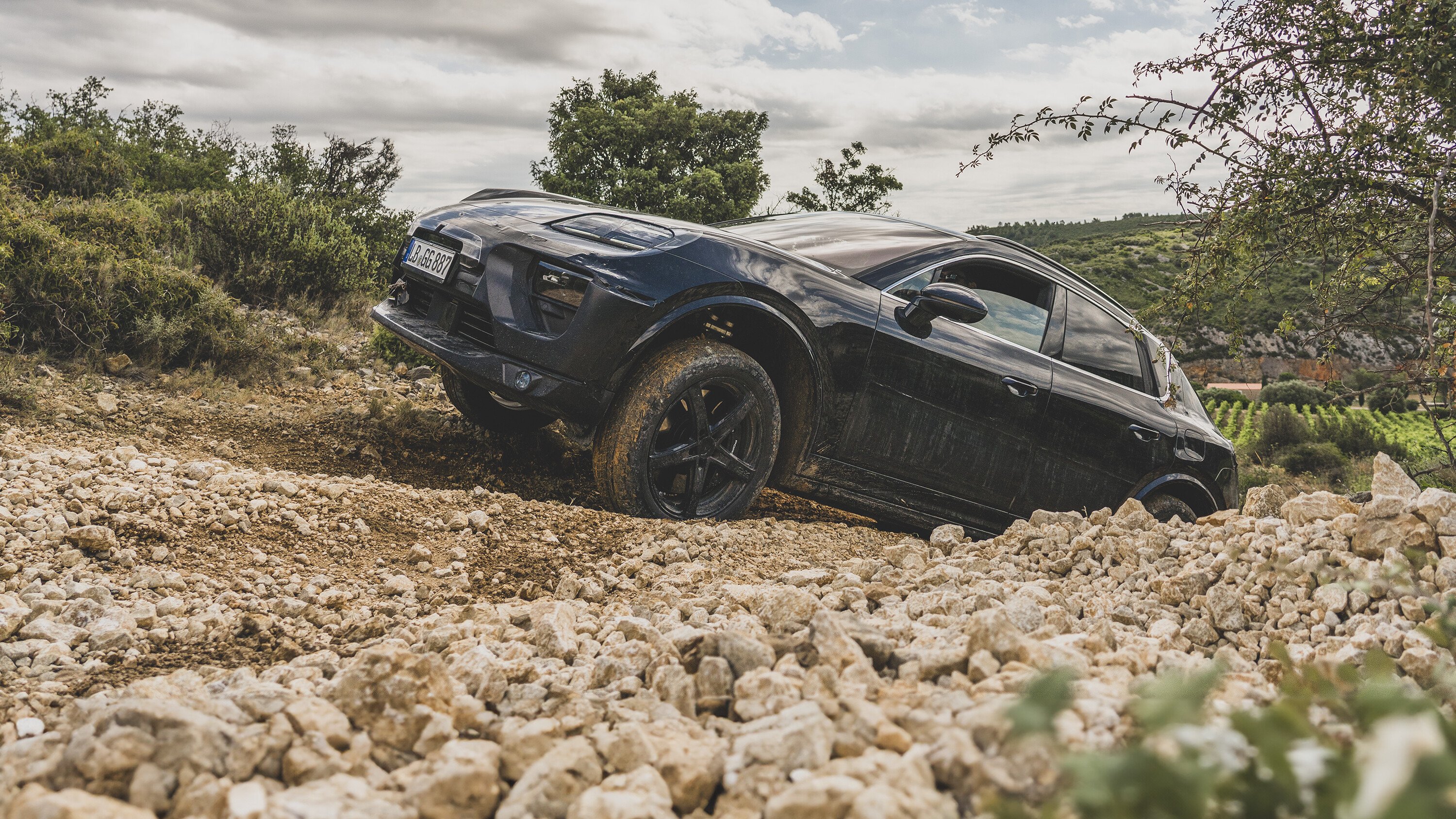
9
Helping with efficiency, though, will be Porsche’s Active Aerodynamics (PAA) system, focusing on optimising range and performance – and a drag coefficient of 0.25 will contribute to that.
That figure is likely specific to the coupe-bodied shape shown here – but Porsche has yet to confirm if there’ll be a wagon version of the electric Macan.
Nothing especially new here, but nonetheless, here’s what Porsche says: “The active aerodynamic elements all significantly contribute to range,” says Thomas Wiegand, Director Aerodynamics and Aeroacoustics. “We have an automatically extending rear spoiler and active cooling flaps on the front air intakes.”
December 2023: Porsche Macan dropping petrol power in Oz
Porsche Cars Australia has confirmed the petrol-powered Macan SUV will be dropped from its line-up in 12 months’ time to make way for the new electric Macan E.
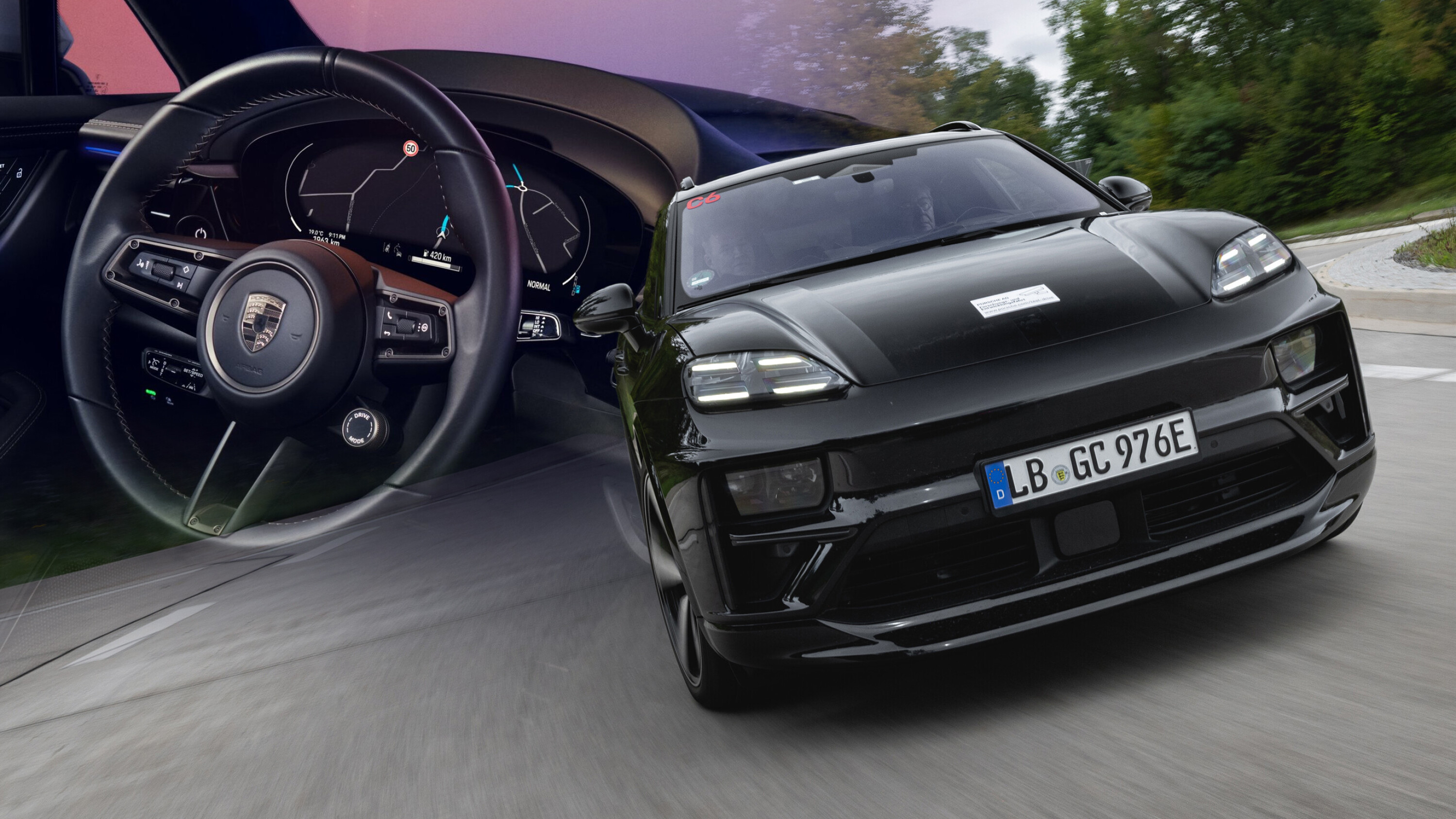
1
December 2023: First official interior image and details
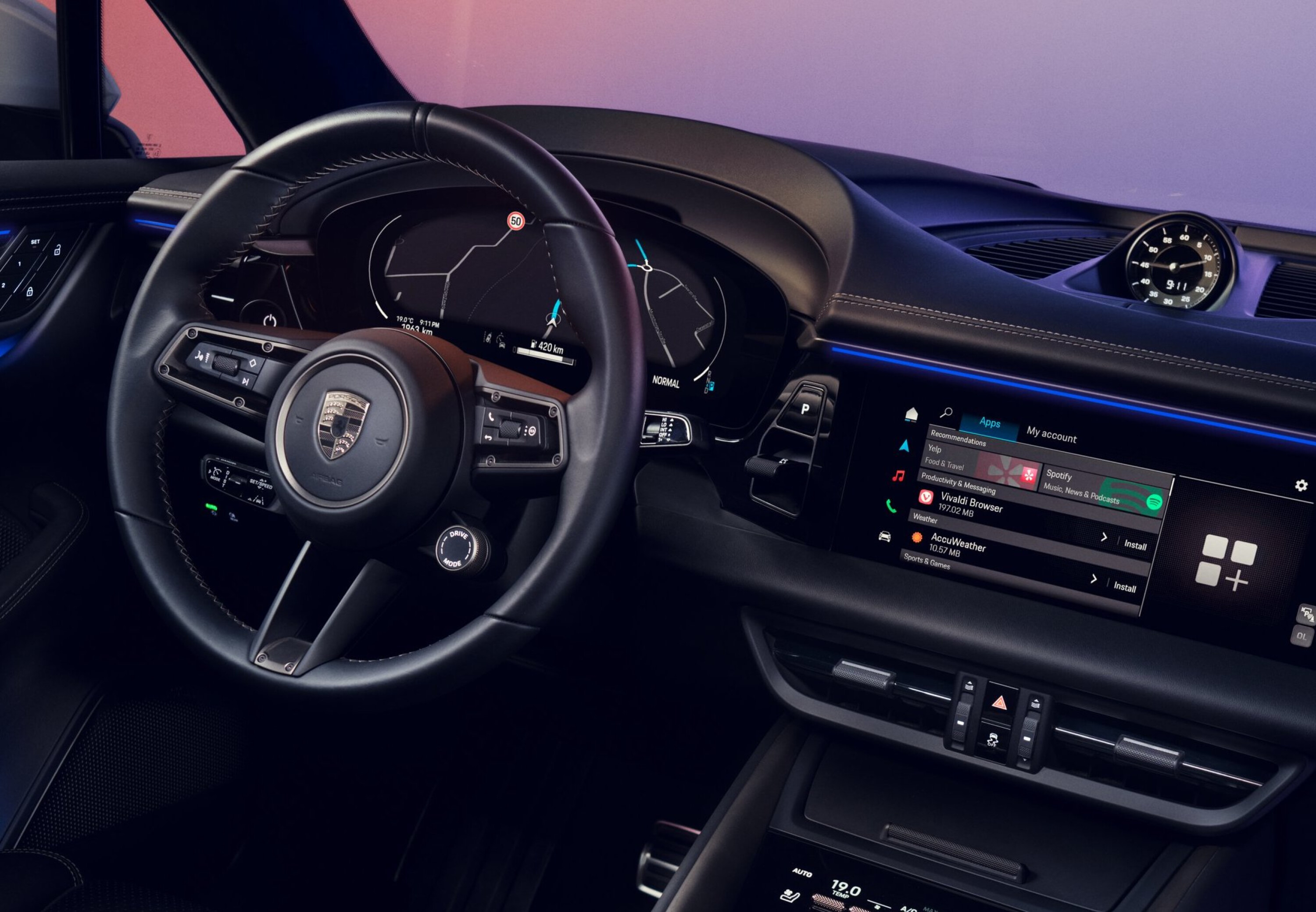
An augmented-reality head-up display, a trio of digital dash displays, and a 56-LED ‘communication’ light strip are among the feature highlights of the new electric Porsche Macan interior.
Porsche has revealed the first image and details of its first electric SUV as it continues a product tease ahead of a full reveal.
The as-yet-unnamed electric Macan is a significantly different proposition to the combustion-engined midsized SUV that has been around for nearly a decade, including sharing a new ‘PPE’ electric 800-volt platform with the upcoming Audi Q6 E-Tron.
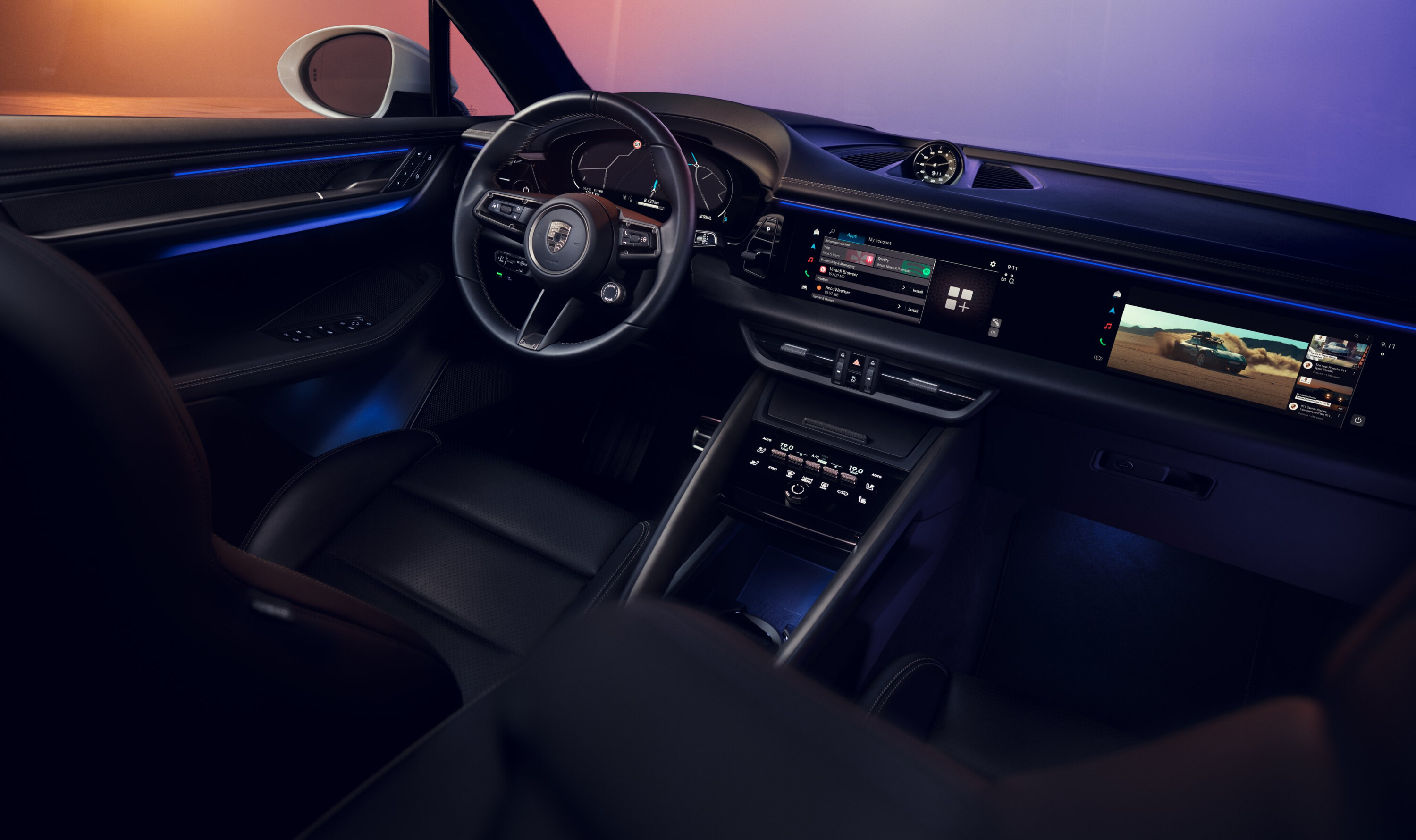
1
Central to an interior that differs notably from the regular Macan cabin, a Porsche Driver Experience dash combines a free-standing 12.6-inch curved digital display directly ahead of the driver, a middle 10.9-inch infotainment touchscreen, while another 10.9-inch information/entertainment touchscreen is available on the passenger side.
Porsche says the optional passenger display is covered with a special film so the driver can’t see streamed videos or games being played while driving.
A range of Porsche Apps will be standard or available for download.
The optional large augmented-reality HUD “corresponds to the size of an 87-inch display” the German car maker says, and it can overlay navigation arrows onto the view ahead to make route guidance simpler.
1
A Sport Chrono pack complete with its analogue clock, Porsche digital key, and Burmester audio system will be among traditional options.
The HUD, as well as the digital instrument cluster, can be customised via steering wheel controls.
A light strip is also prominent in the front cabin, featuring 56 LEDs, customisable colours, and a variety of animation sequences depending on whether the driver is entering the vehicle, charging the vehicle, or interacting with driver aids.
Although this is Porsche’s most advanced Macan yet, plenty of physical controls are present – including the climate and seat heating/ventilation panel, steering wheel controls including Drive Mode dial, and the small transmission lever on the dash.
There are new seats, too – 24mm lower than in the current Macan and with the choice of a comfort-focused chair or a race-style bucket.
Rear-wheel steering will another first for the Macan, an option that shrinks the turning circle to 11.1 metres by moving the rear wheels in the opposite direction to the front wheels at up to 80km/h – and by as much as five degrees at parking speeds.
Two versions of the electric Macan will be offered, with both featuring a circa-100kWh lithium-ion battery.
The flagship Turbo will produce about 450kW and more than 1000Nm, while an entry version of the electric Macan will offer about 280kW.
An all-electric version of the larger Cayenne SUV is expected by 2026.
Wheels was among the first media outlets in the world to drive a prototype of the electric Macan – read about it via the feature link below.
As Chery sets its sights on global expansion, the brand is leveraging Australia’s demanding road conditions and picky customers as its testbed to make better vehicles.
Local executives have already confirmed Australian-inspired suspension updates are in the plans for mid-life model updates of its existing models, the Omoda 5 small SUV and Tiggo 7 Pro medium SUV, after they were subjected to safety tweaks using software.
Following the two combustion-powered vehicles, Chery has a melange of models available in other parts of the world – including intriguing luxury-oriented export brand Jaecoo, and affordable Arrizo models – to potentially follow the Tiggo and Omoda’s paths to Oz.
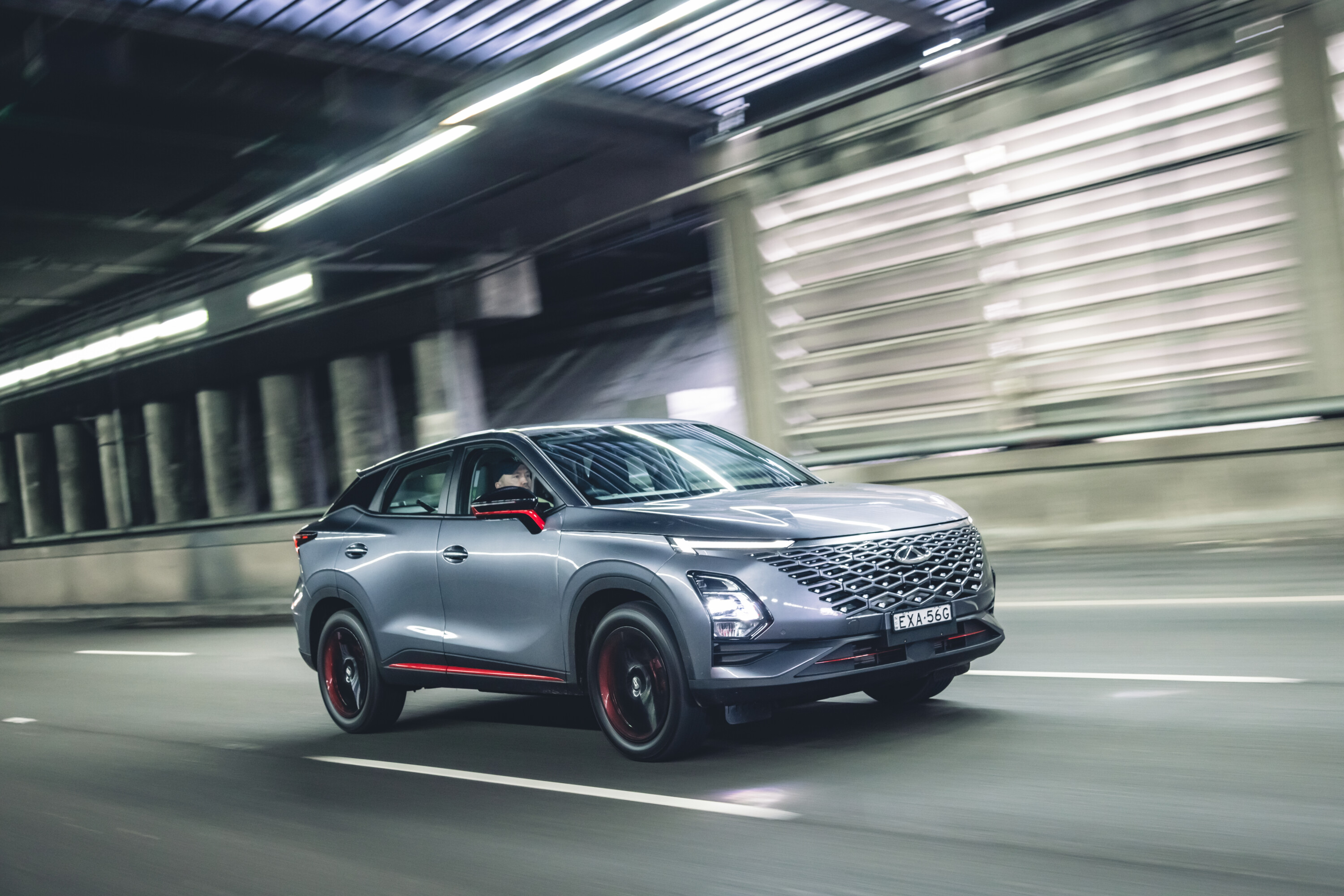
1
It’s not exactly straightforward picking, so it makes sense that the official response from Chery about these other model lines is that the local team is “constantly evaluating overseas product for the Australian market as a matter of course for the business”.
What do we reckon is on the way? Plenty more petrol, hybrid, and electric vehicles at affordable prices. Read on for more.
JUMP AHEAD
Omoda 5 EV
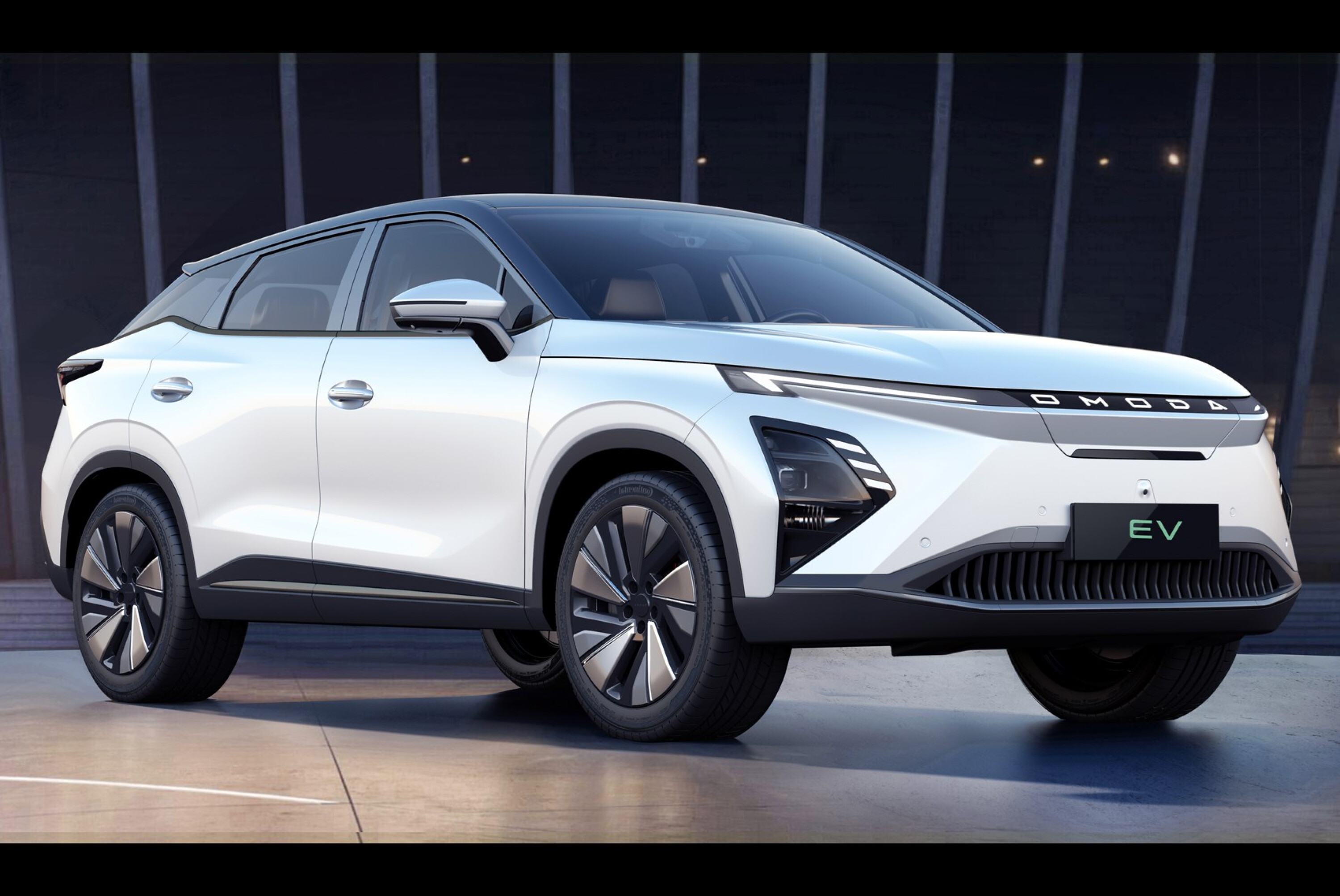
The MY24 Omoda 5 is on sale now in BX and EX trims, with turbo-petrol GT variants following shortly. The big news is an all-electric counterpart due in mid-2024.
A rival for the MG ZS electric, BYD Atto 3 and Hyundai Kona, Chery is yet to confirm pricing. Unlike BYD and Tesla, for example, Chery’s expansion doesn’t leave behind typical bricks-and-mortar dealers.
This means the electric Omoda 5 may be a little dearer than the Atto 3 when it comes to market – though to compete with the pricepoint MG ZS Electric it’ll need to get close to $45K for a base model.
1
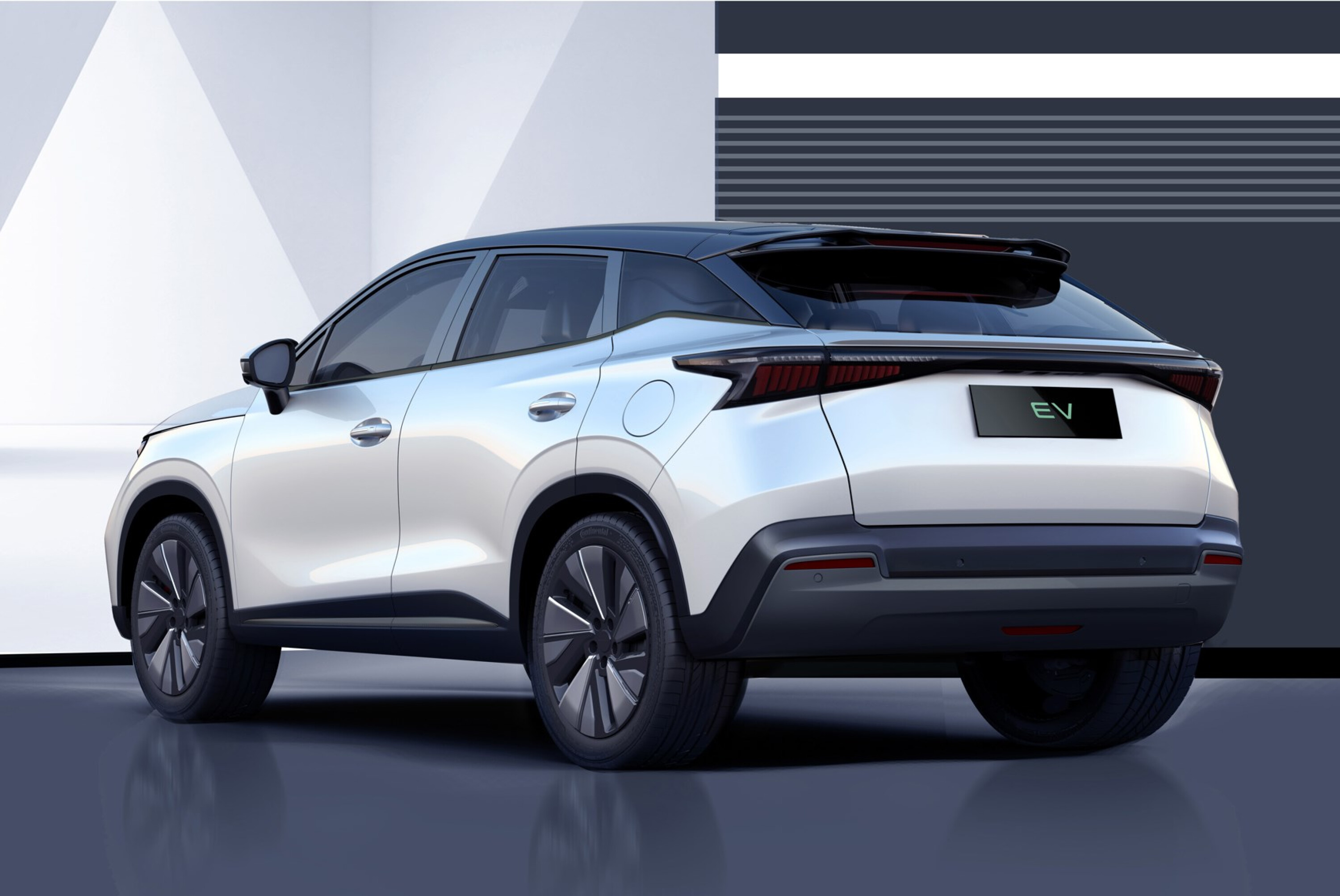
The sharply styled Omoda 5 EV packs a 61kWh battery pack for up to 450 kilometres of driving range in the combined WLTP cycle. Made in China, the Omoda 5 EV has a reasonable 110kW peak DC fast-charge speed for it to climb from 10-80 per cent in about 30 minutes.
While it sits on the same basic architecture as the Omoda 5, there are distinct styling differences including the front clip and LED lighting details, wheel designs, and interior features.
The Omoda 5 is the first of Chery’s ‘4.0’ product series and will be followed by other Omoda-branded models in the future.
1
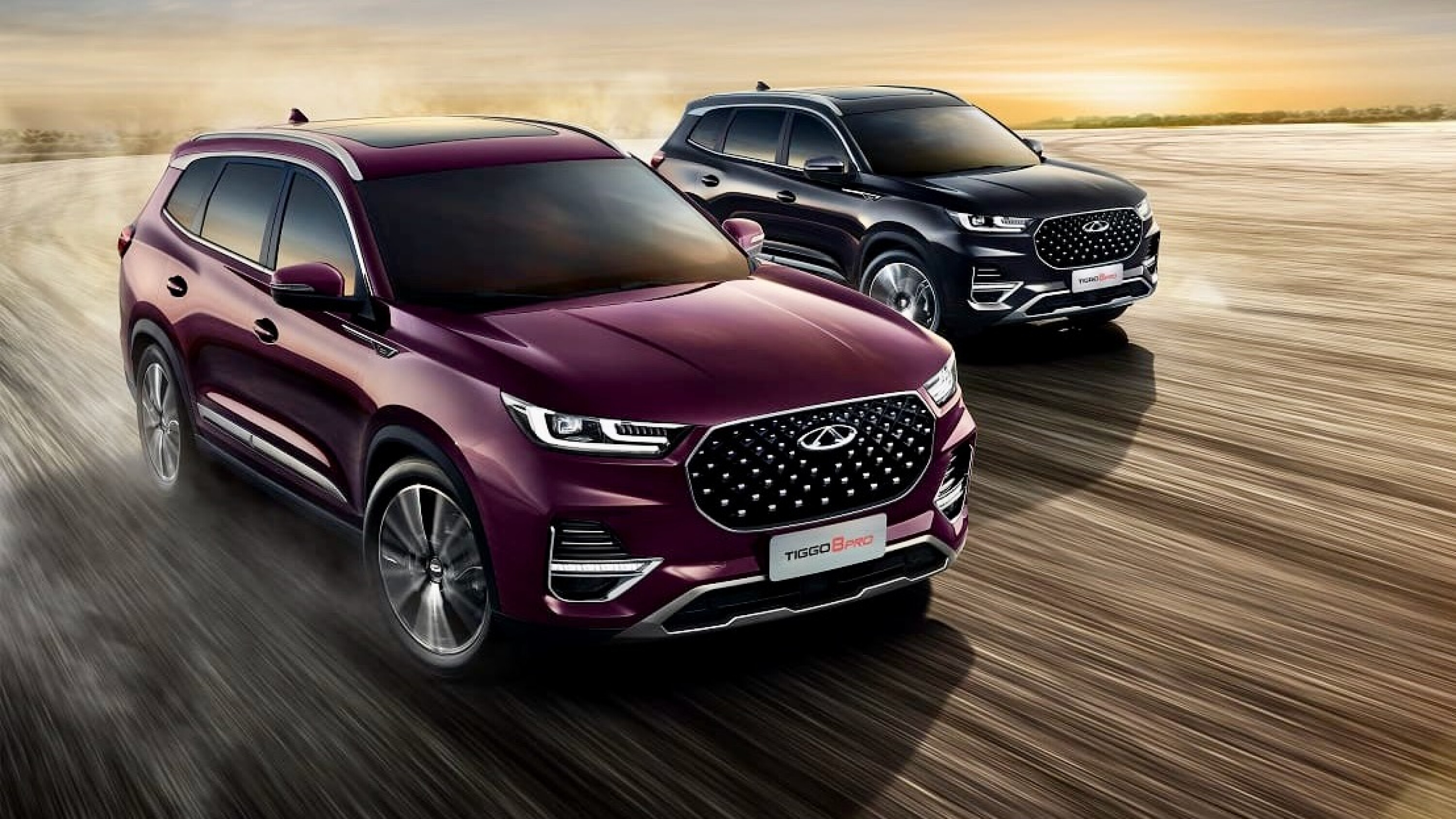
Tiggo 8 Pro
The Tiggo 8 Pro is the Tiggo 7 Pro large SUV sibling, and it’s set for local release in April.
The seven-seat Tiggo 8 measures 222mm longer than the Tiggo 7 at 4.72 metres, with optional tan-coloured leather upholstery. Underneath, it uses the same ‘T1x’ platform as the Tigoo 7, but a more powerful 1.6-litre turbo–petrol engine teamed with AWD and a seven-speed dual-clutch transmission.
In China, Chery offers the Tiggo 8 Pro in ‘E+’ plug-in hybrid guise, which boasts 100 kilometres of EV-only driving range, 1L/100km fuel consumption, and a 0-100km/h sprint in 7.0 seconds. There’s no word on if that is coming to Australia.
Like the Tiguan Allspace, the Tiggo 8 Pro is a stretched version of a medium SUV and, if prices start off in the low $50K region drive-away, it could provide a good value-oriented rival for the Hyundai Santa Fe and Kia Sorento.
1
Arrizo range
Now we’re into speculation – and with Chery’s staggering broad offerings around the world, there’s a lot to look at.
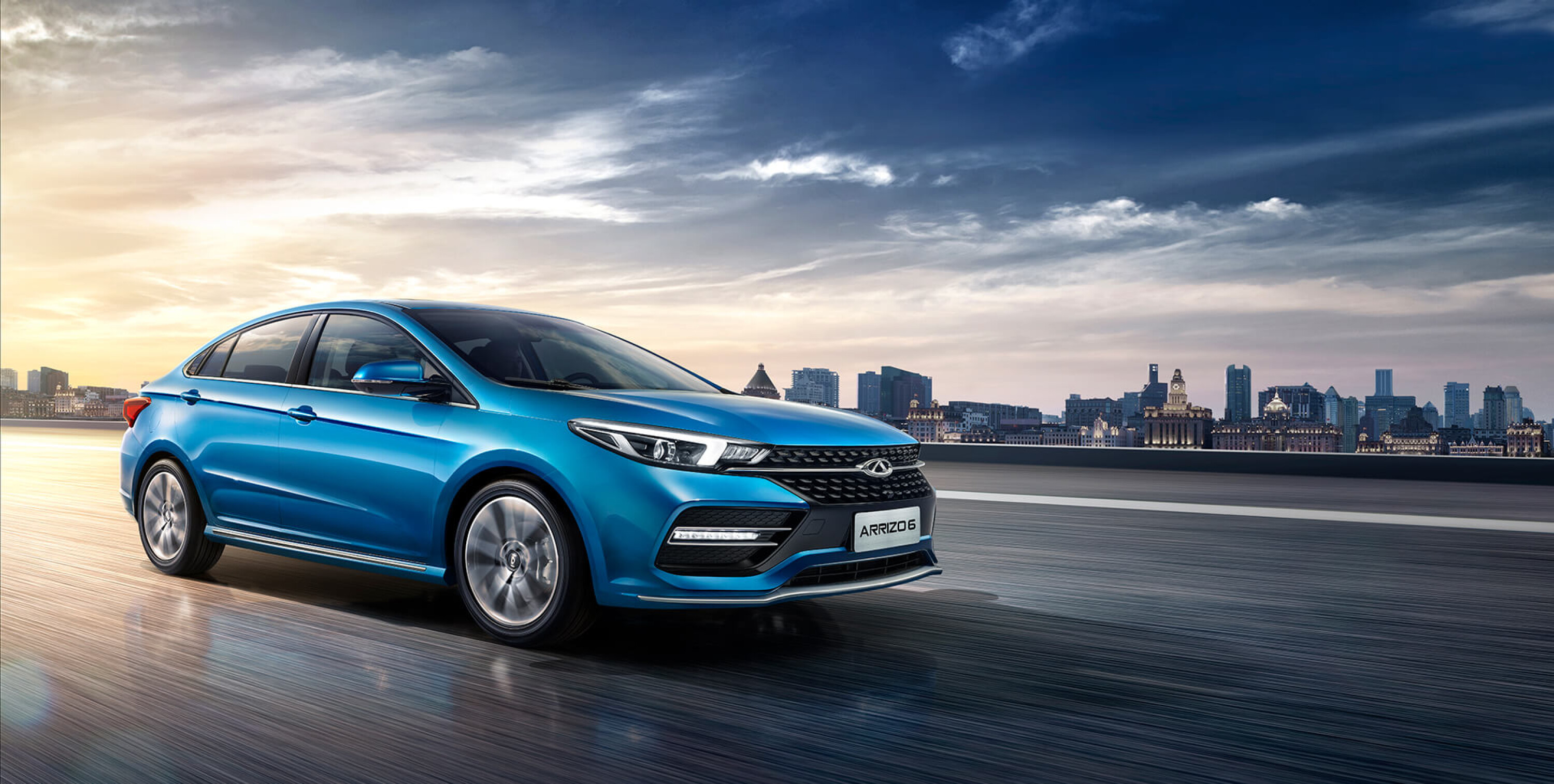
The Arrizo 6 is a small sedan, a rival for the Hyundai i30 sedan, Toyota Corolla, and chiefly the MG 5. It’s sold in other markets including China and Thailand with its eyes set squarely on value with a sporty GT variant was introduced in 2023.
There’s also the Arrizo 8, a larger take on the sedan from the Chinese brand powered by a gruntier 1.6-litre turbo-petrol four-cylinder – the same due in the Omoda 5 GT later this year.
Its likelihood for Australia is low, though if the MG 5 proves successful locally following its zero-star ANCAP result, Chery may look to copy that success.
2
Jaecoo J7 and J8
More likely for Oz are vehicles that fall under Chery’s Jaecoo export brand that is launching in Malaysia, the Middle East, South Africa, and – later this year – the United Kingdom.
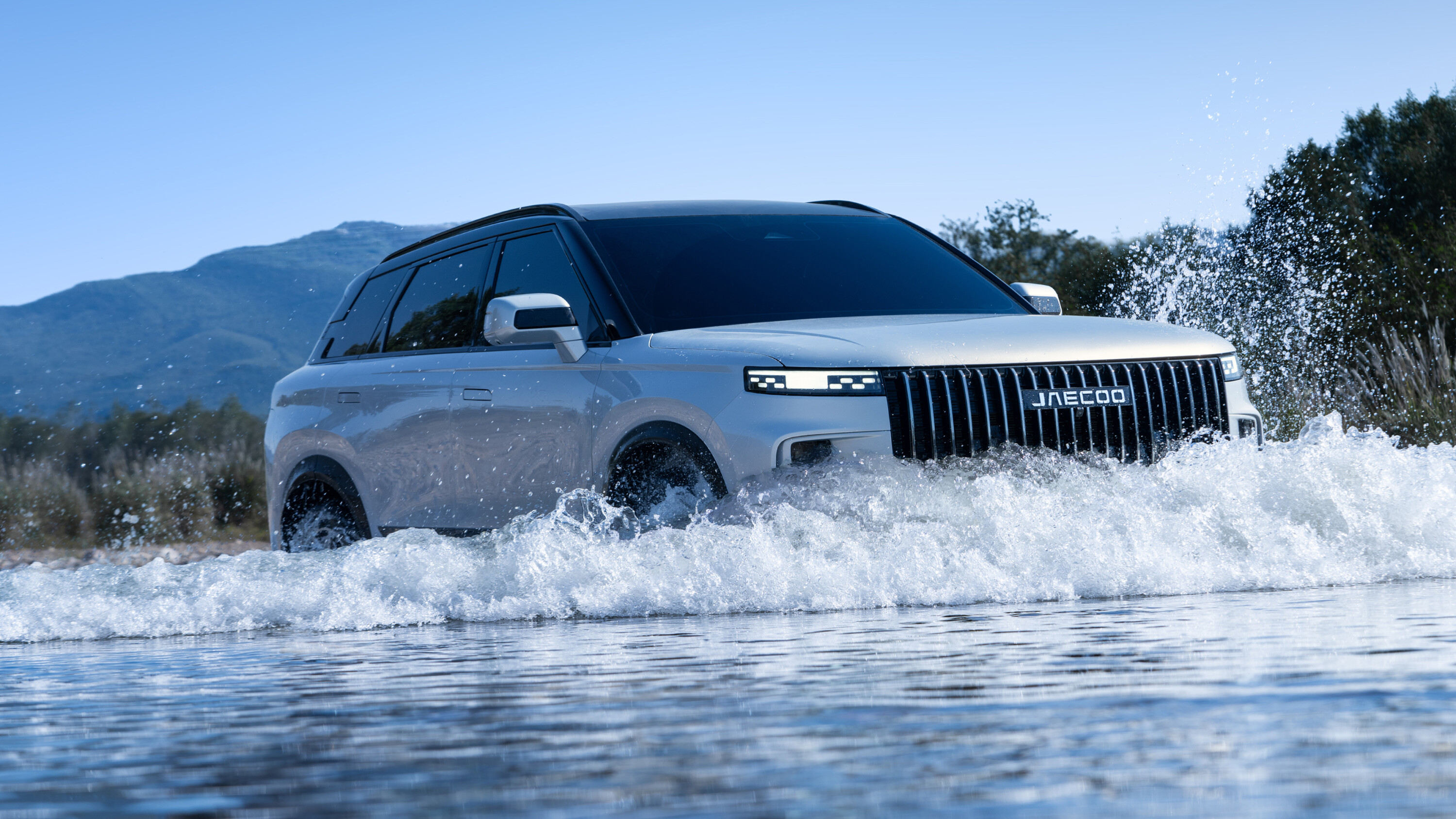
There are a pair of models, the Mazda CX-5-sized Jaecoo J7 (known as the Chery Tansuo 06 or Explore 06 in China) and the Kia Sorento-sized Jaecoo J8 (otherwise known as the Chery Tiggo 9 in China… confused yet?)
With the Tiggo 7 and Tiggo 8 Pro models launched in Australia already, the more futuristic-looking Jaecoo products would potentially cannibalise the brand’s local sales.
3
That said, the medium-sized J7 is being produced in right-hand drive to suit the UK market, with a plug-in hybrid powertrain also in development.
Chery / Jaecoo Malaysia describes the J7 as “exceptional urban off-road SUV within the premium segment”, so perhaps it could co-exist as a fancier choice than the Tiggo 7 Pro? Its 600mm claimed wading depth is certainly respectable for a family-oriented SUV.
Would you like to see Chery bring the Jaecoo brand down under? Leave a comment below with your opinion.
MORE
Everything Chery
The country that brought us Boaty McBoatface for a British research vessel has now chosen “Rubber Ducky” as the name for a new, bright yellow Volkswagen paint colour.
The bathtime-inspired name won 46 percent of the votes in a recent social media poll conducted by VW UK for the facelifted T-Cross compact SUV.
Two other new colours are spared the huge potential for puns: Clear Blue metallic and Kings Red metallic.
VW UK couldn’t resist bathing its press release in its own puns.
“Some might say putting a paint name to public vote is a quackers idea,” said Volkswagen UK’s T-Cross product manager, Oliver Lowe. “But we were confident people wouldn’t get in a flap while trying to decide on a new name, and we think Rubber Ducky yellow was a really eggs-cellent choice.”
While the updated T-Cross is making its way into UK showrooms, the Australian market has to wait until late 2024.
The optional yellow paint scheme will be known as its standard Grape Yellow here. If that doesn’t float your boat, then maybe get in touch with VW Australia’s social media team!
Sedan and wagon buyers, firstly, good on you. Secondly, those drawn to the Octavia range have a sporty new option available.
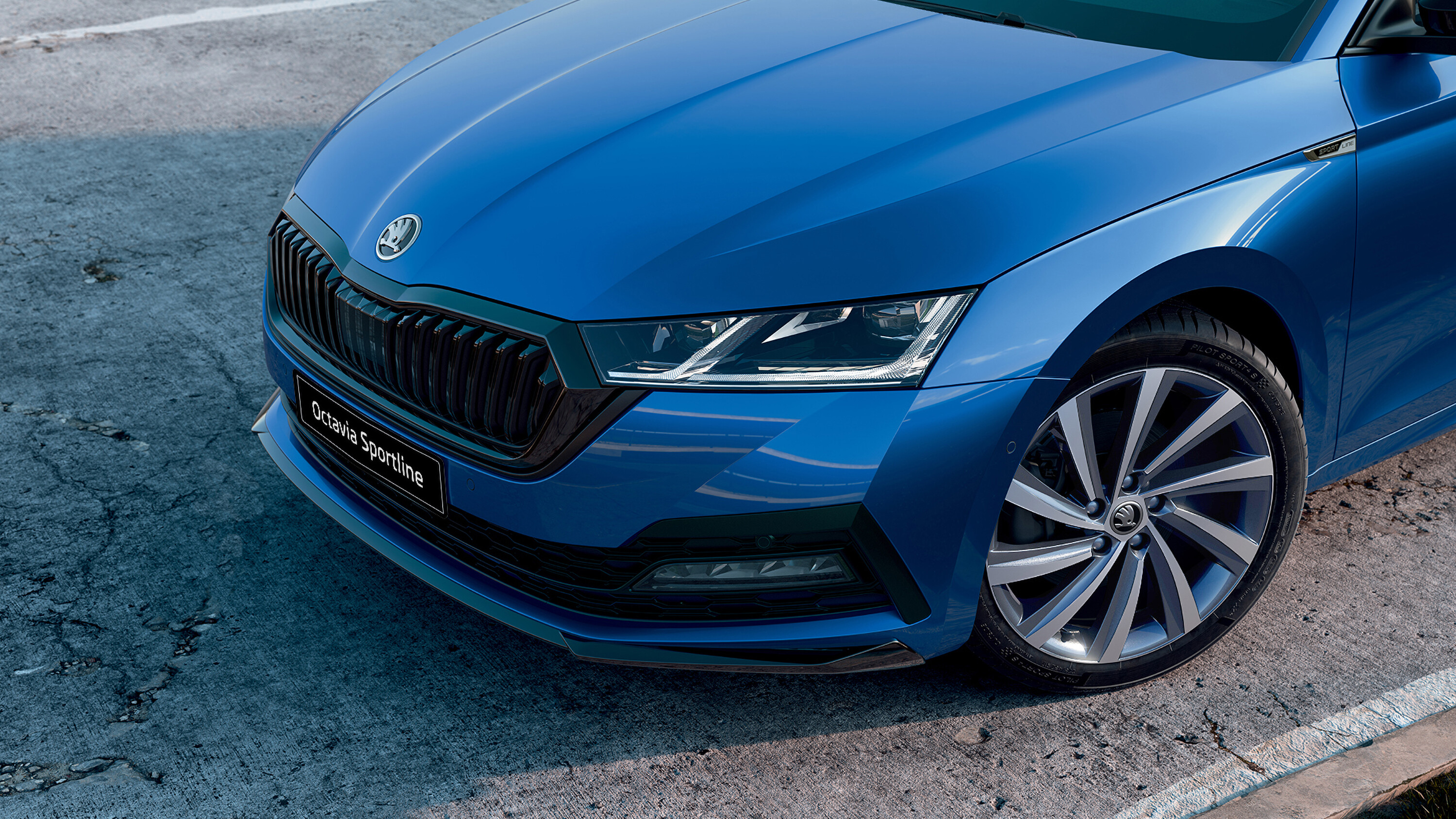
The new Octavia SportLine trim is available to order in both Liftback sedan and Wagon forms. It joins the existing Octavia Style as a no-cost package that adds a sportier look and feel, inside and out, along with a lower ride and a new Drive Mode selector.
As with the Style, the Sportline is priced from $40,590 before on-road costs, but Skoda also quotes national SportLine-specific drive-away prices of $42,490 for the Liftback and $43,990 for the Wagon.
1
Features: Style & Sportline
Both Style and Sportline trims of the Octavia are equipped with 18-inch alloy wheels, Matrix LED headlights and adaptive high-beam, heated exterior mirrors with auto dimming on the driver’s side, a powered tailgate, keyless entry and start, and dual-zone climate control.
Infotainment is via a 10.25-inch ‘Virtual Cockpit’ driver display, 10-inch main display with integrated satellite navigation, and wireless connectivity for Apple CarPlay and Android Auto.
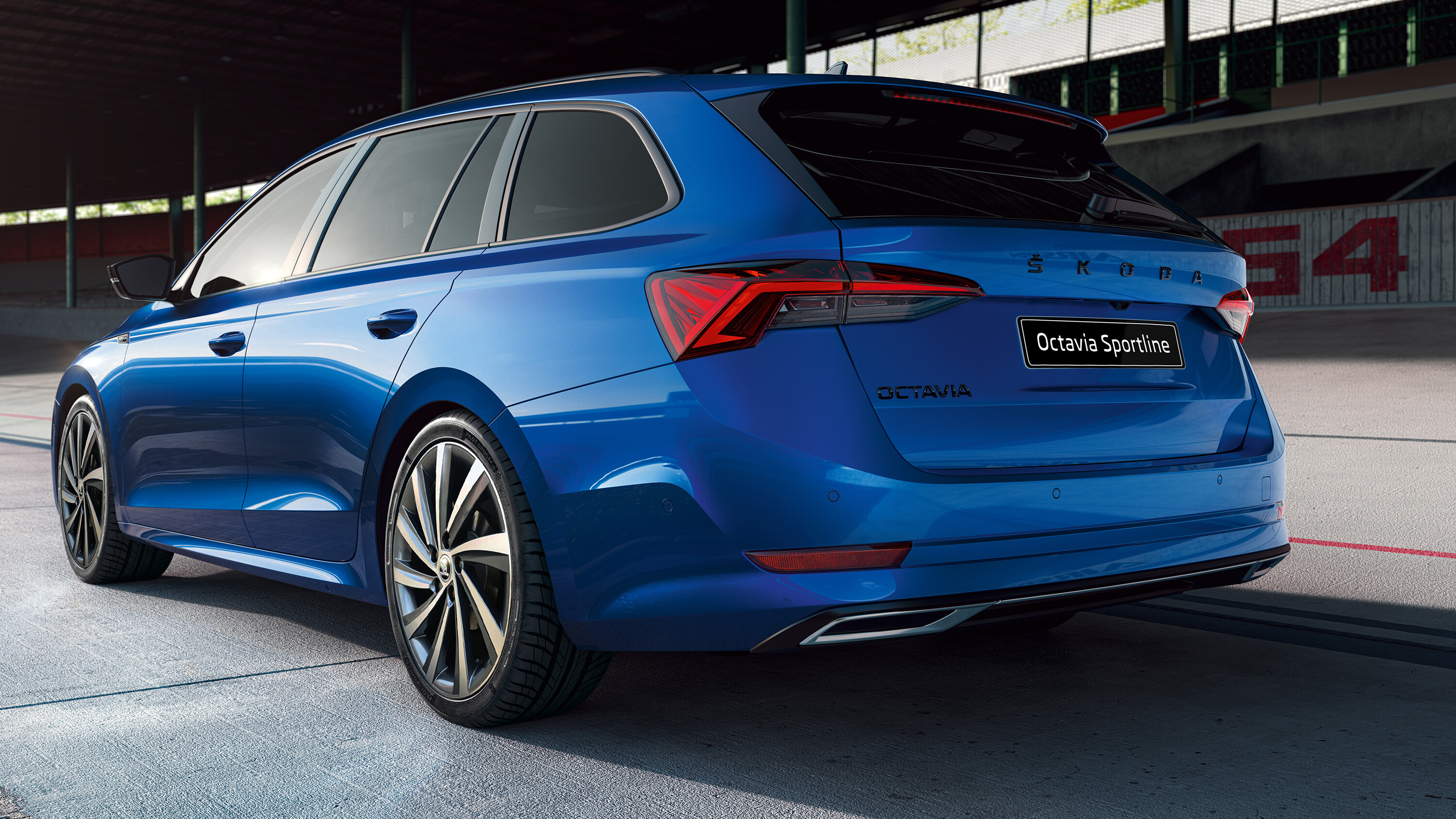
1
Safety features include front and rear parking sensors, Park Assist, Side Assist, Rear Traffic Alert, Lane Assist and Adaptive Cruise Control.
Options include Velvet Red paint ($770 Liftback, $1170 Wagon), a $1900 panoramic sunroof for the Wagon, and a $3200 Premium Pack that adds Emergency Assist, Adaptive Lane Guidance, powered front seats, heated front and outboard rear seats, tri-zone climate control, DAB+ digital radio, and extra USB-C points including one behind the interior mirror for easy dashcam power.
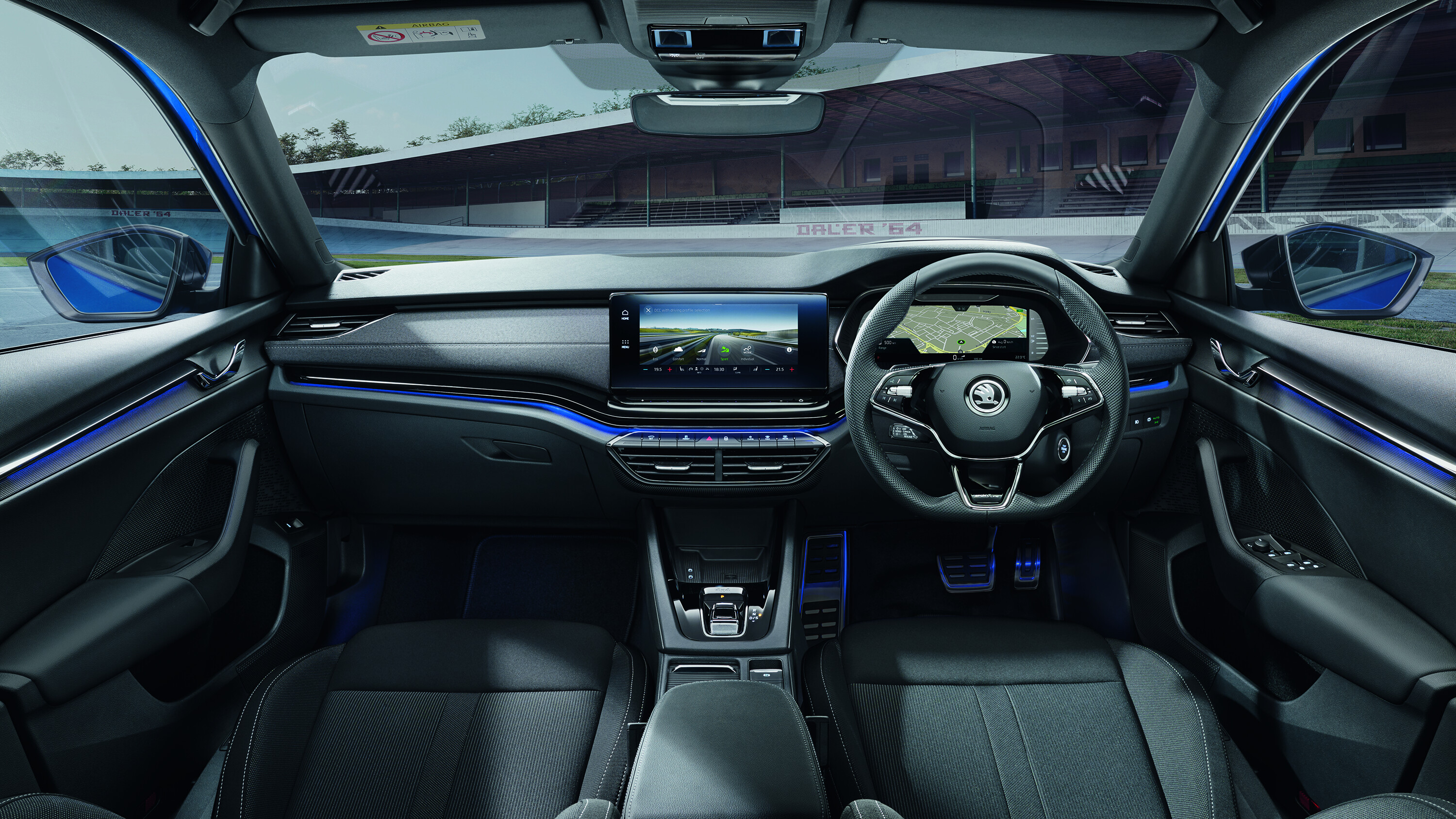
1
Features: Sportline
Enhancements to the SportLine grade are made up of 15 new extras, including a gloss-black treatment to the grille, mirrors, model badging, rear spoiler (Liftback) and roof rails (Wagon).
Taking inspiration from the hero Octavia RS, the SportLine also adds a front spoiler and rear diffuser, dual exhaust tips, a matte-black finish on the window trim and new SportLine badges on the front guards.
Inside you’ll find Skoda’s three-spoke, flat-bottomed, Sportline-badged steering wheel with paddle shifters, along with Sports Comfort front seats, aluminium pedals and a black trim to the headliner and pillars.
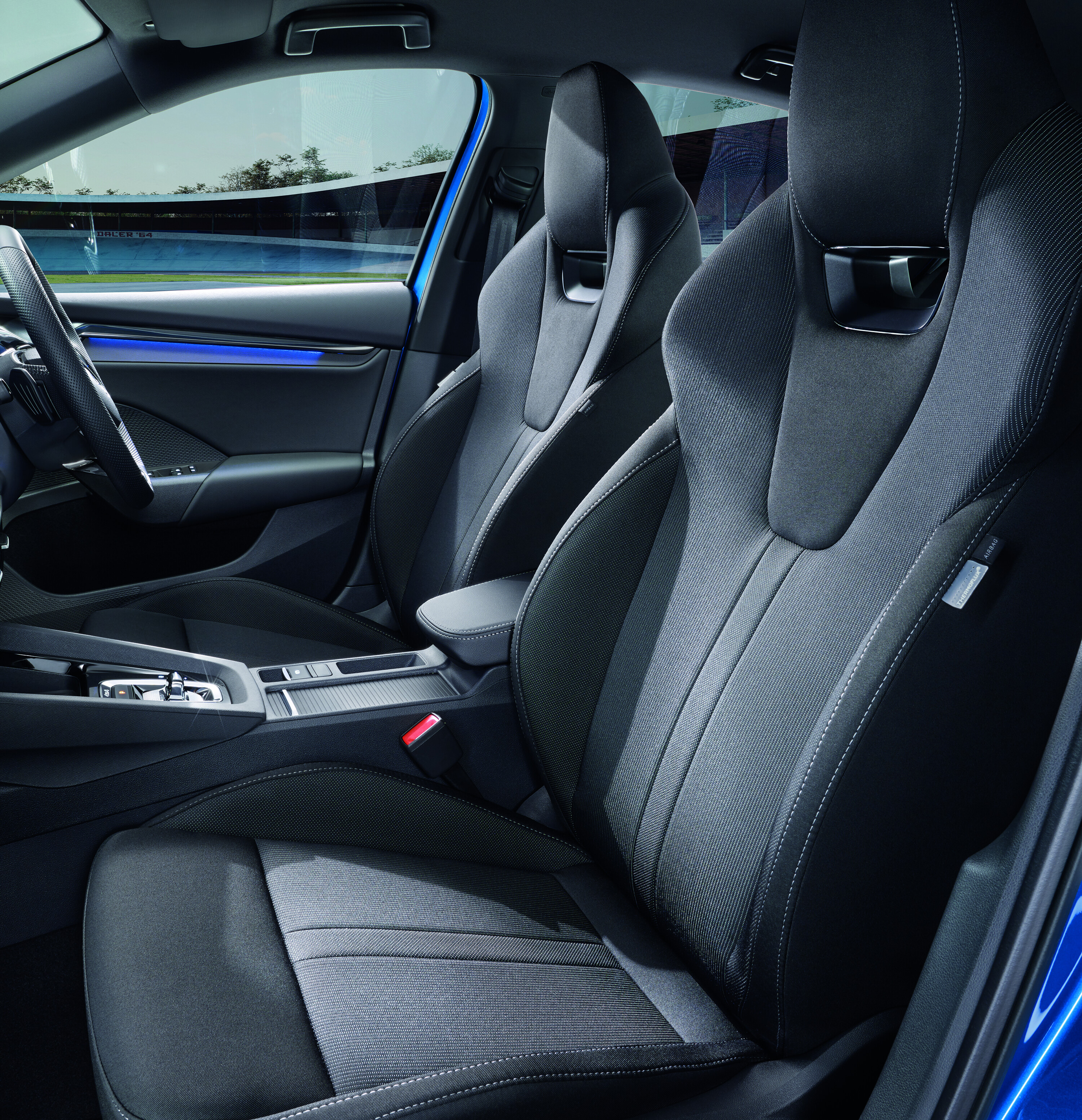
1
All of this rides on a sports suspension package that lowers the car by 15mm, matched to Eco, Normal and Sport drive modes.
Power is provided by the same 110kW/250Nm 1.4-litre turbo petrol four-cylinder engine that drives the Style, likewise partnered with an eight-speed automatic transmission and a front-wheel drive configuration. But, while there’s no bumper in power or torque, the added Sport mode enhances steering, throttle and transmission responsiveness.
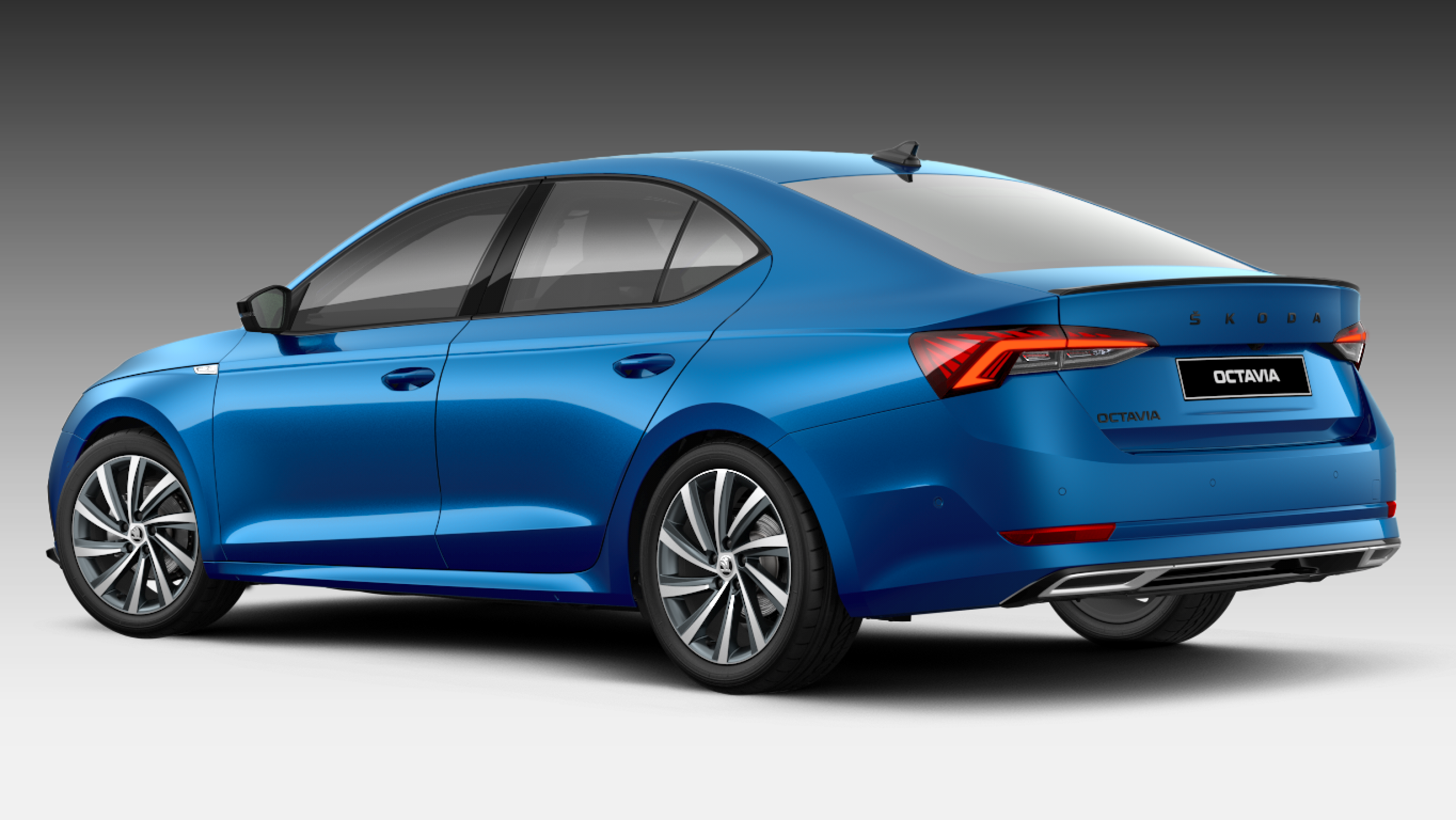
1
2024 Skoda Octavia pricing: Style and SportLine
The Octavia Style and SportLine both list a retail price of $40,590, or for the SportLine specifically: $42,490 drive-away for the Liftback and $43,990 drive-away for the Wagon.
Pre-paid servicing is also available, at $2450 for five years / 75,000km, or $2800 for seven years / 105,000km.
All Skoda models are sold with a seven-year, unlimited-kilometre warranty and seven years capped-price servicing. Skoda also offers a Guaranteed Future Value and finance program through its Skoda Choice service.
MORE
Everything Skoda
