
“Think about how badass that is.”
As the world waits for somebody, anybody to confirm a Days of Thunder sequel [↗], Netflix has announced it will premiere a new documentary series, NASCAR Full Speed, on January 30.
The first trailer for the series sees race footage overlaid with the voice of sports journalist Marty Smith saying: “If you’re a race car driver, you have the opportunity to be hurt — or killed. And you do it anyway. Think about what a badass that is”. The more things change, the more they stay the same: TV viewers love badasses.
“We’re badasses,” Trackhouse driver Ross Chastain says in Netflix’s announcement. “This sport has a whole garage full of the best mechanics, the best engineers, the best everything. This is it.”
Badass, got it. Not sure how that isn’t the slogan for the series, but hey.

1
Netflix’s announcement makes no mention of its massively successful F1-focused series Drive to Survive, but there can be no mistaking the inspiration for this new property.
The list of executive producers on the series doesn’t appear to feature any key names from Drive to Survive, although the formula is likely to be much the same – and it doesn’t hurt to have NASCAR legend Dale Earnhardt Jr on the team, either.
The show’s ongoing cast includes Ryan Blaney, William Byron, Ross Chastain, Denny Hamlin, Bubba Wallace, Kyle Larson, Christopher Bell, Joey Logano and Tyler Reddick.
The five-part series premieres on Netflix on January 30.
Now about Days of Thunder…
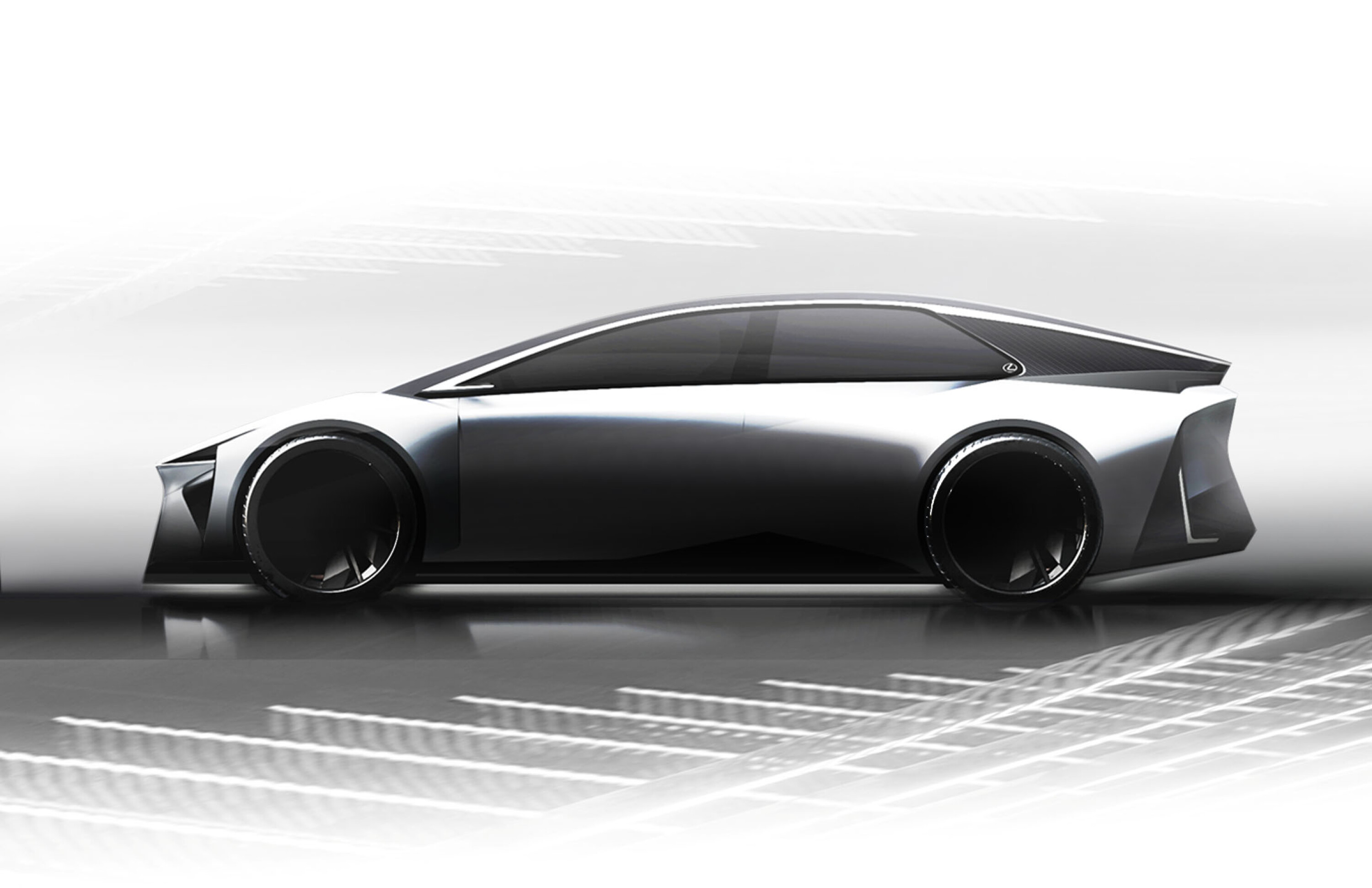
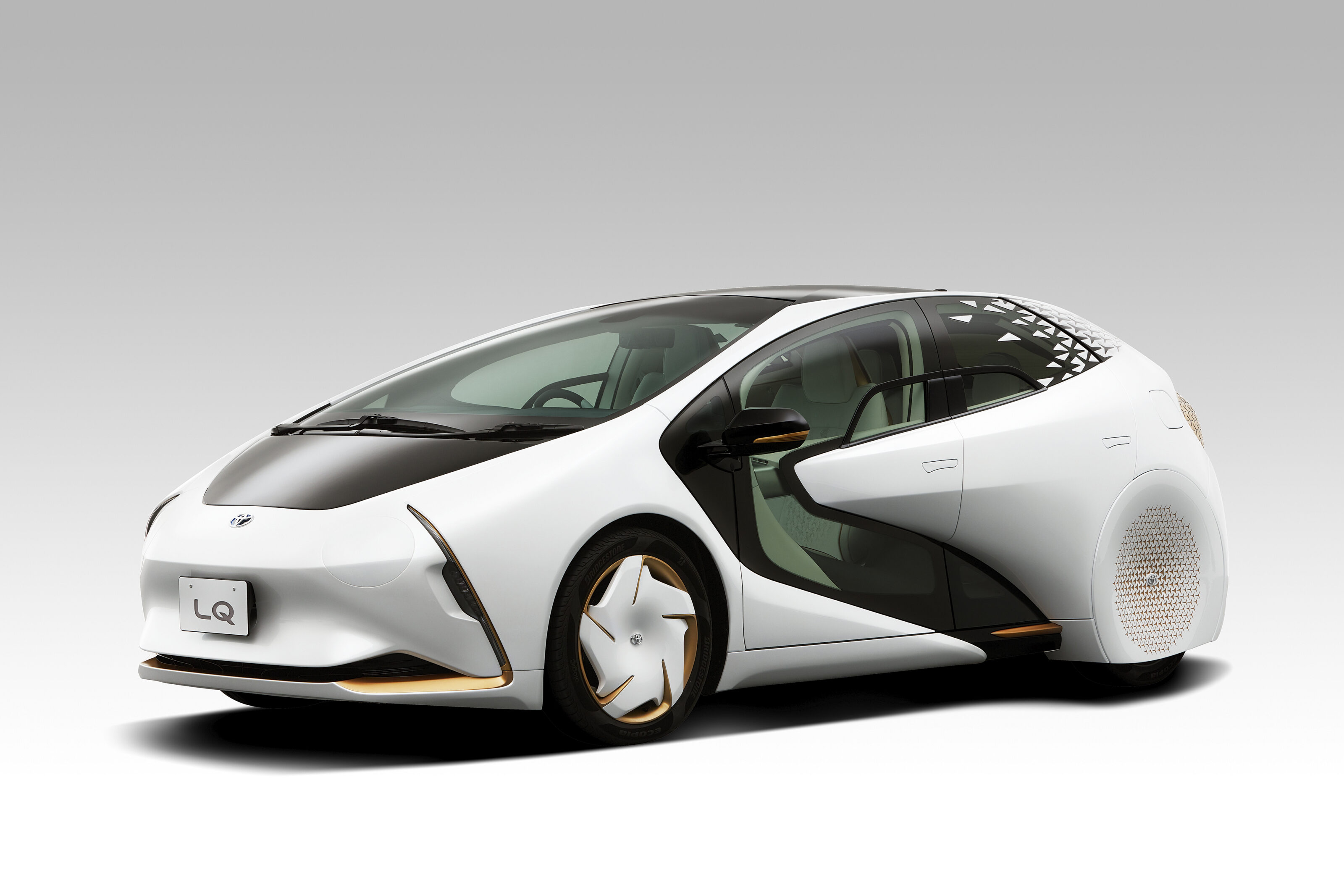
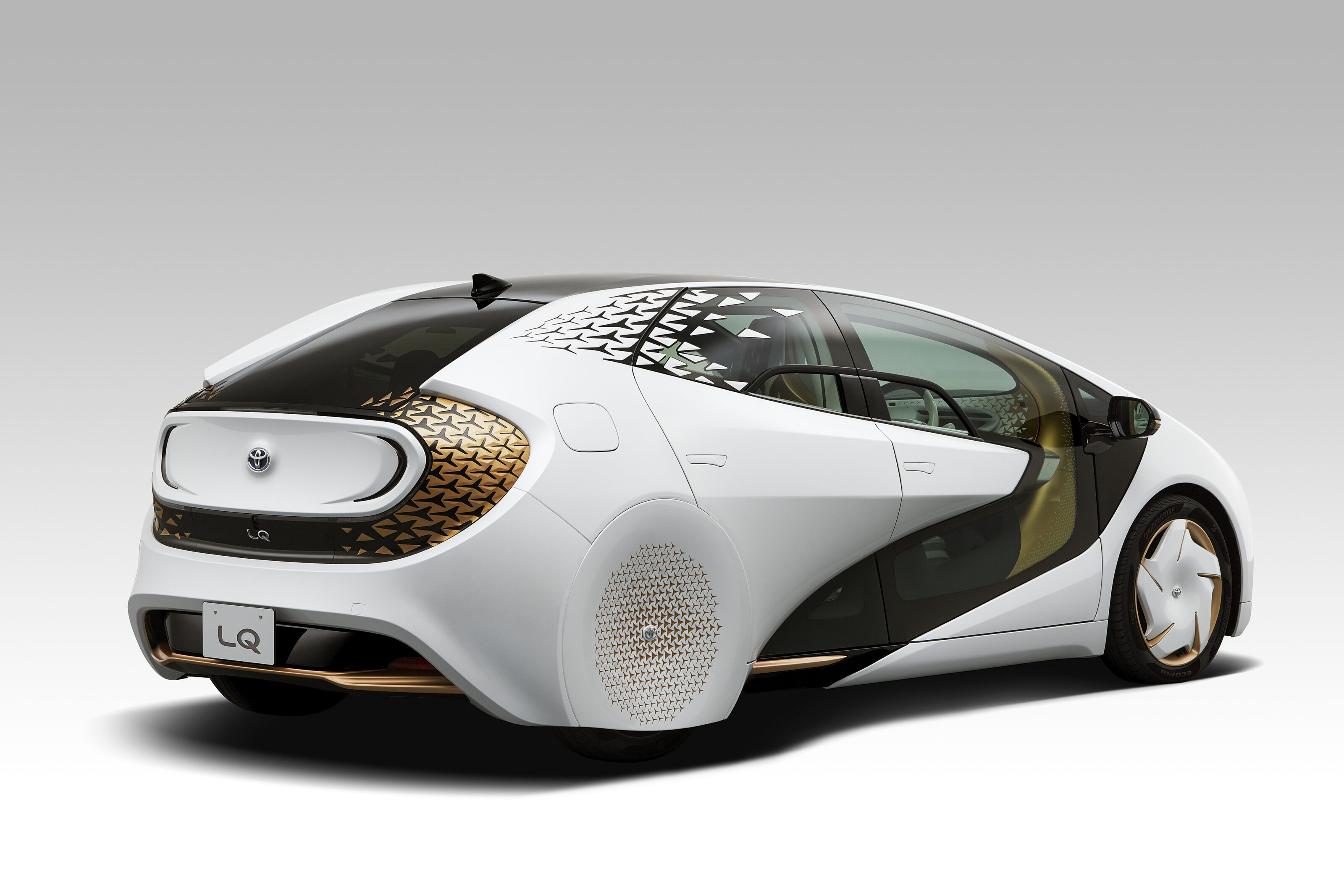
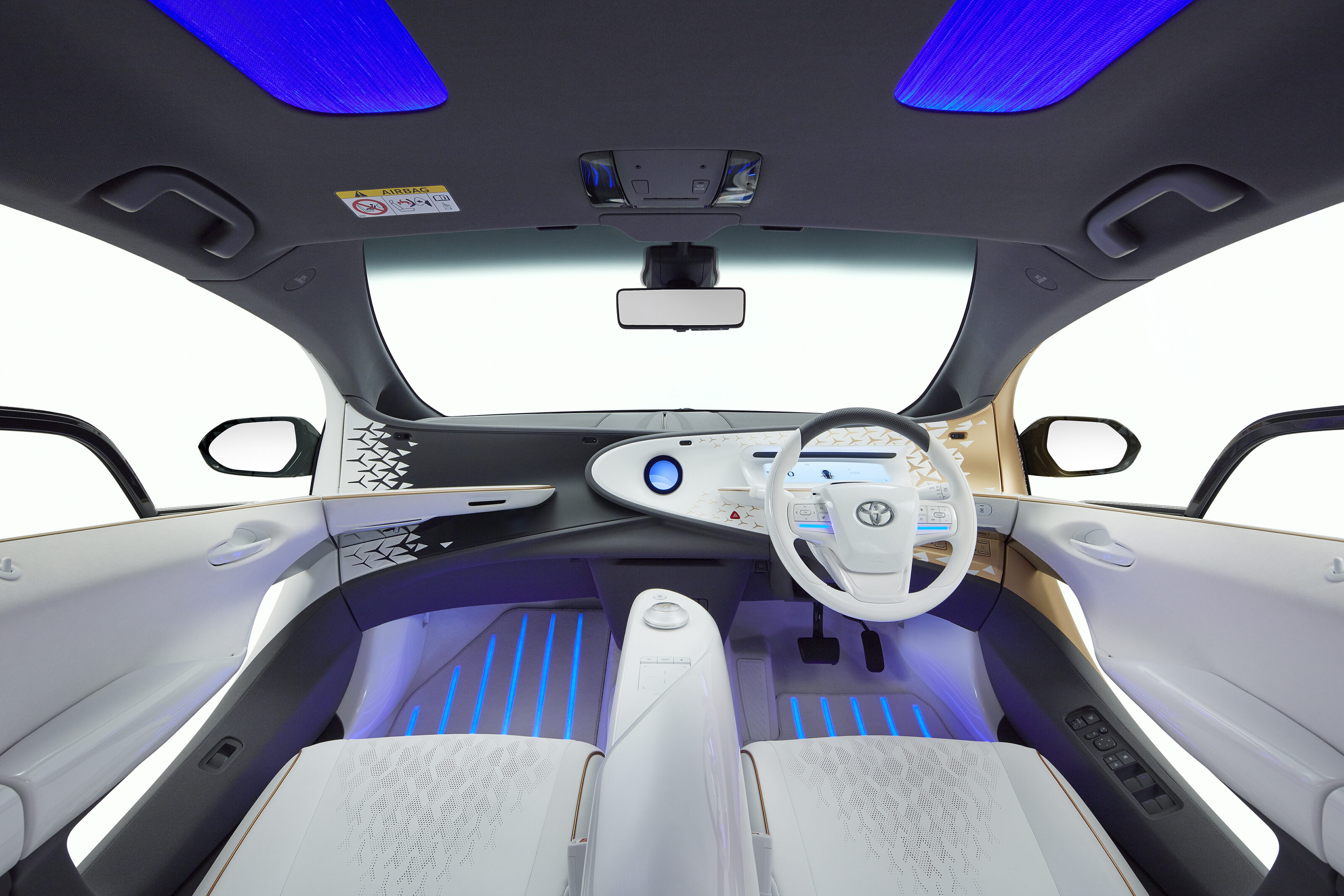
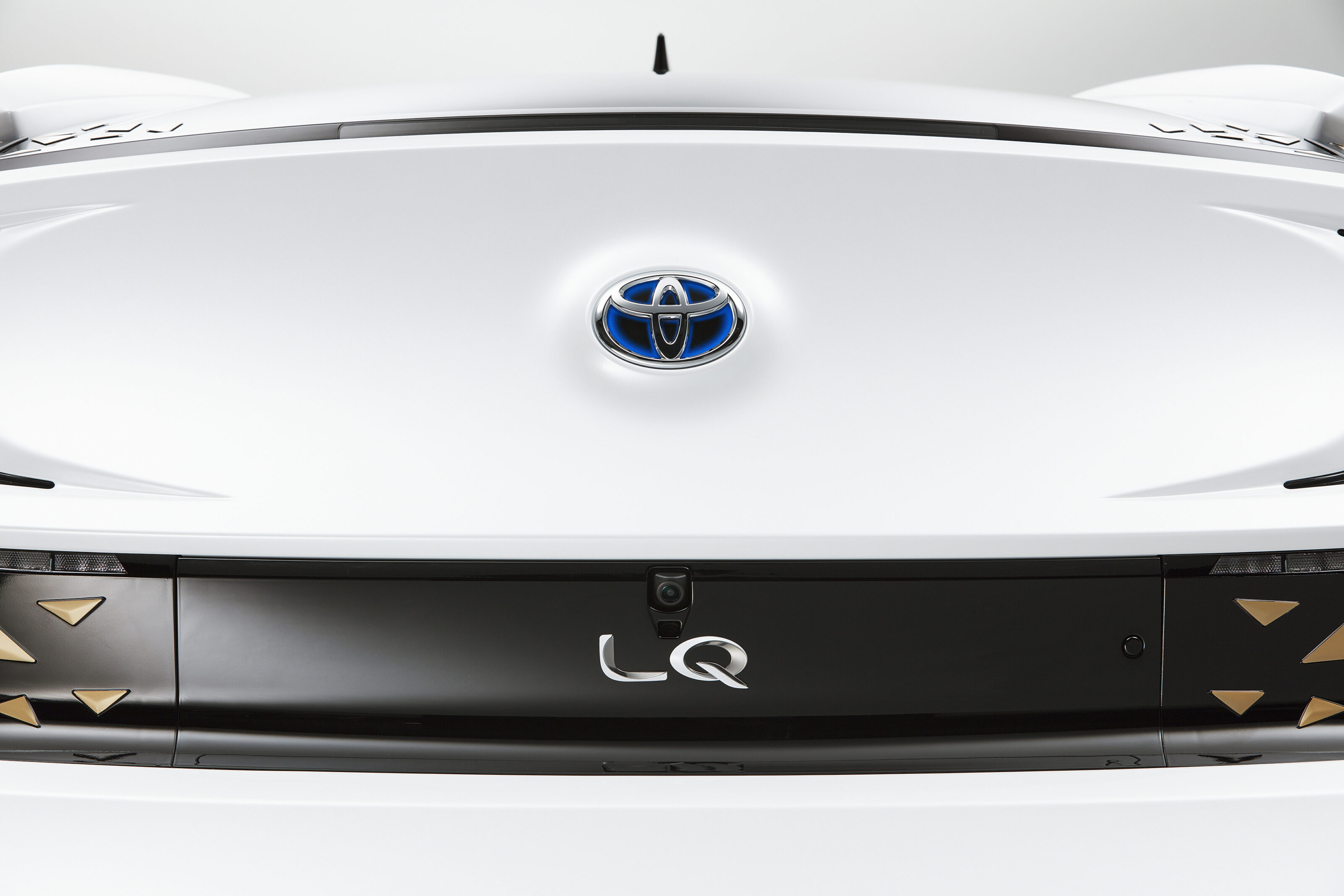
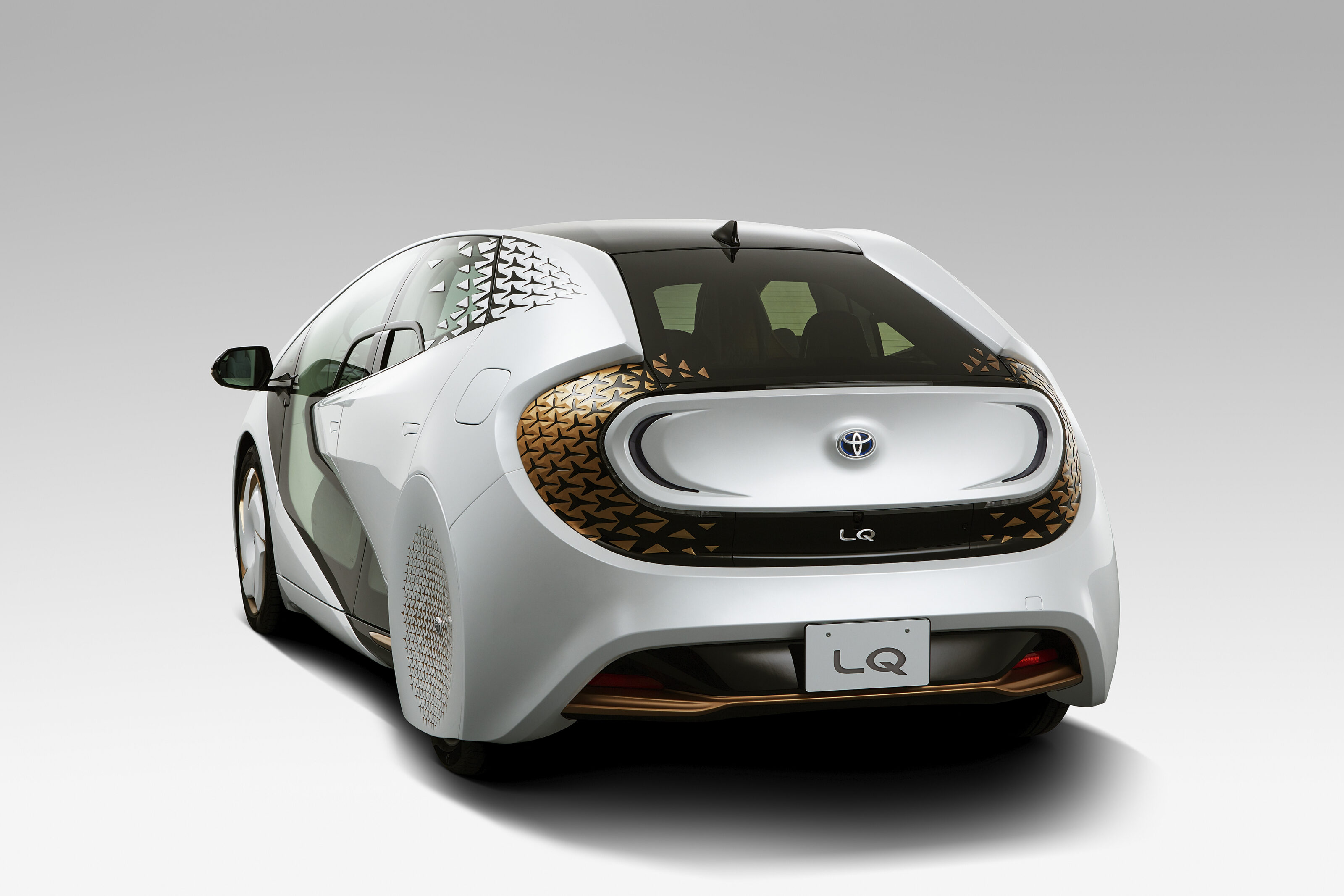
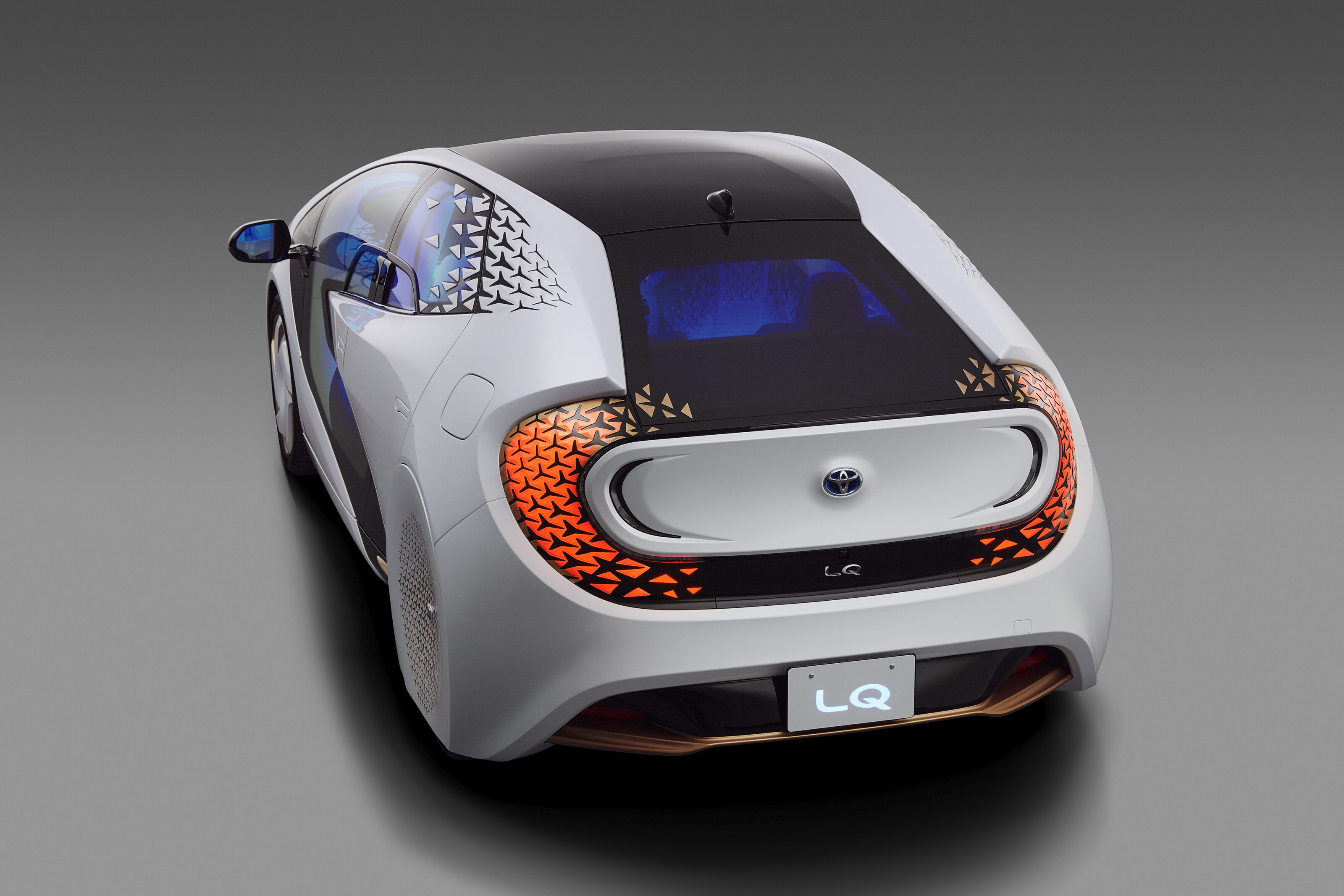
Toyota’s plan to become a global leader on solid-state batteries seems to be gaining momentum, with an executive from India claiming the company will introduce the new tech “in a couple of years.”
Toyota currently trails its rivals when it comes to EV production and sales — competitors like Tesla, BYD and Volkswagen are all ahead of the Japanese giant — yet it sees solid-state batteries as an opportunity to regain lost ground.
1
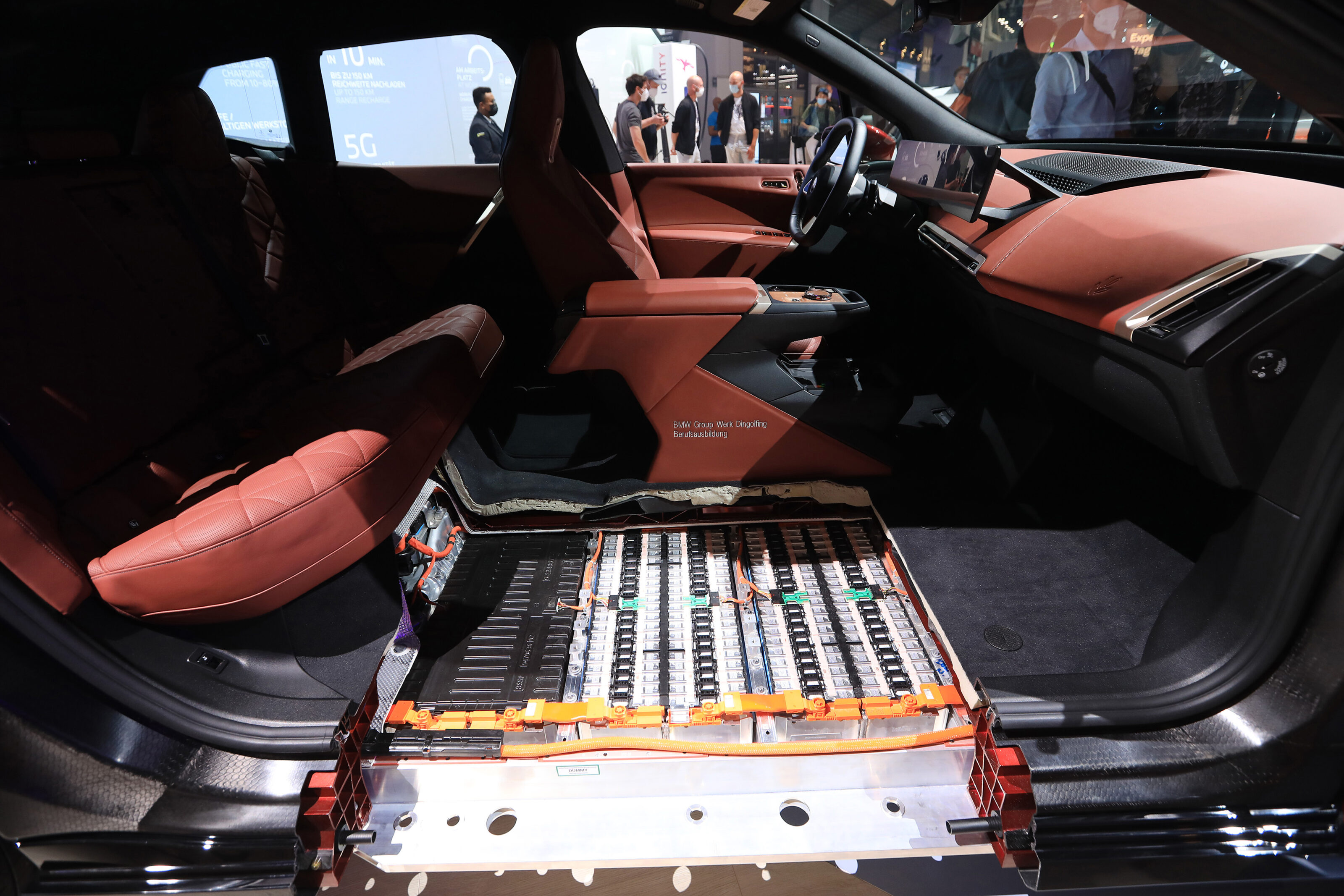
Promising faster charging times, better performance and longer battery life, solid-state batteries should also lower the purchase price of electric vehicles, leading many to tout them as the next great leap in EV powertrains.
“We will be rolling out our electric vehicles with solid-state batteries in a couple of years from now,” said Vikram Gulati, India’s head of Toyota Kirloskar Motor. “It will be a vehicle which will be charging in 10 minutes, giving a range of 1200km and life expectancy will be very good.”
Toyota isn’t the only brand developing solid-state batteries, of course. Hyundai, Kia, Volkswagen, Honda, Tesla and Mercedes are just some of the rivals investing heavily in the new battery tech, yet Toyota is quickly proving to be ahead of the curve.
Gulati’s comments were made at the Vibrant Gujarat Global Summit and it’s worth noting his suggested timeframe is much earlier than previously indicated. Until now Toyota has said it is aiming to achieve mass production of solid-state batteries towards the end of the decade.
In September last year, Toyota revealed its ‘advanced battery technology roadmap’ which mentioned a “breakthrough in sold-state battery technology”. At the same time, Toyota announced it had teamed up with Japan’s second-largest oil refiner, Idemitsu Kosan, to develop and mass produce solid-state batteries, with the partnership aiming to introduce the new batteries in 2027 and 2028.
Why solid-state batteries are the holy grail
If you could own an electric vehicle that could travel more than 1000km on a single charge, retained nearly all its battery capacity after three years, can operate normally in a wide range of temperatures, could be recharged in 10 minutes, and cost the same as an equivalent combustion-powered car, would you?
That is the situation that will be thrust upon consumers when solid-state battery technology begins being mass produced midway through this decade. Toyota is hoping to get ahead of the curve, pushing a number of solid-state battery electric vehicle prototypes into service with the aid of partner Panasonic.
With more than 1000 patents relating to solid-state tech, Toyota is putting most of a $18.7 billion investment toward its advancement and eventual large-scale production. It’s not hard to understand why. The benefits of solid-state batteries over current lithium-ion designs are clear cut. Solid-state units are safer, have a higher energy density, reduce both size and weight, and can operate in a wider temperature window.
2
Lithium-ion batteries use a liquid electrolyte solution that if not properly managed, or is damaged, can swell in size or spontaneously combust. These events are rare, but they do occur. With certain lithium-ion batteries, as much as a third of the storage capacity can degrade after a decade.
In both battery designs the electrolyte is a chemical mixture that allows current to travel between the cathode and anode (or more simply the positively and negatively charged electrode respectively). In lithium-ion batteries this separator is a liquid solution, where a solid-state battery uses a solid electrolyte.
Liquid electrolytes are what cause those spectacular and hard-to-dose fires when things go wrong. Solid-state alternatives alleviate all these issues and bring a massive increase in the amount of power that can be stored within a battery. This gives manufacturers two options; reduce the size of a battery, saving space and weight with no loss of energy, or retain the current dimensions with a boost in outputs.
1
The fact that a solid lithium metal anode increases energy density has been known for nearly half a century, but it is only now that we have had the technology to make it a reality. That’s because using lithium metal with a liquid electrolyte has a risk of creating stalagmite-like formations that can puncture the separator between the anode and cathode which results in a nasty chemical explosion.
A variety of solid-state electrolytes are now available that work as a ceramic separator and have the same conductivity without the risk of exploding.
A prototype non-automotive solid-state battery from Samsung has an energy density of 900Wh per litre, while the very best lithium-ion units are only capable of roughly 700Wh per litre. The company says using this in an electric vehicle would allow the car to travel up to 800km on a single charge. With a life cycle of 1000 charges that puts the battery’s lifespan at 800,000km. Your uncle’s LandCruiser might struggle to match that.
1
Going even further, US-based QuantamScape, of which Volkswagen has a 5 per cent stake, released a study late last year that demonstrated its solid-state battery cells have an energy density of more than 1000Wh/L.
On top of that, it was shown the batteries can charge to 80 per cent capacity in 15 minutes, while retaining more than 80 per cent of its capacity after 800 charge cycles. The secret? Pure lithium metal as the anode. A production-spec version of the battery isn’t expected until 2024.
Toyota’s claims are simple. Twice the range of an equivalent lithium-ion unit, while retaining 90 per cent of its performance after 30 years. Continuing its bold claims, Toyota says its solid-state batteries will be capable of charging from zero to full in just 10 minutes. Toyota says its solid-state battery won’t hit mass production until 2025.
Like others in the solid-state arms race, that’s because while the technology is almost ready for large scale use, the production capacity isn’t there yet. Unlike current batteries, solid-state units require different machinery and techniques in the manufacturing process. Additionally, simply not enough raw lithium is being produced – of which the world has a finite amount (see breakout).
1
Toyota also has a government-funded advantage. Japan’s government has created a ¥2 trillion (A$24.7 billion) war chest which it is using to fund manufacturers’ efforts in creating new decarbonisation technologies. A large portion of the money will go toward solid-state batteries, in particular acquiring the lithium needed. Additionally, two Japanese mining and oil companies, Mitsui Kinzoku and Idemitsu Kosa, are building infrastructure to produce solid electrolytes.
This is all in an effort to gain an advantage over China and South Korea in the battery production arms race, with the global market for next-gen tech that outguns current lithium-ion designs expected to grow in value from $53.6 million a year to $34.6 billion in 2035.
Why the rapid expansion? You, the average car buyer. In 2035 you’ll be faced with that dilemma that started this, and there are big players betting they know which option you’ll choose.
1
Seeing glass
The University of Bayreuth is working with Tesla Germany and Varta Microbattery to develop lithium-ion battery separators made of glass. The project dubbed GlasSeLIB (meaning glass separators for lithium-ion batteries), hopes to use glass electrolytes instead of ceramics to increase the safety and service life of lithium-ion batteries.
The hybrid dilemma
Toyota has copped plenty of flak for dragging its feet on full battery electric vehicles – opting instead to favour traditional hybrids. In response, the manufacturer says its 18.1 million hybrids produced so far are responsible for the same carbon dioxide reduction impact as 5.5 million BEVs, while using the battery components needed to build just 260,000 BEVs. That said, by 2025 Toyota promises to have 15 different BEVs in production.
1
Nickelpack
Despite the focus on solid state batteries, Toyota hasn’t completely abandoned lithium-ion or nickel-metal hydride designs. Its that latter which the Japanese brand has recently announced a breakthrough with, creating ‘bipolar electrodes’ that allow for the battery to shift from a group of separate cells to a single stack. The new design can fit 1.4 times the amount of cells, producing 1.5 times the power compared to previous gen nickel-metal hydride batteries.
Mine craft
Regardless of design, batteries for EVs require the use of lithium, of which there are only 80 million tonnes of reserves identified globally. Bolivia sits atop the largest lithium reserves with 21 million tonnes, ahead of Argentina (17m), Chile (9m), the USA (6.8m), and Australia (6.3m).
In 2019 we were the largest exporter of lithium in the world, with 42,000 tonnes being shipped overseas that year, most of it going to China (who has the sixth largest reserves at 4.5m tonnes). The next biggest exporter was Chile, which offloaded 18,000 tonnes.
1
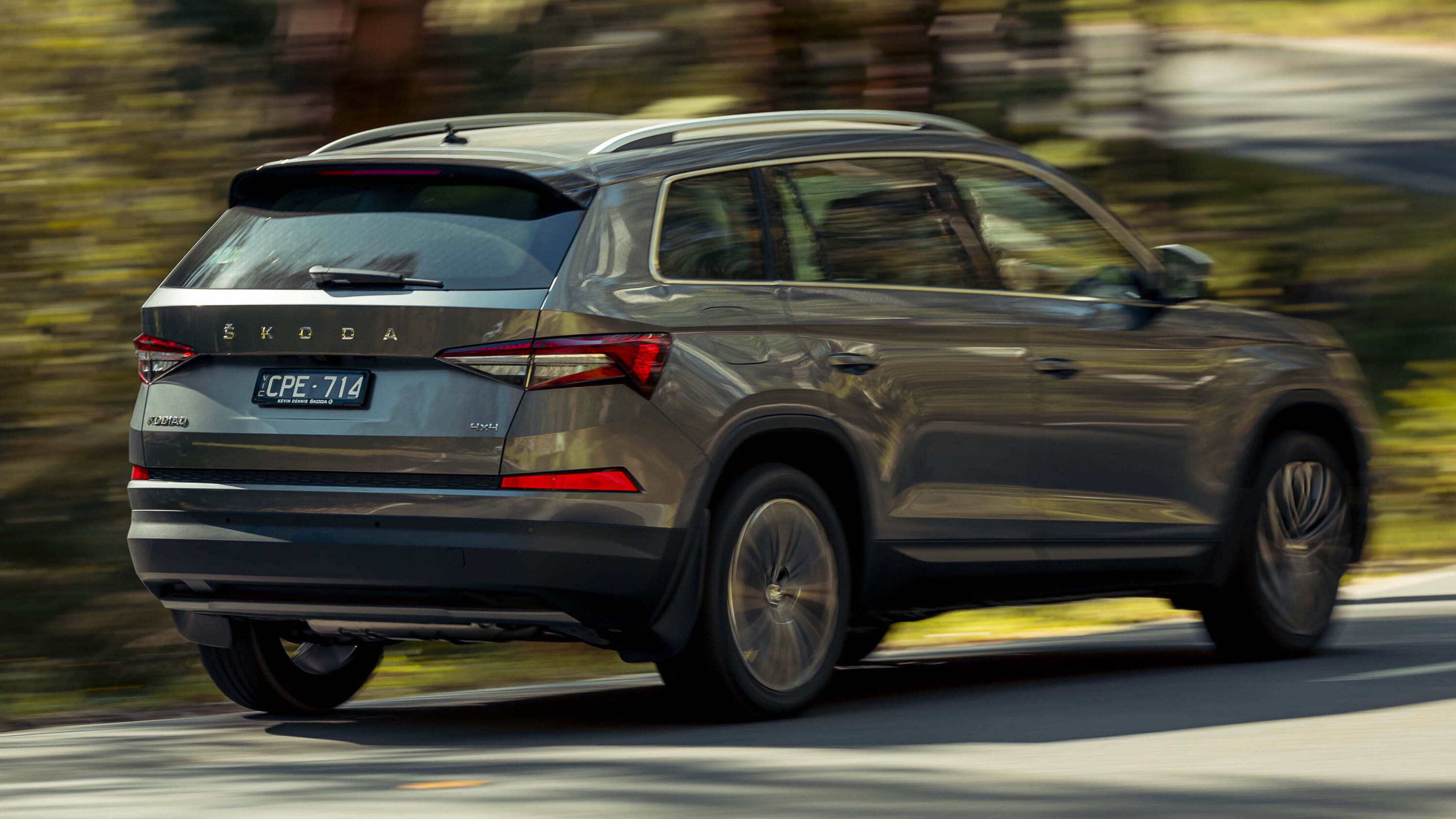
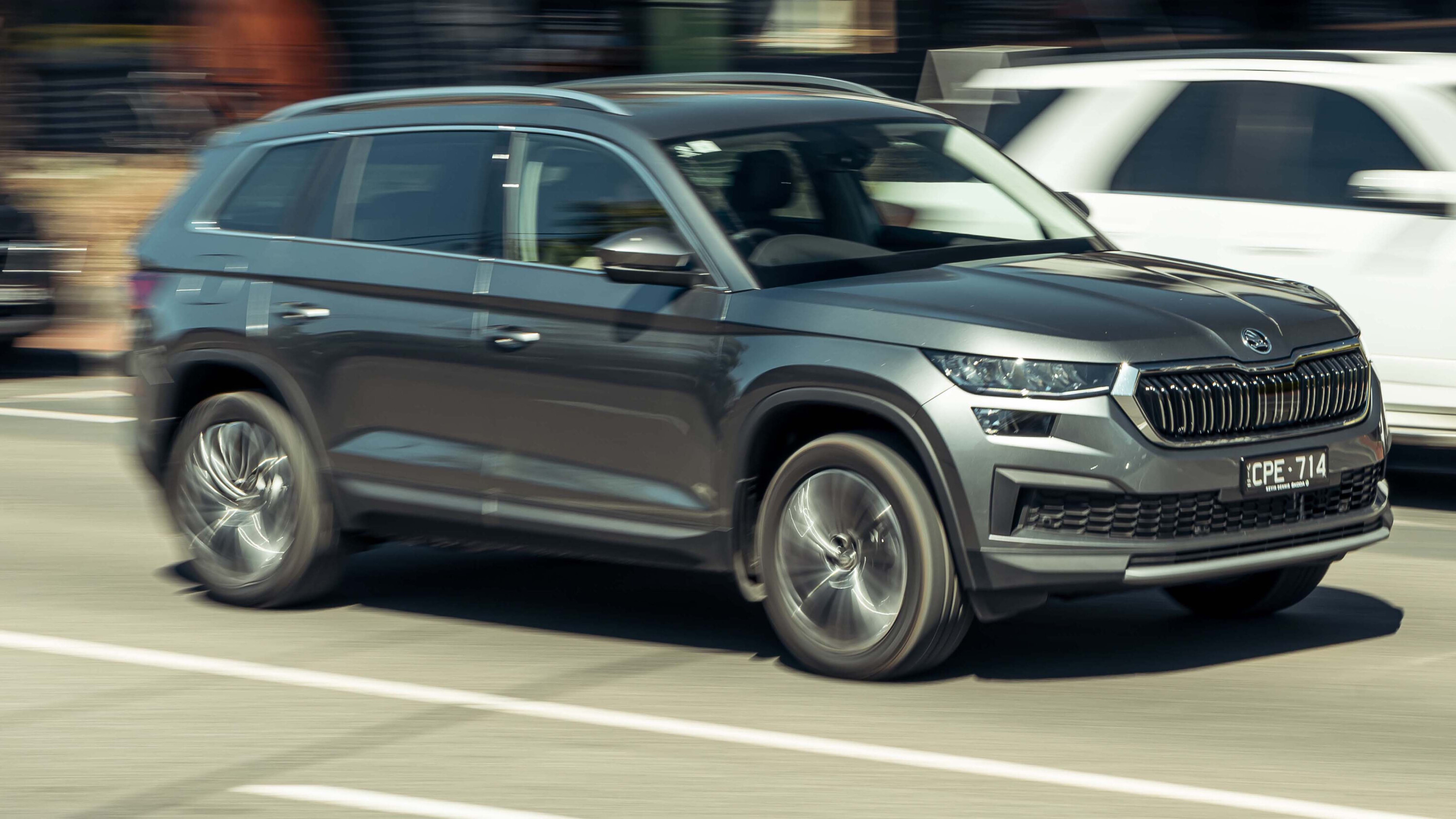
The Skoda Kodiaq is the Czech brand’s answer to the large SUV question, yet it’s not a typical response to the requirements.
Being only just a little larger than American-focused medium SUVs like the Kia Sportage, it’s the way this seven-seater deals with interior space that’s most impressive.
An all-new Kodiaq (well, strictly speaking, a heavy revision of this car’s existing engines and MQB underpinnings) is due in late 2024 with a more digitised cockpit, but the current car is ageing with panache.
Following its recent success as a large SUV under $60K, we’ve taken a closer look at the base model Style 132TSI to see if it’s the pick of the range.
1
JUMP AHEAD
- How much is it, and what do you get?
- How do rivals compare on value?
- Interior comfort, space and storage
- What is it like to drive?
- How safe is it?
- How much fuel does it use?
- Warranty and running costs
- VERDICT
- Specifications
How much is it, and what do you get?
Skoda talks in drive-away pricing for its cars in Australia and, at $56,490 this Style initially seems a little steep for a ‘base model’ large SUV.
But with seven seats and a lengthy equipment list (MY24 models now have all the semiconductor-restricted items back on board), the Style arrives with plenty of kit.
| 2024 Skoda Kodiaq 4×4 Style standard features | |
|---|---|
| Full-LED head and tail lights | Adaptive cruise control |
| Dynamic rear LED indicators | Rear cross-traffic alert |
| Gloss black spoiler | Blind-spot monitoring |
| 19-inch Cursa alloy wheels | Nine airbags |
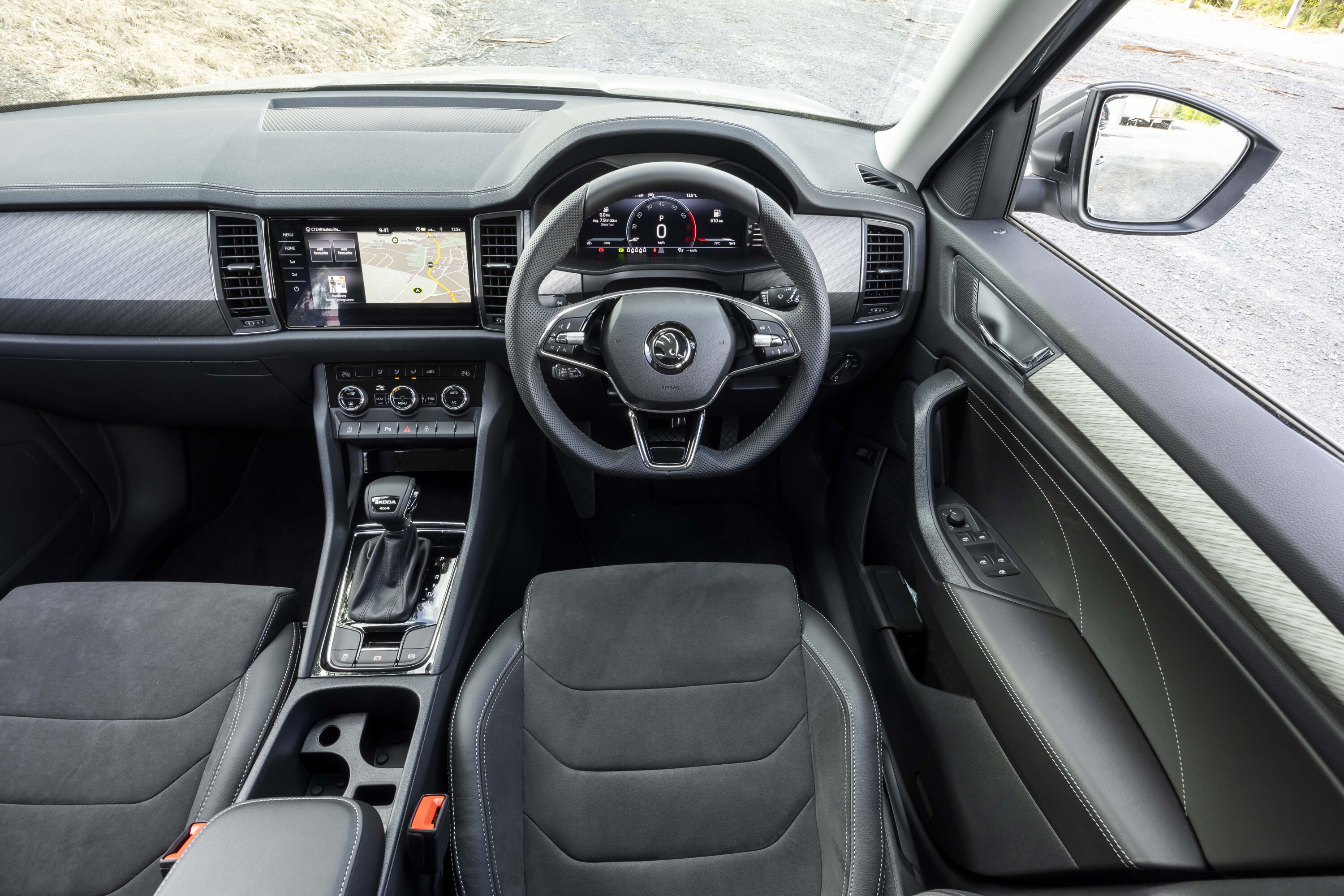
| Suede-cloth and leather-appointed seats | 9.2-inch Columbus infotainment system |
| Three-spoke leather steering wheel | 10.25-inch virtual cockpit |
| Aluminium effect trim | Wireless Apple CarPlay and Android Auto |
| Power tailgate | USB-C port for infotainment, plus one in the rear-view mirror for dash-cams. |
You can venture into Skoda’s option packs to unlock some extras. They include the $6900 Luxury pack (tri-zone climate, lane-trace assist, heated steering wheel with paddles, matrix LED headlights, power-adjust front seats with heating, ventilation and memory, leather upholstery, and 360-camera).
1
There’s also the $3000 Tech pack which brings adaptive dampers and drive mode selection, hands-free power tailgate, auto-parking, off-road assistant, and a premium Canton sound system.
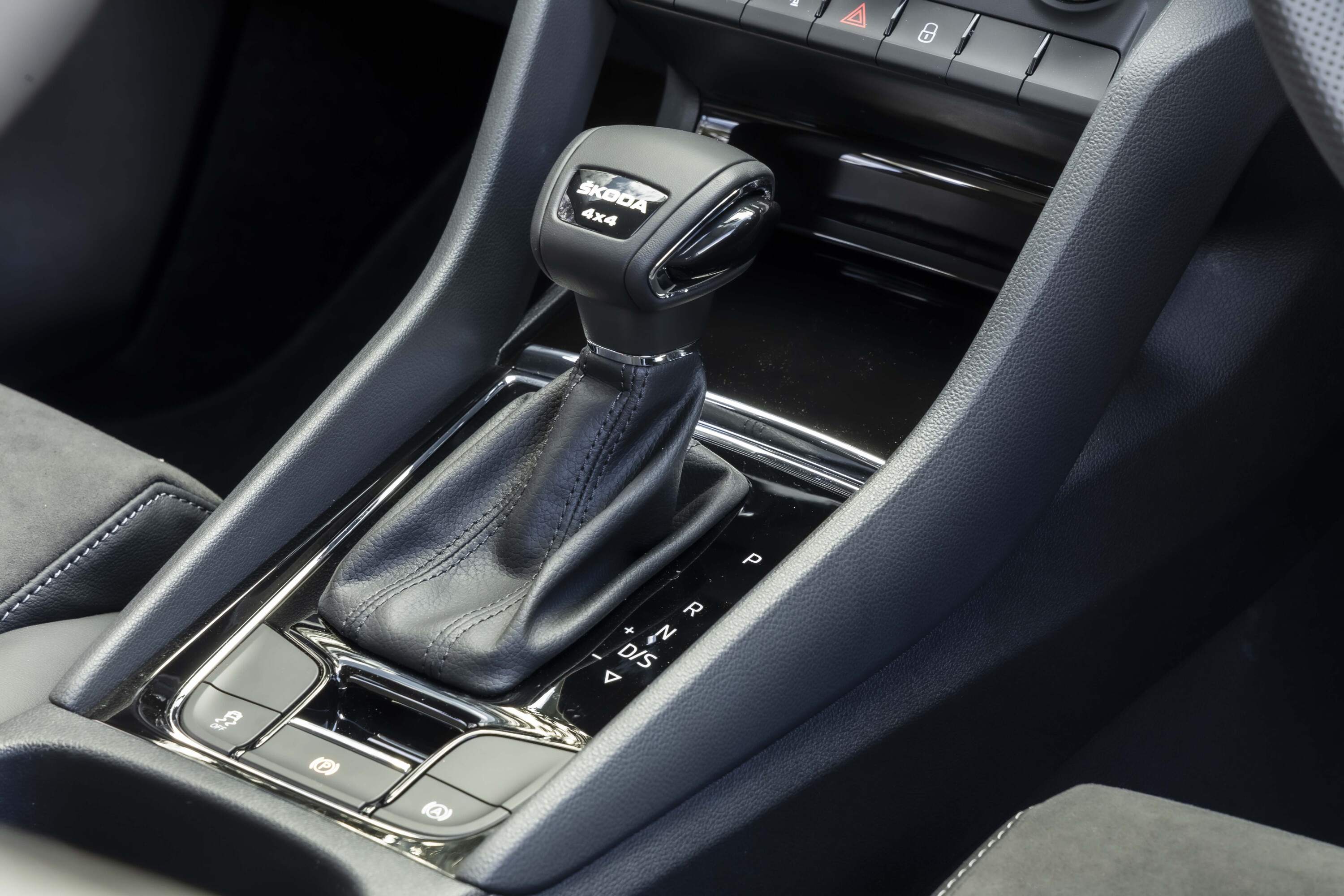
Those looking for sportier options can go for the Sportline ($61,490 drive-away) which retains the 2.0-litre engine but adds 20-inch alloys, black exterior styling, and more aggressive bumpers or there’s the more focused RS model featuring a grunty 180kW 2.0-litre turbo-petrol replete with fruity (augmented) soundtrack.
1
How do rivals compare on value?
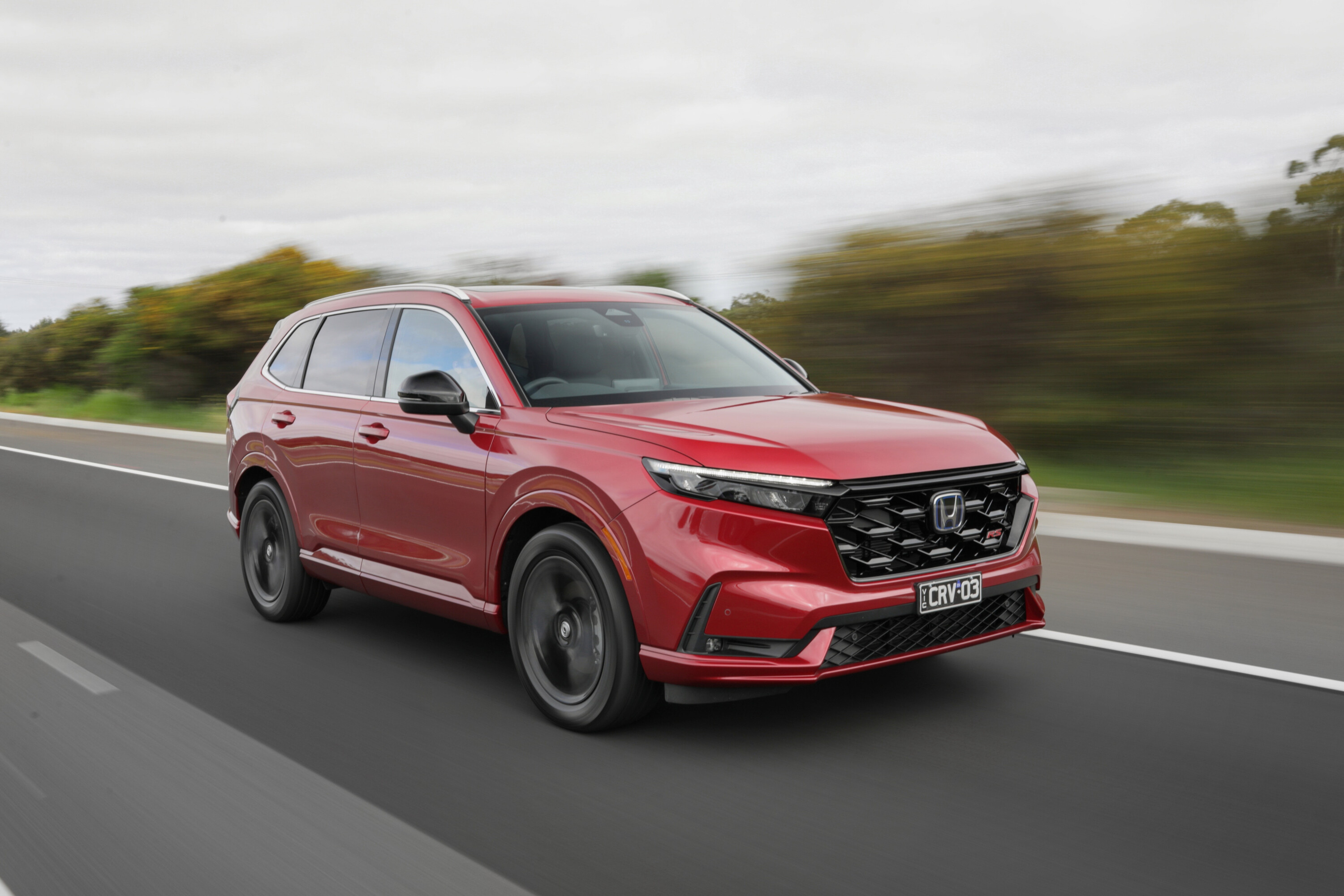
The all-new Honda CR-V runs the Skoda close for value, especially considering that the Honda’s $57,000 drive-away price gets you the top-spec VTi LX AWD.
Hold on a second, though, because the Kodiaq is only a ‘base’ model as it’s where the range starts in Australia.
In truth, the Style has equipment you’d find on mid-spec (or higher) rivals including AWD, a 2.0-litre turbo engine, height adjustment for both front seats, power tailgate, and a 9.2-inch touchscreen with navigation and wireless Apple CarPlay. It’s only missing leather upholstery, a sunroof, and power-adjust seats to match the top-spec Honda.
Other large SUVs, such as the Toyota Kluger GX and Hyundai Santa Fe Active, are bigger inside but that matters only if you’re regularly using the third-row for full-size adults. And compared to the Skoda’s cabin, the Kluger GX feels cheap indeed.
MORE
Best Large SUVs
1
Interior comfort, space and storage
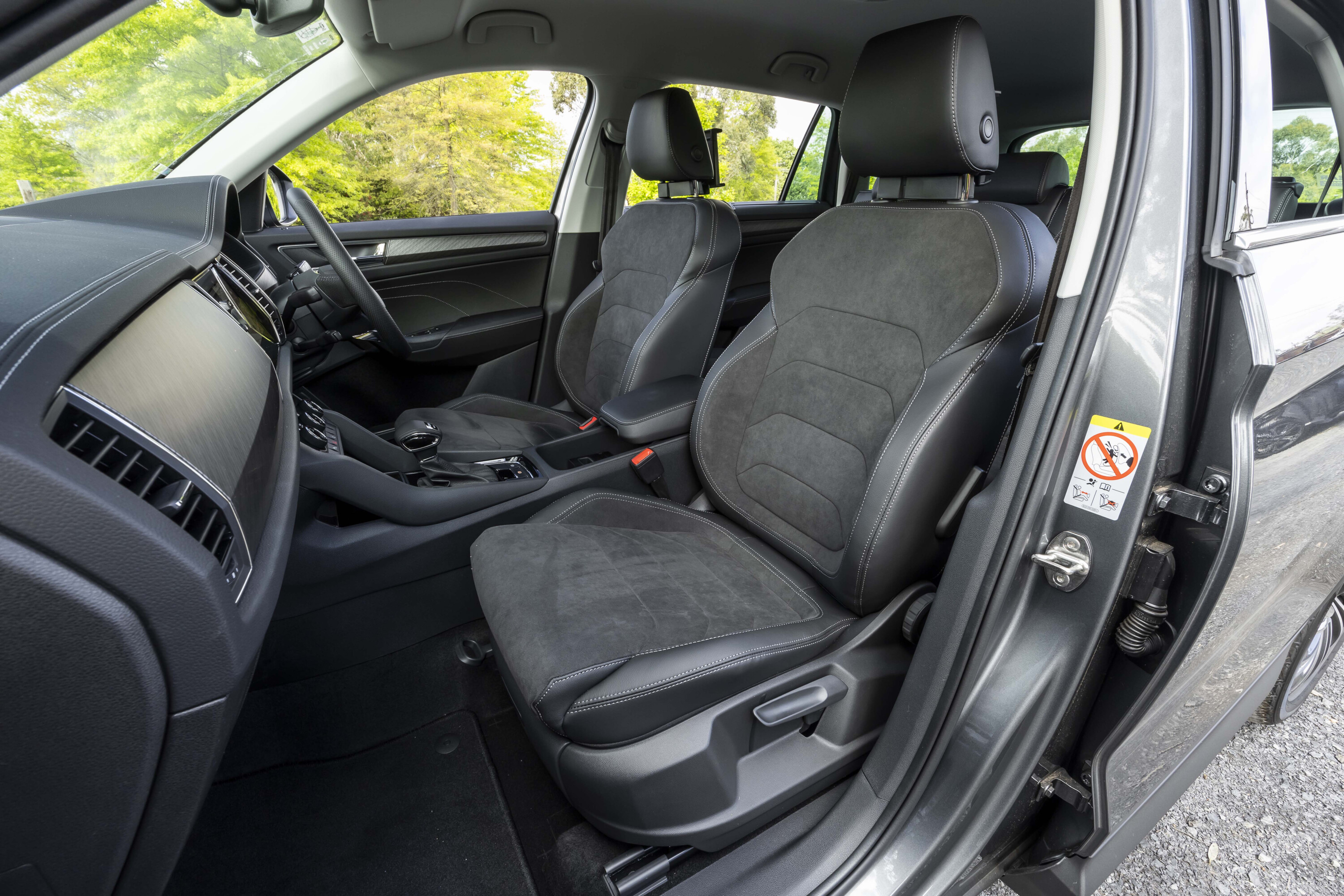
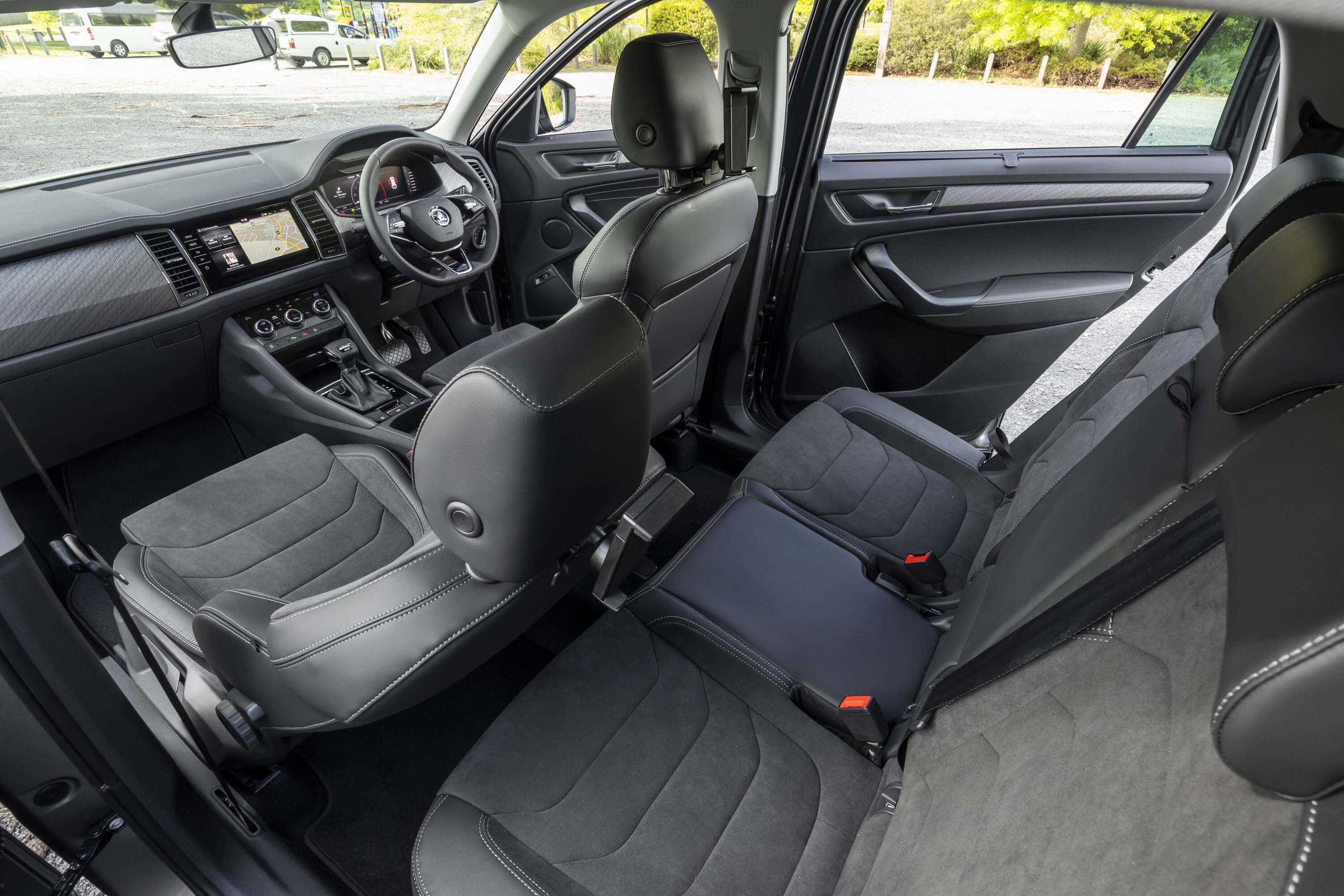
The Kodiaq’s cabin is impressive: high-end materials and mostly solid build quality are what you notice right away, but there are many more delights as you dive deeper – this feels like a car designed and engineered for family use.
Those front seats may be manually adjustable, yet they’re appointed in expensive-feeling suede-cloth upholstery and are terrifically comfortable with passenger seat height adjust.
The cabin is ergonomic and useful with two gloveboxes, generous flocked door pockets, deep ‘Megabox’ centre storage bin with two cup holders, wireless Apple CarPlay, twin USB-C ports and a wireless phone charger.
1
The centre touchscreen strikes a welcome balance between touch-swiping and physical buttons, however, Skoda’s ‘Columbus’ infotainment system feels dated next to crisper systems in the Kia Sorento.
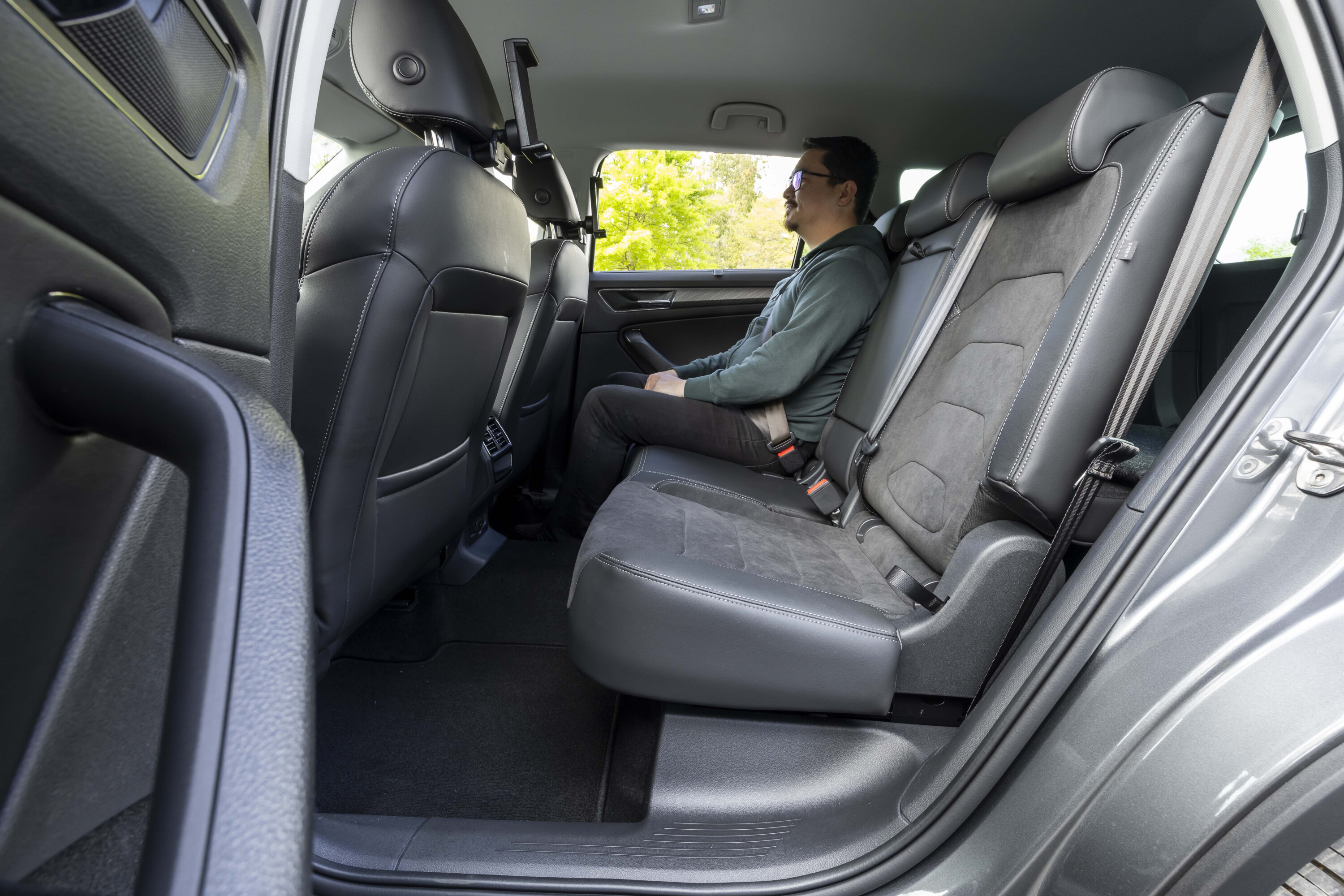
The Kodiaq’s middle row, which is on rails, is equally comfortable and thoughtfully executed thanks to one-touch access to the third row, ample space for adults, standard window blinds (yep, even in the ‘base’ model) and accessory tablet holders. There are no extra USB ports, however, which betrays the Kodiaq’s age a little.
You also score a third row of seats which fold flat into the boot floor. The third row itself isn’t super roomy – think of the Kodiaq as a five-plus-two rather than a genuine seven-seater – but headroom is okay for shorter adults and you score cupholders and storage cubbies.
1
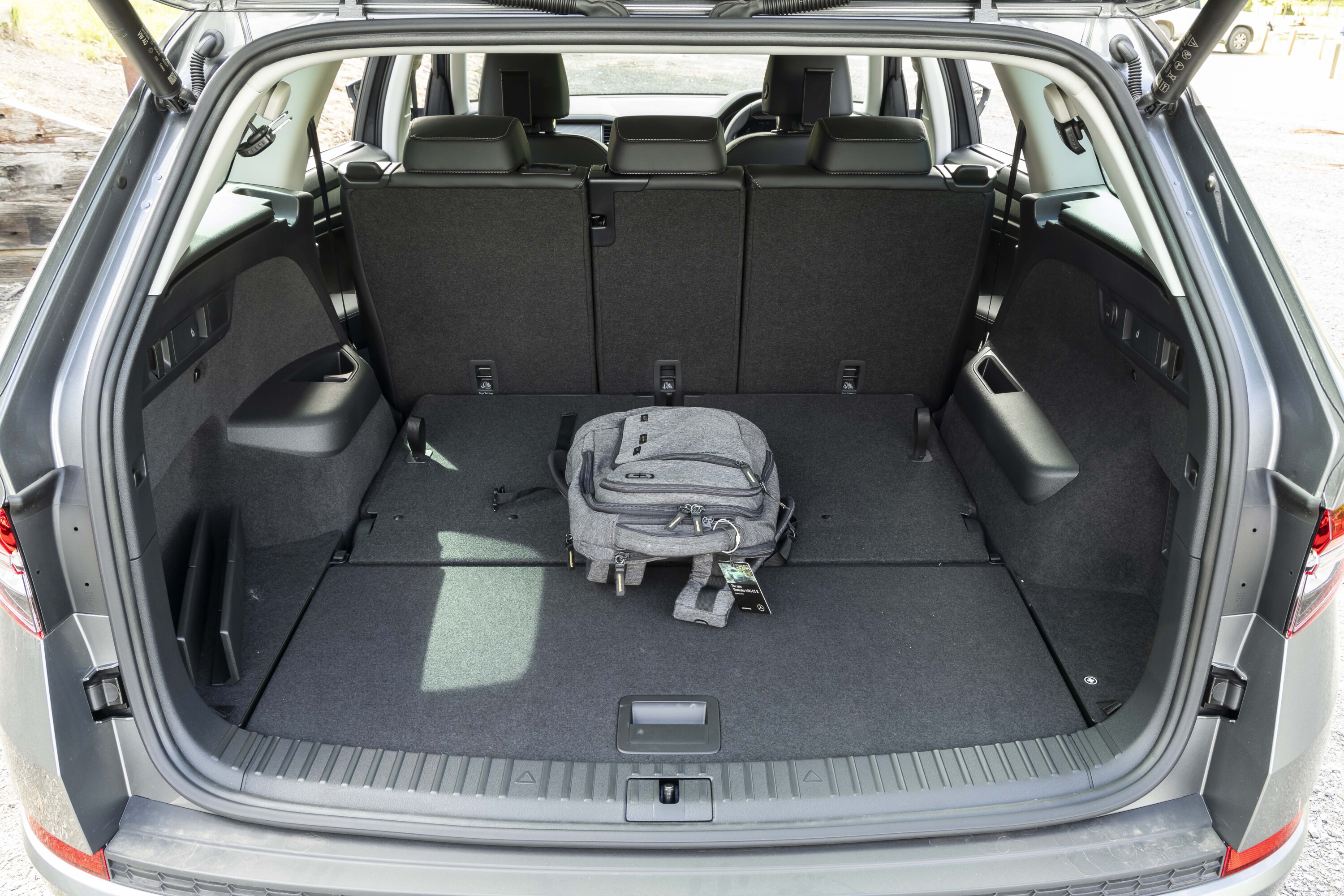
If you need more boot space, the middle row folds completely flat and there’s a huge, reversible mat that extends from the boot lip to just behind the front seats – ideal for keeping dog hair off the carpet.
There are a few shortcomings for the Kodiaq, including a lack of top tether points in the third row (though this is common across most rivals), and only a space-saver spare tyre under the boot floor.
Yet thoughtful touches extend into a boot that’s not only large (765L) and deep but it includes lidded cubbies on either side, an ingenious solution for storing the cargo blind, levers to electrically drop the back seats and velcro dividers that stick to the boot floor. All things typically sold as dealer add-ons by other brands.
With seven seats up there’s even enough space for school bags – the VDA rating is 270L, exceeding that of a Toyota Corolla hatch.
2
What is it like to drive?
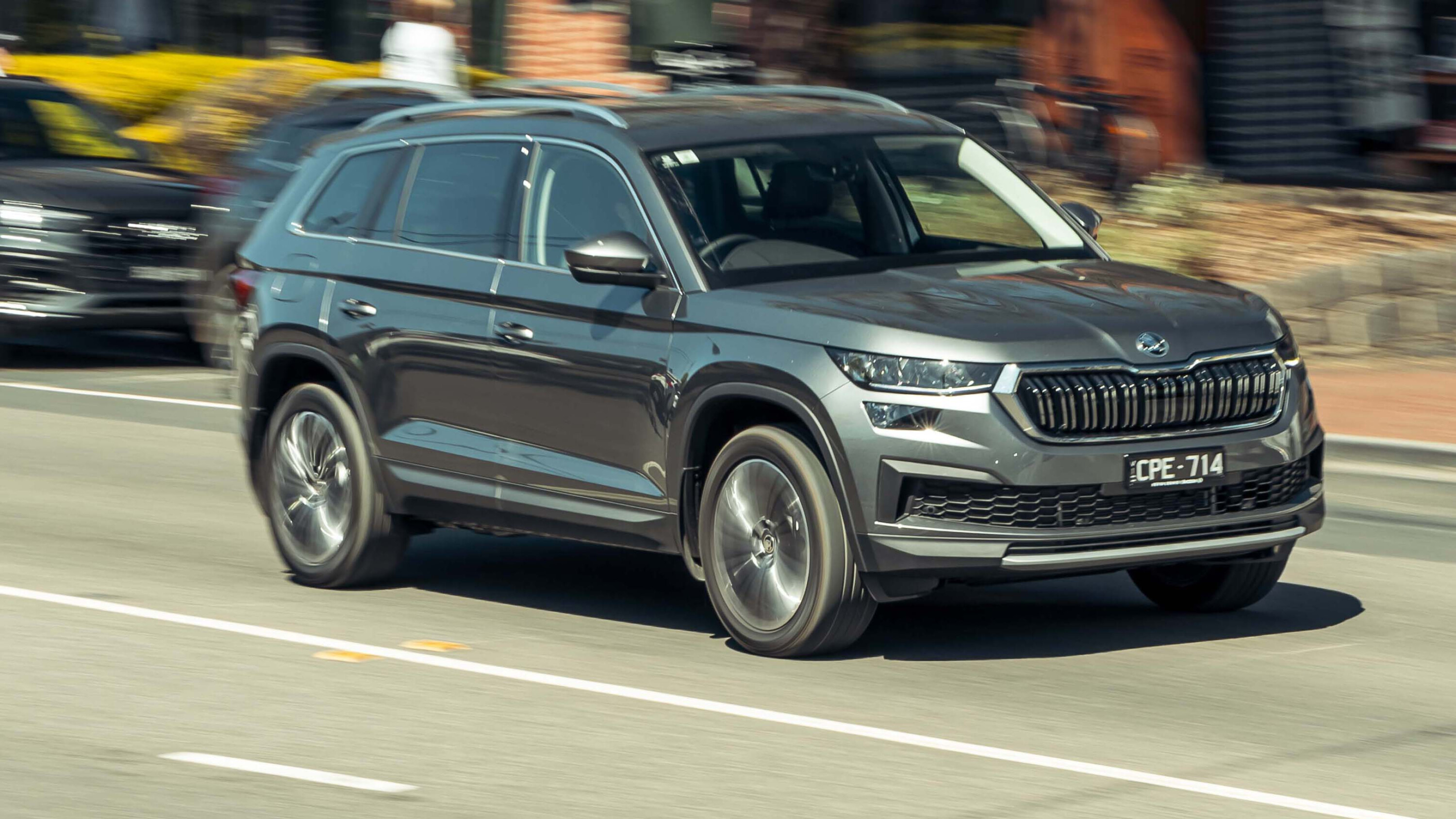
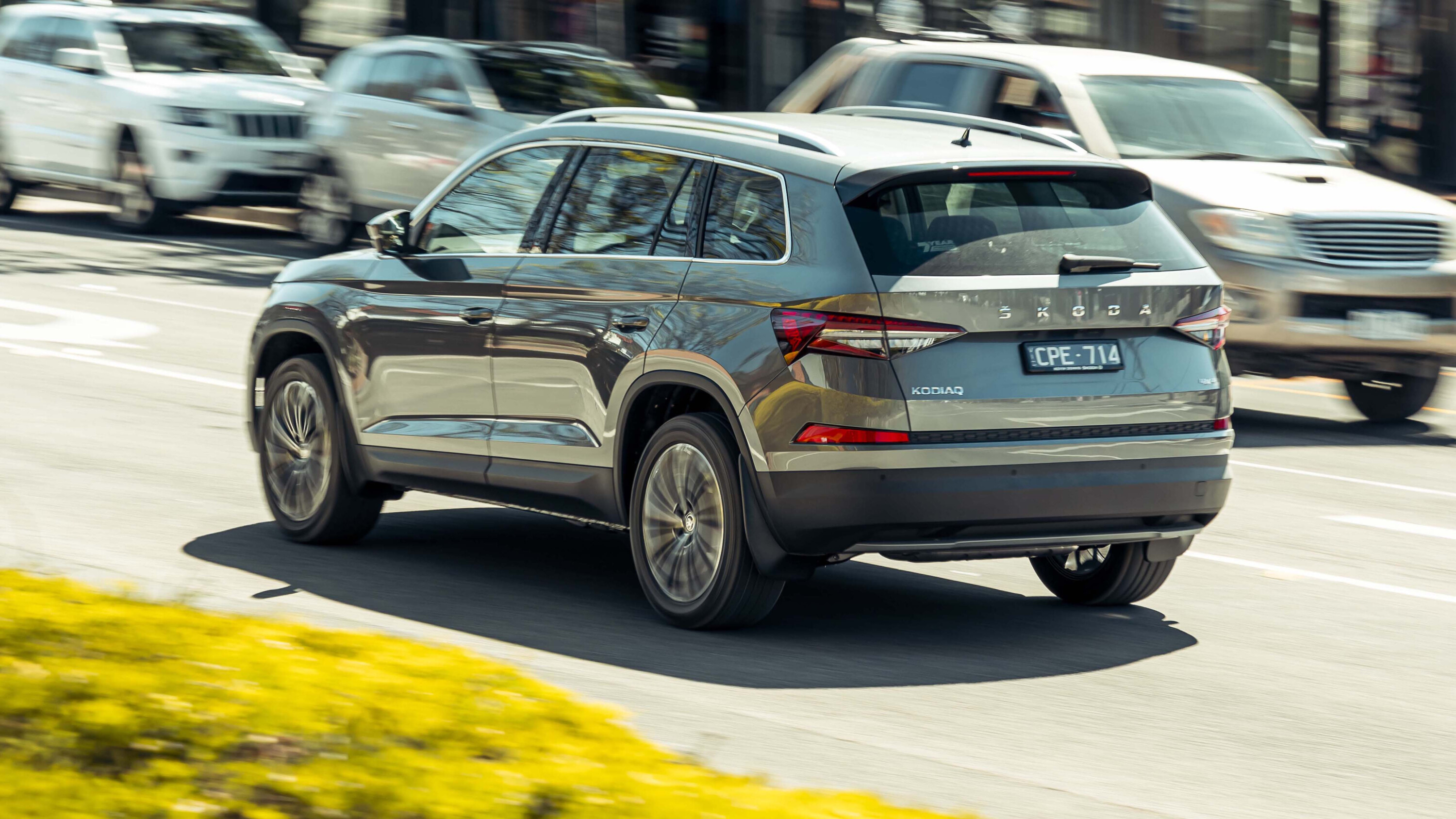
Driving the Kodiaq is a mostly pleasant experience, with a smooth ride and responsive engine that packs adequate grunt.
The light steering is great around the suburbs though it doesn’t inspire huge confidence at higher speeds. The inverse is true of the seven-speed dual-clutch transmission which is very slick on the open road and tends to be a little laggy in town – especially when shifting from first to reverse in a hurry.
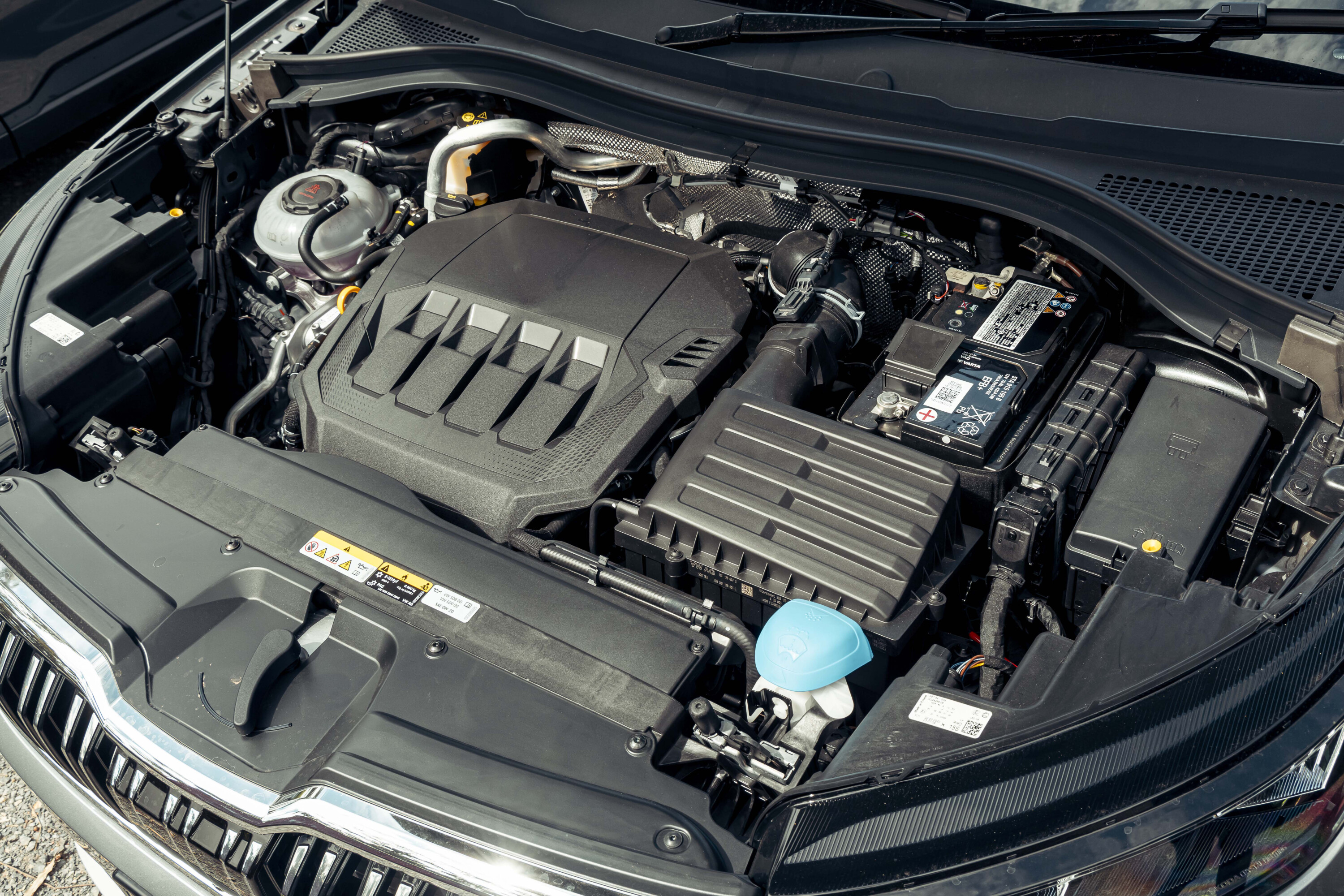
Under the bonnet is the VW group’s ubiquitous EA888 2.0-litre turbo-petrol four-cylinder, featured here in 132kW/320Nm trim. Skoda claims that’s enough punch to get the Skoda from rest to 100km/h in a brisk 8.4 seconds.
1
We’ve found the amount of grunt to be lacking compared to some diesel rivals when heavily laden (the 1855kg Kodiaq Style is rated to tow 2000kg) though because it revs cleanly and responds keenly it’s plenty of engine most of the time.
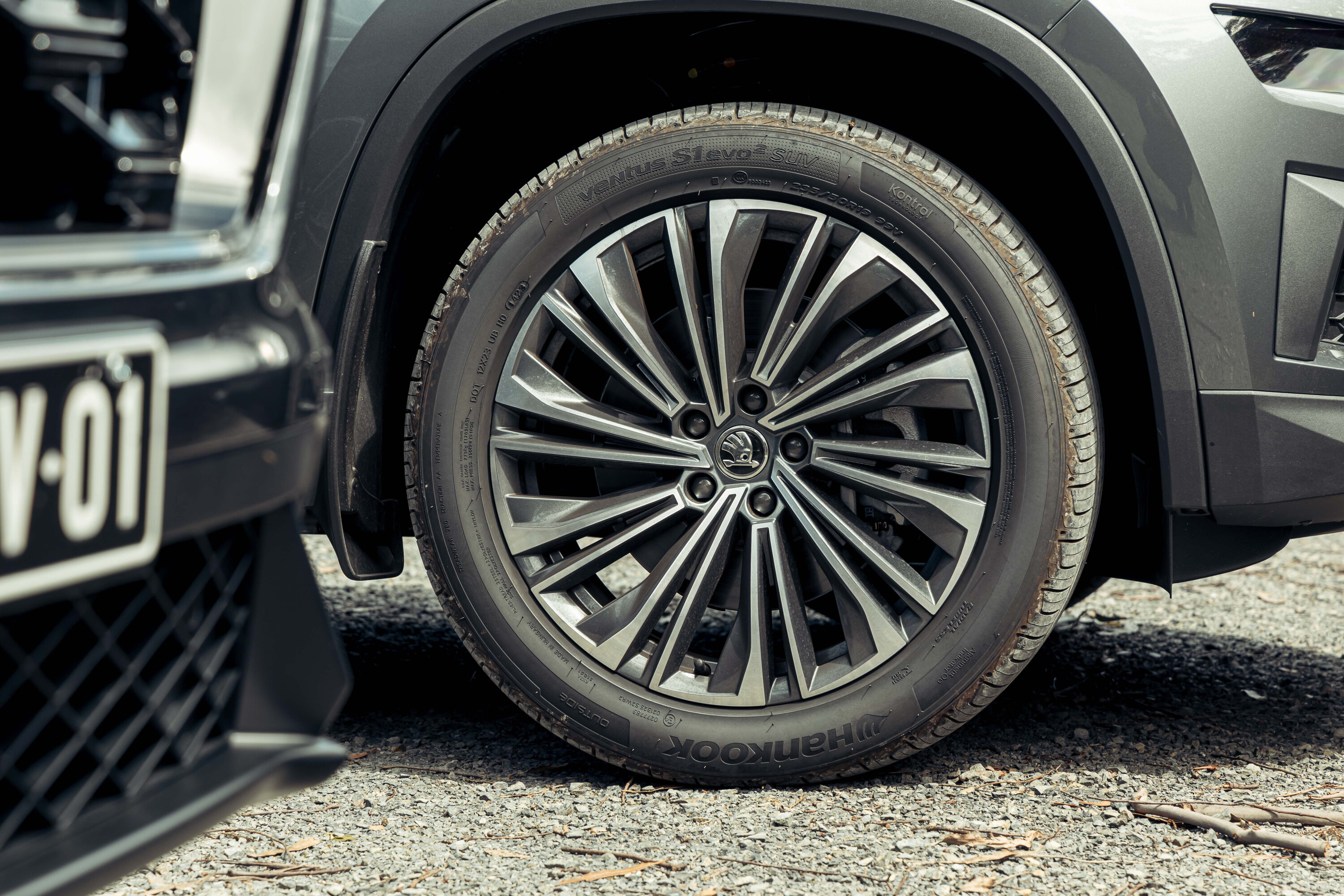
When out in the countryside, the Kodiaq’s ride is controlled and insulating and the 19-inch ‘Cursa’ alloy wheels shod in chubby 235/50R19 tyres help around town where its independent rear suspension and front struts make light work of road imperfections.
Noise insulation is also good and, thanks to the traditional boxy shape of the Kodiaq the view out is good and it’s easy to park.
1
- What is a Powertrain or Drivetrain?
- Power vs torque
- Car suspension explained
- Automatic transmissions (‘gearboxes’) explained
- Chassis control systems explained
- Car vs Ute vs SUV: How the vehicle you buy should guide the way you drive
- What is the WLTP emissions and range test?
As of January 2024, the Skoda Kodiaq is officially unrated by ANCAP, though the three-row SUV scored five stars in June 2017.
The Kodiaq Style misses some safety kit that is now required for a five-star rating. Lane-keep assist, lane-trace assist, and stop-and-go for the adaptive cruise control are included in the $6900 Luxury pack.
Regular adaptive cruise control, blind-spot monitoring, rear cross-traffic alert, a reverse camera, and AEB (including low-speed reverse) are all included.
1
How much fuel does it use?
The Skoda Kodiaq is rated to use 8.2L/100km in the combined ADR 81/02 efficiency cycle.
The urban rating is 10.3L/100km, and you can expect about 7L/100km on the motorway.
1
Warranty and running costs
Skoda has one of the longest warranties in the game: seven years and unlimited kilometres for all its vehicles.
Servicing is due every 12 months or 15,000km, whichever comes first. Skoda offers discounted service packs at purchase time, the five-year plan costs $2200 and the seven-year $3200.
1
VERDICT
The Skoda may be a little dearer to buy than rivals, and there remains the usual cloud of doubt for many Australians about European reliability, but affordable service plans and a long warranty ought to calm nerves.
As for which grade is best, the sporty RS is a great choice but pushing $80K on the road makes it rather expensive. Instead, we’d stick with the base Style with its comfy ride and smaller wheels, while potentially ticking the Luxury pack box.
Whichever grade you choose, the Kodiaq’s ‘simply clever’ touches are the sort of thing that endear a vehicle to you over time – especially if there’s an ever-growing family involved.
With clever packaging that squeezes in a third row of seats into a body that’s fractionally shorter than a new CR-V, a highly-regarded 2.0-litre turbo engine, plus an excellent all-round drive, it’s clear the Kodiaq still has plenty of appeal despite imminent replacement.
1
MORE
Everything Skoda
MORE
Midsize SUVs
| 2024 Skoda Kodiaq Style specifications | |
|---|---|
| Body | 5-door, 7-seat SUV |
| Engine | 1984cc 4cyl, 16v, dohc, turbo |
| Drive | All-wheel drive |
| Power @rpm | 132kW @ 6000rpm |
| Torque @rpm | 320Nm @ 1400-3940rpm |
| Transmission | 7-speed dual-clutch |
| 0-100km/h | 8.4sec |
| L/W/H | 4697/1882/1681mm |
| Wheelbase | 2790mm |
| Boot space | 765L |
| Weight | 1855kg (tare) |
| Combined fuel claim | 8.2L/100km/ 95 RON |
| Suspension | MacPherson strut, coil springs, anti-roll bar (f), multi-links, coil springs, anti-roll bar (r) |
| Steering | 2.6 turns lock-to-lock |
| Wheels | 19-inch alloy |
| Tyres | 235/50 R19 Hankook Ventus S1 Evo 2 SUV |
| Price | $53,290/$56,490* |
| Warranty | 7yr/unlimited km |
UPDATE: A 2017 HSV GTSR W1 has sold at auction for $350,888.
After a decent start at 9 am for $205,000, competition for the 474kW HSV GTSR W1 hotted up in the final minutes with the winning bid coming in just north of $350K after 4:30 pm today.
You can view the Collecting Cars listing here [↗].
Compared to previous auction sales, the price could be considered low (with an XU3 Yellah example commanding $750K in 2021), however considering current market conditions and the more common Light My Fire paint, this result is strong.
What do you reckon, did the buyer score a good deal for one of HSV’s most iconic vehicles? Have your say in the comments below.
Our original story, below, continues unchanged.
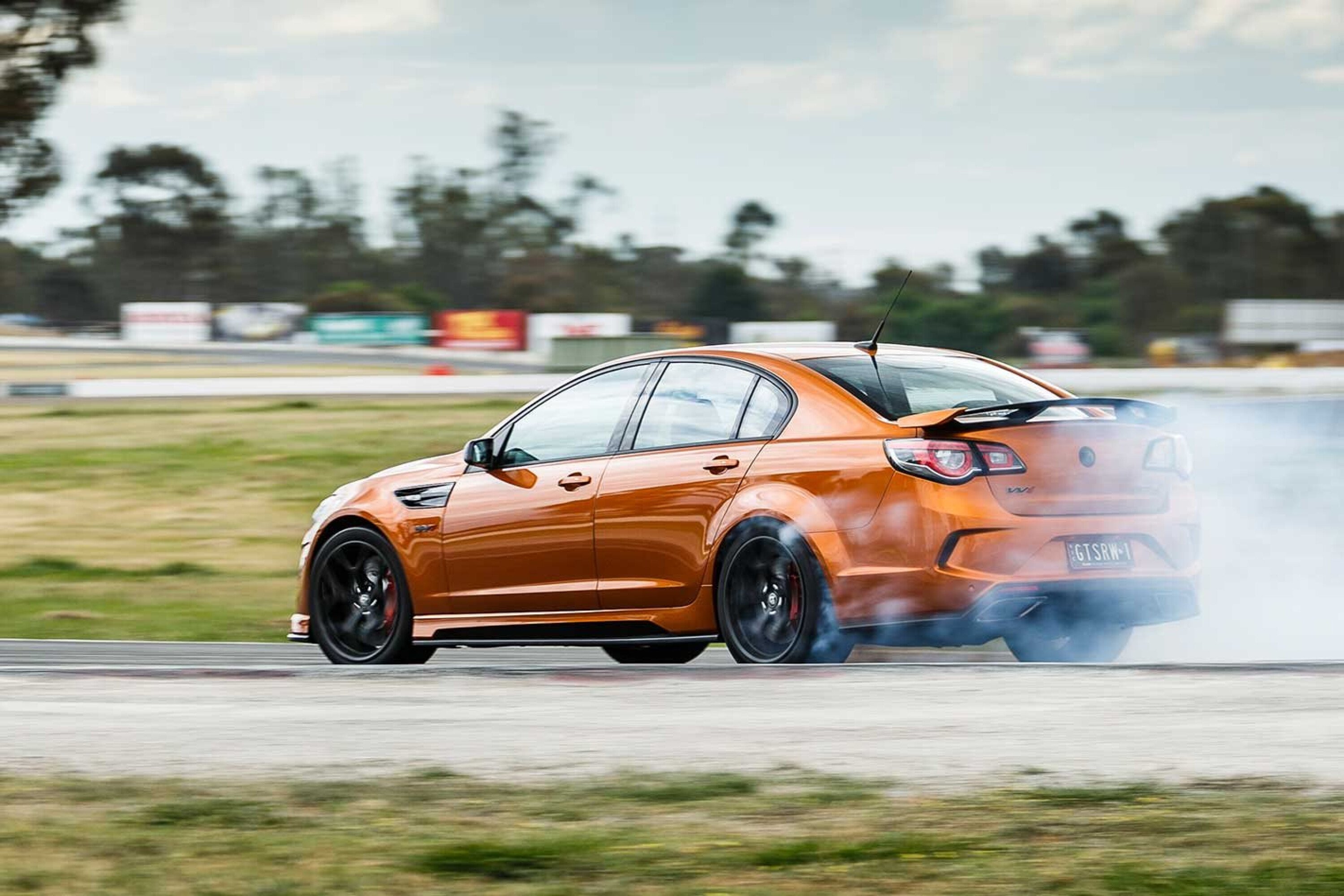
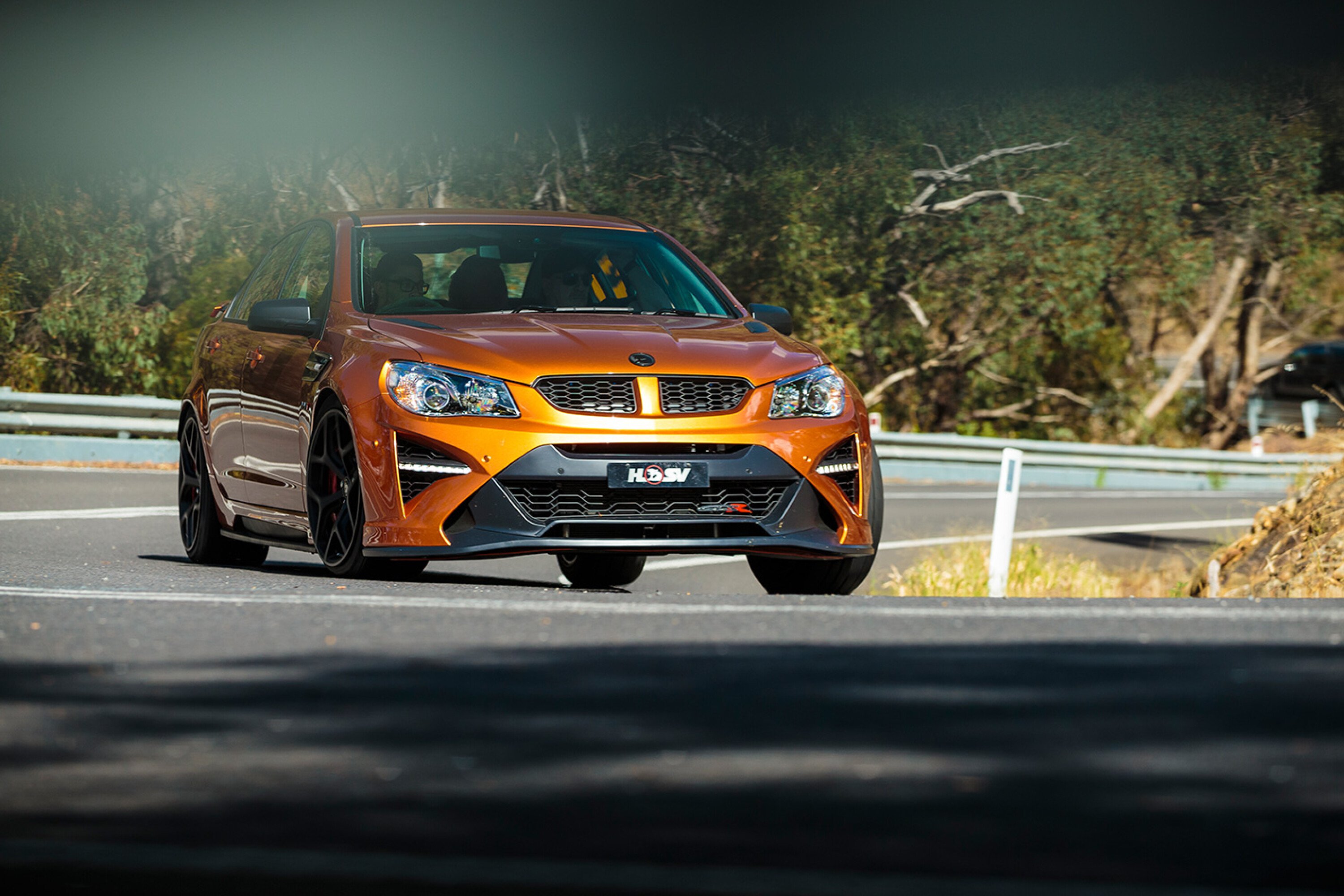
One of 275 HSV GTSR W1s with just 32km on the clock is up for sale, and the auction ends at 4:30 pm (AEST) today.
The last (and arguably greatest) of the Commodore breed is one of the most hardcore examples ever produced, with a supercharged 6.2-litre V8 churning out 474kW and 815Nm supported by trick suspension and Pirelli P Zero Trofeo tyres.
The bidding has crested $200,000 with a little under seven hours to run, which is plenty for a Commo but nowhere near what prospectors are listing examples for in the classifieds.
This begs the question, is the GTSR W1 really worth what punters are asking? We’ll find out this afternoon and, in the meantime, you can view the Collecting Cars auction here [↗].
1
As far as GTSR W1s go, this is about as quintessential as you get. Finished in the same lurid shade of Light My Fire orange with Alcantara upholstery as the communications car featured heavily in the pages of Motor and Wheels magazines in period.
This example has travelled a mere 32km (and likely none of them sideways), so this is a rare chance to get a box-fresh GTSR W1 on your driveway.
1
How much will it sell for?
We’ll have an update after the auction ends, but currently bidding is over $200,000 for a car that listed at $169,990 when new.
Previous GTSR W1s sold at public auctions give us a clue. In 2021, a black example with 8121km on the clock fetched $153,000 at a Shannons auction.
In the same year, GTSR W1 build plate #017 finished in XU3 Yellah with just 16km on the odometer changed hands for $750,000.
It went to auction alongside build #E001 GTSR W1 Maloo – one of just four (or six, technically) ever made with 19km on the clock – that sold for a staggering $1.05 million.
In the classifieds, there are 12 GTSR W1s currently for sale ranging between $290,000-$525,000.
As for this example, it’s likely to climb but how far is yet to be seen – and the result will give insight into the current health of the W1 and Australian collector car markets.
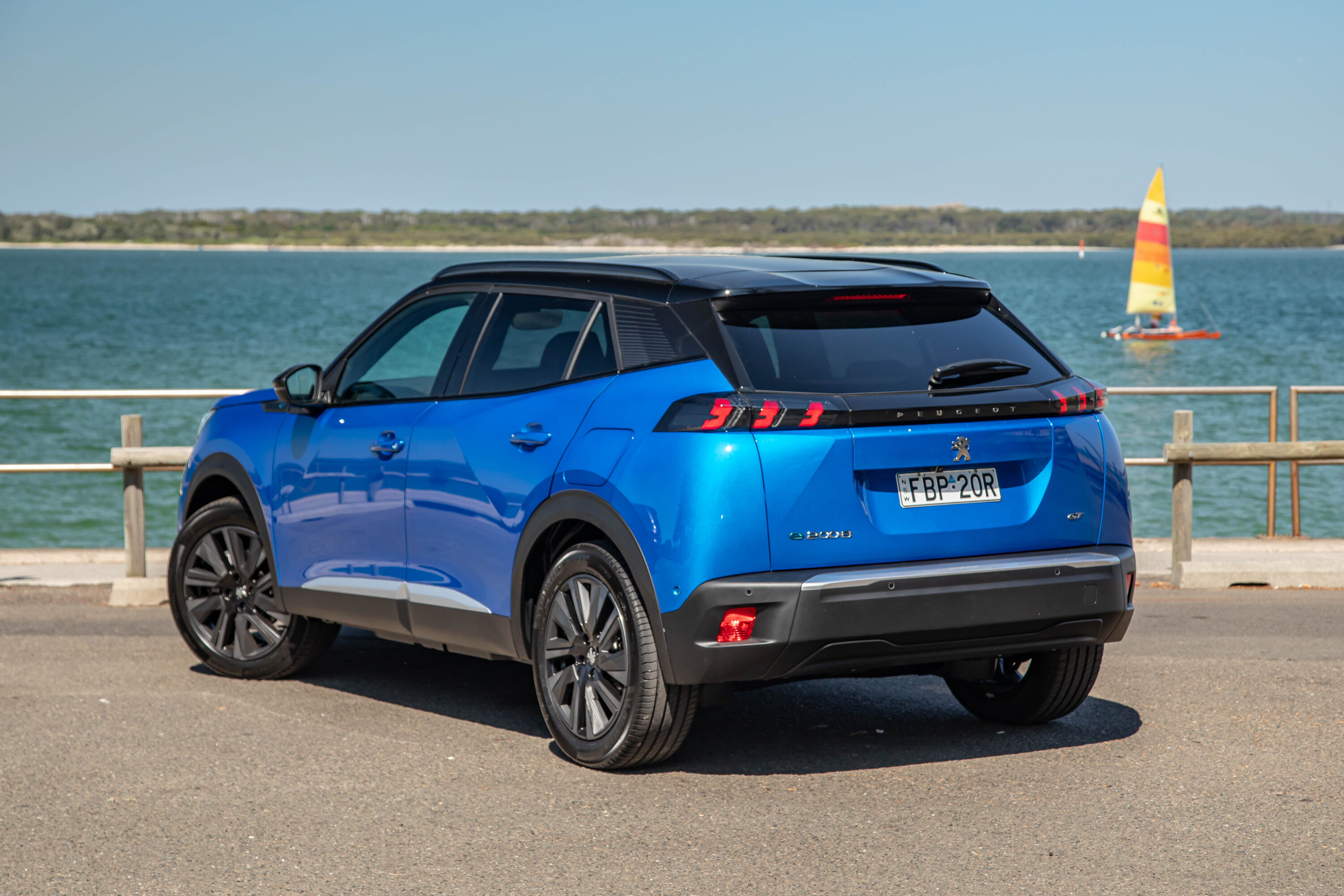
After a bit of will-they-won’t-they – Peugeot is big on the straight-bat approach to questions about new product – the local arm settled on the E-2008 to spearhead its push into electrification.
Peugeot isn’t necessarily a brand you associate with cutting-edge innovation. All the cool stuff in a Pug happens down below, with clever chassis solutions and (mostly) excellent ride and handling. (I speak as an owner of a 25-year-old Peugeot 306 that is remarkably reliable and conservatively engineered but drives beautifully. Still.)
The 2008, despite being a compact SUV, manages quite well to be a proper Peugeot. It’s fun to drive, interesting to look at and comes with that long-established pedigree but without that tinge of “that’s not a bug, it’s a feature” from its owners.
1
JUMP AHEAD
- How much is it, and what do you get?
- How do rivals compare on value?
- Interior comfort, space and storage
- Battery and charging
- What is it like to drive?
- How is it on energy?
- Warranty and running costs
- VERDICT
- Specifications
How much is it, and what do you get?
Things look to have fallen apart on the starting line, however, as the E-2008 is priced at a hefty $59,990 before on-road costs.
Peugeot doesn’t pretend to be anything but an upmarket brand in Australia, with the 308 GT PHEV clocking in at a whopping $64,900 excluding on-road costs, so it’s with a small amount of relief I tell you the E-2008 is cheaper than that. But sixty large ($59,990, or about $65K drive-away) places it very close to serious competition.
1
| 2023 Peugeot E-2008 standard features | |
|---|---|
| 18-inch alloy wheels | 6-speaker sound system |
| Adaptive auto LED headlights | Auto high beam |
| Auto wipers | 10-inch digital dashboard with 3D effect |
| 10-inch touchscreen | Wired Apple CarPlay |
| Wired Android Auto | Satellite navigation |
| DAB+ digital radio | Dual-zone climate control |
| Heated front seats | Power front-seat adjustmenr |
| Keyless entry and start | Tyre repair kit |
| Climate control | Driver’s seat massage function |
It’s not a lavish spec, but few EVs have that, going for a restrained list of features ostensibly to keep the price down. Sadly the price down bit seems to have been lost here.
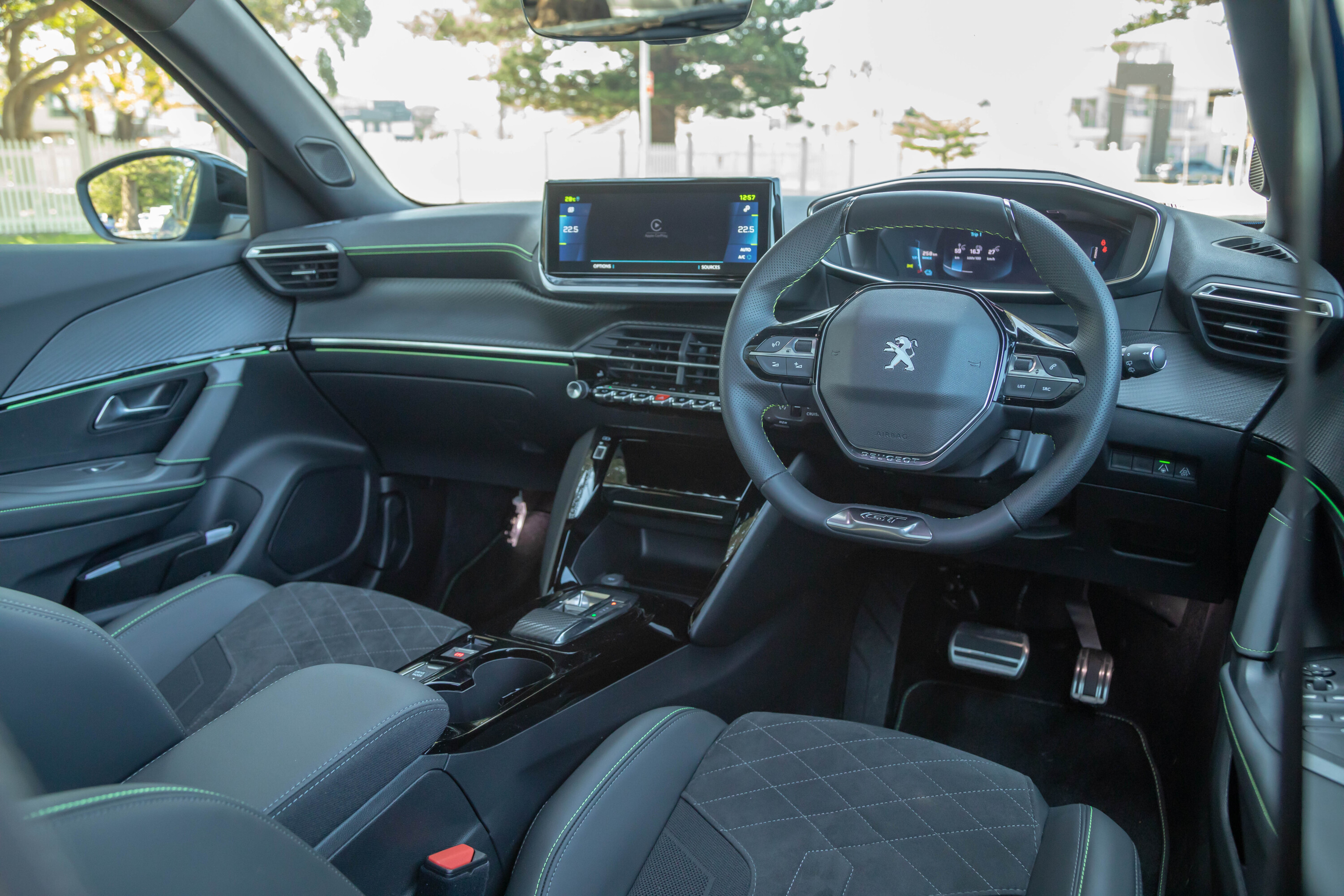
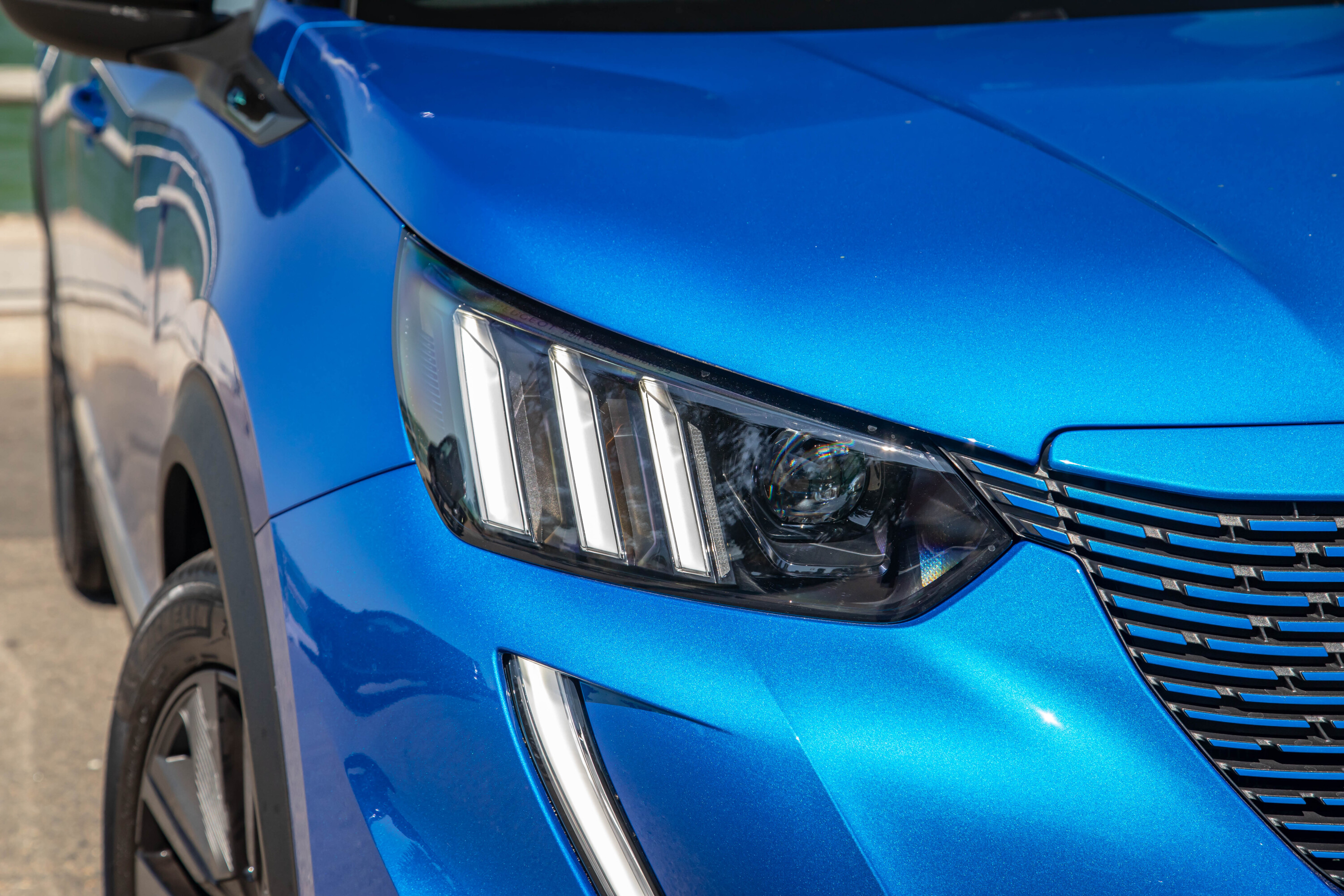
Having said that, the interior looks and feels tech-heavy with that clever dashboard and genuinely interesting design.
1
How do rivals compare on value?
You can spend a bit less or a bit more to get an EV with a similar driving range – if not similar size – to the E-2008.
Starting at under $40,000 before on-road costs is the MG4 55 Excite. While it’s not strictly a compact SUV it has similar interior space and sort of looks like one. It’s got a lot less standard kit but it’s also twenty grand cheaper.
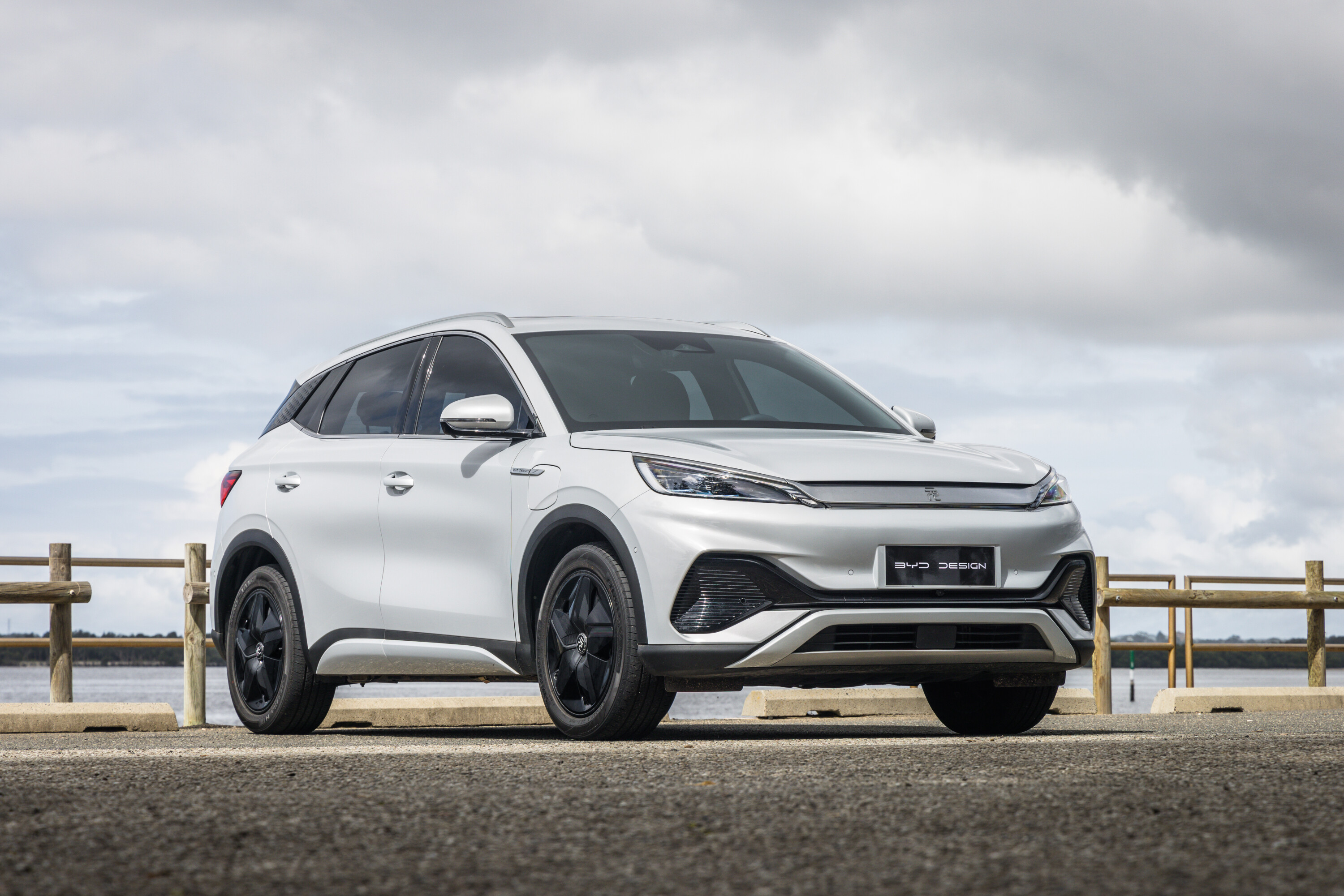
In the mid-to-late-$40Ks is the BYD Atto 3. It’s more like the E-2008 although its inventive interior is not as convincing as the Peugeot’s.
1
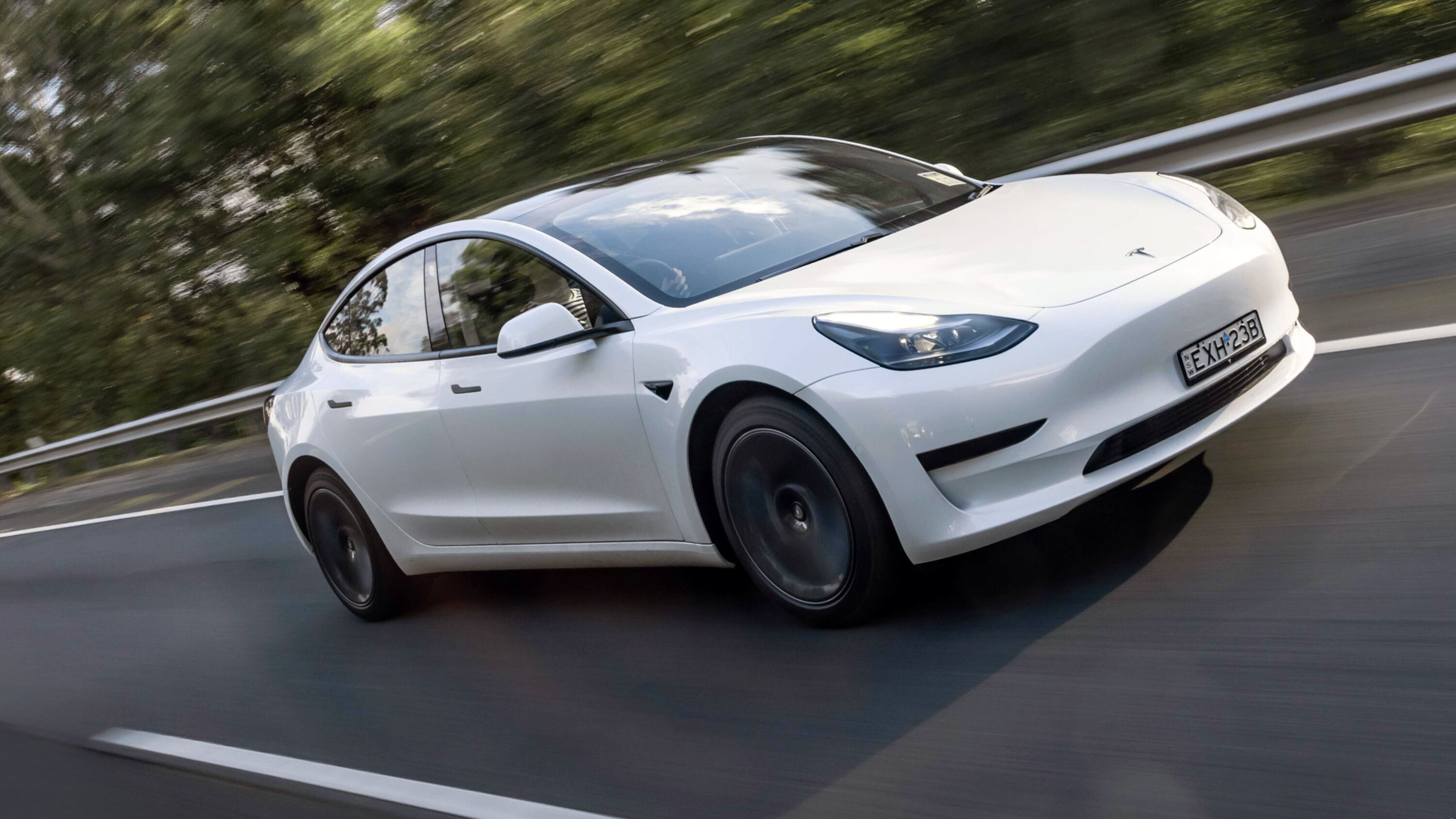
Spend a bit more than sixty grand and you have the choice of the perennial EV fan favourite, the Tesla Model 3 in rear-wheel drive form for $61,900 before on-road costs but you’ll be waiting a few months for the facelifted version that still doesn’t have a proper dashboard. Its claimed range of 513km is probably closer to 450km in reality but if the open road beckons, you should probably look here.
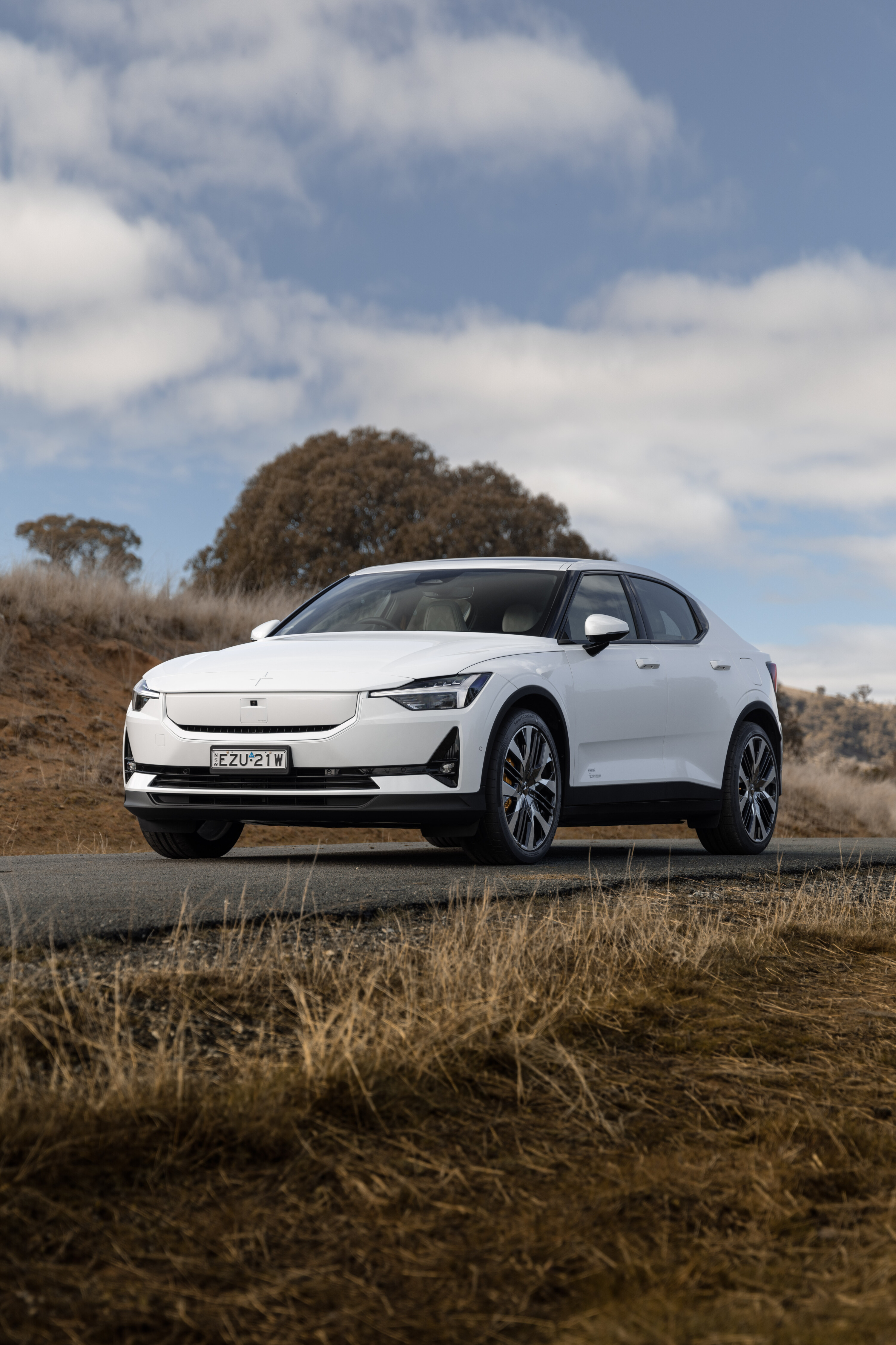
Or at the just-updated MY24 Polestar 2. The entry-level 505km WLTP-ranged rear-wheel drive version is now $67,400 plus on-road costs, with deals going on MY23 cars you can drive away straight away.
1
There’s the BYD Dolphin, too, at a hundred fewer bucks less than the MG but like the GWM Ora, probably not one you’ll cross-shop with the E-2008.
States are busy backing away from their EV incentives, so these prices represent what you’ll actually be paying in NSW from January and now in Victoria. It’s not as hard a blow if the NSW government uses the money to build charging stations, but don’t hold your breath.
1
Interior comfort, space and storage
One of the great things about Peugeot is the inventive yet usable approach to interiors.
They look great and are awesome places to spend time. While things look a bit whack-a-doo – and the driving position remains an acquired taste – there’s no denying a genuine design flair across the range.
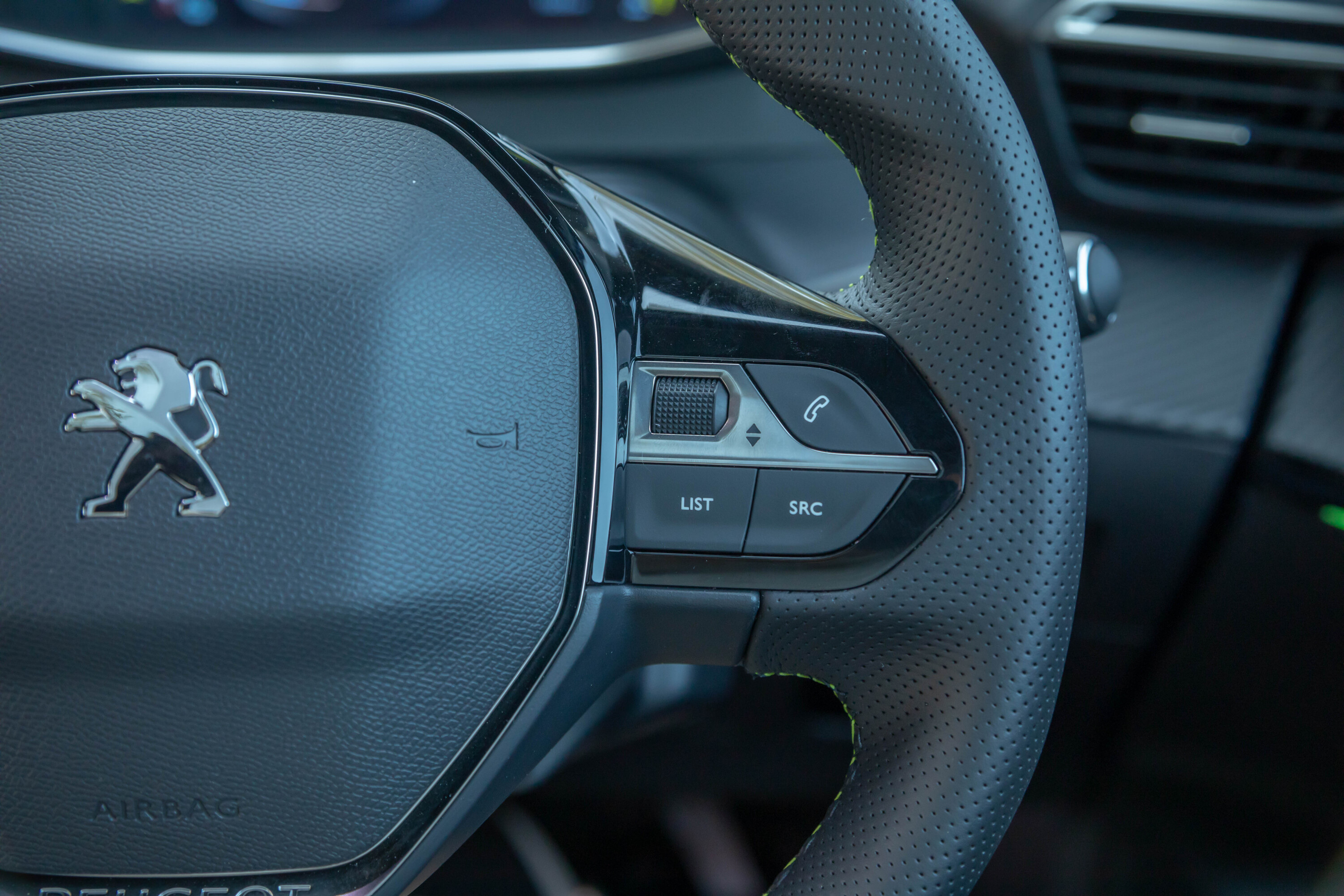
Peugeot’s weird driving position does work well in the 2008, as it does in the larger 3008/5008 pair. A more upright SUV stance is probably the key here, although the wheel still feels a bit low in your lap. The 3D-effect digital dash is great once you’re used to it; the way it brings pertinent information to the foreground is very phone-like and I dig it.
1
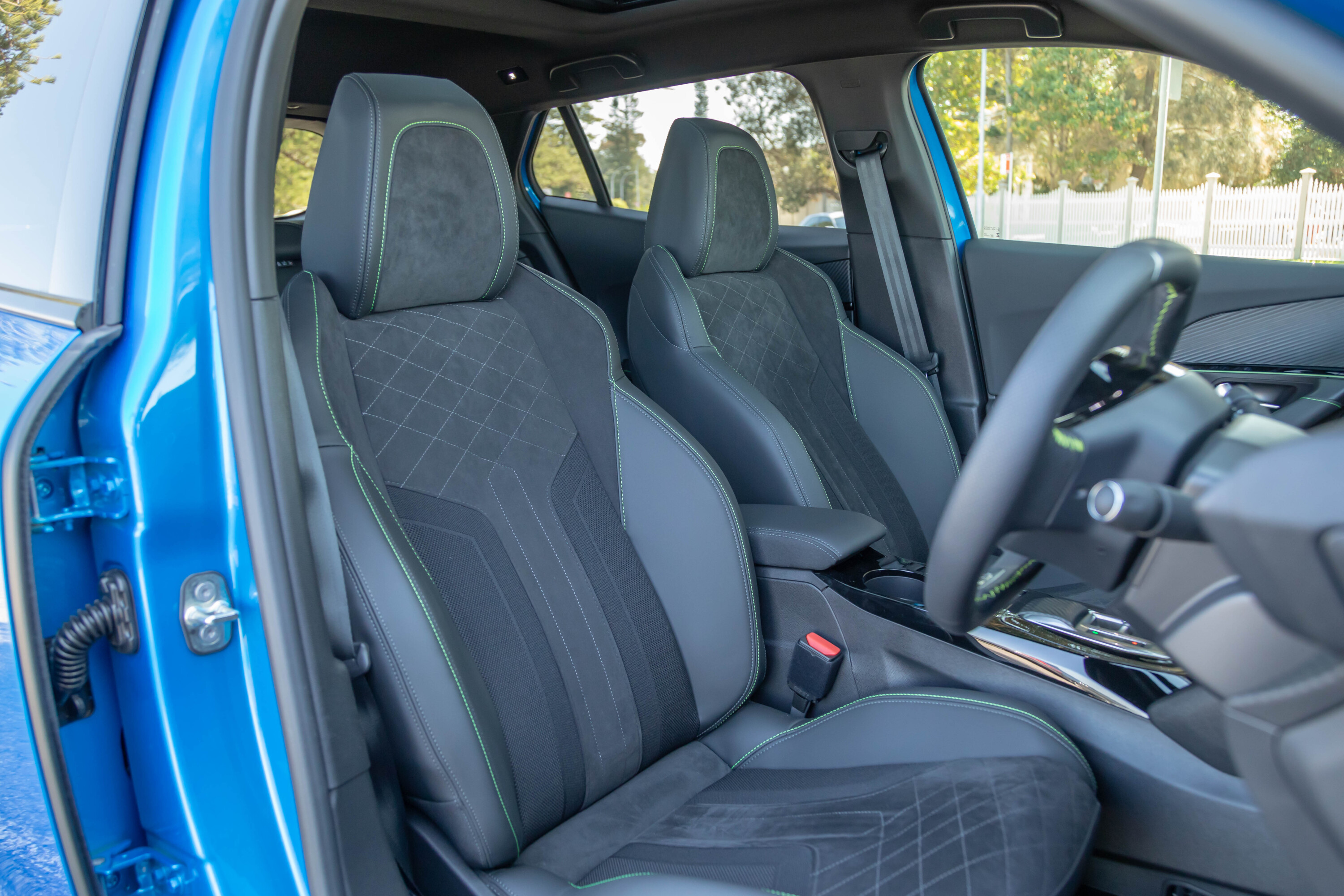
The front seats are great, too, with a mix of leather (probably fake) and Alcantara. They’re as comfortable as they are good-looking and even have a massage function that can ease tired backs and bums on a long drive. Which, let’s be honest, isn’t going to happen very often with a 300km range.
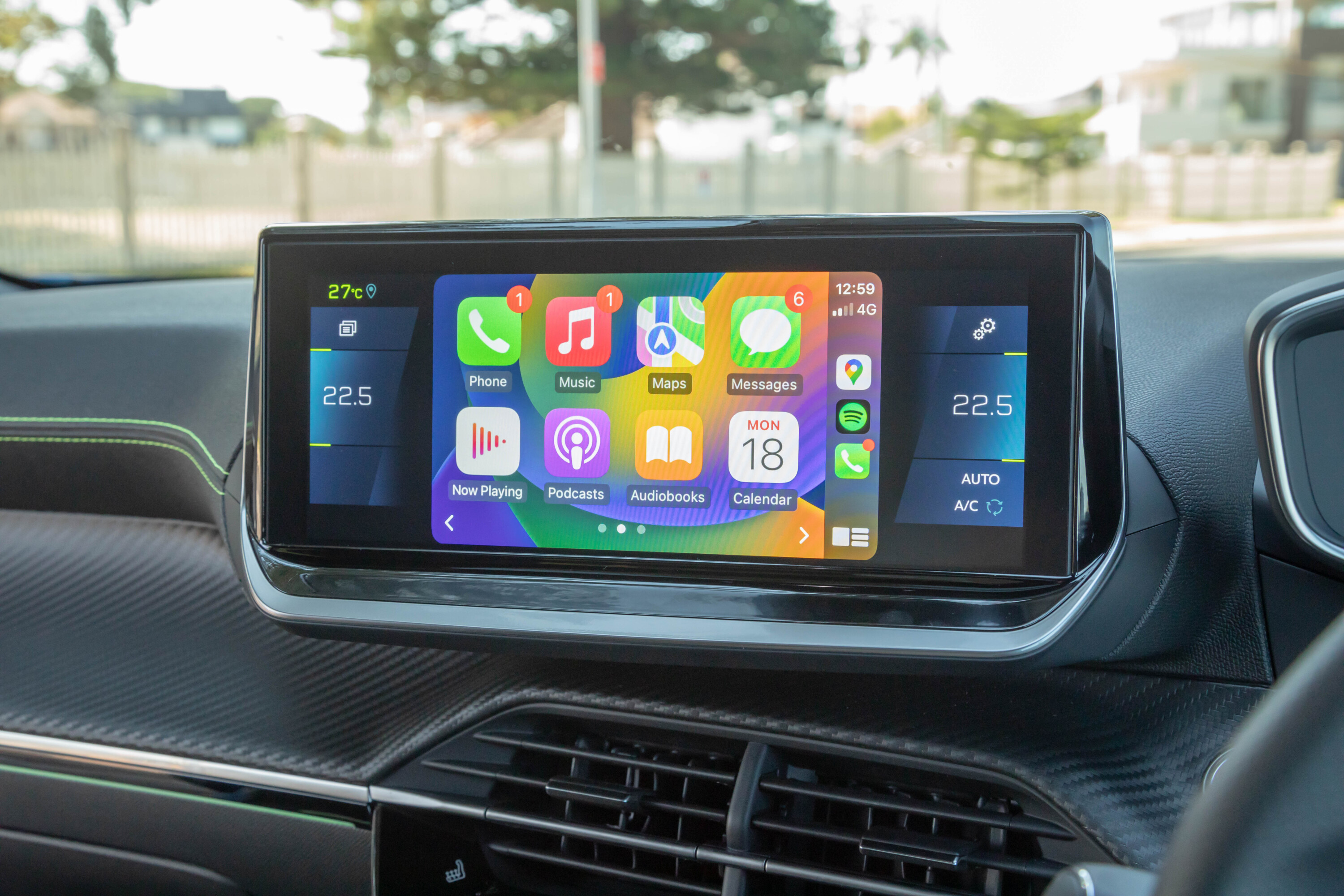
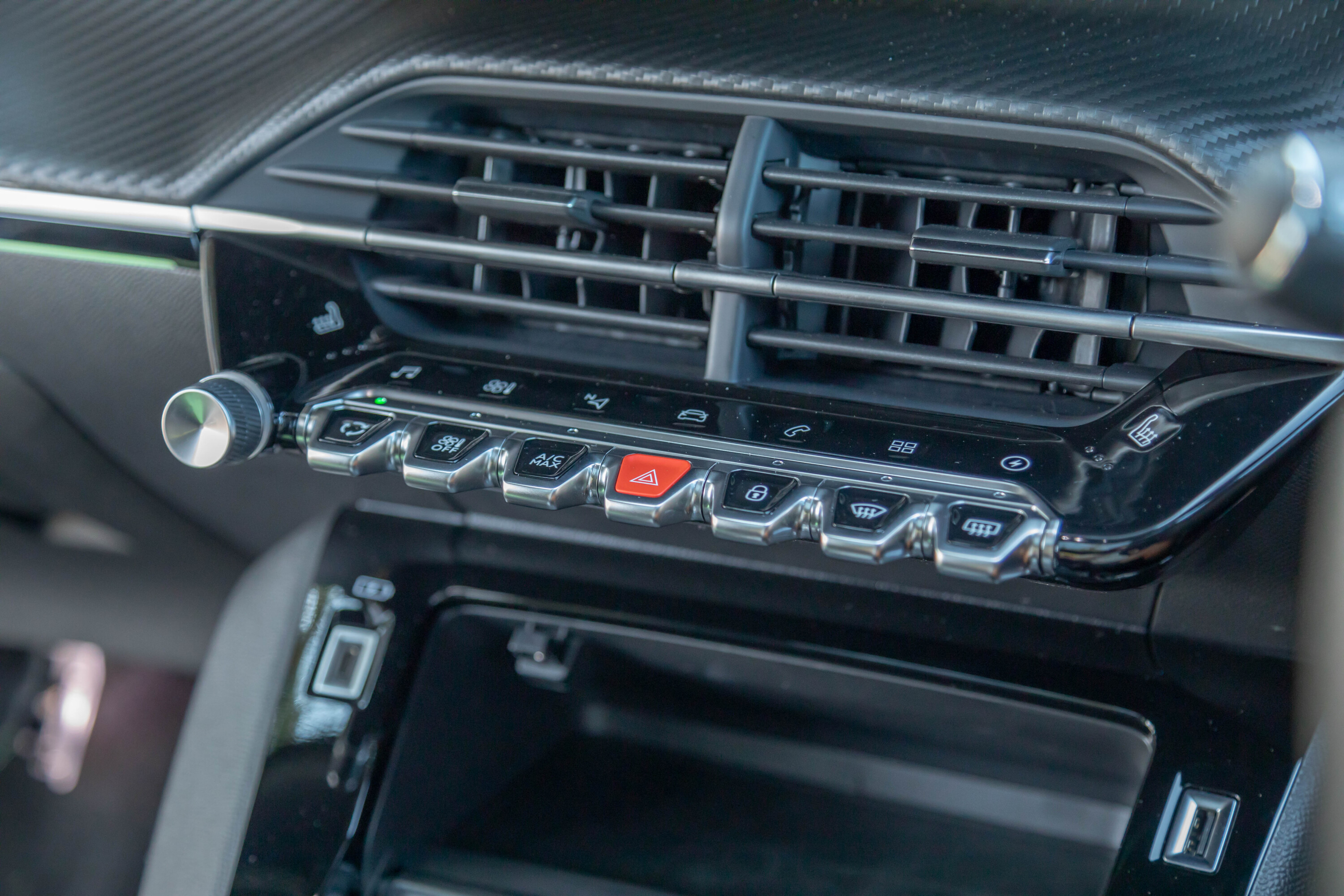
You have a 10-inch touchscreen as well, which is a nice installation but still a bit finicky to use. The range of shortcut buttons underneath (and a proper volume dial) take the sting out of that laggy hardware but dead set, the reversing camera is hopelessly grainy and blocky.
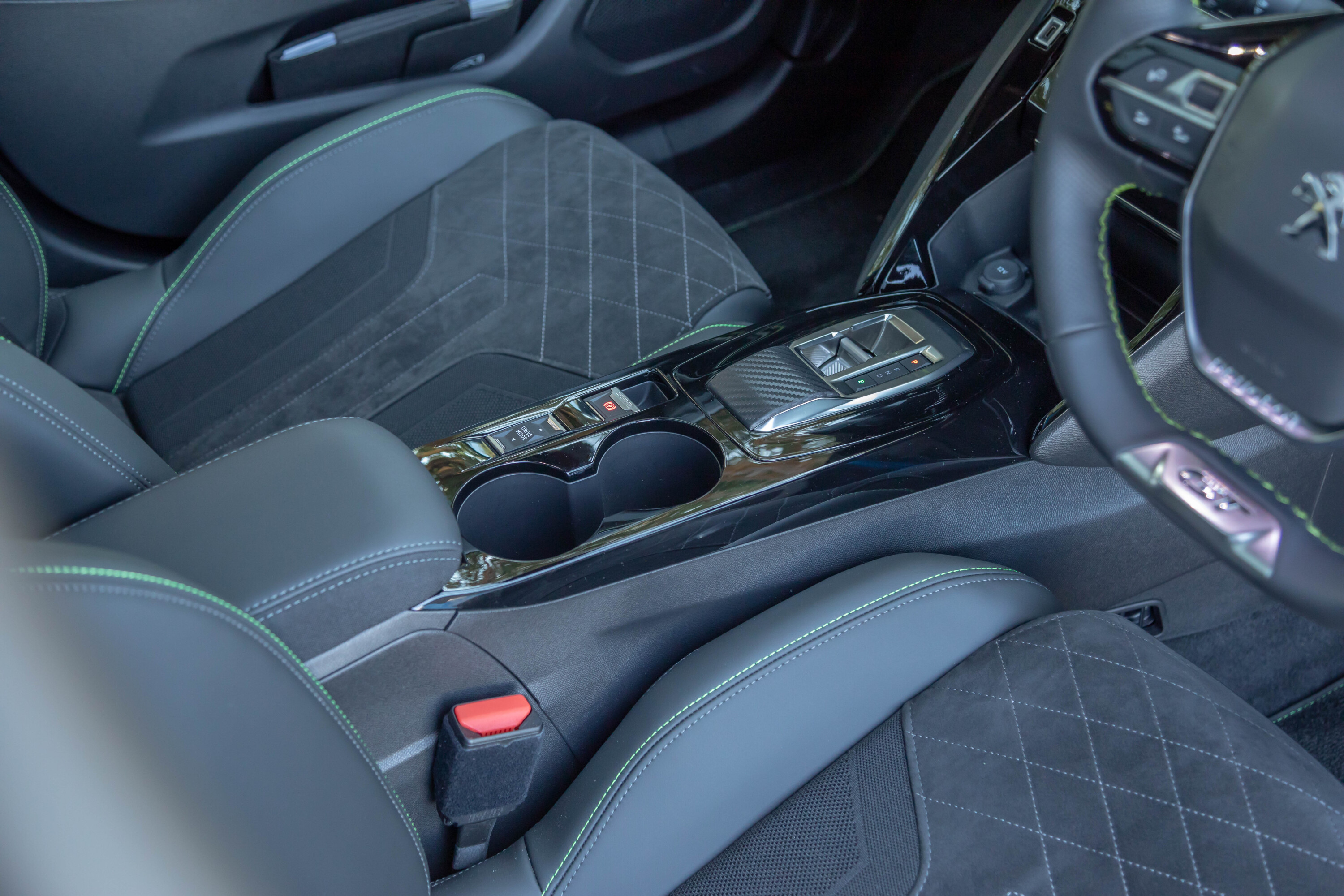
A pair of cup holders, a wireless phone charging pad and a weird openable tray under the aircon are all present and correct on a spacious console that features a VW Golf-style toggle switch (or, as I prefer, toddler’s tongue) to clean up the space.
1
To connect your phone, there’s a USB-A port and a USB-C charging port on either side of the console. At the rear of the console is a lidded bin doubling as an elbow rest.
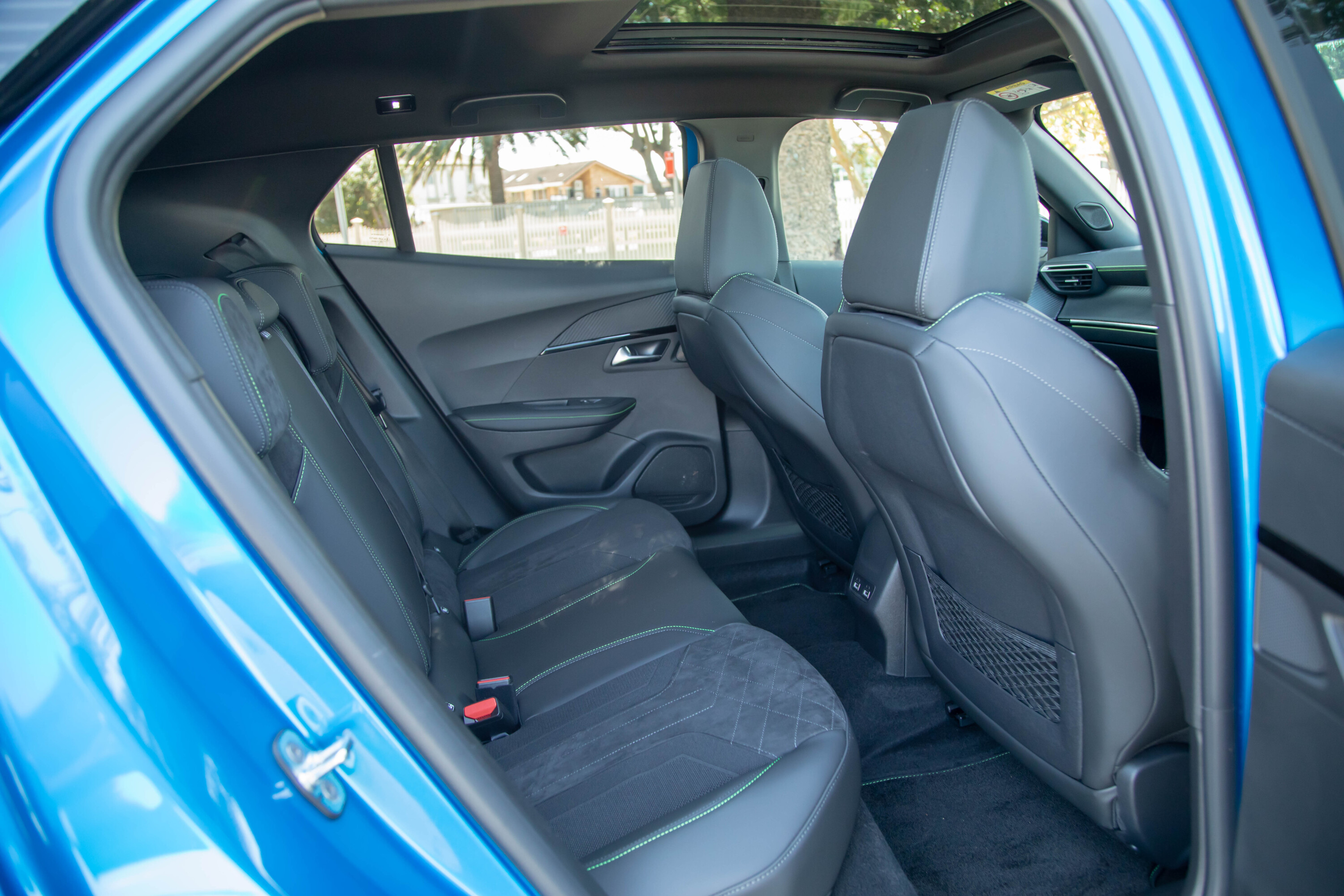
Rear seats are similarly plushly covered in Alcantara and leather. Leg and knee room is acceptable for me behind my driving position. At 180cm I’m not a skyscraper but not short either. Three across will be a challenge because of the surprisingly big transmission tunnel that points to the ICE platform origins.
1
There aren’t any air vents back here, nor is there an armrest or cup holders, so it’s a bit, er, economical. You can squeeze a bottle in the doors though. The seats themselves are comfortable and there’s good headroom, however, the headrests are a bit ho-hum and the windows high and slim. There are two USB ports, though.
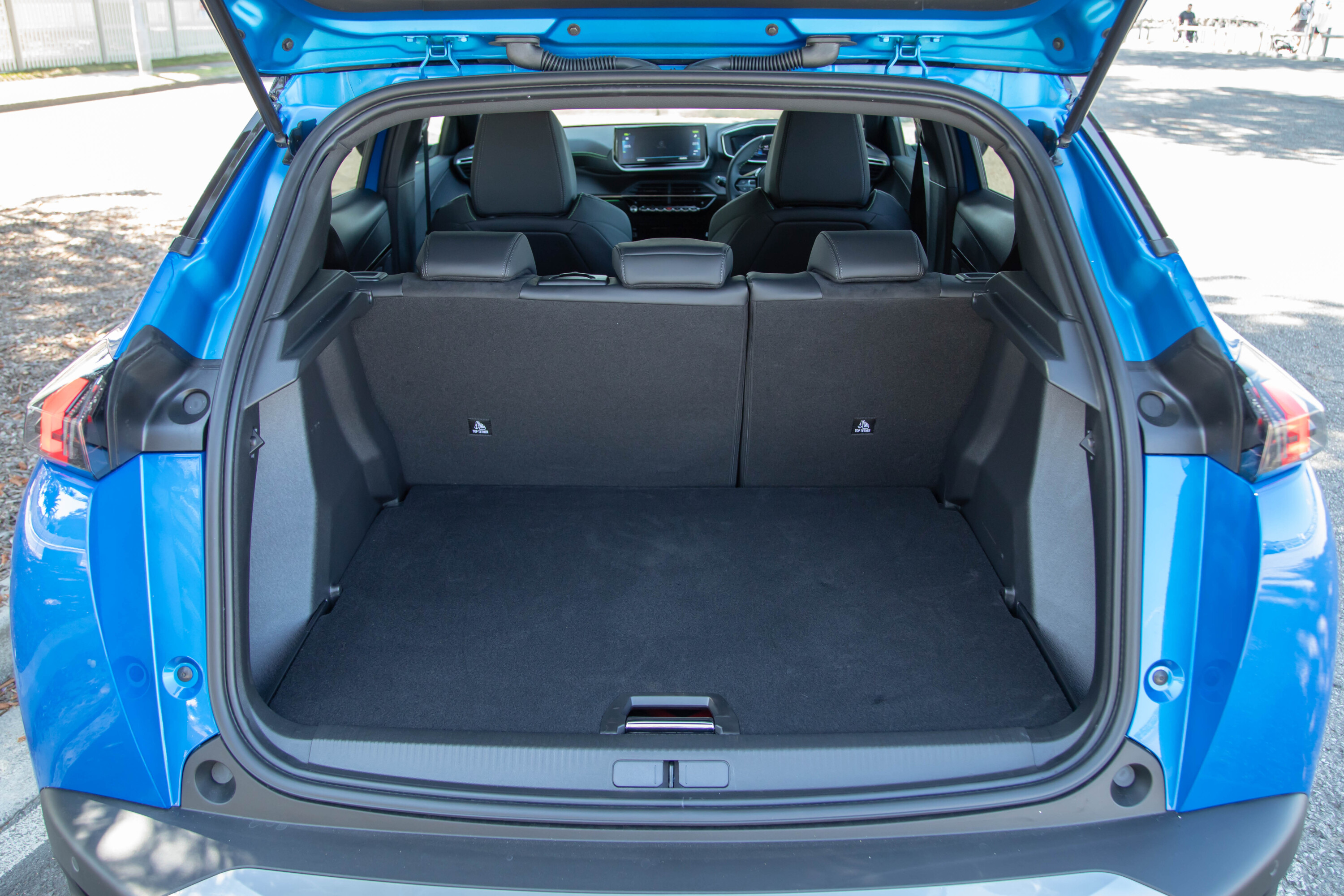
In what appears to be good news, the petrol and electric 2008s share the same boot capacity – 434 litres with the seats up and 1467 with them down. On their own, that’s a pretty good deal in this segment. The E-2008, however, misses out on a spare tyre to bridge that gap.
1
Battery and charging
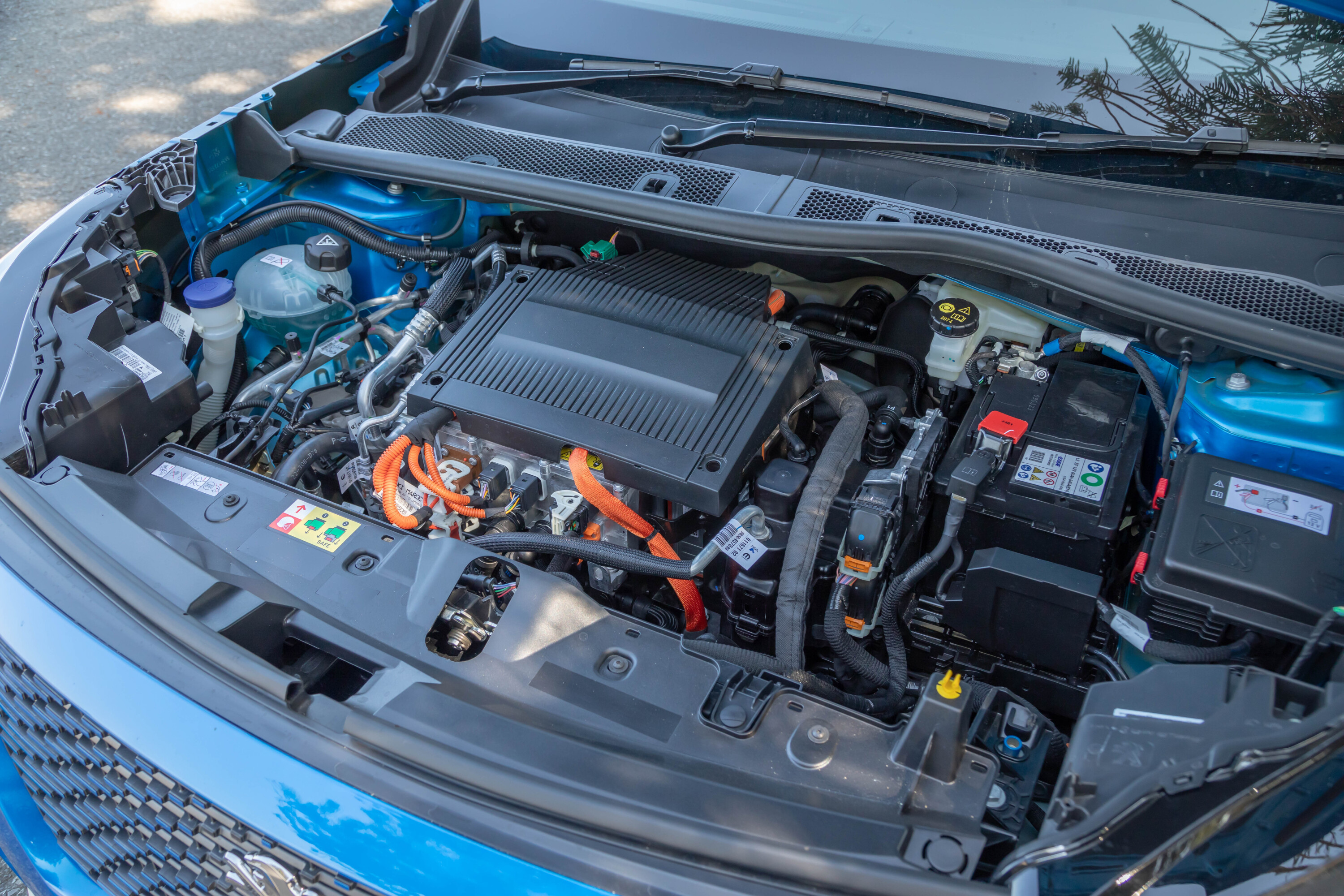
The E-2008 ships with a 50kWh lithium-ion battery pack that has a 400-volt architecture.
A Type 2 CCS with DC plug fits in the rear left quarter panel which is fairly convenient as long as you’re happy to back into the space.
Peugeot quotes a maximum charge rate of 100kW, meaning you’re wasting your time looking for a faster and more expensive 350kW rapid charger. Charge time from 10 to 80 per cent is a claimed 30 minutes, which isn’t too bad. I plugged in for a brief squirt at a 50kW charger and it held full speed. You won’t always get that from a charger, but the E-2008 clearly works when full whack is available.
1
There’s a lot to be said for a city-bound EV having a sensibly-sized battery – the E-2008’s is comparable in size to the long-range Atto3 and base model MG4 – because short trips and short charges work well into the likely usage pattern, assuming charge station availability. Again, though, you expect a lower up-front price.
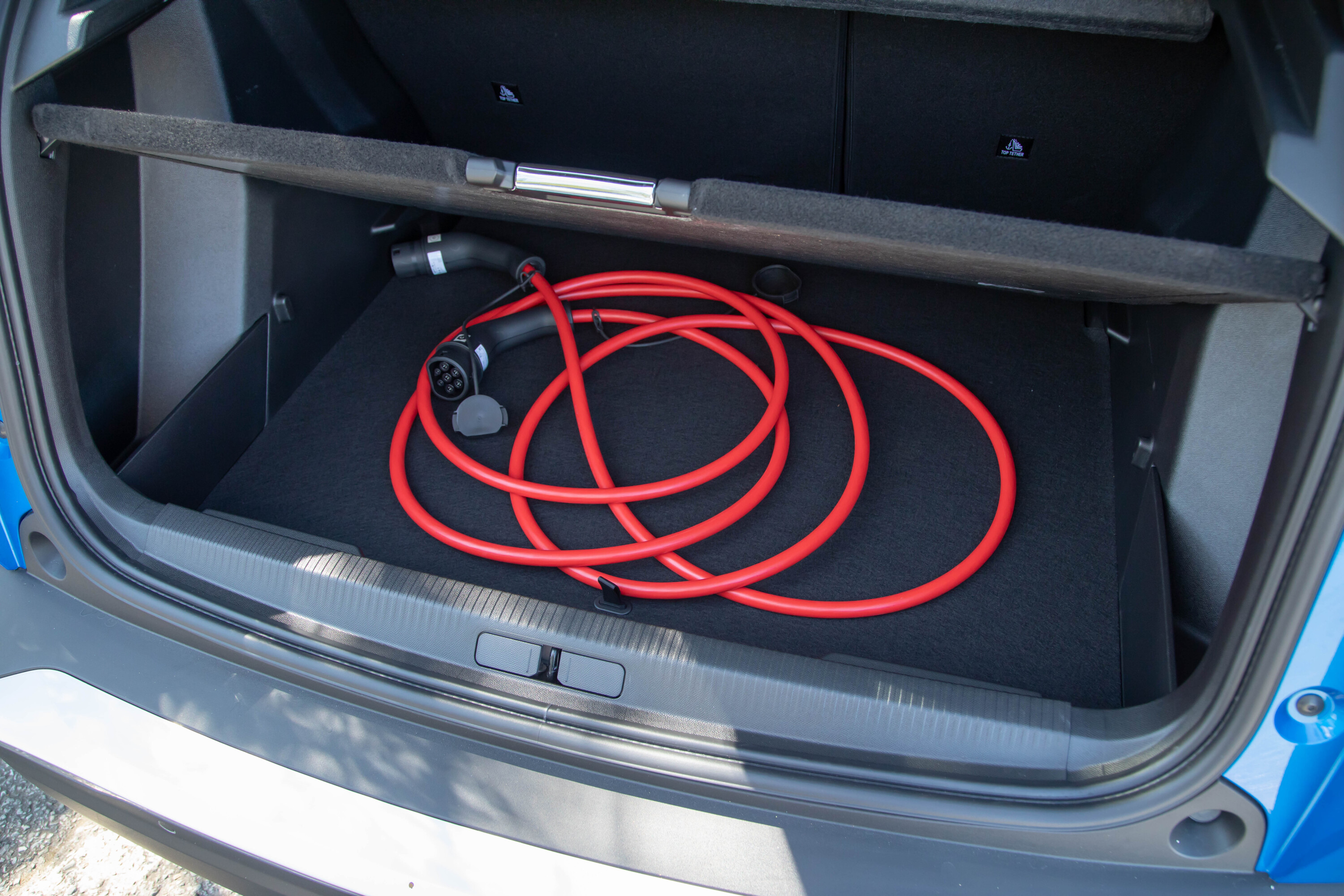
Charging at home is the usual slow affair, with around 16 to 24 hours for a full charge on the Type 3 cable hooked up to the mains or five hours if you have a wallbox.
| 2023 Peugeot E-2008 GT battery specifications | |
|---|---|
| Size | 50kWh |
| Chemistry | lithium-ion |
| Voltage | 400 volts |
| Mains charging (0-100) | 16.5 hours |
| Charging (AC) | up to 11kW |
| Charge time (0-100) | 5 hours |
| Charging (DC) | up to 100kW |
| Charge time (0-80) | 30 mins |
| Charge port | rear left quarter panel, CCS2 |
| V2L | no |
1
What is it like to drive?
One of the more tedious things about the perception of electric cars is that they’re all really fast and if they’re not, what’s the point?
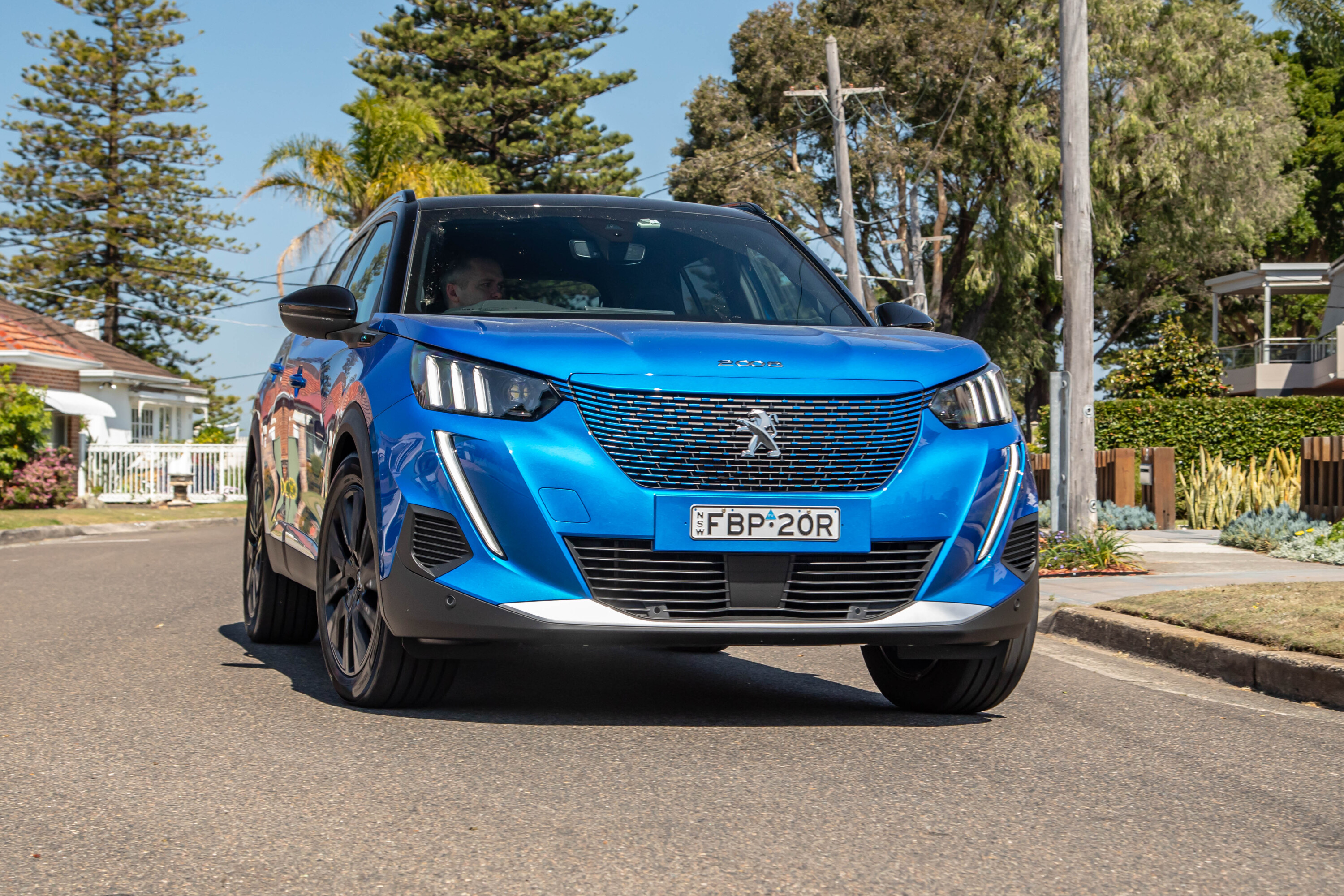
Peugeots – unless wearing a GTI badge – have generally not been focused on outright speed. The home market is full of Pugs with tiny engines being rowed along enthusiastically at moderate speeds because that’s how things are in France. And so it is in the E-2008 with the slightly ambitious GT badge.
1
The GT badge might suggest warm hatchness, but that’s where you’d be wrong – it just means it’s based on the GT spec of the petrol range, and even then, they’re different anyway. Cheeringly, the base 2008 is good fun to drive, so we’re already in reasonable shape.
| 2023 Peugeot E-2008 GT drivetrain | |
|---|---|
| Power | 100kW |
| Torque | 260Nm |
| Drive | front-wheel |
| Gearbox | single-speed reduction gear |
As you can see, the power output of 100kW is quite modest, just four measly kilowatts up on the surprisingly characterful 1.2-litre three-cylinder. That engine is remarkable for its near-prodigious torque output of 230Nm.
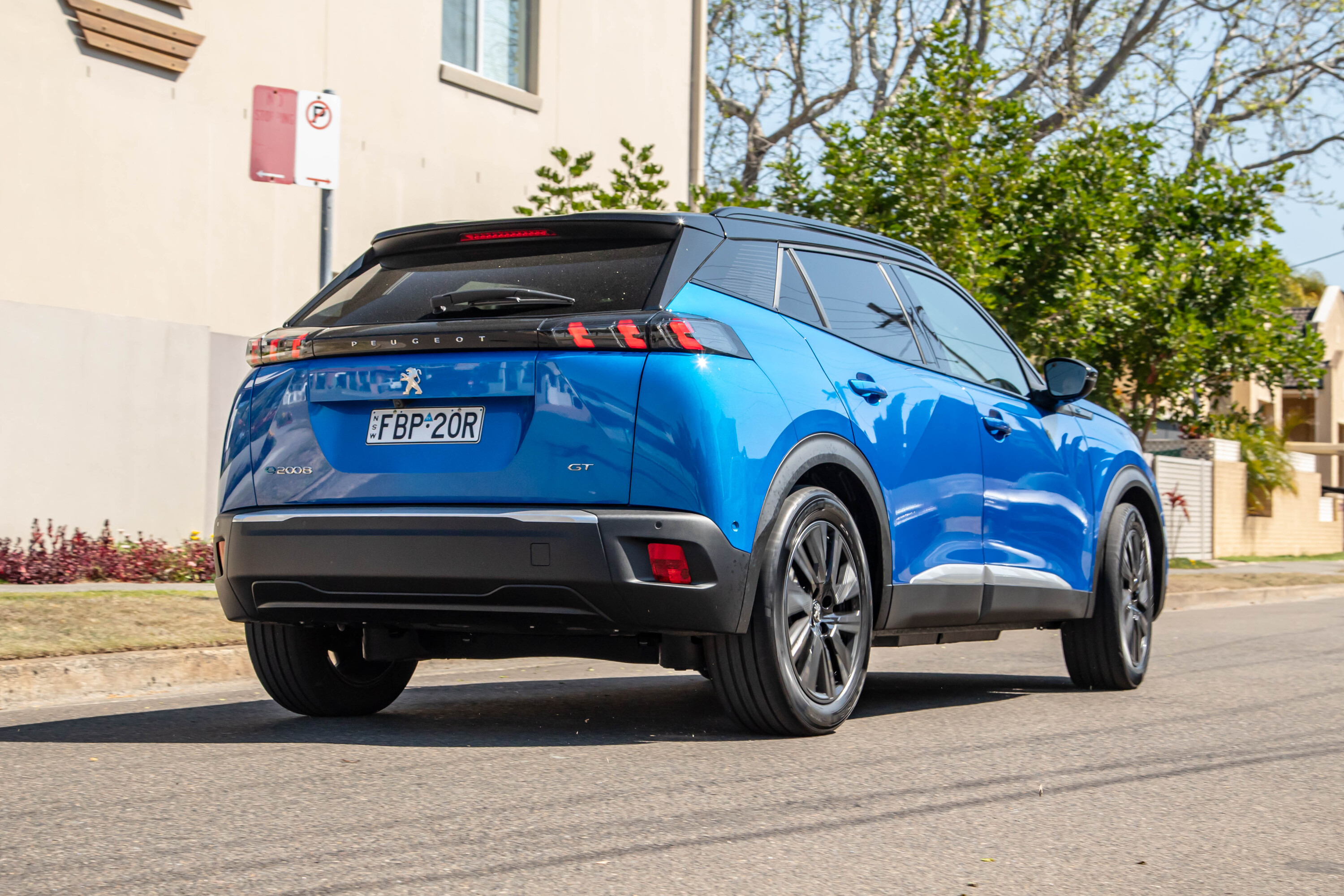
1
The E-2008 has to shift around 320kg more than the petrol-engined version. Somehow it’s three-tenths quicker to 100km/h at nine seconds but as you can see, that isn’t a stellar number. Which is fine.
What Peugeot has done, however, is what I expected – maintained a very pleasant ride and handling balance and managed to keep it fun, with one or two caveats. Obviously trying to hide 300-plus kilos is a bit of a task but it certainly doesn’t feel that much heavier.
You can hear the rubber working pretty hard in the corners when you lean on it, but given they’re pretty decent Michelin Primacy tyres, they hold on pretty well.
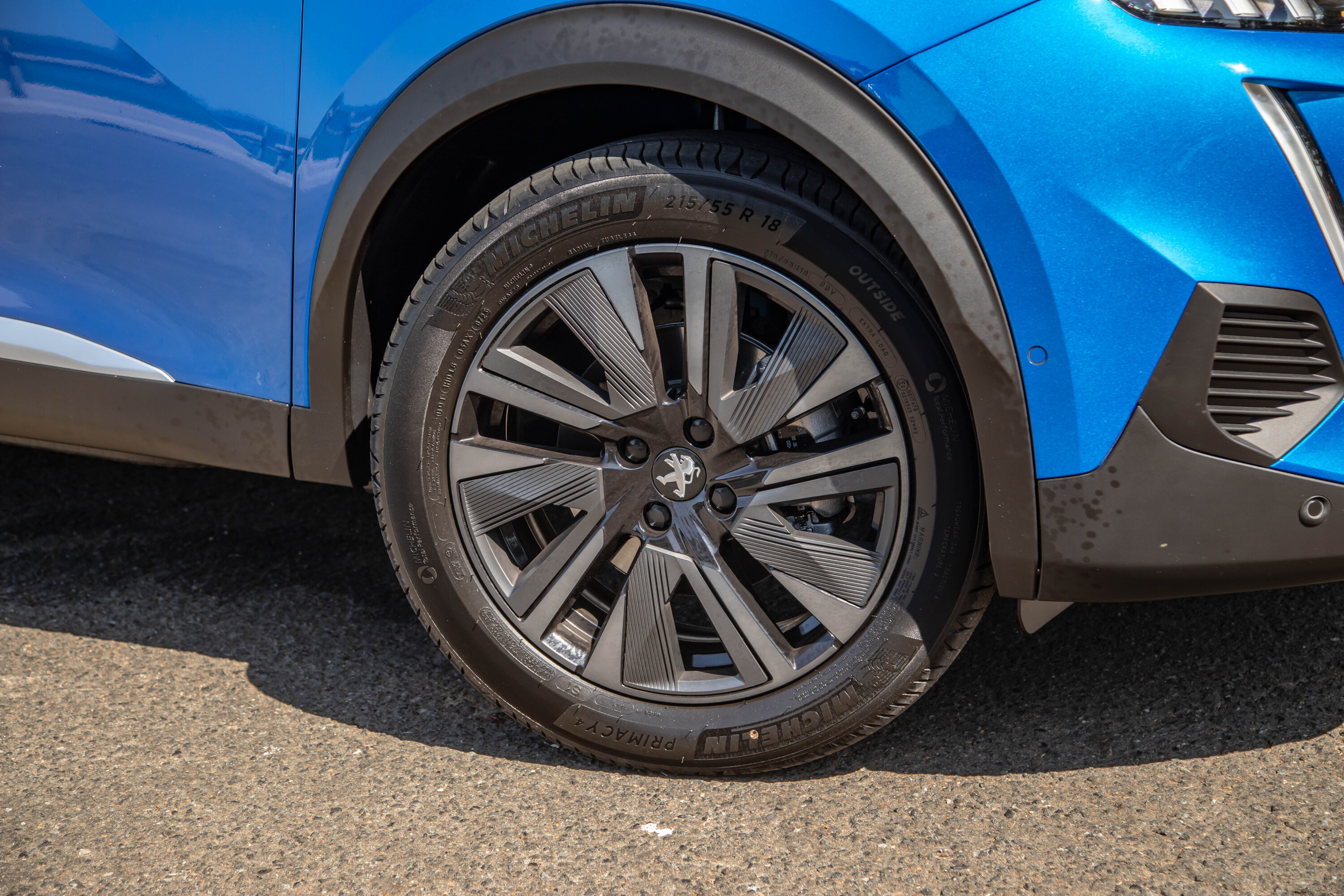
1
The more time I spent chucking the E-2008 at corners, the more I realised how quiet it is. Quieter than the MG4, quieter than the Atto3, Model 3 and Polestar 2. The tyres are part of that equation but even at highway speeds, just a gentle audible shimmy around the wing mirrors is the worst of it.
Like the petrol 2008, the chassis has a bit of sparkle to it. The small steering wheel makes the steering feel sharper and more direct than perhaps it is, but that feeling is always a bit of a laugh. Its change of direction is also impressive given the weight, just a little dull compared to the petrol.
It’s always tricky turning a petrol car electric and Peugeot has pulled it off. It will be interesting to see how the E-208 hatchback compares.
If any of the terms in this section have left you scratching your head, these articles will help bring you up to speed!
1
- What is a Powertrain or Drivetrain?
- Power vs torque
- Car suspension explained
- Automatic transmissions (‘gearboxes’) explained
- Chassis control systems explained
- Car vs Ute vs SUV: How the vehicle you buy should guide the way you drive
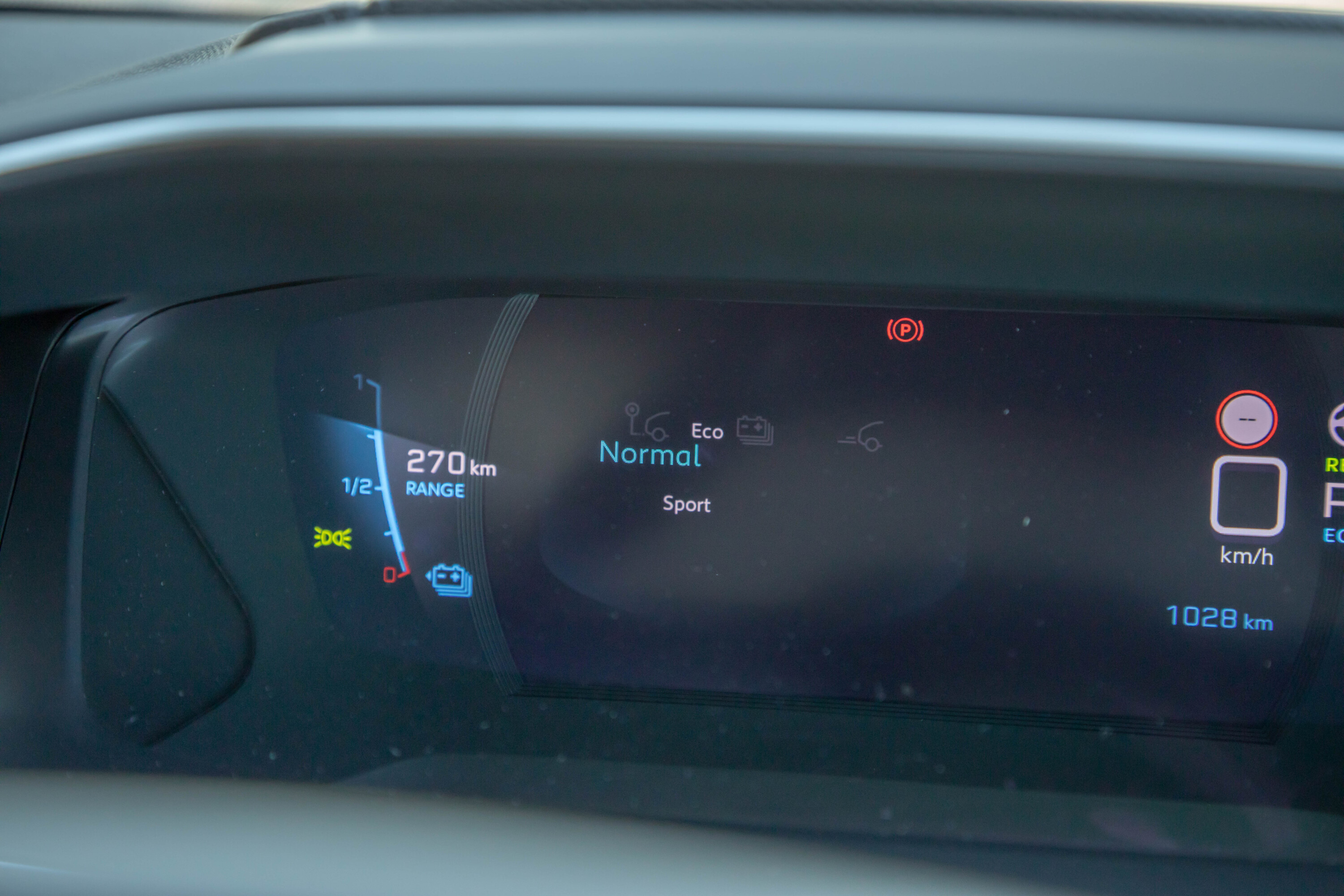
Despite a reasonable 2.5kWh difference from the WLTP, we got a pretty good result from the E-2008 for a couple of reasons.
First, the days I spent in the E-2008 were very hot, so the climate control went on and stayed on. Secondly, I had rather a lot of fun driving the E-2008 so there’s an easy kWh or more to be found if you’re not a perpetual adolescent like I am.
| 2023 Peugeot E-2008 GT efficiency | |
|---|---|
| Range (claimed, WLTP) | 328km |
| Consumption (claimed, WLTP) | 14.1kWh/100km |
| On test | 16.6kWh/100km |
| Real-world range | 280km |
No, 280km from 50kWh isn’t outstanding, but the E-2008 isn’t a slippery sucker given its tall SUV bearing. I think you could probably get quite close to the WLTP figure in gentle city driving, which is commendable.
1
How safe is it?
As the E-2008 is quite new it doesn’t yet have an ANCAP safety rating.
The petrol version carries a five-star rating from 2019, though, which points to a) reasonable form and b) a likely four-star rating given the lack of front-centre airbag. But with ANCAP, you just never know.
| 2023 Peugeot E-2008 GT safety features | |
|---|---|
| Six airbags | Anti-lock brakes |
| Stability and traction controls | Forward auto emergency braking |
| Forward collision warning | Lane departure warning with road edge detection |
| Traffic sign recognition | Advanced driver attention alert |
| Lane trace assist | Blind-spot monitoring |
The forward AEB features low-light pedestrian and cyclist detection. Any car without reverse cross-traffic alert and/or reverse AEB earns my wrath and the E-2008 – frustratingly at this price – has neither. Rawr.
For child seats, there are two ISOFIX points and three top tether anchors.
1
Warranty and running costs
Peugeot’s five-year/unlimited-kilometre warranty applies to the vehicle and an eight-year/160,000km warranty covers the battery.
Servicing an EV should be cheap and, as it turns out, it is. You only have to visit the dealer once every 12 months or 24,000km (whichever comes first) and pre-paid servicing costs just $600 (three years) or $1000 (five years), working out at an easy $200 per year.
1
VERDICT
The only real problem with the E-2008 is the price. As an electrified compact SUV, it builds very nicely on the petrol versions, which are hardly cheap themselves given the Allure base model reaches well into the $40,000s.
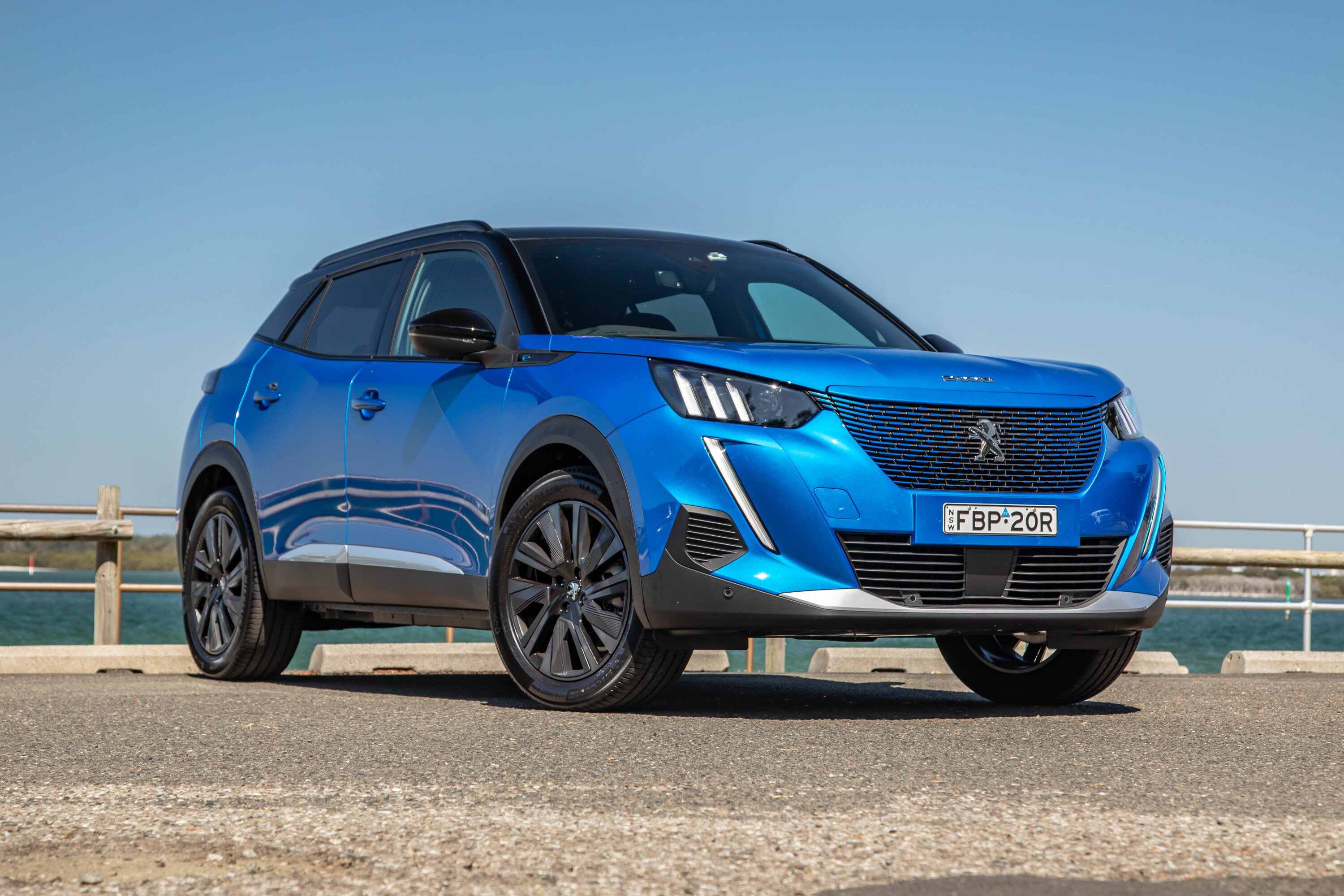
The E-2008 looks great, is really nice to drive and should be as appealing as the petrol versions that aren’t anywhere nearly as well-regarded in this market as they could be.
1
And again, it comes down to the price – Peugeot needs to sell a lot more cars to get the prices down but… yeah. Chicken and egg stuff that nobody wants to underwrite and I can understand why.
It’s a great pity the local importer couldn’t get a sharper price for this car because it could have been a contender.
Price aside, it is a contender for a good compact SUV meant for urban combat because it drives well and is comfortable. But with credible alternatives on either side of the $60K mark, this one is for the fans.
MORE
Everything Peugeot
MORE
Electric SUVs
More EV stories to help you choose the best car for your needs
- ? EV news, reviews, advice & guides
- ❓ Short & sweet: Your EV questions answered
- ⚡ New EVs: Everything coming to Australia
- ? Australia’s EVs with the longest driving range
- ⚖️ Best-value EVs by driving range
- ? How much do EVs cost in Australia?
- ? How much more expensive are EVs?
- ⚖️ Number crunching: Is it time to switch to an EV?
- ♻ Should you buy a used EV?
- ?️ Are EVs more expensive to insure?
- ? Costs compared: Charging an EV vs fueling a car
- ? EV charging guide
- ? Are there enough EV chargers in Oz?
- ?? EV servicing explained
- ? EV battery types explained
- ? When do EV batteries need replacing?
- ? Hydrogen v EVs: What’s best for Oz?
- ✋? Mind your manners! EV charging etiquette tips
- ? How sustainable are EVs, really?
MORE advice stories to help you with buying and owning a car
| 2023 Peugeot E-2008 GT specifications | |
|---|---|
| Body | 5-door, 5-seat small SUV |
| Drive | front-wheel |
| Engine | synchronous electric motor |
| Transmission | single-speed reduction gear |
| Power | 100kW |
| Torque | 260Nm |
| Range | 328km (WLTP) |
| AC charging | 11kW |
| DC Charging | 100kW |
| 0-100km/h | 9.0 seconds |
| Energy consumption | 14.1kWh/100km (claimed) |
| Weight | 1548kg |
| Suspension | MacPherson struts front/torsion beams rear |
| L/W/H | 4300mm/1987mm/1550mm |
| Wheelbase | 2605mm |
| Tyres | 215/55 R18 |
| Wheels | 18-inch alloys |
| Price | $59,990 + on-road costs |
While an entirely new Skoda Kodiaq is expected to arrive in late 2024, the current model continues to age gracefully.
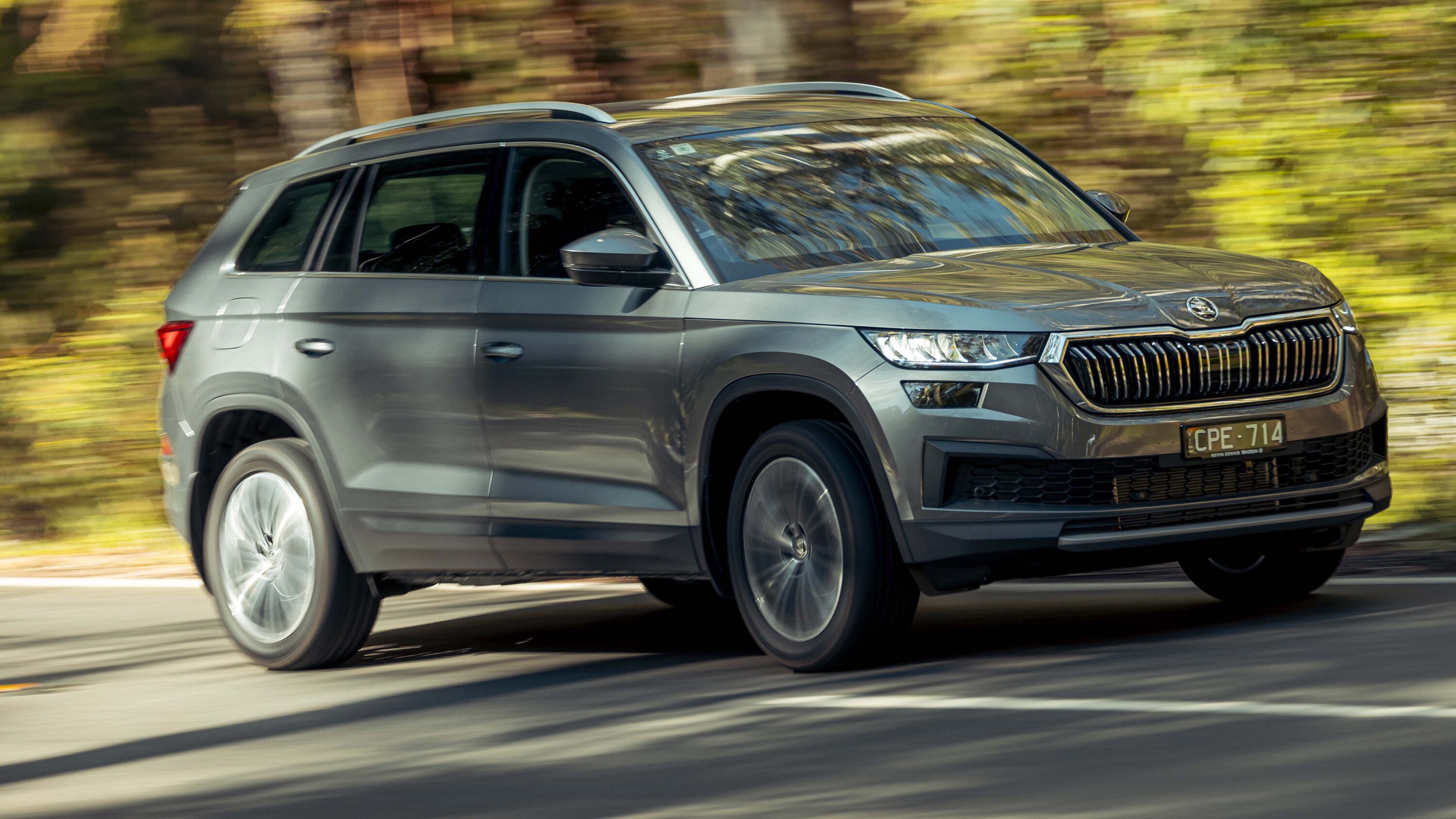
Remarkably, when compared to the recently updated competitors, the Skoda’s exterior retains its youthful and timeless appearance.
In our 2023 Best Large SUV under $60k test, the Skoda was crowned victorious, even against brand-new competitors.
But before the update of this seven-seater family SUV, let’s see what the entry-level Style variant offers.
Pricing & Features
The Style kicks off the Kodiaq range, before the Sportline and flagship RS trims– at $56,490 drive-away.
As a base grade the Style is well equipped, with a long list of standard features including 19-inch alloys, soft suede seats, wireless Apple CarPlay, LED day-time running lights, wireless phone charger and an electric tailgate.
The cabin is comfortable and a bit luxurious. There’s ample space in the 765L cargo area with cleverly places lidded storage containers on the sides. One thing that Skoda does well is the sprinkle of thoughful touches throughout the car.
Energy Blue is the standard paint colour on the Kodiaq, with all other options adding $770 to your drive-away price.
1
Powering the vehicle is the well-known 2.0-litre turbocharged petrol engine, producing 132kW of power and 320Nm of torque. This engine is mated to a seven-speed dual-clutch transmission and offers variable all-wheel drive.
The Tech Pack at $3000 adds adaptive suspension, hands-free tailgate and more while the Luxury Pack brings features such as tri-zone climate control, electric leather front seats and massage function seats for an additional $6900. You can even chuck on a panoramic sunroof for an extra $1900.
1
Safety
The Skoda Kodiaq Style is currently unrated by ANCAP as its six-year rating window has lapsed, but did earn a five-star score following assessments carried out in 2017.
It achieved a commendable 92 percent score for adult occupant protection, 77 percent for child occupant protection, 62 percent for pedestrian protection, and 54 percent for safety assist.
1
Standard safety is good with features such as adaptive cruise control, driver attention monitoring, blind spot monitoring (a new addition), nine airbags and front and rear parking sensors.
The omission of lane keep assist is noticeable in a car of this size but can be picked up if you’re willing to spend more and add the Luxury Pack.
Key Rivals
Some examples of key competitors include other popular seven-seaters:
1
Should I put it on my shortlist?
The 2024 Skoda Kodiaq Style is an excellent choice for those seeking a family SUV that combines style, space, and advanced technology.
Even at the end of its lifecycle, it continues to hold strong event against newer competitors.
Its blend of practical features and European elegance makes it a standout in its class. If you’re looking for an SUV that is as stylish as it is functional, the Kodiaq Style is certainly worth considering.
MORE
Everything Skoda
MORE
Large SUVs
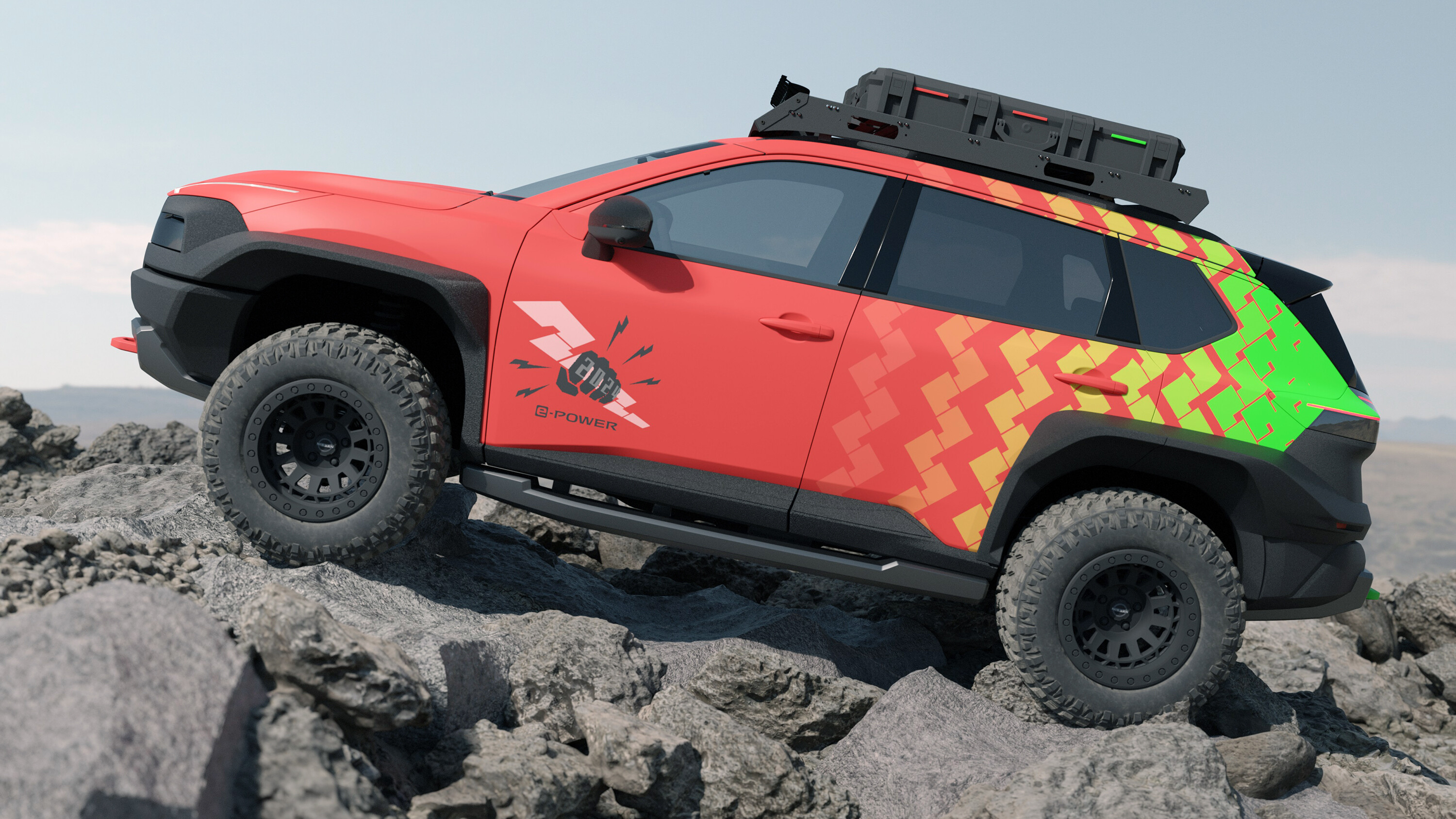
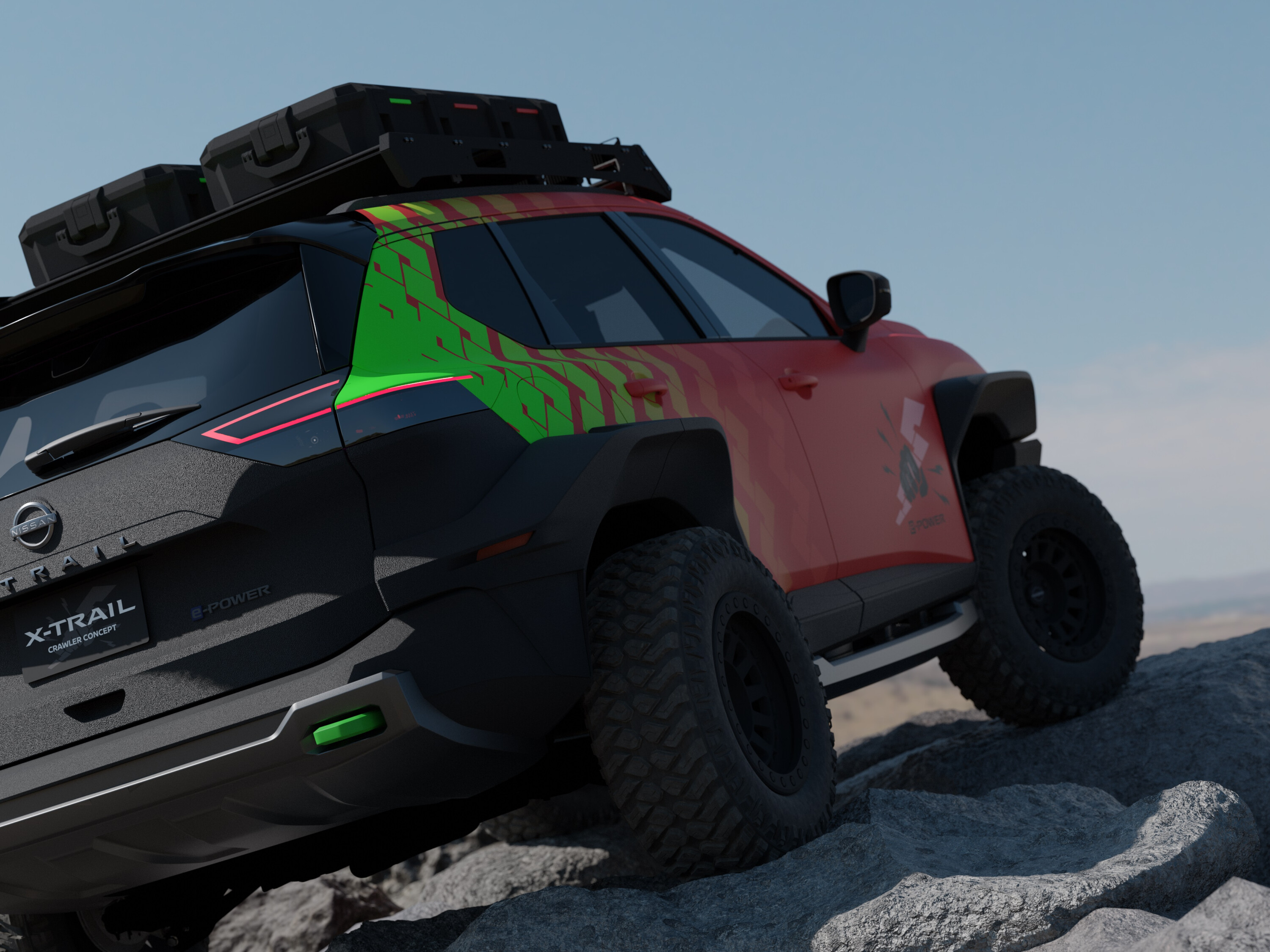
Nissan has handed down images of a tough-looking concept called the X-Trail Crawler, bound for this weekend’s Tokyo Auto Salon.
Finished in a fairly rad ’90s-looking fluoro red and green theme, the Crawler is jacked up on black 17-inch Sunraysia-style wheels wrapped in properly fat off-roading tyres.
Above those are some bench-style flares, while underbody bash guards are bolted to every side of the SUV.
1
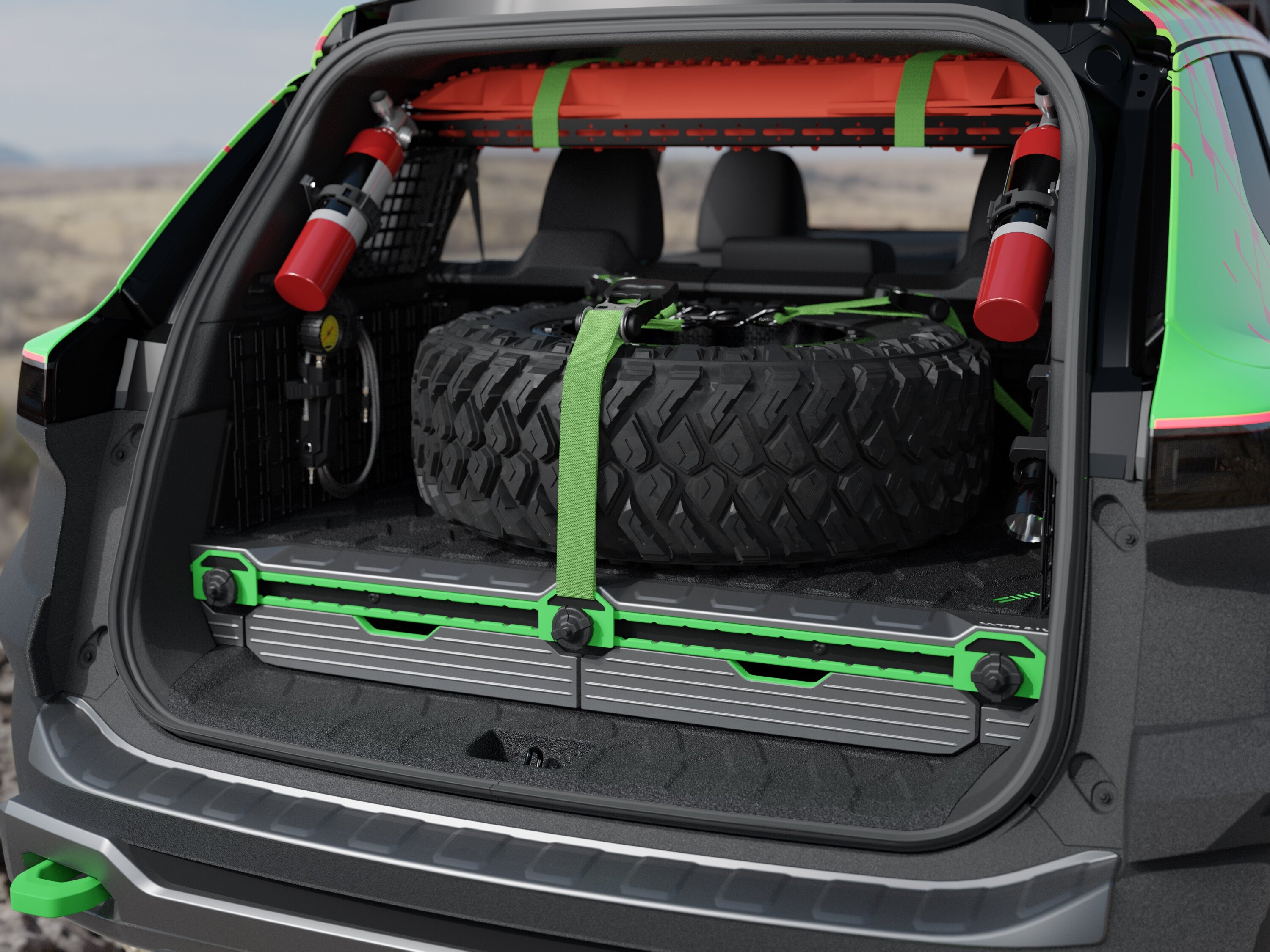
Nissan says: “The exterior represents a world of rock-crawling, running through steep and rough terrain, and the luggage area contains the tools that have always been looked for in the X-Trail.”
It’s been a long time since the X-Trail was anybody’s idea of a go-to off-roader, but this concept at least looks the part.
1
Still, every brand wants you to think of their modern car-based SUVs as being capable of the task, with software-tricked terrain modes available to help with some basic off-roading.
Apart from the the raised suspension and lower protection sections, this X-Trail is a standard all-wheel-drive E-Power variant – which you can read about at our X-Trail page.
A facelift for the X-Trail was revealed in October 2023, in its American-market Rogue form, but the local Nissan office has so far said that it has no imminent plans for an updated X-Trail.
MORE
Everything Nissan
1
RELATED STORIES
The number of new cars imported to Australia from China overtook vehicles shipped from Korea in 2023.
Chinese-built models registered locally last year grew 58 per cent to 193,433 – moving them past Korean-sourced vehicles that increased by just two per cent to 161,614 units.
According to Country of Origin data in official VFACTS industry figures, China moved up to third – behind Thailand (264,253 vehicles) and leading import nation Japan (345,071 vehicles).
1
The increase was driven primarily by record years for multiple Chinese brands in Australia.
MG led the way with 58,346 new-vehicle registrations to beat its previous best of 49,582 in 2022. GWM increased sales by 45 per cent to 36,397 units, and LDV jumped 31 per cent to 21,398 sales.
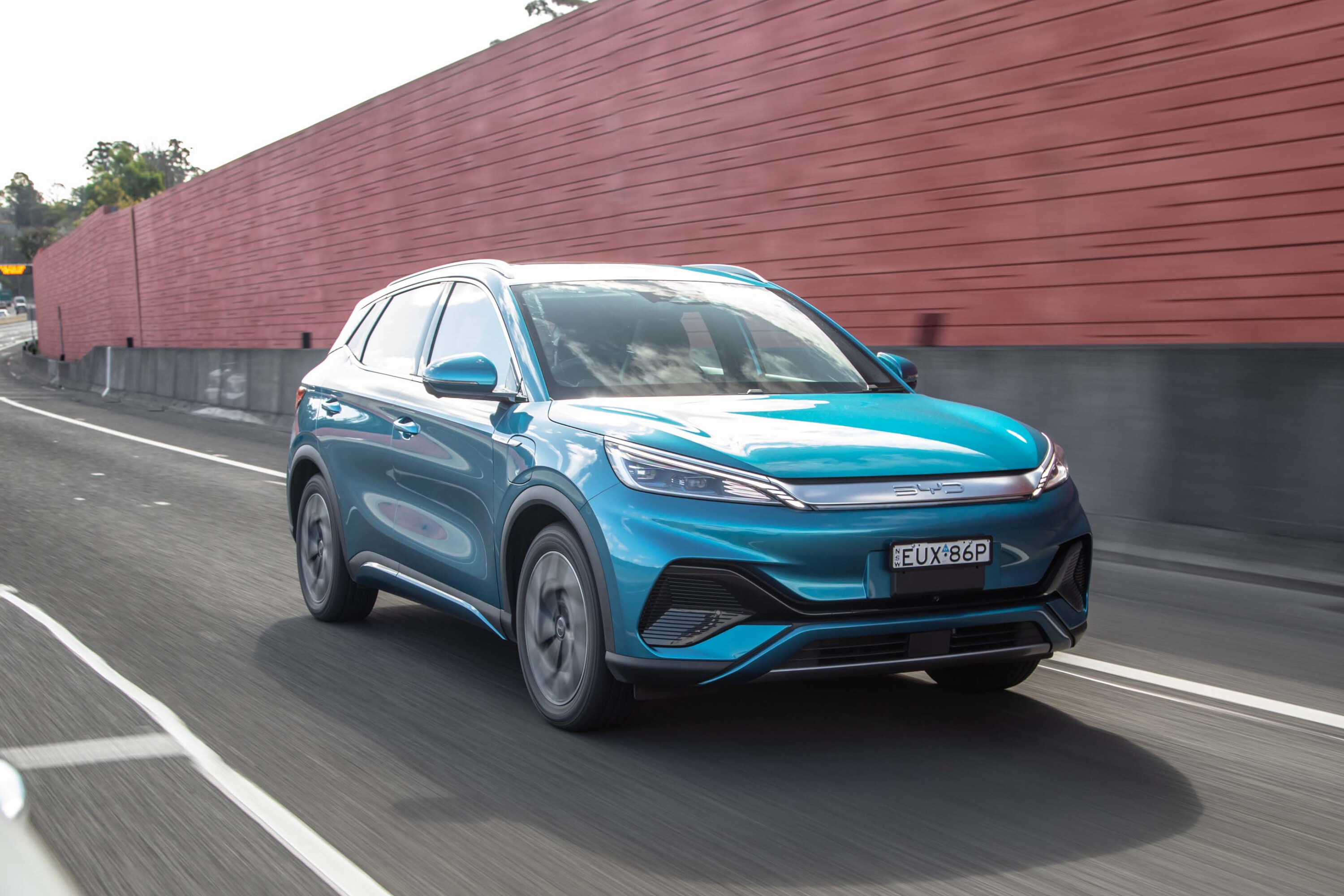
BYD also had a successful first full year in Australia, shifting 12,438 vehicles with just two models – the Atto 3 compact SUV (pictured above) and Dolphin hatchback.
The 2023 result continues the incredible rise of Chinese cars, which accounted for fewer than 10,500 vehicles in 2018.
| Australian annual sales for cars sourced from China | |
|---|---|
| 2023 | 193,433 |
| 2022 | 122,845 |
| 2021 | 76,262 |
| 2020 | 30,696 |
| 2019 | 17,957 |
| 2018 | 10,459 |
This year marks 15 years since the Great Wall Motors (now GWM) became the first Chinese brand to enter the Australian market, with the V240 and SA220 utes.
It’s 20 years since the first ever Chinese-built model went on sale here – the 2004 Volkswagen Polo Classic sedan.
Chinese-built models from brands headquartered outside of China also contributed to 2023’s result. Tesla sold a record 46,116 vehicles last year locally, with the Model 3 sedan and Model Y SUV.
Also sourced from China is Volvo’s electric XC40 and C40 models, as well as the Polestar 2 from its all-electric sister brand, and the BMW iX3 electric SUV.
1
Cars from Germany increased by a notable 36 per cent, though the biggest year-on-year increase for a country was driven by a single car.
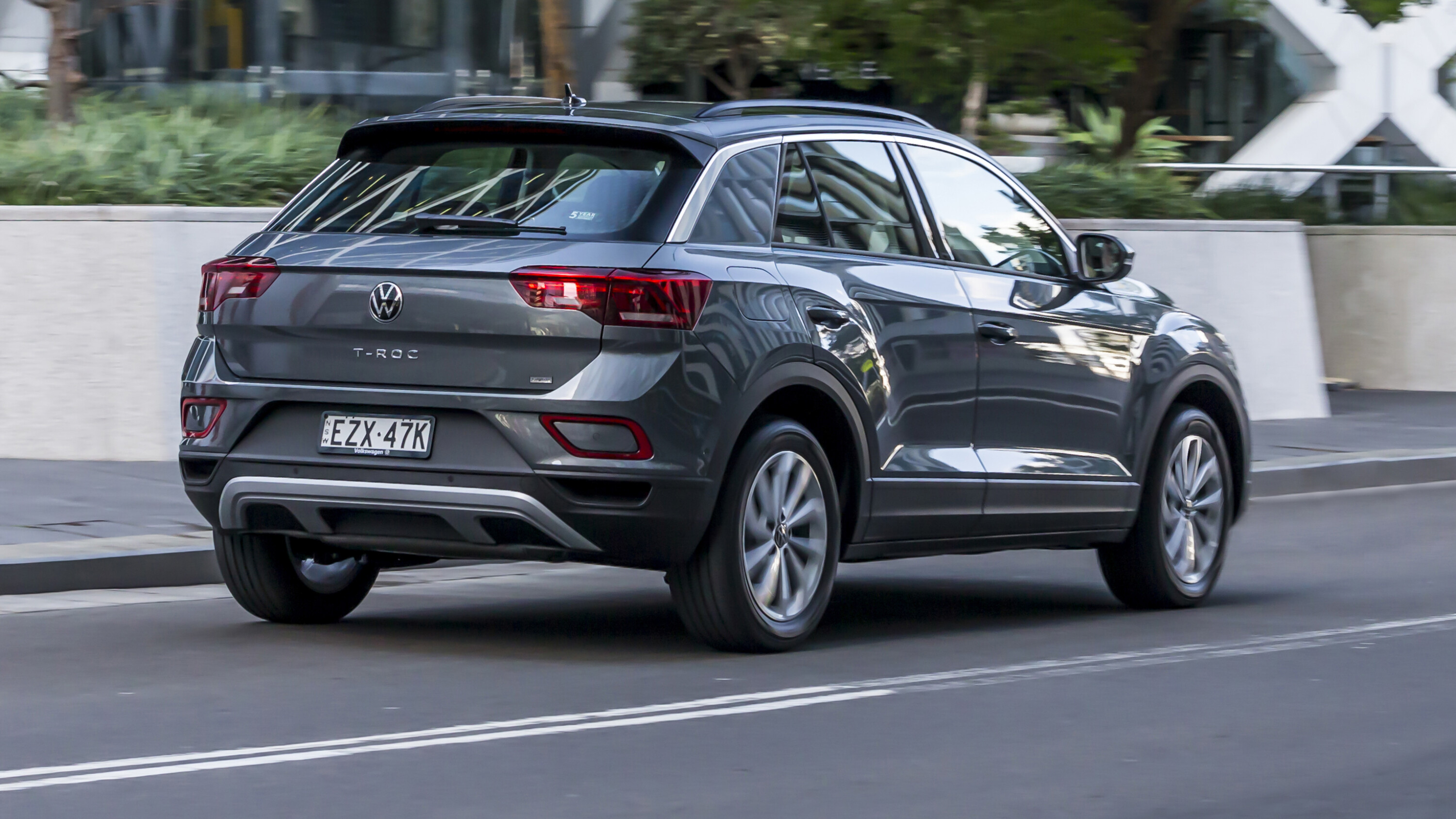
Portugal jumped by 147 per cent thanks to the Volkswagen T-Roc compact SUV (above), which increased sales from 3637 to 8943 units. The T-Roc was last year voted Wheels Best Small SUV.
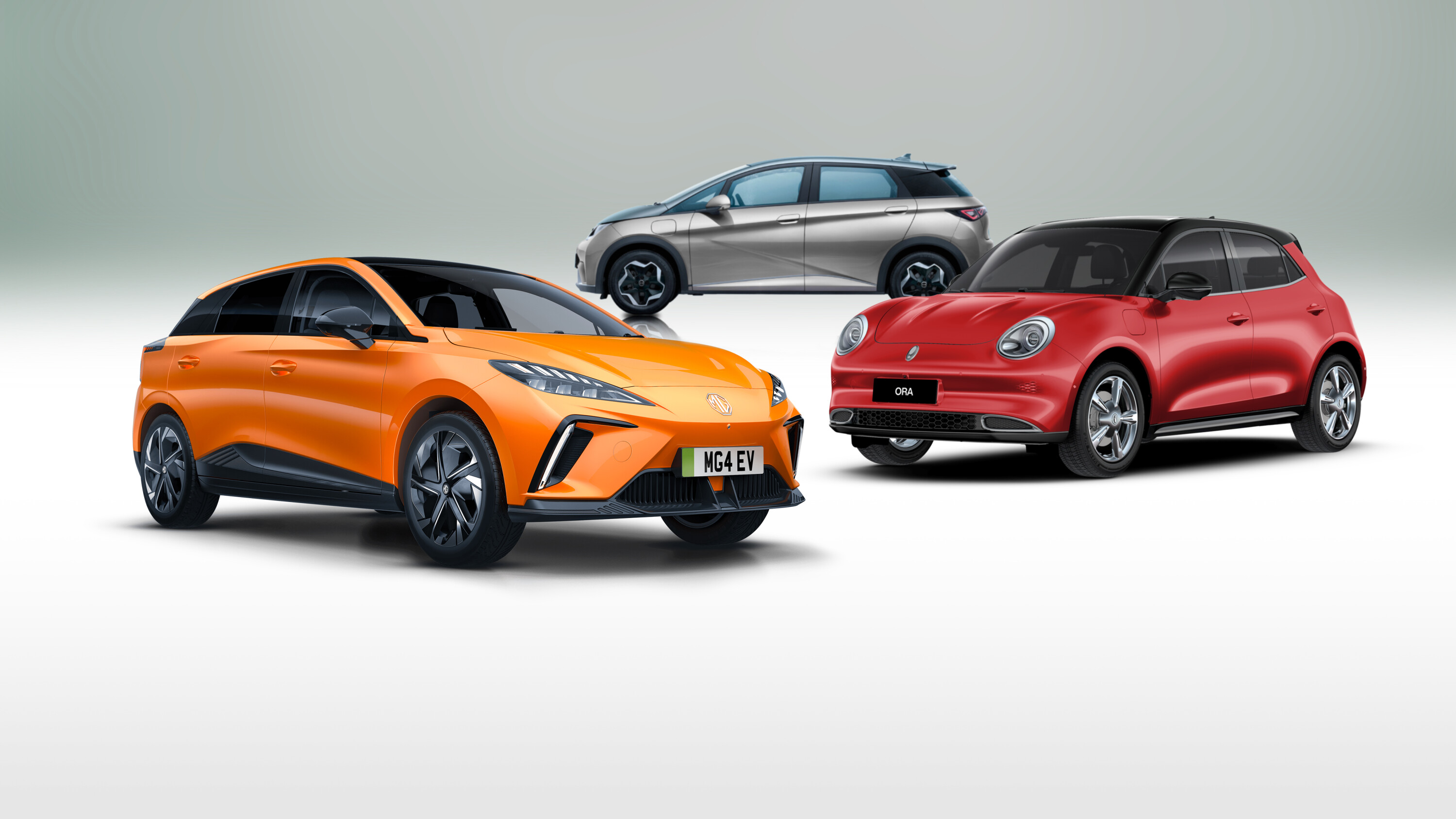
The GWM Ora electric hatch, already one of Australia’s most affordable EVs, is now the cheapest by a good margin – thanks to a sales campaign the brand is running until March 31.
Buyers who move before then will get into an Ora from around $4000 less, drive-away – depending on their location, as drive-away prices differ by state. In NSW, that means $37,044 drive-away for the entry-level Ora Standard Range.
| Ora Standard Range | Price (drive-away) |
|---|---|
| NSW | $37,044 |
| Vic | $38,583 |
| QLD | $37,550 |
| Tas | $38,247 |
| SA | $38,230 |
| WA | $39,003 |
| NT | $36,656 |
| ACT | $36,638 |
The deal runs across the full Ora range, meaning a top-shelf Ora GT can be had for $49,044 drive-away in NSW – down from $51,990 before on-road costs.
GWM is running deals across its entire range at the moment, all with drive-away pricing that will result in thousands saved.
1
The Chinese brand finished comfortably inside the top-10 of Australia’s best-selling brands in 2023, with 3862 sales to its name for eighth position. Among those were 526 Oras.
This latest campaign could help it spring past Isuzu (3987) and even Hyundai (4887), although those brands – like all others – will be working to improve their own figures too.
Elsewhere in the cheapest-EVs fight, the MG 4 is now $1000 more expensive, making it $39,990 before on-road costs. This again leaves the BYD Dolphin as Australia’s cheapest EV, by a hair, at $38,890 before on-road costs – but, given it’s a new year, a price rise could well be on the cards.
Wheels has summoned me
One weeknight, while partaking in the usual activity of aimlessly scrolling through my Facebook feed, a particular post caught my eye – “We’re on the hunt for a handful of old cars… Do you own one of these 1993 models?”
1
Among the models listed was the unmistakable image of a red EB II Falcon, resembling my trusty wagon.
ANCAP, the crash testing aficionados of Australia and NZ, via Wheels, were seeking a handful of vehicles for an upcoming photoshoot. Amazed that my Falcon had qualified for something, I scrambled together an email offering my honest daily driver.
Before too long, a polite reply arrived from Rhianne Robson, graciously inviting the wagon and myself to attend.
The arrogant belief that old cars are stronger is nothing short of rubbish
Mysterious and interesting, I thought. I accepted.
The day arrived… As I turned off the Great Western Highway to a set of obviously government facility style electric gates, with an ominous looking intercom, I could only wonder what was at the other end of this winding driveway.
As it turned out, it was Crashlab, the NSW Government’s $25 million crash testing playground, the largest of its type in the southern hemisphere.
Oddly enough, the building didn’t look as imposing as it sounds, softened by a carpark line-up straight out of 1993; a VP Commodore, a Subaru Liberty RS Turbo, and a fellow EB Falcon owner. My inner (unqualified) engineer was already fantasizing about the equipment and tools that lurked within.
1
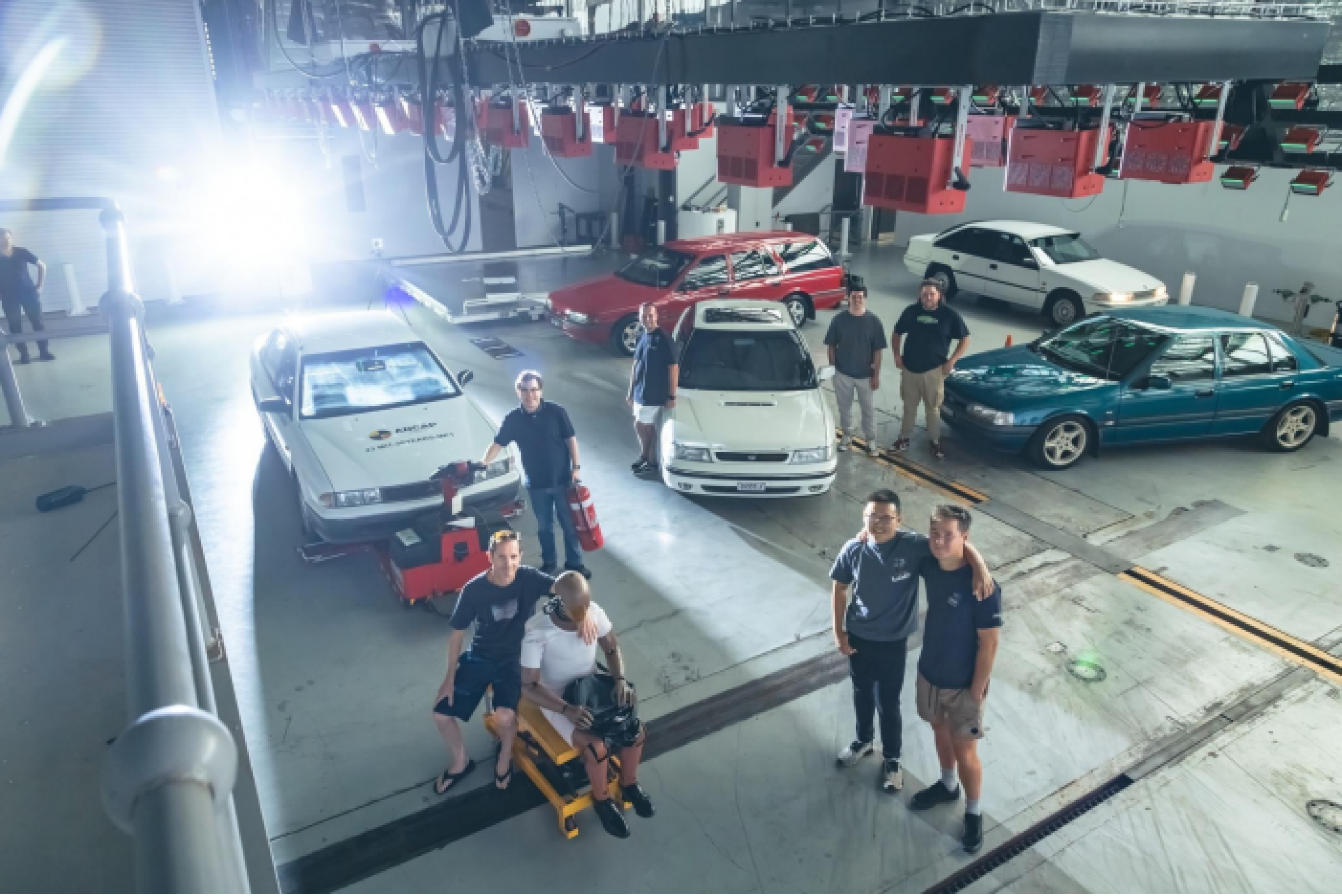
Soon enough, I met with the Crashlab and ANCAP teams, along with a variety of fellow crazy people (owners of the other cars requested for the photoshoot).
Then, the legendary John Law of Wheels, accompanied by the one and only photographic master, Thomas Wielecki (I have admired his work, such as his images of the late, great Paul Cockburn and his E-Type at Oran Park), directed us into the Crashlab “arena”, where all the action occurs, to shoot our cars in various revealing positions.
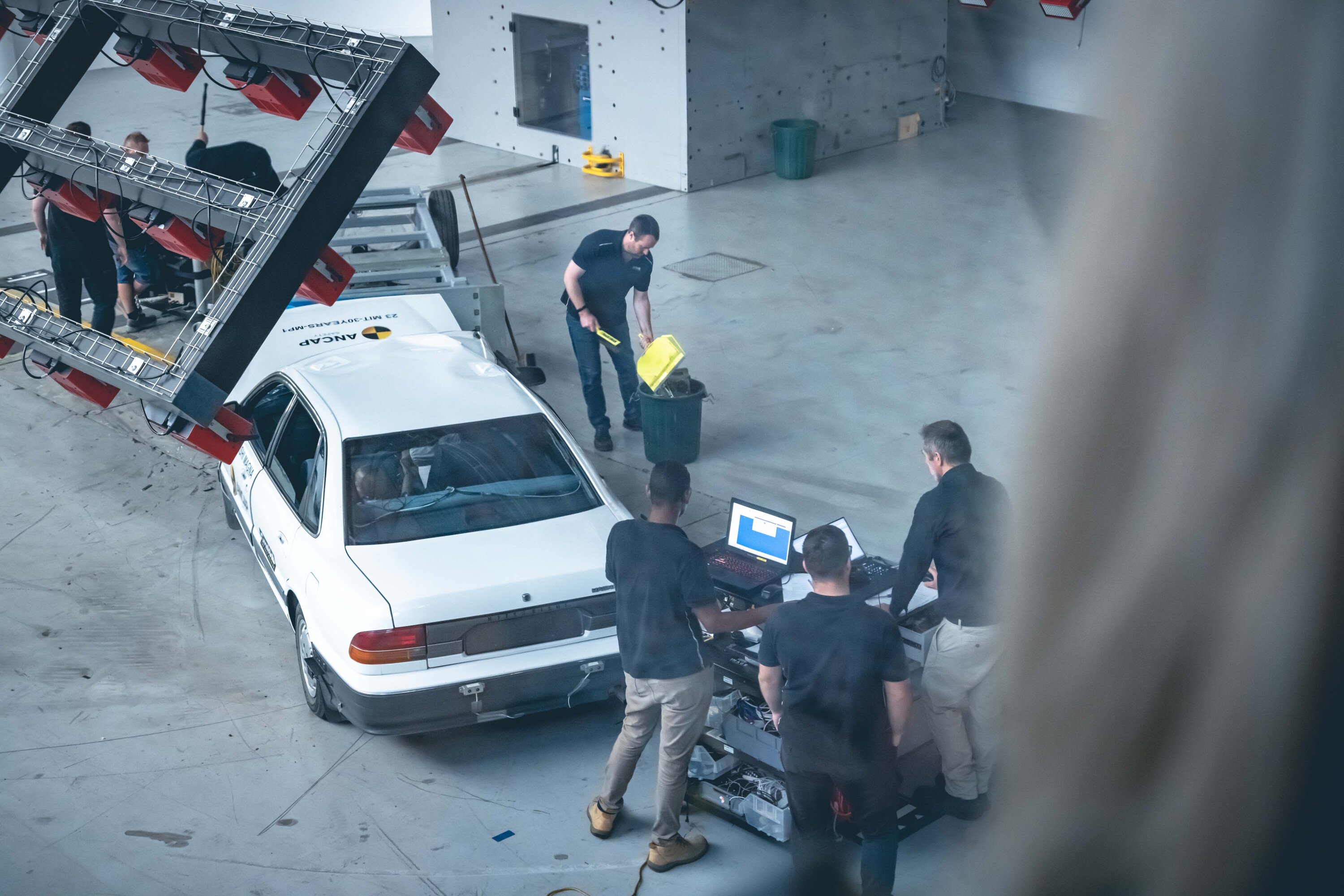
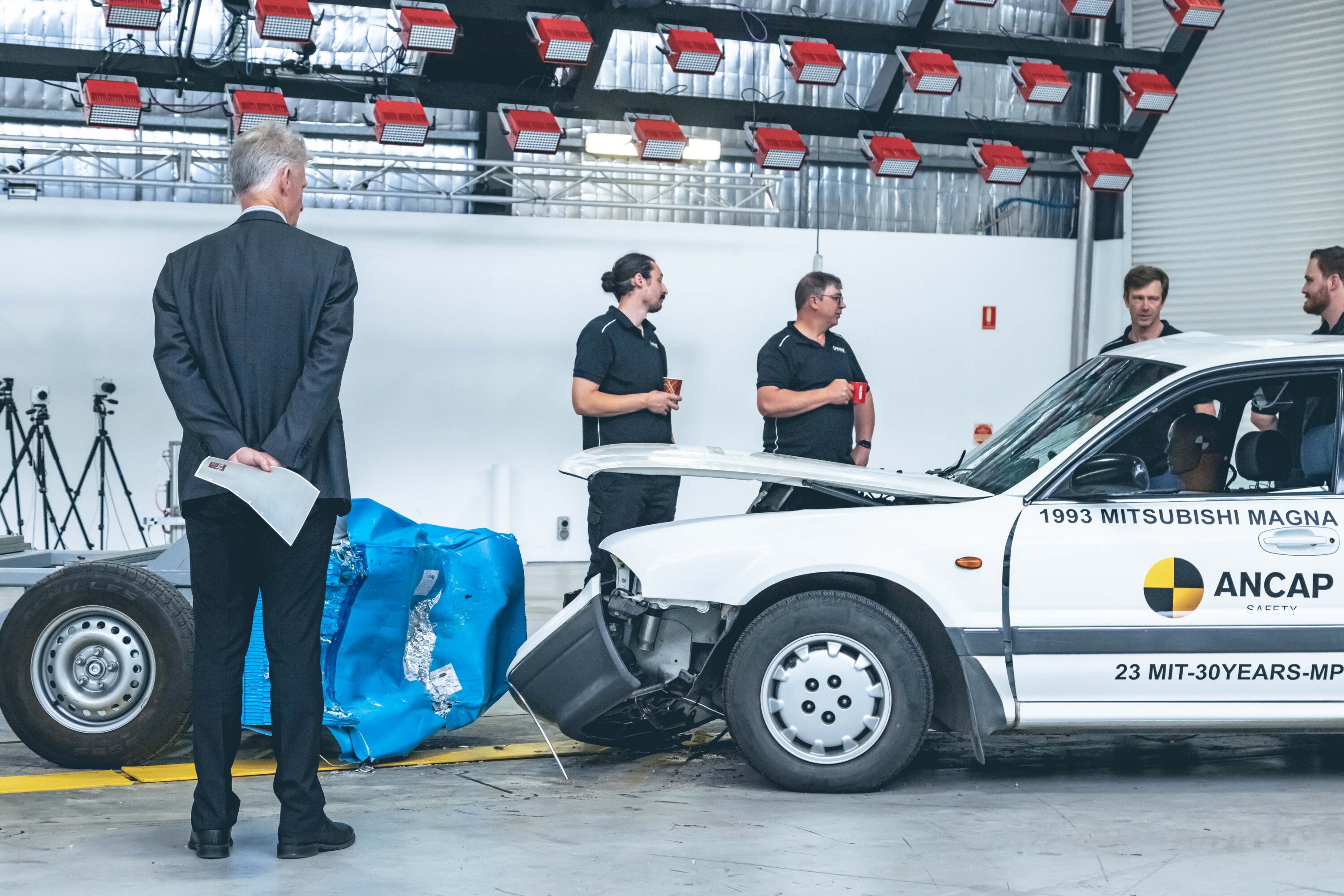
It was at this point that a 1993 TR Magna Executive – bearing immaculate blue cloth trim and a mere 58,000 kilometres on the clock – had been revealed as the crash test sacrifice for ANCAP’s 30th anniversary.
1
Touring the facilities
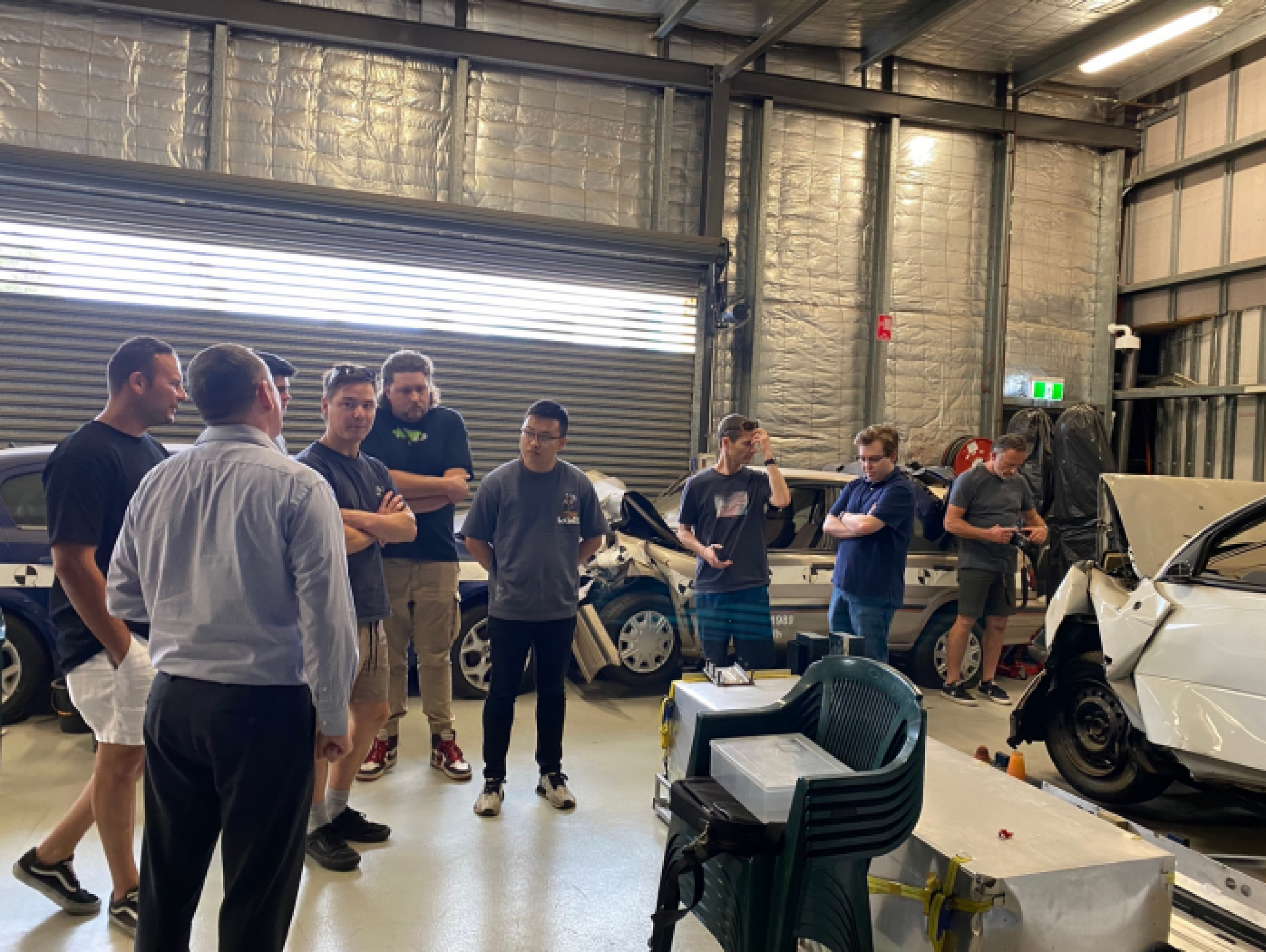
After completing the photoshoot, us old-car tragics were given a comprehensive tour of the Crashlab facilities. As a sufferer of Gear Acquisition Syndrome, this was a dangerous idea for me. (I too, have bad GAS – Stevo.)
It was here that we were shown a variety of equipment and different testing facilities, including a rig for testing motorcycle and bike helmets with a sickening metal spike, dropped from a reasonable height.
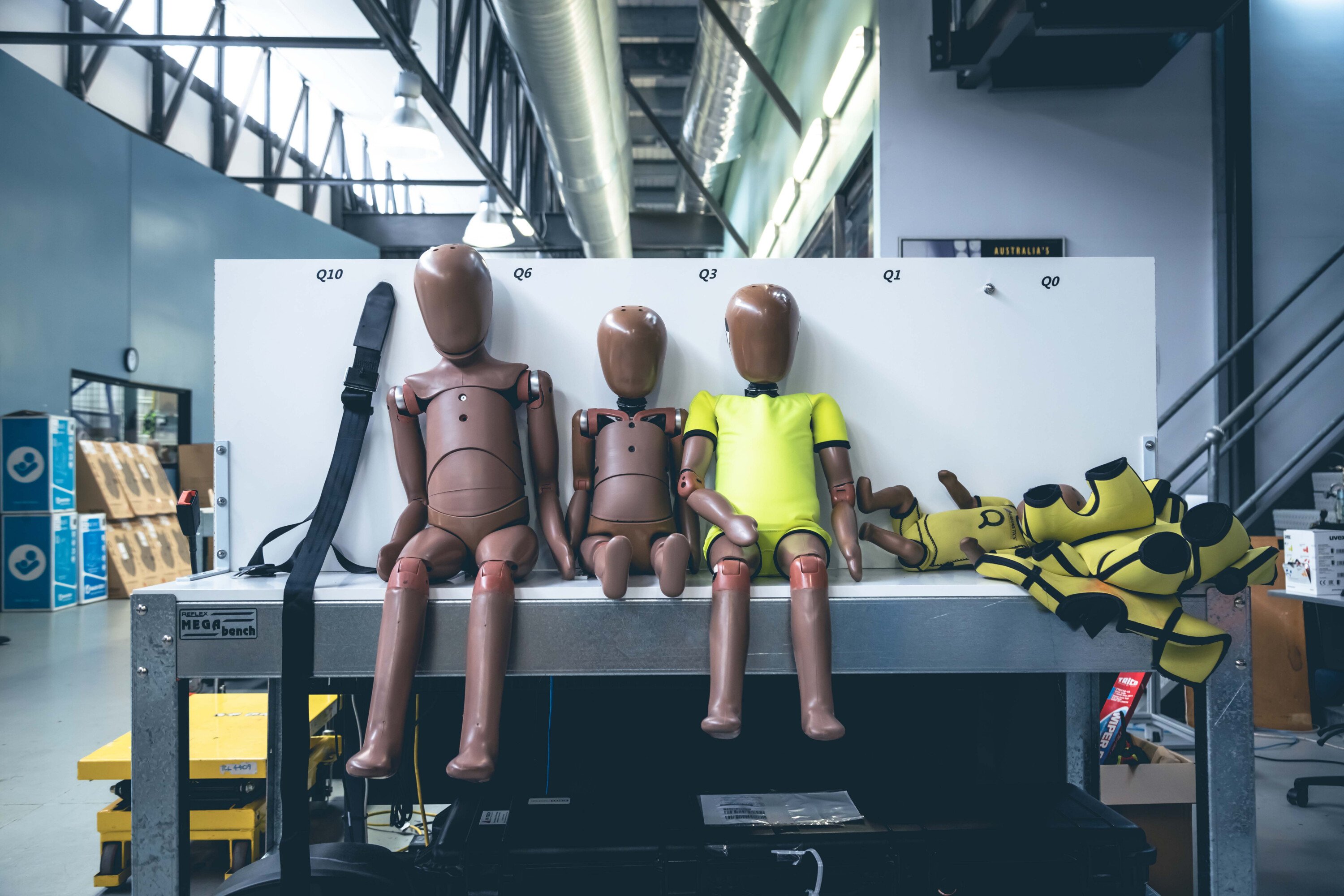
It was revealed that the modern THOR crash test dummies cost around $1.5 million per piece, depending on configuration and size. A few expletives were offered from the crowd after that bombshell, understandably. Animal dummies are also used, for testing pet restraints.
1
At the business end, a 1992-vintage electric motor originally designed for mining use is responsible for propelling the vehicles and appropriate vehicle dollies.
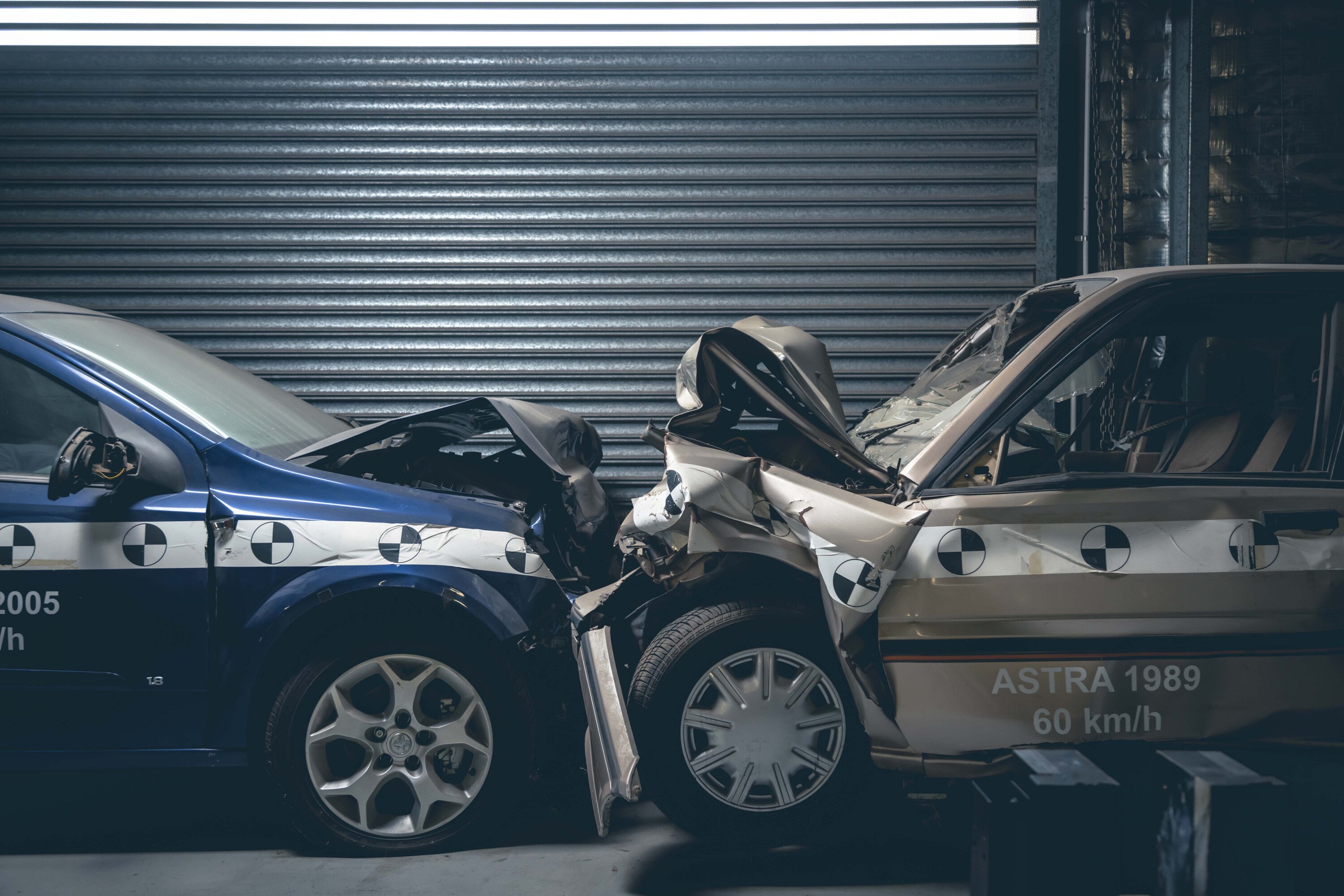
In a shed, a number of confronting examples were kept, including two Holden Astra hatchbacks, a 1989 and 2005 model, involved in a two-car head-on test, highlighting the pace of safety improvement since Crashlab’s opening.
1
A room full of important people… and a farewell to the Magna
I had been invited back to Crashlab the following week to witness the Magna’s unlikely end, and to partake in the swift and efficient consumption of a delightful celebratory chocolate cake.
Here, I met and spoke with a range of industry professionals, such as Michiel Van Ratingen from Euro NCAP, who educated me on the bureaucratic red tape that ultimately delays the technology and implementation of dummies by roughly a decade.
Among so many knowledgeable individuals, I had expected to feel like the dunce in the room. Yet every person I met took the time to speak with me, teaching me about various aspects of their profession.
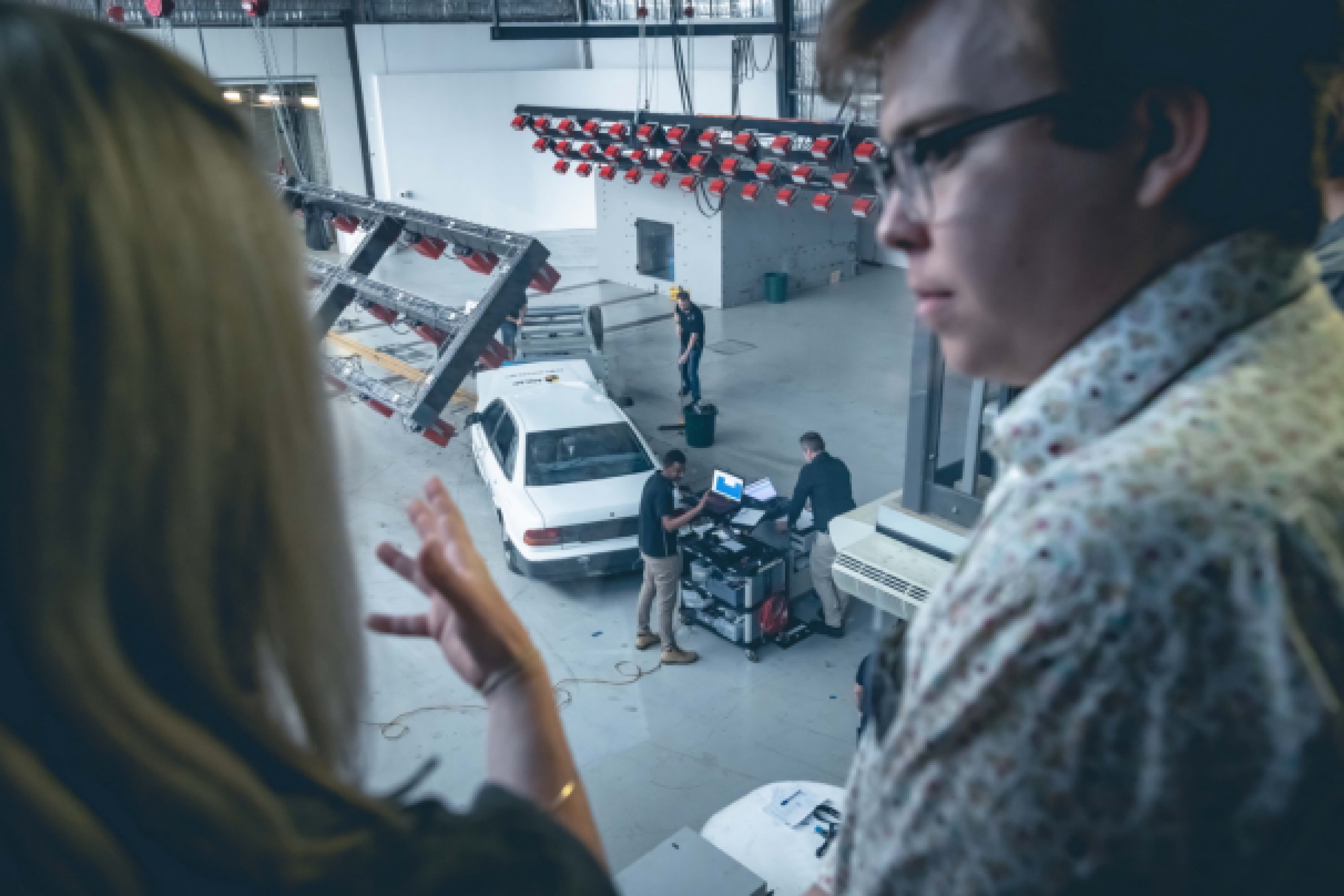
From a gantry above, the crowd huddles to watch the Magna meet its grisly end.
1
The occupants’ experience didn’t look so terrible in person, yet the slow-motion footage is shocking
Recorded by numerous high-speed cameras under a staggering array of LED lights rated at 100,000 lux (or anecdotally about as bright as the lightbar of a four-wheel drive tailgating you at 3 am) the old Magna collides with a dolly. A distinct and visceral “bang” follows; glass, plastic and stainless brightwork flying everywhere.
The occupants’ experience didn’t look so terrible in person, yet the slow-motion footage is shocking, revealing that the rear passenger’s knees had collided with the lower rear of the front seat, slipping below the seatbelt – a phenomenon known as ‘submarining’. The driver, amongst other injuries, sustained 107g of force to the head, essentially a certain demise.
1
How does this make me feel?
As someone who daily drives a car from the same era as that TR Magna, witnessing this experience face-to-face could only remind me that I am driving a car that falls within the same risk factor and deficiency of safety compared to a modern car, which is virtually any traffic surrounding me whenever I drive.
This is a factor I remain aware of when driving an older car, a reason to employ defensive driving skills, to minimise as much risk as I’m able.
The arrogant belief that old cars are stronger is nothing short of rubbish. The entire point of a newer car is to deform and crumple to absorb the energy and force. In an older car, you are the conduit for that energy – and it does not end well. Dummies can be reset and rebuilt, but people cannot.
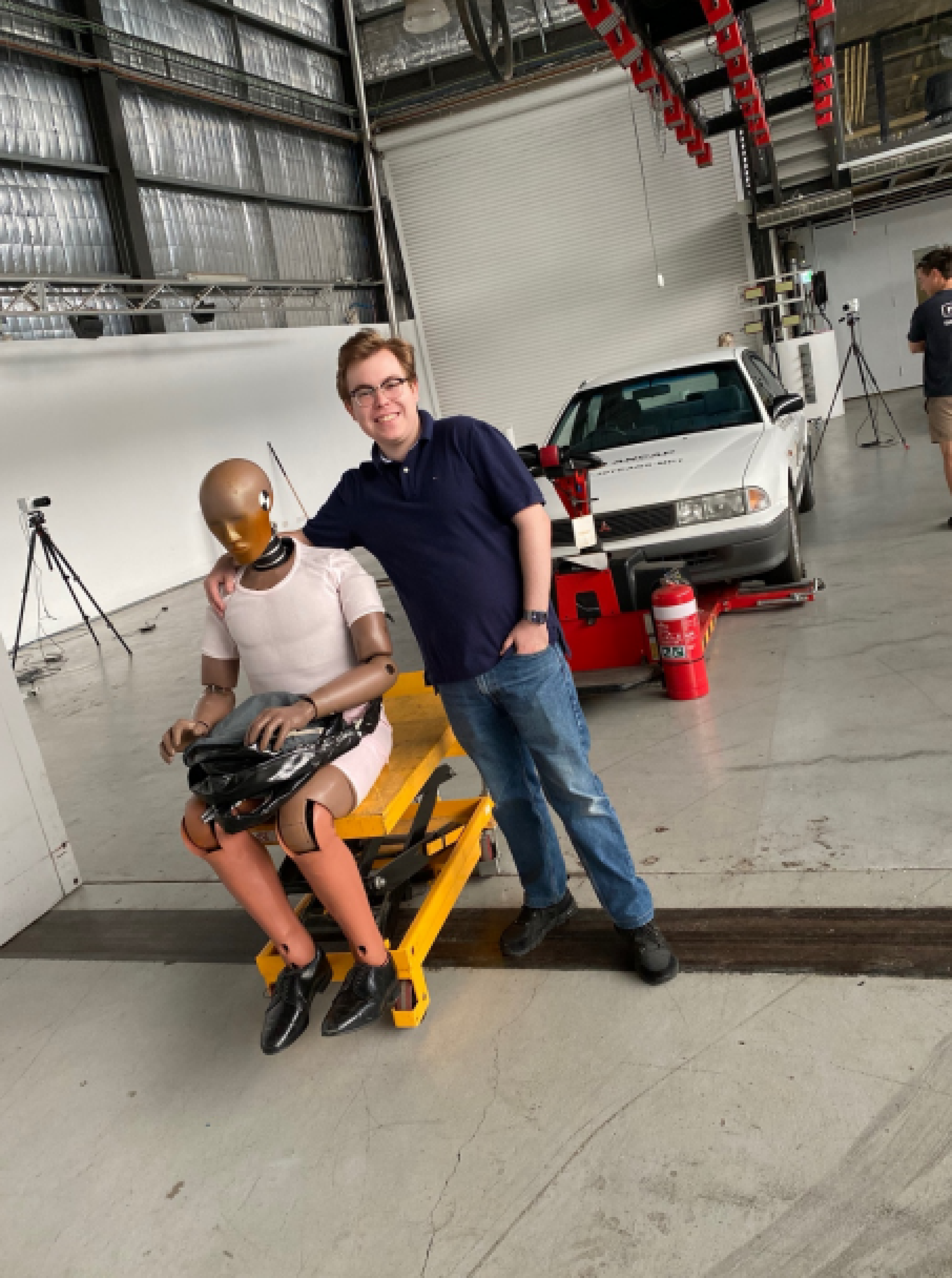
23-year-old Charlie is a regular Wheels reader and the owner of a beautiful old HiLux that has been in his family since new – a few years before he was born.
We thank Charlie for joining our team at Crashlab, and you’ll see his name here again.
1
