
The prices below are the manufacturer’s recommended retail price and don’t include on-road costs. All prices are correct at the time of publication.
The 2025 Genesis GV70 is now on sale in Australia, gaining new safety, comfort and convenience features, along with subtle styling changes.
Snapshot
- Advanced, Signature, and Signature Sport trims with 2.5T or 3.5T turbo engines
- 27-inch display, wireless Apple CarPlay, and Over-the-Air updates
- Prices up by $2000 across the range
These additions and tweaks come with a $2000 price bump across the range – attributed to standard increases in manufacturing and shipping costs – with the line-up now starting from $78,500 before on-road costs.
Available in three trim grades – Advanced, Signature, and Signature Sport –the Genesis GV70 is again available with a choice of 224kW/422Nm 2.5T four-cylinder or 279kW/530Nm 3.5T six-cylinder turbocharged petrol engines.
1
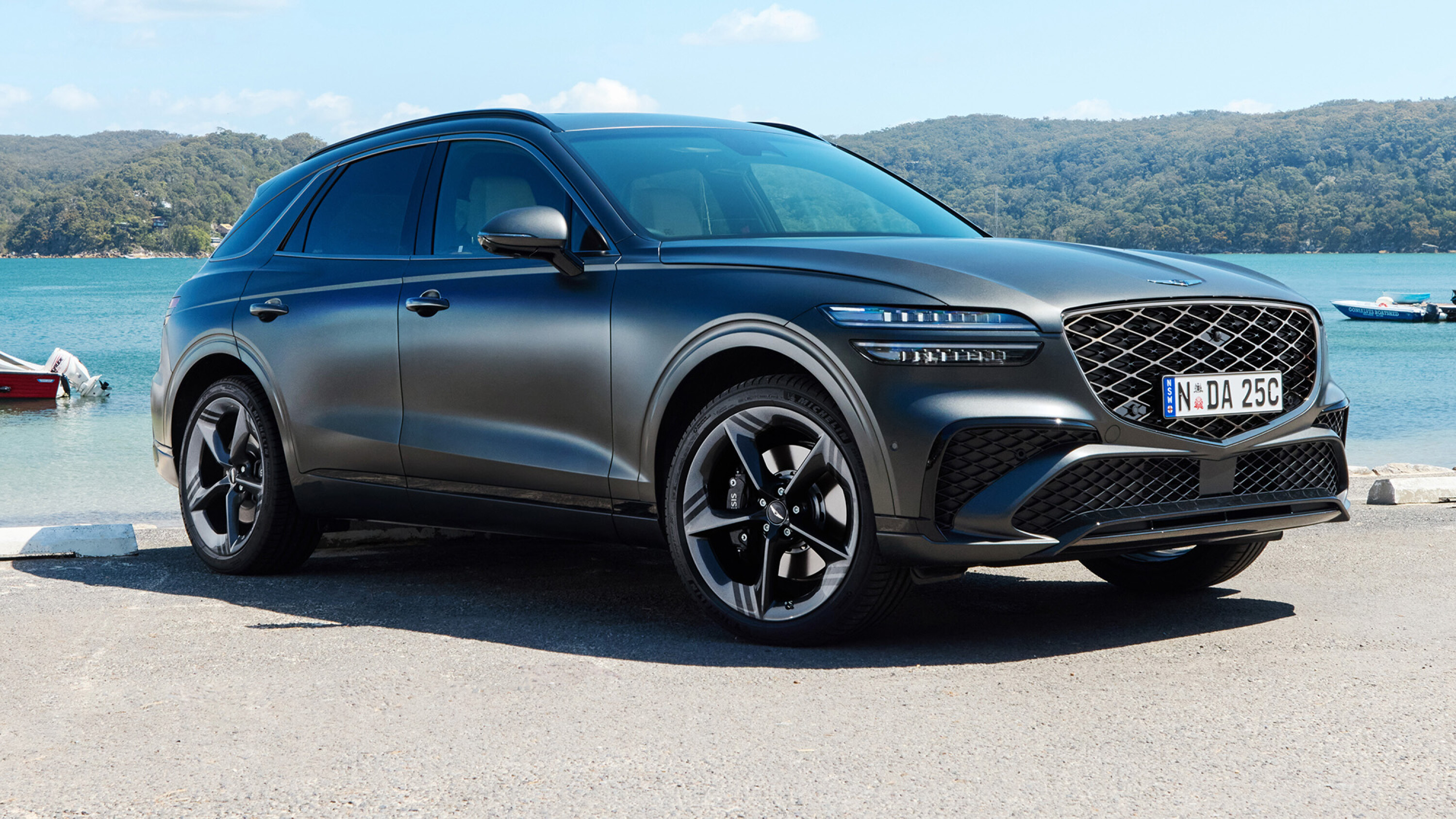
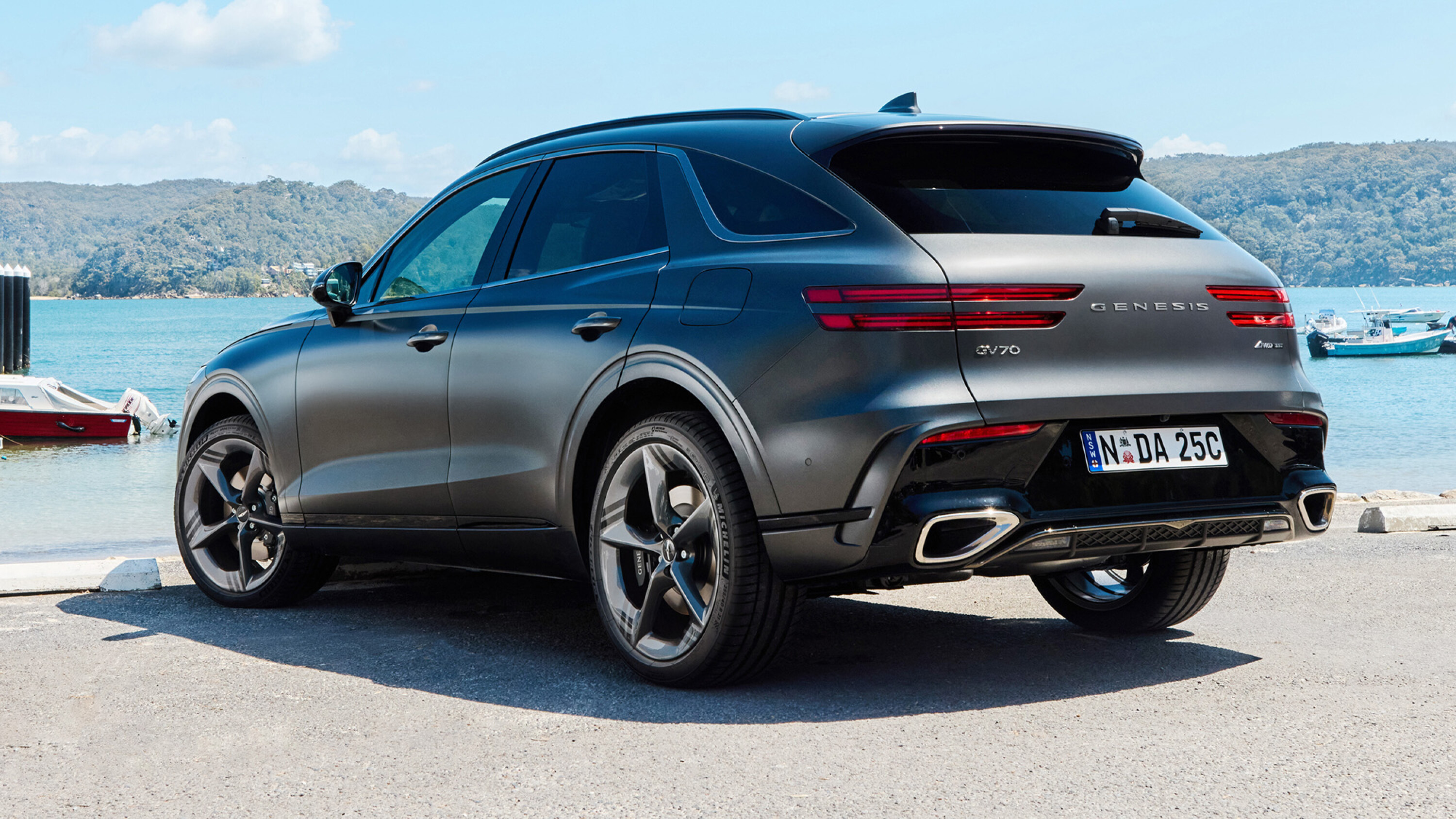
On the styling front, the refreshed GV70 medium SUV gets subtly updated styling with a new “double-layered” chrome banding in the G-Matrix Crest Grille and larger intakes in the lower bumper.
There’s also new MLA (Micro Lens Array) technology in the otherwise unchanged slender “Two-Line” headlights – all bringing the midsize SUV in line visually with its recently refreshed big brother, the GV80.
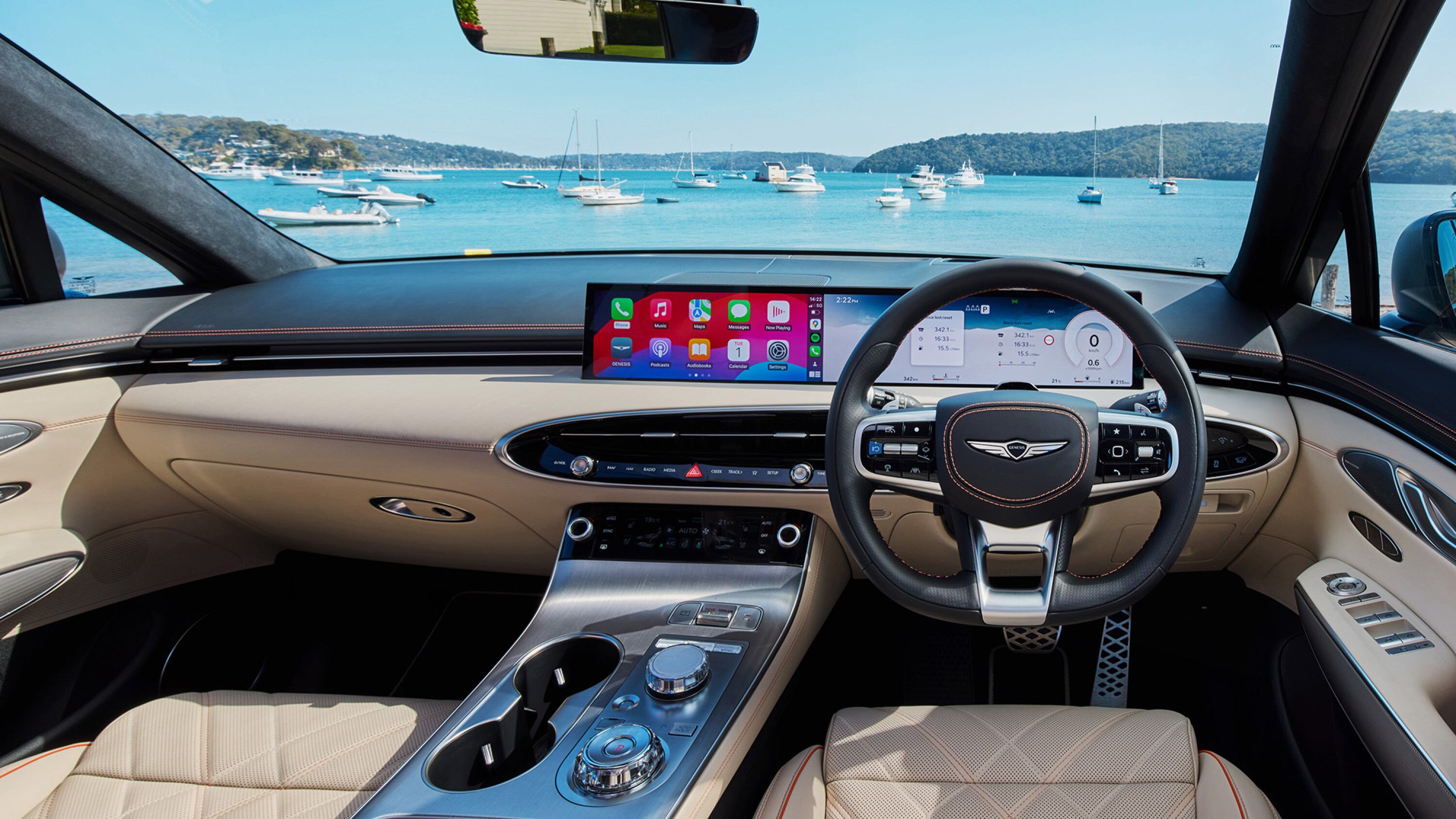
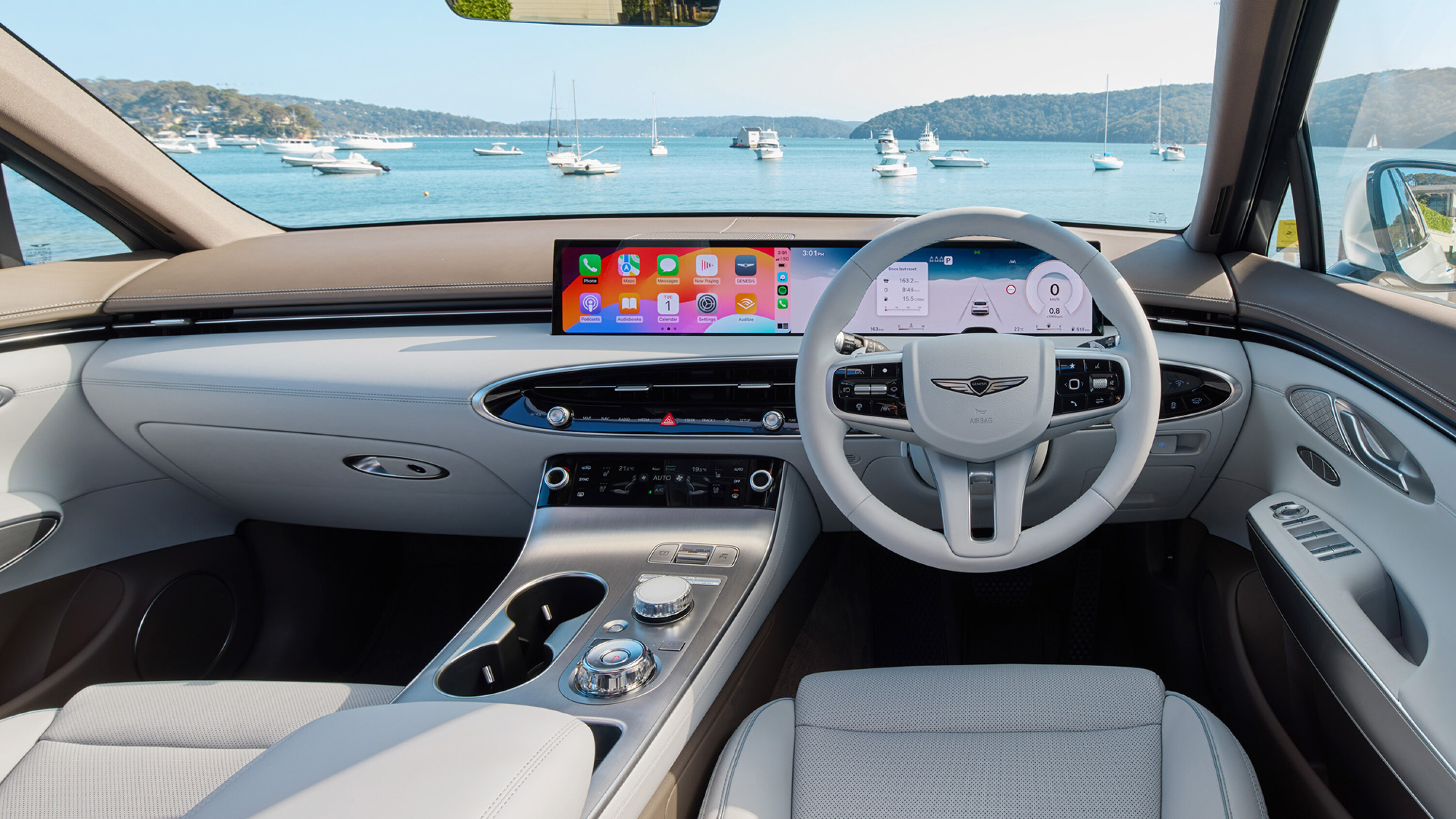
The biggest upgrade comes inside, with the addition of an expansive new single-piece 27-inch OLED display in the dash, again taken from the larger GV80.
1
Features
GV70 Advanced
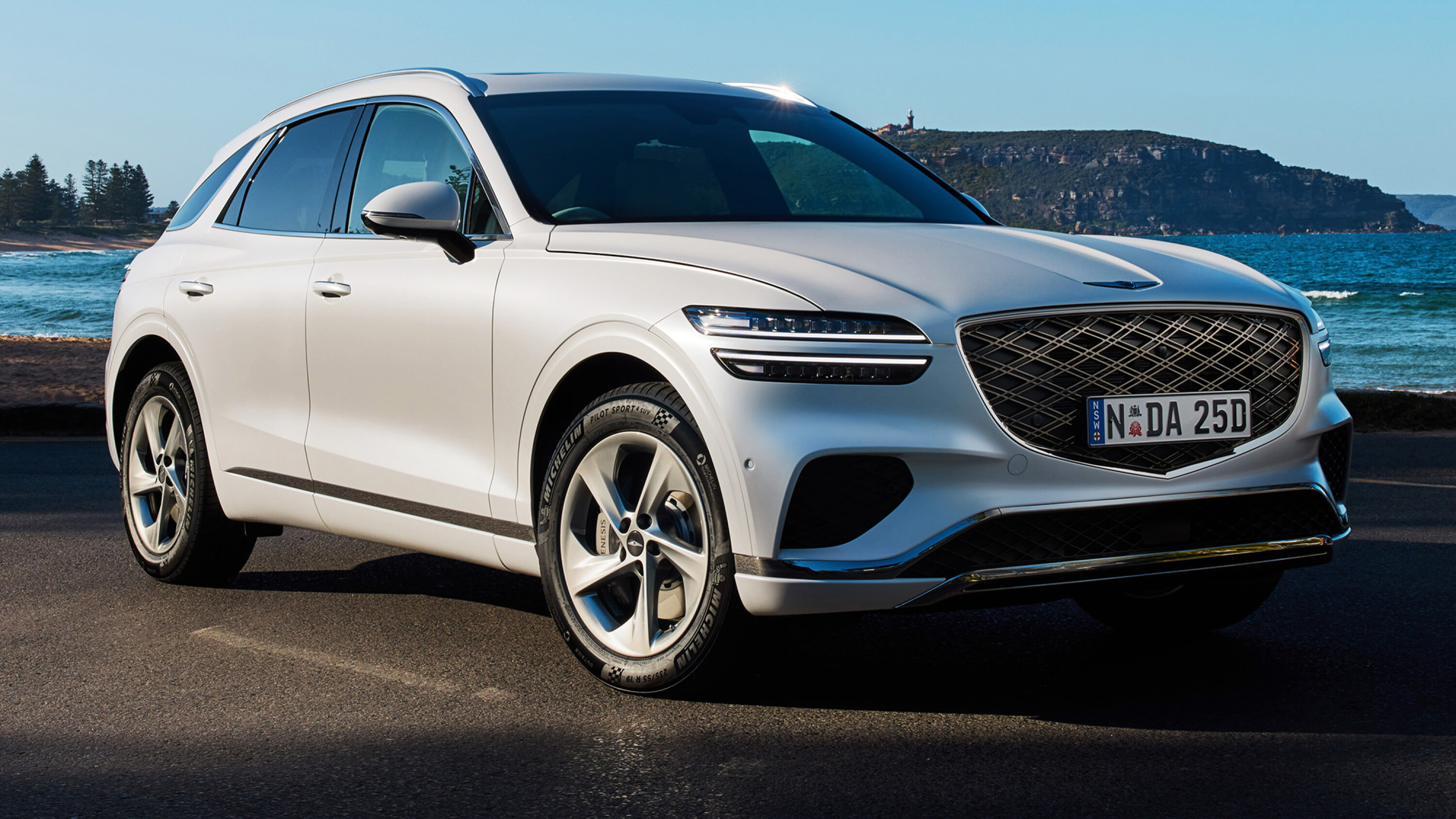
The entry-level Advanced model includes a 27-inch OLED multimedia display that combines both the instrument cluster and infotainment systems. Wireless Apple CarPlay and Android Auto, Over-the-Air update capability, and an In Cabin Camera are standard.
Safety features include Highway Driving Assist 2, Forward Collision-Avoidance Assist 2, and Lane Following Assist 2, along with Augmented Reality Navigation and Remote Smart Parking Assist 2.
Exterior updates include 19-inch alloy wheels, Micro Lens Array LED headlights, and a Dynamic Welcome Light function.
1
GV70 Signature
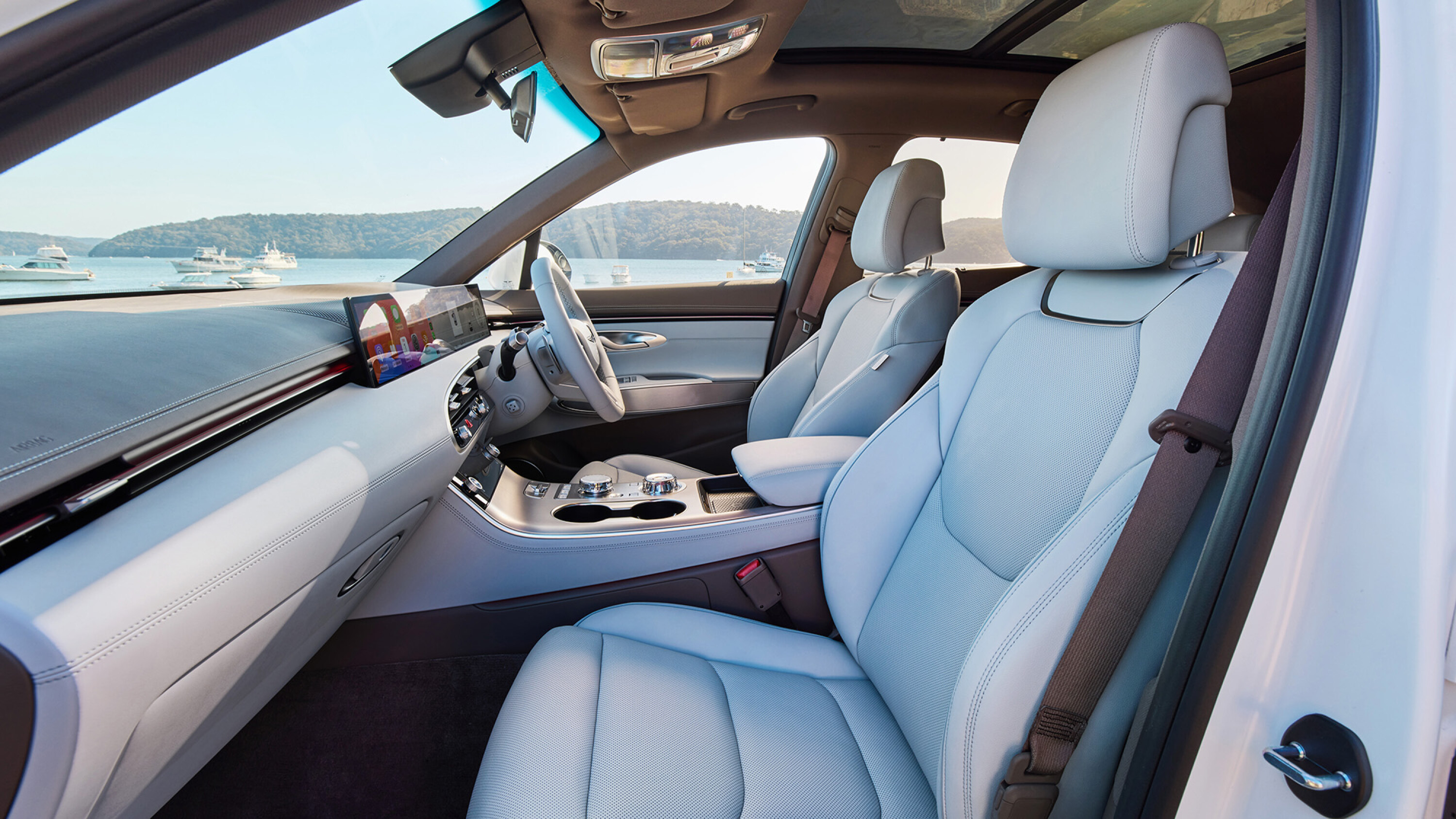
The Signature variant adds a Bang & Olufsen audio system, UV-C sanitisation compartment, Nappa leather seats, Ergo-motion front seats, and a heated steering wheel.
Rear passenger climate control is included, along with the option of the more powerful 3.5T engine. This engine configuration includes additional features like Road Preview Electronic Control Suspension and an electronically controlled Limited-Slip Differential (e-LSD).
GV70 Signature Sport trim
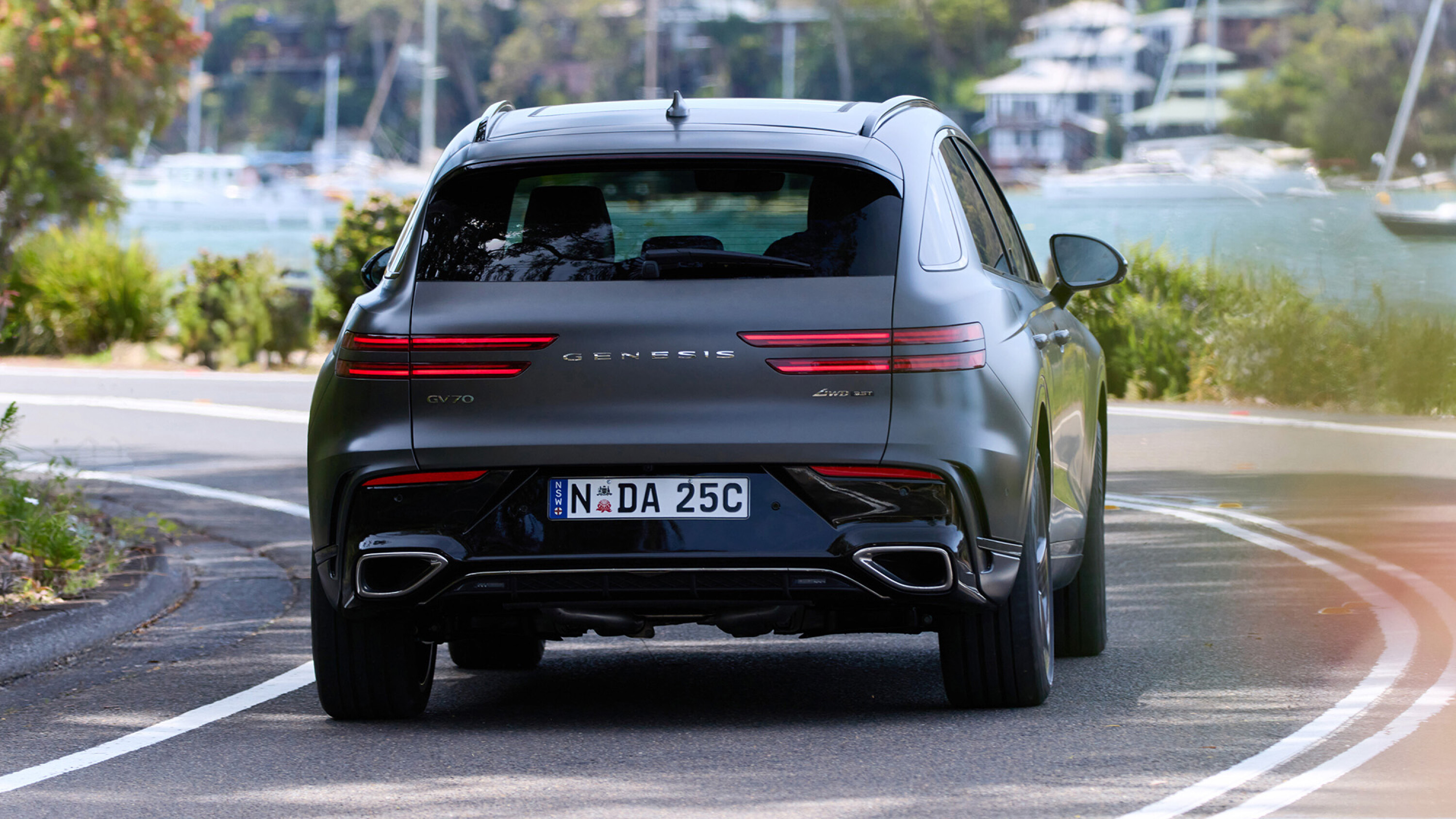
The flagship Signature Sport variant includes a double-mesh grille, larger air intakes on the front bumper, and 21-inch alloy wheels in a dark metallic finish.
Interior features include Magma Orange Nappa leather upholstery, sport seats with unique stitching, a flat-bottom steering wheel, and alloy pedals. Additional functional upgrades include the Sport+ drive mode and dual exhaust tips.
1
Chassis and noise reduction
Just like a good pair of earbuds, Genesis has incorporated Active Noise Control-Road (ANC-R) tech into the GV70, generating anti-phase sound waves to cancel out road noise within the cabin.
There’s also acoustic glass, sound-absorbing wheel designs, and a revised steering system with increased damping to isolate road vibrations.
A newly reinforced body structure improves rigidity and safety, Genesis claims, while the eight-speed auto with a Centrifugal Pendulum Absorber reduces noise and vibration.
1
Safety and driver assistance
The 2025 GV70 safety suite includes Navigation-based Smart Cruise Control, Lane Following Assist 2, and Forward Collision Avoidance Assist 2 with expanded functionality.
Intelligent Speed Limit Assist now includes a steering wheel shortcut button, allowing for easier adjustments.
Additional safety systems include Parking Collision-Avoidance Assist and Remote Smart Parking Assist 2, enabling drivers to park the vehicle remotely. A Hands On Detection system is also featured, monitoring whether the driver’s hands are on the wheel and issuing a warning if necessary.
1
Convenience and connected services
The 2025 GV70 includes convenience features like wireless Apple CarPlay and Android Auto, a fingerprint authentication system, and a Head-Up Display. The 27-inch OLED display can display navigation maps across its full width for enhanced visibility.
Genesis Connected Services, available with a five-year subscription, provides remote features via the Genesis smartphone app, including climate control, lock/unlock, and vehicle diagnostics. Over-the-Air updates enable drivers to keep systems current without visiting a service centre.
| Genesis Connected Services: in-vehicle | Genesis Connected Services: via smartphone app |
|---|---|
| Automatic Collision Notification | Calendar integration |
| SOS Emergency Call function | Remote functions (climate, windows, locking, etc.) |
| Connected Routing for Live Traffic | Rear seat passenger alert |
| Valet Mode function | Parked vehicle location |
| Voice Control for vehicle functions (windows, etc.) | SVM-linked vehicle surroundings display |
| Calendar integration* | Navigation destination send to car |
| Weather forecast | Alert services (speed, geo fence, time fence, etc.) |
| Vehicle diagnostics | Vehicle health report |
| *Requires smartphone app activation to operate | |
1
Warranty and service
The GV70 is sold with a five-year, unlimited-kilometre warranty and complimentary scheduled maintenance every 12 months or 10,000km for the first five years.
Genesis also provides 24/7 roadside assistance and a Concierge Service with a courtesy vehicle during scheduled servicing.
| Program | Coverage Period |
|---|---|
| Complimentary Warranty | 5 Years / Unlimited km for private vehicles |
| Complimentary Scheduled Servicing | 5 Years / 50,000km |
| 24/7 Roadside Assistance | 10 Years / Unlimited km |
| Genesis To You | 5 Years / Unlimited km for private vehicles |
2025 Genesis GV70 pricing for Australia
| 2025 Genesis GV70 | Engine | Transmission | Price |
|---|---|---|---|
| Advanced | 2.5T-GDi AWD | 8-speed auto | $78,500 |
| Signature | 2.5T-GDi AWD | 8-speed auto | $87,500 |
| Signature | 3.5T-GDi AWD | 8-speed auto | $98,000 |
| Signature Sport | 2.5T-GDi AWD | 8-speed auto | $89,500 |
| Signature Sport | 3.5T-GDi AWD | 8-speed auto | $100,000 |
| Prices exclude on-road costs | |||
| Option Pricing | |
|---|---|
| Matte Paint | $2000 |
32
November: Jaecoo J7 and J5 bound for Australia
Chinese carmaker Chery has handed down new information on its Australian plans for the midsize Jaecoo J7 SUV, along with the newly revealed J5 small SUV.
The J7 was originally expected to arrive before the end of 2024, but is now confirmed for an early 2025 launch. The J5 will follow, although exact timing is still to be announced.
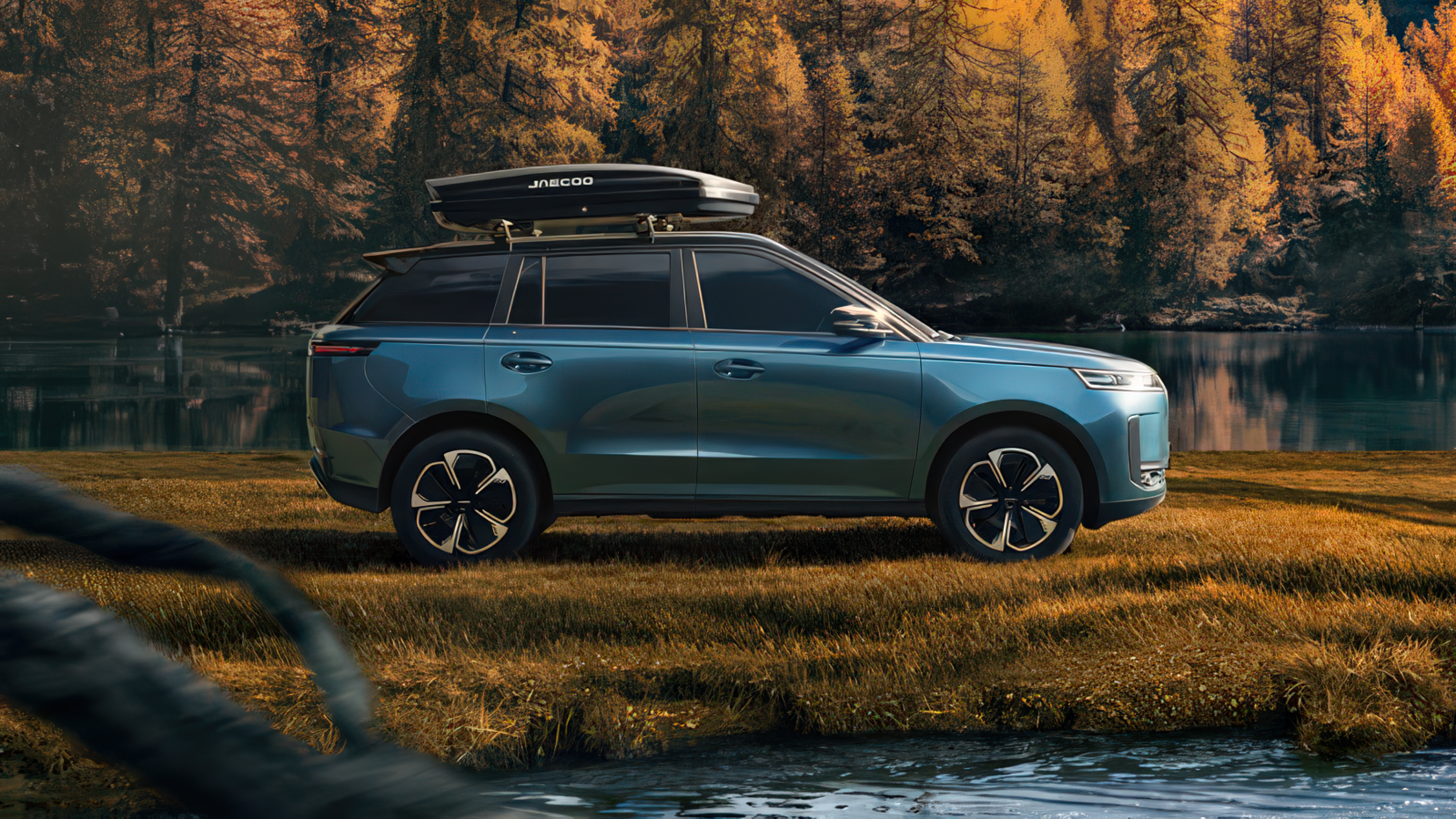
Next year’s J7 launch will mark the Australian introduction of Chery’s Jaecoo brand, heralded as its “rugged urban SUV brand”.
1
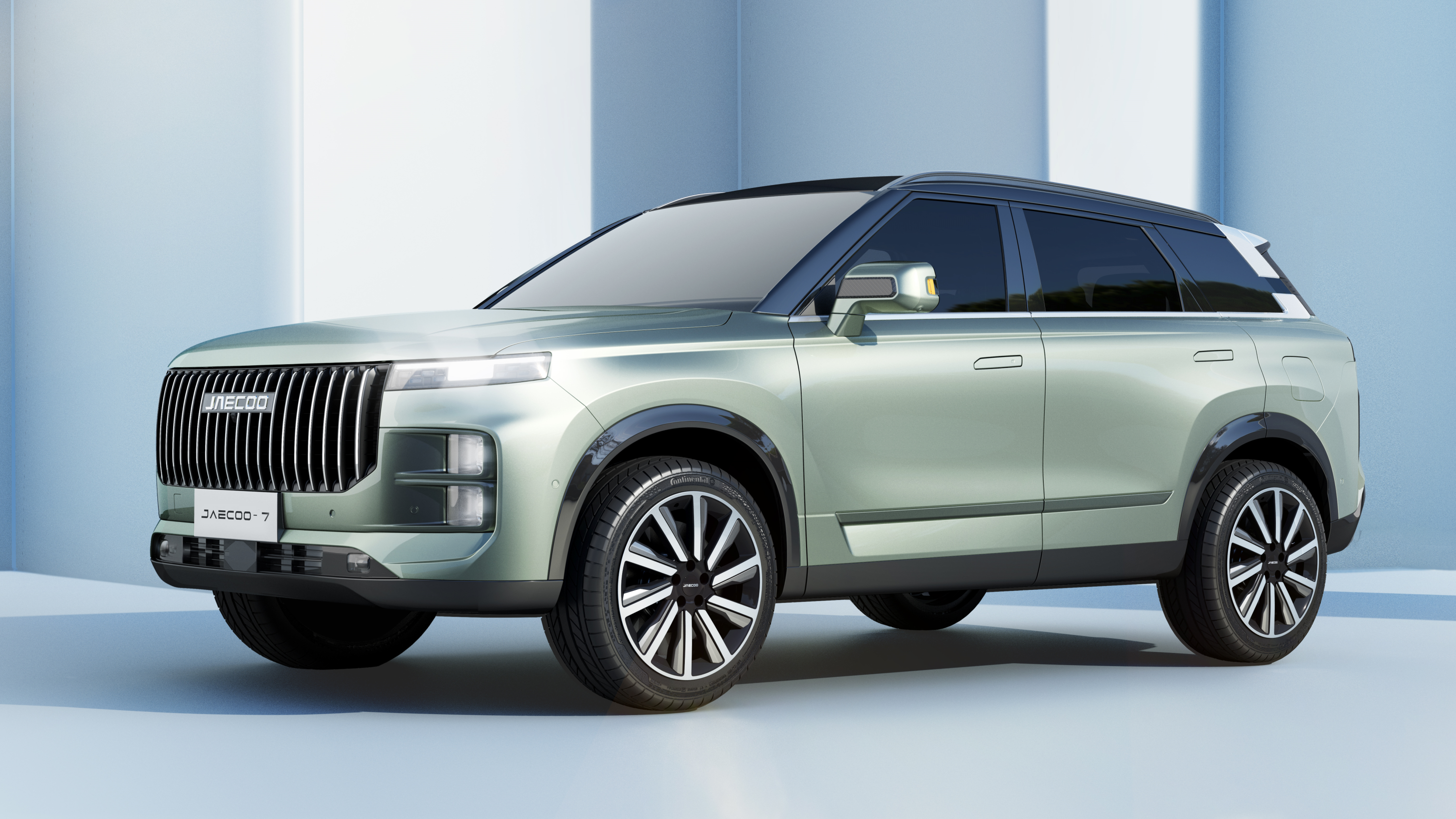
The J7 is effectively a version of the SUV known in China as the Chery Tansuo 06, sold in some markets as the Chery Tiggo 7 Sport.
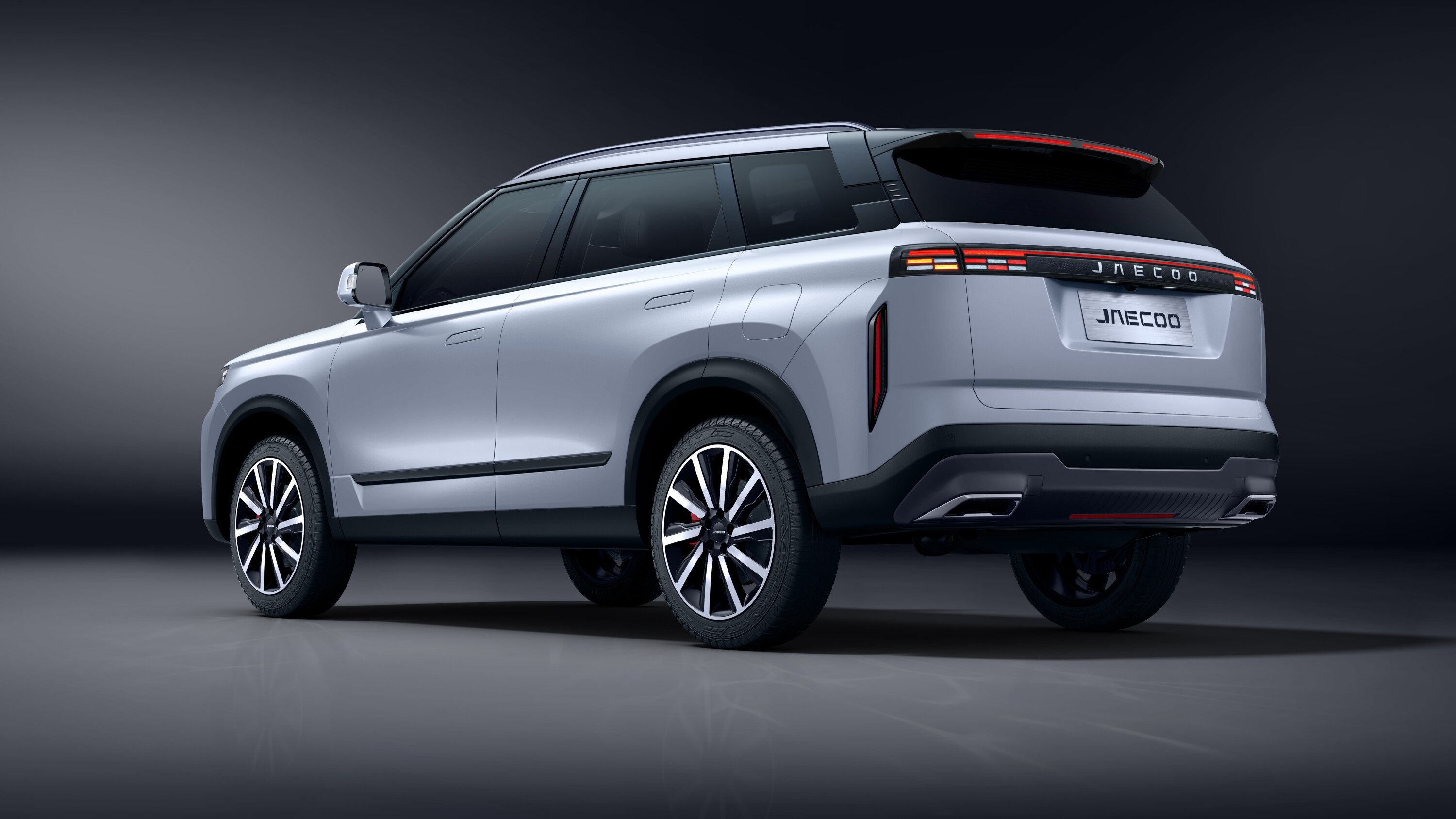
But, where that Chery’s front end looks like a knock-off Land Rover, the Jaecoo J7 gets a much taller grille and more pronounced frames on the headlight bezels.
In Australia, the J7 will be offered as a midsize five-seat SUV, powered by a 137kW/275Nm 1.6-litre turbocharged petrol engine matched to a seven-speed dual-clutch automatic and a choice of front- or all-wheel drive.
1
Jaecoo J7 features for Australia
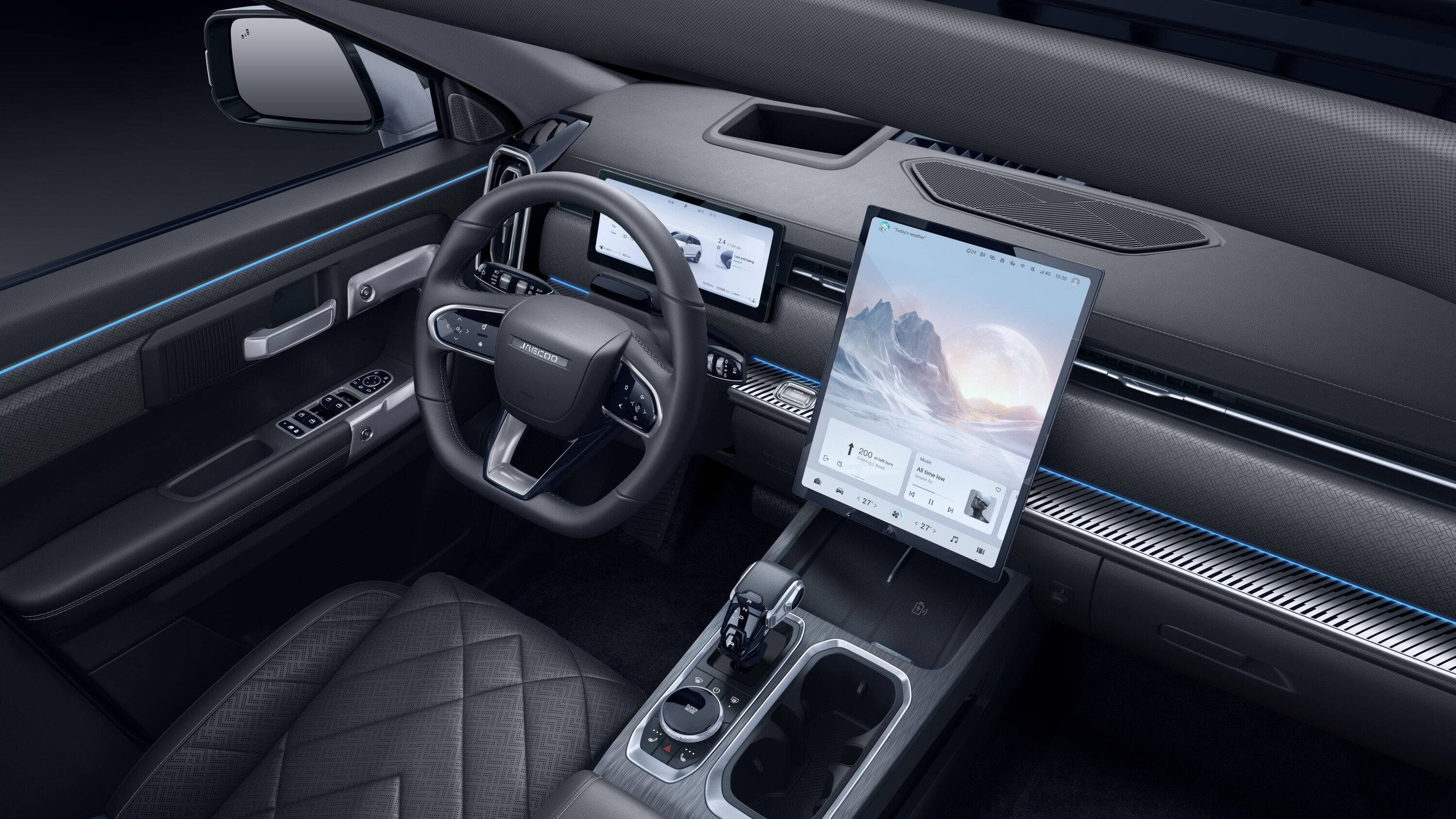
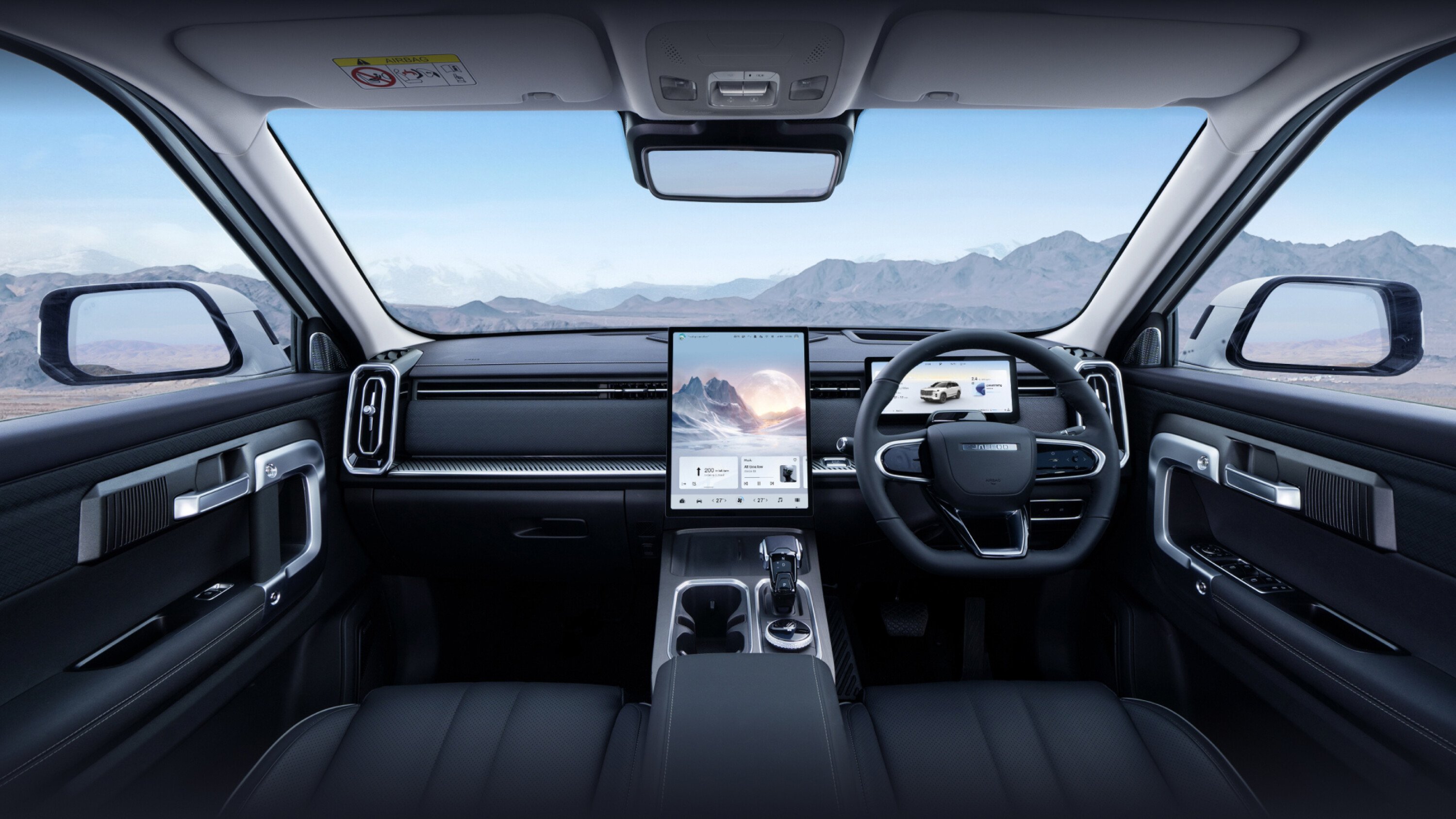
Features promoted in the brand’s latest announcement include seven “distinct” drive modes and a large, vertical 14.8-inch main display in the cabin.
Other features for our market will include 19-inch alloy wheels, power-adjustable front seats, a 360-degree camera system, wireless smartphone charging, LED headlamps, front fog lights, automatic wipers, and an electric tailgate.
1
The safety suite offers eight airbags, including a driver’s knee airbag and a number of as-yet undefined driver assistance systems.
Depending on its pricing, the J7 will likely be pitched as a more affordable yet feature-rich alternative to popular midsize SUVs like the RAV4, CX-5, Tucson, Sportage and X-Trail.
Rivals among its Chinese peers will include the new MG HS, GWM Haval H6, and the related Chery Tiggo 7 Pro.
1
J5 compact SUV coming to Australia
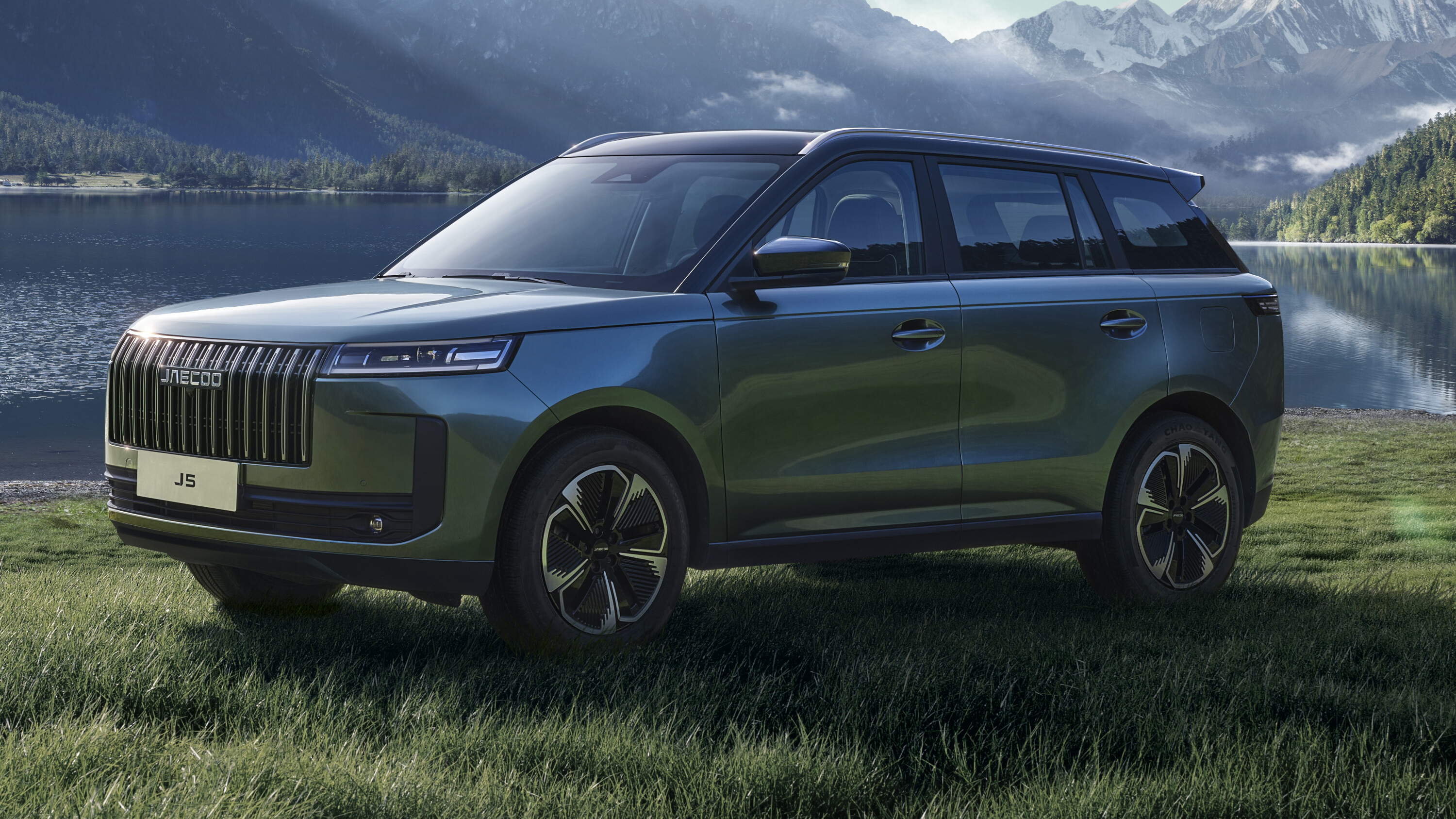
Following the J7, Jaecoo plans to introduce the J5, a smaller SUV aimed at rivals like the popular Mazda CX-3 and Toyota Yaris Cross.
The J5’s key features include a 13.2-inch touchscreen and a large panoramic sunroof. Exterior design choices highlight slim headlights and a rear lightbar that incorporates the Jaecoo badge.
1
In its Chinese-market form, the J5 is powered by the same 137kW/275Nm 1.6-litre turbocharged petrol engine that drives the larger J7, which should make the compact J5 a more spritely offering.
Boot space is listed at 480 litres with the rear seats upright, expanding to 1180 litres when those pews are folded forward. By comparison, Toyota lists the Yaris Cross’s boot at 390 litres – although it does not offer a seats-down figure.
Watch for more Australian-market details on both models to come in the months ahead.
1
March: Jaecoo J7 confirmed for Australia
Chinese carmaker Chery has announced it will launch its new Jaecoo sub-brand in Australia in the second half of 2024.
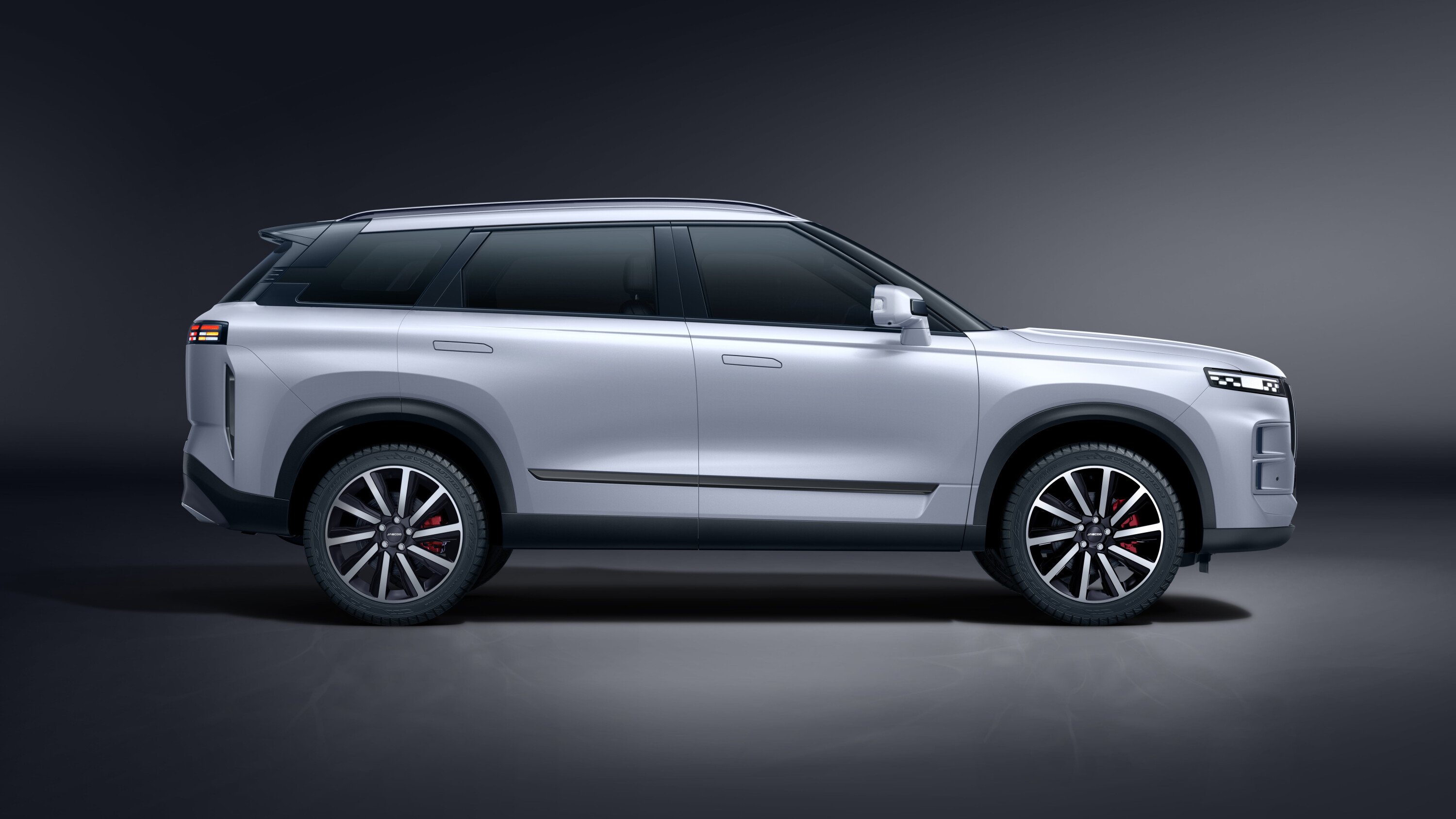
The 2025 Jaecoo J7 – a rebadged version of the Chinese-market Chery Explore 06 – will be the first model from the Jaecoo brand to launch in Australia.
Pitched as a “rugged urban SUV brand,” it also offers the Jaecoo J8, a rebadged Chery Tiggo 9 three-row SUV. This model has not been confirmed for Australia with either Chery or Jaecoo badges.
1
Jaecoo is one of many sub-brands of the Chinese marque.
South Africa, the United Kingdom and New Zealand receive Omoda-branded vehicles without any mention of its Chery parent, while it also sells ‘Jetour’ and ‘Exeed’ vehicles in China – including the Ford Bronco Sport and Land Rover Defender-like Jetour Traveller.
“We are delighted to announce that the Jaecoo brand will be coming to Australia, and we look forward to introducing this exciting new brand to Australian consumers, which is setting new standards for luxury and versatility in sports utility vehicles,” said Jaecoo and Chery Australia managing director Lucas Harris.
1
The Jaecoo marque was launched at the Shanghai Auto Show in April 2023, with sales recently commencing in select European markets, Russia, Malaysia, the Middle East, and South Africa.
The 2025 Jaecoo J7 will sit on the smaller side of the midsize SUV segment with similar dimensions to the Mazda CX-5, Honda ZR-V and soon-to-be-replaced short-wheelbase Volkswagen Tiguan.
It is also similar in size to the recently launched Chery Tiggo 7 Pro.
1
Confirmed features for Australia include front or all-wheel drive configurations and a 14.8-inch vertical infotainment system.
All-wheel-drive models will have the brand’s ‘all road drive intelligent system’ with up to seven selectable drive modes optimised “for specific driving scenarios”.
It is unclear if Chery Australia will sell Jaecoo vehicles from its existing dealerships or if it plans to launch a new retail network for the brand.
More details on the 2025 Jaecoo J7 are due to be confirmed closer to its Australian launch in the second half of 2024
MORE
Everything Jaecoo
MORE
Everything Chery
Few Formula 1 drivers are remembered with as much reverence and awe as Ayrton Senna.
The fearless Brazilian champion remains one of the sport’s most popular figures 30 years after his tragic passing at the 1994 San Marino Grand Prix.
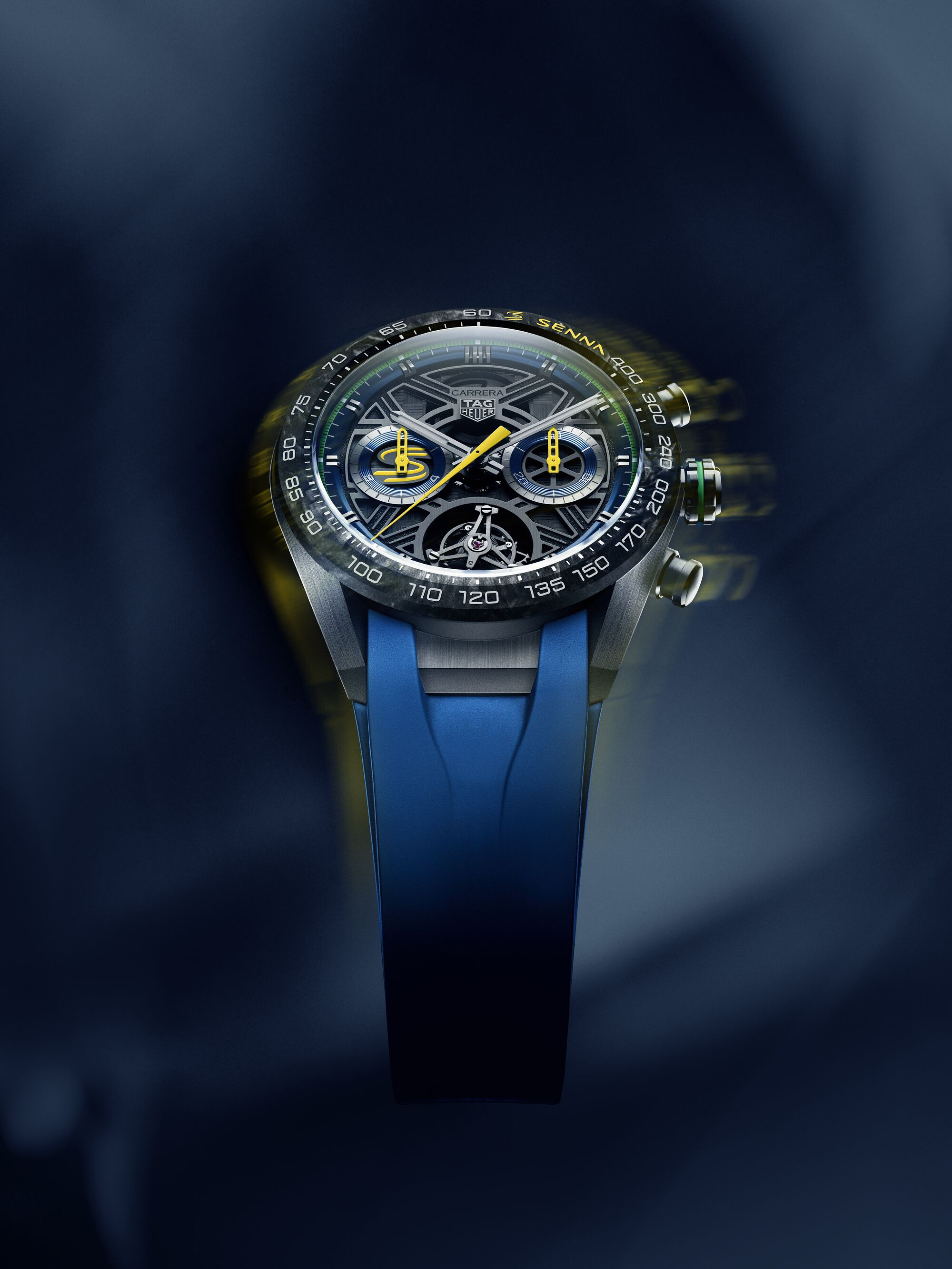
To commemorate that sombre anniversary and the arrival of a new Netflix series, Senna, premiering in November, Swiss luxury timekeeper TAG Heuer and the Senna Brand combine for a striking TAG Heuer Carrera Chronograph Tourbillon x Senna timepiece.
The fictional depiction of the 1988, 1989 and 1991 world champion’s life in the six-episode Netflix series stars TAG Heuer ambassador Gabriel Leone as Senna and portrays his journey from his early days in Brazil to his rise as one of Formula 1’s greatest drivers.
1
Developed and produced with the support of Senna’s family, the series captures his biggest driving achievements, personal struggles, and relationships, concluding with the fatal accident at the San Marino Grand Prix.
The partnership between TAG Heuer and Senna first began in 1988 while he was dominating tracks around the world. Since his passing the La Chaux-de-Fonds-based brand has celebrated the association with a number of special watches, including two chronograph tourbillons releases within the Carrera collection in 2018 and 2019.
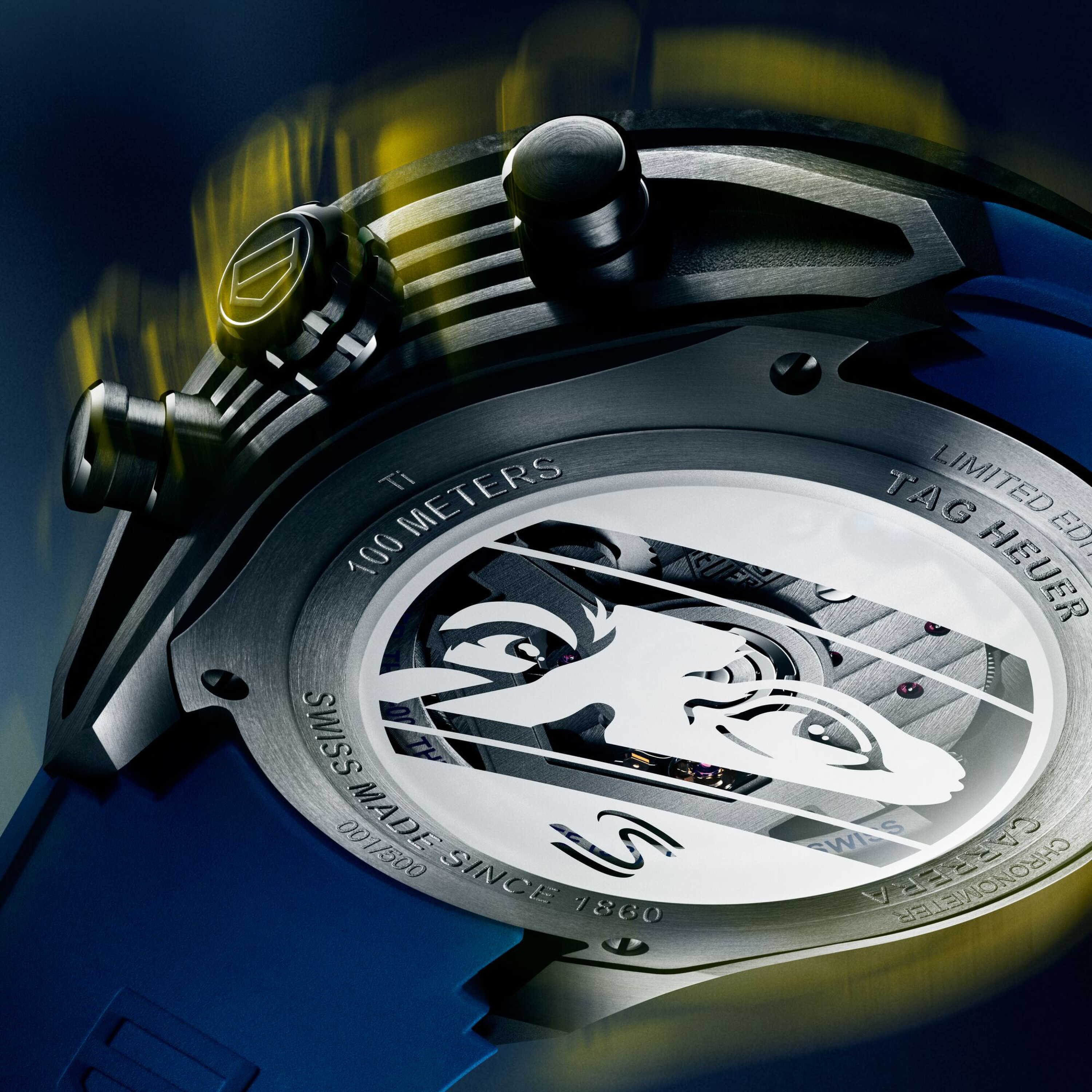
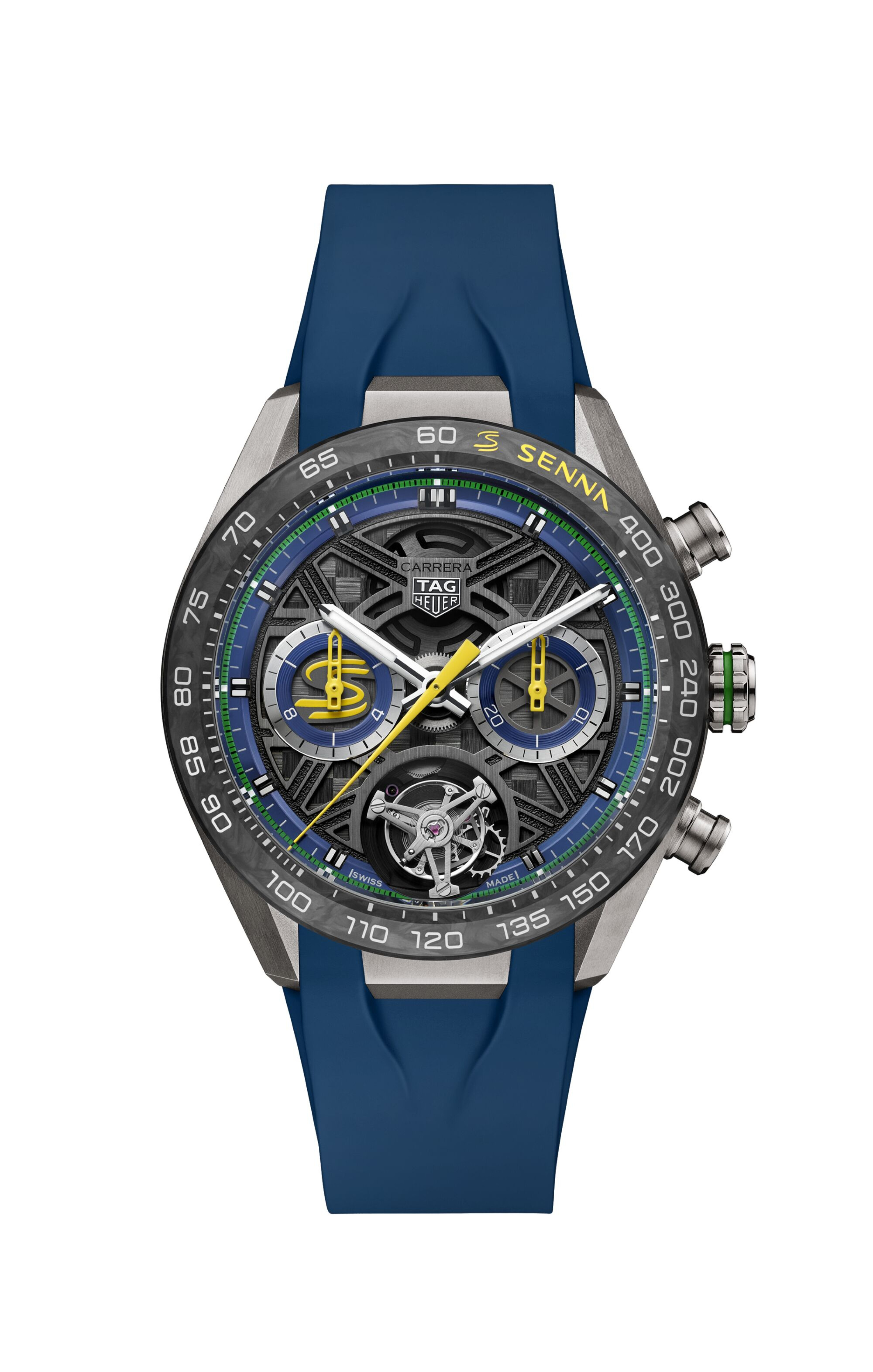
This new skeleton dial tourbillon is a fitting tribute to what TAG Heuer describes as Senna’s ‘victorious spirit’. A limited edition release of 500 pieces, its features reflect the legacy of the man – the carbon bezel inscribed with his name and a tachymeter scale reaching up to 400 km/h to symbolise the speed and precision that defined Senna’s career.
1
His distinctive ‘S’ branding appears in yellow on the 9 o’clock subdial and the central counter hand also appears in a bold yellow to tie in with the Senna logo.
The 44mm-diameter case is distinguished by mixed finishes of the grade-2 titanium as well as sharp lugs for a three-dimensional architectural profile. The skeleton dial is black plated and fine brushed, with a grained black centre décor.
The minute chronograph counter at 3 o’clock is backgrounded by ‘azuré’-toned skeleton work under a yellow lacquered, openworked hand, while the same colour scheme is used for the 9 o’clock hour chronograph counter.
2
On the caseback, an iconic image of Senna with his eyes looking out from under his helmet and limited edition markings signifies the exclusivity of the piece.
The TAG Heuer Carrera Chronograph Tourbillon x Senna is water resistant to 100 metres and is presented on a blue integrated rubber strap with fine brushed and sandblasted décor and a Grade-2 titanium folding clasp with double safety pushbuttons and the TAG Heuer shield.
Despite the advancing years, Ayrton Senna’s popularity remains as undiminished as his legend, making this special example of high-end watchmaking a ‘highly desired’ item for his true fans.
MORE
Motorsport
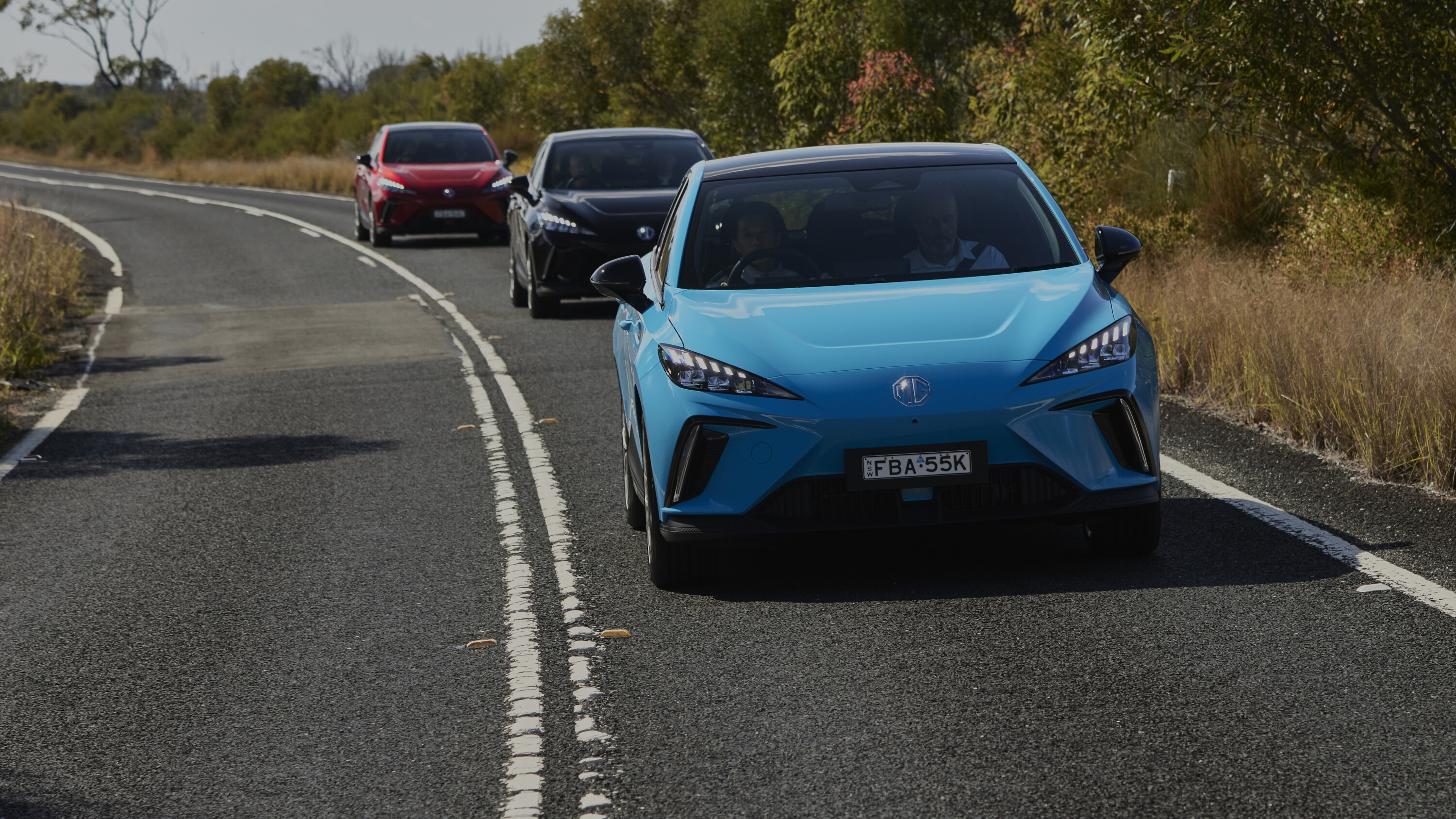
The MG4 is a small electric hatchback that marks the Chinese carmaker’s first global model, on ground-up electric vehicle underpinnings, and with the cheapest price tag yet for an MG EV.
It launched in Australia in August 2023 separated into two variants – Excite and Essence – with three battery size options.
The MG4 is the company’s first EV to feature the dedicated Modular Scalable Platform (MSP), which promises to provide a sporty edge.
The hyper MG4 X-Power electric hot hatch has also launched in Australia since this range review was first published.
? Now, here’s everything you need to know about the MG4!
JUMP AHEAD
- Pricing
- What body styles are available?
- What features are standard?
- What features do I get if I spend more?
- How safe is it?
- How comfortable and practical is it?
- How much boot space is offered?
- Will I enjoy driving this?
- Which provides the longest driving range?
- What’s the towing capacity?
- How long is the warranty and how much is servicing?
- Which version does Wheels recommend?
- What are the key rivals?
- What might annoy me?
- Does any upgrade have a downside?
- What might I miss that similar cars have?
- What’s the infotainment system like?
- Where is it made?
- Are there plans to update this model soon?
2024 MG4 Pricing
| 2024 MG4 | Price |
|---|---|
| MG4 Excite 51 | $37,990 |
| MG4 Excite 64 | $41,990 |
| MG4 Essence 64 | $44,990 |
| MG4 Essence 77 | $50,990 |
| MG4 XPOWER | $55,990 |
Currently, MG is offering MY24 examples of the base Excite 51 for $32,990 driveaway. An $8000 factory bonus is also offered on existing MY23 examples of the rest of the range.
There are no mechanical or specification differences between MY23 and MY24 models.
1
What body styles are available for the MG4?
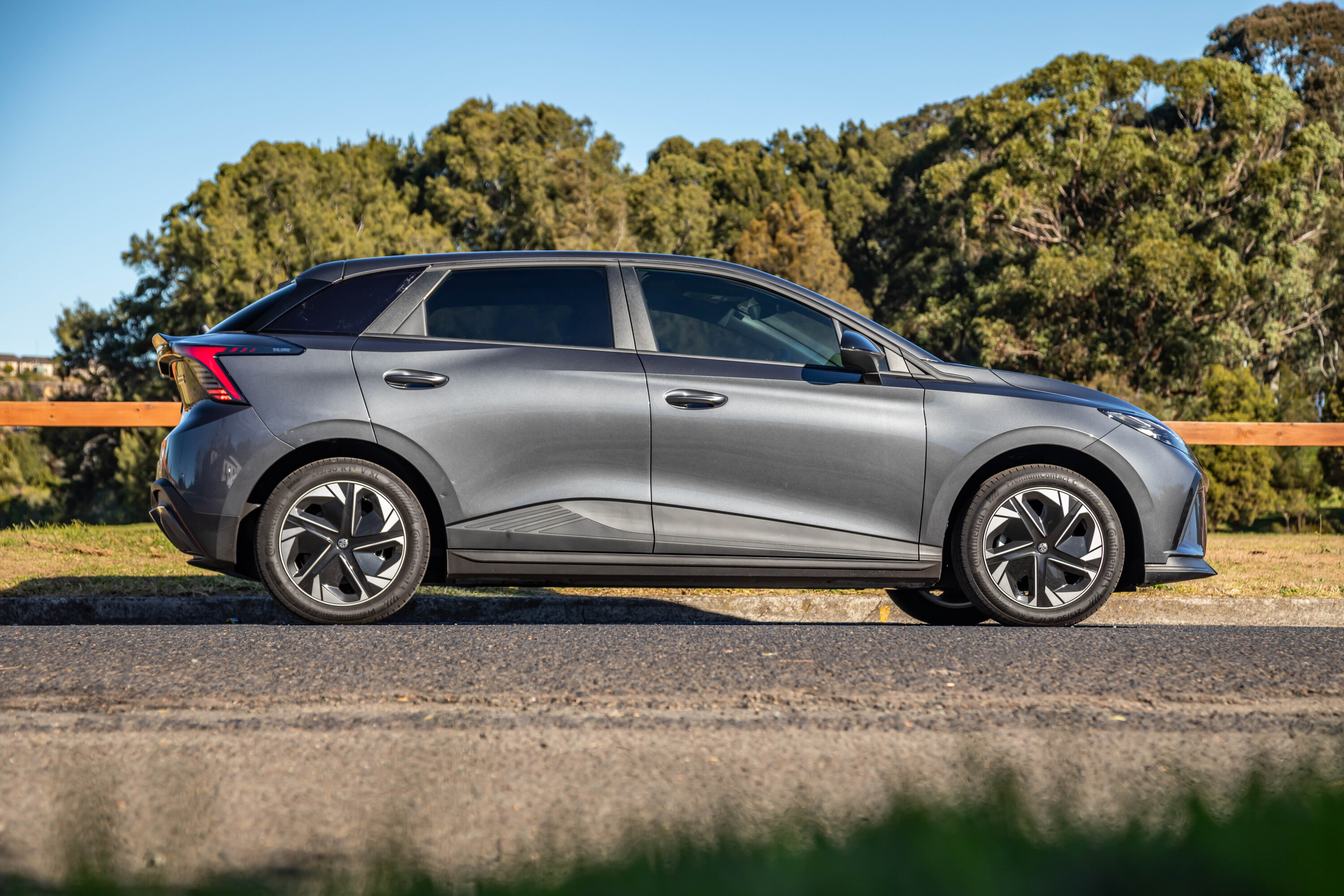
The MG4 is classed as a five-seat small hatchback.
Its dimensions are in line with the petrol-engined Volkswagen Golf, Hyundai i30 and Toyota Corolla.
| Excite 51 | Excite 64 | Essence 64 | Long Range 77 | XPOWER | |
|---|---|---|---|---|---|
| Length | 4287mm | 4287mm | 4287mm | 4287mm | 4287mm |
| Width | 1836mm | 1836mm | 1836mm | 1836mm | 1836mm |
| Height | 1504mm | 1504mm | 1516 mm | 1516 mm | 1516 mm |
| Wheelbase | 2705mm | 2705mm | 2705mm | 2705mm | 2704mm |
| Ground Clearance | 147mm | 147mm | 158mm | 158mm | 158mm |
| Boot (minimum / rear seats folded) | 363 / 1177-litres | 363 / 1177-litres | 350 / 1165-litres | 350 / 1165-litres | 363 / 1165-litres |
| Weight | 1635kg | 1648kg | 1672kg | 1748kg | 1800kg |
Table scrolls horizontally to reveal more columns
1
What features are standard in every MG4?
Things we like
- LFP battery benefits, no charge limit
- Good standard features list
Not so much
- Small LFP battery not available in high-spec Essence variant
- V2L adapter is sold separately
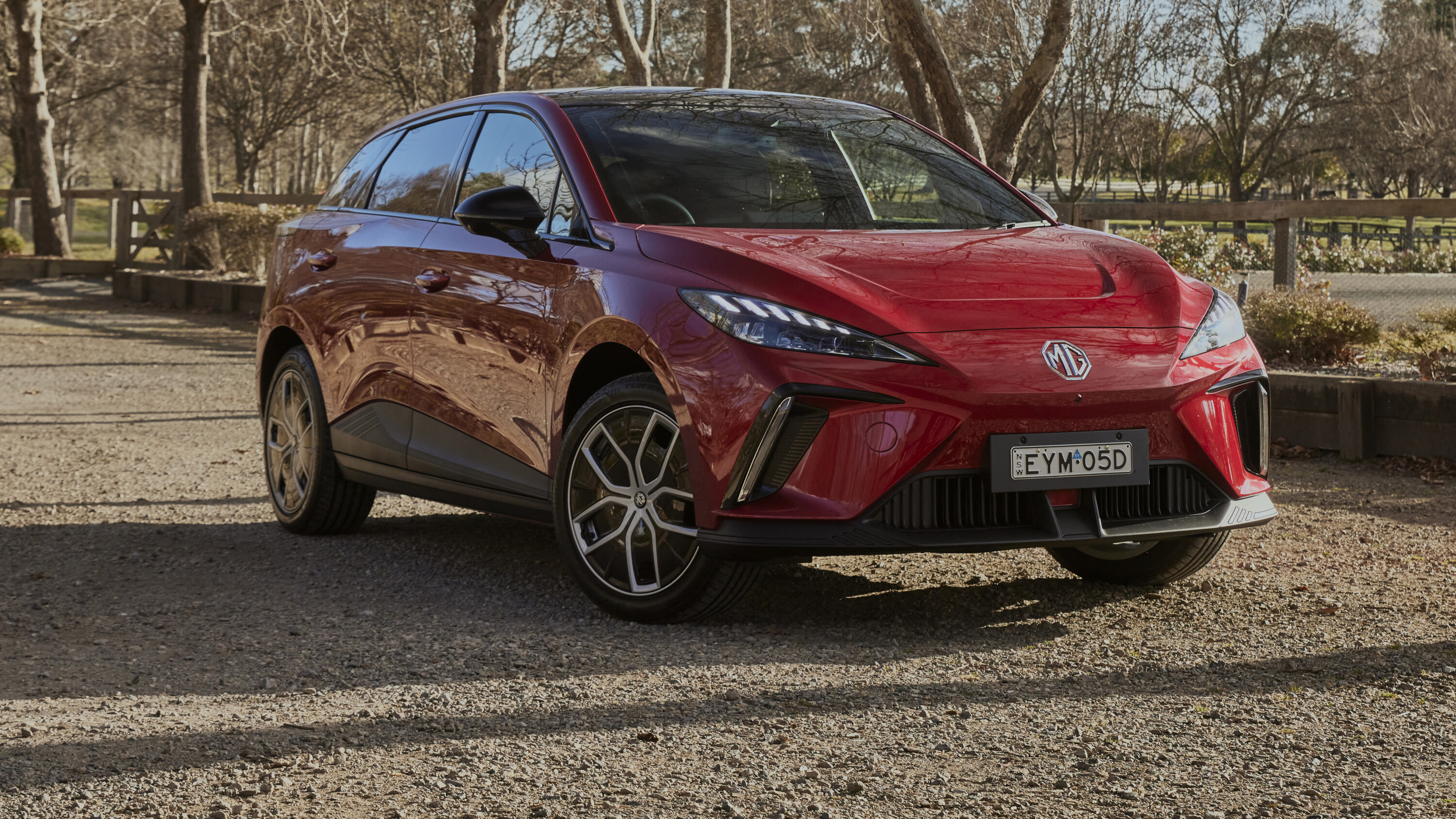
The base MG4 Excite 51 includes a good standard kit list, with a 50.8kWh usable lithium-iron-phosphate (LFP) battery pack, a single electric motor, and rear-wheel drive.
| 2024 MG4 Excite 51 standard features | |
|---|---|
| 17-inch alloy wheels with aero covers | Fabric seats |
| 10.25-inch touchscreen | Six-way manually adjustable driver seat |
| Wired Apple CarPlay and wired Android Auto | Single-zone automatic climate control |
| 7-inch driver instrument display | Proximity key with auto start/stop |
| MG iSmart Lite mobile app connectivity | Electric park brake with auto hold function |
| Four-speaker audio | Overhead sunglass storage box |
| 10.5-watt USB-A and USB-C charging ports | Electrically adjustable wing mirrors with heating |
| Exterior vehicle-to-load (V2L) capability (separate accessory purchase required) | One-touch up/down driveru2019s side window |
| Auto LED and incandescent combination head- and tail-lights | Rear spoiler |
1
What key features do I get if I spend more?
Things we like
- Multiple battery options available to suit budget and range needs
- Top-spec Essence can be had for under $50K
Not so much
- Bigger NMC batteries have 80% recommended charge limit
- Price jumps for larger battery with minor power bump
The Excite 64 adds a larger 62.1kWh usable nickel-manganese-cobalt (NMC) lithium-ion battery that provides more driving range, bumps up the power output and increases DC fast charging capability.
| The Excite 64 has the same features as the base Excite 51. |
|---|
Additionally, the Essence 64 gains top-spec features and has the same 62.1kWh usable NMC battery.
| 2024 MG4 Essence 64 adds | |
|---|---|
| 18-inch alloy wheels with aero covers | Synthetic leather and fabric seats |
| MG iSmart mobile bluetooth key remote with built-in voice control | Front heated seats |
| Built-in maps with EV charging stop planner | Six-way electrically adjustable driver seat |
| Qi wireless charging pad | Heated leather steering wheel |
| Six-speaker audio | Electric folding wing mirrors |
| Double split rear spoiler | Auto-dimming rear view mirror |
| Two-tone black painted roof | One-touch up-down for all four windows |
| Active intake shutter grill | Rear tinted privacy glass |
| Full LED head- and tail-lights with LED turn indicators | Two-level height adjustable boot floor |
The Long Range 77 introduces the largest 74.4kWh usable NMC battery for the most driving range in the line-up, while increasing power output and boosting both AC and DC charging capabilities.
| The Long Range 77 has the same features as the top-spec Essence 64. |
|---|
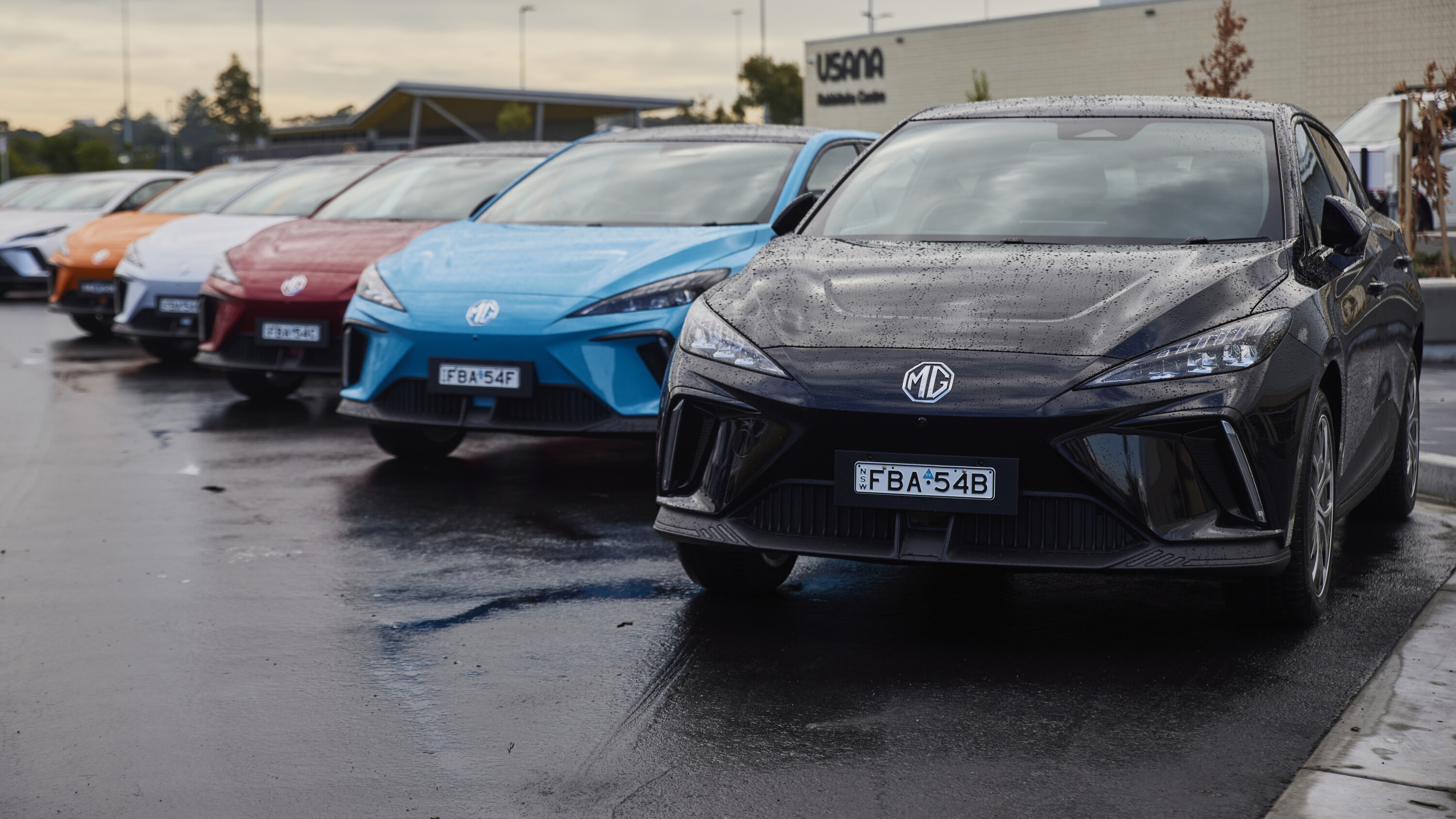
The performance-oriented MG4 XPOWER primarily mirrors the Essence models in terms of specification, but does add a couple of sporty touches.
| 2024 MG4 XPOWER additions include: |
|---|
| 18-inch five-spoke alloy wheels |
| XPOWER branded brake caliper covers |
| XPOWER sports pedals |
| Launch control |
1
2024 MG4 options
| 2024 MG4 exterior colours | |
|---|---|
| Dover White | Standard |
| Black Pearl | $700 |
| Camden Grey | $700 |
| Sterling Silver | $700 |
| Brixton Blue | $700 |
| Volcano Orange | $700 |
| Diamond Red | $700 |
| Hunter Green Premium Satin | $1000 (XPOWER exclusive) |
How safe is the MG4?
Things we like
- Full 2022 ANCAP safety rating
- Good standard safety features list
Not so much
- No front-centre airbag, rear AEB
- Rivals have blind-spot, rear cross-traffic alert as standard
The MG4 has received a full five-star safety rating from the Australasian New Car Assessment Program (ANCAP) [↗] under 2022 testing criteria.
Individual assessment scores included; 83 per cent for adult occupant protection, 86 per cent for child occupant protection, 75 per cent for vulnerable road user protection, and 81 per cent for safety assist systems.
All MG4 models come with six airbags but none includes a centre airbag. Two ISOFIX and three top-tether child seat anchor points are provided in the rear row.
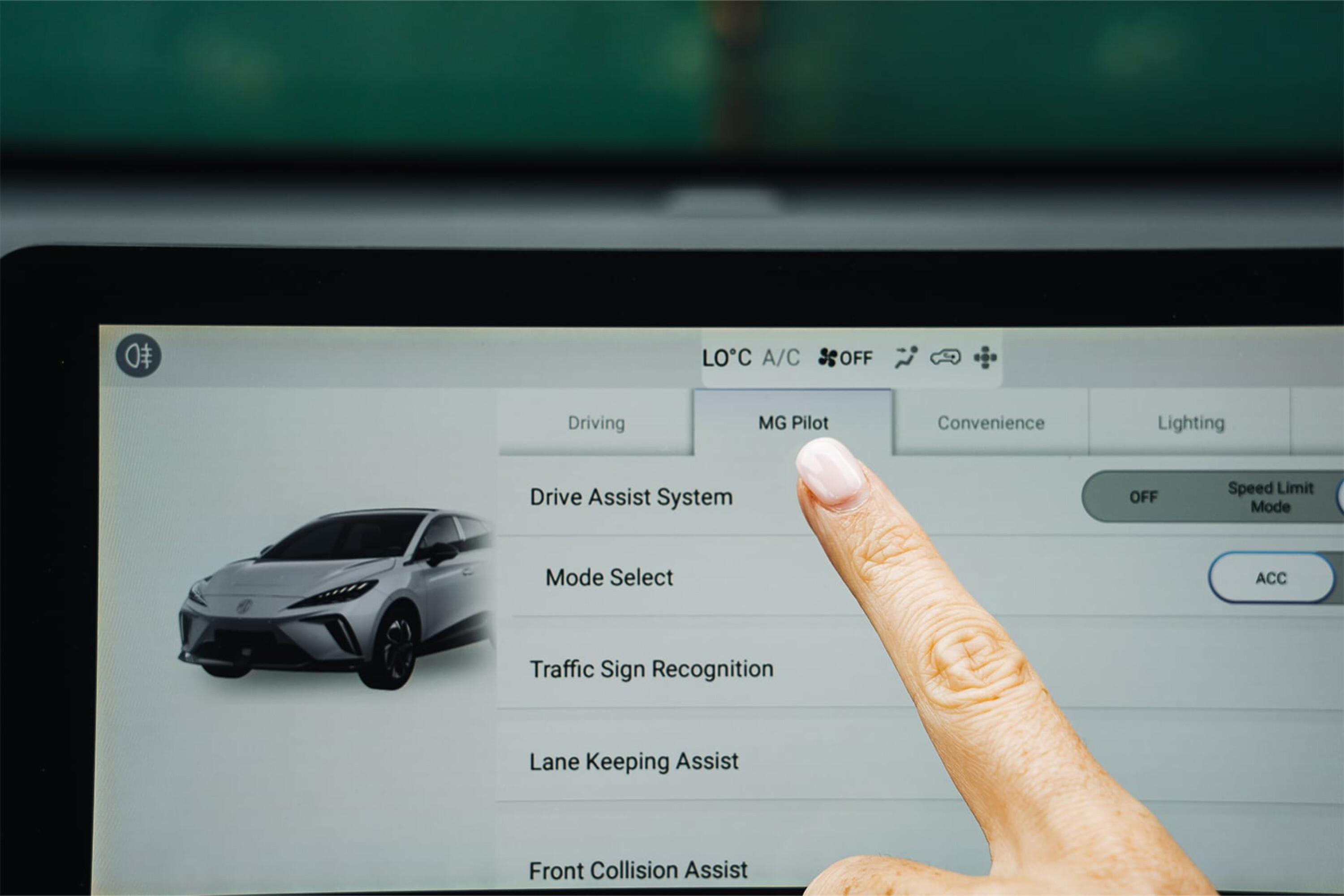
Its safety assistance systems, dubbed ‘MG Pilot’, use a combination of camera and radar sensors.
1
Entry-level Excite variants include most of the MG4’s available active safety assistance technologies as standard.
| 2024 MG4 Excite 51/Excite 64 standard safety assist features | |
|---|---|
| Front auto emergency braking (AEB) with vehicle/pedestrian/cyclist/intersection detection | Speed limit assist with traffic sign recognition |
| Lane-keep assist and lane-departure alert | Driver attention alert |
| Adaptive cruise control with stop/go function | Auto high beam LED headlights |
| Rear view camera | Rear parking sensors |
The Essence adds more tech to complete the safety assist package.
| Essence 64/Long Range 77 adds | |
|---|---|
| Blind-spot monitoring | Door open warning |
| Rear cross-traffic alert | Emergency lane-keep assist |
| 360-degree camera system | |
1
How comfortable and practical is the MG4?
Things we like
- Practical front row
- Comfortable base fabric seats
- Flat-floor EV platform
Not so much
- Rear passenger space could be better
- No rear air vents, fold-down centre armrest
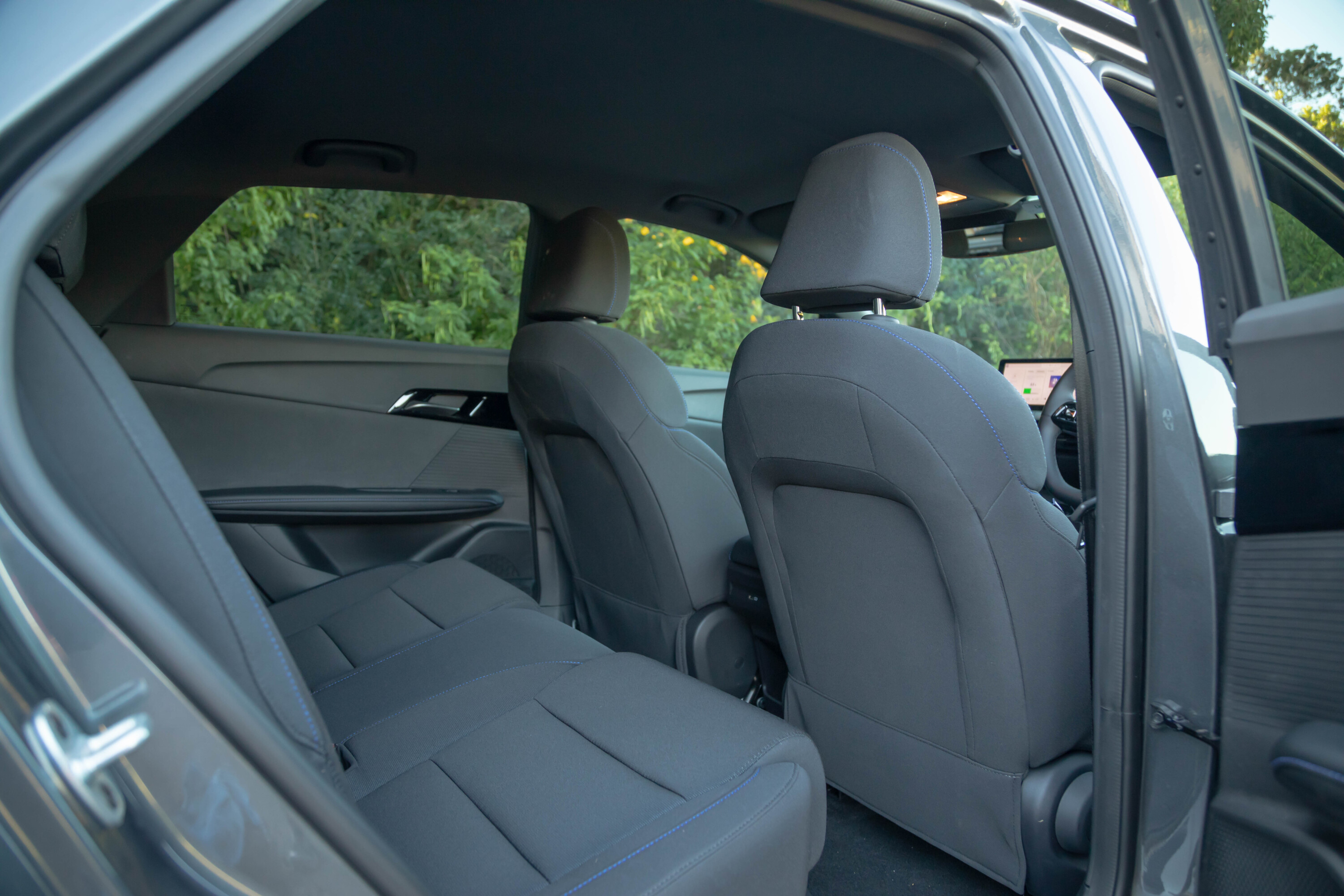
The MG4’s interior practicality is mixed depending on where you sit.
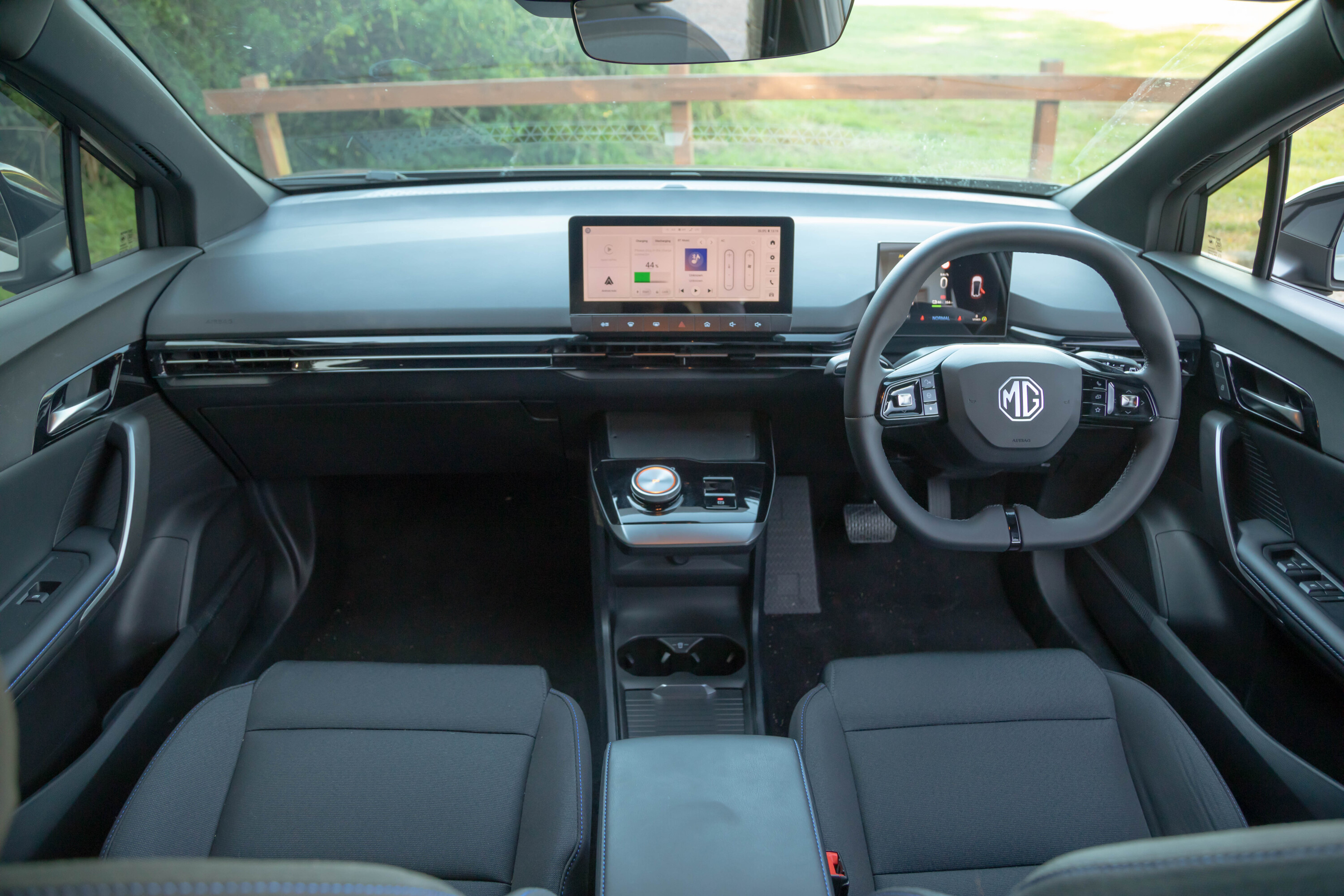
Front occupants benefit from an open passthrough with a good-sized centre bin down near the floor separating the driver and passenger, sliding centre armrest storage lid with a small net in front, and decent gripped cup holders and door pockets.
It even features an ergonomic pad to place your smartphone in the ‘floating’ centre console with two holes to feed a charging cable – handy given the electric hatch only offers wired Apple CarPlay and wired Android Auto.
This doubles as a Qi wireless charging pad on top-spec Essence and Long Range variants.
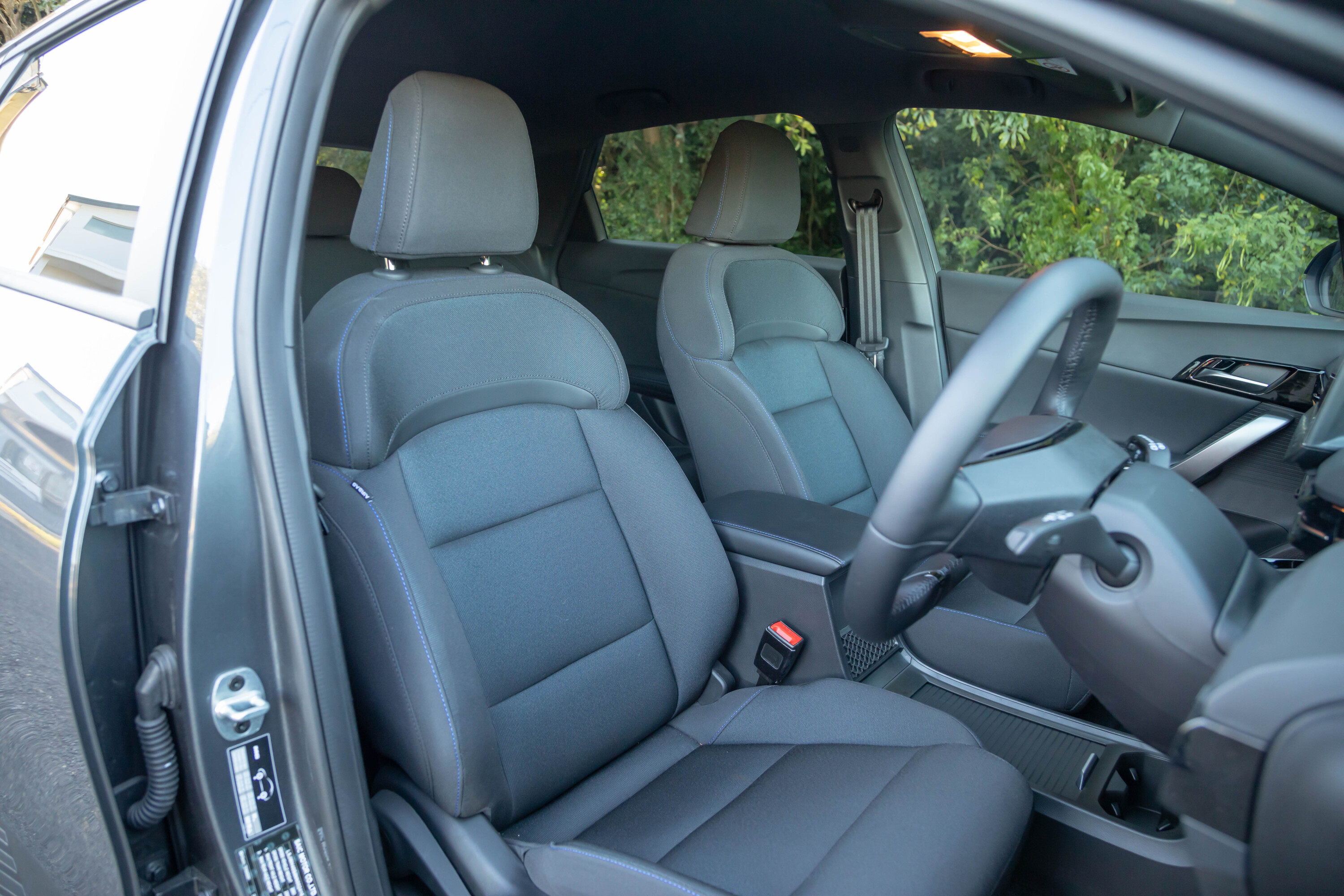
1
However, rear passengers have less foot room underneath the front seats and all models lack amenities, including rear air vents and a fold-down centre armrest.
It’s still comfortable for four passengers, though, with the ground-up EV platform enabling an almost flat floor, as well as good legroom and headroom. For fitting child seats, two ISOFIX and three top-tether anchor points are standard.
Behind the centre console, there’s a small tray and USB-C charging port. Only the Essence and Long Range feature tinted rear glass.
Going on our first impressions with a pre-production MG4 Excite 51, the base fabric seats are well bolstered but look a bit plain. The synthetic leather seats on the Essence and Long Range are also well cushioned.
1
How much boot space does the MG4 offer?
Things we like
- Decent usable boot capacity
- Bag hooks, cubby net
Not so much
- Average-sized boot
- Less boot volume on high-spec models
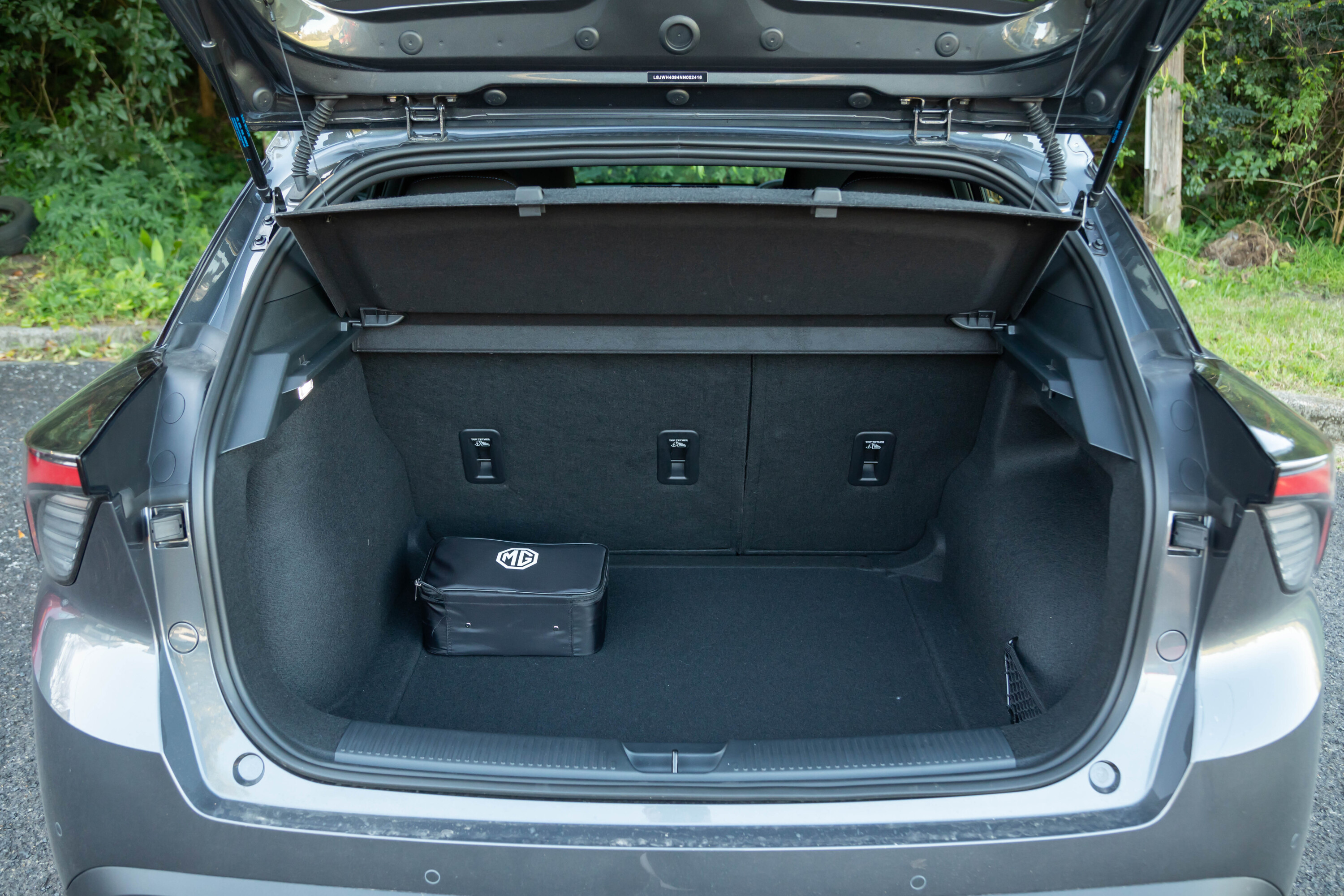
MG4 Excite variants have a 363-litre boot, while the Essence and Long Range drop that volume by 13 litres due to the two-level boot floor feature.
Cargo volume expands to 1177 litres and 1165 litres respectively when the rear seats fold down in a 60:40 split. Even on the base Excite, the boot has LED illumination with a small netted storage area on the side and bag hooks.
Despite the modern MSP underpinnings, it’s not a particularly large boot. For context, the petrol-engined Volkswagen Golf and Hyundai i30 Hatch are both larger at 374 litres and 395 litres respectively.
The MG4 is still better on paper than the Toyota Corolla hybrid hatch’s 333 litres, BYD Dolphin – its biggest EV rival – at 345 litres, and the GWM Ora’s small 228-litre boot.
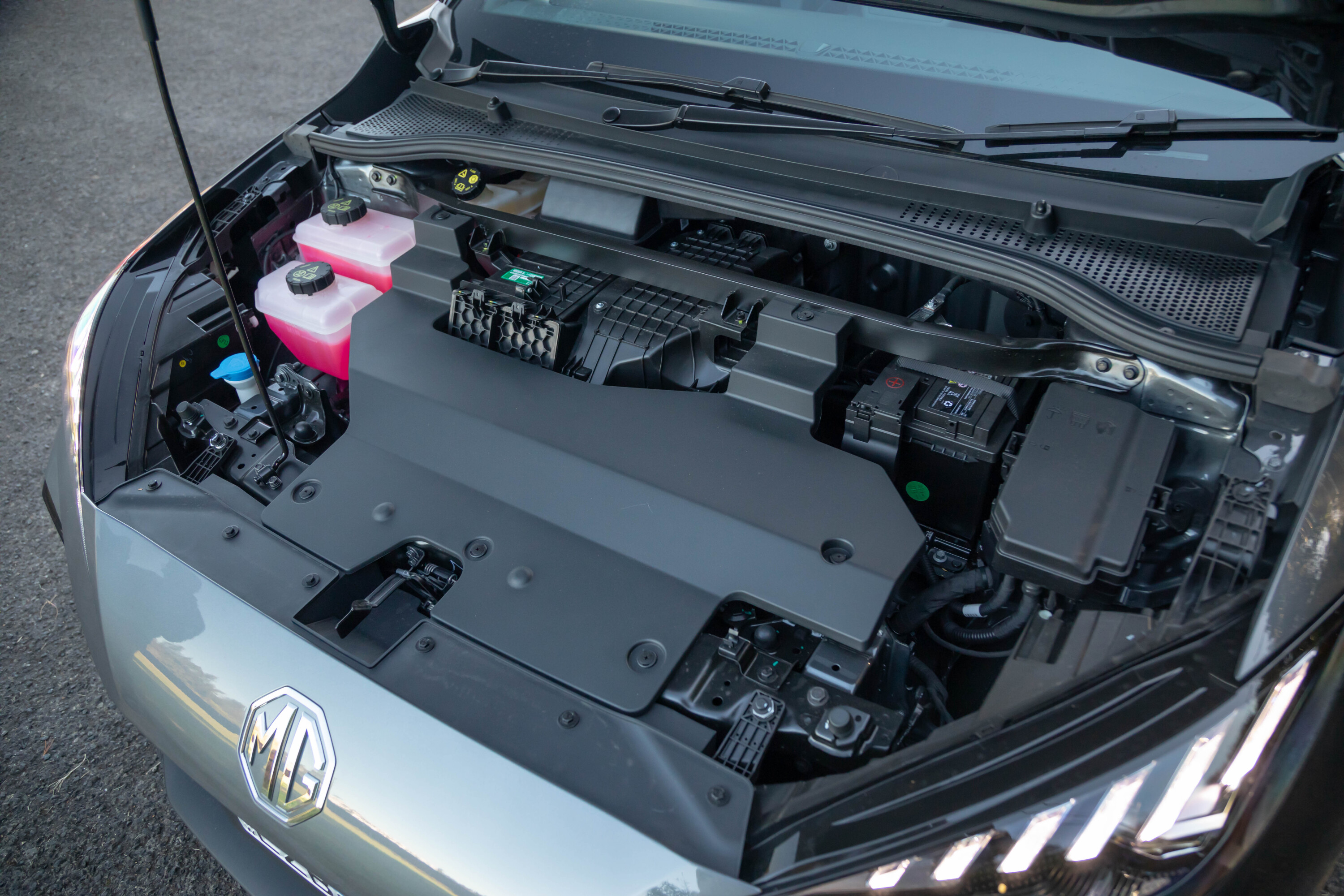
It also doesn’t offer a frunk storage space under the bonnet, MG opting to cover it with plastic instead. That said, a frunk is not necessarily expected at this more affordable EV price point.
1
I like driving, will I enjoy this car?
Things we like
- Enough power on base model
- Fun handling, RWD power
- Good NVH
- One-pedal driving setting
Not so much
- Somewhat firm ride at times
- Small power bumps higher up the rangeu2026 except for the X-Power
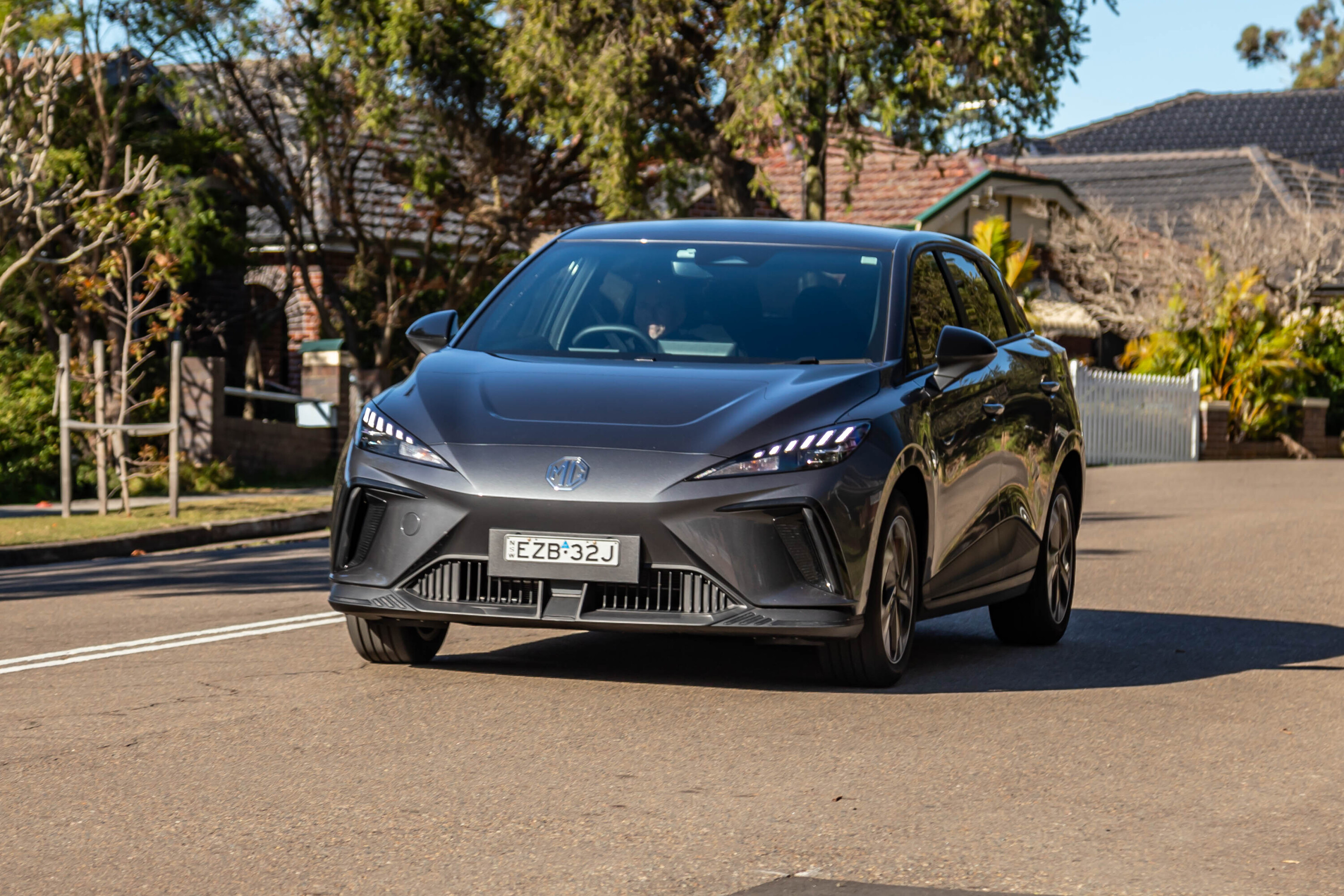
The MG4 will satisfy most drivers. The MSP architecture provides a claimed 50:50 weight distribution, a rear-wheel drive powertrain, and a generally comfortable ride.
| 2024 MG4 | Excite 51 | Excite 64 | Essence 64 | Long Range 77 | X-Power |
|---|---|---|---|---|---|
| Power | 125kW | 150kW | 150kW | 180kW | 320kW |
| Torque | 250Nm | 250Nm | 250Nm | 350Nm | 600Nm |
| 0-100km/h time | 7.7 seconds | 7.2 seconds | 7.2 seconds | 6.5 seconds | 3.8 seconds (claim). Wheels best: 4.1sec |
| Drive | RWD | RWD | RWD | RWD | AWD |
Table scrolls horizontally to reveal more columns
MG has revised its 0-100km/h claim for 64kWh battery pack models. Previously 7.9 seconds, the brand has updated its figures to 7.2 seconds
Even on the pre-production base MG4 Excite 51 we tested, it was impressively comfortable and quiet at high speeds, with the rear-drive layout naturally giving the sensation of being pushed through a corner – aided by the light, smooth steering – and no torque steer.
It’s generally comfortable, despite a somewhat firmer ride that can cause some fidgeting on poorly surfaced roads, some wind whistle from the driver’s side mirror above 100km/h, and a slightly under-damped rear axle.
Four regenerative braking intensity modes are available via the touchscreen settings or customisable steering wheel buttons if so configured.
The MG4 also offers a one-pedal driving setting, which is unique at this price point, given the BYD Dolphin and GWM Ora rivals, nor the BYD Atto 3 and MG ZS EV, offer intense regen braking.
We’re confident most buyers will find the base MG4 Excite 51 more than enough for everyday driving – with satisfying instant and linear 125kW power delivery.
With its larger 150kW motor, the mid-spec NMC-batteried 64kWh car is able to reach 100km/h half a second faster than the base model (7.7 seconds plays 7.2).
As well as upping power again by 30kW, the Long Range 77 introduces 100Nm more torque to compensate for the heavier NMC battery, with 0-100km/h acceleration cut by around one second compared to the base model.
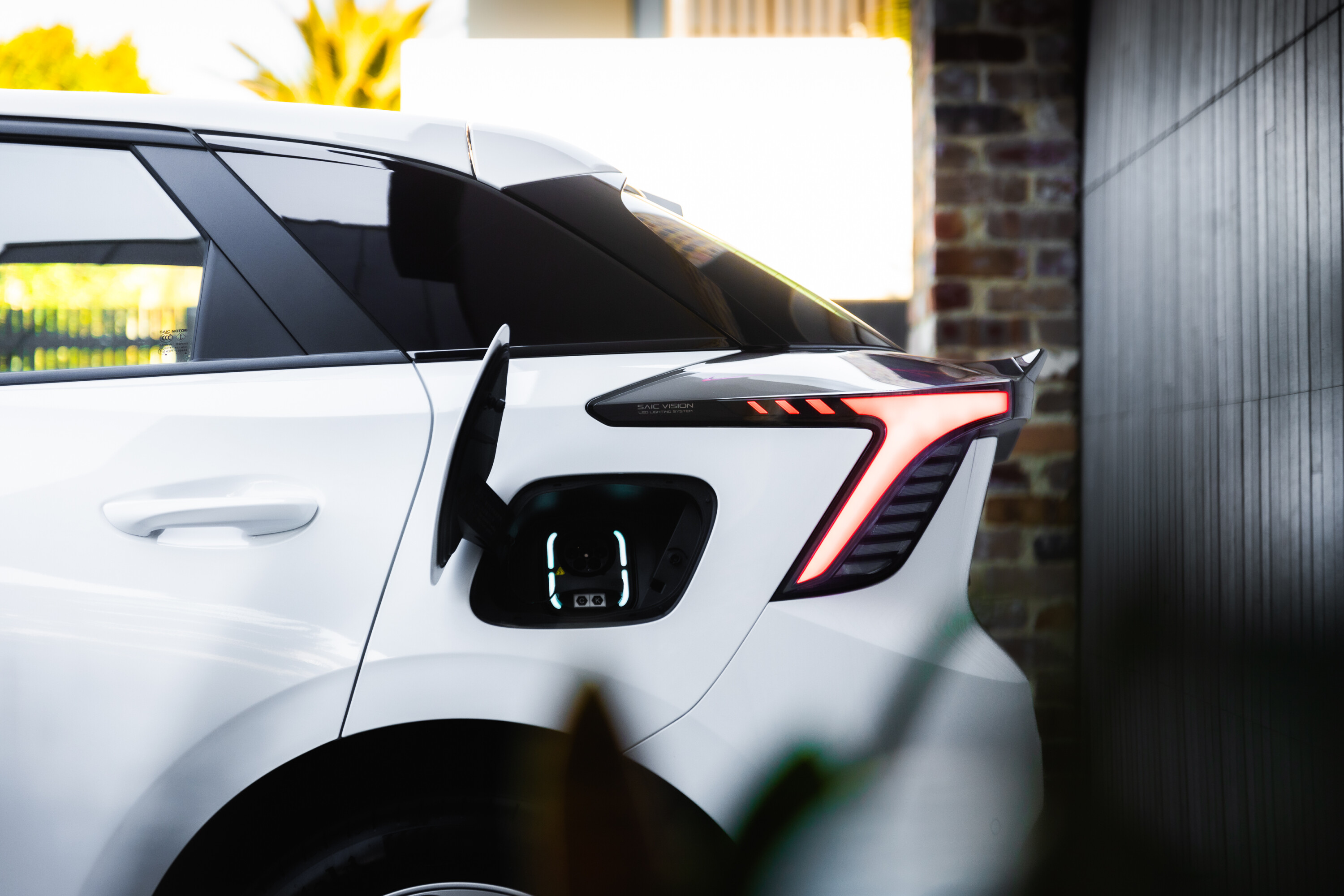
The XPOWER offers an absurd level of performance for the money, with genuine supercar levels of acceleration thanks to its twin-motor setup. In terms of pure driving enjoyment, it doesn’t necessarily stand out from the Long Range 77, for instance, but the instant, head-pinning acceleration always raises a smile.
1
Which version of the MG4 provides the longest range?
Things we like
- Three battery choices available to suit buyer needs
- Good claimed energy efficiency across the line-up
- Base Excite 51 has enough range for most, no charge limit
- Long Range 77 offers Cupra Born-rivalling range
Not so much
- Excite/Essence 64, Long Range 77 have recommended 80% NMC battery charge limit
- Three-phase AC charging inverter reserved for Long Range
- Range compromise on Essence 64 vs Excite 64
The MG4 Long Range 77 provides the greatest driving range, with up to 530 kilometres claimed from a full charge on the WLTP combined cycle.
| Excite 51 | Excite 64 | Essence 64 | Long Range 77 | X-Power | |
|---|---|---|---|---|---|
| Claimed driving range (WLTP combined) | 350km | 450km | 435km | 530km | 400 |
| Claimed energy efficiency (WLTP combined) | 14.5kWh/100km | 13.8kWh/100km | 14.3kWh/100km | 14.0kWh/100km | 15.2kWh/100km |
| Usable battery size (net) | 50.8kWh | 62.1kWh | 62.1kWh | 74.4kWh | 64kWh |
| Max AC slow charging speed | 6.6kW | 6.6kW | 6.6kW | 11kW | 6.6kW |
| Max DC fast charging speed | 88kW | 140kW | 140kW | 144kW | 150kW |
| Recommended charging limit | 100% | 80% | 80% | 80% | 80% |
Table scrolls horizontally to reveal more columns
However, the title of best value-for-range variant goes to the Excite 64. Interestingly, this model is also the most energy-efficient based on WLTP testing.
The Chinese electric hatch generally provides more driving range as the line-up steps up through the three battery sizes offered.
Only the lowest-range base Excite 51 uses the longer-lasting and safer lithium-iron-phosphate (LFP) battery chemistry, whereas all other variants adopt a more energy-dense nickel-manganese-cobalt (NMC) lithium-ion type battery.
The base 50.8kWh usable LFP battery is capped at a maximum of 88kW DC fast charging speeds, while the 62.1kWh and 74.4kWh usable NMC packs can respectively reach up to 140kW DC and 144kW DC when connected to a compatible public charging station under optimum conditions.
Peak charging speed capabilities also depend on the MG4’s battery size.
Most models are limited to a maximum of 6.6kW single-phase AC charging, which means the power input speed will be capped at 6.6kW even when plugging into a three-phase 11kW AC charging station. Only the Long Range 77 can completely take advantage of the latter.
The LFP-based Excite 51 is capped at a maximum of 88kW DC fast charging speeds, while all other NMC-based variants can reach up to 140kW DC (144kW DC for the Long Range 77) when connected to a compatible public charging station under optimum conditions.
What’s the charging limit?
Generally, the LFP battery type on the base Excite 51 can be fully charged to 100 per cent every day without excessive degradation concerns, though charging past the 80 per cent mark still results in extended charging wait times.
Meanwhile, the NMC lithium-ion battery on the Excite 64, Essence 64 and Long Range 77 should be capped at 80 per cent to maintain good health – unless fully recharging is necessary, such as when on a long road trip where you’ll quickly use up the energy.
Keeping the battery in a too-high or low charge percentage for extended periods shortens its lifespan, as does frequent DC fast charging.
Most public DC chargers in Australia are limited to 50kW power outputs, so MG claims a 10 to 80 per cent recharge would take around 40 minutes on the base Excite 51, 60 minutes on the Excite 64 and Essence 64, or 75 minutes on the Long Range 77.
Those times are cut to 37-, 28- and 38 minutes respectively if you plug in at a 150kW DC or faster charging station.
Charging at home is ideal. A standard home plug at around 1.8kW AC can take two to four full nights to go up to 80 per cent depending on the battery, while using an installed 7kW single-phase or 11kW three-phase AC wall box guarantees that within one night – keeping in mind the 6.6kW AC ceiling limit for all models, except the Long Range 77.
1
What is the MG4’s towing capacity?
Things we like
- All models can tow
Not so much
- Limited payload
- Designed for occasional towing only, expect a range drop
All MG4 variants are rated to tow up to 500kg with a braked or unbraked trailer.
Maximum payload is rated at 448kg for the Excite 51, 465kg for the Excite 64, 451kg for the Essence 64, and 461kg for the Long Range 77.
However, MG hasn’t specified the maximum tow ball download weight, which directly reduces the actual maximum payload.
As per all EVs, expect a significant driving range drop of up to 50 per cent when towing at the maximum capacity.
1
How long is the warranty and what are the MG4’s servicing costs?
Things we like
- Long vehicle warranty
- Wide servicing intervals, capped-pricing coverage
Not so much
- Slightly shorter battery warranty
- Pricey major service, not as affordable to maintain overall
The MG4 EV is covered by a seven-year/unlimited-kilometre vehicle and battery warranty.
The MG4 is covered by an industry-leading 10-year/250,000km warranty that applies to all vehicles retailed on or after August 1, 2024.
The warranty extends to the battery pack as well, and roadside assistance is included for the same period, provided owners service on time with an MG dealer.
For commercial-use drivers, the warranty remains seven years/160,000km.
MG also covers manufacturing defects for the 12-volt electronics battery (up to two years/unlimited kilometres), lamp and light bulbs (up to three months/5000km), car key battery) up to one year/unlimited kilometres), and wheel alignment and balance (up to six months/10,000km).
1
| 2024 MG4 capped-price servicing costs | All variants |
|---|---|
| 2 years/40,000km | $296 |
| 4 years/80,000km | $907/$962 (XPOWER) |
| 6 years/120,000km | $296 |
| 8 years/160,000km | $907/$962 (XPOWER) |
| 10 years/200,000km | $296 |
| 12 years/240,000km | $907/$962 (XPOWER) |
| 14 years/280,000km | $296 |
Which version of the MG4 does Wheels recommend?
Our pick is the entry-level MG4 Excite 51 since it has the most affordable price tag – especially with the current driveaway offer – with good standard features, enough power and range, and is the only variant with the longer-lasting, safer LFP battery.
However, while the 350km claimed driving range will suit most Australians (drivers commute 30 to 40km per day on average), the $4000 step up to an Excite 64 with a 450km claimed range would give more leeway and confidence while being able to accept a faster charging DC rate for those longer journeys.
However, all models except the base Excite 51 should be limited to an 80 per cent charge for everyday driving to protect the lithium-ion battery’s health.
If you prioritise features, such as blind-spot monitoring, rear cross-traffic alert, a 360-degree camera system, synthetic leather seats and electric folding wing mirrors, you’ll need to opt for the Essence 64 – which is still good value at $45K and priced on par with the petrol-powered Honda Civic hatch.
Meanwhile, the Long Range 77 is an expensive $6000 further step up – targeted at regular long-distance drivers who need the increased 530km claimed range, three-phase 11kW AC charging capability, and Cupra Born warm hatch-rivalling power outputs.
There’s no rational reason to stump up the extra for the twin-motor XPOWER. But who cares about being rational? In the cut-and-thrust of the urban environment, it might just be the fastest thing on four wheels thanks to its instant and outrageous performance.
What are the MG4’s key rivals?
The electric vehicle landscape continues to evolve at a rapid rate and the MG4’s relatively broad price spread encompasses a range of hatches and SUVs.
ud83dudd3c Back to top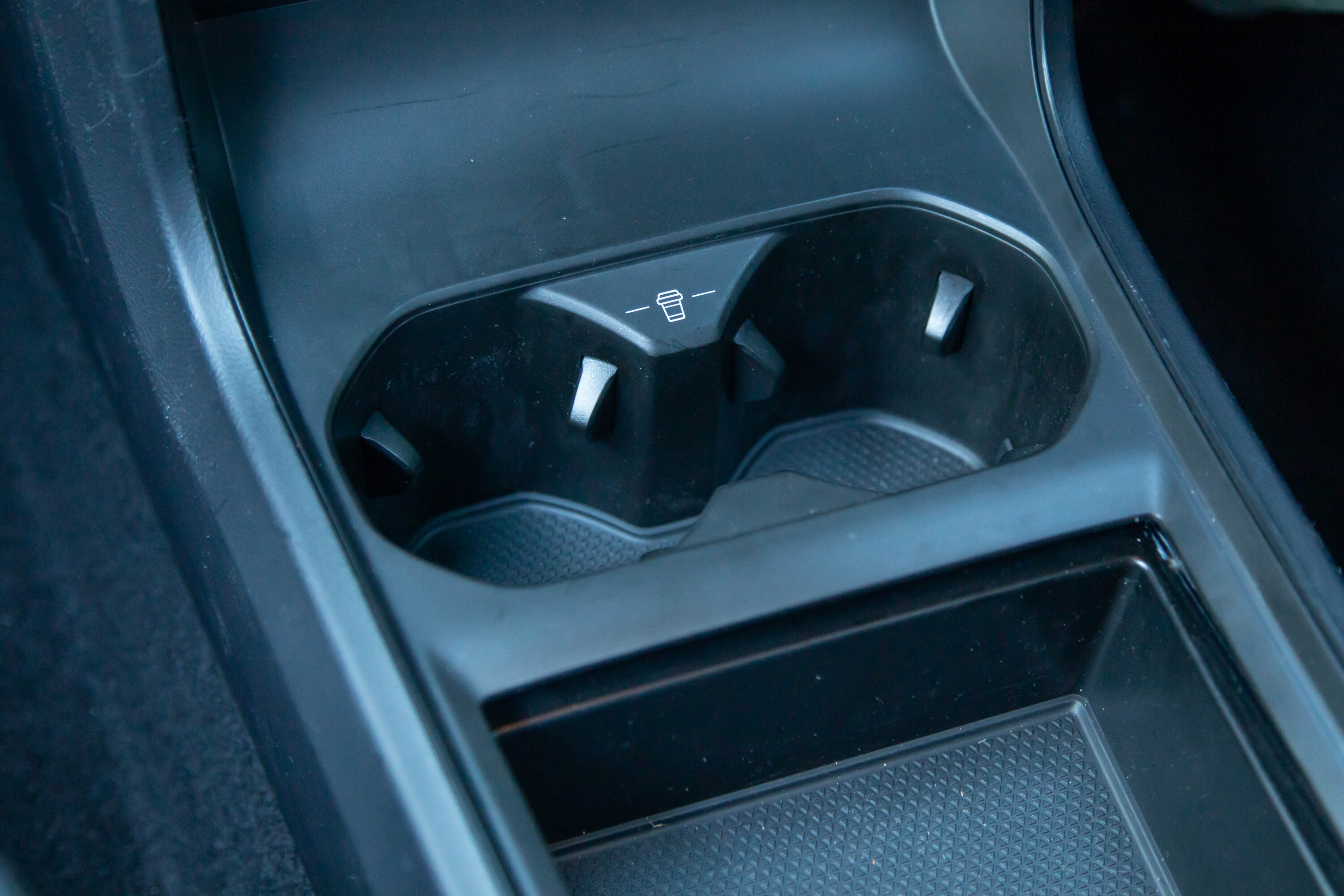
1
What might annoy me?
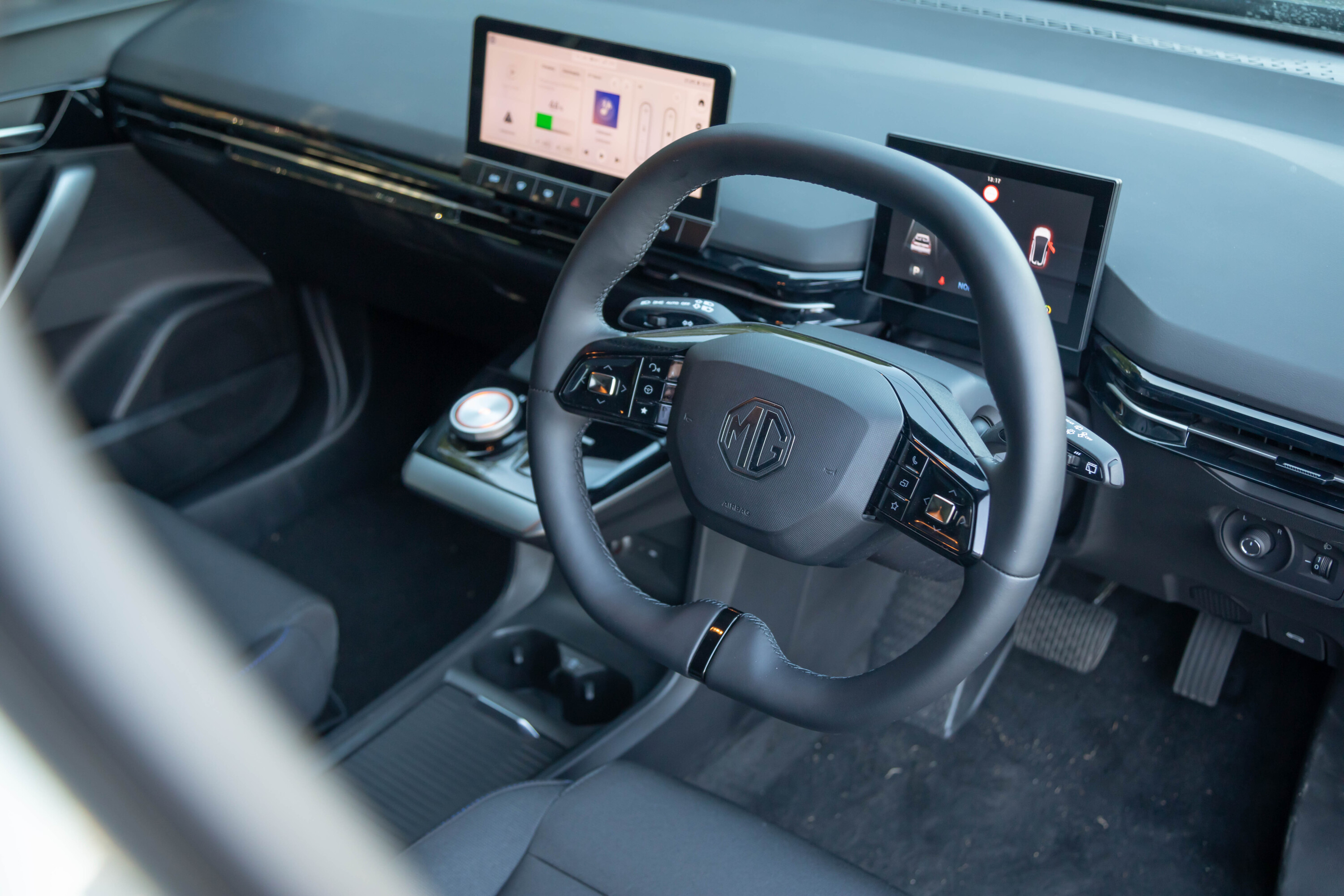
The MG4’s interior is short on physical buttons, which can be particularly annoying when trying to adjust the air-conditioning.
While there is a row of shortcut buttons below the touchscreen to turn on and off the air vents or quickly turn on the windscreen demisters, most climate controls need to be operated via the touchscreen – although drivers can customise the steering wheel buttons to change the temperature.
MG’s native infotainment software has smaller buttons and text, which can be harder to use and glance at while driving. Using Apple CarPlay or Android Auto smartphone mirroring largely overcomes this.
The front centre cup holders are placed directly below the ‘floating’ centre console, making them difficult to use with taller vessels.
1
Does any upgrade have a downside?
Opting for any model except the base Excite 51 means the use of an NMC lithium-ion battery pack, which restricts everyday charging to a recommended 80 per cent to maintain good health.
For example, despite the Excite 64’s larger battery, it would only provide 10km more claimed WLTP driving range than the base Excite 51 day-to-day due to the recommended charging limit.
The extra spend would only be useful for long-distance trips when you can fully charge, as it will quickly use up the last 20 per cent in highway driving.
An entry-level Excite 51 can be regularly charged to 100 per cent due to the LFP cathode being more stable, longer lasting and safer with less thermal runaway risk than regular lithium-ion batteries. However, LFP batteries do still naturally degrade – except the hit on health is less when fully charging and they can sustain more charging cycles.
Additionally, the high-spec Essence 64 has 15km less claimed range than the identical-battery Excite 64 due to its larger wheels and sportier rear spoiler.
1
What might I miss that similar cars have?
While the MG4 has a good safety assist suite, no model is available with rear AEB, rear cross-traffic avoidance assist, or a front-centre airbag.
Additionally, the top-spec Essence model offers an electrically-adjustable driver’s seat, but no memory function.
The rear seats also lack rear air vents and a fold-down centre armrest, so passengers will need to rely on the leatherette door pads and bottle pockets for the latter.
Budget-orientated buyers who choose the base Excite variants don’t get blind-spot monitoring and rear cross-traffic alert – when it’s standard in key rivals including the BYD Dolphin and GWM Ora.
Granted, these rear radar-based safety assist features aren’t available on the similarly priced petrol-powered top-spec Hyundai i30 N-Line Premium either and MG argues the omission was needed to achieve a more affordable EV price tag.
No MG4 model can be had with a sunroof, which is standard on the Dolphin and available on the Ora.
1
What’s the infotainment system like?
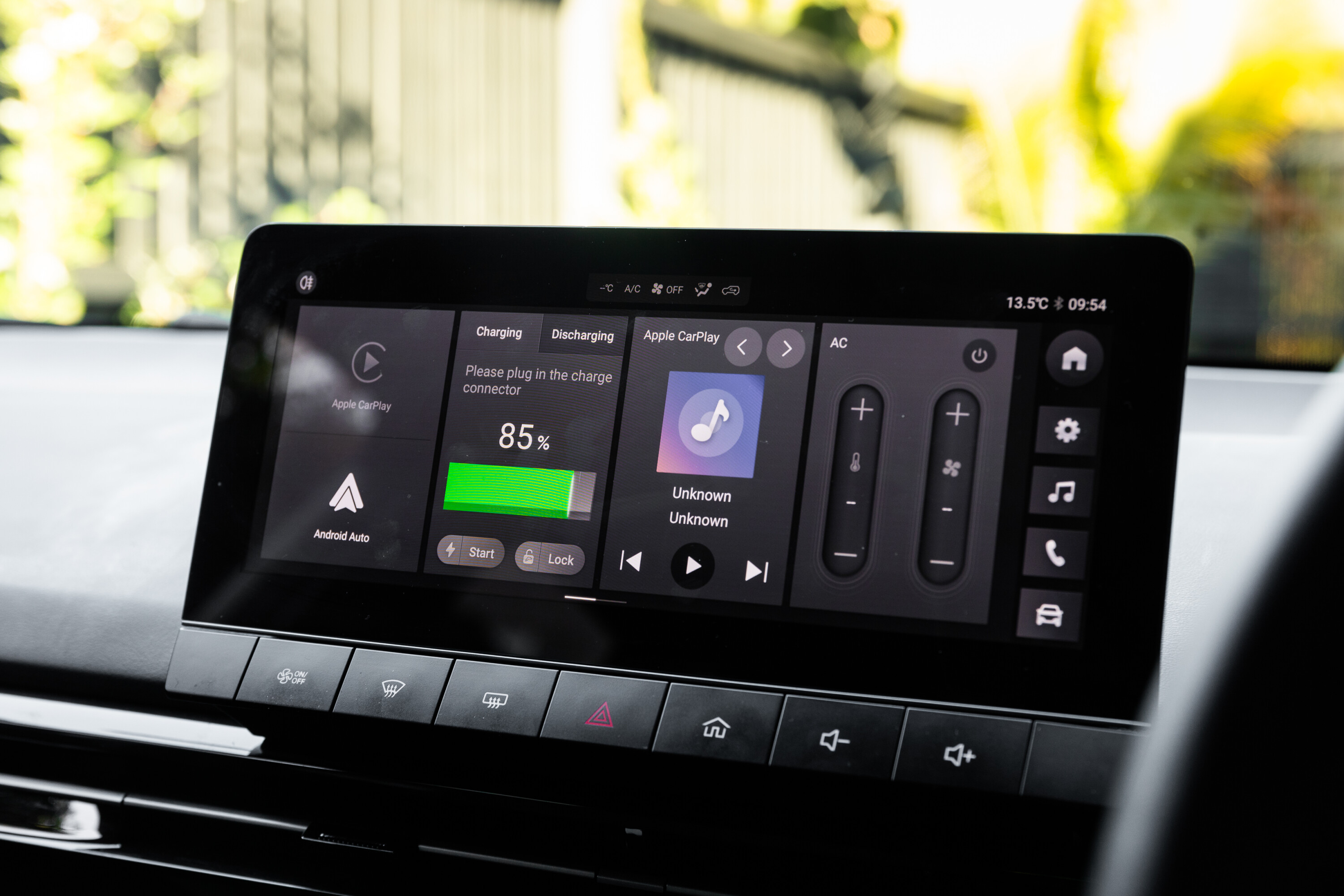
The MG4’s tablet-style 10.25-inch touchscreen and 7.0-inch instrument display are reasonably responsive and well-presented, even though the text and buttons are on the smaller side.
Having few physical buttons is particularly annoying when adjusting the climate control. Drivers can customise the steering wheel buttons to change the temperature or drive modes, though.
Only the Essence and Long Range feature built-in maps with automatic EV charging stop planning and a native voice control system.
Wired Apple CarPlay and wired Android Auto smartphone mirroring is standard, connected via the single USB-A port below the centre console.
Where is the MG4 made?
The MG4 electric hatch is manufactured in Ningde, China.
1
Are there plans to update the MG4 soon?
No. The MG4 was released overseas in 2022, as the Chinese carmaker’s first global product.
Judging by other MG models, they tend to have a longer shelf life than other car brands; it may be a while until we see an upgrade or facelift.
MG’s styling chief Oleg Son recently told WhichCar that SAIC Motor, its state-owned parent company, has an ultra-rapid turnaround of a new car going from design to production in just two years and emphasised that he preferred more physical buttons, so anything is possible in the future.
MORE
Everything MG
More EV stories to help you choose the best car for your needs
- ? EV news, reviews, advice & guides
- ❓ Short & sweet: Your EV questions answered
- ⚡ New EVs: Everything coming to Australia
- ? Australia’s EVs with the longest driving range
- ⚖️ Best-value EVs by driving range
- ? How much do EVs cost in Australia?
- ? How much more expensive are EVs?
- ⚖️ Number crunching: Is it time to switch to an EV?
- ♻ Should you buy a used EV?
- ?️ Are EVs more expensive to insure?
- ? Costs compared: Charging an EV vs fueling a car
- ? EV charging guide
- ? Are there enough EV chargers in Oz?
- ?? EV servicing explained
- ? EV battery types explained
- ? When do EV batteries need replacing?
- ? Hydrogen v EVs: What’s best for Oz?
- ✋? Mind your manners! EV charging etiquette tips
- ? How sustainable are EVs, really?
MORE advice stories to help you with buying and owning a car
BMW Australia will introduce the X3 30e xDrive plug-in hybrid to its 2025 line-up, adding to the existing X3 20 xDrive and M50 xDrive models announced in July.
Snapshot
- X3 30e xDrive plug-in hybrid due in early 2025 at $102,500
- Offers 220kW, 450Nm, 0-100 km/h in 6.2 seconds, and up to 91km electric range
Priced from $102,500, the X3 30e will be the latest PHEV in BMW’s Australian range, joining the X5 xDrive50e, M5 Sedan, M5 Touring, and XM.
The introduction coincides with the implementation of the New Vehicle Efficiency Standard (NVES) by the Federal Government, which mandates emissions limits for vehicle fleets. By 2025, BMW will offer 21 electrified models locally, positioning itself as a leader in this sector.
This announcement follows confirmation of the wider 2025 X3 range, linked below.
Powertrain and performance
The X3 30e xDrive pairs a 2.0-litre four-cylinder petrol engine with an electric motor and high-voltage battery.
This combination delivers a total system output of 220kW and 450Nm of torque, enabling the vehicle to accelerate from 0-100 km/h in 6.2 seconds and reach a top speed of 215 km/h. In electric-only mode, the vehicle can achieve speeds of up to 140 km/h.
The high-voltage battery, integrated flat into the vehicle’s floor, has a usable energy capacity of 19.7kWh. This supports an electric range of up to 91 kilometres as per ADR 81/02 testing, representing a significant efficiency gain over previous models. The battery charges at 11kW as standard and can be fully recharged in two hours and 15 minutes.
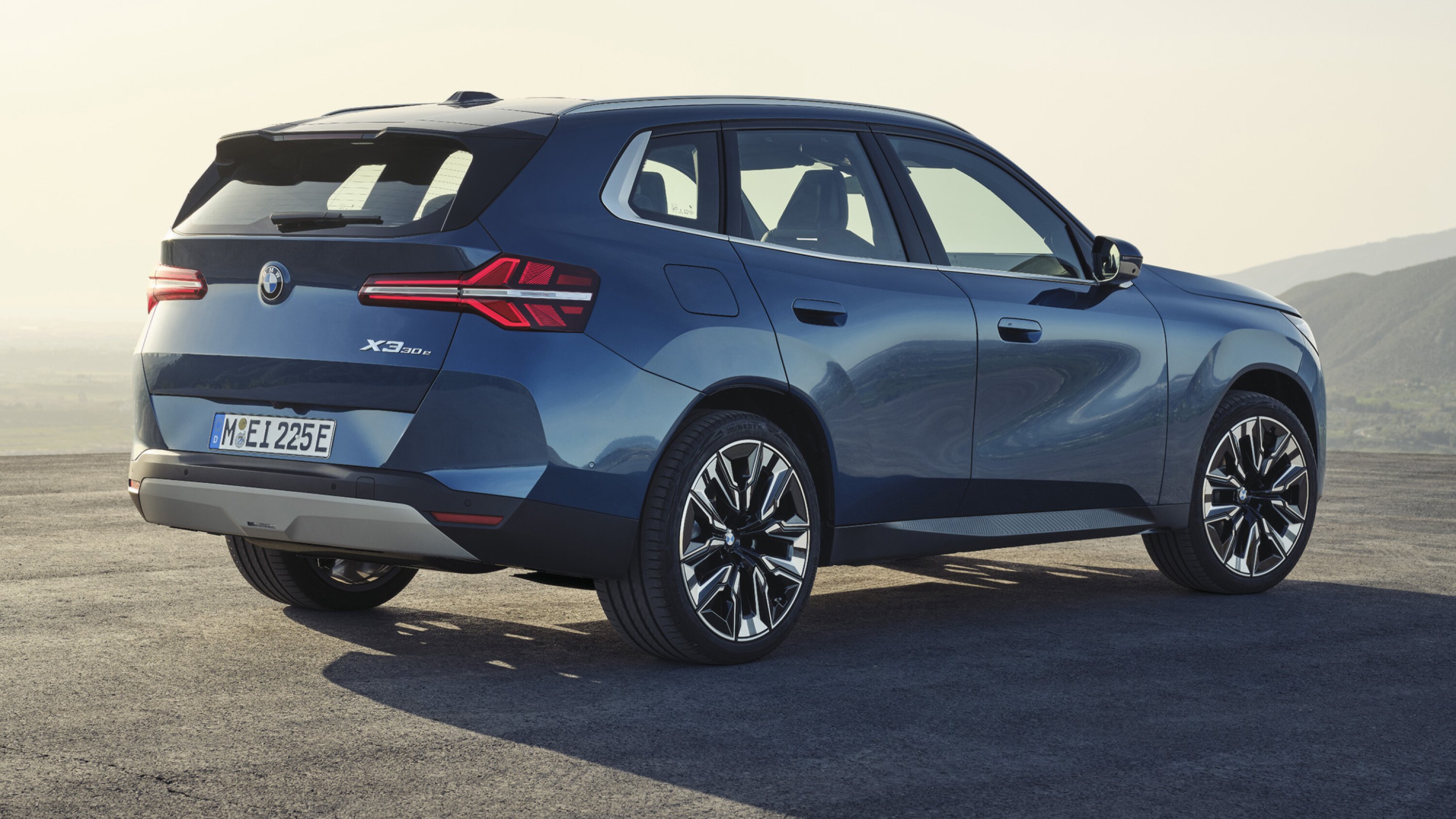
1
Efficiency and energy management
Combined fuel consumption for the X3 30e xDrive is rated at 1.6 L/100km, with CO2 emissions of 38g/km (ADR 81/02).
Energy management system is optimised to automatically select the most efficient operating mode based on driving conditions and battery charge levels.
In Hybrid mode, the petrol engine is engaged as needed for optimal power delivery, while in Electric mode, a separating clutch fully disconnects the engine from the drivetrain.
1
Features
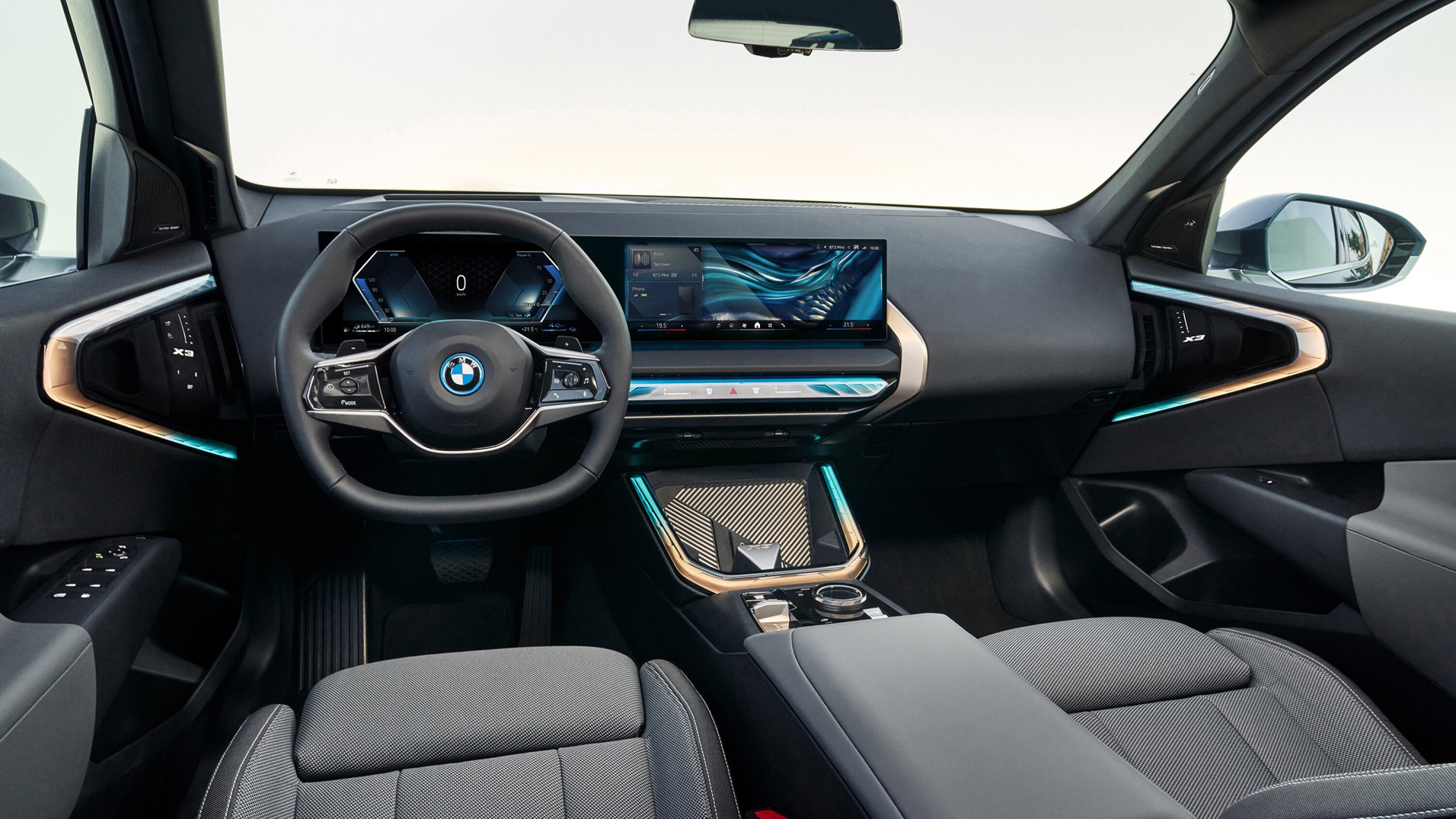
Key features include a 14.9-inch curved widescreen display with BMW Operating System 9, adaptive LED headlights, and an M Sport package with blue callipers.
| 2025 BMW X3 30e features | |
|---|---|
| 20u201d M light alloy wheels | Privacy glass with sun protection glazing |
| BMW xDrive intelligent all-wheel-drive system | Seat heating for first and second rows |
| 3-zone auto climate control | Sun blinds, manual for rear-side windows |
| 6-speaker 100-watt Hi-Fi system | Driving Assistant Professional inc. Steering and Lane Control System, Active Cruise Control inc. Stop&Go and Blind Spot Monitor |
| Acoustic glazing | DAB Digital radio |
| Acoustic protection for pedestrians | Electric Seat function, front row |
| Adaptive LED headlights | BMW Head Up Display |
| Adaptive Suspension | M headliner in anthracite |
| Automatic tailgate | M Sport package inc. M Sport brake system with blue callipers |
| BMW Digital Premium (90-day trial) | M Sport leather steering wheel |
| BMW Iconic Glow illuminated kidney | Mirror package, incl. anti-dazzle function |
| BMW Intelligent Personal Assistant | Mode 2 & 3 Charging cables |
| BMW Live Cockpit Pro 14.9u201d + 12.3u201d curved widescreen display, feat. Operating System 9 | Parking Assistant Plus incl. Surround view camera, Reversing Assistant and Drive Recorder |
| Comfort Access and Digital Key Plus | Panorama glass sunroof (fixed) |
| Comfort Package: | Remote Software Updates |
| Active seat ventilation | Tyre pressure monitoring system |
| Heated steering wheel | Wireless Apple CarPlay and Android Auto |
| Luggage compartment separating net | Wireless phone charging |
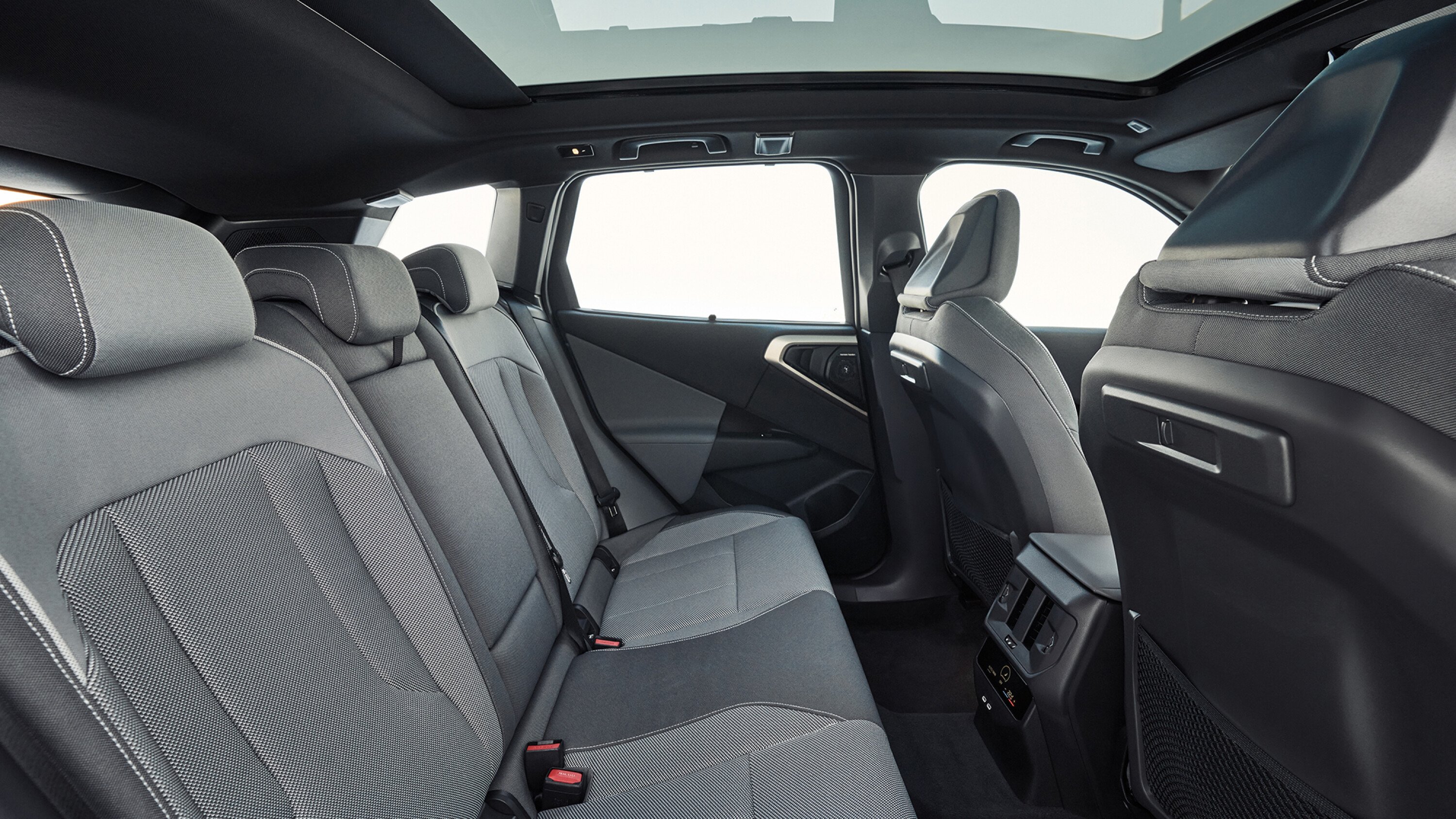
1
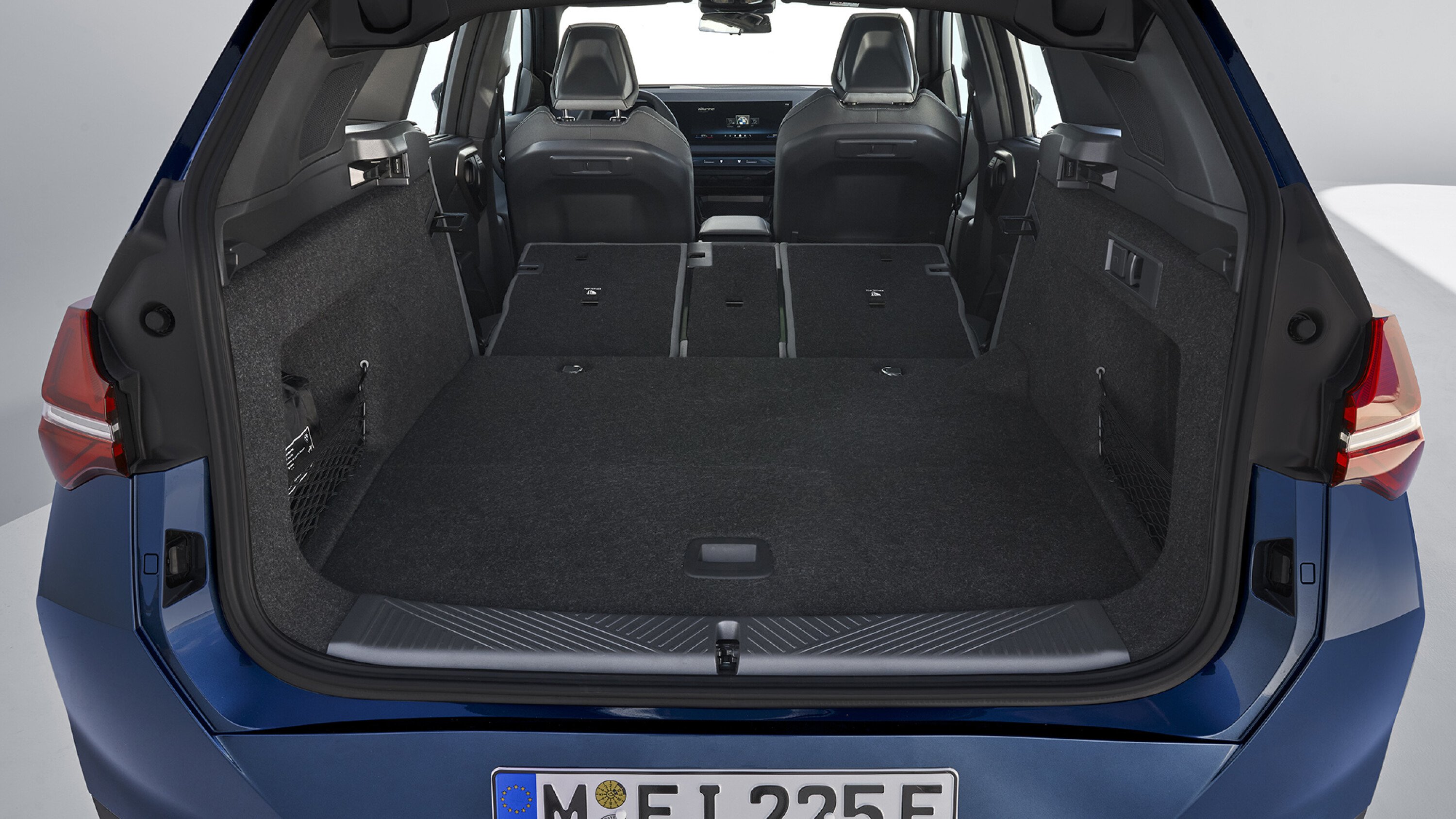
Equipment and customisation options
The X3 30e rides on 20-inch M light alloy wheels as standard, with an option for 21-inch wheels priced at $2500.
Exterior finishes include non-metallic Alpine White and various metallic options at $2000, or BMW Individual colours such as Tanzanite Blue for $4000.
Interior trims are available in ‘Veganza’ upholstery at no additional cost, with optional Merino leather priced at $4000.
Other interior upgrades, such as a knitted textile instrument panel, can be added for $1200.
1
| Enhancement u2013 $4000 | |
|---|---|
| Metallic paint | harmon/kardon surround sound |
| Alarm System | |
| M Sport Pro u2013u00a0$2000 | |
|---|---|
| M High-gloss Shadow Line with extended contents, including: | M Lights Shadow Line |
| u2013u00a0Radiator grille frame and struts | M Sport brakes in red high-gloss (blue available on request) |
| u2013u00a0Trim detailing in taillight | M seat belts |
| u2013u00a0Tailpipe trims | |
| Single options | |
|---|---|
| Trailer tow hitch with 2200kg max towing capacity (200kg tow ball limit) | $2,200 |
1
Variant overview
The 2025 X3 line-up features three key variants:
| Variant | Powertrain | Power (kW) | Torque (Nm) | 0-100 km/h (s) | Fuel (L/100km) | CO2 (g/km) |
|---|---|---|---|---|---|---|
| X3 20 xDrive | 2.0L petrol, 48V mild-hybrid, 8-speed, xDrive | 140 | 310 | 8.5 | 7.5 | 171 |
| X3 30e xDrive | 2.0L petrol + electric motor, plug-in hybrid, xDrive | 220 | 450 | 6.2 | 1.6 | 38 |
| X3 M50 xDrive | 3.0L petrol, 48V mild-hybrid, 8-speed, xDrive | 293 | 580 | 4.6 | 8.2 | 187 |
2025 BMW X3 pricing
| Variant | Price |
|---|---|
| X3 20 xDrive | $84,500 |
| X3 30e xDrive | $102,500 |
| X3 M50 xDrive | $126,900 |
| Prices exclude on-road costs |
All the PHEVs on sale in Australia, and every PHEV still on the horizon
Between conventional hybrids and full-electric vehicles, there exists a handy third option: the Plug-in Hybrid Electric Vehicle, often referred to as a PHEV.
Hybrids are familiar, and often affordable, thanks to Toyota’s pioneering Prius range and now a full line-up of available hybrids.
Electric vehicles, on the other hand, represent something of an expensive unknown to a lot of buyers in this relatively early stage of the segment’s growth.
To see the full list of PHEVs available in Australia, keep scrolling or jump ahead to the full list – but if you’d like an explainer on just what a PHEV is, well…
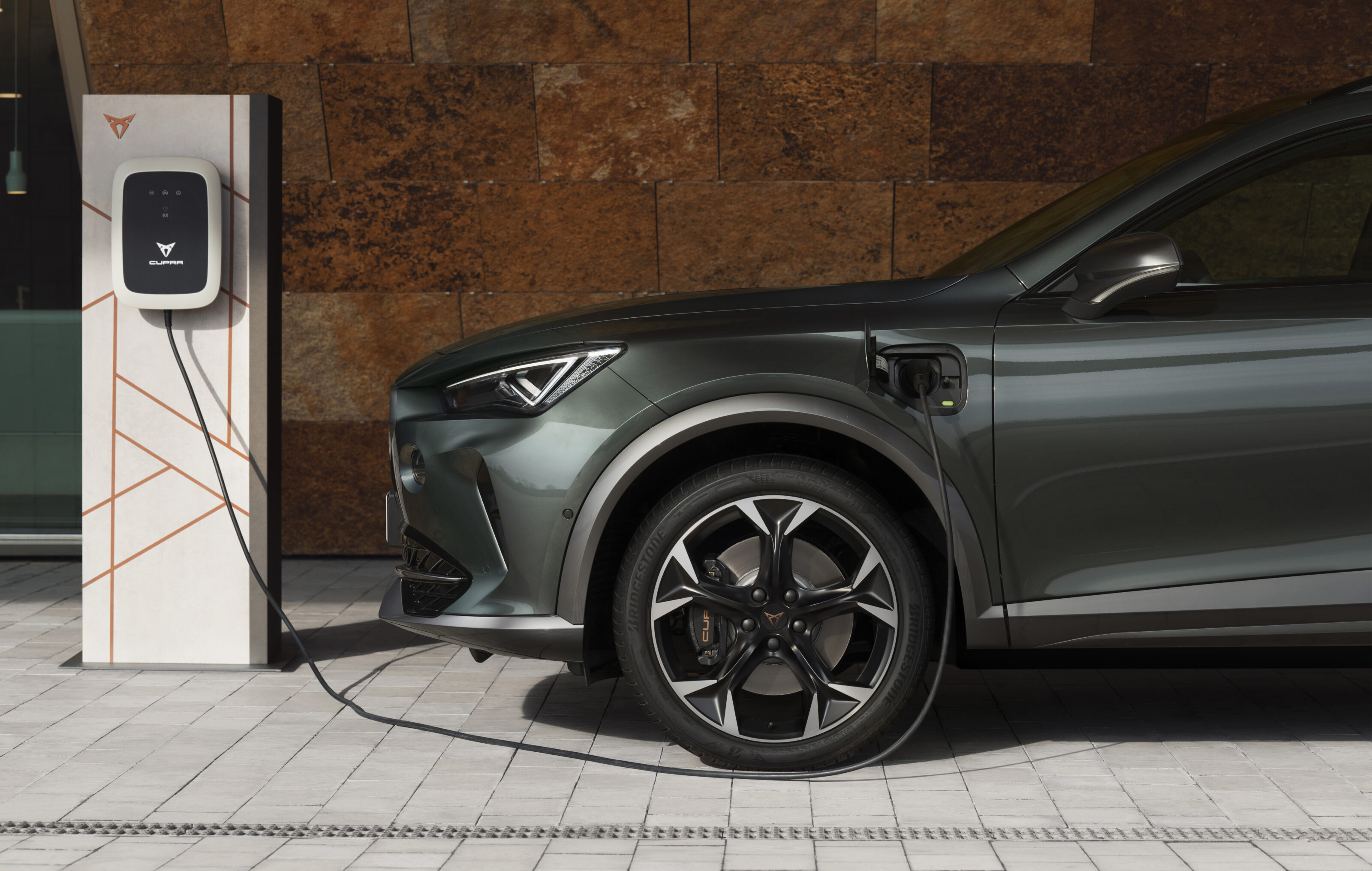
1
What is a plug-in hybrid EV?
Plug-in hybrid vehicles (PHEVs) can offer the advantages of a battery-electric vehicle without sacrificing the peace of mind that comes with having an internal combustion engine (ICE) under your bonnet.
For the average Aussie commute, most PHEVs can run on electricity for emissions-free motoring, but will function as a conventional hybrid if the battery runs out.
A downside compared with regular hybrids is that the pure-electric driving range requires a bigger battery, which often makes for a heavier and less fuel-efficient vehicle than comparable hybrids, and even some ICE vehicles when using the engine alone.
This weakness might appear to contradict a plug-in hybrid’s low fuel consumption figures, though it’s worth noting that the litres-per-100 km figure assumes you’ve ventured off with a fully-charged battery. Therefore, optimising the fuel efficiency of a PHEV often comes down to your charging regime.
If you head off with a flat battery, you’ll be dragging around dead weight, but if plugging in every night becomes part of your routine, you’ll make the most of the technology underneath your vehicle.
With increased attention on all-electric vehicles, brands like Mercedes-Benz no longer offer efficiency-focused plug-in hybrids in Australia, such as the A-Class and GLC.
For more detail on PHEVs and other types of hybrids, see our links below.
JUMP AHEAD
Every plug-in hybrid EV available in Australia, from the cheapest to the most expensive!
UPDATED: November 2024
- MG HS
- Mitsubishi Eclipse Cross
- BYD Sealion 6
- Mitsubishi Outlander
- Cupra Leon
- Jeep Compass
- Cupra Formentor
- Peugeot 308
- Peugeot 408
- Mazda CX-60
- Alfa Romeo Tonale
- Kia Sorento
- Peugeot 508
- Peugeot 3008
- Volvo XC60
- Land Rover Discovery Sport
- Audi Q5
- Range Rover Evoque
- Jeep Grand Cherokee
- BMW X3
- Land Rover Defender
- Volvo XC90
- Volkswagen Touareg R
- Range Rover Velar
- BMW X5
- Audi Q8
- Porsche Cayenne
- Range Rover Sport
- Mercedes-AMG C-Class
- Mercedes-AMG GLC
- Range Rover
- Porsche Panamera
- BMW XM
- Bentley Bentayga
- McLaren Artura
- Bentley Flying Spur
- Ferrari 296 GTB
- Ferrari SF90
- OFF-SALE: Lexus NX
MG HS Plus EV

1
Offered in two spec levels from $49,690 drive-away, the MG HS Plus EV teams a 1.5-litre turbo-petrol four producing 119kW/250Nm with a 90kW/230Nm motor sandwiched between the six-speed auto transmission for a combined 189kW and 370Nm.
A 16.6kWh battery feeds the motor to provide a claimed electric-only driving range of 52 kilometres.
Mitsubishi Eclipse Cross PHEV
The Mitsubishi Eclipse Cross PHEV is one of the more-affordable electrified SUVs, but offers vehicle-to-grid (V2G) technology, an all-electric driving range of 55km, and DC fast charging that can top up the battery from zero to 80 per cent in just 25 minutes.
Its electrified powertrain consists of a 94kW/199Nm 2.4-litre four-cylinder Atkinson cycle petrol engine plus 60kW and 70kW electric motors that drive the front and rear axles, respectively.
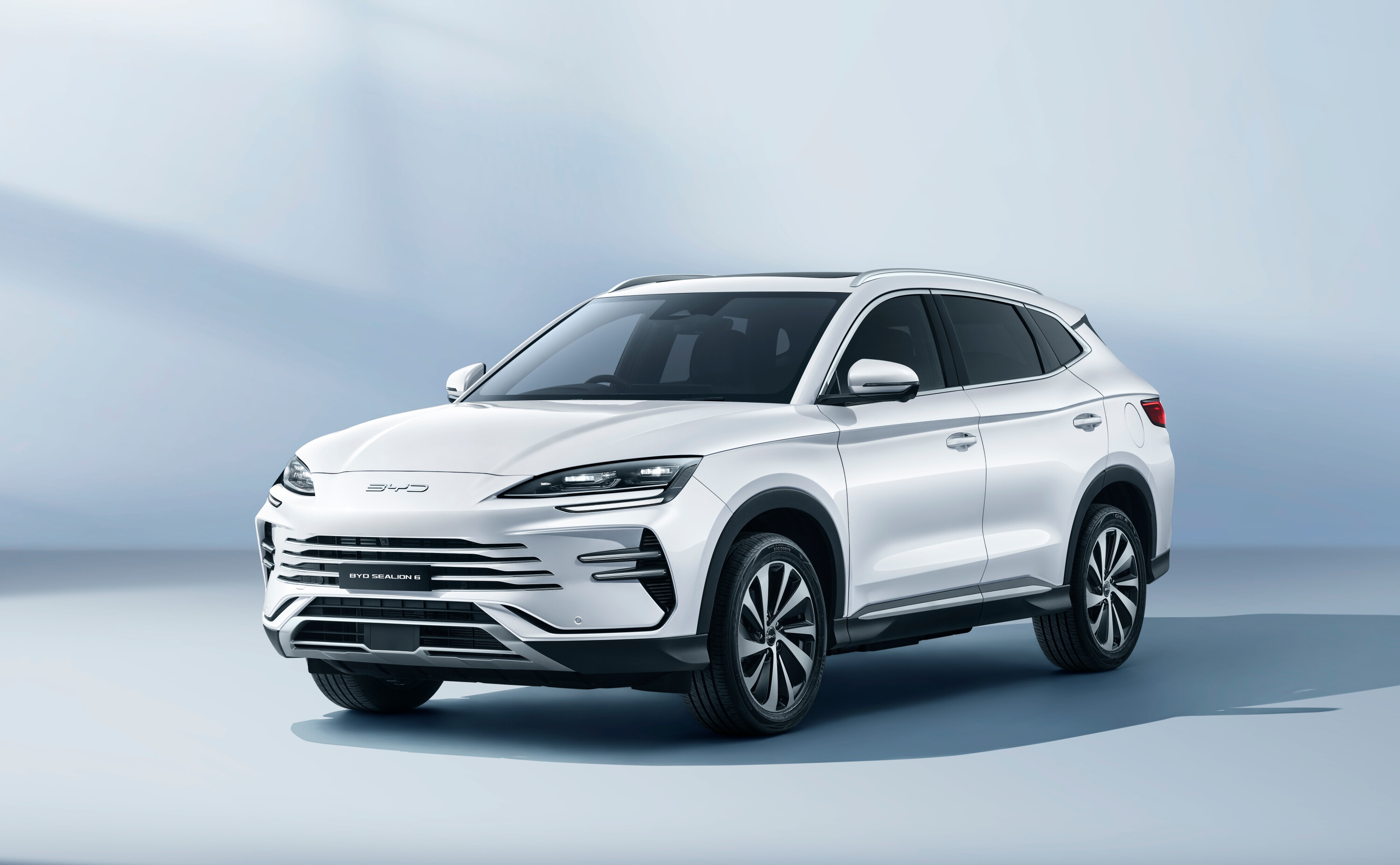
BYD Sealion 6
1
The plug-in hybrid BYD Sealion 6 is a rival to the Toyota RAV4, Mitsubishi Outlander, MG HS and Mazda CX-60, becoming the Chinese brand’s first hybrid vehicle in Australia
All versions sold in Australia are fitted with BYD’s ‘Dual-Motor Intelligent’ (DM-I) petrol-electric plug-in hybrid powertrain. It’ll be joined by the Shark PHEV ute at the start of 2025.
Mitsubishi Outlander PHEV
Available in four trims, the second-generation Mitsubishi Outlander PHEV replaces the popular outgoing version – but at a higher price point.
As before, the Outlander PHEV is powered by a 2.4-litre Atkinson-cycle petrol engine, providing peak power of 98kW (up 4kW from its predecessor).
It is assisted by a pair of electric motors on the front and rear axles – now producing 85kW and 100kW, respectively – for a total system output of 185kW and 450Nm.
Mitsubishi has equipped the latest Outlander PHEV with a 20kWh battery pack, a 45 per cent increase over the outgoing model’s 13.8kWh pack.
Along with a bigger 56-litre fuel tank (up by 11 litres), the Outlander PHEV is able to run for up to 84km in its fully-electric mode on a single charge – 54 per cent longer than the previous model.
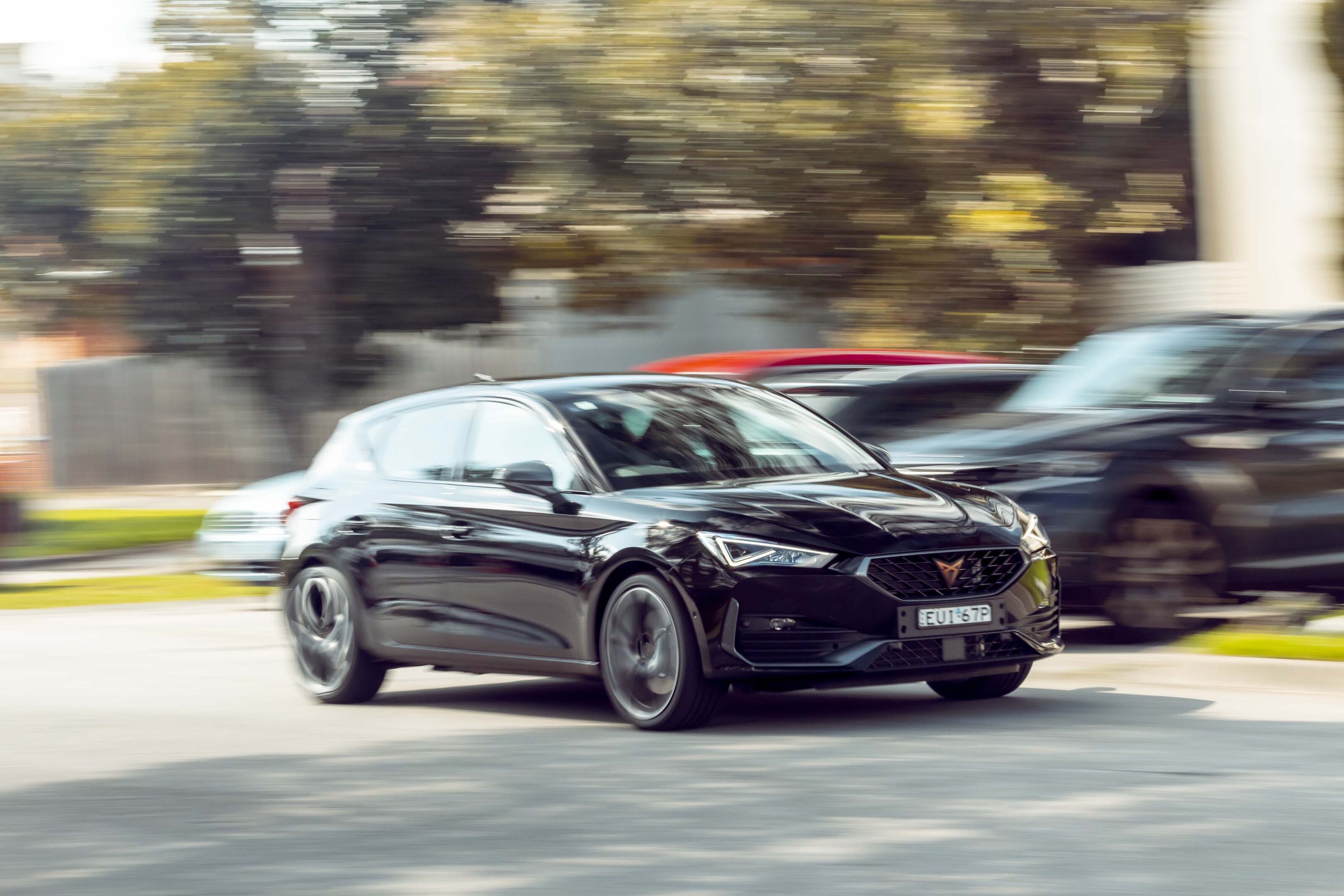
Cupra Leon VZe
1
The plug-in hybrid Cupra Leon VZe breaks convention, with a lower-capacity 1.4-litre turbo four-cylinder producing 110kW and 250Nm in conjunction with an 85kW/300Nm electric motor, producing a combined 180kW and 400Nm.
It shifts through a six-speed wet-style dual-clutch automatic transmission, with a claimed electric-only driving range of 59 kilometres.
In early 2023, Cupra Australia adjusted pricing for the Leon VZe to put it in line with the all-electric Born hatchback, but it has since risen to $61,690 plus on-roads.
Jeep Compass 4xe
The slow-selling Jeep Compass small SUV has been overhauled with a hybrid-only line-up, following a shift from Indian to Italian production for the Australian market.
Also offered with a more-affordable mild-hybrid powertrain, the Compass 4xe plug-in hybrid is available in two trim levels – Limited or Summit – from $61,990 before on-road costs.
The Compass 4xe combines a 1.3-litre turbo-petrol with a 44kW/250Nm electric motor powered by an 11.4kWh battery to deliver 176kW to all four wheels, while sipping 2.1L/100 km in hybrid mode.
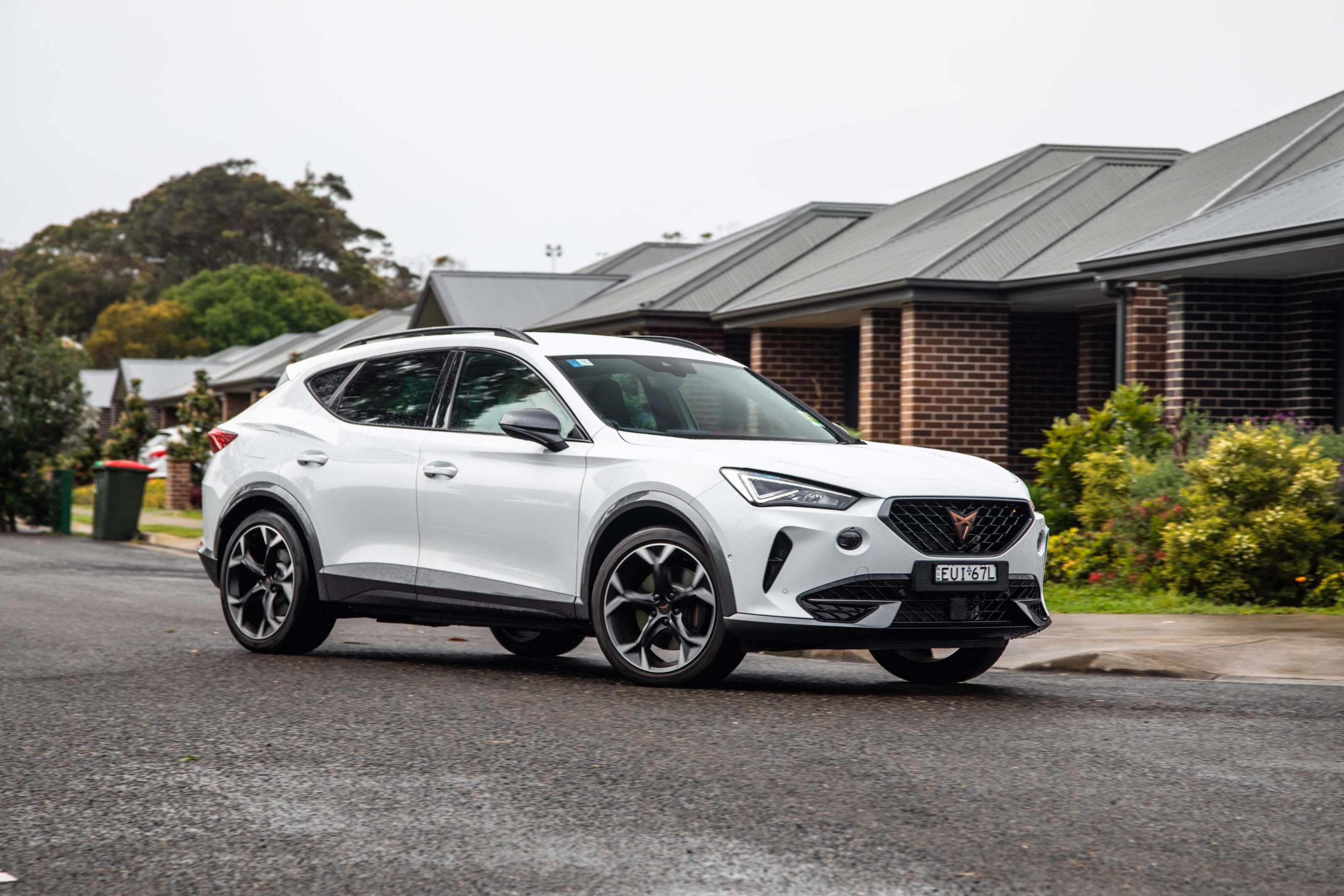
Cupra Formentor VZe
1
The Cupra Formentor VZe introduces a petrol-electric plug-in hybrid electric vehicle powertrain, comprising a 110kW/250Nm 1.4-litre turbo four-cylinder petrol engine matched to an 85kW/300Nm electric motor to deliver a combined 180kW and 400Nm.
This model is front-wheel-drive only, with a six-speed wet-style dual-clutch transmission on board.
Packing a 12.8kWh battery, shorter trips of around 50 kilometres in the Formentor VZe are an electric-only affair. Cupra claims a combined fuel consumption figure of 1.9L/100km (NEDC) with the battery charged.
Peugeot 308 GT Sport PHEV
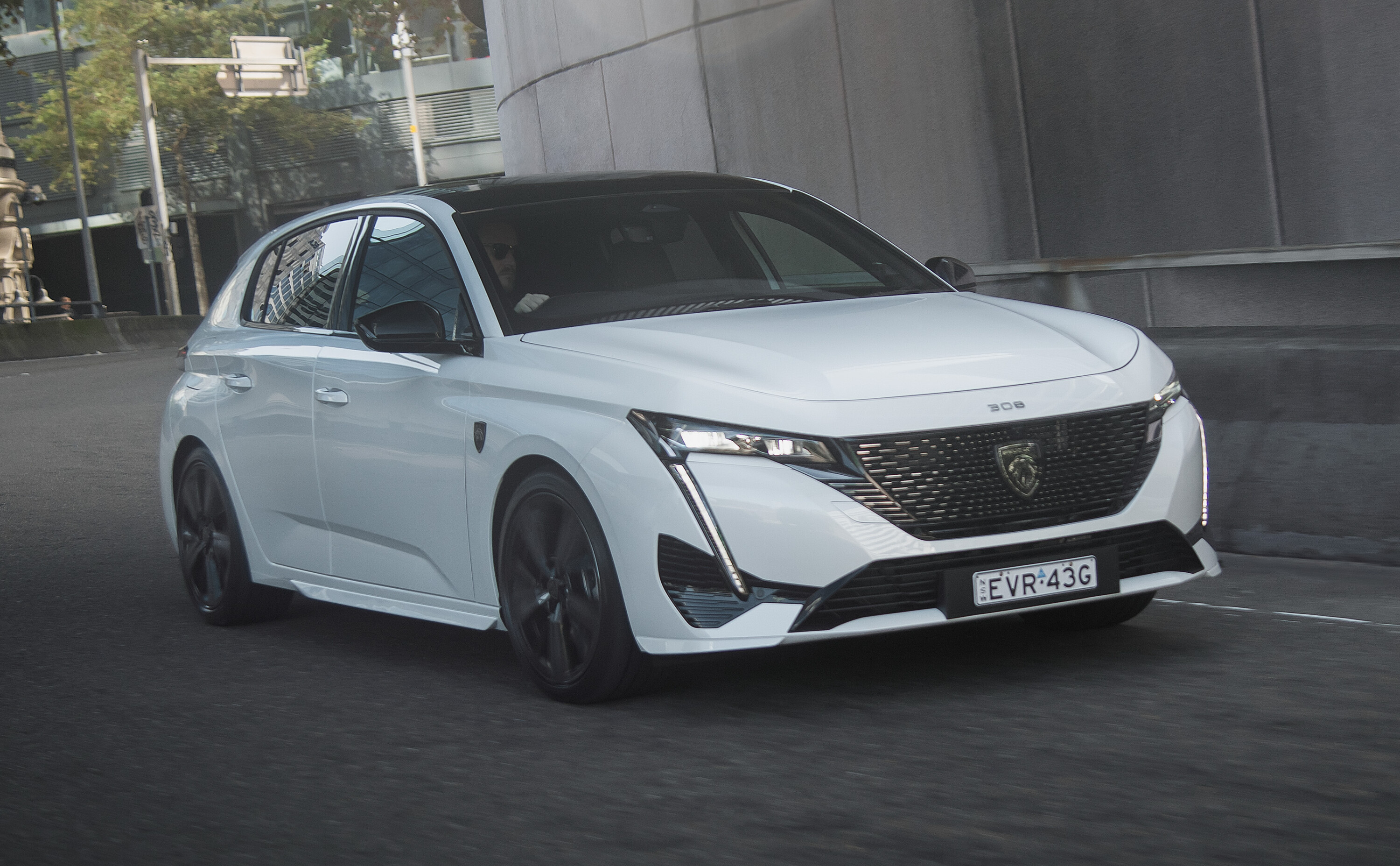
1
Joining the petrol 308 hatch and wagon, the GT Sport plug-in hybrid flagship is priced at $64,990 plus on-road costs – making it $14,500 dearer than the GT Premium wagon.
Opting for the GT Sport PHEV sees the standard three-cylinder mill replaced with a 132kW 1.6-litre turbocharged four-cylinder engine paired to an 81kW electric motor, for a 165kW and 360Nm total system output.
It has a WLTP-rated 60-kilometre electric-only driving range and a claimed combined fuel consumption of 1.3L/100km.
Peugeot 408 GT PHEV
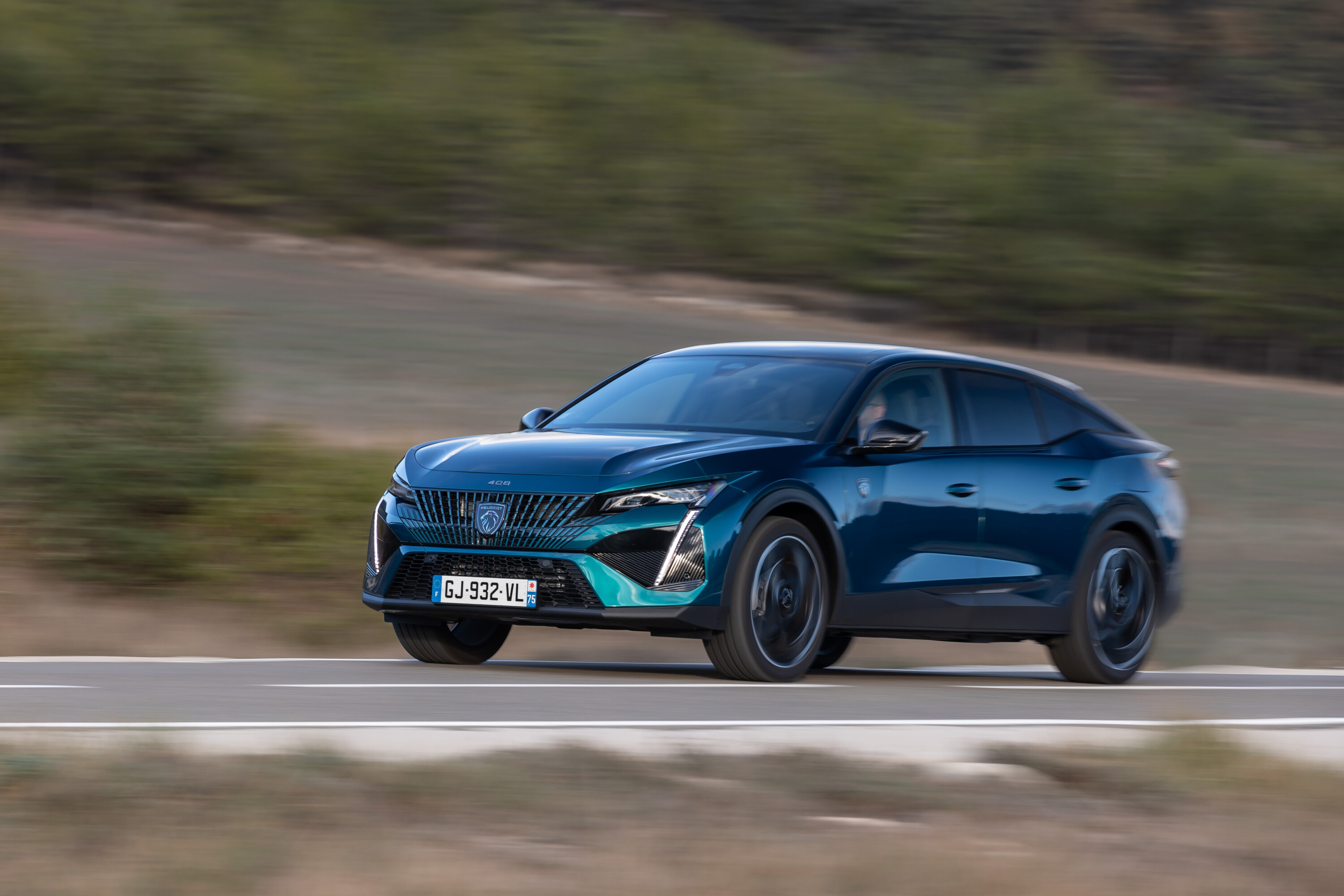
1
Heavily related to the 308 hatch and wagon, the Peugeot 408 fastback is offered in a sole GT Plug-In Hybrid spec in Australia, priced at $67,990 before on-road costs.
Combined outputs are 165kW and 360Nm, and the PHEV is quoted with a 60km electric-only WLTP driving range and official combined-cycle fuel consumption of 1.3 litres per 100km.
Mazda CX-60 PHEV
Mazda’s first plug-in hybrid, the CX-60 medium SUV, is its most powerful production vehicle yet. It combines a 2.5-litre naturally-aspirated petrol engine matched with a 129kW electric motor and a 17.8kWh lithium-ion battery, producing 241kW and 500Nm in total.
The 2023 Mazda CX-60 PHEV is available in three grades – Evolve, GT and Azami – priced from $73,600 before on-road costs.
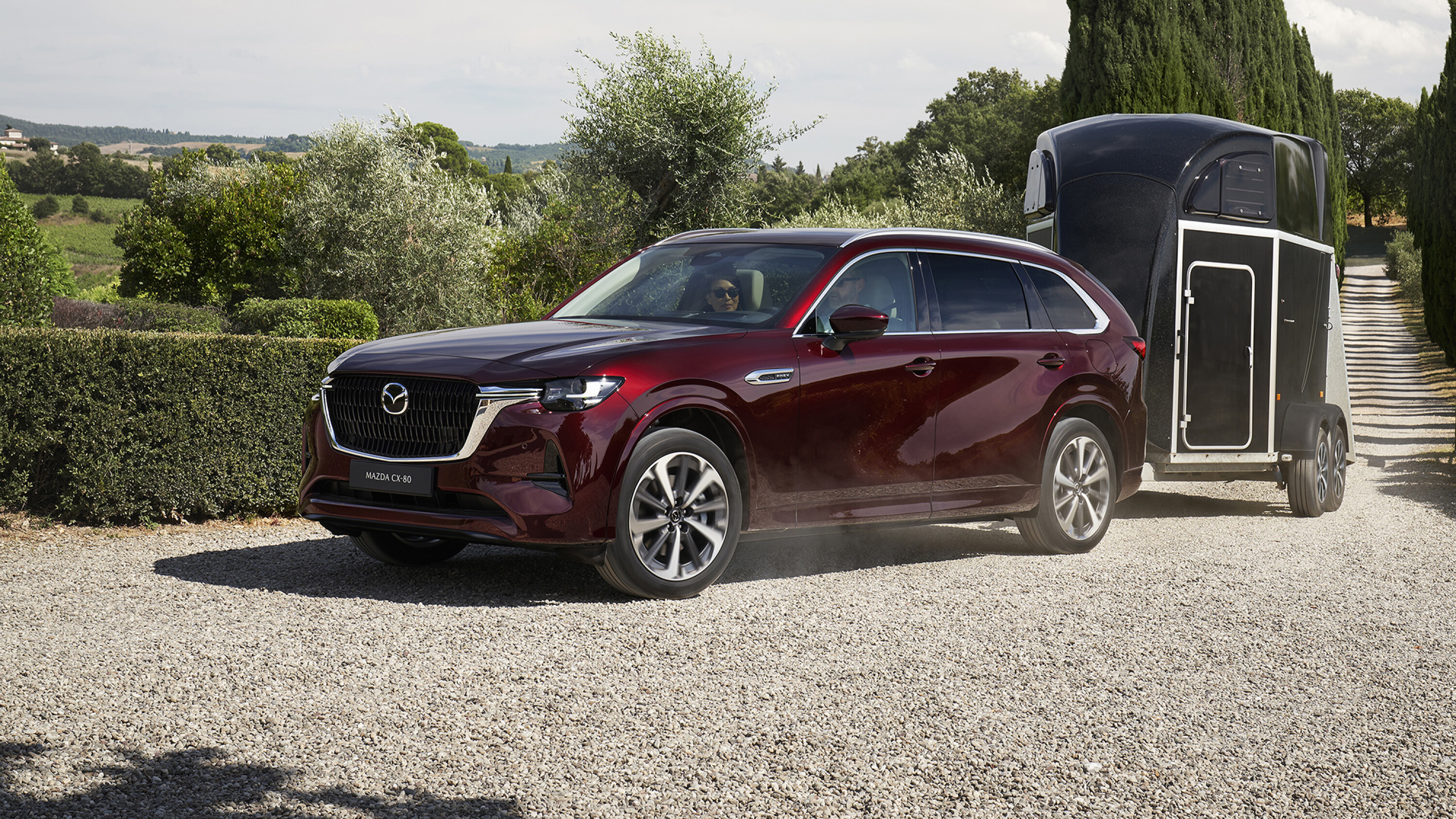
Mazda CX-80
Arriving: 2024
Alfa Romeo Tonale PHEV
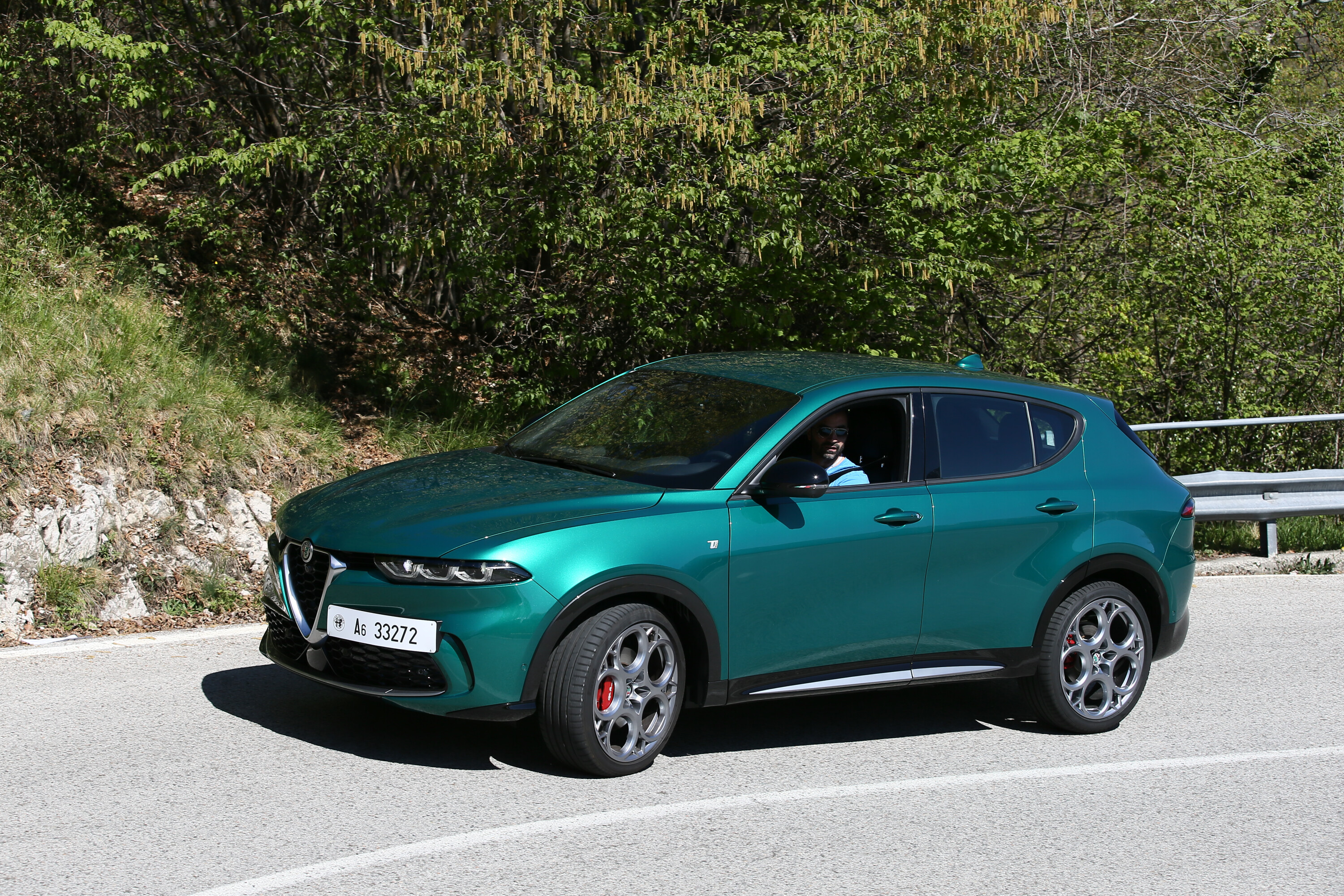
1
Badged Q4, the Alfa Romeo Tonale plug-in hybrid is priced from $78,500 before on-road costs – a $21,100 premium over the mild-hybrid Veloce.
For the added cost, the Tonale Q4 adds a more-powerful 208kW/550Nm plug-in hybrid system, an electronic all-wheel-drive system, and regenerative braking.
Kia Sorento GT-Line PHEV
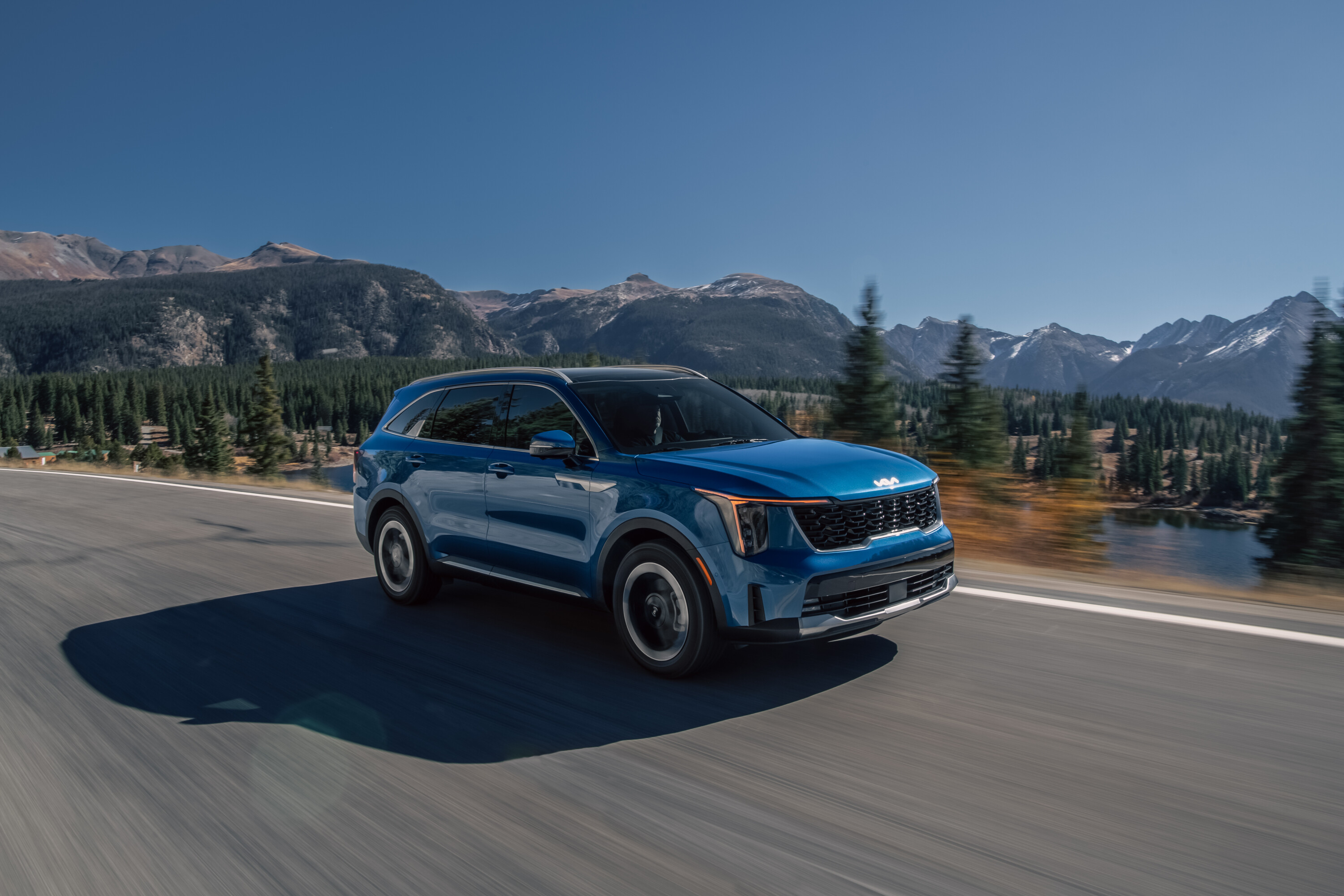
1
One of the largest plug-in hybrid vehicles on the market, the seven-seat Kia Sorento GT-Line PHEV is powered by a 1.6-litre four-cylinder turbocharged petrol engine mated to an electric motor between the internal combustion engine and gearbox – producing a combined 195kW and 350Nm.
A 14kWh lithium-ion battery allows the Sorento to achieve an electric-only driving range of up to 68km.
The Sorento PHEV has a 1.6L/100km claimed combined fuel consumption, making it one of Kia’s most efficient vehicles.
A regular hybrid Sorento launched in early 2022, joining petrol, diesel and plug-in hybrid options.
Australian details for the facelifted Sorento PHEV are due to be confirmed imminently. Supply will continue to be extremely limited for our market.
Peugeot 508 GT PHEV

1
The full name of the new 508 range-topper is the headline-unfriendly Peugeot 508 GT Plug-in Hybrid, which has an 11.8kWh battery that contributes to an electric-only driving range up to 55 kilometres.
It features a 133kW/360Nm 1.6-litre turbocharged four-cylinder petrol engine coupled with a single 81kW electric motor, for a combined 165kW system output.
Peugeot 3008 GT Sport PHEV

1
Medium SUVs have become a popular segment for PHEVs, and one of the latest on the scene is the Peugeot 3008 GT Sport AWD Plug-In Hybrid.
Interestingly, the 3008 is more powerful than the sleek 508 Fastback PHEV (see above), with its 1.6-litre turbocharged four-cylinder petrol engine linked to electric motors at each axle for a total power output of 222kW and 520Nm, resulting in a 0-100km/h time of 5.9 seconds.
It also has a larger 13.2kWh battery, which provides greater all-electric driving range.
The 3008 PHEV will be replaced by its E-3008 all-electric successor in late 2024.
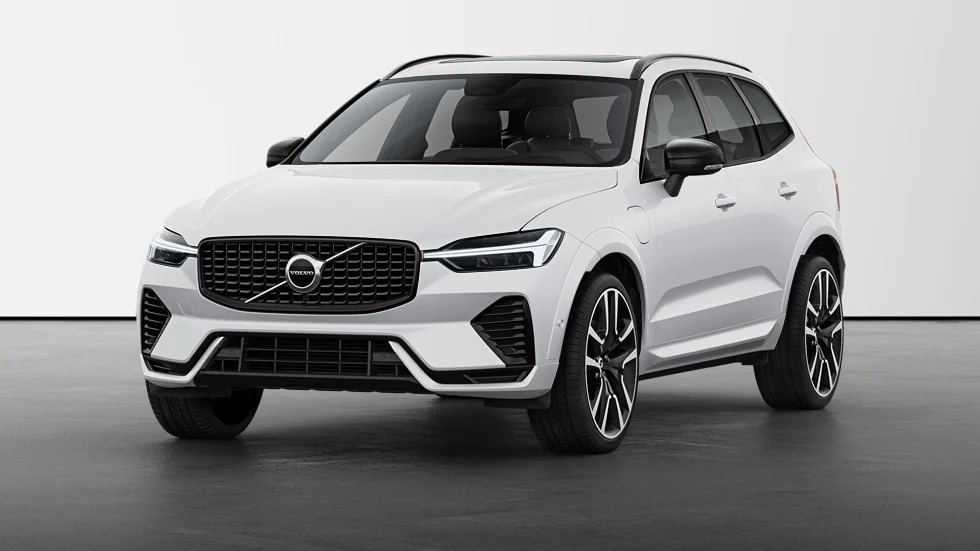
Volvo XC60 T8 Recharge
1
Volvo has dropped pure internal-combustion vehicles from Australia, with its line-up consisting of mild-hybrid, plug-in hybrid, or battery-electric vehicles.
The Volvo XC60 T8 Recharge was previously titled T8 Polestar, but that sub-brand has separated from Volvo to produce separate all-electric vehicles, including the Polestar 2.
Underneath, there is a larger 18.8kWh battery pack, allowing for a 75-kilometre electric-only driving range.
A 2.0-litre turbocharged and supercharged petrol engine works in tandem with a rear-mounted electric motor for a total system output of 335kW and 709Nm.
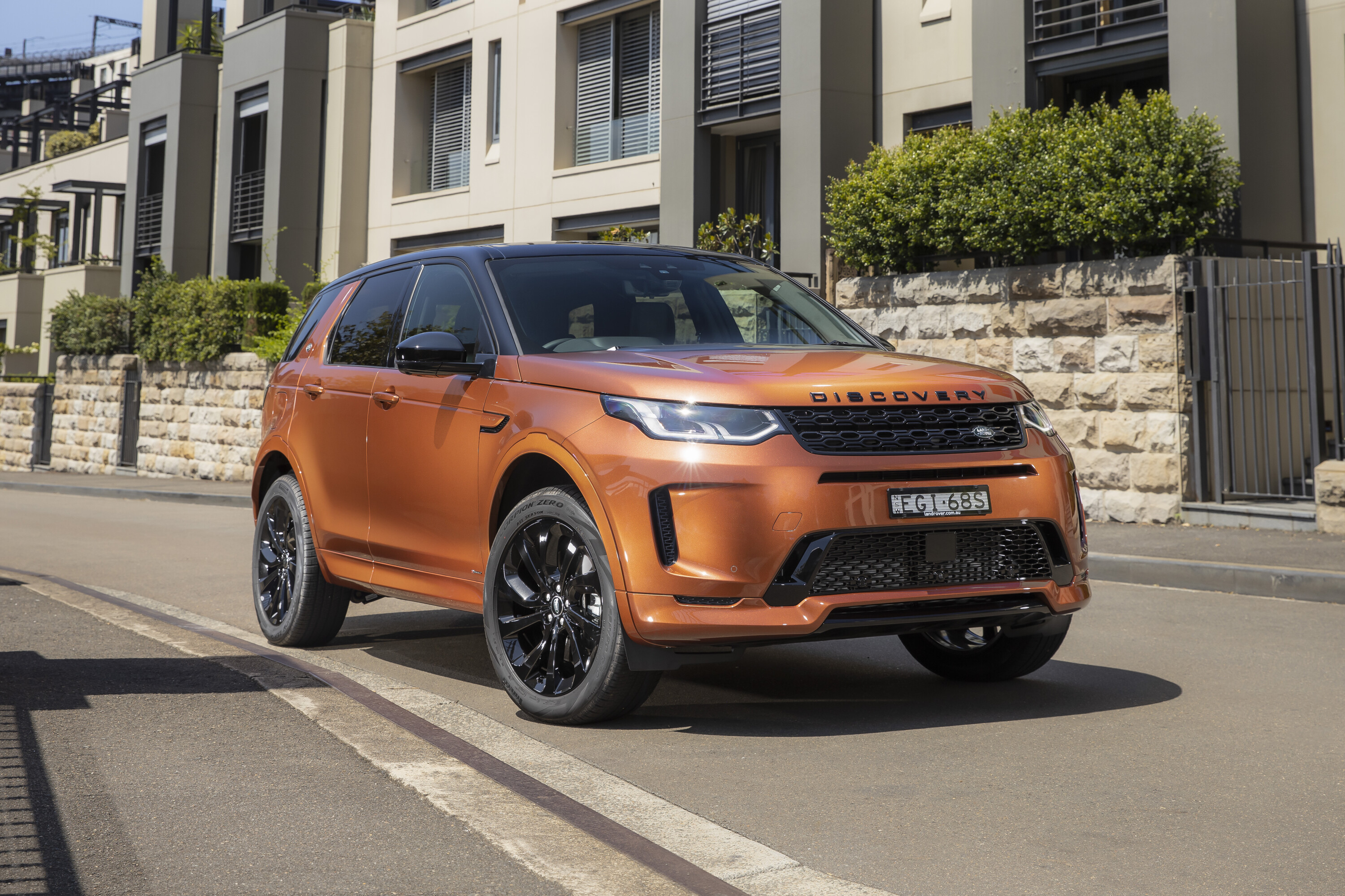
Land Rover Discovery Sport PHEV
1
The new-for-Australia Land Rover Discovery Sport plug-in hybrid employs a smaller 1.5-litre three-cylinder turbo engine paired to an electric motor, an eight-speed automatic transmission, and a 14.9kWh lithium-ion battery pack.
It has a 227kW total system output, while 0-100km/h is achieved in a claimed 6.6 seconds.
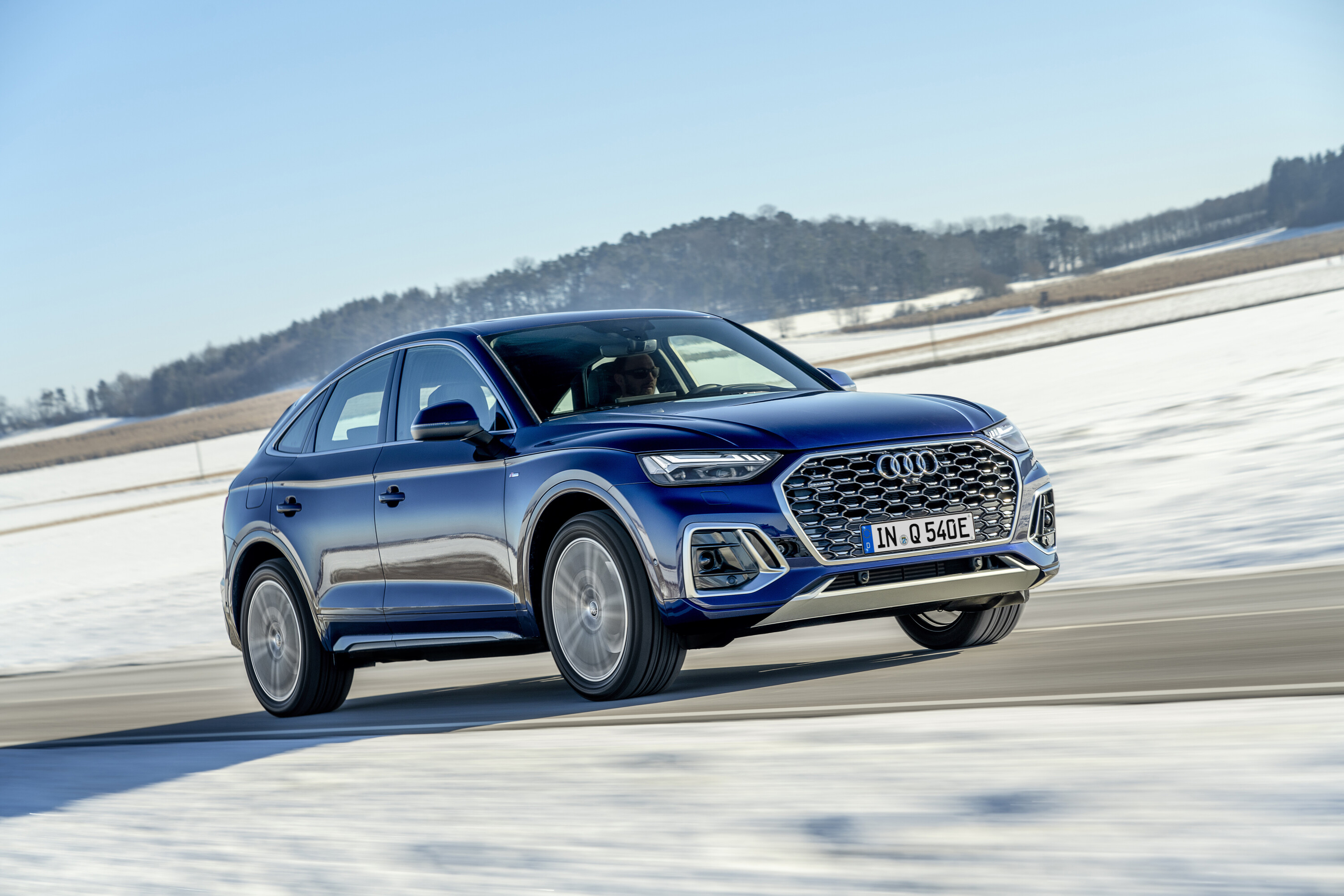
Audi Q5 55 TFSIe
1
Audi has returned to the plug-in hybrid segment in Australia with the Q5 55 TFSIe PHEV.
Offered in SUV and Sportback body styles, the Q5 55 TFSIe is positioned as a technological flagship of the line-up – thanks to its thrifty efficiency credentials and hefty performance outputs rivalling the sporty SQ5.
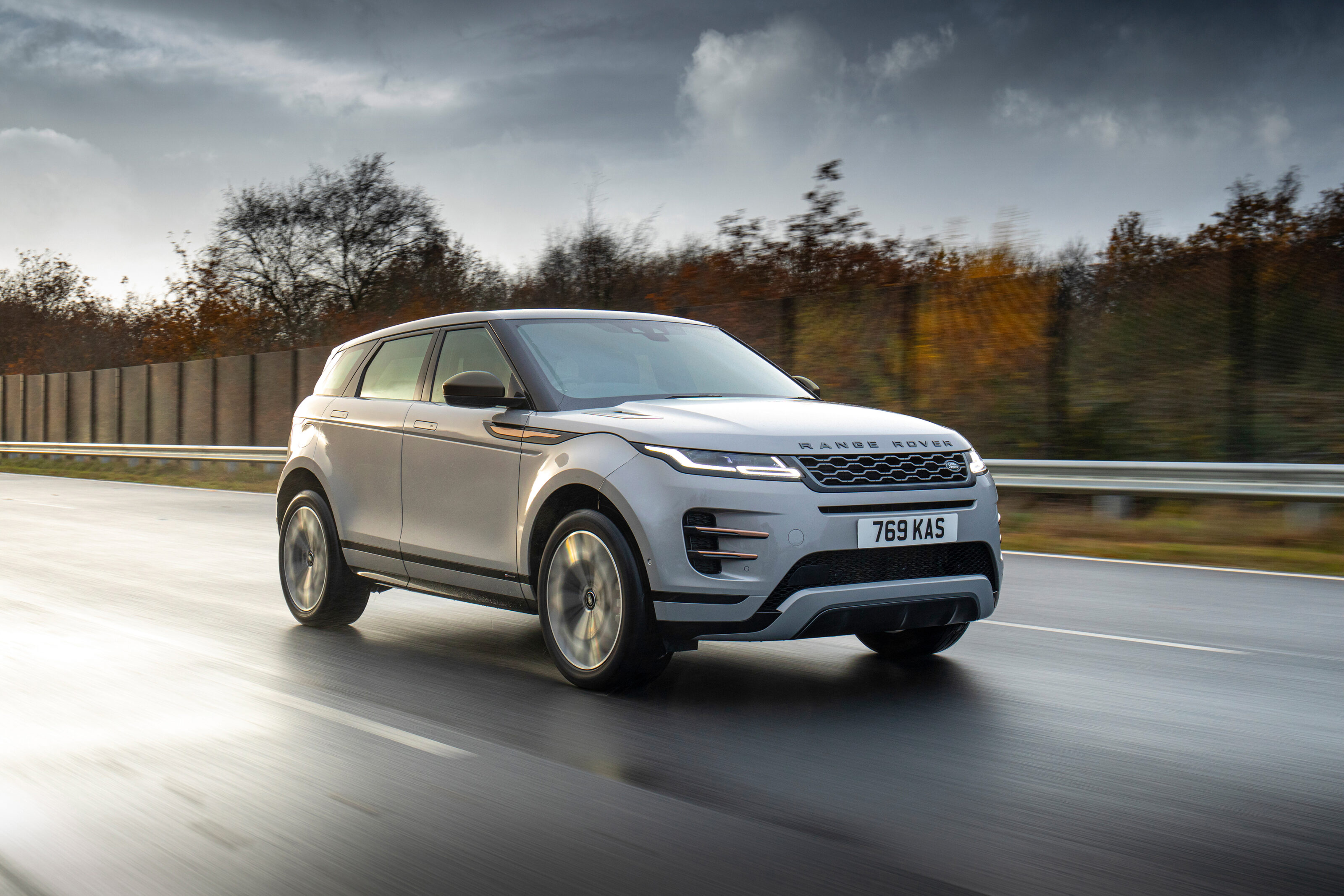
Range Rover Evoque PHEV
1
Available only in R-Dynamic HSE spec, the plug-in hybrid Range Rover Evoque medium SUV features a 1.5-litre, three-cylinder turbocharged petrol mill – Jaguar Land Rover’s lowest-displacement engine yet.
However, it is mated to an 80kW electric motor on the rear axle for a punchy combined system output of 227kW and 540Nm – an increase of 43kW and 175Nm over the internal-combustion P250 powertrain.
Located underneath the rear seats, a 15kWh lithium-ion battery assists in providing an all-electric driving range of 62 kilometres, with a WLTP-rated fuel consumption figure of 2.0L/100km.
Jeep Grand Cherokee 4xe
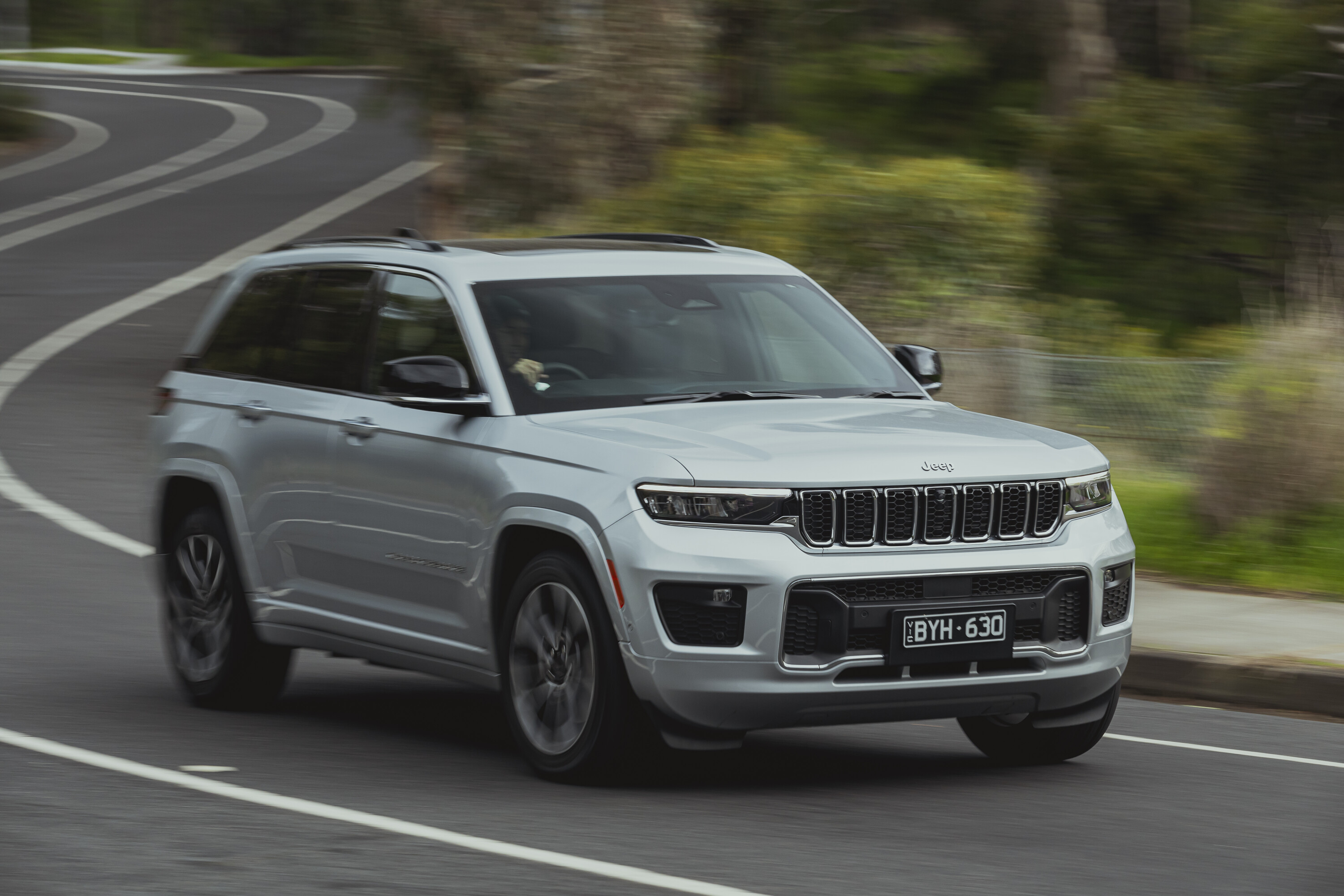
1
Off-road-focused carmaker Jeep has introduced its first plug-in hybrid SUV in Australia amid high fuel prices – but at a premium.
Initially available from $129,950 before on-road costs when it launched in mid-2023, Jeep Australia has since applied a significant $18,500 discount to all Model Year 2023 examples (no MY24 models have arrived in Oz) – taking it down to $111,450 plus on-roads.
Exclusively offered in short-wheelbase, five-seat guise, the Grand Cherokee PHEV combines a 2.0-litre turbocharged four-cylinder petrol engine with two electric motors for a 280kW and 637Nm total system output.
BMW X3 xDrive30e
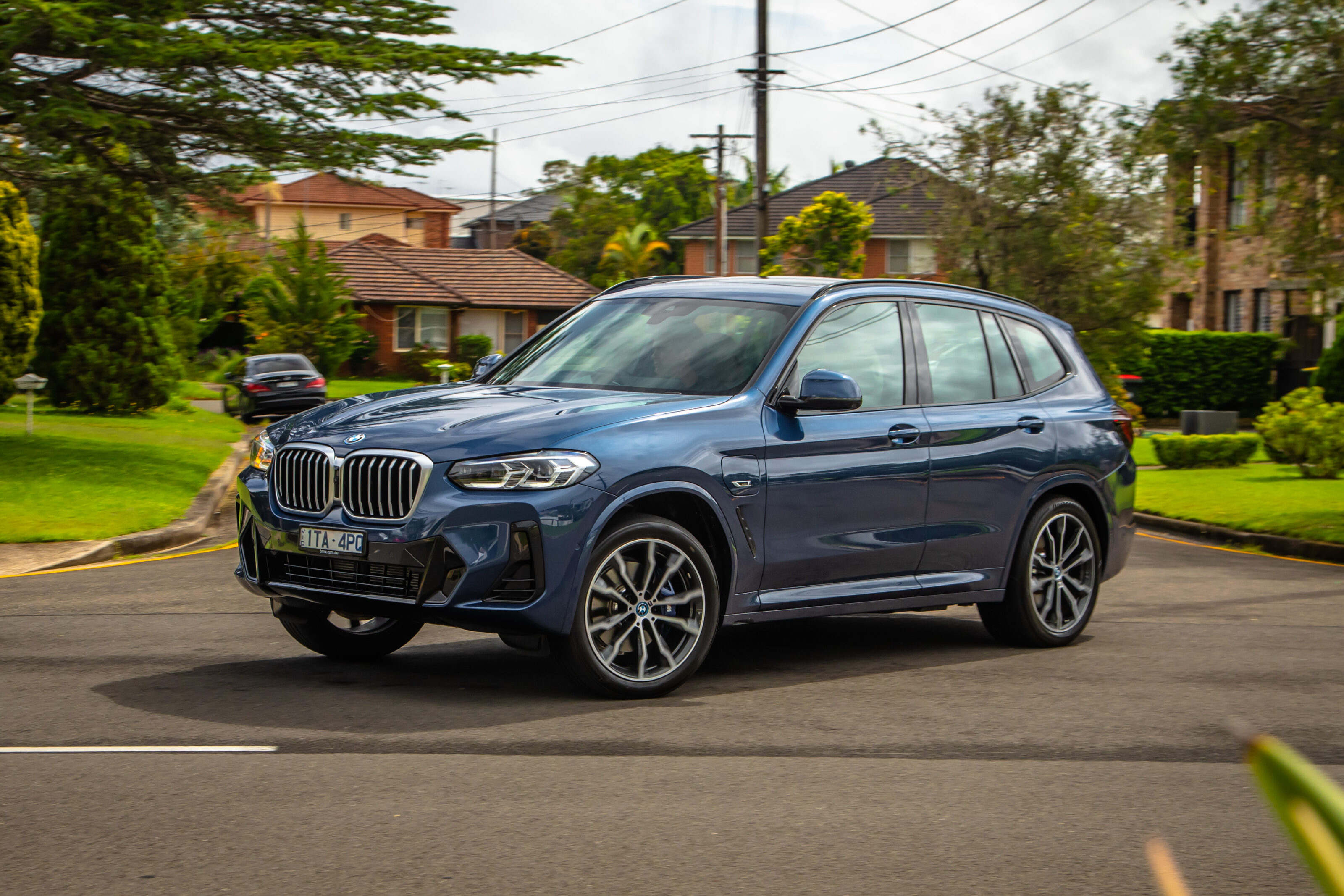
1
The BMW X3 xDrive30e is a plug-in hybrid alternative to the all-electric iX3, meaning it can be charged at home and driven about 41 kilometres using its 12kWh battery alone.
After that, a 2.0-litre turbo-petrol four-cylinder takes over for a more conventional driving experience.
With 215kW of power and 420Nm of torque, the X3 xDrive30e is the powerful combustion-powered X3 without straying into the coveted M family, completing the zero to 100km/h dash in 6.1 seconds.
Land Rover Defender PHEV
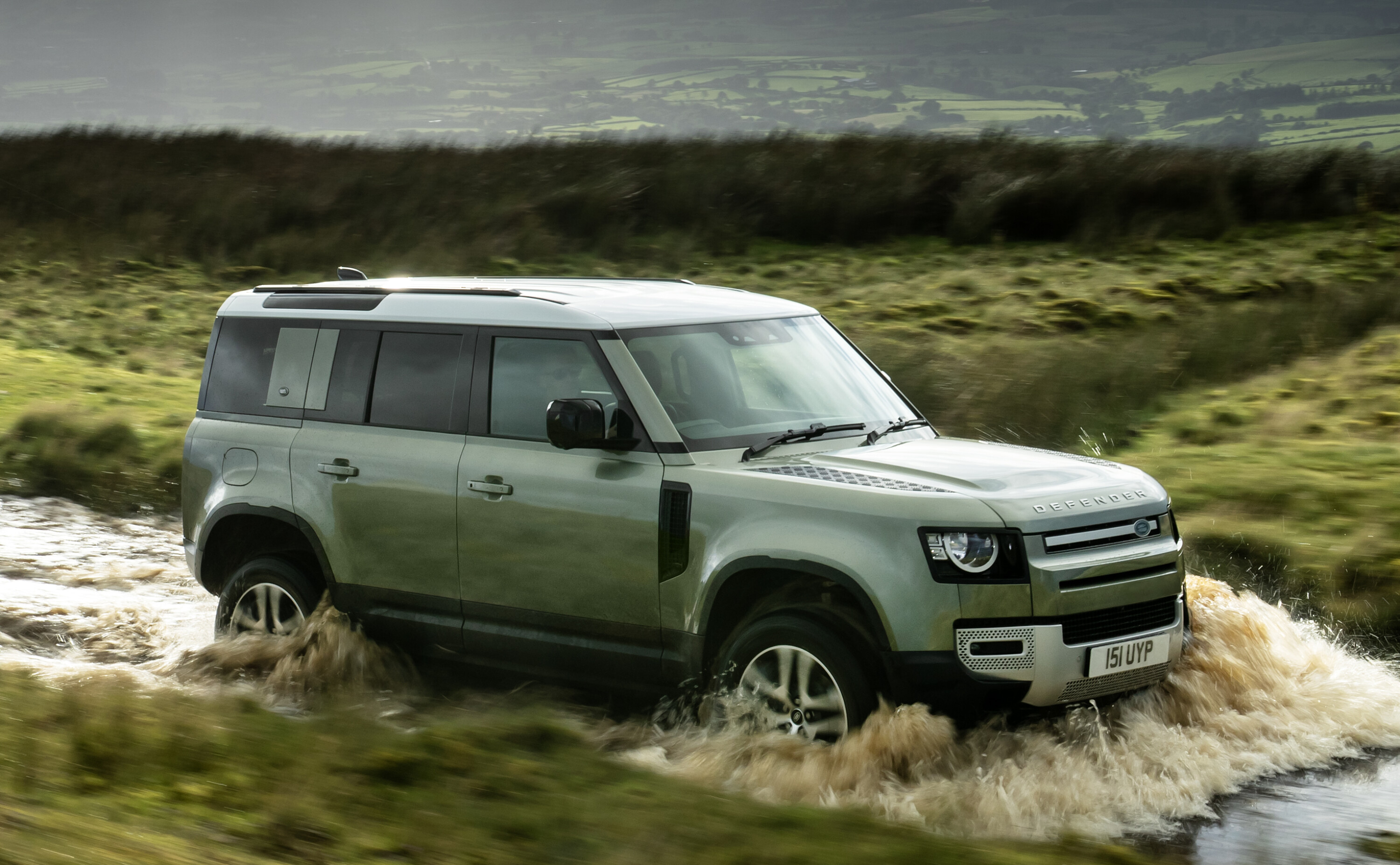
1
The Defender 110 P400e plug-in hybrid is now available to order.
The plug-in hybrid P400e, available exclusively for the Defender 110, sees the 2.0-litre turbo-four petrol matched with a 105kW electric motor, for a 297kW and 640Nm total system output.
It has a 19.2kWh lithium-ion battery, with a WLTP-rated 52-kilometre all-electric driving range. Land Rover claims the Defender 110 P400e will complete the 0-100km/h sprint in 5.9 seconds.
Volvo XC90 T8 Recharge
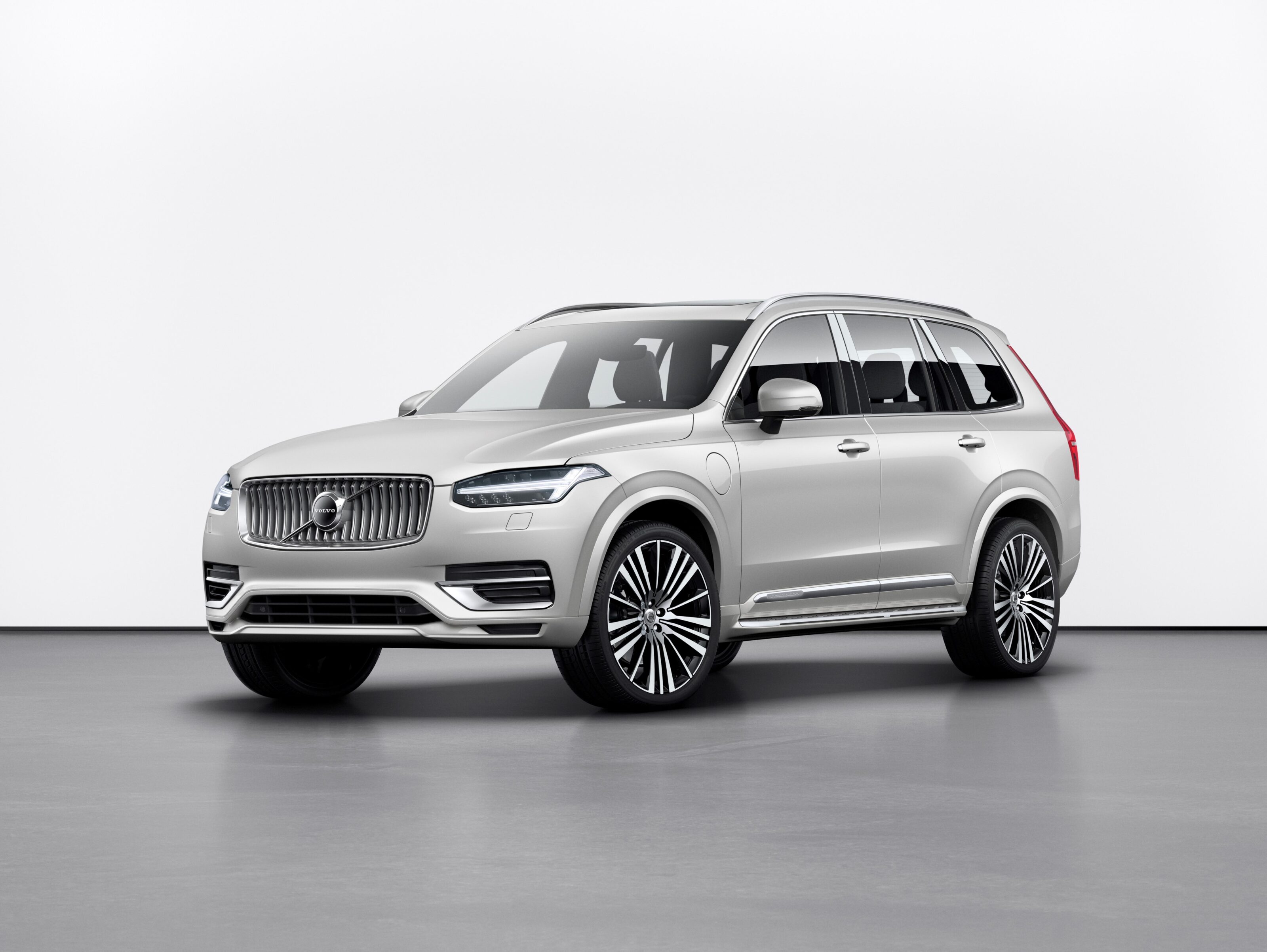
1
The larger Volvo XC90 T8 Recharge shares its plug-in hybrid powertrain with the XC60, including its 335kW and 709Nm outputs and 18.8kWh battery.
Volvo claims the XC90 T8 Recharge will complete the 0-100km/h run in 5.4 seconds, with a 68-kilometre WLTP-rated electric-only driving range – up from 48 km in the outgoing XC90 T8.
Volkswagen Touareg R
VW Australia’s first ever plug-in hybrid costs $129,900 before on-road costs and arrives as the German brand’s most powerful production vehicle yet.
The Volkswagen Touareg R features a 3.0-litre turbo-petrol V6 plug-in hybrid powertrain with 340kW and 700Nm. That’s enough to rocket the big SUV 0-100km/h in a claimed 5.1 seconds yet still achieve 3.1L/100km in the ADR combined efficiency cycle.
Range Rover Velar

1
The Range Rover Velar P400e is one of five Land Rover plug-in hybrids to arrive in Australia recently – including the Evoque, Defender, Range Rover Sport and full-size Range Rover.
It pairs a 2.0-litre turbocharged four-cylinder petrol engine with a 105kW electric motor, producing 297kW of power and 640Nm of torque in total.
A 19.2kWh battery pack assists in enabling a WLTP-rated electric-only driving range of 69 kilometres, while Land Rover claims the all-wheel-drive Velar PHEV will complete the 0-100km/h sprint in 5.4 seconds.
It is paired with an eight-speed automatic transmission.
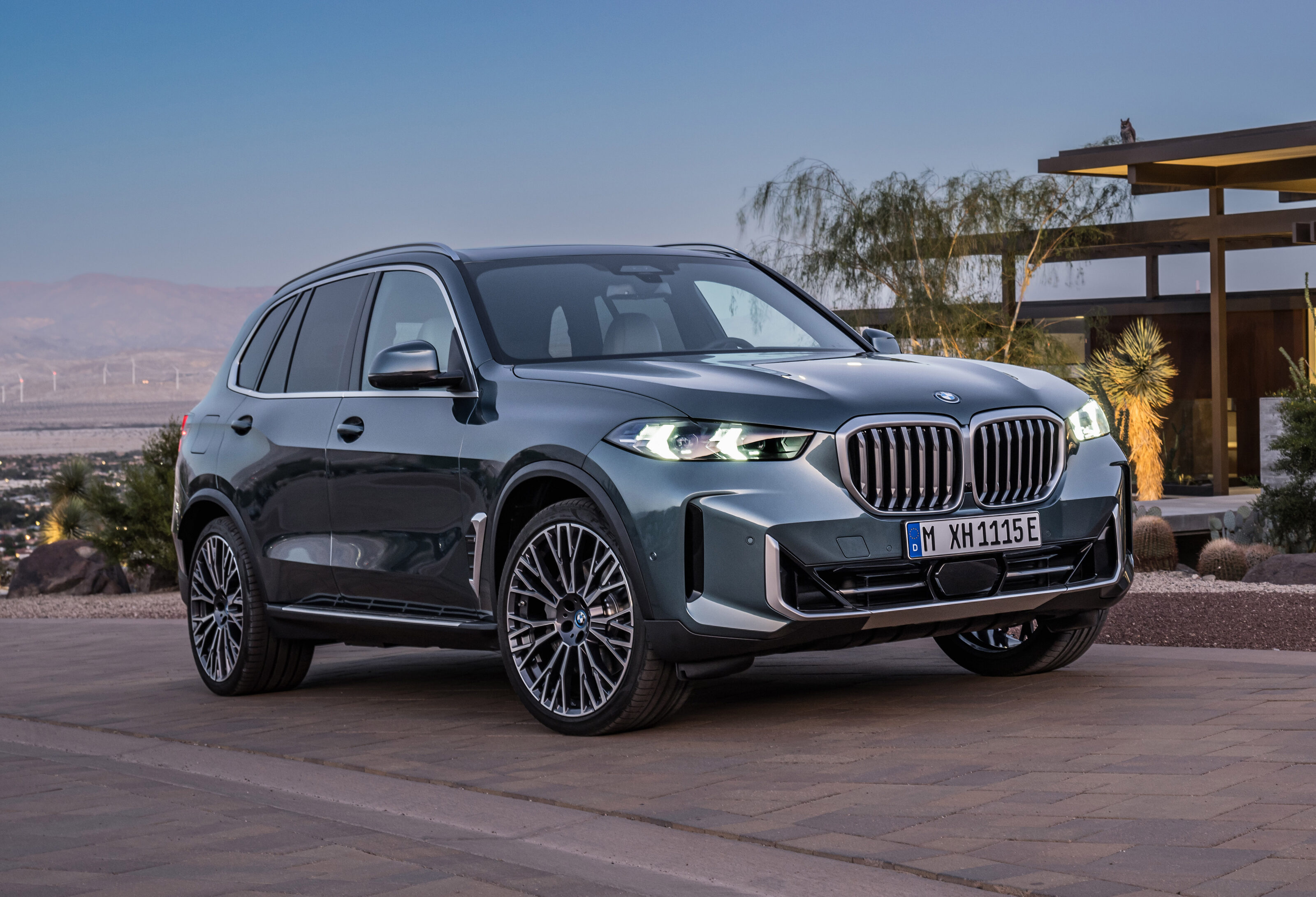
BMW X5 xDrive50e
1
The BMW X5 xDrive50e M Sport plug-in hybrid large SUV combines two electric motors and a turbocharged 3.0-litre six-cylinder petrol engine.
With 360kW of power and 700Nm of torque in total, the X5 xDrive50e can accelerate from 0-100km/h in a brisk 4.8 seconds.
Despite the addition of plug-in hybrid technology, including a 25.7kWh battery pack, the X5’s 3500-kilogram towing capacity is retained.
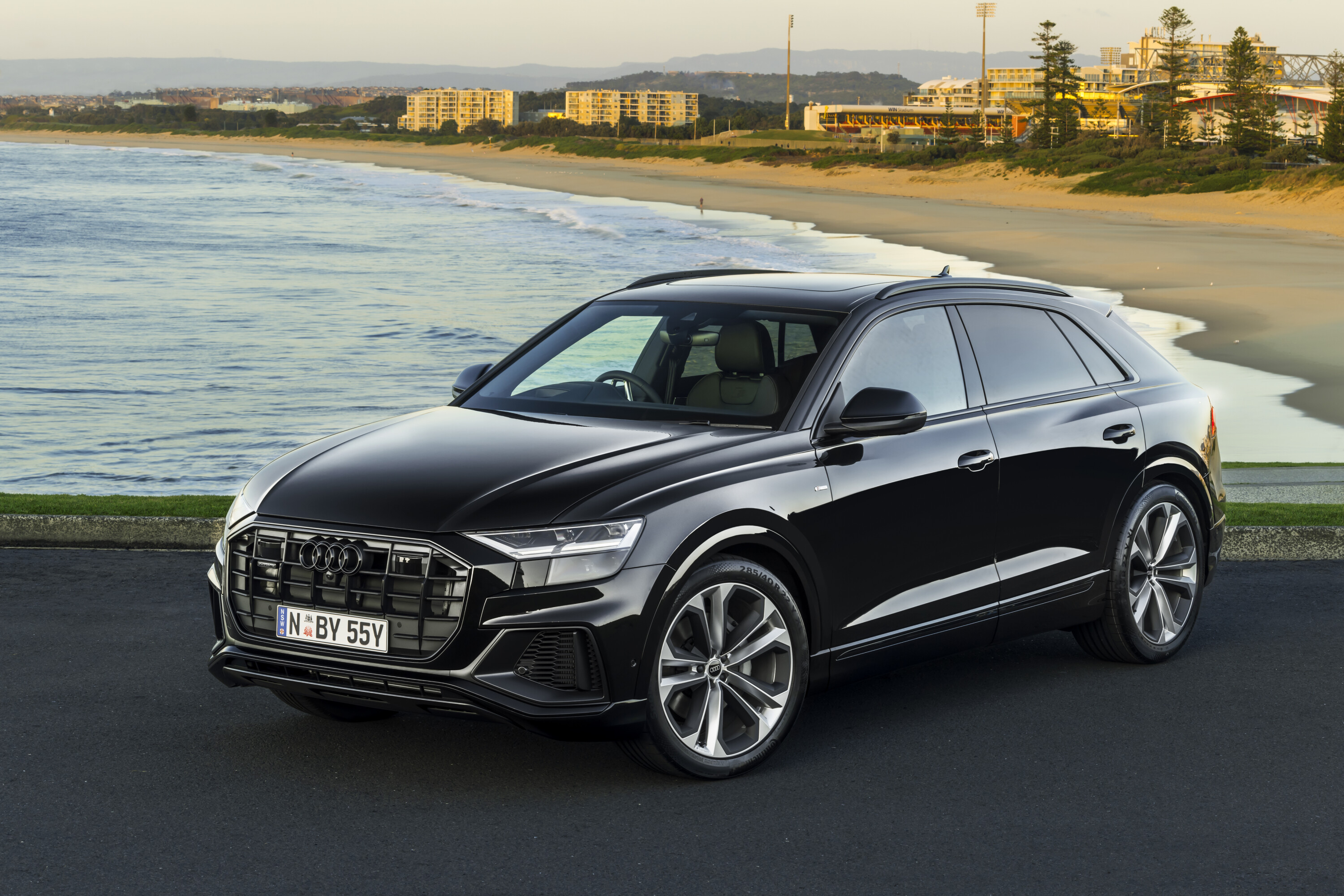
Audi Q8 60 TSFIe
1
The Audi Q8 60 TSFIe shares its 3.0-litre turbocharged V6 plug-in hybrid powertrain with the Volkswagen Touareg R and Porsche Cayenne E-Hybrid.
In total, the Q8 60 TSFIe produces 340kW and 700Nm – identical to the Porsche and Volkswagen – enabling a 5.4-second 0-100km/h sprint time. With a 17.9kWh battery, it has a 59-kilometre all-electric driving range on the less-stringent NEDC test cycle.
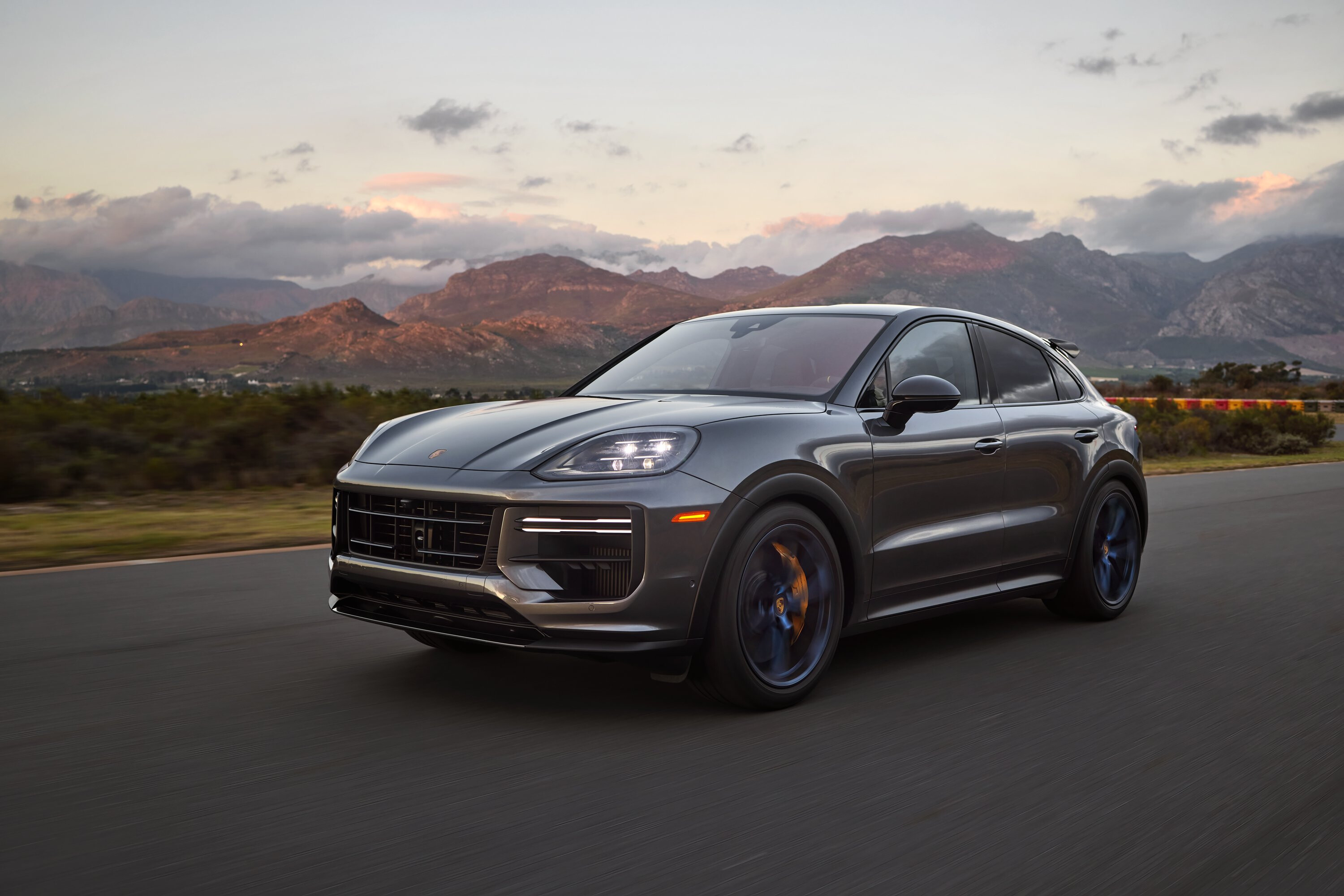
Porsche Cayenne
1
The plug-in hybrid Porsche Cayenne variant uses the entry-level 3.0-litre turbocharged V6 petrol engine, eight-speed automatic transmission, and four-wheel-drive system as its basis.
It then adds a 130kW electric motor slotted between the engine and gearbox, a 25.9kWh lithium-ion battery in the boot and a charging socket.
Cayenne E-Hybrid
Cayenne Turbo E-Hybrid
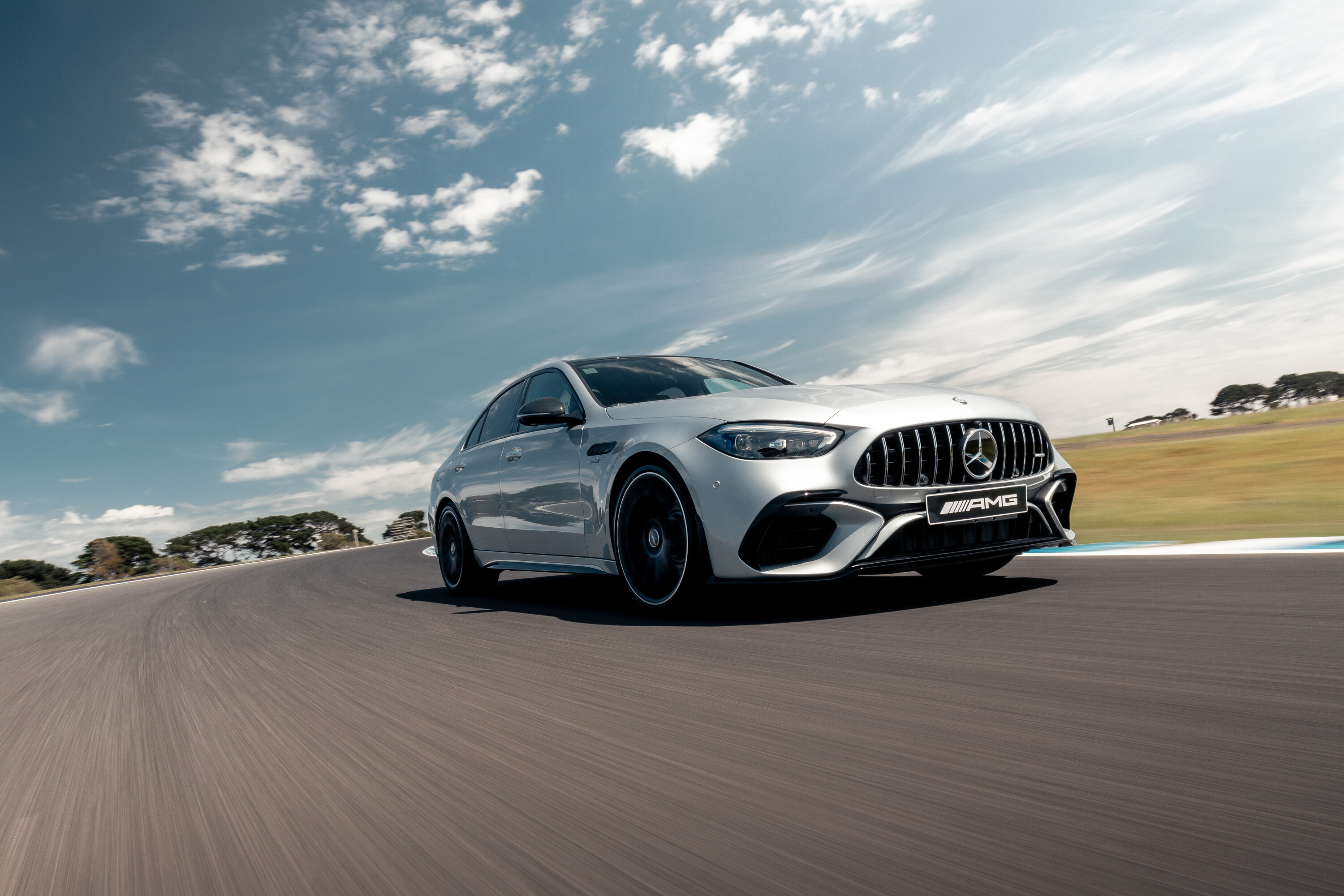
Mercedes-AMG C63 S E-Performance
1
This latest high-performance C-Class model from Mercedes-AMG is one of its most controversial, as it features a four-cylinder plug-in hybrid engine – which starts up silently – instead of the thumping V8 engine used in previous C63 generations.
The combustion powertrain is an upgraded version of the M139 unit found in the A45 S and C43, which itself can produce 350kW/545Nm, making it the world’s most powerful four-cylinder engine.
The ‘P3’ hybrid system includes a 6.1kWh battery and an electronic drive unit similar to the GT 63 S E-Performance 4-Door, which combines an e-motor with its own two-speed gearbox and an electronically controlled limited-slip differential mounted above the rear axle.
In total, the C63 S E-Performance produces 500kW and 1020Nm, a 125kW and 320Nm improvement over its predecessor. It also surpasses its BMW M3 Competition, Audi RS4 and Alfa Romeo Giulia Quadrifoglio rivals.
Range Rover Sport

1
Replacing the outgoing Range Rover Sport plug-in hybrid, the new-generation version was available in P510e guise, but it has been replaced by two new, more-affordable P460e varants.
The plug-in hybrid system comprises a 3.0-litre turbocharged straight-six petrol engine mated to a 160kW electric motor, allowing for a combined 338kW system output.
Features unique to the Range Rover Sport plug-in hybrid include; a twin-speed high/low range transfer box, all-wheel steering, an electronic active differential with torque vectoring, and a standard public charging cable.
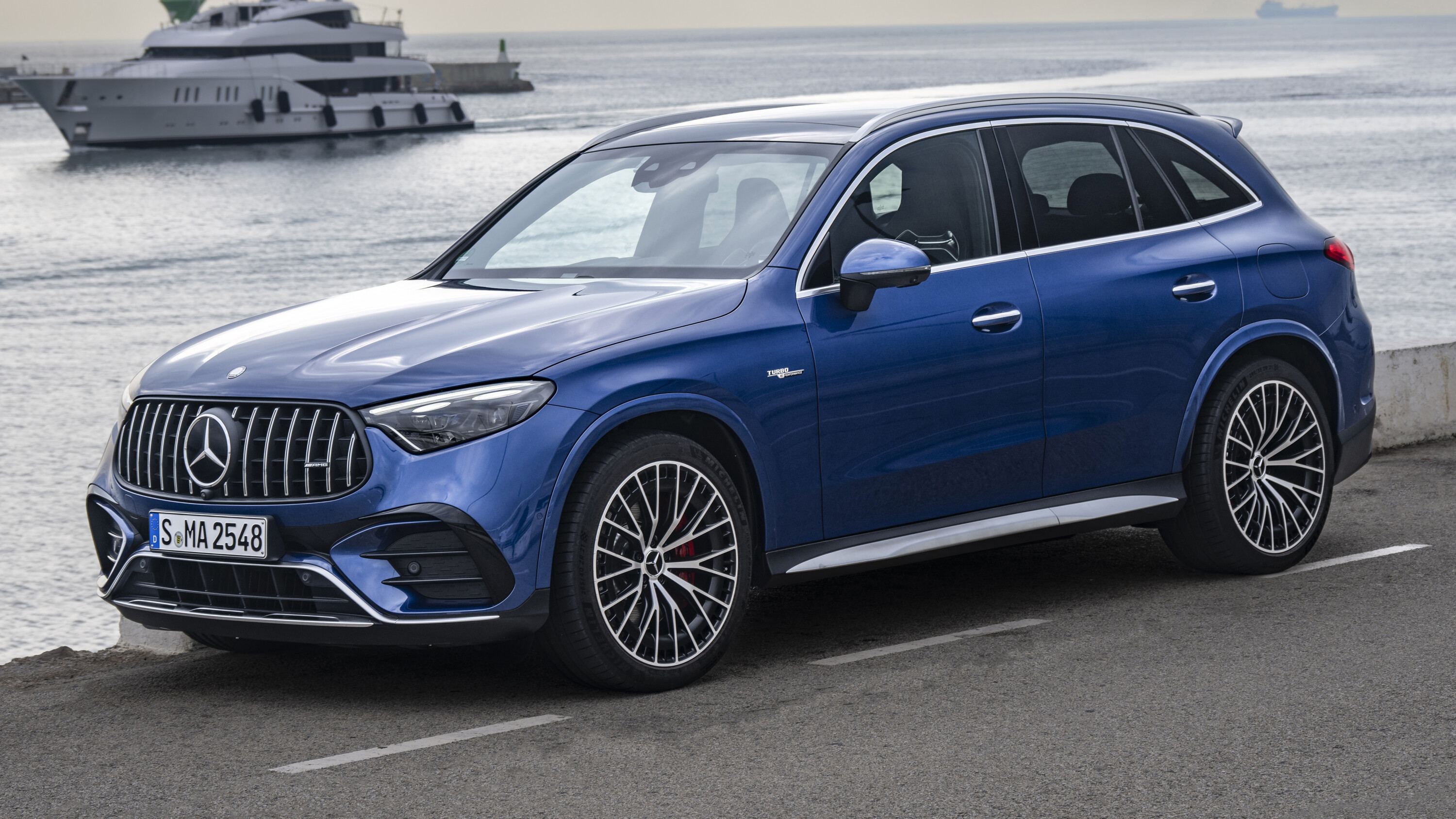
Mercedes-AMG GLC 63 S E-Performance
1
Like its C63 S E-Performance sibling, the newest Mercedes-AMG GLC 63 S E-Performance replaces its big V8 for a four-cylinder plug-in hybrid setup.
When combined with the output from a permanently excited synchronous electric motor, total output is 500kW and 1020Nm.
Acceleration to 100km/h takes 3.5 seconds and top speed is 275km/h.
Range Rover
1
A sole plug-in hybrid powertrain is available for the new full-size Range Rover in Australia.
The P460e, available in SWB and LWB form, pairs the existing 3.0-litre inline-six with an electric motor for a 338kW total system output.
A more-powerful P510e powertrain – bumping outputs to 375kW and 700Nm – is no longer available in Australia.
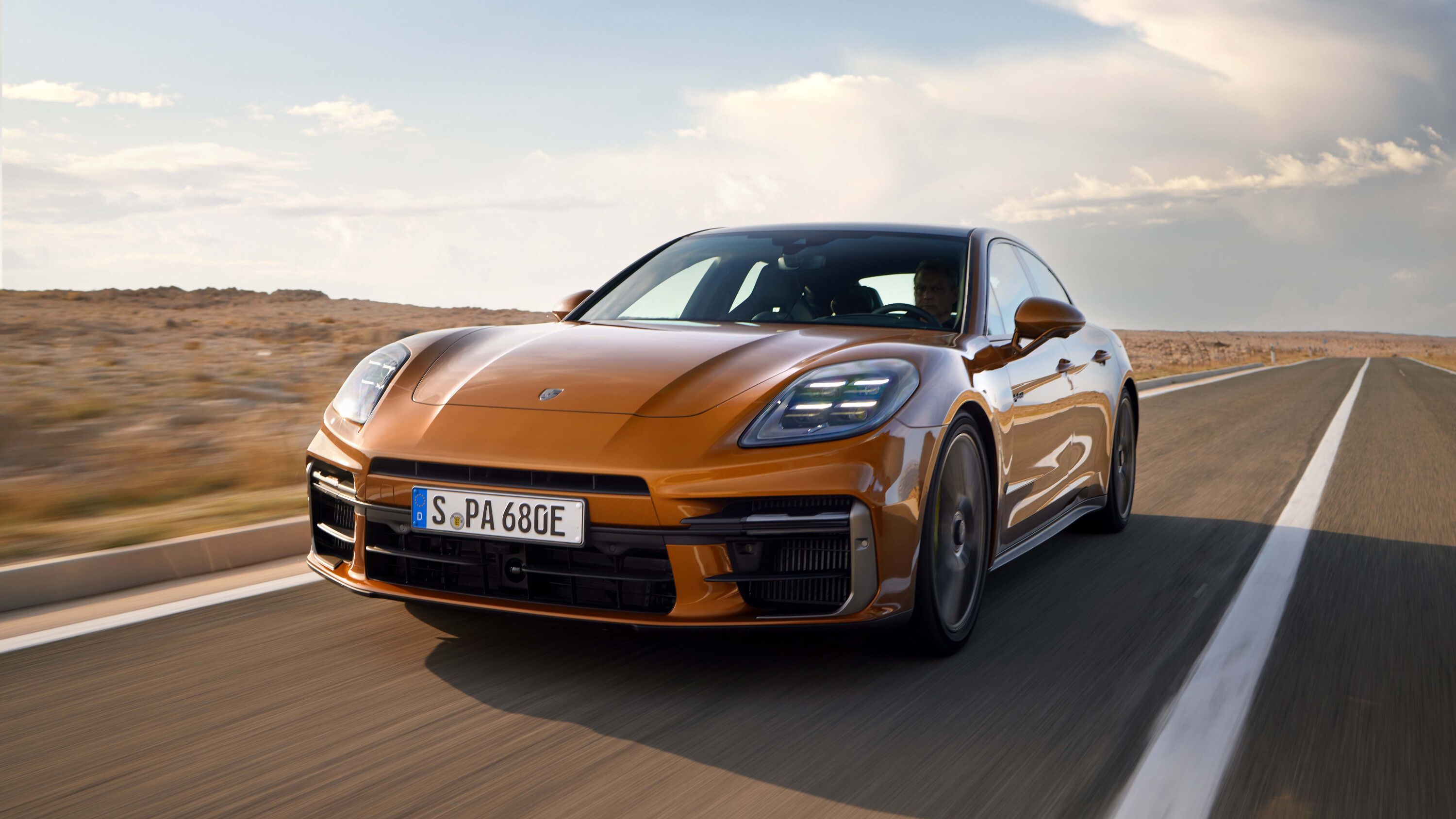
Porsche Panamera
1
The Porsche Panamera 4 E-Hybrid (the 4 stands four-wheel-drive) features an all-Porsche powertrain including a 224kW 2.9-litre twin-turbo V6 engine and 140kW electric motor.
When fully charged, it has an all-electric driving range of 96 kilometres.
For the flagship Panamera Turbo E-Hybrid, a plug-in hybrid with a turbocharged V8 engine seems like an oxymoron, but that doesn’t matter when driving on battery power alone for up to 91 kilometres.
When combined, the Panamera’s acceleration is blistering, with all-wheel-drive traction and a combined 930Nm of torque, allowing the big limo to hit 100km/h from a standing start in just 3.2 seconds.
Panamera 4 E-Hybrid
Panamera 4S E-Hybrid
Panamera Turbo E-Hybrid
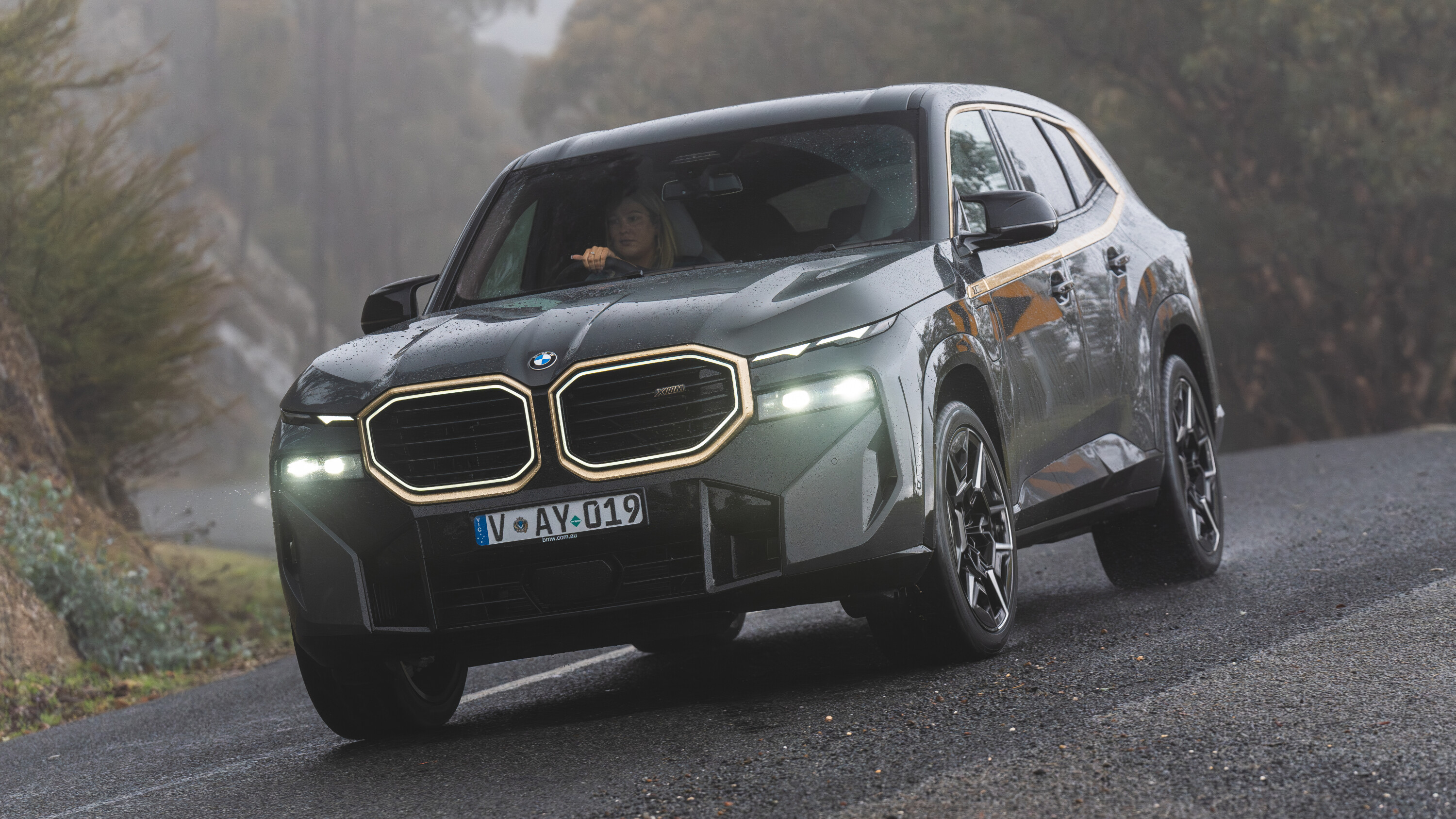
BMW XM
1
The XM represents the first standalone model since the M1 supercar, and marking the performance specialist’s initial steps towards electrification by introducing the very first plug-in hybrid powertrain to the M-badged fraternity.
It’s a huge asking price, but with 480kW and 800Nm through a 4.4-litre turbocharged V8 matched to an electric plug-in hybrid system – and a 0-100km/h time of just 4.3 seconds – BMW appears confident it’ll find willing buyers.
Bentley Bentayga Hybrid
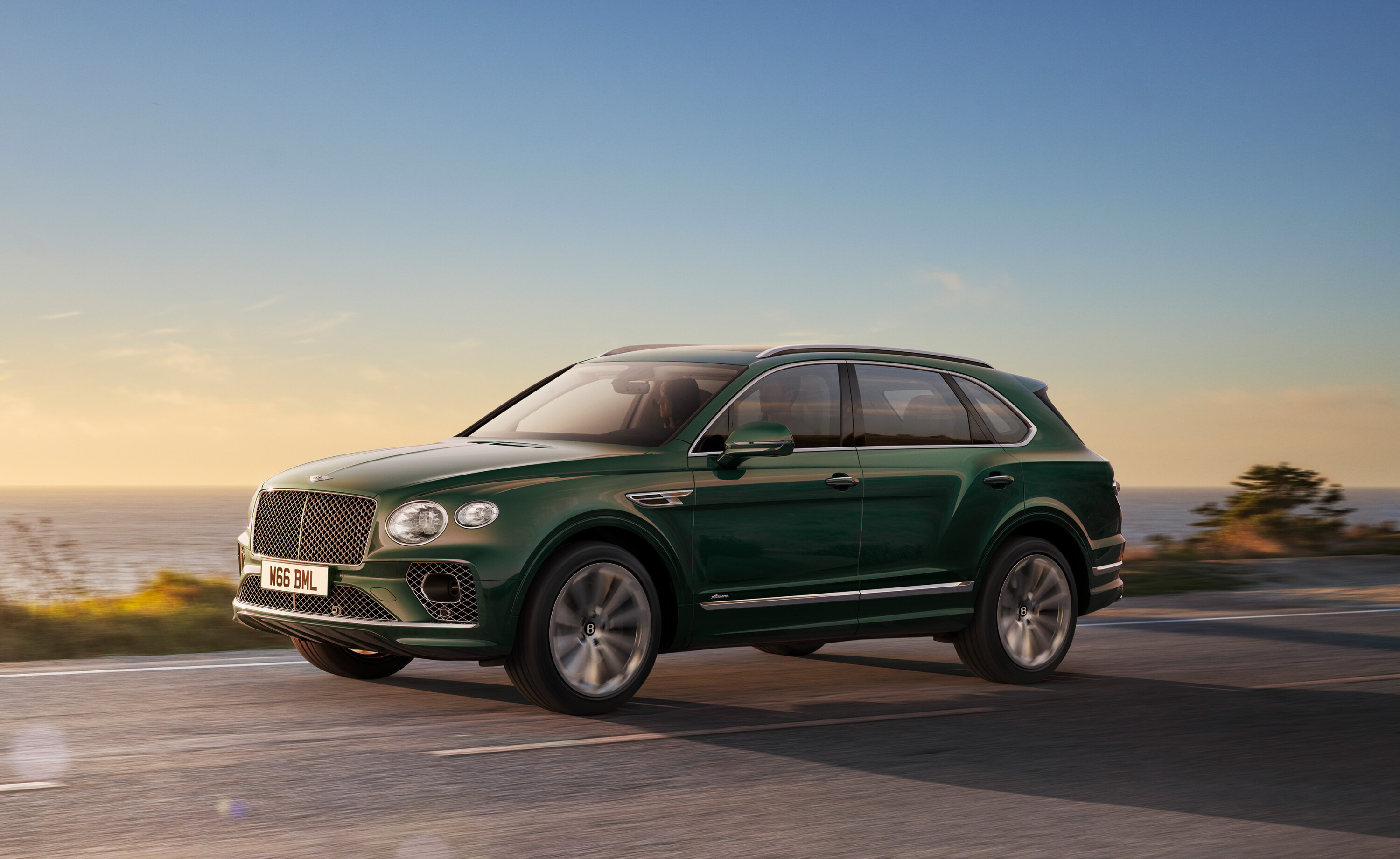
1
The Bentley Bentayga Hybrid features a 3.0-litre twin-turbo V6 supplemented by a 94kW/350Nm electric motor, with 330kW and 700Nm in total.
The electric motor is located between the internal-combustion engine and its eight-speed automatic transmission.
With a 17.3kWh battery, the Bentayga can travel up to 46 kilometres on electric power alone.
McLaren Artura
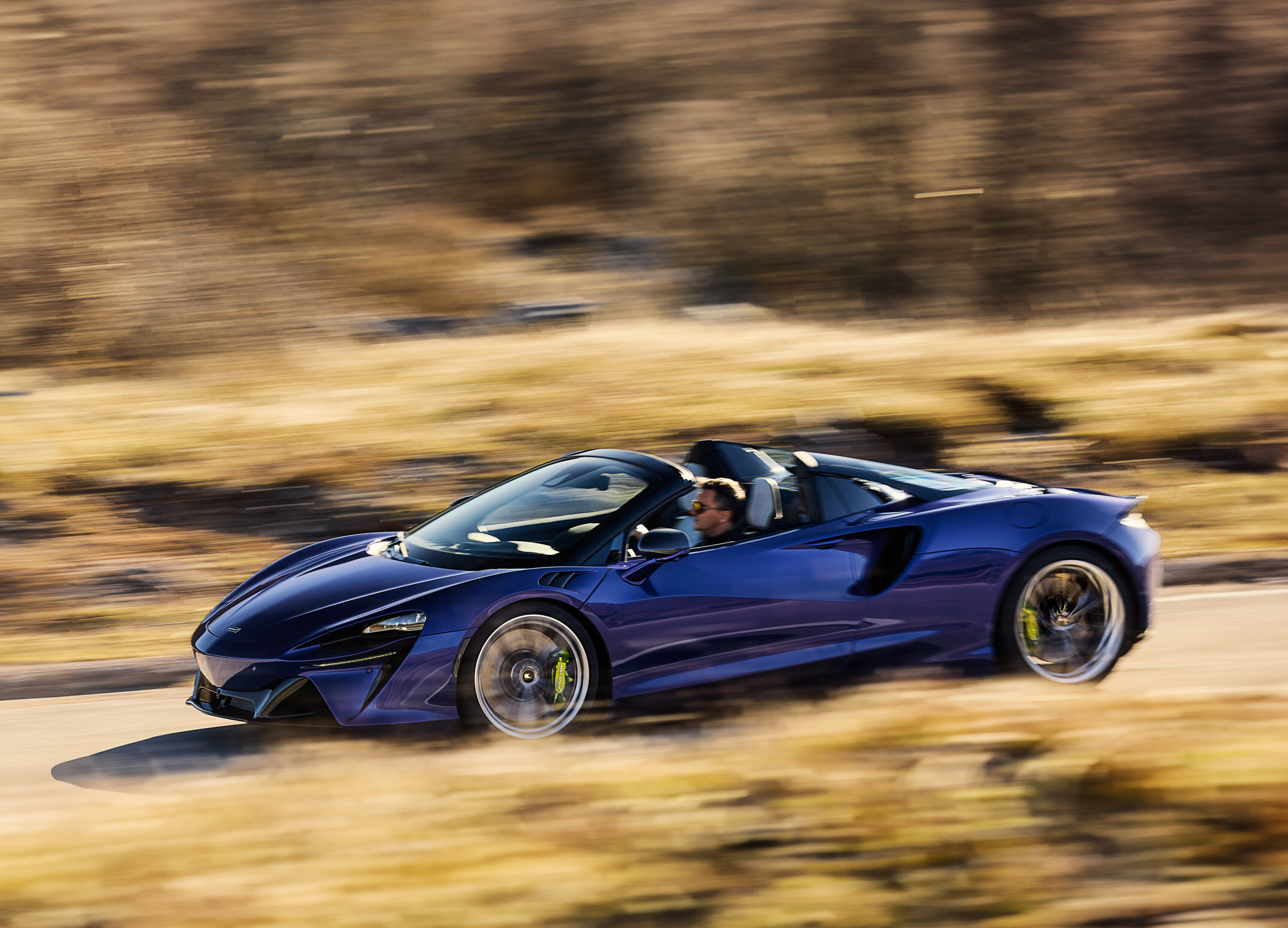
1
The McLaren Artura is only the second all-new car in the company’s 12-year history, combining electric power with a twin-turbo V6 engine.
This consists of a 445kW/584Nm 3.0-litre twin-turbo V6 – featuring a 120-degree vee to allow more room for packaging the twin-turbochargers and lowering the centre of gravity – and a 70kW and 225Nm electric motor.
The petrol-electric combination brings the powertrain’s total system output to 515kW and 720Nm.
Weighing just 88 kilograms, the 7.4kWh battery in the Artura is bolted under the fuel tank at the centre of the car.
McLaren quotes a 0-100km/h acceleration time of 3.0 seconds.
Bentley Flying Spur Hybrid
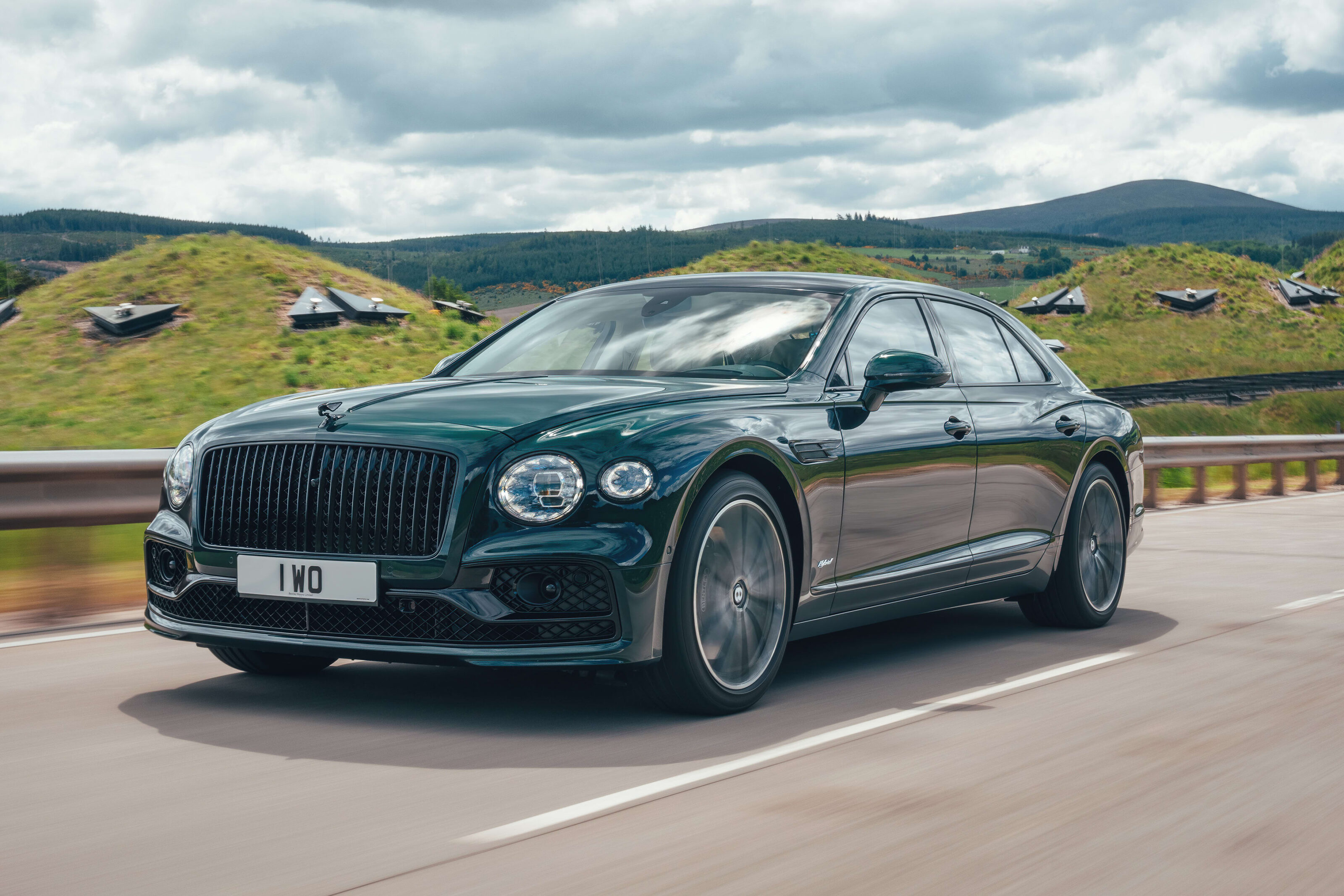
1
The Bentley Flying Spur Hybrid features a 2.9-litre twin-turbo V6 supplemented by a 100kW/400Nm electric motor, with 400kW of power and 750Nm of torque in total.
The electric motor is located between the internal-combustion engine and its eight-speed automatic transmission.
With a 14.1kWh battery, Bentley claims the Flying Spur can travel up to 41 kilometres on electric power alone – an important feature in ultra-low emission zones, such as central London.
Ferrari 296 GTB
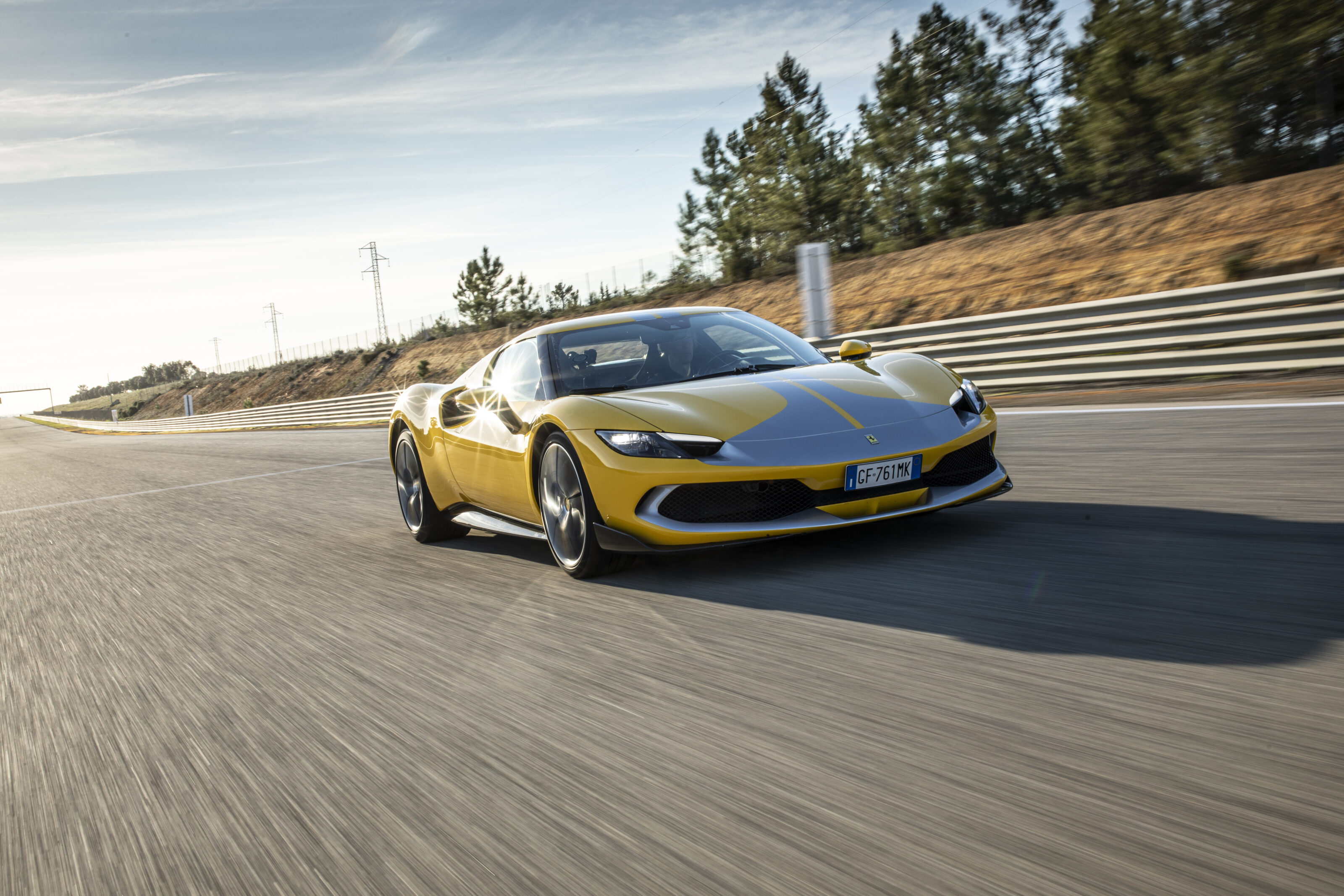
1
Ferrari is using plug-in hybrid technology to bolster the performance of its sports cars.
The Ferrari 296 GTB features a twin-turbo V6 producing 488kW of power, plus a 122kW electric motor for a total of 610kW and 740Nm.
Paired with a 7.45kWh battery and rear electric motor, the 296 GTB can launch from zero to 100km/h in just 2.9 seconds, Ferrari says, and to 200km/h in 7.3sec.
Power is sent to the rear wheels through an eight-speed dual-clutch automatic transmission.
Ferrari SF90

1
The most expensive plug-in hybrid available in Australia is the Ferrari SF90, available in Stradale coupe or Spider convertible form.
Powering the rapid SF90 is a 574kW 4.0-litre twin-turbocharged V8 engine and 162kW from three electric motors, with energy sourced from a 7.9kWh battery, enabling 26 kilometres of all-electric driving.
In total, the SF90 has 735kW of power, with Ferrari claiming it can complete the 0-100km/h sprint in just 2.5 seconds – making it the fastest-ever production model from the Italian marque.
The 0-200km/h sprint is possible in 6.7 seconds for the Stradale and 7.0 seconds for the Spider, with both reaching a top speed of 340km/h.
| Price (excl. on-road costs) | $846,888 (SF90 Stradale), $957,700 (SF90 Spider) |
|---|---|
| Electric-only driving range | 25 km |
| Combined fuel consumption | 6.1L/100km |
| CO2 emissions (combined) | 154g/km |
| Category | Sports |
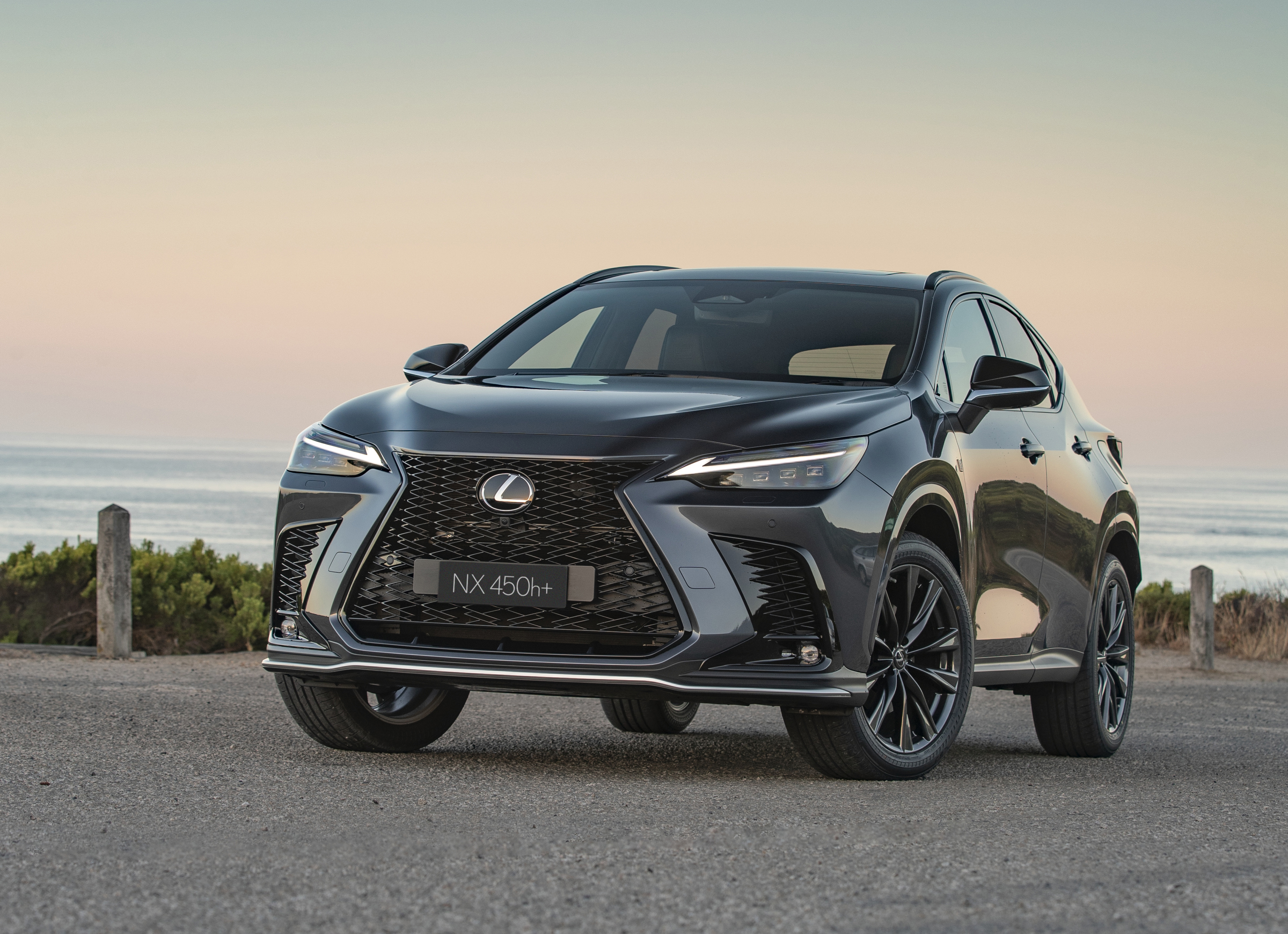
OFF-SALE: Lexus NX450h+
1
Lexus NX450h+ orders paused in Australia
Lexus Australia has paused order books for the NX450h+ plug-in hybrid SUV, with a two-year wait for the last buyers.
The Lexus NX450h+ plug-in hybrid’s powertrain is based on the same 2.5-litre petrol engine of the NX 350h, but is supplemented by two permanent-synchronous motors, one at each axle, to produce a peak 227kW power output – making it the most potent NX to date.
Its 18.1kWh lithium-ion battery has one of the highest capacities of a plug-in hybrid and gives the NX450h an all-electric driving range of up to 87 kilometres.
PHEVs yet to arrive in Australia
BYD Shark
Arriving: Early 2025
BMW M5
Arriving: Late 2024
BMW X3 30e (new gen)
Arriving: Early 2025
BMW Australia will introduce the X3 30e xDrive plug-in hybrid to its 2025 line-up, adding to the existing X3 20 xDrive and M50 xDrive models announced in July.
The X3 30e xDrive pairs a 2.0-litre four-cylinder petrol engine with an electric motor and high-voltage battery.
This combination delivers a total system output of 220kW and 450Nm of torque, enabling the vehicle to accelerate from 0-100 km/h in 6.2 seconds and reach a top speed of 215 km/h. In electric-only mode, the vehicle can achieve speeds of up to 140 km/h.
Cupra Leon VZe Sportstourer
Arriving: Mid-2025
1
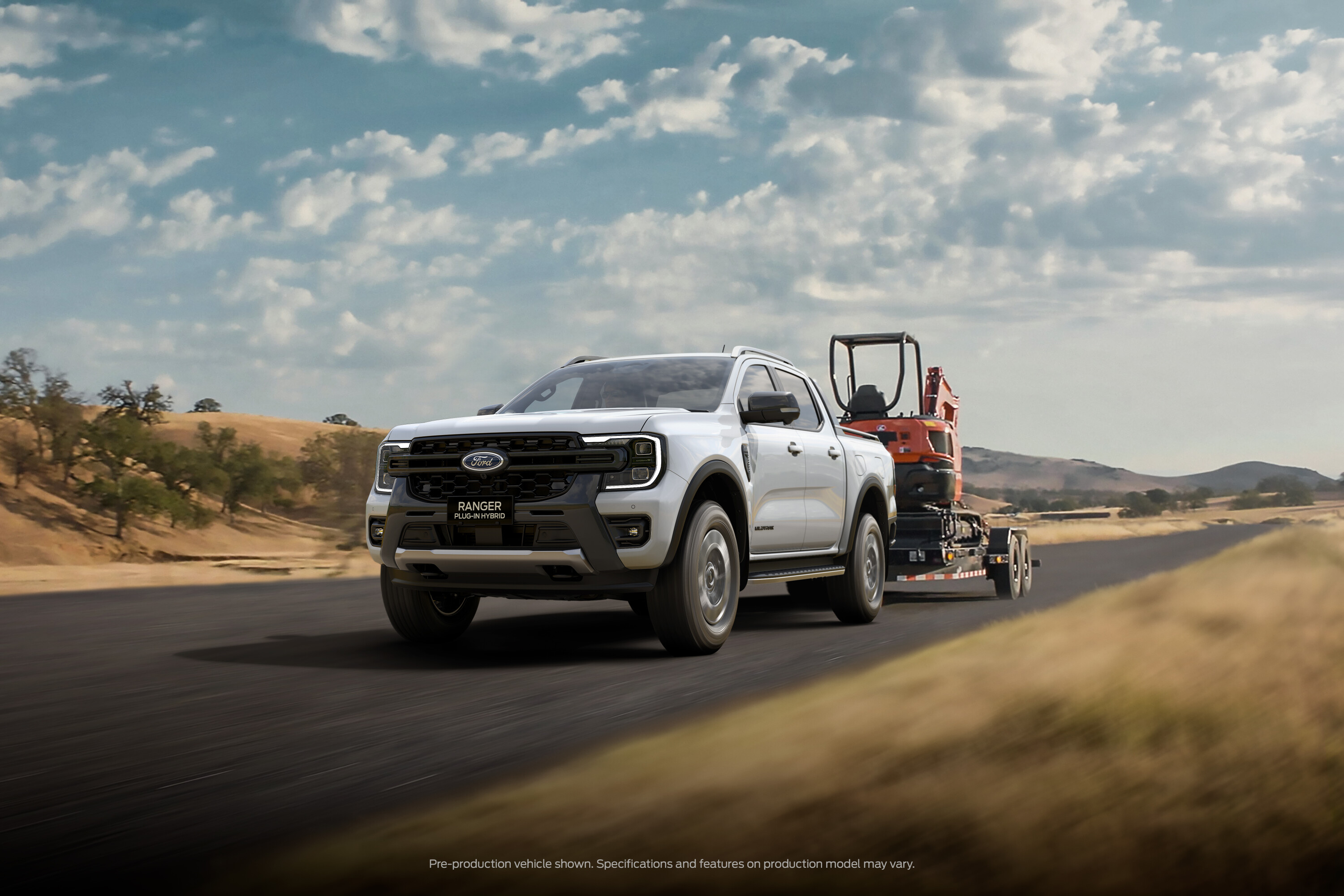
Ford Ranger PHEV
Arriving: Early 2025
JAC T9
Arriving: 2025
The regular model is now on sale in Australia, but Chinese brand JAC is expected to bring a plug-in hybrid EV version of its T9 ute sometime in 2025.
Jaecoo J7
Arriving: 2025
Chinese carmaker Chery is expected to launch a plug-in hybrid version of its new Jaecoo J7 in the first half of 2025.
Lexus RX450h+
Arriving: 2025 (pushed back from 2024)
Mazda CX-70
Arriving: 2024
1
Mazda CX-90
Arriving: 2025
The Mazda CX-90 plug-in hybrid (PHEV) pairs a 2.5-litre four-cylinder petrol engine with an electric motor and a 17.8 kWh battery. This combination produces a total power output of 240kW and torque of 500Nm.
MG HS PHEV (new gen)
Arriving: 2025
Snapshot
- New Kodiaq RS offers 195kW & 400Nm from a 2.0-litre turbo four
- Bigger ventilated disc brakes, 15-mode adaptive suspension, progressive steering
- Australian debut set for July 2025
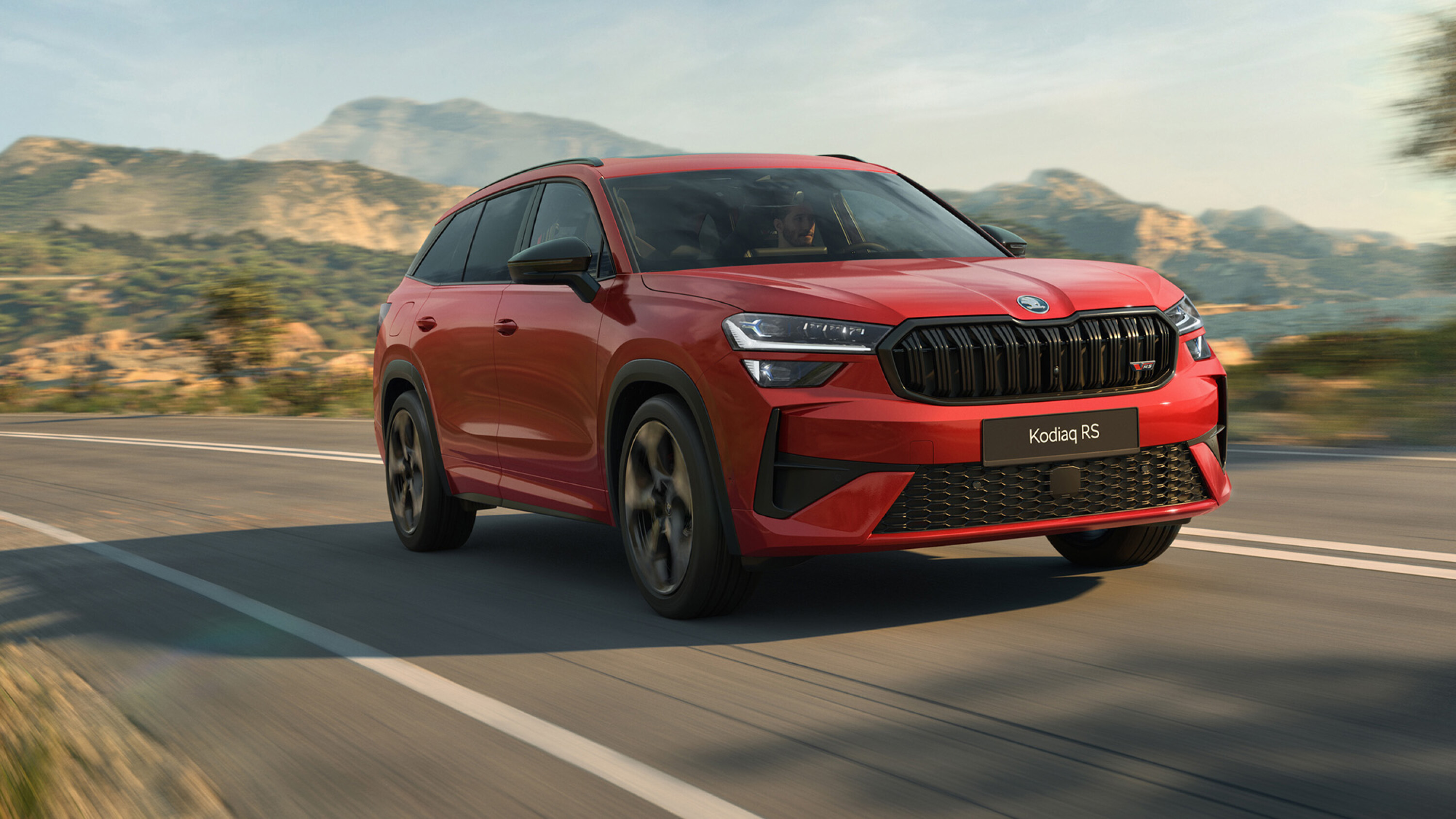
The new 2025 Skoda Kodiaq RS has been unveiled, following the global debut of the main Kodiaq range in October 2023.
The wider Kodiaq range will reach Australia in the opening months of 2025, but those looking for a more powerful family hauler will need to wait until July for the Kodiaq RS to touch down.
As before, the Kodiaq RS will arrive as a seven-seat family large SUV, offering more space across its three rows than its somewhat segment-straddling predecessor.
1
When it lands, the new flagship Kodiaq will offer 195kW and 400Nm from its 2.0-litre four-cylinder turbo petrol engine, marking a handy increase on the 180kW and 370Nm produced by the already quick current generation.
Where the outgoing model claimed a 0-100km/h time of 6.6 seconds, the new Kodiaq RS – a larger and heavier SUV than before – shaves that claim to 6.4 seconds.
The new model’s uprated power is underpinned by bigger ventilated disc brakes (albeit with two-piston calipers up front), 15-mode adaptive suspension, and progressive steering.
1
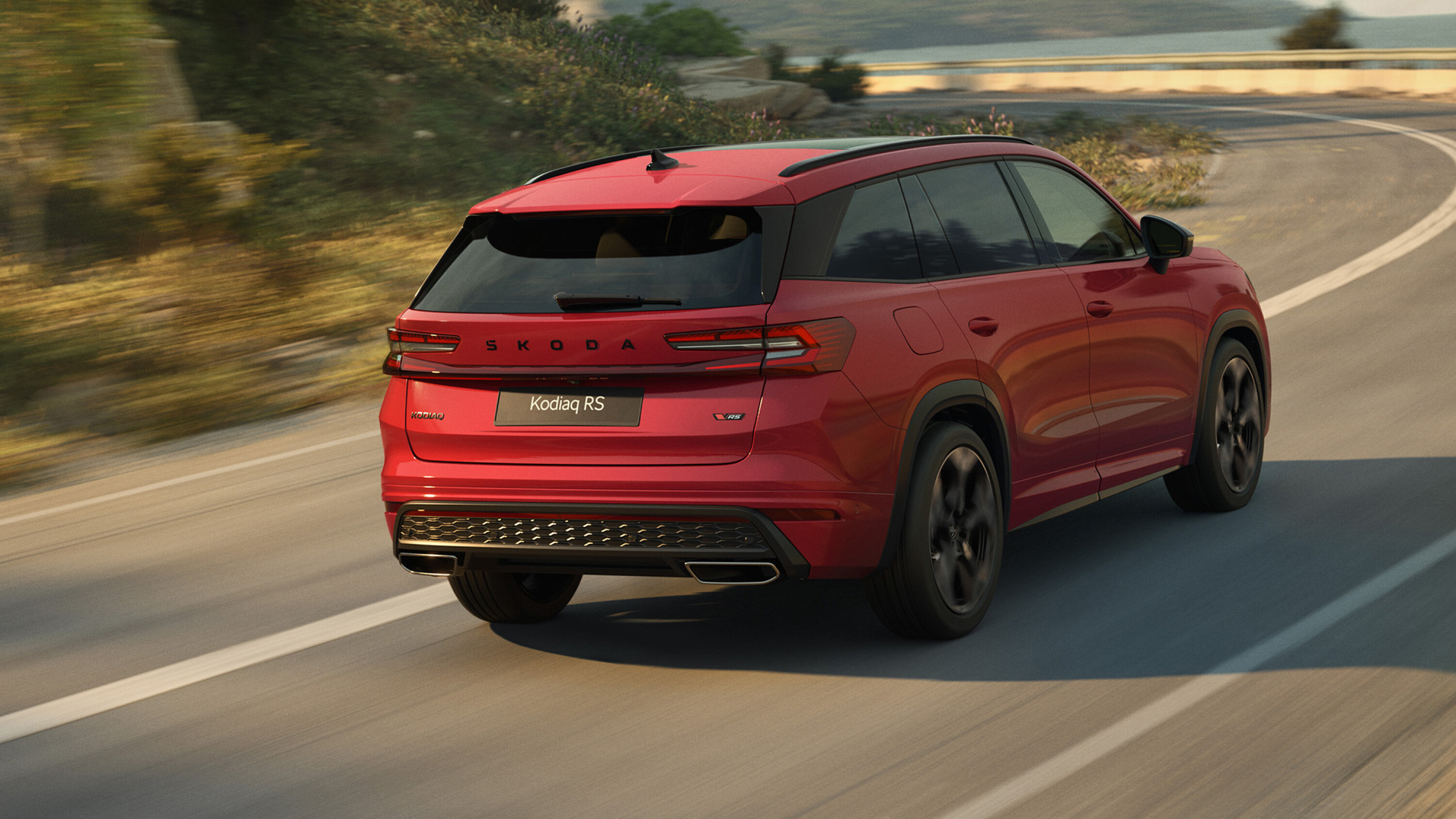
Those brakes sit behind new 20-inch alloy wheels, and other exterior tweaks include unique front and rear bumpers, dual stainless steel exhaust tips, RS badging and a slew of black accents.
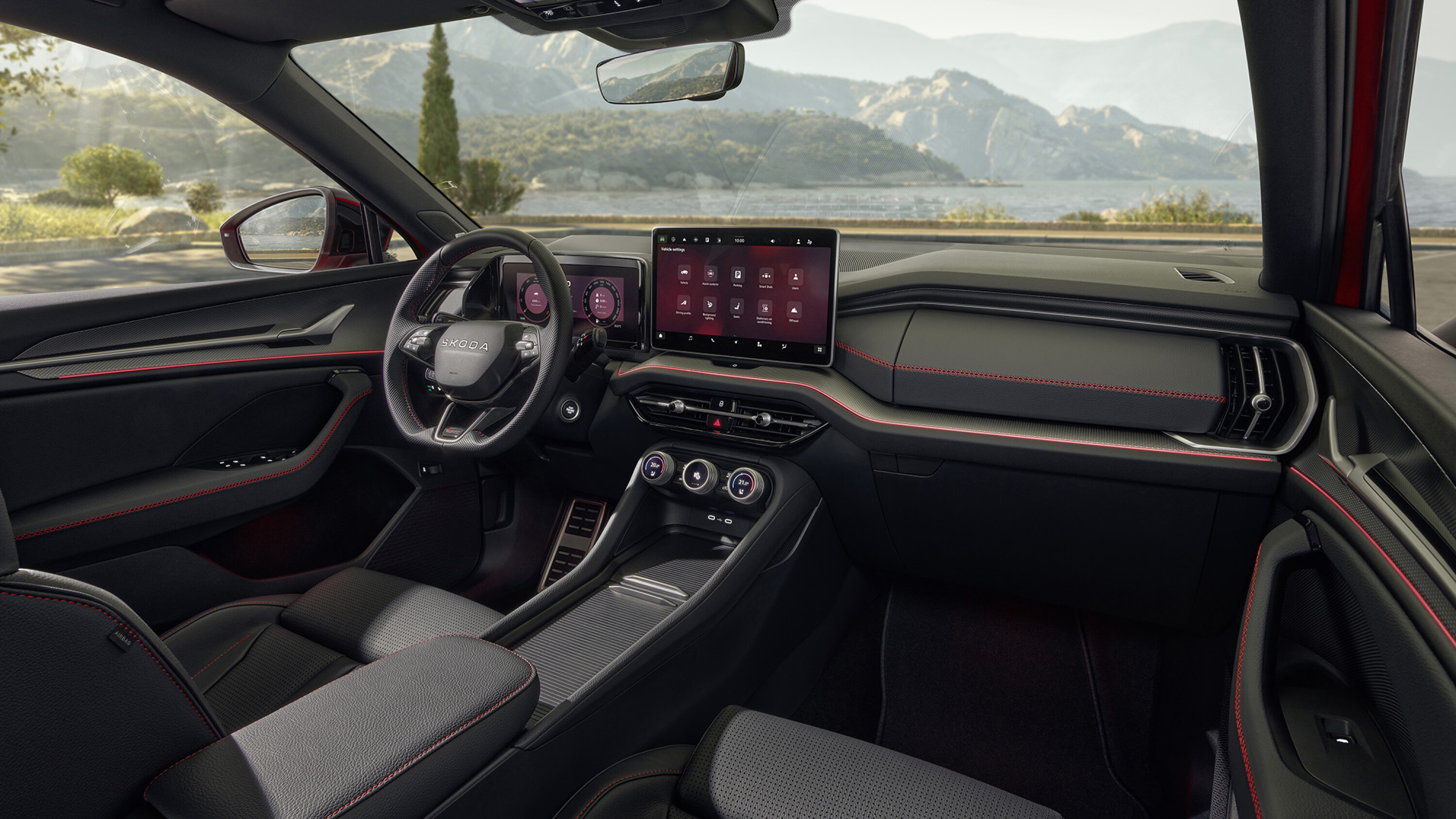
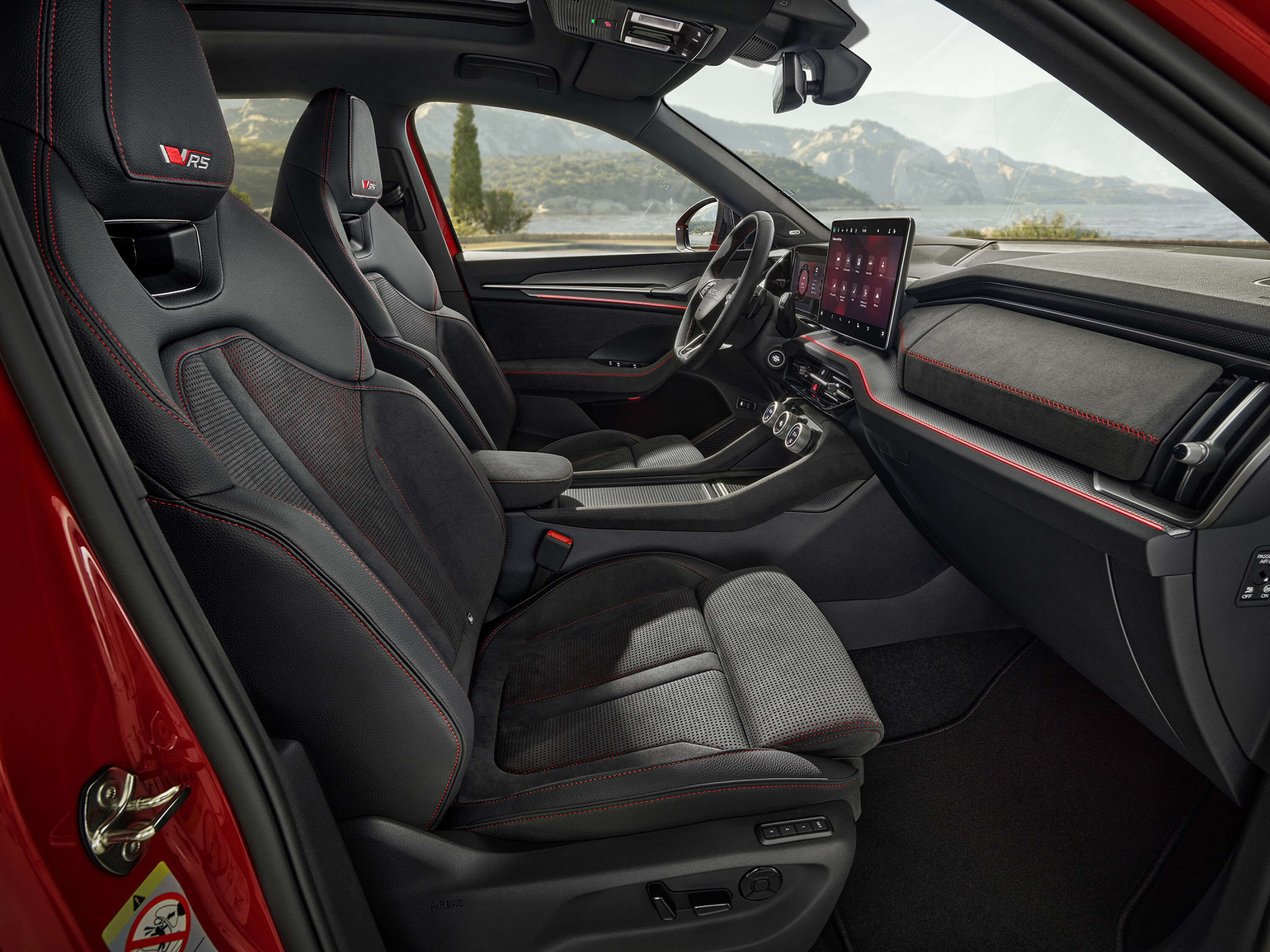
The more aggressive theme continues inside where buyers will find a black-on-black look with red contrast stitching throughout, power-adjustable sports seats in the front row, Skoda’s RS-badged sports steering wheel, and bespoke RS graphics across the 12.3-inch main and 10-inch driver displays.
1
7
When will the 2025 Skoda Kodiaq RS come to Australia and how much will it cost?
Final Australian details are still to be revealed, but debut timing is set for July.
Pricing will be confirmed closer to launch, but expect a position beyond the $76,890 drive-away price of the current model.
MORE
Everything Skoda
Below: The current Kodiaq RS
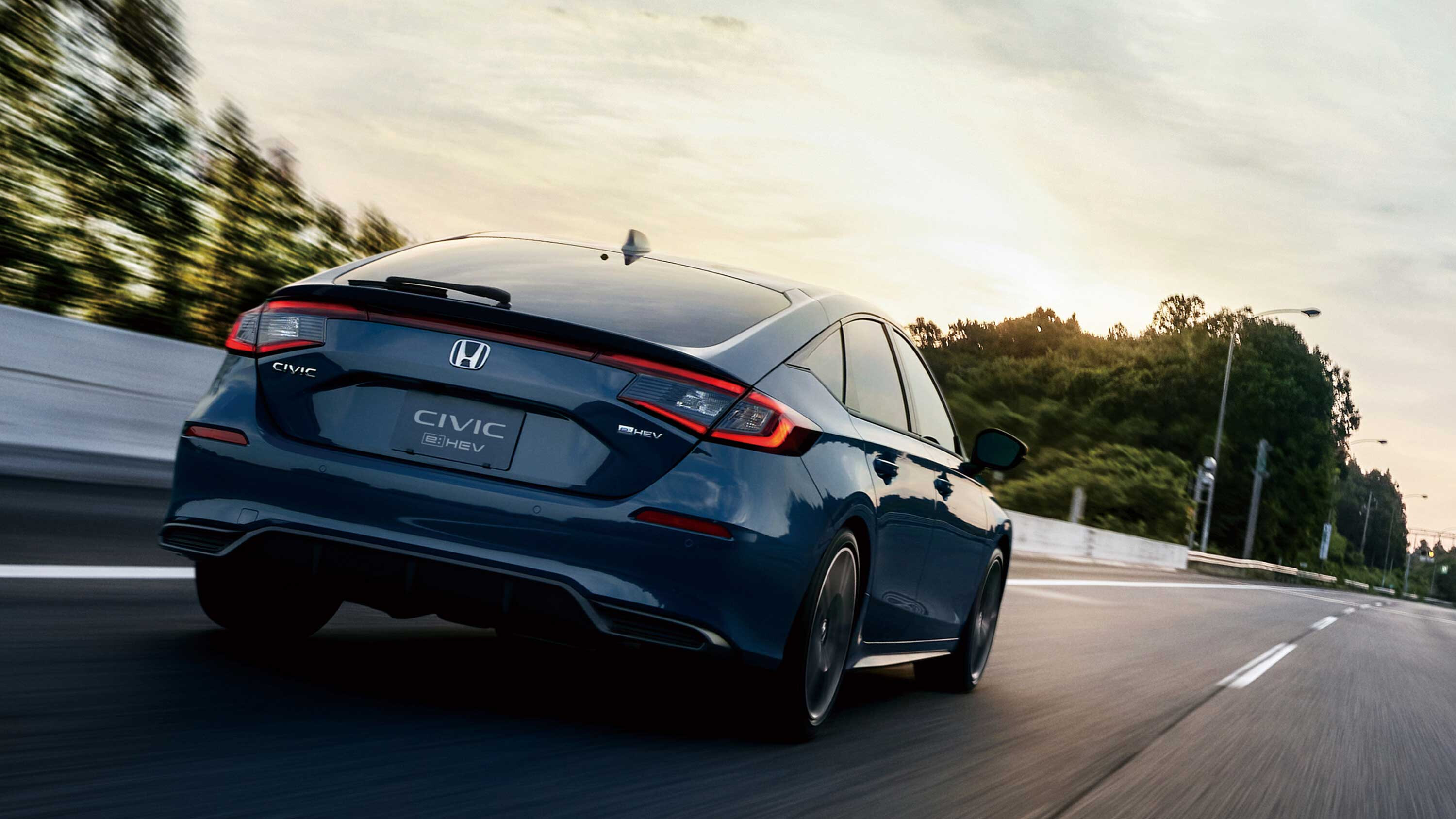
A range rejig will see the most affordable variant in Honda’s Civic lineup – which already starts at a very un-bargainlike $47,200 drive-away – deleted, as the brand moves its grocery-getting small hatchback away from pure petrol power towards a 100-percent hybrid offering.
Before you start sharpening your pitchfork, fret not: the Civic Type R is safe for now, Honda Australia sees it as a slightly different species to the garden-variety Civic. However, Honda’s plans for the regular Civic are still double-edged – on one hand, the petrol-electric hybrid powertrain of the Civic is set to become more affordable, with a lower-spec e:HEV L grade to be introduced next year to join the Civic e:HEV LX range-topper that’s been on sale since late 2023. On the other hand, the discontinuation of the turbo petrol Civic VTi-LX could see an increase in the price of entry to Civic ownership.
Currently, the non-hybrid VTi-LX is priced at $47,200 drive-away, with the similarly-equipped e:HEV LX priced at $55,000 drive-away. Prices for the all-hybrid 2025 Civic range won’t be announced until closer to its local launch (which will occur “soon”, according to Honda Australia), but getting the incoming base-spec hybrid to equal the price point of the former entry model would certainly be a challenge for the company’s product planners.
Full details will come closer to launch, but besides confirmation that the petrol-only Civic VTi-LX will no longer be offered, other details of the 2025 Honda Civic range are as yet unknown. A mild facelift will be applied in the form of a new bumper and grille, and the latest evolution of the Honda connect infotainment system will be offered in both the L and LX grades, with built-in sat-nav and voice assistant functions courtesy of Google.
2
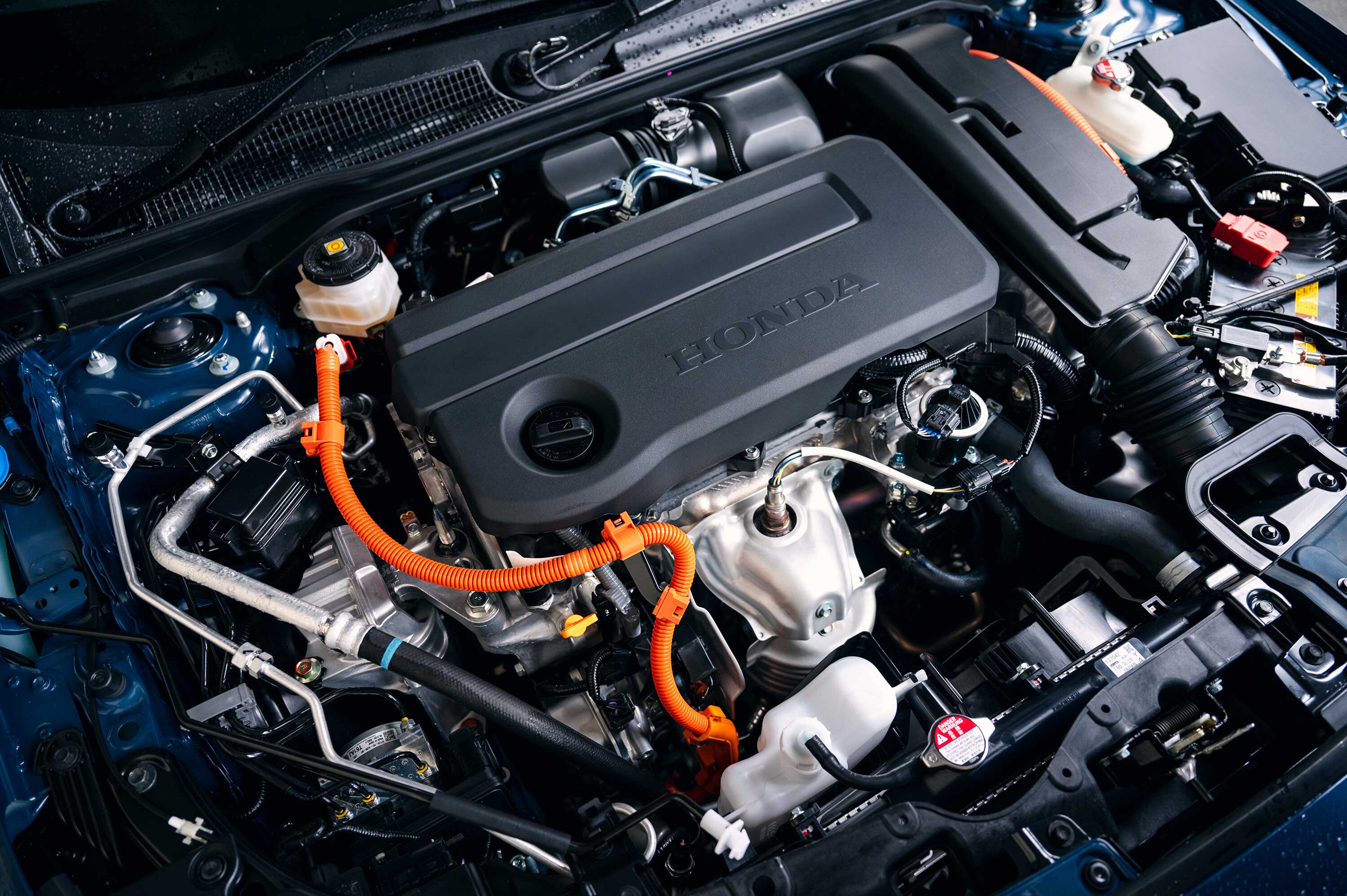
Mechanically, expect the same 135kW/315Nm outputs from the hybrid’s 2.0-litre atmo petrol and electric motor combo, with an average fuel consumption of 4.2L/100km.
Will Honda’s all-hybrid strategy for the Civic produce dividends in the showroom? Since the introduction of the Civic hybrid it’s only accounted for less than half of the nameplate’s sales in this country (which has so far recorded just 830 cars across VTi-LX, e:HEV LX and Type R this year), but overall sales of hybrid passenger cars have risen by 63 percent in 2024 (more if you count plug-in hybrids), while sales of petrol-powered vehicles in that segment has declined by nearly 16 percent in the same period.
Honda’s Civic sales are still miniscule in this market, but getting on the right side of that hybrid uptake trend line may pay off – particularly as the Federal Government’s NVES emissions scheme kicks in next year.
2
The regular Civic will become the second Honda model in Australia to go hybrid-only, following from the new-generation Honda Accord that arrived in May this year. The brand’s hybrid offerings will expand further in the near future, with more petrol-electric variants of the brand’s mainstays, the Honda ZR-V and Honda CR-V, due to land in 2025.
MORE
Everything Honda
Vinyl records, analogue watches and – dare we say it – printed magazines.
For some, there’s no matching the tactility of the traditional, two T-words that many rusted-on car enthusiasts continue to cling to with a death grip in this modern, electrified and increasingly automated era. Thankfully for those people, the 2025 Porsche 911 Carrera T exists.
Due to commence deliveries in the second quarter of 2025, the latest incarnation of the 911 Carrera T (the T ostensibly means Touring, but might as well stand for Trad) will arrive with only one gearbox choice: a six-speed manual, taking drive to the rear wheels exclusively. The dual-clutch eight-speed auto that was previously offered as an option for the Carrera T has been dropped from the spec sheet, making the 2025 model one for three-pedal connoisseurs only. The manual gearbox is also different, sporting six ratios versus the seven of the pre-facelift 911 Carrera T.
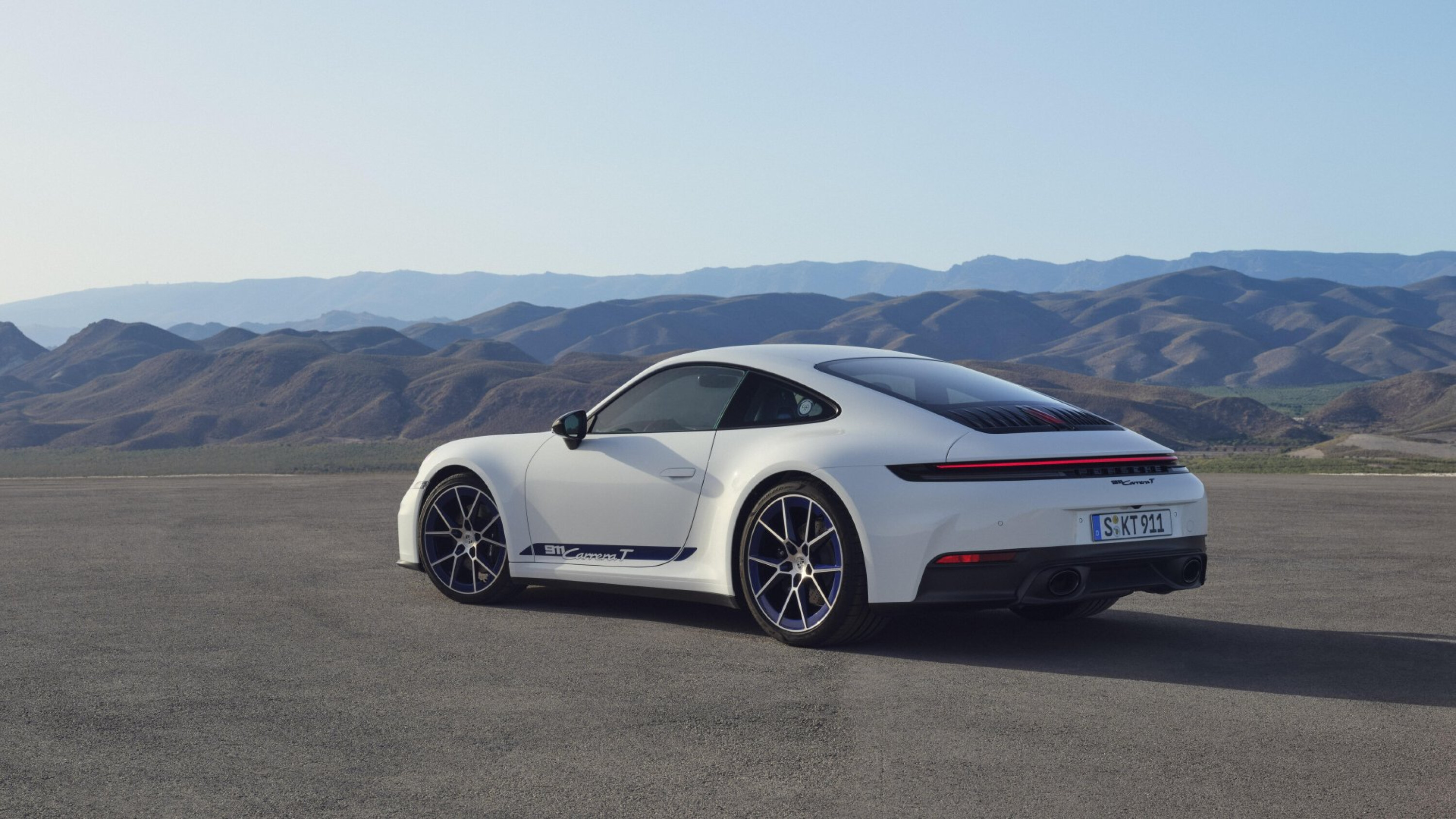
3
The engine compartment might only contain a base-spec 3.0-litre twin-turbo engine producing 290kW and 450Nm – the lowest outputs in the 911 family – but the 911 Carrera T Coupe will, provided the driver is swift with their shifts, punch from zero to 100km/h in 4.5 seconds and run to a 295km/h Vmax. Add 0.2 seconds and subtract 2km/h from those metrics for the 911 Carrera T Cabriolet (yes, a drop-top 911 Carrera T is now part of the family).
Though those numbers are a few tenths slower than the base 911 Carrera, which is equipped with a dual-clutch 8-speed auto as standard, Porsche is banking that the T’s higher engagement factor will speak louder than its straight-line stats.
As standard, the 911 Carrera T in both Coupe and Cabriolet form will come with a suite of performance-enhancers. It’s not all about low-tech thrills and visceral mechanical engagement either, as most of the gear relies on microchips and actuators to deliver enhanced dynamics – gear like the PASM sports suspension that’s 10mm lower and wears stiffer springs than the regular PASM adaptive suspension, as well as the active rear-wheel steering and brake torque-vectoring hardware that help boost agility and stability.
The T’s steering rack ratio and rear-wheel steering calibration is also unique to that variant, with the rear-steer also being new equipment for the 2025 model.
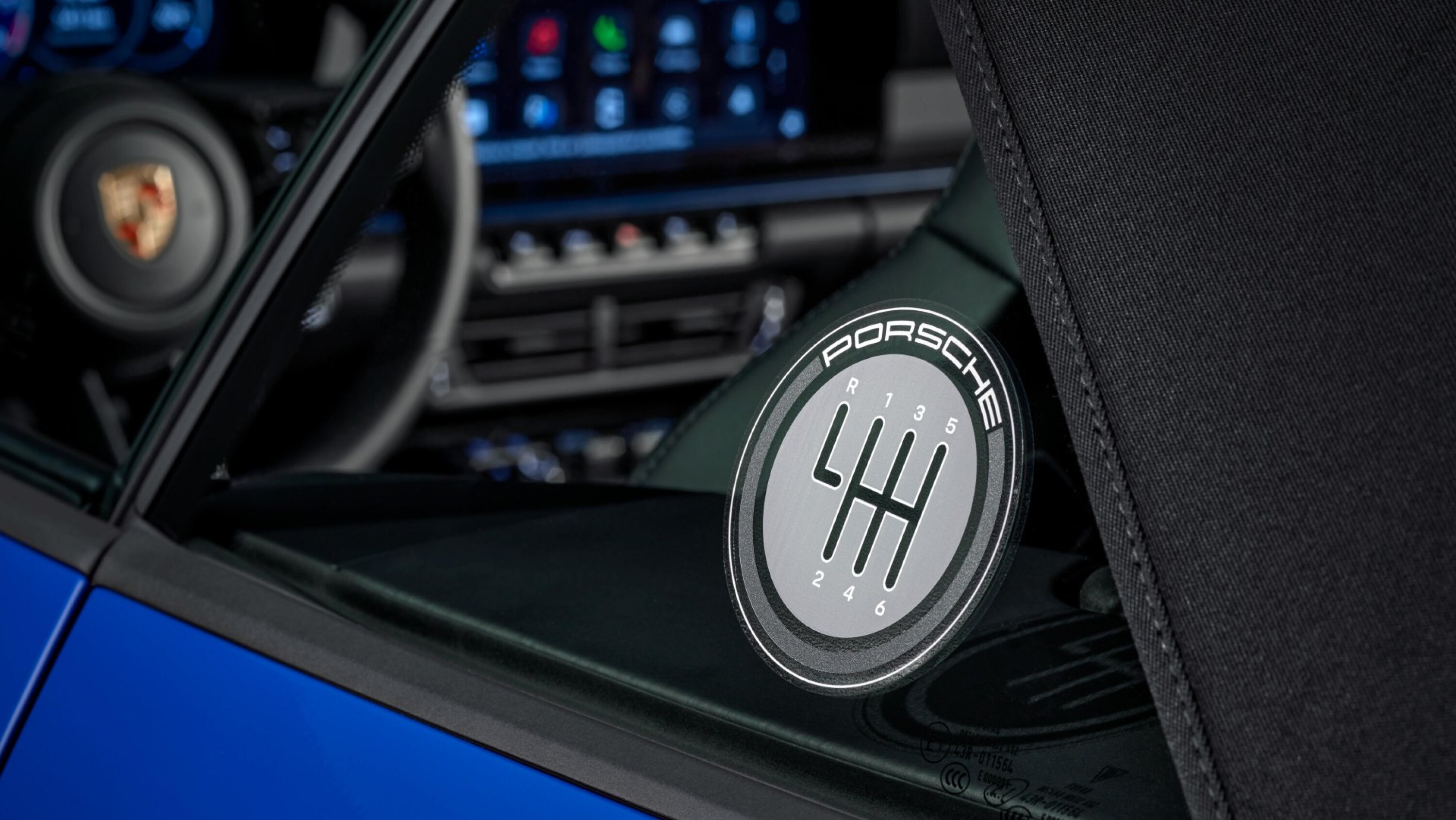
4
Beyond that, the Carrera T is also slightly lighter than the standard 911 Carrera, registering a 1490kg unladen weight versus the auto-only Carrera’s 1520kg. Want to cleave more kilos? Deleting the rear seat is a free option, though replacing the standard four-way electric Sports front seats with the optional featherweight carbon-fibre fixed-back buckets is an $11,250 exercise.
Lower-tech enhancements include the improved sonics from its standard-fit sports exhaust, a shortened gearshifter topped by a Walnut ply knob, 350mm front brake rotors with six-piston calipers, 20/21-inch staggered-fit alloys cribbed from the Carrera S, and ‘Carrera T’ graphics in either a subtle grey or Gentian Blue (both of which bring complementary colouring to the wheels).
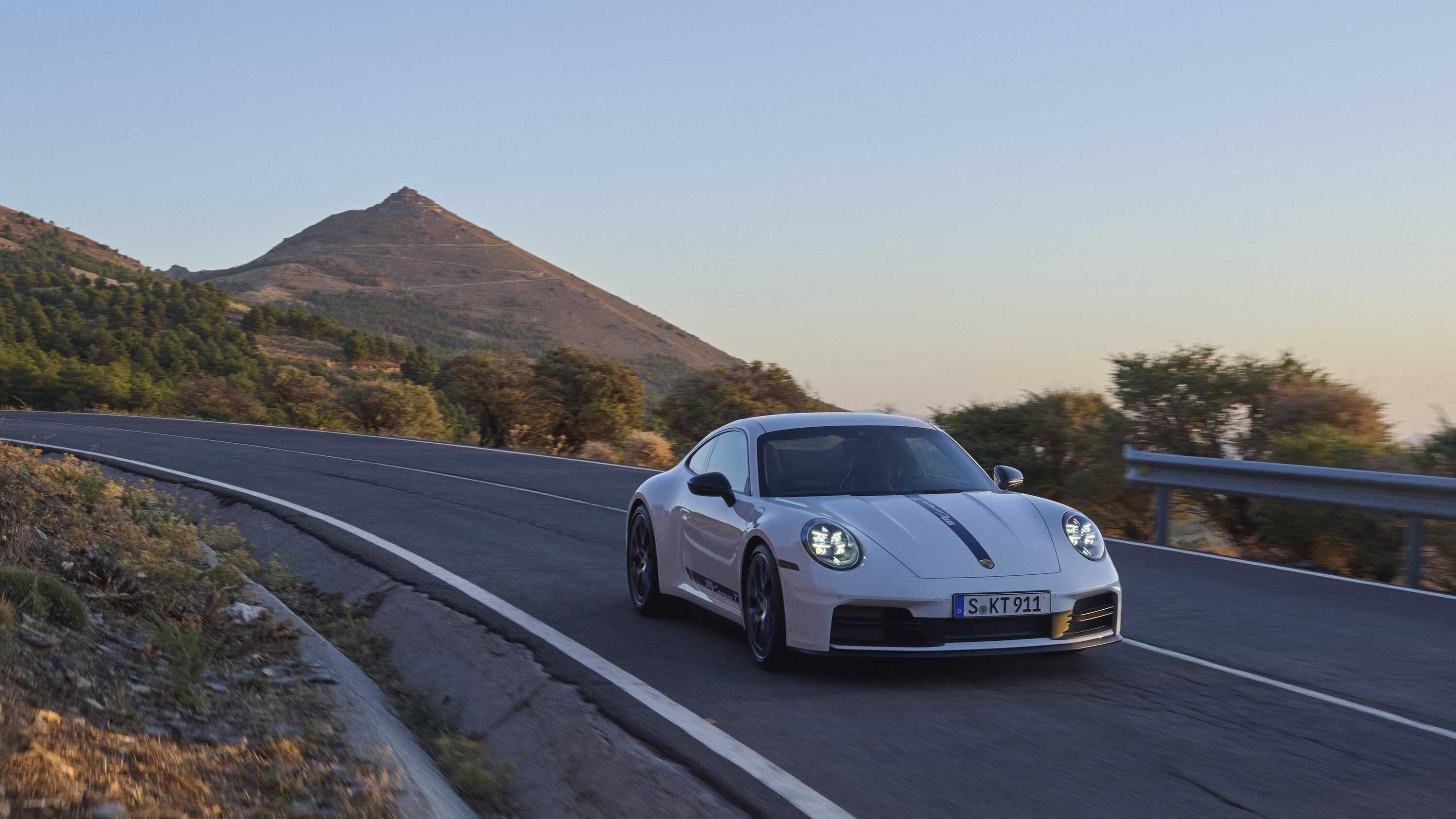
3
The price? $306,800 for the 911 Carrera T Coupe, and $330,100 for the Cabriolet, both before on-road costs – a $26K increase over the price of the base Carrera that it shares its engine with, but with a performance focus that echoes the spirit of the $660K limited-edition 911 S/T (the only other manual-only model in the contemporary 911 family), the Carrera T is definitely one for the enthusiasts.
The light car battleground isn’t what it once was. Stalwarts like the Ford Fiesta, Kia Rio and Suzuki Baleno have departed and one reason for that is the utter dominance of the MG3.
More than 65,000 have found homes in Australia since its introduction in 2018, thanks to it offering just enough of what buyers want at an extremely attractive price.
A new-generation arrived in 2024 and while the price tag increased substantially, the latest MG3 is a much more polished car. Better road manners, more equipment and a hybrid drivetrain option are just many of the improvements that led to an 8/10 score.
But it doesn’t have the light car segment to itself. Another recent arrival is the new Suzuki Swift Hybrid, a nameplate with a 30-year history in Australia.
While these two aren’t going to knock the Ford Ranger or Toyota RAV4 off the top sales spot, they remain very important offerings, providing the latest safety and technology at a price that’s potentially in reach of first-car buyers. But which is best?
JUMP AHEAD
Pricing
Pricing for the MG3 range starts at $23,990 plus on-road costs for the Excite, while the better equipped Essence is $25,990 +ORCs. Both variants are also available with the hybrid powertrain for a $4000 premium.
There’s very little in it when it comes to the Suzuki Swift. It offers a base manual variant for $24,490 driveaway, with the automatic an extra $2500. From there the Plus rises to $28,490 driveaway, while the range-topping GLX is $29,490 driveaway.
Where the MG3 gains an advantage is when you look beyond the base price. It offers a choice of white or yellow at no cost, while black, grey, red and blue metallic are an extra $500.
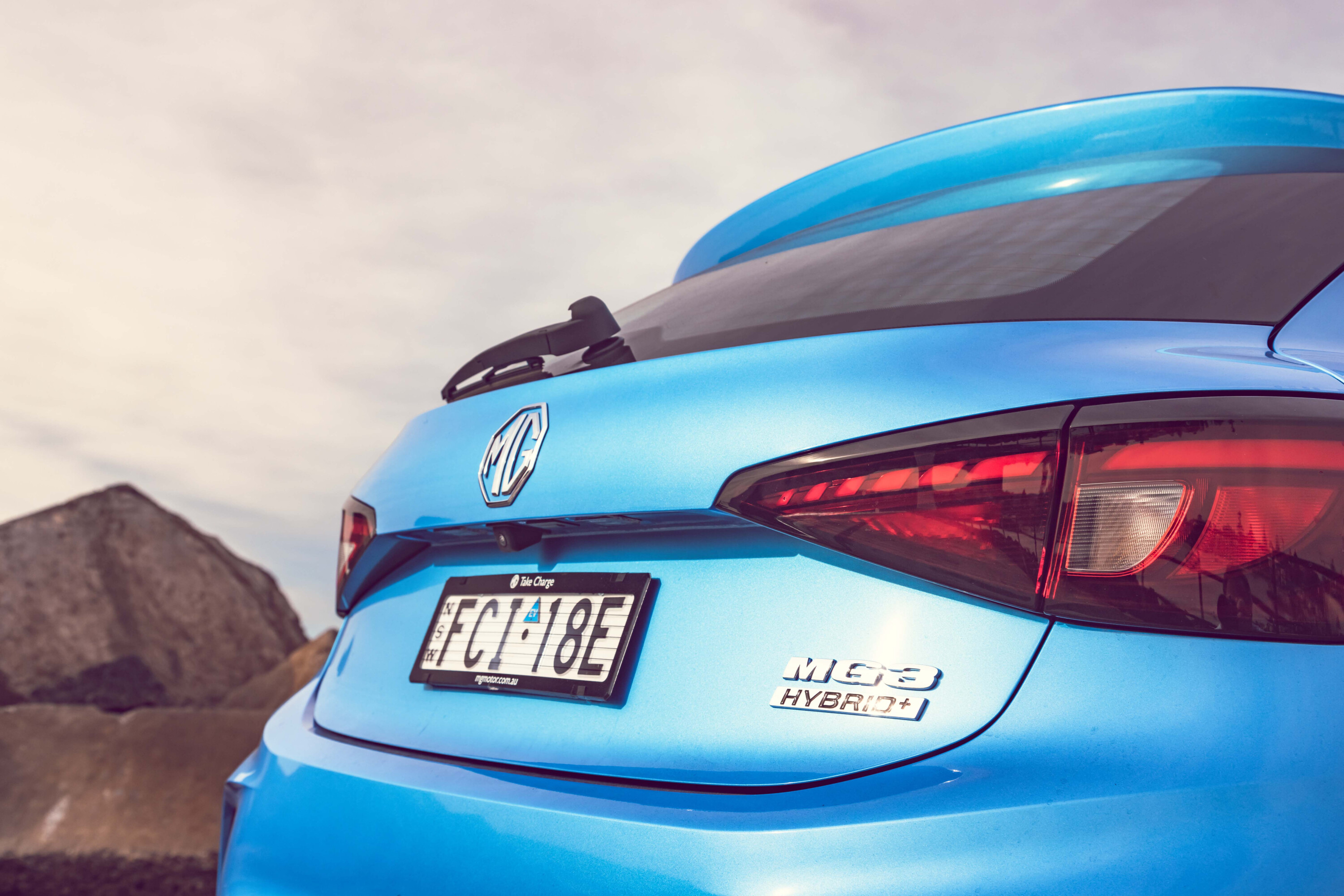
1
Suzuki offers only white as standard, with black, red, grey, silver and orange metallic an added $645 and the two-tone blue pearl with black roof is $1145. MG also offers a 10-year/250,000km warranty to Suzuki’s five-year/unlimited-kilometres.
The Swift Sport will set you back $1955 in servicing over the first five visits, with intervals of 12 months/15,000km. The MG3’s intervals are a little shorter at 12 months/10,000km and it flanks the Suzuki in terms of cost, the petrol costing $1854 over the first five visits and the Hybrid $2045.
Back to top ⬆️
Dimensions
It’s the MG3 that gives you more car for your money. At 4113mm long, 1797mm wide and 1502mm tall, it’s 253mm longer and 62mm wider (though 18mm lower) than the Suzuki and with an extra 120mm in the wheelbase.
This gives the MG a handy lead when it comes to interior space, especially in the rear, though both cars are very similar when it comes to boot space. The Swift offers 265 litres, expanding to 980 litres with the rear seats folded, impressive given its more compact dimensions, but the MG3 manages 293L seats up and 983L seats down.
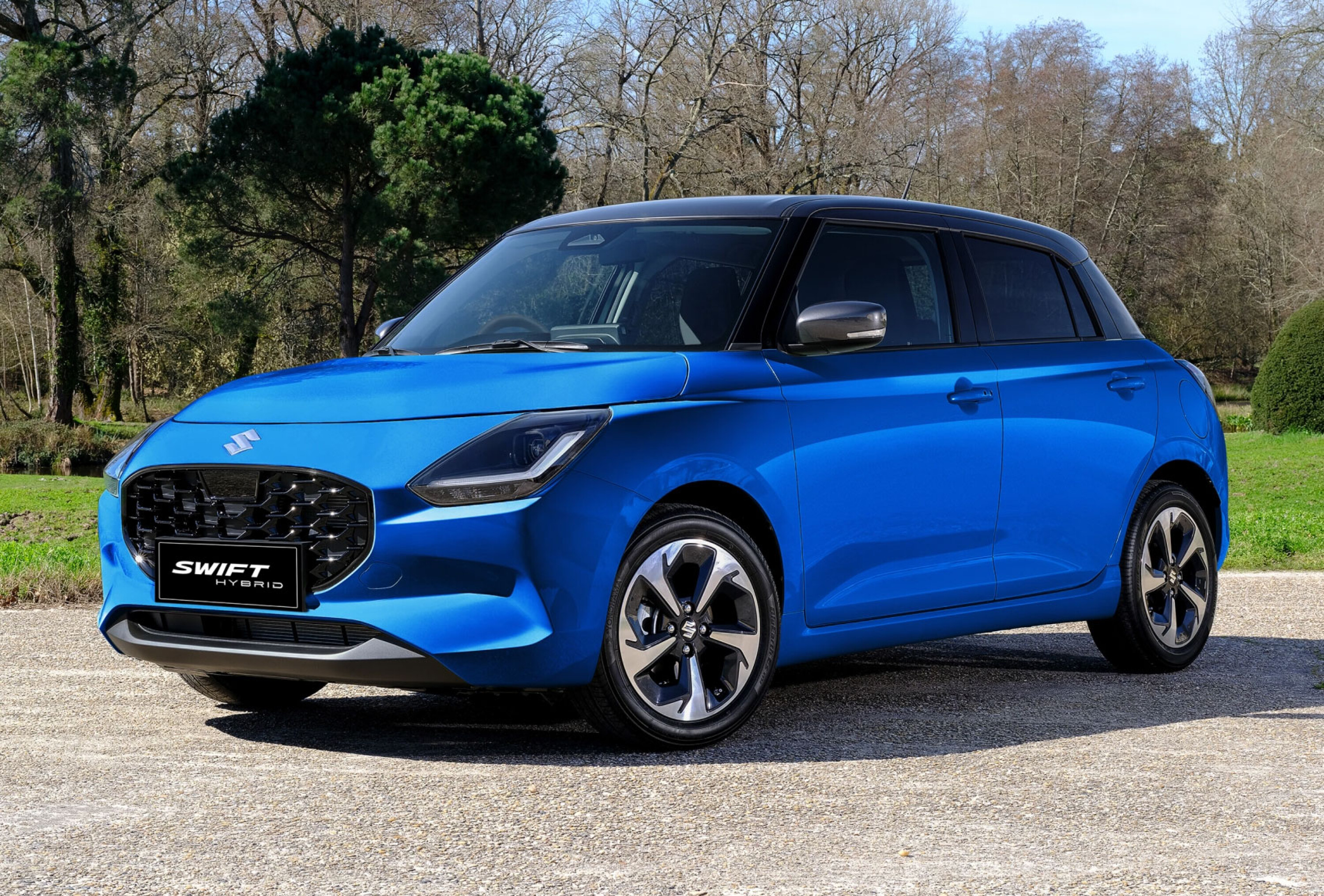
1
Back to top ⬆️
Safety
A key reason the latest MG3’s price has risen is a corresponding increase in safety equipment. Whereas its predecessor lacked a lot of the active safety features found in modern cars, the new version has six airbags, autonomous emergency braking (AEB), adaptive cruise control, blind-spot detection, rear cross-traffic assist, forward collision warning, lane departure warning, lane keep assist and more in all variants.
The new Suzuki Swift is also well equipped, featuring the same six airbags, AEB, lane departure warning and prevention, adaptive cruise control and traffic sign recognition, though you have to step up to the Plus to add blind-spot monitoring and rear cross-traffic alert.
Both cars have a reversing camera as standard, but only the MG3 Essence features a 360-degree camera.
Back to top ⬆️
Features
No longer does buying a small car mean ending up with a barren plastic box. Even the base MG3 Excite comes with 16-inch alloy wheels, discs brakes front and rear, push button start, electric windows all round, a six-speaker stereo, air-con with rear vents, USB ports front and rear, a 7.0-inch digital instrument cluster and 10.25-inch infotainment screen with smartphone mirroring.
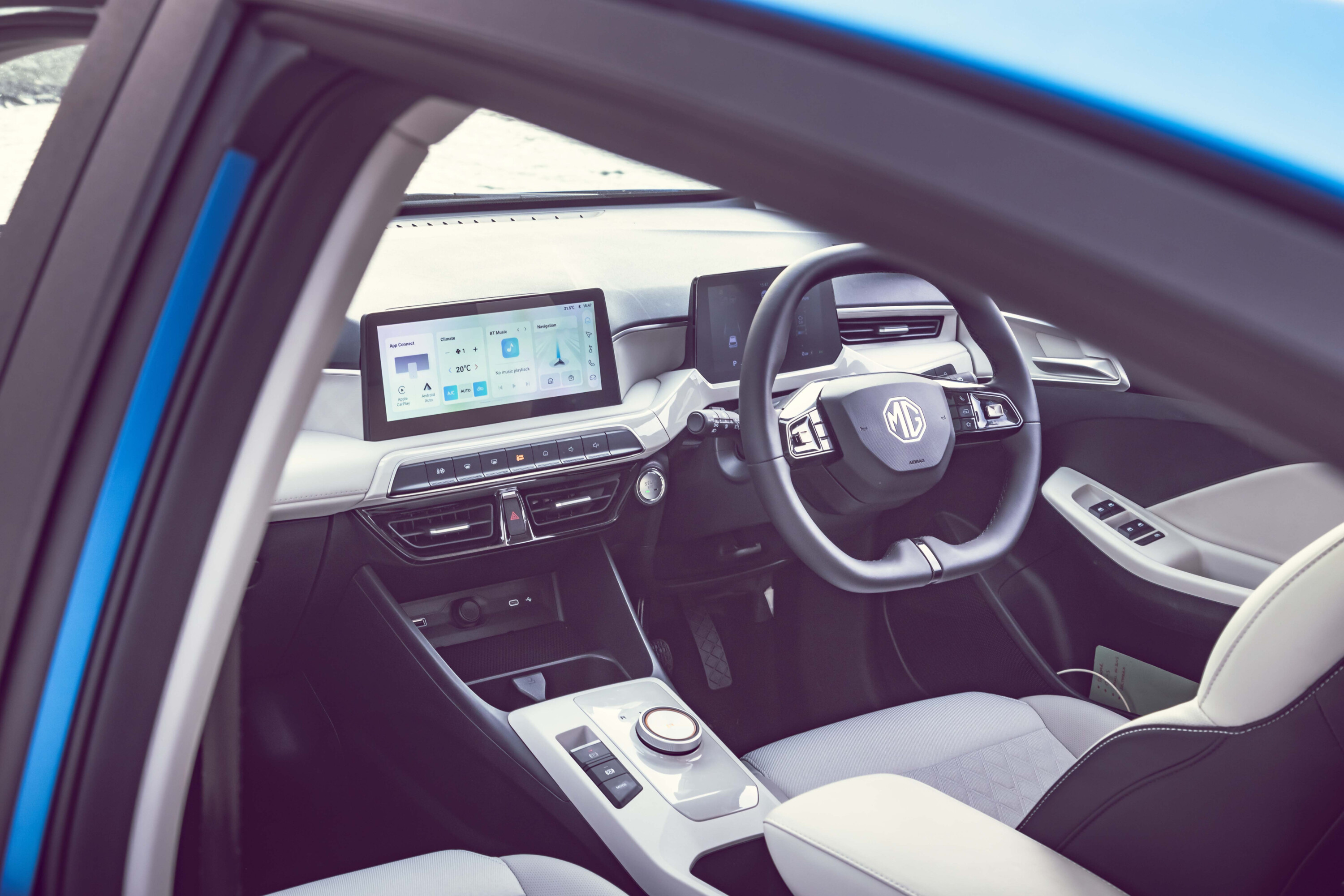
1
Step up to the Essence and there’s rain-sensing wipers, a sunroof, leather steering wheel, keyless entry, digital radio, satellite navigation and iSmart app connectivity.
Standard across the Suzuki Swift range is keyless entry and start, LED headlights, air-conditioning and a 9.0-inch infotainment screen with satellite navigation, digital radio, wireless Apple CarPlay and wired Android Auto.
The Plus adds 16-inch alloys, heated front seats, driver’s seat height adjustment, USB ports, a six-speaker stereo and rear privacy glass, while the GLX includes rear air vents and a wireless phone charging pad.
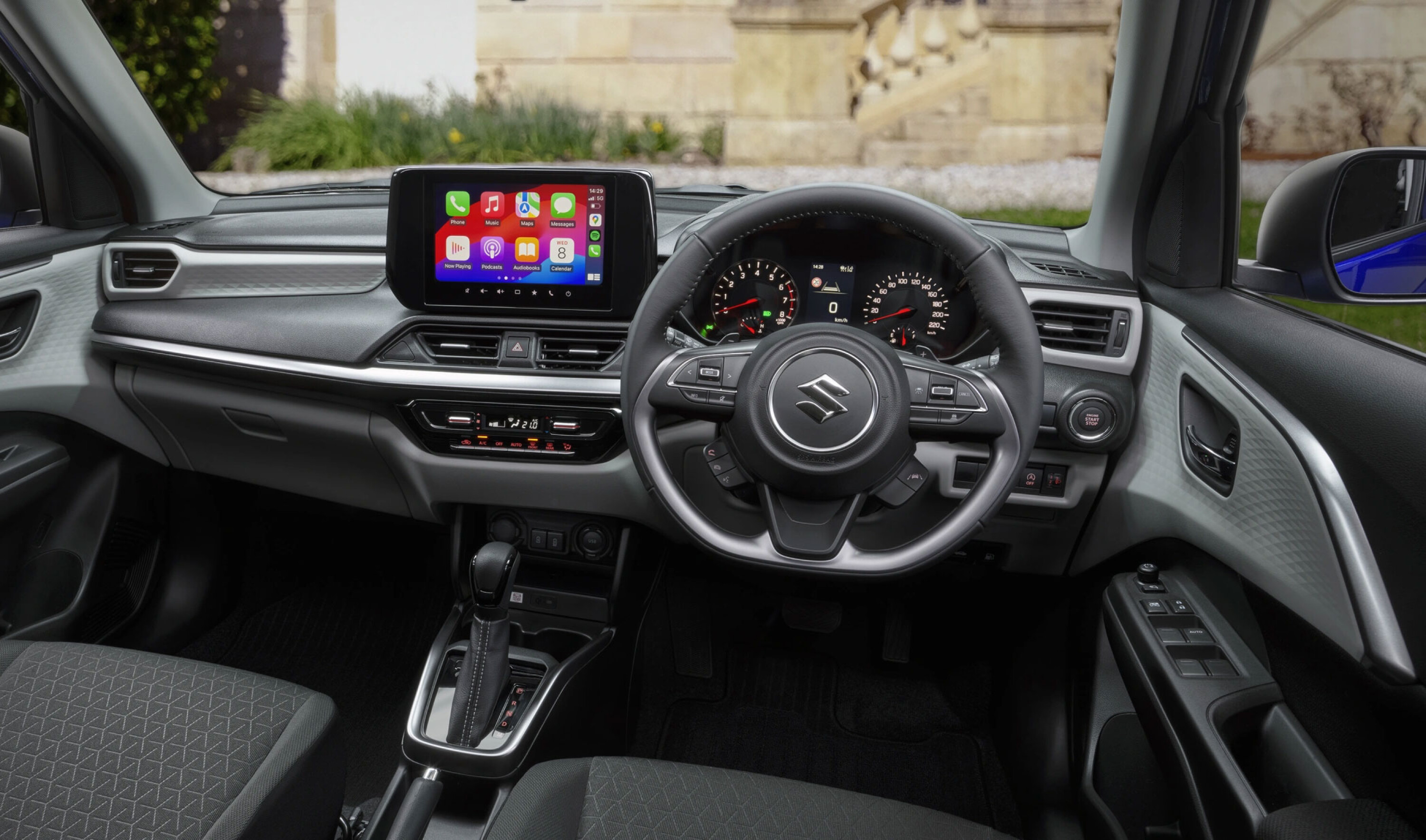
1
Back to top ⬆️
Engines
Despite the name, the Suzuki Swift isn’t a real hybrid in the Toyota Prius sense. Its mild-hybrid system uses a starter generator to act as an electric motor and assist the petrol engine when getting underway, while also allowing it to turn off earlier when coming to a halt.
There’s no arguing with the results, the Swift claiming just 3.9L/100km on the combined cycle as a manual and 4.0L/100km as a CVT, though it does require 95 RON premium fuel. The 1.2-litre three-cylinder engine produces 61kW/112Nm.
1
Under the bonnet of the regular MG3 is a 1.5-litre four-cylinder producing 81kW/142Nm. Attached to a CVT gearbox, it claims 6.0L/100km but does accept 91 RON fuel.
However, the Hybrid uses a (different) 1.5-litre four-cylinder engine producing 75kW/128Nm but teams it with a powerful electric motor for a system output of 155kW. This does require 95 RON premium fuel but thanks to the 1.83kWh battery fuel use is a claimed 4.3L/100km.
Back to top ⬆️
