
Mazda has revealed its electrified sports car vision.
The Mazda Iconic SP concept, unveiled at the 2023 Japan Mobility Show, has a hybrid rotary range-extender powertrain and previews a future MX-5.
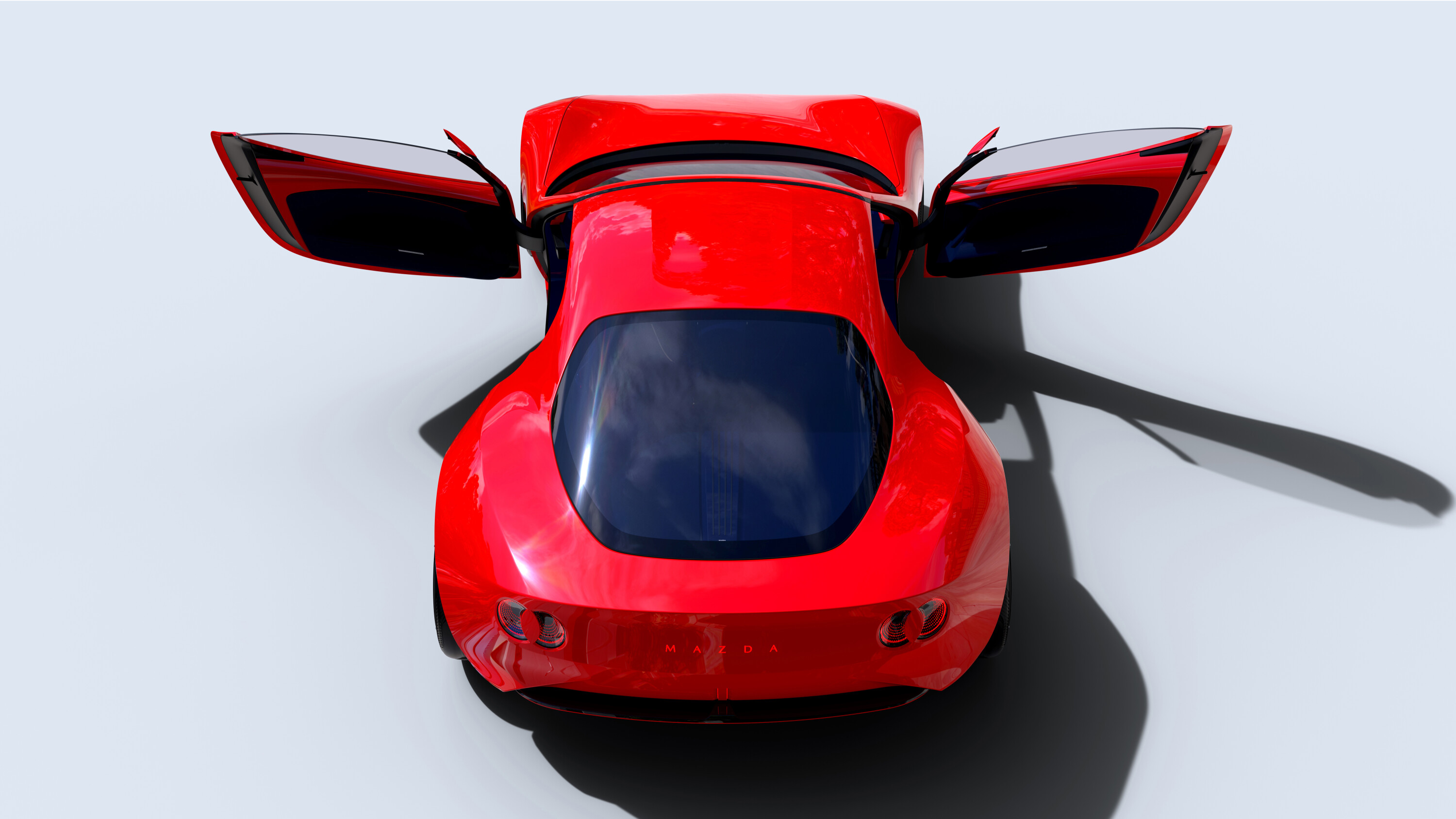
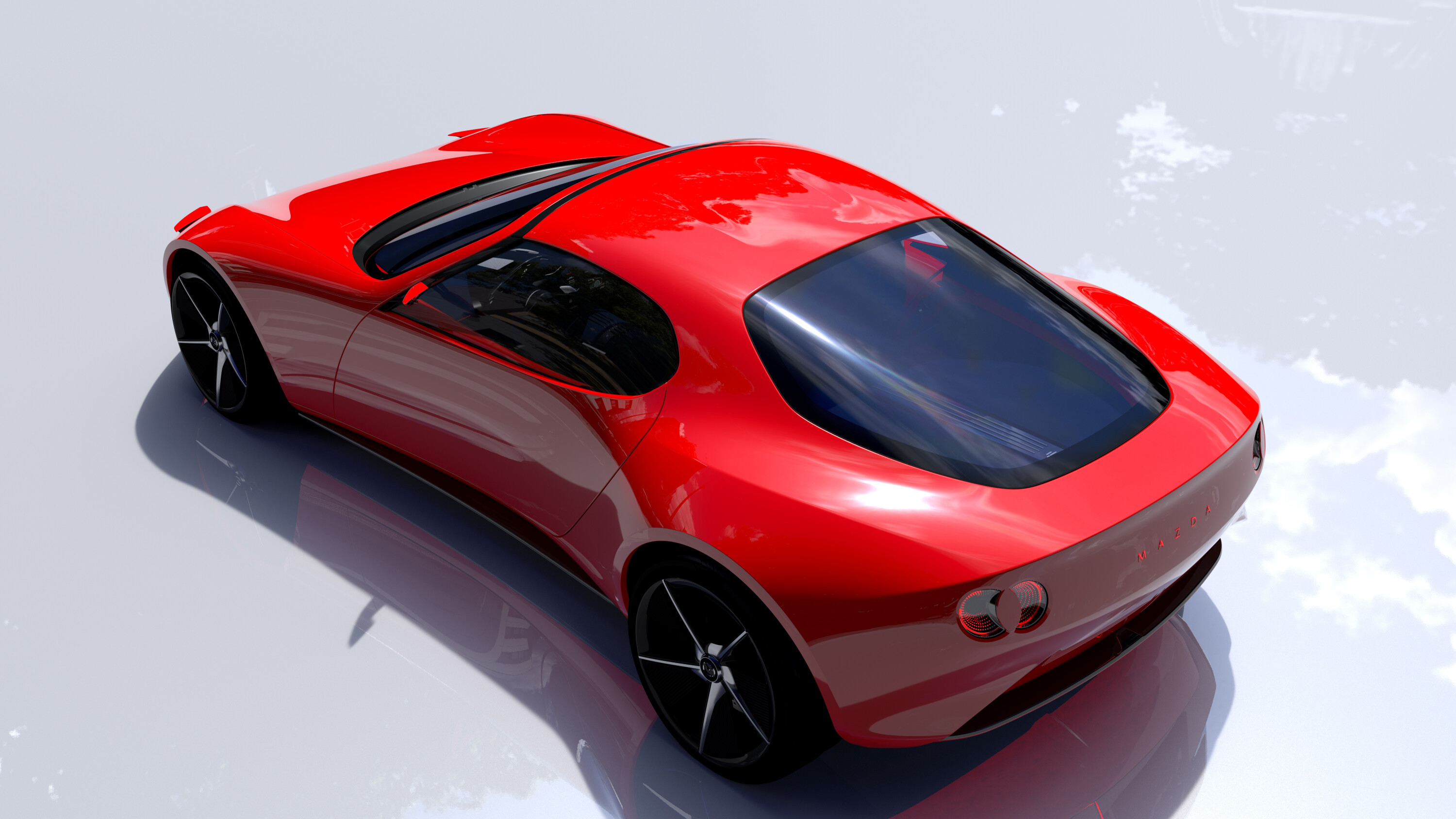
First unveiled virtually in November 2022 as the white-painted Vision Study hardtop, the voila red Iconic SP dwarfs the MX-5 in both size and weight.
1
Measuring 4180mm long, 1850mm wide and 1150mm tall, with a 2590mm wheelbase, the Iconic SP concept is 265mm longer, 115mm wider and 85mm lower with a 280mm longer wheelbase.
It weighs in at 1450kg – impressive for a hybrid with batteries, but 395kg more than the lightweight one-tonne manual MX-5.
The twin-rotor rotary engine – akin to that seen in the recent MX-30 R-EV production car – acts as a power generator to charge the battery as needed.
And, with a compact design, it allows for a lower centre of gravity and a 50:50 weight distribution.
1
It runs on carbon-neutral fuel and Mazda claims it can “burn various fuels such as hydrogen”.
An evolution of Mazda’s Kodo-style grille with a body-coloured inner element is joined by pop-up headlights with sleek LED units, harking back to MX-5 and RX-7 models from the ’80s and ’90s for a nostalgic touch.
According to the brand, the vibrant voila red paint finish symbolises Mazda’s commitment to “enriching life-in-motion for those we serve” – and it could replace or supplement the brand’s signature soul red crystal finish in future production models.
1
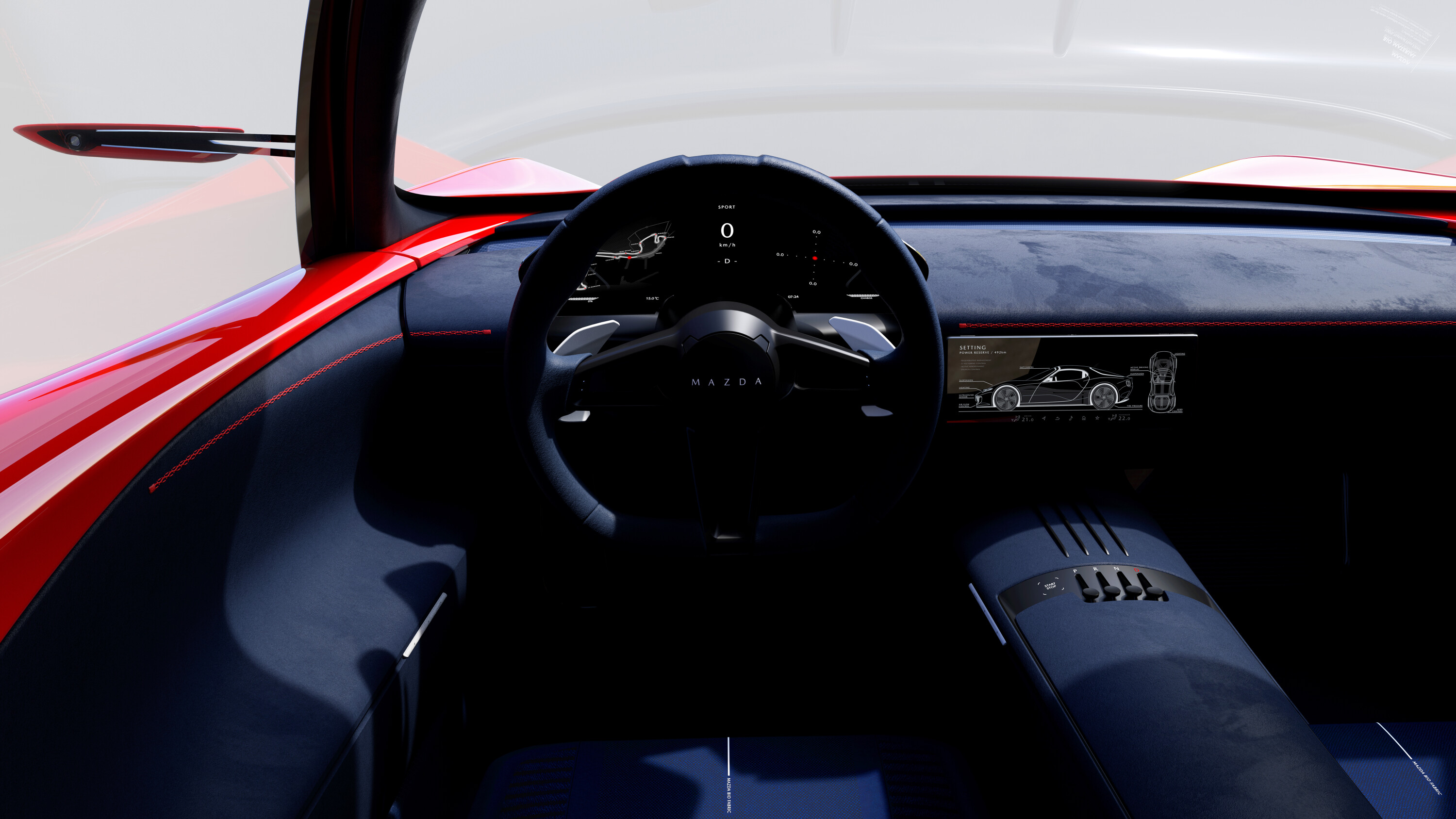
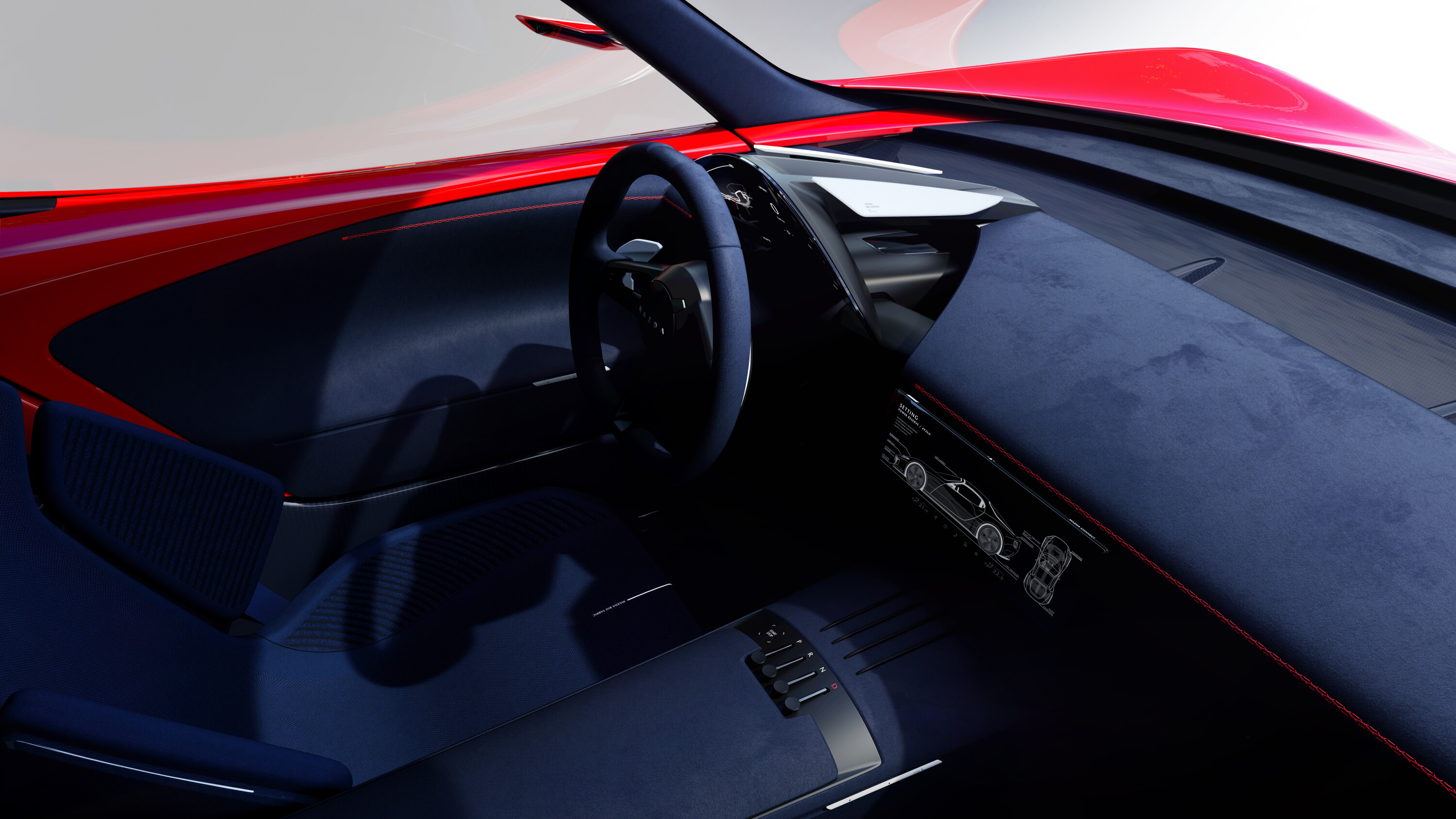
Inside, the minimalist cabin offers a central screen, few physical controls, and a curved instrument cluster.
While it is unclear if the Iconic SP concept directly previews the next-generation MX-5, Mazda’s head of design Akira Tamatani last year said it’ll provide some inspiration for the new model, due around 2026.
“Please take it as an image, just an image,” he said. “It’s a message. We have this passion to create that type of vehicle, that’s the message we want to say. But will we make production vehicles made from that? We still haven’t really decided.”
1
The new MX-5, potentially codenamed ‘NE’, is likely to be electrified in some form to meet stringent emissions regulations, including the now-delayed Euro 7 standards.
“The next-generation MX-5 we may have to think about electrification as well there and if that’s the case the car has to be lightweight, of course, and it still has to have an MX-5-ness,” added Tamatani.
“So how can we satisfy both of those things we need to really run a good study on that so we don’t have a clear answer to that yet.”
MORE
Everything Mazda
The Mazda 2 has long been popular with first-car buyers seeking affordable transport that doesn’t compromise style, equipment and driveability.
However, the once-vibrant light car market it topped for years can best be described as niche these days, as buyers flock to light SUVs mostly based on the very hatchbacks they abandoned.
But while it might be getting a little old in the tooth, there is still a lot to like about the third-generation Mazda 2, including that it is now a little unique.
3
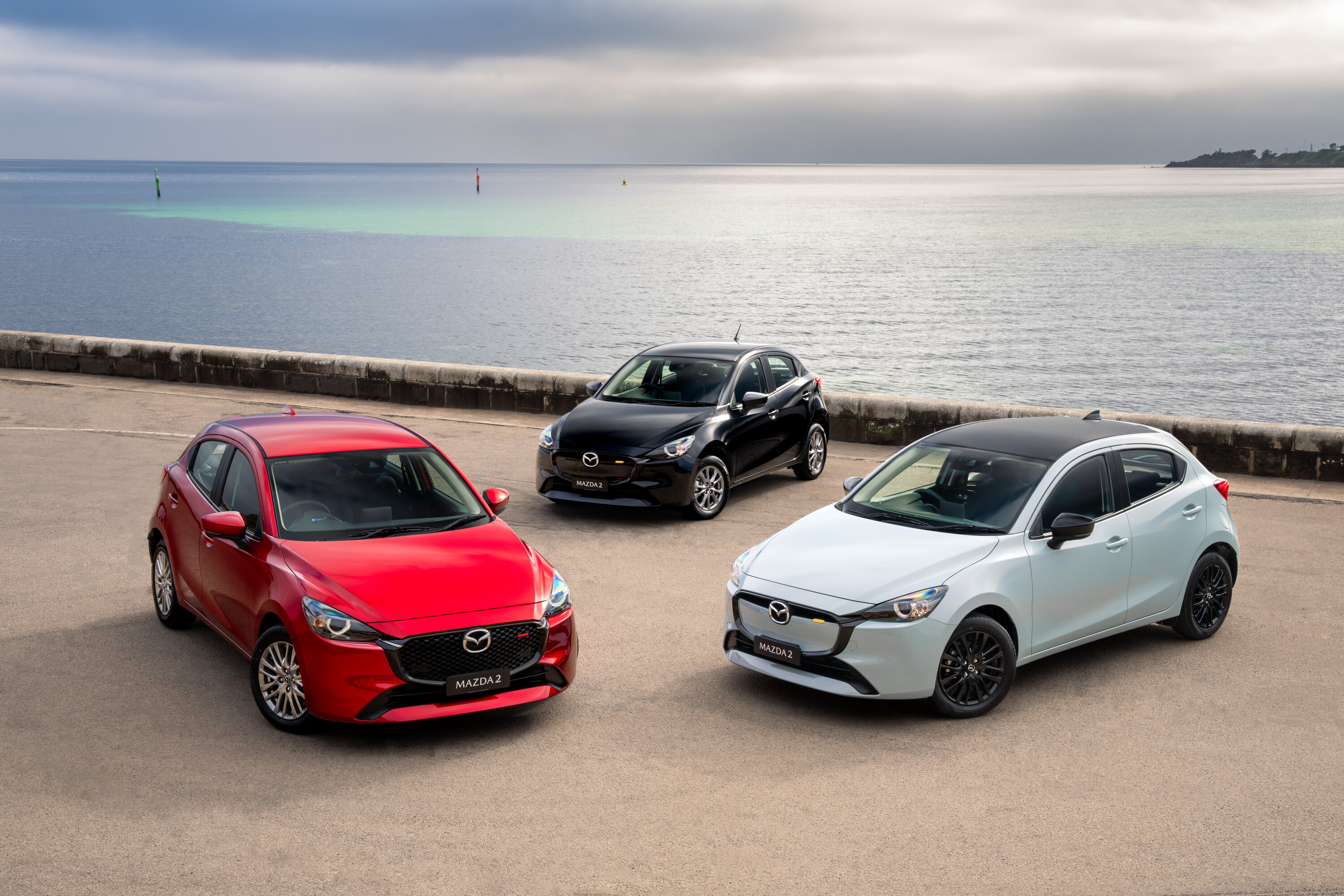
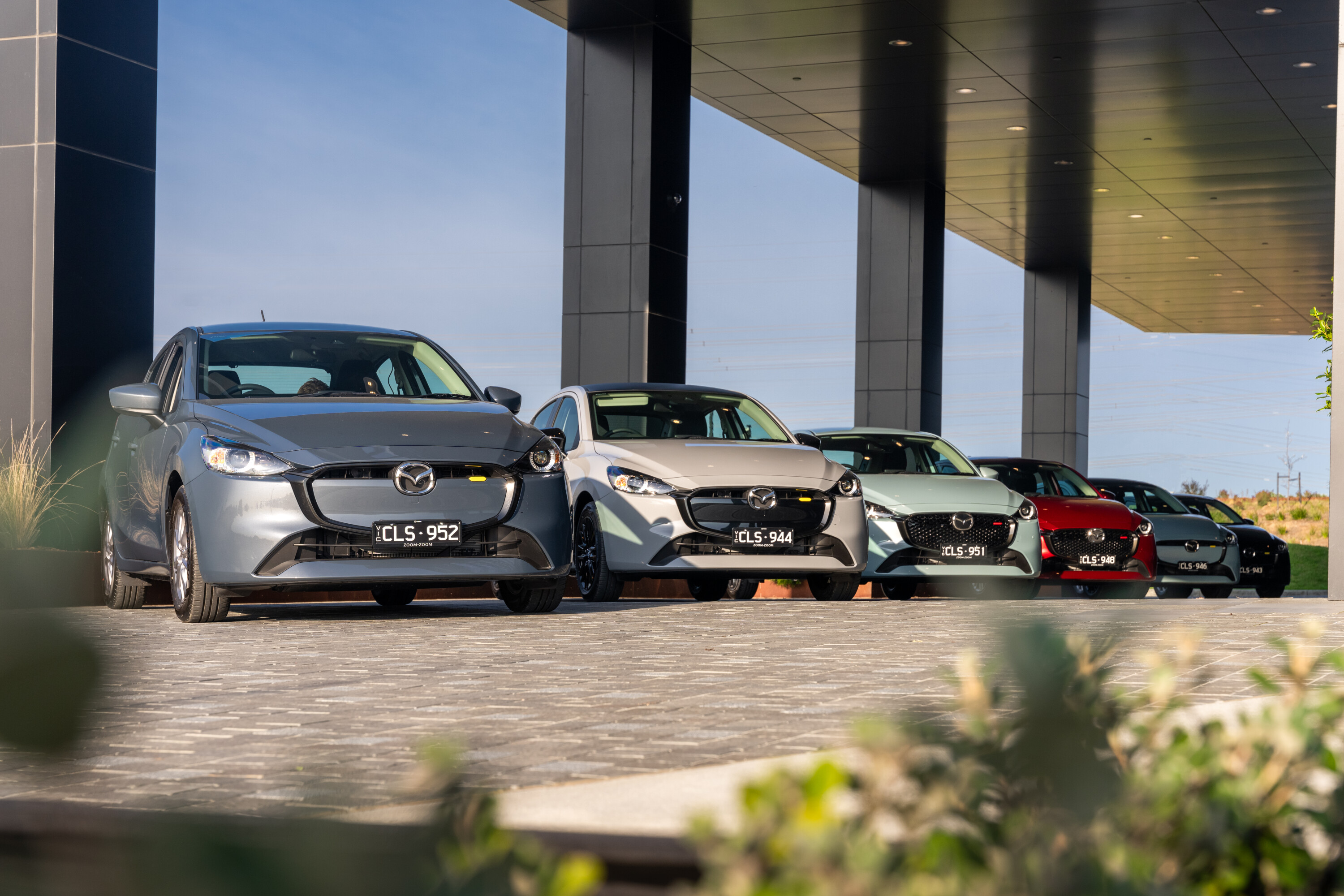
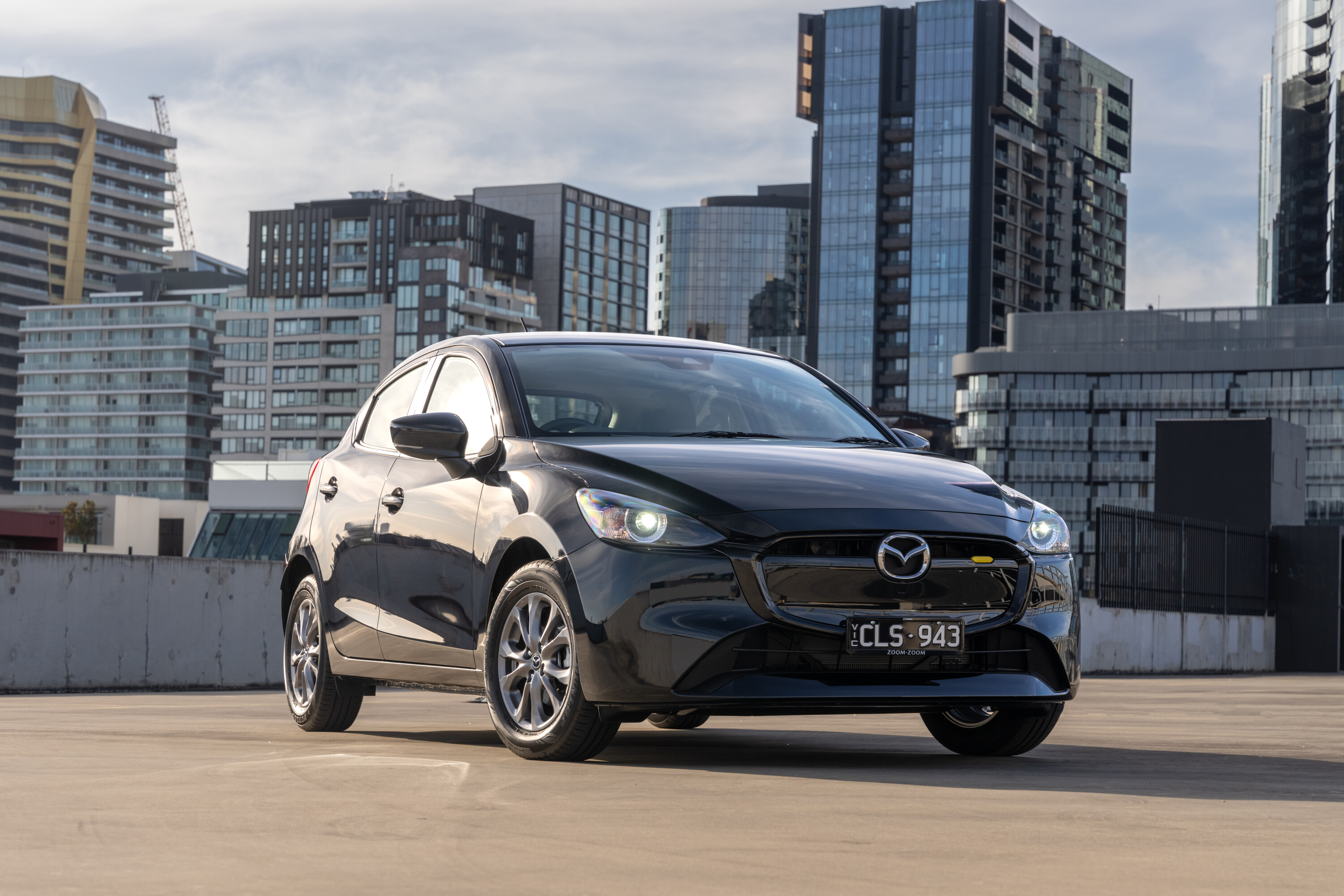
The 2023 update brought a few minor changes, including a mildly revised front end with a larger front grille, a new X-shaped lower bumper, and more prominent Mazda badging with an integrated radar sensor.
There’s also a body-coloured, EV-like plate on the front grille for select versions, while the Mazda 2 hatchback will receive an “asymmetrically placed colour accent on the front grille and rear bumper,” similar to the latest CX-5.
All hatchback variants and the range-topping GT sedan also receive a simplified rear bumper design.
1
JUMP AHEAD
- What body styles are available for the Mazda 2
- Mazda 2 pricing
- What features are standard in every Mazda 2
- What key features do I get if I spend more?
- How safe is the Mazda 2?
- How comfortable and practical is the Mazda 2?
- How much boot space does the Mazda 2 offer?
- I like driving, will I enjoy the Mazda 2?
- Which Mazda 2 engine uses the least fuel?
- What is the Mazda 2’s towing capacity?
- How long is the warranty, and what are the Mazda 2’s servicing costs?
- Which version of the Mazda 2 does Wheels recommend?
- What are the rivals to the Mazda 2?
What body styles are available for the Mazda 2?
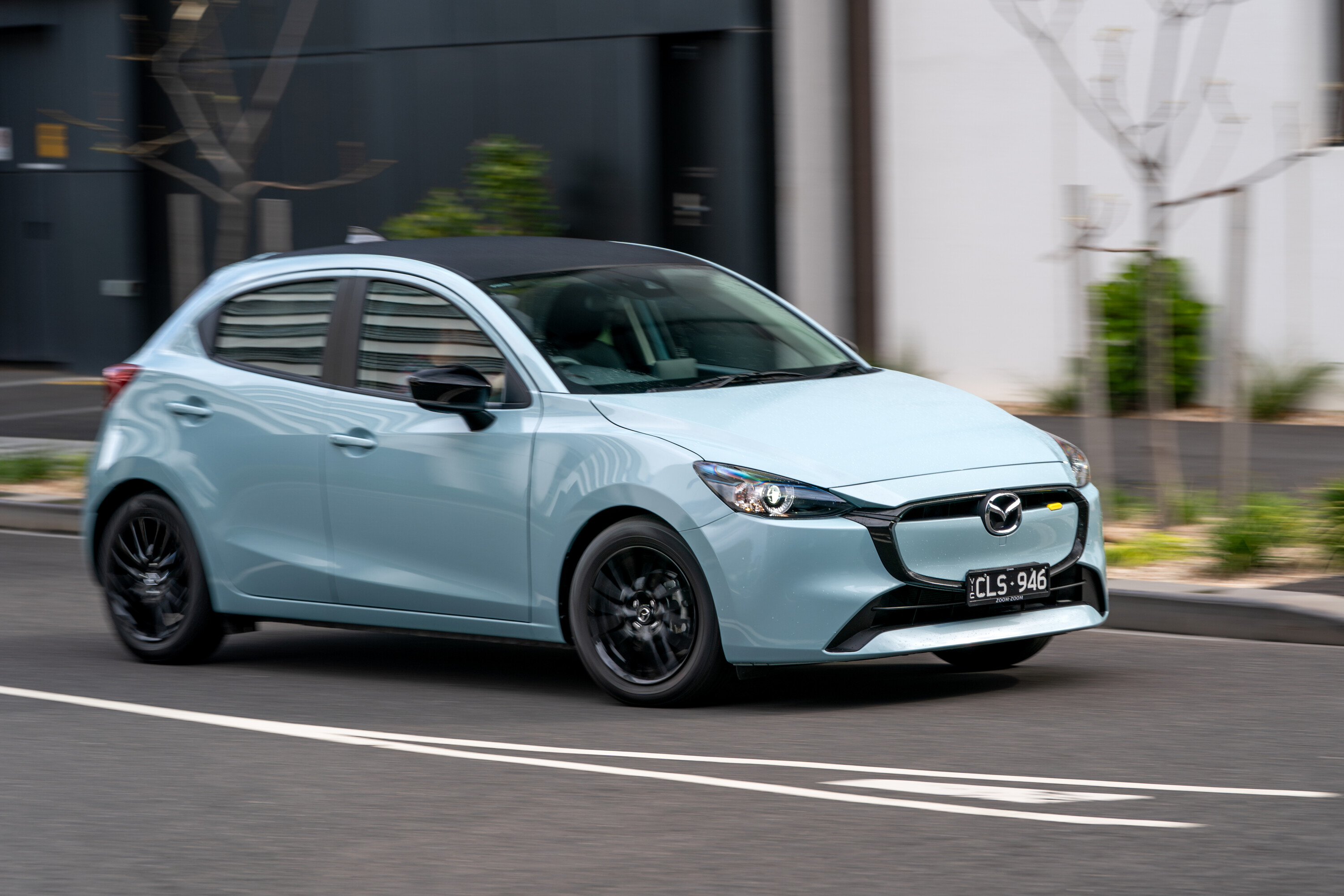
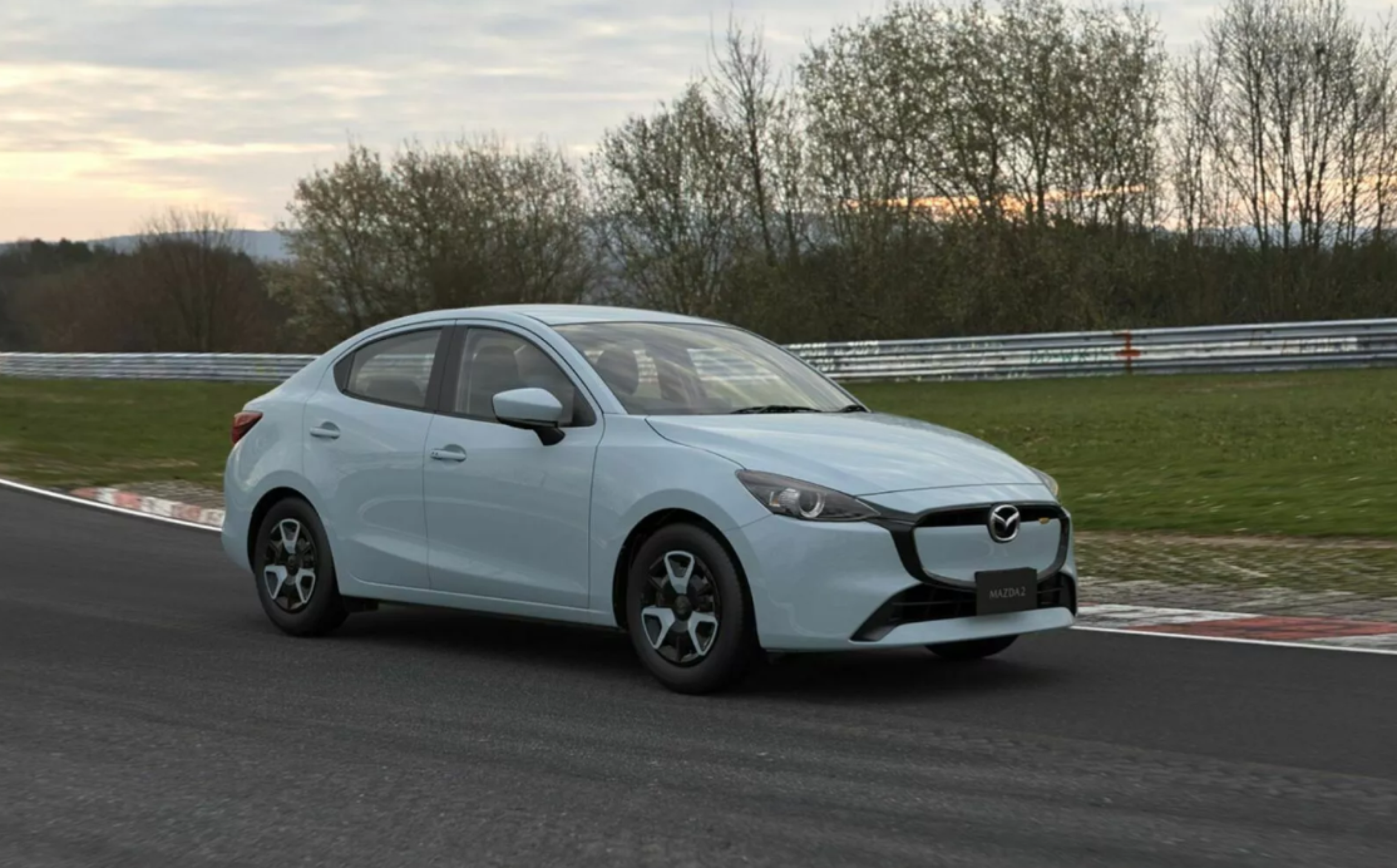
Since the demise of the Hyundai Accent, the Mazda 2 is the only light car on sale in Australia with a choice of hatchback and sedan variants, though the latter is now only available in a couple of spec grades.
The Mazda 2 is classed as a light car, lower priced, with all variants being front-wheel drive.
Mazda Australia is yet to release 2023 Mazda 2 sedan images, so most of the cars pictured in this review will be hatchbacks.
1
1
Mazda 2 pricing
| G15 Pure hatch | Manual | $22,720 |
|---|---|---|
| G15 Pure hatch | Automatic | $24,720 |
| G15 Pure sedan | Automatic | $24,720 |
| G15 Pure SP hatch | Automatic | $25,520 |
| G15 Evolve hatch | Automatic | $26,220 |
| G15 GT hatch | Automatic | $27,920 |
| G15 GT sedan | Automatic | $27,920 |
| All prices exclude on-road costs | ||
What features are standard in every Mazda 2?
| Mazda 2 G15 Pure standard features | |
|---|---|
| 15-inch alloy wheels | Six-speaker audio system |
| 7.0-inch infotainment system | Rear parking sensors |
| Wired Apple CarPlay and Android Auto | Push-button engine start |
| DAB+ digital radio | Reversing camera |
| LED headlights | Manual cruise control |
| Power-folding door mirrors | Dusk-sensing headlights |
| Blind-spot monitoring | Air-conditioning |
| Lane-keep assist | Rain-sensing windscreen wipers |
| Autonomous emergency braking | Hill launch assist |
| Autonomous reverse braking | Rear cross-traffic alert |
| Leather wrapped gear shifter, handbrake handle and steering wheel | |
What key features do I get if I spend more?
The cheapest Mazda 2 you can get is the G15 Pure hatchback with a six-speed manual gearbox.
It is now the only variant with a manual option, costing $2000 less than a G15 Pure hatch with the six-speed automatic that comes standard on the G15 Pure sedan and all other variants.
The G15 Pure has 15-inch alloy wheels, cloth seats, and manual cruise control.
2
1
G15 Pure SP (hatchback only)
| In addition to G15 Pure | |
|---|---|
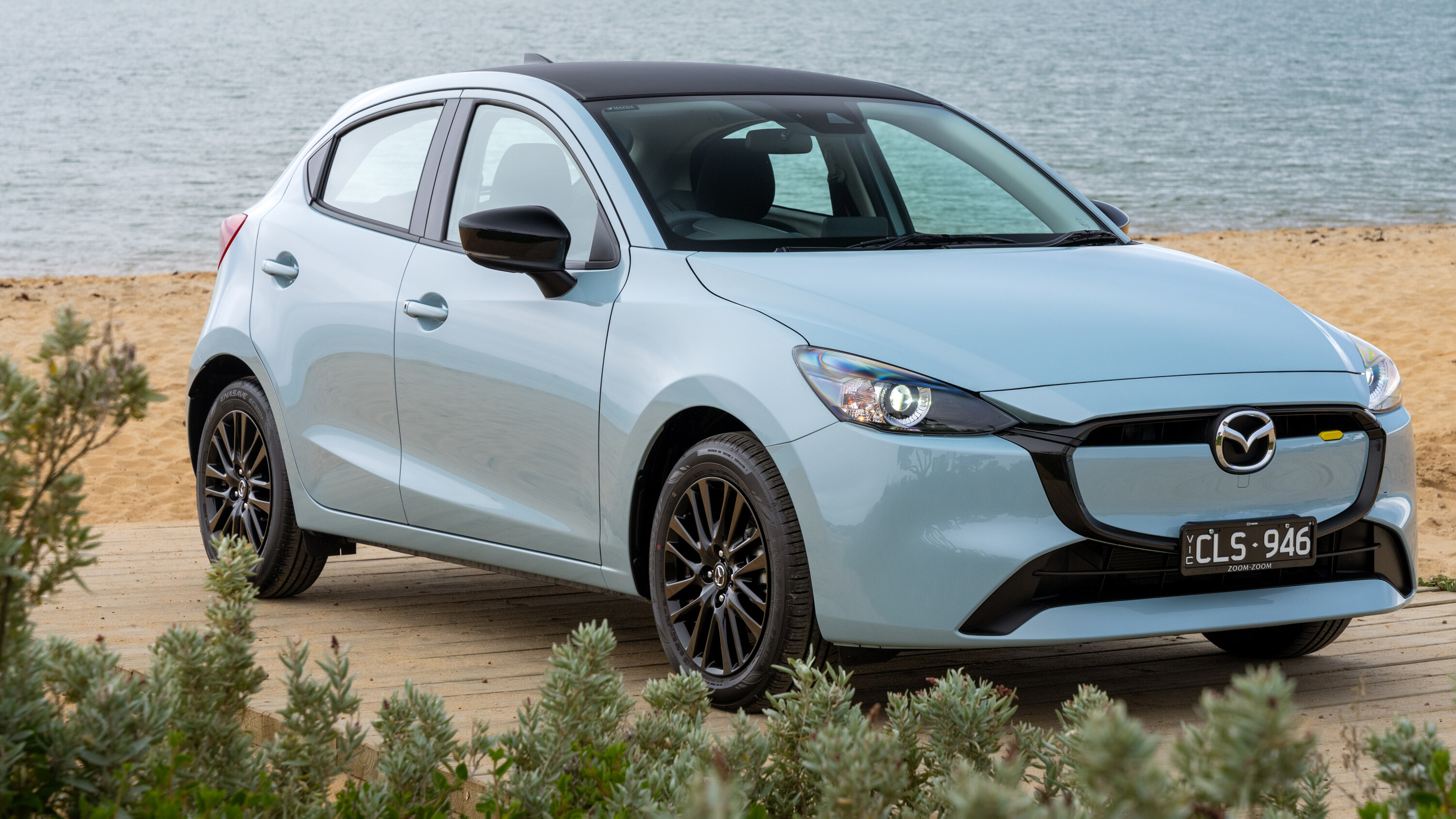
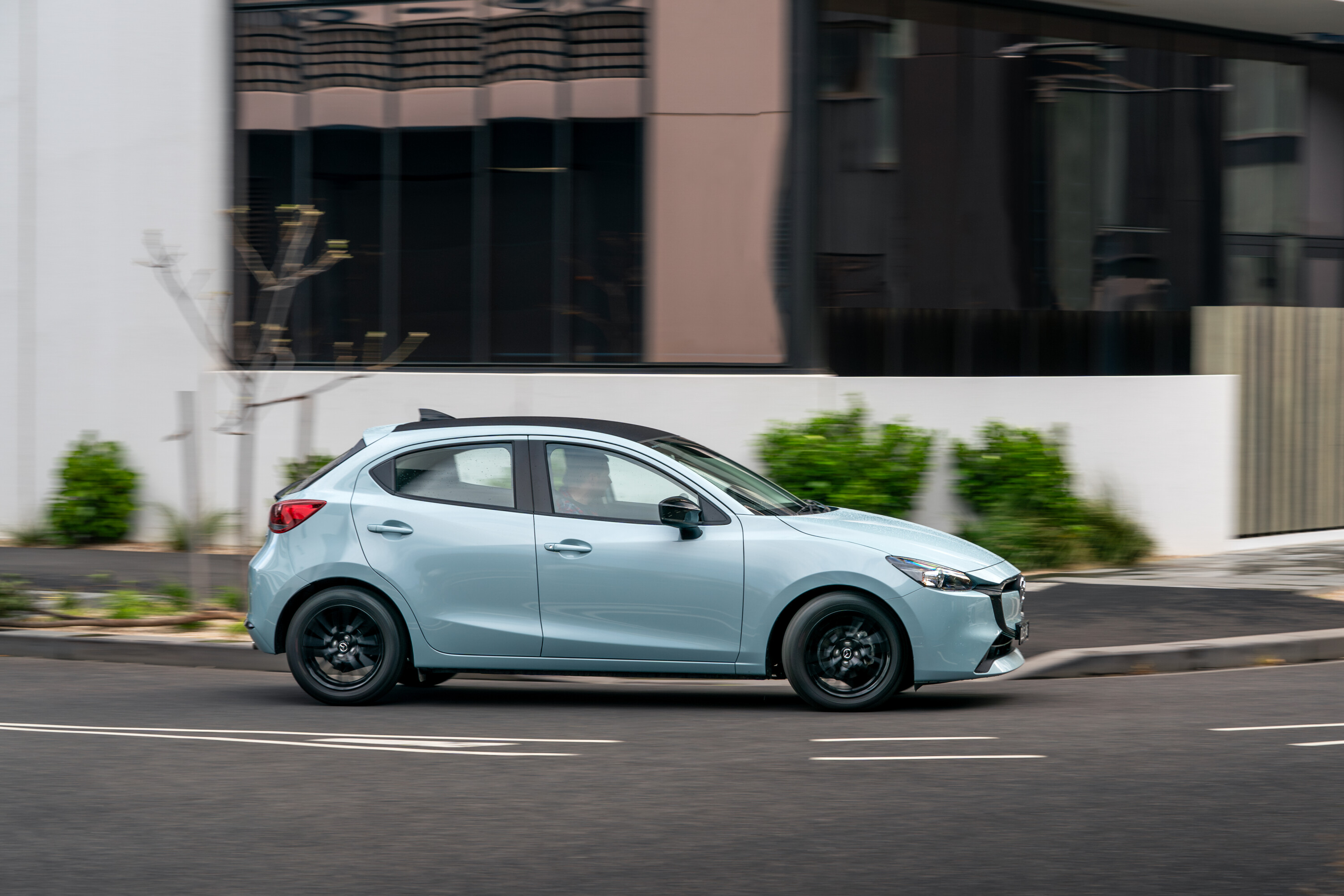
| Shark fin antenna (new) | Gloss black exterior trim |
| Black roof film covering (new) | Black cloth upholstery with red stitching |
| 16-inch alloy wheels (black) | |
3
3
G15 Evolve (hatchback only)
| In addition to G15 Pure SP | |
|---|---|
| 16-inch alloy wheels (bright) | Pop-up head-up display |
| Traffic sign recognition | Single-zone climate control |
| LED daytime running lamps | Satellite navigation |
| Chrome exhaust extension | Rain-sensing wipers |
| Blue/black cloth upholstery | |
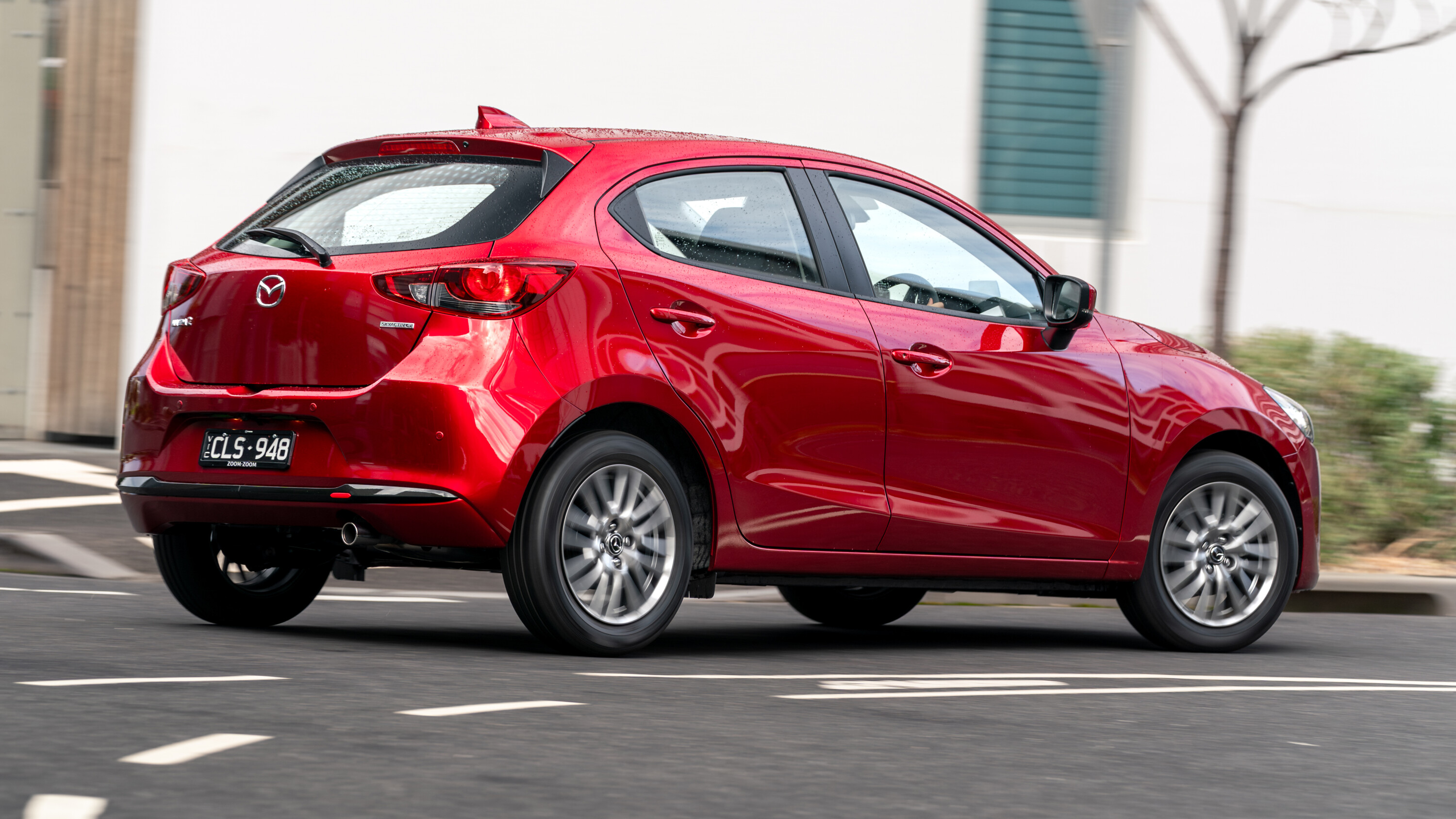
5
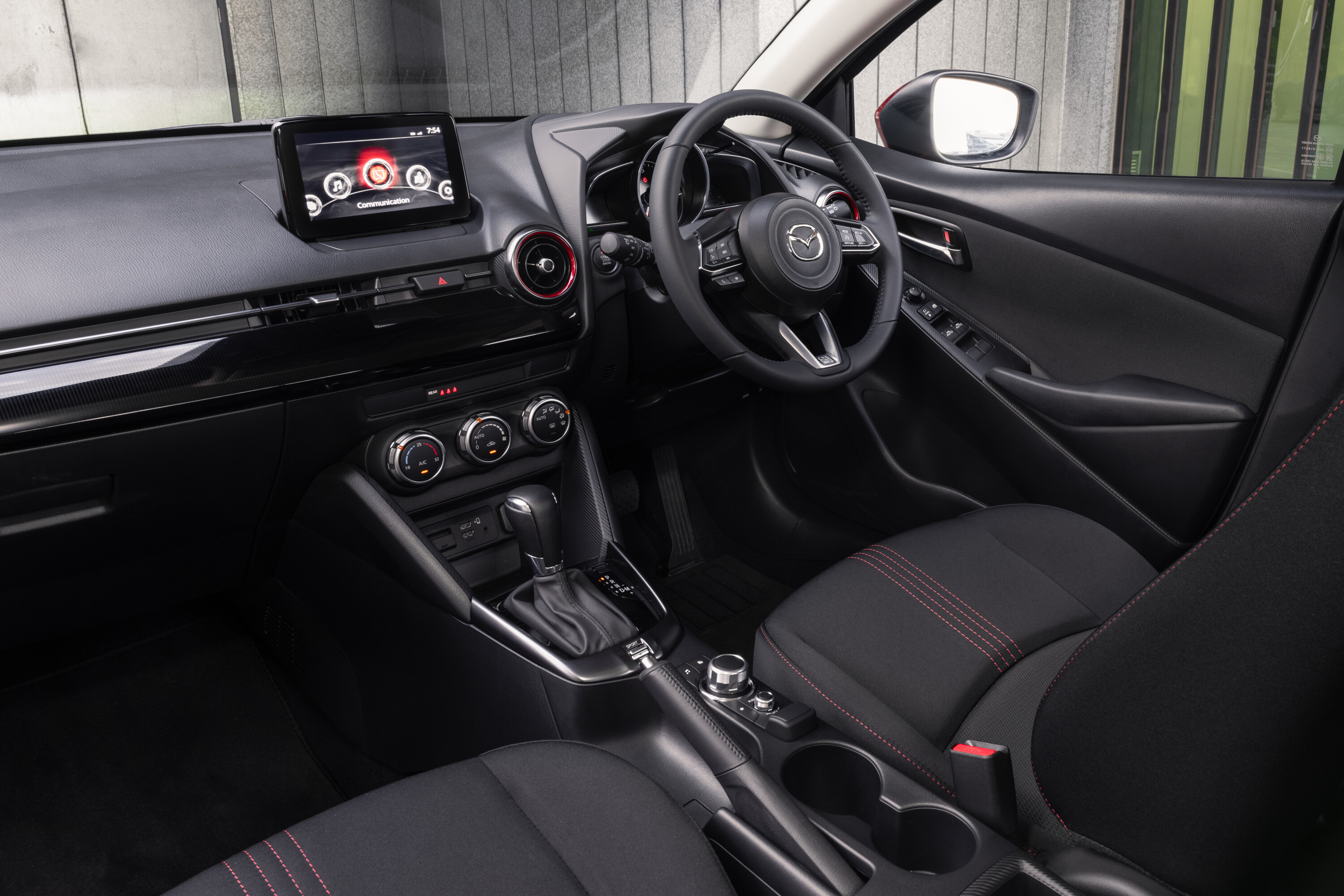
6
G15 GT hatchback
| In addition to G15 Evolve | |
|---|---|
| 360-degree camera system | Adaptive cruise control |
| Keyless entry | Front parking sensors |
| Black leather with Grand Luxe synthetic suede and red trim | |
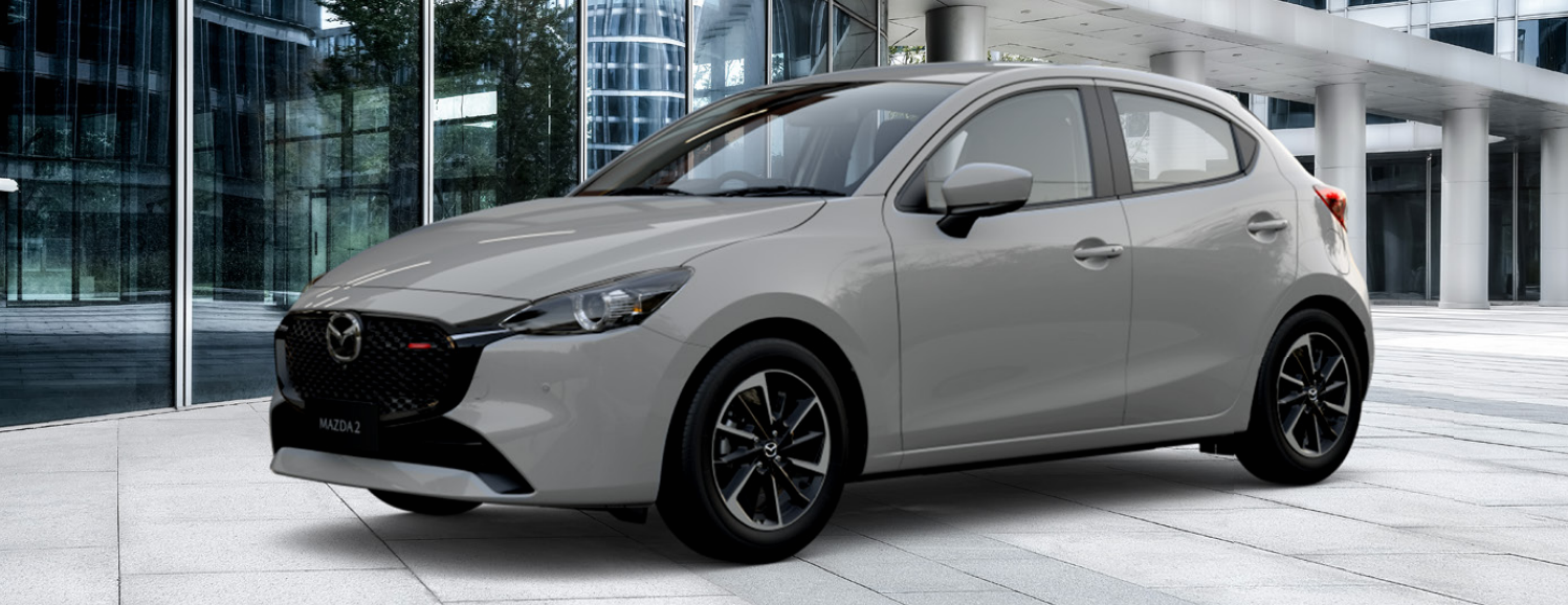
1
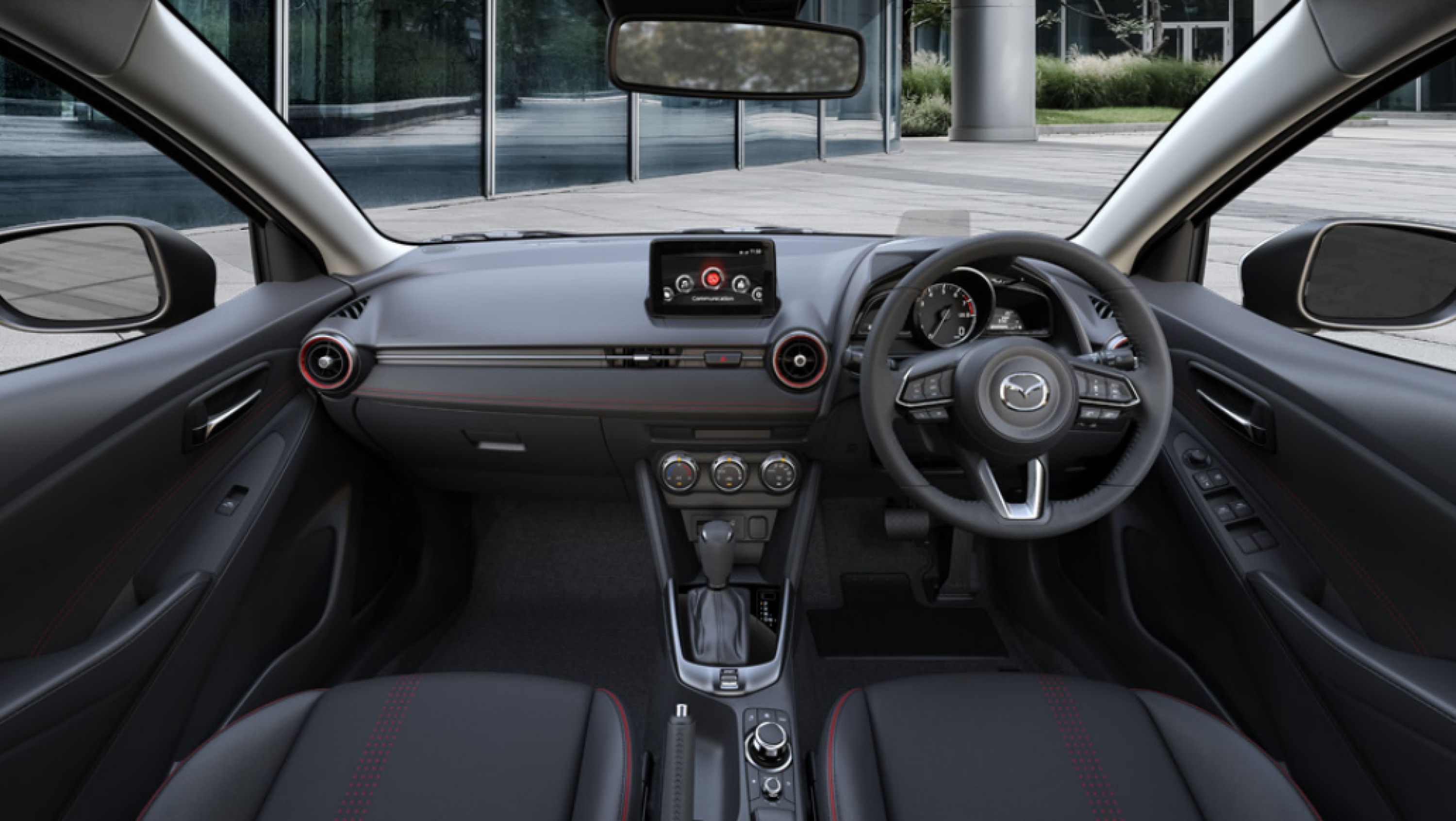
1
G15 GT sedan
| In addition to G15 Pure sedan | |
|---|---|
| 16-inch alloy wheels | LED daytime running lamps |
| Black leather with Grand Luxe synthetic suede and red trim | Chrome exhaust extension |
| Active driving display | Single-zone climate control |
| Satellite navigation | Traffic sign recognition |
| 360-degree camera system | Front parking sensors |
| Adaptive cruise control | Auto-dimming rear view mirror |
How safe is the Mazda 2?
The Mazda 2’s five-star ANCAP rating from 2015 expired in January 2023. Does that mean it’s an unsafe car?
Since it was tested, it gained active safety features that made it one of the better-equipped cars in its class. As we mentioned in our 2020 Mazda 2 review, “it comes with a broadly based safety package that stands out among cars of this size and price”.
| 2023 Mazda 2 active safety features | |
|---|---|
| Lane-keep assist | Blind-spot monitoring |
| Lane departure warning | Rear cross-traffic alert |
| Autonomous emergency braking (low-speed vehicle, pedestrian and reverse) | |
It scored very well in crash testing, and its well-located A-pillars (on either side of the windscreen) afford good vision for tight corners and roundabouts (helped by the exterior mirrors mounted on the doors rather than in the corners of the windows), increasing primary safety.
The six airbags are in the usual places, offering more side protection in the front than in the rear. There are two airbags directly in front of the driver and front passenger; one outside each front seat to protect front occupants from side impacts at chest level; and curtain airbags extending down each side that protect front and rear occupants from side impacts at head level.
1
How comfortable and practical is the Mazda 2?
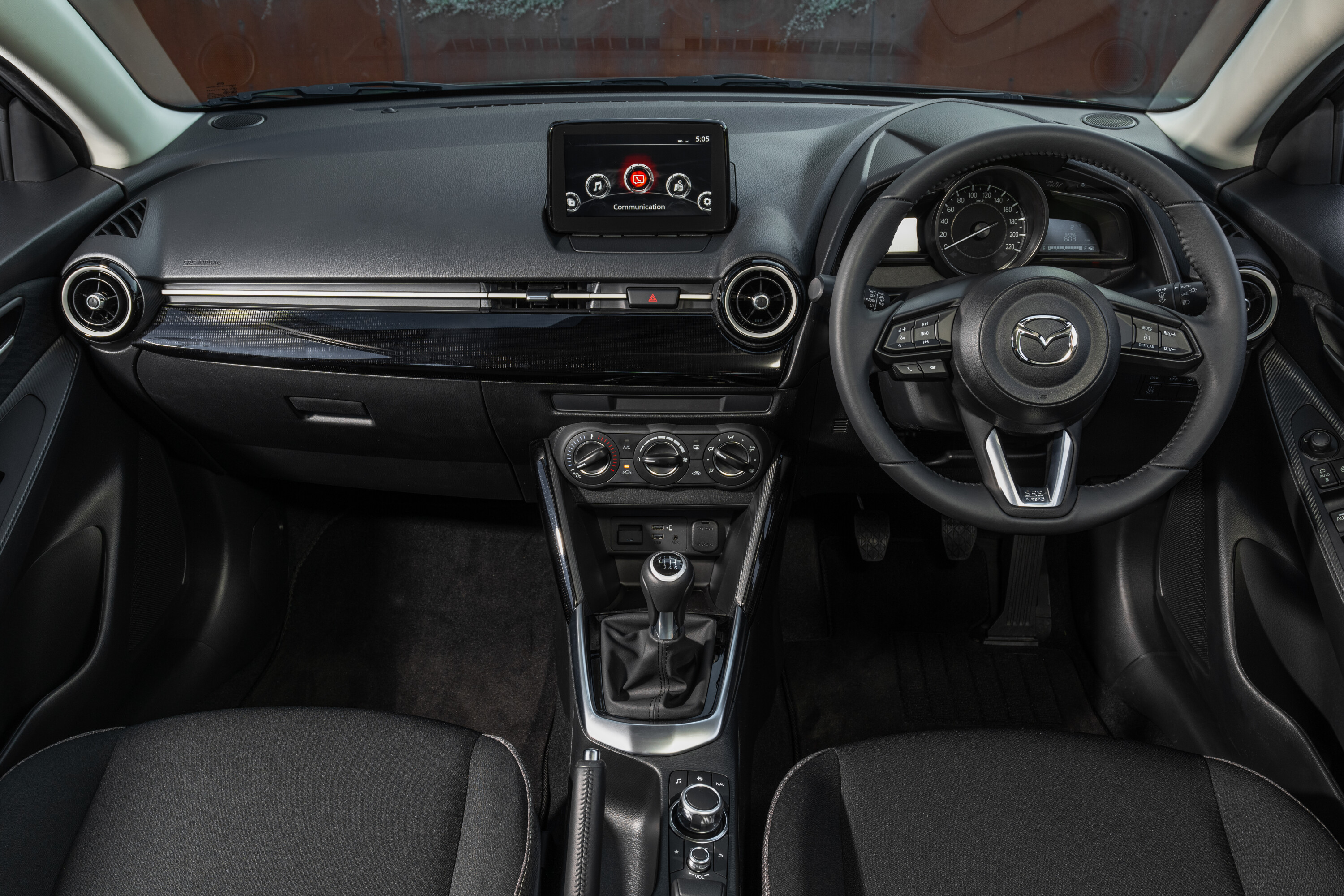
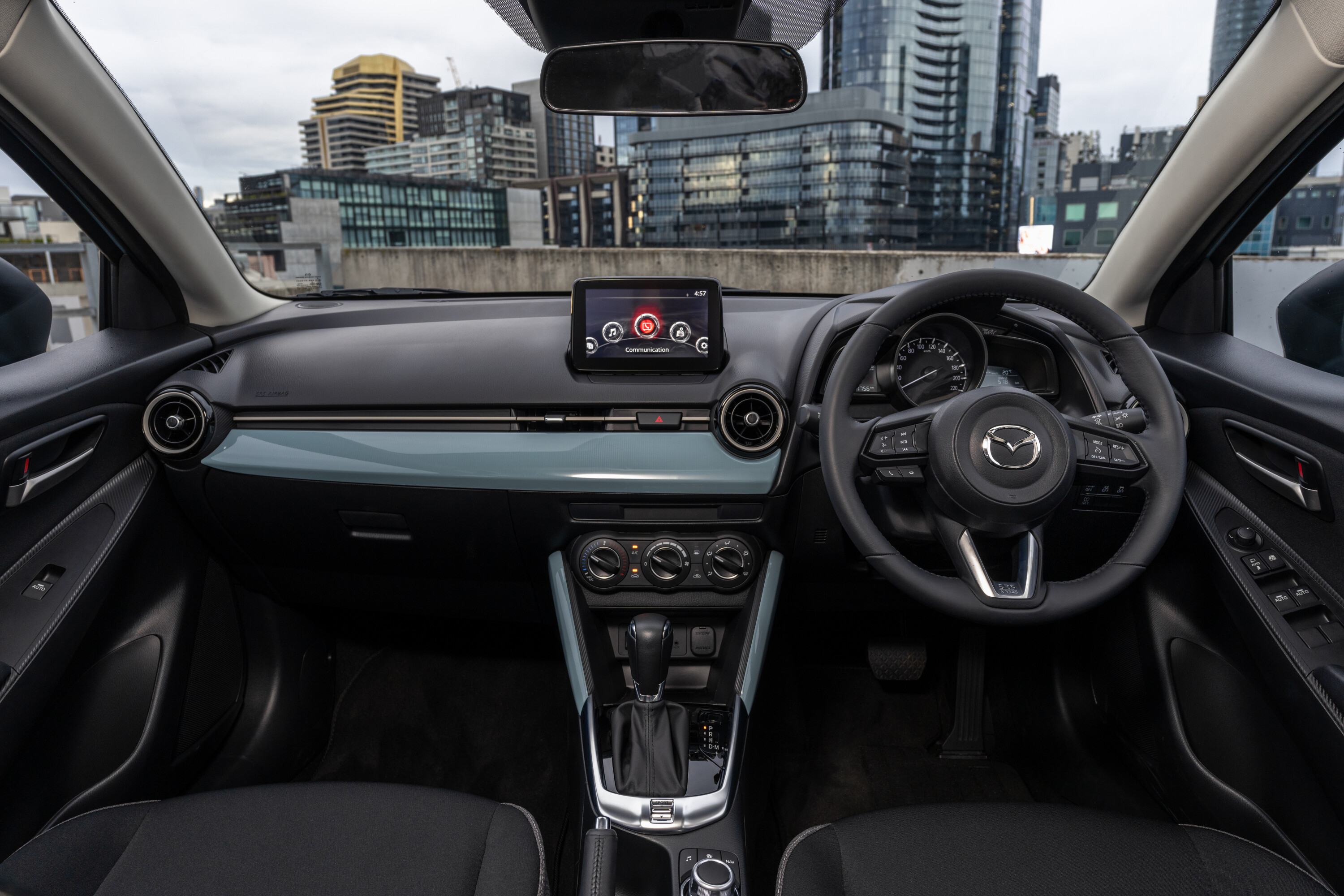
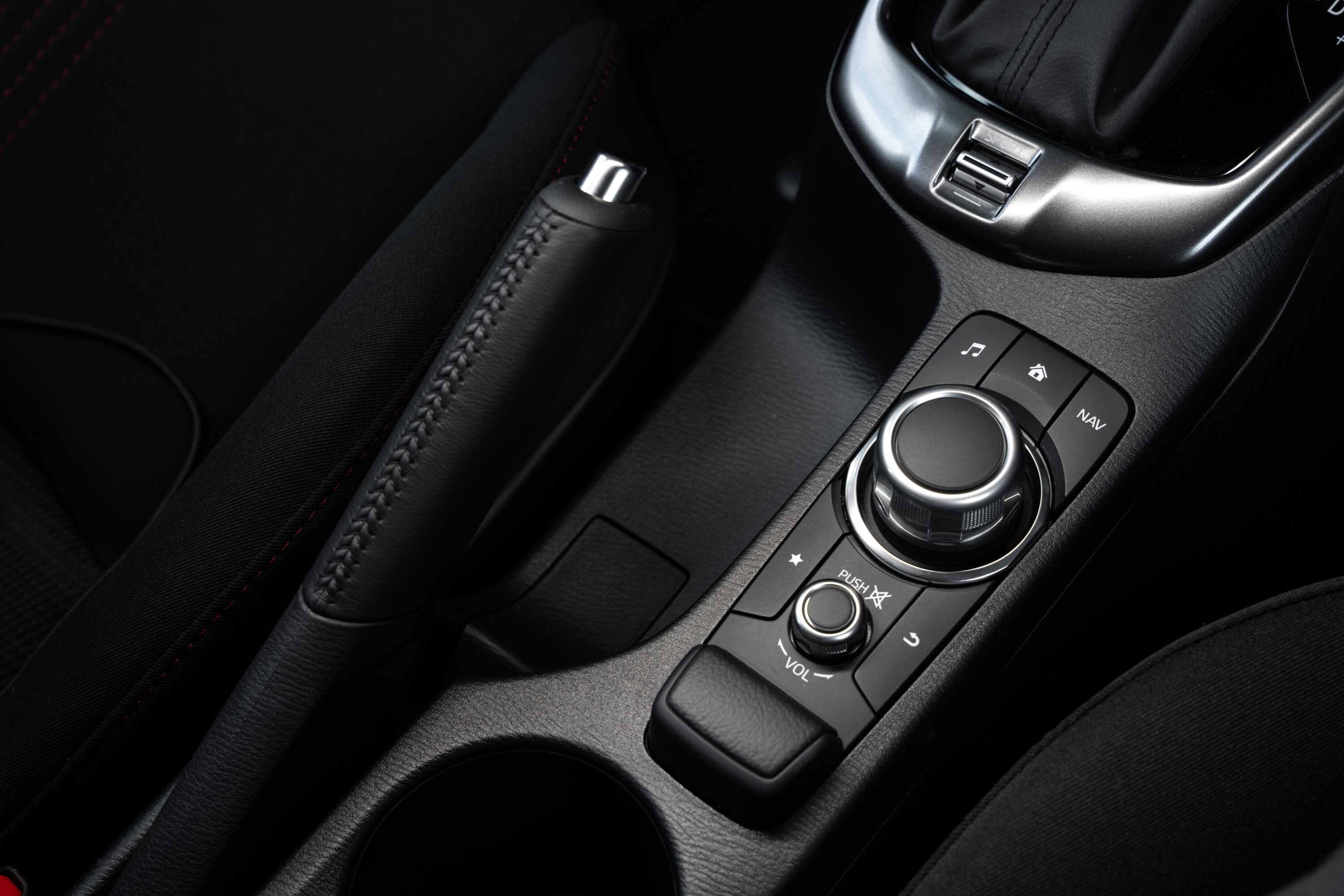
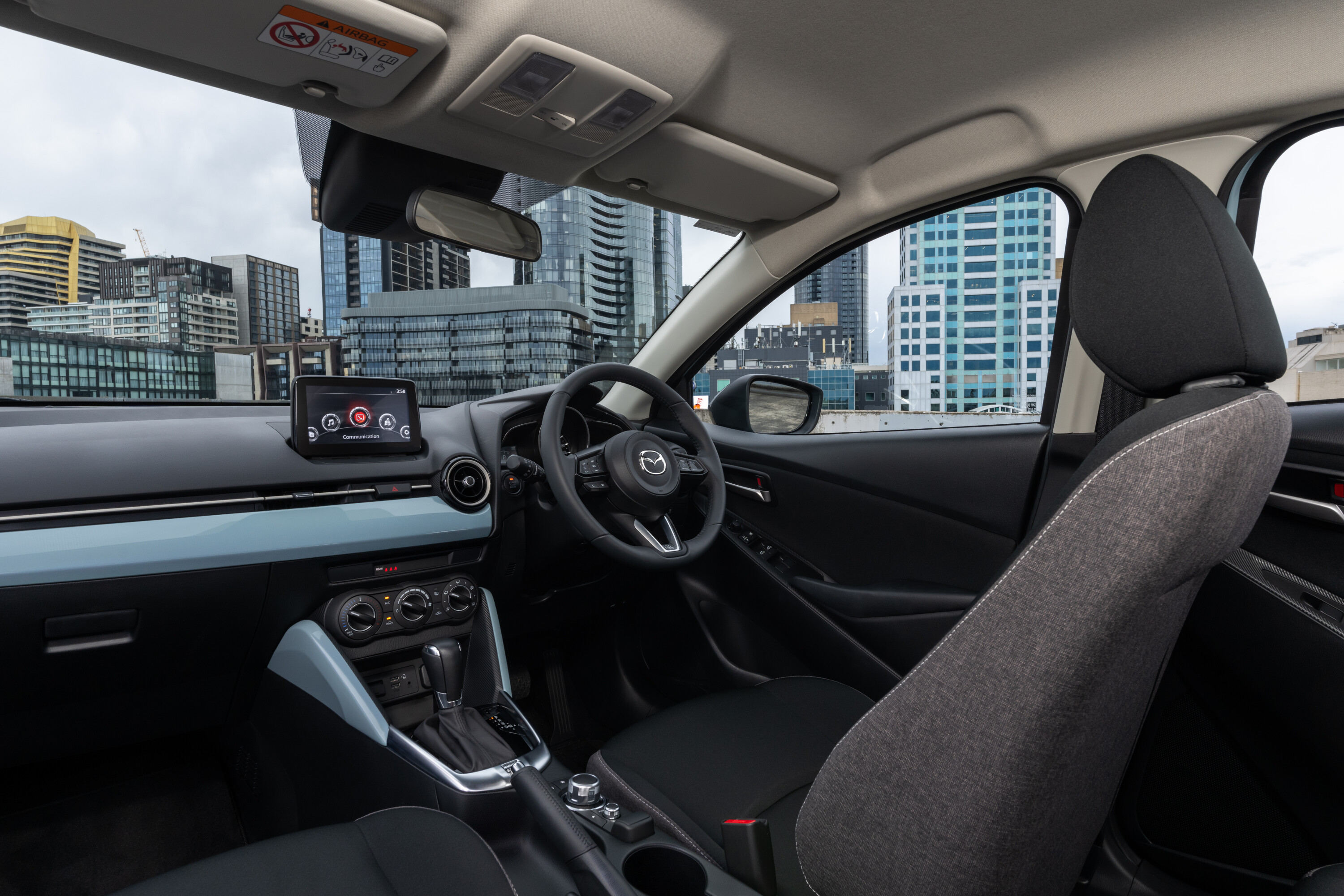
The Mazda 2’s interior design is rather elegant, with high-quality plastics and pleasantly tactile controls.
Pure and Pure SP variants feature three dashboard trim colours – Pure White, Mirror Black or Mint, determined by the exterior hue. The lighter hues bring a nice retro touch.
The front seats are a little narrow but provide good support for journeys of up to two hours and the driving position is comfortable.
Although the little Mazda’s ride can be a little stiff on rougher roads, partly due to the 16-inch alloy wheels fitted to all but the base model, the dampers absorb bumps well with little bounce-back.
Vibration and road noise are far less of an issue than they were with earlier versions.
1
Rear space and comfort
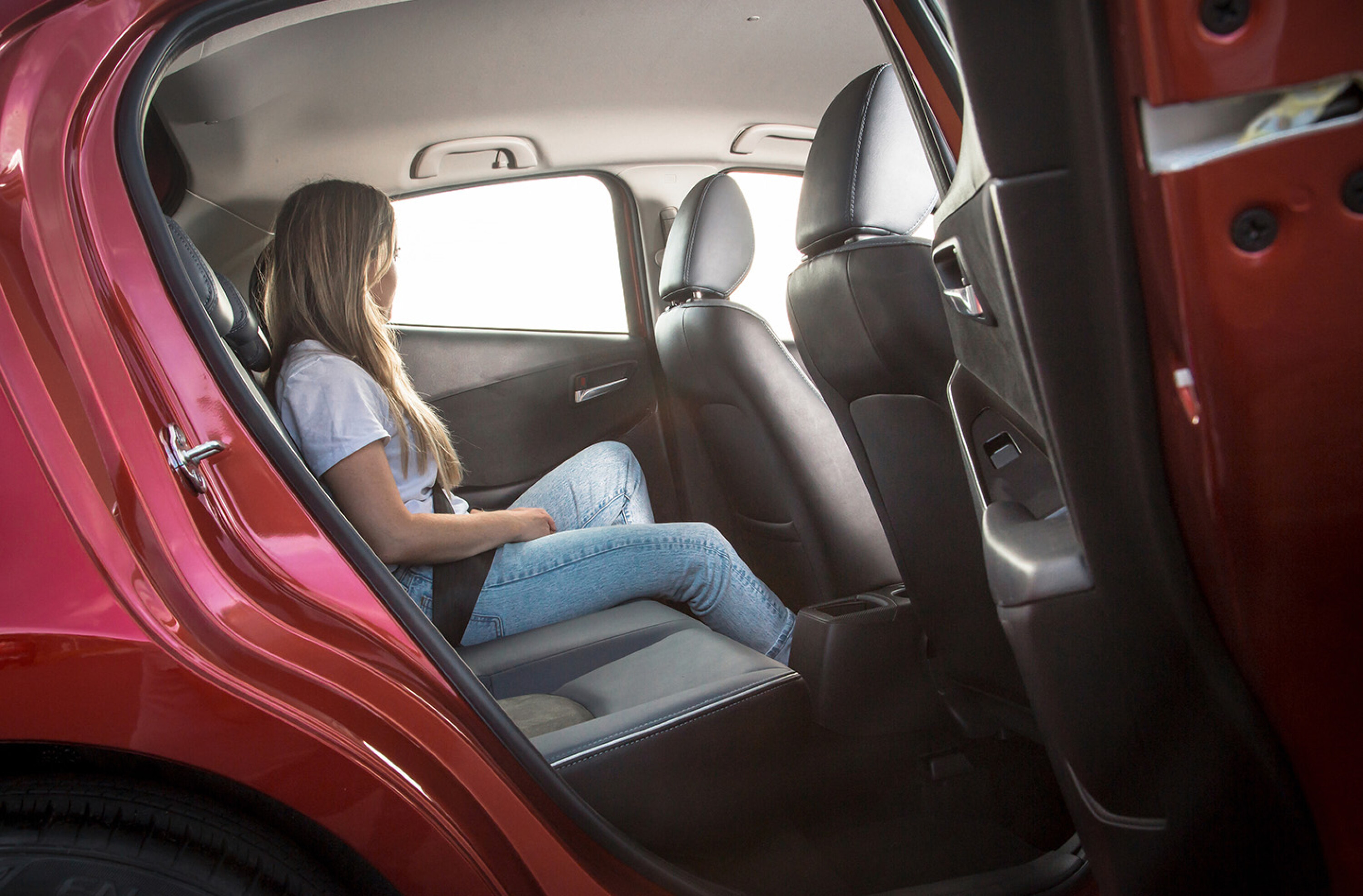
The bench rear seat offers good shoulder space and legroom for two and a comfortable cushion.
On the negative side, a rising window line and large front headrests limit vision, which might be a factor for children, and the monochrome ambience makes things a little gloomy.
The seat can carry three passengers, with lap-sash belts for all. Squeezing three adults across the back of a Mazda 2 – or any light car – is a recipe for discomfort. However, it’s handy to be able to do so for short trips.
Handholds are provided above the windows and a map pocket behind the front passenger seat, but nothing by way of air vents or USB sockets.
3
How much boot space does the Mazda 2 offer?
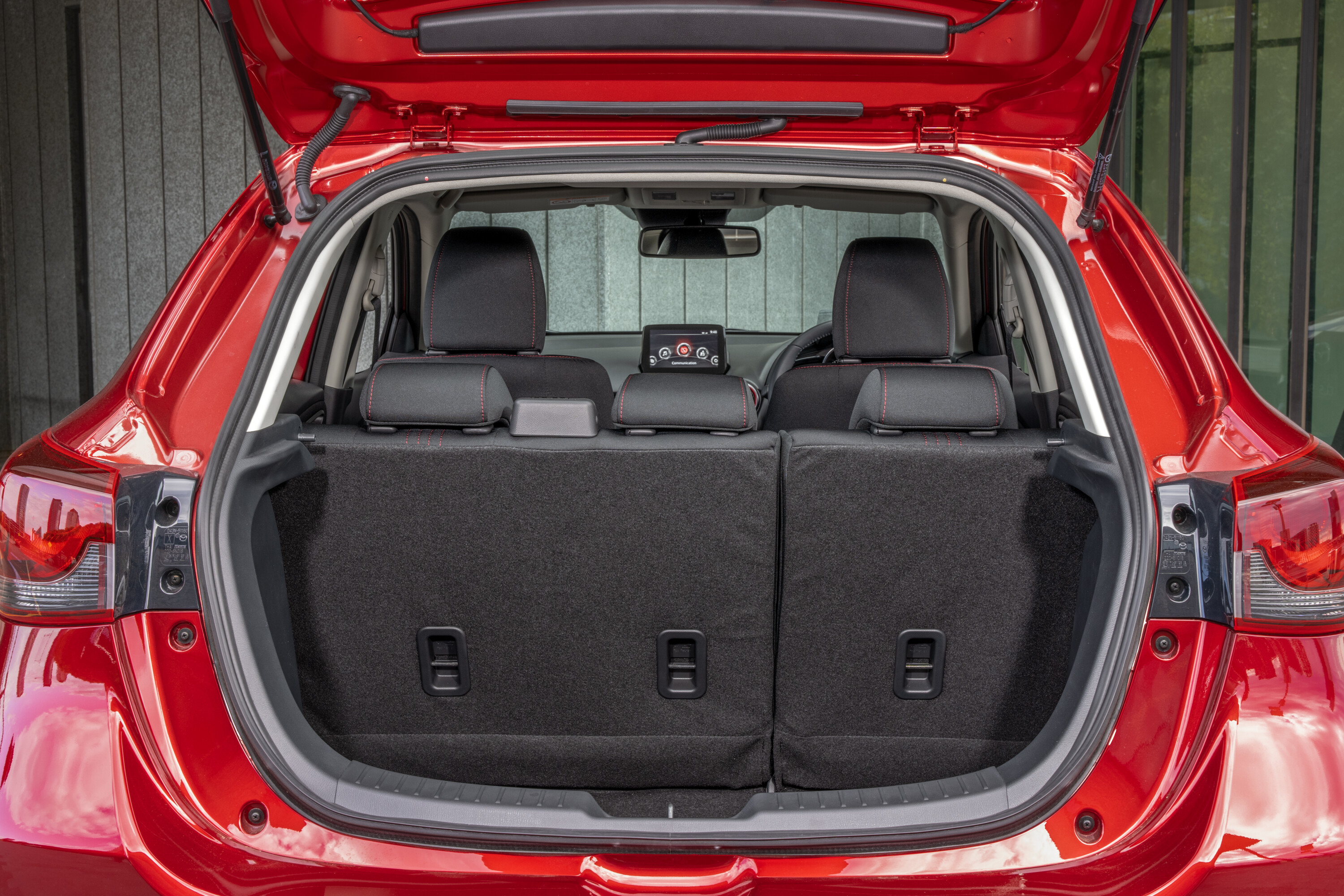
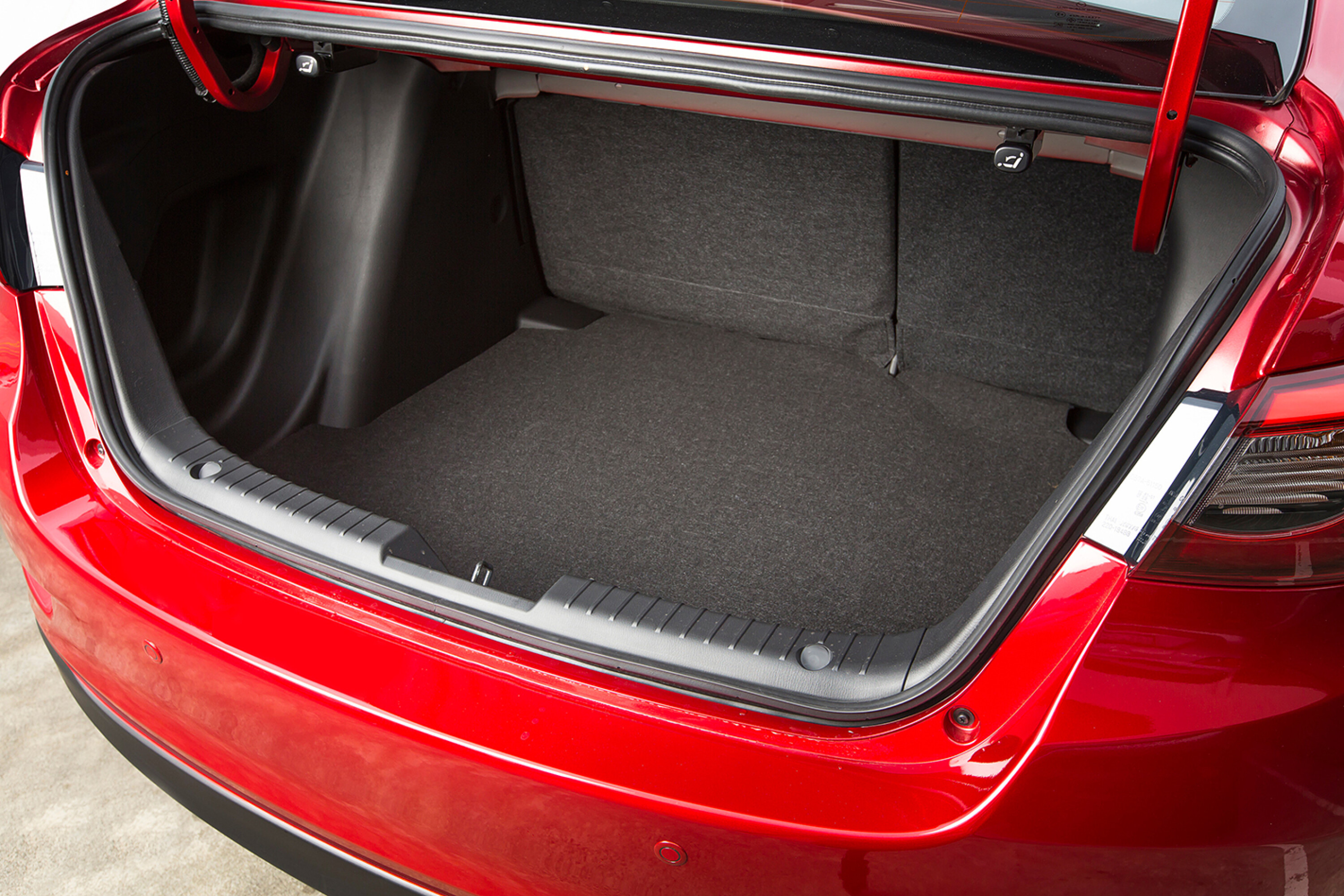
The Mazda 2 hatchback has one of the smallest boot capacities among its rivals. The boot aperture is also smaller than those of some alternatives and Mazda quotes cargo capacity at just 250 litres with the 60:40 folding seatbacks upright.
The Mazda 2 Sedan has significantly more boot space at 440 litres.
Hatch and sedan boots have a space-saver spare wheel under the boot floor.
1
1
I like driving, will I enjoy the Mazda 2?
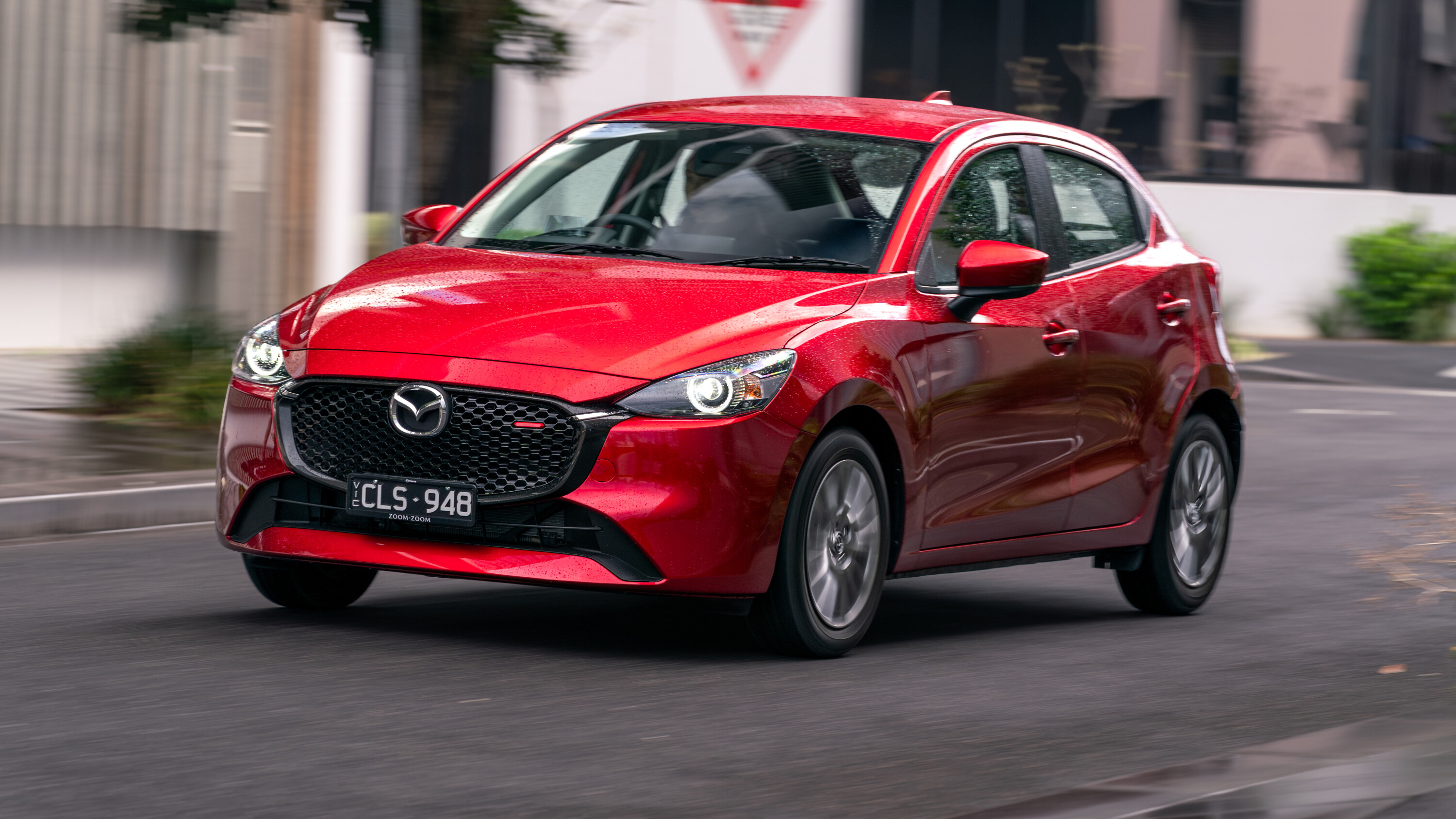
You don’t have to know anything about vehicle dynamics to appreciate when a car feels good. And the Mazda 2 is surprisingly good.
Both hatchback and sedan versions drive like bigger cars thanks to their chassis being a revised version of that found beneath the previous generation of the larger Mazda3.
The Mazda 2 inspires confidence and is fun to thread along a favourite country road. Responsiveness and feedback from the steering increase as you turn the wheel further into a corner.
1
Since the 2017 update, all Mazda 2s have benefited from mildly modified suspension aimed at helping the car ride and corner more steadily.
They also gained Mazda’s G-Vectoring Control, which manipulates the engine imperceptibly when you turn the steering wheel, transferring weight to the front tyres in a way that is said to improve feel and response from the steering.
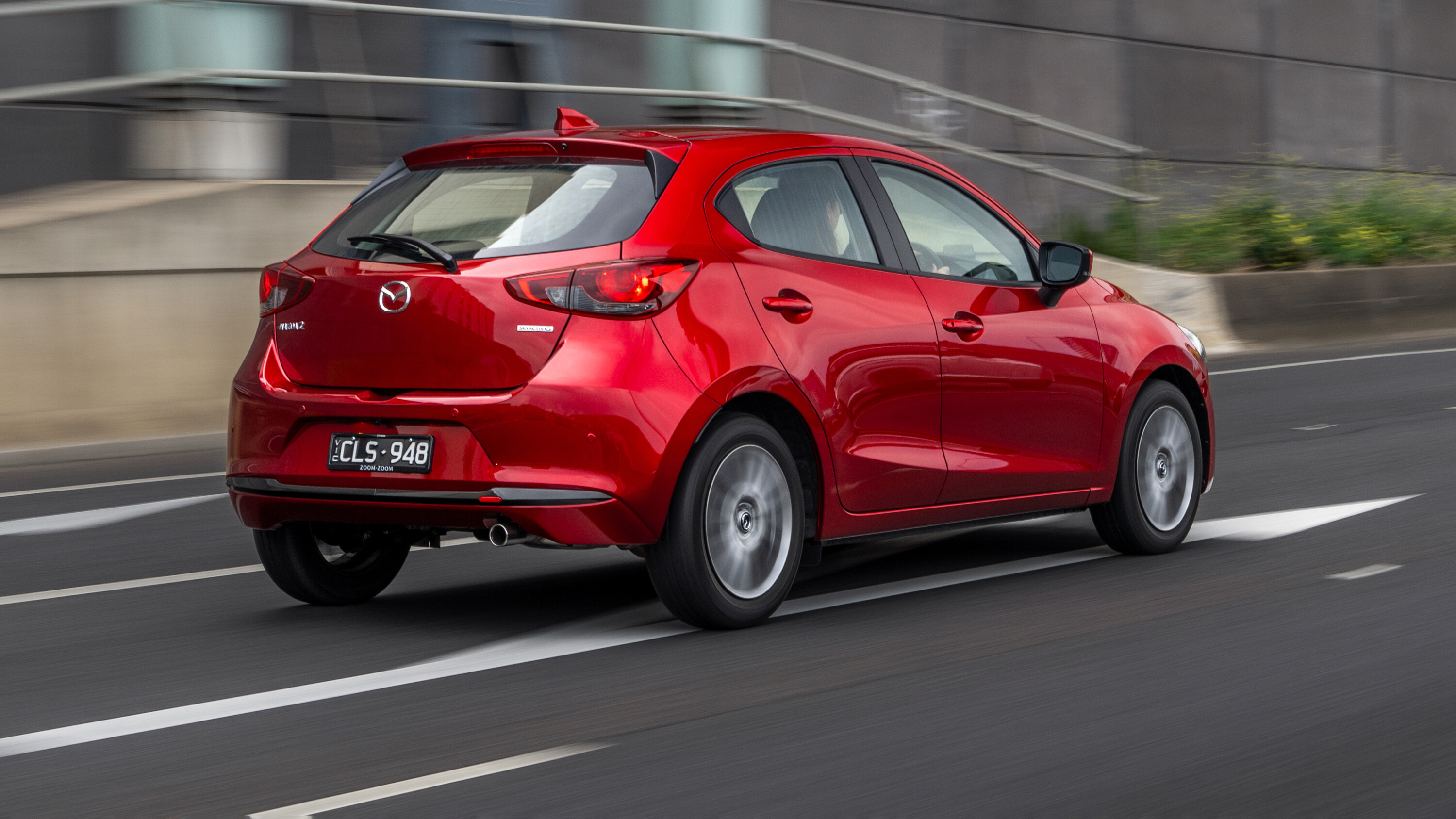
Although the 1.5-litre engine isn’t as perky as some of the turbos found in other light cars and crossovers, it’s energetic and sounds a little sporty.
1
It responds well to accelerator pedal inputs, particularly in the lower gears, and the automatic transmission’s Sport mode provides some oomph even if the high revs sometimes take a while to settle once you get to your desired speed.
One way around this on automatic Mazda 2s is to use the manual mode, which provides a nod to driving enthusiasts with a forward downshift/backward upshift movement and quick responses.
The Mazda 2’s automatic transmission chooses the right gear decisively and the manual gearbox is one of the best at this price level, being smooth and satisfying to operate – and feels as engaging as the manual shift in a sporty Mazda MX-5.
2
- What is a Powertrain or Drivetrain?
- Power vs torque
- Car suspension explained
- Automatic transmissions (‘gearboxes’) explained
- Chassis control systems explained
- Car vs Ute vs SUV: How the vehicle you buy should guide the way you drive
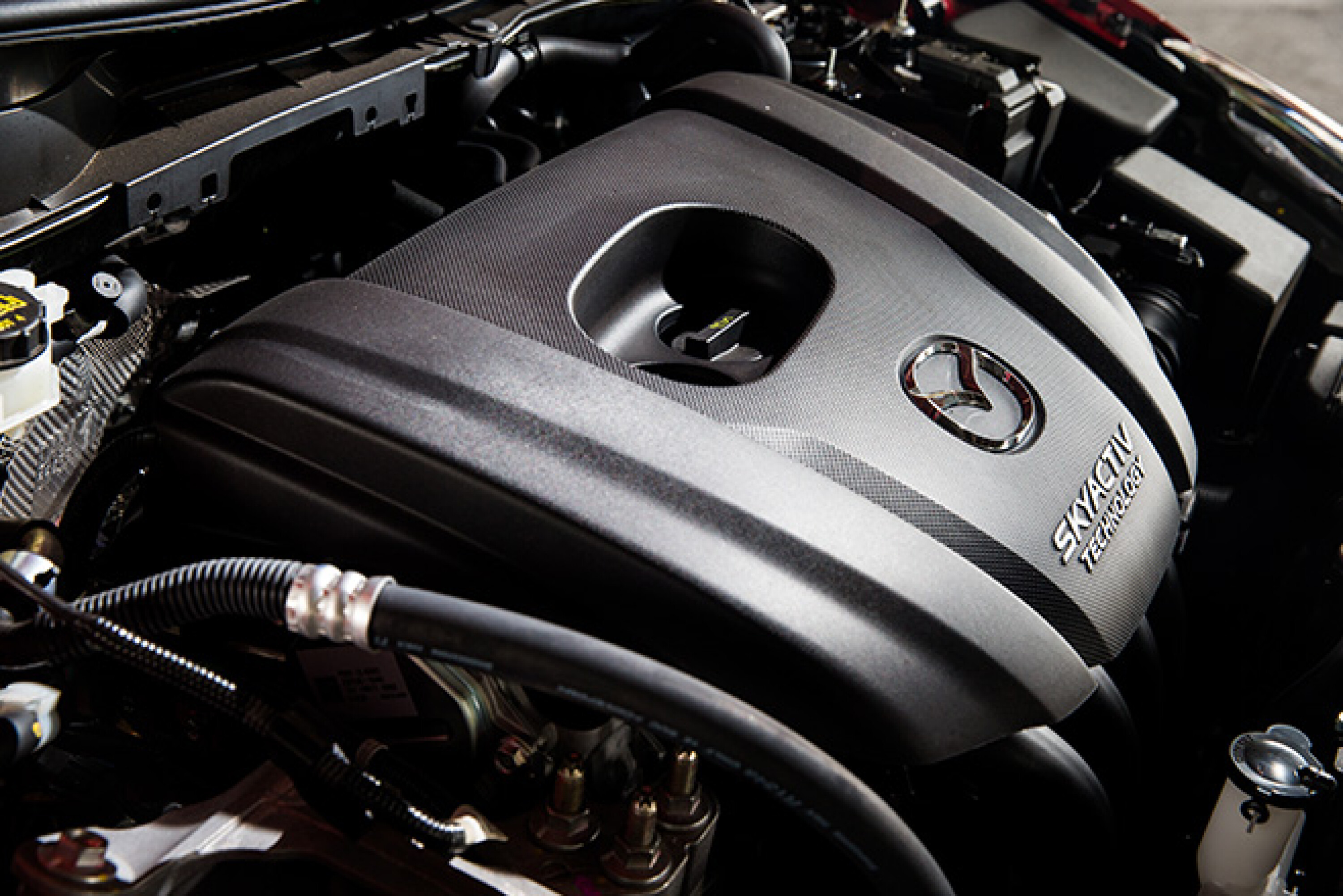
The Mazda 2 is only available with a SkyActiv 1.5-litre petrol four-cylinder petrol engine and produces 82kW and 144Nm
Based on official test figures, it consumes as little as 5.0 litres/100km with the six-speed automatic or 5.4 litres/100km with the six-speed manual gearbox.
Only the entry-level G15 Pure hatchback can be had with a manual, which is an engaging unit while being forgiving to anyone whose shifting skills are a little rusty.
Under Mazda’s current naming convention, the G15 in each variant name refers to it having a petrol (G for gasoline) engine of 1.5-litre capacity.
1
What is the Mazda 2’s towing capacity?
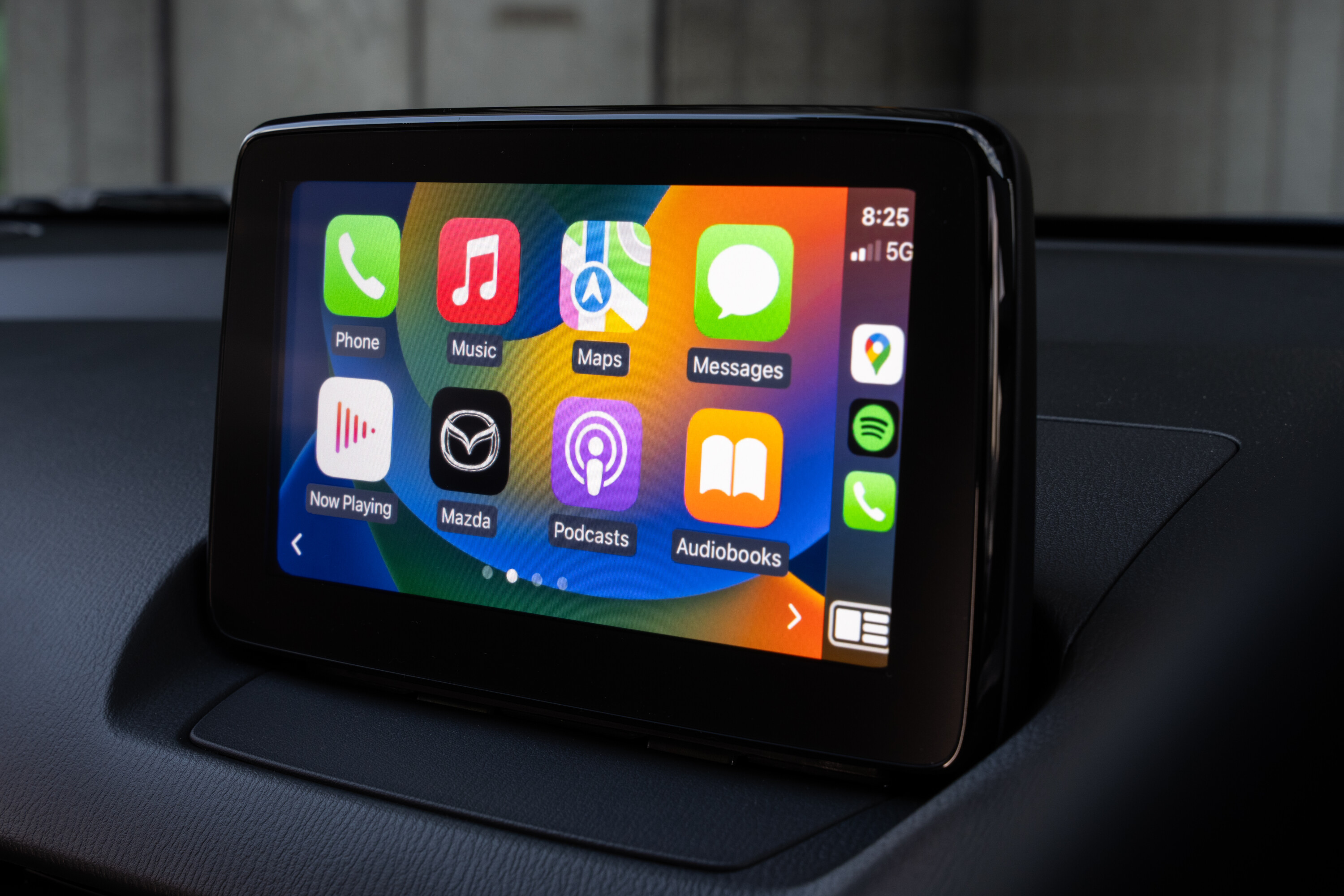
The Mazda 2 can tow a braked trailer and load totalling up to 900kg and unbraked loads up to 500kg.
The maximum tow ball download weight is 50kg.
1
How long is the warranty, and what are the Mazda 2’s servicing costs?
As per the wider Mazda range, the 2 is covered by a five-year/unlimited-kilometre factory warranty.
It has a complimentary roadside assistance program over the same period and Mazda offers five years of capped-price servicing.
Maintenance is now required every 12 months or 15,000 kilometres, whichever occurs first – up from the previous 10,000km limit.
Service costs for all hatchback and sedan variants, including the G15 Pure manual, are the same.
1
| Mazda 2 capped-price servicing costs | |
|---|---|
| 12 months/15,000km | $334 |
| 24 months/30,000km | $526 |
| 36 months/45,000km | $396 |
| 48 months/60,000km | $334 |
| 60 months/75,000km | $587 |
Which version of the Mazda 2 does Wheels recommend?
Choosing a sweet spot in the Mazda 2 range is difficult because there isn’t a huge price difference between variants as you go up the range.
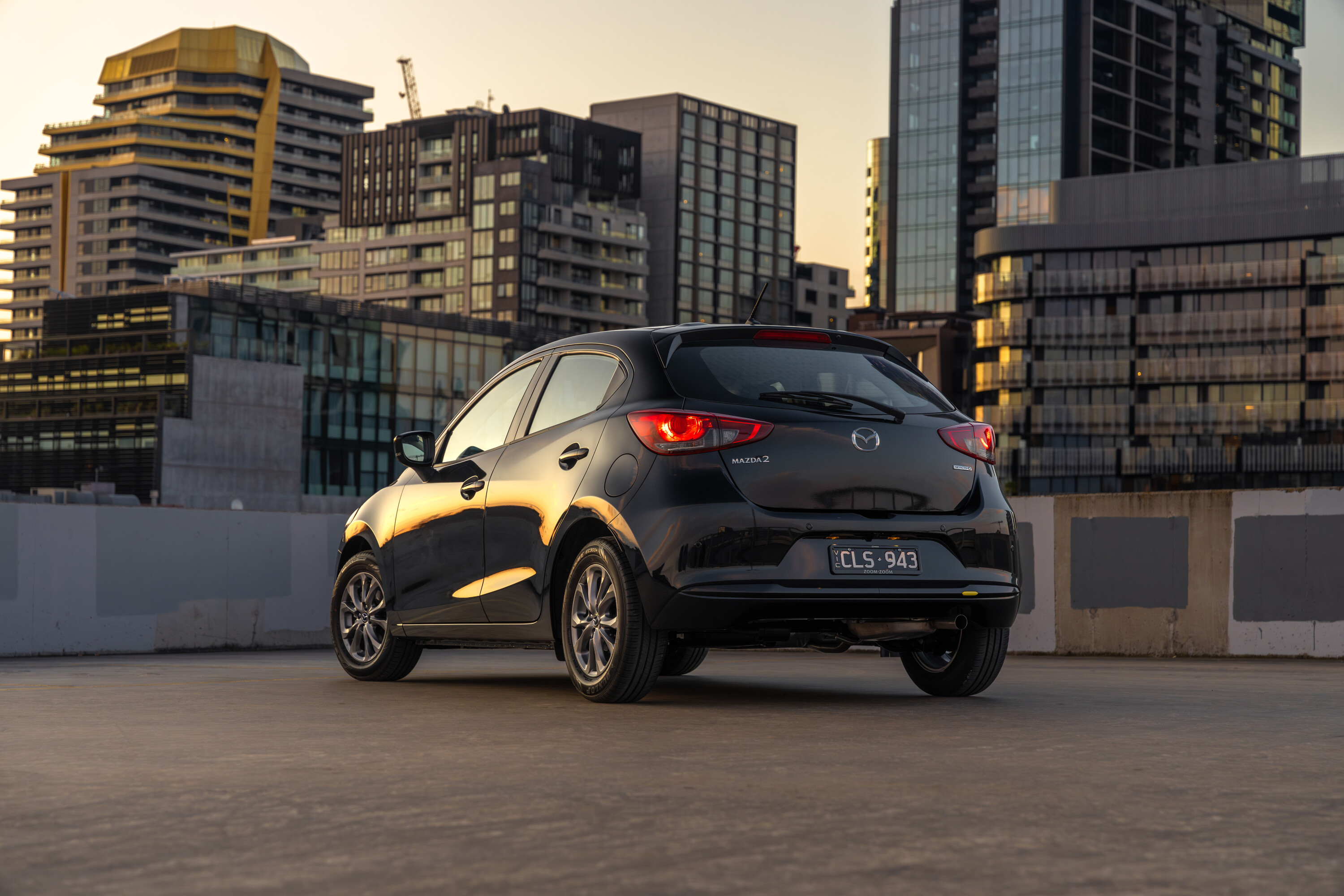
The G15 Evolve hatch is probably the best choice on paper regarding pricing and features, but we reckon the best value can be found in the entry-level G15 Pure hatchback.
It is quite a well-equipped car for under $25,000 and is the only version available with a choice of manual or automatic transmission; we particularly like the manual.
1
What are the rivals to the Mazda 2?
The list of light car rivals keeps getting shorter.
ud83dudd3c Back to top
MORE
Everything Mazda
Snapshot
- Uber and EVDirect aim to further boost BYD EV uptake
- u2018Competitiveu2019 financing options available today, lower price barrier
- Service fee reduction re-introduced for Victorians, Comfort Electric tier launched
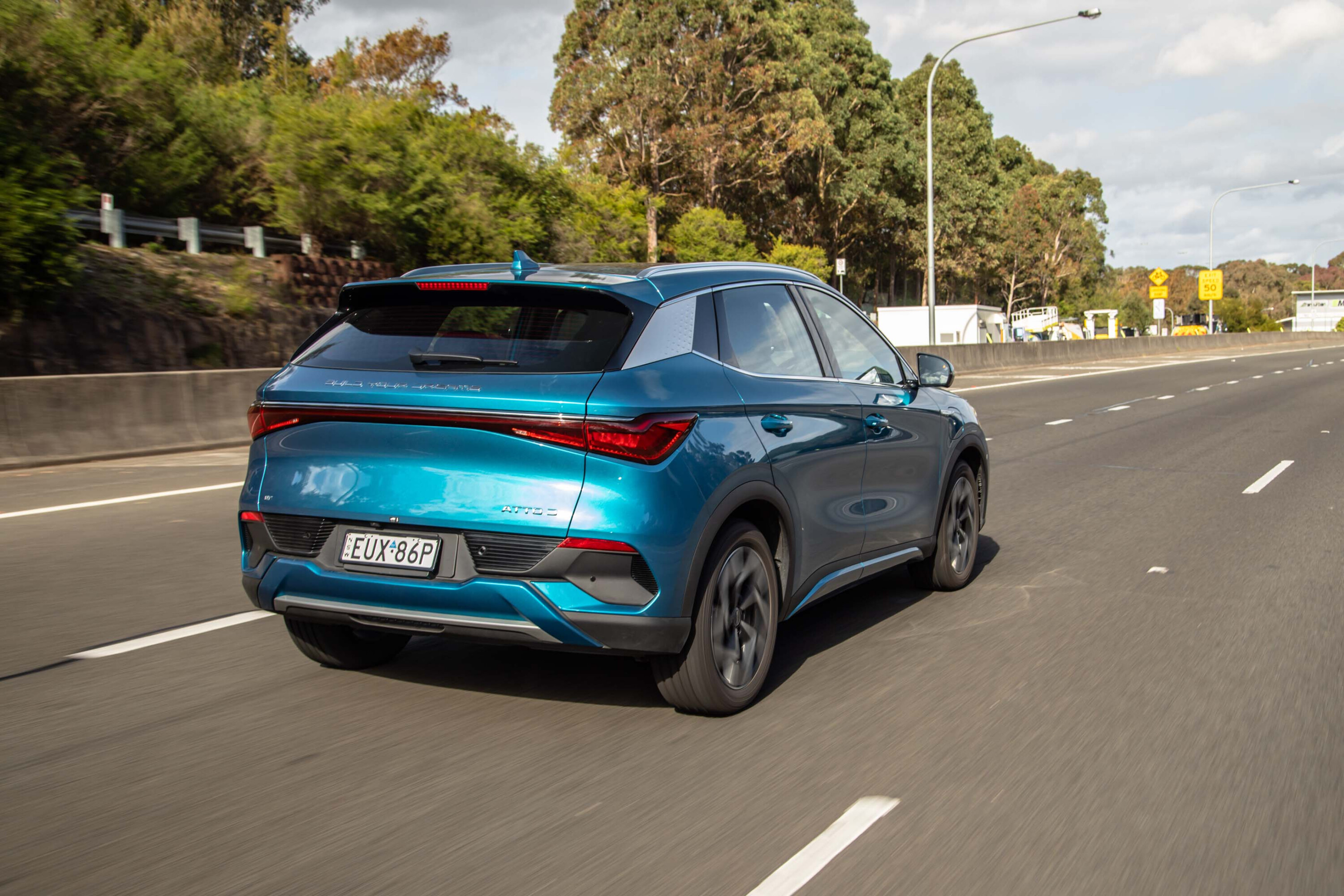
Uber Australia has today partnered with distributor EVDirect to introduce a fleet of 10,000 BYD electric cars.
Uber rideshare drivers and Uber Eats delivery workers can now access “flexible and competitive” financing options via EVFlex to use an Atto 3 small electric SUV, with more models coming soon.
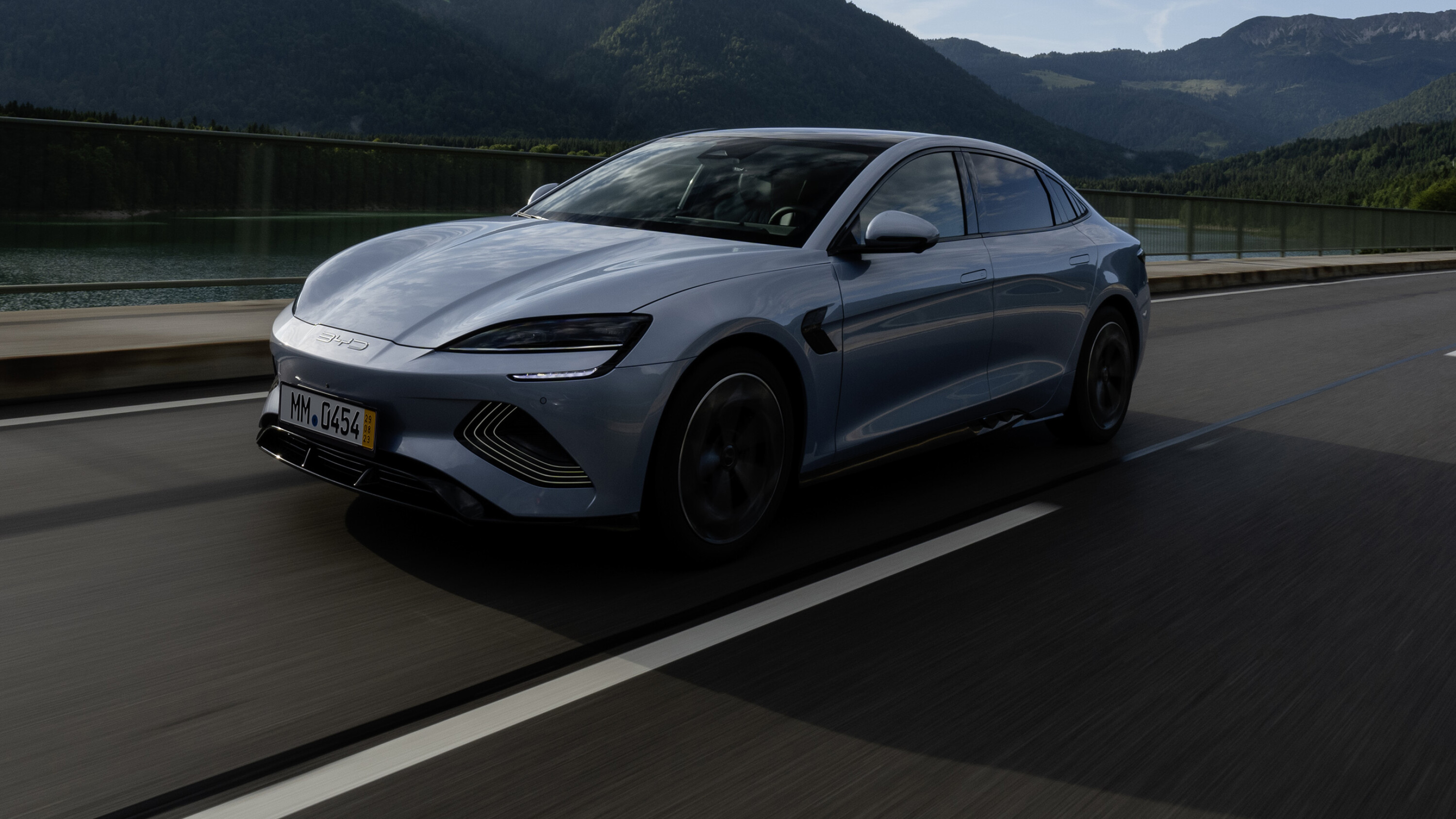
This will likely include the forthcoming BYD Dolphin small hatchback and Seal sedan.
Two financing options are now available: ‘Full Ownership’ offers a path to own the BYD electric car through longer-term financing, whereas ‘Flexi Ownership’ has the option to return the vehicle after a minimum term.
1
More rental and ownership offerings will be available by early 2024.
EVDirect chief executive Luke Todd said the partnership will improve the accessibility for gig-economy workers to access electric vehicles and ultimately earn more income, amid high fuel prices.
“What excites me the most is the amount of money drivers and delivery people can save by switching to electric, given the number of kilometres that they drive each day,” Todd said.
This adds to Uber’s partnership with Splend, which offers rideshare car subscriptions, including the MG 4 hatch, Tesla Model 3 sedan, and Polestar 2 liftback EVs.
Users who want to ride in an electrified vehicle have the option to choose the Uber Green tier since June, which is the same cost as the standard UberX option.
Uber expands EV offerings
Uber claims the adoption of EVs on its platform has been “slower than hoped” in Victoria.
As a result, an additional 500 places for its service fee reduction program will be available to eligible Victorian Uber drivers soon.
This means, from November 1, successfully-enrolled EV drivers on the popular rideshare platform will have their mandatory service fees halved for each trip until June 2025, with a limit of $3500 per financial year.
1
Additionally, business customers can now choose a Comfort Electric tier to travel in an all-electric premium vehicle model with highly-rated drivers.
A sustainability insights dashboard is also offered for Uber for Business customers to track carbon emissions travel data to help organisations improve their corporate sustainability initiatives.
Comfort Electric is now available in the Gold Coast, Brisbane, Sydney, Melbourne, Adelaide and Perth.
MORE
Everything BYD
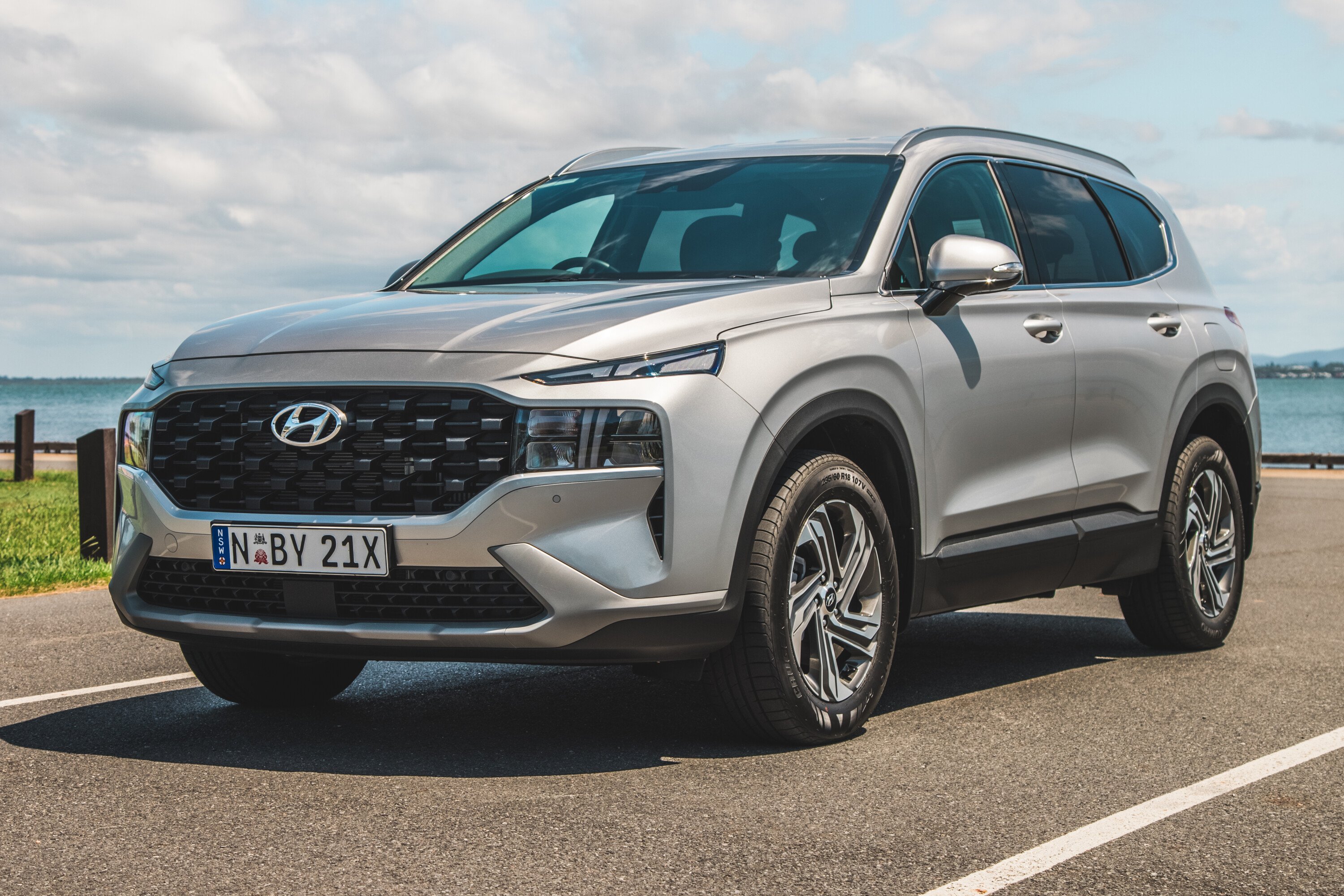
The 2023 Hyundai Santa Fe has long been a staple in the large SUV segment since arriving into Australia in the year 2000.
Since then, it has become a popular and enduring choice among Australian consumers looking for a family car.
Sitting in between the popular Tucson and the slightly larger and newer Hyundai Palisade, the Santa Fe offers the best of both worlds as a seven-seater functional SUV.
1
Pricing and Features
The 2023 Hyundai Santa Fe Active is available from $50,250 before on-road costs for the petrol engine. The diesel will cost you an extra $3500.
When it comes to the engine options, the Santa Fe mirrors similar options of the larger Palisade.
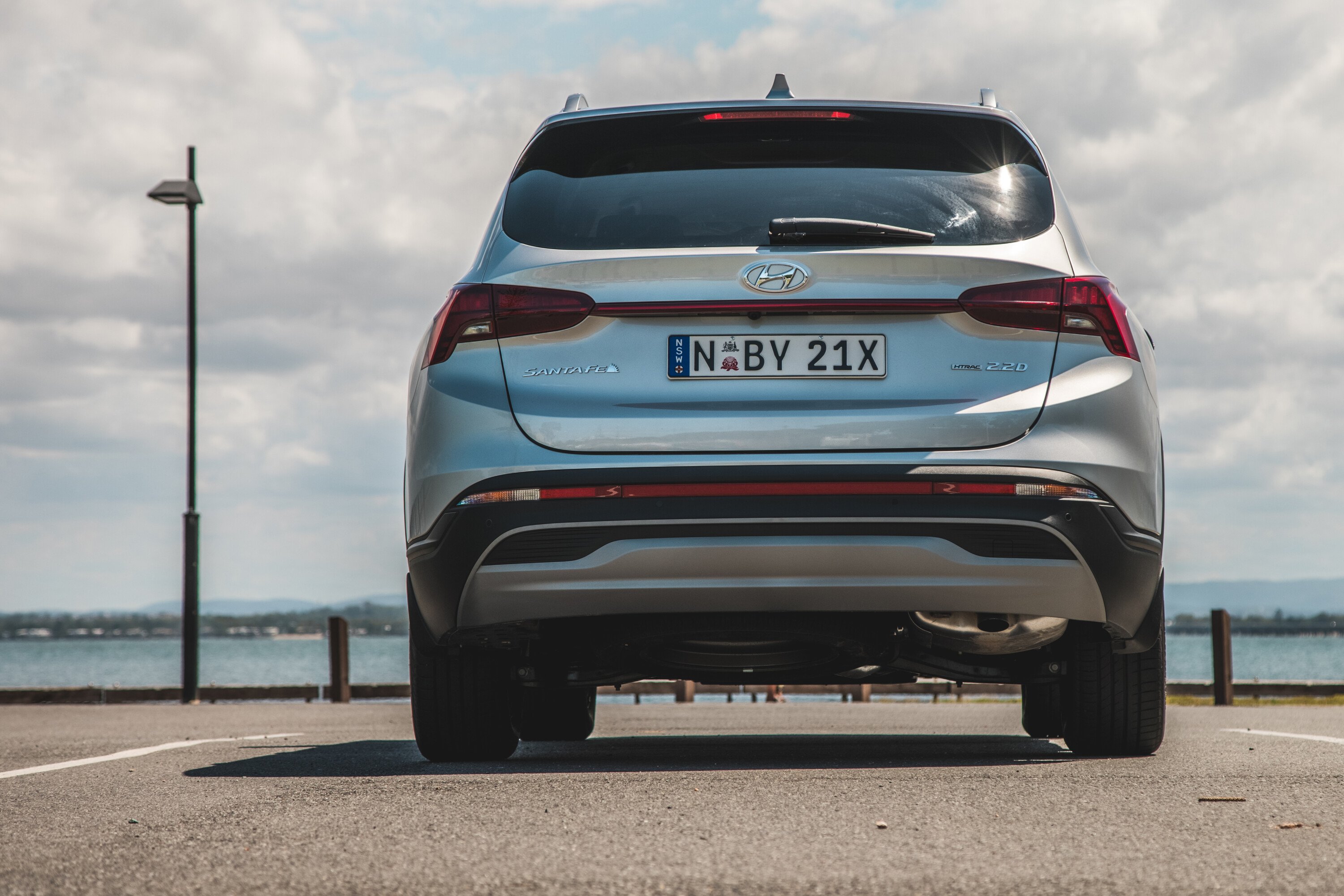
The Santa Fe is equipped with a 2.2-litre turbo-diesel four-cylinder engine, generating 148kW of power and 440Nm of torque, paired to an eight-speed dual-clutch transmission and powers all four wheels.
1
Alternatively, you can opt for the 3.5-litre petrol V6 engine with 200kW of power and 331Nm of torque, exclusively driving the front wheels.
The hybrid option is reserved for more premium variants: Elite and Highlander.
The Santa Fe does not currently have Hyundai’s BlueLink telematics system.
Features that are standard from the entry-level Santa Fe range are:
| 17-inch alloy wheels | 4.2-inch instrument cluster display |
| Black grille inserts | 6-speaker sound system |
| Wireless Apple CarPlay and Android Auto | Leather-appointed steering wheel and gear selector |
| Reversing camera | Electronic parking brake |
| LED headlights | Third-row USB charge ports |
| Rear parking sensors | Black vinyl upholstery |
| LED daytime running lights | Manual-adjust front seats with 2-way power lumbar for driver |
| Wireless phone charger | Manual air-conditioning |
| 8.0-inch infotainment touchscreen | Heated rear windscreen |
Jumping up one variant to the Active adds:
| 2023 Hyundai Santa Fe Active features | |
| 18-inch alloy wheels | Chrome exterior trim |
| Black leather upholstery | Power-folding exterior mirrors with puddle lamps |
| Dual-zone climate control | Rain-sensing wipers |
| Rear privacy glass | Keyless entry and start |
| Safe exit assist | Push-button gear selector |

1
The next-generation Santa Fe is due in Australia in the first half of 2024, with a striking new look.
Safety
The current Santa Fe is covered by a five-star ANCAP safety rating, including a 94% score for adult occupant protection.
Due to the difference in powertrains, hybrid variants are unrated.
Standard features include seven airbags, lane trace assist, driver attention monitoring, rear-cross traffic alert, automatic emergency braking, traffic sign recognition, auto high beam and adaptive cruise control.
Choosing the Active adds safe exit assist as well.
Safety is only updated again in the most expensive Highlander with low speed reverse AEB, remote parking and a 360-degree camera.
The Hyundai Santa Fe is covered by a five-year/unlimited-kilometre warranty. Servicing is required every 12 months or 15,000kms, or 10,000kms for hybrid variants.

1
Key Rivals
The Santa Fe competes with rivals including:
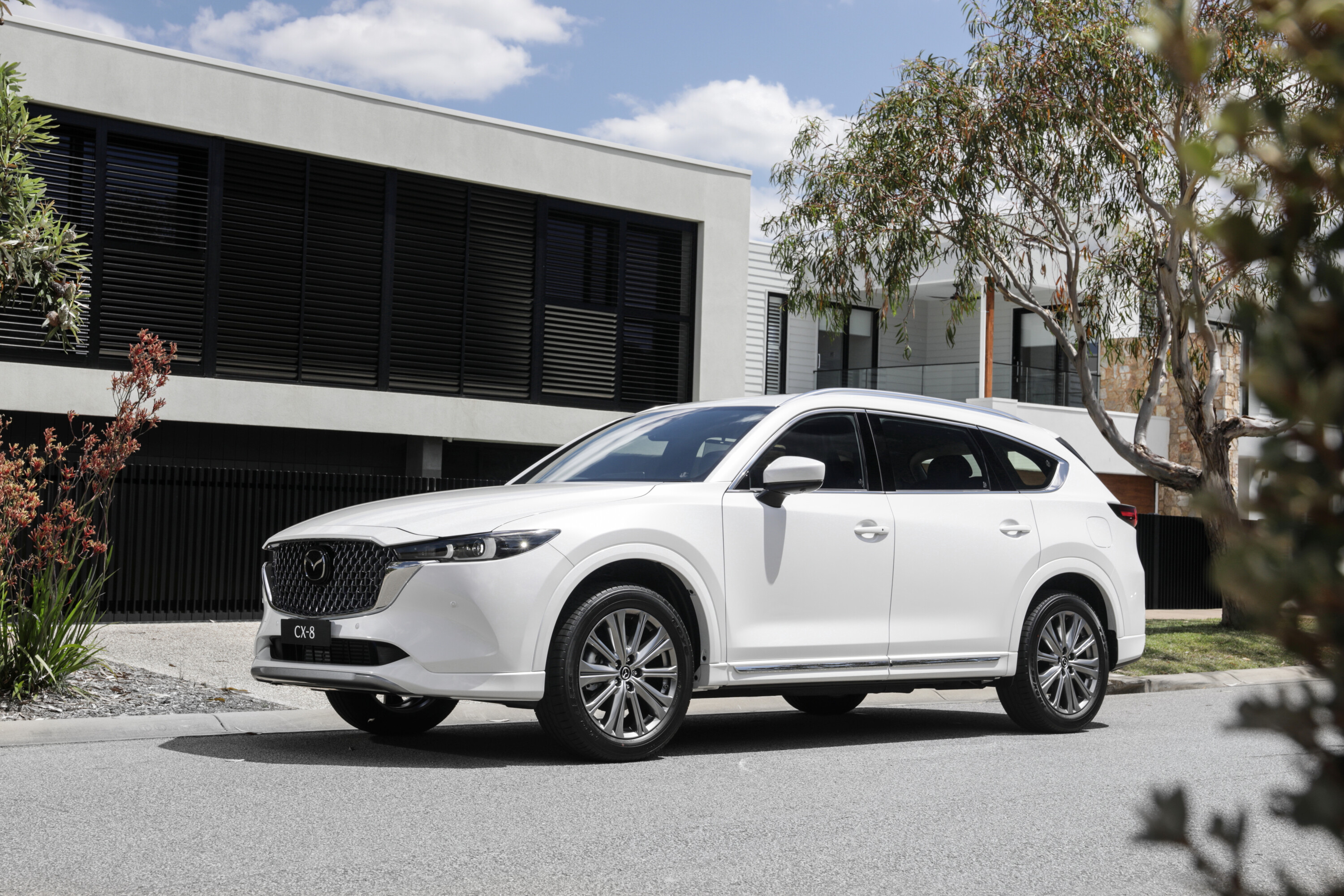
1
Should I Put It On My Shortlist?
The 2023 Hyundai Santa Fe is a compelling choice for those in the market for a family car.
For families seeking a reliable and well-equipped vehicle that promises comfort on every journey, the Santa Fe Active is certainly worth considering. It’s a testament to Hyundai’s ability to deliver quality and innovation in a competitive segment.
We reckon it’s worth the step up from the entry-grade for all that extra gear as well, but if it’s leaving you wanting, there are plenty of premium variants on offer in the range– five more in fact.
MORE
Everything Hyundai
MORE
Large SUVs
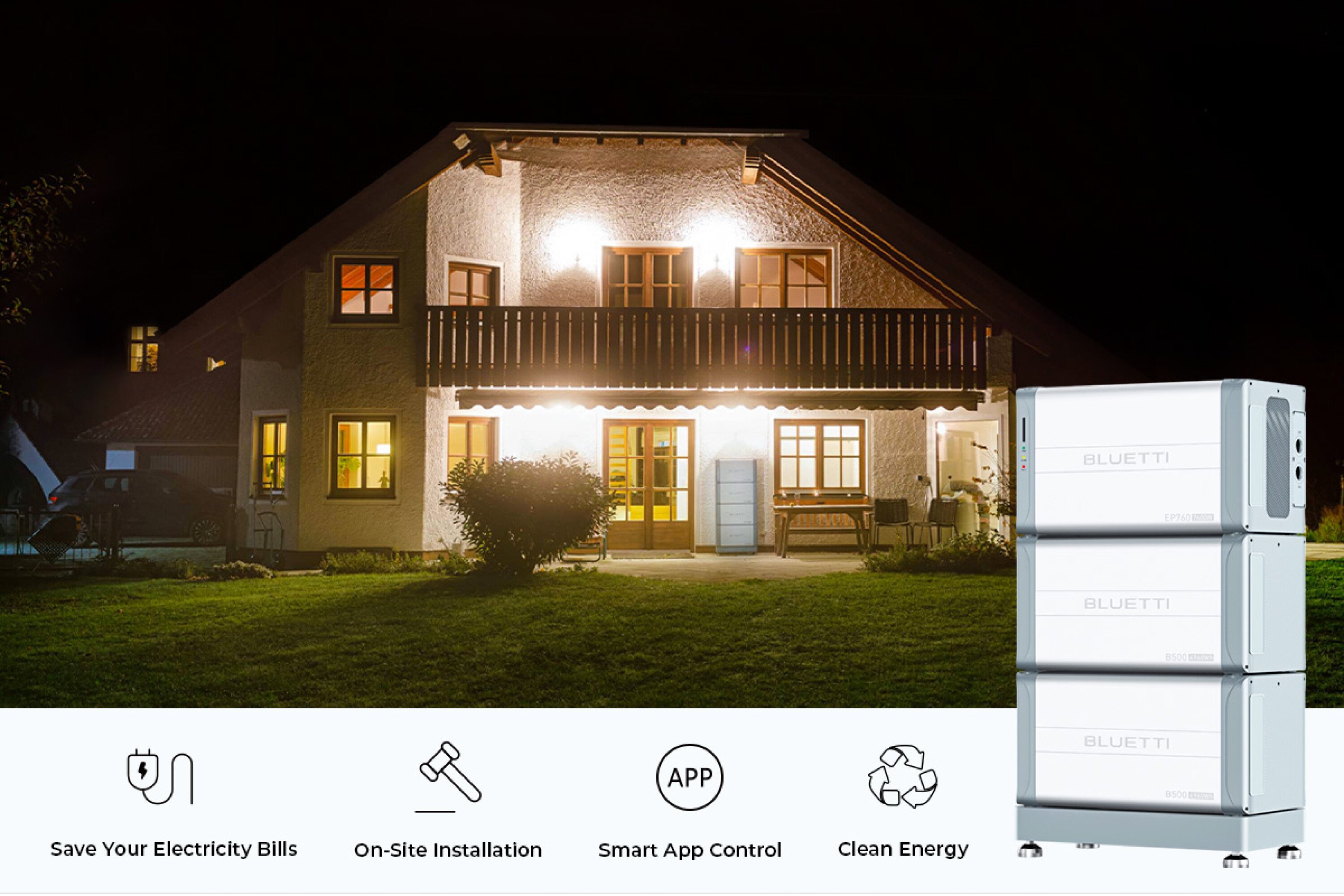
BLUETTI, the leading brand in the clean energy storage industry, has just launched its EP760, a 7600W home backup power system with a flexible capacity of up to 19.8kWh for better energy management.
This cutting-edge product will keep the entire home bright, even during sudden power outages, and most importantly, without paying high energy bills.
1
Slash electricity bills
The EP760 is built to significantly reduce electricity bills, making it a beneficial investment for homeowners. This home energy storage system is compatible with various photovoltaic panels and supports efficient solar energy storage at a maximum rate of 9000W.
The stored solar power can be used at night or as a reliable backup during unexpected power outages. As the EP760 system is certified for grid connection, any excess solar power can be sold back to the grid for additional income.
Even without solar panels, the EP760 offers an intelligent peak load shifting feature that enables homeowners to charge the system when grid electricity is cheap and discharge it during peak hours, reducing overall energy costs.
Tailor-made capacity for your needs
Featuring a 7600W pure sine wave output, the EP760 could power all household appliances from refrigerators to power tools, and even electric vehicles.
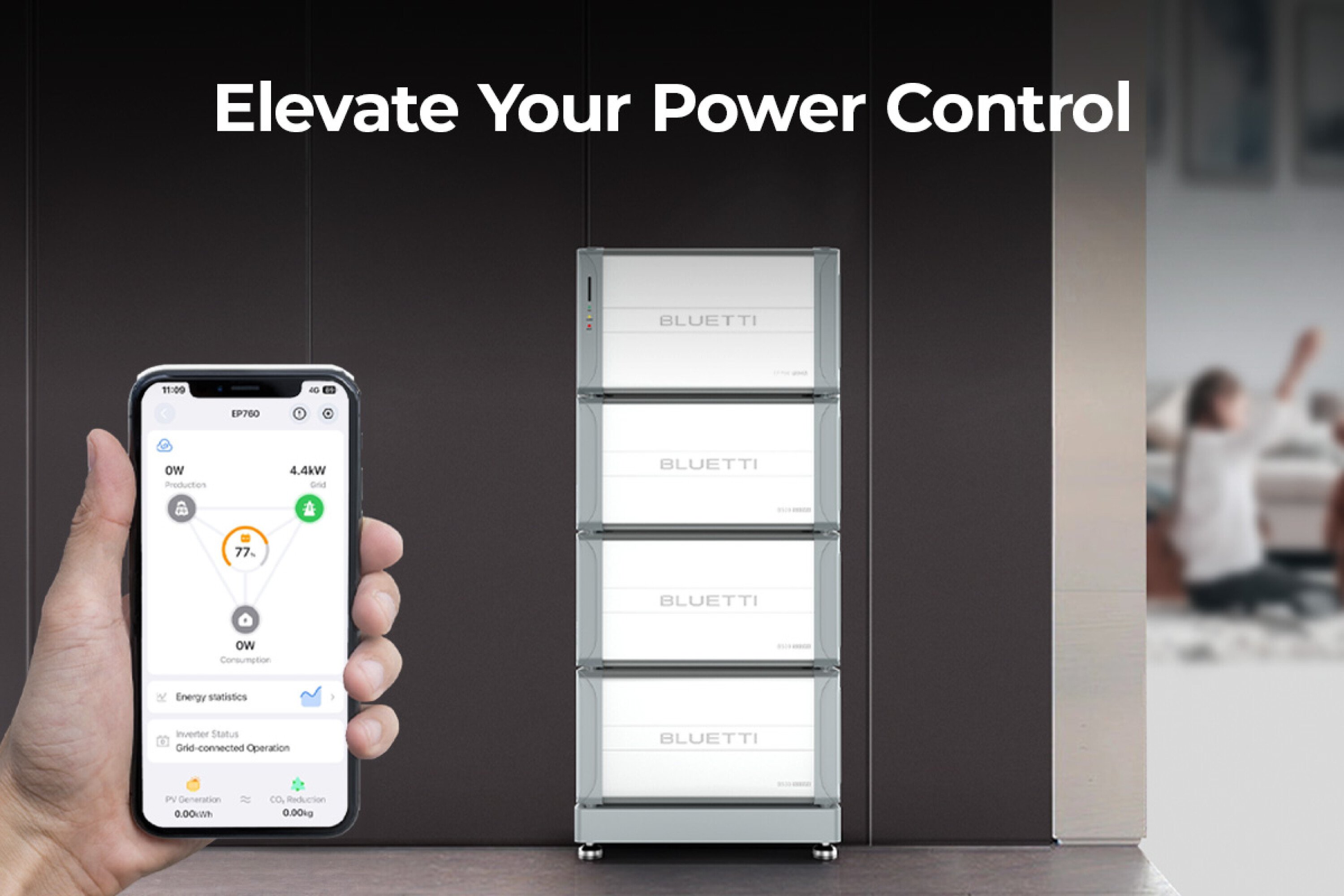
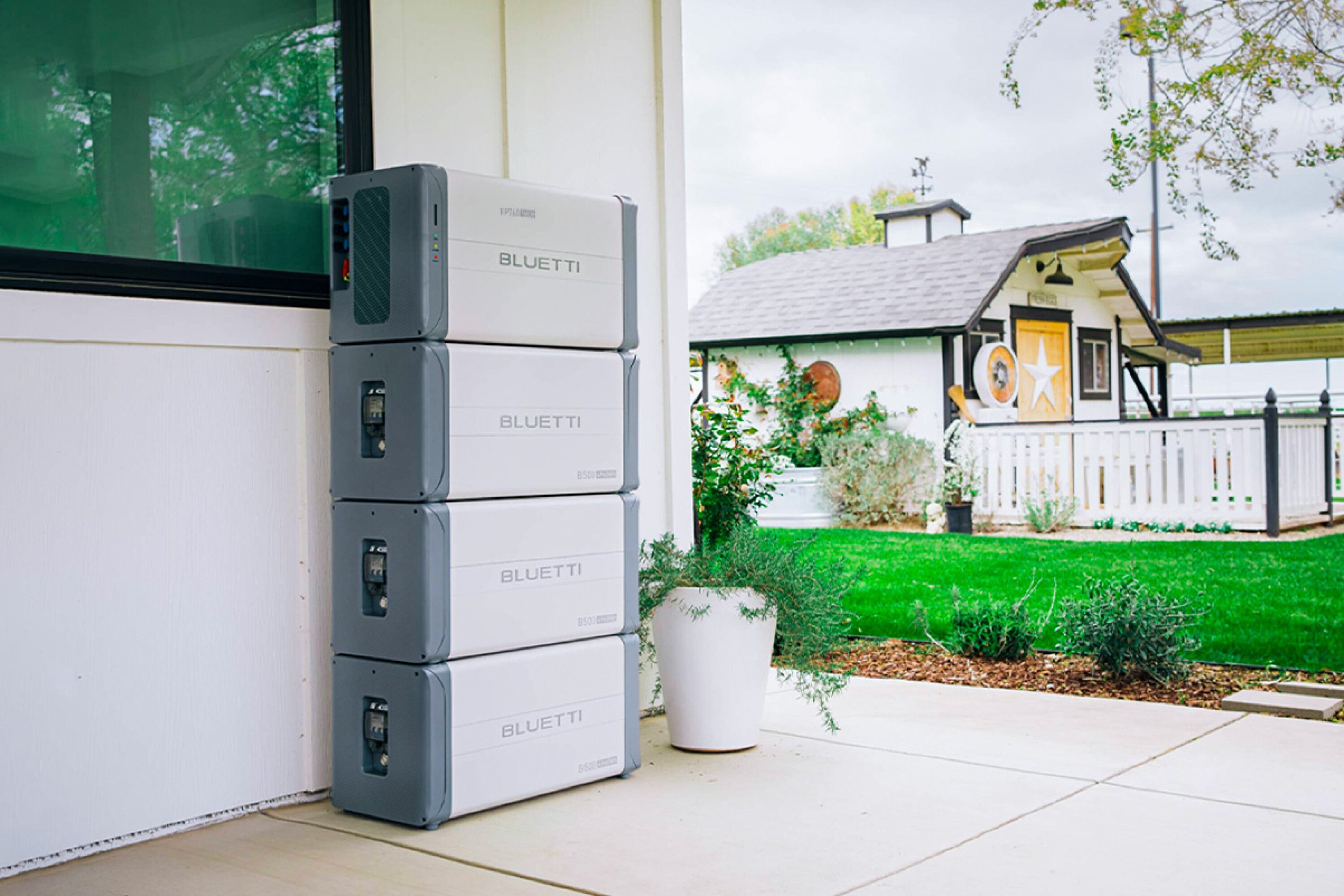
The modular design of the EP760 makes it easy to transport and install. It allows homeowners to customise their energy storage capacity to meet their specific needs. By pairing the EP760 with two to four B500 battery packs, users can create an energy storage system ranging from 9920Wh to a staggering maximum of 19,840Wh.
This impressive capacity could store more free solar-generated power to run homes at night or during extended power cuts.
1
Uninterrupted protection against blackouts
Australia is expecting more bushfires and associated power failures as the country’s weather bureau announced earlier that there was a 70 per cent chance of an El Niño weather pattern developing this year, which is typically linked to hotter, drier weather.
As an uninterrupted power source, the EP760 can prepare for any potential power outage. With a responsive UPS feature, it switches over in 10ms to provide power to critical loads. The EP760 keeps the house cool, the food in the fridge fresh and everything running smoothly.
1
Wide applicability anywhere
Pending CEC certification, the EP760 is designed to be installed safely and adapt to different environments.
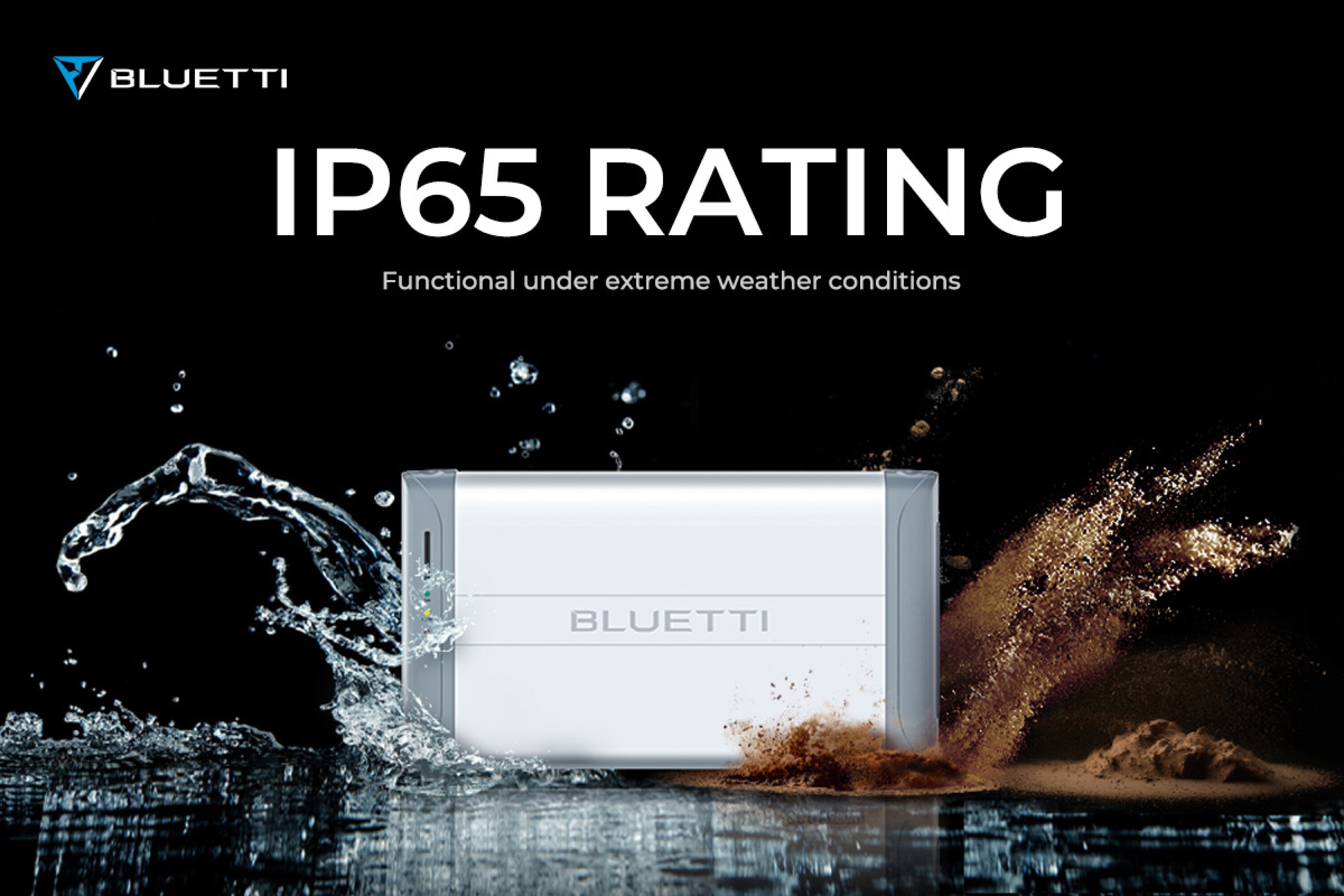
Featuring an IP65 rating for water and dust resistance and operating at less than 50 decibels, this energy storage system can be easily installed in homes, cabins, sheds, and other spaces. Its compact design allows for vertical stacking on the floor, saving valuable space.
Furthermore, the EP760’s internal self-heating function ensures smooth operation even in cold temperatures as low as -20°C, making it suitable for use in frigid regions.
Safe and resilient for years to come
BLUETTI puts the safety and peace of mind of its customers first.
The EP760 is equipped with highly reliable lithium iron phosphate batteries, known for their durability and an impressive lifespan of 3500 cycles, equivalent to a solid decade of use.
To further instil confidence, BLUETTI offers a generous 10-year warranty, local service, and maintenance teams, ensuring customers enjoy hassle-free operation and support.
2
Availability and price
The EP760 system will be available in various combinations on October 25.
A basic system (EP760 with two B500s) will cost only $9599 including tax and excluding shipping for the first ten days.
Customers can also experience and purchase it with massive savings at BLUETTI’s booth # JJ139 at the All Energy exhibition from October 25th to 26th. Don’t miss this opportunity to get the future of home energy storage and revolutionise your energy consumption this winter.
We first sampled the new AMG GT 63 S E Performance four-door in April 2022 when Georg Kacher dubbed it the new grandmaster of absolute speed.
In a little over 18 months the world has moved on leaps and bounds yet the prospect of more than one thousand horsepower remains a tantalising one. It’s also our first sample of AMG’s allegedly F1-derived ‘P3’ plug-in hybrid powertrain concept on local shores and gives us a preview of the forthcoming C63 S E Performance and E 63 S E Performance.
We can hear the groans from unelectrified AMG V8 lovers, though we’d advise you to try before you judge – especially this eight-cylinder based powertrain.
1
With both the twin-turbo petrol V8 and rear electric motor running at full song, the GT 63 S E Performance delivers a staggering 620kW.
The torque figure, though, is the most insane. Over 1400Nm, reads the AMG spec sheet, and local product manager Ross Crabtree confirms that a huge 1800Nm can be felt at 55km/h with the throttle fully open.
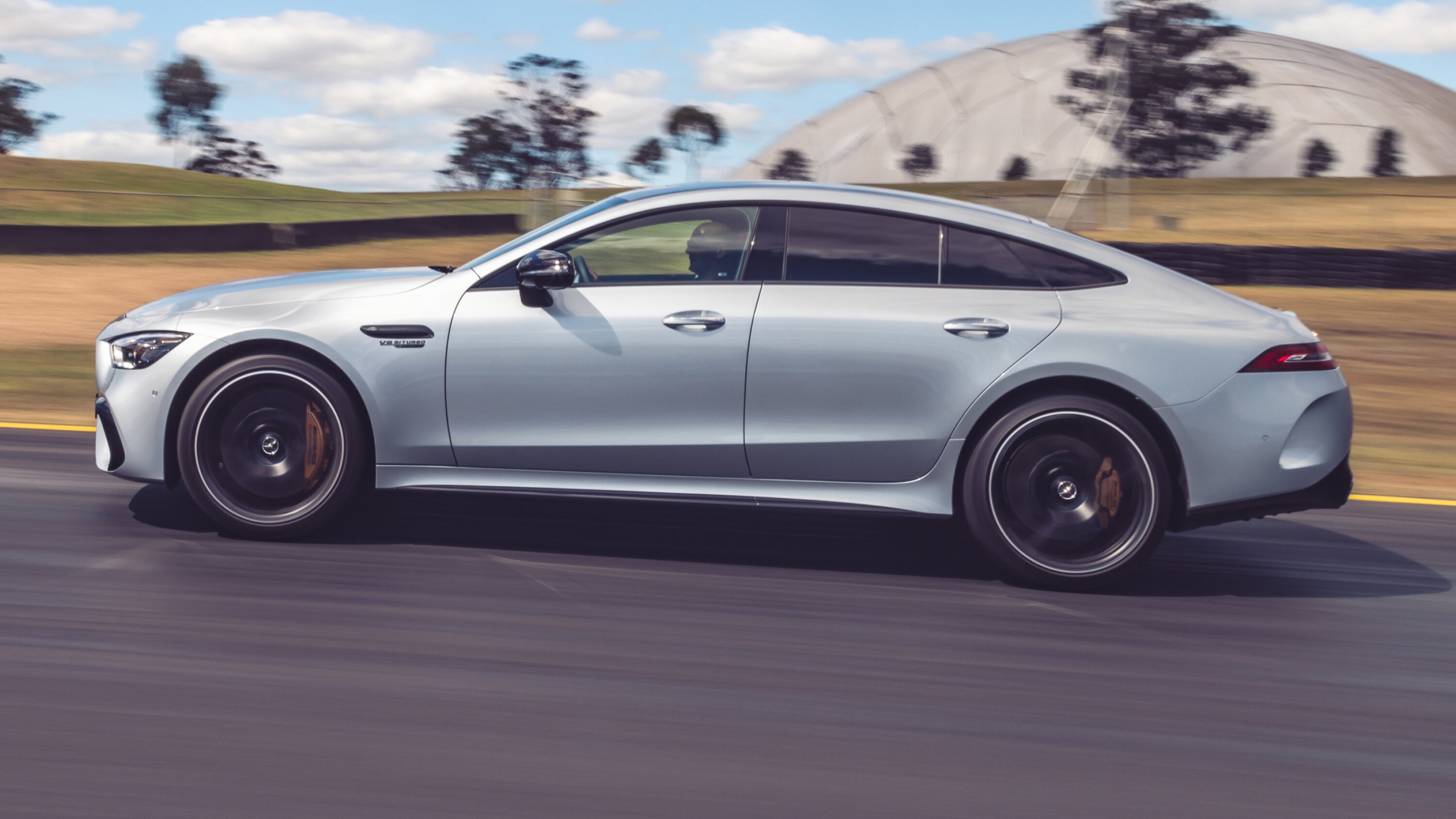
Mercedes-AMG isn’t looking to shift a whole load of these $399,900 (before on-road costs) four-door grand tourers, but this is an important car. It symbolises the future of petrol-electric indulgence. We’ve been invited to Sydney Motorsport Park for a sample of what the E-Performance can do.
1
JUMP AHEAD
How much is it, and what do you get?
Aside from the tech-packed powertrain that we’ll come back to, the GT 63 S E Performance four-door is suitably equipped for a flagship.
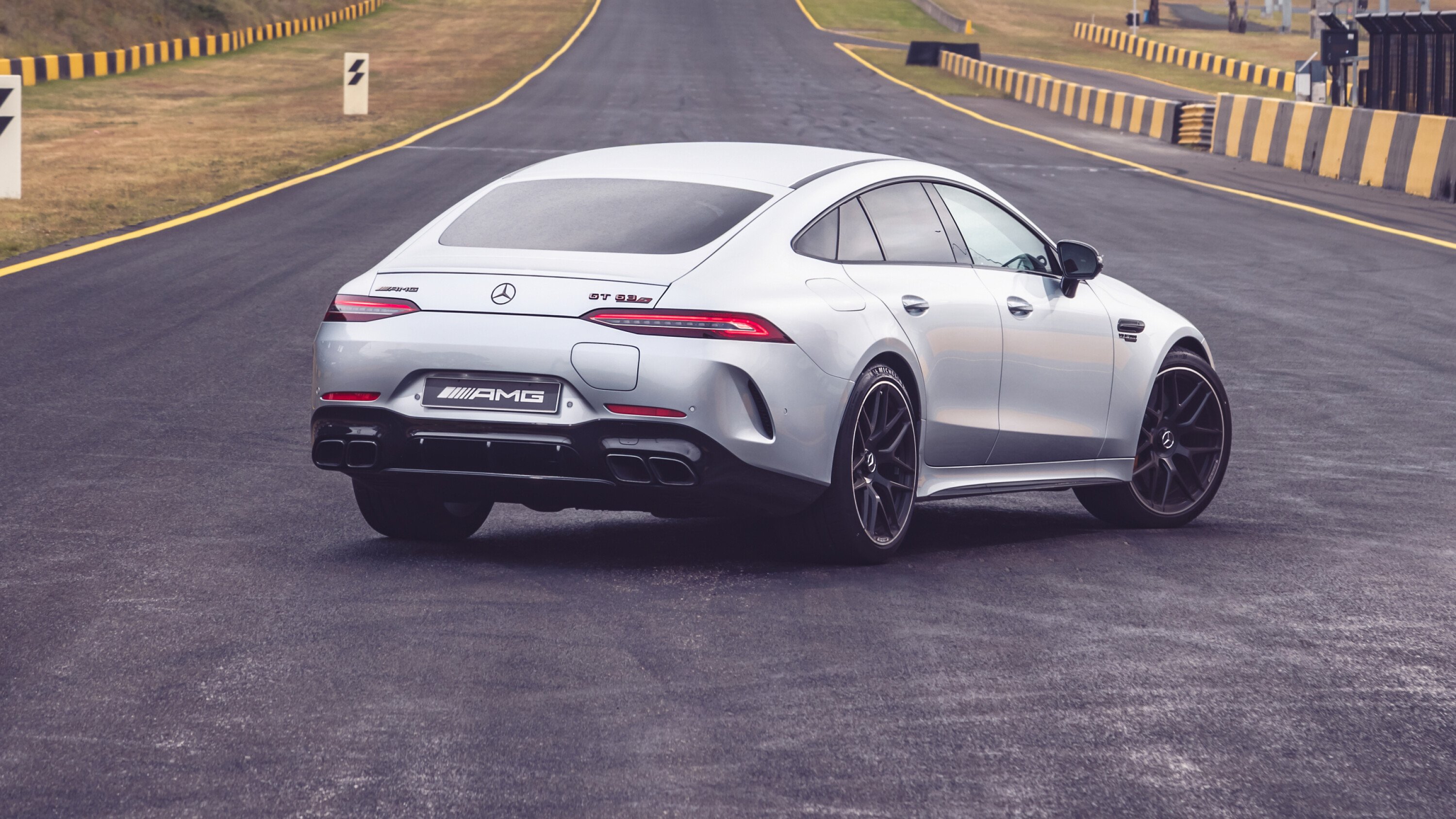
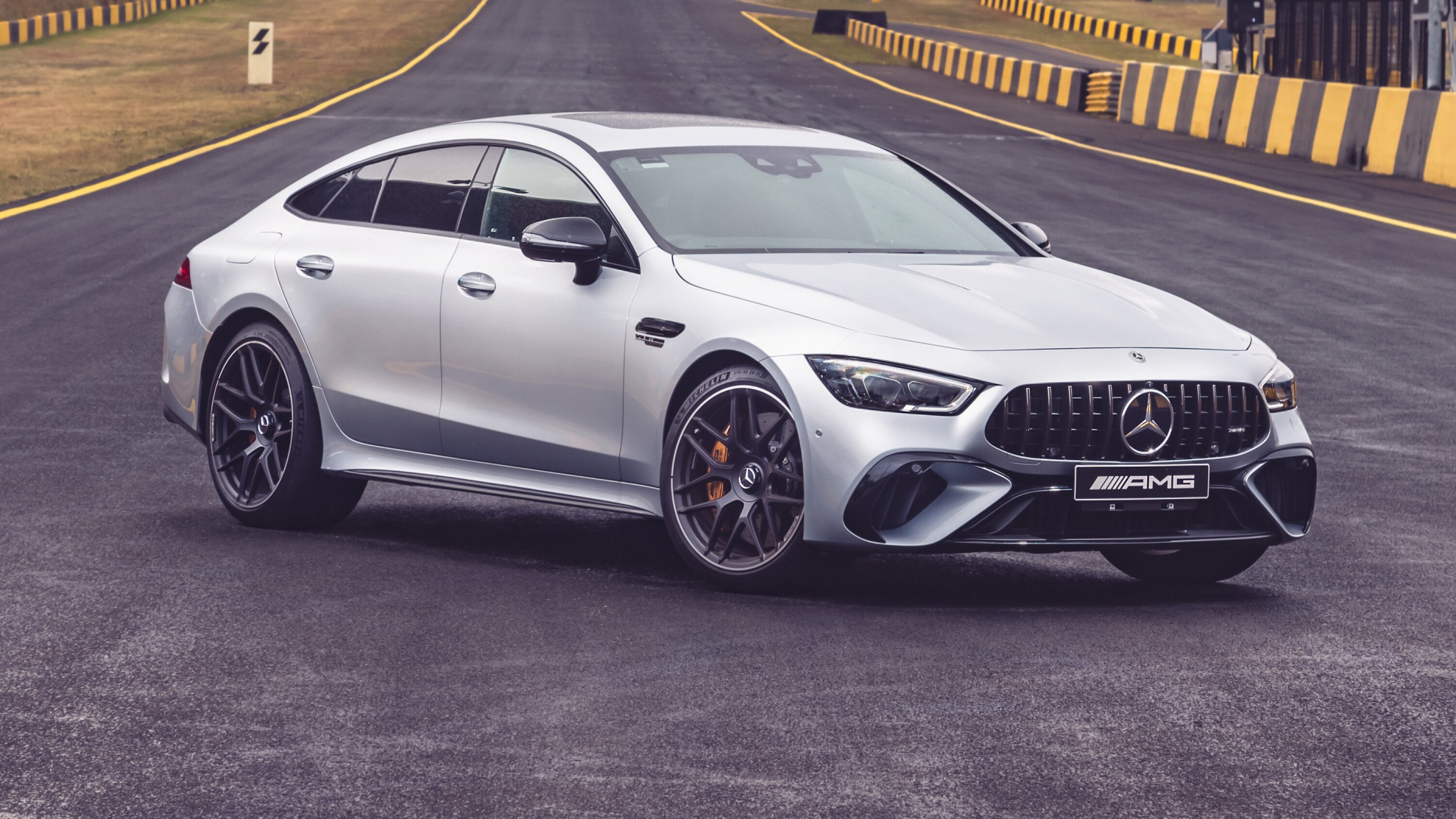
Visually, its five-metre length lends it plenty of road presence with the vertical slats in its Panamericana grille, 21-inch BBS-look forged alloy wheels, extending rear wing, E-Performance badging, and AMG V8 signature trapezoidal exhaust pipes telling onlookers exactly what it is.
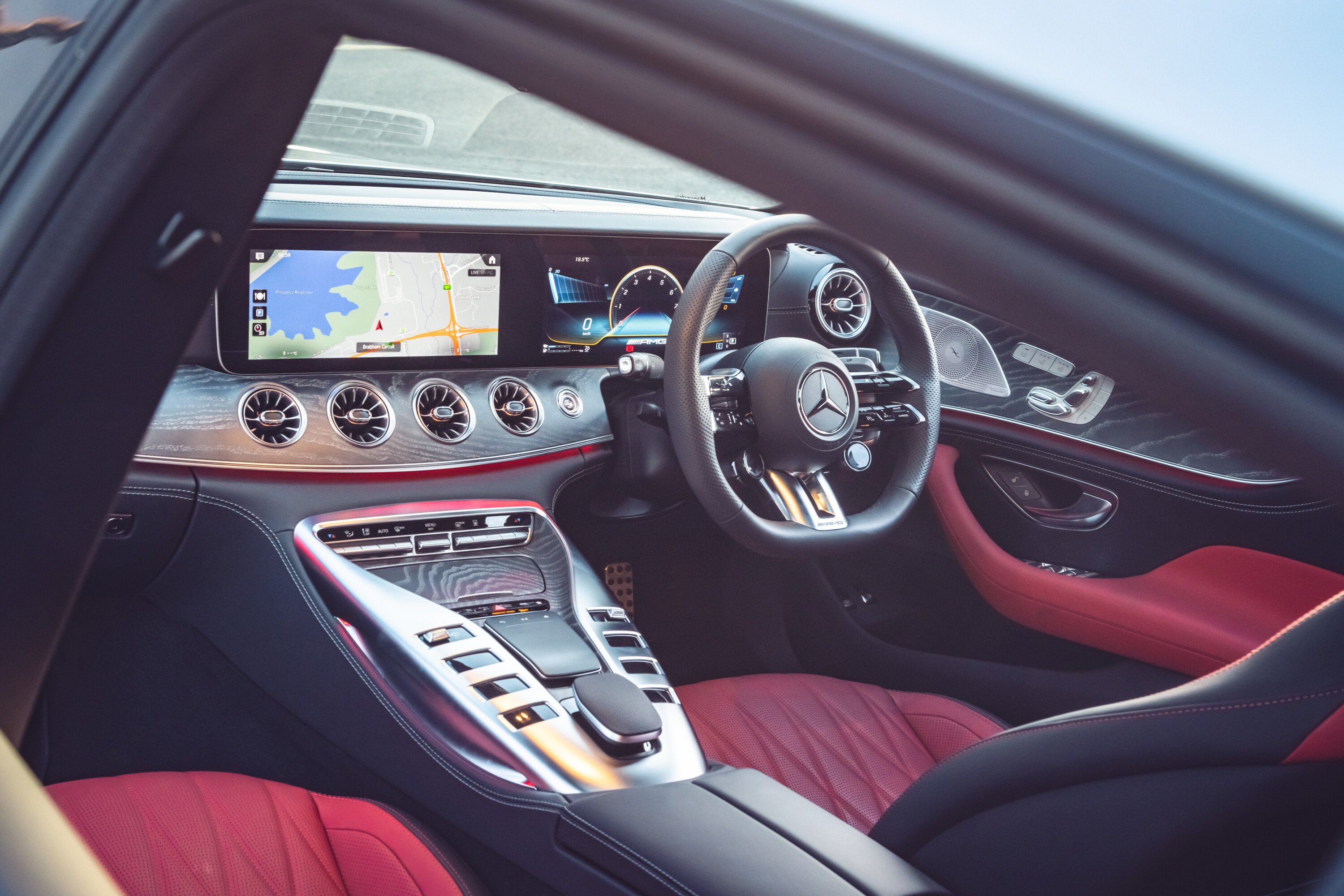
Its interior ain’t bad either with luxurious soft-close doors, a glass roof, digital driver’s display, a 12.3-inch central screen with Android Auto and Apple CarPlay connectivity, tri-zone climate control, head-up display, and a 15-speaker Burmester sound system.
1
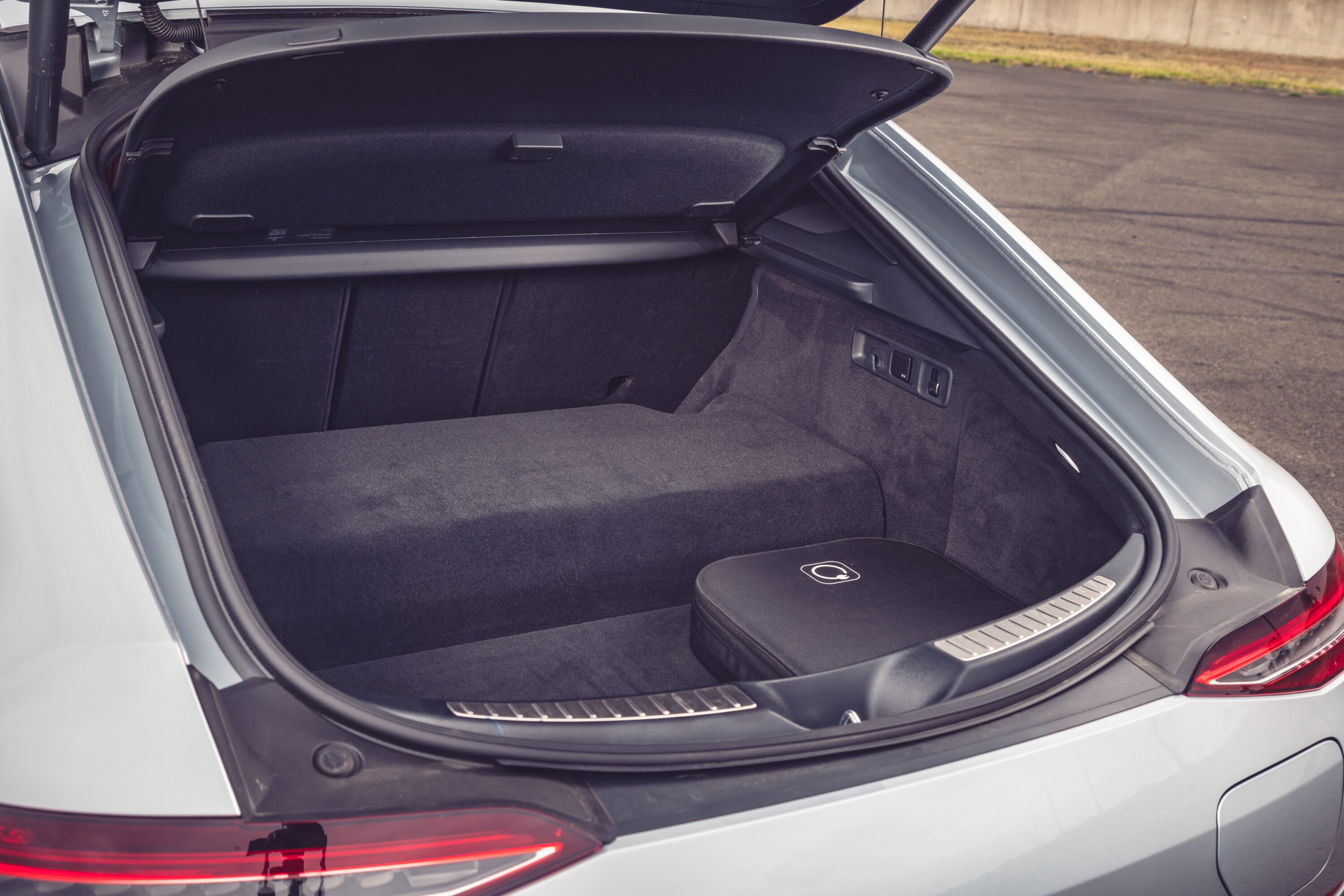
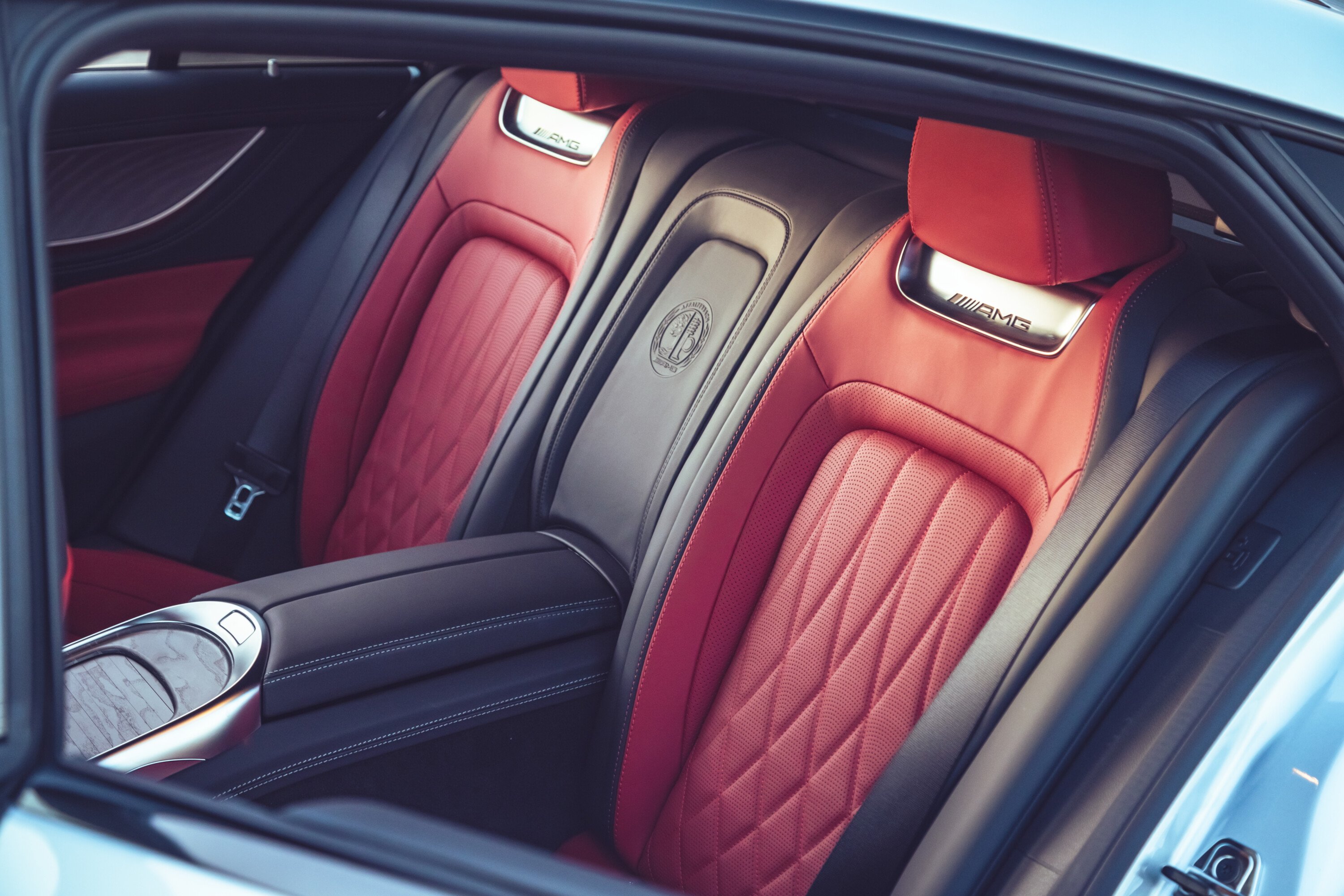
The GT 63 is exclusively a four-seater with chairs trimmed in fine Nappa leather as standard.
Up front are AMG’s active ‘multi-contour’ bucket seats with heating, ventilation and massage functions. They’re aware of G-forces, too, their bolsters inflating to keep driver and passenger in position.
Four interior colourways – paired with real wood trim inserts – are available at no extra cost: all black, Red Pepper and black, Titanium/Pearl, and Saddle Brown/Truffle Brown.
Top-shelf Manufaktur leather is an extra $4690.
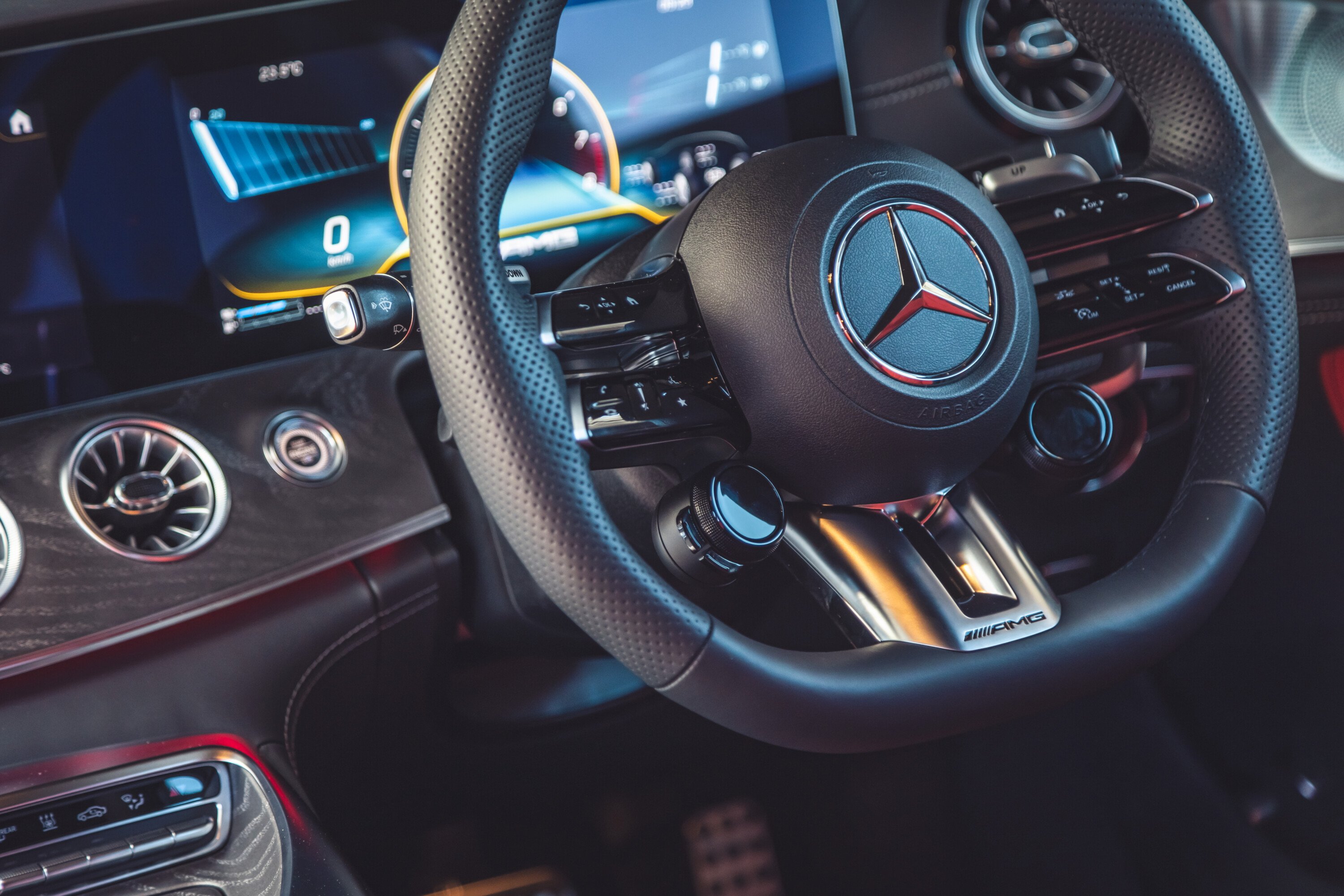
1
Rolling those extra leather options with the rear-seat Business Console and its touchscreen tablet for controlling functions plus galvanised seat finishers and rear roller blind costs $8990.
The Manufaktur pack also bring 40:40 split folding rear seats. Not ideal for carrying bulky items such as bicycles, but handy for a trip to the snow with your skis in the back, or a trip to Bunnings to pick up some lengths of timber. Mercedes quotes a modest 351L boot capacity and there’s no spare tyre.
Other options include the AMG Night Pack ($3490 and fitted to our tester) that brings matte black paint to the alloys, and black highlights on trim pieces (including the sinister grille), as well as rear privacy glass.
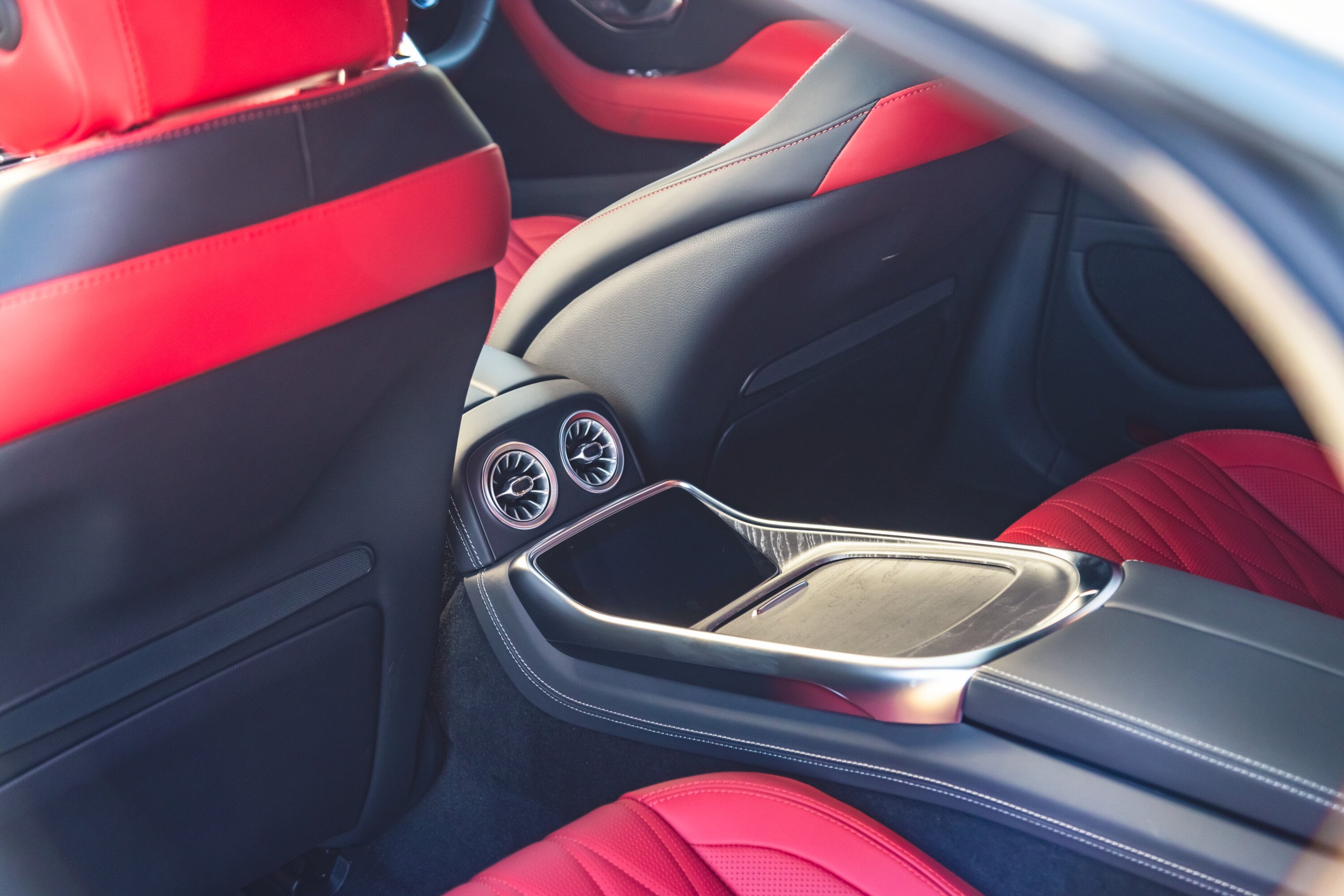
1
The performance-oriented Carbon Pack ($18,490) can be paired with the Night Pack for extra menace.
It adds a fixed carbon-fibre rear wing, carbon mirror caps and other exterior trims. Meanwhile, the racy AMG Performance Pack swaps the heavy active ventilated seats for thinner front buckets without the active side bolsters and massage facility.
Despite pushing $500K when fully optioned on the road, the GT 63 S E Performance four-door strikes ‘good’ value next to rivals. The BMW M8 Gran Coupe, for example, starts at $377,000 before on-road costs yet its 750Nm is barely half that of the AMG. And it can’t travel up to 12km on electric power alone.
Another foe is the Audi RS7 Sportback. It gets a little closer thanks to a starting price under $250K and 850Nm. But rather than an angry sedan, the AMG GT 63 S E Performance is a supercar masquerading as a liftback.
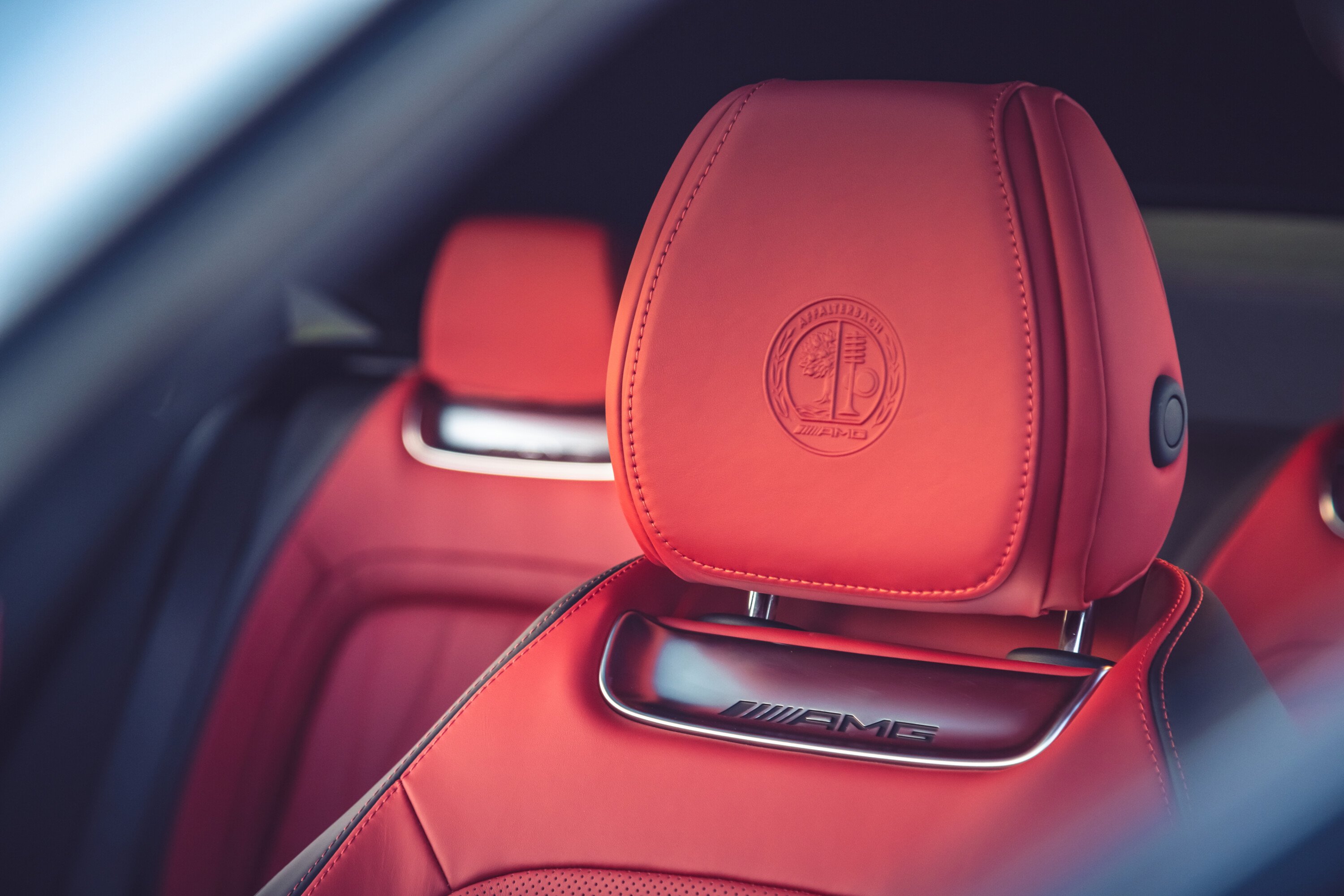
1
What is it like to drive?
Before we arrive at the sheer pace, it’s time to drink in the S-Class cabin quality.
It’s no hardcore brawler; the GT 63 four-door’s cabin is lovingly lined with soft leather from where the dash meets the window to the bottom of the front doors.
The seating position is low – though not too much so – and you sink into the standard non-bucket seats. At 188cm though, I struggled to fit inside with a helmet in my ideal position, having to electrically recline the backrest more than I’d like.
Rear seat passengers are relatively well-served for leg and headroom, though toe room is a little constricted. The view out is pretty good and the two individual rear buckets look to have enough bolstering to hold occupants in place during vicious cornering scenarios.
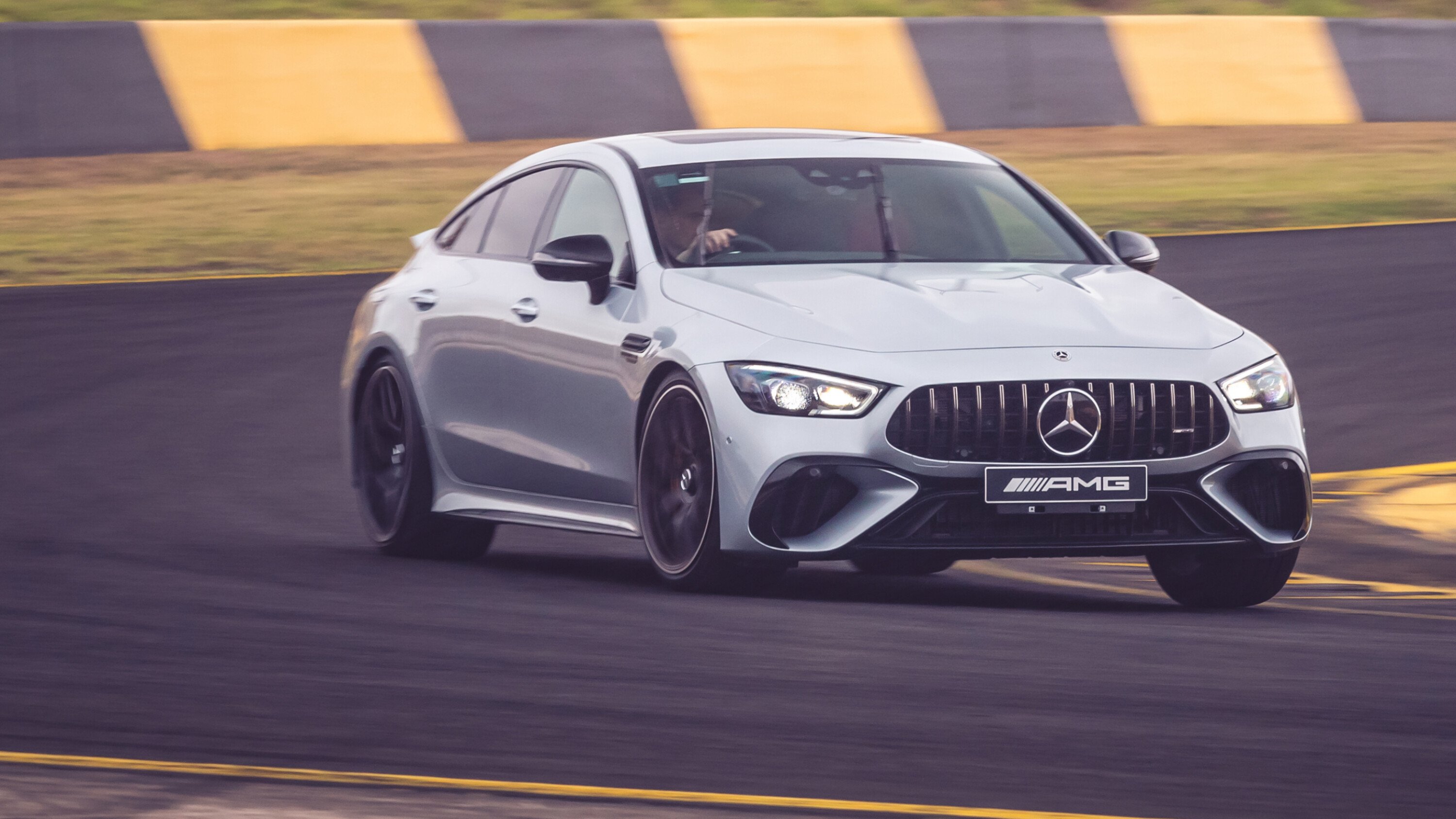
1
With the hand-assembled ‘M177’ 4.0-litre twin-turbo V8 adequately warmed through, the driver’s seat beckons.
Ahead of you sits a five-spoke AMG Performance steering wheel which is covered in a bewildering array of drive mode settings and touch capactive buttons. As we’ll only be driving on Sydney Motorsport Park’s GP circuit today, there are only two real settings of interest: Race or Sport Plus for the drive modes, and Manual for the nine-speed dual-clutch.
The conditions aren’t ideal, with clearing rain and overcast skies leaving wet patches and small rivers running across the track. After having some warm-up laps in an outgoing C63 Coupe, deference was applied to the GT 63’s throttle – even with all-wheel drive, 1400Nm is a lot of twisting force.
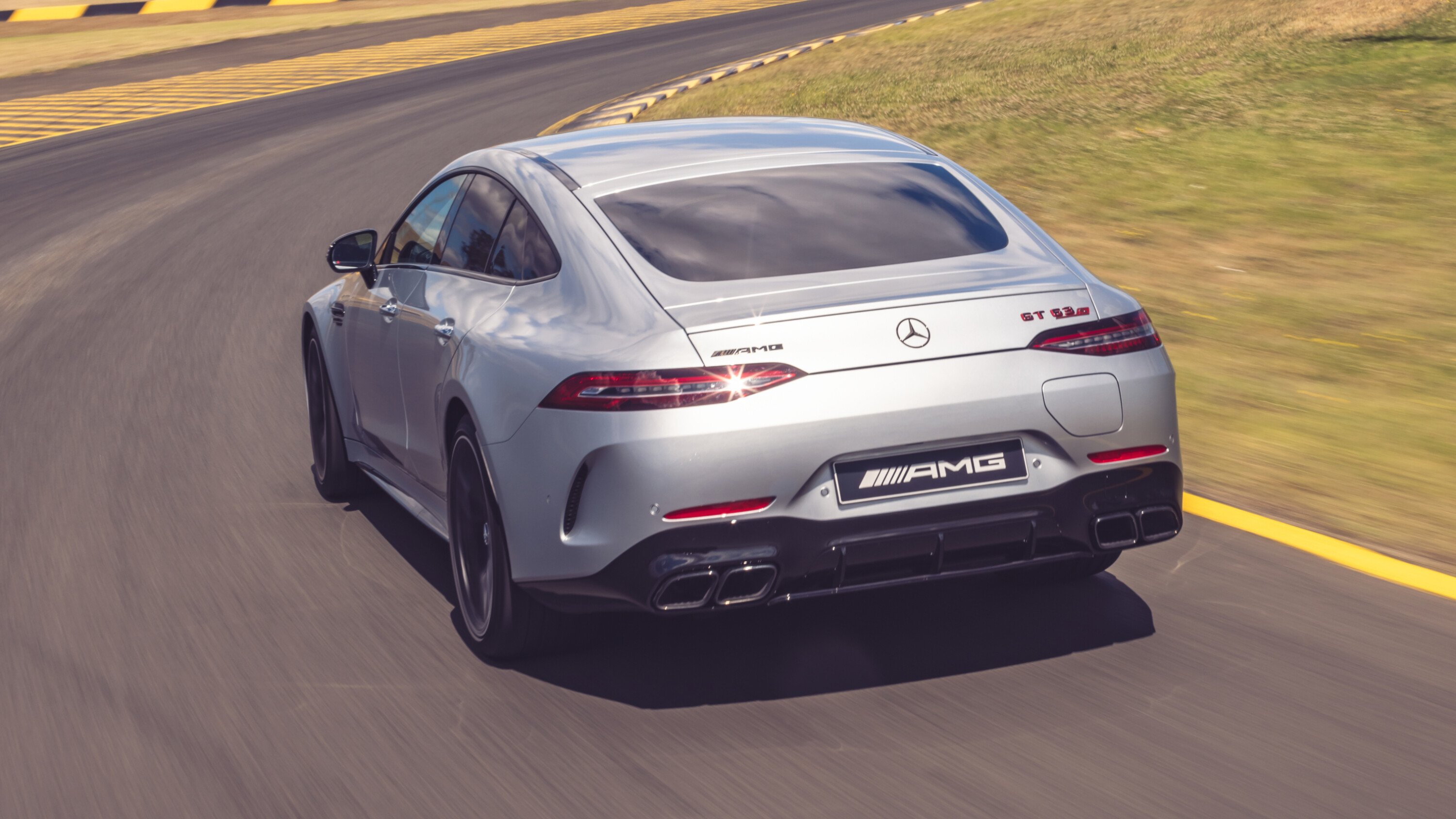
1
That first full-throttle experience is visceral. The rear-mounted electric motor adds violence to the equation above and beyond what the 470kW/900Nm V8 could dream of.
It seems ridiculous that the GT 63 S E performance could weigh nearly 2.4 tonnes.
Yet looking at the complex drivetrain, it makes a bit more sense. The V8 is mounted up front and drives a nine-speed dual-clutch transmission that can handle about 1000Nm. To save the cogs, the electric motor drives the electronically-controlled limited-slip differential.
The 89kg e-motor normally produces up to 70kW and 320Nm but in certain circumstances, it’ll kick 150kW into the equation for up to 10 seconds. The torque number is multiplied through a two-speed transmission, which is how the AMG’s outputs get so high on paper with the ratio changeover happening at about 55km/h.
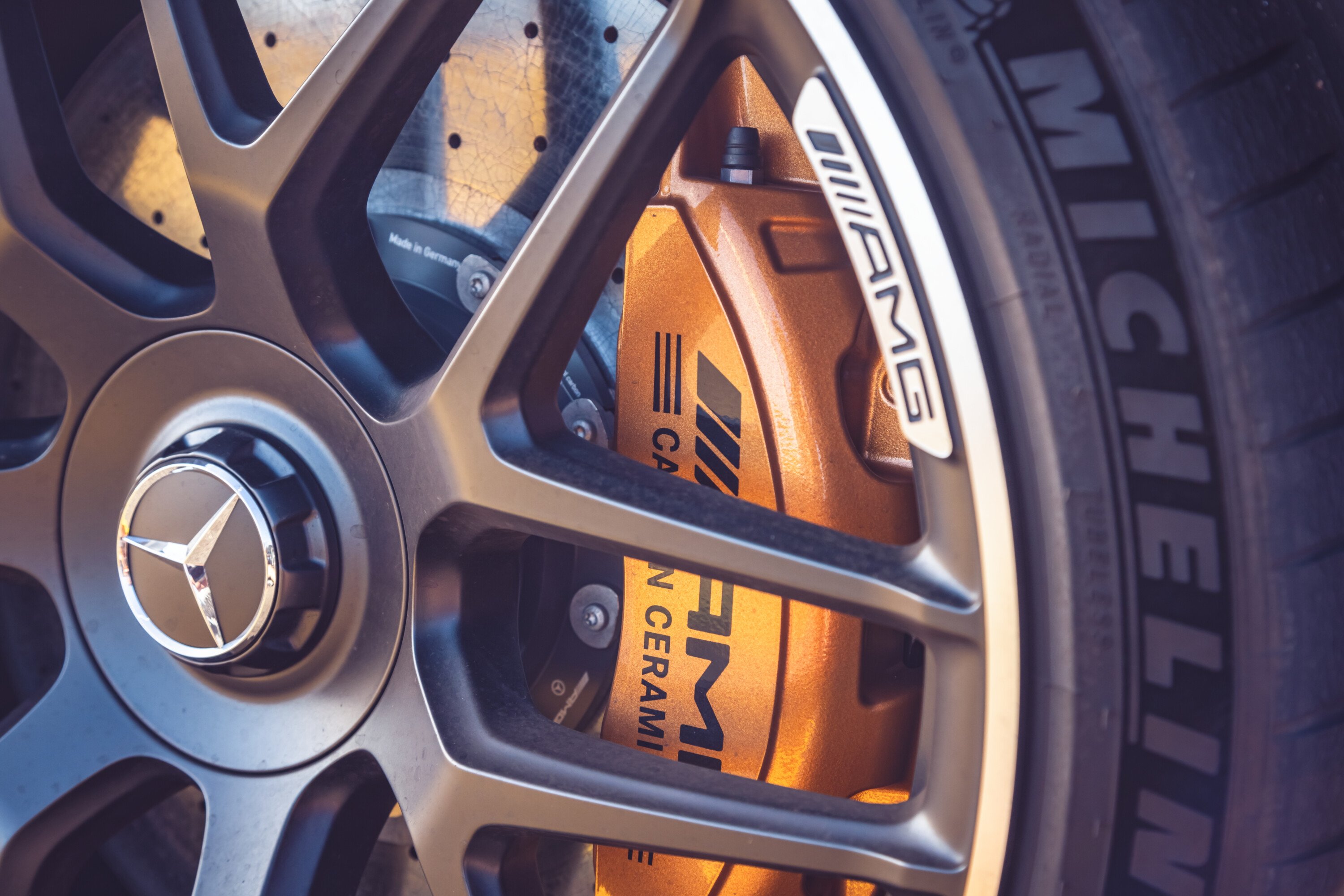
1
Giving power to the motor is a 6.1kWh battery that’s made in-house with cylindrical lithium-ion cells.
It’s small for a plug-in hybrid because the P3 powertrain isn’t designed for fuel-saving (though its ADR combined fuel consumption is pretty stellar at just 7.7L/100km). This is all about maximum performance and for that, the battery needs to be at an optimum 45º temperature – 14 litres of cooling liquid keeps heat at bay.
In some cases, you can notice the grunt levels of the e-motor dropping in relation to what the combustion engine offers but it’s rare. The powertrain is mostly seamless in its operation and, thanks to scavenging extra power from the V8, you could drive the GT 63 S E Performance for your entire ownership without plugging it into a mains socket to charge the battery.
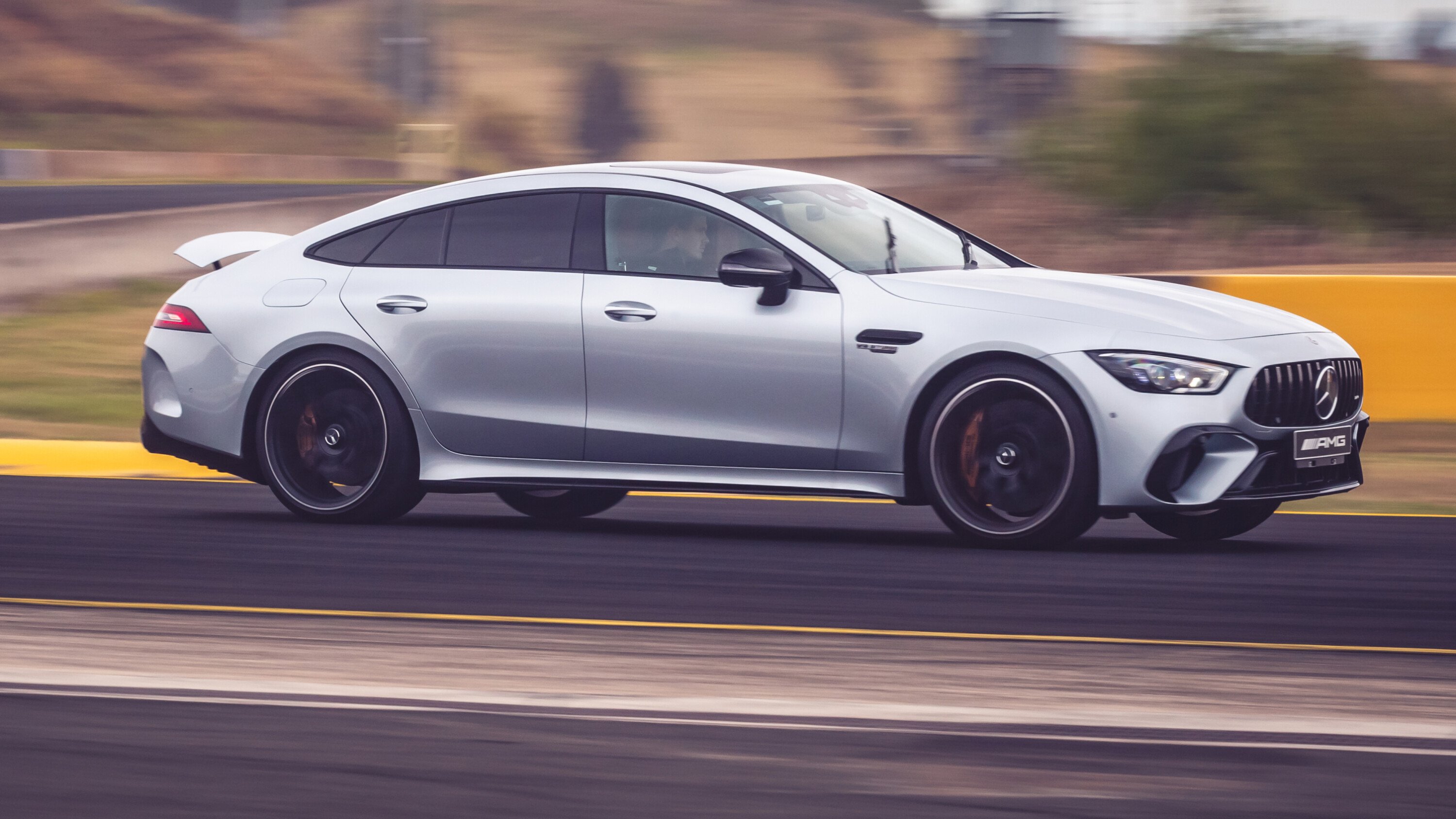
1
The resulting 0-100km/h sprint is vicious, AMG claiming 2.9 seconds, three-tenths faster than its predecessor.
It also makes the GT 63 S E Performance Mercedes-AMG’s fastest accelerating car, so far tied with the limited AMG One hypercar.
All this adds up to an experience dominated by stomach-churning acceleration, which is thankfully matched by incredibly fade-resistant ceramic brakes featuring six-piston front calipers and single-piston sliding rear calipers. They’re capable enough to put your stomach contents back in the right spot after a hit of the loud pedal and feel confident underfoot.
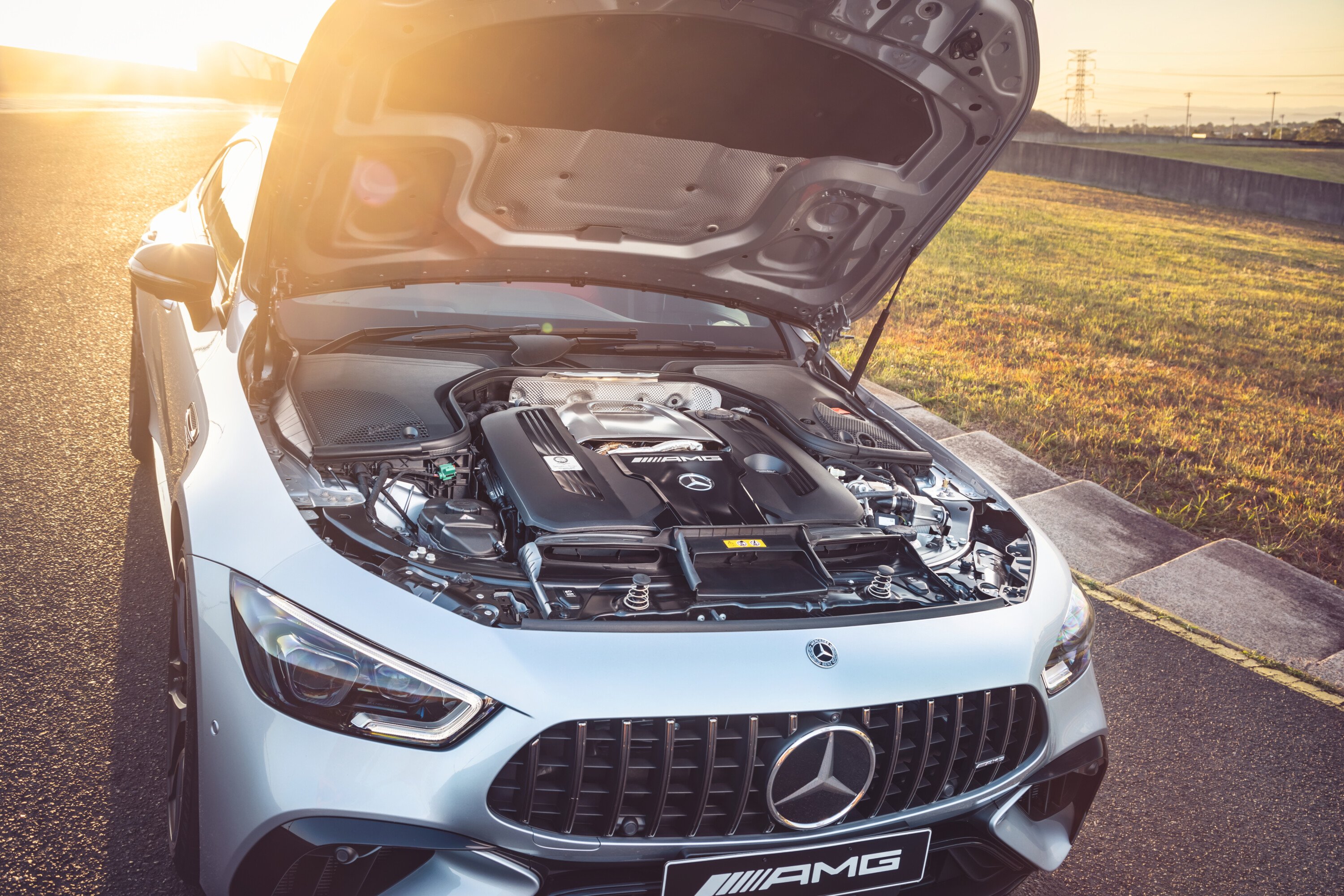
1
With all that lunacy on tap, the GT four-door sounds like a wild ride. Once you’re accustomed to the sheer speed and mass, though, it’s a very friendly creature.
It turns in obediently and carries a neutral stance through medium to high-speed bends.
In lower-speed corners like turn two, the GT four-door’s four-wheel steering (that can rotate the rear tyres by up to 1.3º) helps the nose dive towards the second apex while the clever ESC system measures out the power effectively on exit. Heavy it may be, but this all-wheel drive AMG flatters the driver.
1
But sprightlier rivals can’t ferry four occupants across continents in such comfort
Owing to a combination of the GT four-door’s weight and air springs (which have different roll characteristics at the limit to coil springs) this big grand tourer’s 275/35R21 and 315/30R21 Michelin Pilot Sport 4S tyres don’t key into the racetrack’s surface and let the chassis communicate like lighter supercars and sports cars do.
But sprightlier rivals can’t ferry four occupants across continents in such comfort, and few of them can breeze so easily up to 250km/h down Sydney Motorsport Park’s main straight – just 20km/h shy of a V8 Supercar’s V-max.
1
VERDICT
Mercedes-AMG’s flagship grand tourer has not been ruined by a hybrid system. Far from it.
Thanks to electric assistance, the woofly V8 can live on for at least another generation. An extra 200kg may be hanging around, though the old four-door wasn’t exactly a flyweight.
Although AMG let us loose on a racetrack, the GT four-door is not a track car which makes what it did all the more impressive. Especially those carbon ceramics that stayed fresh and punchy lap after lap.
1
The front Michelins definitely started to fall off toward the end of the sessions but that’s to be expected.
All that combined with air suspension that can be slackened off for extra comfort and the ability to slink around the city in electric mode make this the most well-rounded GT four-door yet.
An iron fist in a velvet glove is what Mercedes’ in-house tuning brand has always stood for and the GT 63 S E Performance is perhaps the ultimate contemporary expression of AMG’s ethos.
MORE
Sedan Buyers Guide
| 2023 Mercedes-AMG GT 63 S E Performance four-door specifications | |
|---|---|
| Price | $399,900 + ORC |
| Layout | PHEV 4.0TT V8, rear-mounted electric motor |
| Conmbustion engine outputs | 470kW @ 5500-6500rpm / 900Nm @ 2500-4500 rpm |
| Electric motor outputs | 150kW @ 4500-8500 rpm / 320Nm from 0 rpm |
| System power | 620kW |
| System torque | 1400Nm-plus (1800Nm at 55km/h) |
| Gearbox (combustion/electric) | 9spd dual-clutch automatic / 2spd transmission |
| Body | 5-door, 4-seat liftback |
| L/W/H | 4287/1836/1516mm |
| WB | 2705mm |
| Weight | 2380kg |
| Boot | 351L |
| Battery usable (gross) | 6.1kWh |
| Driving range | 12km (WLTP) |
| Fuel consumption (ADR) | 7.7L/100km |
| Suspension | Front: double wishbone, air springs, adaptive dampers / Rear: five-link independent, air springs, adaptive dampers |
| Steering | electric rack-and-pinion |
| Tyres | Michelin Pilot Sport 4 S |
| Tyre size (F | R) | 275/35R21 | 315/30R21 |
| ANCAP rating | N/A |
| 0-100km/h | 2.9sec (claimed) |
Messing with tradition is a dangerous exercise.
What’s more, launching a product that’s first of its kind is also fraught with danger – and Ford has elected to roll both of those risky ventures into one car. Brave.
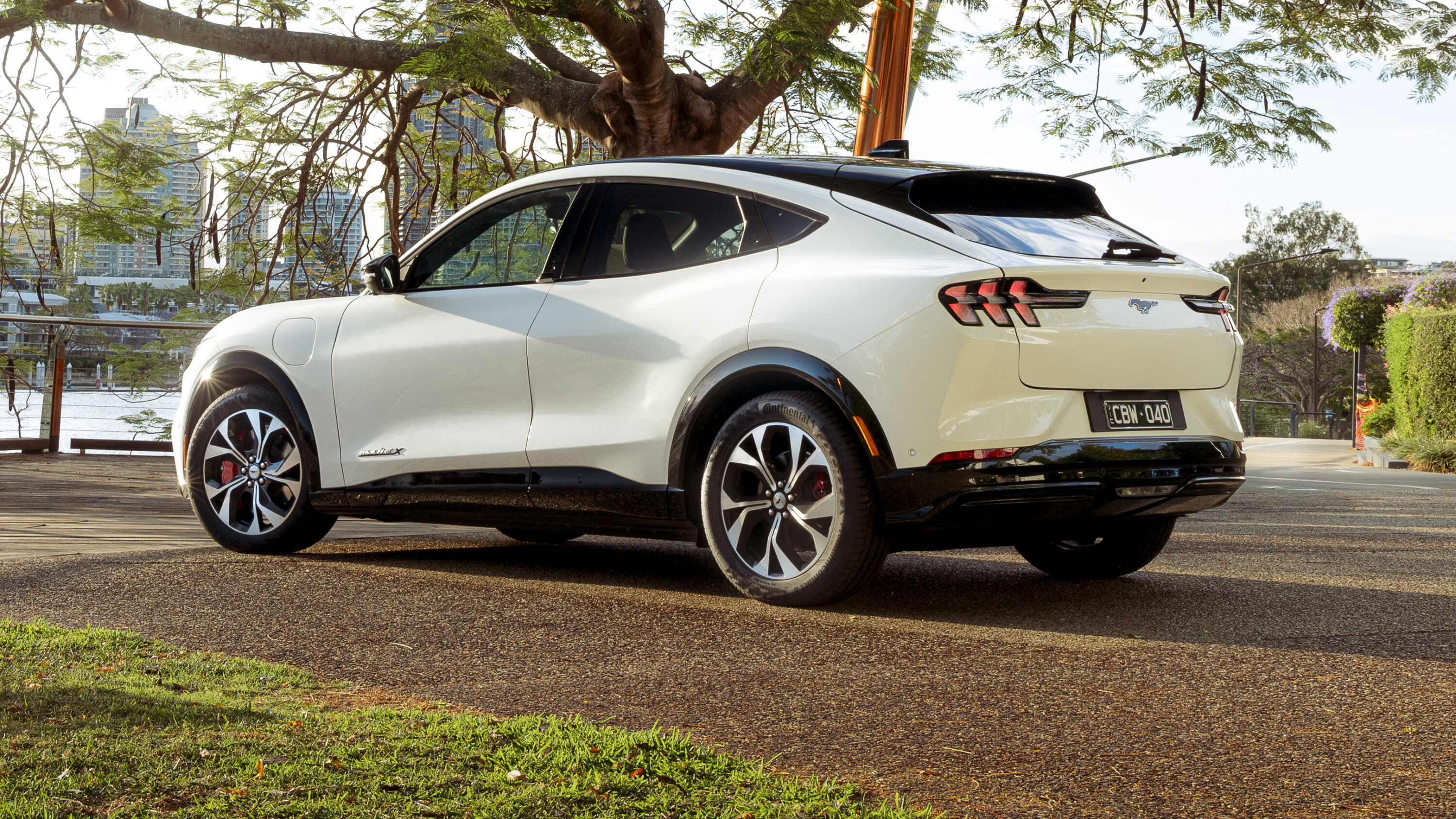
The Ford Mustang Mach-E is the Blue Oval’s first serious foray into the world of all-electric motoring. Now, four years after launching in its home market, it is finally on sale in Australia.
Rusted-on Mustang aficionados will likely despise it purely because it applies the hallowed Mustang name to a high-riding, five-door crossover (and the absence of combustion power obviously raises their hackles too), but let’s try and look beyond the marketing – is the Mustang Mach-E a good performance EV, or not?
1
Starting from $79,990 for the RWD Select and topping out at $107,665 for the dual-motor AWD GT performance hero, the Mach-E is positioned above similarly-shaped offerings like the Polestar 2, Tesla Model Y and Kia EV6.
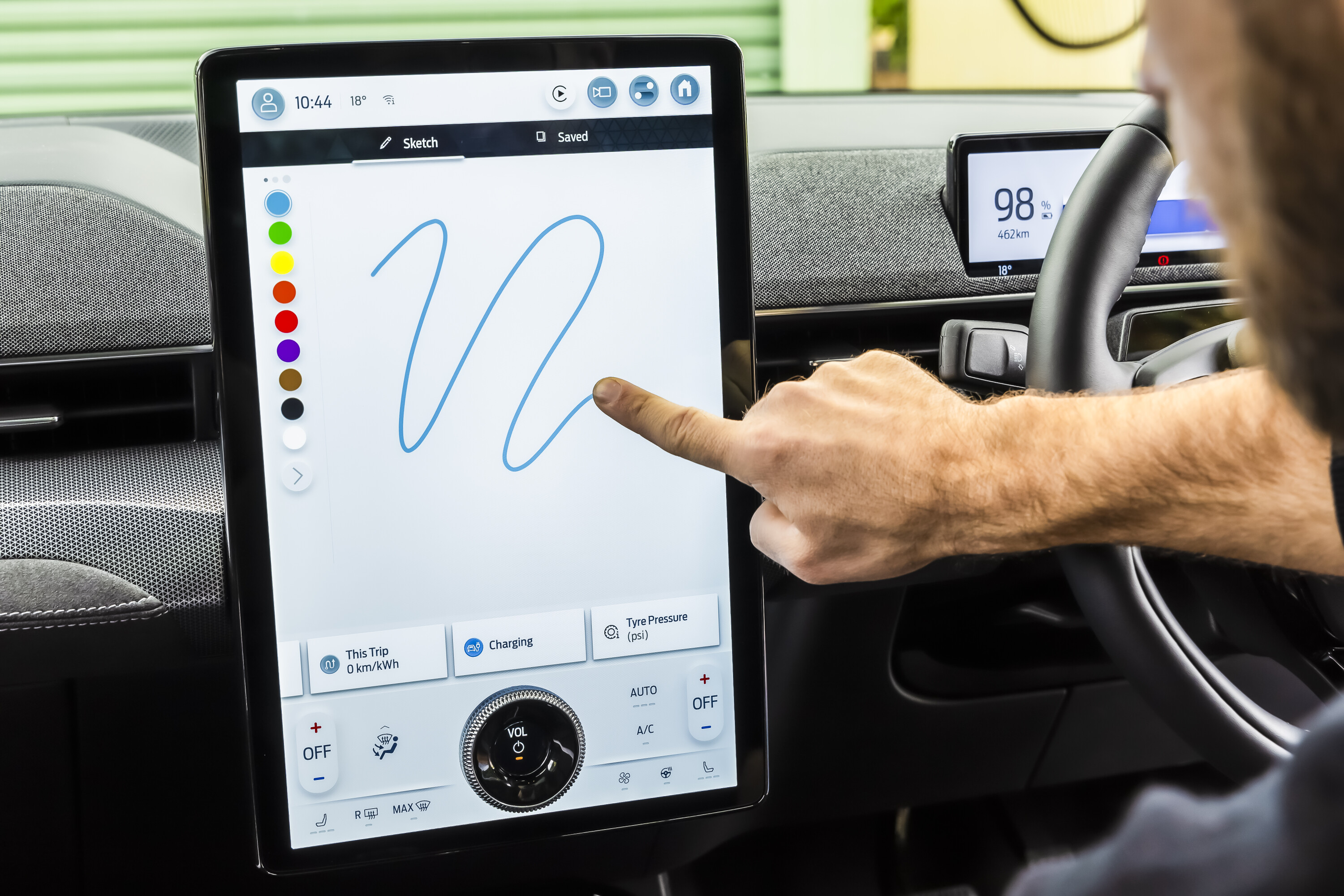
Countering the high cost of entry is a fat standard equipment list. The Mach-E Select is standard with features like a massive glass panoramic sunroof, a glitzy 15.4-inch portrait display, a 10-speaker B&O sound system, a 10.2-inch digital instrument pack (in an ultra-slim panoramic aspect ratio), adaptive cruise control, power-adjustable front seats, remote connectivity features, pleather upholstery, a wireless phone charging pad, wireless Apple CarPlay/Android Auto, and an electric tailgate.
Powered by a 72kWh lithium-iron-phosphate (LFP) battery, the 198kW/430Nm RWD Select offers a driving range of 470km.
Since this review was published, Ford Australia has lowered the pricing for the Mach-E – see story below.
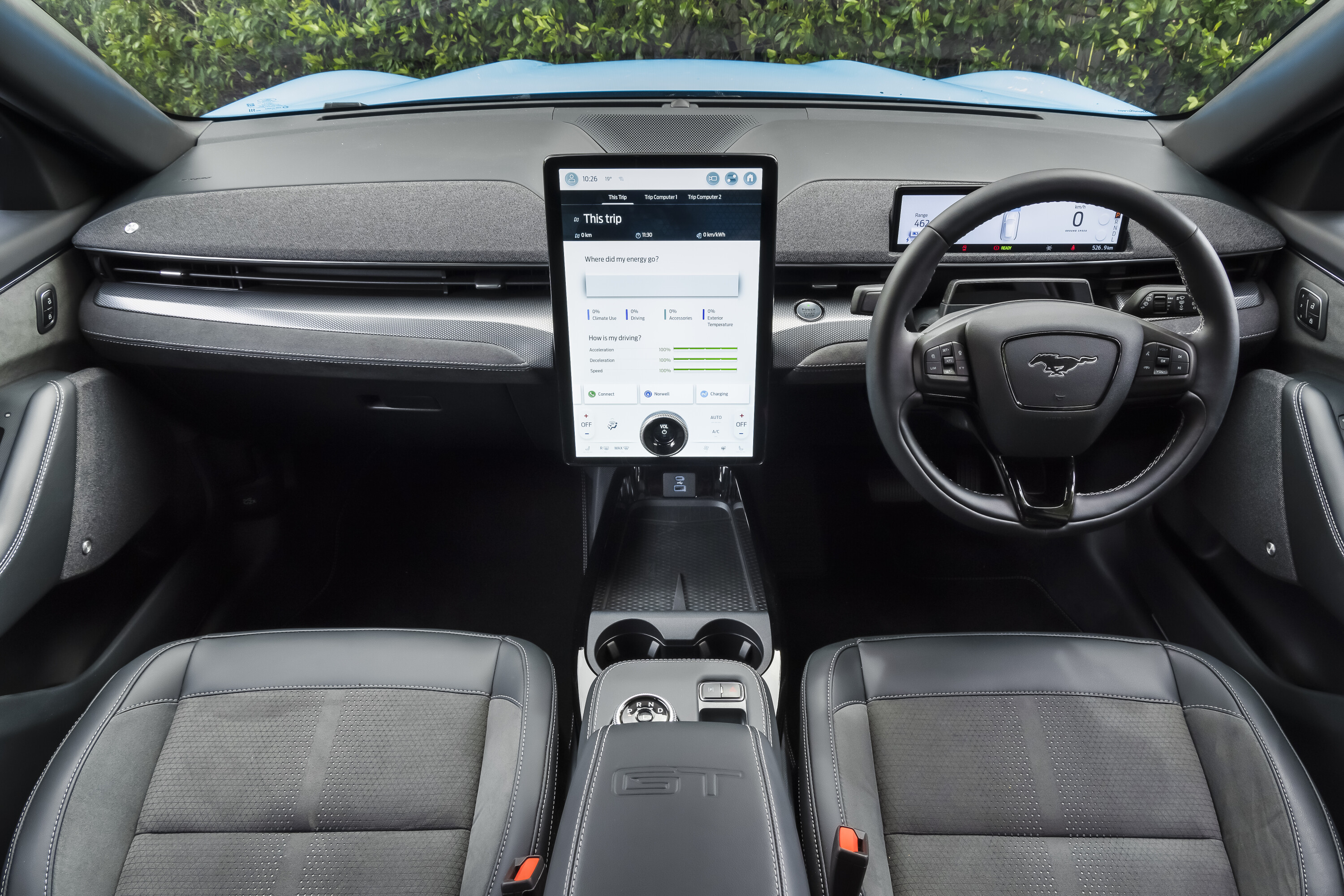
1
Mach-E Premium
Moving further into the range, the mid-tier Mach-E Premium adds projector LED headlamps, red contrast stitching for the upholstery, a black headliner, metal pedals, ambient interior lighting and red brake calipers.
The Premium is still only rear-wheel-driven like the Select, but it swaps out the LFP battery for a more potent 91kWh lithium-nickel manganese cobalt (NMC) battery, along with a slightly spicier 218kW power peak (torque remains at 430Nm), and 600km range. Price? $91,665 before on-road costs.
Mustang Mach-E GT
At the top of the tree is the Mustang Mach-E GT, a dual-motor, all-wheel drive performance flagship that should help quell the concerns of Mustang fans that the electric pony can’t run.
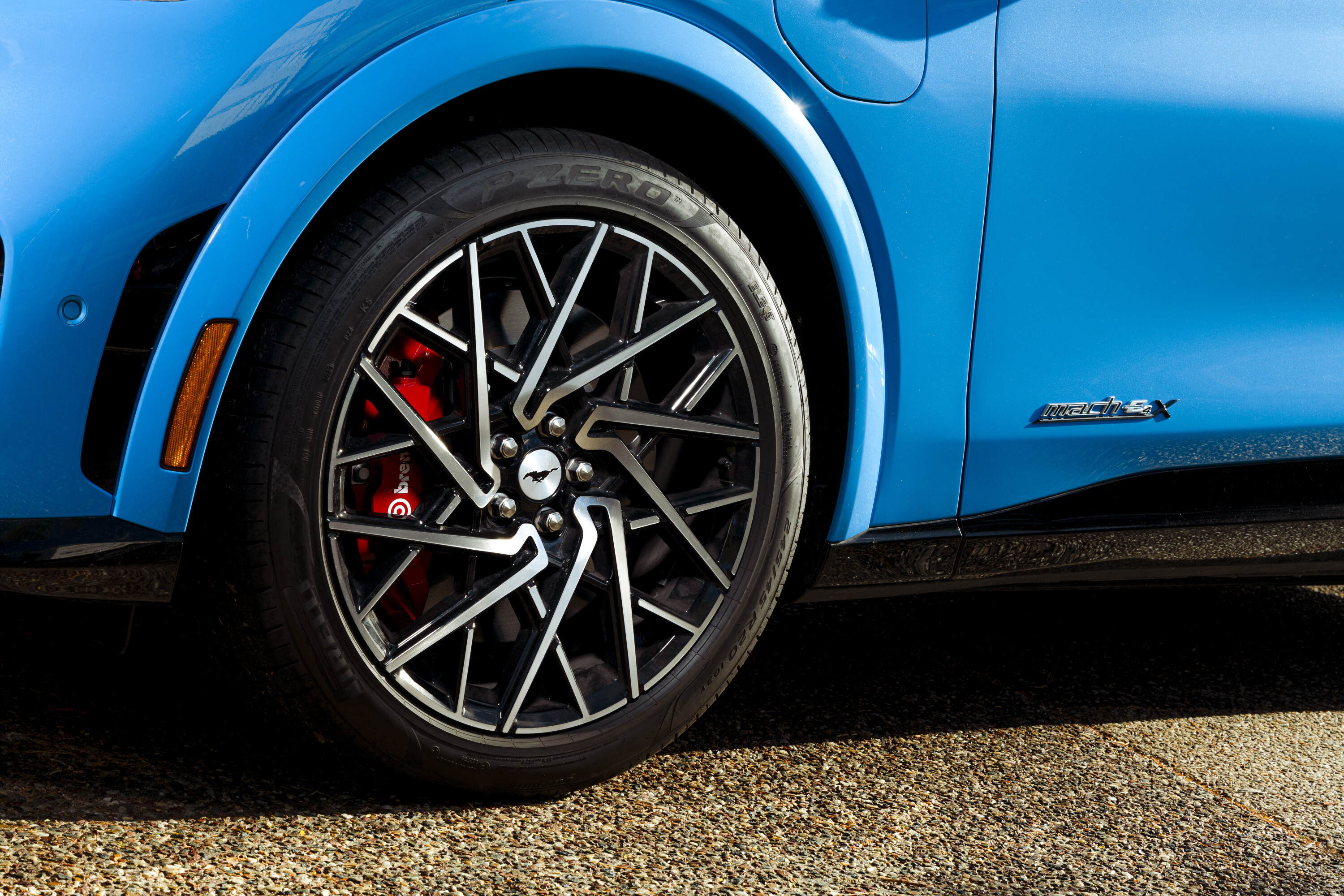
Using the same 91kWh NMC battery as the Premium, it grafts an electric motor to the front axle for a combined output of 358kW/860Nm, while the chassis is upgraded through adaptive magnetorheological dampers, Brembo front brakes, Pirelli P-Zeros on 20-inch alloys, and a GT-specific “Untame Plus” drive mode.
Range drops down to 490km per charge due to the weight and power draw of that extra motor, but that’s the price paid for performance.
But it’s time to put the brochure down and saddle up, because the proof of this pony is in the driving. First impressions? Pulling on the vestigial ‘handle’ that pops open the front doors proffers a futuristic handshake, but sliding into the Mach-E’s driver’s seat is disappointing: it just doesn’t feel sporty.
There’s no feet-out, bum-on-the-deck posture that you’d expect of something with the Mustang label, and though this writer isn’t especially tall, it was still not possible to get the driver’s seat adjusted to a height that felt comfortable.
2
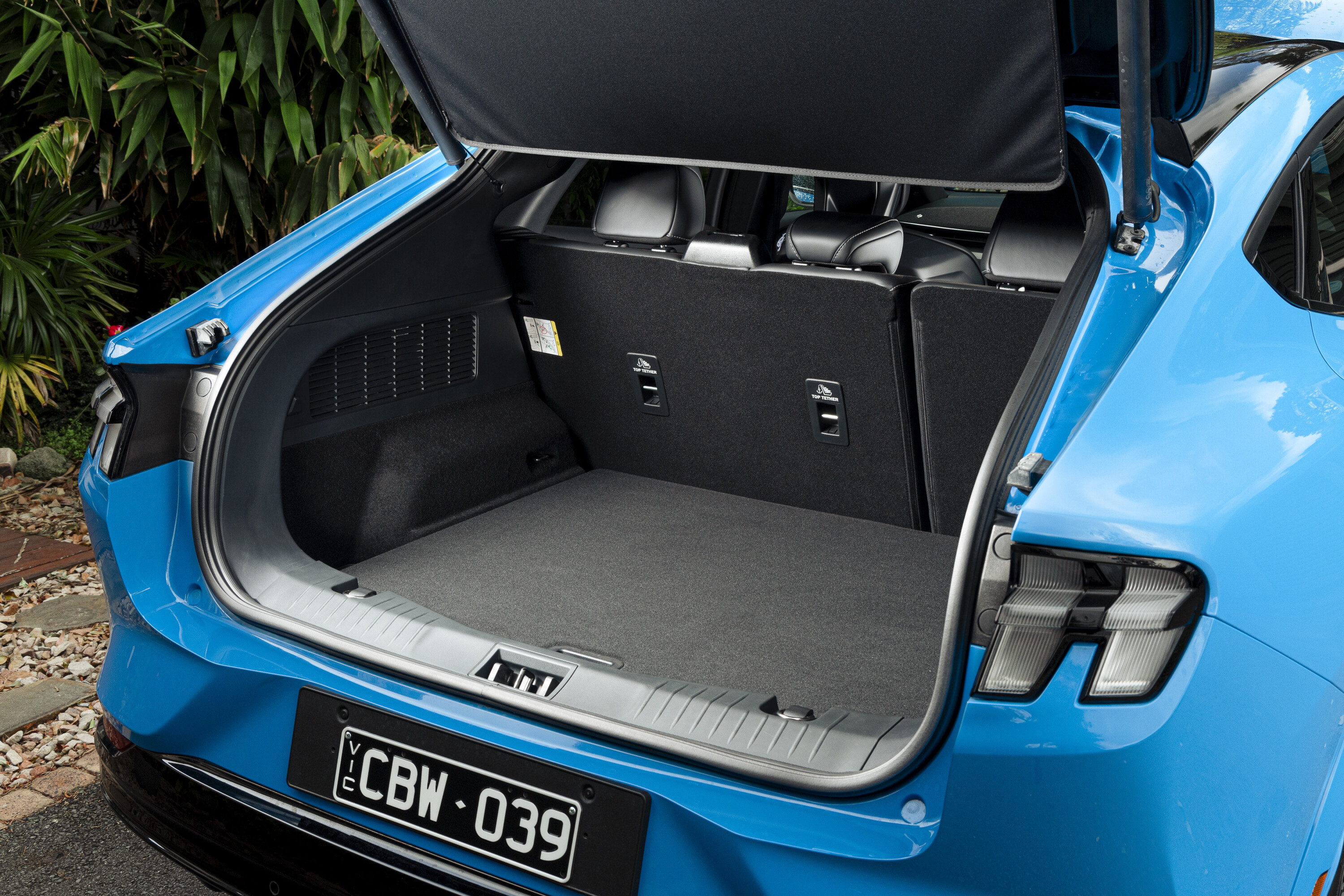
We get it, it’s a crossover; the H-point is going to be higher than a sports car, but the Mach-E rides on the legacy C2 platform that wasn’t designed with pure EVs in mind. Consequently, both the front and rear seats must sit on top of the battery pack.
Rear seat space is decent for two adults but like the Polestar 2, it’d be a fair squeeze fitting three adults or teens across the rear bench. Like the front seats, they’re also short on headroom.
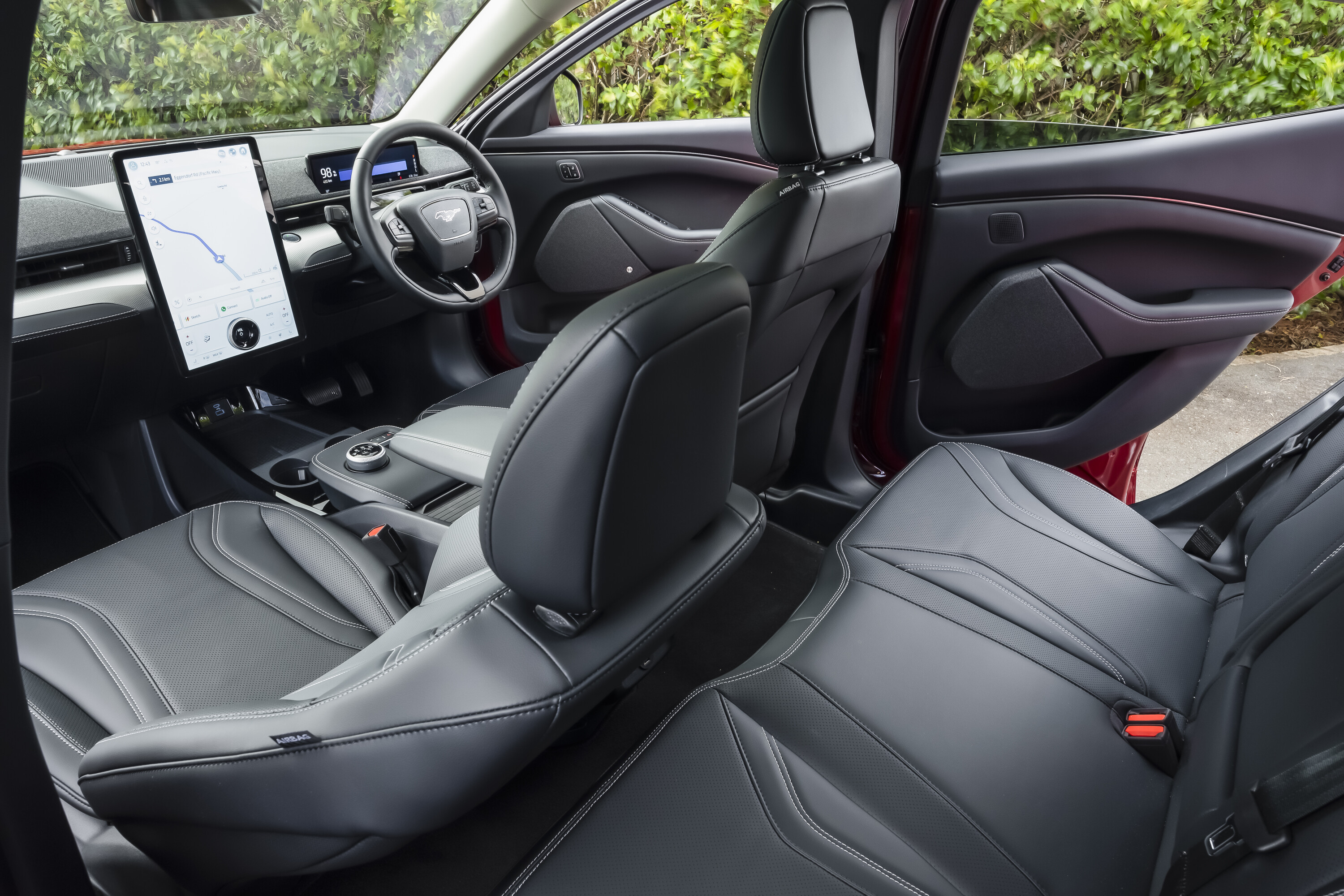
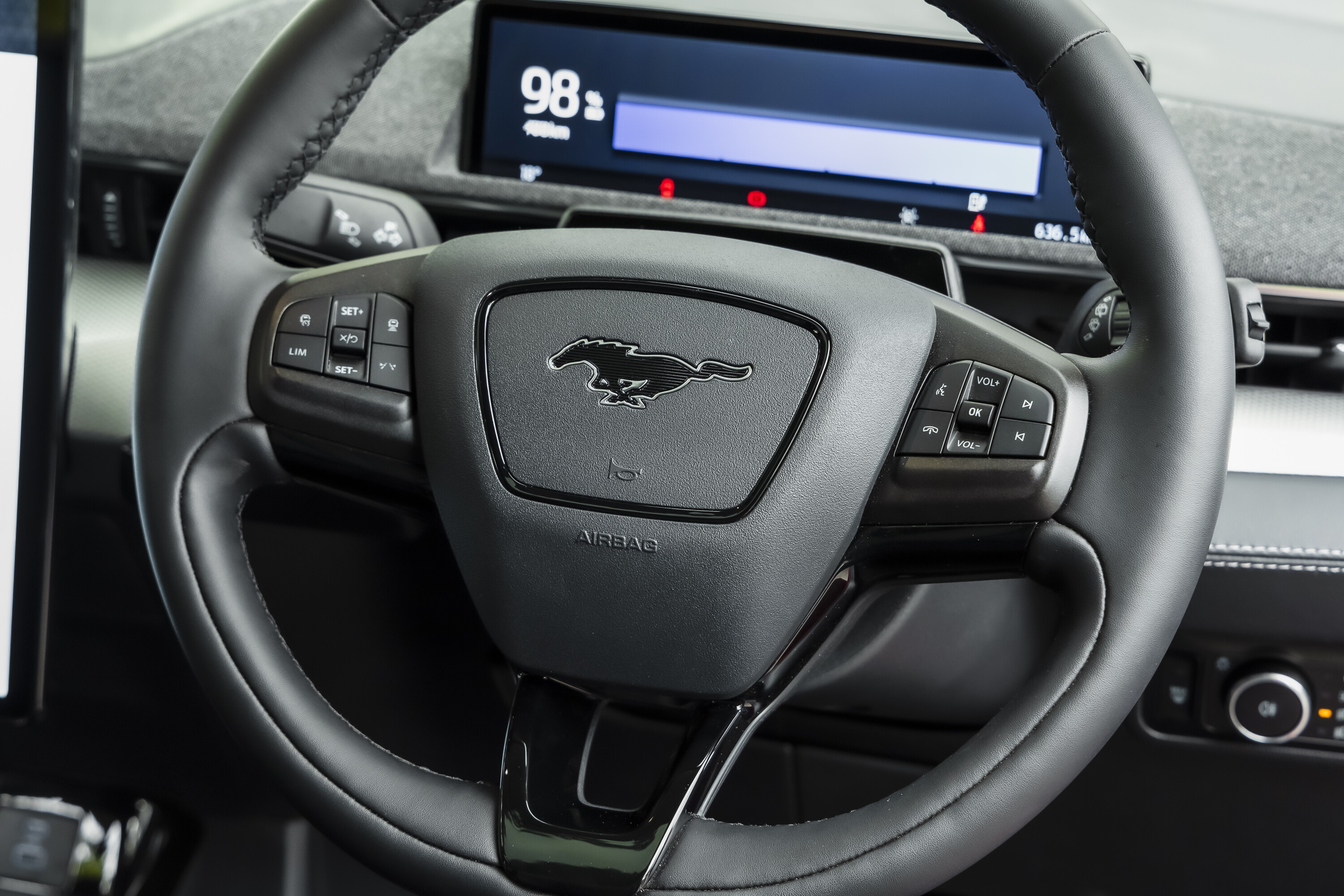
That rotary drive mode selector between the front seats is another lowlight. Contrasted against the space-age infotainment screen, it has a parts-bin aura that’s not in keeping with the rest of the Mach-E. So too the LCD instrument panel. It’s bright and has clear graphics, but lacks the customisability, versatility and visual wow factor of other digital dashes.
1
But grip the meaty rim of the steering wheel, twist that disappointing dial into D, and the Mach-E begins to redeem itself. All variants possess sweet steering with a fast response, pleasing heft, and zero slack.
Moreover, the ride quality, whether on the passive dampers and 19-inch wheels of the Select and Premium or the MagneRide suspension and 20s of the GT, is great. There’s plenty of vertical travel to this suspension but it doesn’t feel like a waterbed – nor does it ride like a rollerskate.
Our last drive of the Mustang Mach-E took place in the USA, where the American-spec suspension rattled our teeth with a needlessly brittle ride. For Australia, Ford has given us what it terms the ‘Irish tune’, which has far more compliance. Good move.
1
A skidpad and track activity put on by Ford at the launch proved that the Mach-E can do lairy sideways things
The GT does have a noticeable difference in body control over the Select and Premium, with its adaptive dampers providing faster bump recovery and what feels like greater resistance to roll when the roads are twisty, but also a thicker layer of plushness when traversing sedate suburban streets.
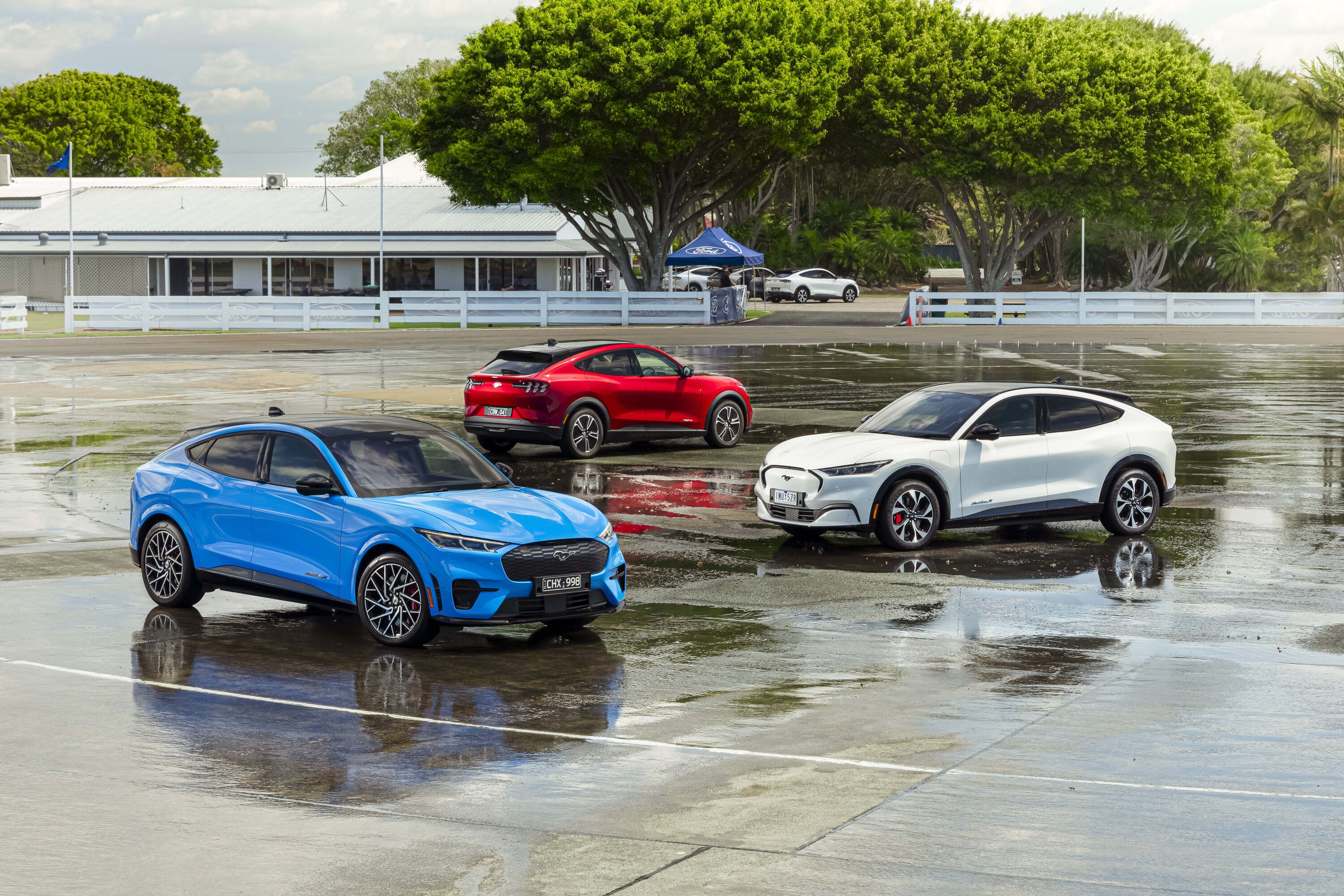
And then there are the dynamics. A skidpad and track activity put on by Ford at the launch proved that the Mach-E can do lairy sideways things if you provoke it enough, but it’s out on the road where it feels sportiest.
There’s a surprisingly permissive stability control calibration when you put the car in Untame mode (there’s also the ‘regular’ Active mode, and the predictably limp Whisper eco mode) that allows stabs of throttle to bring the rear end around, and for a heavy (2.3 tonne for the GT!) EV, the Mach-E can dance surprisingly well.
1
Coupled with its satisfying steering, the Mach-E gets high marks for driver enjoyment – there might not be a V8 under the bonnet, but there’s definitely a Mustang spirit in this one.
It’s not a perfect driving experience, mind you. An overly-sensitive brake pedal that also has a small dead zone near the top of its travel makes it hard to drive smoothly at times, and while there’s a one-pedal drive model that dials up the regenerative braking to limit how often you need to touch the left pedal, there’s no ability to vary the strength of the regen like in other EVs. We simply turned it off for a more natural drive.
So too the lane-keep assist system, which was a little too trigger-happy and liked intervening early. It can be switched off, but that defeats the purpose of having that safety system to begin with, no?
1
And then there’s its straight-line performance. The calling card of modern EVs is blistering standing-start acceleration, yet the Mach-E lacks the Tesla-like force that some may be expecting.
Even the dual-motor GT, which has a claimed zero-to-hundred of 3.7 seconds, doesn’t feel all that special when you mat the accelerator, with torque seeming to noticeably taper off above 70km/h.
The rear-drive Select and Premium have factory claims of 6.6 and 6.2 seconds respectively, but that would be considered average for a hot hatch in this day and age.
1
As far as efficiency is concerned, that could be better as well.
The Mach-E achieved an average of 20kWh/100km on the launch drive loop, and only 18kWh/100km on a very sedate medium-speed run back to the airport. Those aren’t great numbers for an EV of the Mustang’s size, and far from segment-leading.
Yet one could argue that a true Mustang really only needs to satisfy one thing: its driver. On that count, there’s more than enough in the way the Mach-E drives to calm down even the most ardent cynic.
It could be faster, it could be more efficient and it could be more affordable but at its core, the Mustang Mach-E has plenty of driver appeal.
Since this review was published, Ford Australia has lowered the pricing for the Mach-E – see story below.
MORE
Everything Ford
MORE
Electric SUVs
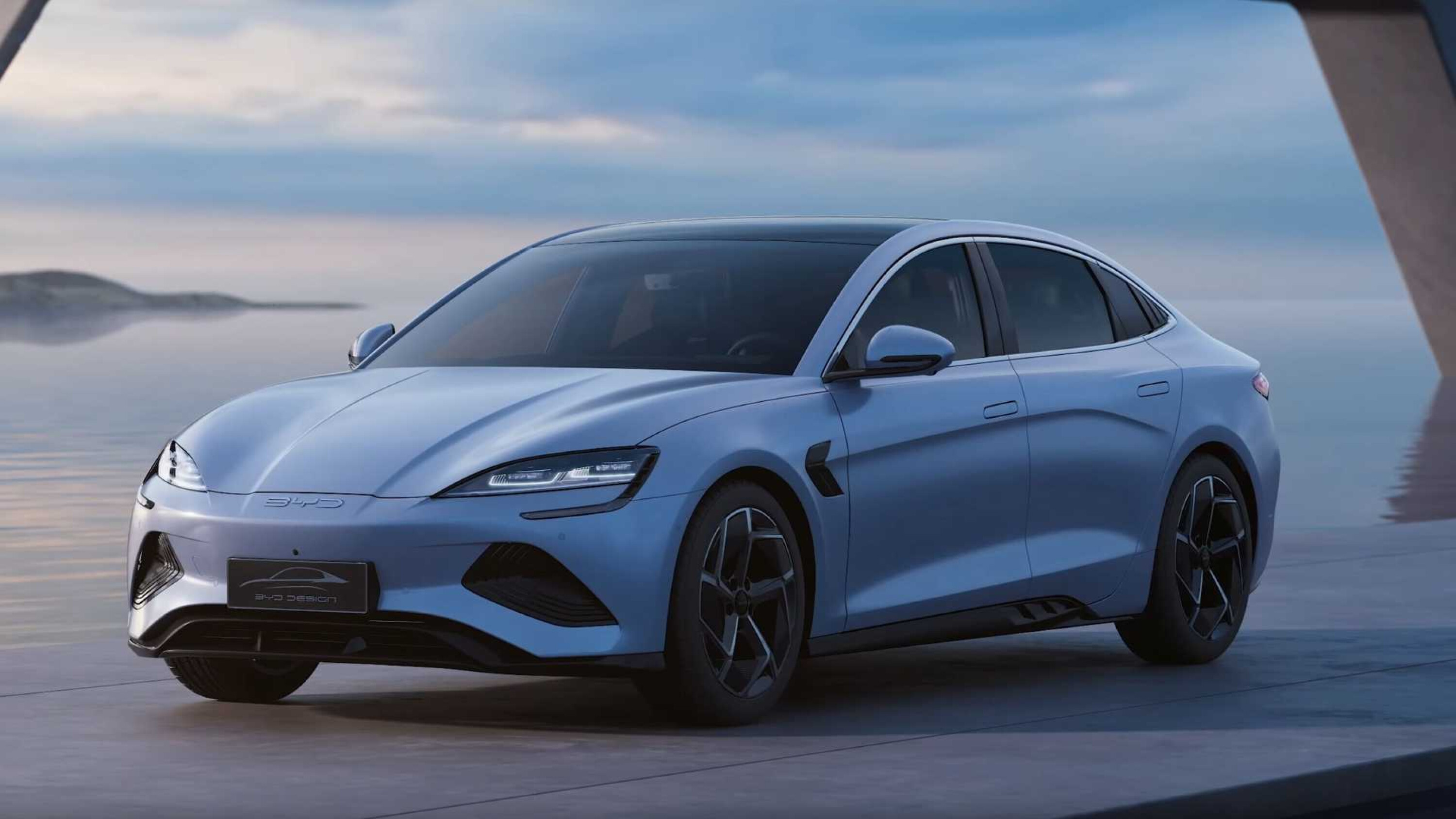
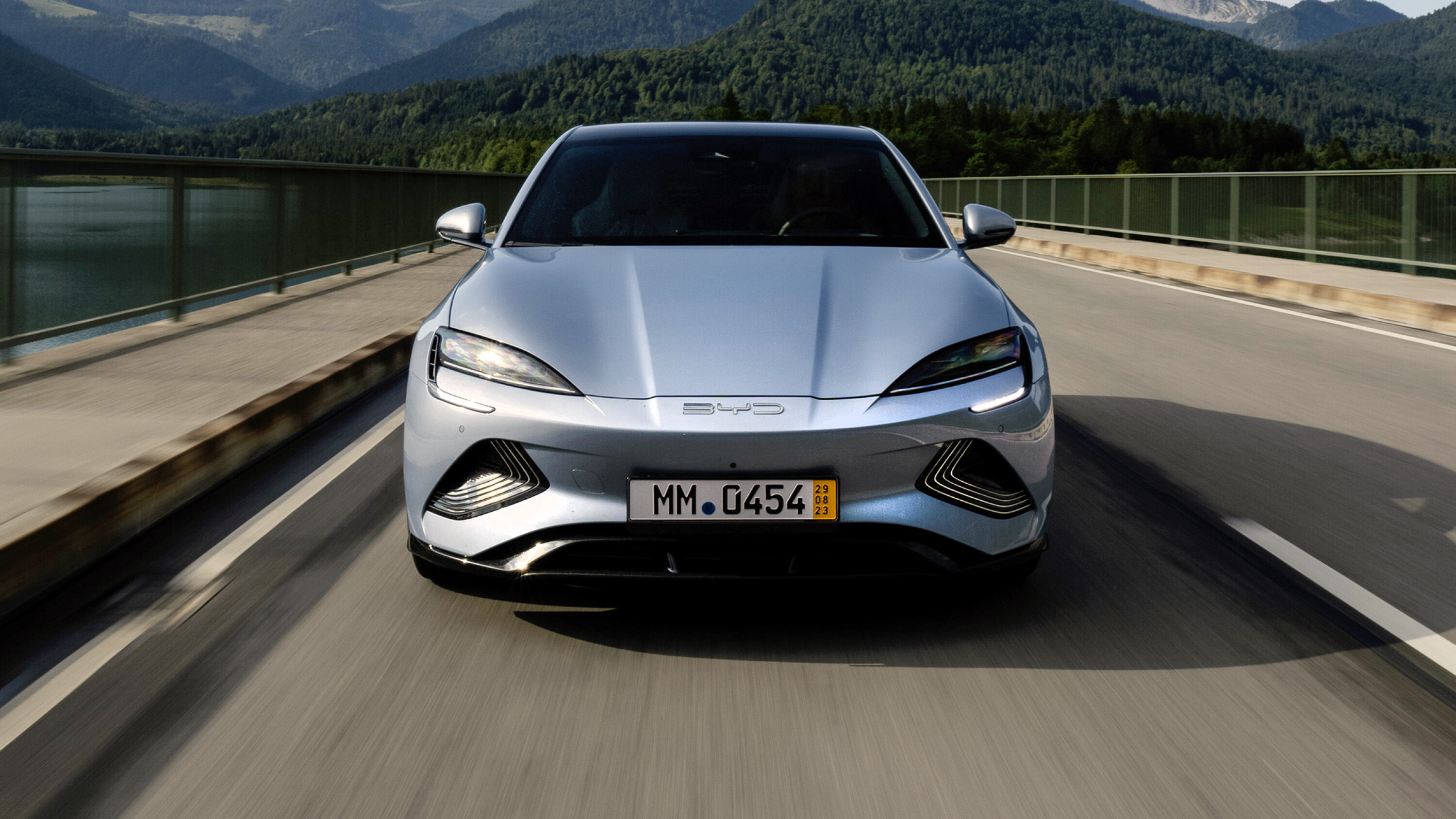
If you’re one of the thousands of Aussies in the market for a Tesla Model 3, chances are your interest was piqued by the recent pricing announcement for the 2024 BYD Seal.
The Seal is a direct competitor for the Model 3, and the pair align closely on size and a number of other key metrics.
One key number that differs markedly, however, is price. At $49,888 for the entry-level Dynamic RWD, the BYD Seal undercut the cheapest Model 3 by a whopping $12,012.
January 2024: Spec battle brought to life in three-car comparo!
December 2023: Seal Performance and updated Model 3 driven!
Story continues…
1
Unsurprisingly, that price gap sent social media into a frenzy, with some calling the BYD Seal an ‘EV game changer!’ while others asked “Has the Tesla Model 3 finally met its match?”
To help you better understand how these two electric sedans line up, this article will explore the differences in their size, performance and cabin executions. We’ll also compare their specs for battery size, recharging times and range.
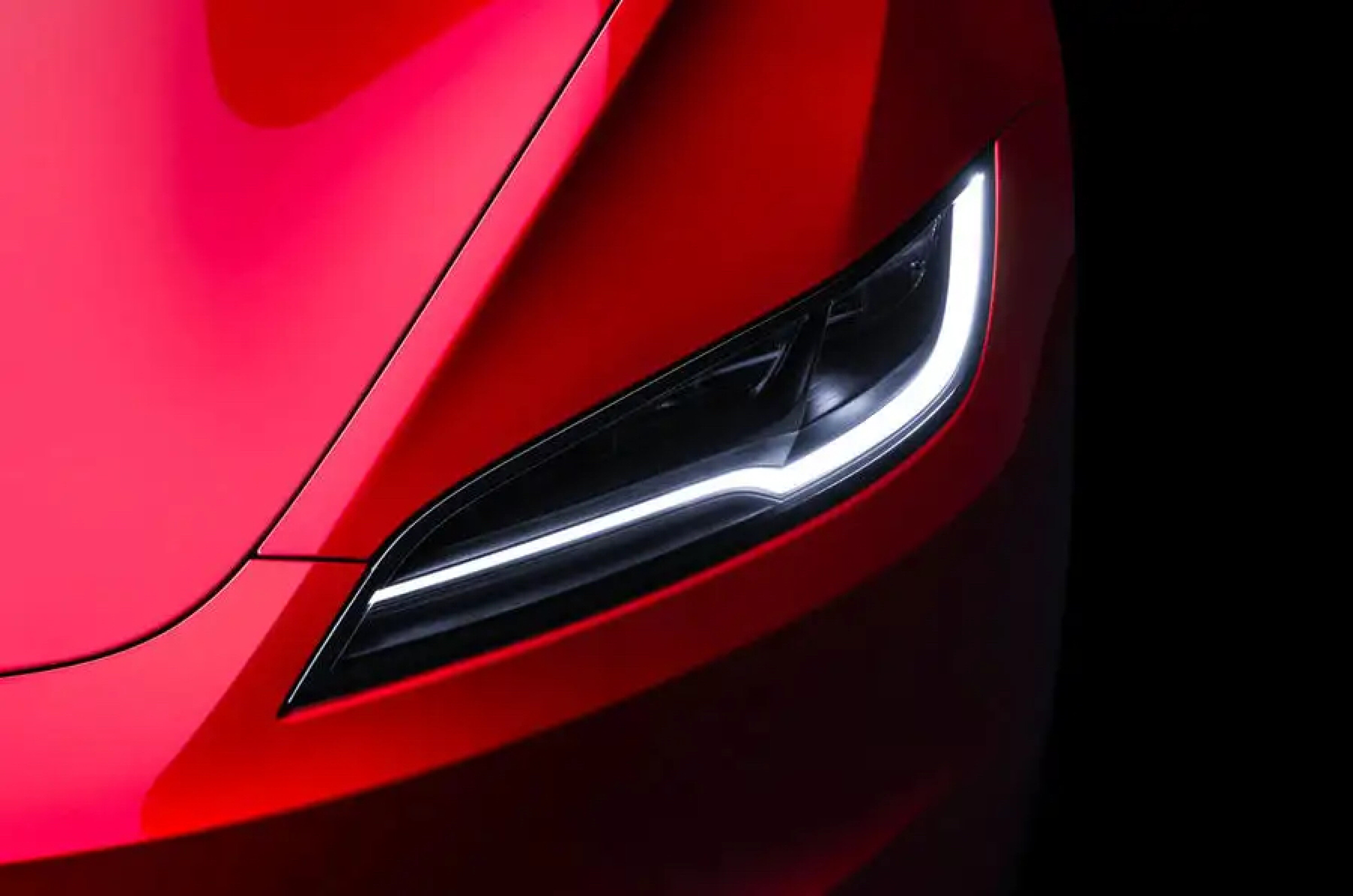
We’ll be comparing the BYD Seal with the facelifted 2024 Tesla Model 3, due here later this year with a revised exterior design, upgraded cabin and improved driving range.
Is the BYD Seal a smarter buy than a Tesla Model 3?
Let’s dive into the numbers.
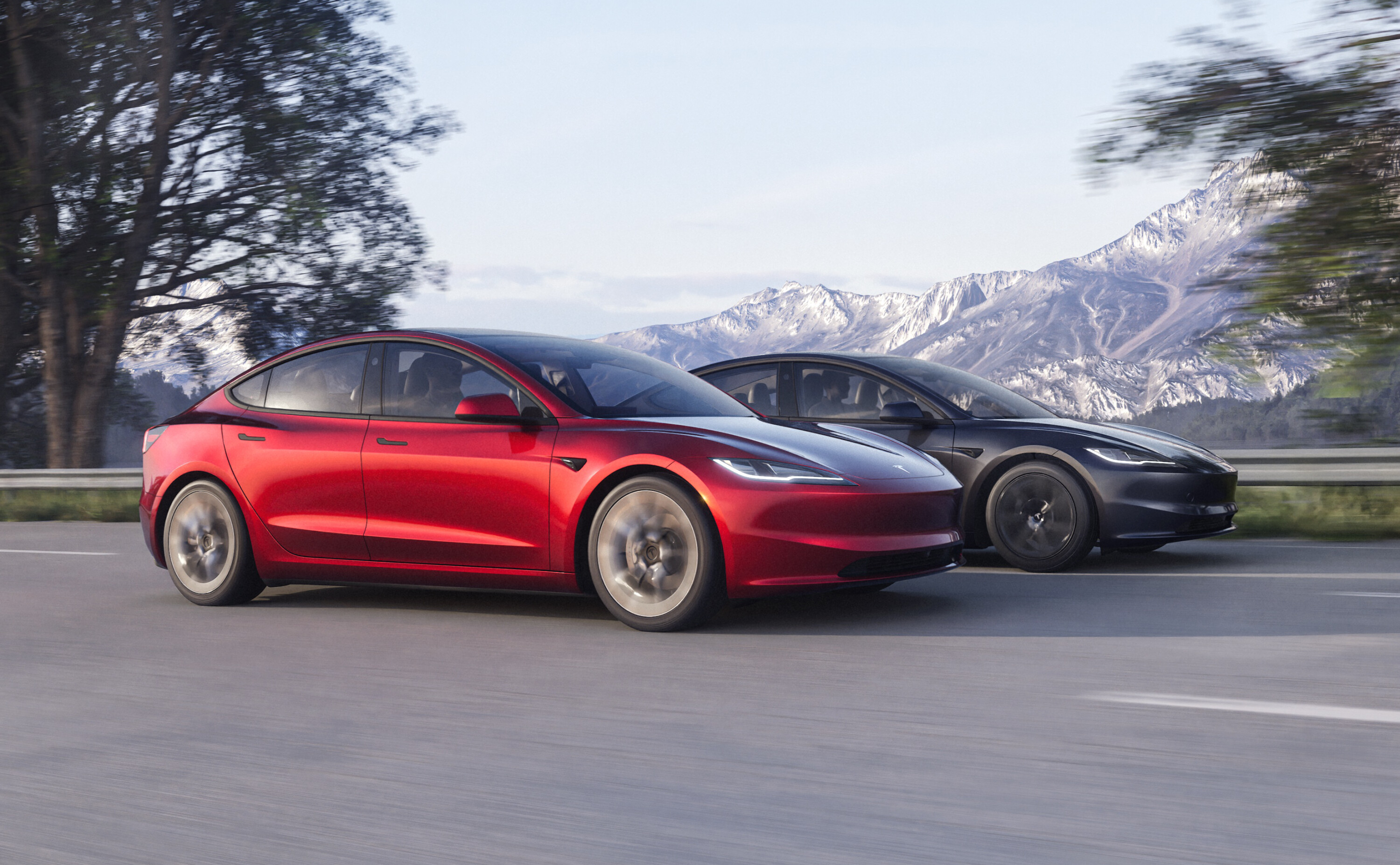
1
JUMP AHEAD
Dimensions & boot space
At 4800mm long, 1875mm wide and 1460mm tall, the BYD Seal is 80mm longer, 58mm narrower and 19mm taller than the Tesla Model 3.
It also rolls on a 45mm longer wheelbase (2920mm vs 2875mm), which could help to give the Seal an advantage when it comes to cabin space.
One area the BYD trails the Tesla, however, is boot space. The BYD Seal offers a 400-litre boot and an extra 50L in the nose. That’s significantly less than you get in the Tesla, which has a 561L boot and an 88L frunk.
| BYD Seal | Tesla Model 3 | |
|---|---|---|
| L/W/H (mm) | 4800/1875/1460 | 4720/1933/1441 |
| Wheelbase | 2920mm | 2875mm |
| Boot space | 400L + 50L frunk | 561L + 88L frunk |
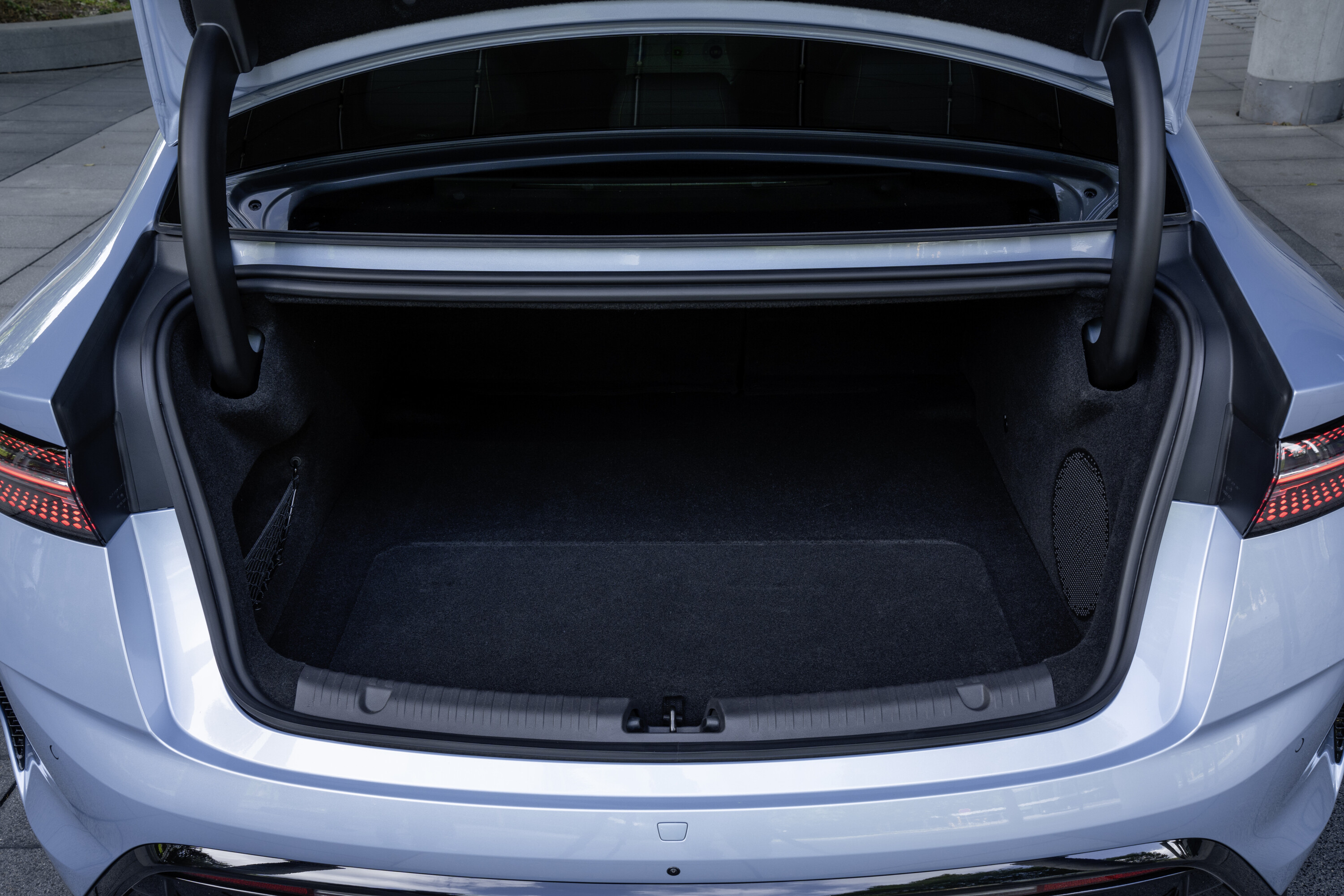
2
Range and performance
This is where things get interesting.
While the BYD Seal does undercut the Model 3 by $12,012, that price difference is for the entry-level Seal Dynamic RWD – which isn’t in the same league as the Tesla for performance, range or charging capacity.
With 150kW/310Nm on tap and a 0-100km/h time of 7.5 seconds, the Seal Dynamic trails the Model 3 RWD’s 208kW/420Nm (+58kW/110Nm) outputs and 100km/h sprint of 6.1 seconds (-1.4sec).
The BYD’s claimed WLTP driving range also trails the Tesla by a decent margin (460km vs 513km). And the Seal Dynamic’s 61.4kWh battery can only accept 110kW DC fast charging, which is well down on the 170kW maximum in the Model 3 RWD.
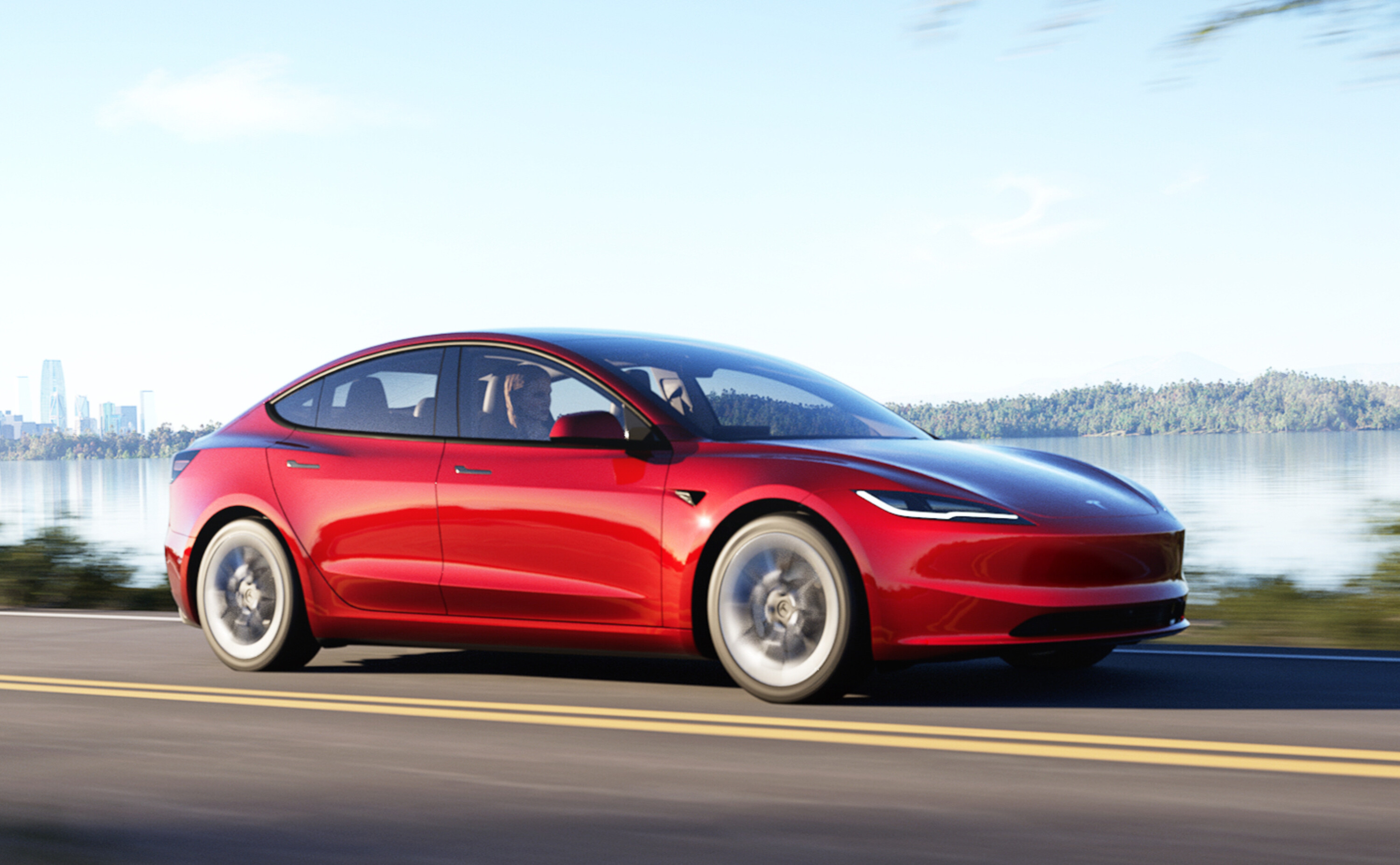
1
So while the BYD Seal Dynamic is substantially cheaper than the Model 3 RWD, that price advantage does bring some compromises.
A closer match for the Tesla, at least in performance and range, is the mid-spec Seal Premium RWD. At $58,798 it’s almost $10K pricer than the entry-level Seal but it aligns more closely with the Tesla ($61,900) and is lineball with the Model 3 when it comes to spec.
The BYD, for example, has 230kW/360Nm which is 22kW more than the Tesla but 60Nm less. The Seal is also marginally quicker to 100km/h (5.9sec plays 6.1sec) and its 82.5kWh battery accepts up to 150kW DC fast charging.
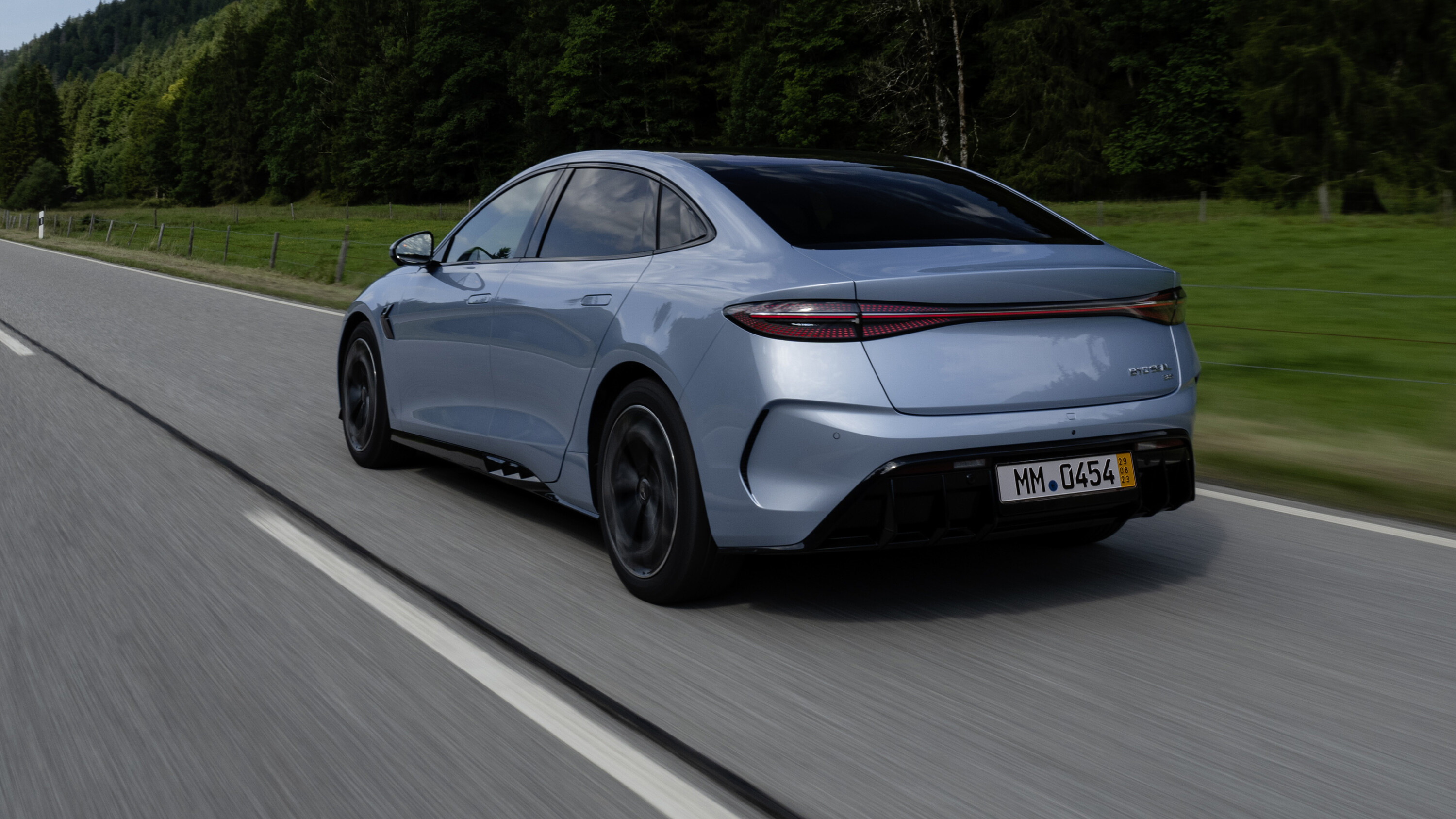
1
That still trails the Tesla, however, which can charge at 170kW. One area the BYD trumps the Tesla is range, with the seal Premium offering 570km on the WLTP cycle compared to the Model 3’s 513km.
Things are equally close when you compare the flagship versions of both cars. These models, the Seal Performance and Model 3 Long Range, are both all-wheel drive and cost $68,798 and $71,900 respectively.
The BYD is the more powerful and quicker of the pair, thanks to outputs of 390kW/670Nm and a 0-100km/h claim of 3.8 seconds. That’s 24kW/177Nm more than the Tesla and 0.6sec quicker to 100km/h. But the BYD pays a price for its extra performance and trails the Tesla’s WLTP range by a significant margin: 520km for the Seal Performance vs 629Nm for the Model 3 Long Range.
If any of the terms in this section have left you scratching your head, these articles will help bring you up to speed!
| BYD Seal Dynamic RWD | BYD Seal Premium RWD | BYD Seal Performance AWD | Tesla Model 3 RWD | Tesla Model 3 long-range | |
|---|---|---|---|---|---|
| Price | $49,888 | $58,798 | $68,798 | $61,900 | $71,900 |
| Power | 150kW | 230kW | 390kW/670Nm | 208kW | 366kW |
| Torque | 310Nm | 360Nm | 670Nm | 420Nm | 493Nm |
| E-motor | 1 x rear axle | 1 x rear axle | 2 (one per axle) | 1 x rear axle | 2 (on per axle) |
| Battery size | 61.4kWh | 82.5kWh | 82.5kWh | 57.5kWh | 65kWh |
| WLTP range | 460km | 570km | 520km | 513km | 629km |
| 0-100km/h claim | 7.5sec | 5.9sec | 3.8sec | 6.1sec | 4.4sec |
1
- What is a Powertrain or Drivetrain?
- Power vs torque
- Car suspension explained
- Automatic transmissions (‘gearboxes’) explained
- Chassis control systems explained
- Car vs Ute vs SUV: How the vehicle you buy should guide the way you drive
- What is the WLTP emissions and range test?
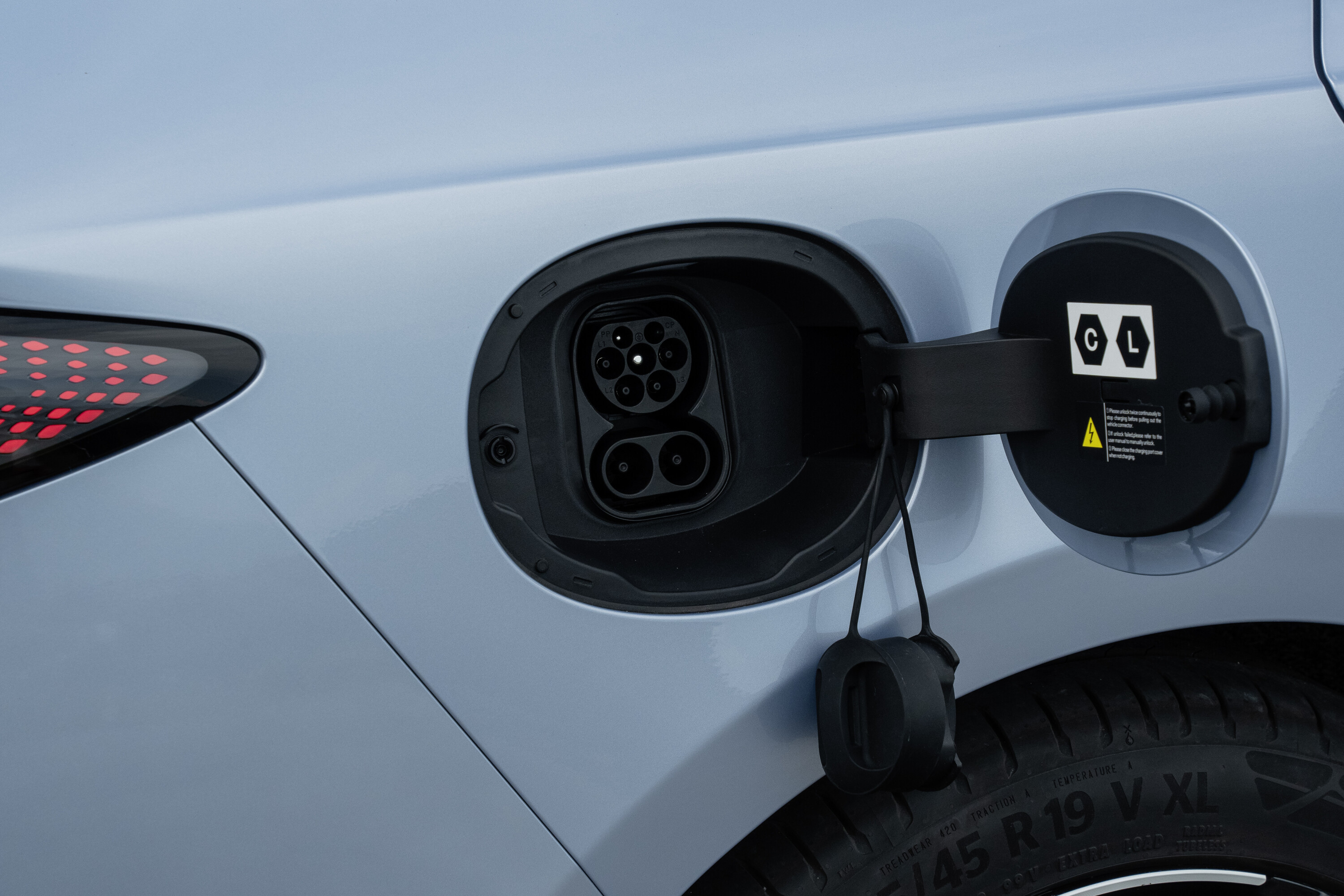
This is one area where the Tesla holds a clear advantage. On an AC charger, the BYD’s maximum charge rate is 7kW, meaning it’ll take between 8hr 46m to 11h 47m for a full charge, depending on which battery size you go for.
The Tesla, meanwhile, accepts 11kW AC charging and will take roughly 6.5 hours to reach a full charge in the Model 3 RWD. The larger battery in the Model 3 Long Range will take around 8 hours to go from 0-100 per cent on an AC charger.
The gap between the BYD Seal and Tesla Model 3 is even larger when hooked up to a DC fast charger. As previously mentioned, the BYD Seal has a maximum DC fast charging rate of 110kW for the Dynamic RWD and 150kW for the mid-spec Premium and flagship Performance versions.
1
On a 150kW DC fast charger, the BYD Seal can top up its battery from 10-80 percent in 37 minutes.
The Model 3 RWD, meanwhile, can accept 170kW DC fast changing, while the Long Range has a max charge rate of 250kW. Tesla says the latter allows you to add up to 282km of range in 15 minutes.
Notably, the Tesla’s battery is also far more efficient. The Model 3’s battery is smaller than those in the Seal, yet the Tesla offers superior range. A smaller battery pack also helps to save weight and improve efficiency, and every version of the Model 3 is lighter than its BYD counterpart, sometimes by as much as 357kg.
Less weight doesn’t only improvement performance and handling but also range, so it’s a virtuous circle.
| BYD Seal Dynamic RWD | BYD Seal Premium RWD | BYD Seal Performance AWD | Tesla Model 3 RWD | Tesla Model 3 long-range | |
|---|---|---|---|---|---|
| Battery size | 61.4kWh | 82.5kWh | 82.5kWh | 57.5kWh | 65kWh |
| AC charging | 7kW | 7kW | 7kW | 11kW | 11kW |
| DC charging | 110kW | 150kW | 150kW | 170kW | 250kW |
1
Interior and cabin design
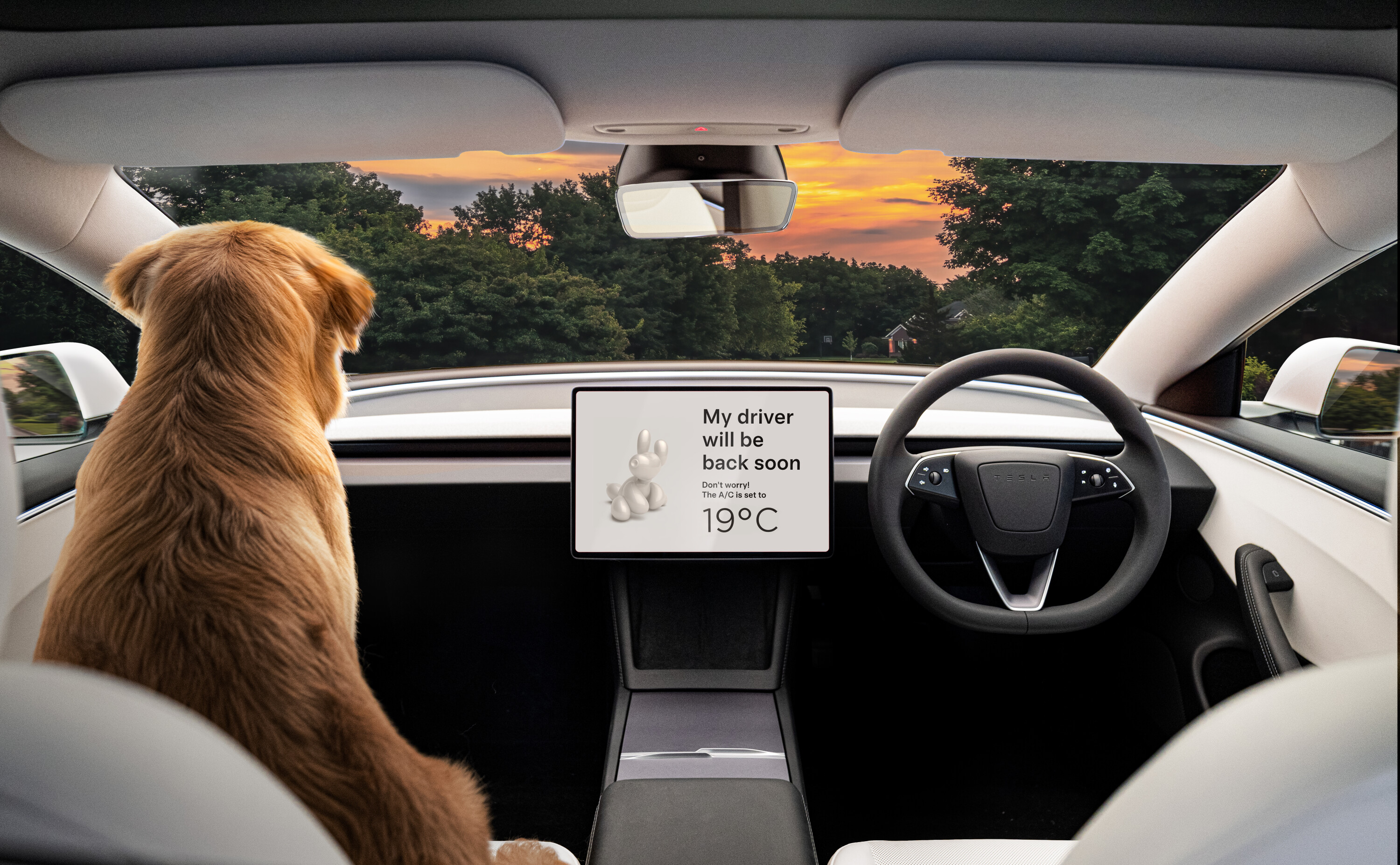
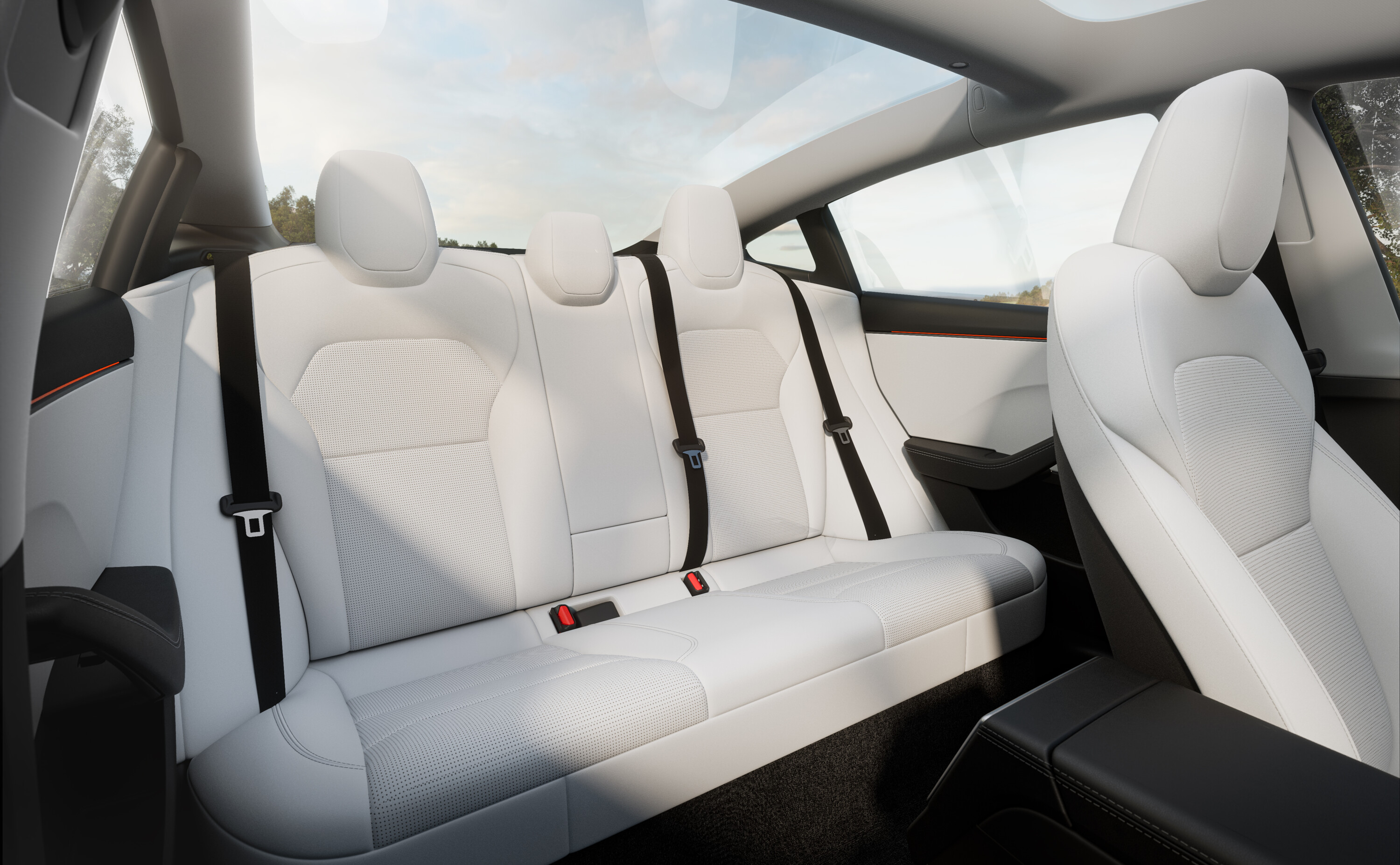
Tesla is famous (or is that infamous?) for its minimal cabin design, and the updated 2024 Model 3 features an even more spartan layout than before.
As part of its major facelift, the 2023 Model 3 boasts a new dash design, a revised centre console, new seats (now with ventilation) and a new steering wheel.
Tesla has also deleted the stalks behind the steering wheel to give the cabin an even less cluttered appearance (and a more affordable parts bill), with these functions moved into touch-sensitive buttons on the wheel or into the centre touchscreen. Yep, your blinkers are now buttons on the steering wheel itself.
The Model 3’s centre screen is now slightly larger at 15.4-inches, has a thinner bezel and is said to offer faster response times.
1
1
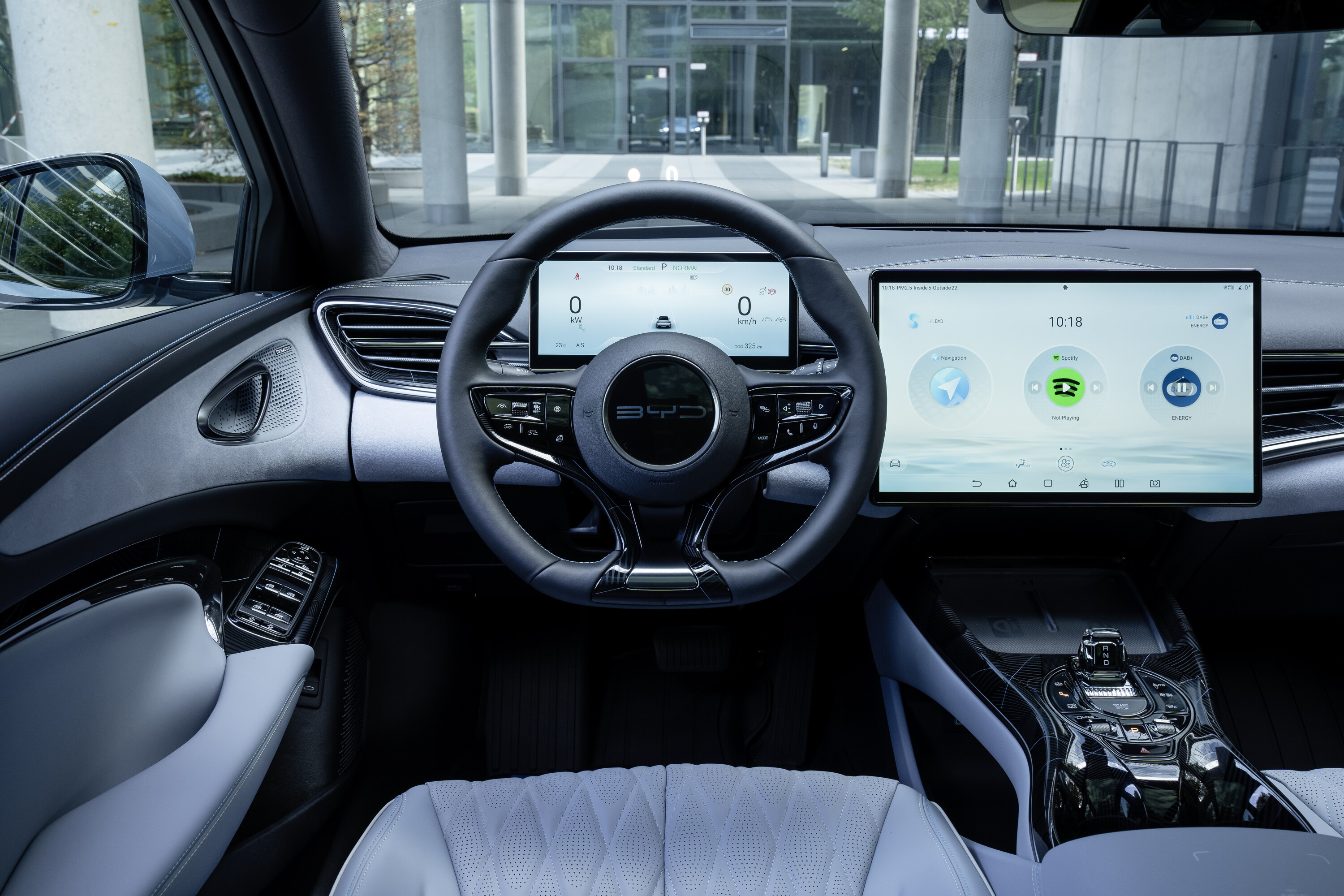
The cabin in the BYD Seal couldn’t be more different.
Its design is busier in a more conventional fashion, with more buttons and an even bigger 15.6-inch centre display that can rotate between portrait and landscape orientations.
Importantly, the Seal features a head-up display in Premium and Performance models, which is tech notably absent from the Tesla Model 3.
Apple CarPlay and Android Auto are also featured with the Seal – another omission in the Model 3, although it somewhat makes up for this with a comprehensive range of available media apps. CarPlay in the Seal is also wired rather than wireless, which feels a touch outdated in 2023.
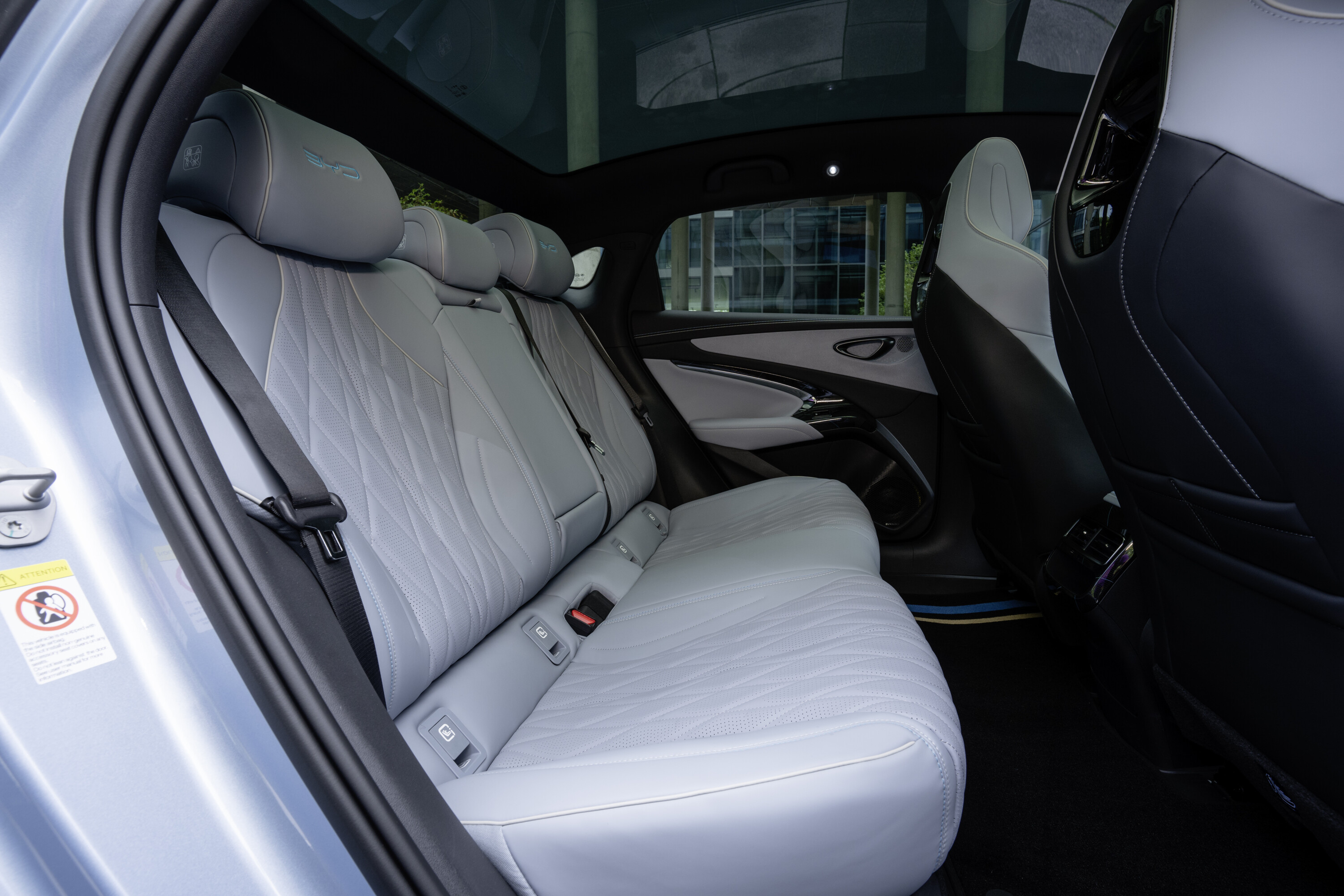
Both the Tesla and BYD offer panoramic sunroofs and dedicated air vents for rear passengers, although the Model 3’s facelift has added an 8.0-inch touchscreen at the back of the centre console, offering rear occupants control of their climate, music and entertainment apps.
1
1
Pricing
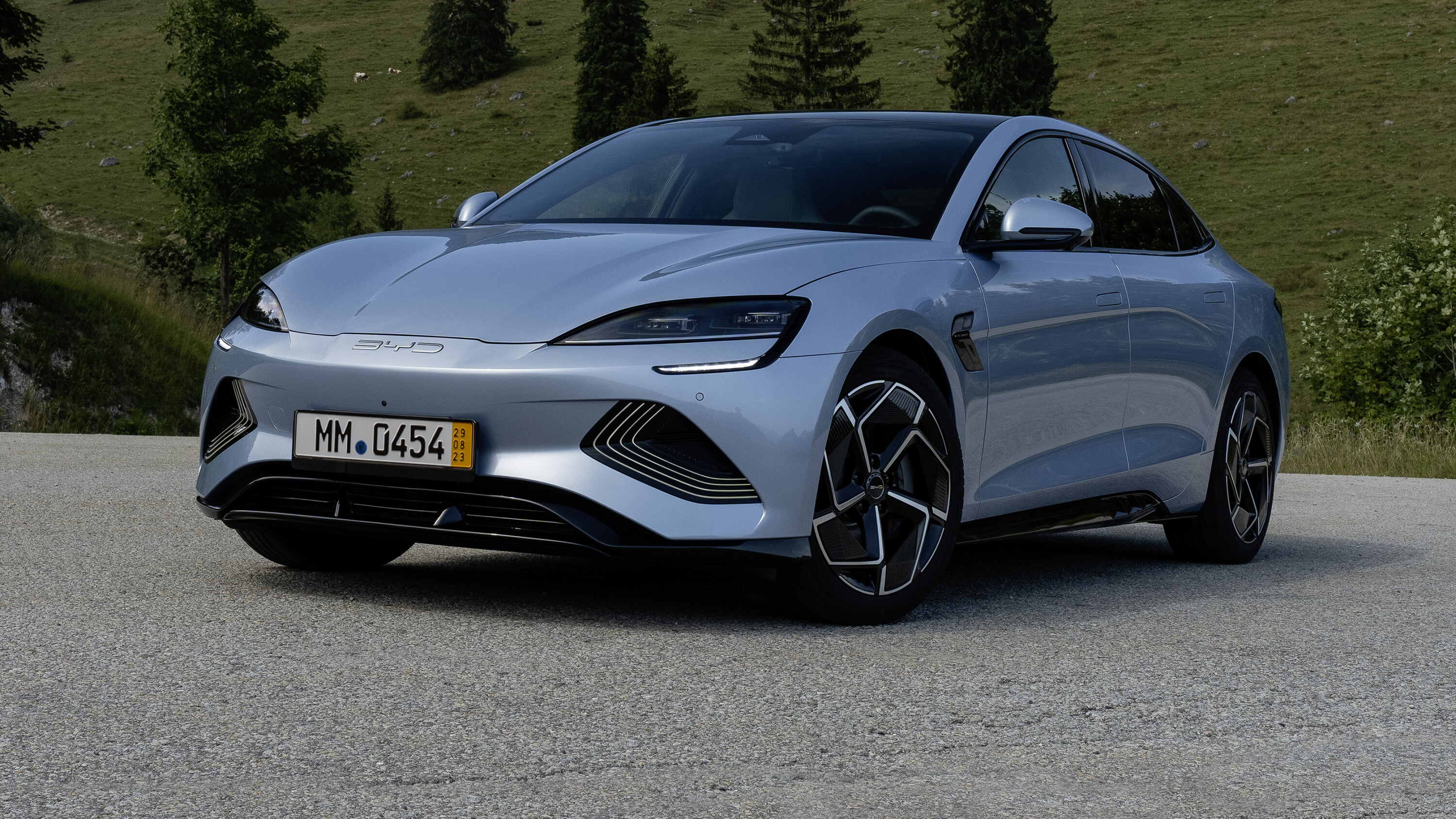
It’s easy to fixate on the BYD Seal’s sizeable $12,012 price advantage over the Tesla Model 3, but as we’ve established, that price gap is something of a red herring.
It relates only to the entry-level BYD Seal Dynamic RWD which, although well specced, can’t compete with the entry-level Model 3 RWD for performance outputs, recharging times, acceleration or range.
Once you discount the BYD’s cheapest variant, the BYD Seal and Tesla Model 3 actually align very closely on spec and price.
1
The mid-spec Seal Premium and Model 3 RWD offer similar levels of performance, range and equipment – but it’s the BYD that carries the slightly lower price tag: $58,798 vs $61,900.
It’s a similar story when you compare the BYD Seal Performance ($68,798) and Tesla Model 3 long-range ($71,900), although this pair have a slightly different focus to help split them. The BYD is quicker and more powerful while the Tesla is marginally slower but offers a longer range.
No matter which version you choose, the BYD holds an advantage when it comes to warranty, with its six-year / 150,000km coverage period trumping the Model 3’s warranty of four years / 80,000km.
On the road: How do they compare in the driving department?
Local deliveries for the Seal don’t begin until December, and the facelifted Model 3 won’t arrive until early next year, so it’ll be a while before we can point these two EVs at each other.
In the meantime, you can read our overseas first-drive review of the Seal at the link below.
Top Gear Australia is set to return in 2024.
The television show, a localised spin-off of the BBC’s Top Gear, will air on online streaming platform Paramount+, operated by Network 10’s parent company Paramount.
It will feature three new hosts: Mighty Car Mods co-host Blair “Moog” Joscelyne, former rugby league player Beau Ryan, and actor Jonathan LaPaglia.
https://www.instagram.com/p/CywkhnnB_qq/
“It’s a once in a lifetime opportunity when you get asked to be part of one of the biggest motoring shows in the world,” said Moog, who has co-hosted the popular Mighty Car Mods YouTube series since 2007 with best friend Marty Mulholland.
“I will take my job seriously of frying the tyres of any vehicle that the producers are irresponsible enough to hand me the keys to.”
Filming for the new series is due to commence later this year.
“Top Gear Australia promises to deliver everything fans love about the show but with an Aussie twist,” said Paramount Australia and New Zealand senior vice president for content and programming Daniel Monaghan.
Top Gear Australia is produced by BBC Studios Australia and will air in 2024 on Paramount+ Australia as an eight-part series.
The original version of Top Gear Australia first aired on SBS in 2008 and 2009, hosted by Steve Pizzati, Warren Brown, Charlie Cox, and James Morrison.
Channel Nine picked it up for seasons three and four between 2010 and 2012, hosted by Pizzati, Shane Jacobson and Ewen Page.
Paramount+ also announced subscribers will have access to seasons 27 to 31 of the UK version of Top Gear, aired between 2019 and 2021, with hosts Andrew “Freddie” Flintoff, Chris Harris and Paddy McGuinness next year.
The future of the UK version of Top Gear is unclear. Production has not resumed after Flintoff was involved in a horror crash during filming in December 2022.
MORE
Car News
MORE
Car Reviews
A name synonymous with the racing world – and one that’s familiar to many Australian motorsport fans – is set to return to the road.
Established in 2020 by the late Tom Walkinshaw’s son, Fergus Walkinshaw, alongside his business partner John Kane, TWR is a separate entity from the original Tom Walkinshaw Racing outfit, which competed across the world’s top categories, including Le Mans and Formula 1.
Its touring car team was also responsible for legendary cars like the Volvo 840 Super Tourer Estate and the Jaguar XJS, which won the Bathurst 1000 in 1985.
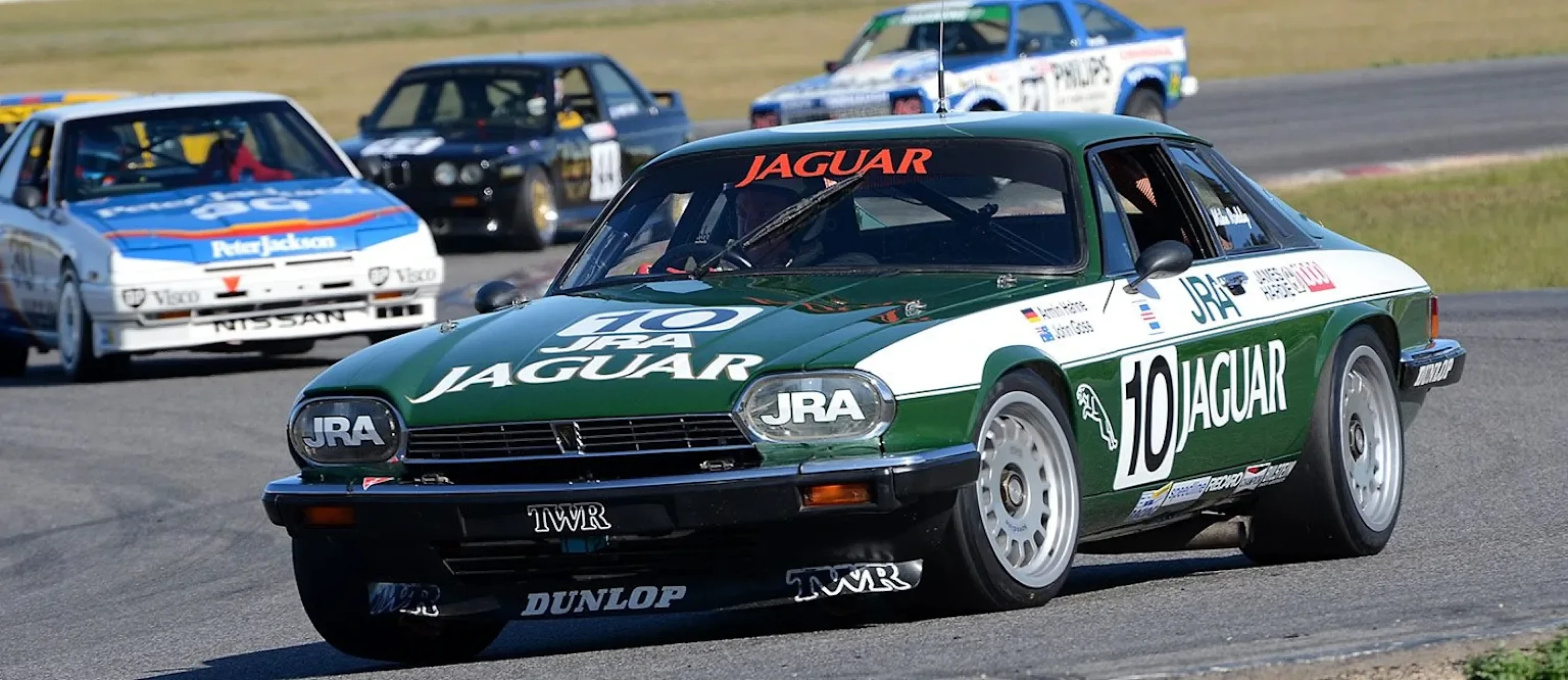
1
It also worked on projects for brands such as Jaguar, Holden, Renault and Aston Martin, where it was instrumental in the gestation of the DB7.
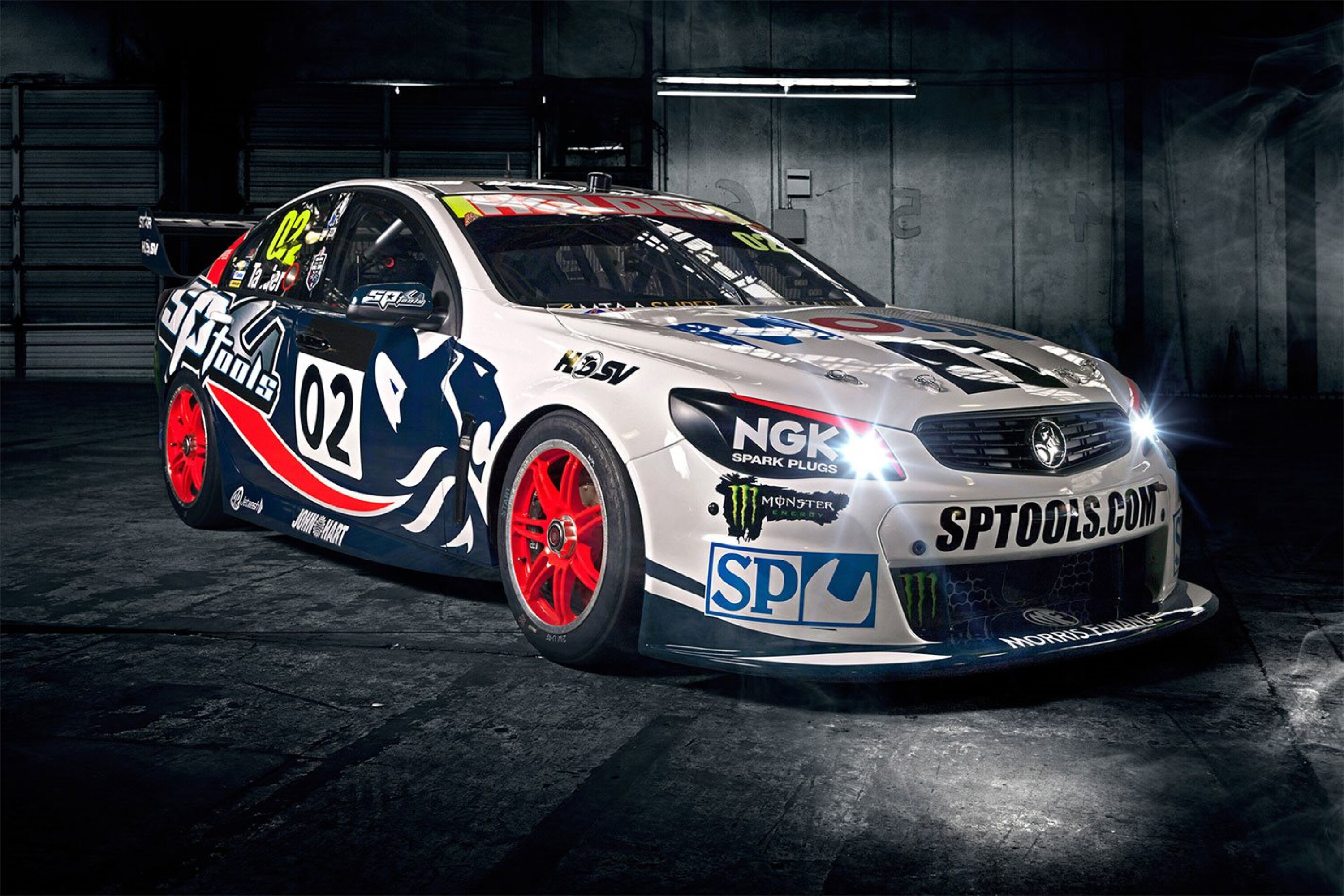
TWR also partnered with Holden in 1987 to create HRT, arguably the best-known V8 Supercar team of the era. The partnership netted seven Bathurst 1000 titles and six driver’s championships.
The Walkinshaw name is still involved in Supercars, with Fergus’s younger half-brother Ryan a driving force in the Walkinshaw Andretti United racing squad.
According to the company, the reborn TWR will focus its energies on road cars that focus on the “analogue” driving experience.
1
“This new generation of TWR is first and foremost an engineering company that will make cars, rather than a car maker doing engineering,” said Walkinshaw.
“And that’s an important distinction. We will make use of cutting-edge technology, combining new expertise with traditional craft to build world-class products that make a statement of what this new TWR is all about.
“We aim to build some truly impressive and innovative automobiles, unconstrained by the rulebooks and styling demands of OEMs.”
The company has built an engineering team at a new base in Berkshire, south-east of London, with some members of the original TWR outfit joining the new team.
1
“We have scoured the performance and motorsport engineering worlds to assemble an incredibly talented technical team, including some members who were part of the original TWR, which just adds to our depth of knowledge and expertise,” Walkinshaw said.
“It’s from this base that TWR can push forward for a bright new future.”
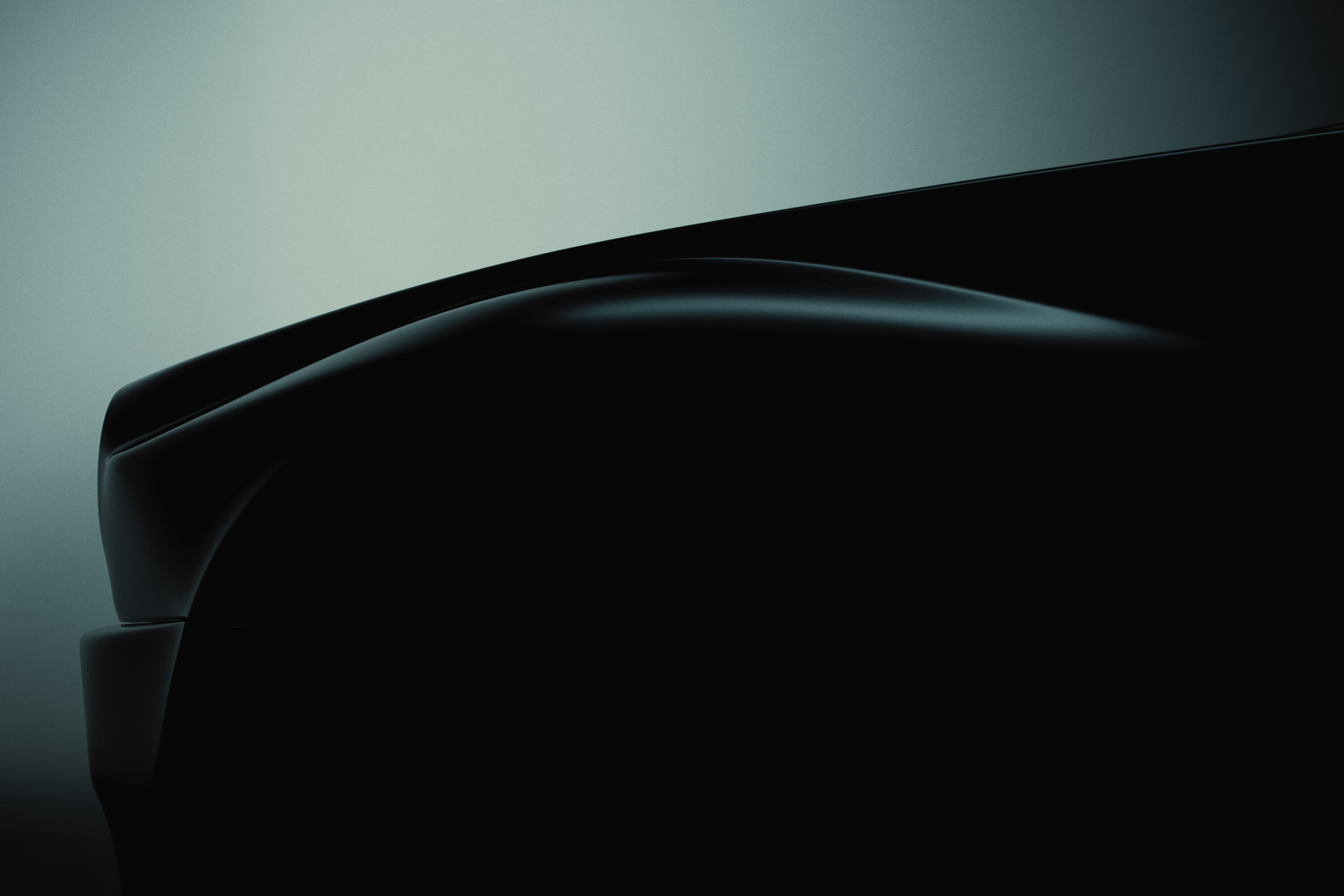
TWR has not announced any plans for a new vehicle build, with a single teaser shot of a swoopy rear end the only clue as to the company’s direction.
MORE
Car News
MORE
Car Reviews
