
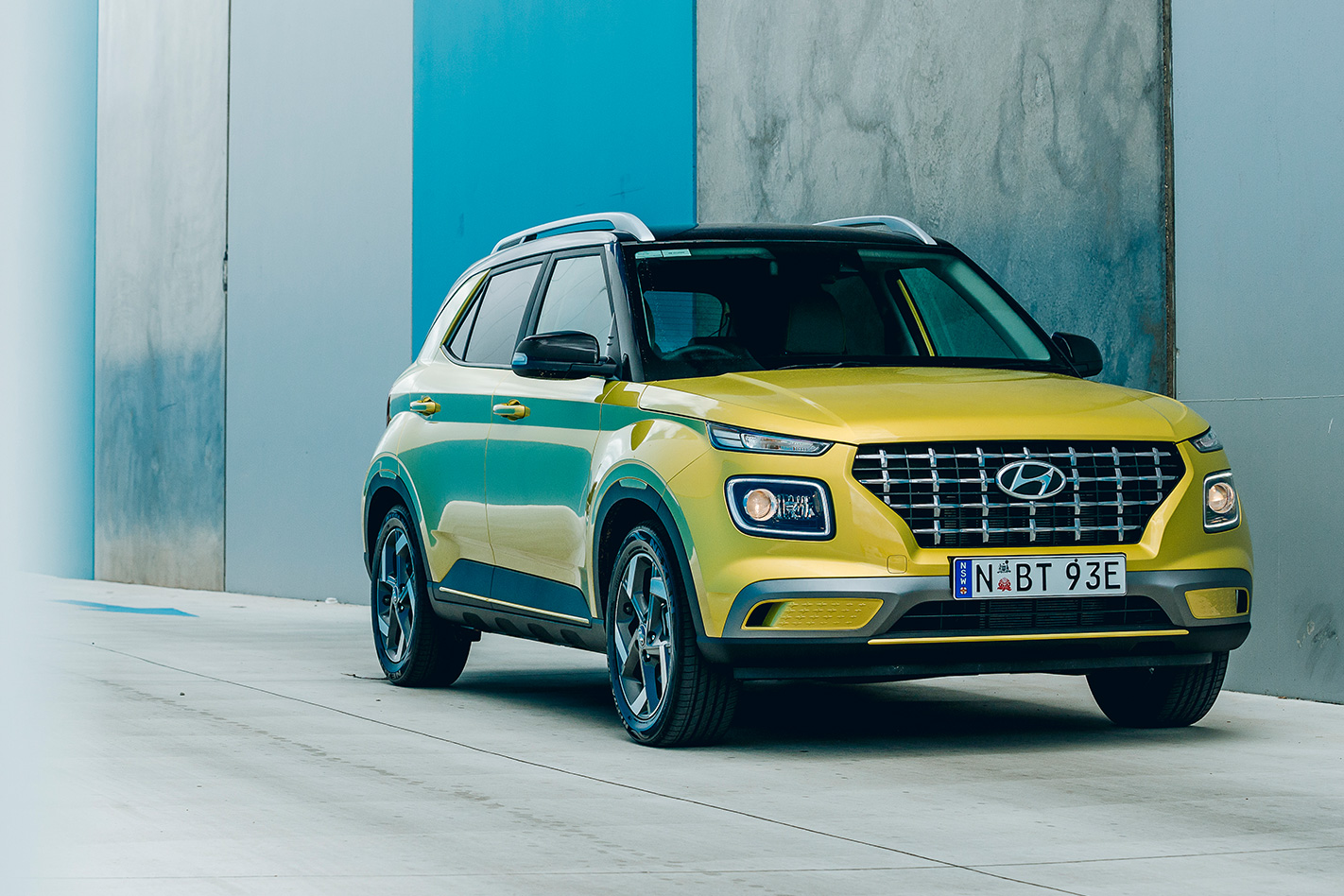
The 2020 Hyundai Venue is the most affordable car from the South Korean manufacturer and, starting from $19,990, doubles as one of the most affordable SUVs in Australia too.
What is it?
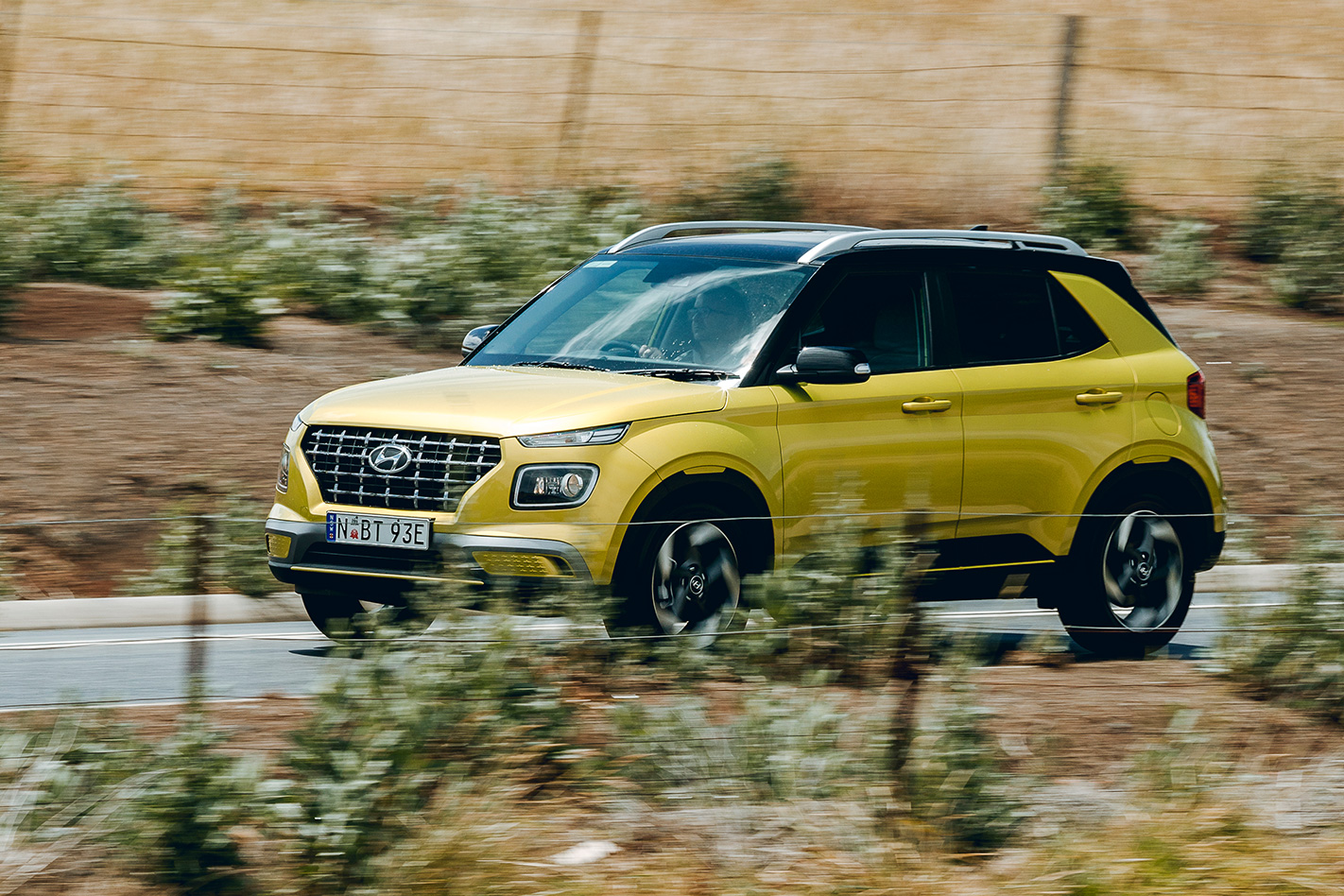
The Hyundai Venue is a new runner in the small SUV segment, having made its debut in late 2019. Three grades are offered in Australia, but on test we have the range topper, the Venue Elite, which costs $25,490 (before on-road costs).
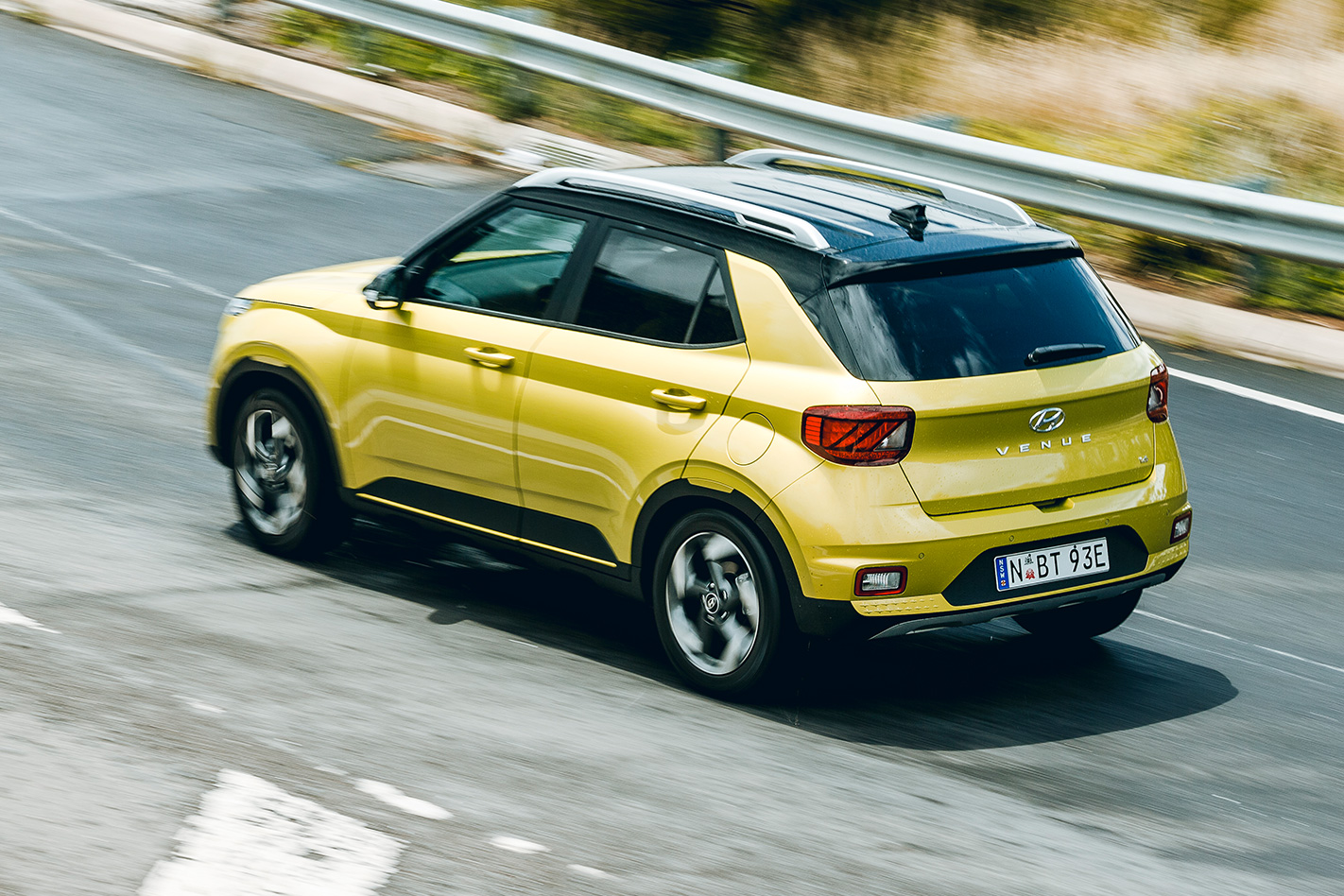
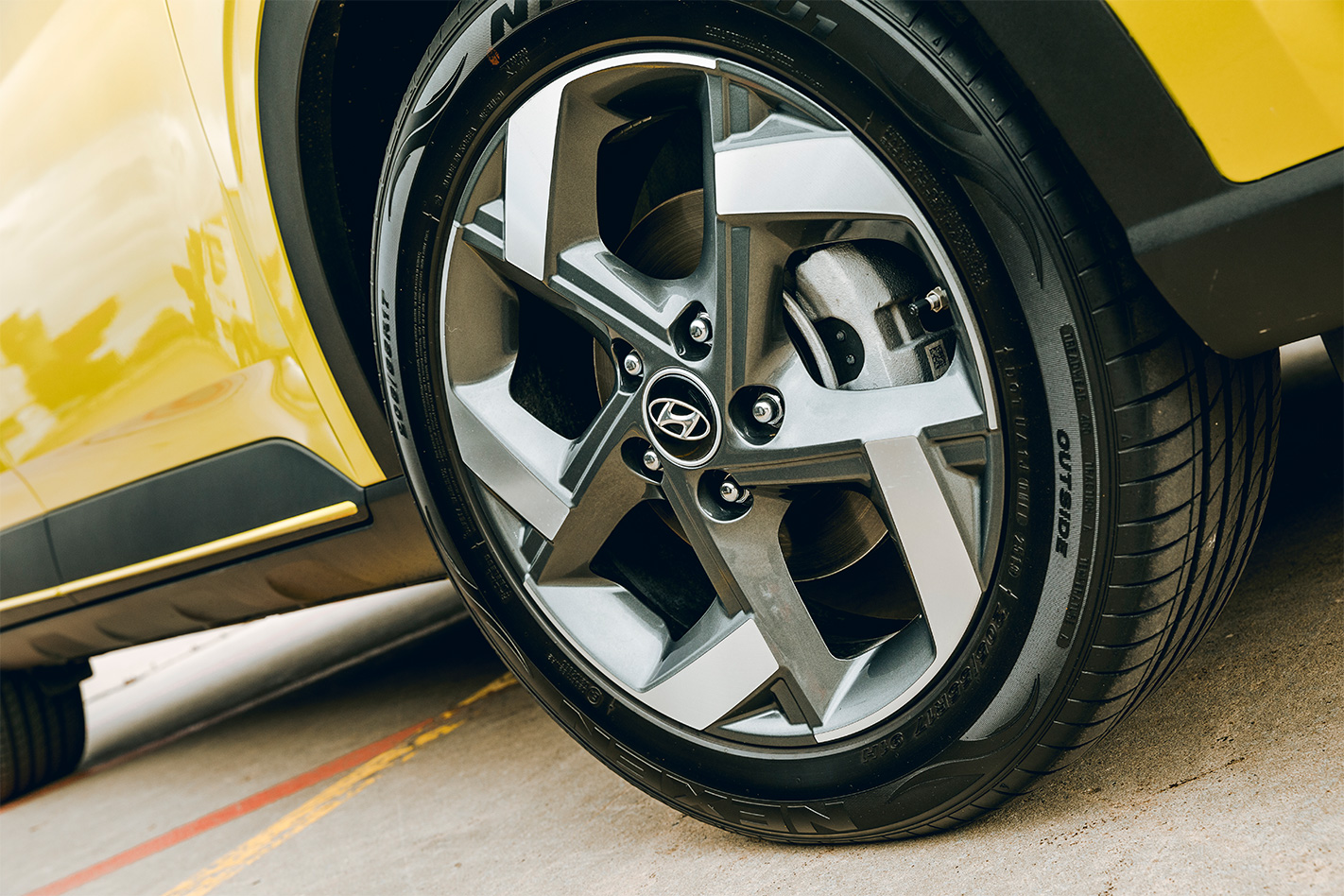
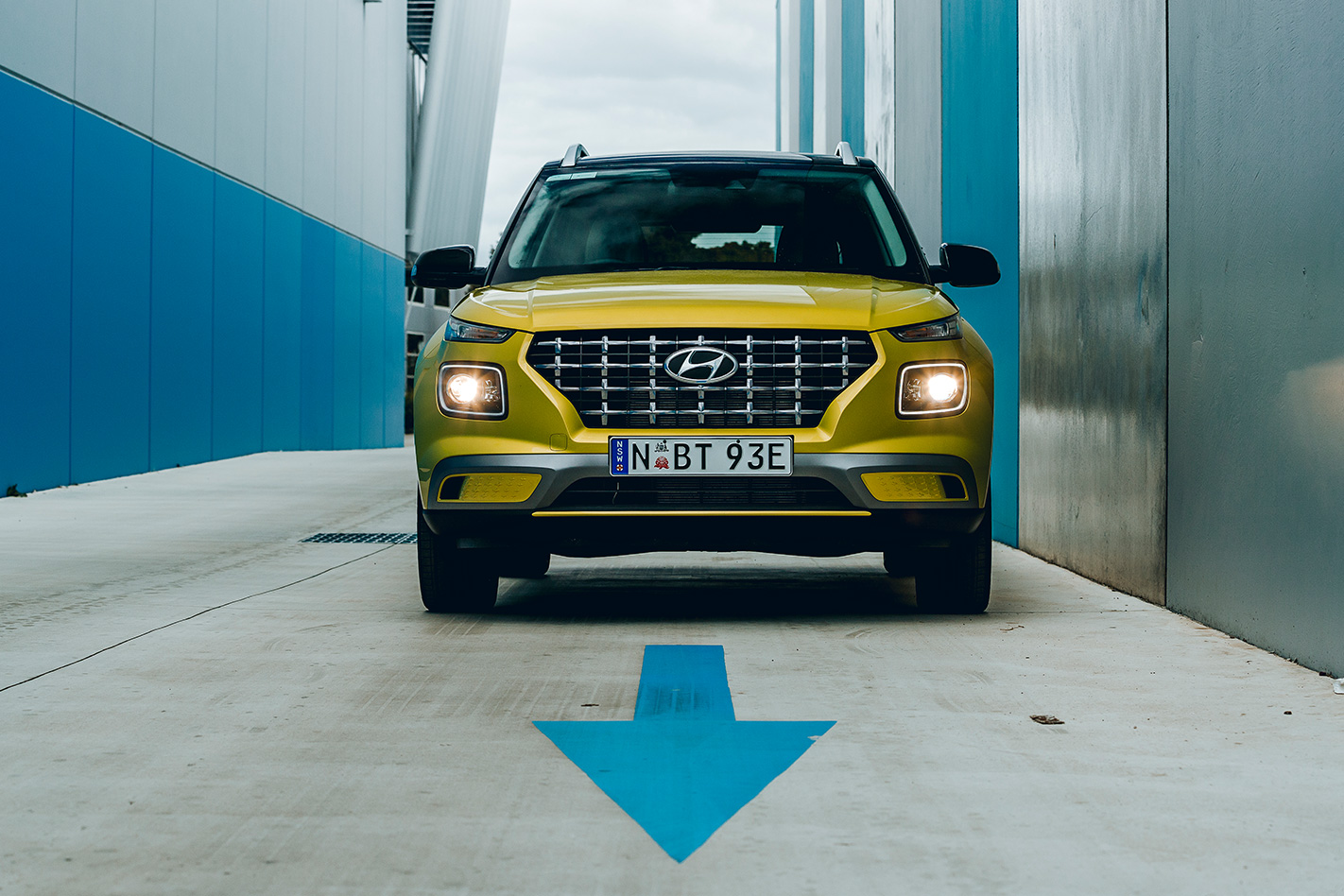
The Venue Elite slots in neatly below the slightly larger Kona and features a suite of features like autonomous emergency braking, blind-spot warning, rear cross-traffic alert, cruise control, an 8.0-inch touchscreen with Android Auto/Apple CarPlay, 17-inch alloy wheels, two-tone paint, satellite navigation and climate control.
All versions are front-wheel drive and powered by a 1.6-litre naturally aspirated four-cylinder engine that outputs 90kW and 151Nm, but curiously also features a mode dial which caters for conditions like snow, mud and sand, which modifies the traction control’s behaviour to cater for surfaces other than tarmac.
What’s it like to live with?
Whichever specification Venue you go for, each version is fortunately well-equipped so it’s unlikely you’ll be left wanting for extras. The reason you go for a higher-spec version like the Elite is because things are simply nicer.
As with most cars in its category the Venue is built to a cost, but the parts that really matter – like the steering wheel and gear knob – are covered in partial leather in the Elite grade. The seats are very supportive by way of thick side bolsters, while the fabric is a nice design and framed by part-leather trim.
The interior on the whole is pretty funky place to be, with contrast stitching and accented colours livening up what would be a pretty dull concoction of hard black plastics – so credit to Hyundai for making the Venue’s insides feel greater than the sum of its parts.
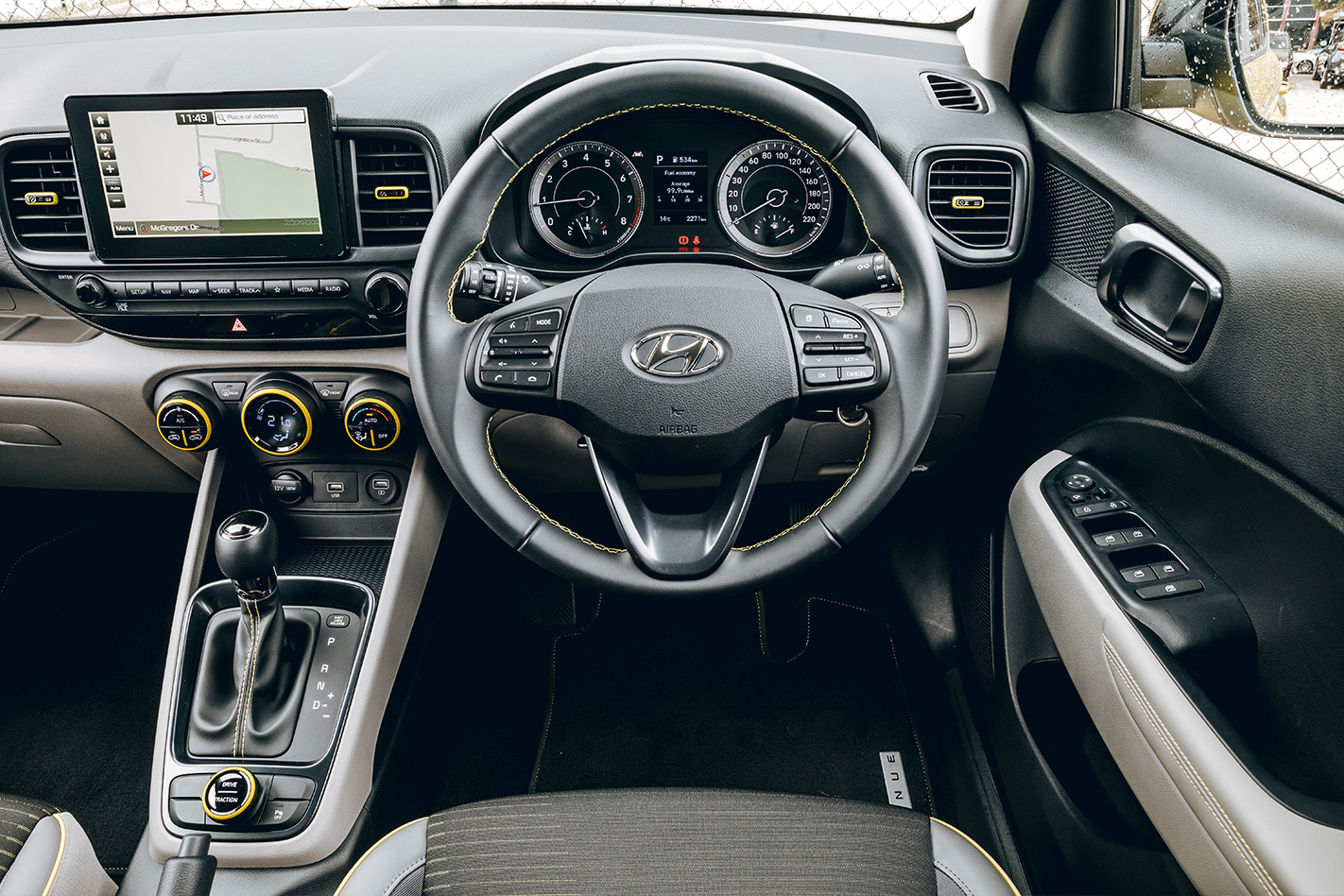
One aspect of the interior that’s welcomed is the great 8.0-inch infotainment system that is found in a number of Hyundais and Kias now. It’s intuitive, clear, has a built-in sat nav and a multitude of other features for you to play around with, but if you just want your digital devices to integrate with one another then Apple CarPlay and Android Auto give you additional infotainment options as well.
Size-wise, the front passengers are pretty well accommodated with ample headroom and the Venue feels less cramped than you would expect of a pint-sized crossover. Of course, it does get tighter for back seat bandits. Legroom is fairly tight (but on par with its competition) and there’s no centre armrest, but there’s still ample headroom owing to its high glasshouse – which aids all-round visibility too. Unlike the Toyota C-HR, your backseaters won’t be struggling to see out the side glass.
Its diminutive size is easy to manage around town, and a reversing camera (in addition to other safety equipment like forward collision avoidance, lane-keep assist and blind-spot warning) aids in the sense of safety.
It also features a 355 litre boot and the rear seats fold in a 60:40 split if you need that extra space for larger items.
What is it like to drive?
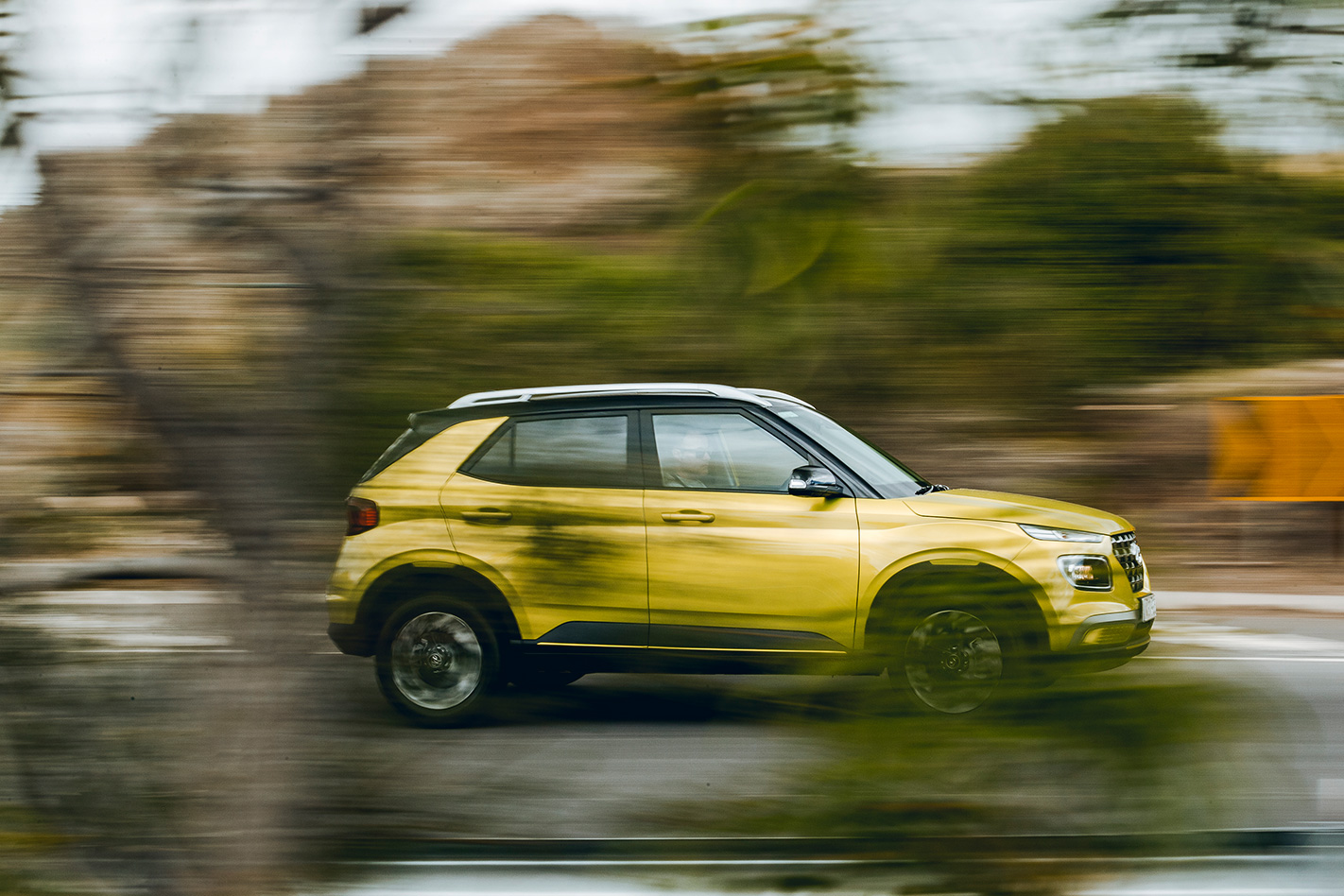
“Fun and functional”, so says Hyundai. Not only does the Venue claim to attract looks from passers-by on the street, Hyundai also suggests it’s equally at home zipping about town as well.
But, although a majority of time is spent in the hustle and bustle of suburbia, an ownership experience is more than just about how a car performs on city streets.
Luckily, the Venue is well-suited to both camps with after our drive hitting a number of urban locations and some raucously potted country roads too. As with a number of other Hyundai products, the Venue is tuned to Australian road conditions and qualities and the ride is all the more pleasant for it.
The suspension can iron out corrugations well, smoothing out a rough trot while simultaneously coping well over harshly potted backroads. Road noise can tend to reverberate throughout the cabin and become tiresom on longer drives, and if venturing off-road stones and pebbles are noisily flicked up into the wheel arches, but if you’re spending a majority of time around town it shouldn’t be a problem.
Negotiating twists and turns could even be described as playful, with quick steering and good outward visibility combining to help the Venue skitter about town with ease.
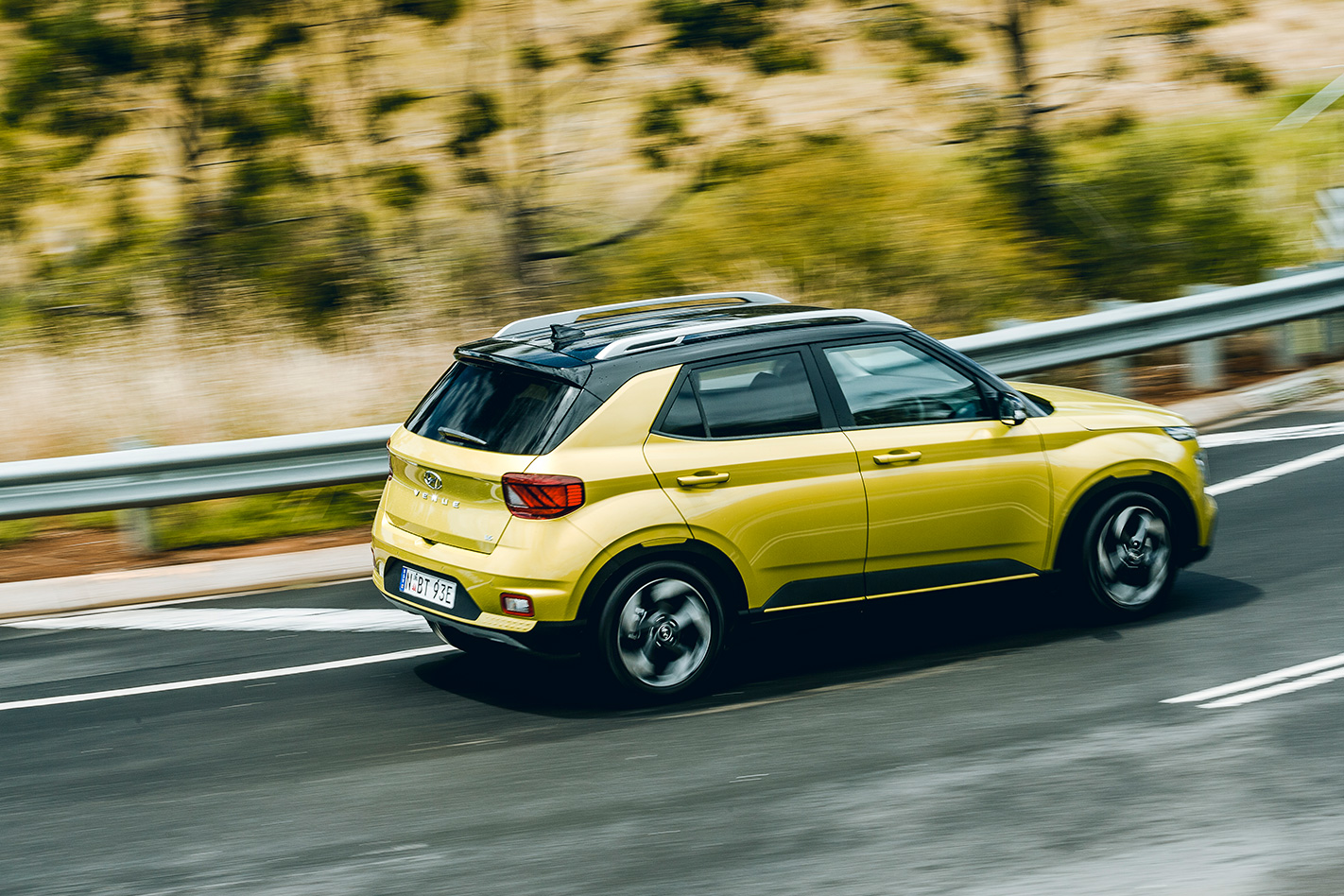
Ultimately, where the Venue could do with some backup is its powertrain. Its 1.6-litre non-turbo engine has to work hard to get up to speed, and the small power figure is especially highlighted when out of town and on the highway. The 9.5 L/100km fuel consumption we got on test, which included a lot of country and around-town scuttling, proved you really have to wring the engine out to get anywhere at even a modest pace.
That said, a lot of the engine’s issues were merely highlighted by country driving. So for those who purely operate within the city and can tolerate the Venue’s extra-urban shortcomings when venturing further afield, the Venue shouldn’t disappoint.
Is it worth it?
We can’t really see too much of a downside with the Venue. It’s an affordable car with the right form-factor for a market that’s going crazy for crossovers and SUVs, while also providing a very accomplished set of features.
Where we reckon you put your money though is the lower-specced Active ($23,490 before on-road costs) or entry-level Go (which is as low as $19,990 in manual-guise). Sure, you mightn’t get as many bells and whistles that you see here – but considering the Venue is already fairly well-equipped from the entry-level the value equation is even stronger at the bottom end.
Pros: Value for money, quirky-cool cabin design, infotainment system Cons: Undercooked engine, noisy off-road and on highway
Rating: 4/5
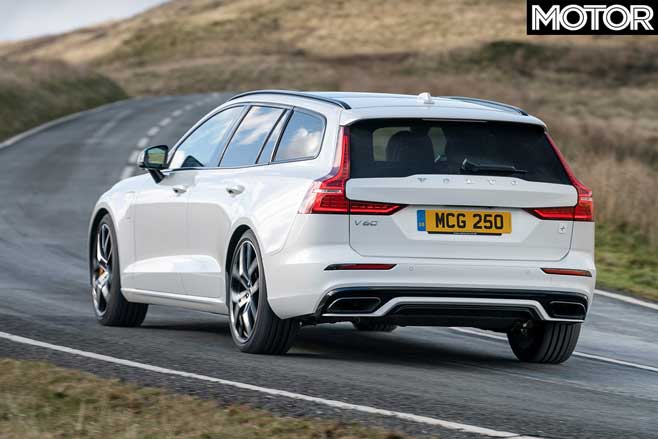
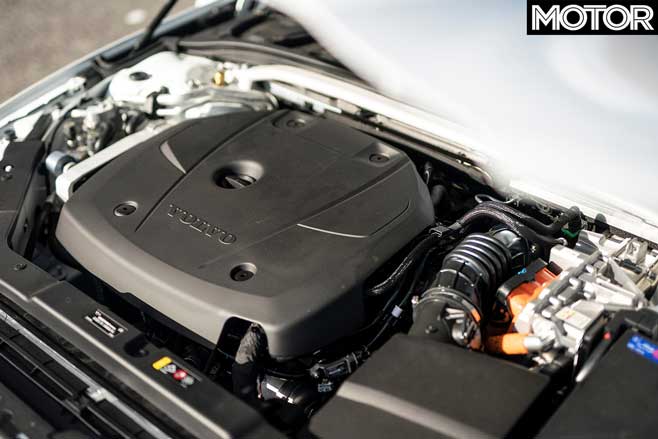
You have to wonder why exactly Volvo has made this car. It’s the wagon version of the S60 T8 Polestar Engineered sedan launched a few months ago, with a 302kW plug-in hybrid powertrain (petrol up front, electric for the rear), Brembo brakes, strut brace in the engine bay, light forged alloys and gold seatbelts. Well, not actual gold.
The headline additions are the Ohlins adjustable dampers, however, it’s important to make the distinction between ‘adaptive’ (usually altered at the touch of a button) and ‘adjustable’.
Here, changing the damping involves opening the bonnet and twisting a pair of gold dials sprouting from the strut towers. And that’s the easy bit; to get at those for the rear axle, you’ll need to jack the car up and remove the protective rubber covers. Talk about esoteric appeal.
This is a confusing car because adjustable dampers are generally the preserve of track-day specials. To find them on a hybrid wagon is like discovering Isofix points on a Caterham Seven.
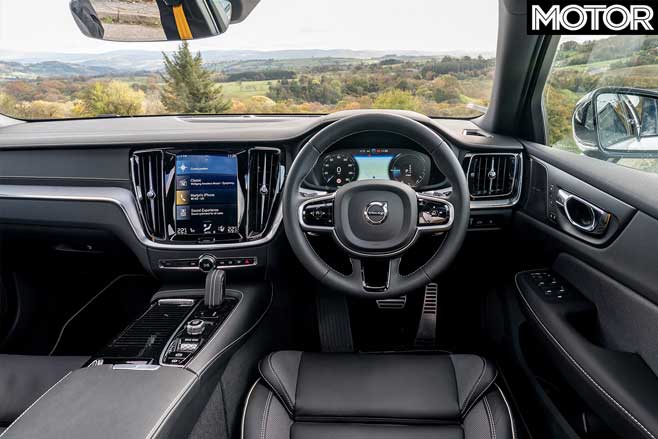
The intriguing Ohlins dampers can be moved through 22 clicks. Bury deep enough into the digital owner’s manual (accessed via the 9.0-inch touchscreen) and you can even find some recommendations. But you’re expected to play around. In fact, if you buy one of these cars and don’t at least once set the front to 22 and the rear to zero, you’re probably not the target customer.
The factory setting is simply too firm, but set it softer and the improvement in ride quality is marked, the immediacy of the movements dissipating but the control and precision lingering on. There’s not a comparable car in terms of practicality and performance that rides with this much polish, although outright agility clearly remains a somewhat abstract concept for Volvo.
That’s where rival performance estates really get the better of the V60 Polestar Engineered. They can’t drive 40km on electric power alone, or glide in such unassuming fashion, but their freeway ride is certainly no worse and they would simply drive away from the Volvo on any road.
Being attractive, fast and expensive, the Polestar Engineered in some ways ticks the right boxes. But the challenge is that Volvo has only four cylinders and electric motors when you still need six pots in this class and the less mass the better. Consequently, it has turned to weapons-grade chassis extras to justify the price, improving ultimate pace but narrowing the car’s bandwidth in everyday driving.
This V60 moves supremely well at a canter, but feels as though the suspension is in part ameliorating the weight of the battery, and is too stiff too much of the time. Overall, it’s simply not exciting enough compared with its German rivals.
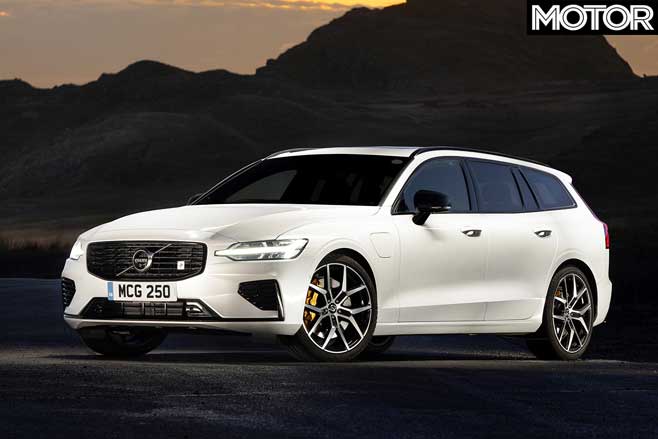
VOLVO V60 T8 POLESTAR SPECS Engine: 1969cc inline-4, DOHC, 16v, turbocharged, supercharged + electric motor Power: 302kW Torque: 670Nm Weight: 2079kg 0-100km/h: 4.6sec (claimed) Price: $100,000 (est)
Likes: Opportunity to play with the suspension; improved steering and brakes; looks Dislikes: Tricky to adjust; factory setting too stiff; overweight; price penalty
Rating: 3.5 out of 5 stars
Ford is secretly readying a high-performance Ranger Raptor super ute complete with V8 power.
The brand that sells more 4×4 utes than any other is gearing up to shift the goalposts of load-lugging performance by replacing the four-cylinder diesel engine fitted to the Ford Ranger Raptor with a Ford Mustang-spec 5.0-litre V8.
Rather than a global project, the top-secret V8 Raptor project has been sanctioned by Ford Australia and will be the result of a local engineering effort.
But instead of utilising the 1000-strong local workforce that helped create the T6 architecture that underpins the Ranger and Everest, the project is being farmed out to an external engineering firm.
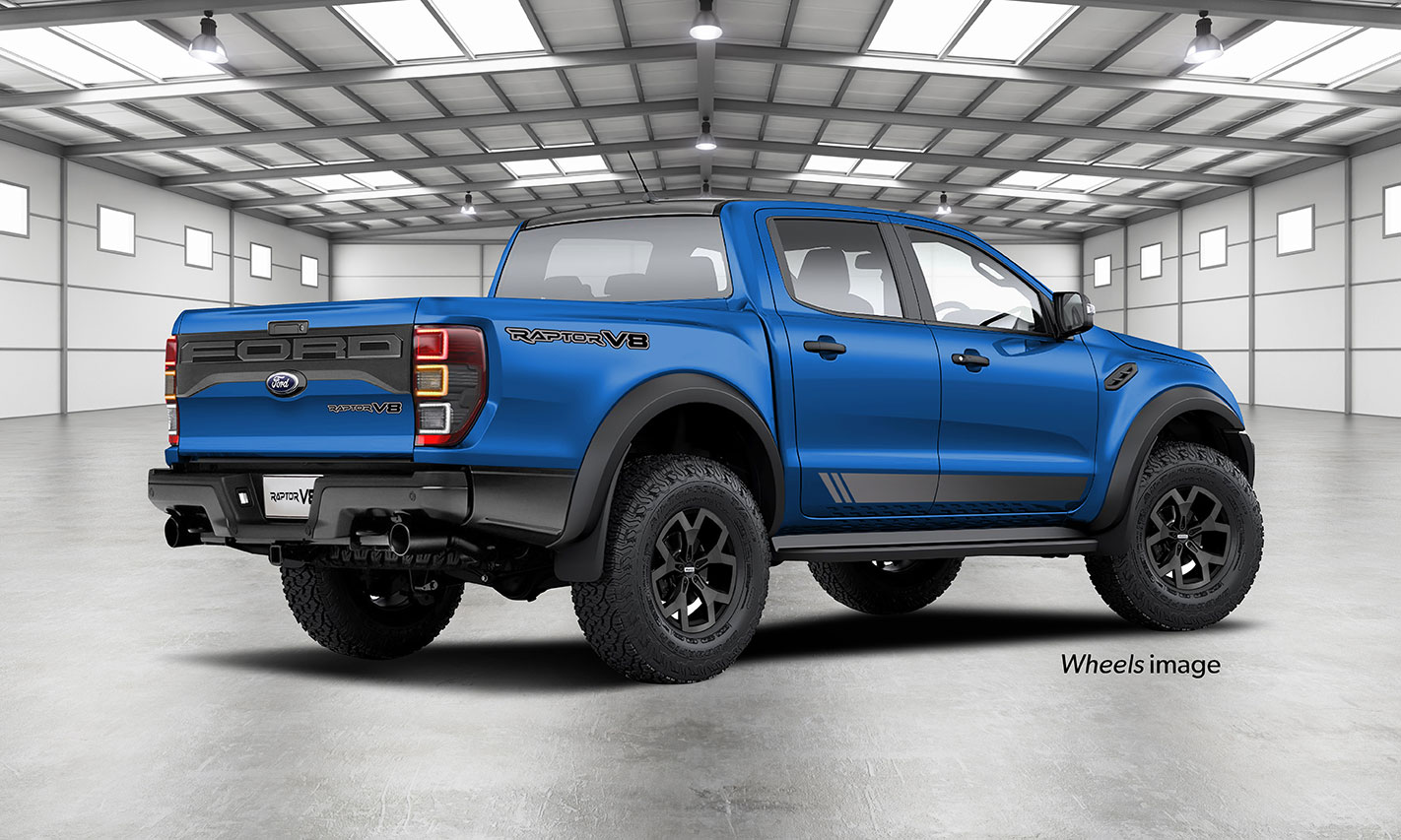
The latest in a growing list of low volume local engineering solutions – which include the upcoming Mustang R-Spec created by Herrod Performance and just-released Nissan Navara Warrior by Premcar – will adhere to OEM durability and safety requirements and be sold through Ford dealers will full five-year warranty protection.
Can’t wait for the end of the year for a V8 performance ute? Here’s how you can get one today.
Behind the scenes, there’s an elaborate process to turn regular Ranger Raptors into roaring V8 performance machines.
The donor Raptors will arrive in Australia with diesel propulsion and will then undergo an engine transplant as part of extensive performance upgrades.
Key to the transformation into a Raptor V8 is Ford’s Coyote V8, the engine that is the heart of the Mustang GT.
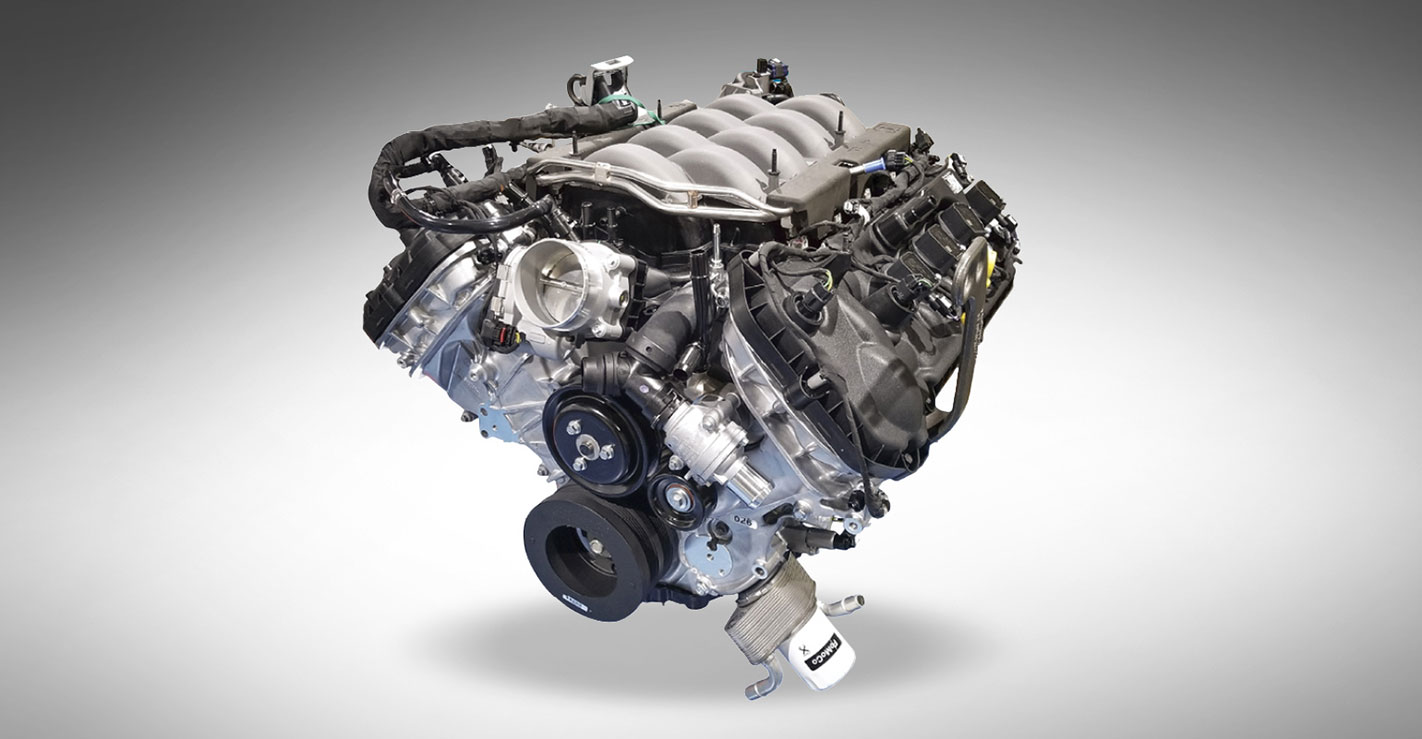
The 5038cc, direct injection, dual overhead cam V8 was upgraded in 2018 to produce 339kW and 556Nm – more than the final 6.2-litre V8 in the Holden Commodore SS (304kW).
While exact outputs for the Raptor tune are yet to be confirmed, it is expected to make close to the numbers pumped out in the current Mustang GT.
Crucially, the new V8 injection promises to answer one of the biggest criticisms with Ford’s Baja racer-inspired truck: straight-line performance.
January 3 update:
While Ford will not officially confirm the V8 Raptor is in development ahead of an anticipated on-sale late 2020, the company’s Australian communications boss Matt Moran was keen for WhichCar to include the following statement:
“There has always been speculation around the Ranger Raptor – naturally we have nothing share right now about any future plans, but we’re thrilled by the passion and how much people love this great truck, designed and engineered right here in Australia.”
Read into that what you will; it may not be a confirmation, but it’s also far from a denial.
For the full story on Ford’s secret Raptor hero, make sure to pick up the January 2020 issue of Wheels on sale January 3.
If you’re reading this, you’ve probably spent a fair bit of time in the peripherals aisle at your local computer shoppe, browsing the wheels on display and giving their rims a playful twirl. “Yes”, you think to yourself, “this is exactly what I need to be a faster driver, it’s just like the real thing”.
But is it? And will it actually improve your in-game performance?
Here at WhichCar we spend most of our time spinning actual steering wheels, but among the gamers in our staff there’s an interesting mix of peripheral preferences. Some of us swear by the realism imparted by a proper gaming wheel, while others ‘make do’ with a gamepad either for budgetary reasons or space constraints at home.
There’s also a couple of sickos who actually prefer to race with a gamepad.
But are they handicapping themselves by sticking with a bog-standard controller? We decided to get scientific and do some proper instrumented testing to answer that age-old question: does a gaming wheel actually make you a faster racer?
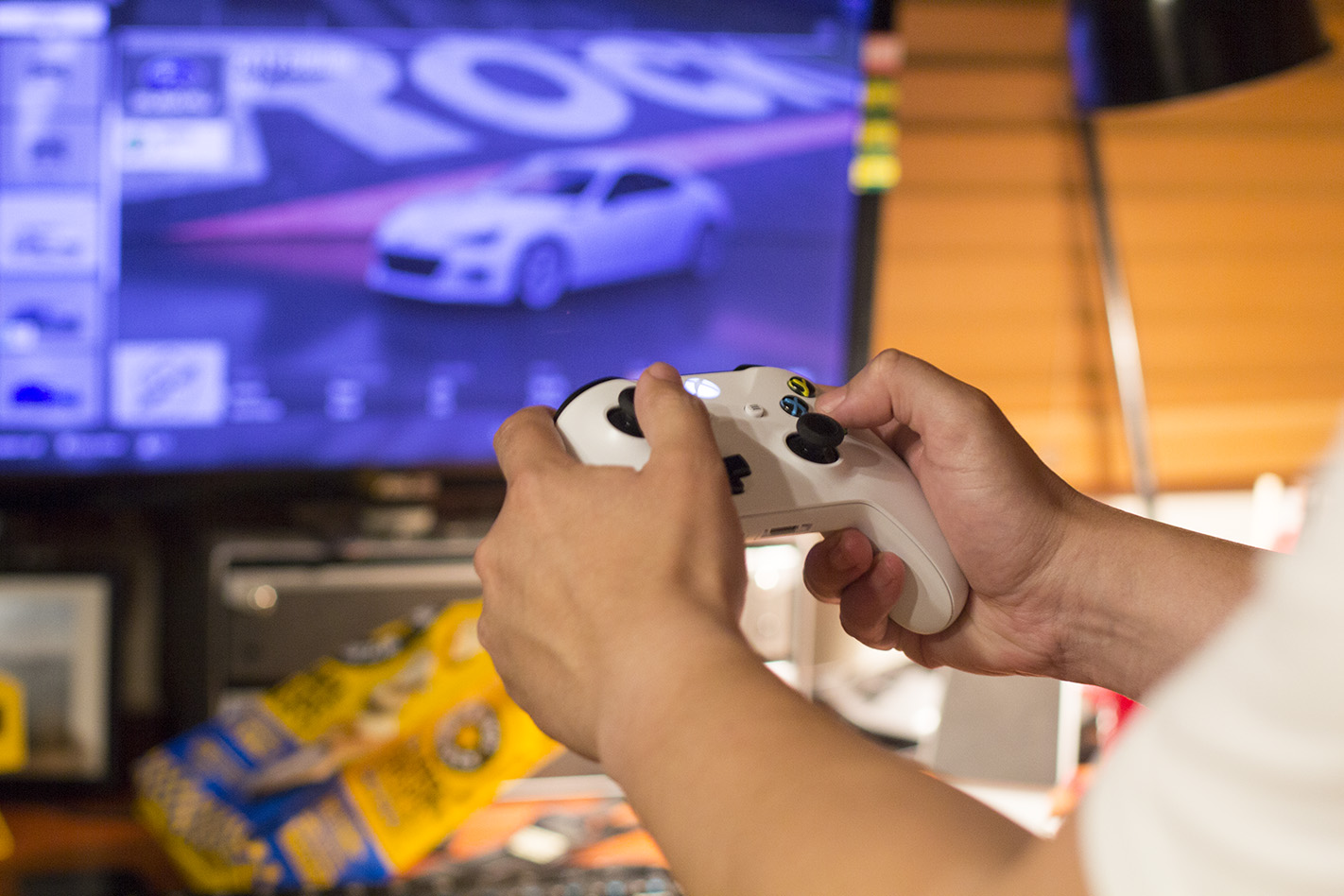
Method
The basis of every good scientific test is to eliminate all variables besides the ones you want to examine, so we had to lock down a few things. For one, our Xbox One long-termer will be the sole platform used – no PC, and given Playstation won’t return our calls and send us a test unit, no PS4 either.
As for the game, Forza Motorsport 7 strikes the right balance of accessibility and realism. After all, as a flagship Xbox title FM7 has been coded to perform well with the standard Xbox controller, with a damping map that helps smooth out the tiny force variations of your quivering left thumb and spit out steering inputs that won’t turn your virtual racecar’s handling into hot garbage. There’s also plenty of customization if you plug in a wheel, with input curves, movement ranges, deadzones and force feedback all featuring plenty of adjustability.
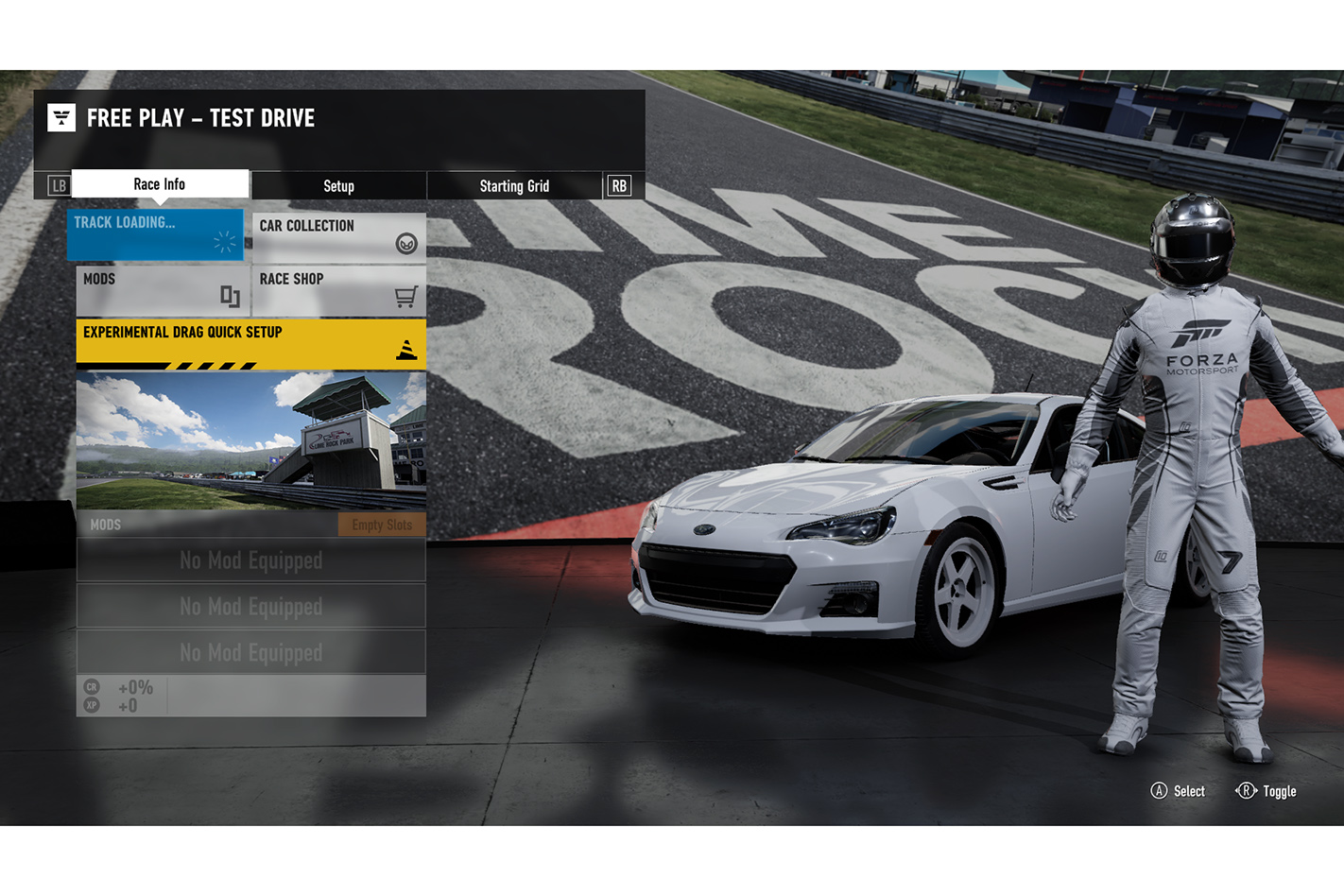
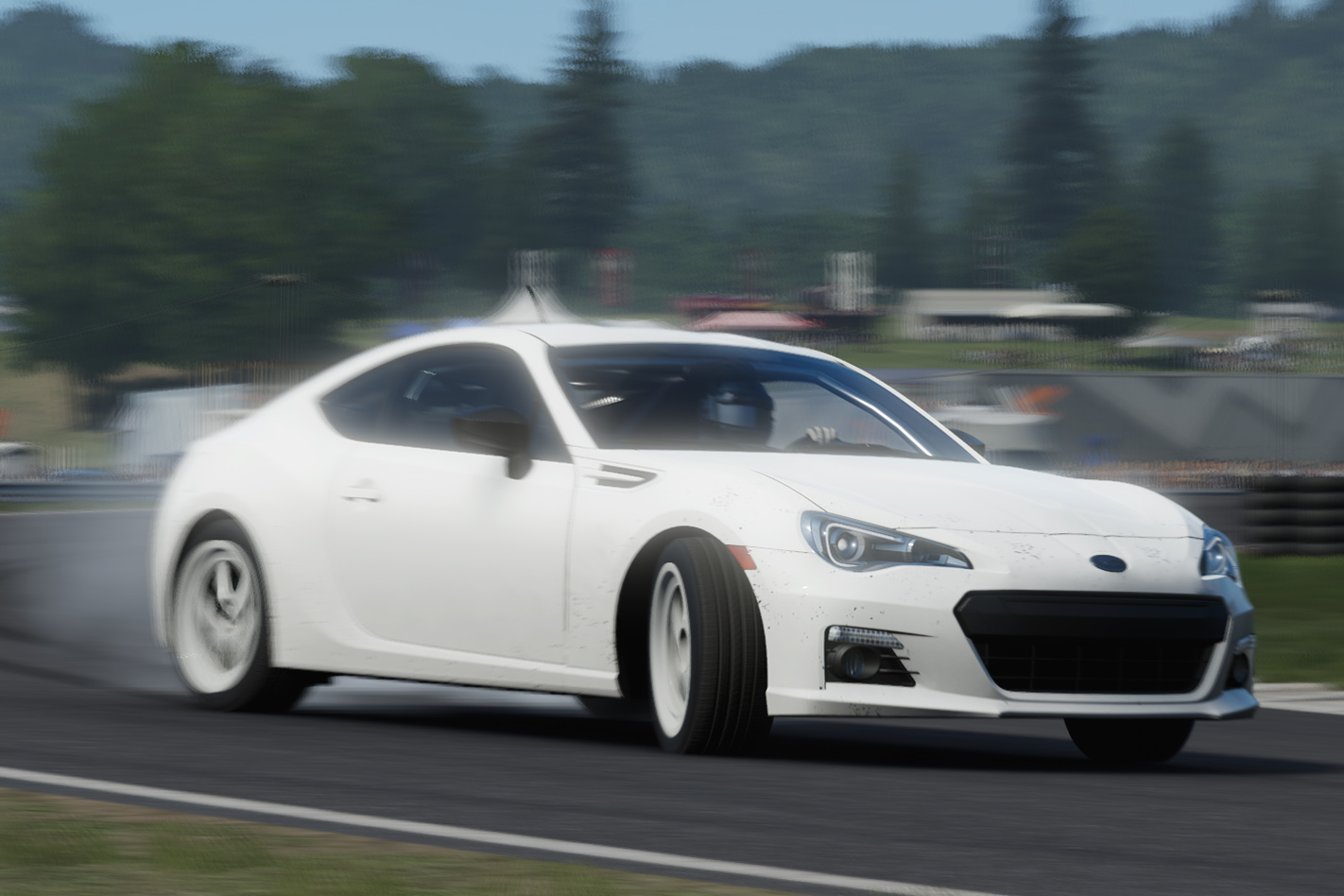
We’d also use one car and one track, both of which needed be unfamiliar to our test subjects to ensure an even playing field. On the car side, that was easy. We tuned a Subaru BRZ to ‘semi-serious road car’ status through upgraded suspension, tyres and some light power mods – and we also dialed in suspension settings that would ensure it would deliver a challenging tail-happy RWD experience. Oh, traction control and stability control would stay off, and test subjects would need to shift manually.
For the track, we selected Lime Rock. Primarily because it’s a circuit that’s often overlooked by players (after all, it’s nowhere near as sexy as the Nurburgring, Bathurst, or Laguna Seca), but also because it packs a great mix of low and high-speed turns into its short length.
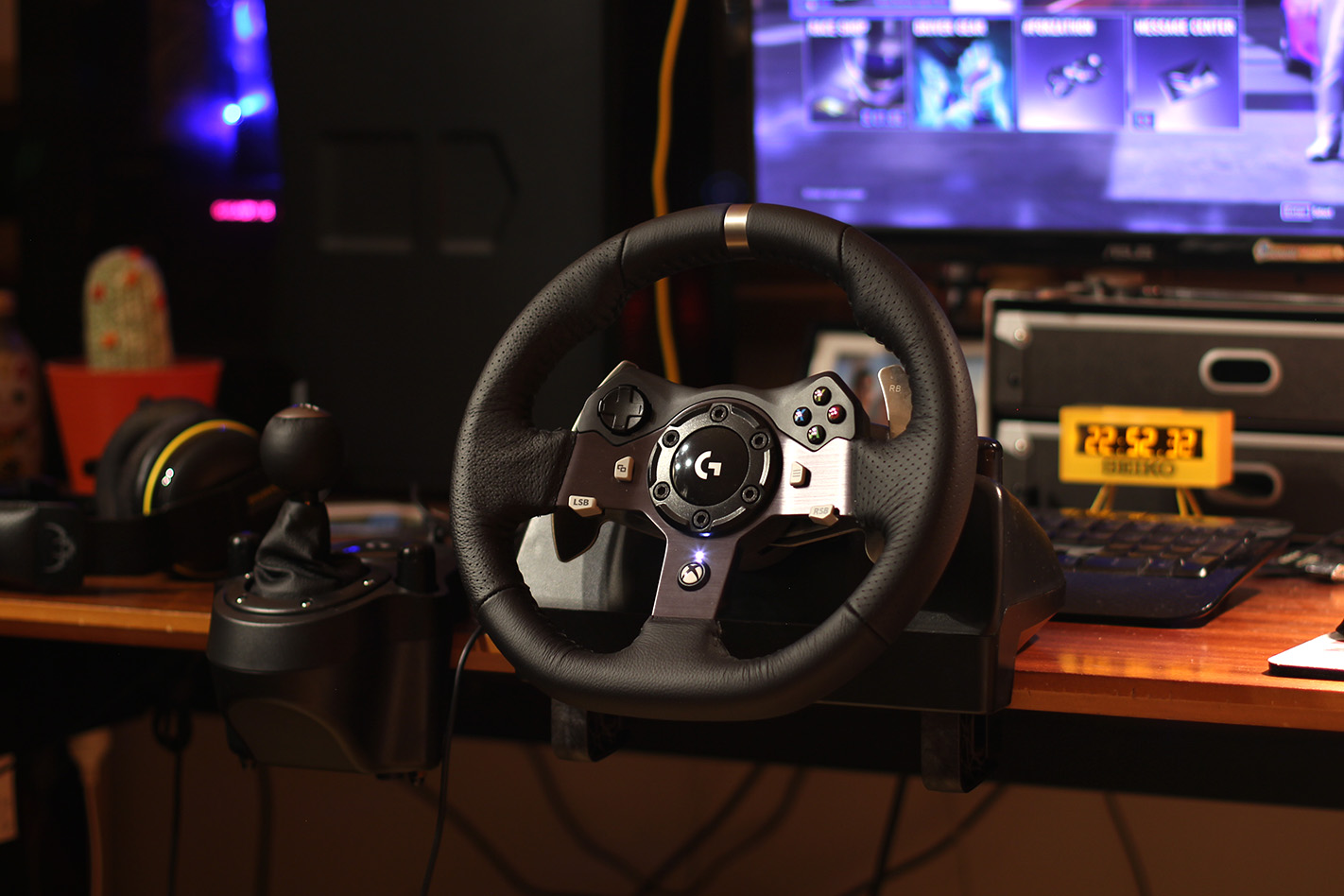
And that leaves the wheel: the Logitech G920. With three pedals, dual-motor force feedback and the accessory shifter, our long-term G920 test unit has a well-rounded feature set and is also a popular choice among virtual racers. If you’re shopping for your first wheel, you’ve probably got the G920 – or its PS4-compatible brother, the G29 – on your shortlist.
We calibrated the wheel for Forza Motorsport 7 and forbade anyone from fiddling with its settings for the duration of the experiment. Every test subject would get two practice laps then six timed runs of Lime Rock in the BRZ with the Xbox controller, then they’d repeat the exercise with the wheel. We’d then get their fastest laptime from each session and compare the results.
And the winner is?
It’d be a cop-out to say the results were inconclusive – they weren’t, actually – but the data gathered may not be as black-and-white as you might think.
Most people might assume that the more realistic input method, the wheel, would deliver better laptimes, and in most cases it did. Time improvements ranged from 0.7 seconds to as much as 4.6 seconds with the wheel, and while four out of 11 participants failed to register a faster laptime with the Logitech, two of those were on track to easily eclipse their gamepad times before tragically binning it on the final corner of their final lap.
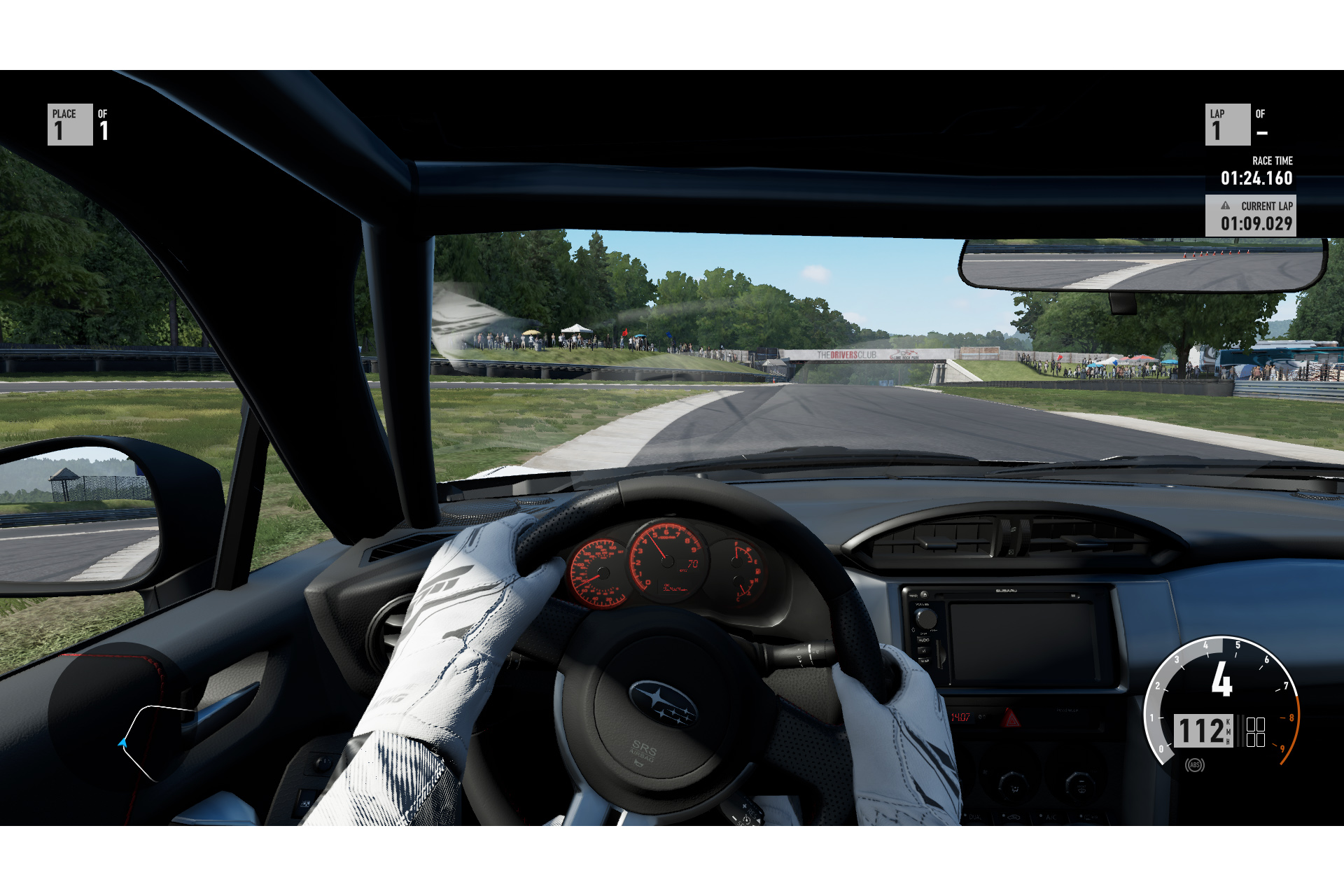
But there were some other interesting patterns observed, the biggest being that virtually everybody sucked when they first started driving with the wheel. Not just on their practice lap either, but most people’s first, second, and third timed laps with the G920 were well down on their best lap with the Xbox gamepad.
What’s more, though it was the slower method for many, everybody quickly got up to their fastest times when they were playing with the gamepad, with their final three timed laps often being very close indeed. That suggests the graph of ‘performance potential over time’ plateaus much faster with the standard Xbox controller.
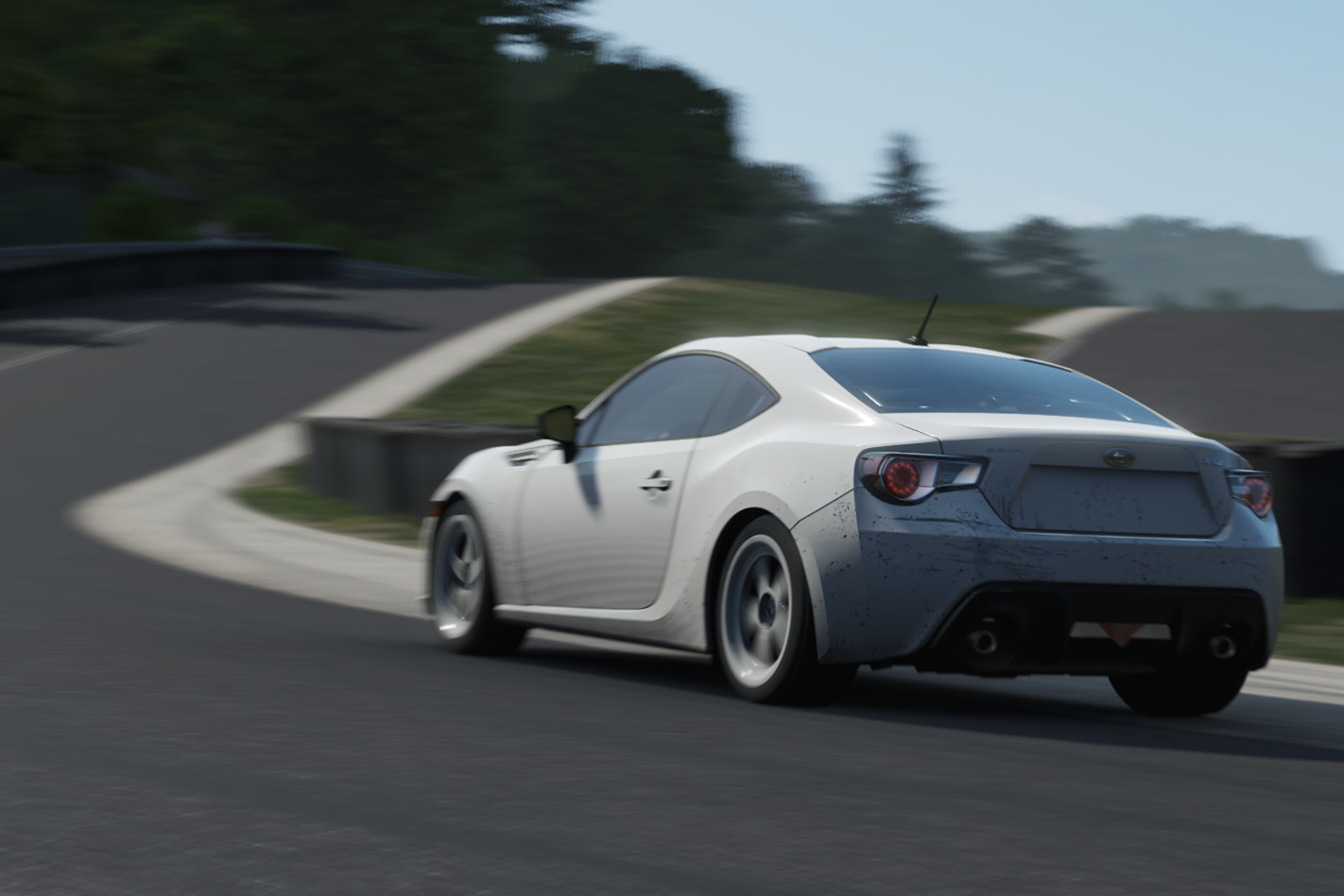
Its intuitive nature means there’s really no adjustment period required for the controller. The opposite is definitely true of the wheel.
Even those who have a wheel at home tended to take a while to get up to speed with our office G920, arguably due to the wheel’s tune being different to what they run themselves. One couldn’t make the adjustment fast enough, and recorded a slower time with the G920 despite owning one himself.
Yet one thing was clear: while people would quickly start banging out fast times with the controller and reach their natural limit within a handful of laps, those same people showed far better racecraft when put in front of the wheel. While they started out slow, their laptimes would steadily drop as their familiarity with the wheel built up and they took more aggressive lines and hit apexes and kerbs with greater confidence and accuracy.
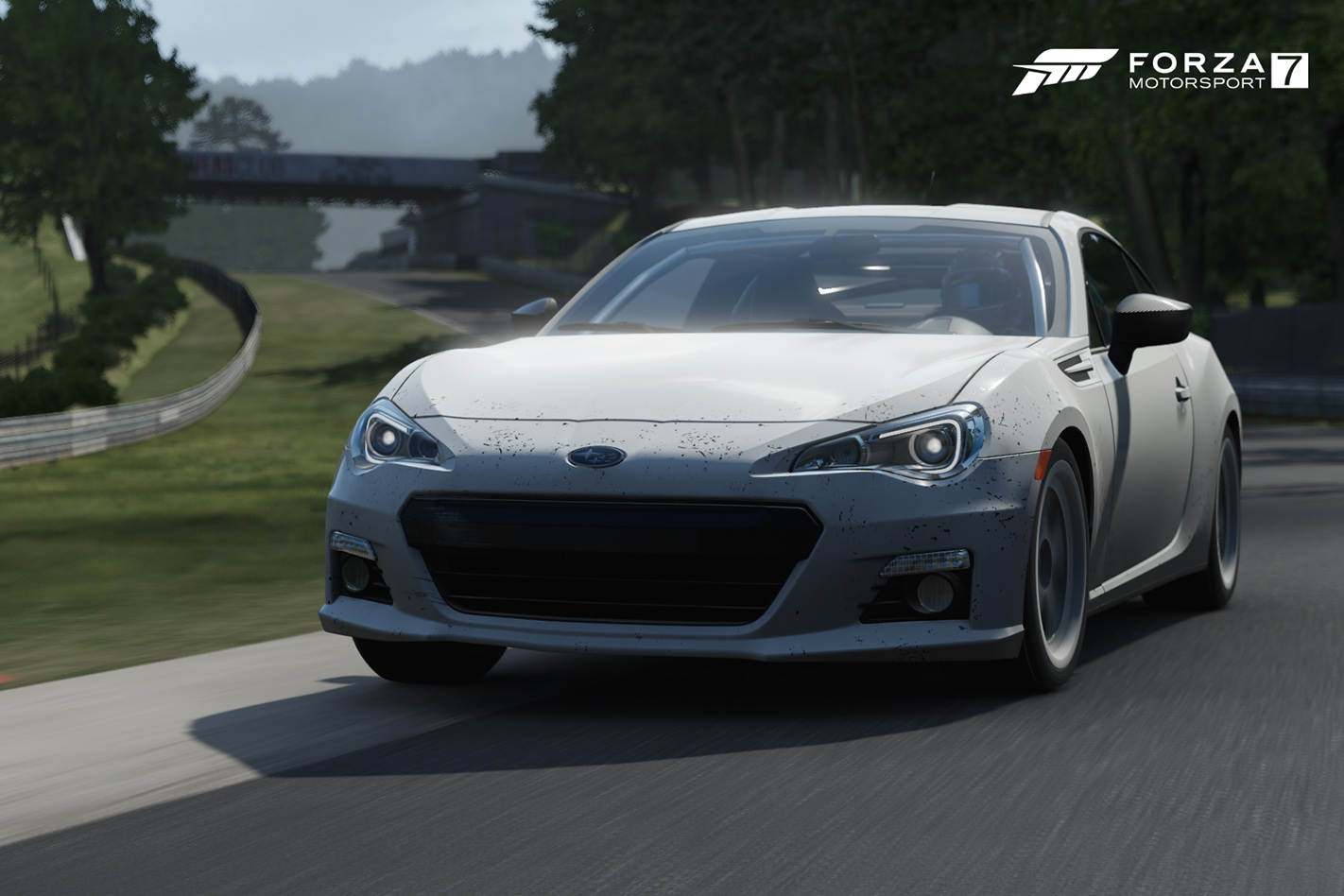
Some kept lapping even after the exercise finished, and while those times weren’t recorded they were easily far better than what those same people could achieve with the controller. The performance potential unlocked by a proper gaming wheel is clearly much greater, it just takes a lot more seat time to get there.
The conclusion is this: if you spend loads of time playing racing games and you’ve got the spare dosh (and the spare room), getting a decent wheel is an absolute no-brainer. You’ll get more out of your games and develop better driving techniques too. However, if some Joe challenges you to a few laps at a house party and they’ve got a wheel for you to try out, insist on using the boring ol’ gamepad instead – especially if it’s a game, track, or car you’re unfamiliar with.
The science says you’ll be much faster from the get-go.

It’s endowed with big wings, big power and could well take some big scalps. The upcoming AMG GT Black Series is destined for sale in Australia, complete with GT3-inspired aerodynamics, a new AMG engine and tech from the AMG One hypercar.
There’s also the not insignificant matter of power, said to be in excess of 520kW. For the likes of the Porsche 911 GT2 RS, consider this your notice. With the most power and torque of the current AMG range, it’ll more than fulfil its status as the halo model.
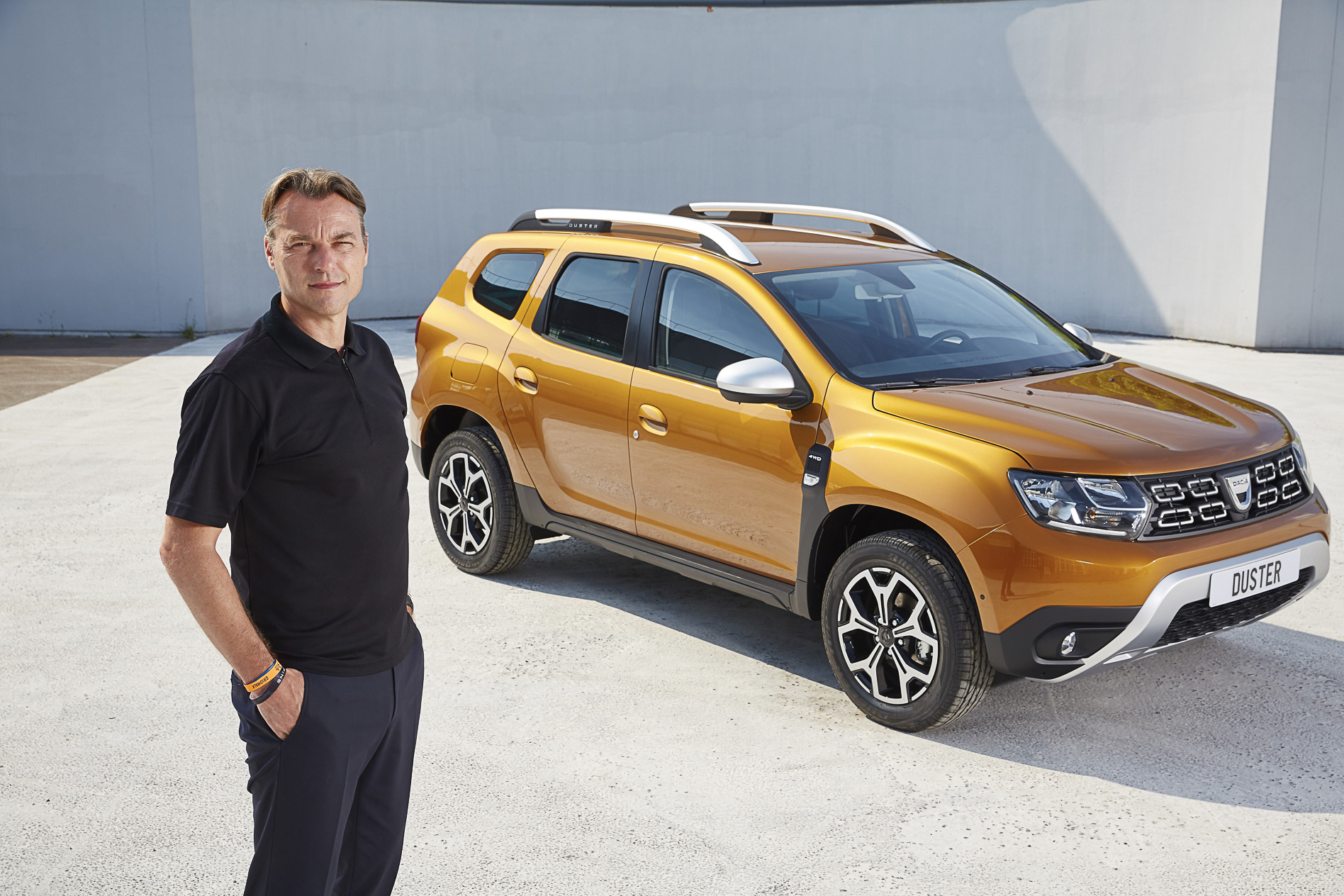
Sitting down with the boss of Mercedes AMG, Tobias Moers, it’s clear to see he’s excited for his creation to be revealed to the world – just not quite in full yet. Moers is a car guy, and his passion for the project is palpable.
Stopping short of revealing all the juicy details, Moers alludes to the fact that the Black will gain a “new” powerplant with tech that’s a first for AMG, but not the broader car-making industry. “It’s still a 4.0-litre engine and twin turbo, but it’s a different engine. It’s not a typical AMG V8.”
However, we do know Merc’s 48V mild-hybrid technology (EQ Boost) won’t generate the increased performance.While the block will remain unchanged from the M178 unit, it’s likely the Black Series will score new cylinder heads and could usher in a revised crankshaft. Videos of testing mules sporting an entirely new, high-rpm soundtrack support this theory, plus it’s a change that would bring the Black Series in line with rivals like the Ferrari 488. It would also keep the engine compact and offer benefits due to a lower rotational mass.
Either way, Moers explains that we should “expect something different.”
While the next-gen GT is set to move to all-wheel drive (with drift modes), the Black Series is likely to be one of the last rear-drivers from AMG.
The Black Series will sit above the hardcore GT R and GT R Pro as the ultimate model in this line, taking cues from both while amping up the aggression and sense of occasion. “Expect something different. Engine, power output, suspension, aero – everything. There’s not much in common with the GT R,” says Moers.
An uprated version of the GT R Pro’s coilover suspension set-up (adjustable for bump and rebound) is expected to be fitted and, interestingly, tyre tech will be borrowed from the AMG One. File that one under reassuringly overengineered then. Unsurprisingly, there are no plans for a manual gearbox.
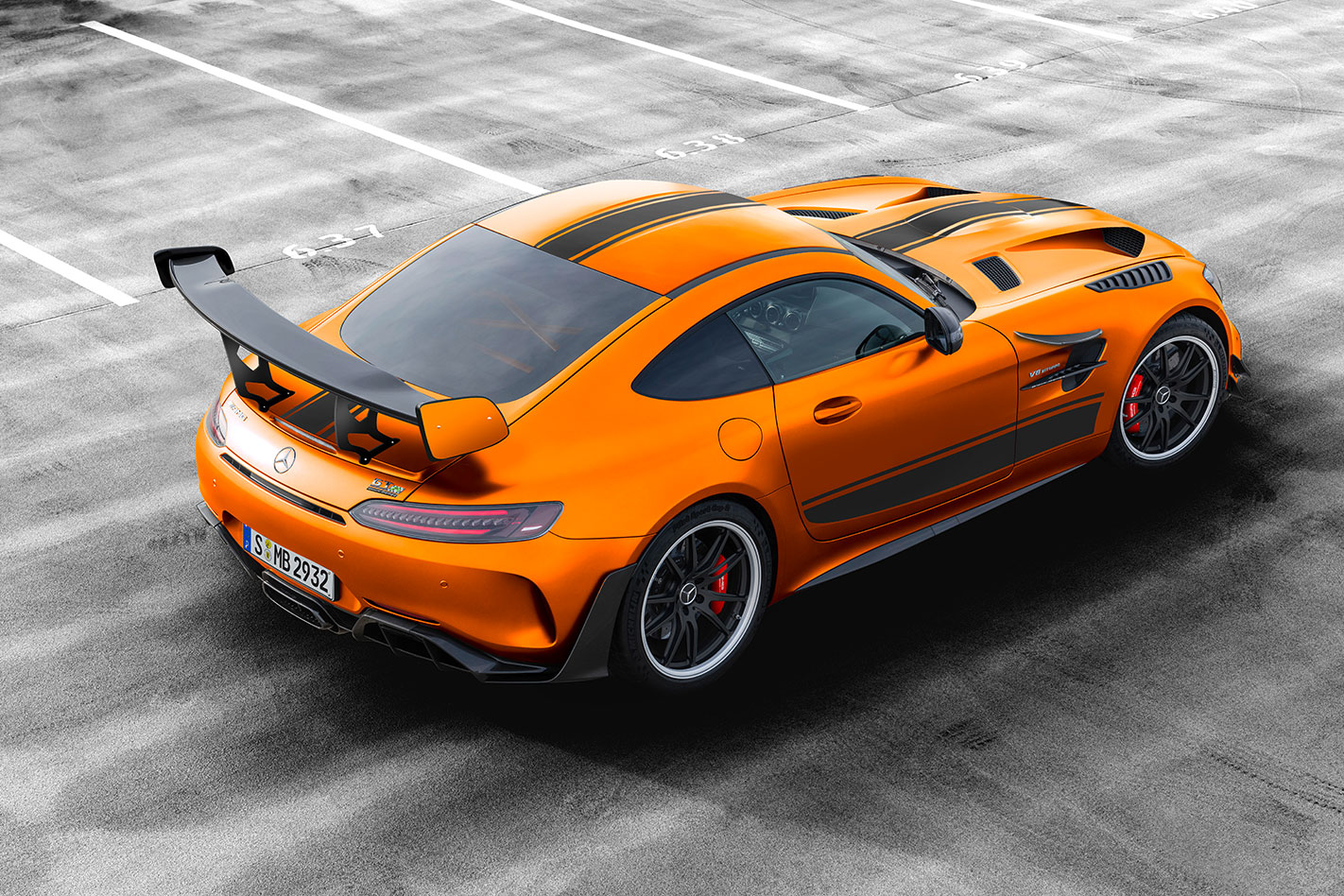
The long-bonnet, cab-back coupe will add serious aerodynamic changes to glue it to the tarmac. The massive maw of the redesigned Panamericana grille helps cooling while a deeper front air dam, redesigned bonnet and substantial rear diffuser also massage the airflow. If it looks like an escaped GT3 car, that’s not accidental. Flared wheelarches feature top vents to reduce air pressure in the wheel wells while carbonfibre front flics reduce frontal lift.
When asked about the huge wings spotted on the test mules and whether or not the Black Series would include active aero, Moers simply laughs and says, “Yes – there was no chance to camouflage that. They look similar to the production car.”
The GT R Pro already uses an active AirPanel which controls radiator shutters that close to improve efficiency or open for cooling, so we expect to see at least this. Although, despite the aggro aero (including a wild dual rear wing) and double bubble roof to enable the use of race helmets, don’t expect a stripped-out racer. Other Black Series models blend performance with a certain degree of interior refinement.
Speaking with Moers, there’s an overarching sense of pride with the Black Series project, as if AMG is sending the pure internal combustion, rear-drive, analogue supercar out with a resounding fanfare.
“When we brought the GT R to market, everybody told me, ‘Okay, what are you going to do with the Black Series?’ I told everybody that it should really be a step up and it took time to get all the things together. Now we’re there and the car is on the Nordschleife. I think it’s something really surprising. Surprising for everybody.”
Unlike the Pro, the Black Series is Oz-bound. Given the GT R is $348,711, we’d expect a sticker north of $400K.
Three reasons why you should always bet on black
1. The GT Black Series will feature a huge Panamericana grille with a GT3-style bonnet including detailed cooling aids. Active aero from the GT R Pro is also expected at a minimum.
2. The dual-plane (fixed) rear wing is a first for AMG, while the rear diffuser helps suck the Black Series to the ground. Testing mules also suggest a move to a revised quad-exhaust system.
3. Tobias Moers says that the Black Series will continue with ICE powertrains despite the push towards EV and hybrid set-ups, stating there will “still be room” for traditional engine configurations.
In focus: Benz’s bent-eight brute
The current Mercedes-AMG hero is the 470kW/900Nm M178 V8 found in the GT63 S 4-Door, but its status is set to be usurped by the Black Series. It’s expected that the 0-100km/h time to will dip below 3.6sec (set by the Pro). While the Black sidesteps hybridisation, plug-in hybrid technology will find its way into the V8 AMG range, with the 4-Door gaining the EQ Power set-up. Said to be branded GT73, it will take on the Porsche Panamera Turbo S E-Hybrid when it’s released next year.
“And this…” says the compact and impeccably dressed form of Holden’s head of design, Richard Ferlazzo, “…is our modelling studio.” He pauses for a moment, as though for dramatic effect, before pressing his security pass to the door to reveal a top-secret design studio that looks, well, exactly like you imagine it would.
Bright and open, with softly diffused light and a laid-back ‘creative vibe’ (all that’s missing are some beanbags and a ping-pong table), its focal points are three full-sized clay models that sit on axle stands at even intervals around the large room.
Around them mill a handful of casually dressed designers, their heads tilting and turning like inquisitive birds as they step back to take in new perspectives of their creations.
But it’s the clay modellers (or ‘clay sculptors’ as some like to be called) who we’ve come to see. They’re easy to spot, these masters of muck, these titans of terracotta – just look for the clay-caked fingernails.
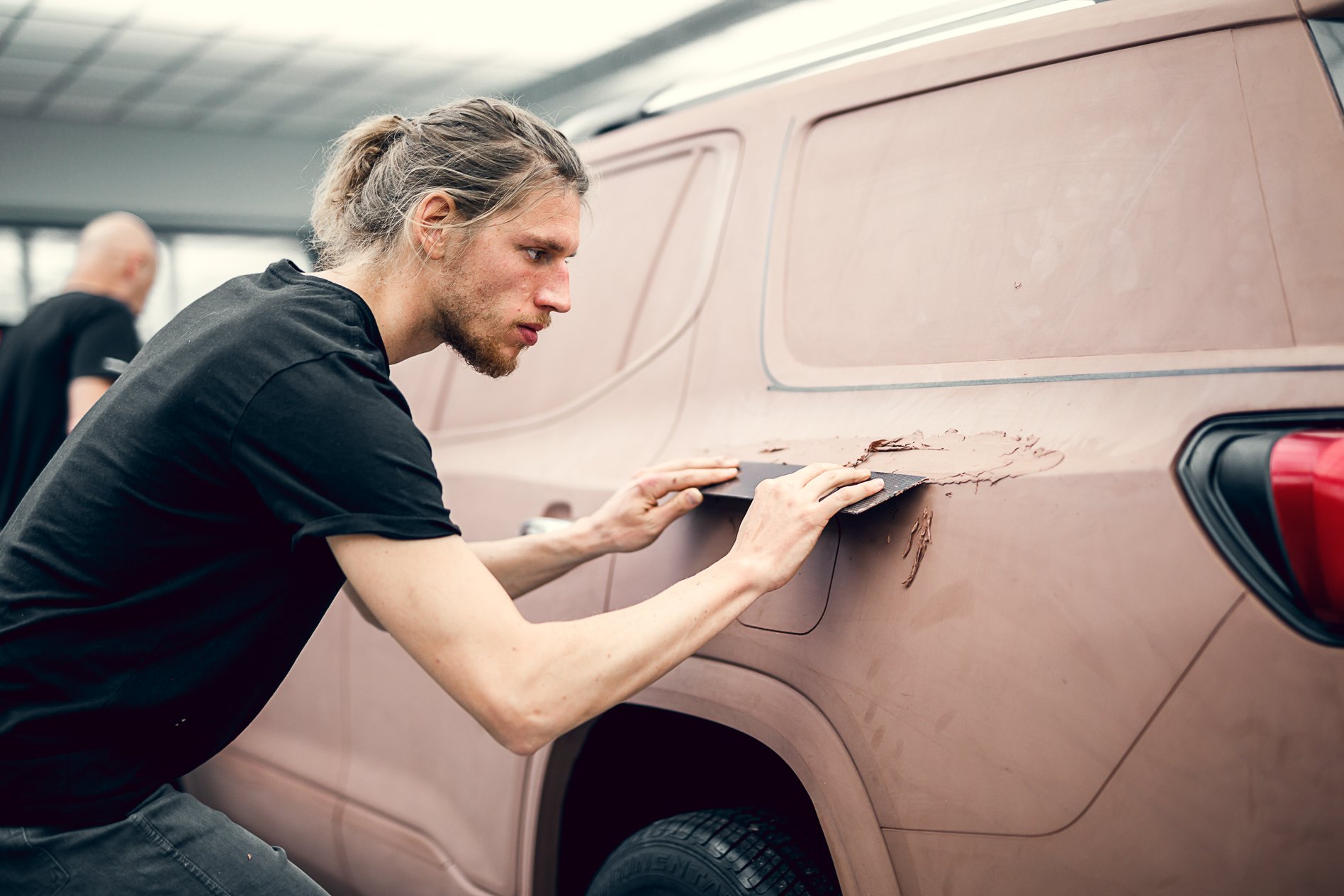
Yet they’re also exceptionally easy to dismiss. Surely, in this digital age of computer-aided design (CAD), of 3D printers, and of virtual reality headsets, the need to use thousands of kilos of clay and to spend thousands of hours carefully crafting full-sized models out of mud is now largely irrelevant? It’s all a little ‘old school’, isn’t it?
Suggest such a notion to Ferlazzo, and he smiles and then shakes his head.
“It is remarkably low-tech…” he concedes. “But that’s what makes it so effective. People often ask me, ‘Okay, it’s 2019, you’ve been using clay for many, many decades (for reference, Holden has been making clay models since the 1940s), surely there’s a better way to do things?’. And for some parts of the design process, we do use modern methods, but for making full-scale models, clay is still the most suitable material.”
Holden’s Australian design team has grown to around 130 heads since the closure of local manufacturing, 25 or so of whom are clay modellers. And Holden isn’t alone here.
Peek behind the curtains of any design studio in the world and beyond the rows of enormous computer screens and software-guided milling machines, you’ll always find a core unit of highly skilled sculptors, each busily crafting a new line, curve or character point into a scale or full-size clay model.

“Clay modelling will always be important,” says Gorden Wagener, the head of Mercedes-Benz design and our #1 most influential designer. “We can do a car completely on a computer, but does it make sense? No. I’m a true believer in clay models.”
Even Tesla, a company infamous for its rejection of traditional methods, continues to use clay to breathe life into its new models.
All of which begs the obvious question of why? Why is clay still the go-to product? And how has such a simple and old-fashioned endeavour been able to retain its place at the centre of what is now a truly modern and digitised design process?
“The best thing about clay is that it’s both additive and subtractive,” says Ferlazzo. “And that makes it fast and easy. People say, ‘Why don’t you just 3D-print a model?’ We can, of course, but the problem with that is once you print it, you can’t alter it. You spend a lot of money printing it, which takes a long time, and then the only way to alter that model is to add a hard material like filler.
“With clay, you can think, ‘That part just needs a small revision’, so you whack on some clay to make the change, scan it digitally – which only takes about an hour and a half, to scan an entire car –and then you have an outcome that’s closer to perfection.
“Designing a car is a linear process but it’s also an iterative one with countless changes from design and engineering, so we’re constantly evolving the model. Clay lets us do that and keep engineering in the loop.”
We should clarify here that this ‘clay’ isn’t the same kind of clay you’ll dig up in your backyard, or find in art schools. In fact, it isn’t really clay at all.
Built to closely guarded, proprietary recipes (“they won’t tell us exactly what’s in it,” says Ferlazzo with just a hint of frustration), the clay used by car companies is more like a high-tech Plasticine made up of waxes and other agents.
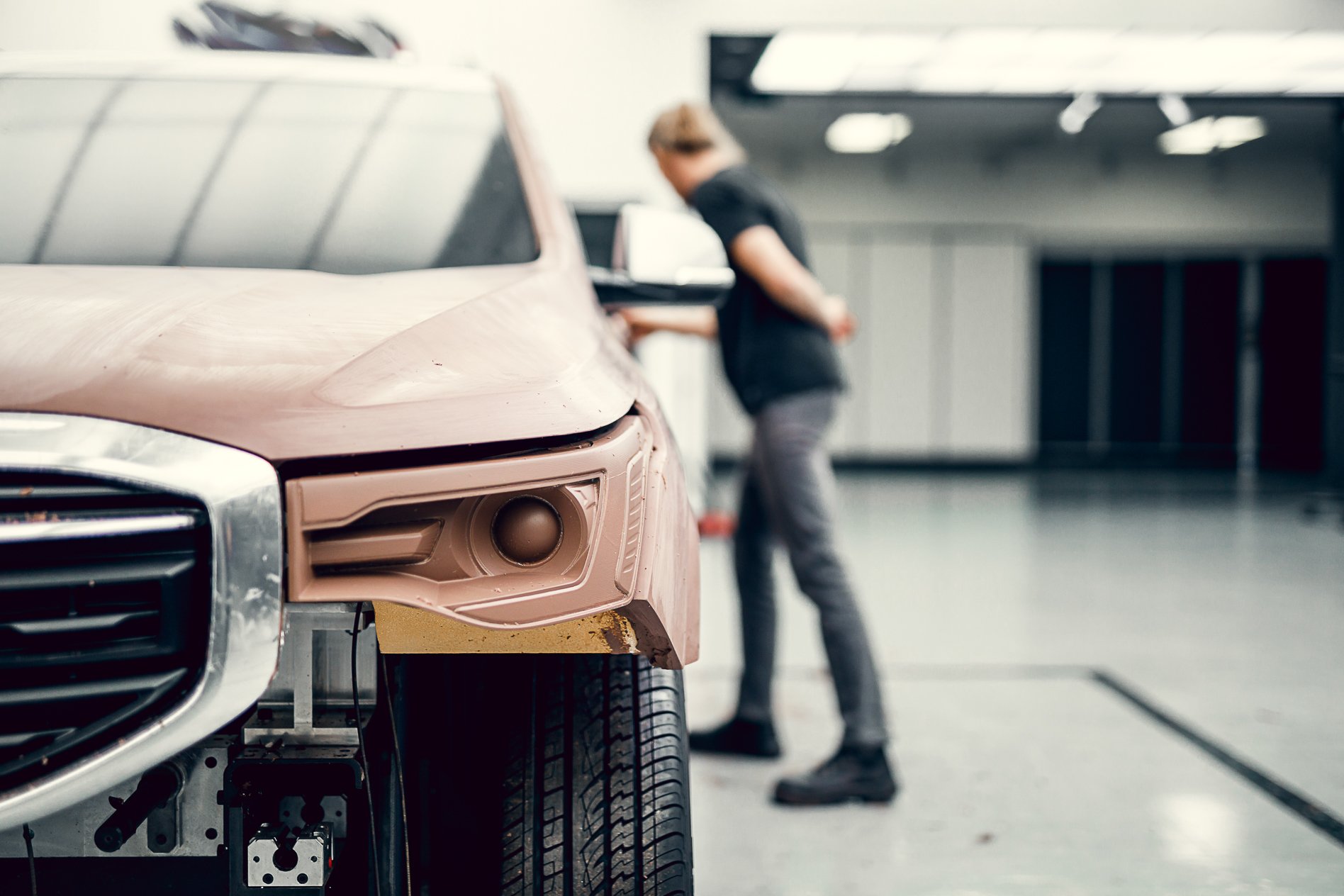
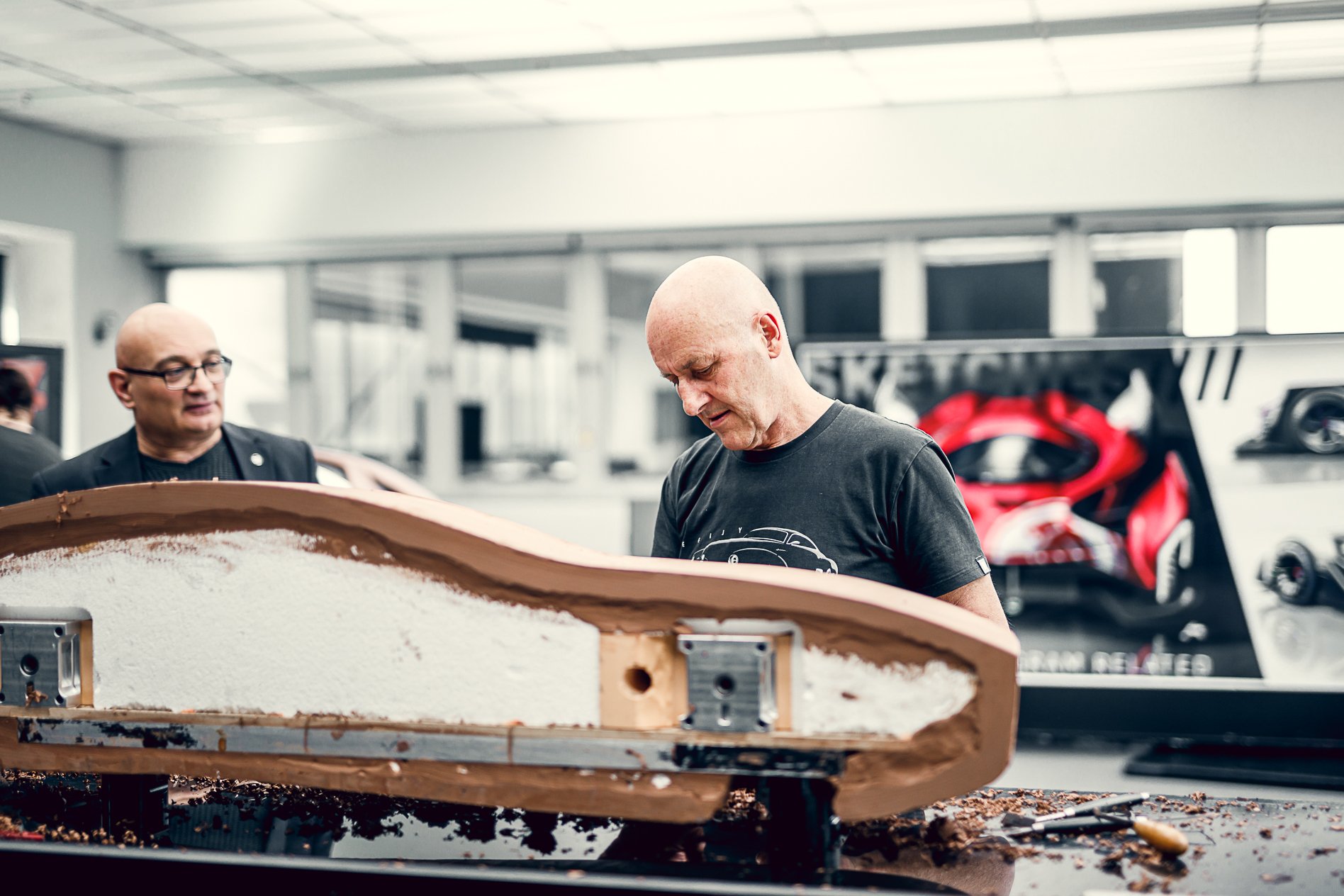
Holden sources its clay from companies in Germany and Japan and it’s relatively expensive, at around $13 a kilo. It’s also heavy. Even the term ‘clay model’ is something of a misnomer, as the clay only makes up the final few inches of the model (underneath they’re built on a rigid steel armature which is then built up with wood and Styrofoam), each one nevertheless caked in more than a tonne of clay.
“Combine that with the metal frame and a model weighs a good three tonnes,” says Ferlazzo. “We have to use electric jacks to lift them and move them around.”
And as for cost? In materials alone, a clay model is worth upwards of $200,000. Factor in labour and it can be double that.
The beauty of modelling clay, as opposed to other materials, is that it never truly sets. Stored in giant ovens at around 65°C, it does harden slightly as it cools but it never air-dries or cures, so models can be stored for years and then pulled out to be worked on when the time comes for a facelift.
Smaller components, such as lights, grilles and bumpers, can simply be changed or removed entirely and then replaced by fresh designs that clip straight into the metal frame below.
No-one truly knows who the first person was to craft a car from clay, though if you believe the legend, it all started with Harley Earl.
A design visionary and the man who revolutionised the look of General Motors’ cars over three decades from the early 1920s through to the 1950s, Earl used clay to convince uncertain customers and board members that his design vision could be trusted. Clay models were able to communicate his ideas in ways that sketches simply couldn’t.
That logic still rings true today. Producing full-size models and then allowing the design team and company executives to view them outside – usually in some secret internal courtyard (Holden’s has its own turntable) – is a crucial part of the process.
Paul Larkin has been a clay sculptor for more than 30 years and says that a model’s ability to communicate a car’s essence to upper management is vitally important internally.
“If a director from Cadillac comes to Australia to see how a new model is coming along, they go straight to the clay model – they don’t go to a screen,” he says. “We push it outside and they have the conversation about it in the real world.”
And it’s here that we get to the true differentiator between clay models and designing a car solely with CAD. Where computers are able to build a car from scratch, what they can’t capture are those intangibles that set the great designs apart from the merely mediocre.
The subtlety of a curve; the tension of a surface. Without that creative spark and the nuance of human touch that comes from clay modelling, designs taken purely from CAD tend to look wooden.
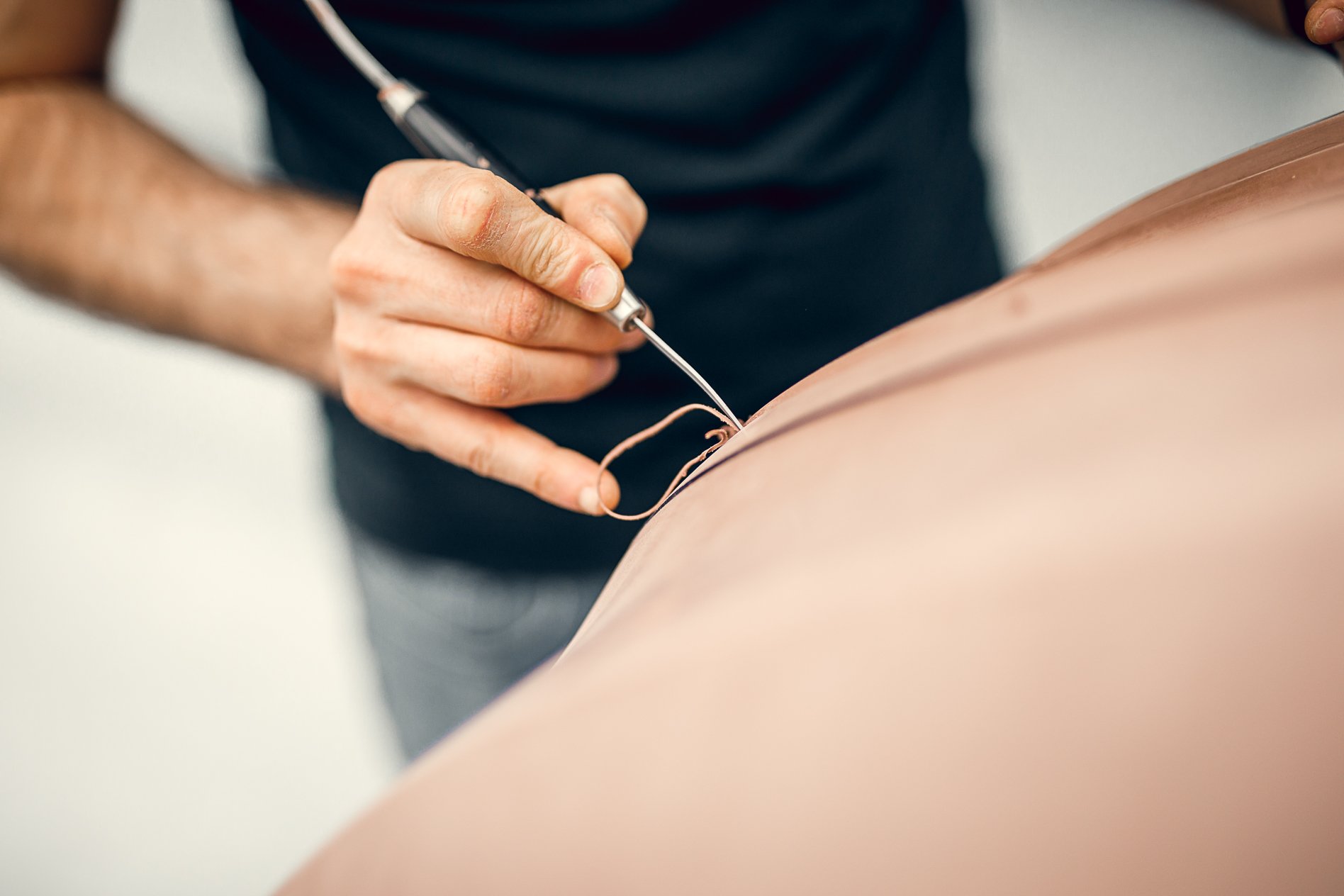
“The surface of a vehicle really is sculpture and it’s almost impossible to capture that entirely from a sketch or on a computer screen,” says Ferlazzo. “This is a large object, you really need to walk around it, to interact with it and see the way the light hits the surfaces, to understand that interplay of light and mood. You can build a car without a full-size model but if you leave it out, and miss that last bit of artisan finesse, then that just leads to mediocrity.”
There’s something strangely comforting about the knowledge that even in today’s digital world, there are still things only a human hand can achieve. And in that process, it’s the hands of the designer and the sculptor that are equally important.
Where a designer is responsible for a car’s overall look and feel, it’s the clay modeller that has to interpret the designer’s sketches and turn them into a 3D object. And it’s that synergy, and the level of understanding inherent in such a creative relationship, that can make or break a project.
“Sometimes it’s quite easy to mistake a divot for a bump and I’ll say to the designer, ‘Oh sorry, mate, I read that backwards, your shading wasn’t that good’,” says Larkin. “So the fact is, they rely on you and we rely on them. But they’re quite happy for us to have a go if we get stuck, and they’ll often say, ‘Oh that’s even better than I imagined it’.
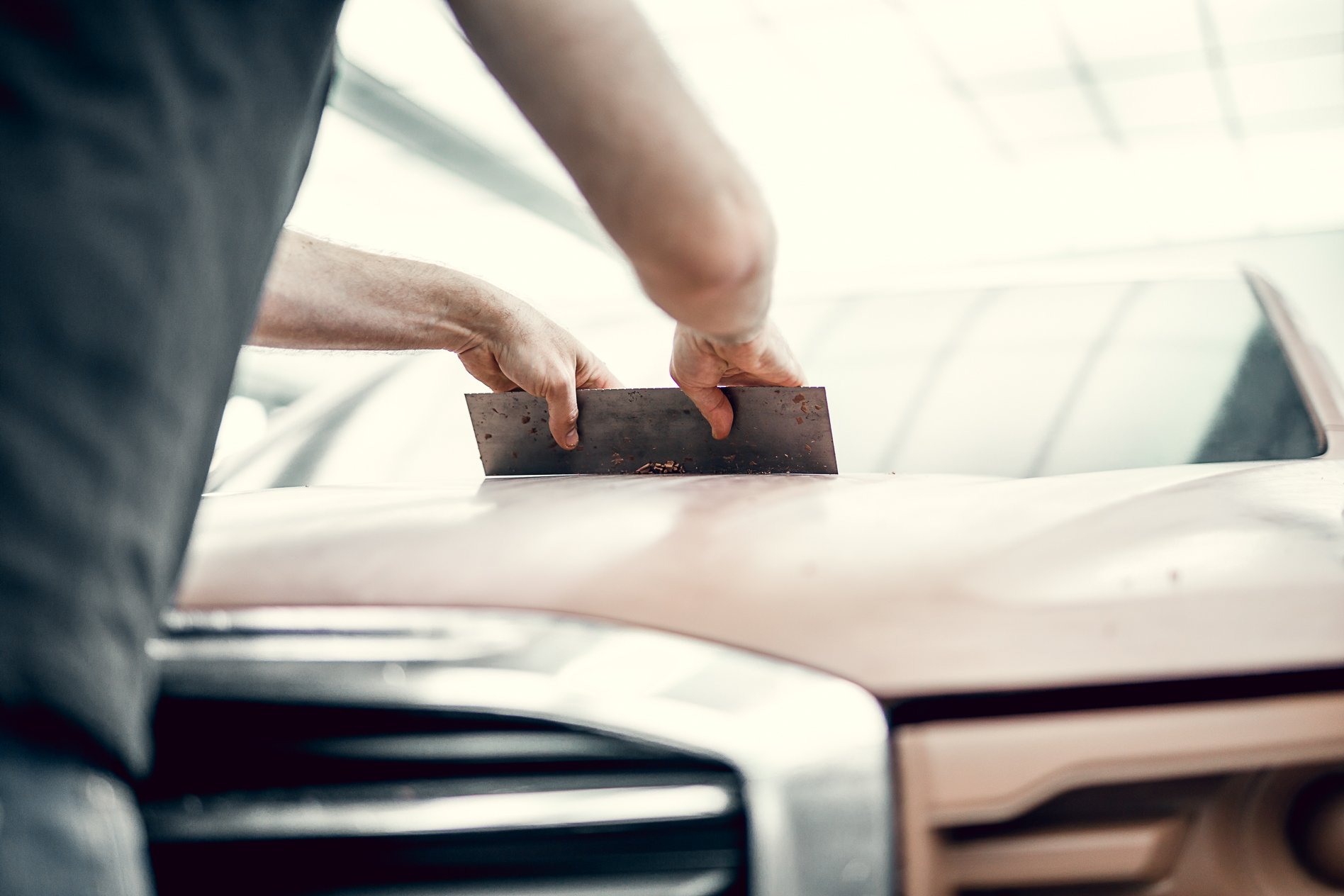
“And if we reach a problem or something that’s not quite working, the beauty is we can simply scan where we’re at, then it doesn’t matter if we mess it up because we can just re-mill it again from clay. Modelling isn’t destructive. We still have to respect the designer because it’s their sketch, but that’s why clay is so great. It’s for experimenting.”
And, reassuringly for Larkin and his fellow sculptors, it seems his profession is one of the few in the automotive space that has a decent degree of job security.
“Clay will certainly be around for the remainder of my career,” says Ferlazzo. “There are people outside the industry who think it’s old school and dated, but those who use it, we know how important it is. I still haven’t seen an alternative that is any better.”
Beauty that’s skin deep
Clay models can look freakishly realistic. “From a distance, you can’t pick a clay from a production car,” says Richard Ferlazzo. “We even used to create models with real glasshouses, built around metal frames for an even more realistic finish.”
Models can be coated with primer and painted, though the more common practice is to cover the exposed clay with a proprietary material such as 3M’s Di-Noc. “Silver is the industry norm and it’s like wallpaper,” says Ferlazzo. “You put it in a water bath and it goes like cling wrap, then it hardens as it dries.” High-tech foils and 3D-printed door handles and alloys complete the illusion.
“Absolutely brilliant,” said Cameron McConville. “One of the most impressive cars I’ve ever had the pleasure to drive. Damn near impossible to fault.”
Cam had just punted the Porsche 996 911 GT3 to 293km/h at Holden’s Lang Lang proving ground. With a passenger, no less. The occasion was Performance Car of the Year 2000 and Porsche’s new road-racer had just blown everything else away, beating the second-best Maserati 3200GT by 20km/h. Oh, and it was 10 per cent quicker than anything else to 100km/h and over the quarter mile.
Thus started arguably the most impressive run of excellence the performance car world has ever seen. To drive any 911 GT3 is to wonder if driving can get any better, yet history teaches us that every few years a new one will emerge offering greater performance, sharper dynamics and more excitement.
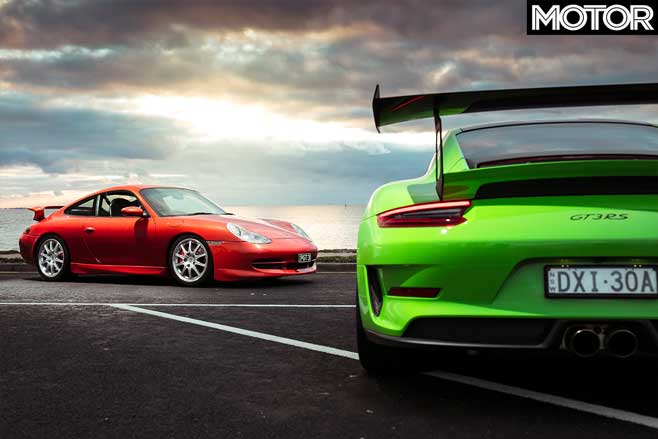
So what better way to celebrate the model’s 20th birthday than to unite the cars that book-end the story – the original 996 GT3 and the latest 991.2 GT3 RS – to examine the evolution that’s transpired over the past two decades?
Undertake incremental progress over a long enough period and the result is substantial change. There is no more obvious example of this than parking a Lizard Green 991.2 GT3 RS next to a Zanzibar Red 996 GT3, kindly supplied by enthusiast Linley Baxter.
They are roughly identifiable as emerging from the same gene pool, but the newer car seems to have slithered through some DNA-modifying radioactive waste in the process. It dwarfs the petite 996, sitting 127mm longer, 115mm wider and 27mm taller, its wheelbase stretched by 103mm and the tracks engorged by 62mm at the rear and a whopping 113mm at the front.
In a sign of changing fashions, the 996 is virtually unadorned, a curvaceous aerofoil, ground-hugging front bumper and air-shaping side skirts the only nods to its circuit focus, the modest 18-inch alloys tucked well inside the arches. In contrast, the 991.2 has had its body continually hacked away in the pursuit of more performance and the guards barely contain the giant staggered rims (20s front; 21s rear).
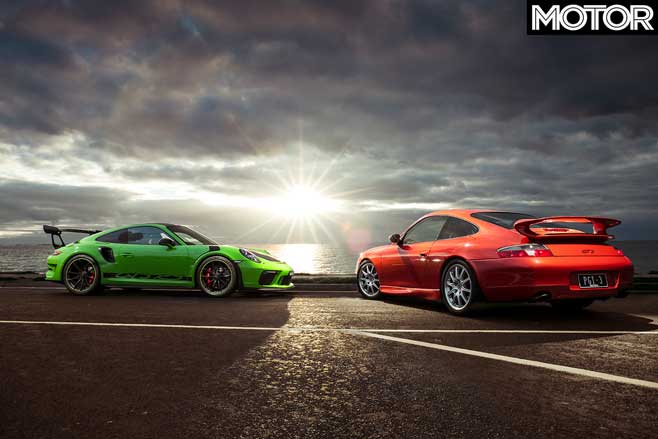
There’s no better illustration of how far the GT3 has come than in the tyres worn by each car: both are appropriately shod in track-spec Michelin Pilot Sport Cup 2s, but whereas the 996 wears 225/40 and 285/30 front and rear respectively, 265/35s and 325/30s adorn the same axles on the 991.2. But enough spec sheet examination, these cars were built to drive.
The interior of the 996 is a very different place to Porsche’s more recent offerings; the seats are snug, supportive buckets that are very comfortable but covered in the world’s slipperiest leather. Shiny black leather covers almost every surface bar the carbon centre console, the weave having that strange olive green tinge that characterises early uses of the lightweight material.
The steering wheel is large and sits low, almost in your lap, and the engine starts with a key, a moment’s hesitation preceding the familiar rattly idle of a Hans Metzger flat-six. It’s a noise exacerbated by the single-mass flywheel, installed as part of the optional MO30 pack that also added steel gearbox synchros and trackday trinkets like a fire extinguisher and engine cut-out switch.
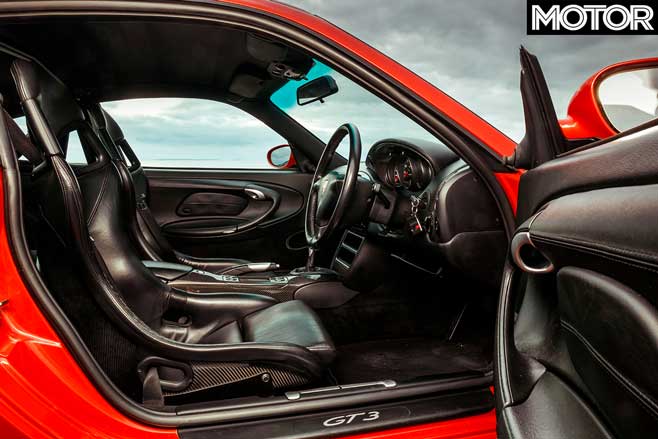
The flywheel endows the engine with incredible response, the revs rising instantly at the slightest brush of the throttle and falling equally quickly, providing plenty of stall potential. It’s mastered easily enough, but when combined with the long throw of the gearbox, shifts have to be completed quickly in order to make smooth progress.
The engine is tremendously flexible and quietly vocal, always present but not intrusive, emitting a strong whoosh under load at low rpm, like a constantly crashing wave. Under brakes the track-biased clubsport pads squeal like a pig with its tail in a vice, but this wasn’t the biggest complaint for road testers back in the day.
It might surprise you to learn that the 996 GT3 didn’t win PCOTY 2000 – not even close. Fourth was the best it could manage, a Boxster S victorious from the BMW E39 M5 and Subaru WRX STi. While full of praise for its ability, the judges felt the GT3 too focused on track use, summarising it thus: The GT3 is noisy, has a ride quality verging on harsh, ducks and weaves to follow every inconsistency. Couldn’t be lived with day-to-day. This proves two things: that former MOTOR staffers were sooks and that what constitutes acceptable ride quality has changed a lot in 20 years.
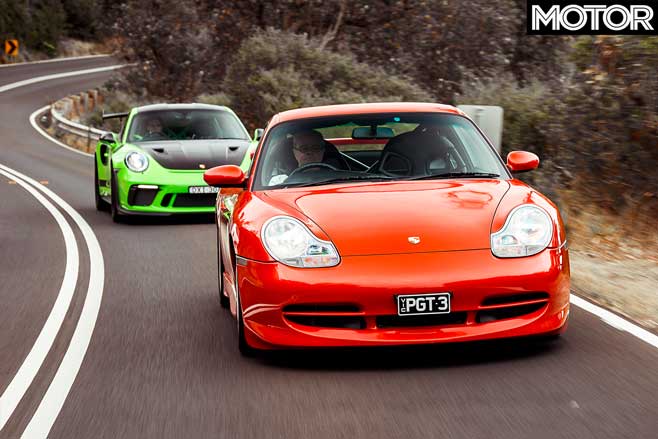
The final quote is interesting, because one of the first thoughts that crossed my mind while driving Linley’s 996 was, ‘I want one of these as a daily driver!’ The ride is firm but compliant, the nose does follow cambers but not to the extent of something like an R35 GT-R, and the only evidence of the GT3’s racing roots is the odd squeak from the half-cage. Today a car this civilised would wear a Carrera badge. If those PCOTY 2000 judges thought the 996 too track-focused, they’d want to lock the latest GT3 RS in a pit garage and throw away the key.
This is not the most hardcore model in Porsche’s recent arsenal; unlike in its GT2 RS big brother, you can’t hear the cogs meshing in the gearbox or the pads gripping the discs under brakes, but the front wheels chase bumps and cambers like a beagle on the scent, there’s a choof from the PDK every time it swaps ratios, the seats lack padding and, even if all the various bits of six-point harness are out of the way, there’s a good chance you’ll knock something sensitive on the crotch strap.
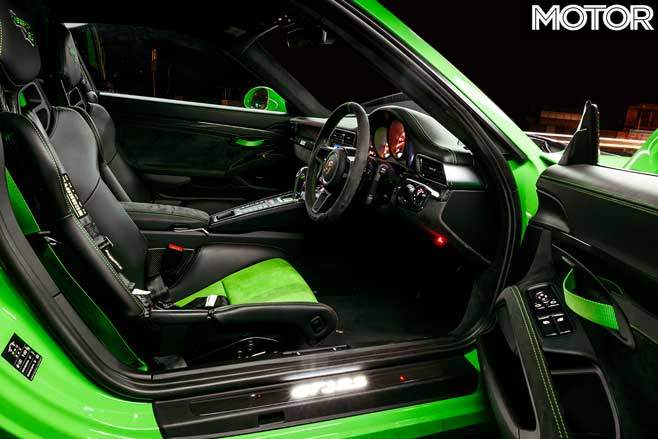
Yet you could enjoy these traits on a daily basis; the flexible engine and self-shifting gearbox make it a cinch to operate in traffic and, despite those monster rims and seemingly zero suspension travel, it has a reasonable ride.
Linley, who also owns a 991.2 GT3 manual, sums it up well when emerging from the RS: “How can they get this car so firm yet it’s still riding the bumps?” Before adding another accurate description of the car as a whole: “That thing’s vicious.”
The 991.2 GT3 RS might just be the most aggressive road car ever created. It’s like a crazed UFC fighter; it carries not an ounce of fat and has to be restrained from tearing the road apart at every opportunity. Spending significant time behind the wheel at pace is exhausting due to the sensory overload; it isn’t a car you can just sit back and relax in, you have to drive it.
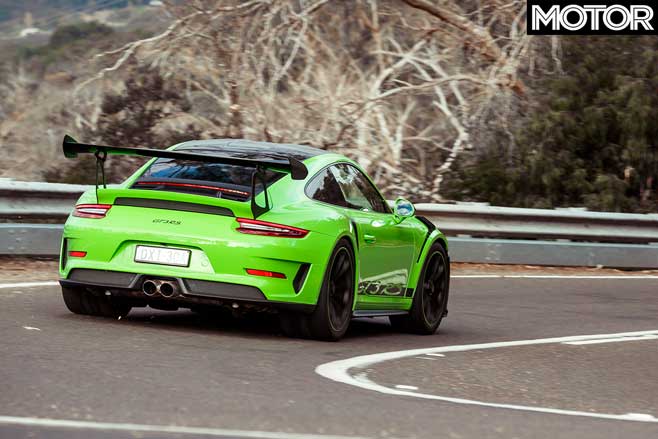
Porsche GT cars boss Andreas Preuninger describes the RS set-up as being close to a Cup car and I can believe it; on a bumpy road at speed it’s like being stuck in a tumble dryer as the suspension refuses to yield to the scarred tarmac.
The upside of this on a smooth road is incredible accuracy. On cold tyres the 991.2 is a bit like a cheetah on roller skates, but as soon as those giant Cup 2s warm up lateral grip is immense. Turn-in, typically a 911 weakness, is incredible thanks to the wider front track, rear-wheel steering and aggressive geometry; traction is strong but the engine has so much urge now that the rear tyres can break free if you’re too keen with the throttle.
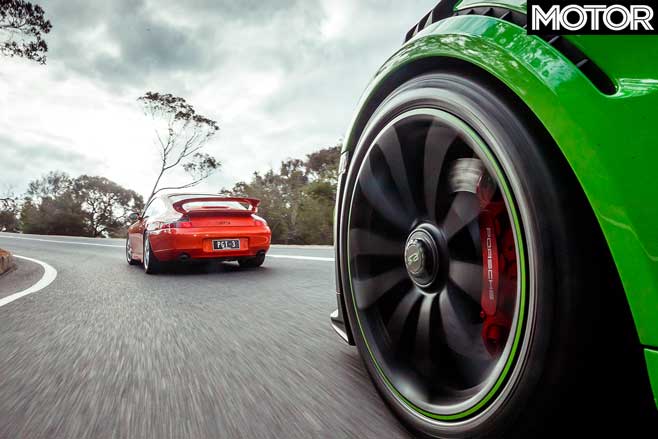
Its ultimate limits lie beyond what’s possible on the public road, but the way you feel plugged into the car means you don’t have to drive like you’re in a Top 10 Shootout to enjoy the experience, even if the car wants you to.
What’s remarkable is that the 996 shares many of these traits, particularly in the confidence it gives the driver. Older cars can offer an enjoyable experience but rarely do they egg you on to exploit their limits; spoiled by the subconscious comfort of electronic driver aids, not to mention the latest in suspension, tyre and brake technology, yesterday’s performance cars can leave you feeling a little exposed.
The first-generation GT3 is different. Its only conciliation to driver assistance is ABS, yet it cuddles you in a warm embrace.
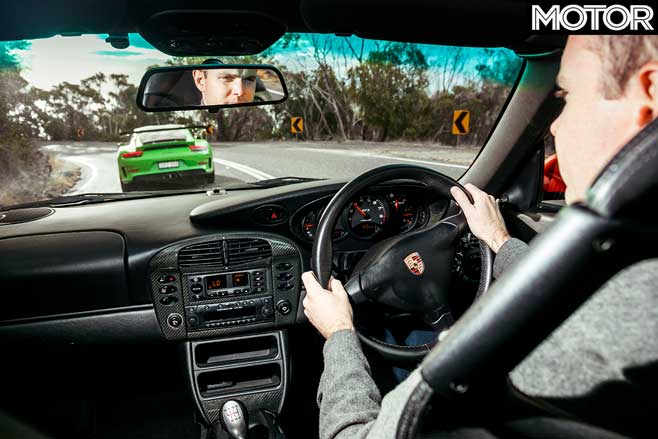
The steering is slower but responds to the slightest movement off-centre while offering constant information about what the front end is up to, while the rear sends similar signals through the seat. Linley’s car has around 56,000km on the clock and has been expertly cared for but has also been driven hard on track and yet feels brand new.
Two corners into the twisting Arthur’s Seat hillclimb on Victoria’s Mornington Peninsula, the 996 is whispering in my ear: “Go on, lean on the front tyres and gun it, we’ll generate some oversteer. It’ll be awesome, Linley won’t mind.” On the off-chance he does, I ignore these advances and simply enjoy a car that appears to possess the perfect amount of performance for on-road enjoyment.
In 2019 terms, the original GT3 is not particularly quick. It may have been the dux of the PCOTY 2000 field, but 0-100km/h in 5.00sec and a 13.07sec quarter mile are numbers you’d expect from a $50K AWD hot hatch these days. The engine is beautiful, though: smooth, torquey, keen to rev, perfectly matched to the gearing (unlike a Cayman GT4!) and with that soulful flat-six howl.
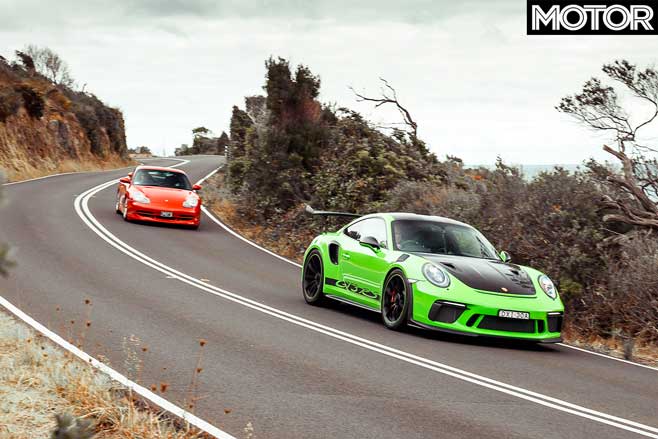
In terms of pace, the 991.2 GT3 RS occupies a different universe: 0-100km/h in 3.18sec; 0-400m in 11.07sec at 203.78km/h. The 4.0-litre flat-six makes a strong case for being the best engine in the world (see page 68); the mid-range is ridiculous for a naturally aspirated engine and the ferocity of the top end is legitimately scary – the ever-increasing acceleration is unnerving and means you have to have your wits about you when approaching corners.
Two decades, six iterations, 118kW and more than a minute of Nurburgring lap time separate this pair, but they are linked by more than just badging and a vague ‘racecar for the road’ message. Drive them back-to-back and it’s clear that even if exactly the same people didn’t develop them both (and there are probably some that did) the same development principles guided both teams.
The 991.2 looks and feels like it’s fuelled by pure testosterone compared to the petite, demure 996, but the way the engine and steering in particular respond is incredibly similar in each. Both are brilliant, near impossible to fault, and two of the most impressive cars I’ve ever driven.
Fast Facts
| u00a0 | Porsche 911 GT3 (996) | Porsche 911 GT3 RS (991.2) |
| Body | 2-door, 2-seat coupe | |
| Drive | rear-wheel | |
| Engine | 3600cc flat-6, DOHC, 24v | 3996cc flat-6, DOHC, 24v |
| Bore x Stroke | 100.0 x 76.4mm | 102.0 x 81.5mm |
| Compression | 11.7:1 | 13.3:1 |
| Power | 265kW @ 7200rpm | 383kW @ 8250rpm |
| Torque | 370Nm @ 5000rpm | 470Nm @ 6000rpm |
| Power/Weight | 196kW/tonne | 269kW/tonne |
| Transmission | 6-speed manual | 7-speed dual-clutch |
| Weight (dry) | 1350kg | 1425kgu00a0 |
| Suspension (f) | struts, coil springs, anti-roll bar | struts, coil springs, adaptive dampers, helper springs, anti-roll bar |
| Suspension (r) | multi-links, coil springs, anti-roll bar | multi-links, coil springs, adaptive dampers, helper springs, anti-roll bar |
| L/W/h | 4430/1765/1270mm | 4557/1880/1297mm |
| Wheelbase | 2350mm | 2453mm |
| Tracks | 1475/1495mm (f/r) | 1588/1557mm (f/r) |
| Steering | hydraulically assisted rack-and-pinion | electrically assisted rack-and-pinion, rear-wheel steer |
| Brakes (f) | 330mm ventilated/drilled discs, 4-piston calipers | 380mm ventilated/drilled discs, 6-piston calipers |
| Brakes (r) | 330mm ventilated/drilled discs, 4-piston calipers | 380mm ventilated/drilled discs, 4-piston calipers |
| Wheels | 18 x 8.0-inch (f); 18 x 10.0-inch (r) | 20 x 9.5-inch (f); 21 x 12.5-inch (r) |
| Tyre Sizes | 225/40 ZR18 (f); 285/30 ZR18 (r) | 265/35 ZR20 (f); 325/30 ZR21 (r |
| Tyres | Michelin Pilot Sport Cup 2 | |
| Price | $224,600 (when new) | $416,100 ($489,350 as tested) |
| Pros | Started a dynasty; remains a sublime drive | Possibly the greatest driving tool thereu2019s ever been |
| Cons | Slippery leather; brake squeal; we donu2019t own one | Too hardcore for some; massive price tag |
| Rating | 5 out of 5 stars | 5 out of 5 stars |
We live in a new golden age of car design. Designers who recognise and embrace this fact will inevitably ascend to the peak of their professions while those who rail against the current pace of change fade from view.
Never has there been a more exciting, progressive period in car design, as our entire model of car ownership, the way vehicles are powered and the form factor they’ll take is up for influence.
We gathered guest editor Ian Callum, ex-editor Peter Robinson and current ed Alex Inwood to thrash out exactly who are the 10 most influential design bosses.
You may not agree with their final selection, but the power wielded by the new generation of design visionaries is greater than at any point in car manufacturing history. Our automotive future is being shaped by the hands of these men.
10 – Laurens van den Acker, Renault
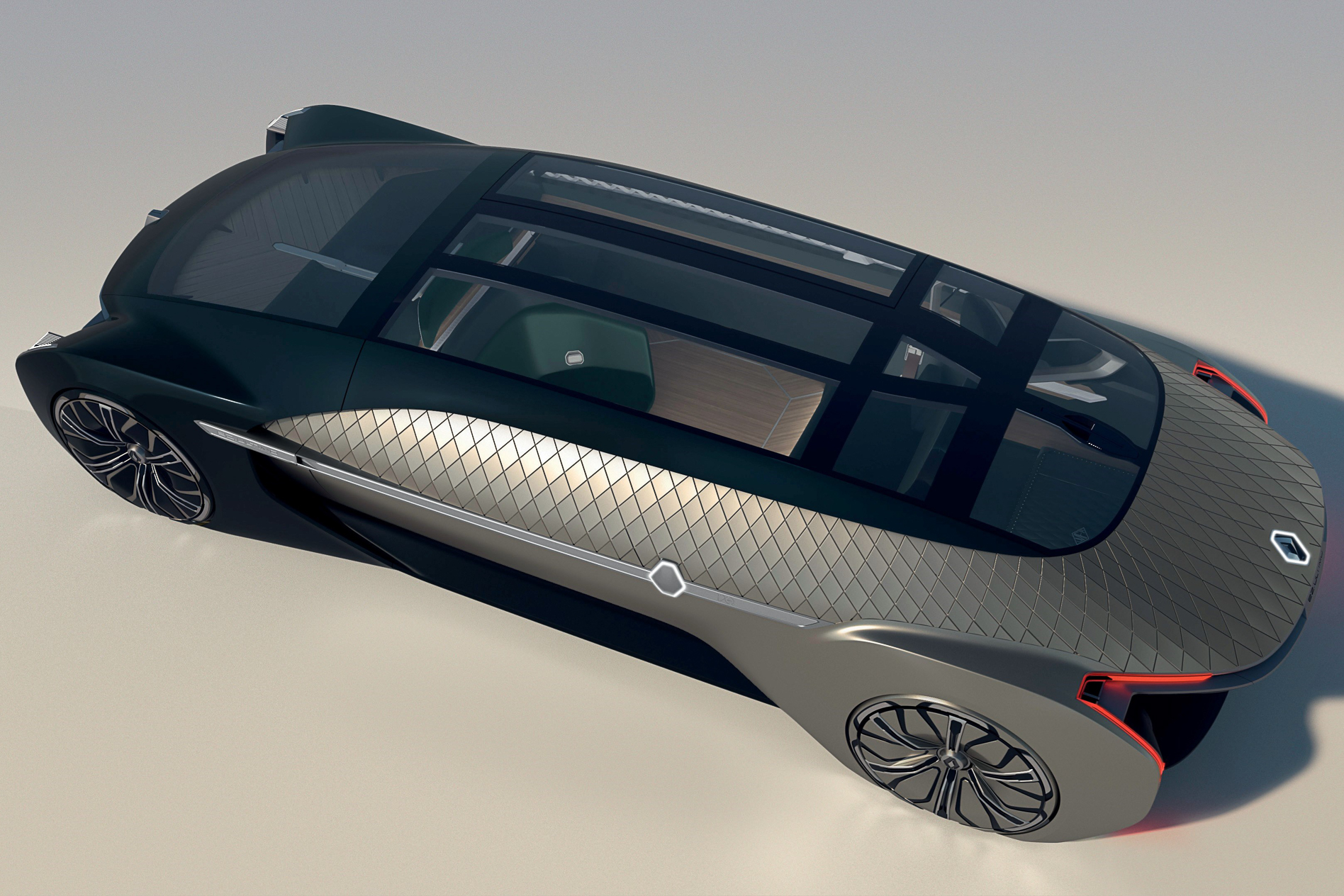
There are detail designers, and then there are big-picture visionaries. Renault’s Laurens van den Acker tends to the latter. “Products on their own are important but not enough,” he says. “We need to change our brand. It’s why we stayed in Formula 1. If we didn’t have F1 we would be just like any other generalist manufacturer, but here we are competing against Mercedes and Ferrari and McLaren.
“Image is a collection of many pieces,” he says of Renault’s chess game strategy. His delivery of the Renault EZ autonomous design study (above) was one of the highlights at Paris this year and set an emphatic and achingly desirable template for luxury driverless transport. Van den Acker is looking at the long game. “Sooner or later the customer will wake up to us.” AE
9 – Thomas Ingenlath, Volvo
Not content with revolutionising Volvo’s design since 2012, the 55-year-old German is now shaping the future look and feel of electric cars. Oddly for a designer, Ingenlath was last year appointed as the CEO of Volvo’s burgeoning electric-car brand, Polestar, and has since given us the striking Polestar 1 and 2.
Clean and crisp with a heavy dose of measured, Scandinavian cool is the Ingenlath calling card, though his influence extends well beyond how modern Volvos and Polestars look. He was instrumental in locking in the hard points for the company’s new SPA and CMA architectures and seems hell-bent on making EVs for drivers.
“Electric cars now are defined by their acceleration,” hetold CAR. “We will make cars that are really enjoyable to drive in handling, steering and overall everyday performance.” He’s speaking our language. AI

8 – Mike Simcoe, GM
It’s still too early to tell if Mike Simcoe, Melburnian boy made good, and best known for the VT Commodore and Monaro, is going to be able to bring real beauty back to GM’s cars. However, as vice-president of GM Global Design since the middle of 2016, Simcoe carries massive clout and has a proven record of great designs.
He also brings an emphatically holistic perspective to GM’s top design job, as he told Peter Robinson not long after taking up the role: “I like design to be total design. Designers are not stylists; they’re designers and they’re holistic in their impact on a vehicle. If we can’t influence the design architecture of the vehicle, [its] quality and function, then we’re not doing our job.” AW
7 – Michael Mauer, VW Group
How is design influence quantified? That was the question we pondered when trying to decide where to place Michael Mauer, head of design at VW Group, in this line-up. Marked against moving the meter on mainstream models in the VW Group, you could argue that there are plenty who are showing greater daring and innovation.
But in terms of sheer scale – the VW Group is the second-largest manufacturer in the world – then Mauer’s sphere of influence, and his ultimate ability to greenlight bold design from any one of eight brands, is unparalleled. Plus he’s still entrusted as the ultimate arbiter of Porsche’s design direction (he was hands-on for the 991 911, among many other projects), and the Taycan (below) suggests both heritage and forward-thinking are in lockstep. AW

6 – Marek Reichman, Aston Martin
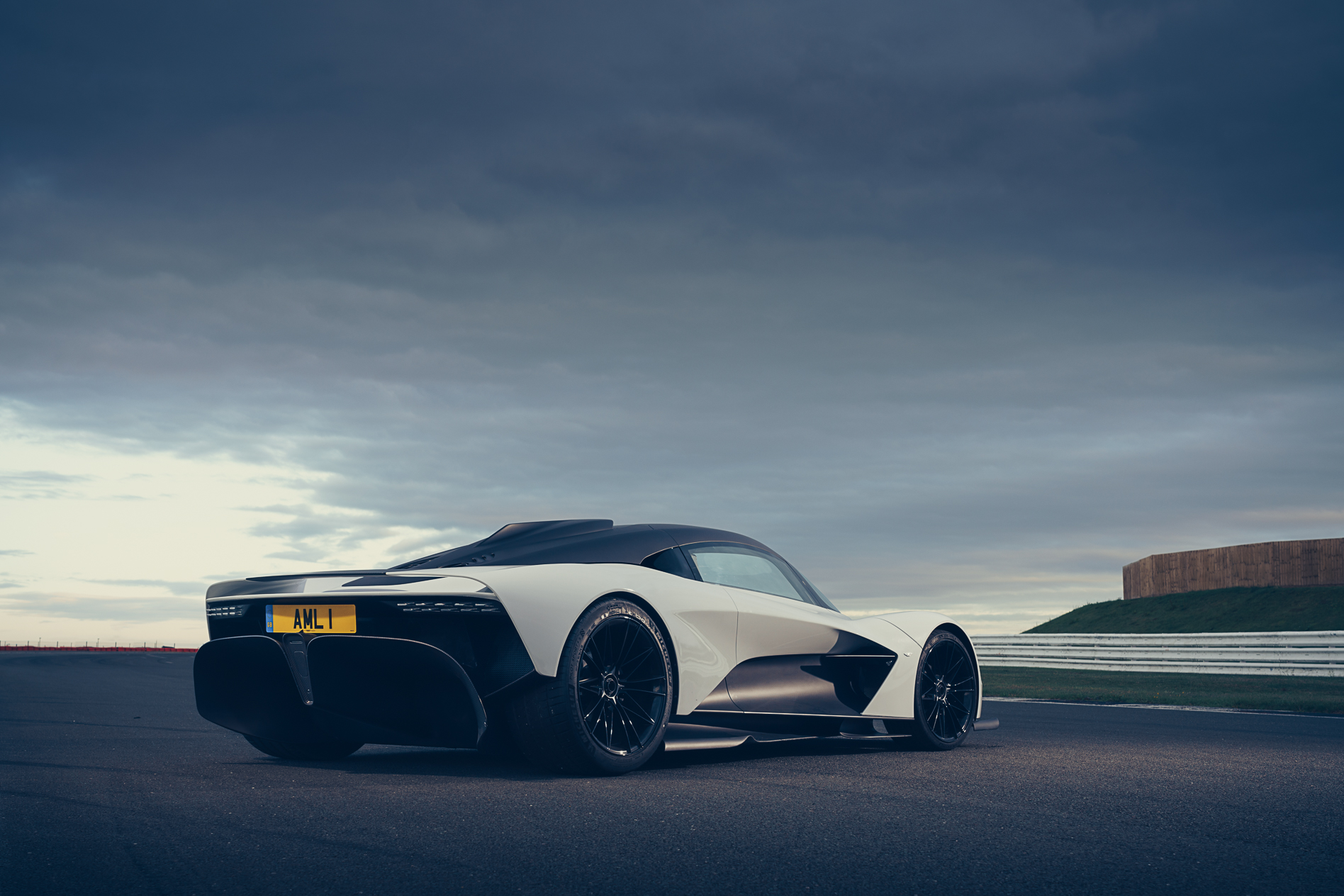
The revival of the Range Rover, Aston Martin’s astonishing Vulcan, the landmark Rolls-Royce Phantom: Marek Reichman’s resume needs no embellishment. Majoring in industrial design, the 53-year-old Brit’s grasp of both materials science and the craft of car manufacture is key to his work. The current Aston Martin Valhalla features Reichman’s trademark solidity and architectural precision of line.
“A hypercar is all about performance but it has to be robust, has to be lightweight but look strong. It is more elemental and functional,” Aston’s studio head says. Hypercars grew from the mid-engined silhouettes of supercars, a form factor forged five decades ago. With the Valhalla and Valkyrie projects under Reichman’s guidance, the most exciting road car genres are morphing into something ever more progressive. AE
5 – Ikuo Maeda, Mazda
It’s impossible to profile Mazda design chief Ikuo Maeda without mentioning his father, Matasaburo, the (now retired) Mazda designer who penned the original RX-7. Apparently father and son had a slightly tempestuous relationship, but Ikuo joined the company in 1982 aged 23, and has contributed first-hand to the shift in Mazda’s ethos and ambition.
Few concept cars encapsulate this better than Ikuo san’s awesome RX-Vision, first shown at Tokyo in 2015 and embodyingthe KODO design language. From its long, low bonnet (achieved thanks to the compactness of the rotary engine) and short rear-deck proportions, the RX-Vision somehow grabs the essence of Mazda’s sports car history and crafts it to the end point where the company sees itself, with Maeda at the design helm, powering into the future. AW

4 – Luc Donckerwolke, Hyundai/Kia
Has there been a more spectacular design turnaround in recent times than that of Hyundai/Kia? Maligned and scoffed at not so long ago, now the Korean brands are producing some of the industry’s most striking and influential cars. Don’t believe us? Google ‘Genesis Essentia concept’. Key to this radical turnaround has been the hiring of some of the design world’s leading minds.
Former Audi designer Peter Schreyer played a pivotal role, as did Sasha Selipanov (now at Koenigsegg), but the man currently in the hot seat is Luc Donckerwolke. Renowned for his work on the Lamborghini Gallardo, Donckerwolke took up his role as design head for Hyundai Motor Group (which includes Kia) in 2015. Rumour is he’s pushing for an even more radical direction, but meeting some resistance internally. Change is never easy. AI

3 – Gerry McGovern, Land Rover
How do you reinvent an icon? You certainly don’t follow. “I don’t take any notice of the competition when it comes to design,” says the consistently brusque McGovern. “I’m not interested in following the latest trends. Trends come and go.” Function inevitably dictates form at Land Rover, a company which McGovern claims “has its roots in pure design as opposed to styling”, and the new Defender’s adoption of an aluminium monocoque chassis will doubtless shift the agenda for serious 4x4s.
The design chief’s bold rejection of anything with a sniff of retro about it could have alienated a notoriously diehard clientele. “The new Defender is respectful of its past, but it isn’t harnessed by it,” he claims. In this key market sector, McGovern’s design direction sets the bar. That’s influence. AE

2 – Franz von Holzhausen, Tesla
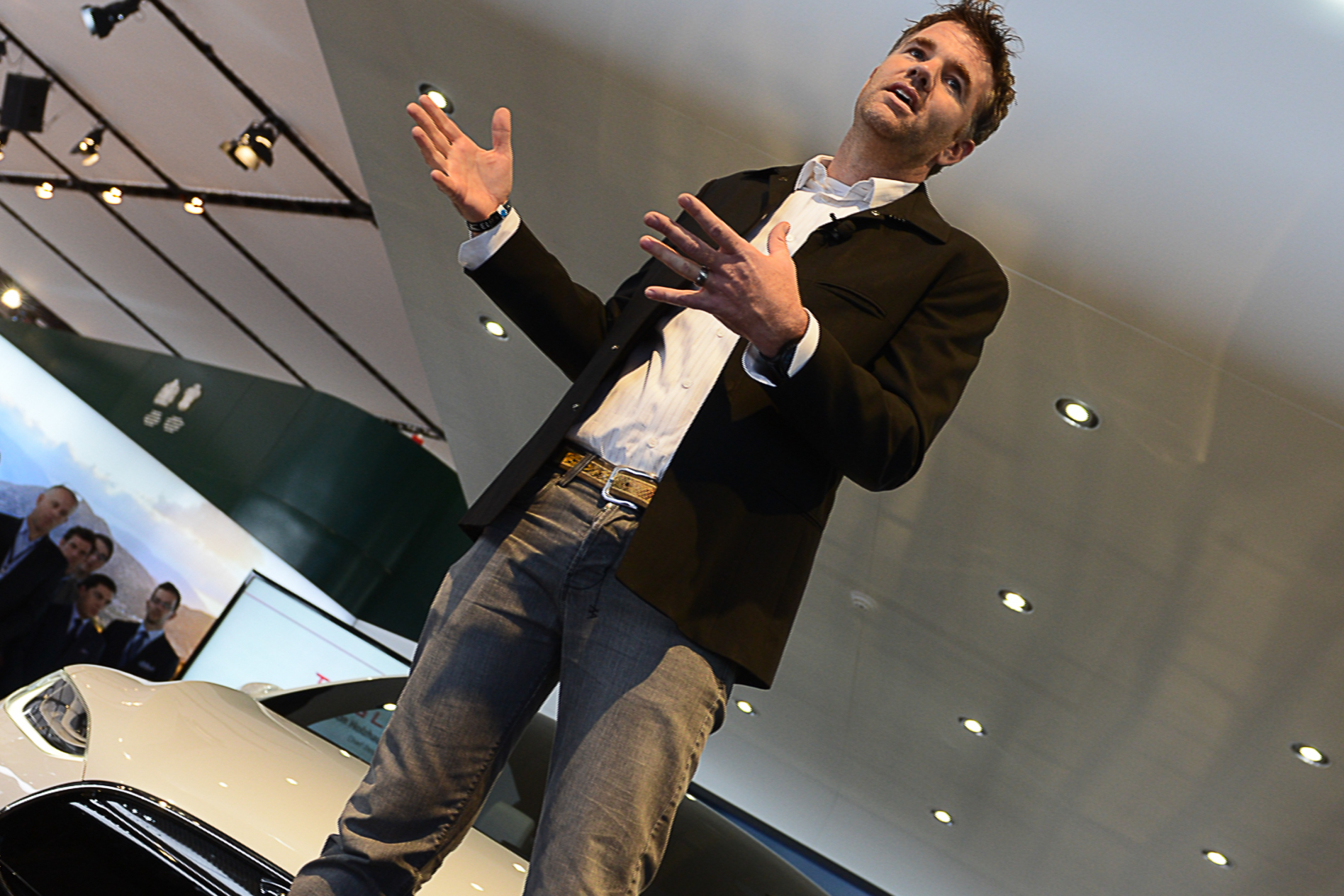
Slightly controversial, this. Not for including von Holzhausen in this company – few could fail to see the influence his work at Tesla has yielded on the entire automotive industry – but for his placement at number two. Educated at the same school as Chris Bangle, J. Mays and Henrik Fisker, Franz earned his stripes at VW, GM and Mazda before joining Tesla in 2010, when the company was selling just one car (the original Roadster).
He’s since helped spearhead the American company’s assault on the establishment by giving us the Model S, Model X, Model 3, Model Y and the second-gen Roadster. An ability to marry minimalism with striking proportions and detailing defines von Holzhausen’s work, though his true influence lies in his ongoing legacy of transforming EVs from being dorky and peripheral into objects of desire. AI
1 – Gorden Wagener, Daimler
Sensual Purity – Gorden Wagener on Design might just be the world’s most beautiful book. It’s a seamless, metallic hardback tome with organic embossed strakes running across the cover. Figure out how to open it and Wagener’s concept of a future world bursts into life. It’s not just cars: roads, bridges, villas, skyscrapers, boats, aircraft.
It’s akin to being plugged into the Mercedes-Benz Chief Design Officer’s brain and it’s both gorgeous and dizzying. Wagener’s breadth of vision made him a perfect fit for this role; appointed in 2016 at the tender age of 39. His brief? To stand Canute-like against the ceaseless tide of demographics, reducing the average age of Mercedes buyers. Dynamism rather than Stuttgart’s trademark conservatism now permeates the business. The Vision EQS design study demonstrated a newly nuanced luxury aesthetic and Mercedes production vehicles are also achieving something few thought possible.
The average CLA customer is 10 years younger than for any of its other models. In Europe, half of CLA customers are conquests from other brands. Fully 75 percent go on to buy another Mercedes. Design weaponised as a central pillar of corporate strategy requires a formidable hand on the tiller. In that regard at least, Wagener has no peer. AE

Honourable mention – Mark Adams, Opel
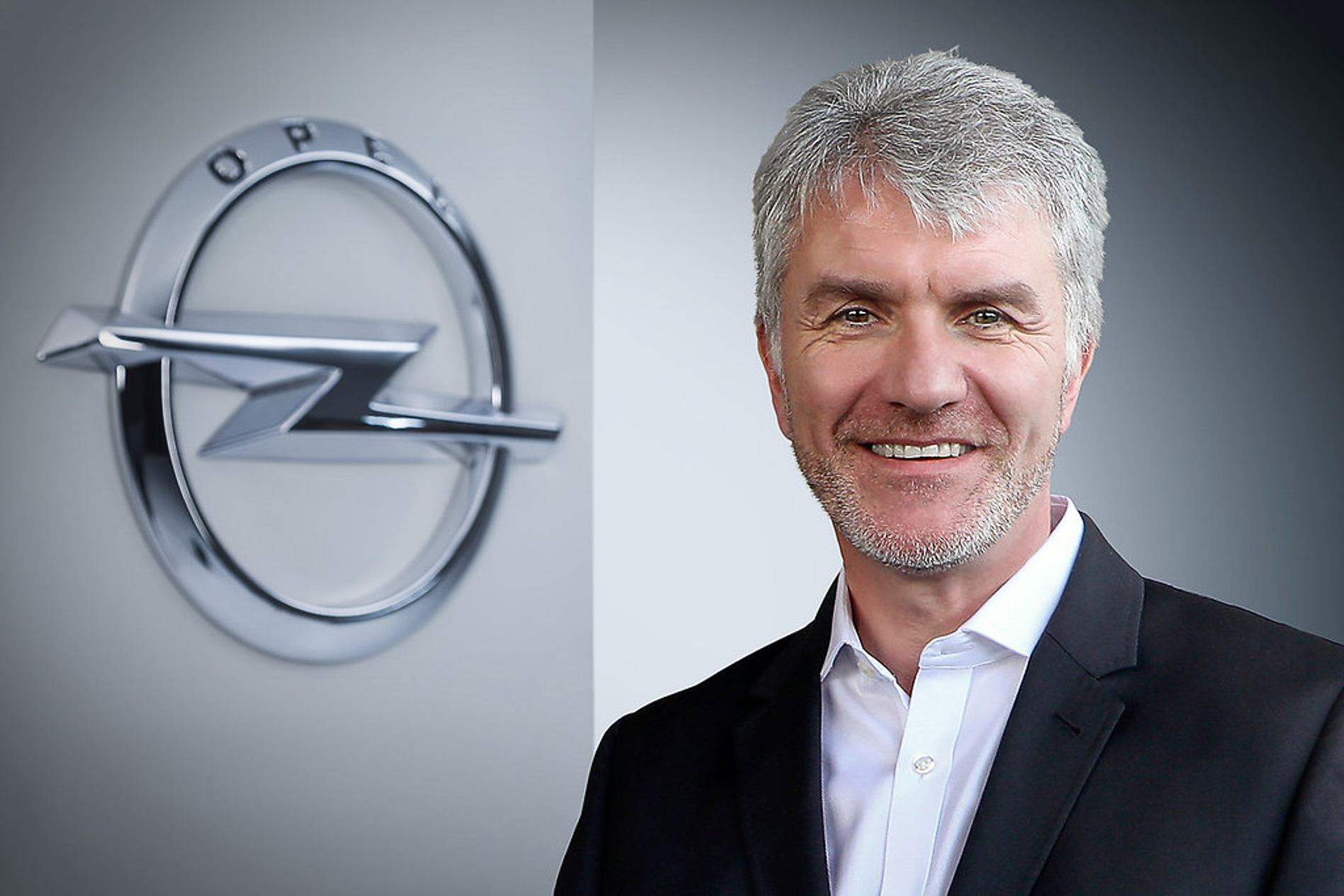
Adams is a former senior GM design figure who’s worked across the portfolio of brands, but currently heads up design at Opel, now part of PSA. His back catalogue includes GM’s breakthrough hybrid, the Chevrolet Volt, but Aussies will be more accustomed to his Opel Insignia (right) or, in local parlance, the ZB Holden Commodore. An engineer who then pursued a master’s degree in vehicle design, his inclusion here comes via a particular Ian Callum recommendation.
“Having both an engineering and creative, artistic background means that I use the left and right sides of the brain; in my job I think that has been an amazing benefit,” reflects Adams. “When I’m challenging engineers I can understand engineering principles very well – this has given me a very strong foothold in both camps.”
So what is central to great design? “My three most important rules are proportion, proportion, proportion,” he insists. “Because great proportions then allow you to simplify your design approach. You don’t have to try so hard, you don’t have to over-decorate when you have well-thought-out product fundamentals.” AW
Sign up here to get weekly Wheels highlights
Back when I was 17, within days of getting my driving licence, my parents shouted me an advanced driving training day. As they had done a few weeks earlier, when getting me prepared for my driving licence test (which I almost failed, for heel-and-toeing), they turned to Peter Finlay.
Peter was a front-line open-wheel racer in the 1970s, though he’s probably best known for his road and race driving school, which grew out of the one founded in 1967 by Peter Wherrett.
Something Finlay said to me all those years ago, as I squealed around in my drum-braked Mazda B1800 ute, rang loudly in my ears on a recent holiday in Greece. To paraphrase: always try to turn a big accident into a small one, or a small one into a near-miss.
In Greece, pure luck was the only thing that separated a near-miss from a big accident. In Mykonos for the July school holidays, I’d rented a Fiat Panda for our family explorations of the island. On one long incline not far out of the main town, we found ourselves immobile in a column of traffic. At which point, my wife insisted we should U-turn out of it, head back down the hill and find another route.
Tilting my head against the driver’s window (I’m on the left, remember) to see around the arc of cars, up the hill I saw a dark, narrow shape in the oncoming lane. It was about the size of a man, but it appeared to be coming downhill fast. Captain America in a winter tracksuit, was my first thought.
It may as well have been. Seconds later I was amazed/awestruck/appalled as the wheelying motorcycle, its rider and pillion both helmetless and shirtless, came past my window at a good 80km/h.
I was momentarily stunned. My wife, who hadn’t witnessed it, was still barking at me to turn around, but in the back of my mind was the probability that these blokes would have other bikes following them. I clocked a driveway on the opposite side of the road, flicked on my indicator, had a very conscious look ahead and kept looking as I turned hard to the left.
As the Panda’s nose reached the driveway, I heard the angry beeping of a horn. In my interior mirror a scooter rider, with pillion, was stopped on the centreline of the road. He was shaking his fist, shaking his head. Like I do when I’m on a bike and some bonehead in a car has almost cleaned me up.
I knew immediately what had happened. He’d been riding up the hill, overtaking the line of stopped cars. And suddenly, a white Fiat Panda turned into his path.
It was utterly, incontestably my fault.
In the midst of a bunch of converging factors – the speeding motorcycle stunt, my efforts to look up the road, being in a left-hook car and perhaps removed from unconscious habits – I just hadn’t thought to check behind me.
The scooter rider shook his head some more, then rode away. I stopped in the driveway for a couple of minutes, getting my head together. I felt guilty and ashamed. The scooter rider, his passenger … my daughter, sitting directly behind me, protected by only a few millimetres of sheetmetal and glass.
Our fabulous holiday may have been moments from a nightmarish saga of Greek police stations, hospitals, panicked and distraught relatives. Perhaps even a nightmare of a few lifetimes.
What shakes me so much is knowing that the outcome was completely out of my hands. One second later, three seconds later … I don’t know how near the near-miss was. I hadn’t heard the scooter, either before or during my turn, so perhaps it wasn’t even that close. But I don’t know, because I didn’t look.
While I’m grateful that chance smiled upon us on this occasion, I’m having a hard time forgiving myself.
Three seconds. That’s how much slower Formula One cars will be when the sport introduces a sweeping set of rule changes to revamp operations from the ground up in 2021.
However, what the sport stands to gain in return is much more important. Under these new rules, devised over two years between the FIA, F1 and owners Liberty Media, it’s believed cars should be able to follow a leading vehicle at one car length with only a 14 per cent loss of downforce.
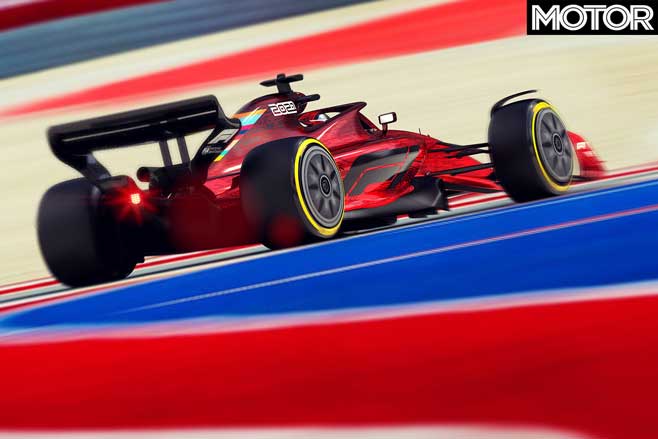
Currently, cars lose 45 per cent downforce at the same distance, robbing them of the chance to keep pressure on the car ahead. It’s no wonder Lewis Hamilton holds the record for the most wins from pole position.
Key to changing this is a radical new aerodynamic philosophy that forces cars to rely on ground effects from a tunnelled underfloor instead of being wing-dominated. It’s the latter, and the bits designed to maximise each wing’s effectiveness, that push turbulent ‘dirty air’ outwards at the car behind.
Instead, the new ground-effects package retains this dirty air within bodywork before lifting it over and out of a following car’s way. Its projected gains improve even more at three car lengths, where the loss of downforce is claimed to be only six per cent instead of 32.
It’s promising stuff, so F1 has worked hard to protect its new rules from teams trying to find a breakthrough advantage when developing their new cars.
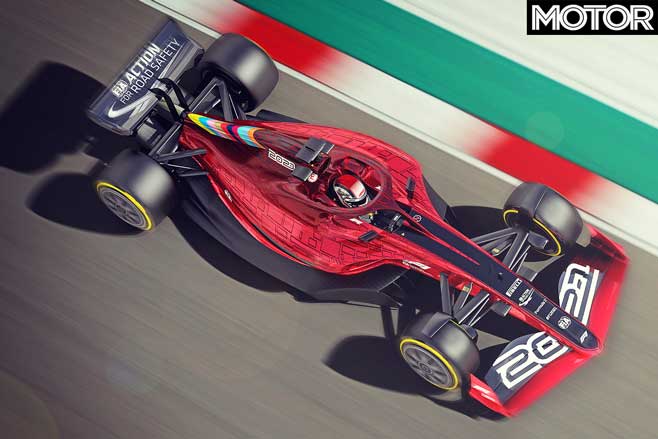
For example, F1 will police bodywork more thoroughly (with laser scanners) and clarify grey areas on what is an aerodynamic device to include suspension arms and brake ducts. As well as this, it will also prescribe the design on areas that affect aero wake most.
F1 will also introduce its first ever budget cap. Set at USD$175m (AUD$258m) over a 21-race season, it only covers direct car performance and racing costs, so peripherals like marketing and driver salaries are excluded. It will be enforceable too, with points at stake for any infringement.

At the same time, F1 is also trying to cut costs for smaller teams. Therefore a raft of parts will be sourced from a single supplier and built to one specification. These include nuts, wheels, brake discs, hubs, tyre blankets and fuel pumps. Testing in wind tunnels and on engines will be limited, while gearboxes can only be redesigned once every five years.
The sport’s relevance to road cars will strengthen with the adoption of 18-inch wheels, a higher renewable fuel content and leaving alone for now what experts call “the most efficient engines on the planet”.
These changes aim to tighten the racing, balance the competition, ease financial burdens and sustain the sport’s future. So really, when it comes down to it, three seconds is a small price to pay.
Hot and Bothered
Expensive turbo hybrid V6s to stay
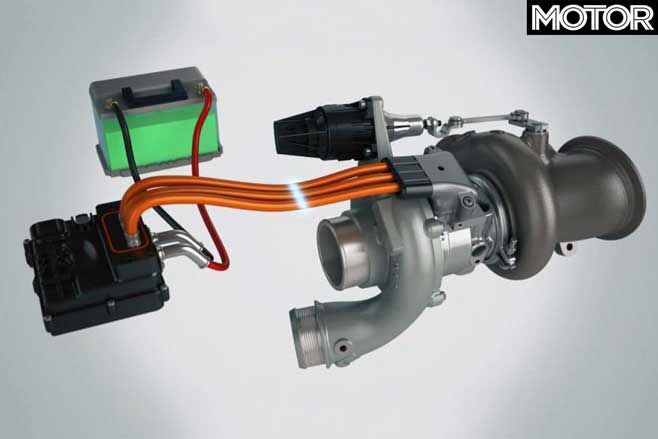
Fans have criticised Formula One for more than just predictable racing. The current 1.6-litre turbocharged hybrid V6 engines have drawn their fair share of flak for lacklustre noise and innate design complexity.
Even so, the new rules keep them unchanged from 2021, confirming F1 has rejected previous plans to significantly alter the hybrid powertrain and drop the energy-recovery system built into the turbocharger.
With the turbo’s Motor Generator Unit Heat (MGU-H) controlling boost pressure in place of a wastegate, its removal would have created an opportunity for more noise. And more manufacturers. Porsche was previously considering an entry for 2021 as an engine supplier but dropped that plan after it learned the expensive MGU-H would remain. Aston Martin and Cosworth reportedly also backed away after crunching the numbers.
And this is how the current four manufacturers – Ferrari, Mercedes-AMG F1, Honda and Renault – want it.
Ferrari’s reported nine-figure investment in the technology, along with Honda’s arduous development of its own MGU-H, reveals how far the works teams have gone to get the current technology right.
Although MGU-H has helped F1 engines achieve incredible efficiency – and they’re reportedly producing 1000 horsepower (745kW) with half the fuel that the V10 engines relied on 15 years ago – we are yet to see the relevance F1 wants to have with road cars.
That said, Ferrari has patented a hybrid V8 with a turbine-powered generator. And Ferrari supplier Garrett has recently developed an MGU-H for road cars, going as far as fitting one to an SUV.
