
All pre-production Porsches are, as a rule, painted solid black, only casually camouflaged with black tape, and they have all-black interiors with optional soft-shell black disguise pads here and there.
This monochromatic stealth car would look perfectly inconspicuous if it wasn’t for the four eye-catching, snow-white Caution! Experimental vehicle! stickers, which in Germany are mandatory in this era of battery-powered cars and potential electric shocks.
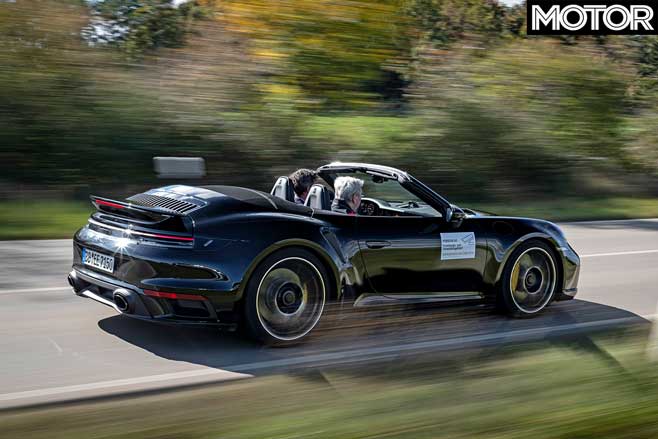
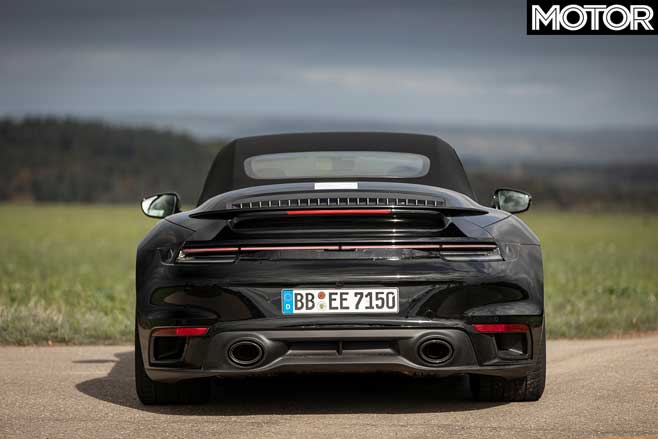
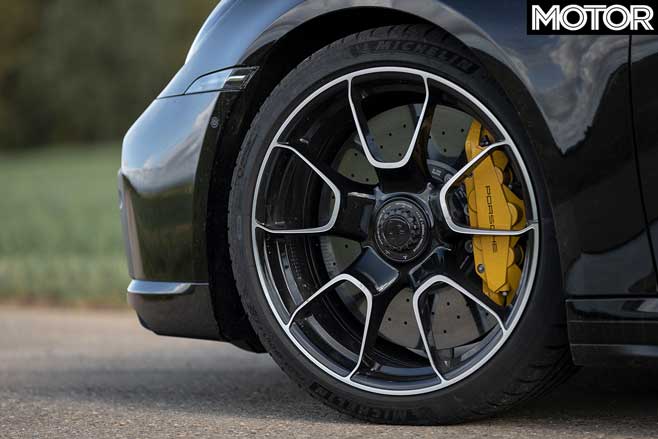
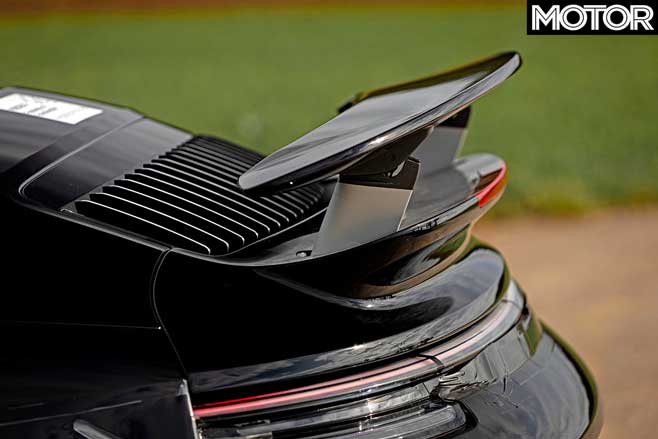
Although electrocution is not a risk when laying hands on the new top-of-the-line 992, the warning messages inadvertently distract spies from the changes made to the latest 911 Turbo S. Most significant are the redesigned rear apron-diffuser that accommodates the trademark four trapezoid endpipes; flush, multi-spoke lightweight wheels; bigger and slipperier side air intakes; slimmer and wider DRLs; restyled bumpers and a more elaborate ground-effect wingwork.
The 992 was developed under August Achleitner and his team, and contrary to popular expectations, the only battery installed in the new 911 Turbo drives the starter motor and supports the alternator – there is no mild hybrid, let alone a boost-effect 48V system.
“The benefits of partial electrification are marginal compared to the complex weight, packaging and cost issues,” Achleitner tells MOTOR. “Weight in particular is obviously critical for every sports car. Unfortunately you cannot de-content (remove features to reduce weight) a Turbo like a GT3 because the clientele would not tolerate it. Instead, the car gained a few extra kilos with additional convenience items and the new eight-speed PDK transmission. You would not believe the damage an extra set of gears does to the overall calorie count…”
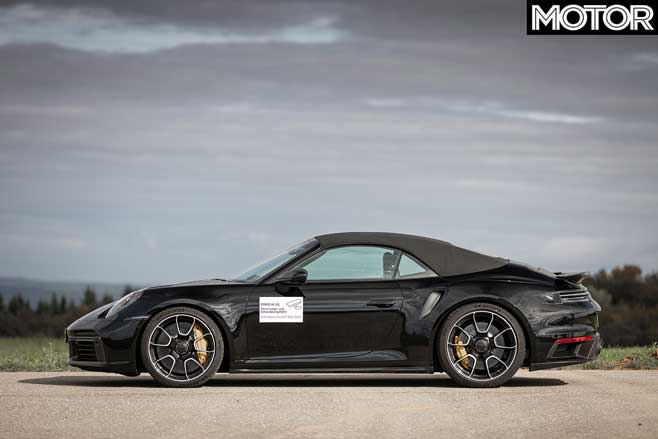
Unlike early Turbos, decried as ‘widow-makers’, more recent versions have been heavily bespoilered 911 iterations targeting the rich. The 996 and 997 Turbos in particular were known for straddling the boundary between sanitised faultlessness and budding boredom, were comprehensively kitted out with sound-deadening material and, starting with the 997 Turbo S, were no longer available with a manual gearbox.
“In this case, there wasn’t any real need for significant last-minute adjustments,” says new 911 product chief Frank-Steffen Walliser from the driver’s seat of our pre-release test car, “but I still feel we have steered the 992 Turbo fractionally more in a back-to-the-roots direction. To do so, even little things helped: stiffer joints, harder rubber bushings, tighter attachment points, modified spring and damper calibrations. What we definitely refrained from is turning a nicely balanced GT into a hard-edged street fighter.”
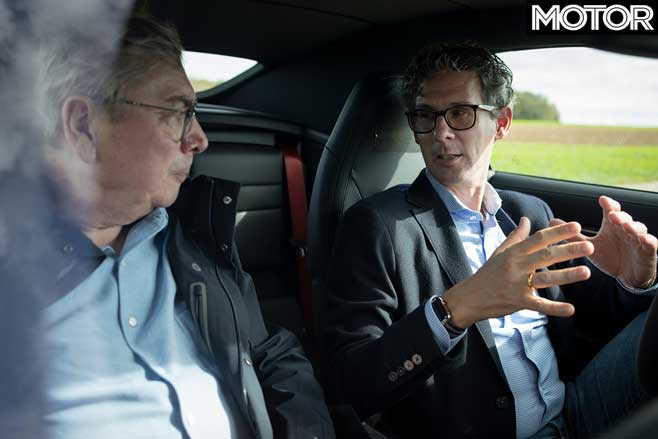
Walliser points out that we’re on the long road home, but I don’t grin because there’s a sudden transition from gentle breeze to gale-force storm. There is not enough time to ponder whether the driver is a certified lunatic or Mark Webber’s brother in arms, as the very first left-hander threatens to suck us in and spit out the remains.
But the very moment my lips begin to form the first line of Hail Mary, the front end grabs the last piece of tarmac before doom, the rear wheels follow a similar sabre-shaped arc, and we pull through, the fat rear end squatting down mid-corner like a sumo wrestler.
Little did I know at this point of the wild ride that foreplay is in Porschespeak merely a warm-up, that ESP can be switched off in two steps known as ‘please don’t’ and ‘oh-my-god’, that the prime mission of all-wheel drive and rear-wheel steering is to tighten the rope that separates experience from tragedy.
“Compliance is key, because compliance means control,” Walliser continues. “You want a sports car to respond in a sharp and positive manner, but the 911 Turbo is a little different since a super-quick or super-clever feedback could easily overshoot the target. The very last thing an engineer wants to do is unsettle or even scare the driver, who must always feel in charge, so a small margin for error here and there won’t hurt.”
No word about frightening the passenger, but that’s okay because all it takes for the co-pilot to catch the drift (!) is a little more time and trust. Trust in the cast-iron, sombrero-size brake discs, which measure 410mm up front and 390mm in the back.
Trust in the liquorice effect of the tyres, sized 255/35ZR20 and 315/30ZR21 respectively. Trust in the variable-rate, variable-effort steering that controls all four wheels, enhancing the manoeuvrability and solidifying the directional stability. And last but not least, trust in the black box and its army of sensors that must at all times be on the alert and cast the appropriate digital safety net.
Body and brain can absorb plenty of input in 90 minutes, but beyond the subjective passengering impressions there are precious few hard facts available at this point, mainly because the homologation is not yet complete. We know that the new EA9A2 engine is a twin-turbo 3.8-litre flat-six, apparently rated at 485kW at 7000rpm and 800Nm at 2500-4000rpm. The non-S engine is allegedly good for 440kW.
Both versions are mated to the new close-ratio, eight-speed dual-clutch transmission. Top speed of 333km/h is reached in sixth gear; seventh is kind of an overdrive for long autobahn journeys, eighth is the long-legged darling of the environmentalist faction.
Like all Porsches, this one allows the driver to pre-set the preferred dance mode via a knob on the steering wheel. Unless you’re running on empty, it’s best to forget Normal, which shifts up so early that this monster finds itself pottering along at 80km/h and 1100rpm in sixth, attempting to save our planet while making your nerve strings snap. You owe yourself Sport or perhaps even Sport Plus, although the latter is stubbornly dedicated to high revs and low gears. Best to compile a personalised selection of noise, grunt, throttle response, shift action and ride comfort.
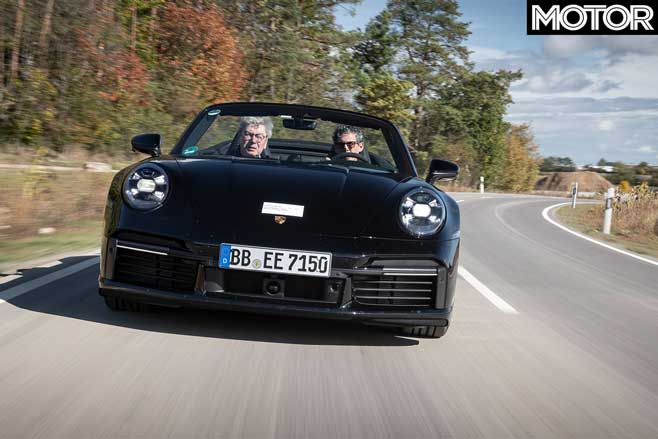
According to the Weissach grapevine, the hottest 992 can accelerate to 100km/h in 2.7sec, which is phenomenally quick for a vehicle that – unlike an EV – does require an extra blink of the eye to summon maximum torque. And it can beam itself to 200km/h in about 8.5sec. But the two-tenths acceleration advantage and 3km/h increase in maximum speed do not lift the high-end 992 tangibly above its predecessor. Instead, it’s the finer points that make the difference.
When Walliser had to leave, we went out again with a Porsche works driver for a second exploration round. On a busy Friday afternoon, one needs to know where to go to avoid traffic, and Jonas knew. For a start, he activated the sports exhaust, a new option for the Turbo that wilfully brushes the gentleman-driver character of the car against the grain.
The same goes for the spring and damper setting in Sport Plus and the weight of the steering, of which he says: “It trades some of the lightness and the relatively strong self-centring force for a more progressive and somewhat beefier action. Nuances only, for sure, but when you work with the 992 Turbo day in and day out, you quickly recognise the benefits, which include a more direct and transparent connection between the road and the palms of the driver, let alone the seat of the pants. Advantage number two is a better tied-down chassis, which still won’t tramline or is upset by vagaries of the road.”
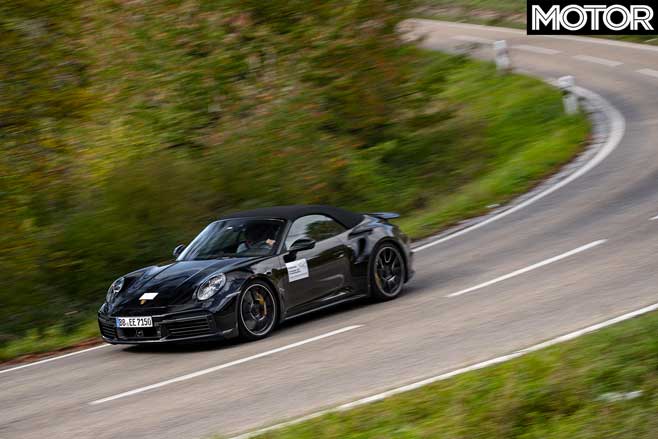
After a pause, he adds: “When encountering unilateral surface irregularities, the Turbo S does feel admittedly busier than a Carrera 4S, and the comfort zone between information and interference is narrower. But I for one would happily pay this price in exchange for the enhanced haptic clarity.”
Makes sense. Could I perhaps give it a go and…? Oh, I understand. Too bad.
When conquering the Black Forest, you drive through thousands upon thousands of trees, and rarely in a straight line. But with the ESP on snooze and with a man in charge who knows every second fir by first name, some bends leave fatter exclamation marks on the passenger’s hard-drive than others. Once again, it’s all about trust and ability.
Equipped with marginally beefier rear wings and an accordingly wider track, the 992 Turbo S is almost as aggressively tyred as the GT2. The tiny deficit in contact patch on roads like these is easily compensated by the broader calibration of the spring and damper settings.
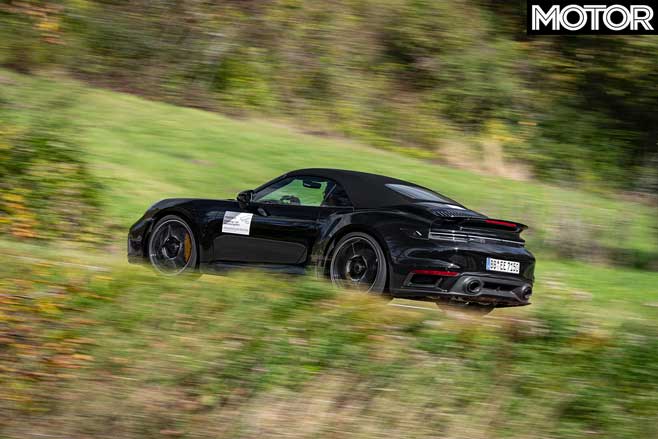
The rear-wheel steering is not quite as slam-dunk radical as in the GT2, and then there is the added benefit of all-wheel drive. It’s the never wavering turn-in grip that completes the ten-out-of-ten handling score. A quick flick at the wheel, a stab at the throttle, a moment’s wait followed by a dab of opposite lock and, voila, another creamy slide is safely in the can. I just sit there and watch in awe, gaping, wide-eyed, hoping for an encore.
The new Turbo gets a much more elaborate aero pack, still with a fixed rear wing but its surface area increased by about 20 per cent for even more downforce and straight-line sure-footedness. The nose sports bigger air intakes to cool brakes and radiators, and incorporates a venturi-effect, bumper-to-underfloor ramp-lip-exit device that keeps the front end true at high speed.
The new engine is fed a bigger dose of air straight into the intake manifold, and exhales through an intestine exhaust system that sounds more Harley than Porsche at idle. Despite the intrinsic choke effect of the mandatory particulate filter and the absence of an electric booster, the high-revving, low-end-torque six-cylinder obeys throttle orders with the hurried efficiency of an infallible footman.
We return the car in the nick of time, a shaken and stirred scribbler trailed by a provocatively relaxed driver. Still sorting thoughts and impressions, one thing is clear from the moment the passenger door drops shut: just as the GT3 with touring pack moved one step further away from the RS model, the new Turbo S is taking half a step back towards its original DNA, having grown a little too cushy since the raw 930 started the breed in 1974.
With the transmission in Manual and the drive mode selector in Sport, the focused mindset prepared to use high revs and explore the car’s lofty limits, the extra excitement this Turbo generates compared to its predecessor may not reveal itself immediately. The seconds gained when whipping this Porsche from A to B are of minor importance. What matters more is the how, not merely the how fast.
Of course, evolution and progress are gradual. But according to the physical seismograph and the mental processor linked to it, the ultimate 992 (at least for the time being) is now a little more involving, a little more responsive and a little more agile overall. A Turbo S with a twist, so to speak. This is a car conceived to satisfy repeat customers yet perfectly capable of attracting new buyers who honour a spicier blend of sportiness and convenience.
In Australia, we are unequivocally spoilt for breathtaking holiday and getaway destination choices, but many are overlooked as ‘too expensive’.
It’s true that, when compared with popular all-inclusive package deals to overseas locations including Thailand and Bali, a break on home turf can appear quite pricey, but that needn’t be the case.
We set out to prove the point and went in search of an Aussie doorstep holiday that is every bit as memorable as a break abroad, without costing the earth.
Key to our WhichCar ‘budget adventure tour’ is transport. With more families choosing a dual-cab or large 4×4 as the main car, many Australians already have the perfect vehicle for setting out on a home-grown holiday sitting on their driveway.
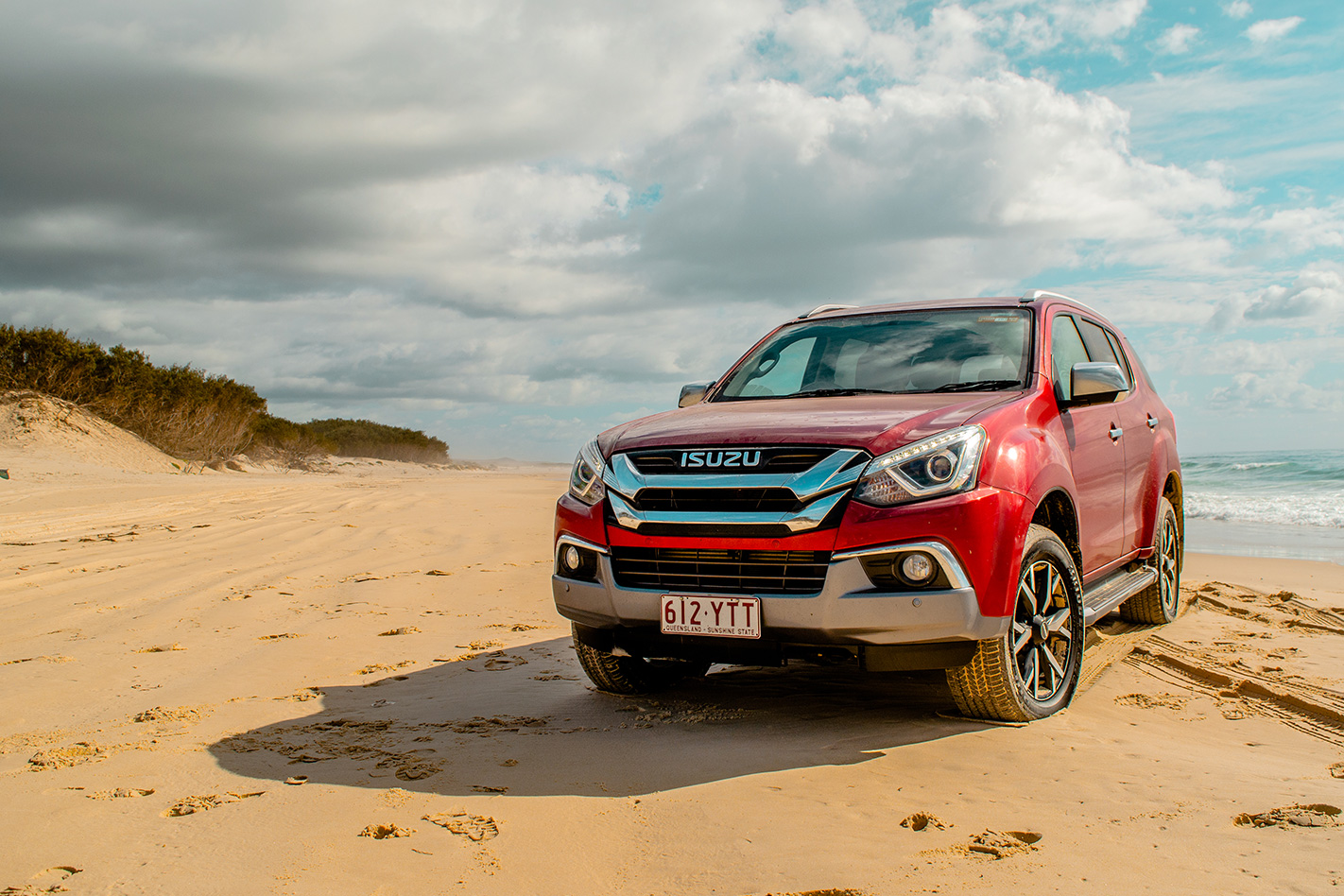
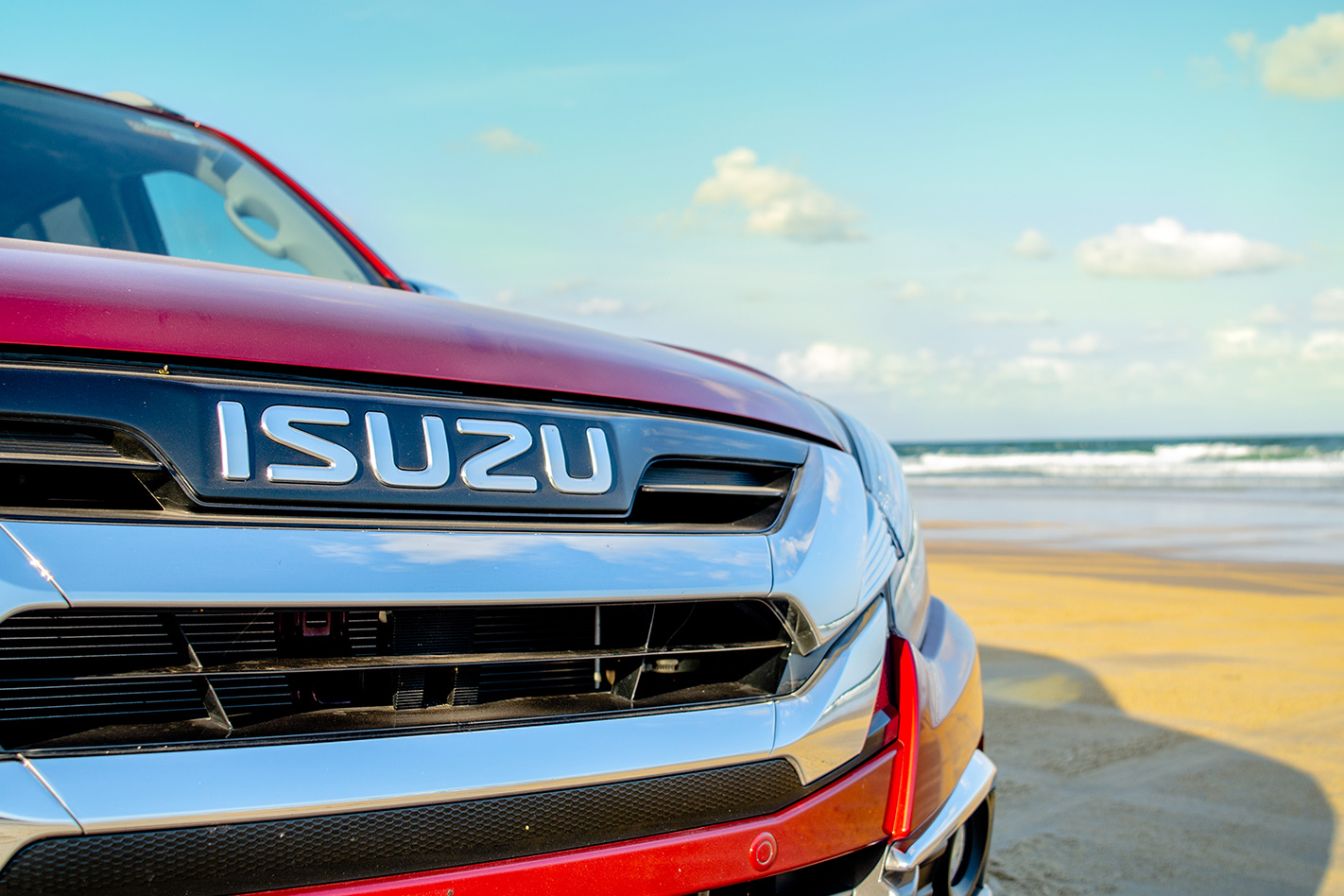
In accordance with our low-cost mantra, we chose an example that’s affordable, capable and dependable away from the beaten trail, and offers a compelling package from a trusted brand – the Isuzu MU-X.
This Japanese seven-seater has been on the market in its current form since 2017 but it attracts consistent sales and it’s the third most popular large SUV on sale in Australia to the end of October this year. Only mighty Toyota can outdo it with the more expensive Kluger and Prado.
On a tight budget, the MU-X range starts at $42,900, the cheapest four-wheel drive version will cost you $50,200 but we saddled up the current range topping LS-T, which comes in at $56,200.
With transport decided on, the destination is next. Heading overland to the deserts of central Australia is certainly one option, but with 50,000km of coastline, more than 10,000 beaches offer unlimited options for those looking for a relaxing and picturesque destination.
After weeks of unrelenting Melbourne winter we were looking to kick-start the summer early and Queensland’s balmy climes beckoned. About an hour out of Brisbane you’ll find a small drive-on ferry that will float you across to North Stradbroke Island in about 45 minutes.
At about $140 return, the Ferry is one of the more expensive elements of a Stradbroke escape, but we’ll aim to offset that with the rest of the trip.
D-Max X-Runner makes a comeback
If the kids are after the bright lights and fairy floss of a resort, make a small detour and stop in at one of the Gold Coast’s numerous water parks. With a coil-sprung rear axle and tall tyres as standard, the MU-X is completely happy covering the freeway miles. Our top-shelf version was even equipped with an entertainment screen for the rear occupants that cleverly hinges down from the ceiling.
In the performance stakes, the Isuzu has a 3.0-litre diesel that produces an acceptable 130kW and 430Nm, which is at the lower end when compared with most rivals. Diving out for overtaking moves requires a bit of planning at freeway speeds and, while there’s good off-the-mark shove, it drops off sharply as the revs rise. There are better SUVs to pilot on roads but there’s nothing offensive or unlikable about its somewhat benign nature when covering distance.
But while pursuing your own Australian adventure will certainly involve some highway miles, it’s what happens after the blacktop ends that matters. That’s when the true fun starts.
Rolling off the boat along a narrow concrete ramp into Dunwich, the MU-X is faced with more sealed roads. In fact, you can negotiate a large part of the island in any car at all, but discovering the hidden gems of this natural wilderness requires a decent 4×4.
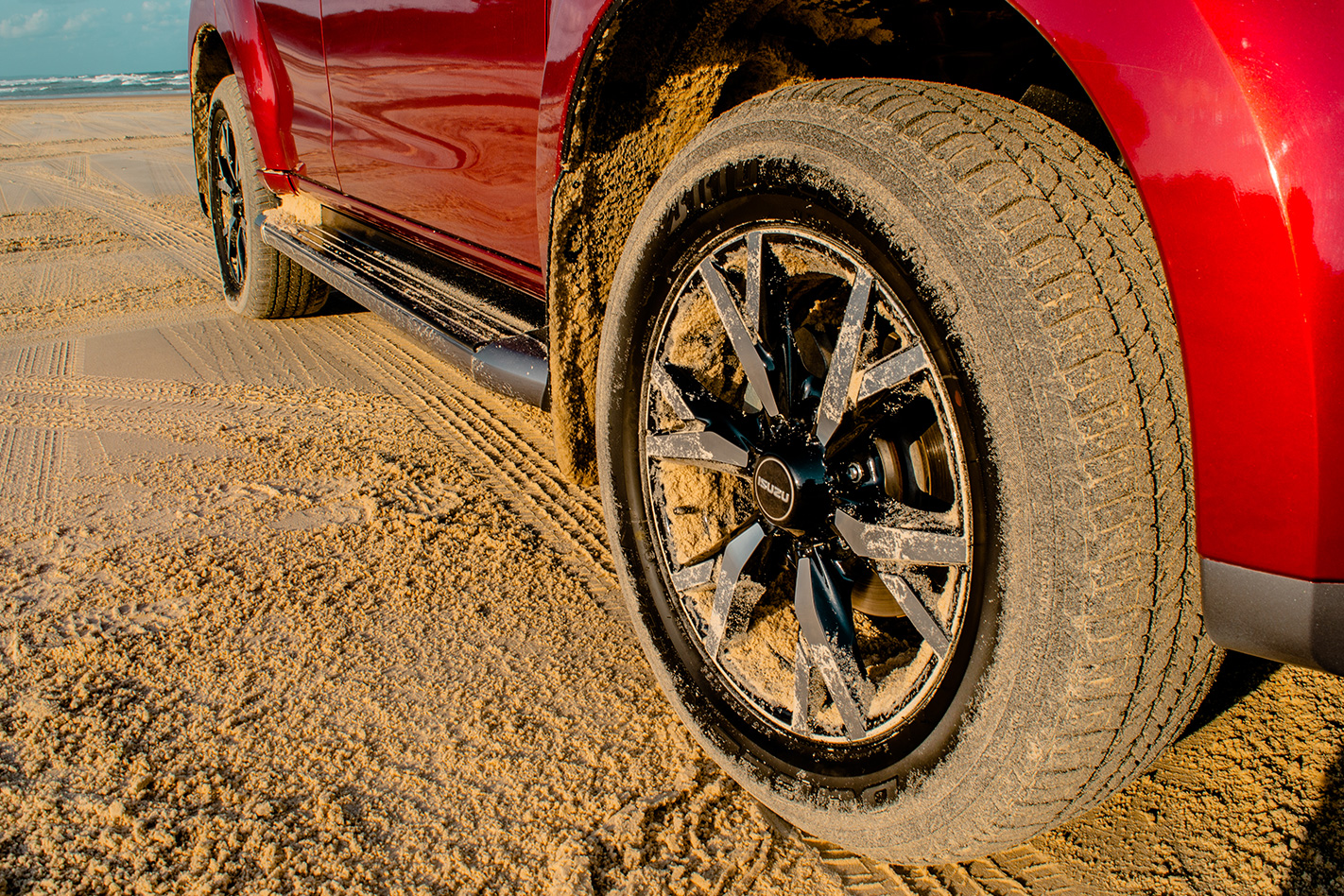
After picking up a few provisions and a 4×4 pass (it’s advisable to book camping and vehicle passes in advance), we headed away from the tarmac. While the low-slung 2WDs were left to circumnavigate the island by road, the Isuzu has a proper four-wheel drive transmission and low-range box. Combined with standard highway terrain tyres, the MU-X promised decent go-anywhere potential and we were not disappointed.
As a sand island, you might expect Stradbroke to present some real traction challenges. You won’t find sticky mud bogs or epic water crossings (unless you try to get back to the mainland without the ferry), but the omnipresent soft sand will undo anything but a proper all-terrain vehicle fast.
No such trouble for the MU-X though. Simply flicking the electronic selector from rear-drive to all-four was enough to tackle almost any inland trail and allowed us to take a direct route through the middle of the island over the highest peaks.
Spectacular vistas are reserved for the most adventurous and finding them is also huge fun too. With powdery sand under tyre, the MU-X is in its element and its four-cylinder diesel hums on contently while the tyres find their way through deep ruts without complaint.
There are more challenging tracks for modified and the most hardcore machines including severe climbs on equally loose sand. Only once did we have to turn back after finding the very limit of traction and it’s possible a little pressure removed from the tyres would have allowed progress to continue, but Stradbroke is a labyrinth of trails and navigating them is part of the fun.
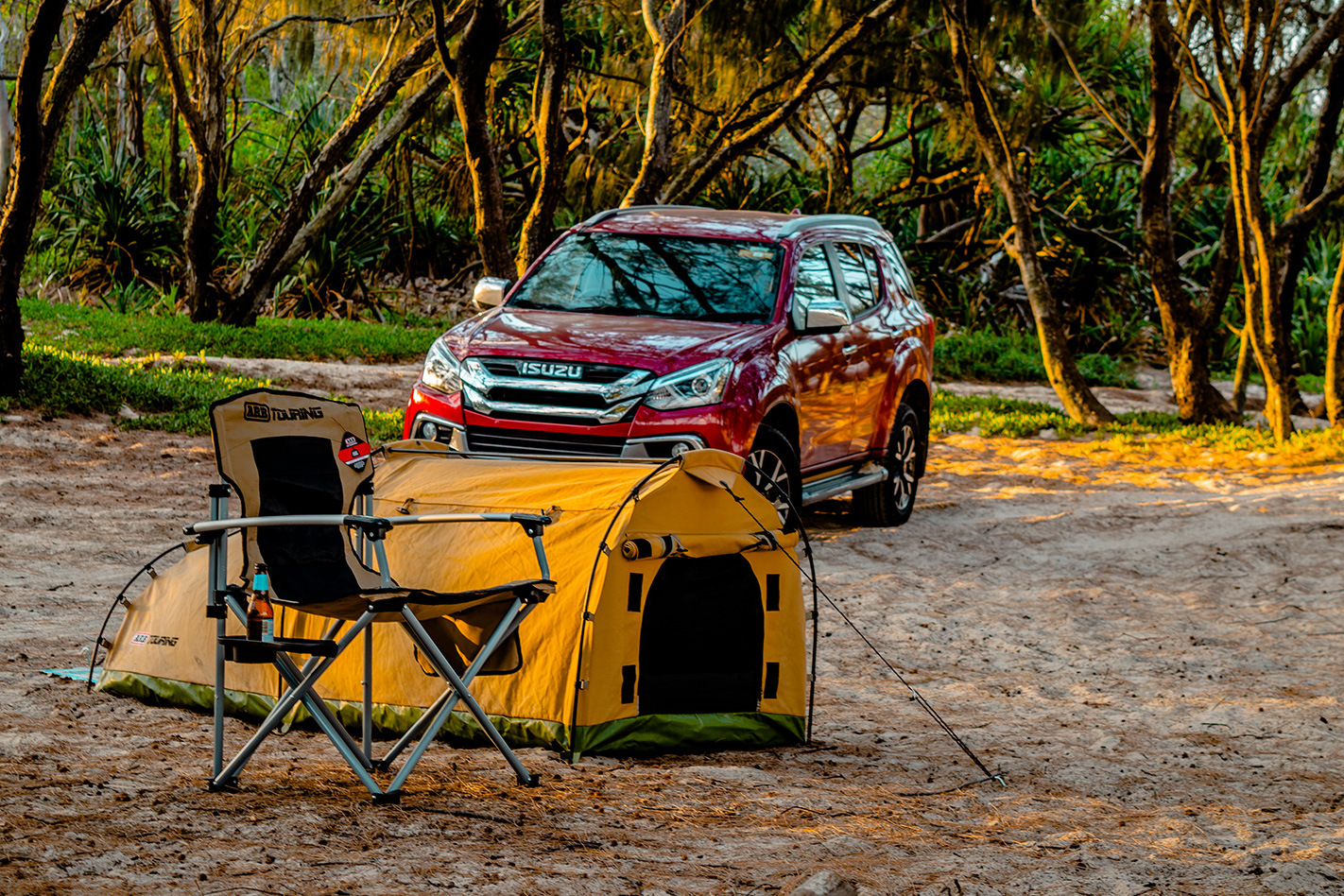
A short time later we were rolling out the swags in our first camp for the night – Amity Point. Powered sites, full amenities and even shark nets in the designated swimming beaches represent the luxurious end of the camping options on the island and our first night was about as comfortable as you will find under canvas. Not bad for around $30 per night.
But the next day it was time to set a course for the true Stradbroke wilderness camping experience. After an excellent egg and bacon brekkie cooked on the tailgate of our Isuzu D-Max support vehicle, we were once again off into Stradbroke Island’s stunning forest.
Emerging an hour or so later, the leafy surroundings part way to reveal some of Australia’s most arresting beaches. Unlike many however, almost all of Stradbroke’s sand can be driven on.
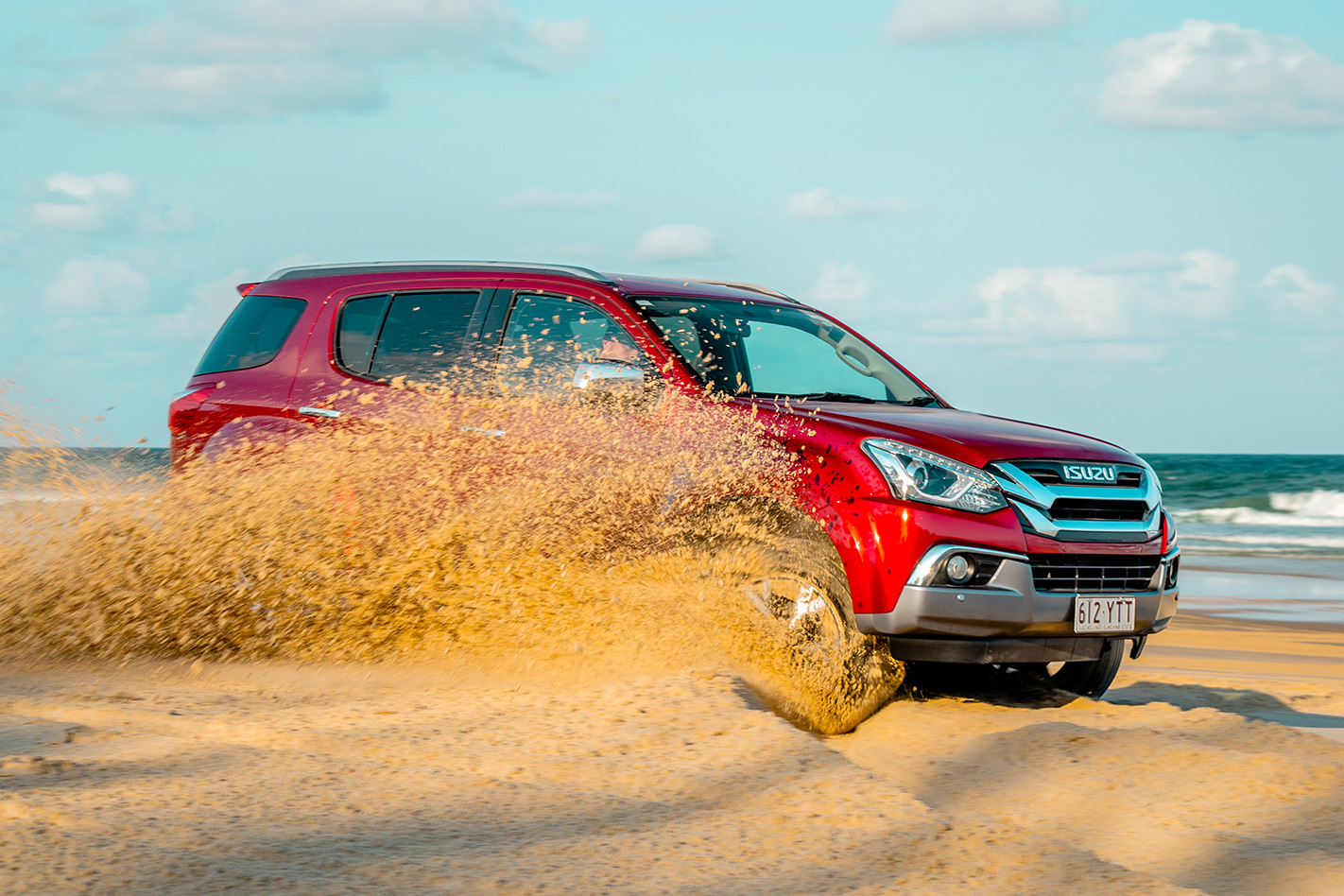
It’s not quite a free-for-all and rules apply including a 60km/h speed limit and you can be stung with fines for reckless behaviour, but you don’t have to flout with the law to have a brilliant time behind the wheel here.
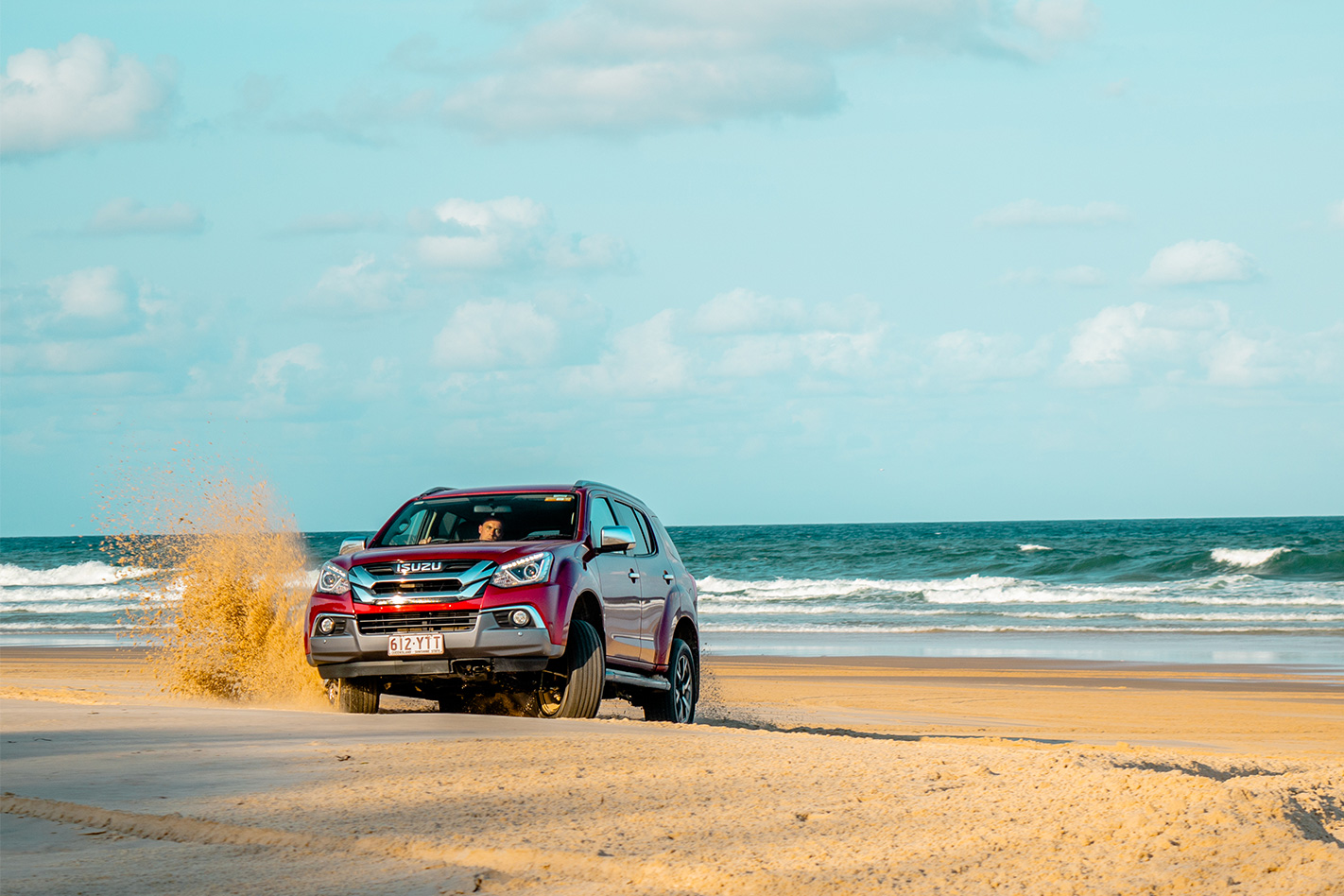
A precautionary twist of the transmission mode into low-range avoided an embarrassing bogging in the very deep sand where the harder-packed road comes to an end, after which the Isuzu blasted out on to the expanse of Main Beach.
This 30km stretch of pristine sand is flanked by protected dunes on one side and on the other, nothing as far as South America. In the middle there’s you and a 4×4, and the experience is truly unforgettable.
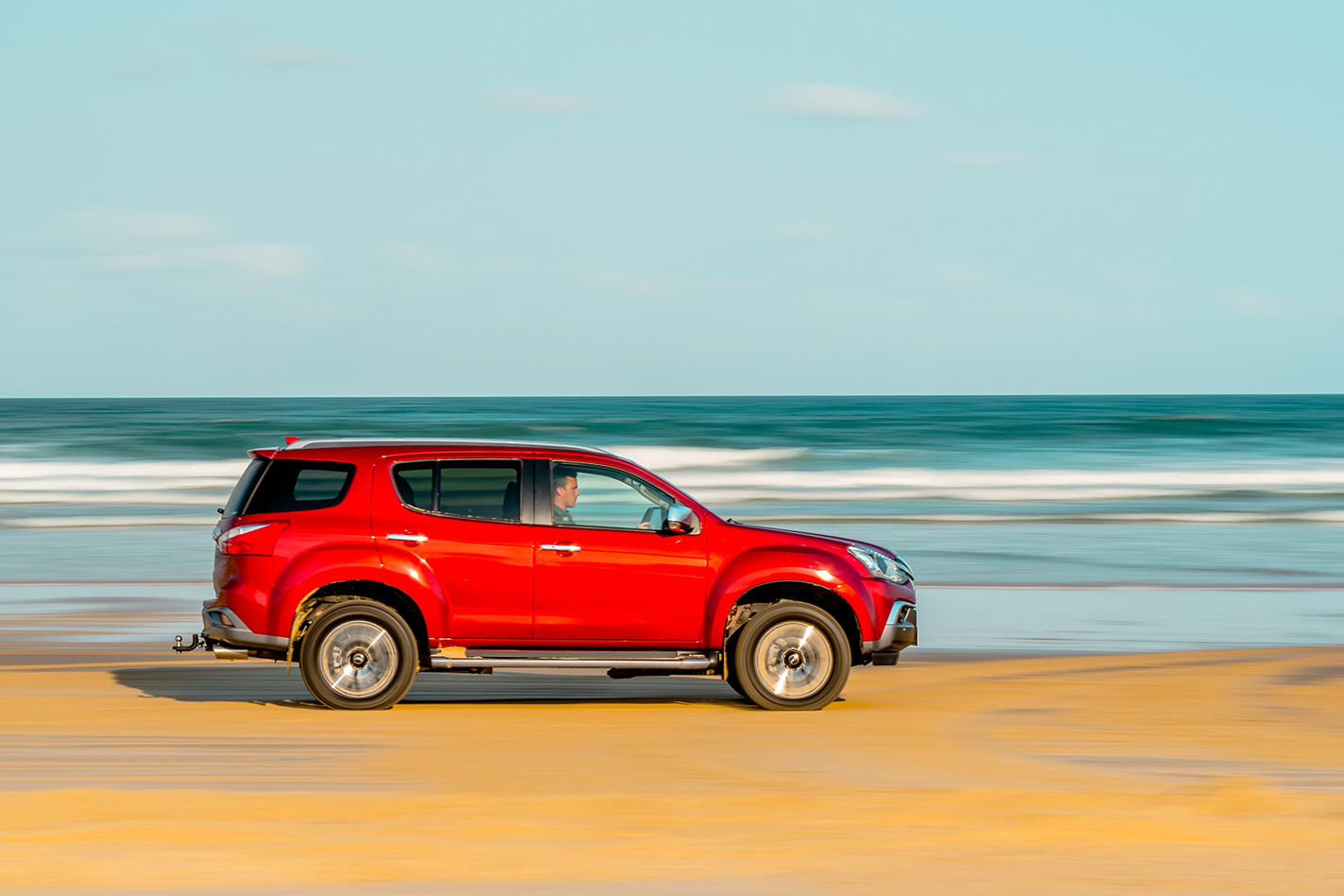
With firmer sand, two-wheel drive could be engaged once again and the Isuzu had no problem tackling the terrain. However, an excursion into the looser stuff highlighted just how capable this machine is.
Deep fluffy sand that threatened to grab each corner of the car and drag it in up to its axles was fended away by a combination of generous ground clearance and tyre pressures lowered to 20psi. Even with the significant drag of deep sand, the trusty diesel plodded on at 2000 rpm, the temperature gauge unfaltering just under the ‘normal’ zone. It really wasn’t breaking a sweat.
As the MU-X powered on, eagles hovered overhead, Coral Sea waves broke onto the flat shoreline and we even pulled up to watch a turtle making its way back to safety after laying eggs in the dunes.
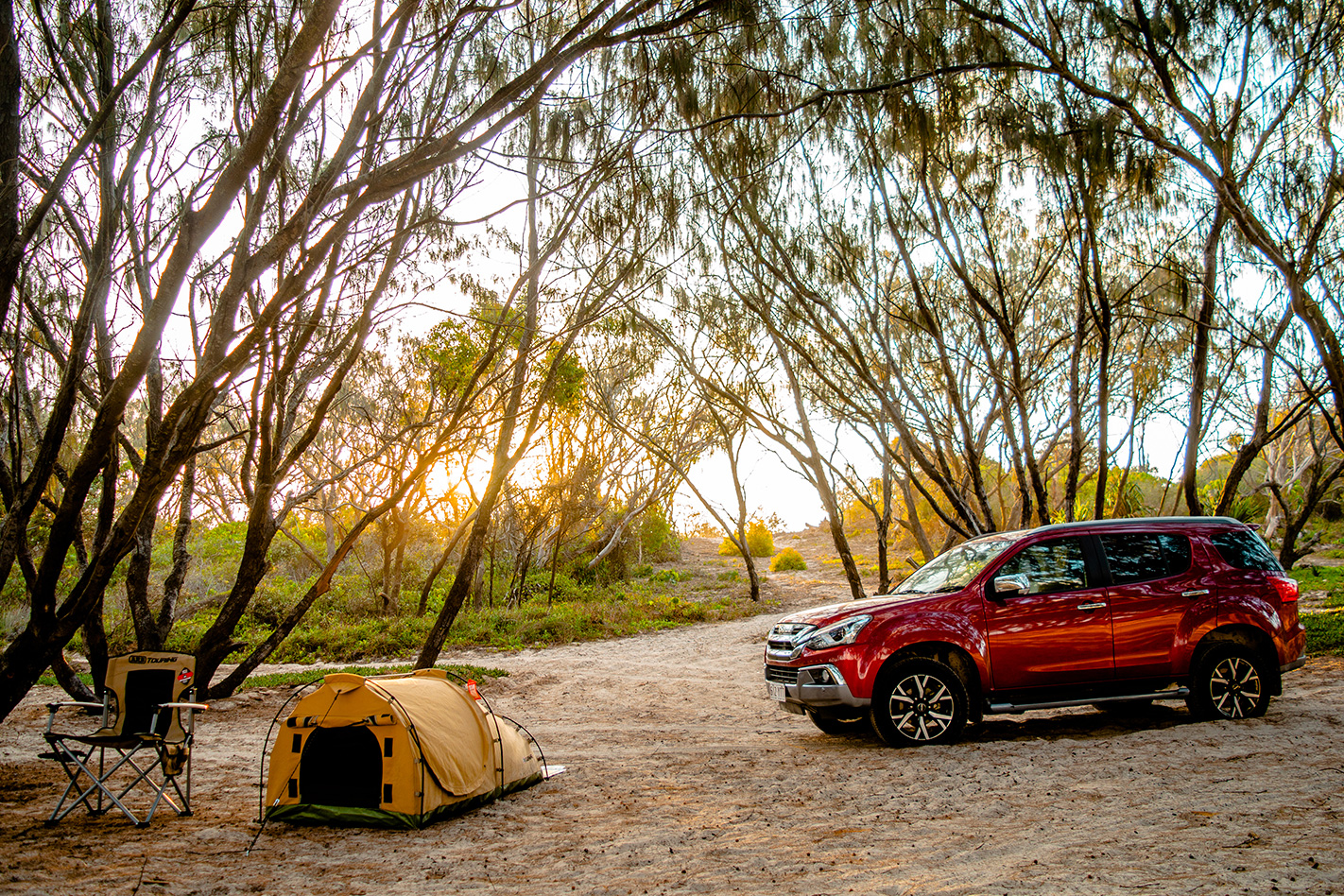
A short time later and we had arrived at our camp for the evening, this time devoid of any luxuries. Nestled in behind the dunes are designated camping areas and after engaging low range once more, the Isuzu carefully clawed its way over the embankment and up into the coastal canopy.
The D-Max was once again commandeered, this time to gather fire wood and the resulting blaze took the edge off a cool evening breeze while deterring any of the more persistent flies.
If you are travelling with a family, a trailer or some form of roof storage may be the go to fit everyone and everything in, but the boot accommodated everything for our trip including a 12-volt camp fridge. We would love a power socket that remains energised when the ignition is off, same as the D-Max’s does, but the ARB unit still dispensed a perfectly chilled beer when all the hard work was done.
4×4 authority ARB also provided the furniture including palatial folding chairs and a penthouse swag that makes my own look like a tired old windsock by comparison.
Over an expertly grilled sausage and vegetable medley a-la-tin, we pondered the adventure from sprawling metropolis to deserted beachside paradise.
Sure, a package deal from your local travel agent will keep you topped up with cheap Pina coladas and as many hours by the pool that you can tolerate. And there’s no denying the climates that you’ll enjoy.
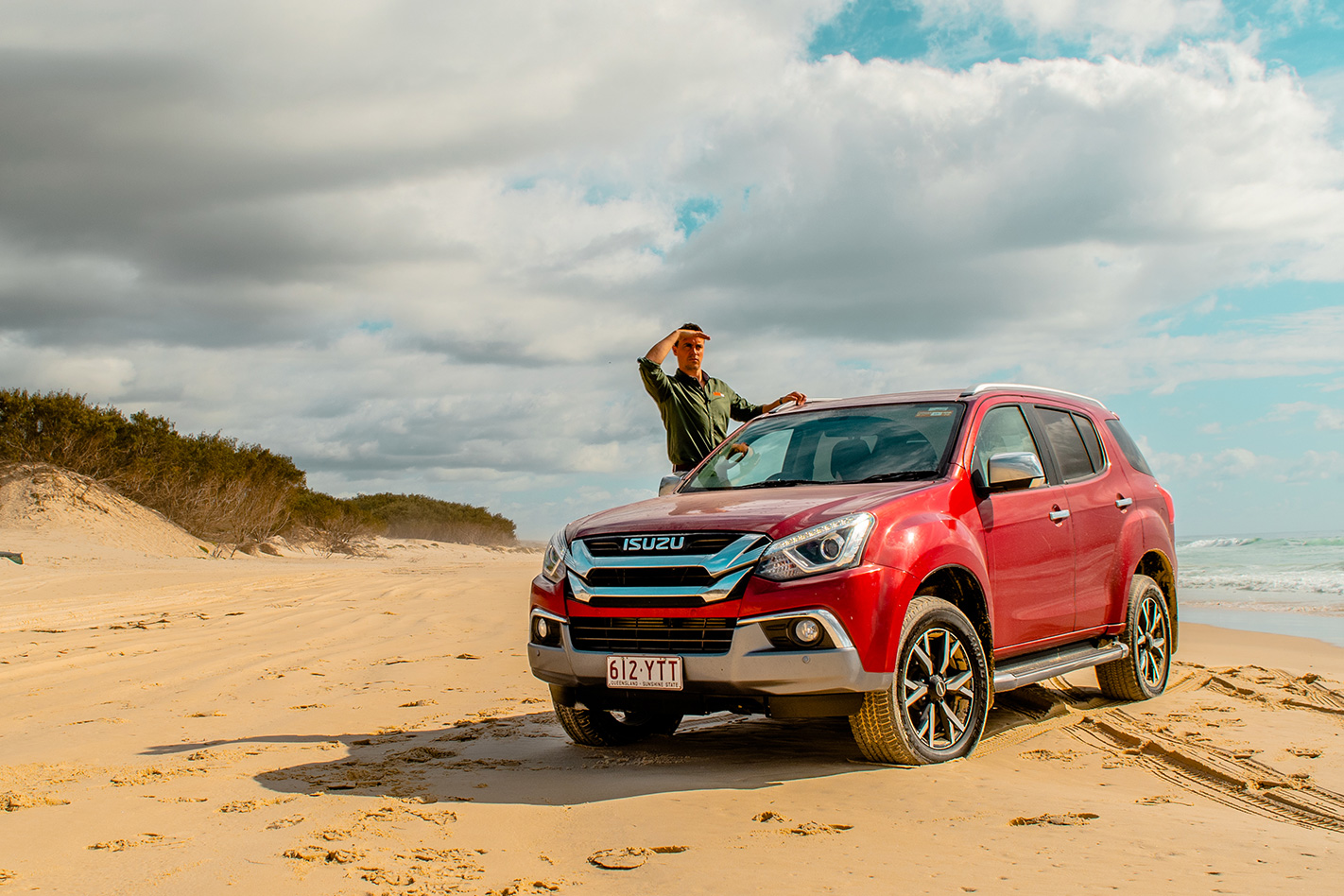
But if you’re after complete autonomy, independence and the ability to call the shots on your holiday, you simply cannot beat the flexibility of your own car, especially one that can take you virtually anywhere.
It’s also worth noting that a trip away in your own family car hosted by our incredible country avoids the pain of airports, getting there and back, the jet lag, vaccinations, turning up to find the hotel isn’t finished yet, suspicious water quality, language barriers and you can’t take the dog.
Even with a limited amount of off-roading experience, the MU-X (and its D-Max companion) had done everything we had asked of it including freeway cruising, hauling all our kit, and plenty of spirited off-road skirmishes.
And you definitely can’t do that on a hired scooter, somewhere in South East Asia.
It’s hard to tell which is racing faster, your heart or your head.
The runway is straight and hypnotic, and you have the better part of 1500 horsepower to harness. The problem isn’t so much getting up to speed, more the slowing down because we cannot use the full length of our airfield playground.
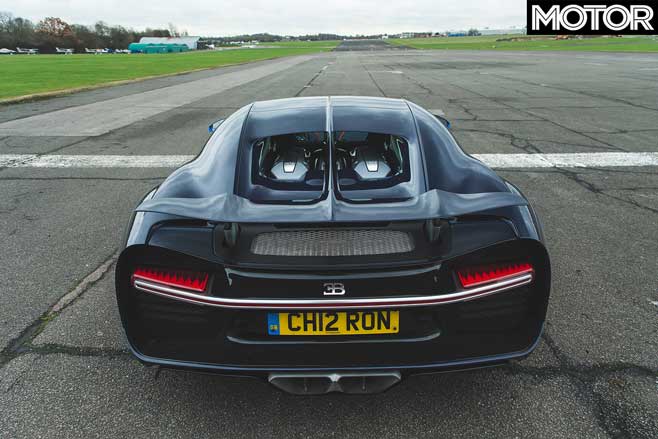
Early pluck has given way to intestine-wrangling tension – not that there’s anyone close enough to hear you curse. It’s just you, a Bugatti Chiron that is limited to 420km/h, and an ugly scar of blacktop that doesn’t feel level, even on foot. Take a breath. You know the drill. Word to the wise: if you absolutely have to talk to a car, for best results adopt a respectful tone. Launch… and we’re done with complete sentences.
Syllables bleed together in incomprehensible babble as self-doubt dissolves in rapids of adrenaline. Acceleration builds with brutal menace, each tug of the right paddle ushering in more commotion. The stats insist it will reach 200km/h from standstill in 6.5sec, but presumably that’s in the dry.
It has been raining for much of the past week. If anything, it feels faster, to the point at which you realise that, yes, you just might be out of your depth, and by several fathoms. Nevertheless, you keep your foot in, at least until it’s time to brake. Please, for the love of god, brake or we’ll be wearing a Nissen hut.
So there you have it, the Chiron is fast. Who knew?
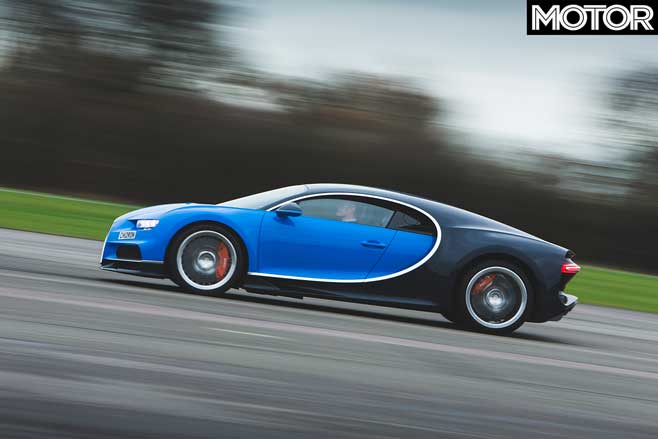
The thing is, this car operates at the outer limits of an envelope already pushed beyond endurance by the models that preceded it – the EB110 and Veyron. You see, these ‘modern’ Bugattis are outliers in the hypercar firmament; super-exclusive exotics that, in their own way, are masterpieces of engineering but also profoundly pointless. The Sisyphean effort invested in making cars that defy the laws of physics is of little actual worth in the real world. It’s all about bragging rights, and has been for the past three decades.
In a very roundabout way, it was Ferruccio Lamborghini – a man who in his own time upended the exotic market – who initiated the EB110. A discussion at the 1986 Turin Salon between the latter-day vintner and big-haired car dealer/importer Romano Artioli about resurrecting Bugatti led to further discussions, from which the nucleus of what we now know as the EB110 emerged.
Lamborghini soon lost interest, but a highly motivated Artioli persuaded the French state-owned SNECMA aerospace company to sell the rights to the name. Bugatti Automobili was registered in Italy in October 1987. All that was needed was a product to sell.
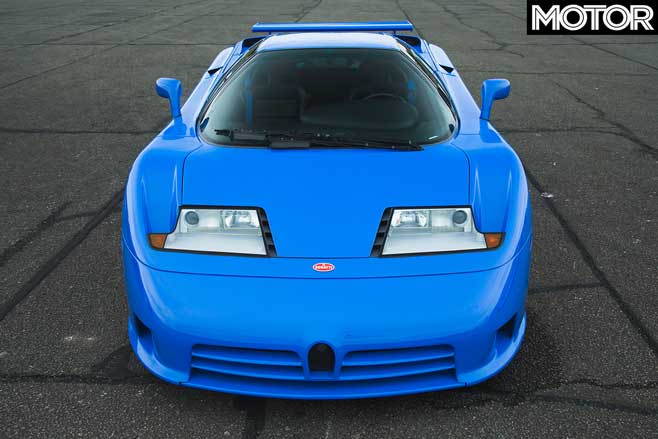
The EB110’s specification made other supercars look unimaginative. The basic layout was mapped out by soon-to-be-axed Paolo Stanzani, with early prototypes featuring aluminium monocoques, although these made way for carbonfibre tubs manufactured by French aeronautics company Aerospatiale. The superstructure was then skinned in hand-formed aluminium.
Then there was the engine, an all-alloy, 60-valve V12 furnished with four tiny IHI turbochargers. Power was transmitted to all four wheels via a six-speed gearbox, while suspension was by conventional double wishbones and coil springs with twin spring/damper units at either end. Brembo provided the brakes, and Michelin developed special tyres for a machine that, during the homologation stage, established a production-car speed record of 342km/h.
Unveiled at the Place de Defence in Paris on 14 September 1991 – to mark Ettore Bugatti’s 110th birthday, hence the initials and numerical designation – all looked rosy. The EB110 GT was officially the fastest road car available, and arguably the most sophisticated.
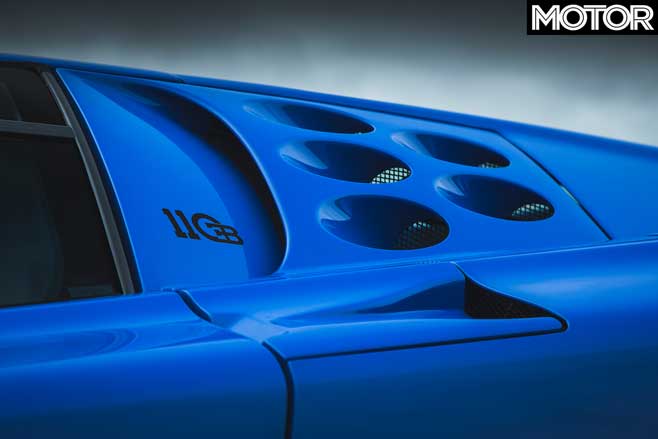
Then the global economy tanked. The proposed Giorgetto Giugiaro-styled EB112 super-sedan was quietly dropped as production of the EB110 coughed and spluttered, with sales never getting close to the envisaged 300 units per year. Deliveries began in December 1992 and ended in September ’95. A mere 85 ‘entry level’ GT editions were made (one in right-hand drive), along with 30 carbonfibre-bodied Supersports and 13 test hacks.
Following the bankruptcy sale, race team principal Jochen Dauer acquired and completed a batch of partially built cars, while adding a few tweaks of his own. Volkswagen subsequently acquired the rights to the name and released a flurry of concept cars before creating the Veyron, a remarkable machine that was essentially a vanity project dreamed up by Ferdinand Piech. The VW Group czar gave his engineers a simple brief: build a car packing 1000bhp that can exceed 250mph, or 402km/h. No pressure…
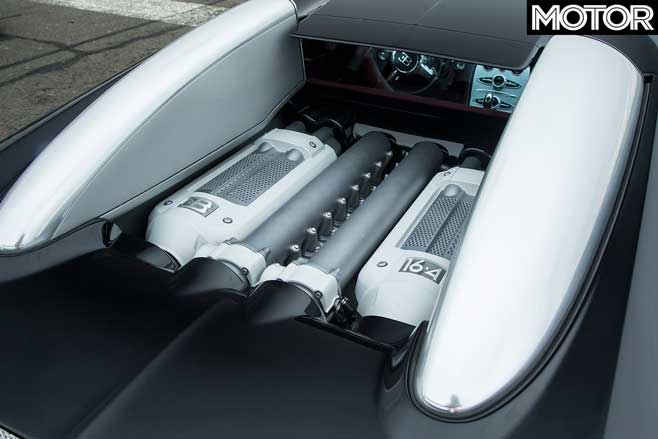
Scroll forward to 1999 and there was a styling proposal, an 18-cylinder engine and only the vaguest notion of what to do next. It wasn’t until 2001 that the VW board agreed to build the Veyron in series, with the first prototype being completed in 2003. Power now came from a 7993cc 16-cylinder ‘W’ unit that essentially comprised two 4.0-litre V8s on a common crank. This was coupled to a Ricardo-developed dual-clutch, direct-shift, seven-speed transmission. Like its EB110 predecessor, it came with permanent four-wheel drive.
Following repeated delays, the Veyron 16.4 was officially revealed in 2005 with a claimed power output of a then unheard of 1001PS (987bhp, or 736kW). In April of that year, the model was clocked at 408.5km/h at VW’s Ehra-Lessien test track near Wolfsburg.
Inevitably, other variants followed, not least the targa-style Grand Sport and Grand Sport Vitesse models, plus of course the heavily re-engineered Super Sport, which boasted 885kW and a top speed of 431km/h. Oh, and a price tag of almost $4 million.
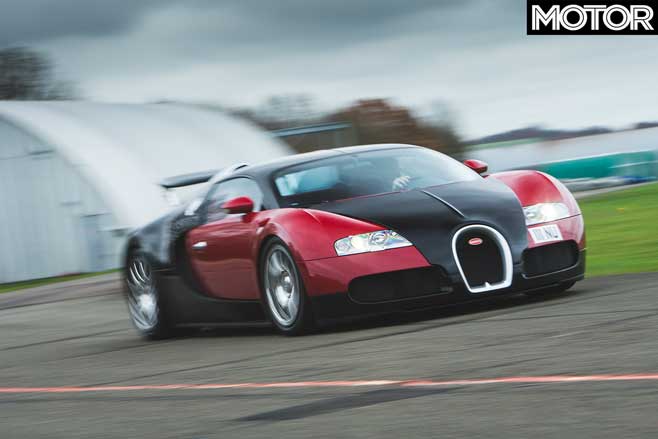
All told, 407 Veyrons were made to 2013, each losing the parent company a fortune, but VW appeared happy to toss millions more onto the pyre with the creation of its replacement, the otherworldly Chiron. Mirroring Piech’s prior mandate, former Porsche R&D chief turned Bugatti/Bentley boss Wolfgang Durheimer gave his factotums a simple instruction: “Make the new car better than the Veyron in every respect.”
The recipe was familiar: quad-turbo W16 engine, carbonfibre body structure, Ricardo-devised transmission and Haldex all-wheel drive. This was more than a Veyron makeover, however. Much, much more.
Just consider the stats: peak power – 1103kW – arrives at 6700rpm. There’s 1600Nm of torque available from 2000 to 6000rpm. It can accelerate to 100km/h from a standstill in 2.5sec and 300km/h in 13.6sec. Oh, and in one independently verified record run, a Chiron was taken from 0-400km/h in 32.6sec, before returning to a standstill 9.4sec later.
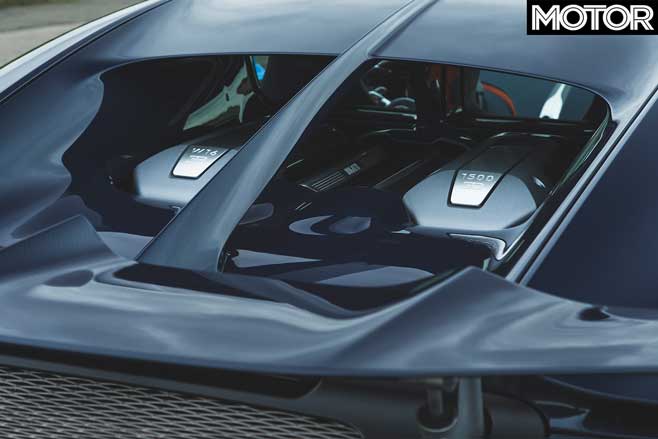
Nevertheless, when the Chiron was first revealed in 2016, some quarters of the media couldn’t help but point out that it was slower than the Veyron Super Sport. Bugatti’s retort was unambiguous: the car was limited to 420km/h for, ahem, ‘safety reasons’. The tyres might go pop at 421.
Without the restrictor, and ignoring the rubber-related issue, it could reach at least 445. And of course now we know the Chiron is capable of at least 490km/h, after a ‘long-tail’ prototype – now officially confirmed as the Chiron ‘Super Sport 300 Plus’ – broke through the fabled 300mph barrier in the hands of test driver Andy Wallace at Ehra-Lessien in August.
Which brings us to today, and the theatre of all three Bugattis gathered together for a shootout like no other.
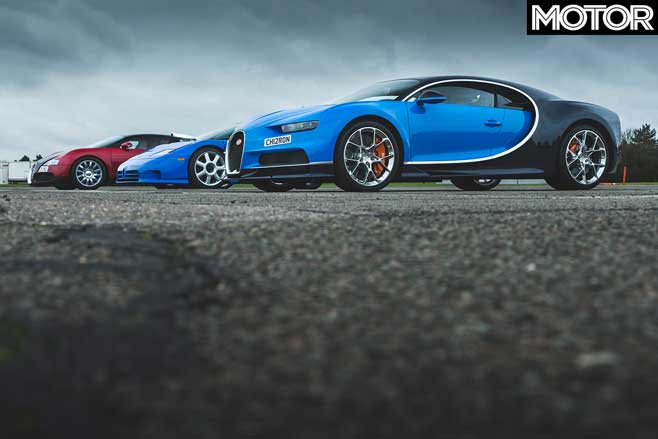
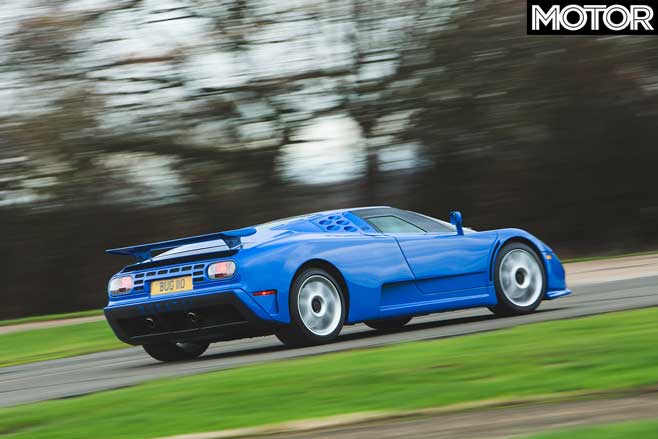
What strikes you about the EB110 in particular is that it’s a lot smaller than you’d think, being 15cm shorter than a Ferrari 488. This 1994 SS edition – 450kW rather than 410kW for the GT – is a thing of wonder, if perhaps no great beauty.
Pull down the scissor door and the base of the window is at neck level. Headroom is surprisingly tight, but the leather-clad seats are ultra-comfy, the pedals are only slightly offset towards the centre, and the instruments are easily visible. It even has adequate ventilation, which is something of a novelty for exotica of this vintage. There are only a few ergonomic quirks, but you would almost be disappointed if there were none.
Expecting the V12 behind you to erupt with surround-sound fanfare, there’s just a muted burble. It’s all very civilised. So far, so ordinary. But then comes the good bit. Hit 4000rpm from a standstill and the turbos start to inhale air.
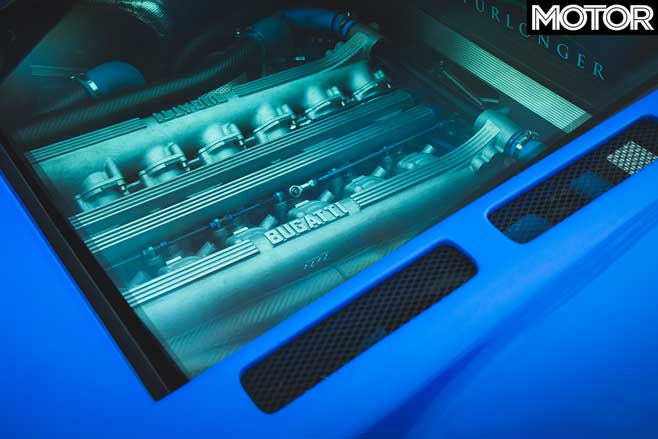
Acceleration builds abruptly but effortlessly. Back off and you can hear the quartet of turbos exhale sequentially left to right, left to right. Power on again, keep the throttle nailed open this time, and forward thrust is astounding. Peak torque (650Nm) arrives at 4250rpm and the four-wheel drive arrangement and broad Michelins ensure otherworldly levels of grip.
There are no creaks, groans or clunks through the structure. The suspension soaks up the worst surface imperfections and, at ‘enthusiastic’ speeds, the EB110 doesn’t intimidate. The gearchange is slick, the power-assisted steering – with just 2.8 turns lock to lock – is far from edgy. That a car packing more than 600 horsepower can be this easy to drive is extraordinary given its vintage. Remarkably, it was criticised in period for being too refined.
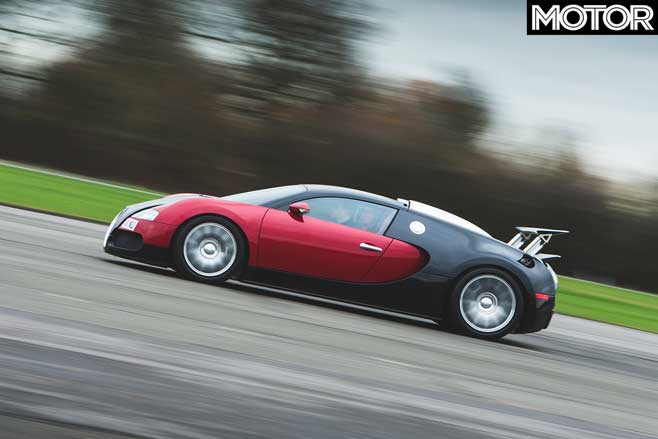
Then there’s the Veyron. Nothing about this car is in the realms of the normal – not least the styling, which still polarises opinion. Open the (conventional) door, stoop to enter while also negotiating the wide sill, and the cockpit is a work of art in itself. The carbonfibre seats are swathed in hides from pampered cows, the centre console is made of a single piece of aluminium, while the instruments are jewel-like in appearance, if not necessarily easy to read at a glance. It’s supremely comfortable in here, even if there are a few built-in blind spots.
The acceleration of a Veyron is immense. To give perspective, if a Veyron set off from a standing start 10 seconds after a McLaren F1 – in which time the F1 will already be travelling at 209km/h – the Bugatti would reach 322km/h at exactly the same time. With that in mind just in time for blast off, you feel every heartbeat thump in your temples. Engage each electronic nanny feature and the Veyron bolts off the line with nothing so gauche as wheelspin. Instead, the tail squats ever so slightly and you grip the steering wheel somewhat tighter than you might normally, but it doesn’t writhe in your hands.
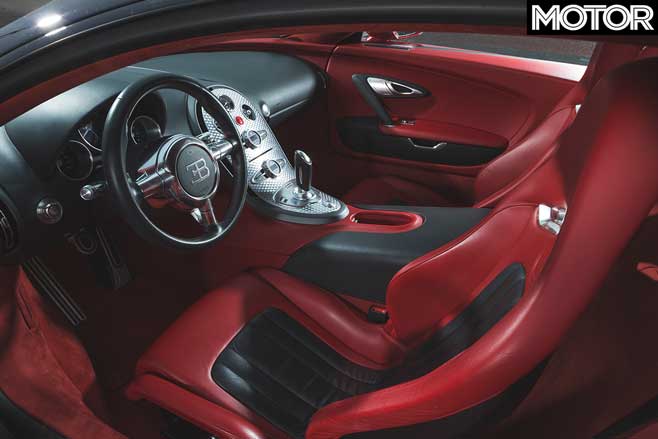
You accept a certain amount of chaos and confusion as givens, but you don’t white-knuckle the Veyron as in so many supercars of old – molten grip and perfectly weighted steering see to that – but the sheer punch broils your mind and turns your mouth to dust. Once you have overcome your awkwardness, you appreciate the Veyron’s abilities all the more.
Track limitations mean v-max runs are out of the question today, but from experience we know the Veyron doesn’t threaten to take flight north of 250km/h. And that it’s a lot easier to navigate through cityscapes than you might imagine, so long as you remember to change the suspension settings from Handling to Standard. You really can potter in a Veyron.
The same is true of the Chiron, perhaps even more so. There is so much about this car that invites hyperbole, but, like the Veyron, you can’t help but be surprised by how easy it is to drive at low speeds. The electrically assisted steering is light and sensibly geared, the wheel having been honed from a single billet of aluminium. Switch the wheel-mounted rotary dial to Handling and there is greater heft, but you still feel as though you’re driving a leather armchair.
You can’t help but be blown away by the attention to detail, even if those details might not be to all tastes. For starters, the badge is made of genuine sterling silver – and, we’re told, the audio tweeters contain real diamonds. Yes, really. The craftsmanship here is breathtaking, as befits a car costing what it does. (A lot.)
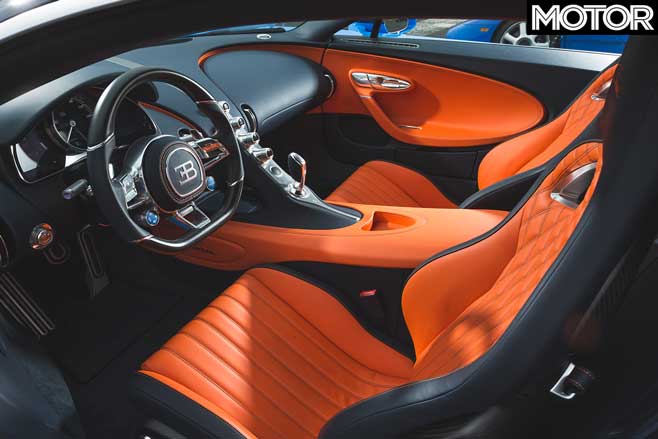
Time behind the wheel of the Chiron is all too fleeting, yet the opportunity to drive it at anything approaching real speed proves as memorable as it is brief. You may be familiar with supercars, but nothing can match the sense of slingshot delivery as the Chiron hooks up. It’s internal-organ-bruising stuff. From rest, three-figure speeds arrive in less time than it takes you to read… oh, too late. And the brakes – eight-piston calipers up front, six out back – stop you with the sort of force that threatens to turn you inside-out.
It isn’t just the straight-line stuff that blows your mind, either. Emerge from a bend with your right foot only half buried and torque is transferred with the minimum of fuss. It’s just that your neck now has a crick in it. As with the other two, it is hard not to lapse into blissed-out reverie trying to describe how amazing the Chiron is to drive.
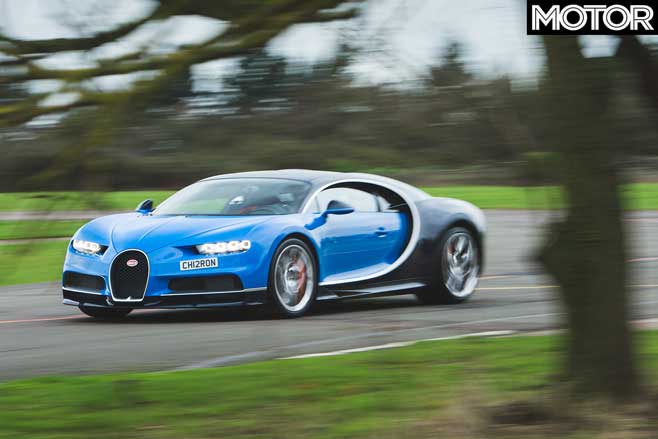
There will no doubt be some who believe these cars are leeching off the accomplishments of the original Bugatti marque, that they are unbefitting of the name, regardless of how fast they are. We would counter that they simply add further lustre.
And the really controversial bit? If we had the wherewithal, the slowest car here would be our pick. The EB110 is, in just about every quantifiable way, the least-good car of the trio, but it worms its way into your affections. It might not be perfect, but it’s a car you love rather than admire. Which is how it should be.
Fast Facts
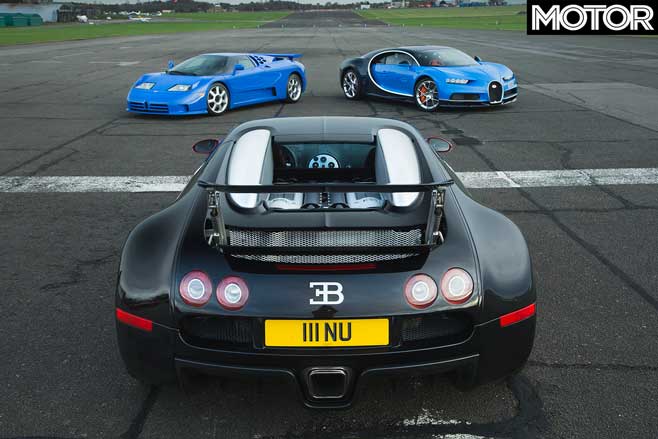
| u00a0 | Bugatti EB110 Supersport | Bugatti Veyron | Bugatti Chiron |
| Body | 2-door, 2-seat coupe | ||
| Drive | all-wheel | ||
| Engine | 3500cc V12, DOHC, 60v, quad-turbo | 7993cc W16, DOHC, 64v, quad-turbo | |
| Bore x Stroke | 81.0 x 56.6mm | 86.0 x 86.0mm | |
| Compression | 7.5:1 | 8.3:1 | n/a |
| Power | 450kW @ 8250rpm | 736kW @ 6000rpm | 1103kW @ 6700rpm |
| Torque | 650Nm @ 4250rpm | 1250Nm @ 2200-5500rpm | 1600Nm @ 2000-6000rpm |
| Power/Weight | 286kW/tonne | 390kW/tonne | 552kW/tonne |
| Transmission | 6-speed manual | 7-speed dual-clutch | |
| Weight | 1570kg | 1888kg | 1995kg |
| Suspension | double wishbones, adjustable gas dampers, coil springs, anti-roll bar (f/r) | double wishbones, progressive-rate dampers, coil springs, anti-roll bar (f/r) | double wishbones, adaptive dampers, coil springs, anti-roll bar (f/r) |
| L/W/h | 4400/1960/1125mm | 4462/1998/1204mm | 4544/2038/1212mm |
| Wheelbase | 2550mm | 2710mm | 2711mm |
| Tracks | 1550/1618mm (f/r) | 1714/1617mm (f/r) | 1749/1661mm (f/r) |
| Steering | hydraulically assisted rack-and-pinion | electrically assisted rack-and-pinion | |
| Brakes (f) | 332mm ventilated discs, 4-piston calipers | 400mm ventilated/drilled carbon-ceramic discs, 8-piston calipers | 420mm ventilated/drilled carbon-ceramic discs, 8-piston calipers |
| Brakes (r) | 332mm ventilated discs, 4-piston calipers | 380mm ventilated/drilled carbon-ceramic discs, 6-piston calipers | 400mm ventilated/drilled carbon-ceramic discs, 6-piston calipers |
| Wheels | 18 x 9.0-inch (f); 18 x 12.0-inch (r) | 20 x 9.5-inch (f); 21 x 14.4-inch (r) | 20 x 10.0-inch (f); 21 x 13.5-inch (r) |
| Tyre Sizes | 245/40 ZR18 (f); 325/30 ZR18 (r) | 265-680 ZR500A (f); 365-710 ZR540A (r) | 285/30 ZR20 (f); 355/25 ZR21 (r) |
| Tyres | Michelin Pilot SX | Michelin Pilot Sport PS2 PAX | Michelin Pilot Sport Cup 2 |
| Price | $2u2013$3.2 million | $4 million | $7.4 million |
| Pros | More character than its poseur siblings | Owning an icon of automotive engineering | Ultimate combination of performance and comfort |
| Cons | Good luck if something breaks on it | $50,000 for a replacement set of tyres | Handing over about $4.5m to the taxman |
| Rating | 5 out of 5 stars | 4.5 out of 5 stars | 4.5 out of 5 stars |
Nissan has announced a recall for its Pathfinder SUV to fix a potential problem that it says could cause a fire in the car’s braking system.
However, the company admits that parts to fix the problem won’t be available for at least six months.
Nissan says that a faulty fluid seal inside an anti-lock brake actuator could potentially leak, spilling brake fluid onto the electrically operated actuator.
“If this occurs, an ABS warning lamp will illuminate to warn the driver.,” reads a statement from Nissan. “If the vehicle continues to be operated in this condition, the brake fluid leak may create an electrical short in the actuator circuit, which could lead to a fire.”
Almost 6000 V6 petrol-engined Pathfinders from 2017 and 2018 – known as the R52 – are affected, and the recall also includes cars that were recalled in October 2018 to fix the same fault.
Unfortunately, Nissan admits that the parts needed to fix the problem aren’t in stock.
“Replacement parts will not be available until mid-2020,” the statement continues. “Once replacement parts become available, affected consumers will be contacted by Nissan Australia to arrange the replacement of the ABS actuator at no cost to consumers.”
If the vehicle’s ABS light on the dashboard illuminates for more than ten seconds, Nissan is advising customers to park the cars outside and call Nissan Roadside Assistance.
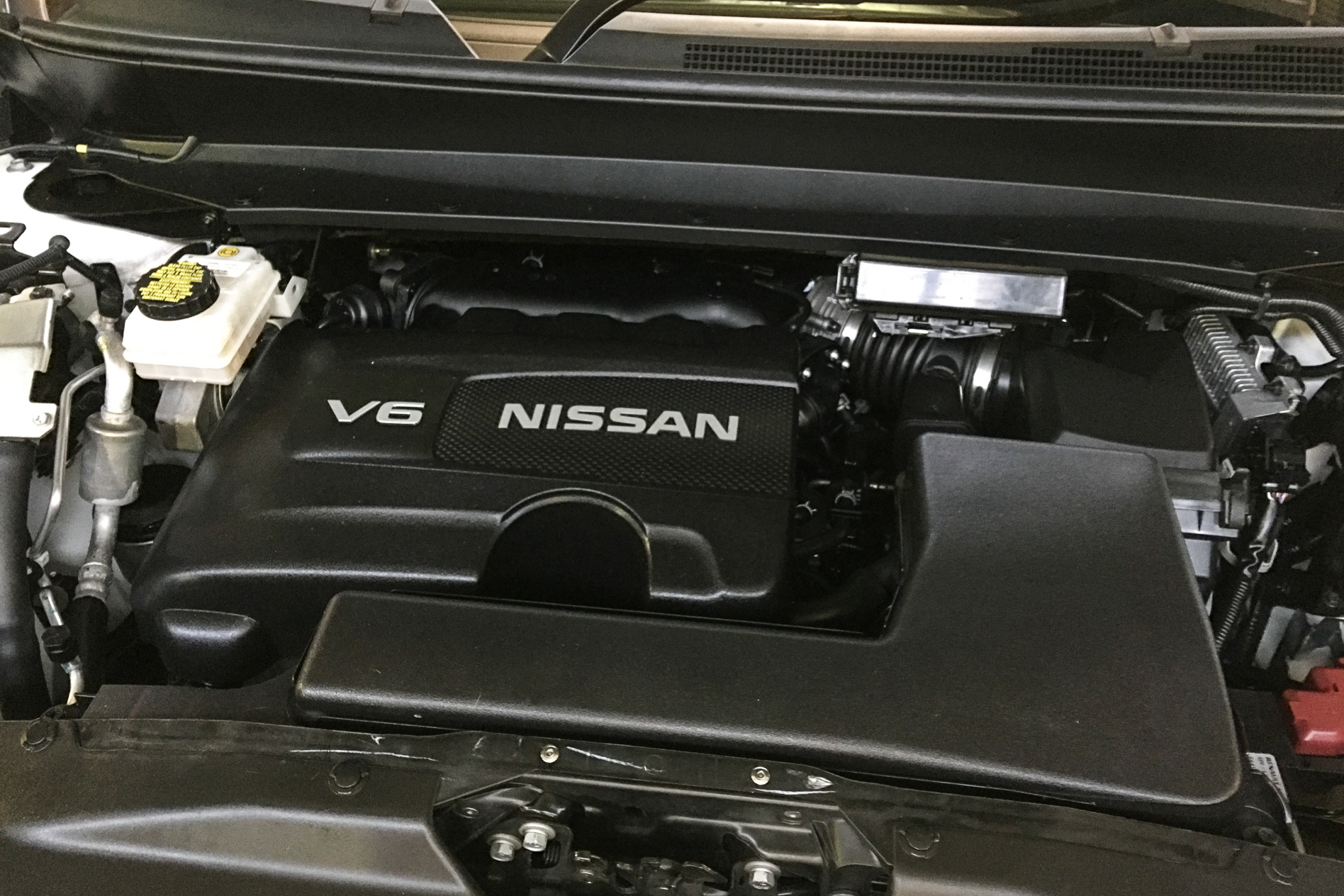
V6 petrol-powered Pathfinders built between 9 February 2017 and 31 October 2019 are affected.
Nissan has been contacted for further comment.
The company has – aside from the ongoing Takata airbag saga – had an impressively low rate of recalls in 2019, with the Pathfinder recall only the second for 2019.
‘Senna’ is one of the most renowned names in motorsport, with Ayrton having had his promising career cut short by a tragic crash in 1994.
The late F1 legend’s nephew, Bruno Senna, is no stranger to motorsport, allowing the Senna name to remain in motorsport though his own career which has spanned from a small amount of participation in F1, through to being quite successful in WEC racing.
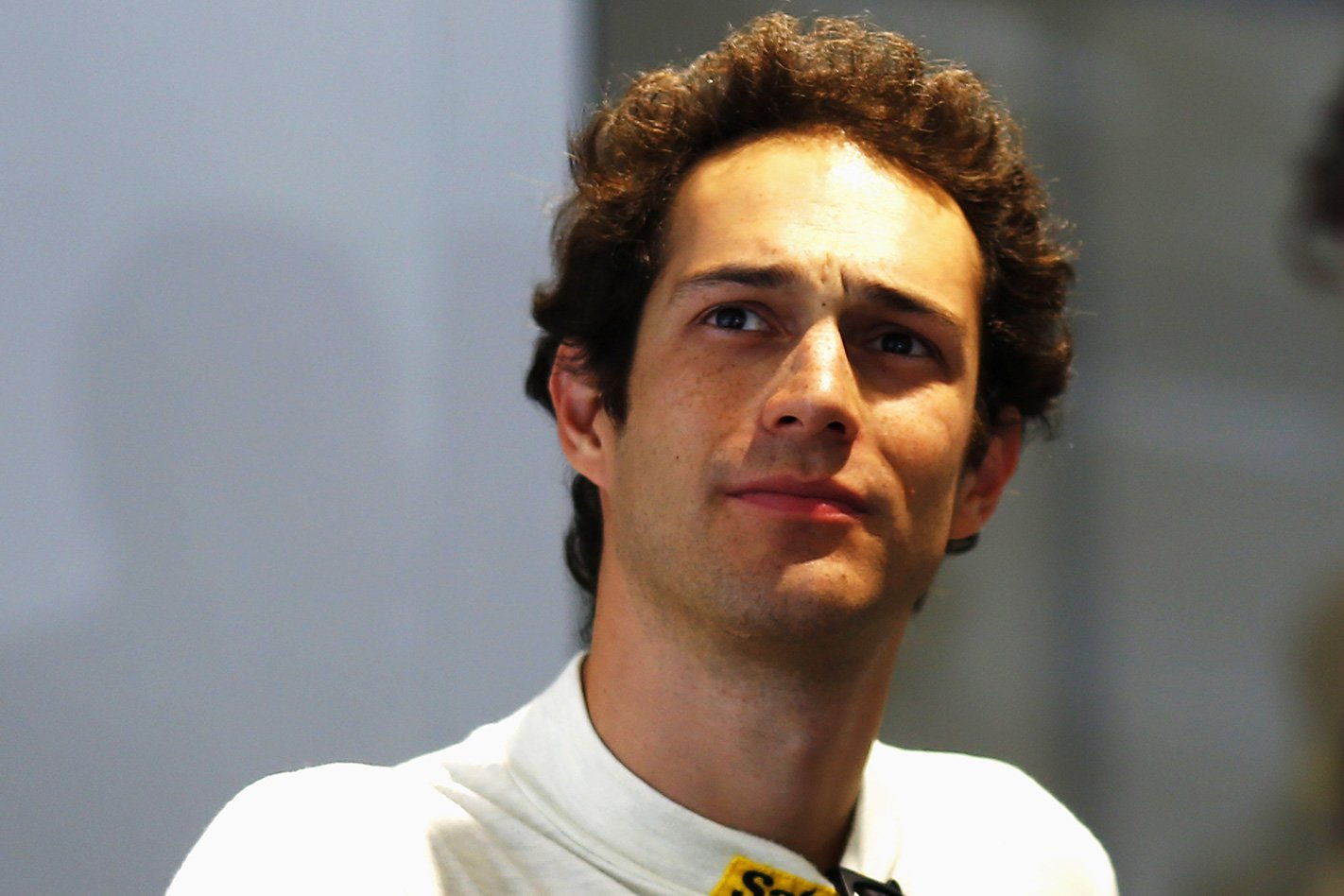
He’s even raced with Nicolas Prost, son of Alain who was Ayrton Senna’s teammate at McLaren.
And at McLaren, Ayrton made a name for himself by besting teammate Prost to take the 1988 F1 title after building up his skills in open-wheeler racing (primarily F1) through the 1980s.
Senna and Prost dominated in 1988 with the McLaren MP4/4 as their steer, and it’s that car which Bruno Senna was able to take around the track at Interlagos before the 2019 Brazilian GP.
“What an incredible emotion,” says the 36-year-old as he steers his uncle’s first F1 championship-winning car around the famed circuit – a circuit at which McLaren is still the most dominant manufacturer and where Alain Prost has claimed the most wins.
“This is so amazing, driving this car here at Interlagos, with all the fans in the crowd. This is such an amazing feeling. I can only imagine what Ayrton would have felt when he was here. Really, really amazing.”
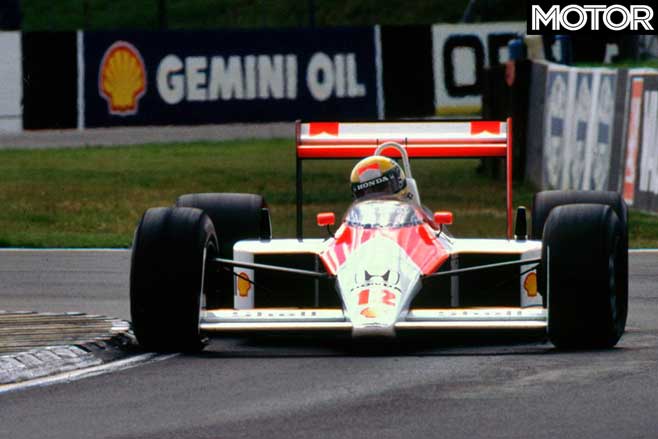
Senna even comments on the turbocharger sound… though not his apparent difficulty with getting used to the gear shifting in the 31-year-old race car.
“I can hear the turbocharger and the wastegate… loud!”
At the 7:20 mark in the onboard video, Bruno even breaks out the Brazilian flag. Check it out and enjoy the nostalgia, and ‘the feels.’
How expensive are cars today? It’s a question that popped up following a dig through MOTOR’s back issues that unearthed some eye-widening prices back in the day.
As it turns out, relatively speaking, today’s performance cars are remarkably good value. There are many reasons for this – reduced tariffs, increased competition, greater volume – but given that most of the vehicles in this article attract 33 per cent Luxury Car Tax (on every dollar over $67,525 for the 2019-20 financial year) it’s remarkable some of the prices are as low as they are.
Vehicles were essentially chosen at random, the main criteria being that pricing data was available (i.e. it was on sale in some form) 10, 20 and, in some cases, 30 years ago. Prices are MSRP and were taken from the December 1989, 1999, 2009 and 2019 issues of MOTOR and inflation was calculated using the Reserve Bank’s online Inflation Calculator (https://www.rba.gov.au/calculator/).
It only calculates inflation until 2018 so the numbers are 100 per cent current, but it suffices for our purposes.
All figures in this article are expressed in real terms (i.e 2018 money) for comparative purposes with contemporary figures (i.e. Actual dollar figure at the time) in brackets.
Let’s travel back to 1989, when houses were cheap and cars were expensive. Median house prices in the major capital cities made tantalising reading: Sydney $361,650 ($170,850); Melbourne $279,413 ($132,000); Brisbane $203,209 ($96,000); Adelaide $191,355 ($90,400).
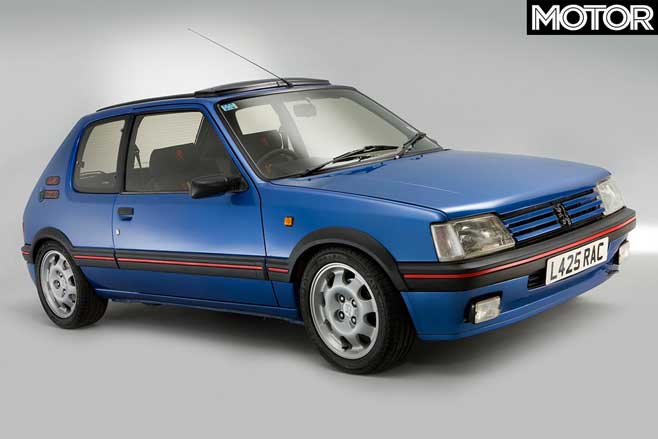
Filling that driveway was an expensive proposition, however. The Peugeot 205 GTI was receiving rave reviews, but a price tag of $62,444 ($29,500) can’t have been easy to stomach, especially when the all-wheel drive, turbocharged Mazda 323 Turbo could be had for $62,042 ($29,310).
Speaking of Japanese performance, a Toyota Supra 3.0 Turbo could be yours for $116,210 ($54,900) or if you wanted something a bit more serious, the Nissan R32 GT-R came along a year later at $216,936 ($110,000). That was still good value when you consider it had the pace to dust off a $314,416 Porsche 911 ($148,536), $348,965 Ferrari 328 GTS ($164,730).
If you really wanted to make a statement, there was always the Lamborghini Countach, but at $1,026,632 ($485,000) is was 2.8 times the median Sydney house price. As a hint of how things have changed, that same situation today would put the Lambo at $2.7m.
Move forward a decade to 1999 and median house prices are now thus: Sydney $451,213 ($272,500), Melbourne $289,769 ($175,000), Brisbane $266,588 ($161,000), Adelaide $210,290 ($127,000). There was also much greater choice in the performance car market, with a lot of the icons we still know and love today having been launched.
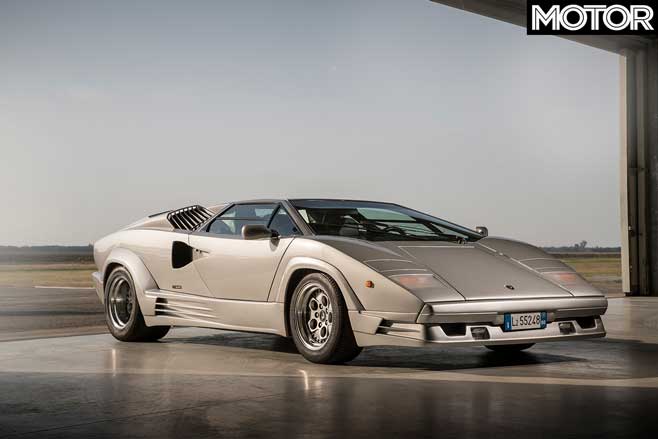
In today’s money, the $67,044 Subaru Impreza WRX ($40,490) doesn’t seem like such a bargain, but then you needed $71,846 for the underwhelming Mk IV VW Golf GTI ($43,390). Entry into the 911 club was a little cheaper at $305,003 ($184,200), and Peugeot’s hot hatch offering – now a 206 GTi – cost $51,993 ($31,400). Lamborghini’s flagship, the Diablo VT, had come down slightly at $992,851 ($599,610) and the two-wheel drive SV was a relative bargain at $660,928 ($399,153).
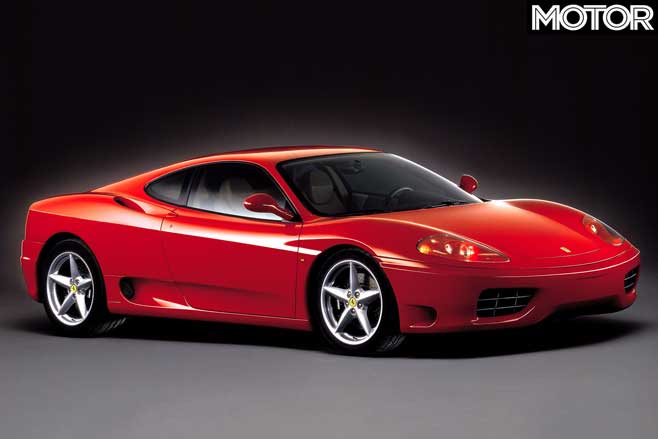
Going the other way was Ferrari’s entry-level V8, a 360 Modena listed at $529,451 ($319,750) as a manual or $569,025 ($343,650), and a lot of hot new metal had arrived with price tags that seem eye-watering when converted to today’s money.
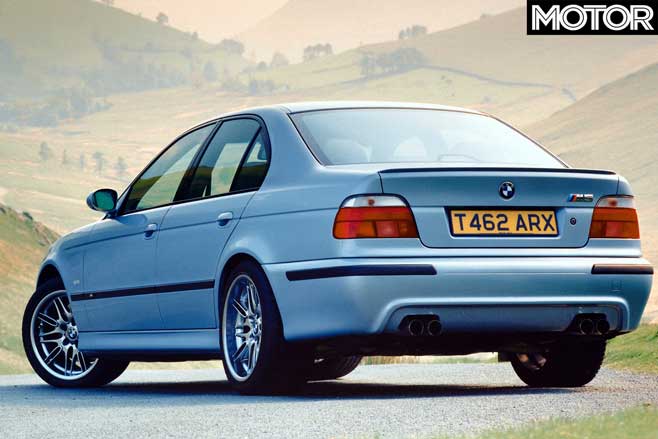
A basic Boxster with a 2.5-litre engine and a mere 150kW/245Nm? That’ll be $181,975 ($109,900). The E39 M5 looks pricey at $328,682 ($198,500), as does the E36 M3 at $221,467 ($133,750), though it’s cheaper than its Mercedes rival, the C43 AMG listed at $258,474 ($156,100). In the market for an Italian GT? The Ferrari 550 Maranello will set you back $812,625 ($490,767).
Skip forward another 10 years (to 2009) and median house prices have lifted again: Sydney $594,559 ($490,000), Melbourne $485,355 ($400,000), Brisbane $509,622 ($420,000), Adelaide $440,459 ($363,000). Happily, cars have gone the other way across the board.
Let’s run through them in the same order as the previous decade: Impreza WRX $48,523 ($39,990); Golf GTI $49,130 ($40,490); Porsche 911 $272,648 ($224,700); Peugeot 207 GTi $41,849 ($34,490); Lamborghini Murcielago LP640 $915,357 ($754,382).
The Boxster had dropped dramatically to $139,297 ($114,800), as had the AMG C-Class, the C63 now asking for $180,673 ($148,900). Getting into an M3 dropped to $175,941 ($145,000) thanks to the introduction of the sedan, the $197,662 ($162,901) coupe narrowing the gap.
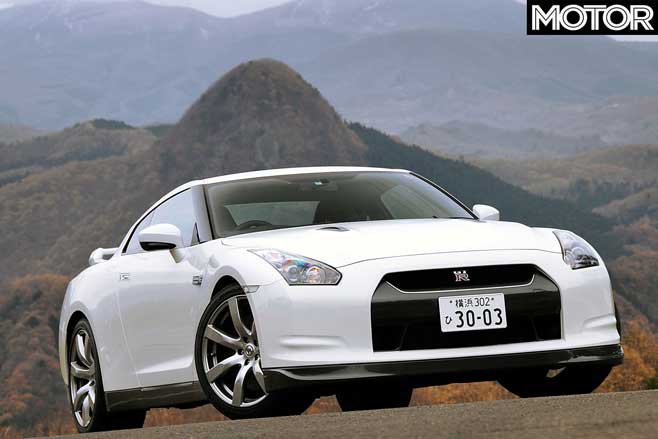
Other smaller drops included the $293,416 BMW M5 ($241,816), Ferrari F430 $526,792 ($434,150) and 599 GTB $789,065 ($650,300), while the Nissan GT-R had re-entered the frame, The $189,045 R35 ($155,800) undercutting the R32 from 20 years earlier.
Now to today. As mentioned, these figures aren’t completely up-to-date as the inflation calculator will only calculate until 2018, though our median house prices are up to date (June 2019): Sydney $955,000, Melbourne $793,000, Brisbane $550,000, Adelaide $480,000.
Here’s where we can make a direct comparison between the car prices of yesterday and today. The Subaru Impreza WRX is remarkable in that its price is the same today as it was 20 years ago, but in real terms has dropped from $67,044 to $40,490.
It’s a similar case at BMW, where the M5 has dropped from $328,682 to the $229,900 asked for today’s M5 Competition, while you can purchase an M3 Pure today for $129,529 (or an M4 Pure for $139,529), whereas M3 ownership started at $221,467 back in 1999. Likewise for the AMG C-Class, the ask dropping from $258,474 for the C43 to $162,540 for the current C63.
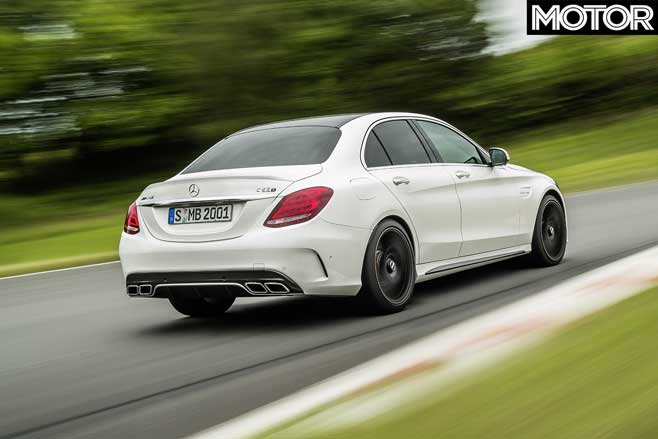
You needed $314,416 for an entry-level 911 back in 1989, whereas the same car today will set you back $229,500, and Boxster pricing has plummeted from $181,975 to $118,200 in 20 years. Over at Ferrari its V12 GT is more attainable (not really), an 812 Superfast costing $610,000 as opposed to $812,625 for a 550 Maranello; its entry-level mid-engined has actually increased from $348,965 for a 328 GTS to $484,888 for the current F8 Tributo, but given outputs have soared from 200kW/304Nm to 530kW/770Nm this seems slightly excusable.
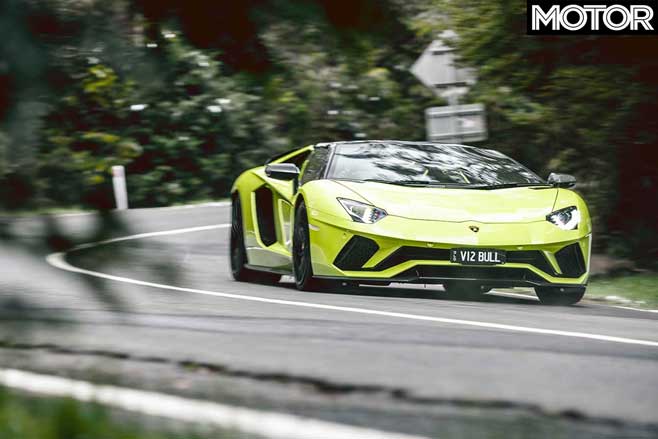
Another car to increase is the R35 GT-R, the current $193,800 model more expensive in real terms than its 2009 predecessor at $189,045. Remember that $116,210 Toyota Supra from 1989? Makes the $84,900 charged for the current A90 a bit more palatable. And consider this: thirty years ago a Lamborghini Countach cost the equivalent of 2.8 Sydney homes; today a $788,914 Aventador S is the equivalent of 0.82 Sydney homes. Good news for Lamborghini buyers, bad news for home buyers.
Of course cars could be cheaper; the abolition of the LCT would see prices drop dramatically. Yet today’s cars are much faster, more capable, safer, more reliable and loaded with equipment, but in most cases cost far less in real terms than their predecessors. A lot of the cars in this article are a long way from cheap, but then, relatively speaking, they’re not expensive, either.

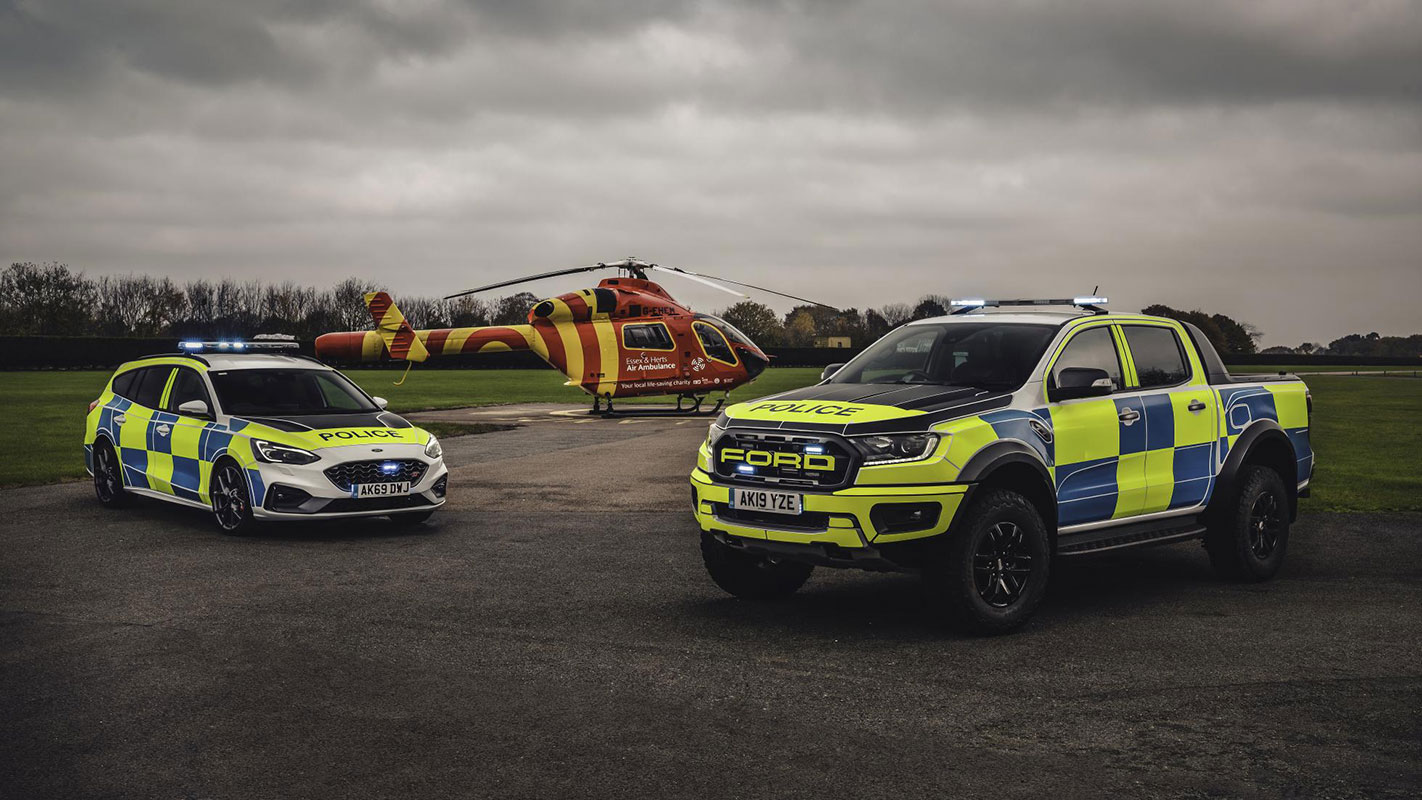
Christmas has come early for the boys and girls in blue in the UK, with the South Wales Police force taking delivery of a Ford Ranger Raptor.
The initiative is part of a trial run, which includes Ford Focus ST estate, one that should be perfect for the often dodgy UK weather and rural landscape of South Wales.
With no engine upgrades, crims aren’t going to struggle to pull away from the 2.0-litre turbo diesel given its modest 157kW/500Nm figures, lacklustre 0-100km/h time and a top speed that’ll struggle to crack 170km/h.
However, if the chase turns off smooth tarmac to the beaten track, the Raptor’s Fox shocks, beefed-up componentry and Baja dessert race mode will prove invaluable. Therefor anyone looking to evade the law via cross-country means will need a talented rig.
If the pace does ramp up on-road, the South Wales Police will also have access to a Ford Focus ST estate – which has ample grunt and a 250km/h top speed. Sadly, while we’re due to receive the hyped-up ST hatch in early 2020, the wagon version isn’t slated for Australia.
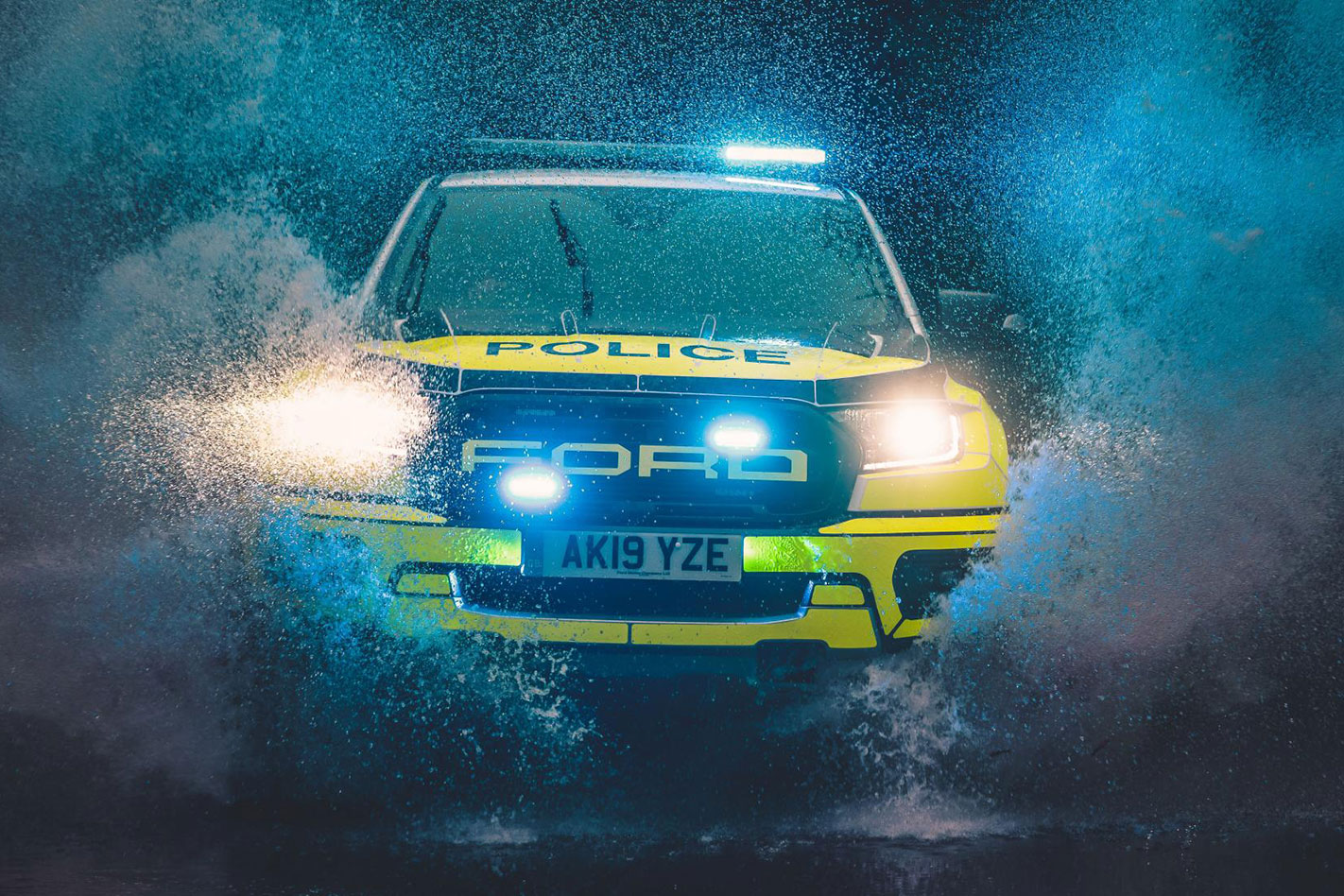
Both the Ranger Raptor and Focus ST Estate have been given the full police treatment with stickers and emergency lights and sirens by Ford’s Special Vehicle Preparation team in Essex.
MORE PHOTOS: Check out the gallery at the top of this article
Tell us below: What do you think – should Aussie police forces get in on the Raptor action?
It has been two years since Holden closed its Elizabeth manufacturing facility, with the last VF Commodore rolling off the line on October 20, 2017.
Holden’s decision to shutter the Elizabeth factory resulted in 950 employees being left without a job.
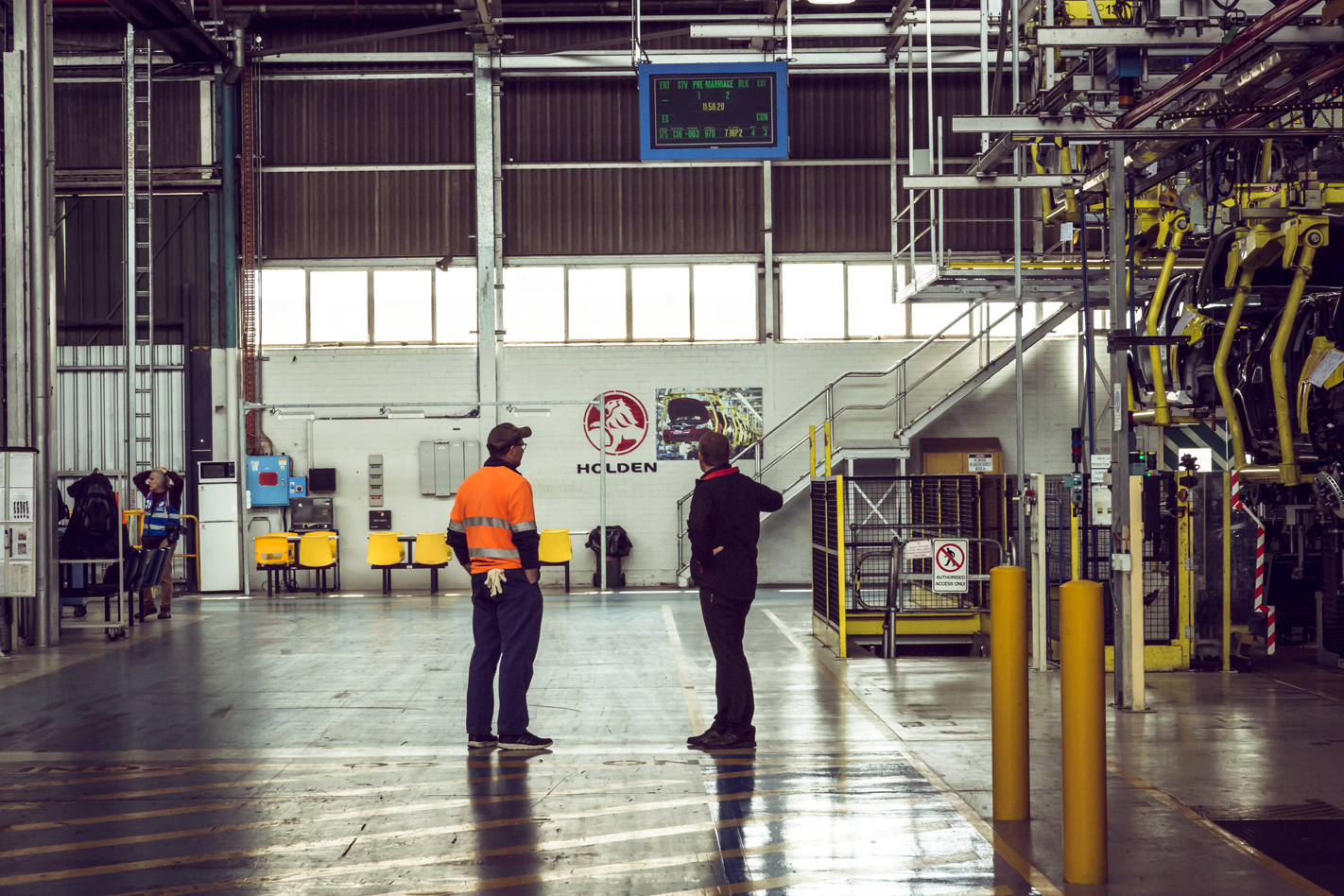
While the majority of those people have returned to work, a new study funded by the South Australian Government and conducted by the Australian Manufacturing Workers’ Union (AMWU) has looked into how those former Holden employees are faring.
The survey has been reported by the ABC, and states that while nearly 80 percent of former Holden staffers found work (76.4 percent, to be exact), only a small fraction are employed in similar or better roles.
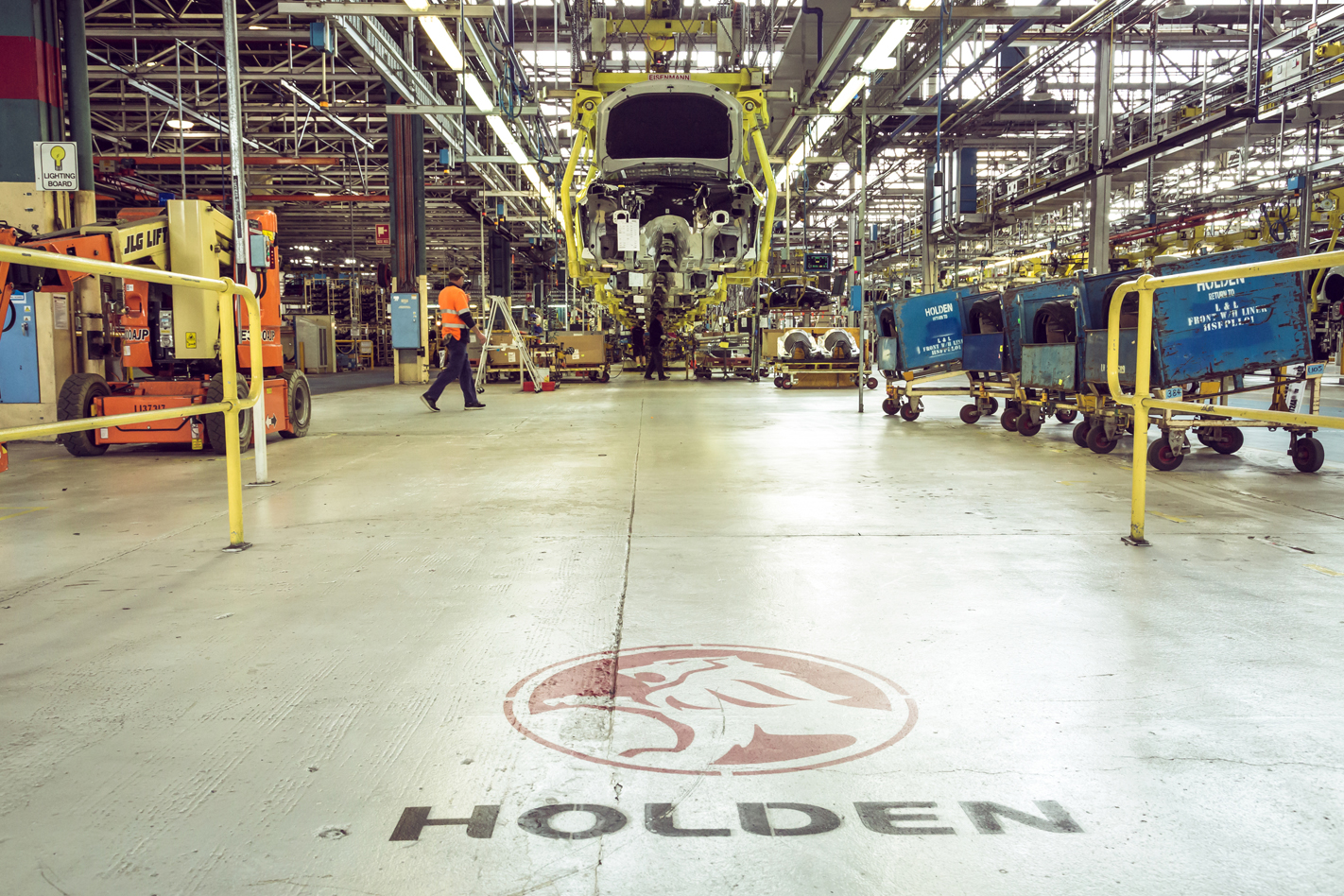
Two thirds of those who found jobs following the factory closure were in part-time, casual or contract employment, while fewer than five percent had moved on to similar or better working conditions.
“We were speaking to members that were getting five hours one week and then 25 the next, and then maybe eight the week after that,” AMWU Vehicles Secretary Scott Batchelor told the ABC.
“For us, a successful transition was somebody going into a job that was full-time. Even better would’ve been one that paid similar or better wages.
“The group of people over 45 have struggled to find work the most.”
The AMWU says it had asked for the South Australian Government to extend its transition package for affected Holden employees for another year. However, Mr Batchelor said: “None of the recommendations we made were taken up.”

The South Australian Government has labelled the transition for workers as a success, with the state Minister for Innovation and Skills, David Pisoni, telling the ABC: “A number of them have used the closure of the industry as an opportunity to reassess their lives.
“As an employer, if you were taking someone on who had been with the same employer for 10, 20 or 30 years, you might be a bit reluctant to take them on full-time initially.”
More than seven million vehicles were built by Holden at the Elizabeth factory, which opened in 1963.
The Honda NSX is an under-appreciated car. You could argue it’s always been thus. The original might have revolutionised the supercar segment with its ease of use, but when you’re trying to sell a supercar, sensible ain’t sexy.
It’s a legacy that’s carried over to the new NSX, of which just nine examples have been sold in Australia since its 2017 introduction. That isn’t many, even by the standards of its slow-selling predecessor, which found 133 Australian homes between 1991-2004.
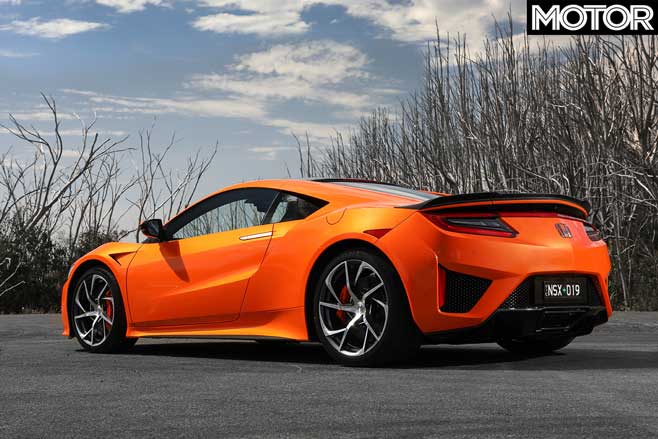
Why is this? It’s certainly not a fault of the car itself, which is good enough to go toe-to-toe with any of its supercar rivals, but it does take a bit of time and effort to understand what makes the NSX great. It’s an engineering marvel, packing a 3.5-litre twin-turbo V6, nine-speed dual-clutch gearbox, lithium-ion battery pack and three electric motors into a bodyshell that’s 32mm shorter than a Porsche 911.
The more you dig, the greater the number of little morsels you discover: the dry-sumped 75-degree V6 uses direct and port injection and a pair of single-scroll turbos (to save weight over twin-scroll units) with electronic wastegates that supply 15.23psi of boost pressure. The clutches for the nine-speed ’box and the limited-slip diff share a housing to save weight and the powertrain is suspended by hydraulic mounts to reduce NVH.
What’s truly crazy, though, is that despite the NSX being all-wheel drive there is no mechanical connection between the front and rear wheels. The V6 drives the rear wheels, a 35kW/148Nm direct-drive electric motor attached to the crank and sandwiched between the engine and gearbox supplies juice to the batteries, which in turn feed power to the 27kW/73Nm electric motors powering each front wheel.
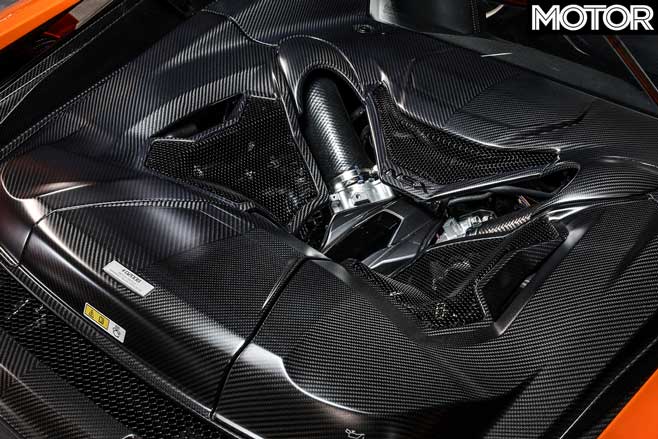
The work required to make this incredibly complicated powertrain operate smoothly must have been immense, but it wasn’t in vain as it works brilliantly. The electric motors mask any lag the engine may have, firing the NSX forward instantly, before the turbos take over and make light work of the Honda’s 1780kg mass.
No performance figures are claimed, but 3.0sec to 100km/h and 11.0sec for the quarter feels about right – plenty quick enough. It even sounds good. Aurally pleasing V6s are few and far between but there’s a mean growl that builds organically through the rev range. A quick word of praise for the sensational gearbox, too.
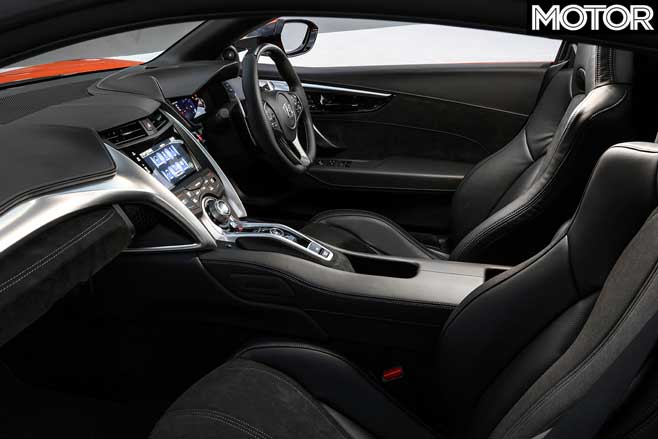
Honda went to equally strident lengths with the chassis. The composite bodyshell is primarily aluminium, but uses steel in sections for strength and carbon fibre for the front floor. Every body joint was analysed for strength and weight, with many being different on each side; the double wishbone front suspension is all-aluminium with double ball-joint lower arms to eliminate torque steer; the adaptive dampers are magnetorheological and the brakes are carbon-ceramic. For 2019 the anti-roll bars, rear toe-link bushing and rear hubs are stiffer, the software for the AWD, steering and dampers has been revised and the tyres are Continental SportContact 6s instead of 5Ps.
Our first exposure to the new NSX was on the bumpy, slippery, narrow roads of Western Tasmania, where it impressed with its speed, grip and composure, but felt a little one-dimensional. On more familiar roads in better weather, Honda’s hybrid supercar reveals new depths to its ability.
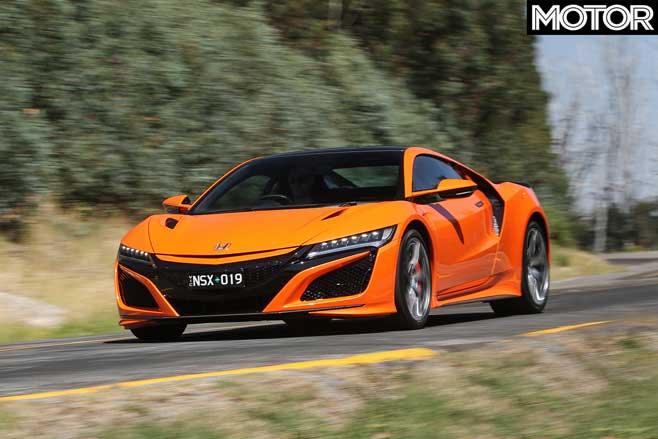
It feels at least 200kg lighter than the claimed kerb weight – though the tyres and brakes betray how hard they’re working – and the electrified all-wheel drive system is magic, delivering amazing traction but with oversteer available to if you’re committed enough on the throttle.
Selecting Sport+ for the powertrain adds unnecessary weight to the steering and the chassis can struggle over larger bumps, but by and large the NSX delivers crushing pace without forgetting about the entertainment factor.
As with its predecessor, it also nails day-to-day useability. It’s no longer a USP, most supercars are easy to drive these days, but the Honda goes further than most with low road noise, impressive ride quality and the ability to operate on pure electricity for short periods. It looks incredible, too, especially in the new-for-2019 Thermal Orange paintwork. The NSX is a brilliant machine that deserves to sell better than it does, but it appears that the same old problem applies: the rich and famous aren’t willing to spend supercar money on a Honda.
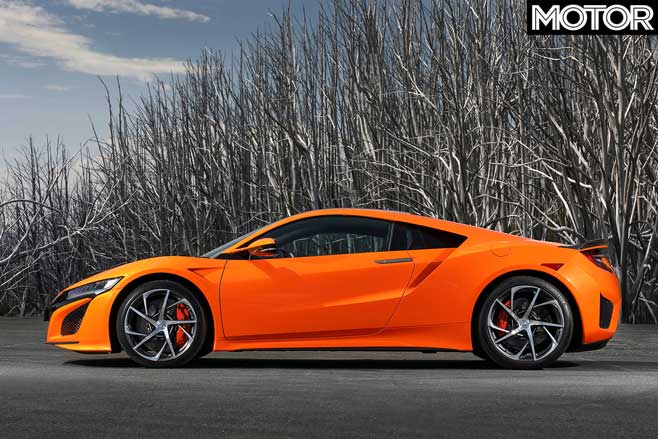
HONDA NSX SPECS Engine: 3493cc V6, DOHC, 24v, twin-turbo, three electric motors Power: 375kW @ 6500-7000rpm Torque: 550Nm @ 2000-6000rpm Combined output: 427kW/646Nm Weight: 1780kg 0-100km/h: 3.0sec (est) Price: $420,000
Likes: Brilliant powertrain; incredibly quick; entertaining dynamics; looks Dislikes: Price; weight; no individual drive mode; brake feel
Rating: 4.5 out of 5 stars
What is it?
The Audi A6 is one of the more revered models in the Audi range, having descended from the Audi 100 saloon that helped thrust the German carmaker into the modern era.
The large executive sedan (Audi calls it a Sportback) has long been one of the brand’s technological flagships with each generation introducing technology that’s new to Audi if not the motoring world. The new-generation A6 manages to continue that tradition and, like its predecessors, is spacious, comfortable and a delight to drive.
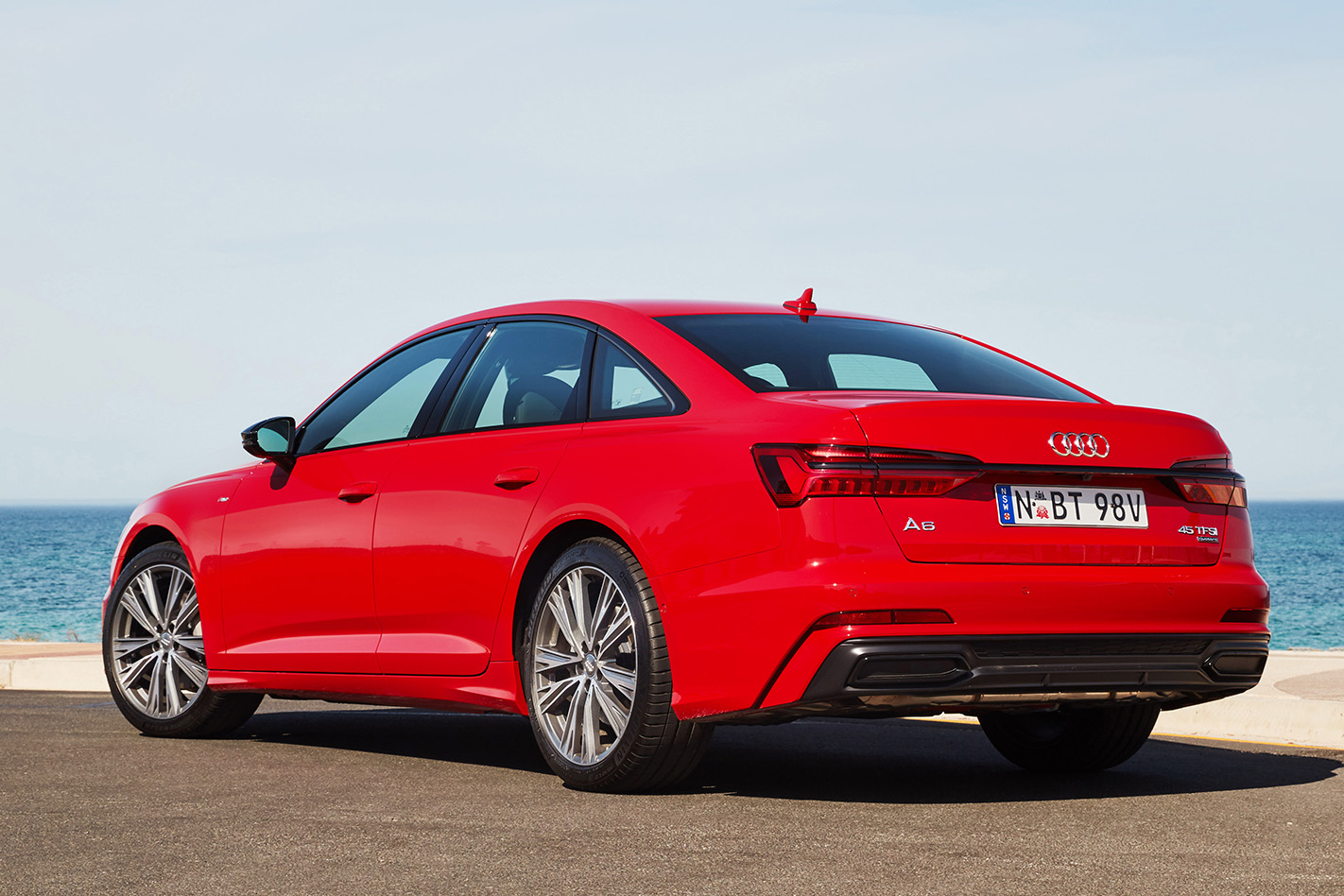
The new A6 initially arrived Down Under in July with the ballsy 55 TSFI quattro S Line that retails for $116,000. The range has now grown to three with the new entry-level 45 TFSI quattro ($95,500) and the up-specced 45 TFSI quattro S Line ($105,200) that we’re testing here.
The trio will be joined by the more affordable front-wheel drive and lesser-powered A6 40 TFSI during the second half of 2020, along with high-performance S6 and RS6 Avante (wagon) versions.
What’s it like to live with?
The A6 is a large and spacious sedan, so much so it’s hard to believe there are two bigger passenger cars in the Audi range. It will carry four adults in comfort over long distances, with ample space to fit a third person if needed, and has a cavernous 530-litre boot space.
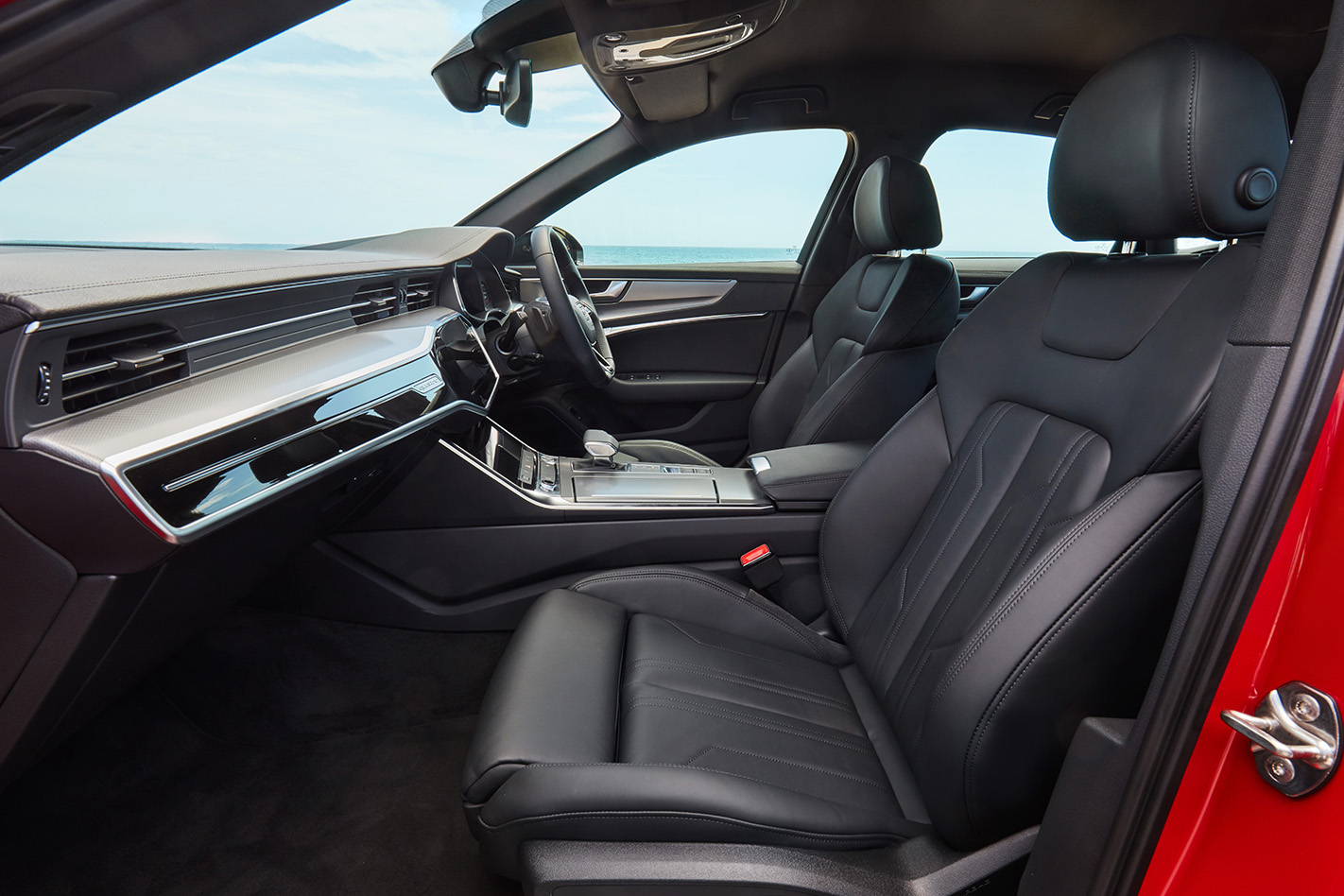
The new model adopts the same interior design as its A7 and A8 big sisters and the Q8 large SUV, featuring sharp horizontal lines, elegant bright points and a clutter-free dashboard featuring two touch screens and Virtual Cockpit gauge cluster.
It’s a soothing aesthetic backed up by comfortable leather-appointed seats and the virtual elimination of outside noise when you close the door.
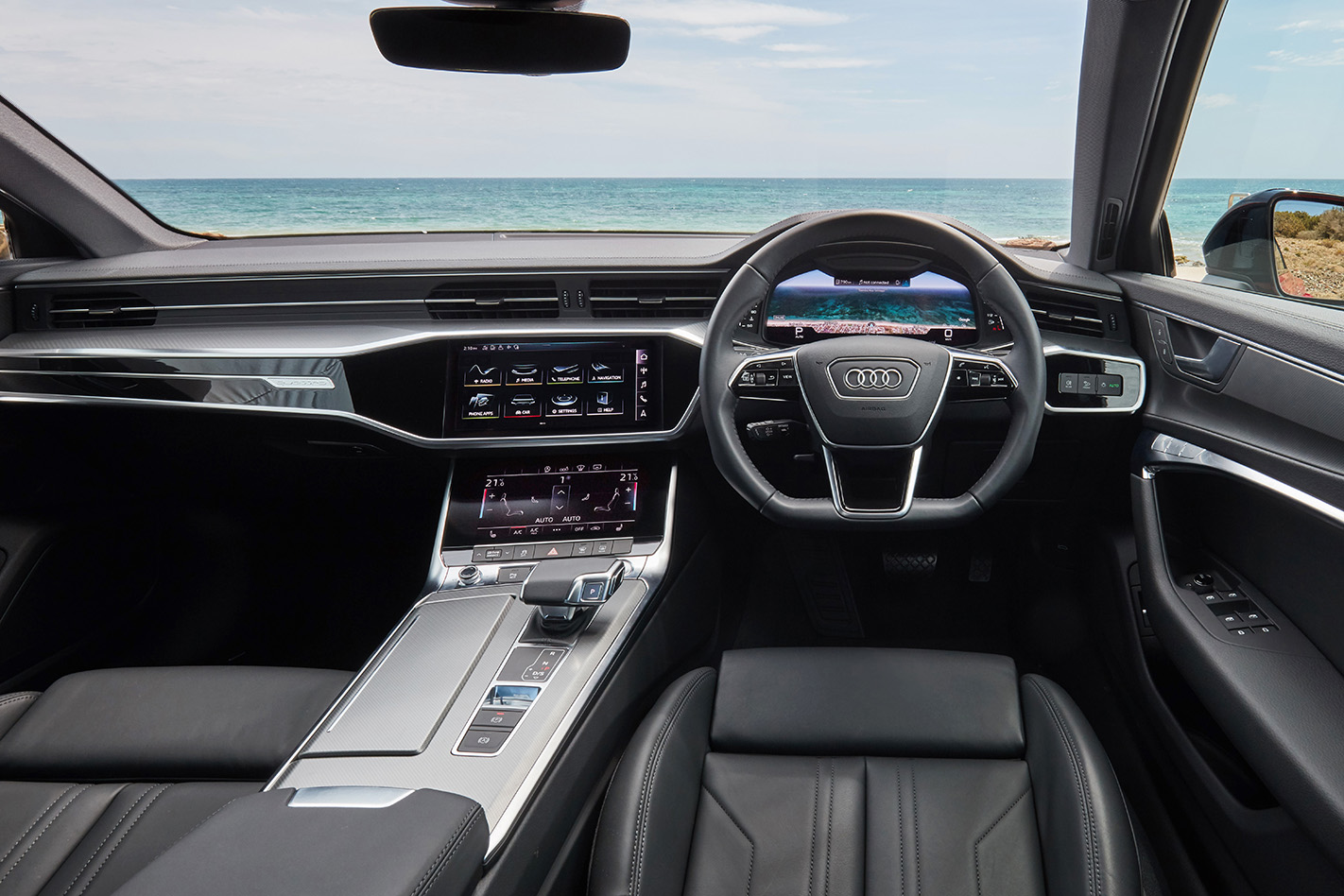
The two touchscreens rising up from the centre console control most functions with haptic touch controls that feel like you’re pushing a button. You can even use your finger to scrawl a command into the bottom screen, like an address for the satellite navigation, or make a pinching motion to sync the driver and passenger climate control settings.
It all takes a bit of getting used to, but once you do you’ll find it very intuitive and useful.
As mentioned above, the A6 often brings Audi’s latest technology to the fore and the 2020 model is no different, bringing Audi Connect Plus infotainment that brings some clever features. One of these is the ability to continue listening to a digital radio station when you lose signal thanks to an embedded 5G signal that instantly links to that station’s web stream.
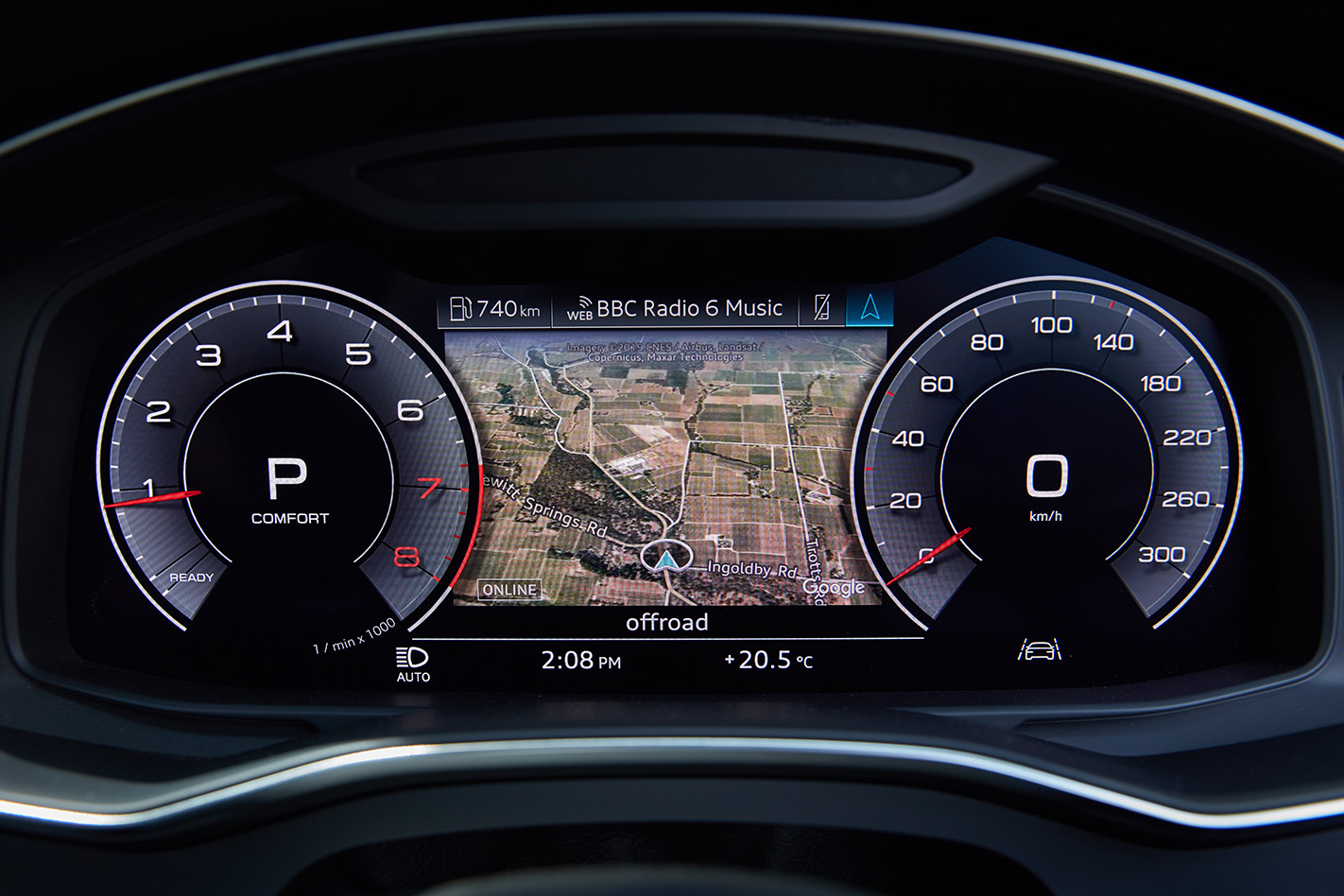
Other features include wireless Apple CarPlay that, unlike BMW’s system, does not require a paid subscription, and Google Earth and Google Street View images incorporated in the navigation displays to provide a better idea of your surroundings.
These are just part of the extensive standard features list that brings about $13,000 worth of extra kit over the previous model’s 2.0 TFSI quattro, but a $3000 lower retail price. These include heated front seats, wireless phone charging, loose wheel detection, handy illuminated seat belt buckles, LED headlights, and 19-inch alloy wheels
All three variants also come with autonomous emergency braking (AEB) with pedestrian detection, adaptive cruise control with traffic jam assist, front and rear parking sensors, lane assist, rear cross-traffic alert, 360-degree parking camera and front- and rear-cross traffic alert with auto braking.
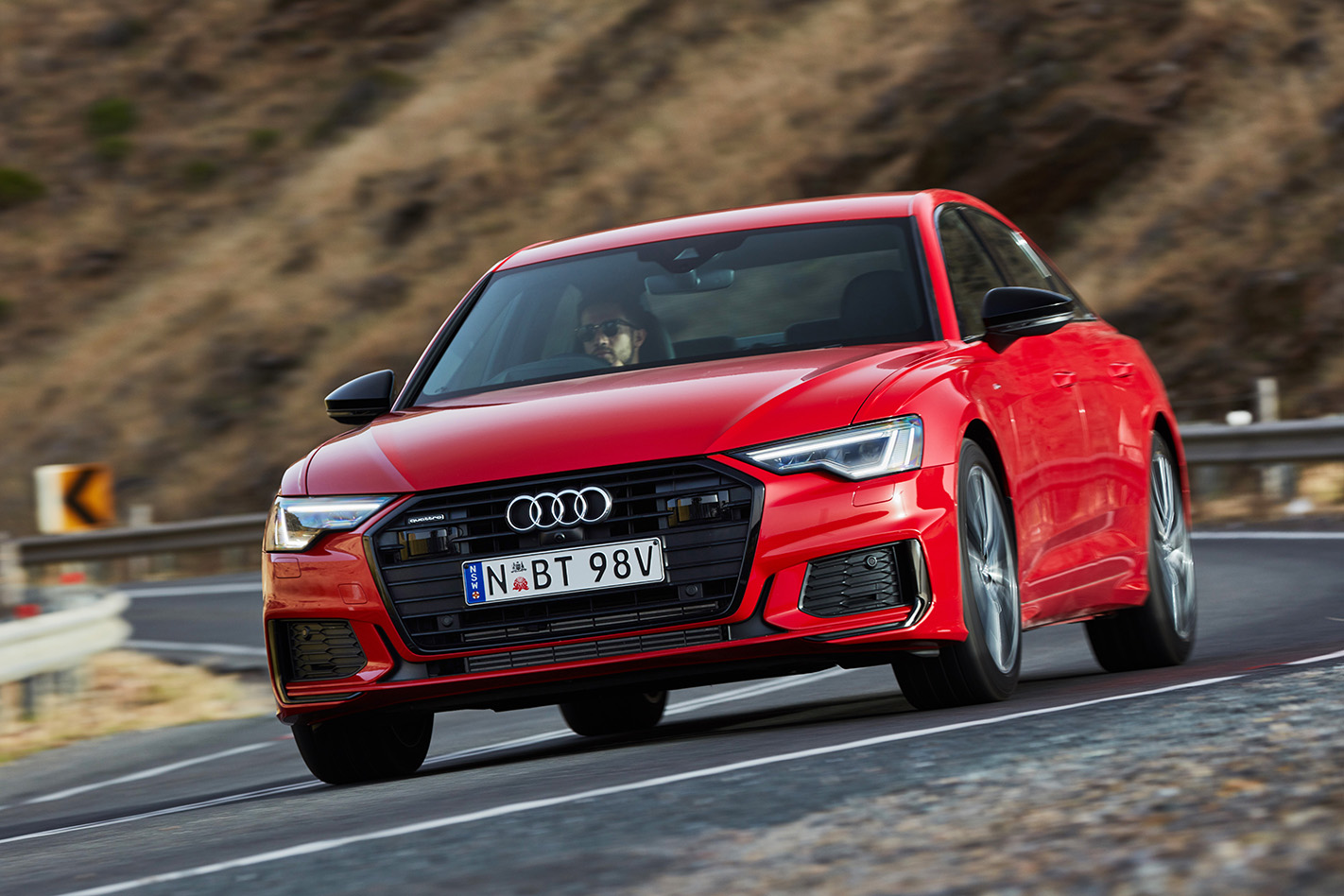
The A6 TFSI S Line we drove costs an additional $9700 over the entry-level retail price, which brings adaptive dampers ($4800) that further improves ride comfort and dynamic handling, plus Valcona leather upholstery, bolstered sports front seats, flat-bottomed leather sports steering wheel, head-up display, illuminated door sills and 20-inch alloy wheels.
The A6 45 TFSI’s 2.0-litre turbocharged engine’s official combined fuel consumption rating is 7.2L/100km which is a little thirsty considering the bigger 3.0-litre 55 TFSI drinks the same amount.
The Audi A6 is covered by a three-year, unlimited kilometre warranty that’s still the standard for premium European cars.
What’s it like to drive?
The A6 is powered by a 180kW/370Nm 2.0-litre four-cylinder turbocharged engine mated to an eight-speed ‘S tronic’ dual-clutch auto that drives all four wheels more fluidly than it does with the bigger engine.
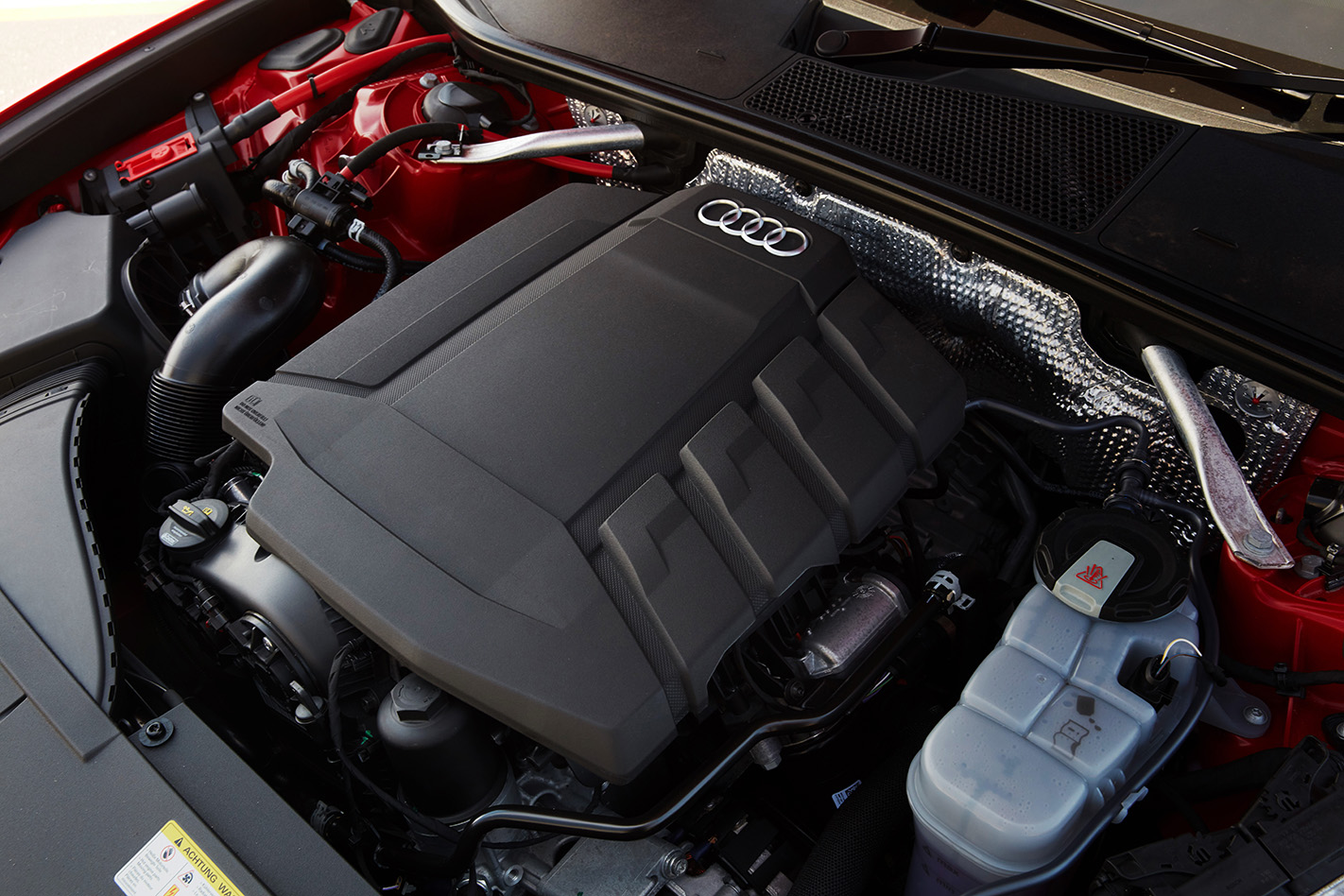
This powertrain naturally doesn’t produce as much vim as the 55 TFSI’s 250 kW/500Nm 3.0-litre V6, however its 6.0-second 0-100km acceleration is still pretty quick and you won’t be wanting for more power when you get there.
Like the bigger engine it features mild-hybrid technology (MHEV), that utilises 48-and 12-volt systems respectively. The 48-volt system functions as the car’s main electrical system and contributes up to 14kW to the engine’s peak power.
Driving though the undulating roads of South Australia’s McLaren Vale felt effortless in the A6. The all-wheel-drive grip, well-weighted steering and low centre of gravity makes it feel planted to the road.
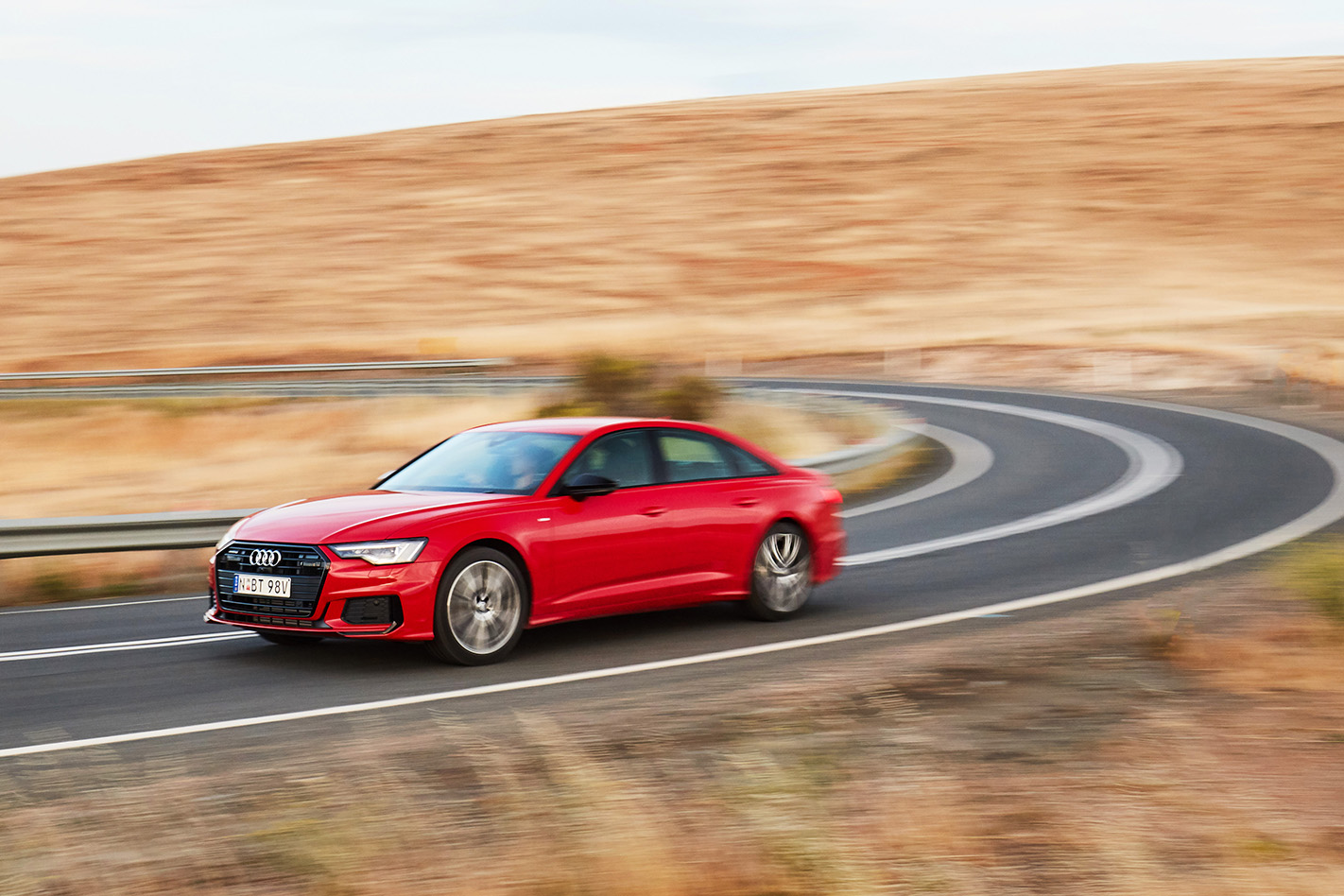
The standard suspension provides a good balance between ride comfort and handling thanks to the car’s broad footprint and low centre of gravity, but there is a bit of lean through bends. The adaptive suspension that comes with the S Line pack significantly reduces lateral movement, thanks to a dynamic drive mode that stiffens the dampers as well as the steering.
Selecting comfort mode offers a well-settled smooth ride, even on the bigger 20-inch rims, which makes for a graceful, even relaxing, driving experience.
Is it worth it?
It’s not often the word ‘value’ is used in the sell for luxury cars, but it’s foremost in Audi’s sales pitch for the all-new A6. And it’s fair to say it has certainly succeeded in providing a lot of premium German car for under $100,000 without any apparent compromises.
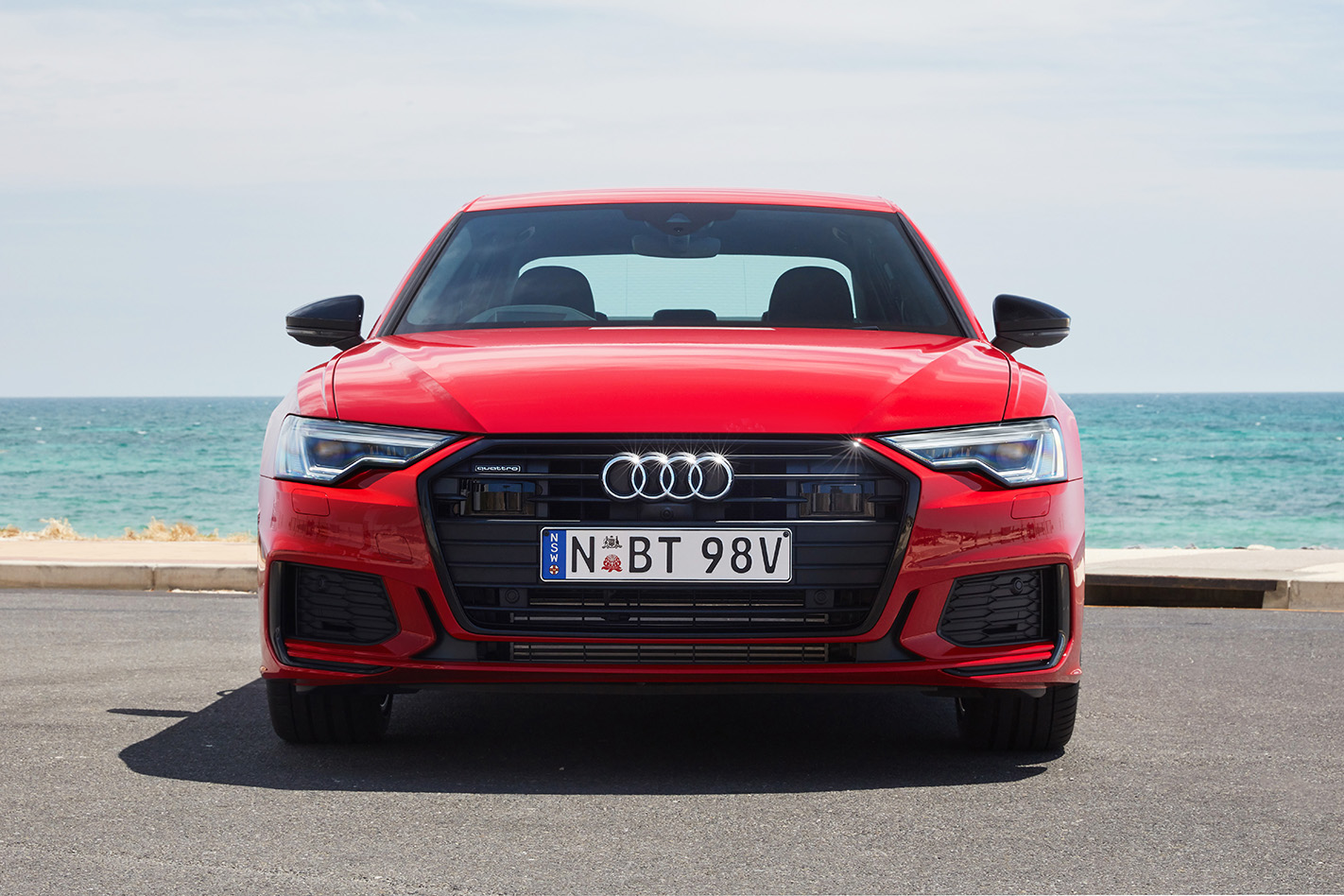
That said, you could do worse than spend another $9700 on the A6 45 TFSI S Line, with the adaptive dampers and all the other features it brings combing to make a very good car a great one.
PROS: Serene interior, all-round driveability looks great CONS: Initially complex multi-media, relatively thirsty 2.0-litre engine
RATING: 4.5/5
