
Here’s the stories that we featured this week on WhichCar.com.au
Tomorrow marks 50 years since the Apollo 11 moon landing. And no, it wasn’t faked, as these hilarious moon-walking bloopers released by NASA prove (check out the kangaroo hopping at 1min 25sec). It’s also eight years to the month since NASA last launched astronauts into space on the Space Shuttle, which I was lucky enough to witness. These incredible achievements expanded humanity’s frontier, but we’re seemingly no closer to living in space despite the combined $400 billion (inflation adjusted) that America alone has spent on the Apollo and Space Shuttle programs.
That hasn’t stopped Toyota, the world’s biggest car brand, starting work on a Lunar Rover for model year 2029. Interestingly, Toyota says the prototype will be “a modified version of a standard production vehicle”. Get ready for the 2030 Toyota LandCruiser: for all roads on Earth … and beyond. Presumably it’ll roll on these self-inflating, shape-shifting, talking tyres of the future, too…
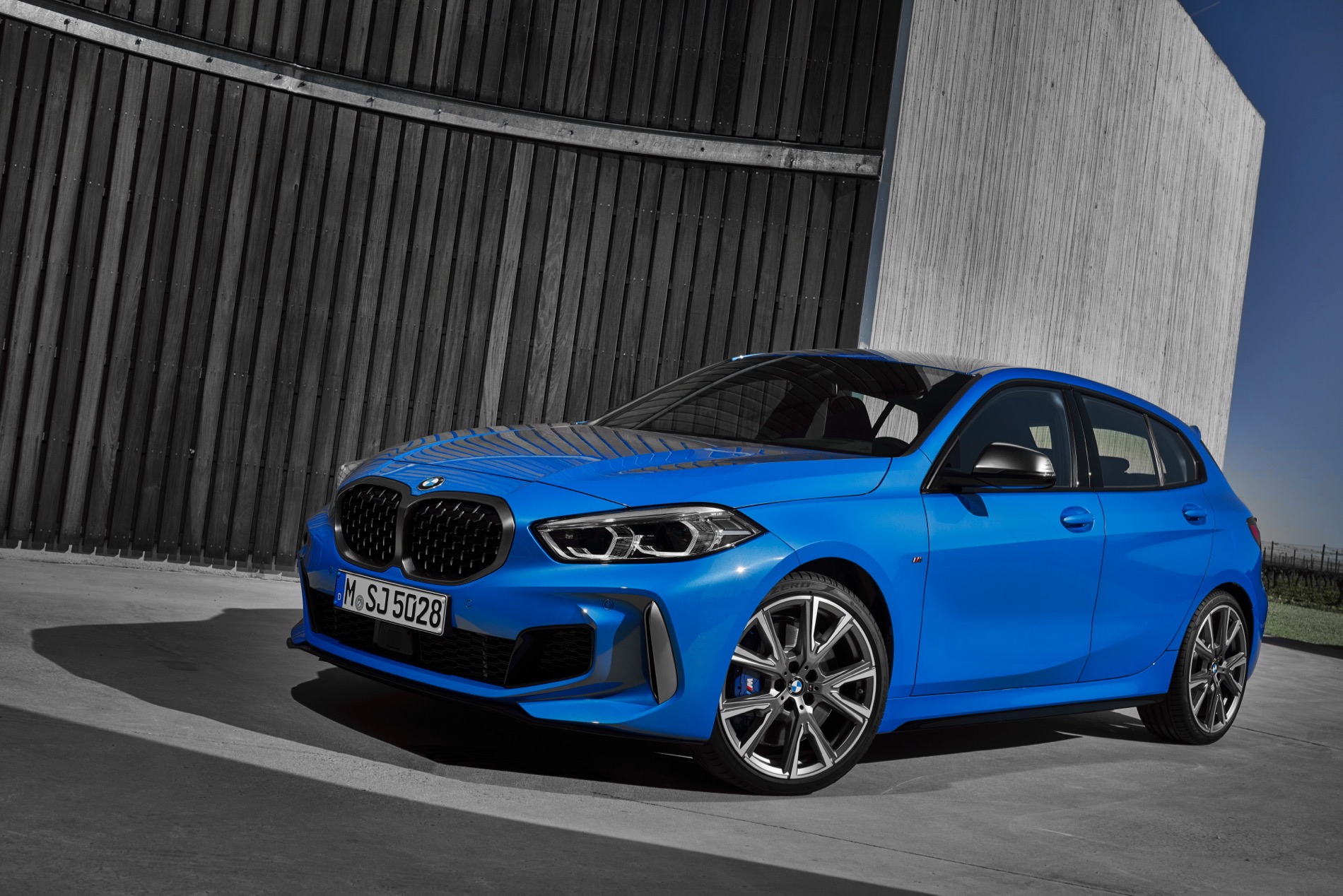
Meanwhile, back on Planet Earth, WhichCar revealed how you can get a $3 million Aston Martin Vulcan hypercar for free. We met the luckiest man alive, who survived a crash in a 400km/h Bugatti Veyron. We also test drove the new BMW M135i hot hatch — and didn’t crash – and learned the next BMW M2 will stay rear-drive.
Big news for us this week! Season 2 of WhichCar’s TV show on Network Ten has not only been green-lighted, we’re doing 30 episodes instead of 20! Read more about Australia’s favourite new car show here.
On the subject of Road Safety, a ticked off Mark Webber teed off on Australia’s parochial road safety policies, encouraging our legislators to “pick up the phone” to other countries setting a better example. It appears the UK is also leading Australia in supporting EV adoption, too, with a proposal for all new homes to have electric charging points.
On the subject of electrification, we took a closer look at Rivian, the EV ute startup now bankrolled by Ford and Amazon, adjudicated a power struggle between the Nissan Leaf and Australia’s wide brown land, investigated the cheapest ways to charge your EV, and learned about a Nissan-based electric ute launching in China next month that can do 400km per charge.
Also this week, Ohmie Go launched Australia’s first EV sharing program, German gearheads ZF unveiled a two-speed EV motor that could dramatically increase EV touring ranges, Nissan rolled out some Navara updates, and Ford added AEB to Everest SUV models.
Skoda launched a ‘Parent Taxi App’ via which kids can ‘buy lifts’ by doing chores. Skoda also confirmed a hotter RS version of the Kodiaq SUV for Australia. This ‘high-performance’ bi-turbo diesel model was previously ruled unfit for Australia’s ‘hot and dusty’ climate, so Skoda Oz had its engineers reclassify Australia as ‘moderately hot’. That’s good news for climate change, too, right?
Happy birthday to Audi’s RS performance brand which turns 25 this year. We flew to Germany to join the celebration and learned about a raft of new RS models which we’ll tell you about over the coming weeks.
Disclaimer: Don’t do this at home folks! The ingenuity of Australians always amazes us, but this bloke who fitted a leaf blower to supercharge his Commodore, leaves us speechless.
Have a great weekend!
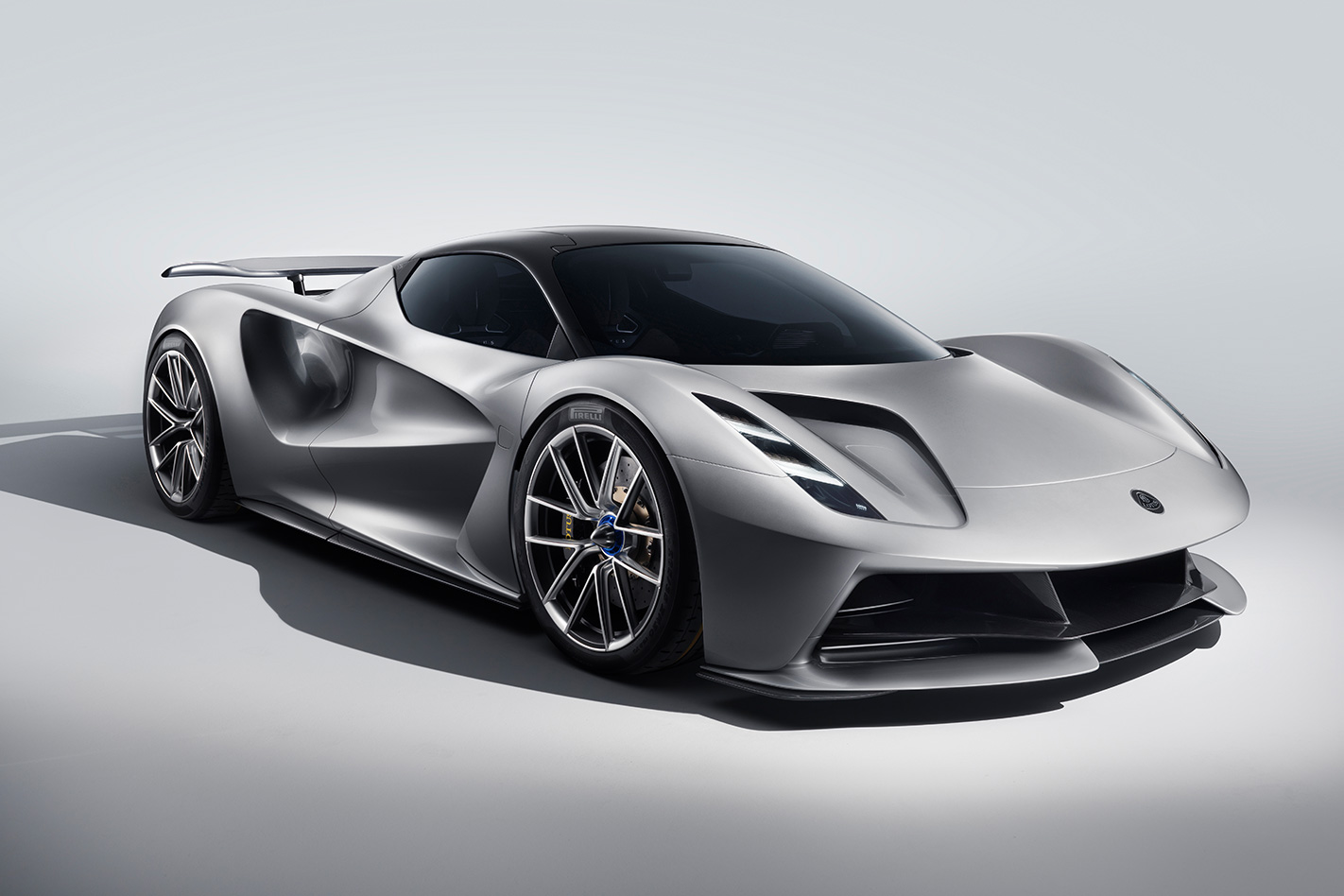
FOR A car that swaps its external mirrors for a triple camera system, the recently unveiled Lotus Evija electric hypercar has a very cool secret that only a mirror can reveal.
We’re suckers here at Wheels for a sexy font and all the art editors in the building were nodding in appreciation at the Evija typeface that features on the car.
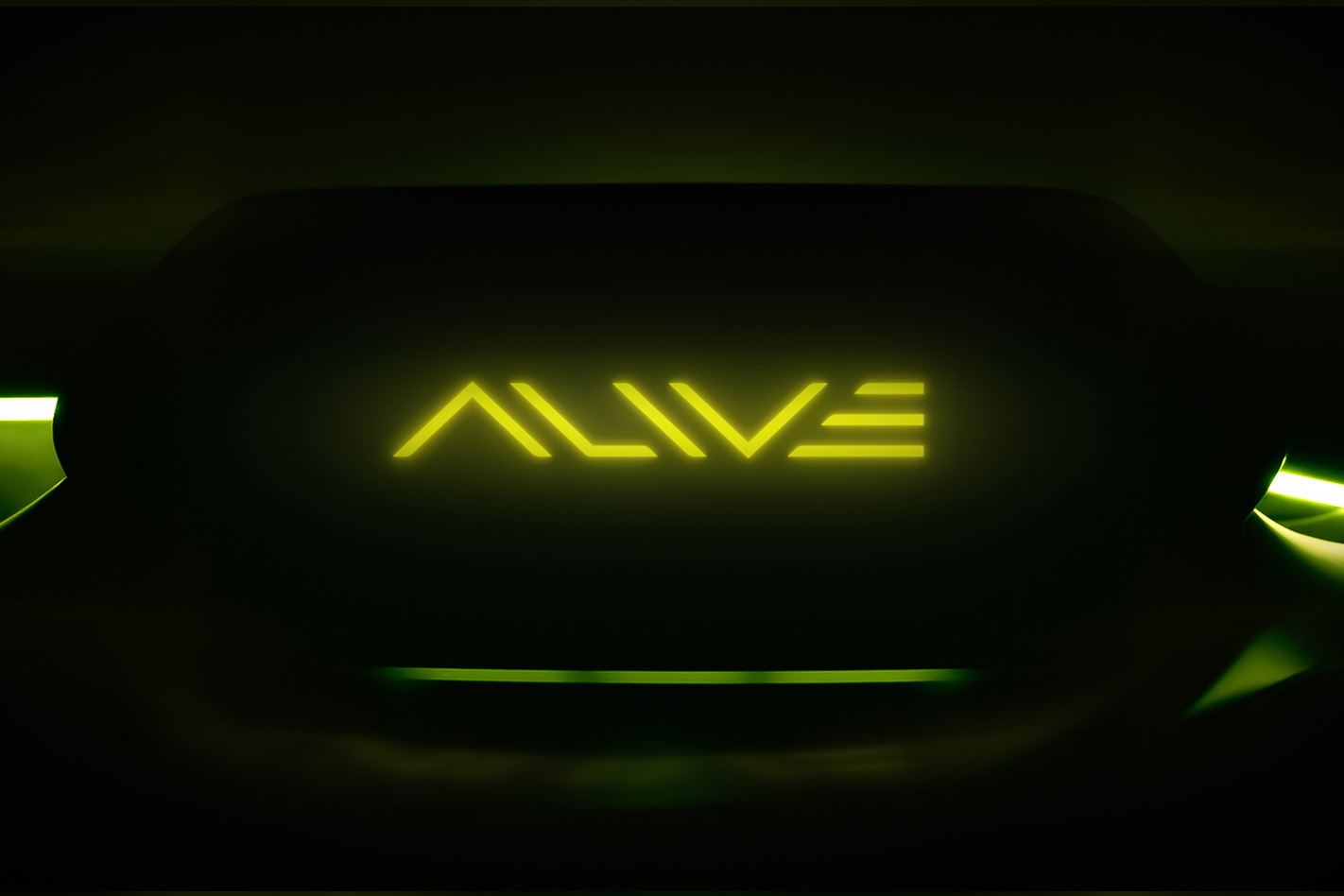
But here’s the thing, mirror the EVIJA badge and it says something quite different.
Now that’s slick. Chapeau, Lotus.
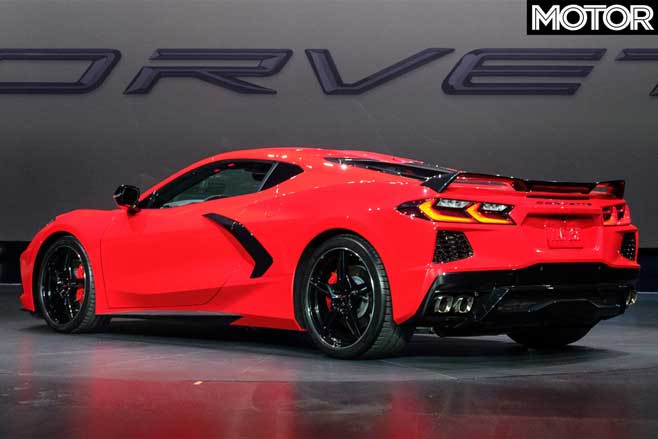
The automotive world’s worst kept secret is now officially confirmed: the Chevrolet C8 Corvette is a mid-engined sports car. And it’s coming to Australia, built by the factory in right-hand drive.
It’s the quickest and most powerful base Corvette ever and, following seven generations of front-engine/rear-drive, it turns the concept of Chevrolet’s iconic sports car on its head in an effort to lift performance and dynamics to new heights.
In a statement, Dave Buttner, Chairman and Managing Director of Holden, said: “The news that Corvette will now be built in right-hand drive for the first time ever – and will be exported to Australia – is hugely exciting for our team at Holden and any Australian who loves high performance cars.”
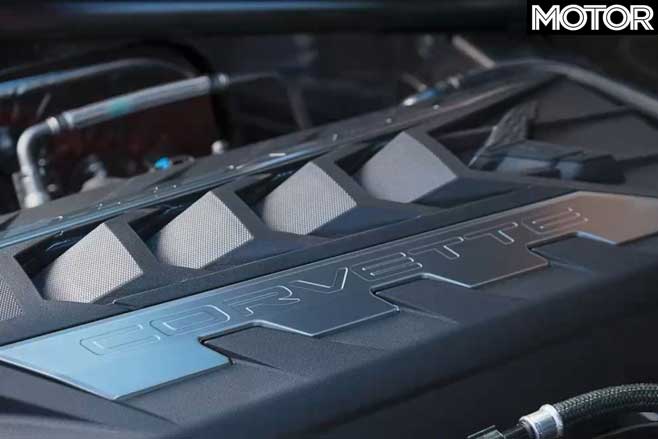
At the heart of the C8 Corvette is a new 6.2-litre naturally aspirated V8 dubbed the LT2. When fitted with the performance exhaust as part of the Z51 Performance Package, it produces 369kW at 6450rpm and 637Nm at 5150rpm.
The LT2 retains GM’s traditional pushrod, two-valve per cylinder layout but lifts the compression ratio to 11.5:1 and employs dry-sump lubrication to both lower the centre of gravity and prevent oil surge under hard cornering. Active Fuel Management shuts off cylinder 2, 3, 5 and 8 on light throttle loadings.
Another radical shift is the lack of a manual transmission for the first time. Instead, Chevrolet developed an all-new eight-speed dual-clutch gearbox with launch control, allowing the C8 Corvette in Z51 guise to bolt to 60mph (97km/h) in “under 3.0sec”. Expect a 0-100km/h time in the 3.2sec range. The driver can manually de-clutch the transmission by pulling both shift paddles back simultaneously.
The C8 chassis is built around a central tunnel, improving torsional rigidity, allowing the creation of left- and right-hand drive variants, removing the need for bulky side sills aiding ingress and egress and providing a pair of luggage compartments, one in the nose and the other aft of the engine. Dry weight is 1530kg.
Double-wishbone coilover suspension features front and rear controlling staggered rims, the fronts measuring 19 x 8.5-inch and the rears 20 x 11.0-inch, wrapped in 245/35 and 305/30 Michelin Pilot Sport rubber. Standard brakes are 321mm rotors and four-piston calipers up front and 339mm rotors with two-piston calipers at the back, while the variable-ratio steering has been sharped from 16.25:1 to 15.7:1.
An optional Z51 Performance Package enhances the C8’s acceleration and handling, including a sports exhaust, performance-tuned suspension with Magnetic Ride Control adaptive dampers, larger brakes (345mm front discs and 350mm rears with matching four-piston calipers) with greater cooling, a shorter final drive ratio, an electronically controlled limited-slip diff, Michelin Pilot Sport 4S tyres, Performance Traction Management ESP program and aerodynamic aids – specifically a front splitter and rear spoiler – which add up to 180kg of downforce.
Six drive modes are available to choose from: Weather, Tour, Sport, Track, MyMode, a configurable setting and Z Mode, activated by a button on the steering wheel, which allows adjustment of the engine and transmission settings.
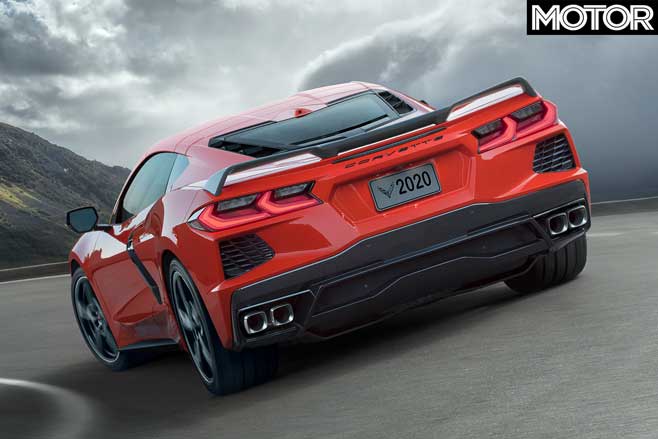
The new mechanical layout has dictated a radically different design to previous Corvettes, with wide rear hips tapering down to a Ferrari F430-esque nose and deeply sculpted sides to feed air into the side intakes. In true Corvette style, the roof is removable to create a Targa-style car.
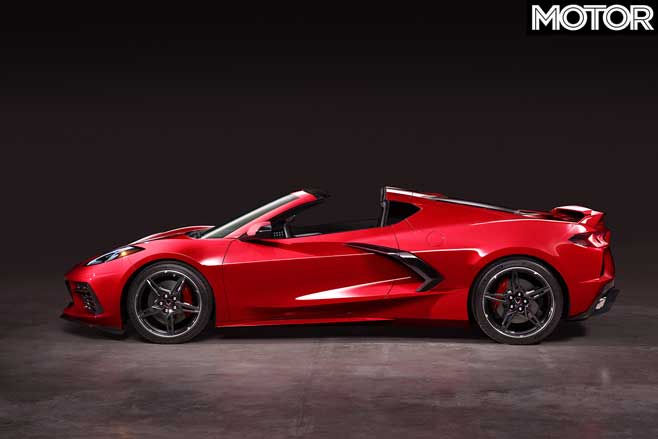
GM’s vice president of Global Design, Australian Michael Simcoe, describes the car thus: “It is now the best of America, a new arrival in the mid-engine sports car class. We know Corvette can stand tall with the best the world has to offer.”
At 4630mm long, 1934mm wide and 1234mm tall, the C8 is similar in size but longer, wider and lower than a Porsche Cayman. There are 12 colours to choose from – white, black, silver, orange, bronze, yellow and a pair of reds, blues and greys.
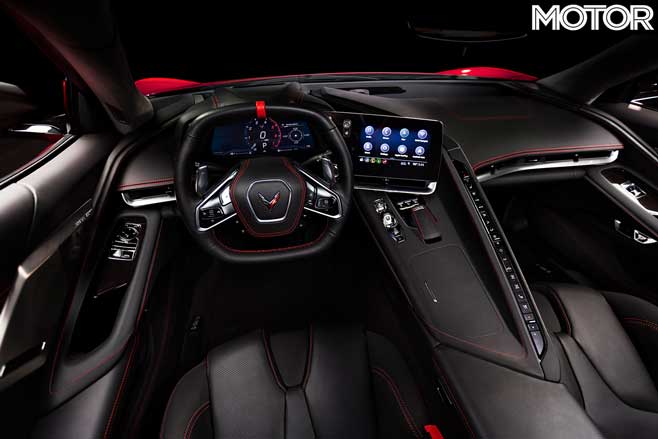
Inside it’s all about the driver, with a cockpit-like design slanting the infotainment screen and all major controls heavily towards the left-hand side and the passenger effectively cordoned off by a bridge carrying 18 buttons including HVAC controls, seat heating and more.
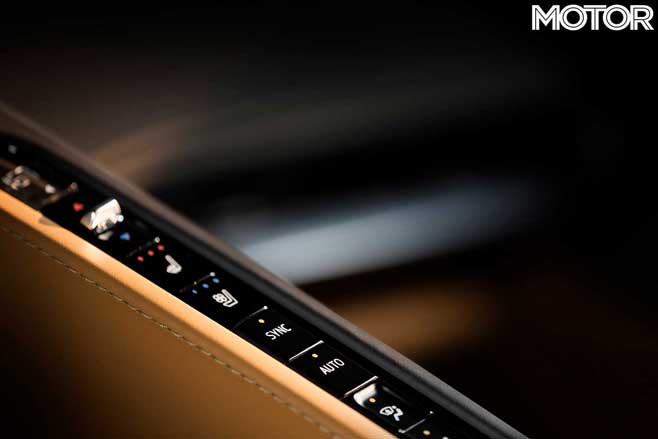
Six interior colours are available – black, grey, ‘natural’, blue and a pair of reds – and three seats, a comfort-oriented GT1, sporty GT2 and heavily bolstered Competition Sport, the latter two with carbon fibre trim.
The idea of a mid-engined Corvette has been around as long as the Corvette itself. In fact, the car was meant to be launched as the C7 before the global financial crisis forced GM to abandon the program as it faced bankruptcy.
Speaking on the Autoline podcast in 2018, GM Vice-Chairman until 2010, Bob Lutz, said: “We wanted to do the original mid-engine Corvette, which was just before the 2007-08 financial meltdown, which cancelled that plan. In the fullness of time we had to cancel that very investment-intensive program and we had to do one more iteration off of the C6, which turned out to be the C7.”
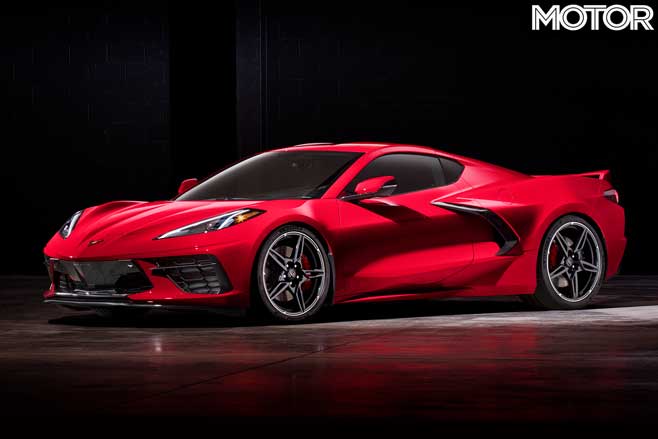
The push for a mid-engine layout came from Corvette Chief Engineer Tadge Juechter, who created a presentation detailing why the front-engine, rear-drive layout had been developed as far as it could go, culminating in the 476kW/819Nm ZR1.
Chevrolet announced at the global reveal that US C8 pricing would start “below US$60,000 (~AUD$85,000)” but Holden told MOTOR it’s too early to comment on any projected local pricing. C8 production begins at the Bowling Green plant in late 2019 with the first Australian cars set to arrive late-2020/early-2021.
“Our team is totally revved up to build on Holden’s performance legacy with the most technologically advanced Corvette ever built,” said Buttner. “We look forward to taking on the European and Japanese performance vehicles with some highly sophisticated American muscle.”
While waiting for the unveiling of the all-new mid-engined Corvette C8, we decided to see what would happen if we rang a few dealers here in Australia and tried to buy one.
The short version: a lot of dealers are pulling numbers out of thin air. Inspect what they’re saying a little more closely, however, and some intriguing details pop out at you.
2020 Chevrolet Corvette: this is it!
One HSV dealer in Victoria signed off our tentative request with the cheery reminder that “I would say just wait for Bathurst”, hinting that we can expect to see the first cars in Australia by October. Full production is confirmed to start from the Bowling Green, Kentucky plant from ‘late 2019′ so let’s keep ’em crossed for the Great Race.
It looks to be worth waiting for. The C8 will be powered by a 6.2-litre small block V-8 LT2 engine good for 369kW and 637Nm when equipped with the performance exhaust. That’s a fair whack for an entry-level model.
Many dealers were willing to take orders, despite not knowing the price. We were quoted prices from $170,000 to $280,000 for the Corvette, but it appears that there’s still a bit of anxiety over vehicle allocations.
“I did get notification the other day from an outside source that we may be seeing one or two vehicles in Australia. Dealers are going to be very limited on what they can get hold of. It’ll be first in, best dressed on who puts an order in. It will be subject to pricing at the time,” said one.
“Holden are saying they are only going to give them to limited dealers. Some people have said, ‘You can’t do that. You’ve got to give it to all dealers because we’re all franchises and we can’t start splitting one on the other,” he continued.
“Are you wanting to put an order in and be locked in for one of the cars?”
We asked how much the deposit would be and he mentioned a sum of $2000.
“The first person who has a deposit down on one will be the first person contacted. We’ll be saying to them, ‘Okay, this is the price’, do they want to go ahead or not? And if they say no, we’ll just refund the deposit and it’ll be that simple.”
One dealer even poured cold water on the much-reported fact that the car would be factory built in right-hand drive. He mentioned that he expected to see stock in late 2020 before dropping the zinger that “the [right-hand drive] conversion will be done by HSV”.
Dave Buttner, Chairman and Managing Director of Holden confirmed today that “The news that Corvette will now be built in right-hand-drive for the first time ever – and will be exported to Australia – is hugely exciting for our team at Holden and any Australian who loves high performance cars.” So RHD from the factory then.
In other words, if Holden dealers do have concrete facts on the Corvette C8 ahead of launch, they’re playing them pretty close to their chests.
HERE it is: the V8, rear-drive supercar that Holden fans have been waiting for – the mid-engined, C8 Chevrolet Corvette Stingray.
Set to shown officially in just over an hour, these leaked images – first published by Esquire – give us our best look yet at the new ’Vette.
Not only has the C8 undergone a substantial layout change, with the engine moving from in front of the driver to behind, but it’s also destined to be sold, officially, in Australia for the first time.
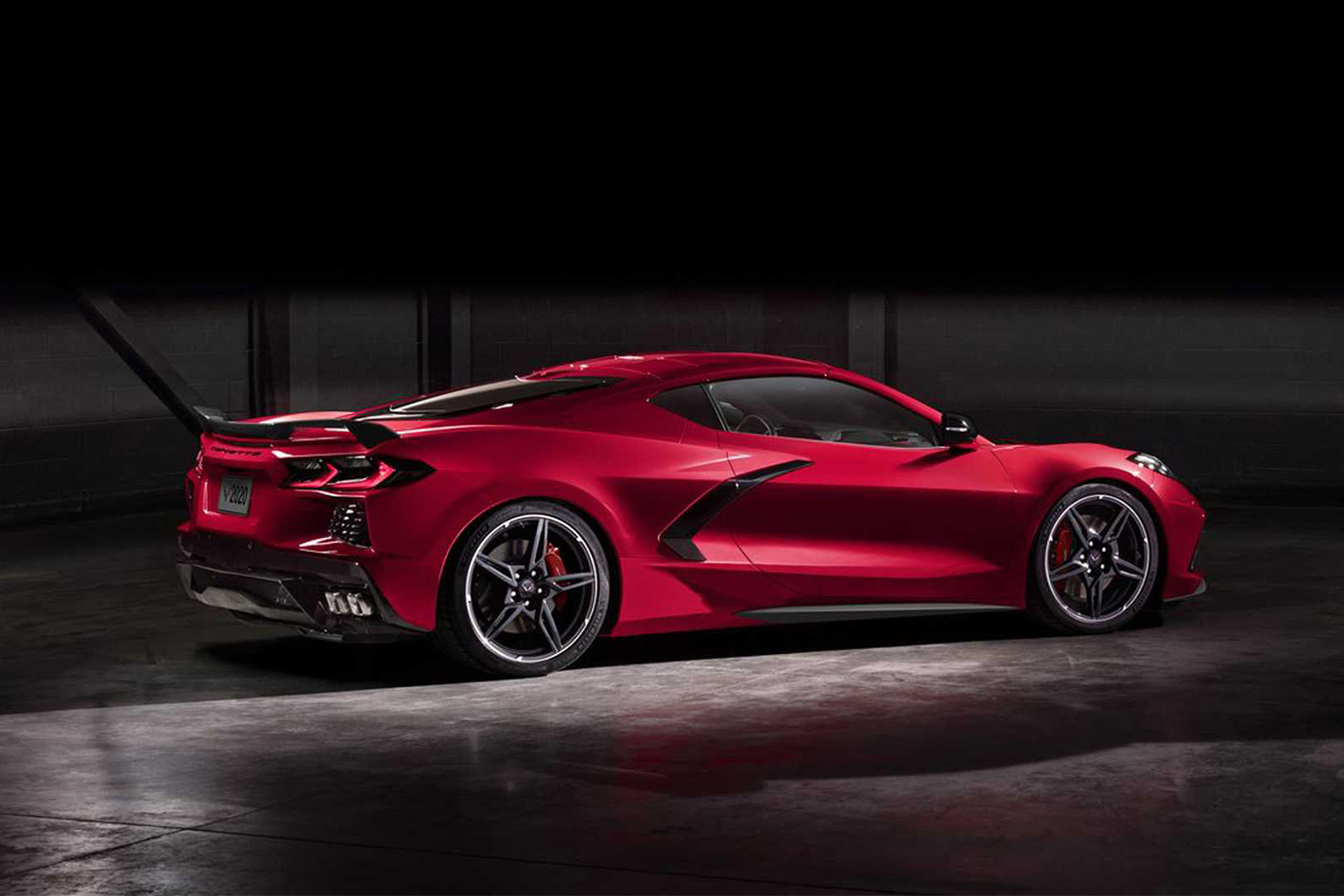
While the images aren’t officially confirmed, it looks like a tasty prospect and a worthy successor to the C7 Vette. It’s certainly low-slung and mean – just what a Corvette should be.
Esquire’s (now removed) story also included specs, stating that the Corvette will crack 0-60mph (97km/h) in less than 3.0sec if the right option-boxes are ticked.
Achieving that figure is believed to be thanks to a 6.2-litre LT2 V8, with power levels expected to be around 365kW and torque at 637Nm.
However, this is just the ‘base’ Corvette, with more powerful versions planned, including a new Z51 Performance Package with additional kit like upgraded brakes, better cooling and a meaner exhaust system.
Sadly, it seems as though there won’t be a manual transmission – to begin with. A new eight-speed dual-clutch ’box will handle the shifting with steering wheel-mounted paddles if you want to take control.
Design wise, the C8 takes cues from the C7, but the American hero has morphed into a mid-engined silhouette.

An image of the interior has also found its way online, and if you’re a fan of buttons over touchscreens, you’ll be happy.
Inside GM has tried to match old-school charm with modern tech, pairing a strip of controls and a large infotainment touch screen.
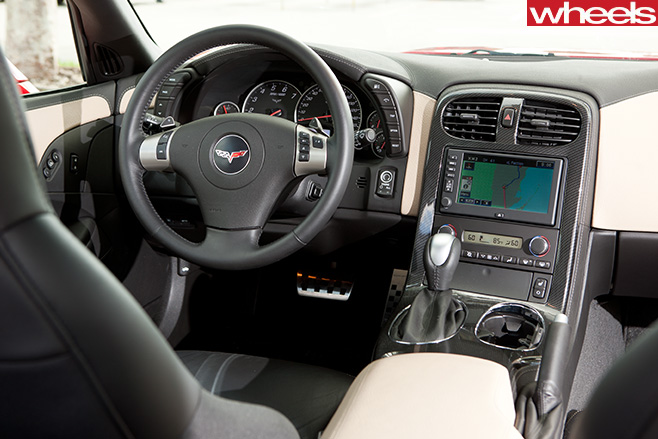
Examining the photo we can tell that the strip of buttons largely deal with the HVAC controls, including heated seats. It creates a strong style statement, adding bulk to the centre console as it connects to the dash.
In the absence of a traditional gear lever, it appears the transmission will be controlled via push buttons and be accompanied by provisions for an automatic park brake.
The cabin is clearly driver-focused, with the bulk of the dash being angled towards to the person behind the new steering wheel.
The two-spoke tiller is a design progression, taking cue from previous Corvette generations, while leaving plenty of room to see through to the digital instrument cluster. It also features myriad buttons…
Red stitching, as well a red 12 o’clock marker, adds some colour to the otherwise dark interior.
Stay tuned for more C8 Corvette coverage throughout the day with the global release looming.
2020 Chevrolet Corvette Interior
In a world where touchscreens are replacing buttons, it seems Chevrolet has done the complete opposite.
In a leaked image, rumoured to be the interior of the imminent mid-engine Corvette, it seems GM is aiming to match old-school charm with modern tech, pairing a strip of controls and a large infotainment touch screen.
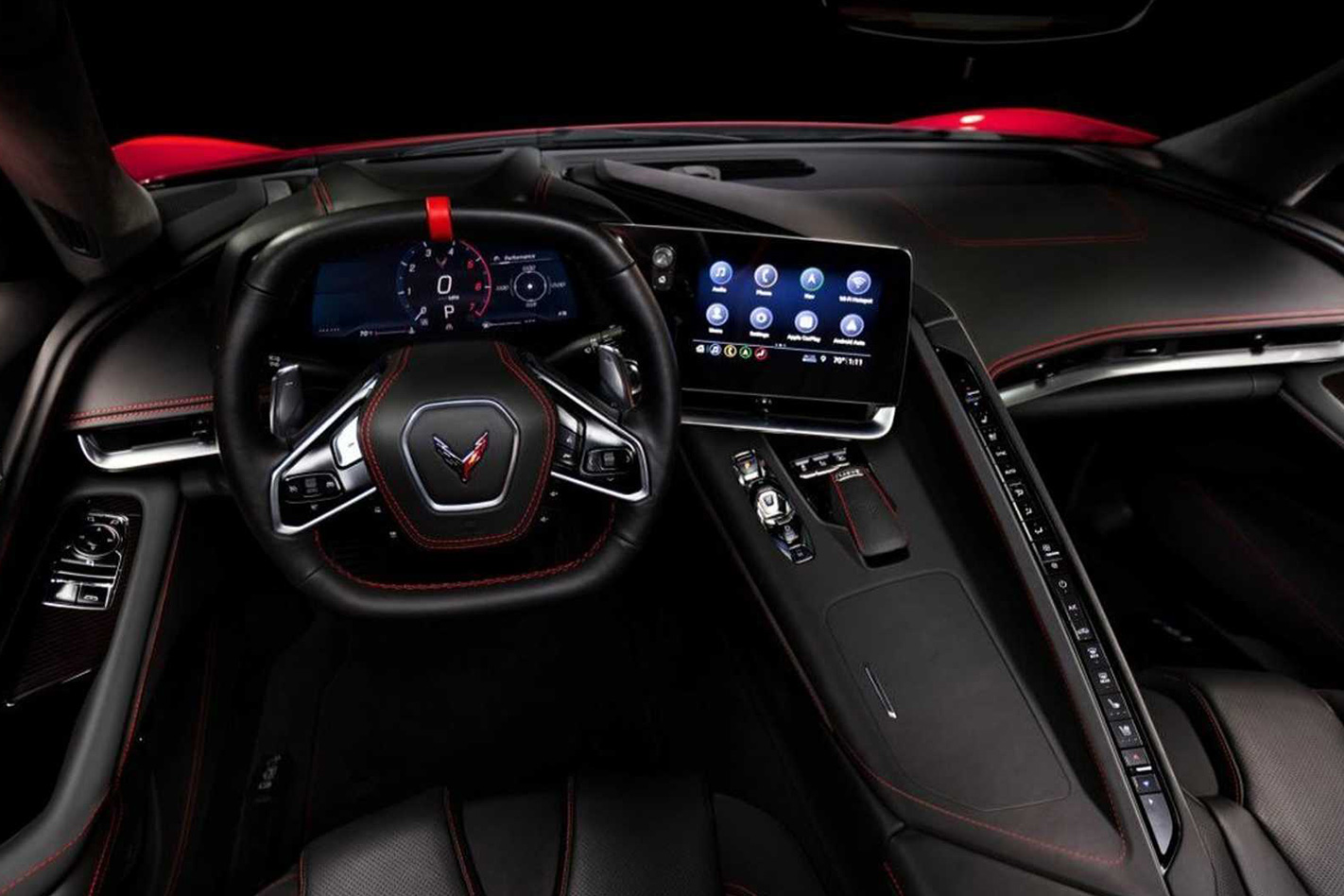
Reportedly finding its way online via the Corvette forum and and then later Tweeted by Bozi Tatarevic, the image is of high quality and very much resembles press photography.
Examining the photo we can tell that the strip of buttons largely deal with the HVAC controls, including heated seats. It creates a strong style statement, adding bulk to the centre console as it connects to the dash.
In the absence of a traditional gear leaver, it appears the transmission will be controlled via push buttons and be accompanied by provisions for an automatic park brake.
The cabin is clearly driver-focused, with the bulk of the dash being angled towards to the person behind the new steering wheel.
The two-spoke tiller is a design progression, taking cue from previous Corvette generations, while leaving plenty of room to see through to the digital instrument cluster. It also feature myriad buttons…
Red stitching, as well a red 12 o’clock marker, adds some colour to the otherwise dark interior.
Stay tuned for more C8 Corvette coverage throughout the day with the global release looming.
The sun is setting, the boats are on the lake and F1 is racing around the Albert Park lake. This is the Melbourne GP at its finest, and will continue to be for at least another five years as Australians get to enjoy the pinnacle of motorsport in their own backyard.
Extending its contract with Melbourne by two years, Formula 1 has confirmed the twilight racing event will continue to be hosted in Victoria until 2025.
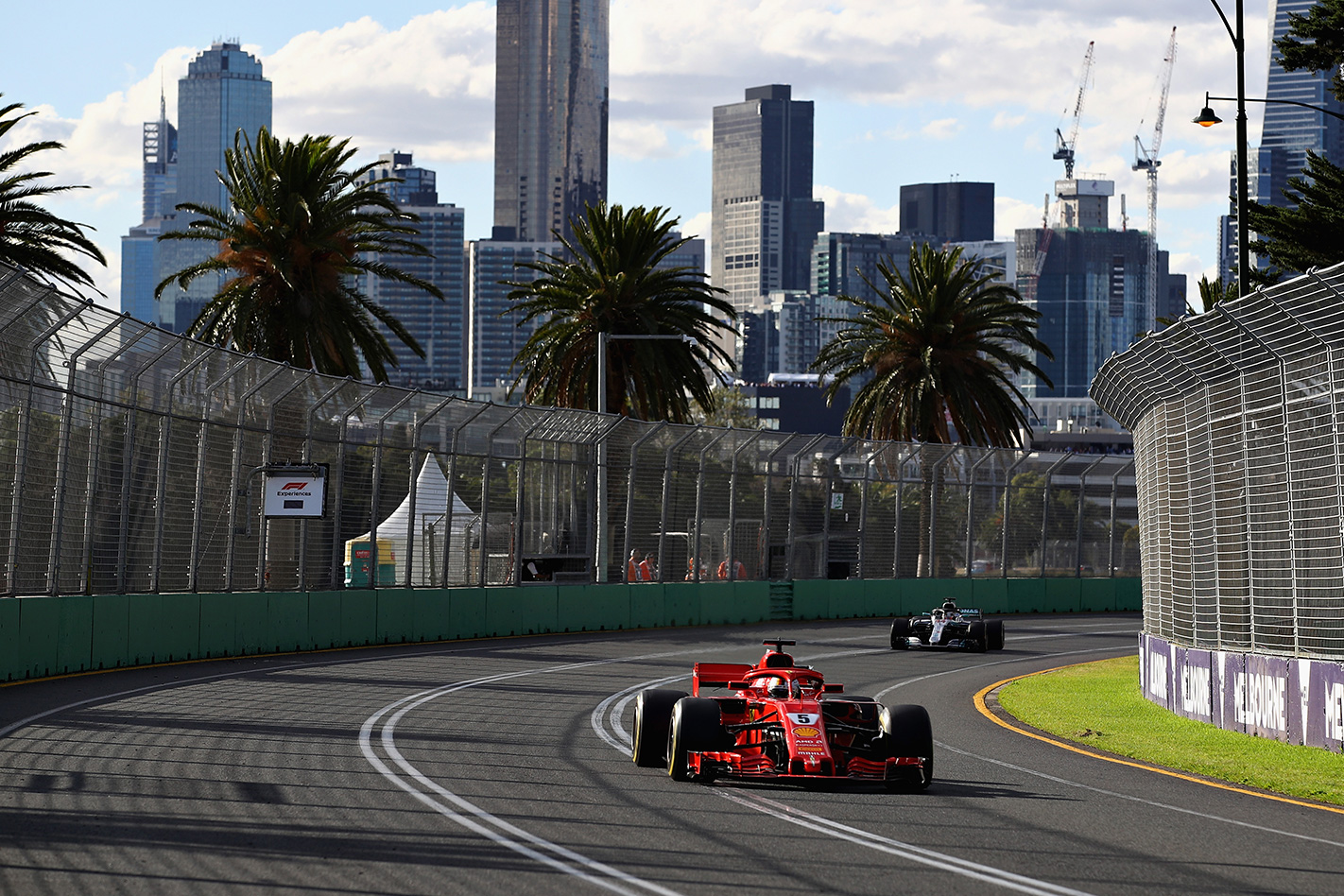
Melbourne will also continue to host the opening round of the F1 championship next year from March 12-15, celebrating the 70th anniversary of the sport and the 25th time Australia has had modern F1 cars racing on home soil.
Adelaide hosted the Australian Grand Prix from 1985 to 1995 before it moved to Albert Park in 1996, holding the opening round in all its history except for 2006 and 2010 that both belong to Bahrain.
Victorian Minister for tourism, sport and major events, Martin Pakula MP, said Victoria was better than anywhere else in the world to hold such a major event.
“Victoria hosts major events better than anywhere else in the world and I’m excited that Formula 1 has chosen to exercise its option to extend the contract and enable the Victorian Government and the Australian Grand Prix Corporation (AGPC) to continue to deliver more world-class events for Victoria,” he said.
A sign of confidence, F1 says that in the past three years more than 900,000 ticket holders have attended the Melbourne GP. Chairman and CEO of Formula 1, Chase Carey, added that the future for Melbourne to continue hosting the even looks positive.
“We are pleased to have renewed our partnership with the city of Melbourne, which will now host the Formula 1 Australian Grand Prix until at least 2025,” he said.
“The decision to extend the current relationship for a further two years stems from the fact
We’re lucky to have such a beautiful backyard to explore here in Australia but if you want to look at it with a low carbon footprint there’s a big hurdle in the way – the sheer scale of it. See, long distance travel and towing a caravan for miles are the Achilles heel of the electric vehicle.
But that might soon change with a new two-speed transmission electric motor unit developed by German transmission giant ZF. These are the guys that brought us the ubiquitous and wholly lovely eight-speed automatic fitted to just about every BMW you can buy.
Most electric cars below hyper performance machines use an economic single-speed reduction gear. As electric motors can provide full torque – usually around 300-400Nm from 0rpm – the lack of gears doesn’t really affect acceleration. In fact, getting to 100km/h is easy – it’s maintaining that speed that requires a lot of energy from the battery as the motor spins at high rpm. That’s where the new ZF unit comes into play.
Able to change into a second cog at 70km/h, it requires less energy to drive at higher speeds and aids with towing. The unit is an all-in-one part, with a 140kW electric motor, two-speed transmission and electronic componentry all in the one sealed box. While Tesla and BMW have similar units, they are single speed, and ZF will also open its doors to any manufacturer interested. And though multiple-gear electric motors are in production, they are the preserve of supercars.
In ZF’s new unit, the second gear is set to engage at 70km/h which suits the humble passenger cars, though the German manufacturer says it can use input data such as GPS positioning to decide the optimal speed at which the gears change. This allows for a variety of further applications such as performance tuning along with long distance efficiency.
Head of system house at ZF’s E-Mobility division, Bert Hellwig says the new unit increases high speed driving range by around five percent while retaining the low-end high torque qualities of electric motors.
“Until now, with electric motors, vehicle manufacturers have had to choose between high initial torque and a high top speed,” he said.
“We are now resolving this conflict and the new drive will be compatible for performance and heavier vehicles – for example for passenger cars towing a trailer.”
Everything you need to know about electric cars
“For electric vehicles, it is important to obtain as much range as possible for from each battery charge. Bringing together our know-how in relation to electric motors, gearboxes, and power electronics ensures that we achieve the best possible range from each battery charge.”
The Wheels Verdict: A 515kW (700hp) 70th birthday present to Porsche from its Motorsport department, the track-only 935 is a glorious evocation of Porsche’s wildest 911-based race cars of the 1970s, built on its most monstrous current road car. Rare, beautiful and expensive, we just hope they’re used as intended, on track, rather than hidden away, unused, in vast collections.

What is the Porsche 935?
A mad, limited-number, track-only special to celebrate Porsche’s all-conquering 935 racecar of the late 1970s. The new 935 is based on the already lunatic-fast GT2 RS, and, more correctly, its lighter track-only Clubsport relation. It’s about 100kg lighter than the road car, features a bespoke carbon fibre body and while it’s not homologated to race, its specification is pure racecar.
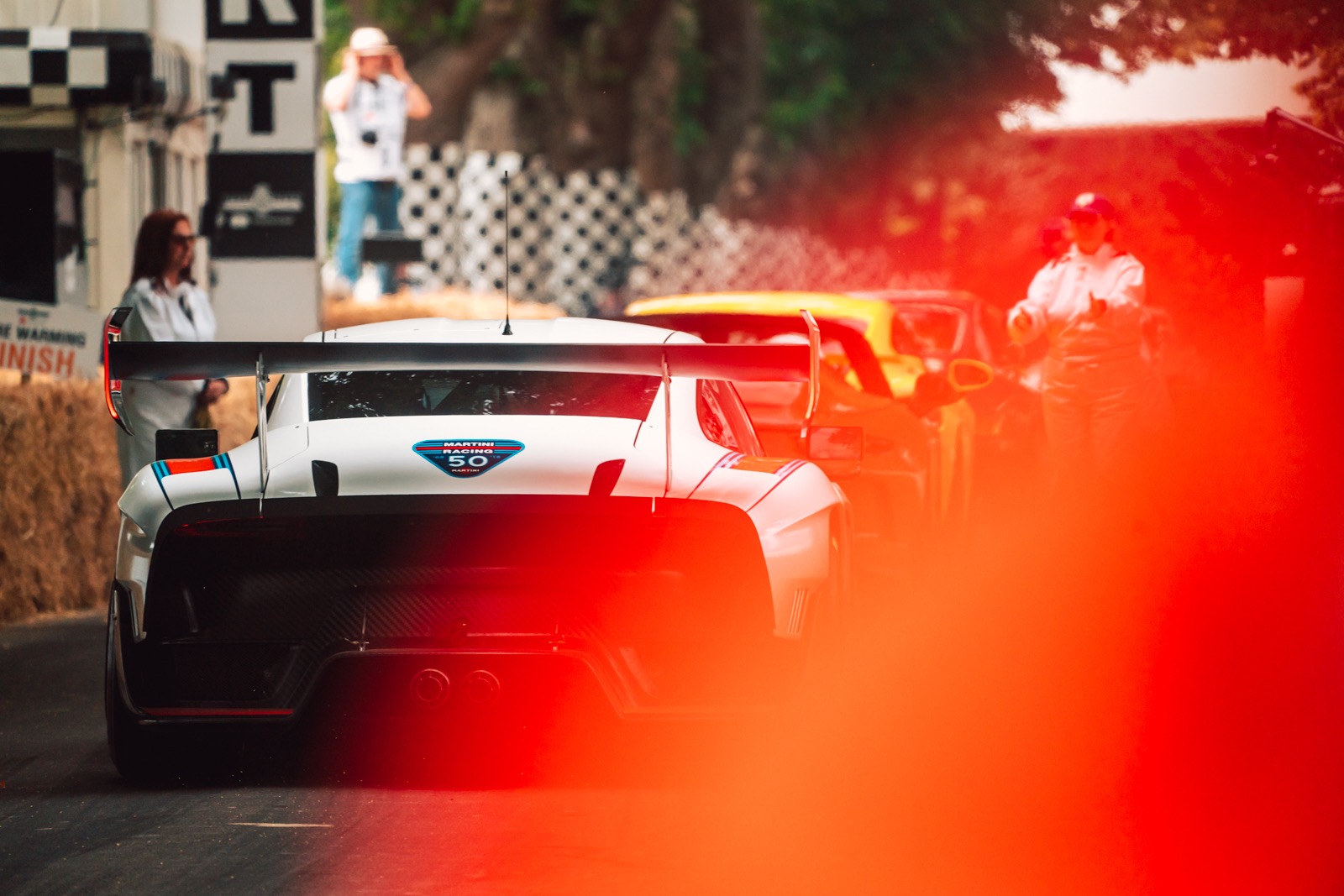
Why we’re testing it
If you’re offered the keys to a one-of-77, limited edition Porsche based on the company’s fastest road car then you don’t say no. We’ll probably never get the chance to see one again, let alone strap ourselves into the tight Recaro bucket seats, flick the ignition switch and turn the key to fire up the 3.8-litre, twin-turbo 515kW flat-six.

Porsche 935 review
We’ve a lot of time in the 935, only not so much time to actually drive it in anger. We’re at the Goodwood Festival of Speed, so there are 150,000 sets of eyes watching cars run up the short, tight and surprisingly challenging hillclimb. There’s a lot of hurry up and wait, then, as the 935 is shuffled down towards the start in a gazillion-dollar traffic jam.
Still, that gives us a lot of time to take in the environment, which, thankfully given I’m in a black race suit, helmet and gloves, retains the road car’s a/c. In front of me there’s a pistol-grip steering wheel, a pair of analogue dials – one being a stopwatch and the other a boost gauge – between which resides a digital read screen with the 935’s vitals on it. A cage that would trouble King Kong criss-crosses the interior, while there’s web netting either side of the seat to hold in flailing arms should we get it wrong and hit the sizeable hay bales that line the Goodwood hillclimb. Let’s hope we’ll not be needing those.

Throw in a smattering of buttons and dials relating to traction and stability systems, the ABS intervention and brake balance and that’s about it. They all require familiarity with the 935 that we’ll not be getting today, so we’ll just leave them well alone. There are cold, new, slick tyres, too, just to add to the pressure, oh, and that 515kW (700hp) output.
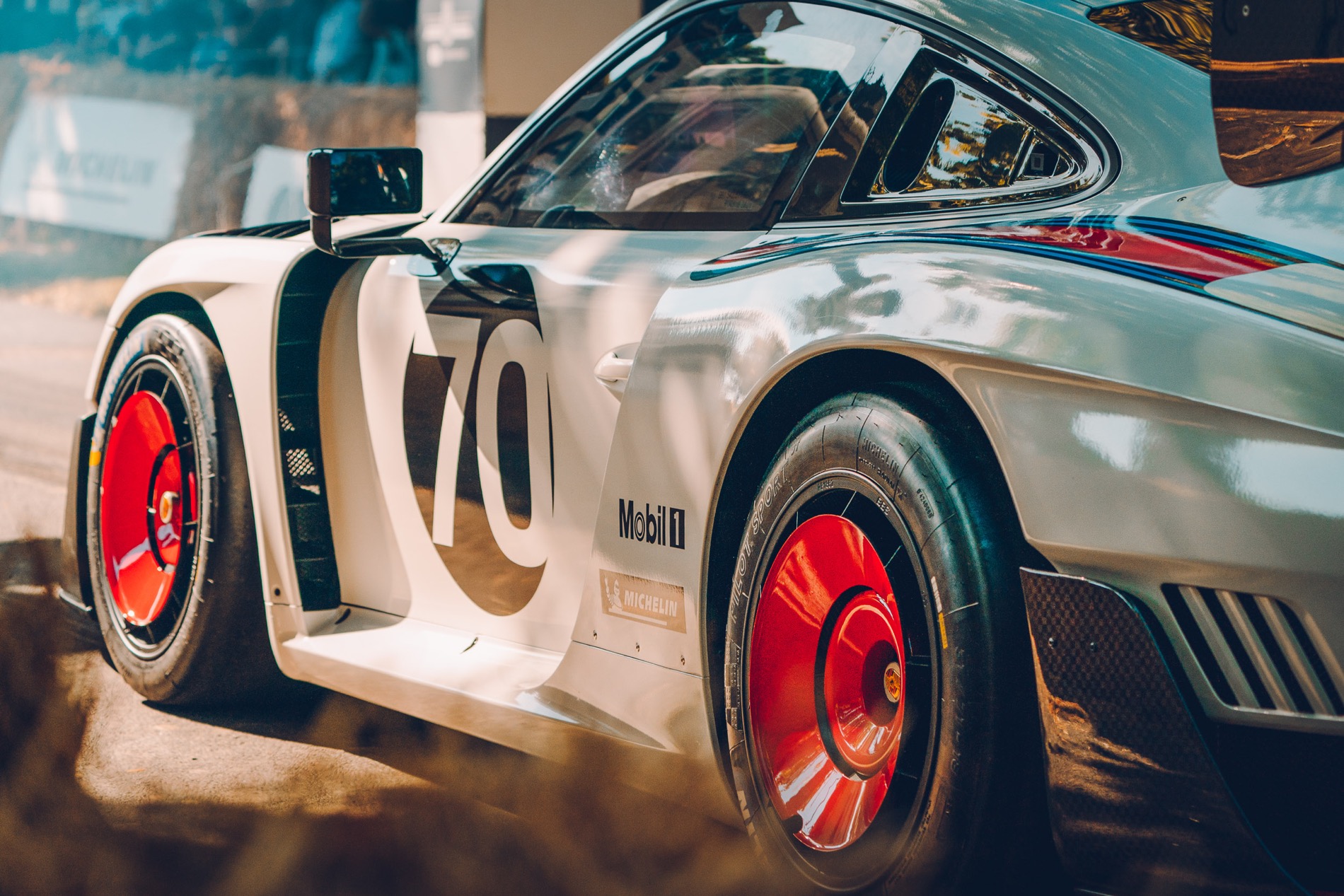
We’ve driven the GT2 RS before so we have some idea of what to expect, startling acceleration being a certainty. Even so the way that the 935 hooks up and takes off is next level. That’s on cold slick tyres, and without resorting to the launch control, which in this one-of-one pre-series 935 isn’t working.
The flat-six makes its presence felt beyond merely the brutal physicality of the force with which it’s propelling the 935 forward. No, the stripped cabin is filled with hard, light materials, all those only intensifying the ferocious sound from the engine as it ricochets and resonates around the focused interior. There’s PDK, the first ratio devoured quickly before I’m flicking the paddle and the next gear’s fired through, all without any let-up in the relentless acceleration. Then there’s a corner which I brake too early for, the massive six-piston aluminium monoblock callipers up front grabbing 380mm steel discs and removing speed as brutally as the engine produces it.
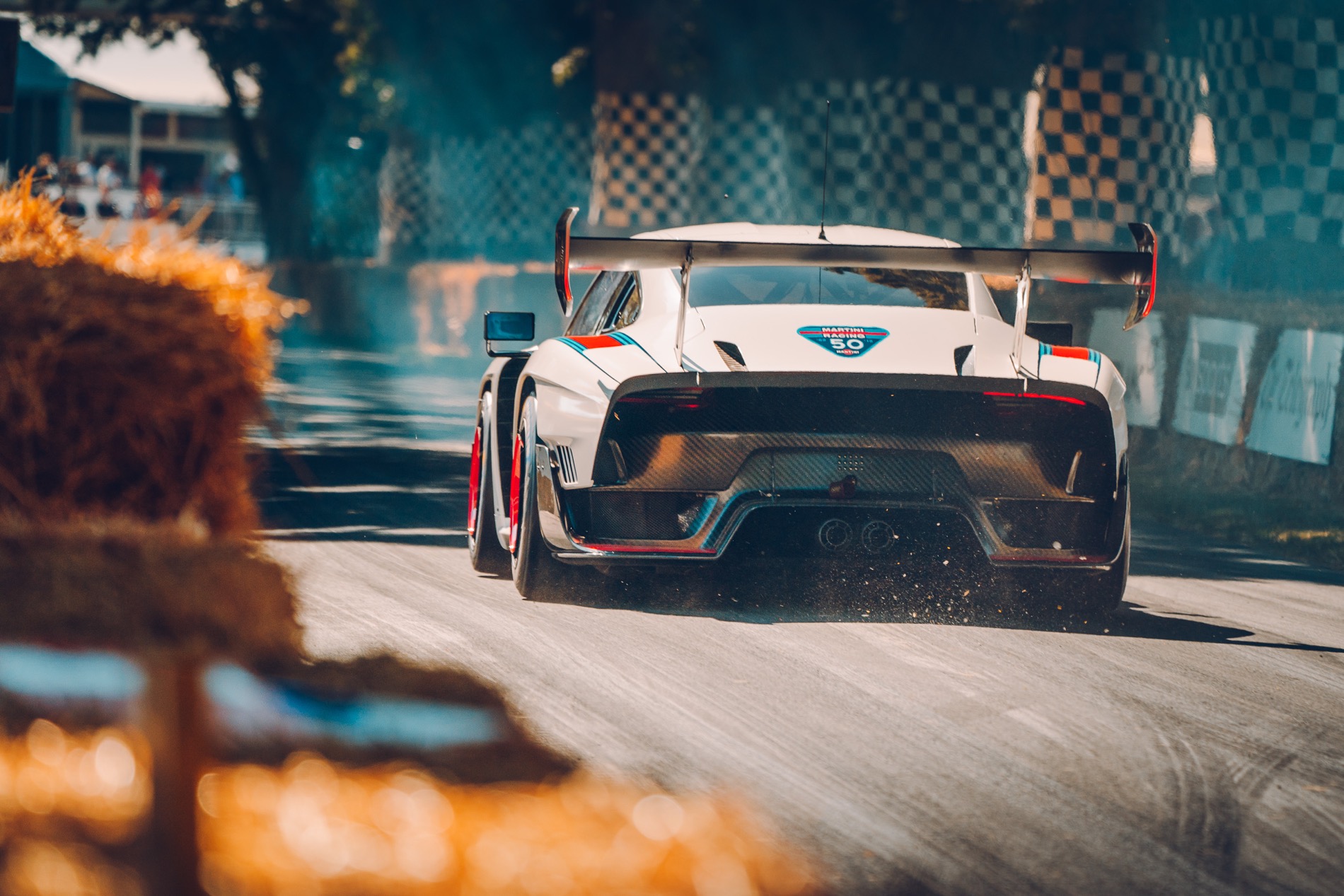
There’s a bit of push-on understeer, hardly surprising given those still-cold slicks, but even so, the immediacy, control and detailed information that’s on offers are obvious. Back on the accelerator and the engine does its thing again, generating eye-widening acceleration, something that’s true in the road car, only here shifting less mass and with more intent. That engine is unchanged, save for some slight mapping revisions, though there’s now a 20-litre over the standard car’s 5L tank for the distilled water that feeds the trick water injection system – the expectation that it’ll be running hotter, harder and for longer.

With little over a minute driving, and well within the 935’s considerable limits, we’re not about to tell you that we felt the additional downforce that wild bodywork produces, nor can we tell you with conviction what it’s like at the limit. No, that would require a track, and a lot of time, both of which the 77 owners will have. What we can ascertain on our brief but tantalising experience of the 935 is that those lucky owners would be mad to secrete this special machine away in a collection, unused. Indeed, if they want anyone to come and do some shakedown laps, or scrub in some slicks, you know where we are…
Porsche 935 vs rivals
Ginetta G58, regular GT2 RS Clubsport and some change, 911 GT3 R.
2019 Porsche 935 specs and price
- Model: Porsche 935
- Engine: 3800cc flat-6, twin-turbo
- Power: 515kW @ 7000rpm
- Torque: 750Nm @ 2500rpm
- Transmission: 7-speed PDK dual-clutch automatic
- Weight: 1420kg (old car 1340kg)
- 0-100km/h: 2.8sec (road car, est 2.6sec)
- Economy: 11.8L/100km
- Price: $701,948 Euro plus taxes
- On sale: Sold out
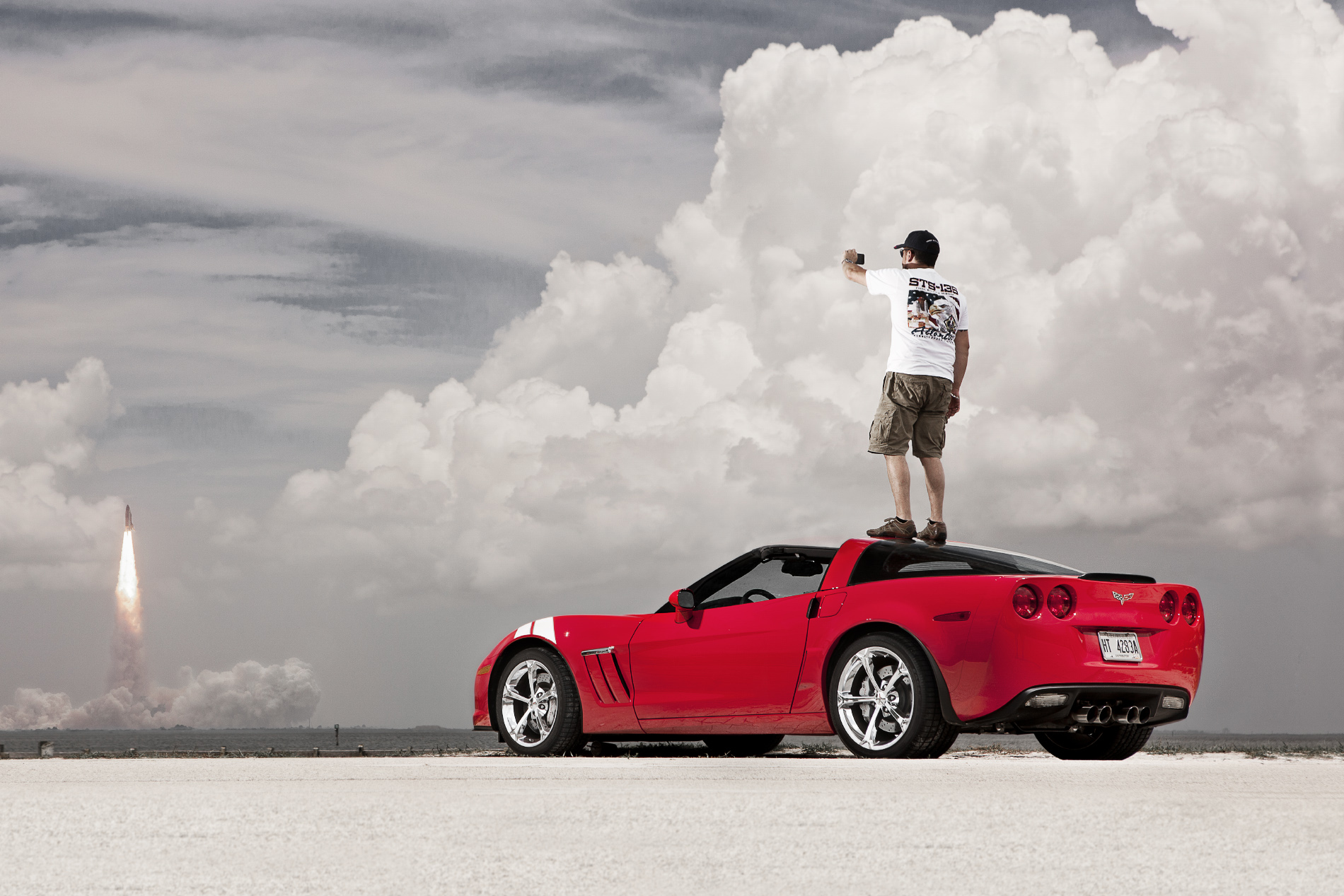
Space shuttle Atlantis reportedly unleashed the force of 60,000 Corvettes when it took off on its recent final mission. Glenn Butler was there with just one, but still had a blast.
I was a kid the day Skylab fell to earth in 1979. At my primary school, we followed the planned re-entry, the expected splashdown in the Indian Ocean … the actual impact across a wide swathe of southern West Australia.
The concept of travelling and living in space blew my young mind wide open, expanding my horizons well beyond the few suburbs I could reach on my BMX. An adult mind would struggle with such a monumental existential recalibration, but a child embraces it without question or fear.
Two years later the space shuttle Columbia blasted off on its maiden voyage from Kennedy Space Center on Florida’s Cape Canaveral. Newspapers heralded the world’s first reusable space plane as a forerunner to intergalactic 747s that would take us to new worlds. I watched the launch on TV, my dreams riding shotgun with the crew as they blasted off into the Final Frontier.
At its core, the space shuttle is a mechanical beast of burden, transport for people and possessions. But, just like a car, it’s more than that: an explorer of far horizons, a travelling companion, a dream machine. Much like my dad’s VC Commodore to an eight-year-old, though on a different scale of operation.
So, for a car fan who grew up with the space program, I had to go to the space shuttle’s 135th and final launch. And it had to be in a Chevrolet Corvette, the car astronauts drive.
T-minus one day
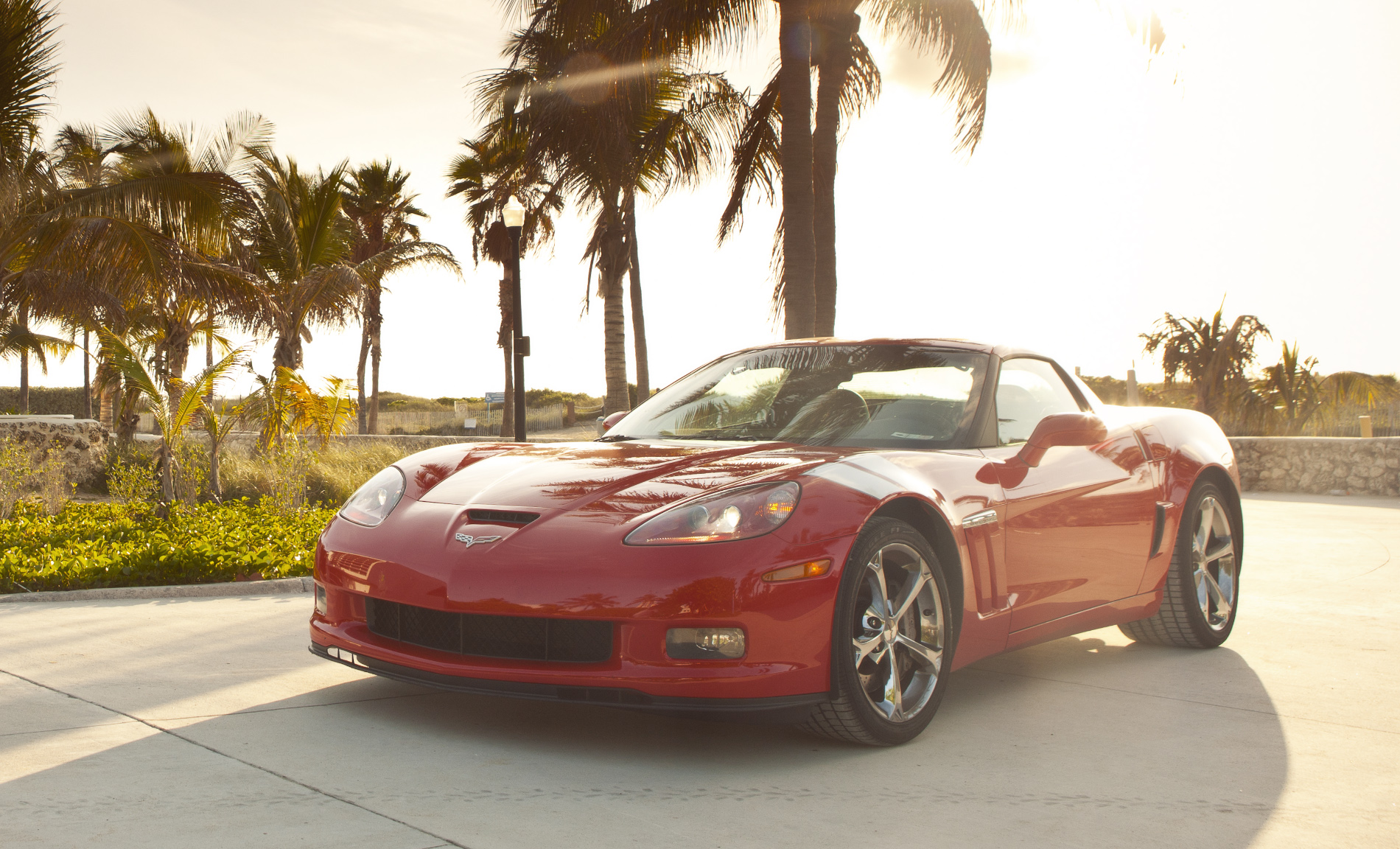
The trip starts early morning on Ocean Drive, Miami’s South Beach boulevard, the Corvette’s familiar 6.2-litre V8 growling at the seagulls picking trash off the now-deserted street. Last night this Art Deco restaurant strip resembled an MTV music video; a thumping and gyrating, pumping and sweating mass of humanity all vying for attention on a humid 36-degree evening. Serious cash cruised the strip: Bentley convertibles, Lamborghinis, Ferraris, Maybachs, Maseratis and even a Rolls-Royce. All pimped. All piloted by guys with golden grilles and, in the passenger seat, sultry girls with criminal curves in skin-tight dresses. A world away from the space geeks and astronauts 350km north …
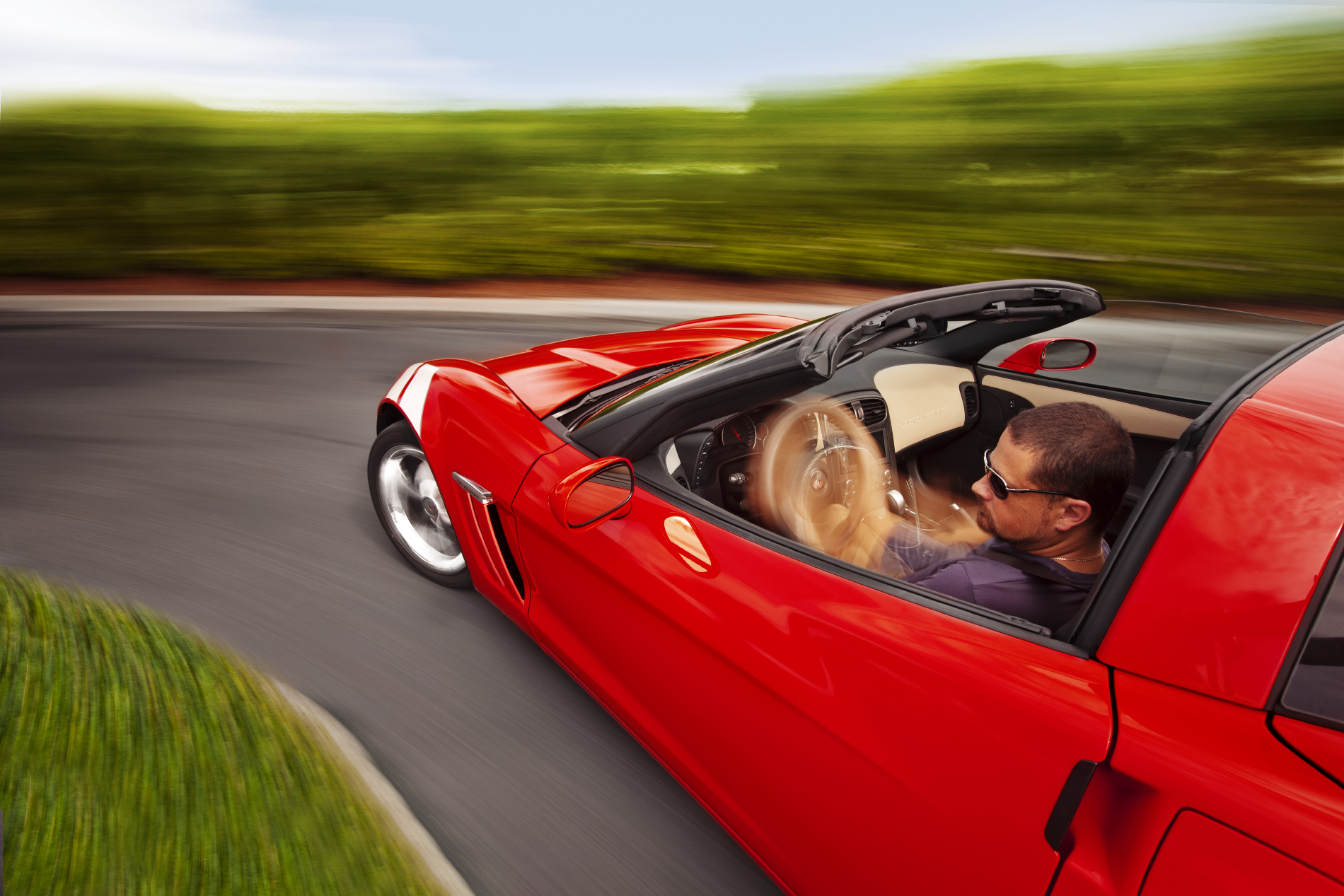
Another party town, Fort Lauderdale, disappears beneath the Grand Sport’s fat rubber. Like the relationship between astronauts and Corvettes, the Grand Sport model traces its roots to the 1960s and Corvette’s racetrack heritage. Think of it as a Clubsport; wider tyres and track, more aggressive suspension and brakes, all in the name of dynamism. Heritage stripes on the front quarter panels are a giveaway, as are the chrome alloys beneath and the delicate lip spoiler on the tail. The GS is effectively a bridging model between stock C6 ‘Vettes and the ballistic Z06 and ZRl. In America it costs US$55,045 – bugger-all for a 4.0-second car capable of lapping Virginia Raceway faster than a Porsche 911 Carrera S, according to Car & Driver magazine.
I’m experiencing little of the ‘Vette’s prowess, however. Florida roads don’t follow the coastline; instead the coast is remodelled to fit the road. I do find one quiet backroad to play with the throttle’s intimacy and the ‘Vette’s 305-section rear tyres. The Corvette’s G-meter peaks at 1.1g, well short of the shuttle’s 3G from take-off until the solid rocket boosters are jettisoned two minutes in. My personal record is 5G a few years back in a Russian training jet. I blacked out, my consciousness winking out like an old television’s picture. That flight was a dream achieved, though its velocity didn’t beat the wind-assisted 1100km/h I once saw on a commercial jet’s in-flight info screen.
We drive towards Orlando, the capital of Orange County and Florida’s third city, 70km inland from Cape Canaveral but with the closest hotel room I could secure. A million space fans are expected on the coast, looking out across the same body of water into which the Challenger’s crew capsule crashed in 1986. That was the year I got my car licence and had my first car crash. I lost control for a couple of seconds, though it felt far, far longer. Later that year I read the shuttle’s crew cabin had been found intact despite the explosion 73 seconds after take-off, suggesting they were probably alive for the three-minute free-fall into the ocean.
A few of the 200 satellite radio stations buzz with shuttle talk. Doubt remains over the launch scheduled for 11:26am the next day. Tropical thunderstorms and sullen clouds besiege Florida, and are forecast to continue. NASA says there is a 70 percent chance of “no-go” (do they express the odds backwards to deliberately dampen expectations?) dropping to 60 percent the next day and 40 percent the day after, when I’m booked to fly home.
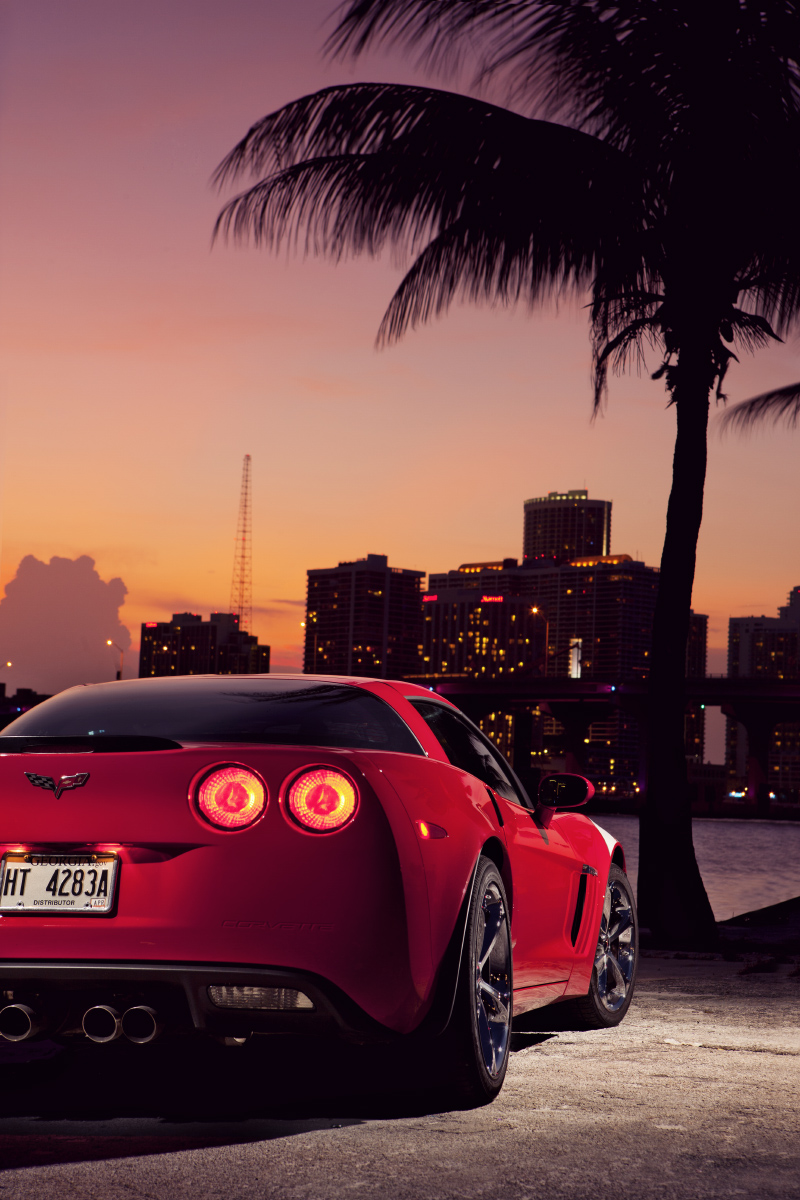
T-minus 6 hours
Dawn is an hour away as I thumb the ‘Vette into life. It’s already 27deg C, and humid. I’m sweating in shorts and a T-shirt thinking about four astronauts in their big, bulky space suits. The ‘Vette’s satellite radio delivers NASA’s latest launch update. Still a 70 percent no-go. The Corvette’s sports seat numbs my left leg; it lacks underthigh support and is too soft elsewhere. Still, how would I go squashed into a shuttle seat as it climbs through the atmosphere to a 380km orbit? How would it feel to cover 7.7km every second, 27,160km/h, or Mach 23? How would my nerves cope with being so far from home, at the very end of a fragile cord of technology and equations?
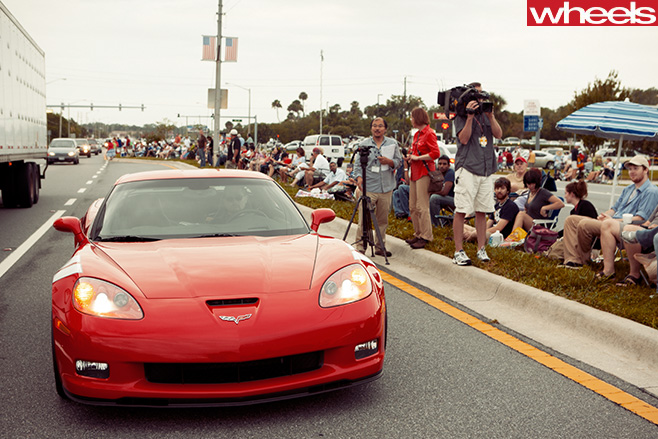
T-minus 5 hours, 25min
Gridlock. At 6am. The highway into Titusville, the town with the best view, is a parking lot and we’re still at least 16km away from it. Panic nibbles my nerves. Will I make the launch? Will there even be a launch? For the first time, Twitter proves itself useful: the feed #spaceflightnow reports that fuelling was completed overnight, though STS-135 is still 70 percent no-go. I double back to strike the coast road farther south, hopeful of following it into Titusville.
T-minus 4 hours, 18min
Titusville. People and cars cover the roadside and the centre strip. Picnic blankets drape SUV roofs, front yards are commercial parking lots with some entrepreneurs charging $50, which late arrivals will pay. We park at a condemned house. The synergy is not lost on me.
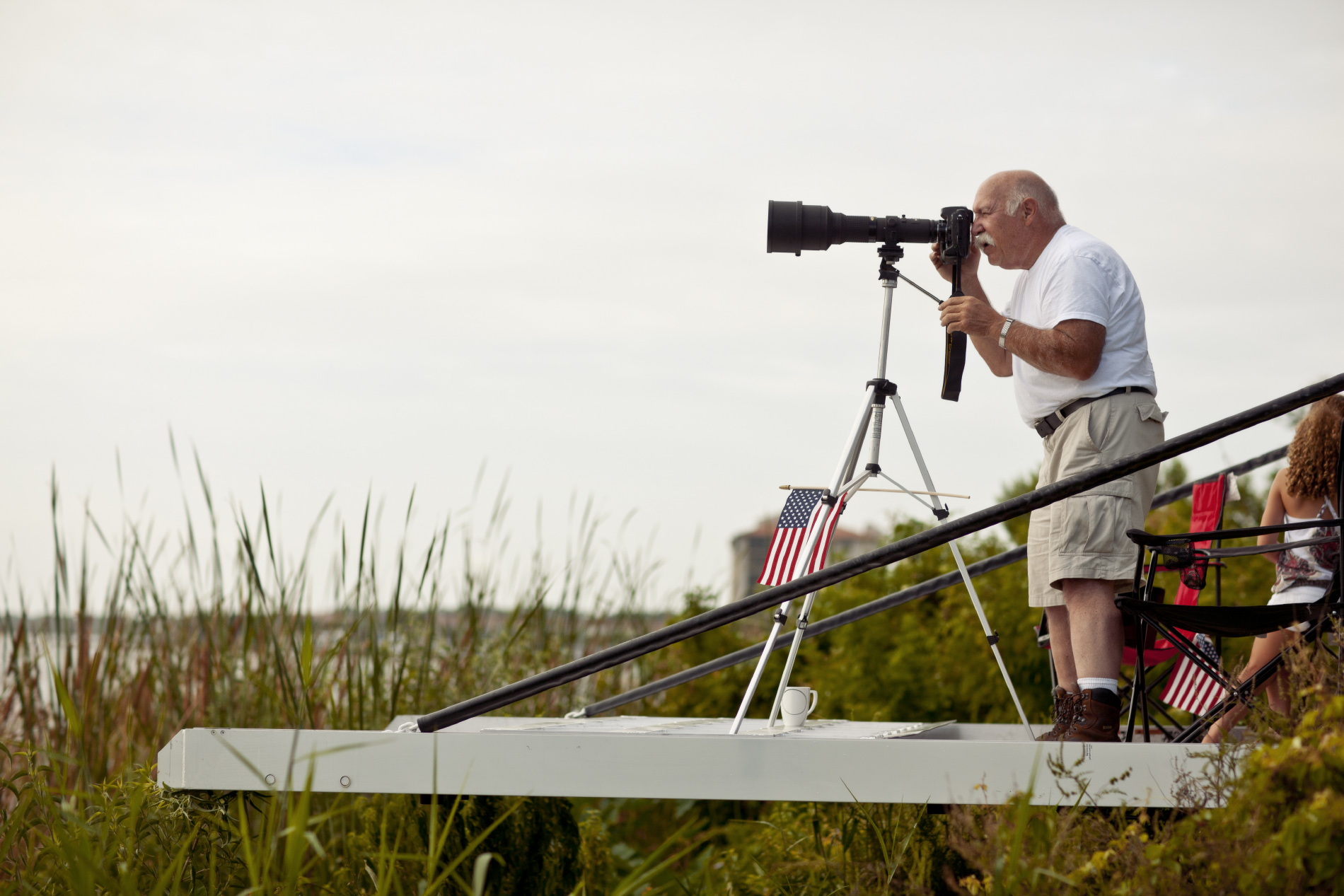
Standing on the balcony peering east across the water to the cape, the launch pad is visible, the shuttle barely, its rust-coloured fuel tank and launch tower more prominent through the heat haze. Binoculars bring it closer and I strain to see movement on the tower, but it’s like looking for fleas on an ant. It’s real. And I’m here to see it go. If it goes. Heavy clouds blanket the sky.
T-minus 3 hours
The crowd stretches forever and more people are coming. Every space that’s not a road is claimed. Parkland separates the road from the water, but today it’s a parking lot and campground. Brandon’s an Aussie driving round America in a rented Challenger and he’s having a beer for breakfast. He got here two days ago, so is three rows back, but the gentle slope allows an unobstructed view. Next to him is Gary, a semi-retired concrete company owner. It’s his fourth launch “and none of those went off on time”. He’s backed his custom-built camper – a converted semi-trailer – out over the water. The liftgate serves as a first-class viewing platform, while the interior has been fitted out as living quarters for him and his younger girlfriend, and a garage for his helicopter. Live the dream, brother.
T-minus 1 hour
Crowds of spectators thicken along the dual carriageway, slowly clogging it. Police patrols move people off, trying to maintain a useable road. The crowd mass sucks in until the police leave, then exhale onto the road again.
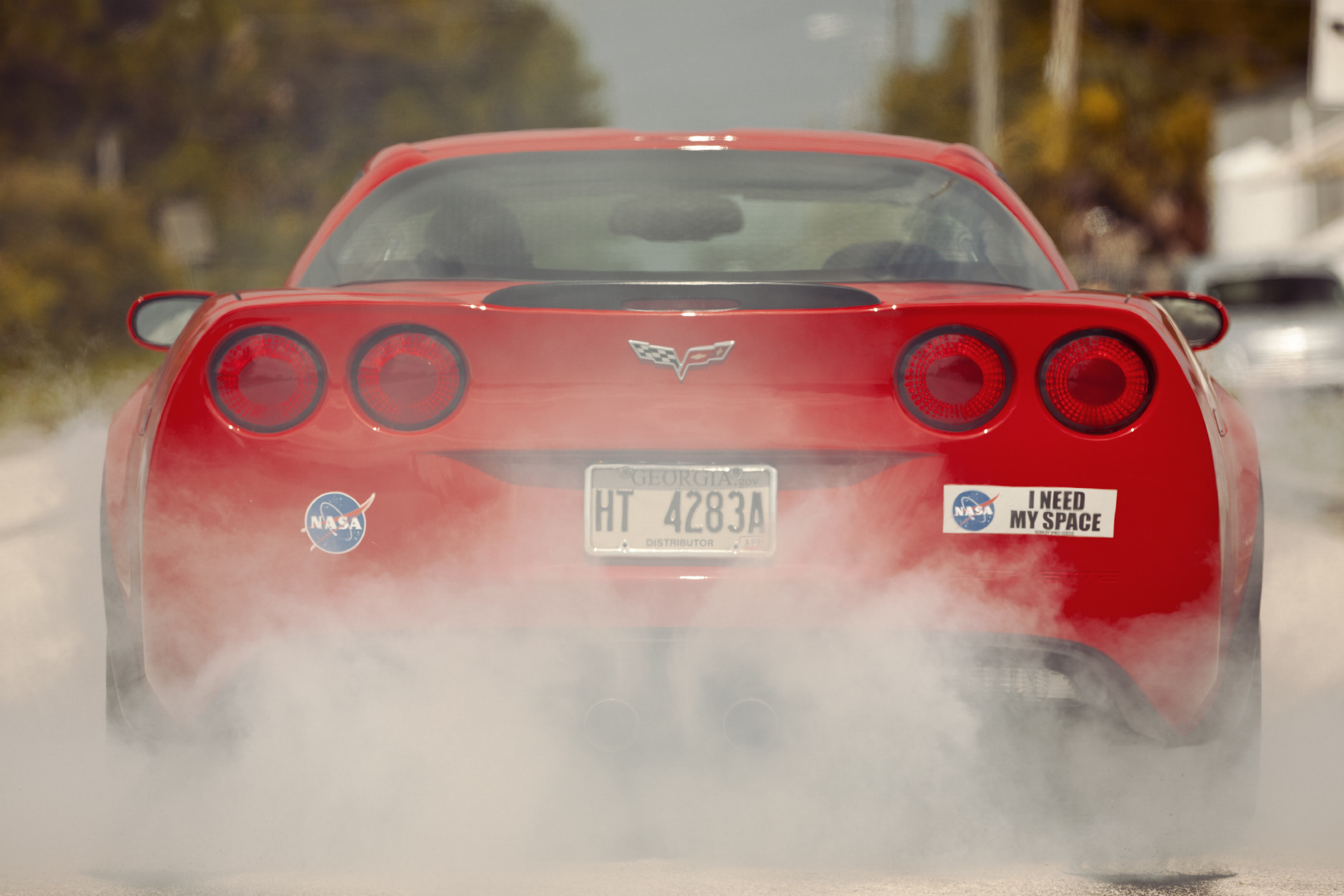
A blue hole appears in the clouds above. #spaceflightnow reports 40 percent no-go.
T-minus 20 minutes
The police surrender, the road is jammed. So is
the mobile network. My smartphone loses the twitter feed, and then reception. No internet, no mobiles; just like life in 1981 when Columbia first flew. More blue holes appear in the cloud cover. I dare to dream.
T-minus 10 minutes
A huge cheer goes up farther down the crowd, I can only guess why. It’s followed by an impromptu rendition of ‘The Star-Spangled Banner’, which elicits another cheer. My first reaction is that of a cynical Aussie. These public displays of patriotism sit uncomfortably with a bloke from a country where nobody knows the second verse to ‘Advance Australia Fair’. We’re proud of our nation, but not showy like the Yanks. But then, we haven’t put people into space 166 times, let alone on the moon. We haven’t conducted 134 shuttle missions with a 98 percent success rate. We invented the bionic ear, the winged keel and Wi-Fi. But nothing matches the achievement of space travel.
T-minus one minute
The ’Vette’s doors and hatch are open wide, its radio tuned to Launch Control. Incredibly, the voice of shuttle Commander Chris Ferguson sounds calm, running through pre-flight as if it were a shopping list.
It dawns on me just how incredible it is to send people into space and expect them to return safely. So routine that shuttle launches seldom make the news anymore. I’ve spent years recognising companies that design and develop affordable cars like the Corvette, capable of searing acceleration and economy. I’ve flown countless hours round the globe and trust the aircraft builders, the pilots, the airport staff to get me there safely every time. Sometimes even with my luggage.
But the Space Shuttle Program, the Space Transportation System, is magnitudes greater than all other forms of human transport. It’s the audacity that conceived it, the intelligence that realised it (with less computing power than I’m using to write this article), the fastidious experts who make every voyage as safe as possible, the brave astronauts who bet their lives.
The countdown continues.
T-minus 31 seconds
The countdown stops. Sensors have failed to report the retraction of an oxygen vent arm. Radio chatter loses its methodical tempo and becomes a rapid-fire discussion. It’s not going to happen. One million people stand next to me. Nobody makes a noise. We’ve all been building up to this moment for weeks, and nobody wants to come back tomorrow.
Two minutes elapse before NASA restarts the launch. T-minus one minute. The shopping list recital resumes. Calmness in Commander Ferguson’s voice brings relief to a million others who breathe again. This time, the countdown runs right through. When I hear “go for main engine to start” my throat tightens uncomfortably. This is momentous. The engines flame into life and clouds of steam billow, quickly growing larger than the little space shuttle itself. It’s eerie. It’s silent. The lump in my throat grows. Then the radio starts: “T-minus 10… 9…” The crowd joins in, outstripping the controller’s metronomic precision in their enthusiastic haste. When the count reaches zero, Atlantis lifts off. I cheer, swept up by the euphoria. A million heads follow the ascent, craning slowly back in unison. The shuttle pierces a low cloud, a false departure from sight. Forty seconds after launch Atlantis reaches the real cloud ceiling, and disappears. The flames propelling it illuminate the clouds for a few seconds more; a warming and spectacular farewell.
I’m speechless. My voice recorder keeps rolling,
but I don’t know what to say. What words can describe what I just witnessed and will never see again?
This is humanity’s highest achievement, the greatest single effort to expand the boundaries of our existence. And I watched STS-135 launch. The last flight of the space shuttle, 30 years after the first. The end of an era I grew up with. The lump grows again in my throat. The shuttle has disappeared through the clouds. Around me, people pack their cars and turn for home. I’m not ready to leave. It seems disrespectful.
A full minute later the sound reaches me. It starts like wood crackling on a distant fire, building into a sustained wave of thunder that envelopes and shakes me. Every boom and crackle conveys the intensity of a chemical reaction that has propelled 2000 tonnes of space plane, its crew and cargo, tanks and rockets beyond gravity’s tenacious grip. It’s the sound of 60,000 Corvettes.
The Final Frontier just receded a little farther.
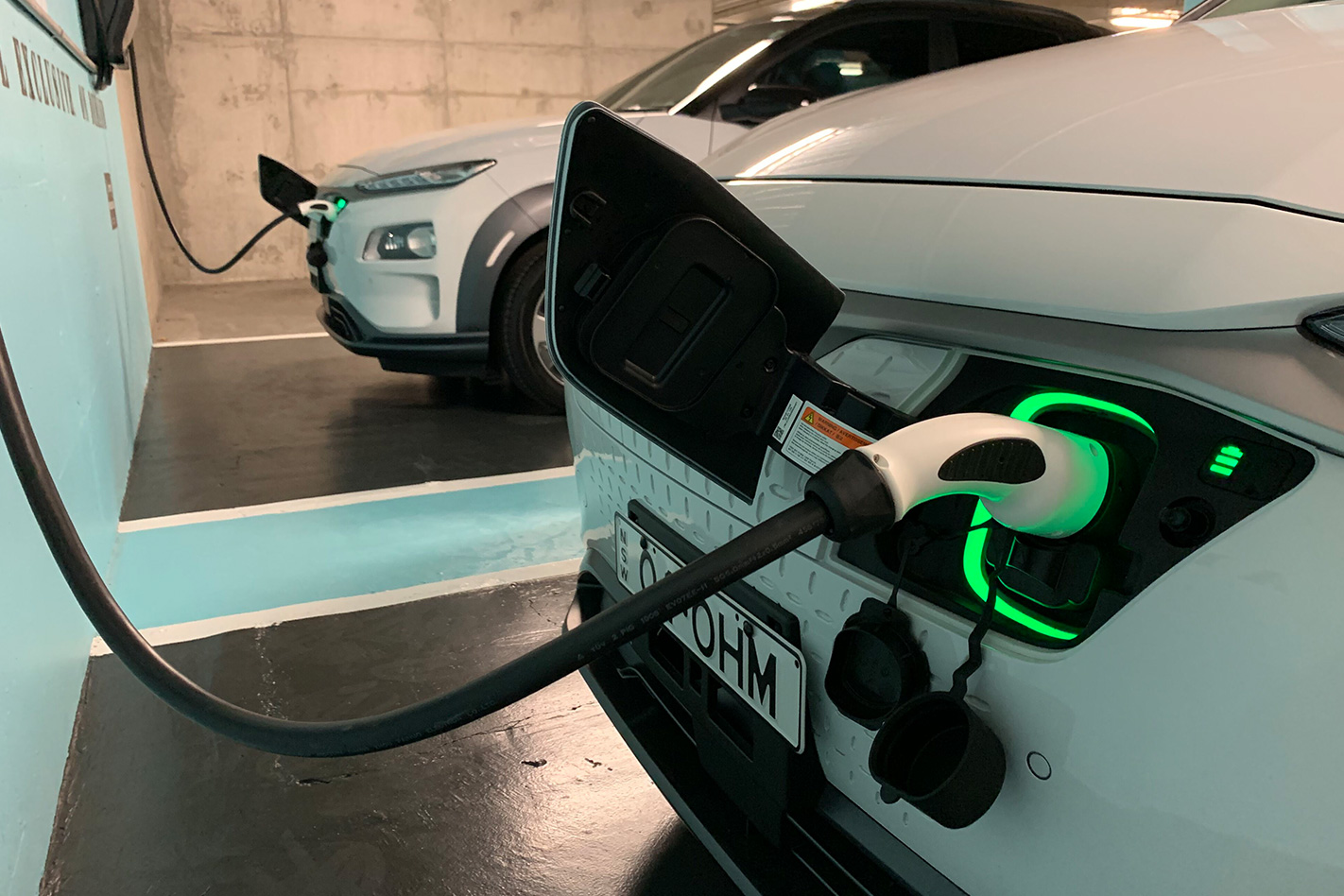
Australia’s first electric car-sharing service has arrived in Melbourne with a small fleet of Hyundai Kona Electrics available to a select handful of CBD residents from today.
Like relatively conventional car-sharing services, of which there are a growing number around the country, Ohmie Go offers the independence of a car without the cost and commitment of ownership. The key difference is that members have access to zero-emissions mobility and easy fast charging, compared with the combustion-powered vehicles offered by all other car-sharing models.
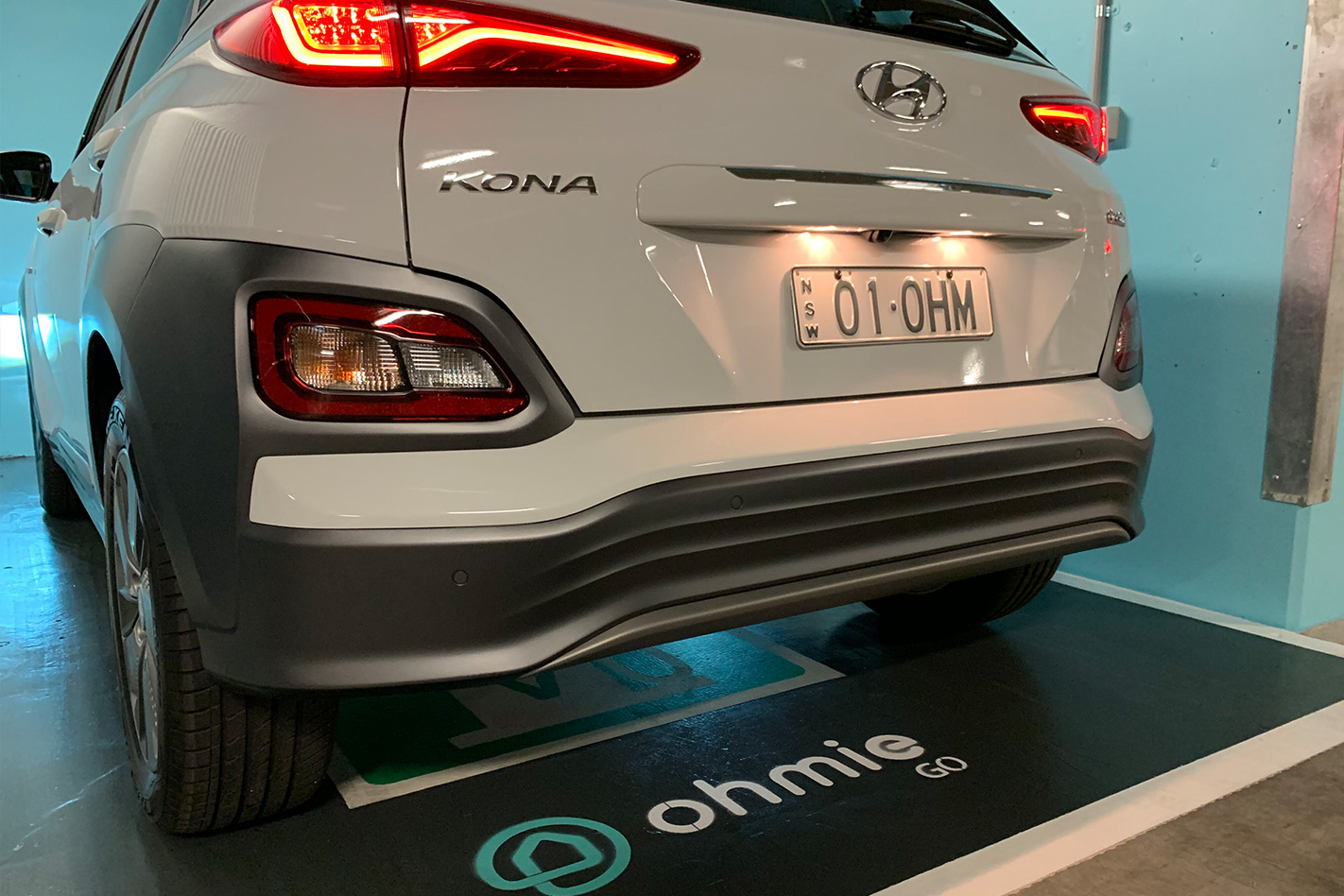
The milestone car-sharing evolution will appeal to high-density housing inhabitants that may have felt petrol and diesel car-sharing is contradictory to the cause, or not suitable to inner-city living.
Ohmie has not released subscription or rental rates but says the service is “cost-effective” although many car-share customers are more attracted to the convenience, over any potential money-saving advantages.
For now, Ohmie Go will only be offered to EQ Tower residents but, with the backing of Hyundai and Jet Charge, the company is growing its EV-sharing fleet in partnership with other new developments across Australia.
Ohmie CEO Kyle Bolto said the advent of electric vehicles and the way consumers chose to use them will not follow the same trends as traditional vehicles, and the EV car-sharing movement was part of an entirely new motoring landscape.
“Personal mobility is undergoing the most significant shift since the invention of the car, including entirely new ownership models, multi-modal transportation methods and eventually vehicles that drive themselves,” he said.
For the Ohmie Go initiative, Jet Charge provided the battery charging hardware and the EV charging authority said it had been exploring partnerships to deliver a project of this nature for some time before finding Ohmie.
“We have been waiting for years to team up with a company that recognises EVs as being both a mobility and energy asset,” said Jet Charge founder Tim Washington.
“In Ohmie and Kyle’s team, we have found that company. They share our vision of offering a leading car-sharing business using 100 percent electric vehicles and also using the same vehicles to support our electricity grid, maximising that vehicle’s utilisation.”
Interestingly, Washington told WhichCar that the company is busy installing “dozens” of wall-box chargers each day to both residential and business locations, quietly building Australia’s EV infrastructure.
Data collected from the first Ohmie Go installation will be used to improve the service and the company is already considering diversifying the options with scooters and other vehicle types offered for work places and even holiday resorts.
It’s just the latest development in the growing electric vehicle cause and proof that the advancement of clean motoring and emissions-free care will continue regardless of governmental support, which continued to languish compared with the rest of the modern world.
If you’re an EV sceptic, it seems resistance really is futile.
