
No one really knows what happened to the WhichCar Weekly team last week. Some have suggested there was a 911 swap meet in Melbourne’s outer suburbs, and the Bauer Media offices were left as populated as a Smash Mouth gig.
Other sources claim Scotty had the keys to the studio in his pocket along with the key to a GT2 RS and hasn’t been seen since. Thankfully neither scenario was true and if you want to know what really happened, tune in to WCW 25 now.
After their brief hiatus, the team reconvenes to regale tales of absence including Dan who just got back from the BMW NextGen event in Munich. During his time in the searing German heat, there was a sensational Vision M Next concept reveal, talk of the company’s EV future and a ride in an autonomous car. Is this the future of the car show as we know it?
Scott weighs in on the increasingly popular technology of rear-wheel steering. With a growing number of vehicles rolling on a pair of steering axles, why would you want it in your next car and can a mere mortal tell it’s there at all?
And continuing the discussion about the shifting trends of manufacturers at car shows, the team is joined by MOTOR noter Chris to discuss some of the most exciting things we can expect from the upcoming Goodwood Festival of Speed.
From a relatively humble affair in the early 1990s, the event is now regarded as one of the premier global automotive shows, with increasing numbers of manufacturers selecting the FOS as the place to reveal hot metal.
If you’re on the go, you can find WhichCar Weekly on all manner of podcast apps including iTunes and Podbean. Please rate, subscribe and leave a review! You can also follow the day-to-day happenings of the WhichCar team on Facebook, Twitter and Instagram @whichcarau.
Listened to the show? Help us out:
- Leave a note in the comment section below.
- Leave a review on Apple Podcasts/iTunes
- Subscribe to our podcast
There’s been a little bit of murmur among doubters that the new 2020 Mercedes-AMG A45 S is essentially the old car with more boost.
While it’s true the new car uses a higher boost pressure, it’s also been re-worked by AMG’s engineers to be more exciting. At least, that’s what AMG claims, before having let anyone drive it.
But even from AMG’s freshly printed (20-page!) press release, it’s clear the new car is more than just a refresh of the old model.
The old AMG A45’s engine was a record-breaker, with 265kW (and later 280kW after an update) making it the most powerful production four-cylinder in the world.
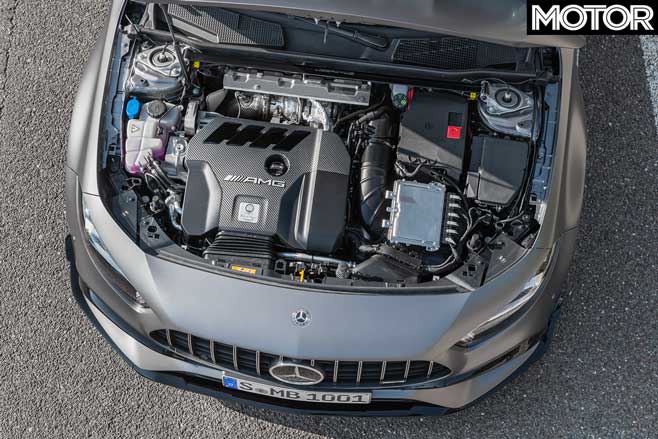
The new M139 engine now holds that record, but with 310kW, a vast number of engineered improvements, 31.5psi of boost instead of 26psi, and even its own production line in Affalterbach.
The new engine also revs to 7200rpm, 500rpm higher than the last, and is mounted the ‘other way around’ in the engine bay, with the exhaust ports at the rear and the intake at the front.
And while the new AMG A45 S (and its AMG CLA45 S sibling) is set to be another supercar-hassler thanks to that engine, it looks ready to step away from just being fast with a new feature.
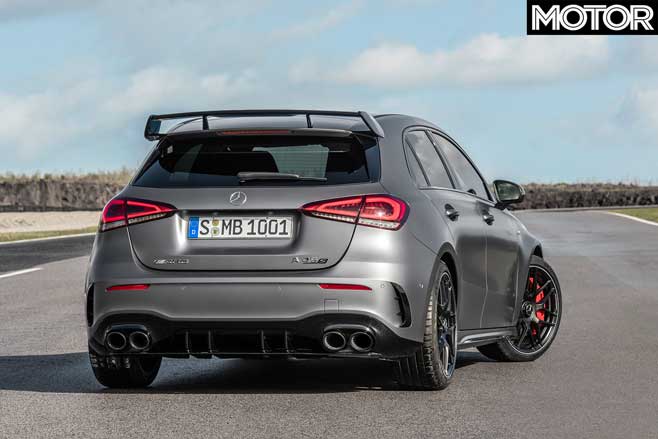
Despite criticism of the Ford Focus RS’ drift mode from AMG boss Tobias Moers, the new AMG A45 S has just that. It seems Moers wasn’t being critical of ‘drift mode’ in general… just Ford’s drift mode.
2020 AMG A45 S drift mode in action
With a clever twin-clutch rear limited-slip differential (paired with a system called AMG Torque Control) in the new AMG A45 S, the super hot hatch is able to split torque more cleverly than its predecessor.
While the first A45 could split torque between the front and rear axles, the new ‘S’ can take the torque that’s being delivered to the rear axle and split that however is necessary between each of the rear wheels.
This means the A45 S has proper torque vectoring (rather than just electronically-controlled ‘brake vectoring’), and can more easily maintain traction on the road when drifting isn’t the goal.
Drift mode, the new diff, and the stonking 310kW engine should make the new A45 S more than just a one-trick pony.
Riding in a pre-production Porsche Taycan Turbo with chief project engineer Stefan Weckbach driving is like watching a Marvel film in an F1 simulator wearing a virtual reality headset. I have driven a lot of fast cars, but the steroidal driveline in the hush-hush Porsche elevates speed to another level as adrenaline floods your body.
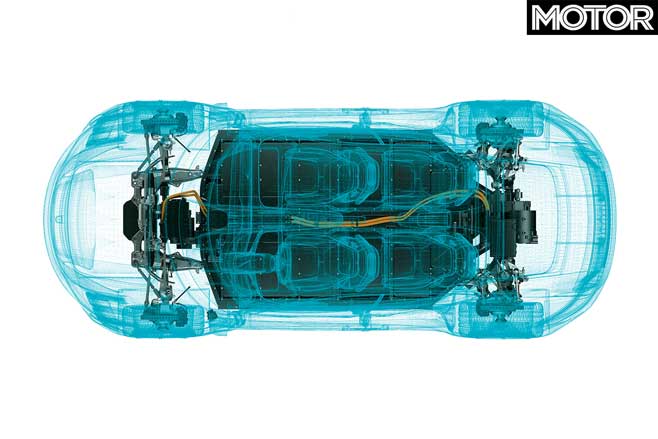
The first G-force attack comes two corners from Porsche’s Weissach ‘think tank’ and hits my brain like a bomb; that’s what two potent e-motors and 650kg of fully charged lithium-ion batteries can do to you.
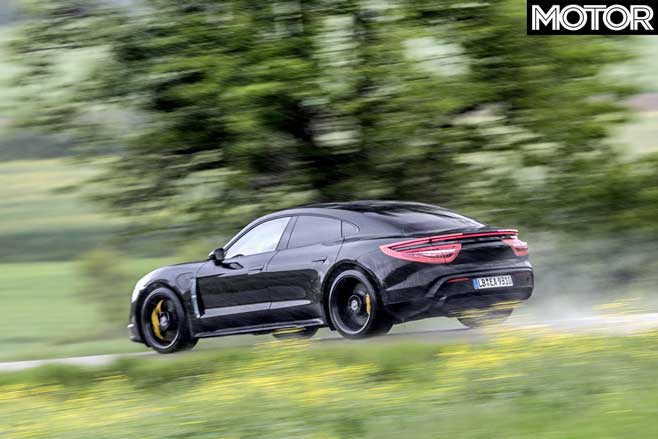
Forget stability management by brake actuation, the Taycan’s black box controls your heartbeat by a wheel-selective torque feed for “zero loss, 100 per cent dynamic efficiency”.
Like all EVs, the Taycan is not just about high velocities but it can cruise at 260km/h for long distances without battery heatstroke or exceeding the motors’ maximum speeds of 16,000rpm. With a minus-35-degree to 45-degree Celsius operating window, battery temperatures are “not an issue, irrespective of load and speed”.
A Taycan has lapped the ’Ring in under eight minutes but the low-riding two-tonner shines on secondary roads where it is as quick as a 911 Turbo. What gives it the edge is a whopping 880Nm of torque (1000Nm for 10 seconds in overboost) which would disintegrate the driveline if it wasn’t for the electronic rear diff lock and two-speed power-shift transmission that blocks first gear at critical times.
The Turbo version has a 96kWh battery, a 160kW/300Nm motor up front and a 300kW/550Nm powerplant in the rear. Using launch control, Porsche claims just over three seconds for 0-100km/h and 0-200km/h in less than 10. Again, 911 Turbo territory.
To further emphasise this, my chauffeur unexpectedly ramps ups my anxiety levels. First, the ESP warning light starts flashing. Then Sport Plus firms up the ride, speeds up the steering, and quickens throttle response. Massive instant torque produces staggering forward thrust but the shift from Sunday driver to sinner is countered by extraordinary grip and traction. On 275/40 ZR20 tyres the Taycan produces negligible wheelspin and accelerative energy is released with precision and unerring stability.
“Despite the zero-emission honours, this is a proper Porsche,” claims Bernd Propfe, platform director for Taycan.
“The Taycan Turbo can do 10 full-throttle 0-100km/h and 0-200km/h sprints without one iota decrease in performance. Even driven flat out for an hour or more, it will only lapse into limp-home mode when the distance-to-empty is zero… power and torque curves will not be dented by a drop of state-of-charge. As long as there is juice, total attack is always an option.”
Despite a 2910mm wheelbase and kerb weight just under 2100kg, the ride is not cushy. “This is a sporty GT which digitally re-interprets traditional Porsche values,” Weckbach clarifies. There is no Comfort button but there is a “lap timer for those who want to play without disturbing the wildlife”.
Rear-wheel steering is bound to enhance manoeuvrability as well as straight-line stability and the brakes seem easy to modulate and fade-free, but we are yet to find out how it stops at high speed; how ride, handling and roadholding harmonise on freeways, and how the drivetrain responds to repeated brutal torque inputs.
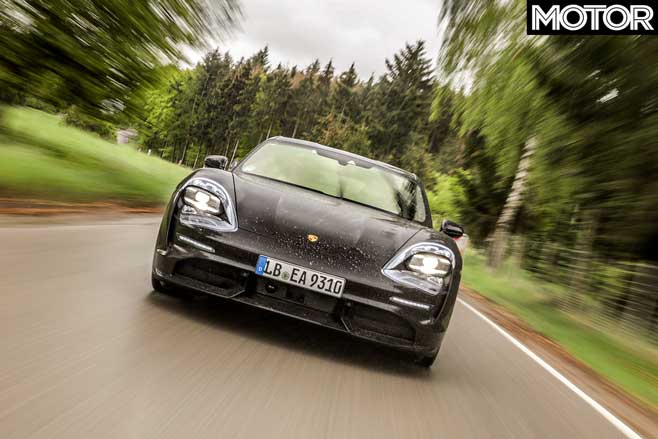
Speaking from the second-best seat in the house, the Taycan follows the driver’s instructions with aplomb, the expertly tuned electronic aids intervening in a subtle and sensitive fashion. What stands out most, though, is the surreal, supercar-like grip.
After more than two hours of swift cruising the batteries, which are cooled by a liquid circuit integrated into the floorpan, are still showing 48 per cent charge. The car industry might have conquered range anxiety but the next bogey likely to undermine widespread acceptance of clean air vehicles is looming. It’s called charge anxiety.
The Taycan is the first EV than can be fed with up to 250kW at an 800V charge point, but the corresponding infrastructure in Europe is still patchy to put it mildly, and Australia is even further behind. At last count there were only around 70 fast charging stations – the Euro preference – in Australia and not one in the Northern Territory.
Taycans come with specially-coated PSCB brakes for reduced brake dust (carbon-ceramics are optional) and Weckbach and his team tweaked the software so a small portion of the deceleration energy flows back to the batteries even during an emergency ABS stop. Unless the driver activates the mild recovery mode, the Taycan coasts when you lift off. Alternatively, you can leave it to cruise control to match speed to the flow of traffic.
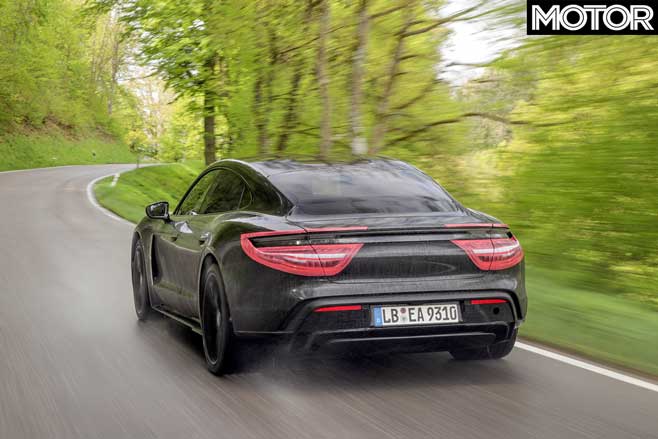
Maximum energy recovery is an unrivalled 250kW. Dialling out the e-motors while dialling in the hydraulic brakes is the key to the Taycan’s riveting performance and, I’m told, totally progressive pedal feel. While other manufacturers are promoting ‘one pedal feel’, Porsche is not interested in slowing the car unless conditions require it.
Since consumption of 40-50kWh is (allegedly) not an exception to the rule, selecting Range mode extends driving distances by about 10 per cent and is automatically disabled when speed exceeds 137km/h. Range also scales back air-con and adjusts torque vectoring. Up to 65km/h, kickdown in Sport Plus on high-grip surfaces briefly engages first gear up to 100km/h.
The top-of-the-line Taycan features air suspension, all-wheel drive, rear-wheel steering, 48-volt anti-roll bars, active aerodynamics, and steel brakes with serious stopping power. Genetically, it is closer to the 992 than the Panamera and its centre of gravity is lower than its rear-engined brother.
It’s a four-seater with just enough space for two adults in the back where the ‘foot garage’, a clever rectangular recess in the floor, helps to accommodate long legs. Up front, are fully adjustable lightweight buckets and a curved digital display the design of which harks back to early 911s.
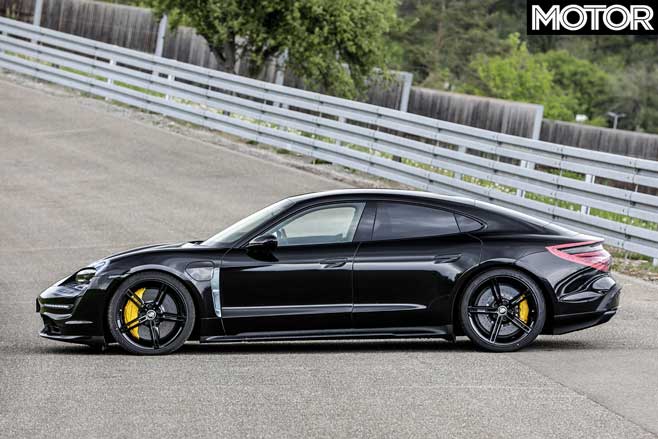
An additional rectangular monitor on the passenger side is optional. The multifunction steering wheel has 10 control elements distributed across the two horizontal spokes, the conveniently positioned centre stack is loaded with haptic and visual adventures, and an extended head-up display is optional.
The selective display puts the focus on speed, state-of-charge, consumption, range and eventually, the closest charging points. There even is an autopilot function (from the Audi A8) which will be activated as soon as regulations permit. Individual mode allows personal dynamic preferences, like combining the softest spring rates with the sportiest drivetrain calibration.
“It was our goal to create reduced, user-focused, distraction-free, increasingly voice-based ergonomics which provide only the information you need or want,“ Weckbach states.
Unique to Taycan is the optional sound generator which adds bass and sounds like the subdued hum of a synthetic boxer engine. Switch it off and all you hear is faintly whirring motors, occasional suspension thump, rumbling tyres and the howling wind. It’s the music of the future.
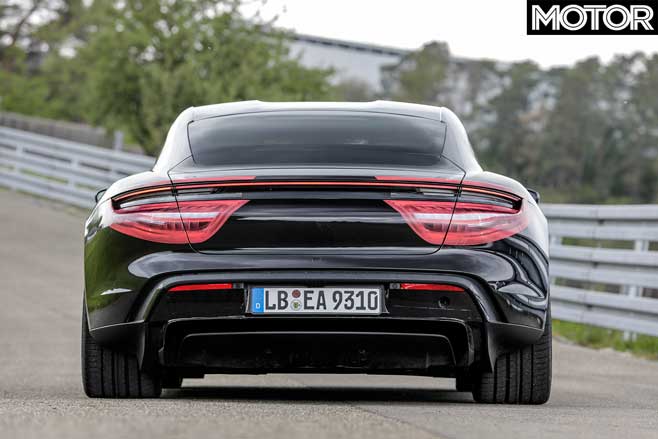
The base Taycan is rear-wheel drive only, sports an 80kWh battery and is powered by either 240kW or 280kW motors. Due late next year, it will be priced in the low $130Ks. The Carrera 4S, with a 96kWh battery and 320kW or 360kW will be in the high $130Ks, and the Turbo will set you back about $210K, before options. Australian pricing is still very much TBC however.
AWD and the bigger battery are standard on the latter two. Still to be signed off are an even rawer 540kW Turbo S and a lighter RWD GTS.
Production has already started at Zuffenhausen and peak capacity is close to 60,000 units per year. Only two Taycan body styles have been signed off, but Porsche is keen to add three more spin-offs – a 928-style coupe, matching cabriolet and a proper SUV. From 2021, one third of volume will be allocated to the Cross Sport CUV.
Starting with next-gen J1 II model, solid-state power packs will be phased in as they become available and by 2021 at the latest, peak charging power is set to increase from 250 to 350kW which should – combined with best-in-class 800V charge stations – reduce recharging times to just 14 minutes.
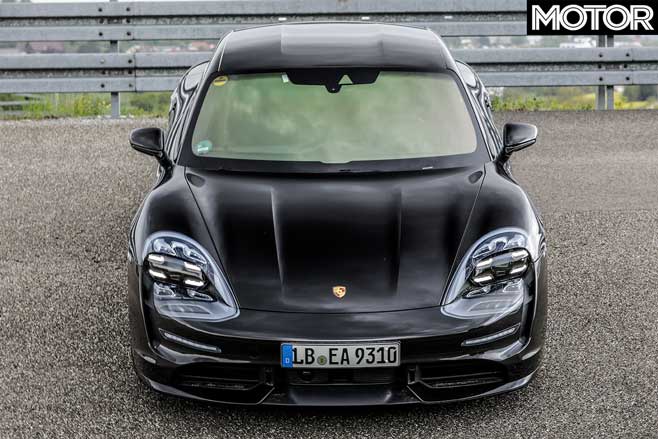
The mission of the Taycan is to eclipse the Tesla Model S. Not unexpectedly, it fails to do so in terms of packaging and (super) charging infrastructure. But while Tesla P100D versions are quicker off the mark, repeatability is the difference and Porsche engineers are adamant that Taycan’s high-performance tag is not an empty promise. “J1 epitomises the power of silence; it’s the new fast forward,“ says Weckbach.
So what is the provisional verdict of the shaken scribe slumped in the passenger seat with sweating palms? The Taycan is a remarkable high-performance, high-end GT that is solid as a rock even at ludicrous speeds.
It’s a real trend-setter that ticks even the most critical social acceptance boxes and leaves a virtually invisible CO2 footprint.
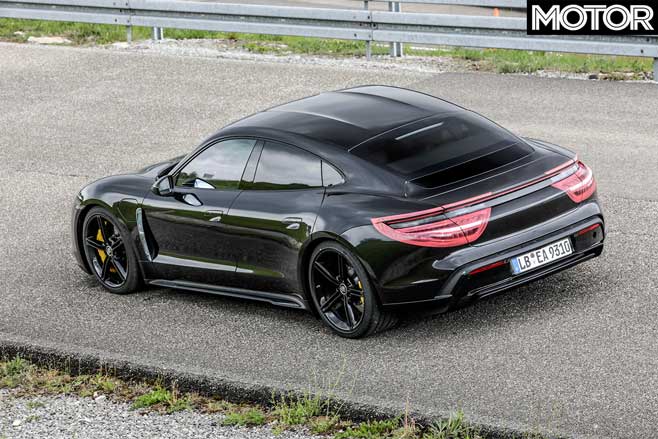
2020 PORSCHE TAYCAN TURBO SPECS Engine: Dual synchronous permanent magnet Power: 460kW (160kW front, 300kW rear) Torque: 850Nm (1000Nm ‘overboost’) Weight: 2100kg 0-100km/h: 3.0sec (claimed) Price: $288,000 (est)
Like: Instant colossal torque, limpet-like grip, quick charge, zero emissions, long range Dislike: Firm ride, weight, lack of 800v charging stations, rear seat passenger space
Rating: 4.5 out of 5 stars
The Wheels Verdict: The Mercedes-AMG GT63 S 4-Door is an assault on the senses in all the right ways. There’s a cheaper GT53 4-Door, but if funds allow, the GT63 S is the must-have option. Dynamically talented and sensationally fast, the commanding four-door coupe has you constantly coming back for more.
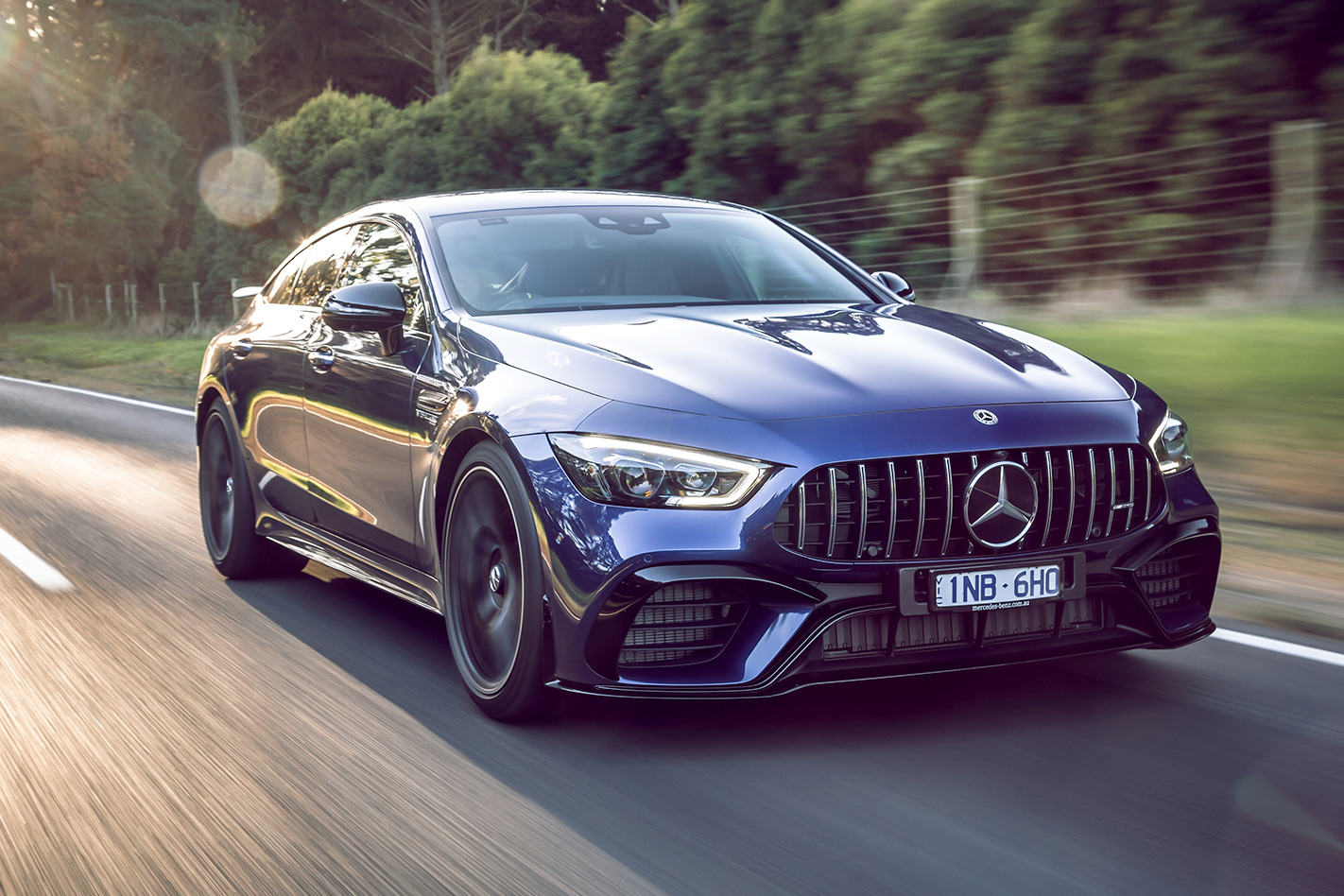
WHAT IS THE MERCEDES-AMG GT63 S 4-DOOR?
The GT63 S is the first four-door sports coupe solely developed by AMG. It’s a style-driven variant for those who want more theatre than an E63 S, but prefer a more pragmatic existence than an AMG GT Coupe can offer. It’s also packing the most kilowatts of any AMG, which along with the rear-biased all-wheel drive system, is enough to overcome its two-tonne mass.

WHY WE’RE TESTING IT
A performance offering with 470kW and 900Nm demands attention. As does the plush interior and imposing exterior design. The mild-hybrid GT53 inline-six turbo is available for $249,900, while the GT63 S heavyweight is $349,900. Ultimately, Mercedes-AMG is throwing its might behind the barnstorming ‘coupe’ in the hopes of going after the Porsche Panamera. Game on.
MERCEDES-AMG GT63 4-DOOR REVIEW
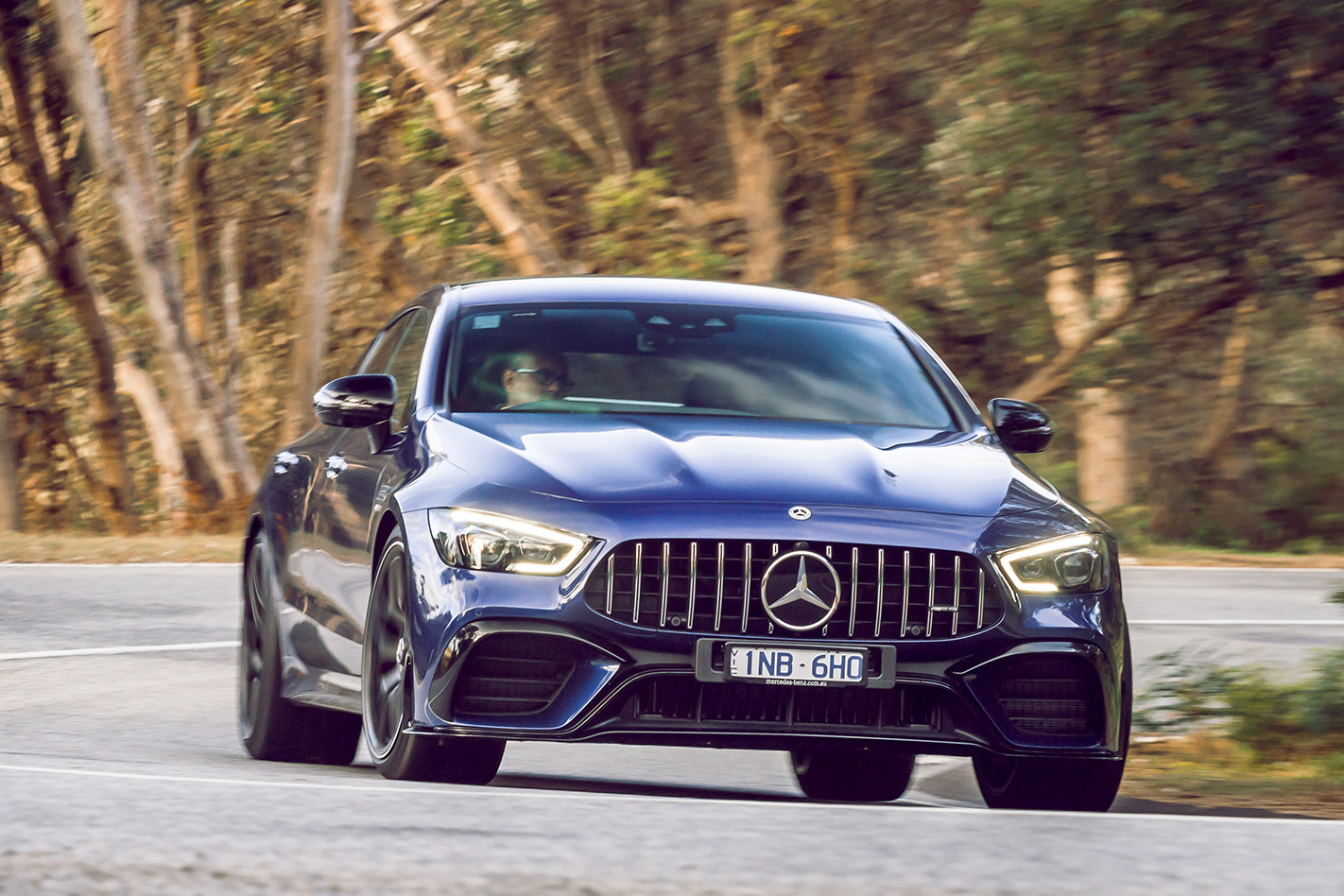
Walking up to the $349,900 Mercedes-AMG GT63 S 4-Door, it’s hard not to be captivated by the drama. Nestled aptly in the forecourt of a fancy Melbourne hotel, the big, almost intimidating AMG owns its demeanour, one that is as imposing as the high-risers ensconcing it. However, it fails to truly disappear into the background. The menacing coupe-esque four-door catches the gaze of myriad blurry-eyed commuters.
And then the starter button is pushed. Firing on all eight, twin-turbocharged cylinders, the 4.0-litre M178 awakens with the kind of fury that cuts through morning rush hour. Shrinking violet? Not a chance. Those who slink into the shadows need not apply. Mercifully the cold-start revs settle to a calm idle speed, the quad tailpipes housed within the rear diffuser emitting a more subdued tone, and the opulent surrounds of the cocooning cabin become apparent. The boot, accessed by via liftback-style tailgate, has no trouble swallowing a few overnight bags and jackets.

Seated in firm, but well-bolstered AMG seats with a microfibre steering wheel in hand and large 12.3-inch screens in sight, it’s hard not to wonder what the USP is for this Porsche Panamera-fighting beast. Consider it simply an E63 S with a swoopy silhouette and you’d be, surprisingly, wide of the mark. However, it’s also not an AMG GT Coupe with a few extra doors. Instead, the first four-door coupe solely developed by Mercedes-AMG carves its own niche. It’s one that straddles luxury and performance in an attention-grabbing suit – the latter enhanced by $9500-worth of carbon-fibre addenda.
Pulling onto congested city streets requires attention, but there’s help at hand with 360-degree cameras and sensors. Not only is the 4-Door a sizeable two-tonne mass, thanks to the grenade under the bonnet, it’s also weapon quick. Merely breath on the accelerator activates 470kW and 900Nm from the ‘hot-vee’ bent eight. Anticipating the traffic ahead is vital. Reactionary inputs usually come too late given the 4-Door can reach 100km/h in just 3.2 seconds, a figure that feels utterly believable. The head-up is handy for checking speed and to see which one of the nine gears is in use.

Experiencing full throttle for the first time in the GT63 S 4-Door is an event. Traction is abundant as the rear-biased 4Matic+ all-wheel drive channels torque and the Michelin Pilot Sport 4 S hoops stick to the road like Velcro. Acceleration is relentless no matter where you are in the rev range, and it’s accompanied by a cacophony of sound. Bundling passengers into the rear seats to experience the neck-snapping acceleration (a four-seat option can be selected), although they’ll be greeted with restricted rear headroom, but ample legroom.
Turn off the straight lines of a highway and the hefty giant becomes a ballet dancer. Changes of direction are fuss-free and body movements are kept in check. Flick the steering wheel-mounted rotary dial to Sport Plus and the 4-Door parameters are set to their raciest, road-focused setting. It’s here that you can really feel the rear-driven nature as the Merc almost encourages delicate yaw movements from the 315-section Michelin Pilot Sport 4 S rears. There’s relentless purchase from the front axle (275 section), resulting in tremendous drive on corner exit.
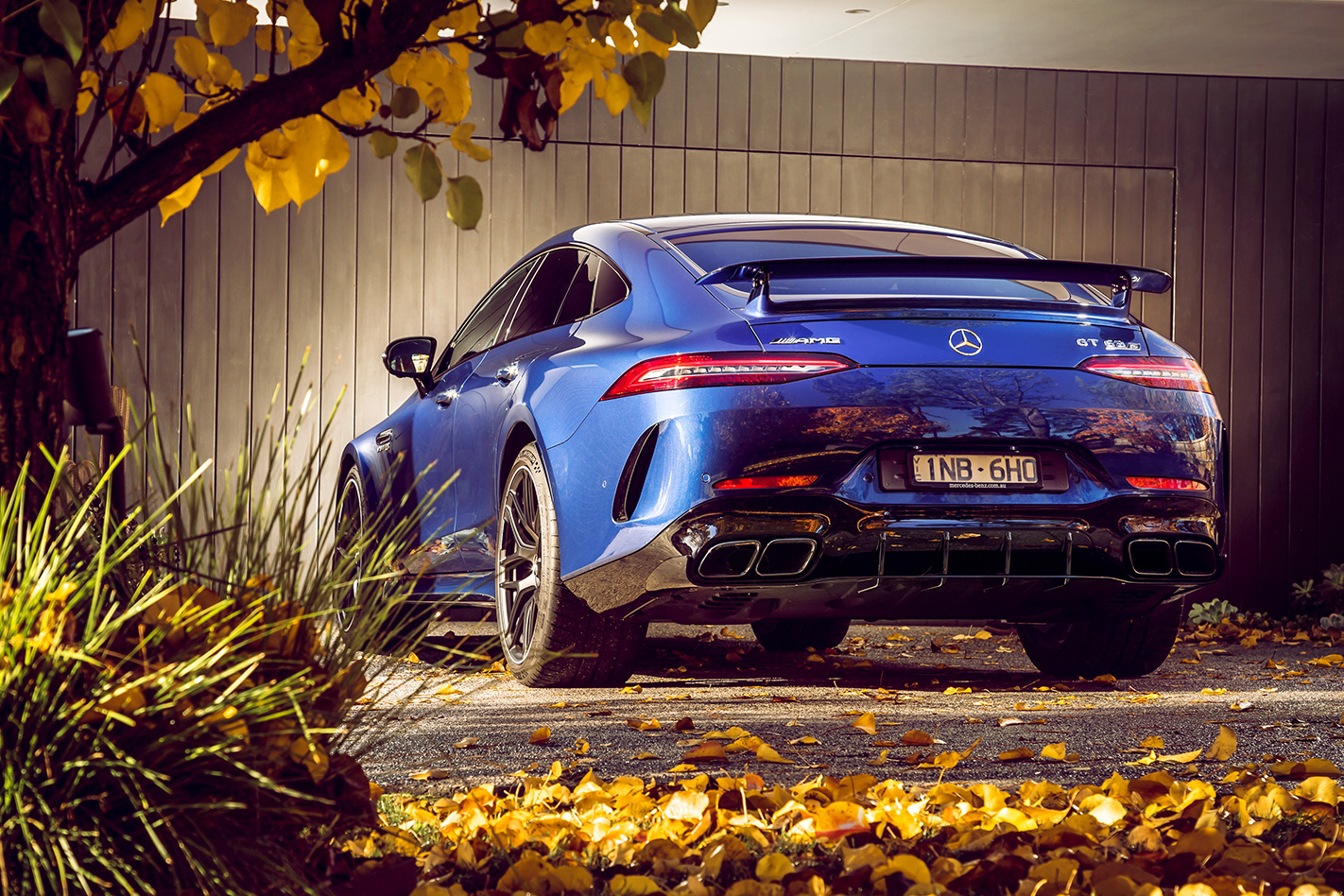
The rear steering effectively shortens the wheelbase, meaning it rotates on its axis through tight hairpins with an athleticism that belies its five-metre length and 2045kg mass. It’s progressive, too, and won’t leave you feeling unnerved. The steering is slightly muted in terms of feedback, but the $17,900 optional carbon-ceramic brakes (390mm front, 360mm rear) fail to fade despite the speeds they repeatedly arrest. Where the GT63 S should be floundering, on a tight mountain road with infrequent flowing bends, it’s excelling. Not only that, it’s a lot of fun.
Kept in the focused modes the ride quality can struggle with sharp imperfection. Switching back to Comfort mode, the mood relaxes. It’s here, on open-radius country bends, that the newfound ride quality comes to the fore. Unlike the E63 S’s busy character, with adaptive air suspension, the 4-Door gains a level of compliance needed in a luxury coupe – even with large 21-inch alloys and low-profile tyres. With numerous drive modes offering tangible differences in character, taking this $392,400 (fully optioned) GT63 S to a track wouldn’t be out of the question, especially when you can select Michelin Pilot Sport Cup 2 tyres.
It really is refreshing to discover that the 4-Door can viably be used simply as a luxury GT-car; however, coarse surfaces induce road noise that isn’t adequately quelled. Offering resistance against the NVH levels is the optional Burmester sound system ($10,400) – which seems a crime to use when there’s an angry V8 soundtrack in waiting. On the straight highway back to Melbourne there’s plenty of tech toys to play with, too. As moody clouds roll in the interior ambience is dominated by subtle mood lighting and the turbine-style air-vents add design flair to the aging dash layout. The last nit-picking niggle is the fact that there’s multiple buttons for the same controls.
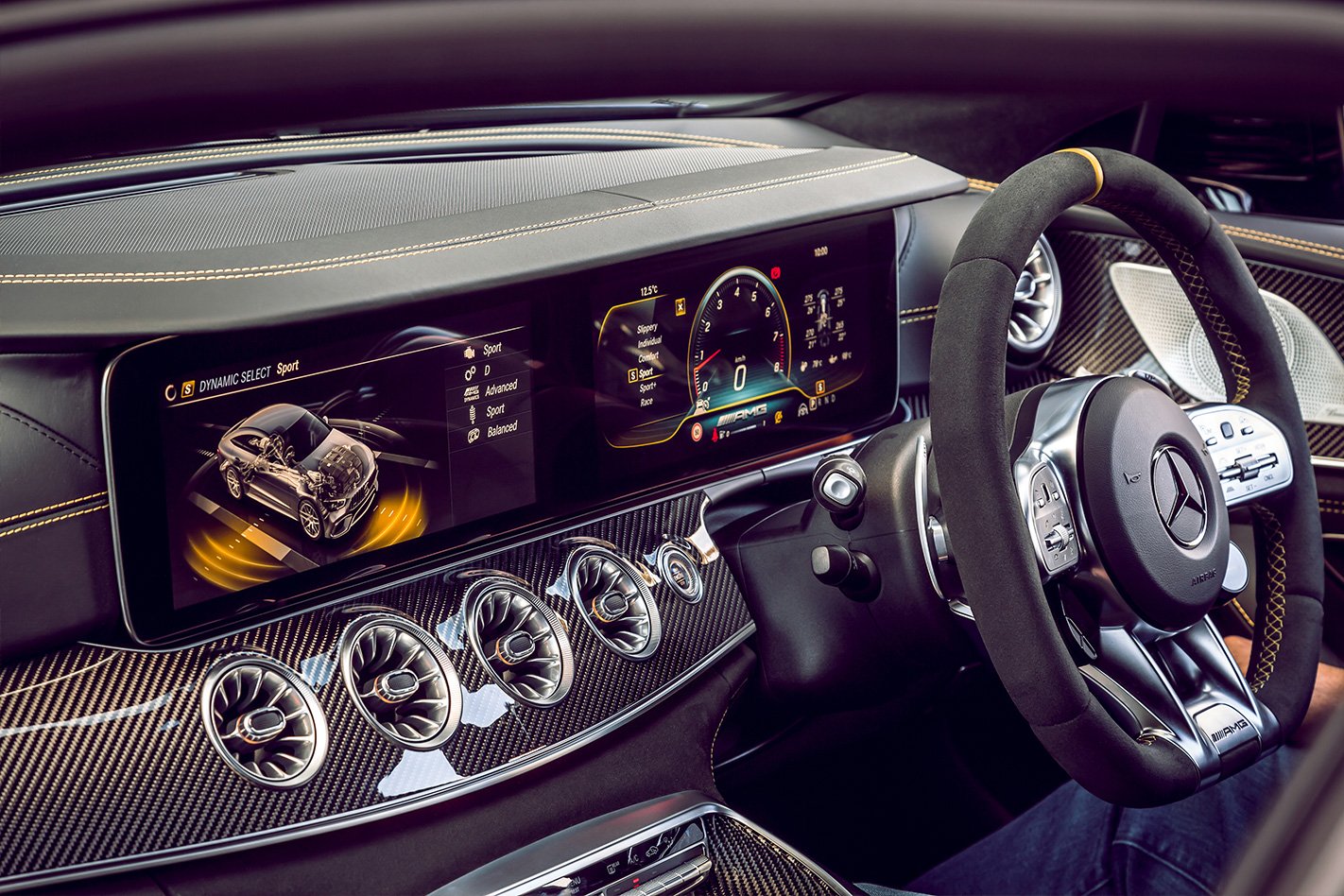
Yes, it’s expensive, it has an unquenchable thirst for fuel when provoked, the ride quality still has room for improvement and the design won’t agree with everyone. However, it’s easy to wax lyrical when referencing the AMG GT63 S 4-Door. As far as automotive events go, it’s hard not to be effusive given the emotive nature of the beast. What a thing.
MERCEDES-BENZ GT63 S 4-DOOR VS RIVALS
Porsche Panamera, Audi RS7, BMW 8 Series Gran Coupe, Aston Martin Rapide
MERCEDES-AMG GT63 S 4-DOOR PRICE AND SPECS AUSTRALIA
- Model: Mercedes-AMG GT63 S 4-Door 4Matic+
- Engine: 3982cc V8, dohc, 32v, twin-turbo
- Max power: 470kW @ 5500-6500rpm
- Max torque: 900Nm @ 2500-4500rpm
- Transmission: 9-speed MCT
- Weight: 2045kg
- 0-100km/h: 3.2 seconds
- Economy: 11.3L/100km
- Price: $349,900 ($392,400 as tested)
- On sale: Now
With a claimed 0-100km/h time of 3.2sec the 2019 Mercedes-AMG GT63 S is the quickest machine ever to escape from Affalterbach. In a straight line, at least.
As part of our first Australian drive we ran the monster Merc up the Heathcote hotmix in an attempt to verify AMG’s bold claim and find out what happens after it’s broached triple figures.
As it turns out, AMG is selling its quasi-coupe-hatch a bit short. Race Start primed, the GT63 uses its all-wheel drive traction to launch to 100km/h in just 3.16sec. A good surface is required; lining up on Heathcote’s slippery unprepped regular launch pad triggers the traction control resulting in consistent – but off-the-pace – 3.5sec efforts.
From there the 470kW/900Nm 4.0-litre twin-turbo V8 takes over, making light work of the GT63’s substantial 2045kg bulk, passing 160km/h in 6.85sec, 200km/h in 10.67sec and crossing the quarter mile in just 11.08sec at 203.43km/h.
These numbers not only make the GT63 S the quickest AMG we’ve ever tested, it’s also the quickest four-door (or five-door if you think it’s a hatch) production car we’ve ever run numbers on. It’s quarter-mile effort would’ve put it number one of our Top 10 Quickest Cars of 2018 list by just one-hundredth of a second.
Compared to the best numbers we’ve extracted from its E63 sibling, the GT63 S is 0.24sec quicker to 100km/h and 0.2sec quicker over the quarter mile but with a very similar trap speed. This suggests the GT63 is making good use of its extra 20kW/50Nm and shorter final drive at lower speeds before its 165kg weight disadvantage begins to make itself known.
As it happens, the GT63’s straight-line performance isn’t even the most remarkable thing about it, but to learn more check out our first drive review.
On paper the 2019 Mercedes-AMG GT63 S is a tough sell.
At face value it’s a swoopier, sportier version of the traditional E63 S sedan, a car with which it shares its 4.0-litre twin-turbo V8, nine-speed automatic gearbox and 4MATIC+ all-wheel drive system, but at $349,900 the GT63 S is a full $100K dearer than its more sensible sibling. It offers an extra 20kW/50Nm as compensation, but it still seems a steep ask for shaving 0.2sec from the 0-100km/h claim.
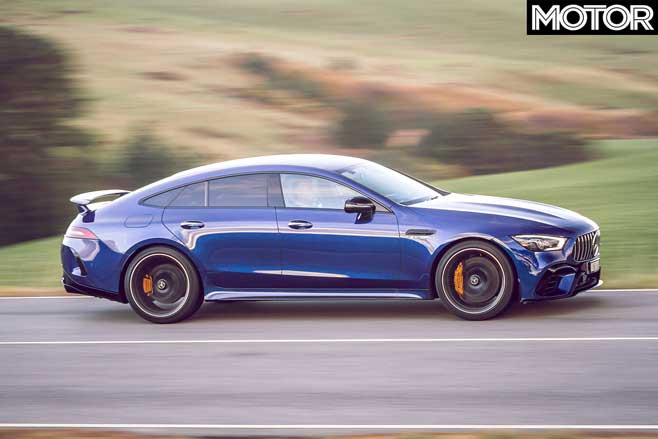
Dig a little deeper, however, and the GT63’s case becomes stronger. The chassis is based on the same Modular Rear-wheel drive Architecture (MRA) that underpins a whole heap of Mercedes models, but it’s been heavily re-engineered by AMG, the structure strengthened to improve response and handle the increased lateral loads.
The imposing body is 61mm longer, 36mm narrower and 13mm shorter (in height) than the E63 and there’s an extra 12mm of wheelbase. You can judge the success of the design for yourself, but it has massive presence – particularly as it’s a pretty massive car – and for some potential buyers that alone may be enough.
Others will be swayed by the greater level of personalisation offered. At this end of the market having a ‘bespoke’ car can be a big deal and combine the various paint, exterior and interior trim, wheel, leather and styling choices and you could theoretically build a couple of thousand GT63s before doubling up.
There’s even the option of converting the rear seat from a traditional bench to a pair of heavily reclined, heated individual chairs with their own central touchscreen. Fancy. To sit in and operate it feels more special than an E63 and sportier than an S63.
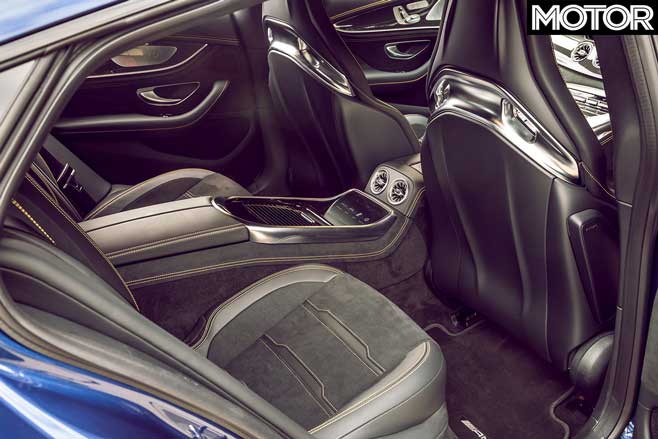
For hardcore drivers there’s the possibility of a fixed carbon roof ($5900), carbon-ceramic brakes ($17,900) and Michelin Pilot Sport Cup 2 tyres ($1600), of which the latter two are fitted to our fully-loaded test car. Strange options for a 2045kg luxury limo, perhaps, but it’s those who would rather do 18 laps than 18 holes that this monster Merc is aimed at. Following the SLS and the GT Coupe, the GT four-door is just the third model solely developed by AMG and the naming connection to its two-door sibling is no accident.
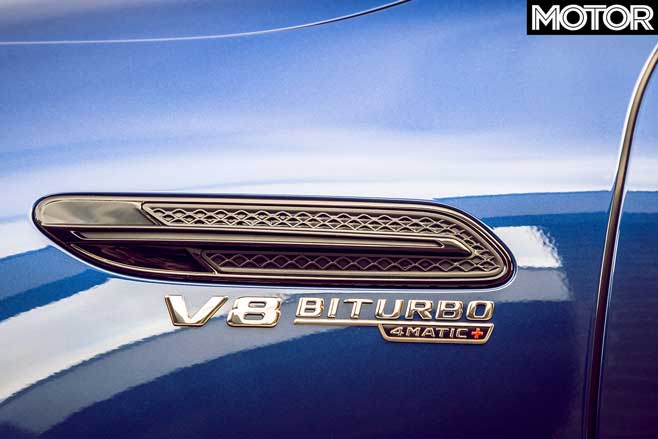
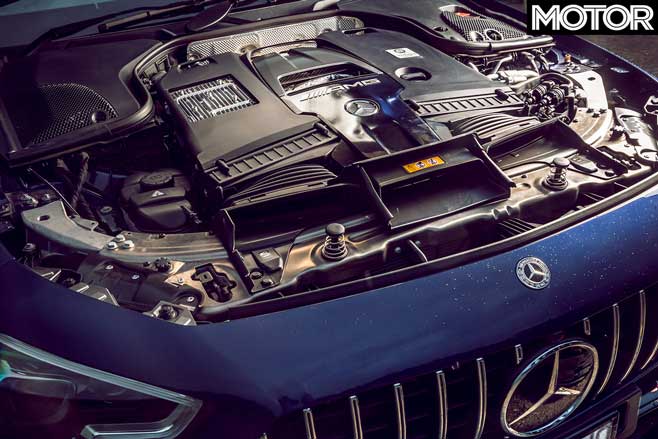
The GT63 S might not be the most powerful AMG ever offered – that honour is retained by the 493kW/1000Nm SL65 Black Series – but it is the quickest. Housed under that sloping bonnet is the most powerful iteration yet of the 4.0-litre twin-turbo M177 V8 – so far, at least – which sends a whopping 470kW and 900Nm to all four wheels via a nine-speed wet-clutch automatic.
With Race Start engaged, reaching 100km/h will take just 3.16sec providing you have a sufficiently grippy surface. Heathcote’s unprepped launch pad wasn’t, wheelspin triggering the traction control and consistently costing three tenths, hence the need to run in the opposite direction.
Beyond 100km/h the charge continues, 160km/h flashing by in 6.85sec, 200km/h in 10.67sec and the quarter mile conquered in 11.08sec at 203.43km/h. The latter is 0.2sec quicker than our best E63 S effort but the trap speed is virtually identical. This suggests the GT63’s wider rubber and shorter final drive (3.27:1 vs 3.06:1) give it an advantage off the line before the E63’s 165kg weight advantage helps it slowly stabilise the gap as speeds increase.
That said, a tenth here or there is academic as the GT63 is ballistically, ludicrously rapid. Triple figures are reached almost as quickly as your brain can recognise you’re moving but it’s the full-throttle punch in the back when accelerating from 160km/h or so that establishes the GT63’s autobahn-dominating credentials.
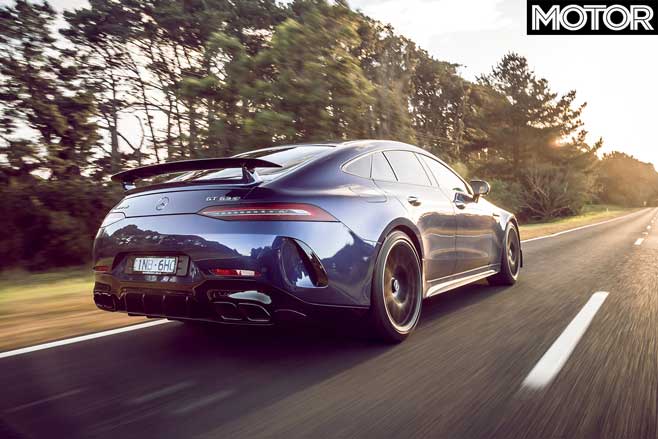
As you’d expect from an AMG, the soundtrack is top-notch, an evil V8 snarl, though given its focus some extra GT R-style theatrics in Race mode wouldn’t go astray. The two turbochargers tucked in the vee of the engine now have anti-friction bearings on the turbine wheels to improve response and there is no lag whatsoever. Any throttle command is answered immediately.
The nine-speed MCT gearbox feels sharper, too. Upshifts are as rapid as ever but the downshift mapping seems more aggressive, the tacho needle jumping north of 6000rpm in response to requests from the left-hand paddle.
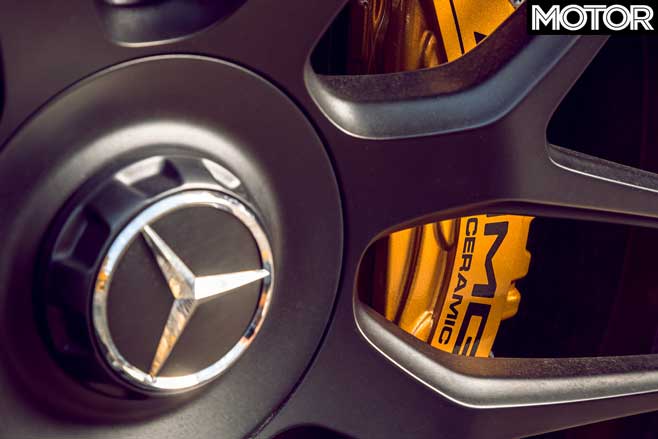
Speed is shed rapidly by the huge carbon-ceramic brakes – stopping from 100-0km/h requires just 33.84m – and their fade resistance in the face of extreme adversity somewhat justifies the near-$20K cost.
So far we have a luxo limo that offers plenty of personalisation and is a rocket in a straight line, but it’s in the corners that the GT63 sets itself apart, setting a new standard for what’s possible from a four-door car.
Not for nothing is this beast the fastest of its kind around the Nurburgring Nordschleife with a 7min25.41sec lap, more than six seconds quicker than the Alfa Romeo Giulia QV and almost 13 seconds up on the Porsche Panamera Turbo.
Its footprint is enormous, with 21 x 10.0-inch wheels and 275/35 tyres up front and 21 x 11.5s at the rear wearing 315/30 rubber, while tracks are 20mm and 69mm wider front and rear respectively compared to the E63.
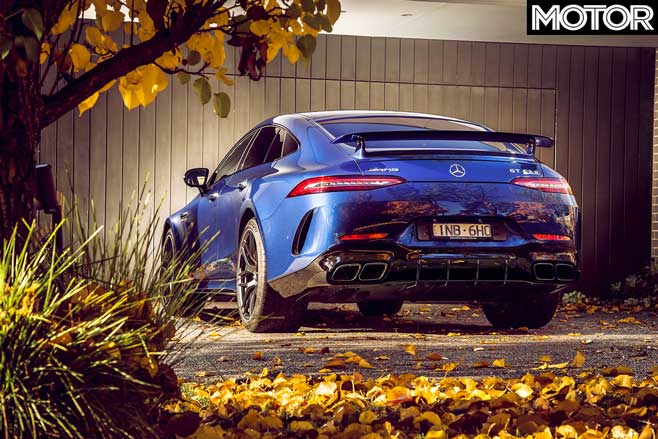
The GT63’s trump card, though, is its rear-wheel steering which lends a freakish level of agility, particularly on corner entry. In conjunction with the sticky optional rubber the corner entry speeds this massive mound of metal is capable of defy belief.
Having the rear wheels turn in the opposite direction to the fronts up to 100km/h (at which point they turn in the same direction to aid stability) appears to dramatically lighten the load on the front tyres, for where you expect understeer there is none.
It rotates so incredibly well into the corner that before you know it full throttle is required, the variable all-wheel drive system loading up the rear tyres until they can take no more and then shuffling power to the front. The result is total traction with perhaps a hint of oversteer and a look of amused amazement on the face of the driver.
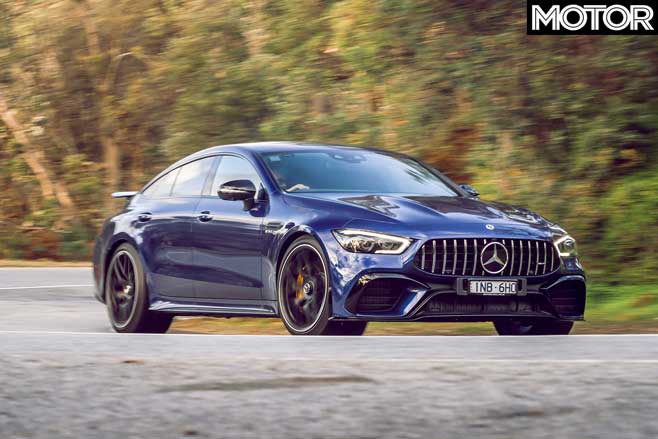
There is a price to pay for this remarkable performance. The lack of grip on cold tyres is as alarming as the grip on warm rubber is impressive, the ride is generally fine but turns choppy over poor surfaces and the whole car feels unhappy in confined spaces.
Thumps from the gearbox and chatter from the steering and diff in tight turns are at odds with the premium image and while refinement is better than the E63 (a new mount for the rear diff aims to improve NVH levels and appears to work) tyre noise is an ever-present companion.
But such issues are easier to forgive in the GT63 because it delivers at such a high level when you drive the wheels off it. The E63 is impressive to a certain (extremely high) level, at which point its luxury sedan roots become evident, whereas AMG’s latest creation feels to have high performance in its DNA – it’s the most impressive, cohesive driver’s car Affalterbach currently offers and that includes the GT two-doors. Forget the on-paper stats, from behind the wheel the Mercedes-AMG GT63 S is actually quite an easy sell.
2019 MERCEDES-AMG GT63 S SPECS Engine: 3982cc V8, DOHC, 32v, twin-turbo Power: 470kW @ 5500-6500rpm Torque: 900Nm @ 2500-4500rpm Weight: 2045kg 0-100km/h: 3.16sec (tested) Price: $349,900 ($382,300 as-tested)
Like: Head-smashing performance; incredible dynamics; feels special Dislike: Low-speed refinement; huge price
Rating: 4.5 out of 5 stars
In a world where Mercedes-AMG has engineered a hot hatch with 310kW and 500Nm from just 1991cc, perspective is vital. You’d have to think that the masterminds behind the original VW Golf GTI would struggle to fathom a humble hatchback with the ability to monster supercars. Such is the rate of progress that the original Audi R8 V8 and 996 Porsche GT3 are both outgunned by the upcoming A45 S.
Of course, the headline act is the new, hand-built M139 engine. Its 310kW (in S guise, at 6750rpm) makes it the highest specific output of any series-production four-cylinder engine, generating a staggering 155kW per litre. Yes, the numbers beggar belief, with the 0-100km/h dash completed in 3.9 seconds and the hyper-hatch rocketing to an electronically limited Vmax of 270km/h.
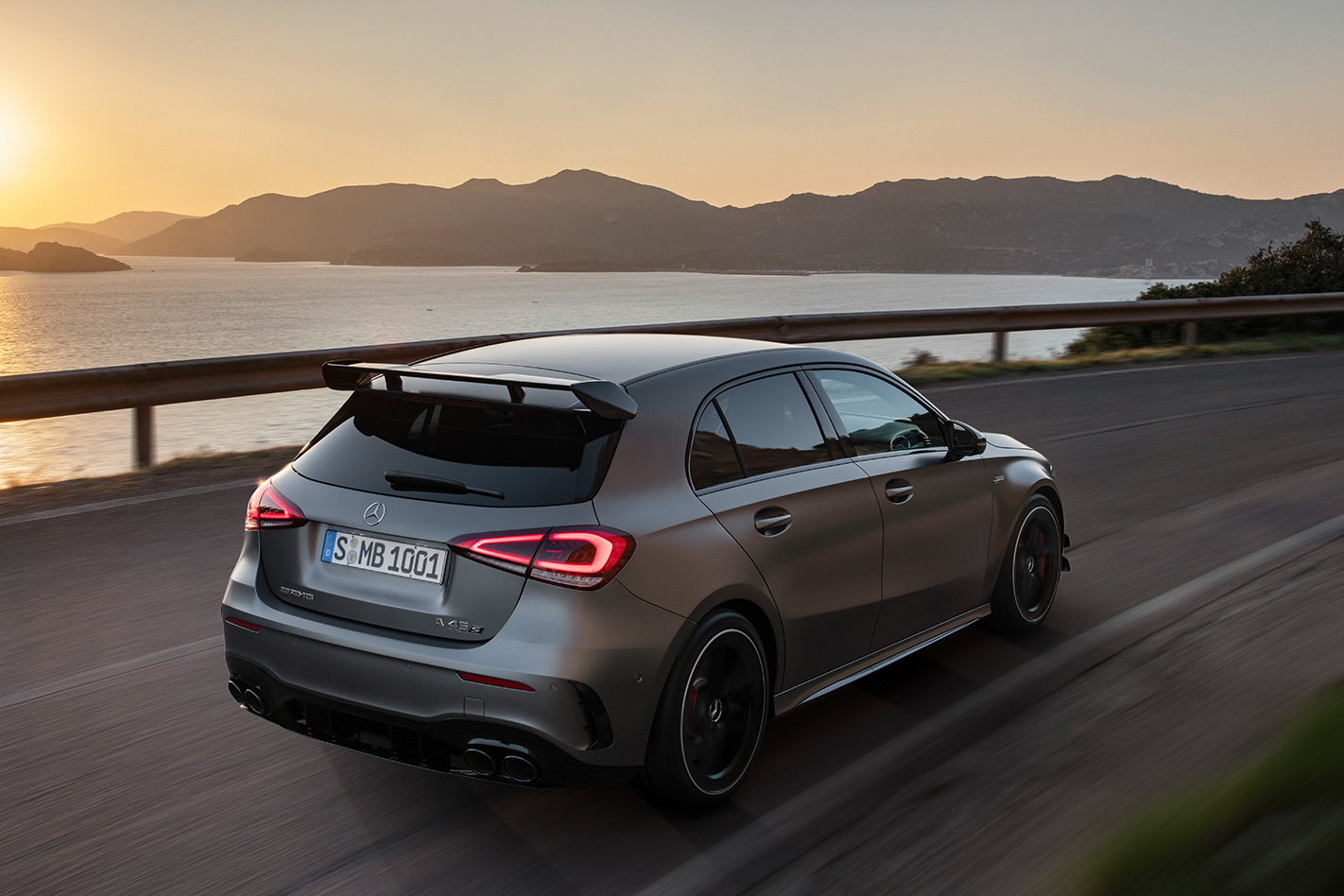
One of the biggest changes behind the new ‘shark nose’ is the fact that the 160.5kg four-pot has been swung around 180 degrees, with the exhaust manifold and turbo now just ahead of the firewall. The intake is now at the front of the engine, requiring less plumbing, and a lower bonnet improves aerodynamic efficiency.
The heavily boosted 2.0-litre four-cylinder engine runs a bore increased to 83.0mm, while the stroke remains at 92.0mm for a swept volume of 1991cc. The compression ratio has been raised to 9.0:1, while the twin-scroll turbo pumps 30.5psi (2.1bar) of pressure into friction-reducing Nanoslide-coated cylinders. The turbo runs at an efficient operating temperature thanks to oil and water cooling; the radiator cops its fresh air via bonnet ducts and the engine cover. Boost pressure is monitored with an electronic wastegate, while two-stage fuel injection is a first for a high-performance four-cylinder.
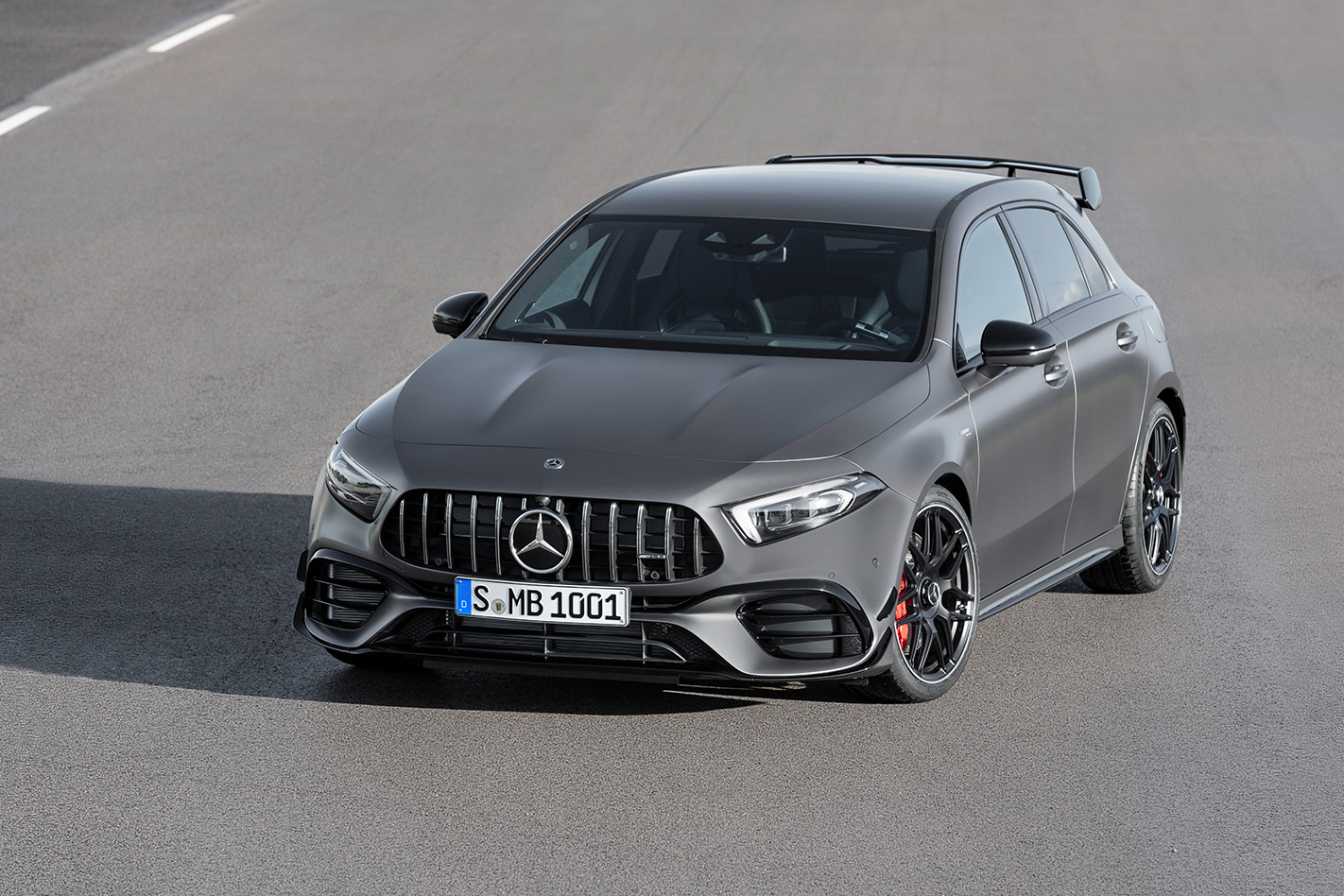
According to AMG, the power delivery is now more like a naturally aspirated engine. The torque curve has been bolstered at lower rpm for improved throttle response, while there’s extra pulling power at the top-end due to the more free-revving tune. The maximum engine speed is 7200rpm and AMG claims the M139 is built to last at least 250,000km.
While other markets will receive a base-model A45 with ‘only’ 285kW and 480Nm, it’s not slated to make its way Down Under. Despite being down on power, the 0-100km/h time increases by only a tenth (to 4.0 seconds) and the top speed drops to an electronically limited 250km/h. The A45 S is expected to arrive in Australia in Q1 2020 alongside the CLA 45 S, which shares the A45’s mechanicals.
The outgoing A45’s polarising acoustics are beefed up with automatically controlled exhaust flaps. Depending on the drive mode, the soundtrack can go from “harmoniously discreet” to “emotively sporty”. Partial ignition interruption when changing up and auto throttle blipping when changing down adds aural theatre. Thankfully, the car’s extravagant pops and bangs aren’t dead.
However, it’s not just the engine that’s new, with AMG giving the rest of the drivetrain a significant overhaul. The fast-shifting dual-clutch gearbox gains a ratio to make eight, while Race Start is standard, aiding the feral 0-100km/h time. The AMG Performance-tweaked 4Matic+ all-wheel-drive system also does its bit for launch purchase.
Within the fully variable AWD system is a new differential for the rear axle, which has an electronically controlled multiplate clutch connected to each driveshaft. This means torque can be channelled left and right between the rear wheels as well as front to back for optimum traction.
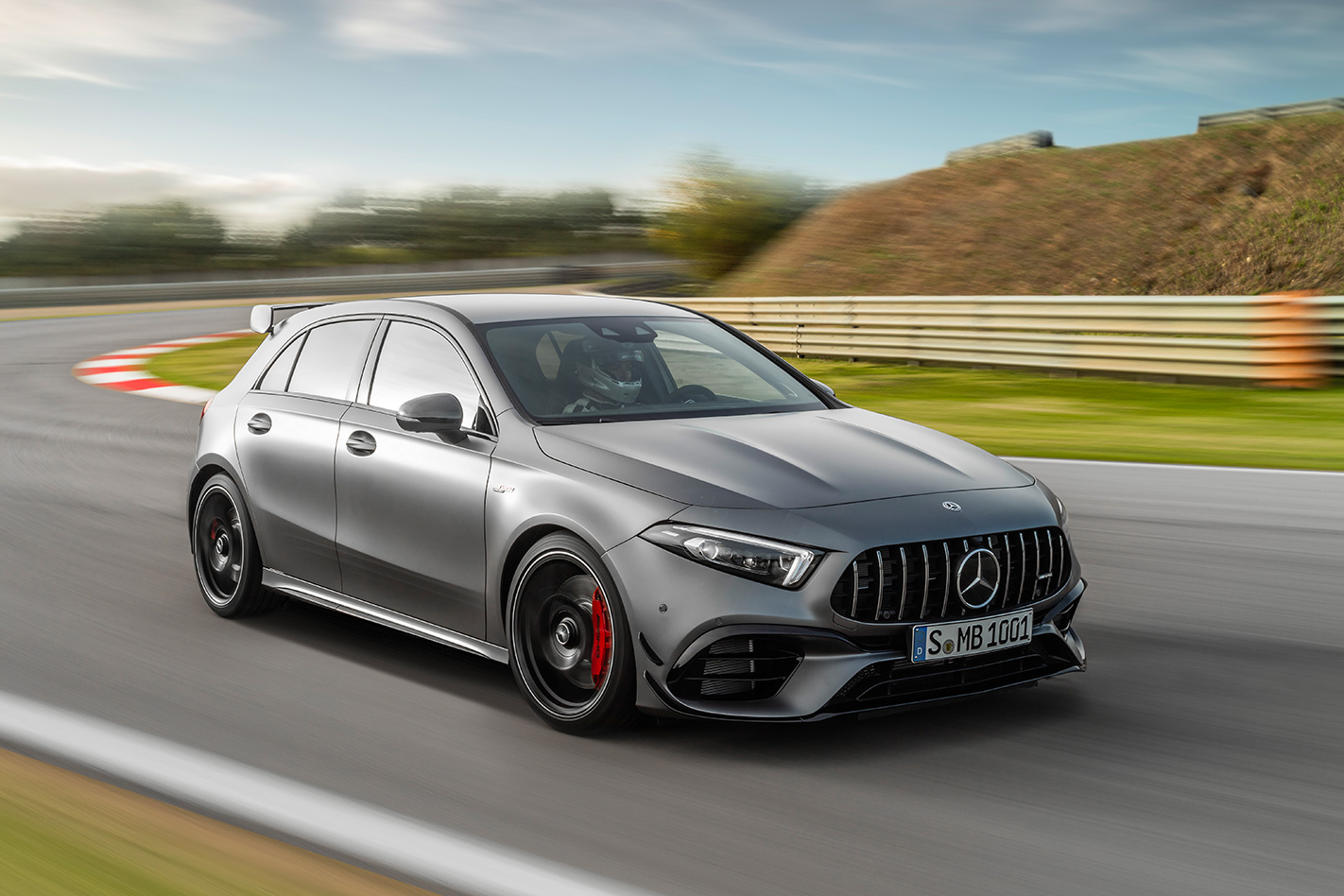
For some, the system’s real benefit is that it’s allowed for the inclusion of a Drift Mode meaning the A45 will be able to vaporise tyres with typical AMG enthusiasm.
As for the chassis, AMG claims all A-Class components have been heavily revised, including a new aluminium wishbone design for the four-link rear setup that reduces unsprung weight. The strut front-end benefits from a wider track, too, and AMG claims the A45 S gains a newfound level of ride comfort, thanks to tri-mode adaptive dampers. An extensively reinforced body shell also increases rigidity.
There are six driving modes available to optimise the car’s bandwidth in all conditions. They include Slippery, Comfort, Sport, Sport Plus, Individual and Race. However, AMG Dynamics moves the game forward with Basic, Advanced, Pro and Master programs available for the ESC, allowing progressively unaided driving, provided the system senses driver inputs are within spec.
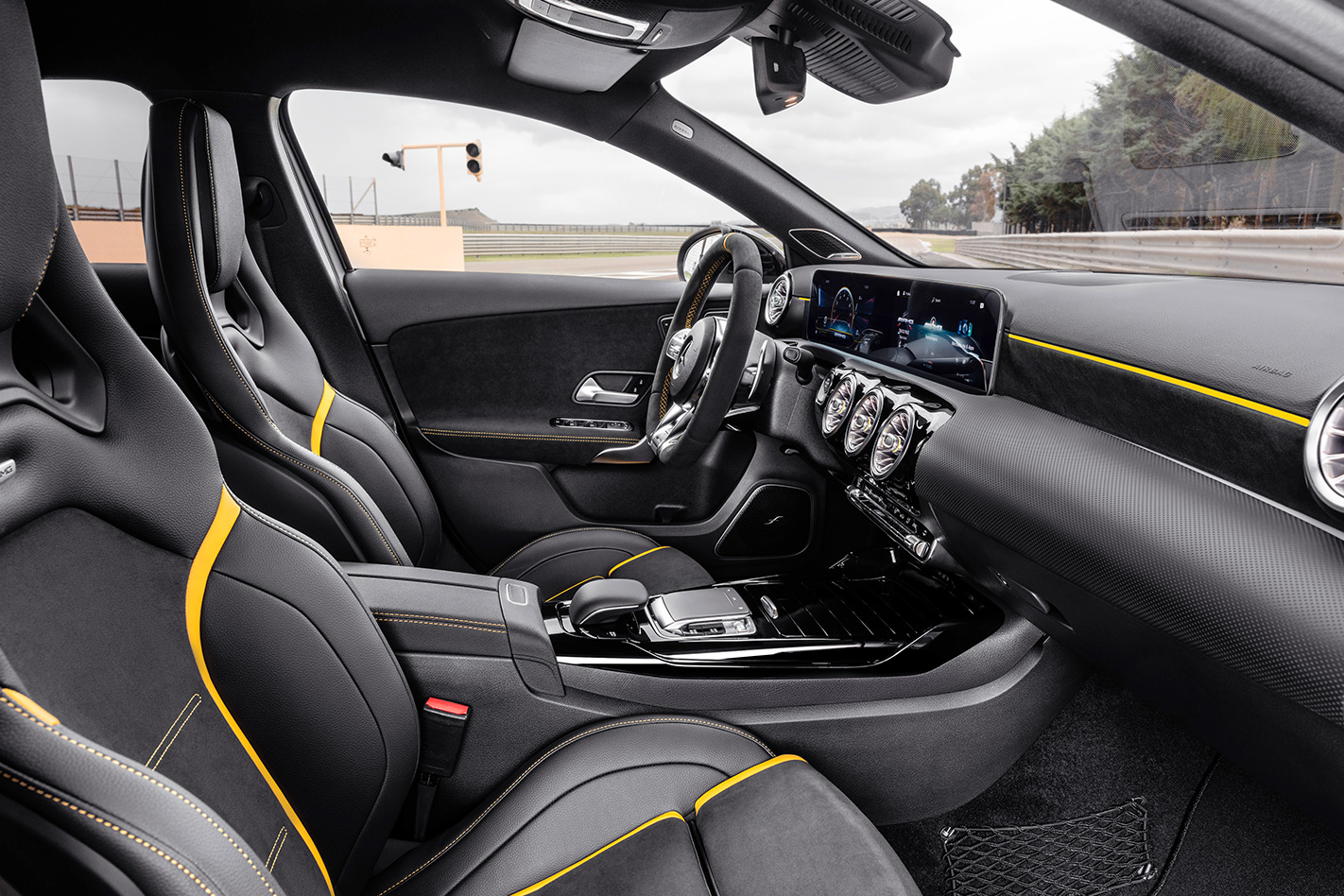
On the inside the dinky centre console gear selector has been ditched for the cooking model A-Class’s steering column wand. An AMG Performance steering wheel is covered in nappa leather/microfibre, while two 10.25-inch screens take care of the MBUX infotainment system (with AMG displays) and instrument cluster.
The exterior design doesn’t quite meet the engineering menace, but aggression can be found in the AMG-specific grille, with 12 vertical louvres, contoured headlights, and a powerdome bonnet. Flared wheel arches create space for the wider front track and 19-inch alloys, while the horizontal fins in the outer air vents increase the illusion of width. The intakes are functional for cooling and form part of the AMG aerodynamics pack, while the rear diffuser houses quad exhaust pipes.
As for its Aussie price, that’s unconfirmed, but given the extra performance (and the availability of the ‘lesser’ A35), we expect pricing to increase slightly on the circa $78K of the previous model. Around $85K is our tip.
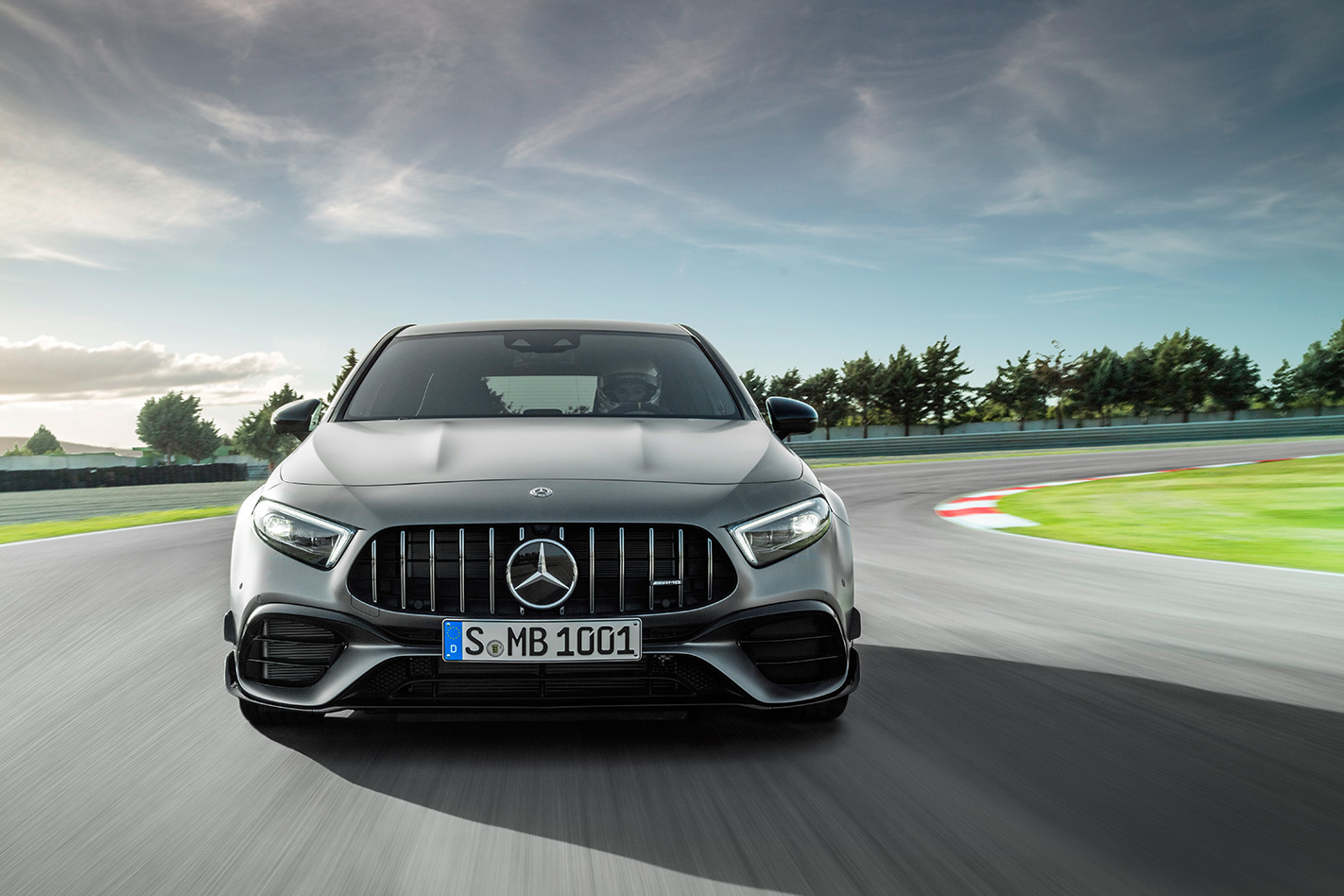
Put into perspective, the original Golf GTI of 1976 mustered a mighty 81kW. Now, in 2019 the A45 S is mustering kilowatt counts that shame supercars of the recent past.
AMG’s new supercar-fighting ‘45’ cars are here, with the 2020 Mercedes-AMG CLA45 S taking the mantle as the stylish sibling to the A45 S hot hatch.
While it’s not quite as quick as the hatch, the CLA ‘liftback’ will be the option for those who want to mix pace with style, without stepping into the big, big leagues for price – though a figure is yet to be confirmed.
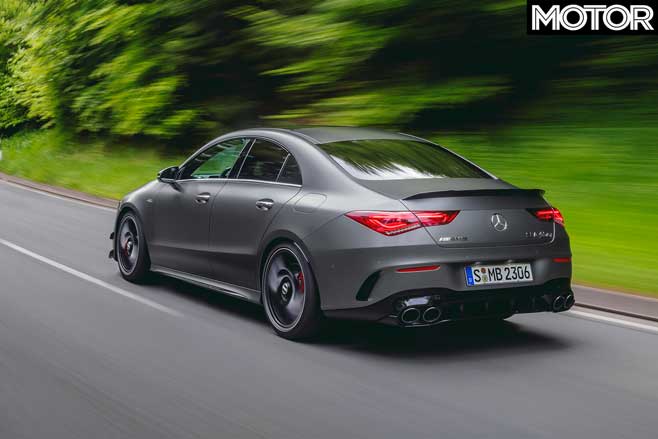
The M139 is a completely new engine, rather than just a tweak of its predecessor, with AMG even installing a new production line for its creation.
The 1991cc turbocharged four-pot also boasts a 500Nm torque peak, which tops between 5000rpm and 5250rpm, though AMG says plenty of that is still available off-peak thanks to a relatively flat torque curve.
The M139 also revs out to 7200rpm, with AMG’s engineers saying they wanted to give the new motor a ‘naturally-aspirated’ feel. That would be impressive with an engine running 30.5psi of boost.
In the new ‘45’ cars, the engine is mounted ‘back-to-front’ from its previous configuration, with the exhaust ports at the rear and the intake closer to the front. This has allowed engineers to not only require less plumbing for the aforementioned, but also designers to create a lower, more aerodynamically friendly bonnet.
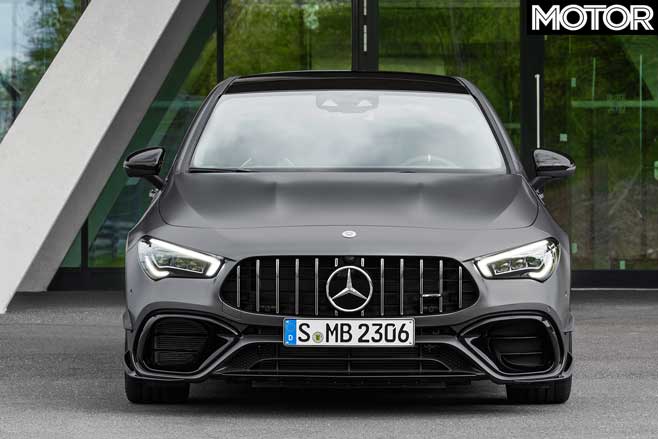
All the new engine tech, coupled with the 4Matic+ all-wheel drive system and AMG’s 8-speed Speedshift dual-clutch, allows the CLA45 S to reach 100km/h in just 4.0 seconds, a tenth slower than the hatch version of the A45 S.
Underneath the CLA45 S, AMG has “thoroughly revised” every component of the car’s suspension, with new frequency-selective shocks helping allow for higher lateral acceleration.
At the front, McPherson struts with single aluminium wishbones mounted below the wheel’scentre create a suspension geometry AMG says allows for more agile handling, while the 360mm brake callipers are radially mounted for more stability. At the rear, 4-link suspension is mounted via an axle carrier, with three transverse control arms and one trailing arm.
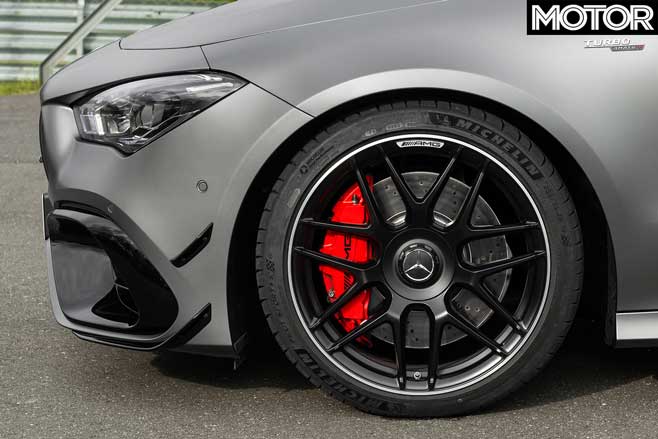
As well as tweaked suspension, AMG has reinforced the bodyshell with new aspects like an aluminium plate bolted under the engine as a shearing plate for more front-end rigidity, while various struts along the body (between the strut towers, under the body, and pistol-shaped side member connectors) reduce body torsion and roll.
AMG boss Tobias Moers says the new ‘45’s are rebuilt from the ground-up, and though they don’t look massively different from the last generation, even the interior and driving tech will benefit from the latest in Mercedes’ developments.
Six drive modes – Slippery, Comfort, Sport, Sport+, Individual, and Race – allow the CLA45 S to be whatever the driver needs in different situations, from comfy daily driver to track-thrashing terror. Everything from the powertrain and chassis to the exhaust sound is affected by these modes.
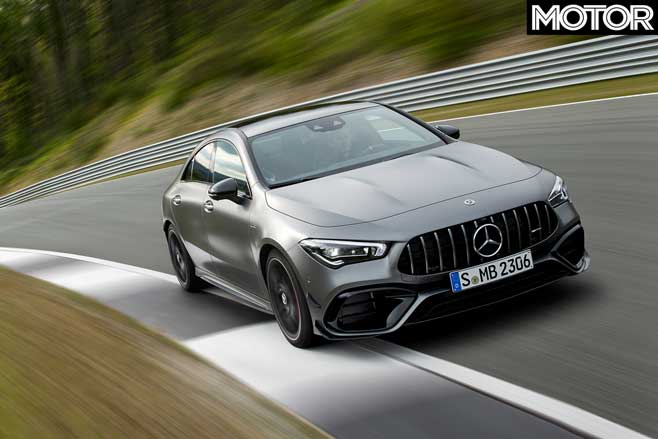
On top of this, AMG Dynamic Select changes with each drive mode, allowing more stability (as in Slippery and Comfort) or more dynamic driving (Race) thanks to adjustable ESP intervention.
In Race mode, another newfeature of the 45s becomes available… Drift Mode. Thanks to two multidisc clutches in the rear diff which allow the AMG A45 S and CLA45 S to distribute torque between not only the front and rear axles, but also between each individual rear wheel. Drift Mode is only available with ESP off, and the transmission set to manual.
The sporting nature of the CLA45 S continues into the cabin, with firm, supportive sports seats upholstered in Artico faux leather and Dinamica microfibre, with red stitching and seatbelts to match the colour scheme.
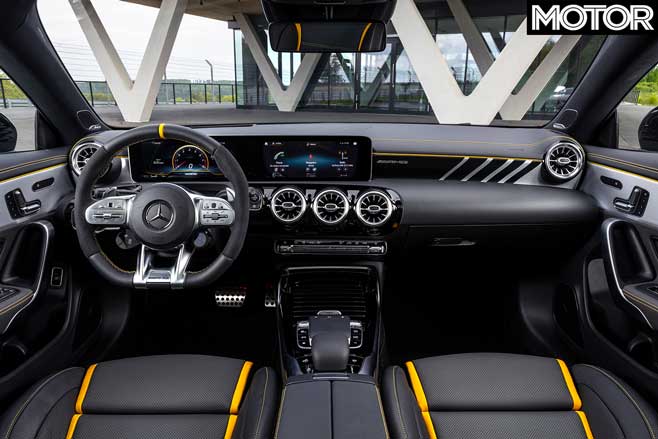
AMG’s Track Pace data logger is also standard on S models, which are likely to be the only versions of A45 and CLA45 available in Australia.
When they arrive and how much they’ll cost is yet to be confirmed by Mercedes-Benz Australia, but we’ve got our expectations set for the end of 2019. Stay tuned.
When famed YouTuber Ken Block isn’t busy pulling audacious stunts for his next Gymkhana production, he is busy competing in rallies around the world.
Recently the online star has released the raw onboard footage of his stint on Stage 13 of the Donegal Rally, Ireland.
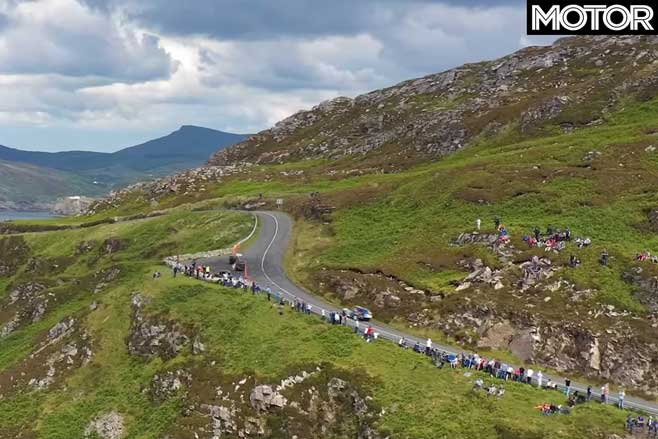
Shot from Block’s new Ford Escort ‘Cossie V2’ RS Cosworth, as part of his new ‘Cossie World Tour’ video series, the 10min 44sec footage gives you an idea of the chaos that goes on in a typical rally car cockpit on full tilt.
Though the route takes the team from the broad sweeping roads that snake along the Irish coastline and up into the tighter forest roads and through otherwise quiet rural townships, the view from the cockpit isn’t for the faint hearted.
The footage is full of heart stopping moments such as 4:20 mark as he launches over a curved crest right in front of a wall of bricks and spectators, or from the 5:50 point where he goes flat out through a country pathway that looks a few sizes too narrow.
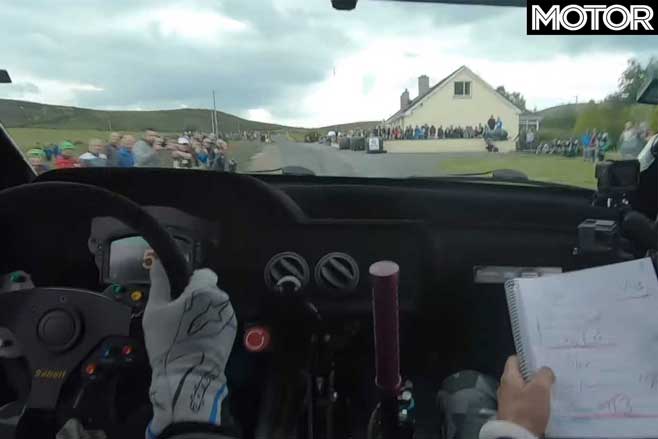
Yet, amidst the jumps and the high speed corners, Block’s co-driver Alex Gelsomino becalms the atmosphere, firing off directions from his pace notes with the metronomic cool and consistency or a radio sports announcer.
Unlike his Gymkhana video series, there is no need for “Don’t try this at home” disclaimers as it is good enough proof that rally drivers and their co-pilots are on an entirely different level of wheelmanship.
What stands out?
The Ford Escape gives you a choice from three excellent turbocharged engines, among them a diesel that is both powerful and frugal. It is good to steer, with polished cornering manners for a mid-sized SUV. There are front-drive and all-wheel-drive versions, and auto-braking is available. The Ford Kuga was renamed the Escape when it received a facelift in February 2017.
What might bug me?
Paying more for your petrol: Escapes can run on regular unleaded but it is recommended they run on premium.Driving on the space-saver spare tyre until you can fix your full-sized flat. Every Escape has only a skinny, space-saver spare. It has less grip than the regular tyres, and it limits the recommended top speed to 80km/h.In a diesel Escape, getting used to the dual-clutch auto transmission. A dual-clutch auto works much like a manual gearbox with robotic control, and can’t match the fluid, elastic take-up from rest that you get from the conventional auto used by petrol Escapes.
What body styles are there?
Five-door wagon only.Some Escapes drive their front wheels only, but most drive all four wheels.The Escape is classed as a mid-sized SUV, lower priced.
What features do all Ford Escapes have?
Autonomous emergency braking, cruise control, a reversing camera, and rear parking sensorsA sound system with a CD player, AM/FM and digital radio, USB input, and at least six speakers. Bluetooth connectivity, which allows you to wirelessly connect a phone and play music from it.Satellite navigation, displayed on an 8.0-inch colour touchscreen with Ford’s excellent SYNC3 connectivity. SYNC3 allows voice control of the sat-nav, the digital radio, and other audio and phone functions.Support for Apple CarPlay and Android Auto, which lets you display apps from compatible smartphones on the touchscreen and control them from there.A leather-wrapped steering wheel, with buttons for operating cruise, the sound system and your phone.Dual-zone air-conditioning (which allows different temperatures on either side of the cabin). This too can be controlled by voice. Air-conditioning vents dedicated to rear-seat passengers.Electronic stability control, which can help control a skid. All new cars must have this feature.Seven airbags. (For the placement of airbags, and more on Escape safety systems, please open the Safety section below.)The Escape is covered by a five-year, unlimited kilometre warranty.
Which engine uses least fuel, and why wouldn’t I choose it?
The 2.0-litre turbo diesel is the most fuel-efficient of three engines available in an Escape, using as little as 5.5 litres/100km on the official test (city and country combined).One reason you might not choose it is that you want to pay less for an Escape. Diesel Escapes cost more than similar petrol Escapes, come only with all-wheel drive and auto transmission, and are available only in the more expensive Trend and Titanium versions.Another reason might be that you want to use your Escape largely for short trips around town. The diesel’s dual-clutch auto gearbox feels smooth on the highway and saves fuel, but it is less helpful in stop-start traffic than the conventional auto in petrol Escapes. You also need to drive the diesel near highway speeds for a 30-minute stretch every couple of weeks, so that its soot-trapping particulates filter can self-clean.Of the petrol engines, the turbocharged 1.5-litre four-cylinder that powers Escape Ambientes and the front-wheel drive Trend uses least fuel, consuming 7.2 litres/100km on the test in auto form – about 30 per cent more than the diesel.An Escape Trend with this engine averaged 10.5 litres/100km in a real-world comparison for the June 2017 issue of Wheels magazine, about the same as an accompanying Toyota RAV4, Hyundai Tucson Active X and Mazda CX-5.The other petrol engine, available in all-wheel drive Trends and the Titanium, is a turbocharged 2.0-litre that is very responsive and powerful. It provides about as much thrust as the diesel when you first press the accelerator, and generates about 30 per cent more urge than either alternative if you hold your foot down. It consumes 8.6 litres/100km on the official test.Ford recommends that both petrol engines run on premium unleaded fuel.Front-wheel drive Escape Ambientes are available with a six-speed manual or six-speed conventional auto gearbox. All other petrol-engined Escapes are available only with the six-speed conventional auto. Diesel escapes come only with a six-speed dual-clutch auto.(Power outputs and all other Ford Escape specifications are available from the Cars Covered menu, under the main image on this page.)
What key features do I get if I spend more?
The least costly Escape, the Ambiente FWD, has the 1.5-litre petrol engine, rolls on 17-inch steel wheels, drives only the wheels at the front, and has cloth seat trim and the equipment in all Escapes. Spend more for an Ambiente AWD and you get drive to all four wheels, which brings you more security on slippery surfaces.For about what you would pay for an Ambiente AWD you could have instead an Escape Trend FWD. It uses the same engine as the Ambiente and drives only the front wheels, but has more equipment.The Trend has 18-inch wheels made from aluminium alloy, which look nicer than the steel wheels and don’t need plastic trim. Windows are tinted to reduce sun penetration, and laminated side-windows block out more noise. Wipers operate automatically when it rains, and headlamps switch on automatically in low light.An AWD version of the Escape Trend uses the more powerful of the petrol engines or the turbocharged diesel.Spending more on the Escape ST-Line brings sporty exterior and interior styling including unique black 18-inch alloy wheels and leather combination trim sports seats with red stitching. Driver assist features include smart keyless entry, blind spot Information System and rear cross-traffic alert.The ST-Line also comes with the 2.0-litre turbocharged petrol engine and AWD as standard, and receives chassis enhancements including optimised suspension that lowers ride-height by 10mm, re-tuned steering, and thicker anti-roll bars for reduced body roll.The most expensive Escape, the Titanium, is also available in AWD only. It adds leather trim on all seats, heating for the front seats, and power adjustment for the driver’s seat. There is a power-opened sunroof, which you can operate from outside the car (to release heat before entering). A partial self-parking system automatically steers you into a space. Extremely bright bi-xenon headlights adapt their beam shapes for the driving conditions, shining into corners and dipping only part of high-beam for oncoming drivers. Wheels on the Titanium are bigger again at 19 inches, fitted with tyres of a significantly lower profile than those on the Ambiente – which quicken steering response slightly.The Titanium also brings you as standard the features of the Hands-Free Pack with smart-key entry and a hands-free tailgate that’s an extra cost option in the Trend and ST-Line.Choosing any Escape Trend, ST-Line or Titanium also brings you the option of spending about $800 more to add a Technology Pack, which brings driver-assistance and crash-avoidance features on top of the standard autonomous emergency braking. They comprise active cruise control, lane-keeping assistance, blind-spot alert, rear cross-traffic alert, auto-dipping headlights and a tyre pressure monitor. (For more on Escape safety systems, please open the Safety section below.)
Does any upgrade have a down side?
If you choose a petrol-powered Escape Titanium it will have the more powerful 2.0-litre engine, which uses more fuel than the 1.5 petrol in Ambiente and Trend models.Headroom in the Titanium is reduced by 40mm because of the sunroof.All-wheel drive Escapes cost more to service, and diesels cost more again.The larger, lower profile tyres on the Titanium could cost more to replace and reduce ride comfort slightly (because there is less cushioning air between the wheel and the road).White and red are the only standard colours, with the other seven costing extra.
How comfortable is the Escape?
It is easy to get comfortable in the driver’s seat of an Escape, thanks to good adjustability of the seats and both height and reach adjustment for the steering wheel. Vision is also good.The front seats are quite supportive around the middle torso, which helps when driving through bends. And there’s enough padding and support for long trips.Ford has worked hard to reduce the number of buttons and switches on the dash and console. The downside is that most adjustments are now done via the touchscreen, which is difficult to use while driving.The Escape is quiet at freeway speeds and has well weighted steering. Its suspension does a good job, with enough compliance to ensure good occupant comfort but settling the car quickly after bumps.The 1.5-litre turbocharged petrol engine in the Ambientes and Trend FWD feels punchy around town and is quick to respond to driver inputs. The six-speed auto helps make the most of it, with a good spread of gear ratios. Overtaking feels effortless.The 2.0-litre petrol engine is even more convincing. You might even feel that it has more response than you need.The diesel is noticeably noisier than either petrol engine, but it is easy to drive around town and maintains speed nicely in the country.
What about safety in a Ford Escape?
The Escape has anti-lock brakes, stability control, and seven airbags. There is a seatbelt warning system for all five passengers, which is reassuring for parents. A reversing camera and rear parking sensors are standard (these were introduced on the Kuga in December 2015).The Escape also has an Emergency Assist feature, which can automatically call emergency services after a crash, using a paired mobile phone. And every Escape gives you Ford’s My Key feature, which lets you set limits on the top speed and sound volume for someone you might lend the car to (a teenage son or daughter, for example).The seven airbags are in the usual places: one in front of each front seat occupant; one to protect the driver’s knees; side airbags outside each front seat to protect at chest level from side impacts; and curtain airbags that protect the heads of front and rear occupants from side impacts.Trend and Titanium versions get auto headlights and wipers, which react quicker than the driver might.Safety in an Escape Trend or Titanium can be enhanced at extra cost with the Technology Pack.This option brings adaptive cruise control, which can match your speed to that of a slower car ahead on the highway until you are free to overtake. Paired with this is a highway speed forward collision warning.A second highway-speed component is lane-drift alert and lane-keeping assistance. The idea is to prevent your drifting dangerously into an adjacent lane, through distraction or fatigue. Should you begin to do so, you get a warning and a tug on the steering wheel.A third component keeps watch behind you, telling you when another car is out of view near a rear corner. And when you are reversing (say, from a driveway or parking space), it alerts you to vehicles crossing behind.A fourth component, Enhanced Active City Stop, operates at speeds under 50km/h to diminish the chance of your rear-ending a car ahead. It warns of an impending collision, and initiates an emergency stop automatically if you do not react – from September 2018, Enhanced Active City Stop will become standard equipment across the Escape range, including the Ambiente, rather than as part of the optional Technology Pack.In addition, your headlamps switch to low beam automatically for oncoming drivers, and a pressure monitor warns you if a tyre is going flat (perhaps giving you more time to get a slow puncture seen to).The Australasian New Car Assessment Program (ANCAP) awarded the Escape five stars for safety in January 2017. The Escape was scored at 36.3 points from a possible 37.
I like driving – will I enjoy this car?
Yes. The Escape is one of the better mid-size SUVs to drive – indeed, arguably it’s the best. It steers fluidly, and feels poised and gloriously precise in bends. That builds confidence.The ST-Line takes that drive-ability a step further with the 2.0-litre turbo petrol engine and AWD as standard, and chassis and suspension enhancements including a 10mm lower ride height that give it more car-like handling. The steering also firmer but more responsive and Ford’s engineers have added thicker anti-roll bars for reduced body roll. It’s an excellent package that helps bust the myth that SUVs can’t be fun to drive.The 1.5-litre petrol engine has plenty of grunt for suburban driving – indeed, if you accelerate hard from low speeds you may feel the steering wheel wriggle slightly in your hands as the front tyres struggle to get power to the road. It feels less perky when you ramp up the pace but at highway speeds a steady stream of oomph remains.Even the least costly Escape, the Ambiente manual, is a great drive, with that revvy 1.5 engine and a superb, slick shift action. It feels like you’re punting a half-hot hatch.The 2.0-litre petrol is a ripper too, for those who value performance. It’s great for overtaking, and accelerates very briskly from a standstill. With this engine, it is easy to trigger the Escape’s electronic traction control, particularly when cornering.The diesel engine has loads of grunt, even if it does not match the 2.0 petrol for outright performance.All-wheel drive versions of the Escape are designed for only light-duty off-road work, such as dirt tracks and snow-covered roads. If you hole a tyre in rough going, you’ll have only the space-saver spare to fall back on.
How is life in the rear seats?
A central armrest (with two cupholders) makes life more comfortable when there are just two rear passengers, and all Escapes have rear air-conditioning vents (introduced on the Kuga in May 2016). The Titanium also has trays that fold out from the seatbacks in front, much like those on a plane.With the armrest folded, a central rear passenger sits higher than the outer two. Compensating partly for that is the near-flat shape of the rear floor.Leg room is generous, and overall the rear compartment feels invitingly airy. Headroom is respectable in all but the Escape Titanium, in which tall people may touch the sunroof.
How is it for carrying stuff?
The boot has a long, wide compartment and a flat floor that’s good for carrying prams and other family gear. There’s even a small compartment in the back right corner for small items.The retractable luggage blind is a handy addition.The rear seats fold 60-40. However with both folded there is a big step up at that point from the boot floor.The Escape offers front-seat passengers more storage options than its predecessor the Kuga. The substitution of an electric parking brake has freed up space, with a pair of cupholders and a covered centre binnacle available for odds and ends.The waved-foot triggered tailgate of Titanium models – and an extra-cost option on Trends – is great for anybody carrying bulky items back to the car.The Escape is rated to tow between 1.5 and 1.8 tonnes, which is good for a vehicle of this sort.
Where does Ford make the Escape?
All Escapes are made in Spain.
What might I miss that similar cars have?
Perhaps the capacity to seat seven passengers in a car of about the same size. You can have this in a Nissan X-Trail or Mitsubishi Outlander.Otherwise, it is not likely you’ll miss much that you don’t choose to forgo: the Escape offers just about any feature you can get on similarly priced alternatives – as an option if not standard.Among many other medium SUVs you might consider are the Subaru Forester, Mazda CX-5, Hyundai Tucson, Honda CR-V, Volkswagen Tiguan, Jeep Cherokee, Skoda Karoq, Renault Koleos, Peugeot 3008 and Toyota RAV4.
Are there plans to update the Escape soon?
The current Escape went on sale in Australia in 2013 as the Ford Kuga, which received an update early in 2015. A light upgrade in January 2016 brought a reversing camera to Ambiente and Trend models, and an 8.0-inch colour touchscreen with SYNC2 connectivity to Trend and Titanium. The 8.0-inch touchscreen and SYNC2 were extended to the Ambiente in May 2016, along with dual-zone air-conditioning.About February 2017, Ford facelifted the Kuga and renamed it the Escape (a name it had used previously for its mid-size SUV). As well as a freshened exterior look and mildly revised interior trim, changes included better device connectivity from Ford’s SYNC3 suite, enhanced driver aids, the addition of a two-wheel drive version at the Trend equipment level, and revisions for the 2.0-litre petrol engine (among them a twin-scroll turbocharger) aimed at reducing fuel use.The Escape received another update in September 2018, which added autonomous emergency braking as standard equipment across the range. Ford also introduced the sporty Escape ST-Line.Ford extended it’s three year/100,000km warranty to five years with unlimited kilometres in May 2018.A sleeker, new-generation Escape is set to arrive 2020 with a plug-in hybrid version, and state-of-the-art options including digital dashboards, wifi hotspots and an electronic key operated from your smartphone.
I like this car, but I can’t choose which version. Can you help?
Our reviewers see value in the front-wheel-drive Escape Trend. It brings alloy wheels and auto headlamps and wipers, is quieter to ride in, and allows you to add auto braking and other very helpful driver aids at reasonable cost. Depending on how and where you want to drive it, you can pay less for a the 1.5-litre version or spend some more for all-wheel drive and the punchy 2.0-litre turbocharged petrol or diesel.That said if you’re going to spend extra on AWD and the 2.0-litre petrol than we recommend the ST-Line, which is a lot more fun to drive without losing any practicality.
