
Taking your sports car to the track isn’t as scary as it may seem, with the open environment perfect for letting loose and learning more about your car. Chris Thompson heads to Haunted Hills hillclimb to explain that there are a few simple check you can do to extend the track life of your tyres before hitting the tarmac. See the video above for more.
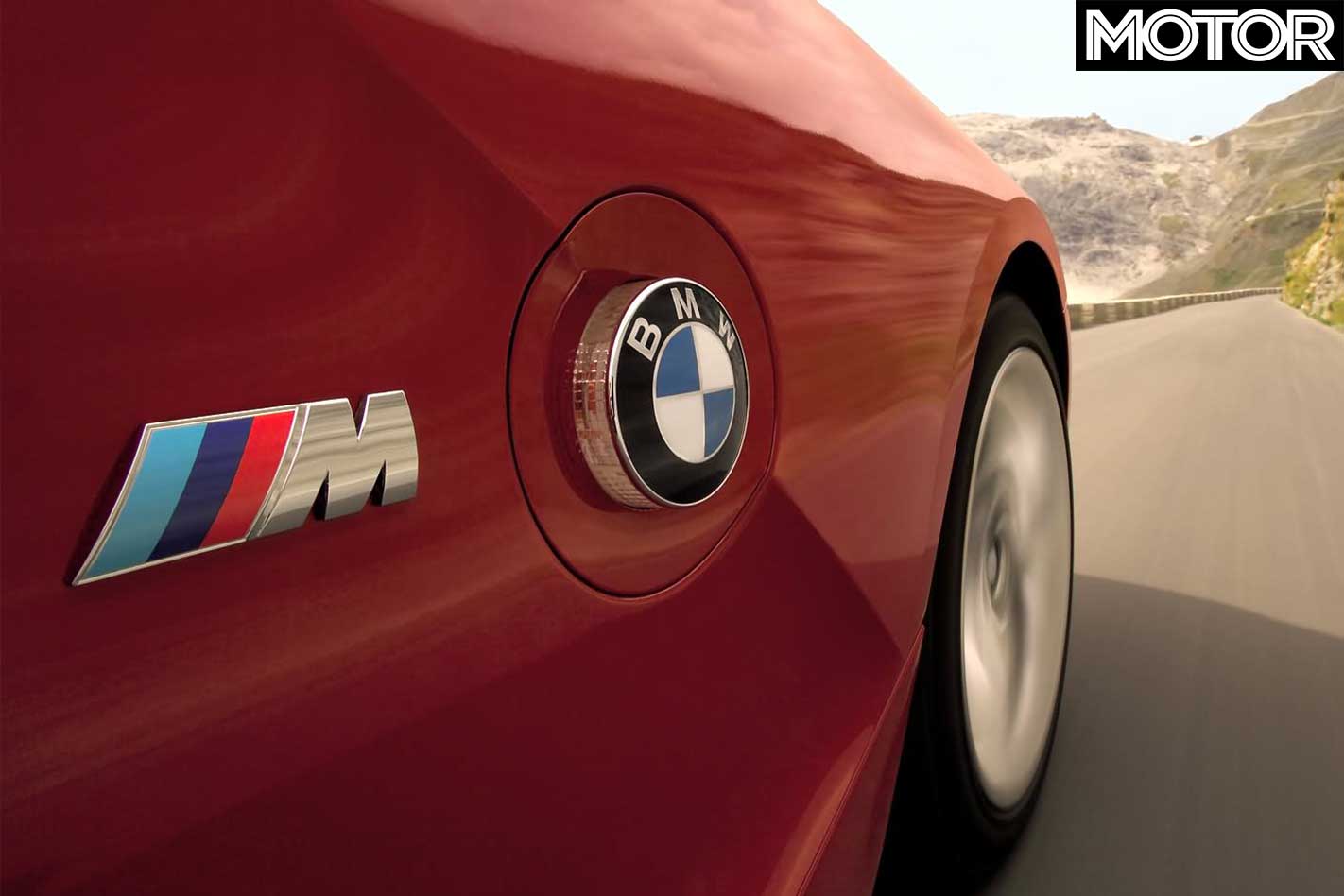
BMW M Division says it has no plans to produce a faster Z4 M roadster.
M boss Markus Flasch confirmed reports from MOTOR’s European Editor Georg Kacher that a dedicated M version of the Z4 wasn’t part of the development program.
According to Flasch, a reborn Z4 M would require the installation of the new S58 3.0-litre twin-turbo six, which is set to power the new X3 M and X4 M and is expected to appear in the new M3, and that doing so is a complex engineering challenge.
“We thought about [a Z4 M],” said Flasch, “however putting in a different engine in a smaller car such as the Z4 means a lot of effort. So far we have not found a way that is possible.”
Installing the S58 would give the Z4 a serious speed boost, the engine currently available with up to 375kW/600Nm, but Flasch says the current 250kW/500Nm Z4 M40i provides M-car levels of performance.
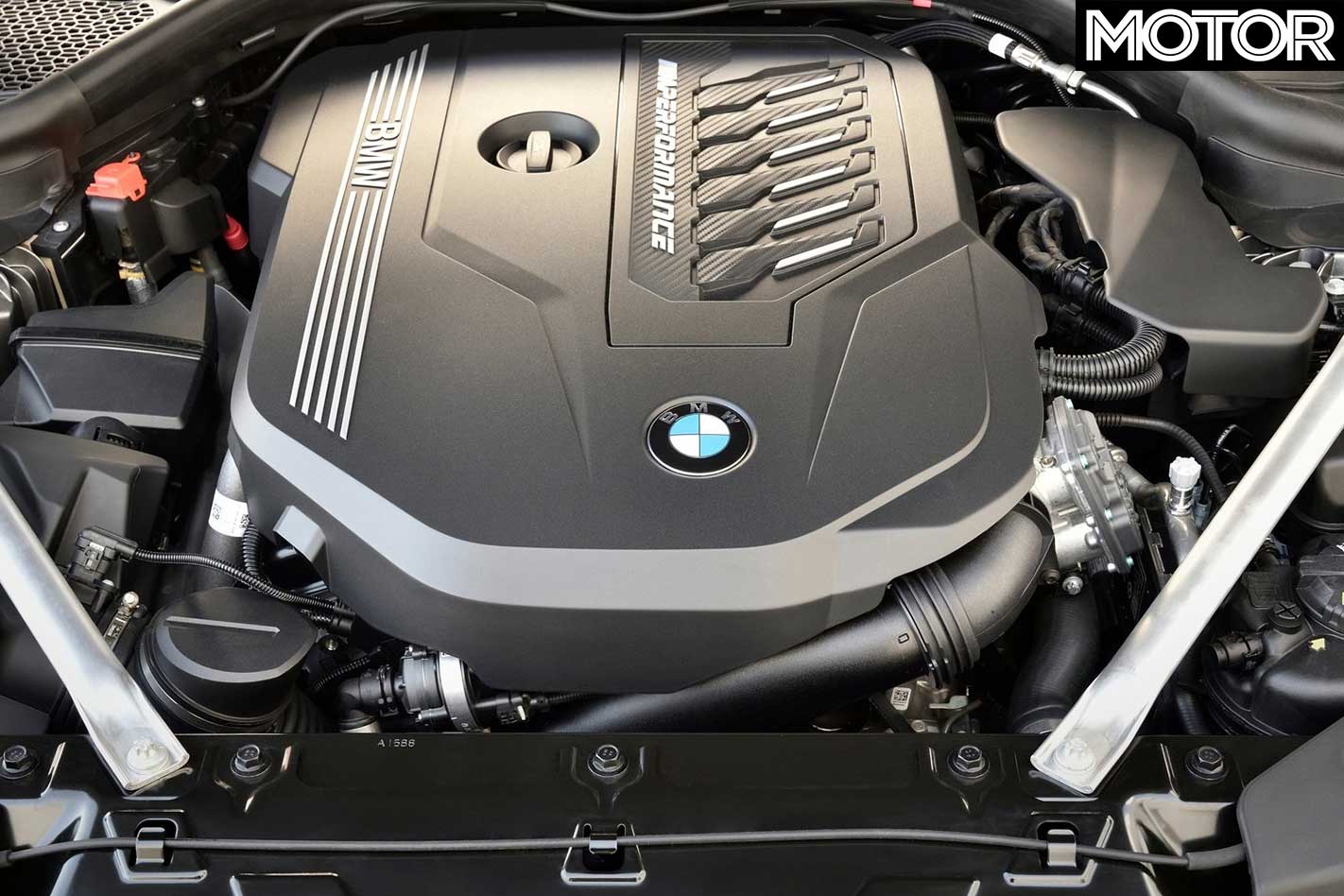
“The Z4 M40i has so much performance, it even gets close to an M2, so the Z4 already is a true M car, very competent, very fast.” In the hands of German outlet Sport Auto, the Z4 M40i lapped the Nurburgring three seconds quicker than the standard M2.
This news has ramifications beyond BMW. The Toyota Supra shares its basic platform and powertrains with the Z4, so any go-faster version will have to be the work of Toyota not BMW.
Only the first-generation Z4 spawned an M version, the 2006 Z4 M appearing in Roadster and Coupe forms using the 252kW/365Nm 3.2-litre atmo six from the E46 M3.
The Wheels Verdict: Volvo has a proven track record in shrinking motors while not giving up much for performance, and the T3 is a continuation on form. We wait to see how it performs with the automatic, but our manual-equipped preview was positive.
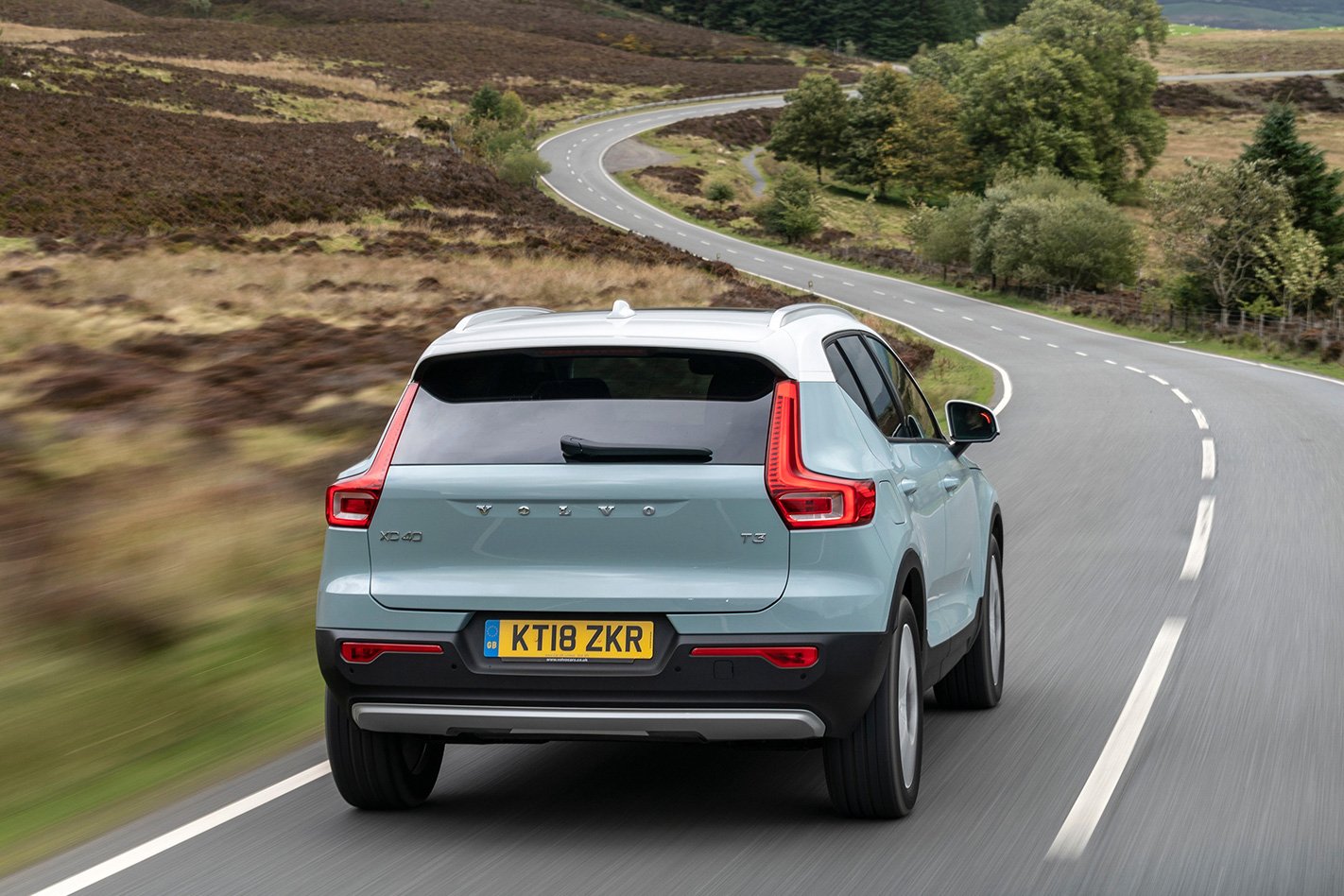
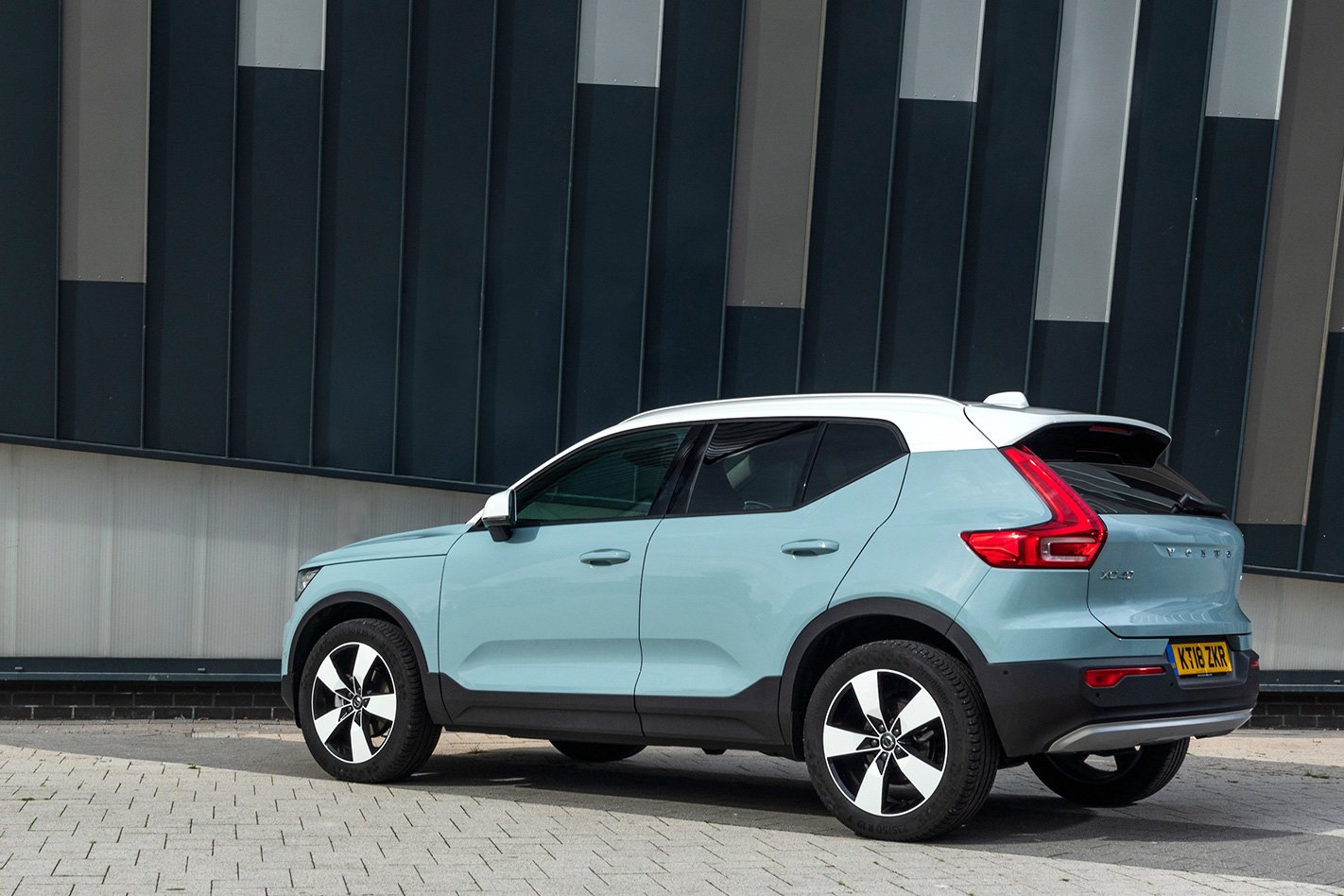
WHAT IS THE XC40 T3?
It’s the newest variant to enter the line-up and is the first Volvo to get a three-pot engine. It’s also the first SUV in the petrol ‘T’ line-up to get something other than a four-cylinder 2.0-litre motor; the mill underneath the T3’s snout is a 1.5-litre three-cylinder turbo.
WHY WE’RE TESTING IT
Volvo Australia managing director Nick Connor told Wheels that the new three-pot will land in Australia next year. It will most likely replace the current entry-level T4, thus creating a new line-up that consists of the petrol T3 and T5 and the diesel D4. Volvo Australia’s reasoning for the move is that it doesn’t have much markup on the T4 and the price, which has already seen a slight hike, looks to continue climbing. The T3 solves that issue and gives the Swedish maker a keen price point.
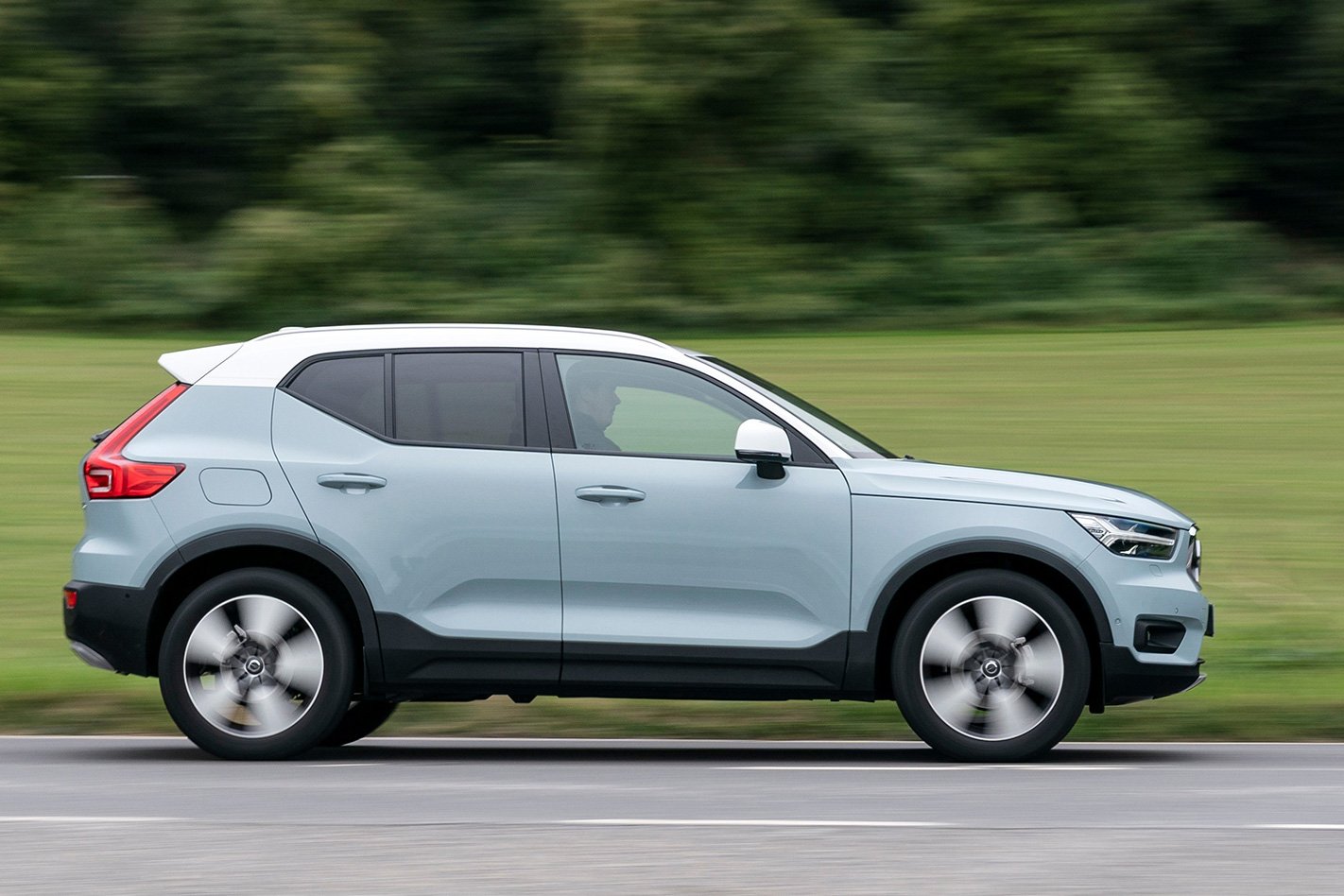
VOLVO XC40 T3 REVIEW
Volvo went out on a limb in 2007 – yes, when it was still owned by Ford and before current owner Geely took the reins – in deciding to ditch its turbo five- and six-cylinder engines and big V8 for a four-pot line-up. The plan included its impressive plug-in electric twin-motor setup and it proved a well-timed efficient yet powerful addition. So are the Swedes planning another round of downsizing?
Instead of being a replacement to the four-cylinder engine, the new 1.5-litre turbo introduces a new entry-level configuration, including a lower-output T2 in markets outside of Australia.
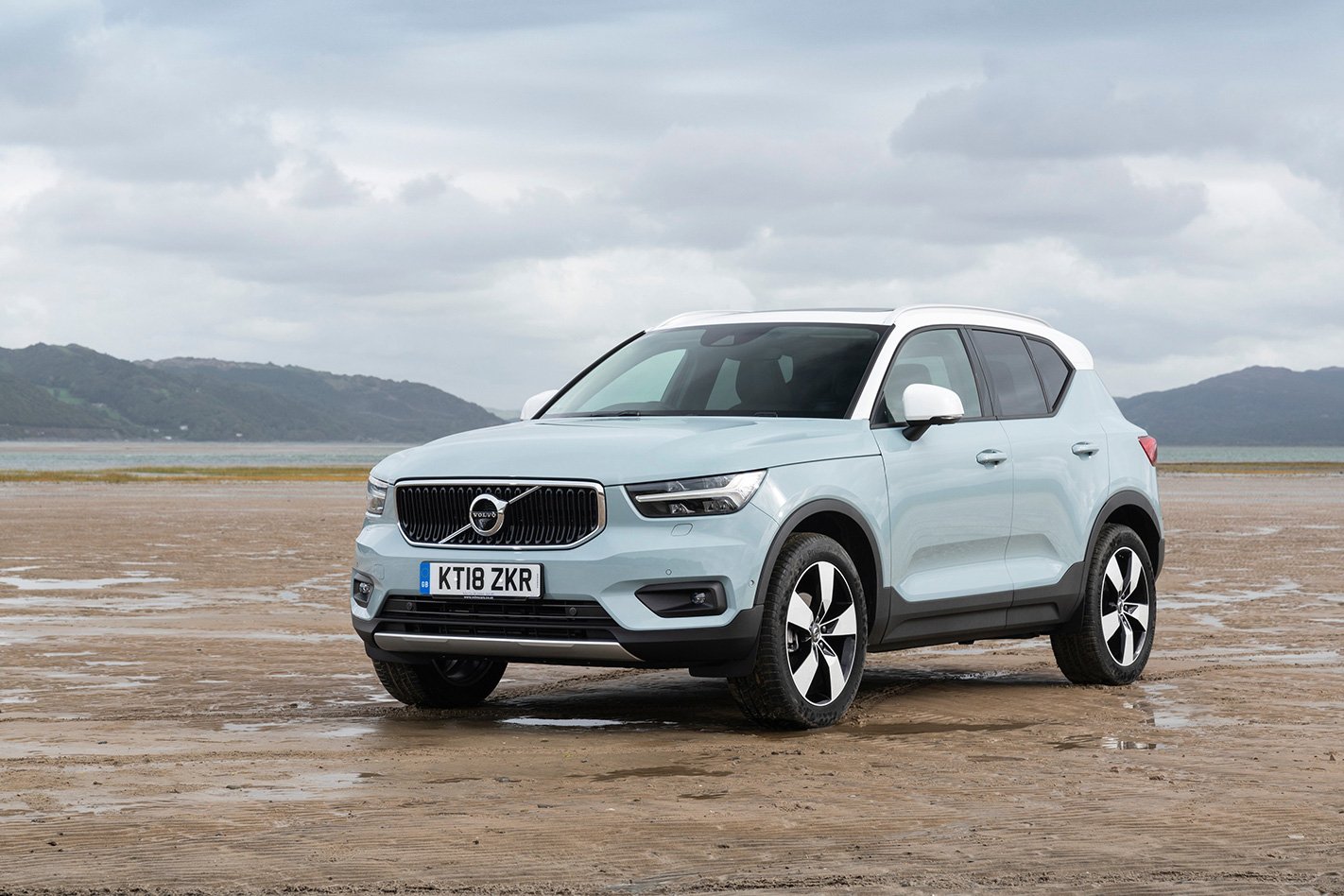
As a replacement to the T4 in Australia, the T3’s potential flaw is a power deficit to the 2.0-litre model. The T4 develops 140kW and 300Nm; the three-pot a lesser 115kW and 265Nm. Mated to an eight-speed auto, the T3 will produce around 120kW, but the test vehicle we drove in Sweden had a six-speed manual – it proved a fun combo, but won’t be offered in Oz for obvious reasons.
There is a benefit the T3 brings though which is it weighs less. That helps acceleration, which isn’t disparate to the T4 (Volvo claims the T3 will accelerate 0-100km/h in 9.4sec, 1sec slower than the T4) and there are some minor changes to front-end feel.
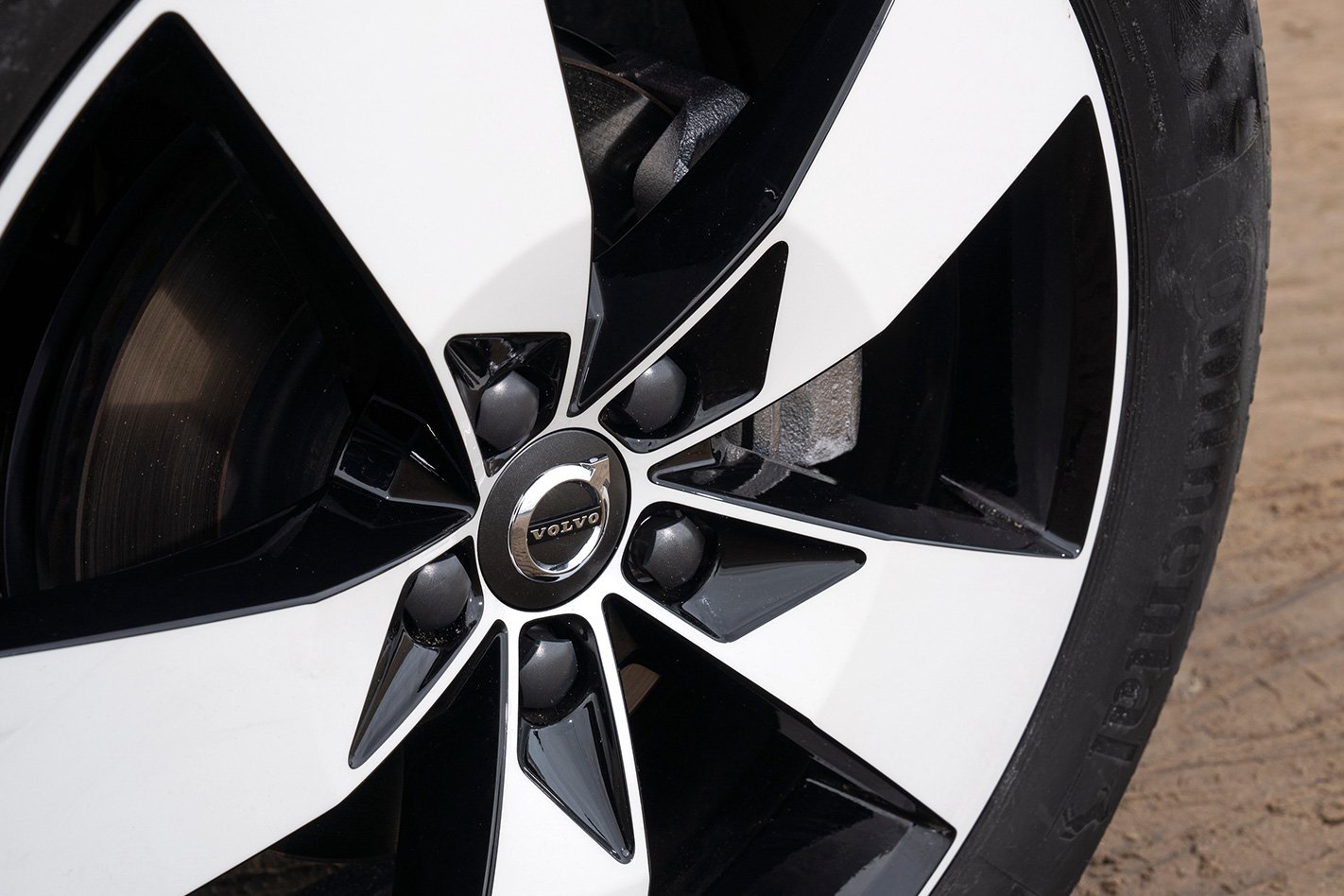
Mated to the six-speed manual and powering the front wheels only, it’s a fun, thrummy drivetrain and lively through the rev range. Fixed to an automatic transmission it might not be quite as energetic, but typical of engines with an odd number of cylinders – and like Volvo’s previous five-pot – it has an enjoyable character that feels like it’s delivering on all of the rumbling noise. But unlike some coarser units it has been well engineered, delivering a refined response that’s not at all gruff when accelerating.
Cruising at around 60 and 80km/h it’s smooth and quiet, but sits close to 2000rpm at highway speeds that sounds a little noisier – something the extra two cogs in the eight-speed will help calm.
Our time with the model was limited so we couldn’t gauge fuel consumption. Though it is as well suited to urban and city driving as the T4, it will need to be worked to get going, so expect fuel economy to take a hit from the claimed consumption in the real world.
Dynamically, it was fun and sharp on its feet, tipping into corners willingly and with good feedback through the steering wheel – typical of our findings with both the T4 and T5 – but there is some body roll from the softer spring setup. While active all-wheel-drive will be available, the mild output doesn’t elicit any torque steer, and the front-wheel-drive model might be the only option Down Under to keep pricing tight.
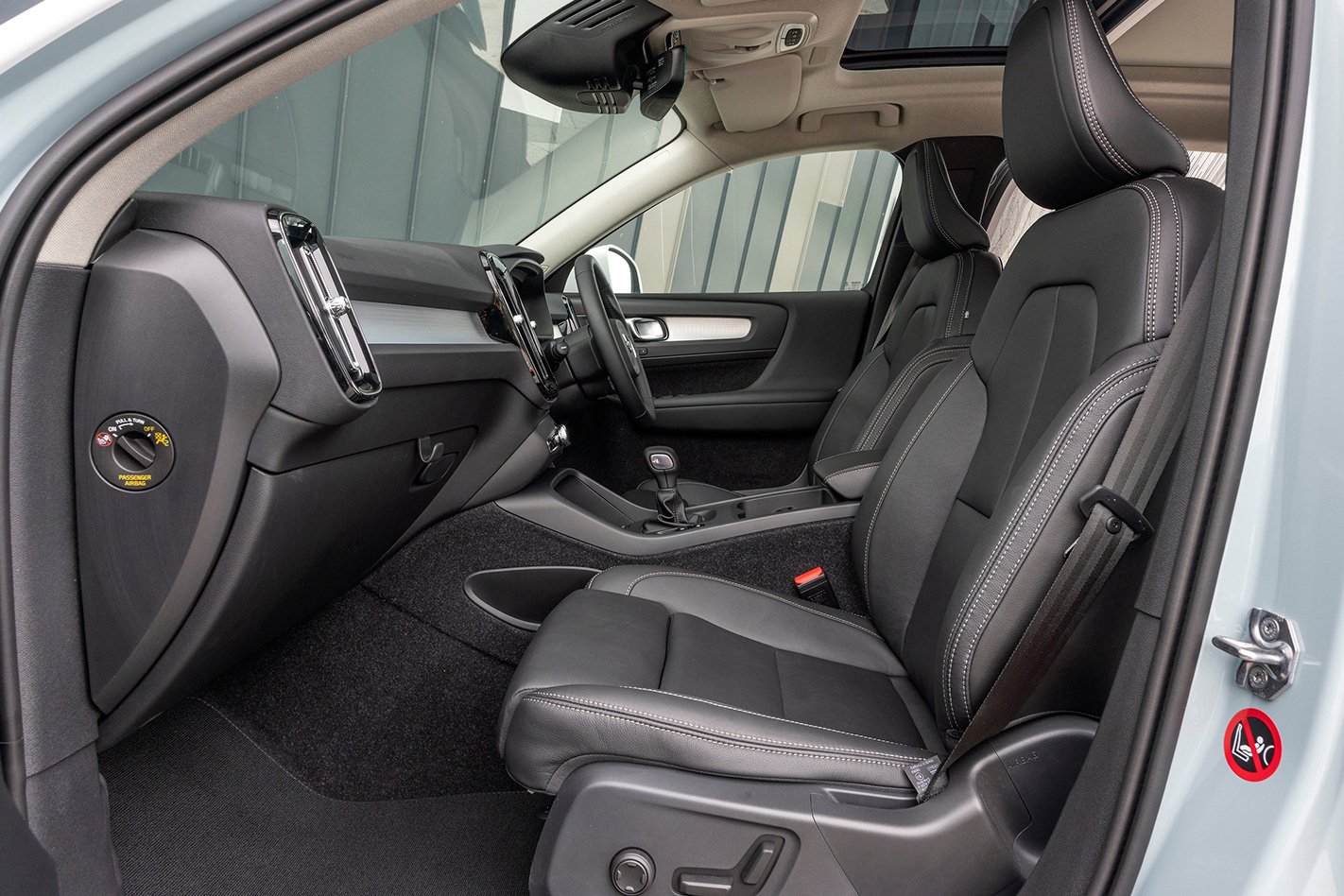
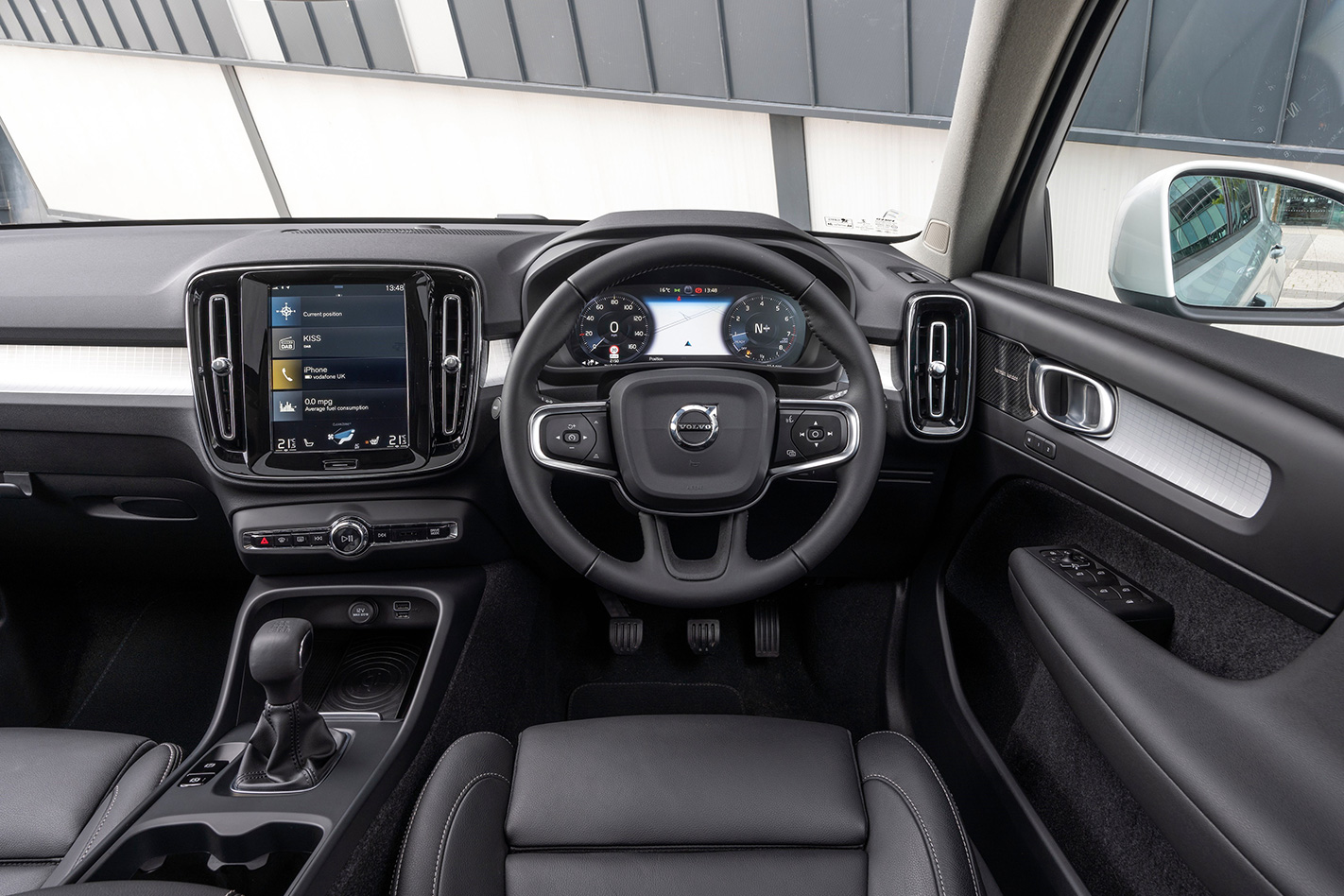
Interior design and equipment mirrors that of the trim grades available with other engines, which is an elegant and minimalist aesthetic with some nice tech such as the portrait infotainment system and 12-inch digital driver’s display. Storage is everywhere, and it’s a comfortable cabin.
We’ll reserve full judgement until the car lands with an eight-speed next year, but first impression are that the three-pot engine is a suitable replacement, with a unique, fun character.
VOLVO XC40 T3 VS RIVALS
BMW X1, Jaguar E-Pace, Lexus UX
VOLVO XC40 T3 PRICE AND SPECS AUSTRALIA
- Model: Volvo XC40 T3
- Engine: 1.5-litre three-cylinder turbo
- Max power: 115kW at 5000rpm
- Max torque: 265Nm at 1600-3850rpm
- Transmission: Eight-speed automatic
- 0-100km/h: 9.4sec
- Price: $44,000 (Estimated)
- On sale: Q1 2020
February 25, 2020: New car smell – some love it, others hate it, but what few may know is that the scent has a name: off-gassing. Basically, it’s microscopic particles emitted by a new car’s factory-fresh plastics and synthetic fabrics, and their combined vapours are what you’re inhaling.
But, are off-gassing plastics a health risk?
A new study from researchers at the University of California indicates the smell isn’t actually as harmless as it may seem.
Researchers Aalekhya Reddam and David Volz conducted a study that looked into the point at which a person’s exposure to known carcinogens would go above safe levels.
The study looked at the levels of carcinogens, namely formaldehyde and benzene, as a percentage of daily tolerances outlined by Californian health authorities.
After just a short 20 minute commute, it was found the levels of formaldehyde and benzene would exceed the daily allowable maximum, with risk increasing beyond that with extra time spent in the car.
Alarmingly, within the state of California, more motorists in the cities of San Francisco and Los Angeles were at a 10 per cent higher probability of exceeding cancer risk thresholds associated with benzene or formaldehyde than any other studied location.
Effectively, cities with more traffic and congestion lead to higher commute times, which then leads to high risk of carcinogen exposure.
Overall, the study raises concerns about the potential risk associated with inhalation of benzene and formaldehyde for people who spend a significant amount of time in their vehicles.

The story to here: What is off-gassing and is new car smell harmful?
May 2019: As the name suggests, off-gassing is the release of hydrocarbon-derived chemicals and allergens, collectively known as volatile organic compounds (VOCs), into the surrounding environment.
As the cabin plastics begin to react with the atmosphere, sunlight and heat, they begin to break down on a molecular level and disperse into the air.
Off-gassing is not specific to cars – it’s something that most synthetic materials, especially those derived from petroleum, do. Everyday household items such as fabric, mattresses, carpet and paint will ‘gas out’, and a 2001 CSIRO report linked buildings with VOC concentrations of over 10mg per metre-cubed to ‘Sick Building Syndrome’ – a phenomenon where multiple occupants of a building report feeling unwell but without any obvious cause. Among other things, one of the suspected triggers for Sick Building Syndrome is contaminated air from construction materials gassing out, mould or other chemicals.
Alarmingly, new cars had up to six times the volume of VOC concentrations as what the CSIRO found to be the Sick Building Syndrome threshold, and with side-effects ranging from itching to infertility that’s bound to be concerning.
Think about it; a car full of people, windows up, aircon on – essentially it’s just you and the fumes. How do you feel about that new car smell now?
WHAT ARE WE BREATHING IN?
A big component of new car smell is brominated fire retardant (BFR, also known as Bromide). It’s a fire retardant used typically on seats, carpet and bed mattresses. One common BFR, known as deca, collects and lurks in the human body, affecting brain and thyroid function, and can be passed to children via breast milk.
Levels of BFR found in Australian breast milk are double those found in European countries where the chemicals are heavily regulated, but less than five times those reported for North America. Even more concerning is bromide gas levels increase when exposed to heat and UV – not great news for Australia.
We already know Polyvinyl Chloride (which we know as PVC) has a lasting effect on the environment, but the soft plastic, which you commonly find on the dash and doors, can also have an impact on human health. The softeners in PVC contain phthalates (a bunch of chemicals used in plastics), which are regulated in several parts of the world because of their suspected carcinogenic properties, but Australia sits behind in regulating this product even though it also off-gasses more with heat.
But here’s the good news, most manufacturers are phasing out PVC anyway because of its possible health issues and its lack of recyclability.
Thinking of upgrading that pretty interior to tanned leather? Well consider this before you spend your hard earn cash: chromium is commonly used in tanning to soften hides and stabilize colour, but this allergen, when tested, has caused infertility in rats. A 2005 Japanese study of 101 Japanese cars found greater air pollution in the “luxury cars”, which the study attributed to extensive interior leather trim.
A problem with off-gassing is that you can’t necessarily eyeball a material or a product and assess its brew. A film of vapour on the windscreen is the first clue to the possible presence of high VOCs but the detail of what that particular concoction is doing to you and your passengers is impossible to tell from your owner’s manual or your local dealer. Cars are not food products, they’ll tell you where they’re made but not what they’re made of.
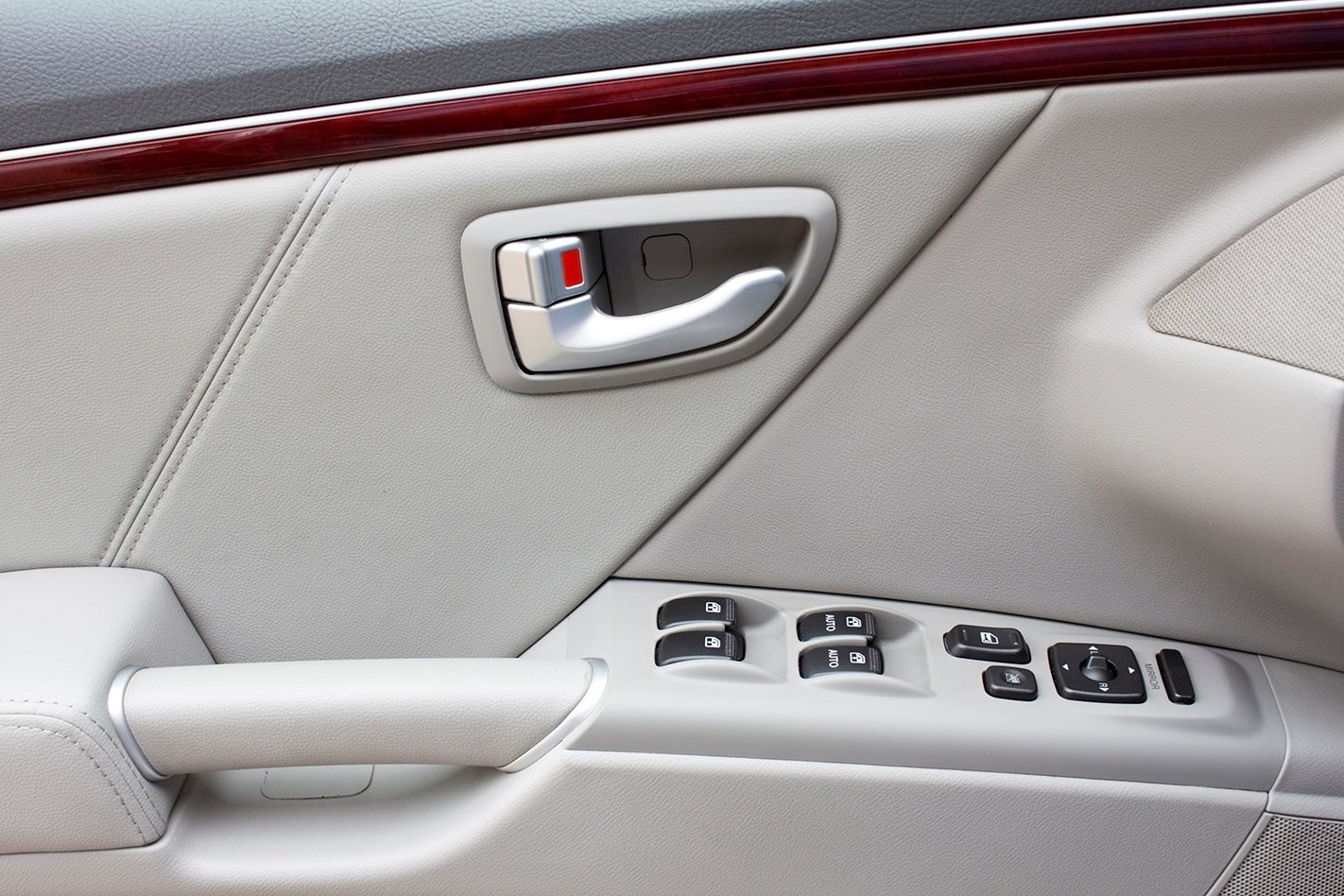
SHOULD I BE WORRIED?
The good news is that a little bit of air can improve the problem. 80 per cent of of-gassing occurs in the first three months of a car’s life, which means that if your car was sitting on the lot, on the docks or on a boat, most of the dirty work should be done. VOC levels are relatively lowest when the vehicle is in motion with the driver’s window half down.
If you can, park the car in the sun with the windows slightly down as frequently as possible and crank up the air-conditioning to fast forward the curing process. Exposure to chemicals is one of the unavoidable by-products of living in the modern world but, as we mentioned above, the health risk from new car interiors diminishes rapidly with time.
Many carmakers have also been proactive in reducing the amount of potentially harmful plastics in their car interiors. Honda, for example, has committed to eliminating PVC and plastics containing bromide from their vehicles. In the case of PVC, it was almost universally in 2006, but six years later only 73 per cent of cars produced globally used the material in their interiors.
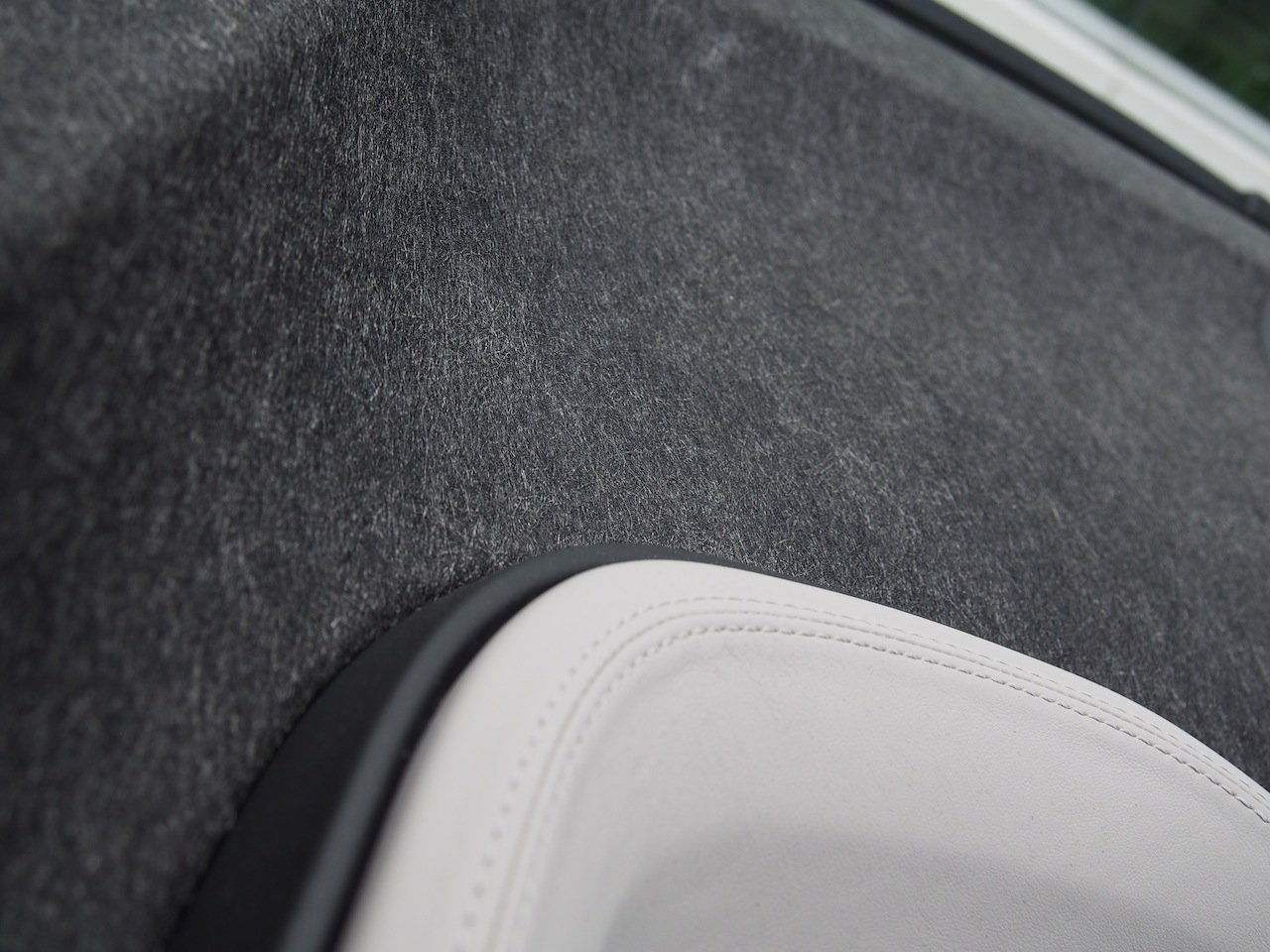
A 2012 study also found that Suzuki, Nissan, Toyota and Volkswagen had admirably low amounts of airborne VOCs. Many manufacturers are also looking to replace cabin plastics with naturally-derived or recycled materials such as soy-based seat cushion foams, vegan leather and compressed plant fibre structural card (like that used by the BMW i3, above), reducing the car’s lifetime environmental impact while also eliminating VOC sources.
Ford even recently patented a method for removing the bulk of new car odour before cars even leave the factory, largely as a response to Chinese buyers complaining about the whiff of their new cars. Ford’s system essentially bakes the entire car’s interior for a set time to accelerate the outgassing process from months to mere minutes, with the resulting fumes being extracted and filtered on the assembly line.
The industry is steering itself in the right direction, but if the idea of breathing new car smell gives you a twinge of anxiety, there’s no need to reach for the gas mask – just play it safe for the first six months of ownership and keep the car well ventilated. Frequent wipe-downs of the interior with a slightly damp microfibre cloth will also help, as VOCs tend to combine with airborne dust or settle on the inside of your car’s glass and other hard surfaces.
New to Wheels Car of the Year?
Read the COTY 101.
Just when you thought the automotive world was being swamped by efficiency obsessing, downsizing over-complication and ICE ambivalence, along comes a lightweight sports car that’s shot through with purity of purpose, honed with a diamond edge, and infused with the ability to delight a driver. Yes, the Alpine A110 really is a tonic for these times.
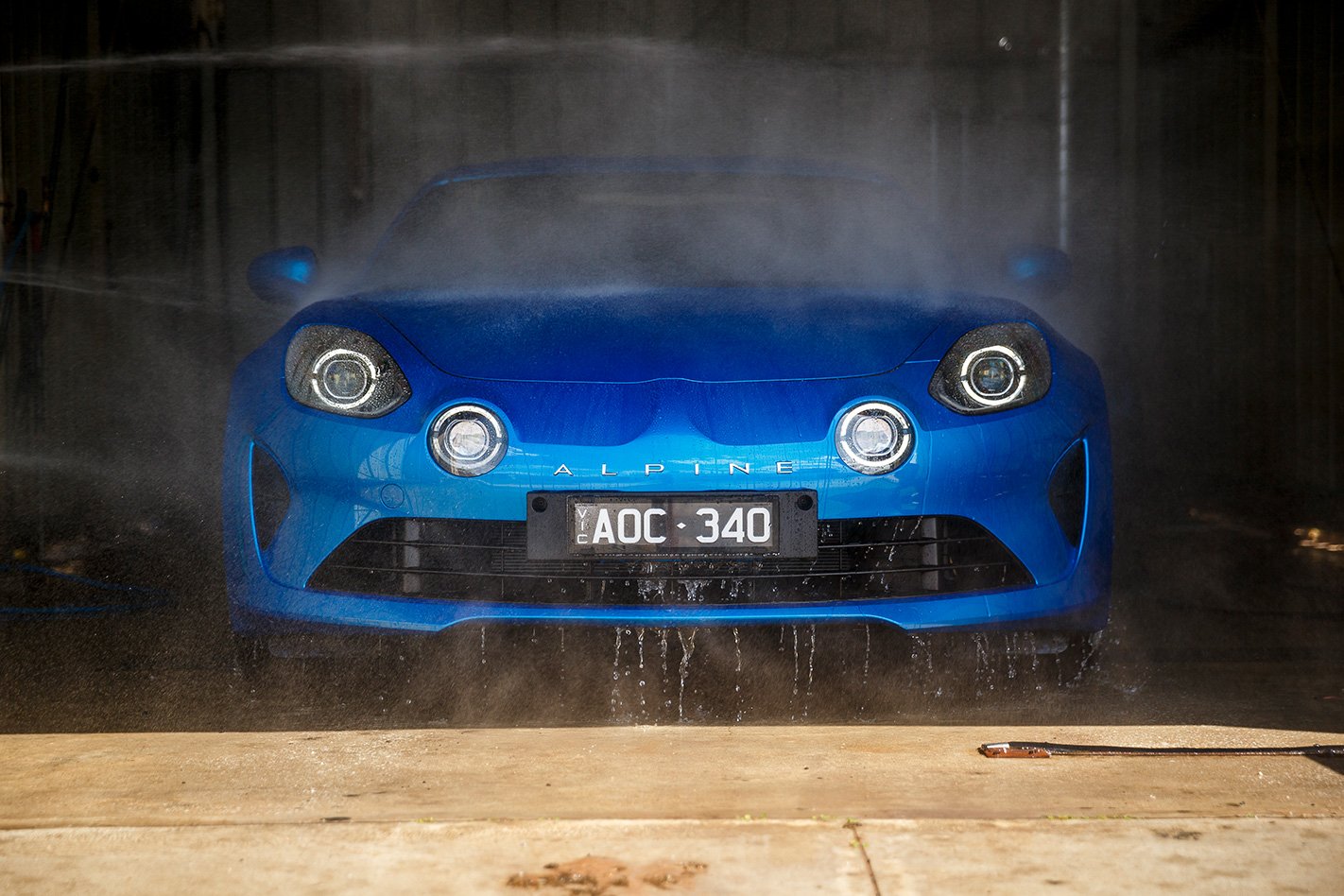
Even before the driving started, the judges leaned forward in unison to listen to Carey outline its key elements: a bespoke aluminium spaceframe made in Dieppe, France (clad with panels stamped in Italy), a Renaultsport-tuned 1.8-litre turbo four from Korea, a Getrag seven-speed dual-clutch ’box from Germany, and a slinky exterior penned by Japanese designer Jun Okazaki. This really is a global car, despite paying a respectful homage to the 1962–1977 French original.
And for all the awesome things the Alpine is, let’s also give grateful recognition for all that it’s not: over-tyred, over-powered, overly stiff or over-burdened with fripperies like multiple steering modes. It’s infused with a welcome measure of restraint, where the design and engineering teams clearly recognised that adding ‘more’ would only increase weight and complexity, not driver enjoyment.
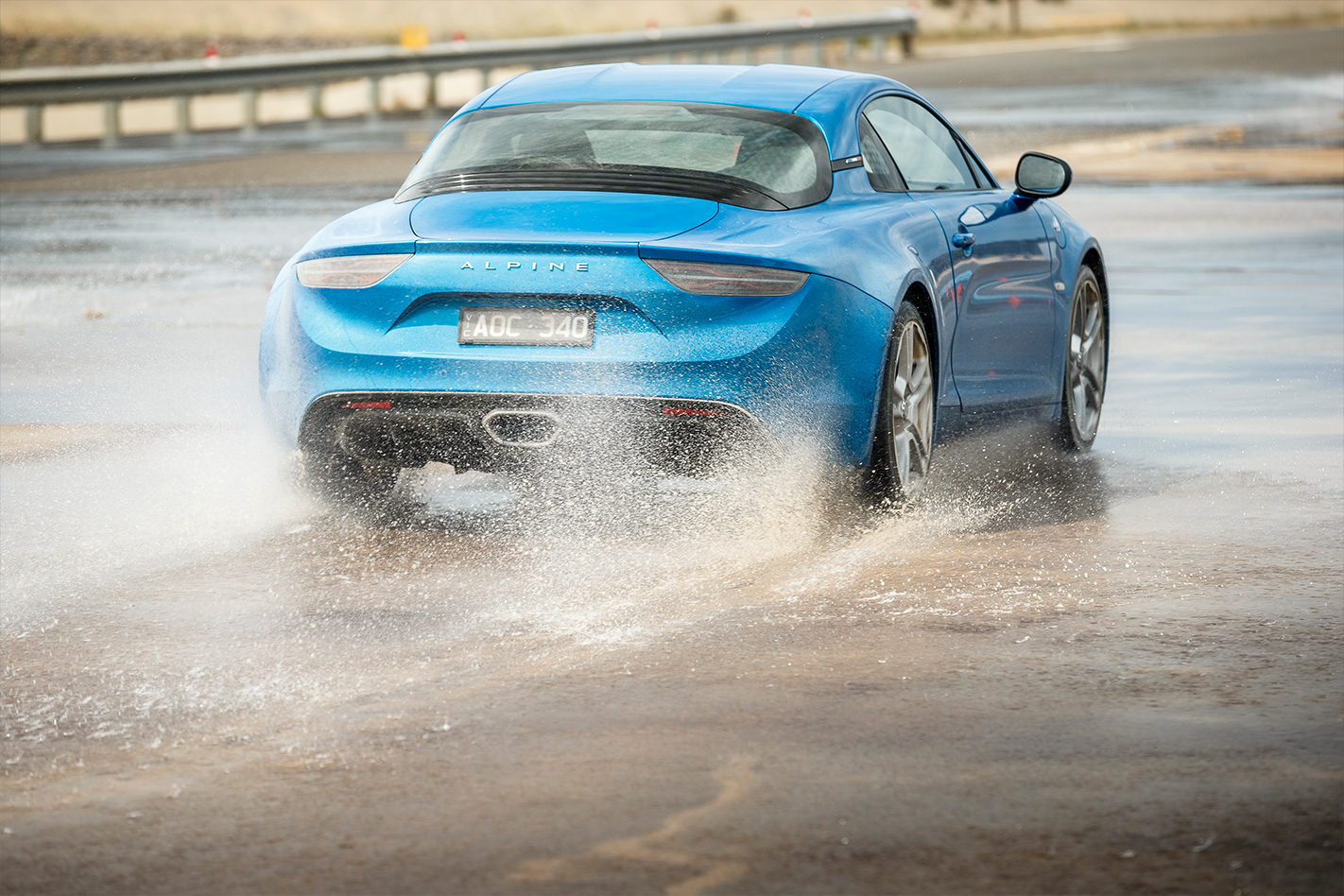
The engine is a cracker, out to convince you that turbocharging does not have to mean a tuneless soundtrack. It growls and slurps, exhales and whistles, rasps and crackles, encouraging you to spin it up just for the hell of it.
When driven with restraint, the transmission shuffles quickly through the ratios, and needs a decent throttle prod to fire you back into the torque curve. Some judges thought its calibration could be improved, but others reckoned the Track mode, which holds gears to redline, was spot-on. There’s also a manual mode if you reckon you’re sharper than the software.
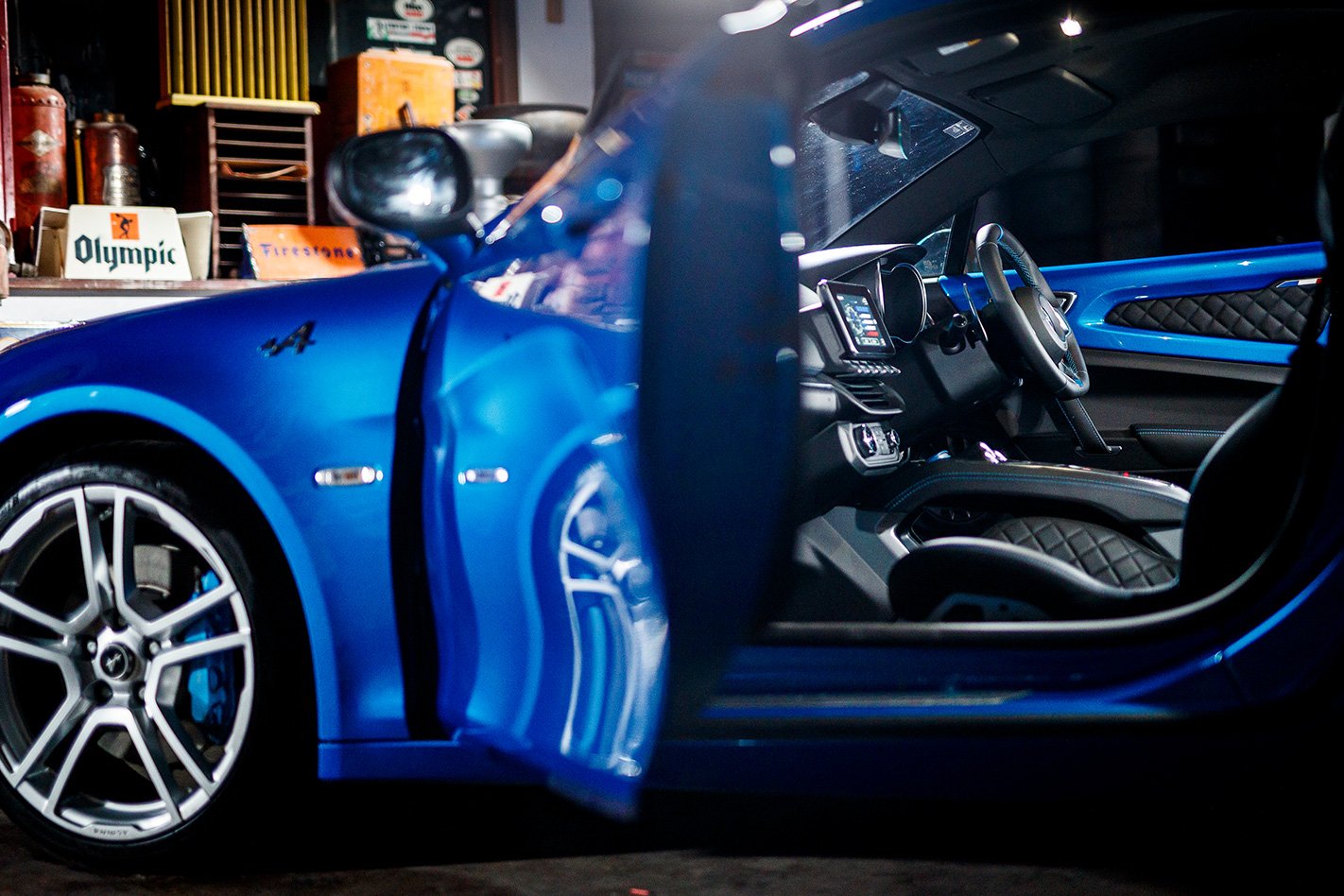
But it’s the dynamics that define the Alpine experience. You take charge of an eager, ultra-responsive front end via what Carey described as “superlatively good steering”, and instantly revel in the car’s crisply communicated grip levels. The ride is absorbent – “better than a Polo GTI” commented one judge – and the chassis tune allows the car to breathe with bumpy Aussie backroads, instead of arm-wrestling them.
The front tyres are modest 205s, yet their limits of adhesion feel ideally in balance with the engine’s output and traction from the 235 rears. But the bottom line is you don’t need to flog the A110 at rat-bag speeds to probe its limits and enjoy its nuanced, high-definition feedback.
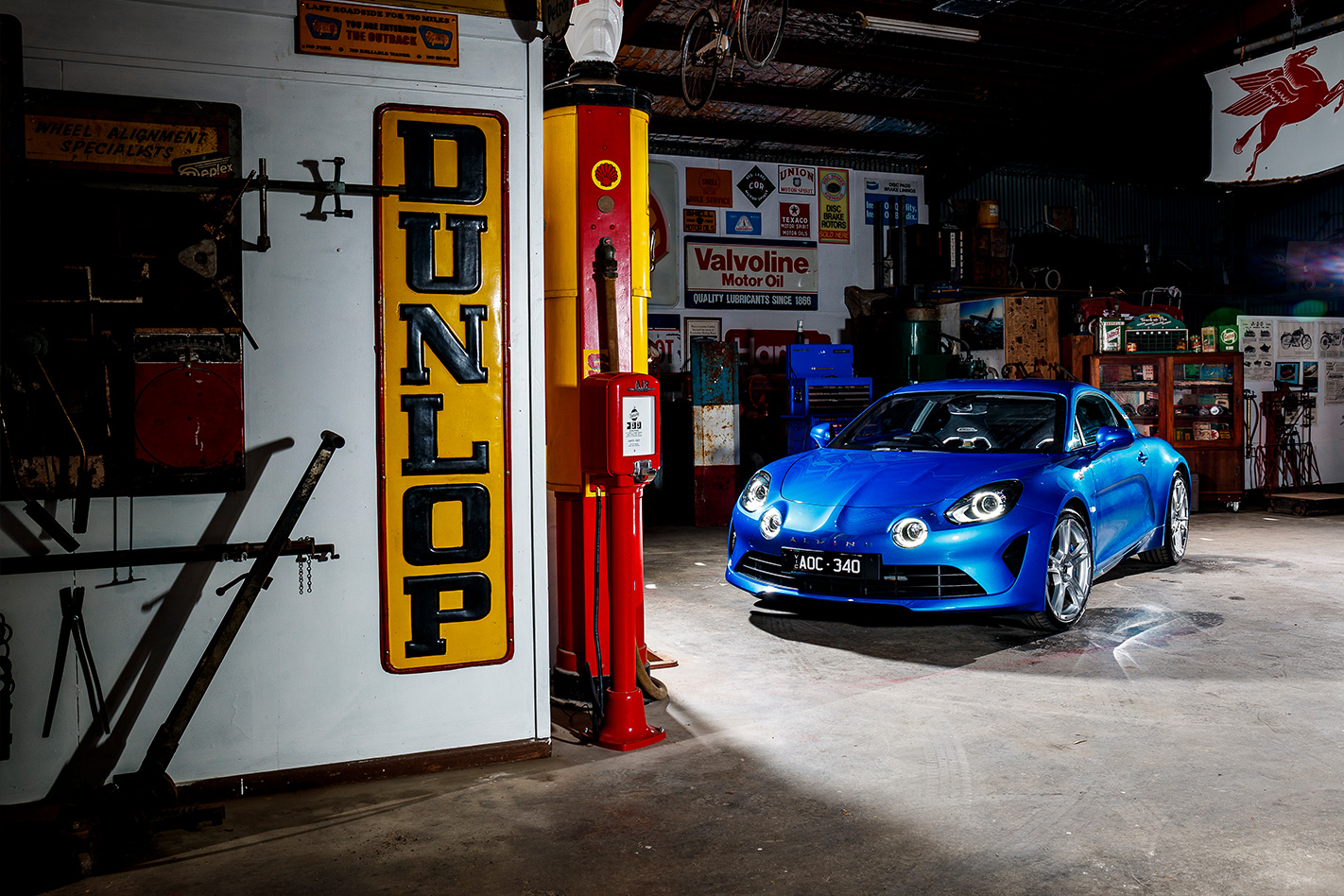
So what put the brakes on the little Frenchie going all the way? Well, against the safety criteria, it floundered, with no AEB (although some judges questioned whether this was such a deal-breaker, given the expectation that a driver of a sports car should hopefully be an enthusiast and therefore constantly attentive and engaged in the driving process.) It also lacks a reversing camera; a dumb oversight given that a multi-media screen is already in place.
The question of value also niggled. Should the Premiere Edition (admittedly featuring lightweight Sabelt one-piece seats, 18-inch Fuchs forged alloys, Brembo bi-material brakes and an active sports exhaust) be priced at $106,500, given a Porsche Cayman (with PDK dual-clutch and badge pedigree) is only $9K more? Counterbalancing that, the $97,000 Pure and $103,500 Legende models do make an effort to provide a lower-cost entry point.
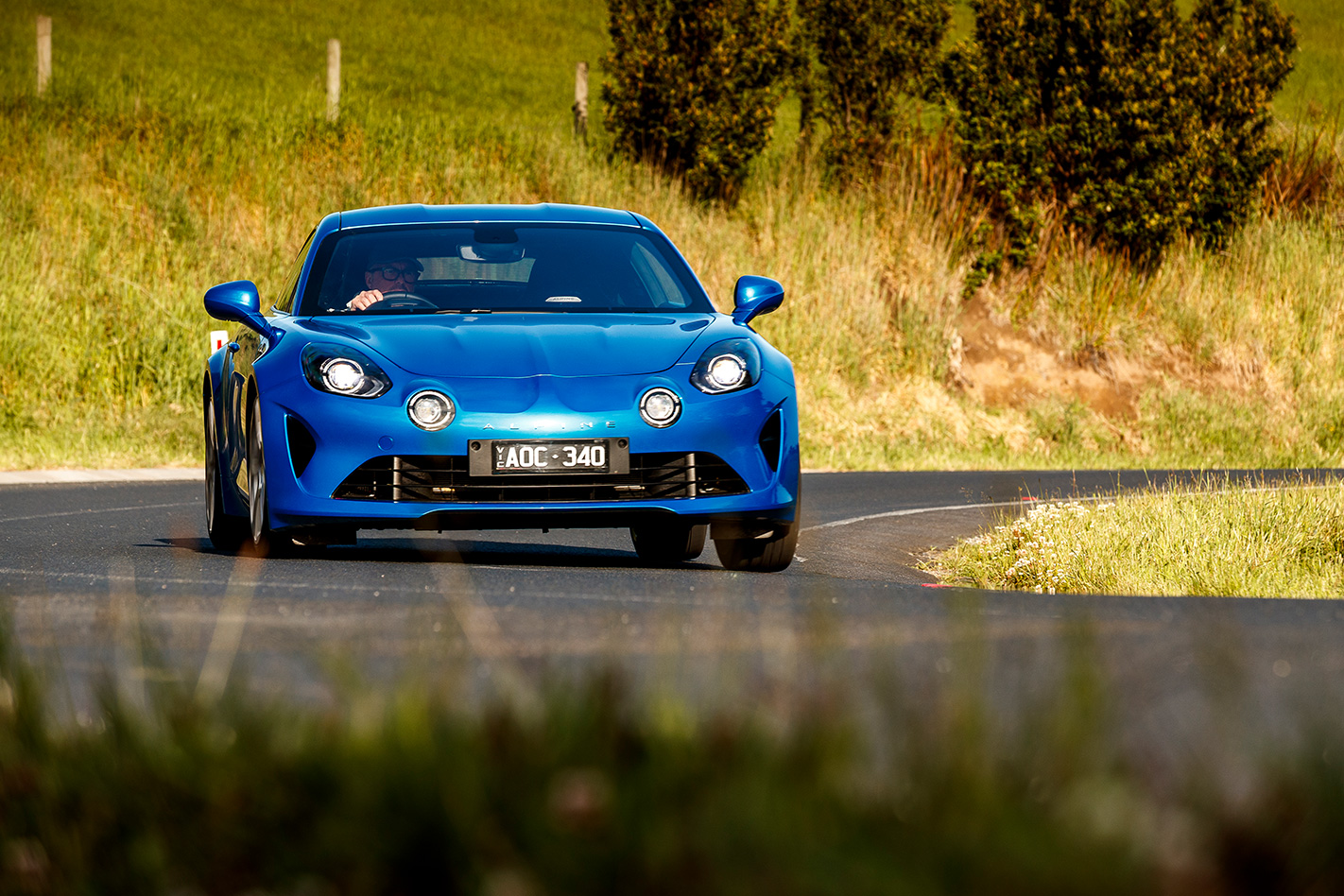
Regardless, what a blinding debut. Enright summed it up best: “A sports car for those who cherish light weight and efficiency but don’t relish the prospect of a bone-shattering ride and typically flaky, low-volume build quality.”
Another great episode in the can!
For this ep, we roped in one of the fastest mountain bikers on the planet, Josh Carlson, to help with our dual-cab ute shoot. Why? Well… erm…
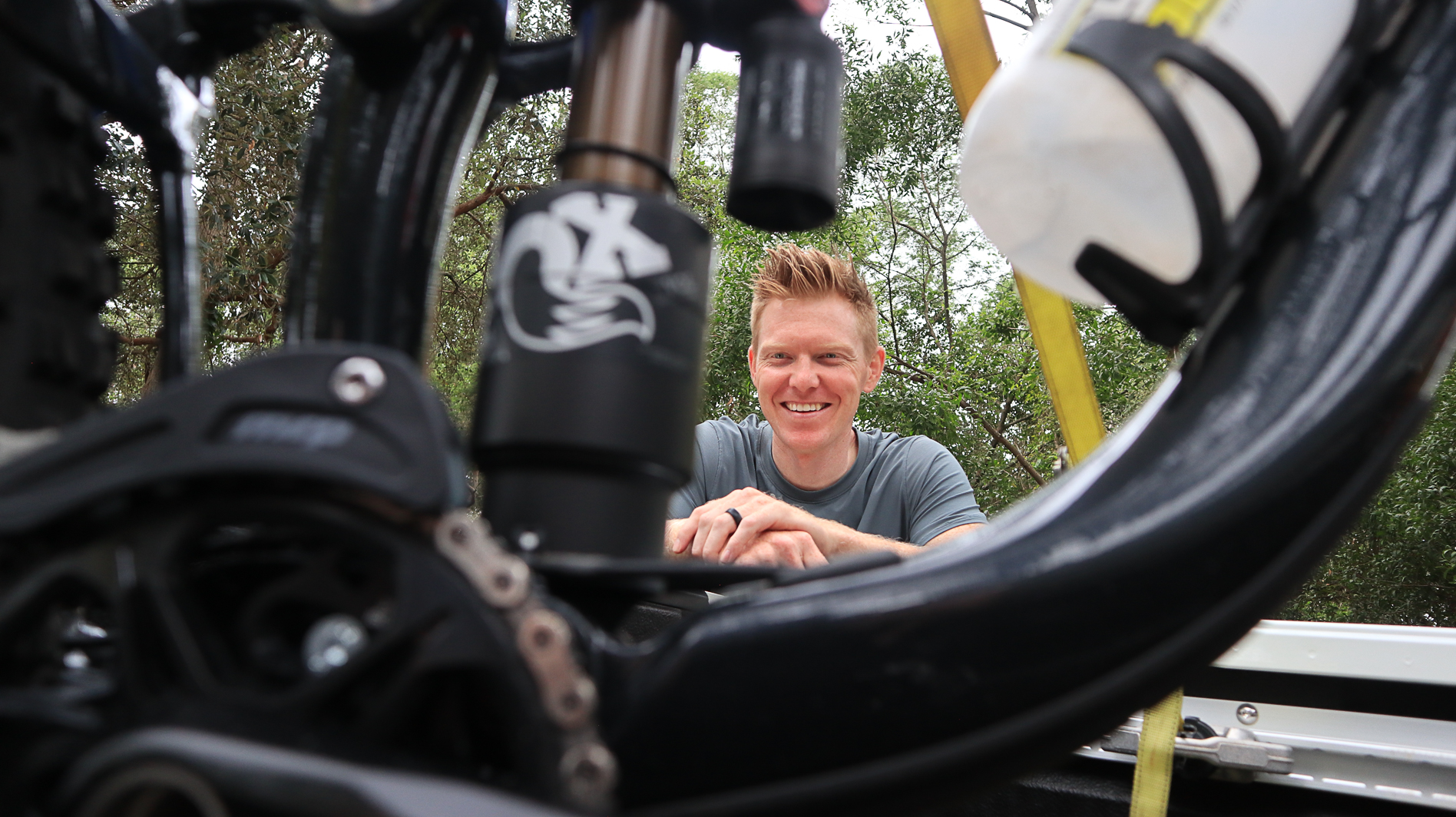
Josho ‘The Froth’ Carslon
Despite how things look on screen, not everything goes smoothly behind the scenes at times… and there was a lot of bumps along the way for this particular shoot!
For one, we lost our planned co-host two days out from the shoot, while both of our planned locations also fell over… the night before the shoot. Gah!
Luckily, we managed to rope Josh in between trips from a Giant Factory Team training camp in California and a round of the World Enduro Championship in New Zealand – and we reckon he did a great job! Check him out in action above.
The Ferrari 812 shoot went a bit more smoothly, thankfully – though we only had 500km of range to play with, and my commute home and back is 150km. Not to mention a VERY hefty insurance excess figure if we so much as scratched it.
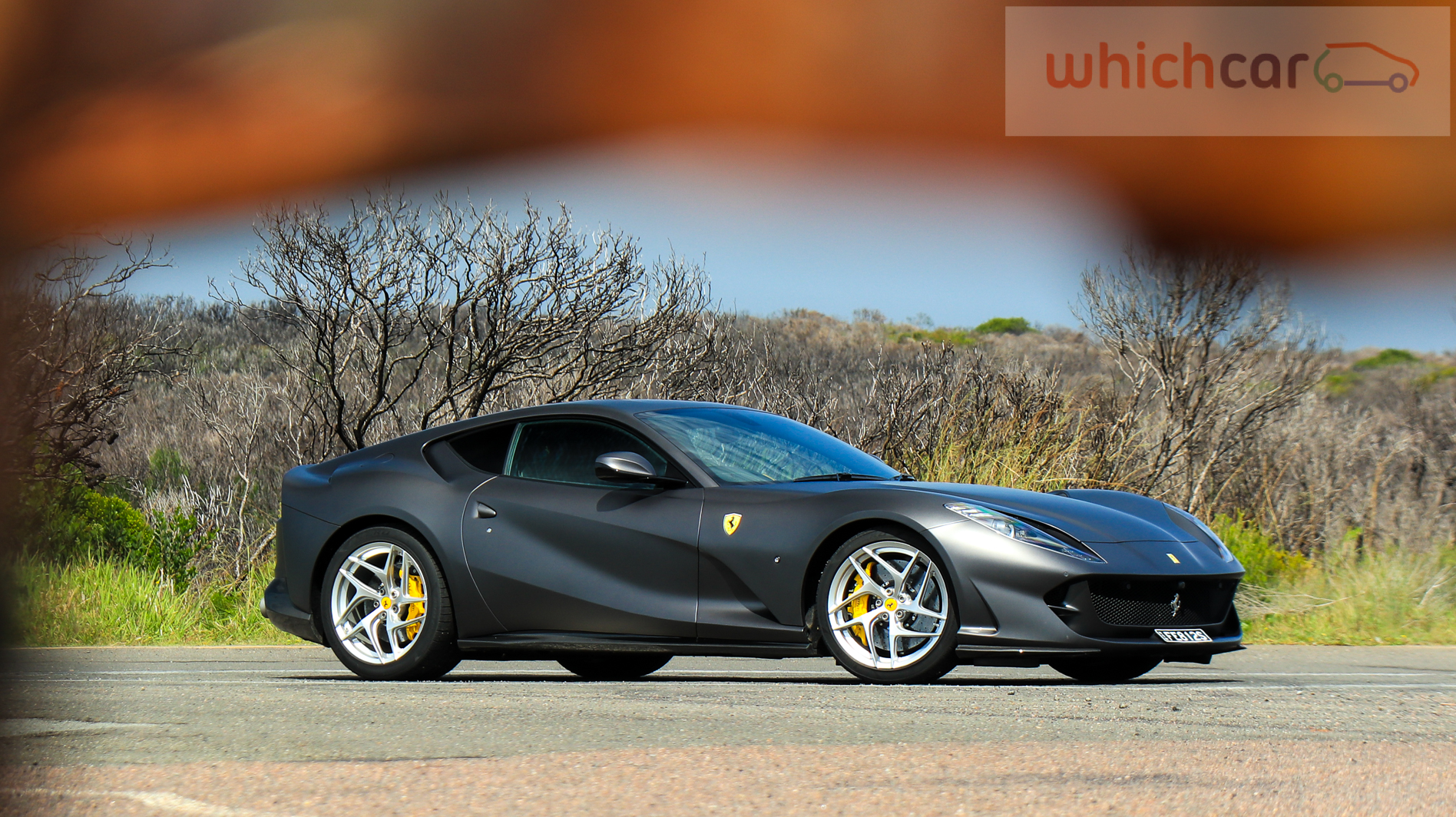
We weren’t fibbing in the clip when we said we had the car just for the day, either; we were on location at 7am and managed to wrap just after 3.30pm. The ute shoot took us two and a half days, by way of comparison.
The Melbourne crew enjoyed a couple of days in their rigs, too, though filming three cars has its challenges, too… not least deciding who gets to drive the Porsche home!
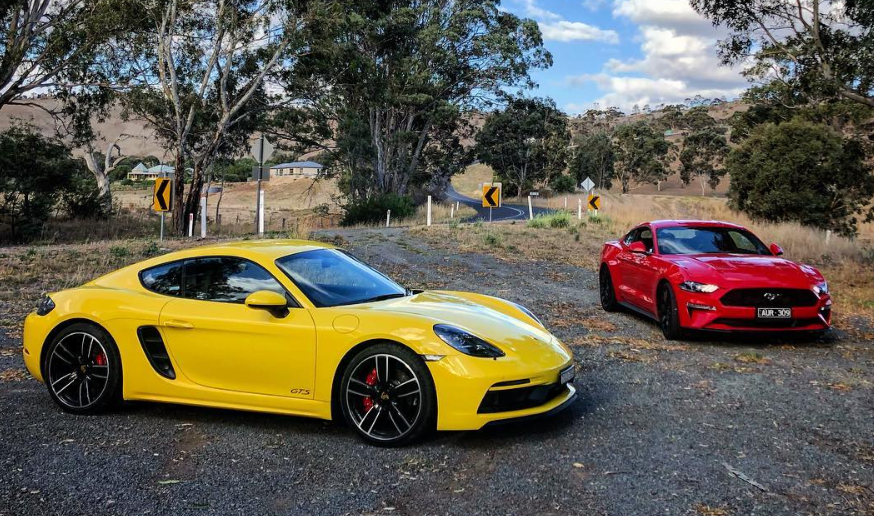
We hope you enjoyed the show – let us know what you thought in the comments below!
Watch at tenplay.com.au (AU) or primetv.co.nz (NZ)
Oh Christ. I’m really learning to hate photographers and art directors.
This feature was originally published in MOTOR’s September 2001 issue
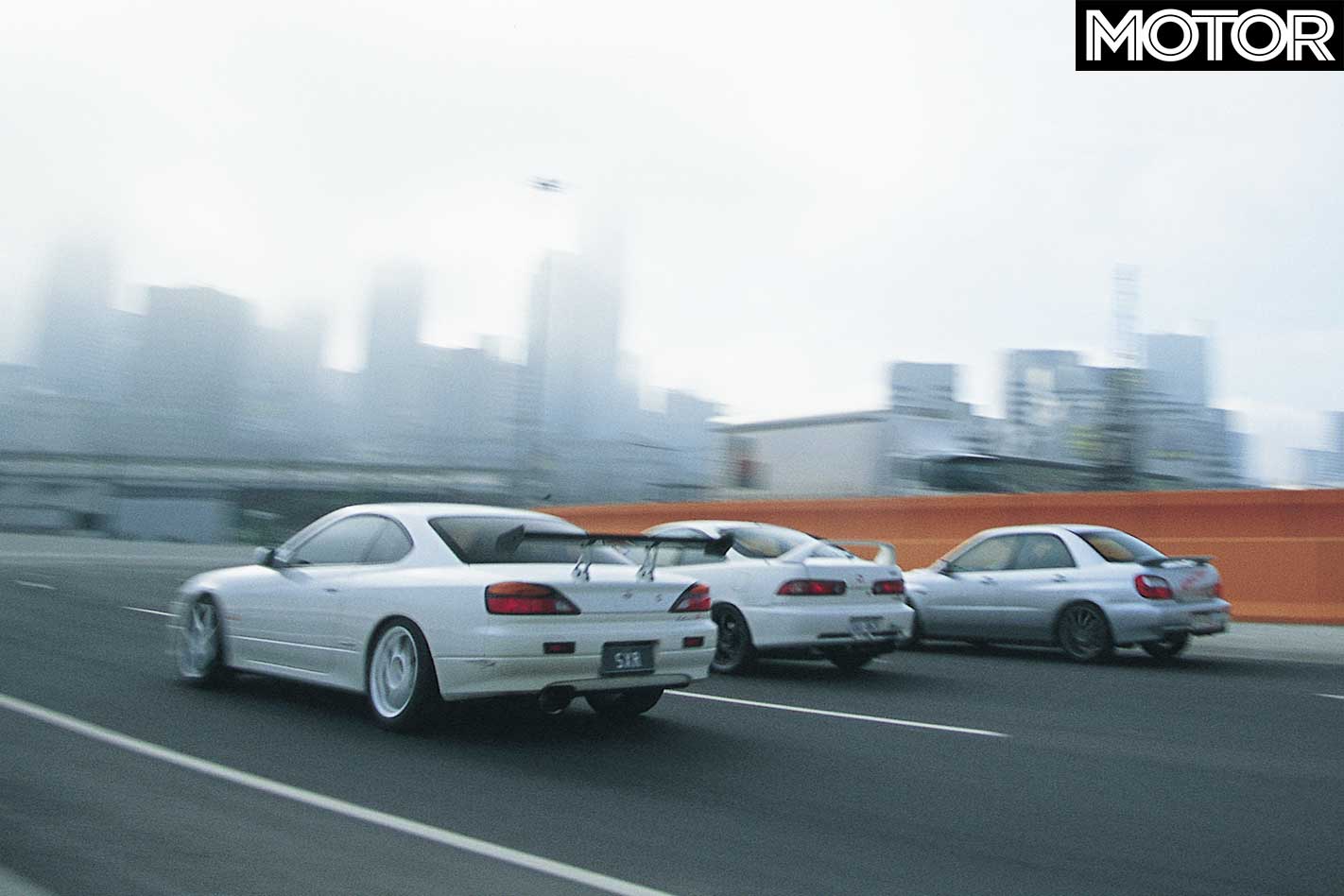
Here I am, punting a 260kW Nissan 200SX hotrod, with a similarly tweaked Air Power Systems RT-Spec WRX and a race-spec Integra Type R in tow, and we’re weaving in and out of peak-hour Melbourne traffic because Trev the art director, who dresses like Ali G, wants an ‘urban landscape’ as a backdrop.
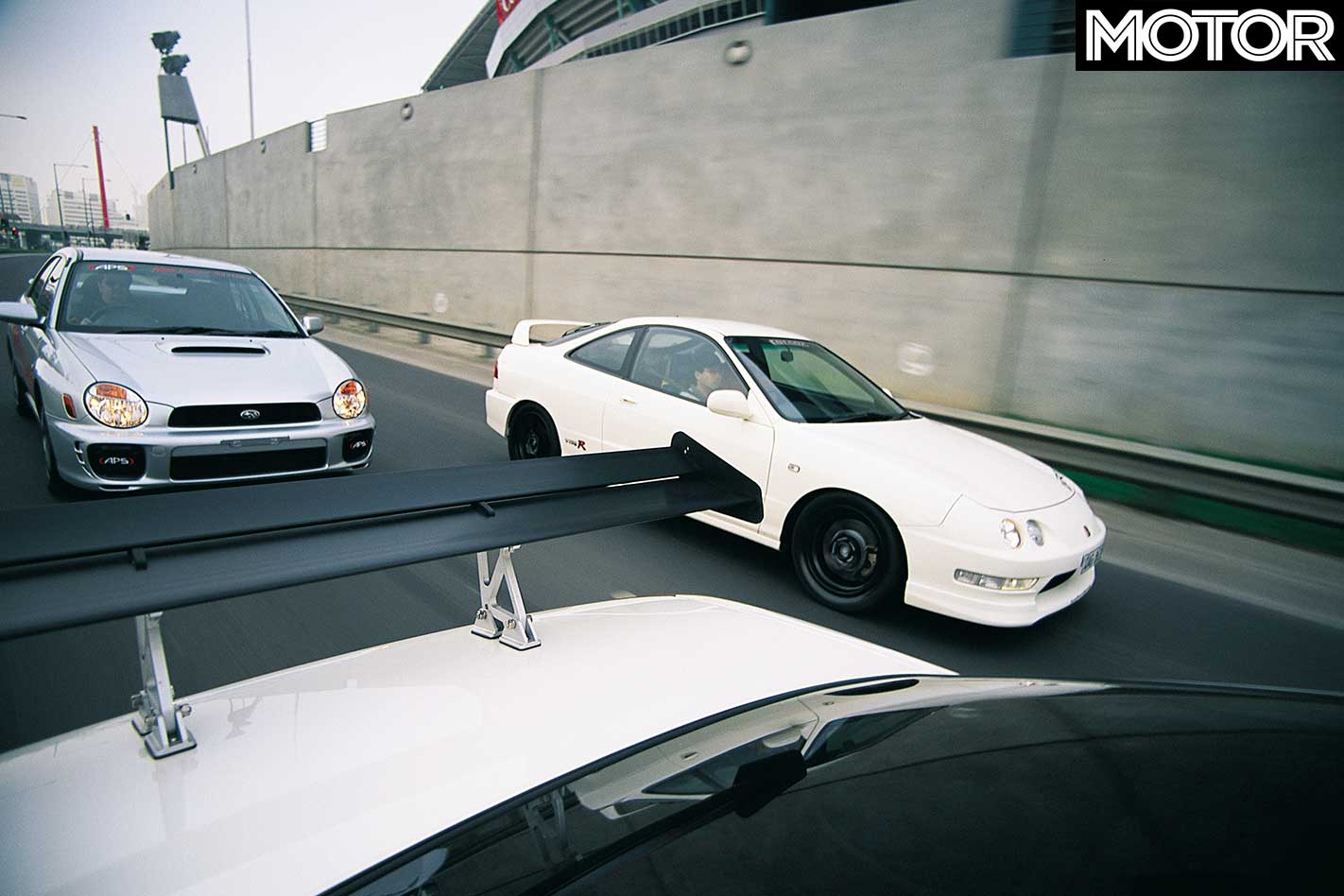
Not that a big rash of blue lights would surprise me right now; not one of these cars is what you’d call subtle to look at, and the Subaru is the only one that would get within Billy-Oh of passing a drive-by noise test (in fact, the Sube is fully ADR-legal).
And another thing (you listening Trev?): what the hell would you be thinking trying to use tools like these in a city environment? If ever a bunch of rockets deserved a squiggly ribbon of hotmix to play on, this is that bunch. Urban environment my big, hairy white arse.
Meanwhile, I’m continually struck by the fact that if some is good, more must be better. Simplistic maybe, but stay with me. See, all these three are performance cars in stock trim and in their own right. There’s room in my shed for any of them, but some people are just never satisfied.
What this bunch proves is that with a few careful tweaks (and a fistful of bucks) you can suddenly wind up with absolute balltearers capable of bestowing gelding status on some alleged thoroughbreds.
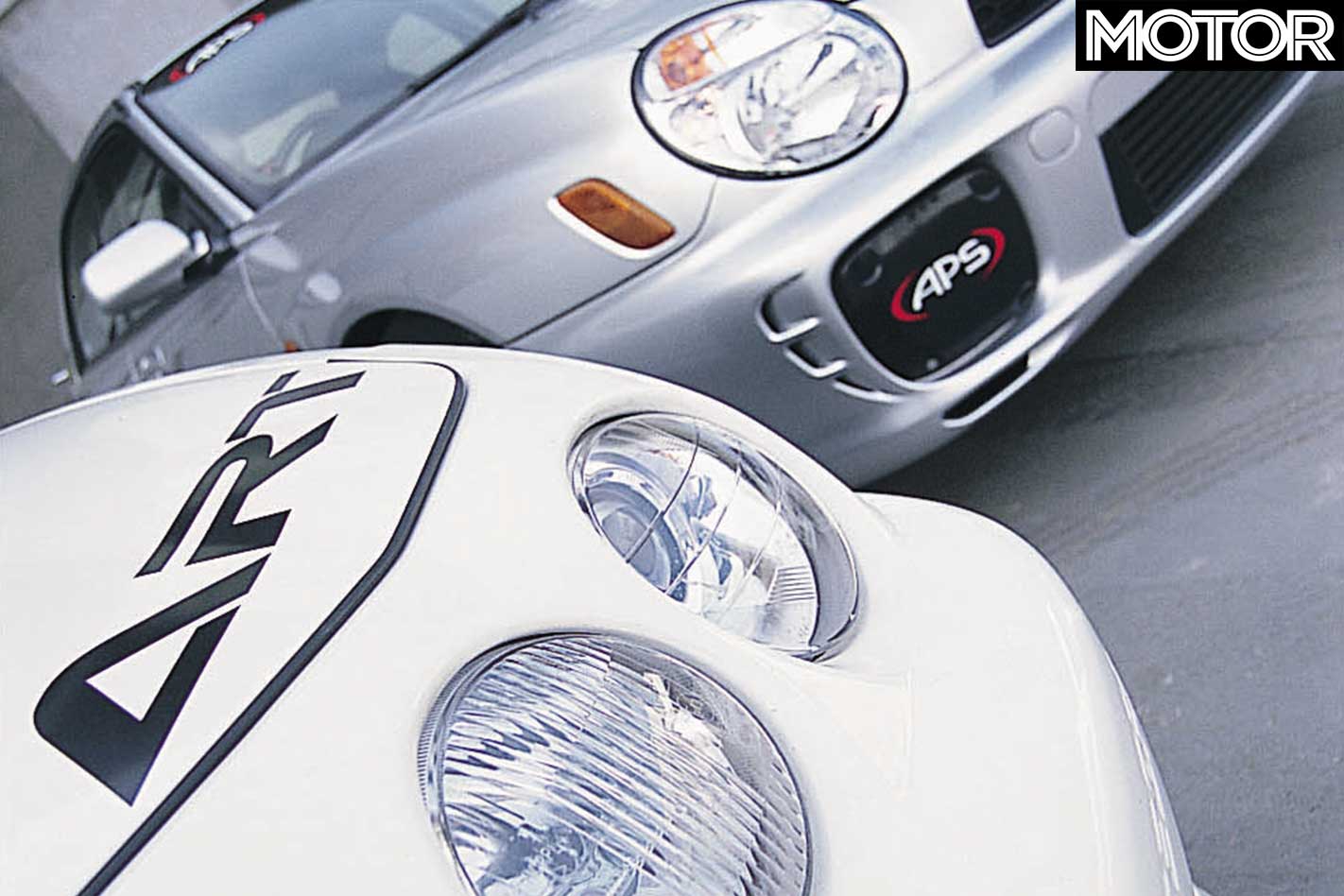
Don’t believe me? Not one of these cars would have any trouble lapping a racetrack in a respectable time, not one of them is anything less than totally absorbing to drive and not one of them needs more than 13.9 seconds to cover a standing quarter. That’s right, not even the Integra with its non-turbo, 1.8-litre engine.
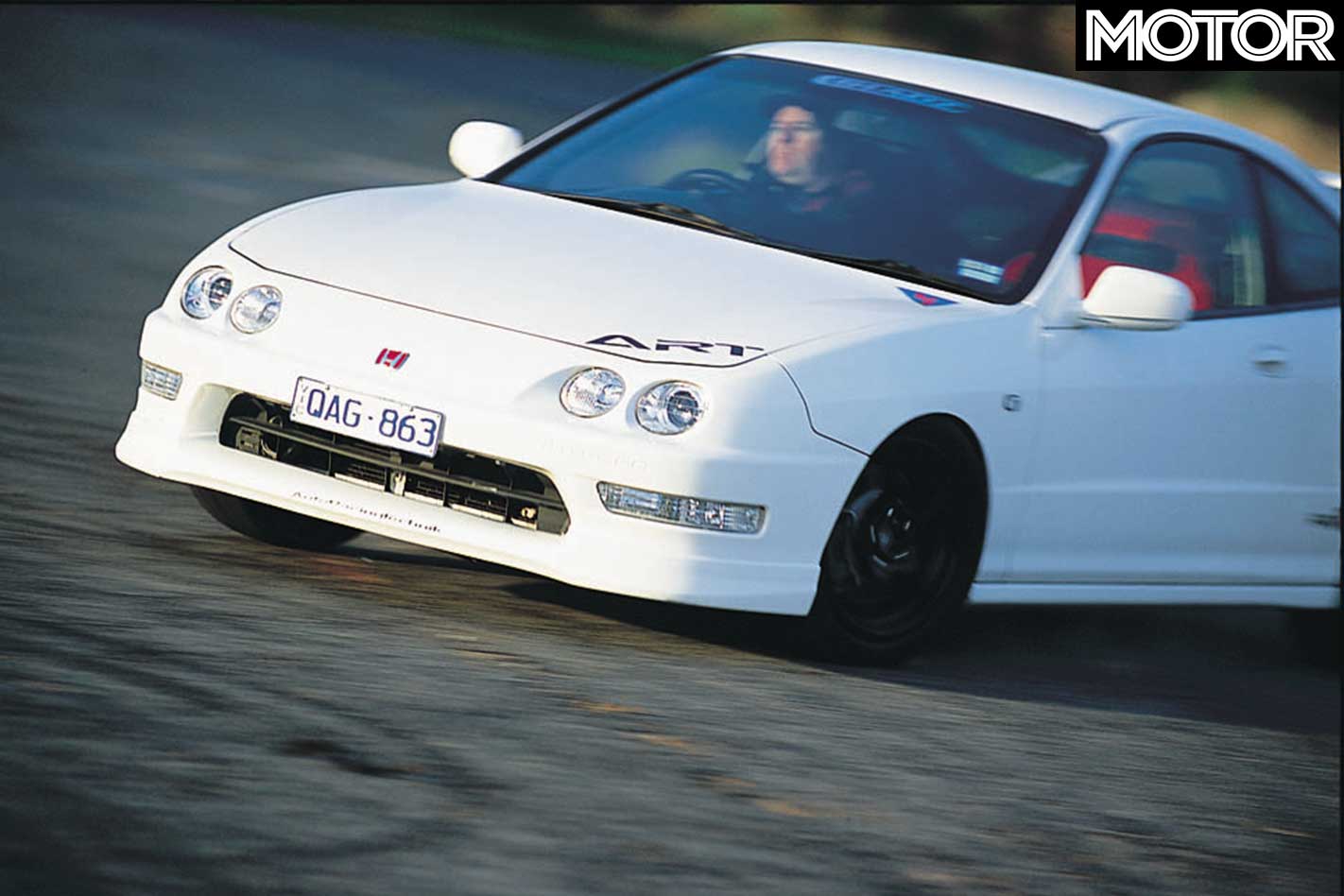
Speaking of which… the Integra is the work of Technik Tuning and is more a function of careful additions rather than wholesale changes Careful stuff like a tuned-length four-into-one exhaust that’s also lagged to keep the heat – and energy – in the pipes and not the engine bay. But ditch the non-essentials like the fancy dress-up bits and you’re left with a standard VTEC mill that hasn’t been touched from the rocker cover down.
So where’s the extra 25kW at the wheels come from? Mainly the exhaust, a reprogrammed chip, new inlet manifold incorporating a cold-air system and fine tuning like slotted cam-drive sprockets to allow the cams to be phased just so.
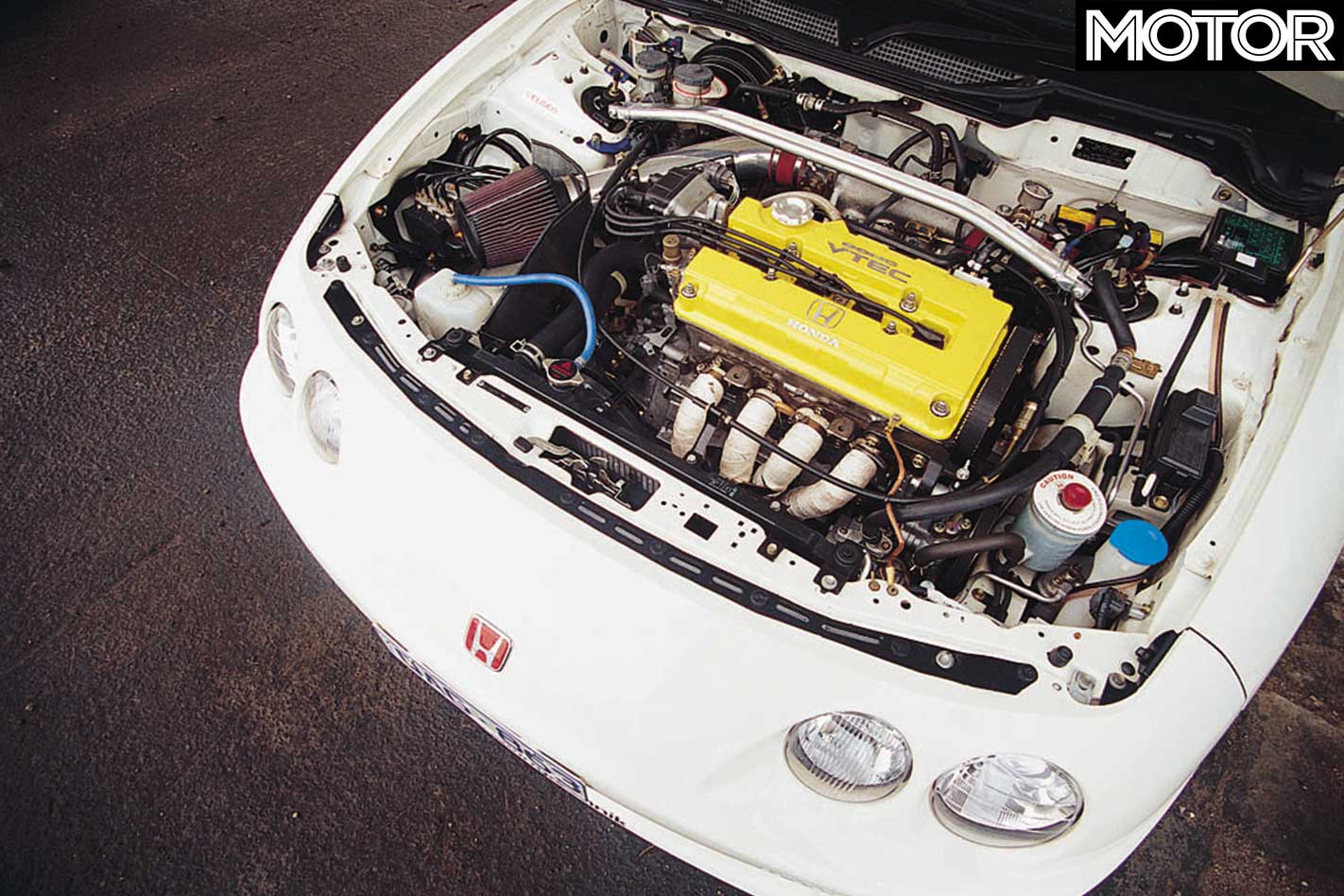
If anything, getting the cam timing spot on has actually reduced the severity of the kick-in-the-date when the hydraulics lever in the big camshaft profile at 5600rpm. Where the stocker gets all feisty at that point, the modified car certainly gets a leg up, but not to the same extent. Since it already has more top end, this must surely be down to the extra-fat bottom-end surge that makes this Integra something really special.
But the noise! Lord, the noise. The massive gob on the thing hints at lots of decibels and you aren’t going to go home disappointed. Where some loud cars can be punted along fairly unobtrusively by keeping the revs low, the Type R offers no such facility.
At low revs (under 3500rpm) it rumbles and grumbles and generally bitches, sending all sorts of lurid vibrations and 100dB buzzes through the cabin and into your earholes. Above that, it smooths out a bit, but still gets louder and when you trip the switch at 5600rpm, the Integra can be heard in the next parish.
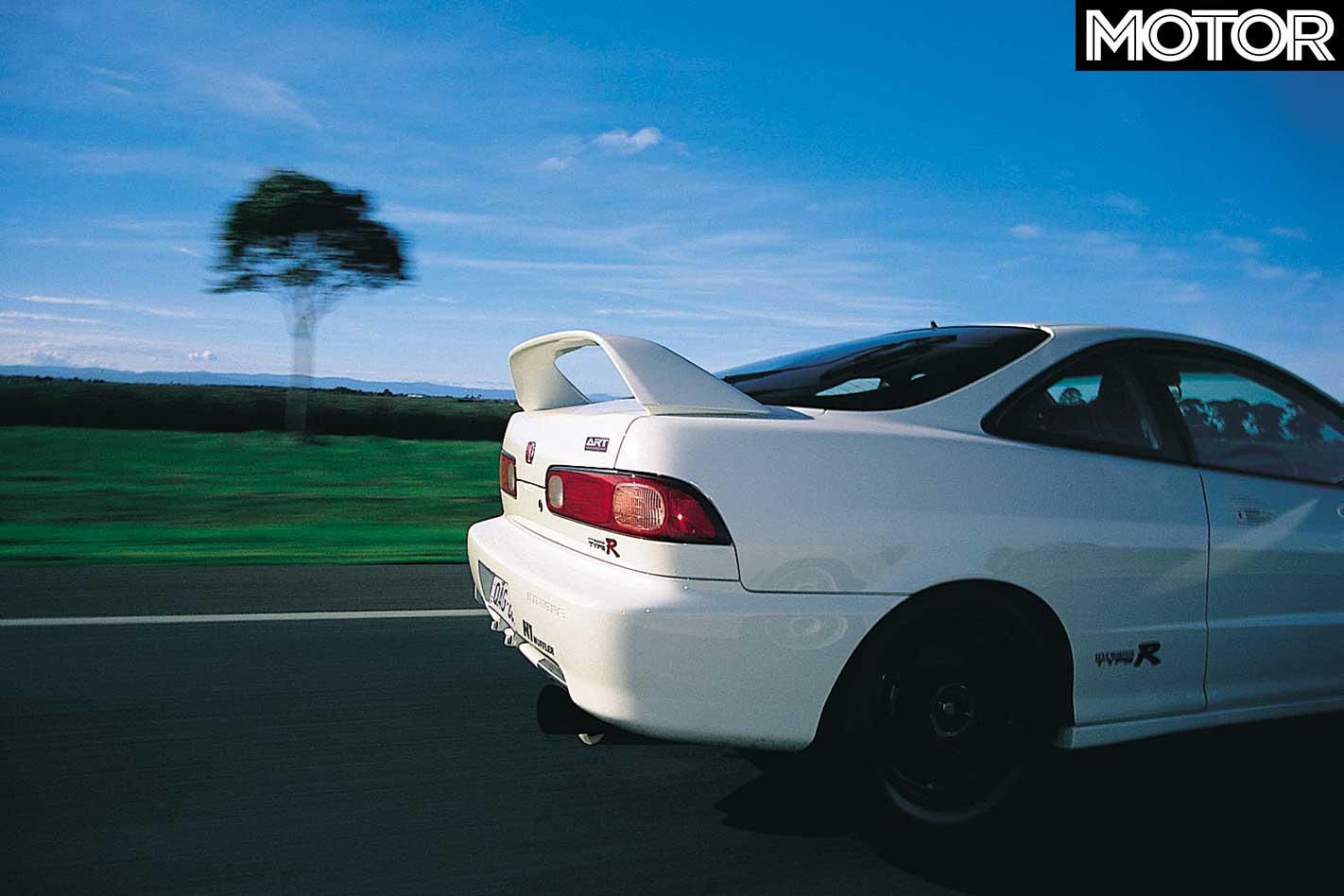
Switching on the stereo doesn’t help, winding the windows up does nought either. And even if you could live with it, it’s a fair bet the rozzers couldn’t. Your shift-working neighbours may just sugar-coat you and peg you out on an ant’s nest, too.
The Evolution R-fiddled 200SX is also ridiculously noisy, but not all the time. Keep it off the boost and t’s a gruff, blubbering bugger that gives the occasional pop on the overrun and allegedly you’ve removed the muffler’s baffle to liberate another 20kW or so – spits flames between gears.
Boost it up, meanwhile, and the noise changes to something like a tin shed full of A.D.D. kiddies banging saucepans through a 1000-Watt PA.
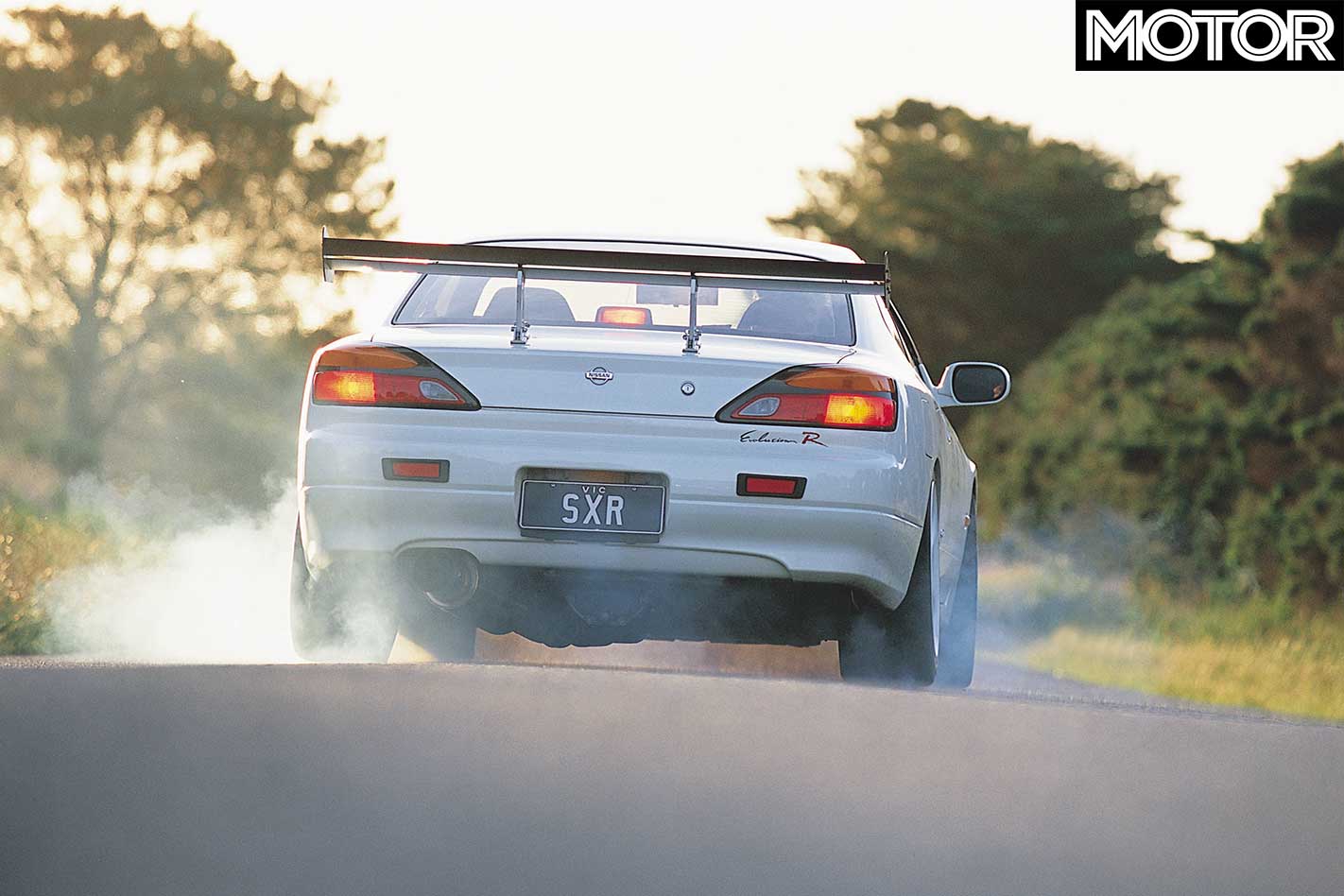
That’d be okay if it wasn’t almost impossible to keep the Nissan off boost. Sticking with a stock turbo means it spools up as swiftly as the stock 200SX but the big air-intake and $2600 worth of aftermarket intercooler mean the boost whacks the pistons back down their bores harder than a stocker can ever manage. A monster-bore exhaust completes the package and careful tuning on the engine management has netted an equally monstrous 198kW at the rear wheels. Eek.
While the power is certainly boosted over stock, so is the level of vibration and frizz that enters the cabin. And, like the Honda, it’s all down to the exhaust which has so many resonant periods, there’s a new and interesting vibe every couple of hundred rpms.
And I can’t believe that it’s pure coincidence that the smoothest of the lot, the APS-tuned WRX is also the quietest and most comprehensively muffled. While the others are very fast noise machines, the Rex is also extremely quick, but doesn’t have quite the BLARRRGGHH factor built in.
Oh, it’s still louder than stock and can still sound a bit drony on the freeway, but it’s a way better quality of noise because you can actually immerse yourself in it, rather than just shy away from it on long-term medical grounds.
And you’re not constantly looking over your shoulder. Don’t get me wrong, I crave an exhaust note, but the WRX’s combination of volume and sophistication is way more soothing than the war-going-on-nearby cacophony of the others.
The important thing to note is that sounding classier doesn’t detract from performance. No Siree. In fact, the Rex was the quickest of this lot, storming across the quarter mile in a stunning 12.8 seconds The Nissan was next at 13.4 seconds but, curiously felt faster than the Sube on the road.
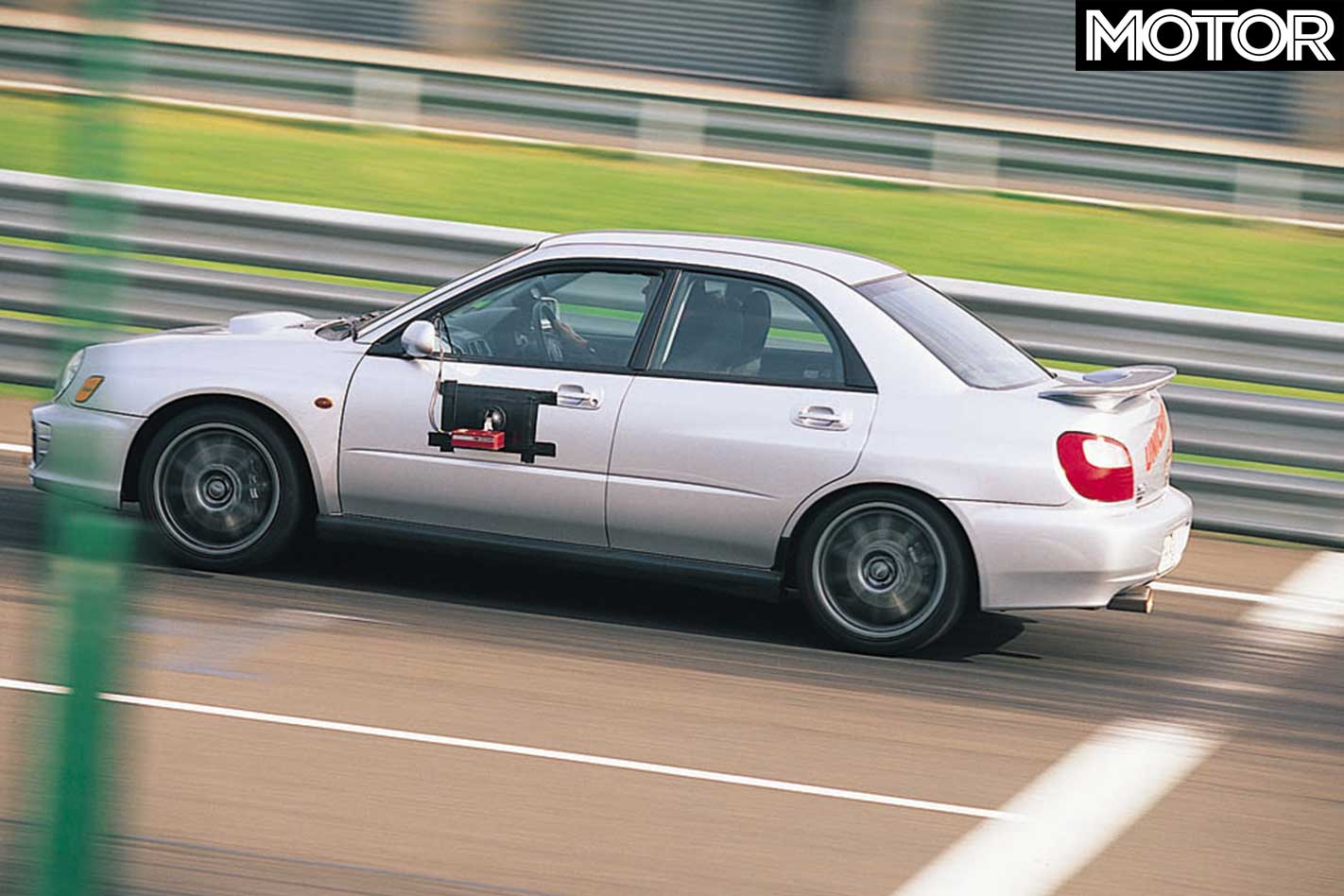
It probably is, too and you can put that down to the way the Rex launches hard and fast with about 5500rpm dialled up and a side-stepped clutch Sounds cruel, but in reality it’s probably kinder than slipping the clutch. You can jump off the clutch with confidence because this Rex makes 240kW and won’t, like a stocker, bog down and die in the bum.
APS fits a front-mounted intercooler, along with a cast alloy air intake for maximum deep breathing he turbo unit is also uprated to a ball-bearing model capable of 1.3 bar, while a Unichip and pop-off valve complete the RT-Spec package.
Ah yes, the pop-off valve. While the Rex might be the least rowdy through the pipe, that blow-off valve is a major contributor to the noise that is available. Back off (or even hold a steady part-throttle) and the valve is foofing and faffing like a deranged jogger.
The 200SX also had a valve venting to the atmosphere, but it only chimed in under heavy load and was never as loud anyway.
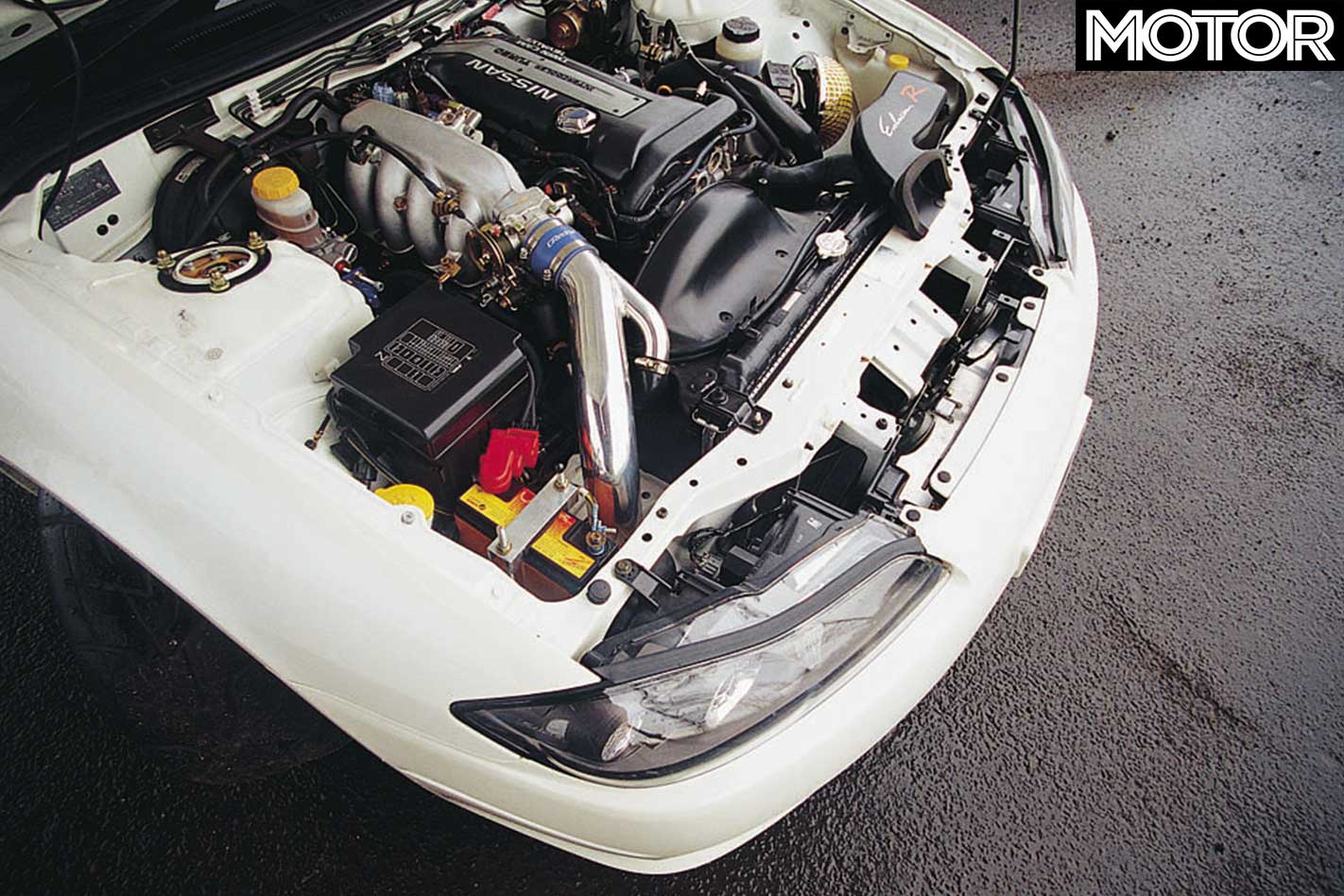
The WRX’s front-mounted intercooler and bigger snail have, however, led to a slight increase in the time taken between when you plant the clog and when the engine starts to really boost up. It’s not bad by turbo standards, but it’s not as instantly up-for-it as the Nissan’s livelier mill.
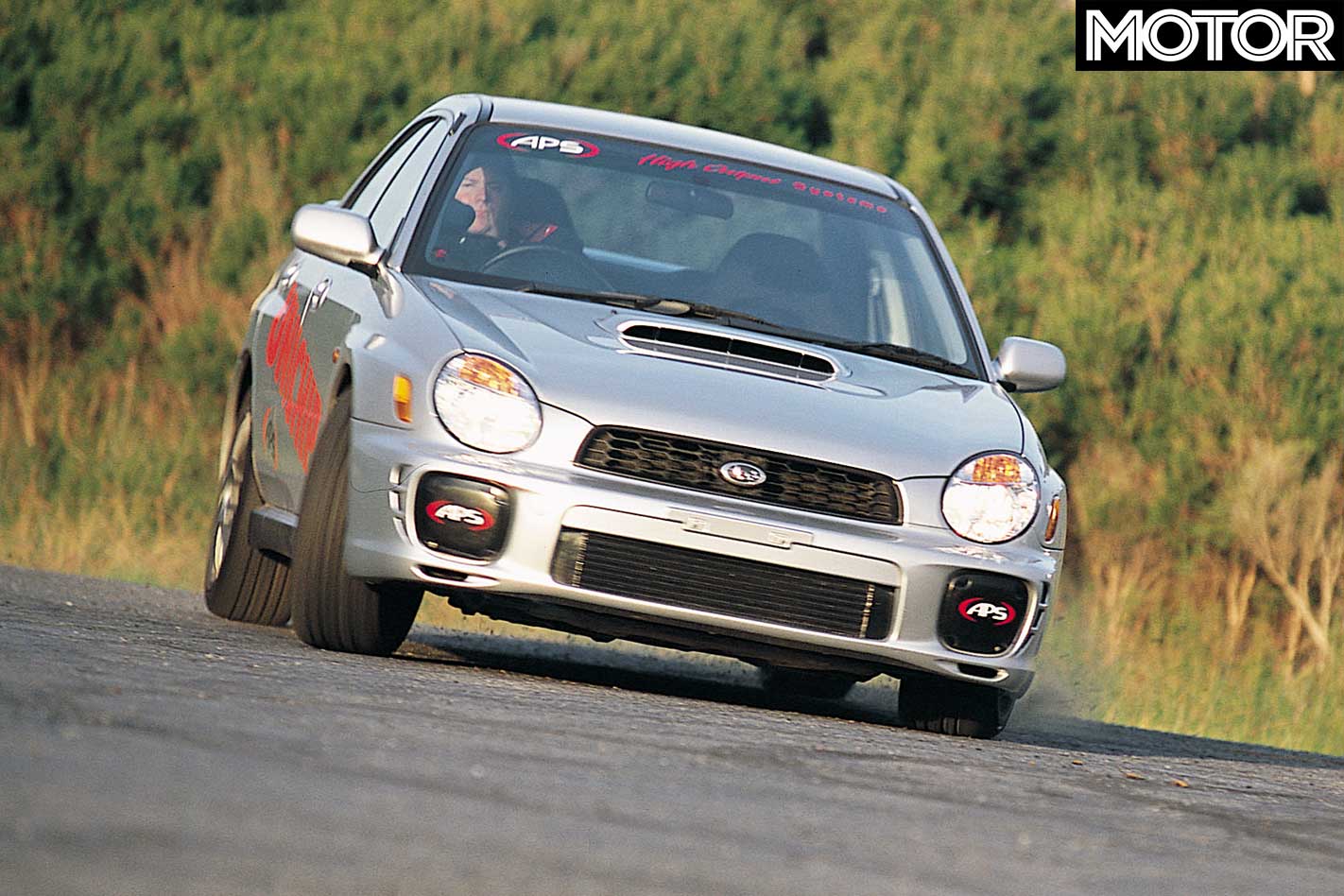
The other area where the WRX was a walk-up winner was in ride quality. The all-wheel drive compensates for the extra body roll which, in the two-wheel drives, would probably reduce the achievable grip.
No such prob in the APS car, which simply hunkers down and hurtles through a bend. It’ll still understeer into slow, tight turns, but you’re splitting hairs at that point and the vastly more comfortable end result is more than worth the slight trade-off. In fact, it feels almost stock which, apart from lowered springs and the wheel and tyre package, it is.
And if that sounds like the other two are crash and bash merchants, you’d be dead right. The Integra treads more of a middle ground with a ride that is but not always uncomfortably so. The grippy front-end remains and the steering is accurate and sharper than standard thanks to the buffed race-compound tyres that amount to treaded slicks. The lower ride height is the cause of the extra firmness, and it’s also low enough to graunch its guts through sudden dips in the road.
Likewise aimed at racetrack handling rather than High Street profiling, the 200SX is set up firmer than a car-dealer’s handshake. It skitters and crabs over mid-corner bumps and pummels you all over the cabin on what we Australians quaintly call ‘secondary roads’.
The Nissan is also one of those cars that needs to be driven hard before it starts making any sense. At urban speeds it is, without being unkind, a pig. It jiggles and wriggles and the steering is dead thanks to the camber kit that curls the front tyres up on to their inside edges so they follow every groove and side-breeze.
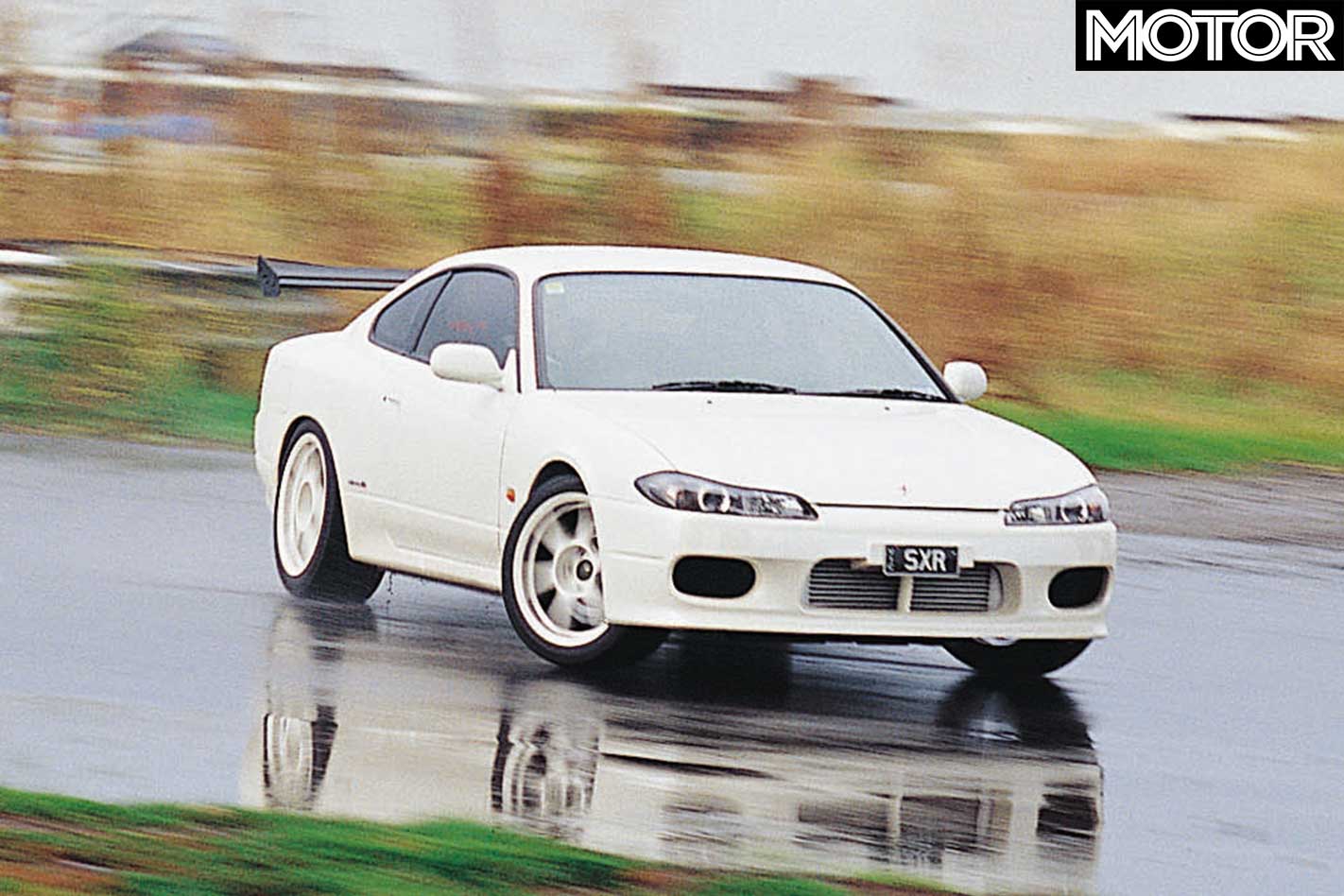
But get tough with it and the negative camber suddenly starts keeping the treads flat on the road, the steering comes alive and the 200SX is immediately stable, throttle-steerable and ever so fast. It would easily be the most entertaining on a track and since a race only has the one standing start, it’s more eager nature means it feels more completely tooled up than the Rex. A scratch race between all three would be something else.
One thing’s for sure, though, come the end of the main straight, the Nissan is going to pull up consistently time after time. Check out the front calipers. See the Porsche logo? Okay, now you work it out (they’re ridgy didge 911 spec, by the way). The Integra, meanwhile, has a more subtle approach, with bigger rotors mated to the original calipers Bigger brakes are also a feature of the APS car and it oo, hauls down straight and hard, time after time.
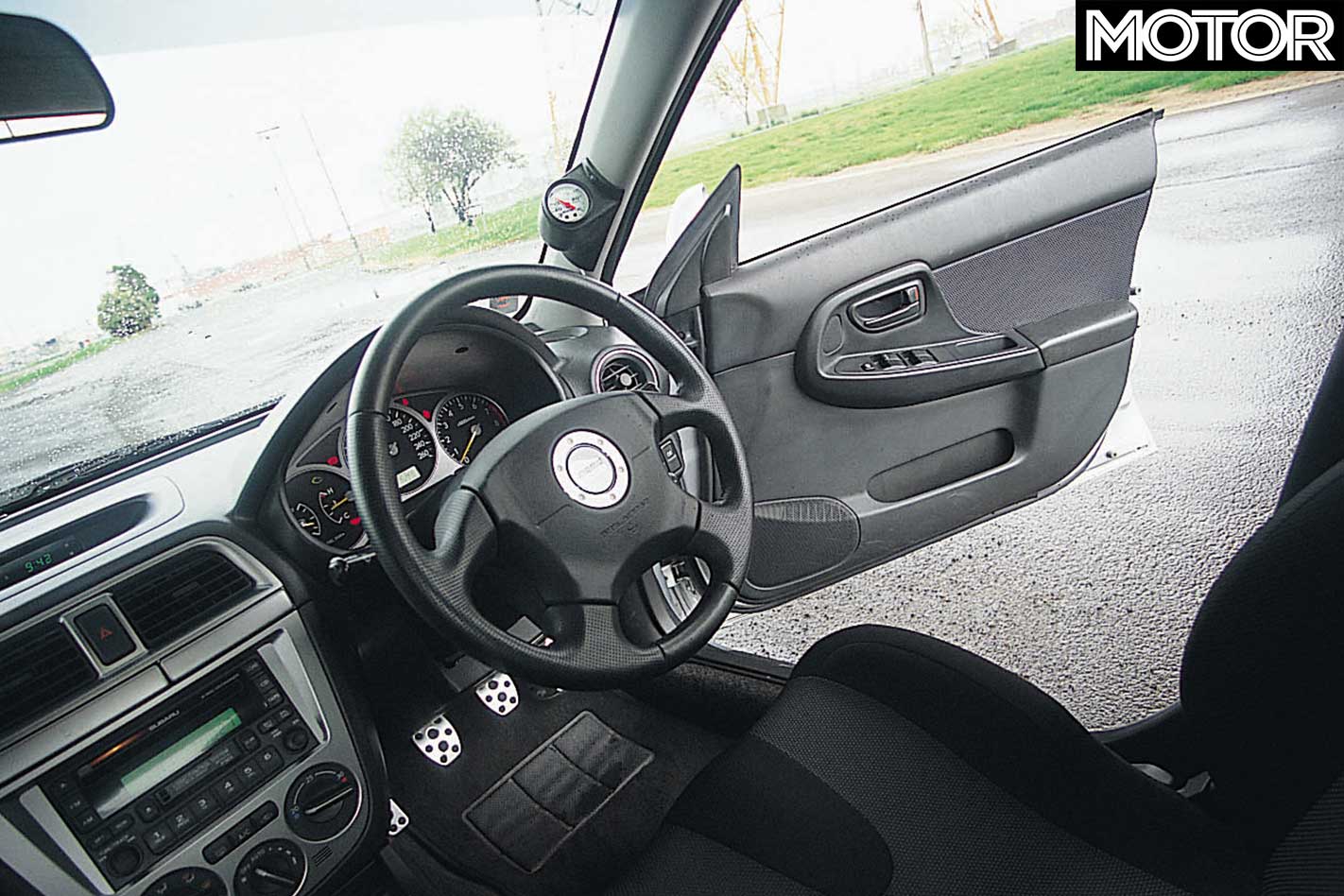
Inside? The Rex is the most subtle, with just a boost gauge in a crap plastic housing halfway up the A-pillar The 200SX is the next most lamiliar, with a small trip computer on the right of the dash (which you can’t see most of the time), a turbo-timer down on the fascia and a race seat that makes finding the conventional seat belt (there’s a harness fitted for track days) all but impossible. Most of the rest is stock.
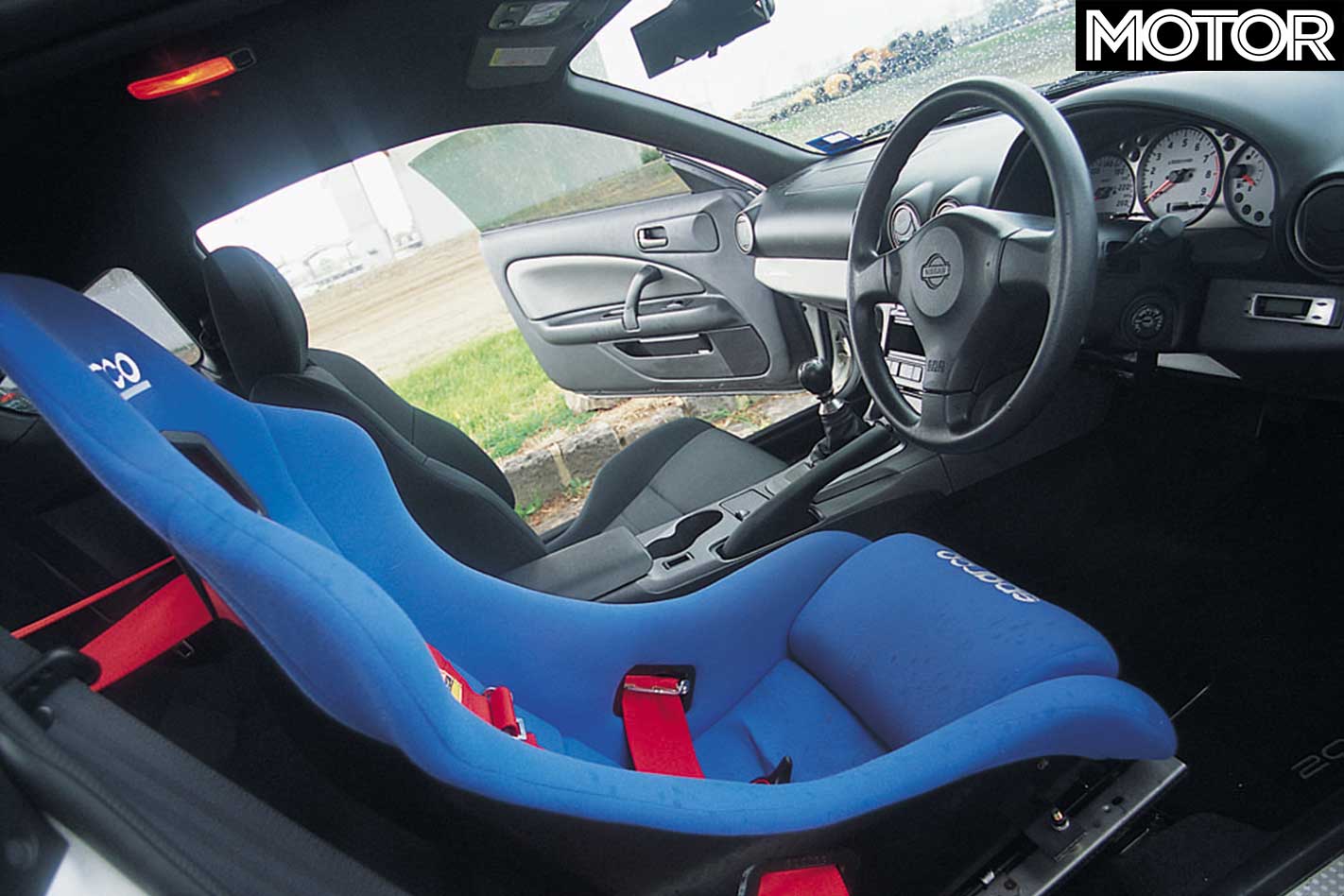
Unlike the Type R, which is the original whore’s handbag. The ciggie lighter is gone (which we discovered when we tried to hook up the Correvit), with big oil pressure and temp gauges filling the space. There’s also a velcro-mounted trip computer which gives which gives incredibly useful info like the ignition timing advance in real time (true) and even a turbo timer (pardon?). The race seat is designed for the owner, who is about 15 sizes smaller than me, and even the jump seat is a race jobbie. Miraculously, the steering wheel has a Honda part number.
Me? I wouldn’t have any of it. A turbo timer is good in a blown car, but the rest of it is just shit and glitter. Ditto the decals appearing on a bonnet near you.
Of course, what you need to remember is that while the Rex is a demonstrator for APS, the other two are privately owned. So they can have whatever they damn well want cluttering up the interior, and blokes like me can just shut the flock up.
And the truth is, I haven’t had this much fun in three very different cars for a long, long time. I wouldn’t mind betting that’s another way of saying that having a spend on your car and making it better, faster, stronger is a good way of ensuring you don’t get sick of it a few weeks after shelling out for it.
And at less than a lazy $10,000 engine-wise for what you see here it’s not a million bucks, either. In fact, the Evolution R power-up is worth $5500, the APS engine stuff is $8800 (and fully ADR-approved, remember), while the owner of the Integra has spent a grand total of $9000, but that includes the interior, wheels and tyres and dress-up stuff as well as the engine mods.
Which brings us back to where we came in: trying to hold formation and keep the racket down while commuters whizz around us, all the while keeping one eye on the mirrors for rozzers.
Except now the Rex is about 10mm off my rear bumper and the photographer has opened the door at 60km/h so he can hang out just a bit further for the shot. Oh Christ.
Fast Facts
| u00a0 | Evolution R Nissan 200SX | Technik Tuning Honda Integra Type R | APS Subaru Impreza WRX RT-Spec |
| Body | 2-door coupe | 2-door liftback | 4-door sedan |
| Drive | rear-wheel | front-wheel | all-wheel |
| Engine | 2.0-litre inline-4, DOHC, 16v, turbocharged | 1.8-litre inline-4, DOHC, 16v | 2.0-litre flat-4, DOHC, 16v, turbocharged |
| Bore x Stroke | 86.0 x 86.0mm | 81.0 x 87.2mm | 92.0 x 75.0mm |
| Compression | 8.5:1 | 11.1:1 | 8.0:1 |
| Power | 260kW @ 6500rpm | 170kW @ 8500rpm | 240kW @ 6000rpm |
| Power/Weight | 203kW/tonne | 156kW/tonne | 173kW/tonne |
| Transmission | 5-speed manual | ||
| Weight | 1282kg | 1087kg | 1390kg |
| 0-100km/h | 5.11sec | 5.68sec | 4.35sec |
| 0-400m | 13.47sec @ 173.0km/h | 13.99sec @ 165.3km/h | 12.82sec @ 174.7km/h |
| Suspension (f) | McPherson struts, coil springs, anti-roll bar | double wishbones, coil springs, anti-roll bar, suspension strut tower brace bar | McPherson struts, coil springs, anti-roll bar, suspension strut tower brace bar |
| Suspension (r) | multi-links, coil springs, anti-roll bar | double wishbones, coil springs, anti-roll bar, suspension strut tower brace bar | dual-link struts, coil springs, anti-roll bar |
| L/W/h | 4445/1695/1285mm | 4395/1695/1320mm | 4405/1730/1440mm |
| Wheelbase | 2525mm | 2570mm | 2525mm |
| Tracks | 1470mm (f); 1460mm (r) | 1480mm (f); 1475mm (r) | 1485mm (f); 1475mm (r) |
| Brakes (f) | 324mm ventilated and cross-drilled discs, Brembo calipers | 300mm ventilated and cross-drilled discs, single-piston calipers | 292mm ventilated discs, 4-piston calipers |
| Brakes (r) | 258mm solid discs, single-piston calipers | 260mm solid discs, single-piston calipers | 288mm ventilated discs, twin-piston calipers |
| Wheels | 17.0 x 8.0-inch (f); 17.0 x 9.0-inch (r) | 16.0 x 6.0-inch (f/r) | 17.0 x 7.0-inch (f/r) |
| Tyres | Bridgestone RE540S; 215/45 R17 (f), 235/45 R17 (r) | Bridgestone RE540S; 195/50 R16 (f/r) | Bridgestone Potenza RE011; 215/45 R17 (f/r) |
New to Wheels Car of the Year?
Read the COTY 101.
Swishing almost silently onto COTY centre stage for the first time, Jaguar’s only electric vehicle oozed star-quality charisma. Difficult to categorise, and yet an obvious Telsa threat, the I-Pace is like nothing else the Brit brand has produced.
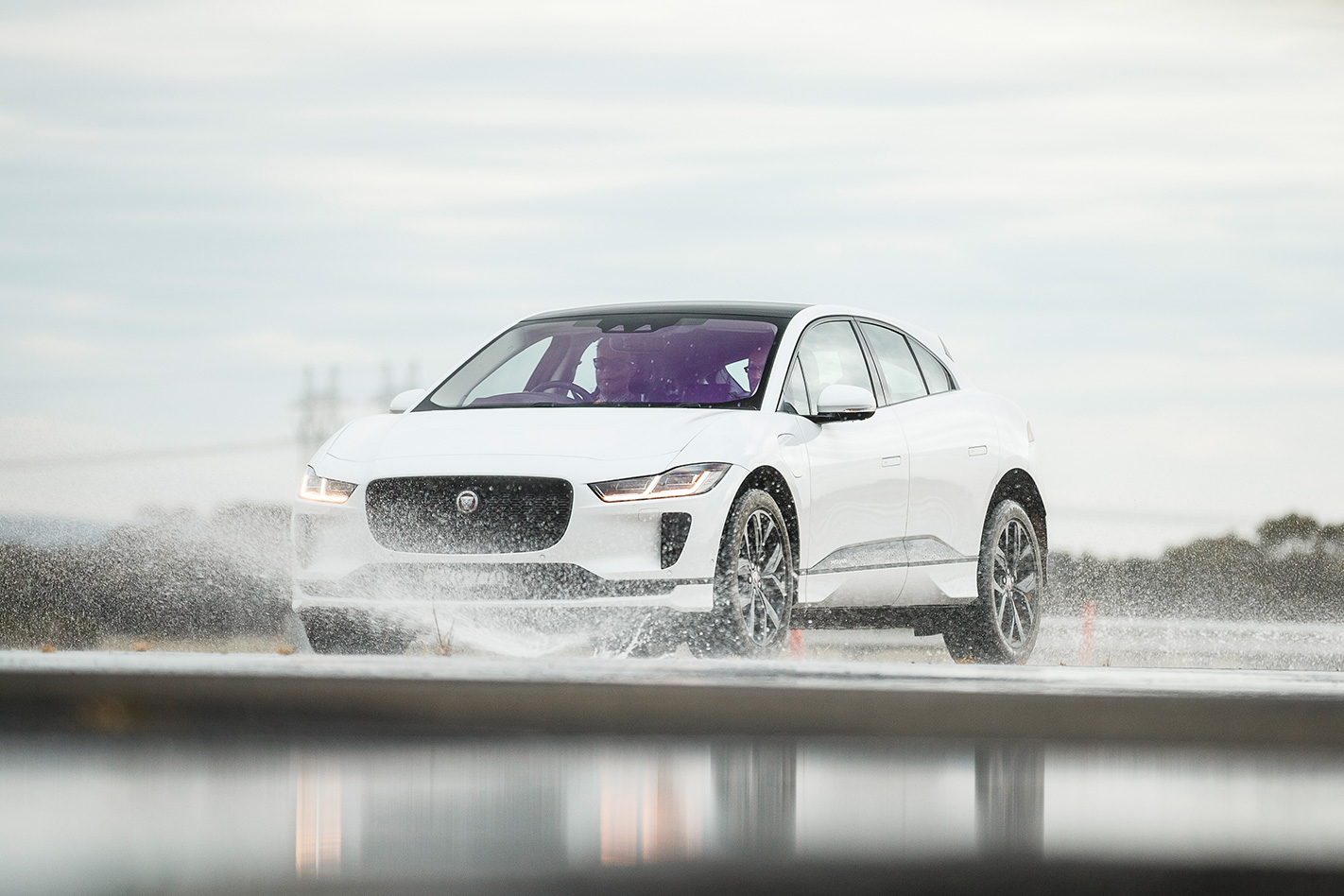
With a big battery pack mounted low between its widely spaced axles, each of them driven by a powerful electric motor, the I-Pace’s drivetrain layout is similar to its only obvious rival, the Model X, and Jaguar claims Tesla-equalling performance and range. But that’s where the similarities end; because while the I-Pace is expensive, it’s far less costly than comparable models in the Model X line-up.
The I-Pace is an EV produced by an experienced car maker, and it shows. Tesla simply can’t manage to build cars with tight panel gaps and consistent quality. Jaguar can, and more than one COTY judge thought the Magna Steyr factory in Austria, where the I-Pace is assembled, deserved a special mention.
Jaguar’s designers, on the other hand, can claim full credit for the I-Pace’s looks. It’s a shape like no other on the road. It’s a high and hefty hatch that’s big but confidently curvy. Jaguar design chief Ian Callum’s crew made the most of the opportunity offered by the EV’s long wheelbase and the minimal overhangs required by its compact motors.
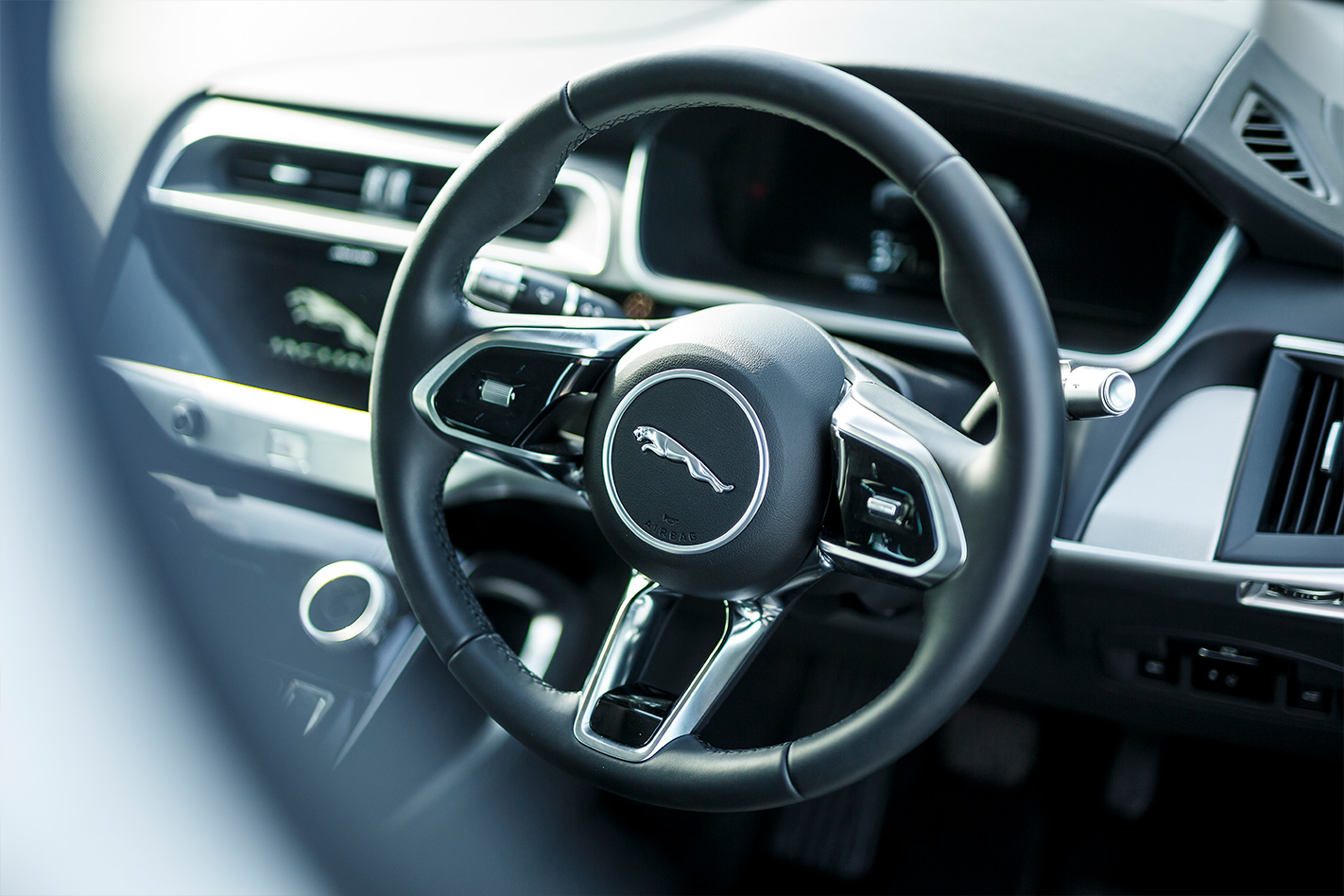
The judges found the Jaguar’s infotainment system easy to like, and there were no complaints about seat comfort, luggage space or fit-out. So far, so normal…
But actually driving the I-Pace on Ford’s You Yangs Proving Ground was anything but. Jaguar claims a sub-5.0 sec 0-100km/h time, but the I-Pace feels faster because of the instantaneous response of its electric motors.
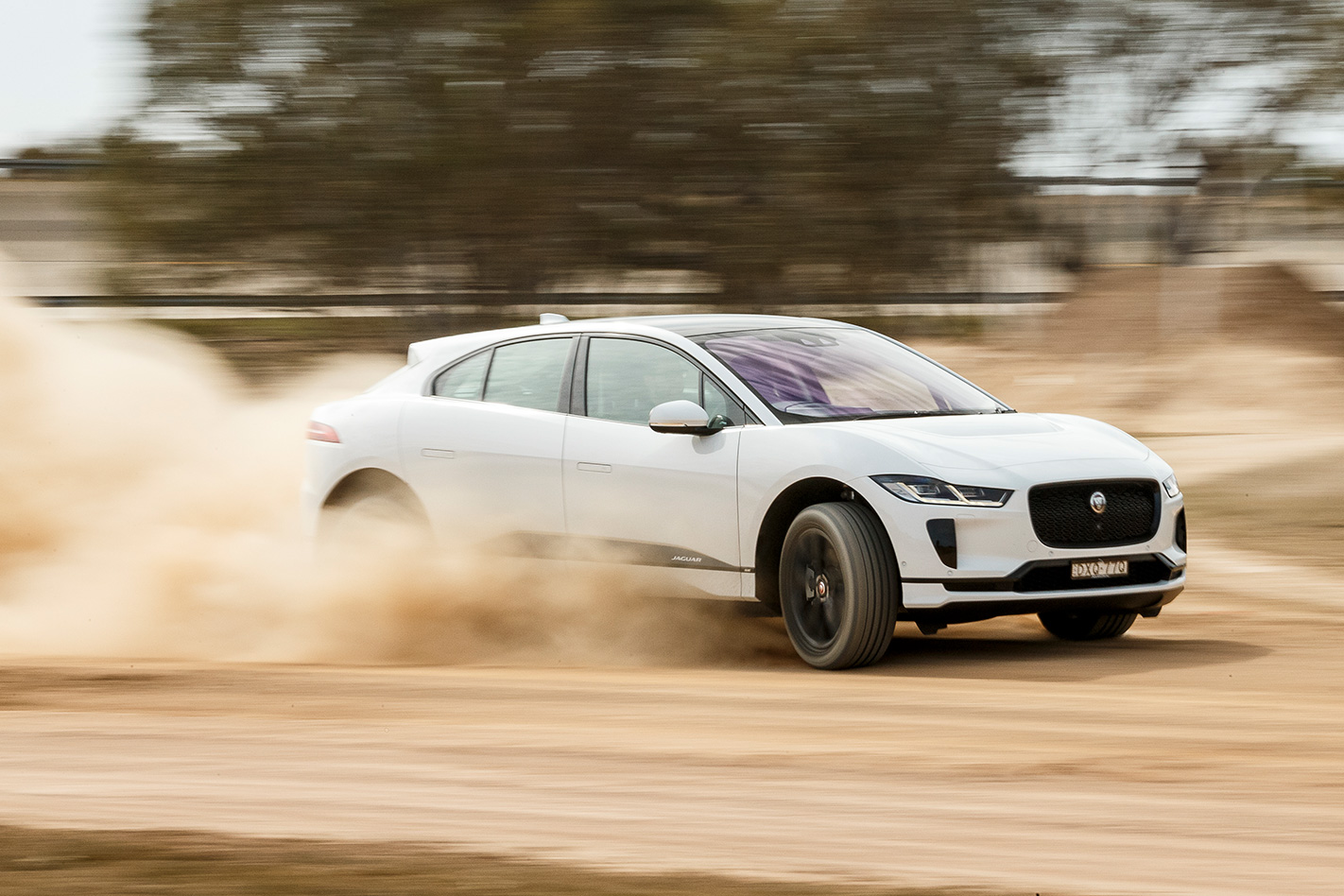
The 90kWh lithium-ion battery pack providing the urge weighs more than 600kg. And, according to Ford’s scales, the I-Pace tops 2200kg. With its weight mostly down low, the Jaguar’s handling feels different. But this is a properly corner-capable car. “So planted,” wrote Noelle Faulkner. “Centre of gravity in the basement.” The heavyweight I-Pace’s great dirt traction and excellent wet braking were also noted.
It scores well for passive safety, too. The I-Pace has earned five-star ratings in both Europe and Australia.
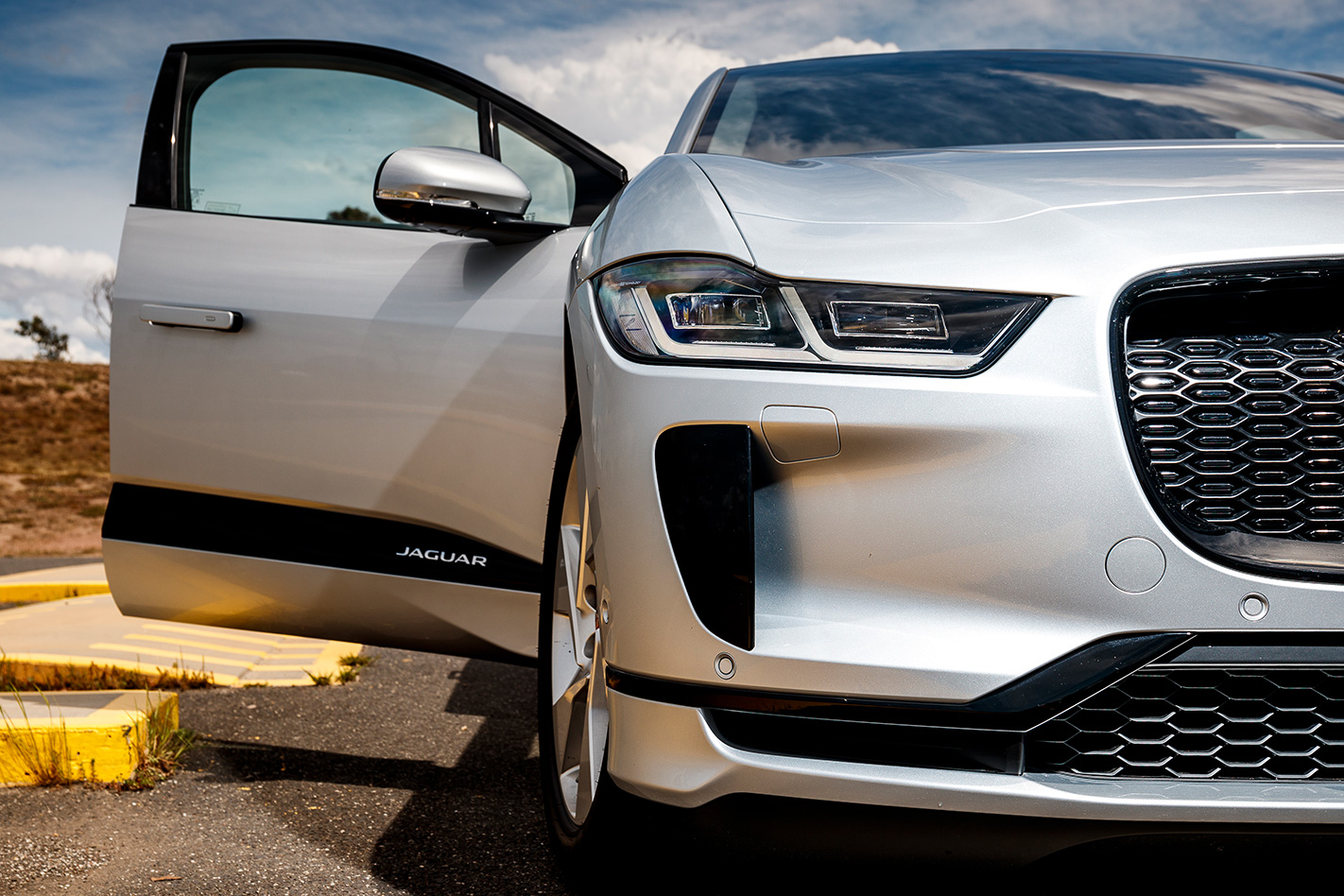
Wheels requested two I-Paces for our COTY testing, one on the standard passive suspension and another on optional air suspension. The steel springs do a fine job, and the EV’s dynamics feel genuinely Jaguar. Spending the extra $2002 buys only marginal improvements in ride comfort and agility.
Until it left the proving ground, the Jaguar seemed to be cruising towards COTY victory. Nothing else in the field could approach its excellent efficiency or amazing acceleration.
There was a lot to like about the I-Pace in real-world use. Judges preferred the regenerative braking set to High. Andy Enright drove the entire 53km road loop in this mode without once touching the brake pedal. The acceleration felt even more awesome and the chassis remained impressive.
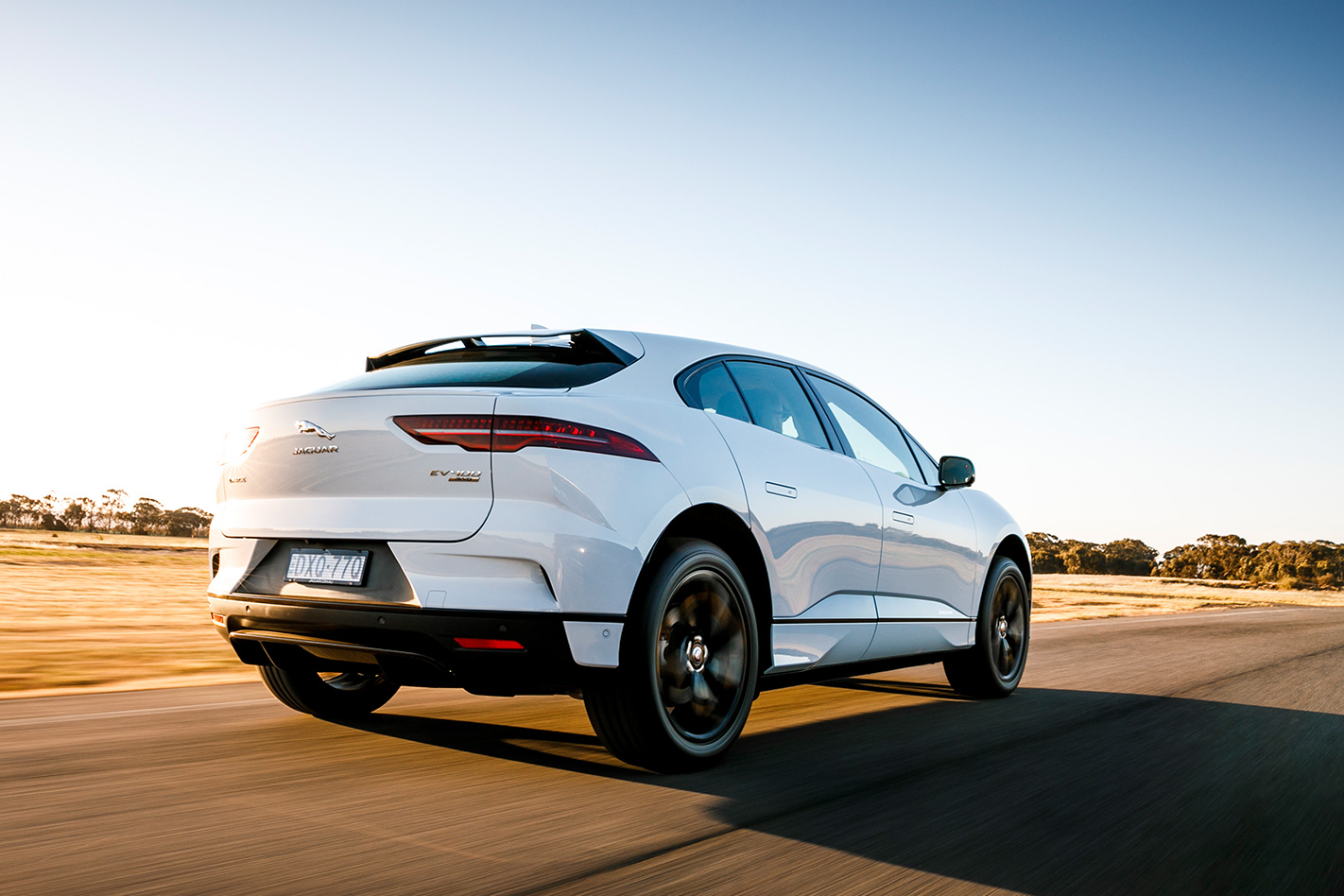
But the I-Pace failed to get anywhere near its supposedly realistic 470km WLTP range. Two things became clear over our days driving the Jaguar on public roads. First, the car’s driving-range software cannot be trusted to provide a real estimate of the distance the car can drive on a full or partial charge. When 100 percent charged, the I-Pace would indicate it was ready to drive a distance close to its WLTP figure, but once moving the range plummeted much faster than kilometres were covered.
Second, it became apparent that there was a big difference between the two I-Paces. One had a battery that was good for close to 300km of normal driving, while the other couldn’t get near that number.
Such variance shows worrying inconsistency.
The Jaguar’s COTY contender status was already irreparably tarnished when the program moved to the four-up stage. Here the I-Pace’s lack of rear-seat roominess and the vehicle’s poor rearward vision helped seal its inevitable fate…
Holden pitches its Acadia seven-seat SUV as the classic family car reimagined into a big comfortable SUV with a spacious cabin and a gutsy V6 petrol engine. There’s no shortage of large-SUV competition though, so we grabbed the mid-spec LTZ variant to see how it shapes up in terms of practicality, performance and value.
What is it?
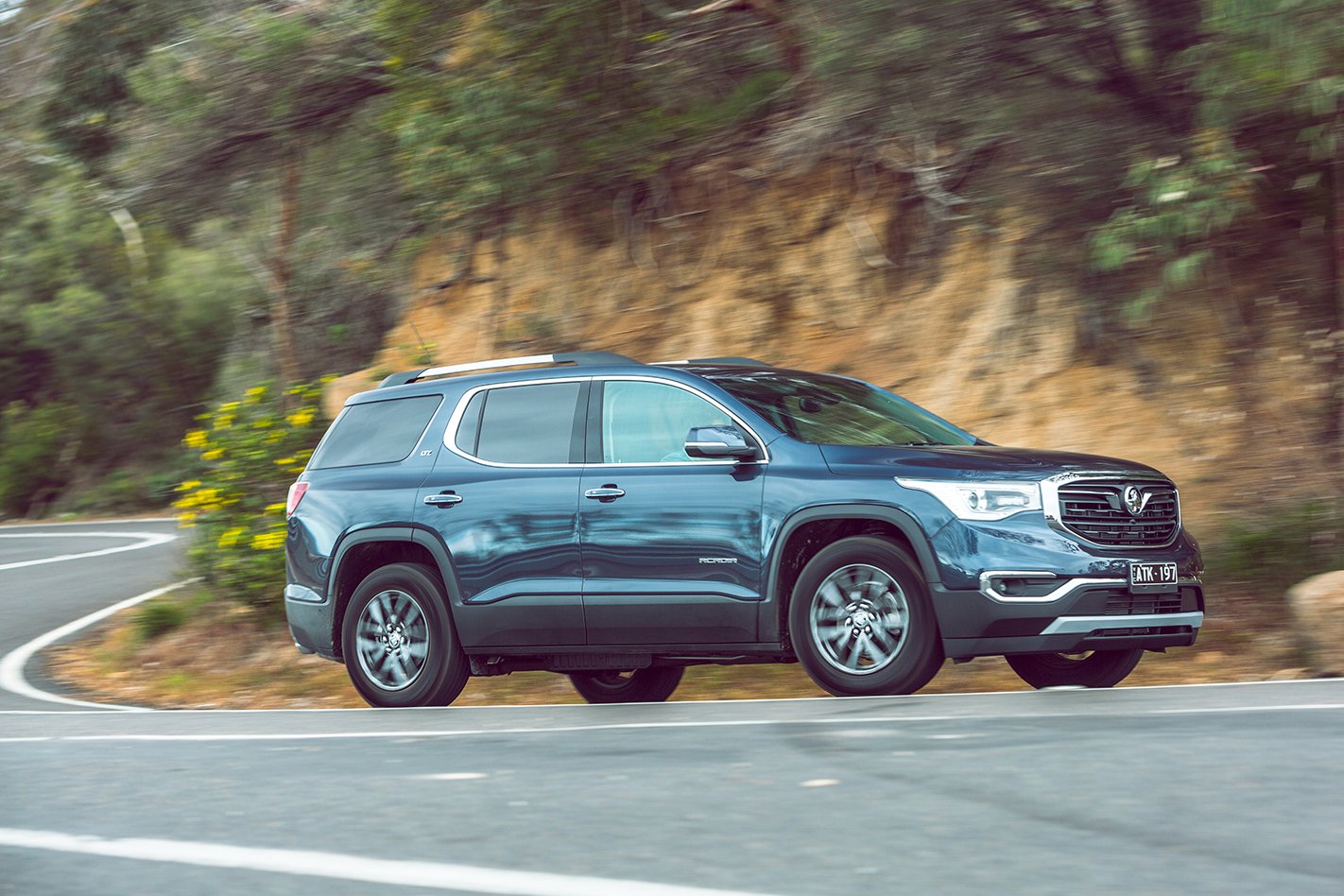
Built by General Motors sub-brand GMC in Tennessee, the Holden Acadia is a bold-looking, comfortable, seven-seater with enough room in the third row to comfortably seat two adults. It’s powered by a gutsy V6 petrol engine with a choice of front- or all-wheel-drive drivetrains. The Acadia arrived in Australia in October 2018 as the most advanced vehicle to wear a Holden badge, with all versions coming with the latest infotainment and active safety technology, including autonomous emergency braking that detects pedestrians and cyclists.

How much is the Holden Acadia LTZ?
The Acadia LTZ sits between the entry-level LT and range-topping LTZ-V and is priced from $53,490 for the front-wheel-drive version, with the all-wheel-drive version costing an additional $4000.
That price is a considerable $10,000 leap from the more basically equipped LT spec. And while it’s $10,000 cheaper than the LTZ-V, that version has considerably more technology and improved ride comfort that provide better value despite its near $70,000 price tag.
IN DETAIL: 2019 Holden Acadia Range Review
That said the LTZ’s price does compare well with similarly equipped rivals including the Mazda CX-9 GT, Toyota Kluger GXL, Ford Endura ST-Line and Jeep Grand Cherokee Laredo.
The Holden Acadia is covered by five-year, unlimited kilometre warranty.
Who is it for?
Holden believes the Acadia’s rugged looks will appeal to people looking to trade in their large sedans or wagons for a big family cruiser with genuine seven-seat capacity.
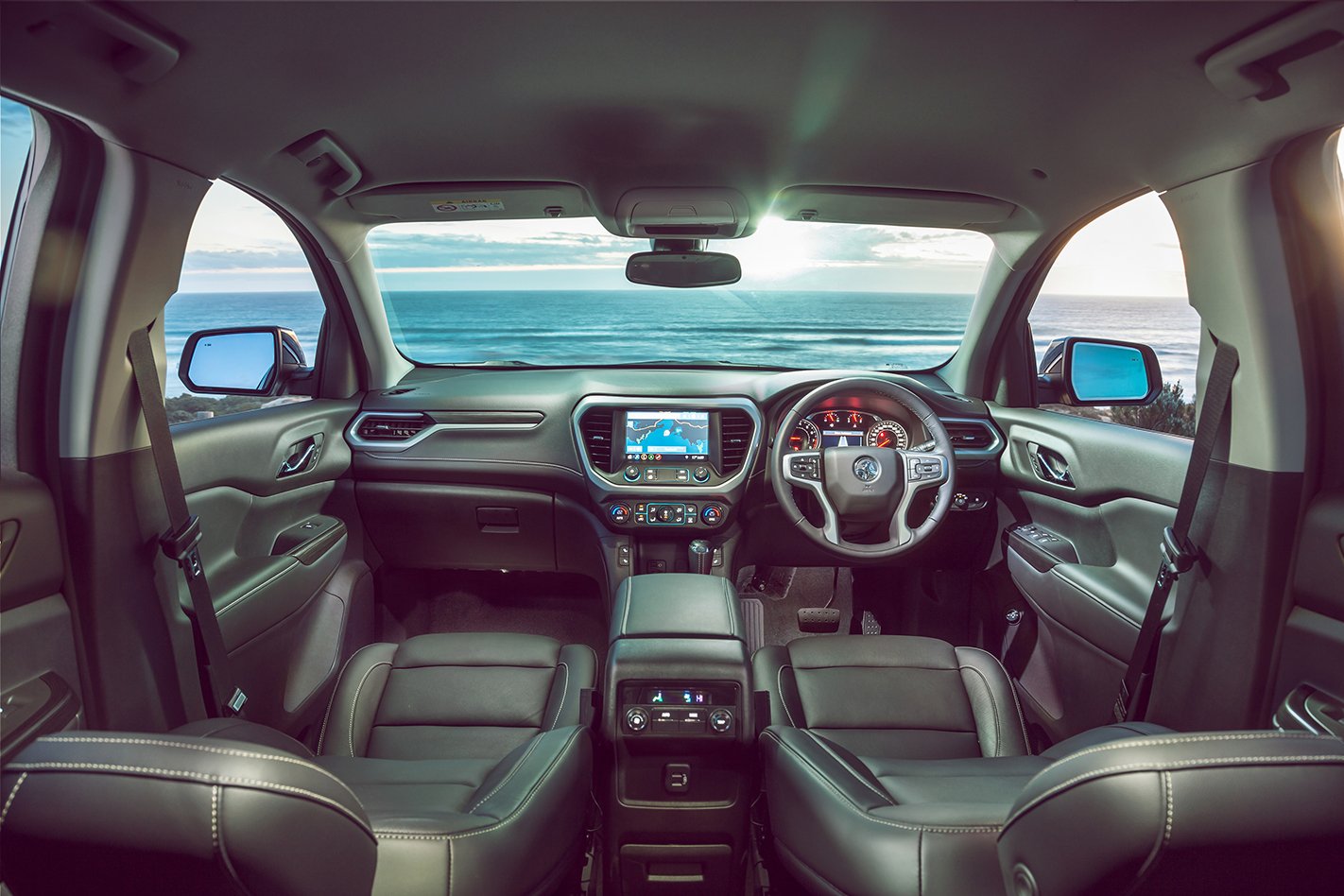
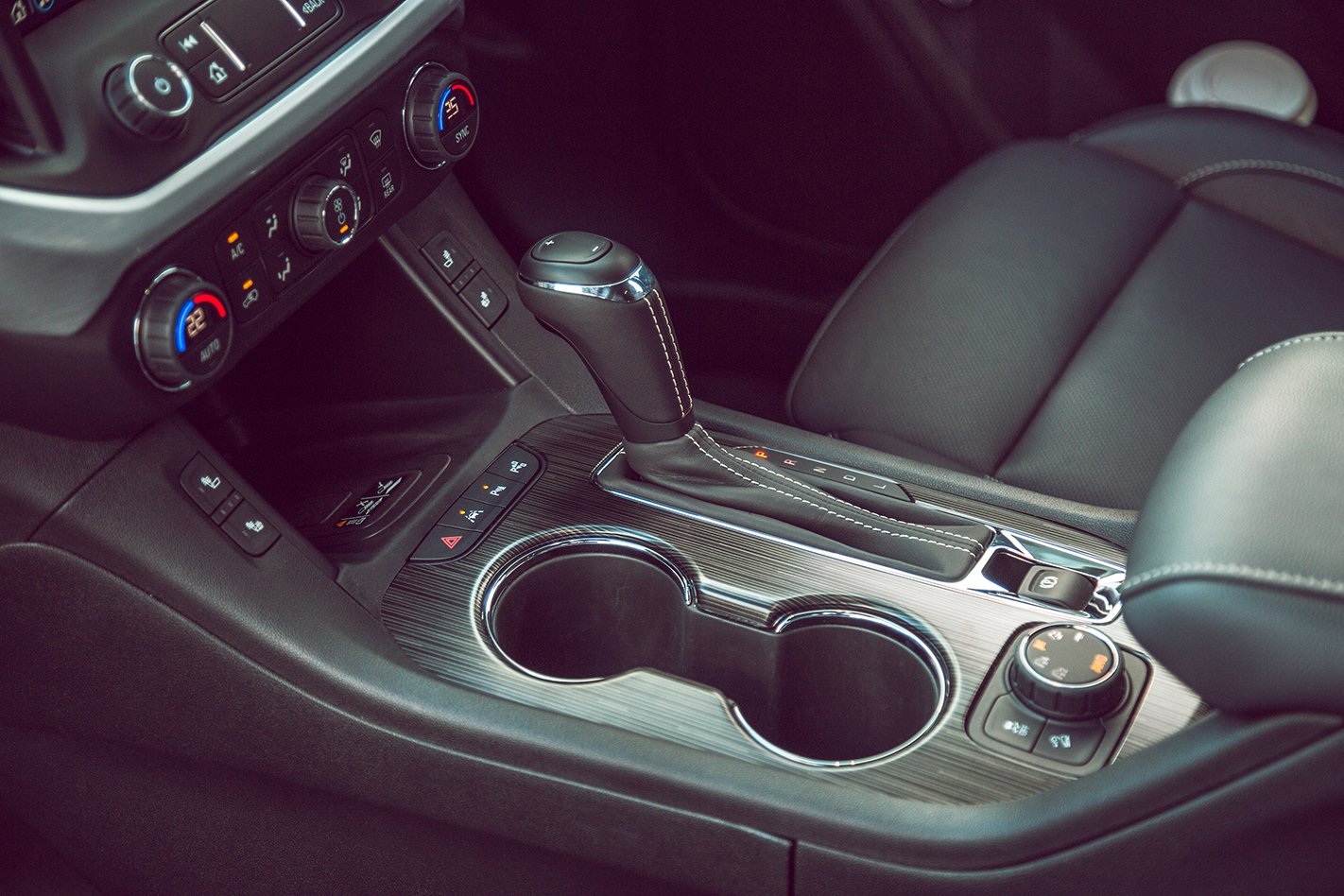
The LTZ spec offers a decent equipment list for those who like their creature comforts, including leather-appointed seats with front-seat heaters, a wireless phone charging pad, automatic parking assist, and a powered tailgate.
Is the Holden Acadia LTZ easy to live with?
The Acadia is a big SUV but it’s not exceptionally wide, which means you’ll easily fit into most parking spaces. If things get a little tight it has an automatic parking assist system that helps you reverse in to parallel and right-angle parking spots.
The Acadia LTZ also features active safety and driver-assistance tech including traffic sign recognition that can work with the speed limiter to automatically govern your speed to the posted limit when you enter a new speed zone.
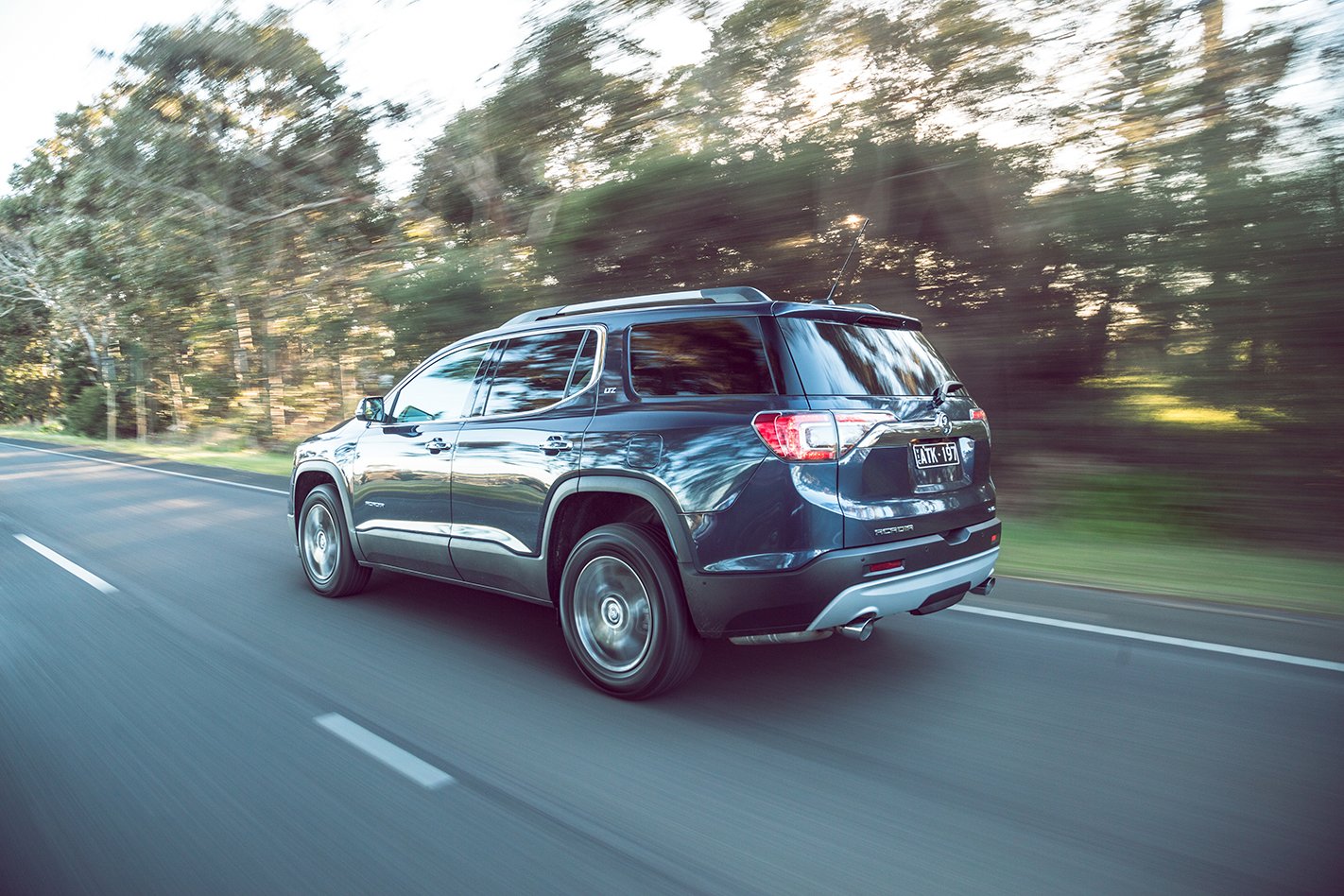
Its autonomous emergency braking recognises cars, cyclists and pedestrians, though unlike the system in the LTZ-V, only works at city speeds. Other key safety features include rear-cross traffic alert, lane-keeping assist, blind spot monitor and a lateral collision avoidance system that steers the Acadia to the side to avoid a vehicle beside it that begins to stray from its lane.Forward collision alert lets you know if you’re in danger of hitting the car in front via a flashing light on the windscreen, an audible warning, and by vibrating the seat cushion. The haptic seat vibrator also lets you know if you stray over a line, and operates with the parking sensors.
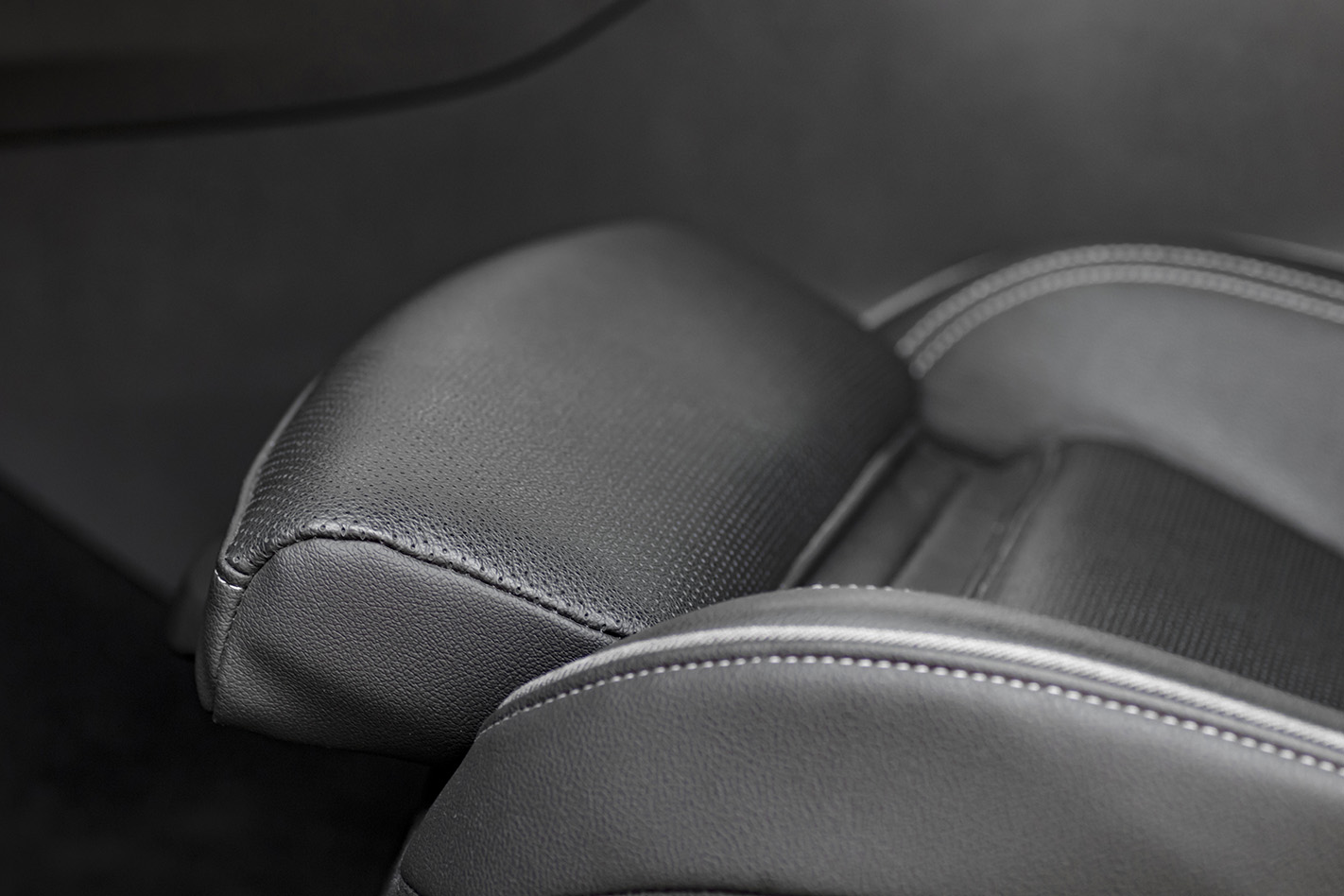
The LTZ’s partial-leather interior is comfortable with plenty of soft-touch materials but, as is often the case with American-built cars, lacks finesse.
The second row easily accommodates taller passengers and offers occupants access to climate control settings, air vents in the ceiling, reading lights, a deep drawer that slides out from under the centre console and two USB sockets.
The third row is among the roomiest of all seven-seat SUVs and is even on par with the space offered by Kia’s Carnival people mover. It seats two adults comfortably, but can be a little more difficult to access from the kerb-side door because the middle-row seat slide/fold setup was designed for American left-hand-drive models.
Receive the latest car reviews! Sign up here to get WhichCar’s e-newsletter
Third-row occupants also get their USB socket, reading lights and ceiling-mounted air vents.
If you have small children, the second row has two ISOFIX child seat anchor points, and there are five conventional child restraint anchors including two in the third row.
Infotainment
The Aussie-developed multi-media system is one of the most advanced of any GM vehicle worldwide. It’s intuitive, with sharp graphics and you can sync two phones at a time via Apple CarPlay or Android Auto. There are five USB sockets throughout the cabin, including the third row, which are rated at 2.1 amps to allow for fast charging of larger devices such as tablets.

Road noise is well contained in the Acadia and the ride comfort on the 18-inch wheels is good, though it does lack silky ride afforded by the LTZ-V’s adaptive suspension dampers.
Storage
There are plenty of places to put things around cabin, including door bins with a separate nook under the arm rests, and under-floor tubs in front of the second row seats.
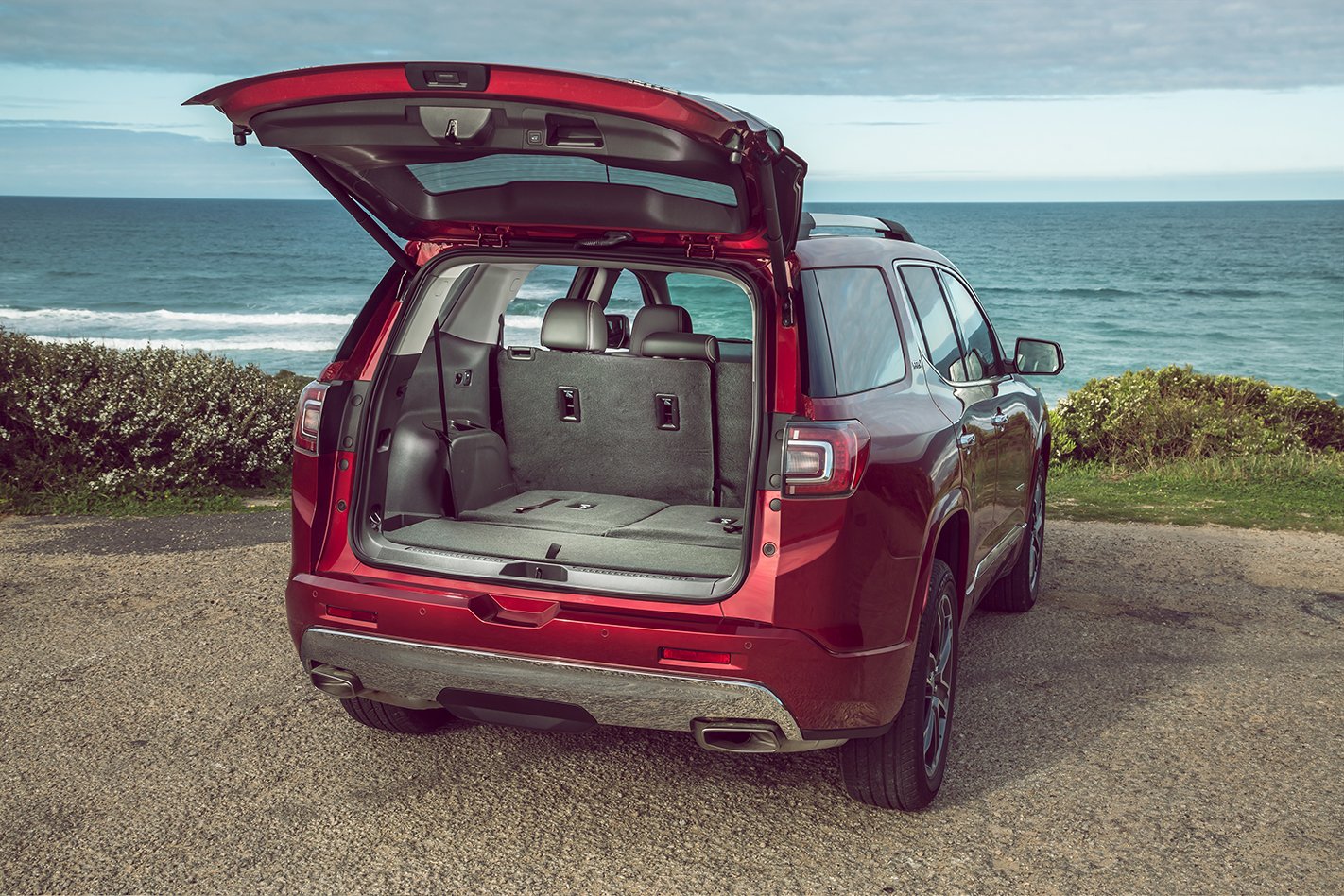
The boot holds 292 litres with all the seats in place and expands to a capacious 1042 litres with the third row folded down. Fold down both the third and second rows and you can stash up to 2102 litres of gear behind the front seats.The Acadia will tow up to 2000kg and the Trailer/Tow drive mode changes the auto transmission’s shift patterns to provide more torque or traction when required. All Acadias come standard with a tow bar – a tow ball is required – and there’s also a hitch view system via the reversing camera display that lets you line up the tow ball and trailer.
How well does the Holden Acadia LTZ drive?
Despite its size the Acadia has car-like handling that’s been enhanced by an extensive local suspension tuning program by Holden engineers to make it more compatible with Aussie roads.
The LTZ lacks the range-topping LTZ-V’s adaptive suspension that further acclimates to different road and driving conditions, but the ride is still comfortable with surprisingly little body roll and side shove.
The Acadia shares the same 3.6-litre V6 engine and nine-speed automatic transmission as the Commodore, though in a slightly less powerful tune that offers up to 231kW and 367Nm.
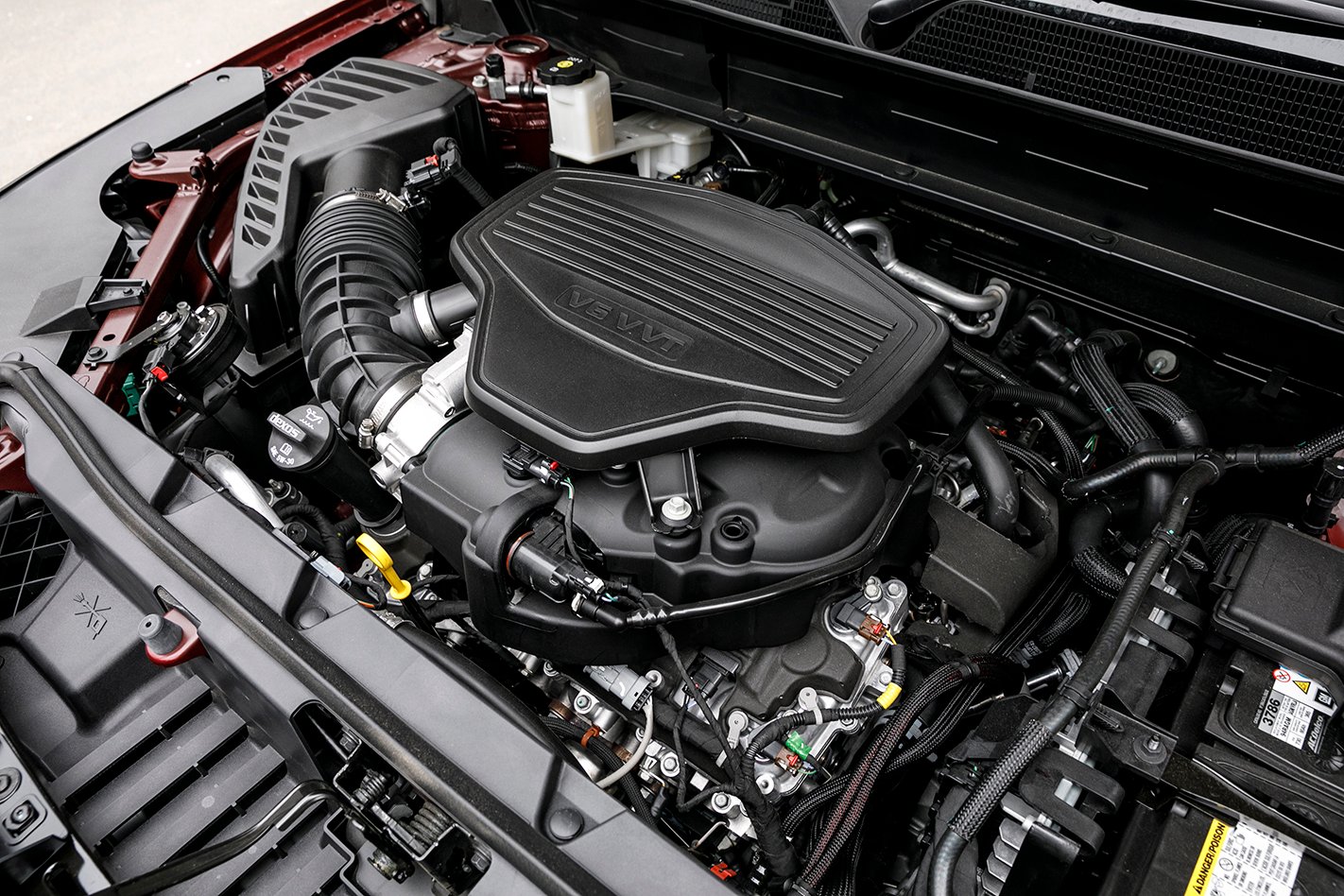
Its weight doesn’t seem to bother the V6, which handles the heft well and offers a nice rumble to complement its macho American looks. If anything there seems to be a bit too much torque through the front wheels. You don’t have to put the foot down too hard at the light to produce a hoonish wheel chirp especially when there’s weight in the back.
This happens with the FWD version, and the AWD when in the default 2WD mode – if you can afford the extra $4000 you’re best choosing the latter, but you’ll need to manually put it in AWD if you anticipate slippery conditions.
Verdict
The Holden Acadia is a good large SUV that ably fills the brief as a family tourer, and the LTZ brings additional levels of comfort to make long trips and the daily drive all the more pleasant.
That said, the LT offers much of that liveability for $10,000 less even without the leather trim and seat heaters, and you’ll always be envious of the LTZ-V’s extras that include adaptive suspension, adaptive cruise control, digital dashboard display, and dual-panel sunroof.

There’s no sugar coating this, the 2004 HSV Avalanche was a poor performance car and ended as being one of Clayton’s more forgettable creations. But in theory, an all-wheel drive system in a station wagon driven by a big V8 was actually a great idea.
Besides the, erm, busy styling there were a few things that muddied its pedigree. Its all-wheel drive system, taken from the Holden Adventra, choked the V8’s headers packaging space, docking the Gen III LS1’s outputs by 15kW and 35Nm, for a total of 270kW and 475Nm.
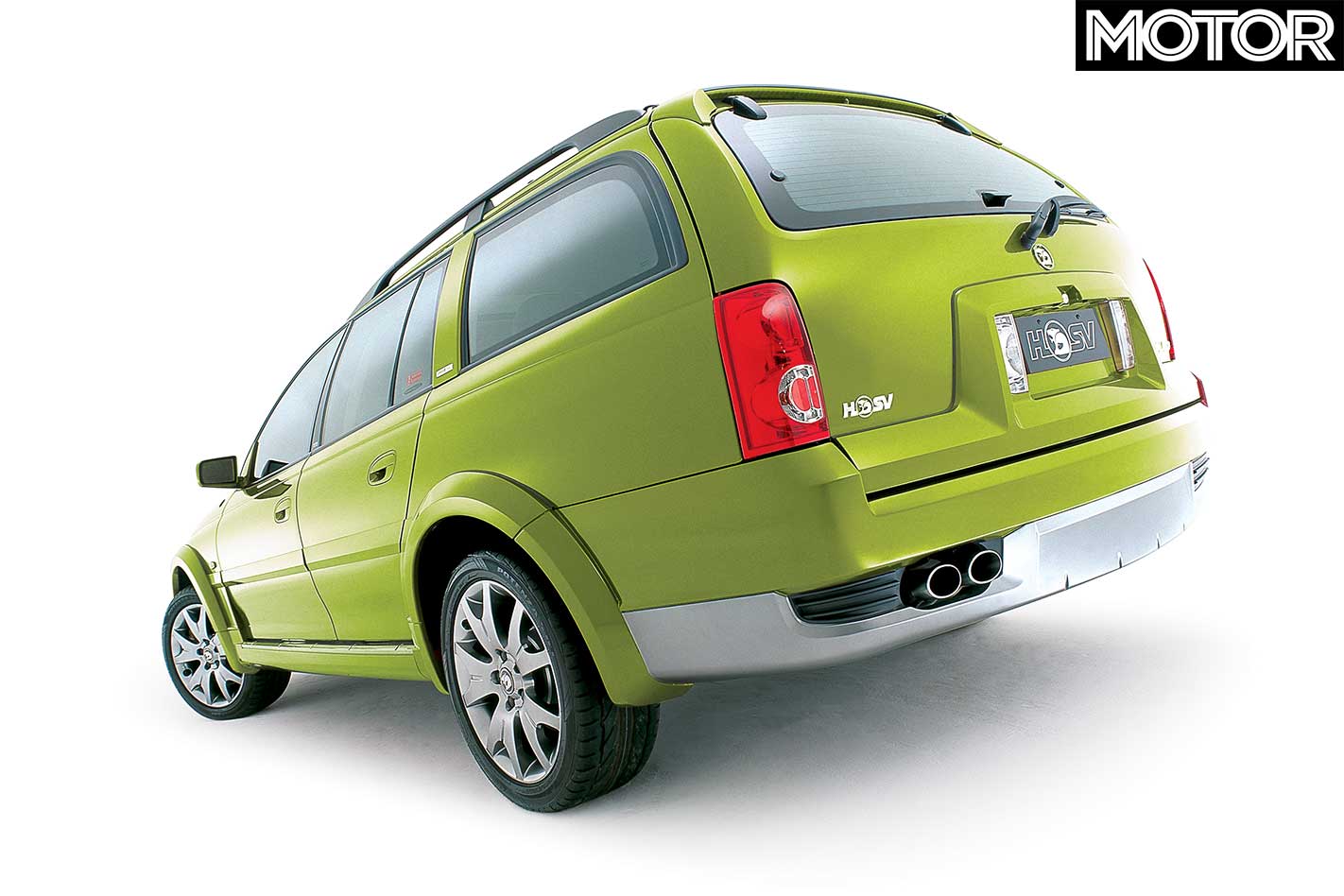
Then there’s the fact it had just over two tonnes to haul around. Driving through a four-speed automatic, back in the day we got the Avalanche up to 100km/h in 7.11 seconds and across 400m in 15.09sec. Your regular Clubsport could do mid-5s and mid-13s for about $10K less.
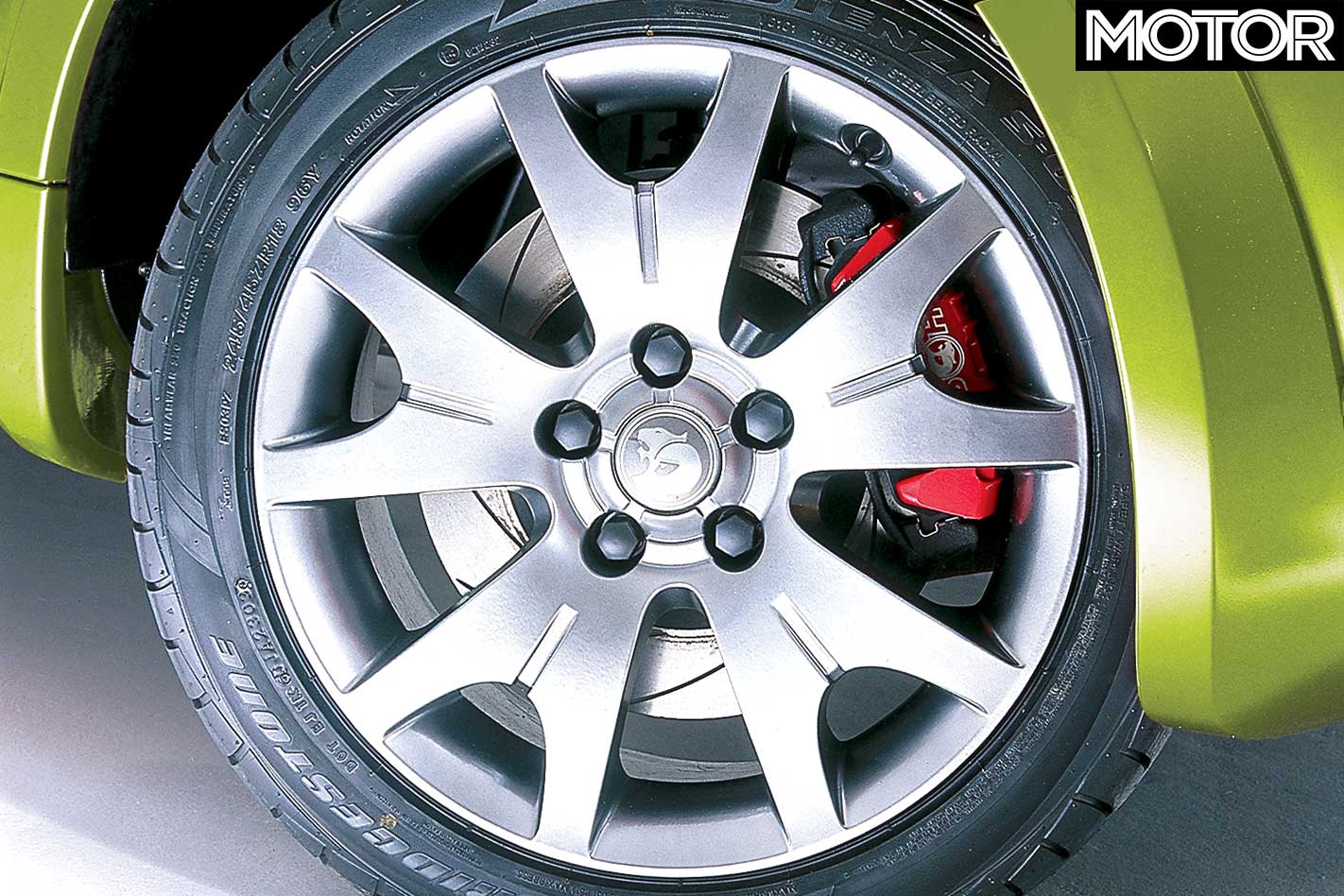
Bridgestone developed some special tyres for it, but those four 245mm tyre patches didn’t exactly dance, either, and preferred to understeer at the limit. This was even though torque was split 62 per cent towards the rear.
That said, in typical HSV fashion, Clayton didn’t cut corners building the thing. It got nice big brakes, could tow 2100kg braked and was kitted out with leather upholstery inside that felt a cut above what you found in a Clubsport.
But to compare it against V8 sedans from its day is an injustice, because it really was more of an SUV-alternative. In fact, the spin-off XUV dual-cab ute was way ahead of its time and, in our opinion, way cooler than a Colorado.
Ground clearance was decent and to get anywhere near its straight line performance with an SUV back then would have cost you $203K for a Porsche Cayenne Turbo. Even Mercedes-Benz’s bad-mutha ML55 AMG was three tenths off in the 0-100km/h and 0-400m stakes. Its ride on Australia’s cruddy roads was also in a class of its own. So, ultimately it was a flawed exercise, but not pointless in hindsight.
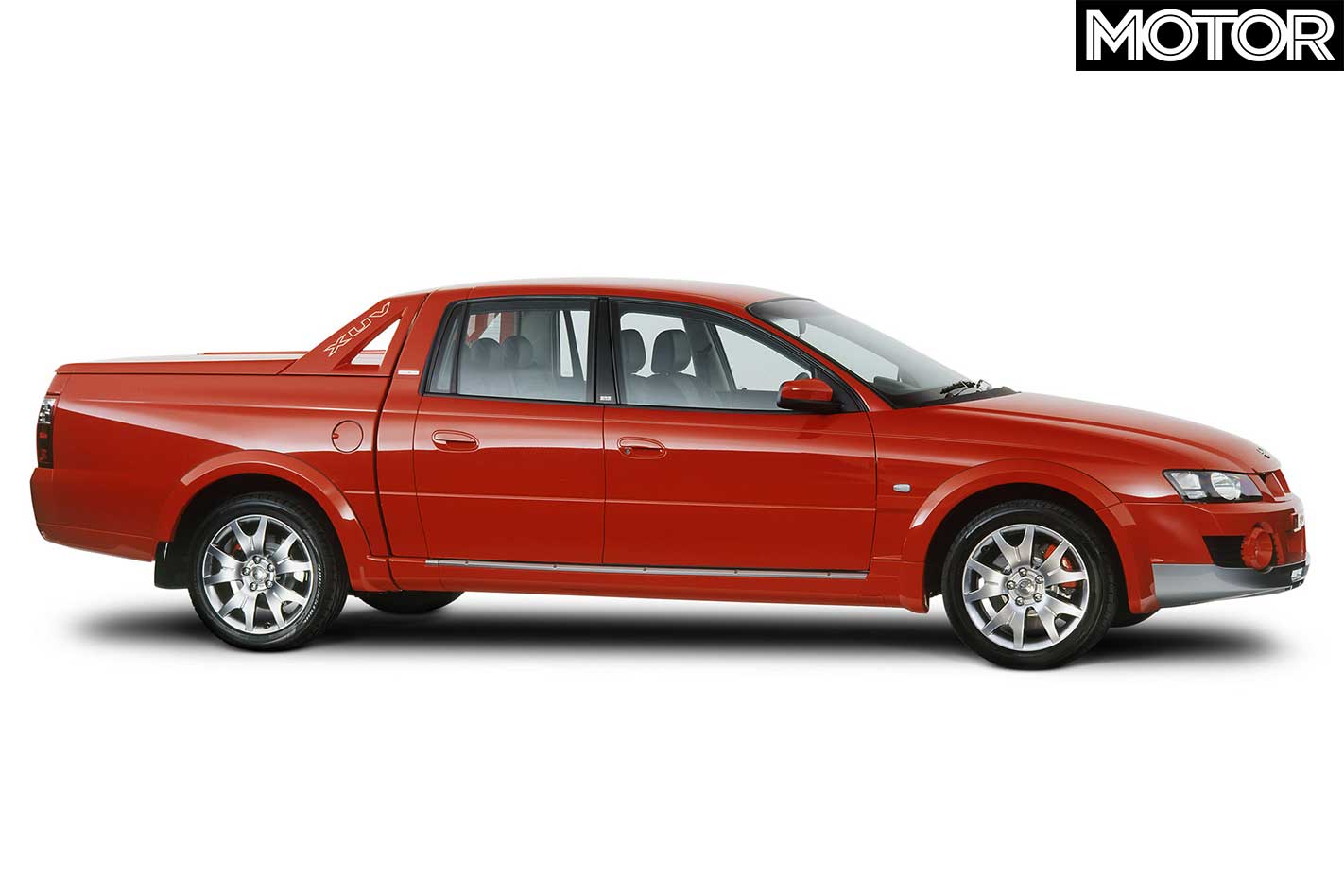
2004 HSV AVALANCHE SPECS Engine: 5.7-litre V8, OHV, 16v Power: 270kW @ 5700rpm Torque: 475Nm @ 4000rpm 0-100km/h: 7.11sec (tested) Price (new): $73,990
