
In many ways it’s almost irrelevant how good the 2019 Porsche 992-generation 911 is.
The seven forebears have built up such an enviable reputation that many will part with their cash irrespective of informed opinion. The venerable 911 has always embraced tradition and change in equal measure; one to the frustration of critics and to the delight of enthusiasts.
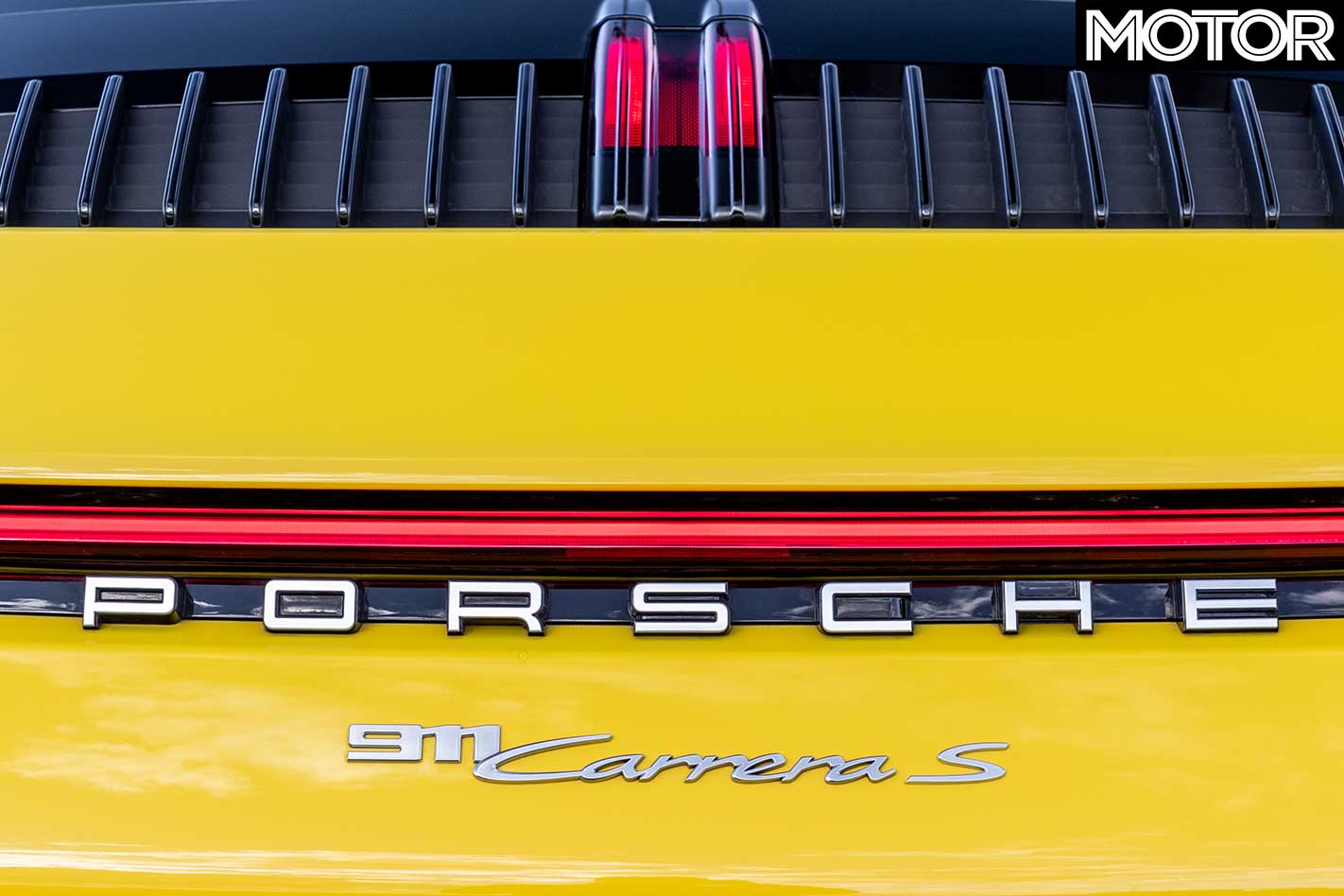
However, for those who like cutting to the chase, the 992 lives up to the hype. It’s good – bloody good in fact. But really, we shouldn’t be surprised. We’ve come to expect nothing less from Porsche.
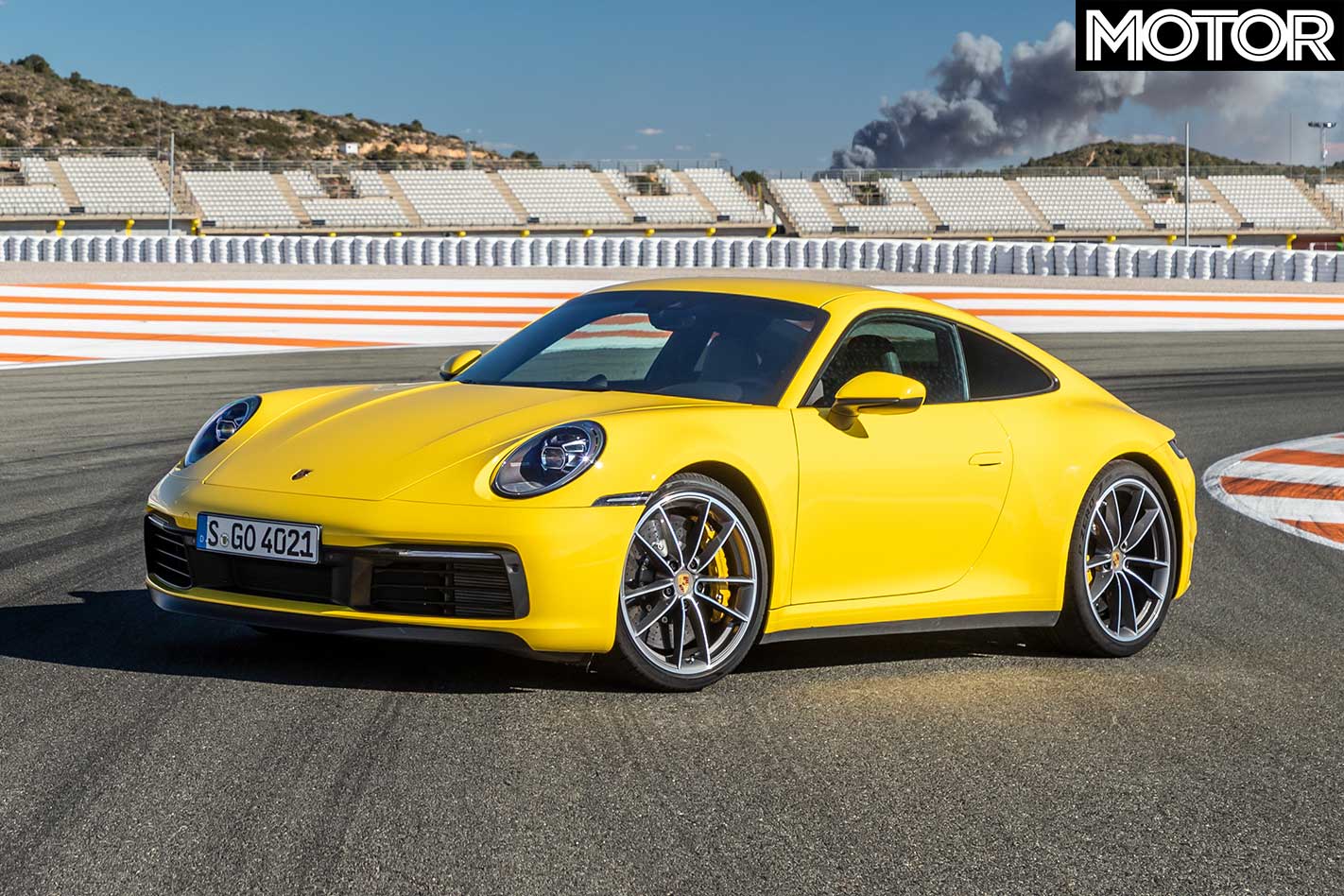
This is now, finally, the real deal. After a prototype drive months ago, I’m finally nestled inside the redesigned cabin of the 992 and ready to turn the starter key. What’s more, not only is the new 331kW Carrera S my steed, I’m also on a track – Ricardo Tormo Circuit in Valencia to be exact.
Matthias Hoffsuemmer works as a driving instructor for Porsche, coaching, among others, the German Supercup team. Today he is giving me tuition from behind the wheel of a 991.2 GT3 RS.
So, not only is the teacher and his pupil separated by a wealth of talent and experience, there’s also 52kW and a generation between us. Of course, it’s no contest. But seen from the driver’s seat of the pursuit car, the two 911s are closer than you’d think – much closer.
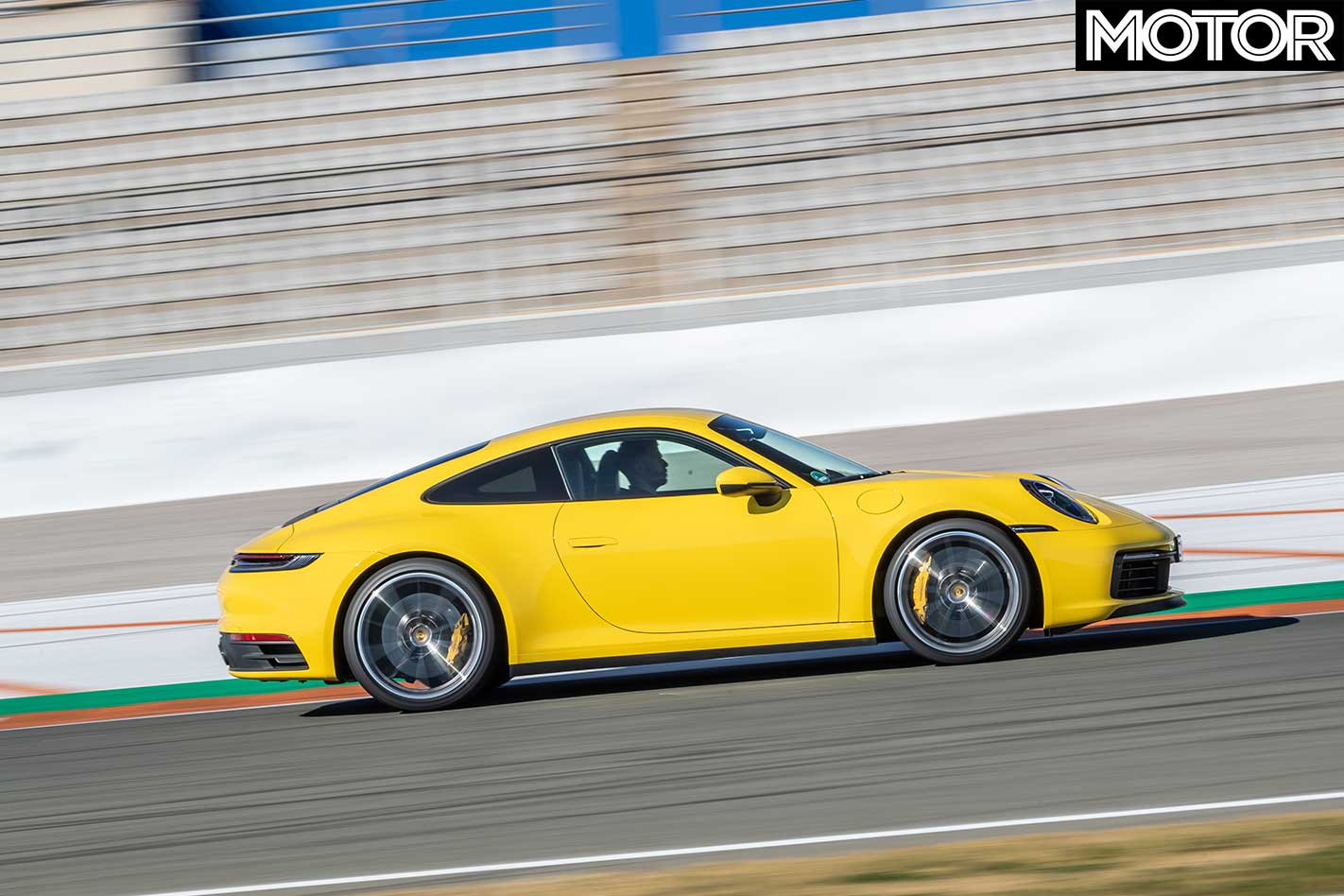
When the tyres and the steel brakes start to feel the heat after 10 laps, the racecar-esque warrior has to invest more than seven tenths to keep pulling away from the four-pointed headlights in its rear-view mirror. A sign of things to come.
Finding reasons why the GT3 RS is having such a hard time shaking the Carrera S (and trust me, it’s not down to my driving) can initially be found on the spec sheet. For starters, the base 992 Carrera is now endowed with 283kW… for the entry-level version.
However, the S acquires GTS-rivalling power and torque figures, meaning it has 331KW and 530Nm to play with; that’s 22kW and 30Nm more than before. With launch control and the new eight-speed PDK transmission, it’ll even rocket to 100km/h in 3.5 seconds (with Sport Chrono) while its top speed on this track is a mere 4km/h shy of the RS-branded GT product.
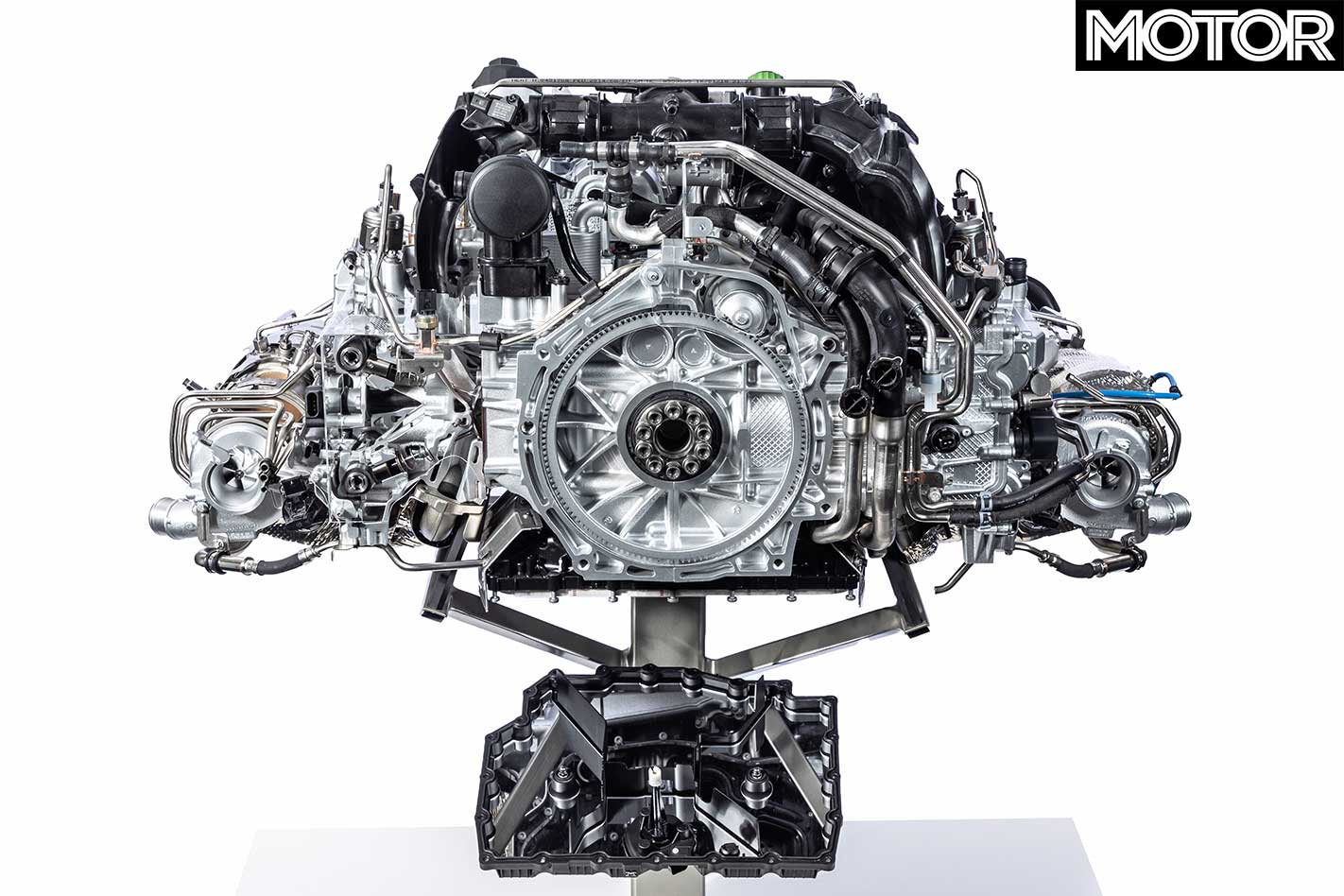
Thundering down the long start/finish straight and the gap invariably widens all the way to the braking area and turn one apex, but that’s also due to the carbon-ceramic stoppers and Cup 2 rubber fitted to the atmo racer. “Stick the drive-mode selector in Sport Plus and leave the PDK in Drive,” Hoffsuemmer says. “PDK shifts faster in Auto than a pro can in manual.”
Half way through the session the car, thankfully, tyred (pun intended) faster than its driver. Although amazingly, the 20-inch Pirelli P Zeros up front and the 21 inchers fitted to the rear wheels collect and relinquish heat almost simultaneously.
Hence, it seemed a good point to dial in PSM Sport, which underlines the new model’s benign attitude at the limit of adhesion. Only when you take too much speed into a corner and turn in too early does it fall into understeer – but then, this has always been a trait of the rear-engined Porsche.
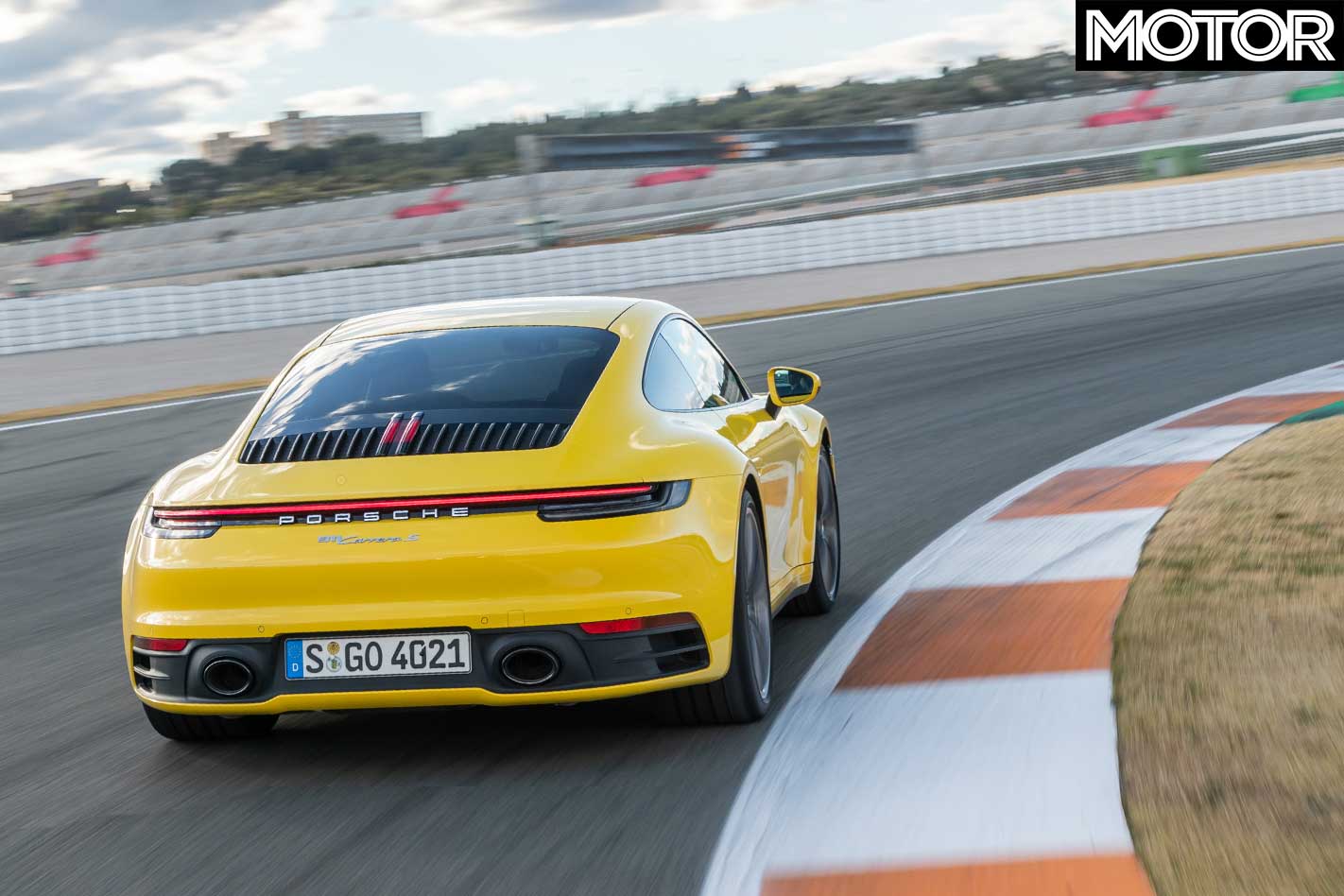
Become too eager on the loud pedal with handfuls of steering lock and the riposte is more than a faint trace of roll oversteer, which isn’t the fastest way of getting in and out of a corner. Rather than paying the price for late braking, it’s better to balance the composure by treating the steering, throttle and brakes with sense and sensitivity.
With this in mind, we enter the drift-style photography phase with trepidation. Doing cornering shots on hot liquorice rubber quickly becomes a harder task than first thought with the front-end coming unstuck before the rear decides to break loose. “She doesn’t want to do it,” comments Hoffsuemmer. However, as it turns out, practice makes perfect as using less opposite lock and giving it the berries seems to work wonders.
Still, the takeaway remains that the 992 feels less tail-happy than its predecessor. It could pass as a mid-engined coupe to the uninitiated and a sudden lift-off at the limit is no longer a widow-making error thanks to the Porsche’s electronic brain.
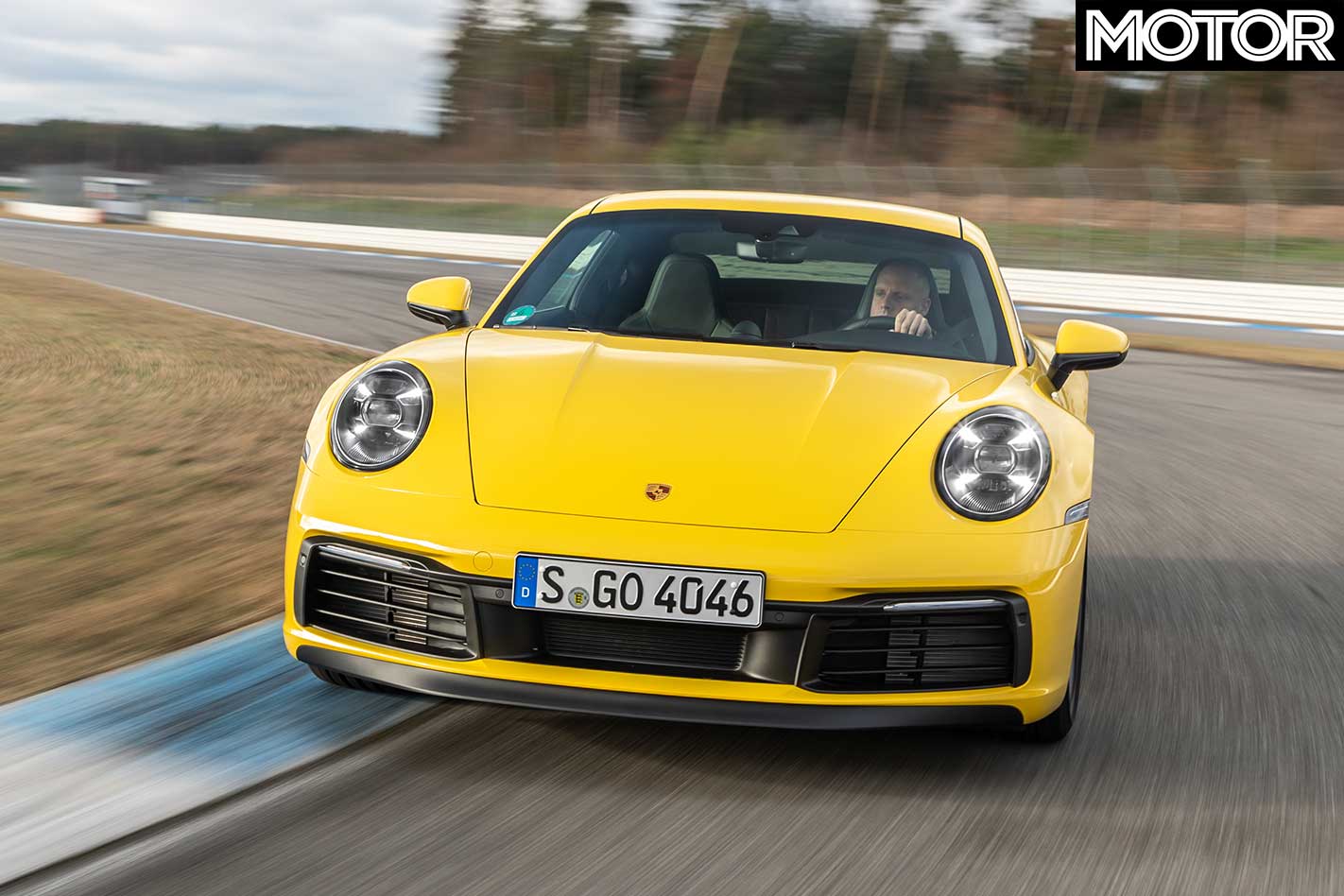
Initial failings for the camera aside, the inherent completeness a 911 brings to the table is evident. The fact the S can also do 0-100km/h in 3.5sec, 0-160km/h in 7.8sec and 0-200km/h in 12.1sec is mighty impressive.
Yes, speed matters, but less so in absolute terms compared to the emotional experience it generates. The low-rpm tip-in is ultra-quick, but never brutal, while the mid-range punch between 2300 and 5000rpm, using all 530Nm, sucks the car forward like a giant, invisible Hoover.
Thankfully, for pretty much the first time, Sport Plus isn’t too annoyingly crazy for public roads, either. It spares dispensable downshifts and death knell upshifts for a truly intuitive persona.
The ability of the PASM damping system also works on the open road, maintaining a sweet balance between compliance and contact at all times on all surfaces. The electronically assisted steering, maligned in the original 991, is convincingly calibrated and neatly weighted, which works wonders in the palms of a keen driver (just remember to turn off lane assist and lane-departure warning).
On a racetrack, low tyre temps aren’t an issue. However, on the road, single-digit ambient temperatures make it mandatory to warm up the rubber before the red mist descends. Roadholding, traction and cornering grip depend on it, especially when the optional rear-wheel steering is fitted, which aims to clip ever tightening apexes with abandon.
The most apparent dynamic advantage of the 992 over the 991 is the front-end. It bites with more determination and it hangs on the more you push it, increasing confidence and driving pleasure. With the advent of rear steer, Porsche wisely widened the front track and increased the tyre size so that the extra bite from the back wouldn’t render the front axle toothless.
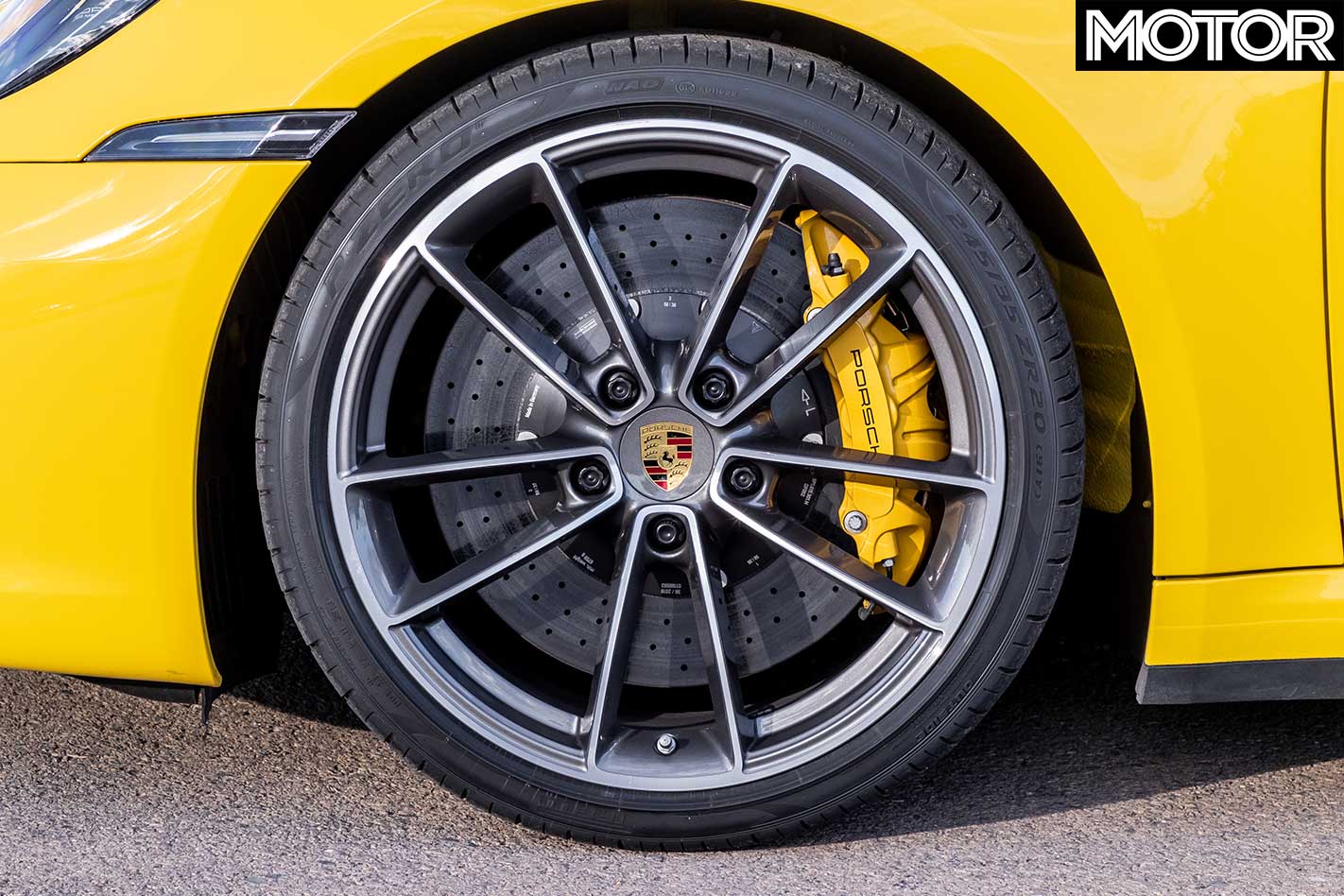
After 10 laps on the circuit, envy begins to kick in as an accompanying Carrera S wears yellow brake calipers – which denote the extra-cost carbon-ceramic brakes. And after an hour punting along narrow rural Spanish roads in it, this verdict remains unchanged.
Boasting ultimate stopping power, stamina and pedal feel, the four cross-drilled and ventilated discs are peerless. The previously pneumatic brake booster is now of the electric kind and deceleration has become an integral part of the 992’s flow. However, it’d be interesting to see how they perform in the rain and cold.
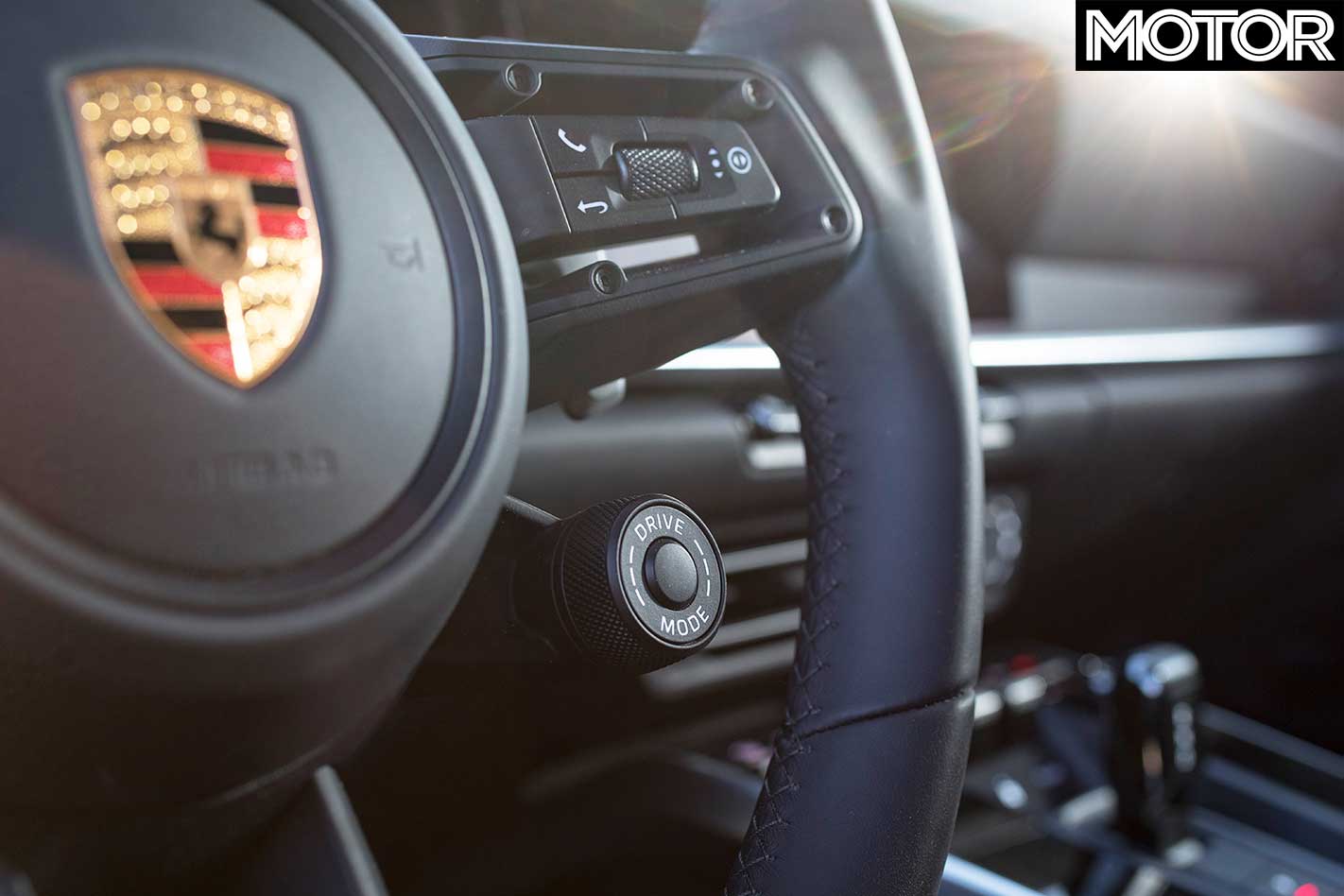
It wouldn’t be a modern performance car without myriad drive modes, and the 992 is no different. To shed the sleepy passivity of Normal, Sport automatically kills start/stop and tightens everything up – it’s essentially a pseudo do-it-all mode… except when it rains.
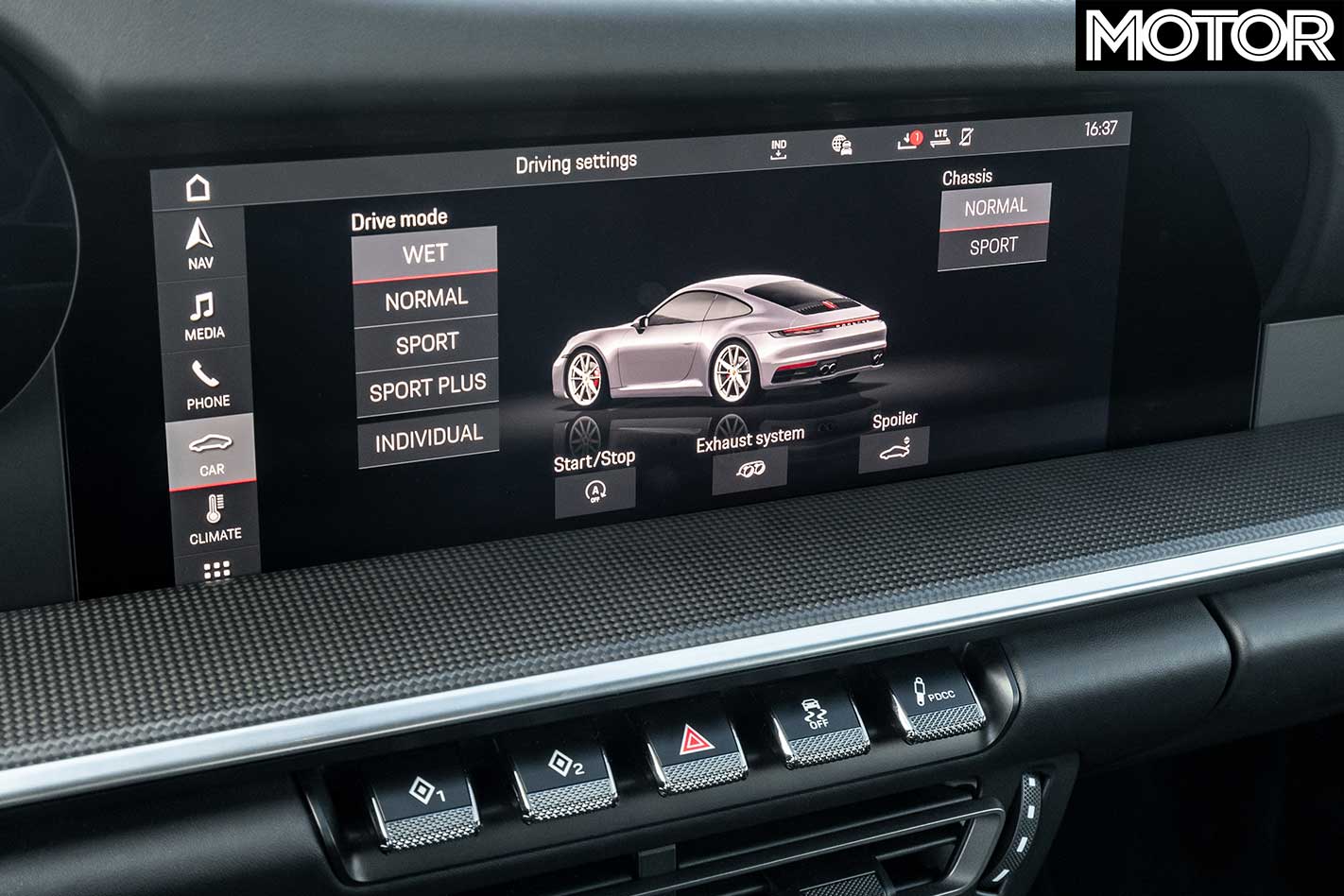
Such conditions are picked up by microphones in the front guards and encourage you to select Wet mode, in turn activating maximum stability and traction control. Admittedly it works well, but despite the undeniable active safety benefit, Wet mode takes another piece of responsibility and control away from the person in charge.
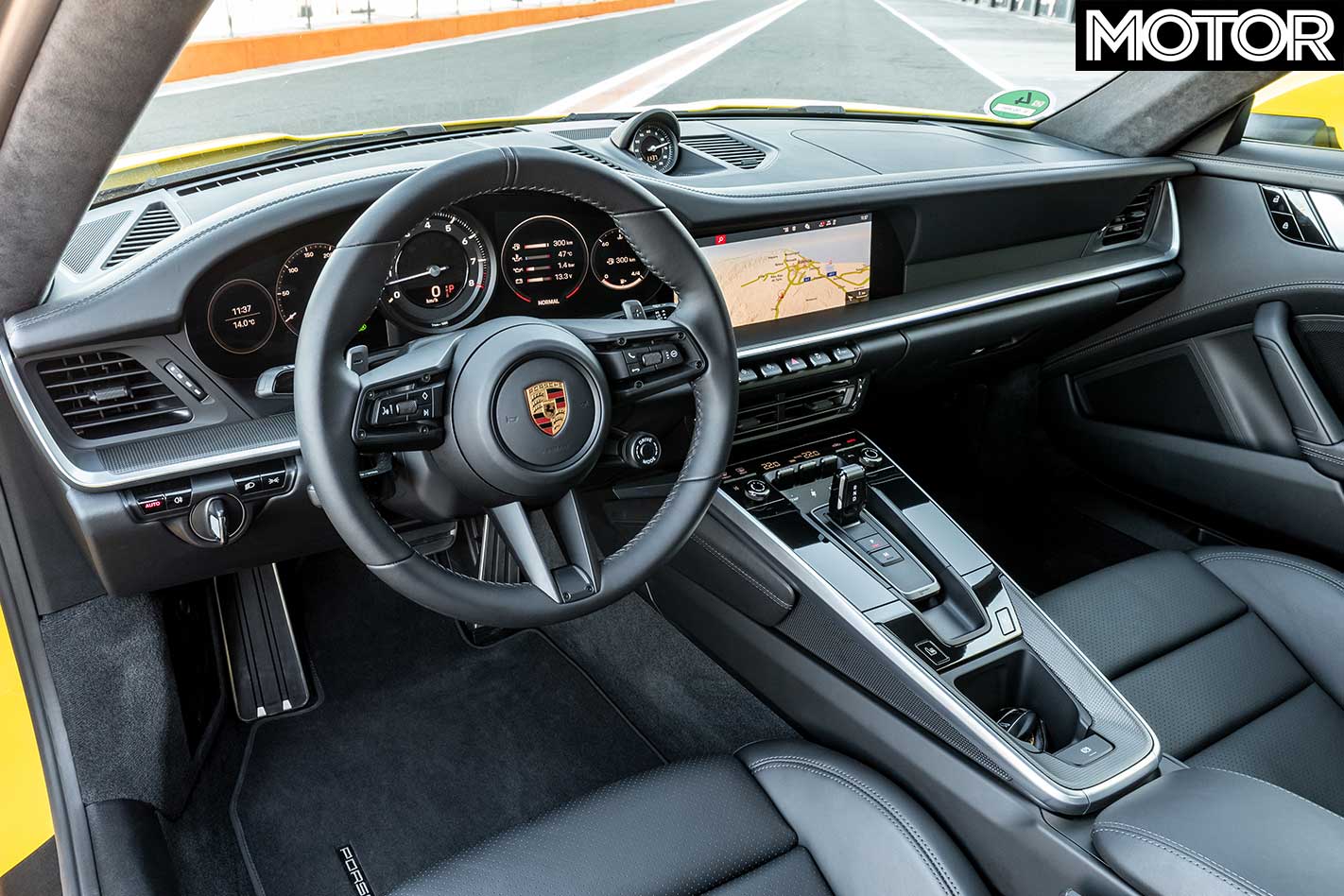
Inside, the entire instrument panel, sans the analogue rev counter, has been digitised. And in typical 911 fashion, it pays homage to the past while satiating the needs of the tech-savvy smartphone generation. The five-gauge dash is now partly virtual, but sadly, there’s no head-up display.
Inspired by the Panamera and the Cayenne, the 911 also receives a new infotainment system with a large touchscreen display. Numerous menus and submenus are available, which are okay when you’re sitting idle, but at speed they become overly fiddly and distracting. Simplification is needed.
Having driven both engine tunes, both transmissions (a more positive and faster-acting manual transmission becomes available later in the year) and both layouts (RWD/AWD), naming a favourite is easy.
The Carrera 2 S is the pick of the litter. You should opt for the PDK ’box and ideally the beefier brakes, but adding steering to the rear axle isn’t vital. And you do need the Sport Chrono Pack to access all the dynamic goodies.
What is now more apparent is the fact that you don’t need one of Porsche’s GT cars to head to a track. Given I’m currently at one with the Carrera S, it seems criminal not to experience it again. This time I slipped out on track without a pace car. Of course a racetrack never tells the full story, but it brings the limits closer within a safer reach. The last blast uncovers some final thoughts, too.
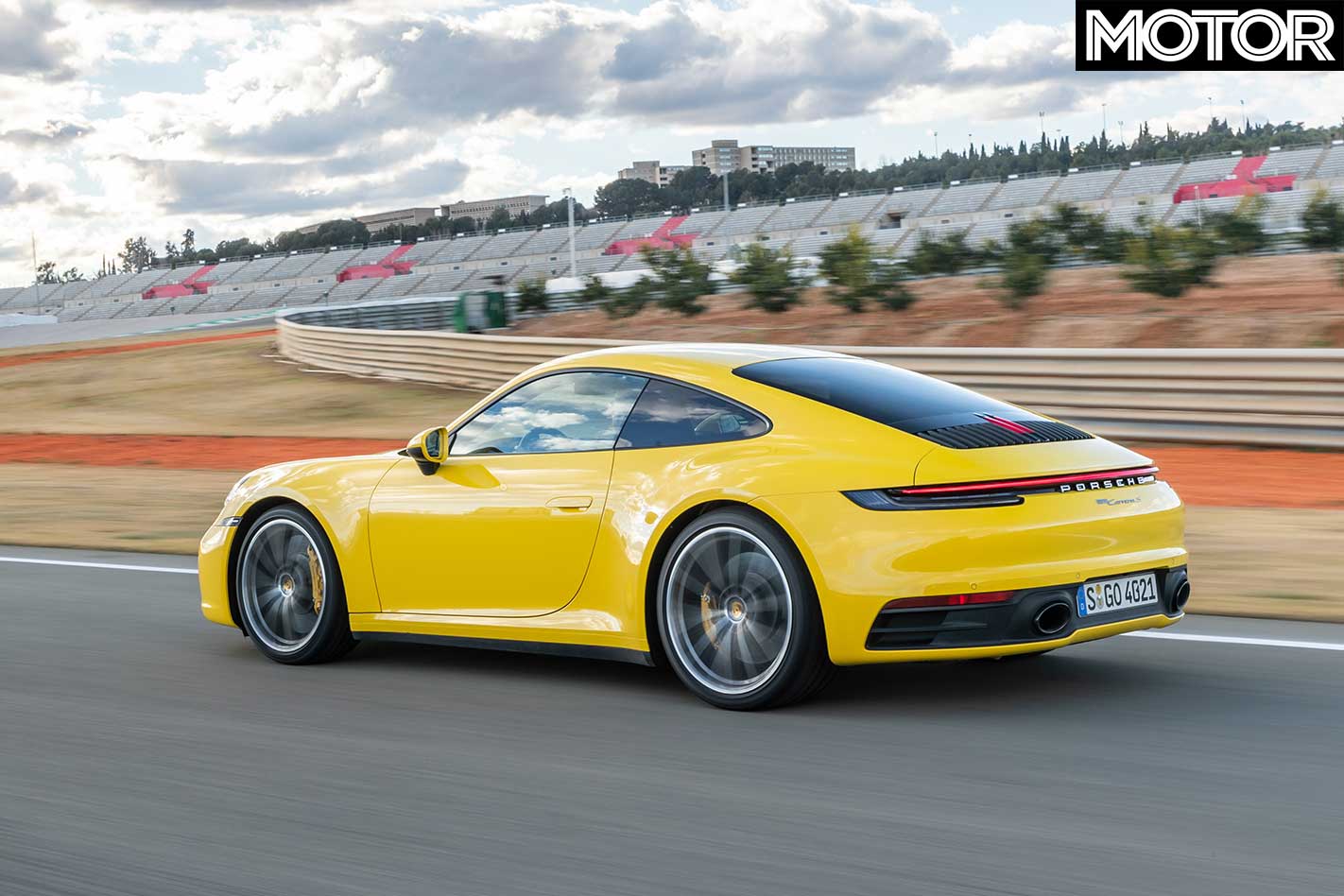
The added punch of the high-revving turbo engine is clearly noticeable, the extra gear cuts the torque curve into six nicely portioned morsels (first and eight are relatively redundant) and the inherent 911 dynamics remain true to form. It sounds good, too, and there’s also now a deeper layer with the adaptive aero kit prioritising minimum drag in a straight line and maximum downforce through the twisties.
True to form, the 992 Porsche 911 is a complete sports car with plenty of evolution potential – expect hybrid versions (both PHEV and BEV) to come. However, as I return to the pits and the 3.0-litre flat six sits ticking away as it cools, what I can’t quite seem to shake is the fact that this Carrera S isn’t a dedicated go-fast model. It has an inherent level of dynamic ability and performance intent, yet the ‘hot’ 992 GT models are still to come. And that is a very tantalising thought.
FAST FACTS 2019 Porsche 992 911 Carrera S
BODY: 2-door, 4-seat coupe DRIVE: rear-wheel ENGINE: 2981cc flat-6, DOHC, 24v, twin-turbo BORE/STROKE: 91.0 x 76.4mm COMPRESSION: 10.2:1 POWER: 331kW @ 6500rpm TORQUE: 530Nm @ 2300-5000rpm WEIGHT: 1515kg POWER-TO-WEIGHT: 218kW/tonne TRANSMISSION: 8-speed dual-clutch SUSPENSION (f): struts, adaptive dampers, coil springs, anti-roll bar SUSPENSION (r): multi-links, adaptive dampers, coil springs, anti-roll bar L/W/h: 4519/1852/1300mm WHEELBASE: 2450mm TRACKS (f/r): 1589/1557mm STEERING: electrically assisted rack-and-pinion BRAKES: 350mm ventilated discs, 6-piston calipers (f); 330mm ventilated discs, 4-piston calipers (r) WHEELS: 20.0 x 8.5-inch (f): 21.0 x 11.5-inch (r) TYRES: Pirelli P Zero; 245/35 ZR20 (f): 305/30 ZR21 (r) PRICE: $265,000
PROS: Fast for a non-GT variant; improved dynamics; cabin CONS: Doesn’t really need RWS; fiddly infotainment system RATING: 4.5 out of 5 stars
Performance Car of the Year 2019 is 11 hell-raising cars, five days in scenic SA, and one champion.
In the magazine, our PCOTY feature is split into sections for road and track, plus the final countdown. For TV, and in turn the video you see here, is a ‘fly on the wall’ follow along with us and a brief countdown of the top place-getters.
The Road
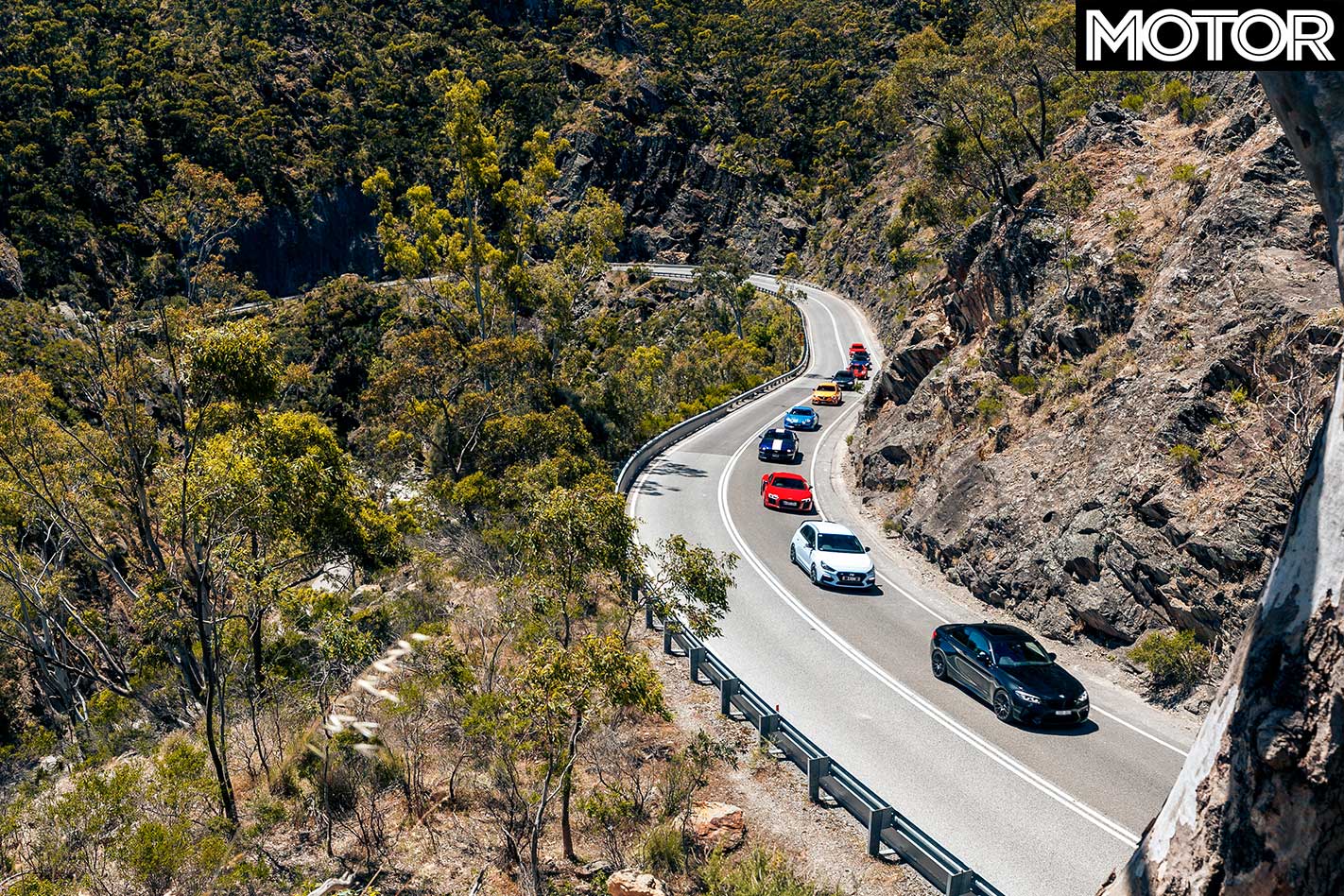
South Australia’s Gorge Road is driving nirvana, which doubles as a stern test for our crop of performance cars.
The Track
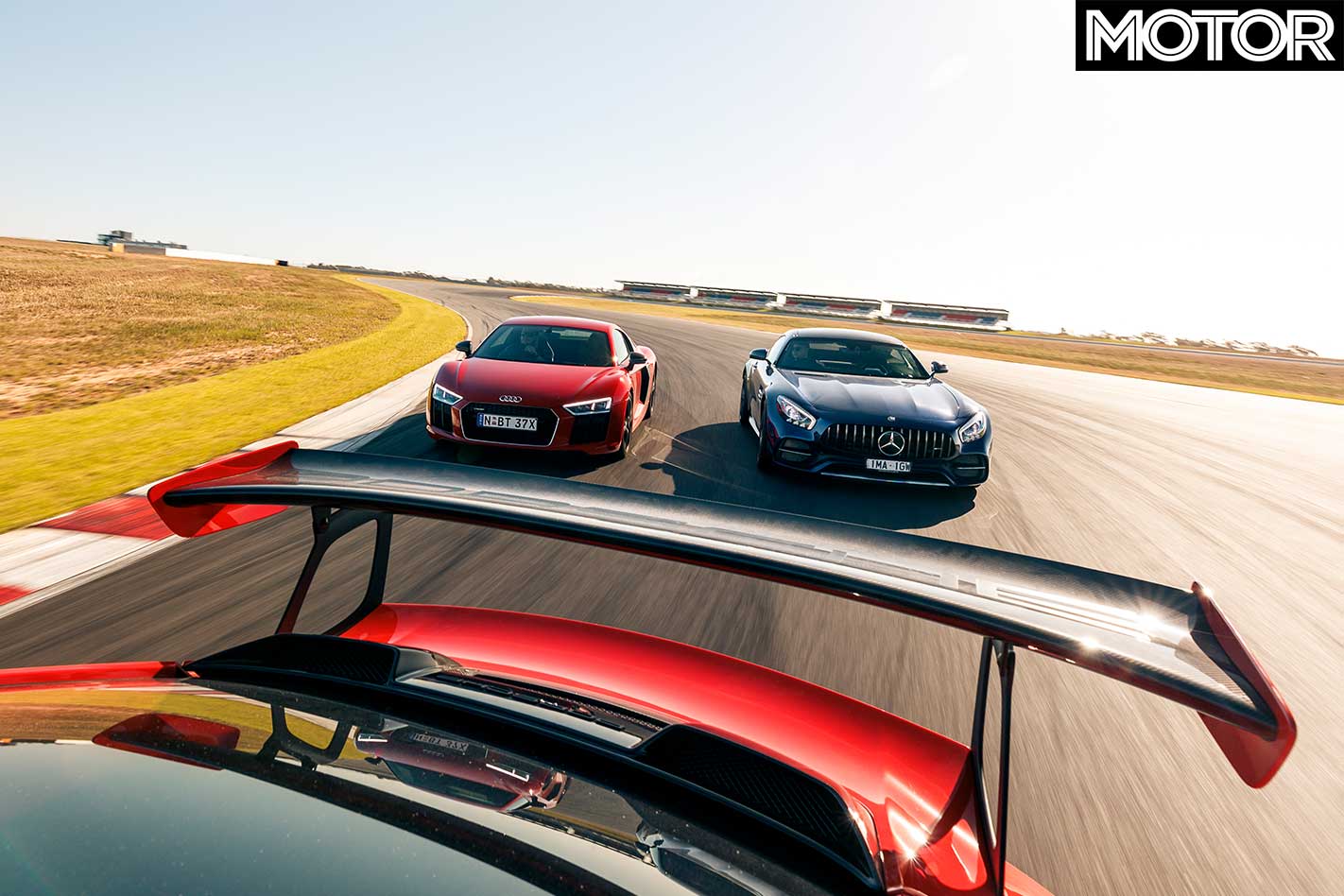
Fresh tarmac, number crunching and drifts for the camera – we head to The Bend Motorsport Park, where our contenders need to impress both the judges and the stopwatch.
The Judges
Dylan Campbell – Editor
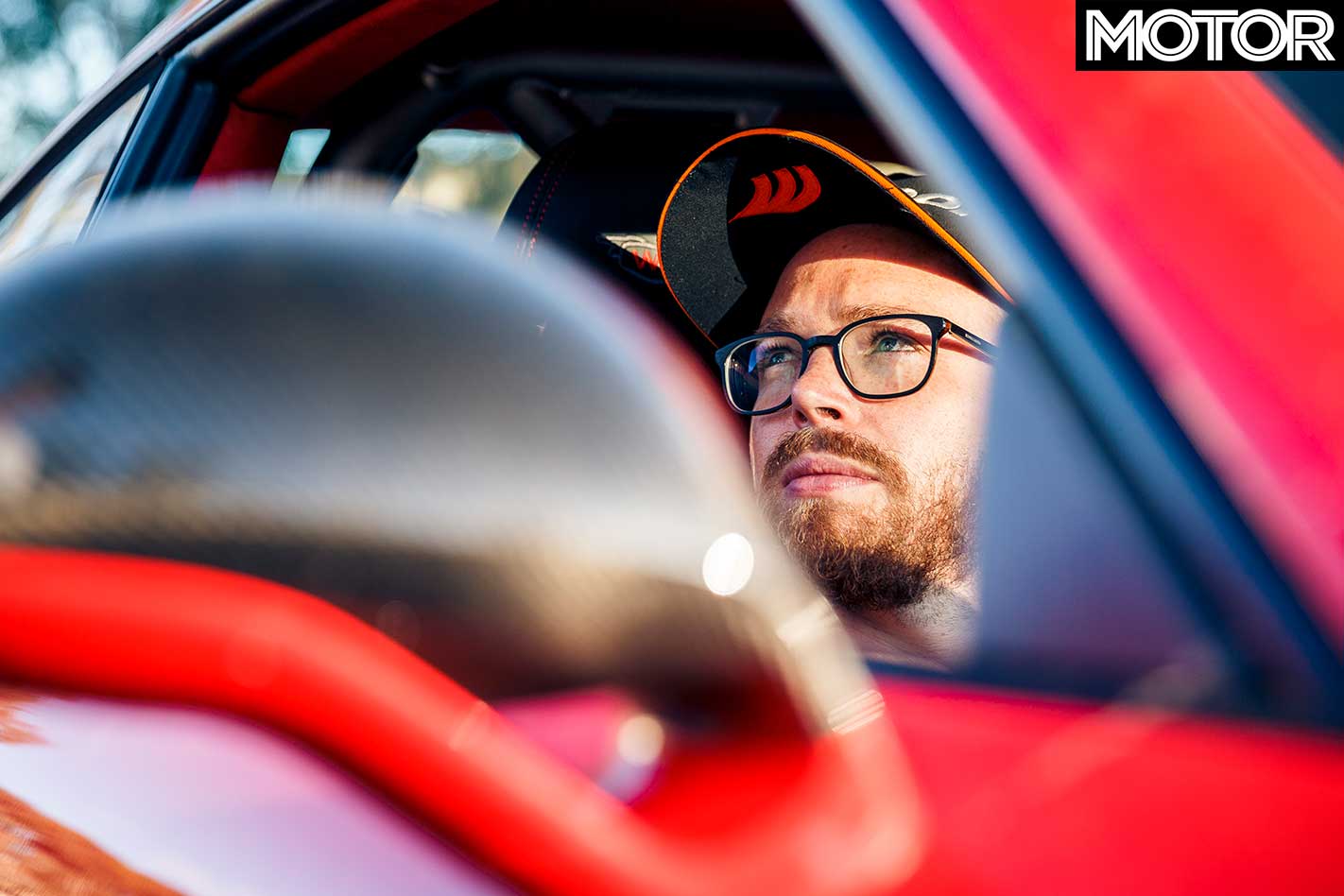
Dylan, or ‘DC’, has had the helm at MOTOR for a few years now, and has plenty of experience with fast things on four wheels.
Scott Newman – Associate Editor
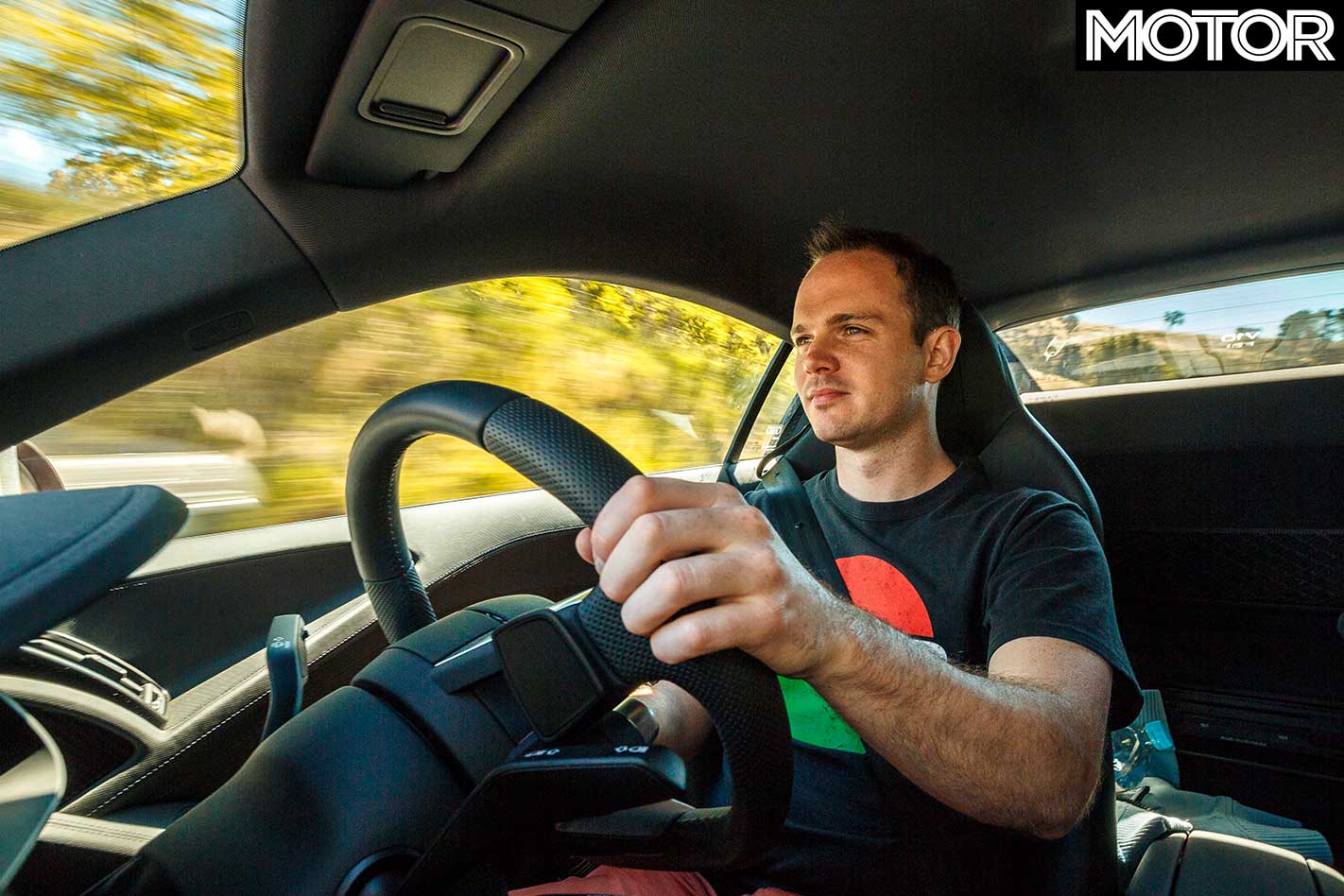
Scott’s usually the man behind the wheel for our action shots, and he’s regularly tasked with getting the best 0-100km/h run, quarter mile time, and braking distance for the PCOTY field.
His Instagram handle is @addictedtosliding, which says it all, really.
David Morley – Contributor and PCOTY veteran
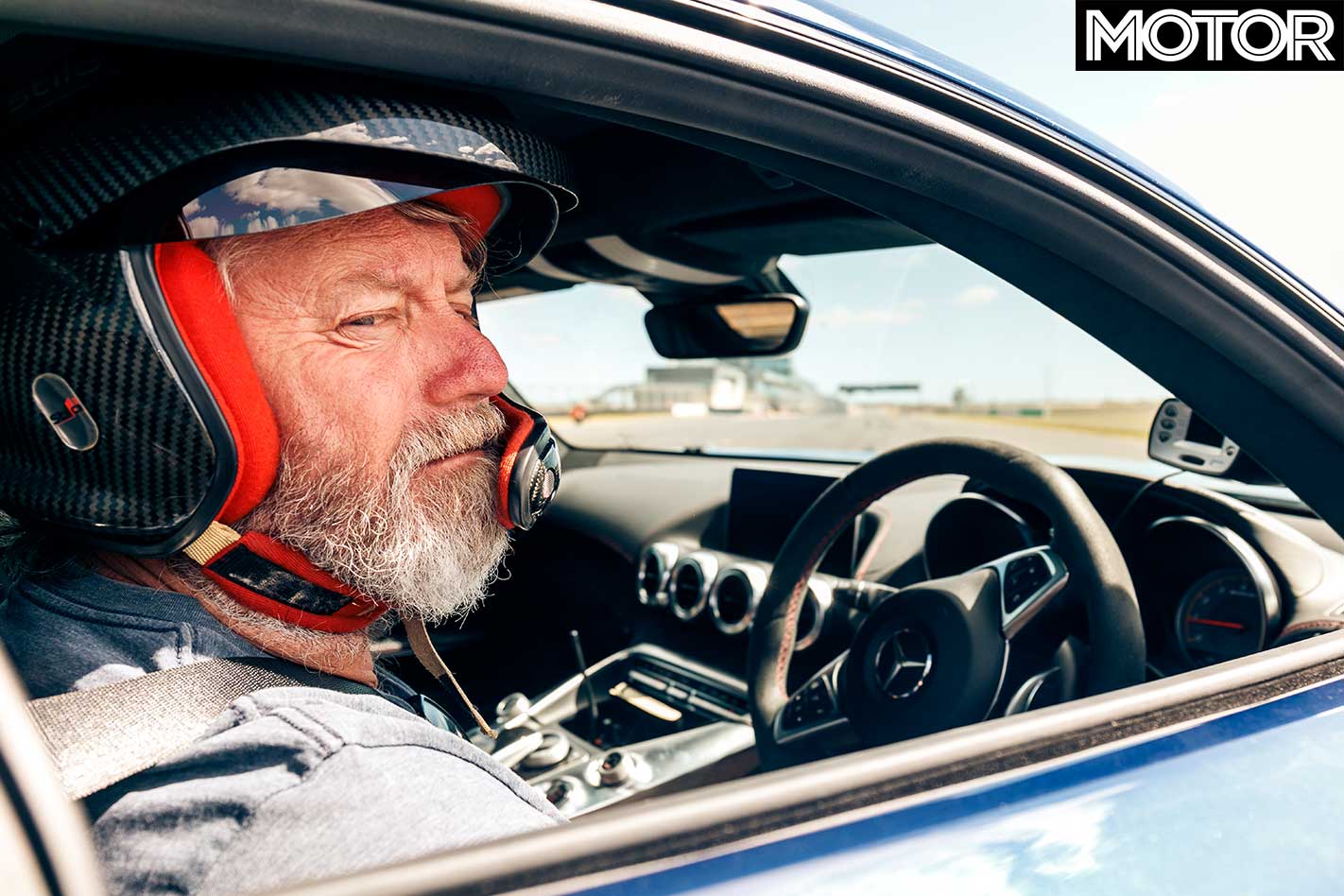
Morley’s been testing cars since before some of MOTOR’s journalists were born. That’s not a joke.
Decades of experience and an appreciation for how engineering has progressed have made Morley a perfect judge of a vehicle’s technical aspects, plus he can drive. Well.
Louis Cordony – Journalist
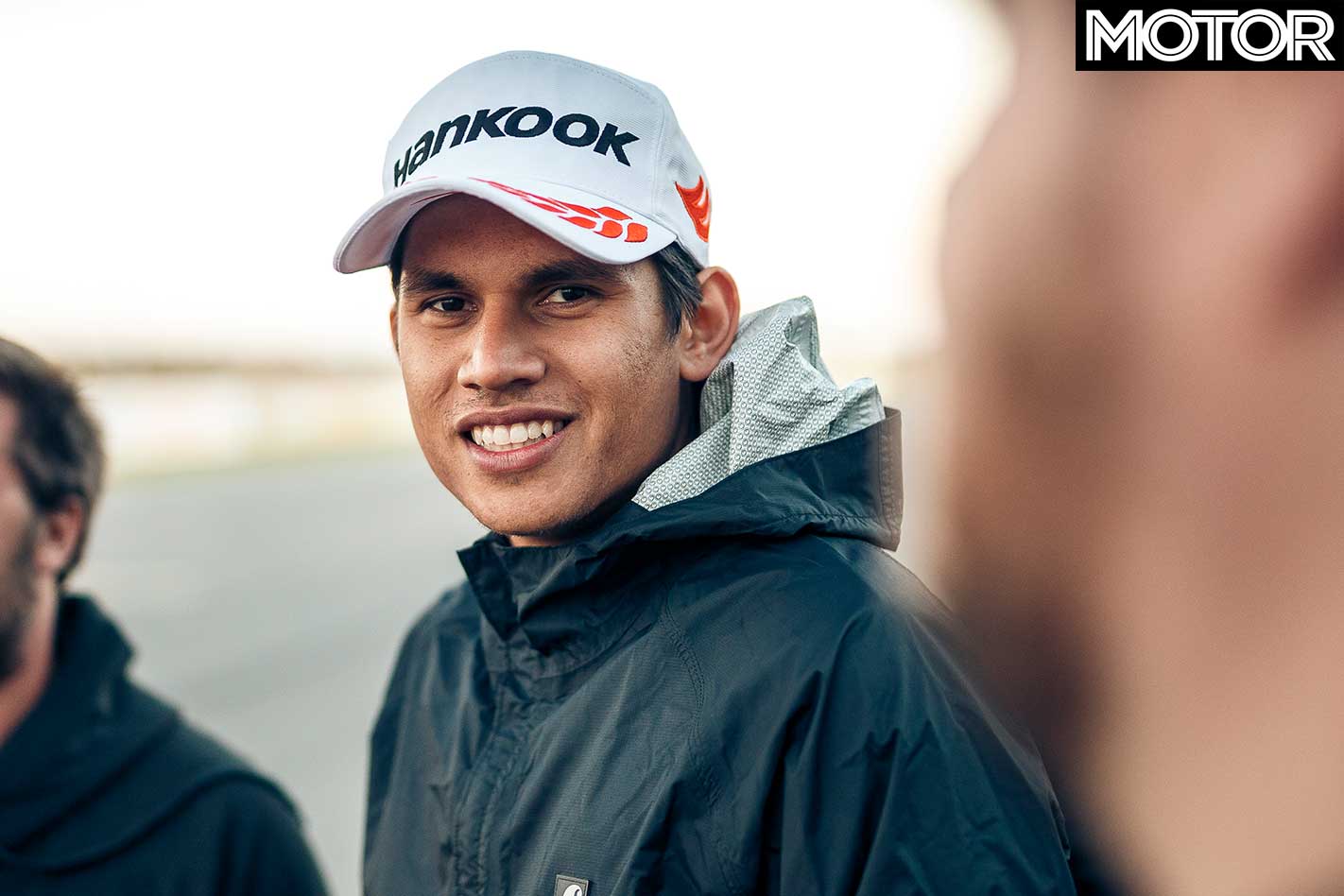
This is Louis’s first time as a PCOTY judge, but it’s certainly not his first time at PCOTY. Louis has been at MOTOR for a few years, plenty of time to drive everything that comes through the garage.
The Driver: Rick Kelly
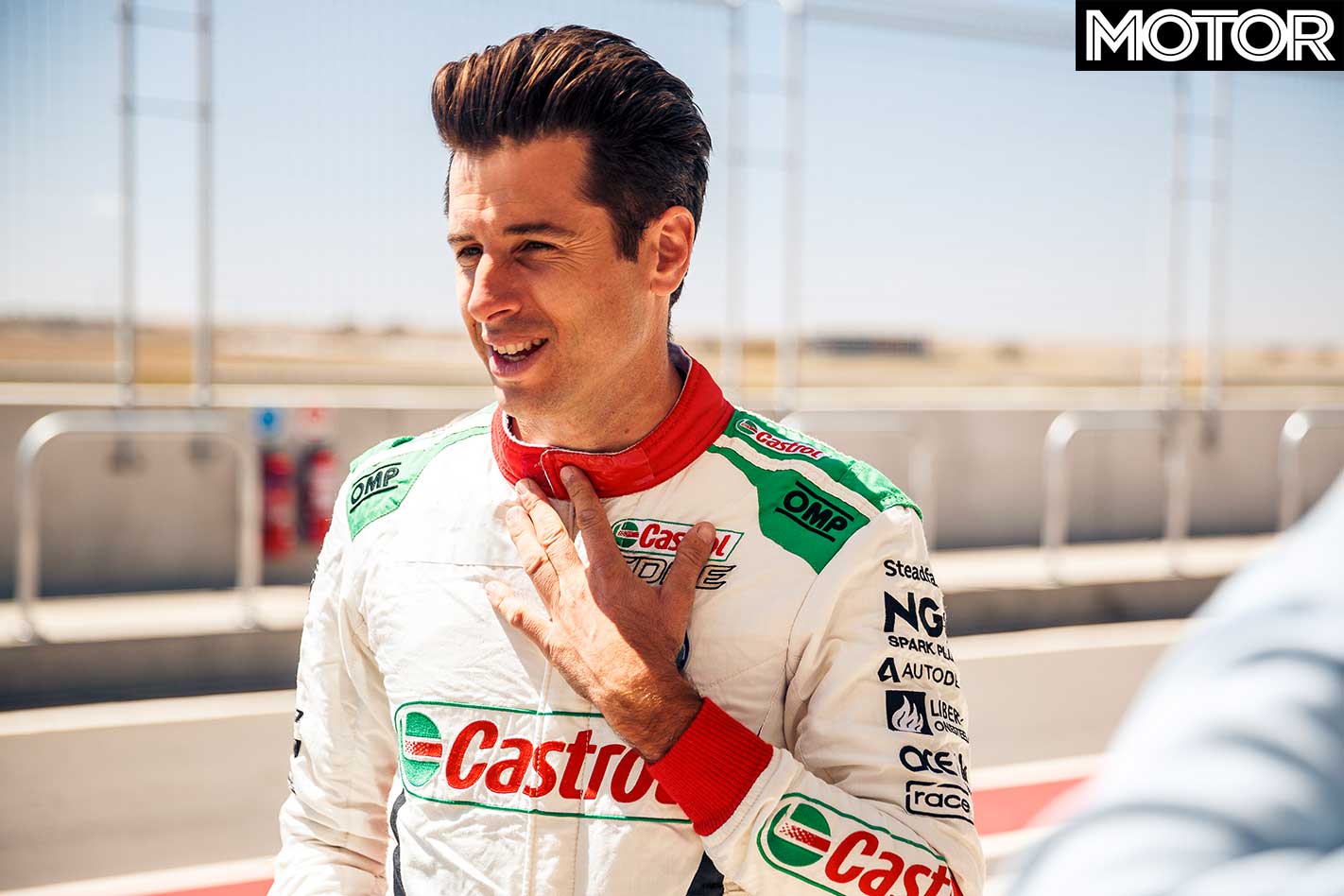
He’s had three Bathurst podiums, two of those on the top step in 2003 and ‘04, and took out the championship on 2006. We reckon he’s more than qualified to be the man setting our lap times at The Bend.
Holden is taking a hit as it restructures some of its passenger car line-up to focus on SUVs, but the Colorado ute is already on the way up.
Slipping to tenth spot on the ladder in March, the Lion Brand is picking up some of the pieces to rebuild itself as old faithfuls like the Commodore and Astra continue to drop market share. First quarter-2019 sales figures show the Colorado has enjoyed the strongest sales increase quarter-on-quarter of any model in the hugely popular combined 4×4 and 4×2 ute segment. It’s a win for the a brand that’s battling against tight pockets, with the car market down 7.1 percent overall.
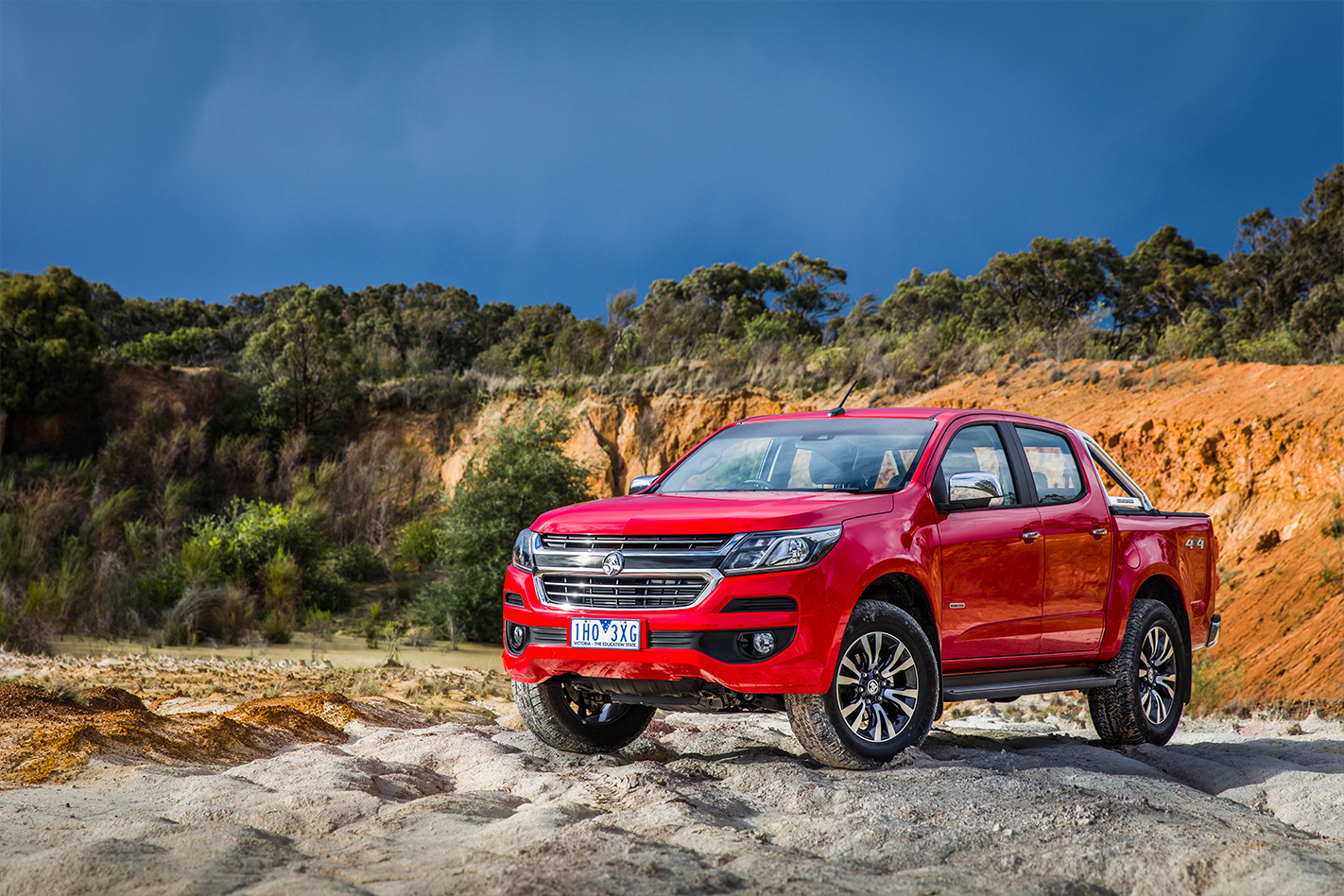
Sitting fourth for outright sales in the class behind the sales-leading Toyota Hilux, Ford Ranger and rejuvenated Mitsubishi Triton, Holden says the Colorado has not reached its full potential, with plenty of blue sky to tap into.
“Holden is a challenger brand in SUVs and light commercials,” a spokesperson for the brand told Wheels.
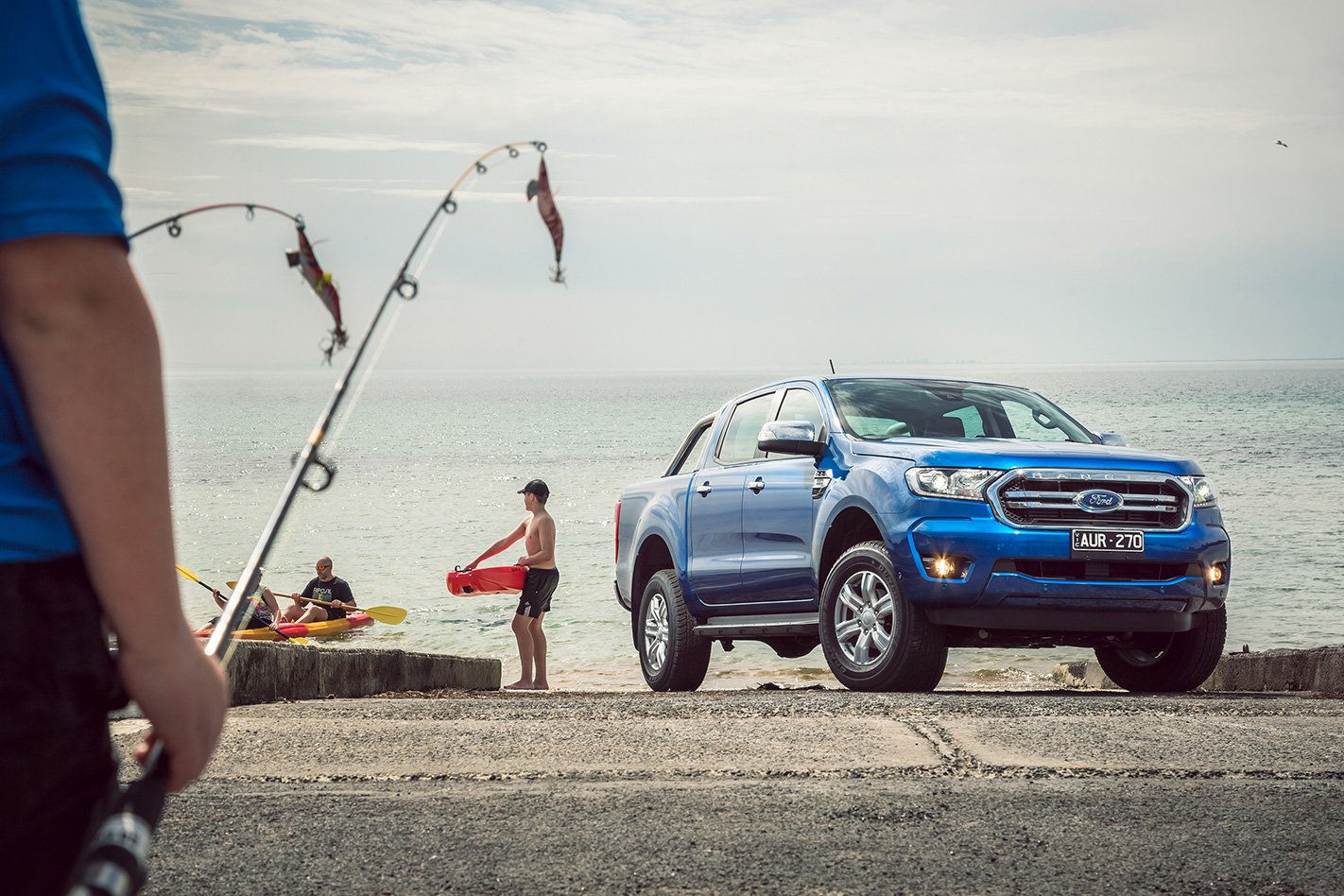
“The Colorado is a highly competitive product in its segment across all measures, and is a very important vehicle for Holden. We have always believed Colorado is a very capable truck, not yet reaching its full sales potential.”
Rising 14.4 percent in Q1 2019 compared to the same time last year, the Colorado leads the ute pack in terms of growth, only just ahead of the new-look Triton that gained 13.1 percent over the same period with 2666 units registered last month.
VFACTS figures for March have the Colorado 936 units short of toppling Triton for third spot. The Hilux and Ranger are safely in first and second, selling 4431 and 3721 apiece, but Ford has taken a hit with its recently updated Ranger. Despite positive gains for Toyota, Mitsubishi and Holden in the combined 4×4 and 4×2 segment, the Ranger has tanked, recording a 12.5 percent drop in sales compared to the same period last year.
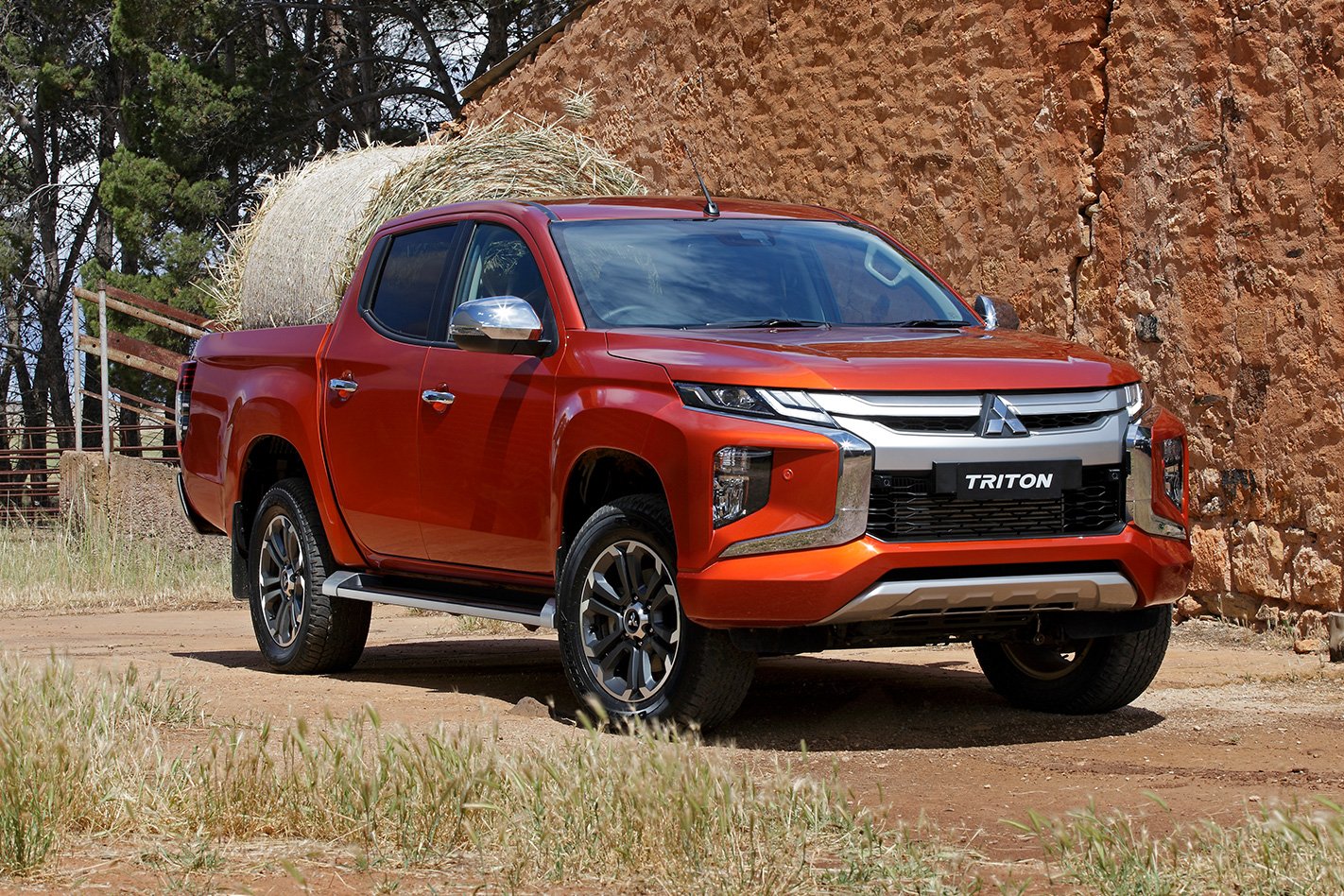
The strong result for the Colorado is part of a new plan, according to Holden, which bills itself as a challenger brand taking on the pick-up and SUV market anew.
“We are seeing some good response to our Colorado go-to-market plans, and we are focused on building on this encouraging response as we target increased Colorado sales,” said the spokesperson.
“As we have said before, we are a challenger brand in pick-ups and SUVs. We have a great portfolio of pick-ups and SUVs and we are focused on letting more and more people know about our range.
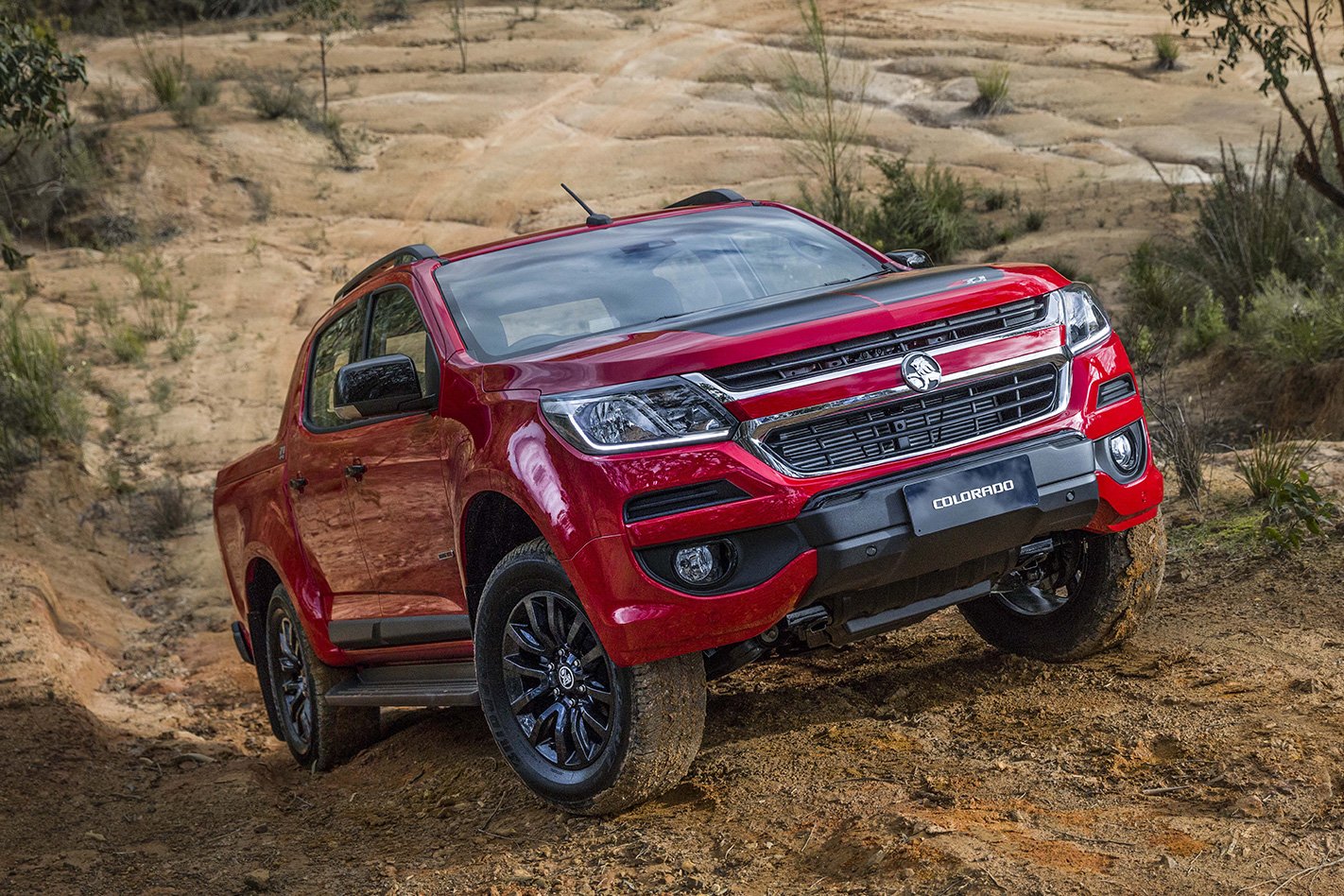
“Increasing consideration among pick-up and SUV intenders is crucial to getting our overall sales where they need to be.”
Holden also told Wheels to ‘watch this space,’ as it concentrates different demographics within the Colorado’s broad appeal.
The hit on Ranger sales could be a sign of customers switching over to sharp-price rivals like the Triton and Colorado, though the Hilux, with its huge fleet sales, remains as steady as an ox.
Despite Holden’s Elizabeth production line falling still in October 2017, there remains a handful of Aussie-built Commodores that are yet to be sold.
Just nine Holden VF Commodores remain in stock according to a Holden spokesperson. And the best bit? Each of them has a V8 under the bonnet.
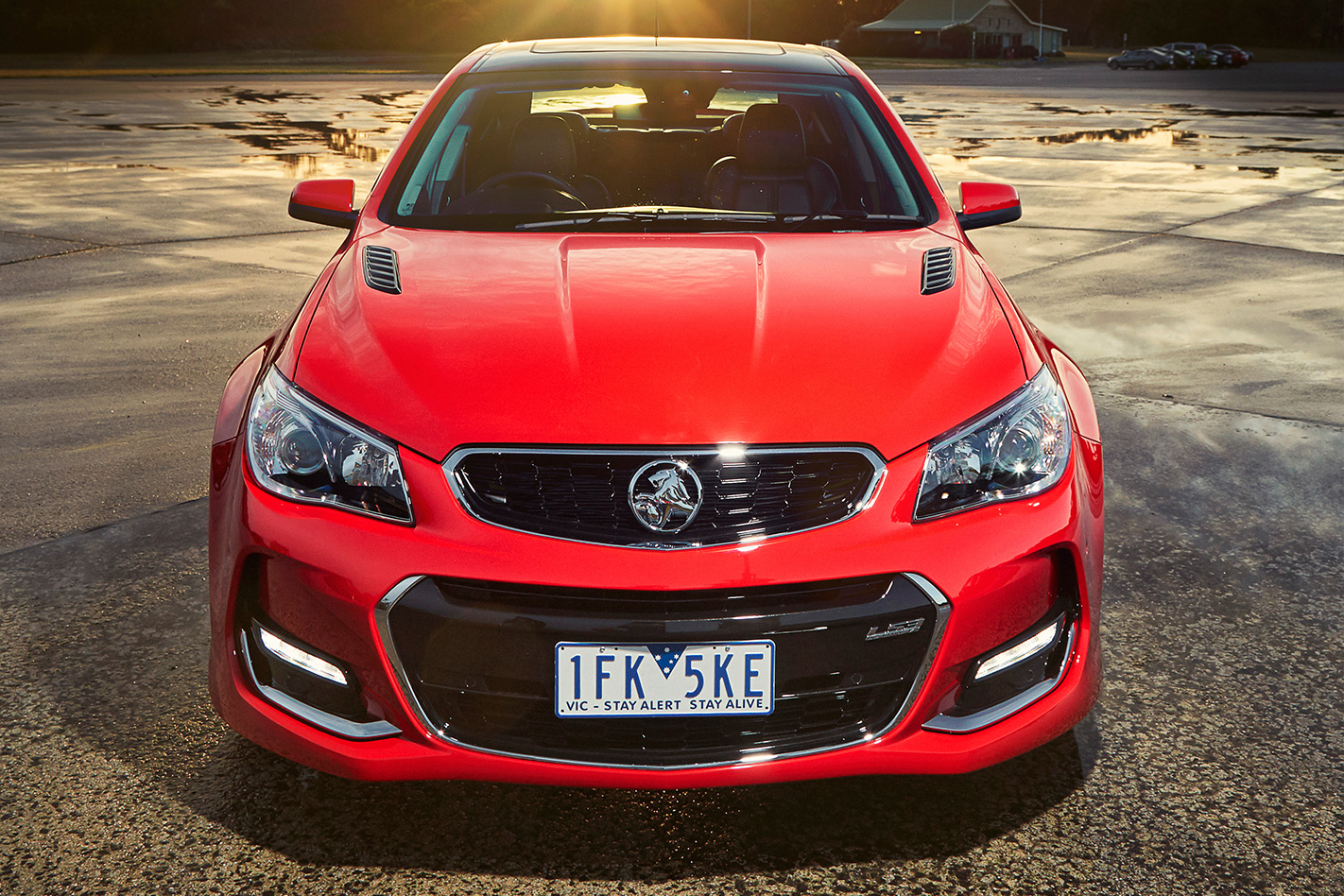
According to VFACTS, Holden sold 19 locally manufactured vehicles in March, for a YTD figure of 36 registrations. In Holden’s first full year after local manufacturing ceased, it registered 2765 Aussie-built vehicles.
A Wheels source confirmed that there wasn’t a single VF Commodore with a V8 engine and manual transmission combo left in stock.
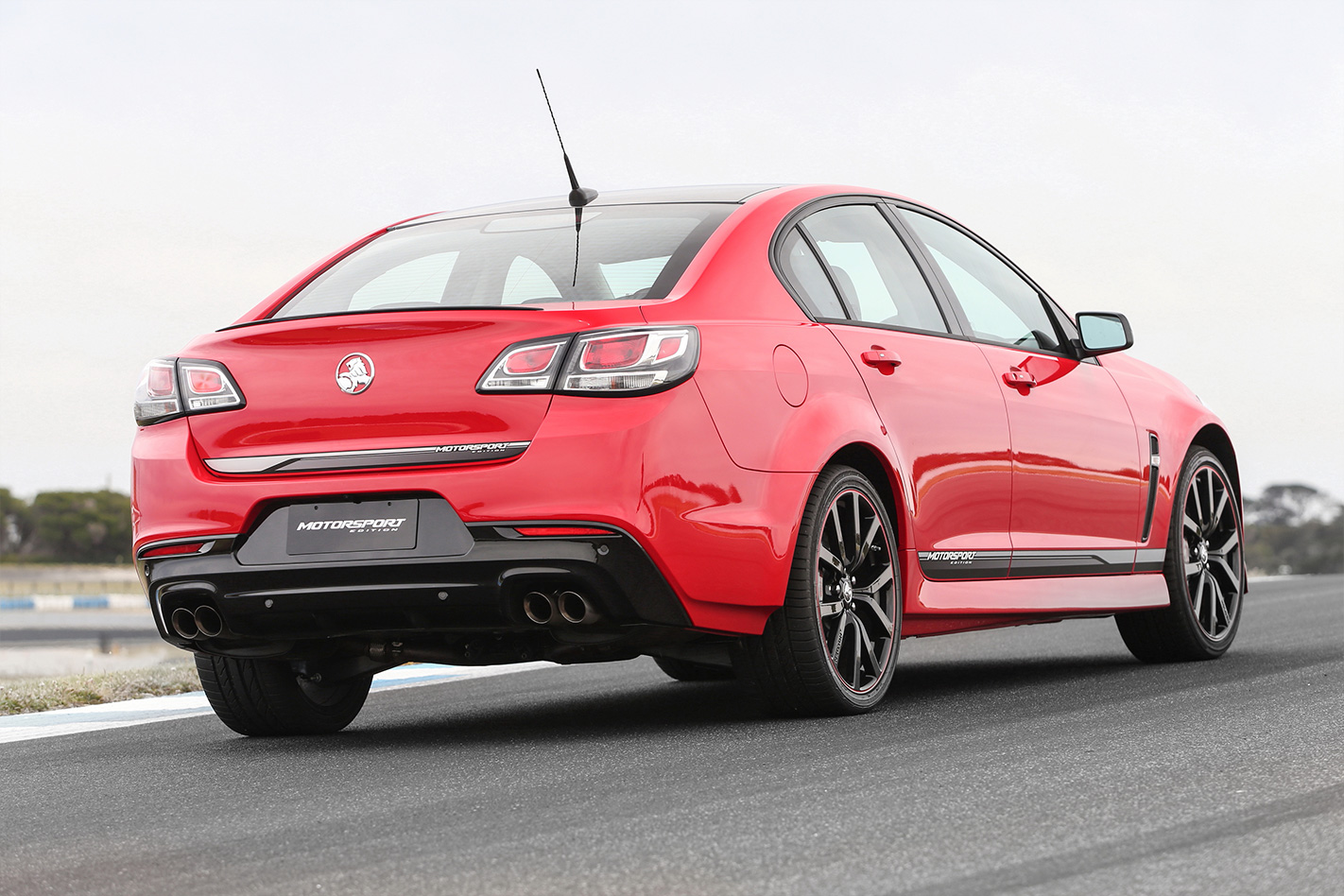
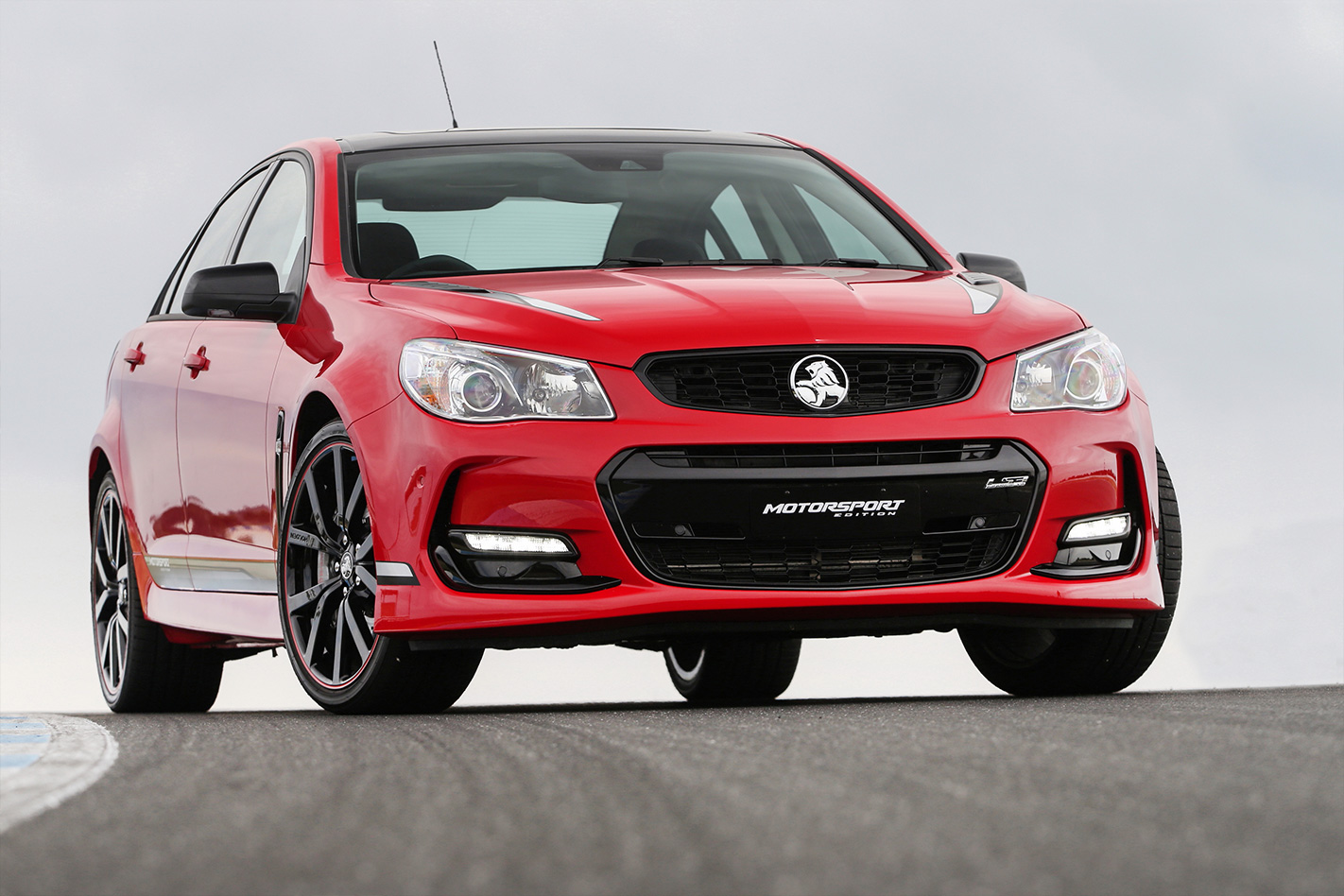
Four of the remaining cars are SS V Redline sedans (one in ‘Red Hot’, one in ‘Phantom Black’, one in ‘Slipstream Blue’, and one in ‘Heron White’), while a pair of Motorsport Edition (MSE) sedans remain available, in ‘Heron White’ and ‘Red Hot’.
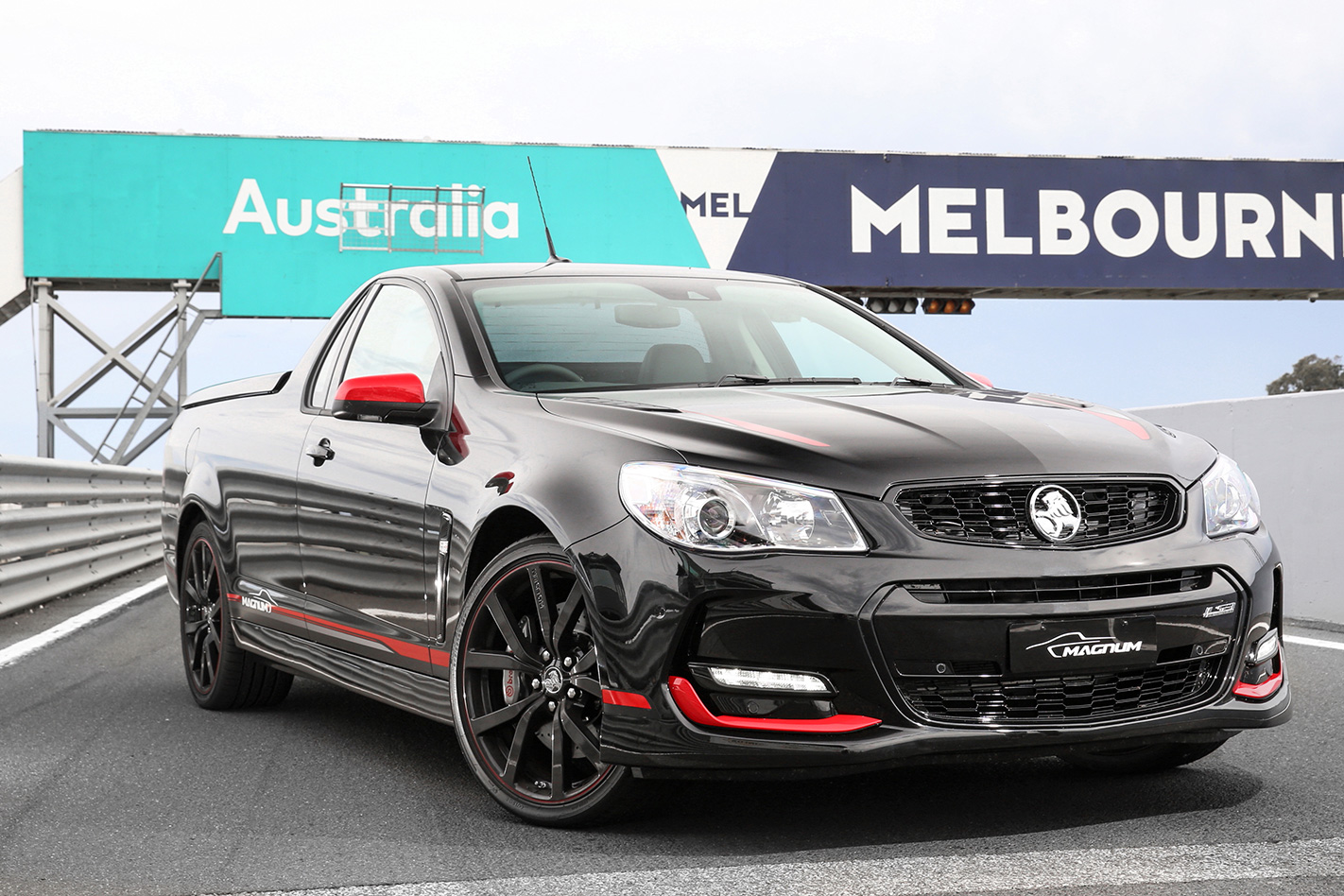
Fans of the V8-powered ute can rejoice, with just a single example remaining in stock, a Magnum special edition, in ‘Phantom Black’. The two others are Directors in ‘Heron White’.
Buyers in Queensland, South Australia, Tasmania, the Northern Territory, and Australian Capital Territory are out of luck, with the remaining cars limited to New South Wales, Western Australia, and Victoria.
A Victorian dealer is responsible for the ‘Red Hot’ MSE sedan, while Western Australian dealers have the two Directors. The remaining cars are all located in New South Wales.
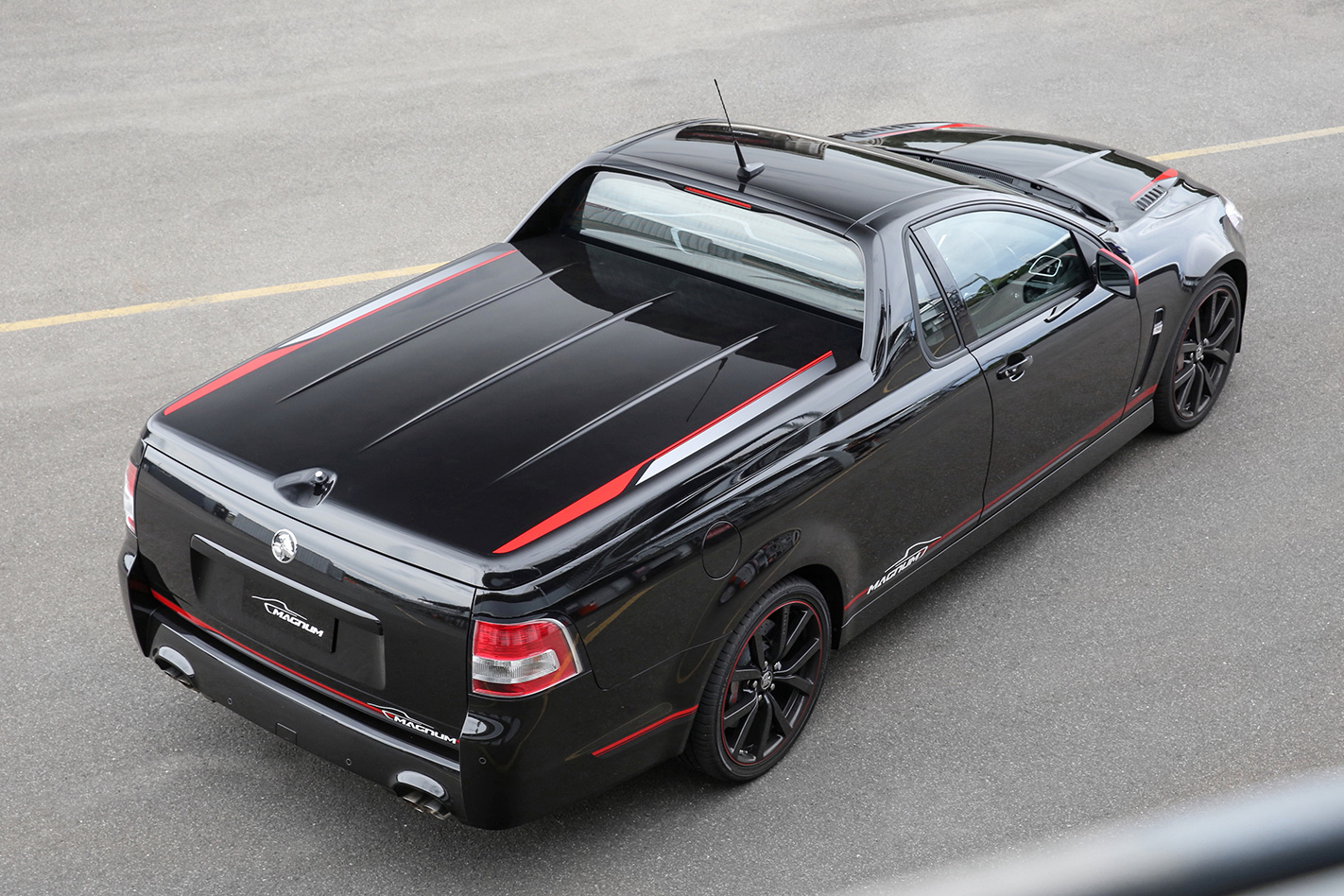
Holden built 1200 MSE sedans, and 240 Magnum utes to farewell the VF Commodore, and only 174 ‘Red Hot’ MSE sedans were built with automatic transmissions, while 173 self-shifting ‘Heron White’ sedans rolled off the production line. The ‘Phantom Black’ Magnum ute is even rarer, with just 39 automatics being built in the limited production run.
Each of the limited edition models are individually numbered and received upgrades to their suspension and drivetrain which grants them General Motors’ coveted Track Three Competent status, which is traditionally reserved for halo models like the supercharged Camaro ZL1.
MSE sedans differ from SS V Redlines thanks to the addition of magnetorheological dampers, a new rear cradle bush, cross-drilled brake rotors front and rear, and a driveline cooling package which includes engine-oil and transmission-oil coolers taken from the Camaro ZL1.
Magnum utes missed out on the Magnetic Ride Control, but received the same braking and cooling upgrades, as well as a new suspension tune which lowers ride height by 15mm and softens rear spring rates by 26 percent.
The Magnum ute retailed for $61,490 when it was released, while MSE sedans cost $63,990.
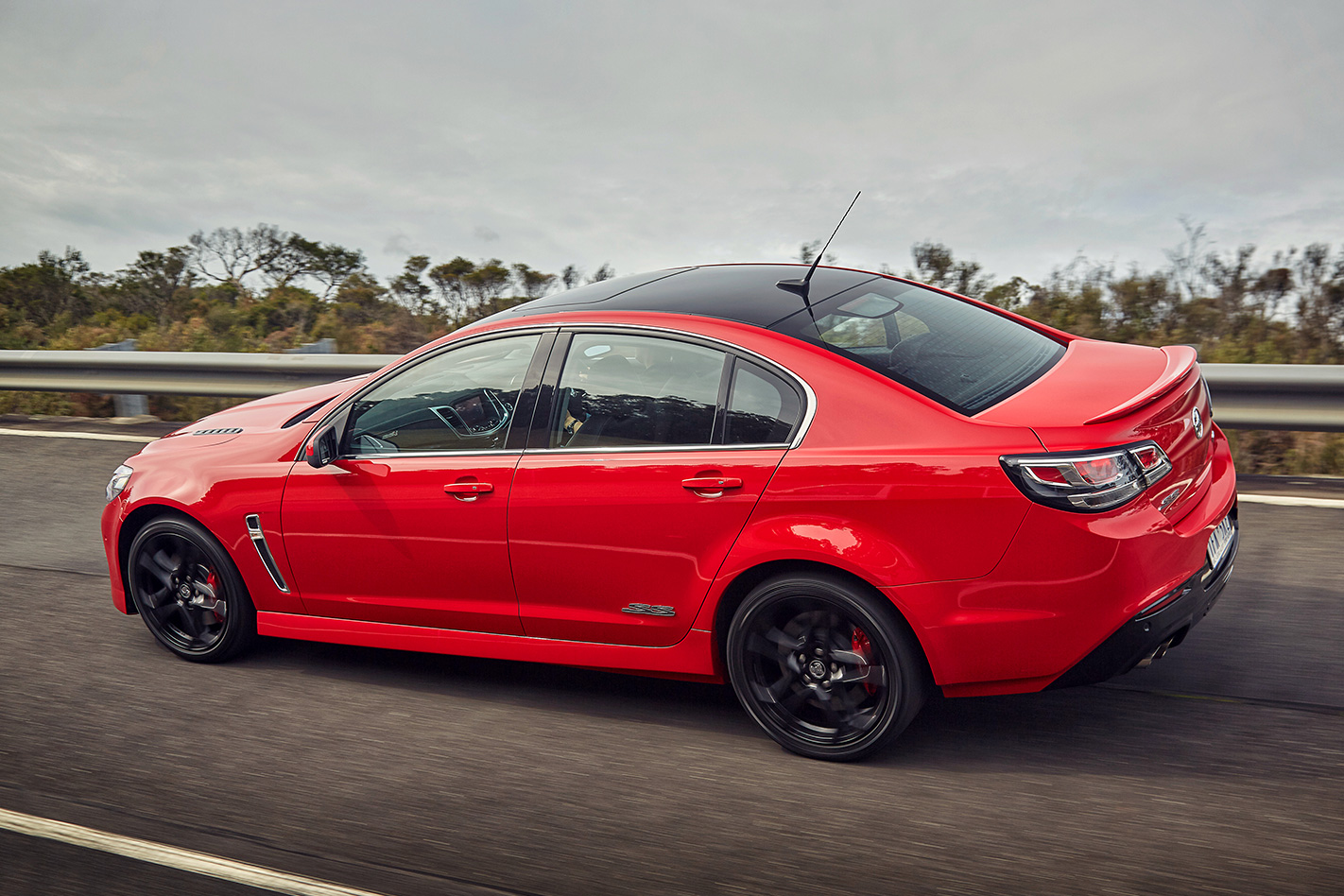
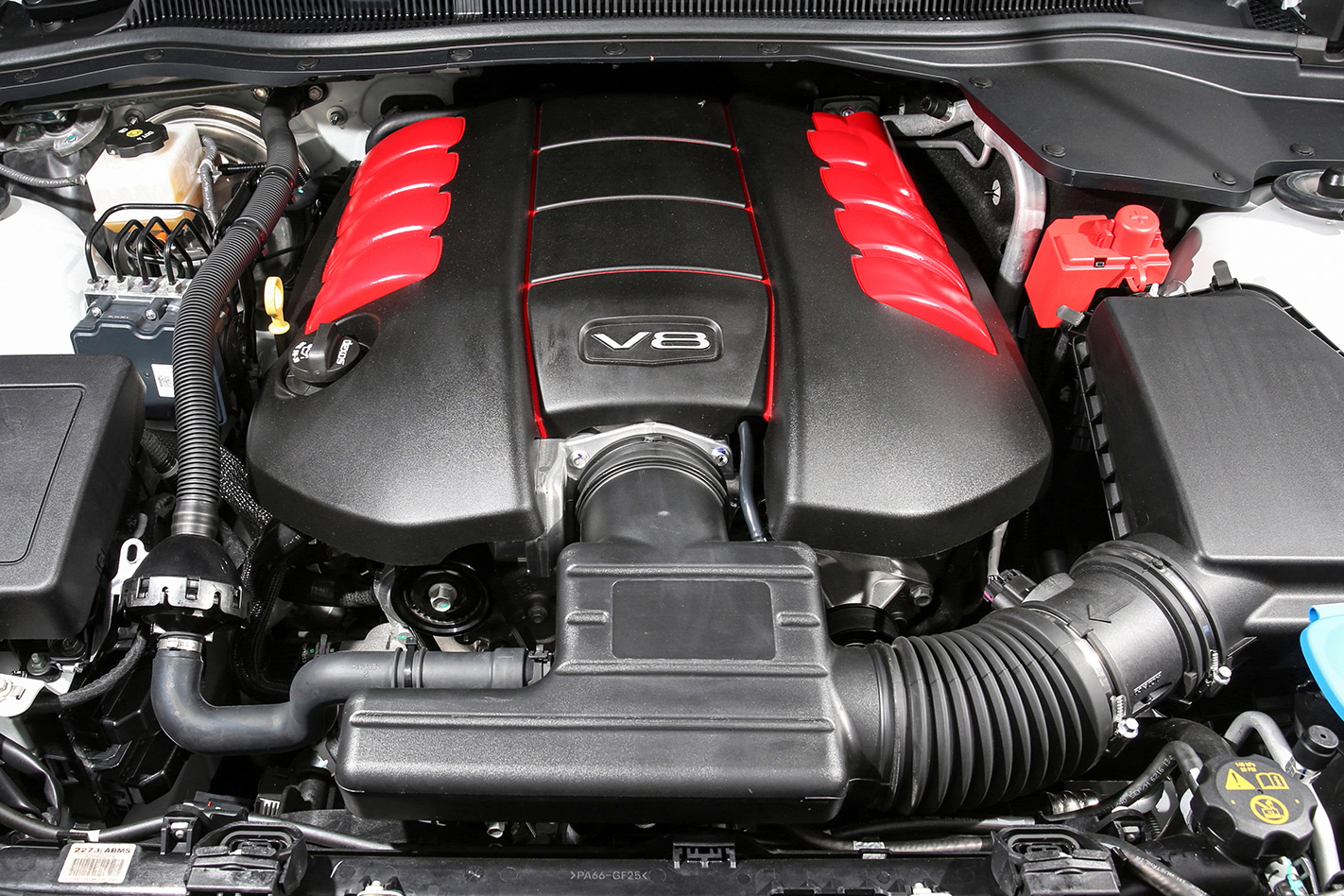
Holden’s last ‘regular’ V8-powered Commodore was the SS V Redline, which had an LS3 6.2-litre naturally-aspirated bent-eight which pumped 307kW and 570Nm to the rear treads via either a six-speed manual or six-speed automatic transmission.
Our sister publication, Motor, reported last year that some dealers were adding over $5000 to the asking price of remaining VF Series II SS V Redline models.
At the end of its life, a Series II SS V Redline sedan had a recommended retail price (RRP) of $54,990 plus on-road costs for both manual and automatic transmissions.
Holden as a manufacturer no longer has any VF Commodores in its possession, with dealers responsible for all remaining stock. Our source explained that there could be a handful of VF Commodores still hidden beyond what was showing up in internal searches, with any cars listed as demos hidden from the prying eyes of rival dealers.
The news of the remaining cars confirms that every Sportswagon, regular ute, Calais and Caprice has now been sold.
The last Ford Falcon took two years to sell; with a blue XR8 sprint only being discovered after a dealership was sold.
Westpoint Ford in Melbourne changed hands in 2018, with the previous owners planning to hang onto the supercharged V8 sedan, and keeping it stored in a warehouse. It was only discovered after the new owners did a stock take of the dealership’s inventory.
That vehicle was purchased by the team from Premcar, and will be converted to ‘GT Holy Grail’ specification, which includes upgrading the drivetrain to cope with the 483kW/753Nm package. Despite the extra grunt, it’s unlikely the last Falcon ever sold will add any extra kilometres to its 58km odometer reading.
The Falcon Ute didn’t take as long to sell out, with the last iteration of the Blue Oval’s car-based workhorse being shifted in October, 2017.
With just single digits remaining, it won’t be long until every Aussie-built car is finally sold.
Despite Holden’s Elizabeth production line falling still in October 2017, there remains a handful of Aussie-built Commodores that are yet to be sold.
Just nine Holden VF Commodores remain in stock according to a Holden spokesperson. And the best bit? Each of them has a V8 under the bonnet.
According to VFACTS, Holden sold 19 locally manufactured vehicles in March, for a YTD figure of 36 registrations. In Holden’s first full year after local manufacturing ceased, it registered 2765 Aussie-built vehicles.
A Wheels source confirmed that there wasn’t a single VF Commodore with a V8 engine and manual transmission combo left in stock. Of the nine that Holden says are yet to be sold, only seven show up in dealer searches.
Four of the remaining cars are SS V Redline sedans, while a pair of Motorsport Edition (MSE) sedans remain available, in red and white respectively.
Fans of the V8-powered ute can rejoice, with just a single example remaining in stock, a Magnum special edition, in black.
Holden built 1200 MSE sedans, and 240 Magnum utes to farewell the VF Commodore, and only 174 ‘Red Hot’ MSE sedans were built with automatic transmissions, while 173 self-shifting ‘Heron White’ sedans rolled off the production line. The ‘Phantom Black’ Magnum ute is even rarer, with just 39 automatics being built in the limited production run.
Each of the limited edition models are individually numbered and received upgrades to their suspension and drivetrain which grants them General Motors’ coveted Track Three Competent status, which is traditionally reserved for halo models like the supercharged Camaro ZL1.
MSE sedans differ from SS V Redlines thanks to the addition of magnetorheological dampers, a new rear cradle bush, cross-drilled brake rotors front and rear, and a driveline cooling package which includes engine-oil and transmission-oil coolers taken from the Camaro ZL1.
Magnum utes missed out on the Magnetic Ride Control, but received the same braking and cooling upgrades, as well as a new suspension tune which lowers ride height by 15mm and softens rear spring rates by 26 percent.
The Magnum ute retailed for $61,490 when it was released, while MSE sedans cost $63,990.
Holden’s last ‘regular’V8-powered Commodore was the SS V Redline, which had an LS3 6.2-litre naturally-aspirated bent-eight which pumped 307kW and 570Nm to the rear treads via either a six-speed manual or six-speed automatic transmission.
Our sister publication, Motor, reported last year that some dealers were adding over $5000 to the asking price of remaining VF Series II SS V Redline models.
At the end of its life, a Series II SS V Redline sedan had a recommended retail price (RRP) of $54,990 plus on-road costs for both manual and automatic transmissions.
Holden as a manufacturer no longer has any VF Commodores in its possession, with dealers responsible for all remaining stock. Our source explained that there could be a handful of VF Commodores still hidden beyond what was showing up in internal searches, with any cars listed as demos hidden from the prying eyes of rival dealers.
The news of the remaining cars confirms that every Sportswagon, regular ute, Calais and Caprice has now been sold.
The last Ford Falcon took two years to sell; with a blue XR8 sprint only being discovered after a dealership was sold.
Westpoint Ford in Melbourne changed hands in 2018, with the previous owners planning to hang onto the supercharged V8 sedan, and keeping it stored in a warehouse. It was only discovered after the new owners did a stock take of the dealership’s inventory.
That vehicle was purchased by the team from Premcar, and will be converted to ‘GT Holy Grail’ specification, which includes upgrading the drivetrain to cope with the 483kW/753Nm package. Despite the extra grunt, it’s unlikely the last Falcon ever sold will add any extra kilometres to its 58km odometer reading.
The Falcon Ute didn’t take as long to sell out, with the last iteration of the Blue Oval’s car-based workhorse being shifted in October, 2017.
With just single digits remaining, it won’t be long until every Aussie-built car is finally sold.
Welcome once again to the latest episode of the WhichCar Weekly podcast!
In this week’s episode MOTOR Associate Editor Scott Newman is joined by Wheels Editor Alex Inwood and Wheels Online Editor Alex Rae. We kick off by chatting about Alex I’s recent experience in New Zealand driving the Rodin (1:02), an F1 car you can buy to become a track day king.
Talk then turns to mandatory speed limiters for all new cars (12:01), which has been adopted in Europe from 2022 and Alex R. reveals Australia is set to quickly follow. Scott has a rant about automotive April Fool’s jokes (21:15) which seem to get less amusing every year and we wrap up with news that Western Australia has become the first state to ban the registration of cars that haven’t had their Takata airbags replaced (25:20).
If you’re listening on the go you can catch WhichCar Weekly on the iTunes or Podbean apps, please subscribe and leave us a rating and a review! You can also follow the day-to-day antics of the WhichCar crew @whichcarau on Facebook, Twitter or Instagram.
Listened to the show? Help us out:
- Leave a note in the comment section below.
- Leave a review on Apple Podcasts/iTunes
- Subscribe to our podcast
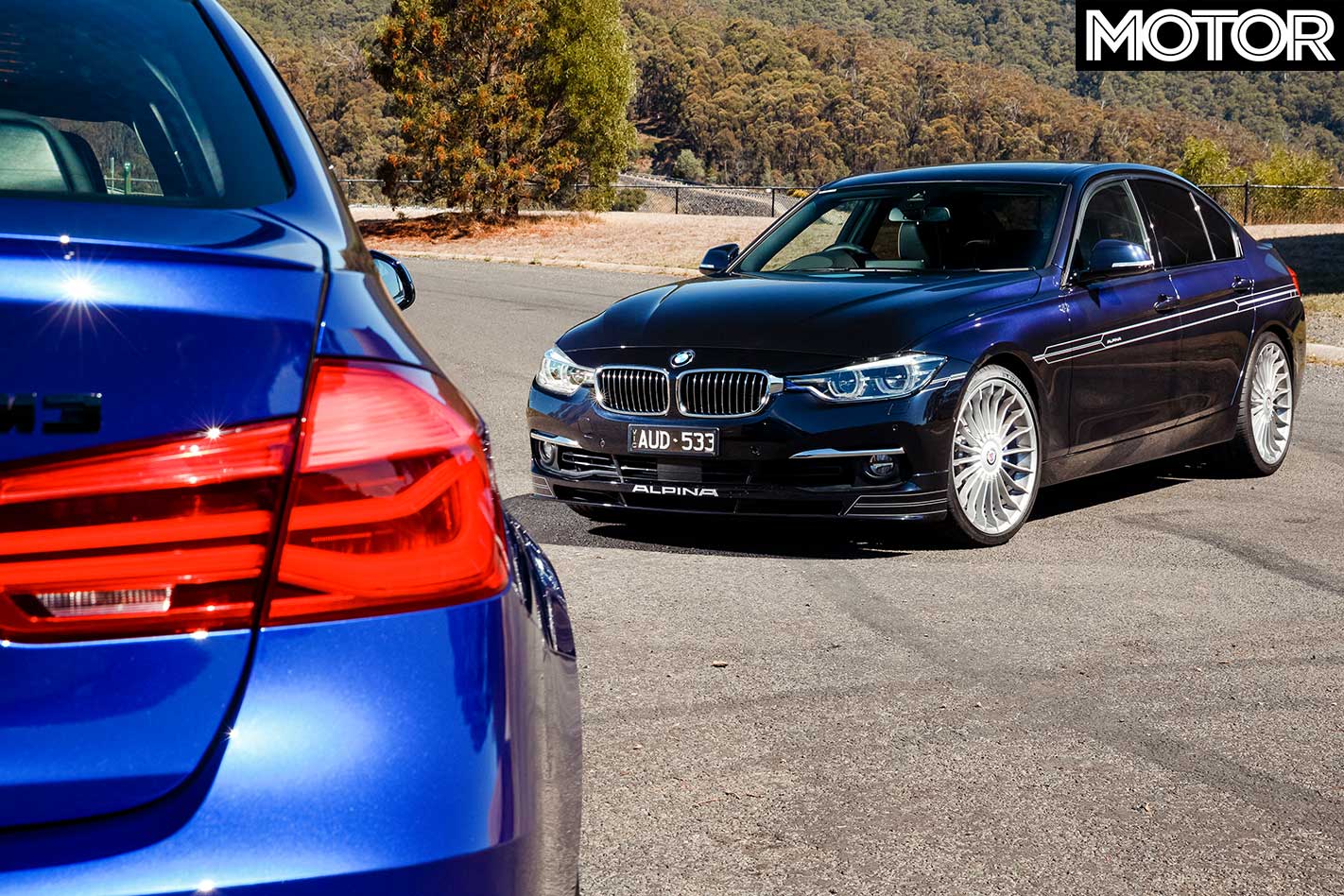
Pricing for the 2018 Alpina B3 Biturbo S has dropped significantly to round out the last few models available in dealers around Australia.
The current generation, based on the BMW F30 3 Series, is set to make way for the new G20-based B3 S, likely later this year.
To make sure there’s space for a new round of low-volume luxury cars, Alpina Australia has dropped the pricing for the B3 S from $142,900 before fees and on-road costs to $116,990 drive-away.
With options, a B3 S could cost almost $160,000, so a price drop this significant is indicative of how quickly the brand needs to shift its cars to make way for the new stock.
Closely related to the B3 S, the Alpina B4 S coupe is also copping a price cut, down to $123,990 drive-away. Previously, a B4 S would set buyers back at least $149,900 from the showroom before on-road costs.
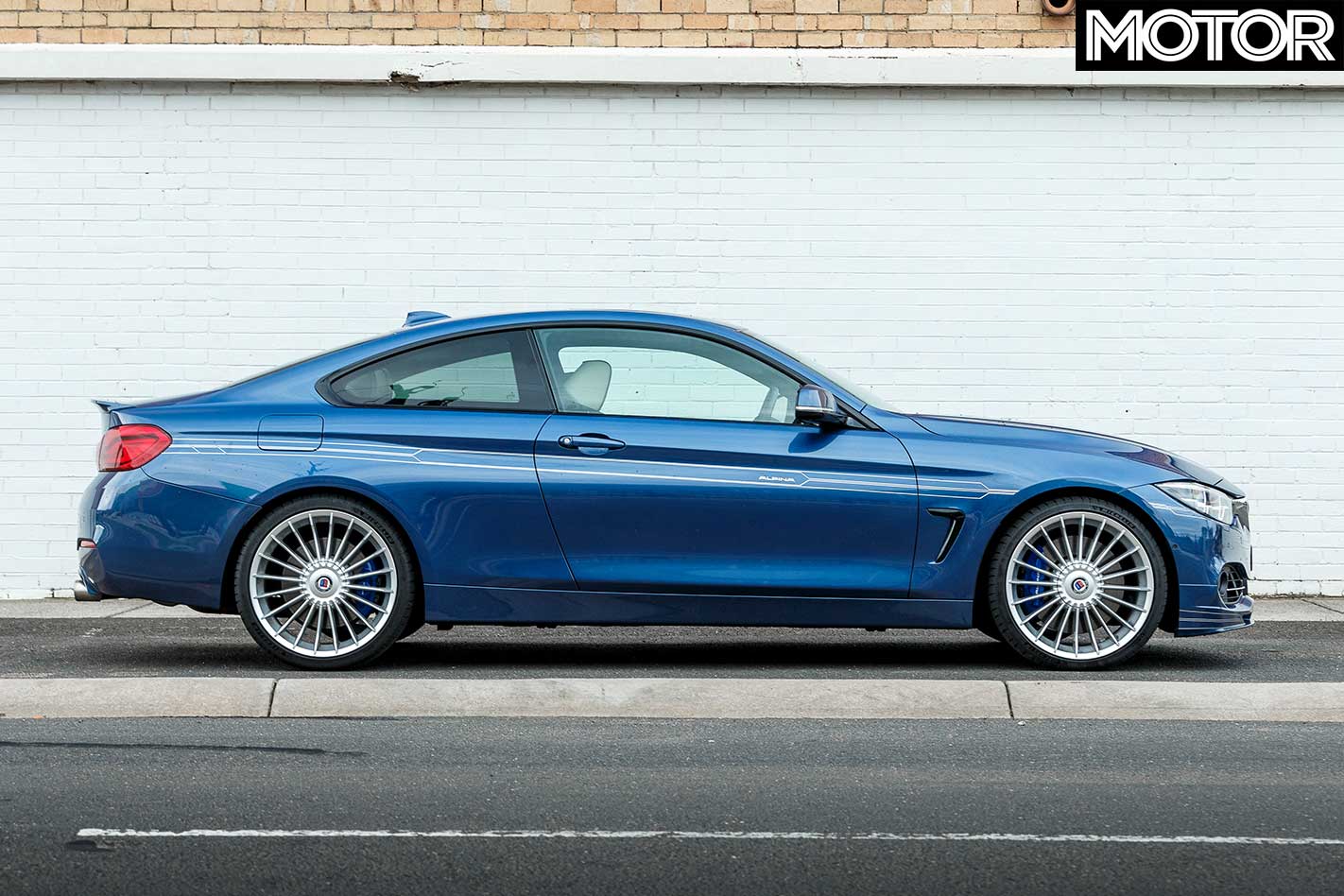
Only a handfuls of Alpina B3 S and B4 S units are left up for grabs in Australia, as the traditionally boutique brand doesn’t tend to maintain a high stock count.
Those who manage to secure one of the remaining models will find themselves with access to near-BMW M3 levels of performance in a more demure package, with 324kW and 660Nm from a BMW twin-turbo 3.0-litre inline six.
As is normally the case, this is down on power but up on torque from the M3’s 331kW and 550Nm, in an effort to build a more useable car with plenty of torque on tap without being ‘peaky’.
Alpina’s reputation for creating plush BMW-based cars has built more slowly in Australia, where the brand is still known primarily within enthusiast circles, but rarely outside of them.
With the all new Genesis G70 sports sedan due in June, Hyundai Australia’s announcement of the arrival of “the New Genesis G80 Sedan” made us look twice until we realised it’s just a facelift and name change for its luxury sedan that first landed here back in 2014.
The Hyundai Genesis was indeed a fairly modern large sedan when it arrived five years ago and this late life-cycle facelift, while relatively slight, should ensure it remains the darling of airport limo drivers until a truly all-new model replaces it sometime in 2020.
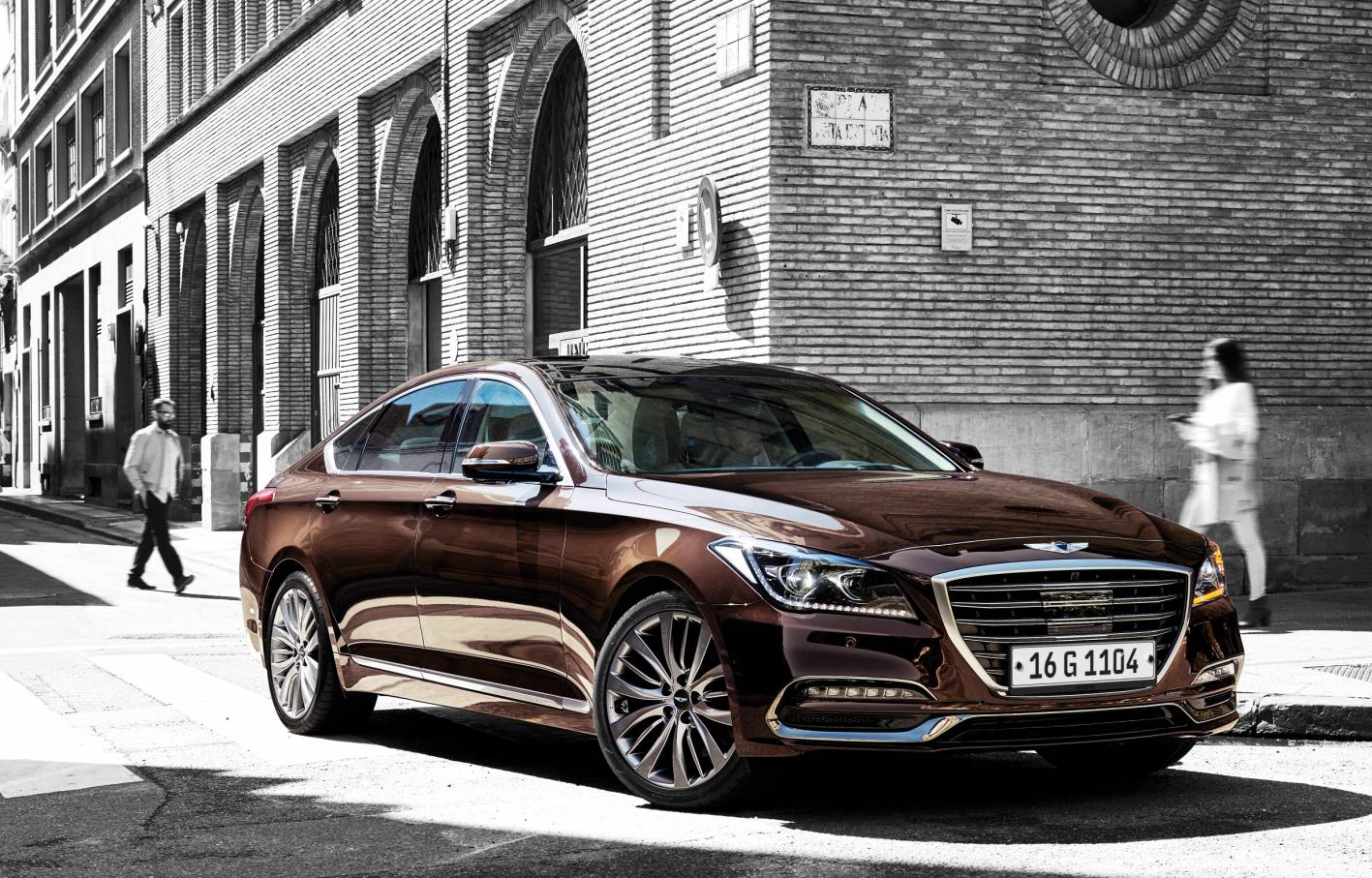
Apart from its mildly rejuvenated face, what’s mostly new about the 2019 Genesis G80 is that it loses the Hyundai badge from its rump and that it will be sold independently at its own high-end retail stores from June alongside the G70.
Priced from $68,900, the G80’s range has also been rejigged from the previous three variants to two – the base 3.8 and 3.8 Ultimate – which are both available with an extra-cost ‘Sport Design’ styling package.
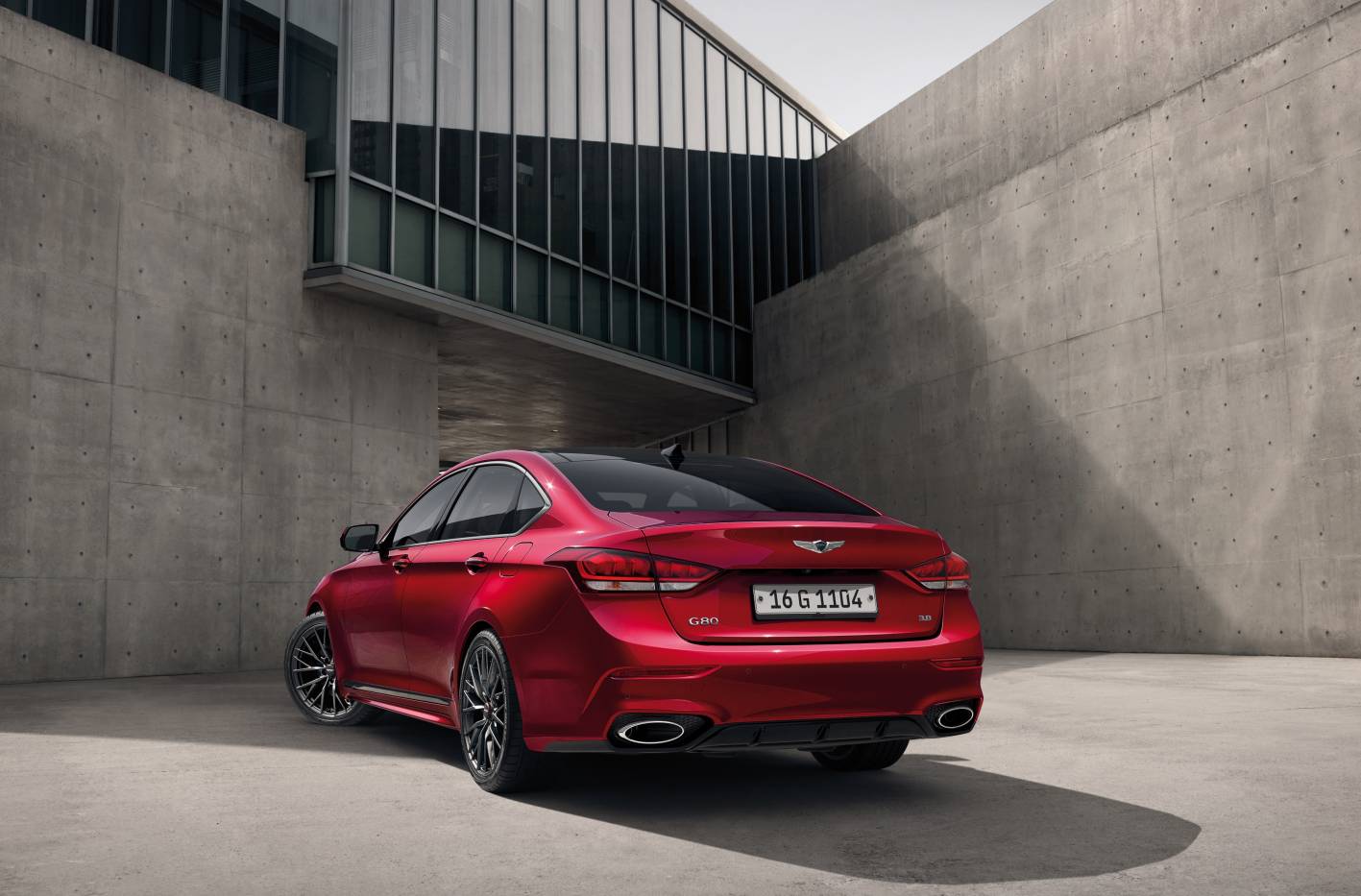
Though it’s now in its twilight years, the G80 remains an impressive car for the price and its expansive standard-equipment list has been stretched to include an Australian-tuned adaptive suspension; electric driver’s seat/power steering column adjustment with memory settings; a 9.2-inch infotainment screen with 360-degree camera view; Bi-LED headlights; a 17-speaker premium audio system and wireless phone-charging pad.
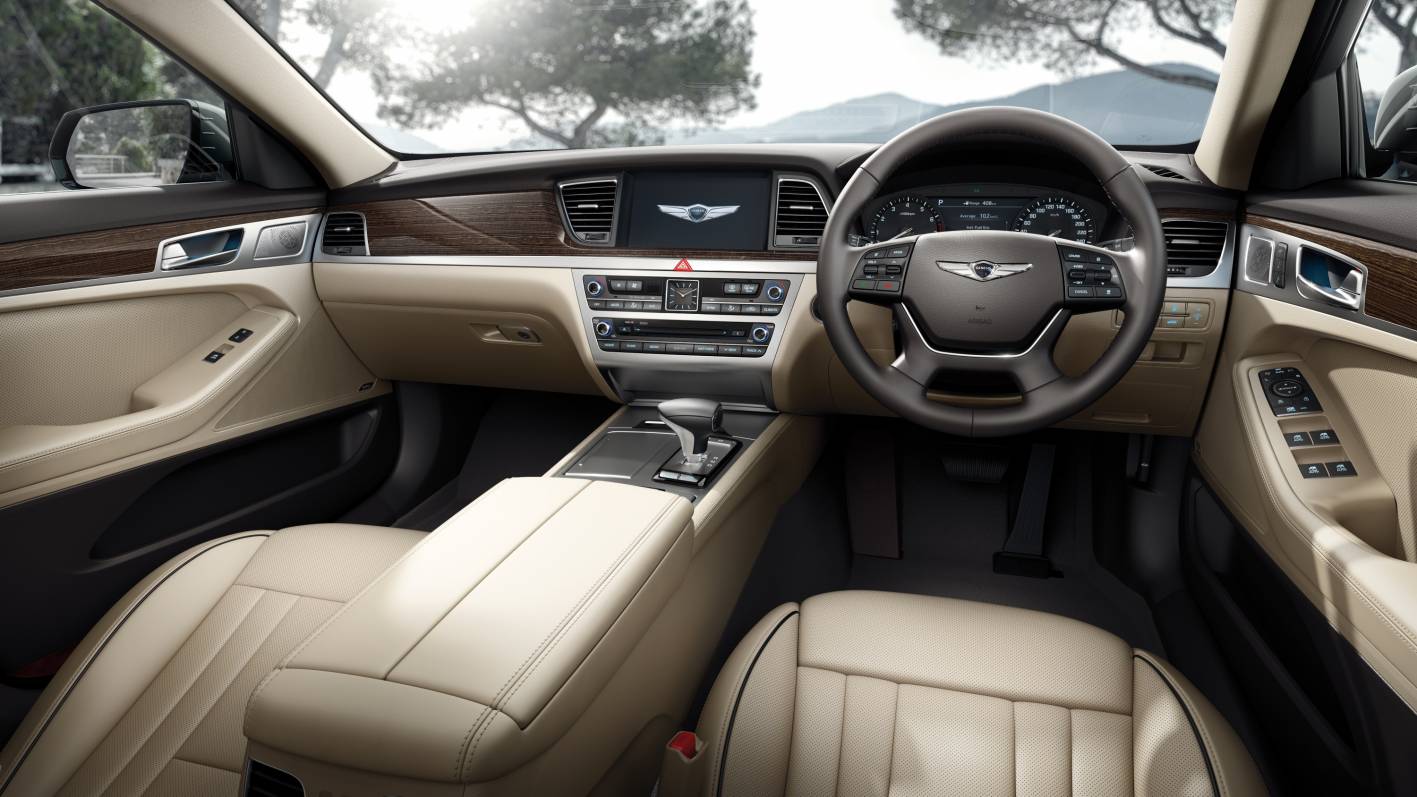
Other standard features include: leather appointed trim; 12-way adjustable powered front seats with heating; DVD player, rear-seat audio controls in the arm rest, a powered rear window blind, hands-free power operated boot, dual-zone climate control, active cruise control, nine airbags, front and rear parking sensors, rain-sensing wipers, keyless entry and ignition, LED tail-lights, indicators and fog-lamps, puddle lamps and 18-inch alloy wheels.
Active safety comprises autonomous emergency braking with pedestrian recognition, blind spot warning, driver attention alert, high-beam assist, and lane-departure warning.
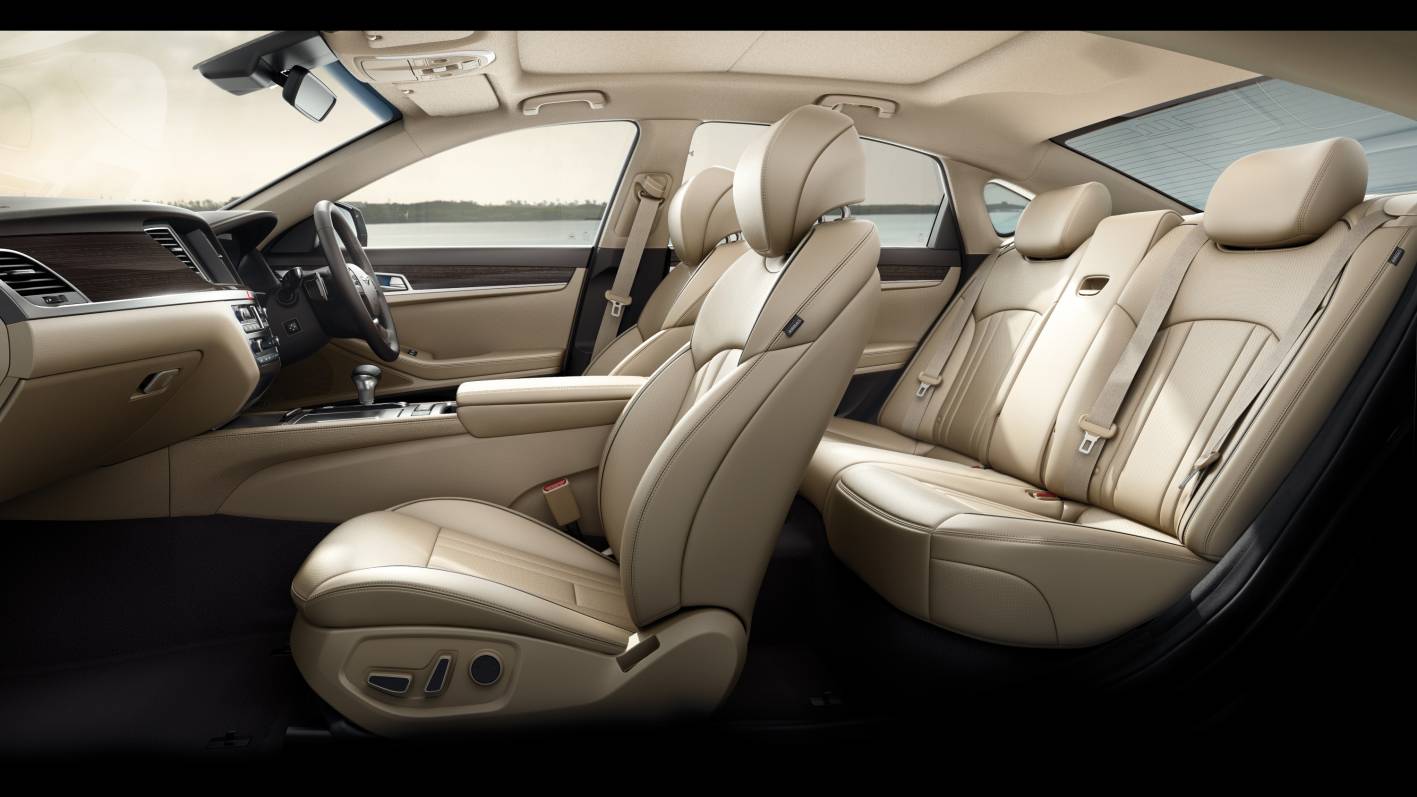
Genesis 3.8 Ultimate
The range-topping 3.8 Ultimate also gains a credit-card style smart key and four-way electrically adjustable rear seats that recline and slide back for easier entry and exit.
Other additional equipment over the G80 3.8 includes: Nappa leather upholstery; 16-way powered front seats; heated and ventilated front seats and outboard rear seats; heated steering wheel; panorama glass sunroof; rear-door window blinds; head-up display and bigger 19-inch wheels.
Spending an additional $4000 on the Sport Design pack brings a more aggressively styled grille, bumpers, 19-inch wheels, mesh type diffuser inserts, side skirts, plus Bi-Xenon headlights with washers.
Each variant comes with the same powertrain as before; the gutsy-but-thirsty, 232kW/397Nm 3.8-litre V6 and 8-speed automatic transmission driving the rear wheels via shift-by-wire electronic shifter and paddle shifters. Official fuel figures for the G80 have not been announced, however the pre-update model recorded a claimed average fuel consumption of 11.2L/100km.
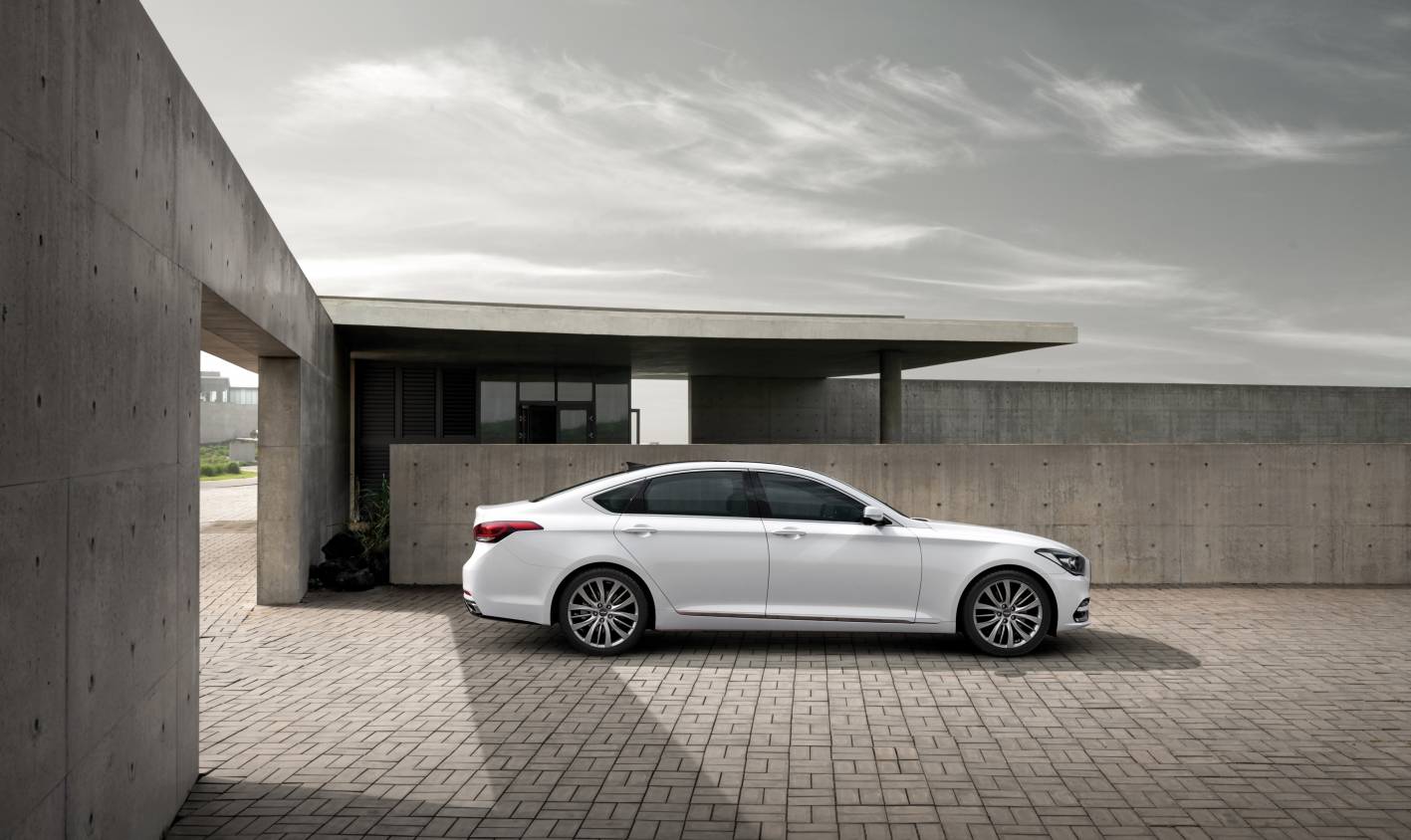
As previously mentioned the Genesis G80 will go on sale with the new G70 when Genesis finally begins trading as a standalone brand here in June, with the an all-new buying experience that begins with selecting colours and trim at the brand’s own design studios.
An all-new G80 will join the line-up next year, with two SUV models due in 2021.
2018 Genesis G80 pricing
- Genesis G80 3.8 – $68,000
- Genesis G80 3.8 Sport Design – $72,900
- Genesis G80 3.8 Ultimate – $88,900
- Genesis G80 3.8 Ultimate Sport Design – $92.900
Jeep has announced a pair of limited edition models for its Grand Cherokee large SUV line-up, called the S-Limited and S-Overland.
The Grand Cherokee S-Limited is headlined by a 5.7-litre HEMI V8 engine (259kW/520Nm), bringing SRT-style performance to the regular range.
The S-Overland, meanwhile, will be powered by Jeep’s 3.0-litre turbocharged V6 engine, delivering 184kW and 570Nm to all four wheels.
The limited edition duo offer a “distinctive performance and style look into Jeep’s most popular model”, according to the company, but in reality, it’s Jeep’s attempt to keep the Grand Cherokee in the game, as the large SUV is reportedly not going to be replaced until 2022.
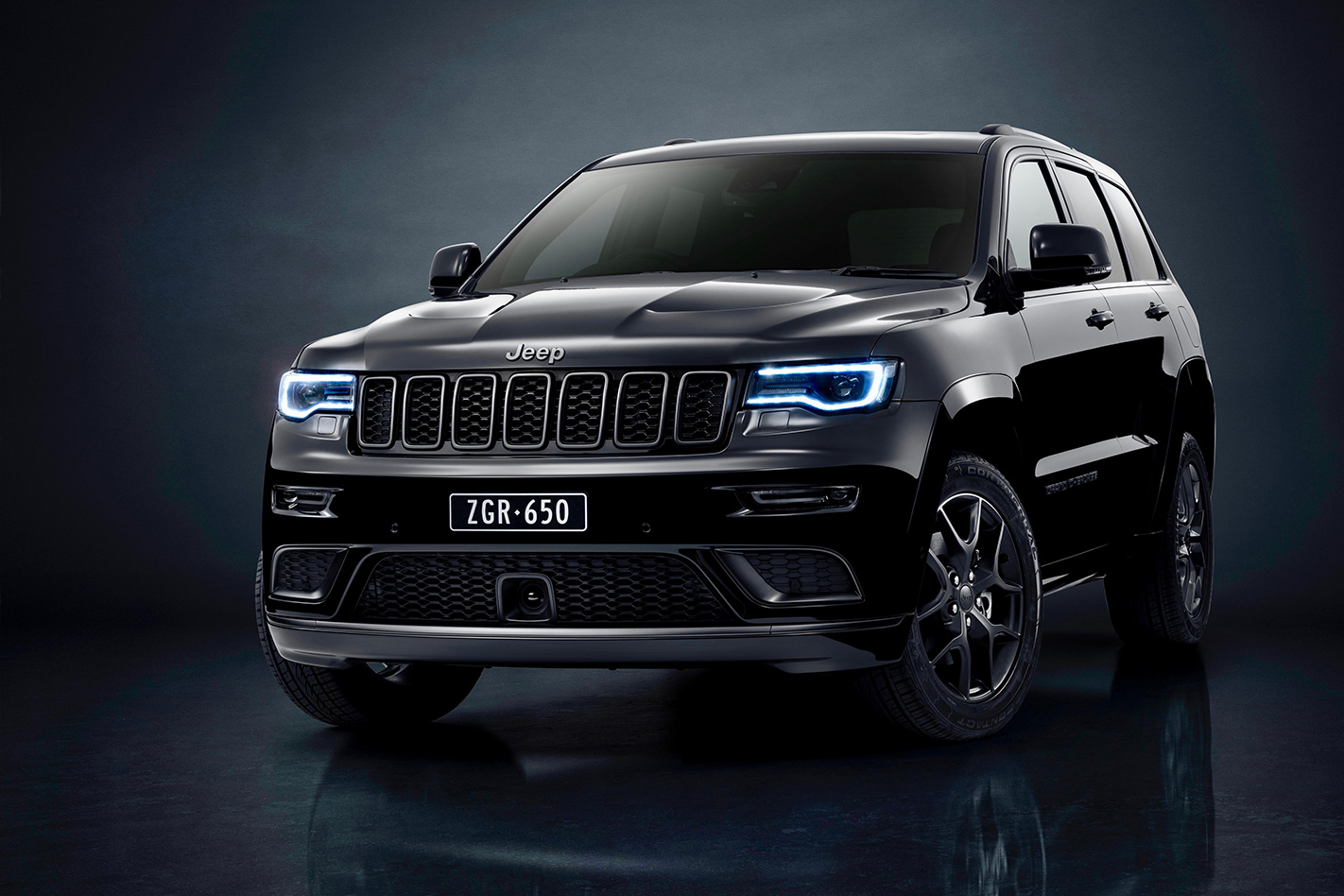
Available in limited supply, the V8 petrol-powered S-Limited will be capped at 100 examples, while the turbodiesel S-Overland will be topped at 120 across the country.
Both vehicles feature premium styling accents, 20-inch Granite Crystal rims, smoked tail lights and trapezoidal exhaust outlets.
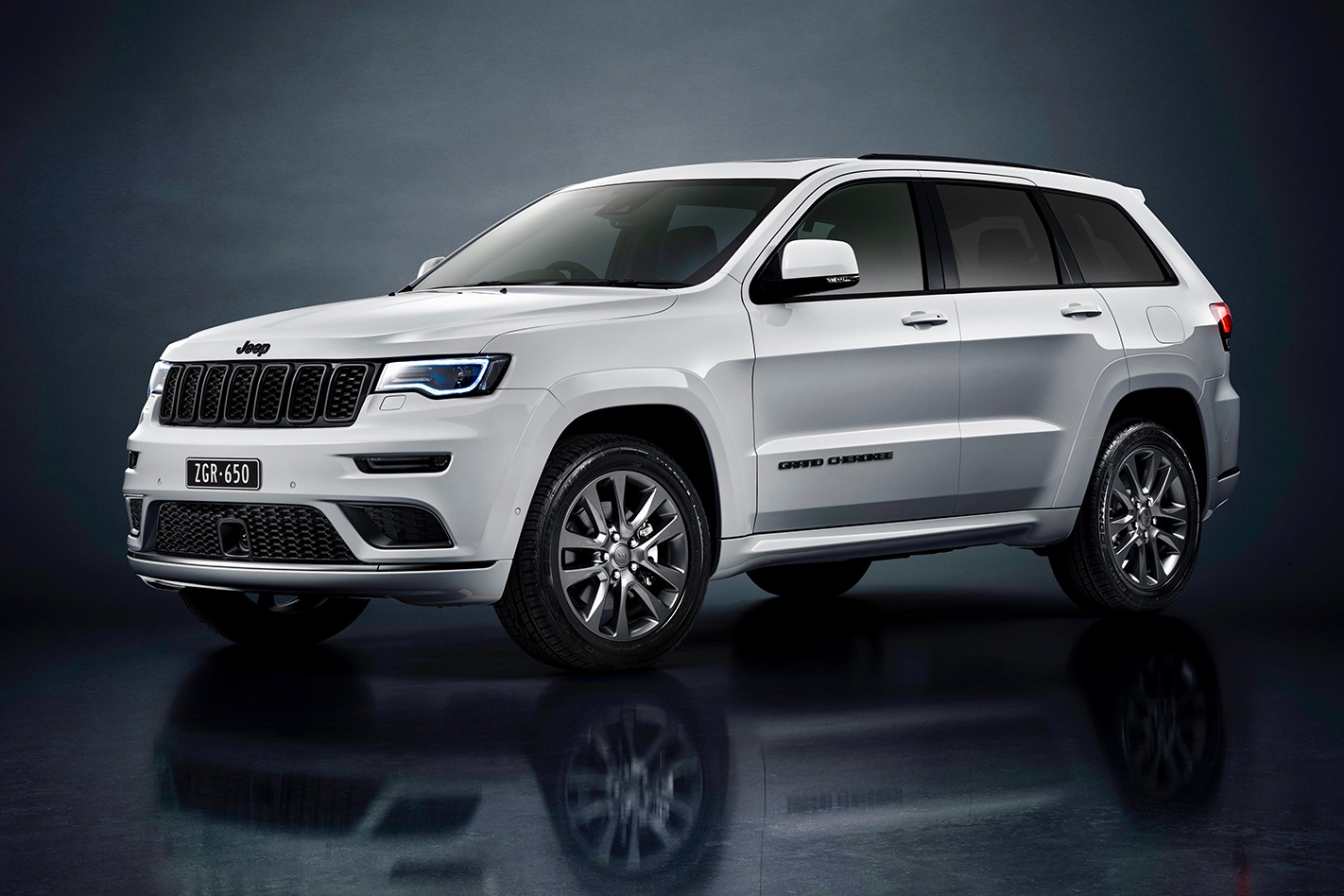
Adding over $15000 worth of extras for an extra $8500, the Grand Cherokee S-Limited is priced from $71,450 before options and on-road costs, becoming Australia’s most competitively priced petrol V8-powered SUV.
Additionally, the S-Overland special edition car will bring $9000 worth of extras for $4500, for a total of $82,950 before ORCs.
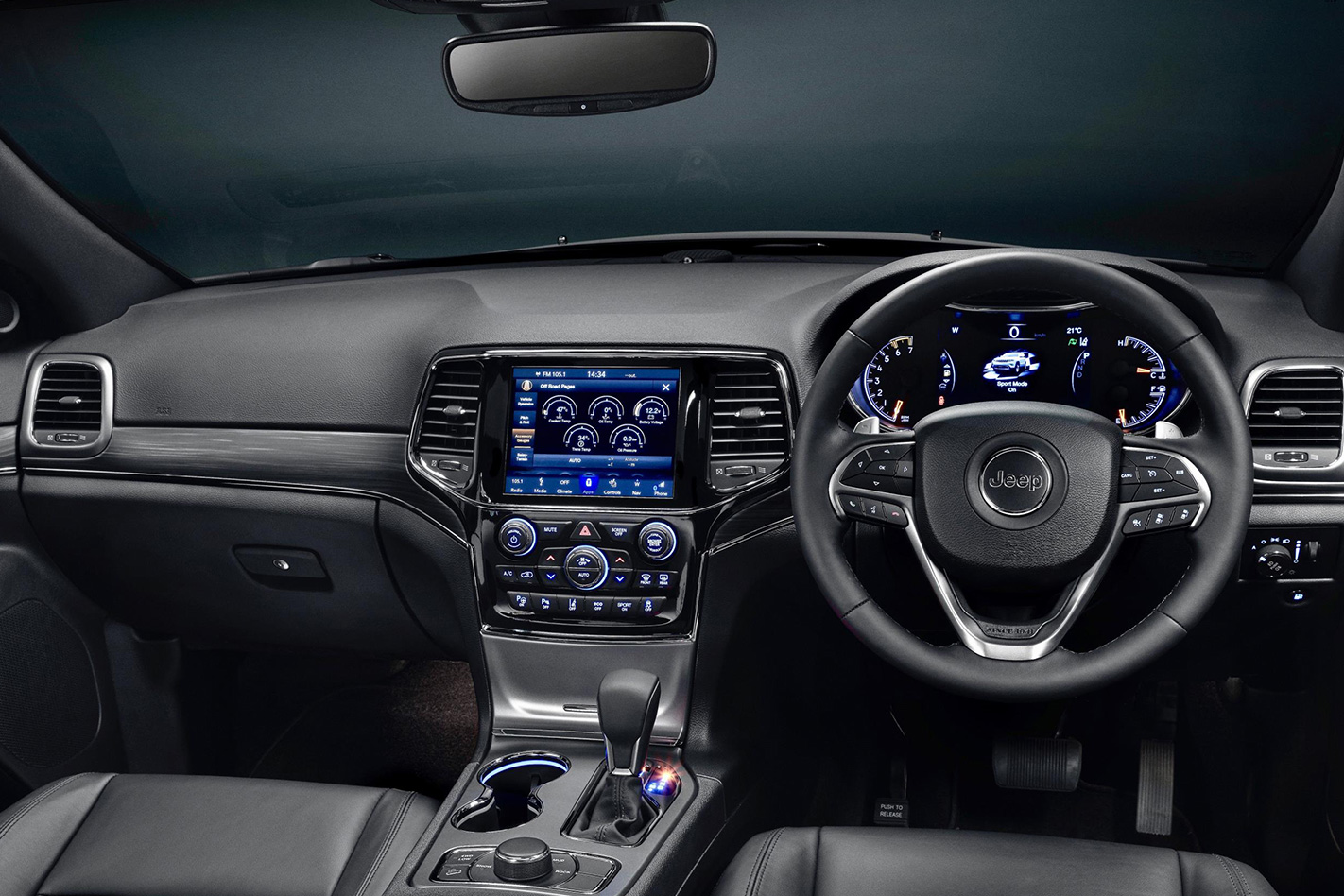
So where does all this value materialise? In addition to the whopping great SRT-derived engine, the S-Limited get a sports bonnet, black exterior trim appointments, Heritage leather interior and a large dual-pane panoramic sunroof.
Similarly, the S-Overland also gets sports-oriented updates including premium exterior cladding with upscale fender flares and side lower cladding, LED fog lights, black Nappa leather SRT seats with suede inserts and a 19-speaker Harmon Kardon sound system.
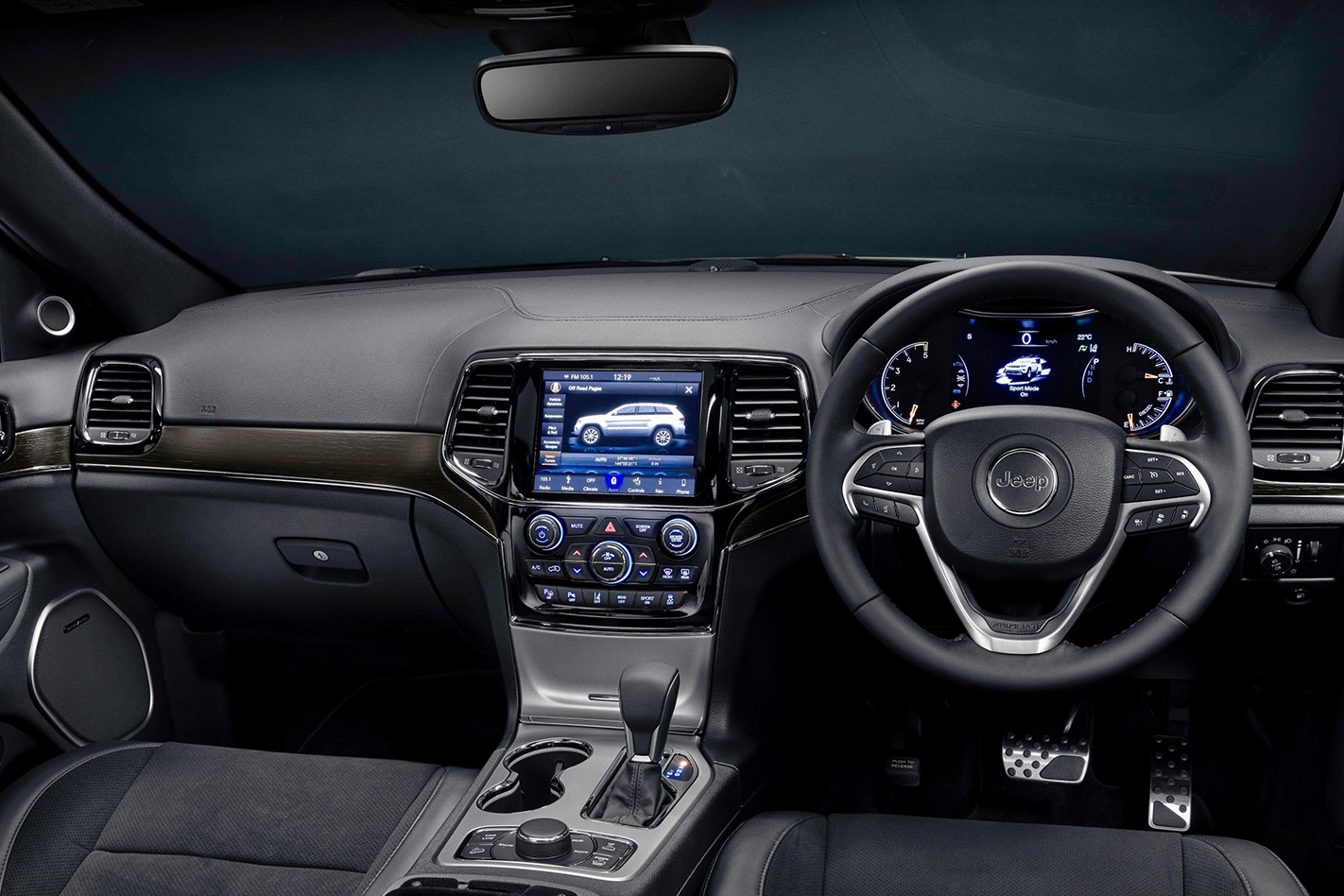
Both cars offer up to 3500kg towing capacity.
“We’re thrilled to offer two new limited-edition Jeep Grand Cherokees giving customers a choice of either a more premium, refined and fuel-efficient option with the S-Overland 3.0L V6 Diesel or a high-performance model with the S-Limited HEMI V8 Engine,” said Jeep’s director of brand and product strategy, Guillaume Drelon.
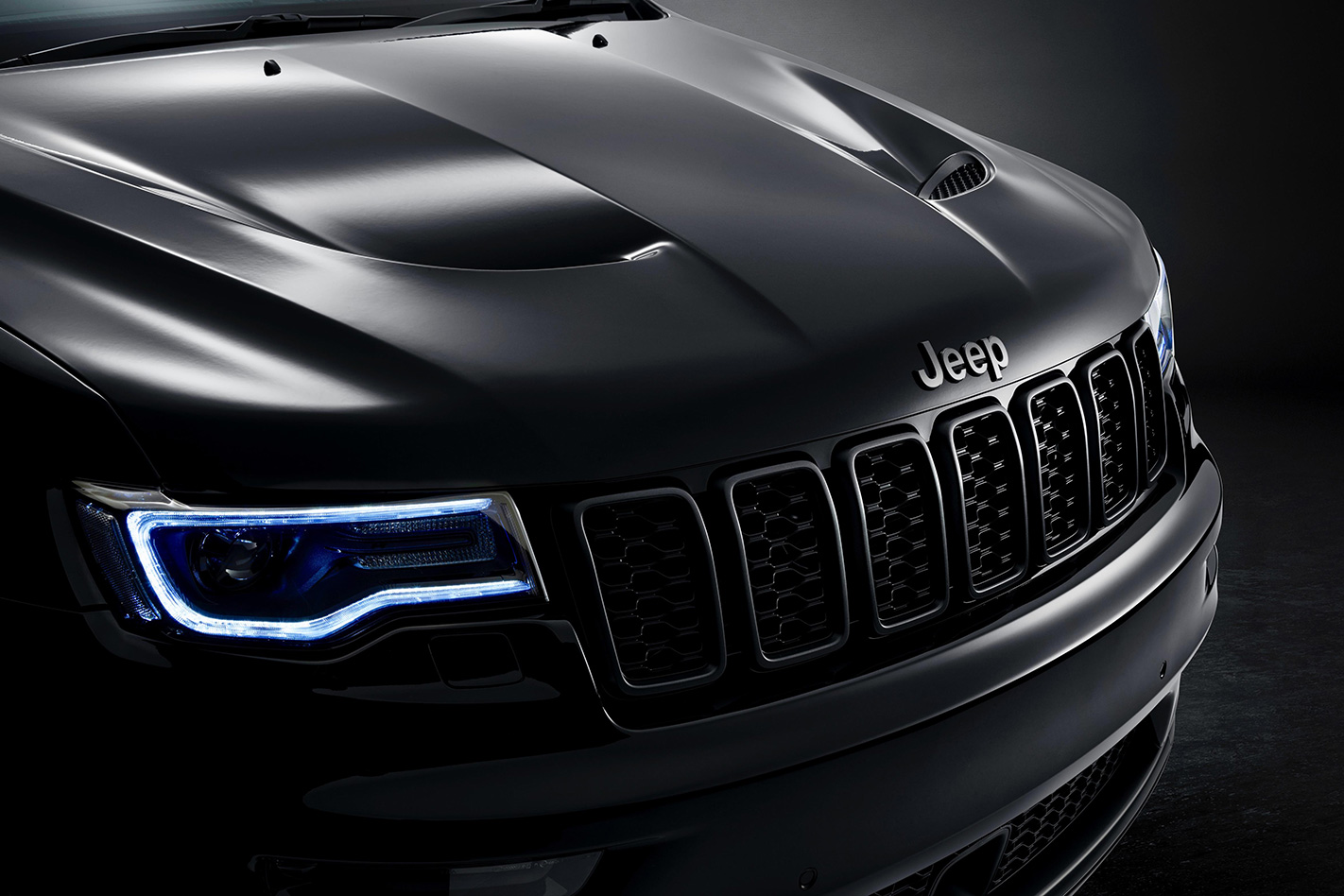
Both models are on sale from this month.
The large five-seat SUV – which competes in the same space as the Toyota Kluger, Mazda CX-8 and CX-9, Ford Everest, the new Holden Acadia and many more – has been slated for retirement May 2021, according to powertrain sourcing documents in the US.
Full S-Limited option list:
- 5.7L HEMI V8 Engine
- 20-inch Granite Crystal Aluminium wheels
- Performance Sports Hood (from Grand Cherokee SRT)
- Premium Accent Claddings (Upscale lower cladding Front & Rear Bumpers, Fender flares and side lower cladding)
- Granite Crystal / Black Grille accented 7-slot Jeep grille throats
- Dark Lens Taillamps
- Premium LED Fog Lamps
- Dual Black Chrome Trapezoidal Exhaust Tip
- Gloss Black Roof Rails
- Gloss Black Day Light Opening Moldings
- Gloss Black Mirror Caps
- Granite Crystal Fascia and Appliques
- Granite Crystal Exterior Accents
- Granite Crystal Rear Fascia Decorative Spears
- Granite Crystal Exterior Badges
- Body Colour Wheel Arches
- Body Colour Door Handles
- Body Colour Side Sills.
- Silver ‘S’ Badge
- Dual-Pane Panoramic Sunroof
- “Heritage” Leather trimmed seats from 25th Anniversary Edition.
- Liquid Titanium Accents
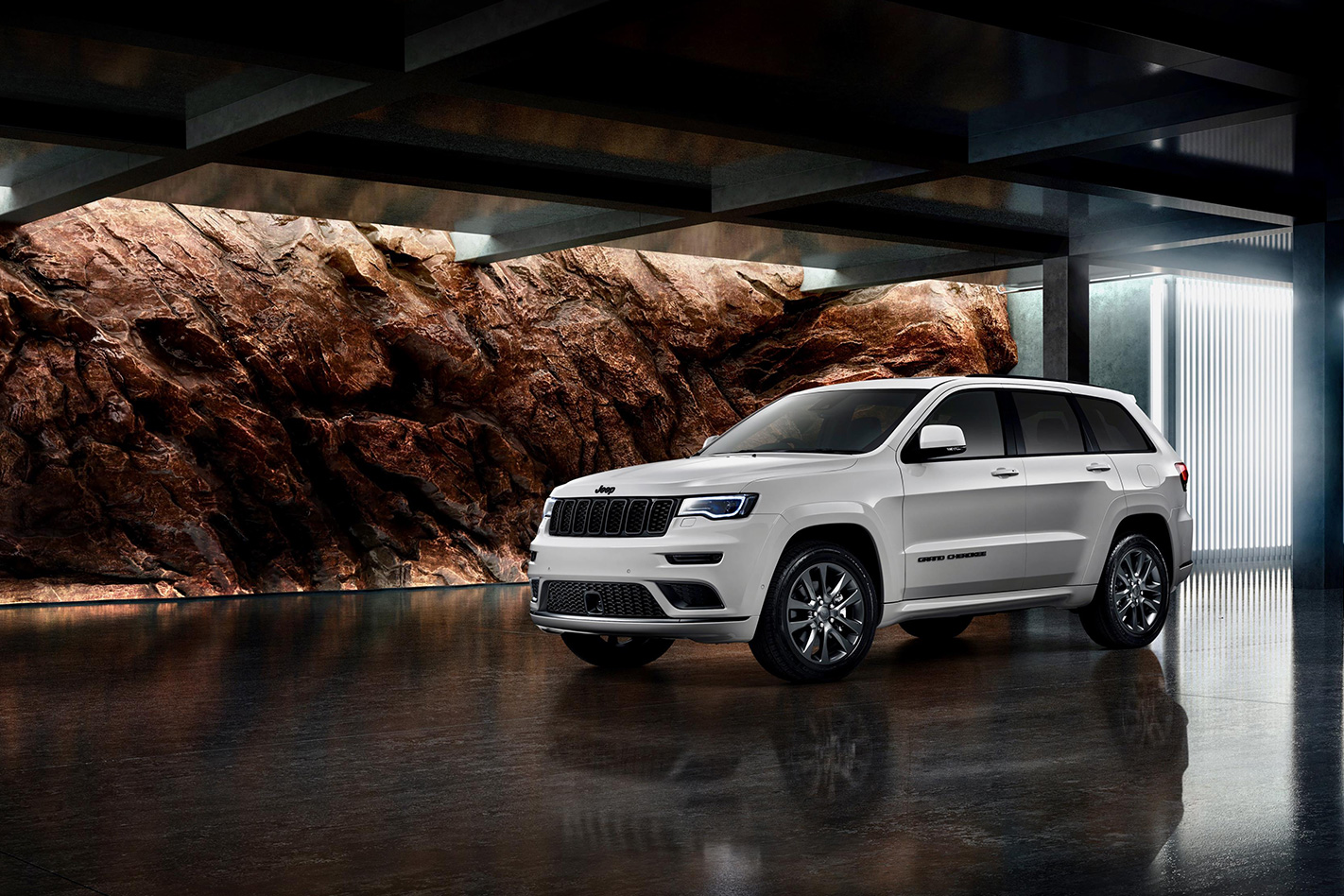
Full S-Overland option list:
- 3.0-litre turbocharged diesel V6 engine
- 20-inch Granite Crystal Aluminium Wheels
- Premium Accent Claddings (Upscale lower cladding Front & Rear Bumpers, Fender flares and side lower cladding)
- Granite Crystal / Black Grille accented 7-slot Jeep grille throats
- Dark Lens Taillamps
- Premium LED Fog Lamps
- Dark Headlamp Bezel Finish
- Dark Day Light Opening Moldings
- Dual Black Chrome Trapezoidal Exhaust Tip
- Black Roof Molding
- Granite Accents Body Color Fascias
- Granite Crystal Exterior Badging
- Granite Crystal Exterior Accents
- Body Color Door Handles and Sill Extension
- “S” Badge
- SRT Seats with Black Nappa Leather and black axis perforated suede inserts.
- Suede Door Bolsters
- 19 Speaker Harmon Kardon System – 825 Watts Amplifier – Subwoofer
- Black Wood Spears (I/P & Doors)
- Bright Pedals
Slow is smooth and smooth is fast.
It’s the racing driver axiom that holds true in any form of motorsport. Keeping your focus and the car steady – not jolting it around like a caffeine-riddled taxi driver – is a sure way to quickly improve driving skill.
Of course, given the opportunity, it’s all too easy to stomp the right foot and hook into a corner in an awful rendition of pretending to be Lewis Hamilton. Particularly with modern day cars disguising how unsettling such heroic manoeuvres really are on the chassis.
The red mist thickens to sleet when you’ve signed you’re life away (or, signed up to be better at keeping it) to learn how to really drive at the Audi Driving Experience. You feel the instructors already sizing you up for potential hoon-factor before you even sit down, but once you’re out on the track, sitting alone in anything from the crackling five-pot RS3 to the sizzling 397kW R8 V10, a little cheeky dab on the throttle to separate the boys from the men is easy, right?
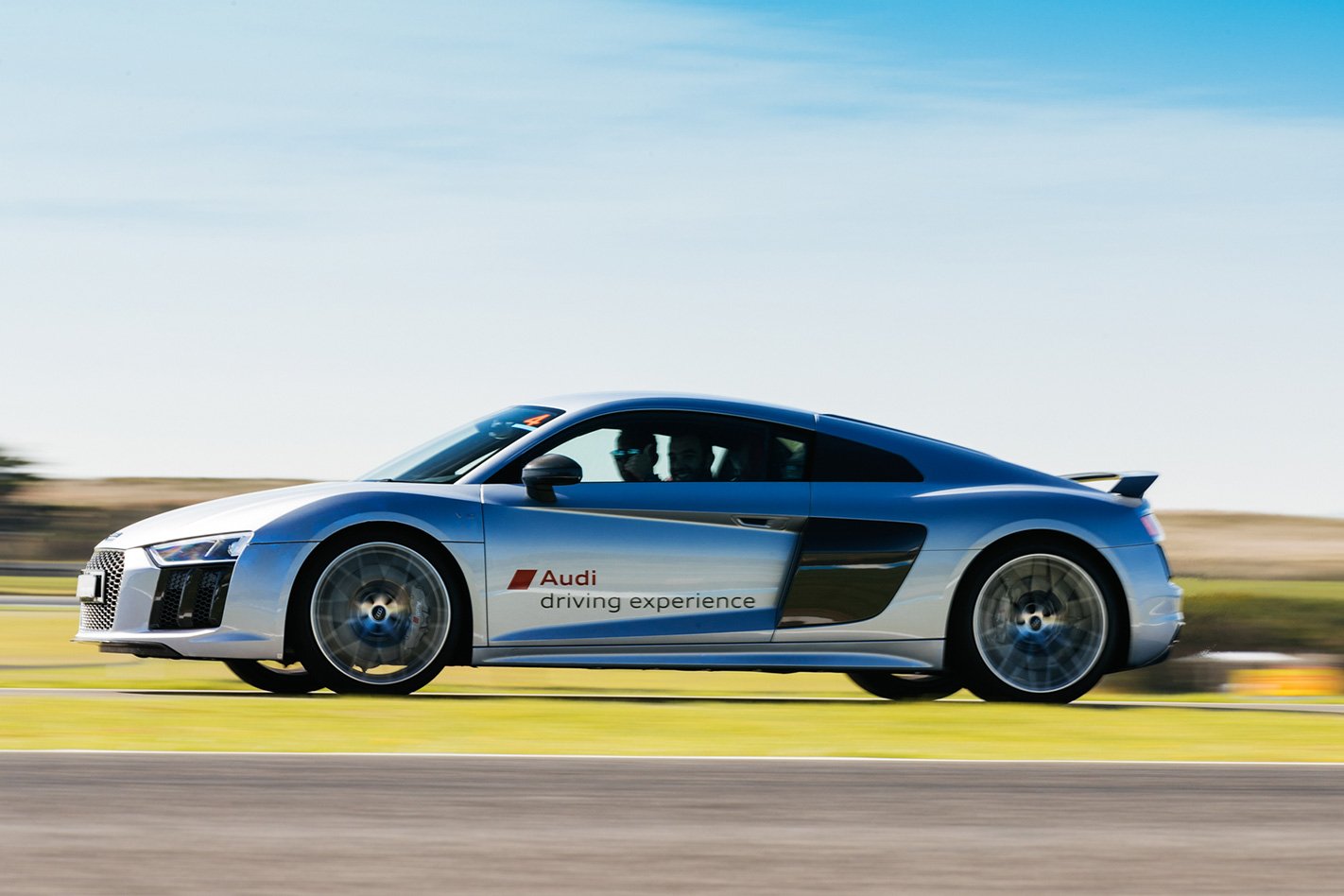
“We’ve got 20 instructors that are all professional race drivers,” says chief Audi driving instructor, Steve Pizzati. “What I call a professional racing car driver is someone who is paid to race in someone else’s car. They’re not driving daddy’s car, they’ve actually had someone come up to them and say, ‘I’ll give you some money to drive my car.’ Trust me, you’re not a better driver than them, at least I haven’t seen someone come in here yet who is.”
The instructors include Bathurst 1000 winner Luke Youlden, and Bathurst 24 Hour winner Nathan Pretty, among others.
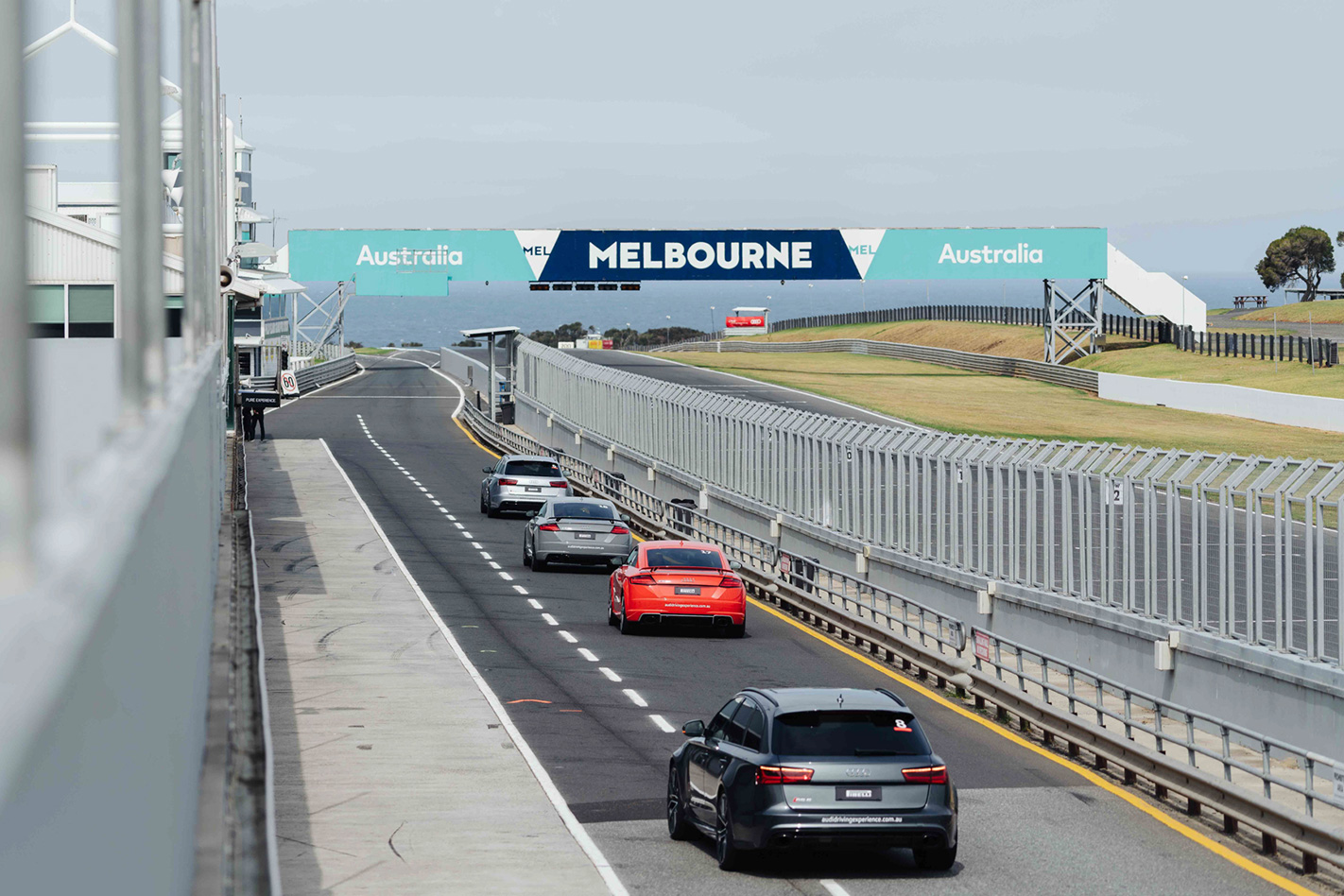
Pizzati’s comment is his cue to explain that ‘hero’ drivers who haven’t ‘got it’ by the end of the day’s activities – emergency braking, slalom, skid control and cornering – aren’t safe enough to go fast around the Phillip Island circuit for the finale of the day, driving the RS3, RS5 and TT RS flat out. Having over 1000 laps of the Island under his racing belt, Pizzati has seen the disastrous result of not knowing the basics – like how to stop.
“When I was a boy learning to drive, it was more about skills based stuff – be a better driver, get out of emergency situations, I want to do track days, help me out,” he adds.
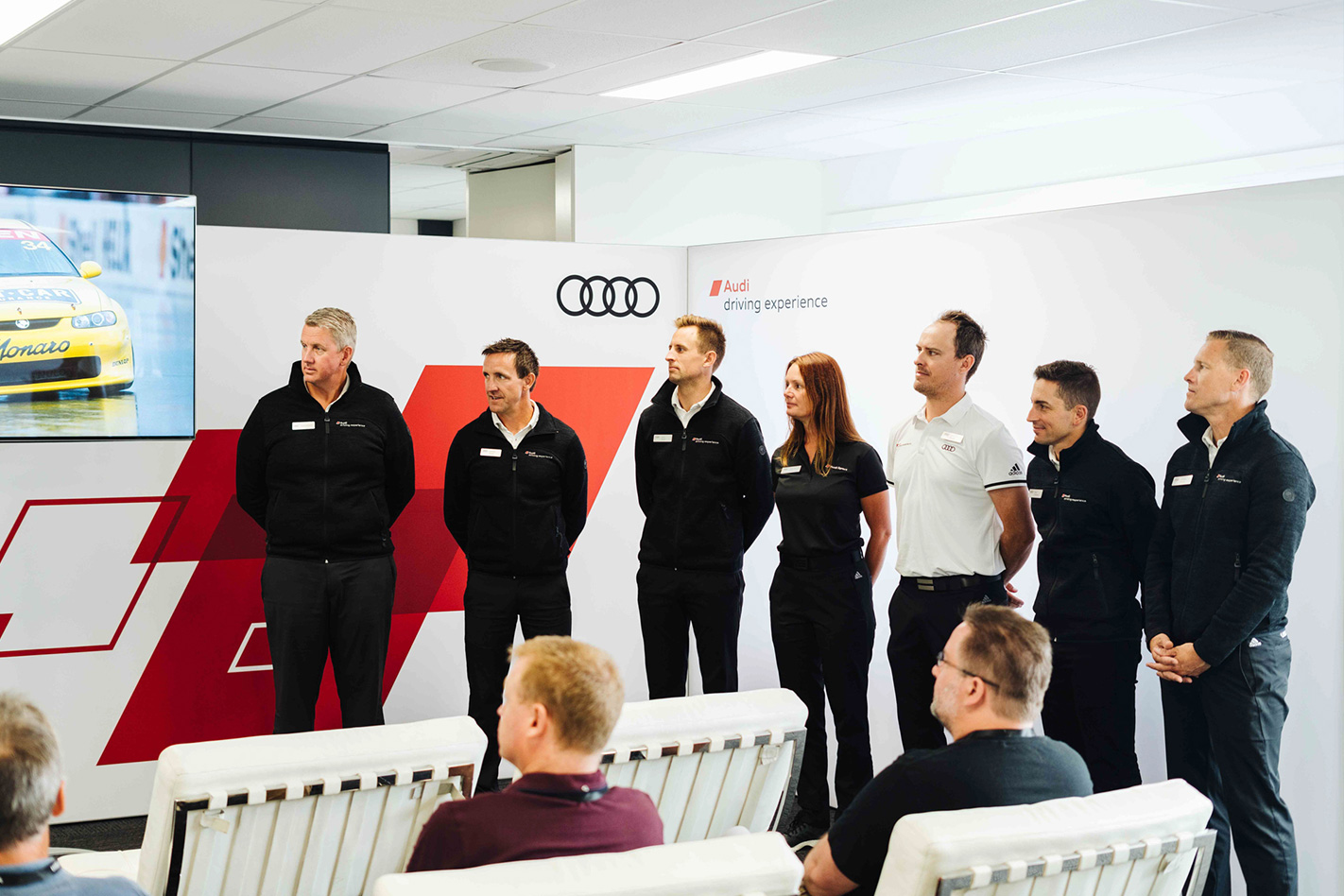
“What happened is that is still there, but there is a far more lifestyle focused approach. People look for lights at the end of the tunnel; it’s nice to have something circled on the calendar to look forward to. You need more to it than just a track and racing car drivers,” Pizzati says, explaining that these sorts of events aren’t just for petrol-head speedster, with dad and daughter duos finding the race tracks and fine machinery on offer– as well as overseas tours – an alluring break from reality, with an important skill-based component.
Depending on how much you pay, you can find yourself piloting an R8, without even owning an Audi. Pizzati admits Audi’s newest Sport Pro course, that lets any punter on the street who stumps up $3500 drive the German brand’s most powerful V10 supercar around a race track, is a bit terrifying for the instructor sitting in the passenger seat. But prove yourself, and the R8 LMS (racing car) is also yours, for a price.
“We’re one of the few brands that allow the general public to do it; you don’t have to be an Audi owner. You don’t even need to be a customer,” he says.
Surprisingly, the idea of steering a racing car at over 200km/h around a race track is apparently much less scary than performing emergency braking. Despite most punters having never felt a car behave a little light at those sorts of high speeds, the idea of ‘having a crack’ out of the gate is less daunting then being told to come to complete stop from a normal legal road speed. It is, of course, a prerequisite to going out on the track.
“I have to assume they’ve done nothing at all,” says the former Top Gear Australia host.
“The morning session is to warm them up and most of the time it is about breaking myths and old wives’ tales, like the hands should be at ten and two, and people are still trying to shuffle steer and it’s funny because they don’t try and do that on the road but the minute there is a race driver there they change as if they’re being tested. I think the same thing happens when people start teaching their kids and it’s quite funny how people revert back to bad technique.
“Emergency braking is a really important one, to do an emergency stop from 110km/h – everyone does that. What’s interesting is when I say we are going to do that, the looks on people’s faces. Yeah, you do that speed every day. Everyone thinks they are an above average driver but don’t want to do an emergency stop!”
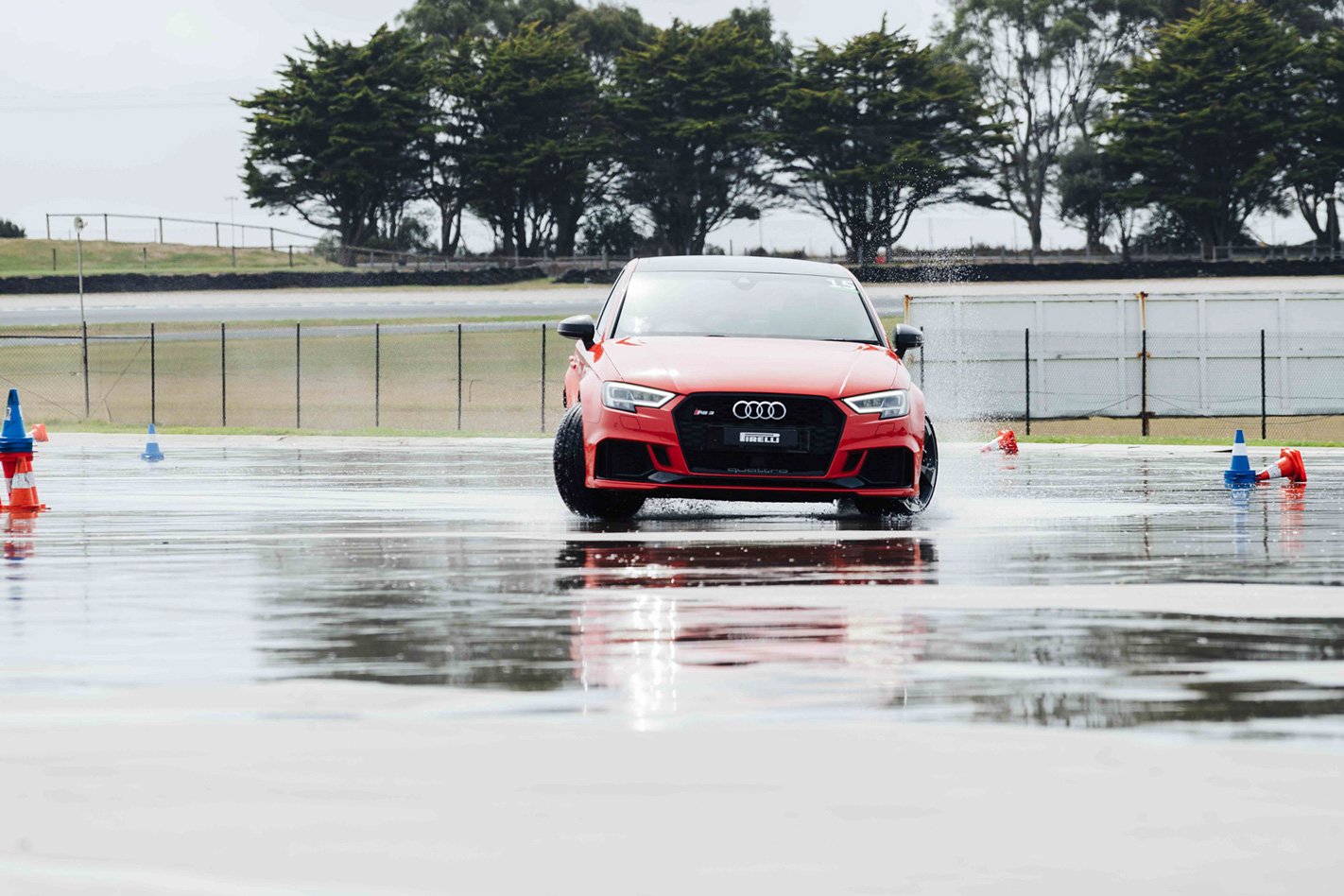
For the first-timer, the emergency stop isn’t what you think it is. It’s not a well-synchronised ballet between the brake pedal, the steering, and how the car reacts before coming to a sudden but somehow graceful stop. It’s comparatively violent – the idea is that a kid has run out in front of the car at 110km/h and you push the brake pedal so far into the firewall that you think you can feel the brake arm start to bend. The car’s smart electronics and ABS take care of the rest, and even on this horribly wet day, the result is an abrupt stop in the shortest time possible. Perfecto. It’s surprising just how many runs it will take before the process feels normal, but it’s a potentially life-saving skill.
The next activity held on the last corner before Phillip Island’s ever-slightly undulating straight is the slalom. Buckled into an RS5 we drive at a series of witch’s hats that we have to simply slalom through. Of course, being quick isn’t easy, and it’s here that the craft of proper driving technique is slowly unboxed.
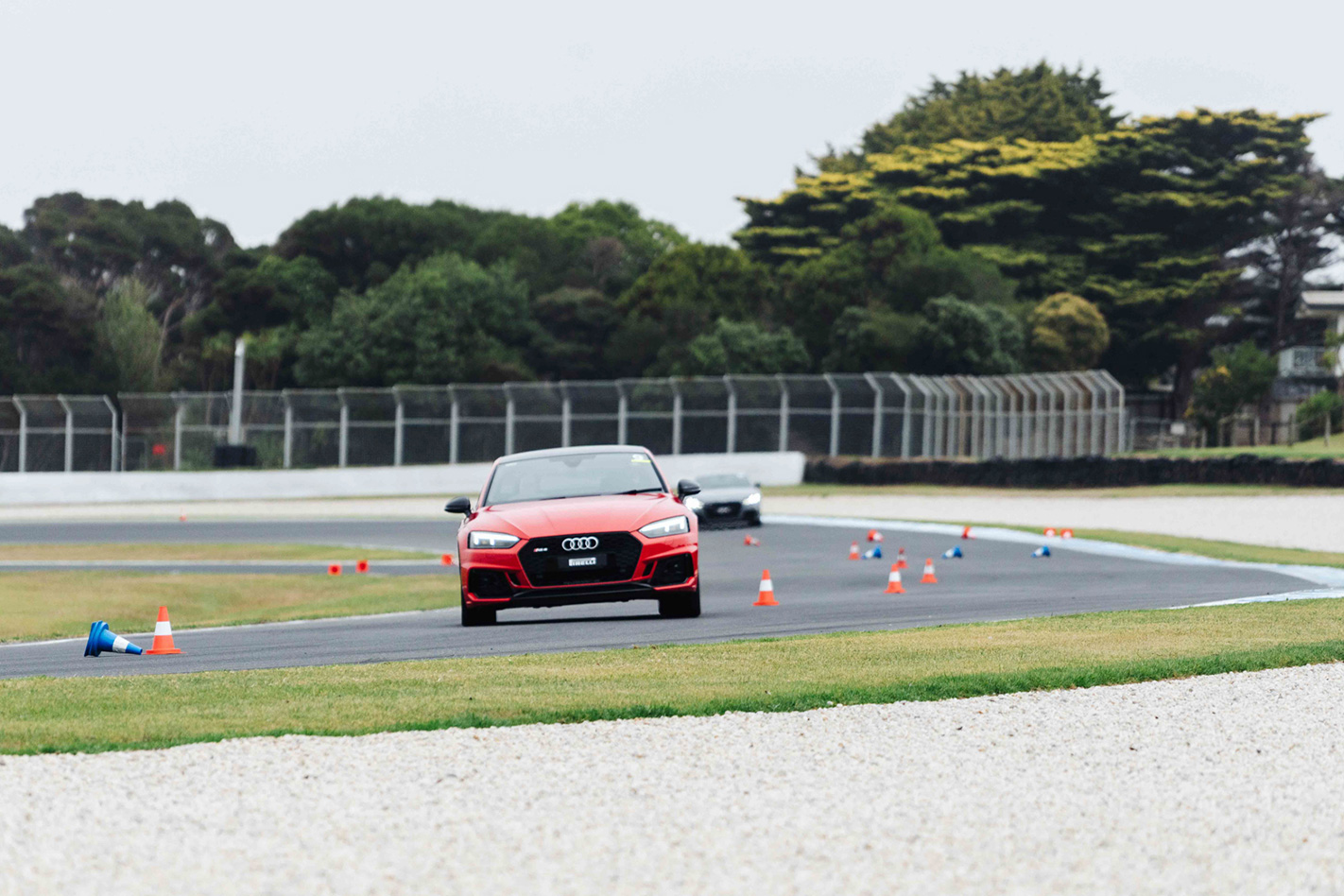
“We do a slalom and the slalom is one of those really annoying activities because it looks so simple but it’s really hard to get right,” says Pizzati.
“The timing of the eyes, hand and feet is really hard because if you’re out by a tenth and then two tenths your actually out by three tenths. It’s very tricky.”
It’s here that DJR Team Penske endurance driver Tony D’Alberto helps customers unravel the mystery of beating understeer and getting the power down early but steadily. Though the tight course feels too constrained for the RS5’s size and impressive 331kW power, it’s an insight in to how delicate yet rapid it can be on tighter roads.
A step up in pace from the slalom is cornering control, where former V8 Supercar driver Steven Johnson takes us down through the tricky double-apex of Southern Loop towards Honda Corner. Instantly, Johnson’s smooth car control is impressive, and it doesn’t take long for him to impart confidence onto first timers.
Get professional driver training with an Audi R8 V10 Plus on track
“We do cornering because as I tell people, you’re not taught how to corner. I got my licence in Carlton and on that route we went around Melbourne University and back past the pizza shop and it’s all sharp, slow city corner stuff. Then you get your licence and it’s off to the Great Ocean road with Bass Strait down one side. We’re not taught to corner, so we typically use turn four (at Phillip Island), Honda Corner, and get people to approach at 120-150km/h and teach them where to position the car and when do you brake and turn in. No one has felt that.”
In truth, the raucous RS3 supplied for this section of track easily eclipses 150km/h along the short straight before turn 4, and as long as you’re looking settled and smooth, Johnson is happy to let you pick up the pace as he provides commentary on what you’re doing right or wrong from the vantage point of a grassy knoll.
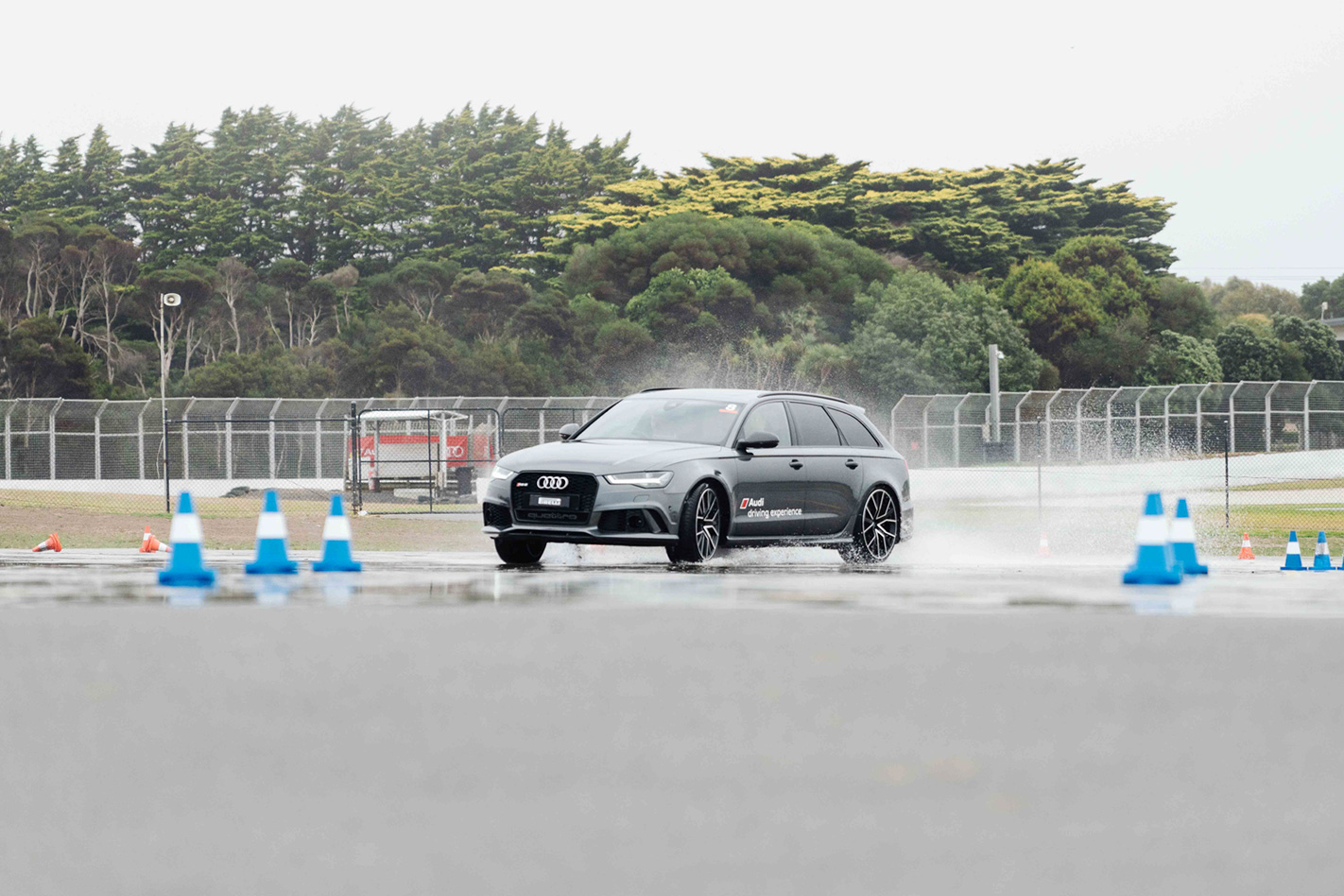
Closing in on lunch, there’s a light breather before we hit the buffet – drifting an RS6.
“The final part is a bit of skid control,” says Pizatti. “We go to the skid pan and everyone wants to drive a high performance car and we do oversteer. Part of that is to give people some fun, but also a life skill and dispel the myth that Quattro (Audi’s all-wheel-drive system) is boring and they don’t slide and it’s not a real car. Every single customer leaves that going I want a Quattro now because a rear-wheel drive slips out on them so quickly otherwise.”
The combination of emergency braking, vehicle dynamics handling and fast cornering forms the basis of getting participants ready to tackle the track in full: three laps alone in an RS3, RS5 and TT RS with only a lead driver. If you pay more, you can drive an R8.
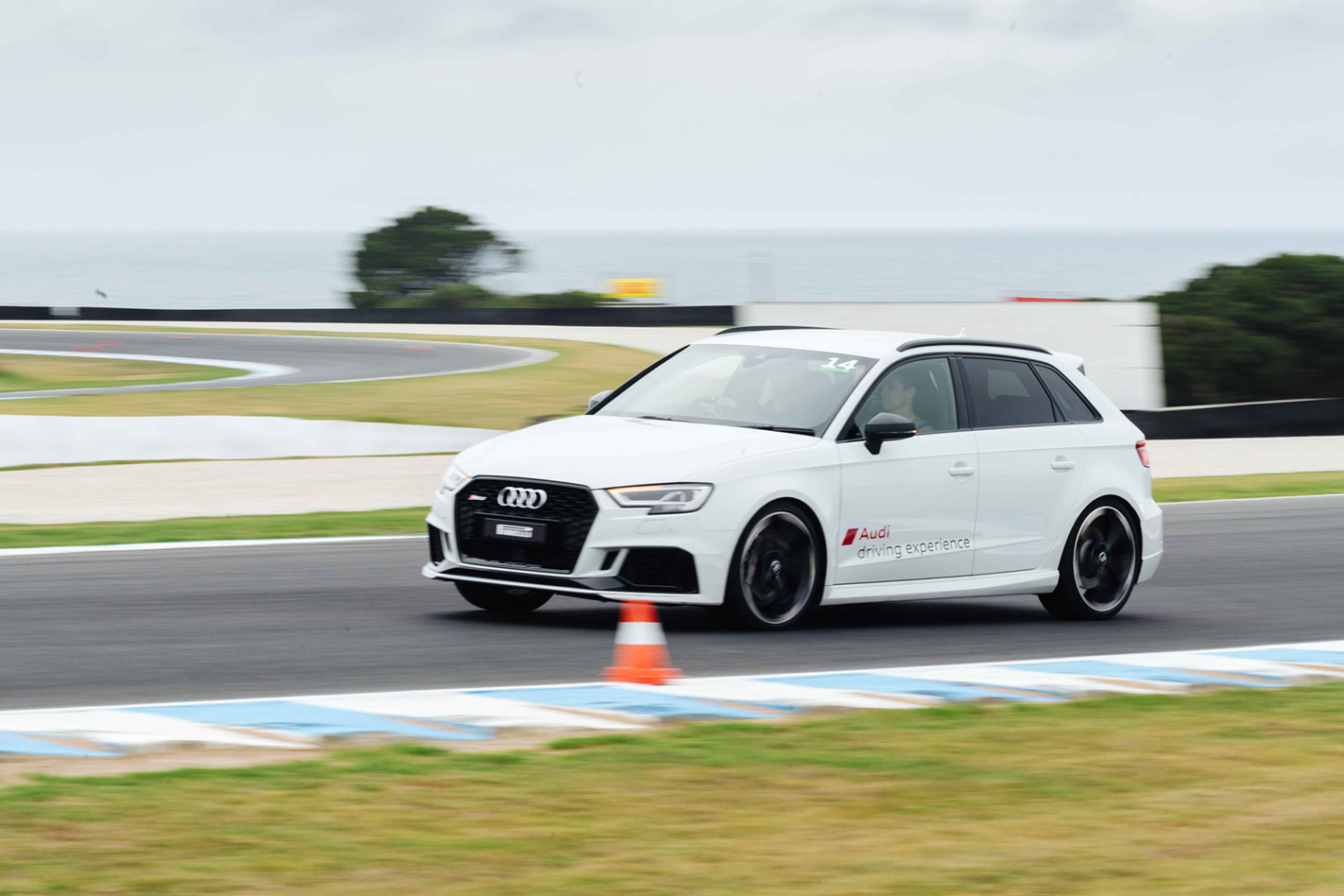
Despite a leading hand during the day, the instructors are less bossy at the end of the day – you set the pace. Pizzati explains that if you’re throwing the car around and hitting the curbs like you haven’t listened to a word all day, the instructors will slow down until you follow their line.
Here’s a hint: if you want a flying lap of Phillip island circuit all by yourself in a belting sports car (or even supercar) – follow the professional racing car driver precisely and smoothly. You’ll only go faster.
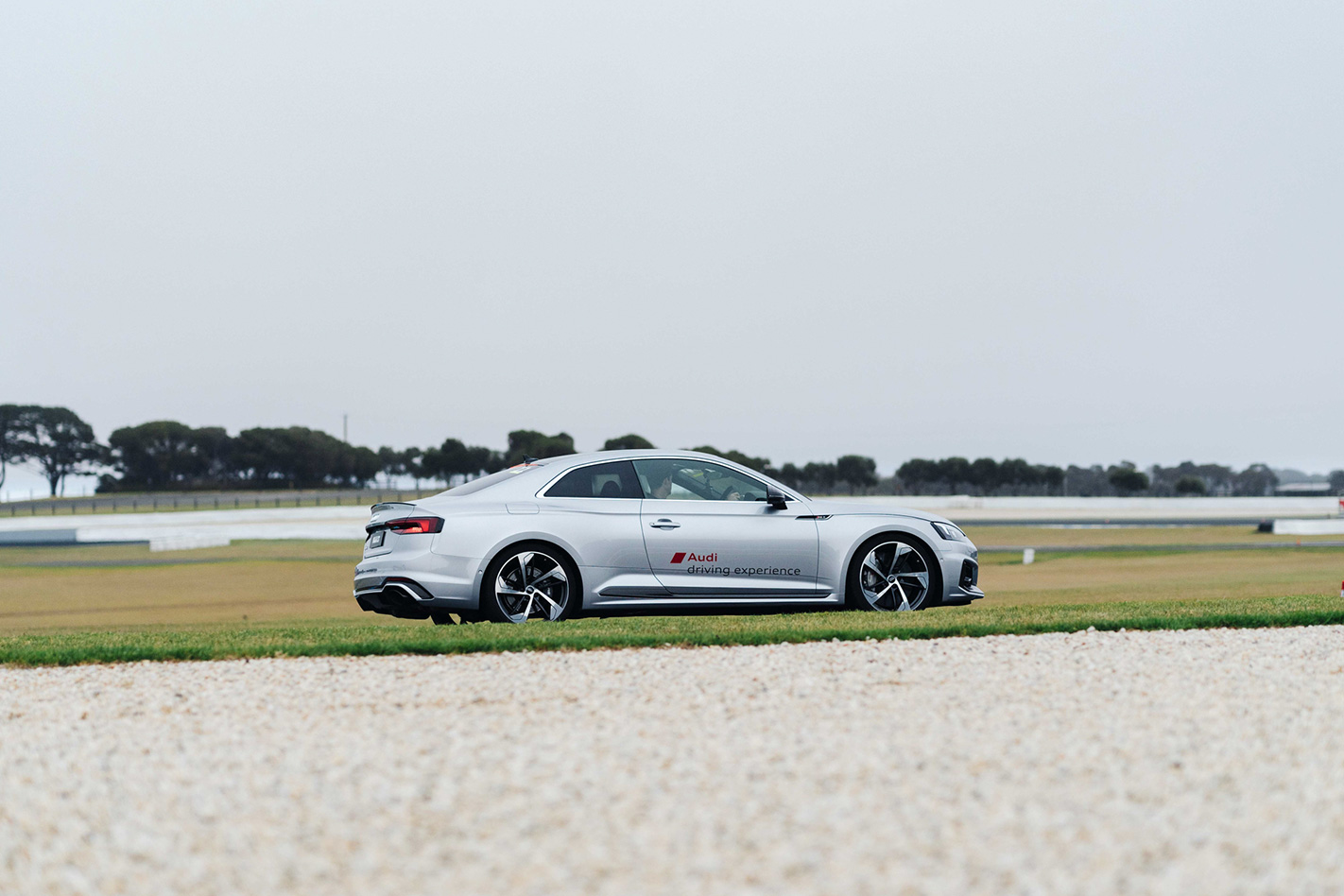
At a course cost of $1250, the opportunity to drive brand-spanking new Audi RS sports cars around Australia’s best race track is well worth the temptation. And you’ll learn a lot more than you can brag about when it really counts.
Want to win an Audi Driving Experience? Click here to enter Wheels’ draw to win a two-part driving experience valued at $5500.
Winton Motor Raceway: a pleasant little rural Victorian racetrack, generally regarded by V8 Supercar aces as tight, technical and challenging. Yours truly: a pleasant, not-so-little scribe, generally regarded by MOTOR staffers as a fair-to-middling driver, but no ace.
This feature was originally published in MOTOR’s June 2002 issue
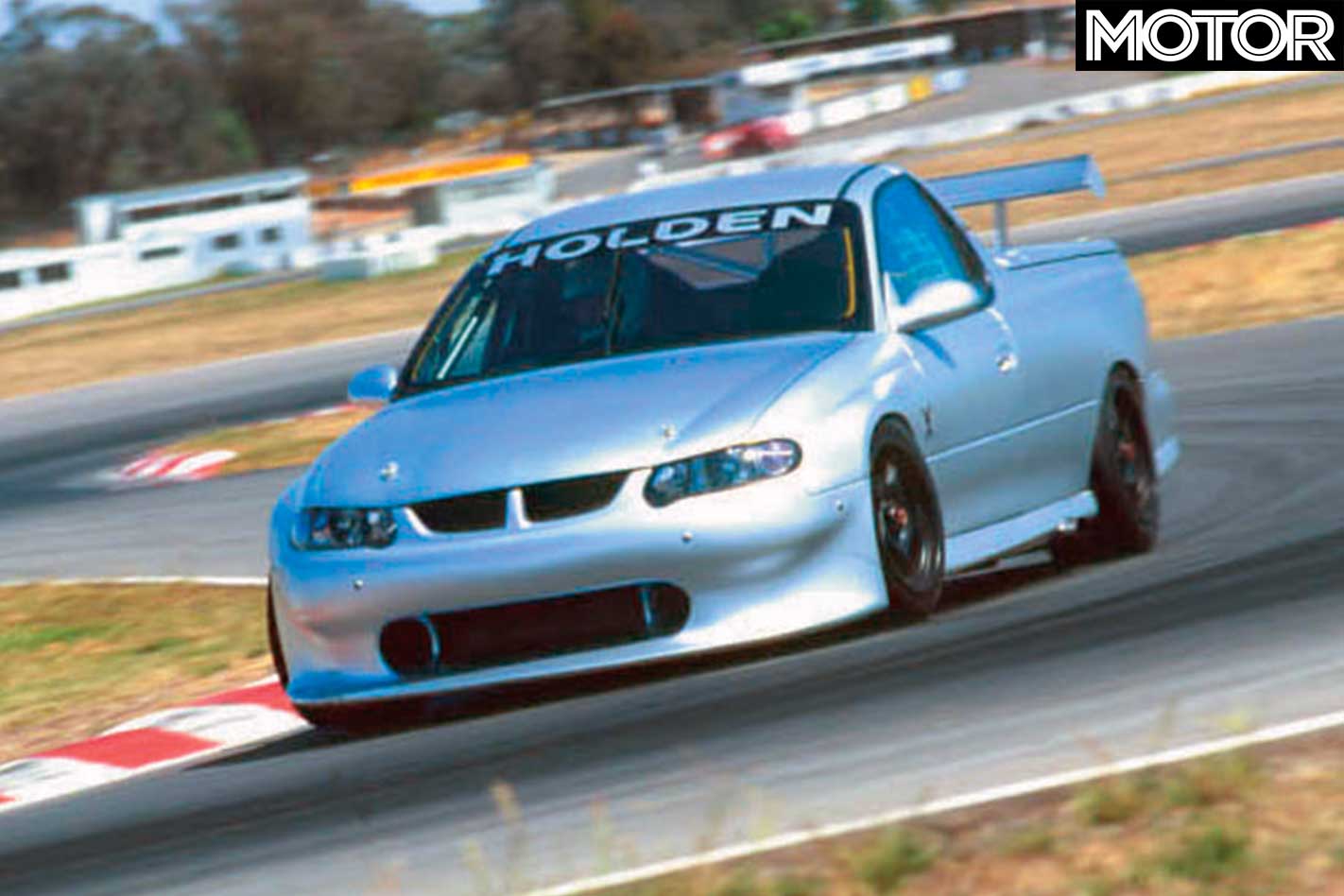
Holden Motorsport’s V8 Supercar ‘Thunder’ Ute: the world’s fastest pickup. It’s 1300 kg of hot metal propelled by a barely detuned, full-race Chev punching out 380kW. It’s the only one on the planet, it took Garry Rogers Motorsport eight months to build it, it’s worth $300,000 and I’m to be the first non-racing driver to steer it.
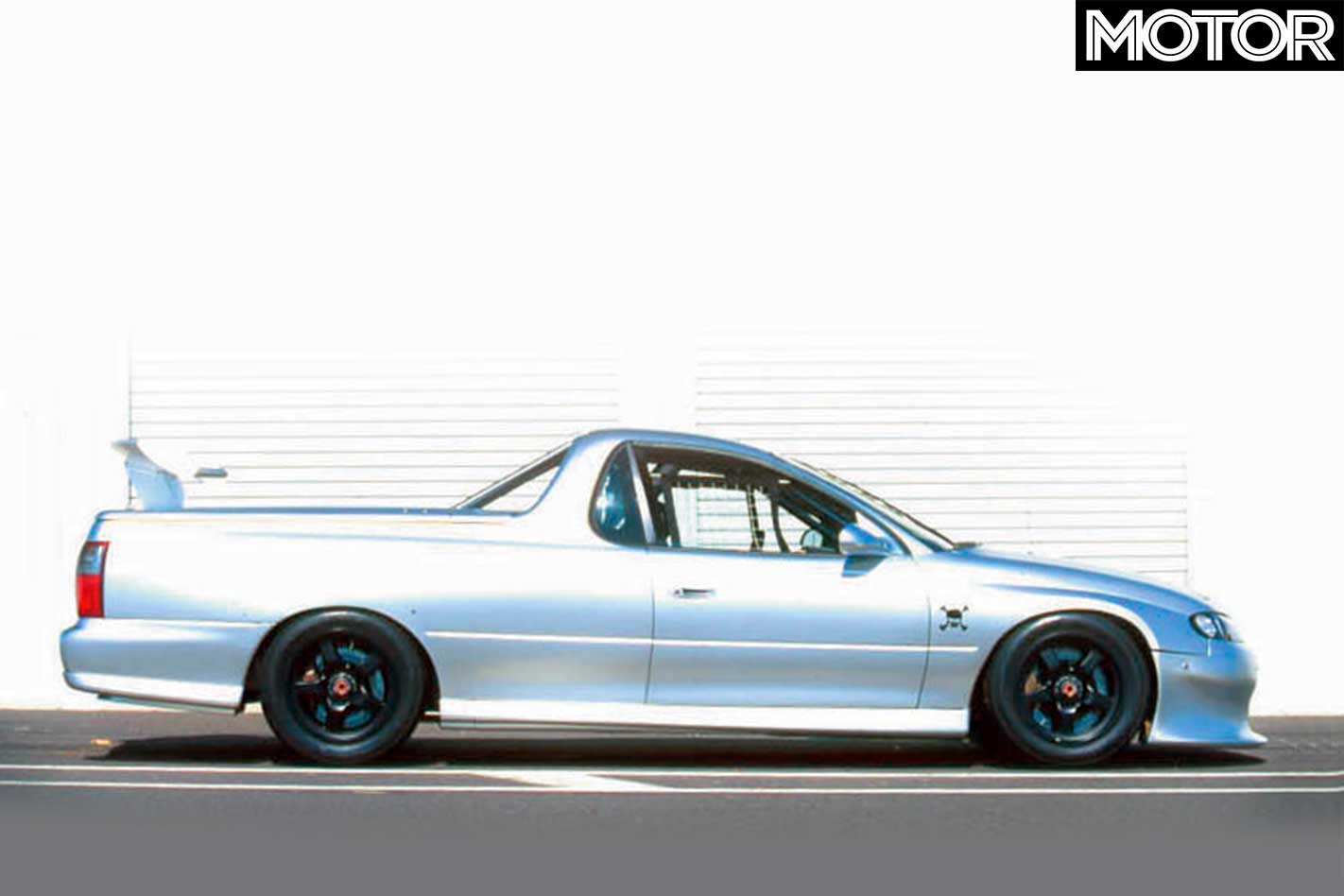
Holden Motorsport PR, Gerald ‘Donut’ McDornan, has put his balls on the line to pull off this world first, and his slightly panicky “Don’t bend it, Nally!” mantra buzzes inside my head like a small mossie in a very big jar. In seven days the Thunder Ute has to be in Adelaide for promo duties at the Clipsal 500 – and in one piece too, thanks mate.
If McDornan is nervous, imagine how I feel…
This is the most powerful car I’ve ever driven, and I’d spent a restless night fretting over missing shifts on the tricky Holinger six-speed gearbox and over-revving one of engine builder Mike Exell’s babies. Not to mention the scorn of the country’s top racers if I cocked up. God knows they’d love that.
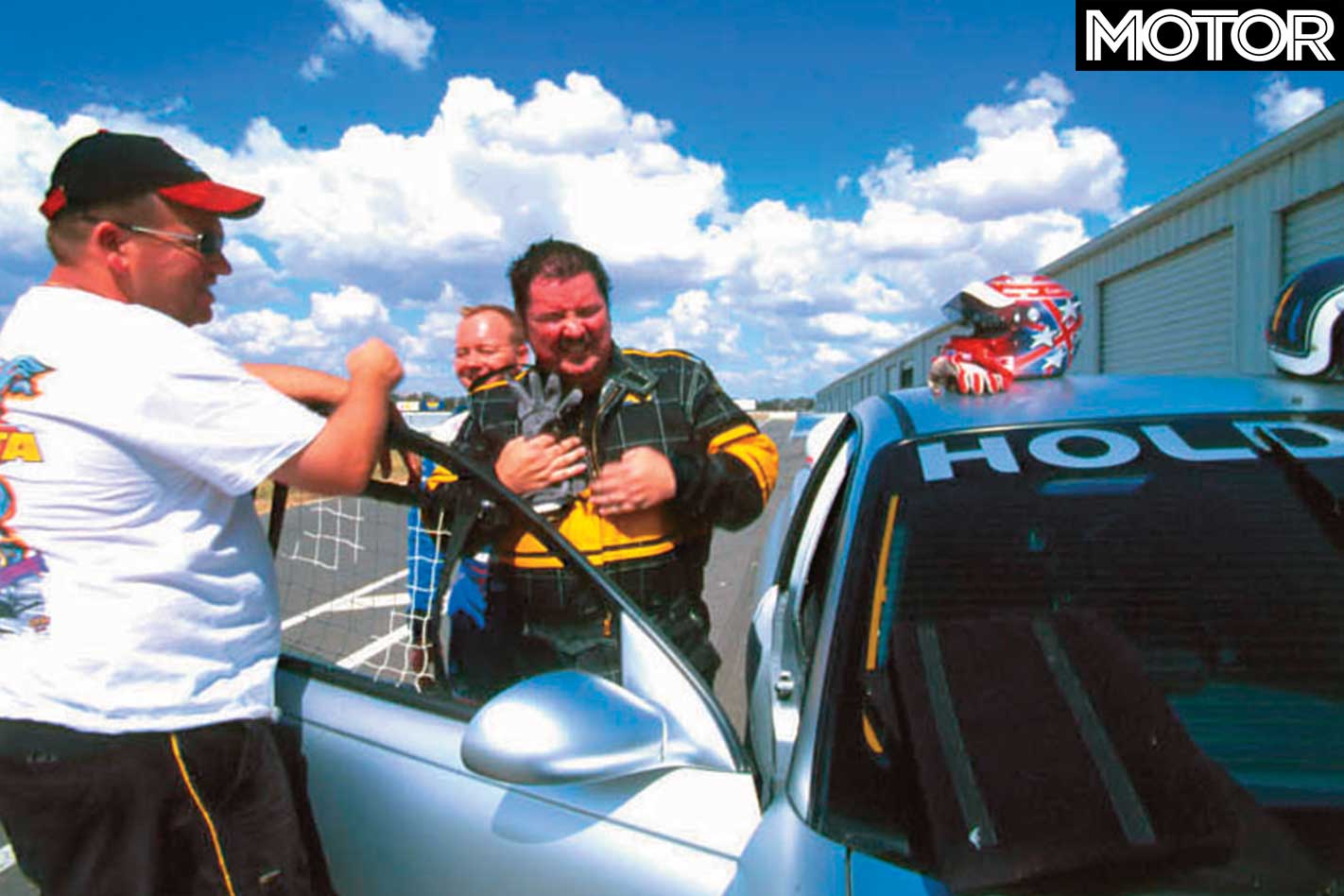
You see, this isn’t a private test day, where indiscretions are just between you, your deity of choice and the stopwatch. No sir, this is the last test before round one of the V8 championship for Garry Roger’s outfit, as well as for HRT and Kmart Racing. I’m feeling about as exposed as a pimple on Kylie’s arse.
When I arrive, sprintcar legend Max Dumesny is fanging the unmarked Ute around the twisty circuit, and in the distance it looks like a secret prototype, hot from Holden’s skunkworks. In the pits I casually admit my concerns about the gearchange and the power to Rogers and Co.
“Mate, it’s easy,” beams Dumesny, “It puts its power down so smoothly, don’t worry.”
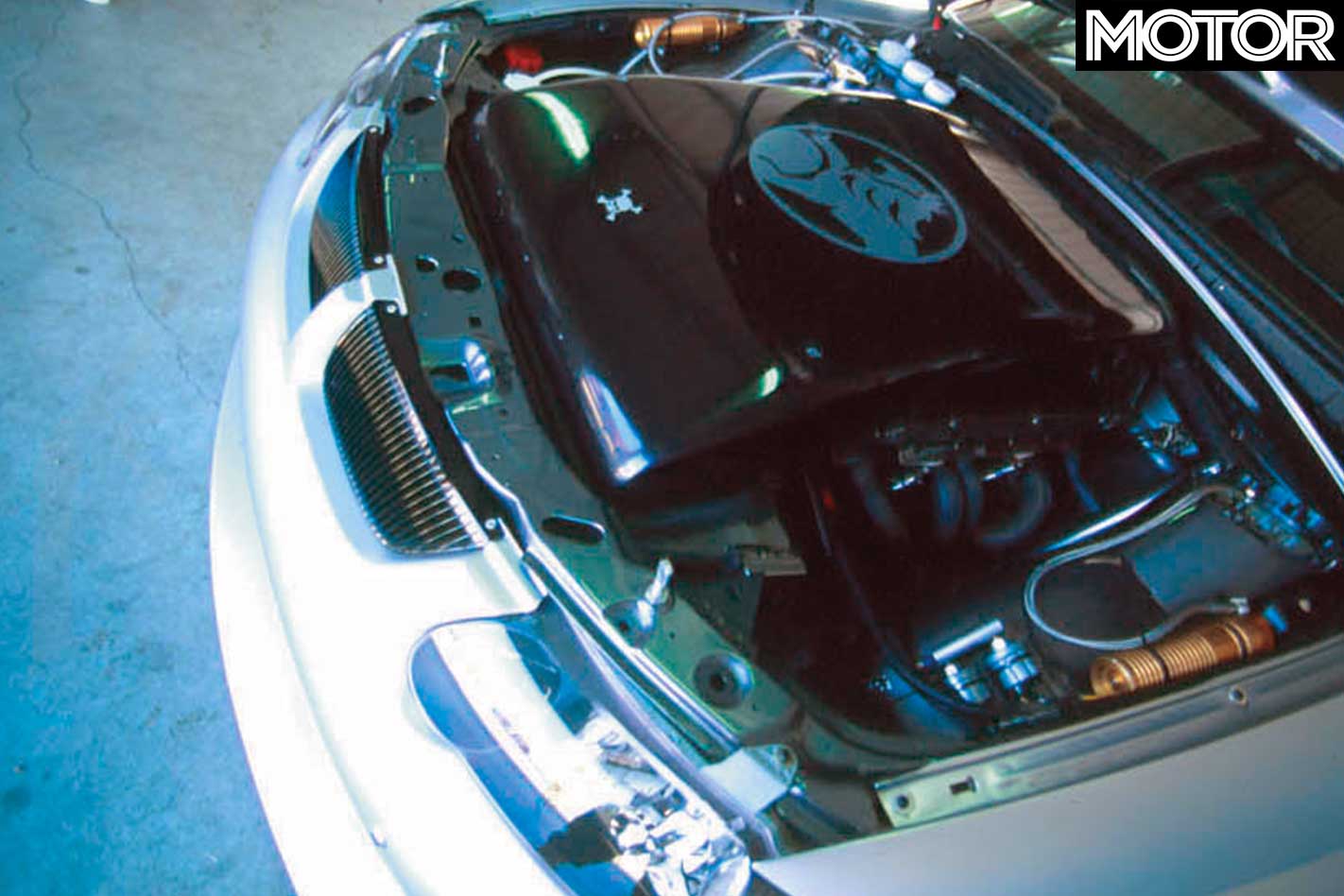
GRM drivers Garth Tander and Jason Bargwanna take a breather from testing and reiterate how easy (there’s that word again) the Ute is to drive and how much fun I’ll have.
Exell tells me the power is very progressive and that it has more grunt down low than the racecars due to a tamer cam. And, by the way, the MoTeC dash isn’t working so change up when you feel the limiter kicking in. It’s set for 6500rpm, 1000 down on the GRM racers’ to extend engine life. I protest that I won’t get out of fourth gear but Exell assures me I will.
Rogers proudly shows me over the car. The fabrication, panel and paint quality of the Thunder Ute is good enough to win Street Machine of the Year. The interior is race-Spartan and hearse-black.
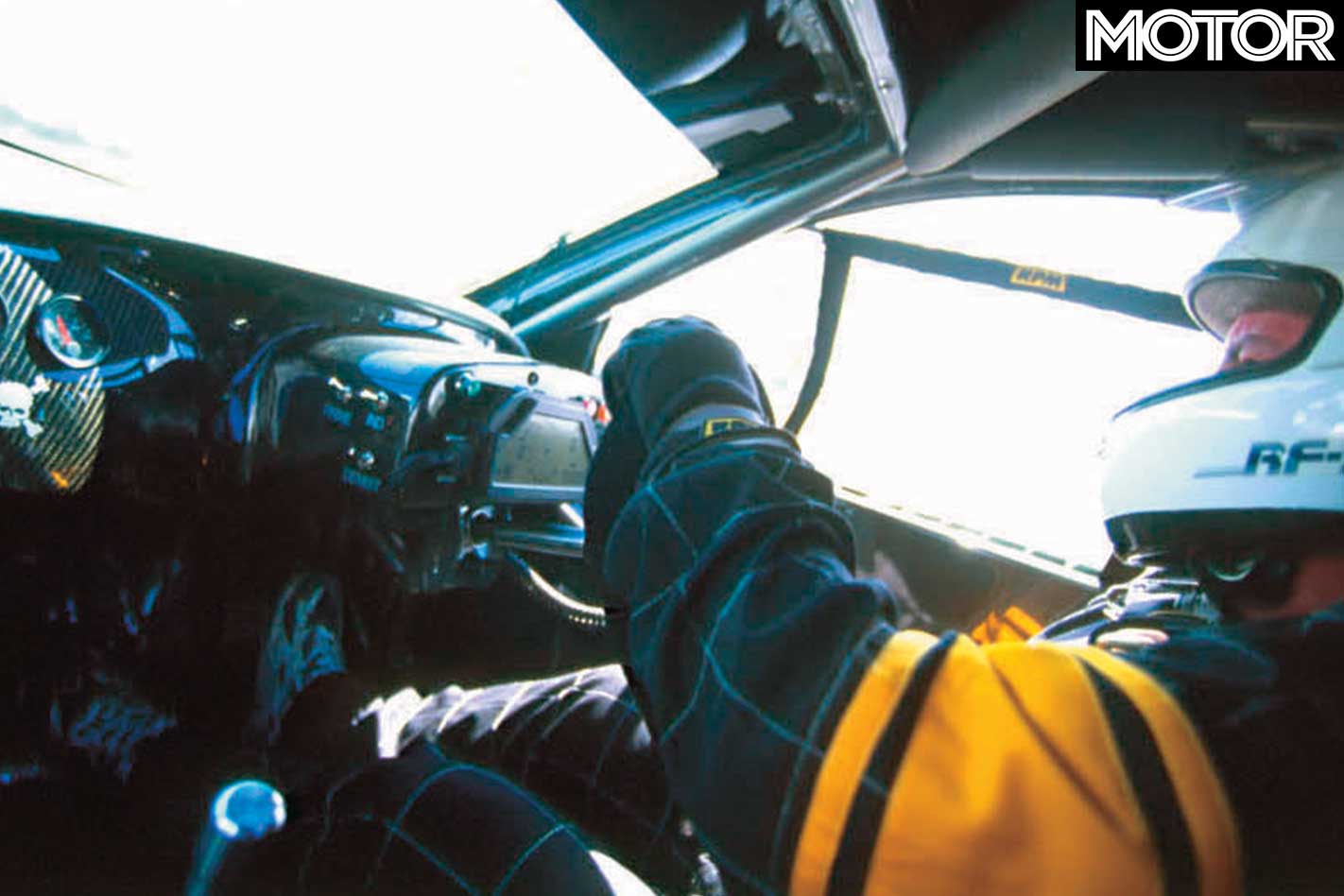
The ‘dead’ data dash sits on an extended steering column and is surrounded by oil and alternator warning lights and toggle switches for ignition, start, lights and wipers. A green brake balance dial resides on the side of the dash. The red button on the wheel activates the front brake line locker for burnouts; best not mistake it for the pit lane speed limiter button, then.
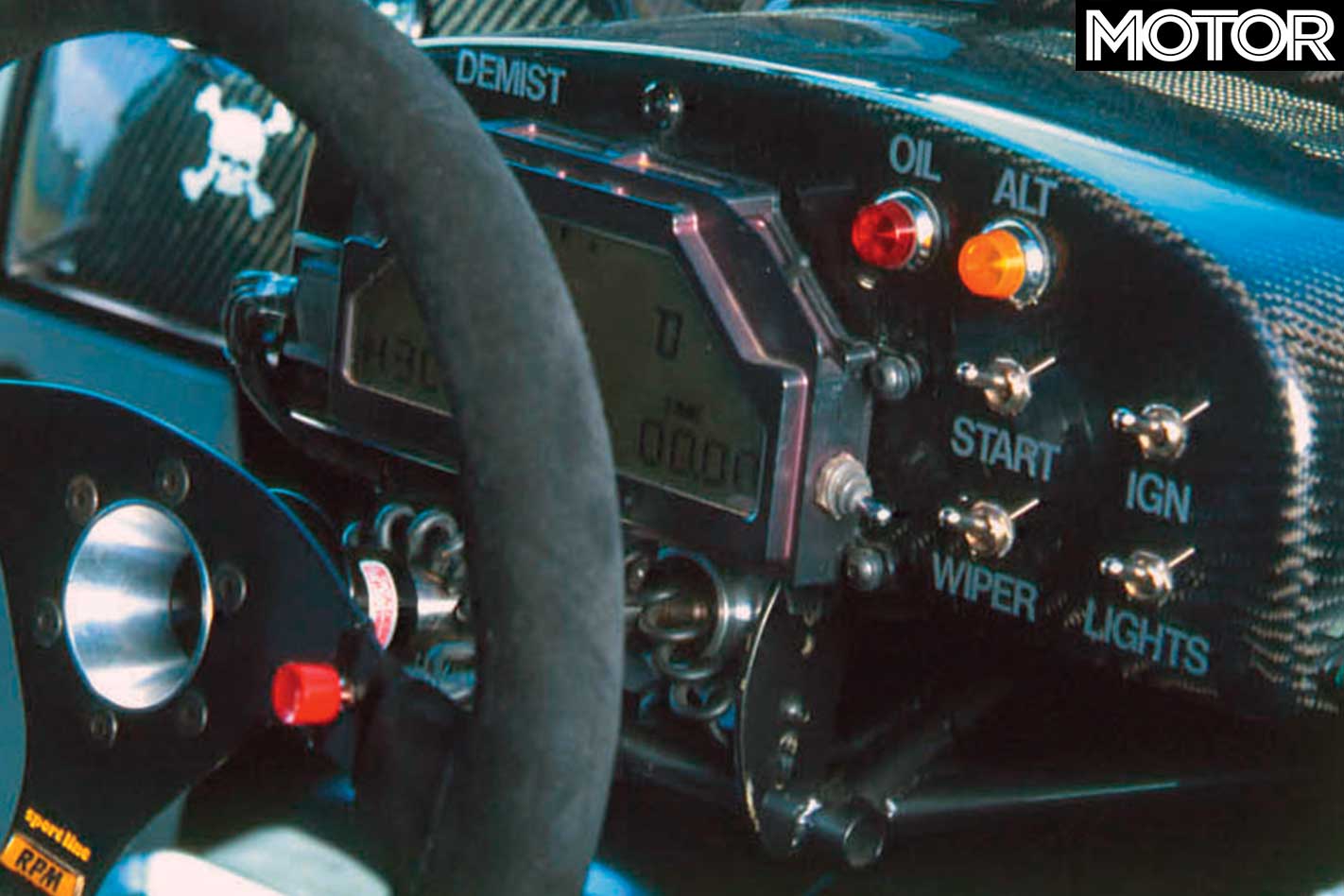
The carbon-fibre dash houses oil pressure and water temperature gauges. Everything is in easy reach. The detachable, D-shaped RPM Sportline steering wheel is perfectly positioned for me, as are the floor-mounted pedals. Thoughtfully, GRM has fitted power steering. But there is no rear view mirror.
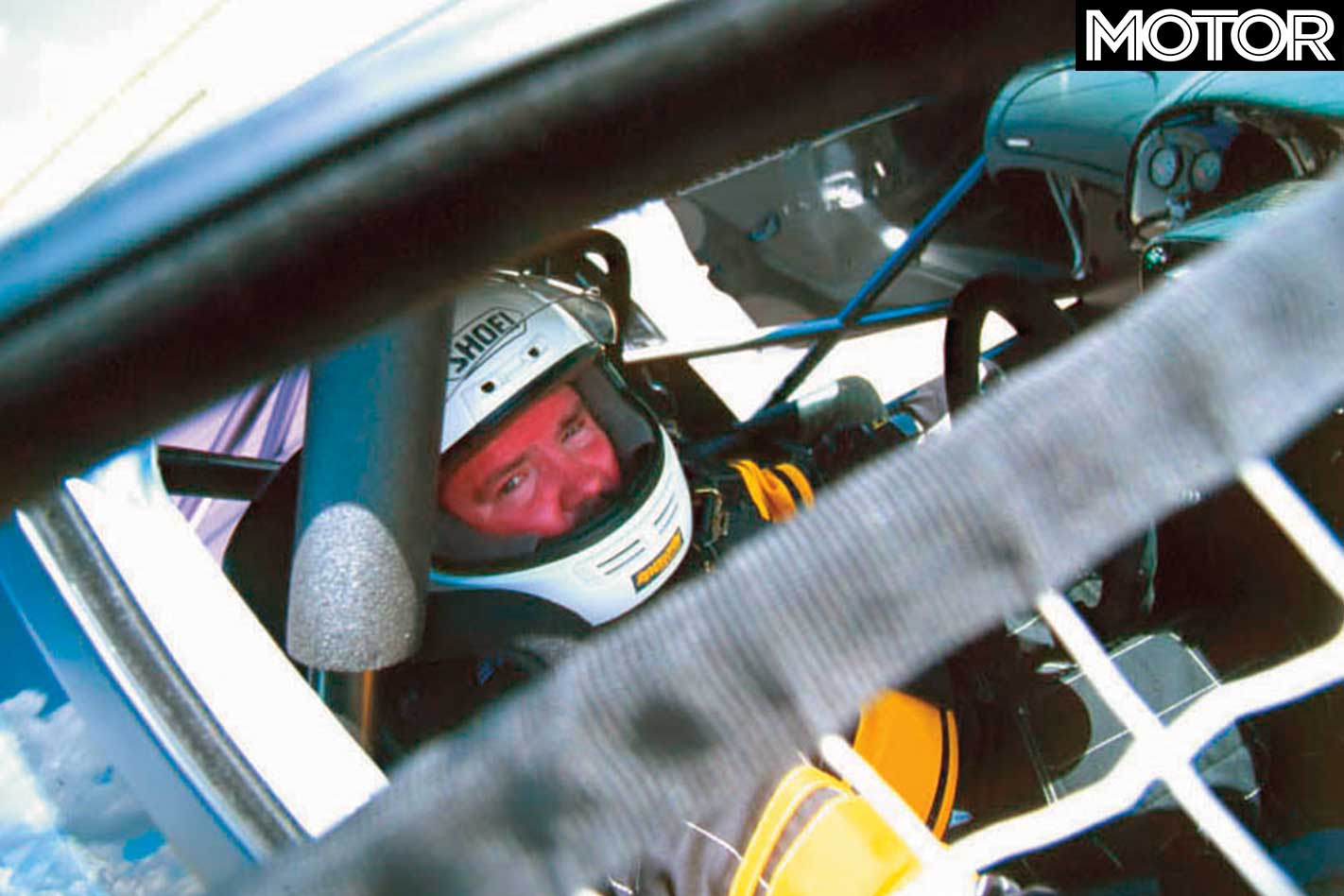
My turn. In a shiny new yellow and black RPM race suit (thanks Revolution Racegear) I look like a giant bumblebee and I quietly pray I don’t emulate that insect’s wayward flying pattern. I’ve got just five laps to shine or look shite.
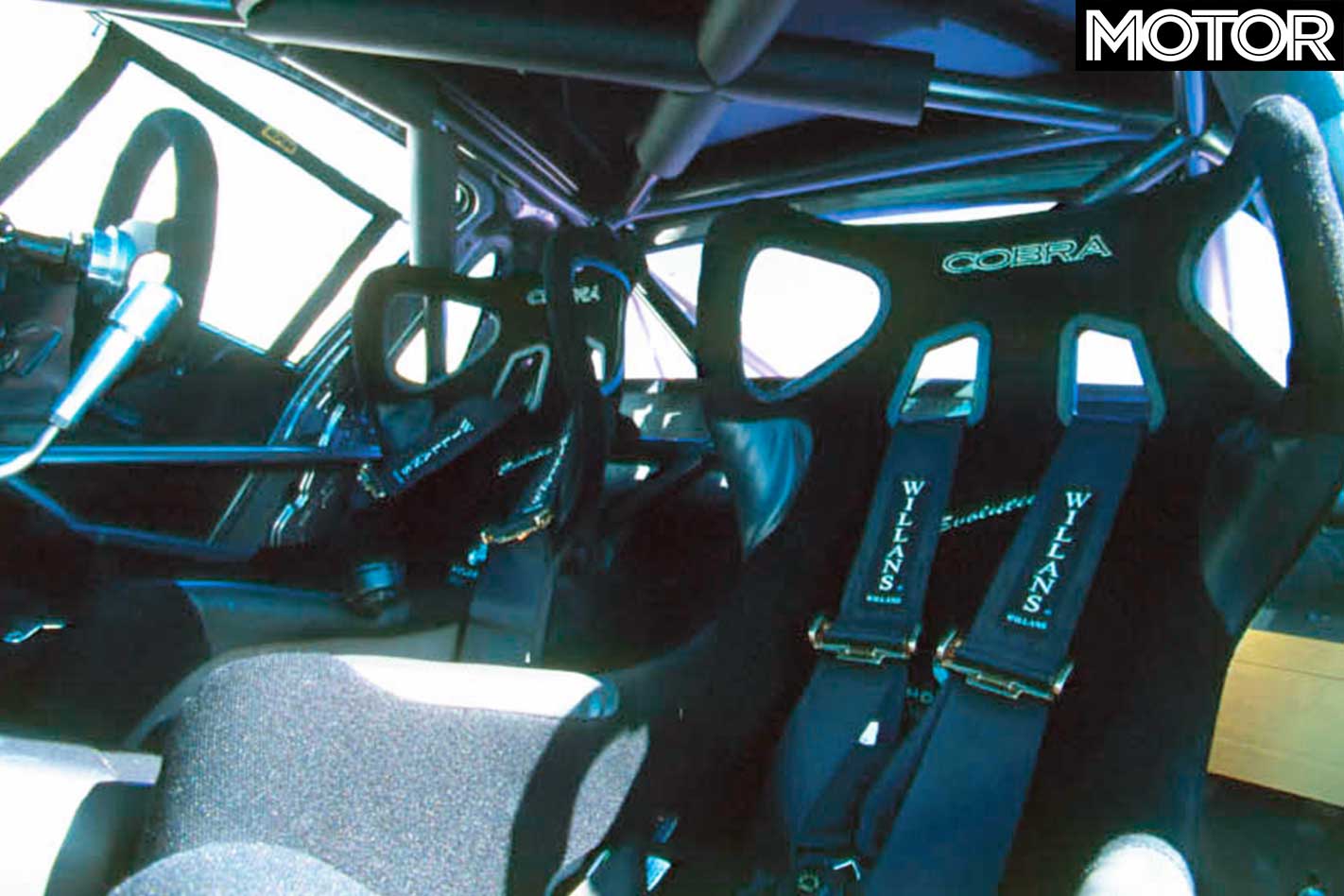
Arse wedged into the narrow Cobra bucket and snug in the five-point embrace of Mr Willans’ finest three-inch harness, I’m as ready as I’ll ever be, and the Ute is pushed out of its garage. This is so surreal. I’ve seen this scenario played out so many times that I feel like I am actually going out to race. Up and down pitlane, everybody has downed tools and interrupted debriefings to watch the journo bend the ute. Gulp.
Ignition on, starter on and the Chev bursts into raucous life. Oh, what a lovely, lovely noise. It’s loud and hard-edged and a quiver of excitement rushes up my spine. I don’t feel nervous, but my mouth is dry. Clutch in and first gear engages with a hard, car-juddering clank. The chassis starts a little shimmy, as if it knows what’s coming. I wish I did.
Now, it’s customary to stall one of these things first time out, and who am I to break with tradition? I raise the revs and slip the clutch. It takes up immediately and the Ute lurches an inch and dies. A huge cheer goes up. Bugger! Mind on the job now.
Ignition, starter, more revs, slip the clutch, and I’m away. The car begins to jerk and buck and I remember Exell’s advice: “If it starts to bunny-hop, bang it straight into second.” I do – cl-ank! – and idle smoothly past the V8 idols onto the track.
It’s lunchtime and (thank God) I’m alone on the track. Squeezing the stiff throttle oh-so carefully, I squirt up to third before lifting off and rolling carefully through the Esses. A short blast uphill past the old start/finish line and the first 90-degree right-hander comes up very quickly. I push on the brake pedal – but nothing happens! I push much harder and the car j-u-s-t begins to slow.
Of course, there’s no heat in the brakes. Then another piece of Exell advice comes back to me: “Brake earlier than you think you have to because you’ll be going faster than you think.” Too bloody right…
Back to second – clunk – blip the throttle, turn in; add more gas and get going. Round the next right-hander, snatch third, and take aim at the fastest corner at Winton, the long double-apex sweeper. There are plenty of marbles off line and I treat the sweeper with circumspection. It must look so slow back in the pits.
Through Penrite corner, ’round the ‘Gumtree’ hairpin, and on to the old back straight, feeding the power on, and trying to be smooth. Up to fourth before braking for the sucker-punch left that cuts back savagely and leads on to the new back straight.
Avoiding the jagged ripple strip on the exit I accelerate hard up to fourth. Yeeeee haaaaah! Five hundred horsepower turns a 200-odd metre straight into a suburban driveway. Blink and you’ll miss it and your braking point.
The next two 90-degree rights are taken in second then there’s the intoxicating 180km/h fifth gear rush past pitlane to the Esses and the biggest stop of the lap. I brake at the 300-metre board; Tander and his mates brake between the 100- and 200-metre markers.
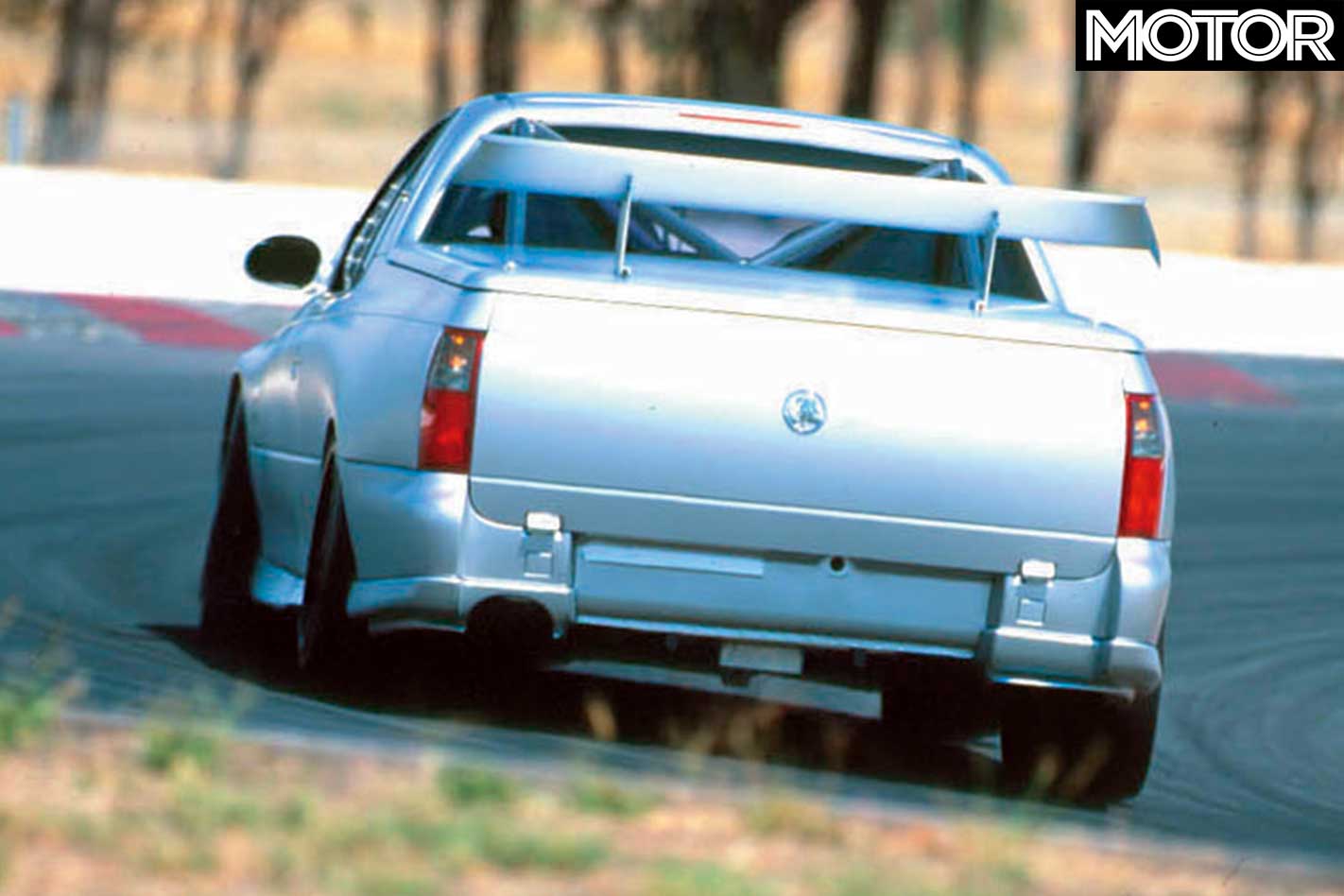
Lap one done, all systems a-okay, I start nailing the throttle harder and earlier. Dumesny is right; the car just squats and goes, but I’m still mindful of the mumbo and make sure the front wheels are straight before I really start gassing it hard.
Lap two is logged, a big, shuddering understeer at the Tree the only blemish. I’m beginning to enjoy myself but it’s 35 degrees C outside and more like 45 inside the car, and I become aware of the physical effort I’m putting in. Despite power assist, the steering isn’t road-car light and my forearms would be sore for days.
So far I haven’t cocked up any downshifts. The Holinger ’box is amazing. As revs build it emits a psycho-with-chainsaw whine and each shift sounds like someone is bashing on the floor with a sledgehammer. Actually, the whole V8 cacophony is thrilling; there’s nothing like the sound of eight race-spec pistons mashing air and fuel into atoms.
Then I miss the second-to-third shift. It should be just a flick of the wrist but for some reason I blow it, find first, and buzz the engine. The valve springs go ballistic; I cringe like a bad puppy.
The two-three change became my bete noir, and the expensive shriek of missed gears would grate on my nerves twice more. But, as Larry Perkins would say, press on and see what happens.
Lap three: I try using the brakes harder and the back end starts to move around. Bargs would tell me back in the garage that the brake balance was biased too much towards the rear.
Lap four, back straight, 170km/h in fourth, brake hard, third gear, second gear, tyre squeal… hello, I’ve spun! Shit! Man, that happened so fast, the back end just swinging around. I’m stalled, still on the track, but I didn’t hit anything. Bonus!
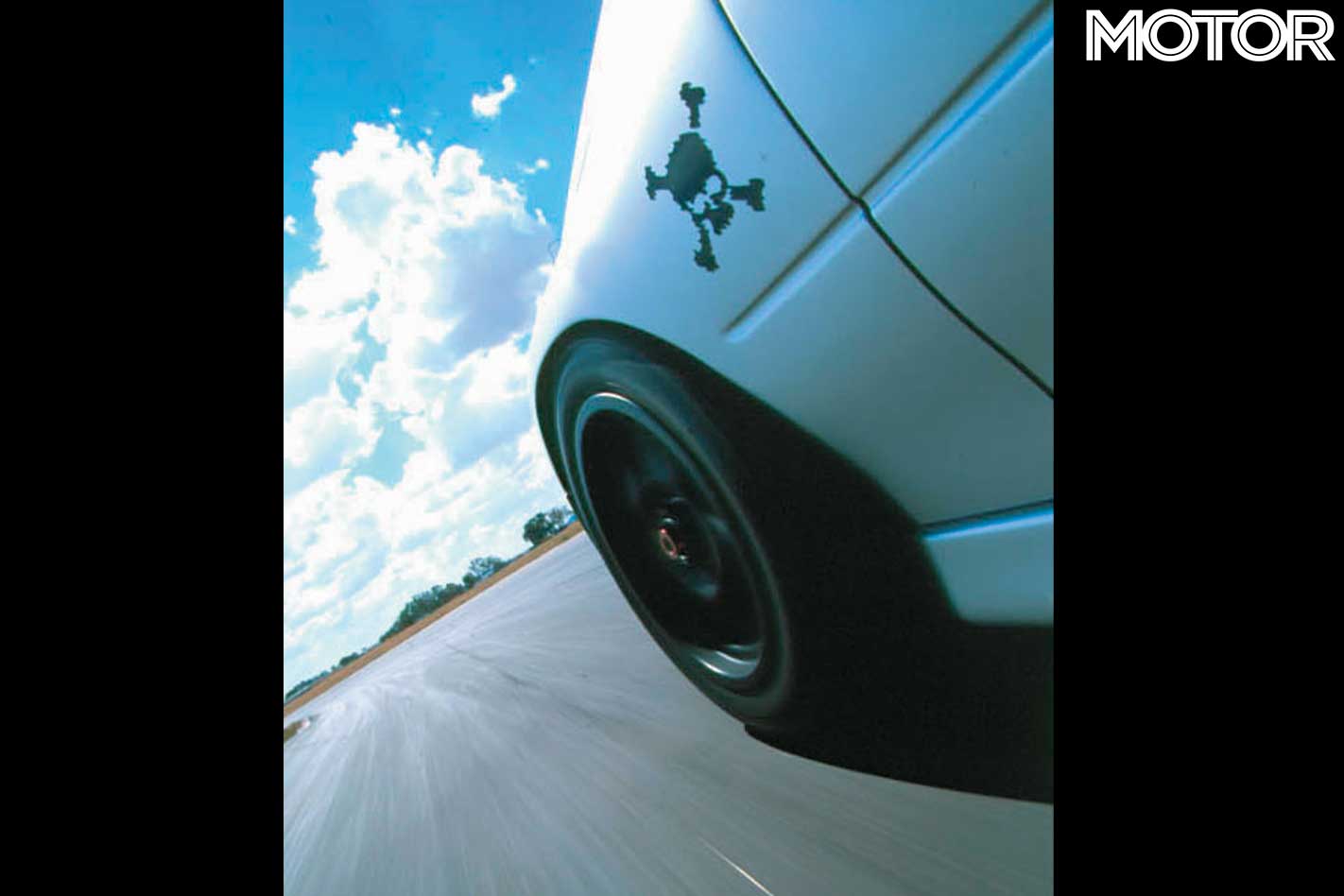
A moment of panic; ignition, starter, stall; ignition, starter, stall it again. Shit! Ignition, starter, big rev, slip the clutch and movement at last. I think I snagged the throttle and brake pedals together or I got compression lock-up in second, or both. Memo to self: buy some narrow racing boots.
I do one more lap, and then rumble slowly down pitlane to an unknown reception. But more embarrassment is to come. Exiting the car awkwardly, I slip on the car’s metal floor and fall flat on my back, my head crashing down hard on the concrete. Rogers bends over me, pissing himself laughing. “So that’s what helmets are for!” I yell up at him. Memo to self: buy some narrow, sticky-soled racing boots.
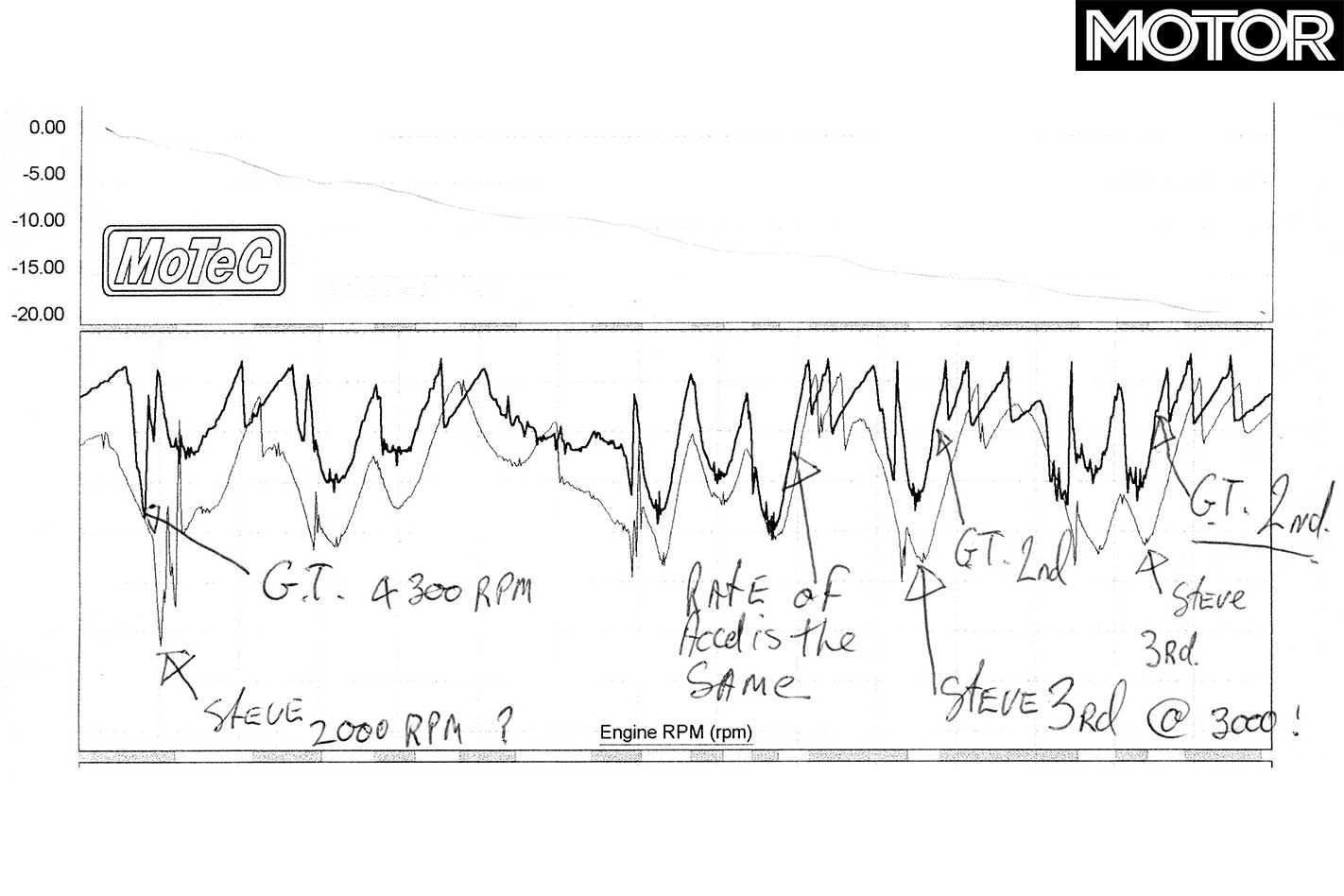
I’m knackered. My arms are limp, I’m drenched in sweat and my head is ringing. Rogers is still laughing, he thinks it’s great fun. Bastard. McDornan is relieved. Exell plugs his laptop in to check the over-rev. Bad?
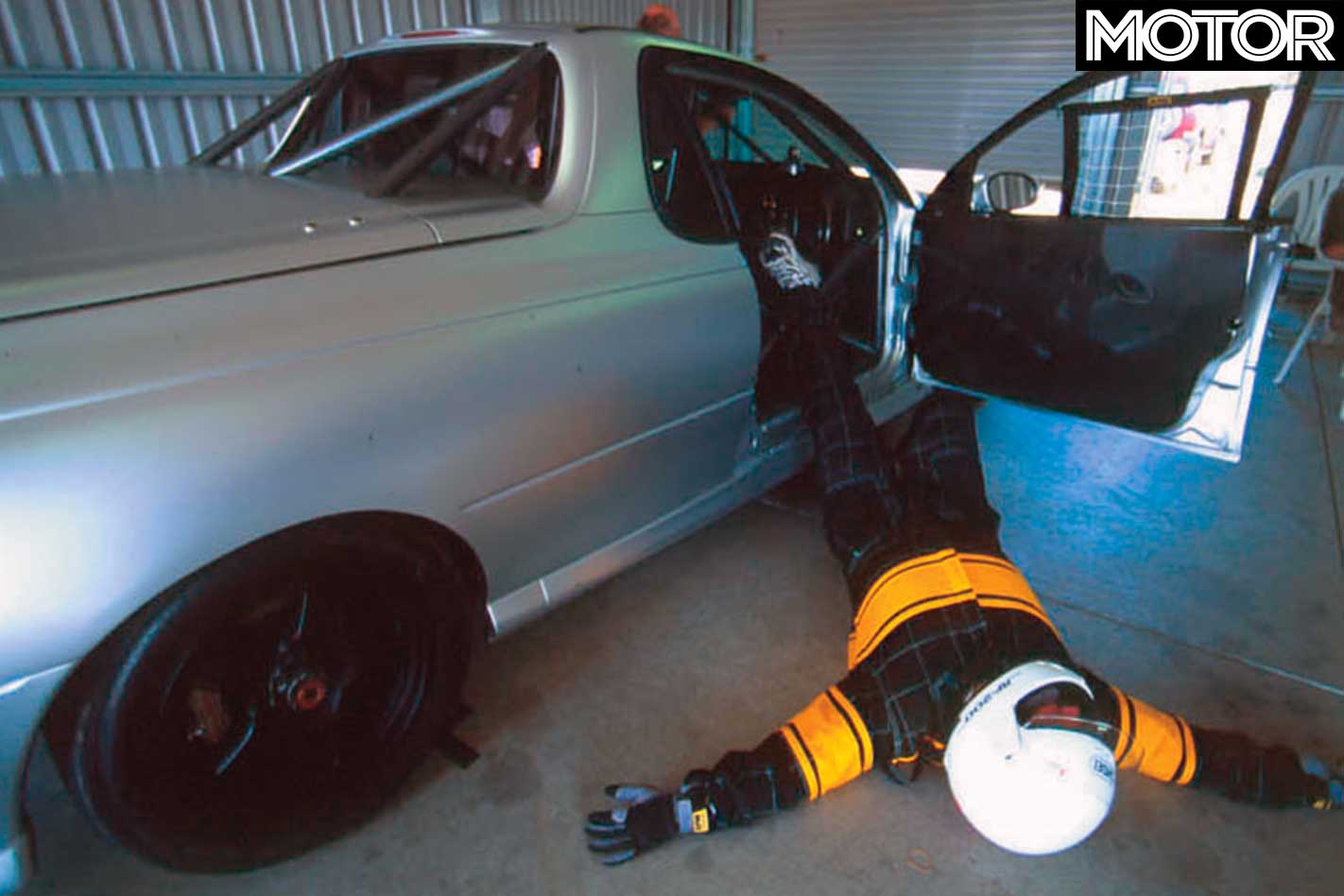
“Only 7900,” he shrugs. “That’s nothing ’cos the limiter was set at six-five. Don’t worry, the pros do it all the time, except they buzz ’em over 9000rpm.” The team says nice things.
“It’s not easy to get into one of these things with no experience and go fast in five laps,” Bargs says. “They’ve got angry brakes, an angry gearbox and an angry throttle.”
Tander concurs. “Winton’s not an easy track, either,” he says. “You’re always turning, braking or shifting, you don’t get any rest. Actually the racecars are easier to drive.” Now he tells me!
Did I explore the Ute’s limits? No. Did I get near mine? No, I was being way too circumspect; hey, it’s someone else’s $300,000 ute. But I had a bloody great time. The Thunder Ute intimidates like no road car can, but with more laps I reckon I could cut six seconds off my time. Familiarity breeds speed, you know.
Hey Garry, if I start training now, I reckon could be ready for Bathurst. Garry? Garry? Where are you going, Garry? Garry, what about a Konica drive? Garry!
FAST FACTS 2002 Garry Rogers Motorsport Holden Thunder Ute
BODY: 2-door ute DRIVE: rear-wheel ENGINE: 5.0-litre V8, MoTeC engine management system BORE/STROKE: 100 x 75mm COMPRESSION: 10:1 POWER: 380kW @ 6100rpm TORQUE: 597Nm @ 5250rpm WEIGHT: 1350kg POWER-TO-WEIGHT: 281kW/tonne TRANSMISSION: 6-speed manual SUSPENSION (f): Harrop hub on GRM MacPherson struts, 3-way adjustable Ohlin shocks, adj anti-roll bar SUSPENSION (r): four-link, adj. Watts link, coil-over adj. Ohlin shocks, adj anti-roll bar L/W/h: 5040/1870/1410mm WHEELBASE: 2939mm TRACKS (f/r): 1559/1577mm BRAKES: 375 mm ventilated discs, four-piston mono-block calipers (f); 340 mm ventilated discs, four-piston calipers (r) WHEELS: 17 x 11-inch (f & r), alloy TYRES: Bridgestone 17 x 12 (f & r) PRICE: $300,000
Five reasons to unnaturally crave the Thunder Ute
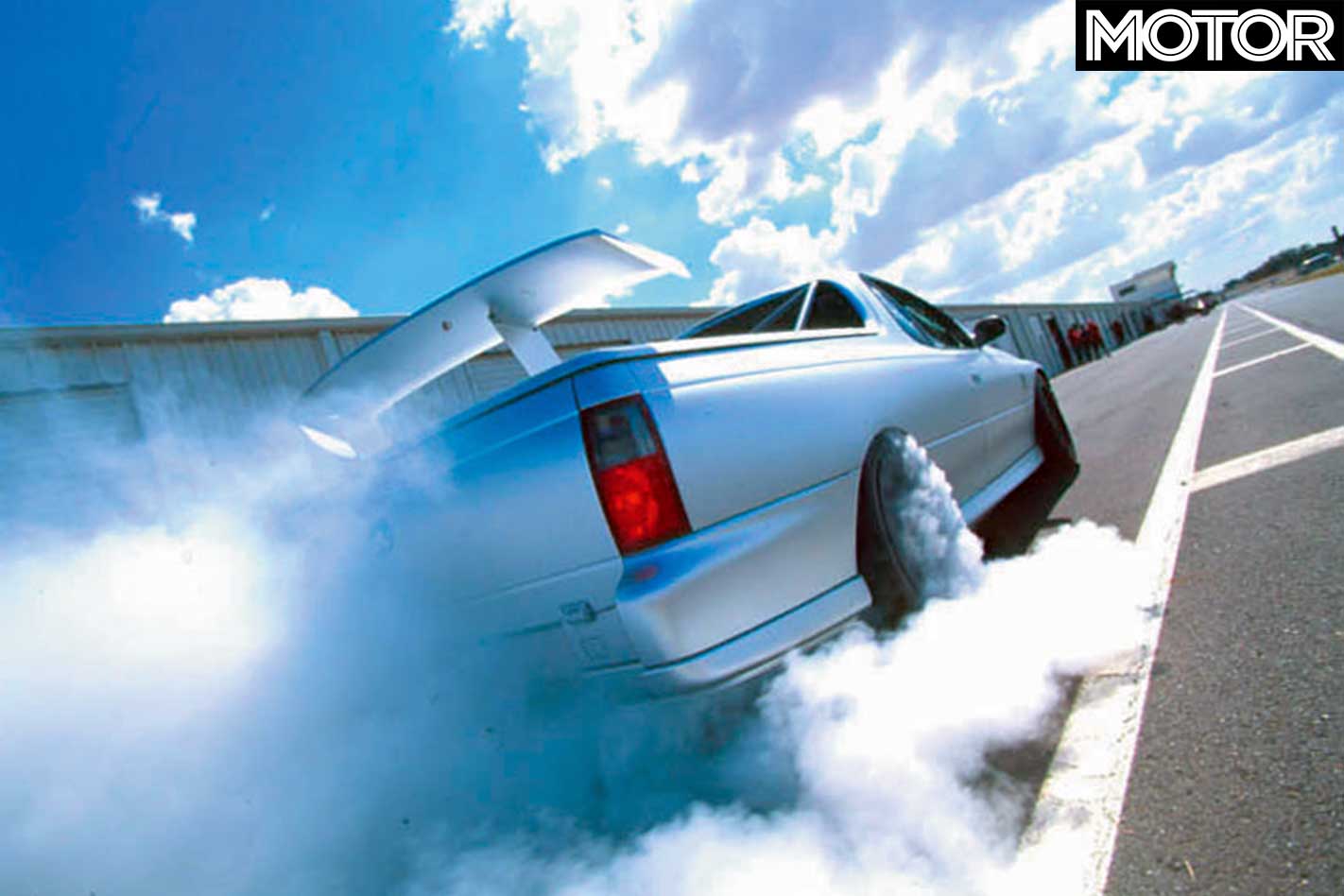
01- It’s the only one there is 02- It’s straight-up Supercar top to toe 03- The noise. Oh, the noise! 04- Close as God to a Level 1 car 05- Punching it in third
Mike Exell, the man behind the engine
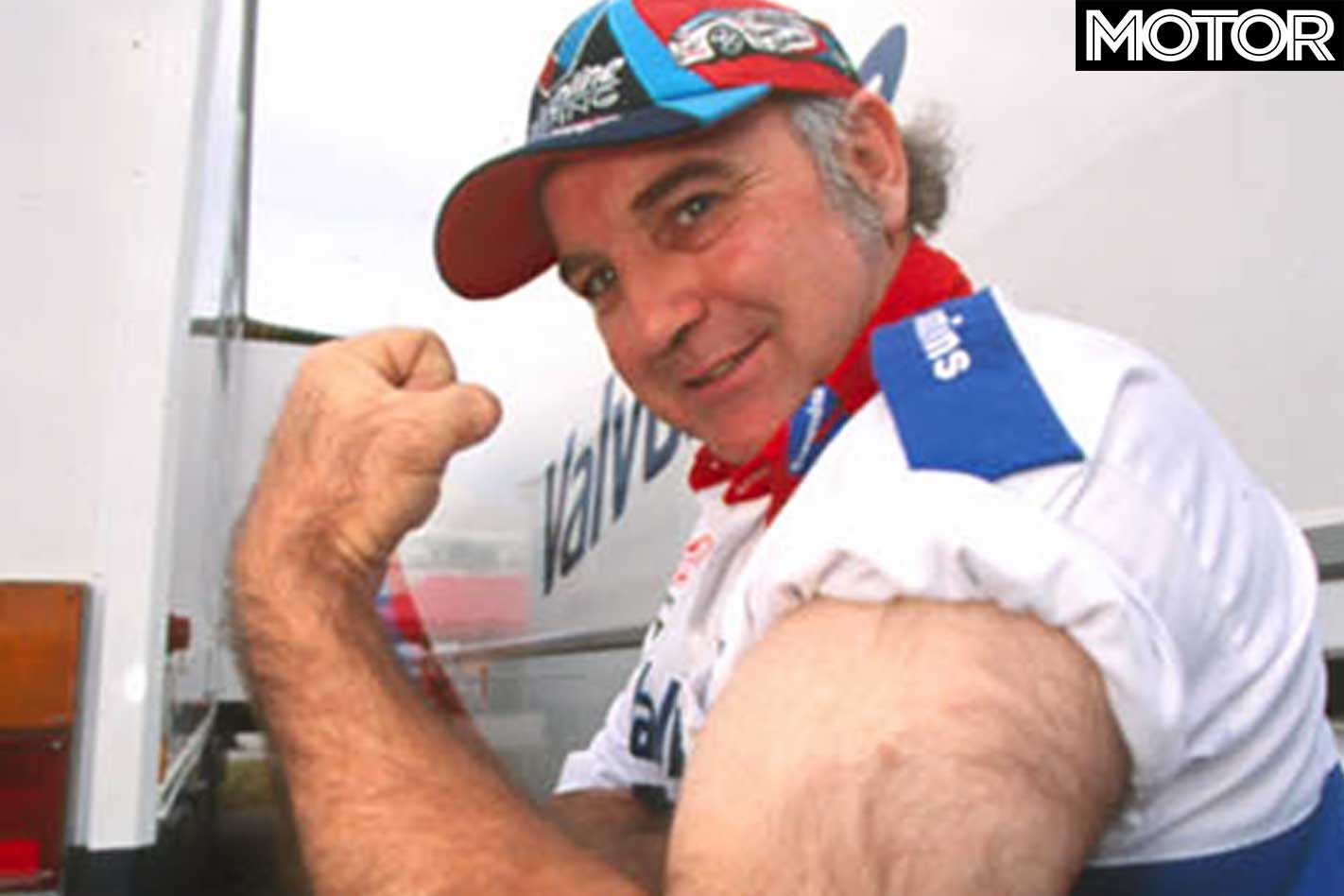
Mike Exell builds GRM’s engines and says the Thunder Ute’s donk is pretty close to the real V8 Supercar deal.
“The Ute’s engine has a different configuration to the race engines to make it last longer between top-end rebuilds (4000 km instead of 2000). It’s only got about 160-180 bhp at 3000 rpm but it steps up big time from 4000 on where it’s got about 380 bhp, and about 440 at 5000 rpm. It makes about 510 bhp at 6000 rpm, which is about 10 bhp less than our race engines at 6000. But the race engines keep going (making more power) where the ute’s flattens off. But lowering the revs makes it a bit stronger than the race engines, because it’s got a milder cam, and at 4500 rpm it’s probably got 30 bhp more than the race engines. It makes about 440 ft lbs of torque; a really good race engine will make 450.”
