
Lexus World Clock, $TBC
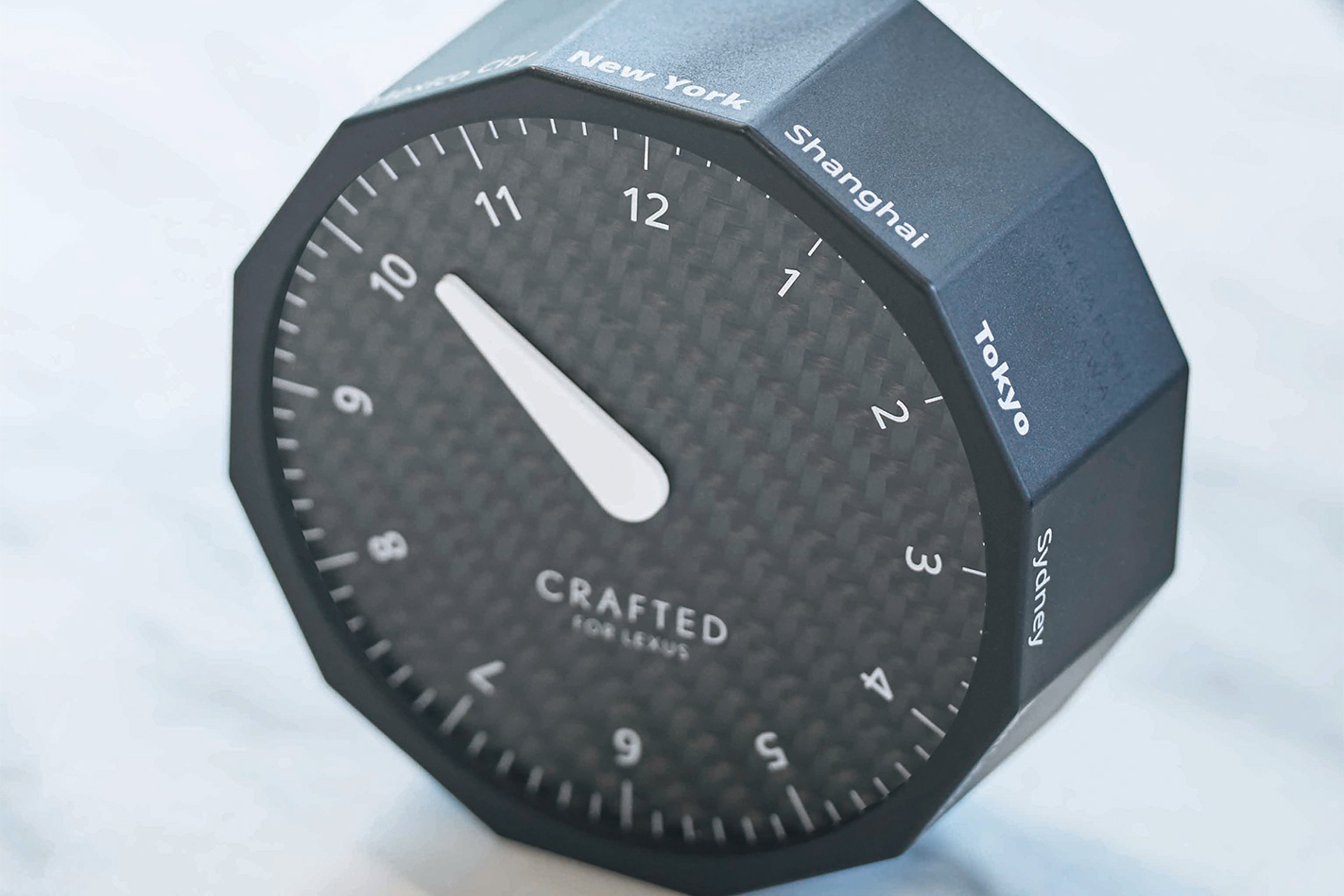
They say time waits for no man, but American singer-songwriter Tom Waits’ drummer Shelly Manne was reportedly not the most punctual band member so, on at least one occasion, Tom did in fact wait for Manne. In recognition of Masafumi Ishikawa’s Lexus Design Award-winning timepiece, Lexus is putting this ultra-minimalist World Clock into production. Pricing has not yet been finalised, but as it is constructed using the same carbonfibre sheet found in the highest-performance Lexus models, you can bet it won’t be cheap. An arrival date is also unconfirmed but it will be worth the wait. craftedforlexus.com
Il Fascino Ferrari Collector’s Edition book, $36,600
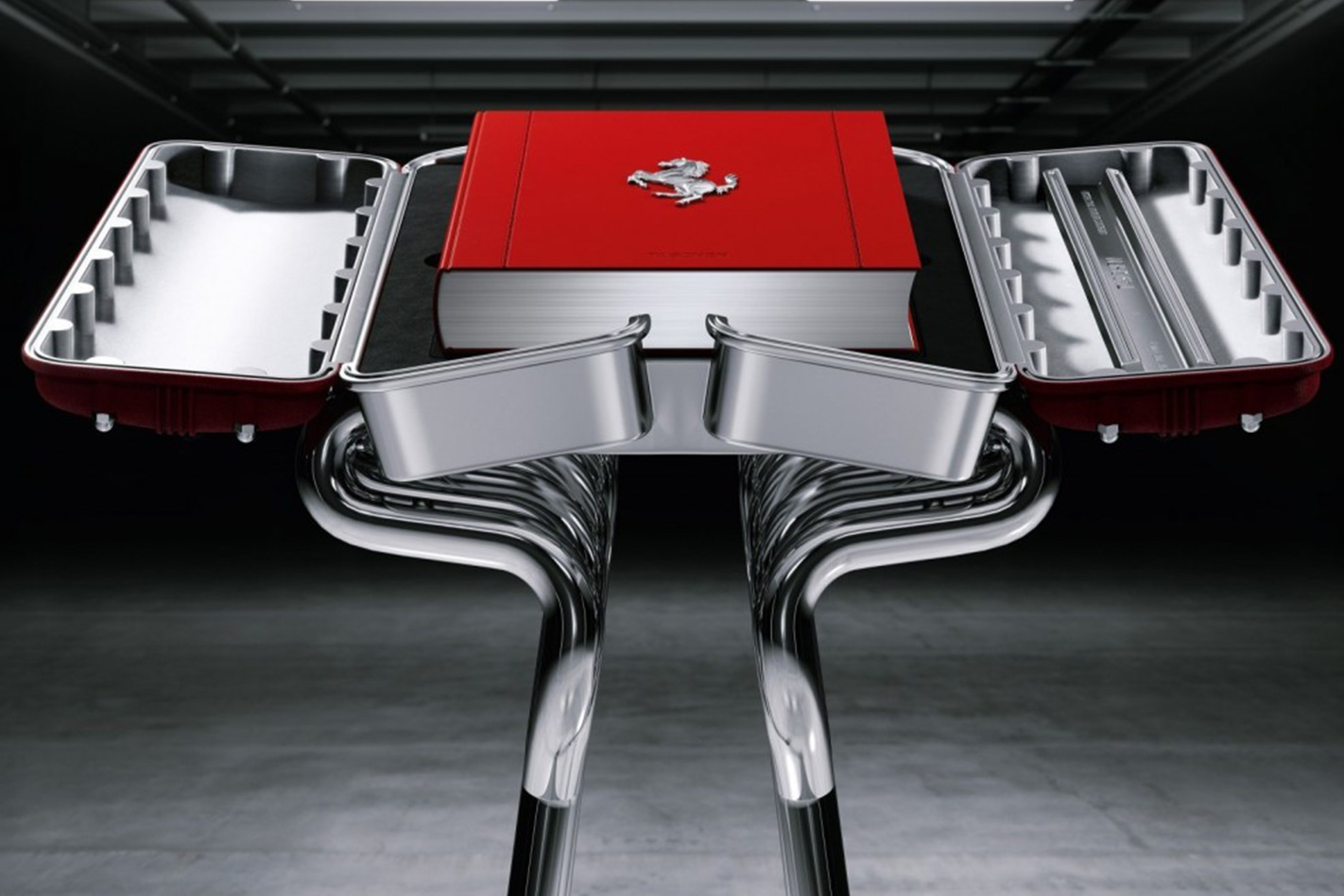
Generally speaking, hardback books tend to be more expensive than softbacks. So it shouldn’t be surprising that when you bind a book in leather, encase it in metal, top it with a pair of wrinkle-coated V12 rocker covers and stand the whole thing on a ridiculous hand-bent chromed tubular exhaust manifold pedestal, the price blows out to the cost of a Ford Mondeo. Il Fascino Ferrari offers an insight into seven decades of prancing horse history through previously unseen pictures and documents, but you’ll likely be too busy with Brasso to actually turn a page. taschen.com
Airfix quick build kits, $26.95
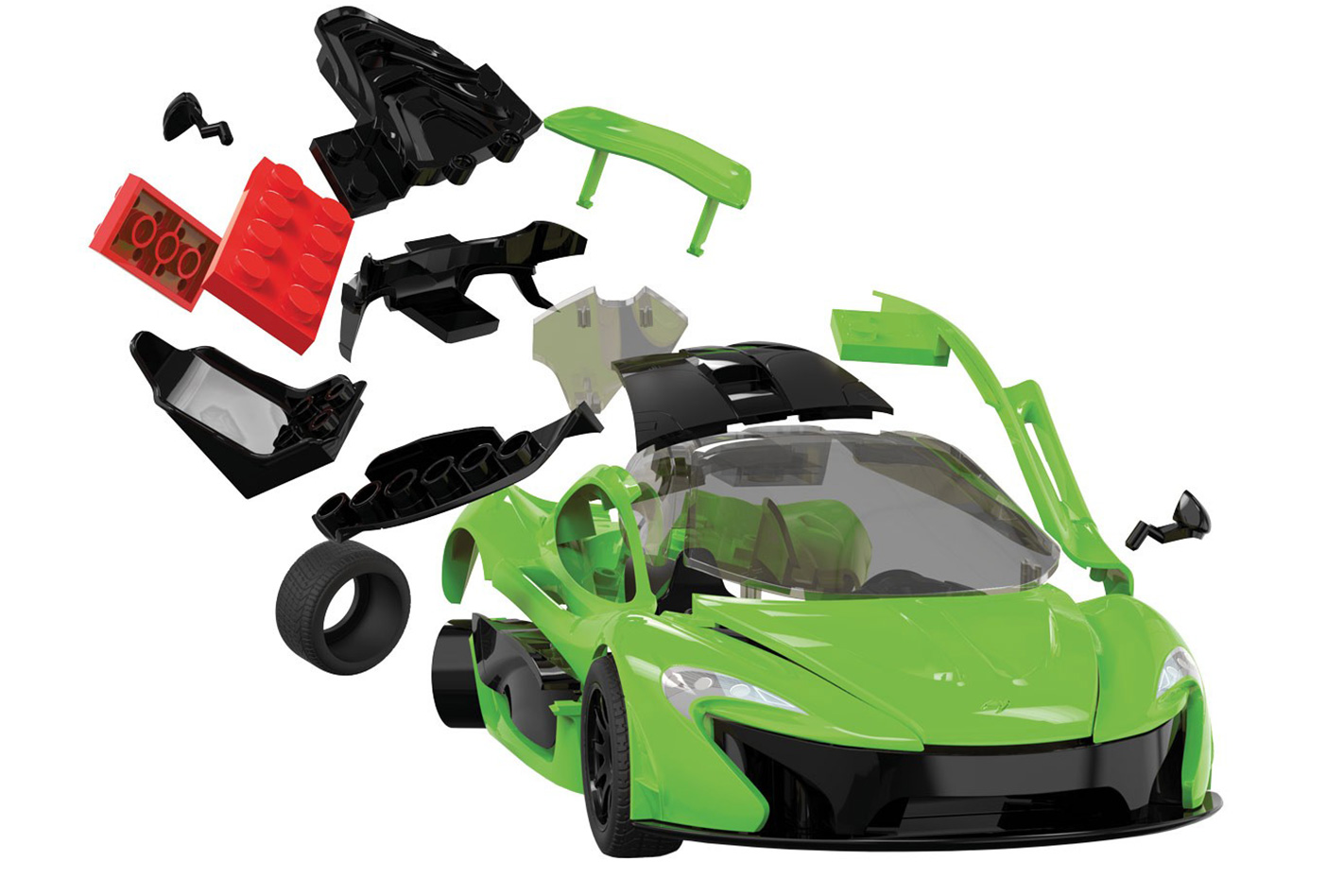
Were you the kid at school who failed to get your pen licence and was banned from using the pointy scissors? Well, you’ll love these new super-simple Quick Build kits from Airfix. Unlike the company’s traditional cut-out-and-assemble kits which need all kinds of dangerous things like glue and paint, the new range of car and plane kits simply snap together in minutes. Suitable for ages five and up, they’re perfect for budding young transport enthusiasts who like to keep their little hands busy. airfix.com
Ixoost Pirelli P Zero Sound Pod, $3900
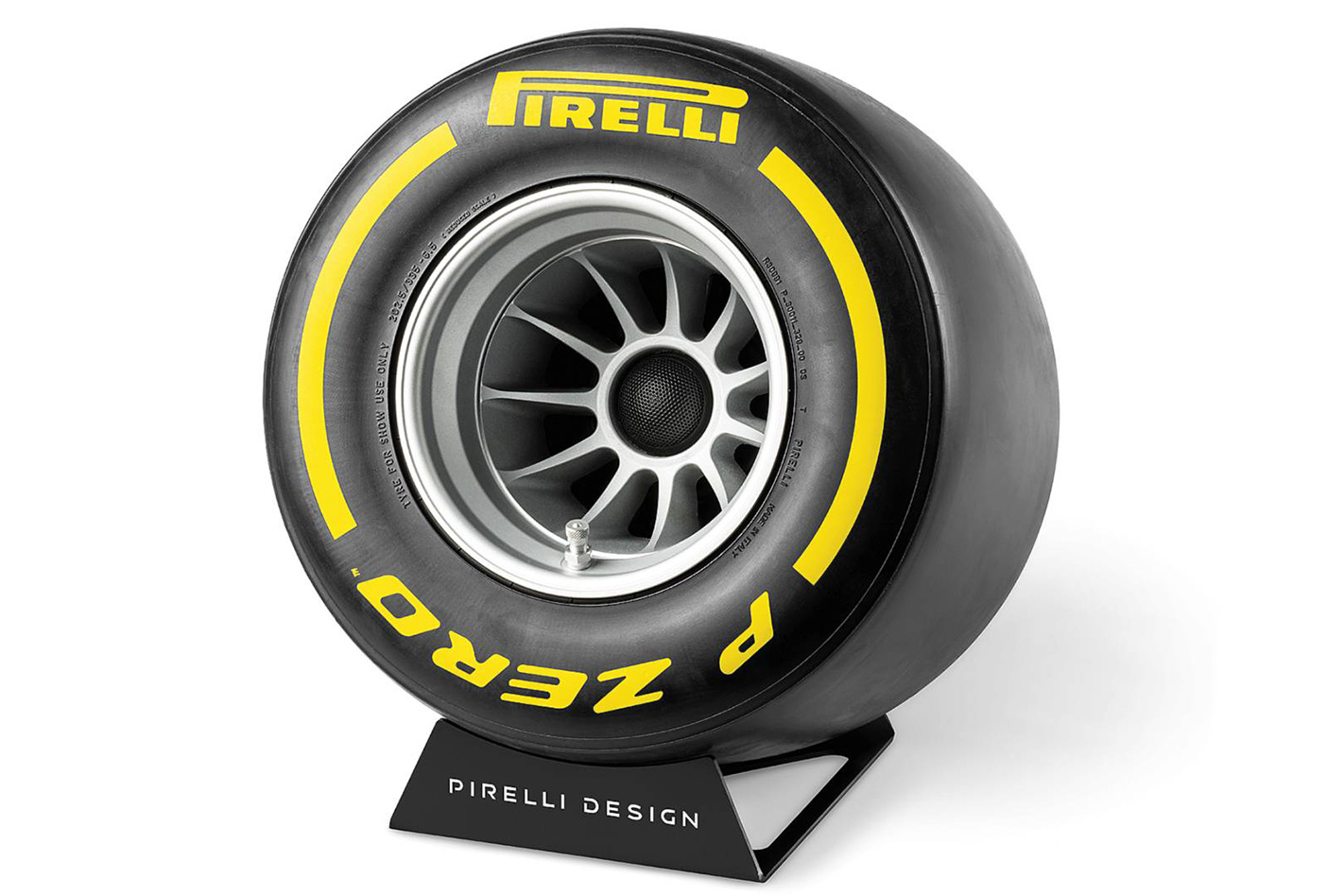
Displaying a half-scale model of a Formula 1 Pirelli P Zero on your bookshelf would be cool enough, but Italian electronics authority Ixoost has taken the mini wheel and tyre combo – actually used in wind-tunnel testing – and turned it into a Bluetooth speaker. The centre houses a silk tweeter, behind it sits a 100mm midwoofer and the whole thing is driven by a 100-watt amp. Until the FOM comes to its senses and reintroduces naturally aspirated V10 engines, this is possibly the only way an F1 car is going to sound good. ixoost.it
Watches
TAG Heuer Carrera Heuer-01 Aston Martin, $8450
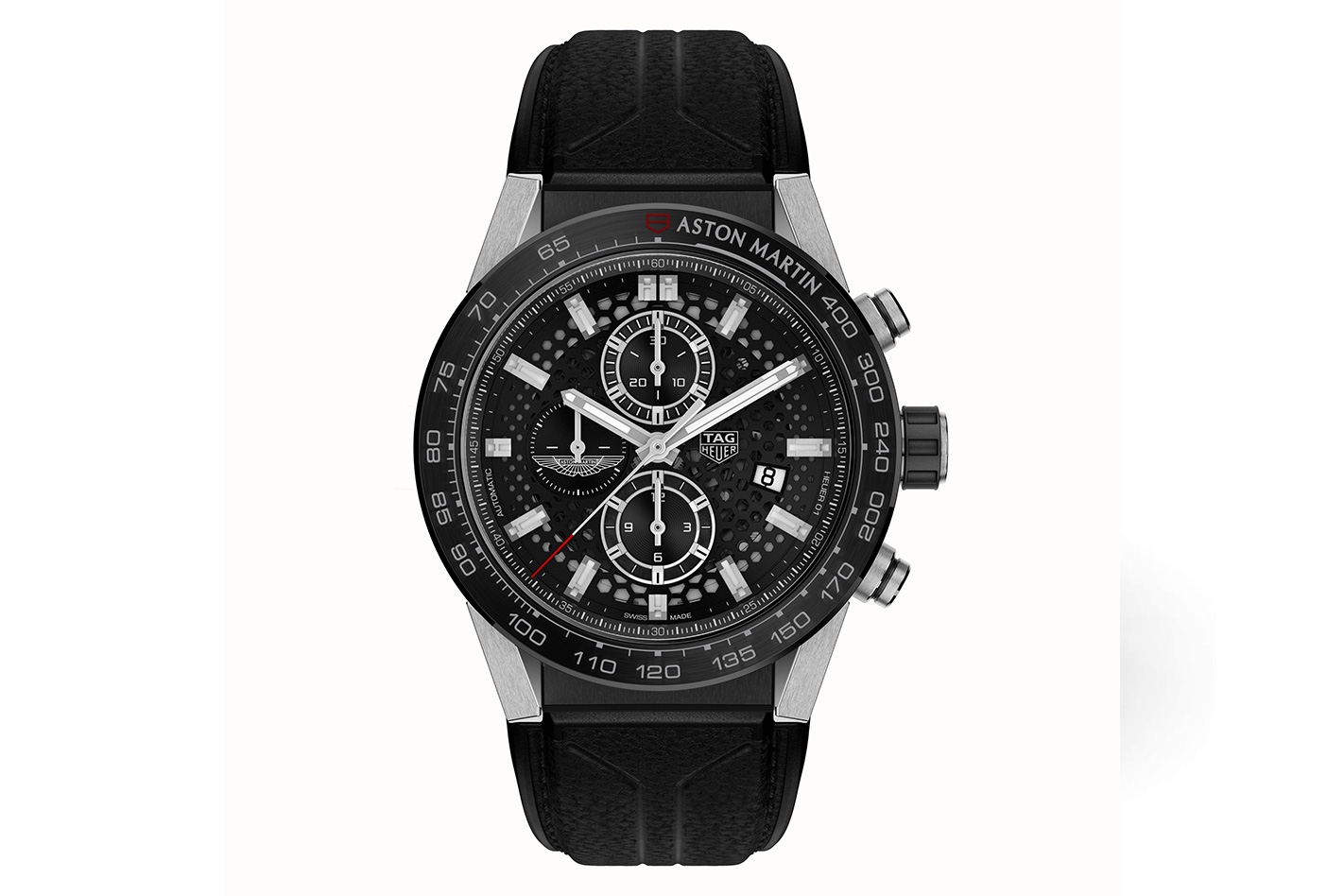
Stemming from the partnership between Aston Martin and TAG Heuer is this automatic chronograph based on the 45mm Carrera Heuer-01. Its large case sits prominently on the wrist, and differs to others in the range with parallel lines engraved into the sides of its stainless-steel centre. It features a black ceramic bezel and houses a standout open honeycomb ‘semi-skeleton’ dial. Available on a black rubber strap only, it’s a highlight of the line-up. tagheuer.com
Traser P67 Officer Pro GunMetal, $586
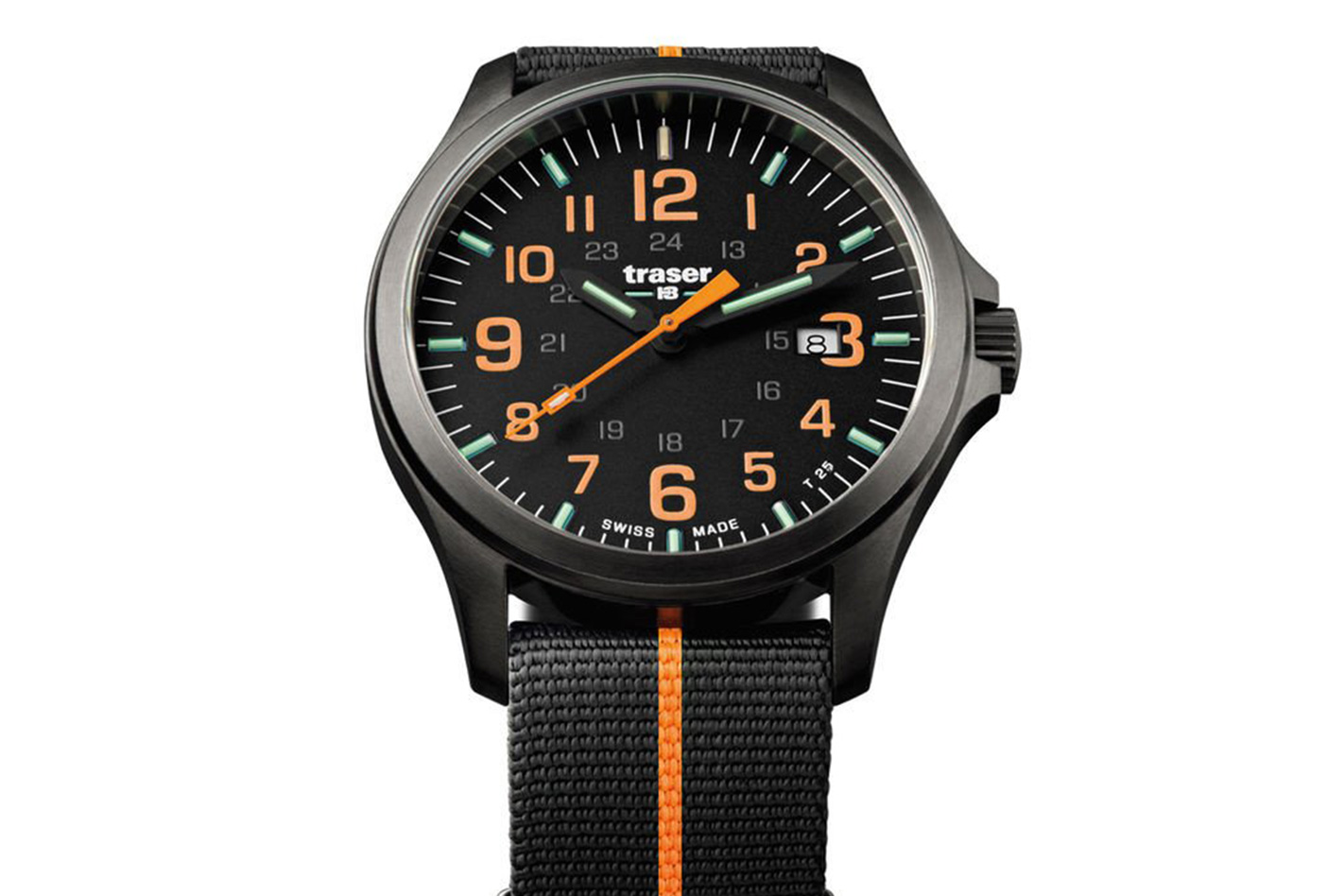
Traser claims to be the inventor of self-illumination technology, born out of a supply deal with the US military. Its timepieces feature a special compound called Trigalight on the hands and hour indices that illuminates in the dark without having been exposed to a light source. The P67 Officer Pro is one of Traser’s most attractive models, shown here in more affordable quartz format, though automatic variants also exist. swisstimehq.com.au
Longines Conquest V.H.P. GMT Flash Setting, $1750
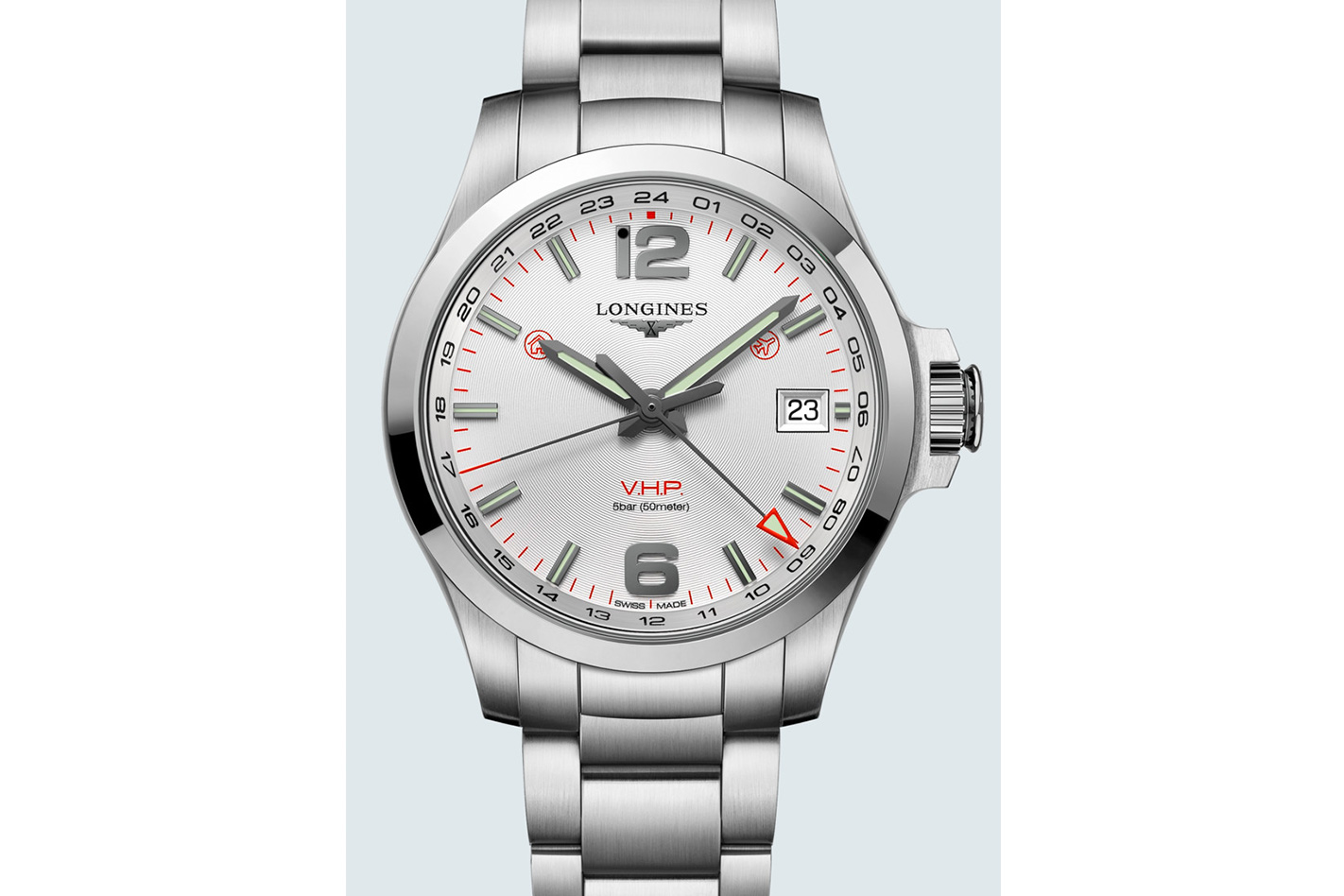
A GMT is often the watch of choice for jetsetters, with its extra hand allowing quick references of a different time zone. The Longines Conquest now has such a complication, with a robust quartz movement, five-year battery life and a unique ‘Flash Setting’ feature that bridges the gap between mechanical timepieces and modern smartwatches. A phone app is used to set the times with the camera flash alone. Sound weird? YouTube it. longines.com.au
YOU’RE a prospective medium-SUV buyer, lost, alone and confused in the woods, surrounded by a thicket of lookalike crossover choices. What do you do?
Happily, we’re here to help, having already sorted through the good, the bad and the ugly to arrive at the cream of the crop as rivals for Subaru’s new, fifth-gen Forester, with not a dull or dreary drive in sight.
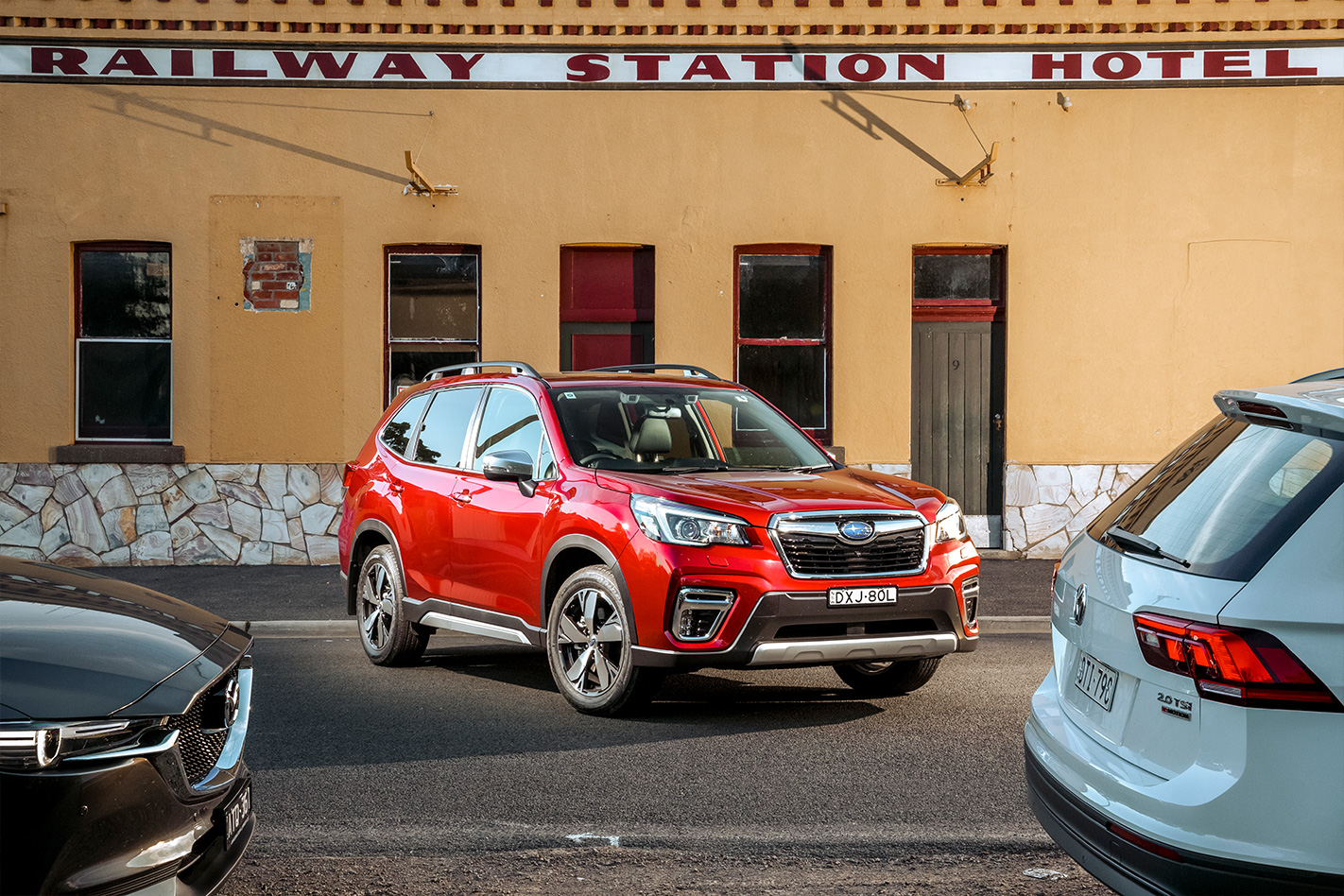
The evergreen Subaru Forester has been rooted in the medium-SUV scene since 1997, becoming a byword for sensible, practical and versatile lifestyle/adventure family car, with enough individuality to appeal to enthusiasts.
For her 21st this year, the Japanese carmaker gave the old girl a whopping makeover. Cosmetically almost identical, disappointingly, all the big coming-of-age advances occur under the fussy clothes, with the adoption of the latest Impreza’s imaginatively dubbed ‘Subaru Global Platform’ – the company’s first new global platform since the original Liberty’s launch in 1989.
Furthermore, a 90 percent new, 136kW, 239Nm 2.5-litre four-pot horizontally opposed powertrain debuts, along with an overhauled CVT auto, suspension (struts up front and double A-arms out back) and steering (electric, naturally), while annual servicing replaces the previous six-monthly workshop visits. A big improvement – at last.
Sub-$45,000 all-wheel-drive spec is where all the SUV action is, so we’re kicking off with the range-topping (for now) $41,490 Forester 2.5i-S – S standing for swanky, presumably, because it costs some $1750 more than the equivalent previous-gen variant.
Oh, but we’re talking kitchen-sink chockers, with Subaru’s EyeSight dual-camera active safety gadgetry bringing front and rear autonomous emergency braking, rear cross-traffic alert, adaptive cruise control, lane-keep assist, blind-spot monitoring, adaptive LED headlights with auto high-beam, 360-degree-view cameras, drowsiness alert with facial recognition that recognises and memorises individual driving-position settings (creepy), powered front seat adjustment and rear backrests, a powered tailgate, climate control, keyless entry and start, an 8.0-inch touchscreen with sat-nav, DAB+ digital radio, Bluetooth, Apple CarPlay and Android Auto, ritzier trim, roof rails, 18-inch alloys, leather, a sunroof and high-end audio. But no heated seats, oddly.
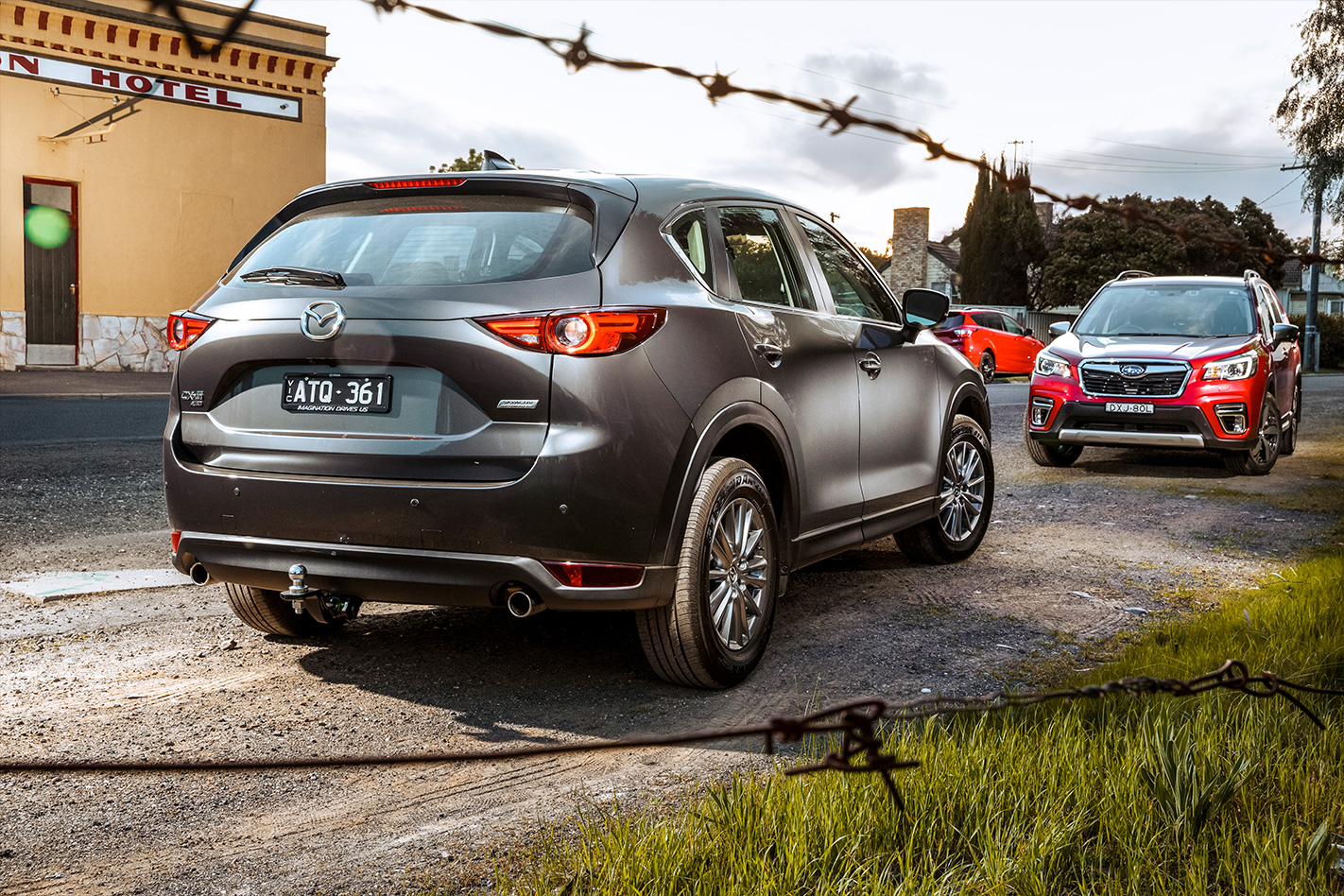
Choosing the 2.5i Premium sees you forgo those last three items, saving $3K and taking the Forester to $38,490, which is exactly how much Mazda charges for its sporty and stylish CX-5 in Touring AWD guise, now powered by a 140kW, 252Nm 2.5-litre atmo four. Now? Launched in early 2017, the second-gen KF really stepped up refinement wise, and was followed a year later by a Series II update with cylinder de-activation for better economy, among other updates that brought slightly higher outputs.
However, for the CX-5 to match the Forester’s cabin luxury, you’ll need the $43,590 GT we requested for this test, or the $46,190 Akera for almost equivalent safety, just without the Subie-exclusive drowsiness monitor and face-recognition tech. Note, though, that Touring strikes back with a handy Traffic Sign Recognition and head-up display.
Volkswagen, too, has offered a medium-SUV class ace since the latest (Mk2) Tiguan surfaced in September 2016. Essentially a jumped-up version of our COTY-winning Mk7 Golf, refinement, functionality, efficiency and sophistication are this Teuton’s calling cards.
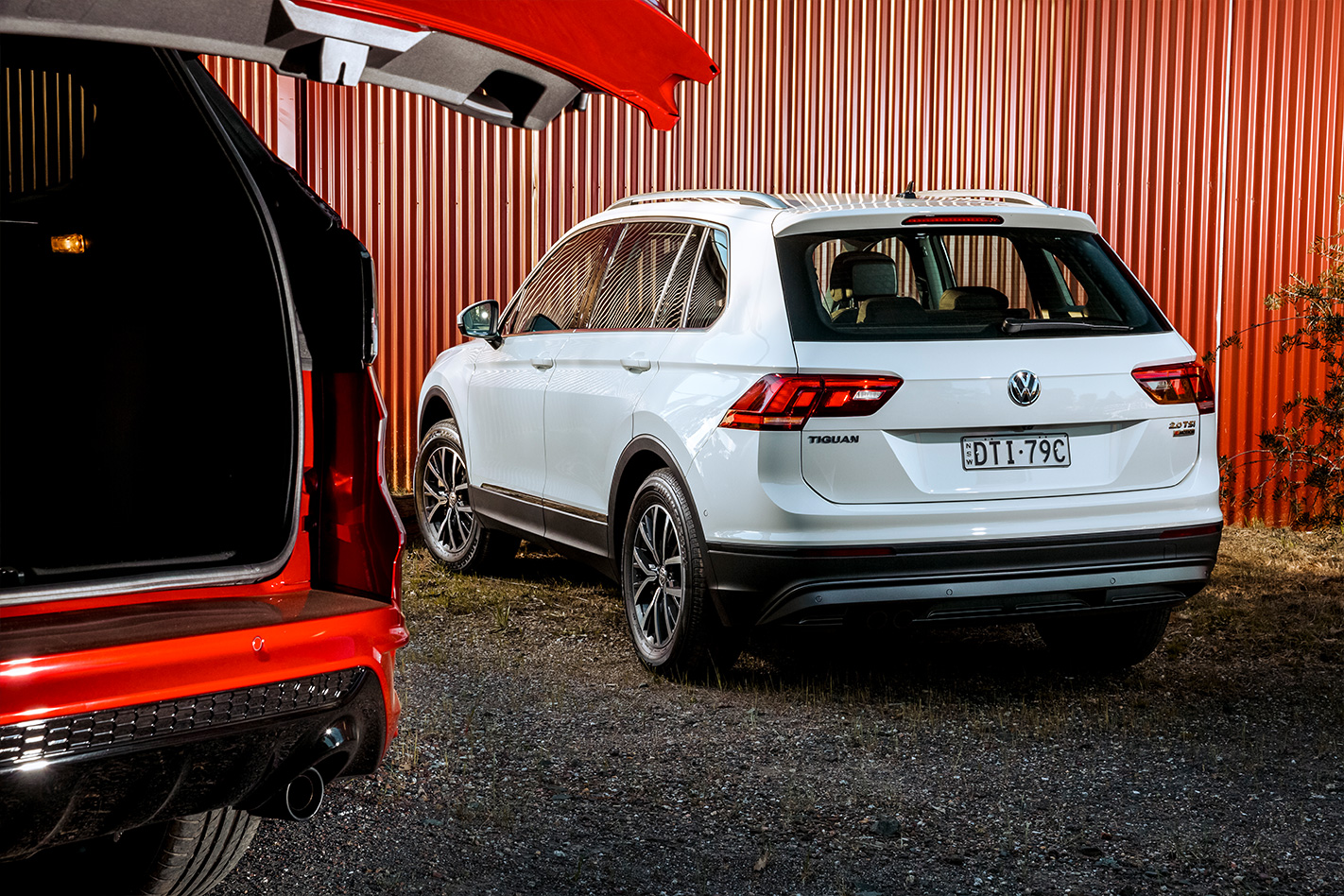
For MY19, the $42,490 Comfortline 4Motion DSG, powered by a 132kW, 320Nm 2.0-litre turbo-petrol engine, scores extra kit over the cheaper 2018 model tested, including keyless entry and start, a powered tailgate and 18-inch alloys – so we’ve factored these into our assessment. To match the Subaru’s bounty, though, please tick the $4000 Luxury and $1400 Driver Assistance packs, taking that to nearly $48K. Autsch! Conversely, the VW is alone with its sliding rear seatbase, hidden drawers, overhead storage, back-seat trays and preposterous name: Tiguan is an amalgam of tiger and iguana.
Finally, speaking of humour, a wildcard. The Spanish-built Ford Escape (or Kuga as this Mk2 version was called from its mid-2013 arrival until the extensive MY17 facelift) always finished at the pointy end of previous encounters, impressing with engaging dynamics, hearty performance and real chassis nous.
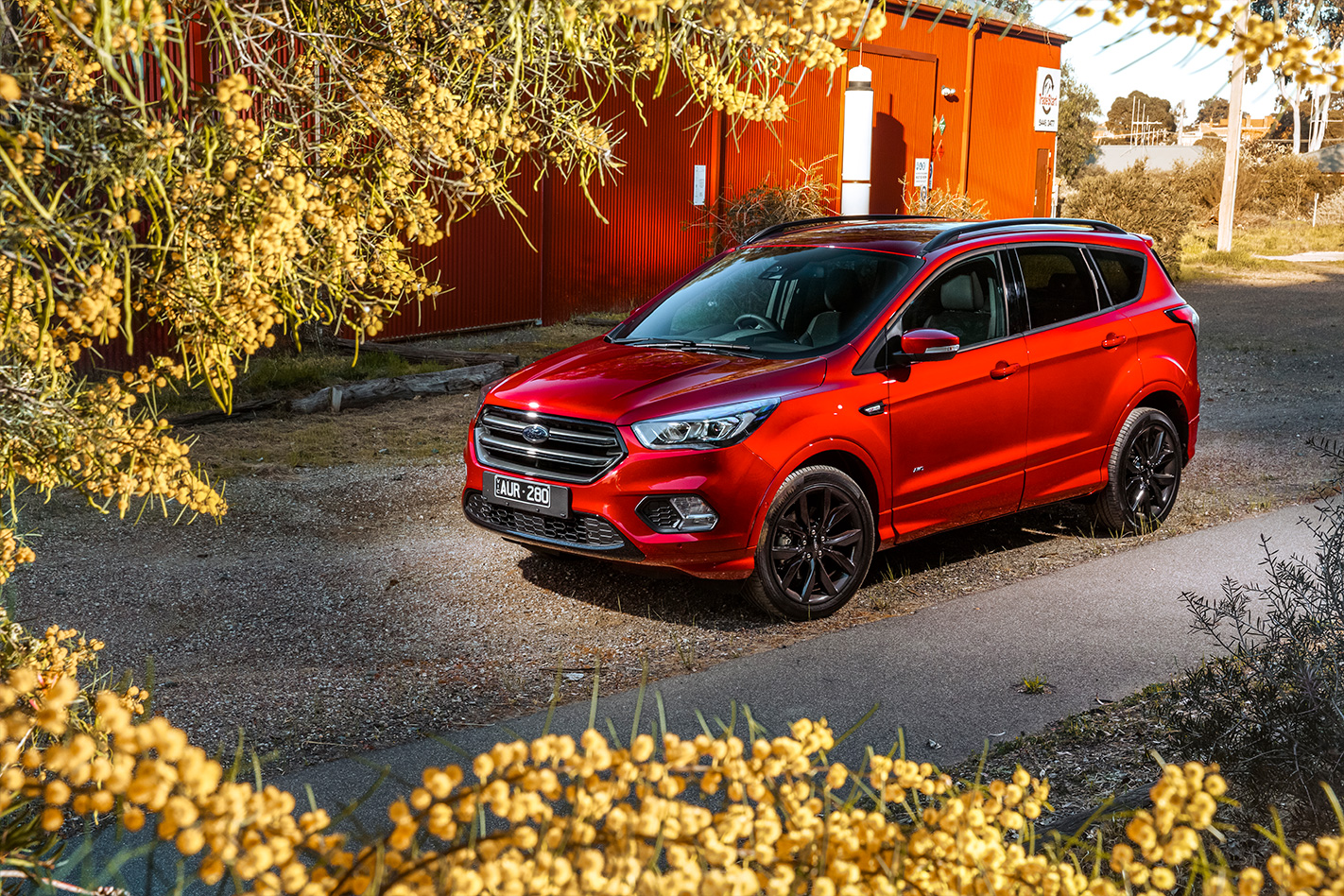
Now, there’s the newly hatched $39,990 Escape ST-Line. Derived from the 178kW, 345Nm 2.0-litre turbo Trend, it dons the automotive equivalent of a track suit and trainers in the form of a body kit, 19-inch alloys, quicker steering, 10mm-lower ride height, thicker anti-roll bars, racier seats and moodier trim… though for Forester-equalling safety please pay another $800. Like Mazda, Ford has adopted a five-year warranty, which is an extra-cost option on the other two.
From a packaging point of view, all four offer compelling virtues such as excellent entry and egress, lots of room and a decent cargo area, but only one of them truly nails the brief.
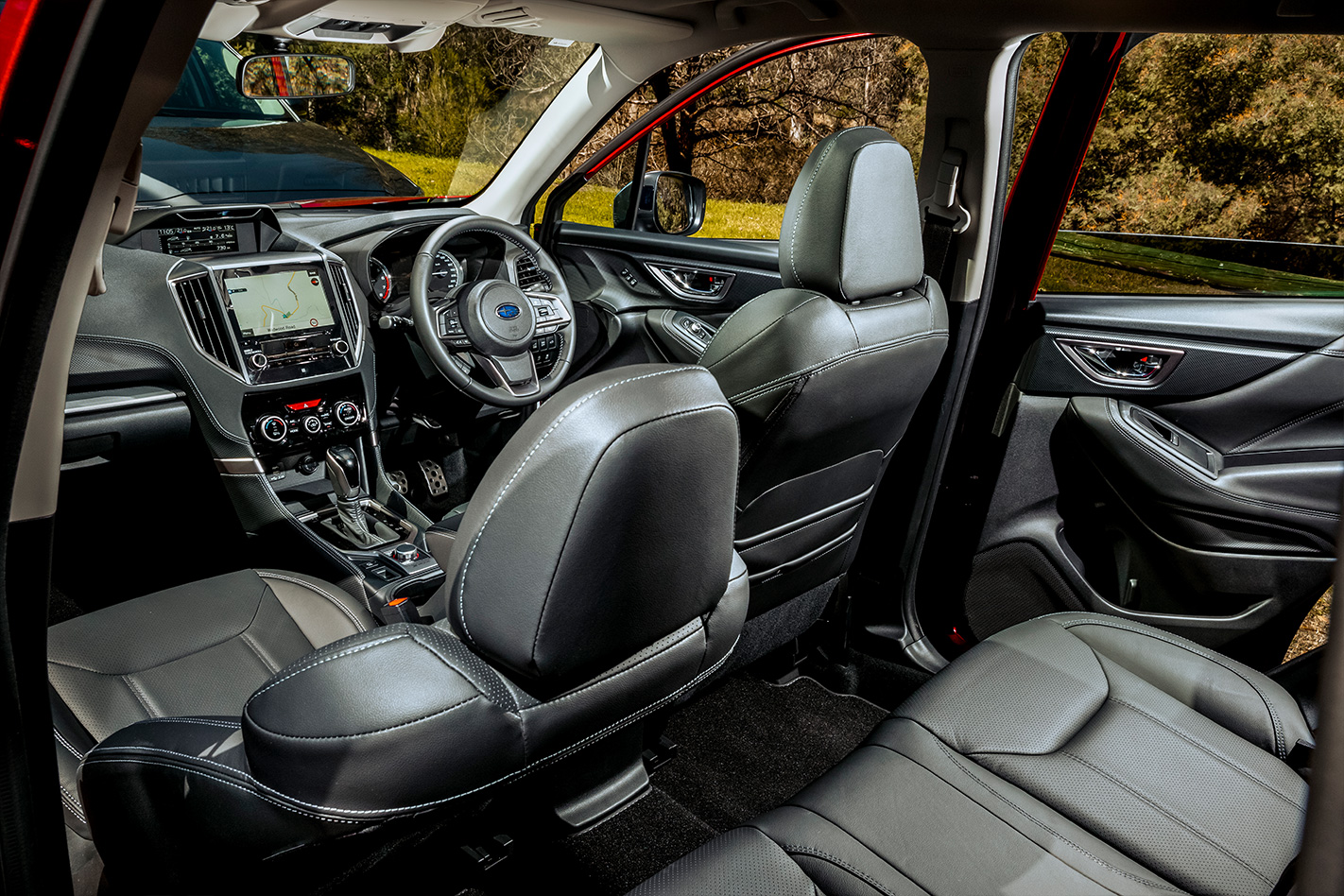
Over five generations, the Forester’s cabin has gently evolved around owners’ need for space, clarity, storage, personal comfort and ease, while paying lip-service to fashion, and it’s now at a point where there’s precious little to fault. The tall ceiling, deep glasshouse, narrow pillars, low dash and lofty, sumptuous seating collude to make the Subaru seem cavernous, airy and inviting. Attention to detail is pleasing too – though the barrage of data screens can be intimidating, and a squeak from the driver’s door soon became infuriating.
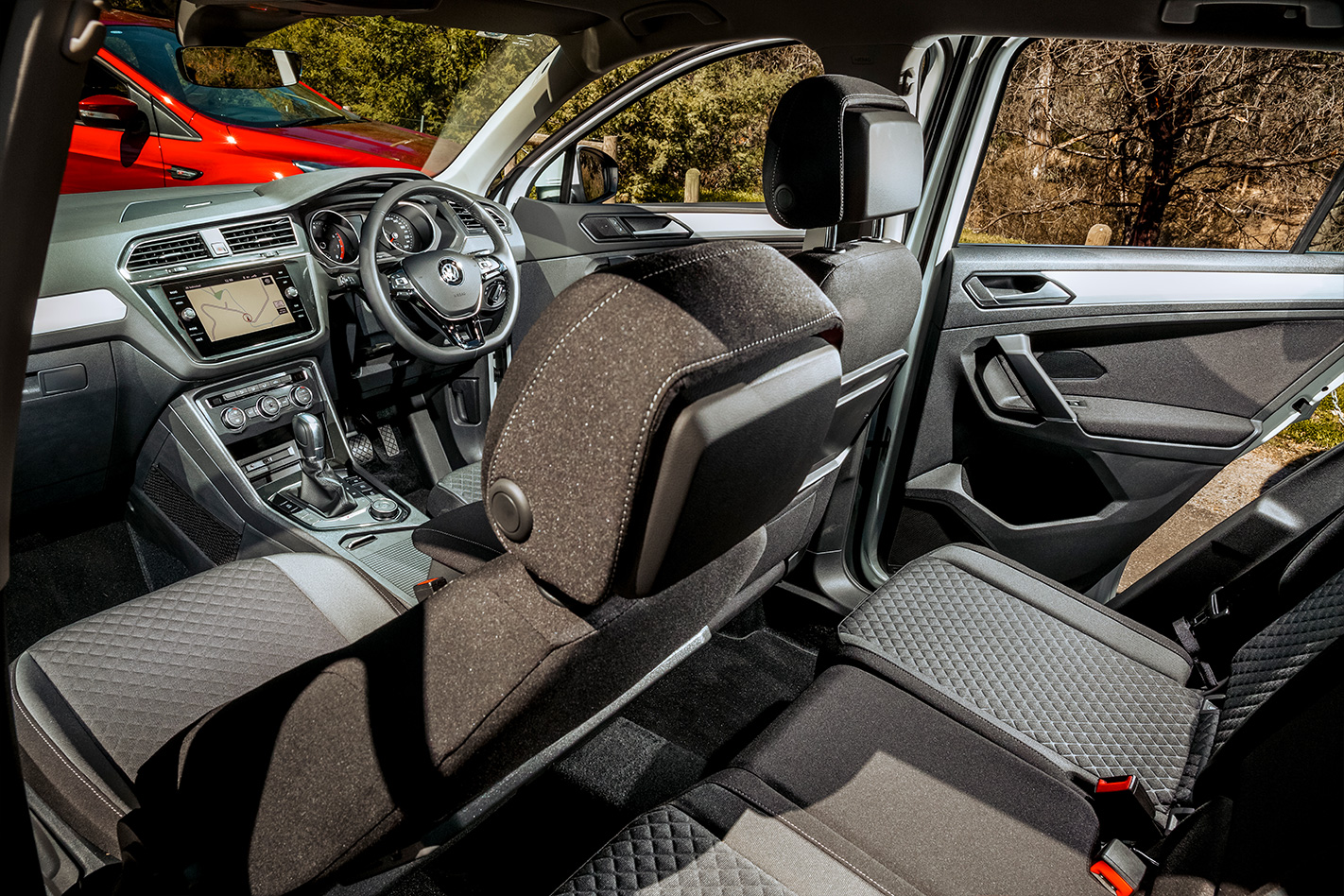
Likewise, the Tiguan stands out with its slick, premium sheen, techy ambience, classy instrumentation, tactile surfaces, rich aromas and smart use of space. Firm but supportive seating, the versatility of that sliding back seat, lots of glass and a multitude of small but pleasing surprise-and-delight features such as the touchscreen user interface nourish something emotional like no other can.
But are these enough when considering how much higher the price of Comfortline entry is, and how much shorter the standard kit list is? Plus, while hushed and creamy-smooth on the move, bumps and coarser bitumen expose an underlying, erm… stiffness underneath. And this is only on 17s, not 18s.
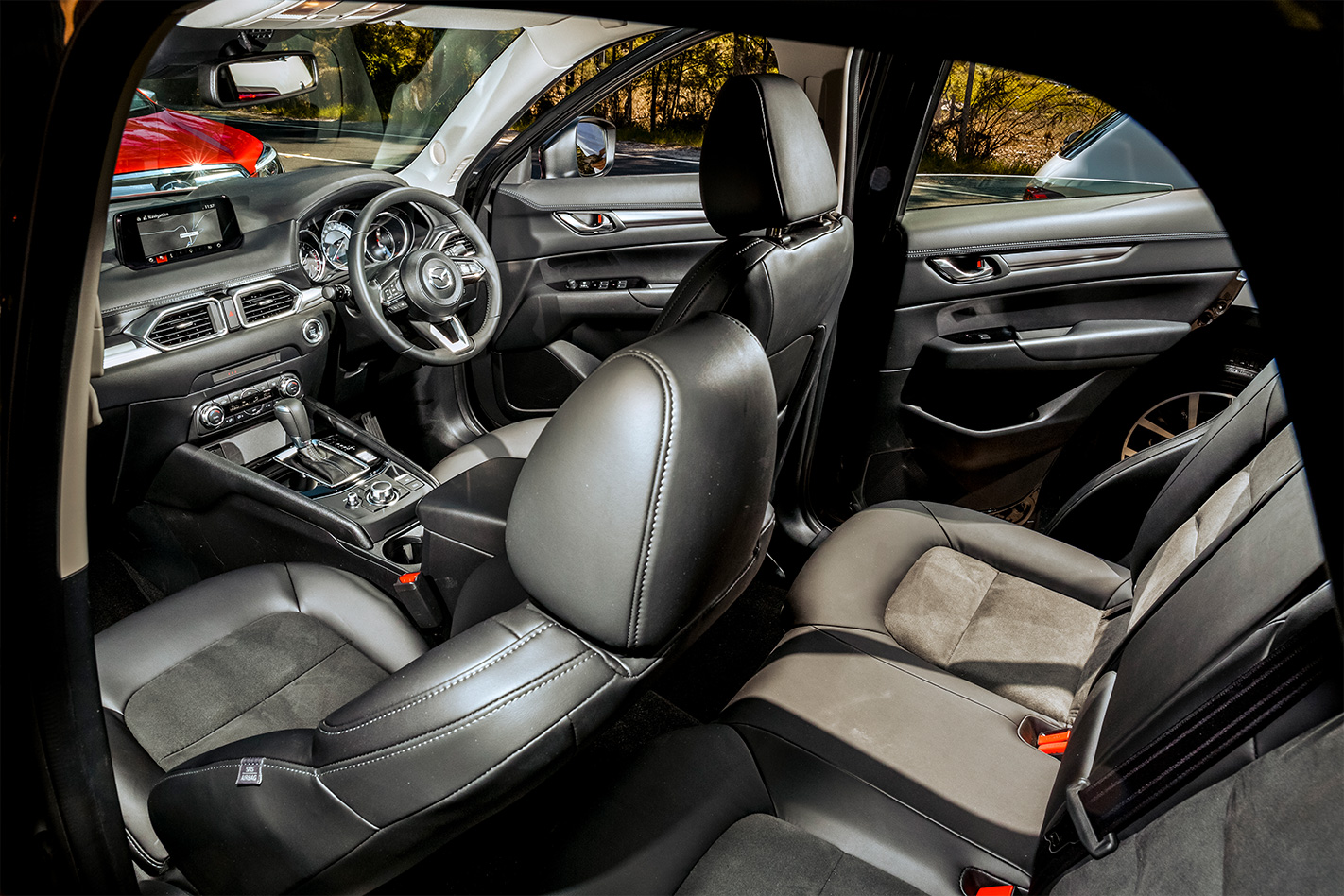
The cosy, yet by no means cramped CX-5 feels altogether more intimate, largely because of the smaller glasshouse and unexpectedly opulent materials, offering a superb driving position, a beautifully integrated dashboard with lovely white instrument markings, consistent trim choices, precision controls, faultless ergonomics, supportive front seating and a deluxe back seat environment. In fact, our Touring seems richer than the exxier Tiguan.
On the flipside, the Mazda’s touchscreen looks passe and lacks CarPlay and Android Auto, and there’s still noticeable engine and road-noise intrusion back there.
Nobody expected the Escape’s ageing interior to win friends and, for sure, in this company the fussy, imposing dashboard looks a little cheap in places, the extra-thick A-pillar bases can hide whole cityscapes, and thin rear cushions could use more padding.
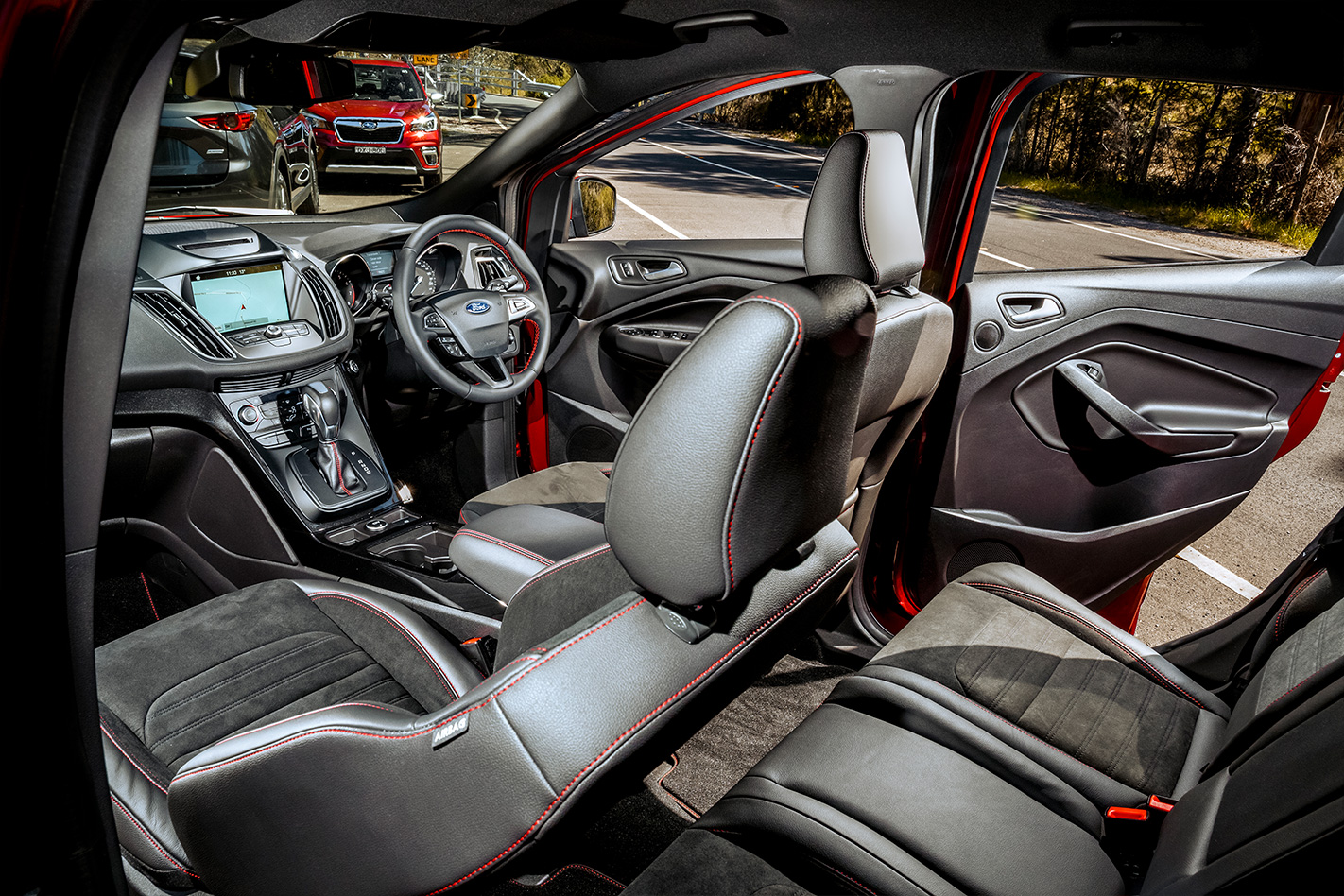
Yet, even on 19s and with lowered suspension, the ST-Line’s ride tune hasn’t relinquished Ford’s renown underlying suppleness, and it’s pretty quiet too. Better yet, being the most overtly sporty, the Blue Oval soars even further from the moment the starter is pressed.
If not the hot-hatch, the tepid-tailgate of the foursome, with greater power and torque on tap, the fiery Euro with a regular-Joe six-speed torque-converter auto lives up to its name by literally escaping from the non-turbo twosome. It’ll eventually pulling clear from the Tiguan too; 7.7 seconds to 100 clicks and 15.6sec across 400 metres are impactful – literally so, since an 11.3L/100km average also makes the heavyweight ST-Line the group’s dipsomaniac by some margin.
While not quite the lightest, the Vee Dub, as the second-sprightliest overall, delivers a lesson in efficiency, because it’s only a couple of tenths short of the hard-charging, hard-drinking Ford – and only half a second behind by 140km/h – yet is a whopping 20 percent more economical. Especially impressive considering the mere 346km on the odo.
Kudos, then, to the velvety EA888 turbo and seven-speed DSG double-act, which slices and sifts seamlessly through the ratios to deliver strong and stirring performance, as well as premium-level refinement that’s unmatched by any SUV here. Yes, on occasion, at lower speeds, that silky transmission will momentarily hesitate just when you need it to leap into action, which can make it tricky to modulate a crawl uphill, but everywhere else it is your silent, efficacious friend.
The lack of turbo oomph leaves the Japanese duo in the dust in outright accelerative terms but less so in the real world, since both the CX-5 and Forester feel more than sufficiently swift if the driver is willing to really flex their right ankle.
We adore how Mazda’s SkyActiv powertrains possess a lusty, ebullient nature once on song, and the big-bore 2.5 atmo four can certainly pack a punch when provoked – but it does have to be prodded, so as to not feel flat in this posse. Though highest in mileage and fizziest in spirit, our Touring sauntered to 100 in a meh 9.3sec, only managed a 16.7sec 400m, and had lost interest by 140km/h.
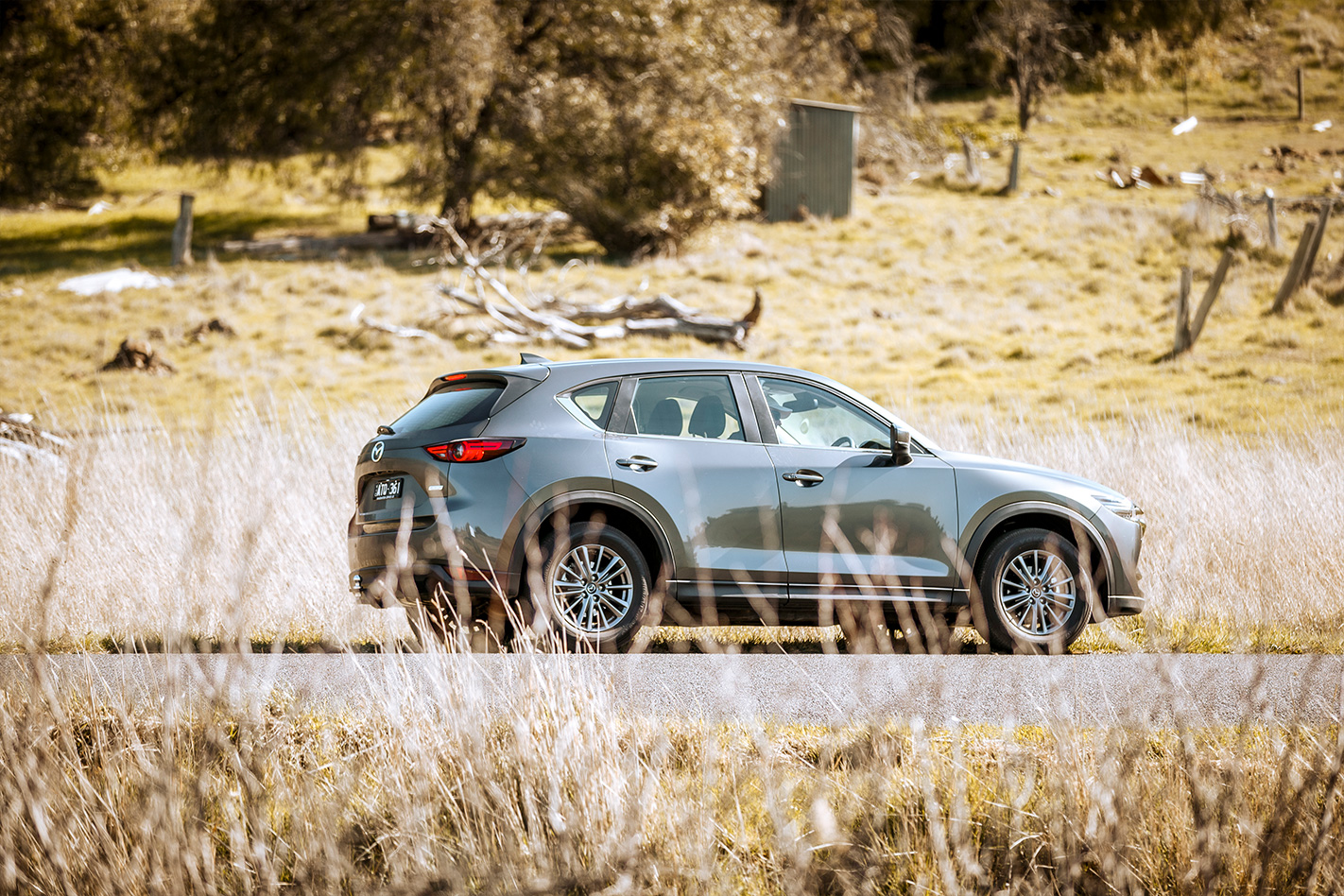
Away from the dragstrip, selecting Sport holds a selected ratio (and won’t upshift in manual mode), to spice things up, but the accompanying rev roar is annoying around the ’burbs – a persistent anomaly with the otherwise sweet-shifting six-speed torque-converter auto. Plus, the CX-5’s a whole litre thirstier than the VW. We eagerly await the compressed-ignition SkyActiv-X tech – or the coming turbo – to shake things up in the Hiroshima-mobile.
Still in Japan, the Forester feels altogether torquier right from the get-go, providing a decent amount of poke despite the CVT gearbox’s inherently elastic response. Paired with the heavily revamped atmo FB25, in ‘S’ sport mode there’s an appealing turbine-like induction sound that’s in keeping with the boxer’s progressive power delivery, while a total of seven ratio steps allow a simulated kickdown for an added sense of urge.
Ultimately, the numbers are only slightly better than what the Mazda managed. All that said, the newcomer’s performance story gels brilliantly, for the eager, effortless and lightweight Subaru seems to scoot along with an oiled slickness – and real-world fuel economy benefits – that was once the sole province of a VW Group powertrain. Upshot? Keep an eye on your speed.
Luckily, the faithful Forester’s brand-spanking chassis is more than up for a challenge. No SUV here seems as glued to the tarmac or as unruffled being hurried along, even if some body lean accompanies more extreme antics. In wildly wet and windy conditions, this thing is rock-solid, revealing an inherent insouciance. All that window glass helps inspire confidence, too.
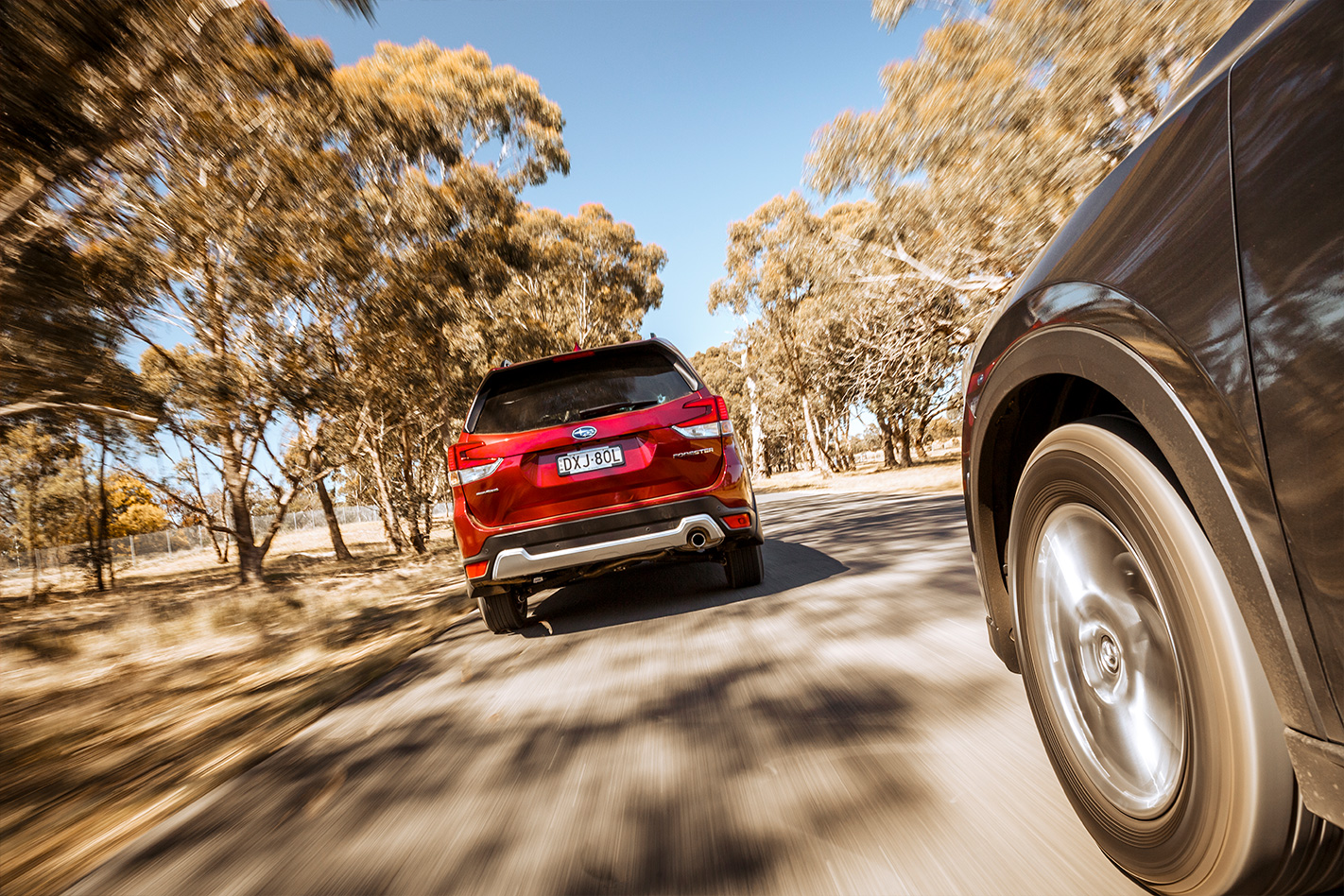
For keen drivers, the well-weighted steering comes up short on real feel and feedback, electing instead to just get on with the job of prioritising secure and calm control. As this is an SUV and not a WRX, that’s probably okay. Especially as the plush ride, long a series strength, resides on a higher plane than the others, underpinning pleasingly pillowy progress yet still with outstanding dynamic poise. Butts will love this Subaru.
And, guess what? For all its lowered and stiffened suspension tuning and 19-inch rubber, the Ford shocked us by not transmitting a shocking ride. The ST-Line’s ability to firmly but effectively cushion really cruddy surfaces exposes an underlying chassis suppleness.
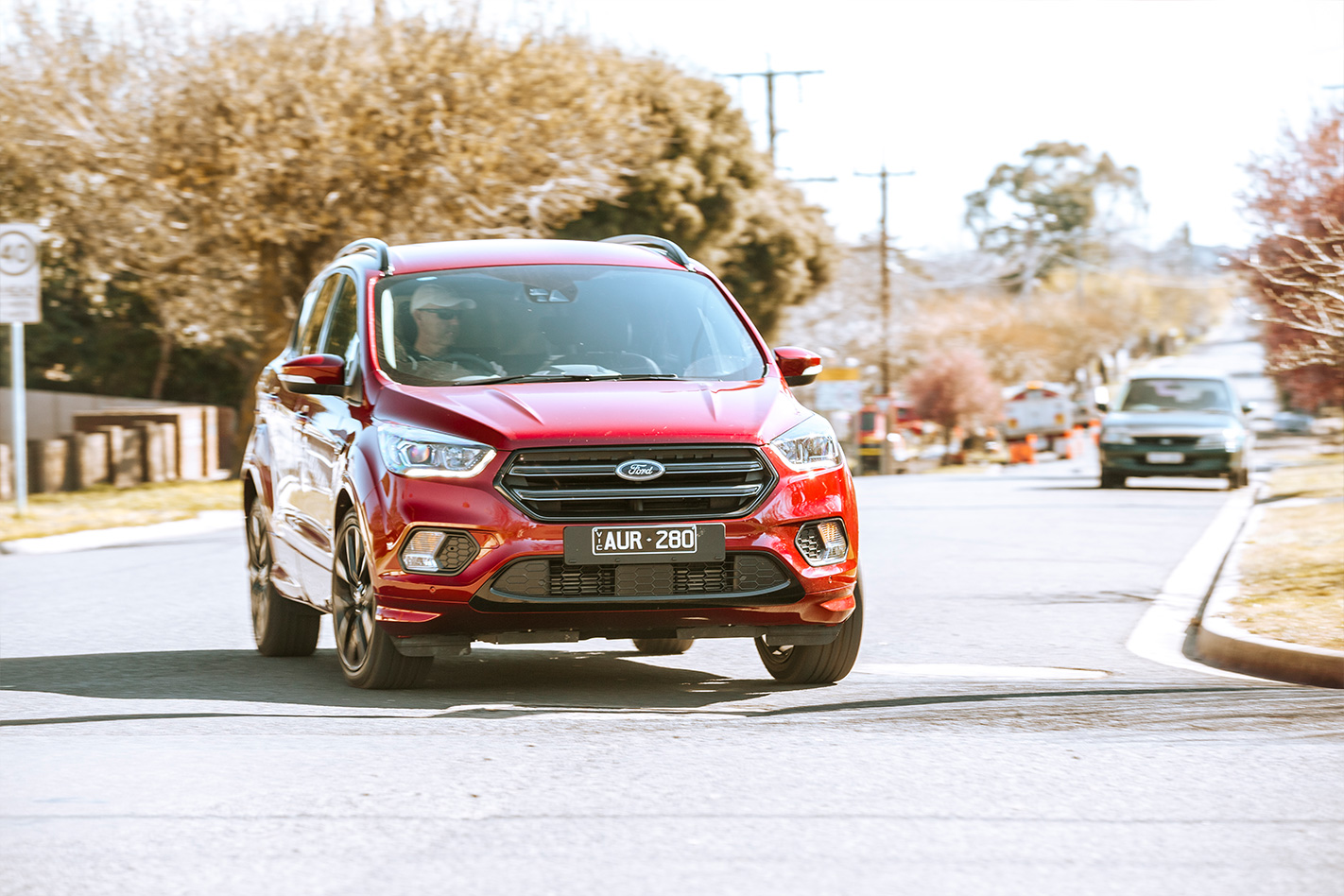
Such proficiency is more profound when factoring in the Escape’s life-affirming steering communication (in the company of other SUVs, anyway) and nuanced responses, connecting driver with machine for fast, fluent handling as well as taut cornering composure. This is far more an elevated-Focus than the wagon proportions purport. Only considerable road rumble from the quality Conti tyres takes away from the sophisticated bandwidth of capabilities on offer.
Equally up for a blast, the CX-5 confirms its reputation for B-road talent and enthusiasm and, in isolation, its mix of receptive, inclusive steering feel and pin-point handling can make a believer of even the most avid SUV-hater, especially as the powertrain seems to thrive on a caning. This thing eggs you on to push harder.
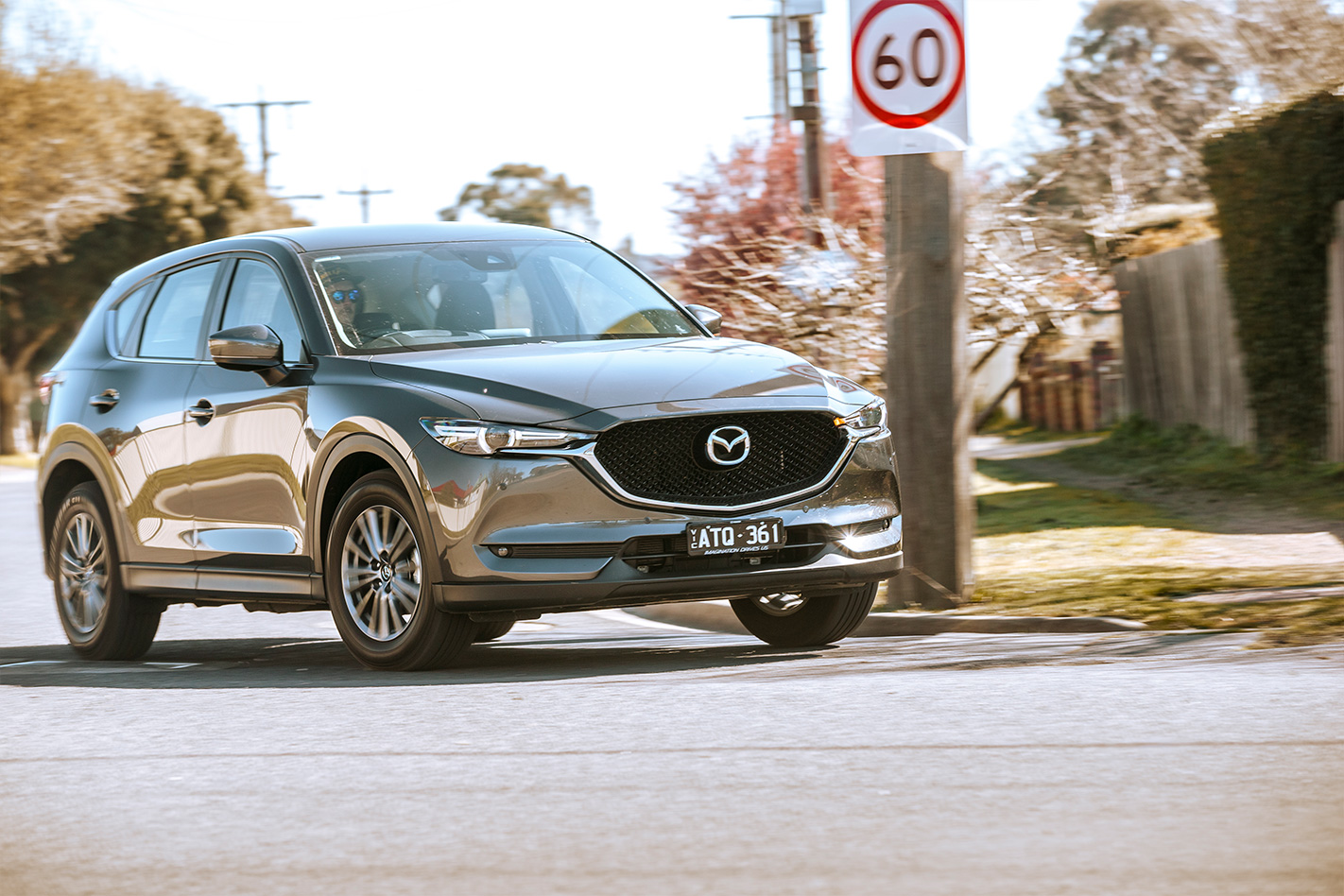
But do so, especially after a spell in the others, and the helm is too sharply geared at speed, resulting in a nervous and skittish feel. And the suspension, as mentioned earlier, never quite settles, either, transmitting road irregularities constantly.
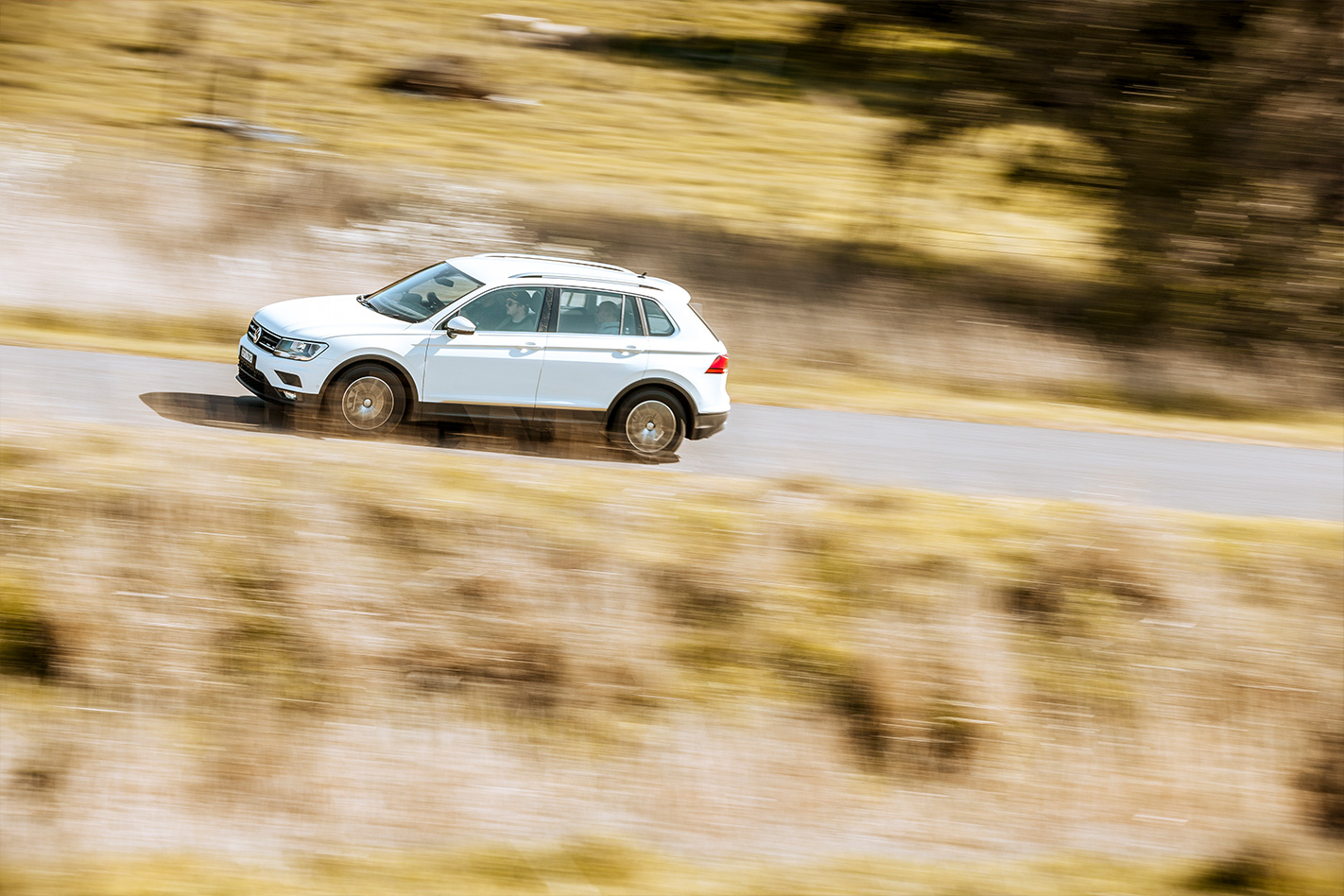
Somewhere in between resides the Tiguan – excellent steering contact for utterly trustworthy two-way handling interaction, bracing roadholding skills and – on nice roads – that good old VW Teflon comfort. Plus, the harder you drive, the more the ingrained Golf DNA shines through. Impregnable fun to be savoured.
However, over rubbish roads, that lavish gloss can be chipped away one bump at a time, shifting away from the Comfortline billing to an extent that its hatch sibling never does. And while riding on balloon-like 17in tyres.
Ultimately, the Forester walks away with the win, representing a step forward for both Subaru’s evergreen model line and SUVs in this segment. The design is certainly divisive, but otherwise the Subaru is stunningly complete, with loads of character and very few vices.
Second and third is a closely run thing. With deep pockets, the Tiguan can be specified to drive, steer, handle and ride like a cut-price Audi, but without these worthwhile yet costly options, it feels inferior to a Golf. ‘Comfortline’, it seems, is a misnomer.
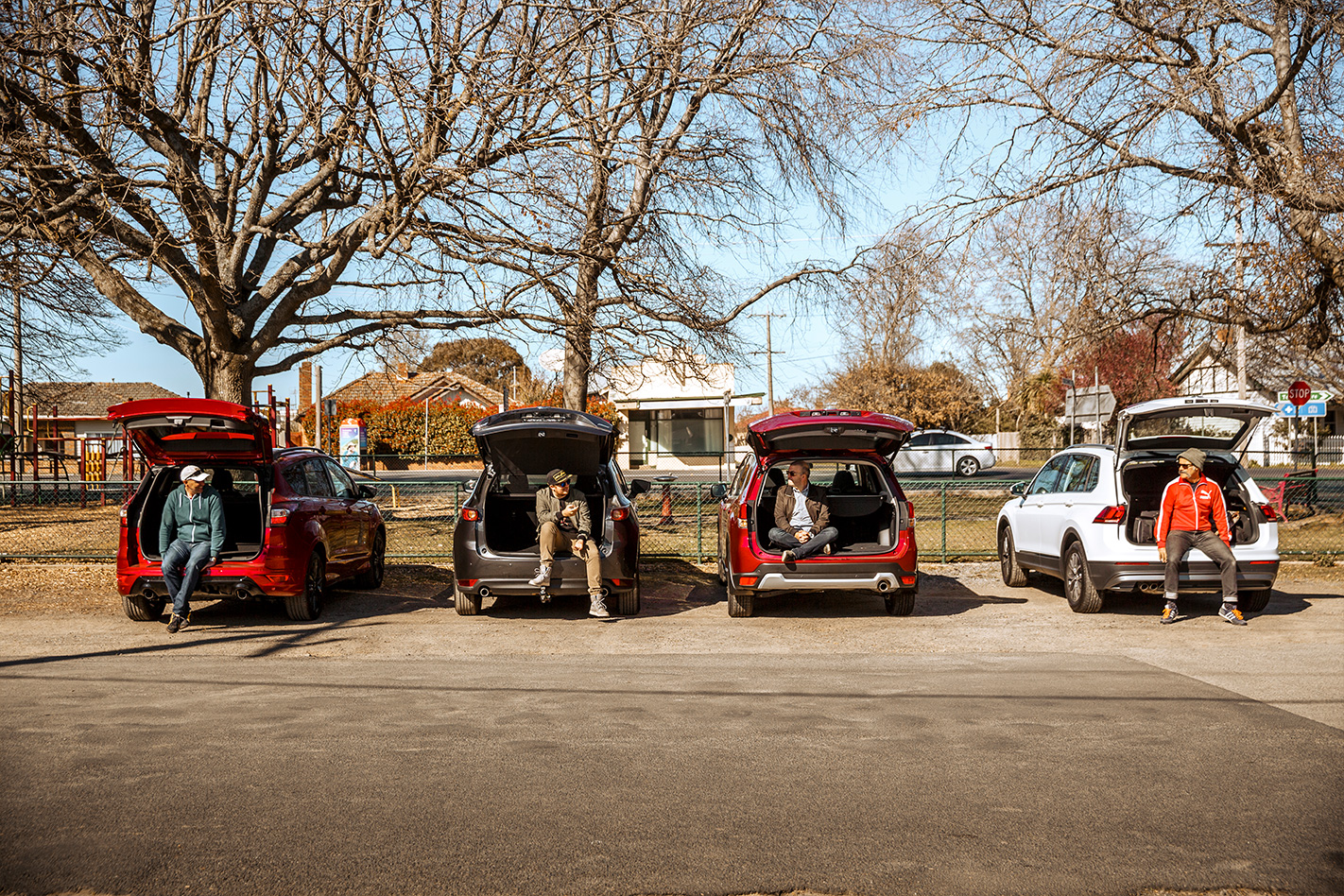
The CX-5, meanwhile, offers fine value and feels special on many unanticipated levels, including the area of cabin design and presentation. Yet, like the German, the Touring is patchy in other parts – namely in its refinement, outright performance and standard driver-assist spec.
Finally, our appropriately wild, wildcard, the Escape. Sharply priced, smartly packaged and sophisticated dynamically, it’s a cool yet warm-under-the-collar outcast that deserves acceptance, even if you’ll pay at the bowser. Be prepared to be charmed by this slightly crusty old dog. Fourth place here is no disgrace. Long live the driver-oriented engineering ethos at Ford, and the brand’s ability to turn out a cracking steer.
So, it’s the fulsome Forester that elevates itself above all with sheer effortlessness. It simply rises above the trees of normal SUVs.
The spectrum of possible feelings when driving a car is incredibly broad. In something like a Porsche 911 GT2 RS, with 515kW and rear-wheel drive, there’s a thrill bordering on terror experiencing full throttle no matter how many times you’ve done so. In a car like a Subaru BRZ, there is a dewy satisfaction derived from the sublime steering or dancy, on-the-limit handling.
Fun, meanwhile, is a cousin of, but not the same as, excitement, and is interesting for not being limited to vehicles with lots of power or even amazing handling – you can have a lot of fun in a gigantic long wheelbase Renault Trafic van in the right circumstances.
Such abstract thoughts flitted through my mind and those of the MOTOR team as we pondered testing the Ford Ranger Raptor and Holden Colorado SportsCat by HSV. Nevermind the old HSV Clubsport which started life as a passenger car, both these rigs started off as proper tradie’s workhorses.
Both weigh a bomb. Both are diesels. And both are not quick at all. Never mind a Toyota 86 or Mazda MX-5, these two would very likely lose a drag race with a fat jogger at the lights if such an entertaining comparison presented itself.
But they offer performance. And no, not wheel articulation or traction at crawling speeds, or wading depths, approach or departure angles, but performance at high speeds, even if it just takes a bit longer to get there.
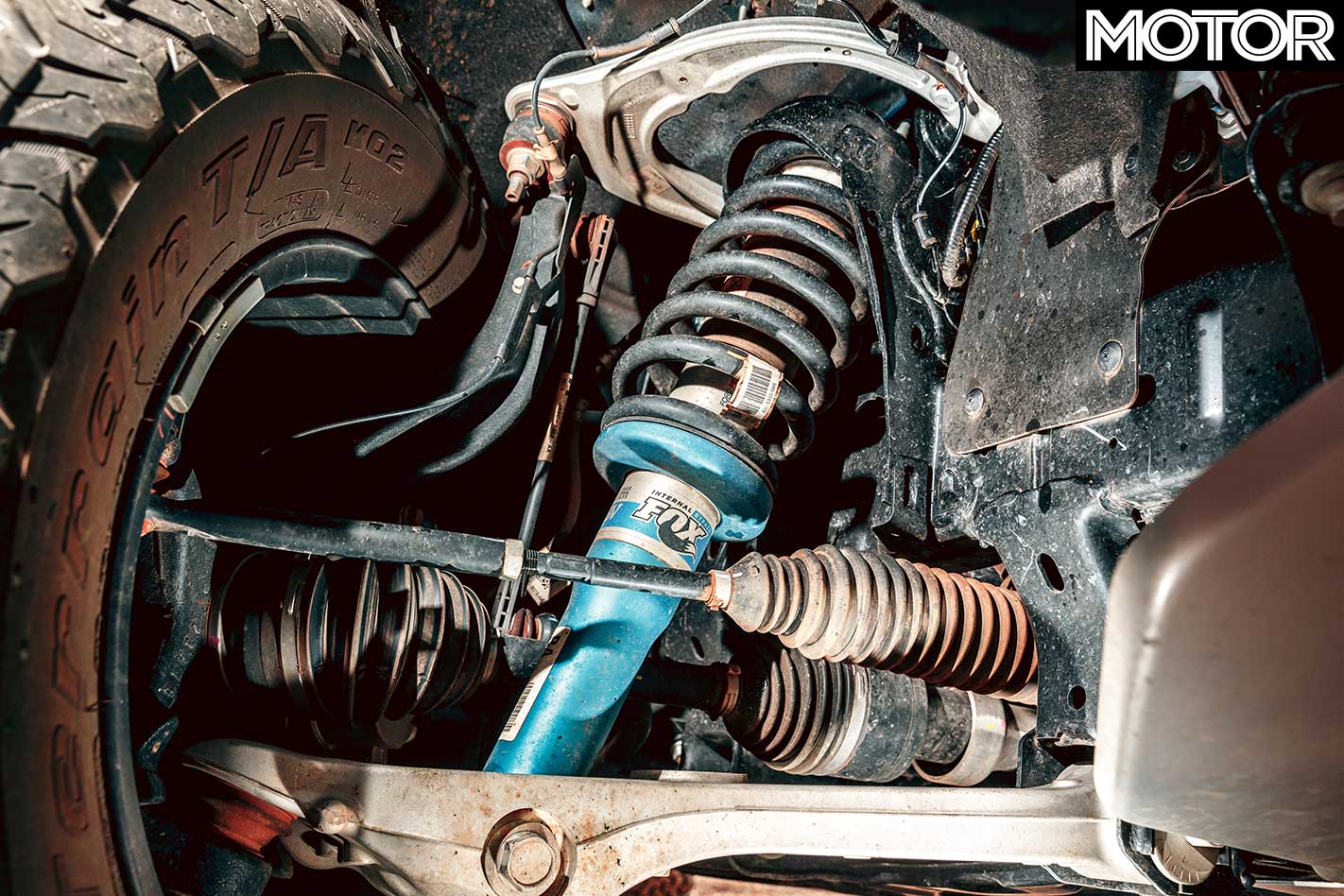
In the Ranger Raptor, its FOX Racing dampers let you drive basically as fast as you want over the worst of dirt roads, enjoying understeer and oversteer in what is a large, lumbering car as it asks as much of your driving ability as any other vehicle in these pages.
Then there are the jumps. Completely pointless, but utterly hilarious. The last time I jumped a car was my paddock basher when I was 16. In the Ranger Raptor, you charge at a mound of earth with the throttle pinned, the front end absorbs the initial impact without so much as a thud, before you float silently through the air in what feels like slow motion, landing surprisingly softly almost entirely thanks to that tricky suspension. Jumping the Raptor, I have not laughed as hard in a car since likely my old paddock basher.
Now, don’t get us wrong, the Raptor would be a tyre-howling fish-out-of-water on a bitumen racetrack; and there is little fun to be had on a twisty sealed road. But on dirt? Bring it.
Some say the Raptor has the wrong engine, and a primal part of my brain does agree. Of course if it had a petrol V8 it would be more fun and a lot faster – but then it would cost a lot more. And a dual-cab ute can only handle so much power before it becomes almost dangerous – anyone who drove a TRD HiLux in the wet will attest to that.
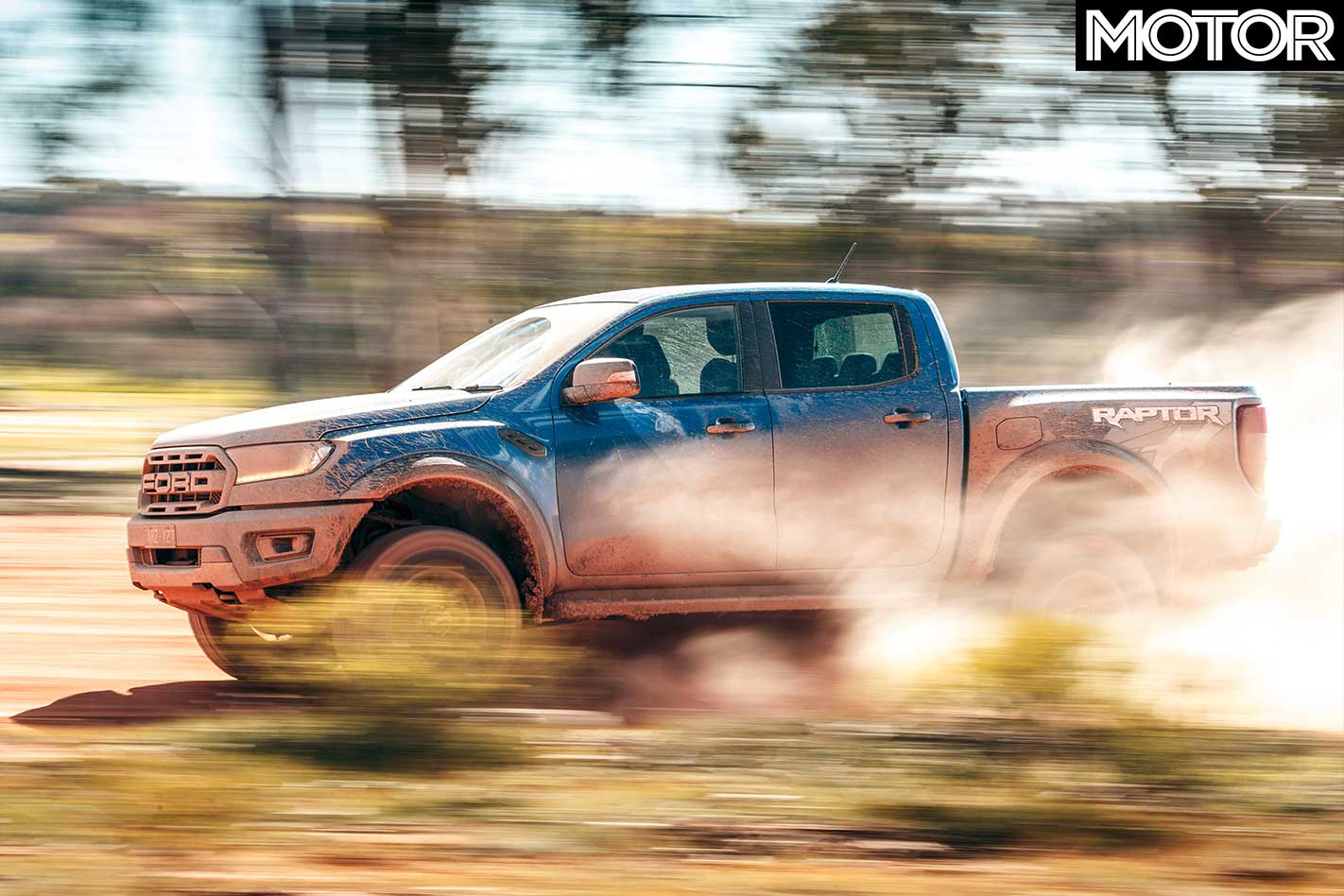
Even if it was a rally-themed comparison test with sideways and jump shots galore, there will be those who disagree with our decision to feature the Ranger Raptor and HSV SportsCat in MOTOR. But if they don’t have much power, and relish being driven hard and fast, how do they differ in fundamental driving philosophy to cars like a Subaru BRZ or Mazda MX-5? It’s just in this case, there’s the extra catch of you probably will prefer being on dirt. Many would say dirt makes any car more fun no matter what it is.
We’d love to hear your thoughts on this dual-cab ‘performance ute’ thing and whether it belongs in your magazine. Send us a note – [email protected].
Australia has led the way on car safety since the very beginning. Victoria was the first legislature in the world to make the use of fitted seatbelts mandatory, as long ago as 1970 – the rest of the country followed suit just two years later.
That was five years ahead of Sweden – where the three-point belt had been invented – 13 years ahead of the UK, and a full 19 years in front of those carefree Italians. In the USA, several states still won’t issue fines for non-use of a belt unless another offence is also being committed. One, New Hampshire, doesn’t require them to be fastened at all; maybe the state motto of ‘Live Free Or Die’ should be amended with ‘head first, through the windscreen.’
But nearly 50 years on, our interest in safety is in danger of becoming an obsession. Arguing against the work of the Australasian New Car Assessment Programme might seem like lobbying for a ban on kittens – who doesn’t want cars to get safer? And how hard can understanding a five-star scale be?
Plenty, as it turns out. ANCAP – and the European NCAP test which now shares the same methodology – started out testing how well cars would protect their occupants in the event of a crash. That brief grew over the years, with different types of impact and passengers in different positions, but the fundamental question remained what happened when a car reached point X on the insurance form. But in recent years testing has been broadened and the rules made more opaque, increasing weight given to the presence and performance of active safety systems.
So a car that crashes well can be marked down for not having some active tech, while one that performs less ably in an impact can have its rating increased with more gizmos (see sidebar).
Of course, it’s entirely possible to dig down and see how a car does in different areas, but few buyers see beyond the stars. Nor are they encouraged to: ANCAP has become a validation tick rather than a grading system, the same way that anything less than the full score on a restaurant’s public health ticket is taken as a substantial risk that you’ll be driving the porcelain bus. ANCAP seems to regard five stars as the minimum acceptable these days, with cars that don’t make the grade called out for criticism by the organisation’s punchy chief exec James Goodwin.
The strategy is working – manufacturers are finding it harder to sell models that don’t get top marks. But it’s also limiting choice, and making cars more expensive. Active safety tech adds a significant chunk to the price of a cheaper model. If the alternative to fitting it is going to be an ANCAP kicking then it makes it more likely the car won’t come here – a senior executive of a major player recently admitted that it’s becoming hard to make the case for bringing small models here.
European buyers seem to be much more willing to take a broader view on safety when it comes to less expensive models being chosen for less onerous duties. The Citroen C3 (four stars), Toyota Aygo (three stars; four with the optional ‘safety pack’) and Dacia Duster (three stars) all sell strongly across the continent despite their sub-optimal scores. If we want to keep getting more affordable cars, we’re going to learn to see beyond the stars too.
Just add AEB
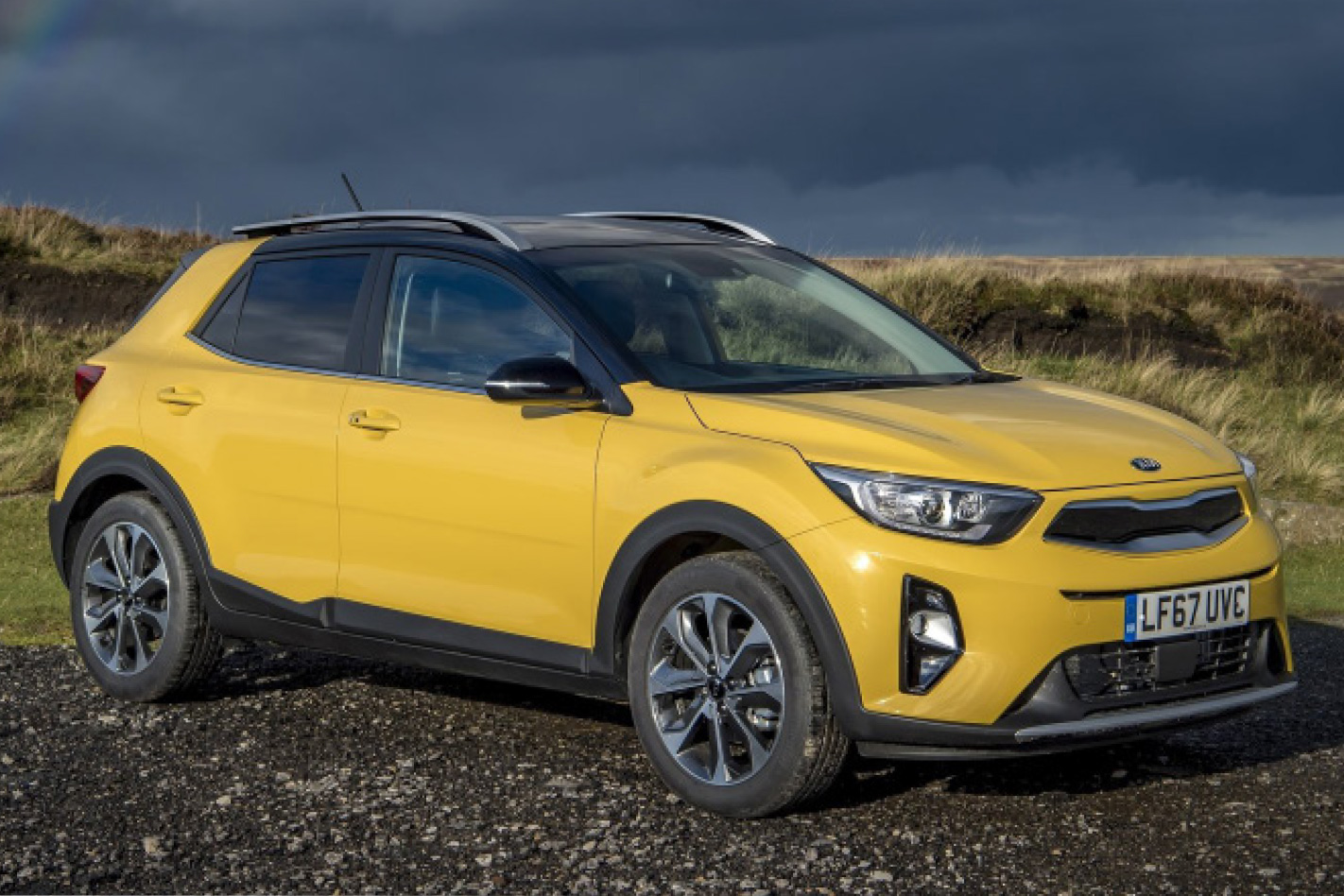
The Europe-market Kia Stonic – the Rio’s SUV sister – gives a good indication of how small changes make a huge difference to crash-test scores. The standard car rates three stars despite respectable scores in both ‘adult occupant’ and ‘child occupant’. The ‘safety pack’ car that has been tested separately – and which adds AEB and lane-departure warning – scores five stars, with the auto-braking boosting its ‘adult occupant’ and ‘pedestrian scores’ as well as ‘safety assist’. In every other regard it’s the same car.
Okay, sure, look, we know that the petrol-powered car is with us for a while yet, and while companies like Audi, Volkswagen and Jaguar are pushing the electric barrow pretty hard, it’s the small players that are pushing the boundaries of what can be done with electric vehicle drivetrains.
There’s a number of smaller players in the EV space that hail from various corners who are approaching the EV problem from different tangents, but two of the most intriguing come from two tiny US operations, Rivian in Detroit and Genovation from Rockville, Maryland.
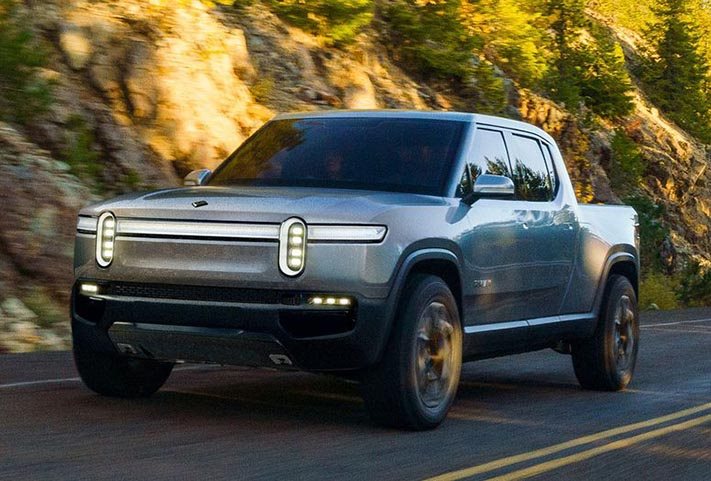
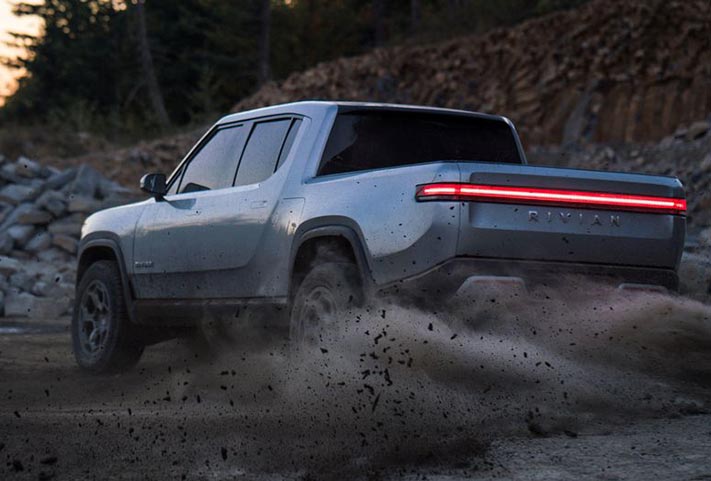
Take Rivian’s R1T pick-up, for example. It’s got more than 500kW and 1000Nm of output from four electric motors, up to 600km of range from its biggest battery option and the ability to tow five tonnes. It can carry five people and 800kg of stuff, as well.
It’s got proper off-road chops, too, with a 34-degree approach and 30-degree departure angles, 26-degree ramp-over angle, and a wading depth of one metre.
And it costs less in the US than a Chevrolet Silverado does here.
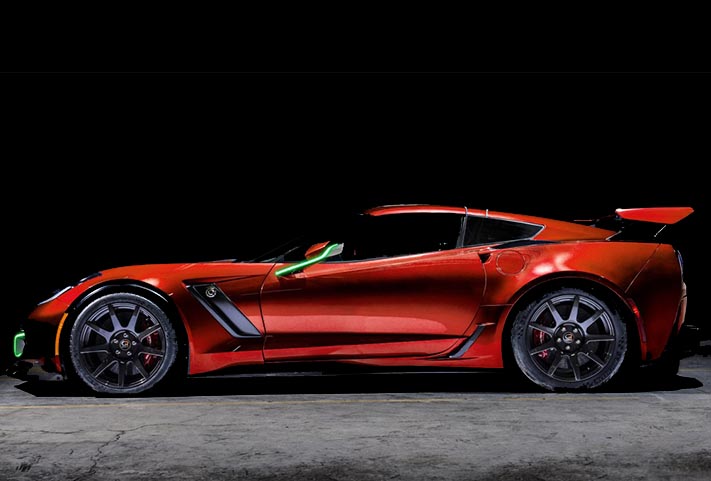
At the other end of the affordability scale is the Genovation Extreme Electric (which is thankfully shortened to GXE). It looks like an awesome version of Chevrolet’s bully-boy Corvette C7 with extra aero, Aussie Carbon Revolution wheels and a neat paintjob, but there’s a distinct lack of superchargers and cylinders under its hood. Err, bonnet.
Instead, the Genovation packs two electric motors which combine to offer up around 600kW and 950Nm. And instead of relying on a single-speed gearbox – electric motors are flexible enough to do away with the notion of gears – the GXE uses a trad seven-speed self-shifter in its place.
There are a few great things about using electric motors; one is that they weight a LOT less than internal-combustion motors, which means that you can reduce the vehicle’s weight by using one motor, or increase its power by using two of them.
As well, their small size means they can mounted low and rearwards in the engine bay, which improves both centre of gravity and weight distribution numbers.
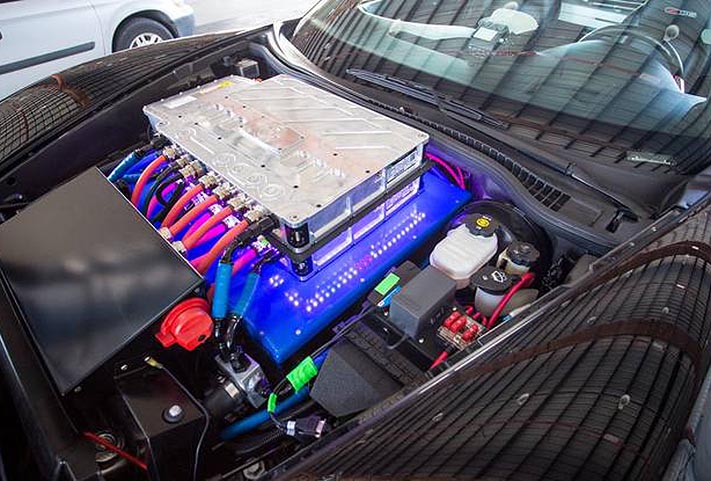
Five battery packs provide 61kWh of capacity, which Genovation reckons gives the GXE nearly 350km of range – admittedly under ‘moderate’ driving, according to the company. It’s got some poke, too, with a 0-100km/h claim of less than three seconds and a projected top speed of 350km/h.
The downside? It costs US$750,000 and just 75 will be built.
Still, these two examples of small-scale US engineering throw a bright light on just what can be done with electricity without the shackles of a large corporation hanging off your every idea.
Is the Murciélago getting religion? Please, God, no. This was the last outpost. Every other hardcore sports car had gone soft and inviting and communicative. All Snaggy.
This review was originally published in MOTOR’s July 2006 issue
The Murcie was the last outlaw, the last hardcore car that intentionally tried to intimidate its driver and made no bones about its desire to hurl you into the shrubbery as soon as your concentration flagged. It should not be tame. Visually, it’s probably got more aggro in it, with its deeper chin spoiler and splitters, its wide-mouthed left air intake and the neater exhaust, built into the diffuser.
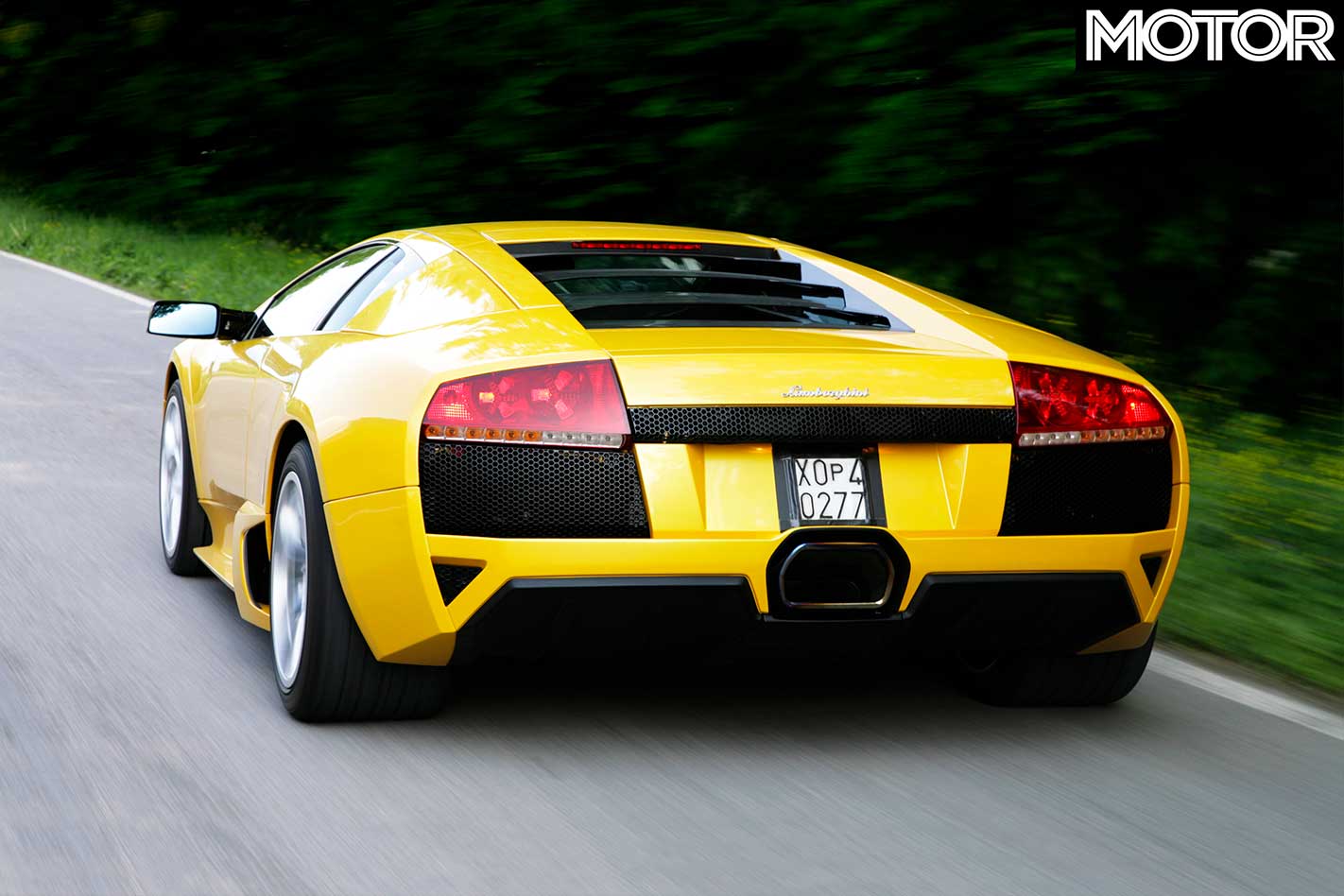
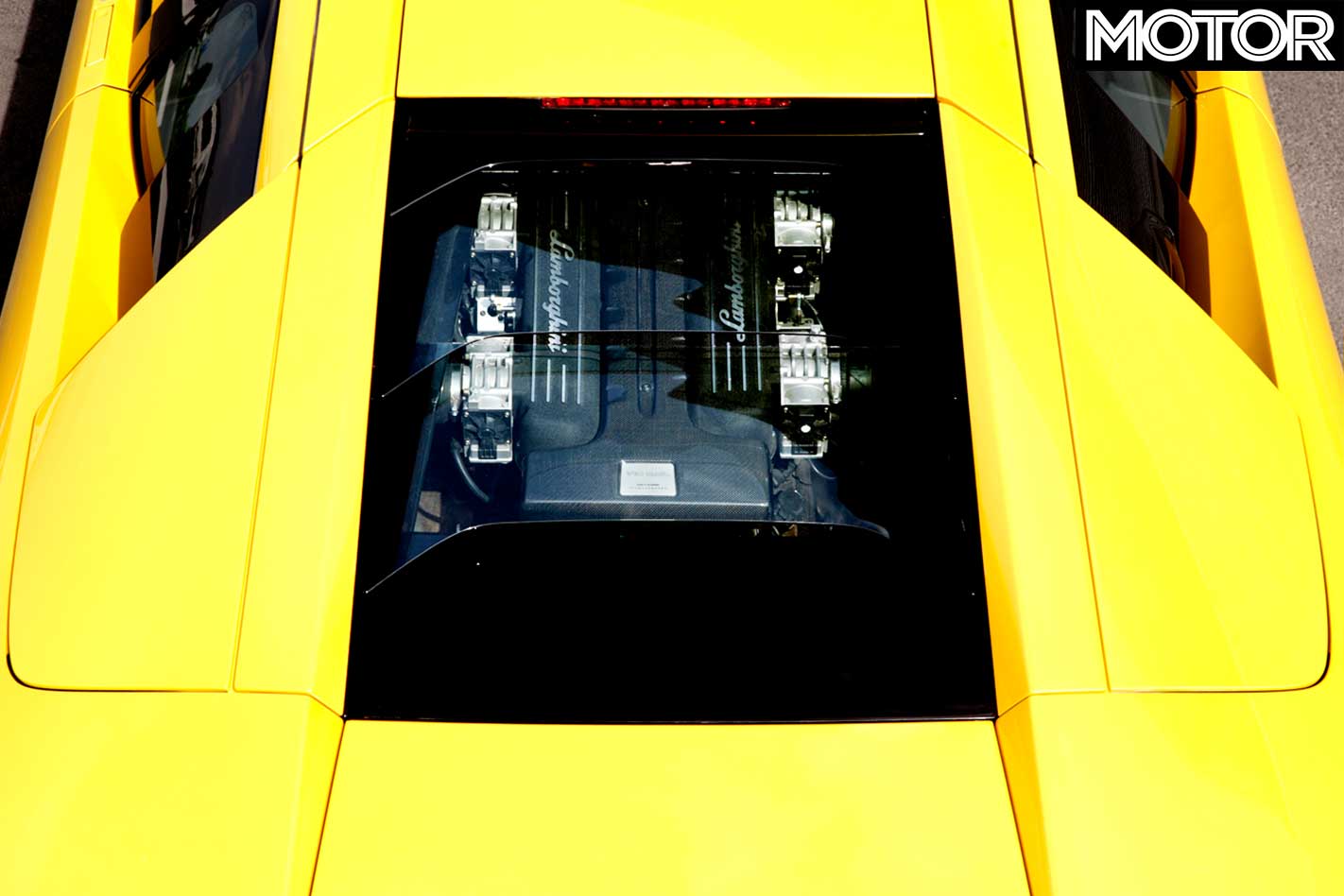
Four hundred and seventy one kilowatts is heading towards enough in anybody’s language, but it’s the torque that steals the show. Usually. There’s 660Nm at 6000 revs (up just 10Nm but 600rpm higher), but there’s a mountain of that hanging around at 1500rom. Besides grabbing a bigger drill bit and pushing further in (bore’s up 1mm to 88mm and stroke’s now 89mm up from 86.8), Lambo has also tweaked its crankshaft, camshafts and exhaust system.
Below decks, there’s a new rear diff, a revised gearbox and even new driveshafts. This is starting to head into heavily stressful power now, so everything is being pushed hard in design. But the whisper is that even this stuff is getting a bit namby-pamby to use.
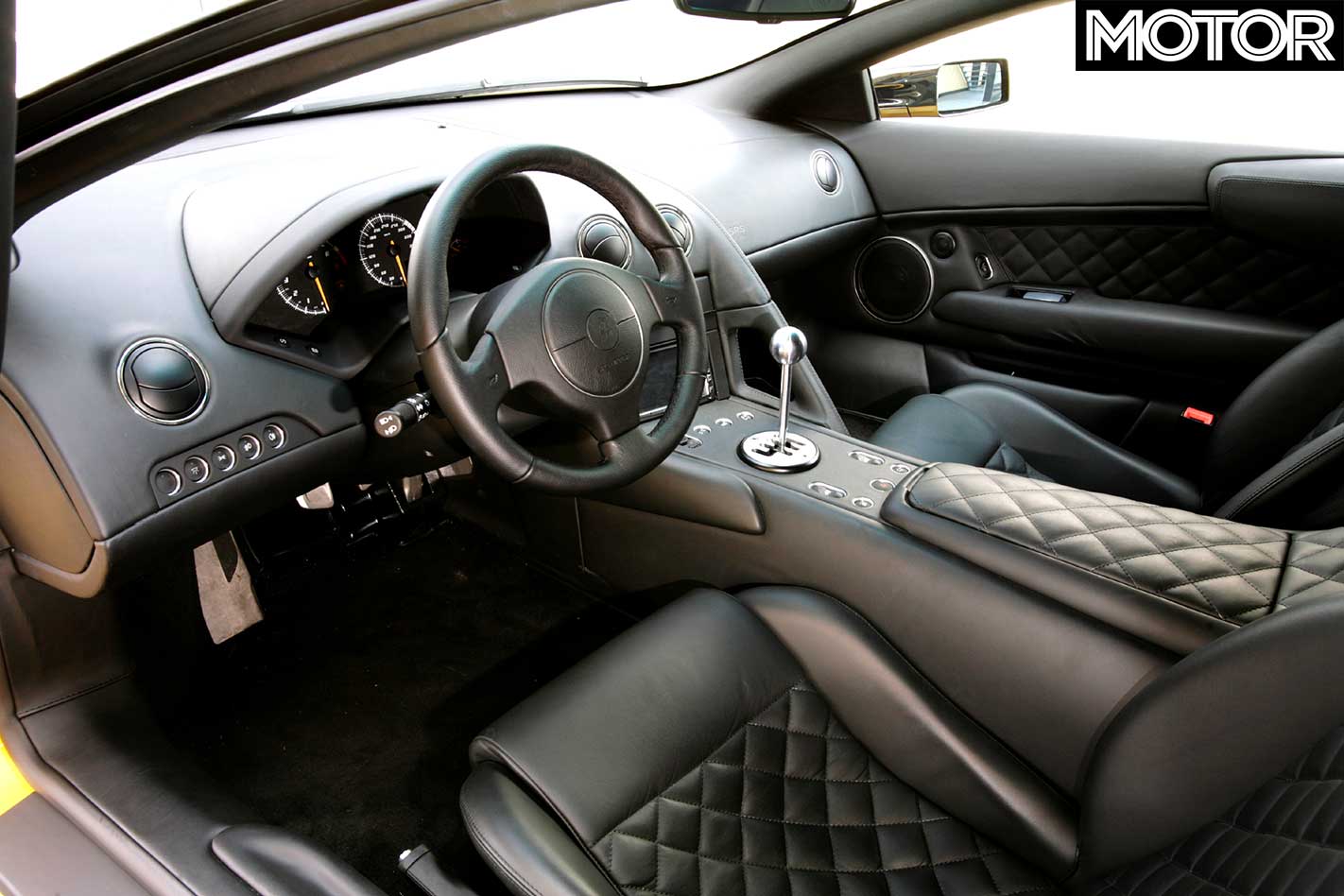
The cabin is familiar, but different. A touch classier in parts. Extra padding – presumably for the shoulders of the straight-armers – now protrudes from the door upholstery at the rear. The new dials feel fresh, but also have a flashiness to them that suggest premature ageing might be on the way. The ventilation system, though, is still easy to use, and easier still to hide beneath its chrome, Lamborghini-emblazoned flap.
Visually, inside the new Murciélago is still a simple, clean place to ply your trade and see out of (well, to see forwards out of, at least), with mostly simple controls. That’s excepting the new command centre. It’s immediately difficult, all tiny buttons and no knobs at all. How to operate this thing on the streaking light of 200-plus?
It takes MP3 now, with a 6.5 inch widescreen monitor, plus WMA and DVD. A finger, by blind luck, falls on the ‘on’ button, and multiples of luck again locate the volume and search buttons. How you change to AM or CD I don’t have a clue. Fortunately, satnav is a touchscreen affair, (though how you turn up the volume on the navigating sheila completely escapes me, too).
Twist the oddly shaped ignition key and you forget all that. At 7800rpm you wouldn’t hear her, no matter the volume. And even were she physically alongside you, naked, trying to get your attention, she’d almost certainly fail.
There’s that small whirring of the fuel pumps and then the explosion. Followed quickly by another 11. Angry, arguing, uneven, snarling explosions, so distinct you can almost count and identify each cylinder.
Flick the offset throttle and it snaps the needle up the tacho, but the familiar chirping of its four throttle bodies flipping open has gone. Only if you aurally search for it amongst the cacophony of whirring pumps, liquids fizzing up the lines and induction howl can you pick up the last traces of it.
The clutch is, thankfully, still heavy. And encouragingly lacking in feel. Entirely. Now, this is the arrogant Murcie we know and love. There’s enough torque even from idle that such niceties as clutch feel are not necessary. It’s damned near stall proof anyway. This is not your slim-hipped, whispy-haired nancy boy E-gear. This is a man’s manual gearbox, a fair dinkum DIY strong-arm car.
Objectionable for its own sake, contrary by nature and disdainful of fools, only when it feels the gruff hand of a driver of greater belligerence does it give up its wild ways and give its best, like the late-broken thoroughbred. Trickling out of the Lamborghini driveway, though, it’s happy enough to give second when cold, but it takes three prods and a downward irritated glance to secure third.
The flexible engine is enough to make masking gearbox sanity a little down the Lamborghini priority list. Find second in town and leave it. Or third. Find fourth or fifth out of town and do the same. At least until you get tempted. Again.
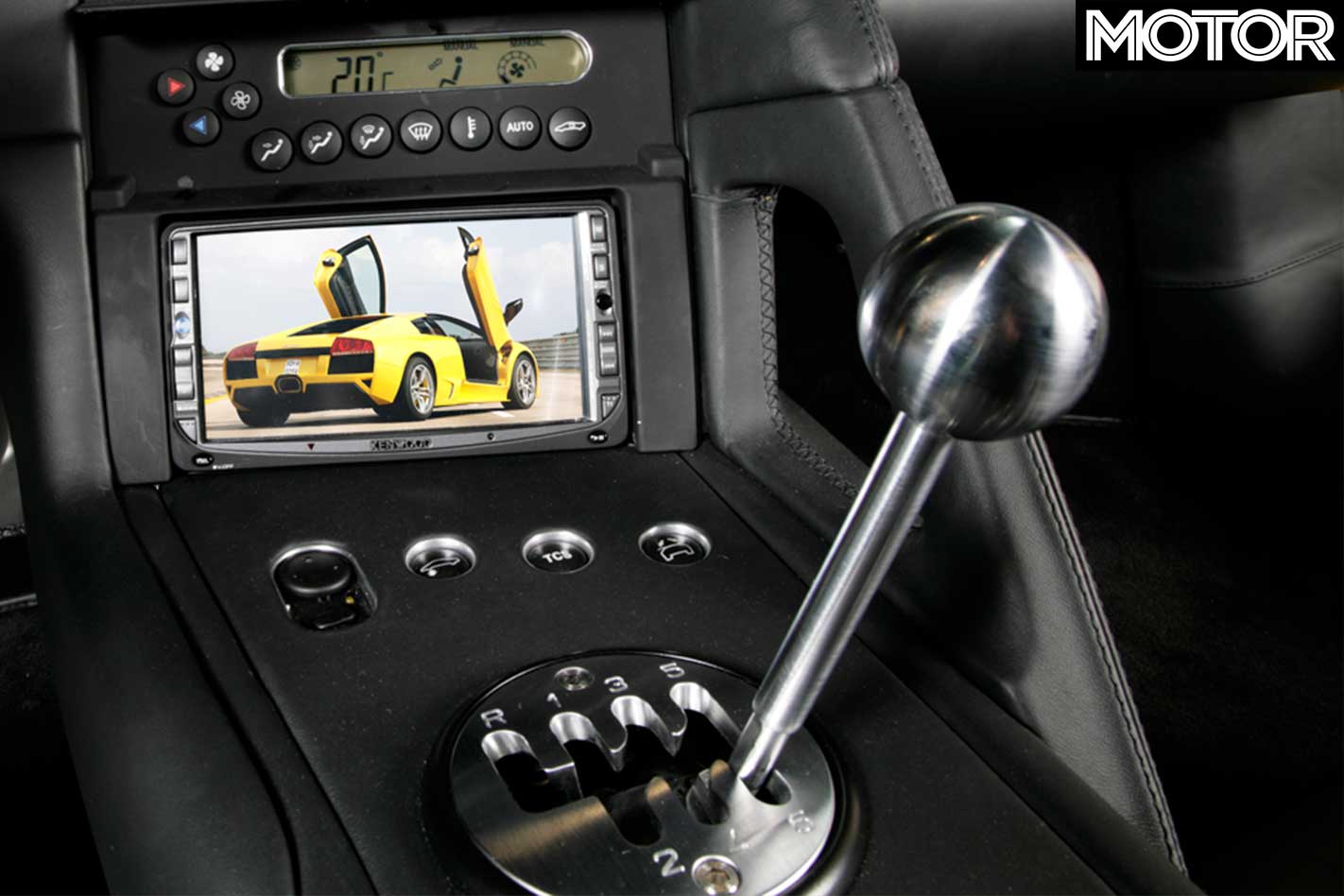
Get tempted, again, and all hell breaks loose. It’s like somebody hitting the Vmax button on the treadmill while your mind is at walking pace and, if you’re not careful, it will spit you foolishly out the back. While the throttle bodies won’t talk any more, the howls of protest from air molecules being slammed down the inlet tracts make up at least half the cabin noise. Then the exhaust fills with hot fumes and bellows its own war cry, a richly timbred violence as brutal as it is intentional.
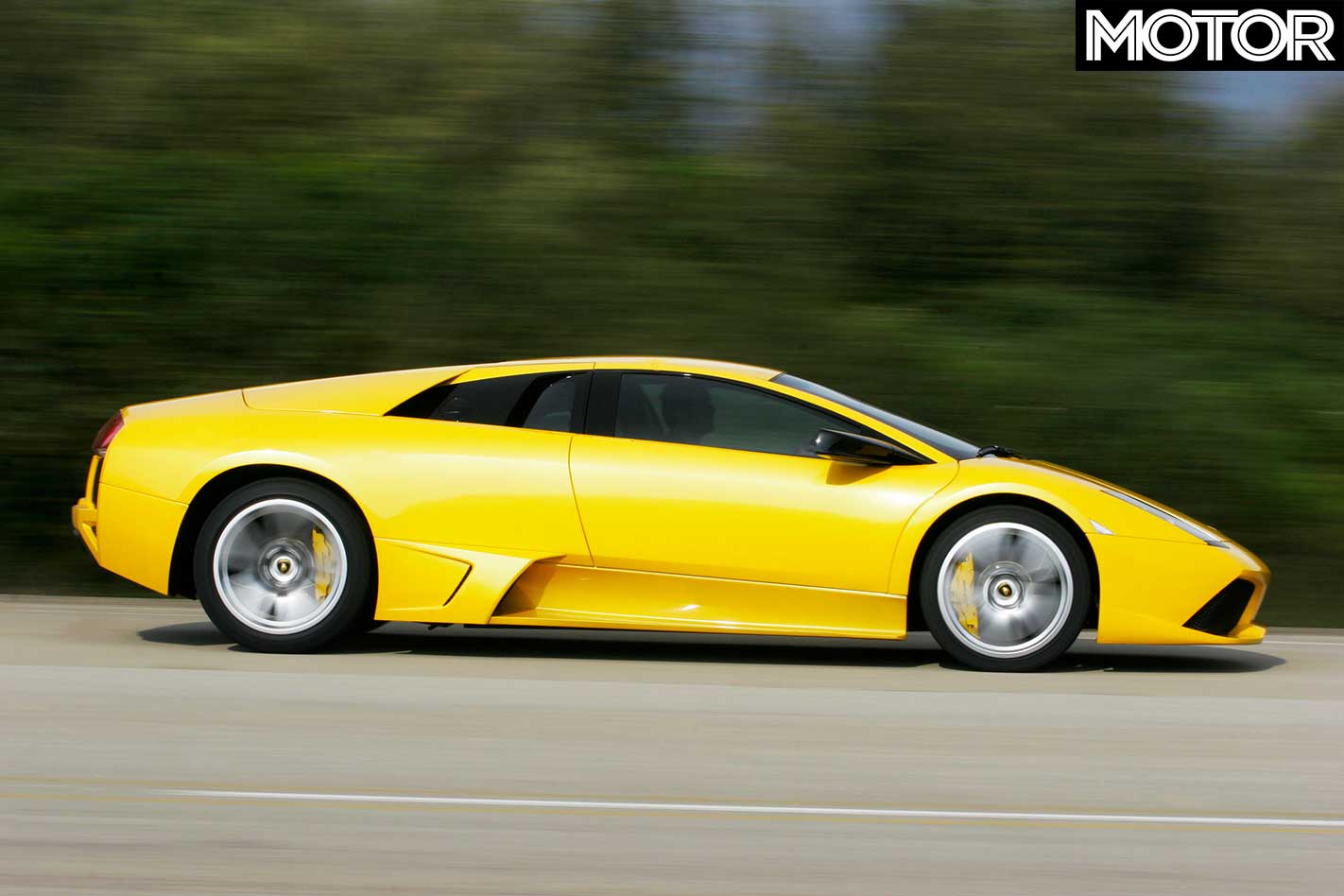
Beyond the mountain of torque is a wave of power that never tapers off and a limiter that never seems to even be close. It begs you to get up and over a small tremulous band around 4000rpm (which can encourage short shifting when you’re not having a crack) and chase the horizon.
Once you’ve gained its respect with a fearlessly snapped shift or two, it begs you to look past its little spurt of imbalance to hurl it up the road, and hurl it does. It seems impossible to have crammed this many timbre changes into one usable rev range. And it keeps going and going. It was bloody fast before; it’s seriously fast now.
And it stops. Harder than before on carbon ceramic discs that get the pads biting faster and harder and earlier, without fading. They’re six-piston jobbies at both ends (the standard steel discs are clamped by eight-piston at the front, four pistons at the rear) with, disturbingly, far less pedal effort than their cast iron predecessors. Nana could haul this thing down from 200 now, but they also provide far more pedal feel than before as well.
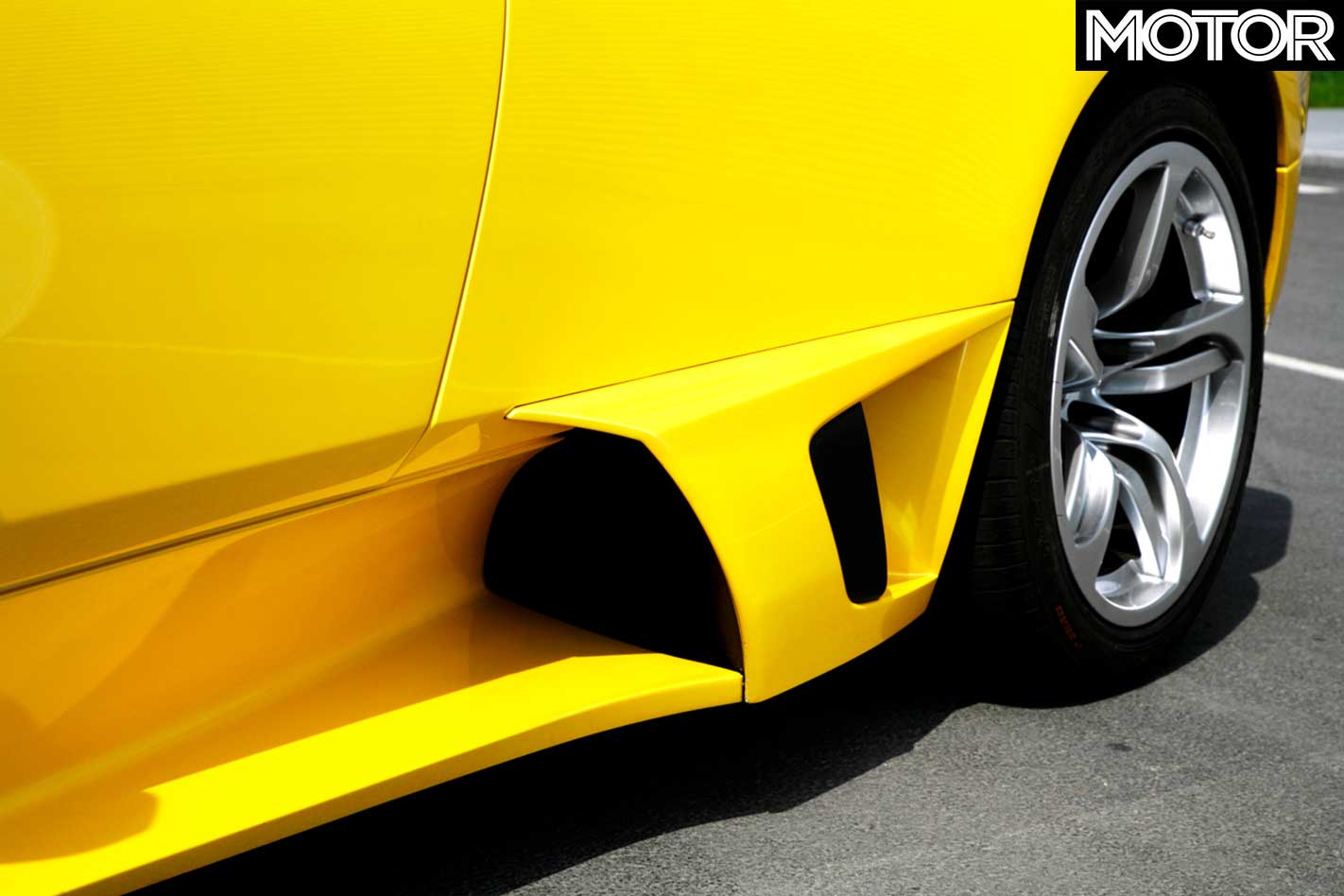
In another disturbing nod toward civilization there is now steering feel, almost as much as the Gallardo. And it’s feels balanced, without the lurching in the rear as the high-mounted engine wiggled its weight up and over the roll centre whenever you tried to change direction or tighten the line by easing off the throttle.
There’s delicate whisping feedback of all manner of undulations, bumps and even when it’s plain, old-fashioned out of grip. You can even feel some block squirm out of the front Pirelli P Zero Rossos (you can option it with semi-race Corsas or Sotto Zero winter tyres). Block squirm! In the old Murciélago, you couldn’t have felt block squirm if the block you’d run over had been of the cinder variety!
Lambo reckons most of this is down to the redesign of the electronically controlled dampers and enhancements to the anti-dive and anti-squat geometry, plus a pair of springs on each of the rear wheels.
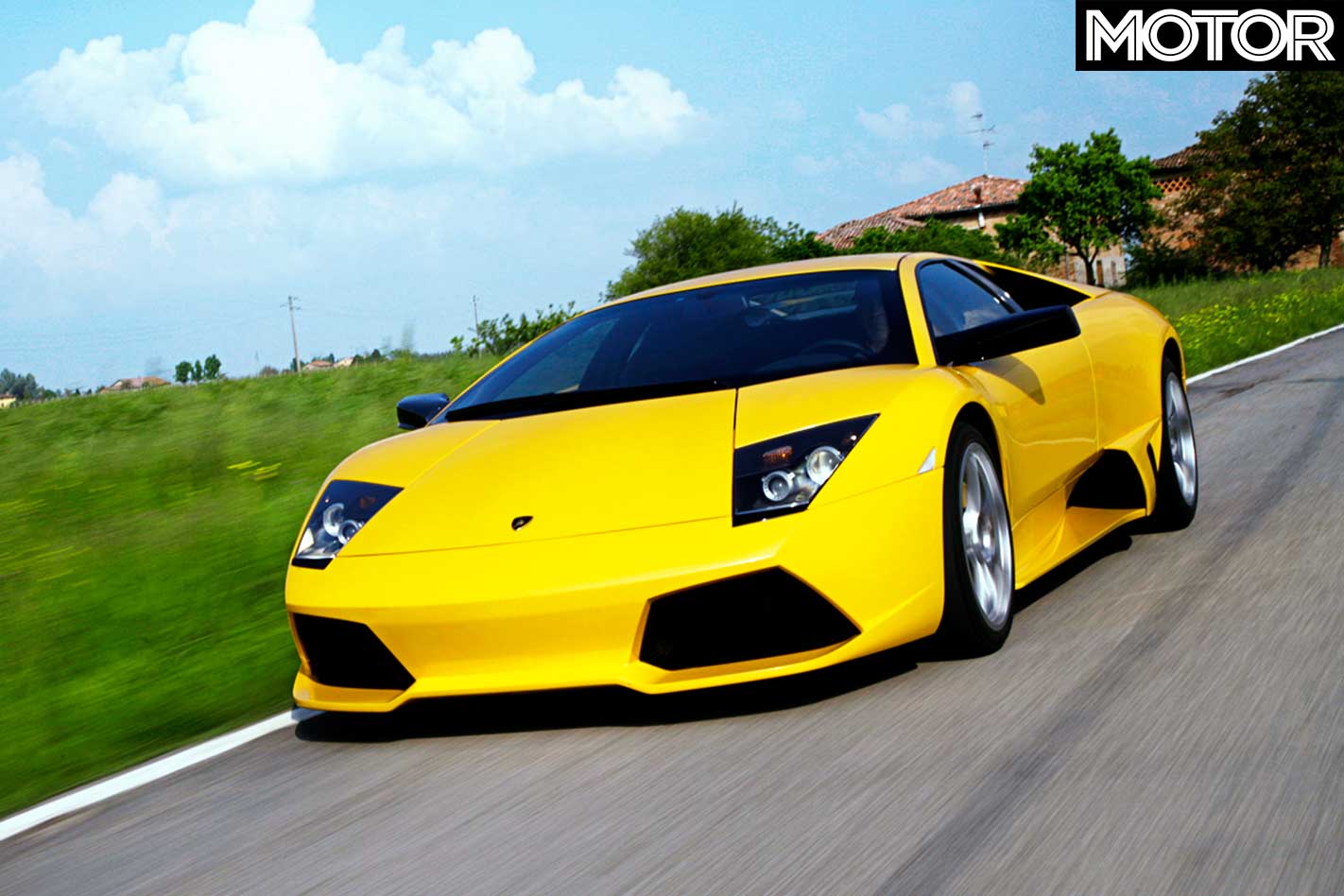
Whatever, it makes it Gallardo-easy to place the car on any type of road, and Gallardo-easy to hurl to its limits and back again. What it still does not do is recover from slides or moments with Gallardo-like ease. The engine is still heavier and taller, and the tube-framed alloy chassis still flexes more than the smaller car’s aluminium one. And it is still heavier.
Yes, the Murciélago has found religion. But it’s not the every Sunday, happy-clapping, God-bothering kind of religion we’re talking about. It’s more of a nodding acquaintance religion. It’s softer than it was, but it’s still the hardest of them all, and the most difficult to drive quickly.
The truth is, you still don’t empathetically drive a Murciélago to its limits. You conquer it. And that’s always been the Murciélago way, which makes it all the more rewarding.
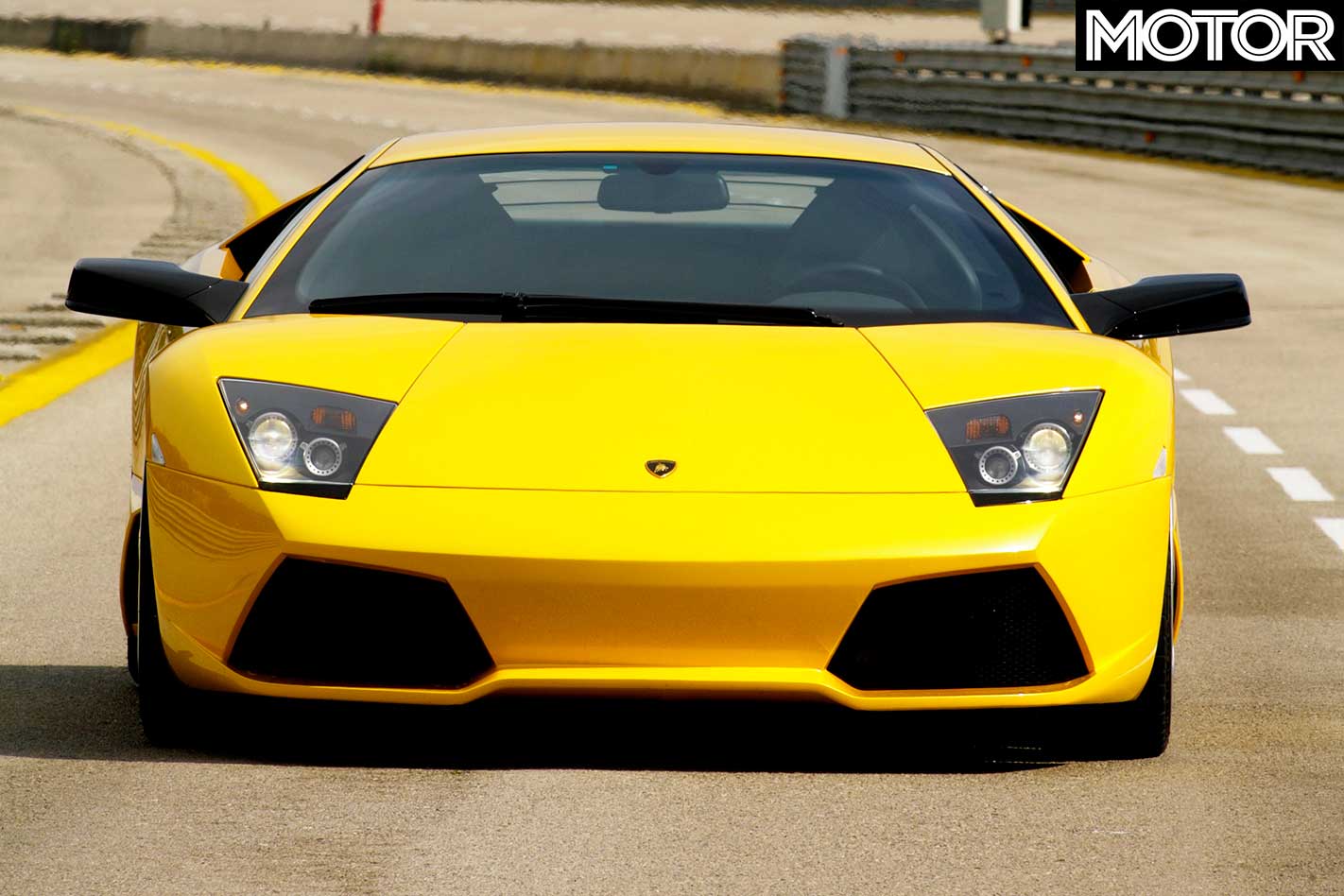
FAST FACTS 2006 Lamborghini Murciélago LP640
BODY: 2-door, 2-seat coupe DRIVE: all-wheel ENGINE: 6496cc DOHC 48-valve V12 BORE/STROKE: 88.0mm x 89.2mm POWER: 471kW @ 8000rpm TORQUE: 660Nm @ 6000rpm WEIGHT: 1665kg POWER-TO-WEIGHT: 283kW/tonne TRANSMISSION: six-speed manual SUSPENSION: double wishbones, coil springs, anti-roll bar (f & r) BRAKES (standard): 380mm ventilated & drilled discs, eight-piston calipers (f); 355mm ventilated & cross-drilled, fourpiston calipers (r) BRAKES (optional): 380mm ventilated & drilled carbon ceramic discs, six-piston calipers (f & r), ABS WHEELS: 18 x 8.5-inch (f); 18 x 13.0-inch (r), alloy TYRES: Pirelli P Zero Rosso (Corsa semi-race tyres optional), 245/35 ZR18 (f); 335/30 ZR18 (r) PRICE: $680,000 (est), plus approx $35,000 for ceramic brakes
When a new-generation of vehicle arrives, it should thumb its predecessor’s resale value into the ground. Perhaps not with the odd Ferrari – if chosen correctly – though, and in more affordable circles, the Porsche 911.
The brand new 992-generation released this week in Los Angeles should take the dollar figures down on the 991, which in turn dominoes into 997 and 996 values – but will these models then rise like the 993 and 964 before them? The new Porsche 911 is the perfect catalyst to ponder this question.
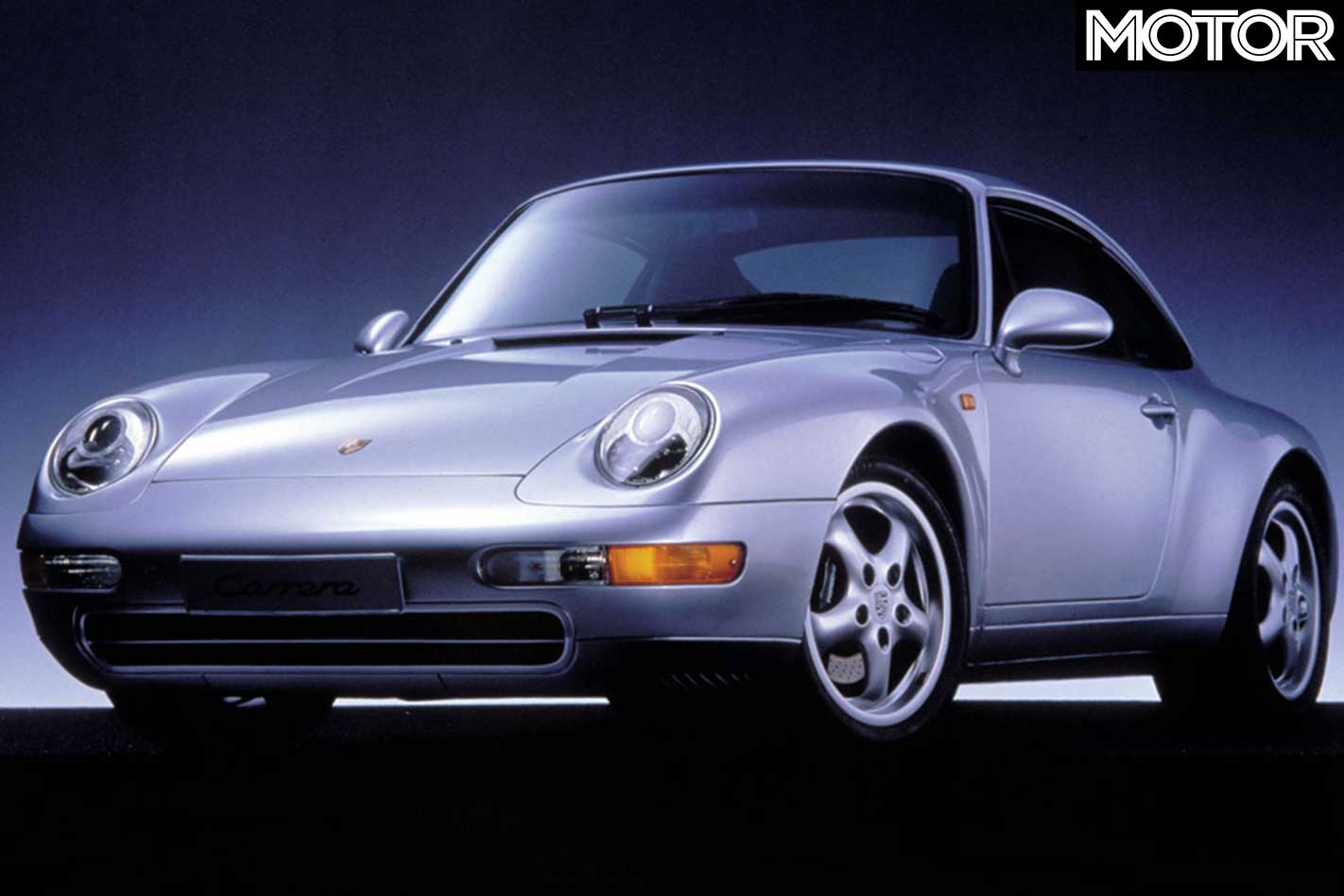
For starters, the value is always with the 911 Carrera and not the motorsport versions, coupe not Targa or convertible, preferably rear-wheel drive and manual not automatic transmission – the classic formula, of course.
By ‘affordable’ and ‘value’ we mean relatively, to the motorsport versions. Rewind even five or so years ago, and a late-1980s/early-1990s 964-gen C2 manual was about half its $125K-plus ask now. Some pundits with mint examples are asking closer to $200K. It went crazy.
The mid-1990s 993-gen, last-of-the-air-cooled models and arguably the final time the 911 felt properly compact, and decently taut stylistically, has followed the same trend. Six figures is the start.
Then we call half-time – half the cost, half the kilometres with the newer 996-gen 911.
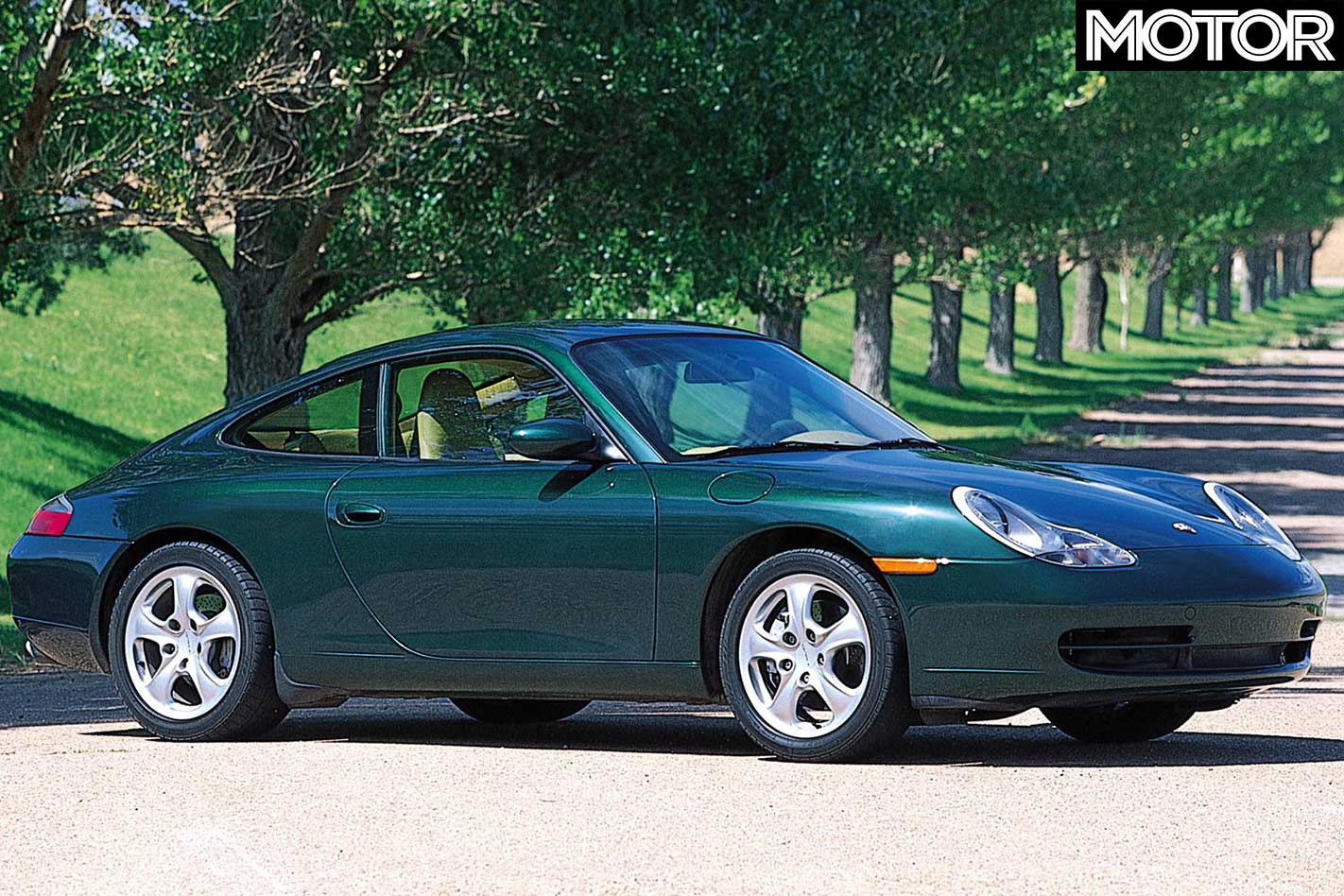
We’re talking a 2002 Carrera manual, in navy with five-spoke alloy wheels, grey leather, original with 92,000km for $62K. The 3.6-litre boxer six made 235kW at 6800rpm, and 370Nm at 4250rpm, but with a six-speed manual and 1320kg kerb weight – new Golf GTI mass… – it’s good for a 5.0sec 0-100km/h.
It isn’t the only one, either. There are mint examples of the last of the line 996 for under $70K in that ideal RWD/manual/coupe specification, untainted by modifications.
Once derided as the unloved generation, a good 996 is also only about $10K cheaper than a good 997 from 2005 onwards. The first generation this tester was privileged enough to drive new, the Carrera of the late noughties was just lovely, though it added 4kW but no extra performance over its predecessor mentioned above. Weight moved to 1495kg, as well.
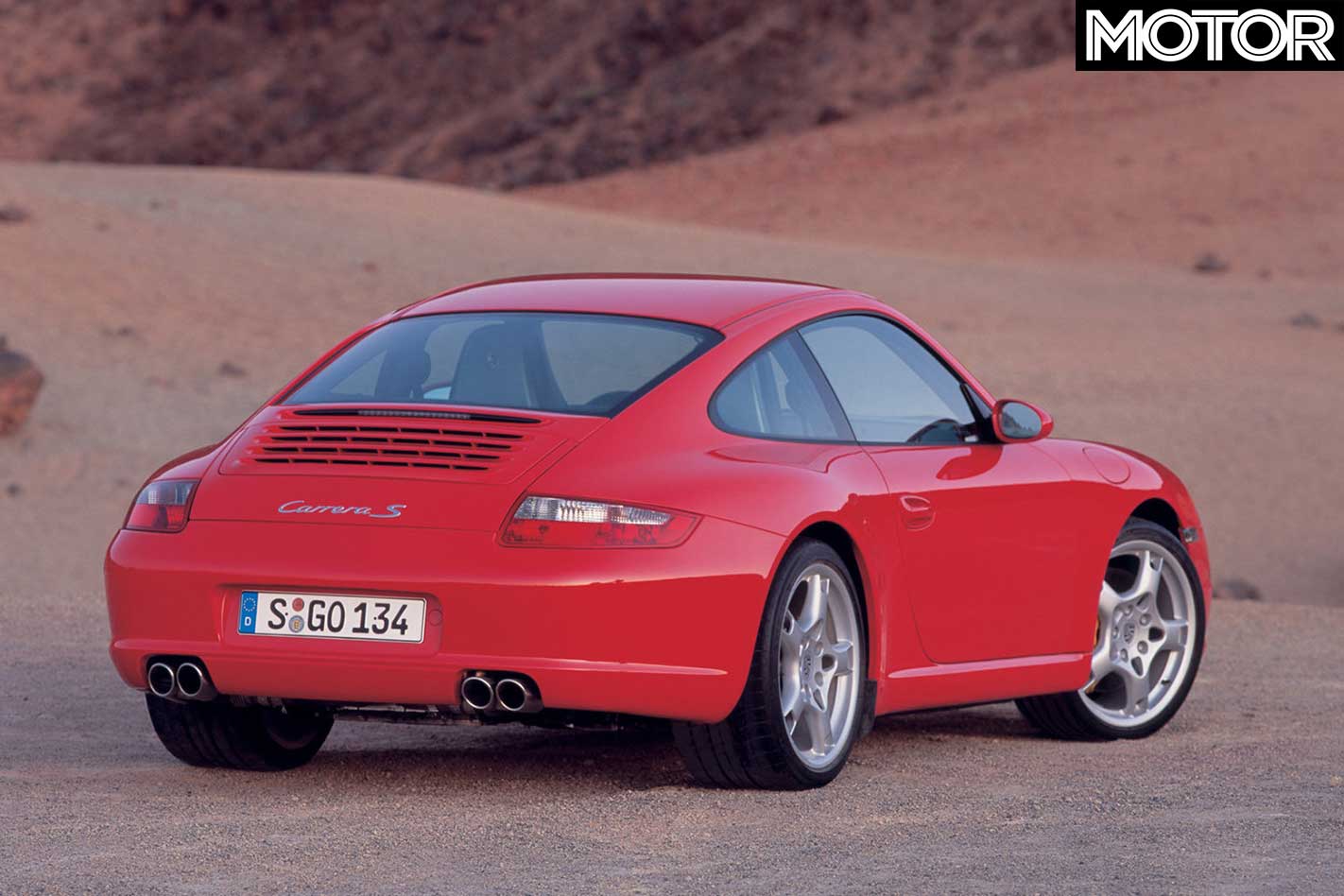
However, the Carrera S took the engine to 3.8 litres, 261kW at 6600rpm and 400Nm at 4600rpm, weight to 1510kg but the 0-100km/h to 4.8sec. Okay, there are UK delivered 2005 examples with 100,000km for $80K, or Australian delivered for closer to $90K. Tellingly, the priciest are a 2005 and 2008 with 50,000km and 80,000km respectively, for circa-$115K.
Next up, the cheapest 991 is $150K, almost twice the 997 cost. So if 996 has narrowed the gap to 997, where do you think 997 is headed?
Currently, it’s also less than the cheapest Audi R8 from the same era, the V8 manuals of which start at $120K. And with 4.8sec performance, you’re all of three-tenths slower than a BMW M2 Pure that’s a couple of years old. The 997 sounds like value, and an investment.
Toyota has revealed that it’s planning to bring in a sedan version of its popular Corolla next year, despite the winds of fashion blowing the opposite direction.
Its trump card? It’ll be a well specced petrol/electric hybrid that will certainly give it a point of difference over its looming arch rival, the new Mazda 3 sedan that will feature the new ultra-efficient Skyactiv-X engine.

While Toyota Australia is being vague about timing, it’s already given an indication of the spec level that the car will ship with. Its mechanical bits, for example, will mimic those found aboard the current Prius; that means a 1.8-litre petrol engine, a pair of electric motors and a battery pack.
The pack size and capacity might change before the car gets here, but we’re betting it’ll still be made from older-tech nickel-metal/hydride cells, which Toyota has used with great success for the last decade.

It’ll also arrive down under with all the active safety found in the Corolla hatch, including AEB, adaptive cruise control, lane keep assist and automatic high beam, along with seven airbags.
The Corolla Hybrid sedan will count as one of the five battery-assisted products that Toyota is launching up till 2020, including a hybrid version of the all-new RAV4 which is due in 2019.
The previous generation Corolla sedan is still on sale in Australia alongside the all-new hatch.

Click on the main image at the top of the page to view a 2019 Toyota Corolla Sedan gallery
MORE: Toyota Corolla Range Review MORE: Toyota Corolla Specs, Range & Price
One of the original premium electric vehicles, the BMW i3 has received another power boost giving it double the range of the original model that’s now beyond the average weekly city commute.
Slated to arrive here in February, the i3 120Ah has a powerful 42kWh battery pack and replaces the current version that’s powered by 94Ah/33kWh batteries.
According to BMW this increases the range to 260km, which will get you from Sydney to Orange, though it remains to be seen how it will perform in real world conditions when you factor in things like hills and using the air-conditioning.
Click on the gallery above to find out more about the new i3 including pricing, features and performance.
Back in 2003 the Holden Astra SRi stunned readers (and some MOTOR staffers) by snaring a class and outright victory at our Bang For Your Bucks.
This review was originally published in MOTOR’s July 2006 issue
There was no arguing that the 147kW Astra Turbo offered plenty of bang for 37,000 bucks, but some readers were incredulous that the little Holden hatch could dust up such big names as Porsche’s Boxster S, BMW’s M3, Subaru’s Impreza STi and HSV’s 300kW GTS Coupe. But the SRi wrote its name into the pages of MOTOR history with a combo of easy-to-use performance, high equipment levels and a genuine fun factor at a great price – exactly what the BFYB award is about.
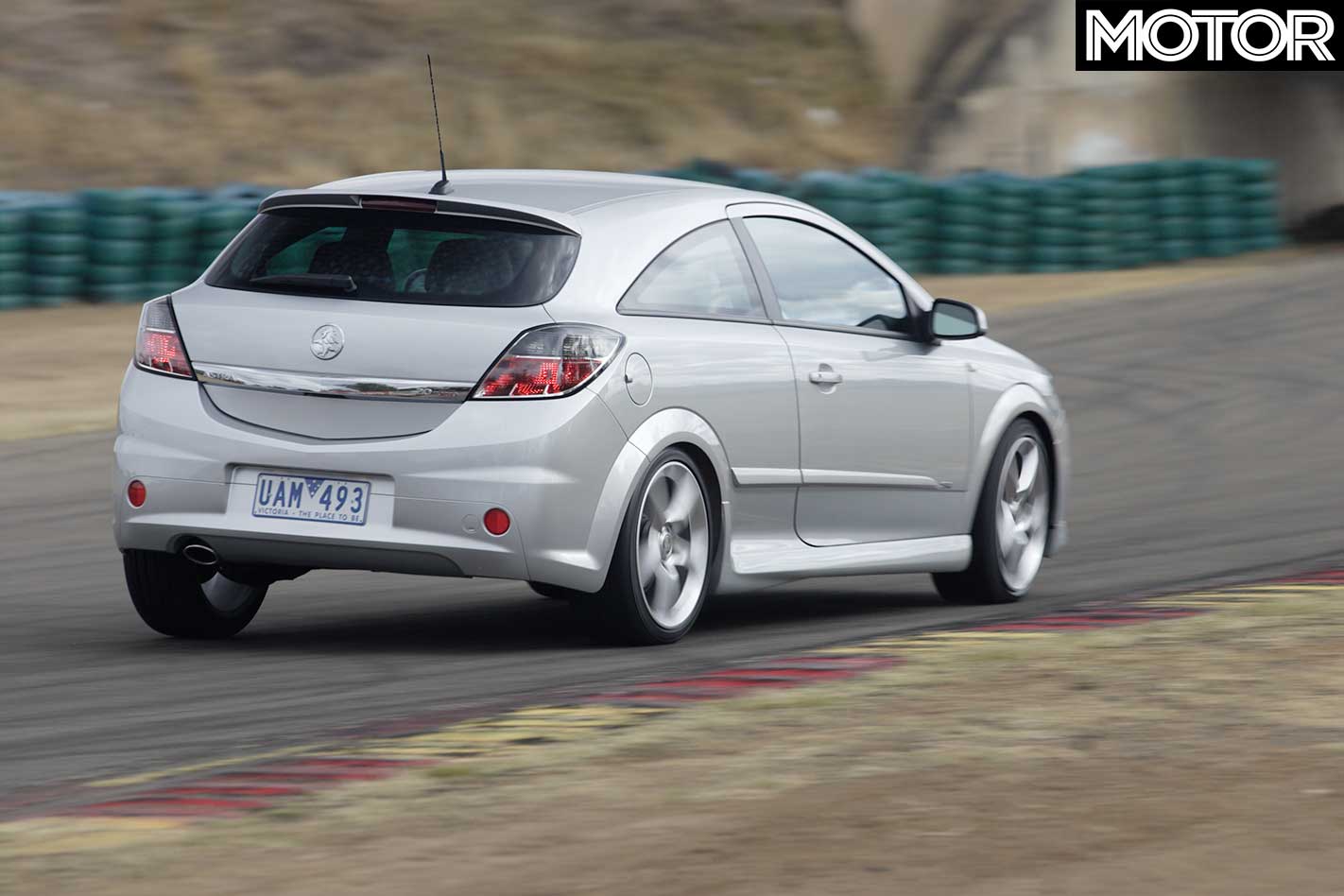
Aside from the price cut, the swoopy new Astra hatch gets a six-speed gearbox to replace the old five-cog jobbie. Combine the short-stacked ratios with a 3.94:1 final drive and the Astra makes the best of its power and torque. But the 1401kg weighbridge ticket does blunt acceleration lower in the rev range.
The six-speeder’s shift action isn’t class leading (that’d be the Golf) but it’s still positive and quickish, although the clutch is a bit dead in the first part of its travel, making smooth take-offs a bit of a challenge until you’ve done a few familarisation kays.
For fans of automotive acronyms the new SRi also gets IDS Plus and CDC. Huh? That’d be Interactive Driving System and Continuous Damping Control, which adapt the suspension tune to the road surface and driving style.
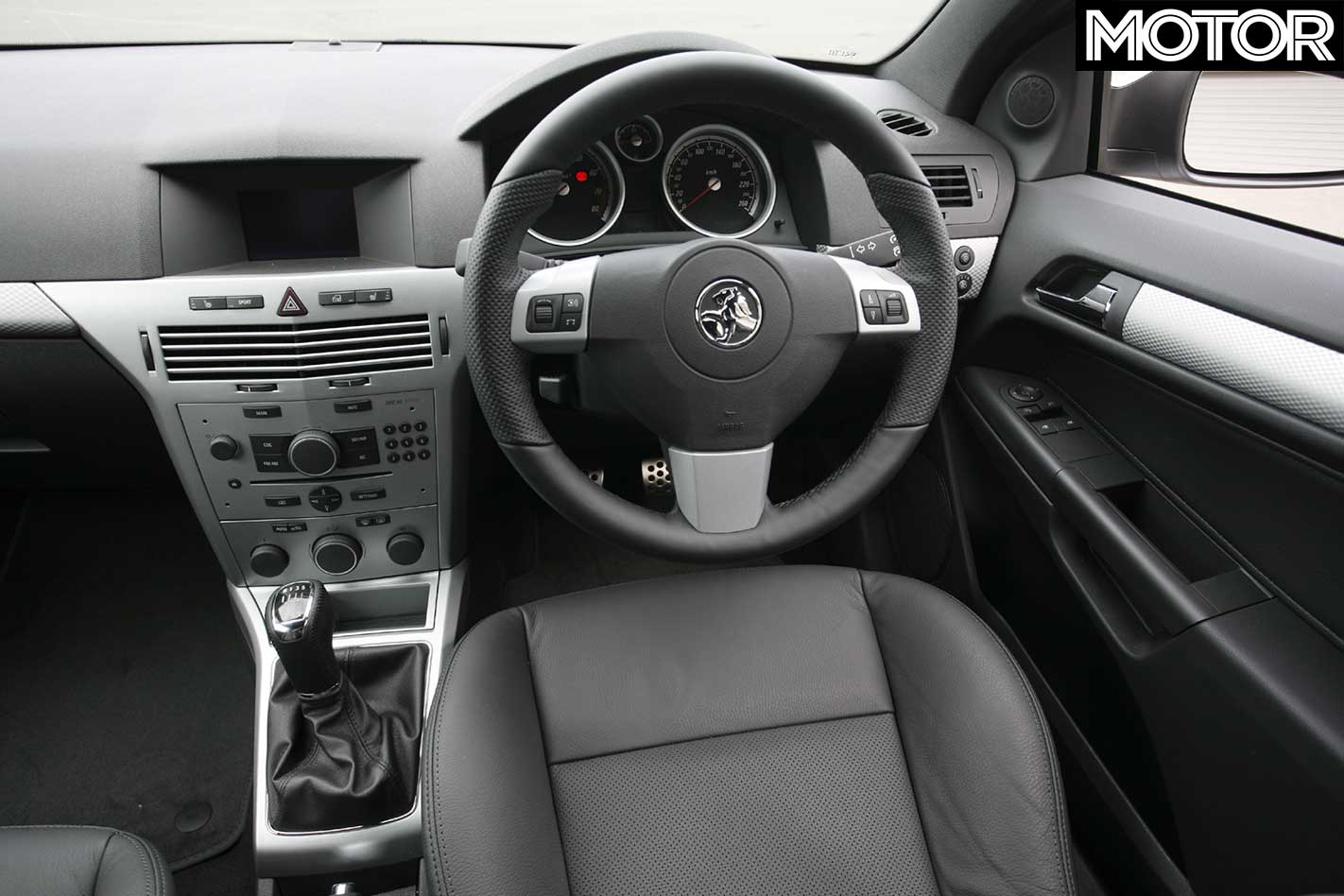
There’s also a Sports button on the dash facia to firm up the suspension manually, and sharpen both steering and throttle response. Keep the button down for about five seconds and you’ll be flying solo, with no traction control or ESP help.
With the help on or off there’s fun to be had. Grip from the Dunlop 225/40 R18 rubber is high and the chassis responds eagerly to the steering. Again the tiller’s not as lively as a Clio or Golf but in isolation the Astra will entertain on road or track.
Torque steer only makes itself felt during hard acceleration in first or second gear, and the brakes (308mm ventilated fronts, 264mm solid rears) held up well to some hard laps of Sydney’s Oran Park.
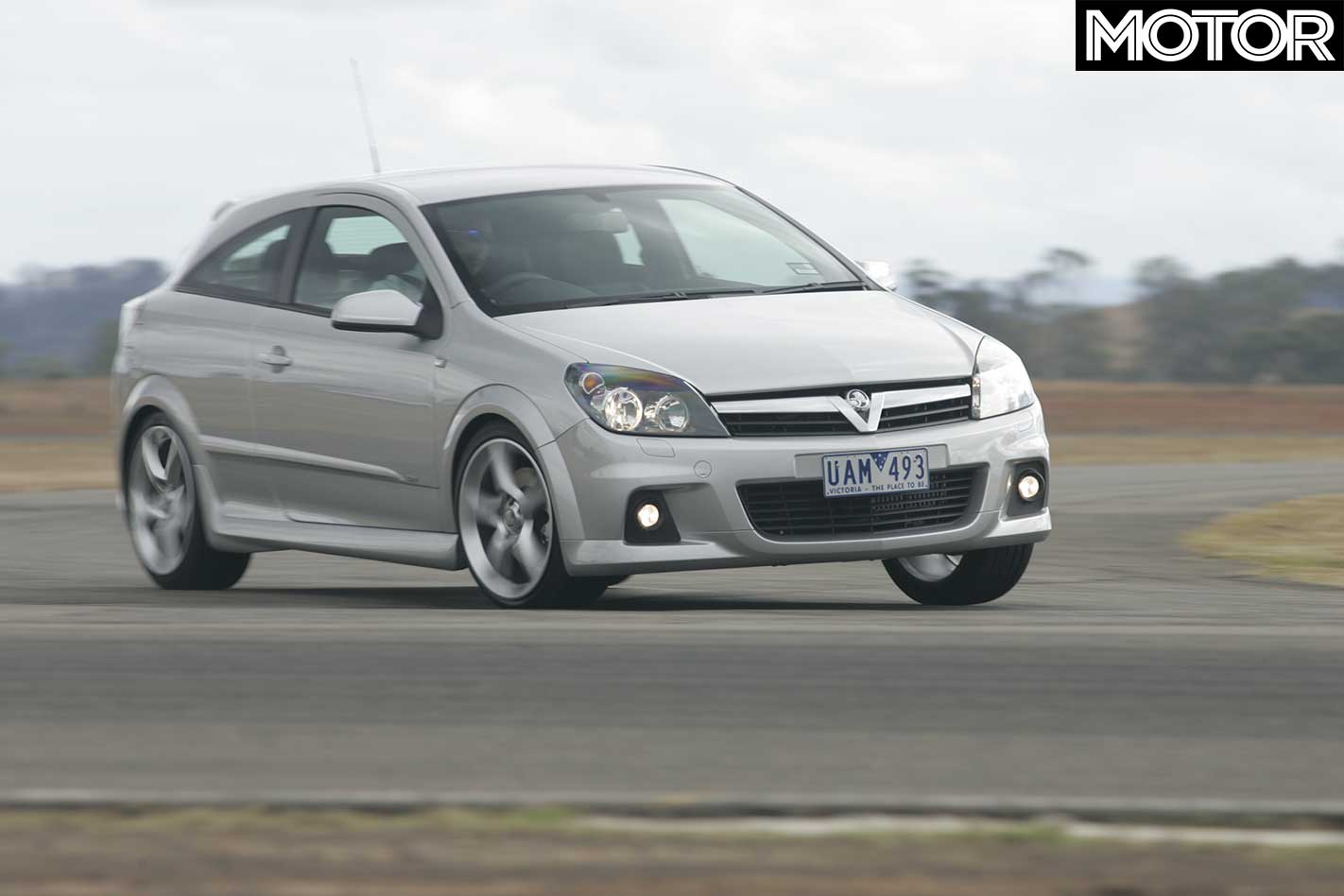
In the hands of Peter Bizley from Holden’s Performance Driving Centre, the SRi managed a very respectable 55.4 seconds. For reference, our own Dean Evans lapped the same circuit in a 190kW, all-wheel drive Mazda6 MPS in a high 52.
Available in metallic black, silver or solid white, the SRi comes standard with leather trim including heated front seats, 18-inch alloys and six airbags. Aside from the $360 for metallic paint, about the only other option is rear parking sensors.
Like the previous SRi the new model won’t assault your senses like a Renault Sport Clio or even a Golf GTI, but at a tenner less than $35k it’s hard to beat for Bang For Your Bucks. It’s a more grown-up hot hatch than the Frenchie and while it’s not as special and together as the Golf, it’s a damn sight cheaper.
Of course, all of this bodes well for the 176kW, 320Nm, HSV VXR version to be released in a few months.
FAST FACTS 2006 Holden Astra SRi Turbo Engine: 2.0-litre, DOHC 16-valve turbocharged four-cylinder Power/Weight: 147kW/1401kg Drive: front wheel Price: $34,990
