
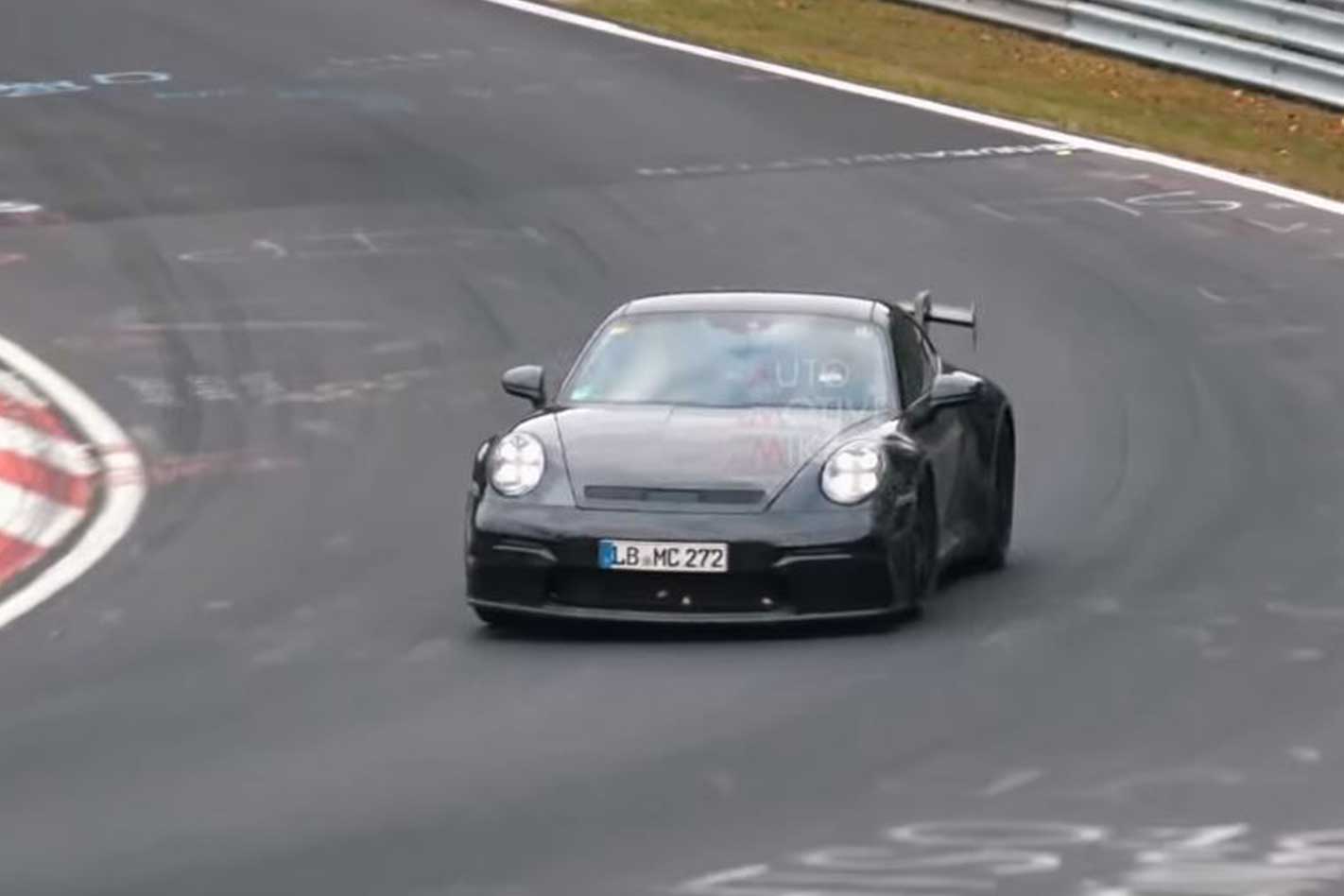
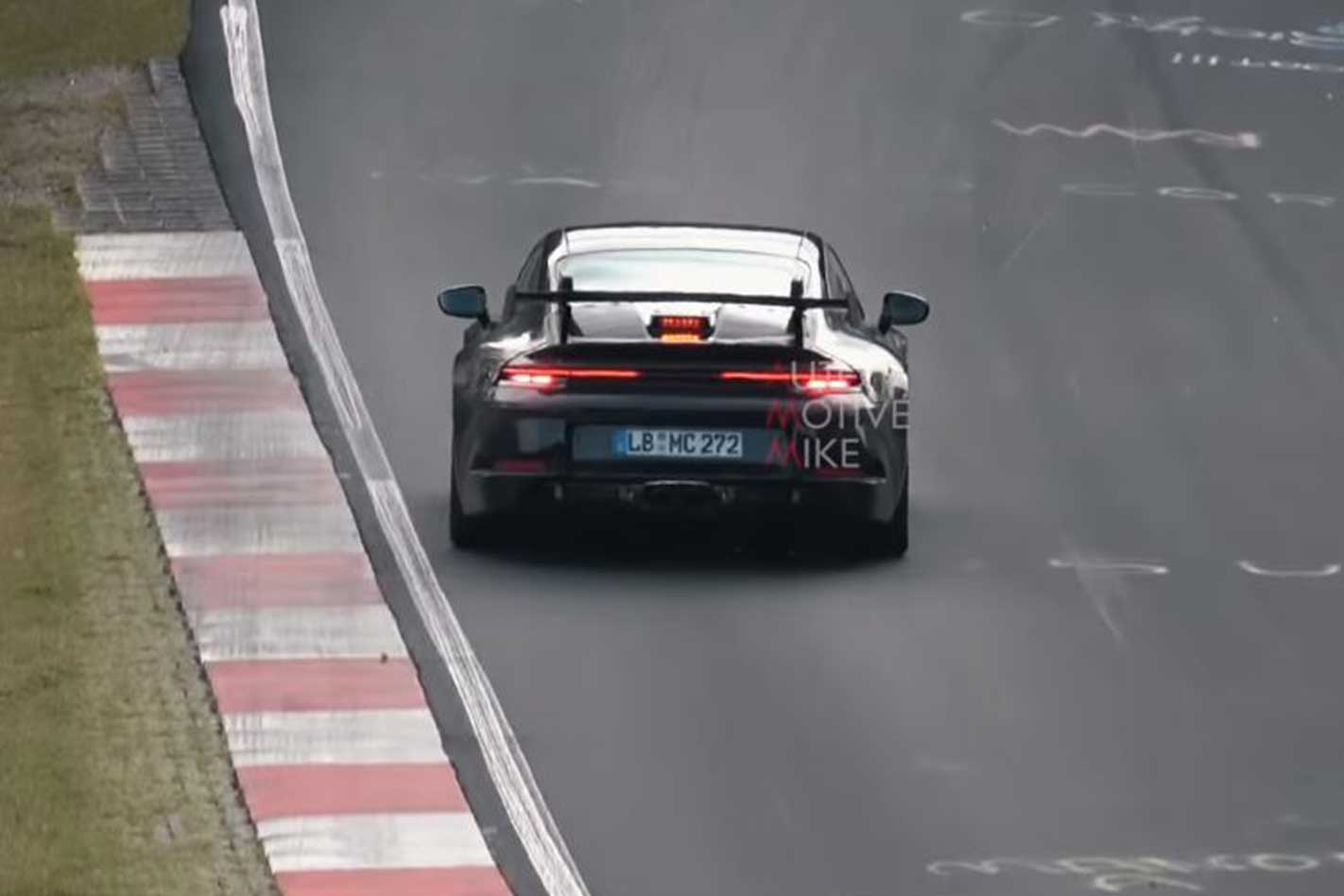
A next-gen Porsche 992 911 has been spotted testing at the Nürburgring, and it sounds like it’s naturally-aspirated and manual.
The YouTuber who uploaded the video, AutomotiveMike, has said it’s the next 911 GT3, but this goes against previous insider knowledge MOTOR has gleaned from Europe.
The following is from a previously published article outlining the direction of the next 911 GT3, as told by MOTOR’s well-connected European Editor, Georg Kacher.
‘The next-generation 911 GT3 – part of the all-new ‘992’ lineup – will feature a turbocharged flat-six producing around 410kW fed through an eight-speed PDK gearbox.’
This suggests the drivetrain present in the car being tested here is not for the next GT3, or that Porsche has changed its mind about the GT3 going turbo.
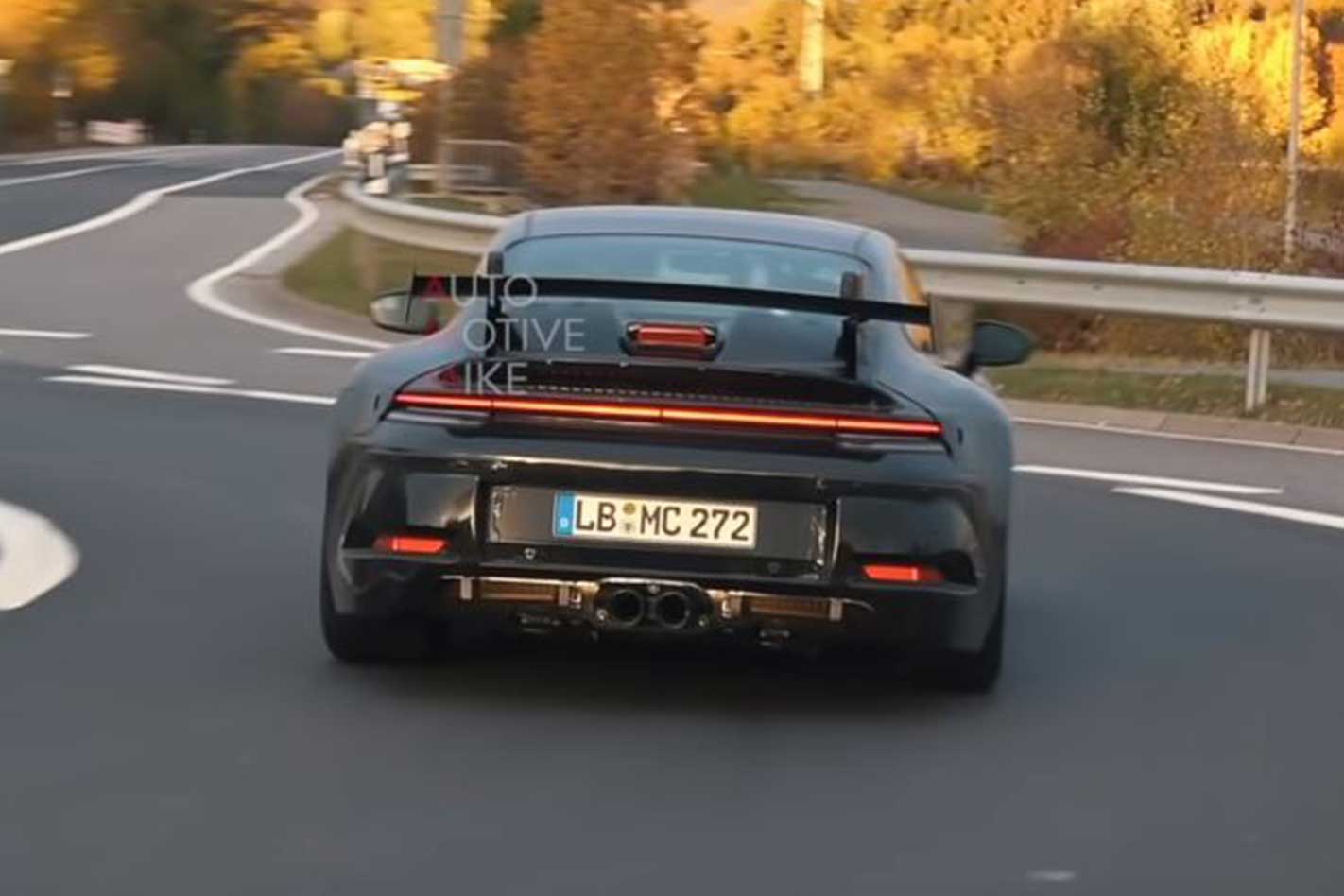
If the GT3 is to go turbo, then there’s something else this 992 could be testing.
As exclusively published by MOTOR earlier this year, Porsche’s GT road car engines boss Thomas Mader says Porsche is working on a 9500rpm street-legal 911.
As the 992 in the video sounds properly racey (even more so than the current 991.2 GT3), it’s possible there will be a road version development of the engine similar to that of the 4.0-litre in the 991.2 RSR race car.
Speaking to MOTOR at the launch of the 991.2 GT3 RS, Mader said “[his team] will look at the things we have on racetrack to put it in the street car, that’s our job.”
Stay tuned as MOTOR uncovers more information relating to the future of the 911.
One of only two surviving Targa-spec Mazda RX-8 SPs is currently for sale in Sydney.
The car, which once featured on the cover of MOTOR Magazine (April 2009), is at ‘My Sportscar’, a car rental business run by David Potter.
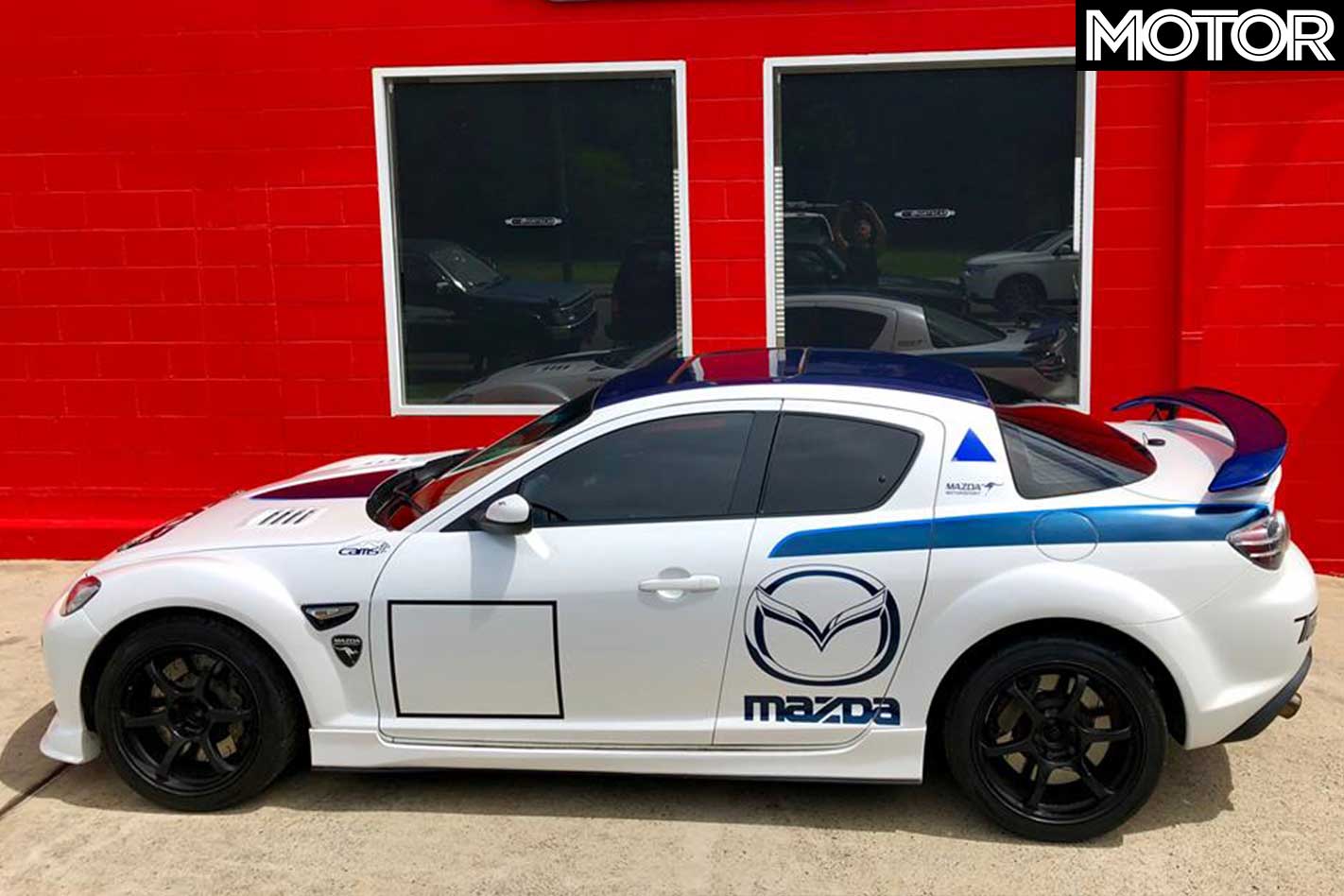
In the 2009 story featured in MOTOR, then-editor Andrew MacLean suspected the RX-8 SP might have upwards of 220kW and 420Nm, though its architect (Mazda’s Australian Motorsport director Allan Horsley) wouldn’t divulge those juicy details.
He did, however, tell us it weighed approximately 1200kg even with the roll cage.
Now, with a new Ric Shaw-built 13B engine and a turbo, the RX-8 SP could be producing even more than that.
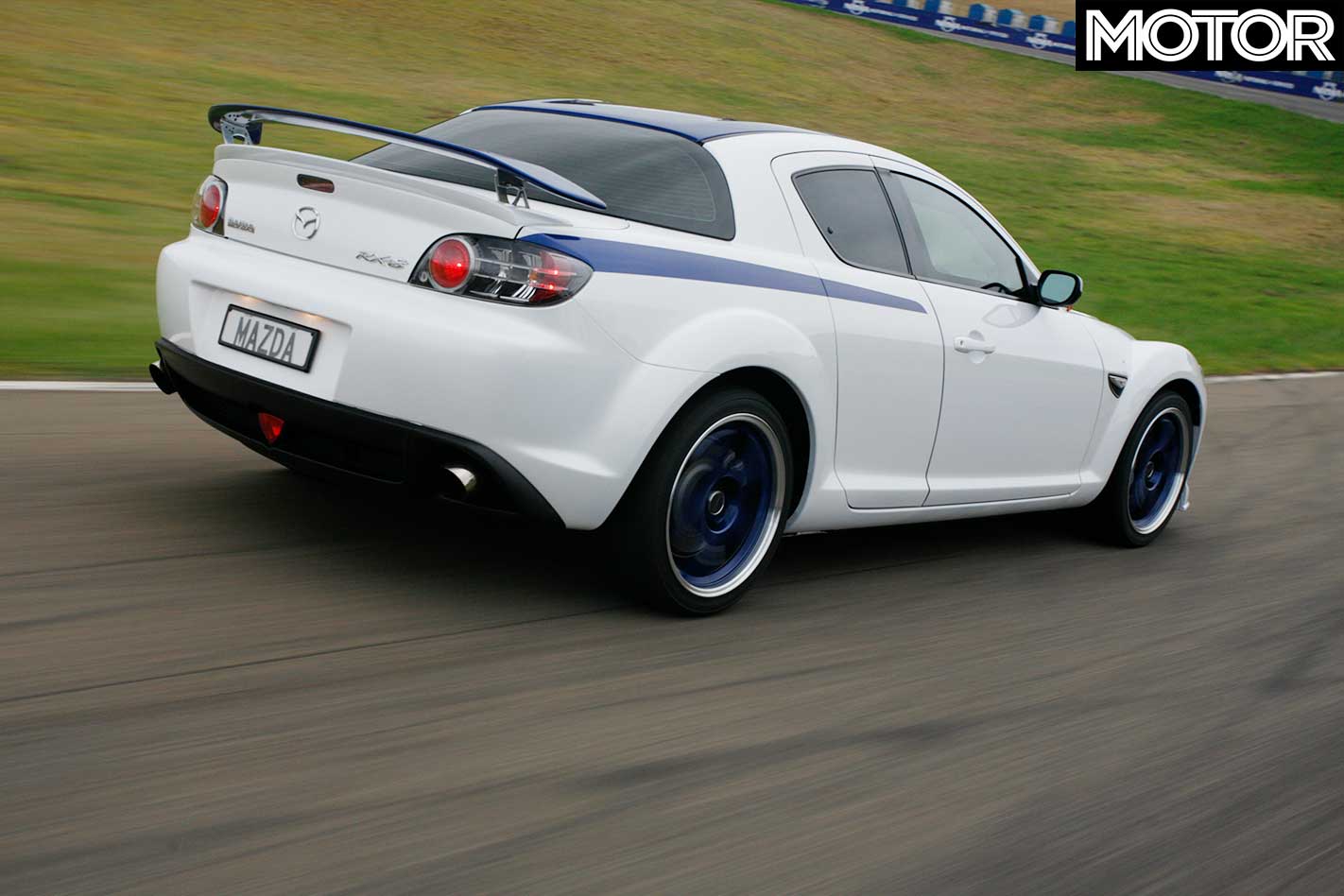
It’s running AP brakes, MCA suspension, Dynohaus-tuned ECU, and a 100-litre tank with a system tuned to run best on 98RON, though it’ll run E85 too.
“There are only two cars remaining to this day, one in Mazda HQ in Melbourne and this car on display in Sydney with its current owner,” Potter says.
Australian rally driver Brendan Reeves also confirmed this. We originally suspected it might be the car Reeves competed in (in Targa Tasmania and Targa Wrest Point) several years ago in 2012, though photos supplied by Potter told us Reeves drove the other surviving car.
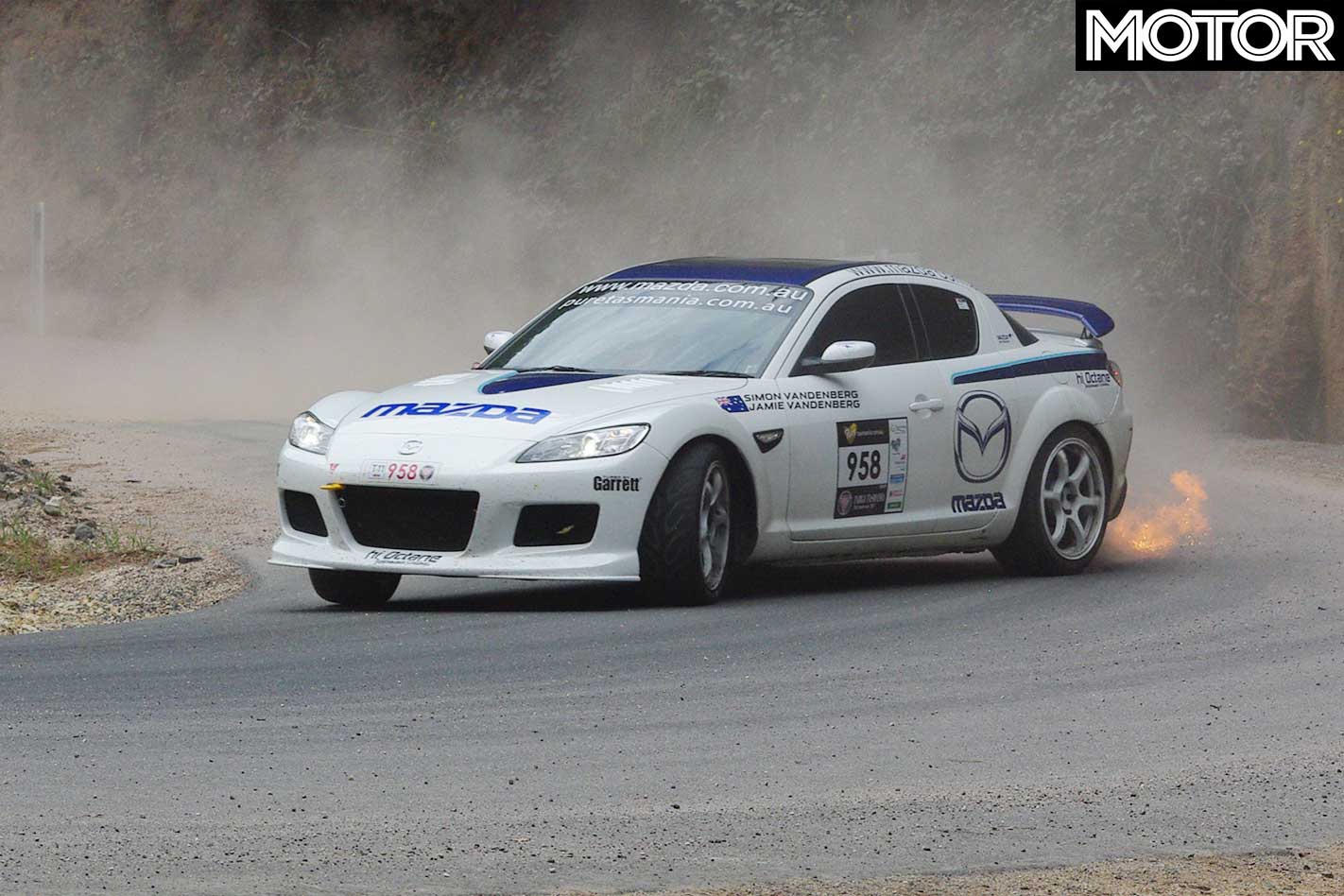
“The third car was written off at Targa Tasmania in their early years of competition,” Potter adds, meaning this car is now, really, one of two.
It’s even road-registered, with the ‘RX8 SP’ plate coming with the car. Those interested should check out the Facebook post embedded below.
The Australasian New Car Assessment Program has given the thumbs-up to the new Mercedes A-Class, the revised Lexus ES 300h and the updated Mazda 6, awarding them all a maximum five-star ANCAP safety rating based on its rigorous local crash testing program.
Assessed against the latest safety standards now in play across both the Australasian and European markets, each of the vehicles achieved strong scores in all key safety areas.
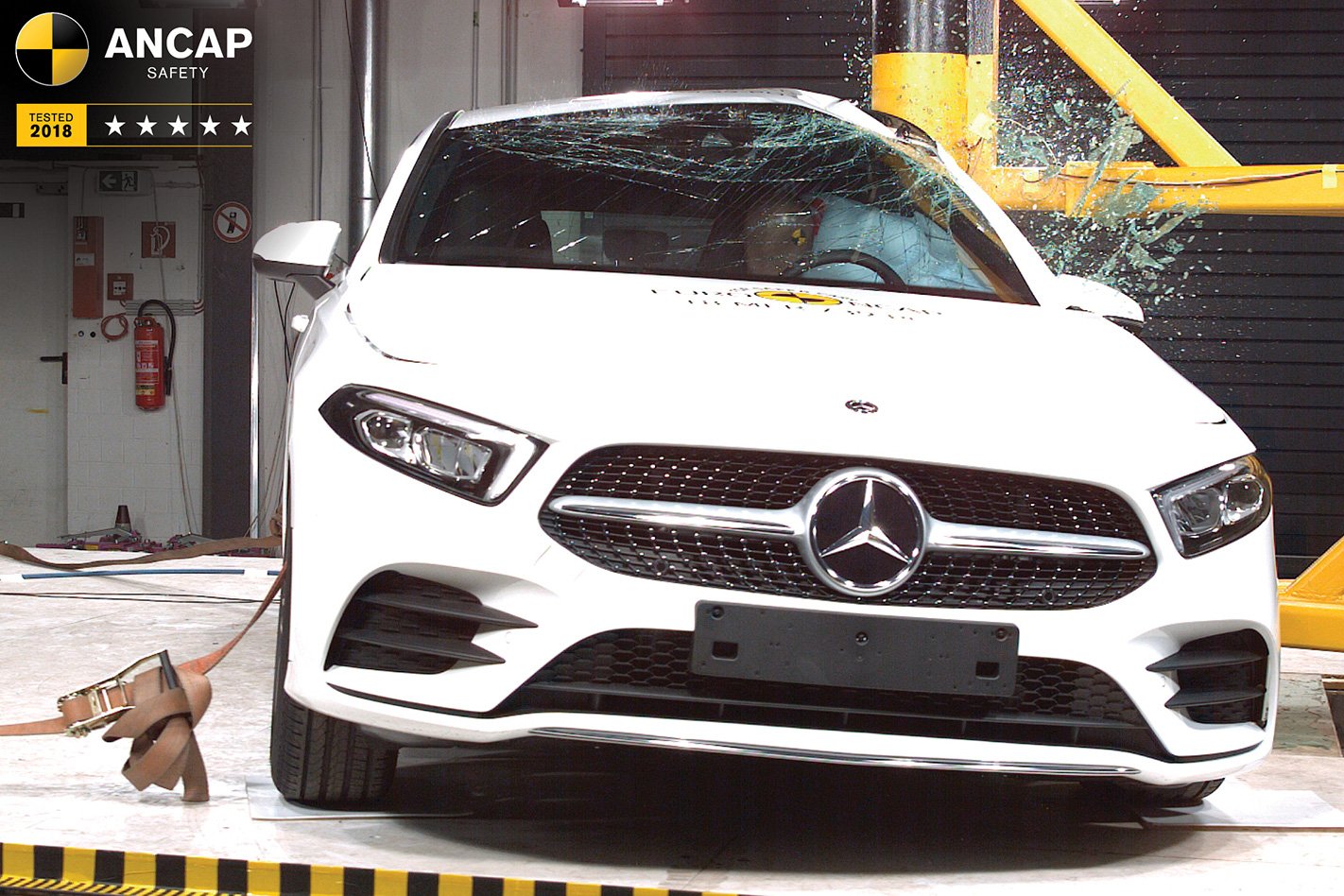
The A-Class in particular showed excellent all-round safety performance, according to ANCAP Chief Executive, James Goodwin.
“It has achieved the highest vulnerable road user protection rating to date with a score of 92 per cent, and has equalled the highest child occupant protection rating scoring 91 per cent,” Goodwin said.
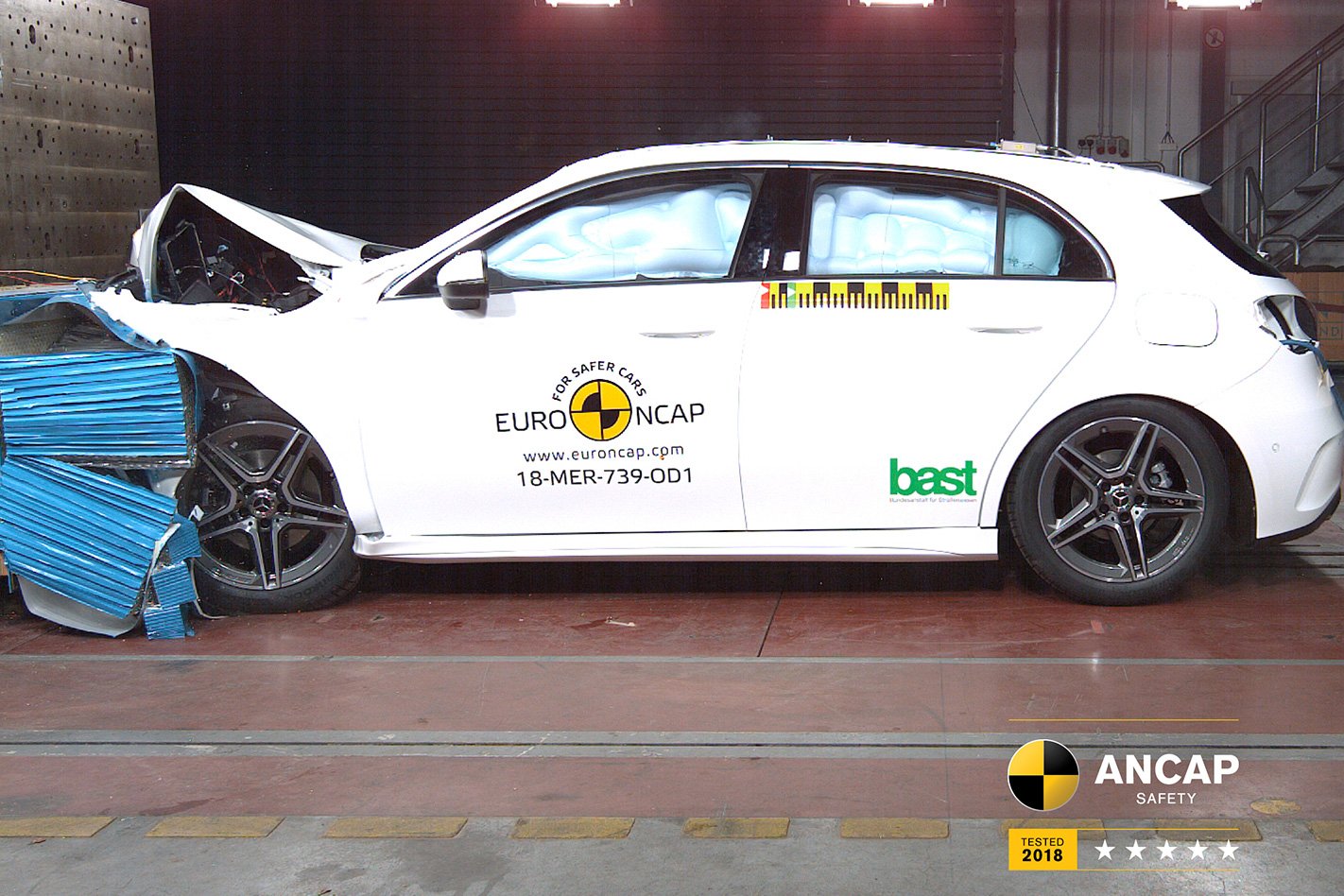
“Side chest-protecting airbags also extend to the rear seats as a standard feature on Australasian models, where it is offered as an option to European consumers,” he said.
Lexus’ ES 300h hybrid sedan scored particularly highly for its autonomous emergency braking, thanks to its ability to detect and avoid pedestrians in both day and night test scenarios. It also scored very well for cyclist detection capability. The ES 350, which is a V6 petrol-powered version of the ES 300h, is yet to be assessed.
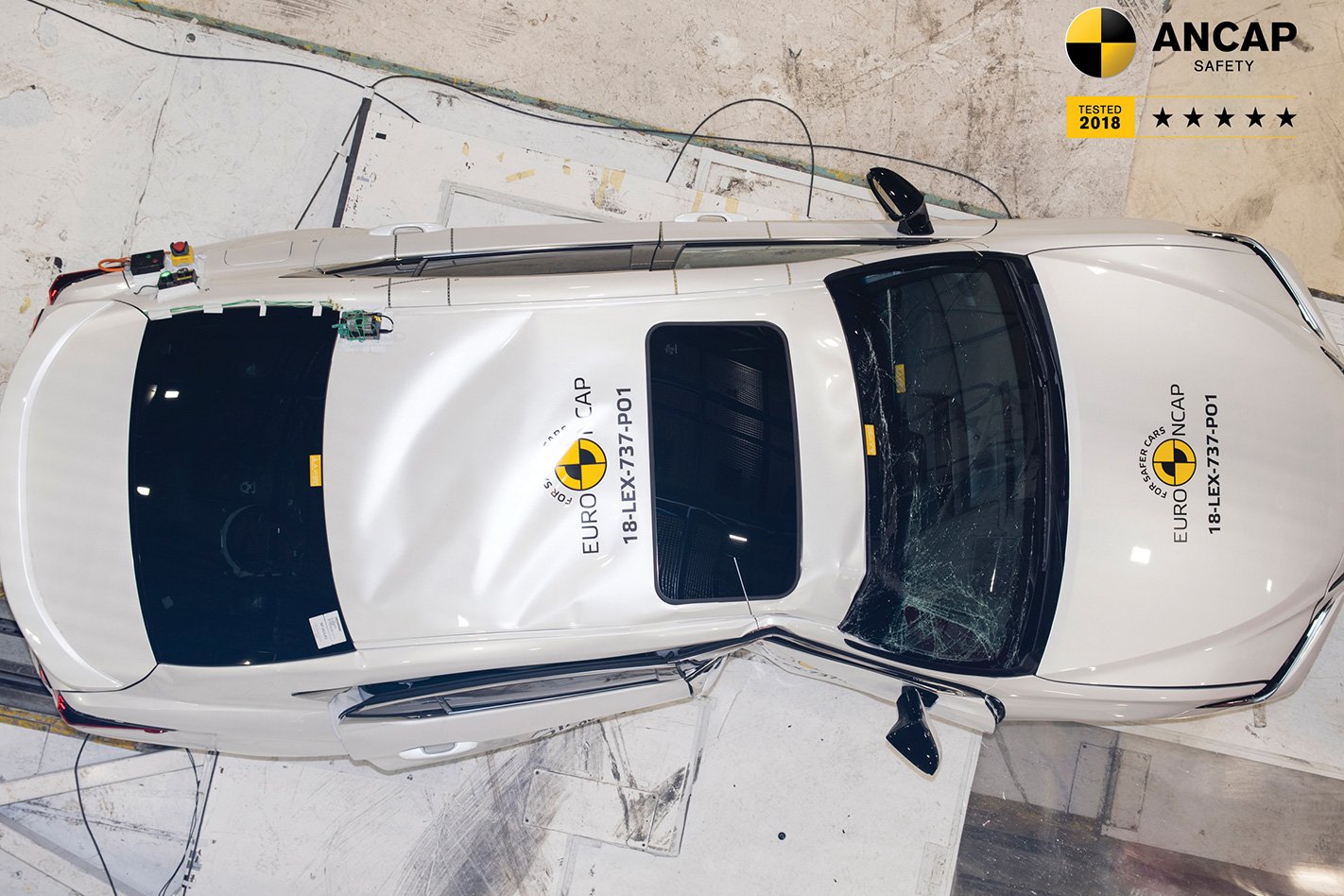
ANCAP’s recent inclusion of active safety features in its vehicle safety assessment meant the current generation Mazda 6’s five-star rating, awarded back in 2013 would probably not stand up to the current testing regime.
The 2018 version, which arrived in July with adaptive cruise control, high-speed autonomous emergency braking, forward and reverse city-speed auto-braking and lane-keep assist as standard, easily retained its five-star rating, despite some crash protection issues.
“The Mazda 6 performed well for its protection of adult and child occupants however some concerns were noted for smaller occupants seated in the rear, where the pelvis of the dummy slipped beneath the lap section of the seatbelt in the full width test – known as submarining – and a penalty was applied,” explained Goodwin.
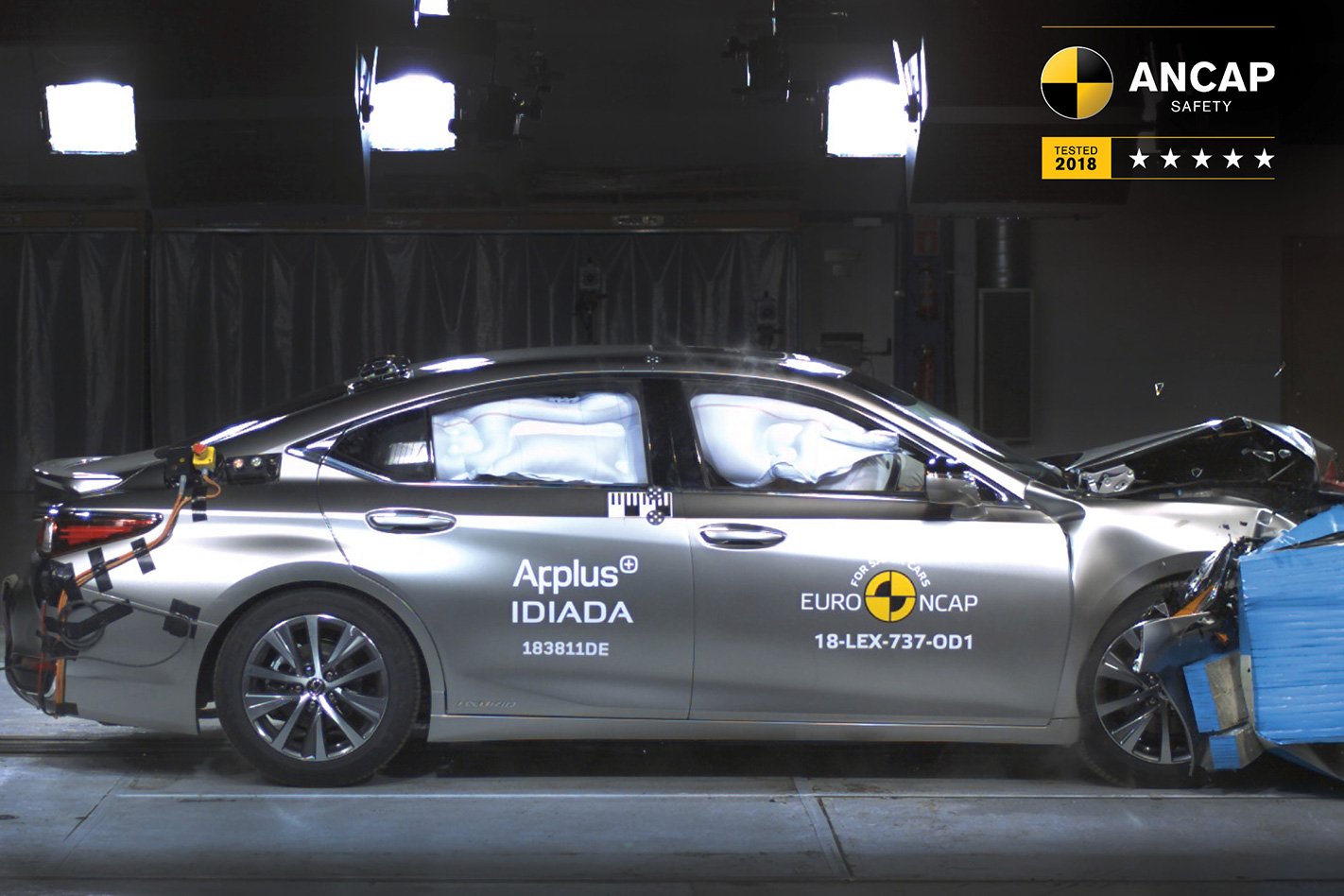
The Lexus also received a penalty for submarining of the rear occupant in the full width frontal test, but still achieved an 86 percent score for child occupant protection .
Meanwhile, ANCAP has also given front-wheel-drive versions of the Renault Koleos SUV five stars based on its 2017 EuroNCAP rating, under an alignment protocol between the two safety bodies.
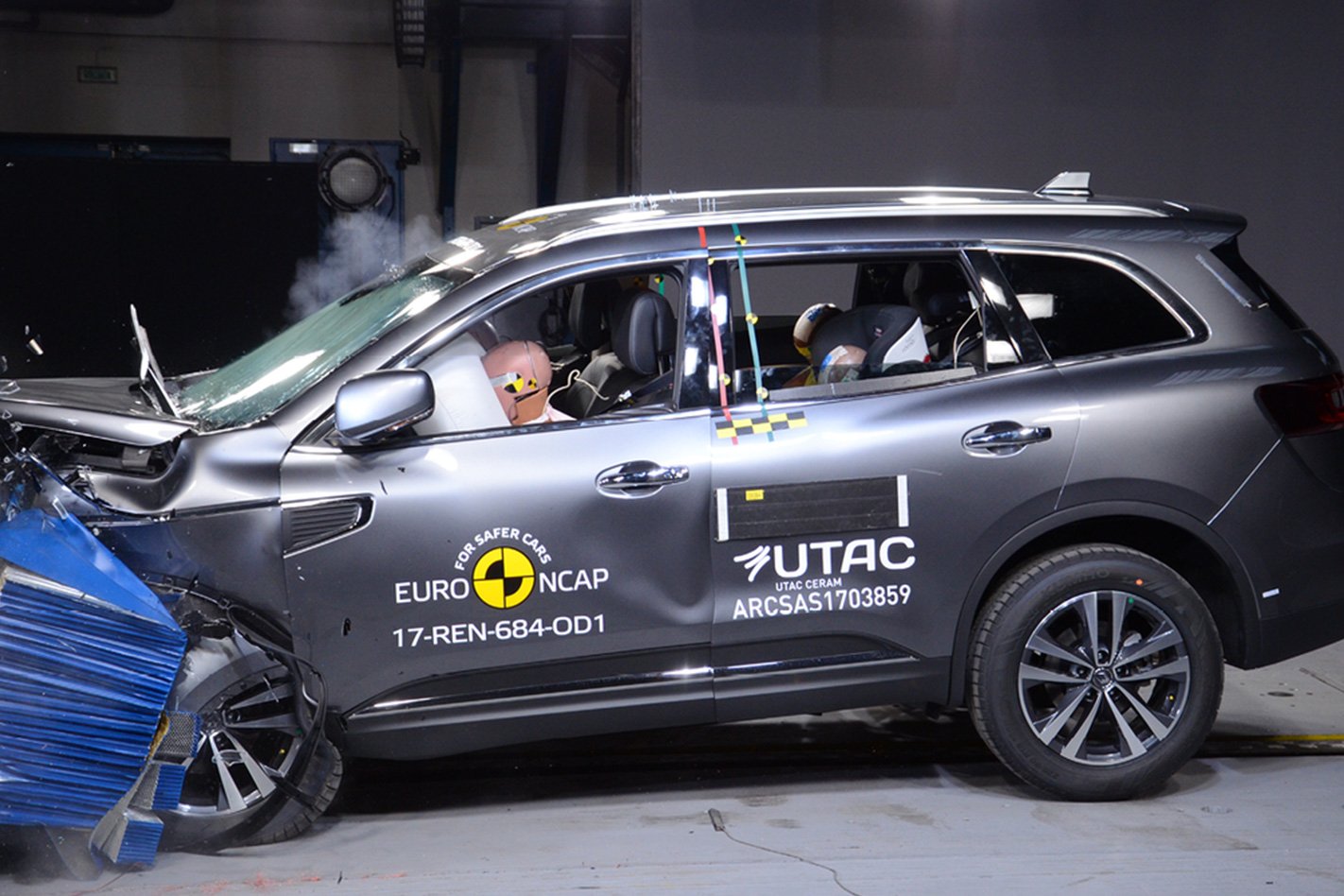
The all-wheel-drive versions of the Nissan X-Trail-based Koleos also scored five-stars in Europe, but that’s yet to convert to an ANCAP rating.
HOW THEY SCORED
Adult Occupant Protection
- Lexus ES300h – 91%
- Mazda 6 – 95%
- Mercedes-Benz A-Class – 96%
- Renault Koleos – 84%
- Lexus ES300h – 86%
- Mazda 6 – 91%
- Mercedes – Benz A-Class – 91%
- Renault Koleos – 79%
- Lexus ES300h – 90%
- Mazda 6 – 66%
- Mercedes-Benz A-Class – 92%
- Renault Koleos – 62%
- Lexus ES300h – 76%
- Mazda 6 – 73%
- Mercedes-Benz A-Class – 73%
- Renault Koleos – 52%
A 9.4-litre big block V8 built by Ford Performance is now available to buy in Australia as a crate engine through Melbourne-based Herrod Performance.
Rob Herrod, eponymous owner and man in charge of Herrod Performance, says the engines aren’t used in any Ford production vehicles anywhere, but rather are swapped into competition cars such as Cobra Jet drag cars.
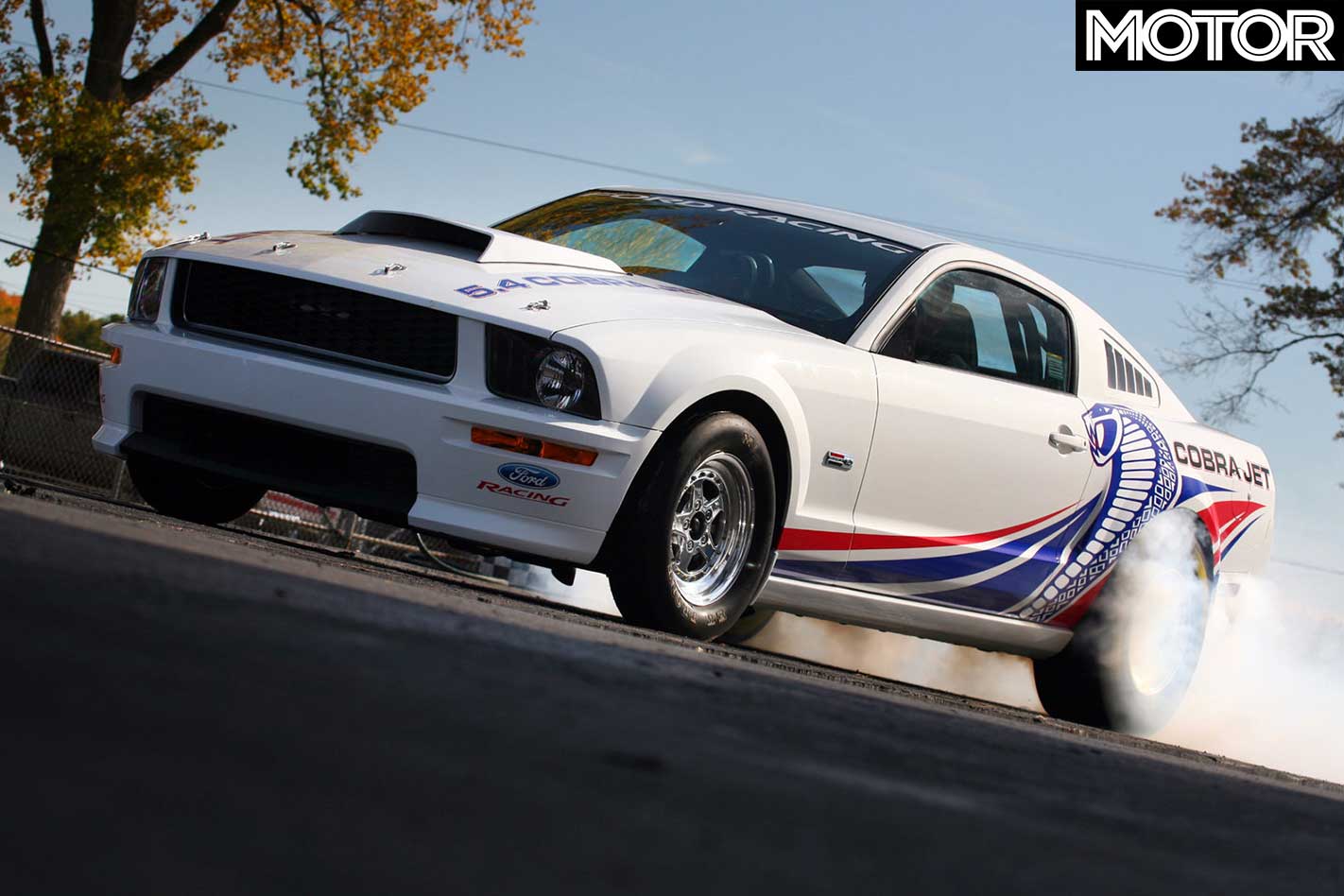
As it comes ‘in the box’, the 9.4-litre V8 produces around 488kW and 963Nm in atmo form, though it runs on premium unleaded rather than E85 or any race fuels.
The engine is listed at USD$17,795, but Herrod says the engine costs just shy of AUD$30,000 to buy here, ‘between $28K and $29K’. But, as Herrod puts it: “This is a lot of engine for the price.”
He adds that while there’s one ready to go right now, that he could have as many as 20 shipped over (as an example) meaning that supply is able to suit the likely low demand for an engine like this.
The Ford Performance website claims this engine is for “competition use only” meaning it’s unlikely you’ll be able to get away with dropping it into anything that runs on the street – not that it’s not worth trying if you’ve got the resources.
Herrod Performance offers a 24-month warranty with the big block, giving you a couple of years of worry-free racing if you do decide to go for it.
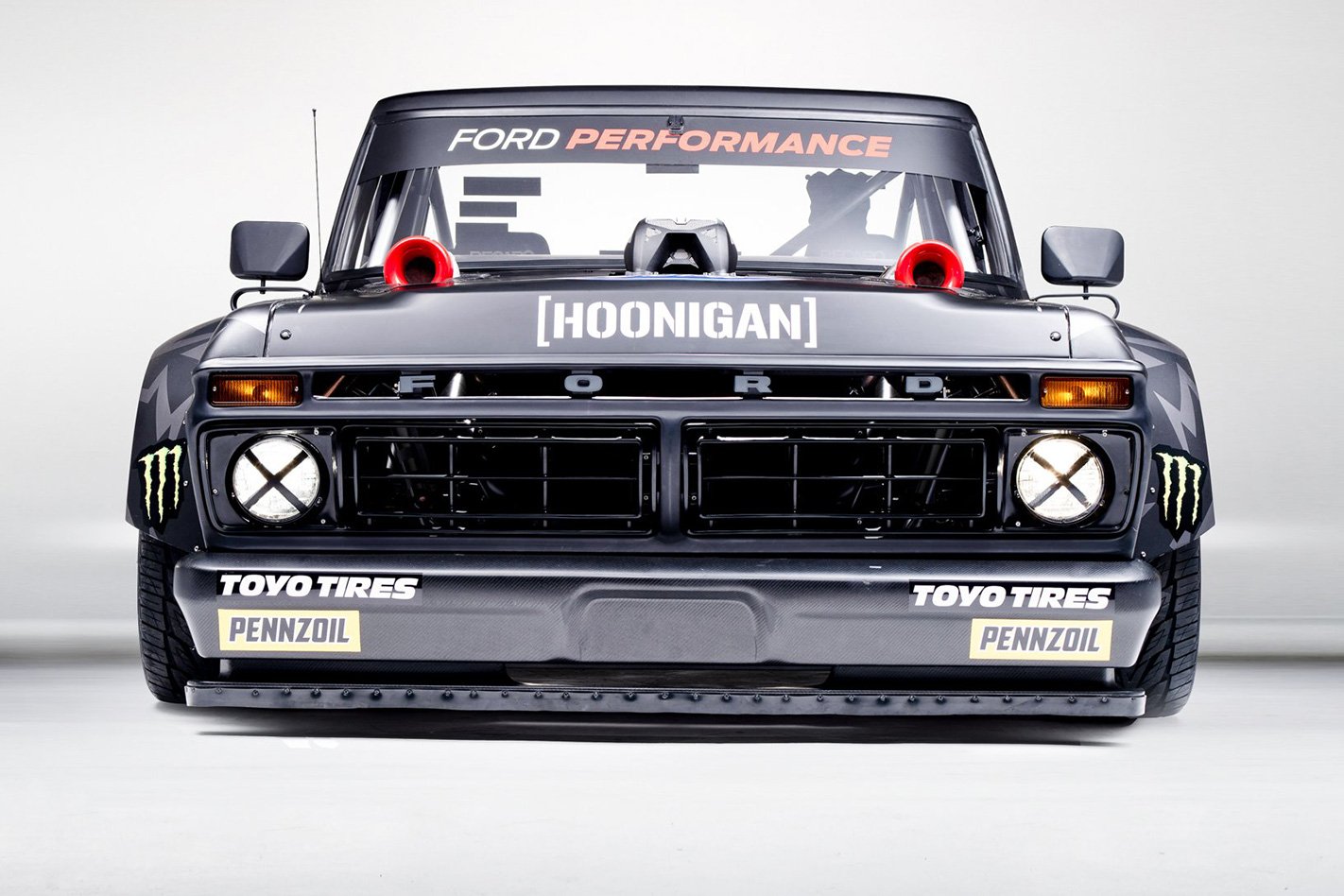
HOONIGAN, an American group most commonly known for their hatred of fresh rubber, have revealed the hero car of the 10th edition of the iconic Gymkhana series.
Ken Block, leader of the Hoonigans, created the mind-blowing custom 1977 Ford F-150 pick-up as a tribute to his late father who taught him to drive in one when he was 15 years old.
Block is also a huge fan of trucks in general and daily drives an F-150 Raptor – which was fitted with tank tracks instead of wheels at one point to deal with Colorado’s frigid winters.
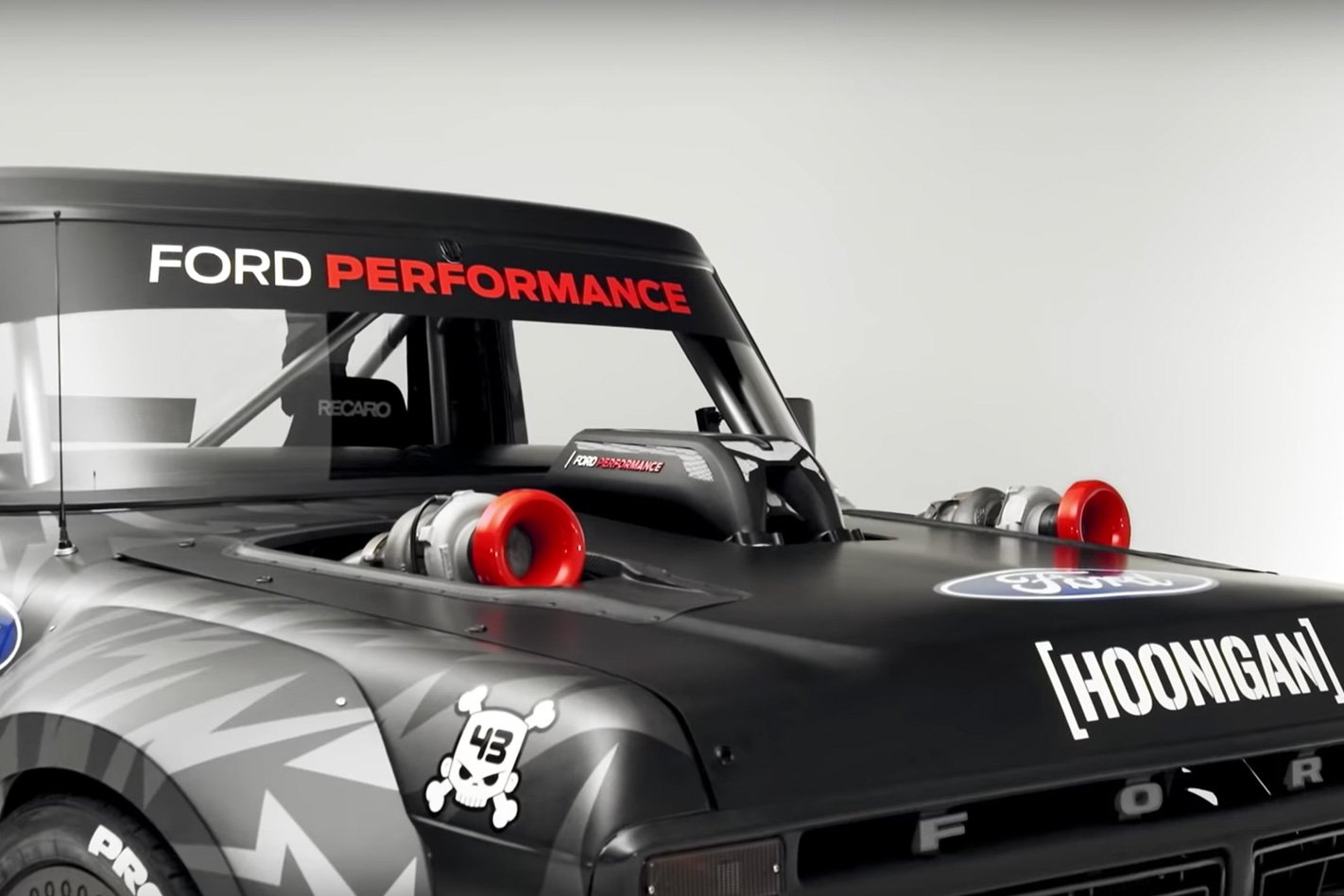
This latest creation couldn’t be called a Hoonitruck without the requisite excessive horsepower number, so powering the 1977 F-150 is the 3.5-litre twin-turbo EcoBoost V6 from Ford Performance’s GT Le Mans-winning race car.
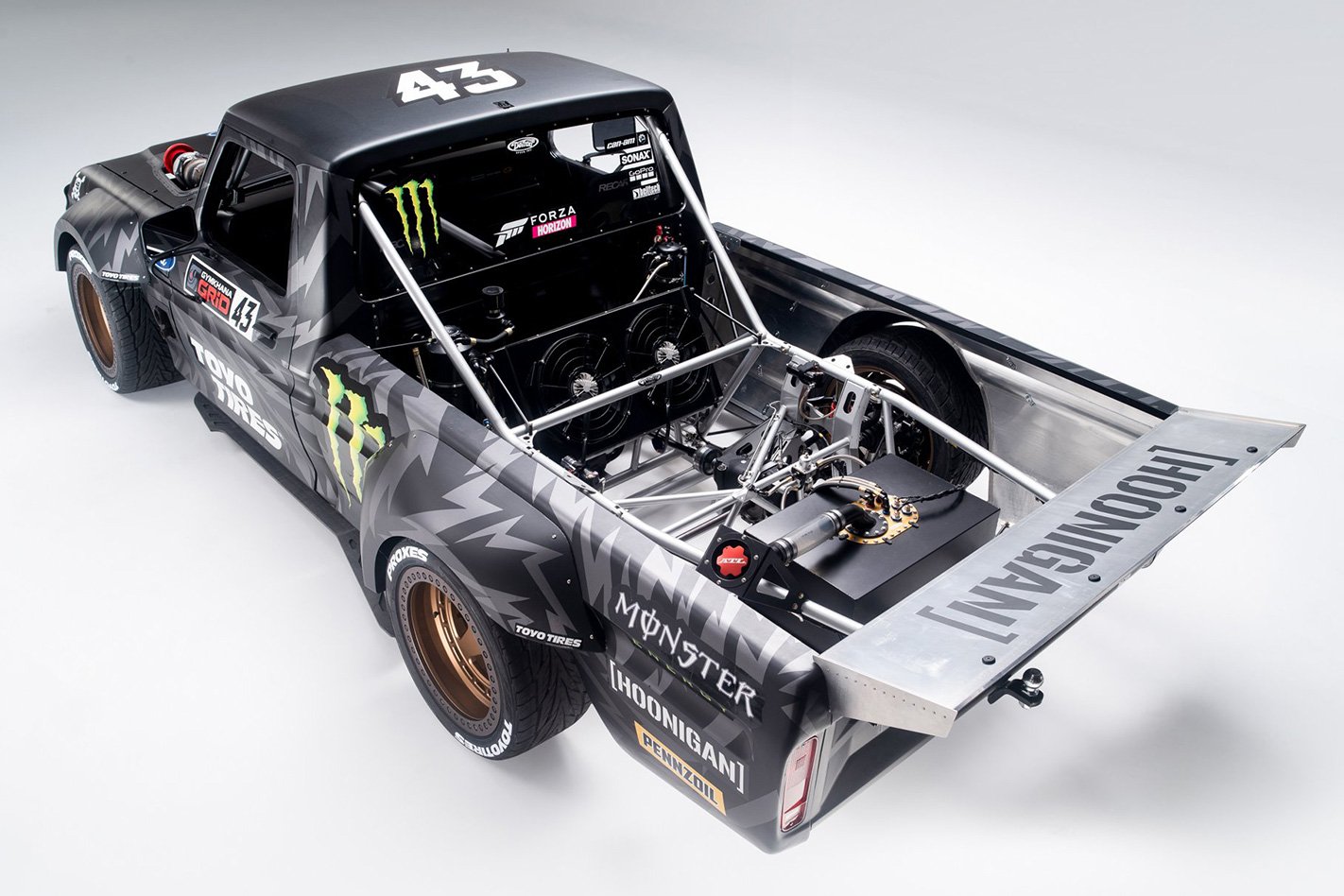
Of course, the performance figures are bonkers and equate to 681kW at 7400rpm and 951Nm at 6450rpm.
Power is sent to all four corners using a Sadev six-speed gearbox, similar to that in Block’s Hoonicorn Mustang.
Hoonigan suggests the billet-aluminium engine snarls like nothing we’ve heard before in a Gymkhana video. Also, in case you didn’t notice, two turbos are protruding from the bonnet.
Under Block’s exacting specifications, the Detroit Speed workshop in North Carolina completed work on the chassis and fabricated the hand-shaped military-grade aluminium bodywork.
“This project has been in the works for about two years,” said Block.
“I’m beyond pleased with how it turned out, it’s simply one of the most badass and unique vehicles I’ve seen in a long time and I think it compliments my Hoonicorn perfectly.
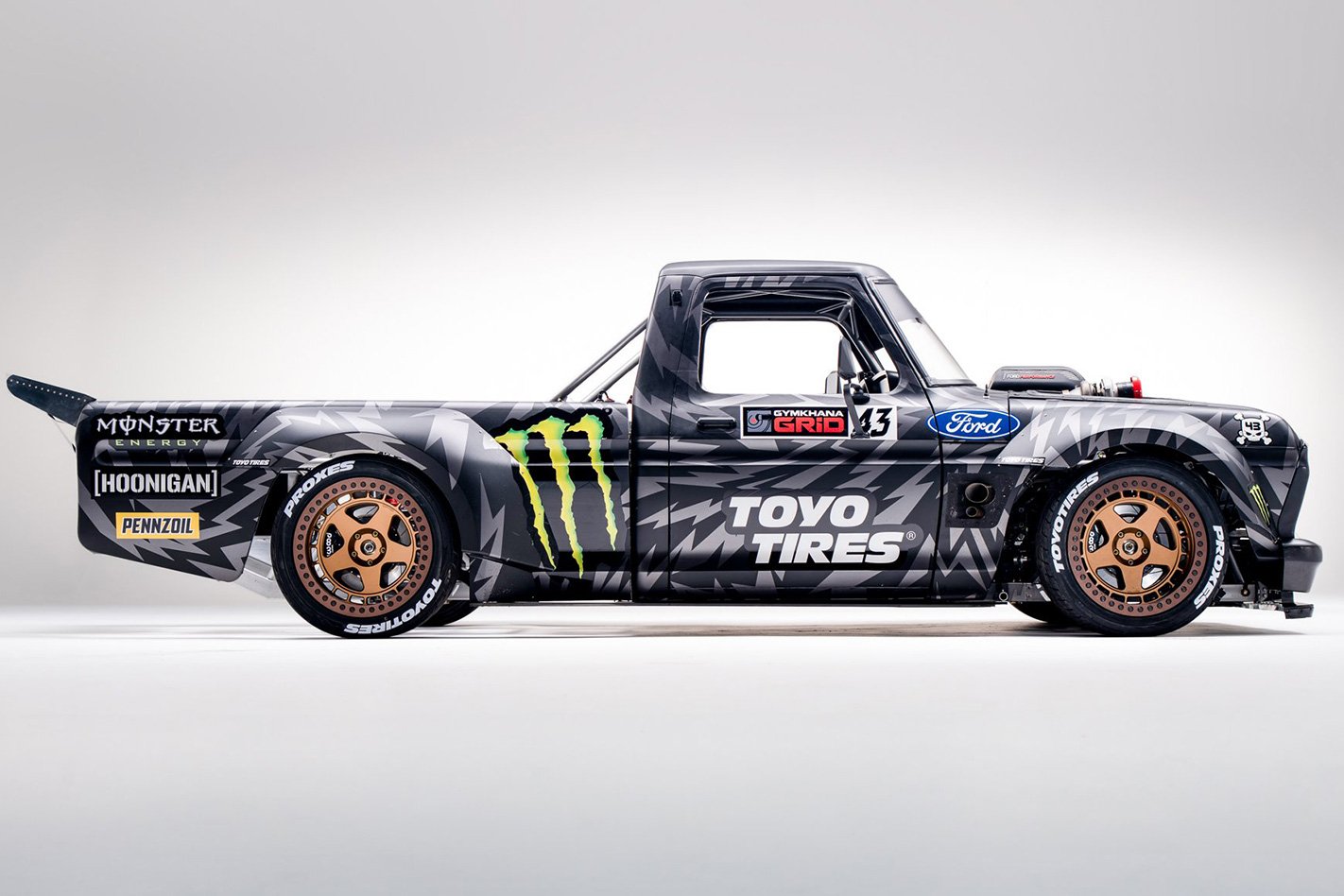
“It’s also crazy to be throwing something around that’s this size when doing Gymkhana-style driving. But, it looks absolutely wild on camera, and that was our goal from the start. I can’t wait for the fans to be able to see it in action, I think they’re gonna love it!”
The truck even incorporates current Ford tech like a Ford Pass remote start system, functional reverse camera and a tow hitch setup.
The car will be on show at SEMA in Las Vegas from October 30 – November 2, before debuting on-film in GYMKHANA TEN which releases on December 17th on YouTube.
Never meet your heroes, that old chestnut. It often rings true when it comes to cars, though.
I have friends and colleagues that have driven iconic supercars that steer like trucks and muscle cars that wouldn’t pull the skin off warm milk yet were still under-braked. Bad examples? Perhaps, but also a sign that the relentless onslaught of automotive progress takes no prisoners.
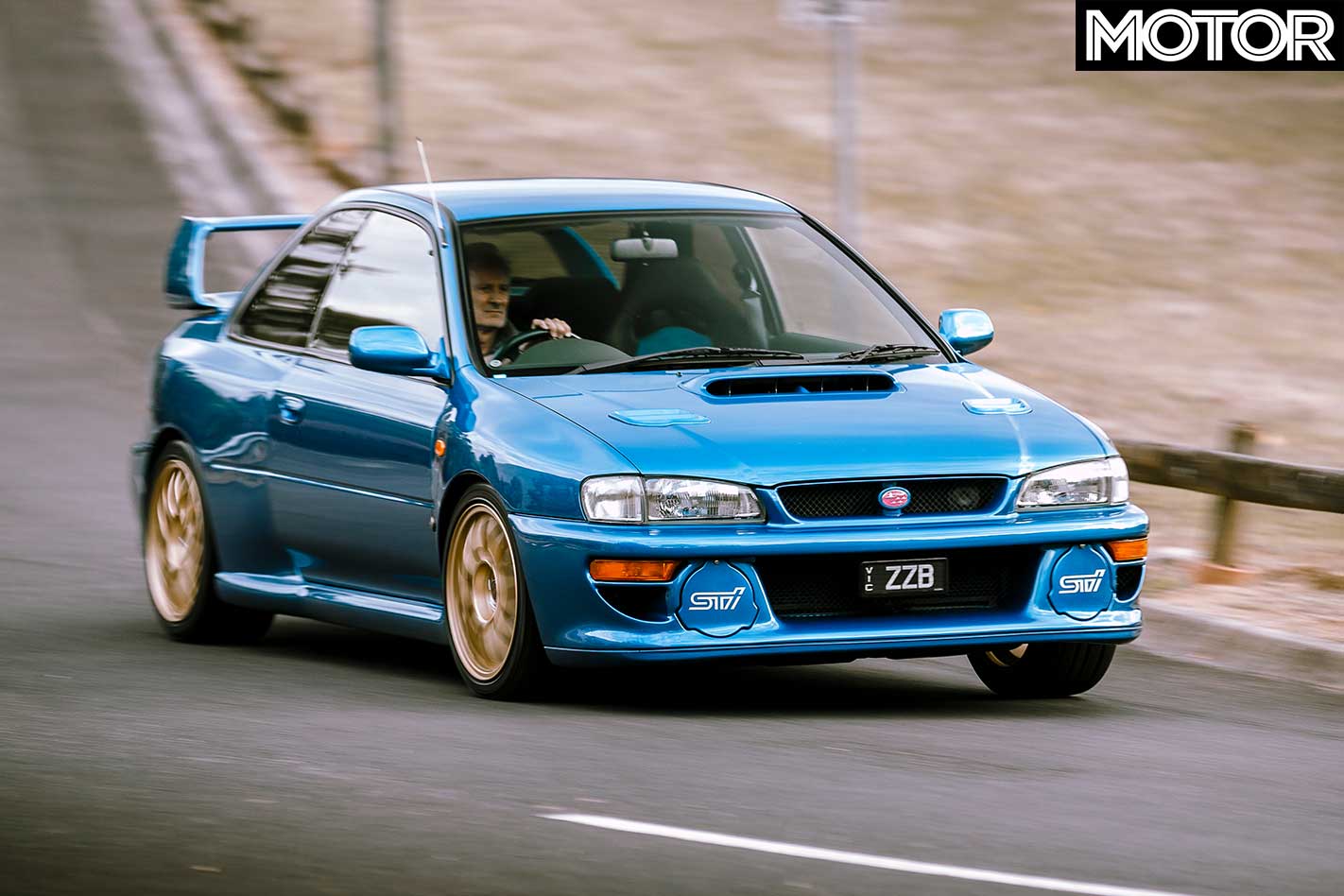
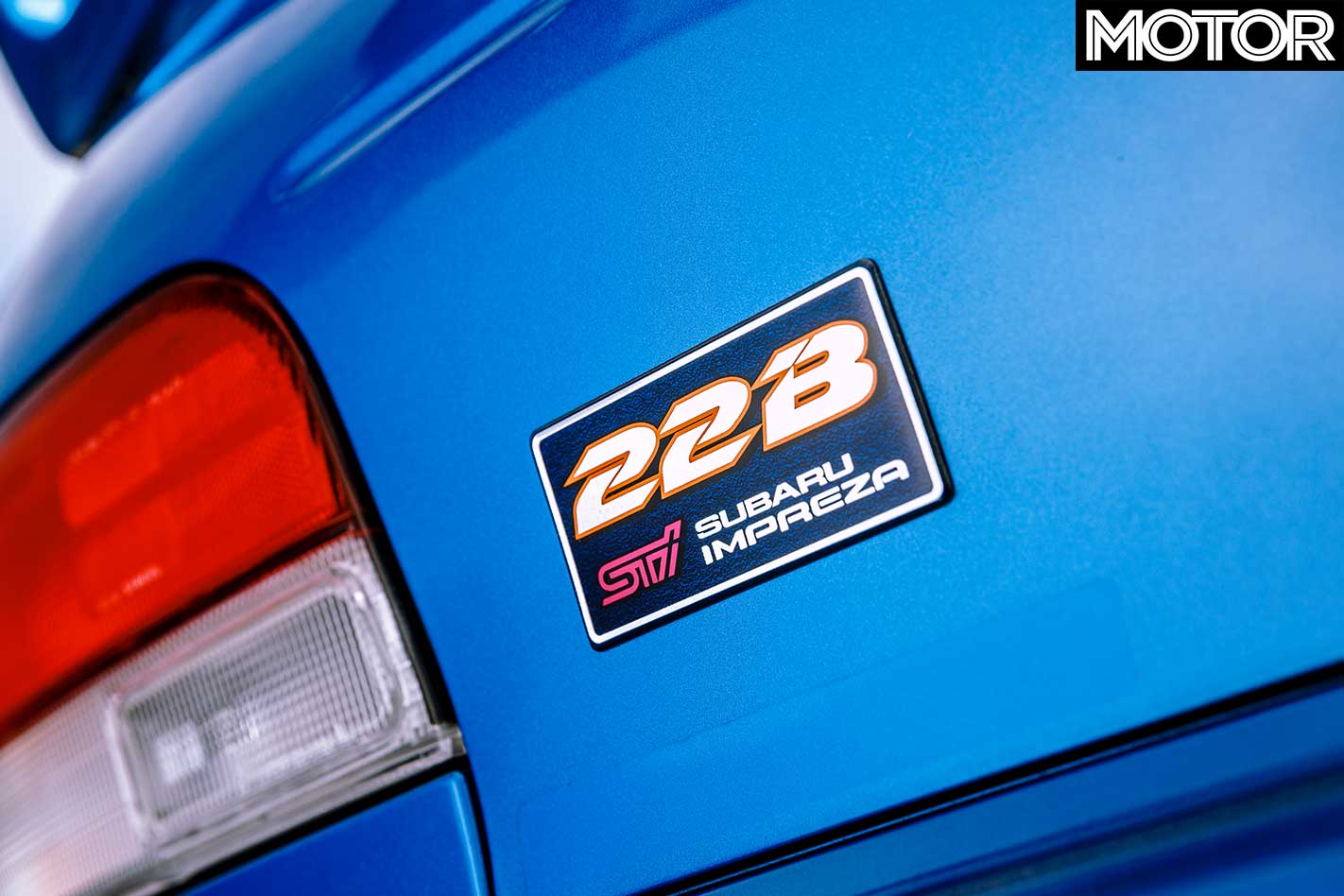
So it was with trepidation that I climbed into the driver’s seat of the Subaru WRX 22B STI used for the ‘30 Years of STI’ feature you’ll find in our November issue. I wasn’t writing the feature, I didn’t need to drive it, but Morley (who was and did) wasn’t having it: “when are you going to get another chance?” Fair enough.
A quick refresher. Contrary to popular belief – and plenty of poorly researched articles – the 22B was not a homologation car. The new World Rally Car rules, introduced in 1997, were intended to do away with such nonsense, requiring manufacturers merely to base their rally car on a model of which 25,000 had been produced, of which 2500 had to use the base engine.
From there, manufacturers could go wild, adding turbos, all-wheel drive, flared guards and wings. The only real restrictions were a 2.0-litre engine with a 34mm inlet restrictor, length greater than 4000mm, maximum body width of 1770mm and track widths of 1550mm.
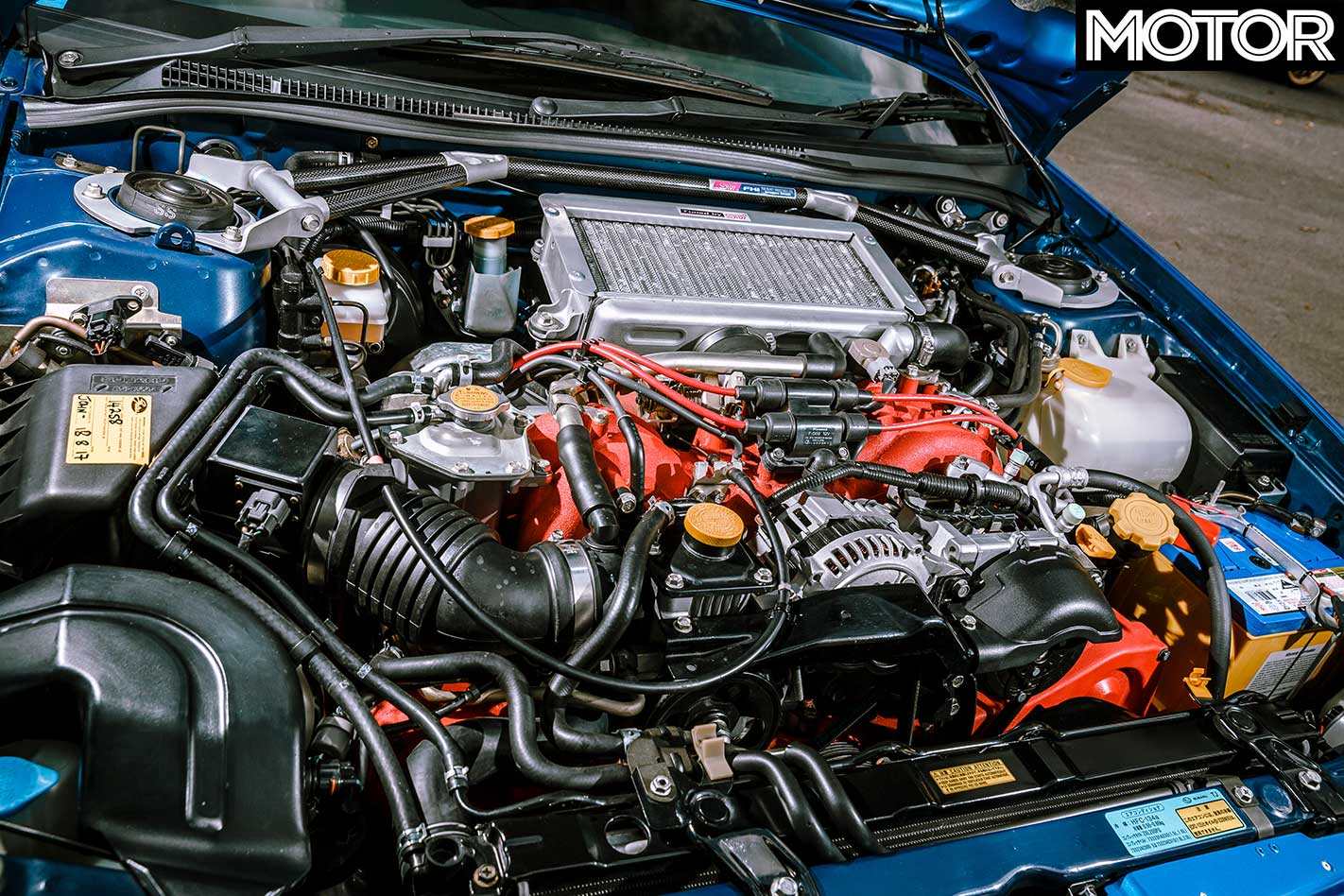
The fact the 22B has a stroked 2.2-litre turbocharged boxer engine should be the first clue as to its lack of homologation intent. It’s also arguably the highlight of the car. Remember how GC8-series STIs needed a fair slug of revs before they really got going? Not the 22B. Lag is minimal and the boost threshold is low, a fat mid-range making the most of the short gearing of the light weight (just 1270kg).
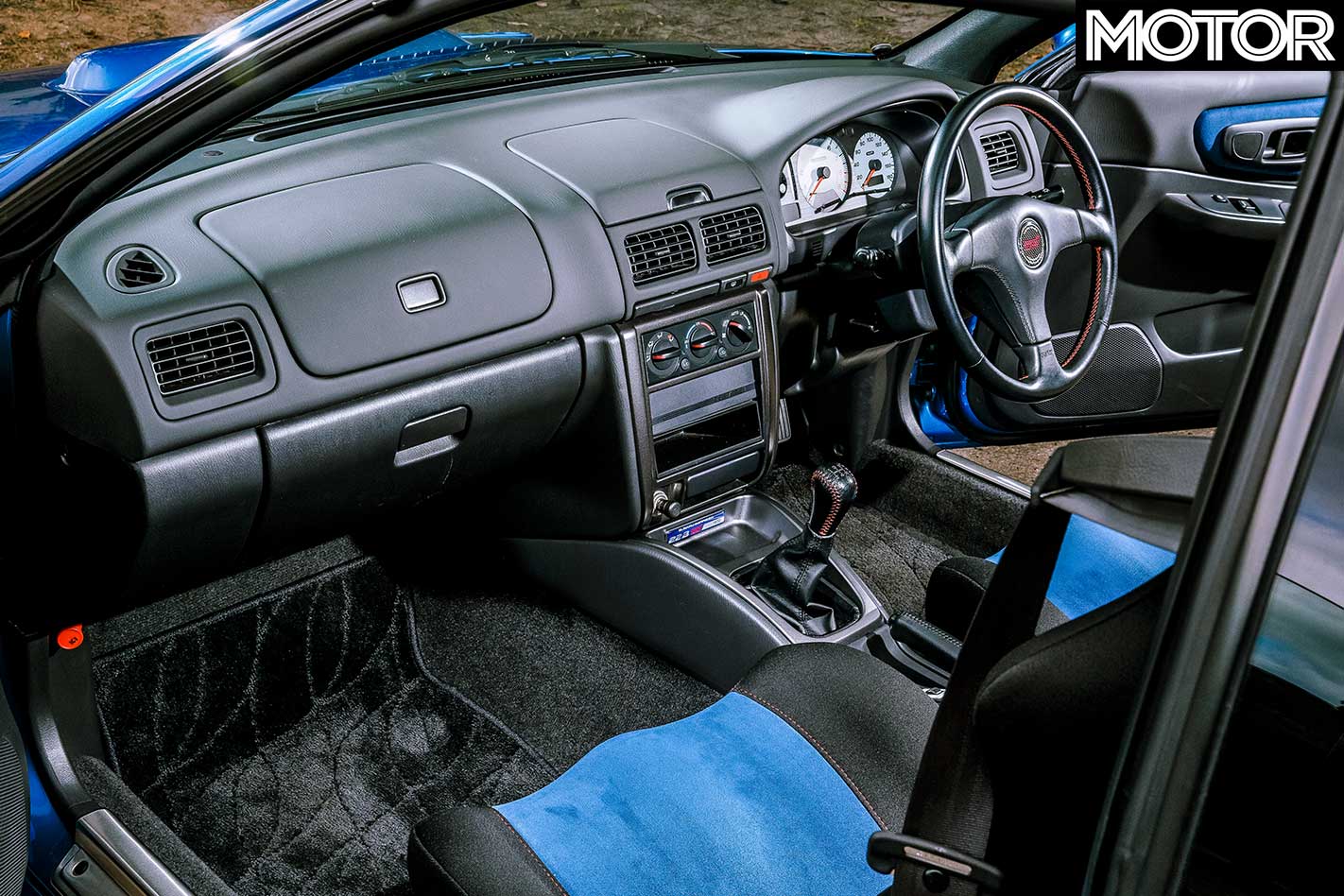
Its boxer burble is spot-on and the flexibility of the engine and sweet gearshift make it a doddle to drive. This car is immaculate, essentially museum-worthy, so no hard cornering is attempted, but there’s so much feedback through the beautiful Momo wheel, the slightest movement eliciting a reaction.
The 22B’s most surprising strength is its ride quality. It may have been firm by 1999 standards but it’s supple, breathing with the road with a fluency a lot of modern cars lack. In short, the 22B is as good to drive as it is to look at, those massively pumped guards, high-rise wing and blue-over-gold scheme turning those of a certain generation (i.e. me) weak at the knees.
Its status and rarity always made the 22B hugely appealing, but having now driven one it has to command a spot in my dream garage. To petrolheads who grew up watching the golden era of the WRC and playing Colin McRae Rally and Gran Turismo it’s the equivalent of a GT-HO Phase III or Torana A9X and I know if I had the means, I wouldn’t hesitate to spend silly amounts of money to secure one.
FAST FACTS Engine: 2212cc flat-4, DOHC, 16v, turbo Power: 206kW @ 6000rpm Torque: 363Nm @ 3200rpm Drive: all-wheel Weight: 1270kg Price: $132,000 (new)
These are pictures Toyota doesn’t want you to see. At least not yet.
The eagerly anticipated new Supra has been the subject of the world’s longest information drip-feed, which will culminate in the reveal of the final production car at the 2019 Detroit Auto Show in January.
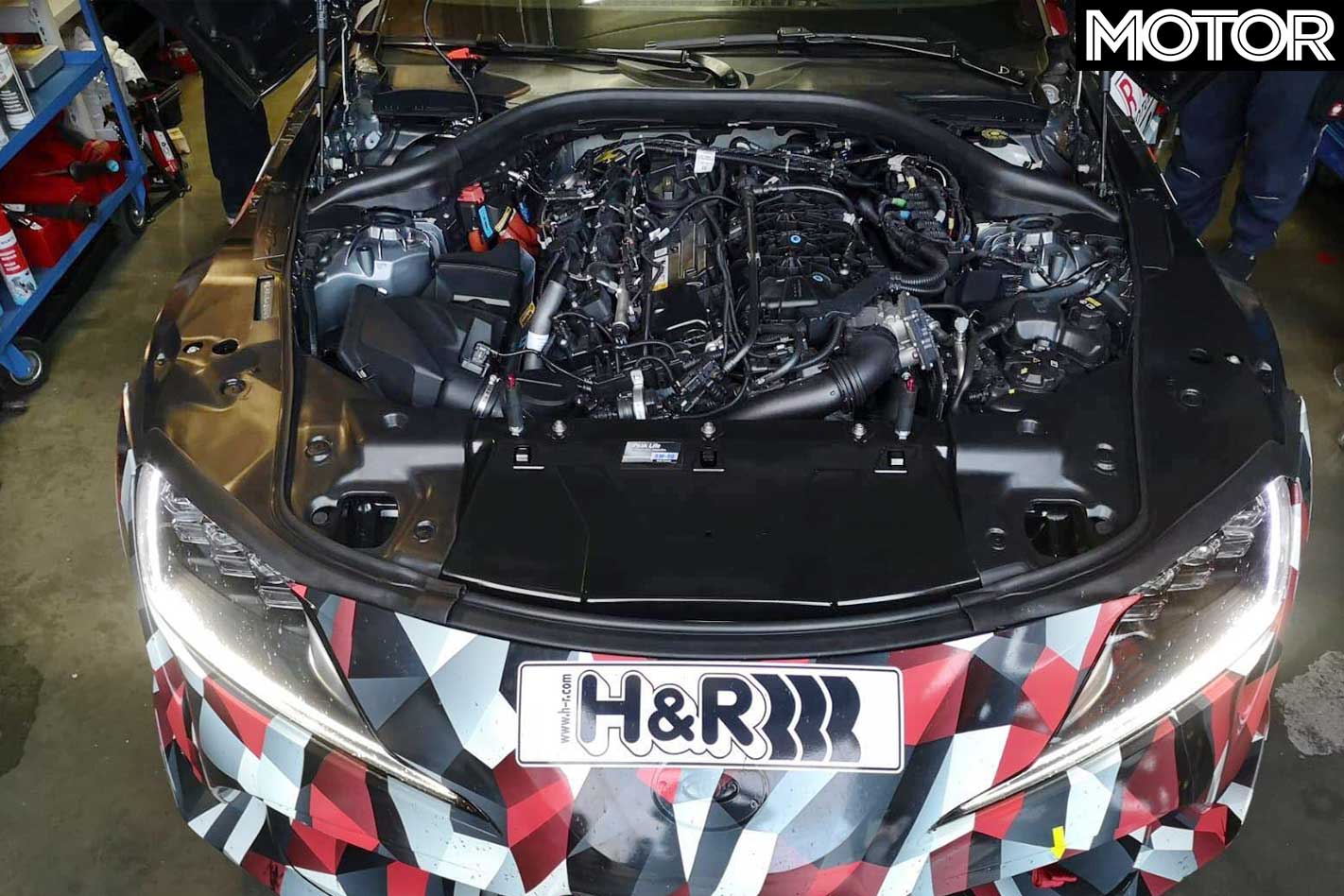
Prototype first drives have taken place with promising results, but Toyota was careful to keep some secrets to itself, covering the vast majority of the interior, disguising the exterior in camouflage and keeping the bonnet firmly shut.
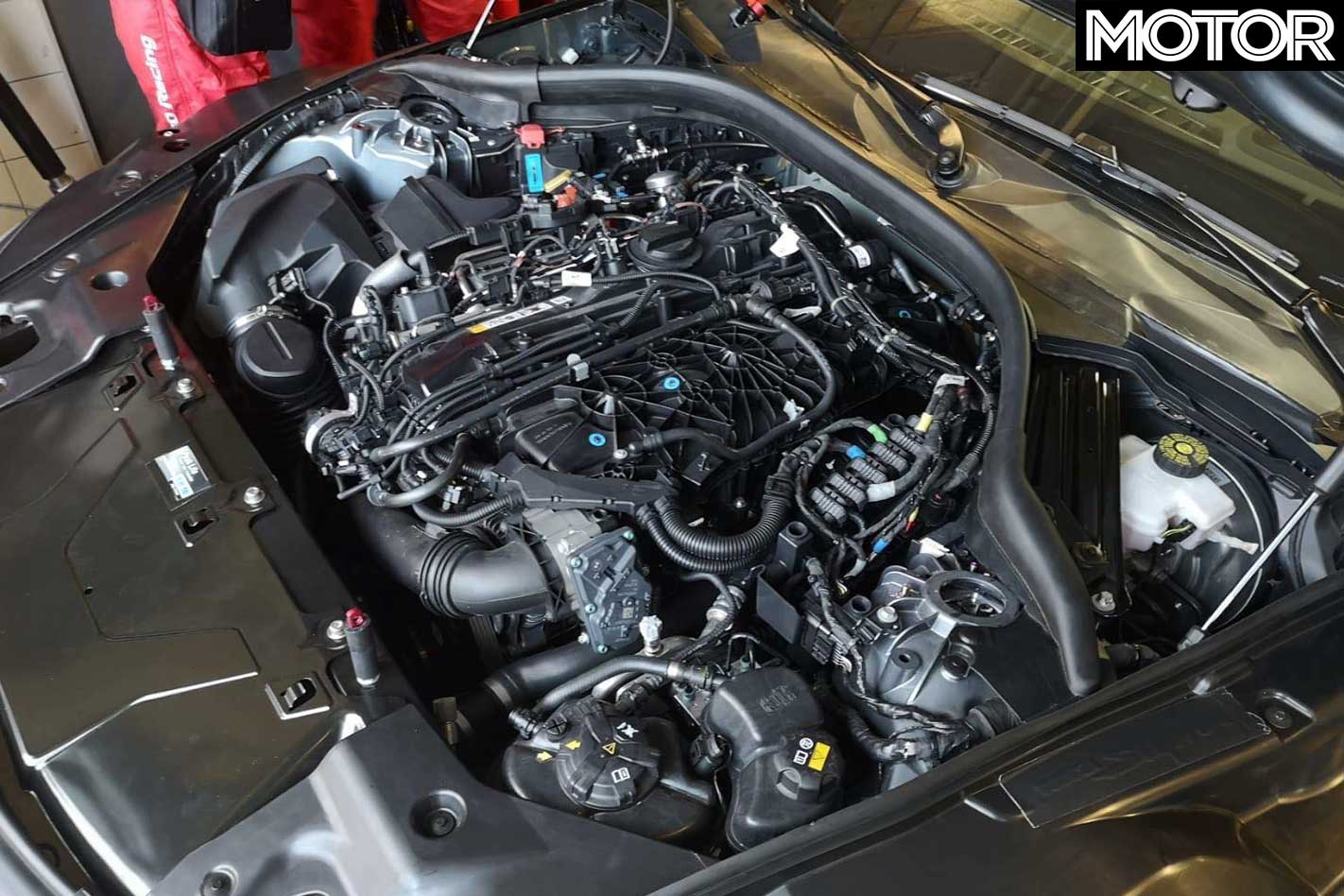
Thankfully, a MOTOR source is here to help, providing images of the Supra with the bonnet up from a test session at the Nürburgring. A handful of images of the new A90’s engine exist online, but all have the giant plastic engine cover in place, whereas the shots you see here are the engine in its naked glory.
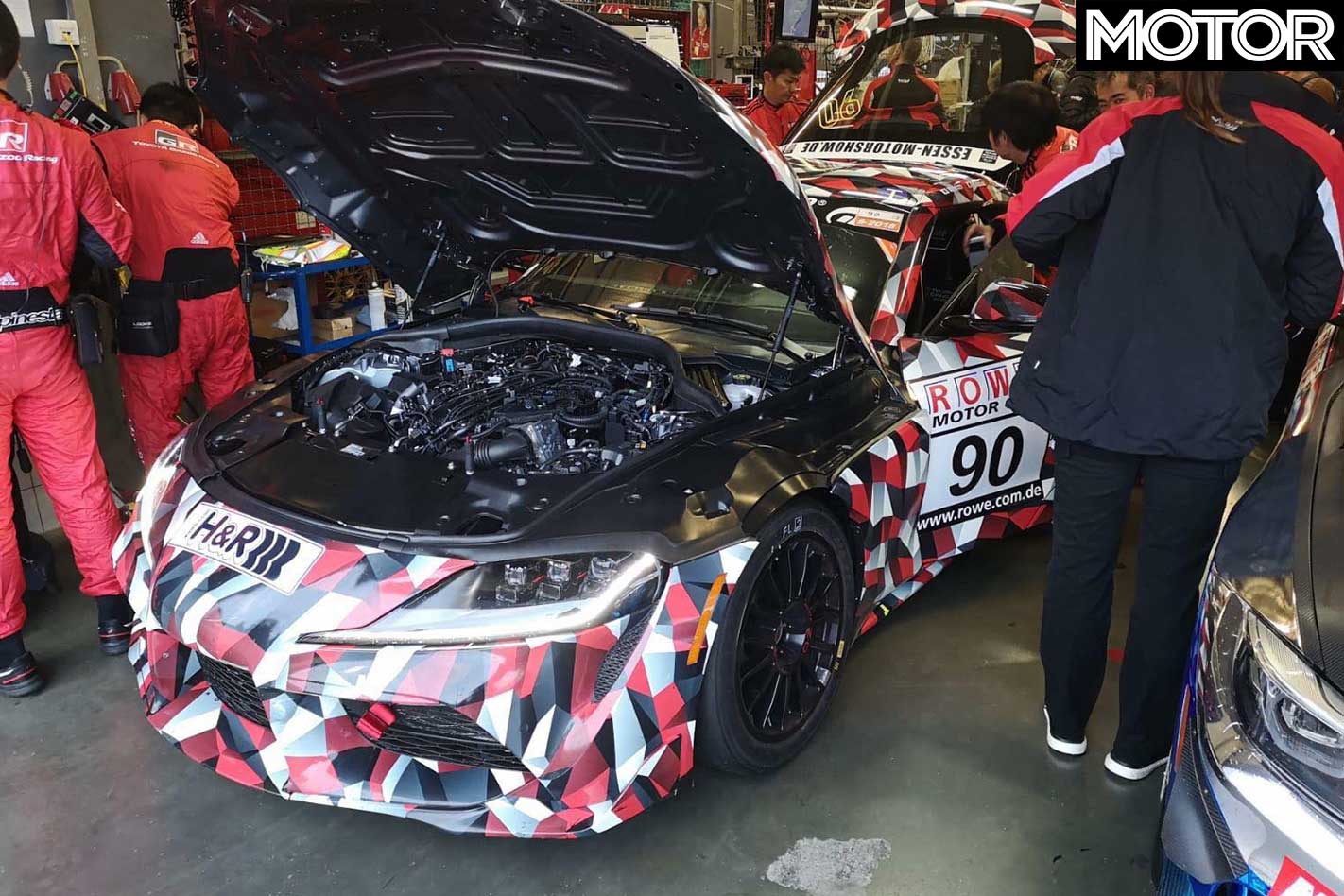
The engine itself is no secret, the B58 3.0-litre turbocharged straight-six found in all manner of BMW products including the Supra’s droptop Bavarian sibling, the new Z4 M40i. In that application the B58 produces 250kW from 5000-6500rpm and 500Nm from 1600-4500rpm, though the US-spec Z4 M40i swells power to 285kW.
Toyota is expected to keep the outputs similar to that of the international Z4, attached to an eight-speed ZF automatic, the only gearbox to be initially offered. A 0-100km/h claim of around 4.5sec is expected. A six-speed manual is theoretically possible, but not currently a priority.
While the A90 is unlikely to sound as spine-tingling as its 2JZ-equipped A80 predecessor, Aussie Supras will use a louder exhaust than their European counterparts to deliver a soundtrack to match its 86-on-steroids performance and dynamics.
Now all that’s left is to see the finished product in Detroit on January 14.
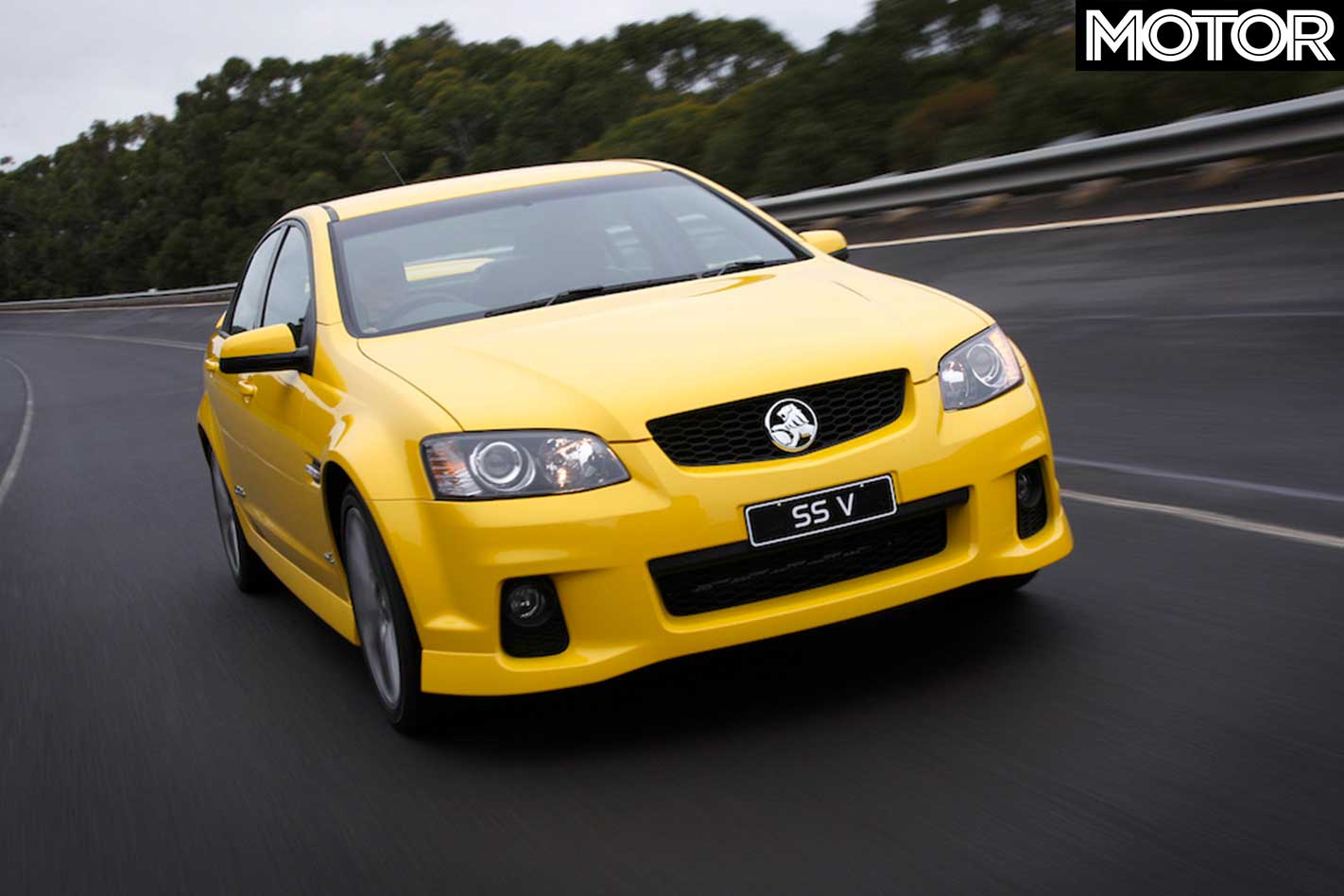
This week marks a year since Australia lost our automotive industry as well as a V8-fuelled icon in the Holden Commodore SS. Sure, there were HSVs to mourn from the Red Lion stable, but nothing encapsulated everyman attainability like that big-cube model grade.
The only upside is that, without a budget-priced new-generation 5.0-plus-litre four-door sedan in sight, the trends we’ve seen with Commodore SS should only further accelerate. Here we’ve mapped out both an appreciation bell-curve, and where we sit on it right now.
But first, to the past.
Using stock, unmolested examples with around 100-150,000km as a control marker, a 1992 VP-gen Commodore SS manual, with 163,000km and in a condition described as immaculate, is currently on the market for $25,000. A 1994 VR-gen, auto with just 97,000km, is asking $33,000 – while a 1996 VS-gen auto with 152,000km wants $20,000.
There’s enough evidence there to suggest if you’re driving among the last of the Australian-built 5.0-litre V8 models, enjoying those 1990s outputs of 165kW/385Nm to 168kW/395Nm – and if that sounds low, then check the 1400kg-to-1600kg kerb weights – then hang onto them. Certainly they show in which way the newer VT- and VE-era models are heading.
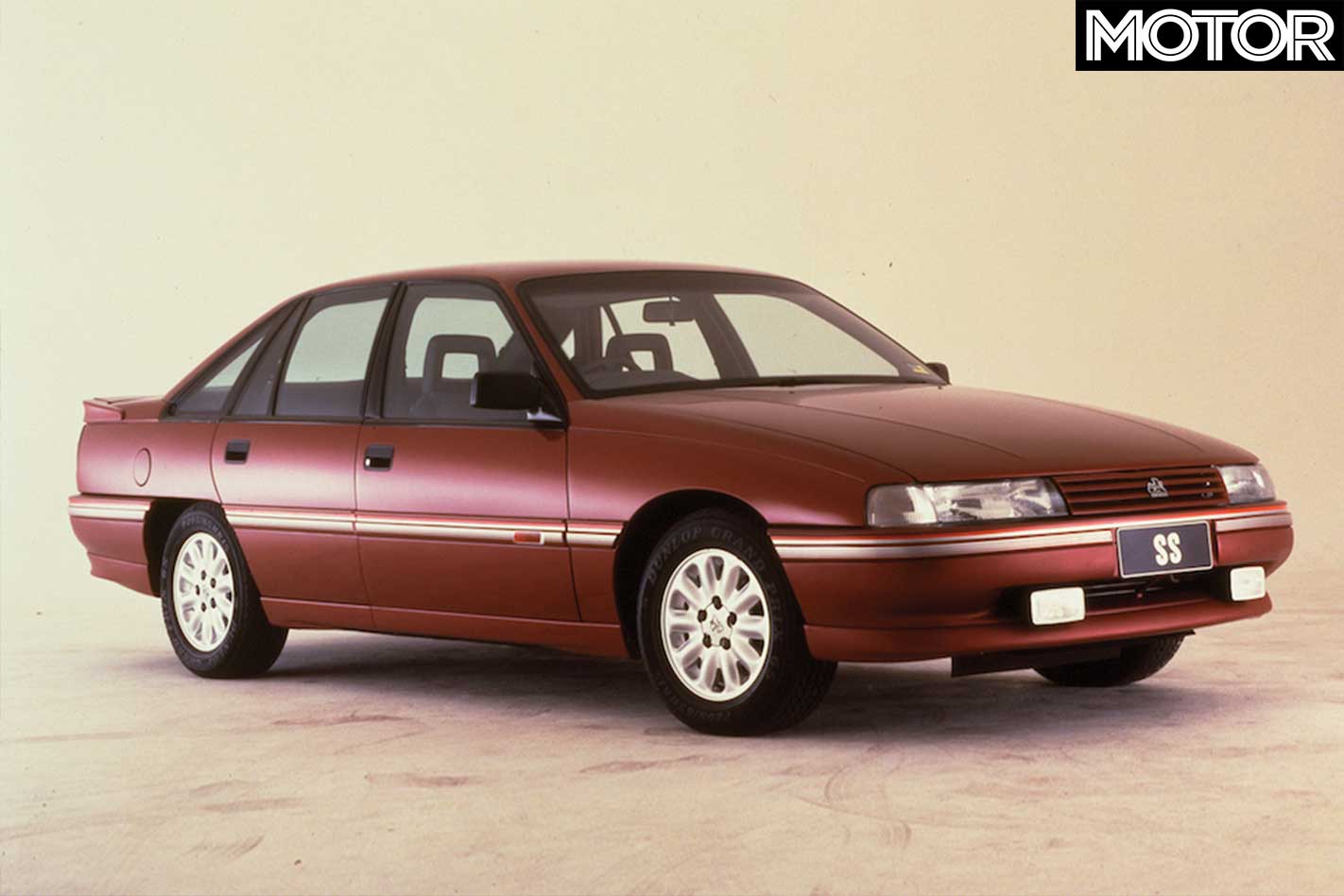
Fast forward about five years, and a 2001 VX-gen Commodore SS manual is asking $11,900 – with 102,000km showing and also in good condition. There are two other manuals asking $10,000 and $12,500 each with just under 150,000km on the clock, of course all without the Aussie unit but rather smoother, still-sweet 225kW/460Nm 5.7-litre Gen III all-alloy V8.
There’s also a 2002 VY-gen Commodore SS manual with 150,000km for $10,500 if you prefer the more angular styling and revised cabin design of the VT’s first mid-life facelift. Just be aware that all have fairly rubbish steering and a chassis that was certainly getting tired.
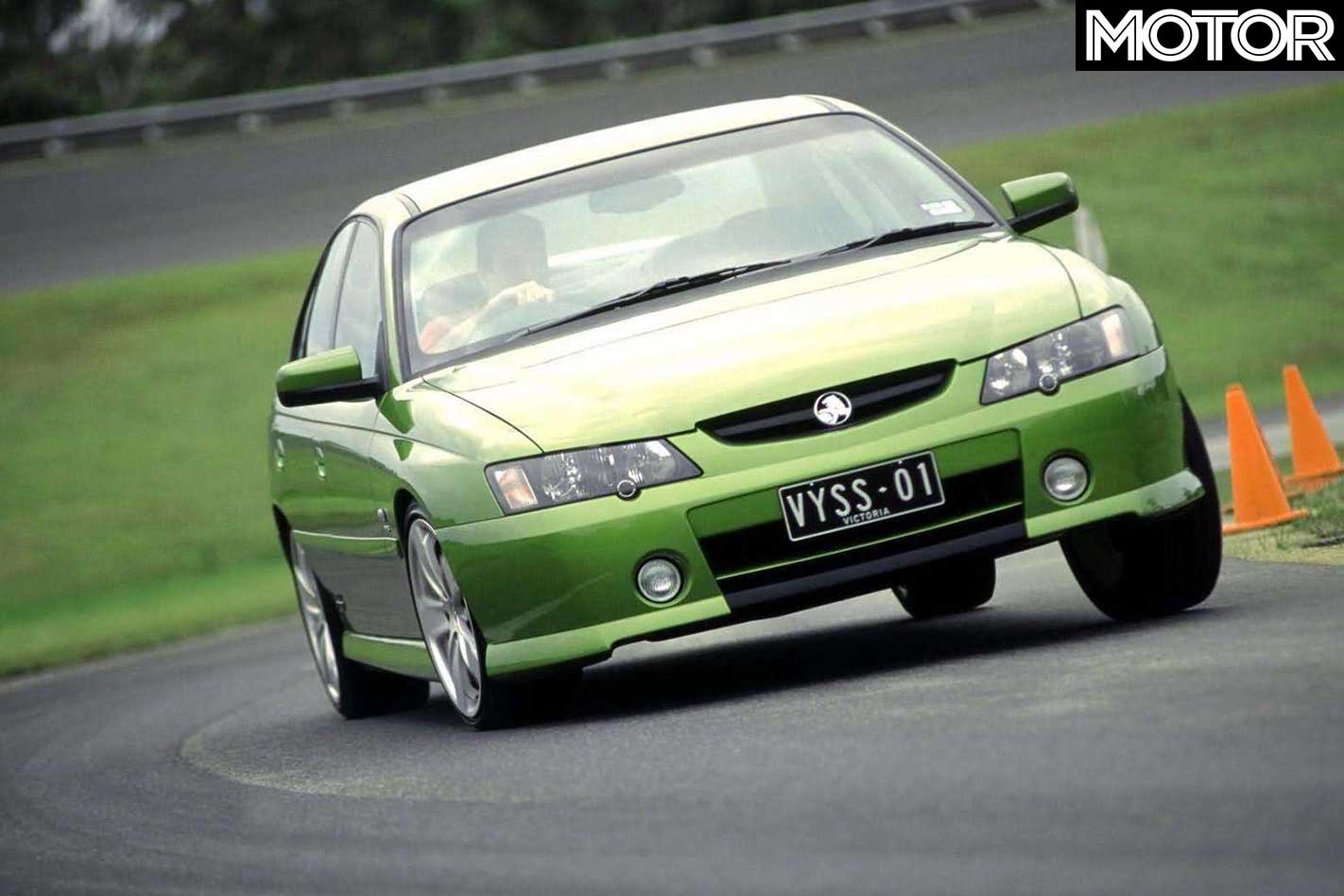
For not a lot more, you could jump another five years ahead to the 2006 VE-gen Commodore SS, where manuals with fewer than 100,000km showing are selling for between $15,000 and $20,000.
At least with Holden’s Billion Dollar Baby you’ll be getting an entirely new chassis, with more sophisticated suspension plus a stronger and tighter body, to replace the nostalgia glasses that should come with buying any of the VT-to-VZ gen.
Either way, the appreciation curve is clear – the VN-to-VS gen are taking off, the VT-to-VZ gen is bottoming out, and the VE gen is still hovering high and in plentiful supply.
Let’s be honest, the best way to save money on fuel is to not drive anywhere. The second-best way is to drive less. But our lives are busier than ever, and not all of us have money sitting there for a new car.
So, what can every Australian driver do to reduce their fuel use and save money?
Here are our Top 7 tips for saving money on petrol. These tips that will see you using less fuel in your daily driver without requiring any extra expense. Individually they may only save a little bit each day, but combined over a period of time, you’ll have more money to spend on other things – maybe enough to buy a new TV or go on a holiday!
1. Inflate your tyres
You may not know what rolling resistance is, but we can tell you it’s the enemy of fuel economy. Underinflated tyres have a bigger contact patch with the road, and that means more friction for your engine to overcome.
Air is free, so check your car’s recommended inflation pressures and ensure all of your tyres have the right amount of air in them. You may want to consider overinflating by a couple of psi to further reduce rolling resistance, but don’t go overboard – pumping in too much air also reduces the size of your tyre’s contact patch and therefore how much grip your car has on the road.
2. Declutter
Is your boot or rear seat a de facto storage closet? Carting around an unloved gym bag, or the kids’ sports kits, or any stuff that you don’t actually need when you’re out and about? Every kilogram your car carries means your engine works a little bit harder to move you, and that means more fuel. Shed some kilos from your cargo, and you’ll trim your fuel bill as well.
3. Chill out
Some of us are too aggressive behind the wheel for our own good, but besides being a generally unsafe way to drive it’s also a habit that dramatically increases your car’s thirst. Being aggressive on the accelerator and the brakes is guaranteed to send your fuel consumption through the roof. Be calmer behind the wheel and use the accelerator gently. A pro tip is to look further up the road to anticipate when you may need to brake, and get off the gas earlier and let the car coast. That will not only save you money on fuel it’ll make your brakes last longer, too.
4. Maintenance
Cars are complex machines with thousands of moving parts. Keeping them all in good mechanical health is critical to minimising its fuel consumption. For example, old oil won’t lubricate the engine as efficiently, and poorly serviced brakes can drag when your wheels are turning, thus putting more load on your engine. Maintenance is often an unwelcome expense, but it’s one that shouldn’t be ignored. It will save you money in the long run.
5. Avoid traffic
If you’re able to adjust the timing of your commute to avoid heavy traffic, you’ll not only stop and start less, you’ll spend less time idling in long queues. Some navigation systems in cars, and both Google Maps and Apple Maps, provide congestion advice, and can also suggest a more fuel efficient route to where you’re going. It’s advice worth heeding because it could save you money as well as time.
6. Coasting
Did you know many newer cars actually consume no fuel if the road is steep enough for speed to be maintained without pressing the accelerator? Some drivers may swear that putting the transmission in neutral on downhill slopes is more efficient, but most of the time it’s better to simply let the car’s kinetic energy keep the engine turning rather than have it idle – and thus still burn fuel – in neutral.
This technique is such a good way of saving fuel that many car companies now build ‘coasting’ modes into their car’s engine and transmission program so you don’t need to do anything to take advantage of the savings.
7. Don’t left-foot brake
Left-foot braking is a race technique that is sometimes adopted by regular drivers who swear it improves their emergency reaction time. This technique can also increase your fuel consumption because left-foot brakers tend to lightly rest their ‘braking foot’ on the pedal. Obviously, having your brakes drag when you don’t need them does bad things for your car’s fuel use, and the benefits in an emergency braking situation are negligible.
And as a special bonus for making it to the end of this article, here’s three more money-saving tips:
- Grab those fuel-saving shopper dockets. It may only be 4 cents per litre off the standard price, but if you’re diligent, it could put another $100 a year in your pocket.
- Walk, or ride a bicycle. Do you really need to drive to the shops three streets over, or around the corner to pick up the kids? Get out and enjoy the sunshine and leave the car at home.
- Carpool. According to Census data 77 percent of car commuters drive alone. How boring! Carpool with a neighbour and you’ll not only have somebody to talk to, you’ll be effectively cutting your fuel bill in half!
WHEN a new generation of Porsche 911 lands on the scene, car enthusiasts the world over sit up and take notice. Pretty soon the current 991-generation of 911 will have run its course, and the 992 will touch down in its place. If you’re not excited yet, maybe we can help.
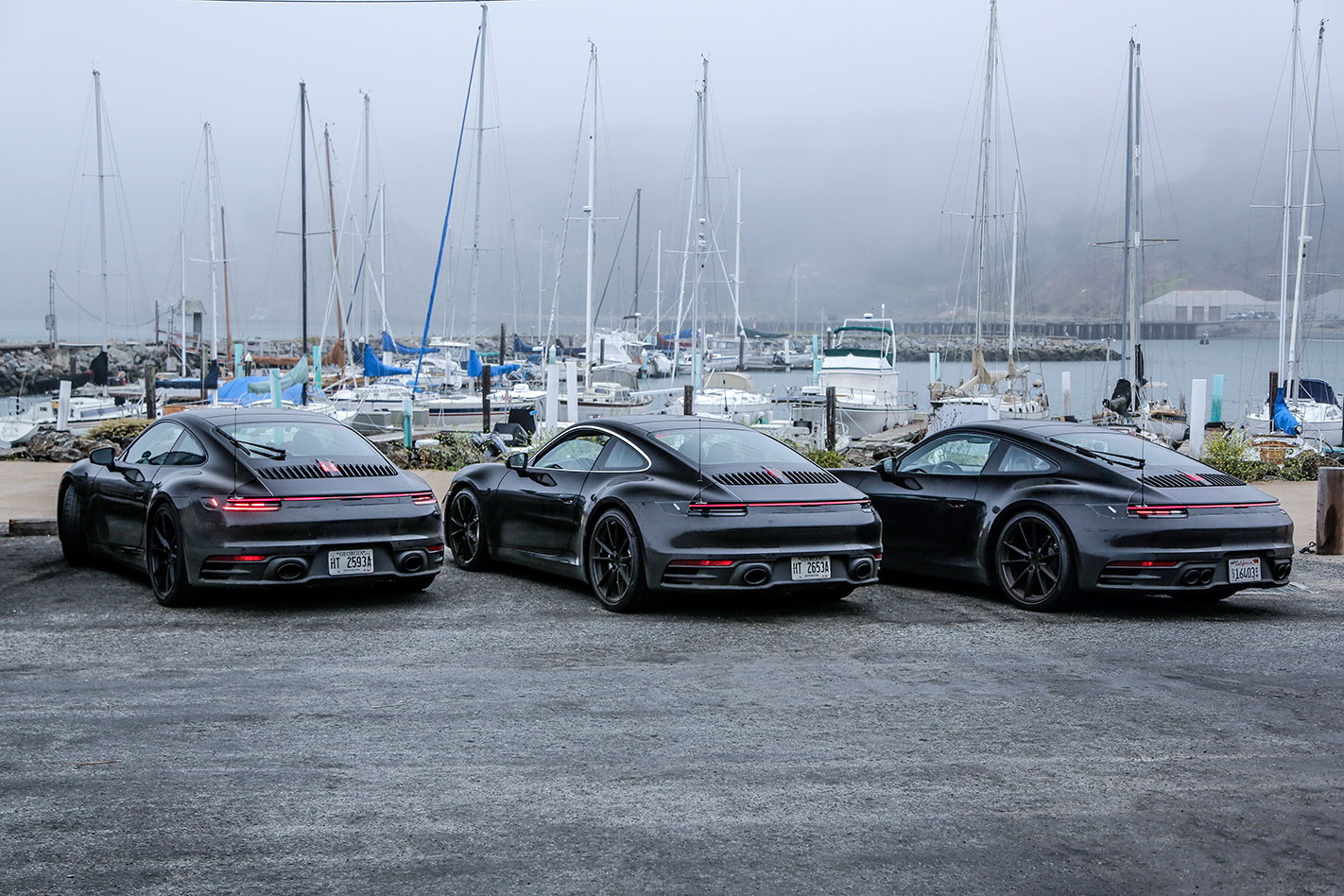
For decades the 911 has been a sports car benchmark, and the 992’s rapidly approaching arrival seems a pertinent time to look at everything we know about the new model.
You can read Kyle Fortune’s impressions from when his ride in a 992 development mule earlier this month here, but if you are short on time, here are the cliff notes:
Wide-bodies all ‘round
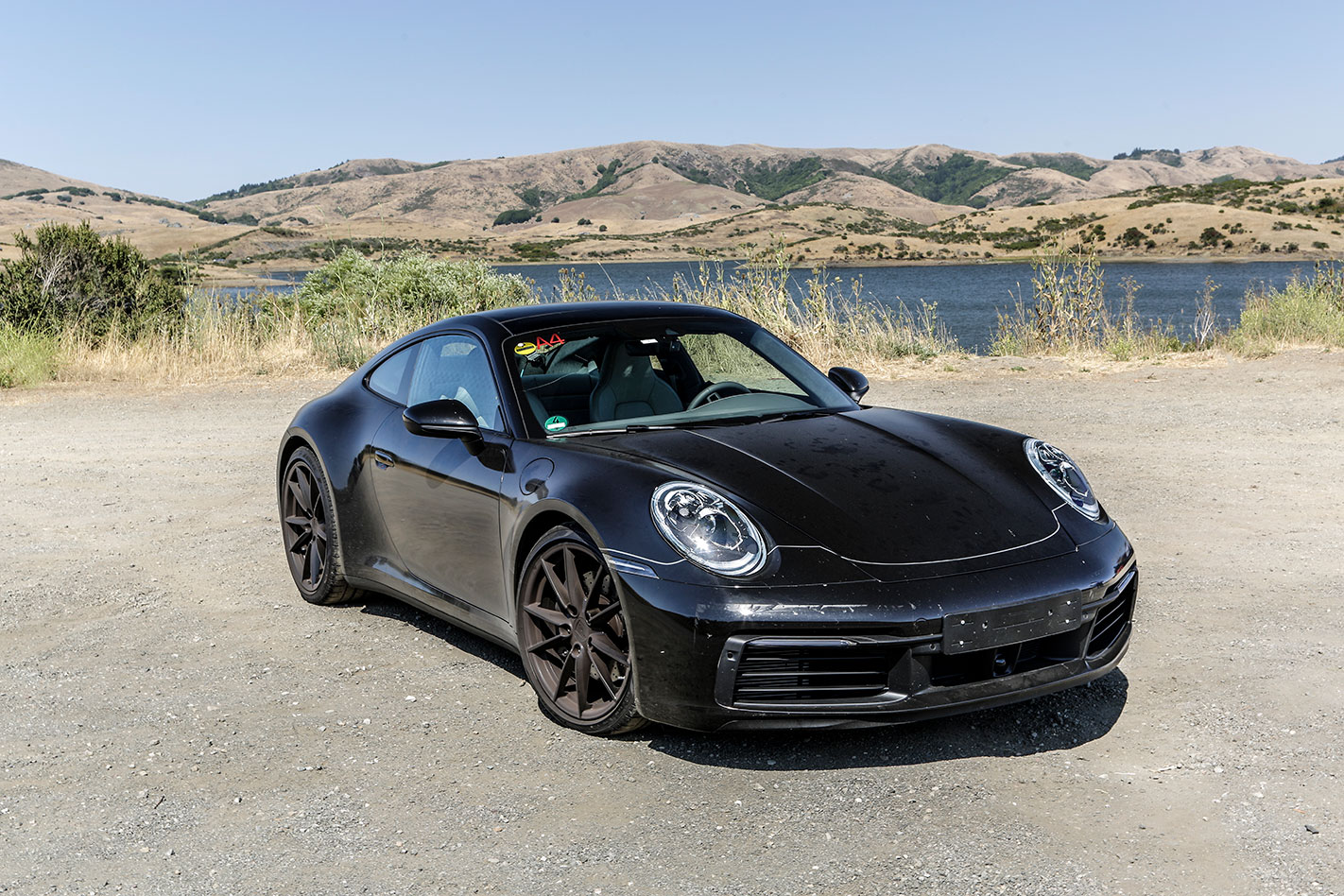
The ‘standard’ 911 body style will now be the wider version, formerly reserved for Targa and higher-end variants. Porsche has confirmed that even base-model 992 911s will share the same dimensions as the outgoing wide-body GTS.
“There won’t be a narrow-bodied 911,” said August Achleitner, vice president of the 911 and 718 product lines.
That means the front track of the 992 Carrera grows by 40mm, the restyled front-end has an overhang 20mm longer, and the car’s height rises by 5mm.
Two chassis tunes will be available, with the optional Sport Chassis riding 10mm lower than standard, with a “slightly more prominent front spoiler”.

The tyres are staggering
Even at the bottom of the 911 line-up, the 992 Carrera will share a trait with the outgoing track-focused GT3. That is, it will roll on wheels with staggered diameters; the front rims on the 992 Carrera S measure 20-inches, while the rears are 21s.
The staggered fitment, combined with the wider front track, has allowed the engineers to soften the rear anti-roll bar for improved traction on corner exit.
A variant for everyone
Set to debut at the LA Motor Show next month, the 992 911 line-up will initially consist of rear-wheel-drive Carrera S, and four-wheel-drive 4S models.
The duo will initially be available with only PDK automatic transmissions, but don’t fret as manuals will be coming (more on that later).
A base Carrera variant will arrive in 2019, along with the three-pedal ‘box, and cabriolet versions.
Changes to the oily bits are subtle but important
On the spec sheet not much has changed in the generational leap for the 911’s engine, with Porsche retaining the 3.0-litre turbocharged flat-six package.
However, as Achleitner explained, there have been discreet, yet significant upgrades.
“We have a connection between the cylinder heads on both sides, and link directly to the longitudinal beams of the body. It makes the whole system stiffer, feels more rigid,” he said.
The PDK gearbox has also been revised, now with eight gears instead of seven. The new transmission is derived from the unit used in Porsche’s four-door Panamera.

It’ll shock purists
If you are a hard-line Porsche purist, now is the time to cover your eyes and keep scrolling, because Porsche has allowed electrification to play a significant part in the 992’s design.
Along with adding an extra ratio, the new PDK gearbox has brought with it future-proofing for a potential hybrid drive.
Extra room has been made in the gearbox housing to ensure electrification of the 911 is possible.
Achleitner told us the entire car’s layout and structure is designed for the inevitable onslaught of hybrid systems to make its way underneath the Porsche’s skin, with space in the body ready to accommodate batteries.
No need to set fire to your torch and grab a picket just yet though, with Achleiter adding “we do not do it [electrification] right now, because we are not yet satisfied with the performance, especially of the batteries.”
How long that stay of execution will last remains uncertain.

Weight saving has been a focus
Keeping the new 911’s weight in check has been a challenge for Porsche’s engineers, with a new aluminium-heavy diet devised.
More of the 992’s body is formed from the lightweight metal, with the entire side panel from the A-pillar to rear wing constructed from aluminium.
This helps save 10-15kg from the rear of the car, but tightening emission regulations negates some of that hard work.
European 992s will require exhaust particulate filters, which add around 7.5kg of weight. It remains unclear whether or not Australian delivered cars will be lumped with the heavier system, but with less strict emissions regulations locally, it’s unlikely.
Yeah, it’ll be fast. Duh.
It wouldn’t be a new generation 911 without a performance bump. The 3.0-litre turbo engine in the 992 Carrera S will deliver the same 331kW as the outgoing 991.2 Carrera GTS, with torque in the region of 530Nm.
It’s expected lesser Carrera models will send 280-290kW to the wheels when they arrive.
Fitted with launch control, the Carrera S should be able to cut a comfortable sub-4 second 0-100km/h time when fitted with a PDK transmission – that’s as fast as the 997 Turbo.
This bodes well for faster, more performance-focused variants like the GTS and GT Division cars.
There is a new drive mode
The calibration engineers have been hard at work refining a new drive mode which will join the standard Normal, Sport, Sport+ and Individual settings.
Unfortunately for track fiends it’s not performance-orientated, with the new ‘Wet’ addition designed to ensure things stay shiny side up in damp conditions.
Achleitner stated the Wet driving mode became a necessity due to the 992 being relatively light with wide tyres.
The mode is linked to a sensor placed in the front wheel well which, independently of the wipers, detects water on the road surface using acoustic monitoring.
If a wet surface is detected, the 992’s driving systems are automatically primed, with the rear wing changing to a more aggressive angle of attack for more downforce, the stability management system adjusting its responses, and the gearbox reverting to the less aggressive ‘Normal’ setting.

Even the door handles are aerodynamic
Making the 992 as aerodynamically efficient as possible was so important for designers that even the door handles have been affected.
All of the 992-gen 911s will have keyless entry, with the handles sitting flush with bodywork normally, and popping out as you approach the car. In the retracted position, the handles help the 992 achieve a 0.29 drag coefficient figure.
The manual has been saved
Driving enthusiasts who can’t bring themselves to buy an automatic 911 will be pleased to hear the seven-speed manual transmission will return for the 992.
According to Porsche roughly 15 percent of 911s are optioned with three pedals globally, with this market share increasing in certain markets like the USA, and in particular with variants further up the range.
This demand from the market has ensured the manual 911 will live on for now.
