
Ask what the quickest accelerating SUV is on sale, and the answer will change depend on where you look for it.
Jeep says it’s the Grand Cherokee Trackhawk, while Lamborghini promises it’s actually the twin-turbo Urus. But if Tesla’s performance claims, published on the brand’s US site, are anything to go by, the Model X P100D will silently shred them to bits.
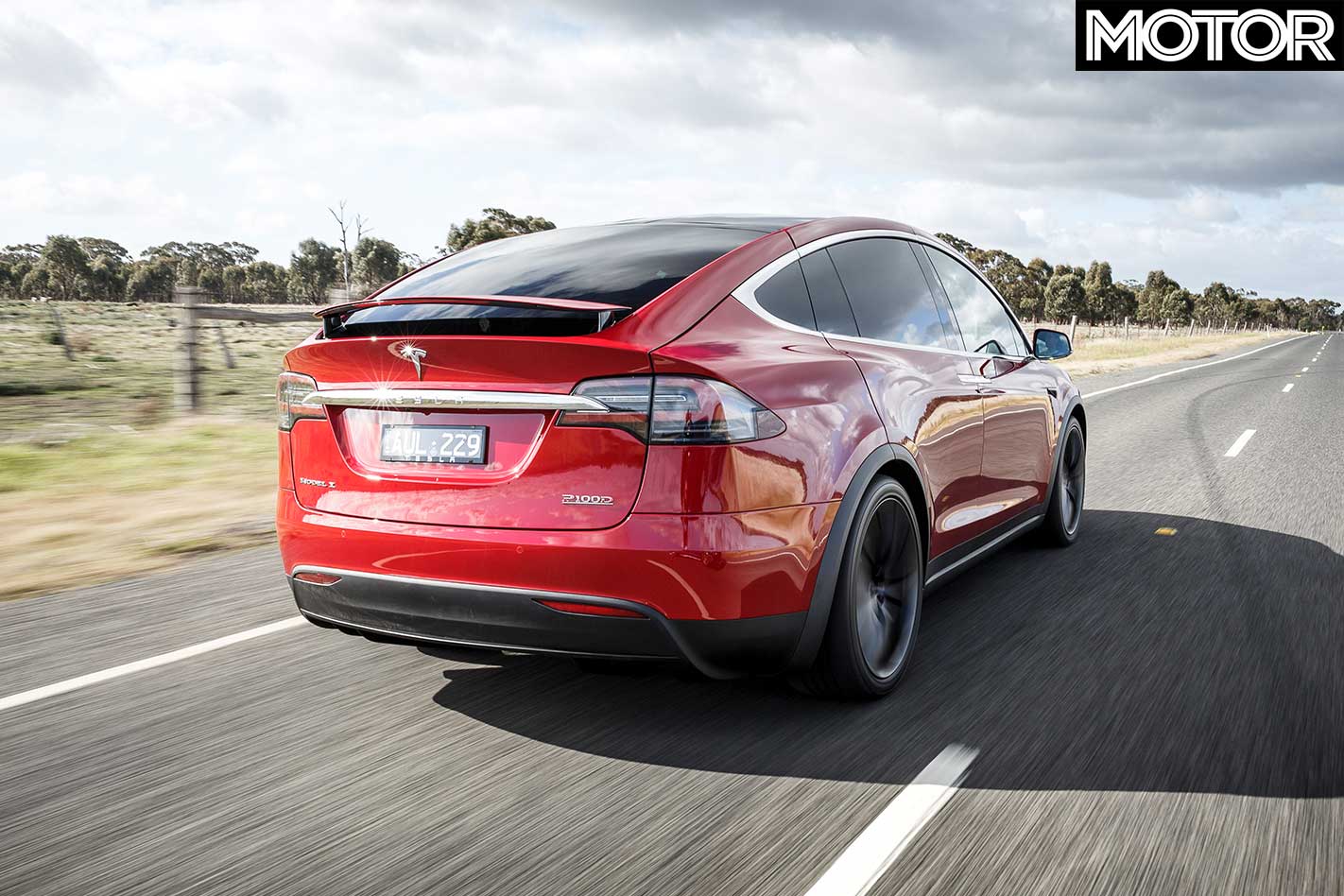
It tags its ‘SUV’ with a 0-97km/h time of 2.9sec. Although it’s measured with roll-out, that’s 0.6sec quicker than the Jeep’s claim and it has got the Lamborghini’s 3.6sec 0-100km/h time covered. This advantage grows when you compare it to vehicles which match it on size, weight and seating capacity, like the Mercedes-AMG GLS63 and Range Rover SV Autobiography SWB.
Keeping that in mind, the performance offered by its twin-motor powertrain and supplied by a 100kWh battery is, well, electrifying. We didn’t get the chance to engage Ludicrous Mode, Launch Mode, and Max Battery power at the same time, because the latter can take a while to ready itself, but quick blasts down on-ramps show it will confidently keep up with its rivals.
The experience is largely a physical one. G-forces strain your neck muscles but a high-pitched hum is all that stimulates your ears. Our butts reckon it’ll lazily nail sub-4.0sec 0-100km/h runs.
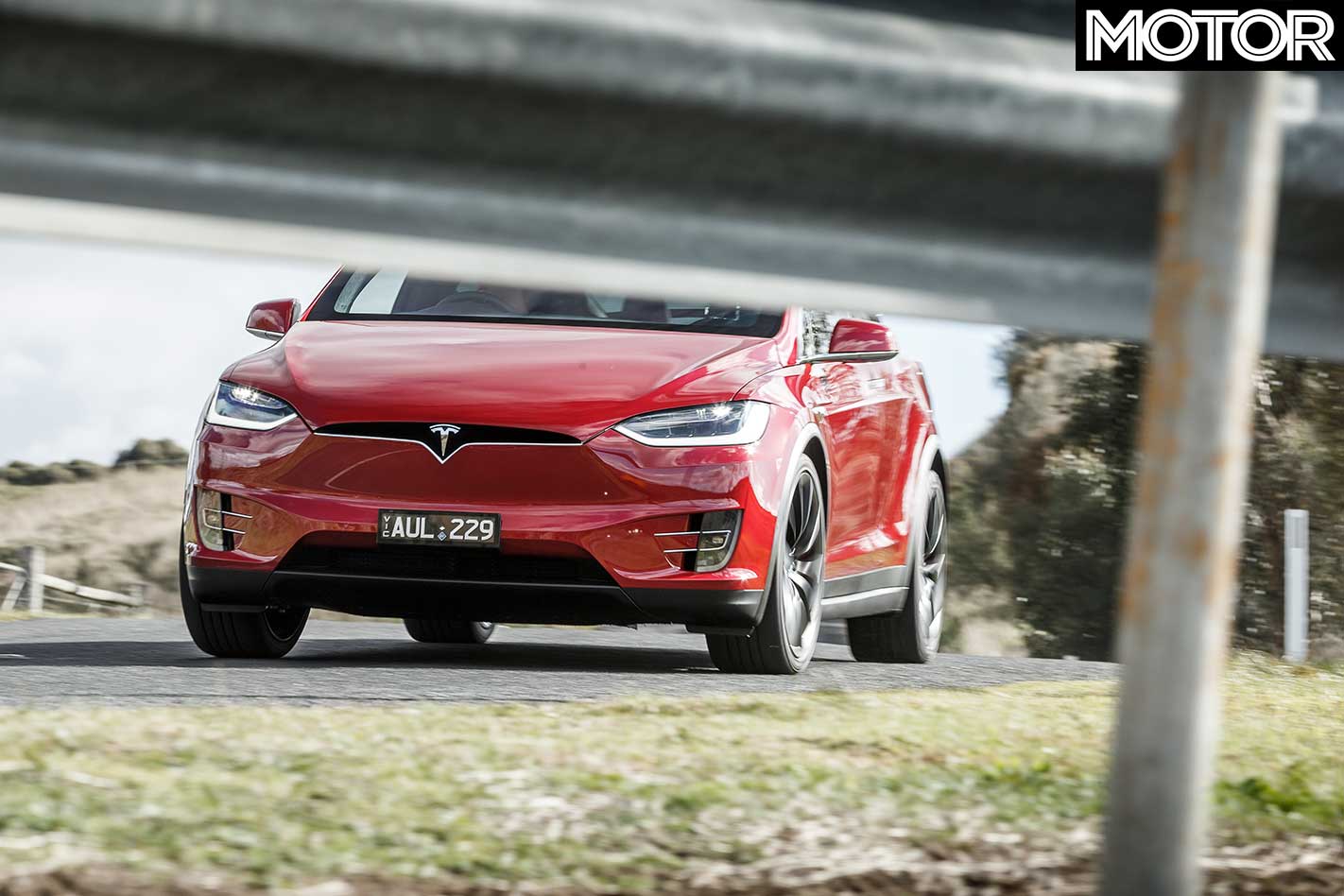
The Model X is the family hauler in Tesla’s range, using a larger bodyshell that’s 84mm wider, 246mm longer, and 239mm taller than a Model S, and almost 200kg heavier. But because the guts of its powertrain sit close to the ground, it initially changes direction with the same enthusiasm.
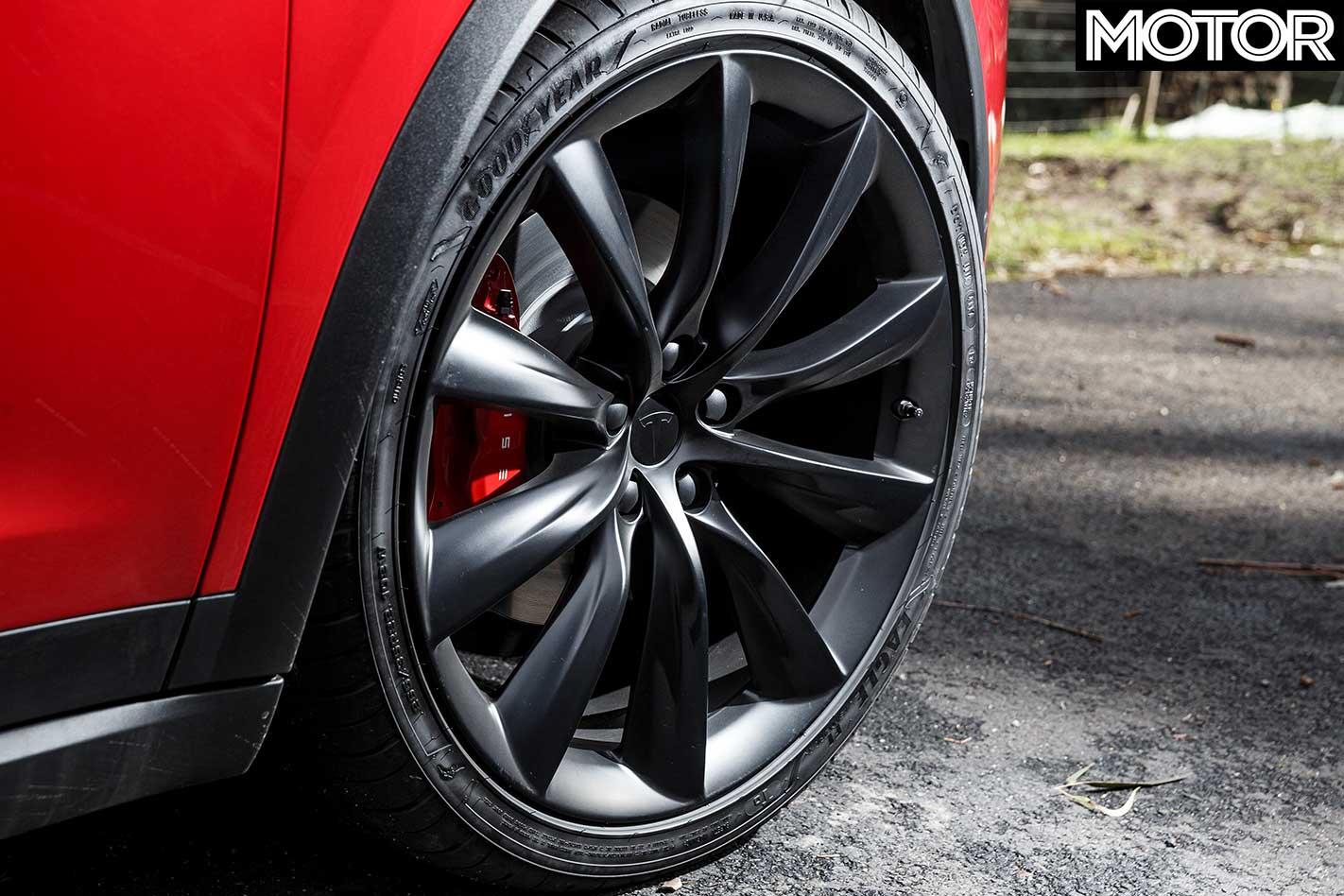
It also packs impressive mid-corner grip and traction. Press on, though, and this semblance of agility fades as physics overcome the grip of its huge 22-inch Goodyear Asymmetric 3s. Numb steering and soft air suspension also don’t help its case.
Regenerative braking pitches the Model X forward when off-throttle, even on a ‘low’ setting. Though thanks to its centre of gravity, and wide front track, the weight transfer blunts its entry speed, rather than upsetting its stability.
The X P100D seems expensive, especially when cheaper seven-seat performance SUVs sound better, are more luxurious, and feel better built. The Tesla fails to speak any meaningful design language, too, and lacks the detailed sophistication of a car nearing $300K when fully optioned.
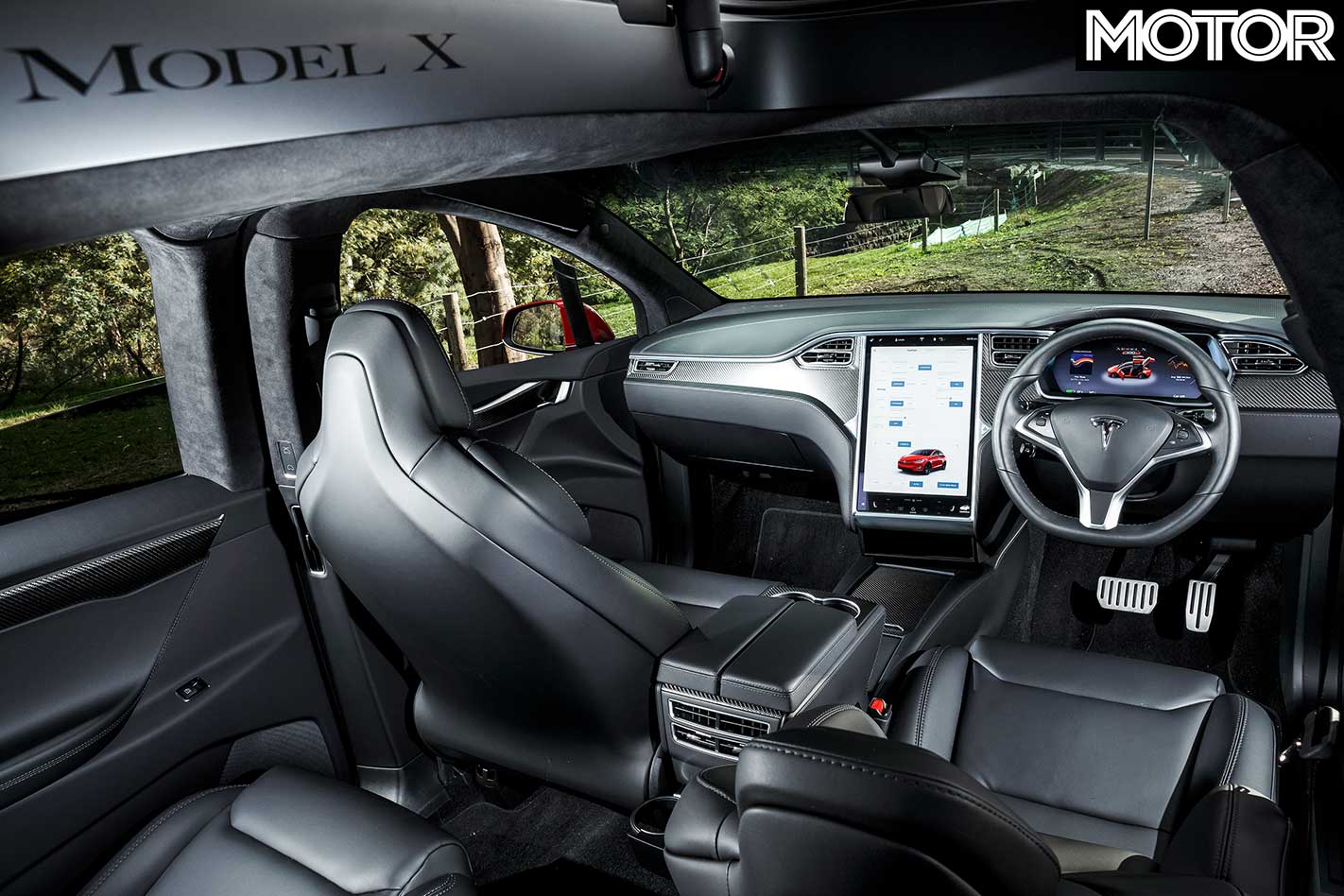
Provided you’re not turned off by its suspiciously inconsistent panel gaps, rickety door clunks, or the logistics of using an electric car every day, few in its ‘class’ are this well-rounded. Or manage to pack such a silent, but deadly, ace up their sleeve.
2018 TESLA MODEL X P100D SPECS: Engine: Dual AC-induction electric motors Power: 568kW @ 6150rpm (combined) Torque: 990Nm (combined) Weight: 2487kg 0-97km/h: 2.9sec (claimed) Price: $258,000 (drive-away)
Like: Clinical speed; agile responses; infotainment; ride; six-seater cabin layout Dislike: Silent acceleration; numb steering; bland looks; questionable build quality
Rating: 4 out of 5 stars
A FULLY electric luxury limo has just blasted Porsche out of the water at the famous Laguna Seca raceway … kinda.
Electric vehicle manufacturer Lucid has taken its yet-to-be-released sedan, the Air, to the Californian circuit and set a blistering lap time that’s on par with a 911 – but that claim to fame comes with a few caveats.
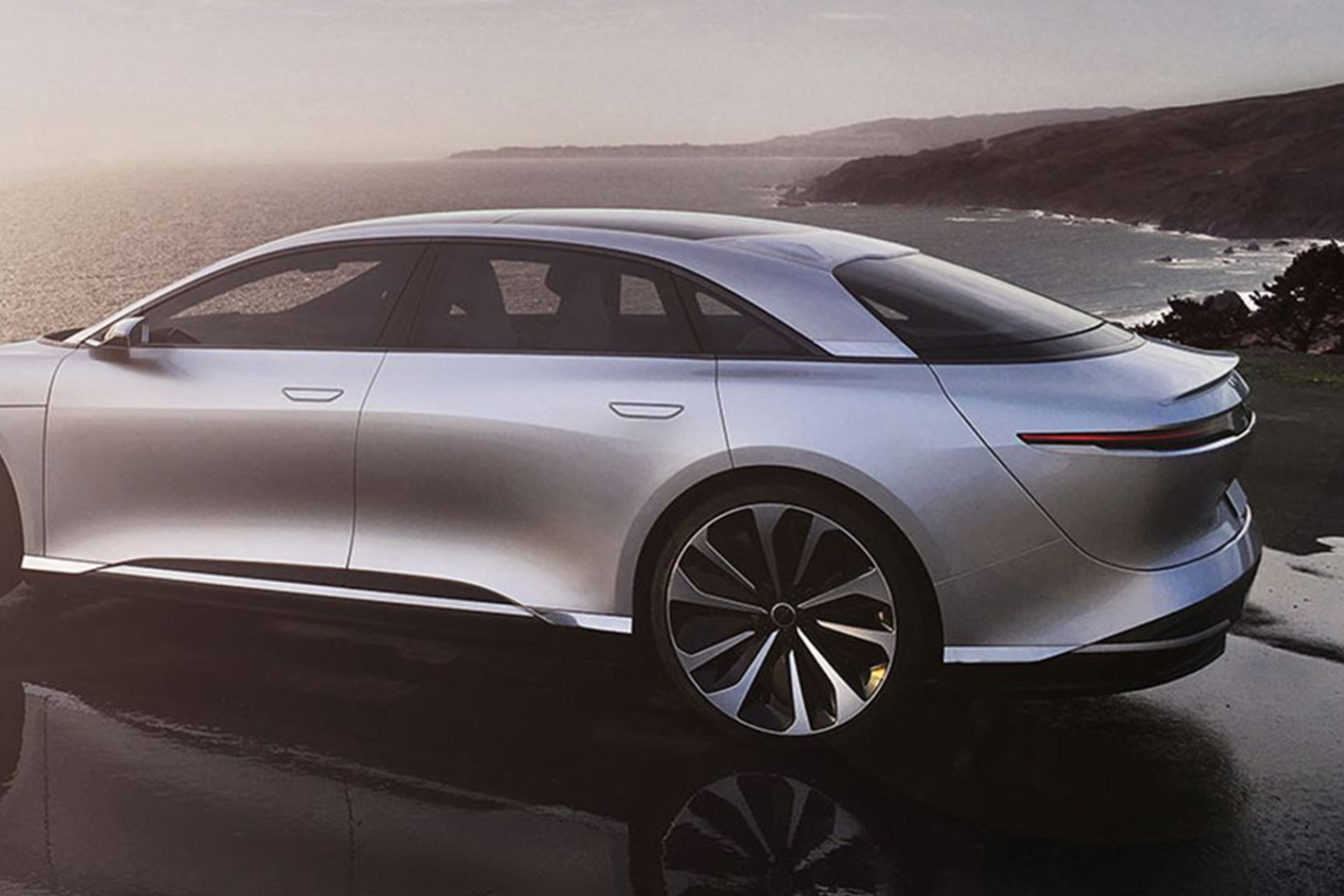
Many of you might be thinking ‘Lucid who?’ For the unversed, Lucid Motors is an American car company, formerly known as Atieva, which specialises in electric vehicles, though despite being founded more than a decade ago, hasn’t yet put a vehicle into mass production.
The Air will be the company’s first vehicle to go on sale. It’s a dual-motor EV described as a Mercedes-Benz S-Class rival. At Laguna Seca, driven by an unnamed chassis engineer, an Air prototype recorded an impressive 1:39.30 lap time.
For context, according to fastestlaps.com that’s exactly the same time as achieved by Randy Pobst in a superseded 991-gen Porsche 911 Carrera S. It’s also quicker than a Cadillac ATS-V Coupe, BMW M4, Mercedes-AMG C63 S, an F13 BMW M6, and a V8 Jaguar F-Type at the hands of the Pobst, who is a multiple American GT champion, and now works as a gun-for-hire at MotorTrend.
However, there are a number of things to note about Lucid’s achievement before you go rushing out to buy one, and thus comes another timely reminder that lap record headlines don’t always tell the honest story.
Firstly, the Air the company used to set the time wasn’t representative of what customers will be able to purchase. Video footage of the lap shows this particular Air had a stripped-out interior and full roll-cage, and the company confirmed the car was fitted with (barely) road-legal, track-focused Pirelli P Zero Trofeo R tyres.
Lucid also sent the Air around wearing more representative Pirelli P Zero PZ4 rubber, which is more befitting the car’s luxury limo status, and recorded a time more than two second slower at 1:41.67. That marker is surely a truer representation of what a production-spec Air might achieve.
Nevertheless, that’s still a very quick time at Laguna Seca, and places it ahead of a Lexus RC F, Alfa Romeo 4C, and BMW i8.
The production car record at Laguna Seca is currently held by the 2016 Dodge Viper, at 1:28.65, while blog Teslarati reports a privately owned, single motor, non-performance variant of Tesla’s new Model 3 set a 1:48.6 while fitted with upgraded brake pads and Hoosier slick tyres.
The Air’s impressive speed shouldn’t come as a huge shock to those paying attention to the brand’s developments, as the company claims the car has 736kW of power.
Lucid took a similarly stripped-out Air to a test track last year and pushed it to a maximum speed of 378km/h. If the production version of the Air can achieve similar figures, that would make it not only potentially the quickest EV in the world, but also one of the fastest passenger cars, period.
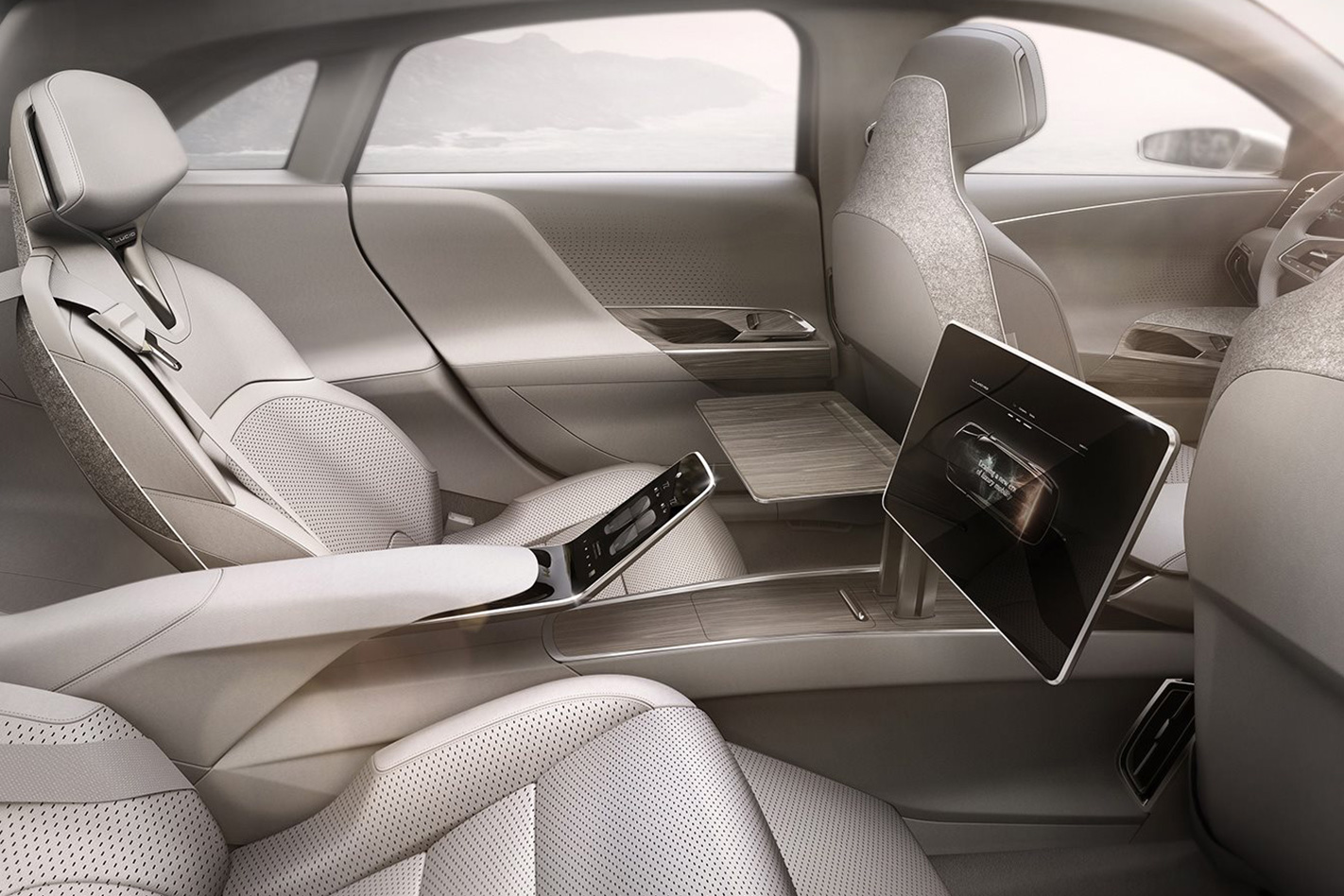
Lucid says the Air has exterior dimensions similar to a Mercedes-Benz E-Class, but due to the lack of a combustion engine, and subsequent design freedom, it has interior room to rival the more luxurious S-Class.
Production is slated to begin in 2019, and Lucid intends to sell the Air for circa US$60,000 (A$75,350) in the United States.
Although it’s coming late to the electric vehicle battle compared to the likes of Tesla, Lucid is also armed with an extensive patent portfolio, mostly focused on its high-kWh fast-charge batteries.
Developed in collaboration with Samsung, Lucid’s battery tech is designed to provide maximum oomph with minimal charge. The company will be helping provide the batteries for the fully-electric Formula E racing series from next season in conjunction with McLaren Applied Technologies and Sony.
SUBARU Australia has laid out a rough roadmap that plots its course to alternative energy over the next five years, including the arrival of hybrid power as early as next year, followed by its first pure EV.
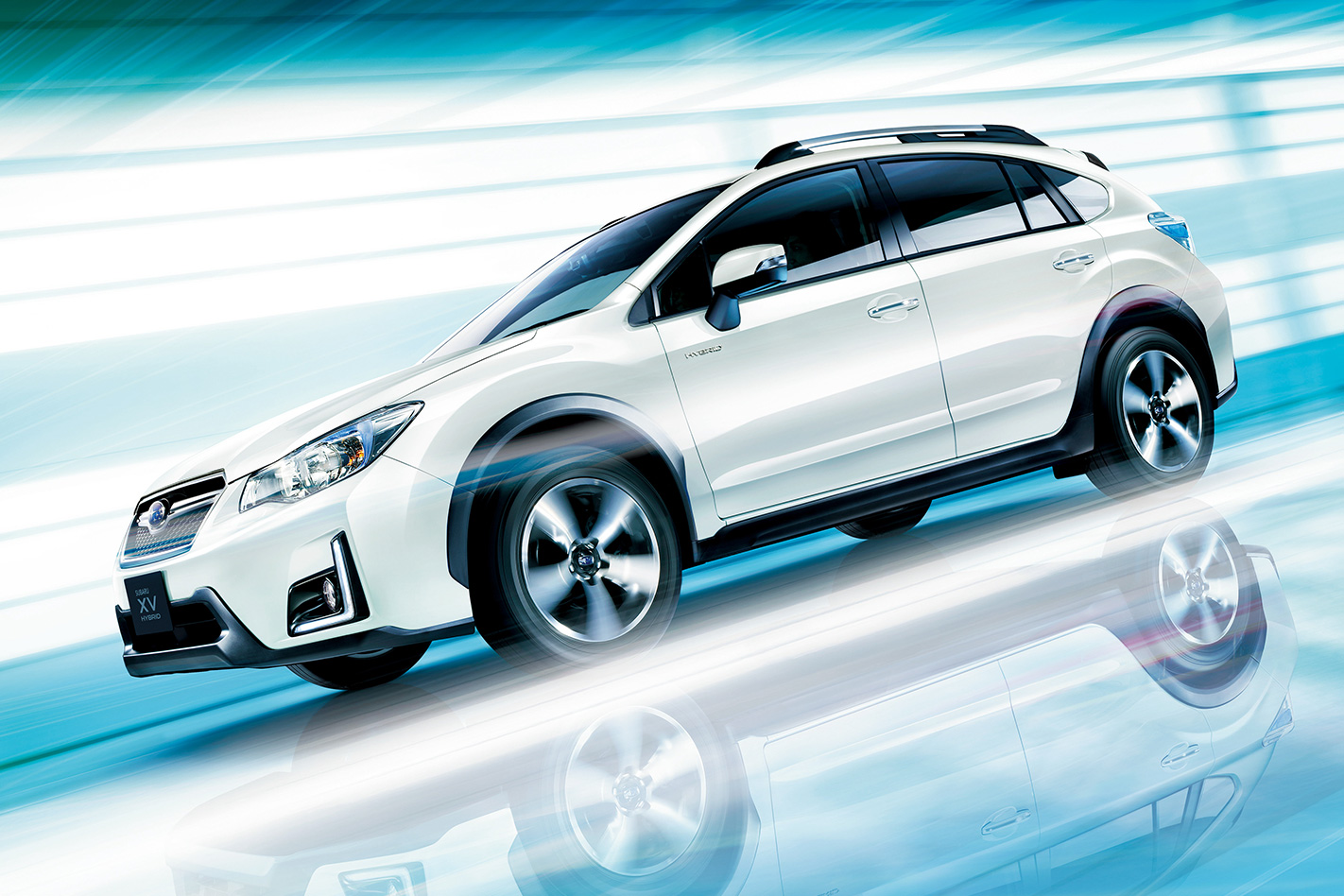
The alternative energy momentum was initiated for Subaru in 2013 by the reveal of its Crosstrek Hybrid – essentially a mild hybrid version of the XV and only offered in the US and Japan – but a new version which was unveiled earlier this year will start the flow to Australia.
At an as yet unconfirmed point, it will be joined by a second hybrid in the Forester line-up, with both gracing Australian showrooms before the decade is out.
Speaking to Wheels, Subaru Australia managing director Colin Christie confirmed hybrid models were set to make their debut Down Under.
“Certainly by the end of 2020 I expect to have two hybrids in market,” he said. “Forester and XV.”
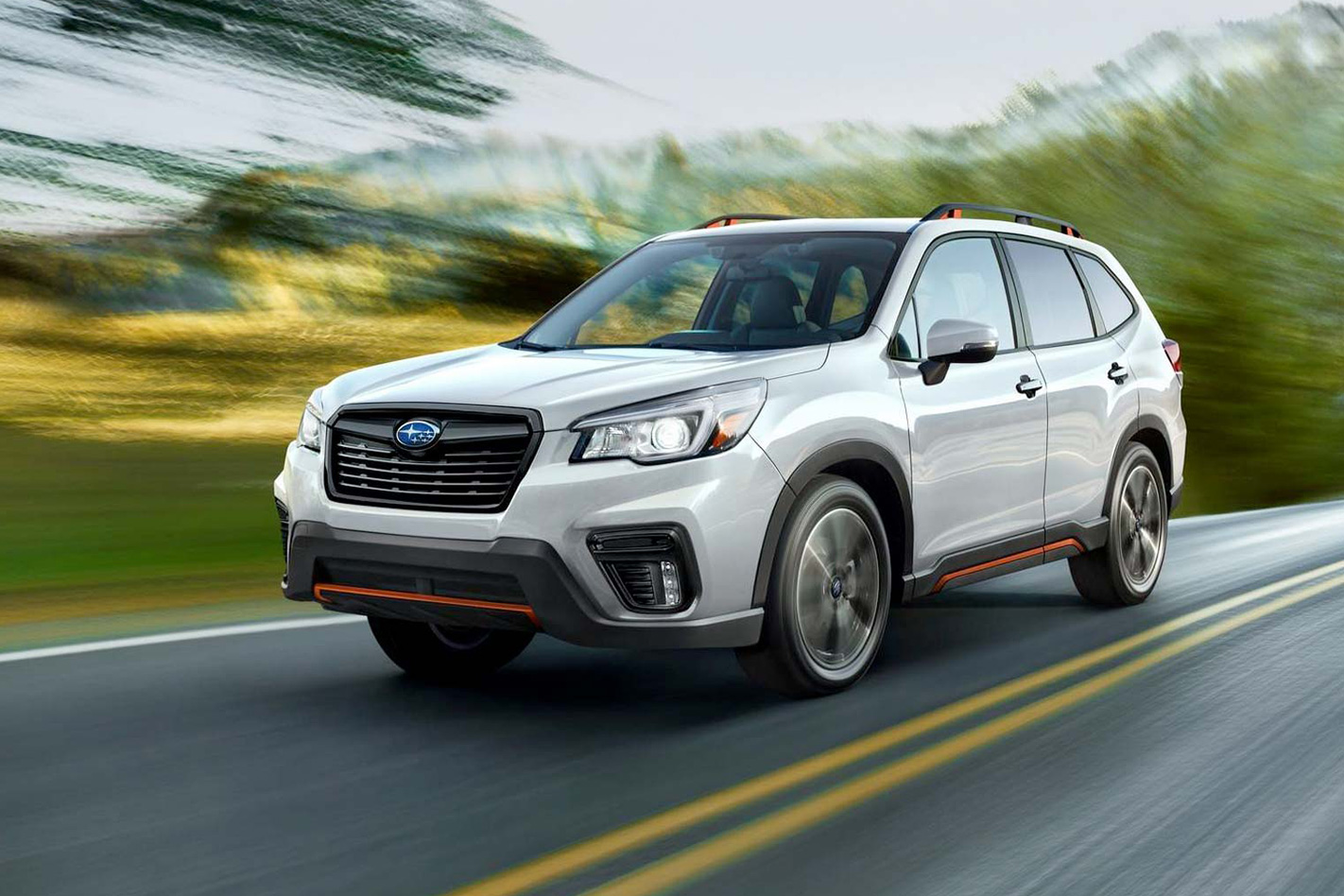
The hybrid Forester dubbed the e-Boxer is already silently running on Japanese roads but Christie explained it would take time before a version was ready for sale in Australia.
“We have our own specification in Australia and there’s a lot of testing that goes into ride and handling, but yes there is a Forester hybrid and we are working with Japan now about how and when we bring that in.”
Christie confirmed that the pair of hybrids would not be plug-in, and that the company would leapfrog PHEVs to pave the way for its first fully electric models
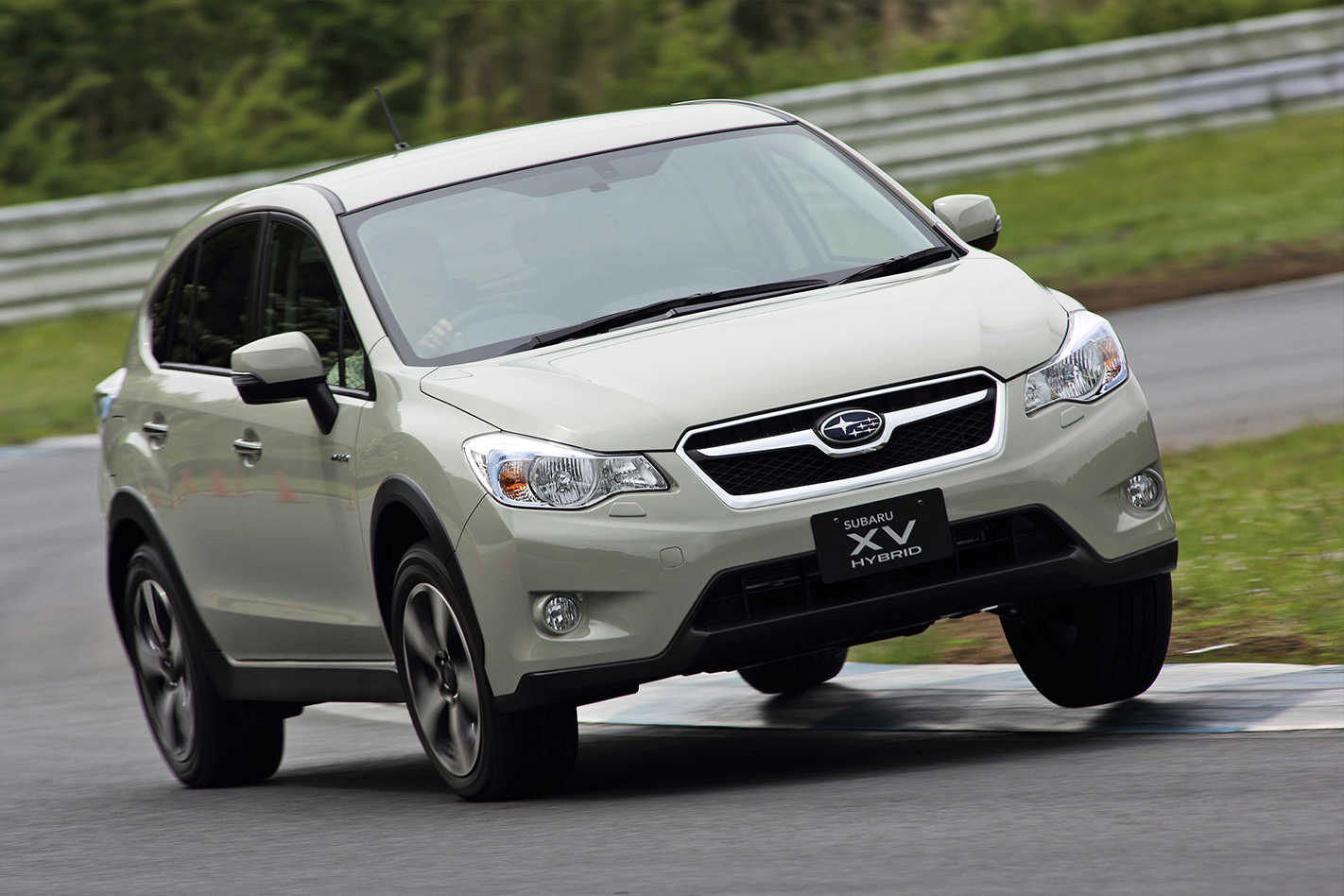
“The hybrids we are talking about are mild hybrids not plug-ins, but fully electric vehicles … somewhere in the next five years potentially, we’ll have electric vehicles.”
Subaru’s proprietary Global Platform, which was heralded by the Impreza, was specifically designed to allow electrification and will roll out to all models in the coming years. It currently underpins the Impreza, XV and Forester.
As the Japanese manufacturer heads towards its electrified destiny, it will with special editions for selected models, resisting the urge to follow many other mainstream car makers into sportier branded ‘lines’.
Examples include Renault’s GT-Line, Mercedes AMG Line, Audi’s S Line and the ST-Line from Ford, but Christie says a strategy of regular enhanced special editions works better for the Subaru range.
“We’ve got a couple of special editions that are rolling out in a couple of models next month,” he said. “Special editions are a big thing for us.
“They allow you to just tweak things and offer different variants and different elements. Special editions have always been a massive part of our brand.”
The company’s STI variants will continue to represent the peak of Subaru performance, but Christie said sub STI specials were on the way and hinted at the model lines they will infiltrate.
“We’ve got quite strict rules about how we message those. STI has to be the top of the tree for enhanced performance etcetera. That’s part of our special edition strategy so we might release a special edition called a Sport for Impreza but they all have to fit very specific rules to be called that.
“Sport is one that we will do more of. Maybe an XV Sport and Impreza Sport, maybe down the track a Forester Sport. That’s probably as far as we’ll go with it.”
MORE: Subaru Forester Range Review MORE: Subaru Forester Specs, Range & Price
One version of the rare Jaguar C-X75 is up for sale in the UK right now, and there’s something even more special about this one.
The listing, posted by Kaaimans International, features plenty of images of the car sitting amongst other exotica, though even the Lamborghinis, Ferraris, and a Bugatti Veyron are common by comparison.
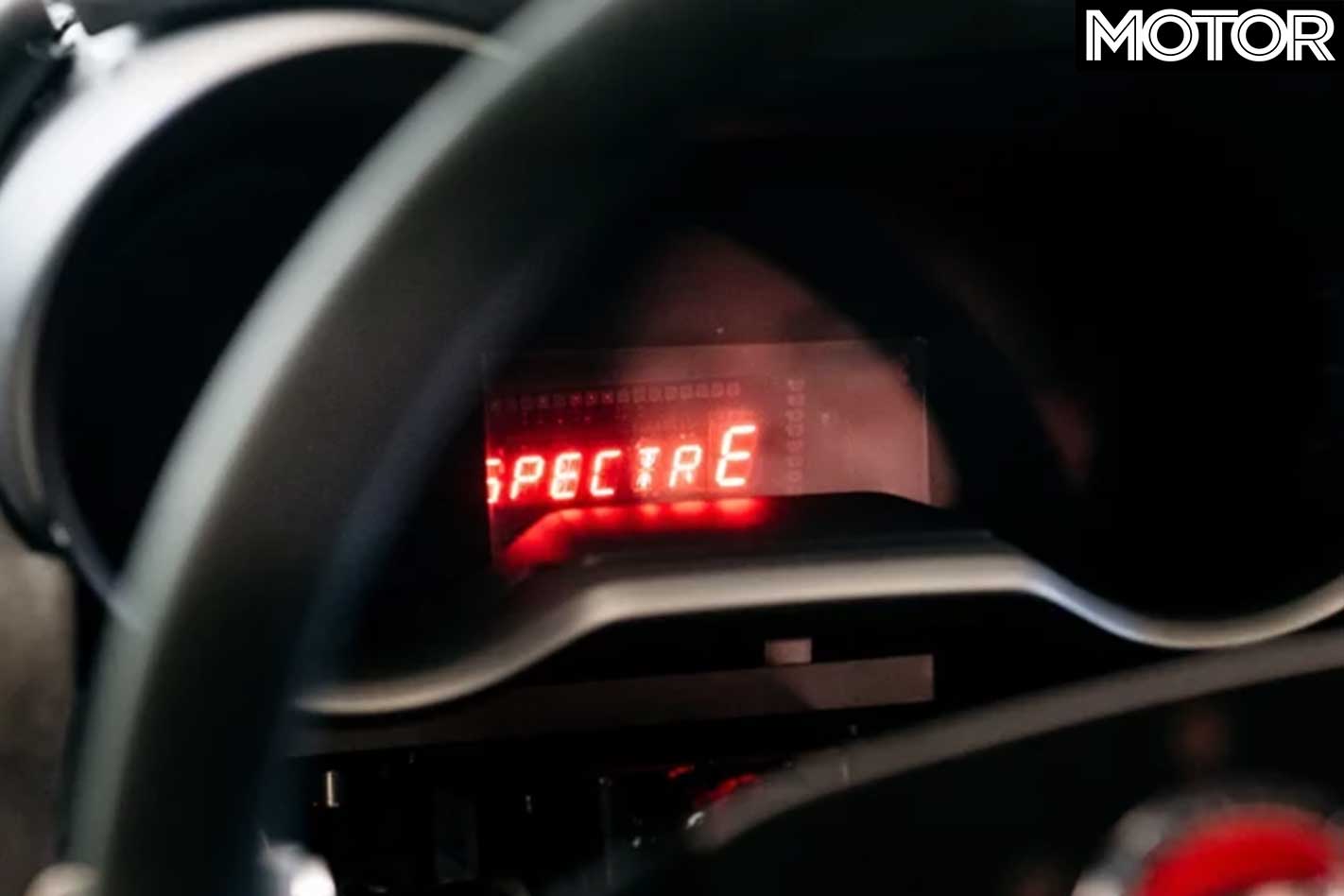
While only a handful of C-X75s exist in the first place, this one’s made rarer by its pedigree as the stunt car used for the filming of the Bond film Spectre.
This does however mean that there’s little of the car underneath which matches the original concept. Jaguar built seven cars for the film, according to an interview between Jaguar SVO’s boss John Edwards and UK publication Autocar.
Underneath, the film cars are all built from a WRC-spec spaceframe, with Jag’s supercharged 5.0-litre V8 powering the thing along with 404kW.
The original utilised a 1.6-litre turbocharged and supercharged four pot, with two electric motors for a combined 634kW, and a 0-160km/h (0-100mph) sprint in under six seconds.
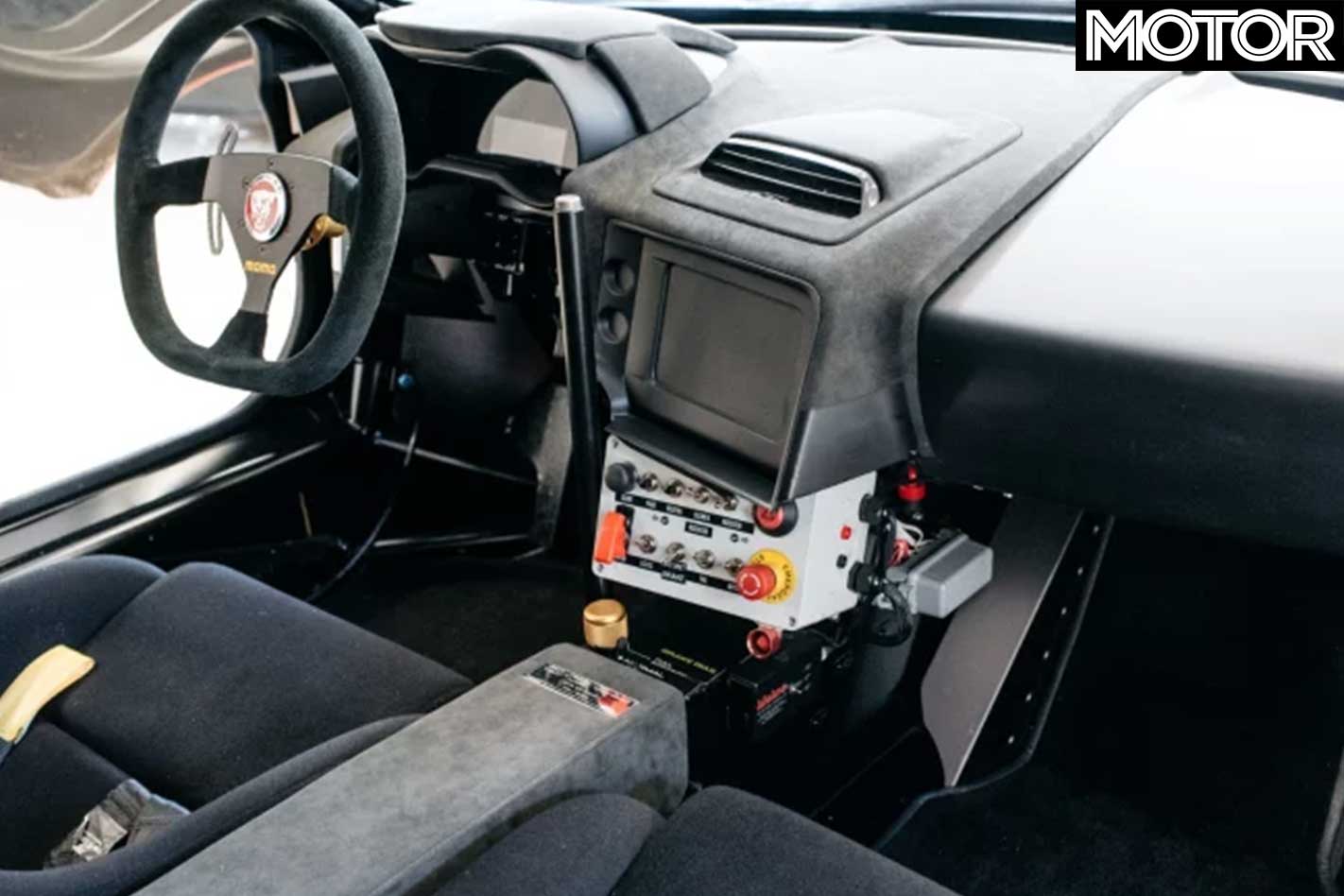
Inside, it’s fitted out with all the stunt car switches and safety aspects you’d expect. Most of what’s above window level is close enough to C-X75 to pass, save the steering wheel, but below that it’s Recaros, function controls and plain surfaces. There’s even a big red emergency stop button.
As the car never made it to production, the seven stunt cars plus the actual C-X75 retained by Jaguar Land Rover are all that exist of the wild-looking concept.
Aside from those, there’s the chase scene from the film to bring it to life, the scene also featuring the equally non-existent Aston Martin DB10 driven by Bond.
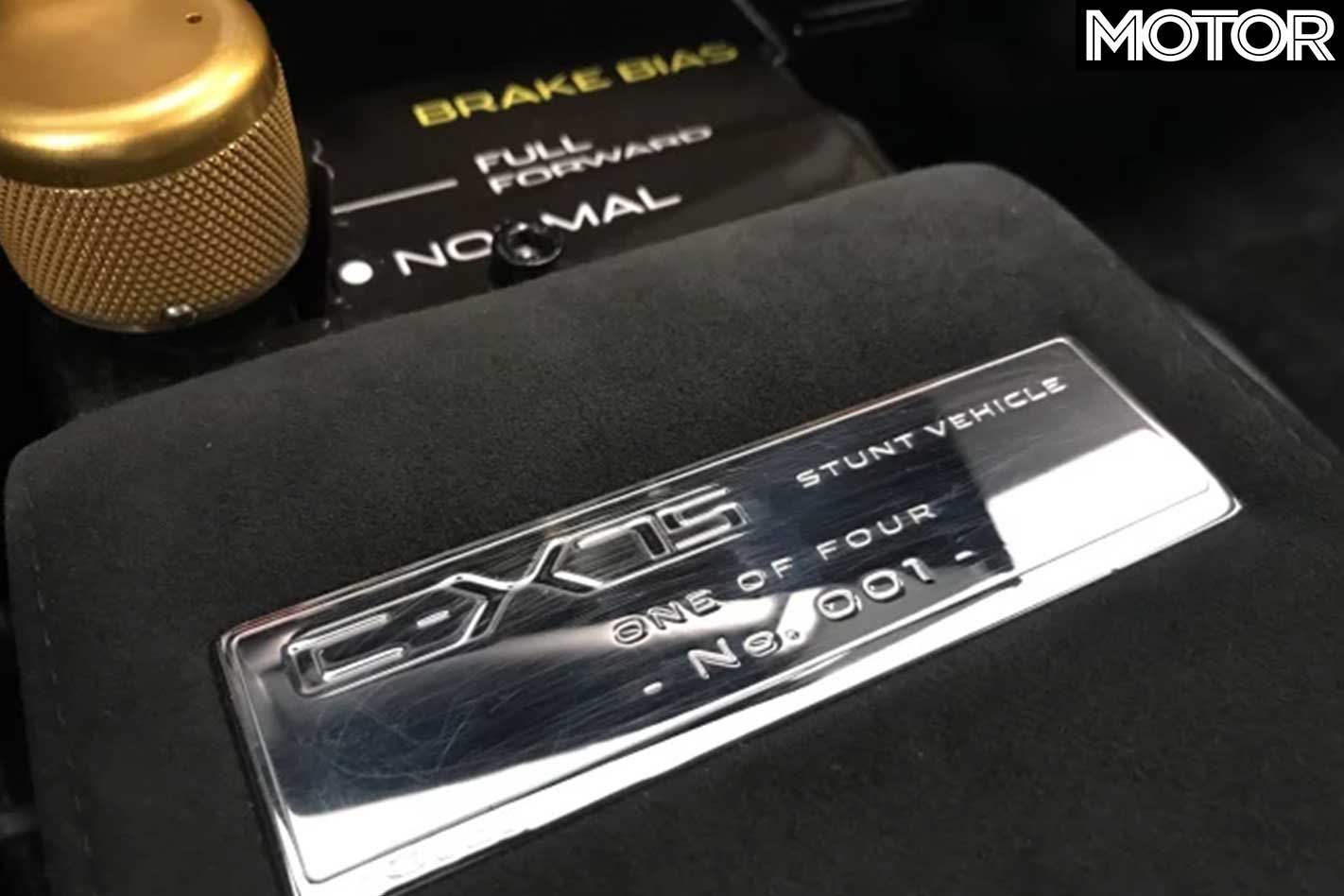
Four of the stunt cars were given plaques, as indicated by one of the images from the listing, and this one is the first of those.
As you’d expect, Kaaimans hasn’t listed the price, though we can’t imagine it’s within the realm of reality for most.
HSV has confirmed pricing for the inbound 2018 Chevrolet Camaro SS, which is expected to arrive in showrooms later this month.
At $85,990 plus on-road costs, the Camaro will prove a more expensive, but also torquier opponent to the massively popular Ford Mustang GT, priced at $66,259 in 10-speed auto guise.
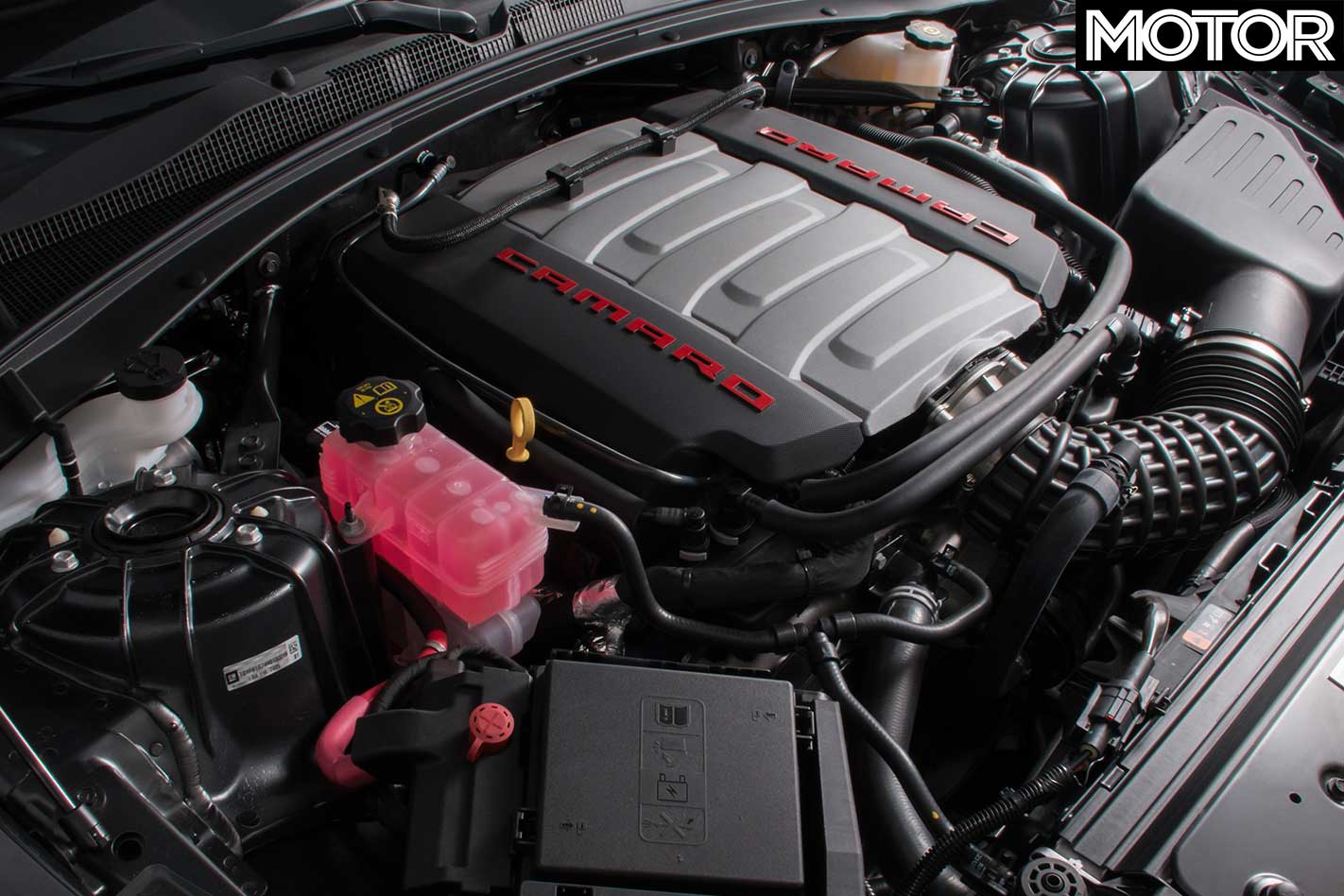
The Australian-spec Camaro SS will produce 339kW and 617Nm from its 6.2-litre naturally-aspirated LT1 V8, up on the Mustang GT’s 556 Newtons (but equaling its power output – 339kW).
As the Camaro is almost $20,000 dearer than its rival, HSV doesn’t expect it to approach the 9000-plus annual sales for the Mustang, but expects around 1000 a year early on.
For the first model year allocation however, only 550 units will be sold. Production capacity will rise to more than 2000 if demand warrants it.
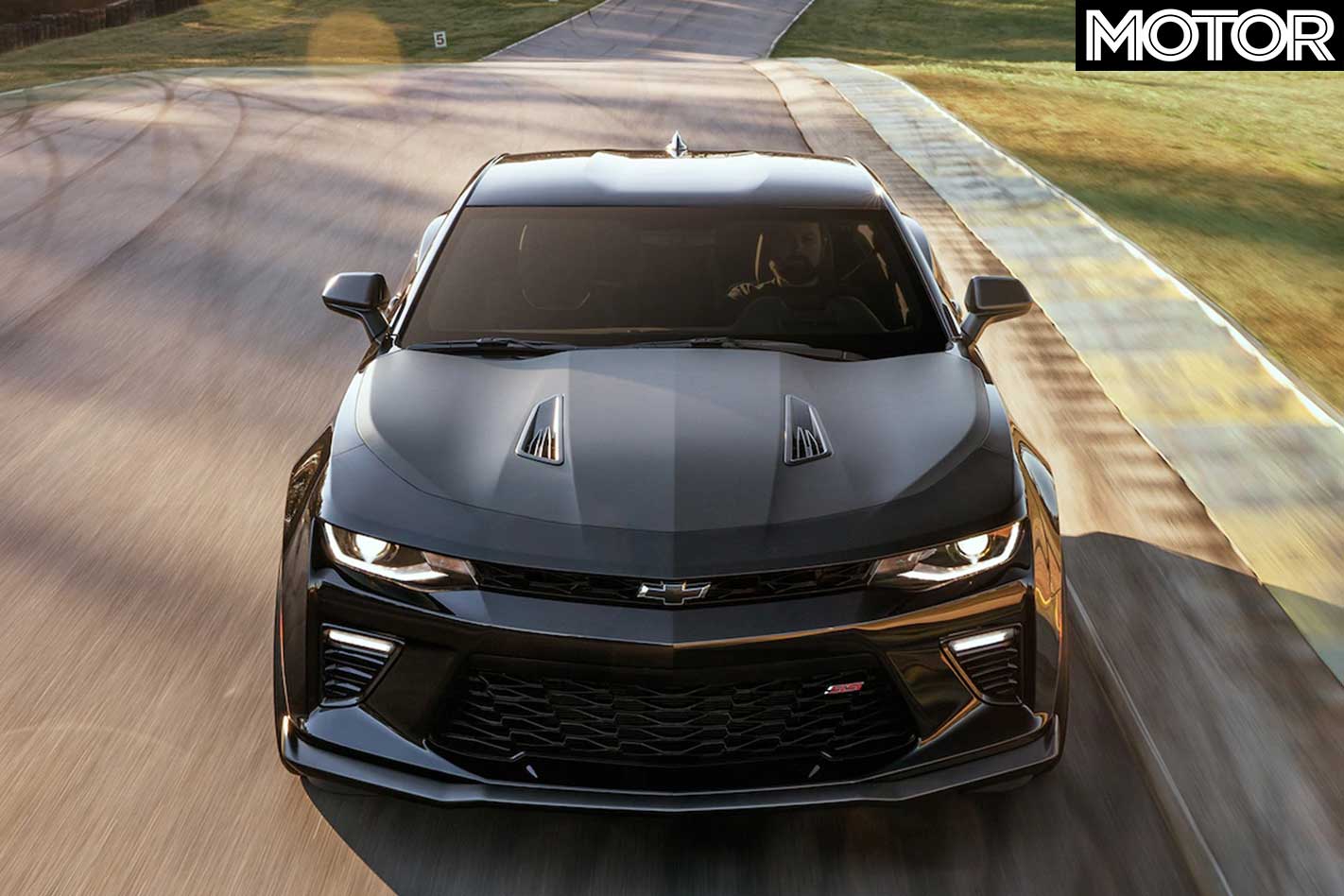
Initially, the fully-equipped 2SS 8-speed auto configuration in the previous model spec is the one headed for Australia, meaning no facelifted car with the ‘flow-tie’ grille.
HSV is also ‘looking into’ bringing higher performance variants such as the ZL1 and ZL1 1LE to Australia down the track, though it’s just an exploration of the idea at this point, judging by word from HSV.
Right-hand drive conversions of the latest facelifted 10-speed auto model – and possibly a manual gearbox option – won’t be available until “well into 2019”, according to HSV.
The Camaro will be sold nationally through 60 Holden dealers in rebranded Chevrolet sections inside dealerships – along with the similarly converted Silverado pick-up trucks.
The RHD Camaro will be launched to the media on September 21 or 22 and be in showrooms shortly thereafter. Stay tuned.
THE Chevrolet Camaro will cost nearly $86K. Yep, that’s a fair bit cheaper than most estimates but let’s not lose sight of the fact that Ford’s latest Mustang GT carries a sticker price that’s $20K more affordable, at a smidge over $66K. You’re going to need to ask yourself if exclusivity and novelty is enough to bridge that gulf.
Of course, HSV is bullish about the car’s prospects and with good reason. Only 550 are coming into the country during the first years and these right-hook 2SS spec cars are stacked with gear. Heated and ventilated seats, a heated steering wheel (it was born in Michigan, remember), dual zone climate control, a Bose stereo, four drive modes, power sunroof, wireless phone charging, integrated garage door opener: the list goes on. In fact, the only available option is metallic paint at $850.
We sat down with HSV to talk through the Camaro’s pricing and Damon Paull, HSV’s General Manager of Marketing and Planning, walked us through the process of arriving at a final number.
“Given the amount of engineering work, tooling and development, certification, and validation required to move the steering wheel from the left-hand side to the right-hand side, plus the niche volume and the impact of luxury car tax, we are confident our customers will recognise the value equation,” he explained.
He then listed the costs involved in that process. Aside from the core vehicle cost, there are the funding and finance charges on that vehicle, exchange rate losses, ocean freighting across the Pacific, import duty, and landed freight and storage. That’s before HSV has even seen the car.
In order to convert the car to right-hook, there are tooling and development recovery costs, facility and manufacturing recovery costs as well as piece costs for interior hardware and underbody modifications. Labour costs add to that, as Paull estimates that there’s over 100 man hours per car to undertake the conversion and validations. Add warranty, roadside assistance and the not inconsequential slug of LCT and GST and you’ll appreciate that the Camaro isn’t a car that can ever be sensibly price matched against Mustang GT, on these shores at least.
Ask anybody who has had a Corvette converted to right-hand drive in Australia and they’ll have been landed with a bill closer to $35K than $20K for the job, so it’s clear that Camaro buyers aren’t being fleeced. And if our head to head review of Camaro versus facelift Mustang proved, the Chevy is a harder, angrier thing than the Mustang and that ought to play well with a domestic audience that has a bit of 6.2-litre GM in its genes. Hit up the comments and let us know if you’re tempted to be one of the lucky 550.
Porsche Australia has improved the value-for-money quotient of its Cayman and Boxster range, decking-out its entry-level convertible and coupe with more equipment as standard.
A reversing camera is now standard-issue across the line-up, from base 220kW Cayman and Boxster through to the 257kW mid-grade Boxster and Cayman S and the 269kW performance flagship GTS. Useful, but of more interest to rev-heads will be the news that the previously optional Sports Exhaust also becomes standard for both the base and S variants of Porsche’s mid-engined sports cars.
The Sports Exhaust brings a switchable set of flaps that restrict engine noise to civilised levels when closed, or crank up the decibels when opened. They can be manually switched via a button on the centre console, or automatically whenever the engine speed rises above 3500rpm.
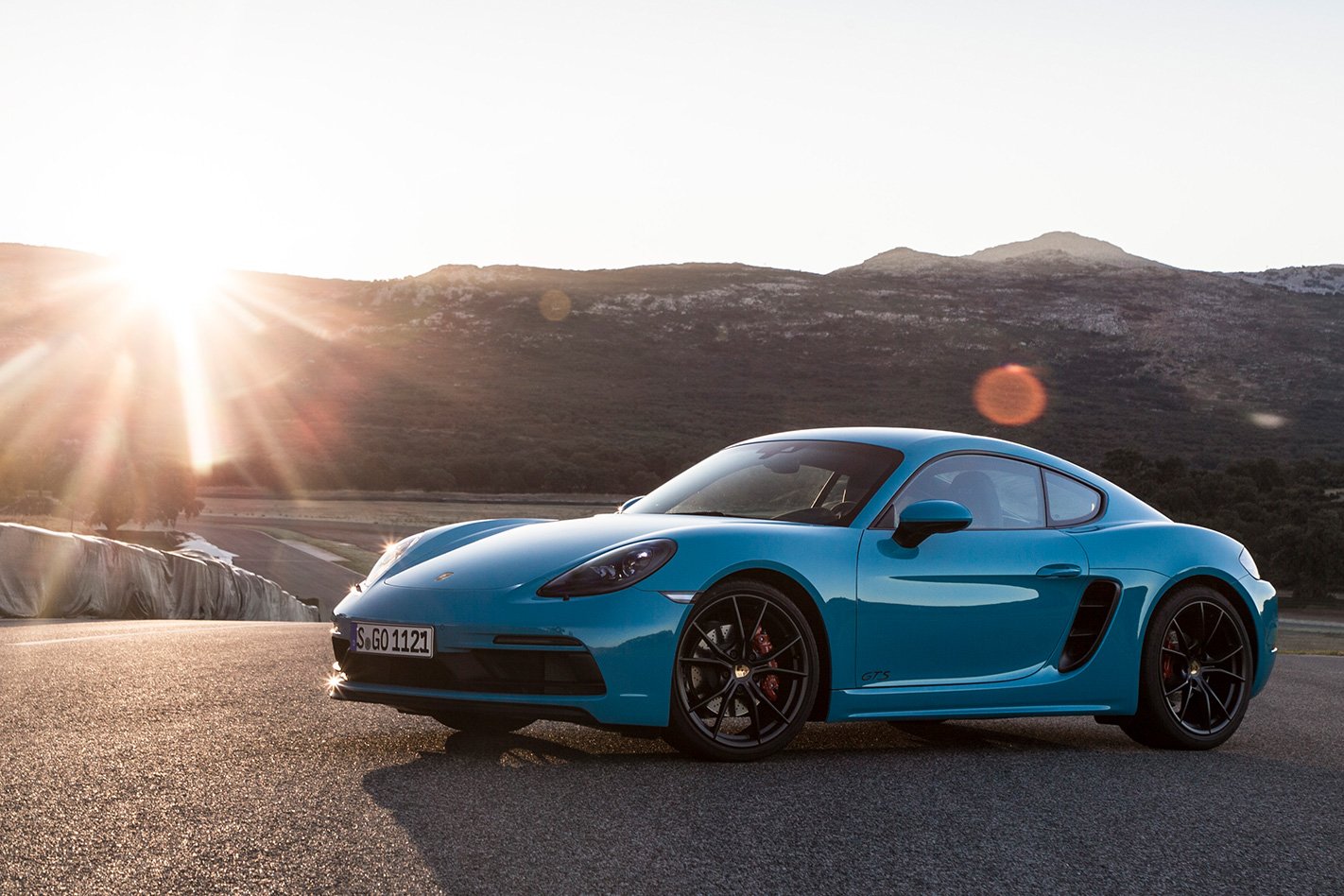
The Boxster S’ previously standard 19-inch alloys also become the default wheel for base model Boxsters and Caymans – which have been shod with 18-inch wheels up until now – while the S variants of both cars step up to 20-inch wheels pinched from the 911 Carrera S.
Changes apply to cars ordered from September 6, with the first updated versions slated to arrive in Australia from November. Crucially, none of the additions result in a price increase across the full 718 Boxster and Cayman range..
PRICING
- Porsche Cayman manual – $114,900
- Porsche Cayman PDK – $117,132
- Porsche Cayman S manual – $145,100
- Porsche Cayman S PDK – $150,090
- Porsche Cayman GTS manual – $172,700
- Porsche Cayman GTS PDK – $178,680
- Porsche Boxster manual – $117,700
- Porsche Boxster PDK – $119,932
- Porsche Boxster S manual – $147,900
- Porsche Boxster S PDK – $152,890
- Porsche Boxster GTS manual – $175,500
- Porsche Boxster GTS PDK – $181,480
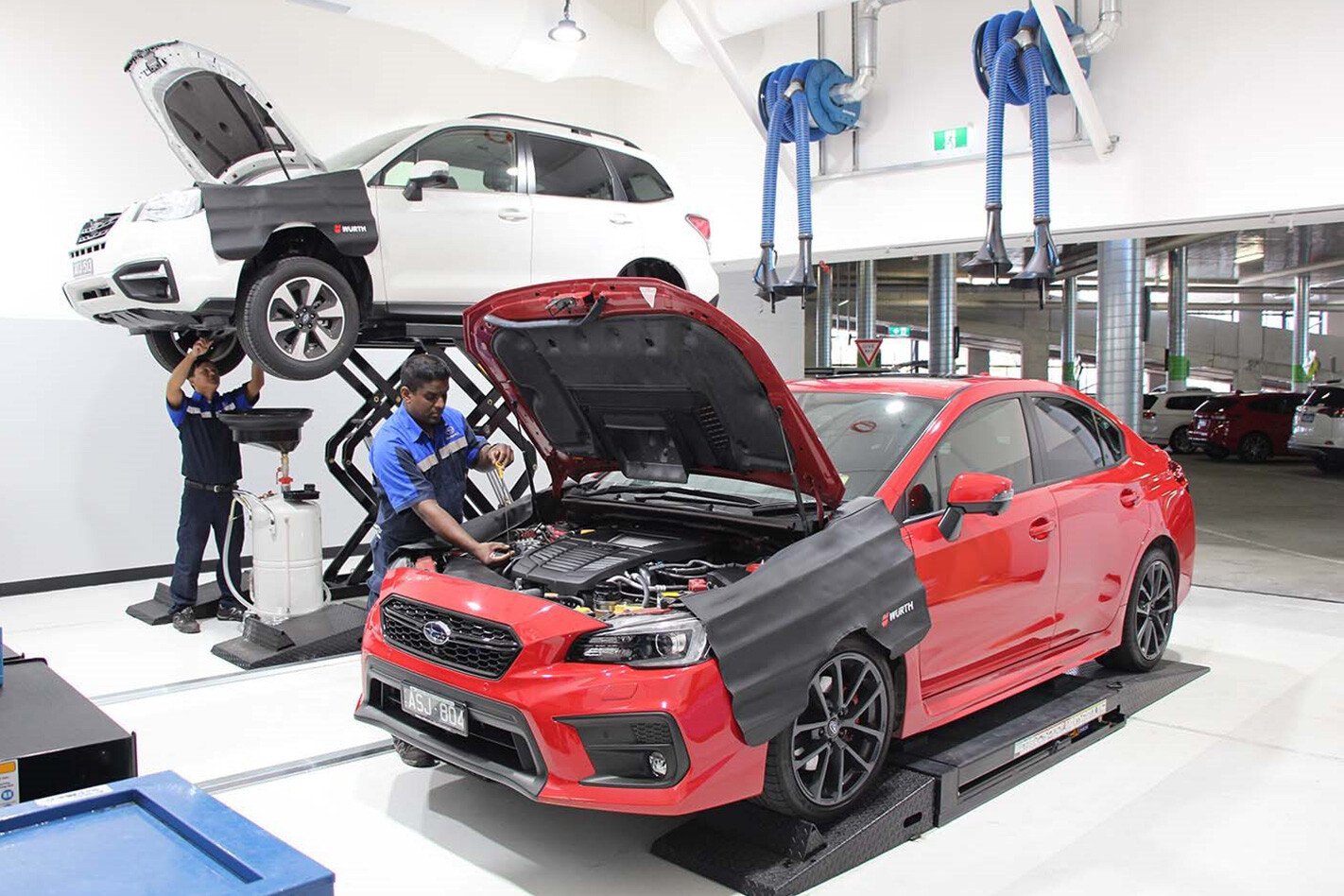
Subaru is continuing to upset the traditional retail model with a leftfield look at the way it sells and services its cars. Following the success of its pop-up stores in shopping centres, the Japanese brand is exploring more innovative ways to improve customer experience instead of asking its dealers to invest in ever-larger “Taj Mahal” dealerships.
When the company announced a service centre would join its Werribee shopping centre retail outfit, the diary filled up to capacity in just 10 days. Subaru is planning on riding that wave of popularity with more unorthodox strategies on the way.
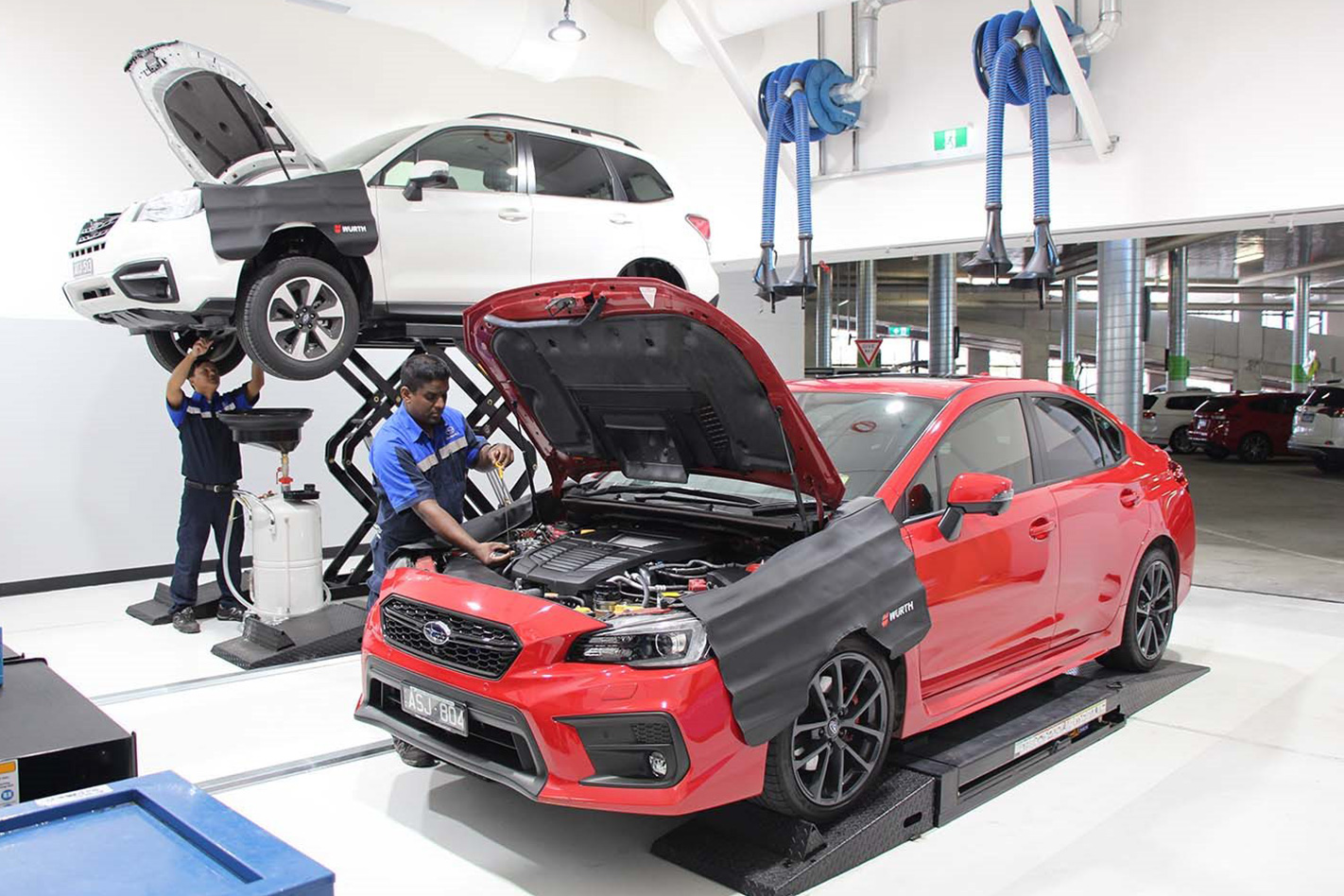
A fleet of mobile servicing vans has already launched, bringing the workshop to the customer. Instead of taking time out to visit a dealership and then find alternative transport, the Subaru mobile service technician goes to the customer’s most convenient location.
Speaking to WhichCar, Subaru Australia managing director Colin Christie said “mobile is the next big one for us,” and taking retail to the road was the brand’s future, with the sales department set to follow the service vans out onto Australia’s streets.
“The mobile test drive has been in pilot for a few months now in Sydney,” he said. “That will roll nationally in 2019.”
Instead of making a special trip to one of Subaru’s dealerships or shops, customers can request a member of the sales team to meet them at their home or workplace with a vehicle for a test drive.
Christie explained that, in parallel, a special sales application based on the existing build-and-buy online configurator is being trialled in 10 dealerships. Once fine-tuned, the application will allow customers to buy a Subaru remotely too.
“When that works then we’ll start mobile sales as well. Ideally, someone can come to your house, they can bring the car you want to test drive. If you like it they can transact with you end to end in your home and then ultimately have the car delivered to you and do the handover process at your office or home.”
The success of relatively small stores and the new service centre based in a retail location, followed by even more compact mobile services is highlighting the need for small, targeted customer infrastructure, not sprawling dealership complexes, said Christie.
“We believe there’s a massive role for our dealer network but I think that is going to change. Do you need the big Taj Mahals in the future? You shouldn’t need to spend that amount of money to deliver the experience to the customer.”
Subaru’s more inventive strategy for its dealership presence will benefit both dealer and customer alike, according to the company, allowing franchisees to invest more in improving customer satisfaction.
“Do you need massive dealerships everywhere to deliver this experience?” Asked Christie. “Every brand goes through refresh processes every three to five years and we have been very mindful over the last ten years to not ask for significant investment from our dealers.
“We want them to invest in their technology and their people rather than building a bigger glass box.”
As for the most recent shopping centre-based workshop, Christie said the reception had been deeply satisfying and the company was looking at ways to meet the high demand, including other locations and even expanding the initial Werribee premises.
“We’re incredibly impressed with the take-up. We’re already looking at multi-man and extending the hours even more, run fast services across everything and maybe even talk to the landlord about knocking an even bigger hole”.
BMW has revealed the next vehicles in the ‘M SUV’ range, the 2019 BMW X3 M and BMW X4 M, which tested on the Nürburgring during the most recent DTM racing weekend.
The prototypes were shown in camouflage, with very little given away in terms of their actual performance capabilities.
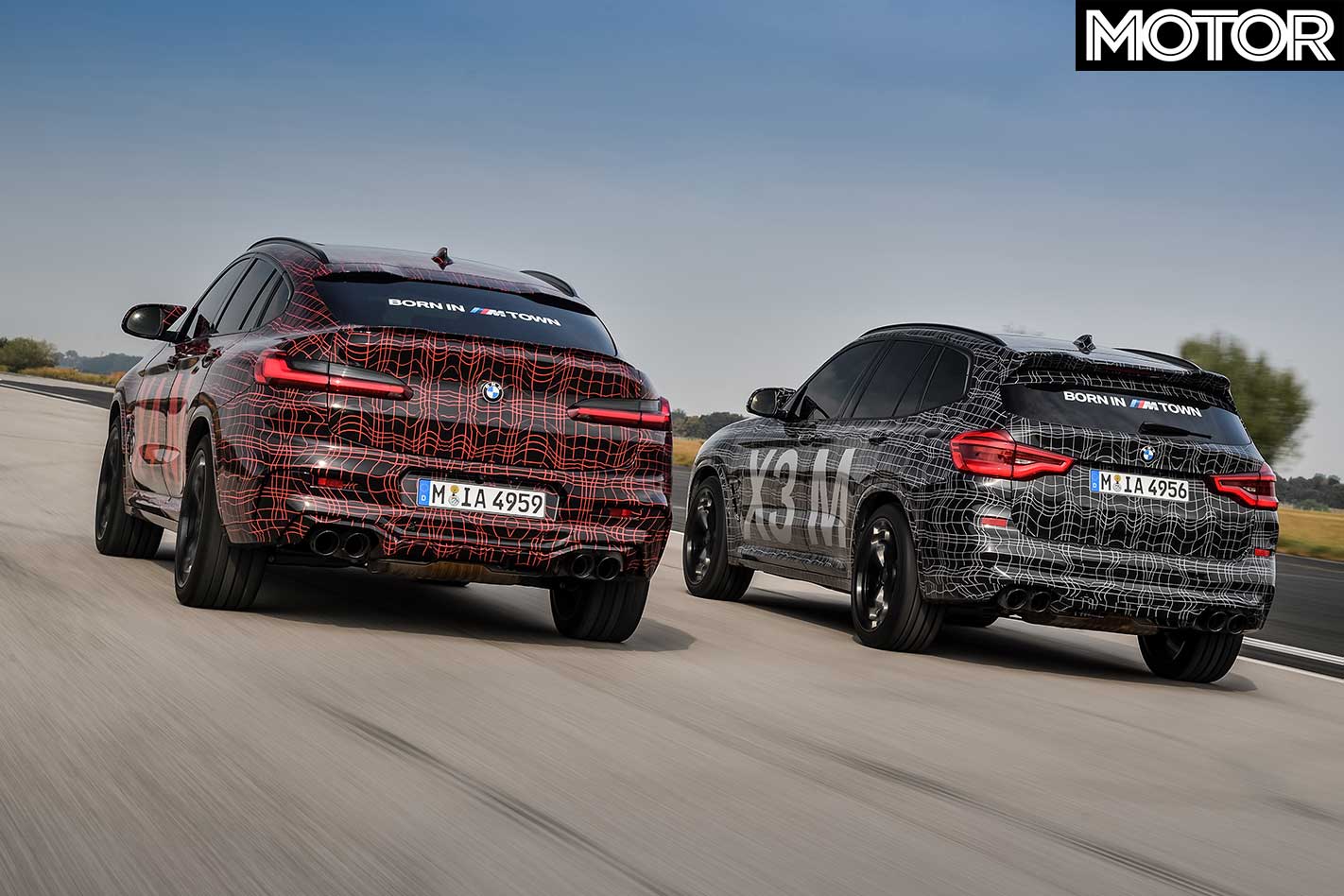
We do know, however, that both will still utilise BMW’s traditional straight six, in this case a new version with twin-turbocharging that will have to top 265kW/500Nm by a big margin if the already quick X3 M40i is to be outdone, and the M badges are to be justified.
BMW says the xDrive system from the new M5 will also feature in both X3 M and X4 M, “deployed in the BMW X3 M and the BMW X4 M to ensure constant supreme and performance-oriented transfer of engine power to all four wheels.
“In interaction with the active M rear axle differential, cornering dynamics, agility and precision in the driving behaviour of the BMW X3 M and the BMW X4 M are lifted to a level unrivalled within the competitive environment.”
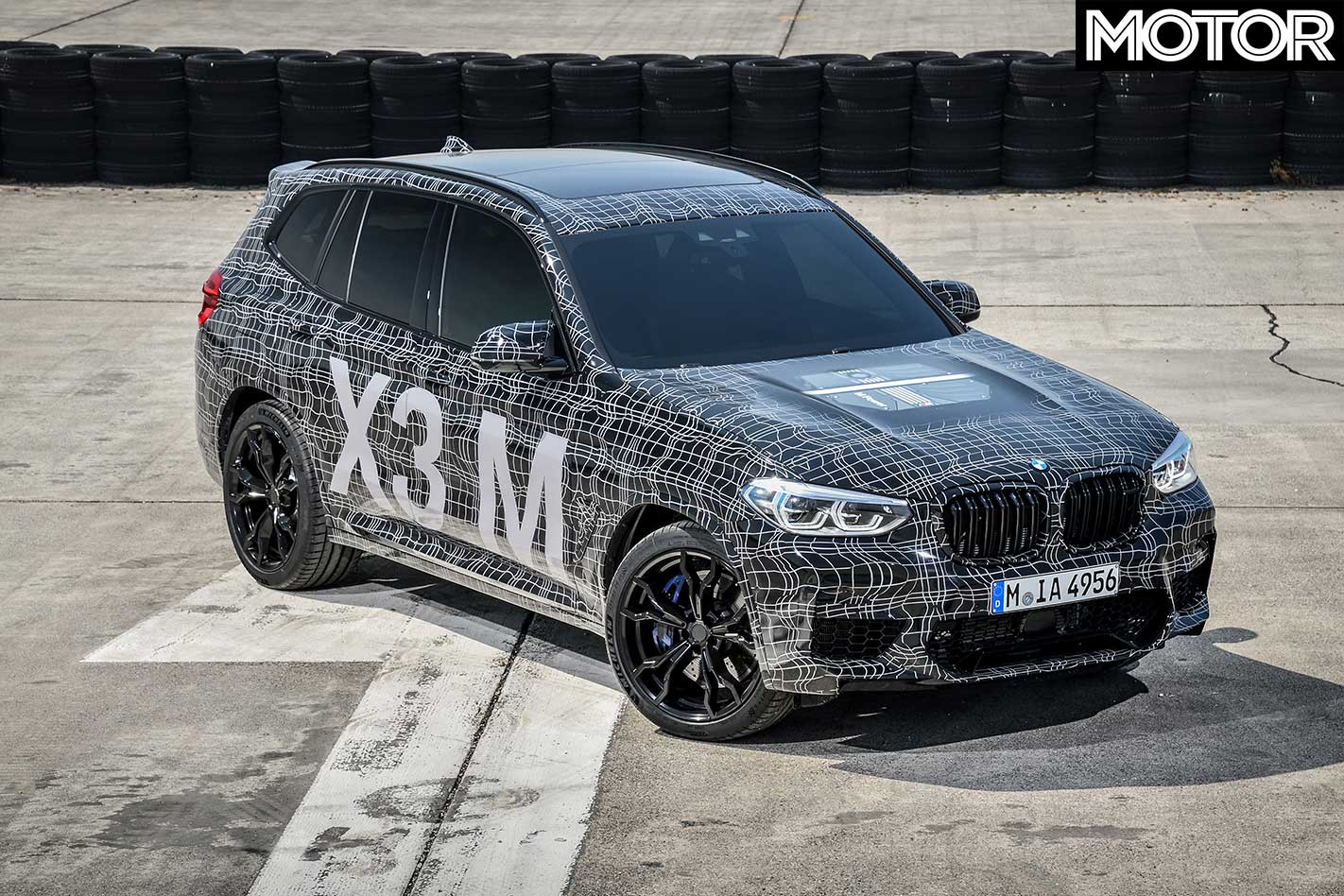
The two M SUVs feature larger air intakes at the front, and quad-exhaust rear aprons, while other identifiable M design cues are seen in the wing mirror shape, and the use of a lip spoiler above the rear window.
BMW M boss Frank van Meel says the X3 M and X4 M are to “set benchmarks in terms of dynamics in their respective vehicle segment,” meaning they’ll need to be two of the fastest small-medium SUVs around.
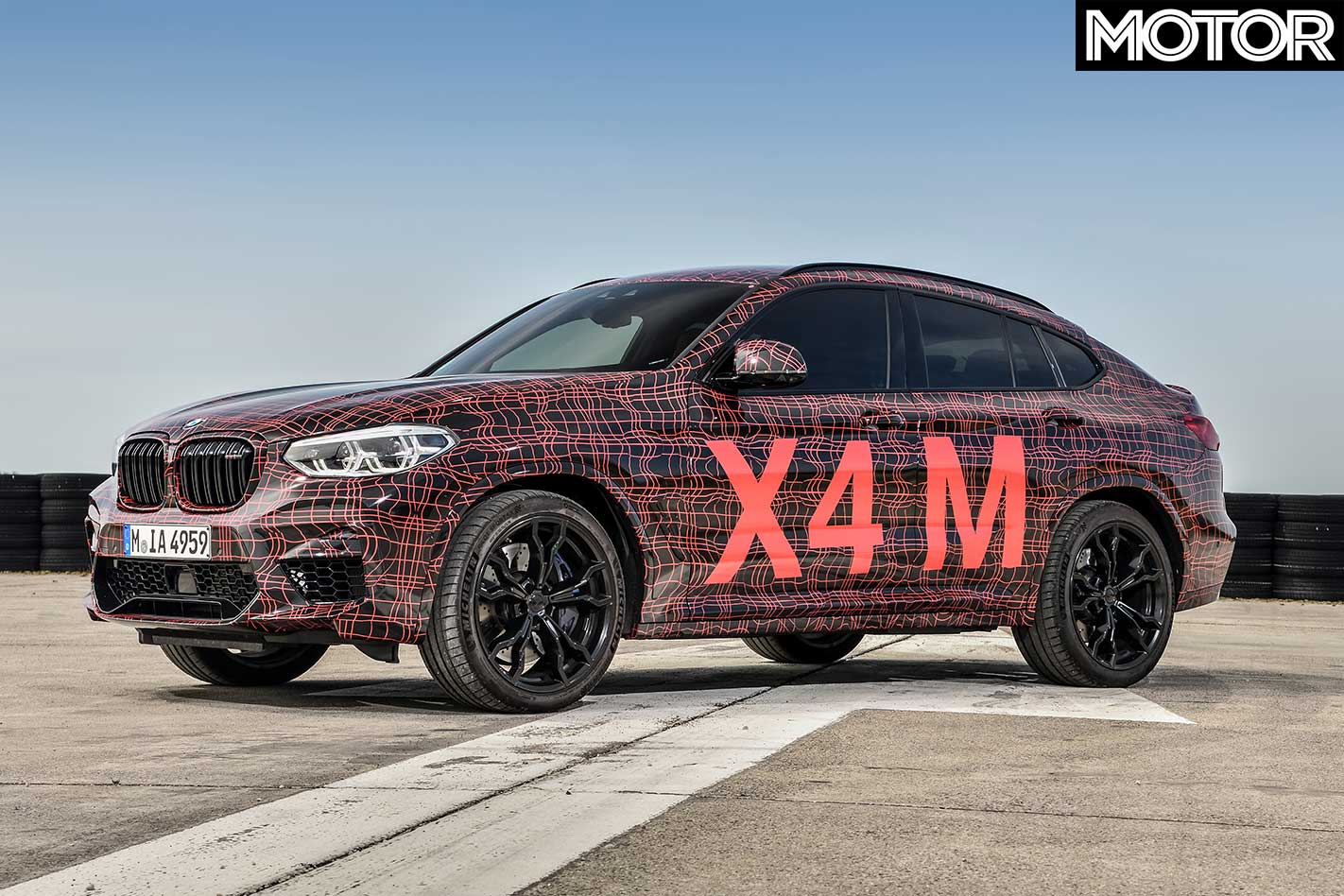
In line with BMW’s other M SUVs, a sub 4-second 0-100km/h sprint should be on the cards, though whether they’ll be able to remain under the two-tonne mark is yet to be seen.
We’d be surprised if these vehicles didn’t come to Australia given the crossover of our love of performance cars and the strong SUV market, but MOTOR readers will be kept up to date when confirmations are made.
We all know the drill. The likes of the Porsche 911 R sold out within seconds and soared in price as sellers sought to make a quick resale buck on the prized, naturally aspirated manual supercar. Heritage or hype, acclaim or demand, see stickers plump up and stay up.
But what of vehicles that are still excellent, but where the opposite occurs? What we mean are successors to hyped, acclaimed cars that don’t quite hit the buyer or media mark. Well, as we found it is these vehicles that – in direct contrast to a 911 R – are genuine bargains.
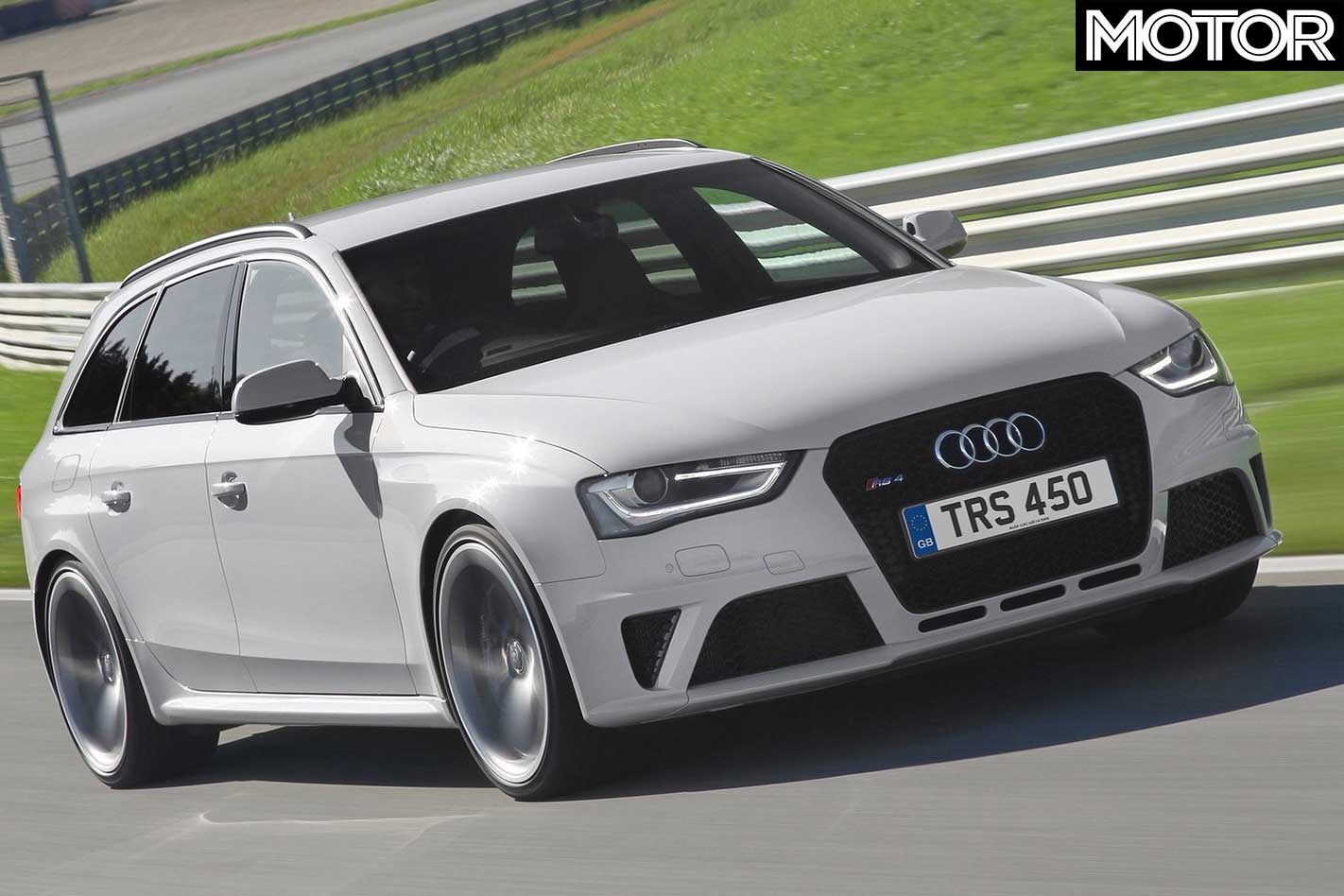
Take the B7-generation Audi RS4 Avant from 2006 to 2008. A RennSport revival after its early-2000s predecessor, it remains in demand today for its mix of mega, 8000rpm 4.2-litre naturally aspirated V8 and six-speed manual transmission in a wagon-backed body. Its B8 successor of 2012 to 2015 used the same engine, however while it was very good, this particular dual-clutch auto model was all a bit like the one that came before, sans manual.
What it means is that finding a decade-old B7 RS4 Avant still requires $50,000 to $65,000 and that simply doesn’t look like great value. But a five-year-old B8 RS4 Avant is now less than half its $150K asking price new, hovering at $70K with as little as 41,000km showing, for depreciation of $16K per year.
But that Audi is at least a medium-sized sports wagon. We all know that full-sized sports sedans fall even harder, and so has been the case with the F10-gen BMW M5.
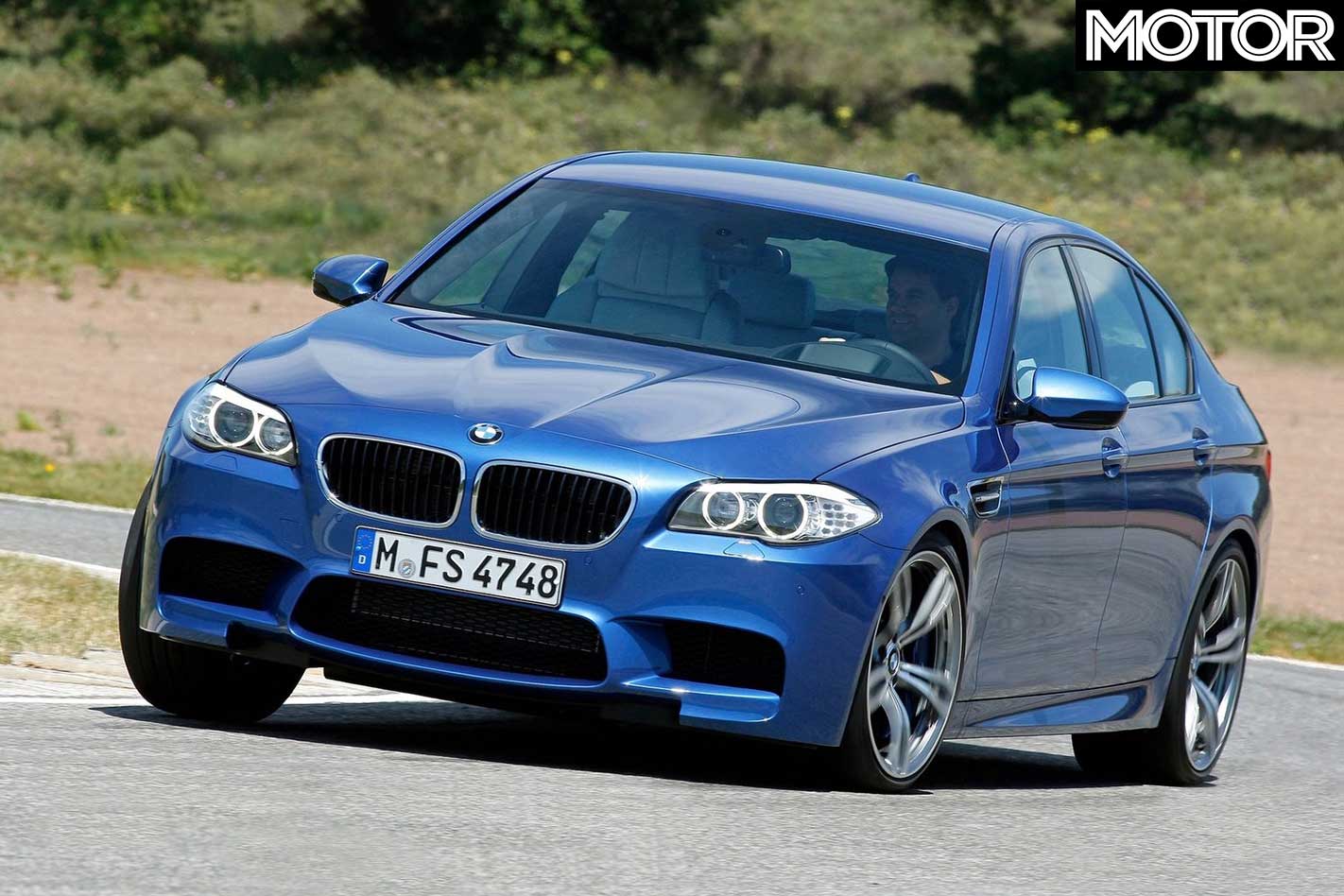
While the late-1990s E39 M5 is revered as one of the best sports sedans ever produced, and the following early-to-mid 2000s E60 M5 packs a whole 10 cylinders under its bonnet, the F10 – as much as this tester really liked it – fell into a bit of a twin-turbo V8-powered dip.
It was so incredibly fast, with a 4.4-second 0-100km/h betraying its stupendous in-gear acceleration, but apparently the 412kW/680Nm rear-driver lacked a bit of feel and soul. It’s Mabo, it’s the vibe, y’know. Anyway, where a decade-old E60 is still in the $45K to $60K bracket, a six-year-old F10 with as little as 51,000km showing can be had from … $70K. And that’s for a car that was $230K new, for depreciation of (deep breath) $26,666 per year.
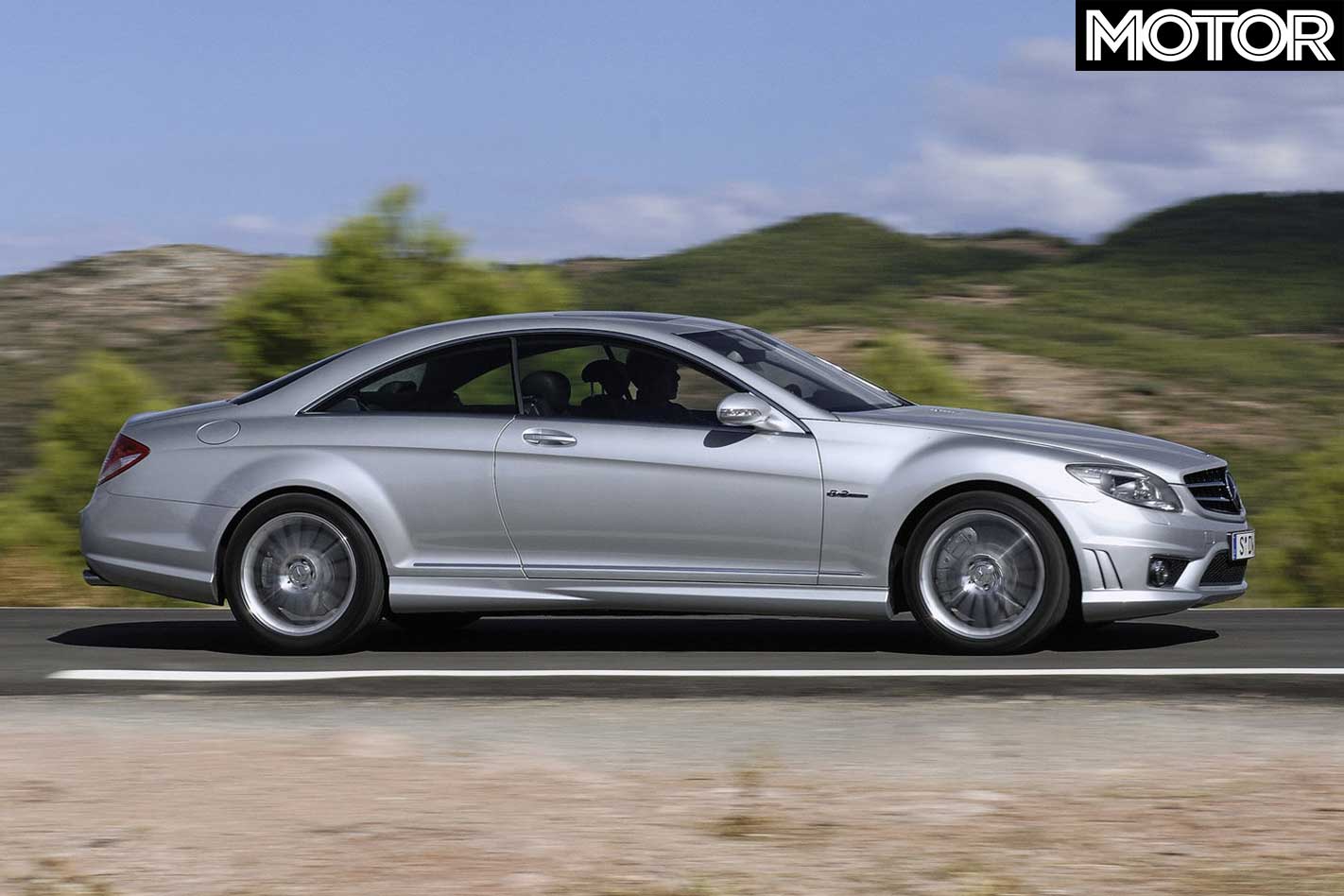
Perhaps a medium wagon or a large sedan are both not for you, though? Then what about a B-pillar-less large coupe? A decade-old Mercedes-Benz CL63 AMG was a staggering $400K new, but the 386kW/630Nm 6.2-litre V8-powered rear-wheel drive two-door can now be purchased from $60K and with fewer than 90,000km – for $30,909-per-year depreciation.
It even had a seven-speed automatic plus every bit of luxury Sir could imagine, while leaving plenty of room for the (combined-cycle 15.9 litres per 100 kilometres) fuel bill that you get with this 5084mm-long, 2084kg coupe. What a buy, though; literally a lot of car for the coin.
