
WITHIN a handful of days, the lights will go out at Toyota’s Altona manufacturing plant and we will be closer to the end of Australia’s rich history of building cars on our own shores.
Holden will be the last local manufacturer to fall, with the Elizabeth factory closing its doors on October 20.
It’s a difficult time to be an Aussie car enthusiast.
We ran a survey recently in order to give you, our readers, a chance to voice your feelings on the issue. More than 1400 people took part in the poll.
This is how you responded:
- A strong majority (77 percent) believe the government should drop taxes and tariffs on all imported cars following the closure of local manufacturing. 17 percent were against that move and 6 percent remain uncertain.
- Readers were mostly united on feeling proud of Australian manufacturing with 97 percent sharing the sentiment.
- When probed if Australia should still be manufacturing cars, 93 percent believed we should, while 7 percent disagreed.
- There was also a strong response to if you felt the government let Australia down with inadequate support for local manufacturing. A vast majority, 82 percent, agreed the country was let down, while 15 percent responded ‘no’ and 3 percent were left unsure.
- As for how you felt about the end of manufacturing, anger and sadness were the most commonly felt emotion with 46 and 45 percent respectively. Some felt indifferent (6 percent), while others were confused (2 percent). A tiny group felt happy (1 percent).
- Australian-built car owners were well represented within respondents, with 74 percent having one in the garage. Of those, 67 intend to hold onto their vehicle, while 7 percent didn’t.
- With no Aussie-built cars available to purchase, just 20 percent of respondents believe overseas cars offer better value than those built on our shores. The majority of readers disagreed (58 percent), while 22 percent remain unsure.
- The majority of readers (85 percent) believe locally made cars were better suited to Aussie conditions than imported vehicles, while 11 percent disagreed, and 4 percent were unsure.
- There was a divide on who people blamed for the end of local manufacturing. One in four people thought the Liberal/National Party Coalition was predominately to blame, while 24 percent believed not one group could shoulder the responsibility. 19 percent fingered the Australian Parliament as a whole, while 16 percent took aim at unions. The Manufacturers were to blame according to 8 percent of readers, while four percent blamed The Labor Party, and another four percent were unsure on who to blame at all.
- Finally, 81 percent of respondents believe the government should create new incentives to encourage car companies to set up manufacturing facilities in Australia again – 14 percent disagreed, while 5 percent are unsure.
In the over-hyped world of car marketing, the word ‘new’ is a currency devalued by frequent use. It can be squandered on a car with nothing new but badges, or well spent on a clean sheet design.
Holden’s VX Commodore, the mid-life facelift of 1997’s crisp new VT, fits somewhere in between. But don’t think VX is light-on for newness based on the nose and tail job. They just flag the subtle but significant changes you can’t see.
The VX’s biggest improvement is in passive safety, through minor but extremely effective changes based on extensive research into side impacts. Modifications to the B-pillar improve side impact protection across the board. If you have a side-on collision in a VX not fitted with side airbags, risk of injury is halved compared with a similarly equipped VT. The addition of antiskid brakes to standard equipment lists of Executive and S models means the entire Commodore range now has Bosch version 5.3 ABS. As well, traction control is now available in combination with manual transmission for the first time. It’s standard in the manual SS and optional in other models.
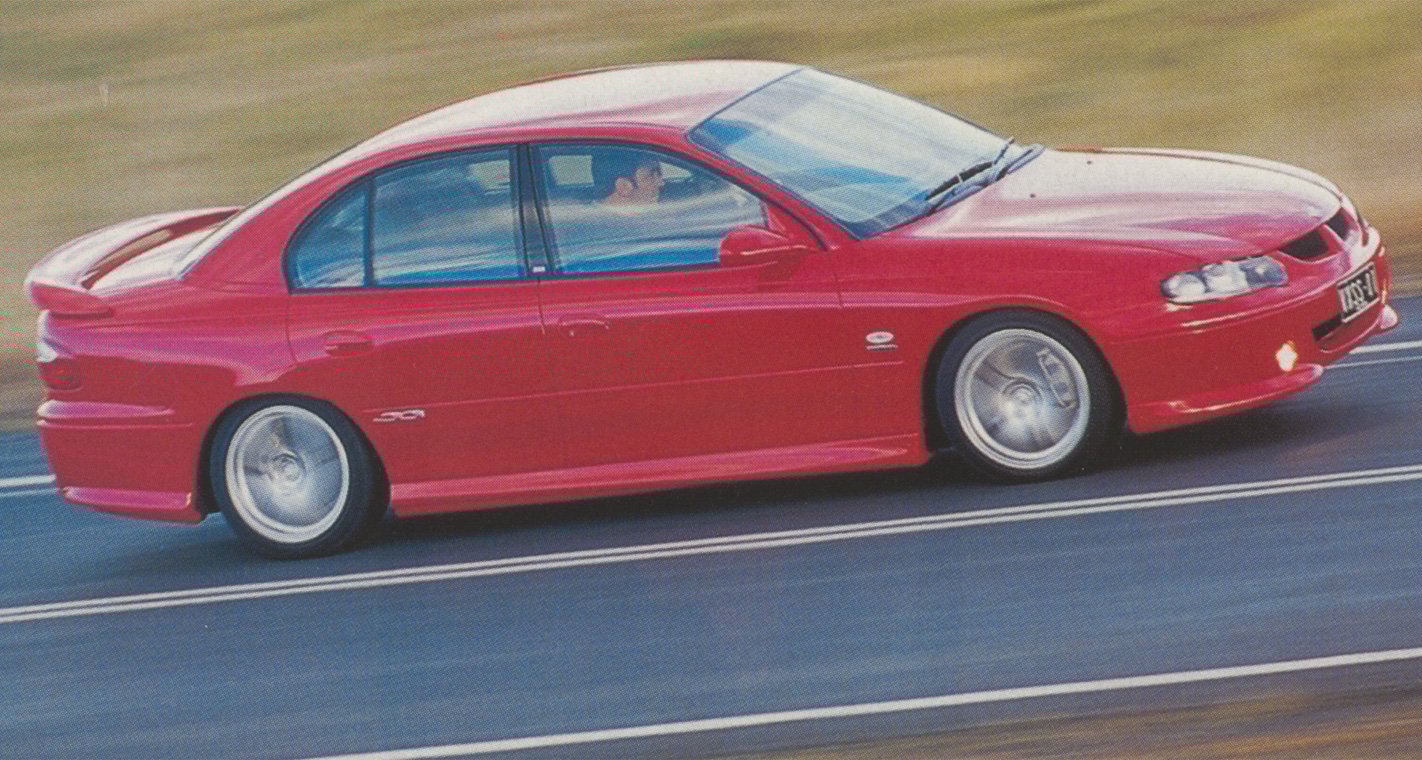
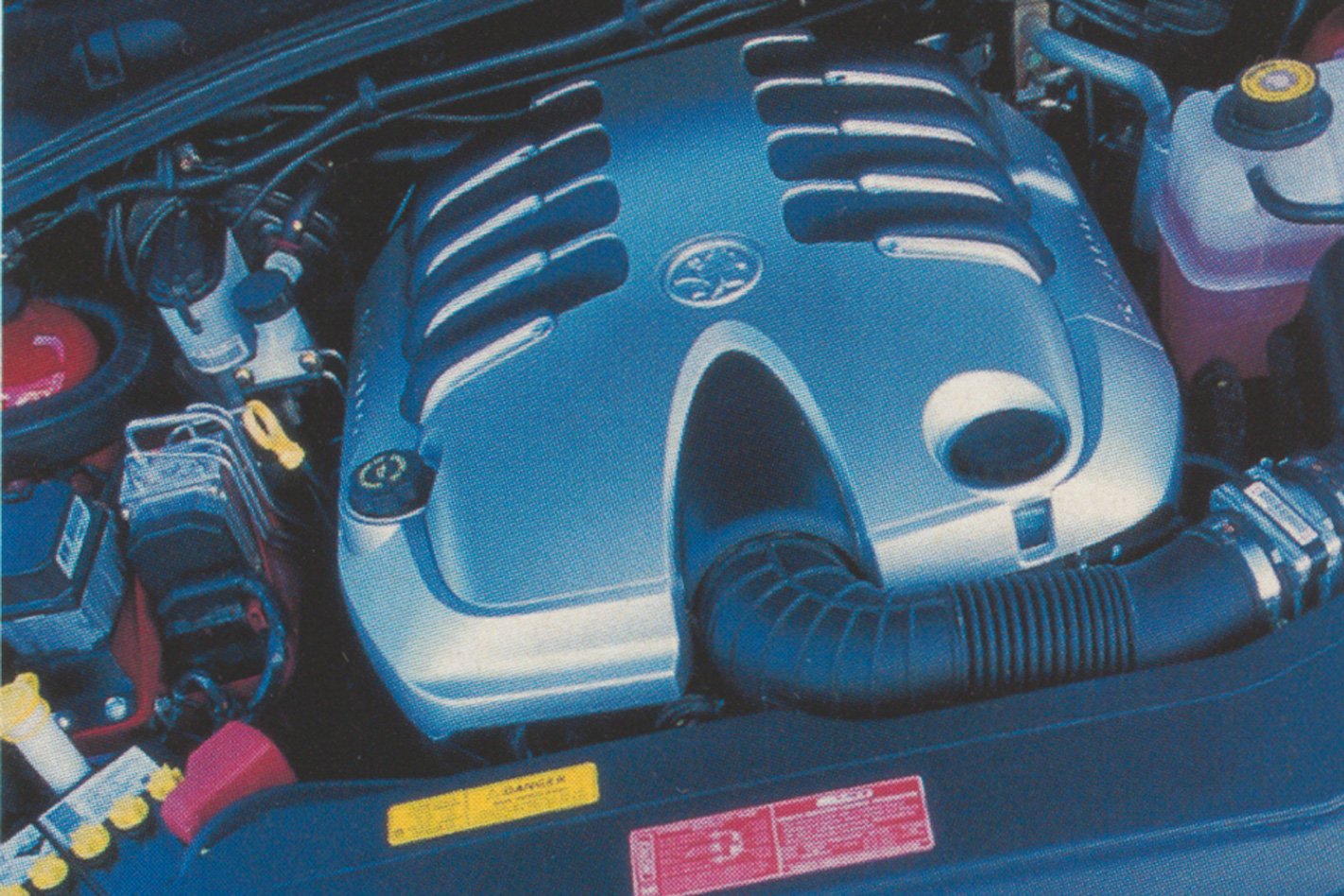
Both V6 and V8 engines have been tweaked to improve output and fuel economy. The 3.8 has undergone subtle changes that increase power by 5kW to l52kW at 5200rpm, at the same time as marginally improving fuel consumption. A new drivetrain control computer with 33 percent more memory and a new inlet manifold are the key changes. The boost in computer power allows individual cylinder spark control, while the diecast inlet manifold has a centrally located crankcase ventilation outlet. Both measures contribute to the improvements. The VX’s new driveshaft, with rubber couplings at each end, also helps boost fuel economy. While the main aim of a two-piece shaft is to isolate vibration, a side effect is that it allows the torque converter’s fuel saving lock-up clutch to be engaged earlier than before.
The V6 auto transmission has been recalibrated for better response to throttle changes, a more sensitive downshift and earlier torque converter clutch unlock in fourth gear.
Holden’s engineers say they have altered the front suspension for a more linear response to steering input. The revisions are simple. The lower control arm pivot points were raised by 4mm and ball joints replaced rubber bushings in the lower ends of the links, between the anti-roll bar and struts.
While changes vary according to model, Holden says kerb weight is up on average only 10kg. From VT Series II to VX, there’s 4kg more on Executive level and 19kg extra for Calais V6.
The rear end, however, remains a concern. Its tendency to bow under pressure, with a roll-steer response to heavy cornering loads, isn’t pleasant. The rear semi-trailing arm suspension, around since the 1970s, is a proven design. This means, to Holden, that it’s proven it works.
There’s no reason to alter it and there’s also little official sympathy for customers with complaints about excessive rear tyre wear. “There is no problem,” says Holden engineer Colin Sichlau, of Commodore’s IRS. Tyre wear is related to under-inflation of tyres, incorrect tyre use and overloading, he maintains.
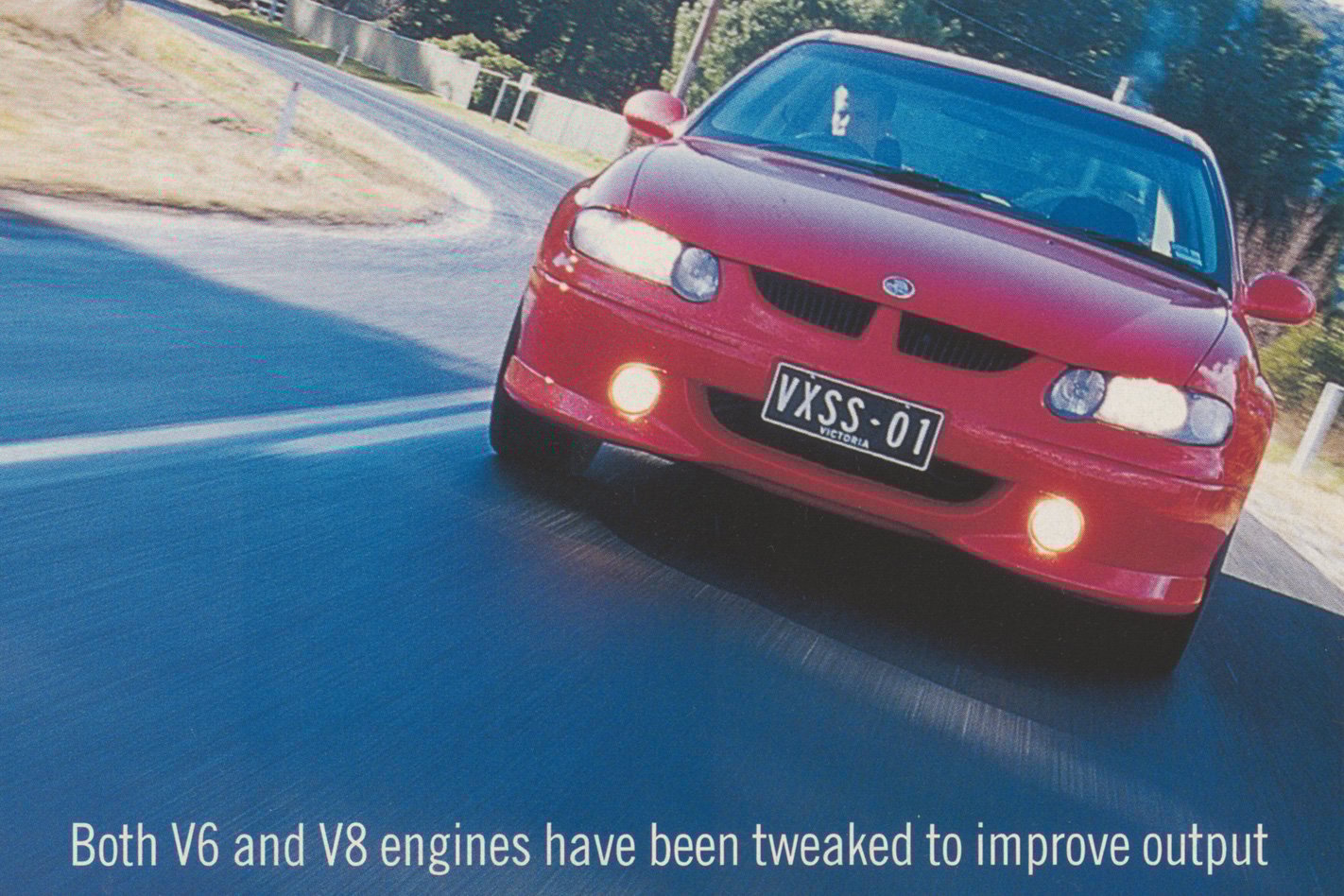
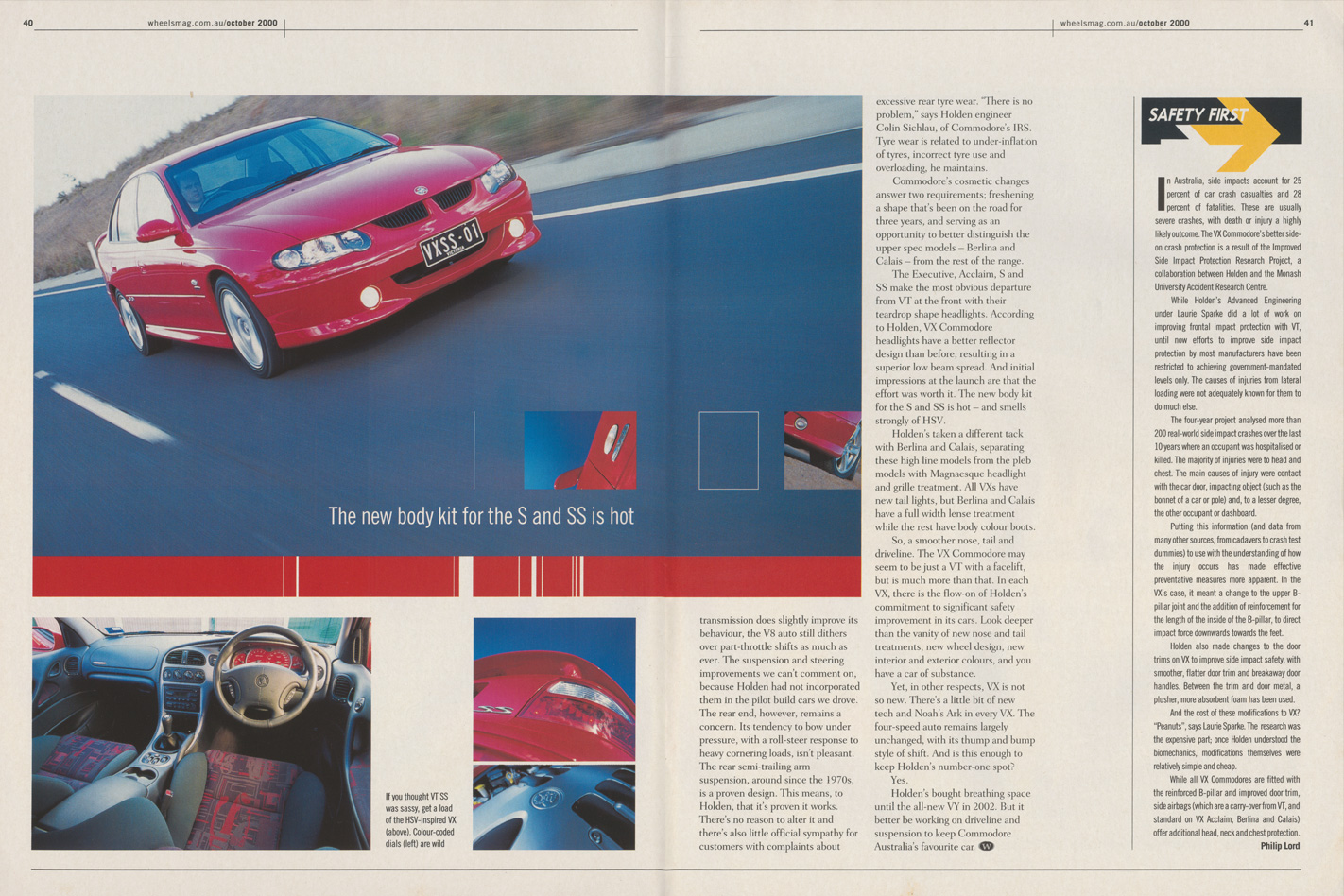
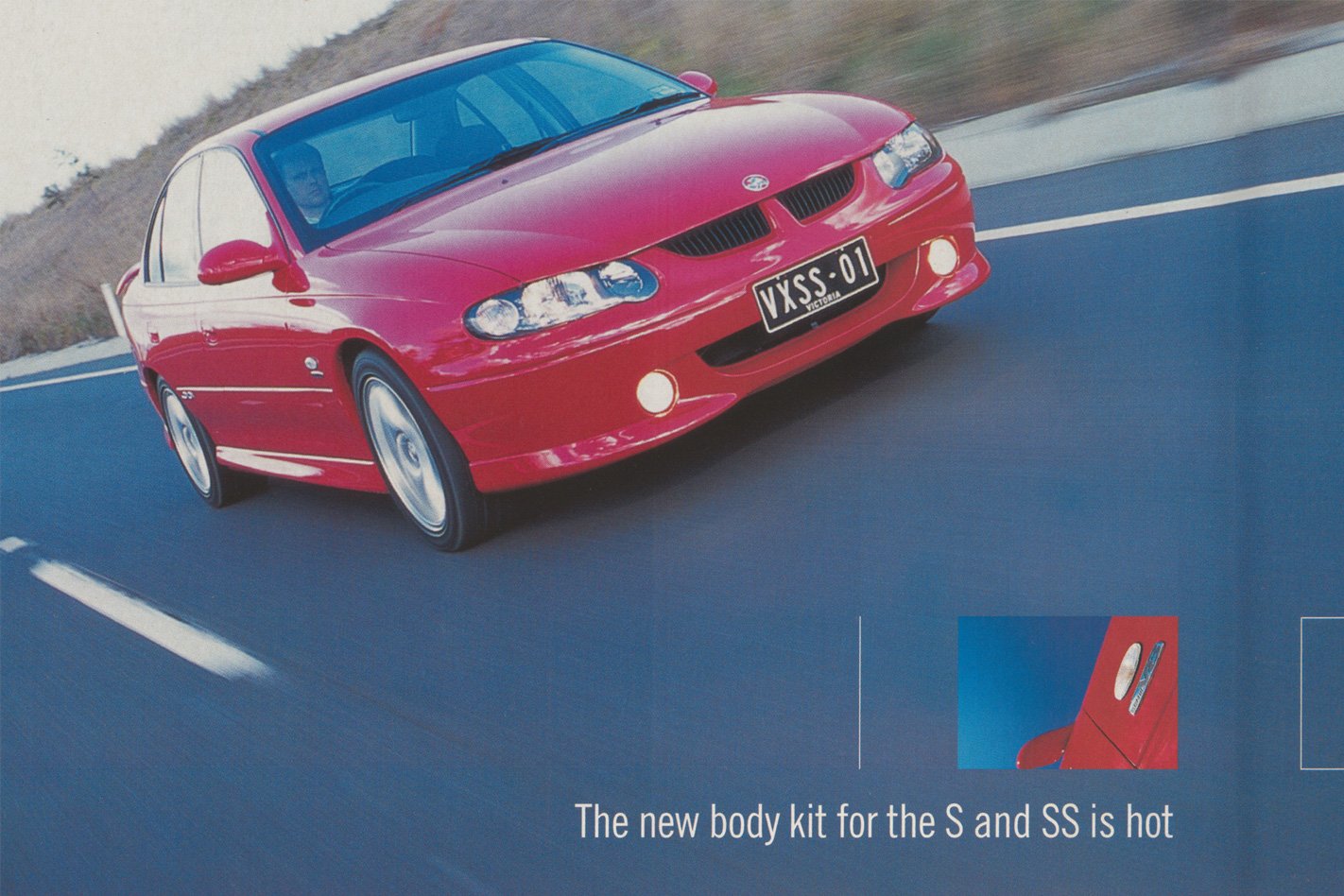
Holden’s taken a different tack with Berlina and Calais, separating these high line models from the pleb models with Magnaesque headlight and grille treatment. All VXs have new taillights, but Berlina and Calais have a full width lense treatment while the rest have body colour boots.
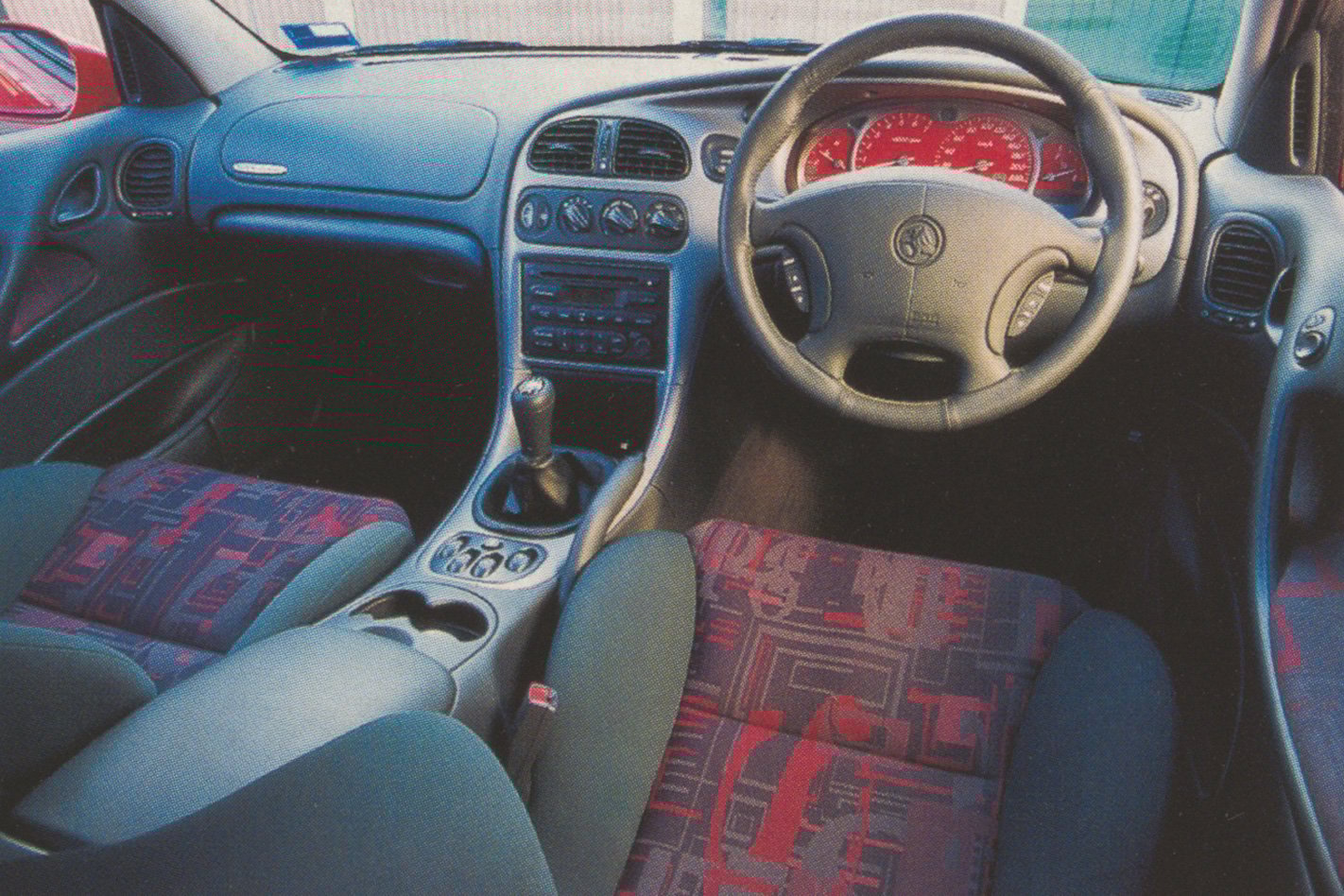
So, a smoother nose, tail and driveline. The VX Commodore may seem to be just a VT with a facelift, but is much more than that. In each VX, there is the flow-on of Holden’s commitment to significant safety improvement in its cars. Look deeper than the vanity of new nose and tail treatments, new wheel design, new interior and exterior colours, and you have a car of substance.
Holden’s bought breathing space until the all-new VY in 2002. But it better be working on driveline and suspension to keep Commodore Australia’s favourite car.
Safety first
In Australia, side impacts account for 25 percent of car crash casualties and 28 percent of fatalities. These are usually severe crashes, with death or injury a highly likely outcome. The VX Commodore’s better side-on crash protection is a result of the Improved Side Impact Protection Research Project, a collaboration between Holden and the Monash University Accident Research Centre.
The four-year project analysed more than 200 real-world side impact crashes over the last 10 years where an occupant was hospitalised or killed. The majority of injuries were to head and chest. The main causes of injury were contact with the car door, impacting object (such as the bonnet of a car or pole) and, to a lesser degree, the other occupant or dashboard.
Holden also made changes to the door trims on VX to improve side impact safety, with smoother, flatter door trim and breakaway door handles. Between the trim and door metal, a plusher, more absorbent foam has been used.
While all VX Commodores are fitted with the reinforced B-pi liar and improved door trim, side airbags (which are a carry-over from VT, and standard on VX Acclaim, Berlina and Calais) offer additional head, neck and chest protection.
The BMW 125i is the biggest seller in the 1 Series range and it’s not difficult to see the attraction.
Producing 165kW/310Nm, it’s packing roughly the same punch as a Volkswagen Golf GTI (though a little down on torque) with a claimed 0-100km/h time of 6.1sec. The difference is, of course, that while the GTI is dragged around by its front wheels the BMW pushes things along from the rear.
It’s more expensive than the GTI – at $49,990 it’s entering the territory of the much more powerful Golf R – but does that rear-drive layout provide dynamic compensation?
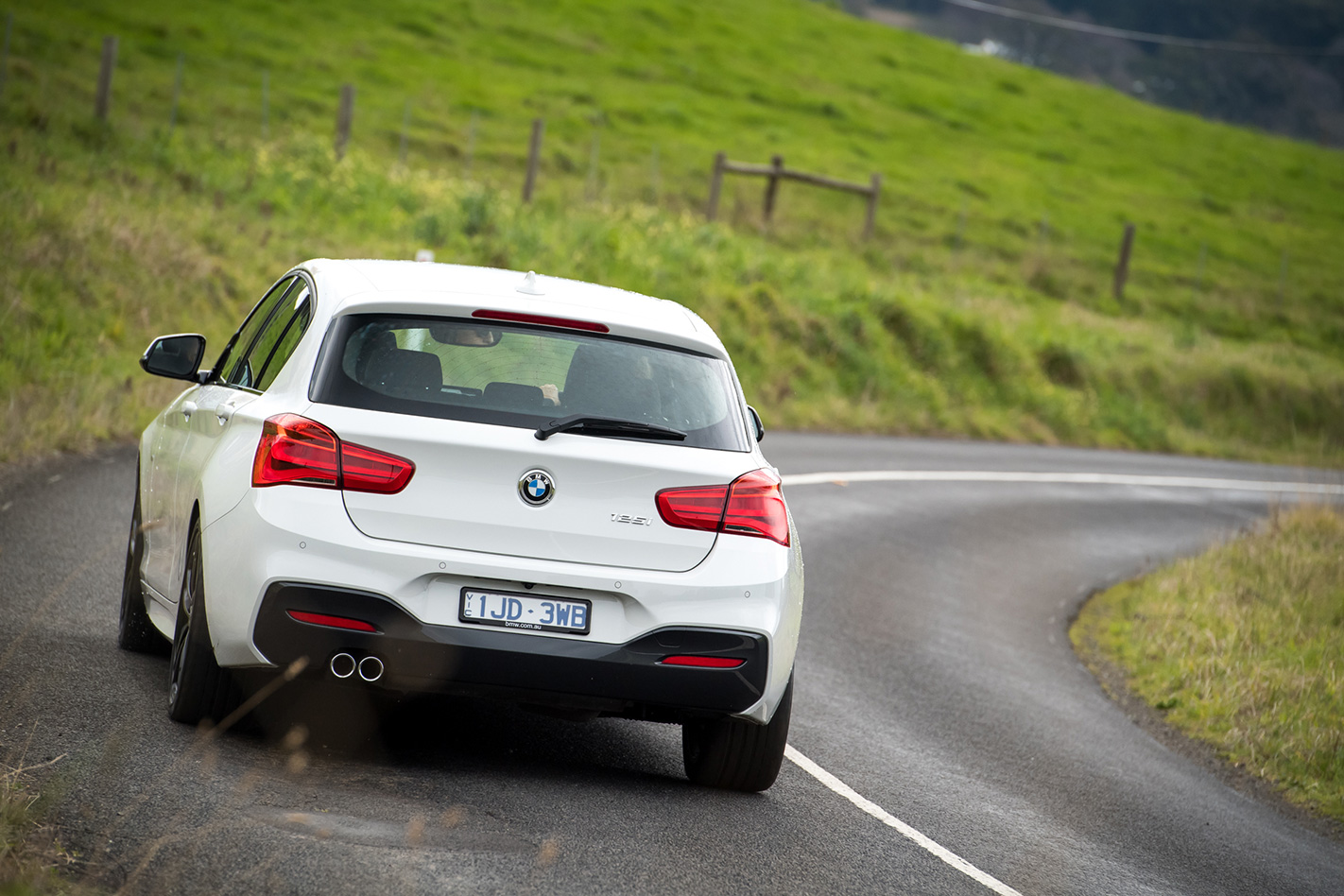
Rear seat accommodation is also not a 1 Series strong point, at least for adults, though its boot is bigger than you might expect given the packaging demands of that rear-drive USP.
Unfortunately, the 125i doesn’t quite deliver on its on-paper promise. It flows along a road well and can be hustled quite quickly without complaint, but the front and rear ends don’t feel totally at tune with one another when turning into a corner and the standard M Sport suspension, which is firmer and 10mm lower, seems to hinder more than help.
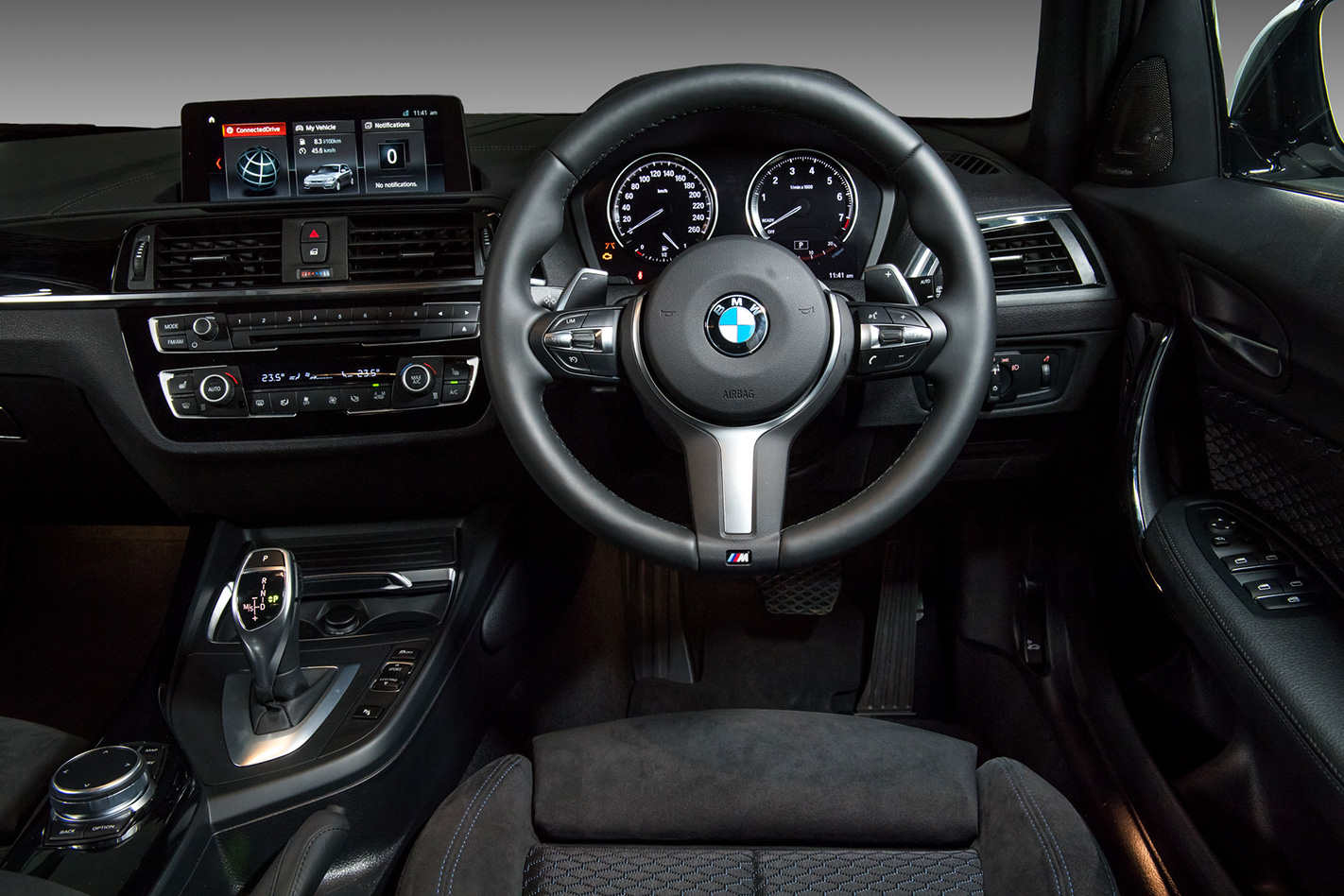
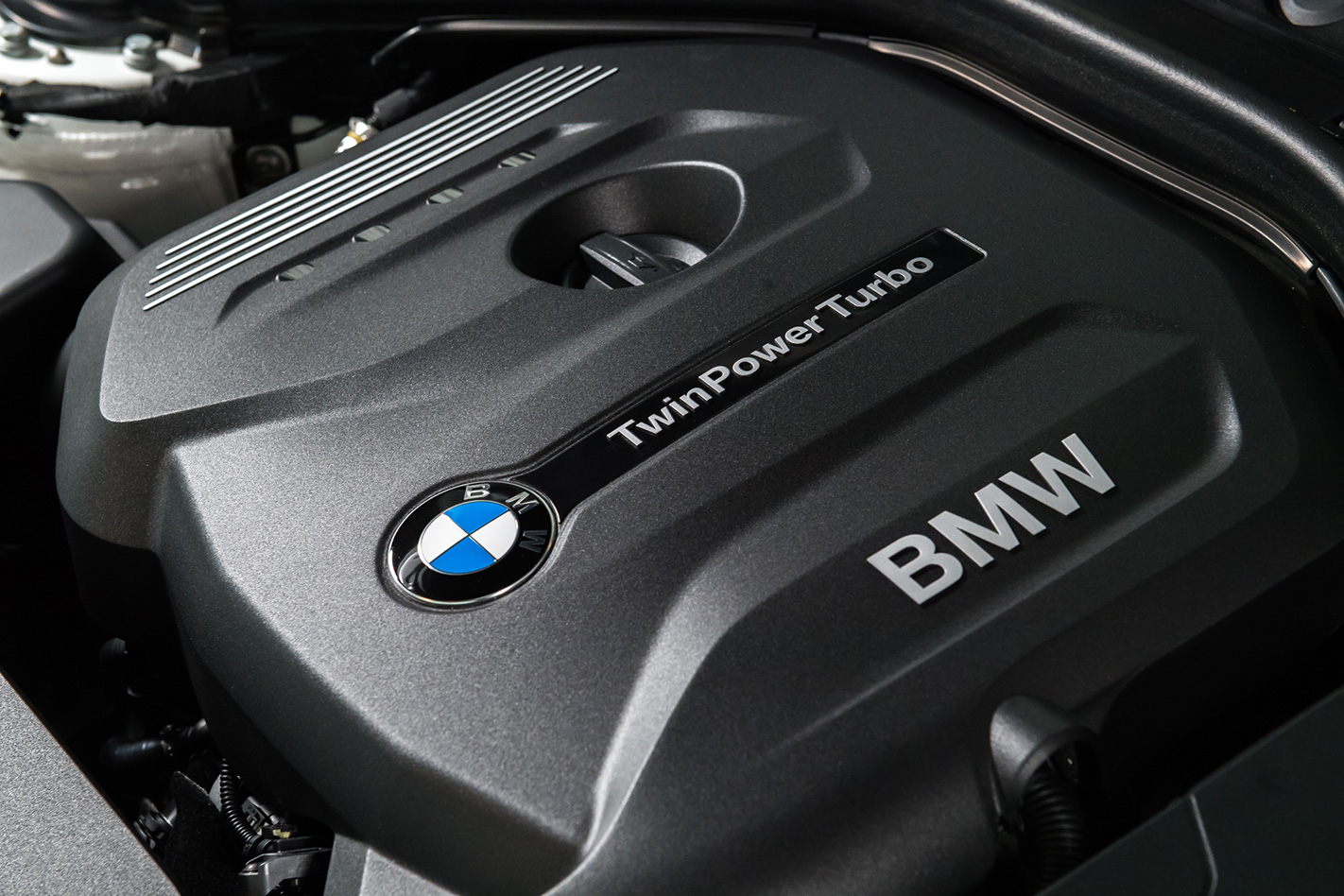
Equally, its engine falls into the ‘good not great’ category, which is a problem when you’re charging a premium price tag. There’s decent mid-range urge, easily accessible thanks to the excellent eight-speed ZF auto, but beyond 5000rpm power tails off dramatically.
This same engine in 185kW/350Nm tune, as found in the 230i coupe, feels both stronger and more eager to rev to its 7000rpm redline.
As it stands the idea of a rear-drive warm-to-hot hatch is a welcome one, but German rivals, particularly Volkswagen’s recently updated Golf range, offer more enthusiast and ownership appeal.
3.5 stars out of 5 Likes: Rear-drive balance Dislikes: Not quick enough; unsettled ride
2017 BMW 125i specs: Engine: 1998cc inline-4cyl, DOHC, 16v, turbocharger Power: 165kW @ 5200-6500rpm Torque: 310Nm @ 1400-5000rpm Weight: 1400kg 0-100km/h: 6.1sec (claimed) Price: $49,990
RED Bull Racing’s Max Verstappen avoided trouble in the last-ever Malaysian Formula One Grand Prix to take a fine, controlled win 12.7 seconds ahead of championship leader Lewis Hamilton’s Mercedes and Australia’s Daniel Ricciardo, who scored his eighth podium of 2017.
Though he extended his championship lead over Sebastian Vettel to 34 points, Hamilton and Mercedes left Sepang with lots to worry about. The Silver Arrows didn’t have the sheer speed of Ferrari and Red Bull in Malaysia, and there are more fast tracks coming up, starting with Japan next weekend.
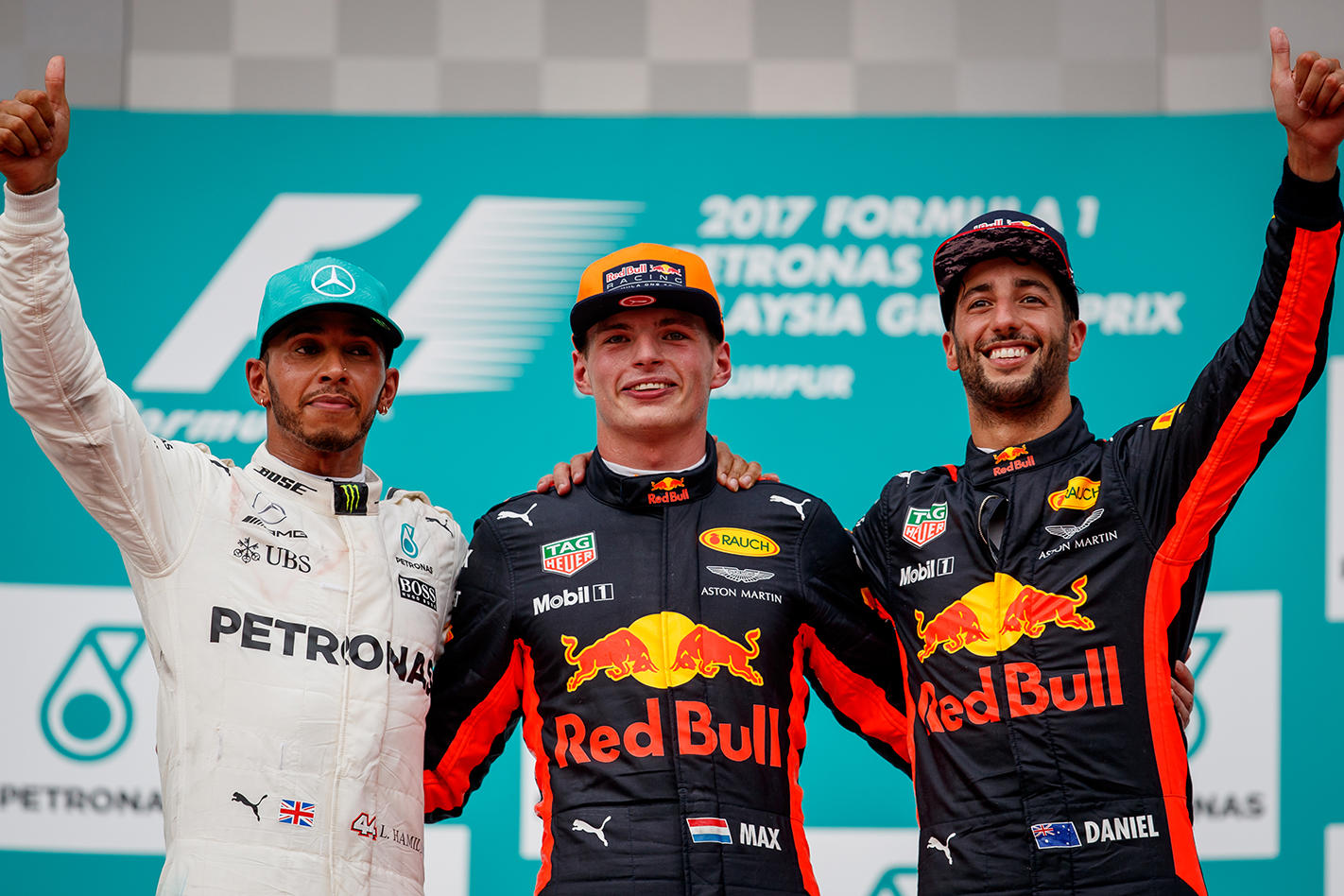
Often a first-lap magnet or a catalyst for trouble this year, the fiery young Dutchman followed pole winner Hamilton into the tricky turn one ahead of the fast-starting Valtteri Bottas (Mercedes) and teammmate Ricciardo.
Then on lap four, Verstappen used his battery power to whip past Hamilton, who with the championship stake was never going to defend too forcibly.
After that, Verstappen, who celebrated his 20th birthday the previous day, had the race at his mercy and won in a canter. “Straight away I could see our pace was good and that Lewis was struggling with traction,” he said. “As soon as I passed Lewis I knew from there onwards I could control the race. The car was really good and our pace on the soft tyre was better than I expected.”
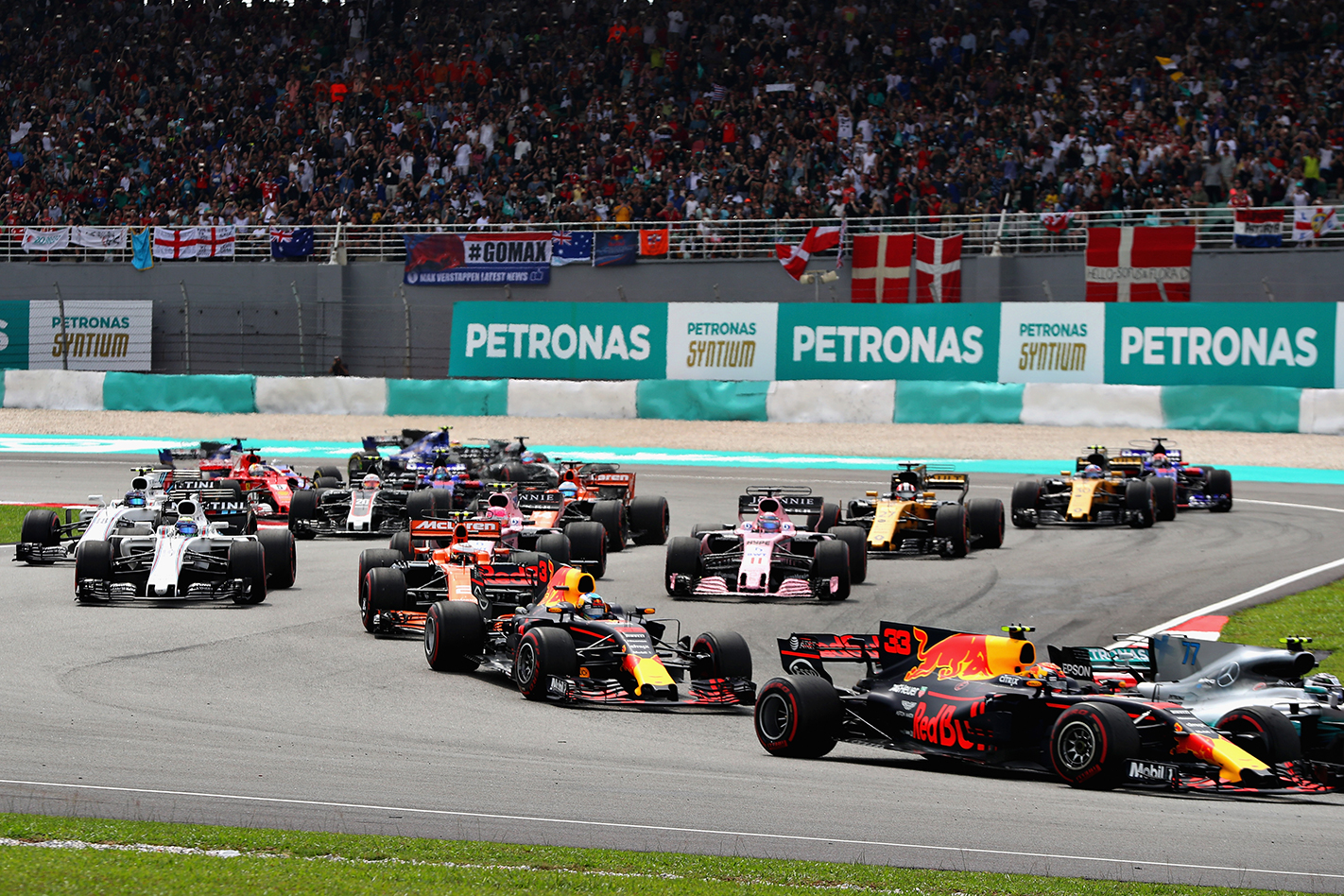
Missing from the race was Kimi Raikkonen, whose Ferrari encountered a last-minute mechanical issue and was wheeled away from the outside of the front row of the grid in what was another embarrassing grand prix for the red cars. The Finn’s DNS (did not start) came on top of Sebastian Vettel missing qualifying with a power loss, forcing him to start at the back of the 20-car grid.
When the lights went out, Vettel embarked on an impressive recovery mission, overtaking car after car to climb up to fourth behind Ricciardo. The German appeared to have the appetite and the car speed to make the podium but Ferrari wouldn’t give him permission for anything more than just a brief crack at third place.
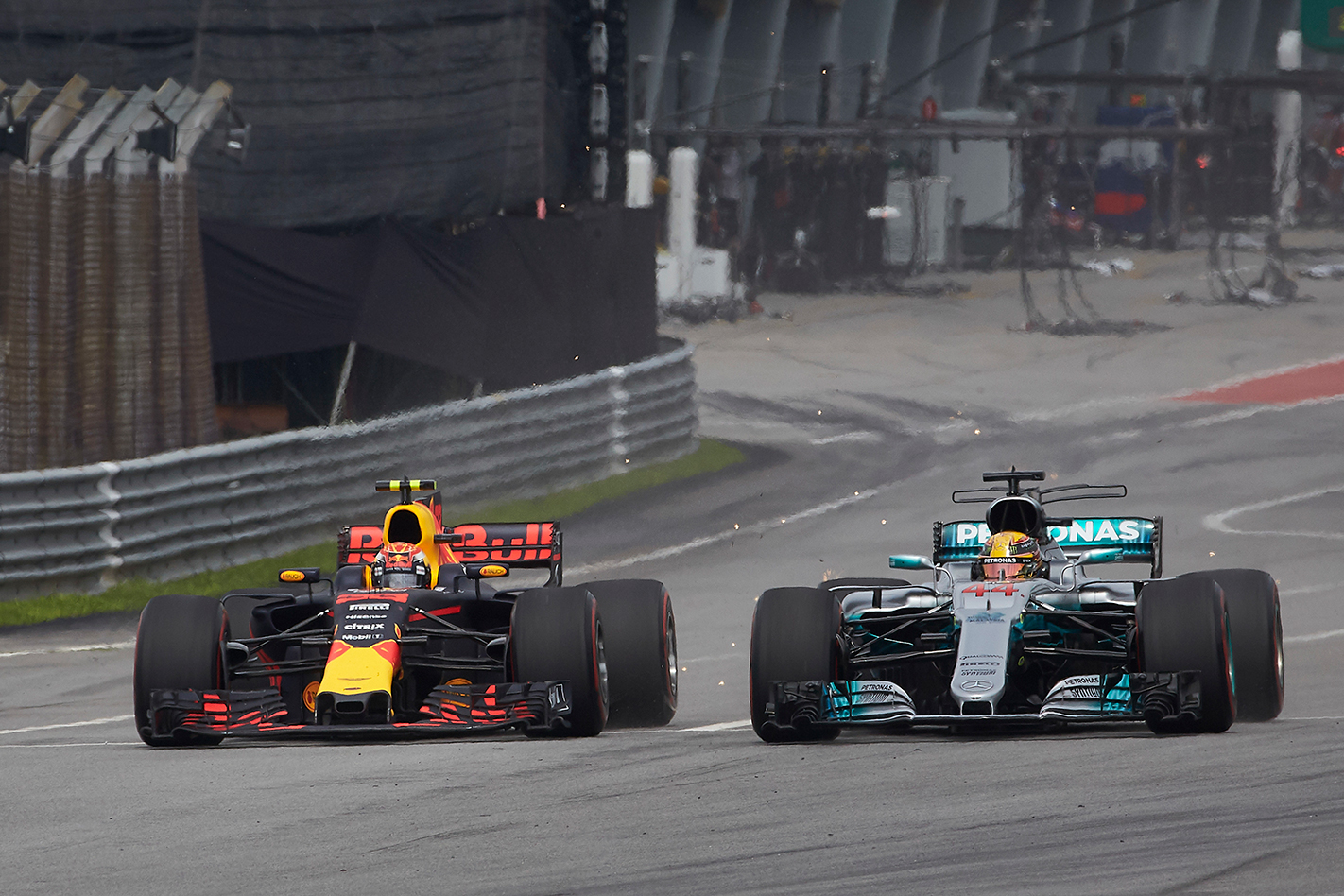
There were no further attacks, prompting praise for Ricciardo over the team radio: “You’ve broken Vettel’s spirit; he’s having to look after his tyres now. Good job, mate.”
More likely Ferrari opted to turn down Vettel’s engine to preserve it for future races.
Either way, Ricciardo held on to third.
“Seb came really quick at the end and I thought he was going to be a handful,” Ricciardo said after the race. “But he only had one strong attack and then we were able to pull away.
“If I’m honest I would have liked a bit more of a fight until the closing stages just to have made it a little more exciting as the last few laps were kind of lonely,” he said. This double podium is a very positive result for us today. Obviously Max got the big one and drove well so congrats to him for the win; he drove strong all weekend. There were a few extra bits available for the cars here and I think we’re going to try that again [next weekend] in Suzuka; it looks positive for us at the high downforce circuits.”
Ricciardo looked and sounded upbeat, but the painful reality is that his teammate finished 22.7 seconds up the road. And two places ahead.
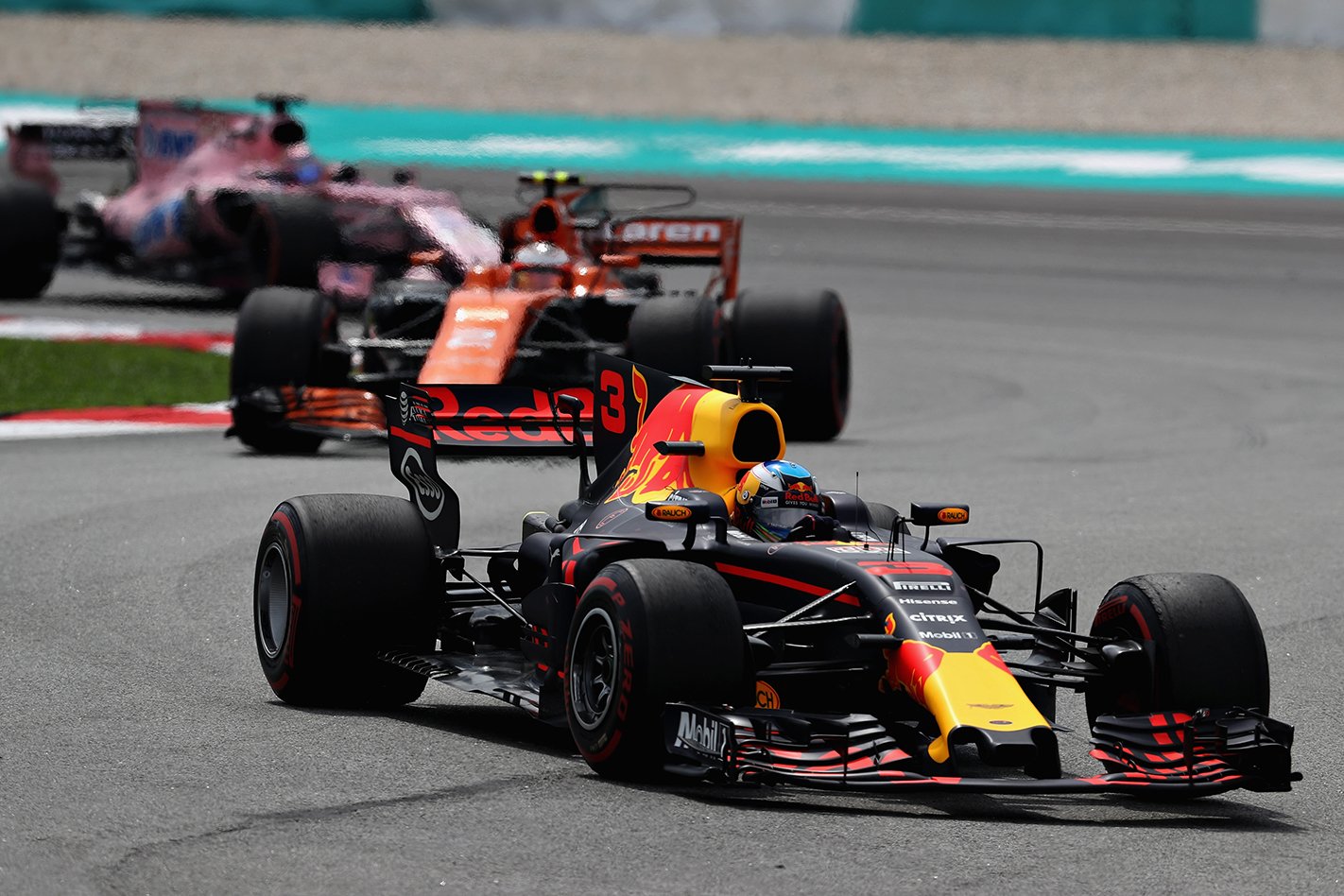
There were lots of angry young men afterwards, but one smiling was Stoffel Vandoorne, who finished seventh in his McLaren Honda, his best result in F1
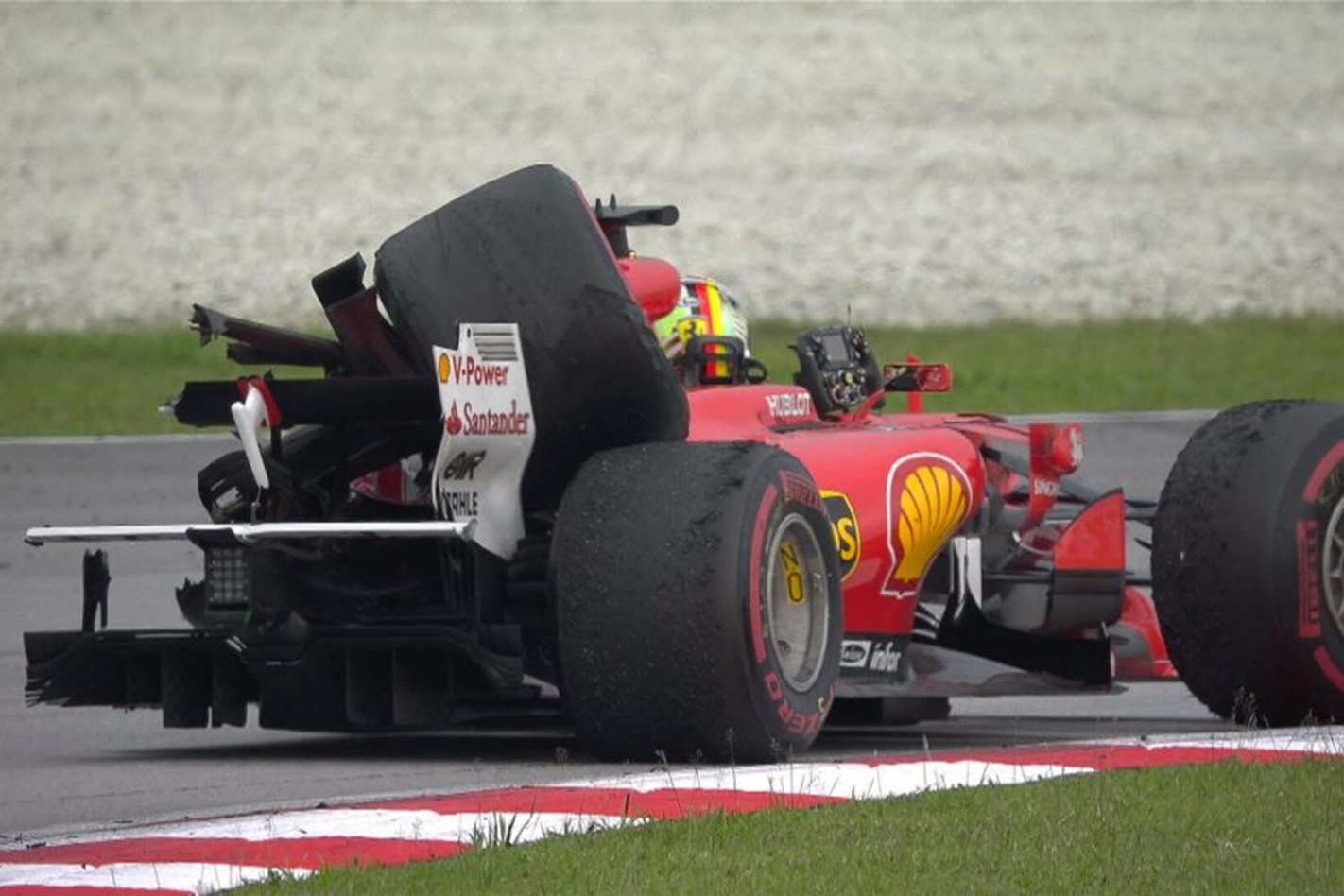
There was another shock to come, when Vettel’s Ferrari and Lance Stroll’s Williams came together on the cool down lap, the impact tearing the left rear from the Ferrari. Vettel blamed Stroll but stewards later made the call that neither driver was “wholly or predominantly to blame” for the clash.
The last-ever Malaysian Formula One Grand Prix and its lead-up offered up some baffling scenarios from beginning to end.
But come qualifying, the form went out the window, along with more of Vettel’s receding title hopes. His Ferrari needed and engine change, and then there were more dramas when qualifying started. He was consigned to a grid start offering a full and uninterrupted view of 19 cars ahead.
From struggling through free practice, Hamilton and his engineers found the key to going fast by Saturday afternoon. The Briton claimed pole by the proverbial bee’s appendage, from Raikkonen’s red car, then Verstappen (the fastest Bull driver again) and Ricciardo.
Even Mercedes’ Toto Wolff struggled to explain the variable pace of his cars (and the main opposition) across Friday and Saturday. “We have seen a pretty confusing picture of performance, with different cars quick at different times and even big gaps between teammates,” Wolff said. “Our struggle has been to get the tyres into the right working window, then things came together [in qualifying] as the track temperatures cooled. After a tough Friday, the team here at the track and back at base did a good, calm job to analyse the situation and come up with some improvements. And then, when it really counted, Lewis was able to put together a blistering lap to take pole – something we didn’t expect at all going into qualifying.”
Making his F1 debut for Toro Rosso in place of the rejected and dejected Daniil Kvyat was GP2 (now F2) star Pierre Gasly in what the team says is an evaluation before it settles on its 2018 driver line-up. While Toro Rosso insists Kvyat has not been booted, the Russian’s confidence would have plunged even lower when the newbie qualified a rather impressive 15th, one place and not much more than one-tenth slower than highly regarded Carlos Sainz Jr.
The lead-up was also disrupted by a safety shocker, a dislodged drain cover, which caused Romain Grosjean’s Haas to fire off into a barrier, sustaining serious damage.
As well as a memorable weekend for Verstappen, the team also had some big if not unexpected news to confirm, announcing Aston Martin as its naming partner for the coming three years, the closer relationship coming on the back of its Valkyrie hypercar project.
TOYOTA’S catalogue of Aussie-assembled cars is far more extensive than the Camry, Aurion and Corolla. In fact, with Australia being the first country outside of Japan to have a Toyota factory built on its soil, the list of cars that were built here is a long one.
Toyota’s Australian manufacturing presence will cease on Tuesday after 54 hard-charging years, so to celebrate the Japanese carmaker’s commitment to our country we’ve compiled a list of the most significant Toyotas to be built on our shores – from the first CKD Tiaras through to the volume-manufactured Camry that will be the last to roll down the company’s Altona production line.
Scroll through the above gallery and expand the captions to take a walk down Toyota Australia’s memory lane.
It’s a seemingly simple left-into-right. A flick of the wrists, an easy-over shifting of weight from one pair of Z-rated tyres to the other, then away.
A one dimensional wiggle. But when you’re about to turn-in at something approaching 140km/h, that first left rushes up much, much faster than you expect. With the belt cinched tight, your left knee braced against the door trim and your right hand pushing down against the seat cushion, you can see past Mark Skaife‘s shoulder. From the back seat, you watch the speedo needle rise and fall, as Skaife loads then releases suspension and tyres. It never drops below 130km/h and is brushing past 160 as we run millimetre perfect to the edge of the bitumen exiting the right-hander.
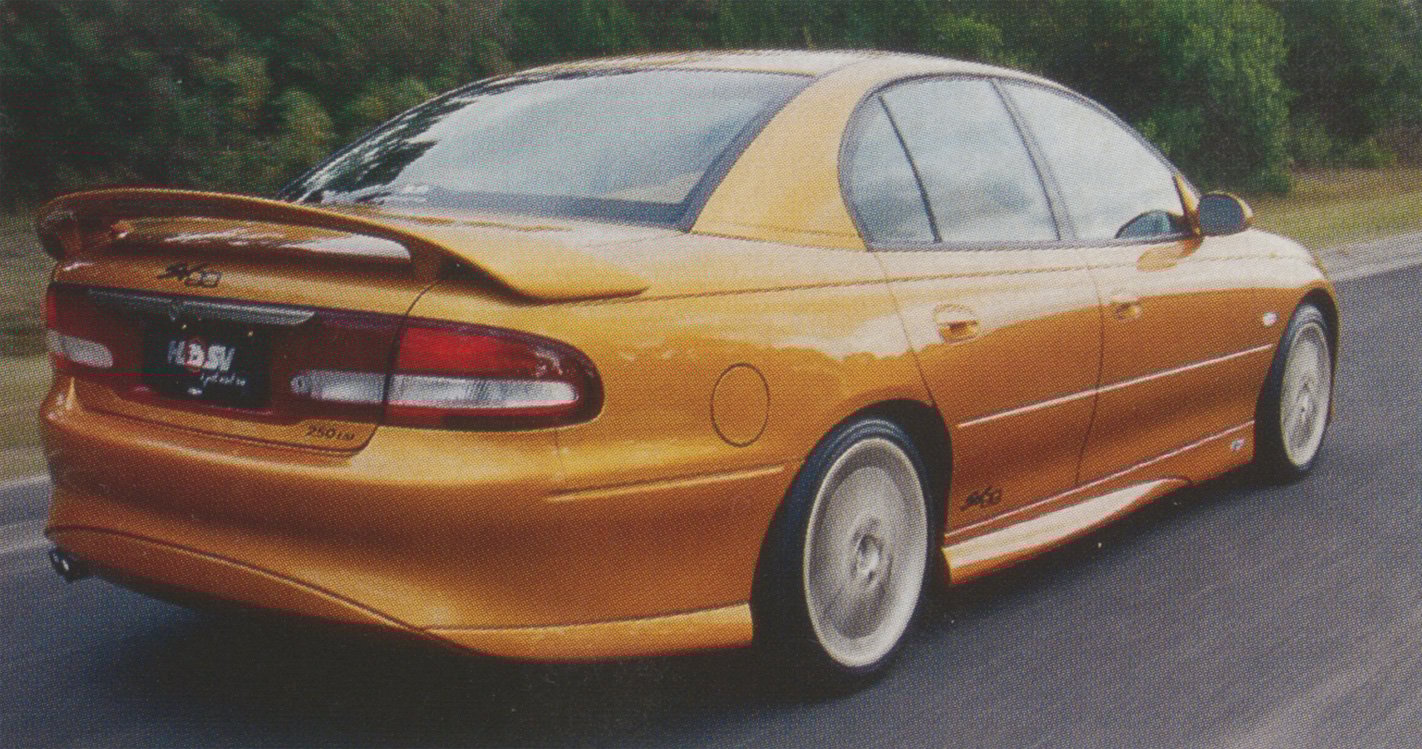
None had a Chevrolet VS beneath the bonnet. It’s just as well we had some time in an engineering prototype car some months ago …
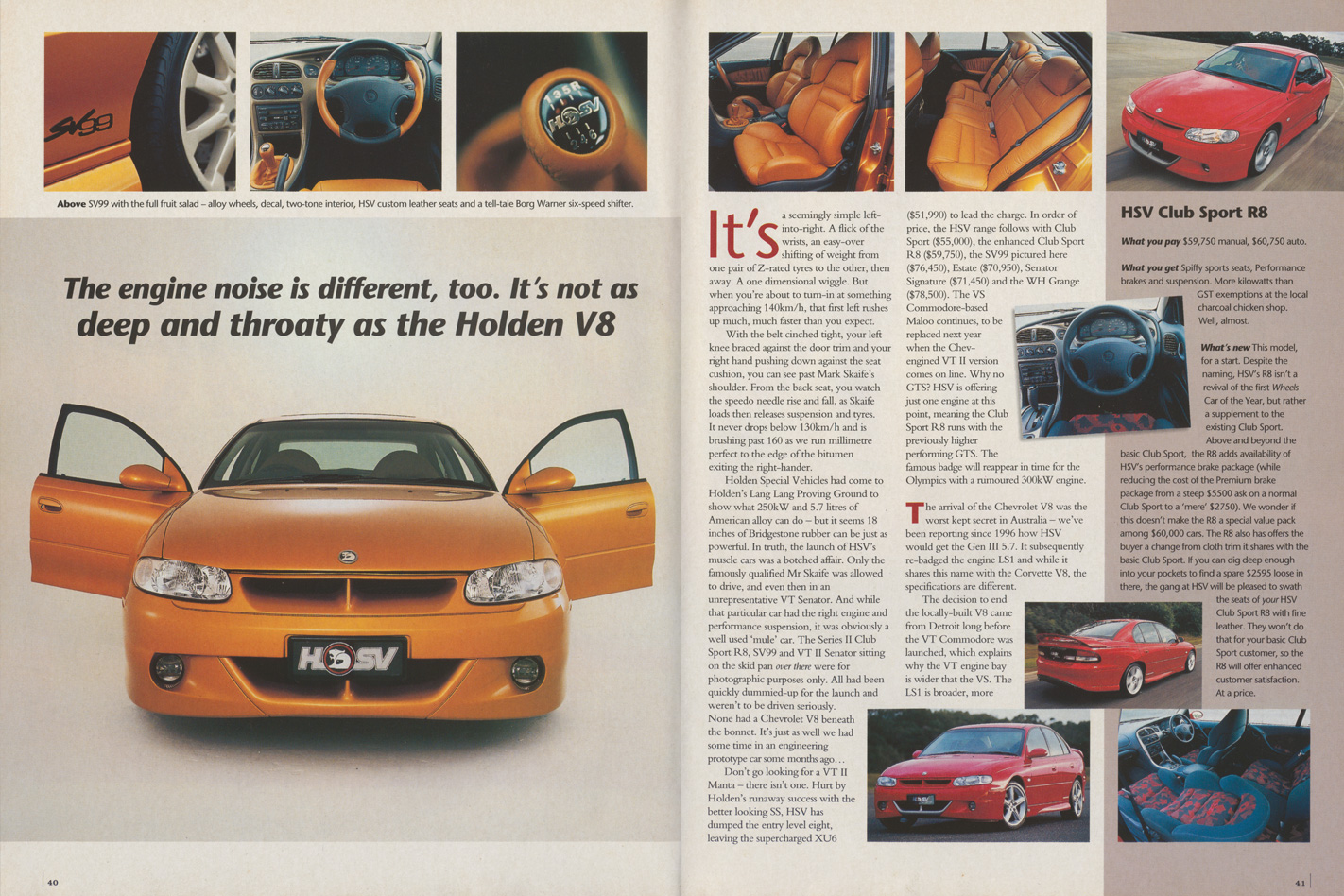
Don’t go looking for a VT II HSV Manta – there isn’t one. Hurt by Holden’s runaway success with the better looking SS, HSV has dumped the entry level eight, leaving the supercharged XU6 ($51,990) to lead the charge. In order of price, the HSV range follows with Club Sport ($55,000), the enhanced Club Sport RS ($59,750), the SV99 pictured here ($76,450), Estate ($70,950), Senator Signature ($71,450) and the WH Grange ($7S,500). The VS Commodore-based Maloo continues, to be replaced next year when the Chev-engined VT II version comes on line. Why no GTS? HSV is offering just one engine at this point, meaning the Club Sport RS runs with the previously higher performing GTS. The famous badge will reappear in time for the Olympics with a rumoured 300kW engine.
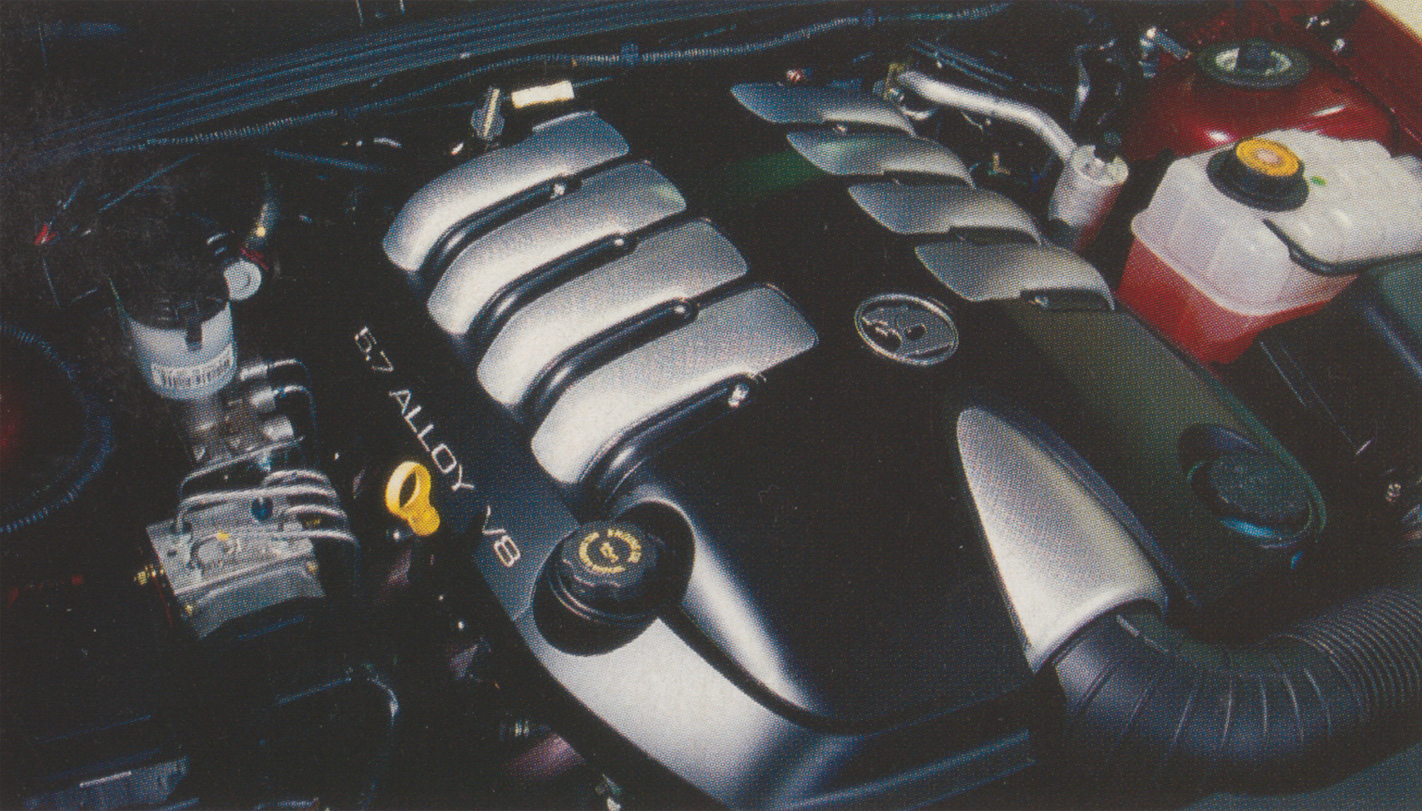
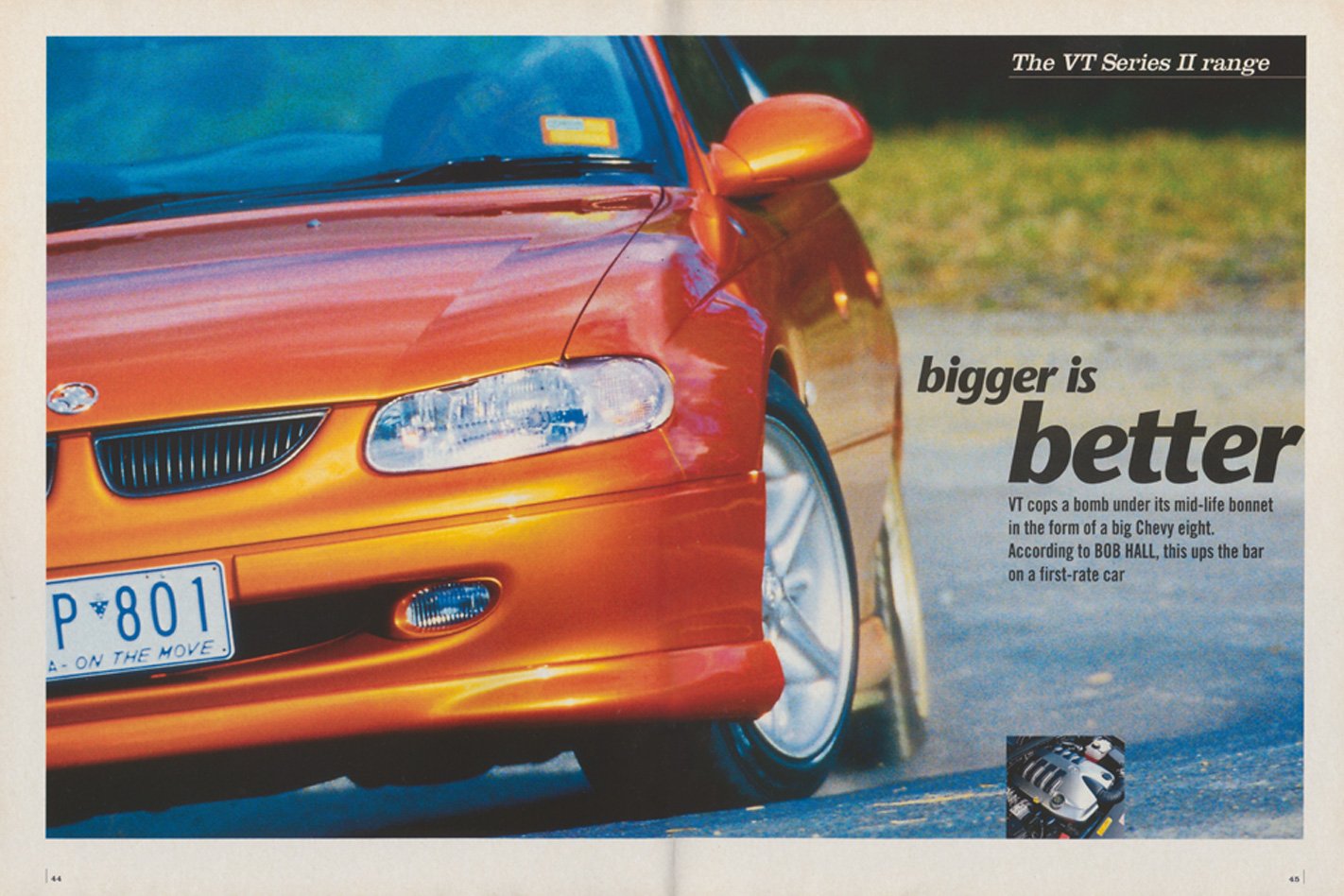
The decision to end the locally-built V8 came from Detroit long before the VT Commodore was launched, which explains why the VT engine bay is wider that the VS. The LS 1 is broader, more powerful, 30kg lighter and more fuel-efficient than HSV’s previous, Aussie small block. It also revs to 6200rpm. Still pushrod with two valves per cylinder, the all-aluminium V8 is possibly the most advanced pushrod engine in the world, although there’ll be some who say pushrod and advanced is an oxymoron.
Okay, the BMW M5’s 5.0 litre, dohc 32-valve V8 is more powerful, but it is also hand-built at a rate of just 25 per day. GM executives in Detroit reckoned the cast-iron Holden V8 was not export quality and lacked technical and spare parts support for overseas markets. Other GM engine options were the 4.6-litre Cadillac Northstar V8 and the 4.0 litre Oldsmobile Aurora – both transverse mounted and less powerful than the LS1.
While more than 10,000 Gen IIIs will be imported into Australia each year (many for export to the Middle East in Commodores and Statesmans), HSV’s engines will be of a unique specification. Tuned to run on premium 95 RON fuel, where Holden’s Gen Ills are detuned to suit regular 91, a combination of exhaust technology and engine electronics has extracted more power and torque.
And says HSV, safe and reliable driveability. In the Corvette, Chevrolet claims 257kW at 5400rpm and 483Nm at 4200rpm. HSV reckons its LS1 V8 muscles up 250kW at 5600rpm and 470Nm at 4000rpm to push an 1800kg Club Sport from 0-100km/h in 5.7sec and 400m in 13.9sec. The Club Sport may not be the quickest sedan in the world, M5 and Mercedes-AMG’s E55 are at least two tenths quicker, but for no more than $55,000 the Club Sport claims itself to be the quickest sedan ever built in Australia.
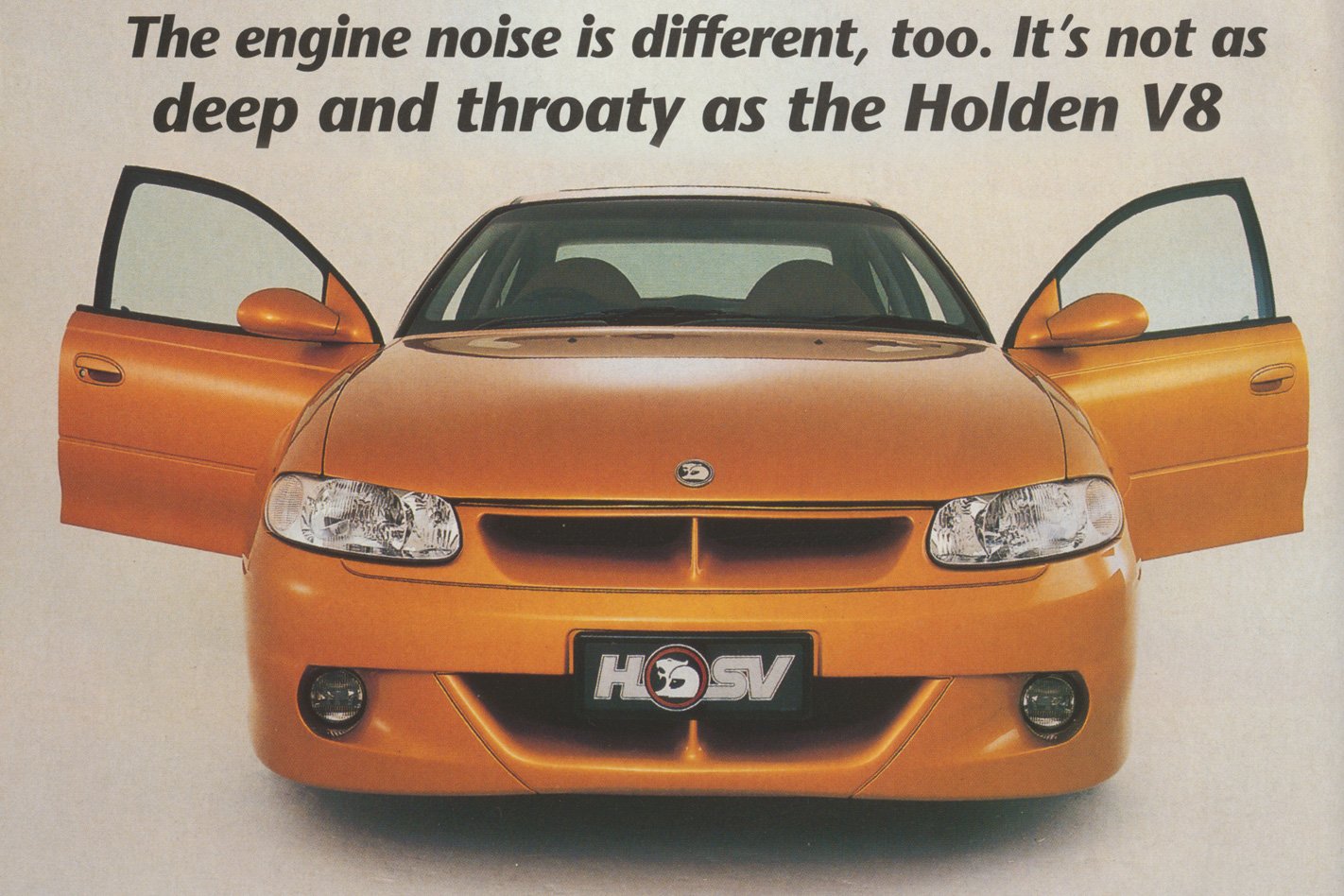
Traction control is standard on automatic and manual … and you’ll need it. Often. The engine noise is noticeably different, too. Not as deep and throaty as the Holden V8, the Chev’s exhaust note is higher, and up in the revs there’s a definite mechanical buzz that sounds damn sexy. As part of the HSV in-house modification process, the LS1’s cast iron exhaust manifolds (kept on Holden models) are tossed for a set of stainless steel HM extractors, low back pressure catalytic converters and 57mm stainless steel twin pipe exhaust system.
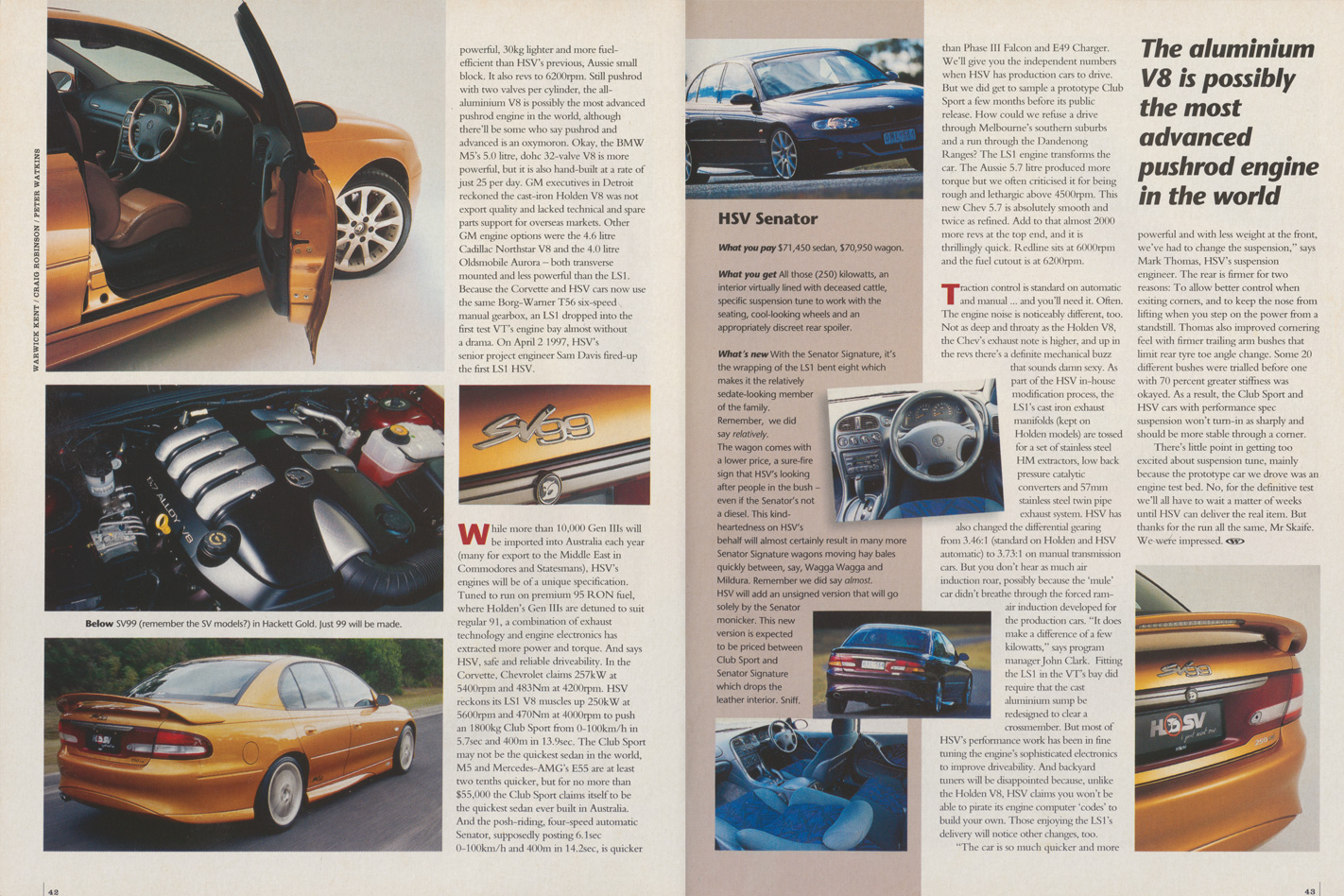
Fitting the LS 1 in the VT’s bay did require that the cast aluminium sump be redesigned to clear a cross-member. But most of HSV’s performance work has been in fine tuning the engine’s sophisticated electronics to improve driveability. And backyard tuners will be disappointed because, unlike the Holden V8, HSV claims you won’t be able to pirate its engine computer ‘codes’ to build your own. Those enjoying the LS1’s delivery will notice other changes, too.
There’s little point in getting too excited about suspension tune, mainly because the prototype car we drove was an engine test bed.
No, for the definitive test we’ll all have to wait a matter of weeks until HSV can deliver the real item. But thanks for the run all the same, Mr Skaife. We were impressed.
The most significant new Holden since the original 48/215, the VT Commodore is an affirmation of the skill, ingenuity and determination of the Australian automotive industry.
Designed and engineered at a fraction of the cost of programs for similar vehicles elsewhere, the VT overlays Commodore’s traditional outstanding value in terms of package size and performance with an impressive dose of refinement, quality and safety innovation.
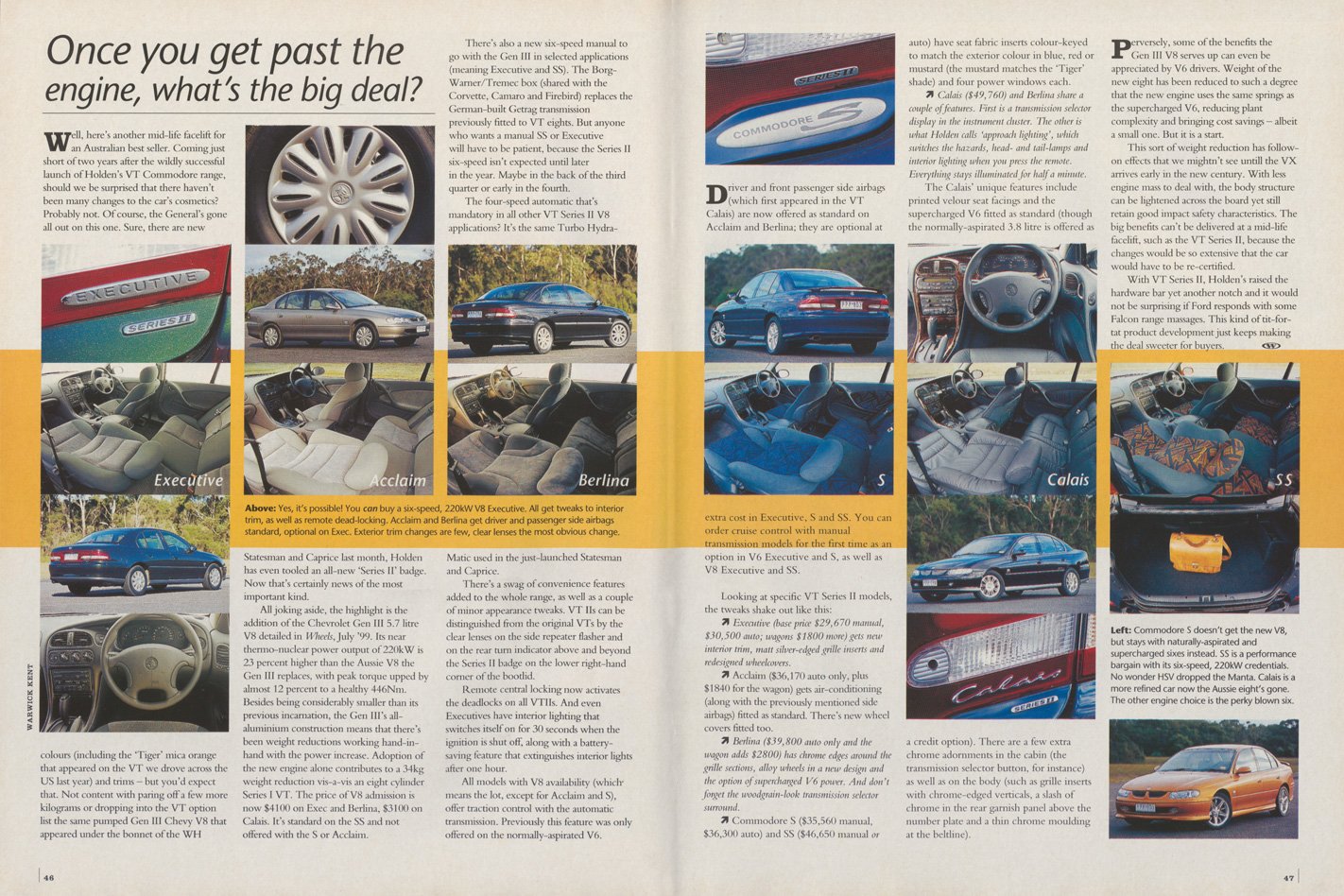
Standard equipment levels are impressive for a mainstream family sedan – from the driver’s airbag, electric seat height adjustment and trip computer on the entry-level Executive, through to the traction control on Acclaim, to the clever coded key system on Calais which allows drivers to personalise their climate control and audio system settings.
Holden’s first all-new Commodore since 1988, VT shares not a single panel with the GM2800 Euro-car and is a tribute to Holden’s engineering capabilities.
What’s more, VT comes to market with a complete model range, offering three engine and two transmission choices, a huge wagon and a comprehensive range of in-house and HSV-modded performance variants. One handsome, helluva car in anyone’s money.
Even better than bigger, the VT Commodore packs more advanced design and engineering than any Australian car to date. VT boasts all new body, interior, brakes and electronics. Carryover V6 and V8 engines are more efficient and effective than their cam and valve counts would suggest, while the basic safety engineering is world-class, especially for a mainstream car at this price.
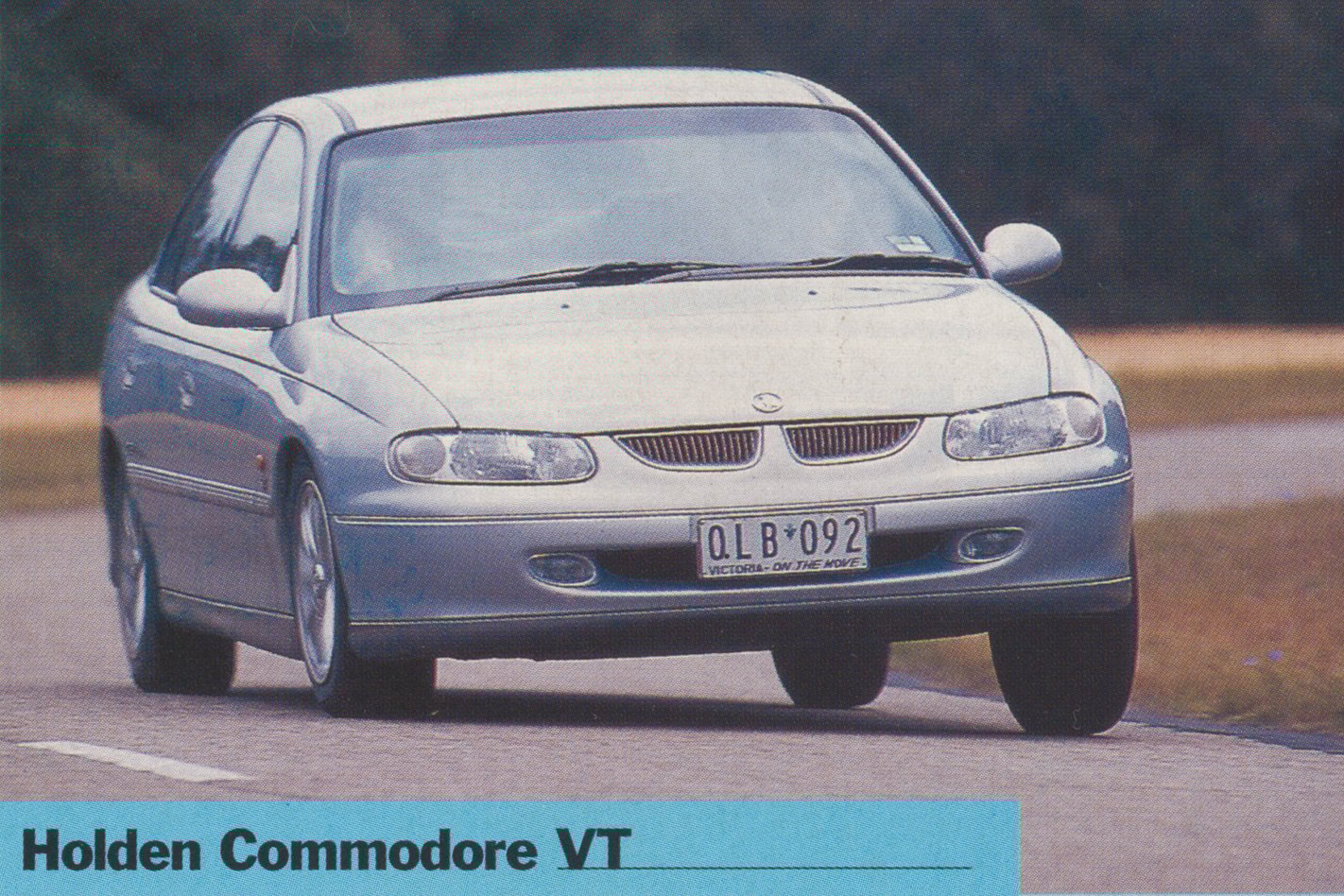
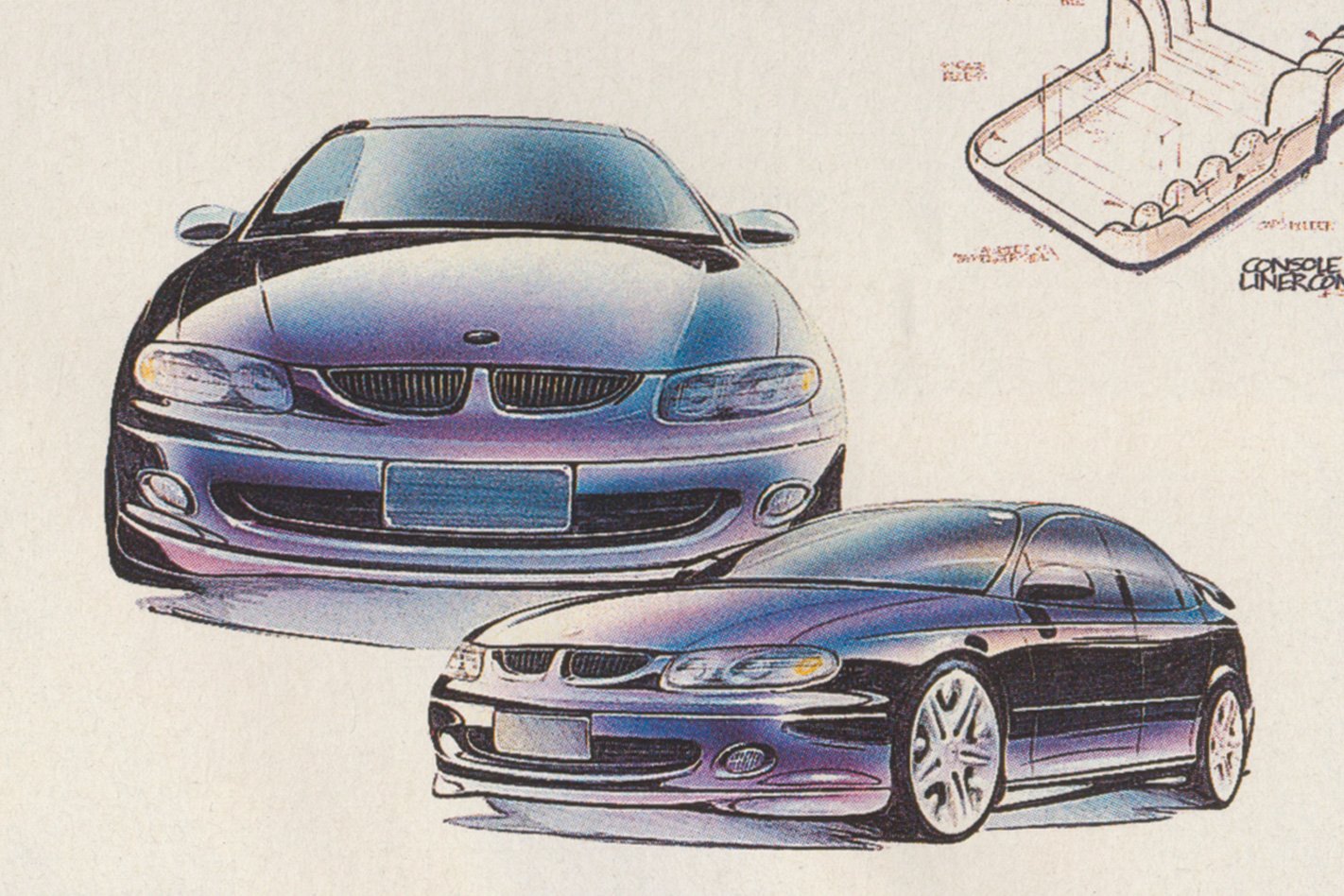
Filled with presence on the road, VT is arguably the best Holden ever. There’s quality throughout the styling, though it’s not perfect- lower rear bumper lines give it a touch of the ‘full diaper’ look, and front wheel arches appear too pumped from some angles. Interior, on the other hand, gets top marks for design work, fit and finish, as well as superior grain and gloss matching.
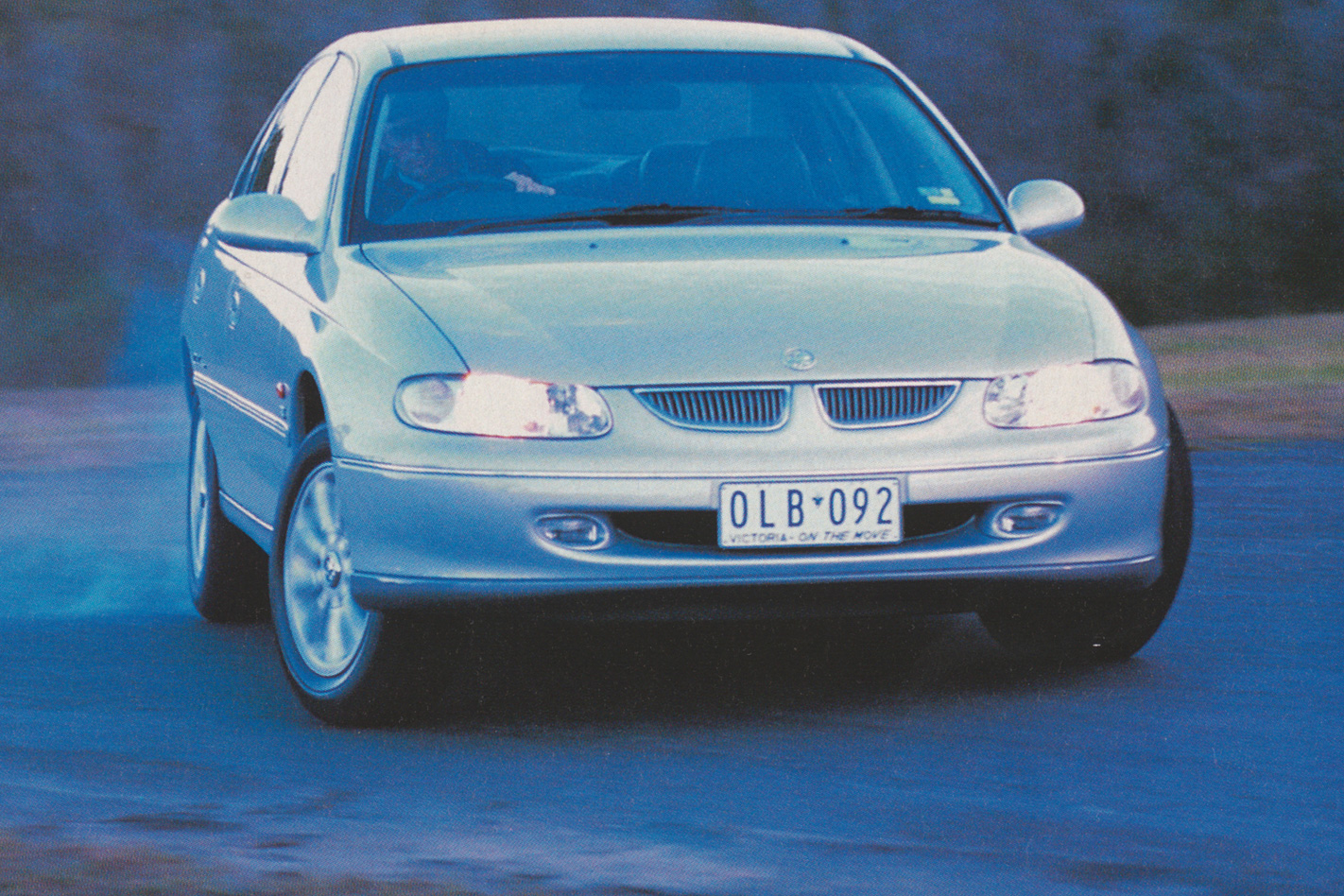
Superior refinement, comfort, equipment and styling outweigh the marginal decline in performance and economy. Very thoroughly developed and better finished than any previous Commodore, and therefore effortless to drive and very good for passengers. Few cars, anywhere, are more effective or capable, especially at the price.
Holden engineers have worked hard to put state-of-the-art safety features in this family sedan. The pre-tensioners and airbags work in harmony, seat bases reduce submarining and the centre rear seat has a lap/sash belt even in the wagon with a split seat. The driver’s seat is height-adjustable, and the column adjusts for reach.
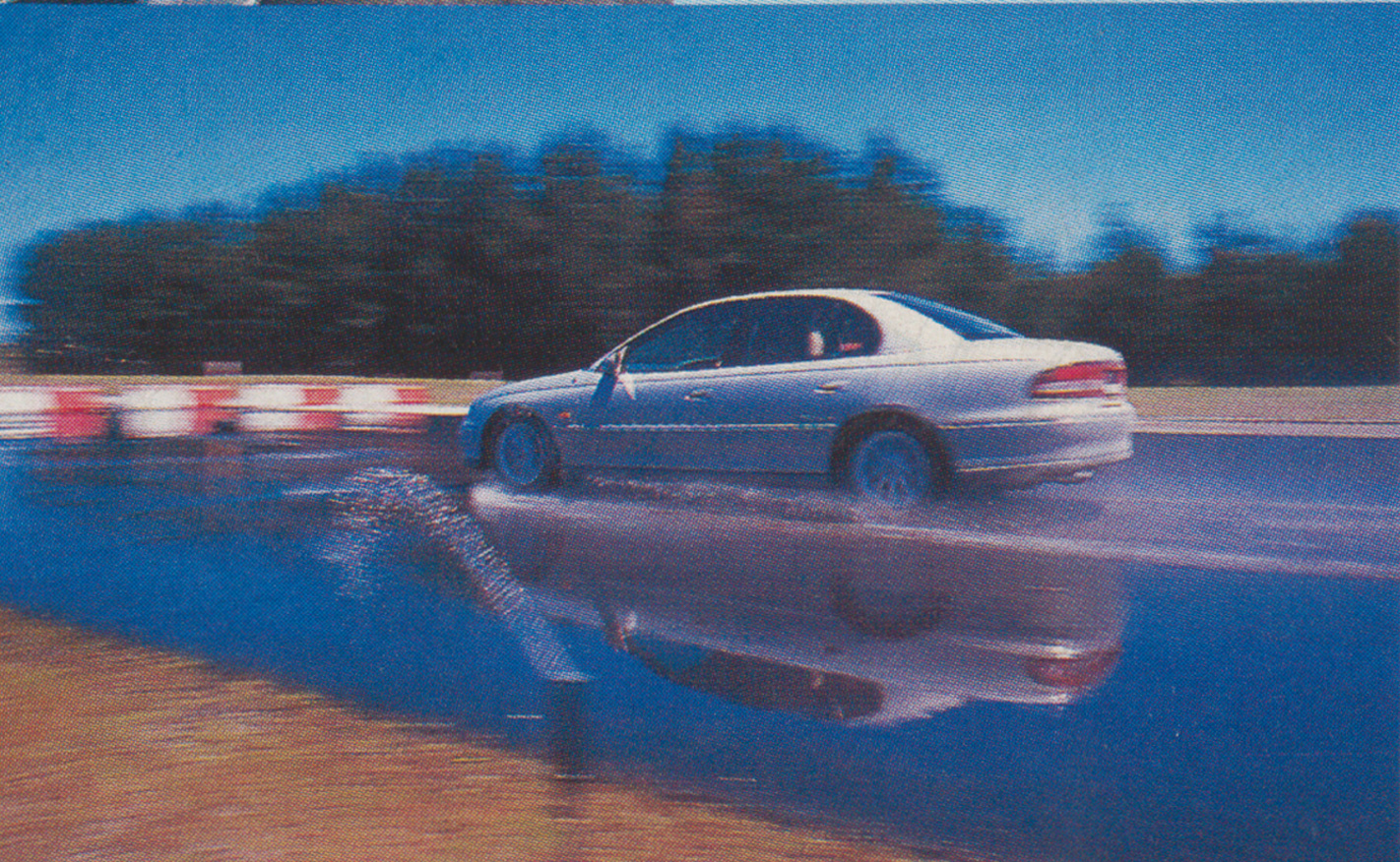
Every metal part requires four or fewer stamping strikes to save throw-away and to reduce die wear and increase output by 41 percent. The body-in-white assembly time is five hours quicker, overall build time down by 2.5 hours. Weight gain is the only negative by-product of a safer Commodore, which has impacted on fuel consumption by an average of 6.7 percent.
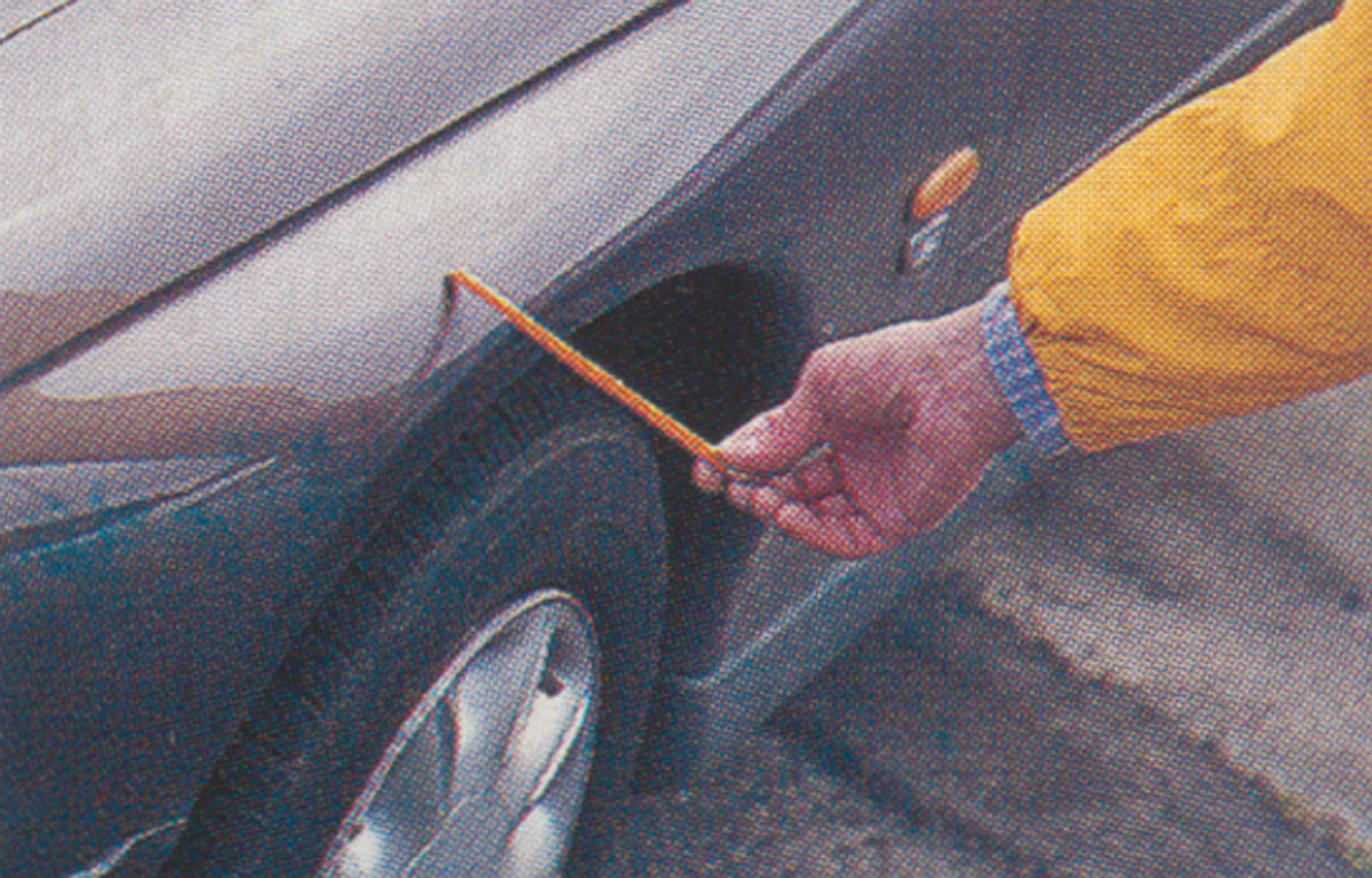
Driver’s airbag, trip computer and electric seat height adjustment are now standard across the range, while Calais matches BMW for electrickery at half the money. Range includes huge wagon and HSV hotties: given the performance and packaging, style and safety, VT is arguably the best value family car in the world.
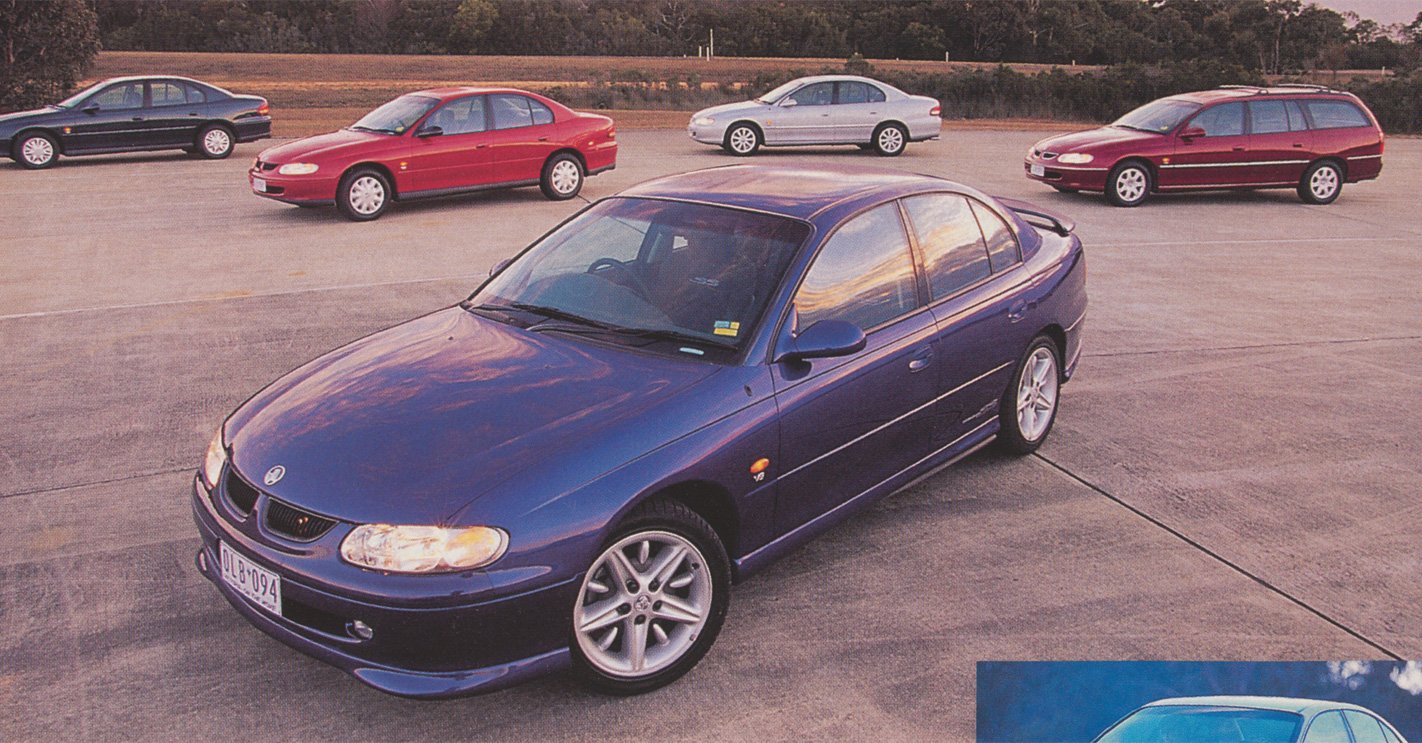
Wheels Car of the Year winners are easier to predict in some years than others.
It would have been a brave – or foolhardy – person who bet against the Golf Mk7 in 2013 or even the Mazda MX-5 in 2016. But the recipient of Australia’s most prestigious motoring accolade isn’t so easy to pick this year.
In fact, it’s hard to think of a year where the field has been more open. That’s not to say there’s a shortfall of talent.
We’re still a long way from finalising the long list of entrants (currently it stands at more than 30 models), and the current crop of contenders is so varied that it’s hard to pick an early favourite.
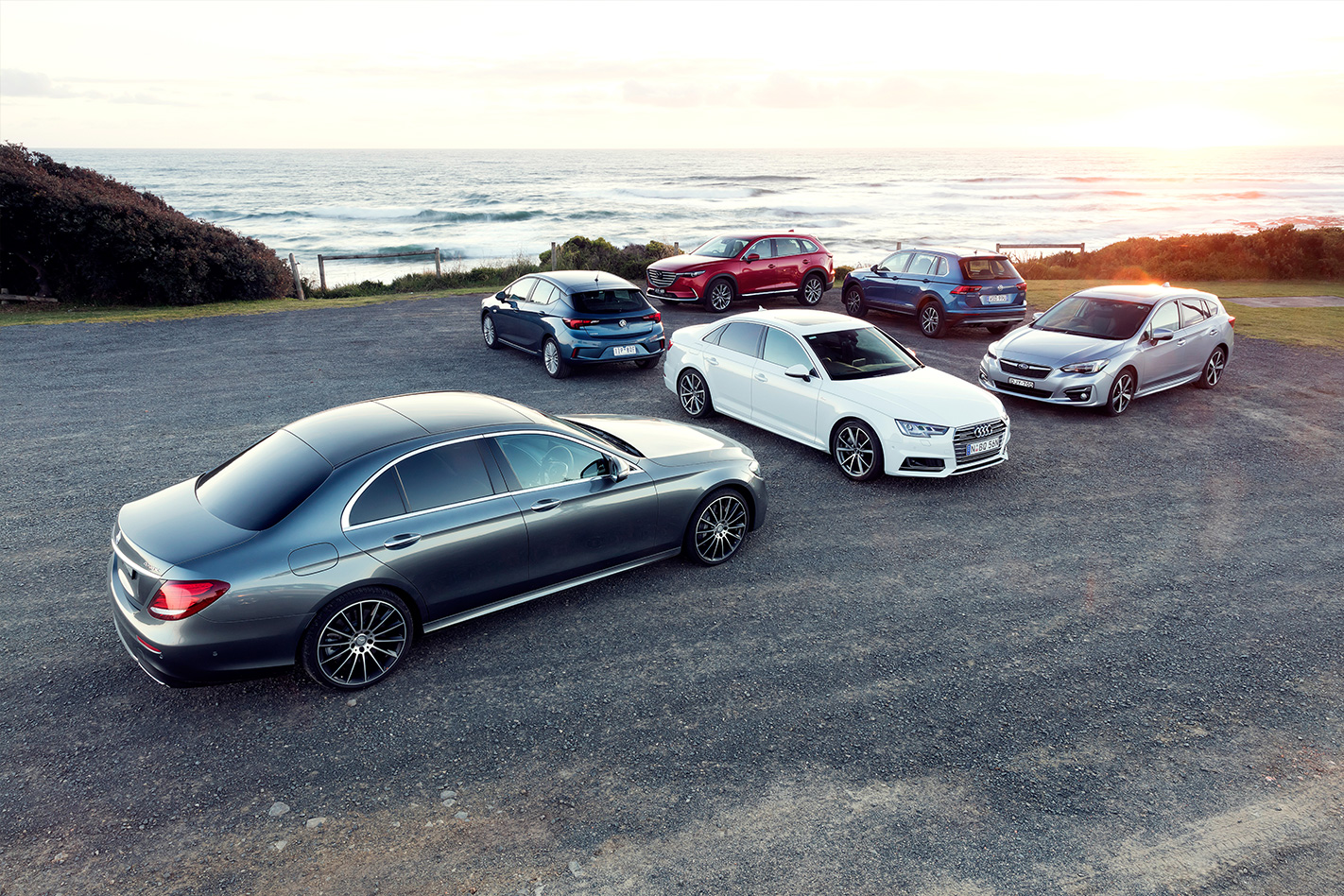
If there’s one thing we’ve learned from previous years, it’s that talent will always shine through; that the rigorous process of judging leaves no room for pretenders.
Every year at Wheels COTY there are cars that punch well above their weight against the function, efficiency, value, technology and safety criteria that underpin the award.
It will be no different in 2018 and there were a few consistent fixtures on the informal wish lists of some of the judges.
Hyundai’s Kona has piqued the curiosity of many, as has Holden’s Equinox mid-sized SUV.
The all-new Suzuki Swift looks a serious contender. Toyota is a brand keen on carrying off a second COTY crown and this year’s potentials include the fresh and focused C-HR and the all-new XV60-gen Camry.
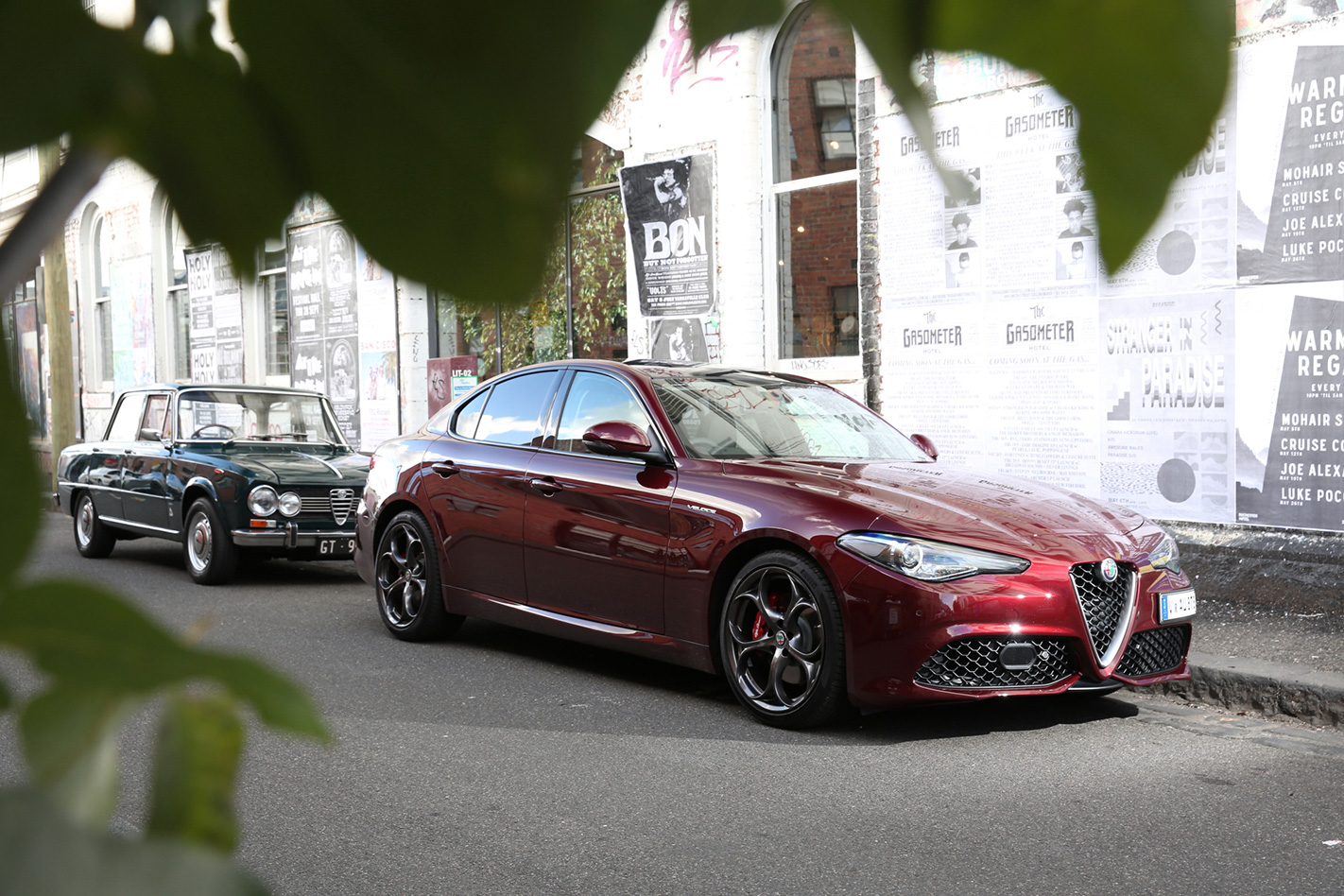
ALFA ROMEO GIULIA The game-changing 375kW Quadrifoglio hogs the headlines, but there’s real bench strength in the Giulia range, showing what a confident, cash-rich and re-emergent Alfa Romeo can do when all the stars align. An Italian car has never won COTY. Will that duck be broken in 2017?
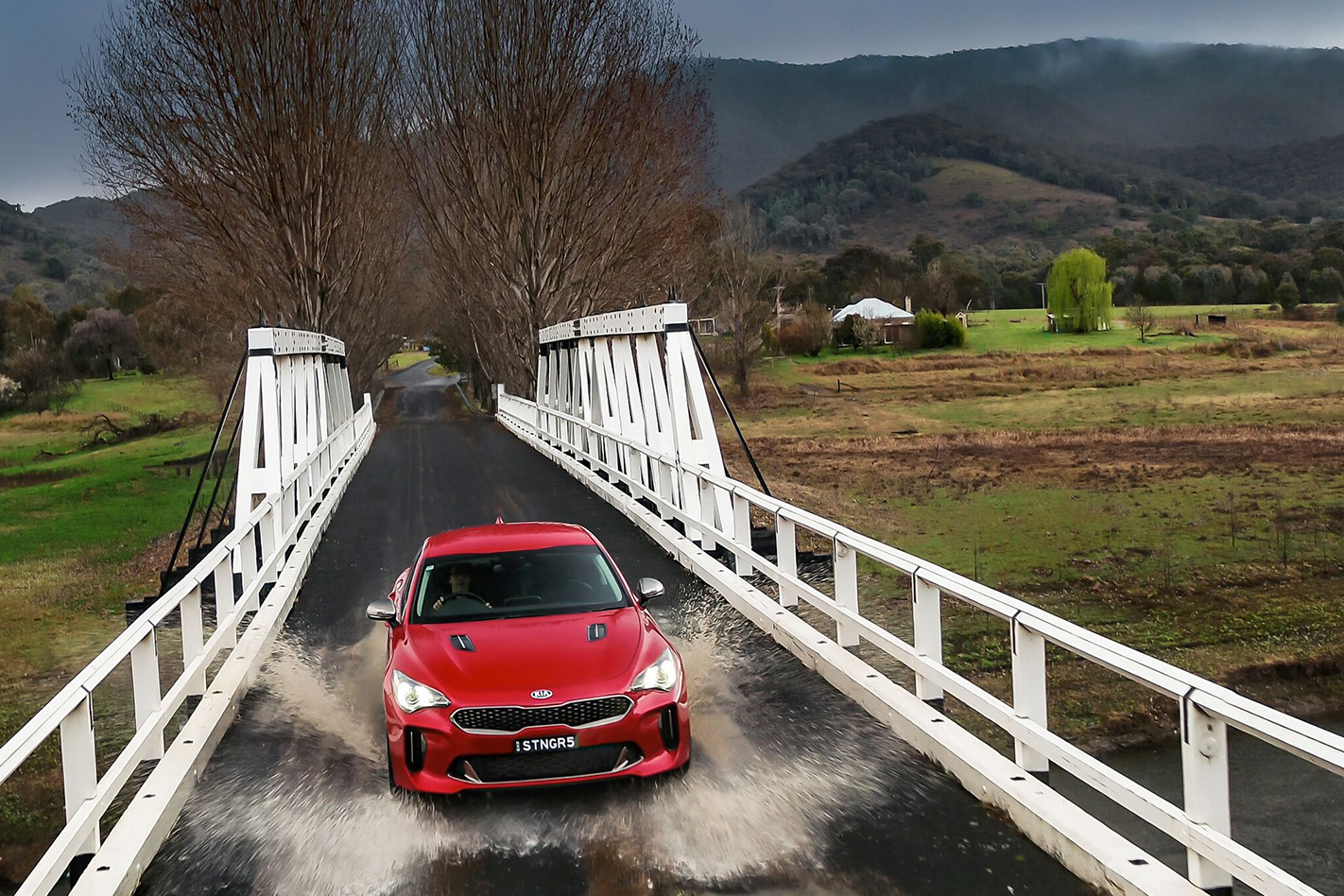
KIA STINGER The most eagerly awaited car of 2017 is a Kia. Chew that one over for a moment. Can the Stinger take up the big rear-drive baton from the Falcon and Commodore or will proving ground punishment and ruthless on-road analysis reveal a dynamic chink in its armour? First drives suggest that local tuning for this model will be key.
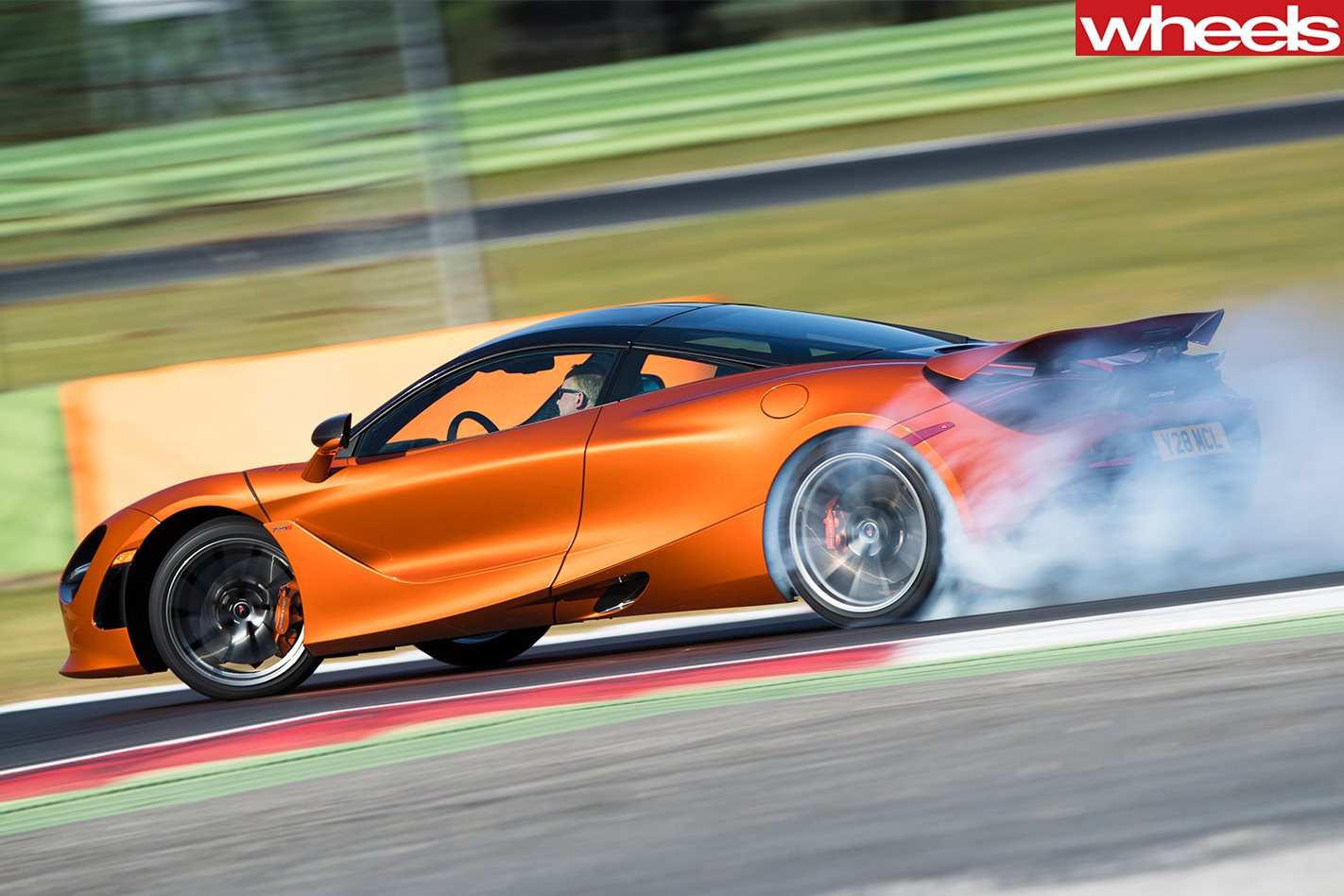
McLAREN 720S Although high-end supercars are usually well placed to excel against COTY’s technology criterion, the law of diminishing returns at this price level can make objective value assessments difficult. Yet the 720S is a supercar cut from very different cloth. The fastest car we’ve ever considered for COTY inclusion could well spring a surprise.
Performance station-wagons. Hmmm… a bit like Kid Rock with a gas welder. Oxy-moron, I think they call it.
This article was first published in MOTOR’s Magazine November 2008.
Then again, when Audi can make a car like the V8 RS4 Avant, which was both a station-wagon and one of the finest fast cars of its day, maybe there’s hope. The latest offering from HSV, the Clubsport R8 Tourer, also suggests some light at the end of the two-box tunnel.
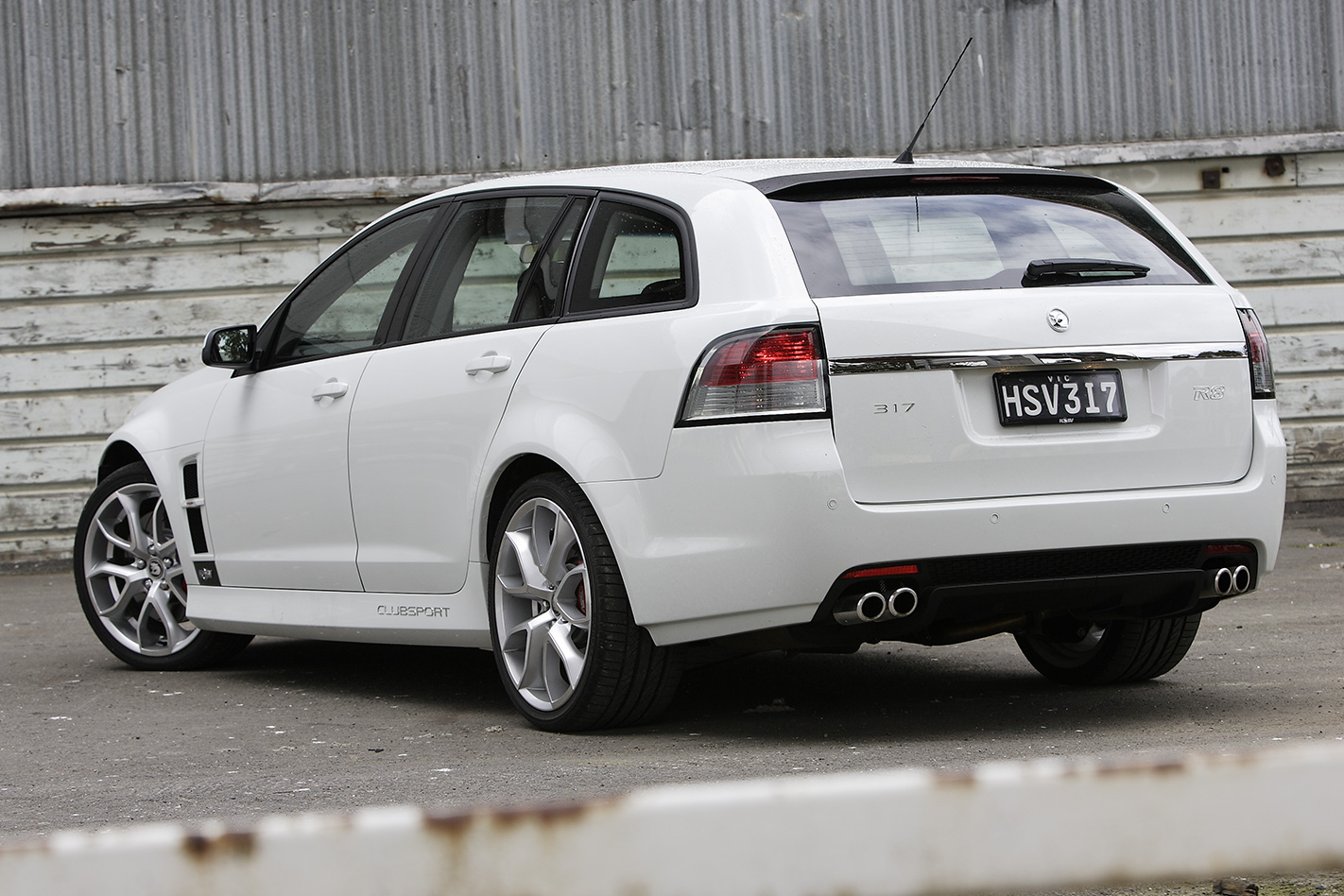
Throw in the big brakes, Clubsport suspension retuned for the wagon body and the (optional at $2500) 20-inch wheels and tyres and you’ve got yourself some serious hardware. And serious is the right word. A standing quarter in the 13s is the reality of it all with 0-100km/h coming up in just about five-and-a-half ticks of the Rolex (ha, bloody, ha).
Turn-in on those 20s is sharp and immediate, and the excellent front end of the basic VE suspension package is there for all to see, feel and love, too. For all that, the ride quality is better than just tolerable and only a little body-roll in corners lets you know that the super-trick Magnetic Ride Control of the range-topping GTS is missing.
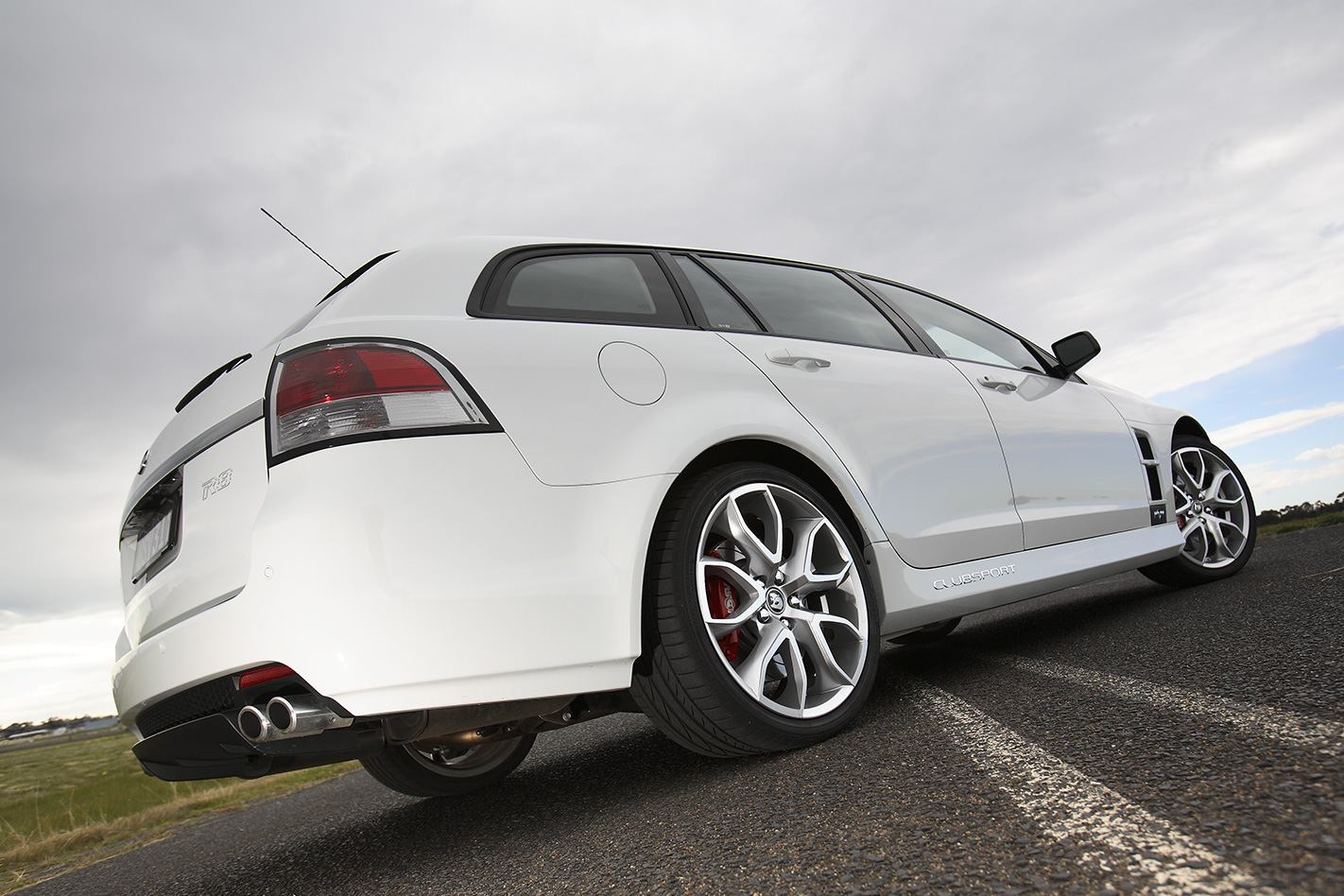
Okay, so the VE sedan is all about wheelbase in the first place, but the station-wagon no longer automatically looks like it’s headed for the boneyard, chock full of coffin and floral tributes. Nope, the Tourer is a fine-looking piece of work with the HSV treatment making the most of the sweeping roofline and slightly hunched look.
Of course, those lines have an effect on the accommodation and there’s no arguing the fact that the interior is much smaller than that of the old VZ Commodore. The load area is okay for dogs up to about Fred Basset size, but Lassie, Santa’s Little Helper and Beethoven are not going to be so thrilled about a ride to the park.
Cosy and cosseting the overall effect is not. Despite which, you still can’t see forward properly because those Colosseum-spec A-pillars are fatter than a Minnesota debutante. But those things are not deal-breakers for most of us and, for some reason (and it could be because I’m getting old), the R8 Tourer makes bloody good sense to me.
I’d have mine with the six-speed auto mainly because a self-shifter is a no-brainer in what is otherwise such a liveable critter. That and the fact that the manual is still a grumpy old thing when you’re doing the peak-hour shuffle.
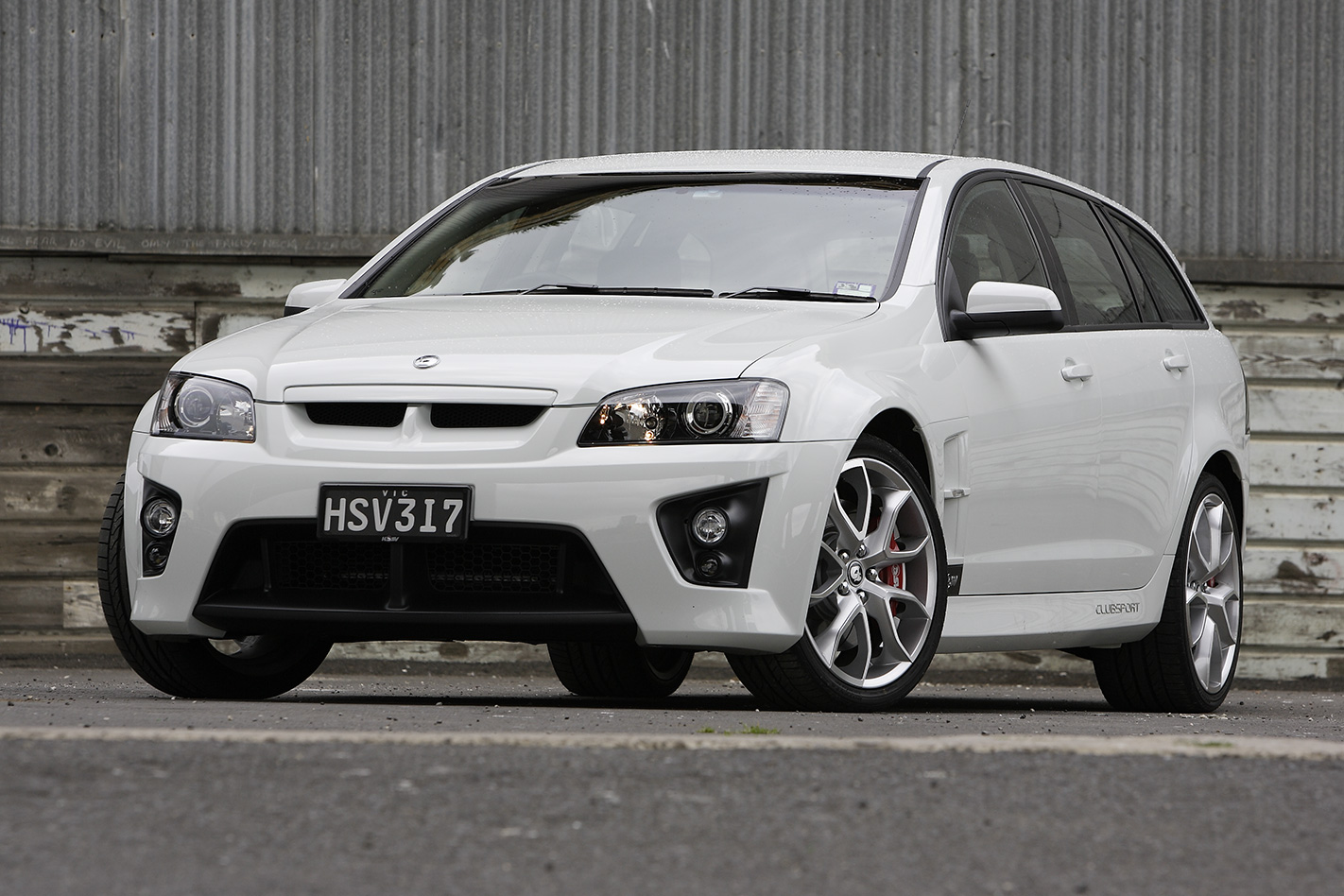
I guess I’m just attracted to the versatility of the end product. I mean, HSVs have never really been sports cars, have they? Muscle cars, sure, but lithe little sporties? Er, no. So, if you’re going to have an HSV, why not make it the most useful, practical one you can? Why not indeed.
Oh, there’s one other thing (and feel free to shoot me down in flames if you disagree, ’cos it’s personal), but I reckon the Tourer is actually the best-looking thing HSV makes right now. There, I said it.
2008 HSV Clubsport R8 Tourer specs: Engine: 6162cc V8, OHV, 16v Power: 317kW @ 6000rpm Torque: 550Nm @ 4600rpm Weight: 1914kg Top Speed: 250km/h (limited) 0-100km/h: 5.3sec (estimated) Price: $68,490 (as tested)
Make no mistake – the VT Commodore is the most significant new Holden since the original 48/215.
Like that first Holden, the VT – product of the biggest design, engineering and development program undertaken by Holden in 20 years- is more than just a car. It’s an affirmation of Aussie skill, ingenuity and determination; a convincing rebuff to the nay-sayers who claim you can’t build a world-class car in this country.
Yes, it’s that good. Commodore and Falcon have always offered outstanding value in terms of package size and performance. VT retains those proven core values, but adds an impressive dose of refinement, quality and safety innovation.
But it’s not perfect. That new body has increased the VT’s mass by 166-195kg over the VS and taken the edge off performance while increasing thirst. And while GM engineers have worked wonders with the 3.8-litre Ecotec V6, it will never be as smooth as the latest generation alloy-block powerplants from Japan and Germany. Even so, VT Commodore is deeply impressive.
Impressive. Classy. Refined. They’re the words which kept popping up during our preview drive at Holden’s Lang Lang proving ground. Unchanged from the VS Commodore apart from new exhaust manifolds and the latest Bosch EV 6 fuel injectors, the 147kW Ecotec V6 fires abruptly on the turn of the key – which now takes noticeably less time to swap codes with the immobiliser in the engine computer- then settles down to its trademark grumbly idle. The new pistol-grip auto shifter is a touch notchy, but the four-speed auto slips as seamlessly as ever.
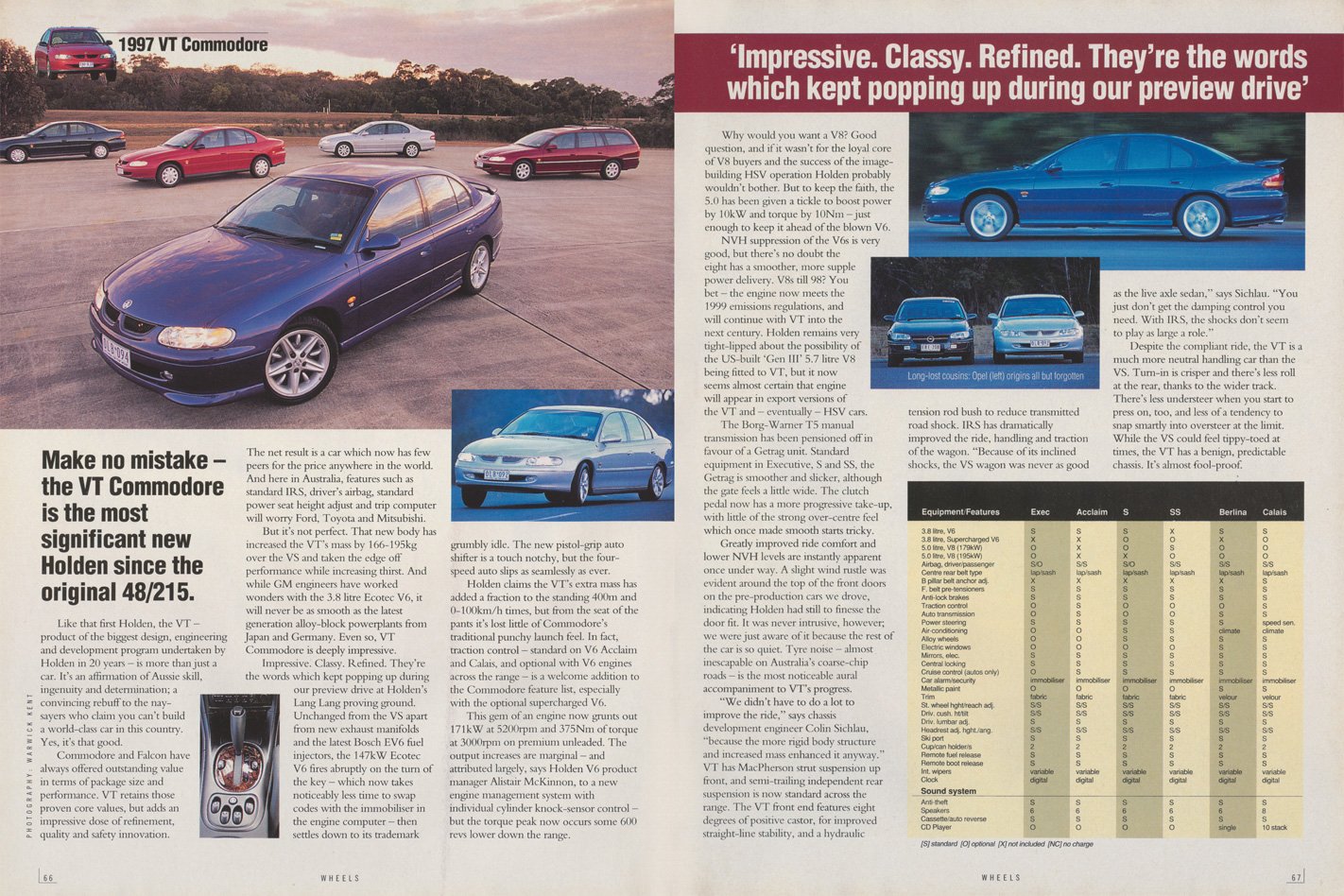
This gem of an engine now grunts out 171kW at 5200tpm and 375Nm of torque at 3000tpm on premium unleaded. The output increases are marginal – and attributed largely, says Holden V6 product manager Alistair McKinnon, to a new engine management system with individual cylinder knock-sensor control – but the torque peak now occurs some 600 revs lower down the range.
Why would you want a V8? Good question, and if it wasn’t for the loyal core of V8 buyers and the success of the image-building HSV operation Holden probably wouldn’t bother. But to keep the faith, the 5.0 has been given a tickle to boost power by 10kW and torque by 10Nm – just enough to keep it ahead of the blown V6.
The Borg-Warner TS manual transmission has been pensioned off in favour of a Getrag unit. Standard equipment in Executive, S and SS, the Getrag is smoother and slicker, although the gate feels a little wide. The clutch pedal now has a more progressive take-up, with little of the strong over-centre feel which once made smooth starts tricky.
Greatly improved ride comfort and lower NVH levels are instantly apparent once under way. A slight wind rustle was evident around the top of the front doors on the pre-production cars we drove, indicating Holden had still to finesse the door fit. It was never intrusive, however; we were just aware of it because the rest of the car is so quiet. Tyre noise – almost inescapable on Australia’s coarse-chip roads – is the most noticeable aural accompaniment to VT’s progress.
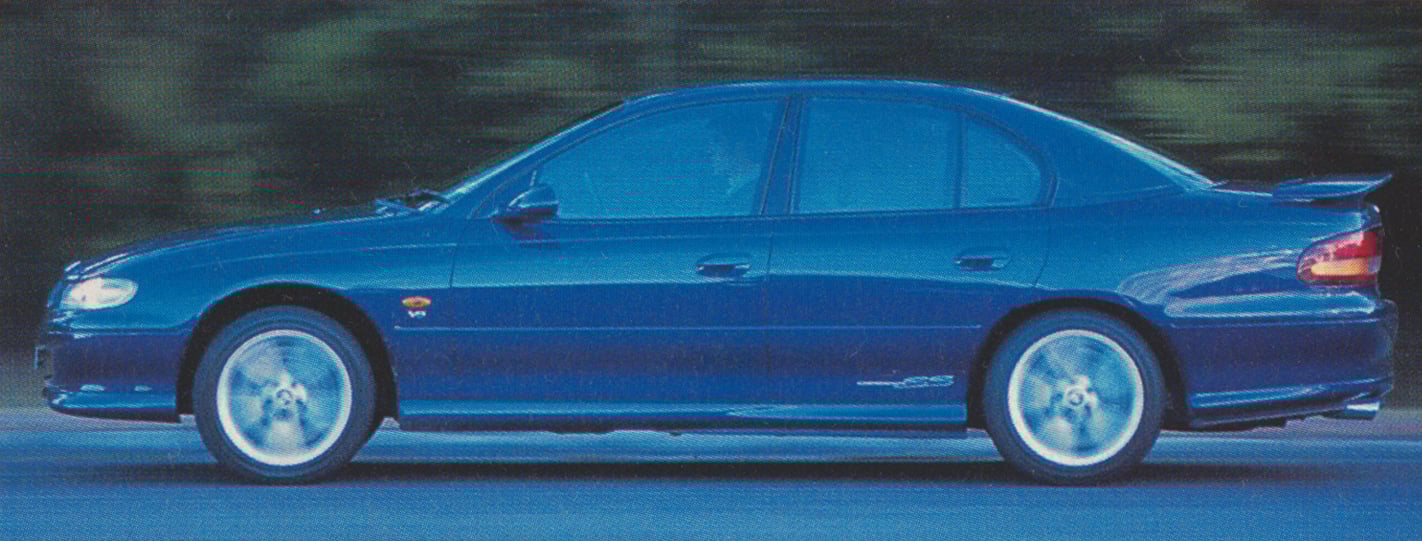
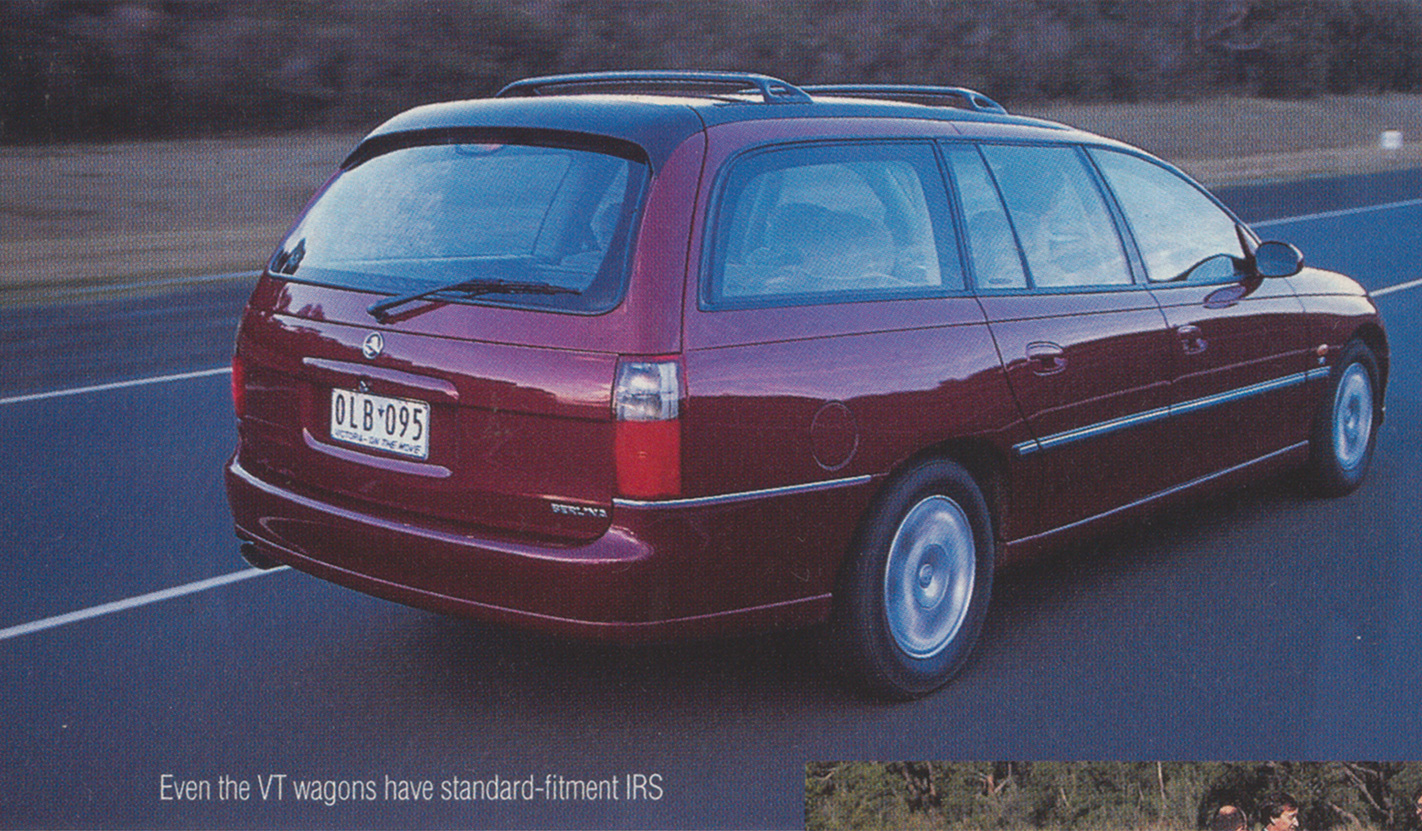
VT has MacPherson strut suspension up front, and semi-trailing independent rear suspension is now standard across the range. The VT front end features eight degrees of positive castor, for improved straight-line stability, and a hydraulic tension rod bush to reduce transmitted road shock. IRS has dramatically improved the ride, handling and traction of the wagon. “Because of its inclined shocks, the VS wagon was never as good as the live axle sedan,” says Sichlau. “You just don’t get the damping control you need. With IRS, the shocks don’t seem to play as large a role.”
Despite the compliant ride, the VT is a much more neutral handling car than the VS. Turn-in is crisper and there’s less roll at the rear, thanks to the wider track. There’s less understeer when you start to press on, too, and less of a tendency to snap smartly into oversteer at the limit.
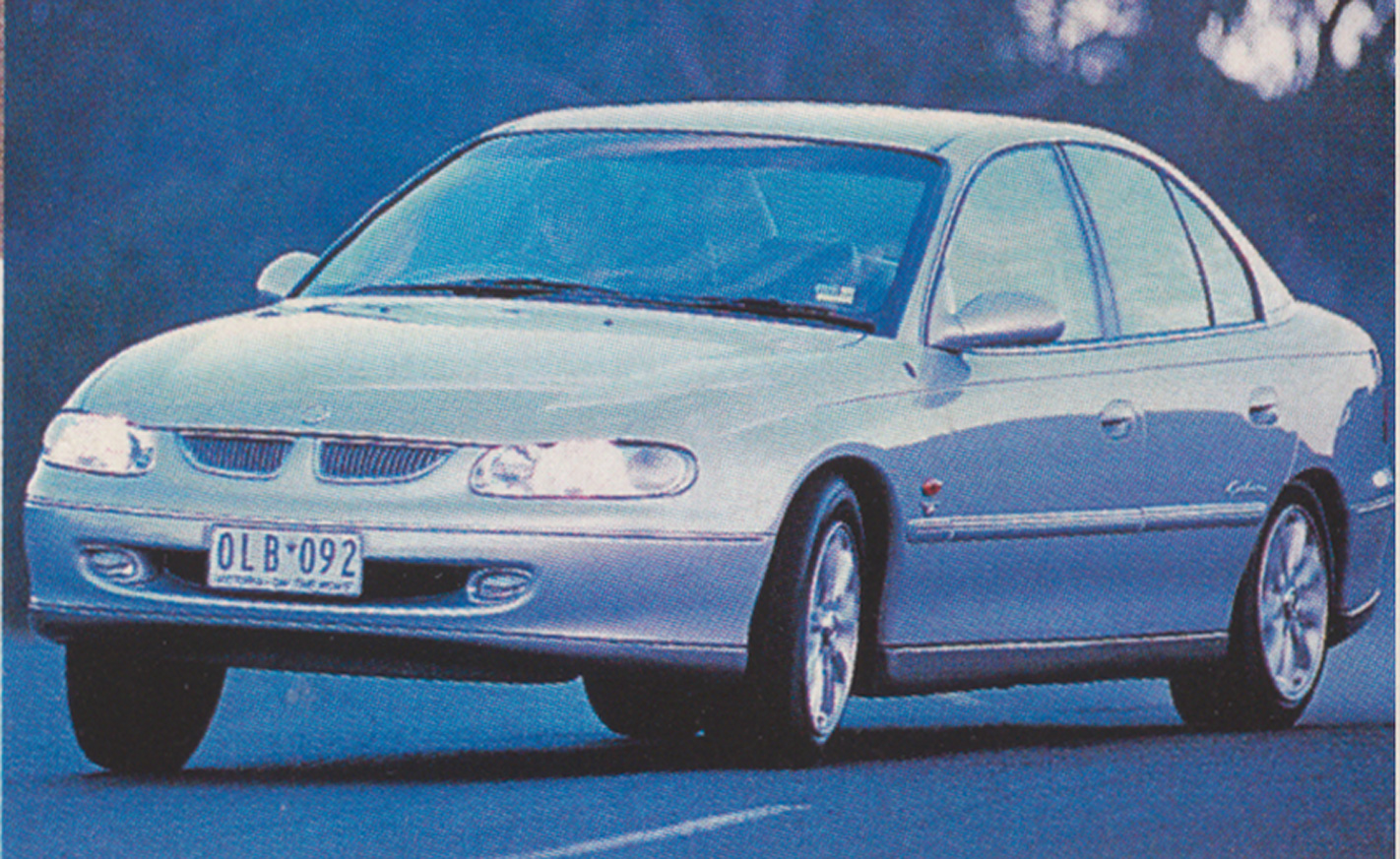
Most cars run a 26mm stabiliser bar at the front. V6s get a 15mm rear bar; V8s and the supercharged S 16mm, while the V8 SS goes to 17mm. The exceptions are V8s with standard tyres and the FE2 suspension, which get a 25mm front bar to bring some balance back into the chassis.
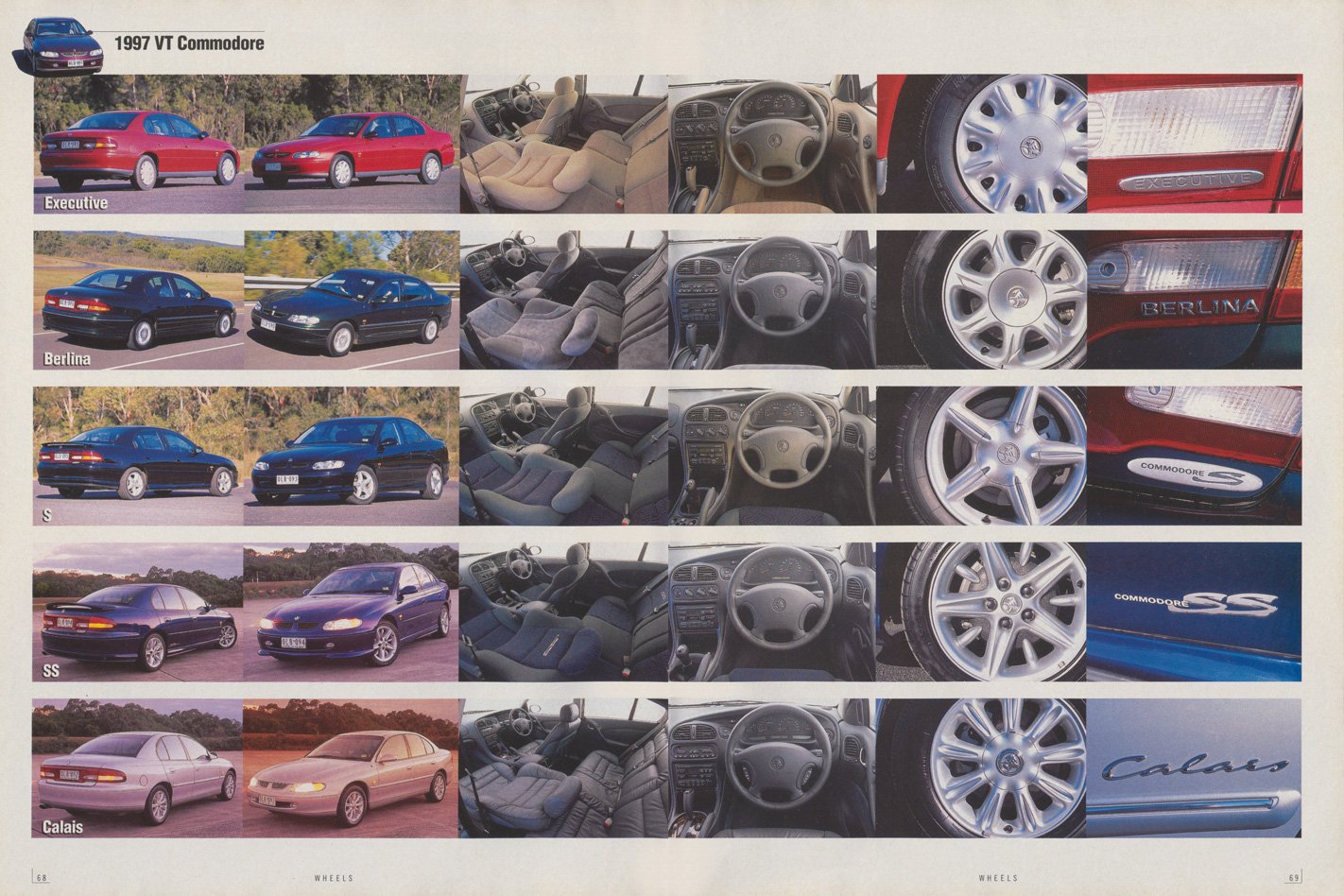
Executive, Acclaim and Berlina all run P205/65 R15 tyres, while Calais comes with P215/60s on 16in alloys. The S goes to P225/50s on the same sized rims, while the SS boasts P235/45s on 17in alloys.
VT boasts the first all-new Holden braking system in almost 20 years. With larger, thicker rotors all round, bigger calipers and a larger master cylinder, the system offers a firm, consistent pedal and terrific stopping power.
The only real negative in the VT’s dynamics is the Calais’ speed-sensitive Variotronic steering. Beside the other cars’ standard power-assisted Bishop variable ratio rack and pinion system, it feels wooden and lifeless at the straight ahead, and far less linear off-centre. Our preproduction Calais had an incorrect calibration in the system which made the steering very heavy at speed. Holden insists customers, particularly women, want fingertip steering at parking speeds.
Badgework has been kept to a minimum and model differentiation is achieved through major items such as wheel trims. Even the Executive gets body-coloured bumpers and doorhandles, while the Acclaim gets body-coloured mirrors and a black body-side moulding. The Calais glitters with just the right amount of jewellery: chrome around the grille and side windows, and in a strip in the body-side moulding and bumpers. Of the eight new colours in the 11-colour palette, only one solid is available: white.
The SS is going to give HSV a headache. Hunkered down on 17in rims, it comes in only three colours -white, Raven (black mica with blue highlights) and Botanica, a brilliant cobalt.
The wagon, which rolls on the 150mm longer wheelbase which will eventually carry the VT Statesman and Caprice, is even larger: 5042mm, 1847mm and 1545mm, up 139, 65 and 123mm over the VS wagon. With the 60/40 split rear seat folded, the rear load space is almost 2.2m long, 1.2m wide. Carrying capacity is a huge 2863 litres.
Inside, the front passengers now sit 22mm further apart, and there’s 24mm more fore-aft front seat travel. There’s also more leg, hip and shoulder room. The interior – all new apart from carryover stalks (the only VS pieces in the car apart from the drivetrains) – is in the de rigueur late ’90s soft-form style. It’s elegant and well executed, however, even on the base Executive, and easily the most integrated interior yet on a Commodore.
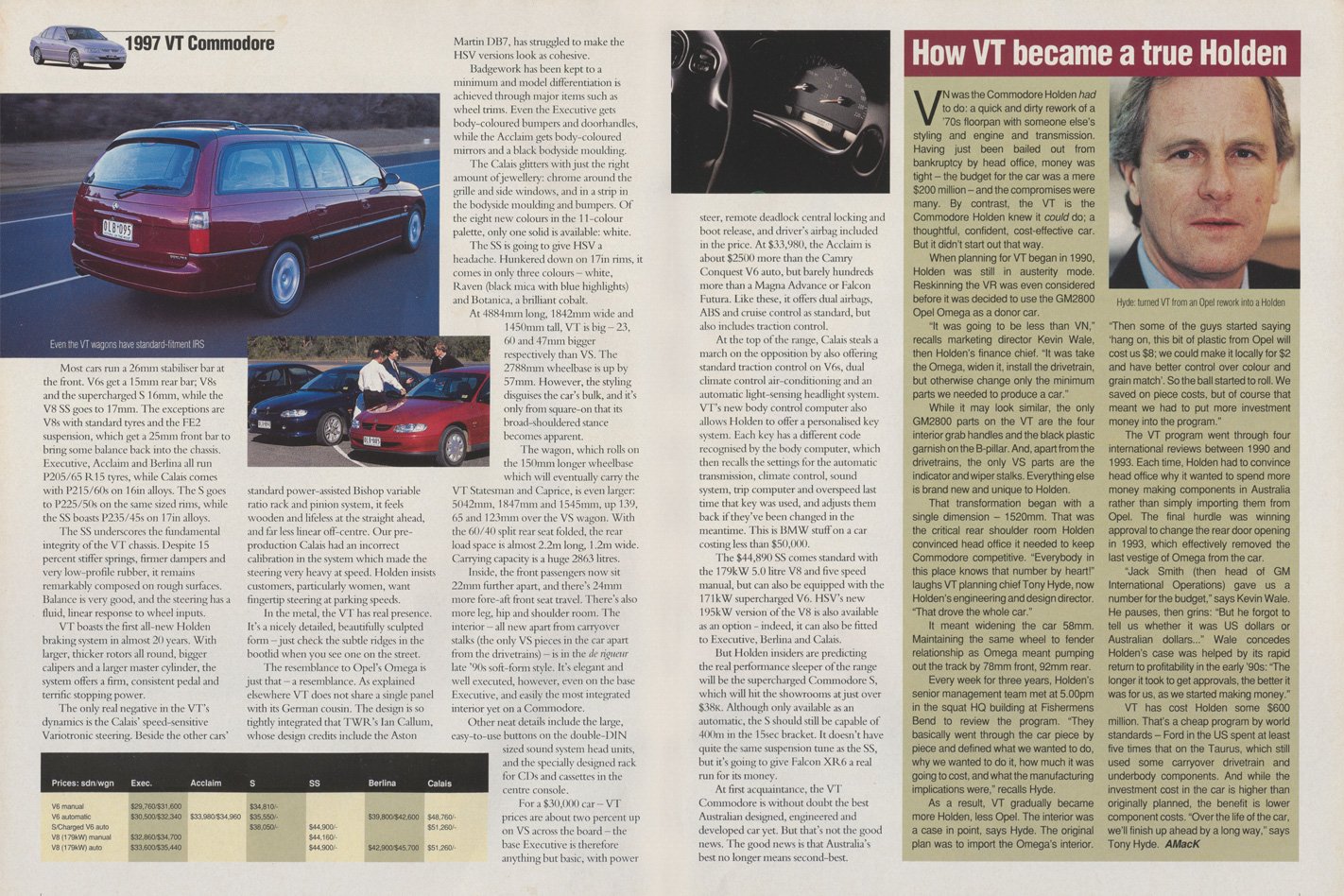
For a $30,000 car – VT prices are about two percent up on VS across the board – the base Executive is therefore anything but basic, with power steer, remote deadlock central locking and boot release, and driver’s airbag included in the price. At $33,980, the Acclaim is about $2500 more than the Camry Conquest V6 auto, but barely hundreds more than a Magna Advance or Falcon Futura. Like these, it offers dual airbags, ABS and cruise control as standard, but also includes traction control.
At the top of the range, Calais steals a march on the opposition by also offering standard traction control on V6s, dual climate control air-conditioning and an automatic light-sensing headlight system.
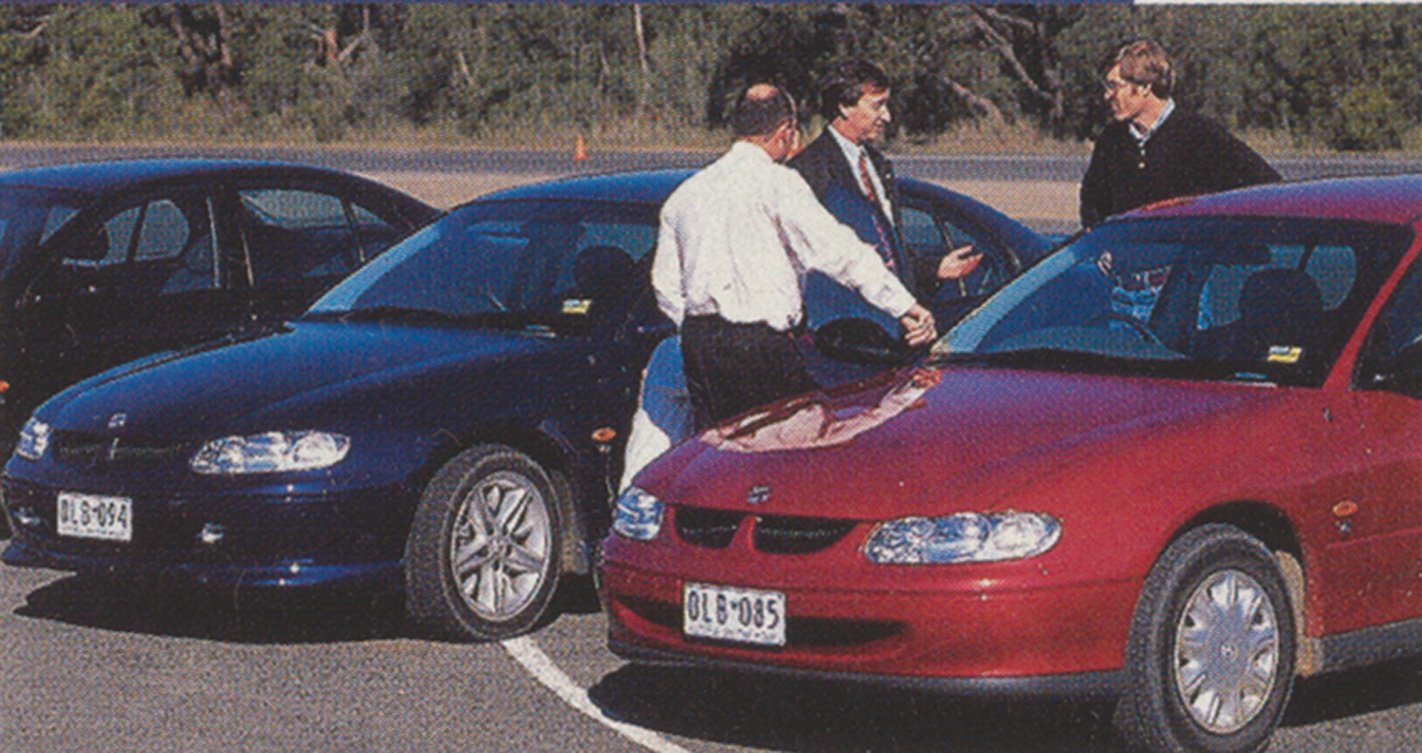
The $44,890 SS comes standard with the 179k W 5.0 litre V8 and five speed manual, but can also be equipped with the 171kW supercharged V6. HSV’s new 195kW version of the V8 is also available as an option – indeed, it can also be fitted to Executive, Berlina and Calais.
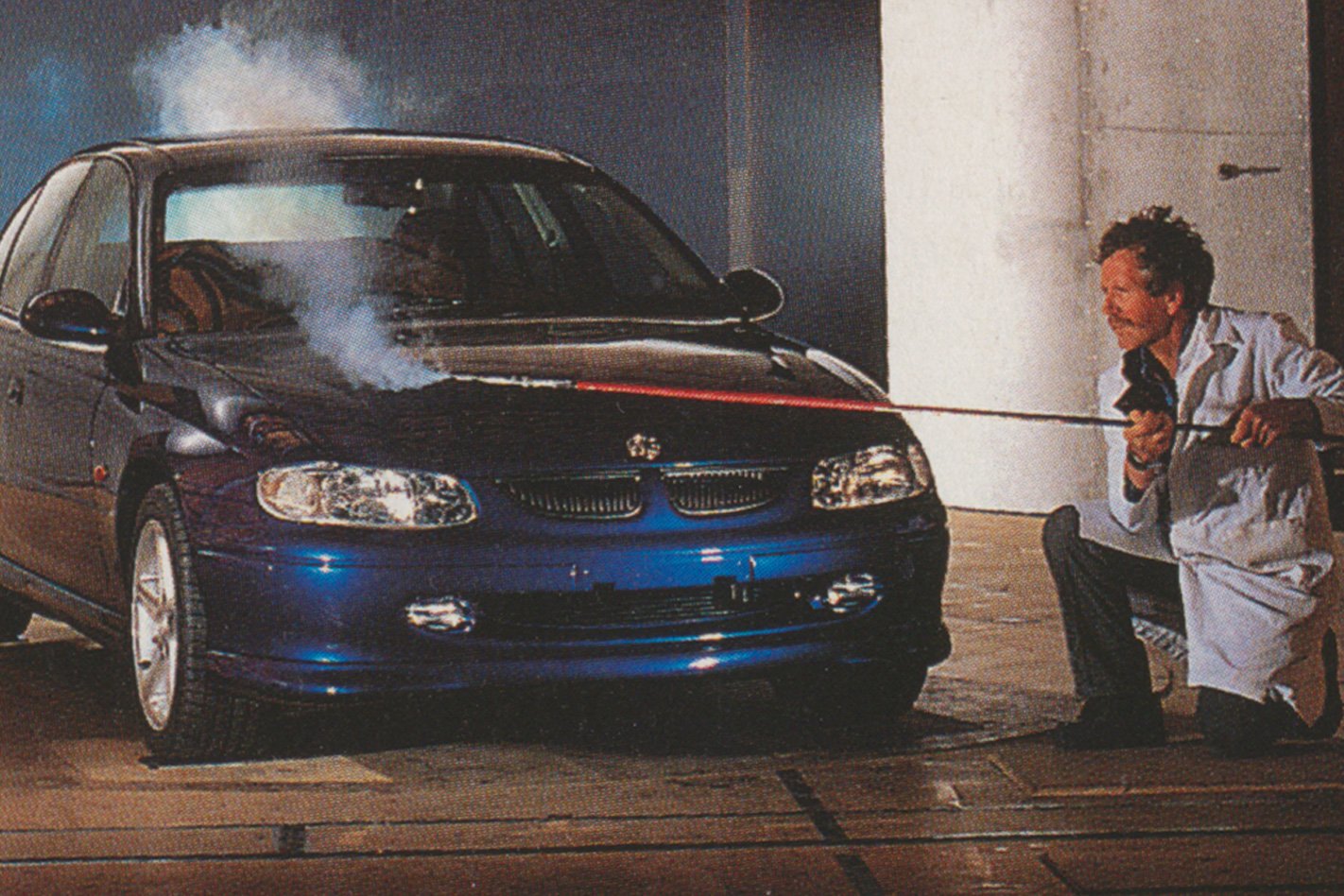
At first acquaintance, the VT Commodore is without doubt the best Australian designed, engineered and developed car yet. But that’s not the good news. The good news is that Australia’s best no longer means second-best.
