
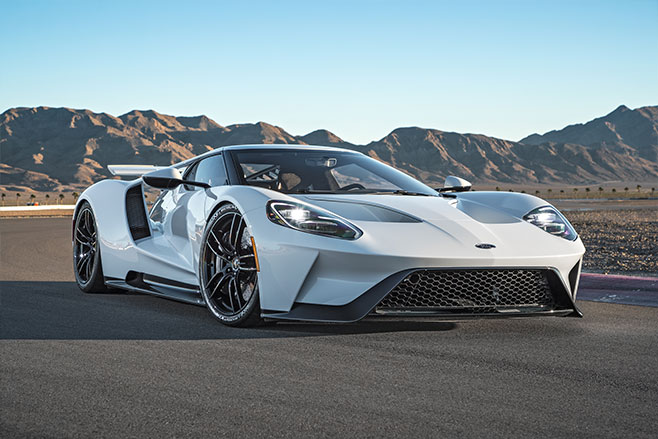
Ford’s third-generation GT may be the Blue Oval’s most advanced car yet, but it features an old-school anti-lag system borrowed from the race car version and linking back to Formula 1 and WRC’s flame-spitting turbocharged glory days.
The GT features five drive modes, and rotating its F1-style knob to either the Sport or Track modes enables the anti-lag system (ALS). Details remain a mystery for now ahead of the car’s international launch, but we know the trick lies in managing the throttle opening and fuel delivery.
In a nutshell, the idea is that the ECU detects when the driver has lifted off the accelerator pedal and feeds more petrol into the cylinders when the throttle is closed – igniting excess fuel in the exhaust manifold and using the resulting kinetic energy to keep the turbine spinning.
The result is more instantaneous throttle response once the driver gets back on the gas.
Twin-scroll, variable geometry, sequential and even electric turbos have all helped to reduce turbo lag in modern cars, though while most have made lumpy power delivery history there can still be a fraction of delay even with the most successful executions.
Swedish brand Volvo introduced an alternative approach recently with its simple yet cunning PowerPulse system. Integrated into its D5 sequential twin-turbo diesel engine, it combined an electrically driven compressor and compact air tank.

We’ll take the GT’s approach, however, as it promises to deliver the classic “bang-bang” rally car sounds off throttle, if not the fiery tailpipes.
ALS IN MOTORSPORT
Big wings, big power. The Eighties were the truly wild era of Formula 1 and the World Rally Championship, and turbo power was the common denominator.
By the middle of the decade, F1 cars were smashing 1000kW-plus with qualifying-spec engines built to last just a handful of laps. Yet even the world’s brightest engineers struggled to solve the chronic issue of lag at lower revs, which could be as long as two seconds according to drivers of the time.

In world rallying, Saab’s 99 Turbo was winning rallies before Audi’s five-cylinder turbo Quattro started the AWD revolution – though the Ingolstadt brand was first to employ anti-lag techniques. Like Ferrari, it squirted petrol into the turbo to keep it spinning on the overrun.
Turbos were banned from F1 after 1988 on safety grounds, and WRC’s glorious Group B era was abruptly ended by a series of fatalities. Rallying has persisted with the turbo formula, and today’s WRC contenders include anti-lag systems.
Before HSV’s fate as an importer and converted for GM was sealed, it used to turn Holden Commodores into faster Commodores, and called them things like ‘GTS’ and ‘Maloo’. Remember those?
This story was first published in MOTOR Magazine, May 2017.
Unfortunately, like almost every other company on the planet, not everything HSV dipped its toe into was a success, and these are five cars that didn’t quite change the world for the better.
Behold, the five rather disappointing HSV models.
1. HSV Jackaroo
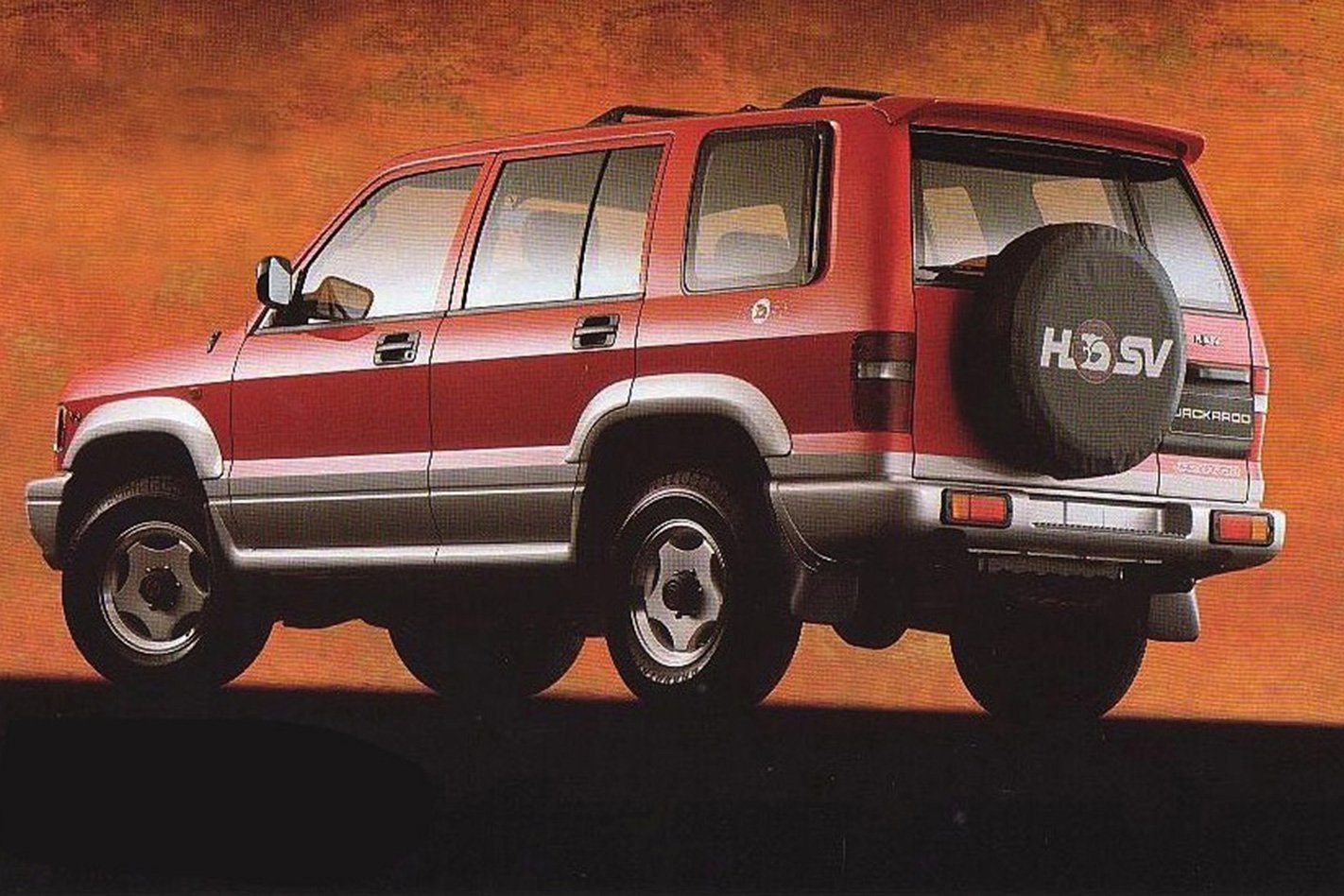
This thing was so embarrassing, it didn’t even get full HSV billing. Instead it was a Holden Jackaroo HSV and even in 1993, it was standing joke material. HSV threw air-con and an LSD at it and you got some lower body mouldings which reduced its off-road potential to just about zilch.
Come to think of it, maybe in that regard it was way ahead of its time. Nah… The engine was the 3.2-litre V6 and the only mechanical change was a switch to alloy wheels. It wasn’t until the Hummer H3 of 2007 that Holden would again scale such heights of irrelevance.
2. HSV SV1800 Astra
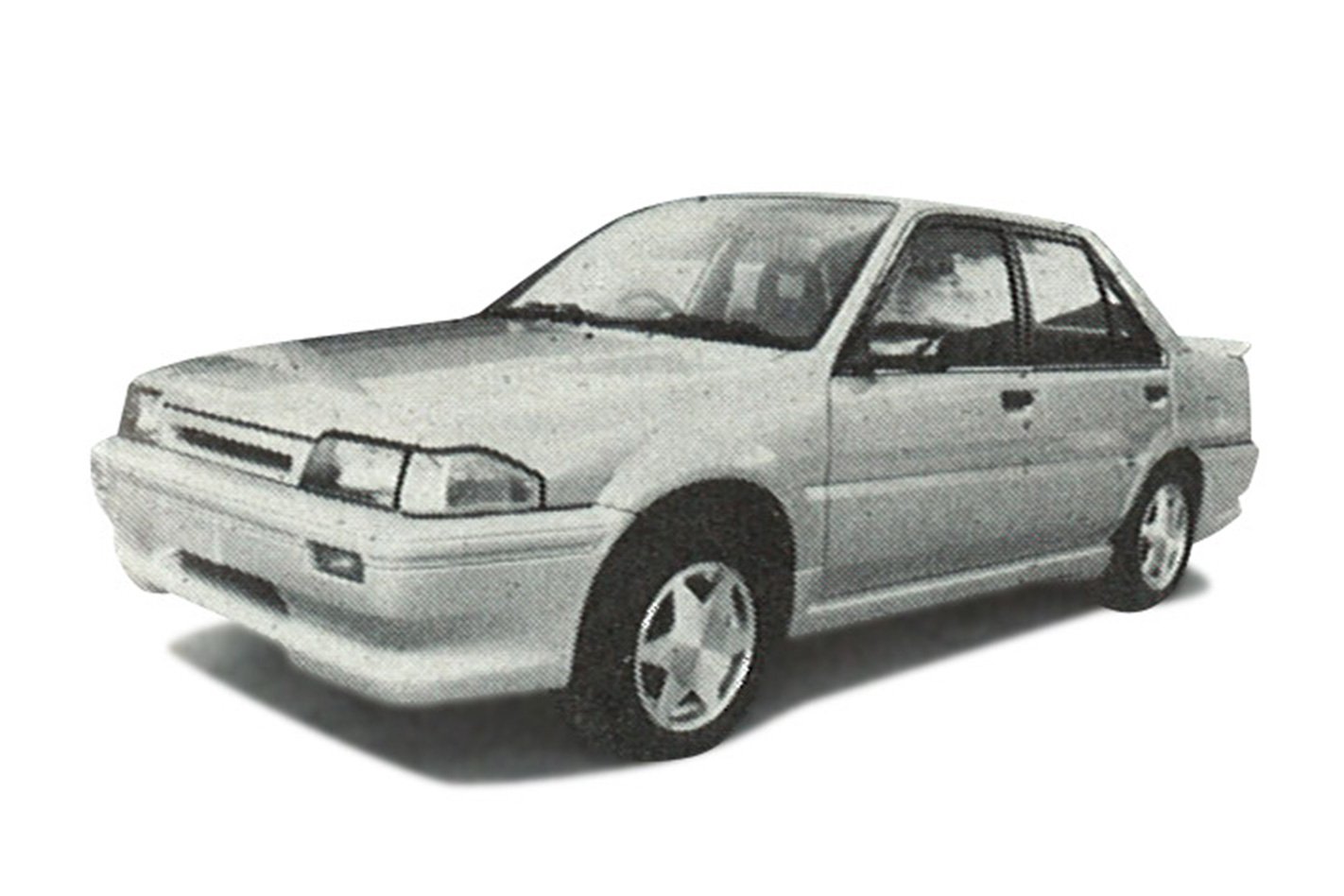
So it made sense for Holden to do whatever it could with the car. But, somehow, dumping a batch of them on HSV was probably not the wise decision it seemed at the time. Stickers, wheels and some plastic, folks.
3. HSV Commodore LE
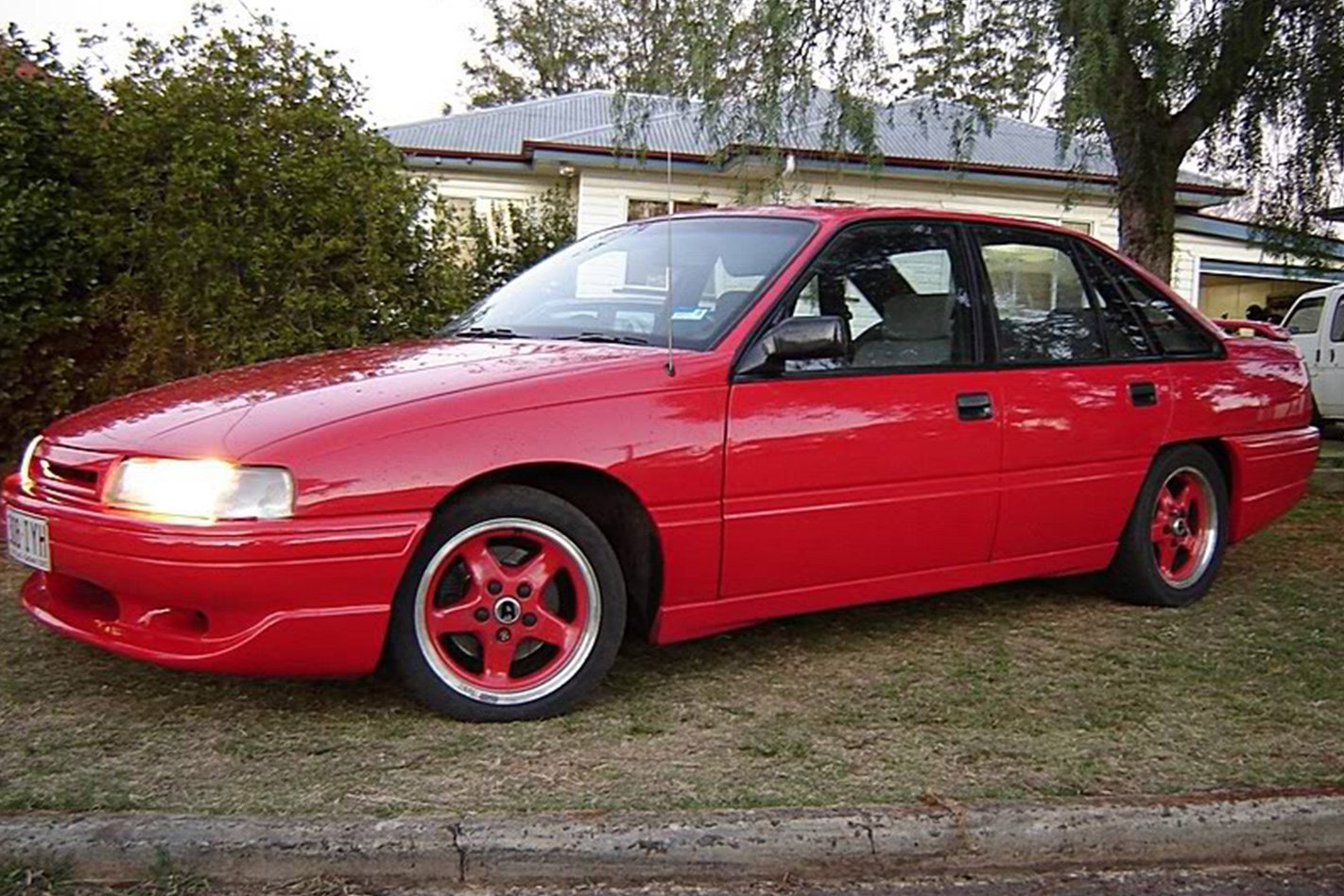
Don’t remember them? No surprise there: it was a stock VN Commodore V6 complete with 125kW and all the driveline harshness you could eat. Maybe there was something in this approach back then (although I can’t think what) but these days, not even the HSV badge can infer any real merit.
4. HSV Avalanche
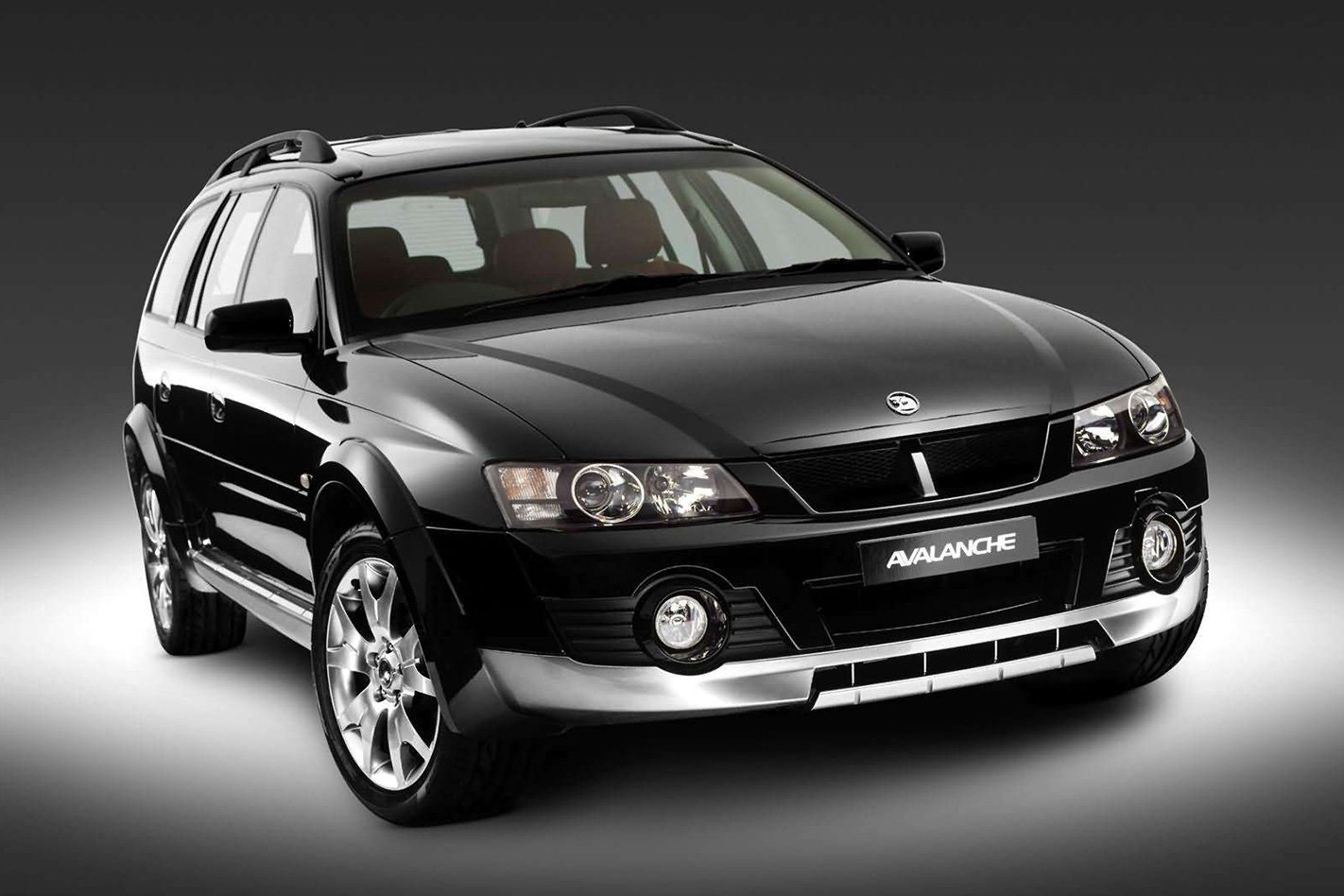
The AWD set-up made for a too-wide front axle and the system forced HSV into a compromised header design that robbed power. It was auto only and about as sporty as championship darts. More mud-slide than Avalanche.
5. HSV Calais SV88
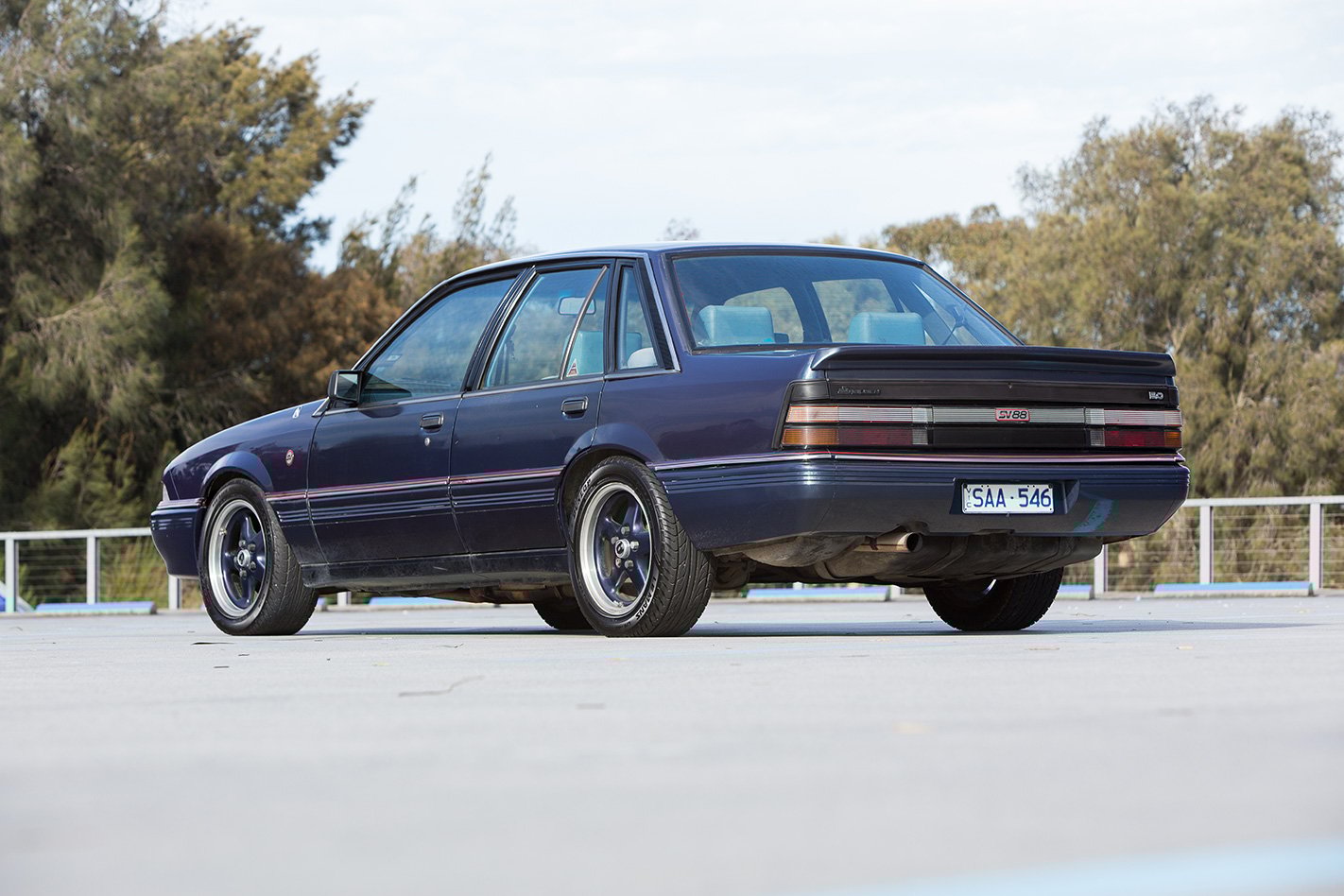
The Last Calais MOTOR reviewed
Even with its price-tag north of $40K, you were stuck with 136kW and the old three-speed Traumatic auto was the only transmmission on offer. Not even the hectares of fuzzy velour trim could save it. Actually, finding one now would be the trick.
UNSPRUNG weight is a term often thrown around when talking about high-performance cars and racecar chassis engineering and, while most petrolheads grasp the concept that minimised unsprung weight is a good thing, fewer know why or what it actually is.
Put simply, any mass of a vehicle that is not supported by the suspension system is regarded as unsprung weight, while the relatively large sprung mass is the portion of vehicle weight that is insulated from the road by the suspension.
Unsprung weight poses a completely different set of engineering challenges compared with the majority of vehicle weight which is sprung and carmakers are constantly developing new ways of cutting the kilos.
Wheels, tyres, outboard brakes and axles are all examples of unsprung weight, but components such as springs, dampers and suspension arms that provide some support while also contributing mass fall into a different twilight zone.
As a general rule, half of the weight of these hybrid masses is considered sprung, while the other 50 per cent is included as total unsprung weight, so that’s how you tot-up the total, but why does it matter?
A tyre contact patch that has constant contact with the asphalt or even loose surfaces will provide better traction, resulting in improved cornering performance, handling and driving dynamics.
Explained: Variable Compression
It is far easier to maintain contact with a perfectly smooth road but imperfections and lumps will do their best to throw the tyre away from the surface and the inertial effect is amplified as speeds increase.
It’s the same principle as a car approaching a ramp at different speeds. Attack the ramp slowly and the vehicle will fall off the end immediately and re-join the surface quickly, but with a bit more speed the car will stay away from the ground for longer.
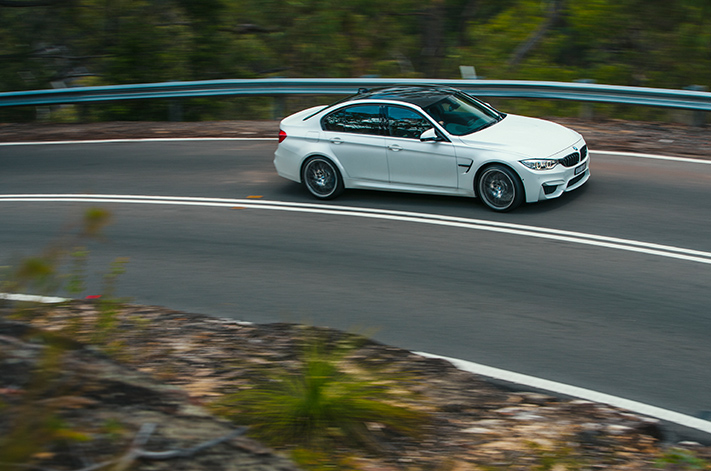
With a lower unsprung weight, the tyre can be pushed back against the black-top by the suspension faster thanks to the lower inertia (an object’s reluctance to changing direction or speed). Lower unsprung weight usually results in better chassis characteristics because grip is good. It’s that simple.
But reducing unsprung weight is often far harder than sprung weight minimisation. While the body, passenger cell, interior components, glazing, powertrain and even electronics offer many possibilities for weight removal, unsprung components are typically made from dense, high-strength and heavy materials that are more difficult to trim down without sacrificing essential strength.
But modern design and materials technology is allowing significant steps in unsprung mass reduction.
When cast aluminium alloy wheels upstaged pressed steel rims, significant gains were possible in chassis performance, and the science has continued to progress with forged alloy wheels.
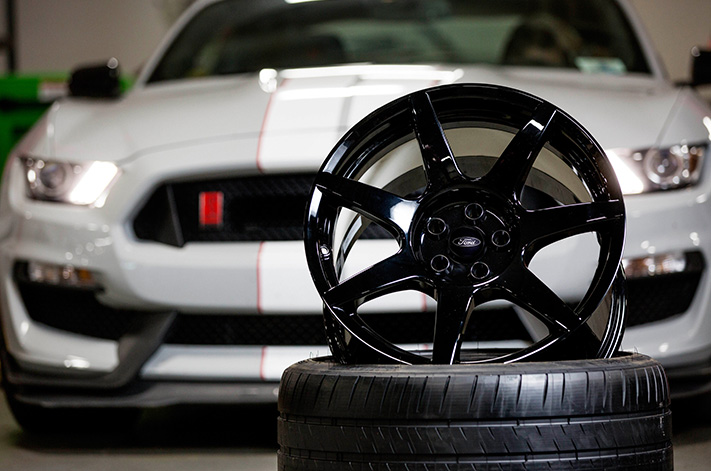
The Carbon Revolution rims fitted to the Ford Shelby Mustang GT350R weigh just eight kilograms each and offer the ultimate in handling optimisation. Despite their weight, they are also tough and have to survive cruel kerb impact testing without significant damage.
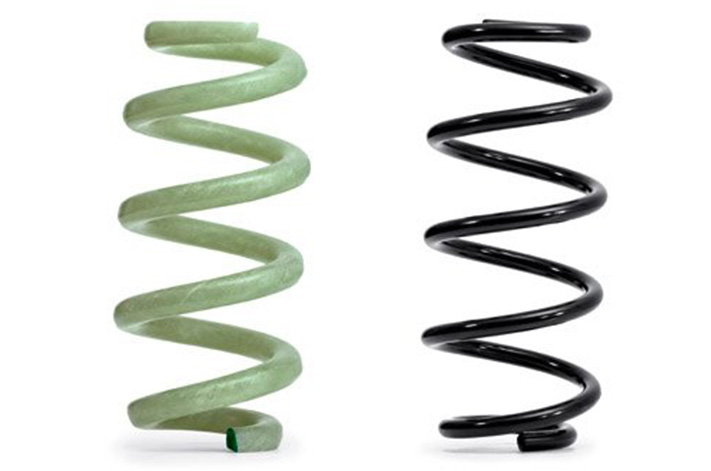
Beyond wheel design, some car makers are experimenting with innovative suspension springs, including a fibreglass coil spring conceived by Audi that is 40 per cent lighter than conventional steel versions.
Hugely expensive carbon-ceramic brake discs are known for their ability to absorb and dissipate massive amounts of heat without complaint when punished on the race track, but the composite material rotors are also significantly lighter than the iron versions that used to be the only option.
It might be a serious design challenge but, when it comes to unsprung weight, less is definitely more.
The Grand Sport name has long played a prominent role in Corvette history, but if you’re in the know, you’ll recognize that this C7 Grand Sport is something proper. As formidable as its Z06 big brother truly is, to call this Corvette it a ‘Z06 lite’ is perhaps accurate.
While the Grand Sport is nearly a literal interpretation of a Z06 less its supercharger, it may be the best Corvette in the range. More focused than the Stingray and less hardcore than the track scorching Z06, the Grand Sport possesses a balance the other Corvettes lack.
Much of the Grand Sport’s core technology is lifted directly from the Z06, which got its inspiration from the C7.R Le Mans-winning racer, like the lightweight construction of the chassis. Nowhere is it more obvious than in the aerodynamic package, as there’s not a single inlet, wing, or vent that does not serve a purpose.
The heart of the Grand Sport is Chevy’s ubiquitous, naturally aspirated 6.2-litre LT1, producing a relatively modest 343kW at 6000RPM and it’s particularly rewarding when you wind out the gears to uncover all of that power. There’s nothing quite like the glorious wail of a small block.
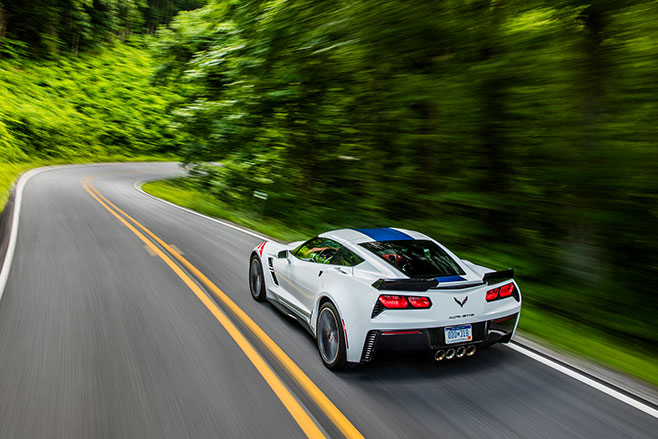
The quicker setup is specifying the optional GM-built eight-speed automatic, which Corvette is keen to tell everyone that it shifts nearly as fast as a dual clutch box. Truth is, it feels as quick as Porsche’s best PDKs and it will pull rev-matched downshifts to boot.
As superb as the auto box is, the manual is the transmission of choice. With its wonderfully mechanical feel, heft of the shifter, and well-defined gates, it’s the choice of drivers looking for maximum engagement. Combined with the free-revving V8, running through the gears is bliss, and heel-and-toe downshifts quickly become second nature.
The Grand Sport’s secret to putting down power is the electronically controlled limited slip differential. It’s fully open under braking for stability and, under power, uses inputs from the Corvette’s systems to determine the optimal amount of lock up at any given moment. It operates seamlessly and without any compromises.
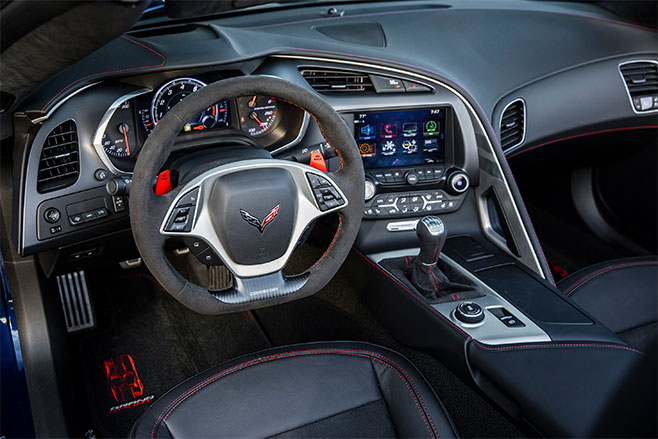
The C7’s cockpit is largely unchanged from its introduction a few short years ago, and the Alcantara trimmed steering wheel and shifter lends a functional feel to the driver’s interface. However, the overall interior design is already dated and hard, unfriendly plastics abound through the cabin.
Like all Corvettes, the Grand Sport has an ideal seating position and excellent sight lines, but more impressive are the well-matched control weights between the steering, clutch, brake pedal, and shifter.
Optional Competition Sports Seats are recommended for their lateral support and are surprisingly comfortable for longer drives, but their large seatbacks intrude into the already cramped cabin. Under the hatch, cargo space is an enormous 425 litres.
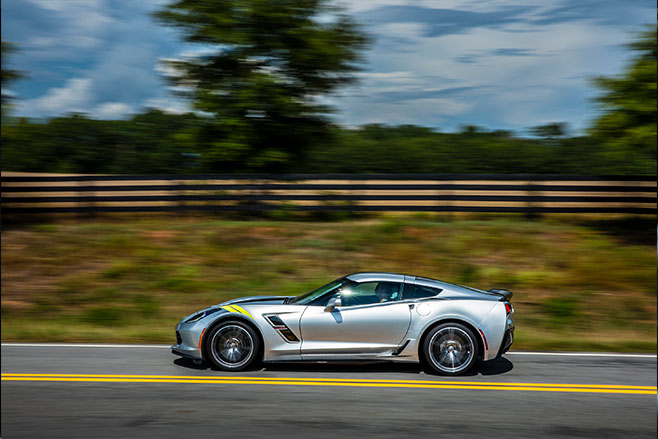
The Michelin tyres are near slicks and have no rain-evacuating tread to speak of, but Corvette says this package is worth 1.2Gs of lateral grip on the skidpad. That sort of limit is what we’re accustomed to finding on purebred race cars, not street legal supercars.
Steering feel and feedback has never been strength of Corvette, but the C7 is light years ahead of its predecessors. Still, relative to even a bog standard 911, the Grand Sport steering gives the driver little information, but its saving graces are its precision and responsiveness.
The Corvette Grand Sport is one of those cars that’s far greater than the sum of its parts. It’s very approachable and inspires confidence for drivers of all skill levels. Experienced drivers will enjoy its accessible performance envelope and for those less skilled, there’s no need to worry that it’ll surprise you.
While it leans toward the hard core end of the sports car range, the Corvette Grand Sport is one of those special do-everything coupes with enough performance to embarrass some venerable European supercars.
LIKES
An exceptionally well-rounded package
DISLIKES
Twentieth century interior design and finishes
Specs
ENGINE 6161cc V8, SOHC, 16v, naturally aspirated POWER 343kW @ 6000rpm TORQUE 630Nm @ 4600rpm WEIGHT 1555kg 0-100km/h 3.7sec (estimated)
WELL folks, it’s time to reveal which of Australia’s muscle cars should be counted once and for all as the true king of the road.
More than 8000 people voted in the competition to discover your thoughts on what is the greatest Australian-built muscle car. The winner? Ford’s FG X Falcon XR6 Sprint.
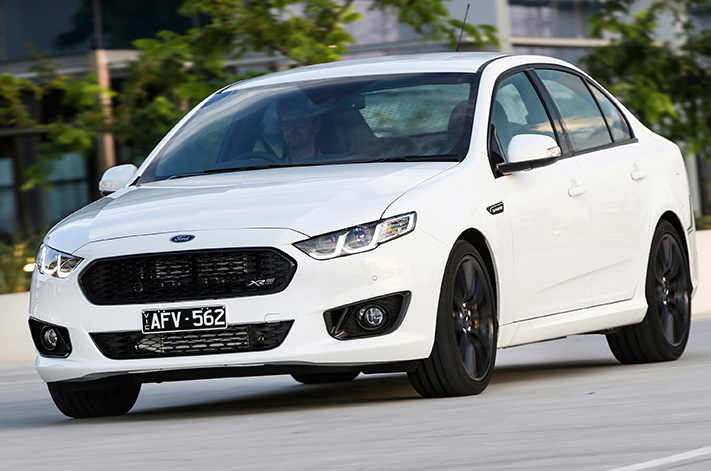
While it may seem like sacrilege to some that a turbocharged car – nay, a six-cylinder car – has won the title of Australia’s greatest muscle car, let us defend your choice.
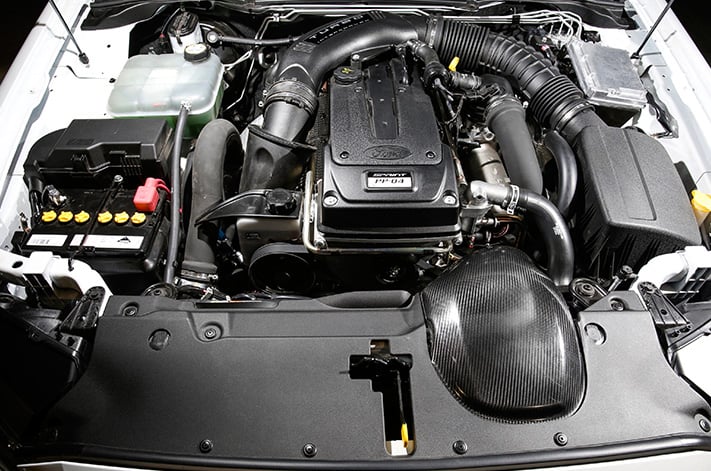
The FG X XR6 Sprint is not just any run-of-the-mill turbo six, under that bonnet is the iconic Barra, in its most fervent form.
In the Sprint, the 4.0-litre straight-six turbo petrol was at its most powerful, producing 325kW at 6000rpm, and 576Nm from just 2750rpm.
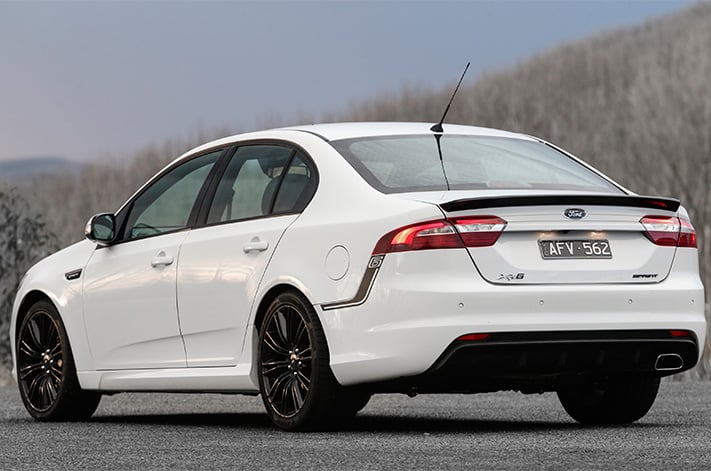
Priced from $54,990, the limited-run Sprints sold out rapidly, with a Winter White model – the last one built thast could be registered for the road – selling at auction for $122,000 following the closure of Ford’s local manufacturing.
Ford claimed the XR6 Sprint could do the 0-100km/h dash in a scant 4.5 seconds, fast enough to give its big brother, the XR8 Sprint (with a supercharged 5.0-litre V8 under the bonnet), a serious hurry-up.
It might not fit the traditional form of a muscle car, but the FG X XR6 Sprint represents that – even with the shutters coming down on Australian manufacturing – we were able to produce serious performance vehicles that did our nation proud. The Falcon, and the Barra engine, have both reached the end of the line, but the XR6 Sprint was a worthy farewell for the pair.
And now, according to you, it can be recognised as the greatest Australian muscle car in history.
QUESTION – ALAN (question asked 20/12/2016):
I’m looking for an AWD light SUV, which I’ll drive about 30,000km per year. Most kilometres are on highways/country roads, with city, beach and snowfields mixed in throughout each 12 months. I’m looking at Mazda CX-5, Hyundai Tucson, Kia Sportage or Toyota RAV4, and considering either petrol or diesel.
BUDGET:
$50,000
ANSWER – FRASER STRONACH:
First up, I’d rule out the Toyota RAV4 as it’s generally underwhelming in a number of areas including driving dynamics and performance, despite the benefit of good resale value and Toyota’s extensive dealer network.The Mazda is next to go as it doesn’t have a full-size spare tyre. Space-saver spares are a seriously dud idea for Australia, especially for country driving, where a full-size tyre that can safely support a fully loaded car at freeway speeds is essential.That’s leaves the Tucson and the Sportage, which share many common mechanical parts including the diesel engine, which is my preference for either of these two thanks to the combination of decent performance and excellent fuel economy.
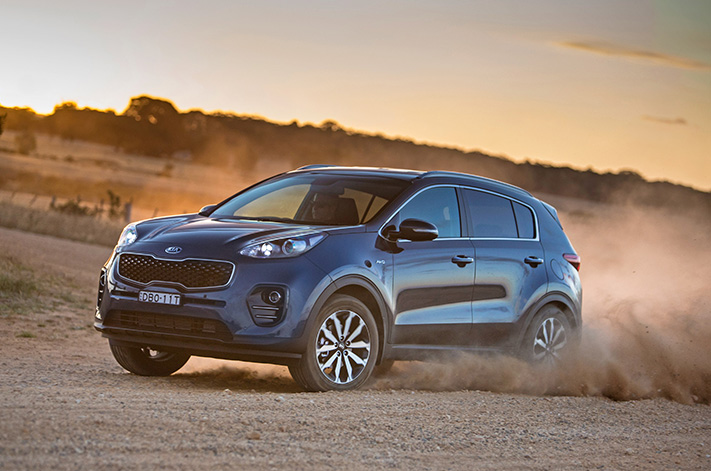
If you do wish to drive on sand, remember to drop your tyre pressures to around 18psi. It will make a huge difference and helps prevent getting bogged, which is all too easy to do in soft sand.
The motor oil in your car has a critical role to perform and just seconds without the lifeblood of the engine will spell disaster, so checking the level and condition should be at the top of your regular check list as well as making sure you are using the correct grade.
A DIY oil and filter change or a simple top up is a good way to avoid a trip to the mechanic and will save you money, but what is the correct oil for your car and what do all the brands and numbers mean?
Engine oil may not be the most glamorous automotive ingredient but it is an unsung hero and must cope with punishing temperatures from a stone-cold start in the dead of winter to heavy load driving in the height of summer. That’s a potential temperature range of below zero to in excess of 100 degrees and this is where the numbers come in.
The number on the bottle is the oil’s Society of Automotive Engineers (SAE) standard viscosity rating or ‘weight’. Very simply, the higher the number, the thicker the oil, but you will notice that a majority (if not all) options at your local store have two numbers and a letter, so what’s that about?
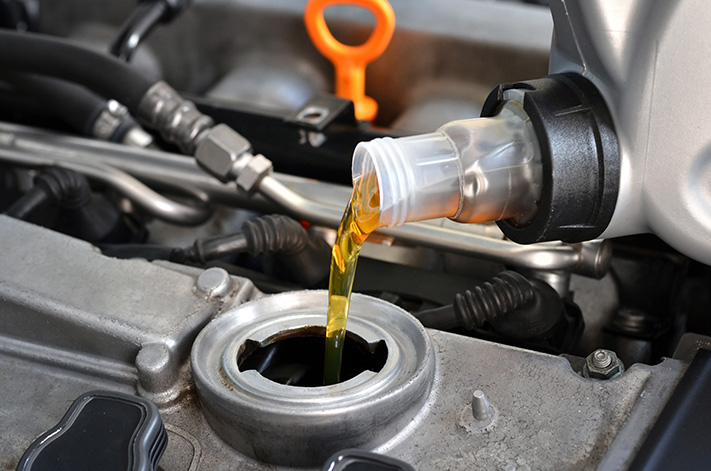
These oils are multigrade oils and were developed using a viscosity index improver (VII) that allows the oil to function correctly over a wider temperature range and have removed the need to change your oil according to the season.
A ‘W’ after the first number stands for winter and represents the oil’s performance in cold conditions, the second number is the performance at operating temperature, but while the two figures are on the same SAE 11-grade scale, 10W is not the same viscosity as 10.
| Synthetic motor oil versus mineral oil
The numbers are decided in SAE J300 testing which measures how long the oil takes to flow through a standard orifice at the test temperatures, thereby indicating its ‘weight’ and placing it on a scale with all manufacturers and products.
So which is the correct oil? It depends on a number of factors.
Older engines prefer a higher viscosity oil to fill larger clearances, which typically get larger with age and wear, while modern engines have finer tolerances that favour thinner oils.
New engines and particularly high-performance applications can produce higher operating temperatures both overall and localised, which requires an oil grade that can remain stable under more extreme conditions.
The good news is that your car manufacturer has done the hard work for you and knows the best oil for your model and this advice is best.
In most circumstances it is okay to use a different brand of oil if a car maker is suggesting a particular product as long as it has the correct recommended grade, but for the very newest engines, it is safest to stick with the specific brand and product line.
All oils are not equal and the various brands formulate different blends of VIIs and other additives, often for specific applications, so make sure you top up with the correct drop and your motor will thank you with a long life and optimum fuel economy.
Did that video of the 2017 Porsche 911 GT3 slashing 12 seconds off its fastest laptime get you panting? Did Honda’s record-setting lap in the 2018 Civic Type R arouse a physical reaction in you?
Pay attention, because we’ve compiled the hairiest on-the-razor’s edge Nurburgring laps to ever be captured on video. Strap yourselves in, put your headphones on and engage fullscreen mode – here are some of the wildest Nordschleife orbits.
Ruf CTR ‘Yellowbird’
One of the most manic laps ever captured on video at the Nordschleife is also one of the oldest. In 1989 Stefan Roser took the then-two-year-old Ruf CTR around the Nurburgring’s northern loop with a camera mounted to its roll cage. Opposite-lock is applied in nearly every corner, and Roser’s driving talent is on full display.
2017 Geneva Motor Show: RUF CTR Yellowbird Geneva tribute revealed
Titled “Faszination on the Nurburgring”, the Yellowbird in-car video is still eye-wideningly impressive nearly 30 years on. And with a twin-turbo 3.4-litre flat six funnelling 350-odd kilowatts through a rear-drive chassis weighing just 1150kg, how could the CTR be anything but exciting?
Nissan Skyline GT-R [R32] 8:22
Around the same time the R32 GT-R was dominating the Group A Australian Touring Car Championship at Mount Panorama, the legendary ‘Godzilla’ was also making its mark around the Eifel mountains in Germany. Filmed by Japanese car show Best Motoring, this video highlights just how capable the R32 GT-R was for the time.
What’s more, the R33 GT-R that succeeded it is also recognised as the first production car to dip below the eight-minute mark – an incredible achievement for the mid-1990s. We don’t have video of that lap, but here’s one of the R33 GT-R V-Spec cutting it incredibly close with an 8:01.
Pagani Zonda R – 6:47
Now we get serious. The ultimate interpretation of Pagani’s AMG-engined Zonda supercar is the Zonda R, which eschewed the road-going Zonda’s 7.3-litre V12 in favour of a hard-charging 6.0-litre borrowed from the Mercedes-Benz CLK GTR.
It differed significantly from Zonda road cars, with unique suspension, chassis and a stripped-out interior. With less weight and track-honed underpinnings, it proved a rocket around the Nurburgring and reset the production car record in 2010 – though as a track-only device the validity of that record is debatable.
Then again, listen to that V12 howl.
Viper ACR-X 7:03
“American cars don’t handle” – ever heard that one before?
It’s a familiar phrase, but an outdated one. It may have applied to muscle cars of yesteryear, but Detroit has learned a few lessons in the intervening decades about how to make cars that corner.
And proof of that is manifest in the Viper ACR. Back in 2010 the ACR recorded a blistering 7:12 lap, but a year later SRT returned with the even more focused ACR-X for another try. The result was a 7:03 spin around the Nordschleife, definitively proving that the Yanks can do things other than drive in straight lines, 400 metres at a time.
Citroen AX diesel – 9:55
Why is there an oil-burning French hatchback on this list? Because the story behind this video is absolutely incredible.
Youtube user ‘Nic BTG’ is a Nurburgring addict, but as an ordinary Frenchman he didn’t quite have the dosh to record a blistering lap behind the wheel of a Nordschleife-slaying supercar. But he did have a Citroen AX 14D, a 1.3-litre diesel compact hatchback.
He also had superhuman levels of tenacity, because it took ten separate visits to the Nordschleife for him to achieve his goal of sneaking under the ten minute barrier. It also took 118 laps of the 23km circuit, nine blown engines and five dead gearboxes. He’s clearly driving the pants off the thing, and that makes for an entertaining video in itself. What’s the saying about driving slow cars fast?
Lamborghini Huracan Performante – 6:52
Forget the shenanigans about fraudulently sped-up footage – the Lamborghini Huracan’s fast lap around the Nordschleife is simply mega.
Active aerodynamics, a 40kg weight reduction, ultra-sticky Pirelli Trofeo R tyres, mega stiff suspension and a 470kW naturally-aspirated V10 all helped to make the Huracan the second-fastest fastest road car around the Nurburgring to date. The Zonda R may be quicker, but unlike the Performante you can’t pop down to the shops in one.
BMW M4 DTM 6:14
Things get serious when proper racecars hit the ‘Ring, and Augustus Farfus’ ballistic orbit of the Nordschleife in a DTM-spec BMW M4 needs to be seen to be believed. Done with a passenger next to him, this lap was only meant to be a joyride for guests of his sponsor, Shell, but Farfus’ 6:14 lap puts all road car lap records in the shade.
Holden Commodore SS-V Redline – 8:19
A home-grown hero makes this list, with Holden development engineer Rob Trubiani steering a 2013-spec Commodore SS-V Redline ute around the Nordschliefe in a highly respectable 8 minutes and 19 seconds.
Fun fact: this lap scored the Commodore ute the title of “fastest commercial vehicle around the Nurburgring”. You’re never late in a V8.
Chevrolet Camaro ZL1 – 7:29
More American metal, this time in more accessible Camaro flavour – albeit in top-tier, AU$82,900 Camaro ZL1 trim.
It’s wicked-fast in a drag race – as you’d expect – but this is another example of a Yank that knows how to run around a track. Aggressive aero, mega-grippy undercarriage and a 10-speed automatic help the ZL1 trip the beam with a solid 7:29
Nissan GT-R Nismo – 7:08
Since the R32 generation further up the page, the GT-R has been a fixture of manufacturer drive days at the Nordschliefe. Here, Super GT driver Michael Krumm expertly whips the latest evolution of the Godzilla legend, the Nissan GT-R Nismo, around the ‘Ring during its development programme.
At over 1.7 tonne empty the Nismo is a real heavyweight, but 441kW, proper aero kit and an all-wheel drive system run by supercomputer-smarts sees the big GT-R creeping up close to the seven-minute mark.
Honourable mention: BMW Sauber F1.06
Okay, bear with us on this. Yes, this isn’t solely onboard footage, and not a full lap, but you can’t go past watching a fully-fledged modern Formula 1 car attacking the Green Hell. Nick Heidfeld is the man behind the wheel of the BMW Sauber F1.06 and he certainly isn’t holding back. The glorious sound of that 2.4-litre naturally-aspirated P86 V8 is worth the price of admission alone.
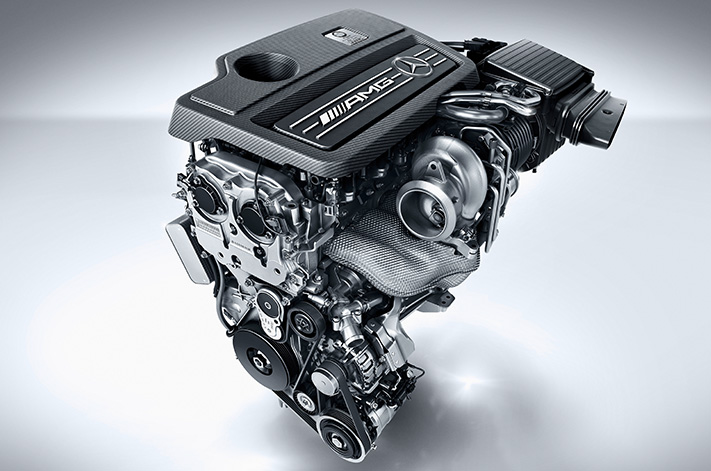
MERCEDES-AMG is readying a potent new in-line six-cylinder performance engine that will usher in the ‘53’ moniker to replace models such as the C43 and E43.
Based on the M256 3.0-litre in-line six-cylinder that arrives in the updated S-Class later this year, the AMG-fettled version will boost outputs to about 330kW, a healthy advance on the 295kW peak of the recently released, twin-turbo V6 E43 AMG.
Key to the new engine is an electric compressor, or turbocharger, which Mercedes-Benz dubs with the German acronym eZV.
Described as an ‘auxiliary’ compressor, the electric turbo seems certain to mzimic the operation of the unit fitted to the 4.0-litre V8 diesel in the Audi SQ7 and Bentley Bentayga, boosting airflow at low speeds, therefore eliminating turbo lag while a conventional exhaust-gas-driven turbo reaches its optimal operating speed.
As well as engine management software and the exhaust system, AMG is likely to focus its efforts on that gas-driven turbo as a means to boost outputs over the regular engine.
As for the name for models fitted with the M256 six-cylinder, AMG boss Tobias Moers is refusing to say – “we’re going to continue with 43s, but I don’t talk about nomenclature right now” – but Wheels has learnt Mercedes-AMG will replace its 43s with 53s, not only separating the basic layout but also the fact the new engine has more power than the V6 it will replace.
Moers said even as AMG prepared itself for electrification, there would be big investments made in developing the internal-combustion engines that are a crucial component of a hybrid system.
“Chasing more efficiency out of combustion engines is mandatory,” said Moers.
As for a hybrid version of the six-cylinder, Moers is refusing to go into details, except to say AMG is prepared.
“We are well prepared regarding both our strategy and volume.”
Next Mercedes-AMG A45 to have more than 300kW
He added that the AMG hybrid strategy would utilise the electric motors all the time.
“When we have an electrified powertrain it should be always functioning … especially regarding performance.”
The move to an in-line six-cylinder engine has little to do with heritage and a lot to do with saving money.
Utilising the architecture of the next-generation M264 four-cylinder engine, the M256 has an identical cylinder design and even shares a modular exhaust system.
It means one of the most expensive components of an exhaust – the catalytic converter – can be amortised across the four- and six-cylinder models.
It also means engineers only need to create one perfect 0.5-litre combustion chamber, which is then replicated across the configurations.
The facelifted Mazda 2 hatch and sedan isn’t hugely different in the visual department, but brings new safety tech as standard across the board – and the same sweet price for the frugal buyer.
All the cars in the range receive the same 1.5-litre four-cylinder naturally-aspirated petrol engine. However, the engine comes in either high or low tune, depending on spec, with 79kW/139Nm or 81kW/141Nm respectively. Automatic emergency braking is now standard across the entire range.
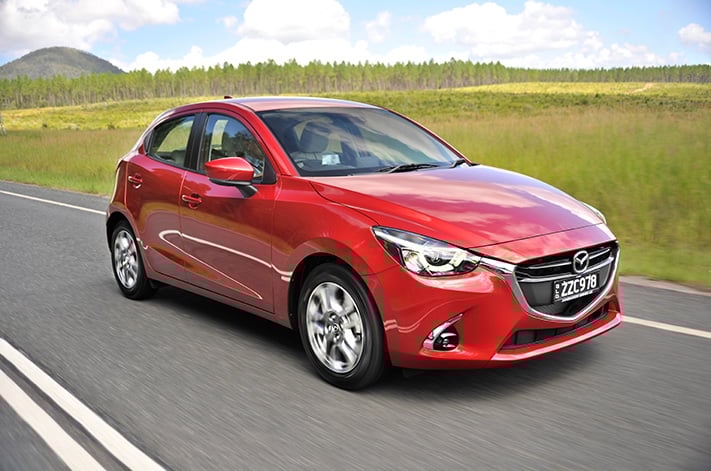
Mazda’s smallest and cheapest car starts with the Neo grade-spec at $14,990 for the six-speed manual, with the optional six-speed automatic attracting a $2000 premium.
The Neo misses out on digital radio, and reverse camera, but has 15-inch wheels, black cloth trim, rear seats with a 60:40 split, cruise control, Bluetooth telephony, keyless push-button start, front, side, and curtain airbags, and Mazda’s handling-enhancing ‘G-Vectoring’ control.

Next is the Maxx, with a $17,690 price tag for the manual, and $19,690 for the automatic. The Maxx receives the higher engine tune, a leather-wrapped gear knob, DAB+ radio, 7-inch touchscreen display, a reverse camera, smart city brake support in reverse, and sat-nav as an option.
The Genki spec grade is the next level up. Only available in a hatch bodystyle, the Genki adds 16-inch wheels, daytime running lamps, power mirrors, a shark-fin antenna, auto headlamps, rain-sensing wipers, active driving display, climate control, sat-nav as standard, blind spot monitoring, and rear cross traffic alert.

GT is the highest spec grade, and costs $21,680 for the manual, and $23,680 for the automatic across both hatch and sedan bodystyles.
The top of the line Mazda 2 largely receives enhanced interior trim, with front door armrests, centre console side panels, and leather/cloth seat trim.
PRICING
Mazda 2 Neo manual – $14,990 Mazda 2 Neo automatic – $16,990 Mazda 2 Maxx manual – $17,690 Mazda 2 Maxx automatic – $19,690 Mazda 2 Genki manual – $20,690 Mazda 2 Genki automatic – $22,690
