
SUZUKI has surprised industry observers with an earlier-than-anticipated release date for its all-new Swift supermini, surfacing in June and with downsized engine choices that will include an all-new turbo triple as well as the company’s acclaimed 1.4 Turbo later on.
To take on the Mazda 2 and Volkswagen Polo in the $16,000 to $24,000 end of the Light Car segment, the fifth-generation Japanese five-door hatchback will ditch the existing 70kW/130Nm 1.4-litre four-pot petrol engine for a slightly smaller 1.2 atmo unit (as seen in the Ignis sub-B hatch/SUV crossover as well as the larger Baleno) in the base GL.
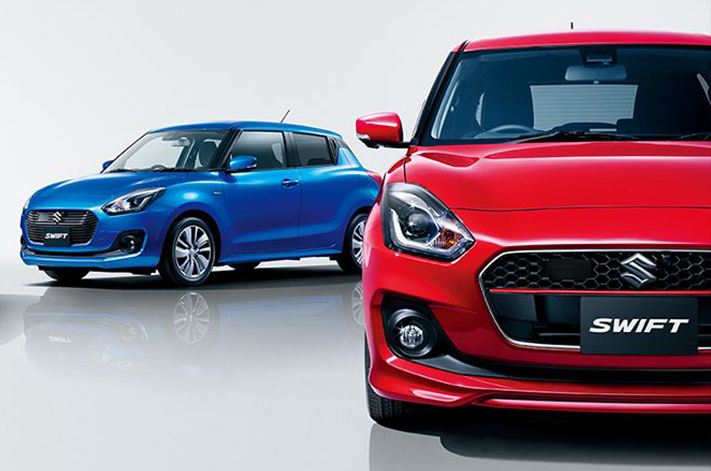
Producing 66kW of power and 120Nm of torque, it will drive the front wheels via either a five-speed manual or CVT Continuously Variable Transmission.
| 2018 Suzuki Swift launched in Europe
Additionally, the more expensive GLX will score an 82kW/160Nm 1.0-litre three-cylinder ‘Boosterjet’ turbo that also debuted in the Baleno. Mated exclusively with the company’s Aisin-supplied six-speed torque-converter automatic, it spells the end of the long-running four-speed auto found in the last two generations of mainstream Swift models. A manual may come later if there’s enough demand for it.
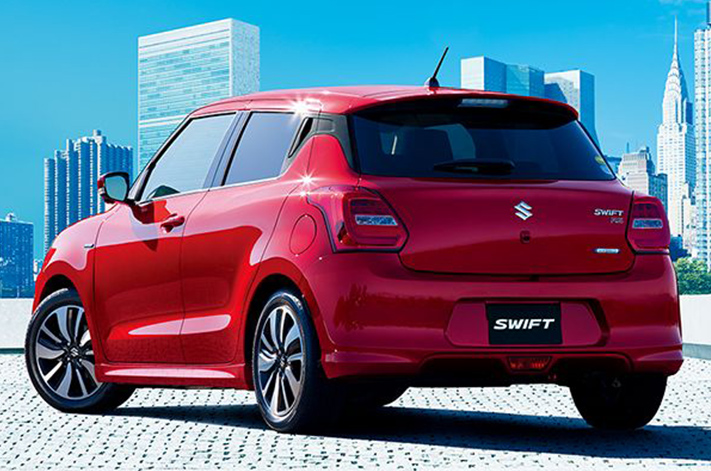
Fans of the existing 100kW/160Nm 1.6-litre Sport haven’t been forgotten either, with the rip-snorting 103kW/220Nm 1.4-litre four-cylinder turbo engine from up-spec versions of the Vitara and S-Cross expected to power the upcoming next-gen Swift Sport when it debuts sometime in 2018.
Considering that most Swifts will tip the scales at under 1000kg (the lightest starts from just 890kg), that ought to be a cracking performer. Other than that, details about the brand’s potential Fiesta ST slayer remain scant. At the recent Ignis launch, Suzuki Australia director Andrew Collins had already flagged his desire to maintain a presence in the semi-hot hatch scene, stating that he’d like to see the Swift Sport legacy living on in the next-gen iteration.
At the more mainstream end of the range, the freshly-minted 1.2 and 1.0 Boosterjet powertrains should be far more frugal than their predecessors, averaging sub 4.0L/100km fuel consumption ratings instead of the 5.5 and 6.2L/100km results that the old manual and auto 1.4 atmo managed respectively.
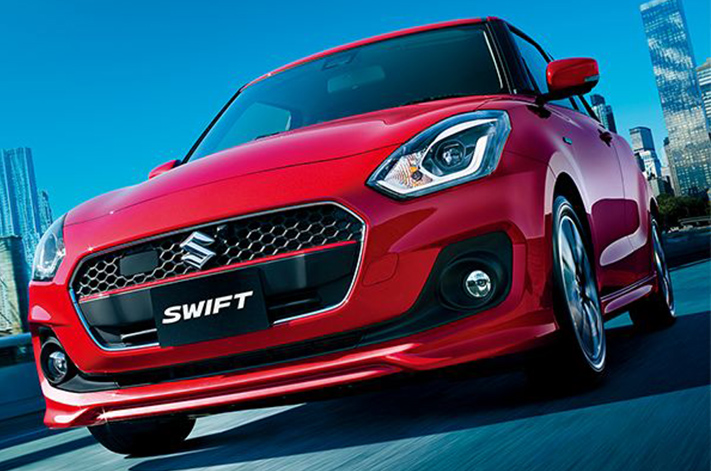
Though the styling is clearly an evolution of the highly successful third-generation Swift which was unveiled in late 2004 and then rebodied for 2012, the upcoming AZ-series Swift shifts to the Baleno’s underpinnings. Vitally, the series grows in length and wheelbase (but not width or height), resulting in a roomier back seat and a significantly larger cargo capacity.
Otherwise, it is business as usual, with segment-typical MacPherson-style struts up front and a torsion beam rear end.
The Swift will most likely also be the first Suzuki to adopt AEB Autonomous Emergency Braking and Lane Departure Warning systems, while – if current Suzuki practice is maintained – satellite navigation will probably be standardised in every version.
“Like with Vitara and Baleno, the new Swift will continue the trend in trying to provide the best spec we can in the marketplace,” Moore told Wheels. “I don’t want us to be the cheapest cars around but I want them to be the best value.”
All that additional gear means we ought to expect a sub-$17,000 asking price for the Swift GL (currently it retails from $14,990), with the GLX Turbo auto breaching the $20K barrier.
More information, including final pricing and spec details, will be revealed closer to the next Swift’s launch in June, so stay tuned.
VOLKSWAGEN has extended its so-called Golf 7.5 update to include the GTI and R power pair, bringing more muscle and kit for its high-performance twins when they arrive on Australian turf in about mid-August.
With the mid-life update, the GTI gets a tune up to 169kW which was previously the preserve of the more exclusive and expensive Performance variant, while the R has a boosted power output of 213kW, up from 206kW.
An upgrade of just 7kW apiece may not sound significant but the added performance has enabled the R to break the milestone zero to 100km/h acceleration barrier of 5.0 seconds, completing the dash in a zippy 4.8s when fitted with the dual-clutch DSG transmission, which has also been revised.
VW has not provided a revised acceleration figure for the pokier GTI but expect a figure similar to the Performance standard of 6.4s.
Both variants of the venerable Golf will continue to be offered with a choice of six-speed manual gearbox or dual-clutch auto, which offers seven speeds in the R or six when bolted to the GTI’s 2.0-litre turbo.
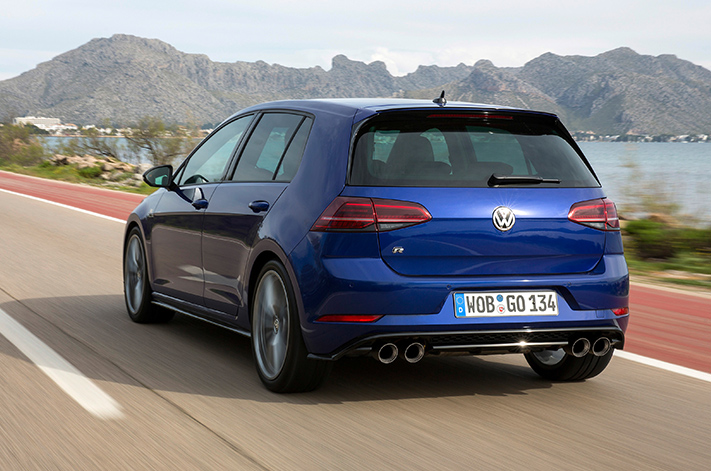
Like the rest of the Golf range, the GTI and R will be treated to a lightly overhauled front and rear end design, complemented by new alloy wheel designs as well as an enhancement of interior tech.
2016 Volkswagen Golf GTI 40 Years review
2017 Golf Rs will roll on a new 19-inch Spielberg rim, while the GTI’s 18-inch wheels are unglamorously named in honour of the UK’s Milton Keynes.
For the R, Volkswagen has ripped out the 6.5-inch information and entertainment screen in favour of an almost cinematic 9.2-inch version, which incorporates the latest Discover Pro navigation and App-Connect.
Operation of the updated system is enhanced with the introduction of new gesture control, supplementing the existing voice commands and steering wheel buttons.
The GTI also bins its 6.5-inch screen and upsizes to a new Discover Media 8.0-inch version with App-Connect.
Pricing is yet to be confirmed for Australia, but the power players are unlikely to deviate greatly from the current pricing which stands at $41,340 before on-road costs for the GTI and $52,990 for the R.
Continental can claim the top tier for tyres until 2018, as its ContiSportContact 5P has taken out the place of pride in this year’s MOTOR Tyre Test.
Following a second-place finish in 2016, Continental managed to go one better during the scorching temperatures of the 2017 event.
Consistent excellence across all five disciplines was the key to the Continental’s success, with our test driver, the ever dependable Warren Luff, also full of praise: “Consistent front-to-back, and lively with a bit of edge. Great wet-weather performance, too.”
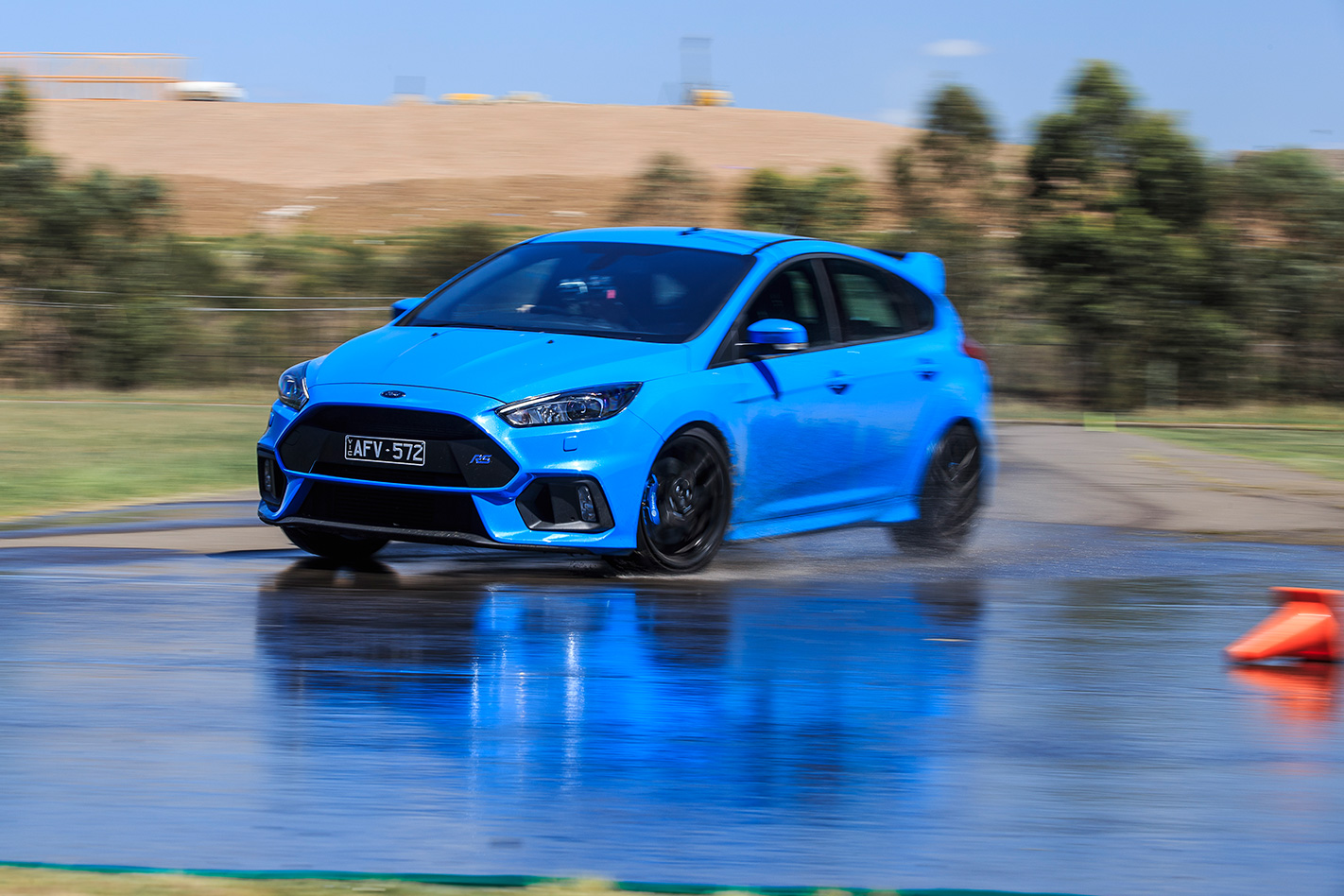
It was no slouch on dry tarmac though, with a third place in the dry slalom, second in the motorkhana and another win when it came to stopping in the dry.
Our chosen size this year was again a 235/35 R19, which gives a direct comparison to the 2016 Tyre Test with the same size being used. The test car was a Ford Focus RS, fitted with the optional lightweight rims.
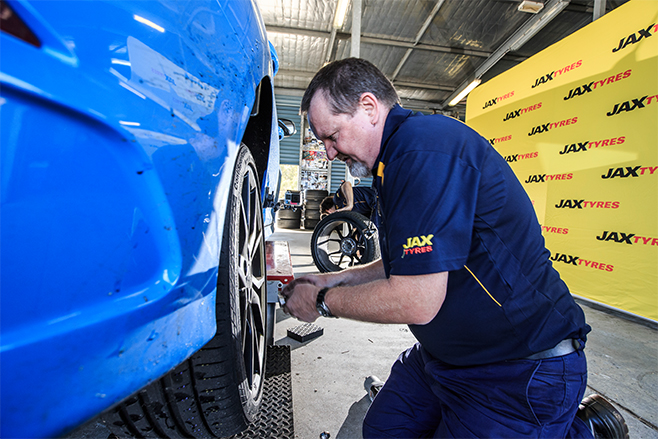
In the final results, the Continental’s score of nine (lower being better as first place in each discipline scores one, second two and so on) narrowly beat the Michelin Pilot Super Sport (14) and the Pirelli P Zero (15).
To see the full results of this year’s Tyre Test, pick up a May 2017 copy of MOTOR, or keep an eye on motormag.com.au!
Less than a month after issuing a not-so-subtle diss toward Dodge’s race-ready Demon with its Camaro Exorcist, US tuner Hennessey Performance has decided to have it both ways by announcing a Demon-based rocketship of its own.
And while a stock standard Dodge Demon makes a stonking 626kW of power, Hennessey claims it will be able to dial that up to a truly monstrous 1119kW (or 1500hp) for its customers. A slightly less insane 745kW power upgrade is also expected to be on Hennessey’s tuning menu.
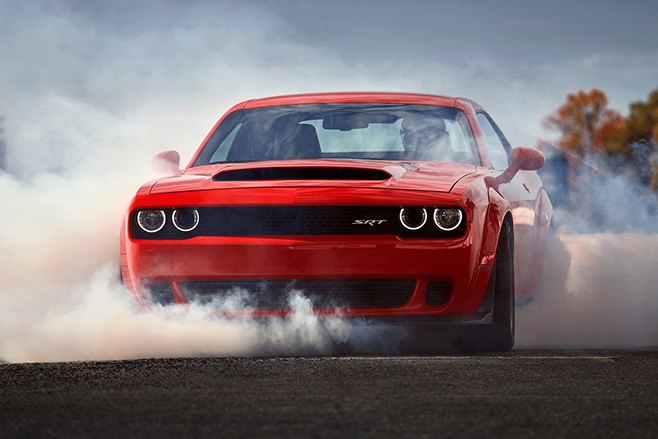
The company will also make an NHRA-legal roll cage available for the Dodge Demon. With the Demon capable of a 9.65-second quarter-mile timeslip, the US drag racing body had deemed the cage-less Demon to be non-compliant for drag competition due to safety reasons. Hennessey’s cage will allow Demon owners to make their cars truly race-ready.
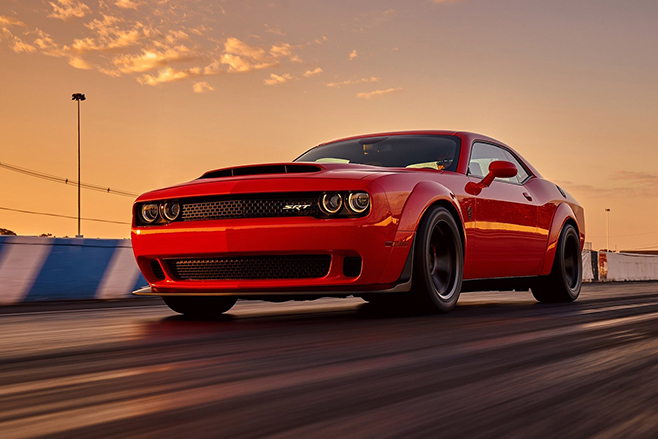
A parachute is in store for Hennessey’s catalogue of Demon parts as well, which should probably be mandatory for those going for the 1119kW engine package.
Seem excessive? With a factory-standard Dodge Demon being capable of pulling 1.8G of longitudinal acceleration and capable of lifting the front wheels on launch, before hitting 96km/h in a barely believable 2.3 seconds, bolting a parachute between its tail lights doesn’t seem like such a bad idea.
If the Demon is too modern, perhaps you’d prefer a classic drag special like the 1968 Hemi Hurst Dodge Dart L023.
I can hear the famous flat-six wail in the distance. Despite being on the other side of the hill, it’s easy to hear the ultimate free-breathing boxer engine (for now, at least) slicing through the old part of town long before the well-known silhouette comes into focus. Although when the new 991.2 911 GT3 does come into view, it’s a gut-wrenching disappointment.
Andreas Preuninger, head of Porsche’s GT division, arrives in a patchwork pre-production prototype with different wheels front and rear, ugly black cladding and plenty of last-minute camouflage to disguise the final design. Inside, the mule is no less of a mess, with wires and dashboard coverings aplenty.
“We’re a couple of weeks behind with the build-up,” Preuninger admits to MOTOR. “Which explains why I had to pick a very early vehicle. It sounds great and drives well, but the cosmetics are way off.”
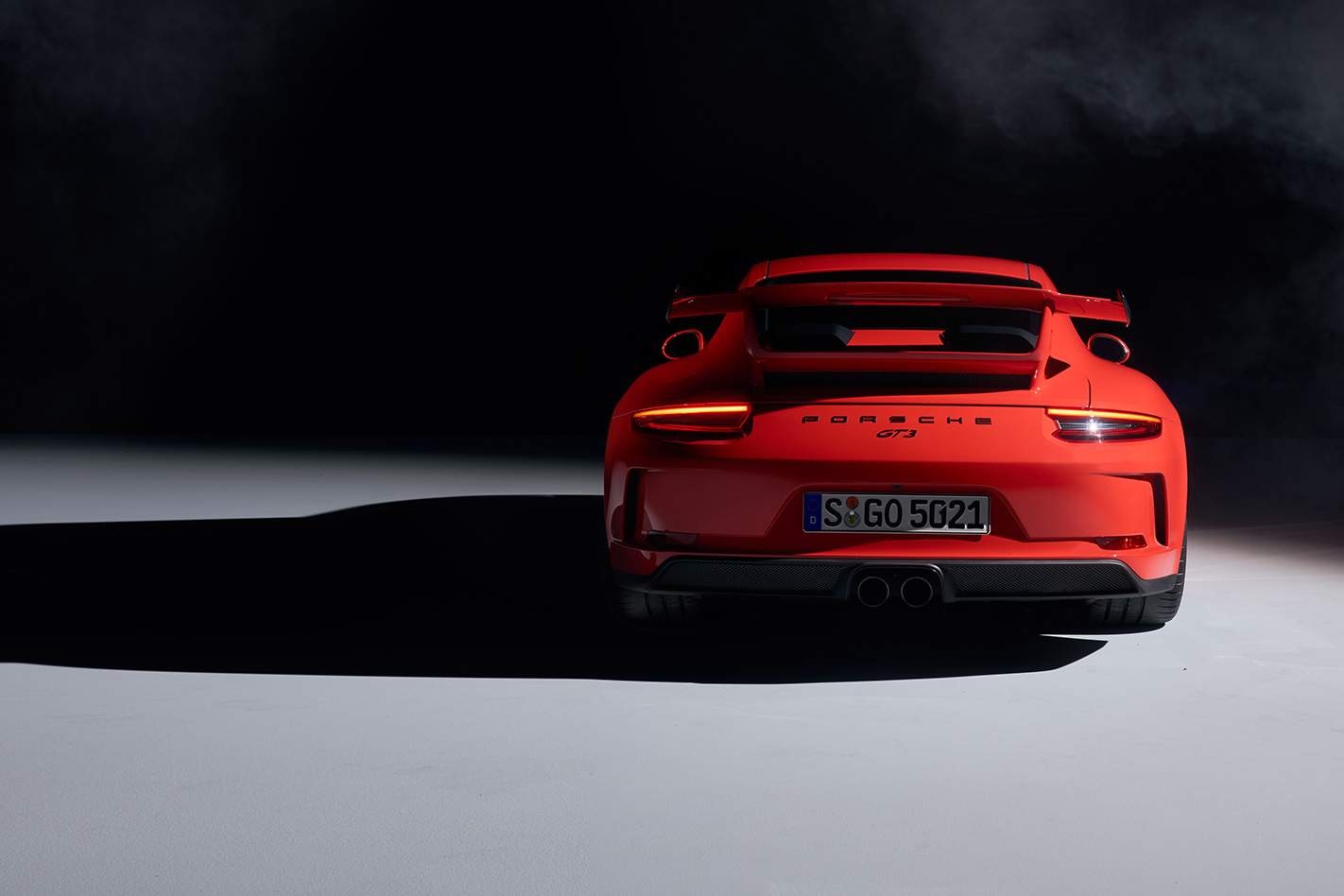
Extensive wind-tunnel testing has shaped the widebody rear, taken from the fat-hipped Carrera 4, which features LED lights, plastic mesh air vents and even bigger tailpipes framed in a charcoal apron. A pair of black, ram-style intake scoops reduce back pressure and feed plenty of fresh air to the hungry naturally-aspirated engine.
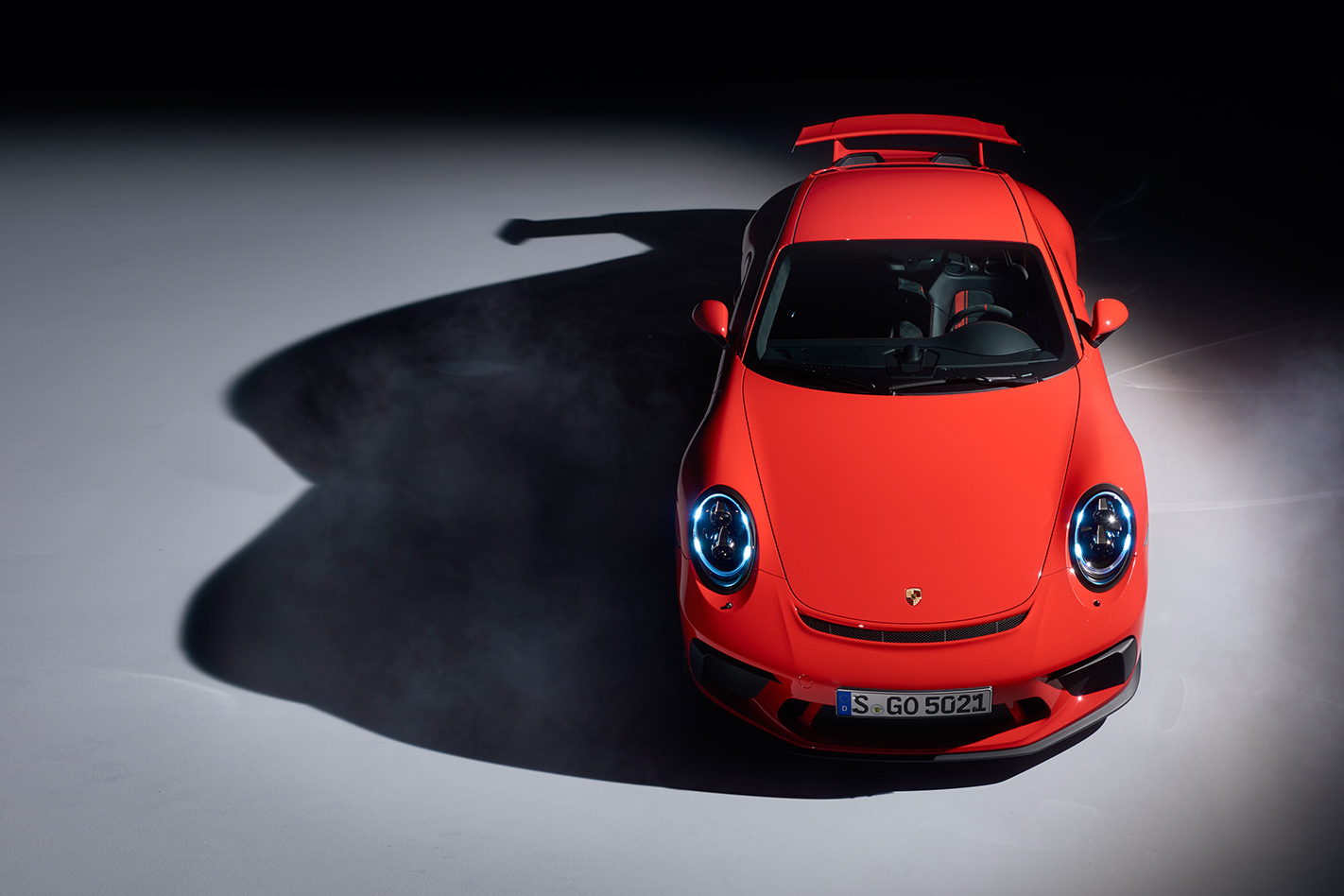
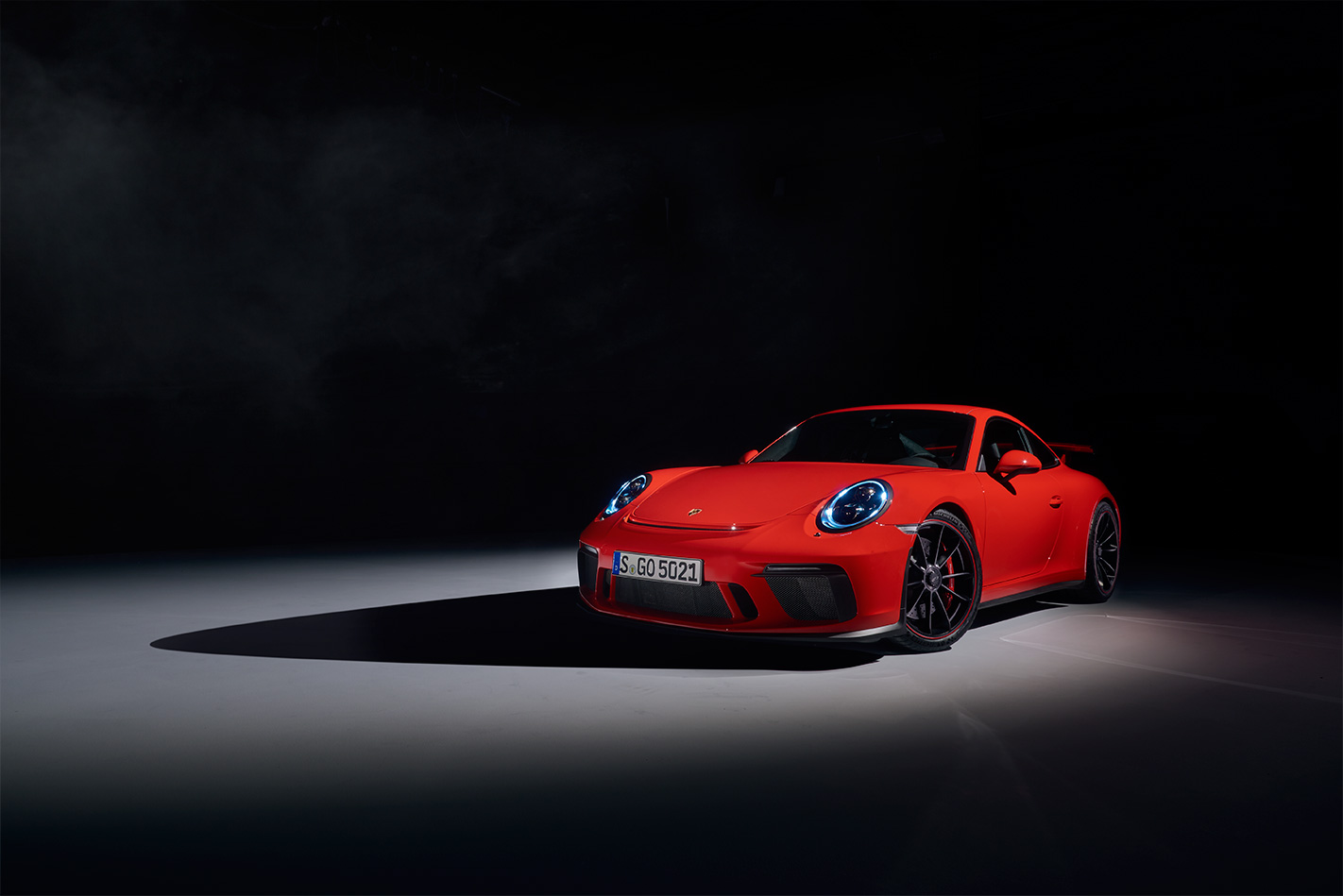
Matching the aerodynamic efficiency of the feisty rear is the restyled front end. It incorporates a pair of vertical air curtains, three extra-large intake openings and a protective rubber lip. The revised aerodynamic package reduces drag while also increasing downforce by 20 per cent, for a maximum of 125kg at 300km/h.
There are four different types of seats available, ranging from fully electric comfort pews to weight-saving carbon fibre racing buckets. Alcantara and red stitching abounds, but it’s not stripped out like the hardcore RS.
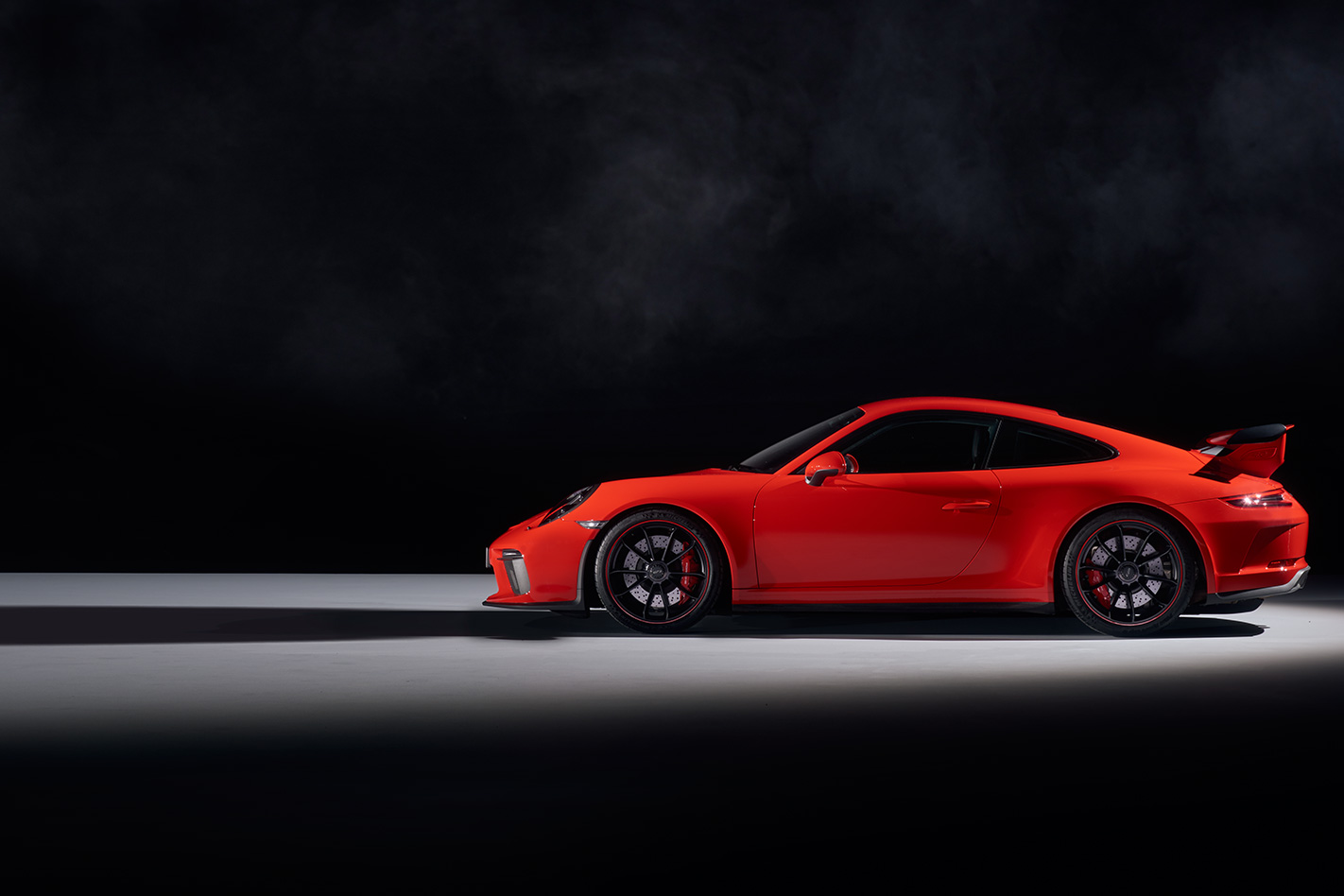
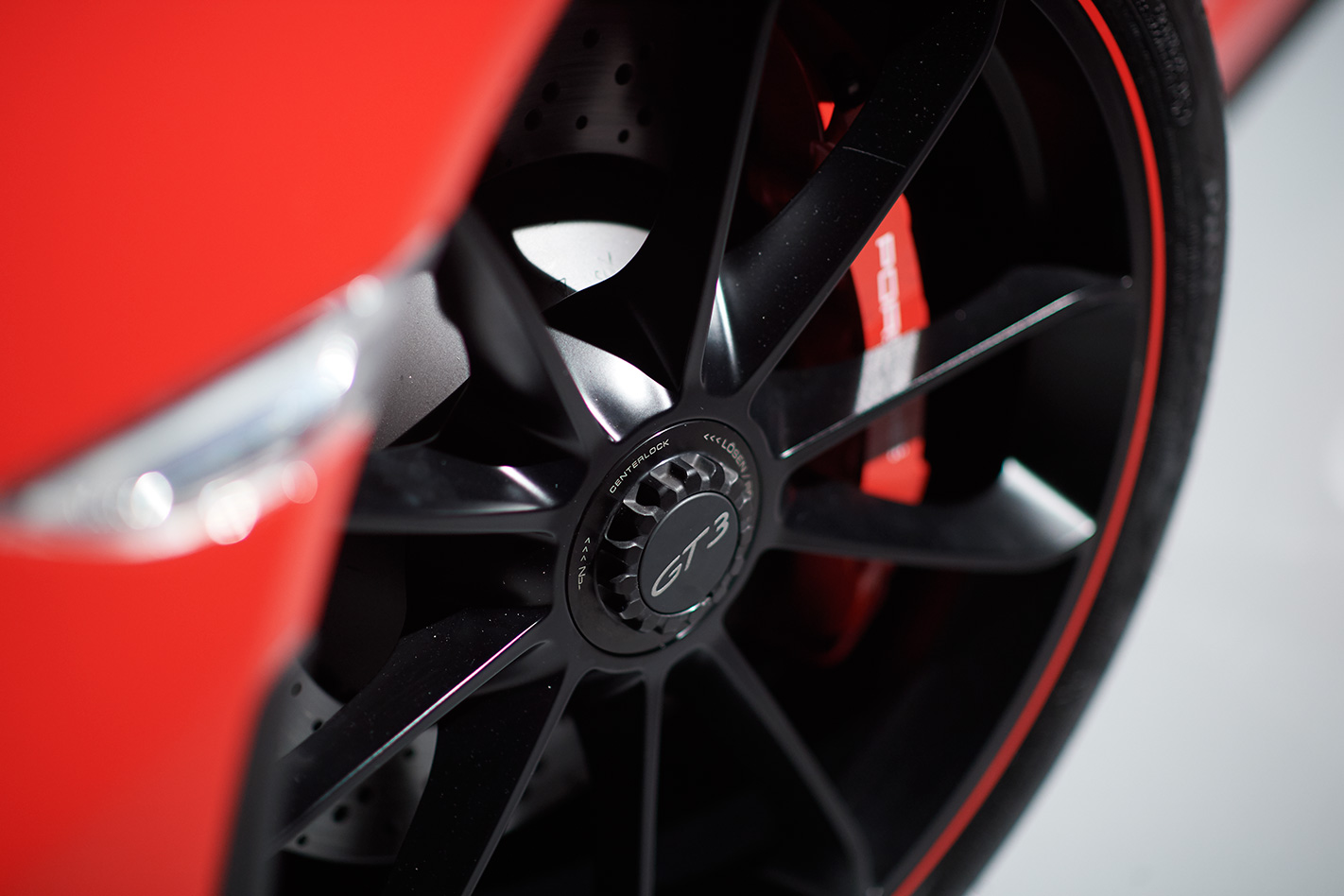
The suspension has been lowered by 25mm for the new GT3. The tyres are unchanged, sticking with grippy Michelins (the 991 GT3 had Pilot Sport Cup2s) or Dunlop Sport Maxx race rubber measuring 245/35 up front and 305/30 at the rear. Centre-lock 20-inch multi-spoke wheels also remain, and can be optioned with ‘red walls’ at extra cost.
The standard steel brakes still use 380mm rotors front and rear, but the optional Porsche Ceramic Composite Brake (PCCB) discs now measure 410mm up front and 390mm at the back.
Introduced in the limited edition 911 R, the outrageous demand for that car and similarly manual-only Cayman GT4 has led Porsche to reintroduce three pedals as a no-cost option. So, which gearbox to choose? “It is quite simple”, answers Preuninger.
“The seven-speed PDK version is 0.5sec quicker off the mark and thus the better choice for track-day use. But the manual gearbox makes for a more emotional 24/7 driving experience.”
At a claimed 3.9sec 0-100km/h, it’s certainly not slow, and the GT3 is capable of almost 320km/h equipped with either gearbox.
Apart from the number of pedals in the footwell, the other difference between the manual and PDK variants regards the limited-slip differential, with the manual using a mechanical item while the PDK’s is electronically-controlled.
The 4.0-litre flat-six is ostensibly the same as that fitted to the new GT3 Cup car. Preuninger and his team of boffins pulled plenty of tricks out of the bag to increase the outputs of the high-revving, naturally-aspirated engine.
The list of new or modified parts includes pistons, bearings, crank case, lubrication and softer valve springs. Weight savings and friction reduction helps the engine spin to 9000rpm, with the 368kW peak arriving at 8250rpm.
Maximum torque is now 460Nm (up 20Nm), produced 250rpm earlier at a still-high 6000rpm. A larger intake plenum, however, with two butterfly valves instead of one, significantly boosts mid-range urge by up to 35Nm.
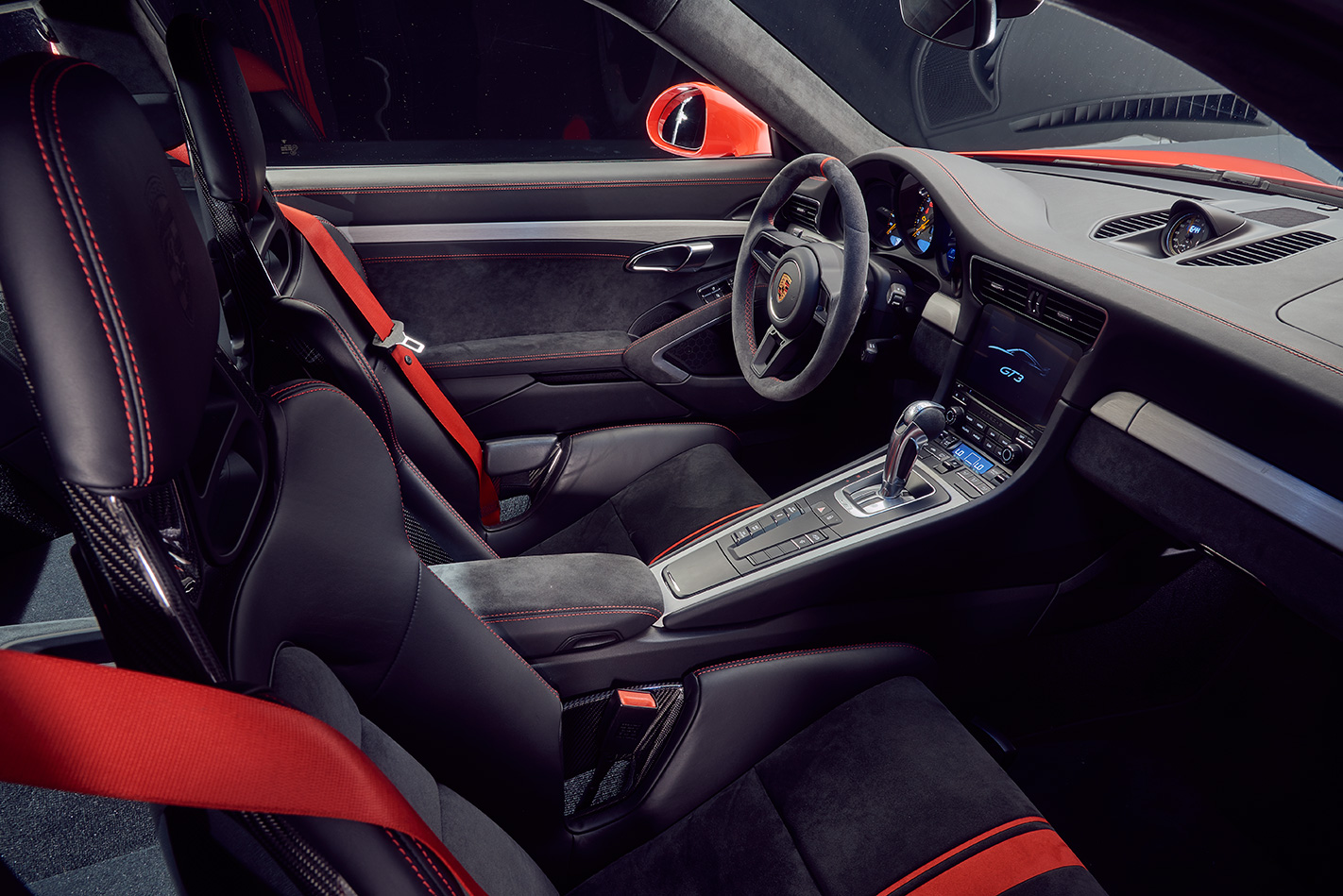
Inside, Braun twists the key, blips the throttle, grins and looks at me. “The new engine sounds different, doesn’t it? It’s different from a 911 GTS, but also different from the previous GT3, which is no surprise considering we are listening to a heavily revised and substantially improved powerplant.
And while we’re at it, check out the transmission at idle speed which is hush-quiet – unlike the old ‘box saddled with a single-mass flywheel. But when you can change gears at up to 9000rpm, the dual-mass application is a must.”
“Going fast is all about confidence,” says a smiling Braun. “True to our brief, the new GT3 fuses instant feedback, total clarity and absolute trust.”
While the manual 911 Carrera is stuck with an excessively long and relatively stubborn seven-speed ‘box, the GT3 receives six aggressively staggered forward ratios. Hard acceleration is thrilling in three parts. Furious take-off loads up the clutch, the tyres and the driver’s left foot because timing is of the essence and second gear beckons almost faster than you can react.
While it takes a decent initial throttle percentage to send revs skyward, the switchable intake plenum triggers stage two at 4000rpm, from where it rockets up to 6000rpm. For the first time, Porsche’s atmo six feels to approach its turbocharged sibling in terms of punch and urge.
It may matter to only a few customers, but it is nonetheless worth noting that the 300km/h threshold has become more easily attainable in the 2017 model, which has longer and more muscular legs.
“You are almost always going that little bit faster in the new GT3, and at this level it takes unerring stability and ceaseless feedback to build up blind faith,” says Braun. “The car must cope with any surface- or weather-induced irritation in the most confidence-inspiring manner. The keys to this reassuring composure are sufficiently compliant suspension and, of course, the stability-enhancing rear-wheel steering.”
Upon arriving at the Black Forest the tempo immediately changes. It’s an unspoken shift, but the pace changes from fast to furious. I sit, watch, listen and enjoy.
We’re hard on the throttle with ample revs before jumping hard on the impressive brakes, all the while with barely a smidgeon of oversteer through the tighter bends. The standard rear-wheel steering seems to shrink the wheelbase through the challenging twisties of this road, too.
“When you are in a real hurry, you may even change gears without lifting off,” reveals Braun. “The secret to this new talent is a momentary adjustment of the ignition timing.”
At what must be close to ten-tenths, rapid lift-off still feels more like a pat than a kick, the trimmer valve gear working wonders for the throttle response. The manual may lose half-a-second to the PDK model on the 0-100km/h sprint, but the reward is notably more involvement and interaction.
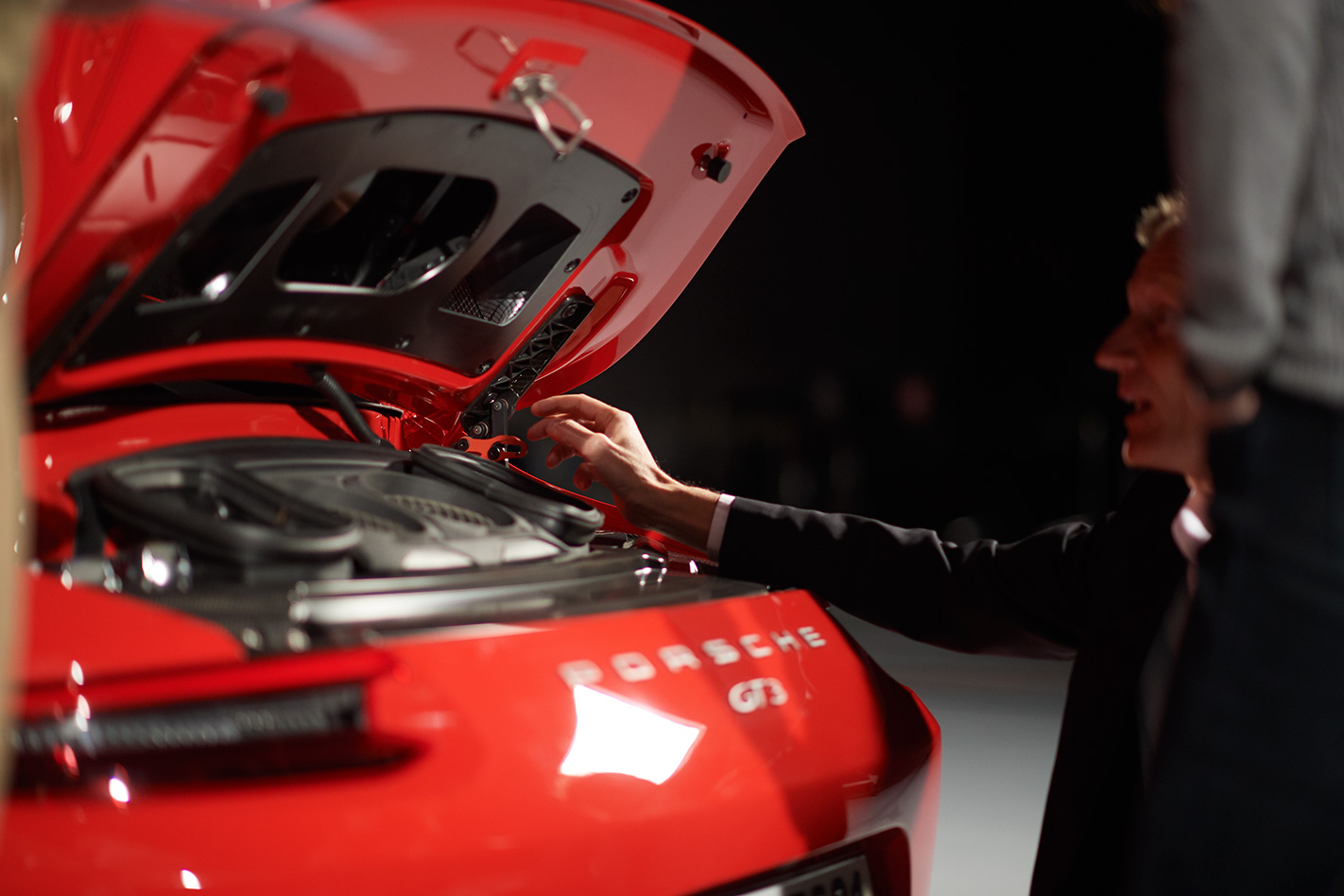
“The pick-up from low engine speeds is strong even with the transmission left in a high ratio,” says Braun. Accelerating hard at 2500rpm in fifth, we run out of road before the flat six runs out of revs. The engine plays a matching soundtrack, unfurling the final 3000rpm to redline and sounding more mechanical and intense than the previous generations.
“No filters,” the wheelman promised, and the 24-valver on steroids delivers, unleashing power, an extra 500rpm and a rortier exhaust note, shift after shift.
Dry tarmac and little traffic set the scene for the final stage of a memorable drive – a final blast to determine if the 991.2 is an RS in disguise, a more extreme GTS or an extroverted 911 R. It is also the last chance to see where exactly the new GT3 stands in this company as far as road-holding, breakaway behaviour, ride comfort, handling prowess and controllability are concerned.
If our outing is anything to go by, I would describe the latest effort as a more emotional, yet softer-edged GT3. It’s ultimately a more accessible and more involving piece of kit that’s both special and a perfectly docile sports car.
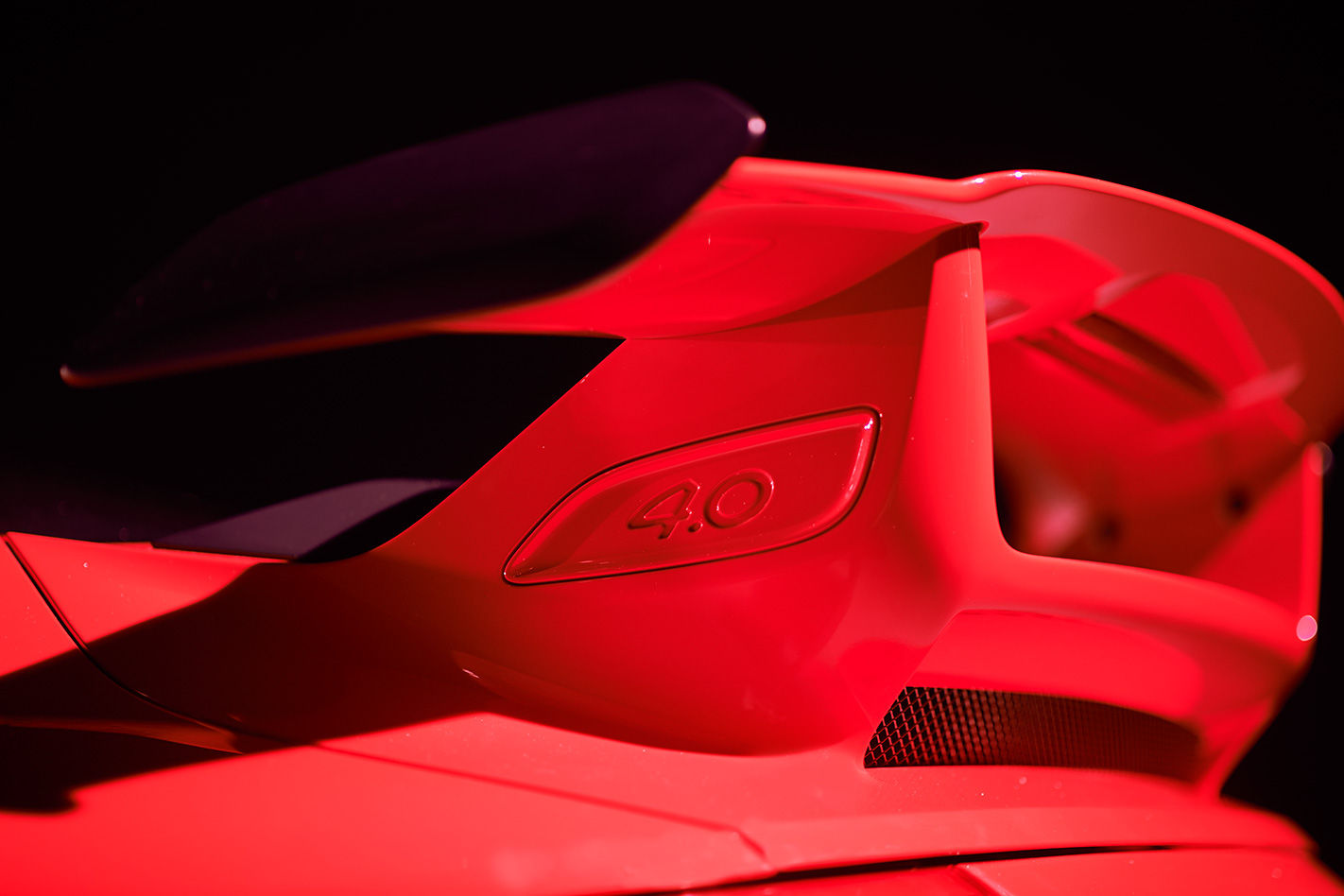
“While the steering is now almost as accurate as a surgeon’s scalpel, the dynamic engine mounts effectively cushion the faintest trace of lift-off oversteer as well as over-enthusiastic tip-in.” Sport mode adds a pinch of salt to the GT3 dish, but in true Porsche tradition, the steering weight remains unchanged.
Carbon ceramic brakes, bucket seats and the Clubsport pack, complete with roll cage and fire extinguisher, are just about the only options which would significantly improve the car’s track-day performance. And for daily use, the electric front axle lift is essential to guard that vulnerable spoiler lip.
Ultimately, however, if you want one, don’t muck about. Get on the waiting list now. Although Porsche claims that the new GT3 is not a limited-edition model, the production capacity available is limited by the availability of parts, the demand for other 911 iterations and the need to prepare the factory for the arrival of the brand-new 992.
According to an insider, a good portion of the estimated 3000 to 4000 GT3 units were already spoken for before the car’s public debut at the Geneva Show. That’s what anticipatory fascination, and an incredibly talented product, can do to your bottom line.
BODY: 2-door, 2-seat coupe DRIVETRAIN: rear-drive ENGINE: 3966cc flat-6, DOHC, 24v POWER: 368kW @ 8250rpm TORQUE: 460Nm @ 6000rpm TRANSMISSION: 6-speed manual 0-100KM/H: 3.9sec (manual, claimed) WEIGHT: 1420kg BRAKES: 380mm ventilated discs 6-piston calipers (f); 390mm ventilated discs, 4-piston calipers (r) WHEELS: 20.0 x 9.0-inch (f); 20.0 x 12.0-inch (r) TYRE SIZES: 245/35 ZR20 (f); 305/30 ZR20 (r) TYRES: Michelin UHP Sport/Dunlop Sport Maxx PRICE: $327,100 PROS: Manual ‘box; performance, dynamics CONS: Demand could mean limited supply
Following on from the more prosaic Golf range that was announced earlier this year, specs and pricing have now been announced for the updated Golf R, Golf GTI and Golf 110TDI wagon. Due in Australia later this year, all three boast substantial improvements over their predecessors.
While the new specifications have been revealed for all three models, pricing for the Golf ‘7.5’ range will be confirmed next month in May.
The most notable change for the Golf R is its faster 0-100km/h time, with the German carmaker claiming it will reach 100km/h from standstill in just 4.8seconds, 0.2 seconds faster than its predecessor.
While the same 2.0-litre turbocharged four-cylinder petrol engine remains in the Golf R, it’s now mated to a new seven-speed DSG transmission, replacing the six-speed dual-clutch auto previously featured. That’s matched by a slight power boost that pushes the R to 213kW/380Nm, 7kW more than the 206kW/380Nm of the outgoing model.
VW’s 4MOTION all-wheel drive system also remains as does the six-speed manual gearbox option, and the only available options are a Driver’s Assistance package and panoramic sunroof.
Other changes include the addition of gesture control and a larger 9.2-inch navigation system.
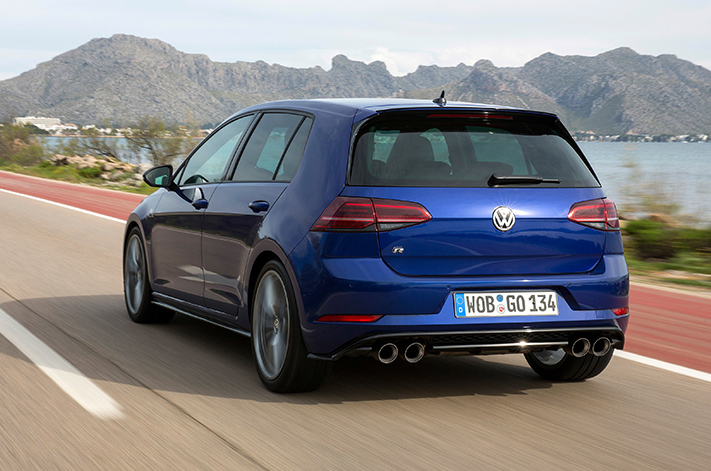
“You need not look too far in to the past to find the time when 4.8 seconds was the preserve of a Porsche 911,” said Michael Bartsch, Volkswagen Group Australian Director.
“It is extraordinary that a relatively affordable car not only attains this performance, but includes refinements and technologies that remain options in some prestige brands.”
Volkswagen claims the Golf GTI “is also extensively upgraded”, however the standout change is its improved power output.
Featuring the same 2.0-litre TSI four-cylinder turbo engine as the outgoing GTI (and now found in the Golf R), mated to an unchanged six-speed manual and DSG transmission, its peak power figure has been increased from 162kW to 169kW, while torque remains at 350Nm.
It also now features an 8-inch navigation system, instead of the 6.5-inch touchscreen of the previous model.
The Golf R and Golf GTI will arrive in Australia in August while the Golf 110TDI Highline Wagon will get here a month earlier in July.
Under the bonnet of the 110TDI is a 2.0-litre 110kW/240Nm turbo diesel engine, which will be mated to a seven-speed dual-clutch auto as standard.
Other standard equipment will include front fog lights, comfort sport front seats, chrome interior and exterior highlights, LED reading lights and front foot well lighting, carpet floor mats, colour multi-function display and a panoramic electric glass sunroof, amongst other features.
Like the two hatches, driver assistance and infotainment packages are optional on the Golf 110TDI Highline Wagon.
There appears to be no end in sight for the snowballing global Takata airbag recall with more vehicles continuing to join the lengthy list following the discovery of the problem in 2013.
At the start of the year, the number of vehicles affected in Australia was nudging two million but since then Subaru and Toyota have extended their lists, taking the tally of locally impacted cars to 2,141,000, but what is all the fuss about?
Here’s why you should not delay in getting the potentially defective components replaced if your car is one of the identified vehicles.
The item in question is the airbag inflator module – the device that instantly generates gas to fill the fabric bag in the event of a serious collision increasing the occupant’s chances of avoiding injury.
Ironically though, a manufacturing defect compromised the composition of a large batch of the units, which can actually fatally injure occupants in a crash.
When the vehicle is involved in an impact significant enough to trigger an airbag, an electrical signal is sent to the inflator, which ignites a small amount of propellant. The resulting gas is the ‘air’ that inflates the bag.
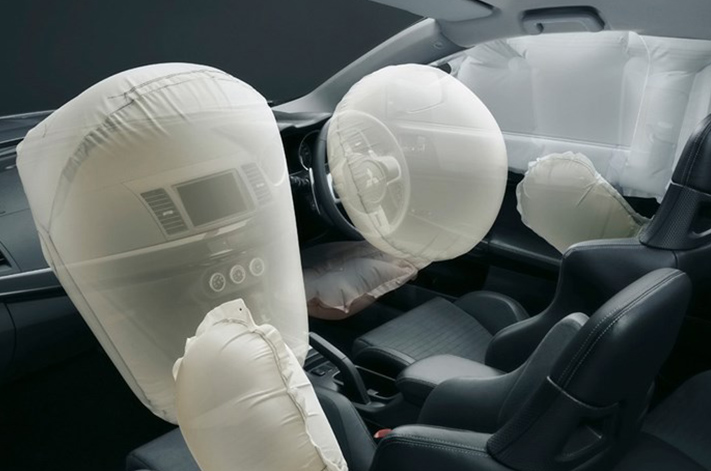
However, the faulty manufacturing process failed to adequately seal the metal canister that contains the propellant, which under certain circumstances allows atmospheric moisture to enter the unit and contaminate the combustible chemicals.
Instead of a relatively slow and controlled burn, the compromised propellant is unstable and combusts violently. The pressures generated are sufficient to rupture the metal casing and, in the worst cases, eject shrapnel through the vehicle cabin.
No injuries have been reported in Australia regarding the potential component failure, but overseas more than 10 fatalities have been attributed to the exploding inflator modules and with about 70 million inflators in circulation around the world, the potential hazard is still present in many cars.
So what should you do? In Australia, BMW, Chrysler, Ferrari, Ford, Honda, Jeep, Lexus, Mazda, Mitsubishi, Nissan, Subaru and Toyota have all identified vehicles that may contain the faulty components and are contacting owners of affected cars.
If you are notified that your car may be impacted, book it in at an authorised service centre where the module will be replaced at no cost to you.
If you are concerned that your vehicle might be included in the recall but you have not yet heard from the respective car maker, a full list of the affected vehicles can be found on the Australia Competition and Consumer Commission (ACCC) website under the Product Safety section.
The good news is that the modules cannot spontaneously ignite and have to be triggered by the vehicle’s safety restraint system in the event of a collision, so if your vehicle has been identified, don’t delay in getting the potentially problematic part changed.
Suppose Mercedes-AMG’s C-Class models are a little too juvenile for you. You’ve read about the C43’s noisy, cracking and howling Performance exhaust and the grunty V8 C63’s tyre-frying predilections. You want something a little more grown-up than that – and maybe a little larger – and aren’t afraid to pay for it.
Enter the new Mercedes-AMG E43. Copping the same nine-speed torque converter auto and 3.0-litre twin-turbocharged V6 powerplant from the C43 – but with larger turbos for more grunt – the E43 belts out 295kW and 520Nm, shifting its brand new E-Class platform to 100km/h in an all-wheel drive-enhanced 4.6 seconds, 0.1sec quicker than the lighter C43. Not too foul indeed.
Slipping into the E43, you’re of course treated to the all-new E-Class experience. It’s like a baby S-Class, with beautiful, glossy twin screens under the soft-touch instrument binnacle and with delightful materials everywhere. It absolutely feels more premium than the C-Class, itself with hardly what you’d call a Spartan interior.
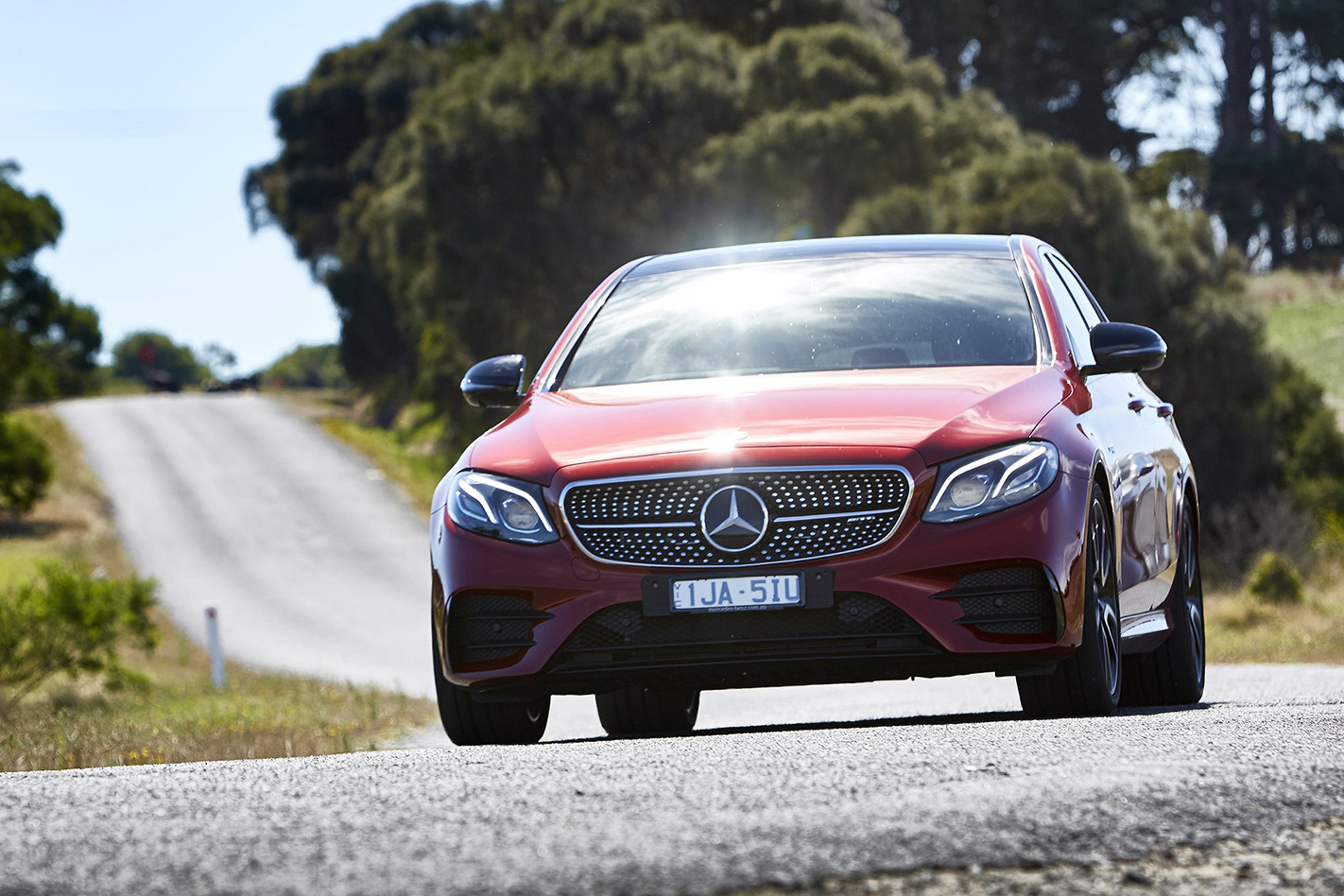
It drives quite differently to the C-Class, too – more differently than you’d expect just by looking at them, given the C-Class and E-Class can be genuinely hard to tell apart from some angles.
The E43 is surprisingly fun to drive – and it’s surprisingly capable up a bendy road. The front-end feels great with tight, accurate steering that feels ‘right’ and gives you a surprising amount of information about the front rubber. And the damping feels more ‘sophisticated’ and polished than the C43, allowing the E43 simply to carry more speed through bumpier corners.
It’s fast, too, covering ground swiftly enough that a Subaru WRX STI would absolutely struggle to keep up. In Sport Plus mode, the shifts are swift with a little brap from the exhaust and traction is, as you’d expect, very strong. The brakes also feel great and there’s generous lateral grip on offer. From purely a performance perspective, it’s no hardcore driving machine but it’s not made to be – in fact, it drives way better than it needs to. We were genuinely disappointed there weren’t more tight and twisty roads on our launch test route, and that says a lot. It’s a satisfying car to let loose in.
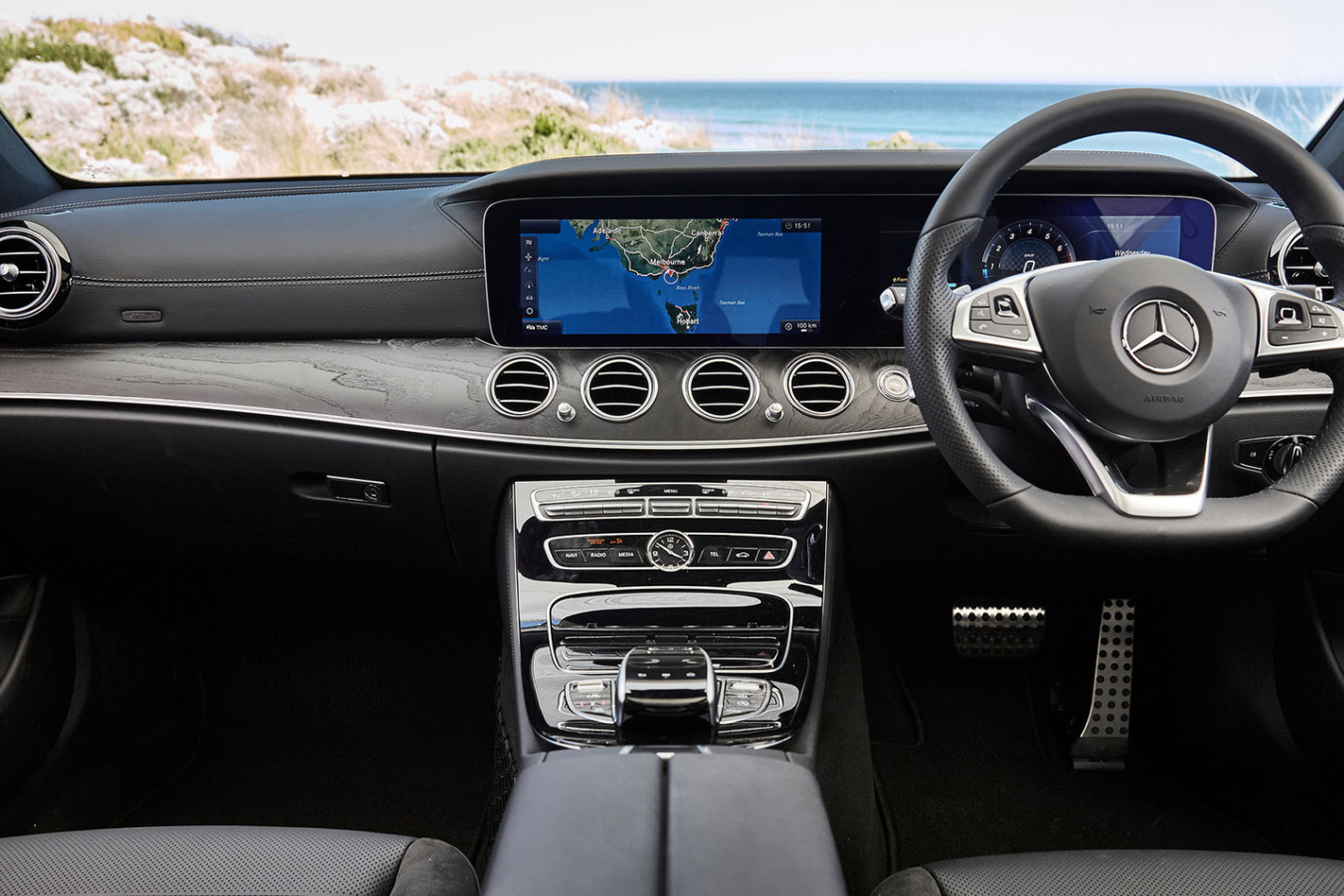
The electronics can be frustratingly conservative, too, cutting in – even in the more sporty modes – just as you’re exploring and enjoying what is a brilliant-feeling chassis.
Of course, this is also a very secure-handling car with a fundamentally conservative chassis tune biased towards understeer. The all-wheel drive, too, has a split of 31:69 front-to-rear and feels more of a safety than performance feature.
This is also an expensive car. At $159,900 you do get a lot of standard equipment – leather, air suspension, sunroof, 13-speaker stereo, 20-inch wheels – and you should absolutely go for the $4400 Performance Ergonomic Package which scores you the excellent and attractive performance front seats and microsuede AMG-branded steering wheel. But then you’ve got a $164,300 car on your hands. Though it’s an imperfect comparison, if performance was all you cared for, it wouldn’t have been a much bigger leap to the $184,715 BMW M5 Pure if it was still around. (It’s not.)
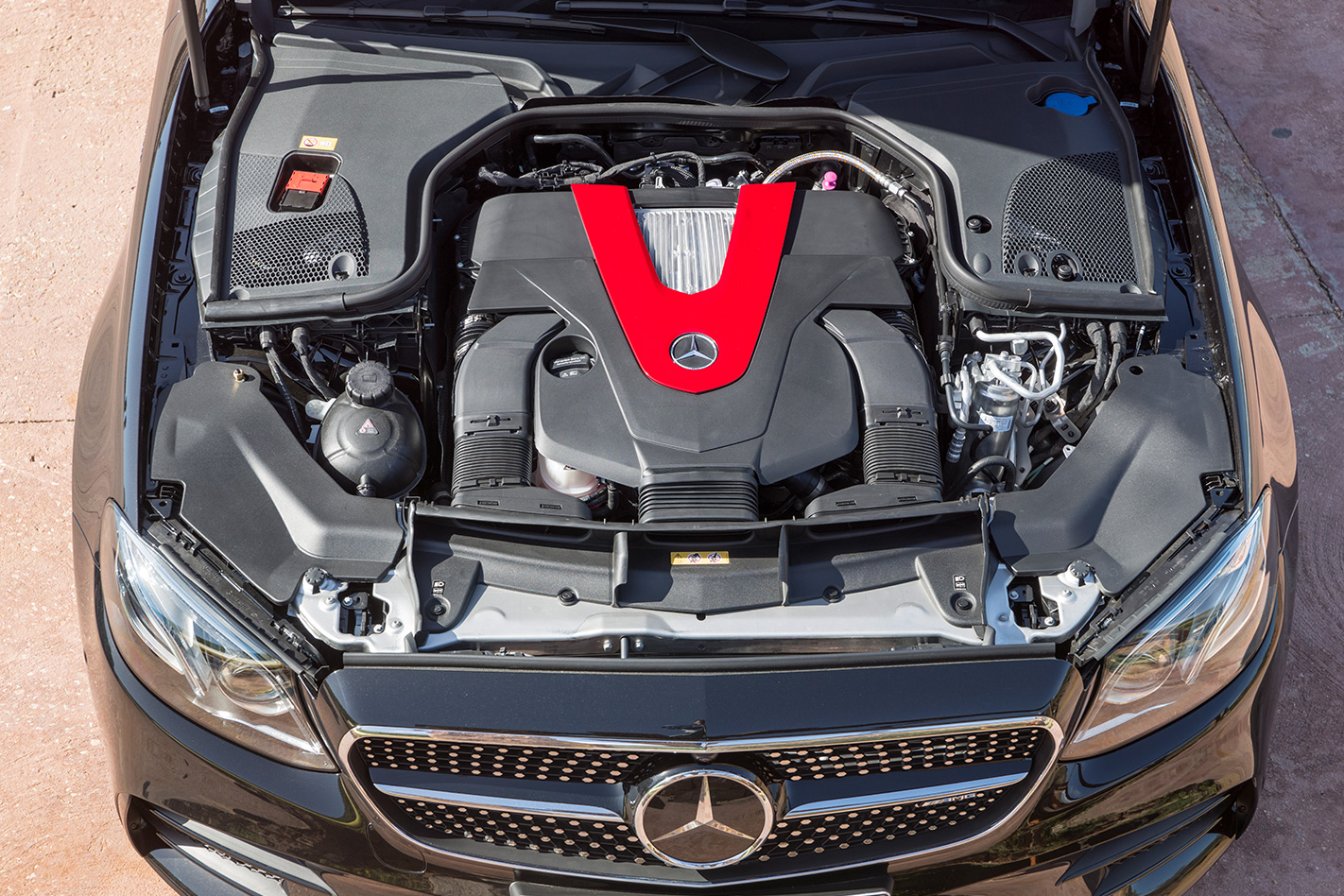
But if you’ve read this far, it’s likely you care as much for technology, comfort and luxury as you do your car’s 0-100km/h time. And in the E43, you’ll find a surprisingly potent and satisfying performance car with a stunning and impressively-appointed interior to match.
Engine: 2996cc V6 DOHC, 24v, twin-turbo Power: 295kW @ 6100rpm Torque: 520Nm @ 2500-6000rpm Weight: 1840kg 0-100km/h: 4.6sec (claimed) Price: $159,900 Star Rating: 4.0/5 LIKE: Surprisingly fun to drive; goes hard; amazing tech and lovely interior DISLIKE: Very behaved noise for an AMG (boo); bit pricey
QUESTION – JANE (10/08/16):
We currently have a 2010 Ford Territory which has been great but we don’t need a car this big anymore. It doesn’t fit in our little garage and it isn’t super fuel efficient.We would like a small SUV (but would consider a sportier hatch like a Mazda3 if the space was sufficient) that will be driven for short commutes on weekdays and longer trips on weekends. No off-roading, maybe the odd dirt road or country road. It’s our only car so gets driven every day.We want it to be stylish and would prefer leather seats. We need it to be appropriate for if we have a baby and be able to squish in a child, dog, pram and all our luggage.Reliability and safety is also important. We loved the Mazda CX-3 but the boot was tiny. The Honda HRV is almost perfect but a little sluggish and underpowered. The Suzuki Vitara S Turbo is also great but looks cheap on the inside. And the Mazda3 is great but not an SUV and we wondered if it would be a bit less roomy and baby friendly. That said we have no idea how much space is adequate for one child.Have we missed something obvious?
BUDGET:
$30,000
ANSWER – TOBY HAGON:
The new breed of small SUVs is a diverse bunch, as you have discovered.
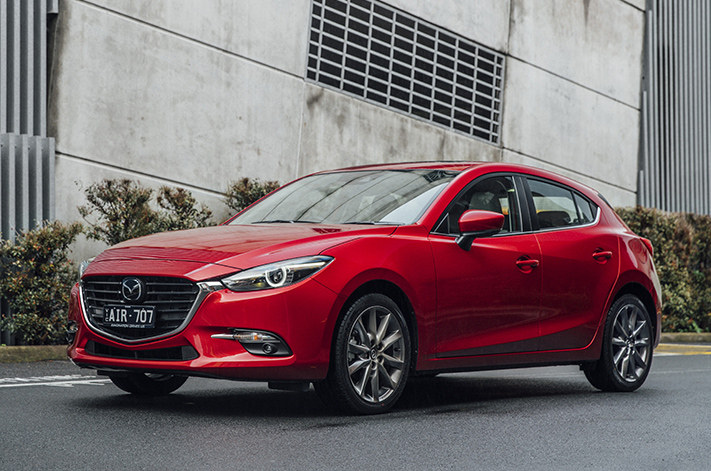
The Mazda CX-3 is great to drive and well-presented inside, but has rear seat and boot space akin to a Mazda2 hatchback, which is not suitable for families.The Honda HR-V, meanwhile, has loads more space, but less punch and driving flair. That said, its CVT automatic transmission does a good job eking the most out of the engine, so don’t be afraid to rev it and you’ll find performance is decent.For more space and punch, though, the Mazda3 SP25 is fantastic buying. As for whether it will have enough space for a child, the biggest factor there will be what pram you buy. Buying a pram is almost as difficult as buying a car, so allow yourself plenty of time to research and take it with you when car shopping to see how much boot space it takes up.
There is a lot of discussion at the moment about how to improve F1 in the wake of Liberty Media taking over the sport.
Early indications are good, with greater fan involvement and talk about retaining historic races and improving the show in a proactive way. One of the biggest issues that needs to be solved, however, is the on-track action, and Liberty could do a lot worse than consulting this video.
We all know F1 cars used to drift around in the 1960s and early ’70s, before aerodynamics stifled sideways racing, but these clips from the mid-1990s prove that wings and oversteer need not be mutually exclusive.
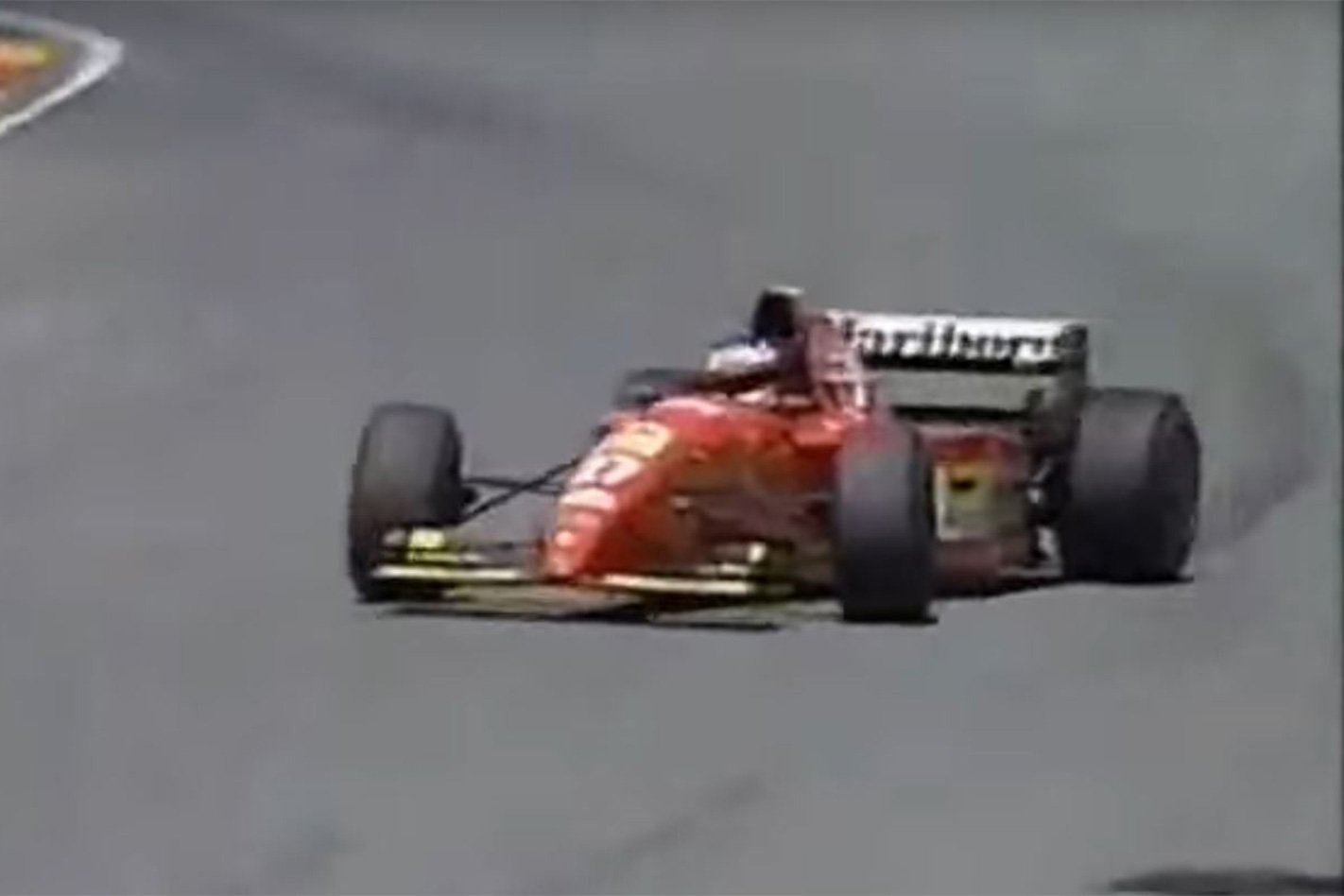
The combination of lots of horsepower – from screaming naturally aspirated engines, but let’s not go down that road for now – and relatively low downforce led to the most important factor in having exciting on-track action: more power than grip.
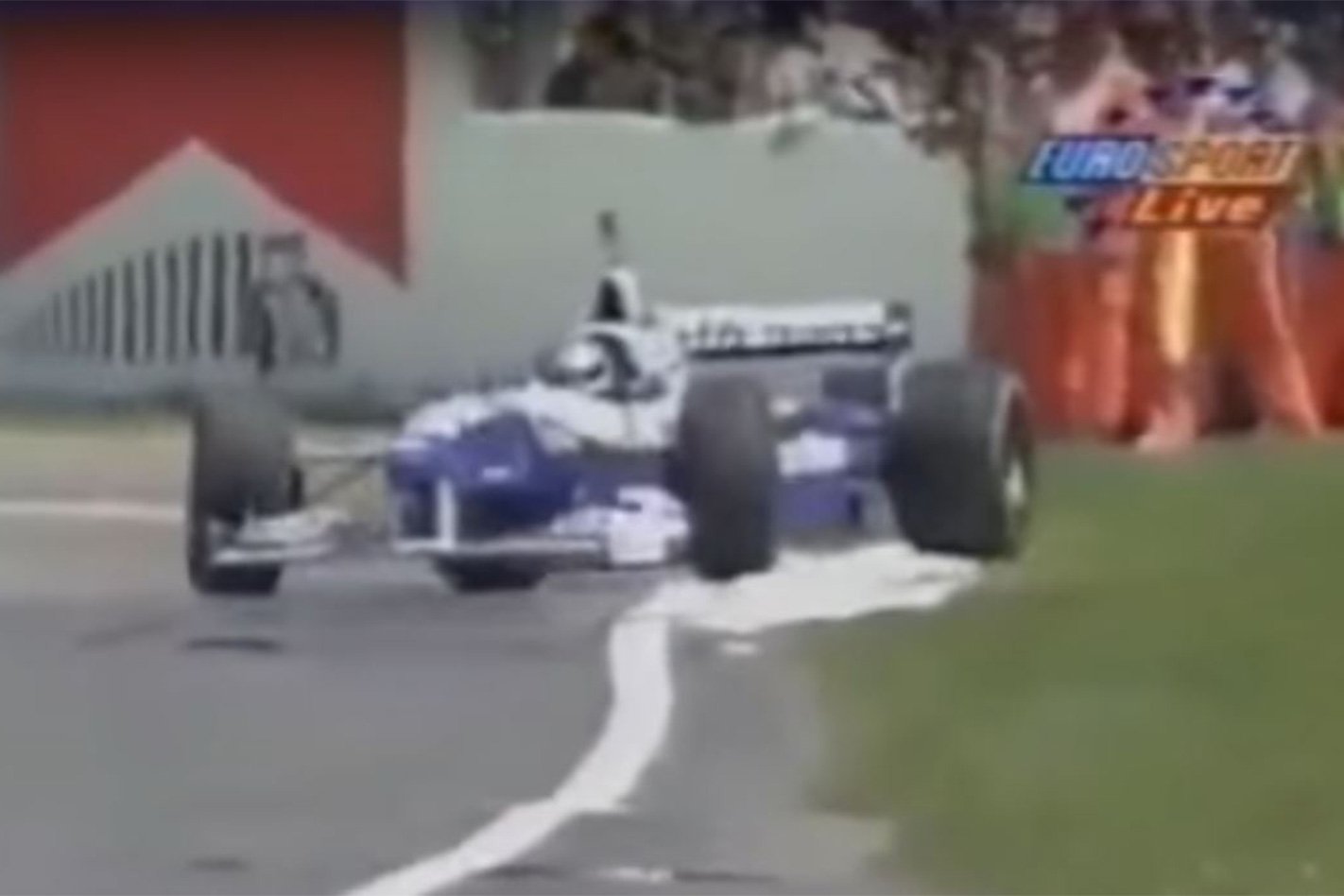
These cars are probably 10 seconds or more a lap slower than the current hybrid monsters, but you’d struggle to find anyone watching who’d care. It’s always dangerous looking back with rose-tinted glasses, but there seems to be something in this combination of powerful engines, slick tyres, simple wings and tracks without acres of tarmac run-off.
