
ALFA’S performance flagship finally makes landfall here in Australia. We’ve been impressed by it on track, but how does the most eagerly anticipated sports sedan of 2017 shape up on our roads?
WHAT IS IT? Think of the Alfa Romeo Giulia QV as a Latin BMW M3 or Mercedes-AMG C63 S and you’re not in completely the wrong post code. Thing is, Alfa Romeo has a stack of catching up to do in a sector where the Germans have been polishing their wares to a finely burnished sheen in recent years. Even with the best power-to-weight ratio in the division, the chances of the Alfa putting manners on the class benchmarks would appear a very long bet.
WHY WE’RE TESTING IT The Giulia is the first beneficiary of a €5bn investment in the new ‘Giorgio’ platform that will eventually spin off eight separate Alfa models, so if it’s not up to scratch, Alfa Romeo’s future looks bleak. The QV has been developed by a stellar cast of Ferrari’s best and brightest, so it should be dynamically on point, but can it bring a broader array of qualities to bear in a market sector where the bar’s set in the stratosphere?
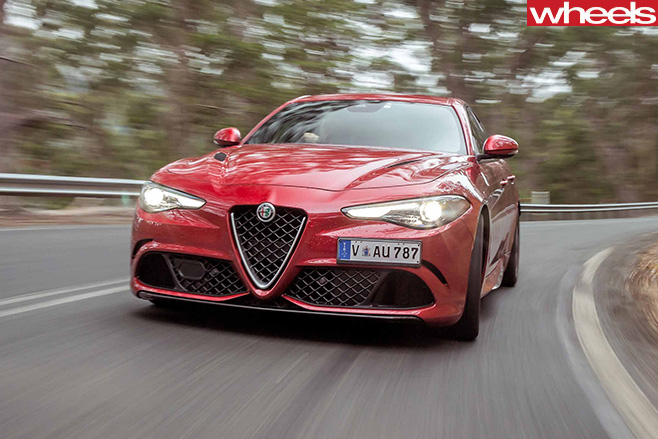
THE WHEELS VERDICT It lacks the showroom polish of its German rivals, but in terms of its ability to plaster a massive grin across your face, the Alfa Romeo Giulia QV has ’em aced. The most surprising thing about the QV? It articulates the requirements of a modern performance sedan far more eloquently than we could have ever hoped. It won’t be for everyone, but even its harshest critic will find it difficult to deny that this is a serious return to form for Alfa Romeo.
PLUS: Searing pace, supple ride, smart drive modes, great driving position, long-distance legs MINUS: Engine not the most musical, some scratchy interior plastics, we don’t get manuals or AWDs

Of course, we used to wonder why Alfa had done things. Why their performance flagship was front-wheel drive. Why you’d developed lumbago just leafing through the brochure. Why their dynamics ethos championed an underdamped, out of phase, understeering catastrophe. After so many false dawns we’d all mentally written the Giulia off ahead of time. Safer that way.
You probably know the headline figures already. The 2.9-litre twin-turbo V6 is good for 375kW, sending just 1585kg down the highway. 0-100km/h appears in 3.9 seconds and if you have an autobahn at your disposal, 307km/h is apparently on the cards. There’s a carbonfibre roof, bonnet, spoiler, skirts and even prop-shaft. Active aero, a whip-smart ZF eight-speed auto and a fiendishly effective electronic rear diff. A design and engineering team who have the Ferrari LaFerrari, 488GTB and F12 on their resumes have equipped the Giulia QV with a formidable arsenal of hardware.
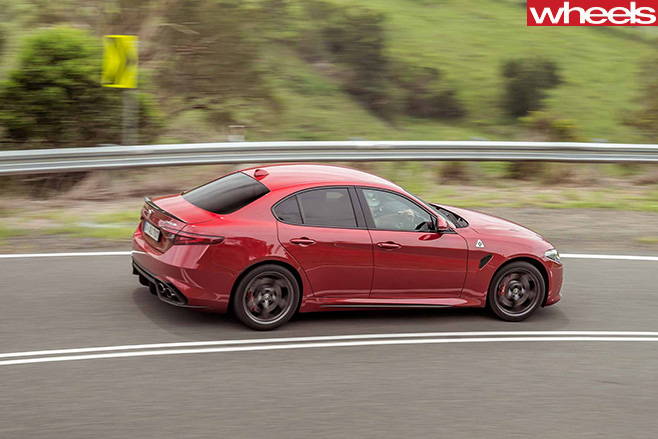
The engine isn’t inherently operatic. Some have described it as sounding akin to a pair of BMW i8s at flat chat and there’s something in that. The torque band is so broad that meaningful go is rarely hard to find, but it does enjoy being pegged into the upper registers. Knock the lever across into manual and you can ping the limiter without the box changing up for you. The beautiful aluminium paddles are (correctly) column rather than wheel-mounted and in Race mode will crack through upshifts with a real shunt. It’s like Lambo Corsa-lite. The QV, like all its turbocharged rivals, injects a bit of street theatre with the fusillade of overrun crackles, but this isn’t an engine which will have you searching out tunnels at 3am.
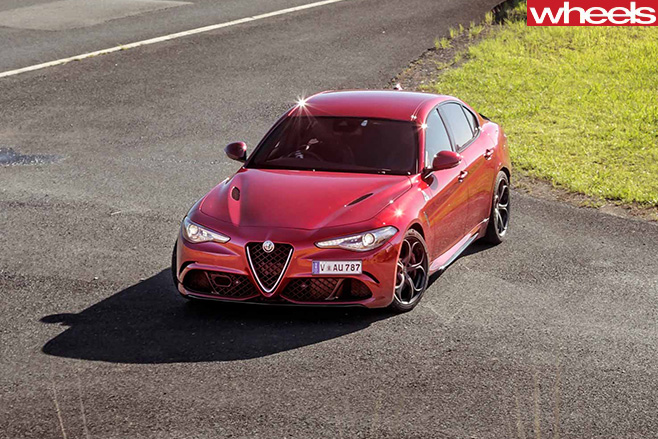
The result then, is you asked and Alfa Romeo has clearly listened. The Giulia QV is an astonishing effort, but clearly also a work in progress. And sometimes even astonishing doesn’t cut it. We’re already shaping to put it up against the heaviest hitters in its class, and that should be one hell of a showdown. One thing we do know, though is that in isolation, the QV is a triumph.
SPECS Model: Alfa Romeo Giulia Quadrifoglio Engine: 2891cc V6 (90⁰), dohc, 24v, twin-turbo Max power: 375kW @ 6500rpm Max torque: 600Nm @ 2500-5500rpm Transmission: 8-speed automatic Weight: 1585kg 0-100km/h: 3.9sec (claimed) Economy: 8.2L/100km Price: $143,900 On sale: Now
The Ioniq is a unique car that comes in plain and plug-in hybrid forms, or with pure electric power. Hyundai Australia plans to import all of them… but the battery-mobile is the one that really stands out.
WHAT IS IT? Small-ish front-drive eco car with a trio of powertrain options. Good-looking and obviously aero, the Ioniq is an un-weird way to embrace efficiency. It’s a five-door hatch with a pleasant and reasonably spacious interior. There’s good space for cargo, too, even in the battery-burdened Electric.
WHY WE’RE TESTING IT In Korea for a first taste of the new Hyundai i30, Wheels learned that Hyundai Australia plans to import the entire Ioniq line-up, probably beginning from early next year. The Hybrid and Electric versions are already on sale in Korea. Both were available to sample, but we focused on the more interesting Electric.
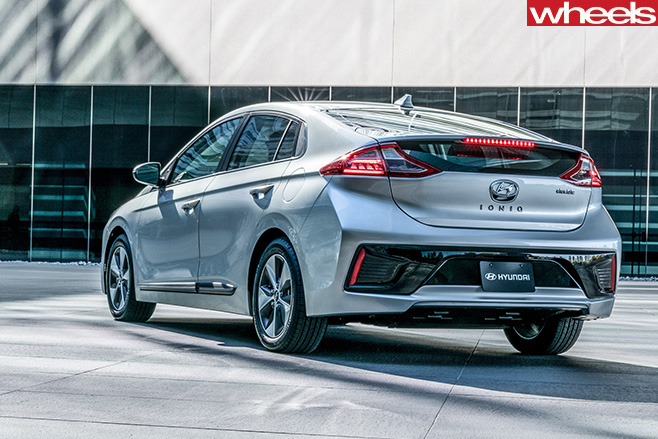
THE WHEELS VERDICT The Hyundai Ioniq Electric is a taste of Tesla at an affordable price. It’s good looking and surprisingly quick. While its handling could be better, the Hyundai isn’t an unpleasant drive. For some, its real-world driving range will be a deal-breaker. Others will embrace the challenge of using this tailpipe-less car as a daily driver. Plus: Lively performance; energy efficiency; exterior; interior practicality; quietness; affordability (probably) Minus: Handling; real-world range won’t meet all needs; lack of EV infrastructure in Australia
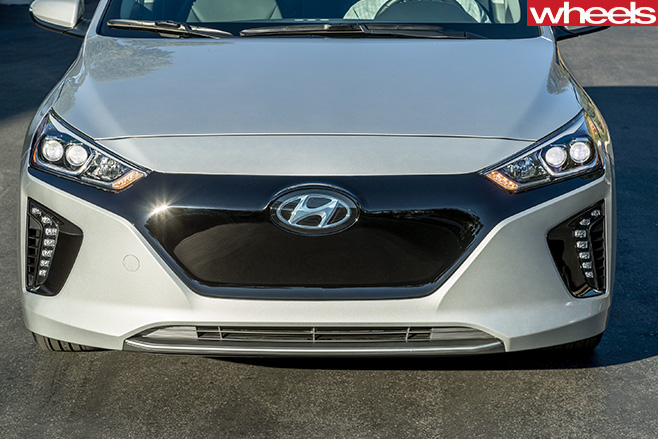
On the broad and modern streets of Songdo, east of Seoul, the Ioniq usually leads the charge when traffic lights turn green. Slowing for reds I experiment with the Hyundai’s driver-variable regenerative braking.
Even though it has a fixed single-speed transmission, there are paddle shifters behind the Hyundai’s steering wheel. Tapping the toggles up or down through four levels of regenerative braking. Increasing the regen feels very much like shifting down through the gears in a conventional car with a double-clutch or torque-convertor auto.
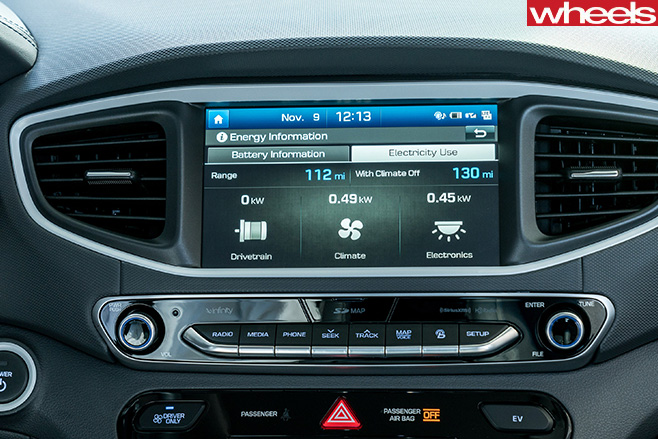
While the Hyundai’s official driving range is 280km, testing done by credible outfits in Europe indicates the real-world distance is more like 180-200km. Worth noting, too, is that the Ioniq Electric can accept 100kW DC fast charging, which means an 80 percent charge top-up can be delivered in under 30 minutes. It’s too bad that Australia lags much of the rest of the developed world in installing electric vehicle infrastructure.
The Hyundai rides reasonably well and its steering is more consistently weighted than that of the Ioniq Hybrid I’d driven two days earlier. But, even though these Korean roads aren’t challenging, the Electric’s handling is obviously nothing special.
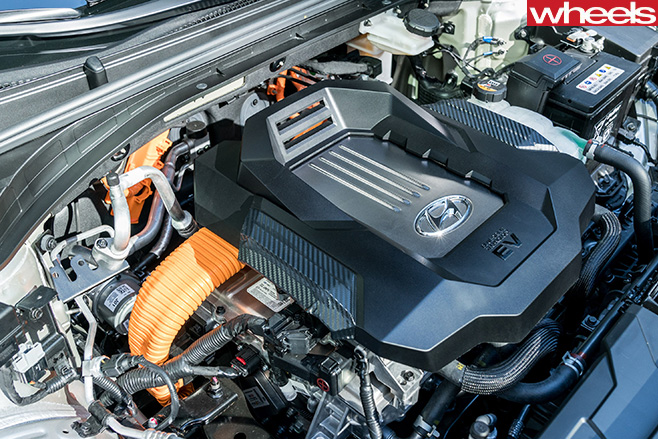
That screen is one of the reasons the Ioniq hasn’t made it here earlier. Hyundai won’t have an infotainment system for the Ioniq that works in Australia until late this year. It will be ready just before production of the Ioniq Plug-in Hybrid in right-hand drive begins.
Hyundai Australia high-ups think the maximum-impact strategy is to wait until all three versions of the Ioniq are ready to launch at the same time. This will be possible just before Christmas, according to chief operating officer Scott Grant, but this is a dumb time to introduce a new car. So an early 2018 Hyundai Ioniq launch is the preferred option.
While it’s way too early for Hyundai to talk pricing for the Ioniq Electric, the car does undercut the Nissan Leaf – the world’s best-selling electric car ever, by the way – in other markets. If they can do the same in Australia, the Hyundai will wear a price-tag around the $37,500 mark. This would make it the least ludicrous electric in the land.
SPECS Model: Hyundai Ioniq Electric Motor: permanent magnet synchronous Max power: 88kW Max torque: 295Nm Transmission: fixed single speed Weight: 1420kg 0-100km/h: 9.9sec (claimed) Energy consumption: 11.5kWh/100km Price: $37,500 (est) On sale: First quarter 2018
Tell me about this car
The third edition of the Korean car maker’s very popular small hatch is scheduled to launch in Australia in late April this year. The mostly new ‘PD’ Hyundai i30 and is slightly longer and wider than its ‘FD’ predecessor, but fractionally lower. The range-topping, sporty SR variant is powered by a nifty 1.6-litre turbo engine and will have superior handling than the rest of the range due its independent rear suspension Depending on transmission and equipment, SR pricing should be in the $28,000-$34,000 range.
Strengths
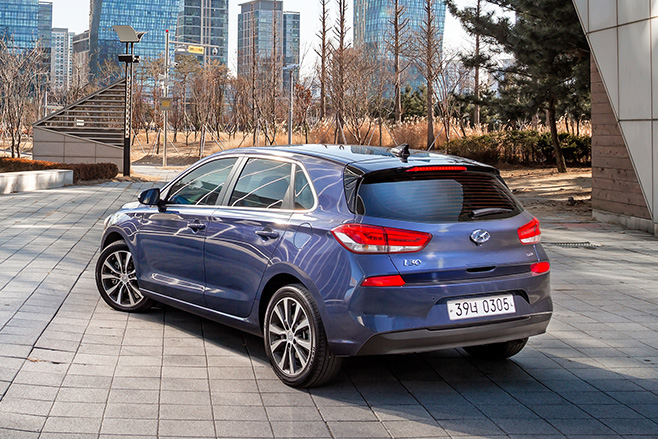
1. Exterior design – Hyundai wanted an exterior look for the new i30 that would appeal to style-conscious European customers and used the Volkswagen Golf for inspiration. The result is a very good looking small hatchback that’s well proportioned and cleanly detailed. With its big wheels, the SR is the best of the bunch.
2. Interior space grows incrementally, including the cargo compartment, and the interior is also a fresh design.
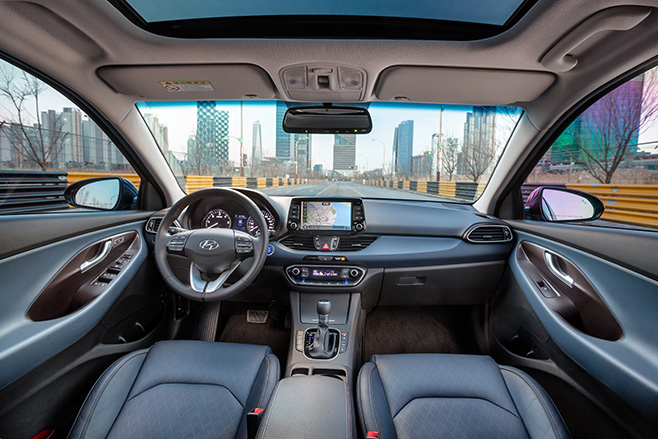
3. The attractive instrument panel features a floating, tablet-style centre screen, a new steering wheel and easy-to-read instruments.
4. The SR’s 150kW/265Nm 1.6T GDi engine delivers very strong acceleration without making a noisy fuss. Transmission options include a six-speed manual and very good seven-speed double-clutch auto.
5. Handling – the SR will be the only Australian model equipped with the sophisticated independent rear suspension that’s standard in all versions of the i30 made in Europe. WhichCar hasn’t had a chance to try the car with the specific Australia-market suspension, but the handling of an SR-equivalent in Korea hinted that it will be good through curves and reasonably smooth over road bumps.
6. Steering is more direct than before and makes the i30 feel more agile.
7. Infotainment – the new i30 also brings a major upgrade in connectivity and driver aid systems. Apple CarPlay, Android Auto and satellite navigation will be available
8. Safety-boosting technology includes autonomous emergency braking, and driver attention, blind-spot, and rear cross-traffic alerts.
9. The stronger body is made from fewer panels, many stamped from tough types of steel. Hyundai engineers say the stiffer structure is the basis for better handling, lower noise levels and improved crash safety.
Weaknesses
1. Tyre noise – on rough-surfaced roads in Korea, where WhichCar sampled the new i30, tyre-generated road racket was a problem. Australia-market export cars may be the same.
2. Interior quality perception – while the design of the i30’s cabin is generally attractive, especially the instrument panel, the overall effect isn’t a match for the best in the small-car class. There’s less of a quality feel to both in-your-face and out-of-the-way plastics in the Hyundai.
Any rivals I should consider?
The speedy and sporty feel of the i30 SR makes the Mazda 3 SP25 its most obvious rival. The Hyundai’s turbo engine is definitely stronger, but the Japanese car’s interior is classier. Looking at the i30 as a range, the Toyota Corolla, Mazda 3 and Volkswagen Golf line-ups provide the most obvious competitors.
Some brands sneakily launch fast cars on racetracks.
There, smooth tarmac doesn’t ruffle stiff suspension setups. A screaming engine drowns out road noise. And high-spec tyres aren’t challenged by elements.
So while we’ve belted the Alfa Romeo Giulia QV on circuits twice, overseas and locally, we approached its first road launch with curious minds. We’ve previously raved about it, but would the Oxley Highway expose Alfa Romeo’s new hero as a flop?
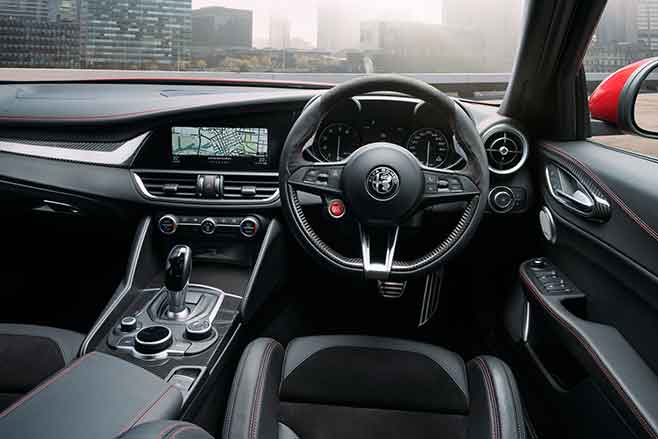
It’s nicely set out. There’s a sweeping dash, cleanly designed centre stack, and ergonomically placed controls and accessories. The digital screens, too, are well sized.
But it feels built to a lower price point than BMW, Audi, or Mercedes-Benz’s mid-size sedans. Plastic surfaces, dials, and buttons don’t provide the same tactility or finished with the same detail.
There’s only a smattering of leather, alcantara, and carbon fibre (if optioned) and although it wears the highest Euro NCAP rating, thanks to a suite of safety assist tech and an ‘excellent’ crash structure, you receive tree-trunk sized A-pillars in return.
But the biggest clue about this car’s performance sits midnight on the DNA’s drive mode dial. Beyond the Dynamic, Natural, and Advanced Efficiency modes, there’s a QV-only ‘Race’.
Alfa Romeo Giulia smashes Nurburgring record
It’s linked to an angry twin-turbo V6, an eight-speed auto, three-mode adaptive dampers, and an electronically-controlled hydraulic locking rear diff.
Developed by ex-Ferrari gurus, the V6 offers 375kW and 600Nm. Stretch its legs and suddenly the ZF transmission’s eight gears seem four too many.
On the other hand, the first two gears are super short (first is geared 5:1), and torque’s limited in lower gears to aid traction.
So first gear disappears in a blink and second doesn’t deliver full punch. Alfa Romeo reckons 0 to 100km/h in 3.9-seconds, but it’ll take some skill.
There’s no launch control, so you have to stall the eight-speed and be careful blending in the throttle to avoid wheelspin.
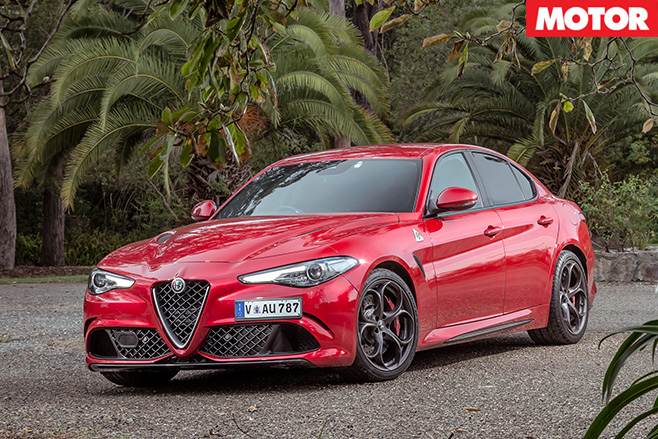
The engine’s exclusively mated to an auto, which is fine by us. It injects drama into the experience. It’s not dual-clutch quick, and doesn’t smoothly slip into first gear during low-speed deceleration, but it endearingly slaps you on the back during Race Mode’s full-throttle upshifts.
Alfa Romeo Giulia QV 0-295km/h autobahn run
Noise-wise it’s a bit love hate. From the outside the car belts out a throaty roar like someone’s lopped two cylinders off a Maserati GranTurismo’s V8. But there’s more engine than exhaust noise from the inside.
While the engine is the centre-point of this car, the QV’s standout is its sparkling chassis. There’s no rear-steering or active roll bar tech, but the truth is the Giulia QV doesn’t need them. Partly thanks to its steering rack.
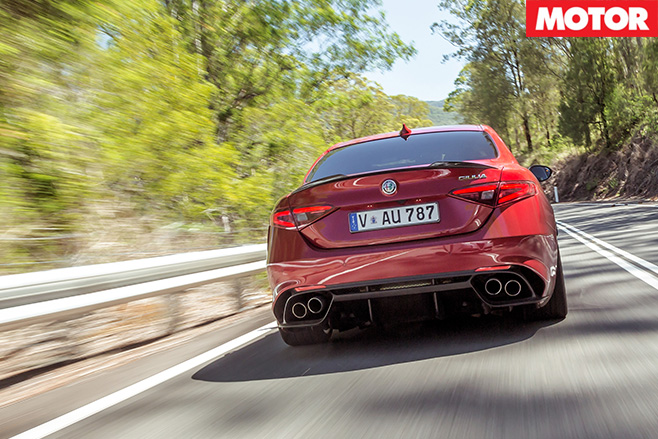
Such sharp reflexes are matched by a balance pure as an E46 M3’s, while Pirelli P Zero Corsas, at 285mm/245mm wide, easily handle the engine’s linear rush of power.
The car’s 19-inch rims suffer on Australia’s ruffled tarmac, picking up bigger ruts and edges. And the front pair can nab at road camber changes. But body control’s fantastic and ultimately the QV hustles the road more than the other way around.
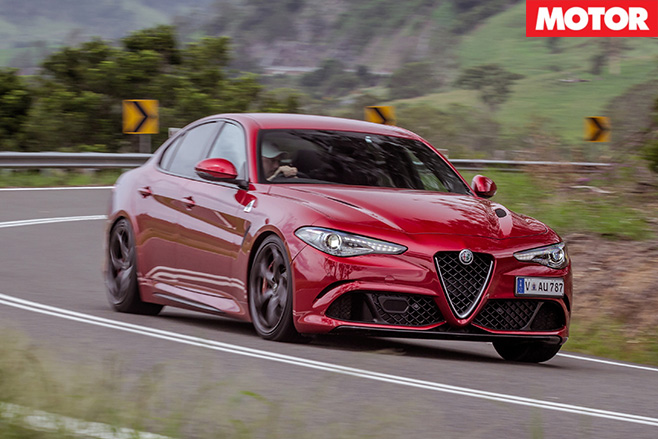
But even there, on your own, the Giulia QV is a supremely fast and friendly package that feels at home attacking a Mountain road as it would a racetrack. And to boot, its effortless engine and smooth gearbox make it a genuine cross-country bet.
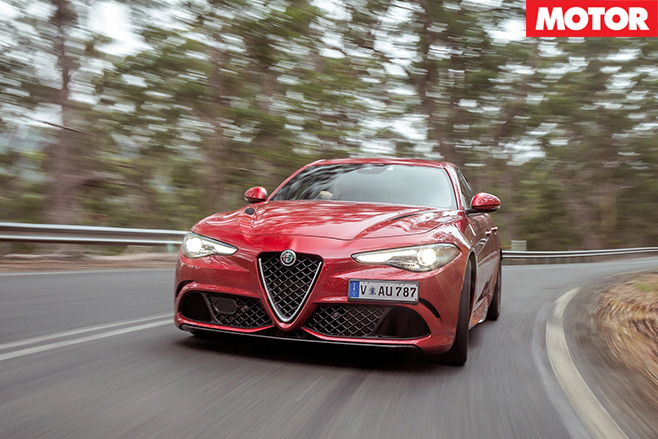
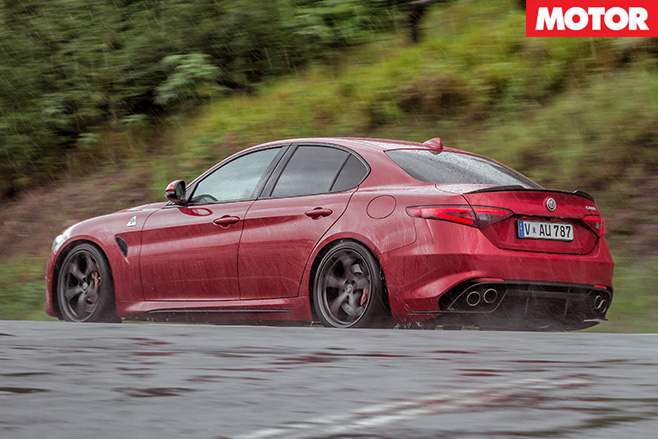
We’d skip the Sparco seats or carbon ceramic brakes to keep its $143,900 price tag true as possible, unless you have track days in mind. But the way it looks with optional Competizione Red paint and telephone-dial 19s would weaken even an accountant’s resolve.
Others fast sedans might be cheaper or sound better. However when it comes time to compare, the Giulia QV seems to have enough right stuff to stand out on its own, racetrack or road.
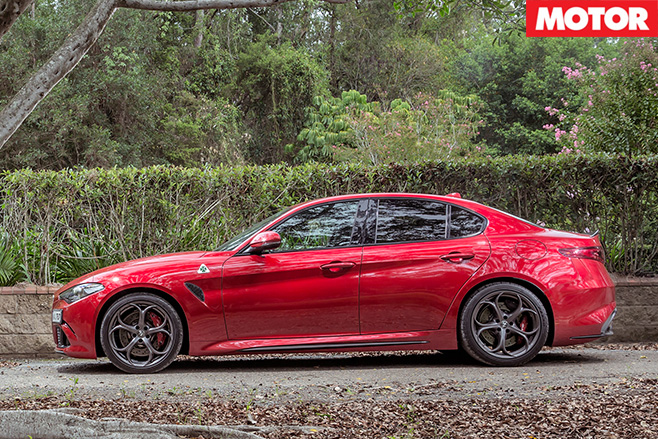
2017 Alfa Romeo Giulia QV specifications Engine: 2891cc V6, DOHC, 24V, twin-turbo Power: 375kW @ 6500rpm Torque: 600Nm @ 2500-5500rpm Weight: 1524KG (dry) 0-100km/h: 3.9sec (claimed) Price: $143,900
The Hyundai i30 is Australia’s favourite Korean car. Codenamed PD, the third generation of the five-door hatch is scheduled to arrive in late April. It will bring improvements that should make it even more popular.
WHAT IS IT? An almost all-new version of Hyundai’s small hatchback, that sticks closely to the proven front-drive formula for success in Europe’s Volkswagen Golf-dominated C segment.
WHY WE’RE TESTING IT The i30 is massively mainstream, so we leaped at an invitation from Hyundai to drive it in Korea more than two months ahead of its arrival in Australia.
MAIN RIVALS Toyota Corolla and Mazda 3 hatches, Volkswagen Golf, and many, many more…
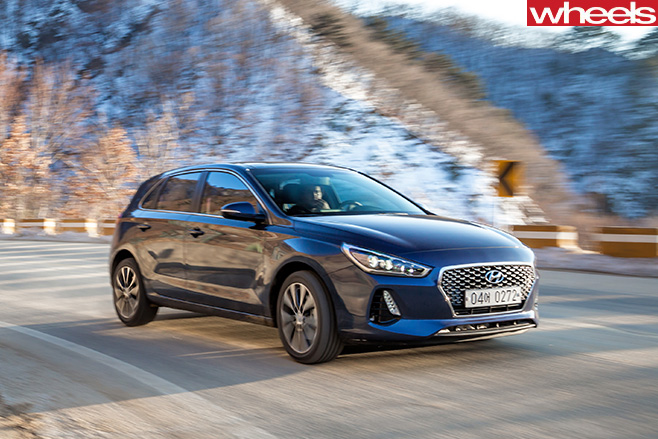
PLUS: Exterior design; performance (with 1.6-litre turbo four); interior design and space MINUS: Interior quality perception; tyre noise (on Korean-market rubber)
THE WHEELS REVIEW There’s not a shred of doubt which new i30 model we’ll soon be recommending. It will be the one with the 1.6T GDi engine, a fine and feisty turbocharged and direct injected four. Probably with the seven-speed double-clutch transmission instead of the six-speed manual…
Mashing the throttle pedal there’s axle tramp as the i30 accelerates snappily from rest. Gaps in the fast-flowing traffic on this busy arterial road skirting Seoul are both rare and brief. It’s one of the few occasions the Hyundai is uncouth during a drive that takes in a good variety of roads around the Korean capital and the countryside beyond.
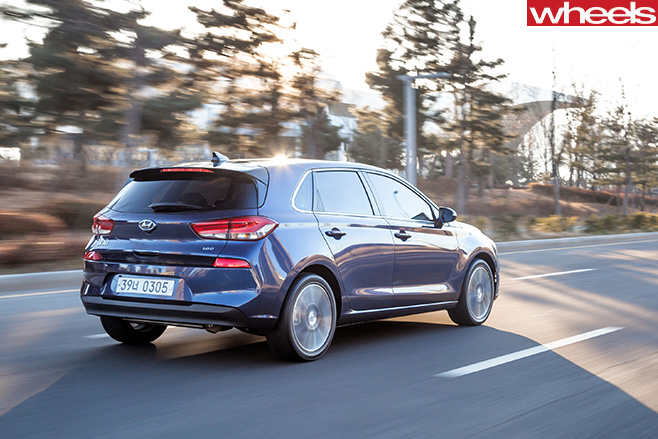
The double-clutch transmission is good, too. There’s slight jerkiness in very slow moving city traffic to let you know this isn’t a conventional auto with torque convertor, but the seven-speeder deftly manages moving off more decisively.
Shifting between gears is unfailingly smooth, though the transmission does sometimes dither momentarily if the accelerator is opened swiftly and suddenly while on the move.
The 1.6T GDi is the engine that will power the replacement for the warmish SR model that sits around the middle of the current i30 line-up.
Its 150kW and 265Nm maximums are significant rises compared to the non-turbo 2.0-litre four that’s in the SR today. And they should be the makings of a small hatch price-to-performance ratio star. With numbers like these, the i30 SR should easily spank the Mazda 3 SP25 for straight-line performance, and leave any Volkswagen Golf below the GTI eating its dust.
Hyundai will launch the third-generation i30 in Australia in late April with two other engines. The least costly grades will come with a larger, non-turbo, direct-injection four with more power and torque than the current base model engine. With 120kW and 203Nm, the 2.0 GDi almost exactly matches the current SR engine. As now, there will be a choice of manual and conventional automatic transmissions, both six-speeders, with this engine.
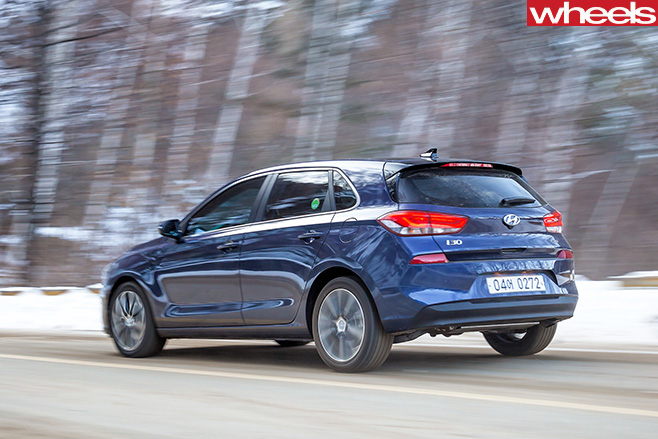
Korea will manufacture the new i30 for Australia, which explains why this preview drive is taking place there. But the new model, with the internal codename PD, was shaped to seduce buyers in Germany, France, Italy and the UK. Hyundai aims to be the best-selling Asian car brand in Europe by 2020, and the new i30 must play an outsize role in this ambitious plan.
The car was designed at the Korean company’s European tech centre in Rüsselsheim, the German city that’s also home to struggling Opel.
According to Hyundai’s chief design officer Peter Schreyer, the objective was to make the i30 a car with a strong visual identity.
“I don’t think in a graduation like ‘How European do I make it?’ This is not my way of thinking,” he said at the initial reveal of the i30 in Frankfurt last September.
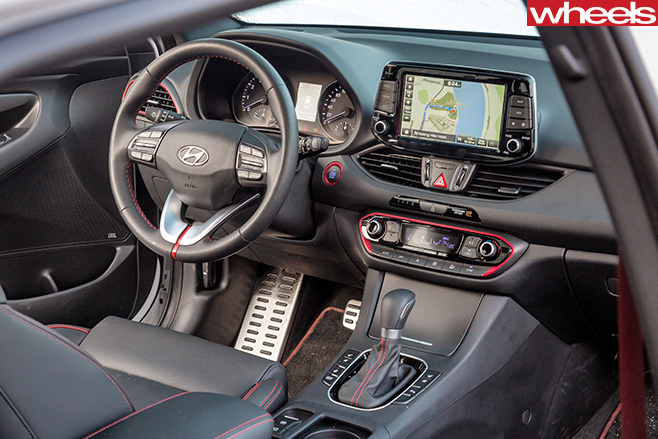
Although the new PD i30 shares its wheelbase with the current GD model, all other vital dimensions have subtly changed. It’s lower, but in response to the downward pressure the i30 has grown wider and longer. All the changes are small, including the increases in front and rear overhangs.
There’s a little more space inside and the cargo compartment grows slightly to 395 litres. But it’s the design that anyone climbing into a new i30 will notice first. The good-looking new instrument panel with its fashionable floating central screen is designed to emphasise the cabin’s width. For the driver there’s an attractive three-spoke steering wheel to hold and a pair of legible dials to look at.
The front seats of both the base grade and sporty SR are supportive, although the non-height-adjustable version of the passenger seat is too high for complete tall-person comfort.
While large-ish and wide-opening rear doors make accessing the rear pleasantly easy, the space once seated seems only average.
Quality? Well, let’s just say that the interior design teams working competitor brands aren’t going to be too worried. While the Hyundai interior looks well made, the materials it’s made from don’t quite create the kind of quality impression to rival Volkswagen, Mazda, or even Toyota.
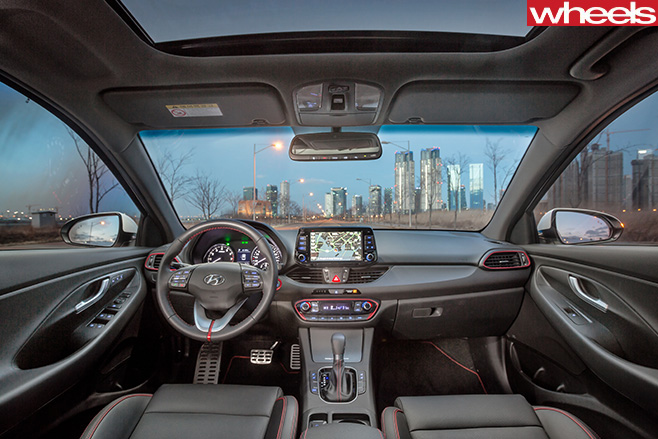
Hyundai is also confident the interior will be a safe place to spend time. Autonomous Emergency Braking will be available in the car, though it’s uncertain whether it will be standard across the range. Other sensor-reliant driver-aid systems will also be available, including active cruise control, rear cross-traffic alert, high-beam assist and more.
It’s impossible to say very much about the new i30’s dynamics. Its more direct steering, just 2.6 turns lock-to-lock, does feel like a move in the right direction. But the cars driven in Korea – one with the 1.6T GDi and another with the 1.6T CRDi turbo diesel, and both with Hyundai’s new multi-link rear suspension – were not representative of what we’ll see in Australia come April.
Only our SR model, with the 1.6-litre petrol-burning turbo, will come equipped with the multi-link rear end. All other models will come with a less costly, semi-independent torsion-beam rear suspension set-up.
Once again, Australia will get its own specific chassis calibrations. As the biggest single national market in the world for the i30, Korea is very eager to please us. While Hyundai Australia is saving the full story until local launch, those familiar with the work say the changes are extensive.
Other things that will remain secret until the local launch in April are prices and equipment levels. Hyundai Australia is still considering its options. Literally.
The company’s chief operating officer, Scott Grant, says whether or not to include AEB as standard equipment across the range is yet to be decided. The experienced exec also hints that the days of $19,990 drive-away deals are over for the i30.
The new i30 does seem to be a car that could wear slightly higher price tags without looking stupid. Its designed-in-Europe exterior alone surely will be enough to persuade some. Others will be attracted by the impressive performance of the SR. Some will like the connectivity and infotainment tech.
Simply put, the new i30 is a classier kind of Korean than we’re used to driving. Hyundai has always been ambitious, but now there’s confidence, maturity and increasing expertise to go with it.
SPECS Model: Hyundai i30 SR Engine: 1591cc, 4-cyl, dohc, 16v, turbocharged Max Power: 150kW at 6000rpm Max Torque: 265Nm at 1500 to 4500rpm Transmission: 7-speed double-clutch automatic Weight: 1400kg (est) 0-100km/h: Not available Fuel economy: 7.8L/100km (European combined cycle) Price: $30,000 (est) On sale: April 2017
A drifting video is McLaren’s latest teaser for its second-generation Super Series model expected to be named 720S when it debuts on 7th March.
McLaren has promised more power and torque, and sharper throttle response, from the car that is expected to again take its name after its horsepower – pointing to an output of 529kW, compared to 478kW (650PS) in the 650S.
Last week the company revealed details of the 720S’s uprated twin-turbo 4.0-litre V8 engine that will accelerate from 0-200km/h in a Ferrari 488 GTB-beating time of 7.8 seconds. (The 650S previously trailed the GTB by a tenth, with 8.4 seconds.)
Details released overnight shed more light on the 650S replacement’s enhanced braking and grip performance.
Equipped with stiffer brake calipers, standard carbon-ceramic discs and improved pedal modulation, McLaren says the new Super Series model will come to a halt from 200km/h in just 4.6 seconds – or 117 metres, six metres less than the 650S and just one metre short of the flagship McLaren P1.
McLaren also confirmed customised Pirelli P Zero Corsa rubber will bring a six per cent improvement in mechanical grip.
A significant improvement in downforce is also expected, along with further development of the company’s Monocell carbonfibre tub.
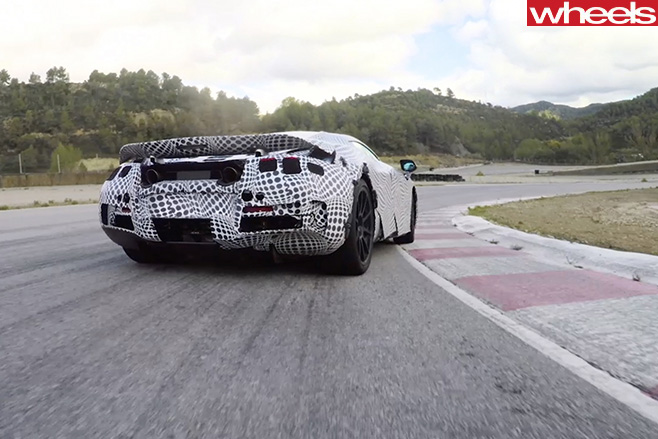
The second-generation McLaren Super Series model will debut at the 2017 Geneva motor show.
You can watch a camouflaged prototype of the new supercar being drifted around a track by McLaren’s chief test driver, Colin Goodwin.
An extremely rare Jaguar XJR-15 is currently for sale in Australia.
Offered by the Gosford Car Museum, the car is one of just 53 produced and you’ll need a cool A$1,050,000 to transfer it to your garage.
Only four XJR-15s reside in the southern hemisphere, two each in Sydney and Melbourne, with this example, chassis 018, fully restored by Mike Roddy Motors in Moorabbin, Victoria.
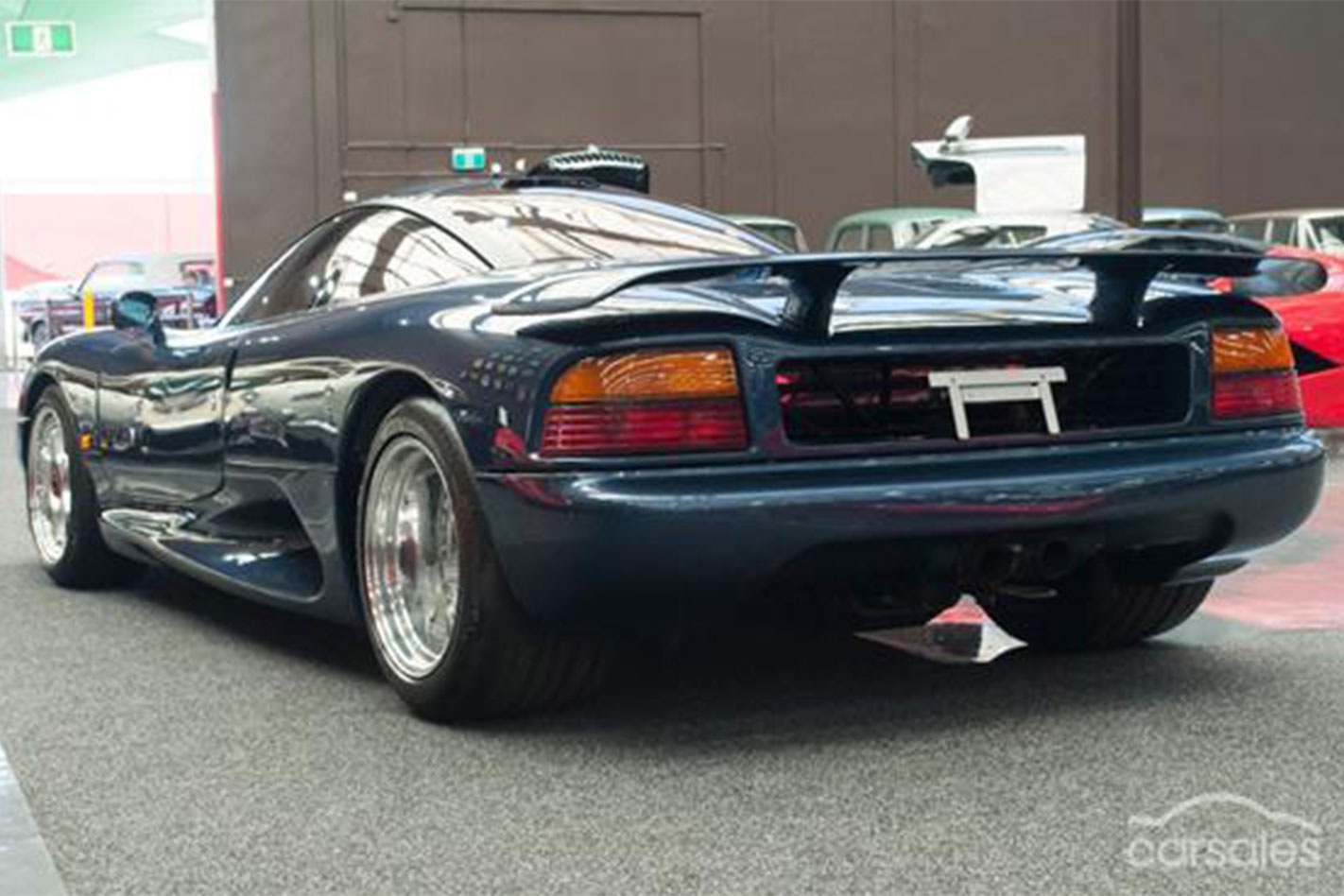
In concept the XJR-15 was a road-going version of the Le Mans-winning Jaguar XJR-9. It was the first road car to be built completely out of carbon fibre, though its competition focus meant it definitely put the racer in road-racer.
Power came from a 6.0-litre V12 producing 336kW/570Nm. That might not seem much by today’s standards, but the XJR-15 weighed just 1050kg, of which almost a third was engine.
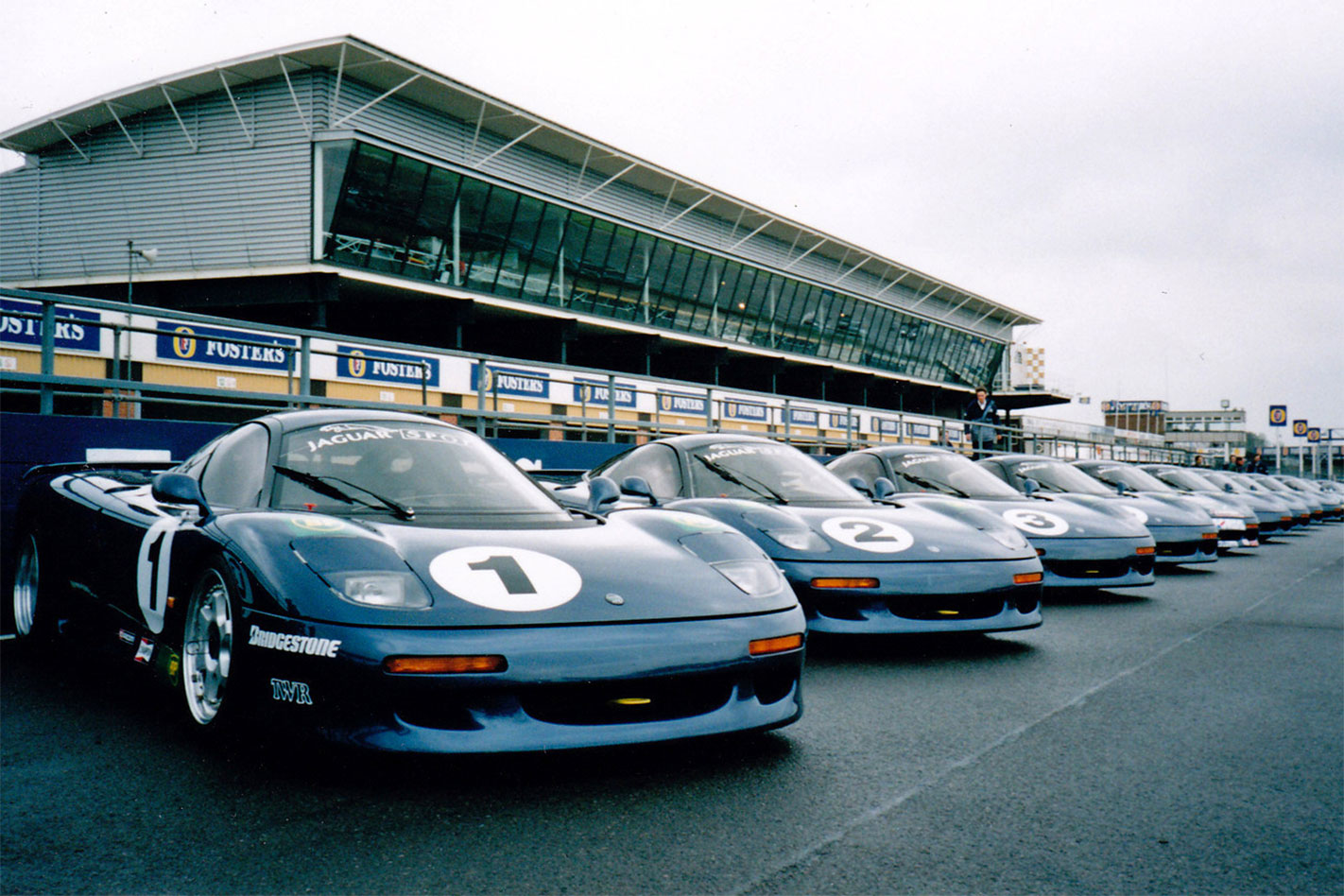
A one-make race series was devised to showcase the car, the Jaguar Intercontinental Challenge, with a $1million prize for the winner.
It supported three Formula 1 races during the 1991 season (Monaco, Silverstone and Spa) and featured driving talent like David Brabham, Jim Richards, eventual winner Armin Hahne and Tiff Needell, who can be seen demonstrating the car below.
The car was succeeded by the Jaguar XJ220 and its designer, Peter Stevens, went on to design another V12-engined carbon fibre supercar, the McLaren F1.
The smart new Hyundai i30 wagon probably won’t be coming to Australia, but it did get us thinking about the wagons that look better than their sedan or hatch counterparts.
Here are five great looking estate cars that not only look great, but also offer better performance than most SUVs.
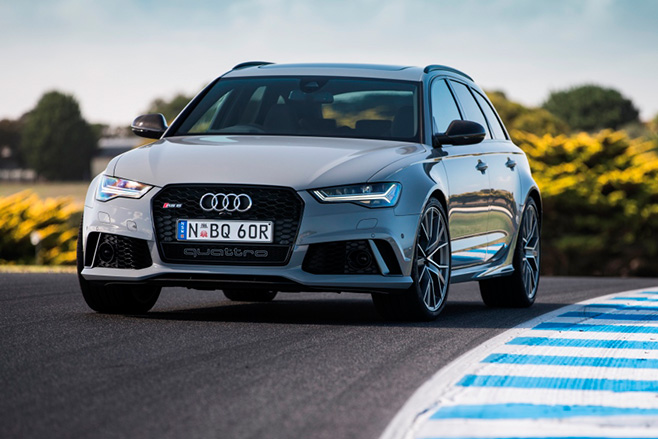
Audi A6 Avant
Why Audi stopped bringing in the base model A6 Avant wagon to Australia is anyone’s guess.
The extended roofline adds sharpness and athleticism to the relatively bland looking A6 sedan, be it in the form of the low-riding and super-quick RS6 Avant Performance or the sensible outdoorsy A6 Allroad. Each has plenty of interior space and a seats-up 565-litre boot capacity,
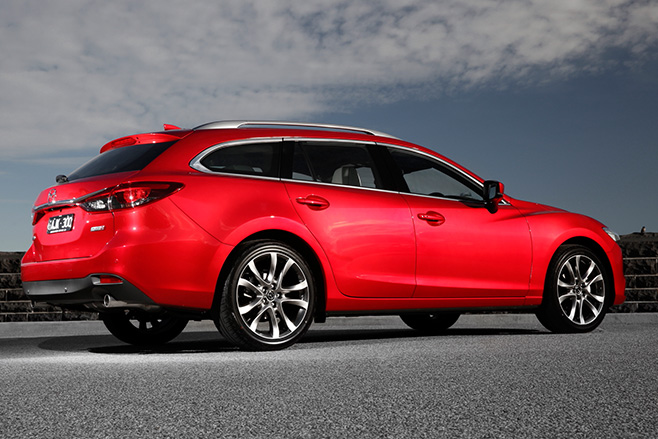
Mazda 6
This isn’t just a nice looking wagon, it’s one of the best looking family cars going around, with beautiful flowing lines and a low swept roof which complements the rising door line far more pleasingly than the sedan.
It also has better leg and headroom than the four-door and its 506-litre seat-up boot capacity is slightly bigger than the Mazda CX-5 SUV.
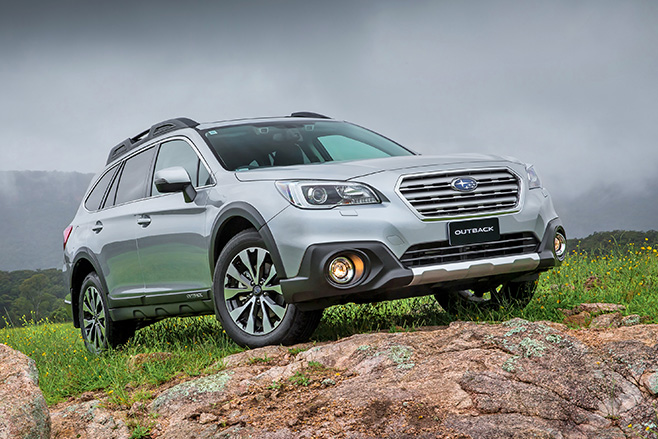
Subaru Outback
Based on the Liberty sedan, the Outback not only looks superior but better espouses the utilitarian qualities that people associate with Subaru.
The Liberty’s coupe-like shape starts off well but its elegant lines clash with the huge rear bumper. This is trimmed to accommodate the tailgate on the Outback, which has rugged appeal thanks to the jacked up ride height, roof racks and black bumper trim along the bottom and wheel arches.
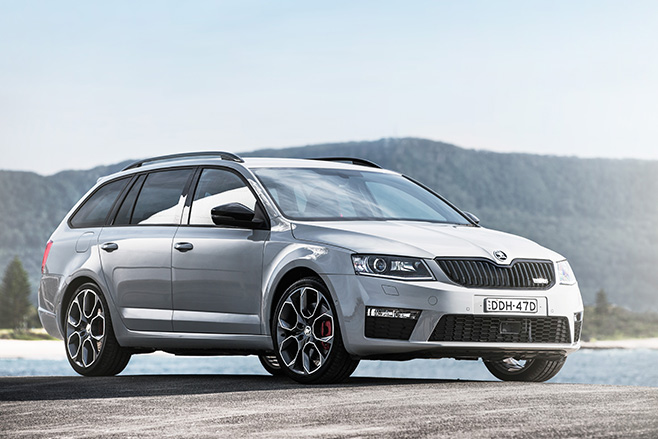
Skoda Octavia RS
Europeans do sport wagons well and the Skoda Octavia is no exception. It shares many of the same elements as the sedan including the big squarish tail lights. But the extended glasshouse and roof racks, as well as the way the diamond twin exhaust tips and top spoiler sandwich the tailgate, gives the Octavia RS an edge over the four-door, as does the 588-litre boot space.
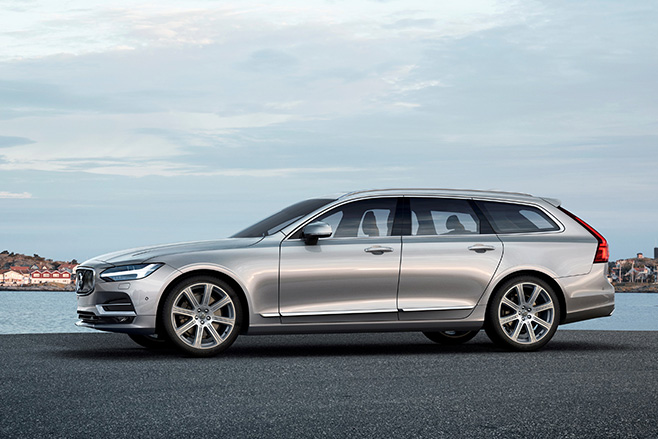
Volvo V90
Wagons often appear to be the afterthought of car design, but the opposite seems to be the case with the Volvo V90 and its S90 sedan counterpart.
The V90 looks like it was meticulously carved from a slab of pristine Italian marble with the shard like headlights imitating its sharp edges that are emphasised by the horizontal window line that slightly tapers upwards at the rear before rising acutely in harmony with the angled tailgate. The sedan looks like someone took to the finished sculpture with a blunt chisel to carve out a boot.
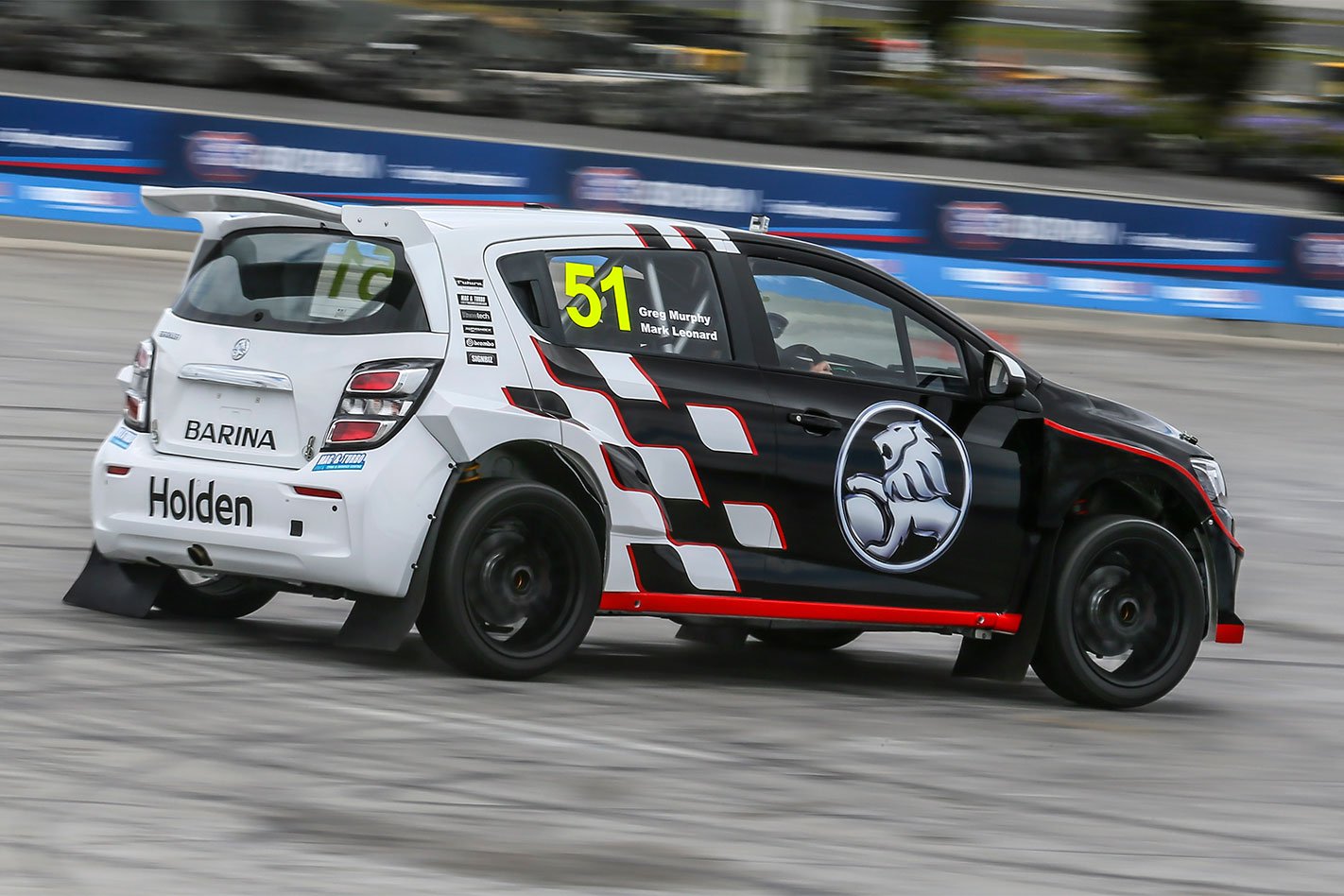
Four-time Bathurst 1000 champion Greg Murphy has revealed his mount for the 2017 New Zealand Rally Championship, a turbocharged, all-wheel drive Holden Barina.
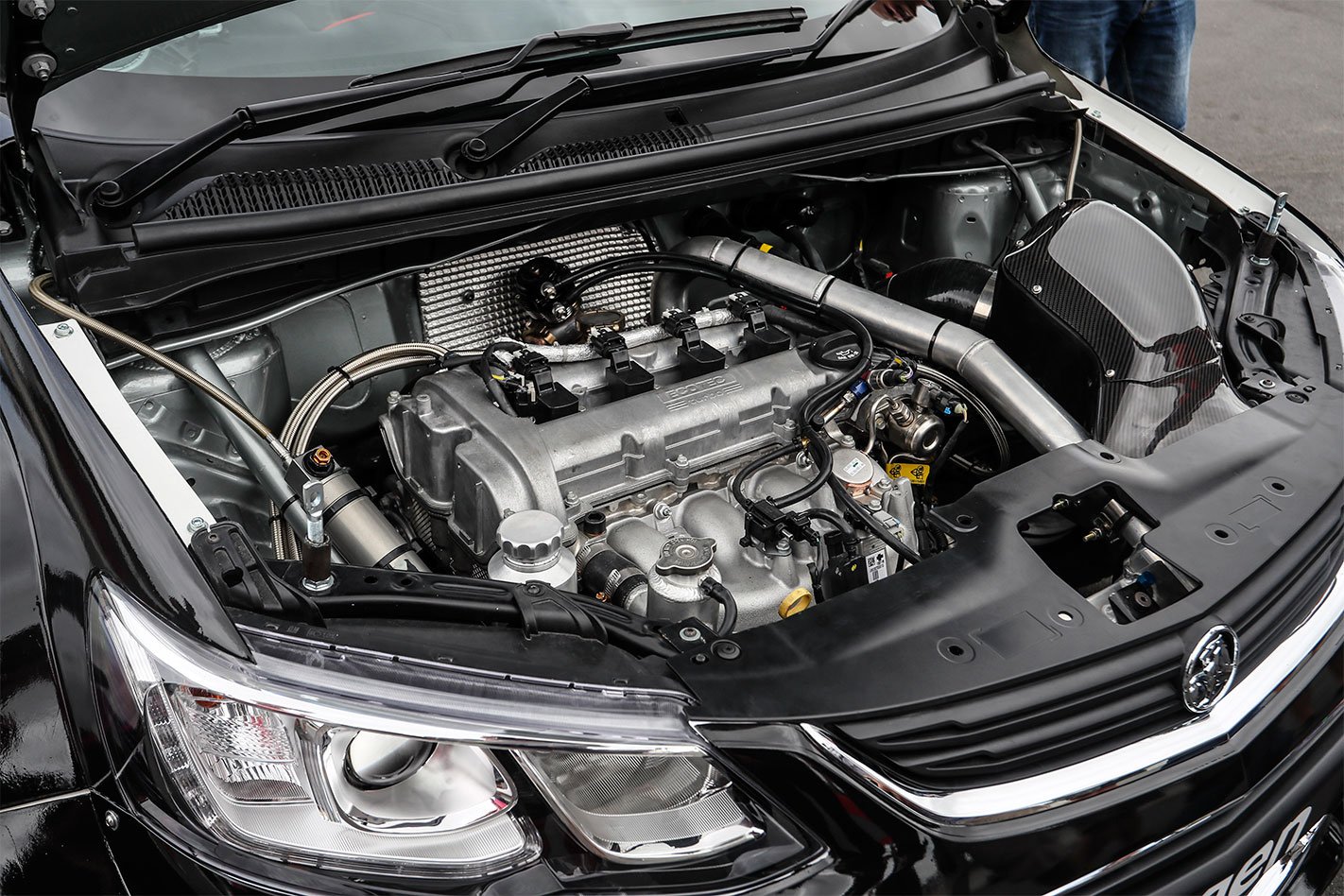
Built to AP4 (Asia-Pacific) regulations, the Barina uses a 1.8-litre version of GM’s 2.0-litre Ecotec engine, with a Garrett turbocharger boosting outputs to 260kW/500Nm, fed to all four wheels via a Sadev six-speed sequential gearbox.
The AP4 regulations are intended to allow top-level national rally competitors in Australia and New Zealand the opportunity to build a high-performance all-wheel drive vehicle at a reasonable cost ($150-200,000).
Engine size is restricted to 1.6 litres, however NZ allows 1.8-litre engines as a sort of ‘AP4 Plus’ category, with performance roughly equivalent to FIA R5 cars which cost more than twice as much.
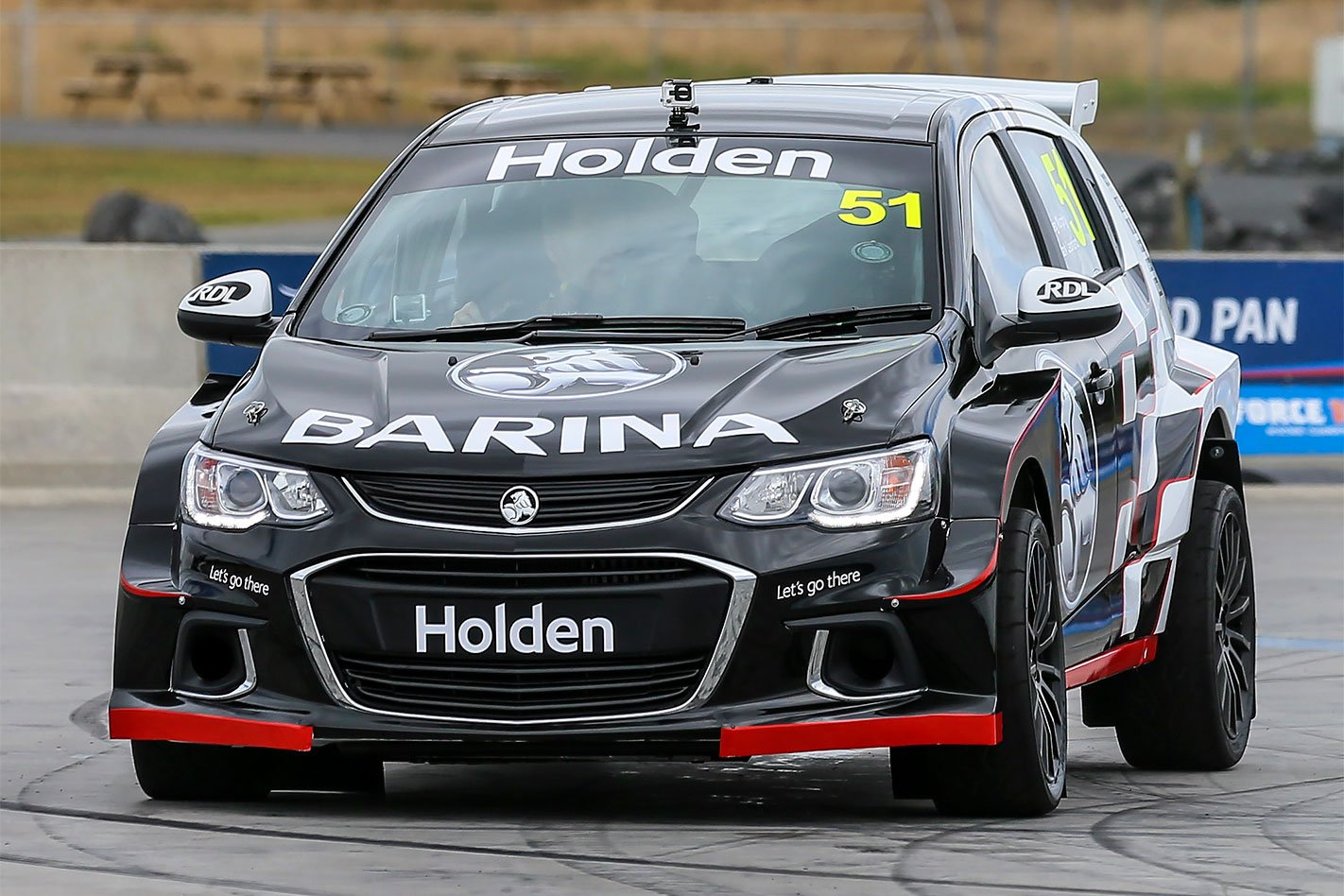
Murphy will be joined in a second Barina AP4 by 2013 New Zealand two-wheel drive rally champion Josh Marston. The 2017 New Zealand Rally Championship starts at the Rally of Otago, held from April 7-9.
WHEN you put Margot Robbie into an all-electric sports car that can do 0-100km/h in under five seconds at Monaco under the blanket of night, you have our attention.
Nissan has appointed the Suicide Squad actor as ambassador of its electric vehicles, revealing the news with a short film of the Japanese carmaker’s all-electric Nissan BladeGlider 190km/h prototype racing around the Monaco circuit.
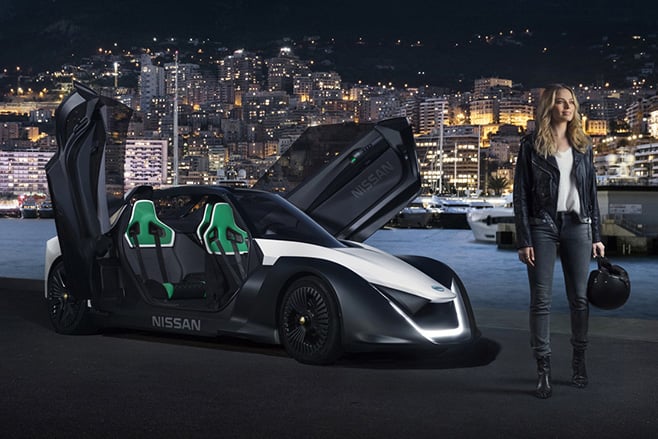
The adventurously-designed BladeGlider is a three-seat, 200kW performance car which can reportedly hit 100km/h in less than five seconds.
The appointment seems to fit well with the Australian-born actor’s environmental causes. In 2012, she announced via Twitter that she had signed as a member of Greenpeace and is an advocate for sustainability.
“More people are choosing to go electric, leading the way to a more sustainable future and the Nissan BladeGlider hints at the future of smarter performance cars,” said Robbie, who also stared in Martin Scorsese’s Wolf of Wall Street next to fellow enviro-activist Leonardo DiCaprio.
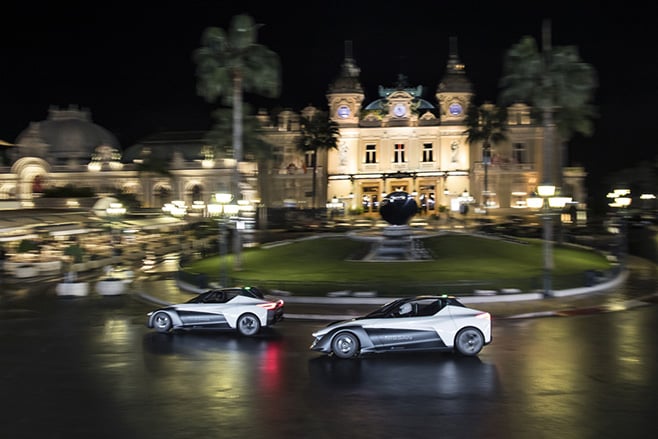
The all-electric Nissan Leaf also falls under the carmaker’s stable. The “world’s best-selling electric vehicle” has lost its spark in recent years, recording just seven sales in Australia last year, though a new-generation model is expected to hit our shores in 2018.
“It is more important than ever that we showcase all of the benefits of driving an electric car – from energy efficiency, to sustainability, from handling to performance,” said Nissan Europe’s director of Electric Vehicles, Gareth Dunsmore.
“Having Margot on board will support us in spreading news of the personal and society benefits of electric vehicles to more people than ever before.”
The BladeGlider, which was developed from a concept revealed in 2013, is a precursor to what’s to come in the future of EVs. It will to be on display next month at the Geneva Motor Show.
