
GONE are the days when high-performance variants of cars are all built alongside the standard variants. These cars require specialised work, which is where the carmakers’ performance sub-brands come in.
More than just adding a badge, performance sub-brands provide an extra dimension to mass car manufacturers in terms of motor racing, research and development, and credibility.
Their products have a flow-on effect down the range in terms of technology and desirability, with even the most bog-standard of small cars able to claim the same DNA as the hi-po racers that once adorned kids’ walls.
Here are some performance brands whose badges you’ll find among the most popular car manufacturers in Australia.
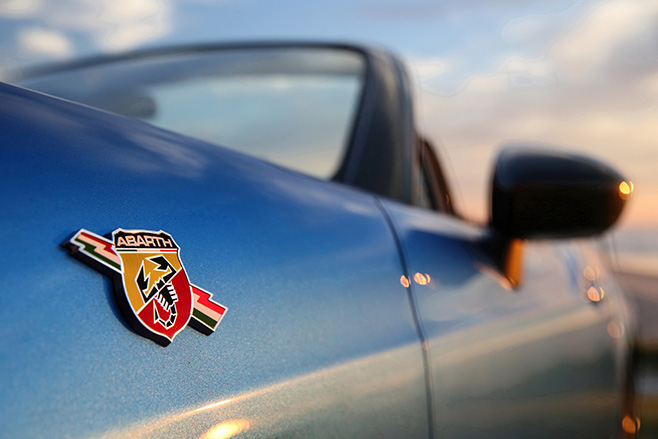
Abarth
Founded by Carlo Abarth in 1949 to produce racing and road cars, Abarth was bought by Fiat in 1971. It is now a fully owned subsidiary of the Fiat Chrysler Group and specialises in high-performance versions of Fiat cars. Current models include lively versions of the Fiat 500 and 124 Spider. Carlo’s star sign inspired Abarth’s now iconic scorpion logo.
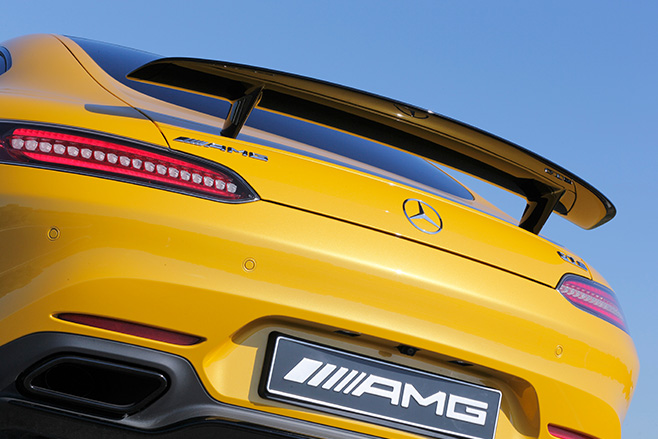
Mercedes-AMG
Taking its names from the initials of its founders, Hans Werner Aufrecht and Erhard Melcher, and their home town of Grossaspach, AMG has added extra oomph to Mercedes-Benz vehicles since the 1960s when it modified engines for touring car racing. Today, AMG is perhaps the most respected high-performance division of any manufacturer, with its products adding extra power, better handling and refinement to cars already renowned for all-round excellence.
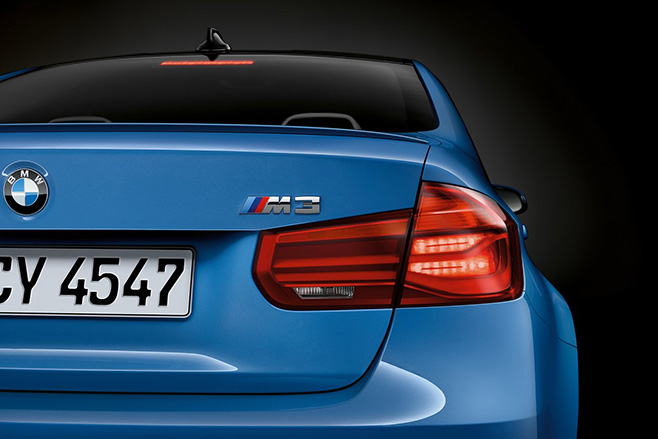
BMW M
BMW M – the “M” stands for “motorsport” – was set up to develop and run the carmaker’s racing program that dominated European touring car championships in the 1960s and ’70s. Racetrack expertise eventually made its way into BMW’s road cars, with M-badged models such as the BMW M3 and M5 standing over the rest of the BMW range with modified engines, transmissions, suspensions, interior trims, aerodynamics, and exterior modifications. Most famously, the M badge had its genesis in the failed M1 supercar project.
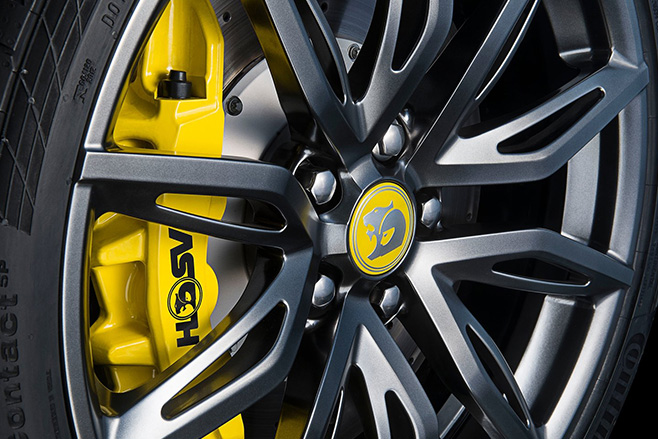
HSV
Formed as a partnership between Scottish performance guru Tom Walkinshaw and Holden after Holden’s split with Peter Brock and his Holden Dealer Team, Holden Special Vehicles has rolled out performance versions of the Commodore sedan, ute and wagon, and Statesman/Caprice long-wheelbase range – and briefly an Astra hatch – since 1987. They’ve sold under the HSV badge wearing nameplates including ClubSport, Grange and Maloo. HSV vehicles generally feature more powerful engines, better suspension and braking, more aggressive styling and plusher interiors than their Holden cousins.
John Cooper Works
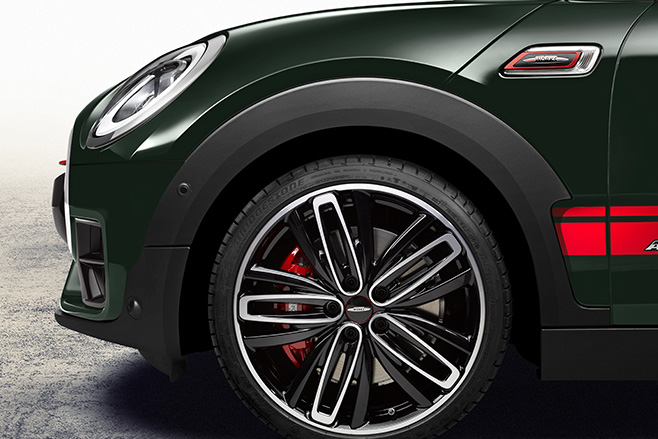
JCW has its roots in the original Mini Coopers of the 1960s, having been founded by Michael Cooper, son of the famous John Cooper whose name became synonymous with the original Mini. The JCW division was formed in 2000 and is now owned by BMW, producing tuning parts and accessories for the new Mini. These cars wear the JCW name.
N
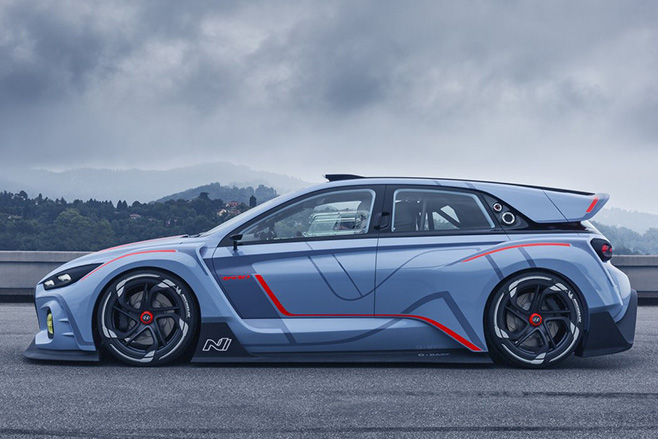
N is Hyundai’s upcoming performance sub brand that kicked off last year. It has since revealed three concept cars including the audacious RN30 racing hatch, and revealed it is testing a road-going turbo-powered hot hatch based on the Hyundai i30 that it claims will rival the Volkswagen Golf GTI – the hot hatch benchmark against which all others are measured. The N division is headed by Albert Biermann, a former vice-president of engineering at BMW’s M division.
NISMO
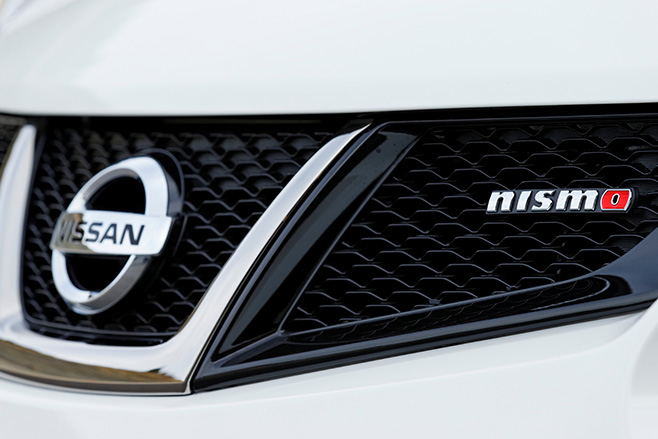
NISMO (abbreviated from “Nissan Motorsport”) is Nissan’s own tuning, motorsports and performance division. Formed in 1984, NISMO racing cars have competed in the world’s top endurance races. It has also produced tuning kits for Nissan vehicles including the 370Z and GT-R and is responsible for creations such as the Skyline GT-R R34 and the R33 Skyline 400R. Ever wondered why Nissan’s race cars seem to always use the number 23? Translate it to Japanese: two is “ni” and three is “san”.
Quattro GmbH
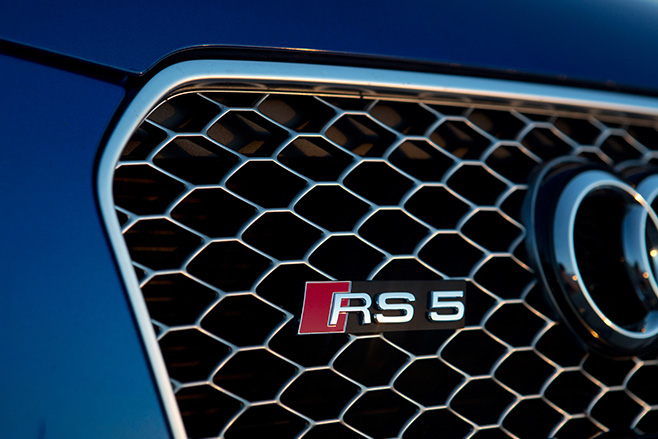
Named in homage of the great four-wheel-drive Group B rally cars, quattro GmbH is a private subsidiary of Audi founded in 1983 to produce high performance Audi cars and components. Its core products include the R- and RS-series high-performance Audis including the RS4, RS6 and Audi R8 supercar.
STI
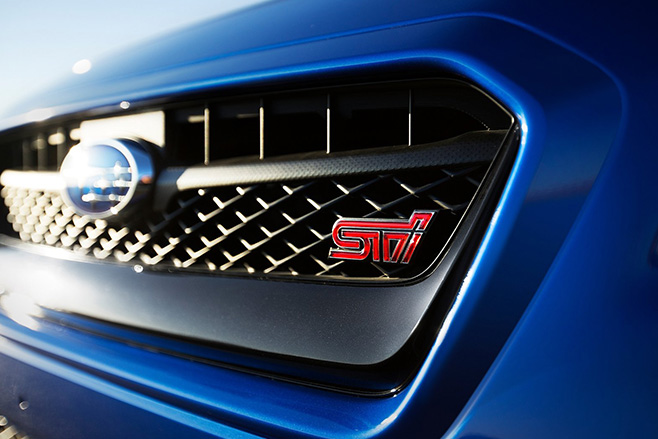
Subaru Tecnica International is owned by Subaru’s parent company Fuji Heavy Industries’ motorsports division. Along with British performance outfit Prodrive, which owned the now defunct Ford Performance Vehicles in Australia, it specialises in preparing Subaru cars for the World Rally Championships and producing tuning kits for Subaru road cars including the WRX, Forester and BRZ.
SVO
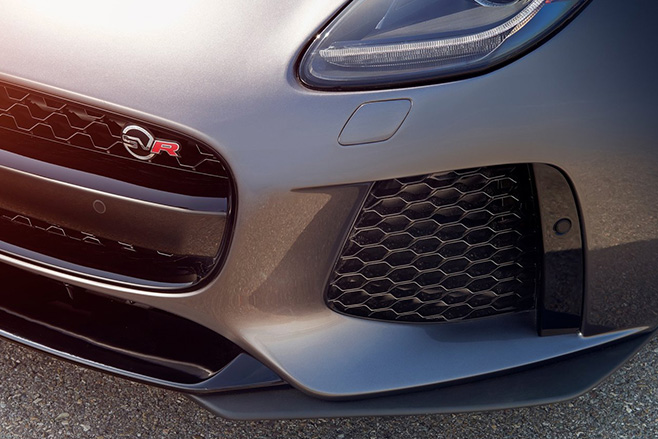
Launched in 2014, Special Vehicle Operations is the performance arm of Jaguar Land Rover producing limited-edition, high-performance versions of Jaguar, Land Rover and Range Rover models. It also provides an engineered-to-order service for wealthy customers wanting their own bespoke versions of the British luxury cars. SVO has created high-performance Jaguar F-Type SVR and Range Rover Sport SVR variants, as well as the limited-edition F-Type Project 7 and Range Rover SV Autobiography.
WHAT does a Tesla “see” while it is driving down the road? The electric carmaker has captured a video detailing what its Autopilot driver-assist technology sees in different conditions – without any driver input.
What makes this video interesting are three side panels showing what the different cameras that help control the Tesla Model S used in the video see in real time, and how the car responds to them.
The cameras help the car read and react to everything from poorly defined unsealed road edges to stop signs, allowing it to safely negotiate blind intersections and stop for side traffic and pedestrians.
While we shouldn’t underestimate the human mind’s ability to process visual information and react accordingly, it would be impossible for any driver to be able to see and process everything happening around the entire car.
It’s worth noting, though, that while this is at the cutting edge of autonomous technology even for Tesla, there is still a way to go before such systems process the information with the equivalent of human logic.
For example, the car stops for a couple of joggers on the side of the road instead of passing them safely, and it did pause in the middle of intersections a few times.
But it does demonstrate how far autonomous driving technology has come. It also shows that while the software still needs refining before Level 5 autonomy becomes a reality, the hardware fitted to the car is already up to the task.
The video is best viewed on full screen. You might want to pause it from time to time to keep up with what the cameras are seeing and how they react to different situations.
Two trim grades powered by a 1.4-litre turbocharged four-cylinder from the Suzuki Vitara Turbo replace the entire previous line-up that featured an unassisted 1.6-litre four.
The move ends the offering of manual transmissions and all-wheel drive, and lifts the S-Cross’s starting price significantly – from $22,990 to $27,990.
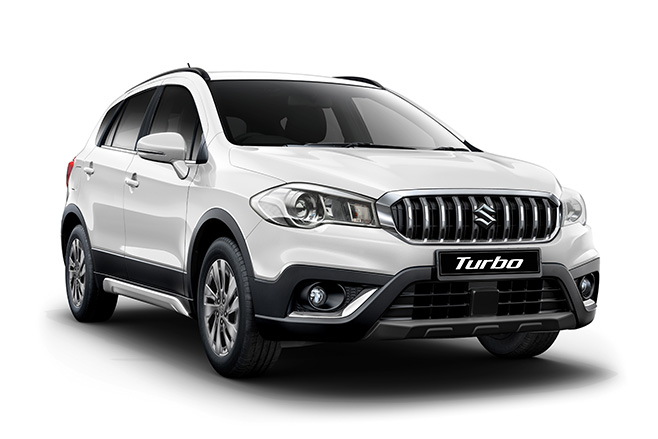
The base Turbo, however, is $2000 cheaper than the former GLX it essentially matches for equipment, and also $1000 less than the entry Vitara Turbo. Standard gear includes satellite navigation, Apple CarPlay, dual-zone climate, keyless entry/start, 17-inch alloy wheels and reversing camera.
The $29,990 Prestige version of the Suzuki S-Cross Turbo adds leather-accented upholstery, rear sensors, auto-dimming rear view mirror, 17-inch polished alloy wheels, and headlights with LED projector lamps and auto function.
Suzuki Australia is currently offering driveaway pricing that adds just $1000 to the RRPs.
The turbo engine’s outputs of 103kW and 220Nm surpass the 86kW and 156Nm of the original S-Cross, which should compensate amply for an extra 45kg in overall vehicle weight.
A conventional six-speed automatic gearbox with paddle-shift levers is standard, replacing the CVT auto offered previously.
Official fuel consumption of 5.9 litres per 100km is marginally thirstier than the 5.8L/100km of the 1.6L front-wheel-drive S-Cross models.
The model’s mid-life update also brings revised styling, most notable with the more aggressive front end epitomised by a chunky chrome grille, re-profiled headlights and bonnet creases.
The S-Cross has been struggling in the market compared with Suzuki’s alternative small SUV, the Vitara. Vitara sales have almost reached 5000 at the end of October, where S-Cross sales are down 60 per cent to 483 units at the same stage.
Suzuki Australia will bolster its small-SUV range in 2017 with a new-generation Ignis.
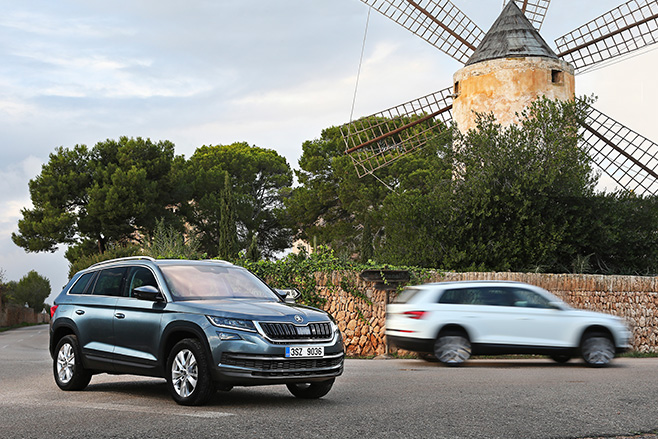
The Skoda Kodiaq is the Czech brand’s first seven-seat SUV, and will be arriving in Australia next year. We’ll be getting a 2.0 –litre TSI turbocharged petrol engine from launch, with a 2.0 TDI turbo diesel joining the range later.
- The Skoda Kodiaq sits on VW Group’s MQB platform and therefore is closely related to the existing Skoda Octavia and Superb, and also the Volkswagen Tiguan. It’s currently the only MQB car to be available with seven seats.
- It’s a big car – at 4697mm in length it’s closer in size to the Volkswagen Touareg (4801mm) than it is to the 4486mm Volkswagen Tiguan. Skoda says the petrol-engined TSI weighs 1738kg with a 75kg driver and the diesel-engined TDI weighs 1795kg.
- Other markets will have the option of manual gearboxes and front-wheel drive, but all Australia-bound Kodiaqs will have all-wheel drive and a seven-speed DSG dual-clutch automatic gearbox as standard.
- The 132kW 2.0 TSI petrol engine will be the only powerplant available from launch, with the 140kW 2.0 TDI diesel joining the range later. Skoda says it hopes to have the diesel in Australia within 12 months of the petrol version going on sale.
- The edgy styling shares the design language of the Octavia and Skoda Superb. We’re told that it was inspired by the artisan cut glass for which the Czech republic is famous.
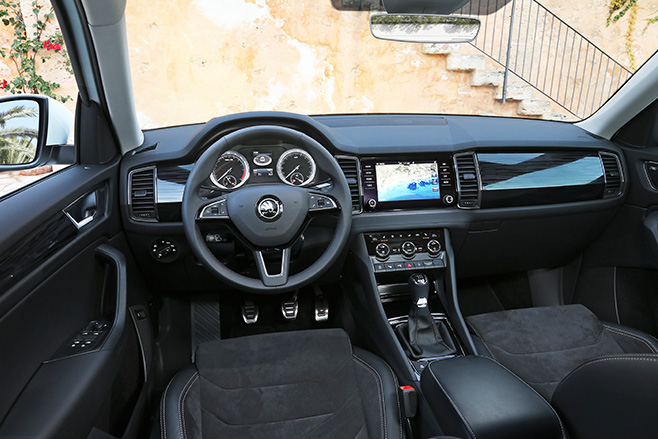
- The optional “tow assist” system can help at low speeds when reversing a trailer. It allows the driver to select the angle they want the trailer to take using the electric mirror switch, with the car then steering automatically to maintain this.
- Skoda is working on a ‘coupe’ version of the Kodiaq for the Chinese market that will feature a lower roofline, similar to the BMW X6 or the Mercedes GLE Coupe. The company says it might be sold elsewhere, too.
- More powerful versions are likely to follow, and Skoda says it hasn’t ruled out producing an RS (Skoda’s equivalent of VW’s “GTI” badge) performance version that would most likely be powered by the 206kW 2.0 TSI engine that we believe will arrive soon under the bonnet of a range-topping Skoda Superb S.
One of the more intriguing race car projects of recent times is the Formula Thunder 5000.
The brainchild of Melbournian Chris Lambden, the idea is to create a modern interpretation of the fearsome Formula 5000 single seaters that tore up the world’s racetracks in the 1970s.
It proved a popular series in Australia, the enormous performance of an F5000 car attracting drivers the calibre of Frank Matich, Frank Gardener, Vern Schuppan, Kevin Bartlett and Alfredo Costanzo.
However, like all single seaters of that era, safety was not a strong point, a number of drivers sporting the ‘Lola limp’ as a result of leg injuries sustained in F5000.
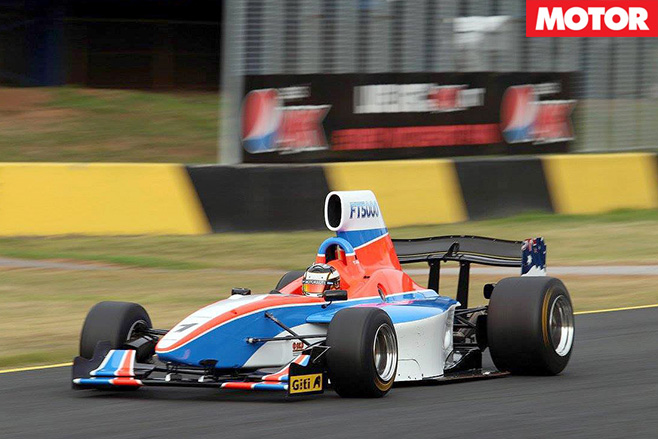
Using a US-built Formula Nippon car as a base, a 5.0-litre Coyote V8 from the Ford Mustang is installed along with a six-speed paddleshift gearbox from Holinger.
While relatively heavy for a single seater, a claimed power output of almost 450kW means performance is ballistic, as can be seen from the video at the head of this article.
Even better, Borland Racing Developments, the company responsible for building the FT5000, deliberately removed a lot of the downforce from the Formula Nippon donor car, which should make Formula Thunder machinery both more spectacular to watch and allow cars to run in close proximity during races, improving overtaking opportunities.
So far the FT5000 prototype has successfully completed three shakedown runs with two-time Australian Drivers’ Champion Tim Macrow at the wheel. We’ll bring you further updates on the Formula Thunder project as receive them.
TELL ME ABOUT THIS CAR
The Kodiak is belated acknowledgement from Skoda that buyers want to buy SUVs more than sedans, hatches or wagons. Under the surface it is closely related to both the Skoda Octavia and Superb and has been tuned for on-road behaviour rather than trips to the wilderness. Initially only a 132kW 2.0 TSI petrol engine will be available, but Skoda hopes to bring a 140kW 2.0 TDI diesel within a year of sales starting.
The Kodiaq will go on sale in Australia in mid 2017, with a high level of standard spec including all-wheel drive, pop-up third row seating and twin-clutch automatic transmission. Prices haven’t been confirmed.
STRENGTHS
- Comfort: The Kodiaq is a great place to spend time, riding impressively well even over broken surfaces and with excellent refinement at higher speeds.
- The 2.0 TSI petrol engine that will be available from launch pulls hard when asked to do so and has more than enough torque for effortless cruising. The 2.0 TDI diesel that will follow later should deliver impressive fuel economy – Skoda claims 5.7litres/ 100km on the EUDC European test.
- Safety kit: As you’d expect for such a family focussed car, Skoda hasn’t stinted with the active safety and driver assistance systems. The company claims no fewer than 24 are available, from standard autonomous emergency braking, which will work at up to 34km/h to stop a collision, to an optional 360-degree camera system to make low-speed manoeuvring easier.
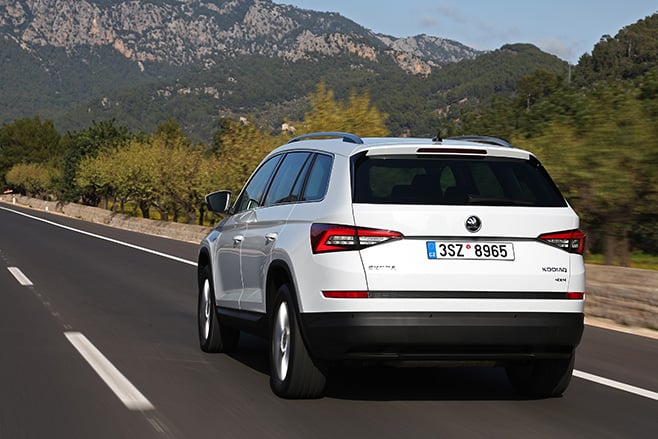
- The third row seats work well, being easy to deploy and store. They’re only designed for part-time use, and getting into them past the second row is a bit of a scramble, but there’s enough room back there for even bigger kids. The second row seats can be both slide and reclined, and also fold 40:20:40, meaning it’s possible to accommodate both long loads and passengers at the same time.
- Equipment: Although Australian spec is yet to be finalised, we’re promised that equipment levels will be keen. The range-topping “Columbus” navigation and entertainment system is particularly impressive, featuring an 8-inch touch-sensitive glass screen and Google mapping.
- Skoda claims a towing capacity of up to 2.5 tonnes and also offers a “tow assist” system which can take over steering when manoeuvring a trailer in reverse.
WEAKNESSES
- The Skoda Kodiaq is a heavy car, and it feels it. On Skoda’s numbers the TSI is 1738kg with a driver and the TDI is 1795kg. Although handling is secure and accurate there’s not much enthusiasm for faster progress. That weight also makes its presence felt when it comes to acceleration, which is no more than adequate with either engine. We should be glad that Skoda has no plans to bring any of the lesser-powered versions that will be offered in other markets here.
- There are no ISOFIX mountings for the third row seats, meaning that unlike some rivals you can’t put a child seat in there.
- Styling is likely to split opinion as well. Skoda says the car’s styling has been inspired by Czech cut glass – it looked more origami to us. From some angles it works well, but from others it looks big and inelegant.
- We didn’t like the black trim in the cabin of the car we drove, which was plastic pretending to be wood.
Skoda hasn’t released pricing for the Kodiaq yet, limiting our ability to know where in the market it will go, but it has told us it will only be offering cars with generous standard equipment, with all-wheel drive, seven seats and a DSG twin-clutch gearbox being standard in Australia.
Its toughest competitor looks set to be the Mazda CX-9, which can be had in entry-trim AWD form for $46,490, and which has more power and a more easily accessed third row. Other seven-seat alternatives include the Hyundai Santa Fe, which is $43,990 for the Active CRDi diesel automatic, the Kia Sorento, which is $45,990 in mid-spec SLi trim with a more powerful petrol V6 and – of course – the Toyota Kluger, although you’ll need to find $46,190 to get into the cheapest all-wheel drive version.
FORD’S fiercest rival has ripped off a clever, but gruesome, advertising campaign developed in Australia to promote the four-cylinder Ecoboost Ford Falcon.
Opel, the European arm of US-based global carmaker General Motors, announced overnight it had released a promotional video steeped in black humour for its Ampera-e range-extended electric car.
It features a pair of cockchafers talking about the limited range of battery-powered cars before one is tragically run over by what we can only guess is a Ampera-e – a car capable of reaching 500km before needing a recharge or refill.
The problem is, we’ve seen it before with a distinctly Aussie spin.
In 2012, Ford Australia rolled out a promotional video produced by the Melbourne-based arm of advertising agency J Walter Thompson for the Ford Falcon Ecoboost, a turbocharged four-cylinder version of the large sedan, and steeped in black humour.
In it, a couple of cane toads – exotic pests in Australia – named Les and Ralph talk about how slow four-cylinder cars can be before Les is – you guessed it – tragically and gruesomely run over by what we can only assume is a four-pot Falcon.
Opel’s ad for the Ampera-e, featuring the voice of character actor Ben Becker, follows a startlingly similar theme with the pair having a humorous discussion before one of them is unexpectedly rubbed out by a fast-moving vehicle.
However, Opel embellishes on Ford Australia’s idea, cutting to a scene of the dead cockchafer asking God why he didn’t give warning of the approaching car. “I didn’t believe it [that a range-extended electric car can have a 500km range] myself,” he responds.
J Walter Thompson has been asked for comment. Ford Australia said it would “prefer not to comment on our competitors’ advertising”.

“The Ampera-e not only surprises the animal kingdom but also the Almighty himself: Who could expect an electric car to come along in the middle of nowhere when crossing the road,” it says.
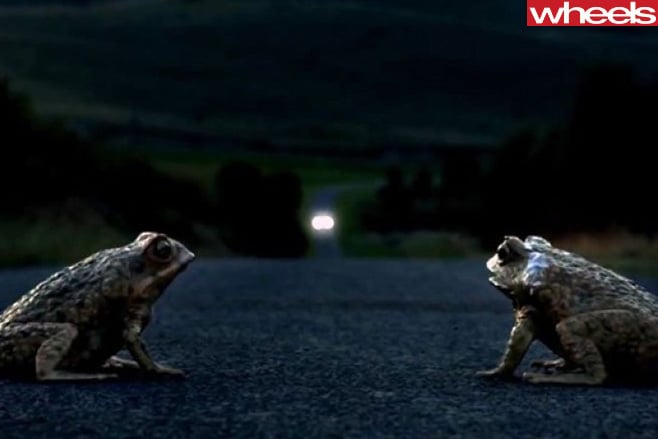
“Up in heaven even God is lost for words. Even he did not think that an electric car could have such a range.”
When Ford Australia’s cane toad video was launched in 2012, then marketing director David Katic hit out at suggestions the controversial ad was made solely to win advertising awards.
At the time, it was Ford Australia’s most successful viral video it had produced, reaching around 75,000 views in its first week alone.
That’s no way to treat an Audi R8 GT3 car, really. It might be the end of the FIA GT World Cup season, sure. It might be Macau, the most fearsome street track in the entire world. But really…
Young Belgian endurance specialist Laurens Vanthoor is not unknown to Aussie fans, having finished second at the Bathurst 12 Hour in 2015 with Phoenix Racing. He’s also a pretty handy round-the-clock specialist, winning races at Spa, Nurburgring and Dubai. So maybe it’s the shorter distance that caught him out?
The GT World Cup race had been punctuated by yellow flags to clean up various crashes, and Vanthoor held the lead from New Zealand ace – and Le Mans winner – Earl Bamber with just 15 minutes to go in the time-certain race as the field approached the fearsomely fast Mandarin Bend.
Bamber’s Porsche 911 got a good run on Vanthoor’s R8 before the entry of the almost top-speed right hand kink, which is very similar to turn eight at the Adelaide street track. Vanthoor did the right thing and sat in behind Bamber as they approached the corner at close to 250km/h – but then it all went a bit sideways. And upside down.
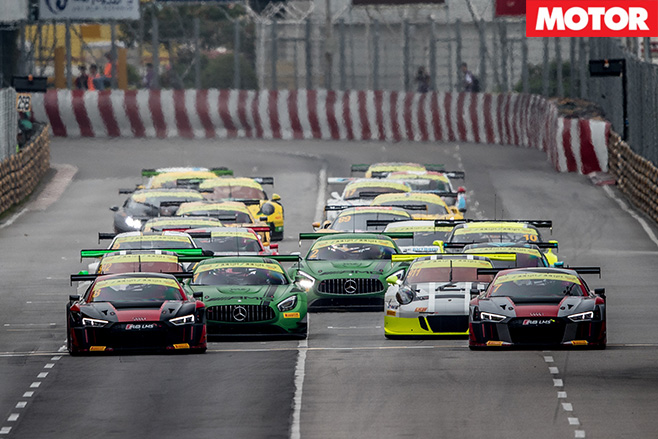
“It was actually a very scary thing,” he told a TV reporter. “I’ve had some crashes in my career but this is the first time I have flipped over.”
Thankfully, there were no more impacts with walls or following cars, with the R8 sliding at incredible speed down the track. Vanthoor emerged from the sorry wreck without a scratch, and the event was instantly red-flagged.
“The impact was hard but was acceptable. The scary part was to see the car going up, and you land on your roof – and you are facing everything upside down and seeing all the cars coming down the straight at high speed. That was a bit scary.”
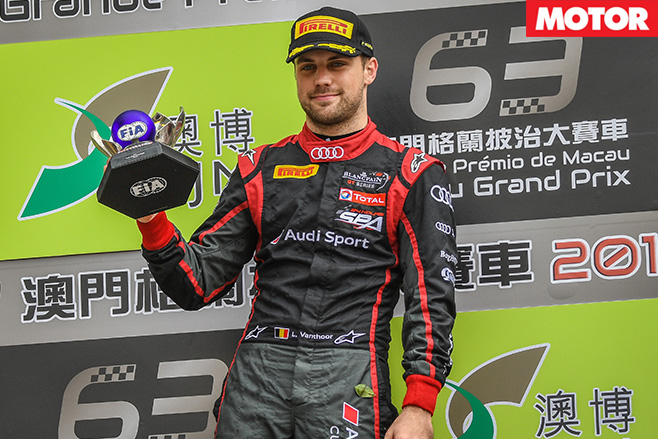
And Vanthoor has no qualms about racing at Macau again, despite the tight circuit claiming more cars than an episode of the Grand Tour.
“I am still standing here so it is fine,” he said. “We have safe cars at Audi, the track is safe – otherwise I wouldn’t be standing here after a 250 km/h crash. It is obviously a bit more exciting than other tracks. but that is why a lot of drivers like to come here and find it very challenging.”
It’s a hell of a way to end the season, at any rate.
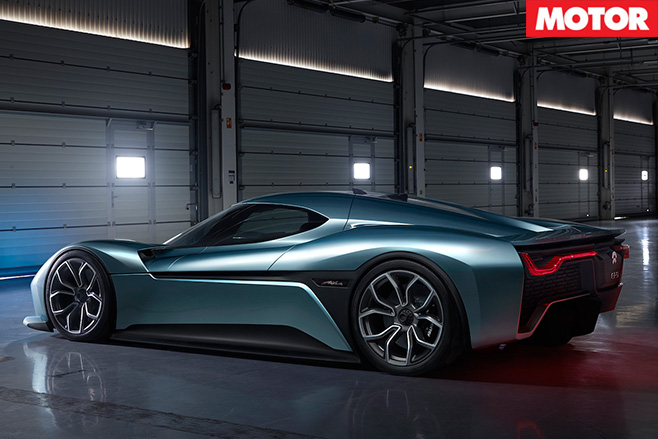
China has produced the world’s fastest electric vehicle – the 1000kW and 1480Nm Nio EP9 that most shockingly has also just set a new Nurburgring lap record for an EV.
The EP9 is far removed from the Great Wall budget cars we get in Australia, featuring four electric motors, four transmissions, four-way adjustable suspension with torque vectoring all-wheel drive and a carbon monocoque chassis with carbon composite body panels some of the highlights.
Nio claim 0-100km/h in 2.7 seconds for the 1734kg electric supercar, 7.1 seconds to 198km/h, a 10.1sec quarter mile run (at 249km/h) and 300km/h in 15.9sec before a 313km/h top speed.
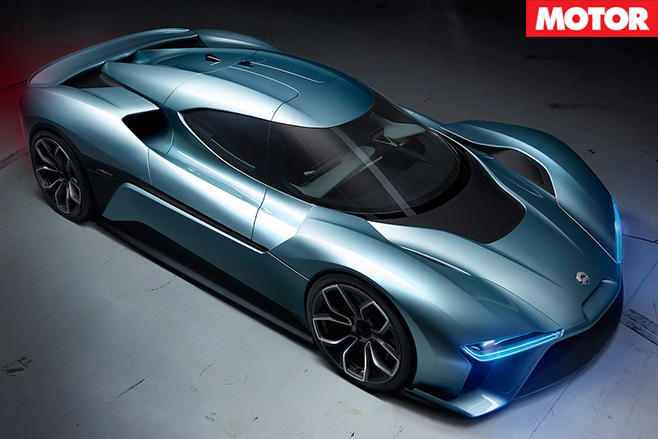
Emerging from a country that produced 24.5 million vehicles last year – exactly twice the number of silver-medallist US – the Nio EP9 used its monster 295mm 21-inch tyres to maximum effect in also claiming the title of fastest EV around the 20.8km Nurburgring, lapping the Green Hell in 7min 5.12sec. It has since posted the lap on its YouTube channel.
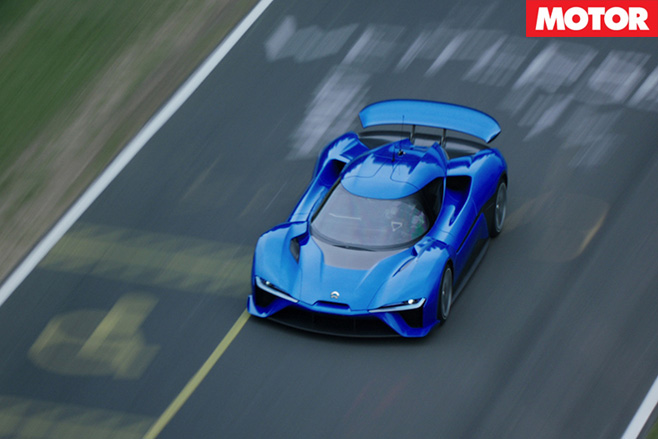
If a sceptical eyebrow is to be raised over such claims, consider the claimed 45-minute battery recharge time and claimed 427km range between refills – driving gently, maybe distantly, but certainly not while up it.
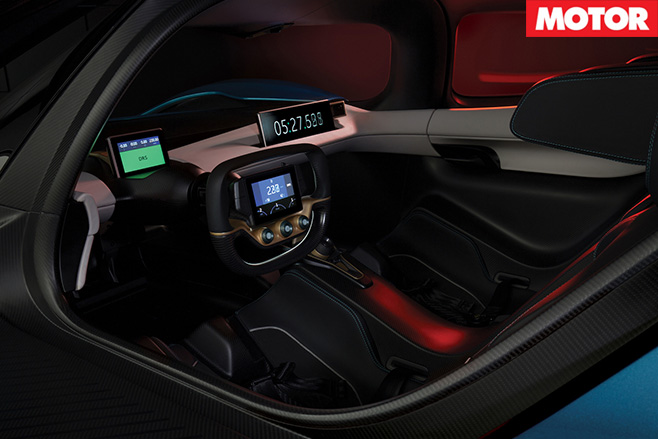
“It is a statement of our vision and technical and manufacturing capabilities. It is a best-in-class product that showcases what is possible with electric vehicles.
Sibling rivalry is fierce at BMW at the moment.
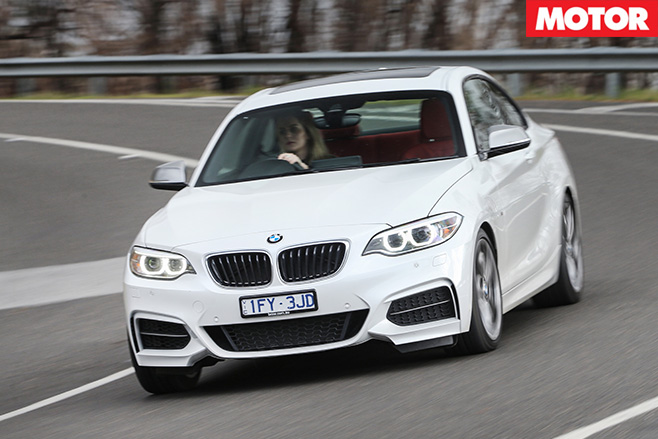
While the BMW M2 has been flexing its beefy bodywork and stretching its 465Nm turbo six, its overshadowed M235i little brother has been determinedly lifting weights out of the limelight to now finally emerge as the renewed M240i… with a 500Nm turbo six.
Both models use a 3.0-litre inline six powered by a single twin-scroll turbo, but where the M2 scores a variation of the M235i’s N55 engine, the M240i gets a new modular unit – the design can run as a 1.5-litre three, 2.0-litre four or even 4.0-litre V8 – dubbed B58. The new engine has a tougher, closed-deck block pinched from diesel cousins, with fewer cooling jackets.

The upshot of all that work is 250kW at 5500rpm, a mild 10kW lift over the M235i, but that impressive maximum torque figure, produced from 1520-4500rpm, represents a substantial 50Nm increase over its predecessor and a potential problem for its big brother.
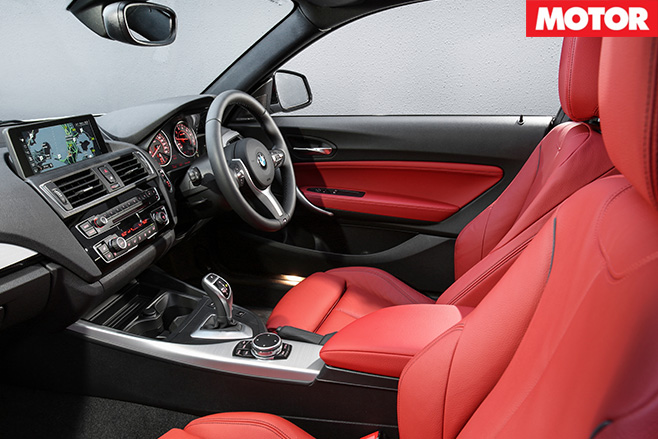
While the M2 can match the M240i’s twist, the full 500Nm are only available on overboost between 1450-4750rpm. Worse still, the M240i matches the baby M-ster for equipment while asking for substantially less money. A price cut of $2600 versus the outgoing M235i has the M240i starting at $74,900 as an eight-speed automatic, with a six-speed manual a no-cost option.

On paper it looks like a no-brainer: the M240i has similar outputs and equipment levels and with its sharp new 0-100km/h claim of 4.6sec, gives away just three-tenths to its more powerful sibling. So, $24K for three tenths, right? Well, not so fast.
The new B58 doesn’t feel hugely different to the N55. It still sings a creamy mid-range tune, but feels slightly keener at the top end. Both transmissions are terrific partners, delivering a more cohesive and characterful driving experience than most four-cylinder rivals.
Nobody wants to see a little brother bullied, but on a twisty road it sorta gets knocked out. There isn’t nearly the same bulldog-biting aggression on turn-in, nor the ability to choose between explosively rapid corner exits or precise, poke-in-face oversteer. Instead the M240i requires some delicate balancing on corner entry followed by calm and considered throttle on exit.
This BMW is most rewarding below nine-tenths, which is probably fair considering the adaptive suspension provides the sort of rounded ride that is less likely to drive your partner mad. Particularly in Sport, it is firm but controlled.
But there’s another BMW sibling that should be considered here. The M140i hatch is $10K cheaper than the M240i, and 500Nm for $65K suddenly places greater distance to the M2 and leaves cash to splash on an LSD. It seems this is one family feud that’s set to continue.
4.0 OUT OF 5 STARS
LIKE: Great value; sweet drivetrain; enjoyable dynamics DISLIKE: Needs an LSD; M140i makes more sense
SPECS Engine: 2998cc 6cyl, dohc, 24v, turbo Power: 250kW @ 5500rpm Torque: 500Nm @ 1520-4500rpm Weight: 1485kg 0-100km/h: 4.6sec (auto) Price: $74,900
