
Porsche’s next incarnation of the 911 GT2 supercar will sprout a pair of flappy paddles behind its steering wheel, with video of a GT2 prototype undergoing testing at the Nurburgring Nordschliefe revealing the presence of a quick-shifting PDK automatic transmission.
Having an auto between the rear wheels (or more correctly in the PDK’s case, an automated dual-clutch manual between the rear wheels) will be a first for the GT2, which has been a manual-only offering since 1993 when the first fat-fendered GT2 burst onto the scene with the 993 generation 911.
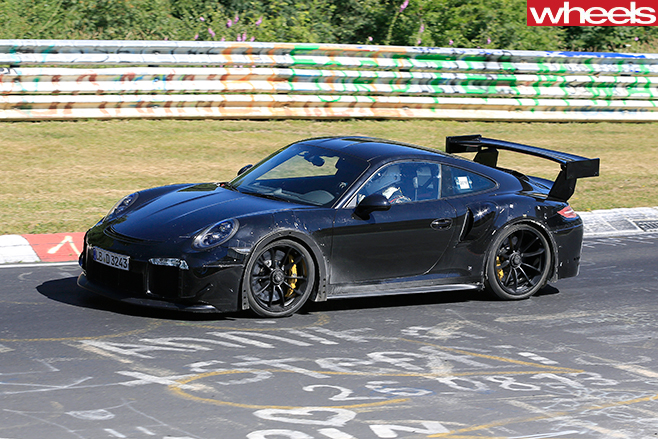
It’s a strategy that Porsche employed for the 911 Turbo and 911 GT3 RS, though Porsche appears to be willing to offer the GT3 with a traditional three-pedal manual in the next generation, as it did in the 911 R. The high-powered Turbo, however, will likely remain PDK-only – and judging by the audio of this video, the next GT2 will also transition to a two pedal configuration.
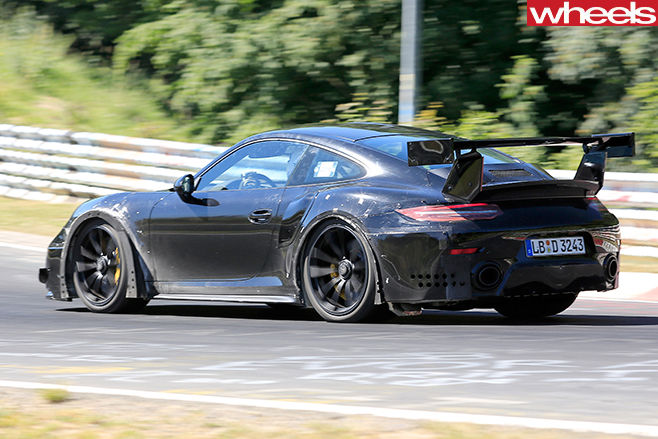
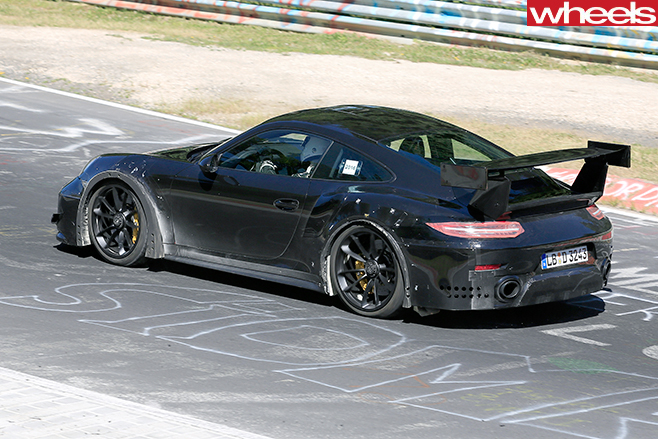
Mega-sticky Pilot Sport Cup 2 rubber keeps this prototype glued to the track, and the aero package appears to be a mixture of 911 Turbo S and 911 GT3 RS parts. The GT2 prototype’s rear wing is the same as the GT3 RS’s Boeing-sized element, while the front bumper is also GT3-based. The GT3 RS’ distinctive front fender vents are present, but taped up on this car to render them inactive.
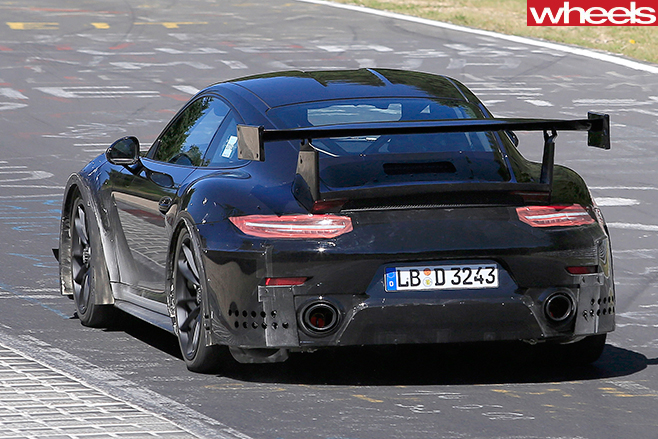
Will the next 911 GT2 retain the rear-drive configuration that’s been a GT2 hallmark thus far? We don’t know for sure, but if this video is anything to go by it will be very, very fast indeed.
TELL ME ABOUT THIS CAR
The Hyundai i30 SR Premium adds some sporty spark to the popular hatch. The 2.0-litre engine coupled with 17 inch alloy wheels and locally-tuned suspension provides perky performance for an admittedly expensive price range ($31,250 for the manual and $33,550 for the auto).
STRENGTHS
- The suspension, fine-tuned in Australia, is impressive. The SR Premium cruises over speed bumps and road lumps without much fuss.
- The SR Premium is a smart city car, accelerating smoothly and weaving in and out of traffic with ease.
- Its compact dimensions make it a breeze to park during school drop-off mayhem, and reversing is a synch with its colour rear view camera displayed in the 7-inch touchscreen at the centre of the dashboard.
- Other functions controlled via the 7-inch touchscreen such as the satellite navigation system and Bluetooth/iPod/USB connectivity, even the quaint CD player, are intuitive and easy to use.
- The front bucket seats are sporty yet supportive. The side bolstering keeps butts planted when cornering. The electrically adjusted driver’s pew means you can get your position spot on. It’s a welcome luxury having heated front seats.
- The boot has modest capacity for hatchback of 378 litres capacity which extends to 1,316 litres when the rear seats are folded.
- The panoramic roof really adds to the interior ambience. It comes standard with the SR Premium but can be added to the SR for $2000.
- Hyundai’s five-year unlimited kilometre warranty is generous.
- The SR Premium will be replaced with the 2017 edition sometime next year. Negotiate hard for a bargain on this year’s model.
- The SR Premium feels floaty on the freeway.
- The black and red leather interior is a classy touch. Until it’s revealed “leather finishes” may contain traces of polyurethane leather/ leather substitute/ pleather. A little disappointing.
- The i30 SR Premium is like the Tardis – small on the outside but surprisingly roomy on the inside. Calling it a “five seater” is a stretch though. The middle rear seat is not adult friendly.
- The gear lever feels cheap. Why make the effort to have a chunky, easy-to-grip, leather encased, adjustable steering wheel yet let the interior down with a plasticky shift?
- Adjusting the instrument backlight proved tricky.
There is a reason the i30 was the number one selling car in the country for four consecutive months earlier this year. It’s a terrific little car. A main contender to the SR is the Mazda 3 SP25 which has a bigger 2.5-litre engine and a cheaper price tag. Also worth a look are the Holden Cruze SRi-V, Ford Focus and Kia Cerato Si.
1. Hyundai’s i30 was Australia’s bestselling car for March, April, May and June this year
2. The 2016 Series II model will be replaced by an all-new version in late 2017.
3. The car is quintessentially Korean, but the suspension is locally-tuned and is impressively supple over road lumps and speed bumps.
4. The Premium SR boasts a black and red leather interior, although some finishes contain polyurethane leather i.e. pleather. Still, it looks sporty with the red contrast stitching throughout.
5. The two front bucket seats are a highlight: sporty and supportive. Side bolstering helps around corners. Electrically adjusted driver’s pew allows perfect positioning and heated front seats are a luxurious bonus.
6. Hyundai claims combined fuel consumption 7.7L/100kms for the Hyundai i30 SR Premium Auto. During our week-long test it consumed 13.8L/100km over 300kms of city and freeway driving.
7. The 7-inch touch screen satnav and Bluetooth/iPod/USB connectivity are intuitive and easy to use.
8. The i30 is zippy and a breeze to park with its clear colour rear-view camera.
9. The boot has a so-so capacity of 378 litres and extends to 1316 litres when the rear seats are folded.
10. The panoramic sunroof deserves attention. Standard on SR Premium and optional on the SR – a worthwhile investment at $2000.
11. It’s a keyless drive. This takes some getting accustomed to if you’re used to driving with a key. For old school drivers, there is a key shank hidden in the remote as a backup.
12. The car comes with generous five year unlimited km warranty.
Click here to read to the full review on the Hyundai i30 range.
Mercedes-Benz has released details for its updated CLA-Class Coupe and Shooting Brake models, which include performance boosts across the range, and a more powerful turbo diesel variant.
The revised line-up introduces the new CLA 220d to replace the CLA 200d. The 220d retains the same 2.1-litre four-cylinder turbo diesel engine but pushes out an additional 30 kW of power and 50Nm of Torque (130KW / 350Nm).
The power lift brings a modest fuel consumption increase for the diesel model, now listing a combined fuel figure of 4.2L/100km for the CLA220d Coupe, up from 4.0L/100km.
Also up are the manufacturer’s list prices for the diesel variants, by $2000 – to $53,900 – for the Coupe and $2500 – to $55,400 – for the Shooting Brake, excluding dealer delivery and on-road costs.
The four-cylinder 2.0-litre turbocharged petrol engine in the CLA 250 Sport variants has also received a slight power boost, up 5kW to 160kW and 350Nm. The CLA 250 Coupe and Shooting Brake now cost $67,600 and $68,600 respectively – both up $2200.
Merc’s ebullient AMG CLA 45 variants receive the more powerful tune of their 2.0-litre turbocharged petrol engine, as seen in the A45 hatch, which now delivers 280kW and maximum torque of 475Nm up from 265kW/450Nm. This power increase, combined with an improved aerodynamics package, shaves 0.4secs off the 0-100km/h sprint to 4.2secs for the Coupe and 4.3secs for the Shooting Brake.
Prices for both AMG versions have risen by $2715, which takes them to $92,215 MRLP. However you can get that price back down to $88,798 by ordering 18-inch AMG wheels instead of the standard 19-inch rims. This gets published fuel consumption under 7.0L/100kms, which means a lower Luxury Car Tax payment.

Performance of the entry-level CLA 200 variants, powered by a 1.6-litre turbocharged petrol engine, remains the same, with prices increasing by $1100 and $1600 to $52,500 for the Coupe and $54,000 for the Shooting Brake.
These price increases are justified by a higher level of standard equipment when compared to the old models. New gear for the CLA 200, CLA 220d and CLA 250 Sport includes 18-inch wheels, DAB+ digital radio, LED headlamps, Google Android apps and the Keyless Go comfort package which includes hands-free opening of the Shooting Brake’s powered tailgate.
The CLA 250 retains the 18-inch AMG wheels; AMG Ride Control sports suspension, a panoramic glass sunroof, and sports seats in black Red Cut Leather, electric and heated front seats as well as Adaptive Highbeam Assist.
As before, the AMG CLA 45 variants come with Distance Pilot Distronic which includes active cruise control and lane keeping assist, AMG Driver’s Package, AMG performance exhaust, AMG high-performance braking system, AMG Performance Seats, COMAND Online Navigation and a Harmon Kardon surround sound system as standard.
Safety equipment across the range includes nine airbags, active brake assist, blind spot assist, pre-safe collision protection system, Parking Pilot, Attention Assist and an active bonnet which lifts slightly when it detects a collision with a pedestrian to help reduce their risk of injury.
The new Mercedes-Benz CLA Coupé and CLA Shooting Brake models are now available in dealerships.
New Mercedes-Benz CLA retail pricing
CLA 200 Coupe $52,500
CLA 200 S’Brake $54,000
CLA 220d Coupe $53,900
CLA 220d S’Brake $55,400
CLA 250 Sport 4MATIC Coupe $67,600
CLA 250 Sport 4MATIC S’Brake $68,600
AMG CLA 45 4MATIC Coupe $92,215
AMG CLA 45 4MATIC S’Brake $92,215
All-electric concept destroys opposition in drag race.
IT IS no great secret the Tesla P90D is one helluva monster off the line. Despite tipping the scales at a whopping 2.2-tonnes, the all-electric beast in Ludicrous mode can haul itself to 100km/h from a standstill in just 3.0-seconds.
It is not until you get into hypercar territory that you find a car capable of shaming the mighty Tesla in a race off the line. The Ferrari LaFerrari is one such car, accelerating to 60mph (97km/h) in an eye-watering 2.4-seconds.
However, both the Tesla and hybrid Ferrari have been utterly hosed by a little-known car from Croatia.
Known as the Rimac Concept One, the all-electric supercar allegedly packs a staggering 800kW of power, and an almost unbelievable 1600Nm of torque. This results in a decimating performance which leaves both challengers in the dust.
You can’t blame poor driving for the defeats either, with professional GT driver Archi Hamilton at the wheel of the Tesla and LaFerrari in both stoushes.
The Concept One’s awesome performance is thanks to four electric motors which send power to all wheels instantly.
Not content with powering each wheel individually, each motor has an independent gearbox. Both front wheels have single-ratio reduction ‘boxes, while the rear wheels have their own two-speed dual-carbon-clutch gearboxes. According to Rimac this results in brutal acceleration at any speed.
As ultra-cool as these electric launches are, traditionally they result in overheated and drained batteries.
The Croatian built Rimac avoids this with seven independent cooling systems, in addition to a number of ‘sub-systems’. CEO, Mate Rimac, says the car was designed to maximise performance on the track, not just a couple of showy acceleration runs.
Hypercar destroying launches aren’t the Concept One’s only party trick. The car’s air-ride suspension and four-wheel drive make it decent at climbing steep hills covered in wood chips, it turns out.
A video from last weekend’s Pebble Beach event shows the Rimac climbing an impressive slope in order to grab the best real estate possible. Let’s see your LaFerrari do that!
A NEW transport affordability study has found Australian families are spending more than $22,000 per year on transport, including the cost of running two cars, with Sydney being the most expensive capital city to get around.
Australia’s first Transport Affordability Index commissioned by the Australian Automobile Association (AAA) analyses tax, fuel, tollways, public transport, insurance, and finance costs as a proportion of average household income across states and territories.
AAA Chief Executive Michael Bradley said the index found that a significant amount of average household budget in capital cities is being taken up by transport costs, with people living in Western Sydney hit hardest.
“The Index initially shows around 13 percent of an average household budget in most capital cities is spent on transport, which is remarkable when you consider that electricity, water, and telecommunications costs account for only one to three percent of income combined,” Mr Bradley said.
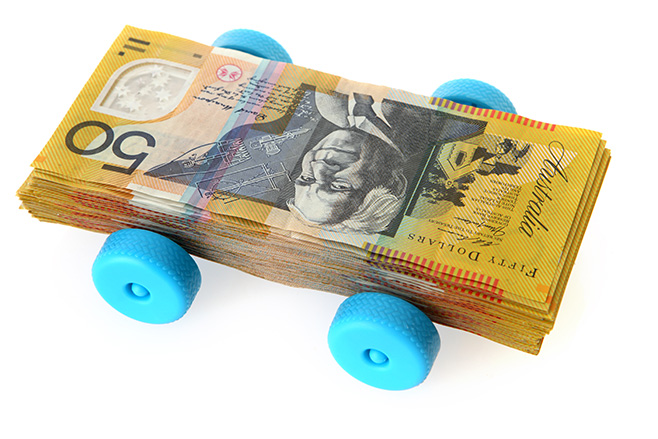
“The average household will spend $14,000 a year on transport in Hobart, but up to $22,000 a year if they live in Western Sydney.”
The Index is based on the incomes and transport costs of households in hypothetical middle and outer ring suburbs in each capital city. Each household consists of a couple with children and two cars and assumes that one member of the family drove to work, while the other caught public transport during the second quarter of this year. Prices were compared to the first quarter.
The Index found that Sydney households continue to face the highest transport costs of any city in Australia both in dollar terms and as a percentage of household income, by a wide margin.
A typical two-car Sydney household faced weekly transport costs of $419 per week in the second quarter of 2016 ahead of Brisbane and Melbourne (at $376 and $348 per week respectively). There were followed by Perth ($301), Canberra ($300), Darwin ($286), Adelaide ($286) and Hobart ($271).
Transport costs as percentage of household income in Sydney was 16.8 percent, 3.5 per cent above the national average. Brisbane was next highest with 15.9 per cent followed by, Hobart (14.2%), Melbourne (14.1%), Adelaide (13.2%), (Darwin 12%) and Perth (10.1%).
Brisbane’s household transport costs were higher than Melbourne’s on the back of higher public transport and fuel costs. Brisbane’s weekly public transport spend was $65.43 in the second quarter, $25 more than the national average.
TELL ME ABOUT THIS CAR
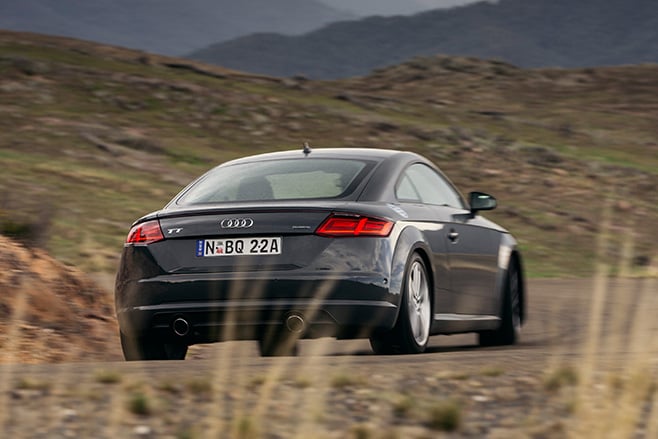
The one we’re testing here is the TT quattro S-tronic Sport, a mid-range model that couples the lower-output 169kW/370Nm 2.0 litre turbo four (a 210kW/380Nm version of that engine is available in the more expensive Audi TT S) with a quick-shifting dual-clutch automatic and Audi’s quattro AWD drivetrain.
Retailing for $79,355 the TT quattro Sport is at the more expensive end of the scale, but it promises plenty of style and a level of on-road performance that’s not to be sneezed at.
STRENGTHS
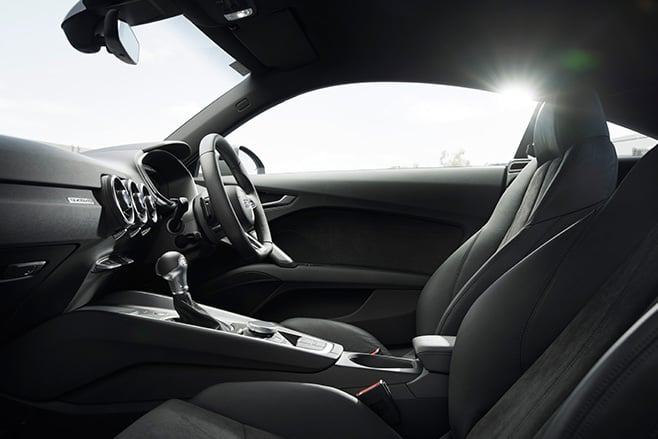
- Interior quality and design is first-rate. A full-colour LCD display replaces the traditional instrument cluster and looks like it was pinched from a spaceship, boasting plenty of cool factor and placing all of the information a driver might need right in front of them – whether it be their speed, phonebook, radio/media info or sat-nav display.
- The TT’s 169kW two-litre turbo four-cylinder petrol gives it plenty of pep, and thanks to extensive use of aluminium in its construction there’s not a lot of mass to move. Result: the TT will zip to 100km/h from standstill in just 5.3 seconds – a full second quicker than the auto-equipped (and significantly more powerful) Subaru WRX.
- Pretty good outside vision for a sports car, especially considering the TT’s high shoulder line. Well-sized mirrors help keep blind spots small, and front and rear parking sensors as well as a reversing camera help fill in the blanks. Blind spot monitoring is a cost option for those who prefer a little more security when changing lanes.
- The TT Sport quattro’s clever AWD system can channel up to 50 percent of available torque to the rear wheels, giving it outstanding traction in slippery conditions. It handles pretty well too – while previous generations of TT felt nose-heavy and a bit dull at the limit, the current model feels agile and light on its feet.
WEAKNESSES
- The TT is technically a four-seater, but good luck convincing any adult to sit in its cramped, claustrophobic second row. The backrest is bolt upright and legroom is virtually non-existent unless the front seat passenger moves their seat well forward. Even kids will moan about being relegated back there.
- While you can get a six-speed manual in the front-wheel drive TT Sport, keen drivers may lament the unavailability of a manual transmission in the AWD quattro version. It’s a small niggle – especially considering the dual-clutch s tronic gearbox performs better anyhow – but some might miss the sense of connection and involvement that comes with a three-pedal manual trans.
- Pushing $80k for a 169kW coupe isn’t what we’d call a bargain, especially when the TT’s main coupe rival, the BMW M240i, retails for a more affordable $74,900 – and has a stonking 250kW motor and slightly roomier cabin to boot.
- There’s not a whole lot for your passenger to do. The TT’s driver-focused design and multi-function instrument means there’s no central infotainment display, though your passenger can interact with entertainment, phone and navigation functions via the MMI dial on the centre console – provided they can see the screen through the steering wheel, that is.
- While it’s grippy in corners, the TT’s steering doesn’t provide much in the way of feel or feedback. It’s well-weighted, but it doesn’t communicate much about the road surface and how much grip remains at the front wheels. Again, that’s really only something that might bother enthusiastic drivers.
- Even on the basic 18-inch wheel and tyre package and the Sport’s less aggressive suspension tune, the TT has a firm ride. It’s great for attacking winding roads, but not so agreeable if the area you live in is blighted by speedhumps.
Yep. The BMW M240i is a compelling alternative at $74,900, and being a four-seater sports coupe from a German manufacturer it’s the Audi TT Sport quattro’s closest competitor.
Its interior isn’t as impressive as the Audi, but as a sports coupe it’s the more exciting car to drive thanks to its 250kW turbo inline six and engaging rear-wheel drive chassis.
TELL ME ABOUT THIS CAR
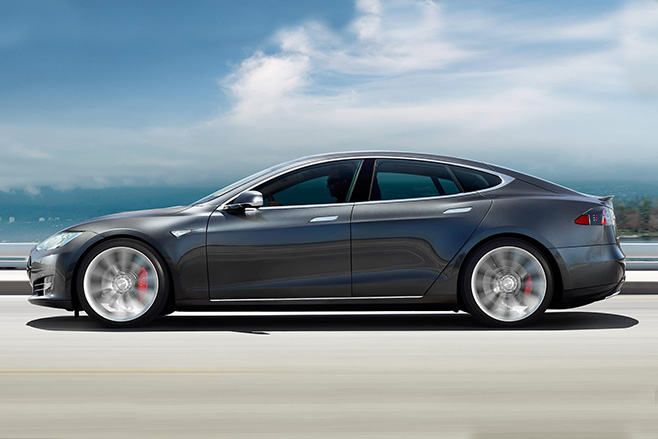
Electric car maker Tesla continues to capture the public’s imagination despite an extremely limited product line-up. The Tesla Model X SUV arrives locally towards the end of the year, so for now it is still just the Model S sedan – available in a range of variants. Here, we test the most potent version, the $202,875 P90D.
STRENGTHS
- Jaw-dropping – and almost neck-bending – standing-start acceleration from P90D’s “Ludicrous Speed” mode, which lives up to its name. Tesla quotes a supercar-rivalling 0-100km/h time of 3.0 seconds using the mode (though it’s a $15,000 option).
- Seamless, hushed and instantaneous all-wheel-drive performance thanks to dual electric motors – one for the front wheels and an even higher-powered one at the rear wheels.
- The Model S offers the longest range of any all-electric vehicle currently available, with 509km quoted for the P90D.
- Tesla says the Model S will cost between $8 and $15 to fully charge via a regular household power supply, which makes it theoretically cheaper to run than rivals running on petrol or diesel.
- Vertical 17-inch touchscreen simplifies infotainment, nav and vehicle settings into one vast display.
- Progressive updates/upgrades for the car are possible via sim-card-based in-car wifi.
- The conventional rear boot is not only large and features an extra hidden storage compartment under the floor, there’s an additional, albeit much smaller, ‘boot’ up front where a combustion engine would normally reside. Tesla quotes a maximum cargo capacity of 894 litres with the rear seats folded.
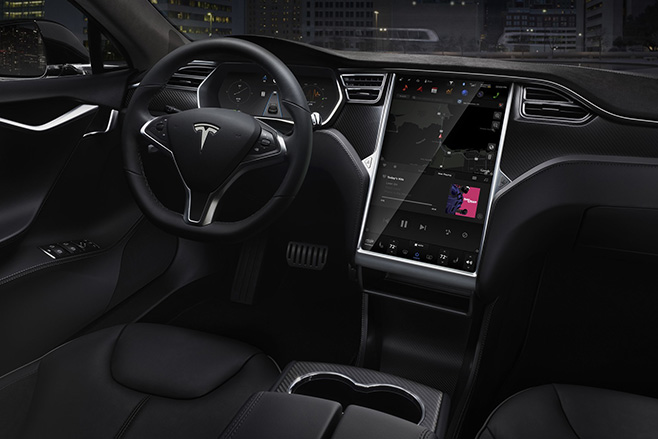
WEAKNESSES
- Faster charging options for the home (and the car) can cost up to several thousand dollars, offsetting any savings made on fuel.
- Still plenty of expensive options even on the flagship P90D.
- Tesla’s Supercharger network – designed to allow long-distance travel – is still in an embryonic phase in Australia. Sydney to Melbourne (and vice versa) is reasonably well covered but the network is otherwise limited.
- The ride quality of the P90D’s air suspension isn’t as smooth as the vehicle’s steering or acceleration, feeling consistently lumpy on typical Australian urban roads.
- Autopilot system not always perfect at keeping the vehicle centred in lane – car can wonder close to extremes of lane markings before steering automatically corrects.
- Battery pack positioning creates high cabin floor that compromises front seat slightly (higher than ideal) and rear seat badly (average adult forced to travel with knees splayed).
- The Model S is composed on winding roads, though not as involving to drive as a BMW 5 Series or Jaguar XF.
There are no direct rivals powered by electric motors alone for the Model S. Otherwise, aside from other similarly sized executive cars such as the BMW 5 Series and Mercedes-Benz E-Class, while the more expensive Maserati Quattroporte and Porsche Panamera could also be classed as competitors.
Apt it is that the Cadillac Escala Concept was designed by an Australian because this V8 liftback previews the design of next-generation Caddys that will likely lob on our shores.
Following a false dawn in 2008 – just as the GFC hit – General Motors’ American luxury brand is likely to return here by around 2020 just as the fruits of former VT Commodore designer and now head of Cadillac design, Australian-born Andrew Smith, are realised.
Smith led the design of the Escala, a rakish four-door large liftback that extends further than a Holden Caprice at 5347mm long and which was just unveiled at the Monterey Car Week.
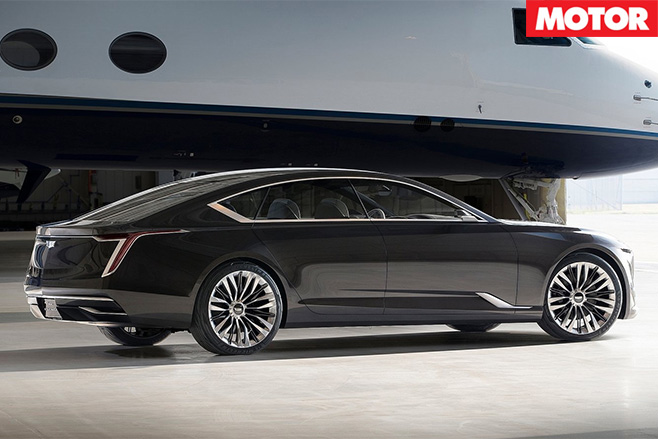
The Escala is no pipe-dream concept, featuring a 4.2-litre twin-turbocharged V8 engine that Cadillac says is, “A prototype of a new system in development for future Cadillac model.”
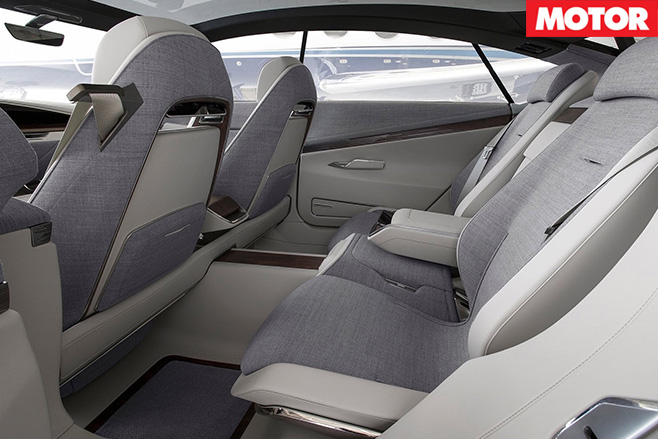
“Depending on the development of market segment for large luxury sedans, Escala is a potential addition to our existing product plan.”
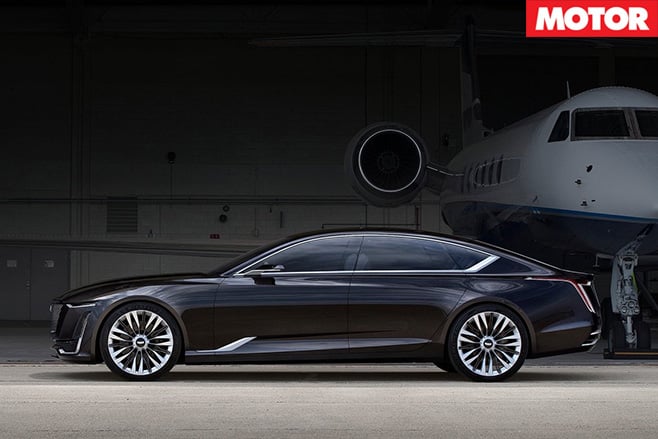
“Escala is an expressive symbol of reward and an exhilarating driving experience. On the interior, we pushed further … to break the rules a little bit, exactly what Cadillac should do from time to time.”
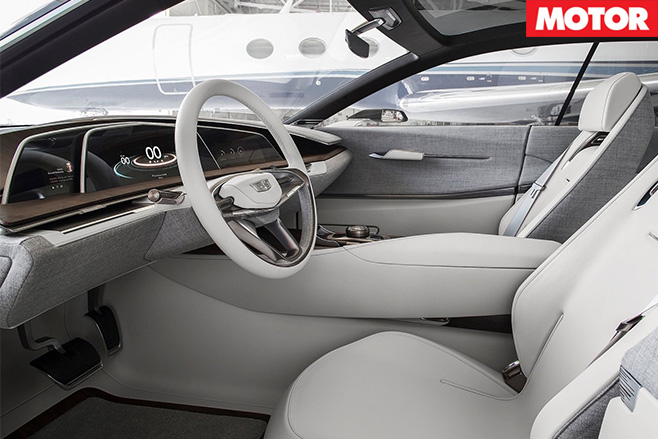
Cadillac’s current passenger car lineup includes the 3 Series-rivalling ATS, 5 Series-sized CTS and 7 Series-challenging CT6, all available with twin-turbocharged or supercharged V6 or V8 engines driving the rear wheels.
FORD has given a glimpse of our motoring life in Australia once local vehicle manufacturing finishes by the end of 2017. And it’s not pretty. Or, at least, not as rosy as it has been.
Take the Ford Territory SUV, a car that arrived in 2004 with one goal – to be suited to Australians. At the time Ford made a massive deal of the Territory being designed and engineered solely for Australians, with an interior that was “endlessly adaptable to cater to the Australian lifestyle”.
In short, it was the SUV Australians didn’t know they needed but quickly decided they loved. The Territory immediately became the top-selling SUV in the country, outperforming the likes of the Toyota RAV4 and Prado along the way.
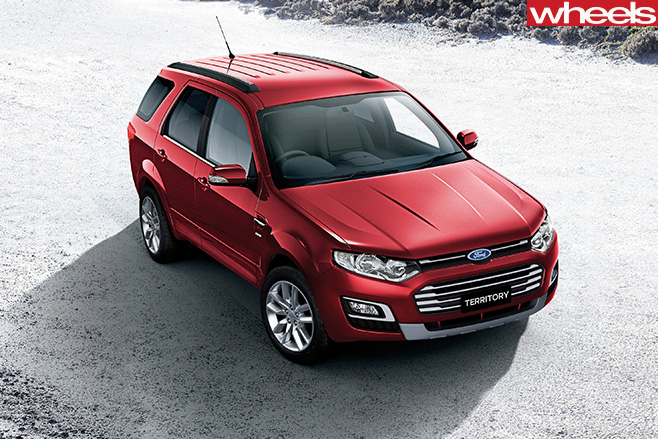
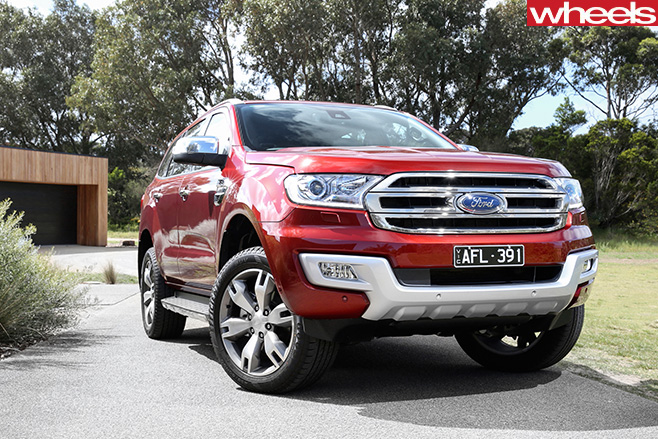
As for the replacement, well, there won’t really be one. Those wanting a seven-seat SUV with a Ford badge will have to go for the Everest, a fine SUV but one with enormous on-road compromises to ensure it can go a long way off-road. Those wanting a car-like SUV from Ford can have the Edge, in turn getting two fewer seats than the Territory and a tow capacity at least half a tonne lower.
That’s because the Ford Edge and Everest were designed for global markets, which leads to compromises in an effort to keep everyone happy.
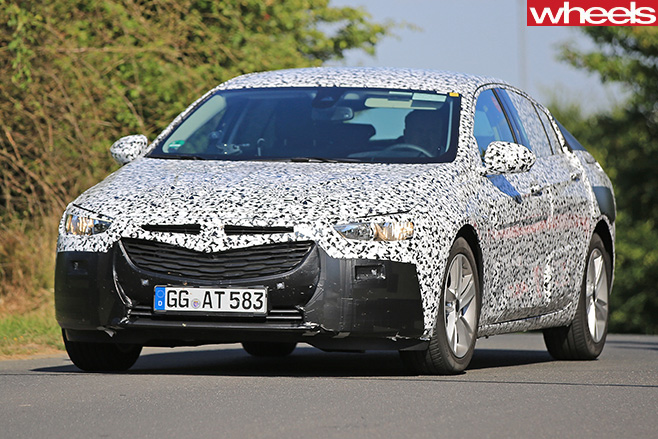
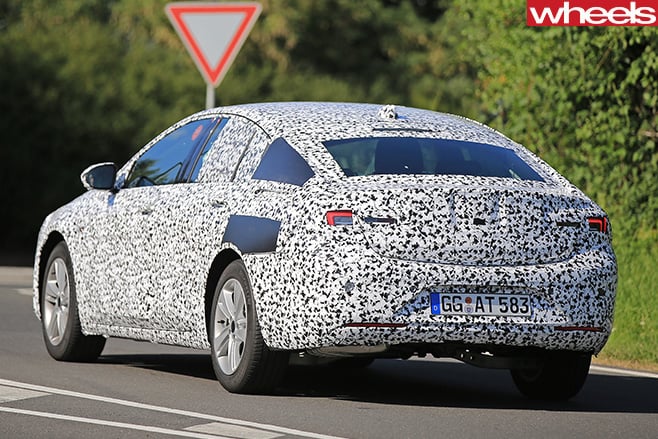
The imported Commodore will be a global car, based on the Opel Insignia. It first has to be good for Europe, its prime market, then adapted to Australia.
Previously, the Commodore was built primarily for Australia, so Australian designers and engineers got to set the ground rules.
That imported Commodore won’t get a V8 engine, for example, something all Commodores to date have had. It also won’t get a sedan body style, instead reverting to a hatchback.
Many might point to pricing as the one area we’ll be better off once all cars are imported. After all, cars are cheaper overseas, right?
Well, no.
Sure, when our dollar was surging beyond US$1 the price of cars was more affordable in some countries. But now our currency is not as strong our $20,000 small cars suddenly look very appealing. Put that one down to competition, with the likes of Hyundai desperate to grow market share – and pricing cars accordingly.
Of course, the one advantage an open market has brought Australian car buyers is choice. We have some 60 brands to choose from offering hundreds of models. That alone ensures competition and competitive pricing.
But that choice also means in some cases we’ll have cars that may not be as well suited to Australia and Australian tastes.
