
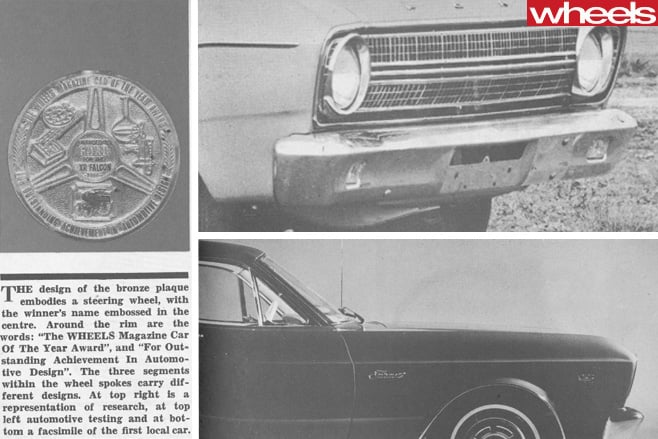
WHEELS magazine has, for the second year running, given its Car Of The Year award to the Ford Falcon.
First published in the January 1967 issue of Wheels magazine, Australia’s best car mag since 1953.
Where last year it was won by the XP series, mainly on the ground of seriously applied development engineering to improve a basically poor (in 1960) product, for 1961 we have given it to what we have described elsewhere as one of the most important new cars to be offered in Australia for years.
The selection this year was the hardest yet. We finally took the unusual step of getting together samples of the three cars remaining in the elimination, the Falcon, the Austin 1800 and the HR Holden and driving them, testing, evaluating and doing everything possible to clear our minds on the matter. We re-assessed the others in the light of this formidable newcomer. The judges decided to make for the first time a special commendation to the two other “finalists”, the Holden and the Austin 1800, for their very high standards.
In a following story we have traced the fascinating path of the car’s conception and development from almost three years ago. But unquestionably the most important thing about the new car is the tremendous influence it will have on the future pattern of Australian car manufacture. We have said repeatedly that the Australian’s taste in cars is drifting steadily towards the use of a V8 in a large car rather than the present “normal” size of compact six-cylinder units, but the XR Falcon is the first evidence of this. It represents a very bold bid by Ford to cater for what it regards as a strong and growing need. It will, in the long run, cost a lot of money, for V8 engine production lines are not cheap to build.
Ford also went out on a limb with an increased range of options. Options represent nothing but headaches to the car maker and heartburn for the dealer, for they are basically against the most important rule in making cars – that the best way to make a consistent profit is to make as few changes to your normal production pattern as you can. Chrysler adheres to this principle with the Valiant and does well. But Ford banked on the projection that Australians are well and truly ready for the advantages to be had in options, and packed everything it could into this new car.
However, these are small things. The most impressive factor in the new car – it’s not quality, for the first production models were decidedly rough — is the engineering. Ford’s advertising, often bombastic, claims the car was built around the V8 engine. We have been right through all their engineering departments both before and after the car’s release, and they are right in every claim they make about the car’s construction.
It would have been very easy simply to pick up the 1966 US Falcon around the end of 1964, make a few alterations to the body, toughen it here and there for Australian conditions, and market it. But, offered this cheap opportunity, they went the long way home. While the styling and mechanicals are basically designed the same as those on the American car, with detail differences, the rest of the car is the result of months of sheer hard work.
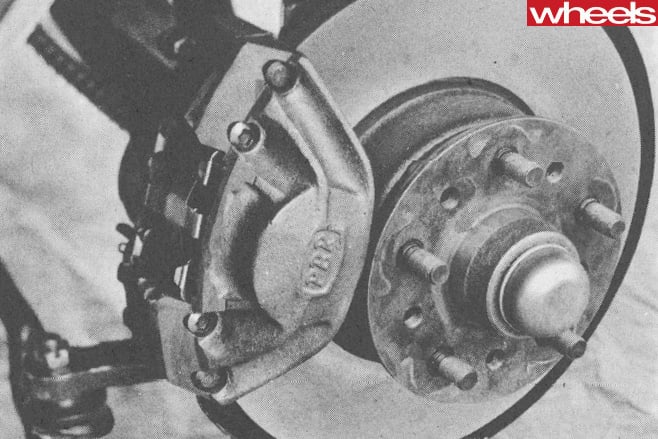
In design terms, the Falcon breaks a lot of new ground in the compact field in both suspension, body sub-frames and chassis. Yet with this Ford has given the car an exceptionally quiet ride. It has also demonstrated again, as it did with the XP, its near genius for matching spring and damper rates and balancing out braking effort. On these counts alone the car is outstanding.
A lot of people tend to discount all or any of the three major Australian compacts because they lack the engineering sophistication and dramatic flair of the European car. But it’ is just as hard to perfect a car within the economic limits set by volume sales, the demands of the average Australian driver, and the conditions a car has to withstand as it is to build a sophisticated all-independent sporting sedan. There is no less credit due to these Australian engineers building a conventional compact car for Australia than to his British counterpart working on an interesting four-cylinder small medium car for good roads and small distances. It is a great pity, certainly, that none of the Big Three builds a car like the Renault 16, for example, but their task is to build the car people want — and build it to that formula with all the skill they have.
This is what Ford has done.
The Fourteenth of November
By staff writer Bob Luck
For three years, the XR Falcon was a giant game of chess.
November 14, 1963, was a fairly ordinary day. On that day a RAAF Sabre jet made an emergency landing at Richmond with an engine fire; Sir Robert Menzies had his rowdiest political meeting for years, at Brisbane’s Festival Hall, where he said he would not retire as long as he had his health and vigor; and a 15 ft white pointer shark was killed after it attacked the State Government shark meshing boat off the Queensland Gold Coast. On that day an explosion rocked the US Atomic Energy Commission’s nuclear weapons plant in Texas; it was announced that Australia would reach a population of 11 million two days hence; flags were flown from Britain’s public buildings in honor of the birthday of Prince Charles; and the Namoi Regional Library board announced it had banned James Jones’ “The Thin Red Line”. An ordinary day. A crack was found in the new Commonwealth bridge over the Molonglo River in Canberra; the NSW Premier called for a report on allegations of thuggery and prostitution at Sydney’s Kings Cross; the New York Yacht Club announced the date of trials to pick the 1964 America’s Cup contender; and a new Valiant series was announced.
. . and a folder of documents was stamped with the management seal of approval and changed hands across the board room table In the Ford Motor Company, Melbourne: the Ford Falcon XR was born.
ALMOST three years, millions of dollars and countless ideas later the folder of documents emerged from the production line of the Broadmeadows plant in three-dimensional form. This was September 28, 1966, the day of the Falcon XR. That folder of documents probably covered more distance between various Ford departments in the intervening three years than one of the prototypes that thundered night and day around the You Yangs Provmg ground. That folder probably had more modifications, additions and amendments than any of the experimental mock-up scale models in the styling department. Ultimately, that folder materialised as the most important single contribution to Australia’s motoring progress that the industry has known. It started the era of the low-priced V8 engined family sedan and gave the Australian buyer the most advanced six-seater so far available.
Don’t believe those glib newspaper phrases — the Falcon XR is not just a developed and improved XP. It is an entirely new car. How do we know? We went through Ford’s tightest security doors to find out, to bring you the whole dramatic story of the making of the XR. We were the first journalists ever to be admitted to these areas and were given access to the most urgent secrets in a leading company’s development program. We delved through the closely-guarded files of Ford’s top-security plans and we were ushered into rooms previously forbidden to outsiders, where the Fords of the 1970s are already being formulated. We saw documents, schedules, plans and programs that have never been shown to the press before. Pieced together, they make up the full development story of the Falcon XR – a story of the Australian automobile industry that has never been told before.
We have just said that the XR owes nothing to its predecessor, the Ford Falcon XP, our Car Of The Year last year. But why? A look at the development program provides the answers. The basic design for the XR was approved on November 14, 1963. . At that time the prototypes of the XP had not even taken to the road so it was impossible to improve on an unknown quantity. True, in the latter stages of the XR development some lessons were learned from the behaviour and performance of the XP prototypes and where possible these were incorporated in the new design. But they were only minimal; things like cigar lighter and dipswitch location and type of exhaust system.
The acceptance of the design – on November 14, 1963, for the XR Falcon, was actually just the end of a long chain of developments called “forward planning”. And it was also the beginning of the long chain of events that turned that paperwork into reality. November 14 was crisis day. From that point there could be no turning back.
Before pen is first put to paper on a new model the management meets to decide whether the estimated market situation at the time of the model’s planned release warrants an entirely new model, or just an improved and face-lifted version of the previous year’s car (which is still only in clay model stages at this time, remember).
The Market Research department estimates what the sales volume will be at that time and this is balanced against the findings of the costing departments. The competition department check out the possibility of campaigning the product when it is released. Management examines alternative plans, resulting profit and hands over to engineering to determine how the car will differ from the previous year’s model, that part interchangeability exists, and how many engine/ transmission, body styles and options will be released with the model.
These basic policy decisions were all being made anything up to four years before the model was released, but they still had to go through the approval stage. But before any of this could be approved the whole car had to be presented in package scale drawings for study. These drawings are accurate to plus or minus 0.05 in. and show the place of all the major components.
They detail every aspect of the car’s basic design – factors like ride height, front wheel turn angle and jounce of the wheels, locations of lamps, door opening sizes, interior headroom, angle of windscreen and so on. These are then translated into what are known as “program descriptions”, which nominate the interchangeability of parts, tooling and testing requirements, and overall timing for the project. Engineering presents its findings but all the information is also fed into computers.
Both findings are presented to the top management executive committee on the basis of investment costs weighed against market return. Put simply, this just determines whether the project will or will not make money.
The management committee approved the XR design on November 14, 1963. Immediately every department of the gigantic Ford operation went into action. Each stage is covered by a slightly grey-flannel American phrase or word to describe the process and each of these stages is very clearly defined.
The approved program begins its tour of the Ford Motor Company with a sortie to the Styling Office. This department takes the basic package drawing and proceeds to convert these to complete three dimensional styling drawings-called “renderings”. These renderings fit around the basic requirements of the size, weight and general dimensions of the overall project. They are Styling’s ideas of what the design should look like. At the same time Product Planning examines the designs, measures sheet metal area and other component sizes and begins costing the program. Product Engineering also examines the design very closely to make sure it is entirely workable – there must be proper door clearances, workable amounts of luggage space and so on.
Manufacturing also gets a look in at this stage. They determine whether the panels and components can be formed and placed properly for easy manufacture. Design sensibility is important – it can cost millions to rectify a bad assembly feature on the production line just because proper assembly clearances were not allowed.
On the wagon, Styling Department had raked the tailgate angle far more than the package development drawings allowed; but curved glass was decided on to retain the attractive shape. The clay was approved at this point while fitted with only a dummy grille. The panel work was the all-important factor in styling design at this stage because long-range tooling programs for the sheet metal body work had to be set in operation. Grille design was unimportant and could be decided on later. The clay of the sedan was approved on November 23, 1963 – which is fairly fast work. Less important was the wagon program development and the clay for this was not approved until April 20.
Engineering then compared both package drawing and styling clay models and updated the package drawings to comply with any minimal changes. This department then headed the most important step forward of all-the full design layouts and “design feasibility studies”.
At this point, although complete full-size clay models had been made, the Falcon XR was far from finalised. Engineering then took templates from the clay model and converted these to fine-line layouts, at the same time sectioning each major skin item into parts that could be manufactured and assembled. Each item was examined under the design feasibility studies which determined strength of construction, stress and weight analysis, and position to related parts. All this was either computed or worked out on known engineering principles. The feasibility committee then took each section and examined its potential for easy making, determined exactly how it would be manufactured and assembled (whether spot welded, rivetted or bolted) and what the cost would be. Adjustments were made to the fine-line drawings where necessary and these drawings were eventually made accurate to as fine as 0:30 in. Manufacturing liaises closely with these operations because it will soon have to schedule the spending of vast sums of money in tooling, fabrication of assembly equipment and feeding out components to be supplied by vendors (brake linings, headlights and so on). As each section is approved by all departments and the feasibility committee it is recorded on charts and re-drawn on further fine-line layouts accurate to 0.005 in. This allows for proper door clearances and meeting of metal joints. These final fine-line layouts cover every item of the car – from the body shell to the subframe, mechanical components, shock absorbers, window glass sizes and so on.
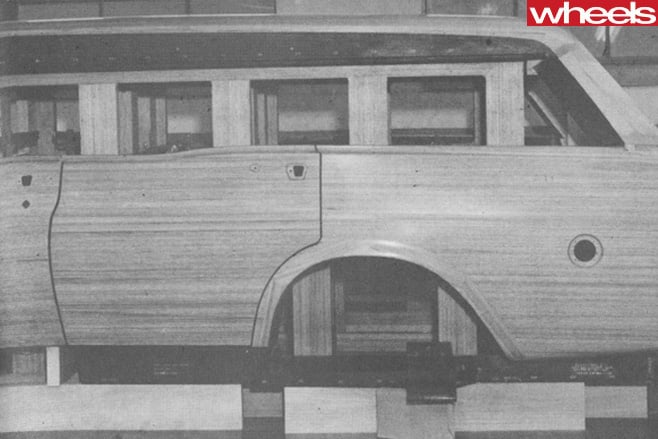
These final drawings are traced off to be built up into full-size mahogany templates known as a “cube” or “skin” model. The cube is assembled in sections and each is matched and harmonised perfectly. When the cube is approved by Engineering, Manufacturing, Product Planning and finally the Management Committee, it is broken up and each component sent away to its various sections (or out to component suppliers) for individual tooling.
By the time the sheet metal tooling has progressed to this stage the various mechanical components have been underdoing development. Mechanical prototypes are made up – usually individually – and are tested on machines which test their durability at this preliminary stage.
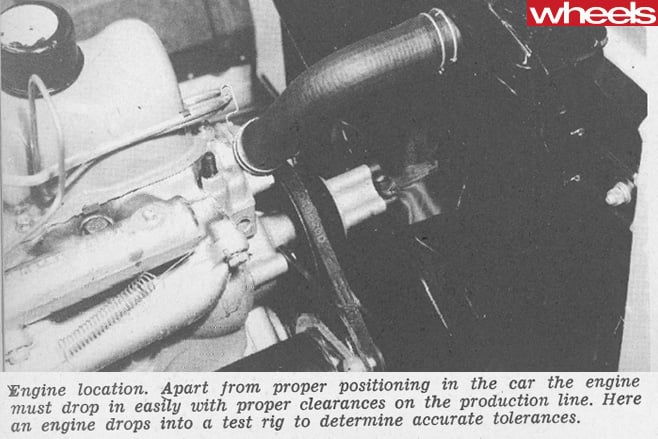
But before these final castings are drawn up the assembled sections of Royalite are examined by the various departments all over again. For example the engine compartment – fully assembled from plastic with the aid of paper clips, no less – is placed on a simulated production line and the engine lowered in to determine proper assembly line clearances. Any fully-assembled section of plastic is known as a “buck” – and this buck must be passed by all departments before its components are broken up and put on the contour cutting, or Keller machine. The XR had a problem with accelerator linkages and the whole linkage had to be re-routed just to allow the engine to drop in easily on the production line, although its mechanical operation was perfect.
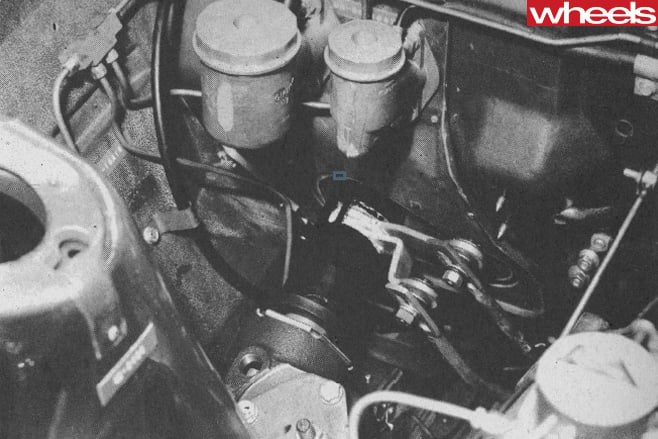
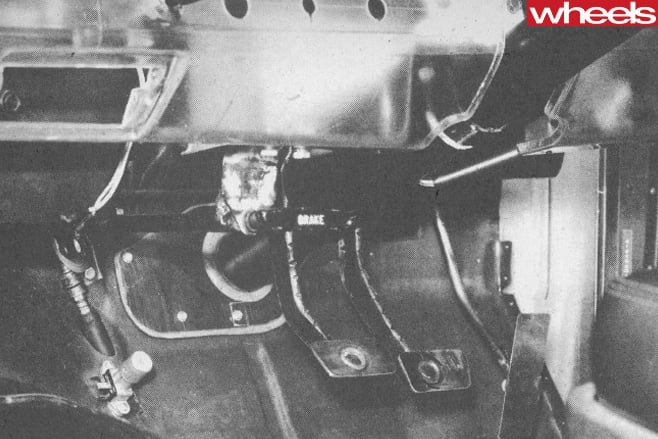
The interior of the XR also brought problems. The whole front floor section was assembled in plastic and the pedals, steering shafts and so on fitted when a special evaluation jury, remembering the XP dipswitch location, determined whether the relative placing of the dipswitch allowed easy use of foot pedals and plenty of foot space. From our viewpoint they made one bad slip in the location of the windscreen washer pedal suspended high up under the dash, but they were aiming for an uncluttered floor.
At this point the whole sheet metal subframe and minor components had been finalised and the various mechanical components had been through their preliminary testing. It was time to make a prototype – the first Falcon XR.
The initial prototypes were completely hand-built. Very early on, fully imported American Falcons converted to right-hand-drive were stripped and fitted with Australian mechanical components for advance testing. But the Australian prototypes rolled onto the proving grounds almost 10 months before release date. They were hand-assembled under simulated production line methods. Each car was programmed for development testing, in a special phase. Like all the world’s leading motor companies, Ford seeks to close up the actual testing time by simulating the life of the car with a much shorter, more rigorous test. There are two types of test: the 40,000 mile endurance test and the 10,000 mile rough roads test. Information from testing procedures of this length are more than adequate to show what the actual vehicle life will be.
Because the Falcon XR was designed around the V8 engine and then fitted with the smaller engines as well, all parts could be interchanged on the prototype vehicles. A typical test program for a vehicle would cover brakes, and suspension performance, a 40,000 mile general test, revert back to specific testing of transmission, vibration, suspension deflection, road shock, handling and so on.
While full prototype testing is well advanced every individual components is subjected to rigorous tests. Windscreen wipers are subjected to exhaustive tests – they must last for three million cycles (all except the blades which must last one million cycles).
Before the final component dimensions are decided the available assembly systems are also examined. Ford has plants in Melbourne and Brisbane with entirely different production lines. The basic design must be adaptable to easy assembly on both lines.
Each outside supplied component (like shock absorbers and electrical equipment) is tested on both rig and prototype cars. With the Falcon XR the most extensive shock absorber testing program in Ford history was initiated. Ford was looking for a special combination of ride and handling with long life and low vibration. Constant modification suggestions were made to the supplier on the grounds of test results.
With prototype testing nearing its end the final development stage was entered – the preparation of construction manuals and the engineering “sign-off point”. A complete manual was prepared for every phase of the assembly of the car, detailing exact methods. These are huge volumes because of the absolute detail they cover but they must give for the production line a simple set of straight-forward stages. There is a manual for body welding, electrical and wiring installations, suspension, engine and gearbox installations, a manual for sealing, trim installation, application of sound deadening material, and a manual covering all tolerallces. A final general specifications manual lists the option combinations in both mechanical and incidental functions from axle ratios to laminated screens.
After prototype testing had been computerised and calculated, and necessary modifications made, the engineers signed off and handed the product over to the time planning committee. Engineering thus accepts responsibility for the final product because there can be no major alterations after this stage. Management again reviews the whole project and a time schedule is worked out from tooling-up to actual press release date. This is based on ability of component suppliers to meet deadlines, availability of raw materials, output of the assembly line, transport and stock required at market release and finally the liquidation program of the previous model.
Even in this program there is room for flexibility, and the XR had three important but not major changes made after the engineers had signed off on the completed approval of the car. Just five months before release a decision was made to change from 13 in. to 14 in. wheels. This was to simplify assembly line procedures because original programming allowed for 14 in. wheels for the VS and 13 in. wheels for the other models. The alteration in no way affected the release date as the suppliers were able to meet the deadlines easily. Most important of all late decisions was the move to put the spare wheel into the fuel tank and under the floor. This went hand in hand with increasing the fuel tank size and the reason for the late decision hinged around later reports from market research and developments by opposition makes in boot space and long range fuel capacity.
At almost the same time the management board decided to widen the seats marginally (about a ins.) to give the interior a more prestigious look.
This is the most amazing part of the whole car’s development program-the extreme flexibility even six months before release date. The alterations are somewhat costly at this stage because of new tests that have to be made and old dies and templates that have to be discarded.
But flexibility is essential too, particularly in fashion which dictates the whole final appearance of the car. To nominate the color of the external paint work and the color schemes of the interior at the original design stages would be hopeless.
The final color schemes are probably chosen only five months before the actual release date of the car. They are basically currently acceptable color schemes with a slightly more modern touch. If deep maroon is becoming a popular color the maroon chosen may be highlighted with metallic tints. In the case of the XR the color choice aimed at sophistication and glamor.
You may well ask if any of this has anything to do with the (albeit littIe-known) postponement date of the public release from August to September. The answer is no. The September release date was determined back in May and was based on the liquidation program of the XP series. At this stage Ford had about 4500 vehicles to sell out before introducing the new model and the crash sales program was started. By balancing out available money, purchasing power of buyers and the poor state of the market, the management estimated late September should see the end of the XP series. As it turned out, the liquidation program was enormously successful and Ford was nearly embarrassed when virtually all units had been sold by the original planned August release date. By that stage it was too late to re-gear the vast public release program so September 28 stayed. Ford is very proud that there was no lay-off period between models as the XP production run finished the XR run was phased in. This saved the four to six weeks staff layoff period that is common in the British and American automotive industry between model changes.
Job No 1 – the first production Falcon – rolled off the lines six weeks before release date, and thereafter XR production began in earnest. By release date there was already a build-up of stock and production was scheduled at a steady rate for the next 12 months.
But with the end of the building story another had started: sales continuity and interim model improvement and development. At the same time as it is solving the problems of various service departments for the immediate present Product Engineering is planning the car of next year, and the year after and the year after that and…
***
ONE of the greatest human failings is to judge a book by its cover; the XR Falcon has been severely maligned because of its wrappings. Too many people who should know a lot better have said that it is simply an Australian modification of the 1966 American Falcon. It’s not. It is· an Australian car, although the sheet metal owes a lot to the original US styling. Mind, Ford is partly to blame in this, for it has extensively used the Mustang image in its promotional work. But you would expect the Press to be more perceptive. The special requirements Ford established for the Australian market are broken into three segments – marketing, environment and economic production.
Here are the main points of difference between the Australian and American car – first in terms of marketing requirement:
- Different sub-frame structure due to increased areas of rear seat passenger space.
- Larger capacity fuel tank, different spare wheel location.
- Higher, 4 in. wider front seat, better visibility. Different seat spring rates.
- Interior bonnet lock.
- Locking vent window handle combined with altered body character lines. Wagon has most differences.
- Different grille and ornamentation.
- Australian-conceived trim design and color schemes.
- Significantly different wagon styling with much bigger internal space and better seat folding system.
- Much stiffer suspension with altered ride characteristics.
- More responsive steering (ratio is 20:1, American 22:1).
- Different basic vehicle structure. Extra reinforcing comes from heavier gauge upper engine compartment members, floor side inner and outer members, rear side members, rear shock absorber mountings and reinforcements, rear floor side panels, rear cross members and fuel tank.
- Reinforced suspension housing and front suspension bumper brackets.
- Overlapping of joints of front torque boxes, front fenders, and engine front members to relieve high stress areas.
- Welded flanges, Increased gauges, and added reinforcements make up the engine compartment structure with the dash-cowl areas for better rigidity.
- Wagon structure is developed to Include tailgate opening pillars and increased overlap of pillars to roof rails and robust rear spring mountings.
- Large departure angle of wagon to allow for rough terrain.
- Skid plate added to all 289-engined cars for sump protection.
- Redesigned rear lamps.
Window winders, headlamp housings (required revisions to front fender sheet metal) toughened windscreen glass, windscreen wiper motor and washer pump (revisions to linkages and body mountings), bumper jack, seat belts (special structural adjustments) carburettor (environmental calibration), starter motor; shock absorbers, wheels and tyres, rear axles (mounting and clearance revisions), drum brakes, and wheel cylinders, disc brakes and callipers, master cylinder, lining materials (all requiring adaption of vehicle structure), automatic and manual transmissions (special mountings, shift linkages affecting body structure, exhaust system, brake lines and steering column), clutch and master cylinder different hydraulic operation and moulding), exhaust (special hangers and altered structure), local heater, demisting and air conditioning plants, instrument cluster and controls, gauges, radio, battery location, alternator and regulator.
The Ford Australian economic structure also called for far greater component interchangeability. These were some of the points that were common:
Common foot floor pan, rear torque boxes, rear shock absorber member and reinforcements, wheelhouse inner and outer, front doors, centre pillar, engine rear mounts, rear lamps, rear axles, exhaust system and drive shaft.
Check out Wheels Archive online now for other great Ford Falcon features and more from decades past!
Simply log in here using your existing MagShop account or create a FREE account and select this article from the homepage.
Don’t have a MagShop account?

Have a MagShop account?

Porsche expects to build around 230,000 cars in 2016 and happily claims to be the most profitable carmaker in the world. Hard to believe that just 25 years ago the company was in disarray.
Read former Wheels editor Peter Robinson’s tale about how this story came to be written.
At that time, Porsche was slashing design and engineering staff, and losing so much money people seriously talked about the possibility of bankruptcy or a takeover by either Volkswagen or even Mercedes-Benz. The nadir was 1993 when Porsche shifted a mere 14,000 cars. Commonality between the three-pronged sports car range – 911, 968 and 928 – was virtually non-existent.
The late 1980s plan to concentrate on a Porsche 911 replacement and introduce a sedan was killed, even though tooling for the 989 four-door had already begun. Instead, two years earlier Porsche began development of two new sports cars – the Boxster and a totally new 911.
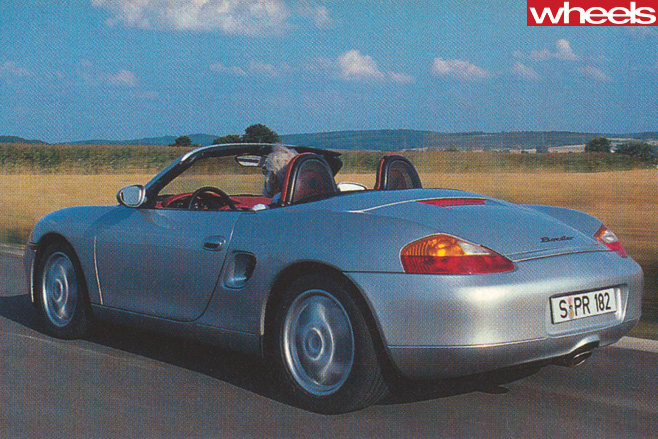
The whole world wanted to know how the Boxster – Porsche’s first genuinely new model since 1977 – drove. Somehow I managed to convince Porsche’s international press office that I should drive the new model for Wheels and the UK’s Autocar weekly a couple of weeks before the official launch at Castle Lerbach, just outside Cologne, Germany, in the first week of September 1996.
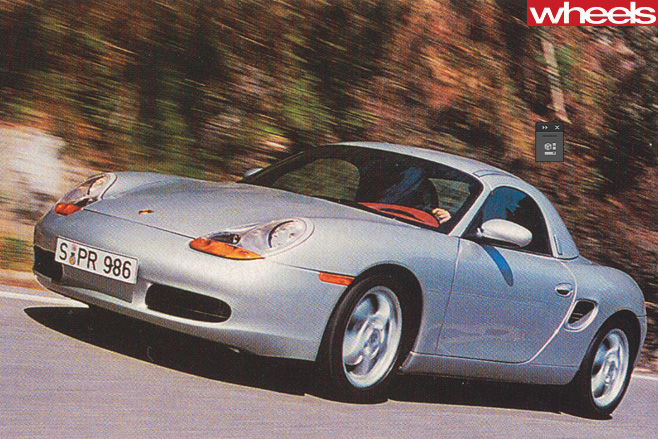
Why the minder? Eighteen months earlier I’d upset Porsche by not telling the PR department that I was bringing a Ferrari F355 to compare with the new 993 Turbo (the Ferrari won). Zuffenhausen wanted to make sure no such comparison was planned for the Boxster.
Instantly in love, the Boxster was everything I had hoped; easily the most satisfying of the recent crop of sports cars – Mercedes SLK, BMW Z3 and Alfa Romeo Spider and GTV.
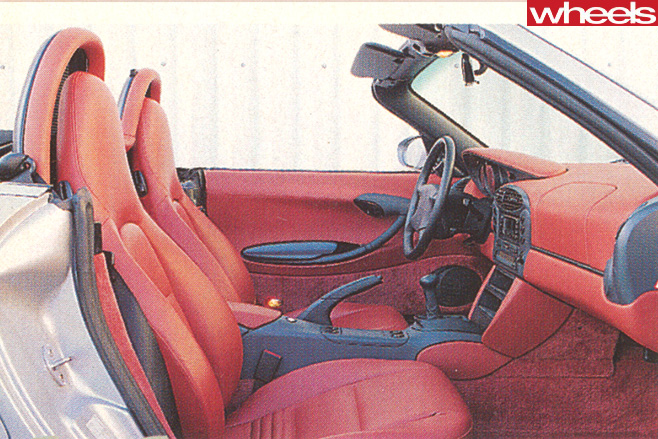
Porsche was overwhelmed by demand (many cars were built by Valmet in Finland to reduce waiting times) and between 1996 and 2003 (when the Cayenne arrived) the Boxster was the company’s best-selling model. In combination with a new manufacturing process, helped by Toyota’s streamlining skills, that cut the time it took to build a car from 120 to 72 hours, the Boxster was semi-affordable. Porsche’s comeback had begun.
The start of a love affair
I didn’t ask, Porsche offered.
In November 1997, taking advantage of Porsche’s factory delivery, I collected ‘my’ Boxster in Zuffenhausen. For 18 months and 37, 000km (at an average 10.5L/100km), the little roadster and I were inseparable.
It proved an ideal companion for my then pan-European life as a motoring journalist; impeccable chassis balance, flowing engine and gearbox, glorious induction sound, instant steering response, with the practicality of the two-boot layout. I ran out of new ways to say “what a marvellous car”.
The watercooled engine didn’t suffer any of the problems that later plagued the early 996s. Truth is, in the Boxster I always took the long-cut home.
It’s official: the Boxster’s as good as we all hoped it would be… perhaps even better, says Peter Robinson.
First published in the October 1996 issue of Wheels magazine, Australia’s most experienced and most trusted car magazine since 1953.
In the end, I gave up.
And God knows I tried, again and again, as the stripes of black rubber firmly embedded onto the road surface of that tight uphill hairpin near Weissach prove.
Yet, no matter what technique I used to attack the corner, nothing could shake loose the tail of Porsche’s incredible new Boxster.
Remember the cliché about cars cornering on rails? The Boxster does.
Photographers insist on power oversteer cornering shots because editors love to run them b-i-g.
Well, Mr Editor MacKenzie, I want you to know that despite my best efforts, neither braking desperately hard right at the apex, nor deliberately booting the car off line in second, could upset the Boxster.
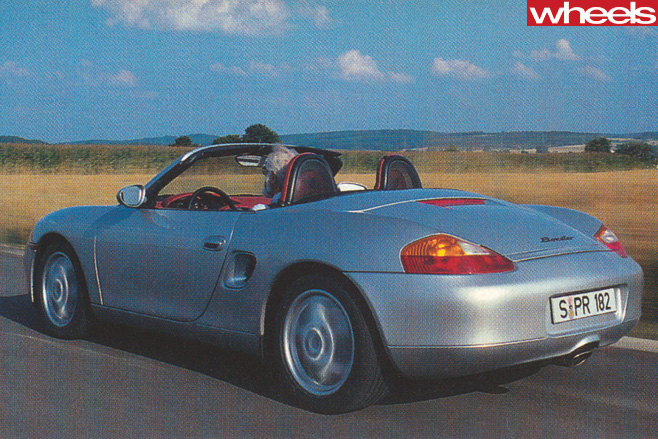
Every corner is an event, every drive, no matter how short, an affair to savour.
This awareness, the knowledge that Porsche’s engineers, free at last to start with a blank sheet of paper, have focused on giving the Boxster true excitement, to create a tactile link between car and driver, lifts it above all the obvious rivals. No Porsche before has so effortlessly, so precisely and intensely, engaged the driver without demanding either great skill or any nagging doubts about its predictability near the limit, or both.
The point is, we can all stop worrying. The Boxster is all Porsche, all sports car, and quite simply, bloody marvellous. At once, Porsche has given us the most dynamic and exciting of all the new generation two-seater roadsters.
Trust the rapid enthusiasts from Porsche’s legendary Weissach R&D centre to place the three high-profile German rivals in the correct perspective: the BMW Z3, soft, as affordable as it is immature; the SLK, so civilised it’s hedonistic, the twoseater you buy your mistress; the Boxster, pure, taut, sparkling with desirability, the roadster for Wheels readers. That shouldn’t come as a surprise, of course, for the Boxster is a bespoke sports car and not a roadster created from a donor sedan.
Yes, the Boxster is everything you would hope for in the first truly new Porsche road car in 19 years. Nothing about its midengined layout, MacPherson strut suspension and water-cooled boxer engine is truly revolutionary, but neither are they owed to the 911, nor indeed the 968 or 928. In fact, this is one of those rare new from- the-ground-up designs, making the 40-month design-freeze-to-public announcement development time all the more impressive.
Nor, as predicted by some, is the production Boxster a disappointing dilution of the beautiful Boxster concept car Porsche unveiled at the 1993 Detroit motor show. Enticing as that showpiece was, it lacked any luggage space, didn’t possess a roof, and wouldn’t pass then-current crash tests, let alone forthcoming side impact and head protection standards.
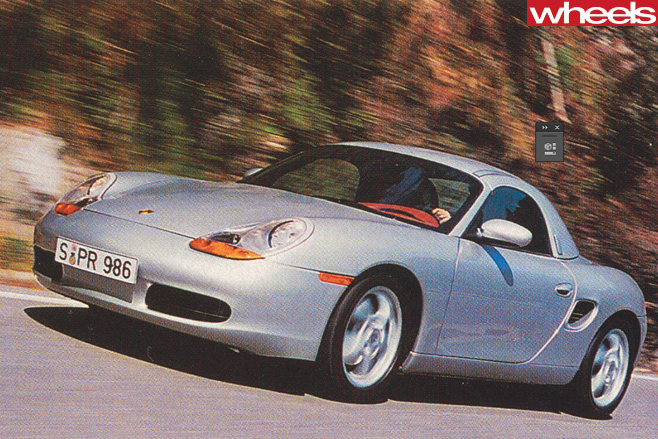
These dimensions make the Boxster slightly longer and wider than the current Carrera. Not surprisingly, next year’s 996 replacement for the 911 is going to be longer and wider again, to provide better than 2+2 seating.
Porsche had no intention of making the Boxster anything but a pure two seater. The cabin, incredibly roomy and superbly finished, with carpet running halfway up the doors, positions the driver’s seat, steering wheel and pedals in perfect alignment, something no previous Porsche has ever achieved.
However, pragmatic Porsches are one thing; where the Boxster really needs to deliver is on the road. And it does … brilliantly, as I’ve already tried to convey.
At first the messages were confusing: driving away from Weissach, the Boxster was subdued, relaxed, refined. It didn’t sound like a Porsche. Not yet. Only a long and clumsy clutch travel attempted to spoil the perception of civility, while the throttle lacked the instant, gutsy responses of the 968. This new engine, always tractable and silky smooth, needs/loves to spin out beyond 4000rpm to the 6600rpm redline, if it’s to deliver the performance promised by the sleek styling.
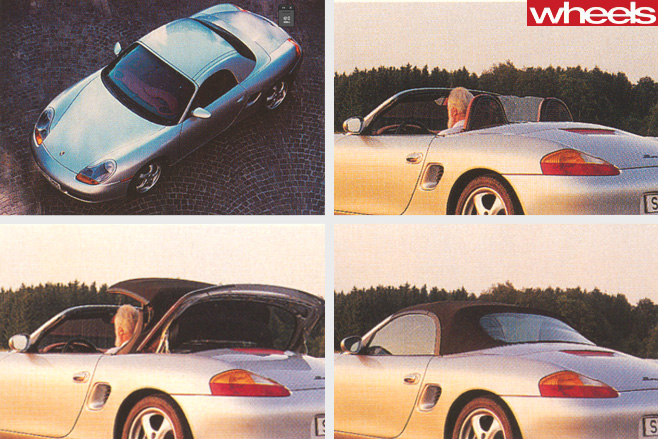
You’ll never get a chance to see this beauty, not unless you visit the local dealer and examine the Boxster from below, when it’s on a hoist, for there’s no removable engine cover at all. A small service bay in the rear trunk allows fuel levels to be checked and replenished.
In terms of performance, the Boxster easily accounts for the Z3 and SLK, yet its appeal goes way beyond the 6.9sec 0-100km/h acceleration (7 .4 for the now five-speed Tiptronic with steering wheel button controls) and a 240km/h top speed. There is an eagerness, a real enthusiasm about the Boxster neither rival can match. As the slightly retro-style tacho needle – directly in front of the driver, just like the 911 -spins above the gauge’s simple ‘4’, the engine comes alive. At 5200rpm, it delivers a passionate howl (not unlike the Honda NS-X), hurls the car forward, to aurally kick again with a even deeper wail at 6000rpm. It’s the sound of a fanatically eager engine, trumpeting its own justification for the $109,995 entry fee. Maybe it’s never quite as quick as it feels, but that’s no bad thing in these days of ever more intrusive speed limits.
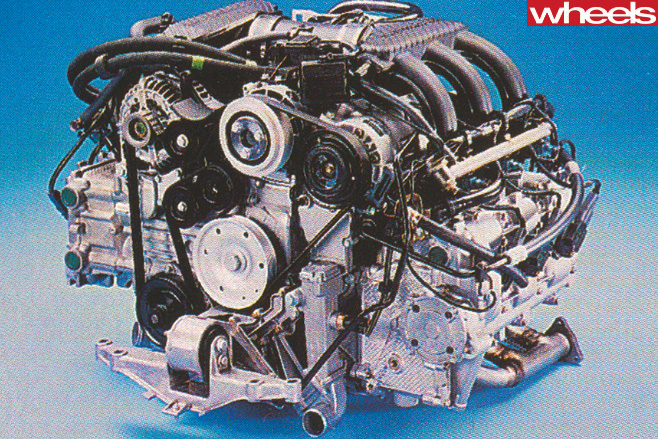
Low weight helps. At 1250kg, the Boxster’s around 75kg lighter than the less powerful SLK. Of course, that’s partly because it doesn’t have a folding steel roof, but also explained by the use of exotic materials: magnesium roll bars, aluminium engine, suspension and brakes (and for the optional, fully-lined 25kg hardtop), and lightweight steels for the body.
The weight is carefully balanced with 48 percent over the front wheels, despite the mid-engine location; a rather more naturally helpful distribution than the Carrera’s 37/63 balance. Packaging constraints lead to the use of MacPherson struts with lower control arms front and rear, rather than the 911’s double wishbones that were originally developed for the stillborn 989 four door. The suspension is designed to provide negative toe-in at the outer front wheel and positive toe-in at the outer rear wheel to improve stability and encourage understeer.
Rack and pinion, power-assisted steering gives 3.0 turns lock to lock, half a tum more than the 911. But its 1.2m tighter turning circle means the Boxster’s steering is actually quicker. Light by previous Porsche standards, especially at low speed, the steering provides the driver with constant feedback. It might not quite match the Lotus Elise’s direct mechanical link between wheel and road, but it’s surely as good as a superbly developed power steering system can be.
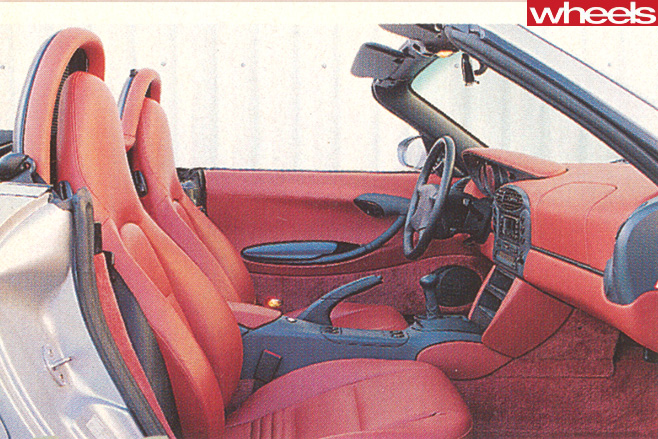
You can dive deep into a tight second gear comer, back off, hit the brakes and the Boxster doesn’t deviate offline. Yet, it is also infinitely adjustable to power applications and close to being truly neutral in its handling character; its responses to the wheel and the throttle happening instantly, as if linked by some unseen mechanical device.
Massive monoblock cast calipers, each with four pistons acting on vented discs, and with ABS 5 anti-lock, give a positive pedal feel and staggering stopping power. Porsche says the Boxster can stop from 100km/h in 2.7sec, or just 37.7m, and from 160km/h in 4.3sec. You could drive the Boxster and never know from its smoothly honed shape that it has any aerodynamic aids. Yet there’s a small lip, positioned between the rear lid and bumper that automatically rises 80nm1 when speeds climb above 120km/h, returning to its concealed position at 80km/h. Fortunately, it can be raised via a button on the front wheel arch, so it’s not an instant giveaway to a speeding fine.
Not only is the Boxster slippery – Porsche claims the 0.31 Cd sets a record for a roadster – but a near smooth underbody reduces lift on the front axle by 36 percent and directs air to the engine.
Sturdy windscreen pillars help the twin integral rollbars provide protection in the event of a roll-over, though 911 drivers will inm1ediately be aware they are much thicker than their car’s thin A-pillars. Harm Lagaay’s team has carefully sculptured the front wings to be clearly visible from the driver’s seat. They flow in towards the centre of the car and provide a subtle visual link with the 911. There’s another link: the ignition key is located on the dashboard, to the outside of the steering column. Even the shape of the side window harks back to the ’50s Speedster. Porsche understands its heritage without being dominated by it.
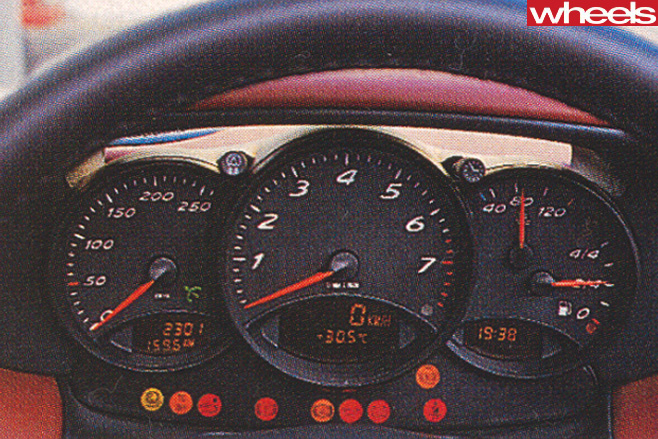
Flaws: ‘the rear luggage compartment isn’t sufficiently insulated from the engine heat and gets very hot; the central console looks more suited to the controls of a Japanese hi-fi system than a car (surely there’s an alternative to the shiny black finish of these rocker switches and the matching headlight control); compared to the obvious thoughtful design that has gone into the instruments, the dashboard is boringly flat and undistinguished in front of the passenger; the clumsy clutch action; and, to some, the slightly awkward looking side cooling vents (one for the engine compartment, the other for the induction system) that detract a little from the carefully crafted cleanliness of the flanks.
The Boxster, then, is a proper Porsche, a return to the company’s original philosophies, wrapped in an entirely contemporary package. No other roadster offers the same dazzling blend of performance, handling, ride and refinement. Yes, it is dynamically superior to the classic 911, if not quite as quick.
It might not have been this way. The engineers wondered about a front engined replacement for the 944/968, but eventually decided real Porsches use a boxer engine, located somewhere behind the driver. The Boxster is dazzling evidence they were right.
I can hardly wait for another drive, to see if I can keep both photographer and editor happy and learn how, on dry roads, to sling the Boxster sideways.
The body is largely untouched, but Holden has made big changes beneath the skin of its updated Holden Colorado – and all for the better.
WHAT IS IT? The big Holden ute, but one that’s imported rather than produced locally. The current generation Colorado has been off the pace since it arrived in 2012 against a raft of new utes, so this is Holden’s chance to redeem itself.
WHY WE’RE TESTING IT It’s only a facelift, but the latest update is big by facelift standards. Rather than rely on what arrived on the ship from Thailand (and engineered in Brazil), Holden engineers covered 100,000km on Australian roads to tune the suspension and drivetrain to our roads and tastes.
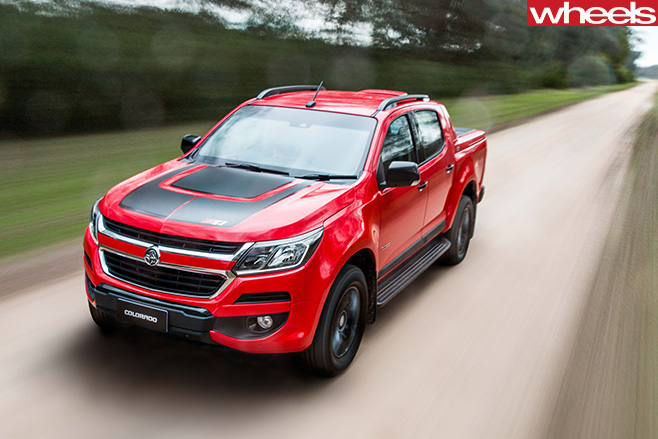
THE WHEELS VERDICT The updated Colorado is the car that should have arrived in 2012. Big improvements to refinement and driving dynamics ensure Holden’s dual-cab off-roader now has a fighting chance in an increasingly competitive segment.
PLUS: Strong diesel engine; transmission calibration; practical interior; well equipped; decent dynamics for a separate chassis MINUS: Driving position could do with improvements; still drives like a ute; some plastics look cheap; lane departure warning beeper
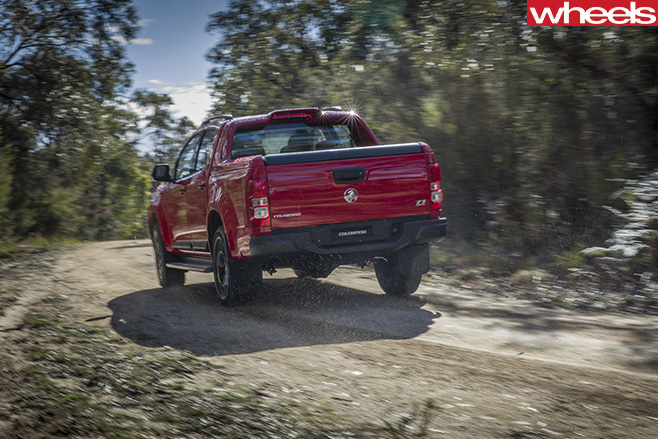
But Holden listened, and the updated RG Colorado is the result. The most obvious visual changes centre on the nose; new bumper, new bonnet and new American-infused grille. No changes to other panels, though, and the basic ladder chassis remains.
Slip behind the wheel, though, and the changes are more obvious.
The new electric power steering is sharper and more consistently weighted, although not darty. Revised Bridgestone Dueler hoops join in the improved dynamic party, accurately pointing the dual-cab with a whiff of the inherent floppiness tall sidewalls can give.
As well as a revised leaf spring setup in the rear that brings added compliance, Australian engineers have also redone the dampers. The tray will still bounce over successive bumps when unladen, but it’s nicely neutral and well controlled, adding confidence and comfort in equal measures.
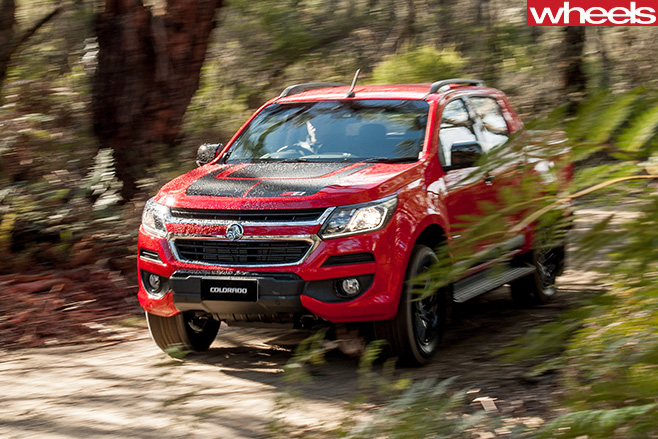
But the biggest change to the Colorado is with the drivetrain. The addition of a newfangled centrifugal pendulum absorber torque converter has brought newfound shift smarts and refinement. The biggest difference is the transmission’s ability to access low-rev torque more succinctly. Even at 1500rpm the torque converter will lock up, providing a direct link between the 500Nm under your right hoof and the twisting force at the wheels. As well as dishing up a more relaxed cruising experience, it exaggerates the hearty thrust on offer.
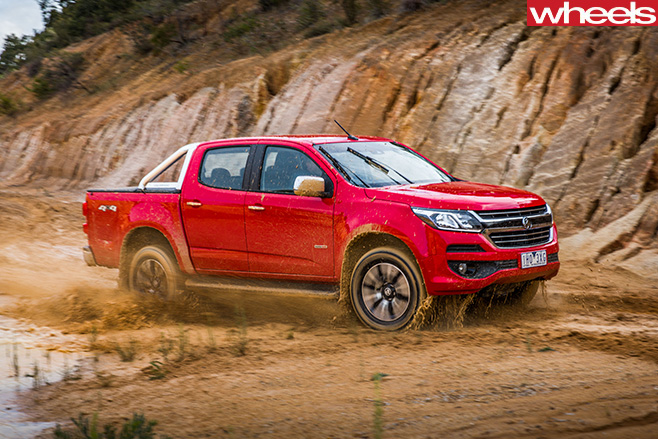
There’s no confusing it for a petrol engine; there’s a trademark gruffness to its demeanour, but it doesn’t scowl and yowl as before, with refinement a key target with this new car.
That attention to detail has been liberally applied to the interior, too. The dash is more conventional with its single glovebox and revised switchgear that’s far more sensible and user friendly than the previous plasticky layout. The faux stitching and silver flecks also add some life, although we’re not sold on the mirror chrome elements on everything from the door handles to the gear selector.
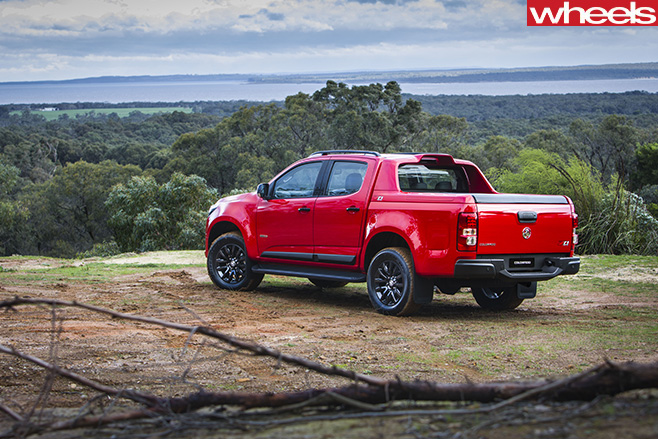
And while the flagship Z71 still misses out on dual-zone climate control and smart key entry, its leather seats and snazzy black exterior touches (as well as the body coloured sail plane) ensure the $54,990 price tag (plus $2200 for an auto) is on the money. There’s also a crash warning system (it doesn’t apply the brakes) and lane departure warning (its beeping is frustrating on a country road).
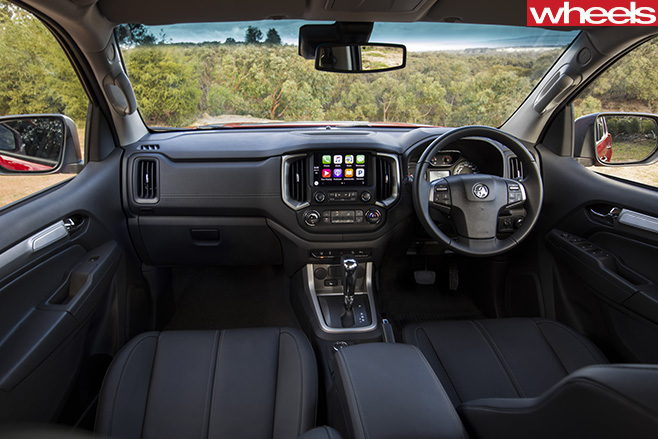
Not perfect, then, but nothing in the vastly-improved ute class is. At least now Holden has an offering that can fight with the big boys.
SPECS Model: Colorado Z71 Engine: 2776cc 4cyl turbo diesel Max power: 147kW @ 3600rpm Max torque: 500Nm @ 2000-2200rpm (440Nm for manual) Transmission: 6-speed auto Kerb weight: 2143kg 0-100km/h: NA Price: $57,190 (auto) On sale: Now
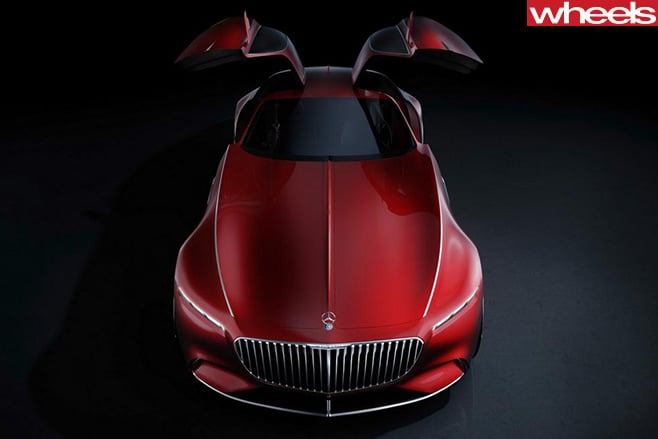
When Mercedes put out teaser pics of the sweeping roof line of the new Vision Mercees-Maybach 6 concept car we went along thinking there’s no way it’d look anything less than stunning. We were right.
Revealing images of Mercedes-Maybach’s shapely Vision 6 concept car have been leaked, bypassing the usual teaser image drip-feed and showing the car in all of its splendour ahead of its official debut at this weekend’s Pebble Beach Concours d’Elegance.
And it’s as magnificent and as outrageous as we had hoped.
The starship-like inside, pictured with most information displayed on a windscreen-spanning head-up display, only has two seats but the shell looks like it could accommodate four. And can you really call them seats? The bases of both seats are conjoined, seemingly formed by draping a single sheet of tufted leather across the centre tunnel.

Mercedes is keeping mum about that, not to mention whether there will be a production version; however it’s believed the concept will be used to promote Maybach’s return as a standalone brand and spearhead a product plan that expands beyond the current range of Mercedes-Benz S-Class based limousines.
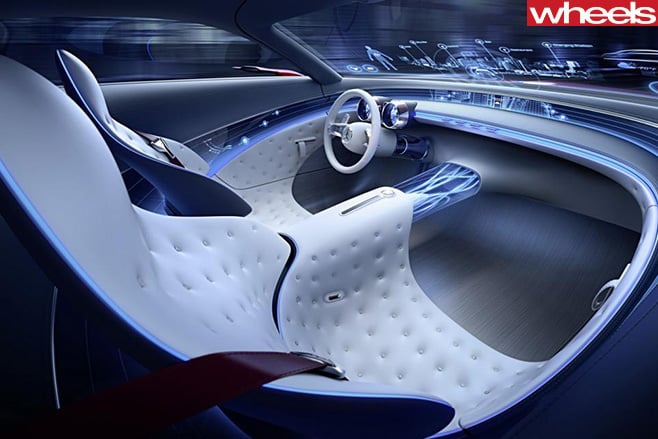
Hopefully that experience has prompted enough suits to ponder the business case for a production version of the Vision 6. No doubt they’ll be keeping close tabs on the public reaction at Pebble Beach this weekend, but if these images are any indication it’s guaranteed to be a showstopper.
It seems like we’ve been talking about Nissan’s R35 GT-R for a long time. A very, very long time, in fact.
Consider that the first concept car appeared way back at the 2001 Tokyo Show, and that its R36 replacement isn’t expected until 2020 (at best – it may well push out to 2022), and Nissan’s fire-breathing poster child will be well clear of the moody adolescent years and will be able to vote before it gets put out to pasture.
Look what’s happened in the performance world since the R35 first appeared in 2008: Porsche 997 versions one and two, then 991. Ferrari 458 and 488. McLaren’s MP4 12C wasn’t even a glint in Ron Dennis’s eye when the R35 lobbed Down Under in 2009, a year after its debut in Japan and the US.
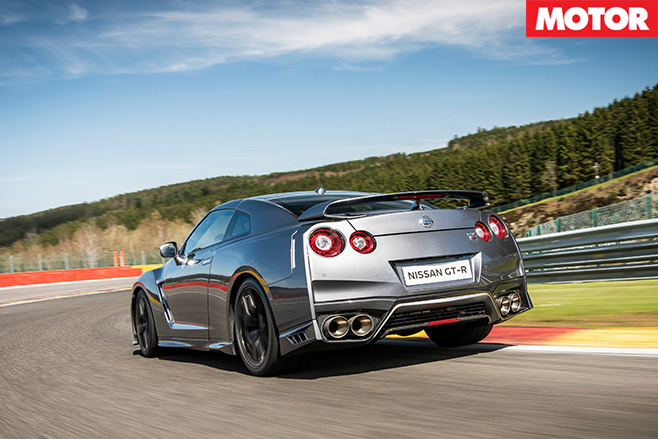
So here we are in 2016, and instead of checking out an all-new version of a car that utterly annihilated the affordable performance bar, Nissan is instead giving us what it calls the R35’s biggest and most transformative facelift yet.
It’s one of the trademarks of the R35’s life cycle, and the source of the occasional titter behind the hand when the annual press release dropped; “Oh look! Nissan has reprofiled the bolt heads on the R35’s radiator support bar!” we’d chortle. A myriad of minute tweaks over the years, however, has led us to this moment, where the R35 looks to have at long last found the elusive balance between raw firepower and real-world finesse; more GT/R than GT-R, in other words.
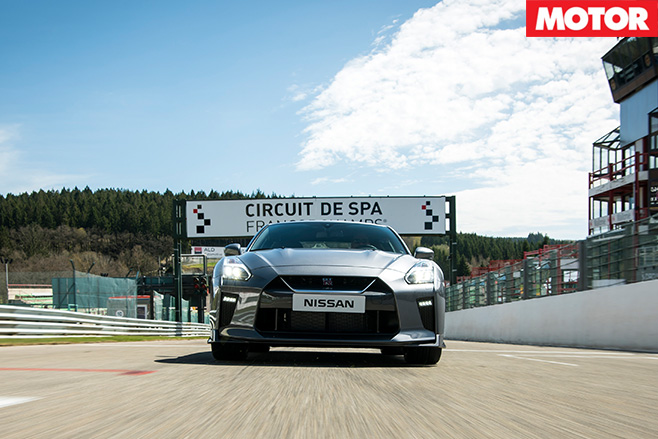
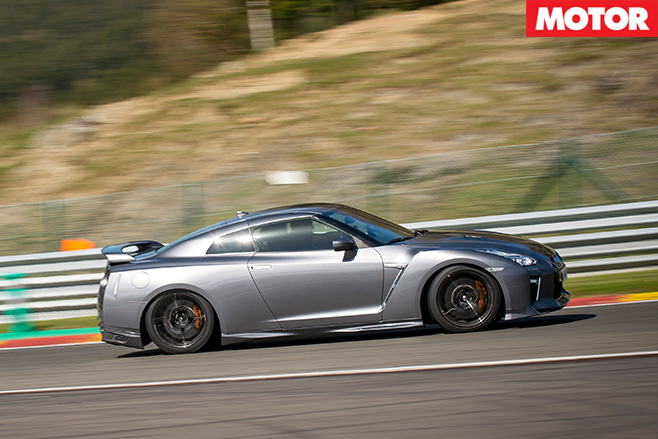
An exterior design refresh that comprises new bumpers, a new grille and bonnet, deeper side sills and a new rear diffuser has also been added to the new GT-R, which still doesn’t move the car a million miles from its original, brutally purposeful looks. The rear bumper was plucked from the GT-R NISMO; all the better to route airflow and exhaust gases with, my dear. The aerodynamic tweaks are also said to increase cooling and downforce without adding drag.
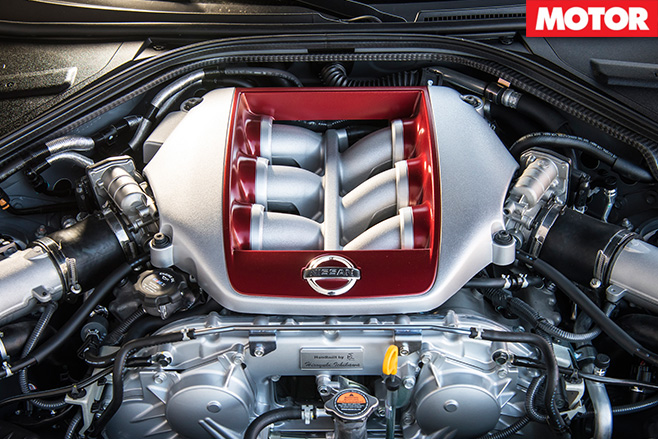
A structural redesign has stiffened the bodyshell around the widscreen, the A and C-pillars in particular, while a suspension update includes stiffer mountings, lighter Y-spoke Rays 20-inch wheels and revalved Bilstein adaptive dampers.
The car will arrive in Australia in September with a choice of two trim levels: Premium Edition and the awkwardly named Track Edition Tuned by NISMO. The latter tops the regular model line-up and gets its own wheels, tyres and trick damper tune.
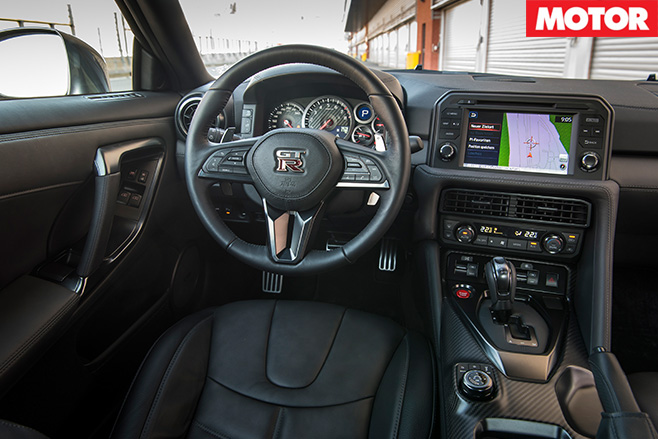
The improvements to the cabin ambience are quite striking. Most of the cheaper-looking plastics and fiddly switches have been banished, with a slimmer-bossed steering wheel, leather-wrapped upper fascia and carbon fibre-clad transmission tunnel now giving an impression of quality and luxury that has thus far been missing.
Refinement has increased, too. The dual-clutch automatic transaxle gearbox is almost unrecognisable from the clunky, shunting six-speeder that the R35 came with originally. It juggles ratios smoothly and quietly on part-throttle and at low speeds, although it slurs a bit when you’re pressing on. Cabin noise has been reduced and ride comfort improved, so the GT-R can now cover big distances without taking such a toll on your senses.
The extra 14kW doesn’t, according to Nissan, make the car any quicker to 100km/h from rest – but as part of a curious new gentlemen’s agreement with fellow Japanese manufacturers, Nissan no longer quotes an official 0-100km/h time. Fortunately, our test route afforded the chance of a momentary bit of performance benchmarking using satellite timing gear that we, er, just happened to have on hand.
What really stops the GT-R from running with the Audi R8 V10 and new Porsche 911 Turbo is its heft – all 1752kg of it. The car feels potent where it can be given its head, but it no longer feels quite like it belongs in the big performance leagues redefined by the likes of the Ferrari 488 GTB and McLaren 570S. The Nissan’s giant-killing days would seem to be over – or at least on hold.
Weight also continues to limit its handling appeal, although the GT-R still has a trick or two up its sleeve. Feelsome, direct and accurate, the newly recalibrated steering draws you into the driving experience by your fingertips, while the stiffer chassis continues to produce the same prodigious lateral grip and awesome traction that have made the GT-R so famous for so long.
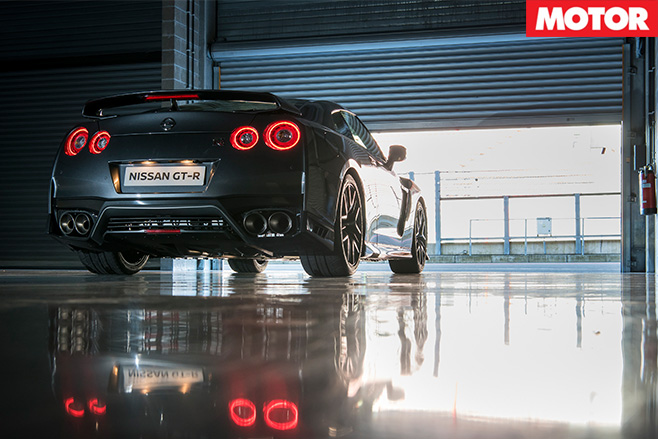
Beyond gentle initial slip angles, the GT-R’s limit handling character remains something to be explored with circumspection, though. When grip levels are breached, they drop away quite suddenly and the rear of the big car picks up momentum disconcertingly quickly. Keeping the car on line as the driveline shuffles power away from the rear axle can feel like an exercise more of luck than judgement – and if your luck runs out, you’d best hope it runs out somewhere there’s a lot of runoff.
So it’s clearly somewhat long in the tooth, it’s still rough around the edges and it could still do with losing a few pounds. And yet the facelifted GT-R remains genuinely, properly fast enough in every sense to shrug off the notion that it’s in any way past it. Those who like its muscle-bound, old-school ‘handle with care’ character won’t object to the lack of dynamic delicacy. At all. They could even be encouraged by it.
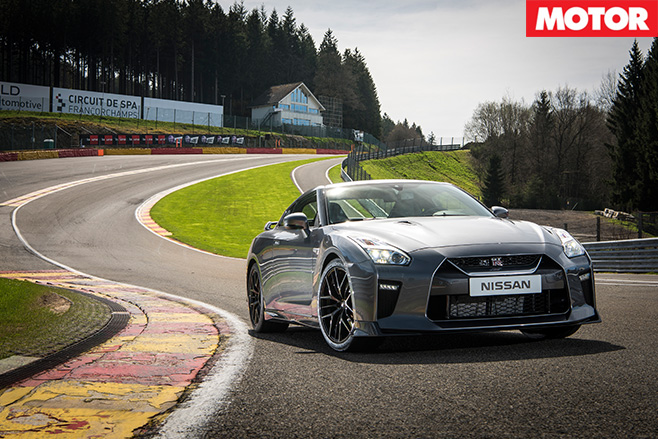
Giant-killer or not, the GT-R continues to pack a mighty punch. It’s also mellowing nicely with age.
4 OUT OF 5 STARS
LIKE: Improved manners; fearsome pace DISLIKE: Showing its age a little
SPECS Body: 2-door, 2+2-seat coupe Drive: all-wheel Engine: 3799cc V6, DOHC, 24v, twin-turbo Bore/stroke: 95.5 x 88.4mm Compression: 9.0:1 Power: 419kW @ 6800rpm Torque: 632Nm @ 3300-5800rpm Power/weight: 239kW/tonne Transmission: 6-speed dual-clutch Weight: 1752kg Suspension(F): double A-arms, adaptive dampers, anti-roll bar Suspension(R): multi-links, coil springs, dampers, anti-roll bar L/W/H: 4710/1895/1370mm Wheelbase: 2780mm Tracks: 1579/1601mm Steering: electrically-assisted rack-and-pinion Brakes(F): 390mm ventilated/drilled discs; 6-piston calipers Brakes(R): 380mm ventilated/drilled discs; 4-piston calipers Wheels: 20.0 x 9.5-inch (f); 20 x 10.5-inch (r) Tyre sizes: 255/40 ZR20 (f); 285/35 ZR20 (r) Tyres: Dunlop Sport Maxx (f/r) Price: $172,000 (est)
5 rebooted GT-R things: Devil in the details
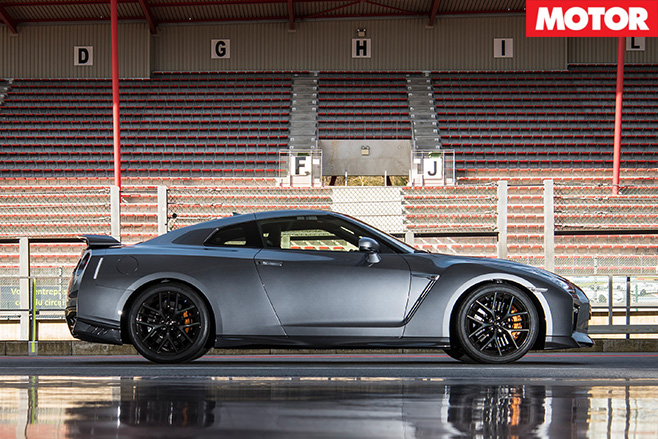
2. FLAPPY-TABS In a positive move, the shift paddles for the six-speed dual-clutch transaxle now move with the steering wheel rather than staying fixed to the column. Well done Nissan.
3. STRONG, SILENT Engaging ‘Exhaust Sound Control’ before starting the engine closes an electronic valve in the exhaust for a neighbour- and EPA-pleasing 10dB exhaust noise reduction.
4. STIFF BALANCE Changes in rigidity of the MY17 GT-R not only improve suspension response, but extra stiffening around the boot has improved the chassis stiffness balance, front to rear.
5. ON AND OFF Active Noise Cancellation matches and cancels some sound, then Active Sound Enhancement pipes exhaust noise back into the cabin via the stereo’s speakers.
Tiguan seven-seater, new Touareg the first of five all-new VW-badged SUVs planned for Australia.
VOLKSWAGEN will introduce five all-new SUVs to Australia before the end of 2018, according to VW Group Australia managing director Michael Bartsch – starting with the crucial all-new Volkswagen Tiguan next month.
VW’s head admitted that its proportion of SUV sales is much lower than most competitors, carried by two ageing models (the about-to-die original Tiguan and the second-gen Touareg launched five years ago), but that’s about to change.
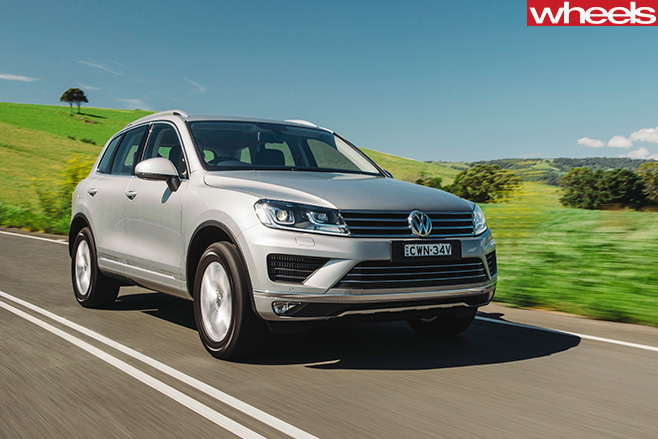
The fourth Volkswagen SUV will be based on the next-generation Polo, giving the brand a much-needed entrant in the booming small SUV market (particularly important in Europe). Expect a concept to appear at the Paris show in October (or possibly Geneva next March) before the production vehicle makes its debut in Europe before arriving in Australia some time in 2018.
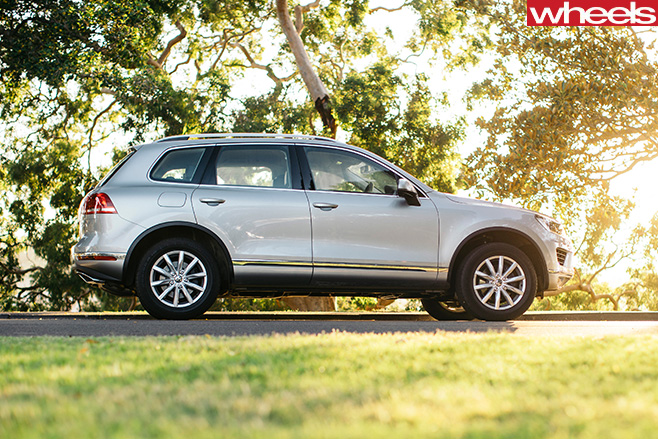
The fact it’s reportedly based on the old US-market Volkswagen Passat – itself underpinned by last decade’s PQ35 (Golf V) platform, not the lighter and more modern MQB set-up of the European car – points to its volume-selling ambitions in the huge US SUV market, where size, price, and features are more important than cutting-edge driving dynamics.
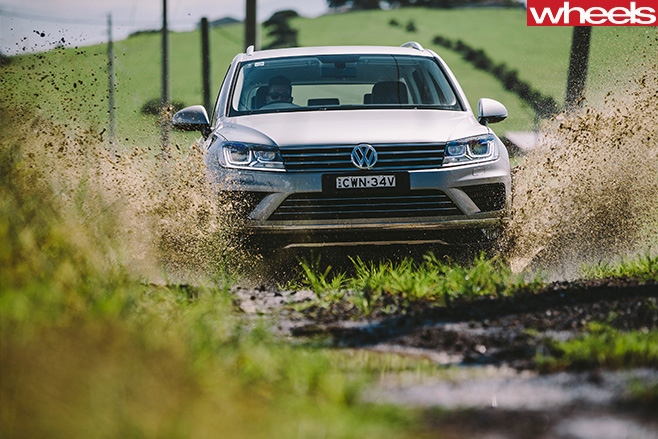
While an updated Amarok will land here in November, headlined by a new 165kW V6 TDI variant, its design is approaching seven years old, meaning a 2018 Amarok-derived SUV will likely be based on the next-generation model.
Given reports that the next Amarok utility will lob in 2019, the seven-seat, passenger carrying derivative is likely to front-up first.
Ford Australia has announced a Special Edition version of its popular Ranger 4×4 XLS in the hope that the more-for-less promotion will be enough to lure would-be 4×4 owners towards the blue oval during the crucial last quarter of the sales year.
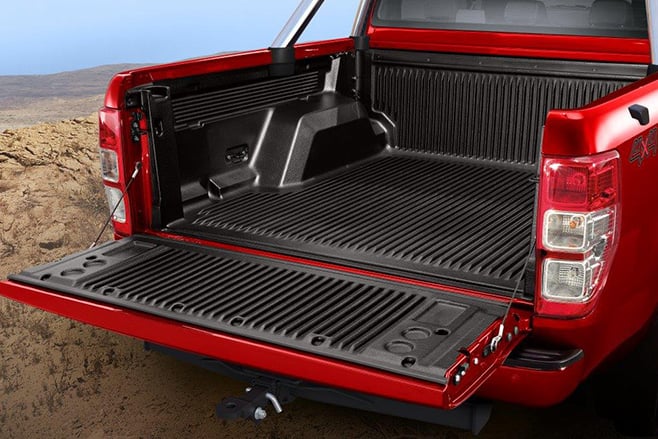
Included in the upgrade is a tow bar, side steps, a bed and tailgate liner, as well as a sports bar.
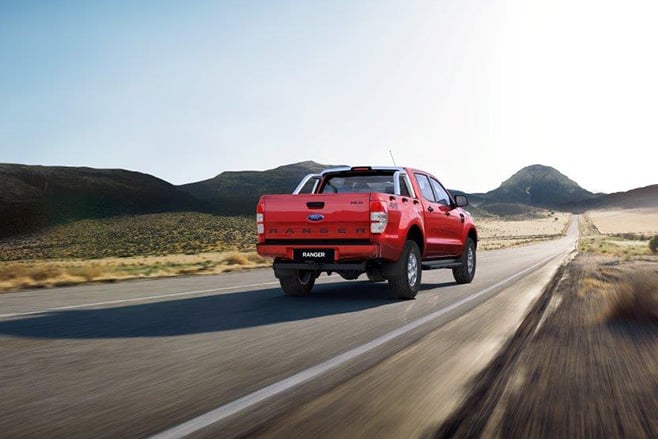
Which represents $4900 of added componentry and, for a $2500 premium on the drive-away price, the firm will be hoping the Special Edition offer will be all that’s needed to finally topple the Toyota Hilux off the top step of the all-important yearly sales ladder.
Having already claimed the mantle of June’s best-selling 4×4, the Ranger experienced a significant 42.8 percent increase over 2015’s July period. The Ford-built 4×4 is also tracking well in the year-to-date sales figures, up 37.5 percent in the seven months to the end of July and claiming a 21.2 percent share of the lucrative and increasingly competitive 4×4 segment.
“Already considered one of the most capable and desirable pick-up trucks on the market, we expect the Ranger 4×4 XLS Special Edition will help us narrow the gap to Toyota even further, with the Ranger 4×4 now only 172 units behind the Hilux 4×4 year-to-date,” Ford Australia’s CEO and President Graeme Whickman said.
The Special Edition version of the five-seat, 3.2-litre diesel Ford Ranger 4×4 XLS will go on sale in Australia next month. The six-speed manual variant will carry a drive-away price of $49,990 with the six-speed automatic $2200 more with a retail price of $52,190 (drive away).
The Ranger 4×4 was designed and engineered in Australia alongside the Ford Everest SUV.
THE STANDARD Ford Focus RS – if you can call it that – has a 257kW engine, powering all four wheels.
According to British site, Autocar, this could jump to 295kW in the beefier Ford Focus RS500 version.
Ford internationally is yet to confirm the RS500 even exists, but Wheels was told by a Ford insider the car will be coming Down Under when it eventually rolls down the production line.
The car is being developed in Germany by Ford Performance, and will likely have a limited production run of just 500 examples.
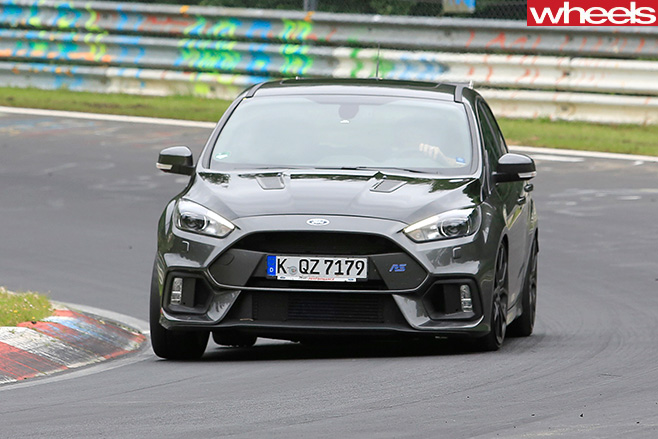
If Ford can pull it off, the RS500 would be squeezing an amazing 128kW per litre out of its EcoBoost engine.
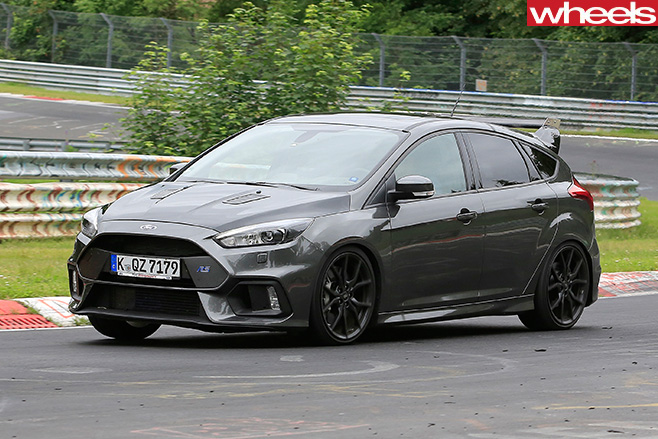
The current Focus RS accelerates from 0-100km/h in 4.7-seconds. A Ford insider told Wheels this could be dropped drastically in the RS500. Autocar predicts a sprint time of just 4.2-seconds – the same as Mercedes-Benz’s A45 AMG.
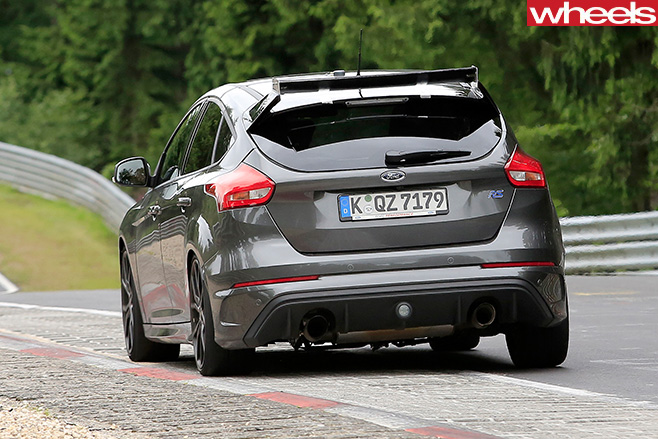
If you want an RS500 when they do arrive, get your chequebook ready early. With just 500 models predicted worldwide, demand will be high and supply will be tight.
The Range Rover Sport is set to be the first model in the Jaguar Land Rover empire to receive the company’s latest 2.0-litre Ingenium four cylinder turbo diesel when the 2017 model year update lands here early next year. It will also be the first time the Range Rover Sport will be offered with less than six cylinders.
The addition of the Ingenium diesel four-pot, which produces 177kW/500Nm and drinks 6.2L/100km, is the biggest mechanical change we’ll see in the MY17 upgrade, which goes on sale here in the first quarter of 2017. The 2.0 litre diesel SD4 S will replace the current 3.0 litre TDV6 S as the entry point to the Sport’s model range and will inherit that variant’s $90,900 starting price.
The TDV6 engine won’t be phased out, however, with the 190kW/600Nm version of the Sport’s 3.0 litre turbo diesel V6 continuing to power the mid-spec TDV6 SE variant alongside the more powerful 225kW/700Nm SDV6 motor.
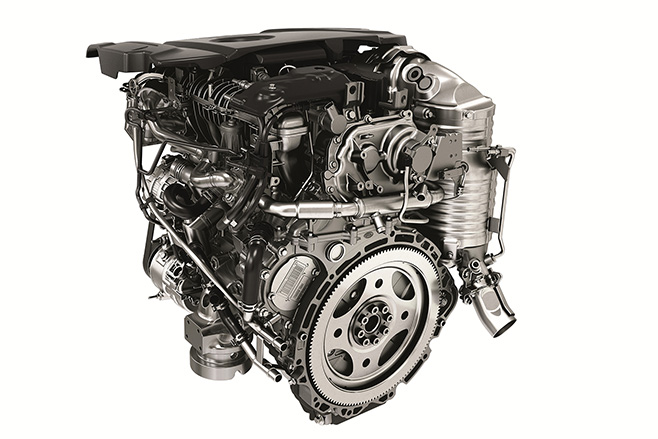
There are no other changes for the rest of the Range Rover Sport’s engine lineup, though the 250kW/400Nm 3.0 litre supercharged petrol V6 is now only available in high-grade HSE form thanks to the lower-specced SE grade being made an all-diesel affair. The HST grade is gone.
Petrol heads should still be well-served by the 5.0-litre supercharged petrol V8, which continues to serve with outputs of 375kW and 625Nm for the HSE Dynamic and Autobiography Dynamic, as well as in heavy-hitting 405kW/680Nm trim for the Range Rover Sport SVR performance flagship.
The rest of the range gets a bump in standard specification, with autonomous emergency braking to be standard across all MY17 Range Rover Sports.
All models will also gain a new 10-inch touchscreen display running Jaguar Land Rover’s InControl Touch Pro software, which supports smartphone-style actions like pinch-to-zoom and promises smoother responses, a clearer display and more intuitive functions than the current infotainment system.
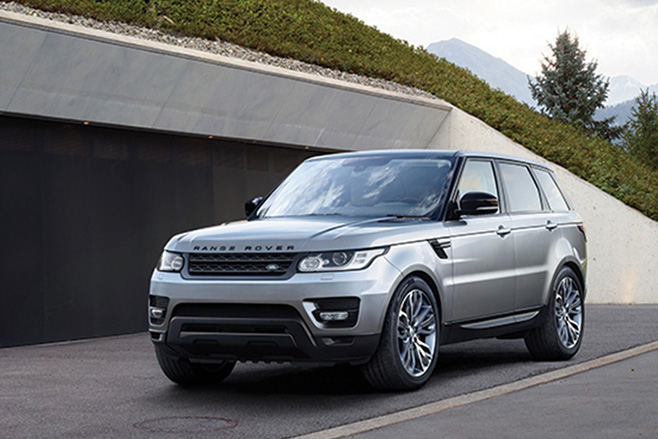
Front parking sensors and lane departure warning will also be rolled out as standard kit across the entire range, while Land Rover’s Advanced Tow Assist becomes standard too. Range Rover Promises that Advanced Tow Assist will take the challenge out of reversing with a trailer, with drivers able to “steer” the trailer using the car’s centrally-mounted Terrain Response dial while a computer controls the angle of the front wheels.
Meanwhile the base model SD4 S will ditch the existing TDV6’s halogen headlamps in favour of brighter xenon lamps. The SD4 S will be the only model in the Range Rover Sport family to ride on steel springs as standard, with all other variants being air-sprung.
Air suspension will be a cost option on the entry-level SD4, and can be bundled with a $5500 offroad pack that also adds extra offroad drive modes and a dual-range transfer case for low-speed rock crawling.
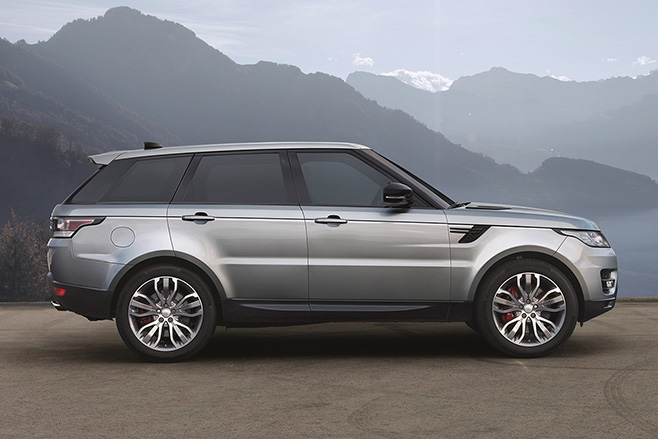
The offroad package will also be made available on the TDV6 SE for the first time though pricing has yet to be determined.
There are minor cosmetic changes for 2017, with the only notable changes being an updated grille, side vents and mirror caps, plus red brake calipers for the Dynamic models. The colour palette for all models has also been expanded to 19 colours.
The MY17 Range Rover Sport goes on sale in the first quarter of 2017, with the new entry-model SD4 S variant scheduled to arrive slightly later in the second quarter of the year.
PRICING
| Model | Sales |
| 2.0L SD4 S | $90,900 |
| 3.0L TDV6 SE | $103,900 |
| 3.0L SDV6 SE | $114,800 |
| 3.0L SDV6 HSE | $132,000 |
| 3.0L SDV6 HSE Dynamic | $138,600 |
| 3.0L SDV6 Autobiography | $169,800 |
| 3.0L SDV6 Hybrid Autobiography Dynamic | $187,900 |
| 4.4L SDV8 HSE | $147,300 |
| 4.4L SDV8 HSE Dynamic | $153,600 |
| 3.0L V6 S/C HSE | $130,300 |
| 5.0L V8 S/C HSE Dynamic | $169,100 |
| 5.0L V8 S/C HSE Dynamic | $196,800 |
| 5.0L V8 S/C HSE Dynamic | $233,500 |
