
The most interesting Aston Martin in ages, the DB11 introduces a new V12 engine and all-aluminium platform, and provides a first taste of the fruits of the brand’s tech tie-up with Daimler.
WHAT IS IT? Big 2+2 GT with oodles of almost everything. There’s design drama outside, leathery luxury inside, a beast beneath its bonnet and chassis sophistication down below. All it lacks is room for rear seat passengers and luggage.
WHY WE’RE TESTING IT This is a hugely important car for Aston Martin. The DB11’s architecture will provide the foundation for a new generation of road cars from the brand, including an SUV, and its twin-turbo V12 is sure to power future top-end models. When executives say the DB11 launches Aston Martin’s renaissance it’s not really an exaggeration. With so much riding on it, how could Wheels decline an invitation to the car’s international press launch in Italy?
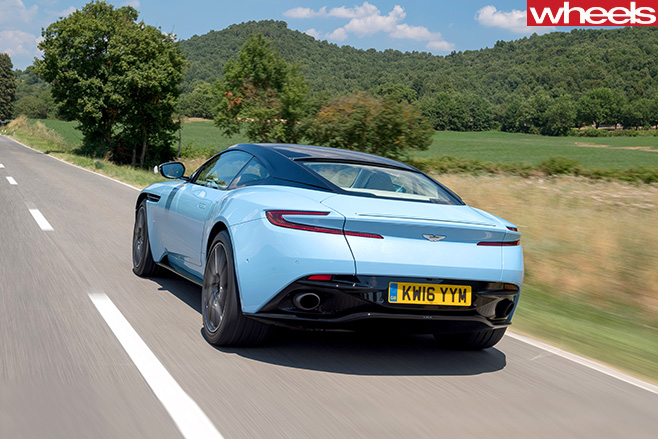
THE WHEELS VERDICT Suavely charming most of the time, and plenty quick if required, the DB11 is the most convincing Aston Martin in years. New V12 is a great engine, delivering exactly the kind of performance promised by the exterior design.
PLUS: Design; engine; sweet chassis set-up; interior fit-out MINUS: High-speed wind noise; cramped rear seats; small boot
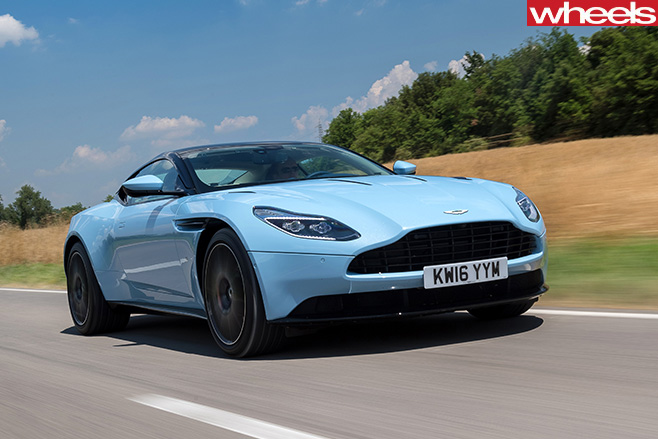
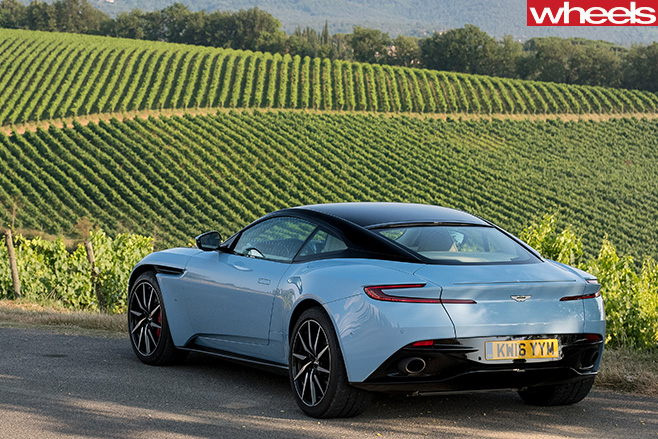
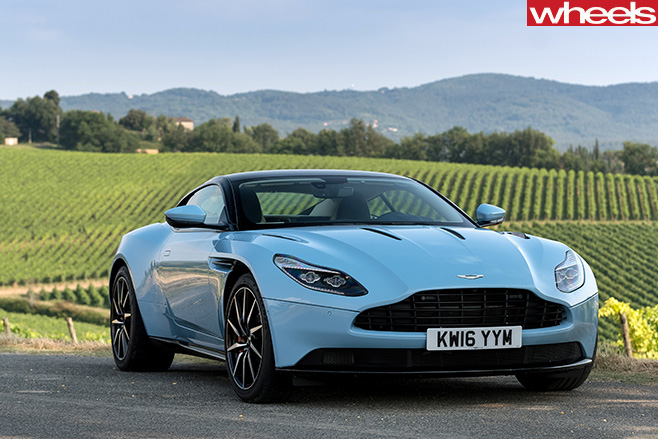
This look is one of six designer specifications created by Aston Martin to show the breadth of colour and trim choices available to buyers of its new DB11. Other looks have names like Mysterious Sport, New Heritage and Iconic Craft, none of them quite so loud and adventurous as Shanghai Fashionista.
Together they testify to Aston Martin’s ambition to ensure its big new 2+2 GT has truly global appeal. This is a car designed to satisfy the fantasies of those special people with a lot to spend ($395,000 in Australia, when it arrives late this year), regardless of where they live, their cultural background or personal taste. But the DB11’s eye-catching colours and eye-watering array of interior finish options are, in truth, mere superficial details.
Aston Martin’s owners, mainly hard-headed investment companies, have agreed to fund development of the new products, up to and including the DBX. From that point onwards, they expect Aston Martin to be a self-sustaining operation. While high-priced, low-volume specials will generate some cashflow, it’s the models built on the new architecture that will have to do most of the work. So you can see why the DB11 needs to be good.
As if this pressure wasn’t enough, the car also introduces a brand-new engine. The DB11’s 5.2-litre twin-turbocharged V12 was designed in-house.
The V12 is connected via a torque tube to the DB11’s rear-mounted eight-speed transaxle. The transmission is a beefy version of ZF’s popular automatic, designed to cope with the Aston’s 700Nm torque output.
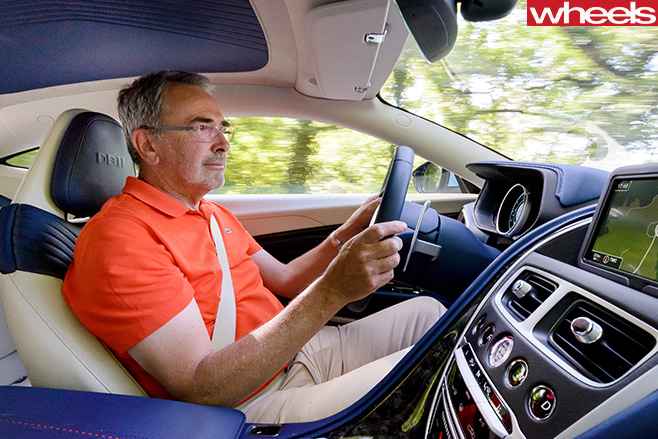
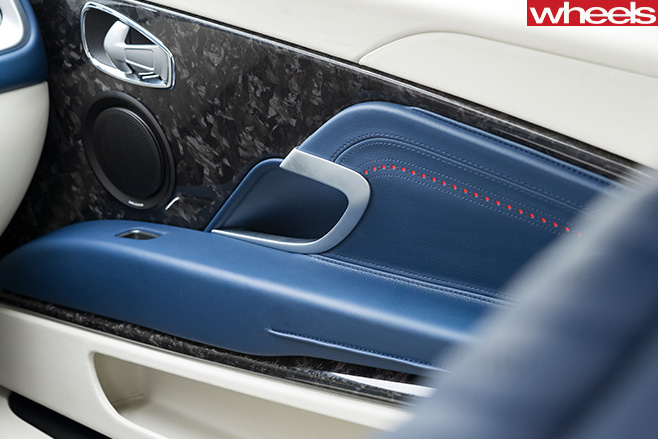
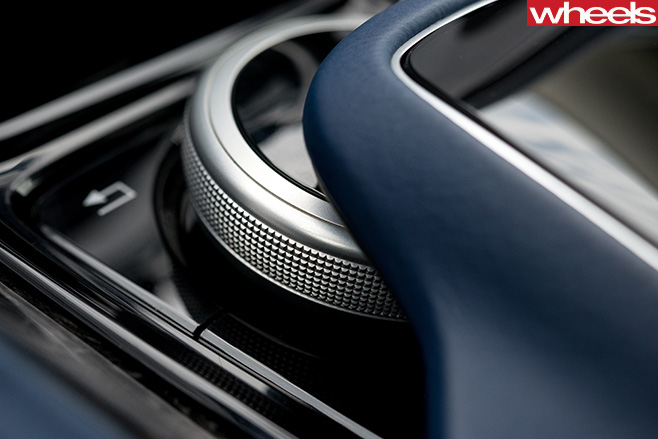
Up front in the DB11 there’s much to enjoy. The leather that’s everywhere is flawless and beautifully stitched. The car’s buttons, knobs, switches and screens are straight from Mercedes, a result of Daimler’s five percent ownership of Aston Martin and a technical tie-up inked back in 2013. They don’t look out of place.
Aston Martin designates the DB11 a GT, and the car’s GT mode leans heavily in the direction of Turismo. It’s perfect for high-speed cruising on an Italian autostrada, where the only niggle is wind noise that seems to be generated by the mirrors. But on a winding Tuscan backroad with the chassis set to GT, the DB11 feels Labrador-puppy lollopy.
Flicking to Sport mode on both buttons increases steering weight, drivetrain responsiveness and remedies the lack of damping, with little loss of the chassis’ impressive ability to absorb lumps and bumps. It’s the best mode for spirited public-road driving, better than the stiff Sport Plus chassis setting. The Aston may be a big and bulky bugger, but Sport encourages the driver to exploit its V12 and the grip of its 20-inch Bridgestone Potenza S-007 tyres.
Equally easy is imagining how the DB11’s obviously excellent essentials could be adapted for greater power and speed. Aston Martin’s revival is off to a convincing start – even dressed in Shanghai Fashionista blue.
SPECS Model: Aston Martin DB11 Engine: 5204cc V12, dohc, 48v, twin turbochargers Max power: 447kW @ 6500rpm Max torque: 700Nm @ 1500-5000rpm Transmission: 8-speed auto Weight: 1975kg (est) 0-100km/h: 3.9sec (claimed) Fuel economy: Not available Price: $395,000 On sale: December
It’s increasingly commonplace for manufacturers to carefully select who owns their high-end models, rather than the traditional business model of selling them to whoever comes up with the money first.
Ford has already sent rejection letters to more than 6500 potential customers who applied for a Ford GT, while Porsche has had to turn away plenty of enthusiasts who were keen on a 911 R.
Ferrari is perhaps best known for this practice, but it’s now potentially come back to bite it, with Autoweek reporting US collector Preston Henn is suing Ferrari for $75,000 for “reputational injury and mortification” after being denied a LaFerrari Aperta.
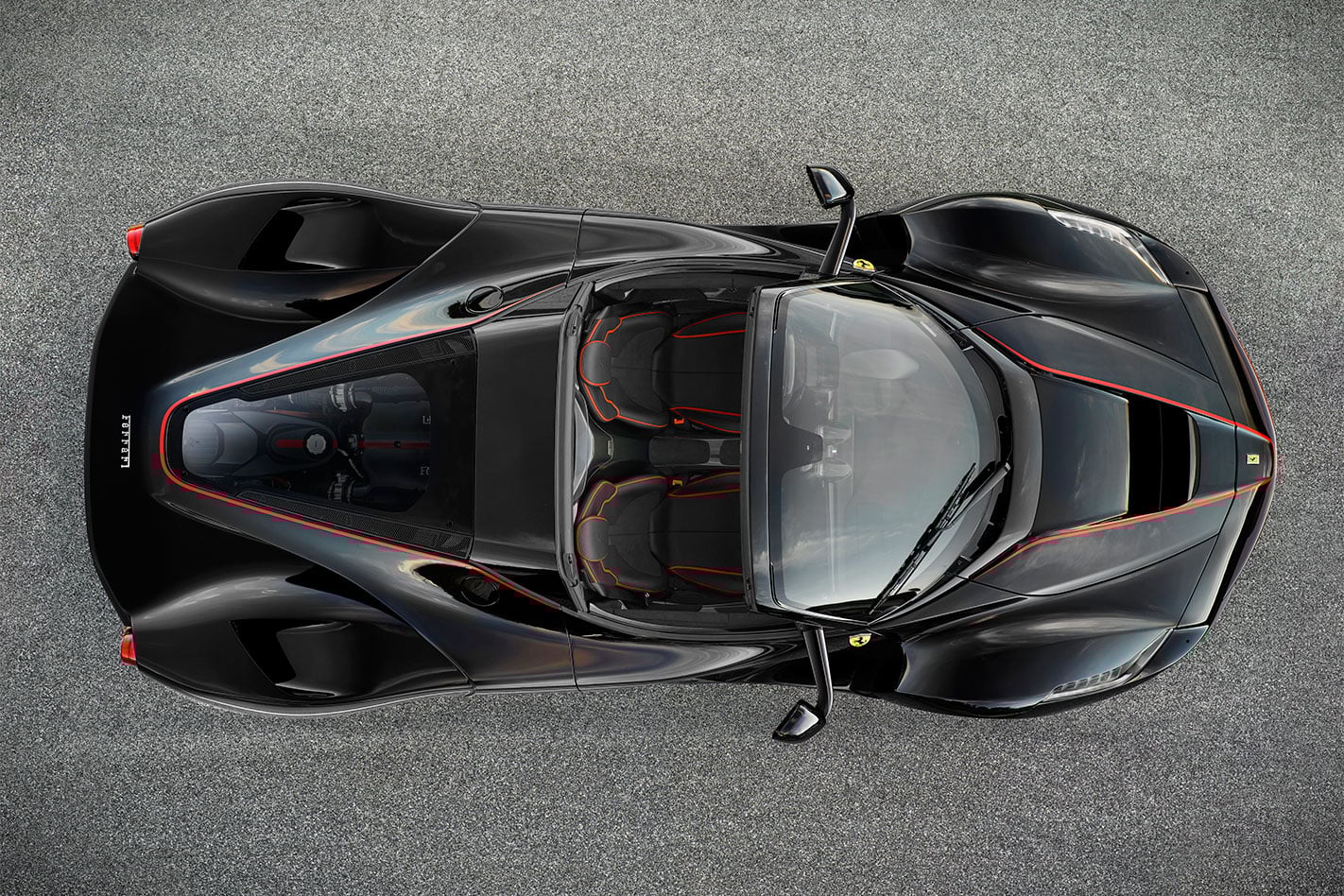
Suitably unimpressed, 85-year-old Henn wrote to Ferrari North American President Edwin Fenech and Ferrari Chairman Sergio Marchionne seeking approval for his order, the latter including a US$1,000,000 cheque to act as a deposit.
The cheque was returned and Henn told he was not qualified to purchase the LaFerrari Aperta. Henn claims this denial is a public insult and has harmed his reputation among Ferrari collectors.
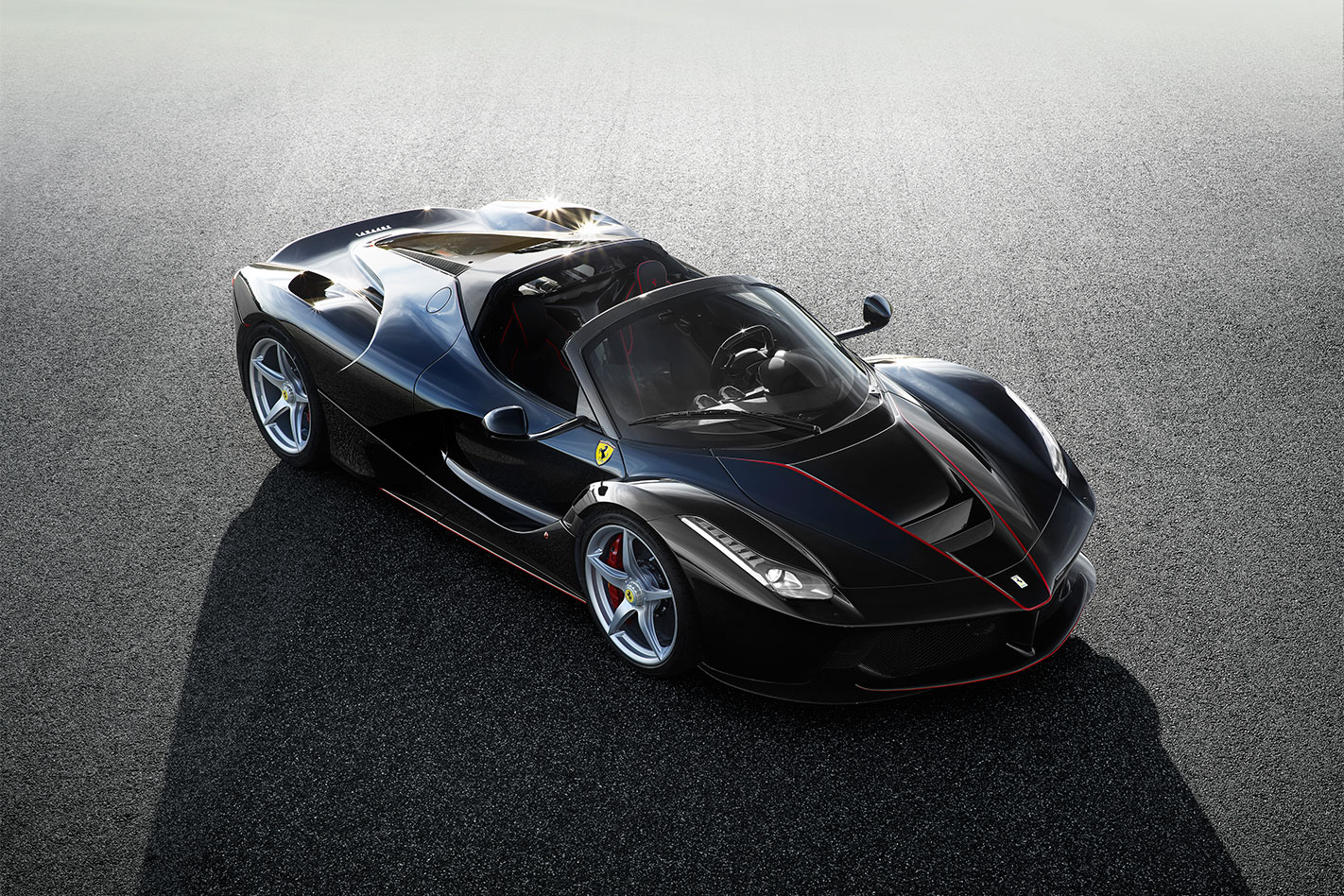
His large Ferrari collection includes a 1965 275 GTB Speciale, reputed to be the most valuable car in the world, as well as a Daytona Spyder, 550 Barchetta, F40, F50, Enzo and LaFerrari. Henn was also one of just 30 participants in the FXX program.
The full court document can be found here and we’ll keep you up to date with any developments.
Next-gen VW Polo GTI gears up to steal the supermini hot-hatch crown from Ford Fiesta ST.
HERE’S the next-generation Volkswagen Polo GTI, and what better place to catch one of the world’s most eagerly awaited hot hatches than in one of the hottest places on the planet?
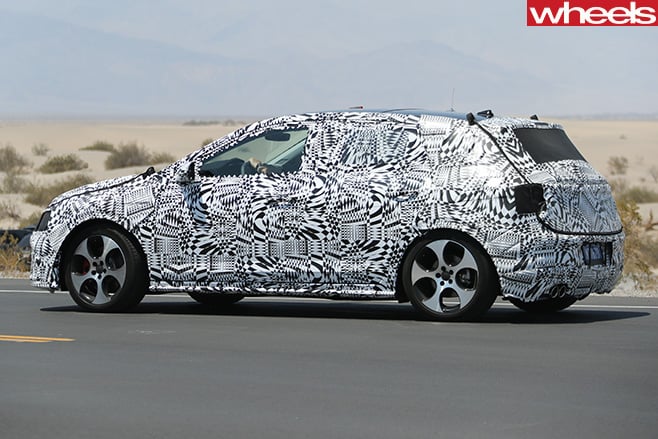
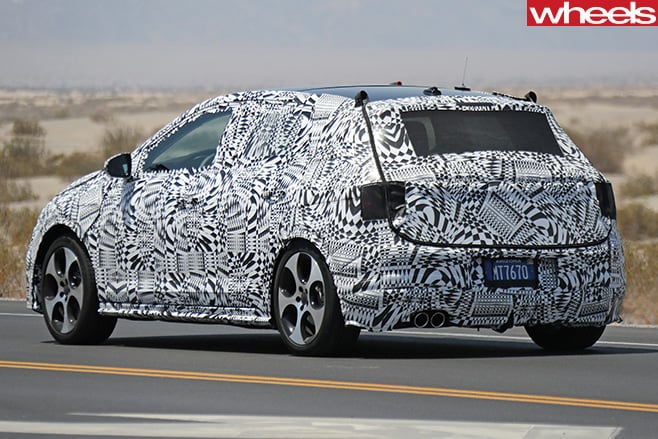
Sprung undergoing what we assume is hot-weather endurance testing near Death Valley in Eastern California, this Arizona-registered prototype is the clearest example yet of the German company’s vital new supermini.

Despite all that psychedelic concealer, the typical GTI hallmarks – big wheels, slammed stance, twin pipes – are plainly visible, suggesting that Volkswagen will not be dragging its feet in the battle for B-segment hot-hatch supremacy against the runaway success Ford Fiesta ST, as well as the Renault Clio Sport, Peugeot 208 GTi, Suzuki Swift GTI, and – hopefully one day – the Mazda 2 MPS.

An upsized Polo ought to mean more passenger and cargo space, as well as the usual high-quality Volkswagen dashboard design and presentation.

To that end, we understand that the newcomer will switch to the full-fat version of Volkswagen Group’s MQB modular transverse architecture, after the current ‘Mk5.5’ facelift released in 2014 adopted some of its electrical and multimedia systems, first seen in the Mk7 Golf.
As with the current Polo, the Mk6 will share many components with the second-gen Audi A1 due sometime next year, and will also be the basis of Volkswagen’s small SUV, seen in concept-vehicle form as the Volkswagen T-Cross Breeze at this year’s Geneva Motor Show back in March.

What will Volkswagen Group Australia do, we wonder?
Have spy pics of your own? We’d love to see them. Just email them to [email protected]
Unassuming local engineer takes on the world, and wins.
THINK of Australian racing car constructors and chances are you’ll think of Jack Brabham and Ron Tauranac. Aside from Aussie-influenced internationals like Van Diemen and Tiga, there’s been a whole raft of successful home-growns: Elfin, Matich, Birrana, Bowin, Rennmax and Cheetah, to name some of the majors.
Add to that list Borland Racing Developments, of Braeside, Melbourne. Mike Borland, 52, has racked up almost 30 years as a constructor. His Spectrum Formula Ford, F2000 and Sabre Formula Vee cars have been consistently successful in Australia, have twice won Formula Ford’s pinnacle Walter Hayes Trophy in the UK (2011 and 2013), and are reigning US Formula Ford champions, with Australian driver Scott Andrews.
Borland also constructed the steel spaceframe chassis for the Daytona Coupes and regularly restores and repairs notable historic racing cars.
There’s no mystery how this trained diesel mechanic fell into designing and building chassis that can take on the world’s most hard-fought categories. Borland’s uncle is Brian Shead, who under the marque Cheetah single-handedly built a variety of formula cars (mainly F2 and F3) from 1960-89.
“Yep, it’s all his fault,” Borland says. “I started in ’84, running F2 cars that my uncle had built. I ran Peter Glover, Jon Crooke, Rohan Onslow… We won a few championships. Then
I started to build my own cars. “Steve Richards raced that car in ’91, and in ’92 we won a Victorian state series. And in ’93 we built our first customer car, for Jason Bright.”
With Formula Ford being an international feeder category, Borland has had some pretty famous bums in his seats, including Chaz Mostert, Mark Winterbottom, Scott Pye and Will Power.
Along with local customers, Borland has a number of F1600 cars and winged, slick-tyred F2000s racing overseas. “We’ve got maybe half a dozen cars racing in New Zealand, I think six or seven in England, and 23 in America and Canada,” he says. “We won the US [Honda-powered F1600] series for three of the last four years, and the last two Canadian series.”
Taking the fight to international chassis makers such as Reynard, Van Diemen and Mygale, has he thought about larger single-seater categories?
“Until recently, the carbonfibre part of it has been beyond our reach here a little bit [but] it’s getting easier and easier. It’s been a good market for the Formula Fords. The investment in the other things is so high.
“A lot of the one-make series have gone carbon now … Unfortunately I didn’t get into this as my business, I got into it because I love building cars and trying to make the next one better than the last one. To do one-make cars, it defeats the purpose for me. You might as well make shopping trolleys.”
Thunderstruck
Mike Borland’s future looks bright, light and loud. The Melbourne racing car constructor is helping to develop the proposed Formula Thunder 5000 single-seater category, using a Formula Nippon carbonfibre tub, 425kW Ford Coyote 5.0-litre V8 and almost entirely Australian and NZ-made components. “They’re designed to be difficult to drive and exciting to watch.”
A growing appetite for lightweight alloys has sparked a shortage of aluminium in the US, where almost all production capacity has been consumed by just one industry – carmaking.
According to Tom Boney, the vice-president of Novelis – one of the world’s largest suppliers of aluminium sheetmetal — carmakers are accounting for the lion’s share of the metal.
“The industry is very close to capacity, and more capacity will be required,” Boney said.
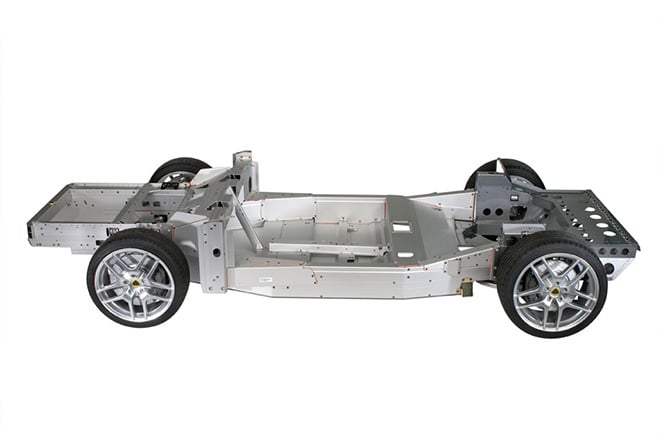
What’s driving this demand? Tightening emissions laws mainly, with even utilitarian cars such as the Ford F-150 pickup now using aluminium for its cabin and tub to help keep weight – and fuel use – low.
It appears to be a growing trend. The replacement for the rugged Jeep Wrangler off-roader looks to be taking a leaf from the book of the recently decommissioned Land Rover Defender, as it is expected to use an aluminium “top hat” sitting on a traditional steel ladder-frame chassis.
But as construction techniques improve and the cost of using lightweight alloys in mass-produced cars drops, many carmakers are chasing aluminium for another reason – performance.
By saving weight through swapping steel for aluminium, cars need less power to perform at the same level as a heavier steel-based car. Acceleration, braking and handling all benefit, and when those improvements are coupled with a reduced thirst for fuel it becomes especially attractive to a carmaker.
One other advantage? Aluminium doesn’t rust.
One of the companies supplied with aluminium by Novelis is Jaguar Land Rover, which has made itself a leader in this field by pioneering new methods of construction that made aluminium more mass-production friendly.
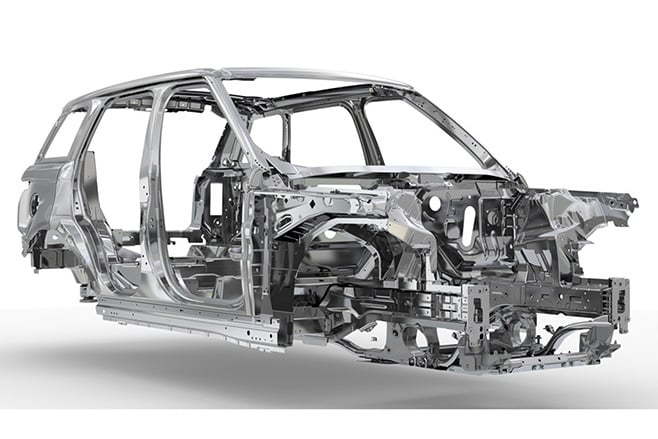
Jaguar’s F-Type, F-Pace, XE and XF are built atop an aluminium architecture, while the Ranger Rover and Range Rover Sport also feature extensive use of alloy chassis components. The next-generation Discovery is also expected to make a jump to the lighter metal.
“We made the most aluminium cars in the world last year of any manufacturer,” said Jaguar Land Rover’s chief of lightweight chassis technology, Mark White.
“We’ve really worked on speeding up the production techniques. When we first started it would take six seconds to do a rivet; it now takes us less than a second.”
Taking advantage of aluminium’s high recyclability (it can be melted down and reformed repeatedly with little degradation, unlike paper and many plastics), Jaguar Land Rover also incorporates a high proportion of scrap aluminium in its new cars. Is the can of beer in your hand destined for a more glamorous life as a high-end automobile? Quite possibly.
LIGHT METAL
Supply issues notwithstanding, aluminium is set to become commonplace in cars of the future. But what about the here and now? Here’s a list of some of the cars currently on the market that make an extensive use of aluminium:
Audi TT
The Audi TT may be built on a steel floorpan, but virtually every metal panel you see from the outside is made of aluminium. There are also a number of aluminium extrusions, pressings and castings lurking underneath. Result? A relatively svelte 1300kg kerb weight
Audi A8
Audi’s A8 has employed an aluminium-heavy construction for three generations now, helping it reduce the mass of its “body in white” – the car without any bits bolted onto it — and allowing more mod-cons to be fitted without hurting performance, handling or economy. Audi claims the A8 is the lightest AWD luxury car in its size class.
Jaguar XE
The Jaguar XE medium sedan is built on Jaguar’s box-fresh lightweight platform, with a bare bodyshell roughly 80 percent alloy. Not only is the bulk of the XE’s chassis made from aluminium, but Jaguar uses the metal in most of the car’s suspension links to improve handling performance.
Lamborghini Huracan
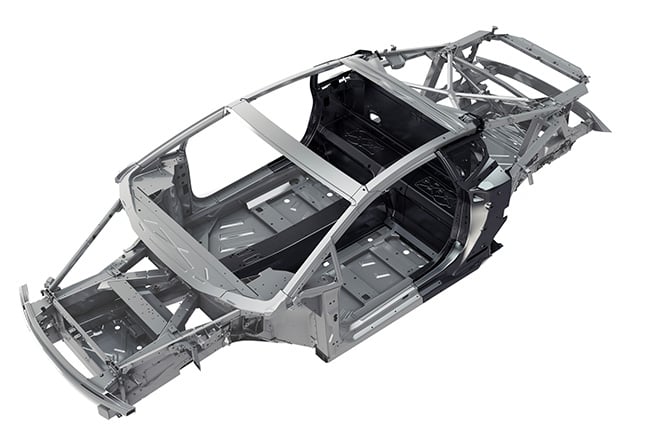
The Lambo Huracan shares the bulk of its aluminium space frame chassis with the Audi R8, and despite being powered by a massive 5.2 litre V10 engine with a seven-speed dual-clutch automatic and all-wheel drive (plus plenty of luxury features on the inside), the Huracan weighs in at a relatively svelte 1487kg empty.
Lotus Elise, Exige and Evora
Lotus has been using extruded aluminium structural members in its sports car range since the mid-1990s, when the first-generation Lotus Elise hit the road. Its diminutive size, small engine and alloy construction all helped it achieved a featherweight 725kg kerb mass – roughly half that of the average small sedan today.
Range Rover Sport
Range Rover managed to achieve a huge 39 percent weight saving when it transitioned the Range Rover Sport from a steel chassis to aluminium. It allowed the luxury off-roader to cleave half a tonne from its frame and make more room for suspension equipment and luxury gear.
Tesla Model S
Keeping weight low is of vital importance for electric cars, thanks to the tremendous mass of current battery technology. Any kilos shed from the chassis mean less battery capacity used up during acceleration, which results in extended range.
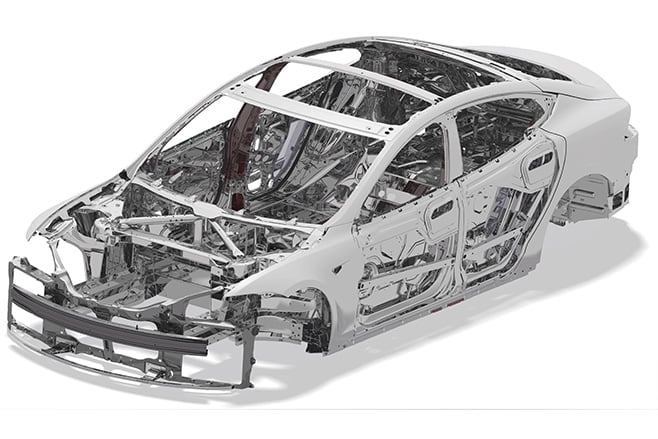
Tesla’s landmark Model S large luxury sedan is built around an aluminium “skateboard” made of extruded (forced out like a tube of toothpaste) and cast alloy components, which also carries the electric motor/s that powers it and the suspension it rides on. Aluminium is also used for the exterior body panels, further reducing mass.
The launch of Honda’s all-new NSX hybrid supercar in Portugal this week is the first step in the Japanese brand’s journey to rediscovering its sports car heritage.
That’s the view of both NSX engineering project leader Jason Bilotta and power train engineering chief Yasuhide Sakamoto, who spoke openly about the significance of the NSX in reigniting dormant performance passions within the Japanese brand.
While there is at least one other affordable sports model in the pipeline that we know of, next year’s Civic Type R, the pair confirmed that Honda is also considering other variants and body styles of the NSX.
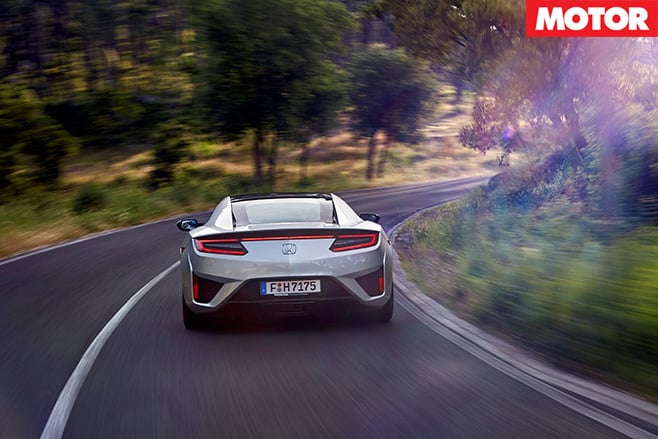
Playing a wily flat bat to further questions about specific product information, Sakamato-san said Honda would watch and listen closely to reviews and feedback from the media, buyers and potential buyers before making any decisions on what other opportunities exist to extend the NSX brand.
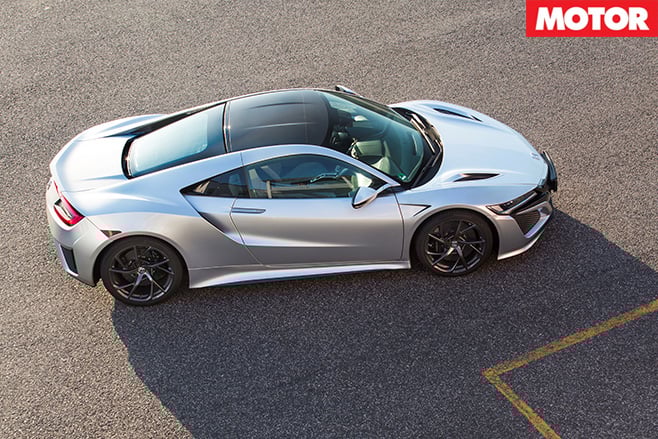
The new NSX’s significance as a morale booster for Honda’s broader engineering and design teams, if not the entire workforce, cannot be over-stated.
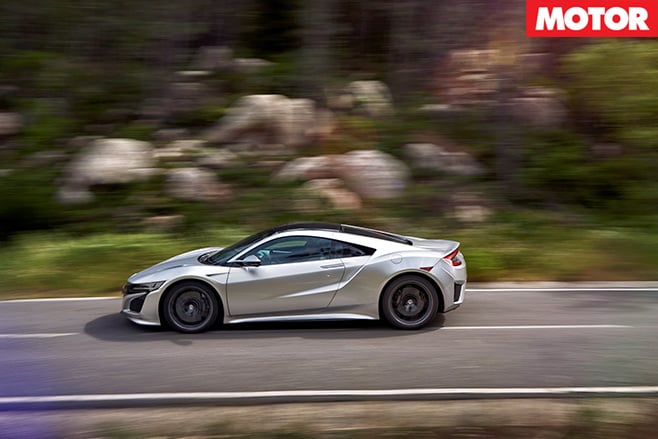
Successive body blows delivered by the Global Financial Crisis, Japan’s Tsunami and ensuing Fukushima nuclear radiation crisis, floods in Thailand and the brand’s withdrawal from Formula One, have all dented its confidence.

But the brilliant new NSX is undeniably a major step in the right direction, even it will be built in tiny volumes and for the world’s luxury elite. In this sense it is a touch stone car, a halo product designed to revitalise and reenergise Honda.
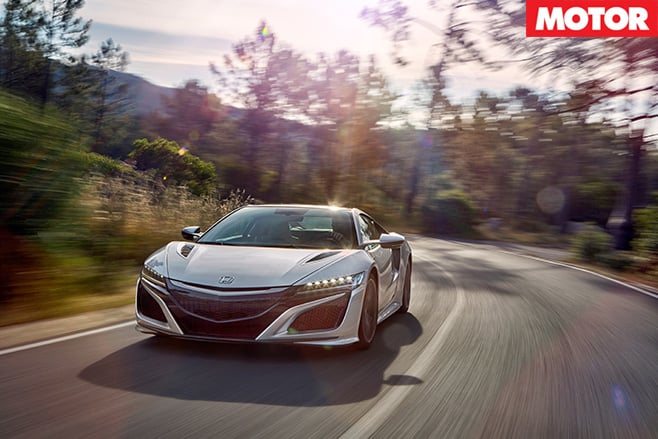
“The arrival of the Honda NSX is an important signal to our Australian customers that Honda is truly a technology and engineering company that can deliver not only efficient, well packaged small cars, people movers and SUVs, but also a high-performance hybrid supercar,” said Honda Australia director Stephen Collins.
Despite a US $450K pricetag – or $600K in our money – the Ford GT has attracted over 7000 orders with 93 per cent of potential customers sent a letter of rejection.
Just 500 units of the scissor-doored 3.5-litre twin-turbocharged V6 engine hypercar will be built following the production model’s reveal at the Detroit motor show in 2015.
Ford earlier this year confirmed that each customer who places an order would receive a questionnaire that, according to the company’s product chief Raj Nair, “Will try and understand what your relationship with Ford is.”
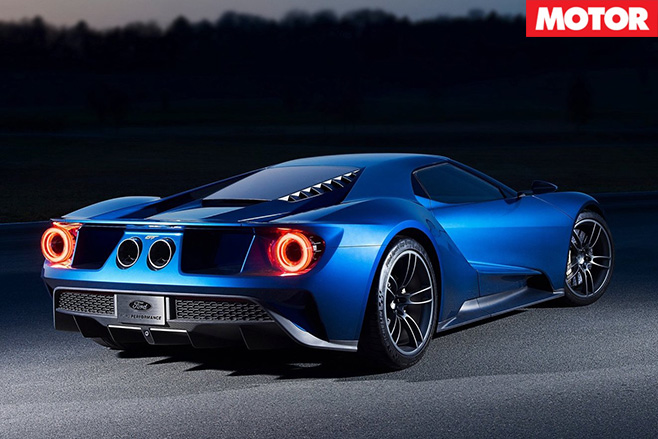
Apparently the first 250 units have been reserved for previous GT owners, with the others portioned between former owners, celebrities and – perhaps the dirtiest word in the industry right now – online influencers.
Letters have surfaced online of Ford’s email notifications sent out this week informing customers whether their application had or hadn’t been successful.
“Your passion for performance and the Ford GT qualifies you to be among the small number of drivers selected for the opportunity to own a new Ford GT,” the acceptance email read.
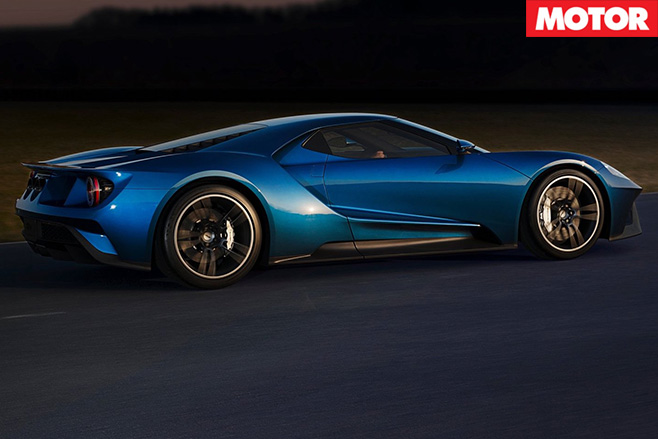
The letter of decline was not so pretty.“The demand for Ford GT from enthusiasts like you has surpassed our very limited production,” it said.
“Unfortunately, we do not have enough Ford GTs to fulfil your request at this time. We have confirmed our Ford GT production plans for only two years. However, if additional production is confirmed, your application information will remain.”
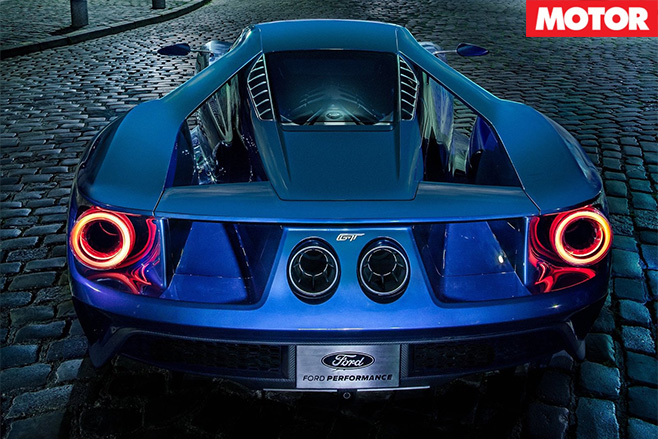
It wasn’t all celebrities, though, with plenty of Ford GT forum members receiving happy emails, though a number of serial supercar owners shared bad news on Twitter.
The internet has, of course, now gone into a spin, with many of the declined applicants begging for to increase production. There is, at least, a hint that may happen.
NISSAN has unveiled a working prototype of a passenger vehicle that looks more like a congestion-friendly Le Mans racer than a practical passenger car.
And horror of horrors; just like the Ford Focus RS that had nanny state safety experts clambering over each other to denounce our descent to a nation of on-road hoons and make us the laughing stock of the world, it includes a drift mode.

The 220kW/707Nm battery-fuelled BladeGlider prototype, unveiled overnight in Olympics host city Rio de Janeiro, is an advance on 2013’s Tokyo Motor Show concept, and loses a little of the magic that also spawned the Deltawing Le Mans prototype racer.
Instead of the swept, Concorde-like Deltawing with a crazily narrow track at the front, the BladeGlider has adopted a more traditional wide-hipped British bulldog stance, with the profile of the cabin carrying over the visual cue of the concept’s triangular form.
And similar to a McLaren F1, the driver sits at the front of the passenger compartment, with two other seats arranged behind.

“These prototypes epitomise Nissan’s drive to expand its Intelligent Mobility strategy, where driving pleasure combines with environmental responsibility,” Nissan chief executive Carlos Ghosn said in a statement that is nowhere near as interesting as the BladeGlider.
“Nissan believes that enthusiasts should look forward to a zero emission future and Nissan BladeGlider is a perfect demonstration of that. It’s the electric vehicle for car lovers.”
According to Nissan, the demonstration models use “an advanced chassis configuration with a narrow front track and wider rear track for optimum aerodynamic efficiency and handling stability”.

“High-waisted, rear-hinged dihedral doors provide a dramatic entry and exit to the cabin. The open roof of Nissan BladeGlider is reinforced with an integrated roll-over protection structure, providing the exhilaration of an open-topped race car with the safety of a coupe,” it says.
The steering wheel uses a Formula 1-style display to feed information – speed, state of battery charge, regeneration mode and torque map – to the driver. The torque map is an important one, because it contains three modes: off, agile and drift mode. These are designed to “add to the driving experience rather than govern it,” Nissan says.
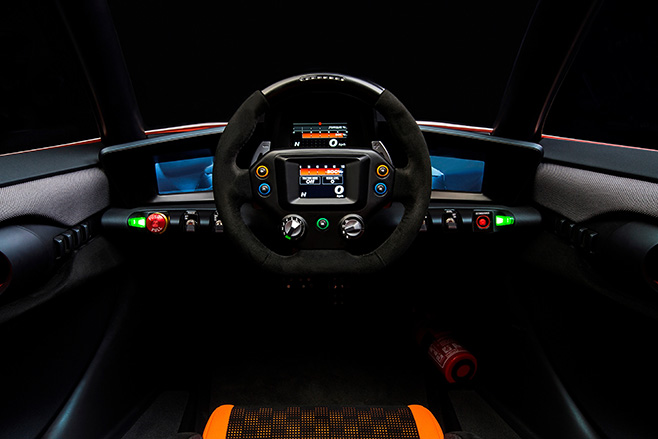
“Flanking the central display are two screens, with the images of rear-view cameras mounted just behind the front wheels. An alternative to door-mounted mirrors, this dual screen design improves the aerodynamic efficiency of Nissan BladeGlider,” Nissan says.
“The driver sits in arrowhead formation slightly in front of two passengers, who enjoy extended legroom. The view for all occupants is panoramic thanks to the seamless cockpit windscreen.”

Each seat uses a four-point harness for safety.
The electric drive system is powerful enough to push the 1300kg BladeGlider from 0-100km/h in around 5.0 seconds, about the same time as a Ford Falcon XR6 Turbo. It will keep going to 190 km/h before the software steps in to protect battery range.
Nissan has built two versions of the prototype; one of which will stay on static display in the Olympic host city, and another that will offer rides to media and selected VIPs.
So, when will it arrive in Australia? Nissan isn’t saying. We hope it’s soon, though, if the fun police allow it.
Is $200,000+ too much to pay for an electric SUV? Tesla reckons its Model X P90D justifies its price, but what else could you get for the same money?
AFTER announcing a $122,812 (including LCT) price of entry for its all-electric Model X SUV last month, Tesla has this week slapped pricetags on the rest of the Model X range – and the cost is a little eye-watering at the top end.
The Tesla Model X P90D is the big daddy, the fastest-accelerating model in the family with a 0-100km/h sprint time of just 3.4 seconds. That’s 0.3 seconds quicker than a Ferrari FF, yet it’s got space for more passengers than the Fez. Impressive.
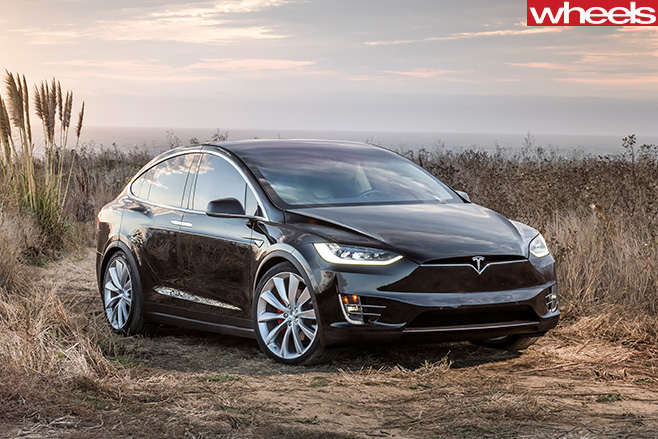
Is it poor value? There are plenty of performance-focused SUVs already on the market, the bulk of of them retailing for much less than Tesla’s electron-munching super-SUV. That said, none of them are quicker to 100km/h (even compared to the non-Ludicrous Model X P90D), and none are able to run on cheap electricity.
But let’s see what $201K gets you when you shop around in the world of petrol-powered performance SUVs. What can you get with the money you’ll save compared to buying the Tesla?
MERCEDES-AMG GLE 63 S
Price: $189,900 0-100km/h: 4.2 seconds Fuel consumption: 11.8L/100km
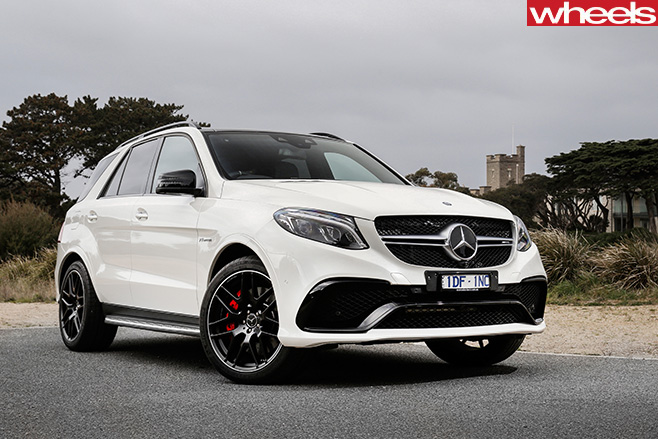
BENZ rebranded the ML 63 to the Mercedes-Benz GLE 63 S in June last year, bringing with it a bump in power to 430kW/760Nm and a 0-100km/h sprint time that’s just two-tenths of a second off the standard Model X P90D. Just $11,100 separates the GLE63 S from the Model X P90D, which buys you 8102 litres of premium unleaded. That’s enough fuel to drive for 68,662km, representing a few years of motoring for most people.
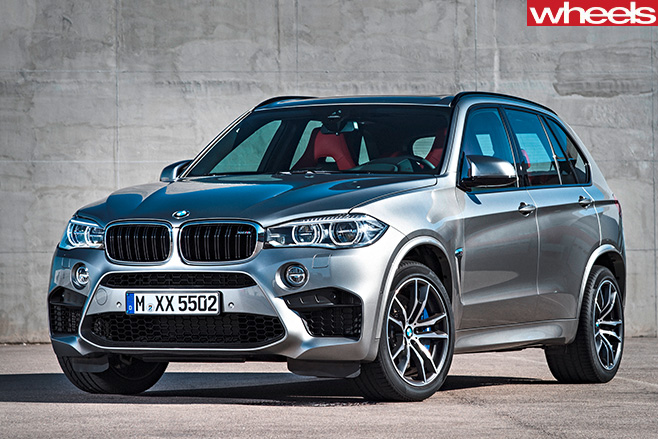
BMW X5 M
Price: $185,510 0-100km/h: 4.2 seconds Fuel consumption: 11.1L/100km
BMW’S X5 M hits triple digits in the same time as the GLE 63 S, but does so at a slightly lower cost and with slightly lower fuel consumption.
JEEP GRAND CHEROKEE SRT
Price: $90,000 0-100km/h: 4.8 seconds Fuel consumption: 14.0L/100km
THE 6.4 litre V8-powered Jeep Grand Cherokee SRT launched in its current shape back in 2012 at a bargain price of $76,000, though the price has been gradually ratcheted up to its present-day $90,000 sticker.
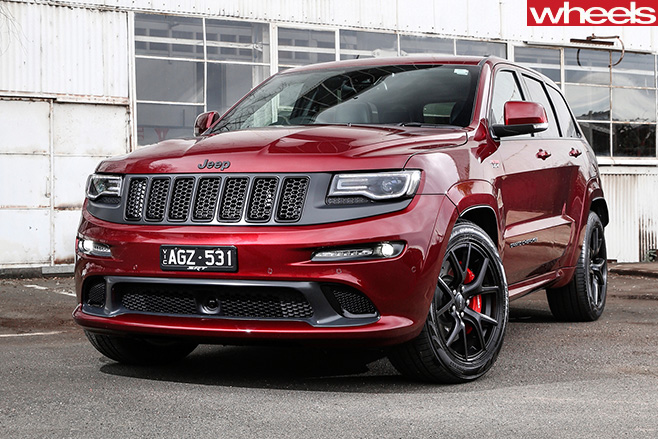
Assuming the cost of petrol remains around the current national average of 127c per litre, that means you could buy 87,401 litres of fuel. Achieve the SRT’s claimed average fuel economy of 14.0L/100km, and that amount of fuel will allow 624,296km of travel – enough to lap the equator 15-and-a-half times.
PORSCHE CAYENNE TURBO S
Price: $287,500 0-100km/h: 4.1 seconds Fuel consumption: 11.5L/100km
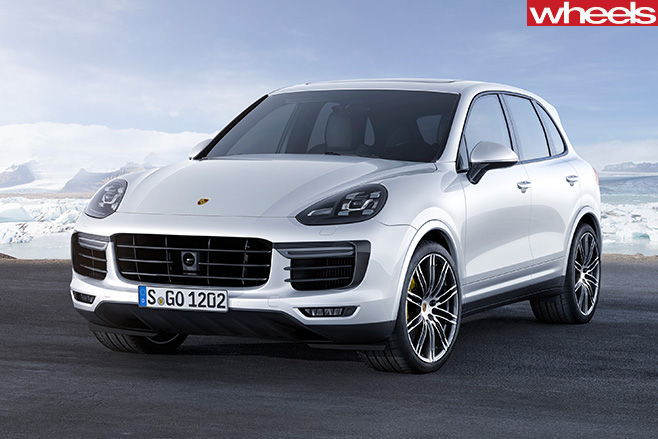
You could confidently tick the option box for Ludicrous Mode and make your Model X even quicker still, while simultaneously cramming up to seven family members into the P90D – something you can’t do in the five-seat Porsche.
Advantage, Tesla.
Meet Edna, the world’s fastest delivery van.
It’s the work of a company called Atieva, a US technology company that is developing electric powertrain and battery technology with the aim of producing its own car.
Its test mule is a nondescript Mercedes Vito stuffed with two electric motors and a battery capable of storing 87kWh of energy and outputting over 670kW.
The figures are no idle boast, with Edna now having dispatched 0-97km/h (0-60mph) in just 2.94sec and completing the quarter mile in 11.3sec at 188km/h.
Perfect for the tradie in a big hurry.
