
THE idea was sound. And the timing seemed brilliant. Just as GM was globally stepping away from rear-drive cars to focus on more fuel-efficient front-drivers, Holden was throwing more than a billion dollars towards an all-new rear-drive platform for its new Commodore, codenamed VE.
But the Zeta architecture that underpinned VE was not just for Holden. It was part of a broader plan for Holden to supply other GM brands with an affordable rear-wheel drive platform. It seemed the perfect solution for a world not ready to bury high-performance rear-drivers, but one where the compromises with sending drive to the rear didn’t really make sense for volume models.
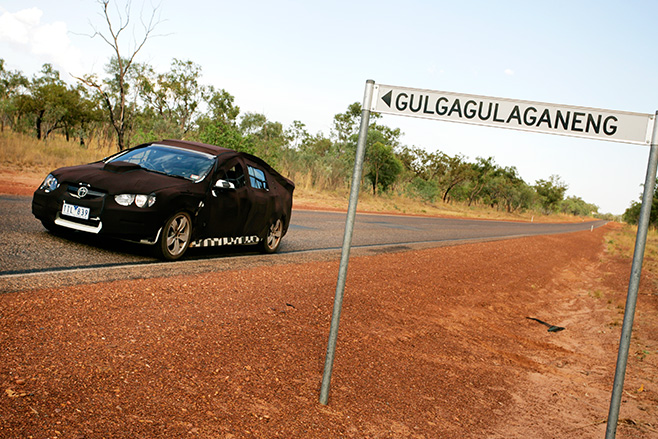
In the end the only non-Commodore-based model that utilised the Zeta architecture was the Chevrolet Camaro, a car that was developed and designed in Australia.
Despite the vision, GM simply wasn’t ready for such broad thinking. Just as GM should have been gearing up to utilise its expensive new architecture, it was more concerned about other things. Namely keeping the company alive.
It seems GM had overlooked the basics of building cars, while also dealing with occasionally poisonous internal politics. Profits were diving and the Global Financial Crisis plunged the once dominant car giant into bankruptcy.
Sharing an Aussie-designed platform with brands fighting for survival was the last thing on GM’s mind as it reorganised itself, shed staff, closed plants and even ditched some of the brands that were planned to utilise the VE architecture (Pontiac being the most obvious).
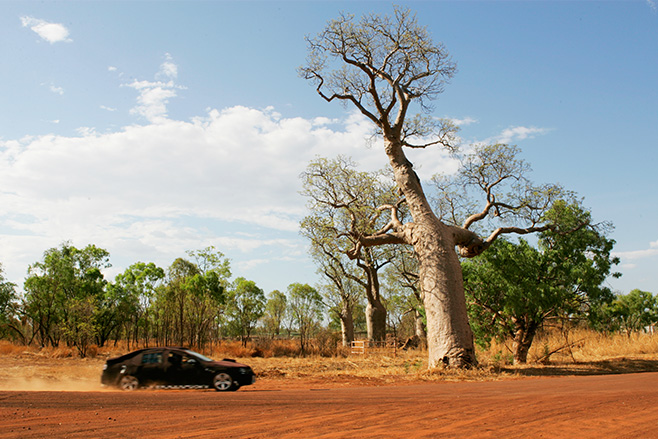
The mighty Zeta dream had collapsed, ultimately taking the viability of Australian production with it.
It’s an immense shame, not only for the bottom line of the company – it turned out to be an expensive exercise for both GM and Holden – but for the people who made it happen.
VE was the first time Holden got to design a car from the ground up. There would be no compromises and no cutting corners. And the hugely talented designers and engineers, who were already building some great cars, would be responsible for creating the building blocks for all manner of cars within the GM world.
It seemed Holden had a viable path to not only continue local production of the Commodore, but also to play a pivotal role in the broader GM world.
At least the teams who worked on VE came away from the project far more knowledgeable, and with better relationships with people within a recovering GM. For the design team, in particular, it was invaluable experience that helped establish them as world-class designers highly regarded within GM.
It’s taken a little longer than ideal, but finally the Audi S1 has had some track time.
Audi’s mini hot hatch mightn’t be an obvious track day choice, but it’s potent enough to need a circuit to unleash its full potential. The venue is a freshly resurfaced Winton, and the newly laid hotmix has had a surprisingly dramatic effect on our most frequented track.
The biggest change is the deletion of virtually every bump. The hump before turn one where the old track joins the new? Gone. The tricky indent mid-way round the fearsome sweeper? History. The rippled tarmac approaching turn 11 that required a deft touch on the brakes?
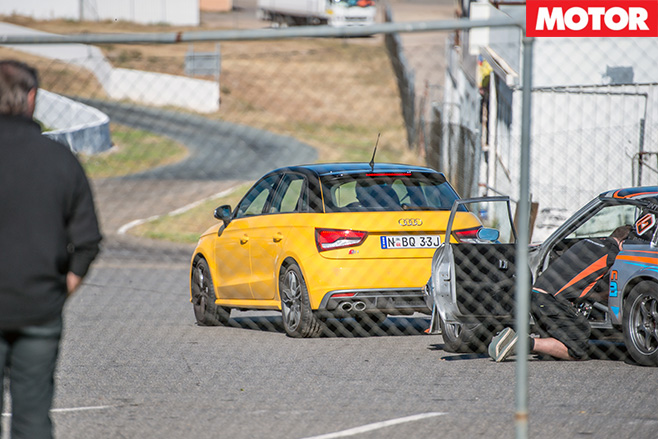
Nonetheless, the new Winton still offers plenty of challenges. Weekly ‘Test ’n’ Tune’ days attract a wide variety of machinery and on this busy day the S1 shared the track with everything from a roofless Nissan NX (don’t ask) and Toyota 86s testing for the upcoming race series, to a Porsche 997 GT3 Cup car.
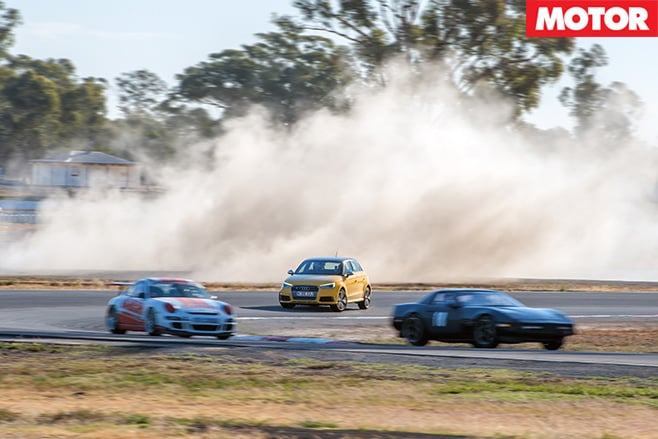
A number of attendees were keen on exploring what Winton’s infield had to offer too, dragging dirt and dust onto the track, which always makes things exciting. Maybe they were just trying to make the S1 – more traditionally known as a rally car – feel at home.
Exactly how much quicker is difficult to say, but given the S1’s best time at last year’s Bang For Your Bucks was a 1:44.1sec in the hands of Warren Luff and I managed a best of 1:42.9sec on the new surface, it’s fair to say a good few seconds have been shaved from a circuit of Winton.
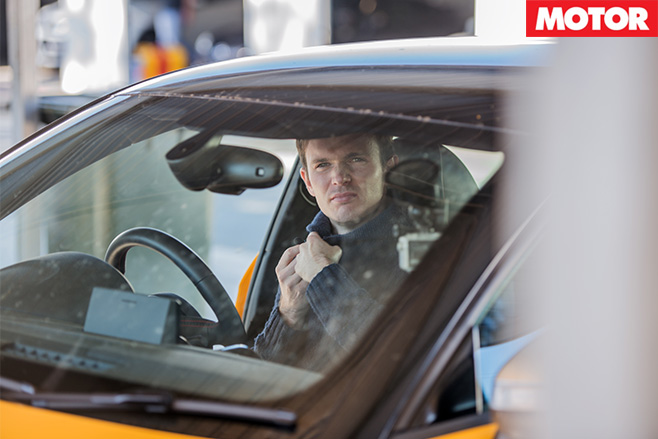
Despite the extra footprint, however, it’s tyres that are the S1’s biggest handicap on track. The Bridgestone Potenza S001s held up well to an afternoon of hot laps, but there’s the feeling the S1’s chassis would have more to offer on even higher performance rubber.
It feels agile and playful in faster corners, the rear edging wide on corner entry to ease the load on the front tyres – which can be very exciting in the middle of Winton’s fourth-gear sweeper – but in Winton’s slow turns the front end lacks bite. That’s another way of saying the driver lacks patience, but with stickier tyres commitment, rather than patience, would be rewarded. What does work well in the slower stuff is the S1’s engine.
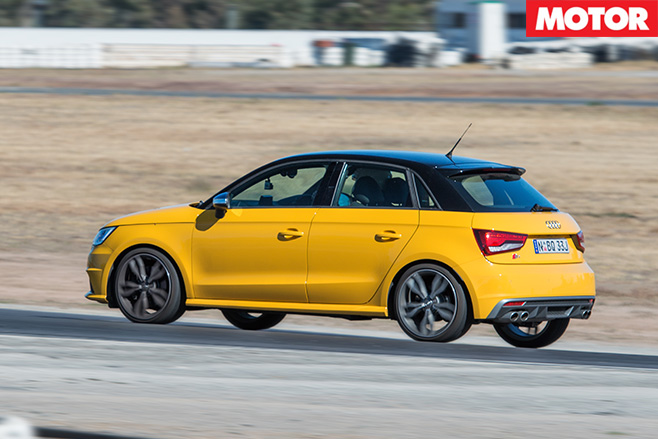
Stamina is often a problem for road cars on track, but completing a cool down lap between each hot lap allowed the S1 to stay fairly fresh. The temperature gauge didn’t budge all day, the brakes hung in there – though were emitting some pretty loud groans by day’s end – and the tyres still had plenty of life left.
At this price point there are more appropriate track day tools, cars like the Renault Sport Megane or Subaru WRX STI offer more outright entertainment, but if you have an S1 and find yourself at the circuit, you’re certainly not going to be bored.
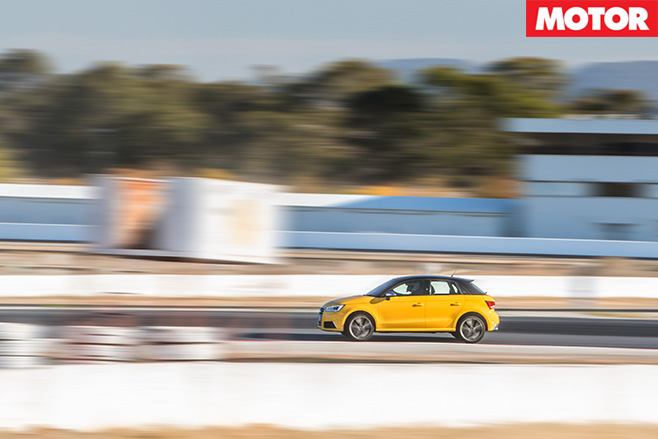
Fuel this month: 10.3L/100km Average: 9.2L/100km Distance this month: 806.2km Total: 7581km
Want to see more of our Audi S1 long-termer? Check out the below:
- Part 1 of the Audi S1 long term test
- Part 2 of the Audi S1 long term test
- Part 3 of the Audi S1 long term test
- Part 4 of the Audi S1 long term test
TELL ME ABOUT THIS CAR
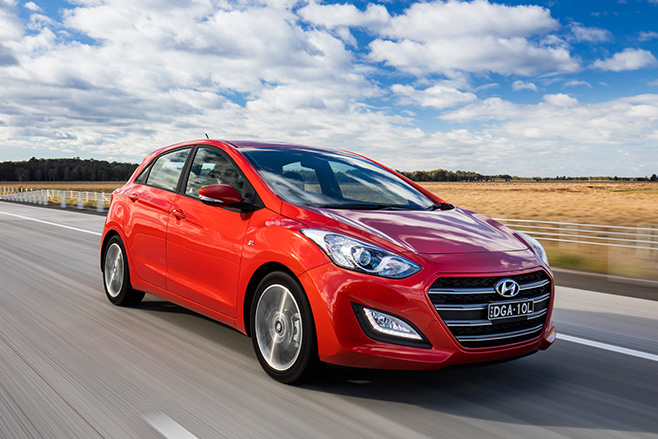
The Hyundai i30 is one of Australia’s favourite cars, and the SR is its sportiest version.
Sharp driveaway pricing and strong showroom appeal make a compelling case, and recent updates have added further driver appeal to the popular Korean hatch.
STRENGTHS
- Suspension. Hyundai Australia developed a unique suspension tune for i30s sold locally and it’s the standout element of the car. It rides well and offers good road holding when driven quickly. It feels well put together.
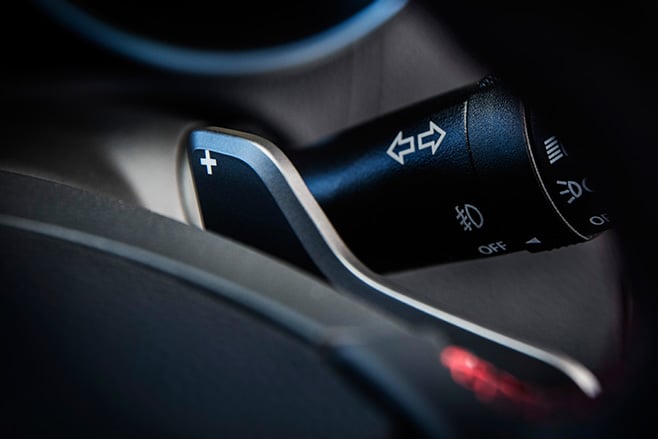
- Fun. That sorted suspension and a lively engine come together to make a car that is enjoyable to drive. The automatic i30 now has paddle shifters on the steering wheel which adds driver involvement and improves the experience.
- Interior. The SR has one of the most upmarket cabins in the i30 range. It features black and red leather sports seats, contrasting red stitching, metallic grey panels rather than silver, black headlining and cloth covered A-pillars.
- Exclusivity. It’s hard to stand out in a car as popular as the i30 but the SR’s unique alloy wheels and the availability of a unique colour called Phoenix Orange will help separate it from the crowd.
- Warranty. The Hyundai i30 has a generous five year unlimited kilometre warranty, which is one of the best warranties of any new car on sale today.
- Pricing. The Hyundai i30 SR is cheaper than its main competitors. It costs $26,550 for a manual version, and $28,850 for an auto.
WEAKNESSES
- Steering. Perhaps the biggest weakness of the i30 is its electrically assisted steering. It has three different modes to adjust the steering weight but none of them are spot on. A single, well-judged setting would be better for driving quickly. Still, in day-to-day driving this isn’t a major concern.
- Safety. Advanced safety technology like auto emergency braking and blind spot monitoring are not available in the i30 SR or any versions in the i30 range. It does have a reasonable suite of safety features, but more advanced systems are becoming more common in the i30’s competitor set.
- Power. At the last mechanical update of i30 SR in 2015 its 2.0-litre four cylinder petrol engine dropped 5kW and 8Nm to 124kW and 201Nm. Hyundai sacrificed a little grunt to make the car better to drive by delivering torque earlier in the rev range, however its overall outputs are a fair bit below its main rivals.
- Age. There will be a brand new i30 in Hyundai car dealerships sometime next year, and that new car is likely to address most of the flaws of the current car.
The Mazda 3 SP25 is another excellent option. It is also fun to drive and has stronger performance figures of 138kW and 250Nm. It can also be fitted with current-generation safety equipment. The Holden Cruze SRi is another noteworthy rival as it too has higher outputs of 132kW and 230Nm, though it’s not quite as good to drive as the Mazda 3 SP25.
Click here to read the full review on the Hyundai i30 range.
The end of the line
First published in the February 2013 issue of Wheels magazine, Australia’s most experienced and most trusted car magazine since 1953.
Holden’s VE Commodore seems certain to be the last true clean-sheet Aussie-developed family car. With VF imminent, Robbo drives an SS V from Adelaide to Sydney to reflect on what we’ll be missing.
By Peter Robinson
IN the true dark night of my soul, I always knew Holden’s VE Commodore would be the last all-new Australian car.
Deep into writing Autobiography, my book that chronicled the VE story – from Mike Simcoe’s first proportion-defining scribble to the 2006 press launch – it seemed to be accepted as a sad inevitability inside The General. The indigenous Australian family car, designed, engineered and manufactured locally, could never be sustained in an era of global product development and ever tougher emission and fuel standards.
Falling domestic demand for large family cars during the life of VE and a dramatic plunge in exports simply confirmed that the huge R&D investments required for a new Australian car were impossible to justify.
When the last VF slips off the Elizabeth, South Australia, assembly line at the end of the decade, at least 70 years after Ben Chifley unveiled the first Holden, the locally built Commodore will be replaced by something Chifley would have struggled to comprehend, or recognise. Perhaps a mid-sized, front-drive sedan, or, more likely, a compact SUV.
To investigate the validity, even the relevance, of Australia’s love affair with our native cars – for 60 years our best sellers, until being deposed by the Mazda 3 in 2011 – just months before the launch of the VF, Wheels collected a VE in Adelaide for the long haul to Sydney.
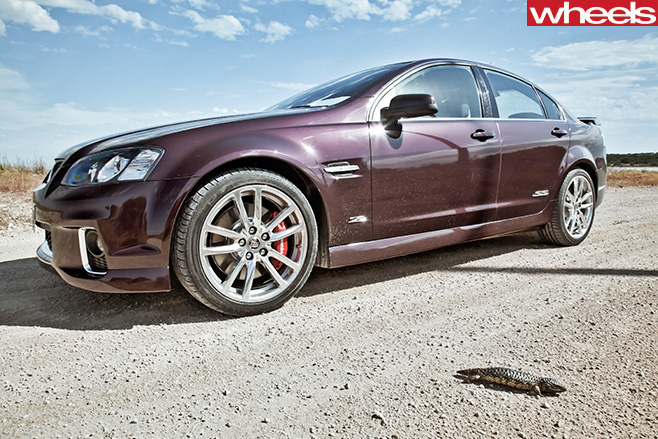
Our new long termer, an SS V 6.0-litre manual sedan, isn’t, as snapper Wielecki feared, painted the “dreaded, beige-side-of-champagne colour, designed for the Kath-and-Kims”. Worse, it’s a $55,290 Z Series in Holden’s latest hero colour: ‘Alchemy’ purple, which photographs as a kind of dirty, swampy black in most light.
It also rides on the highly polished 19-inch forged alloys inherited from Pontiac’s G8 VE variant.
Wielecki’s unimpressed. “They’re for someone with bad taste who wants to go to the Summer Nats,” he bleats. I whinge that the rear spoiler detracts from what otherwise, despite familiarity, remains a desirable and superbly good-looking sedan. A slightly curmudgeonly start to three days on the road together, then.
Already I’m taking advantage of the bent-eight’s bottom-end flexibility, loving the subtle V8-burble, the tall gearing and bemoaning the day when lazy, big-capacity engines are no more.
One run up and down through the precise, rather than heavy, short-shifting, manual box – with its firm yet smooth clutch action – convinces me of the recent progress Holden has made in drivetrain refinement. Cohesive, no slack, no rough edges, exactly what a keen driver expects from a big-muscle sports sedan.
No surprise, then, that 20 percent of Commodores are V8s and, of those, an amazing 40 percent still drive via a clutch. It’s a percentage of manual take-up rarely seen anywhere in the market, or the world, today.
In the VE’s six years, steering ratios have generally quickened and the Commodore now feels slower to react through the first 15 degrees of wheel movement than it should. So, while it still feels planted, comparatively, the latest car isn’t as agile as it might be. Will the VF’s electric steering use a quicker rack? We’ll soon know.
I’ve never bonded with the VE’s excessively large-rimmed and big-diameter steering wheel, and that hasn’t changed. Unwelcome reflections under the midday sun mean reading the instruments is near impossible, while the red-numbers-on-black of the trip computer become an endless source of frustration, legible only in the dark.
Crawling between shops down Lobethal’s narrow main street, it’s ridiculous to imagine that this village in the Adelaide hills was home to a sealed 13.8km street circuit, which hosted the 1939 Australian Grand Prix.
Frieda, who migrated to Australia with her parents as a 14-year old from Austria in 1956, shows us the two chequered poles that mark the start-finish line of a race won by Allan Tomlinson in a supercharged MG TA, at an average speed of 135km/h, in front of 60,000 spectators. There’s also a plaque: ‘In Memory of the men and machines that competed on this circuit at a time when motor cycle and racing cars were symbols of speed and courage.’ Indeed; Lobethal was Australia’s Spa: no run-off areas, racing at daunting speeds along fence-lined, high-crowned country roads with three long straights; a circuit dubbed Australia’s greatest by three-time AGP winner Doug Whiteford.
Frieda remembers the 2009 Lobethal Grand Prix revival, with a 93-year-old Tomlinson (who died in 2011) driving a replica of his winning MG down the street, but is keener to tell us that as teenager she earned five shillings (50 cents) an hour picking peas, twice what her parents were paid to work in Lobethal’s famous Onkaparinga tweed factory. “All we could see,” she says wistfully, “was peas and green trees…it was the end of the Earth.”
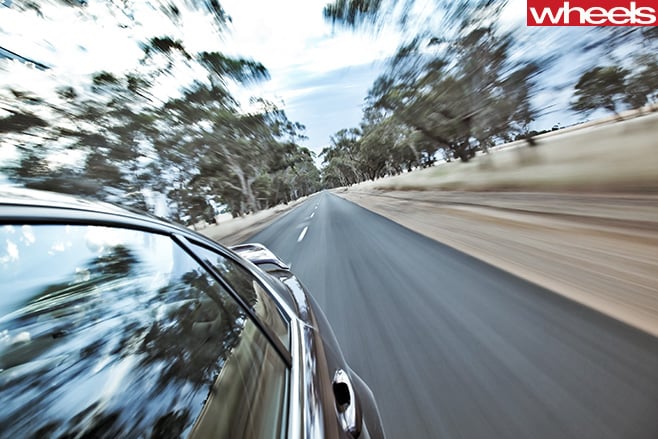
The VE storms the conditions, despite my self-imposed 4000rpm rev limit to run in the engine and transmission. Instantly at home, the FE3 suspension tune, introduced on the Series II, might have been specifically engineered on, and for, these roads. Firmer dampers and thicker rear anti-roll bar, plus an infinite degree of clever work on the chassis, add a subtlety to the body control and ride quality compared with the firmer and less supple FE2 setting.
Enthusiastic cornering occasionally set the stability-control light flashing, without annoying intrusion. There’s no crash-through on bumps, the front Brembo brakes are strong and progressive, the VE calm, confident and rewarding. Balancing the gentle turn-in understeer on the throttle, the chassis absorbing all the bumps thrown at it, I simply refuse to believe Holden’s soon-to-arrive Malibu, fully imported from the USA, will cope with even remotely the same assurance.
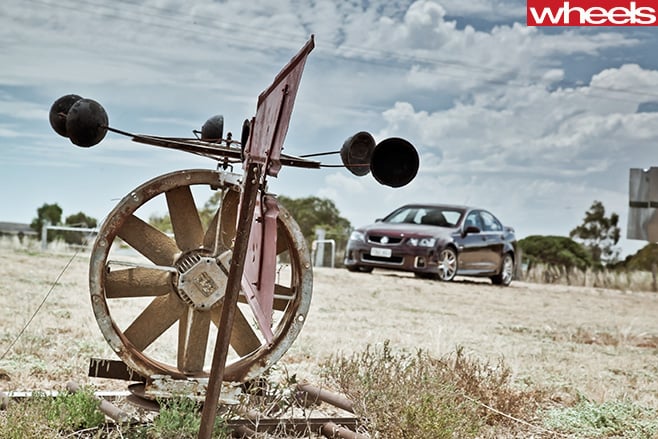
Wielecki, an inveterate adventurer – he once took four months to ride a 110cc postie bike across Australia – loves the weird. He’s spotted a variety of sculptures at the entrance to a property on Strathalbyn Road. These wondrous contraptions turn by wind power, including one that looks like it’s driven by a bloke on a bike, but isn’t.
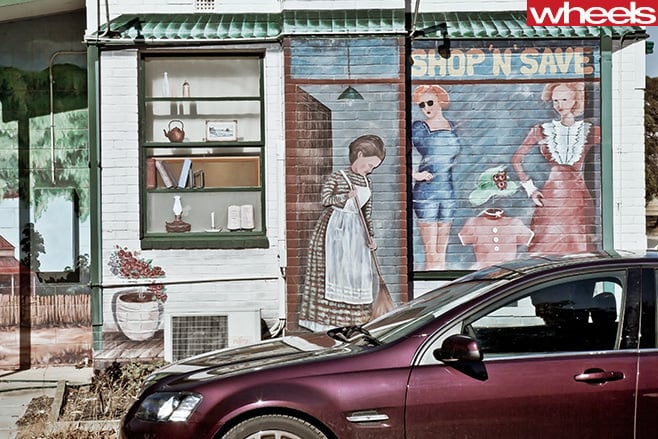
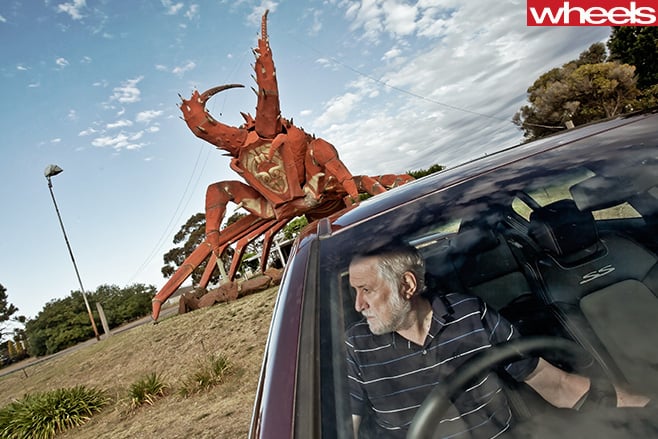
I want to refuel for the run north to our overnight stop in Bordertown, but bloody Wielecki wants to shoot the Commodore with Kingston’s Big Lobster – 17 metres high and four tonnes of questionable sculptural value.
The 12.4L/100km is reasonable given the performance, but confirms that the VE’s 71-litre tank fails to deliver a big-country-suitable range when tied to the bent-eight.
We drive the 116km to Bordertown at a steady 130km/h and see two other vehicles. Our boredom is shattered only by an explosion of sound. A bird has smashed into the driver’s exterior mirror, breaking off the upper plastic cover. Thomas finds the dead bird, I locate the mirror section and refit it. No damage apart from a couple of tiny scratches. Tough car, the Commodore, and that’s the thing – this car is designed to beat the Aussie Outback. Today, too few buyers care, and those who know still demand the image of an off-roader when they hit the Grey Nomad trail with a caravan.
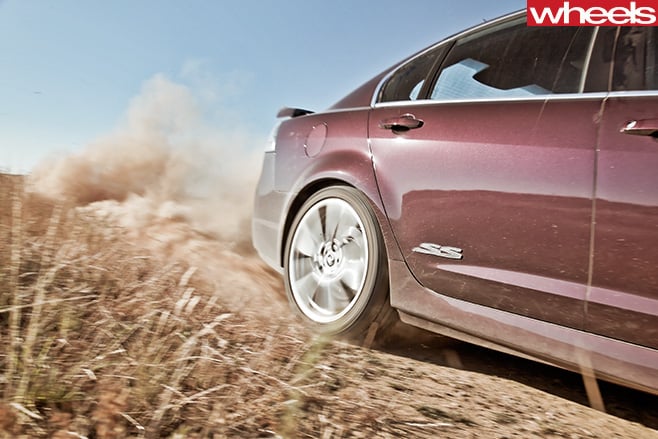
The Mallee Highway heads east into Victoria, through a series of depressing, near-derelict Soldier Settler towns that struggle to survive. I don’t dare draw any parallel to the Commodore’s future. We cross the Murray again at Tooleybuc, heading east to Deniliquin on roads that are as flat and wide as they are lonely. The Commodore eats the desolate, treeless landscape.
What will happen to ‘Denny’, self-proclaimed as ‘The Ute Capital of the World’ and host of an annual festival celebrating them, when Ford and Holden stop building them? A Ranger and Colorado Muster? I think not.
The Commodore treats the gravel road with disdain, proving again that no import can match the effectiveness of the subtle, local tune of stability-control and ABS systems. If only the interior showed the same capability; it’s the most obvious area where the Commodore has fallen behind the opposition. In terms of materials, quality of fit, design and equipment the dashboard lacks the class you expect from a $55K sports sedan. Bloody hell, even the navigation takes an eternal 36 seconds to boot up. Expect a massive advance in VF.
Ned Kelly’s rambling 7500-word Jerilderie Letter sowed the seeds for a North Eastern Victorian Republic, but today in Jerilderie we’re more interested in the small, covered car yard that contains a second-generation Chevy Camaro, an FJ Holden, first-generation Ford Mustang and a tatty ’67 Corvette.
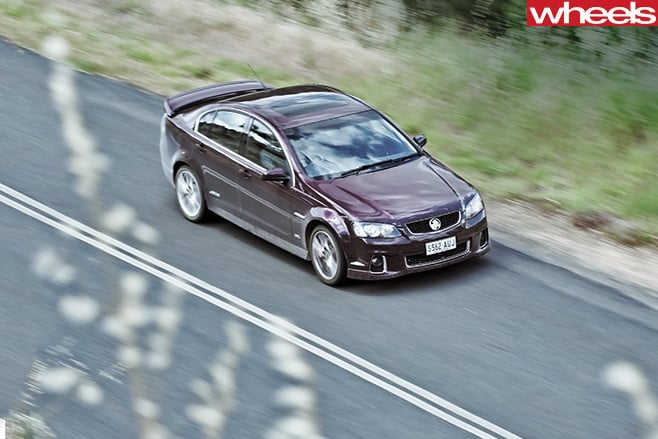
Finally, there are corners again, joyous corners, on the road from Junee to Gundagai and the Hume Freeway. Engine breathing hard, running the V8 out to the soft 6100rpm limiter, the SSV proves its credentials as a serious sports sedan. It feels supremely strong.
In terms of responsiveness, performance, chassis balance – particularly how you can lean on the outside rear rubber – consistent steering behaviour and comfort, there is nothing like the Commodore (except the Falcon, of course) at anything close to the same, affordable price. Overall consumption, to the last fill before Sydney, reveals a 12.9L/100km average.
Australians won’t truly appreciate what they’ve lost until the domestic cars disappear. So please, enjoy the Commodore (and the Falcon) while you still can.
Australia’s top 10 cars: Number 1 – The VE Commodore
First published in the May 2013 issue of Wheels magazine, Australia’s most experienced and most trusted car magazine since 1953.
By John Carey
In many ways the VE Commodore is the best car Australia has ever created. At its core are virtues of strength, spaciousness, and sophistication, which serve equally well in everything from a humble V6 Omega Sportwagon fleet car to a growling V8 E Series sports sedan costing twice as much. While it’s the kind of large car that’s become this nation’s speciality, the 2006 VE is different from any earlier Commodore. At last given the chance to design, engineer and develop a car from a clean-sheet starting point, Holden grabbed the opportunity with both hands.
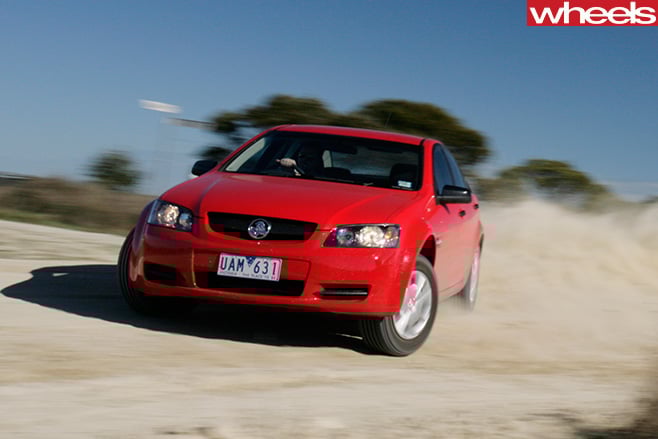
Equally outstanding was the VE’s shape. Every previous Commodore was basically Opel’s work. Turning a European Omega into a car for Australia meant strengthening, stretching and different interiors. But the exterior was always designed to please those living in the Heidelberg that’s not in Melbourne. The internal competition among Holden’s designers for the right to design VE Commodore’s skin was won by Peter Hughes. Way back in 1999 he’d made the sketch that remained a touchstone for the exterior design team throughout the program. It was the starting point for the full-size clay model of his design that was eventually selected ahead of a competing proposal from another Holden designer.
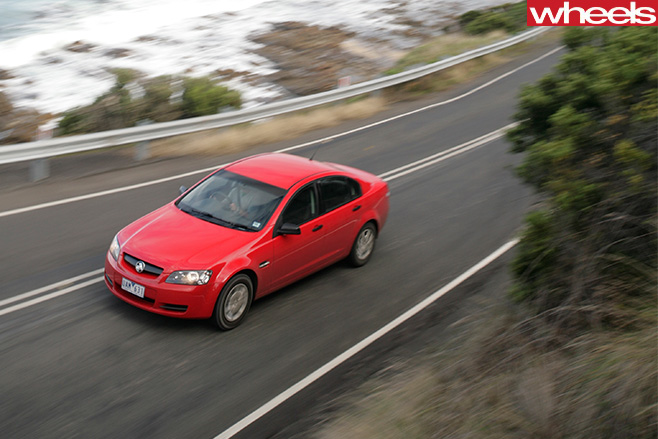
But good looks and fine dynamics aren’t the only reasons the Holden heads our 10 Greatest. It’s no accident that the first three cars on our list are products of the noughties. This was an era when Australia’s car makers were facing, for the first time ever, an operating environment not rigged heavily in their favour.
The Australian car industry spent its youth wearing a protective tariff burka. At the time of the VE, it was down to a G-string and tassels pasted to its nipples. Back in 1971, for example, the year of the HQ launch, non-British built imports had 45 percent added to their prices between dock and driveway. By the end of the decade the rate had risen to 57.5 percent, regardless of country of origin. But from the late 1980s the Button Plan of Bob Hawke’s Labor Government began to strip away 2.5 percent a year, gradually exposing both the Australian car market and car makers to the lustful gaze of overseas competitors. By the time the VE was ready for market in 2006, tariff protection was down to 10 percent. Today the twirling tassels are gone, and it’s just five percent.
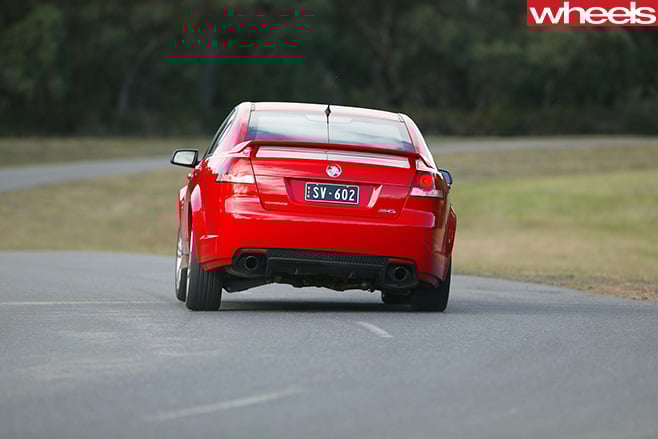
It’s fortunate that the company was being led by Peter Hanenberger as the VE program took shape. The charismatic, crafty and persuasive German was a General Motors lifer who knew the outfit inside out. He also knew Australia well, having spent time here in the late 1970s as a chassis engineer, tasked with making the HZ Holden handle with his ‘Radial Tuned Suspension’.
Hanenberger engineered, with the support of GM global product boss Bob Lutz, an international role for the Australian-developed architecture. The platform, codenamed Zeta, would be an export-ready design, and capable of adaption for other models made in other countries – if it hit targets for cost, performance, safety and production flexibility. This was a new kind of pressure for Holden.
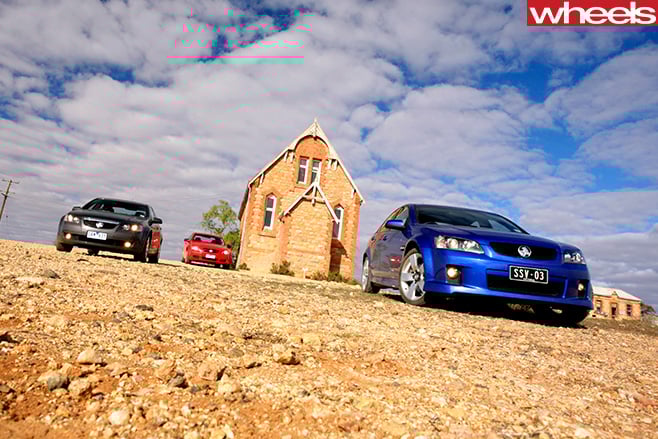
The VE, of course, has its flaws. Heating and air-con system problems afflicted early production. The base V6 engines, both 3.6-litre at launch and the 3.0-litre direct-injection introduced for the 2010 model year, aren’t as smooth or satisfying as they should be. And a four-speed auto was out of place in 2006, even in fleet models like Omega and Berlina.
Even with its acknowledged imperfections, the VE Commodore still deserves its place at the top of our list. For its design, engineering, value and versatility, but also because it’s a greater and much more significant achievement than any other car Australia has ever made. Holden began in 1948 with a basic design imported from America. With VE, the voyage was in the opposite direction. More than just a good honest car, this was the Commodore that proved, beyond doubt, that Australia’s got talent.
The marathon test: 5 days. 4 testers. 3 VEs.
First published in the September 2006 issue of Wheels magazine, Australia’s most experienced and most trusted car magazine since 1953.
Is Holden’s all-new Commodore the great engineering leap we had all hoped for? We found out by taking Omega, Calais V and SS V across 3300km of classic Aussie terrain.
By Peter Robinson
RACEY instantly recognises the VEs as she comes out of the Grand Central Hotel. Parked opposite her pub in High Street, Yea, the trio of red, blue and grey Commodores are impossible to miss, especially for somebody who takes an interest in cars.
Tracey’s words as she opens the door to Daphne’s Bakery, where we are too busy enjoying focaccia and Parma pie for conversation, grab our attention. “The Calais is beautiful, just beautiful inside,” she gushes, explaining to a female friend. “Yes, that’s the grey one.”
A child is dispatched to find Wayne, the chef from the hotel, whose customised FJ also sits outside. Brad arrives from the bakery kitchen. Both admit to being car fanatic, and want to talk about and see the VEs. Wayne drives a WH Statesman; had a VT Clubsport. They already know the new Commodore basics.
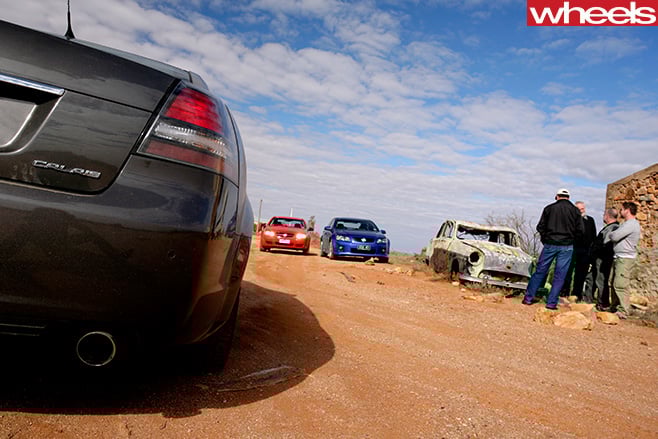
“Nah … I’m pretty easy with the fuel,” says Wayne, dismissing the question. “You can’t beat a Statesman for comfort; it’s a cruisie.”
Tracey confesses to driving a Nissan Maxima, but has fallen for the Calais, loving its modern styling and interior. We can smell temptation. The boys want to listen to the hero Holden Commdoore SS V.
“You can’t hear it… They’re too quiet,” mutters Brad. We explain that the engineers had deliberately siphoned off the induction noise to the interior, while the level of exhaust is dictated by 74-decibel drive-by rules.
The scene, which will be universally repeated at every stop on our 3300km trek, takes us to the very heart of Commodore Country.
Beyond the capital cities – and especially trendoid Sydney – we discover that mainstream Australians continue to demand roomy, comfortable, big cars powered by at least six cylinders. These country folk are loyal to their Australian cars, and take a special pride in knowing they are built to cope with tough conditions, whether extreme temperatures or outback roads.
Literally, without exception, everybody we meet loves the new Commodore’s styling. If our anecdotal evidence is any guide, the VE is already a winner.
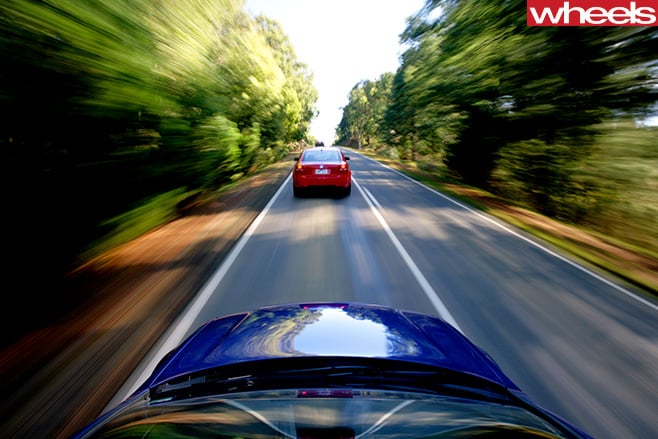
Lang Lang to Hay, 553km
THE SENSE of nostalgia is palpable. Hope none of the youngsters catches my smile. Dare I own up; can it really be almost 30 years since the Lang Lang magazine press drive for the first Holden Commodore? Easy, do the sums. I remember that day in August 1978 when the VB went beyond all our expectations. Is it possible, I wonder, for the new all-Australian VE to make a similar quantum leap?
The road-test team, as well as editor Bulmer, spent yesterday at the Holden proving ground running the numbers, searching out objective first impressions and snapping the snaps. I’m in Wheels’ B-team, with associate editor John Carey, road-test editor Nathan Ponchard,
and special projects co-ordinator David ‘Macca’ McCarthy. Our assignment is to depart Lang Lang in three disparate VEs for a five-day drive-fest across Australia’s south-eastern corner.
Seeing the VEs on the skidpan, my fond memories are quickly overwhelmed by a desire for wheel time, and I realise, again, that nothing in motoring journalism beats the thrill of driving the next generation of a best-seller. Forget new Ferraris and Lamborghinis; these cars are relevant.
I don’t want to fuel any preconceptions, but can’t help asking: how’s the base car with the ancient four-speed automatic?
Technical editor Mike McCarthy’s non-committal answer, after his Lang Lang drive, only heightens my anticipation.
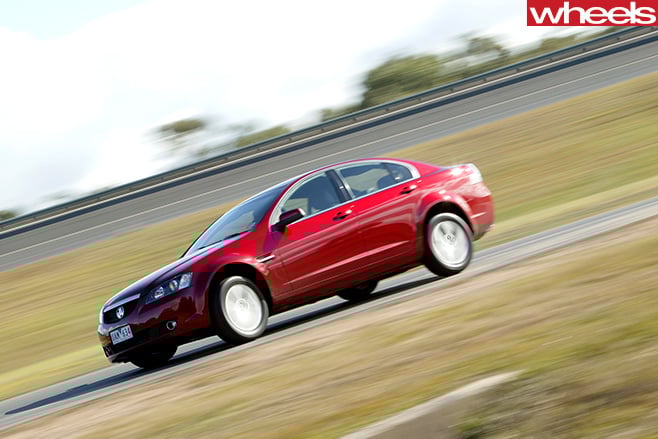
Fuel tanks carefully brimmed, we set off. The Omega cabin is welcoming – contemporary without being complicated, and spacious. With the higher waistline and shallower glasshouse, the VE is more a car you wear, as opposed to the sit-in feel of the previous-generation Commodores. After adjusting the seat – pleased to find electric cushion height adjustment is standard – and wheel, I’m immediately comfortable, though it is obvious both the cushion and seatback are flat and lacking in lateral support. Controls seem intuitive, easy to use, but it’s strange that the wiper stalk works in the opposite direction to previous Commodores. Must be a consequence of the switch to an American electrical system. With but a couple of minor exceptions, quality is impressive. Only the all-plastic steering wheel betrays this as the poverty model. Not sure about the visibility; those A-pillars are thick.
Better to drive? Oh yes. Just a few hundred metres down the road and I’m already in love with the steering. The VE feels far lighter on its feet and more agile – despite the extra 120kg mass. The on-centre dead patch and inconsistent weighting of the VZ – what the Holden engineers call ‘ghost steering’ – has vanished. The steering is now linear in its reactions, offers true feel with exactly the right level of self-centreing, and has an unfailing predictability that inspires confidence. It is also quick without being nervous, yet its inherent stability is also obvious. Hands-off at 110km/h, the VE tracks perfectly over small undulations, the perception of being planted achieved without detracting from a real ability to change direction eagerly.
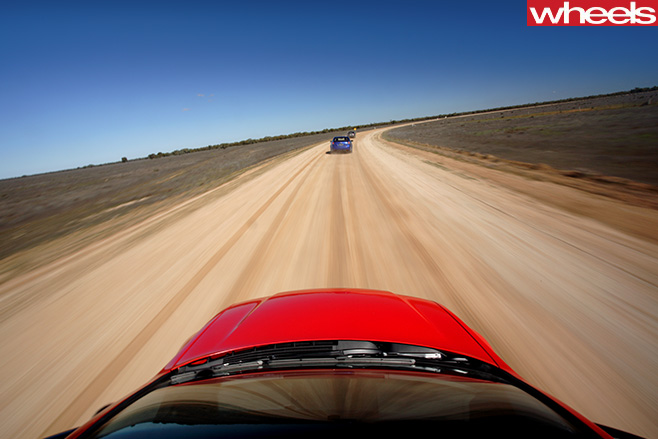
Then he pauses, knowing the significance of his next statement. “The steering and ride are as good, or better, than any BMW.”
Nobody argues. Says Ponchard, “Yeah, better than a Bimmer. It feels at least 10 years ahead of the old car.”
Well, it should, of course, but clearly the dynamics engineers have accepted the challenge and exploited the new chassis to the full. The VE’s achievement is to combine this nimbleness and grip with superb ride comfort and excellent body control. The Omega, on the default FE1 suspension and deep 225/60R16 Bridgestone Turanzas, soaks up small bumps with no hint of low-speed impact harshness. Choppy blacktop is absorbed by the suspension, leaving the driver isolated from the reality of the road surface. That first morning, the manner in which the VE loped effortlessly along any road, V6 running quietly at a tad below 2000rpm at 110km/h, car tracking honestly, became my defining memory ofthe Omega.
Time to concentrate on the drivetrain. At idle, the 180kW Alloytec V6 is more civilised than VZ, but tapping gently into the throttle at around 1500-2500rpm, the until-then overwhelming sense of refinement is shattered. A nasty engine wheeze-growl over the next 1000rpm is out of character and at odds with the engine’s responsive performance and smoothness. It is better than in VZ, but disappointing, especially when the ancient 4L60-E four-speeder, upgraded for one last time, isn’t anything like the burden I expected. No more clonks when Drive is engaged, or jerks as it upshifts close to maximum power. The thing actually shifts fluently, the tacho needle’s wide arc on upchanges confirming the broadly spaced ratios. Acceleration is spirited, and it is obvious the re-mapping of the electronic accelerator has notably improved part-throttle performance. Now there is a clear sense that the torque curve is flatter, and the power more accessible.
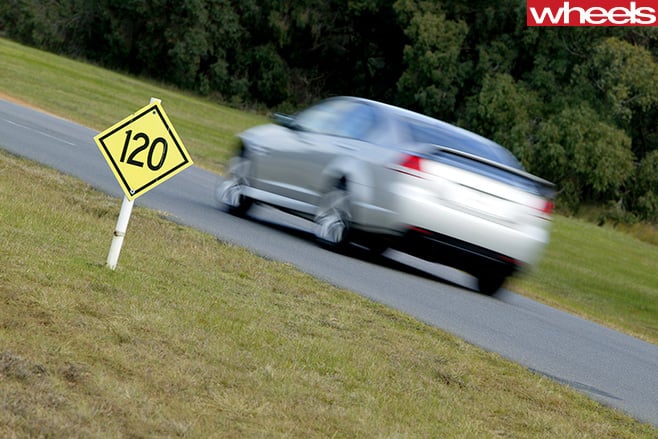
After the Yea experience, I trade Omega for Calais. No denying the lift in interior ambience; this is one classy cabin. Threading along the sweeping roads close to the Goulburn River, I’m impressed. For starters, the mid-range rumble barely exists on the twin-exhaust V6, which is happy to sing out to 6800rpm, 700rpm higher than the single-exhaust variant. The engine note is never quite inspired, but it does sound convincing. Gearchanges are faster and even more flowing, and the Calais feels marginally quicker and more responsive.
Just when I’m beginning to believe the Calais drivetrain and chassis represent the VE sweet-spot, the road surface goes from beautifully smooth to a series of small, inconsistent undulations. Ride comfort deteriorates instantly, and I’m aware of bumps the Omega would not have allowed through to the cabin.
Then I remember that the Calais rides on the same FE2 sports suspension as the SS. We can blame two former Holden executives, chairman Peter Hanenberger and designer Mike Simcoe, who apparently insisted the top version of the VE should be aimed squarely at the BMW 530i in ride and handling. Certainly, body control is improved and it feels more sporting, but I wonder if the taut ride is a touch too firm, especially when compared with the lush comfort of the Omega.
In Rochester, while refuelling, we meet Kevin, whose first Holden 47 years ago was a 48-215, which he calls an FX. Apart from three Fords, Kevin has owned 15 Holdens, including his current Jackaroo. Fuel prices are not an issue. Kevin, too, knows the nitty-gritty of the VE, and plans to choose between the Commodore and Toyota’s new Aurion when he next buys new later this year.
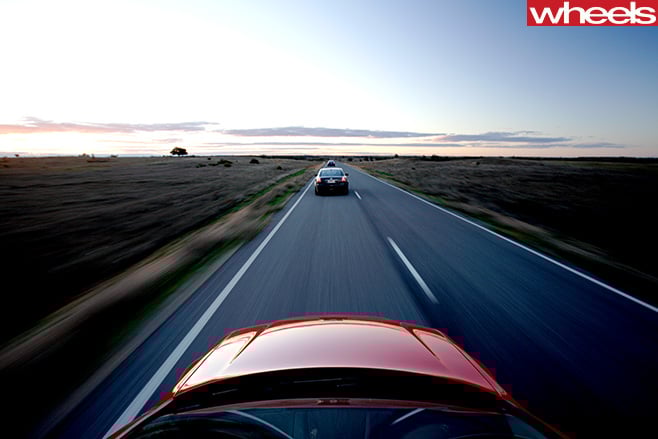
North of the Murray River, the roads are arrow-straight and potentially boring. With the SS set at 110km/h on the fussy speedometer, the bent-eight is barely above idle at 1650rpm, and I’m comfortable in the deep buckets. Dip into the throttle and the level of performance catches you unawares. The drivetrain calmly slips down a gear, or two or three, to transform the SS into a thundering muscle car. All-purposeful, blisteringly quick, and capable of scything through sweepers that would have a VZ SS teetering.
Thursday
Hay to Broken Hill, 909km
DESIRABLE doesn’t begin to explain the gorgeous looks. The VE is skilfully resolved and dramatically proportioned, a seemingly simple shape that becomes more complex – for example, the taper of the glasshouse – as you absorb the details and subtle surfacing. What strikes us is the appropriateness in the differentiation between the three contrasting variants: the macho SS V is always first to attract attention, its 19-inch alloys mesmerising in the way they pack the wheel-arches. The Omega is handsome if a little plain, and looks smaller than the more elegant Calais, which inevitably becomes the crowd favourite. “It looks a hundred grand’s worth of car,” says Ernie, who’s owned a series of Commodores, and achieves 30mpg (9.4 litres per 100km) with his VZ’s cruise control set at 112km/h. If there is a slightly awkward angle on VE, it is dead front-on, when the amazingly prominent flares look almost contrived.
Heading north across the Hay Plain at the wheel of the Omega, I reckon it is so flat and featureless I can see the curvature of the earth. The sky is bigger and the Cobb Highway virtually untravelled. Middle-East customers can be assured that directional stability above 200km/h is a revelation compared with the VZ.
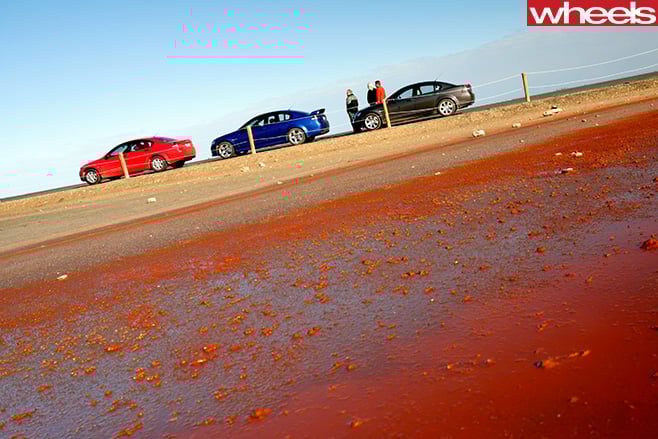
Wielecki insists on more photographs, then it’s time for the Calais. The tauter, crisper character is immediately apparent. In terms of ride and tyre sensitivity to the road texture, it’s much closer to the SS than the softer Omega.
However, I want to experiment with the drivetrain. Is it, as we suspected yesterday, too keen to downchange?
Sit at 110km/h in Drive, nudge the accelerator. Sure enough, and for no obvious reason, after a fleeting moment the transmission slides down to fourth. Lift off and it’s instantly back to fifth.
Part-throttle kickdown is a brilliant feature, but the five-speed-auto Calais is too sensitive to small inputs, especially when the engine’s torque is entirely capable of doing the job. Too often the tranny second-guesses your moves and gets it wrong. Oh, and the leather wheel looks great, but the wrapping exaggerates the size of the already overly large spokes.
Outside Ivanhoe’s Presso Cafe, the VEs serve as an introduction to Paula, who drives a VS. “No way would I change to a small car,” she tells us. Stephen, a shearer, adds, “Everyone’s got money in their pockets out here; there is nowhere to spend it. Petrol prices don’t worry us.”
Rain right through the previous week has closed the Cobb Highway north to Wilcannia. After checking, we elect to take the gravel road south west to Balranald.
It is an inspired choice; even the SS V on 245/40 rubber relishes the mostly smooth, sandy surface. Our trio runs effortlessly, soaking up the cattlegrids, where the body structure feels utterly unbreakable. The ESP tuning, too, might have been set on this road it works so well.
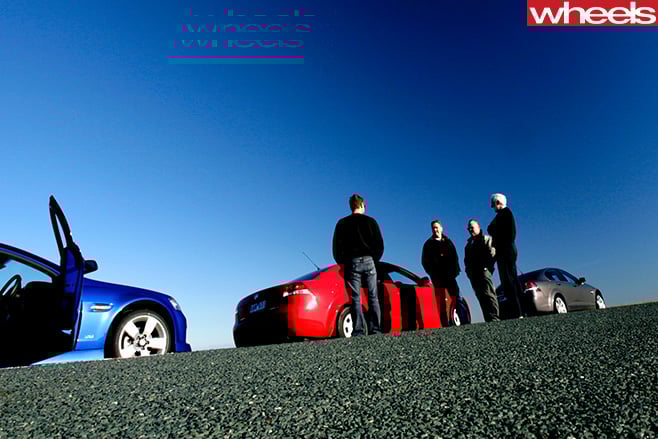
In Broken Hill, Commodore owners Wayne, Troy, Mathew and Gus have been searching all over to find the VEs they’ve heard are in town.
“You from Wheels?” asks Wayne, adding, as if to prove the blue-red divide remains as strong as it ever was, “I’m proud to drive a Holden; it speaks for itself. God made shit and Ford powers it.”
Friday
Broken Hill to Murray Bridge, 709km
PETER, who runs the servo where we fill up, is on the ground under the VE checking the rear suspension. “About time,” he says, splaying his arms outward to form a wide vee. “No more camber changes.”
You can’t come to Broken Hill without a detour to Silverton and the famous Mad Max pub. The road out winds and dips, limiting speed to 100km/h and stretching the suspension to full travel in both directions, but the VEs remain composed.
That, I reflect, is the essence of what the VE makeover brings to the Commodore.
The progress in refinement leaps a decade and impacts on virtually every aspect of the car, from structural rigidity to steering feel to cockpit finish. For long-time Commodore owners there is so much to like here, for, with a couple of exceptions, the rawness of VZ has been eliminated.
Saturday
Murray Bridge to Heywood, 630km
MUST admit, I predicted the new six-speed auto would transform the SS driveline from uncouth to polished. Mostly, it performs to expectations, slurring from ratio to ratio imperceptibly, but not always. Occasionally, Ponch, Carey and I each have the engine revs flare on second-to-third changes in both manual and auto shifts. A one-off fault? We’ll let you know.
Two months before the WM on-sale date and we come across a new Caprice in Kingston. What are the odds? It wears the same three UAM rego letters as two of our cars.
Rod Keane runs the Elizabeth manufacturing operation and we go for a quick spin in the long-wheelbase version. He’s well informed, already knowing that we snapped the VEs in front of Holden’s Elizabeth assembly plant last night.
Sunday
Heywood to Fishermans Bend, 499km
I ACCEPT that on the Lang Lang ride and handling circuit employed by the Wheels’ road testers, the Calais and SS, with their superior grip and body control, will be more entertaining and satisfying than the Omega. But in the real world, the Omega’s relaxed manners remind me of the way XJ Jags behaved in their prime. Calm, self-confident, and graceful.
On the Great Ocean Road and across the Otway Ranges, the Omega easily maintains station with the others. Yes, all four brakes smoke profusely after a quick downhill run, but the pedal is always strong. Couldn’t say that about the VZ. Impressive as the Calais and SS are, on this journey it is the entry-level $36,000 Omega that shines as the VE masterwork.
Yes, another quantum leap.
Thunder and Reign: VE Commodore SS-V v Chrysler 300C v FPV Falcon GT
Holden’s new flagship sports sedan isn’t about to be intimidated by the bellow of its much-pricier opposition. But does the SS V really deserve to rule as the muscle-car for the masses?
First published in the October 2006 issue of Wheels magazine, Australia’s most experienced and most trusted car magazine since 1953.
By Bruce Newton
IT’S LATE in the afternoon on a crisp and clear winter’s day. This back road, just a patched-up, thin-bitumen strip, winds out across open ground, climbs over a brow, then dips away behind another bald hill.
Weak, golden light is washing across the SS V’s sculpted body, polishing its 19-inch alloy wheels. Inside, we’re being lulled by a soothing ride and the 6.0-litre V8’s background burble.
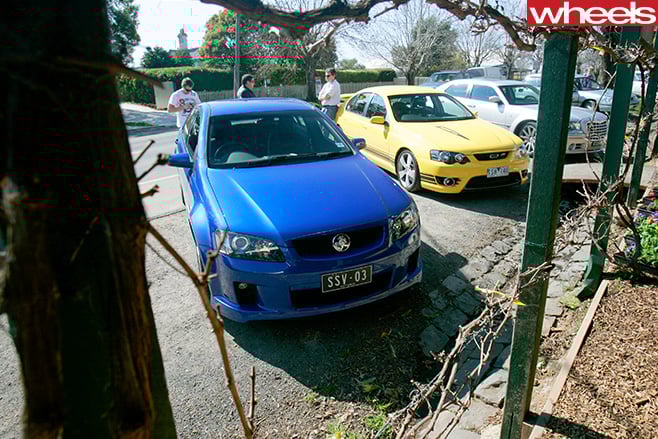
This is the essence of Holden’s Commodore SS V, the sports sedan flagship of the $1 billion VE range. Performance and poise have been melded almost surreptitiously. It’s a combination that can electrify nerve endings one minute, and tranquillise them the next.
It’s this breadth and depth that prompted our last issue’s declaration that SS V sets “a new standard for Aussie muscle cars”. Now it’s time to find out if we were overcome by the moment, or calling it correctly.
The obvious comparison would be with the Falcon XR8, maybe even the Falcon XR6 Turbo. But we’ve set our targets higher. After all, if this car is that good, then let’s test it against the best the opposition has to offer.
Hence, SS V finds itself here up against the FPV Falcon GT, a car with a famous badge and a level of dynamic ability that has been judged superior to anything HSV has previously pitched at it, let alone Holden.
If the GT is the benchmark, then Chrysler’s 300C SRT8 is the bench-presser. Austrian, not Australian-made, it’s nevertheless been developed by Chrysler’s Street and Race Technology division as if it had Down Under on top of its destination priority list. A 6.1-litre V8 engine feeds 317kW and 568Nm to the 20-inch rear wheels – the biggest set of numbers here on all four counts.
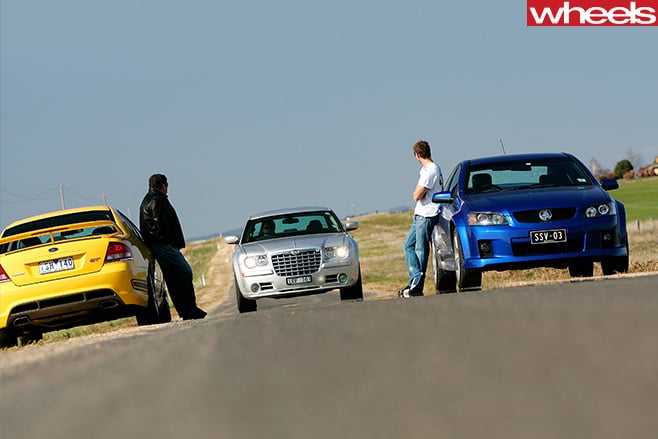
So how do we justify that? We don’t. For the purpose of this exercise, the dollar cost is not central to the outcome. For now we’ll concentrate on the driving.
So, that means a visit to Melbourne’s Calder Park, and the first chance to compare the L98 version of the Gen IV V8 with its rivals in a straight line. A close relation of the L76 that debuted with the VZ SS back in January 2006, L98 is denuded of dormant displacement-on-demand hardware. The kilowatt count climbs 10kW to 270kW, and torque is now set at 530Nm, up from 510Nm. Familiar are the vital measurements, all-alloy construction, and pushrods actuating two-valves per-cylinder.
New is GM’s 6L80E six-speed auto, a long overdue replacement for the old four-speed 4L60/65 series that has boat-anchored the back of Holden V8s for years.
On this day, the Calder surface isn’t brilliant. The launch area is slick and we have to set up in the final turn and hope to have grip sorted before arriving on the front-straight skating rink. No worries. With stability control on – that’s right, on – the Commodore hunkers down and spits out a 5.8/13.9 run. It really is as easy as that. Such is the user-friendliness and responsiveness of the drivetrain. It surely can go lower, but today there are other cars to test, so its time to move on.
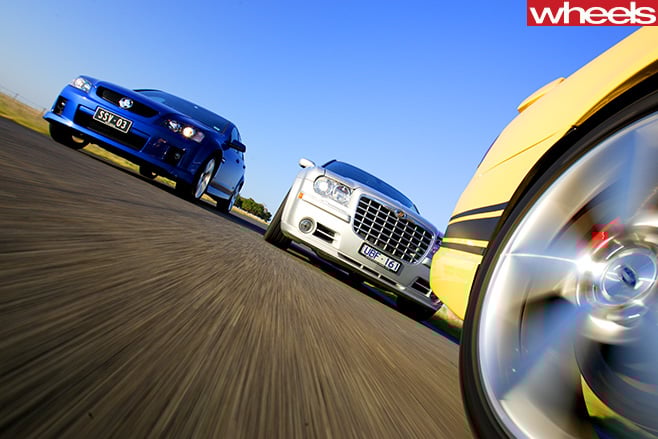
The Chrysler’s immense ability is best shown by its 3.1sec 80-120km/h overtaking figure. By now truly hooked up, it’s 0.4sec faster than the Holden and 0.6 ahead of the GT.
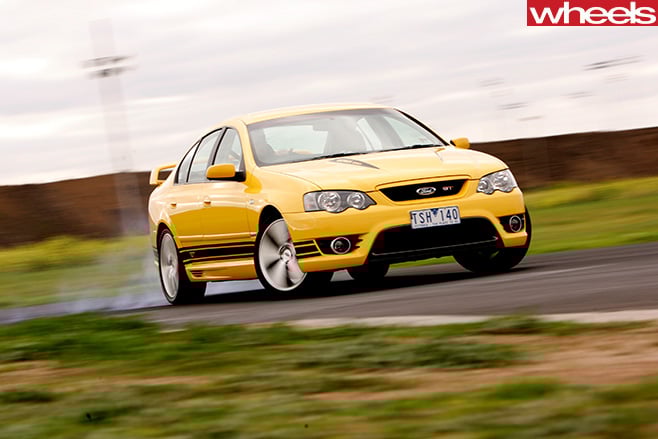
Ah yes, the GT. The Falcon’s 5.4-litre Boss 290 V8 should be right in the hunt in theory. Double overhead cams, four-valves per cylinder, 290kW, 530Nm and the backing of ZF’s marvellous 6HP26 six-speed auto all read a good game. But in the heat of battle, the engine’s capacity disadvantage, narrow rev range and tall gearing have made for some disappointing results in the past.
Not this time. The name’s the same but the identity’s been changed.
This GT feels alive, revving more freely and eagerly than we remember. Even the noise is more athletic and inspiring. It still chops off at 6000rpm, giving up 200rpm to the Holden and 400rpm to the Chrysler, but there’s character and ability here – so much so that the GT cracks the 6.0 barrier (5.98) and just misses going under 14.0 (14.1). That is with traction control off and the ZF handling the shifts in performance mode. With more time quicker runs felt probable, not possible.
Move from track to the open road and the black and white world painted by Calder
Park’s confines becomes more subtly shaded.
But the SRT8 is less special once you clamber inside. Its steering wheel is too big and not reach adjustable, although its rim is nice and slim; the heavy bolstering of its seat back can’t compensate entirely for the shortness of its squab. The squared-off centre console is big on presence, but less convincing when it comes to fit, finish and trim quality. And, for a car with a 3050mm wheelbase, more rear-seat space is expected.
And yet, despite those massive 245/45ZR20 front and 255/45ZR20 rear Goodyear Eagle F1s, this is the quietest of these three cars. This is, perhaps, less surprising when you consider that the 300C owes much technically to the superseded W210 Mercedes-Benz E-class.
But that magnificent engine beat can never be quelled. It signals that the SRT8’s sheer grunt is unrivalled even with one less gear ratio than its rivals. It could probably survive adequately with three-on-the-tree. Want to punch out of a corner, up a hill or past slower traffic (and most of it will be)? Then the Hemi delivers with forceful, irresistible enthusiasm.
Wheels last drove this very car for the May issue and it’s noticeable how much the engine has freed up with a few thousand more kays. It doesn’t feel much more potent, but certainly more even, delivering from basement to ceiling. This is also reflected in overall fuel consumption on-test that ended at 14.7L/100km. That’s excellent, considering that its claimed average is 14.0L/100km, and that the SRT version misses out on the fuel-saving Multiple Displacement System (MDS).
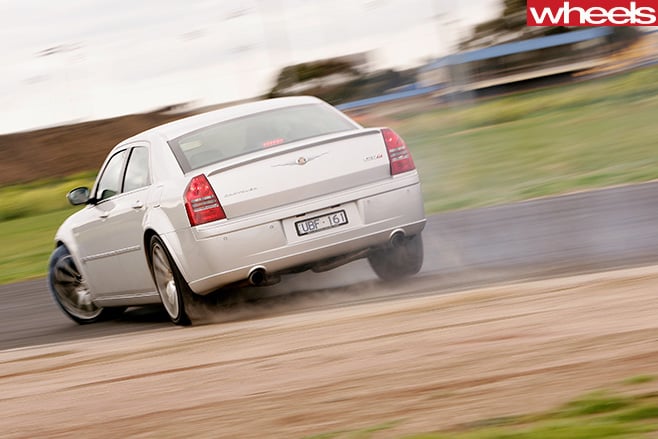
Negotiating our chopped up bitumen, the SRT8’s ride quality is too easily disturbed. That massive wheel and tyre combination contributes to this, but it also feels like there’s a shortage of suspension travel, and that the compression-damping in the rear is underdone.
When cornering hard, the SRT8’s steering is too light and vague. There’s plenty of input as the car struggles for body control on surfaces the other two glide straight over, but not a lot that’s helpful. They’re big tyres, but figuring out where they’re pointing is sheer guesswork at times.
They provide massive lateral grip, although understeer eventually emerges in tight corners, and all that torque will inevitably wrench the rear end loose if you try hard enough. Just make sure there’s run-off room if you want to experiment. There’s also a flightiness from the rear end when the big Brembo brakes are applied hard. Cope with that, and the compensation is undoubtedly the best, most consistent and confidence-inspiring stopping ability on this test.
No surprise the GT is faster cross-country than the Chrysler, despite being blitzed in a straight line. This is a well-named car, truly a grand tourer and its firm but thoroughly impressive chassis handles the rough and tough with authority.
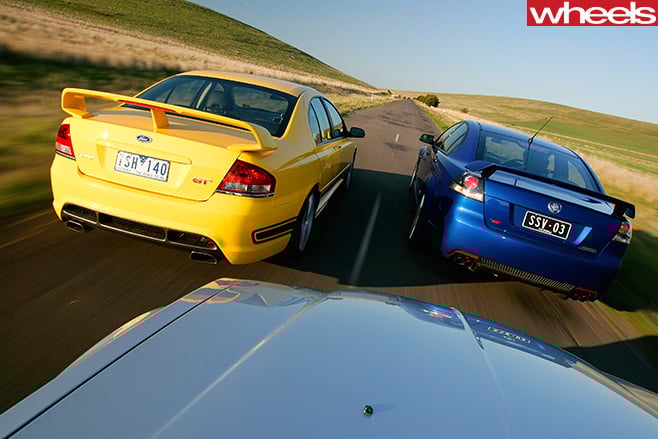
The ZF marshalls the engine expertly – something backed up by the best fuel consumption figures on test at 14.0L/100km. This is a figure that actually undercuts the 15.0L/100km official claim. We can only surmise that this is a particularly efficient example of the breed, just as it’s a fast one…
The GT has its issues. On crappier surfaces, it moves around, signalling its stiff set-up. Its 19-inch Dunlops feed a fair amount of road noise into the cabin, its steering is too light for some, and its big Brembo brakes start strong but fade noticeably. And surely stability control should at least be optional for a car with this performance potential.
In essence though, there’s a subtle ability here that makes the GT impressive and confidence-inspiring. Perhaps the real issue is that optional racer stripes aside, the GT looks too much like a regular Falcon. Inside, it’s hardly any more auspicious, although it all works well and comfortably – just like an XT or Fairmont.
No such problems for the Commodore. One of VE’s highlights is the way model streams have been differentiated. That applies not only to design, but driving as well. And that’s where much of the VE’s brilliance comes from, not only designing a quality set of components, but refining and individualising them to suit each model.
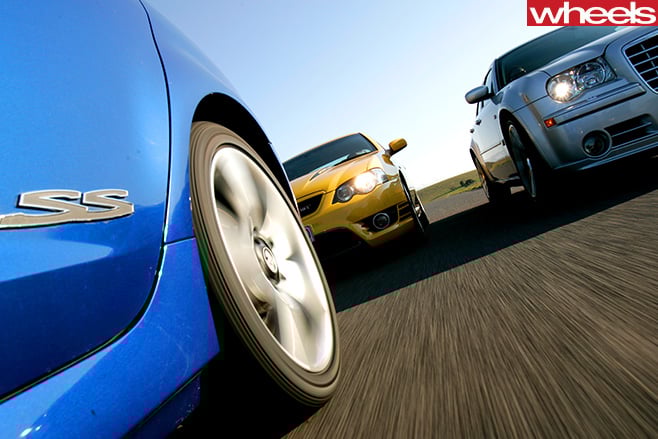
Underpinning it all is the VE’s immensely strong body, whose vital importance becomes obvious when the SS V travels the same roads as the SRT8 and the GT. It is undoubtedly set up softer than the other two, with more give and body roll. Paradoxically, it manages to produce more linear and talkative steering, intimately communicative handling and progressive, impressive grip.
On roads too tight, winding and rough for either of its rivals to enjoy, the SS V hunkers down and lockjaws its sticky Bridgestone Potenza RE050As onto the bitumen. For the driver it’s confidence-inspiring and flattering. Yet, the SS V is still more comfortable than the GT as well as better-handling. The SRT is simply miles behind on both counts.
Of course, the Yank hauls itself back into contention in a straight line, but the Commodore is close enough to be competitive. The L98 is a powerful engine made great by its beautifully calibrated electronic throttle. Response is instant, strong and sweet.
Get over-enthusiastic with the right foot and the subtly tuned Bosch stability control will intervene, but its chassis is good enough to look after most challenges by itself.
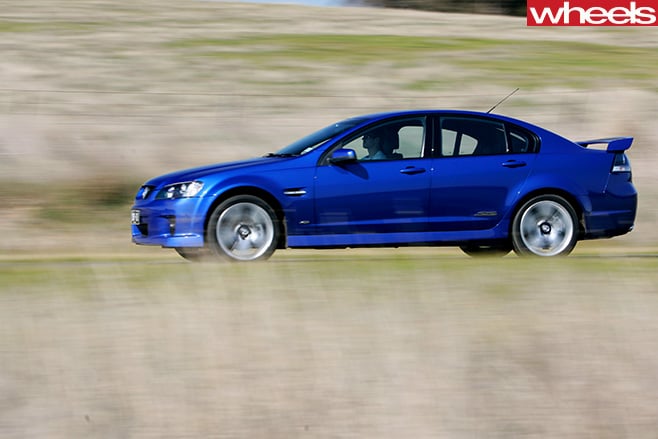
Our SS V also produced the worst fuel consumption figures on test at 15.1L/100km. That compares with the 14.3 official claim and the 12.4 figure Robbo and co achieved, in this same car, over the duration of their 10,000km VE drive (Wheels September). So, there are better results to be had.
The other obvious SS V issue is brakes. Again, these are undoubtedly improved from the old VZ set-up, but still lag behind the Chrysler and Ford. The pedal never offers the same secure feedback or sheer power, and it gets longer as time and stops go by. The hot tip is optioning the police pad apparently, which creates more brake dust, but delivers better performance.
The braking set-up is the one obvious example of the SS V’s cheaper admission price intruding on its drive experience. Other minor quibbles might include the underside of its rear wing being basic black rather than body colour, while inside the battery voltage and oil-pressure digital readouts look amazingly cheap.
Meanwhile, the small numerals in the instrument gauges, carry-over cruise control stalk, lack of rear door grab-handles and relocation of the window and mirror adjusters to the centre console are issues not isolated to the sporty SS V.
But its cabin still makes a positive – if dark – impression. The steering wheel feels just right, its front seats have long squabs that actually fit boofy Aussie blokes, and the carefully crafted centre stack works logically, as does the delivery of information.
Outside, from any angle except front-on, the SS V looks like a great Aussie muscle car should – cut, purposeful, and poised to go, with quad pipes adding more drama. But there’s also an elegance here that says there’s more to this car than you would have traditionally expected.
Of course, the Chrysler has more visual impact and power and the GT is still a fine performance car any Ford fan would love. But there’s no doubt the Commodore SS V now sets the standard. Average brakes and transmission gremlins can’t tarnish the sheer versatility and achievement of this car. There’s now no need for astonishment when rivals disappear rearwards – they’re simply in their rightful place. Trailing the new King.
It’ll be Holden’s near-billion-dollar baby
First published in the September 2005 issue of Wheels magazine, Australia’s most experienced and most trusted car magazine since 1953.
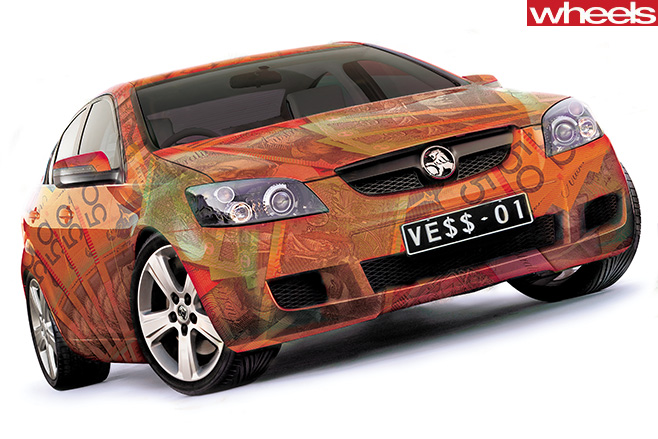
HOLDEN’s investment in the all-new VE Commodore is expected to threaten – but not cross – the $1 billion barrier by launch time around September 2006.
The final figure, expected to come in between $900 and $950 million, easily outstrips any other spend on the development of a local car in the modern era. The previous Holden high was $600 million for VT Commodore (VN was $360 million and VB $110 million), but Ford has spent more, topping $700 million for both the EA- and AU-generation Ford Falcons.
Local content levels will also drop, a reflection of both new sourcing deals and the Ion fiasco, which has forced Holden to – at least temporarily – import Alloytec engine blocks and heads.
The VE’s retreating on-sale date means the third quarter of 2006 shapes as the most crucial few months in the company’s recent history. Holden will roll out its all-new locally-manufactured large sedan, followed by the WM longwheelbase variants, while HSV should also debut the first of its VE-based models around then.
Gotcha! Holden’s ’06 Commodore
Spy pics lay bare top-secret VE
First published in the December 2005 issue of Wheels magazine, Australia’s most experienced and most trusted car magazine since 1953.
STRIP away the psychedelic chequerboard camouflage and what you’re looking at is the 2006 Commodore, around 10 months ahead of launch. These shots, taken from outside General Motors’ gigantic Milford Proving Ground near Detroit, give a crystal-clear indication of how the damn-near all-new Holden VE series Commodore will look when it arrives in showrooms around September next year. Holden, needless to say, will not be happy.
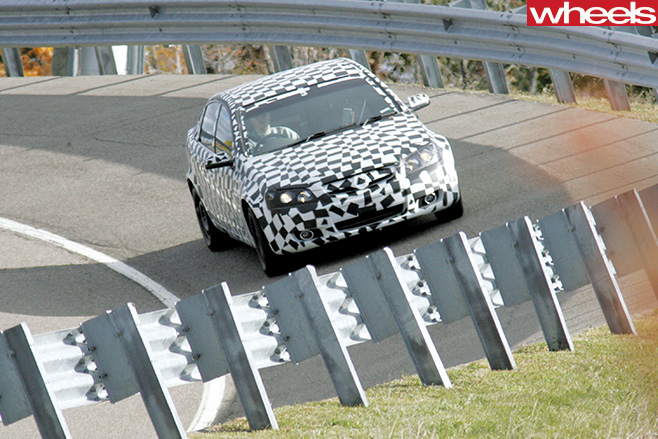
That’s because there’s so much riding on the VE’s design appeal. Because Holden has developed the car pretty much from scratch, more has been spent on the program than any other Australian-made model – almost $1 billion, according to credible sources. And, in a market that is less and less likely to buy big six- and eight-cylinder sedans, the
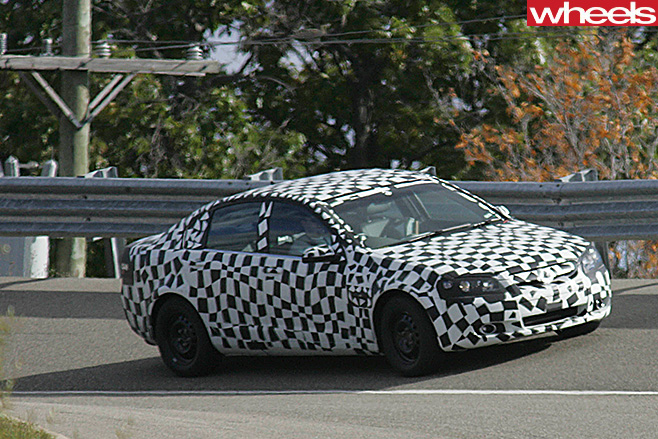
Holden engineering sources also say VE will be a better car than its predecessor in every measurable way. With petrol prices that show every sign of sticking around $1.20 per litre, fuel efficiency is undoubtedly one number that customers want to see improved. Holden boss Denny Mooney admits this factor is now a development priority. “We’re still playing around with gear ratios and other things to optimise fuel economy,” he was recently quoted as saying. “We are looking at six-speed automatics and continuing to wring every percent out of the engine.”
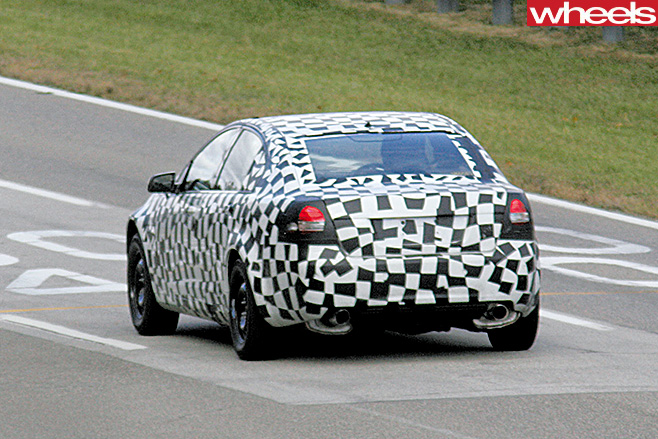
How will the all-new VE attract sufficient buyers to recoup its $1 billion investment? Mooney says the key is to build an “exciting car that people want to drive”, one that will not only entice private buyers, but also the ‘user-chooser’ lease contingent.
Obviously, styling is a vital component of the equation. But looks alone will not be enough. Holden’s engineers must deliver a technical package to beat the new Commodore’s competitors, present and future…
Exposed! VE Commodore
Spy pics blow new Holden’s cover
First published in the July 2006 issue of Wheels magazine, Australia’s most experienced and most trusted car magazine since 1953.
WITH the reveal of Holden’s crucial new VE Commodore now just weeks away, Wheels has secured undisguised images and crucial new details of the new model courtesy of website partner CarPoint. From the model line-up, to the sheetmetal, interiors and drivetrains, here’s what to expect.
Model Line-up
Having spent $1 billion developing VE, Holden is determined to sell a richer and therefore more profitable model mix. So the entry-level Executive and second-tier Acclaim are set to be replaced by one new base model, Omega.
The entry-level SV8 departs, with SS essentially taking its place. In comes the more luxuriously appointed SS V-Series, with a Calais V-Series also joining the lineup. SV6, Berlina, Calais, Statesman and Caprice continue.
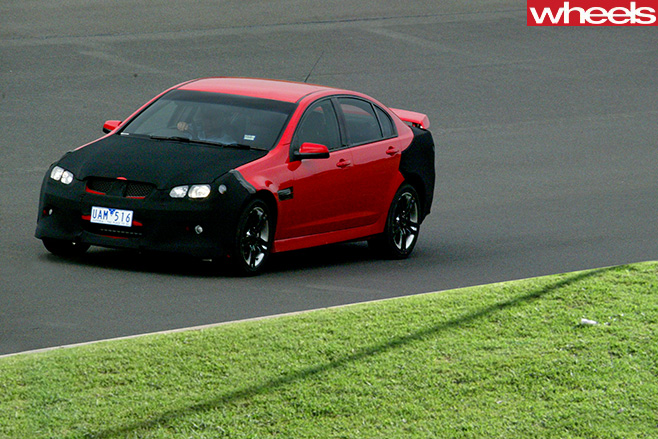
The current situation that sees V6 Commodores get stability control, but the more powerful V8s miss out, will be rectified with VE. All models in the range will come standard with at least front and side airbags and Bosch ESP. Curtain airbags will also be available for the first time.
Exterior
It looks bigger, but the reality is that VE has almost the same body length as VZ. The big change is in the wheelbase, which is around 100mm longer than the outgoing model. This promises greater dynamic stability and on-road presence, and also means the rear door and wheel arch are now separated, adding a degree of maturity to the design.
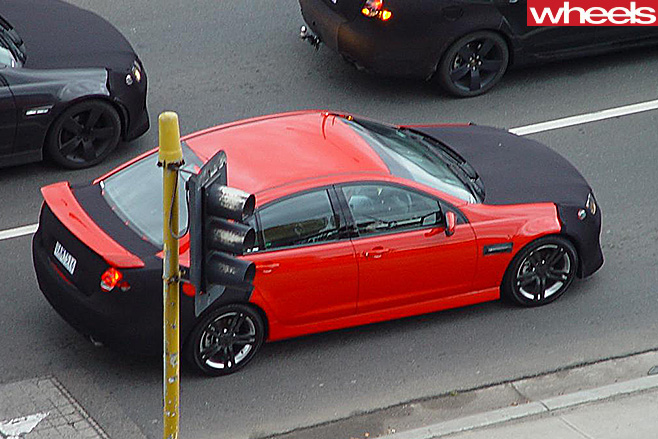
Design follows three basic themes, beginning with the base-model Omega, then splitting into the luxury and sports variants. Each will be differentiated by unique grilles, wheel designs and sizes, lights treatments and chrome embellishments.
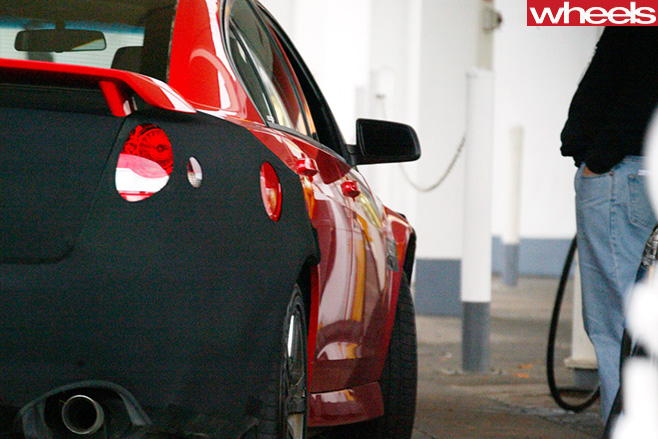
VE is the first Commodore not based at least loosely on an Opel large-car platform. Instead, Holden has developed its own rear-wheel-drive architecture, which has since been adopted for use both in the USA and some GM outposts.
As we’ve reported, the antiquated semi-trailing arm rear suspension has been traded in for a sophisticated four-link design that’s manufactured by ZF in Europe for Holden, shipped to Elizabeth, assembled off-site, and then uploaded as a modular unit. This process reputedly saves 10 minutes per car in the manufacturing process.

This is a far cry from the old front end, with its double ball-joint lower A-arm, and a front-mounted steering rack. In other words, VE follows the same concept as the Ford Territory. This allows the fitment of front driveshafts for AWD (something the Holden architecture is designed for) as well as providing a host of ride, handling and steering advantages.
VE is around 100kg heavier than VZ, so bigger brakes are called for, with the front PBR disc diameter climbing to 330mm on standard models. That also means a larger wheel size, with Omega on 16-inch, and the sport and luxury models riding on a variety of 17- and 18-inch alloys.
The BMW M4 GTS is this year’s helping of Bavarian temptation for anyone who’s been in the market for a Porsche 911 GT3 RS or a Mercedes-AMG GT S and who’s ready for a change.
Clearly track-intended but road-legal, the BMW M4 GTS is the fastest-accelerating production M car to date, pipping the M6 Competition to 100km/h by a tenth of a second.
It’s also almost double the price of an M4 Competition. And it’s already sold out. Just 700 will be built, with almost half going to the US, while Australia’s allocation doubled to 25 cars after customers threw cash at BMW Australia in vast quantities.
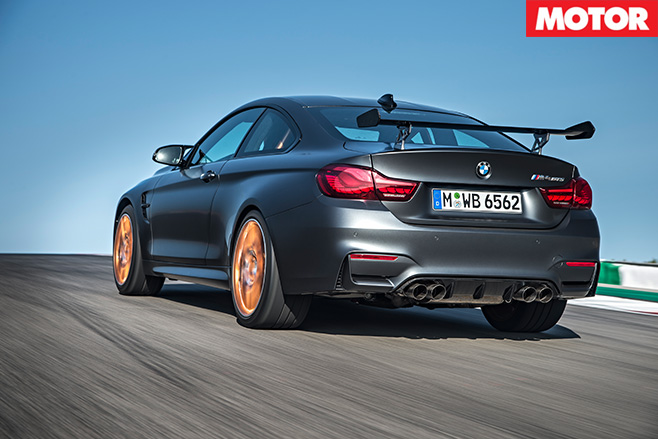
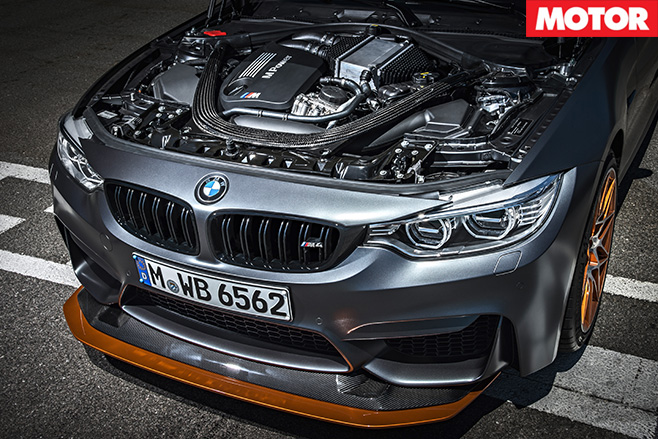
But the new car’s key mechanical asset is a water injection system for the 3.0-litre twin-turbo straight-six petrol engine. It sprays vapour into the intake plenum at high revs, cooling and condensing the fuel mixture enough to allow boost pressure on the car’s bigger turbochargers to be turned up without risking lunching the engine. And because it reduces peak thermal loading, BMW says it actually makes your engine last longer than that of a standard M4.
The car’s weight-saving program has been far-reaching. Alongside the standard M4’s carbonfibre-reinforced polymer (CFRP) roof, the GTS gets a CFRP bonnet and bootlid, as well as the extendable CFRP front splitter, the three-position CFRP spoiler scaffolded deliciously onto its rump, and the equally wicked rear diffuser.
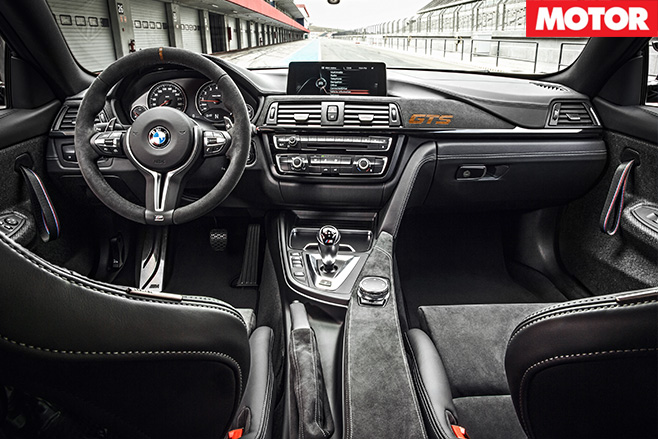
Suspension is by KW Automotive and is manually adjustable through 15mm for ride height and myriad settings of high- and low-speed bump and rebound damping. The forged aluminium control arms are shared with the standard M4, but there are new rigid mountings and ball joints throughout the suspension and steering systems. BMW’s standard tyre is a Michelin Pilot Sport Cup 2 of 285 section on the driven rear axle.
It only took seven laps of the Circuit de Catalunya to establish that this is a very special car. Not quite compelling enough to trade in your GT3 RS for, perhaps, but almost that good, in all sorts of ways: grip level, cornering balance, adjustability, handling precision, control feedback and ultimate driver reward. It’s very close to the Porsche for out-and-out lapping pace, too, and from where the current M4 started out, that’s quite some achievement.
The steering is uncompromisingly heavy, although it’s probably lighter with the suspension set more moderately than that of the launch cars, which were at rock-bottom ride height with dampers close to maxed-out. Select the angriest settings for the seven-speed dual-clutch gearbox, electronic LSD, traction control and engine management systems, and the rear wheels will spin up momentarily under big throttle openings and on cold tyres as you move off, giving instant attitude to deal with if the car isn’t quite tracking straight.
We’re rolling then, in third gear. Feeding the accelerator all the way to the floor beckons a power delivery that doesn’t have the drama of a great naturally-aspirated engine and isn’t quite as potent in outright terms as some at the same price level (think Nissan GT-R Nismo, Porsche 911 Turbo S). But the mid-range torque comes in crisply enough to feed in with metered precision – which is arguably what matters most in a track car – while the high-rev power is more than enough to put the car into super-sports territory.
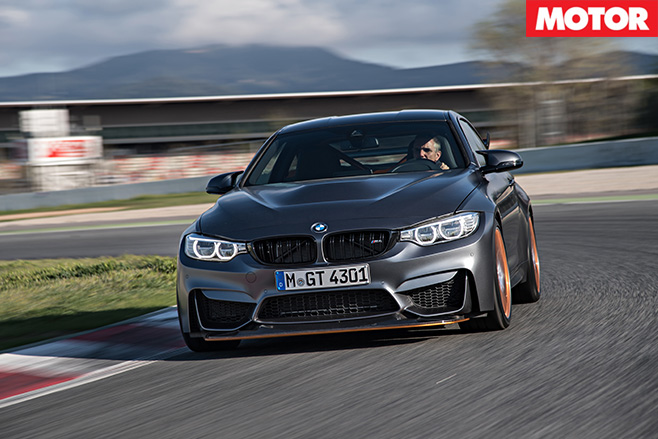
Attacking a few corners on warmed-up rubber brings the car’s steering to life even more vividly. There’s an unmistakable sense of weight in the nose and a feeling of dependable high-speed stability about the handling.
Perhaps BMW’s choice of chassis setup has teased a little bit of extra understeer out of the on-limit responses today, for the protection of us unfamiliar test drivers and in anticipation of rain. But I bet you could set the car up to be more pointy. In fact, that’s entirely the point.
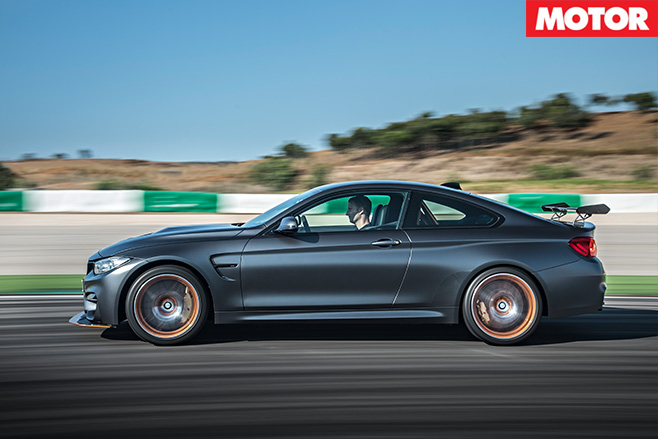
The wheel is tactile, talkative and alive in your hands, the body flat and hunkered down on the outside rear tyre, but still working all four hard.
Outstanding camber control clearly maintains a broad contact patch under the front wheels, so those final few degrees of steering correction just before the apex mean as much as the first few on turn-in. The rear axle can be delicately mobile, too, I suspect. This is an M3 (to use BMW’s new nomenclature feels like an even greater betrayal of the car’s lineage here than it ever has) as you’ve only ever hoped it might be.
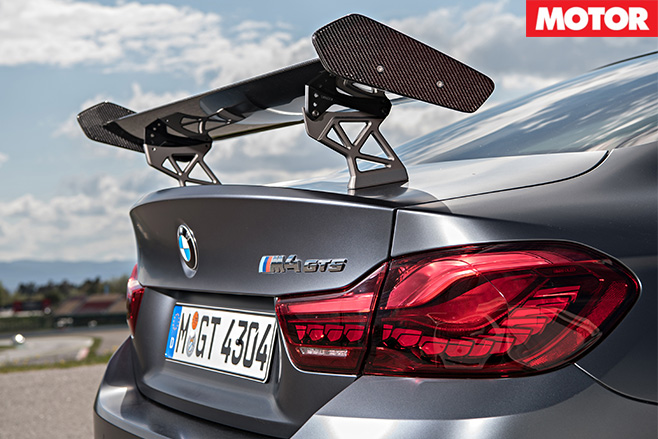
So is all of the above worth swapping your current track day plaything and paying a tidy premium for? Depends on the premium, I suppose, and $295,000 already seems like quite a chunk of change for an M3 – but it certainly could be.
This tester wouldn’t give up a 911 GT3 RS for the M4 GTS, the Porsche having a stellar engine to match its stellar track handling. But a Black Series AMG, an upper-level Audi R8 or Nissan GT-R Nismo? I might.
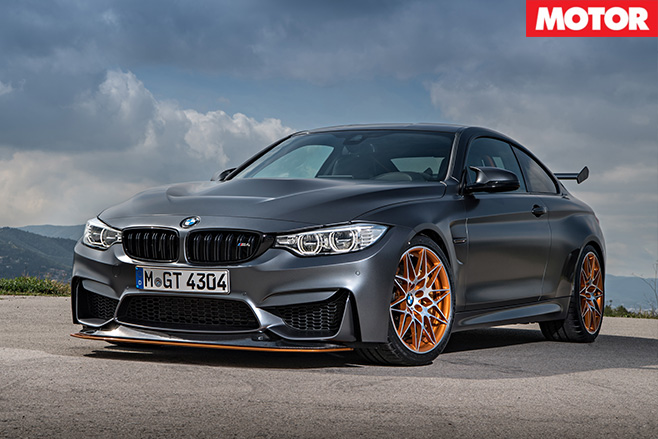
The M4 GTS is a flawed diamond polished and perfected to a glittering lustre – and who wouldn’t want a piece of that?
4.5 OUT OF 5 STARS
LIKE: Engine, steering, chassis dynamics, styling DISLIKE: Limited supply; big premium over standard M4
SPECS Engine: 2979cc inline-6, DOHC, 24v, twin-turbo Power: 368kW @ 6250rpm Torque: 600Nm @ 4000rpm Weight: 1510kg 0-100km/h: 3.8sec (claimed) Price: $295,000
Even Jaguar had to eventually succumb to the world’s obsession with SUVs. A heritage of revolutionary sports sedans and sleek sports cars is all very well, but no car maker wants a history without a future.
We’ve seen it before, of course, with Porsche and the Cayenne, and Jaguar also expects to get the cream with its F-Pace become its best-selling model – at last pushing Jaguar’s global sales past 100,000. Comfortably.
All can easily be forgotten, too, if the F-Pace drives like a high-riding F-Type as we’re being promised (there’s even some deliberate visual cues transferred, especially at the rear).
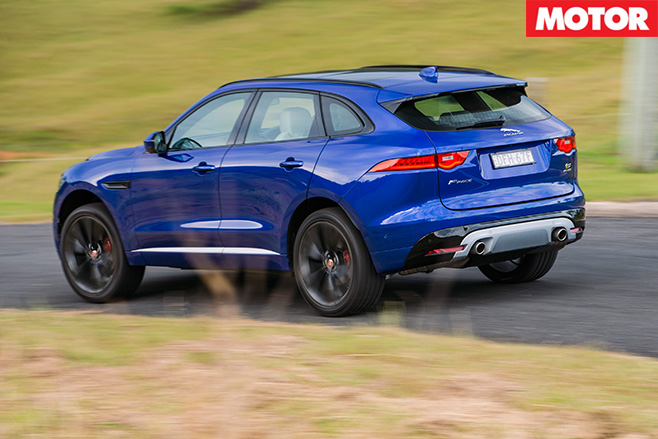
There’s a firmness to the way the F-Pace traverses country roads, even in Comfort mode, though early impressions are that, even on 20-inch wheels, can strike a similarly excellent ride-handling balance to the Jaguar XE with which it shares its basic, aluminium-intensive architecture.
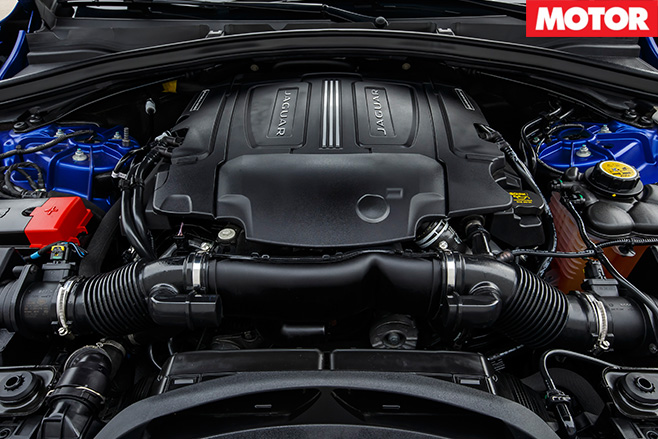
The steering’s lack of weighting, even under load, will lose it points against Porsche’s rival Macan but the F-Pace’s chassis is otherwise in the right ballpark to set up a fascinating duel.
Expect the company’s 5.0-litre V8 to eventually slot under the F-Pace’s relatively long bonnet. For now, the sportiest variant is the S 35t with its 280kW/450Nm 3.0-litre V6 that generates ample cross-country speed.
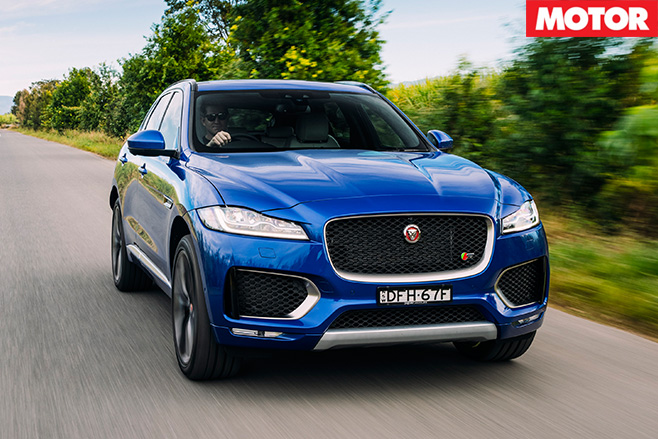
If Jaguar had to build one, at least it seems to have put its best paw forward.
4 OUT OF 5 STARS
SPECS: JAGUAR F-PACE S 35t Engine: 2995cc V6, DOHC, 16v, supercharged Power: 280kW @ 6500rpm Torque: 450Nm @ 4500rpm Weight: From 1860kg 0-100km/h: 5.5sec (claimed) Price: $103,135
A SMALL van will become Japan’s first vehicle equipped with fully autonomous driving technology when it is released to the firm’s domestic market next month.
Nissan announced this week that the Japan-only Serena five-seat minivan would be the first of its vehicles to feature ProPilot technology – the carmaker’s name for its suite of electronic driver aids that hands over responsibility of driving the car from a human to a computer.
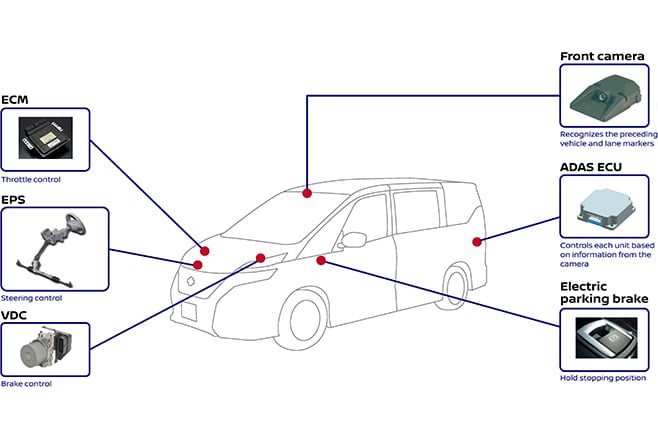
And while Nissan Australia says it has no immediate plans to import the tech-laden people mover, it says much of the technology falling under the futuristic-sounding umbrella of autonomous driving is already here.
“Autonomous driving seems a bit Jetsons to a lot of people, but when you look at all the little pieces of technologies that go into making autonomous technology, lots of it is already in Australia,” Nissan Australia spokesman Chris Jordan told WhichCar.
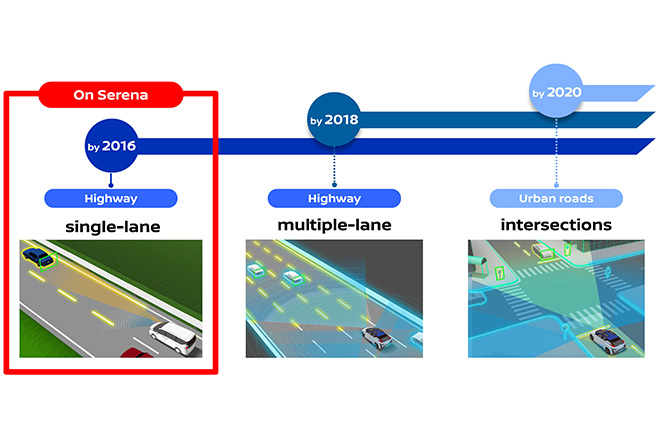
“If you think about it, automatic emergency braking, active cruise control and lane departure warning are all technologies Australians are already very familiar with.”
Nissan has developed ProPilot to take over the car’s steering, braking and accelerating usinng images received through the Serena’s inbuilt camera.
And while Jordan couldn’t confirm when ProPilot would be introduced to Australia, or which vehicle it might be best suited to in Australian conditions, he confirmed Nissan’s strategy for the technology’s roll-out was global.
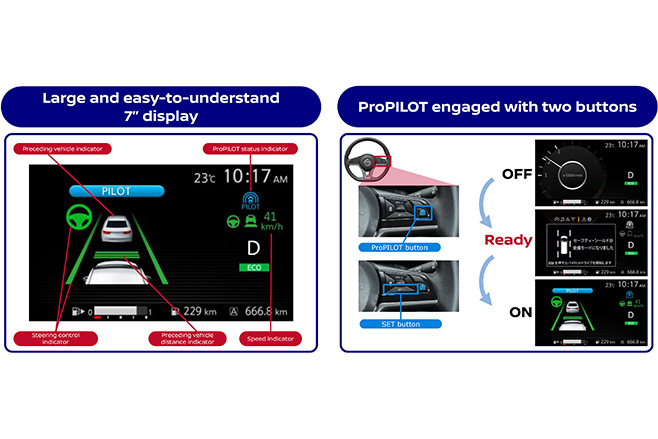
“We are the forefront of the technology, but it’s by no way a race — the priority is around safety and responsibility — but it will go global,” he said. “Over time it will appear on more and more vehicles and in more and more markets.”
Nissan’s current system is suited only to single-lane highway driving. Multi-lane autonomous driving technology, the next step in the development process, will be ready for introduction as early as 2018, the company said.
IT SEEMED obvious that Ford engineers would blow smoke up the orifices of the new Ford GT, after all it’s their creation.
But as it turns out they were literally blowing smoke up the orifices of the all-new Ford GT … in a wind tunnel at a simulated 200km/h to show off its active aerodynamics.
Any vision of the svelte but brutish looking 2017 GT is going to be a joy to behold, but it’s the usually invisible airflow flowing through and over its carbonfibre form that makes this short video so interesting.
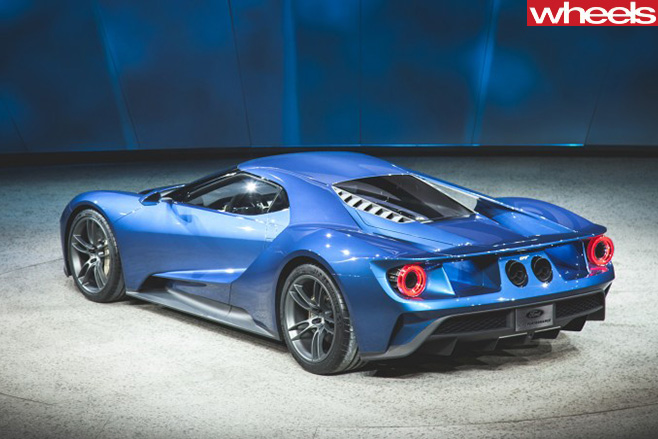
The wind-tunnel testing is used to collect data on aerodynamic flow through the car’s lines and scoops and how this influences factors such as speed and wind noise.
As Ford GT engineering supervisor Nick Terzes says, every single opening has a purpose on the car.
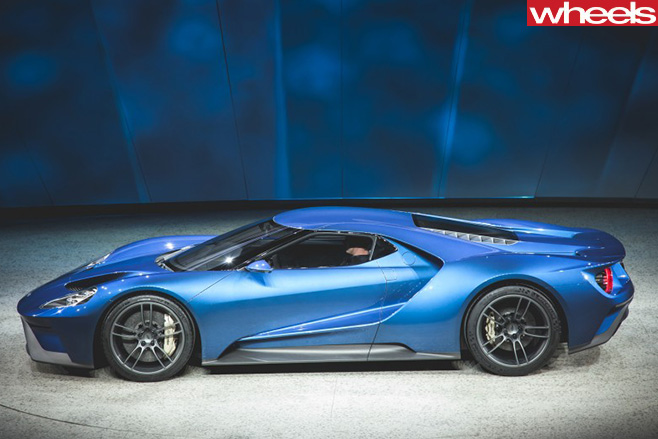
That said every nook and cranny on this thing looks great – as one person commented below the video, “I looks slippery, I love it.”
Who’d disagree?
The 2017 Ford GT will go on sale later this year for around US$400,000 with production limited to 1000 cars. It will have a mid-mounted 3.5-litre twin-turbo Ecoboost V6 engine that will produce around 450kW synced with a seven-speed dual clutch automatic transmission. There will be no manual version. Or any on Aussie roads. The GT is left-hand drive only.
